Passage The Tunguska Fireball
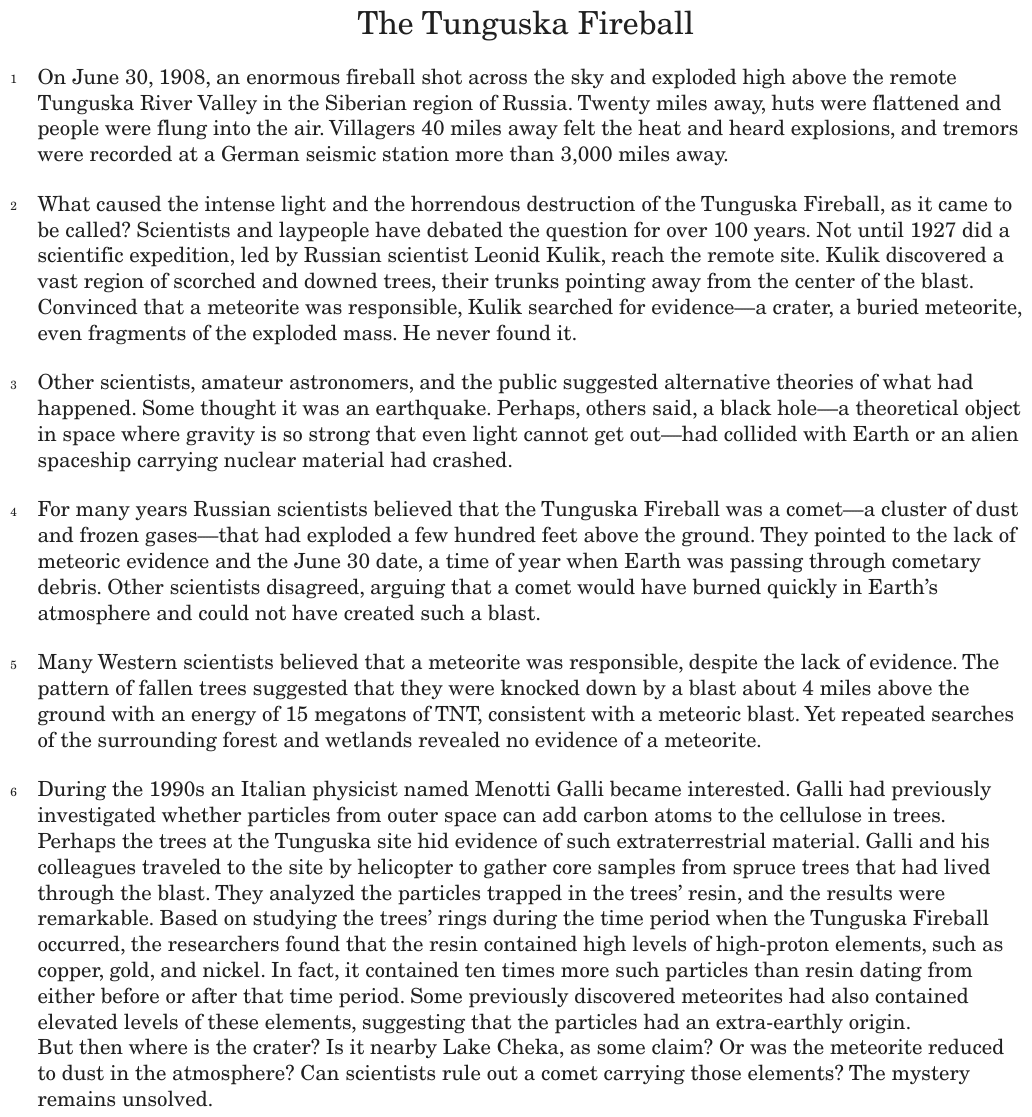
The Tunguska Fireball
On June 30, 1908, an enormous fireball shot across the sky and exploded high above the remote Tunguska River Valley in the Siberian region of Russia. Twenty miles away, huts were flattened and people were flung into the air. Villagers 40 miles away felt the heat and heard explosions, and tremors were recorded at a German seismic station more than 3,000 miles away.
What caused the intense light and the horrendous destruction of the Tunguska Fireball, as it came to be called? Scientists and laypeople have debated the question for over 100 years. Not until 1927 did a scientific expedition, led by Russian scientist Leonid Kulik, reach the remote site. Kulik discovered a vast region of scorched and downed trees, their trunks pointing away from the center of the blast. Convinced that a meteorite was responsible, Kulik searched for evidence—a crater, a buried meteorite, even fragments of the exploded mass. He never found it.
Other scientists, amateur astronomers, and the public suggested alternative theories of what had happened. Some thought it was an earthquake. Perhaps, others said, a black hole—a theoretical object in space where gravity is so strong that even light cannot get out—had collided with Earth or an alien spaceship carrying nuclear material had crashed.
For many years Russian scientists believed that the Tunguska Fireball was a comet—a cluster of dust and frozen gases—that had exploded a few hundred feet above the ground. They pointed to the lack of meteoric evidence and the June 30 date, a time of year when Earth was passing through cometary debris. Other scientists disagreed, arguing that a comet would have burned quickly in Earth’s atmosphere and could not have created such a blast.
Many Western scientists believed that a meteorite was responsible, despite the lack of evidence. The pattern of fallen trees suggested that they were knocked down by a blast about 4 miles above the ground with an energy of 15 megatons of TNT, consistent with a meteoric blast. Yet repeated searches of the surrounding forest and wetlands revealed no evidence of a meteorite.
During the 1990s an Italian physicist named Menotti Galli became interested. Galli had previously investigated whether particles from outer space can add carbon atoms to the cellulose in trees. Perhaps the trees at the Tunguska site hid evidence of such extraterrestrial material. Galli and his colleagues traveled to the site by helicopter to gather core samples from spruce trees that had lived through the blast. They analyzed the particles trapped in the trees’ resin, and the results were remarkable. Based on studying the trees’ rings during the time period when the Tunguska Fireball occurred, the researchers found that the resin contained high levels of high-proton elements, such as copper, gold, and nickel. In fact, it contained ten times more such particles than resin dating from either before or after that time period. Some previously discovered meteorites had also contained elevated levels of these elements, suggesting that the particles had an extra-earthly origin. But then where is the crater? Is it nearby Lake Cheko, as some claim? Or was the meteorite reduced to dust in the atmosphere? Can scientists rule out a comet carrying those elements? The mystery remains unsolved.
Question
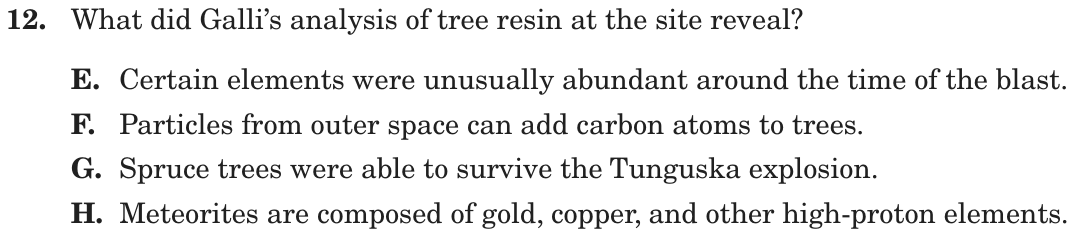
What did Galli’s analysis of tree resin at the site reveal?
- ACertain elements were unusually abundant around the time of the blast.
- BParticles from outer space can add carbon atoms to trees.
- CSpruce trees were able to survive the Tunguska explosion.
- DMeteorites are composed of gold, copper, and other high-proton elements.
Show the answer
Correct answer: A
The question asks for the evidence found after Galli’s analysis. Galli discovered unusually high levels of some elements, such as copper, gold, and nickel, which are common elements in particles from outer space that were abundant in the tree resin (paragraph 6), as stated in Option A.
Option B is incorrect because it refers to a prior finding of Galli’s, not what his analysis of the tree resin revealed.
Option C is incorrect because, although the spruce trees did survive the blast, they were the trees Galli studied rather than a revelation from his studies.
Option D is incorrect because it was previously known that meteorites contained these elements, and that information was not revealed by Galli’s analysis.
Question analysis
This key-details question asks what an Italian physicist’s study of tree resin at the Tunguska site revealed. Students read one dense paragraph about his research and pick the finding it reports. Several statements in that paragraph sound like discoveries, so students must tell the study’s result from background facts.
- NYS standards
- 7R1 textual evidence and inferences
- Grade level
- Grade 7 reading and task
- Compared with grade 7
- At grade 7 Reading closely for what a study found is typical grade 7 work with informational text. The extra effort here comes from technical vocabulary such as resin, cellulose and high-proton elements, packed into one long paragraph.
- Estimated difficulty
- Straightforward: two steps or one careful reading.
- Thinking it demands
- Depth of knowledge 2, skills and concepts · mainly understand
- What makes it hard
- The right answer is reworded moderate
- Hard words minor
- Evidence
- Answered from one paragraph or stanza
- Reading level
- Passage: about grade 10, 531 words; question and choices: about grade 8, 51 words.
- Students, last 30 days
- Not enough answers yet to show (it takes 10).
Why it is hard, traps and wrong answers (shows the answer)
Why it is hard
The Galli paragraph mixes four kinds of statement, his earlier research, his hunch, his method and his findings, and only the findings answer the question. Students who match words rather than sentence roles are drawn to the one about carbon atoms, which repeats the passage most closely. The right choice uses none of the passage’s technical terms, so it can look less supported than it is.
The right answer is reworded moderate Choosing the answer
The right choice restates “ten times more such particles than resin dating from either before or after” as “unusually abundant around the time of the blast,” while a wrong one copies Galli’s earlier question almost word for word. (Freedle & Kostin, 1993; Kirsch & Mosenthal, 1990)
Hard words minor Understanding the question
“Cellulose,” “resin” and “high-proton elements” go unexplained in the 189-word Galli paragraph, so students who stall on them may lose track of which sentence reports the result. (Perfetti, 2007; Freedle & Kostin, 1993)
Strategy: In the Galli paragraph, find the sentences that report what the resin analysis itself showed, and check each choice against those sentences rather than the rest of the paragraph.
Traps
- True but not the answer: A choice says something accurate about the text that does not answer this question.
- Too broad or too strong: A choice overstates, generalizes, or uses absolute words the text does not support.
The wrong answers, classified
B Twists what the text says (King et al., 2004)
Turns what Galli “had previously investigated” before the trip, whether space particles add carbon to trees, into a result of the Tunguska resin analysis.
C True but not the answer (King et al., 2004; Embretson & Wetzel, 1987)
States a true detail, that the sampled spruces lived through the blast, but that is why they could be studied, not what studying them revealed.
D Too broad or too strong (King et al., 2004)
Inflates the remark that some earlier meteorites “had also contained elevated levels” into a claim about what all meteorites are made of, and that was known before Galli.
Working it out, step by step
Figure out what the question asks
This asks what Galli’s study of the tree resin found. Resin is the sticky sap inside a tree. You need the result of the study, not facts from before it.
Find the results in paragraph 6
Paragraph 6 says “the resin contained high levels of high-proton elements, such as copper, gold, and nickel.” Then it adds: “it contained ten times more such particles than resin dating from either before or after that time period.”
Put the results in plain words
Elements are basic materials, like gold and copper. The resin from the time of the blast had ten times more of them than resin from before or after. “Unusually abundant” means there was much more than normal. That is just what Galli found.
Check each choice
- A is right. Certain elements were much more common around the time of the blast.
- B is wrong. Galli “had previously investigated” this question before the trip. It was not a result of this study.
- C is wrong. The spruce trees did survive, but that is why he could study them. It is not what he found.
- D is wrong. Only “some previously discovered meteorites” had these elements. That was known before Galli, and it does not say what all meteorites are made of.
Watch out: B uses words from paragraph 6, but they describe Galli’s earlier work.
Choose the answer
The resin showed far more of these elements than usual, right around the time of the blast. So the answer is A.
Why this answer and not the closest wrong one
B is the closest wrong answer, because it comes almost word for word from paragraph 6. But that sentence tells what Galli “had previously investigated” before this trip. The question asks what the Tunguska resin showed. Only A gives that result.
More questions like this
The original DOE question
The passage “The Tunguska Fireball” as printed (page 124)