Passage The Tunguska Fireball
The Tunguska Fireball
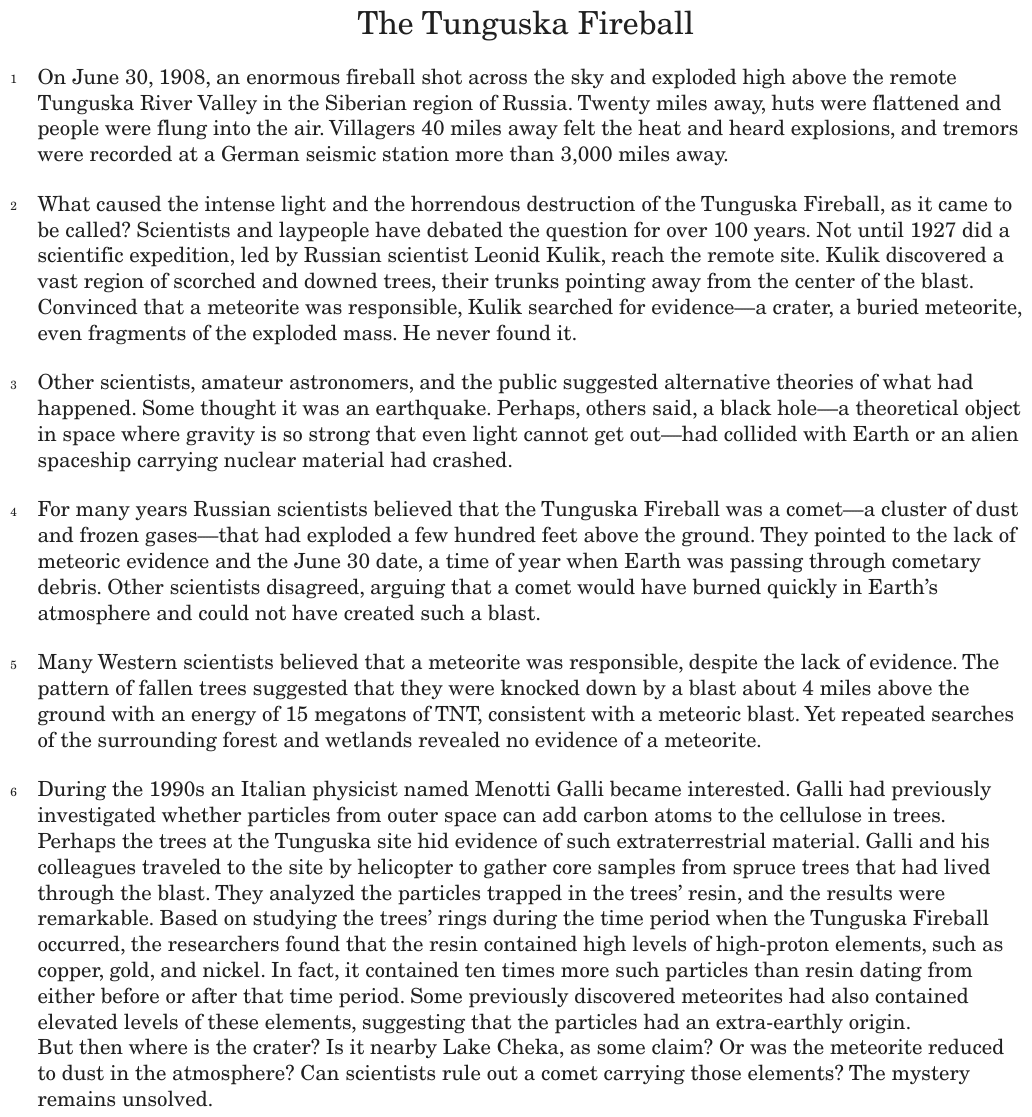
On June 30, 1908, an enormous fireball shot across the sky and exploded high above the remote Tunguska River Valley in the Siberian region of Russia. Twenty miles away, huts were flattened and people were flung into the air. Villagers 40 miles away felt the heat and heard explosions, and tremors were recorded at a German seismic station more than 3,000 miles away.
What caused the intense light and the horrendous destruction of the Tunguska Fireball, as it came to be called? Scientists and laypeople have debated the question for over 100 years. Not until 1927 did a scientific expedition, led by Russian scientist Leonid Kulik, reach the remote site. Kulik discovered a vast region of scorched and downed trees, their trunks pointing away from the center of the blast. Convinced that a meteorite was responsible, Kulik searched for evidence—a crater, a buried meteorite, even fragments of the exploded mass. He never found it.
Other scientists, amateur astronomers, and the public suggested alternative theories of what had happened. Some thought it was an earthquake. Perhaps, others said, a black hole—a theoretical object in space where gravity is so strong that even light cannot get out—had collided with Earth or an alien spaceship carrying nuclear material had crashed.
For many years Russian scientists believed that the Tunguska Fireball was a comet—a cluster of dust and frozen gases—that had exploded a few hundred feet above the ground. They pointed to the lack of meteoric evidence and the June 30 date, a time of year when Earth was passing through cometary debris. Other scientists disagreed, arguing that a comet would have burned quickly in Earth’s atmosphere and could not have created such a blast.
Many Western scientists believed that a meteorite was responsible, despite the lack of evidence. The pattern of fallen trees suggested that they were knocked down by a blast about 4 miles above the ground with an energy of 15 megatons of TNT, consistent with a meteoric blast. Yet repeated searches of the surrounding forest and wetlands revealed no evidence of a meteorite.
During the 1990s an Italian physicist named Menotti Galli became interested. Galli had previously investigated whether particles from outer space can add carbon atoms to the cellulose in trees. Perhaps the trees at the Tunguska site hid evidence of such extraterrestrial material. Galli and his colleagues traveled to the site by helicopter to gather core samples from spruce trees that had lived through the blast. They analyzed the particles trapped in the trees’ resin, and the results were remarkable. Based on studying the trees’ rings during the time period when the Tunguska Fireball occurred, the researchers found that the resin contained high levels of high-proton elements, such as copper, gold, and nickel. In fact, it contained ten times more such particles than resin dating from either before or after that time period. Some previously discovered meteorites had also contained elevated levels of these elements, suggesting that the particles had an extra-earthly origin. But then where is the crater? Is it nearby Lake Cheko, as some claim? Or was the meteorite reduced to dust in the atmosphere? Can scientists rule out a comet carrying those elements? The mystery remains unsolved.
Question
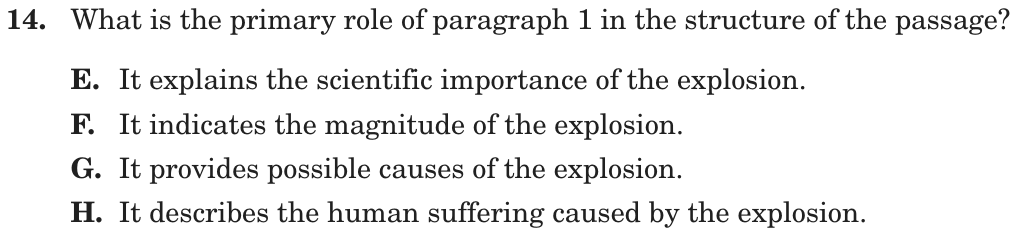
What is the primary role of paragraph 1 in the structure of the passage?
- AIt explains the scientific importance of the explosion.
- BIt indicates the magnitude of the explosion.
- CIt provides possible causes of the explosion.
- DIt describes the human suffering caused by the explosion.
Show the answer
Correct answer: B
The question asks for an explanation of how paragraph 1 supports the passage. Paragraph 1 provides several examples of the severe damage caused by the explosion, as stated in Option B.
Option A is incorrect because the scientific aspects of the explosion are not discussed until later in the passage.
Option C is incorrect because paragraph 1 discusses some of the effects of the blast rather than the potential cause. Although human suffering is one detail described in paragraph 1, this is not the primary evidence of the explosion’s destruction, making Option D incorrect.
Question analysis
This text-structure question asks what job the first paragraph does in the article about the 1908 Tunguska explosion. Students decide how the opening details set up the rest of the passage. The paragraph is vivid, so it is easy to fix on one striking image instead of its overall purpose.
- NYS standards
- 7R5 structure and genre features
- Grade level
- Grade 7 reading and task
- Compared with grade 7
- At grade 7 Explaining how one section fits the structure of an informational text is a grade 7 skill, and an opening paragraph is the most familiar case. Students check its details and compare them with what later paragraphs take up.
- Estimated difficulty
- Straightforward: two steps or one careful reading.
- Thinking it demands
- Depth of knowledge 2, skills and concepts · mainly analyze
- What makes it hard
- How, not what moderate
- Evidence
- Answered from one paragraph or stanza
- Reading level
- Passage: about grade 10, 531 words; question and choices: about grade 8, 44 words.
- Corrected from the DOE handbook
- A typo in the explanation was corrected.
- Students, last 30 days
- Not enough answers yet to show (it takes 10).
Why it is hard, traps and wrong answers (shows the answer)
Why it is hard
Paragraph 1 is short and vivid, and the main risk is naming one of its images instead of what they add up to. Students who keep the whole passage in view can also rule out the two choices that describe later paragraphs, the causes and the science. The question rewards stepping back from the details to ask why the article opens with them before raising its question about the cause.
How, not what moderate Working it out
The question asks what paragraph 1 does, and the answer lies in its pattern of distances, flattened huts at 20 miles, heat at 40 miles, tremors at 3,000 miles, each farther away yet still felt. (Anderson & Krathwohl, 2001)
Strategy: Reread paragraph 1 and ask what all of its details have in common, then make sure the choice describes the whole paragraph rather than one detail or a later section.
Traps
- Wrong part of the text: A choice is true of another paragraph, stanza or speaker than the one asked about.
- Too narrow: A single detail offered as the central idea or a summary, or a summary that keeps minor details and leaves out an essential part.
The wrong answers, classified
A Wrong purpose or structure (Anderson & Krathwohl, 2001)
Takes the seismic-station detail as science and calls the paragraph an explanation of the blast’s scientific importance, though it reports effects and explains nothing.
C Wrong part of the text (Kirsch & Mosenthal, 1990)
Confuses effects with causes: possible causes, from meteorite to black hole, are debated from paragraph 2 on, while paragraph 1 only shows what the blast did.
D Too narrow (King et al., 2004)
Fixes on huts flattened and people flung into the air, the most human detail, and makes it the purpose of a paragraph mostly about how far the blast reached.
What was corrected from the DOE handbook, and why
- Explanation: The handbook’s explanation begins “The questions asks”; the site now reads “The question asks.”
Working it out, step by step
Figure out what the question asks
This asks about the role of paragraph 1: what job it does in the whole passage. To find a paragraph’s role, look at what all its details have in common.
List the details in paragraph 1
- A fireball “exploded high above the remote Tunguska River Valley.”
- “Twenty miles away, huts were flattened and people were flung into the air.”
- “Villagers 40 miles away felt the heat and heard explosions.”
- Tremors were recorded at a station “more than 3,000 miles away.”
Find what the details share
Each detail is farther away than the one before: 20 miles, then 40 miles, then 3,000 miles. Yet the blast was still felt each time. Together, the details show how huge and powerful the explosion was. “Magnitude” means size or strength. So the paragraph shows the magnitude of the blast.
Check each choice
- A is wrong. The paragraph reports what happened. It never explains why scientists care.
- B is right. The details show how big and strong the blast was.
- C is wrong. Possible causes, like a meteorite or a comet, come later, starting in paragraph 2.
- D is wrong. People being flung is only one detail. Most details are about distance and power.
Watch out: D grabs the most dramatic detail. But a paragraph’s role must fit the whole paragraph, not one line.
Choose the answer
Every detail in paragraph 1 shows how big and far-reaching the explosion was. So the answer is B.
Why this answer and not the closest wrong one
D is the closest wrong answer, because paragraph 1 does mention people being hurt. But that is one detail. The heat felt 40 miles away and the tremors 3,000 miles away are not about suffering. They are about size and power. B fits every detail in the paragraph.
More questions like this
The original DOE question
The passage “The Tunguska Fireball” as printed (page 124)