Wrong tone or attitude
Question 1 of 53
2026 Practice Test A English, question 4Passage Snowy Mountains
Snowy Mountains
by John Gould Fletcher
Higher and still more high,
Palaces made for cloud,
Above the dingy city-roofs
Blue-white like angels with broad wings,
Pillars of the sky at rest
The mountains from the great plateau
Uprise.
But the world heeds them not;
They have been here now for too long a time.
The world makes war on them,
Tunnels their granite cliffs,
Splits down their shining sides,
Plasters their cliffs with soap-advertisements,
Destroys the lonely fragments of their peace.
Vaster and still more vast,
Peak after peak, pile after pile,
Wilderness still untamed,
To which the future is as was the past,
Barrier spread by Gods,
Sunning their shining foreheads,
Barrier broken down by those who do not need
The joy of time-resisting storm-worn stone,
The mountains swing along
The south horizon of the sky;
Welcoming with wide floors of blue-green ice
The mists that dance and drive before the sun.
“Snowy Mountains” by John Gould Fletcher—Public Domain
Question
In which two ways does the poet develop the speaker’s point of view in the second stanza (lines 8–14)?
Select the two correct answers.
Choose every answer that is correct, then check. The DOE has not published how answers with several parts are scored; this site counts one right only when every part is right.
- Aby describing the mountains’ awe-inspiring size and strength
- Bby comparing the various methods humans use to control nature
- Cby criticizing the careless actions of humans that harm the natural environment
- Dby demonstrating how the mountains and the people are able to benefit from each other
- Eby depicting the unfortunate plight of the mountains with vivid details
Show the answer
Correct answer: C and E
The question asks for the two ways in which the poet develops the speaker’s point of view in the second stanza (lines 8–14).
A. Incorrect. The speaker’s descriptions of the mountains’ awe-inspiring size and strength mainly occur in the first and third stanzas, while in the second stanza, the speaker focuses on humanity and its negative effect on the mountains.
B. Incorrect. The wording of the second stanza—“makes war” (line 10), “Splits down their shining sides” (line 12), and “Destroys the lonely fragments” (line 14)—communicates the speaker’s position that people’s main impact on the mountains is destructive, but the stanza does not compare the various methods people use to control nature.
C. CORRECT. In the second stanza, the speaker criticizes the careless and destructive actions of society or “the world” (lines 8 and 10) that harm the natural environment. Humans are described as both heedless of the mountains (“heeds them not”) and harmfully warlike (“makes war on them”). The speaker cites the harm done to the mountains when people “[tunnel] their granite cliffs” (line 11) and “[split] down their shining sides” (line 12), thus “[destroying] the lonely fragments of their peace” (line 14).
D. Incorrect. In the second stanza, the speaker does not describe a mutually beneficial relationship between the mountains and the people. Although people clearly derive benefits from the mountains by plastering “their cliffs with soap-advertisements” (line 13), the stanza does not demonstrate that the mountains receive any benefit from the harmful actions of the people.
E. CORRECT. In the second stanza, the speaker depicts the unfortunate plight of the mountains with vivid details. Lines 11–14 feature expressive wording that sharply illustrates the mountains’ misfortune: “Tunnels their granite cliffs, / Splits down their shining sides, / Plasters their cliffs with soap-advertisements.”
Question analysis
This select-two question on John Gould Fletcher’s poem “Snowy Mountains” asks in which two ways the poet develops the speaker’s point of view in the second stanza, lines 8–14. It reworks a one-answer handbook question, now with five choices. Each choice has to be judged on its own, and a choice that fits the poem as a whole is not enough.
- Grade level
- Grade 6 reading and task
- Compared with grade 7
- At grade 7 Typical grade 7 point-of-view questions ask for one answer about a longer text. This stanza is only seven short lines with one steady attitude, but students must find two right choices out of five and judge each one separately.
- Estimated difficulty
- Moderate: several steps, or a close reading with one strong distractor.
- Thinking it demands
- Depth of knowledge 2, skills and concepts · mainly analyze
- What makes it hard
- How, not what moderate
- Every choice must be checked moderate
- Hard words minor
- Evidence
- Answered from one paragraph or stanza
- Reading level
- Passage: 161 words (a poem; reading level not measured); question and choices: about grade 8, 79 words.
- Students, last 30 days
- Not enough answers yet to show (it takes 10).
Why it is hard, traps and wrong answers (shows the answer)
Why it is hard
Most students sense the anger at “the world” in lines 8–14 and find the criticism of people quickly. The point is lost on the second pick, because the other right choice names a technique, vivid details of the mountains’ suffering, and can look like plain description. The choice about comparing methods tempts students who see a list of human actions, and the awe of the first and third stanzas pulls those who drift outside the stanza, while both picks must be right to score.
How, not what moderate Working it out
The stem asks how the viewpoint is built, and both right choices are methods: a judgment of “the world” that “makes war,” and the vivid verbs “Tunnels,” “Splits” and “Plasters” in lines 11–13. (Anderson & Krathwohl, 2001)
Every choice must be checked moderate Choosing the answer
All five choices must be tested and both picks must be right, so finding the criticism of people is only half the work; the second right choice is about imagery, not message. (Embretson & Wetzel, 1987)
Hard words minor Understanding the question
One right choice turns on “plight,” a hard situation; a student who does not know the word cannot see that it names the damage done to the mountains in lines 11–14. (Perfetti, 2007; Freedle & Kostin, 1993)
Strategy: Restate in your own words what lines 8–14 say and how they say it, then test each of the five choices on its own and keep only the two that fit this stanza rather than the whole poem.
Traps
- Twists what the text says: Uses the text's topic and ideas but changes what it says: who did it, how much, when, or why.
- Wrong part of the text: A choice is true of another paragraph, stanza or speaker than the one asked about.
The wrong answers, classified
A Wrong part of the text (Kirsch & Mosenthal, 1990)
Brings in the awe of the first and third stanzas, “Higher and still more high” and “Vaster and still more vast,” though in lines 8–14 the cliffs appear only as things being damaged.
B Twists what the text says (King et al., 2004)
Sees that lines 11–13 list several human acts, tunneling, splitting and plastering, but the stanza never weighs one against another; all are blows in one war, not methods of control.
D Wrong tone or attitude (Graesser, Singer & Trabasso, 1994)
Treats the soap advertisements as people getting some use from the cliffs and imagines an exchange, missing the hostility of “The world makes war on them” and “Destroys.”
E Wrong purpose or structure (Anderson & Krathwohl, 2001)
Left out by students who see the vivid verbs as mere description of damage rather than the way the speaker builds sympathy, or who do not know that “plight” means a bad situation.
Working it out, step by step
Figure out what the question asks
This asks about point of view: how the speaker, the voice talking in the poem, feels about the subject. It also asks how the poet shows that feeling. Stay inside the second stanza, lines 8 to 14. You must pick two answers, so test all five choices one at a time.
Read the second stanza closely
Line 8 says “But the world heeds them not.” To heed something is to pay attention to it. Here “the world” means people in general. Line 10 says “The world makes war on them.” Lines 11 to 13 list what people do: “Tunnels their granite cliffs, / Splits down their shining sides, / Plasters their cliffs with soap-advertisements.” Line 14 ends with “Destroys the lonely fragments of their peace.”
Name how the speaker feels
The speaker is on the mountains’ side. People ignore the mountains, yet they keep attacking them. The speaker blames people for this harm. Pointing out what someone does wrong is called criticizing. The speaker also makes you feel sorry for the mountains. Strong action words like “Tunnels,” “Splits” and “Plasters” paint a sharp picture of the damage. Sharp word pictures like these are called vivid details.
Check each of the five choices
- A does not fit. The mountains’ great size fills the first and third stanzas, as in “Higher and still more high.” In lines 8 to 14 they are only being hurt.
- B does not fit. The stanza lists several things people do, but it never compares them. They are all part of one “war.”
- C fits. The speaker criticizes people for careless acts that damage nature.
- D does not fit. The mountains get nothing good from people. The stanza shows only harm.
- E fits. A plight is a bad or sad situation. The vivid verbs in lines 11 to 13 show the mountains’ plight.
Watch out: B is tempting because the stanza names several acts. But a list is not a comparison.
Choose both answers
The speaker’s view comes through two things: blame for people, and a vivid picture of the mountains’ suffering. Select both choices on the screen. You need both to get the point. So the answers are C and E.
Why this answer and not the closest wrong one
E is the right answer that is easiest to miss, because it can look like plain description. But those vivid details are how the speaker makes you feel for the mountains. B is the closest wrong choice. The stanza does list several human acts, yet it never weighs one against another. Each act is just one more blow.
More questions like this
The original DOE question
The passage “Snowy Mountains” as printed (page 142)
Question 2 of 53
2026 Practice Test A English, question 9Passage The Best Laid Plans of Ravens
The Best Laid Plans of Ravens
In Edgar Allan Poe’s poem “The Raven,” a raven visits a lonely man’s home and responds to the man’s pleading questions with only the word “nevermore.” The poem’s narrator interprets the word as a prediction of doom for his future. A talking, prophetic raven may seem to be the wild imaginings of the poet, but a new study published in the journal Science hints that one particular idea behind the poem might not be as far-fetched as it seems. For most of human history, people assumed that animals do not understand the passage of time in the same way people do. Some people believed that animals might remember events from the past and that instinct might drive them to make preparations in order to guarantee survival, but most people did not think that animals had the ability to plan. At Lund University in Sweden, researchers argue that ravens may be able to think ahead and even plan for the future.
It can be difficult to test an animal’s ability to plan because human observers must be certain they are not mistaking instinctual behavior for intentional planning. For example, many animals hoard food so that they will not run out later, but scientists who study animals would not call hoarding a decision to plan for the future. This action is merely instinctual. Cognitive scientists argue that in order for an animal’s behavior to qualify as preparing for the future, the animal must use specific decision-making skills to solve a problem.
To avoid mistaking instinctual behavior for evidence of decision-making, the Lund University researchers designed two experiments to test ravens’ ability to plan. Ravens belong to the corvid family, a group of birds known for their intelligence. A study in 2007 showed that corvids have the tendency to save only certain types of food, which suggests that they are planning for the future rather than acting on instinct. In order to investigate that theory, the researchers had to design experiments that would achieve results that could not be explained by an instinctual behavior of food hoarding. Therefore, the ravens were taught two behaviors that they do not normally perform in the wild.
For the first experiment, the researchers showed the birds how to use a small stone to open a box and get treats. Once the ravens learned the behavior, the researchers presented the birds with four stones. Only one stone was the right size to open the box. The birds learned to select that stone and set it aside until the researchers presented the box. The second experiment involved bartering. A researcher would trade the ravens a large treat for a bottle cap. Later, the researchers presented the ravens with a group of items, including small treats and the bottle cap. The ravens chose the bottle cap over the treats and waited for the original researcher to trade with them again so that they could get more treats. In both experiments, the ravens waited patiently for up to seventeen hours for the researcher to return.
The results of these experiments are exciting, but more evidence needs to be gathered before scientists can fully conclude that ravens can plan for the future. Some scientists argue that the ravens might be choosing the stone and bottle cap because the ravens have been trained to do so, not necessarily because the ravens are thinking ahead. Regardless, like other recent advances in animal science, these experiments show that ravens could be much smarter than first believed, and scientists now believe that ravens do actually think about their own future.
Question
Read these sentences from paragraph 2.
For example, many animals hoard food so that they will not run out later, but scientists who study animals would not call hoarding a decision to plan for the future. This action is merely instinctual.
Which statement describes the effect of the phrase “merely instinctual” in the passage?
- AIt implies that animals are skilled at finding and saving food for later consumption.
- BIt conveys that many animals will usually prioritize gathering food over other activities.
- CIt suggests that animals often store more food than they will be able to consume.
- DIt emphasizes that many animals collect food automatically rather than with true intention.
Show the answer
Correct answer: D
The question asks which statement describes the effect in the passage of the phrase “merely instinctual” from paragraph 2.
A. Incorrect. The passage does not question animals’ ability to find and save food but rather whether this or other behavior involves thought and planning for the future.
B. Incorrect. While the sentence states that “many animals hoard food,” the passage does not suggest that they give priority of thought to this activity; they hoard food out of instinct.
C. Incorrect. Although the passage discusses animals’ tendency to store a great deal of food, it does not suggest that their hoarding goes beyond their needs.
D. CORRECT. The passage suggests that in order for an animal’s actions to qualify as planning for the future, “the animal must use specific decision-making skills to solve a problem” (paragraph 2). The behavior of hoarding food is based on instinct and done automatically without real thought.
Question analysis
This word-in-context question from “The Best Laid Plans of Ravens” asks about the effect of the phrase “merely instinctual,” which the article applies to food hoarding in paragraph 2. Students read two quoted sentences and decide what the phrase emphasizes about how animals behave. The choices all sound like reasonable facts about animals, so the answer has to come from how the article uses the phrase.
- Grade level
- Grade 7 reading and task
- Compared with grade 7
- Below grade 7 Grade 7 word-meaning questions often need clues gathered from a whole paragraph. Here the phrase is short and familiar, and the sentence just before it supplies a direct contrast, so one careful reading of the two quoted sentences is enough.
- Estimated difficulty
- Routine: one familiar step, little to misread.
- Thinking it demands
- Depth of knowledge 2, skills and concepts · mainly understand
- What makes it hard
- Hard words minor
- The right answer is reworded minor
- Evidence
- Answered from one paragraph or stanza
- Reading level
- Passage: about grade 11, 599 words; question and choices: about grade 10, 108 words.
- Students, last 30 days
- Not enough answers yet to show (it takes 10).
Why it is hard, traps and wrong answers (shows the answer)
Why it is hard
Most students know that an instinct is something an animal does without thinking, and the sentence just before the phrase says hoarding is not “a decision to plan.” The only real pitfall is “merely”: a student who skips it can hear praise of a natural talent, and one who thinks only about hoarding may pick a choice about storing too much. Reading the phrase with its contrast makes the answer plain.
Hard words minor Understanding the question
The phrase pairs “merely,” which shrinks what follows, with “instinctual,” and the sentence before it uses “hoard”; a student unsure of any of the three has little to go on. (Perfetti, 2007; Freedle & Kostin, 1993)
The right answer is reworded minor Choosing the answer
The right choice restates the idea as acting “automatically rather than with true intention,” while the wrong ones stay with the sentence’s own subject, finding, gathering and storing food. (Freedle & Kostin, 1993; Kirsch & Mosenthal, 1990)
Strategy: Ask what the word “merely” adds to “instinctual,” then reread the sentence before the phrase and use its contrast to decide what the author is saying about hoarding.
Traps
- Dictionary meaning, not meaning here: A common meaning of the word that does not fit its use in this text.
- Outside knowledge: A choice is plausible in the real world but not supported by this text.
The wrong answers, classified
A Wrong tone or attitude (Graesser, Singer & Trabasso, 1994)
Hears “instinctual” as a natural gift, as in an instinctive athlete, and turns the phrase into praise of animals’ skill, missing that “merely” makes it a put-down.
B Outside knowledge (King et al., 2004; Recht & Leslie, 1988)
Brings in the idea of instinct as an urge that overrides everything else, but the passage never ranks food gathering above an animal’s other activities.
C Dictionary meaning, not meaning here (Perfetti, 2007)
Gives “hoard” its everyday sense of piling up too much, though the passage says animals store food so they “will not run out later,” not beyond their needs.
Working it out, step by step
Figure out what the question asks
This asks about the effect of a phrase. What do the words “merely instinctual” add to what the passage says about animals and food? Read the phrase together with the sentence before it.
Read the sentences around the phrase
Paragraph 2 says “many animals hoard food so that they will not run out later, but scientists who study animals would not call hoarding a decision to plan for the future. This action is merely instinctual.” To hoard is to collect and store a lot of something.
Work out what the phrase means
An instinct is a natural urge an animal is born with. It acts on it without thinking it through. So instinctual behavior is automatic. Merely means “only” or “just.” Put together, the phrase says hoarding is just automatic. It is not a real decision. The next sentence agrees: to count as planning, “the animal must use specific decision-making skills to solve a problem.”
Check each choice
- A does not fit. The phrase does not praise animals’ skill. “Merely” makes the behavior sound smaller.
- B does not fit. The passage never says animals put food ahead of other activities.
- C does not fit. The passage never says animals store too much. They store food “so that they will not run out later.”
- D fits. “Automatically rather than with true intention” means by instinct, not on purpose. An intention is a plan you have in mind.
Choose the answer
The phrase stresses that animals hoard food without real thought or purpose. So the answer is D.
Why this answer and not the closest wrong one
A is the closest wrong choice, because an instinct can sound like a natural talent. But “merely” turns the phrase into a put-down. The author is saying hoarding is only instinct, not a real choice. D says the same thing: animals collect food automatically, not with true intention.
More questions like this
The original DOE question
The passage “The Best Laid Plans of Ravens” as printed (page 12)
Question 3 of 53
2026 Practice Test A English, question 12Uses the passage above: “The Best Laid Plans of Ravens”.
Question
The author conveys a point of view on the study of animal intelligence mainly by
- Asharing details about experiments that tested the ability of an animal to plan for the future.
- Bcomparing the results of different experiments that were designed to test animal intelligence.
- Ccritiquing experiments that aimed to demonstrate that certain animals are capable of planning for the future.
- Dexplaining how modern experiments show that previously held beliefs about animal intelligence are inaccurate.
Show the answer
Correct answer: A
The question asks how the author conveys a point of view on the study of animal intelligence.
A. CORRECT. Paragraphs 3 and 4 focus on the process and details of the experiments that scientists conducted. This detailed information from the author provides a sense of how the ravens demonstrated planning abilities beyond natural instinct. The author supports the claims from the experiments, calling the findings “exciting” and stating in the conclusion that “these experiments show that ravens could be much smarter than first believed” (paragraph 5).
B. Incorrect. Although two experiments are described in the passage, the description presents the experiments as building on each other and does not compare their results. The passage states that “these experiments show that ravens could be much smarter than first believed, and scientists now believe that ravens do actually think about their own future” (paragraph 5).
C. Incorrect. The author presents information from the experiments and the results that were gathered from them; while there is an admission that “more evidence needs to be gathered before scientists can fully conclude that ravens can plan for the future” (paragraph 5), the author does not criticize the experiments that are presented.
D. Incorrect. While the author does discuss some previously held beliefs about animal intelligence in paragraph 1, the focus of the passage is that experiments indicate that there is reason to question these beliefs, since “these experiments show that ravens could be much smarter than first believed” (paragraph 5). The previously held beliefs are not considered inaccurate by the discussion in the passage because only one example—the raven—is provided. The passage does not state that beliefs about animal intelligence as a whole are inaccurate.
Question analysis
This author’s point-of-view question asks how the writer of “The Best Laid Plans of Ravens” mainly conveys a view of research into animal intelligence. Students must look at the article as a whole and decide how it presents that view. The choices describe ways of writing in abstract terms, which makes them easy to blur together.
- Grade level
- Grade 8 reading and task
- Compared with grade 7
- Above grade 7 Grade 7 point-of-view questions usually ask what an author thinks. This one asks how the author mainly conveys a view across the whole article, and the choices name methods that sound alike, closer to grade 8 work on how authors handle differing views.
- Estimated difficulty
- Hard: combines ideas, needs a plan, and has more than one tempting wrong answer.
- Thinking it demands
- Depth of knowledge 3, strategic thinking · mainly analyze
- What makes it hard
- How, not what major
- Reading between the lines moderate
- Every choice must be checked minor
- Evidence
- Answered from the whole text
- Reading level
- Passage: about grade 11, 599 words; question and choices: about grade 13, 74 words.
- Students, last 30 days
- Not enough answers yet to show (it takes 10).
Why it is hard, traps and wrong answers (shows the answer)
Why it is hard
The right choice sounds too plain to carry a point of view, which is exactly what makes this question hard. Students expect a view to be argued, so they reach for the choice that says the experiments prove old beliefs wrong, an overstatement of the author’s hedged “could be,” or for criticism, which belongs to other scientists. The article persuades by reporting the experiments in detail and calling them exciting.
How, not what major Working it out
The question asks how the view comes across, not what it is, and the answer is a method: the author lets the detailed account of the experiments in paragraphs 3–4 carry a favorable view. (Anderson & Krathwohl, 2001)
Reading between the lines moderate Working it out
The author never states an opinion outright; the view must be pieced together from words such as “exciting” and “could be much smarter than first believed” in paragraph 5. (Graesser, Singer & Trabasso, 1994; Kintsch, 1998)
Every choice must be checked minor Choosing the answer
The choices name ways of writing in abstract terms, sharing, comparing, critiquing and explaining, so each must be held against what the whole article actually does. (Embretson & Wetzel, 1987)
Strategy: Settle first on how the author regards the raven research, then check each choice against what the article actually does from beginning to end, not against a single paragraph.
Traps
- Too broad or too strong: A choice overstates, generalizes, or uses absolute words the text does not support.
- Wrong tone or attitude: Misjudges the tone, attitude or point of view, such as reading admiration as criticism, or taking a character's or subject's feelings for the author's.
- Twists what the text says: Uses the text's topic and ideas but changes what it says: who did it, how much, when, or why.
The wrong answers, classified
B Twists what the text says (King et al., 2004)
Notices that two experiments are described and assumes they are set side by side, but the article reports the stone test and the bartering test in turn without comparing results.
C Wrong tone or attitude (Graesser, Singer & Trabasso, 1994)
Takes the doubt that “some scientists” raise about training for the author’s own criticism, though the author calls the results “exciting” and moves past the objection.
D Too broad or too strong (King et al., 2004)
Builds on the point that ravens may be smarter than believed but overstates it: the author hedges with “could be,” discusses only ravens, and never calls older beliefs wrong.
Working it out, step by step
Figure out what the question asks
This asks about the author’s point of view, what the author thinks about studying animal intelligence. It also asks how the author mainly shows that view. Think about the whole article, not one paragraph.
Find the author’s view
In paragraph 5, the author says the results “are exciting.” The author also says the experiments “show that ravens could be much smarter than first believed.” So the author is interested in this research and hopeful about it.
See how the article is built
Most of the article explains the experiments. Paragraph 3 tells why the researchers planned two of them. Paragraph 4 gives the details step by step: the stone, the box, the bottle cap, the trades and the long wait. The author lets these details show why the research matters. Then the author calls the results exciting.
Check each choice
- A fits. The author shares details of experiments that tested whether an animal can plan.
- B does not fit. The two experiments are told one after the other. Their results are never compared.
- C does not fit. The doubt comes from “some scientists,” not the author. The author answers it with “Regardless.”
- D does not fit. It goes too far. The author says ravens “could be” smarter, which means maybe. The article never calls old beliefs wrong.
Watch out: D is tempting because paragraph 1 describes old beliefs. But “could be” is not the same as “are.”
Choose the answer
The author shows a view mostly through details of the experiments. So the answer is A.
Why this answer and not the closest wrong one
D is the closest wrong choice. The author does think ravens may be smarter than people believed. But the author is careful and says they “could be.” D says experiments prove old beliefs wrong, which is too strong. What the author mostly does is share the experiments’ details. That is A.
More questions like this
The original DOE question
Question 4 of 53
2026 Practice Test A English, question 13Uses the passage above: “The Best Laid Plans of Ravens”.
Question
With which statement would the author of the passage most likely agree?
- AScientists are unlikely to be able to conduct an experiment that can genuinely distinguish between instinctual and learned behaviors in animals.
- BScientists should continue researching to determine whether or not animals can demonstrate advanced intelligence.
- CScientists should be careful about making conclusions about animal intelligence based on experiments that rely on training animals.
- DScientists can confirm data on whether animals have the ability to plan by performing experiments on additional species known for their intelligence.
Show the answer
Correct answer: B
The question asks the reader to choose the statement with which the author of the passage would most likely agree.
A. Incorrect. It is very likely that additional experiments or changes to the experiments presented can help scientists tell the difference between the types of behavior that the animals are showing. The current research supports “other recent advances in animal science” and also shows that ravens are “much smarter” (paragraph 5) than previously believed, making them excellent candidates for further research.
B. CORRECT. As paragraph 5 notes, “more evidence needs to be gathered before scientists can fully conclude that ravens can plan for the future.” The evidence is not yet considered definitive because “some scientists argue that the ravens might be choosing the stone and bottle cap because the ravens have been trained to do so, not necessarily because the ravens are thinking ahead” (paragraph 5). Therefore, more research is needed in order to draw a complete conclusion as to whether or not the animals are demonstrating advanced intelligence or simply the results of training.
C. Incorrect. The passage shows that the scientists did not draw conclusions based on one experiment alone. The passage also states in paragraph 5 that additional research and experiments are necessary in order to obtain conclusive evidence of ravens’ abilities to think and plan ahead.
D. Incorrect. The passage claims that more evidence must be gathered in order to make a claim that animals can definitely plan for the future. The evidence presented helps scientists “believe that ravens do actually think about their own future” (paragraph 5), but more confirmation is needed. The passage does not discuss performing experiments on additional species.
Question analysis
This inference question asks which statement the author of “The Best Laid Plans of Ravens” would most likely agree with. Students must work out the author’s own view of the raven experiments and of research into animal thinking. The article reports more than one viewpoint, so students have to keep track of which ideas belong to the author.
- Grade level
- Grade 7 reading and task
- Compared with grade 7
- At grade 7 Inferring which statement an author would accept is common grade 7 work. The author’s view is stated fairly plainly in the last paragraph, but that paragraph also reports what other scientists argue, so students must separate the author’s position from theirs.
- Estimated difficulty
- Moderate: several steps, or a close reading with one strong distractor.
- Thinking it demands
- Depth of knowledge 3, strategic thinking · mainly analyze
- What makes it hard
- Reading between the lines moderate
- A very close wrong answer moderate
- Much to keep track of minor
- Evidence
- Answered from one paragraph or stanza
- Reading level
- Passage: about grade 11, 599 words; question and choices: about grade 15, 87 words.
- Students, last 30 days
- Not enough answers yet to show (it takes 10).
Why it is hard, traps and wrong answers (shows the answer)
Why it is hard
The passage reports several opinions, and the hard part is telling which one is the author’s. Students who notice the training objection in paragraph 5 often adopt it as the author’s warning, but “Regardless” shows the author weighing it and moving on to a hopeful view that still calls for more evidence. The other wrong choices either turn “difficult” into “unlikely” or bring in research the article never mentions.
Reading between the lines moderate Working it out
The author’s view is never stated as advice; it has to be read from paragraph 5, where “more evidence needs to be gathered” is followed by “Regardless” and a hopeful conclusion. (Graesser, Singer & Trabasso, 1994; Kintsch, 1998)
A very close wrong answer moderate Choosing the answer
The choice about caution with experiments that train animals shares the right one’s careful stance and differs in one detail, training, the objection the author raises only to set aside. (Embretson & Wetzel, 1987; Gorin & Embretson, 2006; Ascalon et al., 2007)
Much to keep track of minor Working it out
The article mixes four voices, what people long assumed, the Lund researchers, “some scientists” who doubt them and the author, and each statement must be traced to the right one. (Sweller, 1988; Carpenter, Just & Shell, 1990)
Strategy: Find the sentences where the author speaks in their own voice, especially in paragraph 5, and pick the statement that follows from them without adding claims the article never makes.
Traps
- Wrong tone or attitude: Misjudges the tone, attitude or point of view, such as reading admiration as criticism, or taking a character's or subject's feelings for the author's.
- Too broad or too strong: A choice overstates, generalizes, or uses absolute words the text does not support.
- Outside knowledge: A choice is plausible in the real world but not supported by this text.
The wrong answers, classified
A Too broad or too strong (King et al., 2004)
Builds on paragraph 2’s point that planning is “difficult” to test and hardens it into “unlikely,” a pessimism the author, who finds the results “exciting,” never expresses.
C Wrong tone or attitude (Graesser, Singer & Trabasso, 1994)
Takes the objection that the ravens may only have been trained, which “some scientists” raise, as the author’s own view, though the author answers it with “Regardless.”
D Outside knowledge (King et al., 2004; Recht & Leslie, 1988)
Offers a sensible research idea, testing other clever species, that the article never suggests; the author’s call for more evidence concerns ravens alone.
Working it out, step by step
Figure out what the question asks
This asks which statement the author would most likely agree with. You must find the author’s own view. The article also reports what other people think, so keep those ideas apart.
Sort out the voices in paragraph 5
Paragraph 5 says “Some scientists argue that the ravens might be choosing the stone and bottle cap because the ravens have been trained to do so.” That is what other scientists think. The author’s own words are “The results of these experiments are exciting, but more evidence needs to be gathered.”
Put the author’s view in plain words
The author thinks the research is promising but not finished. After the doubt, the author says “Regardless,” which means “even so,” and stays hopeful. So the author wants scientists to keep studying until they can be sure.
Check each choice
- A does not fit. The author never says a good test is unlikely. The author finds the results exciting.
- B fits. The author says more evidence must be gathered.
- C does not fit. The worry about training belongs to “some scientists.” The author sets it aside with “Regardless.”
- D does not fit. The article never mentions testing other kinds of animals.
Watch out: C sounds careful, like a scientist. But it repeats the other scientists’ view, not the author’s.
Choose the answer
The author wants scientists to keep gathering evidence before anyone decides. So the answer is B.
Why this answer and not the closest wrong one
C is the closest wrong choice. It sounds careful, and the author is careful too. But the warning about training comes from “some scientists.” The author answers it with “Regardless” and stays hopeful. The author’s own point is that “more evidence needs to be gathered.” That matches B.
More questions like this
The original DOE question
Question 5 of 53
2026 Practice Test A English, question 18Passage Excerpt from A Voice in the Wilderness
Excerpt from A Voice in the Wilderness
by Grace Livingston Hill
With a lurch the train came to a dead stop and Margaret Earle, hastily gathering up her belongings, hurried down the aisle and got out into the night.
It occurred to her, as she swung her heavy suit-case down the rather long step to the ground, and then carefully swung herself after it, that it was strange that neither conductor, brakeman, nor porter had come to help her off the train, when all three had taken the trouble to tell her that hers was the next station; but she could hear voices up ahead. Perhaps something was the matter with the engine that detained them and they had forgotten her for the moment.
The ground was rough where she stood, and there seemed no sign of a platform. Did they not have platforms in this wild Western land, or was the train so long that her car had stopped before reaching it?
She strained her eyes into the darkness, and tried to make out things from the two or three specks of light that danced about like fireflies in the distance. She could dimly see moving figures away up near the engine, and each one evidently carried a lantern. The train was tremendously long. A sudden feeling of isolation took possession of her. Perhaps she ought not to have got out until some one came to help her. Perhaps the train had not pulled into the station yet and she ought to get back on it and wait. Yet if the train started before she found the conductor she might be carried on somewhere and he justly blame her for a fool.
There did not seem to be any building on that side of the track. It was probably on the other, but she was standing too near the cars to see over. She tried to move back to look, but the ground sloped and she slipped and fell in the cinders, bruising her knee and cutting her wrist.
In sudden panic she arose. She would get back into the train, no matter what the consequences. They had no right to put her out here, away off from the station, at night, in a strange country. If the train started before she could find the conductor she would tell him that he must back it up again and let her off. He certainly could not expect her to get out like this.
She lifted the heavy suit-case up the high step that was even farther from the ground than it had been when she came down, because her fall had loosened some of the earth and caused it to slide away from the track. Then, reaching to the rail of the step, she tried to pull herself up, but as she did so the engine gave a long snort and the whole train, as if it were in league against her, lurched forward crazily, shaking off her hold. She slipped to her knees again, the suit-case, toppled from the lower step, descending upon her, and together they slid and rolled down the short bank, while the train . . . ran giddily off into the night.
The horror of being deserted helped the girl to rise in spite of bruises and shock. She lifted imploring hands to the unresponsive cars as they hurried by her—one, two, three, with bright windows, each showing a passenger, comfortable and safe inside, unconscious of her need.
A moment of useless screaming, running, trying to attract some one’s attention, a sickening sense of terror and failure, and the last car slatted itself past with a mocking clatter, as if it enjoyed her discomfort.
Margaret stood dazed, reaching out helpless hands, then dropped them at her sides and gazed after the fast-retreating train, the light on its last car swinging tauntingly, blinking now and then with a leer in its eye, rapidly vanishing from her sight into the depth of the night.
She gasped and looked about her for the station that but a short moment before had been so real to her mind; and, lo! on this side and on that there was none!
The night was wide like a great floor shut in by a low, vast dome of curving blue set with the largest, most wonderful stars she had ever seen. Heavy shadows of purple-green, smoke-like, hovered over earth darker and more intense than the unfathomable blue of the night sky. It seemed like the secret nesting-place of mysteries wherein no human foot might dare intrude. It was incredible that such could be but common sage-brush, sand, and greasewood wrapped about with the beauty of the lonely night.
No building broke the inky outlines of the plain, nor friendly light streamed out to cheer her heart. Not even a tree was in sight, except on the far horizon, where a heavy line of deeper darkness might mean a forest. Nothing, absolutely nothing, in the blue, deep, starry dome above and the bluer darkness of the earth below save one sharp shaft ahead like a black mast throwing out a dark arm across the track.
As soon as she sighted it she picked up her baggage and made her painful way toward it, for her knees and wrist were bruised and her baggage was heavy.
A soft drip, drip greeted her as she drew nearer; something plashing down among the cinders by the track. Then she saw the tall column with its arm outstretched, and looming darker among the sage-brush the outlines of a water-tank. It was so she recognized the engine’s drinking-tank, and knew that she had mistaken a pause to water the engine for a regular stop at a station.
cinders: track bed made from the residue of burnt coal
From A VOICE IN THE WILDERNESS by Grace Livingston Hill—Public Domain
Question
How does Margaret’s experience in paragraph 9 emphasize a theme of the excerpt?
- AIt confirms Margaret’s understanding that she cannot rely on help from anyone else.
- BIt leads Margaret to realize that her desire to change her situation is impractical.
- CIt causes Margaret to believe that her own actions led to an unfavorable outcome.
- DIt reinforces Margaret’s frustration about her lack of control over her surroundings.
Show the answer
Correct answer: A
The question asks about the relationship between the theme and paragraph 9, where Margaret desperately tries to get someone on the train to notice her.
A. CORRECT. One important theme of this excerpt concerns Margaret’s willingness to take action to ensure that she reaches her destination. This determination, described in Option A, is why she gathers her belongings together without help, gets off the train without being assisted by employees, and then attempts to climb back on while the train employees are busy examining the engine.
B. Incorrect. While the narrator describes her screaming as useless, she does not feel that her efforts overall are useless, and she does not give up until paragraph 10.
C. Incorrect. While Margaret is feeling a sense of “failure” in paragraph 9, she does not condemn herself as the train moves away.
D. Incorrect. Margaret expresses “terror” in paragraph 9 over being unable to catch someone’s attention, not frustration about her lack of control over her surroundings.
Question analysis
This theme question asks how Margaret’s experience in paragraph 9 of A Voice in the Wilderness, as she screams and runs while the train pulls away, emphasizes a theme of the excerpt. It is a lightly reworded version of an earlier handbook question. Every choice describes a believable reaction to being left behind, so the answer depends on the excerpt’s larger pattern.
- Grade level
- Grade 8 reading and task
- Compared with grade 7
- Above grade 7 Typical grade 7 theme questions trace a given theme through a text. Here students must decide which theme one frantic paragraph supports, and all four choices describe reactions that fit the scene, so the decision draws on the whole excerpt.
- Estimated difficulty
- Among the hardest on the SHSAT: a non-obvious approach, heavy reading, or a well-hidden trap.
- Thinking it demands
- Depth of knowledge 3, strategic thinking · mainly analyze
- What makes it hard
- Reading between the lines major
- Evidence in several places moderate
- Evidence
- Answered from the whole text
- Reading level
- Passage: about grade 8, 981 words; question and choices: about grade 10, 65 words.
- Students, last 30 days
- Not enough answers yet to show (it takes 10).
Why it is hard, traps and wrong answers (shows the answer)
Why it is hard
Each choice names a feeling a stranded traveler might have, and two lean on the paragraph’s own words, “useless” and “failure,” so the paragraph alone cannot decide it. Paragraph 9 must be read as the last link in a chain of trainmen, passengers and a departing train that all leave her to herself. Students who judge from that one paragraph often decide she has given up, though she soon picks up her bags and walks toward the dark shaft by the track.
Reading between the lines major Working it out
The theme is never stated; it must be drawn from paragraph 9’s cries that no one answers and from the passengers “comfortable and safe inside, unconscious of her need” in paragraph 8. (Graesser, Singer & Trabasso, 1994; Kintsch, 1998)
Evidence in several places moderate Working it out
The pattern begins in paragraph 2, when no trainman helps her off, and runs through the train lurching away “as if it were in league against her” in paragraph 7. (Kirsch & Mosenthal, 1990; Gorin & Embretson, 2006)
Strategy: Sum up in a phrase what keeps happening to Margaret from the start of the excerpt to its end, then check which choice paragraph 9’s own words most clearly add to.
Traps
- Too broad or too strong: A choice overstates, generalizes, or uses absolute words the text does not support.
- Wrong tone or attitude: Misjudges the tone, attitude or point of view, such as reading admiration as criticism, or taking a character's or subject's feelings for the author's.
The wrong answers, classified
B Too broad or too strong (King et al., 2004)
Stretches the “useless screaming” of one moment into a judgment that changing her situation is impractical, though she soon gathers her bags and sets off toward the shaft ahead.
C Reads too much in (Graesser, Singer & Trabasso, 1994)
Turns the “sense of terror and failure” into self-blame, though Margaret never says that her own choice to step off the train caused her trouble.
D Wrong tone or attitude (Graesser, Singer & Trabasso, 1994)
Fits the indifferent train, but names frustration over control where paragraph 9 stresses terror at being ignored by everyone aboard.
Working it out, step by step
Figure out what the question asks
This asks about a theme: a big idea a story keeps coming back to. How does what happens in paragraph 9 point to a theme? The right choice should fit a pattern across the whole excerpt.
Read paragraph 9
Paragraph 9 describes “A moment of useless screaming, running, trying to attract some one’s attention, a sickening sense of terror and failure.” Margaret screams and runs, trying to get someone to notice her. No one does. The last car rolls past “as if it enjoyed her discomfort.”
Find the same thing earlier
This is not the first time. In paragraph 2, none of the workers “had come to help her off the train.” In paragraph 8, the passengers sit “comfortable and safe inside, unconscious of her need.” That means they don’t know she needs help. Paragraph 9 is one more time when nobody comes. She will have to count on herself.
Check each choice
- A fits. Her cries go unanswered, just as before. She cannot rely on anyone else.
- B does not fit. Impractical means not sensible or workable. Her screaming fails, but she never decides that trying to change things is pointless. In paragraph 14 she “picked up her baggage” and set off again.
- C does not fit. She feels “failure,” but she never blames herself.
- D does not fit. The paragraph shows terror at being ignored, not frustration about having no control over her surroundings.
Choose the answer
Paragraph 9 adds one more moment where no one helps Margaret. So the answer is A.
Why this answer and not the closest wrong one
B is the closest wrong choice, because paragraph 9 calls her screaming “useless.” But one failed moment does not mean she gives up. Soon she takes her bags and walks toward the tall dark shape ahead. What stays true from paragraph 2 to paragraph 9 is that no one helps her. That is A.
More questions like this
The original DOE question
The passage “Excerpt from A Voice in the Wilderness” as printed (pages 128–129)
Question 6 of 53
2026 Practice Test A English, question 19Uses the passage above: “Excerpt from A Voice in the Wilderness”.
Question
How does paragraph 11 contribute to the plot of the excerpt?
- AIt reveals that the reality of the situation is different from Margaret’s assumptions.
- BIt illustrates that Margaret’s main problem is her own imagination.
- CIt shows that Margaret is surprised by the unexpected adventure she is about to undertake.
- DIt provides insight into how Margaret reacts to stressful situations.
Show the answer
Correct answer: A
The question asks how paragraph 11 contributes to the plot of the excerpt.
A. CORRECT. In paragraph 5, Margaret assumes there is a station (“It was probably on the other [side], but she was standing too near the cars to see”), but in paragraph 11, the station that had been “so real” in Margaret’s mind actually does not exist.
B. Incorrect. Margaret’s main problem is not that her imagination has led her astray but rather that her inexperience with this train route has caused her to misinterpret the events that have occurred. Paragraph 11 reveals that she has been acting on faulty assumptions; however, her assumptions are somewhat justified by the events that have occurred.
C. Incorrect. While Margaret seems somewhat in awe of her surroundings in paragraph 12 and she “gasped” in paragraph 11, her exclamation is one of shock at the discovery, not surprise over an unexpected adventure.
D. Incorrect. While paragraph 11 describes how Margaret responds to the distressing situation that her actions and decisions have created, the paragraph does not offer insight into how Margaret generally responds to problems or conflicts.
Question analysis
This plot-structure question asks how paragraph 11 of A Voice in the Wilderness, a single exclaiming sentence that begins “She gasped,” contributes to the plot once Margaret is alone beside the track. Students relate the paragraph to what comes before and after it. Its archaic phrasing, with “lo!” and an inverted clause, makes the plain meaning harder to see.
- Grade level
- Grade 7 reading and task
- Compared with grade 7
- At grade 7 Explaining what a single paragraph adds to a plot is standard grade 7 structure work. Paragraph 11 is one short sentence, but its old-fashioned exclamation has to be linked to the paragraphs around it, which adds a step.
- Estimated difficulty
- Moderate: several steps, or a close reading with one strong distractor.
- Thinking it demands
- Depth of knowledge 2, skills and concepts · mainly analyze
- What makes it hard
- Evidence in several places moderate
- A very close wrong answer moderate
- Hard words minor
- Evidence
- Answered from several paragraphs or stanzas
- Reading level
- Passage: about grade 8, 981 words; question and choices: about grade 10, 58 words.
- Students, last 30 days
- Not enough answers yet to show (it takes 10).
Why it is hard, traps and wrong answers (shows the answer)
Why it is hard
Paragraph 11 is a single exclaiming sentence whose job is to overturn what Margaret, and the reader, have believed since she stepped down. Students who link it to her earlier guesses about a platform and a building see the reversal at once. Those who read it alone fasten on her gasp or on the words “so real to her mind,” and choose a reading about her character or her imagination rather than the plot.
Evidence in several places moderate Working it out
The assumption the paragraph overturns was built earlier: in paragraph 3 she wonders about a platform, and in paragraph 5 she decides the station is “probably on the other” side. (Kirsch & Mosenthal, 1990; Gorin & Embretson, 2006)
A very close wrong answer moderate Choosing the answer
The choice about her imagination and the right one both describe a gap between what Margaret pictured and what is there; they differ on whether the fault lies in her mind or in the missing station. (Embretson & Wetzel, 1987; Gorin & Embretson, 2006; Ascalon et al., 2007)
Hard words minor Understanding the question
The paragraph announces its reversal in old-fashioned words, “lo! on this side and on that there was none,” which students unused to such phrasing may read past. (Perfetti, 2007; Freedle & Kostin, 1993)
Strategy: Translate paragraph 11 into plain modern English, reread the paragraphs just before and after it, and judge each choice by what this paragraph itself shows.
Traps
- Twists what the text says: Uses the text's topic and ideas but changes what it says: who did it, how much, when, or why.
- Too broad or too strong: A choice overstates, generalizes, or uses absolute words the text does not support.
The wrong answers, classified
B Twists what the text says (King et al., 2004)
Seizes on “so real to her mind” and blames her imagination, though the station she expected is truly missing and the danger she faces is real.
C Wrong tone or attitude (Graesser, Singer & Trabasso, 1994)
Hears surprise in “gasped” and “lo!” but takes it for eagerness about an adventure, when it is shock at finding no station on either side.
D Too broad or too strong (King et al., 2004)
Makes a general claim about how Margaret handles stress, which could fit almost any paragraph, while this one reports a single discovery that turns the plot.
Working it out, step by step
Figure out what the question asks
This asks how paragraph 11 moves the plot, the chain of events, forward. What changes for Margaret in this paragraph?
Read paragraph 11
Paragraph 11 is one sentence: “She gasped and looked about her for the station that but a short moment before had been so real to her mind; and, lo! on this side and on that there was none!”
Put it in plain words
“Lo!” is an old word that means “Look!” The words “on this side and on that there was none” mean there was no station on either side of the track. Earlier, in paragraph 5, she guessed the building “was probably on the other” side. An assumption is something you believe without checking. Now she sees that her assumption was wrong. There is no station at all.
Check each choice
- A fits. What she assumed, a station, is different from what is real, no station.
- B does not fit. Her imagination is not the problem. The missing station is a real problem.
- C does not fit. Her gasp is shock, not excitement about an adventure.
- D does not fit. She gasps, but the paragraph’s job is the discovery. It does not show how she usually handles stress.
Choose the answer
Paragraph 11 shows that the station Margaret counted on is not there. So the answer is A.
Why this answer and not the closest wrong one
B is the closest wrong choice. Both A and B notice a gap between what Margaret pictured and what is there. But B blames her imagination. Her trouble is real: there is no station, and the train is gone. A says what the paragraph does. It shows the truth is different from what she assumed.
More questions like this
The original DOE question
Question 7 of 53
2026 Practice Test A English, question 35Passage Excerpt from “The Spirit of the Herd”
Excerpt from “The Spirit of the Herd”
by Dallas Lore Sharp
In this excerpt, published in 1914, author and professor Dallas Lore Sharp describes a summer cattle roundup in Oregon. The heat and dust had been relentless for three days. The cowboys were exhausted, and the cattle were restless. The ranch boss, Wade, had led the drive to a watering place, only to find it empty.
Along with the wagon had come the fresh horses—one of them being Peroxide Jim, a supple, powerful, clean-limbed buckskin, a horse, I think, that had as fine and intelligent an animal-face as any creature I ever saw. Wade had been saving this horse for emergency work. And why should he not have been saved fresh for just such a need as this? Are there not superior horses as well as superior men—a Peroxide Jim to complement a Wade?
The horse knew the cattle business and knew his rider perfectly; and though there was nothing like sentiment about the boss of the P Ranch riders, his faith in Peroxide Jim was complete. . . .
The desert, where the herd was camped, was one of the highest of a series of tablelands, or benches; it lay as level as a floor, rimmed by sheer rock, from which there was a drop to the bench of sage below. The herd when overtaken by the dusk had been headed for a pass descending to the next lower bench, but was now halted within a mile of the rim rock on the east, where there was a perpendicular fall of about three hundred feet. . . .
In the taut silence of the stirless desert night, with the tension of the herd at the snapping-point, any quick, unwonted sight or sound would stampede them. The sneezing of a horse, the flare of a match, would be enough to send the whole four thousand headlong—blind, frenzied, trampling—till spent and scattered over the plain.
And so, as he rode, Wade began to sing. The rider ahead of him took up the air and passed it on until, above the stepping stir of the hoofs rose the faint voices of the men, and all the herd was bound about by the slow plaintive measures of some old song. It was not to soothe their savage breasts that the riders sang to the cattle, but rather to preempt the dreaded silence, to relieve the tension, and so to prevent the shock of any sudden startling noise.
So they sang and rode and the night wore on to one o’clock, when Wade, coming up on the rim-rock side, felt a cool breeze fan his face, and caught a breath of fresh, moist wind with the taste of water in it.
He checked his horse instantly, listening as the wind swept past him over the cattle. But they must already have smelled it, for they had ceased their milling, the whole herd standing motionless, the indistinct forms close to him in the dark showing their bald faces lifted to drink the sweet wet breath that came over the rim. Then they started on again, but faster, and with a rumbling now from their hoarse throats that tightened Wade’s grip on the reins.
The sound seemed to come out of the earth, a low, rumbling mumble, as dark as the night and as wide as the plain, a thick, inarticulate bellow that stood every rider stiff in his stirrups. . . .
Then the breeze caught the dust and carried it back from the gray-coated, ghostly shapes, and Wade saw that the animals were still moving in a circle. He must keep them going. He touched his horse to ride on with them, when across the black sky flashed a vivid streak of lightning.
There was a snort from the steers, a quick clap of horns and hoofs from far within the herd, a tremor of the plain, a roar, a surging mass—and Wade was riding the flank of a wild stampede. Before him, behind him, beside him, pressing hard upon his horse, galloped the frenzied steers, and beyond them a multitude borne on, and bearing him on, by the heave of the galloping herd.
Wade was riding for his life. He knew it. His horse knew it. He was riding to turn the herd, too, back from the rim, as the horse also knew. The cattle were after water—water-mad—ready to go over the precipice to get it, carrying horse and rider with them. Wade was the only rider between the herd and the rim. It was black as death. He could see nothing in the sage, could scarcely discern the pounding, panting shadows at his side. He knew that he was being borne toward the rim, how fast he could not tell, but he knew by the swish of the brush against his tapaderos and the plunging of the horse that the ground was growing stonier, that they were nearing the rocks.
To outrun the herd was his only chance for life. If he could come up with the leaders he might not only escape, but even stand a chance of heading them off upon the plain and saving the herd. There were cattle still ahead of him; how many, what part of them all, he could not make out in the dark. But the horse knew. The reins hung on his straight neck, where his rider had dropped them, as, yelling and firing over the wild herd, he had given this horse the race to win, to lose.
They were riding the rim. Close on their left bore down the flank of the herd, and on their right, under their very feet, was a precipice, so close that they felt its blackness—its three hundred feet of fall! . . .
. . . Then Wade found himself racing neck and neck with a big white steer, which the horse, with marvelous instinct, seemed to pick out from a bunch, and to cling to, forcing him gradually ahead, till, cutting him free from the bunch entirely, he bore him off into the swishing sage.
The steers coming on close behind followed their leader, and in, after them, swung others. The tide was turning from the rim. More and more were veering, and within a short time the whole herd, bearing off from the cliffs, was pounding over the open plains.
Whose race was it? It was Peroxide Jim’s, according to Wade, for not by word or by touch of hand or knee had the horse been directed in the run. From the flash of the lightning the horse had taken the bit, had covered an indescribably perilous path at top speed, had outrun the herd and turned it from the edge of the rim rock, without a false step or a tremor of fear.
From “The Spirit of the Herd” by Dallas Lore Sharp—Public Domain
tablelands: plateaus, flat areas of land sharply elevated from the surrounding area
tapaderos: leather covers for stirrups
Question
Which sentence from the excerpt best reveals the mood on the drive before the lightning struck?
- A“The herd when overtaken by the dusk had been headed for a pass descending to the next lower bench, but was now halted within a mile of the rim rock on the east, where there was a perpendicular fall of about three hundred feet.” (paragraph 3)
- B“It was not to soothe their savage breasts that the riders sang to the cattle, but rather to preempt the dreaded silence, to relieve the tension, and so to prevent the shock of any sudden startling noise.” (paragraph 5)
- C“He checked his horse instantly, listening as the wind swept past him over the cattle.” (paragraph 7)
- D“Then the breeze caught the dust and carried it back from the gray-coated, ghostly shapes, and Wade saw that the animals were still moving in a circle.” (paragraph 9)
Show the answer
Correct answer: B
The question asks which sentence from the excerpt best reveals the mood on the drive before the lightning struck.
A. Incorrect. The sentence from paragraph 3 describes the setting but does not contain words that create a strong mood. In fact, this sentence shows that while there were dangerous surroundings, the riders and the herd were “now halted.”
B. CORRECT. The sentence from paragraph 5 describes the riders singing “to preempt the dreaded silence, to relieve the tension” and to prevent “shock” from any sudden noise. These words provide a strong sense of the tense, heavy mood in which a terrible event such as a stampede could quickly happen.
C. Incorrect. In the sentence from paragraph 7, Wade has become aware of a change in the weather (“caught a breath of fresh, moist wind with the taste of water” [paragraph 6]) and is seeking to verify it. Even though a rainstorm was one concern the riders had, the words describing Wade’s immediate reaction to his discovery do not best convey the mood of dread and foreboding that the men and horses feel just before the lightning strike.
D. Incorrect. While the words “ghostly” and “still moving in a circle” in the sentence from paragraph 9 create a strange and mysterious image, the mood before the lightning struck was not one of mystery or suspense. Instead, these descriptive words are used to indicate Wade’s faint ability to see the herd moving in the dark.
Question analysis
This mood question on “The Spirit of the Herd” asks which sentence best reveals the mood on the cattle drive before the lightning struck and set off the stampede. Students compare four long quotations from paragraphs 3, 5, 7 and 9. All four describe the night leading up to it, so students must weigh which one’s wording does the most to set a mood.
- Grade level
- Grade 7 reading and task
- Compared with grade 7
- At grade 7 Picking the sentence that best reveals a mood is ordinary grade 7 work on word choice. The four quotations are long, come from four different paragraphs and are written in 1914 English, so the main demand is reading them closely.
- Estimated difficulty
- Straightforward: two steps or one careful reading.
- Thinking it demands
- Depth of knowledge 2, skills and concepts · mainly evaluate
- What makes it hard
- Hard words minor
- A lot to read minor
- Evidence
- Answered from several paragraphs or stanzas
- Reading level
- Passage: about grade 8, 1160 words; question and choices: about grade 11, 143 words.
- Students, last 30 days
- Not enough answers yet to show (it takes 10).
Why it is hard, traps and wrong answers (shows the answer)
Why it is hard
Only one quotation names a feeling outright, and once students notice “dreaded silence” and “tension,” the question is easy. The losses come from mood-sounding words elsewhere: the “ghostly shapes” of paragraph 9 suggest an eerie mystery, and Wade’s sudden stop in paragraph 7 suggests alarm. Neither captures the strained waiting that hangs over the whole drive.
Hard words minor Understanding the question
The right sentence is the hardest to read: “preempt” and the old saying about soothing “savage breasts” surround the plain mood words “dreaded” and “tension.” (Perfetti, 2007; Freedle & Kostin, 1993)
A lot to read minor Understanding the question
The quotations from paragraphs 3 and 5 run 44 and 37 words, and all four describe the night before the stampede, so each must be read for words that carry feeling. (Kintsch, 1998; Gorin & Embretson, 2006; Freedle & Kostin, 1993)
Strategy: Underline the words in each quotation that carry feeling, then pick the one whose wording most directly captures the mood of the drive before the lightning.
Traps
- Supports only part of the claim: In a question about evidence: a line that backs one half of the claim but not the other, or a related point rather than the claim itself.
- Wrong tone or attitude: Misjudges the tone, attitude or point of view, such as reading admiration as criticism, or taking a character's or subject's feelings for the author's.
The wrong answers, classified
A Supports only part of the claim (King et al., 2004; Thissen, Steinberg & Fitzpatrick, 1989)
Senses danger in the “perpendicular fall of about three hundred feet,” but the sentence states facts about the land and contains no word of feeling.
C Supports only part of the claim (King et al., 2004; Thissen, Steinberg & Fitzpatrick, 1989)
Sees alertness in Wade checking his horse “instantly,” but the sentence reports one quick reaction to the wind, not the feeling that hangs over the drive.
D Wrong tone or attitude (Graesser, Singer & Trabasso, 1994)
Is drawn to “ghostly shapes,” a phrase with a mood of its own, but it describes how dimly Wade saw the cattle through the dust, not the riders’ tension.
Working it out, step by step
Figure out what the question asks
This asks about mood, the feeling a piece of writing gives you. Which sentence best shows the feeling on the drive before the lightning struck? Look for words that name or carry a feeling.
Read the sentence from paragraph 5
Paragraph 5 says “It was not to soothe their savage breasts that the riders sang to the cattle, but rather to preempt the dreaded silence, to relieve the tension, and so to prevent the shock of any sudden startling noise.”
Work out what it means
“Soothe their savage breasts” is an old saying about calming wild feelings with music. To preempt something is to act early to stop it. So the singing was not meant as soothing music. The riders sang to fill a silence they dreaded, or feared, and to ease the tension. They also wanted to keep any sudden noise from scaring the herd. The mood is tense and nervous.
Check each choice
- A does not fit. It tells where the herd stopped and how far the drop was. It gives facts, not feelings.
- B fits. Words like “dreaded” and “tension” name the feeling.
- C does not fit. Wade stops to listen. That is one quick action, not the mood of the night.
- D does not fit. “Ghostly shapes” sounds spooky, but it describes cattle seen dimly through dust.
Choose the answer
Only one sentence names the tense feeling of the night. So the answer is B.
Why this answer and not the closest wrong one
D is the closest wrong choice, because “ghostly” sounds eerie. But that word only describes how the cattle looked in the dark and the dust. B names the feeling outright: a “dreaded silence” and “tension.” That is the mood on the drive before the lightning struck.
More questions like this
The original DOE question
The passage “Excerpt from “The Spirit of the Herd”” as printed (page 41)
Question 8 of 53
2026 Practice Test A English, question 39Passage Massachusetts: Lowell National Historical Park
Massachusetts: Lowell National Historical Park
During the first half of the 19th century, Lowell, Massachusetts, quickly transformed itself from a farm town to a bustling industrial city. In time, Lowell became a model of industry, gaining global recognition for its state-of-the-art technology, innovative canal and dam system, mill architecture, boardinghouses, churches, and ethnic neighborhoods. Young Yankee women, immigrant families, and European tourists all flocked to Lowell to find work at one of the many textile mills, or visit the industrious city that was becoming a popular tourist destination. As one Scottish traveler observed during his visit to America, “Niagara and Lowell are the two objects I will longest remember in my American journey, the one the glory of American scenery, the other of American industry.” Today, Lowell National Historical Park welcomes visitors to enjoy the sights of Lowell and learn about the history of one of America’s most significant industrial cities.
The Boston merchants who founded Lowell in 1821 and named it after Francis Cabot Lowell chose to locate the town along Massachusetts’s Merrimack River to take advantage of the kinetic energy offered by the Pawtucket waterfalls. Over six miles of canals powered the waterwheels of Lowell’s mills, whose massive five- and six-story brick buildings dominated the city’s landscape. . . . The most recognized of these buildings are the Lowell Manufacturing Company chartered in 1821, the Suffolk or Wannalancit Mill completed around the 1880s, the Boott Mill Company established in 1835, and the Boott Mill Boardinghouse that opened in 1838. By the 1850s, 40 textile mills employing over 10,000 workers stretched for about a mile along the river. . . .
The city’s female workforce was significant in the history of Lowell. From the early to mid-1800s, women left the constricted lifestyle of small rural towns and rural areas for independent industrial city life. Most were young single Yankee girls, who were tired of the limited opportunities offered by their domestic work. Women found that Lowell’s mills offered monthly wages for their services and provided them room and board. Although these women gained economic independence in Lowell, the mill boardinghouse keepers constantly supervised their social activities, for which they hardly had any time, considering their daily 12- to 14-hour work schedules. At the end of the day, the factory bell signaled the “mill girls” to return to their boardinghouses. They were expected to adhere to the strict code of conduct respecting curfew and attending church.
Yankee “mill girls” continued to dominate the Lowell workforce until the 1840s, when the city began to find it difficult to compete with the growing industrial development in other New England communities. As profits fell, the mill industry cut wages. These wage cuts, deteriorating working conditions, and long workdays led the “mill girls” to protest and organize strikes. When their demands went unheard, the women left Lowell, and immigrant groups replaced them in the workforce. Despite the low wages and unhealthy work conditions, immigrants were eager to find work.
The immigrants replacing the Yankee “mill girls” during the 1840s were predominantly Irish Catholics, who traveled to America during the Great Potato Famine. Although Lowell received an influx of Irish families during this time, the Irish were a part of the city’s history from its birth, and before the “mill girls” arrived, they built Lowell’s historic canals, mills, and boardinghouses. Initially, Lowell’s Protestant community was slow to welcome Irish immigrants, but the hostility between Yankee Protestants and Irish Catholics eventually disappeared. Irish immigrants dominated the industrial scene until the Civil War, when other immigrant groups began to work in the city mills.
Like the Irish, the French-Canadians, Greeks, Poles, Portuguese, Russian Jews, and Armenians who came to work in Lowell’s mills faced long work hours, low wages, and poor living conditions in the city’s crowded tenements. By the time Lowell’s industry declined, the city had become an ethnic melting pot, where each group claimed its own distinct neighborhood, like the Irish immigrants’ “New Dublin” or “Acre,” and the French-Canadians’ “Little Canada.” The city officially began to close down its mills in the 1920s and ’30s after Lowell’s outdated mills could no longer compete against the state-of-the-art cotton mills in other communities and working conditions continued to decline as Lowell’s companies stopped reinvesting in their mills. . . . Despite a brief resurgence during World War II, the city shut down its last surviving mill by the mid-1950s.
From “Massachusetts: Lowell National Historical Park”—Public Domain/National Park Service
Yankee: native to New England
Niagara: a town in northwestern New York State well known as the location of Niagara Falls, a series of waterfalls on the Canadian border
domestic work: household duties like cooking and cleaning
Question
Read this sentence from paragraph 3.
From the early to mid-1800s, women left the constricted lifestyle of small rural towns and rural areas for independent industrial city life.
Which statement best describes how the sentence fits into the overall structure of the passage?
- AIt provides a transition from a description of the mills to a description of the workforce in those mills.
- BIt indicates a shift in tone from positive and hopeful to negative and dissatisfied with working conditions at the mill.
- CIt summarizes a challenge that led many women to leave their hometown and seek work in urban areas.
- DIt begins a comparison of the mill workforce between the mid-1800s and the late 1800s.
Show the answer
Correct answer: A
The question asks which statement best describes how the sentence in paragraph 3 fits into the overall structure of the passage.
A. CORRECT. The sentence in paragraph 3 provides a transition from the overall description of the city and the mills to a description of the women who made up the workforce in the mills. The idea that women left domestic life in favor of working in the mills is important in the passage, and the sentence serves to connect that idea to the previous discussion about the mills.
B. Incorrect. While the mill girls’ dissatisfaction with their working conditions is addressed later in the passage (“These wage cuts, deteriorating working conditions, and long workdays led the ‘mill girls’ to protest and organize strikes” [paragraph 4]), the sentence in paragraph 3 does not indicate a shift in tone from positive to negative. The sentence provides a transition to the discussion of the women who worked in the mills.
C. Incorrect. Although the sentence in paragraph 3 mentions that women became interested in working in the mills because of the “constricted lifestyle of small rural towns,” structurally the sentence does not function as a summary because, instead of expanding on the idea of the difficulties or challenges of life in small rural towns and rural areas, the paragraph goes on to describe the advantages and disadvantages of life in the city for these women.
D. Incorrect. The sentence in paragraph 3 focuses on the choices women made to leave rural towns to work in the city in the early to mid-1800s, not the mid-1800s to the late 1800s. The sentence does not create a comparison between the workforce in the mid-1800s and that in the late 1800s.
Question analysis
A sentence from the start of paragraph 3 of the Lowell article, about women leaving the limited life of rural towns for the city, is the focus of this text-structure question. Students decide how it fits into the structure of the passage as a whole, so they must place it within the order of all six paragraphs instead of judging it by itself.
- NYS standards
- 7R5 structure and genre features
- Grade level
- Grade 8 reading and task
- Compared with grade 7
- Above grade 7 Grade 7 structure questions often ask what a paragraph does. This one asks how a single sentence serves a six-paragraph history and offers four abstract roles, so the student must hold the passage's whole plan in mind, more than typical grade 7 work.
- Estimated difficulty
- Hard: combines ideas, needs a plan, and has more than one tempting wrong answer.
- Thinking it demands
- Depth of knowledge 3, strategic thinking · mainly analyze
- What makes it hard
- How, not what moderate
- Evidence in several places moderate
- Reading between the lines minor
- Evidence
- Answered from the whole text
- Reading level
- Passage: about grade 15, 764 words; question and choices: about grade 9, 116 words.
- Students, last 30 days
- Not enough answers yet to show (it takes 10).
Why it is hard, traps and wrong answers (shows the answer)
Why it is hard
The answer depends on seeing the passage's plan, mills first and then the people who ran them, and placing this sentence at the seam. Its wording invites a content answer instead, since it really does describe a hardship that drove women to the city, and the later strikes tempt students to see a darker tone beginning here. The fit of the key is also imperfect, because the paragraph's opening sentence starts the turn, so students must choose the best description rather than an exact one.
How, not what moderate Working it out
The question asks what the sentence does in the passage, and its content, women escaping a “constricted lifestyle,” is easy to restate, which makes a summary of that content feel like an answer. (Anderson & Krathwohl, 2001)
Evidence in several places moderate Working it out
The sentence's role shows only from its neighbors: paragraph 2 ends with 40 mills and 10,000 workers, and paragraph 3 then follows the women who left rural towns to work in them. (Kirsch & Mosenthal, 1990; Gorin & Embretson, 2006)
Reading between the lines minor Working it out
Paragraph 3's first sentence, “The city's female workforce was significant,” already names the new subject, so students must see this second sentence as part of the turn rather than a fresh point. (Graesser, Singer & Trabasso, 1994; Kintsch, 1998)
Strategy: Sum up each paragraph in a few words, then look at what comes just before and just after this sentence and decide what role it plays at that point in the passage.
Traps
- Wrong purpose or structure: Names a purpose, structure or effect that the part does not serve, or describes what a part says when the question asks what it does.
- Wrong tone or attitude: Misjudges the tone, attitude or point of view, such as reading admiration as criticism, or taking a character's or subject's feelings for the author's.
The wrong answers, classified
B Wrong tone or attitude (Graesser, Singer & Trabasso, 1994)
Expects a turn toward complaint because the mill girls later strike, but this sentence is hopeful about “independent industrial city life,” and the protests wait until paragraph 4.
C Wrong purpose or structure (Anderson & Krathwohl, 2001)
Restates what the sentence says, women escaping a “constricted lifestyle,” instead of what it does, and the paragraph goes on to life in Lowell rather than rural hardship.
D Wrong purpose or structure (Anderson & Krathwohl, 2001)
Sees the dates “early to mid-1800s” and expects a then-and-later contrast, though the sentence opens the mill girls' story and the passage sets up no such comparison.
Working it out, step by step
Figure out what the question asks
This is a structure question. Structure is how a passage is put together. You need to say what job this sentence does in the whole passage. Don’t just restate what it says. Ask what comes before it and what comes after it.
Look at what comes before
Paragraph 2 is all about the mills. It ends with “40 textile mills employing over 10,000 workers.” Then paragraph 3 begins: “The city’s female workforce was significant in the history of Lowell.” Workforce means the people who do the work. The sentence in the question comes right after that: “From the early to mid-1800s, women left the constricted lifestyle of small rural towns and rural areas for independent industrial city life.”
Look at what comes after
Constricted means tight and limited. So women left small, limited farm towns to live on their own in the city. After this, the passage stays with the workers. Paragraphs 3 and 4 tell about the mill girls’ wages, rules, strikes and leaving. Paragraphs 5 and 6 tell about the immigrants who replaced them. So the passage turns here, from the mills to the people who worked in them.
Check each choice
- A is right. The sentence helps carry the reader from the mills to the workforce in those mills.
- B is wrong. The tone isn’t negative here. “Independent industrial city life” sounds hopeful. The protests and strikes don’t come until paragraph 4.
- C is wrong. It tells what the sentence says, not what it does. And the paragraph goes on to life in Lowell, not to more about hard times back home.
- D is wrong. The passage never compares workers of the mid-1800s with workers of the late 1800s.
Watch out: C sounds right because the sentence really does describe a limited life that women wanted to leave. But the question asks about its role, not its content.
Choose the answer
Paragraph 3’s first sentence names the new subject. This sentence carries it forward by telling where the workers came from. Together they move the passage from mills to people. So the answer is A.
Why this answer and not the closest wrong one
C is the closest wrong answer. It is true that women wanted to escape a “constricted lifestyle.” But C describes what the sentence says, not the job it does. The paragraph then moves on to life in Lowell. A names the job: the sentence links the story of the mills to the story of the mill workers.
More questions like this
The original DOE question
The passage “Massachusetts: Lowell National Historical Park” as printed (page 50)
Question 9 of 53
2026 Practice Test B English, question 14Passage Excerpt from In Search of the Unknown
Excerpt from In Search of the Unknown
by Robert W. Chambers
It was at that time the policy of the trustees and officers of the Zoological Gardens neither to employ collectors nor to send out expeditions in search of specimens. The society decided to depend upon voluntary contributions, and I was always busy, part of the day, in dictating answers to correspondents who wrote offering their services as hunters of big game, collectors of all sorts of fauna, trappers, snarers, and also to those who offered specimens for sale, usually at exorbitant rates.
To the proprietors of . . . mangy lynxes, moth-eaten coyotes, and dancing bears I returned courteous but uncompromising refusals—of course, first submitting all such letters, together with my replies, to Professor Farrago.
One day towards the end of May, however, just as I was leaving Bronx Park to return to town, Professor Lesard, of the reptilian department, called out to me that Professor Farrago wanted to see me a moment; so I . . . retraced my steps to the temporary, wooden building occupied by Professor Farrago, general superintendent of the Zoological Gardens. The professor, who was sitting at his desk before a pile of letters and replies submitted for approval by me, pushed his glasses down and looked over them at me with a whimsical smile that suggested amusement, impatience, annoyance, and perhaps a faint trace of apology.
“Now, here’s a letter,” he said, with a deliberate gesture towards a sheet of paper impaled on a file—“a letter that I suppose you remember.” He disengaged the sheet of paper and handed it to me.
“Oh yes,” I replied, with a shrug; “of course the man is mistaken—or—”
“Or what?” demanded Professor Farrago, tranquilly, wiping his glasses.
“—Or a liar,” I replied.
After a silence he leaned back in his chair and bade me read the letter to him again, and I did so with a contemptuous tolerance for the writer, who must have been either a very innocent victim or a very stupid swindler. I said as much to Professor Farrago, but, to my surprise, he appeared to waver.
“I suppose,” he said, with his near-sighted, embarrassed smile, “that nine hundred and ninety-nine men in a thousand would throw that letter aside and condemn the writer as a liar or a fool?”
“In my opinion,” said I, “he’s one or the other.”
“He isn’t—in mine,” said the professor, placidly.
“What!” I exclaimed. “Here is a man living all alone on a strip of rock and sand between the wilderness and the sea, who wants you to send somebody to take charge of a bird that doesn’t exist!”
“How do you know,” asked Professor Farrago, “that the bird in question does not exist?”
“It is generally accepted,” I replied, sarcastically, “that the great auk has been extinct for years. Therefore I may be pardoned for doubting that our correspondent possesses a pair of them alive.”
“Oh, you young fellows,” said the professor, smiling wearily, “you embark on a theory for destinations that don’t exist.”
He leaned back in his chair, his amused eyes searching space for the imagery that made him smile.
“Like swimming squirrels, you navigate with the help of Heaven and a stiff breeze, but you never land where you hope to—do you?”
Rather red in the face, I said: “Don’t you believe the great auk to be extinct?”
“Audubon saw the great auk.”
“Who has seen a single specimen since?”
“Nobody—except our correspondent here,” he replied, laughing.
I laughed, too, considering the interview at an end, but the professor went on, coolly:
“Whatever it is that our correspondent has—and I am daring to believe that it is the great auk itself—I want you to secure it for the society.”
When my astonishment subsided my first conscious sentiment was one of pity. Clearly, Professor Farrago was on the verge of dotage—ah, what a loss to the world!
I believe now that Professor Farrago perfectly interpreted my thoughts, but he betrayed neither resentment nor impatience. I drew a chair up beside his desk—there was nothing to do but to obey, and this fool’s errand was none of my conceiving.
Together we made out a list of articles necessary for me and itemized the expenses I might incur, and I set a date for my return, allowing no margin for a successful termination to the expedition.
“Never mind that,” said the professor. “What I want you to do is to get those birds here safely. Now, how many men will you take?”
“None,” I replied, bluntly; “it’s a useless expense, unless there is something to bring back. If there is I’ll wire you, you may be sure.”
“Very well,” said Professor Farrago, good-humoredly, “you shall have all the assistance you may require. Can you leave to-night?”
The old gentleman was certainly prompt. I nodded, half-sulkily, aware of his amusement.
“So,” I said, picking up my hat, “I am to start north to find a place called Black Harbor, where there is a man named Halyard who possesses, among other household utensils, two extinct great auks—”
We were both laughing by this time. I asked him why on earth he credited the assertion of a man he had never before heard of.
“I suppose,” he replied, with the same half-apologetic, half-humorous smile, “it is instinct. I feel, somehow, that this man Halyard has got an auk—perhaps two. I can’t get away from the idea that we are on the eve of acquiring the rarest of living creatures. It’s odd for a scientist to talk as I do; doubtless you’re shocked—admit it, now!”
But I was not shocked; on the contrary, I was conscious that the same strange hope that Professor Farrago cherished was beginning, in spite of me, to stir my pulses, too.
“If he has—” I began, then stopped.
The professor and I looked hard at each other in silence.
“Go on,” he said, encouragingly.
But I had nothing more to say, for the prospect of beholding with my own eyes a living specimen of the great auk produced a series of conflicting emotions within me which rendered speech profanely superfluous.
From IN SEARCH OF THE UNKNOWN by Robert W. Chambers—Public Domain
Audubon: John James Audubon, an ornithologist and artist who created scientific illustrations of birds
dotage: a loss of reasoning brought about by old age
Question
Read paragraph 2 from the excerpt.
To the proprietors of . . . mangy lynxes, moth-eaten coyotes, and dancing bears I returned courteous but uncompromising refusals—of course, first submitting all such letters, together with my replies, to Professor Farrago.
This paragraph helps develop the plot by establishing that the narrator
- Adislikes writing refusal letters for the animals offered to the zoological society.
- Battempts to predict what the professor would say in the refusal letters.
- Cbelieves that many of the animals offered are not acceptable for the zoological society.
- Dresents the professor’s insistence on reviewing the refusal letters.
Show the answer
Correct answer: C
The question asks how paragraph 2 helps develop the plot.
A. Incorrect. As paragraph 1 indicates, writing such letters is one of the main parts of the narrator’s job (“and I was always busy, part of the day, in dictating answers to correspondents”), and he shows no indication of disliking this work. The letters are to inform people whether the zoo will accept their animals.
B. Incorrect. Paragraph 2 indicates that the narrator offers his letters to the professor merely for official approval. At the start of the excerpt, the narrator is confident in his reply and does not anticipate that his response will differ from that of the professor, so he has no need to “predict what the professor would say.”
C. CORRECT. The phrase “uncompromising refusals” in paragraph 2 indicates the confidence that the narrator initially has in his belief that the animals described in the letters are not of value to the society. This confidence is badly shaken as the plot unfolds, as when Professor Farrago states that “ ‘I am daring to believe that it is the great auk itself’ ” (paragraph 23). The narrator’s transition from an attitude of dismissive doubt to one of budding hopefulness is a major part of the plot (“But I was not shocked; on the contrary, I was conscious that the same strange hope that Professor Farrago cherished was beginning, in spite of me, to stir my pulses, too” [paragraph 34]).
D. Incorrect. The narrator does not resent the professor’s review of the letters; instead, the phrase “of course” in paragraph 2 shows that he expects to submit the letters to the professor as part of his job.
Question analysis
In this plot question on an excerpt from Robert W. Chambers’s novel In Search of the Unknown, students read paragraph 2, in which a zoo employee describes answering people who offer animals for sale. The question asks what the paragraph establishes about the narrator. Its old-fashioned vocabulary and its long, dash-broken sentence make the narrator’s attitude harder to pin down.
- Grade level
- Grade 7 reading and task
- Compared with grade 7
- At grade 7 Explaining how one paragraph develops a plot is regular grade 7 work, and this one is quoted in full. Its early-1900s wording, with words such as “proprietors” and “uncompromising,” adds some load but no unusual reasoning.
- Estimated difficulty
- Straightforward: two steps or one careful reading.
- Thinking it demands
- Depth of knowledge 2, skills and concepts · mainly analyze
- What makes it hard
- Hard words moderate
- Complex sentences minor
- The right answer is reworded minor
- Evidence
- Answered from one paragraph or stanza
- Reading level
- Passage: about grade 9, 1066 words; question and choices: about grade 11, 94 words.
- Students, last 30 days
- Not enough answers yet to show (it takes 10).
Why it is hard, traps and wrong answers (shows the answer)
Why it is hard
The paragraph’s attitude sits in its adjectives: lynxes that are “mangy,” coyotes that are “moth-eaten” and refusals that are “uncompromising.” Students who read that scorn as the narrator’s mood about his job, or who hear grumbling in “of course,” choose a feeling about the work instead of a judgment of the animals. The plot point is that the narrator starts out sure the offers are worthless, the confidence the great auk letter is about to test.
Hard words moderate Understanding the question
“Proprietors,” “uncompromising,” “mangy” and “moth-eaten” carry the meaning: the owners of shabby animals get firm refusals, and a student who misses these words cannot tell what the narrator thinks of the offers. (Perfetti, 2007; Freedle & Kostin, 1993)
Complex sentences minor Understanding the question
The paragraph is one inverted sentence that opens with “To the proprietors of,” reaches “I returned” only midway and ends with a dash clause about the professor’s review. (Abedi & Lord, 2001; Freedle & Kostin, 1993; Messick, 1989)
The right answer is reworded minor Choosing the answer
Three wrong choices repeat the paragraph’s “refusals” and “letters,” while the right one restates the scorn for the animals as a judgment that they do not suit the society. (Freedle & Kostin, 1993; Kirsch & Mosenthal, 1990)
Strategy: Paraphrase paragraph 2 in plain modern words, noting what each descriptive word reveals about the narrator, then keep only a choice those words actually support.
Traps
- Twists what the text says: Uses the text's topic and ideas but changes what it says: who did it, how much, when, or why.
- Wrong tone or attitude: Misjudges the tone, attitude or point of view, such as reading admiration as criticism, or taking a character's or subject's feelings for the author's.
- Reads too much in: A reasonable-sounding conclusion that goes further than the text allows.
The wrong answers, classified
A Twists what the text says (King et al., 2004)
Moves the scorn of “mangy” and “moth-eaten” from the animals to the task, though the refusals are “courteous” and paragraph 1 presents answering letters as routine daily work.
B Reads too much in (Graesser, Singer & Trabasso, 1994)
Builds a guessing game from his sending each reply to Professor Farrago, though he expects his refusals simply to be approved and nothing shows him second-guessing the professor.
D Wrong tone or attitude (Graesser, Singer & Trabasso, 1994)
Hears irritation in the dash and “of course,” but the phrase marks the review as routine, and his clash with the professor begins only with the great auk letter.
Working it out, step by step
Figure out what the question asks
This asks what paragraph 2 tells you about the narrator, the person telling the story. It also asks how that sets up the plot, the chain of events in a story. The paragraph is one long, old-fashioned sentence. So put it in plain words first.
Put paragraph 2 in plain words
Proprietors are owners. People wrote offering animals to the zoo. The narrator lists some: “mangy lynxes, moth-eaten coyotes, and dancing bears.” Mangy means with patchy, sick-looking fur. Moth-eaten means old and worn out. He sent the owners “courteous but uncompromising refusals.” Courteous means polite. Uncompromising means firm, with no chance of changing his mind.
Decide what it shows about him
The words “mangy” and “moth-eaten” show what he thinks of the animals. To him, they are shabby and not good enough for the zoo. He turns them all down. This sets up the plot. When the letter about the great auk comes, he is ready to reject it too. That is where the story’s conflict begins.
Check each choice
- A does not fit. His refusals are polite, and paragraph 1 shows that answering letters is his everyday job. Nothing says he dislikes it.
- B does not fit. He sends his replies to the professor to be approved. He is not guessing what the professor would say.
- C fits. He judges that the animals offered are not good enough.
- D does not fit. “Of course” shows that the review is normal. He does not resent it, or feel bitter about it.
Watch out: A is tempting because the narrator sounds scornful. But his scorn is for the animals, not for the job.
Choose the answer
Paragraph 2 shows the narrator turning down animals he thinks are unfit. So the answer is C, “believes that many of the animals offered are not acceptable for the zoological society.”
Why this answer and not the closest wrong one
A is the closest wrong choice. The narrator’s words do sound scornful. But the scorn is aimed at the animals, “mangy” and “moth-eaten,” not at the job of writing letters. His refusals are even “courteous.” C names his real judgment: these animals are not right for the zoo.
More questions like this
The original DOE question
The passage “Excerpt from In Search of the Unknown” as printed (page 21)
Question 10 of 53
2026 Practice Test B English, question 17Uses the passage above: “Excerpt from In Search of the Unknown”.
Question
The professor’s observations in paragraphs 15–17 create tension in the excerpt by causing the narrator to feel
- Aflustered by the professor’s criticism of his logic.
- Bannoyed by the professor’s sarcasm about his inexperience.
- Cconfused by the professor’s lack of respect for his opinion.
- Dfrustrated by the professor’s lack of interest in his theory.
Show the answer
Correct answer: A
The question asks how the professor’s observations in paragraphs 15–17 create tension in the excerpt.
A. CORRECT. The professor criticizes “ ‘you young fellows’ ” (paragraph 15), suggesting that the ideas of young scientists like the narrator are unsupported (“ ‘like swimming squirrels’ ” [paragraph 17]) and inaccurate (“ ‘but you never land where you hope to—do you?’ ” [paragraph 17] and “ ‘you embark on a theory for destinations that don’t exist’ ” [paragraph 15]). The narrator then becomes “red in the face” (paragraph 18), indicating that the narrator is upset by the professor’s criticism, and asks the professor about the great auk in an attempt to defend himself.
B. Incorrect. While the narrator does experience a negative reaction to the professor’s words, the professor is being genuine, not sarcastic. In fact, the sarcasm comes from the narrator in paragraph 14 (“ ‘It is generally accepted,’ I replied, sarcastically, ‘that the great auk has been extinct for years. Therefore I may be pardoned for doubting that our correspondent possesses a pair of them alive’ ”), not from the professor.
C. Incorrect. The professor’s observations cause the narrator to blush with embarrassment (“rather red in the face” [paragraph 18]), but the narrator understands the point that the professor is making about the narrator’s acceptance of the idea that great auks do not exist. The narrator recognizes that the professor is criticizing his youthful ideas, not his opinion.
D. Incorrect. The professor shows amusement with the narrator’s perspective. The narrator is embarrassed and upset by the professor’s words, but the narrator does not display frustration with the professor’s lack of interest in a commonly held view of the existence of a certain species of bird.
Question analysis
In this question on In Search of the Unknown, Professor Farrago makes remarks about “you young fellows,” comparing them to swimming squirrels that never land where they hope. Students must decide how these remarks in paragraphs 15–17 make the narrator feel and so create tension. The comparison is odd and old-fashioned, and the four choices name similar negative feelings with different causes.
- Grade level
- Grade 8 reading and task
- Compared with grade 7
- Above grade 7 Grade 7 students infer feelings from a character’s reactions, usually from plainly stated emotions. Here the cause is a puzzling figurative jab about “swimming squirrels,” the reaction is shown only through a physical sign, and the choices offer four close negative feelings.
- Estimated difficulty
- Hard: combines ideas, needs a plan, and has more than one tempting wrong answer.
- Thinking it demands
- Depth of knowledge 2, skills and concepts · mainly analyze
- What makes it hard
- Figurative or literary language major
- A very close wrong answer moderate
- Reading between the lines moderate
- Evidence
- Answered from several paragraphs or stanzas
- Reading level
- Passage: about grade 9, 1066 words; question and choices: about grade 9, 52 words.
- Students, last 30 days
- Not enough answers yet to show (it takes 10).
Why it is hard, traps and wrong answers (shows the answer)
Why it is hard
The professor’s two images are odd, and students must decode them as a comment on how the narrator reasons before they can say why he blushes. Every choice names an unpleasant feeling, so the decision rests on its cause. “You young fellows” makes sarcasm about inexperience the natural guess, but the sarcasm in this scene is the narrator’s own, and the professor smiles “wearily” and speaks in earnest. The narrator’s pointed reply shows he followed the criticism, not that it confused him.
Figurative or literary language major Understanding the question
The criticism comes in images: young men who “embark on a theory for destinations that don’t exist” and who, like swimming squirrels, “never land where you hope to,” a picture of reasoning that goes astray. (Graesser, Singer & Trabasso, 1994; Kintsch, 1998)
A very close wrong answer moderate Choosing the answer
The choice about annoyance at sarcasm and the right one both name a bad reaction to the professor’s remarks; they part on the cause, sincere criticism of his logic or mockery of his youth. (Embretson & Wetzel, 1987; Gorin & Embretson, 2006; Ascalon et al., 2007)
Reading between the lines moderate Working it out
The narrator never names his feeling; it shows only in “Rather red in the face” and in the defensive question that follows about whether the great auk is extinct. (Graesser, Singer & Trabasso, 1994; Kintsch, 1998)
Strategy: Paraphrase what the professor says about “you young fellows” in paragraphs 15–17, find how the narrator reacts in paragraph 18, and choose the feeling and the cause that both fit.
Traps
- Wrong tone or attitude: Misjudges the tone, attitude or point of view, such as reading admiration as criticism, or taking a character's or subject's feelings for the author's.
- Twists what the text says: Uses the text's topic and ideas but changes what it says: who did it, how much, when, or why.
- Word match: Repeats striking words or phrases from the text, so it looks supported, but its meaning does not fit the question.
The wrong answers, classified
B Wrong tone or attitude (Graesser, Singer & Trabasso, 1994)
Hears mockery in “Oh, you young fellows,” but the professor is sincere; the sarcasm belongs to the narrator, who “sarcastically” insists in paragraph 14 that the great auk is extinct.
C Twists what the text says (King et al., 2004)
Takes the blush in paragraph 18 as confusion, though the narrator answers at once with a pointed question, which shows he understood the professor’s point well enough to push back.
D Word match (Freedle & Kostin, 1993)
Is drawn by “theory” in paragraph 15 and calls the professor uninterested, though he engages the narrator’s view closely enough to answer it with two vivid images.
Working it out, step by step
Figure out what the question asks
This asks how the professor’s words in paragraphs 15–17 make the narrator feel. Tension is a feeling of strain between characters. Each choice names a feeling and a cause. Both parts must be right.
Read what the professor says
In paragraph 15 he says, “Oh, you young fellows,” and “you embark on a theory for destinations that don’t exist.” To embark means to set out on a trip. He means young men set out with an idea toward places that are not there. Their reasoning leads them to wrong answers. In paragraph 17 he adds, “Like swimming squirrels, you navigate with the help of Heaven and a stiff breeze, but you never land where you hope to—do you?”
Understand the picture
A swimming squirrel can’t really steer. It drifts with luck and the wind. The professor is saying the narrator’s thinking drifts the same way and misses the truth. That is a criticism of his logic, or reasoning. In paragraph 18, the narrator is “Rather red in the face.” He is flustered, which means embarrassed and upset.
Check each choice
- A fits. He turns red after the professor criticizes his reasoning.
- B does not fit. Sarcasm is saying the opposite of what you mean in order to mock. The professor means what he says. The sarcastic one is the narrator, in paragraph 14.
- C does not fit. He is not confused. He fires back a sharp question right away.
- D does not fit. The professor answers the narrator’s idea closely, so he is interested in it.
Watch out: B is tempting because “you young fellows” points to the narrator’s youth. But the professor is sincere, not sarcastic.
Choose the answer
The professor says the narrator’s reasoning goes astray, and the narrator turns red. So the answer is A, “flustered by the professor’s criticism of his logic.”
Why this answer and not the closest wrong one
B is the closest wrong choice. Both A and B say the narrator feels bad. But B blames sarcasm. Paragraph 14 says the narrator “replied, sarcastically,” so the sarcasm is his own. The professor means his words seriously. A names the real cause: criticism of the narrator’s thinking.
More questions like this
The original DOE question
Question 11 of 53
2026 Practice Test B English, question 28Passage Looking for the Smallest Spark of Everything
Looking for the Smallest Spark of Everything
Located underground near Geneva, Switzerland, the Large Hadron Collider (LHC) helps scientists study and understand how the smallest particles of matter interact with one another. The LHC propels atomic particle beams along a 17-mile-long ring.
There are the things the world is made of,
things we can see and feel, and then
there are the things even smaller, things that seem
to exist only when we are looking right at them.
So beneath the level of molecules are atoms,
and beneath the level of atoms, we find
protons, electrons, neutrons; and beneath that—
what, exactly? Because we are talking about
everything here: your fingernail,
the candy at the back of your mouth,
the coffee your teacher drank this morning,
your little sister, and the stuffed dog
she used to carry around with her everywhere.
And everywhere.
Everything and everywhere
are made up of the same stuff, whatever
it is. How do we find it? We can listen for it
in the wavelengths from deep space,
talking back to us from unimaginable
distances. Or we can build long,
deep circular tunnels beneath the surface
of this Earth and race particles
(like racing cars, only very tiny cars
flashing along at close to the speed of light)
until everything we think we know
bangs against everything else we know.
And there, in the explosion, in the darkness,
briefly incandescent, they appear:
the quarks, the leptons, and the bosons;
the baryons and the mesons. Their names
sound like dinosaurs or maybe bands
playing terrible music in someone’s garage.
The one thing we know for sure
is that they spin. This is how gravity
enters our world, how our world is held
both together and apart, what keeps
together the pencil in your hand right now
as well as separate from, say,
Jupiter. They spin, and it is only down there
in the darkness—in the vast garage
where physicists jot down
what they can, whatever seems most real—
that they let us perceive their wild dancing,
combusting to the music they make.
Question
Read lines 39–44 from the poem.
They spin, and it is only down there
in the darkness—in the vast garage
where physicists jot down
what they can, whatever seems most real—
that they let us perceive their wild dancing,
combusting to the music they make.
The lines reveal the speaker’s
- Afrustration with the research facilities physicists use.
- Bbelief that physicists are frantically working toward a new discovery.
- Cinterest in physicists and their study of particles.
- Dcertainty that physicists are working in secrecy.
Show the answer
Correct answer: C
The question asks what lines 39–44 reveal about the speaker.
A. Incorrect. While the discoveries are made “in the darkness” (line 40), the imagery conveys the speaker’s positive tone through descriptions like “perceive their wild dancing” (line 43) and “combusting to the music they make” (line 44), not frustration.
B. Incorrect. In lines 39–44, the imagery of energetic movement (“They spin,” “their wild dancing,” and “combusting to the music they make”) is used to describe the particles, not the physicists.
C. CORRECT. The speaker uses the phrases “only down there” (line 39), “physicists jot down … whatever seems most real” (lines 41–42), and “they let us perceive” (line 43) to convey that the physicists have a rare role in studying the mysteries of the universe and that the speaker appreciates and is interested in their work.
D. Incorrect. While the description of the experiments occurring “in the darkness” (line 40) may create a sense of secrecy, the secrets that the darkness refers to are the mysteries of subatomic particles, not the work processes that the physicists use.
Question analysis
The final six lines of “Looking for the Smallest Spark of Everything” describe particles spinning in the darkness of a “vast garage” where physicists work. This question asks what those lines reveal about the speaker. The long sentence is broken by dashes and mixes images of the particles with images of the scientists, so students must sort out which words describe which.
- Grade level
- Grade 8 reading and task
- Compared with grade 7
- Above grade 7 Grade 7 students infer a speaker’s attitude, usually from a clear statement. These six lines form one sentence broken by dashes, students must keep track of who does what, and the attitude is never stated, so the task is above typical grade 7 work.
- Estimated difficulty
- Hard: combines ideas, needs a plan, and has more than one tempting wrong answer.
- Thinking it demands
- Depth of knowledge 2, skills and concepts · mainly analyze
- What makes it hard
- Complex sentences major
- Figurative or literary language moderate
- Reading between the lines moderate
- Evidence
- Answered from one paragraph or stanza
- Reading level
- Passage: 346 words (a poem; reading level not measured); question and choices: about grade 8, 82 words.
- Students, last 30 days
- Not enough answers yet to show (it takes 10).
Why it is hard, traps and wrong answers (shows the answer)
Why it is hard
The sentence is the hardest part: the physicists appear in a clause set off by dashes, and the two uses of “they” around them refer to different subjects. Students who attach “wild dancing” to the physicists see frantic work, and those who stop at “in the darkness” see secrecy. The right choice is mild and general, so it is easy to pass over, yet it fits because the speaker lingers on the scene with evident fascination and nothing in the lines expresses frustration or certainty.
Complex sentences major Understanding the question
Lines 39–44 are one sentence broken by a dash clause, and its two uses of “they” point different ways: “what they can” means the physicists, “they let us perceive” the spinning particles. (Abedi & Lord, 2001; Freedle & Kostin, 1993; Messick, 1989)
Figurative or literary language moderate Understanding the question
The particles’ “wild dancing,” “combusting to the music they make,” and the lab as “the vast garage” are images whose tone, delight rather than complaint, students must judge. (Graesser, Singer & Trabasso, 1994; Kintsch, 1998)
Reading between the lines moderate Working it out
No line states the speaker’s attitude; interest has to be read from how closely the speaker follows the work of physicists who “jot down / what they can, whatever seems most real.” (Graesser, Singer & Trabasso, 1994; Kintsch, 1998)
Strategy: Untangle the sentence in lines 39–44 by finding who spins, who jots things down and who lets us perceive, then decide what the description reveals about how the speaker regards the scene.
Traps
- Twists what the text says: Uses the text's topic and ideas but changes what it says: who did it, how much, when, or why.
- Wrong tone or attitude: Misjudges the tone, attitude or point of view, such as reading admiration as criticism, or taking a character's or subject's feelings for the author's.
- Reads too much in: A reasonable-sounding conclusion that goes further than the text allows.
The wrong answers, classified
A Wrong tone or attitude (Graesser, Singer & Trabasso, 1994)
Links “the vast garage” to the garage bands’ “terrible music” of line 32 and hears a complaint, though the lines end on the delighted image of “wild dancing.”
B Twists what the text says (King et al., 2004)
Gives the particles’ “wild dancing” and “combusting” to the physicists, misled by the pronouns around them, though the physicists only “jot down / what they can.”
D Reads too much in (Graesser, Singer & Trabasso, 1994)
Reads “only down there / in the darkness” as a sign of hidden work, though the darkness belongs to the underground tunnel, and nothing in the lines suggests secrecy.
Working it out, step by step
Figure out what the question asks
This asks what lines 39–44 show about the speaker. The lines are one long sentence. It uses the word “they” for two different groups. So first sort out who is doing what.
Sort out who does what
- “They spin” means the particles spin.
- “physicists jot down / what they can” means the physicists write down what they can. Here “they” is the physicists.
- “they let us perceive their wild dancing” means the particles let us see their dance. Perceive means notice or see. Here “they” is the particles again.
Put the sentence in plain words
The part between the dashes describes the place. It is the huge tunnel, “the vast garage,” where physicists take notes. Without that part, the sentence says this: only down there do the particles let us see their wild dance. Combusting means bursting into flame. It is a lively, joyful picture.
Decide what it shows about the speaker
The speaker brings the physicists into the scene and shows their careful work. They write down “whatever seems most real.” The speaker also shows that all of us see the particles only through this research. The speaker cares about the physicists and what they study. That is interest.
Check each choice
- A does not fit. “The vast garage” is playful, and the lines end in delight. There is no complaint.
- B does not fit. The wild motion belongs to the particles. The physicists only “jot down / what they can.”
- C fits. The speaker follows the physicists’ work and the particles they study.
- D does not fit. It is dark because the tunnel is underground. Nothing suggests the work is secret.
Watch out: B is tempting because the lines sound frantic, or wild and rushed. But “they let us perceive” means the particles, so the dancing is theirs, not the physicists’.
Choose the answer
The lines show the speaker paying close attention to physicists and the particles they study. So the answer is C, “interest in physicists and their study of particles.”
Why this answer and not the closest wrong one
B is the closest wrong choice. The words “wild dancing” and “combusting” do sound frantic. But they describe the particles. In “they let us perceive,” “they” means the particles. The physicists just “jot down / what they can.” So the lines do not show physicists rushing. They show the speaker’s interest, which is C.
More questions like this
The original DOE question
The passage “Looking for the Smallest Spark of Everything” as printed (pages 32–33)
Question 12 of 53
2026 Practice Test B English, question 40Passage Letter from Brooklyn
Letter from Brooklyn
by Jacob Scheier
I can already see how this will end.
How I will grow tired of the bridge’s
steep incline, and the absent-minded tourists
wandering into the bicycle path.
The weather will turn cold.
But that all happens later.
For now it is the early edge of fall,
leaves green still while the air narrows,
is slightly crisp, almost grazing
the hair of my arm like a passing stranger,
as though the air has been forced into intimacy
by the brevity of daylight.
But when it starts darkening at 4,
this closeness, I know, will be a felt distance,
like someone drawing your attention
to their lack of intimacy.
These days I am still walking at a cathedral pace
beneath the branches bending across avenues,
brownstones like rows of lived-in chapels,
like a pop-up picture book I could have had as a child,
but didn’t. How Brooklyn makes me nostalgic
for the moment I am walking inside of.
These late afternoons filled
with a loneliness that makes me feel
distinctly myself, and an awareness
of how rare that is.
“Letter from Brooklyn” from LETTER FROM BROOKLYN: POEMS by Jacob Scheier, published by ECW Press. Copyright © 2013 by Jacob Scheier All rights reserved.
brevity: briefness
cathedral: meditative
chapels: private places of prayer or worship
nostalgic: yearning for the past
Question
Which idea does the comparison of the brownstone houses to “a pop-up picture book I could have had as a child, / but didn’t” in lines 20–21 convey?
- AIt reveals that some people are still influenced by powerful images from childhood.
- BIt indicates that the neighborhood the speaker is walking through is charming and appealing.
- CIt suggests that the speaker has wanted to live in the neighborhood since childhood.
- DIt suggests that people often experience lingering regret from their past.
Show the answer
Correct answer: B
The question asks what the comparison of the brownstone houses to “a pop-up picture book I could have had as a child, / but didn’t” (lines 20–21) conveys.
A. Incorrect. While the lines explain that the neighborhood reminds the speaker of images from childhood pop-up books, those images are not described as very powerful or influential.
B. CORRECT. Pop-up picture books are likely to delight a child with their unique, often beautiful representations of buildings that pop up out of the page. The comparison in these lines helps explain how the speaker views these brownstones with a childlike wonder and appreciation.
C. Incorrect. Though in these lines the speaker compares this neighborhood to scenes in children’s pop-up picture books, there is no clear evidence that the speaker wants to live there, only that the speaker appreciates its appeal.
D. Incorrect. The lines state that the speaker did not have a “pop-up picture book” of the neighborhood’s brownstones as a child, but not in a way that emphasizes regret. Rather, the speaker compares the neighborhood to images from pop-up books in general to suggest that the neighborhood looks beautiful and delightful.
Question analysis
This figurative-language question asks what idea the poem conveys by comparing Brooklyn's brownstone houses to “a pop-up picture book I could have had as a child, / but didn't.” Students must interpret a simile in context, deciding how the closing words “but didn't” fit with the rest of the comparison and with the speaker's mood during the walk.
- Grade level
- Grade 7 reading and task
- Compared with grade 7
- At grade 7 Interpreting a simile in a poem is routine grade 7 work. This comparison uses a familiar childhood object, and the only complication is the added “but didn't,” which invites a reading that the rest of the lines must confirm or rule out.
- Estimated difficulty
- Straightforward: two steps or one careful reading.
- Thinking it demands
- Depth of knowledge 2, skills and concepts · mainly understand
- What makes it hard
- Figurative or literary language moderate
- Reading between the lines minor
- Evidence
- Answered from one sentence or line
- Reading level
- Passage: 217 words (a poem; reading level not measured); question and choices: about grade 8, 78 words.
- Students, last 30 days
- Not enough answers yet to show (it takes 10).
Why it is hard, traps and wrong answers (shows the answer)
Why it is hard
The core of the simile is easy: a row of brownstones looks like a pop-up picture book, something charming. The difficulty is the closing “but didn’t,” which tempts students toward regret or toward a story about the speaker’s childhood. Students who ask what the comparison says about the houses, rather than about the speaker’s past, see that the lines praise the neighborhood.
Figurative or literary language moderate Understanding the question
The simile likens brownstones to a pop-up picture book, and its point, that the street looks as delightful as a child’s book, has to be drawn from what such books are like. (Graesser, Singer & Trabasso, 1994; Kintsch, 1998)
Reading between the lines minor Working it out
The tag “but didn’t” invites a reading of regret, so students must decide from the walk at a “cathedral pace” around it that the comparison is about delight, not loss. (Graesser, Singer & Trabasso, 1994; Kintsch, 1998)
Strategy: Work out what the brownstones and a pop-up picture book have in common, decide what part “but didn't” plays in the comparison, and test each choice against what the lines actually say.
Traps
- Wrong tone or attitude: Misjudges the tone, attitude or point of view, such as reading admiration as criticism, or taking a character's or subject's feelings for the author's.
- Taking figurative language literally: A choice reads a figure of speech or image at face value.
- Too broad or too strong: A choice overstates, generalizes, or uses absolute words the text does not support.
The wrong answers, classified
A Too broad or too strong (King et al., 2004)
Generalizes from one speaker’s comparison to what “some people” feel and calls the images “powerful,” though the lines describe how the brownstones look, not lasting childhood influences.
C Taking figurative language literally (Graesser, Singer & Trabasso, 1994)
Reads “could have had as a child” as a fact about the speaker’s childhood wishes, though the simile only compares the houses to pages in a book.
D Wrong tone or attitude (Graesser, Singer & Trabasso, 1994)
Hears regret in “but didn’t” and widens it to people in general, though the speaker mentions the missing book only in passing while enjoying the walk.
Working it out, step by step
Figure out what the question asks
This question asks about a simile. A simile compares two things using like or as. Here the speaker compares brownstones to a pop-up picture book. Brownstones are old row houses built of reddish-brown stone. You need the idea this comparison gives.
Read the comparison
Lines 19–21 say “brownstones like rows of lived-in chapels, / like a pop-up picture book I could have had as a child, / but didn’t.” A pop-up book has pictures that stand up off the page when you open it. These books often show houses and streets. Children love them.
Put it in your own words
So the street looks charming and magical, like a page in a child’s favorite book. The words “but didn’t” just mean the speaker never owned such a book. Around these lines the speaker walks at a “cathedral pace.” The glossary says cathedral means “meditative,” or calm and thoughtful. The mood is peaceful and happy, not sad.
Check each choice
- A is wrong. The lines describe how the houses look. They don’t claim childhood pictures stay powerful for people.
- B is right. Comparing the houses to a pop-up book shows they look charming, or delightful.
- C is wrong. The speaker never says they wanted to live there as a child.
- D is wrong. “But didn’t” is said in passing. The speaker is enjoying the walk, not full of regret, or sorrow over the past.
Watch out: “But didn’t” can sound sad, so D is tempting. Ask what the comparison says about the houses, not about the speaker’s past.
Choose the answer
The comparison praises how the houses look. So the answer is B: “It indicates that the neighborhood the speaker is walking through is charming and appealing.”
Why this answer and not the closest wrong one
D is the closest wrong answer, because “but didn’t” hints at something missed. But the speaker is enjoying a slow walk under the branches. The simile’s job is to show how lovely the brownstones look. That points to B, not to regret.
More questions like this
The original DOE question
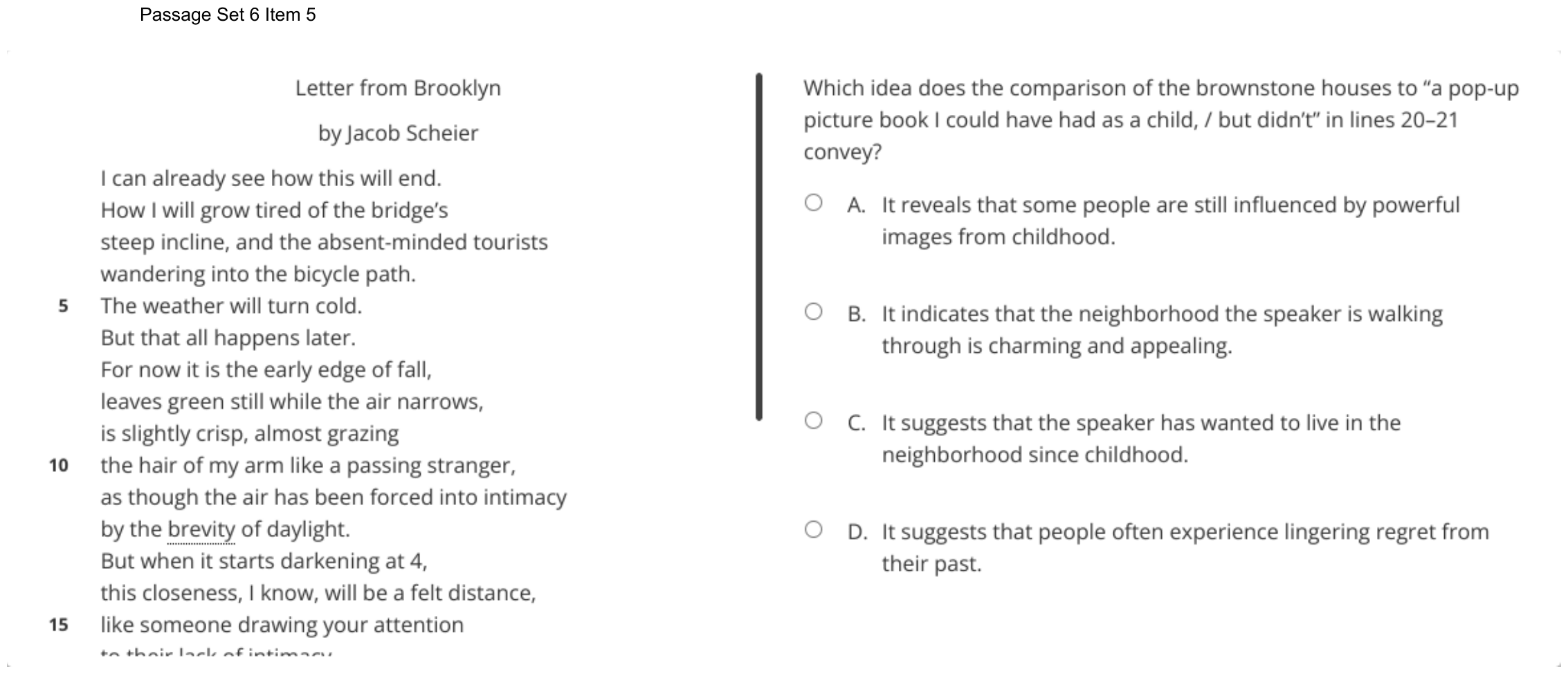
The passage “Letter from Brooklyn” as printed (page 50)
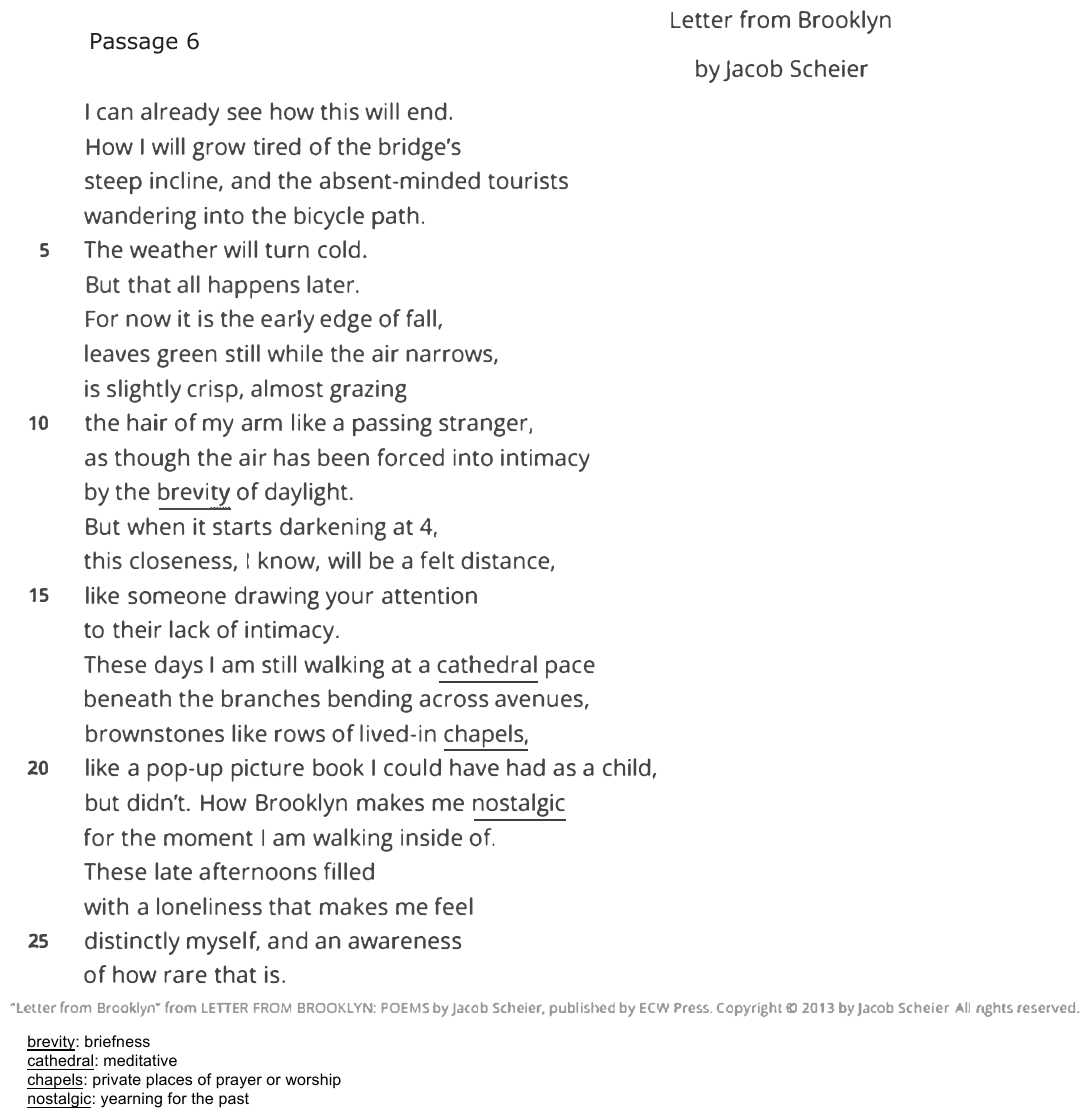
Question 13 of 53
2026 Practice Test B English, question 41Uses the passage above: “Letter from Brooklyn”.
Question
Read these lines from the poem.
I can already see how this will end. (line 1)
How Brooklyn makes me nostalgic
for the moment I am walking inside of. (lines 21–22)
The lines develop a central idea of the poem by
- Asuggesting the speaker’s desire to find a way to break free from the repetitive pattern of daily life.
- Brevealing the speaker’s feelings of disappointment over the predictable change in season.
- Cemphasizing the speaker’s awareness of the future significance of the present moment in the setting.
- Dshowing the speaker’s anticipation of specific emotions caused by an intimate knowledge of the setting.
Show the answer
Correct answer: C
The question asks how line 1 and lines 21–22 develop a central idea of the poem.
A. Incorrect. Although these lines suggest that life is governed by repetitive patterns, such as the change of seasons, they do not suggest that the speaker wishes to break free from these natural cycles of change, and a desire for freedom is not a central idea of the poem.
B. Incorrect. Although the speaker acknowledges that colder weather will inevitably bring disappointment, the speaker does not suggest in these lines that the predictability of changing weather is itself disappointing. Rather, the speaker recognizes the value of enjoying the present moment.
C. CORRECT. These lines connect the present warmer weather with the future colder weather and develop the central idea that the present “moment I am walking inside of” must be embraced because the speaker will be “nostalgic” for it in the future.
D. Incorrect. In these lines, the speaker is aware that specific emotions will occur in the future, during cold weather, but this awareness is only part of the more complex central idea of the poem, which is that current emotions and feelings must be recognized, experienced, and appreciated.
Question analysis
This central-idea question pairs the first line of “Letter from Brooklyn” with lines 21–22, where Brooklyn makes the speaker nostalgic “for the moment I am walking inside of,” and asks how they develop a central idea of the poem. Students must link excerpts from opposite ends of the poem, untangle a paradoxical image and choose among four abstract statements.
- Grade level
- Grade 8 reading and task
- Compared with grade 7
- Above grade 7 Grade 7 students analyze how lines develop a central idea. Here two excerpts twenty lines apart must be read together, one of them built on a paradox, and the four choices are long and abstract, well beyond typical grade 7 work.
- Estimated difficulty
- Among the hardest on the SHSAT: a non-obvious approach, heavy reading, or a well-hidden trap.
- Thinking it demands
- Depth of knowledge 3, strategic thinking · mainly analyze
- What makes it hard
- Figurative or literary language major
- A very close wrong answer moderate
- Evidence in several places moderate
- Evidence
- Answered from several paragraphs or stanzas
- Reading level
- Passage: 217 words (a poem; reading level not measured); question and choices: about grade 7, 99 words.
- Students, last 30 days
- Not enough answers yet to show (it takes 10).
Why it is hard, traps and wrong answers (shows the answer)
Why it is hard
This is among the hardest questions in the set because the two excerpts must be joined through a paradox and then matched to four long, abstract statements. Line 1 foresees an ending; lines 21–22 miss a moment while it is still happening, so both look at now from the future. Students who see only the foresight pick the choice about anticipated emotions, while those who hear gloom in “how this will end” settle on disappointment or a wish to escape.
Figurative or literary language major Understanding the question
Lines 21–22 are a paradox: “nostalgic,” glossed as yearning for the past, is aimed at “the moment I am walking inside of,” so the speaker already feels the present as a future memory. (Graesser, Singer & Trabasso, 1994; Kintsch, 1998)
A very close wrong answer moderate Choosing the answer
The choice about anticipating “specific emotions” shares the key’s link between future and present; it differs by tracing those feelings to knowing the setting well, which neither excerpt says. (Embretson & Wetzel, 1987; Gorin & Embretson, 2006; Ascalon et al., 2007)
Evidence in several places moderate Working it out
The excerpts are the poem’s first line and lines 21–22, twenty lines apart, and what joins them, the speaker looking ahead at the present, shows only when they are read side by side. (Kirsch & Mosenthal, 1990; Gorin & Embretson, 2006)
Strategy: Paraphrase each excerpt on its own, using the glossary's meaning of “nostalgic,” then decide what the first line and the last two share and match that to a choice.
Traps
- Half right: One half of a two-part choice is right and the other is not.
- Wrong tone or attitude: Misjudges the tone, attitude or point of view, such as reading admiration as criticism, or taking a character's or subject's feelings for the author's.
- Reads too much in: A reasonable-sounding conclusion that goes further than the text allows.
The wrong answers, classified
A Reads too much in (Graesser, Singer & Trabasso, 1994)
Links “how this will end” and growing tired of the bridge to a dull routine and imagines a wish to escape it, which the poem never expresses.
B Wrong tone or attitude (Graesser, Singer & Trabasso, 1994)
Hears resignation in “I can already see how this will end” and reads it as disappointment with the seasons, missing that the speaker treasures the present walk.
D Half right (King et al., 2004; Thissen, Steinberg & Fitzpatrick, 1989)
Rightly sees the speaker foreseeing feelings in line 1, but traces them to an “intimate knowledge of the setting,” while lines 21–22 long for the present moment itself.
Working it out, step by step
Figure out what the question asks
This question gives two pieces of the poem: line 1 and lines 21–22. You need the central idea they build together. A central idea is the main point the poem keeps working toward. Read each piece alone first, then join them.
Read line 1
Line 1 says “I can already see how this will end.” The speaker looks ahead. Lines 2–5 then list what will come: growing tired of the bridge, and the cold. So the speaker already pictures the future while living in the present.
Read lines 21–22
The lines say “How Brooklyn makes me nostalgic / for the moment I am walking inside of.” The glossary says nostalgic means “yearning for the past.” Yearning means longing. But the speaker longs for now, a moment still happening. That is a paradox, an idea that seems impossible but makes sense. The speaker knows this walk will be a precious memory.
Join the two pieces
Both pieces look at the present from the future. In line 1, the speaker sees the end coming. In lines 21–22, the speaker already misses the walk. So the speaker knows this present moment will matter later. Significance means importance.
Check each choice
- A is wrong. The speaker never wants to break free from daily routine.
- B is wrong. Line 1 can sound gloomy. But the speaker isn’t upset with the seasons. The speaker treasures the walk.
- C is right. The speaker sees that this moment in Brooklyn will be precious later.
- D is wrong. The speaker does foresee feelings. But neither piece says they come from knowing the place well.
Watch out: D gets the looking-ahead part of line 1 right. But lines 21–22 long for the moment itself, not for feelings caused by knowing the city.
Choose the answer
So the answer is C: “emphasizing the speaker’s awareness of the future significance of the present moment in the setting.”
Why this answer and not the closest wrong one
D is the closest wrong answer, because line 1 does show the speaker foreseeing feelings. But D says they come from an “intimate knowledge of the setting.” Neither piece says that. Lines 21–22 miss the moment while it is still happening. C captures that: the present will matter in the future.
More questions like this
The original DOE question
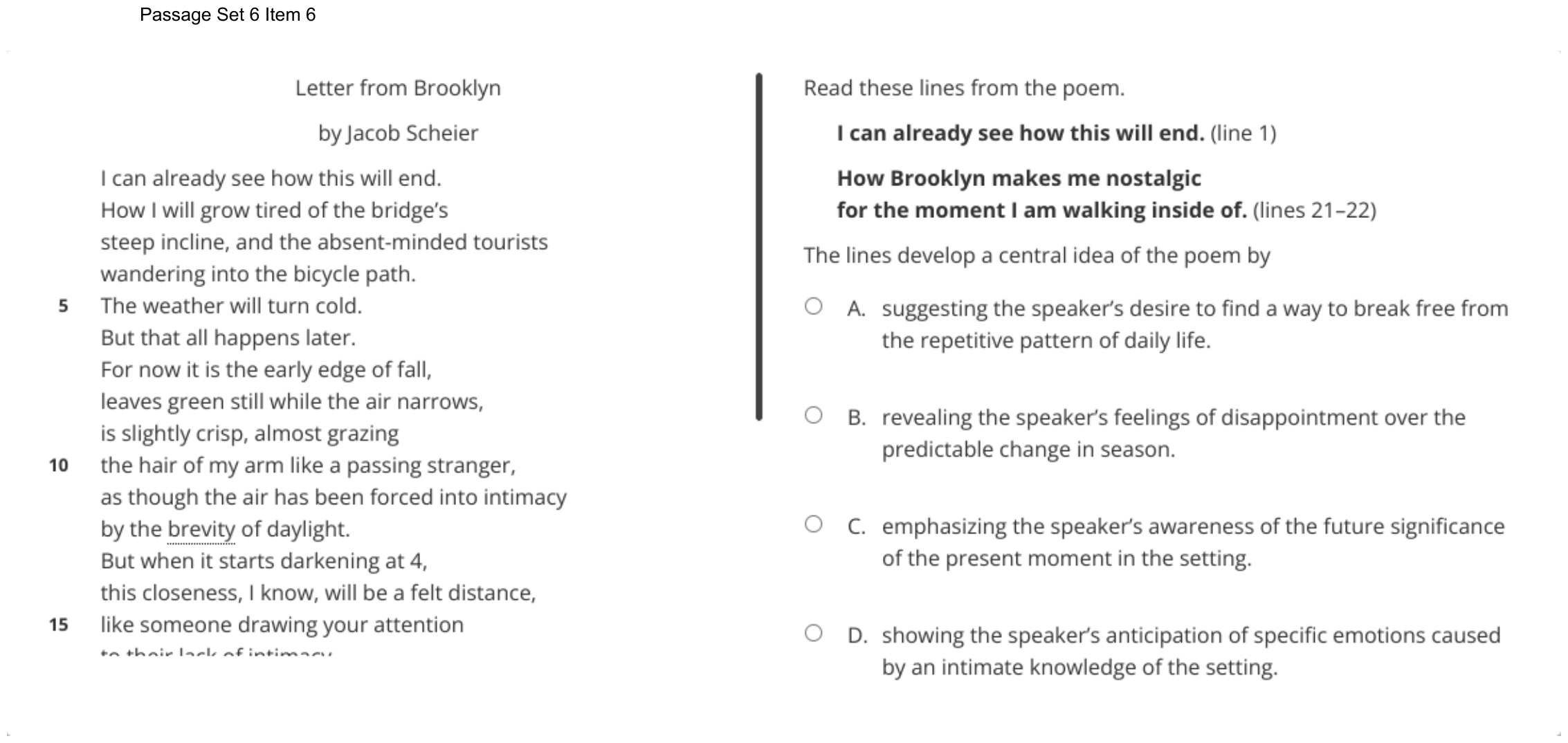
Question 14 of 53
2026 Practice Test C English, question 21Passage Bird Talk
Bird Talk
by Carl Sandburg
And now when the branches were beginning to be heavy,
It was the time when they once had said, “This is the
beginning of summer.”
The shrilling of the frogs was not so shrill as in the
first weeks after the broken winter;
The birds took their hops and zigzags a little more
anxious; a home is a home; worms are worms.
The yellow spreads of the dandelions and buttercups
reached across the green pastures.
Tee whee and tee whee came on the breezes, and the grackles
chuzzled their syllables.
And it was the leaves with a strong soft wind over them
that talked most of all and said more than any others
though speaking the fewest words.
It was the green leaves trickling out the gaunt nowhere
of winter, out on the gray hungry branches—
It was the leaves on the branches, beginning to be heavy,
who said as they said one time before, “This is the be-
ginning of summer.”
We shall never blame the birds who come
where the river and the road make the Grand Crossing
and talk there, sitting in circles talking bird talk.
If they ask in their circles as to who is here
and as to who is not here and who used to be here,
Or if instead of counting up last year as against
this year, they count up this year as against next
year, and have their bird chatter about who is here
this year who won’t be here next year,
We shall never blame the birds.
If I have put your face among leaf faces, child,
Or if I have put your voice among bird voices,
Blame me no more than the bluejays.
“Bird Talk” by Carl Sandburg—Public domain.
Question
Read lines 12–14 from the poem.
And it was the leaves with a strong soft wind over them
that talked most of all and said more than any others
though speaking the fewest words.
What does the phrase “talked most of all” in line 13 convey?
- AIt establishes that the speaker thinks the sound of wind in the leaves is the best indication that the season is changing.
- BIt introduces the idea that the sound of the wind in the leaves remains constant throughout the seasons.
- CIt suggests that the speaker is overwhelmed by the sounds of nature that emerge as the season changes.
- DIt emphasizes that the sounds of nature enable the speaker to appreciate each season of the year.
Show the answer
Correct answer: A
This question asks for what a phrase reveals about the speaker’s perspective on the change in seasons.
A. CORRECT. The first stanza of the poem establishes the way different parts of the natural world, including both plants and animals, respond to the change in season. These lines reflect the way the wind in the leaves is the best indication of the seasonal change because it is the wind in the leaves that “talked most of all and said more than any others / though speaking the fewest words” (lines 13–14).
B. Incorrect. Although the sound of the wind is the most obvious sign of the seasonal change per the speaker, it is in response to the “ ‘beginning of summer’ ” (line 3) that the wind speaks through the leaves. The poem does not reveal that this figurative speech occurs throughout the seasons, only that it occurs during the transition to summer.
C. Incorrect. While the language used by the speaker indicates a deep appreciation for the natural phenomenon being witnessed, the language used does not indicate a feeling of being overwhelmed but rather a feeling of awareness.
D. Incorrect. Using the personification of the wind “speaking” (line 14) indicates an appreciation by the speaker for the power and volume of the wind’s voice, but only one instance of the wind’s speech, that which occurs at the “ ‘beginning of summer’ ” (line 3), is chronicled by the speaker in the poem.
Question analysis
Students interpret the personification in lines 12–14 of “Bird Talk,” where the leaves under a strong soft wind “talked most of all,” and decide what that phrase conveys. Because the leaves also speak “the fewest words,” the line seems to contradict itself, and its meaning depends on how it fits Sandburg’s first stanza about the start of summer.
- Grade level
- Grade 7 reading and task
- Compared with grade 7
- At grade 7 Explaining what a figurative phrase conveys about a speaker’s view is standard grade 7 work. The three lines are printed with the question, though the phrase still has to be read against the rest of the first stanza.
- Estimated difficulty
- Moderate: several steps, or a close reading with one strong distractor.
- Thinking it demands
- Depth of knowledge 2, skills and concepts · mainly understand
- What makes it hard
- Figurative or literary language moderate
- Reading between the lines moderate
- Evidence
- Answered from one paragraph or stanza
- Reading level
- Passage: 296 words (a poem; reading level not measured); question and choices: about grade 6, 119 words.
- Students, last 30 days
- Not enough answers yet to show (it takes 10).
Why it is hard, traps and wrong answers (shows the answer)
Why it is hard
The phrase ranks the leaves above the shrilling frogs and chattering birds as voices of the season, but it never says what they are best at, so students must supply the idea of a sign. The tempting wrong readings take the speaker’s pleasure in nature and stretch it to every season, or hear “talked most of all” as noise. The quiet words around the phrase, “strong soft wind” and “fewest words,” point to a calm sound that tells the most.
Figurative or literary language moderate Understanding the question
The leaves are personified, and the line seems to contradict itself: they “talked most of all and said more than any others / though speaking the fewest words.” (Graesser, Singer & Trabasso, 1994; Kintsch, 1998)
Reading between the lines moderate Working it out
Students must turn “said more than any others” into a judgment, that the leaves are the surest sign of summer, which lines 17–19 confirm when the leaves themselves announce “the beginning of summer.” (Graesser, Singer & Trabasso, 1994; Kintsch, 1998)
Strategy: Restate lines 12–14 in plain words, especially the contrast between saying more and speaking fewer words, then test each choice against the whole first stanza.
Traps
- Too broad or too strong: A choice overstates, generalizes, or uses absolute words the text does not support.
- Wrong tone or attitude: Misjudges the tone, attitude or point of view, such as reading admiration as criticism, or taking a character's or subject's feelings for the author's.
- Twists what the text says: Uses the text's topic and ideas but changes what it says: who did it, how much, when, or why.
The wrong answers, classified
B Twists what the text says (King et al., 2004)
Stretches “as they said one time before” into a sound heard all year, though the leaves have only just come out of “the gaunt nowhere / of winter.”
C Wrong tone or attitude (Graesser, Singer & Trabasso, 1994)
Hears “talked most of all” as a din that swamps the speaker, though the “strong soft wind” and “fewest words” describe a quiet sound noted calmly, with no sign of strain.
D Too broad or too strong (King et al., 2004)
Rightly senses the speaker’s pleasure in nature’s voices but widens it to “each season of the year,” though the poem watches only the turn to summer and singles out the leaves.
Working it out, step by step
Figure out what the question asks
This asks what a phrase conveys, or gets across. The phrase is “talked most of all” in line 13. Leaves can’t really talk. Giving a thing human actions, like talking, is called personification. You need to work out what the speaker means by saying the leaves talked the most.
Read lines 12–14
Lines 12–14 say “And it was the leaves with a strong soft wind over them / that talked most of all and said more than any others / though speaking the fewest words.” The others are the frogs and birds from earlier lines. The leaves “said more than any others,” yet they used “the fewest words.” So the quiet rustle of the leaves tells you more than all the frog and bird calls.
Find what the leaves say
The stanza ends with the leaves speaking. Lines 17–19 say it was “the leaves on the branches, beginning to be heavy,” who said “This is the beginning of summer.” So the leaves’ message is that the season has changed. The new leaves, rustling in the wind, are the clearest sign that summer has come.
Check each choice
- A fits. The leaves say the most about the season, so they are the best sign that it is changing.
- B does not fit. The leaves have just come out of “the gaunt nowhere / of winter.” Gaunt means thin and bare. The leaves do not rustle the same way all year.
- C does not fit. A “strong soft wind” and “the fewest words” describe a quiet sound. Nothing shows the speaker is overwhelmed, or swamped.
- D does not fit. The poem watches only one change, the start of summer, not each season.
Watch out: D is tempting because the speaker clearly enjoys nature’s sounds. But it stretches that to “each season of the year,” which the poem never covers.
Choose the answer
“Talked most of all” shows that the leaves tell the most about the change of season. So the answer is A, “It establishes that the speaker thinks the sound of wind in the leaves is the best indication that the season is changing.”
Why this answer and not the closest wrong one
D is the closest wrong choice. The speaker does seem to enjoy the sounds of nature. But the poem covers just one change, the turn to summer. And the phrase does more than show enjoyment. It ranks the leaves above the frogs and birds. They say the most about the change, so they are the best sign of it.
More questions like this
The original DOE question
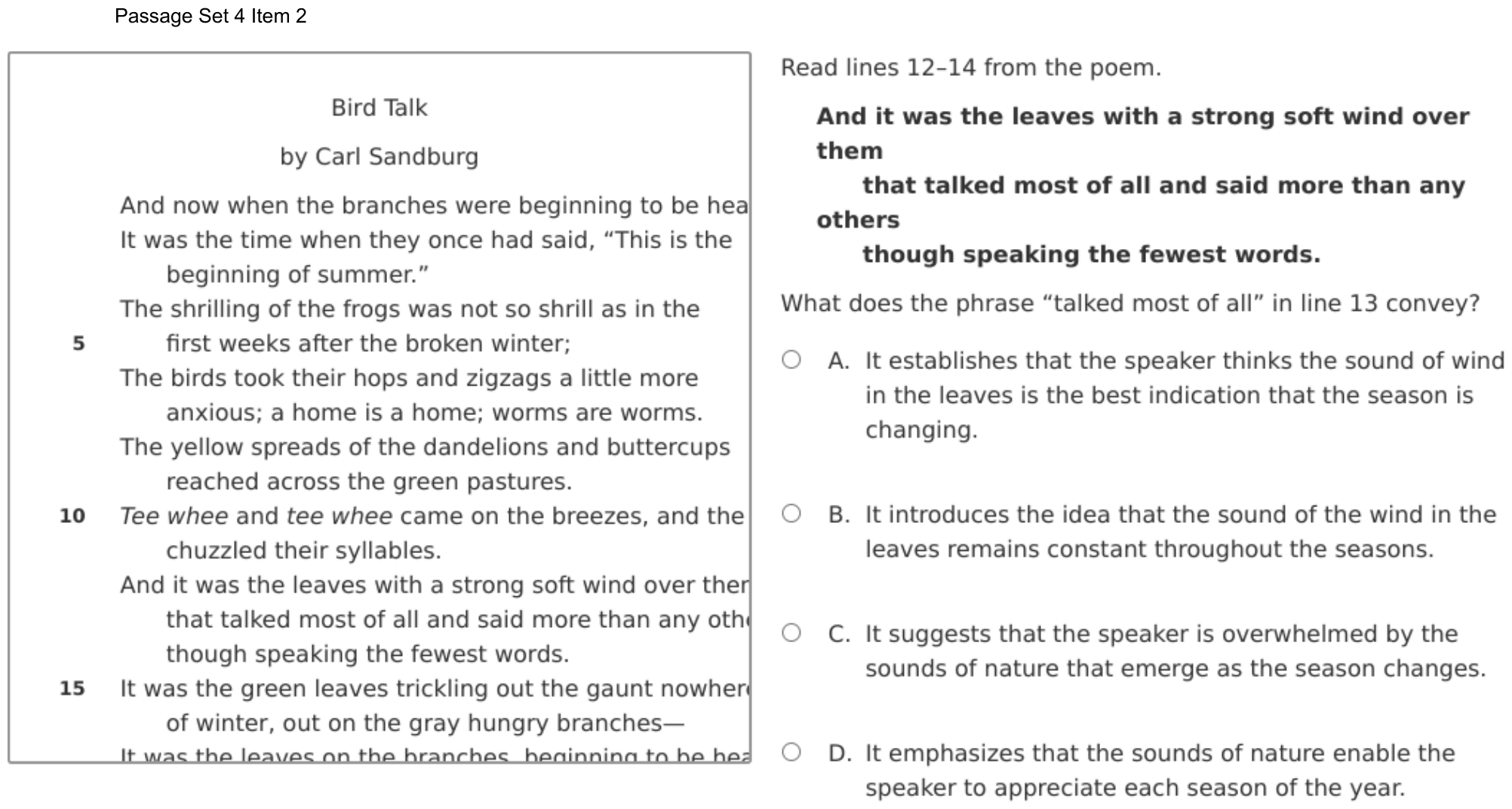
The passage “Bird Talk” as printed (page 32)
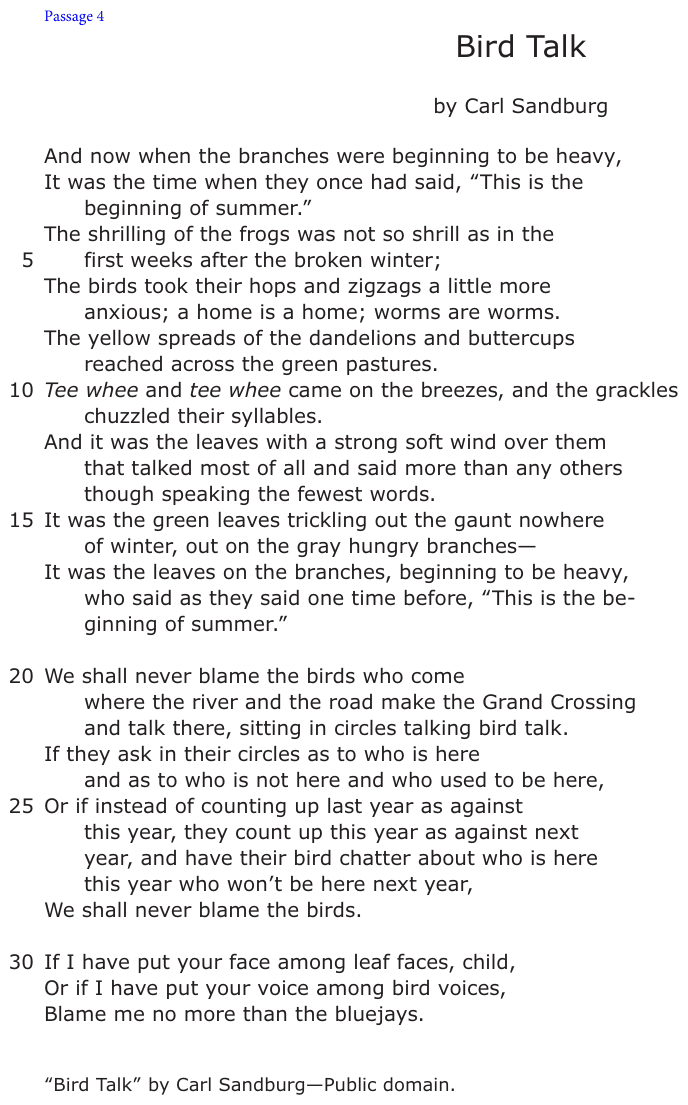
Question 15 of 53
2026 Practice Test C English, question 22Uses the passage above: “Bird Talk”.
Question
How does the repetition of “ ‘This is the beginning of summer’ ” in lines 2–3 and lines 18–19 contribute to the meaning of the poem?
- AIt suggests that the shift to summer occurs in the same way each year.
- BIt emphasizes the idea that living things are prepared for the change of season.
- CIt highlights the idea that the first signs of summer are surprising each year.
- DIt builds expectations about what the natural world looks like during a change of season.
Show the answer
Correct answer: A
The question asks how the repetition of a phrase contributes to the meaning of the poem in terms of conveying information about a cyclical event.
A. CORRECT. This phrase is used twice verbatim, in both cases to show the figurative words spoken by the branches (lines 2–3) and the leaves on the branches (lines 18–19). Repetition of this phrase conveys the idea that the transition to summer occurs in the same manner each subsequent year and thus evokes the same response from nature.
B. Incorrect. While living things—branches and leaves—both make identical figurative utterances, they do so not because they have prepared for such an event. Rather, these living things take the change in stride because of the sameness and expectedness of the seasonal shifts, which occur in the same way each time.
C. Incorrect. Even though the branches and leaves have been imbued by the speaker with some degree of consciousness in their figurative ability to speak, they are not surprised by the change in seasons. They say the same thing each year because the same thing occurs each year in the same way.
D. Incorrect. Certain lines of the poem do describe the natural world during the change of seasons, such as lines 8–9: “The yellow spreads of the dandelions and buttercups / reached across the green pastures.” However, this repeated phrase serves to evoke a sense of sameness and inevitability; it is not a phrase related to the physical appearance of the natural world, only the way the natural world responds to the seasonal change with simple acceptance for its sameness. The repeated lines do not hold any sort of expectation or anticipation for the coming of summer; they help relay observations made about the state of the season.
Question analysis
This poetry question asks how the repetition of “This is the beginning of summer,” said by the branches in lines 2–3 and by the leaves in lines 18–19 of Sandburg’s “Bird Talk,” contributes to the poem’s meaning. Students must judge what the repetition does, not only what the words say, and the four choices read the repeated line in quite different ways.
- Grade level
- Grade 7 reading and task
- Compared with grade 7
- At grade 7 Explaining what a repeated phrase adds to a poem is familiar grade 7 work. Both passages are pointed out by line number, so the task is to judge the effect of the repetition rather than to find it.
- Estimated difficulty
- Straightforward: two steps or one careful reading.
- Thinking it demands
- Depth of knowledge 2, skills and concepts · mainly analyze
- What makes it hard
- How, not what moderate
- Reading between the lines minor
- Evidence
- Answered from one paragraph or stanza
- Reading level
- Passage: 296 words (a poem; reading level not measured); question and choices: about grade 7, 79 words.
- Students, last 30 days
- Not enough answers yet to show (it takes 10).
Why it is hard, traps and wrong answers (shows the answer)
Why it is hard
Both quotations are pointed out, so the work is deciding what the echo adds. Students who know that repetition emphasizes may grab a choice that begins “emphasizes,” and those who hear the quoted words as a cry of discovery may pick surprise, even though that choice shares the key’s “each year.” Reading the lead-ins, “once had said” and “one time before,” settles it: the line is an old, expected announcement.
How, not what moderate Working it out
The question asks what repeating the line does for the poem, not what the line says, so students must judge an effect of structure: the same words open the first stanza and close it. (Anderson & Krathwohl, 2001)
Reading between the lines minor Working it out
The clue is in the lead-ins, “they once had said” in line 2 and “as they said one time before” in line 18, which present the announcement as words said at this point in earlier years. (Graesser, Singer & Trabasso, 1994; Kintsch, 1998)
Strategy: Reread each quoted passage together with the line that leads into it, then decide what the poet gains by having the branches and the leaves say the same words.
Traps
- Reads too much in: A reasonable-sounding conclusion that goes further than the text allows.
- Wrong tone or attitude: Misjudges the tone, attitude or point of view, such as reading admiration as criticism, or taking a character's or subject's feelings for the author's.
- Wrong purpose or structure: Names a purpose, structure or effect that the part does not serve, or describes what a part says when the question asks what it does.
The wrong answers, classified
B Reads too much in (Graesser, Singer & Trabasso, 1994)
Moves from the calm, repeated announcement to the claim that branches and leaves were ready for summer, but saying the same words again shows recurrence, not preparation.
C Wrong tone or attitude (Graesser, Singer & Trabasso, 1994)
Keeps the idea of “each year” but hears the quoted words as a cry of surprise, though “once had said” and “one time before” make them a familiar, expected announcement.
D Wrong purpose or structure (Anderson & Krathwohl, 2001)
Gives the repeated line the job of the stanza’s pictures, the dandelions and green pastures, though it names when summer begins and says nothing about how the land looks.
Working it out, step by step
Figure out what the question asks
This asks about repetition, which means using the same words more than once. The words “This is the beginning of summer” appear in lines 2–3. They come back in lines 18–19. You need to work out what saying them twice adds to the poem’s meaning.
Read the words that lead in
Look at the words just before each quotation. Line 2 says “It was the time when they once had said.” Line 18 says the leaves “said as they said one time before.” Both lead-ins point to the past. The branches and leaves have said these words before, at this same time in other years.
Work out what the repetition shows
The same words come back, just as summer itself comes back. Each year the branches get heavy, the leaves come out, and it is summer again. The change happens the same way every time. So the repeated line works like a yearly announcement that nobody finds strange. It shows that the shift to summer follows a familiar pattern.
Check each choice
- A fits. The repeated words show summer arriving the same way each year.
- B does not fit. Saying the words again shows that summer returns. It does not show that living things got ready for it.
- C does not fit. Something said “one time before” is familiar, not surprising.
- D does not fit. The line only names a time. Pictures like the yellow dandelions show how the land looks.
Watch out: C also says “each year,” so it can look right. But the quoted words are calm, like an old saying, not a cry of surprise.
Choose the answer
The repeated line is an old announcement, made again because summer comes again. So the answer is A, “It suggests that the shift to summer occurs in the same way each year.”
Why this answer and not the closest wrong one
C is the closest wrong choice, because it also points to something that happens each year. But C says the first signs of summer are a surprise. The lead-ins say the opposite. The branches “once had said” these words, and the leaves said them “one time before.” Words said many times before are expected. They show a pattern, not a surprise.
More questions like this
The original DOE question
Question 16 of 53
2026 Practice Test C English, question 25Uses the passage above: “Bird Talk”.
Question
Over the course of the poem, a central idea is developed mainly through the speaker’s
- Asense of eager anticipation as winter ends.
- Bdescription of the changes in nature as the seasons transition.
- Cobservation of the birds’ behavior as summer begins.
- Dprediction of future alterations in the physical landscape.
Show the answer
Correct answer: B
The question asks how the central idea about the natural acceptance of change by nature is developed by the speaker of the poem.
A. Incorrect. The speaker is an observer of the changes in nature as propelled by the seasons and shows no personal eagerness for the end of winter. Further, even though nature rejoices at the end of winter as exemplified by “the shrilling of the frogs” (line 4), the speaker merely records this and does not share in this display.
B. CORRECT. The response of nature to the “beginning of summer” (line 3) is the primary focus of the poem as revealed by the speaker through vivid descriptions of the sights, sounds, movements, and attitudes of the natural world.
C. Incorrect. The second stanza of the poem begins a reflection on birds “sitting in circles talking bird talk” (line 22) and taking a sort of attendance of who is present, but this behavioral description is largely figurative and meant to illustrate a point about the way the birds adapt quickly to change, not to develop a central idea of the poem in terms of how nature responds generally.
D. Incorrect. Seasonal changes are inevitable and cyclical per the speaker, but the speaker does not predict future changes to the landscape as a method of developing the central idea. Rather, the speaker describes nature’s response to changes that have already occurred.
Question analysis
Students decide how the speaker of Carl Sandburg’s “Bird Talk” mainly develops a central idea of the poem. The question does not name the idea, so students must work it out across the poem’s three stanzas and then weigh four accounts of what the speaker does, each tied to a different part or feature of the poem.
- Grade level
- Grade 7 reading and task
- Compared with grade 7
- At grade 7 Tracing how a central idea develops is core grade 7 work. Here the idea is never stated, so students must first infer it from 32 lines of free verse and then judge what the speaker mainly does to build it.
- Estimated difficulty
- Moderate: several steps, or a close reading with one strong distractor.
- Thinking it demands
- Depth of knowledge 3, strategic thinking · mainly analyze
- What makes it hard
- A very close wrong answer moderate
- Reading between the lines moderate
- Evidence in several places minor
- Evidence
- Answered from the whole text
- Reading level
- Passage: 296 words (a poem; reading level not measured); question and choices: about grade 9, 48 words.
- Students, last 30 days
- Not enough answers yet to show (it takes 10).
Why it is hard, traps and wrong answers (shows the answer)
Why it is hard
The title “Bird Talk” and the whole second stanza push students toward the birds, and the key differs from that choice only in taking in all of nature. Two other choices credit the speaker with something the poem gives elsewhere: the eagerness belongs to the frogs and birds, and the only look ahead is the birds’ talk of next year. Weighing what the speaker does across all 32 lines points to the description of nature changing.
A very close wrong answer moderate Choosing the answer
The choice about the birds’ behavior as summer begins matches the key’s frame, the speaker watching nature at the turn of the season; it differs only in narrowing nature to birds. (Embretson & Wetzel, 1987; Gorin & Embretson, 2006; Ascalon et al., 2007)
Reading between the lines moderate Working it out
The central idea is never stated, so students must first work out that the poem is about nature meeting the year’s turn calmly, then judge which of the speaker’s acts builds it most. (Graesser, Singer & Trabasso, 1994; Kintsch, 1998)
Evidence in several places minor Working it out
Birds appear in lines 6–7, 10–11, 20–29 and 31–32, so the title and the second stanza make them look central until the branches, frogs, flowers and leaves are counted too. (Kirsch & Mosenthal, 1990; Gorin & Embretson, 2006)
Strategy: Put the poem’s central idea into a sentence of your own, then ask which choice describes something the speaker really does and does the most to build that idea.
Traps
- Too narrow: A single detail offered as the central idea or a summary, or a summary that keeps minor details and leaves out an essential part.
- Wrong tone or attitude: Misjudges the tone, attitude or point of view, such as reading admiration as criticism, or taking a character's or subject's feelings for the author's.
- Reads too much in: A reasonable-sounding conclusion that goes further than the text allows.
The wrong answers, classified
A Wrong tone or attitude (Graesser, Singer & Trabasso, 1994)
Gives the speaker the stir of the shrilling frogs and anxious birds, but the speaker records it calmly, and the poem opens after winter, at “the beginning of summer.”
C Too narrow (King et al., 2004)
Follows the title and the birds’ circles at the Grand Crossing, but birds are one thread in a poem that also tracks branches, frogs, dandelions and leaves into summer.
D Reads too much in (Graesser, Singer & Trabasso, 1994)
Builds a forecast from the birds counting “this year as against next / year,” but that talk concerns who will be gone, not the land, and the speaker predicts nothing.
Working it out, step by step
Figure out what the question asks
This asks how a central idea is mainly built. A central idea is a big point the whole poem makes. First, put that idea in your own words. Then ask what the speaker does most, across the whole poem, to build it.
Find the central idea
The poem shows nature at “the beginning of summer.” The branches grow heavy, the frogs quiet down, the flowers spread and the leaves come out. In stanza 2, the birds calmly count who has come and gone. A central idea is that nature moves through the seasons, and living things accept the change as natural.
See how the speaker builds it
Most of the poem is description. Stanza 1 fills 19 of the 32 lines with changes in nature. It shows “The yellow spreads of the dandelions and buttercups” and “the green leaves trickling out the gaunt nowhere / of winter.” Trickling out means coming out slowly, a little at a time. Gaunt means thin and bare. Detail by detail, the speaker shows the season turning. That description is the main way the idea is built.
Check each choice
- A does not fit. The frogs and birds are stirred up, but the speaker describes them calmly. The poem also starts after winter is over.
- B fits. The speaker describes nature changing as the seasons turn.
- C does not fit. Birds are only one part. The poem also covers branches, frogs, flowers and leaves.
- D does not fit. The speaker predicts nothing about the land. The birds’ talk of next year is about who will be gone.
Watch out: C is tempting because the poem is called “Bird Talk” and stanza 2 is all about birds. But the central idea is about all of nature.
Choose the answer
The speaker builds the idea mostly through details of nature changing as summer begins. So the answer is B, “description of the changes in nature as the seasons transition.”
Why this answer and not the closest wrong one
C is the closest wrong choice. It also has the speaker watching nature as summer begins. But it narrows nature to birds. The poem’s changes come from many living things: branches, frogs, dandelions, buttercups and leaves. Only B takes in all of them, so only B describes how the whole poem builds its idea.
More questions like this
The original DOE question
Question 17 of 53
2026 Practice Test C English, question 33Passage Serpent Mound
Serpent Mound
The Great Serpent Mound, located in Adams County, Ohio, is a human-made mound of earth that researchers believe was created between 300 B.C. and A.D. 1100 by an indigenous culture.
Ohio, 1846
Brush Creek stood low when the museum men came
with their measuring tapes and sketchbooks.
It was winter. Fringed with ice,
the creek doubled back on itself
as if it had forgotten something.
Pa was in Cincinnati, or else on his way home,
so Ma told me to lead the men
into the marshy low grounds. It being winter,
there was little underbrush to speak of—
in the summer there would have been
briars, poison ivy, biting flies. I listened
for the swish of a beaver’s heavy tail,
the chitter of a chickadee, or the cry of a hawk,
but the winter silence of the creek pressed
down on all of us like a weight.
The humps in the ground were all but
invisible until you were right up on them. The figure
was even less obvious: the sinuous body,
the tail coiled three times around,
and at the other end, the mouth wide open.
In the summer the creek bottom was crowded
with so much life that you could trip over
the ridges of earth before you saw
anything at all. In winter you could climb
a tree and get some idea of the whole thing:
the serpent’s body undulating, slithering
silently across the ancient
earth. At the mouth end, there was an oval mound
as if the snake were about to swallow an egg—
as snakes sometimes did in our rickety
henhouse—my Pa always said, or
as if swallowing the sun, one of the museum
men suggested, taking notes with his quill pen,
an old-style inkhorn slung at his side.
I liked that: swallowing the sun,
just the sort of thing a snake might do,
might want to do. When, later, I told my sister Ruth,
she disagreed. It is singing to the sun,
she insisted. That is why its mouth
is wide open. She said, “Sometimes I think
I hear it on summer nights. Not swallowing, singing.”
Question
The poet contrasts the speaker’s and Ruth’s points of view regarding the mound by using dialogue to
- Aimply that Ruth is worried that her interpretation of the mound will be seen as too abstract.
- Bindicate that Ruth hopes her interpretation of the mound will be shared by the men from the museum.
- Csuggest that Ruth wants the speaker to agree with her interpretation of the mound.
- Dshow that Ruth has already decided on her interpretation of the mound.
Show the answer
Correct answer: D
The question asks how the poet uses dialogue to contrast the points of view of the speaker and Ruth regarding the mound.
A. Incorrect. The interpretation Ruth offers of the mound as a snake singing is abstract, but Ruth does not seem concerned that it is an overly metaphorical or figurative interpretation. The dialogue serves to highlight that Ruth is firm in her belief.
B. Incorrect. There is no indication that the museum men are considering Ruth’s interpretation of the mound or that Ruth wants them to share her interpretation. Ruth’s interpretation is meant to convey an abstract idea, while the museum men would be looking for a firm academic explanation of the mound. Ruth is persistent in her belief, and the dialogue does not suggest that she is concerned with the museum men’s interpretation or findings.
C. Incorrect. Ruth merely states her interpretation and says that she thinks she hears the Serpent Mound singing sometimes. She does not seek to make the speaker agree with her.
D. CORRECT. Beginning in line 37, after the speaker suggests the mound is swallowing the sun, Ruth disagrees. The poet uses the word “insisted” in line 39 to show that Ruth firmly believes in her own interpretation of the mound.
Question analysis
This point-of-view question asks how the poet of “Serpent Mound” uses dialogue to contrast the speaker’s and Ruth’s views of the mound in the poem’s closing lines. Students must read Ruth’s few words closely, since each choice credits her with a different attitude toward her own interpretation.
- Grade level
- Grade 7 reading and task
- Compared with grade 7
- At grade 7 Analyzing how a writer contrasts two characters’ points of view is exactly what the grade 7 standard describes. The dialogue is only a few lines long, but each choice describes Ruth’s attitude in a different way.
- Estimated difficulty
- Moderate: several steps, or a close reading with one strong distractor.
- Thinking it demands
- Depth of knowledge 2, skills and concepts · mainly analyze
- What makes it hard
- A very close wrong answer moderate
- Reading between the lines moderate
- Evidence
- Answered from one paragraph or stanza
- Reading level
- Passage: 354 words (a poem; reading level not measured); question and choices: about grade 8, 78 words.
- Students, last 30 days
- Not enough answers yet to show (it takes 10).
Why it is hard, traps and wrong answers (shows the answer)
Why it is hard
The dialogue is only a few lines, and every choice is about Ruth’s attitude toward her own reading. “Insisted” is the hinge: it can sound like pressing someone to agree, but nothing follows that asks the speaker anything. The hedge “Sometimes I think” can also be misread as worry, though it introduces what she hears, not doubt about her view.
A very close wrong answer moderate Choosing the answer
The choice about Ruth wanting agreement and the key both rest on “she insisted”; they differ in whether insisting aims to win the speaker over or shows her mind is already made up. (Embretson & Wetzel, 1987; Gorin & Embretson, 2006; Ascalon et al., 2007)
Reading between the lines moderate Working it out
Ruth’s attitude is never named, so students must read it from “she disagreed,” “she insisted” and the clipped “Not swallowing, singing,” and from what she does not do: ask for agreement. (Graesser, Singer & Trabasso, 1994; Kintsch, 1998)
Strategy: Reread lines 37–41 and describe Ruth’s attitude in a few words of your own before looking at the choices, then pick the one the lines themselves show.
Traps
- Reads too much in: A reasonable-sounding conclusion that goes further than the text allows.
- Wrong tone or attitude: Misjudges the tone, attitude or point of view, such as reading admiration as criticism, or taking a character's or subject's feelings for the author's.
The wrong answers, classified
A Wrong tone or attitude (Graesser, Singer & Trabasso, 1994)
Hears doubt in “Sometimes I think / I hear it,” but that hedge is about a sound on summer nights, and “insisted” shows confidence, not worry about seeming too fanciful.
B Reads too much in (Graesser, Singer & Trabasso, 1994)
Brings the museum men into a talk they are not part of; Ruth speaks only to the speaker, later, and never mentions the men or their findings.
C Reads too much in (Graesser, Singer & Trabasso, 1994)
Reads “insisted” as an effort to win the speaker over, but Ruth only states her view and what she hears, and asks for no agreement.
Working it out, step by step
Figure out what the question asks
This asks what the poet shows by using dialogue, the words people say to each other. The speaker and Ruth have different points of view about the mound. You need to decide what Ruth’s words show about her attitude, or how she feels about her own idea.
Read the dialogue in lines 37–41
The speaker tells Ruth the idea of “swallowing the sun.” The poem says “she disagreed. It is singing to the sun, / she insisted. That is why its mouth / is wide open.” Then she says, “Sometimes I think / I hear it on summer nights. Not swallowing, singing.”
Look closely at the word insisted
To insist is to say something firmly and refuse to back down. Ruth doesn’t say “maybe.” She doesn’t ask what the speaker thinks. She ends with three short words: “Not swallowing, singing.” That sounds final. She has her own reason, too: what she hears on summer nights. Her mind was made up before this talk began.
Check each choice
- A does not fit. “Sometimes I think” is about a sound she hears. It is not worry that her idea is too abstract, or too far from real things.
- B does not fit. Ruth talks only to the speaker, later. She never mentions the museum men.
- C does not fit. Ruth states her view, but she never asks the speaker to agree.
- D fits. “Insisted” and her firm last words show that her mind is made up.
Watch out: “Insisted” can sound like pushing someone to agree, which leads to C. But nothing in her words asks for agreement.
Choose the answer
Ruth’s firm words show she is sure of her own idea. So the answer is D, “show that Ruth has already decided on her interpretation of the mound.”
Why this answer and not the closest wrong one
C is the closest wrong choice. Both C and D rest on the word “insisted.” But insisting can show that you are sure without trying to win anyone over. Ruth never asks whether the speaker agrees. She just states her view and what she hears. That shows her mind is already made up, which is what D says.
More questions like this
The original DOE question
The passage “Serpent Mound” as printed (page 40)
Question 18 of 53
2026 Practice Test D English, question 3Passage A Memory Revolution
A Memory Revolution
A high school senior logs on to a computer at the library to double-check the application due date listed on a college admissions website. Nearby, a librarian helps a group of biology students use a database to search for recent studies about mammals. In the past few decades, the Internet has become an integral component of daily life for many people. The seemingly limitless power of search engines made the Internet search extremely common, and today people increasingly rely on the Internet’s vast accumulation of sources to access all types of information. Scientists are beginning to examine how this reliance is modifying the strategies people use to store and prioritize information in their mind.
A Dependable and Valuable Asset
Psychologist Benjamin Storm from the University of California, Santa Cruz, and researchers Sean Stone and Aaron Benjamin devised an experiment to study students’ tendency to depend on the Internet for facts. To begin, the scientists divided sixty participants into multiple groups, including an “Internet” group and a “memory” group, and placed them in front of computers. The Internet group was required to use the search engine Google to answer eight challenging trivia questions. In contrast, participants in the memory group were permitted to use only their personal knowledge to answer the questions. In the second round, the researchers administered notably easier questions. This time, they allowed each group the option of using Google as they answered. Their results showed that 83 percent of the Internet group continued to consult Google in the second round, while only 63 percent of the memory group chose to do so.
People’s growing inclination to rely on the Internet in order to retrieve information, particularly facts and figures, is called cognitive offloading. Canadian researcher Evan F. Risko and British researcher Sam Gilbert, who have written extensively about the topic, say a similar process has been taking place for centuries. In the past, people used resources like encyclopedias to assist their memories; however, today the Internet, serving as a vast extended memory, allows people to digitally access and retrieve much larger volumes of information. Consequently, people’s minds are free for other cognitive feats, such as connecting data, learning new information, or solving problems.
Filing Information Away
The use of the Internet also appears to be modifying the strategies people use to store information in their mind. Researchers Betsy Sparrow from Columbia University, Jenny Liu from the University of Wisconsin-Madison, and Daniel Wegner from Harvard University conducted several studies to discover how people efficiently manage their information intake.
To begin, the researchers examined how people evaluate which information deserves their effort to remember. For this experiment, participants read forty trivia facts, such as “An ostrich’s eye is bigger than its brain,” and typed the statements into a computer file. Half the participants had been previously told the file would be saved, while half believed it would be erased. Next, the participants wrote down every fact they could recall. Those who believed the information would be erased and no longer available could recall 40 percent more facts than those who thought the information would be saved.
In another experiment, the same researchers tested the ability of study participants to remember where to access information. For this trial, participants read and typed trivia statements, which they saved in folders with generic names such as “Facts” and “Items.” After spending ten minutes writing down all the facts they could recall from memory, participants were asked which folder contained a particular fact based on a keyword. For example, “Which folder has the fact about ostriches?” Overall, participants recalled the information’s location more often than the content itself, correctly identifying 49 percent of the folders for specific facts while remembering only 23 percent of the actual trivia. The researchers concluded that our memory is adapting to the Internet age by prioritizing where to locate information even when the specific details are forgotten. According to Sparrow, the Internet has become an important form of transactive memory, an external source of the recollections and associative networks that constitute memory.
As the Internet’s resources continue to expand our “external” memory, some question whether the process may cause people to depend too heavily on technology. However, Steven Pinker, a professor of psychology at Harvard University, says, “Knowledge is increasing exponentially; human brainpower and waking hours are not. Fortunately, the Internet and information technologies are helping us manage, search and retrieve our collective intellectual output at different scales, from Twitter and previews to e-books and online encyclopedias. Far from making us stupid, these technologies are the only things that will keep us smart.”
Question
Read this sentence from paragraph 7.
As the Internet’s resources continue to expand our “external” memory, some question whether the process may cause people to depend too heavily on technology.
How does the sentence contribute to the structure and development of ideas in the passage?
- AIt presents a claim about the risks of relying on the Internet that prompted the research described in paragraphs 2 and 6.
- BIt contrasts a disadvantage of relying on the Internet with the benefits of Internet use that are described in paragraphs 2 and 6.
- CIt signals a shift from a neutral viewpoint in paragraphs 2 and 6 to a presentation of an argument and a counterargument.
- DIt introduces a counterargument and marks a transition from an optimistic tone in paragraphs 2 and 6 to a cautious tone as the counterargument is developed.
Show the answer
Correct answer: C
The question asks how the sentence from paragraph 7 contributes to the structure and development of ideas in the passage.
A. Incorrect. Although the studies showed, in part, that reliance on the Internet is increasing (“participants recalled the information’s location more often than the content itself” [paragraph 6]), the studies were not conducted in order to determine the risks of Internet use. The claim in the sentence did not prompt the research described in paragraphs 2 and 6.
B. Incorrect. While the sentence in paragraph 7 poses a question about the disadvantages of relying on the Internet, paragraphs 2 and 6 present the study data on Internet use and memory in a neutral tone (“correctly identifying 49 percent of the folders for specific facts while remembering only 23 percent of the actual trivia” [paragraph 6]). Neither study describes the availability of information on the Internet as an advantage or a disadvantage.
C. CORRECT. Paragraphs 2 and 6 describe the results of experiments related to the Internet’s effect on memory without commenting on the advantages or disadvantages of relying on that technology, and the sentence in paragraph 7 presents a questioning viewpoint that moves away from the neutral perspective of the broader passage. The opinion in the sentence is directly argued against in the three sentences that follow it, which present an extended quote from Steven Pinker, a psychology professor at Harvard University. Pinker refutes the idea expressed by the sentence, stating that “knowledge is increasing exponentially; human brainpower and waking hours are not.” He adds that technologies such as the Internet “are the only things that will keep us smart.”
D. Incorrect. Although the sentence in paragraph 7 expresses caution about the possible effects of the Internet on memory, the passage does not shift from an optimistic tone to a cautious tone. Actually, paragraph 6 provides the data on Internet use and memory in a neutral tone. The argument expressed by the sentence is also not elaborated on in the sentences that follow, but is immediately argued against by Steven Pinker, a professor of psychology. The last sentence of paragraph 7 in fact refutes the culled sentence: “ ‘Far from making us stupid, these technologies are the only things that will keep us smart.’ ”
Question analysis
This text-structure question quotes the sentence that opens the last paragraph of “A Memory Revolution,” where some people question whether the Internet may make us depend too heavily on technology. Students decide how it contributes to the structure and development of ideas in the article. Every choice also describes the experiments in paragraphs 2 and 6, so students must judge how the article presents them and what follows.
- Grade level
- Grade 8 reading and task
- Compared with grade 7
- Above grade 7 Grade 7 structure questions often ask what one sentence does in its paragraph. This one asks how a sentence turns the whole article, and every choice also characterizes paragraphs 2 and 6, closer to grade 8 work on opposing viewpoints.
- Estimated difficulty
- Hard: combines ideas, needs a plan, and has more than one tempting wrong answer.
- Thinking it demands
- Depth of knowledge 3, strategic thinking · mainly analyze
- What makes it hard
- How, not what moderate
- A very close wrong answer moderate
- Evidence in several places moderate
- Hard words minor
- Evidence
- Answered from several paragraphs or stanzas
- Reading level
- Passage: about grade 14, 763 words; question and choices: about grade 12, 129 words.
- Students, last 30 days
- Not enough answers yet to show (it takes 10).
Why it is hard, traps and wrong answers (shows the answer)
Why it is hard
The quoted sentence is the article’s only worried note, and the question asks what it does there. Students must judge two things at once: how the earlier studies sound, plain numbers such as 49 and 23 percent with no verdict, and what follows, Pinker’s “However” and a confident rebuttal. The near miss rightly calls the sentence an opposing view but hears the studies as cheerful and expects caution to follow, so only students who read on to the end of paragraph 7 can rule it out.
How, not what moderate Working it out
The stem asks what the sentence does in the article, and its job is a turn: from studies reported without judgment to a worry that Pinker’s quotation rebuts in the same paragraph. (Anderson & Krathwohl, 2001)
A very close wrong answer moderate Choosing the answer
The choice about a counterargument and a cautious tone shares the key’s frame, a shift away from paragraphs 2 and 6 toward opposing views; it differs in calling those paragraphs optimistic and the ending cautious. (Embretson & Wetzel, 1987; Gorin & Embretson, 2006; Ascalon et al., 2007)
Evidence in several places moderate Working it out
Every choice also characterizes paragraphs 2 and 6, so students must recall how the Google study and the folder study were reported, as percentages with no praise or blame, before judging the sentence. (Kirsch & Mosenthal, 1990; Gorin & Embretson, 2006)
Hard words minor Understanding the question
The choices judge structure in abstract words, “neutral viewpoint,” “counterargument,” “optimistic tone” and “cautious tone,” which students must match to how the article actually sounds. (Perfetti, 2007; Freedle & Kostin, 1993)
Strategy: Describe in a word or two how paragraphs 2 and 6 present their studies and what the rest of paragraph 7 does with the quoted sentence’s idea, then test both halves of every choice.
Traps
- Wrong tone or attitude: Misjudges the tone, attitude or point of view, such as reading admiration as criticism, or taking a character's or subject's feelings for the author's.
- Wrong part of the text: A choice is true of another paragraph, stanza or speaker than the one asked about.
- Reads too much in: A reasonable-sounding conclusion that goes further than the text allows.
The wrong answers, classified
A Reads too much in (Graesser, Singer & Trabasso, 1994)
Assumes the worry about depending on technology launched the research, though it appears only after the studies, and paragraph 2 says its experiment set out to study a “tendency to depend on the Internet.”
B Wrong part of the text (Kirsch & Mosenthal, 1990)
Credits paragraphs 2 and 6 with benefits found elsewhere, the freed-up minds of paragraph 3 under the heading “A Dependable and Valuable Asset,” though the two studies report results without calling them good.
D Wrong tone or attitude (Graesser, Singer & Trabasso, 1994)
Rightly sees an opposing view raised but hears the studies as optimistic and the ending as cautious, when Pinker’s quotation answers the worry at once and closes on “keep us smart.”
Working it out, step by step
Figure out what the question asks
This is a structure question. Structure is how the parts of an article fit together. The question asks what the sentence does at the start of paragraph 7. Each choice also describes paragraphs 2 and 6. So you must check two things: how those paragraphs sound, and what comes after the sentence.
Look at paragraphs 2 and 6
Paragraph 2 reports that “83 percent of the Internet group continued to consult Google in the second round, while only 63 percent of the memory group chose to do so.” Paragraph 6 reports “correctly identifying 49 percent of the folders for specific facts while remembering only 23 percent of the actual trivia.” These paragraphs give numbers. They do not say the results are good or bad. Writing that takes no side like this is called neutral.
Read the sentence and what follows
The sentence says “some question whether the process may cause people to depend too heavily on technology.” That is a worry, an argument against relying on the Internet. The very next word is “However.” Then Steven Pinker answers the worry. He ends, “Far from making us stupid, these technologies are the only things that will keep us smart.” An answer to an argument is called a counterargument. So the article moves from neutral reports to an argument and a counterargument.
Check each choice
- A does not fit. The worry comes after the studies. Nothing says it caused the research.
- B does not fit. Paragraphs 2 and 6 do not describe benefits. They only report numbers.
- C fits. The sentence shifts from neutral reports to an argument, and Pinker’s answer follows.
- D does not fit. Paragraphs 2 and 6 are not optimistic, or hopeful. And the end is not cautious. Pinker answers the worry with confidence.
Watch out: D is tempting because the sentence does raise an opposing view. But D gets both tones wrong.
Choose the answer
The sentence turns the article from plain reports to a debate. So the answer is C, “It signals a shift from a neutral viewpoint in paragraphs 2 and 6 to a presentation of an argument and a counterargument.”
Why this answer and not the closest wrong one
D is the closest wrong choice. Both C and D see the sentence bringing in an opposing view. But D calls paragraphs 2 and 6 optimistic, when they only give percentages. D also says a cautious tone follows. Instead, Pinker rejects the worry and ends with “keep us smart.” Only C describes both sides of the turn correctly.
More questions like this
The original DOE question
The passage “A Memory Revolution” as printed (pages 3–4)
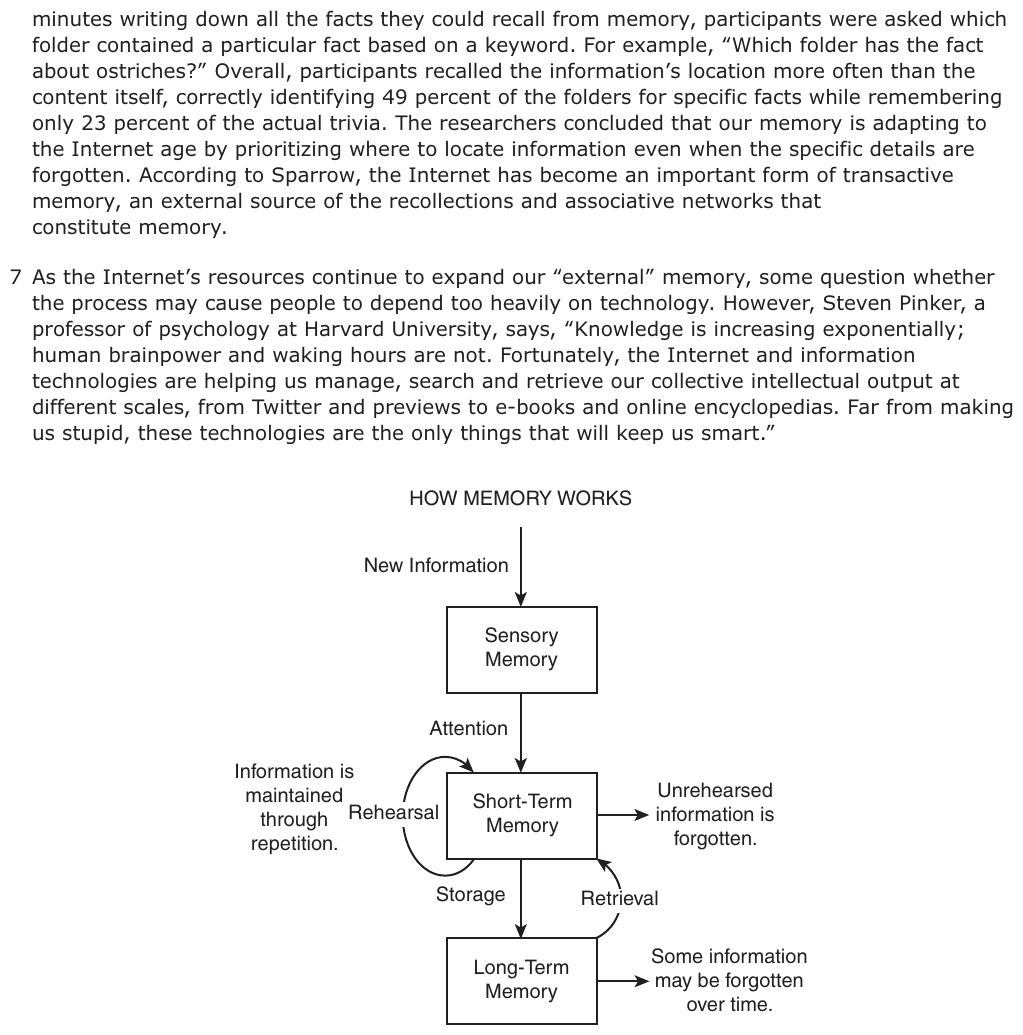
Question 19 of 53
2026 Practice Test D English, question 12Passage Excerpt from “How We Made the First Flight”
Excerpt from “How We Made the First Flight”
by Orville Wright
In 1903 brothers Wilbur and Orville Wright conducted experiments related to flying machines. These experiments would eventually lead to air travel becoming a reliable form of transportation.
During the night of December 16, 1903, a strong cold wind blew from the north. When we arose on the morning of the 17th, the puddles of water, which had been standing about camp since the recent rains, were covered with ice. The wind had a velocity of 10 to 12 meters per second (22 to 27 miles an hour). We thought it would die down before long, and so remained indoors the early part of the morning. But when ten o’clock arrived, and the wind was as brisk as ever, we decided that we had better get the machine out and attempt a flight. We hung out the signal for the men of the Life Saving Station.1 We thought that by facing the flyer into a strong wind, there ought to be no trouble in launching it from the level ground about camp. We realized the difficulties of flying in so high a wind, but estimated that the added dangers in flight would be partly compensated for by the slower speed in landing.
Final Preparations
We laid the track on a smooth stretch of ground about one hundred feet north of the new building. The biting cold wind made work difficult, and we had to warm up frequently in our living room, where we had a good fire in an improvised stove made of a large carbide2 can. By the time all was ready, J. T. Daniels, W. S. Dough and A. D. Etheridge, members of the Kill Devil3 Life Saving Station; W. C. Brinkley of Manteo, and Johnny Moore, a boy from Nags Head,4 had arrived.
We had a “Richard” hand anemometer with which we measured the velocity of the wind. Measurements made just before starting the first flight showed velocities of 11 to 12 meters per second, or 24 to 27 miles per hour. . . .
Audacity—and Calculation
Wilbur having used his turn in the unsuccessful attempt on the 14th, the right to the first trial now belonged to me. After running the motor a few minutes to heat it up, I released the wire that held the machine to the track, and the machine started forward in the wind. Wilbur ran at the side of the machine, holding the wing to balance it on the track. Unlike the start on the 14th, made in a calm, the machine, facing a 27-mile wind, started very slowly. Wilbur was able to stay with it till it lifted from the track after a forty-foot run. One of the Life Saving men snapped the camera for us, taking a picture just as the machine had reached the end of the track and had risen to a height of about two feet. The slow forward speed of the machine over the ground is clearly shown in the picture by Wilbur’s attitude. He stayed along beside the machine without any effort.
Flight
The course of the flight up and down was exceedingly erratic, partly due to the irregularity of the air, and partly to lack of experience in handling this machine. The control of the front rudder was difficult on account of its being balanced too near the center. This gave it a tendency to turn itself when started; so that it turned too far on one side and then too far on the other. As a result the machine would rise suddenly to about ten feet, and then as suddenly dart for the ground. A sudden dart when a little over a hundred feet from the end of the track, or a little over 120 feet from the point at which it rose into the air, ended the flight. As the velocity of the wind was over 35 feet per second and the speed of the machine over the ground against this wind ten feet per second, the speed of the machine relative to the air was over 45 feet per second, and the length of the flight was equivalent to a flight of 540 feet made in calm air. This flight lasted only 12 seconds, but it was nevertheless the first in the history of the world in which a machine carrying a man had raised itself by its own power into the air in full flight, had sailed forward without reduction of speed and had finally landed at a point as high as that from which it started.
From “How We Made the First Flight” by Orville Wright—Public Domain/Federal Aviation Administration
1Life Saving Station: one of the rescue stations along the Atlantic coastline that provided assistance to mariners in distress
2carbide: a very hard material composed of carbon and other heavy metals
3Kill Devil: the town of Kill Devil Hills in eastern North Carolina
4Nags Head: a town in eastern North Carolina
Question
Read this sentence from paragraph 5.
As the velocity of the wind was over 35 feet per second and the speed of the machine over the ground against this wind ten feet per second, the speed of the machine relative to the air was over 45 feet per second, and the length of the flight was equivalent to a flight of 540 feet made in calm air.
How does the sentence help convey Orville Wright’s perspective about this first flight?
- AIt suggests that he was frustrated by the poor flying conditions on the day of the flight.
- BIt emphasizes that he believed the flight was successful despite its short distance.
- CIt provides a comparison between flight distances under calm and high wind conditions.
- DIt highlights the importance of such calculations in the success of future flights.
Show the answer
Correct answer: B
The question asks how the sentence from paragraph 5 helps convey Orville Wright’s perspective about the first flight.
A. Incorrect. Although the sentence from paragraph 5 refers to the velocity of the wind during the flight, there is no indication that Orville felt a sense of frustration with the windy conditions. Instead, the sentence emphasizes the “speed of the machine relative to the air” and presents the equivalent flight length if the machine had flown through calm air (“the length of the flight was equivalent to a flight of 540 feet made in calm air”), details that emphasize the importance of the Wrights’ accomplishment.
B. CORRECT. In the sentence from paragraph 5, Orville uses the wind velocity and the machine speed to highlight the distance that the plane covered while in the air and to determine the distance that it would have flown on a day with calm winds, which emphasizes the magnitude of the accomplishment.
C. Incorrect. Since Orville does not suggest in the sentence from paragraph 5 how far the plane traveled under the actual conditions of high winds, the comparison is incomplete. Additionally, this statement does not address the reason that he would make such a comparison, which allowed him to describe the flight in more impressive terms (540 feet versus 120 feet).
D. Incorrect. Unlike the wind velocity calculations made in preparation for the flight, which might help in determining the success of future flights, the comparative calculations that Orville provides in the sentence from paragraph 5 help interpret the results of the first flight (by describing how fast and far the machine flew relative to the flying conditions) and thereby communicate its success. The calculations of the first flight’s relative speed and equivalent distance would not affect the success of future flights, but the information does provide context for understanding the Wright brothers’ accomplishment.
Question analysis
This point-of-view question quotes the long sentence from paragraph 5 in which Orville Wright works out the machine’s speed through the air and the length of an equivalent flight in calm air. Students must decide how this sentence helps convey his perspective on the first flight. The sentence is mostly numbers, from 35 feet per second to 540 feet, which makes its purpose easy to miss.
- Grade level
- Grade 8 reading and task
- Compared with grade 7
- Above grade 7 Grade 7 point-of-view questions usually rest on words that show feeling. This sentence is a chain of speeds and distances with no feeling words, so students must work out why Orville bothers with the arithmetic, a step beyond typical grade 7 work.
- Estimated difficulty
- Hard: combines ideas, needs a plan, and has more than one tempting wrong answer.
- Thinking it demands
- Depth of knowledge 3, strategic thinking · mainly analyze
- What makes it hard
- How, not what moderate
- Reading between the lines moderate
- Complex sentences minor
- Evidence
- Answered from one paragraph or stanza
- Reading level
- Passage: about grade 7, 816 words; question and choices: about grade 9, 132 words.
- Students, last 30 days
- Not enough answers yet to show (it takes 10).
Why it is hard, traps and wrong answers (shows the answer)
Why it is hard
Point-of-view questions usually turn on feeling words, and this sentence has none, only speeds and a distance. Students must ask why Orville bothers with the arithmetic, and the answer is that 540 feet in calm air makes a 12-second hop look like the achievement he believed it was. The strongest pull describes the sentence’s content accurately, a comparison of calm and windy flight, without saying what it reveals, so students who answer what instead of why lose the point.
How, not what moderate Working it out
The question asks why Orville includes this calculation, so students must see that converting a short hop into “a flight of 540 feet made in calm air” is his way of showing that it counted. (Anderson & Krathwohl, 2001)
Reading between the lines moderate Working it out
The sentence holds no word of feeling or judgment; his view that the flight succeeded must be read from his choice to restate about 120 feet over the ground as 540 feet through the air. (Graesser, Singer & Trabasso, 1994; Kintsch, 1998)
Complex sentences minor Understanding the question
The 61-word sentence chains four measurements, a wind over 35 feet per second, a ground speed of ten, an airspeed over 45 and the 540-foot equivalent, joined by “As,” “and” and commas. (Abedi & Lord, 2001; Freedle & Kostin, 1993; Messick, 1989)
Strategy: Work out what the speeds and distances in the sentence describe, then ask why Orville includes them at this point and what that choice tells you about his view of the flight.
Traps
- Wrong purpose or structure: Names a purpose, structure or effect that the part does not serve, or describes what a part says when the question asks what it does.
- Wrong tone or attitude: Misjudges the tone, attitude or point of view, such as reading admiration as criticism, or taking a character's or subject's feelings for the author's.
- Outside knowledge: A choice is plausible in the real world but not supported by this text.
The wrong answers, classified
A Wrong tone or attitude (Graesser, Singer & Trabasso, 1994)
Links the high wind to the cold, hard morning of paragraphs 1 and 2 and assumes Orville resented it, though here he uses the wind’s speed to make the flight count for more.
C Wrong purpose or structure (Anderson & Krathwohl, 2001)
Describes what the sentence contains, a flight measured against one in calm air, without saying what that comparison shows about Orville’s view of the flight, which is what the question asks.
D Outside knowledge (King et al., 2004; Recht & Leslie, 1988)
Assumes careful calculations must be meant to guide later flights, a reasonable idea about early aviation, but this sentence measures the flight just made and looks no further ahead.
Working it out, step by step
Figure out what the question asks
This asks about Orville Wright’s perspective, or point of view. How did he feel about the first flight? The quoted sentence is full of numbers, not feelings. So ask why Orville bothered to do this math.
Sort out the numbers
The wind blew against the machine at over 35 feet per second. The machine moved over the ground at 10 feet per second. It was flying into the wind, so the air rushed past it even faster. Add them: it moved through the air at over 45 feet per second. The flight lasted 12 seconds. Over the ground, that is 10 × 12 = 120 feet. Through the air, it is 45 × 12 = 540 feet. That is how Orville gets “a flight of 540 feet made in calm air.”
Ask why Orville does this math
Paragraph 5 says the flight ended “a little over 120 feet from the point at which it rose into the air.” That sounds short. But Orville shows it was really much more. In calm air, the same flight would have gone 540 feet. He wants you to see that the short hop was a real flight. So his view is that the flight was a success.
Check each choice
- A does not fit. There is no sign of frustration. Orville uses the wind to make the flight count for more.
- B fits. The math turns a short flight into an impressive one.
- C does not fit. The sentence does compare calm and windy air. But that only says what the sentence contains, not what Orville thinks.
- D does not fit. The math measures the flight that just happened. It does not look ahead to future flights.
Watch out: C is tempting because it describes the sentence correctly. But the question asks about his perspective. C never says how he felt about the flight.
Choose the answer
Orville does the math to show that his short flight was a real success. So the answer is B, “It emphasizes that he believed the flight was successful despite its short distance.”
Why this answer and not the closest wrong one
C is the closest wrong choice. It is true that the sentence compares a windy flight with one “made in calm air.” But C only tells what the sentence says. The question asks why Orville says it. He turns about 120 feet into 540 feet to show the flight was a real achievement. B gives that reason.
More questions like this
The original DOE question
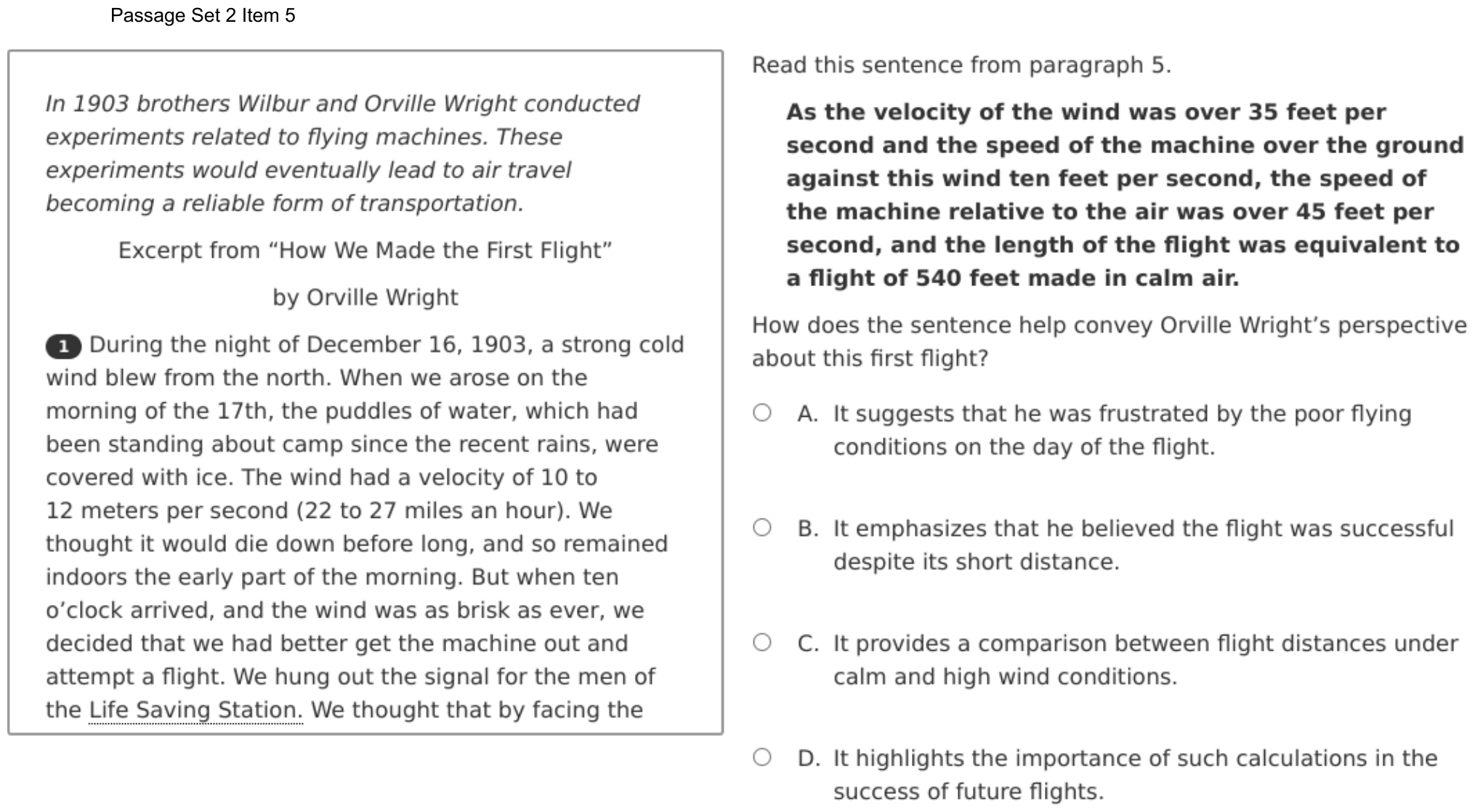
The passage “Excerpt from “How We Made the First Flight”” as printed (pages 13–14)
Question 20 of 53
2026 Practice Test D English, question 18Passage Wolves of the Sea
Wolves of the Sea
The cool and misty landscape of the Great Bear Rainforest can be found along the coast of British Columbia, Canada, and its nearby islands, from Vancouver Island to the Alaskan border. Within this protected area, wolves roam the forests, islands, and beaches. When biologist Chris Darimont began to study these wolves, he wanted to confer with local First Nations groups, as aboriginal Canadians are known, in order to learn what they knew about these wolves. He spoke with Chester Starr, an elder of the Heiltsuk Nation that has occupied the Great Bear Rainforest for thousands of years. What Starr had to say about the wolves changed Darimont’s perception of the animals.
Starr asked Darimont which wolves he and his team were going to study—the timber wolves (mainland wolves) or the coastal wolves on the islands. The question took Darimont by surprise. Biologists had always believed that the wolves that are sometimes spotted swimming between islands and eating salmon are the same wolves that live on the mainland. Darimont was intrigued by Starr’s classification of the wolves as two different groups. At first, he was hesitant to accept the idea. The distances between the mainland and the islands are small, less than a mile. Why would the wolves on the islands be any different from the wolves on the mainland? To find out, Darimont and his research team studied the wolves on the islands and in the densely forested territory of the Great Bear Rainforest for ten years.
Throughout the study, Darimont recorded several significant, observable differences between the “sea wolves,” as they are nicknamed, and the mainland wolves. Compared with the mainland wolves, the sea wolves are smaller in size and are strong swimmers. In 1996 sea wolves were spotted on an island nearly eight miles from any other land formation. While mainland wolves almost exclusively eat meat, such as deer and elk, and teach their young to hunt for land animals, sea wolves get as much as 90 percent of their nutrition from the sea and teach their young to dig for clams and to catch fish. Sea wolves regularly swim between islands and have been known to sneak up on a seal sunning itself on a rock and make a leaping attack from the water. Some salmon-eating mainland wolves come and go from the islands with the fish-spawning season, but the sea wolves are full-time island residents. Darimont suspects that some sea wolves live their entire life on the islands.
The sea wolves displayed not only physical and behavioral differences but also genetic variations from the mainland wolves. After collecting and analyzing the DNA in 800 samples of gray fur and wolf waste, researchers could produce hard biological evidence that sea wolves had genetic markers that made them distinct from the mainland wolves. A genetic marker is a variation in a DNA sequence that can be used to identify individuals or a species because it is passed down to offspring. Darimont hypothesizes that a change in habitat led to the eventual genetic differences between sea wolves and mainland wolves. Many years ago, loss of habitat and food sources forced some mainland wolves out to the islands. They learned to eat everything from kelp and fish eggs to the remains of sea creatures that washed up on the beach. Wolves living on the islands and mainland wolves became more isolated and rarely mated with each other. Over time the two types of wolves became more distinct.
It turned out that Chester Starr was right all along. “It sounded totally bizarre at first,” admits Darimont, “that there could be two versions of the species.” But he now realizes that this skepticism “definitely reflected my ignorance of indigenous knowledge at the time.” Learning to trust the wisdom of the Heiltsuk people opened Darimont up to knowledge accumulated over millennia and positioned him so that he could gather new scientific evidence about one of British Columbia’s most elusive species, the sea wolf.
Question
The author uses the word “admits” in paragraph 5 most likely to
- Anote that Darimont’s genetic research verified a theory based solely on field observations.
- Bimply that Darimont’s study was disappointing because the conclusion that he reached was not original.
- Cemphasize that Darimont’s study ultimately confirmed an idea that he had initially doubted.
- Dhighlight that Darimont’s results led him to draw a conclusion from his research that his team did not agree with.
Show the answer
Correct answer: C
The question asks for the most likely reason why the author uses the word “admits” in paragraph 5.
A. Incorrect. The word “admits” highlights the surprising difference between Darimont’s initial idea and the conclusion he ultimately drew from the results of the study. Though Darimont’s genetic research did, in fact, verify the field observations of the wolves, this does not explain the author’s use of the word “admits” in paragraph 5.
B. Incorrect. The conclusion that Darimont reached was actually quite original, since biologists widely believed the two separate groups of wolves to be one (“Biologists had always believed that the wolves that are sometimes spotted swimming between islands and eating salmon are the same wolves that live on the mainland” [paragraph 2]). The author uses the word “admits” in paragraph 5 to emphasize how unexpected Darimont found the conclusion to be (“The distances between the mainland and the islands are small, less than a mile. Why would the wolves on the islands be any different from the wolves on the mainland?” [paragraph 2]), not to indicate that the study was a disappointment.
C. CORRECT. The use of “admits” emphasizes that Darimont found the idea of two species of wolves “ ‘totally bizarre at first’ ” (paragraph 5) but ultimately proved it to be correct. Paragraph 2 suggests that Darimont, like other scientists, “had always believed that the wolves that are sometimes spotted swimming between islands and eating salmon are the same wolves that live on the mainland.” Therefore, the results of the study were likely to strike biologists as bizarre, and the use of the word “admits” in paragraph 5 highlights Darimont’s shift from doubt to confirmation.
D. Incorrect. Darimont’s team conducted the research that helped him confirm Starr’s idea and draw the conclusion that the wolves were separate species (“After collecting and analyzing the DNA in 800 samples of gray fur and wolf waste, researchers could produce hard biological evidence that sea wolves had genetic markers that made them distinct from the mainland wolves” [paragraph 4]). However, the opinions of Darimont’s research team are not described in the passage, and the word “admits” does not indicate that they disagreed with his conclusion.
Question analysis
This word-choice question asks why the author of “Wolves of the Sea” uses the verb “admits” to introduce Darimont’s own comment in paragraph 5, the passage’s last paragraph. Students must weigh what this one verb adds to the quotation, beyond simply reporting speech, and test four explanations that each make a claim about Darimont’s study.
- Grade level
- Grade 7 reading and task
- Compared with grade 7
- At grade 7 Explaining why an author picked one word is typical grade 7 work. “Admits” is a familiar verb and the quotation it introduces is short, though students must look beyond that one sentence to judge what the verb conveys.
- Estimated difficulty
- Moderate: several steps, or a close reading with one strong distractor.
- Thinking it demands
- Depth of knowledge 2, skills and concepts · mainly analyze
- What makes it hard
- How, not what moderate
- A very close wrong answer moderate
- Evidence
- Answered from several paragraphs or stanzas
- Reading level
- Passage: about grade 10, 662 words; question and choices: about grade 11, 72 words.
- Corrected from the DOE handbook
- A stray comma in the explanation was removed.
- Students, last 30 days
- Not enough answers yet to show (it takes 10).
Why it is hard, traps and wrong answers (shows the answer)
Why it is hard
Two choices describe what the study did, and both are accurate, so truth alone does not settle the question; the stem asks what one verb adds. Students who remember that the DNA backed up what had been observed can stop there without asking why Darimont would need to admit anything. The other two choices read the concession in “admits” as disappointment or as a dispute with the team, neither of which the passage describes.
How, not what moderate Working it out
The stem asks why the author chose “admits” over a neutral verb like “says,” so students must hear the verb’s sense of conceding an earlier mistake and link it to Darimont’s “totally bizarre” first reaction. (Anderson & Krathwohl, 2001)
A very close wrong answer moderate Choosing the answer
The verification choice and the key both say the study confirmed an earlier idea; only the key adds that Darimont had doubted it, which is the part “admits” actually conveys. (Embretson & Wetzel, 1987; Gorin & Embretson, 2006; Ascalon et al., 2007)
Strategy: Compare “admits” with a neutral verb such as “says,” decide what extra meaning it carries, and then check which choice that meaning explains, rather than which choice is simply true of the study.
Traps
- True but not the answer: A choice says something accurate about the text that does not answer this question.
- Wrong tone or attitude: Misjudges the tone, attitude or point of view, such as reading admiration as criticism, or taking a character's or subject's feelings for the author's.
- Reads too much in: A reasonable-sounding conclusion that goes further than the text allows.
The wrong answers, classified
A True but not the answer (King et al., 2004; Embretson & Wetzel, 1987)
Chooses a fact the passage supports, that the DNA work backed up what had been observed, but that says nothing about why Darimont “admits” his first reaction.
B Wrong tone or attitude (Graesser, Singer & Trabasso, 1994)
Hears “admits” as a reluctant confession that the study let him down, perhaps because Starr knew first, though the finding was new to biologists and Darimont sounds grateful.
D Reads too much in (Graesser, Singer & Trabasso, 1994)
Takes “admits” as giving way in an argument and imagines a team that rejected the conclusion, though the passage never reports what Darimont’s team thought.
What was corrected from the DOE handbook, and why
- Explanation: In its explanation of Option B, the DOE ends the quotation from paragraph 2 with a comma before the citation: “…the same wolves that live on the mainland,” [paragraph 2]. Nothing follows in the sentence, and the passage has a period there, so the site drops the comma.
Working it out, step by step
Figure out what the question asks
This asks why the author chose one word, “admits.” The author could have written says. So ask what extra meaning “admits” adds.
Find the word in paragraph 5
Paragraph 5 opens, “It turned out that Chester Starr was right all along.” Next comes “It sounded totally bizarre at first,” admits Darimont, “that there could be two versions of the species.” Bizarre means very strange. He now sees that this “skepticism” showed his “ignorance of indigenous knowledge at the time.” Skepticism means doubt. Indigenous means belonging to the people who first lived in a place.
Work out what “admits” means
To admit something is to say it is true, even if you would rather not. People often admit a mistake. So “admits” tells you Darimont first doubted Starr’s idea and now owns up to it. Back in paragraph 2, he “was hesitant to accept the idea.” Then his study proved that same idea right.
Check each choice
- A is wrong. The DNA work did back up what people had seen. But that fact does not explain why Darimont has to admit anything.
- B is wrong. Nothing says Darimont was let down. He sounds thankful for what he learned.
- C is right. “Admits” shows a change from doubt to agreement. His study confirmed, or proved true, an idea he once found strange.
- D is wrong. The passage never says what his team thought. No one argues with him.
Watch out: A is true about the study, so it is tempting. But the question asks what the word “admits” does, not what the study found.
Choose the answer
“Admits” stresses that Darimont once doubted Starr’s idea but came to see it was right. So the answer is C, “emphasize that Darimont’s study ultimately confirmed an idea that he had initially doubted.”
Why this answer and not the closest wrong one
A is the closest wrong answer. Like C, it says the study confirmed an earlier idea. But A leaves out the doubt. You only admit something you once got wrong or pushed away. C includes that change, from finding the idea “totally bizarre” to accepting it. That change is what “admits” adds.
More questions like this
The original DOE question
The passage “Wolves of the Sea” as printed (pages 23–24)

Question 21 of 53
2026 Practice Test D English, question 23Passage Ode to Fireworks
Ode to Fireworks
In autumn my mother drove us to the edge of the field
where the fair was set up year after year:
the carousel, the bumper cars, the long, low sheds
filled with prizewinning animals.
We—my sister, my cousin, and I—were ready for bed,
already in our pajamas. This was a treat we waited
all year for. We waited in the darkness
for the first low, dull thwumps, like someone
beating an old, filthy rug hung on a wash line.
Then we counted the seconds between the lightning
and thunder, as we also used to do, until the sky
lit up: red, blue, green, gold. In my mind’s eye
I can still see the straggly, ancient oak whose branches
reached up past the exhibition halls, silhouetted
against the spectrum of stars that cascaded behind it.
It was one thing to look up into the sky
and imagine yourself in it or to make out pictures
among the clouds, which my sister liked to do.
No, I would tell her, that cloud
does not look like an elephant, a hat, an umbrella.
But it was another thing to see
the sky at night written upon
with those jewels. (We lived in the country:
night was night.) All around us, crickets
stridulated in the stubble of what had been
somebody’s cornfield, their song rising and falling.
You could smell winter on the air’s edge.
Now, in the city, when the sky dips into shadow
at New Year’s or on the Fourth of July, I find myself
craning my neck upward at odd moments.
The city sky is always lit up. This is where we live now,
and it is how we live now, awash in light
of every hue. Everything is a constant celebration:
picking up washing at the cleaner’s or stopping by
the corner market for a loaf of heavy bread.
And the music around me is the music of people,
their voices rising and falling in a hundred languages.
But beneath the yellowish glow deep in the sky
of all our city lights pelting out into the universe,
I remember the feel of the pickup truck bumping
across the ridged field, as I kept waiting for those
childhood bursts, watching as they escorted us home.
Question
The use of italics on the word “night” in line 24 is most likely intended to emphasize the
- Asense of mystery in the darkness.
- Bsense of absolute darkness.
- Cspeaker’s fear of night.
- Dspeaker’s certainty about that night.
Show the answer
Correct answer: B
The question asks what the use of italics on the word “night” in line 24 is most likely intended to emphasize.
A. Incorrect. The purpose of italicizing the word “night” is not to convey mystery. While the speaker refers to not knowing the exact location where the firework viewing took place (“in the stubble of what had been / somebody’s cornfield” [lines 25–26]), the emphasis on “night” is meant to highlight the darkness and contrast the bright light from the fireworks soaring across the sky.
B. CORRECT. The italics are intended to place emphasis on one key aspect of nighttime—total darkness. The speaker is making a point that night in the country was truly dark, unlike the night the speaker currently experiences in a city, where light emitted from buildings and vehicles prevents complete darkness.
C. Incorrect. The tone in the second stanza is positive, showing admiration for the beauty visible in true darkness rather than fear: “But it was another thing to see / the sky at night written upon / with those jewels” (lines 21–23).
D. Incorrect. The speaker is talking about the general experience of watching fireworks on several occasions, not focusing on the events of a specific night. The use of italics on the word “night” emphasizes the speaker’s memory of the persistent darkness.
Question analysis
In “Ode to Fireworks,” the word “night” is printed in italics in line 24, inside the speaker’s aside about living in the country. This craft question asks what the italics are most likely meant to emphasize, so students must think about what stressing one ordinary word does and choose among moods and meanings the word could carry.
- Grade level
- Grade 7 reading and task
- Compared with grade 7
- At grade 7 Grade 7 students explain how word choice shapes meaning; here the device is italics on one everyday word, which is studied less often. The surrounding lines are plain, so a single careful inference settles it, a typical grade 7 demand.
- Estimated difficulty
- Moderate: several steps, or a close reading with one strong distractor.
- Thinking it demands
- Depth of knowledge 2, skills and concepts · mainly analyze
- What makes it hard
- How, not what moderate
- A very close wrong answer moderate
- Evidence in several places minor
- Evidence
- Answered from one paragraph or stanza
- Reading level
- Passage: 379 words (a poem; reading level not measured); question and choices: about grade 5, 36 words.
- Students, last 30 days
- Not enough answers yet to show (it takes 10).
Why it is hard, traps and wrong answers (shows the answer)
Why it is hard
One plain word in a parenthesis carries the question, and its meaning comes from the stress, not the dictionary. Darkness is easy to see; the harder step is choosing what the italics add to it, and mystery is a familiar partner for darkness that the stanza never develops. Students who read on to the brightly lit city of the third stanza see that the speaker is insisting on how complete the country dark was.
How, not what moderate Working it out
The stem asks what italics do, not what a word means, so students must hear the stress in “night was night” as insisting that the country night was fully dark, as night should be. (Anderson & Krathwohl, 2001)
A very close wrong answer moderate Choosing the answer
The mystery choice and the key both tie the italics to darkness; they differ only in what the darkness carries, a sense of mystery or its sheer completeness. (Embretson & Wetzel, 1987; Gorin & Embretson, 2006; Ascalon et al., 2007)
Evidence in several places minor Working it out
The point of the stress becomes clear from the third stanza, where “The city sky is always lit up” and the speaker now lives “awash in light / of every hue.” (Kirsch & Mosenthal, 1990; Gorin & Embretson, 2006)
Strategy: Read line 24 aloud, stressing “night” as the italics do, and ask what the speaker insists on about nights in the country; then check whether the rest of the poem backs that reading.
Traps
- Reads too much in: A reasonable-sounding conclusion that goes further than the text allows.
- Wrong tone or attitude: Misjudges the tone, attitude or point of view, such as reading admiration as criticism, or taking a character's or subject's feelings for the author's.
- Wrong purpose or structure: Names a purpose, structure or effect that the part does not serve, or describes what a part says when the question asks what it does.
The wrong answers, classified
A Reads too much in (Graesser, Singer & Trabasso, 1994)
Links darkness with mystery, a common pairing, but nothing in the stanza is hidden or puzzling; the stress falls on how dark the country night was.
C Wrong tone or attitude (Graesser, Singer & Trabasso, 1994)
Assumes a child out in the dark must be afraid, but the stanza is full of wonder, with “jewels” in the sky and crickets singing, and shows no fear.
D Wrong purpose or structure (Anderson & Krathwohl, 2001)
Knows italics can mark insistence but reads “night” as one particular evening, though the speaker means country nights in general, at a fair held “year after year.”
Working it out, step by step
Figure out what the question asks
This asks why one word is in italics. Italics are slanted letters. Writers use them to stress a word, the way you would say it louder. So ask what the speaker insists on.
Read the line aloud
Lines 23–24 say “(We lived in the country: / night was night.)” Read it aloud and lean on the second “night.” It means night was really night. It was as dark as night should be, with no city lights.
Use the rest of the poem
Stanza 3 shows the opposite. “The city sky is always lit up.” The speaker now lives “awash in light / of every hue.” Awash means flooded. A hue is a color. So the italics stress how completely dark the country night was. That darkness made the fireworks stand out.
Check each choice
- A is wrong. Darkness can feel mysterious. But nothing in the stanza is hidden or puzzling.
- B is right. Absolute means total. The italics stress that the dark was total.
- C is wrong. The speaker shows wonder, not fear. The sky is full of “jewels.”
- D is wrong. “That night” would mean one evening. The speaker means country nights in general, at a fair held “year after year.”
Watch out: A pairs darkness with mystery, which feels natural. But the speaker stresses how dark it was, not that it felt strange.
Choose the answer
The italics insist that country nights were fully dark. So the answer is B, “sense of absolute darkness.”
Why this answer and not the closest wrong one
A is the closest wrong answer, since both A and B link the italics to darkness. But the stanza never treats the night as strange or secret. The bright city sky in stanza 3 shows what the stress is for: country nights were completely dark. That is B.
More questions like this
The original DOE question
The passage “Ode to Fireworks” as printed (page 32)
Question 22 of 53
2026 Practice Test D English, question 25Uses the passage above: “Ode to Fireworks”.
Question
Read lines 41–42 from the poem.
I kept waiting for those
childhood bursts, watching as they escorted us home.
How does this memory affect the speaker?
- AThe speaker believes it is impossible to ever return to a place in the past.
- BThe speaker is still amused by the impatience felt during fireworks displays.
- CThe speaker now regrets abandoning the rural way of life.
- DThe speaker feels a sense of comfort when reflecting on the past.
Show the answer
Correct answer: D
The question asks how the memory in lines 41–42 affects the speaker.
A. Incorrect. The speaker does not express concern in these lines about the impossibility of returning to childhood or the past. For the speaker, the past and the memories associated with it are a source of comfort and a way to remember simpler times (“I remember the feel of the pickup truck bumping / across the ridged field” [lines 40–41]).
B. Incorrect. While the speaker recalls anticipation before the start of a fireworks display, there is no hint that the speaker is impatient. Particularly in lines 41–42, the speaker is reminded of the expectation of hearing and seeing fireworks and the sense of simple contentment felt in the experience (“I find myself / craning my neck upward at odd moments” [lines 29–30]).
C. Incorrect. The speaker is reflecting on past experiences and pointing out the elements of the city that remind the speaker of these past experiences. The speaker acknowledges the differences between the country and city settings but does not convey regret for leaving the rural area (“This is where we live now, / and it is how we live now, awash in light / of every hue” [lines 31–33]).
D. CORRECT. The memory of watching the fireworks on the way home creates a sense of comfort that stays with the speaker (“escorted us home”). The speaker looks forward to moments when the youthful experience (“childhood bursts”) of being excited by something like a fireworks display can be a source of happiness.
Question analysis
This question quotes the last lines of “Ode to Fireworks,” where the adult speaker, now living in the city, recalls waiting for the “childhood bursts” that “escorted us home,” and asks how this memory affects the speaker. Students must read the feeling in a brief closing image and check each choice against the whole final stanza about city life.
- Grade level
- Grade 7 reading and task
- Compared with grade 7
- At grade 7 Inferring how an experience affects a speaker is regular grade 7 work. The two quoted lines are plain, but the feeling behind them is implied rather than named, and the choices offer four believable reactions to a memory.
- Estimated difficulty
- Moderate: several steps, or a close reading with one strong distractor.
- Thinking it demands
- Depth of knowledge 2, skills and concepts · mainly understand
- What makes it hard
- Reading between the lines moderate
- Evidence in several places minor
- Figurative or literary language minor
- Evidence
- Answered from one paragraph or stanza
- Reading level
- Passage: 379 words (a poem; reading level not measured); question and choices: about grade 6, 74 words.
- Corrected from the DOE handbook
- The DOE printed this question’s explanation after a different question; the site matches the question with its own explanation.
- Students, last 30 days
- Not enough answers yet to show (it takes 10).
Why it is hard, traps and wrong answers (shows the answer)
Why it is hard
The memory is warm, but warm memories of a lost place are easy to read as sadness, and the choice about regretting the move to the city draws students who hear nostalgia as complaint. The other wrong choices turn the anticipation of “kept waiting” into impatience or make the past impossible to reach, both stronger than anything the lines say. Students who read the whole sentence from “But beneath the yellowish glow” see a speaker carried home by the memory, not mourning it.
Reading between the lines moderate Working it out
Lines 41–42 name no feeling, so the comfort must be read from fireworks that “escorted us home” and from the grown speaker still waiting for “those / childhood bursts” in the city. (Graesser, Singer & Trabasso, 1994; Kintsch, 1998)
Evidence in several places minor Working it out
Ruling out regret takes the rest of the third stanza, where city life is “a constant celebration” and “This is where we live now” is said without complaint. (Kirsch & Mosenthal, 1990; Gorin & Embretson, 2006)
Figurative or literary language minor Understanding the question
“Escorted us home” makes the fireworks companions guarding the family’s drive across the field, a personification that carries the sense of safety the question asks about. (Graesser, Singer & Trabasso, 1994; Kintsch, 1998)
Strategy: Read lines 38–42 as one sentence, starting from “But beneath the yellowish glow,” and ask how the speaker feels about the city and about the memory, using the whole third stanza, before choosing.
Traps
- Wrong tone or attitude: Misjudges the tone, attitude or point of view, such as reading admiration as criticism, or taking a character's or subject's feelings for the author's.
- Too broad or too strong: A choice overstates, generalizes, or uses absolute words the text does not support.
- Twists what the text says: Uses the text's topic and ideas but changes what it says: who did it, how much, when, or why.
The wrong answers, classified
A Too broad or too strong (King et al., 2004)
Turns a speaker who looks back into one mourning a place for good, with the absolute “impossible to ever return,” though the poem never says so and keeps the memory alive.
B Twists what the text says (King et al., 2004)
Turns the eager waiting of “kept waiting for those / childhood bursts” into impatience and adds amusement, though nothing in the lines is treated as funny.
C Wrong tone or attitude (Graesser, Singer & Trabasso, 1994)
Reads the speaker’s longing for the country as regret for leaving it, though the third stanza calls city life “a constant celebration” and never wishes the move undone.
What was corrected from the DOE handbook, and why
- Explanation: In the DOE’s explanations appendix, the explanation printed after this question belongs to question 24 (“what the purpose is of the repeated words ‘rising and falling’ in lines 26 and 37”) and marks B correct, and this question’s explanation (“how the memory in lines 41–42 affects the speaker”) is printed after question 24, marking D correct. Read page by page, the appendix gives this question the answer B. The site gives the question the explanation that restates it, and the answer follows that explanation: D, because the memory of the fireworks that “escorted us home” is a source of comfort to the speaker.
Working it out, step by step
Figure out what the question asks
This asks how a memory makes the speaker feel. The lines don’t name a feeling. So you have to infer it, which means figure it out from clues.
Read the whole sentence
The sentence starts in line 38: “But beneath the yellowish glow deep in the sky / of all our city lights pelting out into the universe, / I remember the feel of the pickup truck bumping / across the ridged field, as I kept waiting for those / childhood bursts, watching as they escorted us home.” The bursts are the fireworks.
Work out the feeling
To escort is to go along with someone to guide or protect them. So the speaker pictures the fireworks keeping the family company on the way home. That is a safe, warm picture. The memory comes back even under the bright city sky. It works like a favorite old song that still makes you feel good.
Check each choice
- A is wrong. The speaker never says it is “impossible to ever return.” The memory is still alive.
- B is wrong. The waiting was eager, not impatient. Nothing is treated as funny.
- C is wrong. Regret means wishing you had done something else. The speaker never wishes the move undone. The city is “a constant celebration.”
- D is right. The fireworks that “escorted us home” give the speaker a sense of comfort.
Watch out: Missing the past is not the same as regret. C reads a complaint into the poem that is not there.
Choose the answer
The memory of the fireworks bringing the family home warms the speaker. So the answer is D, “The speaker feels a sense of comfort when reflecting on the past.”
Why this answer and not the closest wrong one
C is the closest wrong answer, because the speaker clearly misses the country. But stanza 3 says “This is where we live now” with no complaint. It even calls city life “a constant celebration.” The memory warms the speaker. It does not make the speaker wish to undo the move. That is comfort, choice D.
More questions like this
The original DOE question
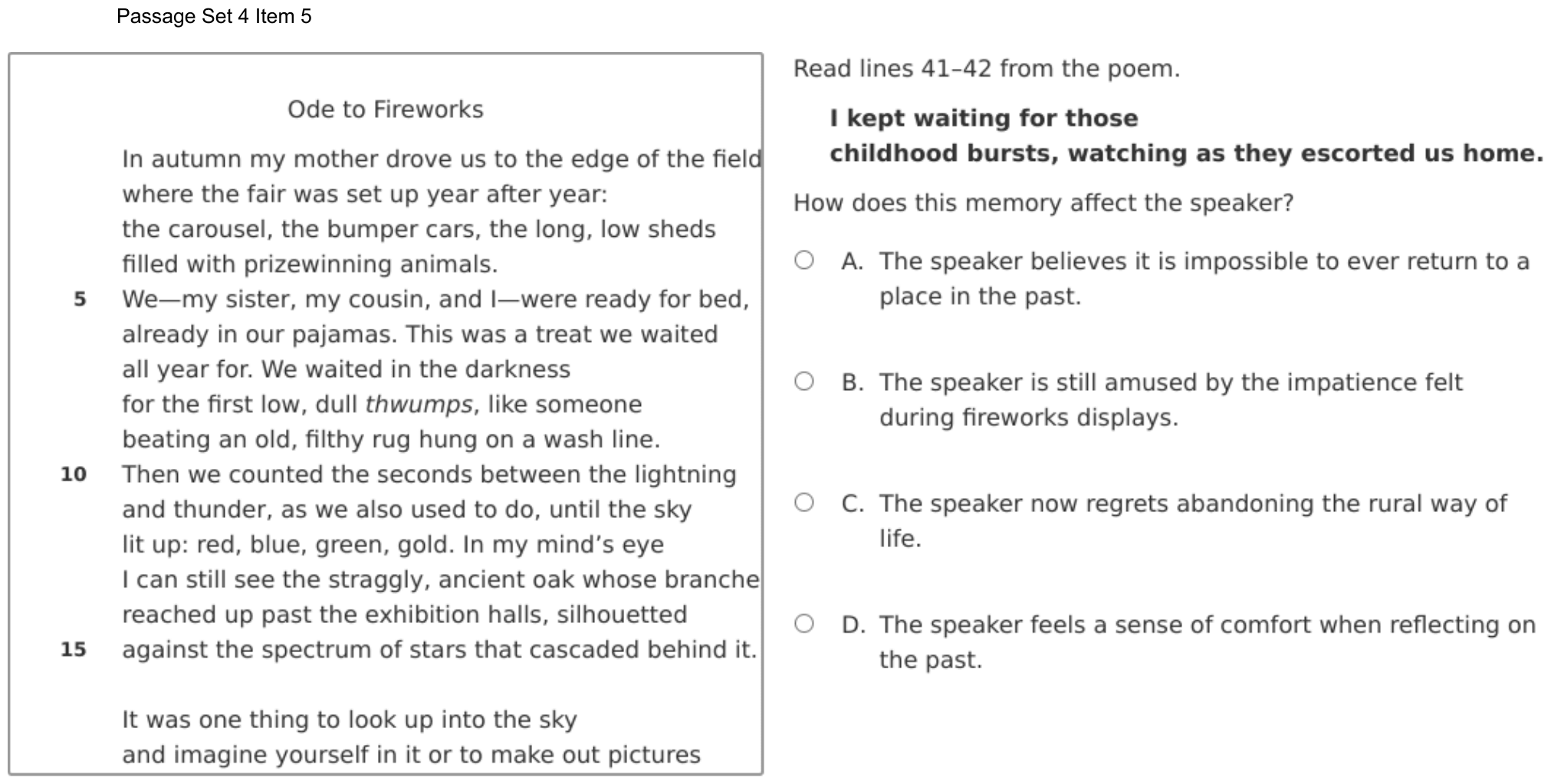
Question 23 of 53
2025 Practice Test A English, question 17Passage Excerpt from Winter Wheat
Excerpt from Winter Wheat
by Mildred Walker
Ellen, the narrator, is preparing to leave her parents and the family farm for college the next day.
The text of this excerpt is not reproduced here for copyright reasons. Read it as printed on the test under “The original DOE question” on each question’s page.
From WINTER WHEAT by Mildred Walker, published by University of Nebraska Press. Copyright © 1944 by Harcourt, Brace and Company, Inc. Copyright renewed 1971 by Mildred Walker. All rights reserved.
Question
Read these sentences from paragraph 2.
Dad always said Mom could make all the dishes he’d had back in Vermont as well as though she were a New Englander herself, instead of a Russian. All of a sudden, I realized that tomorrow when those beans would be ready to eat I’d be going away. It gave me a funny feeling.
The sentences help develop a theme of the excerpt by
- Asuggesting that life presents people with many challenges.
- Bimplying that the stress of major life events can cause confusion.
- Cdemonstrating that moving on from the familiar is a common human experience.
- Demphasizing the idea that people can easily learn the routines of being part of a new culture.
Show the answer
Correct answer: C
The question asks how the sentences in paragraph 2 help develop a theme of the excerpt.
A. Incorrect. Although the sentences from paragraph 2 describe Ellen’s “funny feeling” upon realizing that she will no longer be home when the beans that her mother is making are ready to eat, the details do not show that life presents many challenges. Additionally, the theme that life presents people with many challenges is not a theme found in the excerpt.
B. Incorrect. The sentences from paragraph 2 state that Ellen has “a funny feeling” while awaiting a major life event, but they do not indicate that she is confused or stressed. The details in the sentences convey a sense of wistfulness, but the theme that the stress of major life events causes confusion is not found in the excerpt.
C. CORRECT. The sentences from paragraph 2 show that Ellen’s mother has moved on from the familiar and left her childhood home behind, just as Ellen is about to do. This information links the experiences of parent and child and helps develop the theme that moving beyond the familiar is a common human experience.
D. Incorrect. Although the sentences from paragraph 2 show that Ellen’s mother has learned to cook New England food very well (“as though she were a New Englander herself”), they do not provide information about how easy or difficult it was for Ellen’s mother to learn a new way of cooking. The theme that people can easily learn the routines of a new culture is not a theme found in the excerpt.
Question analysis
This theme question quotes three sentences from paragraph 2 of the Winter Wheat excerpt, about Mom’s cooking and Ellen’s sudden realization that she is leaving, and asks how they help develop a theme. Students must connect a small kitchen moment to an idea that runs through the whole excerpt, choosing among theme statements that range from narrow to very general.
- Grade level
- Grade 8 reading and task
- Compared with grade 7
- Above grade 7 Explaining how details develop a theme is a grade 7 standard. These sentences never state the idea, so students must infer it from a remark about Mom’s cooking and Ellen’s passing feeling, then link it to the whole excerpt, more than typical grade 7 work.
- Estimated difficulty
- Hard: combines ideas, needs a plan, and has more than one tempting wrong answer.
- Thinking it demands
- Depth of knowledge 3, strategic thinking · mainly analyze
- What makes it hard
- Reading between the lines major
- Evidence in several places moderate
- How, not what minor
- Evidence
- Answered from the whole text
- Reading level
- Passage: about grade 6, 80 words; question and choices: about grade 7, 117 words.
- Students, last 30 days
- Not enough answers yet to show (it takes 10).
Why it is hard, traps and wrong answers (shows the answer)
Why it is hard
The quoted sentences seem to be about cooking and a passing mood, and the link to a theme hides in where the parents come from. Students who miss that Dad and Mom both left homes far away read the passage as being about Mom’s skill or Ellen’s nerves, and pick a theme built on one of those. The vague choice about life’s challenges catches students who sense that leaving is hard but cannot pin the theme to these details.
Reading between the lines major Working it out
The theme is never stated: students must notice that “back in Vermont” and “instead of a Russian” mean both parents left their first homes, just as Ellen realizes she will be “going away.” (Graesser, Singer & Trabasso, 1994; Kintsch, 1998)
Evidence in several places moderate Working it out
A theme of the excerpt must hold beyond paragraph 2, so the choice has to be checked against Dad’s trip back East in the flashback and Mom’s Russian name in paragraph 22. (Kirsch & Mosenthal, 1990; Gorin & Embretson, 2006)
How, not what minor Working it out
The stem asks how the sentences develop a theme, so a remark about cooking has to be read for what it reveals about the parents’ pasts, not for its subject. (Anderson & Krathwohl, 2001)
Strategy: Note what each quoted sentence tells you about the person in it, then pick the theme that these details and the rest of the excerpt both support.
Traps
- Reads too much in: A reasonable-sounding conclusion that goes further than the text allows.
- Too broad or too strong: A choice overstates, generalizes, or uses absolute words the text does not support.
- Wrong tone or attitude: Misjudges the tone, attitude or point of view, such as reading admiration as criticism, or taking a character's or subject's feelings for the author's.
The wrong answers, classified
A Too broad or too strong (King et al., 2004)
Chooses a theme loose enough to fit almost any story; the sentences show the parents’ pasts and a sudden realization, not a series of challenges.
B Wrong tone or attitude (Graesser, Singer & Trabasso, 1994)
Hears stress and confusion in Ellen’s “funny feeling,” though the sentences suggest a quiet, wistful realization, and nothing in the excerpt shows her confused about leaving.
D Reads too much in (Graesser, Singer & Trabasso, 1994)
Seizes on Mom cooking “as though she were a New Englander herself” and adds that adapting was easy, which the sentence never says; it praises her skill, not the ease of learning.
Working it out, step by step
Figure out what the question asks
This asks how three sentences from paragraph 2 help build a theme. A theme is a big idea about life that a story keeps showing. Look at what each sentence tells you about the people in it, not just at its subject, cooking.
Read the sentence about Mom and Dad
The first sentence says “Dad always said Mom could make all the dishes he’d had back in Vermont as well as though she were a New Englander herself, instead of a Russian.” Vermont is a state far to the east, in New England. Dad grew up there. Mom came from Russia. So both parents left the places where they grew up.
Read the sentences about Ellen
The next sentences say “All of a sudden, I realized that tomorrow when those beans would be ready to eat I’d be going away. It gave me a funny feeling.” The beans are soaking for tomorrow’s meal. Ellen sees that she won’t be home to eat them. She is about to leave her own home, just as her parents once left theirs.
Find the theme
Put the two parts together. Dad left Vermont, Mom left Russia, and now Ellen is leaving the farm. Each of them moves on from a familiar place. So the sentences show that leaving what you know is something many people go through. Ellen’s “funny feeling” is wistful, a quiet sadness, like missing home before you go.
Check each choice
- A does not fit. It is so broad it could fit almost any story. These sentences show leaving home, not many challenges.
- B does not fit. Ellen’s feeling is quiet and wistful. Nothing shows her stressed or confused.
- C fits. Parents and daughter all move on from a familiar home.
- D does not fit. Dad praises Mom’s cooking, but the sentence never says learning it was easy.
Choose the answer
The sentences link Ellen’s leaving to her parents’ own leaving long ago. So the answer is C.
Why this answer and not the closest wrong one
B is the closest wrong choice, because a “funny feeling” before a big change could sound like stress. But Ellen is not mixed up or panicked. She simply realizes she will be gone tomorrow. The sentences tie that moment to her parents’ moves from Vermont and Russia. That shared experience of leaving is C.
More questions like this
The original DOE question
The passage “Excerpt from Winter Wheat” as shown on the test
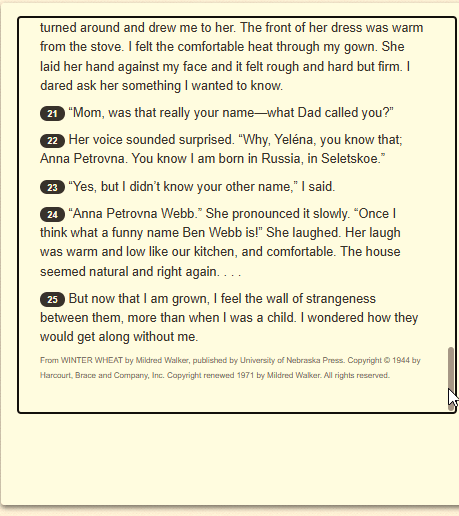
Question 24 of 53
2025 Practice Test A English, question 20Uses the passage above: “Excerpt from Winter Wheat”.
Question
The words “cold” and “dark” affect the tone in paragraph 10 by
- Ahighlighting the feeling of unpredictability among the family members.
- Bshowing the feelings of anger and resentment Ellen directs toward her parents.
- Cexaggerating the feeling of regret Dad experiences when leaving his family.
- Demphasizing the feelings of separation and loss that Ellen feels.
Show the answer
Correct answer: D
The question asks how the words “cold” and “dark” affect the tone in paragraph 10.
A. Incorrect. The mood of paragraph 10 is primarily one of sadness as Ellen says goodbye to her father at the train station. The words “cold” and “dark” do not convey unpredictability but rather emphasize Ellen’s feeling of loss over the departure of her father.
B. Incorrect. Although the father’s departure causes tension with his wife (“ ‘I’ll manage,’ Mom snapped back” [paragraph 11]), Ellen does not display anger or resentment toward her parents.
C. Incorrect. Although Ellen’s father states that he wishes his family could come with him on the trip to Vermont (“ ‘I wish you could go, Anna,’ Dad said to Mom, ‘and we could take Ellen’ ” [paragraph 12]), the words “cold” and “dark” describe Ellen’s perspective on her father’s departure. They create a tone of sadness from Ellen at being left behind rather than a tone of regret from her father because he has to leave.
D. CORRECT. In paragraph 10, Ellen states, “I could feel how cold and dark it was.” The words “cold” and “dark” highlight her emotional response to the departure of her father, emphasizing the almost physical sense of grief she feels at being separated from someone so precious to her.
Question analysis
This tone question asks how the words “cold” and “dark” affect the tone of paragraph 10 of the Winter Wheat excerpt, where Ellen remembers waiting for the train one November night as her father set off for Vermont. Students must decide what the two words add beyond describing the night itself.
- Grade level
- Grade 7 reading and task
- Compared with grade 7
- At grade 7 Explaining how word choice shapes tone is regular grade 7 work. The two words are named in the question and sit in one short paragraph, so the main step is seeing that they carry feeling as well as describing a November night.
- Estimated difficulty
- Straightforward: two steps or one careful reading.
- Thinking it demands
- Depth of knowledge 2, skills and concepts · mainly analyze
- What makes it hard
- Figurative or literary language moderate
- Reading between the lines minor
- Evidence
- Answered from one paragraph or stanza
- Reading level
- Passage: about grade 6, 80 words; question and choices: about grade 10, 53 words.
- Students, last 30 days
- Not enough answers yet to show (it takes 10).
Why it is hard, traps and wrong answers (shows the answer)
Why it is hard
The two words are named in the stem and appear together in a single sentence of paragraph 10, so the main step is seeing that they describe a feeling as well as the weather. The wrong choices shift the feeling to someone else or swap it for another, borrowing Mom’s sharp reply and Dad’s wish from the paragraphs just after. Students who keep their attention on Ellen waiting for the train in paragraph 10 have little trouble.
Figurative or literary language moderate Understanding the question
“Cold” and “dark” describe a November night, yet the grown narrator says she “could feel how cold and dark it was,” so the weather words carry her sense of loss as Dad leaves. (Graesser, Singer & Trabasso, 1994; Kintsch, 1998)
Reading between the lines minor Working it out
Paragraph 10 never names a feeling; the sadness comes from details such as Ellen holding Mom’s hand and Dad seeming strange in his good clothes. (Graesser, Singer & Trabasso, 1994; Kintsch, 1998)
Strategy: Reread paragraph 10 and ask what Ellen is going through at that moment, then choose the option that names the feeling the two words strengthen and the person who has it.
Traps
- Wrong tone or attitude: Misjudges the tone, attitude or point of view, such as reading admiration as criticism, or taking a character's or subject's feelings for the author's.
- Wrong part of the text: A choice is true of another paragraph, stanza or speaker than the one asked about.
The wrong answers, classified
A Wrong tone or attitude (Graesser, Singer & Trabasso, 1994)
Links darkness with not knowing what comes next, but nothing in paragraph 10 is uncertain: Dad’s trip is settled, and the words deepen Ellen’s sadness, not suspense.
B Wrong tone or attitude (Graesser, Singer & Trabasso, 1994)
Carries the sharpness of Mom’s “I’ll manage” into Ellen’s feelings and calls it anger at her parents, though Ellen holds her mother’s hand and blames no one.
C Wrong part of the text (Kirsch & Mosenthal, 1990)
Gives the feeling to Dad because in paragraph 12 he wishes his wife and daughter could come, though the cold and dark are what Ellen feels as she waits to see him off.
Working it out, step by step
Figure out what the question asks
This asks how two words, “cold” and “dark,” affect the tone of paragraph 10. Tone is the feeling the writing gives off. Ask whose feeling it is and what that feeling is.
Find the words in paragraph 10
Paragraph 10 begins Ellen’s memory of the night Dad left for Vermont. It was November, and dark when the train came. Ellen says that even now, years later, “I could feel how cold and dark it was.” She held Mom’s hand. Dad looked strange in his good clothes. They stood there without talking.
Work out the feeling
Cold and dark describe a November night. But Ellen can still feel them years later, so the words carry her feelings too. Cold and dark are lonely, sad words. Her father is leaving, and she feels cut off from him. The words stress her sense of separation and loss.
Check each choice
- A does not fit. Nothing is uncertain. Dad’s trip is planned, and the words make the scene sad, not unpredictable.
- B does not fit. Ellen holds Mom’s hand. She blames no one, so there is no anger.
- C does not fit. Dad says in paragraph 12 that he wishes they could come. But the cold and dark are what Ellen feels, not Dad.
- D fits. The words deepen Ellen’s sadness at being separated from her father.
Watch out: C borrows Dad’s wish from a later paragraph and gives him the feeling.
Choose the answer
“Cold” and “dark” show how lonely and sad Ellen felt as her father left. So the answer is D.
Why this answer and not the closest wrong one
C is the closest wrong choice, because Dad does wish his family could come with him. But that wish is in paragraph 12. In paragraph 10, Ellen says “I could feel how cold and dark it was.” The feeling belongs to her. The words stress her sense of being separated from her father, which is D.
More questions like this
The original DOE question
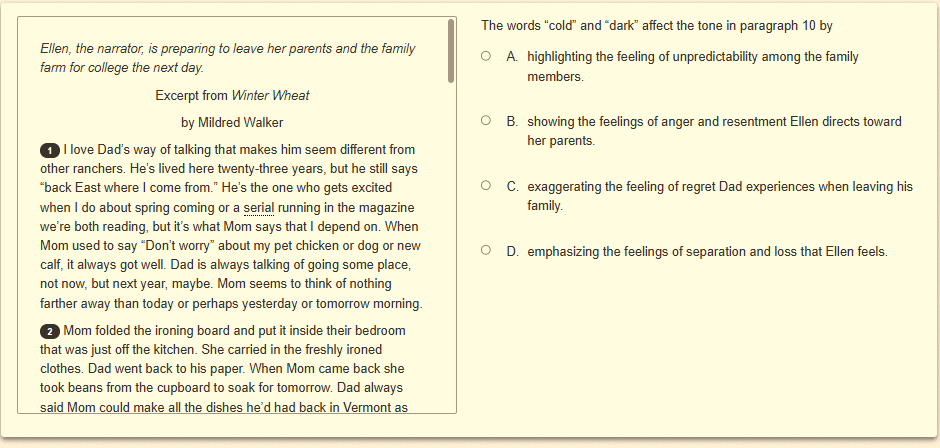
Question 25 of 53
2025 Practice Test A English, question 24Uses the passage above: “Excerpt from Winter Wheat”.
Question
What is Ellen’s primary mood at key points in the excerpt?
Move the correct answer to each box in the table.
| Paragraphs | Ellen’s Primary Mood |
|---|---|
| 1–2 | |
| 7–8 | |
| 9–10 |
On the test you drag tiles into the boxes; here, choose each box’s tile from its menu. Each tile can be used once. The DOE has not published how answers with several parts are scored; this site counts one right only when every part is right.
Show the answer
Correct answer: blank 1: Affectionate; blank 2: Wishful; blank 3: Worried
The question asks for identification of Ellen’s primary mood in key points in the excerpt—paragraphs 1–2, paragraphs 7–8, and paragraphs 9–10.
B. Affectionate: CORRECT. Ellen’s primary mood in paragraphs 1–2 is affectionate. She states in the first sentence of paragraph 1 that she loves her father’s way of talking and then describes with affection her mother’s reassuring certainty and her father’s appreciation of her mother’s cooking.
E. Wishful: CORRECT. Ellen’s primary mood in paragraphs 7–8 is wishful as she pictures the two departure scenarios available to her. She expresses in detail her longing for the “other people and excitement” at the train station in town, along with her wish to have plenty of “time to wave from the platform and then again from your window by your seat,” and her dislike of the idea of leaving from Gotham, where the train “only stops long enough for you to get on and you hardly have time to taste the flavor of going away.”
C. Worried: CORRECT. Ellen’s primary mood in paragraphs 9–10 is worried. Her worry is suggested by the description of her posture in the first sentence of paragraph 9 (“I sat . . . with my arms around my knees”). In the next sentence, she reveals that she “couldn’t keep from thinking,” or worrying, about her concern that her departure will be as tense as the time her father left for a trip to Vermont.
A. Calm: Incorrect. Ellen’s mood is not primarily calm in any of the paragraphs in the table. In paragraphs 1–2, her reflections might seem to focus on calm times, but any mood of calm is shattered by her sudden realization that she’d “be going away” the next day. Similarly, although paragraph 7 describes what might be a calm or routine day of shopping in town, she is imagining the scene in great detail as a way of making a difficult decision about where she would prefer to catch the train. Finally, in paragraphs 9–10, Ellen is far from calm as she forces herself to look “straight at” an upsetting childhood memory of seeing her father off on a long train trip.
D. Jealous: Incorrect. Ellen’s mood is not primarily jealous in any of the paragraphs in the table. In paragraphs 1–2, she admires and enjoys the positive atmosphere created by her father’s praise of her mother, rather than expressing jealousy. The contrast in paragraphs 7–8 between her narration of the two possible departure plans might seem to suggest that Ellen is jealous of the family whom she and her parents once watched depart from the town, but instead, her narration reflects Ellen’s wishful desire to recreate that pleasurable town visit as part of her own departure. In paragraphs 9–10, her flashback memory is focused on the stiffness of her parents’ behavior and includes no indications that she feels jealousy of either parent.
Question analysis
This question on the Winter Wheat excerpt asks students to identify Ellen’s primary mood at three points in the story: paragraphs 1–2, 7–8 and 9–10. On the test students drag mood words from five tiles into a table, and each stretch of the story mixes more than one feeling, so they must judge which feeling dominates each one.
- Grade level
- Grade 7 reading and task
- Compared with grade 7
- At grade 7 Tracking how a narrator’s feelings change across a story is grade 7 work, and the writing is plain. Placing three tiles with all-or-nothing credit, where each stretch holds mixed feelings, raises the demand only somewhat.
- Estimated difficulty
- Moderate: several steps, or a close reading with one strong distractor.
- Thinking it demands
- Depth of knowledge 2, skills and concepts · mainly understand
- What makes it hard
- Reading between the lines moderate
- Much to keep track of moderate
- Evidence
- Answered from several paragraphs or stanzas
- Reading level
- Passage: about grade 6, 80 words; question and choices: about grade 6, 24 words.
- Corrected from the DOE handbook
- The punctuation of an ellipsis in a quotation was corrected.
- Students, last 30 days
- Not enough answers yet to show (it takes 10).
Why it is hard, traps and wrong answers (shows the answer)
Why it is hard
Each stretch of the story holds more than one feeling, so the word “primary” does the work. The quiet evening of paragraphs 1–2 and Ellen sitting still in paragraph 9 both invite Calm, though the first is full of her fondness for her parents and the second shows her forcing herself to face a painful memory. With three placements that must all be right, a student who settles for the setting’s mood in either row loses the question.
Reading between the lines moderate Working it out
No mood is named: affection must be read from “I love Dad’s way of talking,” wishfulness from Ellen picturing waving from the platform, and worry from her arms around her knees. (Graesser, Singer & Trabasso, 1994; Kintsch, 1998)
Much to keep track of moderate Working it out
Three rows, five tiles that cannot be reused, and credit only when all three are right: each stretch must be judged on its own while the two leftover moods are kept out. (Sweller, 1988; Carpenter, Just & Shell, 1990)
Strategy: Reread each stretch of paragraphs by itself and name Ellen’s main feeling in your own words before looking at the tiles, then place the closest tile; two tiles will be left over.
Traps
- Wrong tone or attitude: Misjudges the tone, attitude or point of view, such as reading admiration as criticism, or taking a character's or subject's feelings for the author's.
The wrong answers, classified
BEA Wrong tone or attitude (Graesser, Singer & Trabasso, 1994)
Reads Ellen sitting still and looking “straight at” the memory in paragraph 9 as calm, though she has just failed to stop thinking of Dad’s leaving and is bracing to face it.
AEC Wrong tone or attitude (Graesser, Singer & Trabasso, 1994)
Puts Calm in the first row because paragraphs 1–2 show a quiet evening of ironing and reading, taking the scene’s mood for Ellen’s, which is warm affection for both parents.
BDC Wrong tone or attitude (Graesser, Singer & Trabasso, 1994)
Puts Jealous in the middle row, reading envy into Ellen’s memory of seeing another family off from the town station, when she is only wishing for a send-off like theirs.
What was corrected from the DOE handbook, and why
- Explanation: The DOE’s explanation of “Worried” quotes the first sentence of paragraph 9 as “I sat. . . with my arms around my knees,” with the first dot set against “sat,” as if a sentence ended there. The words are left out from the middle of the sentence, so the site spaces the ellipsis as the DOE’s explanations do elsewhere: “I sat . . . with my arms around my knees.”
Working it out, step by step
Figure out what the question asks
This table asks for Ellen’s primary mood, her main feeling, in three parts of the story. Each part may hold more than one feeling, so pick the strongest. On the test you drag a tile into each box. On this site you pick from a menu in each row. Each tile is used once, so two are left over.
Read paragraphs 1–2
Ellen begins by saying she loves the way Dad talks. She likes that he gets excited about the same things she does. She admires how sure Mom is that things will turn out well. She tells how Dad praises Mom’s cooking. These details are warm and loving. Affectionate means showing love and fondness. So the mood is Affectionate.
Read paragraphs 7–8
Ellen pictures leaving from Clark City. The family would shop and eat supper in town. At the station there would be “other people and excitement.” She would have “time to wave from the platform and then again from your window by your seat.” At Gotham, the train “only stops long enough for you to get on.” She longs for the big send-off. So the mood is Wishful.
Read paragraphs 9–10
Paragraph 9 begins “I sat . . . with my arms around my knees.” People often curl up like that when they feel uneasy. Ellen “couldn’t keep from thinking” of the night Dad left on a trip. That parting was sad and tense. She fears her own leaving may be like it. So the mood is Worried.
Rule out the two extra tiles
- Calm does not fit any row. In paragraph 9, Ellen sits still. But she is bracing herself to face a painful memory, not resting. And the quiet evening of paragraphs 1–2 is full of warm feeling for her parents.
- Jealous does not fit any row. Ellen remembers seeing another family off at the town station. She wants a send-off like theirs, but she doesn’t resent them.
Watch out: Sitting still is not the same as feeling calm.
Fill in the table
- Paragraphs 1–2: Affectionate
- Paragraphs 7–8: Wishful
- Paragraphs 9–10: Worried
All three rows must be right to get the point.
Why this answer and not the closest wrong one
Calm is the closest wrong tile, for paragraphs 9–10. Ellen sits still, and that can look calm. But she has just tried and failed to stop thinking about Dad’s leaving. Her arms are wrapped around her knees. She is facing a memory that upsets her, so Worried fits better.
More questions like this
The original DOE question
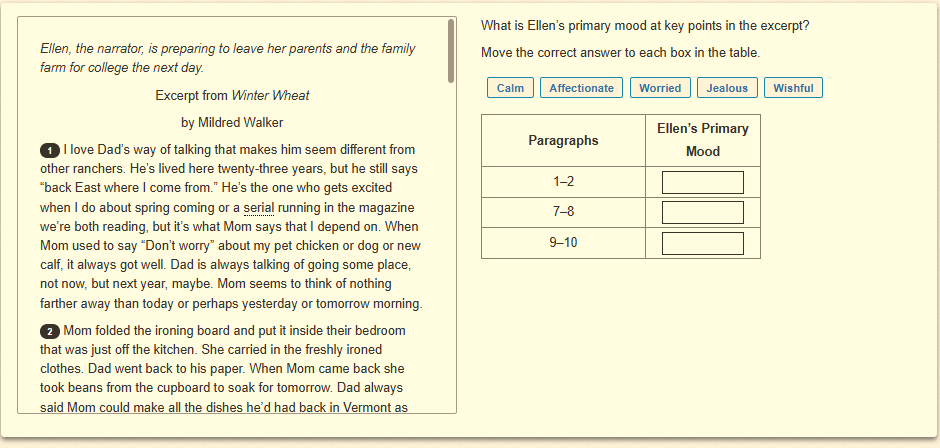
Question 26 of 53
2025 Practice Test A English, question 37Passage Excerpt from “The Spirit of the Herd”
Excerpt from “The Spirit of the Herd”
by Dallas Lore Sharp
In this excerpt, published in 1914, author and professor Dallas Lore Sharp describes a summer cattle roundup in Oregon. The heat and dust had been relentless for three days. The cowboys were exhausted, and the cattle were restless. The ranch boss, Wade, had led the drive to a watering place, only to find it empty.
Along with the wagon had come the fresh horses—one of them being Peroxide Jim, a supple, powerful, clean-limbed buckskin, a horse, I think, that had as fine and intelligent an animal-face as any creature I ever saw. Wade had been saving this horse for emergency work. And why should he not have been saved fresh for just such a need as this? Are there not superior horses as well as superior men—a Peroxide Jim to complement a Wade?
The horse knew the cattle business and knew his rider perfectly; and though there was nothing like sentiment about the boss of the P Ranch riders, his faith in Peroxide Jim was complete. . . .
The desert, where the herd was camped, was one of the highest of a series of tablelands, or benches; it lay as level as a floor, rimmed by sheer rock, from which there was a drop to the bench of sage below. The herd when overtaken by the dusk had been headed for a pass descending to the next lower bench, but was now halted within a mile of the rim rock on the east, where there was a perpendicular fall of about three hundred feet. . . .
In the taut silence of the stirless desert night, with the tension of the herd at the snapping-point, any quick, unwonted sight or sound would stampede them. The sneezing of a horse, the flare of a match, would be enough to send the whole four thousand headlong—blind, frenzied, trampling—till spent and scattered over the plain.
And so, as he rode, Wade began to sing. The rider ahead of him took up the air and passed it on until, above the stepping stir of the hoofs rose the faint voices of the men, and all the herd was bound about by the slow plaintive measures of some old song. It was not to soothe their savage breasts that the riders sang to the cattle, but rather to preempt the dreaded silence, to relieve the tension, and so to prevent the shock of any sudden startling noise.
So they sang and rode and the night wore on to one o’clock, when Wade, coming up on the rim-rock side, felt a cool breeze fan his face, and caught a breath of fresh, moist wind with the taste of water in it.
He checked his horse instantly, listening as the wind swept past him over the cattle. But they must already have smelled it, for they had ceased their milling, the whole herd standing motionless, the indistinct forms close to him in the dark showing their bald faces lifted to drink the sweet wet breath that came over the rim. Then they started on again, but faster, and with a rumbling now from their hoarse throats that tightened Wade’s grip on the reins.
The sound seemed to come out of the earth, a low, rumbling mumble, as dark as the night and as wide as the plain, a thick, inarticulate bellow that stood every rider stiff in his stirrups. . . .
Then the breeze caught the dust and carried it back from the gray-coated, ghostly shapes, and Wade saw that the animals were still moving in a circle. He must keep them going. He touched his horse to ride on with them, when across the black sky flashed a vivid streak of lightning.
There was a snort from the steers, a quick clap of horns and hoofs from far within the herd, a tremor of the plain, a roar, a surging mass—and Wade was riding the flank of a wild stampede. Before him, behind him, beside him, pressing hard upon his horse, galloped the frenzied steers, and beyond them a multitude borne on, and bearing him on, by the heave of the galloping herd.
Wade was riding for his life. He knew it. His horse knew it. He was riding to turn the herd, too, back from the rim, as the horse also knew. The cattle were after water—water-mad—ready to go over the precipice to get it, carrying horse and rider with them. Wade was the only rider between the herd and the rim. It was black as death. He could see nothing in the sage, could scarcely discern the pounding, panting shadows at his side. He knew that he was being borne toward the rim, how fast he could not tell, but he knew by the swish of the brush against his tapaderos and the plunging of the horse that the ground was growing stonier, that they were nearing the rocks.
To outrun the herd was his only chance for life. If he could come up with the leaders he might not only escape, but even stand a chance of heading them off upon the plain and saving the herd. There were cattle still ahead of him; how many, what part of them all, he could not make out in the dark. But the horse knew. The reins hung on his straight neck, where his rider had dropped them, as, yelling and firing over the wild herd, he had given this horse the race to win, to lose.
They were riding the rim. Close on their left bore down the flank of the herd, and on their right, under their very feet, was a precipice, so close that they felt its blackness—its three hundred feet of fall! . . .
. . . Then Wade found himself racing neck and neck with a big white steer, which the horse, with marvelous instinct, seemed to pick out from a bunch, and to cling to, forcing him gradually ahead, till, cutting him free from the bunch entirely, he bore him off into the swishing sage.
The steers coming on close behind followed their leader, and in, after them, swung others. The tide was turning from the rim. More and more were veering, and within a short time the whole herd, bearing off from the cliffs, was pounding over the open plains.
Whose race was it? It was Peroxide Jim’s, according to Wade, for not by word or by touch of hand or knee had the horse been directed in the run. From the flash of the lightning the horse had taken the bit, had covered an indescribably perilous path at top speed, had outrun the herd and turned it from the edge of the rim rock, without a false step or a tremor of fear.
From “The Spirit of the Herd” by Dallas Lore Sharp—Public Domain
tablelands: plateaus, flat areas of land sharply elevated from the surrounding area
tapaderos: leather covers for stirrups
Question
How does paragraph 9 fit into the overall structure of the excerpt?
- AIt hints at the change in the setting that caused Wade to suddenly become alert.
- BIt creates a false sense of calm that shows how unprepared the men were for what was about to happen.
- CIt introduces the idea that Wade was a skillful leader in unpredictable circumstances.
- DIt presents the incident that caused the main conflict Wade and Peroxide Jim addressed.
Show the answer
Correct answer: D
The question asks how paragraph 9 fits into the overall structure of the excerpt.
A. Incorrect. Wade was alert long before the events of paragraph 9. In paragraph 5, he began singing to the cattle because he knew that they were on the verge of stampeding. He was even more alert when he “caught a breath of fresh, moist wind with the taste of water in it” (paragraph 6) and heard the low rumbling of the herd in paragraph 8: “The sound seemed to come out of the earth, a low, rumbling mumble.”
B. Incorrect. Wade and the other riders were not calm; rather, they were alert and attempting to keep the cattle calm by singing to them. They were as prepared as they could be for what was about to happen, as shown in paragraph 1, through the selection of fresh horses and, specifically, Wade’s choice to ride Peroxide Jim in the face of possible danger: “Wade had been saving this horse for emergency work.”
C. Incorrect. Although Wade’s leadership is implied in paragraph 9 (“He must keep them going. He touched his horse to ride on with them”), his leadership is revealed in earlier portions of the excerpt as well (“Wade had been saving this horse” [paragraph 1]; “Wade began to sing” [paragraph 5]), so this is not new information being introduced in paragraph 9 of the excerpt.
D. CORRECT. Paragraph 9 describes the lightning strike that made the cattle panic and stampede. The stampede is the main conflict Wade and Peroxide Jim addressed in the excerpt; and therefore, paragraph 9 fits into the overall structure of the excerpt by presenting the incident that caused the main conflict.
Question analysis
This text-structure question asks how paragraph 9 of “The Spirit of the Herd,” Dallas Lore Sharp’s account of a cattle drive through the Oregon desert at night, fits into the overall structure of the excerpt. Students must judge what the paragraph does at that moment in the story, and several choices describe something real in the scene around it.
- Grade level
- Grade 8 reading and task
- Compared with grade 7
- At grade 7 Explaining how a paragraph fits a story’s structure is typical grade 7 work. The 1914 prose is dense, but this paragraph is short and its role is clear once the paragraphs around it are read.
- Estimated difficulty
- Moderate: several steps, or a close reading with one strong distractor.
- Thinking it demands
- Depth of knowledge 2, skills and concepts · mainly analyze
- What makes it hard
- How, not what moderate
- Evidence in several places moderate
- Complex sentences minor
- Evidence
- Answered from the whole text
- Reading level
- Passage: about grade 8, 1160 words; question and choices: about grade 7, 73 words.
- Corrected from the DOE handbook
- A paragraph number and a detail that is not in the excerpt were corrected in the explanation.
- Students, last 30 days
- Not enough answers yet to show (it takes 10).
Why it is hard, traps and wrong answers (shows the answer)
Why it is hard
Paragraph 9 is short and its turning point comes in its final words, so a student who reads it as a pause in the night’s tension, or as a portrait of Wade, can miss that it sets off everything after it. The wrong choices each describe something that happens around this point in the story, which is why checking what came earlier matters: Wade was already alert and already leading. Seeing the paragraph as the hinge between suspense and stampede settles it.
How, not what moderate Working it out
The question asks what paragraph 9 does in the sequence of events, and its job is carried by its last clause, the lightning that the next paragraph turns into a stampede. (Anderson & Krathwohl, 2001)
Evidence in several places moderate Working it out
Ruling out the choices about alertness and leadership means looking back: Wade starts the singing in paragraph 5, reins in his horse at the moist wind in paragraph 7, and had saved Peroxide Jim in paragraph 1. (Kirsch & Mosenthal, 1990; Gorin & Embretson, 2006)
Complex sentences minor Understanding the question
The paragraph’s key event arrives at the end of a long sentence in inverted order, “across the black sky flashed a vivid streak of lightning,” after Wade’s plan to keep riding. (Abedi & Lord, 2001; Freedle & Kostin, 1993; Messick, 1989)
Strategy: Sum up what happens before, during and after paragraph 9 in a few words each, then pick the choice that describes the paragraph’s role in that sequence.
Traps
- Wrong part of the text: A choice is true of another paragraph, stanza or speaker than the one asked about.
- Wrong purpose or structure: Names a purpose, structure or effect that the part does not serve, or describes what a part says when the question asks what it does.
- Wrong tone or attitude: Misjudges the tone, attitude or point of view, such as reading admiration as criticism, or taking a character's or subject's feelings for the author's.
The wrong answers, classified
A Wrong part of the text (Kirsch & Mosenthal, 1990)
Connects the breeze that clears the dust in paragraph 9 to Wade’s alertness, but the change that alerted him was the moist wind of paragraph 6, and he was watchful even earlier.
B Wrong tone or attitude (Graesser, Singer & Trabasso, 1994)
Takes the clearing dust and the herd’s steady circling as a lull, then calls the riders unprepared, though they were tense and ready, singing to the herd on fresh horses.
C Wrong purpose or structure (Anderson & Krathwohl, 2001)
Sees leadership in Wade’s resolve that “He must keep them going,” which is there, but paragraph 9 does not introduce it: he had saved his best horse and started the singing earlier.
What was corrected from the DOE handbook, and why
- Explanation: The DOE’s explanation of Option A says “In paragraph 4, he began singing to the cattle.” Wade begins to sing in paragraph 5 (“And so, as he rode, Wade began to sing”), as the explanation of Option C itself says; paragraph 4 describes the tension that makes the singing necessary. The same explanation says Wade “heard thunder in paragraph 8,” but the excerpt has no thunder: the sound in paragraph 8 is the herd’s “thick, inarticulate bellow,” the rumbling that comes “from their hoarse throats” in paragraph 7. The site now says “In paragraph 5, he began singing” and “heard the low rumbling of the herd in paragraph 8.” Option A is still wrong, and the answer, D, is unchanged.
Working it out, step by step
Figure out what the question asks
This asks how paragraph 9 fits into the structure of the excerpt. Structure is the order of events and how the parts connect. Ask what happens before paragraph 9, in it, and right after it.
Sum up what comes before
Before paragraph 9, the night is tense. In paragraph 1, Wade had been saving Peroxide Jim, his best horse, for an emergency. In paragraph 5, “Wade began to sing” to keep the herd from being startled. In paragraph 6, he caught a moist wind. In paragraph 8, the herd’s low rumbling “stood every rider stiff in his stirrups.” Everyone is alert.
Read paragraph 9
Paragraph 9 says the breeze cleared the dust, and Wade saw that the animals “were still moving in a circle.” He decided “He must keep them going.” Then the paragraph ends with the key event: “across the black sky flashed a vivid streak of lightning.” Vivid means very bright.
See what comes right after
Paragraph 10 begins with a snort from the steers and a roar. Then “Wade was riding the flank of a wild stampede.” A stampede is a sudden wild run by a frightened herd. The rest of the excerpt is Wade and Peroxide Jim racing to turn the herd from the cliff. So the lightning in paragraph 9 sets off the main conflict.
Check each choice
- A does not fit. Wade was alert long before. He began singing in paragraph 5, caught the moist wind in paragraph 6 and heard the herd rumbling in paragraph 8.
- B does not fit. The riders were not calm or unprepared. They were singing to the herd, and Wade had a fresh horse ready.
- C does not fit. Wade’s leadership shows earlier, when he saved his best horse and started the singing.
- D fits. The lightning causes the stampede that Wade and Peroxide Jim must stop.
Choose the answer
Paragraph 9 ends with the lightning that starts the stampede, the problem the rest of the excerpt is about. So the answer is D.
Why this answer and not the closest wrong one
C is the closest wrong choice, because Wade does lead in paragraph 9 when he decides “He must keep them going.” But C says the paragraph introduces his leadership. We already saw it in paragraph 1, when he saved his best horse, and in paragraph 5, when he started the singing. What is new in paragraph 9 is the lightning.
More questions like this
The original DOE question
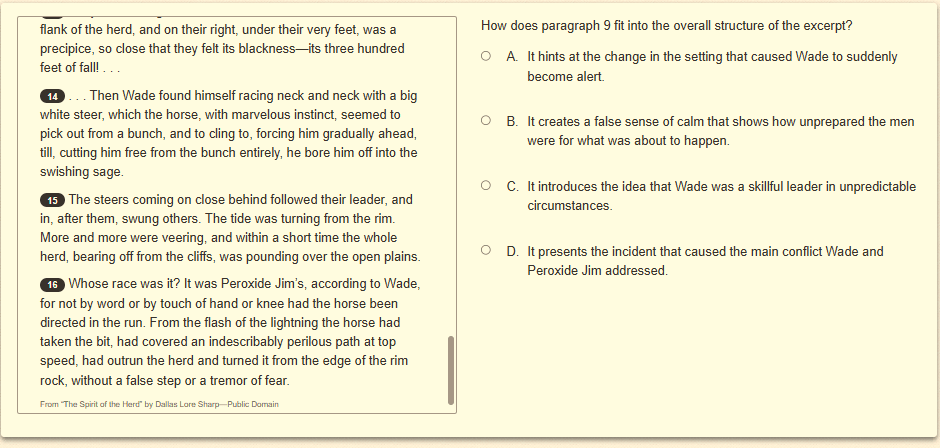
The passage “Excerpt from “The Spirit of the Herd”” as printed (page 41)
Question 27 of 53
2025 Practice Test B English, question 3Passage Excerpt from “It’s Time to Stop Thinking That All Non-Native Species Are Evil”
Excerpt from “It’s Time to Stop Thinking That All Non-Native Species Are Evil”
by Emma Marris
The author of this opinion article attended a symposium, or conference, in Missoula, Montana, at which biologists and other scientists discussed species of plants and animals that are not native to the areas in which they live.
Invasive species are scary. It was ecologist Charles Elton, back in the 1950s, who introduced the militaristic “invasion” metaphor to describe exotic plants and animals—but there’s no question some can be extremely destructive.
The brown tree snake has eaten a dozen kinds of forest birds in Guam to extinction; zebra mussels clog pipes around the Great Lakes; the common house cat turns out to be, in Australia, a mercilessly effective killer of cute, fluffy marsupials like the bilby and the numbat.
As scientists have sounded the alarm about these pests, the public has gotten the message. Citizen groups rip out non-native plants. Native gardens have become increasingly popular, both as ways to celebrate the unique flora of each region and as tiny hot spots of diversity. Native trees provide food for native bugs, which feed native birds. Food chains developed over thousands of years of co-evolution unfold in our backyards. . . .
So we’ve learned, scientists and laypeople alike, that native species are good and non-natives are bad.
Julian Olden, a biologist at the University of Washington, Seattle, who co-organized the symposium, recently polled nearly 2,000 ecologists. Among his findings: a substantial number of them said they would immediately eradicate a hypothetical non-native forest plant, even if it were shown to have no effect on the forest. Olden calls this the “guilty even when proven innocent” approach.
That kind of approach is not very useful on a rapidly changing planet.
Exotics Are Everywhere
Climate change is making it harder even to decide who the invaders are.
How, scientists at the symposium wondered, do you define “native” on a warming planet, when plants and animals are already moving toward the poles or up mountainsides in search of climate conditions they can tolerate? Should we consider them “invasive” in their new homes? Regardless of what we label them, conservationists will be reluctant to remove them from their new environs—to do so would stymie1 their chances of adapting to the warmer future we’re creating.
And then there are the non-natives that we actually like. Most domestic crops are exotic in most of the places they’re grown, but there are even wild exotics that “do good,” forming useful relationships with native species.
Edwin Grosholz of the University of California, Davis, told the recent symposium about one such relationship. On beaches in his state, non-native spartina grass has become important habitat for the endangered California clapper rail, a plump shorebird with a downward curving bill more at home on land than in the air. A project to rip out and poison the spartina—which grows in dense swaths that exclude many other shorebirds—saw clapper rail numbers go tumbling downward.
There are other examples like that. The endangered southwestern willow flycatcher nests in “invasive” tamarisk shrubs. Many native (and beautiful) Hawaiian flowers are now pollinated by the Japanese white-eye bird—because the native pollinators have been driven extinct by other non-native species.
Should we impose further risk on already endangered natives by severing these relationships? Or should we admire the resilience of nature and let such “well-behaved” exotics stay? . . .
Leave them alone, more and more conservationists are arguing, and stop focusing obsessively on categorizing species as native or non-native. Mark Davis, an ecologist at Macalester College in St. Paul, Minnesota, once considered himself an “invasion biologist”—but not anymore. “I am actively trying to get the field to retire the invader narrative,” he said in Missoula.
A Good Thing, Not the Only Thing
After all, nativeness is just one environmental value, and arguably not as important as preventing extinctions and preserving biodiversity. In some cases we can best serve biodiversity by leaving the non-natives alone or even—brace yourself, now—introducing them on purpose.
This is the thinking behind, for example, installing the Aldabra tortoise on the islands of Mauritius. The islands lost their own large tortoises, and the fruiting plants that formerly had their seeds moved around by these fruit-loving reptiles have been on the decline. A tortoise that’s related to the island’s large tortoises—a non-native from the Seychelles in the Indian Ocean that was intentionally introduced in 2004—is now handling some of that work.
Most of the time, for the time being, conserving species still means focusing on supporting them in their historical habitats, planting natives and removing non-natives. We can and should do that in places where it is feasible and important to us.
From “It’s Time to Stop Thinking That All Non-Native Species Are Evil” by Emma Marris from NATIONAL GEOGRAPHIC MAGAZINE, July 24, 2014. Copyright © 2014 by National Geographic Society.
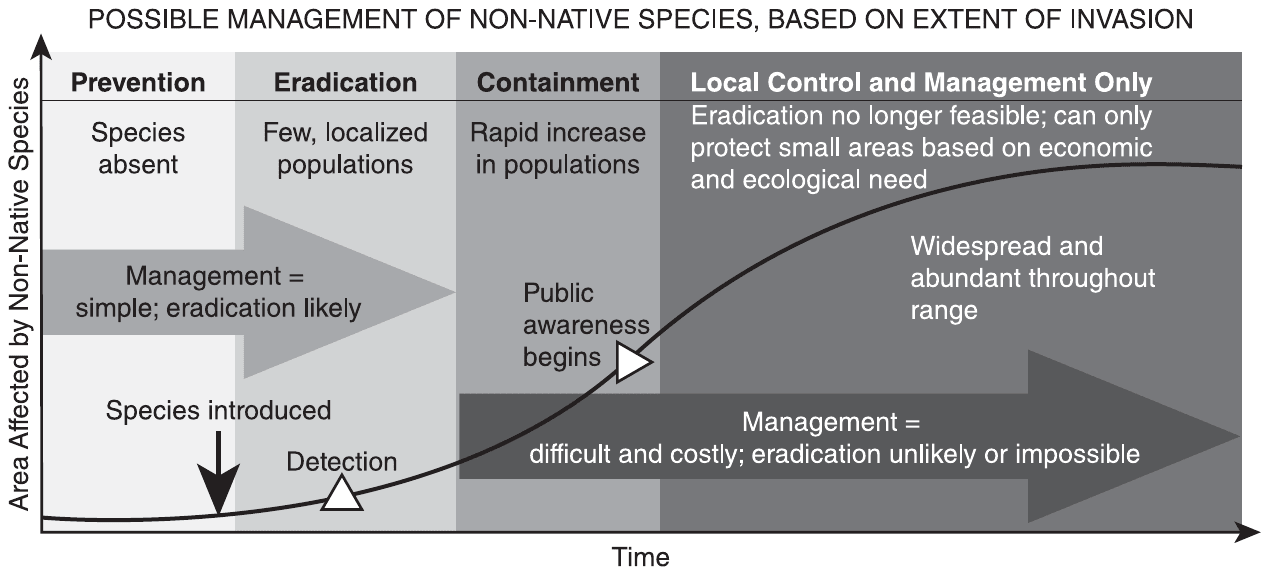
1stymie: hinder or interfere with
Question
Which two phrases from paragraph 3 most affect the tone of the excerpt?
Move the two correct answers to the box.
Phrases That Most Affect the Tone of the Excerpt
On the test you drag tiles into the box; here, choose them below. The DOE has not published how answers with several parts are scored; this site counts one right only when every part is right.
- A“sounded the alarm”
- B“gotten the message”
- C“rip out”
- D“become increasingly popular”
- E“provide food”
Show the answer
Correct answer: A and C
The question asks for the two phrases from paragraph 3 that most affect the tone of the excerpt.
A. “sounded the alarm”: CORRECT. This phrase affects the tone of the excerpt by conveying the stark sense of urgency surrounding the debate over the ecological impact of non-native species. The reference to an alarm sounding evokes the feeling of being on high alert.
B. “gotten the message”: Incorrect. This phrase does not most affect the tone of the excerpt.
C. “rip out”: CORRECT. This phrase affects the tone of the excerpt by vividly depicting the effect of widespread misunderstanding of non-native species.
D. “become increasingly popular”: Incorrect. This phrase does not most affect the tone of the excerpt.
E. “provide food”: Incorrect. This phrase does not most affect the tone of the excerpt.
Question analysis
This select-two tone question on Emma Marris’s opinion article about non-native species lists five short phrases from paragraph 3 and asks which two most affect the tone of the excerpt. On the test students move two tiles into a box, and both must be right. All five are common, everyday expressions, so students must weigh how strongly each one colors the excerpt.
- Grade level
- Grade 7 reading and task
- Compared with grade 7
- At grade 7 Typical grade 7 tone questions quote the words and ask what effect they have. Here students pick the two phrases themselves from five in one short paragraph and compare how much feeling each carries, which keeps the demand at grade level.
- Estimated difficulty
- Moderate: several steps, or a close reading with one strong distractor.
- Thinking it demands
- Depth of knowledge 2, skills and concepts · mainly analyze
- What makes it hard
- A very close wrong answer moderate
- Figurative or literary language moderate
- Much to keep track of minor
- Evidence
- Answered from one paragraph or stanza
- Reading level
- Passage: about grade 11, 815 words; question and choices: about grade 3, 42 words.
- Students, last 30 days
- Not enough answers yet to show (it takes 10).
Why it is hard, traps and wrong answers (shows the answer)
Why it is hard
Most students hear the urgency of “sounded the alarm” at once, and the point is lost on the second pick. The idiom that ends the same sentence sounds just as colorful, while “rip out” is a short, everyday verb whose force is easy to read past as plain weeding. Swapping each phrase for a neutral word and asking how much feeling is lost separates them, and credit comes only when both tiles are right.
A very close wrong answer moderate Choosing the answer
“Sounded the alarm” and “gotten the message” are paired idioms in the first sentence of paragraph 3, both about the warning passing from scientists to the public, and only the first carries urgency. (Embretson & Wetzel, 1987; Gorin & Embretson, 2006; Ascalon et al., 2007)
Figurative or literary language moderate Understanding the question
The tone lives in connotation: “sounded the alarm” borrows the picture of a siren or bell, and “rip out” shows plants torn up by force where “remove” would sound flat. (Graesser, Singer & Trabasso, 1994; Kintsch, 1998)
Much to keep track of minor Working it out
Five tiles compete for one box and both picks must be right, so each phrase’s charge has to be weighed against the other four, since the stem asks which affect the tone “most.” (Sweller, 1988; Carpenter, Just & Shell, 1990)
Strategy: Swap each phrase for a plain word with the same meaning, reread its sentence, and keep the two whose replacement changes the feeling of the passage the most.
Traps
- Wrong tone or attitude: Misjudges the tone, attitude or point of view, such as reading admiration as criticism, or taking a character's or subject's feelings for the author's.
- Taking figurative language literally: A choice reads a figure of speech or image at face value.
The wrong answers, classified
B Wrong tone or attitude (Graesser, Singer & Trabasso, 1994)
Hears an idiom as colorful as “sounded the alarm” in the same sentence and takes it as equally charged, though “gotten the message” only says the public accepted the warning.
D Wrong tone or attitude (Graesser, Singer & Trabasso, 1994)
Hears approval in the word “popular” and takes it as setting the tone, though “become increasingly popular” is a neutral report of a trend in gardening.
E Wrong tone or attitude (Graesser, Singer & Trabasso, 1994)
Is drawn by the pleasant picture of native trees feeding bugs that feed birds, though “provide food” is plain, factual wording that any science textbook might use.
C Taking figurative language literally (Graesser, Singer & Trabasso, 1994)
Left out by students who read “rip out” as a plain account of weeding, missing that the verb pictures citizen groups tearing up plants by force, where “remove” would be neutral.
Working it out, step by step
Figure out what the question asks
This is a tone question. Tone is the feeling or attitude that a writer’s words give a passage. You need the two phrases from paragraph 3 that carry the most feeling. Words can carry feeling beyond their plain meaning. On the test you drag two tiles into the box. On this site, you choose two of the five. Both must be right.
Read paragraph 3 in its place
The excerpt opens with “Invasive species are scary.” Paragraph 2 lists the harm some invaders do. Then paragraph 3 says “As scientists have sounded the alarm about these pests, the public has gotten the message. Citizen groups rip out non-native plants.” The rest of the paragraph is calm. It says native gardens are popular, and native trees feed bugs that feed birds.
Swap each phrase for plain words
A good test is to swap each phrase for plain words with the same meaning. Then ask how much feeling is lost.
- “sounded the alarm” becomes warned. An alarm is a loud bell for danger, like a fire alarm. The sense of danger is lost.
- “gotten the message” becomes understood. Little changes.
- “rip out” becomes remove. To rip is to tear roughly and fast. The force is lost.
- “become increasingly popular” becomes grown more common. Little changes.
- “provide food” becomes feed. Nothing changes.
See what the two phrases do
Urgency is the feeling that something must be done right now. “Sounded the alarm” makes non-native species sound like an emergency. “Rip out” shows people tearing up plants with force. Together they make the fight against non-natives sound urgent and harsh. That matches paragraph 1, which calls the word “invasion” militaristic, or warlike. The author goes on to question treating every non-native as bad.
Check each of the five tiles
- A fits. It adds urgency.
- B does not fit. It is an idiom, a saying whose meaning differs from its words. It only means the public understood.
- C fits. It adds force.
- D does not fit. It calmly reports a trend in gardening.
- E does not fit. It is plain, factual wording.
Watch out: B sits in the same sentence as A, and it sounds just as colorful. But it adds no danger and no force.
Choose both answers
So the answers are A and C. On the test, move the tiles “sounded the alarm” and “rip out” into the box Phrases That Most Affect the Tone of the Excerpt. You need both to get the point.
Why this answer and not the closest wrong one
B is the closest wrong choice. It is an idiom in the same sentence as A, so it seems just as strong. But swap in understood, and the feeling barely changes. C is easier to miss because it is short. Swap in remove, and the force is gone.
More questions like this
The original DOE question
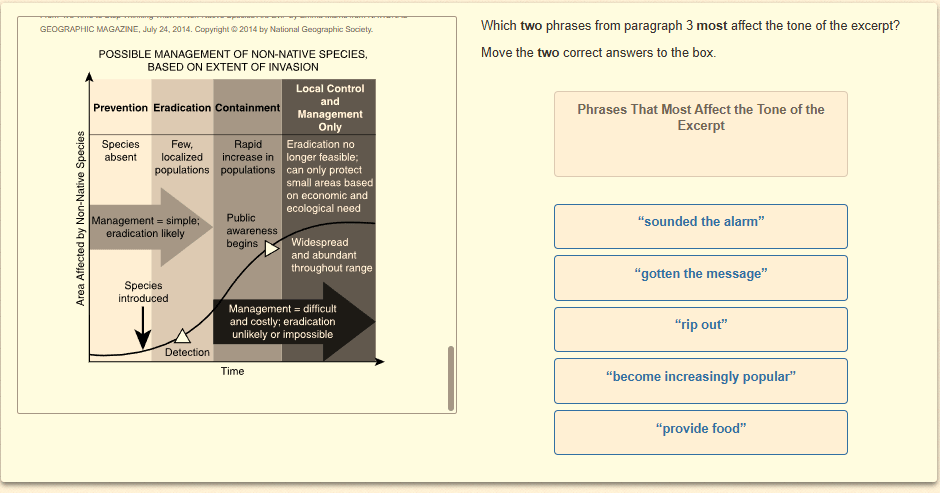
The passage “Excerpt from “It’s Time to Stop Thinking That All Non-Native Species Are Evil”” as printed (pages 68–70)
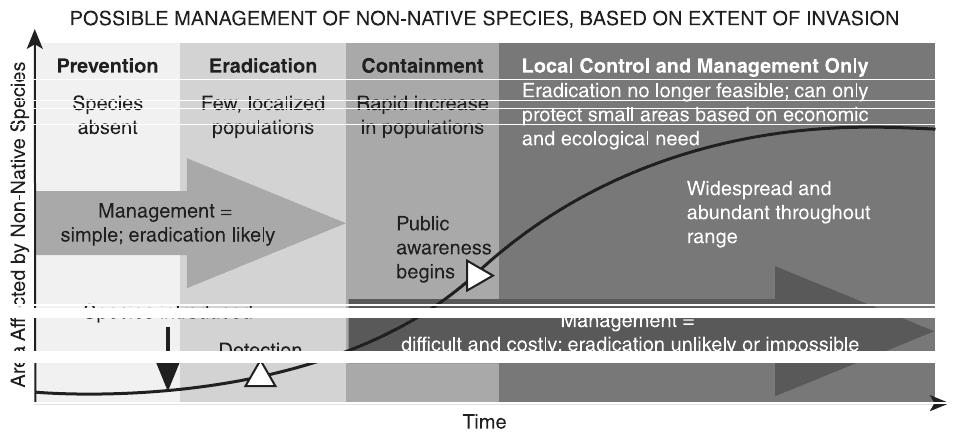
Question 28 of 53
2025 Practice Test B English, question 8Uses the passage above: “Excerpt from “It’s Time to Stop Thinking That All Non-Native Species Are Evil””.
Question
Determine whether each sentence from the excerpt presents a claim or presents evidence to support a claim.
Select all the correct answers.
Choose one answer in each row, then check. The DOE has not published how answers with several parts are scored; this site counts one right only when every part is right.
| Presents a Claim | Presents Evidence | |
|---|---|---|
| “That kind of approach is not very useful on a rapidly changing planet.” (paragraph 6) | ||
| “A project to rip out and poison the spartina—which grows in dense swaths that exclude many other shorebirds—saw clapper rail numbers go tumbling downward.” (paragraph 10) | ||
| “In some cases we can best serve biodiversity by leaving the non-natives alone or even—brace yourself, now—introducing them on purpose.” (paragraph 14) | ||
| “A tortoise that’s related to the island’s large tortoises—a non-native from the Seychelles in the Indian Ocean that was intentionally introduced in 2004—is now handling some of that work.” (paragraph 15) |
Show the answer
Correct answer: “That kind of approach is not very useful on a rapidly changing planet.” (paragraph 6): Presents a Claim; “A project to rip out and poison the spartina—which grows in dense swaths that exclude many other shorebirds—saw clapper rail numbers go tumbling downward.” (paragraph 10): Presents Evidence; “In some cases we can best serve biodiversity by leaving the non-natives alone or even—brace yourself, now—introducing them on purpose.” (paragraph 14): Presents a Claim; “A tortoise that’s related to the island’s large tortoises—a non-native from the Seychelles in the Indian Ocean that was intentionally introduced in 2004—is now handling some of that work.” (paragraph 15): Presents Evidence
The question asks which quotations from the excerpt present a claim and which present evidence in support of a claim. (A claim is a statement made as part of an argument that can be supported or proved with evidence. Supporting evidence can include facts, figures, details, quotations, or other sources of data and information that can be evaluated by others.)
Row 1: Presents a claim [“That kind of approach is not very useful on a rapidly changing planet.” (paragraph 6)]. The phrase “is not very useful” indicates that the sentence expresses a claim—an arguable statement, or in this case an opinion, for which the author must provide proof.
Row 2: Presents evidence [“A project to rip out and poison the spartina—which grows in dense swaths that exclude many other shorebirds—saw clapper rail numbers go tumbling downward.” (paragraph 10)]. Despite its figurative language (“tumbling downward”), this sentence does not present a claim that must be supported by evidence. Instead, the sentence provides factual information—that numbers of clapper rail birds decreased when spartina grass was removed—that is evidence for another claim, that non-native plants can be welcome sometimes.
Row 3: Presents a claim [“In some cases we can best serve biodiversity by leaving the non-natives alone or even—brace yourself, now—introducing them on purpose.” (paragraph 14)]. The wording “we can best serve” signals that this sentence presents a claim—a statement being made as part of an argument that needs proof in order to be accepted—regarding the best way to achieve biodiversity.
Row 4: Presents evidence [“A tortoise that’s related to the island’s large tortoises—a non-native from the Seychelles in the Indian Ocean that was intentionally introduced in 2004—is now handling some of that work.” (paragraph 15)]. Although this sentence does not provide statistics, quotations, or other obvious markers that signal evidence, it does provide a factual example—non-native tortoises are now moving the seeds of fruiting plants in a way that preserves the diversity of plant life on the islands of Mauritius—that is used to support the author’s claim that non-native species can help preserve diversity.
Question analysis
This table-grid question on the opinion article about non-native species gives four sentences, from paragraphs 6, 10, 14 and 15, and asks whether each presents a claim or presents evidence to support a claim. Students make four separate decisions, and credit comes only when every row is right, so each sentence must be judged by the job it does in the author’s argument.
- Grade level
- Grade 7 reading and task
- Compared with grade 7
- At grade 7 Telling a claim from the evidence for it is core grade 7 argument work. The four sentences come labeled with their paragraphs, but they are long and broken by dashes and asides, and all four must be sorted correctly, a typical demand overall.
- Estimated difficulty
- Moderate: several steps, or a close reading with one strong distractor.
- Thinking it demands
- Depth of knowledge 2, skills and concepts · mainly analyze
- What makes it hard
- Much to keep track of moderate
- How, not what minor
- Complex sentences minor
- Figurative or literary language minor
- Evidence
- Answered from several paragraphs or stanzas
- Reading level
- Passage: about grade 11, 815 words; question and choices: about grade 8, 22 words.
- Students, last 30 days
- Not enough answers yet to show (it takes 10).
Why it is hard, traps and wrong answers (shows the answer)
Why it is hard
The two claims carry the author’s judgment in a few words, “not very useful” and “we can best serve,” while the two evidence rows report what happened. Students go wrong when they sort by surface: dramatic wording makes the spartina report sound like opinion, and the tortoise sentence, with no number or quotation, can pass for the author’s assertion. Asking whether a sentence judges or reports settles each row, but all four must be right for credit.
Much to keep track of moderate Working it out
Sentences from paragraphs 6, 10, 14 and 15 are judged one at a time, and the question is scored right only when all four rows are, so one doubtful row costs the point. (Sweller, 1988; Carpenter, Just & Shell, 1990)
How, not what minor Working it out
Each row asks what a sentence does in the argument, not what it is about: rows 3 and 4 both concern bringing in non-natives on purpose, but one argues for it and one reports it. (Anderson & Krathwohl, 2001)
Complex sentences minor Understanding the question
In the two evidence rows, 17 and 22 words separate the subject from its verb, “A project … saw” and “A tortoise … is now handling,” most of them inside dashes. (Abedi & Lord, 2001; Freedle & Kostin, 1993; Messick, 1989)
Figurative or literary language minor Understanding the question
Row 2 reports a result in vivid words, a project to “rip out and poison” the grass and clapper rail numbers that “go tumbling downward,” so a report can sound like an opinion. (Graesser, Singer & Trabasso, 1994; Kintsch, 1998)
Strategy: For each sentence, ask whether it states a judgment the author must argue for or reports something that happened or was found, and sort it by that test alone.
Traps
- Wrong purpose or structure: Names a purpose, structure or effect that the part does not serve, or describes what a part says when the question asks what it does.
- Wrong tone or attitude: Misjudges the tone, attitude or point of view, such as reading admiration as criticism, or taking a character's or subject's feelings for the author's.
The wrong answers, classified
1:B Wrong purpose or structure (Anderson & Krathwohl, 2001)
Takes “a rapidly changing planet” as plain fact, the climate change the next section describes, and misses that “not very useful” is the author’s own verdict on the approach Olden describes.
2:A Wrong tone or attitude (Graesser, Singer & Trabasso, 1994)
Hears opinion in the vivid “rip out and poison” and “go tumbling downward,” though the sentence reports what happened to clapper rail numbers once a project removed the spartina.
3:B Wrong purpose or structure (Anderson & Krathwohl, 2001)
Sees that the sentence backs the case for leaving non-natives alone and so calls it support, missing that “we can best serve” is itself a claim, which the tortoise example then backs.
4:A Wrong purpose or structure (Anderson & Krathwohl, 2001)
Expects evidence to come as numbers, studies or quotations, so takes the plain report that a tortoise brought in during 2004 “is now handling some of that work” as an assertion.
Working it out, step by step
Figure out what the question asks
Decide the job each of the four sentences does in the argument. A claim is a statement the author wants you to accept, such as an opinion or a judgment. People could disagree with it, so it needs support. Evidence is a fact, an example or an event that backs up a claim. Ask: does the sentence judge, or does it report what happened?
Sort the sentence from paragraph 6
Row 1 says “That kind of approach is not very useful on a rapidly changing planet.” The approach is the one in paragraph 5. There, many ecologists said they would wipe out a non-native plant even if it had no effect on the forest. The words “not very useful” are the author’s judgment. Someone could disagree, so the article has to argue for it. This sentence presents a claim.
Watch out: “A rapidly changing planet” sounds like a fact. But the point of the sentence is the judgment about the approach.
Sort the sentence from paragraph 10
Row 2 is long, so set aside the part between the dashes. What is left says “A project to rip out and poison the spartina” saw clapper rail numbers fall. Spartina is a grass that is not native to California. The clapper rail is an endangered shorebird that lives in it. So the sentence reports what happened: the grass was removed, and the birds declined. It backs the claim in paragraph 9 that some non-natives “do good.” This row presents evidence.
Watch out: Vivid words like “go tumbling downward” can sound like an opinion. But they only mean the numbers fell fast. Strong wording does not turn a report into a claim.
Sort the sentence from paragraph 14
Row 3 says “In some cases we can best serve biodiversity by leaving the non-natives alone or even—brace yourself, now—introducing them on purpose.” Biodiversity is the variety of living things in a place. The words “we can best serve” show the author’s judgment about what is best. “Brace yourself” shows she expects you to be surprised. A surprising idea needs proof. This sentence presents a claim.
Sort the sentence from paragraph 15
Row 4 also has a long part between dashes. Without it, the sentence says “A tortoise that’s related to the island’s large tortoises” is “now handling some of that work.” The sentence before explains the work. The islands lost their own large tortoises, which used to spread the seeds of fruiting plants. Now a non-native tortoise, brought in on purpose in 2004, does part of that job. It is a real example. It backs row 3’s claim. This row presents evidence.
Watch out: Evidence does not need numbers or quotations. An example of what happened counts.
Fill in the table
- Row 1 (paragraph 6): Presents a Claim
- Row 2 (paragraph 10): Presents Evidence
- Row 3 (paragraph 14): Presents a Claim
- Row 4 (paragraph 15): Presents Evidence
On the test and on this site, click one circle in each row. All four rows must be right to get the point.
Why this answer and not the closest wrong one
Row 2 is the hardest. “Rip out and poison” and “tumbling downward” sound strong, like an opinion. But the sentence reports a project and its result: the bird numbers fell. Nobody judges what is best. So it is evidence for the claim that some non-natives “do good.”
More questions like this
The original DOE question
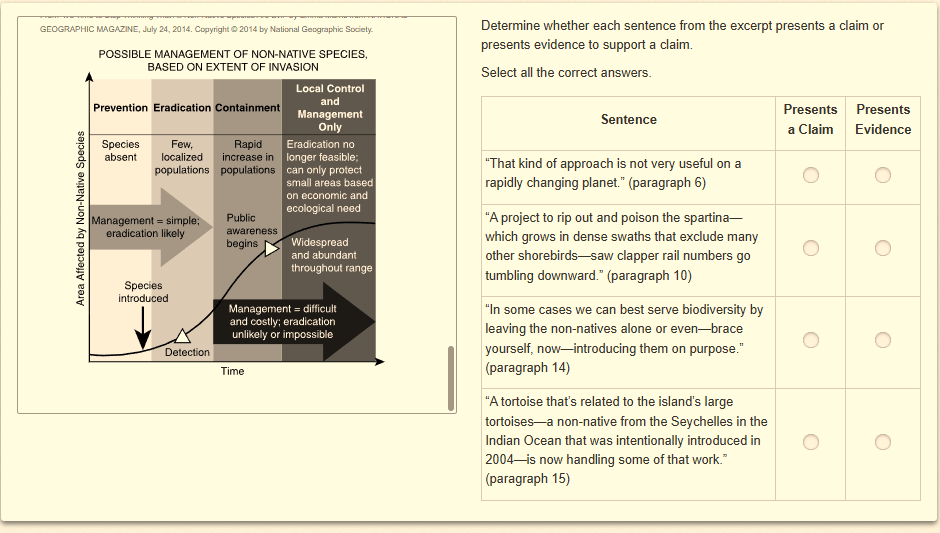
Question 29 of 53
2025 Practice Test B English, question 44Passage Letter from Brooklyn
Letter from Brooklyn
by Jacob Scheier
I can already see how this will end.
How I will grow tired of the bridge’s
steep incline, and the absent-minded tourists
wandering into the bicycle path.
The weather will turn cold.
But that all happens later.
For now it is the early edge of fall,
leaves green still while the air narrows,
is slightly crisp, almost grazing
the hair of my arm like a passing stranger,
as though the air has been forced into intimacy
by the brevity of daylight.
But when it starts darkening at 4,
this closeness, I know, will be a felt distance,
like someone drawing your attention
to their lack of intimacy.
These days I am still walking at a cathedral pace
beneath the branches bending across avenues,
brownstones like rows of lived-in chapels,
like a pop-up picture book I could have had as a child,
but didn’t. How Brooklyn makes me nostalgic
for the moment I am walking inside of.
These late afternoons filled
with a loneliness that makes me feel
distinctly myself, and an awareness
of how rare that is.
“Letter from Brooklyn” from LETTER FROM BROOKLYN: POEMS by Jacob Scheier, published by ECW Press. Copyright © 2013 by Jacob Scheier All rights reserved.
brevity: briefness
cathedral: meditative
chapels: private places of prayer or worship
nostalgic: yearning for the past
Question
The details in lines 9–12 convey a central idea of the poem by
- Ashowing that the cool weather makes the speaker reflect more deeply on life.
- Bsuggesting that the speaker feels uncomfortable with what the coming weather signifies.
- Cimplying that the sensations the speaker experiences during the fall season are fleeting.
- Dsuggesting that the thought of fall approaching increases the loneliness the speaker feels.
Show the answer
Correct answer: C
The question asks how lines 9–12 convey a central idea of the poem.
A. Incorrect. Although the speaker discusses the very beginning of cool weather in these lines, the speaker does not reflect on life in these lines.
B. Incorrect. Although the description in these lines likens the movement of crisp air to “a passing stranger,” that comparison does not have a negative connotation in this context; it does not suggest that the speaker is uncomfortable. Rather, it is used to describe the subtle physical sensation of cool air on the speaker’s arm.
C. CORRECT. By using a description of the crisp air as “a passing stranger” and the daylight as being brief, these lines express the poem’s central idea that the joy of early fall is temporary or fleeting.
D. Incorrect. Although the speaker acknowledges the coming fall in these lines, there is no mention of loneliness. The speaker reveals a loneliness in lines 23–26 but gives no hint of that feeling in lines 9–12. Further, this loneliness is not a central idea of the poem.
Question analysis
This central-idea question on Jacob Scheier’s poem “Letter from Brooklyn” asks how lines 9–12, where the crisp early-fall air grazes the speaker’s arm, convey a central idea of the poem. Students must interpret a simile and a personification packed into four short lines and connect what they suggest to the poem as a whole, while each choice names a different feeling or idea.
- Grade level
- Grade 8 reading and task
- Compared with grade 7
- Above grade 7 Grade 7 students explain how particular lines develop a central idea. These four lines make their point only through a simile and a personification about air and daylight, and linking them to the whole poem takes more interpretation than typical grade 7 work.
- Estimated difficulty
- Hard: combines ideas, needs a plan, and has more than one tempting wrong answer.
- Thinking it demands
- Depth of knowledge 2, skills and concepts · mainly analyze
- What makes it hard
- Figurative or literary language major
- Reading between the lines moderate
- The right answer is reworded minor
- Evidence
- Answered from one paragraph or stanza
- Reading level
- Passage: 217 words (a poem; reading level not measured); question and choices: about grade 8, 63 words.
- Students, last 30 days
- Not enough answers yet to show (it takes 10).
Why it is hard, traps and wrong answers (shows the answer)
Why it is hard
The four lines describe a sensation, cool air almost grazing an arm, and the central idea sits in two small words, “passing” and “brevity.” The strongest pull hears the stranger and the air “forced into intimacy” as unwelcome, borrowing the unease the poem saves for the darkening of lines 13–16. Other choices bring in moods from elsewhere, the meditative walk and the loneliness of the last lines, so students must judge only what lines 9–12 themselves suggest.
Figurative or literary language major Understanding the question
The lines never say the moment is short: the air almost grazes the speaker’s arm “like a passing stranger” and is “forced into intimacy / by the brevity of daylight,” so “passing” and “brevity” carry the idea. (Graesser, Singer & Trabasso, 1994; Kintsch, 1998)
Reading between the lines moderate Working it out
Students must tie the brief touch and the short days to a central idea the poem never states, that early fall is slipping away, framed by “For now” in line 7 and “But when it starts darkening” in line 13. (Graesser, Singer & Trabasso, 1994; Kintsch, 1998)
The right answer is reworded minor Choosing the answer
The right choice says “fleeting” where the lines say “passing” and “brevity,” while a wrong choice borrows the poem’s own word “loneliness” from line 24, which makes it look supported. (Freedle & Kostin, 1993; Kirsch & Mosenthal, 1990)
Strategy: Paraphrase lines 9–12 in plain words, checking the glossary for unfamiliar words, then decide what the comparison suggests about the speaker’s experience and test each choice against these four lines.
Traps
- Wrong part of the text: A choice is true of another paragraph, stanza or speaker than the one asked about.
- Wrong tone or attitude: Misjudges the tone, attitude or point of view, such as reading admiration as criticism, or taking a character's or subject's feelings for the author's.
- Reads too much in: A reasonable-sounding conclusion that goes further than the text allows.
The wrong answers, classified
A Reads too much in (Graesser, Singer & Trabasso, 1994)
Senses that the poem is meditative and credits the cool air with prompting deep thought, though lines 9–12 record a light, passing touch on the arm, not reflections on life.
B Wrong tone or attitude (Graesser, Singer & Trabasso, 1994)
Hears something unwelcome in “a passing stranger” and in air “forced into intimacy,” though the touch is light and the closeness enjoyed; unease arrives only with the darkening of lines 13–16.
D Wrong part of the text (Kirsch & Mosenthal, 1990)
Brings the “loneliness” of lines 23–26 into lines that never mention it, and even there it makes the speaker feel “distinctly myself,” not lonelier as fall approaches.
Working it out, step by step
Figure out what the question asks
This asks how lines 9–12 help build a central idea. A central idea is a main point the poem keeps coming back to. First work out what the four lines say. Then see how they connect to the rest of the poem. Test each choice against these four lines.
Read lines 9–12
The sentence is about the air, named in line 8. Lines 9–12 say it “is slightly crisp, almost grazing / the hair of my arm like a passing stranger, / as though the air has been forced into intimacy / by the brevity of daylight.” Crisp means cool and fresh. Grazing here means lightly touching. Intimacy means closeness. The glossary says brevity means “briefness.”
Work out the comparisons
“Like a passing stranger” is a simile, a comparison that uses like or as. A stranger who passes you on the street is there for a moment, then gone. So the cool air touches the speaker lightly and briefly. The next lines treat the air like a person pushed into closeness by the short daylight. Giving human feelings to something that isn’t human is called personification. Both “passing” and “brevity” point to the same thing: this feeling won’t last.
Connect the lines to the poem
The rest of the poem agrees. Line 7 begins “For now it is the early edge of fall.” Lines 13–14 look ahead: “But when it starts darkening at 4,” this closeness “will be a felt distance.” Lines 21–22 say Brooklyn makes the speaker “nostalgic / for the moment I am walking inside of.” So a central idea is that this early-fall moment is precious and passes quickly. Fleeting means lasting only a short time.
Check each choice
- A does not fit. These lines describe a touch on the skin, not thoughts about life.
- B does not fit. The touch is light, and the speaker enjoys the closeness now. The worry comes later, in lines 13–16.
- C fits. “Passing” and “brevity” show that the feelings of early fall won’t last.
- D does not fit. Lines 9–12 never mention loneliness, which comes in line 24. And line 7 says fall has already begun.
Watch out: B is tempting because “stranger” and “forced into intimacy” can sound unpleasant. But the stranger only passes by, and the touch is light.
Choose the answer
The brief touch and the short daylight show that this early-fall moment slips away fast. Sensations are feelings you get through your senses, like touch. So the answer is C, “implying that the sensations the speaker experiences during the fall season are fleeting.”
Why this answer and not the closest wrong one
B is the closest wrong choice, because “forced” and “stranger” can sound unpleasant. But line 14 calls this feeling “this closeness,” and losing it is what will feel bad. So the closeness is welcome now. What lines 9–12 stress is how brief it is, which is C.
More questions like this
The original DOE question
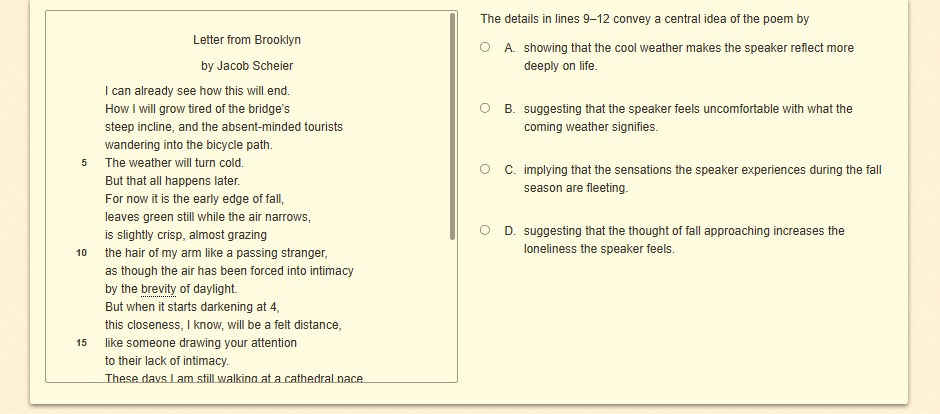
The passage “Letter from Brooklyn” as printed (page 50)
Question 30 of 53
2025 Practice Test B English, question 48Uses the passage above: “Letter from Brooklyn”.
Question
The poet develops the speaker’s point of view by
- Aproviding details about the speaker’s longing to be in a different place.
- Bshowing the speaker’s sense of unease about the passing seasons.
- Cincluding details about the speaker’s hope that life will remain unchanged.
- Dshowing the speaker’s desire to treasure and appreciate the changes taking place.
Show the answer
Correct answer: D
The question asks how the poet develops the speaker’s point of view.
A. Incorrect. The speaker concedes that at some point, Brooklyn will become tiresome (lines 2–4). However, the bulk of the poem reveals the speaker’s appreciation for experiencing Brooklyn, not a desire to be in some other place.
B. Incorrect. Cold weather is inevitable, and the speaker is well aware of this future shift as well as the change in attitude it will bring. Nevertheless, the speaker does not focus on this future but rather embraces the current season, describing it in vivid detail.
C. Incorrect. The speaker is not hopeful that life will remain unchanged. Rather, the speaker accepts and appreciates the seasonal changes that occur.
D. CORRECT. The speaker’s point of view is largely positive and appreciative of the shift in seasons. This point of view is developed by language that shows a close connection between the speaker and the setting. For example, the speaker uses words such as “intimacy” (line 11) and “closeness” (line 14) and the description of the “pop-up picture book” (line 20). Finally, the conclusion emphasizes the point of view: “These late afternoons filled / with a loneliness that makes me feel / distinctly myself, and an awareness / of how rare that is” (lines 23–26).
Question analysis
This point-of-view question asks how the poet develops the speaker’s point of view in “Letter from Brooklyn,” in which the speaker walks through the city at the start of fall knowing that colder, darker days lie ahead. The speaker’s thoughts move between the present and the future, so students must weigh the whole poem, and each choice names a different attitude.
- Grade level
- Grade 8 reading and task
- Compared with grade 7
- Above grade 7 Typical grade 7 point-of-view questions focus on one passage or stanza. This one asks for the speaker’s attitude across a whole poem of shifting moods, and several choices rest on real lines, so judging the overall view takes more than typical grade 7 work.
- Estimated difficulty
- Hard: combines ideas, needs a plan, and has more than one tempting wrong answer.
- Thinking it demands
- Depth of knowledge 3, strategic thinking · mainly analyze
- What makes it hard
- Evidence in several places moderate
- Reading between the lines moderate
- Every choice must be checked minor
- Evidence
- Answered from the whole text
- Reading level
- Passage: 217 words (a poem; reading level not measured); question and choices: about grade 7, 54 words.
- Students, last 30 days
- Not enough answers yet to show (it takes 10).
Why it is hard, traps and wrong answers (shows the answer)
Why it is hard
The poem opens by predicting its own end and returns to the coming dark in lines 13–16, so a reader who weighs those lines heavily finds unease, and the speaker does feel some. But the speaker turns back to the present each time, with “But that all happens later” and “These days I am still walking,” and the closing lines call the moment rare. The point of view is a wish to savor what is passing, and only a choice that fits the whole poem, not its most anxious lines, matches it.
Evidence in several places moderate Working it out
The point of view has to hold from line 1 to line 26 while the poem swings between the future, tiring of the bridge and darkening at 4, and the present walk under the branches. (Kirsch & Mosenthal, 1990; Gorin & Embretson, 2006)
Reading between the lines moderate Working it out
No line names the speaker’s attitude; it has to be drawn from “For now,” the walk “at a cathedral pace,” the nostalgia “for the moment I am walking inside of” and “how rare that is.” (Graesser, Singer & Trabasso, 1994; Kintsch, 1998)
Every choice must be checked minor Choosing the answer
Three wrong choices rest on real lines, tiring of the bridge’s “steep incline,” the “felt distance” of line 14 and the nostalgia of lines 21–22, so each must be weighed against the whole poem. (Embretson & Wetzel, 1987)
Strategy: Sum up in one sentence how the speaker feels about the present walk and about the season ahead, then pick the choice that holds true from the first line to the last.
Traps
- Wrong tone or attitude: Misjudges the tone, attitude or point of view, such as reading admiration as criticism, or taking a character's or subject's feelings for the author's.
- Reads too much in: A reasonable-sounding conclusion that goes further than the text allows.
- Twists what the text says: Uses the text's topic and ideas but changes what it says: who did it, how much, when, or why.
The wrong answers, classified
A Twists what the text says (King et al., 2004)
Turns the forecast that the speaker “will grow tired” of the bridge and the tourists into a present longing to be elsewhere, though the rest of the poem savors Brooklyn’s streets.
B Wrong tone or attitude (Graesser, Singer & Trabasso, 1994)
Fixes on the coming cold and the “felt distance” of lines 13–16, real notes of unease, and takes them for the whole view, though “But that all happens later” sets the future aside.
C Reads too much in (Graesser, Singer & Trabasso, 1994)
Reads nostalgia “for the moment I am walking inside of” as a wish that nothing change, though the speaker opens by accepting “how this will end” and treasures the moment because it passes.
Working it out, step by step
Figure out what the question asks
This asks about point of view: how the speaker, the voice talking in the poem, feels about what is happening. The question is about the whole poem, not a few lines. So follow the speaker’s feelings from line 1 to line 26. The right choice must fit all of it.
Follow the speaker’s thoughts
The poem moves back and forth in time. Lines 1–5 look ahead: “I can already see how this will end.” The speaker will tire of the bridge, and “The weather will turn cold.” Line 6 turns back: “But that all happens later.” Lines 7–12 describe the cool air of early fall. Lines 13–16 look ahead again, to days that get dark at 4 o’clock. Line 17 returns to now: “These days I am still walking at a cathedral pace.”
See how the speaker treats now
The glossary says cathedral means “meditative,” or calm and thoughtful. The speaker walks slowly to take everything in. Brownstones look “like a pop-up picture book.” Lines 21–22 say “How Brooklyn makes me nostalgic / for the moment I am walking inside of.” Nostalgic means “yearning for the past.” Yet the speaker longs for right now. In the last lines, even the loneliness of late afternoon is welcome. It makes the speaker feel “distinctly myself,” and aware “of how rare that is.”
Put the point of view in words
The speaker knows this season will end. That is why each moment matters. The speaker notices the first signs of fall, like the crisp air, and savors them. To treasure something is to value it highly. So the speaker wants to treasure and appreciate the changes happening now.
Check each choice
- A does not fit. Lines 2–4 say the speaker will tire of the bridge someday. But the speaker enjoys Brooklyn now and never wishes to be elsewhere.
- B does not fit. Lines 13–16 show some unease about the dark days ahead. But each time, the speaker turns back to the present.
- C does not fit. The speaker knows from line 1 that this will end, and treasures the moment because it will pass.
- D fits. The speaker savors the early-fall walk while it lasts.
Watch out: B rests on real lines: the closeness the speaker feels now “will be a felt distance” (line 14). But that is one part of the poem, not the whole view.
Choose the answer
The speaker knows the season will change and holds on to each moment of it. So the answer is D, “showing the speaker’s desire to treasure and appreciate the changes taking place.”
Why this answer and not the closest wrong one
B is the closest wrong choice, because lines 13–16 do show unease. But each time the poem looks ahead, the speaker turns back to now: “But that all happens later” and “These days I am still walking.” The poem ends by calling the moment rare. The main feeling is a wish to treasure the present, which is D.
More questions like this
The original DOE question
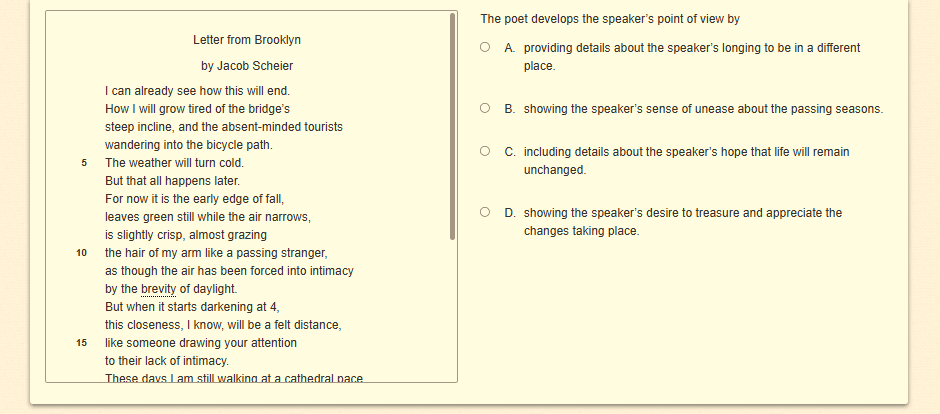
Question 31 of 53
2024 Test A English, question 10Passage Excerpt from “Impressions of an Indian Childhood”
Excerpt from “Impressions of an Indian Childhood”
by Zitkala-Sa
Zitkala-Sa (Gertrude Simmons Bonnin) was a Native American writer, musician, teacher, and political activist who was raised on the Yankton Sioux Reservation in South Dakota. In 1900 she published “Impressions of an Indian Childhood” (the term Indian was commonly used at the time to refer to Native American people) to expose readers to what life is like on a reservation.
Soon after breakfast Mother sometimes began her beadwork. On a bright, clear day, she pulled out the wooden pegs that pinned the skirt of our wigwam1 to the ground, and rolled the canvas part way up on its frame of slender poles. Then the cool morning breezes swept freely through our dwelling, now and then wafting the perfume of sweet grasses from newly burnt prairie.
Untying the long tasseled strings that bound a small brown buckskin2 bag, my mother spread upon a mat beside her bunches of colored beads, just as an artist arranges the paints upon his palette. On a lapboard she smoothed out a double sheet of soft white buckskin; and drawing from a beaded case that hung on the left of her wide belt a long, narrow blade, she trimmed the buckskin into shape. Often she worked upon small moccasins for her small daughter. Then I became intensely interested in her designing. With a proud, beaming face, I watched her work. In [my] imagination, I saw myself walking in a new pair of snugly fitting moccasins. I felt the envious eyes of my playmates upon the pretty red beads decorating my feet.
Close beside my mother I sat on a rug, with a scrap of buckskin in one hand and an awl in the other. This was the beginning of my practical observation lessons in the art of beadwork. From a skein3 of finely twisted threads of silvery sinews my mother pulled out a single one. With an awl she pierced the buckskin, and skillfully threaded it with the white sinew. Picking up the tiny beads one by one, she strung them with the point of her thread, always twisting it carefully after every stitch.
It took many trials before I learned how to knot my sinew thread on the point of my finger, as I saw her do. Then the next difficulty was in keeping my thread stiffly twisted, so that I could easily string my beads upon it. My mother required of me original designs for my lessons in beading. At first I frequently ensnared many a sunny hour into working a long design. Soon I learned from self-inflicted punishment to refrain from drawing complex patterns, for I had to finish whatever I began.
After some experience I usually drew easy and simple crosses and squares. These were some of the set forms. My original designs were not always symmetrical nor sufficiently characteristic, two faults with which my mother had little patience. The quietness of her oversight made me feel strongly responsible and dependent upon my own judgment. She treated me as a dignified little individual as long as I was on my good behavior; and how humiliated I was when some boldness of mine drew forth a rebuke from her!
In the choice of colors she left me to my own taste. I was pleased with an outline of yellow upon a background of dark blue, or a combination of red and myrtle-green. There was another of red with a bluish-gray that was more conventionally used. When I became a little familiar with designing and the various pleasing combinations of color, a harder lesson was given me. It was the sewing on, instead of beads, some tinted porcupine quills, moistened and flattened between the nails of the thumb and forefinger. My mother cut off the prickly ends and burned them at once in the centre fire. These sharp points were poisonous, and worked into the flesh wherever they lodged. For this reason, my mother said, I should not do much alone in quills until I was as tall as my cousin Warca-Ziwin.
Always after these confining lessons I was wild with surplus spirits, and found joyous relief in running loose in the open again. Many a summer afternoon a party of four or five of my playmates roamed over the hills with me. We each carried a light sharpened rod about four feet long, with which we pried up certain sweet roots. When we had eaten all the choice roots we chanced upon, we shouldered our rods and strayed off into patches of a stalky plant under whose yellow blossoms we found little crystal drops of gum. Drop by drop we gathered this nature’s rock-candy, until each of us could boast of a lump the size of a small bird’s egg. Soon satiated with its woody flavor, we tossed away our gum, to return again to the sweet roots.
From “Impressions of an Indian Childhood” by Zitkala-Sa—Public Domain
A BRIEF HISTORY OF BEADWORK IN SOUTH DAKOTA
| Date | Event |
|---|---|
| 1500s | The Dakota use beads made from bones, shells, stones, and animal teeth. European traders bring glass beads to North America. |
| Late 1600s | The Dakota begin trading with the French in Minnesota. |
| 1830s | The Dakota begin using glass beads in clothing, artwork, and decorations in place of Native-made beads. |
| 1862–1865 | The Dakota are expelled from their homelands in Minnesota as a result of the U.S.-Dakota War. |
| 1900s–1920s | The Dakota create items to sell outside their community. |
Source: MNopedia
1wigwam: hut with an arched framework of poles covered with bark, mats, or animal hides
2buckskin: leather made from the skin of a male deer
3skein: coiled length of yarn or other thread loosely wound on a reel
Question
In paragraph 1, the phrases “cool morning breezes swept freely” and “wafting the perfume of sweet grasses” affect the tone of the excerpt by suggesting
- Athe sadness that the author feels reflecting upon her former way of life.
- Bthe enthusiasm with which the author approached her work indoors.
- Cthe fond feelings that the author has toward her childhood experiences.
- Dthe mix of emotions that the author feels toward her work and her mother.
Show the answer
Correct answer: C
The question asks how the phrases “cool morning breezes swept freely” and “wafting the perfume of sweet grasses” affect the tone of the excerpt.
A. Incorrect. Although the author describes in paragraph 1 the setting of her childhood experiences, the positive wording of the phrases the author uses in the paragraph (“swept freely” and “perfume of sweet grasses”) does not suggest a tone of sadness the author feels when she reflects on her former way of life.
B. Incorrect. Although the phrases “cool morning breezes swept freely” and “wafting the perfume of sweet grasses” used in paragraph 1 create a positive tone, the phrases do not suggest an enthusiasm for the author’s work but rather suggest an appreciation of the peaceful beauty of her childhood.
C. CORRECT. In paragraph 1, the phrases “cool morning breezes swept freely” and “wafting the perfume of sweet grasses” are used to describe where the author’s childhood experiences took place. The phrases create a tone of fondness and evoke a feeling of happiness through their lyrical sensory detail: “swept freely” suggests a sense of joyful possibility, while “perfume,” “sweet,” and “cool” convey delight.
D. Incorrect. Although the author describes her mother’s beadwork lessons as “confining” in paragraph 7, the phrases in paragraph 1 do not suggest that the author feels conflicting or mixed emotions toward her work and her mother. Instead, the phrases convey a positive tone by affectionately describing the author’s childhood home.
Question analysis
This reading question asks how two sensory phrases about cool morning breezes and the scent of sweet grasses shape the tone of Zitkala-Sa's 1900 memoir of life on a Sioux reservation. Students must read the feeling behind descriptive language and decide what that feeling is directed at, since the choices pair different emotions with different subjects.
- Grade level
- Grade 7 reading and task
- Compared with grade 7
- At grade 7 Judging how sensory words shape tone is grade 7 reading work. Both phrases are quoted in the question, so little searching is needed, but the 1900 prose keeps the demand at a typical grade 7 level.
- Estimated difficulty
- Straightforward: two steps or one careful reading.
- Thinking it demands
- Depth of knowledge 2, skills and concepts · mainly analyze
- What makes it hard
- Figurative or literary language moderate
- Reading between the lines minor
- Hard words minor
- Evidence
- Answered from one paragraph or stanza
- Reading level
- Passage: about grade 8, 946 words; question and choices: about grade 7, 72 words.
- Corrected from the DOE handbook
- A misstatement of the question in the explanation was corrected.
- Students, last 30 days
- Not enough answers yet to show (it takes 10).
Why it is hard, traps and wrong answers (shows the answer)
Why it is hard
The phrases are so clearly pleasant that the real decision is what the pleasant feeling is about. They describe the wigwam on a clear morning, so the warmth belongs to the author's memory of her childhood, not to the beadwork the rest of the excerpt follows. Students who know the excerpt is about lessons tend to attach the mood to the work, and a few read sadness into any memoir.
Figurative or literary language moderate Understanding the question
The tone comes from sensory images, breezes that “swept freely” and “the perfume of sweet grasses,” which describe air and scent and leave the author's feeling to be read from them. (Graesser, Singer & Trabasso, 1994; Kintsch, 1998)
Reading between the lines minor Working it out
The phrases describe the dwelling, not the author, so her fondness for her childhood has to be inferred from how lovingly she remembers the setting. (Graesser, Singer & Trabasso, 1994; Kintsch, 1998)
Hard words minor Understanding the question
“Wafting” and “perfume,” used for the smell of grasses from newly burnt prairie, are unusual words that must be understood before the tone they create can be judged. (Perfetti, 2007; Freedle & Kostin, 1993)
Strategy: Decide what feeling the quoted words create on their own, then check what they describe: the right choice must match both the feeling and what it is about.
Traps
- Wrong tone or attitude: Misjudges the tone, attitude or point of view, such as reading admiration as criticism, or taking a character's or subject's feelings for the author's.
- Wrong part of the text: A choice is true of another paragraph, stanza or speaker than the one asked about.
The wrong answers, classified
A Wrong tone or attitude (Graesser, Singer & Trabasso, 1994)
Assumes an adult remembering a lost way of life must sound sad, but breezes that sweep freely and the perfume of sweet grasses carry delight, not grief.
B Wrong part of the text (Kirsch & Mosenthal, 1990)
Senses the positive mood but ties it to the beadwork, borrowing the interest the girl shows in paragraph 2, though these phrases describe breezes and scent, not work.
D Wrong part of the text (Kirsch & Mosenthal, 1990)
Brings in the “confining” lessons of paragraph 7 and the rebuke of paragraph 5, feelings that the two morning images of paragraph 1 do not touch.
What was corrected from the DOE handbook, and why
- Explanation: The handbook’s explanation begins by saying the question asks how the two phrases “affect the tone of paragraph 1 in the excerpt.” The phrases are in paragraph 1, but the question asks how they affect the tone of the excerpt, and the answer is about the author’s feelings toward her childhood as a whole. The explanation now reads “affect the tone of the excerpt.”
Working it out, step by step
Figure out what the question asks
This asks about tone. Tone is the feeling or attitude that a writer’s words show. You need the feeling that two phrases from paragraph 1 give the whole excerpt. An excerpt is a part taken from a longer piece.
Find the phrases in paragraph 1
Paragraph 1 describes a clear morning at home. The mother rolls up the side of the wigwam (a hut made of poles and covers). “Then the cool morning breezes swept freely through our dwelling.” A dwelling is a home. The breezes were “now and then wafting the perfume of sweet grasses.”
Work out the feeling
“Wafting” means gently carrying through the air. “Perfume” is a sweet smell. Cool air, sweet smells and breezes moving freely are all pleasant. The author is remembering her childhood home with love. That feeling is fondness, a warm liking for something.
Check each choice
- A is wrong. Nothing in these words is sad. They are bright and pleasant.
- B is wrong. The phrases describe air and smells, not her work.
- C is right. The loving details show warm feelings about her childhood.
- D is wrong. Mixed feelings, like the “confining” lessons, come later, in paragraph 7. These phrases have nothing negative in them.
Watch out: B is tempting, since the excerpt is mostly about beadwork lessons. But these two phrases describe the morning, not the work.
Choose the answer
The phrases make her childhood home feel cool, sweet and free. So the answer is C.
Why this answer and not the closest wrong one
B is the closest wrong answer, because the phrases do sound happy. But a choice must match both the feeling and what the feeling is about. These phrases describe breezes and the smell of grass at her home. That shows fond memories of her childhood, not eagerness to work.
More questions like this
The original DOE question
The passage “Excerpt from “Impressions of an Indian Childhood”” as printed (pages 42–43)
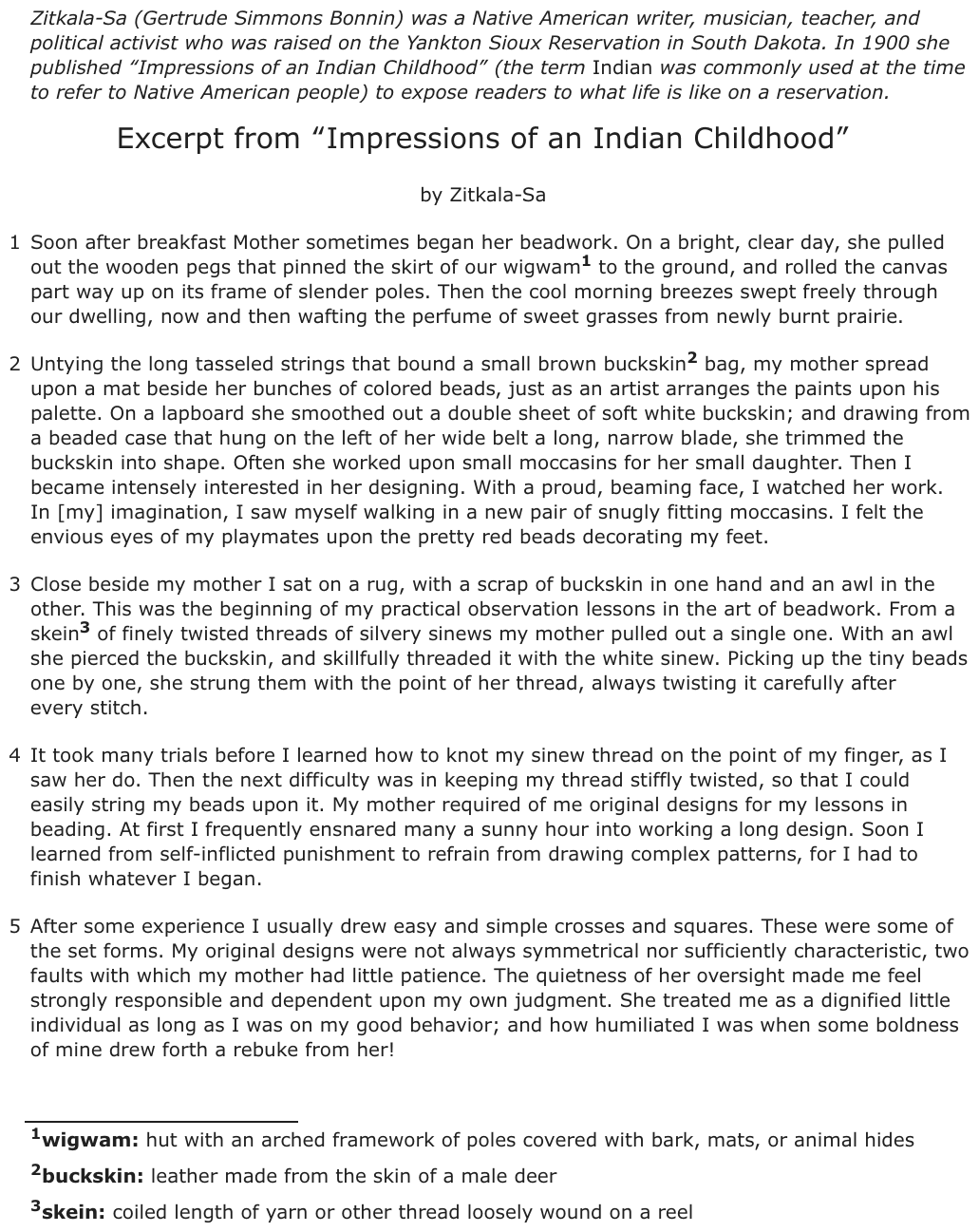
Question 32 of 53
2024 Test A English, question 22Passage At Dusk
At Dusk
by Natasha Trethewey
At first I think she is calling a child,
my neighbor, leaning through her doorway
at dusk, street lamps just starting to hum
the backdrop of evening. Then I hear
the high-pitched wheedling1 we send out
to animals who know only sound, not
the meanings of our words—here here—
nor how they sometimes fall short.
In another yard, beyond my neighbor’s
sight, the cat lifts her ears, turns first
toward the voice, then back
to the constellation of fireflies flickering
near her head. It’s as if she can’t decide
whether to leap over the low hedge,
the neat row of flowers, and bound
onto the porch, into the steady circle
of light, or stay where she is: luminous
possibility—all that would keep her
away from home—flitting before her.
I listen as my neighbor’s voice trails off.
She’s given up calling for now, left me
to imagine her inside the house waiting,
perhaps in a chair in front of the TV,
or walking around, doing small tasks;
left me to wonder that I too might lift
my voice, sure of someone out there,
send it over the lines stitching here
to there, certain the sounds I make
are enough to call someone home.
“At Dusk” from NATIVE GUARD by Natasha Trethewey, published by Houghton Mifflin Company. Copyright © 2006 by Natasha Trethewey. All rights reserved.
1wheedling: speaking in a flattering manner
Question
The phrases “luminous possibility” and “all that would keep her / away from home” (lines 17–19) affect the poem by
- Ahighlighting the cat’s lack of concern for the neighbor.
- Bimplying that the speaker finds the cat’s current situation interesting.
- Csuggesting that the cat is compelled by its sense of wonder to remain outdoors.
- Dindicating that the speaker supports the cat’s decision to ignore the neighbor.
Show the answer
Correct answer: C
The question asks how the phrases “luminous possibility” and “all that would keep her / away from home” (lines 17–19) affect the poem.
A. Incorrect. In lines 20–21, the neighbor’s voice “trails off,” and the speaker states that “she’s given up calling for now,” which could be interpreted as a lack of concern. However, these lines describe the neighbor rather than the cat. The phrases from lines 17–19 are used to explain that what keeps the cat from returning home is the allure of “luminous possibility.” The use of the phrase “all that would keep her” suggests that the cat would likely return home to the security of “the steady circle / of light” (lines 16–17) if not for the possibilities offered by the night, implying that the cat usually prefers to be at home with the neighbor. The phrases do not highlight a lack of concern for the neighbor on the part of the cat.
B. Incorrect. While the phrase “luminous possibility” does convey a high degree of interest, it is used to describe why being outside at night appeals to the cat. It does not describe the speaker’s interest in the cat. The speaker observes the cat as it tries to decide between returning home and staying out and then concludes that it is only “luminous / possibility . . . that would keep [the cat] / away from home.”
C. CORRECT. The phrases are used to explain that the cat, though tempted to return home, is also tempted or compelled by “luminous possibility” to remain outdoors. The phrases convey a sense of wonder about what the night may offer, and it is the powerful effect of this sense of wonder (“all that would keep her / away from home”) that ultimately tempts the cat to remain outdoors rather than return to the comforts of home.
D. Incorrect. Lines 17–19 present the speaker’s observations about the cat as it tries to decide whether to stay where it is or return home. The speaker explains that it is only “luminous possibility” that can convince the cat to stay rather than return to the comforts of home. While the speaker then imagines the neighbor indoors, there is no indication that the speaker supports the cat’s decision. The speaker merely notes that the neighbor stops calling to the cat “for now” (line 21), and then the speaker reflects on the possible results of calling someone home.
Question analysis
This reading question asks how the phrases luminous possibility and all that would keep her away from home, which describe what surrounds a cat in a nearby yard, affect the poem At Dusk. Students must interpret abstract, figurative wording and work out whose feelings it conveys: the cat's, the neighbor's or the speaker's.
- Grade level
- Grade 8 reading and task
- Compared with grade 7
- At grade 7 Explaining how word choice affects a poem is grade 7 work. These phrases are abstract and broken across lines, which adds some challenge, but the lines around them are concrete, so the task stays within typical grade 7 demand.
- Estimated difficulty
- Moderate: several steps, or a close reading with one strong distractor.
- Thinking it demands
- Depth of knowledge 2, skills and concepts · mainly analyze
- What makes it hard
- Figurative or literary language moderate
- Reading between the lines minor
- Complex sentences minor
- Evidence
- Answered from one paragraph or stanza
- Reading level
- Passage: 236 words (a poem; reading level not measured); question and choices: about grade 8, 63 words.
- Students, last 30 days
- Not enough answers yet to show (it takes 10).
Why it is hard, traps and wrong answers (shows the answer)
Why it is hard
The phrases belong to the speaker but describe what tempts the cat, and the choices exploit that by offering the speaker's interest or approval, or the cat's indifference to its owner. The words “all that would keep her / away from home” imply that home still pulls at the cat, so only an attraction strong enough to hold her outside fits. Students who first settle whose experience the phrases describe can rule out most choices at once.
Figurative or literary language moderate Understanding the question
“Luminous possibility” is abstract, an unnamed promise glowing in the dusk, and students must see it as what draws the cat, the counterweight to “the steady circle / of light” at home. (Graesser, Singer & Trabasso, 1994; Kintsch, 1998)
Reading between the lines minor Working it out
The phrases are the speaker's words about the cat, so students must work out that they convey the cat's pull, not the speaker's opinion or the neighbor's feelings. (Graesser, Singer & Trabasso, 1994; Kintsch, 1998)
Complex sentences minor Understanding the question
The phrases are broken across lines 17–19 and set off by dashes, so “flitting before her” is separated from “possibility” by the inserted “all that would keep her / away from home.” (Abedi & Lord, 2001; Freedle & Kostin, 1993; Messick, 1989)
Strategy: Decide first who or what the phrases describe, then keep only choices about that same subject and check that the phrases themselves show what each one claims.
Traps
- Wrong tone or attitude: Misjudges the tone, attitude or point of view, such as reading admiration as criticism, or taking a character's or subject's feelings for the author's.
- Reads too much in: A reasonable-sounding conclusion that goes further than the text allows.
The wrong answers, classified
A Reads too much in (Graesser, Singer & Trabasso, 1994)
Reads the cat's staying out as indifference to its owner, though “all that would keep her / away from home” implies home would win without the night's attractions.
B Wrong tone or attitude (Graesser, Singer & Trabasso, 1994)
Notices that “luminous possibility” is the speaker's lyrical phrase and takes it as the speaker's own interest, when it describes the wonder drawing the cat.
D Reads too much in (Graesser, Singer & Trabasso, 1994)
Assumes that describing the night so warmly means the speaker approves of the cat ignoring the neighbor, an opinion the poem never states.
Working it out, step by step
Figure out what the question asks
You need to know what two phrases do in the poem. First decide who they describe. Here they describe the cat and what pulls at her.
Find the phrases in lines 17–19
The cat could go home, “or stay where she is: luminous / possibility—all that would keep her / away from home—flitting before her.”
Work out what the words mean
“Luminous” means glowing with light. “Possibility” means what might happen. “Flitting” means darting quickly about, like the fireflies near her head. So the glowing night is full of exciting chances. It is everything that “would keep her / away from home.” That sense of wonder is what holds the cat outside.
Check each choice
- A is wrong. “All that would keep her / away from home” means home pulls at her too. She isn’t uncaring.
- B is wrong. The phrases describe what draws the cat, not how the speaker feels.
- C is right. The night’s glow and wonder tempt the cat to stay out. “Compelled” means strongly pulled.
- D is wrong. The speaker never says the cat is right to stay out.
Watch out: B is tempting because “luminous possibility” is the speaker’s own beautiful wording. But the speaker uses it to show what the cat sees.
Choose the answer
The phrases show a wonder strong enough to hold the cat outdoors. So the answer is C.
Why this answer and not the closest wrong one
B is the closest wrong answer. The speaker does choose these glowing words. But they describe the night that is “flitting before her,” the cat. They explain what keeps her “away from home.” C fits, because the phrases show the cat drawn by wonder to stay outside.
More questions like this
The original DOE question
The passage “At Dusk” as printed (page 48)
Question 33 of 53
2024 Test A English, question 31Passage Champion of the Channel
Champion of the Channel
In 1926 an editor at the London Daily News predicted that Gertrude Ederle, an American swimmer with eighteen world records and three Olympic medals, would fail in her attempt to swim across the English Channel. He claimed that “even the most uncompromising champion of the rights and capacities of women must admit that in contests of physical skill, speed and endurance they must remain forever the weaker sex.” Yet, at only nineteen years old, Ederle not only became the first woman to accomplish this feat, she also broke the men’s record by two hours. Gertrude Ederle’s triumphant swim across the English Channel was a testimony to her determination, innovative spirit, and passion for swimming.
Crossing the English Channel is a daunting task for any swimmer. At its narrowest point, the channel measures twenty-one miles across. Its icy waters hover around sixty degrees Fahrenheit, and its unruly tides and currents toss swimmers about like bobbing corks. Stinging jellyfish, seaweed, and floating debris from shipwrecks and lost cargoes present added hazards.
For decades the channel’s perils have defeated countless swimmers. Ederle, too, failed in her first attempt to cross the channel in 1925. Just six miles short of finishing, she became ill, and her coach had to haul her out of the water. Undeterred, Ederle decided to try again. Ederle knew that if she did not complete the challenge this time, she might never get the opportunity to set this record, because a rival female swimmer was preparing to make her second attempt at the crossing as well.
To prepare for the marathon swim, Ederle found ways to improve her equipment. She and her sister Meg discovered that melted candle wax perfectly sealed goggle edges, effectively waterproofing Ederle’s goggles against hammering waves. The sisters also designed a two-piece silk swimsuit for Ederle. During her first channel-crossing attempt she had worn a standard one-piece swimsuit that, after the lengthy hours of swimming across the channel, had stretched out, filling with water and creating drag, making an already challenging task almost insurmountable. Unlike the cumbersome typical bathing suit, this silk invention weighed little and allowed for easy movement.
On August 6, 1926, Ederle waded into the channel near Cape Gris-Nez, France. At first she shivered in the bone-chilling water even though she had covered her body in eight layers of grease for insulation. Her limbs felt stiff. Her strokes were irregular. Driving forward, she fought to clear her mind and find what she called her “sphere,” a place where the sea became her only companion and the shrieks of gulls and the humming of boat engines faded away. Using a new overhand stroke called the American crawl, Ederle eventually settled into a steady pace, briskly breaking through waves.
Throughout Ederle’s swim, two tugboats accompanied her. One carried newspaper reporters who wired dispatches of her progress to shore. The other, displaying a sign that read “This way, ole kid!” with an arrow pointing forward, transported her coach, family, and friends. Her coach played songs, such as “Yes, We Have No Bananas,” on a phonograph so that Ederle could time her strokes to the rhythm. Using a net, her coach also passed her baby bottles of broth for nourishment.
For hours Ederle swam, dodging debris with an amused smile. However, as she neared the English shore, a sudden fierce storm erupted. The tides and waves forced Ederle backward, and she fought the stubborn swells for several hours. The salty water caused her tongue to swell and inflamed her ears. Yet Ederle felt indescribably happy as she churned through the sea. Finally, as she neared the English shore, the storm abated, and the tide turned. No longer fighting against her, the sea pushed her toward the shore and victory.
After fourteen hours and thirty-one minutes, Ederle, on wobbly legs, stepped onto the English shore. The waiting crowd roared, honked their automobile horns, blasted their tugboat whistles, and set off flares that flashed in the sky. Ederle had swum into history.
When Ederle returned to New York, she received a parade, where thousands of people shouted “Trudy!” Not only were everyday American citizens proud of Ederle, but she also inspired them to be more active. Over the next few years, more than 60,000 people credited her with motivating them to earn their American Red Cross swimming certificates. Gertrude Ederle’s accomplishment proved to the world that with determination and passion, it was possible for a person to achieve his or her goals.
SOLO SWIMS ACROSS THE ENGLISH CHANNEL
|
Earliest Speed Records |
||
| Year | Swimmer | Time |
| 1875 | Matthew Webb (M) | 21 hours, 45 minutes |
| 1923 | Enrico Tiraboschi (M) | 16 hours, 33 minutes |
| 1926 | Gertrude Ederle (F) | 14 hours, 31 minutes |
| 1926 | Arnst Vierkotter (M) | 12 hours, 38 minutes |
| Current Speed Records | ||
| Year | Swimmer | Time |
| 2012 | Trent Grimsey (M) | 6 hours, 55 minutes |
| 2006 | Yvetta Hlavacova (F) | 7 hours, 25 minutes |
Question
Which sentence from the passage best conveys the author’s perspective regarding the impact of Ederle’s accomplishment?
- A“Undeterred, Ederle decided to try again.” (paragraph 3)
- B“For hours Ederle swam, dodging debris with an amused smile.” (paragraph 7)
- C“Yet Ederle felt indescribably happy as she churned through the sea.” (paragraph 7)
- D“Ederle had swum into history.” (paragraph 8)
Show the answer
Correct answer: D
The question asks for the sentence from the passage that best conveys the author’s perspective about the impact of Ederle’s swim.
A. Incorrect. Although this option shows Ederle’s determination to accomplish her goal, it does not convey the author’s perspective. Rather, the option reinforces Ederle’s own perspective about the challenge that she was facing.
B. Incorrect. The sentence presented in this option is incorrect because it relates to Ederle’s state of mind as she came closer to achieving her goal and does not provide details about the author’s opinion of the impact of Ederle’s accomplishment.
C. Incorrect. The sentence presented in this option is incorrect because it simply presents Ederle’s emotional state as she nears her goal and does not provide information about the author’s perspective.
D. CORRECT. This option is correct because, throughout the passage, the author emphasizes that Ederle’s accomplishment was memorable and great, which is best stated in the sentence from paragraph 8.
Question analysis
What did Gertrude Ederle's English Channel swim mean in the author's eyes? This point-of-view question asks which quoted sentence best shows the author's perspective on its impact, and because the quotations all come from the story of her attempts, students must tell the author's judgment apart from sentences reporting what Ederle did or felt.
- Grade level
- Grade 7 reading and task
- Compared with grade 7
- At grade 7 Telling an author's perspective apart from a subject's actions and moods is ordinary grade 7 point-of-view work. Each choice is a single sentence with its paragraph given, so little searching is needed and the demand is typical.
- Estimated difficulty
- Straightforward: two steps or one careful reading.
- Thinking it demands
- Depth of knowledge 2, skills and concepts · mainly analyze
- What makes it hard
- How, not what moderate
- Figurative or literary language minor
- Evidence
- Answered from several paragraphs or stanzas
- Reading level
- Passage: about grade 9, 790 words; question and choices: about grade 11, 52 words.
- Students, last 30 days
- Not enough answers yet to show (it takes 10).
Why it is hard, traps and wrong answers (shows the answer)
Why it is hard
Two tests apply at once: whose view a sentence gives, and whether that view concerns the swim's impact. Three sentences narrate Ederle herself, before the swim and in the water, and the word “Undeterred” can make the first sound like the author's praise. The five-word sentence that closes paragraph 8 is easy to skim past, because it states impact through an image rather than in plain terms.
How, not what moderate Working it out
The question asks for the author's judgment, so sentences that narrate Ederle's choices and moods, her decision to try again, her “amused smile”, her happiness in the storm, have to be set aside. (Anderson & Krathwohl, 2001)
Figurative or literary language minor Understanding the question
The only sentence about impact states it as a figure of speech, “Ederle had swum into history”, which must be read as a claim that the swim earned a lasting place. (Graesser, Singer & Trabasso, 1994; Kintsch, 1998)
Strategy: Ask of each quotation whether it reports Ederle's actions or feelings, or whether it is the author stepping back to judge what the swim meant. Only the second kind answers this question.
Traps
- Wrong tone or attitude: Misjudges the tone, attitude or point of view, such as reading admiration as criticism, or taking a character's or subject's feelings for the author's.
- True but not the answer: A choice says something accurate about the text that does not answer this question.
The wrong answers, classified
A True but not the answer (King et al., 2004; Embretson & Wetzel, 1987)
Hears the author admiring her resolve in “Undeterred”, a real touch of judgment, but it concerns her decision after the 1925 failure, not what her eventual swim meant or changed.
B Wrong tone or attitude (Graesser, Singer & Trabasso, 1994)
Takes Ederle's “amused smile” while dodging debris as the author's opinion, though it records her mood in the water and says nothing about the swim's impact.
C Wrong tone or attitude (Graesser, Singer & Trabasso, 1994)
Reads “indescribably happy” as the author's enthusiasm, but the happiness is Ederle's own, felt while she fought the storm, and it says nothing about lasting effects.
Working it out, step by step
Unpack the key words
A perspective is a point of view, the way someone sees a subject. Impact means the effect something has on the world. So you need a sentence where the author judges what Ederle’s swim meant. A sentence that only tells what Ederle did or felt won’t count.
Test each sentence two ways
Ask two questions about each choice. First, is this the author’s own judgment, or does it just tell what Ederle did or felt? Second, is it about the effect of the swim, or about something else? The right sentence passes both tests.
Check each choice
- A: “Undeterred, Ederle decided to try again” (paragraph 3) tells her choice after failing in 1925, so it comes before the swim and can’t show its effect.
- B: “dodging debris with an amused smile” (paragraph 7) shows her mood in the water.
- C: “Ederle felt indescribably happy” (paragraph 7) tells her own feelings, not the author’s view.
- D: “Ederle had swum into history” (paragraph 8) is the author stepping back to judge what the swim meant.
Watch out: Undeterred means not discouraged, so A can sound like praise from the author. But it is about her decision, not the swim’s effect.
Explain the figure of speech
“Swum into history” is a figure of speech, words that mean more than they literally say. History is not a place you can swim to. The phrase means her swim was so important that people will remember it for a long time. So the sentence judges the swim’s impact.
Choose the answer
Only choice D gives the author’s own view of what the swim achieved. So the answer is D.
Why this answer and not the closest wrong one
A is the closest wrong answer, since the word “Undeterred” holds a note of praise. But the sentence reports Ederle’s choice to try again after she failed. That happened before the big swim, so it can’t show the swim’s impact. D is the author’s own claim that the swim made history.
More questions like this
The original DOE question
The passage “Champion of the Channel” as printed (pages 56–57)
Question 34 of 53
2024 Test A English, question 45Passage Excerpt from The Highest Tide
Excerpt from The Highest Tide
by Jim Lynch
The narrator’s summer job is collecting marine specimens in Puget Sound, Washington. In this excerpt, he is looking for specimens in the mudflats before daybreak. Mudflats, or flats, are coastal landforms created when sediment and silt from tides are deposited as the tides recede.
I rounded the oyster beds, to the far side. . . . It was low tide by then, and I saw the water hesitating at its apex, neither leaving nor returning, patiently waiting for the gravitational gears to shift. Dozens of anxious clams started squirting in unison like they did whenever vibrating grains of sand warned them predators were approaching. I stopped and waited with them, to actually see the moment when the tide started returning with its invisible buffet of plankton for the clams, oysters, mussels and other filter feeders. It was right then, ankle deep in the Sound, feet numbing, eyes relaxed, that I saw the nudibranch.1
In all my time on the flats I’d never seen one before. I’d read about them, sure. I’d handled them at aquariums but never in the wild, and I’d never even seen a photo of one this stunning. It was just three inches long but with dozens of fluorescent, orange-tipped hornlike plumes jutting from the back of its see-through body that appeared to be lit from within.
Nudibranchs are often called the butterflies of the sea, but even that understates their dazzle. Almost everything else in the northern Pacific is dressed to blend with pale surroundings. Nudibranchs don’t bother, in part because they taste so lousy they don’t need camouflage to survive. But also, I decided right then, because their beauty is so startling it earns them a free pass, the same way everyday life brakes for peacocks, parade floats. . . .
The dark mudflats loomed like wet, flattened dunes stretching deep into Skookumchuck Bay in front of our house. From a distance, they looked too barren to support sea life. Up close, they still did, unless you knew where to find the hearty clams, worms and tiny creatures that flourish in mud. . . . I’m not sure why I decided to take a look. It was still an hour before sunrise, and I knew exactly what the bars2 looked like in the moonlight, but for some reason, I couldn’t resist.
I heard it long before I saw it. It was an exhale, a release of sorts, and I instantly wondered if a whale was stranded again. We had a young minke3 stuck out there two summers prior, and it made similar noises until the tide rose high enough for rescuers to help free it. . . . I looked for a hulking silhouette but couldn’t find one. I waited, but there were no more sounds. Still, I went toward what I thought I’d heard, avoiding stepping into the mud until I had to. I knew the flats well enough to know I could get stuck just about anywhere. The general rule was you didn’t venture out past the shells and gravel with an incoming tide. I sank up to my knees twice, and numbing water filled my boots.
. . . I kept stepping toward the one sound I’d heard, a growing part of me hoping I’d find nothing at all. When I stopped to rest and yank up my socks, my headlamp crossed it. My first thought? A giant octopus.
Puget Sound has some of the biggest octopi in the world. They often balloon to a hundred pounds. Even the great Jacques Cousteau4 himself came to study them. But when I saw the long tubular shape of its upper body and the tangle of tentacles below it, I knew it was more than an octopus. I came closer, within fifty feet, close enough to see its large cylindrical siphon5 quiver. I couldn’t tell if it was making any sounds at that point, because it was impossible to hear anything over the blood in my ears. . . .
The creature’s body came to a triangular point above narrow fins that lay flat on the mud like wings, but it was hard to be sure exactly where it all began or ended, or how long its tentacles truly were, because I was afraid to pry my eyes off its jumble of arms for more than half a second. I didn’t know whether I was within reach, and its arms were as big around as my ankle and lined with suckers the size of half-dollars. If they even twitched I would have run. So, I was looking at it and not looking at it while my heart spangled my vision. I saw fragments, pieces, and tried to fuse them in my mind but couldn’t be certain of the whole. I knew what it had to be, but I wouldn’t allow myself to even think the two words. Then I gradually realized the dark shiny disc in the middle of the rubbery mass was too perfectly round to be mud or a reflection.
It was too late to smother my scream. Its eye was the size of a hubcap.6
From THE HIGHEST TIDE by Jim Lynch. Copyright © 2005 by Jim Lynch. Used by permission of Bloomsbury USA. All rights reserved.
1nudibranch: type of sea slug
2bars: sandbars
3minke: species of small whale
4Jacques Cousteau: renowned French oceanographer
5siphon: tube-like organ that is used for drawing in or removing fluids
6hubcap: removable cap over the end of a wheel axle
Question
The narrator’s actions in paragraph 5 reveal that he is
- Aexpecting to see the familiar sight of a stranded minke.
- Bconfident about exploring farther into the mudflats.
- Cunconcerned about becoming stuck in the mudflats.
- Ddetermined to discover the source of the sound.
Show the answer
Correct answer: D
The question asks what the narrator’s actions in paragraph 5 reveal about him.
A. Incorrect. The paragraph begins with the narrator wondering “if a whale was stranded again” because of one that had gotten stuck before and had “made similar noises.” However, the narrator explains that he “looked for a hulking silhouette but couldn’t find one” before he “went toward what [he] thought [he’d] heard,” so readers can conclude that he continues to walk through the dangerous mudflats not because he expects to find a whale but because he is curious to find out what made the noise.
B. Incorrect. The fact that the narrator knows about a whale that was stranded on the mudflats “two summers prior” indicates that he is familiar with the area, and he does mention that he has some knowledge of the mudflats. However, in the paragraph, he reveals that his knowledge is of the dangers there: “I knew the flats well enough to know I could get stuck just about anywhere.” He also explains that as he moves, he avoids “stepping into the mud until [he] had to.” The fact that he acknowledges the danger and tries to avoid it indicates that he is cautious rather than confident.
C. Incorrect. In the paragraph, the narrator’s recollection that even though he could not see the silhouette of a whale, “still, [he] went toward what [he] thought [he’d] heard” might make him seem unconcerned about getting stuck. However, even as he continues, he moves carefully, avoiding “stepping into the mud until [he] had to” because he knows the mudflats “well enough to know [he] could get stuck just about anywhere.”
D. CORRECT. In the paragraph, the narrator describes the dangers of walking on the mudflats by stating that he “knew the flats well enough to know [he] could get stuck just about anywhere,” but he continues walking toward the sound. Despite knowing the dangers, he still “went toward what [he] thought [he’d] heard,” and this shows that he is determined to find out what made the sound.
Question analysis
This inference question asks what the narrator's actions reveal about him when he hears a strange sound on the mudflats before dawn and sets off toward it. Students must read what he does alongside what he says he knows about the flats, and several choices fit one detail of the paragraph but not the whole of it.
- Grade level
- Grade 7 reading and task
- Compared with grade 7
- At grade 7 Inferring a character's trait from actions is core grade 7 literary reading. The evidence sits in one paragraph and the actions are concrete, so the item is typical, though the long paragraph mixes memory, rules and movement.
- Estimated difficulty
- Straightforward: two steps or one careful reading.
- Thinking it demands
- Depth of knowledge 2, skills and concepts · mainly understand
- What makes it hard
- Reading between the lines moderate
- Much to keep track of minor
- Evidence
- Answered from one paragraph or stanza
- Reading level
- Passage: about grade 6, 902 words; question and choices: about grade 8, 41 words.
- Students, last 30 days
- Not enough answers yet to show (it takes 10).
Why it is hard, traps and wrong answers (shows the answer)
Why it is hard
Paragraph 5 shows two things at once, a narrator who knows exactly how dangerous the flats are and one who keeps walking toward a sound anyway. Choices that see only the walking call him confident or unconcerned, and the one that sees only his first thought has him expecting a whale. The word “Still”, after his search for a silhouette comes up empty, is the hinge that shows determination.
Reading between the lines moderate Working it out
The trait is never named; it must be drawn from what he does, especially “Still, I went toward what I thought I'd heard” after seeing nothing and hearing nothing more. (Graesser, Singer & Trabasso, 1994; Kintsch, 1998)
Much to keep track of minor Working it out
The paragraph mixes a memory of the stranded minke, a rule about incoming tides and his own steps, and the student must keep his caution and his persistence in view together. (Sweller, 1988; Carpenter, Just & Shell, 1990)
Strategy: List what the narrator does in paragraph 5, step by step, and note what he knows while doing it; then ask what those actions, taken together, say about him.
Traps
- Wrong tone or attitude: Misjudges the tone, attitude or point of view, such as reading admiration as criticism, or taking a character's or subject's feelings for the author's.
- Twists what the text says: Uses the text's topic and ideas but changes what it says: who did it, how much, when, or why.
The wrong answers, classified
A Twists what the text says (King et al., 2004)
Builds on his first thought that a whale was stranded again, but he finds no silhouette and keeps going, and one stranding two summers before hardly makes it a familiar sight.
B Wrong tone or attitude (Graesser, Singer & Trabasso, 1994)
Reads “I knew the flats well” as confidence, but he knew them well enough to know he could get stuck anywhere, which is wariness, not confidence.
C Wrong tone or attitude (Graesser, Singer & Trabasso, 1994)
Takes his pressing on as indifference, ignoring that he avoids stepping into the mud until he has to because he knows how easily he could sink.
Working it out, step by step
Know what the question asks
This asks you to make an inference about a character. You judge what the narrator is like from what he does. The text never names the trait, so look closely at his actions.
List his actions in paragraph 5
He hears a sound and wonders if a whale is stranded. He “looked for a hulking silhouette but couldn’t find one.” He waits, but hears nothing more. Then he says, “Still, I went toward what I thought I’d heard.” He sinks to his knees twice, and cold water fills his boots.
Notice what he knows
He knows the danger. He says, “I knew the flats well enough to know I could get stuck just about anywhere.” The word “Still” matters here. It means even so. Even with no whale in sight and no more sounds, he keeps heading toward the noise.
Check each choice
- D fits: he keeps going toward the sound despite the danger, so he is determined to find its source.
- A is wrong because he finds no whale and keeps going, and one stranding two summers ago is not a familiar sight.
- B is wrong because knowing he could get stuck anywhere makes him careful, not confident.
- C is wrong because he avoids “stepping into the mud until I had to,” so he does worry about getting stuck.
Watch out: B and C notice only that he keeps walking. They miss how carefully he moves.
Choose the answer
He presses on toward the sound even though he knows the mud is dangerous. So the answer is D.
Why this answer and not the closest wrong one
B comes closest, because he says he knows the flats well. But what he knows is how easily he could get stuck, so he is careful, not confident. Pressing on anyway, after seeing nothing and hearing nothing more, shows determination.
More questions like this
The original DOE question
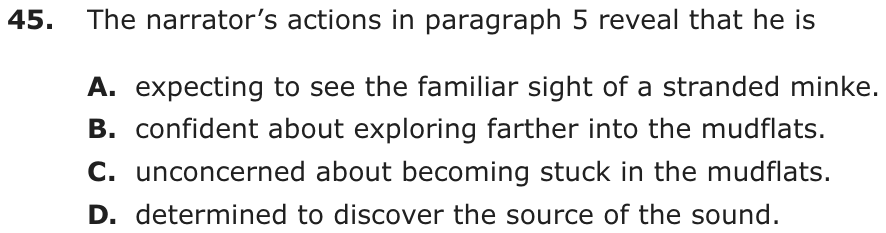
The passage “Excerpt from The Highest Tide” as printed (pages 64–65)
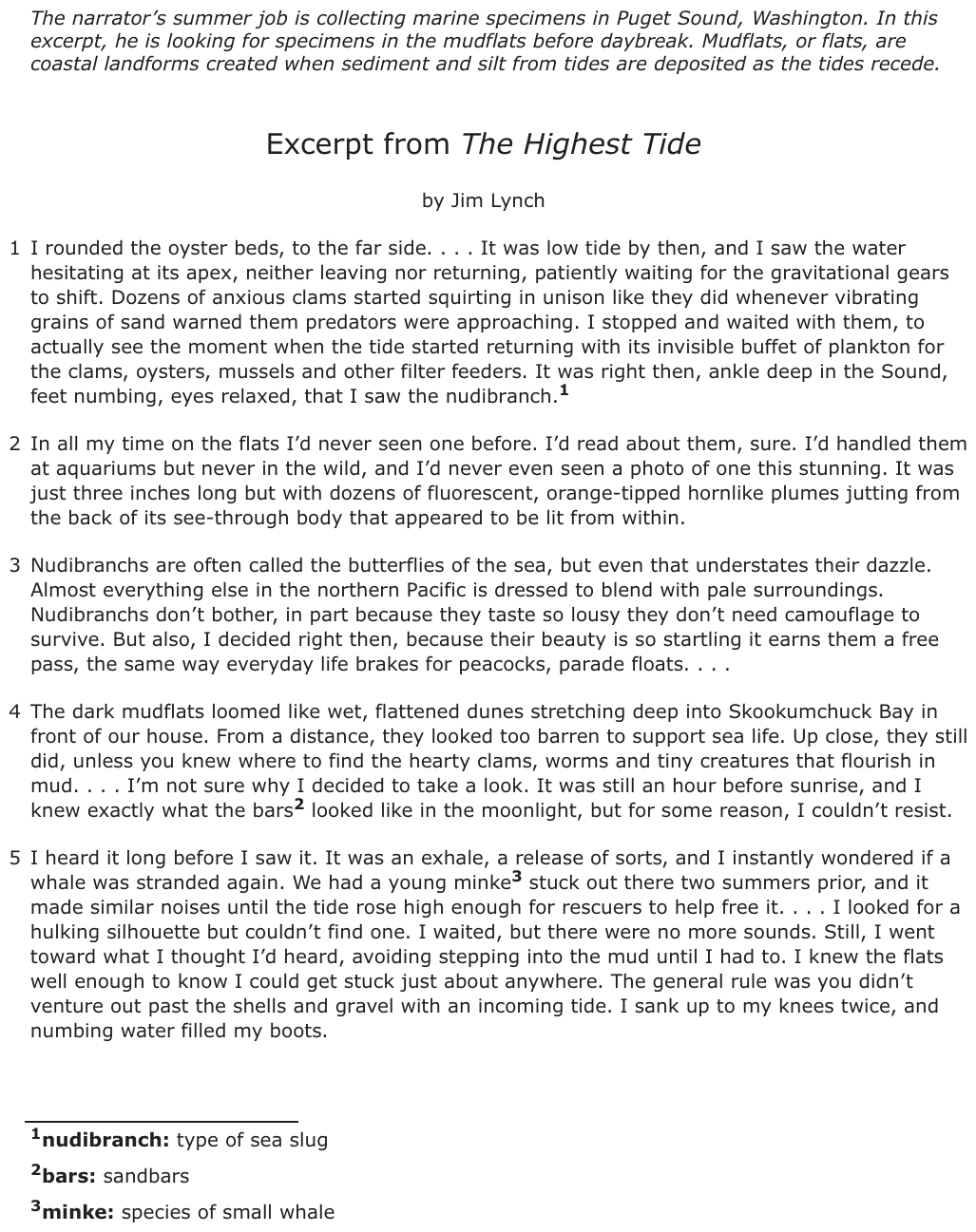
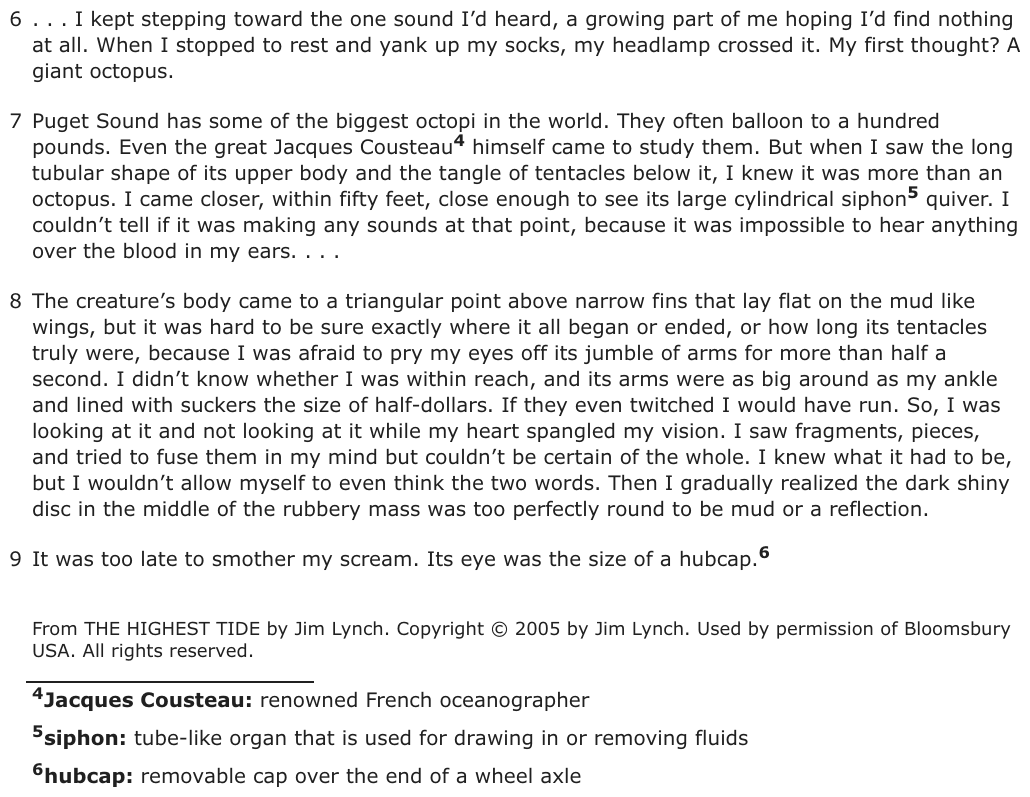
Question 35 of 53
2024 Test A English, question 49Uses the passage above: “Excerpt from The Highest Tide”.
Question
Read these sentences from paragraph 8.
So, I was looking at it and not looking at it while my heart spangled my vision. I saw fragments, pieces, and tried to fuse them in my mind but couldn’t be certain of the whole.
The sensory language “spangled my vision,” “I saw fragments, pieces,” and “tried to fuse them in my mind” conveys the narrator’s
- Aextreme excitement about making a great discovery.
- Breluctant acceptance that he needs to leave the mudflats.
- Cterrified confusion about the creature in the mudflats.
- Dsudden concern about his personal safety.
Show the answer
Correct answer: C
The question asks what the sensory language in the sentences from paragraph 8 conveys about the narrator.
A. Incorrect. While the narrator does not leave the mudflats and is curious about what has been found, the main emotions described in paragraph 8 are fear and confusion as the narrator tries to comprehend the size of the animal.
B. Incorrect. The language focuses on the narrator’s inability to organize what he sees into useful thoughts and conclusions, and while the narrator feels fear in paragraph 8—“I was afraid” and “I would have run”—the narrator refuses to leave the mudflats out of curiosity.
C. CORRECT. The phrase “spangled my vision” illustrates that the narrator cannot fully recognize what has appeared on the mudflats. The sight is so amazing, the narrator is trying to “fuse” together “fragments” and “pieces” because seeing the creature has created so much emotion in the narrator that he feels confused.
D. Incorrect. While the narrator is feeling some fear, as expressed in paragraph 8, the phrases actually indicate that the narrator’s amazement causes him to struggle to take in the view of the creature before him.
Question analysis
This question about sensory language asks what three phrases, including “spangled my vision,” convey about the narrator as he stares at a huge creature in the mud in an excerpt from The Highest Tide. Students must interpret unusual imagery and choose among emotions that all seem possible at such a startling moment.
- Grade level
- Grade 8 reading and task
- Compared with grade 7
- Above grade 7 Interpreting sensory language for a character's state of mind is grade 7 work, but spangled is an unusual verb, and the paragraph partly supports several of the emotions offered, so the choice must be matched precisely to the quoted phrases.
- Estimated difficulty
- Hard: combines ideas, needs a plan, and has more than one tempting wrong answer.
- Thinking it demands
- Depth of knowledge 2, skills and concepts · mainly analyze
- What makes it hard
- Figurative or literary language major
- A very close wrong answer moderate
- Hard words minor
- Evidence
- Answered from one paragraph or stanza
- Reading level
- Passage: about grade 6, 902 words; question and choices: about grade 7, 92 words.
- Students, last 30 days
- Not enough answers yet to show (it takes 10).
Why it is hard, traps and wrong answers (shows the answer)
Why it is hard
The quoted phrases are about perception, not feeling: the narrator sees fragments and cannot assemble them, while his heart pounds hard enough to blur his sight. The fear is clear from the surrounding sentences, where he is afraid to look away and ready to run, and that context makes the choice about personal safety very tempting. The answer must cover both the terror and the confusion, and the word “spangled” can mislead readers into hearing excitement.
Figurative or literary language major Understanding the question
The phrases describe seeing in pieces, “looking at it and not looking at it”, a heart that “spangled” his vision, “fragments” he cannot “fuse”, and the emotion has to be read from that broken sight. (Graesser, Singer & Trabasso, 1994; Kintsch, 1998)
A very close wrong answer moderate Choosing the answer
The right choice and the one about concern for his safety both name fear; they part on what the quoted phrases show, a mind unable to piece the creature together or a worry about its reach. (Embretson & Wetzel, 1987; Gorin & Embretson, 2006; Ascalon et al., 2007)
Hard words minor Understanding the question
“Spangled”, to scatter with glittering spots, is a rare word, and its sparkle can suggest delight, which opens a reading of excitement to students who miss the fear around it. (Perfetti, 2007; Freedle & Kostin, 1993)
Strategy: Ask what the three quoted phrases together say about how the narrator is seeing and thinking at this moment, then choose the emotion that accounts for all three, not just one.
Traps
- True but not the answer: A choice says something accurate about the text that does not answer this question.
- Wrong tone or attitude: Misjudges the tone, attitude or point of view, such as reading admiration as criticism, or taking a character's or subject's feelings for the author's.
The wrong answers, classified
A Wrong tone or attitude (Graesser, Singer & Trabasso, 1994)
Reads the pounding heart and glittering vision as the thrill of a great find, missing that he is afraid to take his eyes off the creature and cannot make sense of it.
B Twists what the text says (King et al., 2004)
Turns “If they even twitched I would have run”, a possibility, into an accepted need to leave, though the narrator stays and the phrases describe how he sees.
D True but not the answer (King et al., 2004; Embretson & Wetzel, 1987)
Matches the fear in paragraph 8, where he wonders whether he is within reach, but the quoted phrases describe broken seeing and puzzling, and his fear has been building, not sudden.
Working it out, step by step
Know what the question asks
Sensory language describes what a character sees, hears or feels. This asks what feeling the three quoted phrases show. Your answer must explain all three phrases, not just one.
Explain the hard words
To spangle means to cover with glittering spots. His heart pounds so hard that his sight seems to sparkle and blur. Fragments are small broken pieces. To fuse means to join together.
Put the phrases together
He sees only “fragments, pieces.” He tries “to fuse them in my mind” but “couldn’t be certain of the whole.” So he is confused, unable to tell what the creature really is. The sentences around them show he is also terrified. He is “afraid to pry my eyes off” its arms, and his heart is racing.
Check each choice
- C fits: “terrified confusion” covers both his fear and his broken, puzzled seeing.
- A is wrong because “spangled” may sound happy, but he is frightened, not thrilled.
- B is wrong because he never decides to leave, and he would run only if the arms moved.
- D is wrong because the phrases show confused seeing, and his fear has been growing since paragraph 6.
Watch out: D is close, since he is afraid. But it leaves out the confusion the phrases show.
Choose the answer
The phrases show a frightened narrator who cannot piece together what he sees. So the answer is C.
Why this answer and not the closest wrong one
D comes closest, because the narrator truly fears for his safety. But the quoted phrases are about how he sees: in pieces he can’t join. That is confusion. C names both the fear and the confusion, so it fits all three phrases.
More questions like this
The original DOE question
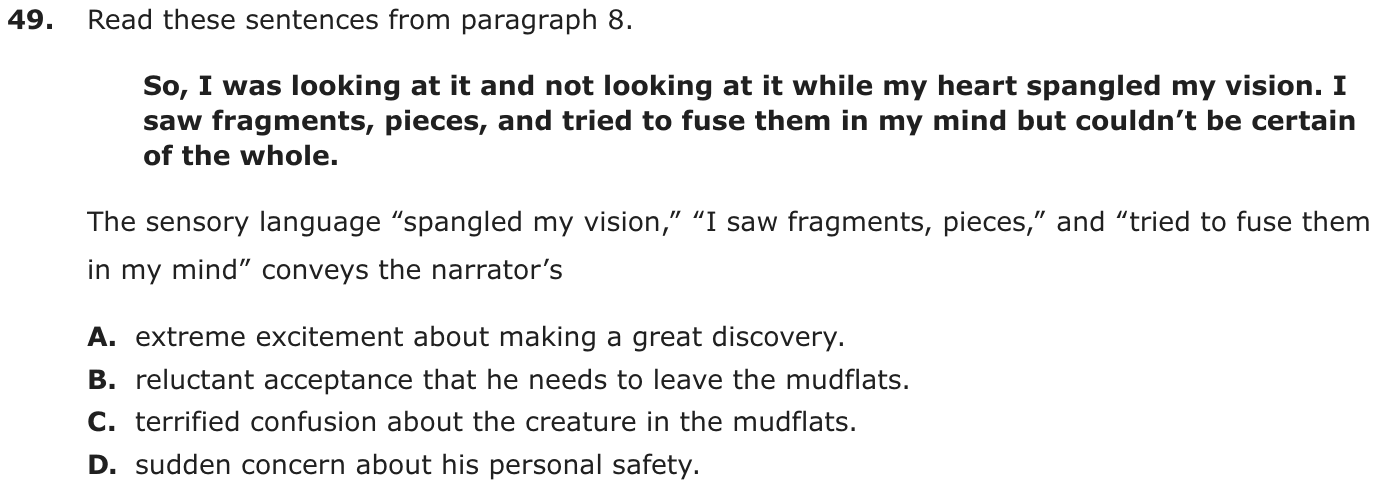
Question 36 of 53
2024 Test B English, question 30Passage Excerpt from Do Them No Harm!
Excerpt from Do Them No Harm!
by Zoa L. Swayne
This narrative is about the Nez Perce, an American Indian tribe, in what is now northern Idaho. The tribe is preparing for a gathering before the coming winter.
In the moon of Ta-Yum, the hottest days of summer, when salmon spawn in the little streams and huckleberries ripen in the high mountains, people from many villages of the Chopunnish Nation gathered in the Oyaip Prairie for the work and festivities of their annual camas1 harvest.
From far and near The People came. . . .
Should a stranger enter their homeland and ask, “Where are you from?” the reply was always, “We are Nee-mee-poo, The People who live here in this place.”
It was a time of Lawtiwa-mah-ton—a time of being friends together—when The People came for this last chance to enjoy being together before the Cold Moons kept them close to their fires. The visiting and trading, the foot racing and horse racing, and the gambling and stick games would be remembered and talked about long after they had forgotten the drudgery of digging and roasting camas, picking berries, or drying meat and fish. Lawtiwa-mah-ton! It was good to be friends together.
As was their custom since wahk-kee-ma, a time far back beyond the memory of man, they set up their camps in the same locations their parents and grandparents had occupied before them. Red Bear’s people, from Kamiah, made their camp near the trail that came out of the mountains. Their neighbors in Kamiah Valley, The People from Tee-e-lap-a-lo, had their camp close by. Across the wide meadow, by the great roasting pits, the camps of the Te-wap-poo and Ask-kah-poo were located. The tepees and ish-nash, brush shelters, of other groups nestled in their accustomed areas in and among the pines in such numbers that they encircled the entire meadow land.
Red Bear’s people had traveled all summer with neighboring bands, gathering and preparing roots, picking and drying berries, drying and smoking meat and fish for their winter food supply. Now they were at the Oyaip camp. The women worked hard to dig and cure as many bags of roots as they could during the warm, sunny days, for the sharp night air brought warnings that WARM was going and COLD was coming.
Everyone helped in some way. Most of the men fished or hunted for meat. While many of the women dug and roasted camas, other women and older children picked and dried berries.
And the younger children played. They played at hunting. They played with the babies. They played with their horses and puppies. They learned how to live through their play.
This sun, happiness, peace, and quiet blessed the Red Bear camp. All were busy with their daily tasks, until sudden cries came from the children playing by the trail.
“People coming! People coming! People coming on the trail from the high mountains!” they called as they ran to their elders, who looked sharply at the figures of approaching horsemen.
Were they friends or enemies? Did they bring good news or bad?
“Who can it be? What brings them here?” were the questions in every mind.
“Could they be the four hunters who had gone to Buffalo Country two summers past? Would they have news of the families who had gone long ago to Buffalo Country and never returned?”
It was customary for a hunting party to be gone for more than one season.
“Looks like hunters,” the older men agreed. “Looks like they had good hunting. Maybe our four hunters. [They have] been gone many moons.”
“Looks like five people—not four,” others observed.
Excitement grew as the riders came close enough to be recognized.
“A-a-a-a-a, they are our four hunters! But who is the fifth person?” they asked.
“Looks like a woman. Who is she?”
The hunters rode up to the welcoming crowd, proud to show off the loads of meat, hides, and other trophies of their hunt. They paraded around the encampment for all to see how strong their Hunting Power had been—what great hunters they, themselves, were.
Red Bear’s people rejoiced at their hunters’ success. Good hunters brought good to everybody. The meat meant plenty of food and the hides meant soft-tanned robes to give comfort through the Cold Moons. But it was the sight of the frail figure of the woman that aroused their curiosity. Who was she? Where had she come from? . . .
“Belongs to Red Bear people. Gone then come back,” the hunters said, as they dismounted and unloaded their packs. . . .
Now they could see! She was the daughter of the family gone so long ago! The girl-child who had left came back now—a grown woman.
“Wat-ku-ese!” the women cried. “Gone-from-Home-then-Come-Back. Wat-ku-ese!” And Wat-ku-ese was her name from that time on.
Gentle arms lifted Wat-ku-ese from her horse. The women brought her food and made a place for her to rest. For many suns they cared for her until she became stronger.
One evening Wat-ku-ese told her story for all to hear.
From DO THEM NO HARM!: Lewis and Clark Among the Nez Perce by Zoa L. Swayne. Published by Caxton Press. Copyright © 1990 by Zoa L. Swayne. Orofino, Idaho and Legacy House, Inc. Orofino, Idaho. All rights reserved.
1camas: a wild, edible plant
Question
Read these sentences from paragraph 22.
“Belongs to Red Bear people. Gone then come back.”
How does this statement affect the villagers in the excerpt?
- AIt increases their concern about why the woman is in their camp.
- BIt makes them hopeful that more lost members will return before the winter.
- CIt causes shock, leading them to grieve for the loss of the woman and her family.
- DIt inspires amazement, making them want to reconnect with their returned family member.
Show the answer
Correct answer: D
The question asks how the statement from paragraph 22 affects the villagers in the excerpt.
A. Incorrect. In paragraph 21, the villagers question who the woman is and from where she has come, but they are merely curious about her and not necessarily concerned, as there is no indication in paragraph 22 that she might be a threat.
B. Incorrect. This statement reveals that the woman is a member of the Red Bear people who has returned, and in paragraph 15 there is a reference to four hunters who have been gone a long time. However, this statement serves only to satisfy the villagers’ curiosity about who this woman is; it does not make the villagers hopeful that other people will also return.
C. Incorrect. Though paragraph 23 reveals that the villagers are somewhat surprised because the girl has grown into a woman, paragraph 24 suggests they are excited to receive her. There is no reason given in paragraph 22 for them to grieve for her loss, since she has returned.
D. CORRECT. The hunters’ words from paragraph 22 amaze the villagers, who do not at first recognize the woman. Once they know she is one of their own, they are eager to interact with her, as revealed in paragraphs 24 and 25, where they give her a new name and care for her.
Question analysis
This question quotes the hunters’ brief words about the frail woman who rides into camp with them, “Belongs to Red Bear people. Gone then come back,” and asks how the statement affects the villagers. Students must follow the scene that comes next and judge the villagers’ feelings from what they shout and do, since the excerpt never names those feelings directly.
- Grade level
- Grade 7 reading and task
- Compared with grade 7
- At grade 7 Explaining how a line of dialogue affects characters is grade 7 story analysis. The hunters’ words are short and the response follows at once, so the main demand is inferring the villagers’ state of mind, a routine grade 7 step.
- Estimated difficulty
- Straightforward: two steps or one careful reading.
- Thinking it demands
- Depth of knowledge 2, skills and concepts · mainly analyze
- What makes it hard
- Reading between the lines moderate
- Evidence
- Answered from several paragraphs or stanzas
- Reading level
- Passage: about grade 5, 885 words; question and choices: about grade 6, 78 words.
- Students, last 30 days
- Not enough answers yet to show (it takes 10).
Why it is hard, traps and wrong answers (shows the answer)
Why it is hard
The hunters’ words answer the question the crowd has been asking, who the woman is, and what follows is recognition and welcome. Students who carry over an earlier mood, worry about strangers or sadness at a long absence, misread the moment. The hopeful-sounding choice about more members returning goes one step past the text, which shows joy over this return and nothing about others.
Reading between the lines moderate Working it out
The villagers’ reaction is never named; it is shown in paragraphs 23–25, where “Now they could see!”, the women cry out her new name and gentle arms lift her from her horse. (Graesser, Singer & Trabasso, 1994; Kintsch, 1998)
Strategy: Read the paragraphs right after the hunters speak and note what the villagers say and do. Then choose the reaction those words and actions show.
Traps
- Wrong tone or attitude: Misjudges the tone, attitude or point of view, such as reading admiration as criticism, or taking a character's or subject's feelings for the author's.
- Reads too much in: A reasonable-sounding conclusion that goes further than the text allows.
The wrong answers, classified
A Wrong tone or attitude (Graesser, Singer & Trabasso, 1994)
Carries over the worry of paragraph 11, friends or enemies, though by now the hunters vouch for the woman and the statement removes any reason for concern.
B Reads too much in (Graesser, Singer & Trabasso, 1994)
Connects the return to paragraph 13’s wish for news of families who never came back, then assumes hope that others will follow, which the excerpt never shows.
C Wrong tone or attitude (Graesser, Singer & Trabasso, 1994)
Rightly senses surprise but reads it as grief, prompted by the woman’s frail figure and long absence, though the women cry out her new name and care for her.
Working it out, step by step
Figure out what the question asks
The hunters say: “Belongs to Red Bear people. Gone then come back.” This asks how those words affect the villagers. The story doesn’t name their feelings. So look at what they say and do next.
See what happens next
- Paragraph 23: “Now they could see! She was the daughter of the family gone so long ago!”
- Paragraph 24: the women cry out “Wat-ku-ese!” This becomes her new name.
- Paragraph 25: “Gentle arms lifted Wat-ku-ese from her horse.” The women bring her food and care for her.
Name the feelings
The exclamation points in paragraph 23 show surprise and wonder. A little girl has come back as a grown woman, and they can hardly believe it. That is amazement. Then they give her a name, feed her and care for her. They want to bring her back into the family. That is reconnecting, or becoming close again.
Check each choice
- D fits: amazement, then wanting to reconnect.
- A: the hunters say she belongs to the Red Bear people. That ends any worry.
- B: nothing says they hope others will return before winter.
- C: they are surprised, but they don’t grieve, or feel deep sadness. They cheer and care for her.
Watch out: C is tempting because she is frail and was gone a long time. But the women’s actions are happy and gentle.
Pick the answer
The villagers are amazed, and they rush to welcome her back home. So the answer is D.
Why this answer and not the closest wrong one
C is the closest wrong answer, because the news is a shock and the woman is frail. But nobody mourns. The women shout her new name, and “Gentle arms lifted Wat-ku-ese from her horse.” Those are signs of joy and care. That matches D, amazement and a wish to reconnect.
More questions like this
The original DOE question
The passage “Excerpt from Do Them No Harm!” as printed (pages 177–178)
Question 37 of 53
2024 Test B English, question 36Passage Invention of the Telegraph
Samuel Morse, an American inventor, is credited with creating the electronic telegraph, a communication device that allows users to send messages using a system of short and long pulses that represent letters, numbers, and punctuation. In 1843 the United States Congress passed the Telegraph Bill, which provided Morse with the funds to build an electric telegraph system.
Invention of the Telegraph
Earlier Signal Systems
Long before Samuel F. B. Morse electrically transmitted his famous message “What hath God wrought?” from Washington to Baltimore on May 24, 1844, there were signaling systems that enabled people to communicate over distances. Most were visual or “semaphore” systems using flags or lights. In the eighteenth century, such systems used an observer who would decipher a signal from a high tower on a distant hill and then send it on to the next station. The young American republic wanted just such a system along its entire Atlantic coast and offered a prize of $30,000 for a workable proposal. The framers of this legislation had no way of knowing that when they used the word “telegraph” to refer to this visual semaphore system, they would be offered an entirely new and revolutionary means of communication—electricity.
The Growth of an Idea
The idea of using electricity to communicate over distance is said to have occurred to Morse during a conversation aboard ship when he was returning from Europe in 1832. Michael Faraday’s recently invented electromagnet was much discussed by the ship’s passengers, and when Morse came to understand how it worked, he speculated that it might be possible to send a coded message over a wire. While a student at Yale College years before, he had written his parents a letter about how interesting he found the lectures on electricity. Despite what he had learned at Yale, Morse found when he began to develop his idea that he had little real understanding of the nature of electricity, and after sporadic attempts to work with batteries, magnets, and wires, he finally turned for help to a colleague at the University of the City of New York, Leonard D. Gale.
Gale was a professor of chemistry and familiar with the electrical work of Princeton’s Joseph Henry, a true pioneer in the new field. Well before Morse had his shipboard idea about a telegraph, Henry rang a bell at a distance by opening and closing an electric circuit. In 1831, he had published an article, of which Morse was unaware, that contained details suggesting the idea of an electric telegraph. Gale’s help and his knowledge of this article proved crucial to Morse’s telegraph system because Gale not only pointed out flaws in the system but showed Morse how he could regularly boost the strength of a signal and overcome the distance problems he had encountered by using a relay system Henry had invented. Henry’s experiments, Gale’s assistance, and, soon after, hiring the young technician Alfred Vail were keys to Morse’s success.
Obstacles and Opportunities
By December 1837, Morse had enough confidence in his new system to apply for the federal government’s appropriation, and during the next year he conducted demonstrations of his telegraph both in New York and Washington.
However, when the economic disaster known as the Panic of 1837 took hold of the nation and caused a long depression, Morse was forced to wait for better times. It was during this period that Morse visited Europe again and tried not only to secure patent protection overseas but to examine competing telegraph systems in England. . . .
By 1843, the country was beginning to recover economically, and Morse again asked Congress for the $30,000 that would allow him to build a telegraph line from Washington to Baltimore, forty miles away. The House of Representatives eventually passed the bill containing the Morse appropriation, and the Senate approved it in the final hours of that Congress’s last session. With President Tyler’s signature, Morse received the cash he needed and began to carry out plans for an underground telegraph line.
Realizing a Great Invention
Morse had hired the ingenious construction engineer Ezra Cornell to lay the pipe carrying the wire, and although Cornell did his job superbly, one of Morse’s partners, Congressman F. O. J. Smith, had purchased wire with defective insulation. Too much time had been wasted laying bad wire, and with the project on a rigid deadline, something had to be done quickly. Cornell suggested that the fastest and cheapest way of connecting Washington and Baltimore was to string wires overhead on trees and poles. The desperate Morse gave the go-ahead, and the line was completed in time for the dramatic and spectacularly successful link between the Supreme Court chamber of the Capitol building and the railroad station in Baltimore.
Soon, as overhead wires connected cities up and down the Atlantic coast, the dots-and-dashes method that recorded messages on a long moving strip of paper was replaced by the operator’s ability to interpret the code in real time. . . . Telegraph lines soon extended westward, and within Morse’s own lifetime they connected the continents of Europe and America.
“Invention of the Telegraph”—Public Domain/Library of Congress
legislation: Telegraph Bill
dots-and-dashes method: the short and long pulses of Morse code that are sent and received by telegraph operators
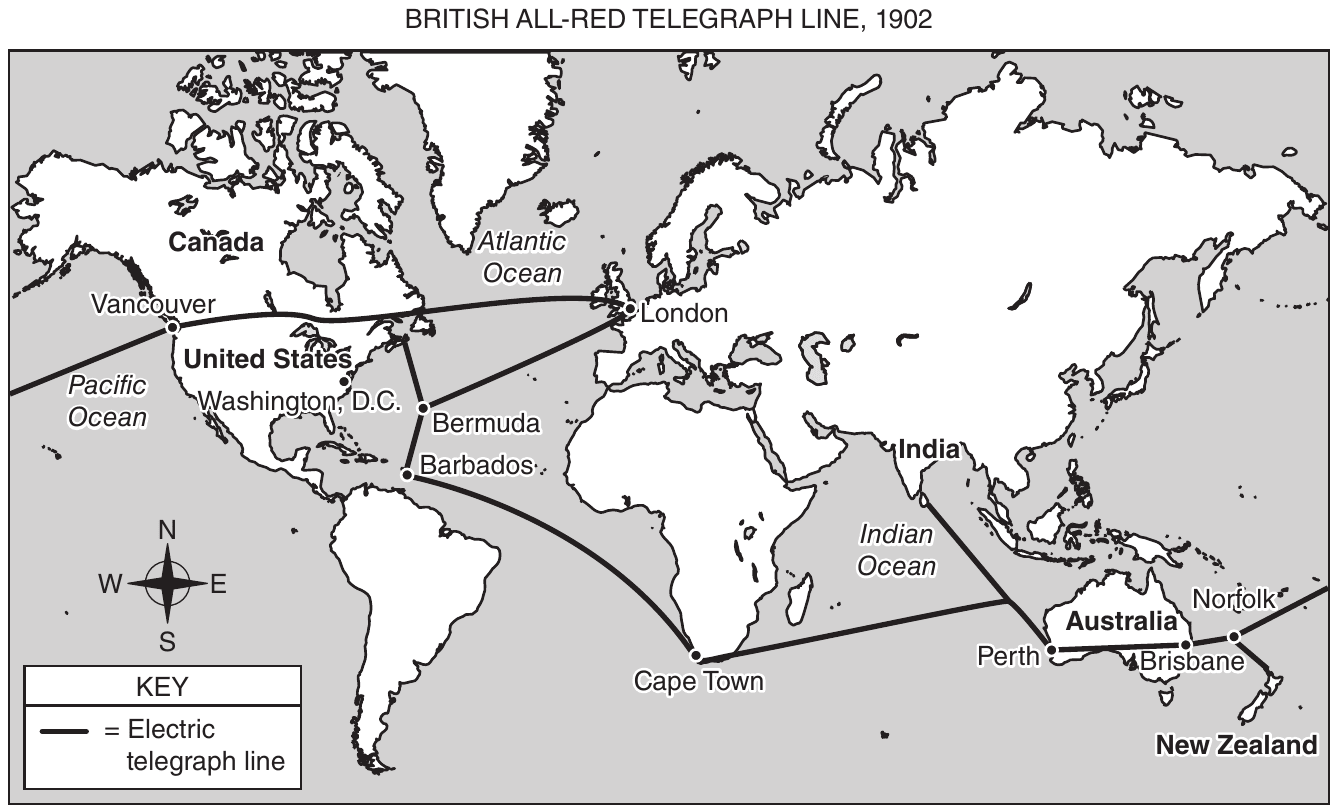
The first transatlantic electric telegraph message was sent in 1858, and by 1902 the British All-Red Line connected most of the world.
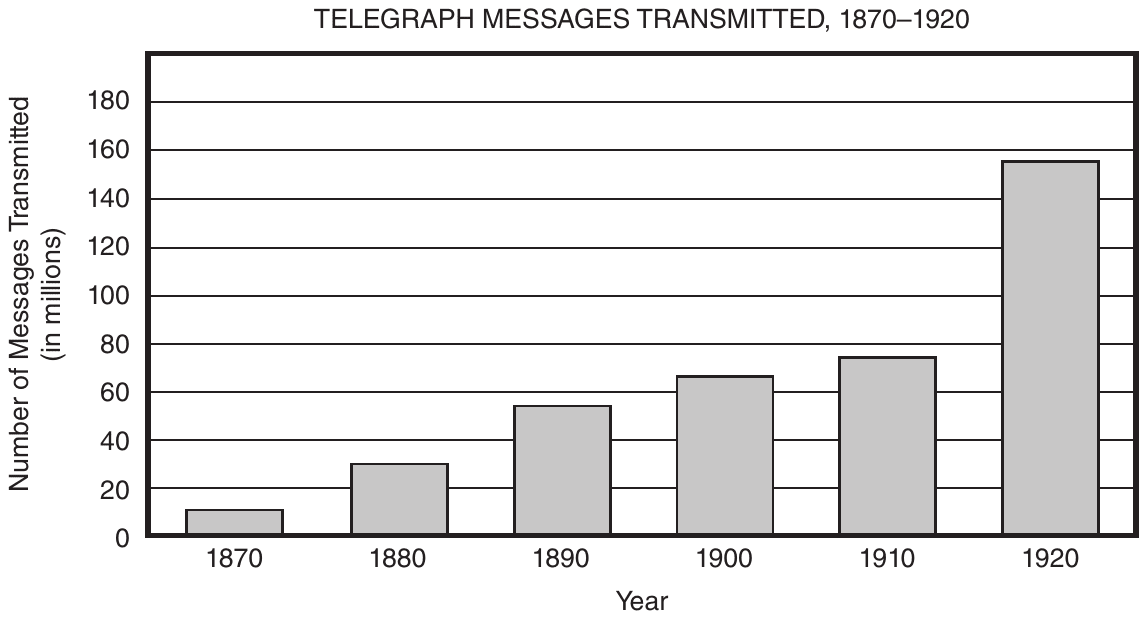
Source: U.S. Bureau of the Census. Historical Statistics of the United States, Colonial Times to 1970, Bicentennial Edition, Part 2. Washington, D.C., 1975.
Question
Read this sentence from paragraph 7.
The desperate Morse gave the go-ahead, and the line was completed in time for the dramatic and spectacularly successful link between the Supreme Court chamber of the Capitol building and the railroad station in Baltimore.
The words “dramatic” and “spectacularly” in the sentence convey a
- Asense of relief and fulfillment that the line was finished.
- Bsense of wonder and celebration that the telegraph line was accomplished.
- Cfeeling of excitement about the future possibilities of the telegraph.
- Dfeeling of confidence about being able to continue the work.
Show the answer
Correct answer: B
The question asks what the words “dramatic” and “spectacularly” convey in the sentence from paragraph 7.
A. Incorrect. While there may have been some feelings of relief and fulfillment when the lines were finished, the passage instead focuses on the wonder and joy that Morse and Cornell felt after overcoming setbacks and completing the construction of the telegraph system.
B. CORRECT. Morse and Cornell rushed to post the wires overhead, and the “rigid deadline” (paragraph 7) was successfully met. The words have a positive and victorious tone that is consistent with the feeling of wonder that it worked and of celebration that the construction was completed.
C. Incorrect. The passage does not share whether Morse or Cornell considered the future possibilities of the telegraph; it shares only that the finished product was “dramatic,” implying it was amazing to see.
D. Incorrect. While the passage later discusses the expansion of overhead wires “up and down the Atlantic coast” and how they “connected the continents of Europe and America” (paragraph 8), there is no evidence shared in the passage that Morse planned to continue his work with electricity.
Question analysis
Students judge the connotation of two words, “dramatic” and “spectacularly,” in the sentence from “Invention of the Telegraph” that describes the completion of Samuel Morse’s first telegraph link from Washington to Baltimore. Because the same sentence calls Morse “desperate” and says the line was finished just in time, several feelings seem to fit the moment, and the choices name four of them.
- Grade level
- Grade 7 reading and task
- Compared with grade 7
- At grade 7 Judging what two adjectives convey is standard grade 7 word-choice work, and the sentence is printed with the question. The challenge is that all four choices name believable feelings, so students must separate the words’ own connotations from the situation around them.
- Estimated difficulty
- Moderate: several steps, or a close reading with one strong distractor.
- Thinking it demands
- Depth of knowledge 2, skills and concepts · mainly understand
- What makes it hard
- A very close wrong answer moderate
- Reading between the lines moderate
- Every choice must be checked minor
- Evidence
- Answered from one sentence or line
- Reading level
- Passage: about grade 11, 910 words; question and choices: about grade 10, 91 words.
- Students, last 30 days
- Not enough answers yet to show (it takes 10).
Why it is hard, traps and wrong answers (shows the answer)
Why it is hard
The quoted sentence offers two tempting sources for the answer besides the two words the stem names: Morse is “desperate,” and the line is finished “in time.” Students who read the situation rather than the words choose relief, and those who think ahead to paragraph 8’s spreading wires choose excitement about the future. The question rewards asking what “dramatic” and “spectacularly” say about the link itself, an event that impressed and was celebrated.
A very close wrong answer moderate Choosing the answer
The relief choice is built like the key, a pair of feelings about the finished line; only the feelings differ, and “dramatic” and “spectacularly” point to wonder at a public success, not release from worry. (Embretson & Wetzel, 1987; Gorin & Embretson, 2006; Ascalon et al., 2007)
Reading between the lines moderate Working it out
Neither word names an emotion: “dramatic” and “spectacularly” describe the link itself, so the feeling they carry has to be inferred from their sense of an impressive public show. (Graesser, Singer & Trabasso, 1994; Kintsch, 1998)
Every choice must be checked minor Choosing the answer
All four choices name a positive feeling that suits a race against a “rigid deadline,” so tone alone rules none of them out. (Embretson & Wetzel, 1987)
Strategy: Before reading the choices, picture something you would call dramatic and spectacularly successful, and name the feeling those words give it; then find the choice closest to that feeling.
Traps
- Wrong tone or attitude: Misjudges the tone, attitude or point of view, such as reading admiration as criticism, or taking a character's or subject's feelings for the author's.
- Wrong part of the text: A choice is true of another paragraph, stanza or speaker than the one asked about.
The wrong answers, classified
A Wrong tone or attitude (Graesser, Singer & Trabasso, 1994)
Takes what Morse probably felt, relief after a “desperate” scramble to beat the deadline, for what the author’s two words convey, which is admiration for a striking success.
C Wrong part of the text (Kirsch & Mosenthal, 1990)
Brings in paragraph 8, where wires spread along the coast and across the ocean, but this sentence is about the first finished link and says nothing of what might follow.
D Reads too much in (Graesser, Singer & Trabasso, 1994)
Assumes success would leave Morse confident about pressing on, but the sentence never looks past the finished line, and the two words describe the event, not his plans.
Working it out, step by step
Figure out what the question asks
This question is about connotation, the feeling a word carries beyond its dictionary meaning. It names two words, “dramatic” and “spectacularly.” Your job is to name the feeling those two words give the sentence. Other words in the sentence should not decide your answer.
See what is happening in paragraph 7
Just before this sentence, Morse’s team lost time laying wire that turned out to be faulty. The job was also “on a rigid deadline” with no time to spare. Cornell had a quick fix: to “string wires overhead on trees and poles” instead. Morse agreed, and the line was done in time. The sentence describes the moment the first link worked, from the Capitol in Washington to the train station in Baltimore.
Work out what the two words suggest
A dramatic event grabs your attention, the way the high point of a movie does. Spectacularly comes from spectacle, a grand sight that makes people stop and stare. So the author is saying the link was more than finished. It was a thrilling public success. Words like these make a reader marvel at what was done and want to cheer.
Check each choice
- A does not fit. Morse was “desperate,” so he may have felt relief. But that feeling comes from the word “desperate,” not from the two words the question asks about.
- B fits. Wonder matches an amazing sight, and celebration matches a great success.
- C does not fit. This sentence is only about the finished link. Wires spreading to other places come later, in paragraph 8.
- D does not fit. The two words describe the event itself. They tell nothing about Morse’s plans for more work.
Choose the answer
The words “dramatic” and “spectacularly” make the first telegraph link sound like a thrilling show. So the answer is B, a “sense of wonder and celebration that the telegraph line was accomplished.”
Why this answer and not the closest wrong one
A is the closest trap, since it also names two good feelings about the finished line. But relief is the quiet feeling you get when worry ends. The words “dramatic” and “spectacularly” are loud and showy. They make the link sound like something to gasp at and cheer for, and that is wonder and celebration.
More questions like this
The original DOE question
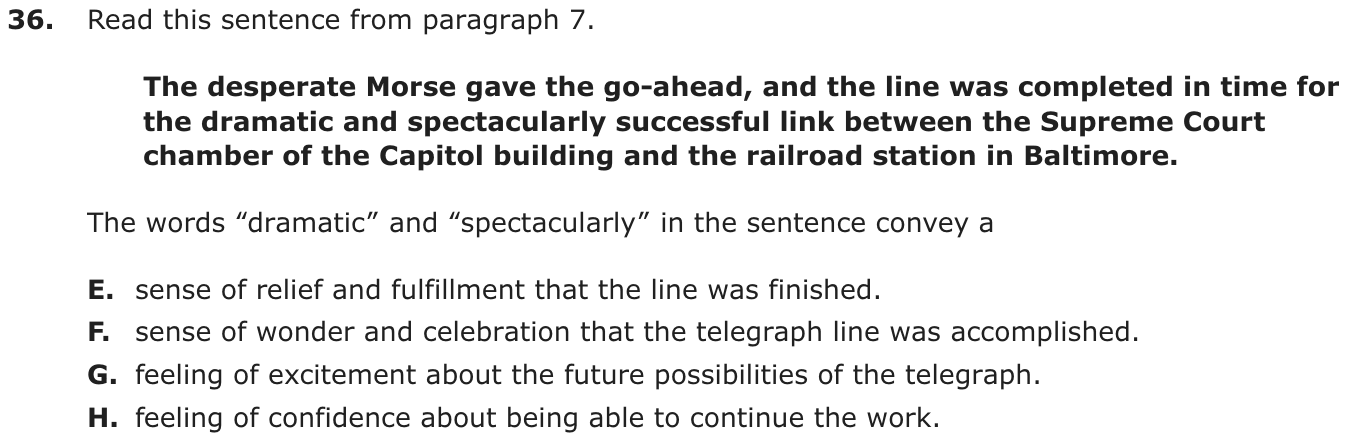
The passage “Invention of the Telegraph” as printed (pages 146–148)
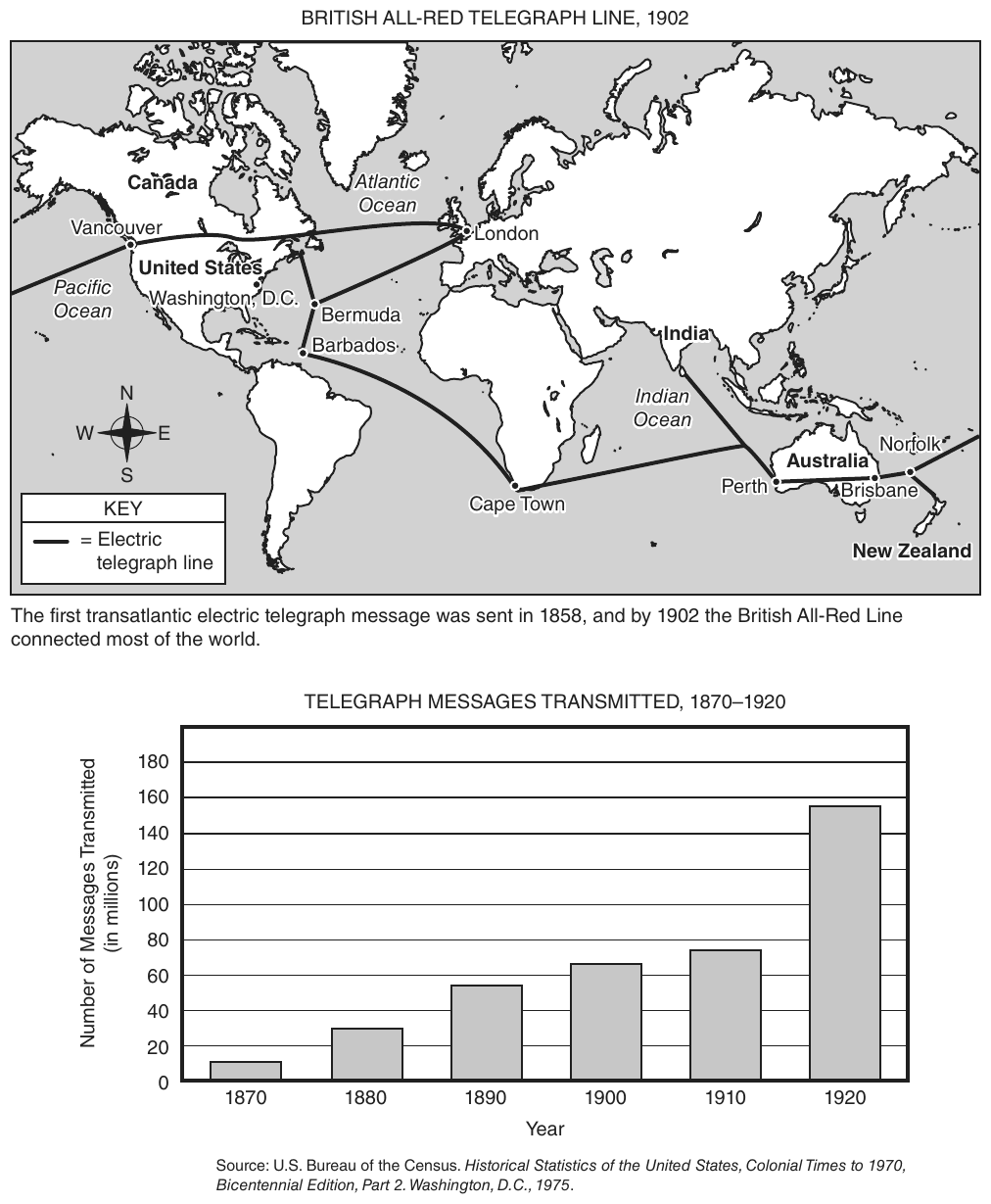
Question 38 of 53
2024 Test B English, question 45Passage Snowy Mountains
Snowy Mountains
by John Gould Fletcher
Higher and still more high,
Palaces made for cloud,
Above the dingy city-roofs
Blue-white like angels with broad wings,
Pillars of the sky at rest
The mountains from the great plateau
Uprise.
But the world heeds them not;
They have been here now for too long a time.
The world makes war on them,
Tunnels their granite cliffs,
Splits down their shining sides,
Plasters their cliffs with soap-advertisements,
Destroys the lonely fragments of their peace.
Vaster and still more vast,
Peak after peak, pile after pile,
Wilderness still untamed,
To which the future is as was the past,
Barrier spread by Gods,
Sunning their shining foreheads,
Barrier broken down by those who do not need
The joy of time-resisting storm-worn stone,
The mountains swing along
The south horizon of the sky;
Welcoming with wide floors of blue-green ice
The mists that dance and drive before the sun.
“Snowy Mountains” by John Gould Fletcher—Public Domain
Question
How does the poet develop the speaker’s point of view in the second stanza (lines 8–14)?
- Aby describing images of the mountains’ awe-inspiring size and strength
- Bby illustrating the differences among the various ways humans can affect the natural environment
- Cby criticizing society for taking careless, harmful courses of action against nature
- Dby demonstrating how the mountains and the people are able to benefit from each other
Show the answer
Correct answer: C
The question asks how the poet develops the speaker’s point of view in the second stanza.
A. Incorrect. The speaker’s descriptions of the mountains’ awe-inspiring size and strength mainly occur in the first and third stanzas, while in the second stanza, the speaker focuses on humanity and its negative effect on the mountains.
B. Incorrect. The wording of the second stanza—“makes war” (line 10), “Splits down their shining sides” (line 12), and “Destroys the lonely fragments” (line 14)—communicates the speaker’s position that people’s main impact on the mountains is destructive; the wording does not illustrate different ways people impact the natural environment.
C. CORRECT. In the second stanza, the speaker criticizes the destructive actions of “the world” (lines 8 and 10) against the mountains—actions such as tunneling “their granite cliffs” (line 11) and destroying “the lonely fragments of their peace” (line 14).
D. Incorrect. In the second stanza, the speaker does not describe a positive relationship between the mountains and the people.
Question analysis
This point-of-view question on the poem “Snowy Mountains” asks how the poet develops the speaker’s outlook in the second stanza, lines 8–14. Students must read the stanza on its own, decide what attitude its images and verbs express, and then find the choice that names both that attitude and the way it comes across.
- Grade level
- Grade 6 reading and task
- Compared with grade 7
- Below grade 7 Below typical grade 7 demand. Grade 7 point-of-view questions often require weighing subtle or shifting attitudes; this stanza is seven short lines with one consistent stance, carried by strong action words, so it suits grade 6.
- Estimated difficulty
- Straightforward: two steps or one careful reading.
- Thinking it demands
- Depth of knowledge 2, skills and concepts · mainly analyze
- What makes it hard
- How, not what moderate
- Figurative or literary language minor
- Evidence
- Answered from one paragraph or stanza
- Reading level
- Passage: 161 words (a poem; reading level not measured); question and choices: about grade 10, 66 words.
- Students, last 30 days
- Not enough answers yet to show (it takes 10).
Why it is hard, traps and wrong answers (shows the answer)
Why it is hard
The speaker’s anger in lines 8–14 is plain, and most students sense that the stanza blames people. Points are lost to choices that describe the poem’s admiration of the peaks, which belongs to the stanzas around this one, or that list the stanza’s actions without their hostility. Staying inside the seven lines and reading the attitude in verbs such as “makes war” and “Destroys” settles it quickly.
How, not what moderate Working it out
The stem asks how the viewpoint is built, and the answer lies in what the world does in lines 10–14: it “makes war,” “Tunnels,” “Splits,” “Plasters” and “Destroys.” (Anderson & Krathwohl, 2001)
Figurative or literary language minor Understanding the question
The stanza personifies the mountains as victims, ignored and robbed of “the lonely fragments of their peace,” so the criticism of people comes through sympathy for the peaks. (Graesser, Singer & Trabasso, 1994; Kintsch, 1998)
Strategy: Read lines 8–14 by themselves and put the speaker’s attitude into a few words of your own before looking at the choices.
Traps
- Twists what the text says: Uses the text's topic and ideas but changes what it says: who did it, how much, when, or why.
- Wrong part of the text: A choice is true of another paragraph, stanza or speaker than the one asked about.
The wrong answers, classified
A Wrong part of the text (Kirsch & Mosenthal, 1990)
Describes the first and third stanzas, which marvel at the peaks’ height and vastness; in lines 8–14 the “granite cliffs” and “shining sides” appear only as things being damaged.
B Twists what the text says (King et al., 2004)
Sees that the stanza names several human actions, tunneling, splitting and plastering, but they are all blows in one “war,” not different kinds of effect laid side by side.
D Wrong tone or attitude (Graesser, Singer & Trabasso, 1994)
Reads tunnels and advertisements as people putting the mountains to use, a kind of exchange, and misses the hostility of “The world makes war on them.”
Working it out, step by step
Figure out what the question asks
This asks about point of view. That is how the speaker, the voice talking in the poem, feels about the subject. It also asks how the poet shows that feeling. Look only at the second stanza, lines 8 to 14.
Read the second stanza closely
The stanza opens with “But the world heeds them not” (line 8). To heed something is to pay attention to it. Then “the world” starts to act. It “makes war on them,” “Tunnels their granite cliffs,” and “Splits down their shining sides.” It covers them with ads. Finally, in line 14, it “Destroys the lonely fragments of their peace.”
Decide what the speaker thinks
Here “the world” means people in general. People ignore the mountains, yet keep hurting them. Each action is an attack: making war, tunneling, splitting, plastering, destroying. The speaker is clearly on the mountains’ side. By listing these acts, the speaker blames people for being careless and harmful. Blaming someone for what they do wrong is called criticism.
Check each choice
- A does not fit. Size and strength fill the first and third stanzas, as in “Higher and still more high” and “Vaster and still more vast.” In lines 8 to 14, the mountains are only victims.
- B does not fit. The stanza lists several acts, but it does not compare them. They are all part of one “war.”
- C fits. The stanza blames society for ignoring and harming the mountains.
- D does not fit. The stanza shows no give-and-take. People only harm the mountains, and the mountains get nothing back.
Choose the answer
The speaker’s view comes through a list of careless, harmful acts that the poem plainly condemns. So the answer is C.
Why this answer and not the closest wrong one
B is the closest wrong choice, because the stanza really does name several ways people affect the mountains. But the speaker is not studying how they differ. Each one is another blow in the same attack, and the speaker is upset by all of them. C names that anger as criticism, which is what the stanza does.
More questions like this
The original DOE question
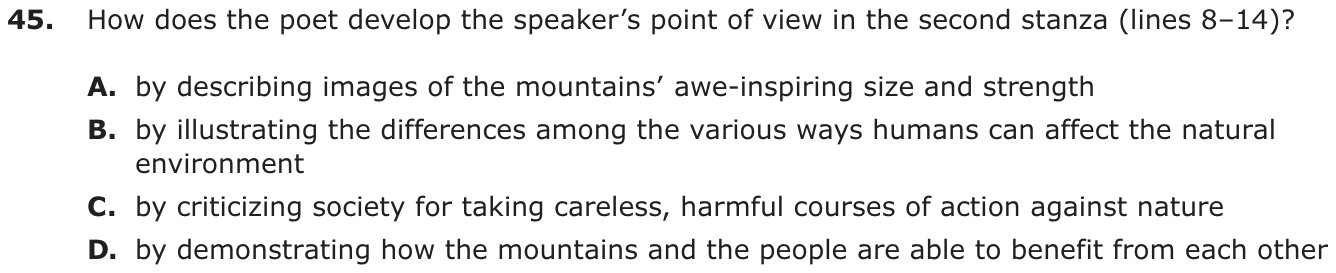
The passage “Snowy Mountains” as printed (page 142)
Question 39 of 53
2024 Test B English, question 49Uses the passage above: “Snowy Mountains”.
Question
Read lines 23–26 from the poem.
The mountains swing along
The south horizon of the sky;
Welcoming with wide floors of blue-green ice
The mists that dance and drive before the sun.
The personification in these concluding lines of the poem suggests that the mountains are
- Agracious hosts who are untroubled by the actions of people.
- Bunaware of their coming destruction.
- Clively entertainers who are amused by the everyday concerns of people.
- Dtoo proud to reveal their pain.
Show the answer
Correct answer: A
The question asks what the personification in the concluding lines of the poem suggests about the mountains.
A. CORRECT. Line 25’s use of the word “Welcoming” suggests that the mountains are kind hosts. Lines 23 and 26, with language such as “The mountains swing along” and “The mists that dance and drive before the sun,” imply the carefree nature of the mountains as they resist the destructive work of humanity.
B. Incorrect. The personification in the lines conveys a sense of optimism and endurance, with no language to suggest coming destruction.
C. Incorrect. Although the lines mention that “the mountains swing along” (line 23) and “the mists . . . dance” (line 26), the personification is used to describe the mountains’ perseverance, rather than to suggest that the mountains are amused by the concerns of others.
D. Incorrect. Although the second stanza develops the idea that the mountains have been mistreated by humans, which might be a source of pain, the concluding lines emphasize the joy and perseverance of the mountains as they “swing along” (line 23) despite significant adversity.
Question analysis
Students interpret the personification in the closing lines of “Snowy Mountains,” lines 23–26, and decide what it suggests about the mountains on the south horizon. They need to see which human actions the poet gives the mountains and what kind of character those actions create, and then choose among four quite different personalities.
- Grade level
- Grade 7 reading and task
- Compared with grade 7
- At grade 7 Grade 7 readers routinely interpret personification, and here the four lines are printed with the question. The images are concrete and the choices give the mountains clearly different roles and moods, so careful matching settles it.
- Estimated difficulty
- Straightforward: two steps or one careful reading.
- Thinking it demands
- Depth of knowledge 2, skills and concepts · mainly understand
- What makes it hard
- Figurative or literary language moderate
- Complex sentences minor
- Evidence
- Answered from one sentence or line
- Reading level
- Passage: 161 words (a poem; reading level not measured); question and choices: about grade 6, 77 words.
- Students, last 30 days
- Not enough answers yet to show (it takes 10).
Why it is hard, traps and wrong answers (shows the answer)
Why it is hard
The closing lines are calm and generous, and the task is to turn their personification into a character. Students who give the mists’ dancing to the mountains see performers, but the performer choice also has the mountains amused by people’s concerns, which nothing here supports, so a careful reader rejects it. The remaining losses come from carrying the second stanza’s damage into lines that show only ease and welcome.
Figurative or literary language moderate Understanding the question
The human traits must be sorted by who has them: the mountains “swing along” and are “Welcoming,” while the mists are the ones that “dance and drive before the sun.” (Graesser, Singer & Trabasso, 1994; Kintsch, 1998)
Complex sentences minor Understanding the question
In “Welcoming with wide floors of blue-green ice / The mists,” the object of “Welcoming” comes after a long phrase and a line break, so who welcomes whom is easy to lose. (Abedi & Lord, 2001; Freedle & Kostin, 1993; Messick, 1989)
Strategy: Underline each verb or describing word in lines 23–26 that gives the mountains a human trait, then check every choice against all of them.
Traps
- Twists what the text says: Uses the text's topic and ideas but changes what it says: who did it, how much, when, or why.
- Reads too much in: A reasonable-sounding conclusion that goes further than the text allows.
The wrong answers, classified
B Reads too much in (Graesser, Singer & Trabasso, 1994)
Takes the mountains’ carefree swinging as ignorance and adds the earlier stanzas’ damage to it, but these four lines are serene and hint at no destruction to come.
C Twists what the text says (King et al., 2004)
Gives the mists’ dancing to the mountains and so makes them performers, then adds amusement at people’s concerns, though here the mountains only swing along and welcome the mists.
D Wrong tone or attitude (Graesser, Singer & Trabasso, 1994)
Imagines a brave face hiding the wounds of the second stanza, but the lines show the mountains at ease and welcoming, with no sign of pride or pain.
Working it out, step by step
Figure out what the question asks
This asks about personification. That is when a writer describes a thing as if it were a person, with human actions or moods. You need to decide what kind of character the mountains seem to be in lines 23 to 26.
Find who does each action
The four lines are one sentence. In line 23, “The mountains swing along” the edge of the sky. Line 25 shows them “Welcoming with wide floors of blue-green ice.” The guests arrive in line 26: “The mists that dance and drive before the sun.” The mountains do two things here, swing along and welcome. The dancing belongs to the mists.
Decide what the actions suggest
Welcoming guests is what a host does. A host invites others in and makes them comfortable. Gracious means warm and polite. To swing along is to move in a relaxed, easy way. The second stanza was full of harm, yet here the mountains seem calm. They are untroubled, or not worried or upset.
Check each choice
- A fits. The mountains welcome the mists like gracious hosts, and they move at ease.
- B does not fit. Nothing in these lines hints at harm to come. The mood is calm and bright.
- C does not fit. Line 26 gives the dancing to the mists. And nothing shows the mountains laughing at people’s daily worries.
- D does not fit. There is no sign of pride or hidden pain. The mountains seem relaxed and open.
Choose the answer
Like kind hosts, the mountains greet their guests and stay calm. So the answer is A.
Why this answer and not the closest wrong one
C may tempt you, because swinging and dancing both sound lively. But check who dances: line 26 gives the dancing to the mists. The mountains are the ones “Welcoming” them, so they are hosts, not entertainers. C also says the mountains are amused by people, and these lines never show that.
More questions like this
The original DOE question
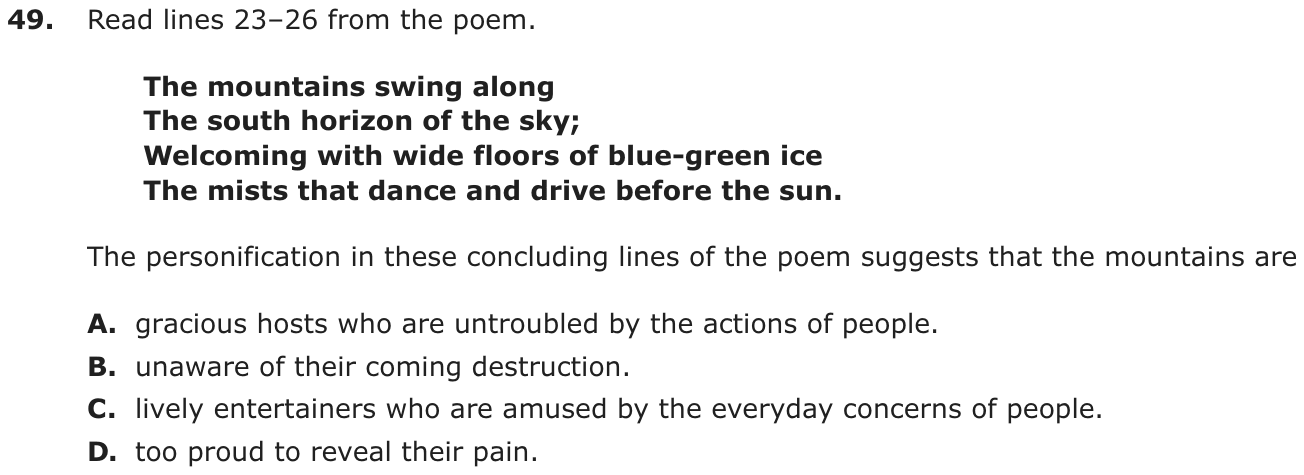
Question 40 of 53
2018 Test A English, question 24Passage Champion of the Channel
Champion of the Channel
In 1926 an editor at the London Daily News predicted that Gertrude Ederle, an American swimmer with eighteen world records and three Olympic medals, would fail in her attempt to swim across the English Channel. He claimed that “even the most uncompromising champion of the rights and capacities of women must admit that in contests of physical skill, speed and endurance they must remain forever the weaker sex.” Yet, at only nineteen years old, Ederle not only became the first woman to accomplish this feat, she also broke the men’s record by two hours. Gertrude Ederle’s triumphant swim across the English Channel was a testimony to her determination, innovative spirit, and passion for swimming.
Crossing the English Channel is a daunting task for any swimmer. At its narrowest point, the channel measures twenty-one miles across. Its icy waters hover around sixty degrees Fahrenheit, and its unruly tides and currents toss swimmers about like bobbing corks. Stinging jellyfish, seaweed, and floating debris from shipwrecks and lost cargoes present added hazards.
For decades the channel’s perils have defeated countless swimmers. Ederle, too, failed in her first attempt to cross the channel in 1925. Just six miles short of finishing, she became ill, and her coach had to haul her out of the water. Undeterred, Ederle decided to try again. Ederle knew that if she did not complete the challenge this time, she might never get the opportunity to set this record, because a rival female swimmer was preparing to make her second attempt at the crossing as well.
To prepare for the marathon swim, Ederle found ways to improve her equipment. She and her sister Meg discovered that melted candle wax perfectly sealed goggle edges, effectively waterproofing Ederle’s goggles against hammering waves. The sisters also designed a two-piece silk swimsuit for Ederle. During her first channel-crossing attempt she had worn a standard one-piece swimsuit that, after the lengthy hours of swimming across the channel, had stretched out, filling with water and creating drag, making an already challenging task almost insurmountable. Unlike the cumbersome typical bathing suit, this silk invention weighed little and allowed for easy movement.
On August 6, 1926, Ederle waded into the channel near Cape Gris-Nez, France. At first she shivered in the bone-chilling water even though she had covered her body in eight layers of grease for insulation. Her limbs felt stiff. Her strokes were irregular. Driving forward, she fought to clear her mind and find what she called her “sphere,” a place where the sea became her only companion and the shrieks of gulls and the humming of boat engines faded away. Using a new overhand stroke called the American crawl, Ederle eventually settled into a steady pace, briskly breaking through waves.
Throughout Ederle’s swim, two tugboats accompanied her. One carried newspaper reporters who wired dispatches of her progress to shore. The other, displaying a sign that read “This way, ole kid!” with an arrow pointing forward, transported her coach, family, and friends. Her coach played songs, such as “Yes, We Have No Bananas,” on a phonograph so that Ederle could time her strokes to the rhythm. Using a net, her coach also passed her baby bottles of broth for nourishment.
For hours Ederle swam, dodging debris with an amused smile. However, as she neared the English shore, a sudden fierce storm erupted. The tides and waves forced Ederle backward, and she fought the stubborn swells for several hours. The salty water caused her tongue to swell and inflamed her ears. Yet Ederle felt indescribably happy as she churned through the sea. Finally, as she neared the English shore, the storm abated, and the tide turned. No longer fighting against her, the sea pushed her toward the shore and victory.
After fourteen hours and thirty-one minutes, Ederle, on wobbly legs, stepped onto the English shore. The waiting crowd roared, honked their automobile horns, blasted their tugboat whistles, and set off flares that flashed in the sky. Ederle had swum into history.
When Ederle returned to New York, she received a parade, where thousands of people shouted “Trudy!” Not only were everyday American citizens proud of Ederle, but she also inspired them to be more active. Over the next few years, more than 60,000 people credited her with motivating them to earn their American Red Cross swimming certificates. Gertrude Ederle’s accomplishment proved to the world that with determination and passion, it was possible for a person to achieve his or her goals.
SOLO SWIMS ACROSS THE ENGLISH CHANNEL
|
Earliest Speed Records |
||
| Year | Swimmer | Time |
| 1875 | Matthew Webb (M) | 21 hours, 45 minutes |
| 1923 | Enrico Tiraboschi (M) | 16 hours, 33 minutes |
| 1926 | Gertrude Ederle (F) | 14 hours, 31 minutes |
| 1926 | Arnst Vierkotter (M) | 12 hours, 38 minutes |
| Current Speed Records | ||
| Year | Swimmer | Time |
| 2012 | Trent Grimsey (M) | 6 hours, 55 minutes |
| 2006 | Yvetta Hlavacova (F) | 7 hours, 25 minutes |
Question
Which sentence from the passage best conveys the author’s perspective regarding the impact of Ederle’s accomplishment?
- A“Gertrude Ederle’s triumphant swim across the English Channel was a testimony to her determination, innovative spirit, and passion for swimming.” (paragraph 1)
- B“For hours Ederle swam, dodging debris with an amused smile.” (paragraph 7)
- C“Yet Ederle felt indescribably happy as she churned through the sea.” (paragraph 7)
- D“Ederle had swum into history.” (paragraph 8)
Show the answer
Correct answer: D
The answer is (D)
The question asks for the sentence from the passage that best conveys the author’s perspective about the impact of Ederle’s swim.
Option D is correct because, throughout the passage, the author emphasizes that Ederle’s accomplishment was memorable and great, which is best stated in the sentence from paragraph 8.
The sentence presented in Option A is incorrect because it focuses on Ederle’s personal attributes that allowed her to successfully complete her swim, not the author’s perspective about the impact of her achievement.
The sentence presented in Option B is incorrect because the details in the sentence relate to Ederle’s state of mind as she came closer to achieving her goal and do not provide details about the author’s opinion of the impact of Ederle’s accomplishment.
The sentence presented in Option C is incorrect because it simply presents Ederle’s emotional state as she nears her goal and does not provide information about the author’s perspective.
Question analysis
This reading question asks which quoted sentence best conveys the author's own perspective on the impact of Gertrude Ederle's English Channel swim. Every quotation shows the swim in a positive light, so students must tell the author's judgment apart from description and keep the question's focus on impact in mind.
- Grade level
- Grade 7 reading and task
- Compared with grade 7
- At grade 7 Identifying an author's own perspective is typical grade 7 point-of-view work. The quotations are short and labeled, and the main demand is attending to the word impact in the question.
- Estimated difficulty
- Moderate: several steps, or a close reading with one strong distractor.
- Thinking it demands
- Depth of knowledge 2, skills and concepts · mainly analyze
- What makes it hard
- How, not what moderate
- Figurative or literary language minor
- Evidence
- Answered from several paragraphs or stanzas
- Reading level
- Passage: about grade 9, 790 words; question and choices: about grade 12, 66 words.
- Corrected from the DOE handbook
- A grammar slip in the explanation was corrected.
- Students, last 30 days
- Not enough answers yet to show (it takes 10).
Why it is hard, traps and wrong answers (shows the answer)
Why it is hard
Two tests apply at once: whose view a sentence gives and whether that view concerns impact. The thesis sentence passes the first and fails the second, which makes it the main trap, while the two sentences from paragraph 7 report Ederle's feelings, not the author's judgment. The short sentence in paragraph 8 is easy to skim past because it states impact in five words and a figure of speech.
How, not what moderate Working it out
The question asks for the author's perspective, so narration of Ederle's own feelings, her “amused smile” and being “indescribably happy”, has to be set apart from the author's judgment. (Anderson & Krathwohl, 2001)
Figurative or literary language minor Understanding the question
“Ederle had swum into history” states the impact through a figure of speech, so the student must read it as a claim that the swim earned a lasting place. (Graesser, Singer & Trabasso, 1994; Kintsch, 1998)
Strategy: Ask two questions of each quotation: whose view does it express, and is it about the swim's impact or about something else? Only one quotation passes both tests.
Traps
- True but not the answer: A choice says something accurate about the text that does not answer this question.
- Wrong tone or attitude: Misjudges the tone, attitude or point of view, such as reading admiration as criticism, or taking a character's or subject's feelings for the author's.
The wrong answers, classified
A True but not the answer (King et al., 2004; Embretson & Wetzel, 1987)
Picks the passage's thesis, a real statement of the author's view, but it praises her determination and passion rather than saying what the swim meant or changed.
B Wrong tone or attitude (Graesser, Singer & Trabasso, 1994)
Takes Ederle's “amused smile” while dodging debris as the author's opinion, but it describes her mood mid-swim, not any judgment about the swim's impact.
C Wrong tone or attitude (Graesser, Singer & Trabasso, 1994)
Reads “indescribably happy” as the author's enthusiasm, but the sentence reports how Ederle felt during the storm, not how the author sees her achievement's impact.
What was corrected from the DOE handbook, and why
- Explanation: In the reason for rejecting F (B on this site), the handbook reads “the details in the sentence relate to … and does not provide details”. It now reads “do not provide”, to agree with “details”.
Working it out, step by step
Figure out what the question asks
A perspective is a point of view. Impact means the effect something has. So you need a sentence that shows the author’s opinion about what Ederle’s swim meant. A sentence about how Ederle felt does not count.
Ask two questions of each quote
For each choice, ask: Whose view is this, the author’s or Ederle’s? Then ask: Is it about the effect of the swim, or about something else? Only one choice will pass both tests.
Check each choice
- A: the swim was “a testimony to her determination, innovative spirit, and passion for swimming.” This is the author’s view, but it is about her qualities, not the swim’s effect.
- B: “dodging debris with an amused smile” describes Ederle’s mood during the swim.
- C: “Ederle felt indescribably happy” describes her feelings, not the author’s judgment.
- D: “Ederle had swum into history” (paragraph 8). This is the author speaking about what the swim meant.
Explain the key phrase
“Swum into history” is a figure of speech, words that mean more than their exact sense. She didn’t really swim into a history book. It means her swim was so important that people will remember it for a long time. That is a judgment about its impact.
Pick the answer
Watch out: A is the author’s main claim, so it is tempting. But it explains what made her succeed, not what her success meant. So the answer is D.
Why this answer and not the closest wrong one
A is the closest wrong answer, because it is also the author’s own opinion. But it tells what the swim showed about Ederle: her determination and passion. D tells what the swim meant: it made history. Only D is about impact.
More questions like this
The original DOE question
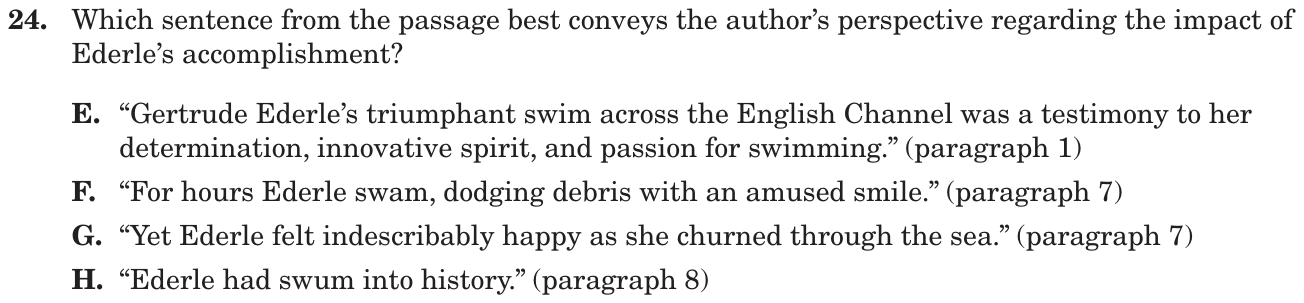
The passage “Champion of the Channel” as printed (pages 56–57)
Question 41 of 53
2018 Test A English, question 28Passage Excerpt from A Tramp Abroad
Excerpt from A Tramp Abroad
by Mark Twain
Now and then, while we rested, we watched the laborious ant at his work. I found nothing new in him—certainly nothing to change my opinion of him. It seems to me that in the matter of intellect the ant must be a strangely overrated bird. During many summers now I have watched him, when I ought to have been in better business, and I have not yet come across a living ant that seemed to have any more sense than a dead one. I refer to the ordinary ant, of course; I have had no experience of those wonderful Swiss and African ones which vote, keep drilled armies, . . . and dispute about religion. Those particular ants may be all that the naturalist paints them, but I am persuaded that the average ant is a sham.
I admit his industry, of course; he is the hardest working creature in the world—when anybody is looking—but his leather-headedness is the point I make against him. He goes out foraging, he makes a capture, and then what does he do? Go home? No; he goes anywhere but home. He doesn’t know where home is. His home may be only three feet away; no matter, he can’t find it. He makes his capture, as I have said; it is generally something which can be of no sort of use to himself or anybody else; it is usually seven times bigger than it ought to be; he hunts out the awkwardest place to take hold of it; he lifts it bodily up in the air by main force, and starts—not toward home, but in the opposite direction; not calmly and wisely, but with a frantic haste which is wasteful of his strength; he fetches up against a pebble, and, instead of going around it, he climbs over it backwards, dragging his booty after him, tumbles down on the other side, jumps up in a passion, kicks the dust off his clothes, moistens his hands, grabs his property viciously, yanks it this way, then that, shoves it ahead of him a moment, turns tail and lugs it after him another moment, gets madder and madder, then presently hoists it into the air and goes tearing away in an entirely new direction; comes to a weed; it never occurs to him to go around it. No; he must climb it, and he does climb it, dragging his worthless property to the top—which is as bright a thing to do as it would be for me to carry a sack of flour from Heidelberg to Paris by way of Strasburg steeple; when he gets up there he finds that that is not the place; takes a cursory glance at the scenery, and either climbs down again or tumbles down, and starts off once more—as usual, in a new direction. At the end of half an hour he fetches up within six inches of the place he started from, and lays his burden down. Meantime, he has been over all the ground for two yards around, and climbed all the weeds and pebbles he came across. Now he wipes the sweat from his brow, strokes his limbs, and then marches aimlessly off, in as violent a hurry as ever. He traverses a good deal of zig-zag country, and by and by stumbles on his same booty again. He does not remember to have ever seen it before; he looks around to see which is not the way home, grabs his bundle, and starts. He goes through the same adventures he had before; finally stops to rest, and a friend comes along.
Evidently the friend remarks that a last year’s grasshopper leg is a very noble acquisition, and inquires where he got it. Evidently the proprietor does not remember exactly where he did get it, but thinks he got it “around here somewhere.” Evidently the friend contracts to help him freight it home. Then, with a judgment peculiarly antic (pun not intentional), they take hold of opposite ends of that grasshopper leg and begin to tug with all their might in opposite directions. Presently they take a rest, and confer together. They decide that something is wrong, they can’t make out what. Then they go at it again, just as before. Same result. Mutual recriminations follow. Evidently each accuses the other of being an obstructionist. They warm up, and the dispute ends in a fight. They lock themselves together and chew each other’s jaws for a while; then they roll and tumble on the ground till one loses a horn or a leg and has to haul off for repairs. They make up and go to work again in the same old insane way, but the crippled ant is at a disadvantage; tug as he may, the other one drags off the booty and him at the end of it. Instead of giving up, he hangs on, and gets his shins bruised against every obstruction that comes in the way. By and by, when that grasshopper leg has been dragged all over the same old ground once more, it is finally dumped at about the spot where it originally lay. The two perspiring ants inspect it thoughtfully and decide that dried grasshopper legs are a poor sort of property after all, and then each starts off in a different direction to see if he can’t find an old nail or something else that is heavy enough to afford entertainment and at the same time valueless enough to make an ant want to own it. . . .
Science has recently discovered that the ant does not lay up anything for winter use. . . . He does not work, except when people are looking, and only then when the observer has a green, naturalistic look, and seems to be taking notes. This amounts to deception, and will injure him for the Sunday schools. He has not judgment enough to know what is good to eat from what isn’t. This amounts to ignorance, and will impair the world’s respect for him. . . . He cannot stroll around a stump and find his way home again. This amounts to idiocy, and once the damaging fact is established, thoughtful people will cease to look up to him. It is strange beyond comprehension that so manifest a humbug as the ant has been able to fool so many nations and keep it up so many ages without being found out.
we: the author and his fictional travel companion
From A TRAMP ABROAD by Mark Twain—Public Domain
Question
In paragraph 2, how do the words “grabs,” “yanks,” and “tearing away” contribute to the meaning of the excerpt?
- AThey highlight the ant’s belief that his work is important.
- BThey illustrate that the ant is more efficient working on his own.
- CThey indicate the speed with which the ant completes his tasks.
- DThey emphasize the ant’s anxious efforts to be productive.
Show the answer
Correct answer: D
The answer is (D)
The question asks for an explanation of how the words “grabs,” “yanks,” and “tearing away” (paragraph 2) contribute to the meaning of the excerpt.
Option D is correct because these words convey sudden movements as the ant becomes more upset in his efforts to transport the grasshopper leg.
Option A is incorrect because the ant is never described in the excerpt as believing his work to be important.
Option B is incorrect because the ant’s inability to make progress while transporting the grasshopper leg by himself demonstrates the ant’s inefficiency (paragraph 2: “At the end of half an hour he fetches up within six inches of the place he started from”).
Option C is incorrect because the ant does not complete his tasks despite moving in a hurried and determined way (paragraph 2: “not calmly and wisely, but with a frantic haste which is wasteful of his strength”).
Question analysis
This word-choice question asks how three action words from Mark Twain's ant story, “grabs,” “yanks” and “tearing away,” add to the excerpt's meaning. The verbs are buried in one very long sentence that lists dozens of actions, so students must find them and decide what their connotations add to the picture of the ant.
- Grade level
- Grade 7 reading and task
- Compared with grade 7
- At grade 7 Grade 7 word-choice items usually ask about one word in a short passage. This one asks for the shared effect of three verbs scattered through a very long sentence, though their tone is fairly clear once found, which keeps it at grade 7.
- Estimated difficulty
- Moderate: several steps, or a close reading with one strong distractor.
- Thinking it demands
- Depth of knowledge 2, skills and concepts · mainly analyze
- What makes it hard
- Complex sentences moderate
- Figurative or literary language moderate
- A very close wrong answer minor
- Evidence
- Answered from one paragraph or stanza
- Reading level
- Passage: about grade 9, 1099 words; question and choices: about grade 6, 60 words.
- Corrected from the DOE handbook
- A wrong option letter in the explanation was corrected.
- A missing comma in the explanation was restored.
- Students, last 30 days
- Not enough answers yet to show (it takes 10).
Why it is hard, traps and wrong answers (shows the answer)
Why it is hard
The verbs themselves are easy words; the difficulty is deciding what they add. Their speed is obvious, which is why the choice about how fast the ant finishes his tasks catches readers who stop at speed and miss that nothing gets finished. The key reads the verbs together with “in a passion” and “madder and madder” around them, so it rewards looking at the words' surroundings rather than the words alone.
Complex sentences moderate Understanding the question
All three verbs are buried in one 183-word sentence of paragraph 2, strung through semicolons among about twenty other actions, so students must find them before judging them. (Abedi & Lord, 2001; Freedle & Kostin, 1993; Messick, 1989)
Figurative or literary language moderate Understanding the question
The verbs' force reads as a comic tantrum, “grabs his property viciously” soon after he “jumps up in a passion,” so their connotation of agitation, not skill, carries the meaning. (Graesser, Singer & Trabasso, 1994; Kintsch, 1998)
A very close wrong answer minor Choosing the answer
A and D both tie the verbs to the ant caring about his work; they differ in one part, since the verbs show his anxious efforts, as D says, but never reveal a belief, as A claims. (Embretson & Wetzel, 1987; Gorin & Embretson, 2006; Ascalon et al., 2007)
Strategy: Locate the three verbs in paragraph 2, read the clauses around each one, and describe their effect in your own words before looking at the choices.
Traps
- Twists what the text says: Uses the text's topic and ideas but changes what it says: who did it, how much, when, or why.
- Reads too much in: A reasonable-sounding conclusion that goes further than the text allows.
The wrong answers, classified
A Reads too much in (Graesser, Singer & Trabasso, 1994)
Reads the ant's vigor as proof that he thinks his work important, a belief the excerpt never gives him; the verbs show agitation, not conviction.
B Wrong tone or attitude (Graesser, Singer & Trabasso, 1994)
Hears the forceful verbs as signs of a capable worker and contrasts him with the bickering pair, though alone he ends six inches from where he began.
C Twists what the text says (King et al., 2004)
Rightly senses speed in “tearing away,” but the ant completes nothing; Twain calls it “a frantic haste which is wasteful of his strength.”
What was corrected from the DOE handbook, and why
- Explanation: The handbook’s last reason begins “Option H is incorrect because the ant does not complete his tasks despite moving in a hurried and determined way”, but H is its correct answer. The reason is about G, “They indicate the speed with which the ant completes his tasks,” so this site reads Option C (G relettered). This was already corrected on the site before this review.
- Explanation: The handbook quotes the words as “grabs” “yanks,” and “tearing away”. The comma after “grabs” is restored, as in the question.
Working it out, step by step
Figure out what the question asks
This is a word-choice question. It asks what three action words add to the excerpt. Think about how the words feel, not just what they mean.
Find the words in paragraph 2
All three words are in the very long sentence in paragraph 2. Look at the words around them. The ant “jumps up in a passion,” then “grabs his property viciously, yanks it this way, then that.” Soon he “gets madder and madder” and goes “tearing away in an entirely new direction.”
Work out what the words show
“In a passion” means in a fit of anger. “Viciously” means fiercely. So the words show a worked-up, frantic ant. He moves fast and rough, like a kid having a tantrum. He badly wants to get his job done.
But Twain also says the ant moves “with a frantic haste which is wasteful of his strength.” All that rushing gets him nowhere.
Check each choice
- A The excerpt never tells us what the ant believes about his work. The words show he is upset, not what he thinks.
- B Working alone, he ends up six inches from where he started. That is not efficient (getting a lot done without waste).
- C The words do show speed. But the ant never finishes anything.
- D fits. The words show anxious, frantic effort to get the job done.
Choose the answer
The rough, fast verbs show an upset ant trying hard to be productive. So the answer is D.
Why this answer and not the closest wrong one
C is the closest trap, because “tearing away” does sound fast. But C says the ant completes his tasks, and he never does. D keeps the speed and the worry but does not claim success. That is why D fits better.
More questions like this
The original DOE question

The passage “Excerpt from A Tramp Abroad” as printed (pages 62–63)
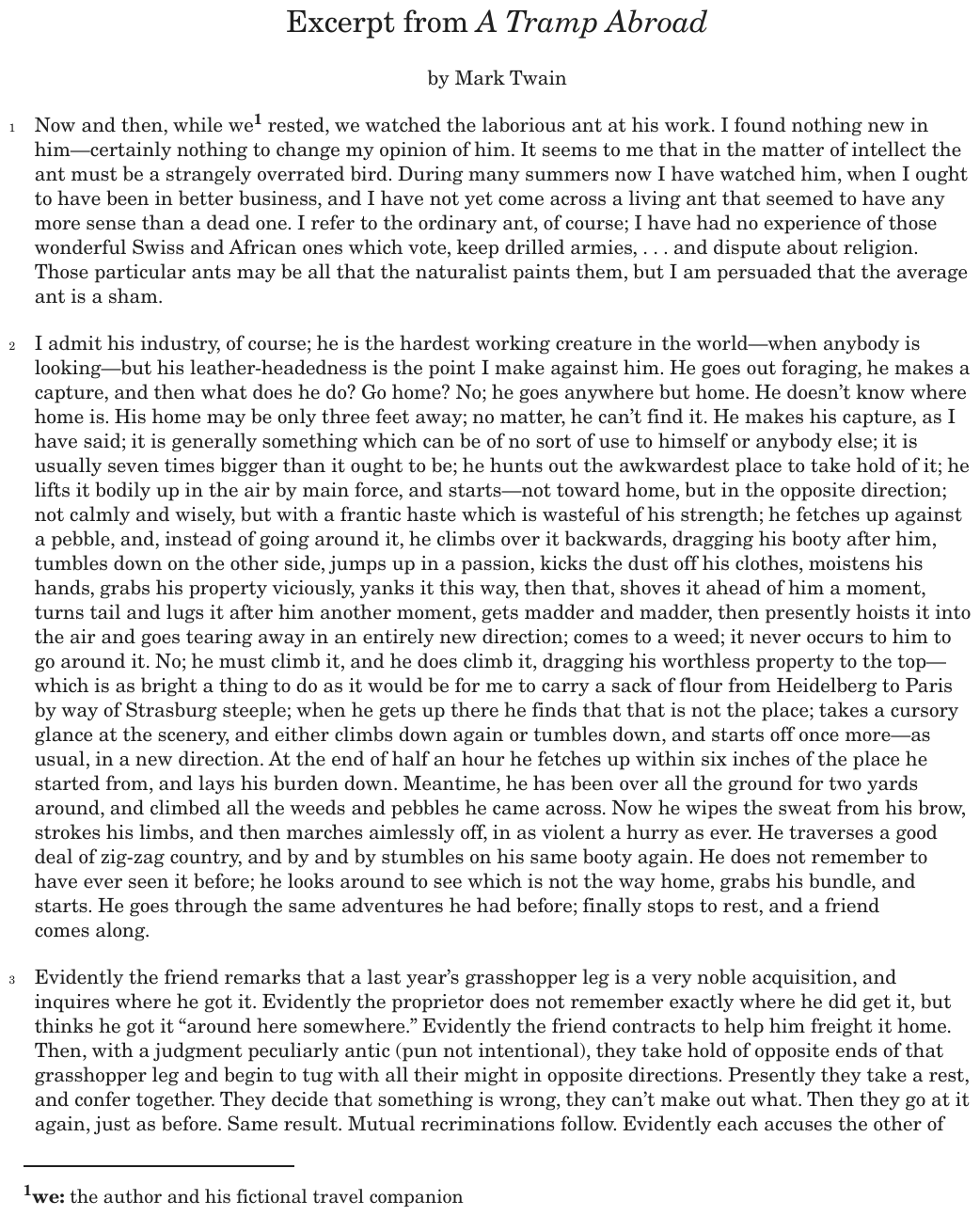
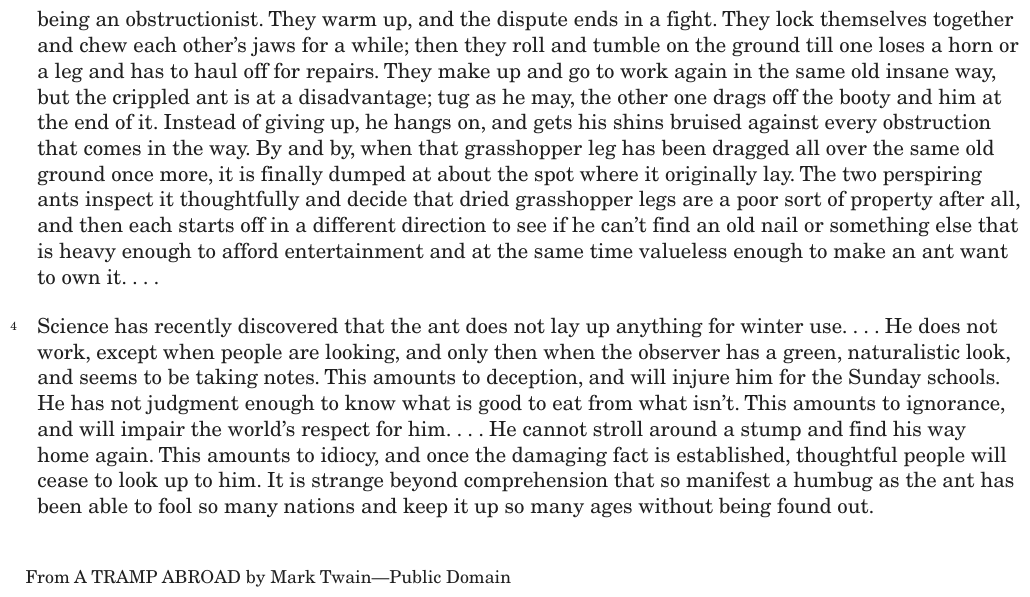
Question 42 of 53
2018 Test A English, question 30Uses the passage above: “Excerpt from A Tramp Abroad”.
Question
Which of the following best explains the author’s fascination with the ants?
- A“During many summers now I have watched him, when I ought to have been in better business, and I have not yet come across a living ant that seemed to have any more sense than a dead one.” (paragraph 1)
- B“I admit his industry, of course; he is the hardest working creature in the world—” (paragraph 2)
- C“Science has recently discovered that the ant does not lay up anything for winter use.” (paragraph 4)
- D“It is strange beyond comprehension that so manifest a humbug as the ant has been able to fool so many nations and keep it up so many ages without being found out.” (paragraph 4)
Show the answer
Correct answer: D
The answer is (D)
The question asks for the text from the passage that explains why the author finds the behavior of the ants fascinating. The author’s purpose in describing the excessively foolish actions of the ants is to prove his argument that in spite of what people have long believed, ants are completely lacking in intelligence.
Option D is correct because the quoted text in Option D shows the author’s interest in the difference between public opinion and observed truth.
Option A is incorrect because the quoted text in Option A provides details that reflect the author’s basic interest, but this observation does not extend to the level of fascination.
Option B is incorrect because the author’s main message in the excerpt is that the ant, however industrious, is foolish.
Option C is incorrect because the quoted text in Option C also provides details that would reflect a basic interest and observation but that do not extend to fascination.
Question analysis
This textual evidence question asks which of four quotations from Mark Twain's ant excerpt best explains why the narrator is so fascinated by ants. Nowhere does the excerpt say outright what draws him to them, so students must infer it and then weigh quotations that all show him paying attention to ants.
- Grade level
- Grade 8 reading and task
- Compared with grade 7
- Above grade 7 Grade 7 evidence questions usually match a quotation to a claim the text states. Here the claim, the narrator's fascination, is never named, so students must infer its cause from four quotations in a satirical, old-fashioned text.
- Estimated difficulty
- Among the hardest on the SHSAT: a non-obvious approach, heavy reading, or a well-hidden trap.
- Thinking it demands
- Depth of knowledge 3, strategic thinking · mainly evaluate
- What makes it hard
- Reading between the lines major
- Hard words moderate
- A lot to read minor
- Evidence
- Answered from the whole text
- Reading level
- Passage: about grade 9, 1099 words; question and choices: about grade 10, 116 words.
- Students, last 30 days
- Not enough answers yet to show (it takes 10).
Why it is hard, traps and wrong answers (shows the answer)
Why it is hard
The stem's word “fascination” clashes with a narrator who sneers at ants, and that clash is what makes the item hard. Students must recast fascination as puzzled interest and then look for the quotation that names its cause, the gap between the ant's reputation and its behavior. The quotation about years of watching is the trap: it shows interest without explaining it, and many careful readers settle on it.
Reading between the lines major Working it out
The excerpt never says the author is fascinated, and his tone is contempt, so students must infer that what holds his attention is the puzzle of how a “humbug” fooled whole nations. (Graesser, Singer & Trabasso, 1994; Kintsch, 1998)
Hard words moderate Understanding the question
The key turns on “so manifest a humbug,” meaning so obvious a fraud, and “strange beyond comprehension”; a student who skips those words cannot see that the line expresses wonder. (Perfetti, 2007; Freedle & Kostin, 1993)
A lot to read minor Understanding the question
Each choice is a full quotation, the longest 38 words, so the four together form a short passage of archaic prose to weigh. (Kintsch, 1998; Gorin & Embretson, 2006; Freedle & Kostin, 1993)
Strategy: Before reading the quotations, state in your own words what most seems to interest the narrator about ants; then pick the quotation that gives the reason behind his interest.
Traps
- Supports only part of the claim: In a question about evidence: a line that backs one half of the claim but not the other, or a related point rather than the claim itself.
- Wrong tone or attitude: Misjudges the tone, attitude or point of view, such as reading admiration as criticism, or taking a character's or subject's feelings for the author's.
The wrong answers, classified
A Supports only part of the claim (King et al., 2004; Thissen, Steinberg & Fitzpatrick, 1989)
Shows he has watched ants for many summers, real evidence of interest, but it describes his habit and verdict rather than what makes ants fascinating to him.
B Wrong tone or attitude (Graesser, Singer & Trabasso, 1994)
Treats the grudging “I admit his industry” as admiration, missing the dig “when anybody is looking” that follows and the attack on his “leather-headedness.”
C Supports only part of the claim (King et al., 2004; Thissen, Steinberg & Fitzpatrick, 1989)
Picks a scientific finding that the author uses as a charge against the ant; it belongs to his case, not to the reason the ant intrigues him.
Working it out, step by step
Figure out what the question asks
This question is about the author’s point of view. Twain sounds mostly annoyed with ants. So what keeps him so interested in them? You need the quote that gives the reason for his interest.
Think about the word fascination
Fascination means a strong interest, the kind that makes you keep watching. Twain mocks ants, so he does not admire them. What puzzles him is their good name. People all over the world think ants are wise. Twain thinks they are not.
Find the reason in paragraph 4
Look at the last sentence of paragraph 4: “It is strange beyond comprehension that so manifest a humbug as the ant has been able to fool so many nations.”
A humbug is a fake or a fraud. Manifest means plain to see. “Beyond comprehension” means too strange to understand. So Twain is amazed that such an obvious fake has fooled people for ages.
Check each choice
- A shows he has watched ants for years. It shows interest, but not the reason for it.
- B sounds like praise, but he adds “when anybody is looking.” It is really a dig at the ant.
- C is one fact he uses against the ant. It does not explain his interest.
- D fits. It names the puzzle: how a plain fake fooled so many people.
Choose the answer
Only choice D gives the reason Twain can’t stop thinking about ants. So the answer is D.
Why this answer and not the closest wrong one
A is the strongest trap, because watching ants for “many summers” shows real interest. But A only tells what he did. D tells why: he is amazed that the ant fooled “so many nations.” A question about fascination wants the cause.
More questions like this
The original DOE question
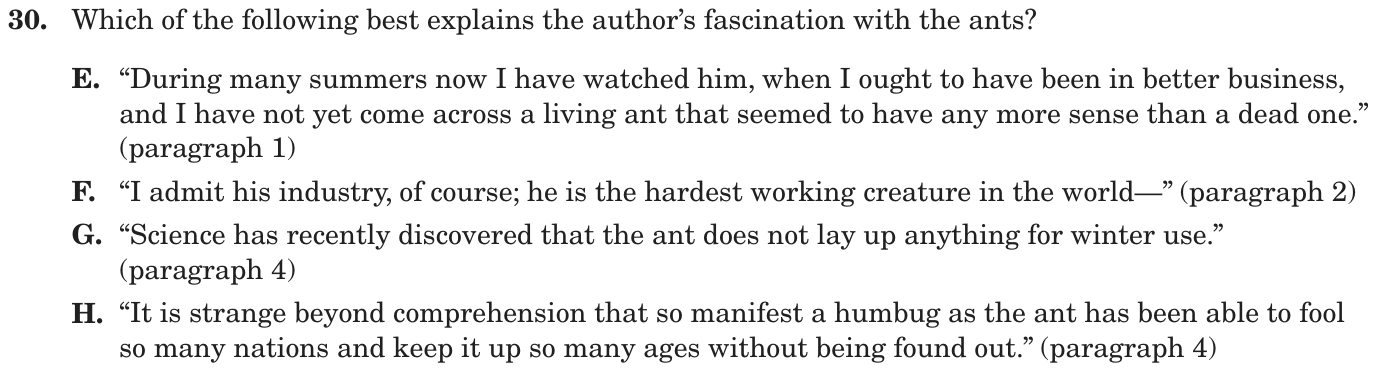
Question 43 of 53
2018 Test A English, question 43Passage Cross-Purposes
Cross-Purposes
What I am is built: concrete and steel.
I defy gravity. I am what every athlete
wants: to remain at the apex of the leap,
up in the air. And yet I am useful, too:
cars, trucks, people, even trains
make their way across my broad back.
Swallows and ospreys nest in my trusses.
What I am is motion. I am water, and I am older
than anything else you know. No human
built me. I am gravity’s best friend; I pool
and flow wherever gravity takes me.
I am the blood flowing in the runner’s chest,
and I catch everything: from the hills,
the mountains. It all washes down through me.
What you are is an accident,
what happens to rain when rain gives in
to Earth’s gravitational pull.
You are some tears dribbling from a mountain’s
eye, running down the pavements
of small towns, into the cities, to the sea.
You are the path of least resistance.
What I am is power. You, of course,
have none: you are a static lump, an artifact
slowly decaying. But my regal flow
nourishes grasses, permits empires to rise.
Those who made you will break you,
in time, replacing you with yet another
clumsy structure. I have seen. I know.
“Clumsy”? Being rebuilt makes me
a friend of time, does it not? And it means
that I have siblings—those “clumsy” structures,
my sisters and brothers.
We stitch across the rip you make.
We are steel thread to the human needle.
We bind you up. We sew you.
And I sow into you; in every cranny
of your superstructure my vapors cling.
They bring out your softness, your rust.
Boast your best, and boast better yet.
I am listening to the bright hum
of the wind in your wires. Because I am,
above all else, patient. I will wait for you.
ospreys: large birds
Question
Read lines 2–4 and lines 12–14 from the poem.
I am what every athlete
wants: to remain at the apex of the leap,
up in the air.
I am the blood flowing in the runner’s chest,
and I catch everything: from the hills,
the mountains.
How do the lines contribute to the development of a central idea of the poem?
- AThey establish that both the structure and the water have endurance and control.
- BThey highlight that both the structure and the water are powerful and impressive.
- CThey suggest that the structure and the water are unaware of how similar they are.
- DThey reveal that the structure and the water are surprised that they are interrelated.
Show the answer
Correct answer: B
The answer is (B)
The question asks how the lines contribute to the development of a central idea in the poem. The lines “I am what every athlete / wants” (lines 2–3) and “I am the blood flowing in the runner’s chest” (line 12) communicate that each speaker is an object of admiration and a powerful force, so Option B is correct.
Option A is incorrect because nothing in the language of the lines communicates control.
Option C is incorrect because the lines describe opposing characteristics: the structure’s description conveys stillness—remaining “up in the air” (line 4)—while the water’s description conveys movement—“flowing in the runner’s chest” (line 12). Additionally, the idea that the speakers fail to recognize similarities is not part of a central idea.
Option D is incorrect because there is no evidence in the poem that the two speakers understand that they are interrelated.
Question analysis
Students compare two sets of lines from the poem “Cross-Purposes” in which the structure and the water each describe themselves through athletes, one leaping and one running. The question asks how these lines develop a central idea, which means comparing two images that seem opposite and deciding what the pairing adds.
- Grade level
- Grade 8 reading and task
- Compared with grade 7
- Above grade 7 Typical grade 7 work asks what one image suggests. This question pairs images from two speakers in a two-voice poem and asks for a shared idea, with abstract choices that all sound plausible, which is above grade 7.
- Estimated difficulty
- Hard: combines ideas, needs a plan, and has more than one tempting wrong answer.
- Thinking it demands
- Depth of knowledge 3, strategic thinking · mainly analyze
- What makes it hard
- Figurative or literary language major
- Combines ideas moderate
- A very close wrong answer moderate
- Evidence
- Answered from several paragraphs or stanzas
- Reading level
- Passage: 316 words (a poem; reading level not measured); question and choices: about grade 7, 113 words.
- Students, last 30 days
- Not enough answers yet to show (it takes 10).
Why it is hard, traps and wrong answers (shows the answer)
Why it is hard
The athlete images point in opposite directions, one frozen in the air and one in motion, so students may look for a contrast when the question wants what the two share. Both speakers are borrowing the glamour of athletes to boast, which is what makes them powerful and impressive. The other choices either add a quality, control, that neither image carries, or credit the speakers with feelings the poem never shows.
Figurative or literary language major Understanding the question
Both claims are metaphors: the bridge is the athlete's dream of staying “at the apex of the leap,” and the water is “the blood flowing in the runner's chest,” so each image must be translated into a quality. (Graesser, Singer & Trabasso, 1994; Kintsch, 1998)
Combines ideas moderate Working it out
The two sets of lines come from rival speakers in different stanzas, and the answer has to name one idea true of both, not of either alone. (Embretson, 1998; Daniel & Embretson, 2010)
A very close wrong answer moderate Choosing the answer
A and B share the frame “both the structure and the water” plus two qualities; A's endurance is close to B's power, and only its added “control” finds no support in the lines. (Embretson & Wetzel, 1987; Gorin & Embretson, 2006; Ascalon et al., 2007)
Strategy: For each set of lines, ask what the speaker claims about itself through the athlete image; then keep only a choice that fits both speakers and these exact words.
Traps
- Half right: One half of a two-part choice is right and the other is not.
- Reads too much in: A reasonable-sounding conclusion that goes further than the text allows.
The wrong answers, classified
A Half right (King et al., 2004; Thissen, Steinberg & Fitzpatrick, 1989)
Hears stamina in the runner and in staying aloft, which is defensible, but nothing in either set of lines suggests control.
C Reads too much in (Graesser, Singer & Trabasso, 1994)
Notices that both speakers use athletes and assumes they miss the likeness, an idea the poem never develops; the images actually set stillness against motion.
D Wrong tone or attitude (Graesser, Singer & Trabasso, 1994)
Reads surprise into lines whose tone is boastful; neither speaker shows any sign of noticing a connection, let alone being surprised by it.
Working it out, step by step
Figure out what the question asks
This asks how two sets of lines build a central idea. The structure speaks one set, and the water speaks the other. You need one idea that fits both.
Read both sets of lines
The structure says, in lines 2–4: “I am what every athlete / wants: to remain at the apex of the leap, / up in the air.”
The water says, in lines 12–14: “I am the blood flowing in the runner’s chest, / and I catch everything.”
Work out what each speaker claims
The apex is the very top. Every athlete wishes they could stay at the top of a jump. The structure stays up there all the time. So it brags that it does what athletes dream of.
The water says it is the blood that keeps a runner going. Both speakers compare themselves to strong athletes. Both are showing off how powerful and impressive they are.
Check each choice
- A Endurance (lasting a long time) could fit. But nothing in the lines shows control.
- B fits. Both speakers boast of being powerful and impressive.
- C The poem never says they don’t notice how alike they are.
- D Neither speaker shows surprise. Their tone is proud.
Choose the answer
Both sets of lines show the speakers bragging about their power. So the answer is B.
Why this answer and not the closest wrong one
A is the closest choice. Like B, it says something good about both speakers. But A adds “control,” and neither set of lines shows either speaker controlling anything. Every part of B fits both sets of lines, with nothing extra.
More questions like this
The original DOE question
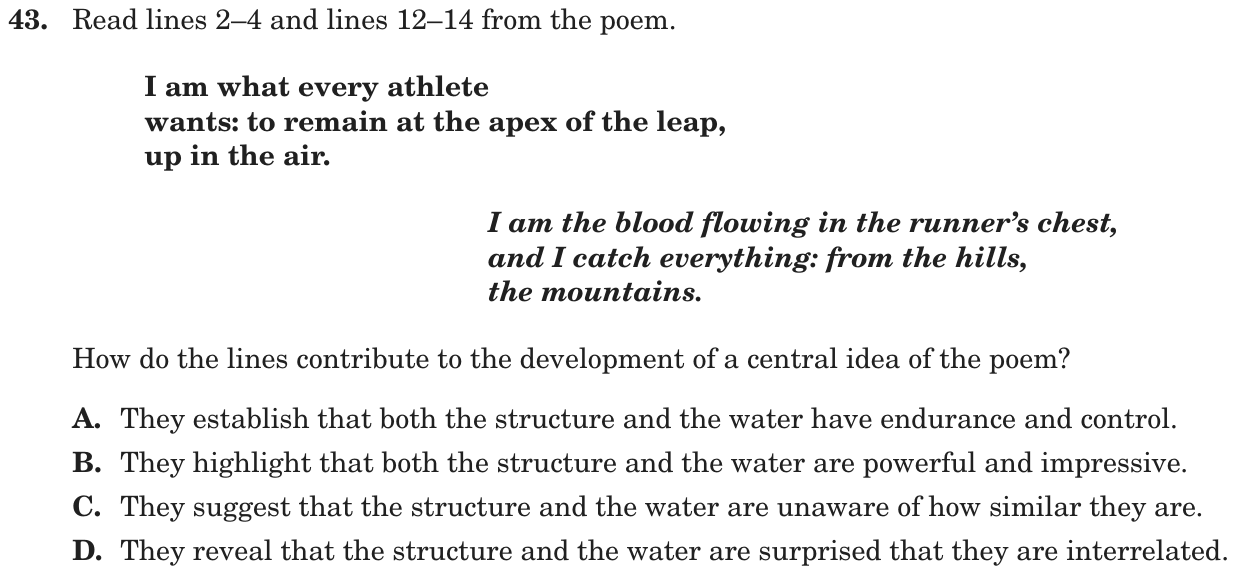
The passage “Cross-Purposes” as printed (pages 72–73)
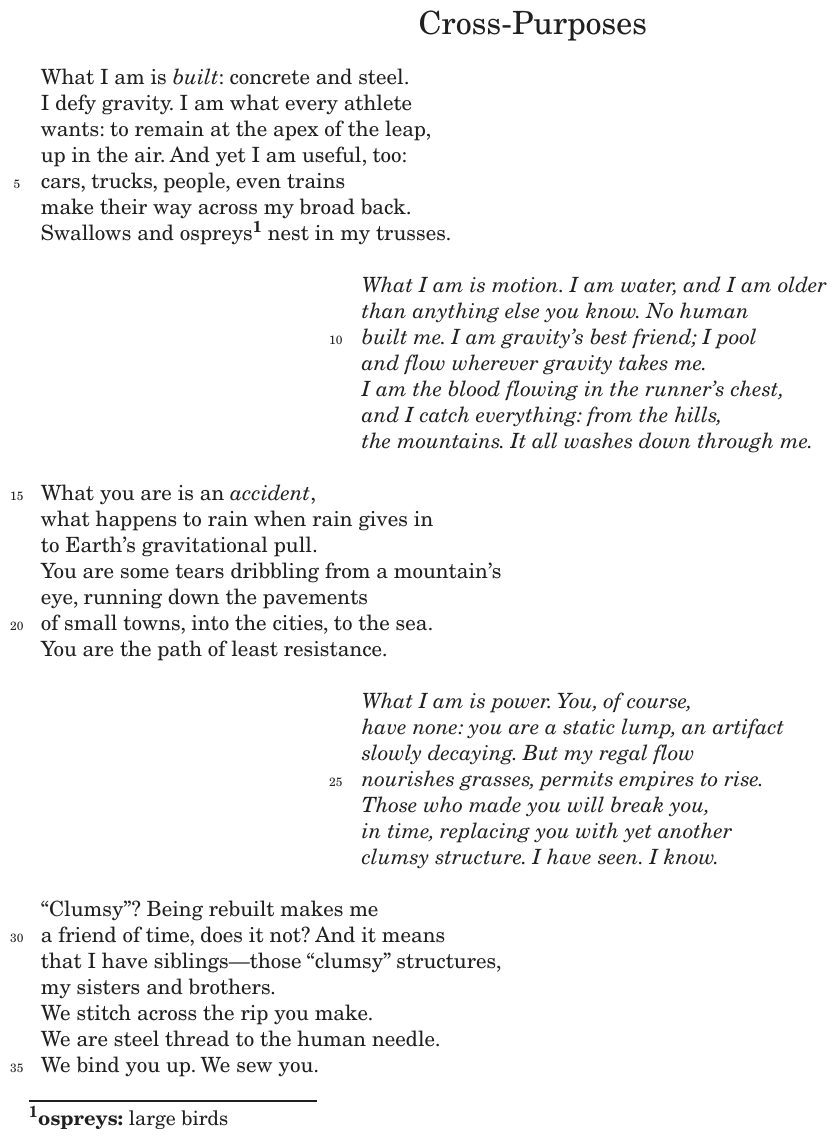
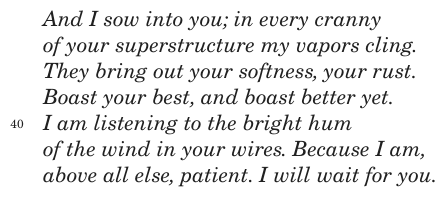
Question 44 of 53
2018 Test A English, question 44Uses the passage above: “Cross-Purposes”.
Question
Read line 7 from the first stanza.
Swallows and ospreys nest in my trusses.
How does the line contribute to the development of ideas in the stanza?
- AThe line supports the structure’s claim that it is beneficial to nature.
- BThe line reveals that the structure secretly envies the water’s importance in nature.
- CThe line emphasizes that the structure is more valuable to nature than the water is.
- DThe line reveals the kinship that nature shares with the structure.
Show the answer
Correct answer: A
The answer is (A)
The question asks how the line contributes to the development of ideas in the stanza. The line mentions swallows and ospreys, birds that use the structure’s trusses as their home; this reference supports the claim that the structure is beneficial to nature, so Option A is correct.
Option B is incorrect because the line doesn’t hint at jealousy in the tone or language, but rather the line is promoting the structure’s helpful characteristic.
Option C is incorrect because, in the line, the structure is not making a comparison with the water.
Option D is incorrect because, in the line, the structure is not implying that it is related to nature but rather that it is helpful to nature.
Question analysis
This question focuses on the first stanza of “Cross-Purposes,” in which a built structure describes itself, and asks what the line about swallows and ospreys nesting in its trusses adds. The line is short and plain, but students need to read it as part of the whole stanza and know that trusses are a structure's load-bearing framework.
- NYS standards
- 7R5 structure and genre features
- Grade level
- Grade 6 reading and task
- Compared with grade 7
- Below grade 7 Explaining what one line adds to its own stanza matches the grade 6 standard on how a sentence fits into a text. The line is plain and the stanza short, so this is below typical grade 7 demand.
- Estimated difficulty
- Straightforward: two steps or one careful reading.
- Thinking it demands
- Depth of knowledge 2, skills and concepts · mainly analyze
- What makes it hard
- How, not what minor
- Figurative or literary language minor
- A very close wrong answer minor
- Evidence
- Answered from one paragraph or stanza
- Reading level
- Passage: 316 words (a poem; reading level not measured); question and choices: about grade 6, 77 words.
- Students, last 30 days
- Not enough answers yet to show (it takes 10).
Why it is hard, traps and wrong answers (shows the answer)
Why it is hard
The line is plain and follows directly from the stanza's claim that the structure is useful, so most students who read the stanza in order find the key. The wrong choices import the poem's later rivalry with the water, or a sense of family that comes later and refers to other structures. Students who keep to the first stanza, where the water has not yet spoken, avoid them.
How, not what minor Working it out
The line follows “And yet I am useful, too,” so its job is to extend the structure's usefulness from cars and trains to birds. (Anderson & Krathwohl, 2001)
Figurative or literary language minor Understanding the question
The speaker is a personified bridge boasting about itself, and the birds in its “trusses” are offered as one more reason to admire it. (Graesser, Singer & Trabasso, 1994; Kintsch, 1998)
A very close wrong answer minor Choosing the answer
A and C both say the line shows the structure's value to nature; C differs only in adding “than the water is,” a comparison the first stanza, where the water has not yet spoken, never makes. (Embretson & Wetzel, 1987; Gorin & Embretson, 2006; Ascalon et al., 2007)
Strategy: Read the stanza's sentences in order and note what each says about the speaker; then ask what the line about the birds adds to that picture.
Traps
- Wrong part of the text: A choice is true of another paragraph, stanza or speaker than the one asked about.
- Reads too much in: A reasonable-sounding conclusion that goes further than the text allows.
The wrong answers, classified
B Wrong tone or attitude (Graesser, Singer & Trabasso, 1994)
Imagines envy of the water, but the first stanza never mentions the water and its tone is proud, not jealous.
C Wrong part of the text (Kirsch & Mosenthal, 1990)
Brings in the later contest over usefulness to nature, when the water says its flow “nourishes grasses”; the first stanza makes no comparison.
D Reads too much in (Graesser, Singer & Trabasso, 1994)
Reads nesting birds as a family bond, a step beyond the line, which shows the structure helping nature; the “siblings” come later and are other structures.
Working it out, step by step
Figure out what the question asks
This asks what one line adds to the first stanza. A stanza is a group of lines in a poem, a bit like a paragraph. Read the whole stanza to see where the line fits.
Read the stanza in order
Line 4 says: “And yet I am useful, too.” Lines 5–6 list who uses the structure: “cars, trucks, people, even trains.” Then line 7 says: “Swallows and ospreys nest in my trusses.”
The footnote says ospreys are large birds. Swallows are small birds. Trusses are the frame of beams that holds up a bridge.
Work out what the line adds
Lines 4–7 list ways the structure is useful. First it helps people and their cars and trains get across. Line 7 adds that it helps animals too: birds make their homes in it. So the line shows the structure is good for nature, not just for people.
Check each choice
- A fits. Birds nesting there support the claim that the structure helps nature.
- B The water isn’t even mentioned yet, and the tone is proud, not jealous.
- C This stanza makes no comparison with the water.
- D Kinship means being family. The line shows help, not family. The “siblings” come later, and they are other structures.
Choose the answer
The line backs up the structure’s claim that it is good for nature. So the answer is A.
Why this answer and not the closest wrong one
C is the closest trap. Like A, it says the structure helps nature. But C adds “than the water is.” In the first stanza the water has not spoken yet, so no comparison is made. A says only what the line shows.
More questions like this
The original DOE question
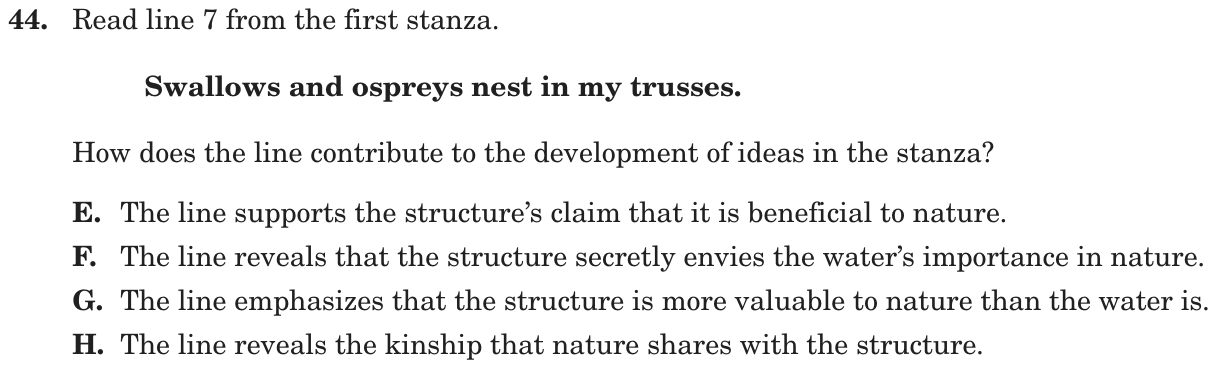
Question 45 of 53
2018 Test B English, question 15Passage The Tunguska Fireball
The Tunguska Fireball
On June 30, 1908, an enormous fireball shot across the sky and exploded high above the remote Tunguska River Valley in the Siberian region of Russia. Twenty miles away, huts were flattened and people were flung into the air. Villagers 40 miles away felt the heat and heard explosions, and tremors were recorded at a German seismic station more than 3,000 miles away.
What caused the intense light and the horrendous destruction of the Tunguska Fireball, as it came to be called? Scientists and laypeople have debated the question for over 100 years. Not until 1927 did a scientific expedition, led by Russian scientist Leonid Kulik, reach the remote site. Kulik discovered a vast region of scorched and downed trees, their trunks pointing away from the center of the blast. Convinced that a meteorite was responsible, Kulik searched for evidence—a crater, a buried meteorite, even fragments of the exploded mass. He never found it.
Other scientists, amateur astronomers, and the public suggested alternative theories of what had happened. Some thought it was an earthquake. Perhaps, others said, a black hole—a theoretical object in space where gravity is so strong that even light cannot get out—had collided with Earth or an alien spaceship carrying nuclear material had crashed.
For many years Russian scientists believed that the Tunguska Fireball was a comet—a cluster of dust and frozen gases—that had exploded a few hundred feet above the ground. They pointed to the lack of meteoric evidence and the June 30 date, a time of year when Earth was passing through cometary debris. Other scientists disagreed, arguing that a comet would have burned quickly in Earth’s atmosphere and could not have created such a blast.
Many Western scientists believed that a meteorite was responsible, despite the lack of evidence. The pattern of fallen trees suggested that they were knocked down by a blast about 4 miles above the ground with an energy of 15 megatons of TNT, consistent with a meteoric blast. Yet repeated searches of the surrounding forest and wetlands revealed no evidence of a meteorite.
During the 1990s an Italian physicist named Menotti Galli became interested. Galli had previously investigated whether particles from outer space can add carbon atoms to the cellulose in trees. Perhaps the trees at the Tunguska site hid evidence of such extraterrestrial material. Galli and his colleagues traveled to the site by helicopter to gather core samples from spruce trees that had lived through the blast. They analyzed the particles trapped in the trees’ resin, and the results were remarkable. Based on studying the trees’ rings during the time period when the Tunguska Fireball occurred, the researchers found that the resin contained high levels of high-proton elements, such as copper, gold, and nickel. In fact, it contained ten times more such particles than resin dating from either before or after that time period. Some previously discovered meteorites had also contained elevated levels of these elements, suggesting that the particles had an extra-earthly origin. But then where is the crater? Is it nearby Lake Cheko, as some claim? Or was the meteorite reduced to dust in the atmosphere? Can scientists rule out a comet carrying those elements? The mystery remains unsolved.
Question
The author includes a series of questions at the end of the last paragraph most likely to
- Aencourage further study of the Tunguska event.
- Bsuggest that the Tunguska event had multiple causes.
- Creflect a personal curiosity about the Tunguska event.
- Demphasize that the Tunguska event has not yet been fully explained.
Show the answer
Correct answer: D
The question asks how the questions at the end of the last paragraph affect the passage. Although the passage introduces a number of theories about the Tunguska explosion, no definitive explanation has been reached. This idea is stated in Option D.
Option A is incorrect because, although the passage does not discourage further study, it does not specifically promote it.
Option B is incorrect because, although the author presents multiple possible causes, the passage suggests that the damage was most likely caused by one of these possibilities rather than several of them simultaneously. The author is certainly curious about the actual cause of the Tunguska explosion but objectively presents the questions about it that remain unanswered, making Option C incorrect.
Question analysis
This author’s-craft question asks why the Tunguska article ends its last paragraph with a string of questions. Students must decide what purpose the questions serve in a passage that presents several competing theories. Each choice offers a reasonable-sounding motive, so students must judge which one the passage as a whole supports.
- Grade level
- Grade 7 reading and task
- Compared with grade 7
- At grade 7 Explaining why an author uses a device such as rhetorical questions is grade 7 structure work. Students must infer purpose from the ending’s context, and some wrong choices name purposes that sound natural for questions in general.
- Estimated difficulty
- Moderate: several steps, or a close reading with one strong distractor.
- Thinking it demands
- Depth of knowledge 3, strategic thinking · mainly analyze
- What makes it hard
- How, not what moderate
- Evidence in several places minor
- Evidence
- Answered from one paragraph or stanza
- Reading level
- Passage: about grade 10, 531 words; question and choices: about grade 9, 51 words.
- Corrected from the DOE handbook
- A misspelled place name in the passage was corrected.
- Students, last 30 days
- Not enough answers yet to show (it takes 10).
Why it is hard, traps and wrong answers (shows the answer)
Why it is hard
All four purposes sound like reasons a writer might end with questions, so the work is in matching the purpose to this article’s stance. It has laid out competing theories without choosing one, and the questions keep that balance before the flat statement that the mystery is unsolved. Students lose the point by reading the questions as a call to action, a personal voice, or a claim that several causes acted together.
How, not what moderate Working it out
Students must name what four closing questions do, and the clue is the short sentence right after them, “The mystery remains unsolved,” which the questions lead up to. (Anderson & Krathwohl, 2001)
Evidence in several places minor Working it out
The questions revisit theories from across the article, the missing crater, the meteorite, the comet, so seeing that none has won means recalling paragraphs 2 through 5. (Kirsch & Mosenthal, 1990; Gorin & Embretson, 2006)
Strategy: Reread the whole last paragraph, then decide what closing on a string of questions does for the reader of this science article.
Traps
- Reads too much in: A reasonable-sounding conclusion that goes further than the text allows.
- Wrong tone or attitude: Misjudges the tone, attitude or point of view, such as reading admiration as criticism, or taking a character's or subject's feelings for the author's.
The wrong answers, classified
A Reads too much in (Graesser, Singer & Trabasso, 1994)
Hears the open questions as a call for more research, a reasonable guess about why writers ask questions, but the article never urges anyone to study the event.
B Twists what the text says (King et al., 2004)
Reads the questions’ list of possibilities, a crater lake, dust, a comet, as causes acting together, though they are competing explanations for one blast.
C Wrong tone or attitude (Graesser, Singer & Trabasso, 1994)
Takes the questions as the writer’s own wondering aloud, but the article reports others’ theories in a neutral voice and never uses “I” or a personal reaction.
What was corrected from the DOE handbook, and why
- Passage: The handbook’s passage asks, “Is it nearby Lake Cheka, as some claim?” The lake near the Tunguska blast site that some scientists have proposed as the crater is Lake Cheko, so the site now spells it that way. No answer depends on the spelling.
Working it out, step by step
Figure out what the question asks
This asks why the author ends with a string of questions. You need their purpose: what the questions do for the reader.
Read the end of paragraph 6
The passage ends: “But then where is the crater? Is it nearby Lake Cheko, as some claim? Or was the meteorite reduced to dust in the atmosphere? Can scientists rule out a comet carrying those elements? The mystery remains unsolved.”
Work out what the questions do
Each question goes back to an idea from earlier: the missing crater, the meteorite, the comet. None of them has a sure answer. Right after the questions, the author says it plainly: “The mystery remains unsolved.” So the questions stress that no one knows for sure what happened.
Check each choice
- A is wrong. The author never asks readers or scientists to study the event more.
- B is wrong. The questions list different possible causes. They compete with each other. They are not causes that worked together.
- C is wrong. The author reports facts and never says “I” or shares feelings.
- D is right. The questions show the event is still not fully explained.
Watch out: Questions can sound like a call for more research. But nothing in the passage tells anyone to study more.
Choose the answer
The questions remind you that every idea is still in doubt. So the answer is D.
Why this answer and not the closest wrong one
A is the closest wrong answer. Open questions might make a reader want more research. But the passage never urges anyone to study the event. The questions lead straight into “The mystery remains unsolved.” That sentence tells you their purpose.
More questions like this
The original DOE question

The passage “The Tunguska Fireball” as printed (page 124)
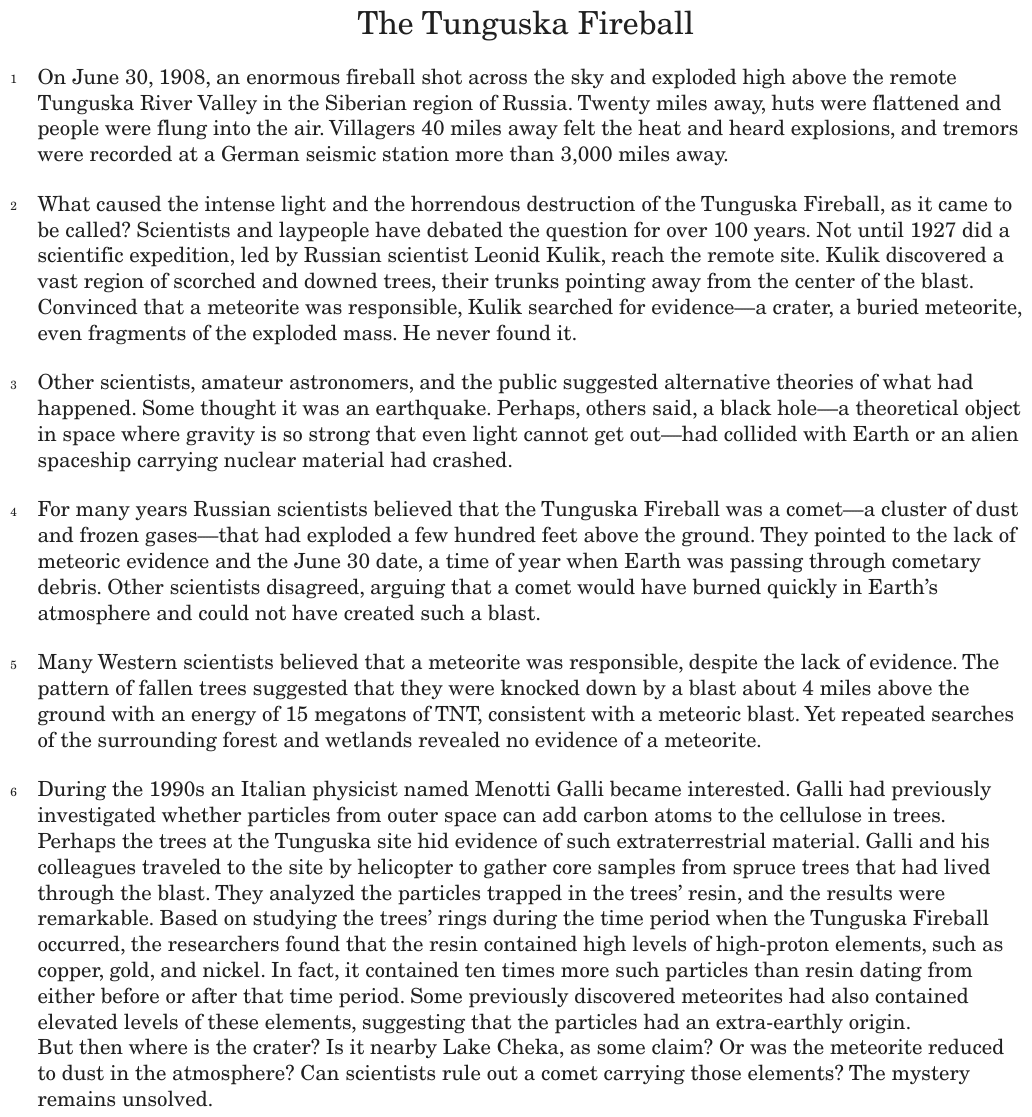
Question 46 of 53
2018 Test B English, question 16Passage Excerpt from A Voice in the Wilderness
Excerpt from A Voice in the Wilderness
by Grace Livingston Hill
With a lurch the train came to a dead stop and Margaret Earle, hastily gathering up her belongings, hurried down the aisle and got out into the night.
It occurred to her, as she swung her heavy suit-case down the rather long step to the ground, and then carefully swung herself after it, that it was strange that neither conductor, brakeman, nor porter had come to help her off the train, when all three had taken the trouble to tell her that hers was the next station; but she could hear voices up ahead. Perhaps something was the matter with the engine that detained them and they had forgotten her for the moment.
The ground was rough where she stood, and there seemed no sign of a platform. Did they not have platforms in this wild Western land, or was the train so long that her car had stopped before reaching it?
She strained her eyes into the darkness, and tried to make out things from the two or three specks of light that danced about like fireflies in the distance. She could dimly see moving figures away up near the engine, and each one evidently carried a lantern. The train was tremendously long. A sudden feeling of isolation took possession of her. Perhaps she ought not to have got out until some one came to help her. Perhaps the train had not pulled into the station yet and she ought to get back on it and wait. Yet if the train started before she found the conductor she might be carried on somewhere and he justly blame her for a fool.
There did not seem to be any building on that side of the track. It was probably on the other, but she was standing too near the cars to see over. She tried to move back to look, but the ground sloped and she slipped and fell in the cinders, bruising her knee and cutting her wrist.
In sudden panic she arose. She would get back into the train, no matter what the consequences. They had no right to put her out here, away off from the station, at night, in a strange country. If the train started before she could find the conductor she would tell him that he must back it up again and let her off. He certainly could not expect her to get out like this.
She lifted the heavy suit-case up the high step that was even farther from the ground than it had been when she came down, because her fall had loosened some of the earth and caused it to slide away from the track. Then, reaching to the rail of the step, she tried to pull herself up, but as she did so the engine gave a long snort and the whole train, as if it were in league against her, lurched forward crazily, shaking off her hold. She slipped to her knees again, the suit-case, toppled from the lower step, descending upon her, and together they slid and rolled down the short bank, while the train . . . ran giddily off into the night.
The horror of being deserted helped the girl to rise in spite of bruises and shock. She lifted imploring hands to the unresponsive cars as they hurried by her—one, two, three, with bright windows, each showing a passenger, comfortable and safe inside, unconscious of her need.
A moment of useless screaming, running, trying to attract some one’s attention, a sickening sense of terror and failure, and the last car slatted itself past with a mocking clatter, as if it enjoyed her discomfort.
Margaret stood dazed, reaching out helpless hands, then dropped them at her sides and gazed after the fast-retreating train, the light on its last car swinging tauntingly, blinking now and then with a leer in its eye, rapidly vanishing from her sight into the depth of the night.
She gasped and looked about her for the station that but a short moment before had been so real to her mind; and, lo! on this side and on that there was none!
The night was wide like a great floor shut in by a low, vast dome of curving blue set with the largest, most wonderful stars she had ever seen. Heavy shadows of purple-green, smoke-like, hovered over earth darker and more intense than the unfathomable blue of the night sky. It seemed like the secret nesting-place of mysteries wherein no human foot might dare intrude. It was incredible that such could be but common sage-brush, sand, and greasewood wrapped about with the beauty of the lonely night.
No building broke the inky outlines of the plain, nor friendly light streamed out to cheer her heart. Not even a tree was in sight, except on the far horizon, where a heavy line of deeper darkness might mean a forest. Nothing, absolutely nothing, in the blue, deep, starry dome above and the bluer darkness of the earth below save one sharp shaft ahead like a black mast throwing out a dark arm across the track.
As soon as she sighted it she picked up her baggage and made her painful way toward it, for her knees and wrist were bruised and her baggage was heavy.
A soft drip, drip greeted her as she drew nearer; something plashing down among the cinders by the track. Then she saw the tall column with its arm outstretched, and looming darker among the sage-brush the outlines of a water-tank. It was so she recognized the engine’s drinking-tank, and knew that she had mistaken a pause to water the engine for a regular stop at a station.
cinders: track bed made from the residue of burnt coal
From A VOICE IN THE WILDERNESS by Grace Livingston Hill—Public Domain
Question
In paragraph 2, how does the phrase “when all three had taken the trouble to tell her” affect the tone in the first part of the excerpt?
- AIt creates an accusatory tone by suggesting that Margaret believes that others are responsible for her problem.
- BIt introduces a defiant tone by suggesting that Margaret left the train early to prove a point.
- CIt suggests a frustrated tone by showing that Margaret feels confused by the inconsistent help offered by the railroad employees.
- DIt establishes an appreciative tone by showing that Margaret feels cared for by the railroad employees.
Show the answer
Correct answer: C
The question asks how the phrase affects the tone in the first part of the excerpt. The phrase includes the words “all three” and “taken the trouble,” emphasizing Margaret’s early frustration as she recalls with some confused irritation that the men thought she needed an abundance of help earlier, but none of them is around to help when the train stops, as indicated in Option C.
Option A is incorrect because when Margaret recalls the interaction, there is no indication that she blames the men for her current problem.
Option B is incorrect because, while the description of how Margaret “hastily [gathers] up her belongings” and “[hurries] down the aisle” (paragraph 1) gives the appearance of being defiant, there is no evidence that she intentionally put herself in this vulnerable position just to make a point.
Option D is incorrect because when Margaret recalls the interaction, there is no evidence that she appreciates the care shown to her, but rather she seems a bit offended that the men do not think she could take care of herself, as shown by the author’s description of the forceful way she exits the train without assistance when it stops.
Question analysis
This tone question looks at a phrase from the opening of Grace Livingston Hill’s novel A Voice in the Wilderness, as Margaret Earle steps off a train at night. Students decide what attitude the phrase about the three railroad men creates. The wording is low-key and old-fashioned, which makes the attitude behind it easy to misjudge.
- Grade level
- Grade 8 reading and task
- Compared with grade 7
- Above grade 7 Grade 7 tone questions usually rest on clearly charged words; this one hinges on an understated phrase in century-old prose. Students must read how Margaret feels about the trainmen from context, without help from any strongly worded clue.
- Estimated difficulty
- Hard: combines ideas, needs a plan, and has more than one tempting wrong answer.
- Thinking it demands
- Depth of knowledge 2, skills and concepts · mainly analyze
- What makes it hard
- A very close wrong answer major
- Complex sentences moderate
- Reading between the lines moderate
- Hard words minor
- Evidence
- Answered from one paragraph or stanza
- Reading level
- Passage: about grade 8, 981 words; question and choices: about grade 10, 96 words.
- Students, last 30 days
- Not enough answers yet to show (it takes 10).
Why it is hard, traps and wrong answers (shows the answer)
Why it is hard
The phrase is understated, and old-fashioned wording hides how Margaret feels. Students who sense criticism of the trainmen often push it too far into blame, which she does not reach until paragraph 6, while those who take “taken the trouble” at face value hear gratitude. The question rewards reading the whole sentence: “it was strange” and her quick excuse about engine trouble show puzzlement and mild irritation, not accusation.
A very close wrong answer major Choosing the answer
The accusatory choice and the frustrated choice both find a negative attitude toward the railroad employees; only the degree separates them, since Margaret calls their absence “strange” and excuses it rather than blaming them. (Embretson & Wetzel, 1987; Gorin & Embretson, 2006; Ascalon et al., 2007)
Complex sentences moderate Understanding the question
The phrase sits deep inside a 66-word sentence that opens with her swinging the suit-case down and closes with voices up ahead, so its contrast is easy to lose. (Abedi & Lord, 2001; Freedle & Kostin, 1993; Messick, 1989)
Reading between the lines moderate Working it out
Margaret never says she is annoyed; the feeling comes from the contrast between “all three had taken the trouble to tell her” and none of them coming to help. (Graesser, Singer & Trabasso, 1994; Kintsch, 1998)
Hard words minor Understanding the question
Each choice turns on a tone word, “accusatory,” “defiant,” “frustrated,” “appreciative,” and students unsure of these labels cannot match them to the scene. (Perfetti, 2007; Freedle & Kostin, 1993)
Strategy: Reread the full sentence the phrase sits in, ask how Margaret feels about the three men at this moment, and match both the feeling and its reason to a choice.
Traps
- Too broad or too strong: A choice overstates, generalizes, or uses absolute words the text does not support.
- Wrong tone or attitude: Misjudges the tone, attitude or point of view, such as reading admiration as criticism, or taking a character's or subject's feelings for the author's.
The wrong answers, classified
A Too broad or too strong (King et al., 2004)
Rightly hears criticism of the three trainmen but inflates puzzlement into blame; she even excuses them with possible engine trouble, and only in paragraph 6 thinks “They had no right.”
B Reads too much in (Graesser, Singer & Trabasso, 1994)
Builds a story of defiance from her hasty exit in paragraph 1, though nothing suggests she left the train early to prove anything to anyone.
D Wrong tone or attitude (Graesser, Singer & Trabasso, 1994)
Takes “taken the trouble” as gratitude for the men’s care, reading the phrase on its own and missing the sentence’s point that none of them came to help.
Working it out, step by step
Figure out what the question asks
This asks about tone: the feeling or attitude that the words give. What does one phrase show about how Margaret feels toward the train workers?
Read the whole sentence
In paragraph 2, Margaret thinks “it was strange that neither conductor, brakeman, nor porter had come to help her off the train, when all three had taken the trouble to tell her that hers was the next station.”
Work out the feeling
A conductor, a brakeman and a porter are train workers. To take the trouble means to make an effort. All three made an effort to tell her about her stop. But now none of them comes to help. That doesn’t add up, and she calls it “strange.” She feels puzzled and a bit annoyed. That is frustration.
She even makes excuses for them: “Perhaps something was the matter with the engine.” So she is not blaming them.
Check each choice
- A is wrong. “Accusatory” means blaming. Margaret makes excuses for the workers instead.
- B is wrong. “Defiant” means boldly refusing to obey. Nothing shows she left the train to prove a point.
- C is right. The workers were helpful at first and then vanished. She is confused and frustrated.
- D is wrong. “Appreciative” means thankful. The point is that nobody came to help.
Watch out: A is tempting because she does find the workers’ absence odd. But odd is not the same as their fault.
Choose the answer
The phrase shows Margaret puzzled by help that came and then disappeared. So the answer is C.
Why this answer and not the closest wrong one
A is the closest wrong answer, because both A and C find something negative in her thoughts. But A goes too far. Margaret does not blame the workers. She guesses they “had forgotten her for the moment.” She is puzzled, not accusing, as C says.
More questions like this
The original DOE question
The passage “Excerpt from A Voice in the Wilderness” as printed (pages 128–129)
Question 47 of 53
2018 Test B English, question 20Uses the passage above: “Excerpt from A Voice in the Wilderness”.
Question
Read paragraph 9 from the excerpt.
A moment of useless screaming, running, trying to attract some one’s attention, a sickening sense of terror and failure, and the last car slatted itself past with a mocking clatter, as if it enjoyed her discomfort.
The imagery in this sentence conveys the
- Agrowing irritation Margaret feels as she is ignored by people on the train.
- Beffort Margaret is making despite being physically unable to keep up with the train.
- Canger that Margaret is experiencing as she watches the train leave without her.
- Dvulnerability Margaret feels as the train leaves her behind.
Show the answer
Correct answer: D
The question asks for an explanation of what the imagery in the excerpt from paragraph 9 conveys. The words “useless” and “failure” in the sentence indicate that Margaret’s best efforts do not help her. The phrase “the last car slatted itself past” shows that Margaret is helpless to stop the train from departing, which leaves her completely vulnerable, as described in Option D.
Option A is incorrect because describing Margaret’s “sickening sense of terror” indicates that she is extremely afraid of being left behind rather than increasingly irritated with the other passengers.
Option B is incorrect because Margaret spends her time “screaming, running, trying to attract some one’s attention” in an effort to be noticed so that the train will stop, not attempting to run as fast as the train.
Option C is incorrect because while Margaret’s screaming and running could easily suggest feelings of anger, descriptions of her “sickening sense of terror and failure” indicate otherwise.
Question analysis
This imagery question quotes paragraph 9 of A Voice in the Wilderness, a single long sentence describing the moment the last car of the train rattles past Margaret. Students decide what feeling the imagery conveys. The scene is full of action and noise, so it is easy to name an emotion that fits her behavior but not the words used.
- Grade level
- Grade 7 reading and task
- Compared with grade 7
- At grade 7 Reading imagery for a character’s feelings is everyday grade 7 work. Paragraph 9 is a single sentence with strong emotional words, so the task stays inside one sentence rather than ranging across the story.
- Estimated difficulty
- Straightforward: two steps or one careful reading.
- Thinking it demands
- Depth of knowledge 2, skills and concepts · mainly analyze
- What makes it hard
- Figurative or literary language moderate
- Complex sentences minor
- A very close wrong answer minor
- Evidence
- Answered from one paragraph or stanza
- Reading level
- Passage: about grade 8, 981 words; question and choices: about grade 9, 97 words.
- Corrected from the DOE handbook
- A misspelling of the main character’s name in the explanation was corrected.
- Students, last 30 days
- Not enough answers yet to show (it takes 10).
Why it is hard, traps and wrong answers (shows the answer)
Why it is hard
The sentence names Margaret’s feelings outright, “terror and failure,” and calls her screaming “useless,” so the question is mostly about trusting those words over the noisy action around them. Students who read the actions alone tend to name anger or irritation. Seeing that a train which seems to enjoy her distress makes her look powerless, not angry, is what leads to the right reading.
Figurative or literary language moderate Understanding the question
The last car “slatted itself past with a mocking clatter, as if it enjoyed her discomfort,” and students must see that the personified mockery stresses her helplessness, not her temper. (Graesser, Singer & Trabasso, 1994; Kintsch, 1998)
Complex sentences minor Understanding the question
Paragraph 9 is one 36-word sentence that lists fragments, “useless screaming, running” and “a sickening sense of terror and failure,” before its only main verb arrives. (Abedi & Lord, 2001; Freedle & Kostin, 1993; Messick, 1989)
A very close wrong answer minor Choosing the answer
The anger choice shares the right one’s frame, a feeling as the train leaves her behind, and differs only in the feeling named, which the sentence’s “terror and failure” settle. (Embretson & Wetzel, 1987; Gorin & Embretson, 2006; Ascalon et al., 2007)
Strategy: Pick out the words in the sentence that name feelings, along with what the personified train seems to do, and match the choice to those words.
Traps
- Wrong tone or attitude: Misjudges the tone, attitude or point of view, such as reading admiration as criticism, or taking a character's or subject's feelings for the author's.
- Twists what the text says: Uses the text's topic and ideas but changes what it says: who did it, how much, when, or why.
The wrong answers, classified
A Wrong tone or attitude (Graesser, Singer & Trabasso, 1994)
Rightly sees that no one notices her, but names irritation, a mild and growing annoyance, where the sentence speaks of a “sickening sense of terror.”
B Twists what the text says (King et al., 2004)
Treats her running as a race to keep pace with the train, though she runs and screams only “to attract some one’s attention” so the train will stop.
C Wrong tone or attitude (Graesser, Singer & Trabasso, 1994)
Reads the screaming and the train’s “mocking clatter” as signs of anger, overlooking “terror and failure,” the words the sentence uses for what she feels.
What was corrected from the DOE handbook, and why
- Explanation: The handbook spells the name “Margret” once, in the reason Option C is wrong. The passage and the rest of the explanation spell it “Margaret,” as the site now does.
Working it out, step by step
Figure out what the question asks
This asks about imagery: words that help you see, hear or feel a scene. What do the images in paragraph 9 show about Margaret?
Find the key words
Paragraph 9 describes “useless screaming, running, trying to attract some one’s attention.” She feels “a sickening sense of terror and failure.” Then “the last car slatted itself past with a mocking clatter, as if it enjoyed her discomfort.”
Work out what the words mean
“Useless” and “failure” tell you nothing she does works. “Terror” is great fear. The train even seems to mock her, like a mean person laughing. Giving human traits to a thing is called personification. All of this shows she is helpless. That feeling is vulnerability: being open to harm, with no way to protect yourself.
Check each choice
- A is wrong. Irritation is mild annoyance. The sentence says “terror.”
- B is wrong. She runs to get someone’s attention, not to keep up with the train.
- C is wrong. Screaming might suggest anger, but the sentence names “terror and failure.”
- D is right. She is helpless as the train leaves her behind.
Watch out: The train is “mocking,” which might make you think of anger. But it is the train that seems mean. Her own feelings are fear and failure.
Choose the answer
The images show a girl who can do nothing as the train leaves. So the answer is D.
Why this answer and not the closest wrong one
C is the closest wrong answer, because screaming and a mocking train can suggest anger. But the sentence names her feelings directly: “a sickening sense of terror and failure.” Those are the feelings of someone who is helpless, not angry. D matches those words.
More questions like this
The original DOE question
Question 48 of 53
2018 Test B English, question 21Uses the passage above: “Excerpt from A Voice in the Wilderness”.
Question
How does Margaret’s experience in paragraph 9 emphasize a theme of the excerpt?
- AIt confirms Margaret’s understanding that she cannot rely on help from anyone else.
- BIt leads Margaret to realize that her efforts to change her situation are ineffective.
- CIt causes Margaret to believe that her own actions led to an unfavorable outcome.
- DIt reinforces Margaret’s frustration about her lack of control over her surroundings.
Show the answer
Correct answer: A
The question asks about the relationship between the theme and paragraph 9, where Margaret desperately tries to get someone on the train to notice her. One important theme of this excerpt concerns Margaret’s willingness to take action to ensure that she reaches her destination. This determination, described in Option A, is why she gathers her belongings together without help, gets off the train without being assisted by employees, and then attempts to climb back on while the train employees are busy examining the engine.
Option B is incorrect because, while the narrator describes her screaming as useless, she does not feel that her efforts overall are useless, and she does not give up until paragraph 10.
Option C is incorrect because, while Margaret is feeling a sense of “failure” in paragraph 9, she does not condemn herself as the train moves away.
Option D is incorrect because Margaret has expressed “terror” in paragraph 9 over being unable to catch someone’s attention, not frustration over her lack of control over her surroundings.
Question analysis
This theme question focuses on paragraph 9 of the Grace Livingston Hill excerpt, where Margaret screams and runs as the train pulls away without her. Students decide which larger idea of the excerpt that desperate moment reinforces. All four choices describe feelings she could plausibly have, so students must tie the moment to what the whole story keeps showing.
- Grade level
- Grade 8 reading and task
- Compared with grade 7
- Above grade 7 Grade 7 theme questions ask how a theme develops; this one asks students to decide which theme a single desperate moment reinforces, with four answers that all fit the scene. Weighing them takes the whole excerpt and fine judgment.
- Estimated difficulty
- Among the hardest on the SHSAT: a non-obvious approach, heavy reading, or a well-hidden trap.
- Thinking it demands
- Depth of knowledge 3, strategic thinking · mainly analyze
- What makes it hard
- Reading between the lines major
- Evidence in several places moderate
- Evidence
- Answered from the whole text
- Reading level
- Passage: about grade 8, 981 words; question and choices: about grade 10, 65 words.
- Students, last 30 days
- Not enough answers yet to show (it takes 10).
Why it is hard, traps and wrong answers (shows the answer)
Why it is hard
This is among the hardest questions in the set because every choice describes a feeling Margaret could reasonably have, and two of them borrow the paragraph’s own words, “useless” and “failure.” The answer depends on seeing paragraph 9 as the end of a pattern rather than a single moment of panic. Students who reason from that one paragraph usually conclude she has given up, which the rest of the excerpt contradicts.
Reading between the lines major Working it out
The theme is never stated; it has to be inferred from paragraph 9’s unanswered cries for attention and what they show about whether anyone will come to her aid. (Graesser, Singer & Trabasso, 1994; Kintsch, 1998)
Evidence in several places moderate Working it out
The same pattern starts in paragraph 2, where no trainman comes to help, and returns in paragraph 8’s passengers “unconscious of her need,” so the theme rests on evidence across the excerpt. (Kirsch & Mosenthal, 1990; Gorin & Embretson, 2006)
Strategy: Decide what idea the excerpt keeps returning to from its first paragraph to its last, then ask which choice that moment in paragraph 9 most directly strengthens.
Traps
- Too broad or too strong: A choice overstates, generalizes, or uses absolute words the text does not support.
- Wrong tone or attitude: Misjudges the tone, attitude or point of view, such as reading admiration as criticism, or taking a character's or subject's feelings for the author's.
The wrong answers, classified
B Too broad or too strong (King et al., 2004)
Generalizes the “useless screaming” of one moment into a realization that all her efforts fail, though she soon picks up her baggage and heads for the dark shaft ahead.
C Reads too much in (Graesser, Singer & Trabasso, 1994)
Turns the paragraph’s “sense of terror and failure” into self-blame, though Margaret never says her own choice to leave the train caused her trouble.
D Wrong tone or attitude (Graesser, Singer & Trabasso, 1994)
Names frustration over things she cannot control, which fits the indifferent train, but paragraph 9 stresses terror at going unnoticed rather than frustration.
Working it out, step by step
Figure out what the question asks
This asks about a theme: a big idea the story keeps coming back to. How does what happens in paragraph 9 support a theme?
Look at paragraph 9
In paragraph 9, Margaret is “screaming, running, trying to attract some one’s attention.” But no one notices her, and the train goes on without her. Her calls for help get no answer.
Find the same idea earlier
This has happened before. In paragraph 2, none of the three train workers “had come to help her off the train.” In paragraph 8, the passengers are “comfortable and safe inside, unconscious of her need.” Here, “unconscious of her need” means they don’t know she needs help. Again and again, no one comes to help her.
Check each choice
- A is right. Paragraph 9 shows once more that she cannot count on anyone else.
- B is wrong. One moment of useless screaming doesn’t mean she gives up. Later she picks up her bags and walks on.
- C is wrong. She never blames herself for her trouble.
- D is wrong. The paragraph shows terror at not being noticed, not frustration about control.
Watch out: B takes one failed moment and makes it about all her efforts. The rest of the excerpt doesn’t support that.
Choose the answer
Paragraph 9 adds one more time that nobody helps Margaret. So the answer is A.
Why this answer and not the closest wrong one
B is the closest wrong answer, because her screaming is called “useless.” But a theme must fit the whole excerpt. Margaret keeps acting: in paragraph 14 she “picked up her baggage” and walked on. What stays true from paragraph 2 to paragraph 9 is that no one helps her. That is A.
More questions like this
The original DOE question

Question 49 of 53
2018 Test B English, question 23Uses the passage above: “Excerpt from A Voice in the Wilderness”.
Question
How does paragraph 11 contribute to the plot of the excerpt?
- AIt reveals that the reality of the situation is different from Margaret’s assumptions.
- BIt illustrates that Margaret’s main problem is her own imagination.
- CIt shows that Margaret is surprised by the unexpected adventure she is about to undertake.
- DIt provides additional insight into how Margaret reacts to stressful situations.
Show the answer
Correct answer: A
The question asks how paragraph 11 helps shape the overall plot of the excerpt. In paragraph 5, Margaret assumes there is a station, “It was probably on the other [side], but she was standing too near the cars to see,” but in paragraph 11, the station that had been “so real” in Margaret’s mind actually does not exist, supporting Option A as the correct response.
Option B is incorrect because Margaret’s main problem is not that she has imagined the station on the other side of the train but that it actually isn’t there.
Option C is incorrect because, while Margaret seems somewhat in awe of her surroundings in paragraph 12 and she “gasped” in paragraph 11, her exclamation is one of shock at the discovery, not surprise over an unexpected adventure.
Option D is incorrect because the paragraph mainly describes what Margaret does in the particular situation she is currently in but does not explain or provide details that give insight to Margaret’s personality in general.
Question analysis
This plot question asks what paragraph 11 of the Grace Livingston Hill story, a single exclaiming sentence, adds after the train has gone. Students explain the paragraph’s role in the plot, linking it to earlier moments in the excerpt. Its old-fashioned phrasing, including the word “lo,” can make the meaning hard to pin down.
- Grade level
- Grade 7 reading and task
- Compared with grade 7
- At grade 7 Explaining how one short paragraph moves a plot forward appears in the grade 6 structure standard and carries into grade 7 plot analysis. It is typical work, but students must connect this one-sentence moment to what came before and after it.
- Estimated difficulty
- Moderate: several steps, or a close reading with one strong distractor.
- Thinking it demands
- Depth of knowledge 2, skills and concepts · mainly analyze
- What makes it hard
- A very close wrong answer moderate
- Evidence in several places moderate
- Hard words minor
- Evidence
- Answered from several paragraphs or stanzas
- Reading level
- Passage: about grade 8, 981 words; question and choices: about grade 10, 59 words.
- Students, last 30 days
- Not enough answers yet to show (it takes 10).
Why it is hard, traps and wrong answers (shows the answer)
Why it is hard
Paragraph 11 is one short exclaiming sentence, and its job is to overturn what Margaret, and the reader, had assumed since paragraph 3. Students who connect it to those earlier guesses see the reversal at once; students who read it alone fasten on her gasp or on “so real to her mind.” The question rewards reading the paragraph as a turning point in the plot rather than a window into her character.
A very close wrong answer moderate Choosing the answer
The imagination choice and the right one both describe a gap between what Margaret pictured and what is there; the separating detail is where the trouble lies, in her mind or in the missing station. (Embretson & Wetzel, 1987; Gorin & Embretson, 2006; Ascalon et al., 2007)
Evidence in several places moderate Working it out
The assumption the paragraph overturns was set up earlier: in paragraph 3 she looked for a platform, and in paragraph 5 she decided the building “was probably on the other” side. (Kirsch & Mosenthal, 1990; Gorin & Embretson, 2006)
Hard words minor Understanding the question
The archaic “lo!” and “on this side and on that there was none” are how the paragraph announces its reversal, and students unused to such phrasing may miss it. (Perfetti, 2007; Freedle & Kostin, 1993)
Strategy: Reread paragraph 11 with the paragraphs just before it, ask what new fact it gives Margaret, and judge each choice by whether the paragraph itself shows it.
Traps
- Twists what the text says: Uses the text's topic and ideas but changes what it says: who did it, how much, when, or why.
- Too broad or too strong: A choice overstates, generalizes, or uses absolute words the text does not support.
The wrong answers, classified
B Twists what the text says (King et al., 2004)
Twists “so real to her mind” into a claim that her imagination is the problem, when the station she pictured is simply not there and the danger is real.
C Wrong tone or attitude (Graesser, Singer & Trabasso, 1994)
Rightly hears surprise in her gasp and “lo!” but reads it as excitement about an adventure ahead, when it is shock at finding no station at all.
D Too broad or too strong (King et al., 2004)
Offers a general claim about how she handles stress, which could fit almost any paragraph, though this one reports a single discovery that moves the plot.
Working it out, step by step
Figure out what the question asks
This asks how paragraph 11 moves the plot forward. What new thing does Margaret learn there?
Read paragraph 11
Paragraph 11 says: “She gasped and looked about her for the station that but a short moment before had been so real to her mind; and, lo! on this side and on that there was none!”
Put it in plain words
“Lo!” is an old word that means Look! The words “on this side and on that there was none” mean there was no station on either side of the track. Earlier, in paragraph 5, she guessed the station “was probably on the other” side. She was sure it was there. Now she sees that it does not exist.
Check each choice
- A is right. What she believed (a station) is different from what is real (no station).
- B is wrong. Her imagination is not the problem. The missing station is a real problem.
- C is wrong. Her gasp is shock, not excitement about an adventure.
- D is wrong. The paragraph shows one discovery. It says nothing about how she handles stress in general.
Watch out: B uses the idea that the station was “so real to her mind.” But her trouble is real, not imagined: she truly is stranded.
Choose the answer
Paragraph 11 shows that the station she counted on is not there. So the answer is A.
Why this answer and not the closest wrong one
B is the closest wrong answer, because both A and B notice a gap between what Margaret pictured and what is there. But B blames her imagination. The real problem is outside her head: there is no station, and the train is gone. A says this correctly.
More questions like this
The original DOE question

Question 50 of 53
2018 Test B English, question 39Passage Snowy Mountains
Snowy Mountains
by John Gould Fletcher
Higher and still more high,
Palaces made for cloud,
Above the dingy city-roofs
Blue-white like angels with broad wings,
Pillars of the sky at rest
The mountains from the great plateau
Uprise.
But the world heeds them not;
They have been here now for too long a time.
The world makes war on them,
Tunnels their granite cliffs,
Splits down their shining sides,
Plasters their cliffs with soap-advertisements,
Destroys the lonely fragments of their peace.
Vaster and still more vast,
Peak after peak, pile after pile,
Wilderness still untamed,
To which the future is as was the past,
Barrier spread by Gods,
Sunning their shining foreheads,
Barrier broken down by those who do not need
The joy of time-resisting storm-worn stone,
The mountains swing along
The south horizon of the sky;
Welcoming with wide floors of blue-green ice
The mists that dance and drive before the sun.
“Snowy Mountains” by John Gould Fletcher—Public Domain
Question
Read line 1 and line 15 from the poem.
Higher and still more high,
Vaster and still more vast,
The parallel structure of the two lines
- Aemphasizes how the sense of wonder the speaker has at the beginning of the poem changes to a fear of the mountains.
- Breinforces the sense of awe the speaker experiences when considering the magnificence of the expansive mountains.
- Creveals that the mountains are continually expanding both in height and land mass.
- Dstresses a contrast between the height of the mountains and the area of land the mountains cover.
Show the answer
Correct answer: B
The question asks how the parallel structure of lines 1 and 15 affects the poem. Lines 1 and 15 communicate the feeling that the mountains are even higher and vaster than can be comprehended upon first view. This observation reflects the awe that the speaker feels, which is reinforced by the parallel structure of the lines, as stated in Option B.
Option A is incorrect because the speaker never hints at fear when describing the mountains.
Option C is incorrect because it reflects a literal interpretation of the figurative language in the two parallel lines: the mountains do not actually grow larger but are simply larger than can be understood at first.
Option D is incorrect because the parallel structure of lines 1 and 15 is not meant to stress any sort of contrast between height and area but to reinforce the speaker’s feeling by complementing each other.
Question analysis
Students analyze the effect of parallel structure in the poem “Snowy Mountains,” where line 1, “Higher and still more high,” and line 15, “Vaster and still more vast,” echo each other. The question asks what that repeated pattern adds to the poem, so noticing the echo is only the first step.
- Grade level
- Grade 8 reading and task
- Compared with grade 7
- At grade 7 Analyzing how a poetic device such as parallelism shapes meaning is solid grade 7 work. The lines are short and quoted, but students must move from a structural pattern to what it contributes to the poem.
- Estimated difficulty
- Moderate: several steps, or a close reading with one strong distractor.
- Thinking it demands
- Depth of knowledge 2, skills and concepts · mainly analyze
- What makes it hard
- How, not what moderate
- Figurative or literary language minor
- Evidence
- Answered from several paragraphs or stanzas
- Reading level
- Passage: 161 words (a poem; reading level not measured); question and choices: about grade 6, 92 words.
- Corrected from the DOE handbook
- A grammar slip in the explanation was corrected.
- Students, last 30 days
- Not enough answers yet to show (it takes 10).
Why it is hard, traps and wrong answers (shows the answer)
Why it is hard
Seeing the parallel lines is easy because the stem quotes them; deciding what the echo achieves is the real task. The strongest wrong answer rests on a true difference between height and breadth, and another takes the comparative phrases literally. Students who ask how the speaker feels in both stanzas, rather than what each line measures, arrive at awe.
How, not what moderate Working it out
The stem asks what the shared pattern of lines 1 and 15 does, so students must move from noticing “still more” twice to naming the feeling the echo strengthens. (Anderson & Krathwohl, 2001)
Figurative or literary language minor Understanding the question
“Still more high” and “still more vast” express how the mountains seem to an awed viewer, not a measurement, and a literal reading makes them sound like mountains that keep growing. (Graesser, Singer & Trabasso, 1994; Kintsch, 1998)
Strategy: Say what each line describes and what it suggests, then ask what using the same pattern twice adds, and check every part of each choice against the poem.
Traps
- Taking figurative language literally: A choice reads a figure of speech or image at face value.
- Half right: One half of a two-part choice is right and the other is not.
The wrong answers, classified
A Wrong tone or attitude (Graesser, Singer & Trabasso, 1994)
Senses that the mood shifts after the first stanza, but the shift is to criticism of people in stanza 2, and the echo in line 15 returns to admiration, not fear.
C Taking figurative language literally (Graesser, Singer & Trabasso, 1994)
Reads “still more high” and “still more vast” as physical growth, when the comparatives express how the mountains’ size keeps impressing the speaker.
D Half right (King et al., 2004; Thissen, Steinberg & Fitzpatrick, 1989)
Correctly notes that line 1 is about height and line 15 about breadth, but the parallel wording joins the two dimensions in one feeling rather than setting them against each other.
What was corrected from the DOE handbook, and why
- Explanation: The handbook writes “how the parallel structure of lines 1 and 15 affect the poem.” The subject “structure” takes “affects,” as the site now reads.
Working it out, step by step
Figure out what the question asks
This asks about parallel structure. That means using the same pattern of words twice. Here, line 1 says “Higher and still more high,” and line 15 says “Vaster and still more vast.” You need to say what repeating this pattern does.
Look at where the lines sit
Line 1 opens the first stanza. Line 15 opens the third stanza. In between, stanza 2 shows people harming the mountains. Line 1 is about height. Line 15 is about vastness, which means huge size that spreads far. “Still more” means even more. Each line seems to say the mountains are bigger than you can take in.
Name the feeling the pattern shows
Both lines sound like a person staring up in amazement. That feeling is awe: wonder mixed with deep respect. Repeating the pattern brings the feeling back after the angry second stanza. So the echo reinforces, or makes stronger, the speaker’s awe. It is not a measurement. The mountains are not really growing.
Check each choice
- A is wrong. The speaker never shows fear. Line 15 brings back the same wonder as line 1.
- B fits. The repeated pattern stresses the speaker’s awe at the huge mountains.
- C is wrong. It reads the lines literally, as if the mountains keep growing. The words express a feeling, not a fact.
- D is wrong. Height and spread are different. But the matching pattern joins them in one feeling. It does not set them against each other.
Choose the answer
The same pattern, used twice, repeats the speaker’s sense of wonder. So the answer is B, “reinforces the sense of awe the speaker experiences when considering the magnificence of the expansive mountains.”
Why this answer and not the closest wrong one
D is tempting because it is half true: one line is about height and one is about spread. But parallel structure makes two things sound alike, not opposite. Matching words link ideas. That is why B, which names one shared feeling, fits better than a contrast.
More questions like this
The original DOE question
The passage “Snowy Mountains” as printed (page 142)
Question 51 of 53
2018 Test B English, question 42Uses the passage above: “Snowy Mountains”.
Question
How does the poet develop the speaker’s point of view in the second stanza (lines 8–14)?
- Aby describing images of the mountains’ awe-inspiring size and strength
- Bby illustrating the differences among the various ways humans can impact the natural environment
- Cby criticizing society for taking careless, destructive courses of action against nature
- Dby demonstrating how the mountains and the people are able to benefit from each other
Show the answer
Correct answer: C
The question asks how the poet develops the speaker’s point of view in the second stanza. In the second stanza, the speaker criticizes the destructive actions of “the world” (lines 8 and 10) against the mountains—actions such as tunneling “their granite cliffs” (line 11) and destroying “the lonely fragments of their peace” (line 14)—as described in Option C.
Option A is incorrect because the speaker’s descriptions of the mountains’ grandeur mainly occur in the first and third stanzas, while in the second stanza, the speaker focuses on humanity and its negative effect on the mountains.
Option B is incorrect because the wording of the second stanza—“makes war” (line 10), “Splits down their shining sides” (line 12), and “Destroys the lonely fragments” (line 14)—communicates the speaker’s position that people’s main impact on the mountains is destructive; the wording does not illustrate different ways people impact the natural environment.
Option D is incorrect because no benefit to the mountains is described by the speaker in the second stanza.
Question analysis
Students explain how the poet develops the speaker’s point of view in the second stanza of the poem “Snowy Mountains,” the seven lines about what “the world” does to the mountains. The main challenge is staying focused on these lines and their word choice while the four choices range across the poem’s ideas.
- Grade level
- Grade 6 reading and task
- Compared with grade 7
- Below grade 7 Easier than typical grade 7 work: the stanza is short and its attitude comes through plainly in its verbs, so the task resembles grade 6 questions that ask how a point of view is developed.
- Estimated difficulty
- Straightforward: two steps or one careful reading.
- Thinking it demands
- Depth of knowledge 2, skills and concepts · mainly analyze
- What makes it hard
- How, not what moderate
- Figurative or literary language minor
- Evidence
- Answered from one paragraph or stanza
- Reading level
- Passage: 161 words (a poem; reading level not measured); question and choices: about grade 10, 66 words.
- Students, last 30 days
- Not enough answers yet to show (it takes 10).
Why it is hard, traps and wrong answers (shows the answer)
Why it is hard
The speaker’s disapproval is loud in lines 8–14, so most students identify the criticism quickly. The wrong choices work by describing the poem rather than this stanza, or by describing the stanza’s list neutrally and missing its anger. The question rewards staying inside the seven lines and reading the attitude in their verbs.
How, not what moderate Working it out
The stem asks how the point of view is built, and the answer is in the verbs: the world “makes war,” “Tunnels,” “Splits,” “Plasters” and “Destroys,” each casting people as attackers. (Anderson & Krathwohl, 2001)
Figurative or literary language minor Understanding the question
The stanza personifies the mountains as victims, with “the lonely fragments of their peace,” so the speaker’s criticism of people comes through sympathy for the mountains. (Graesser, Singer & Trabasso, 1994; Kintsch, 1998)
Strategy: Underline the verbs in lines 8–14 and ask what attitude toward people they show, then match both that attitude and the way it is expressed to a choice.
Traps
- Twists what the text says: Uses the text's topic and ideas but changes what it says: who did it, how much, when, or why.
- Wrong part of the text: A choice is true of another paragraph, stanza or speaker than the one asked about.
The wrong answers, classified
A Wrong part of the text (Kirsch & Mosenthal, 1990)
Describes the first and third stanzas, which admire the mountains’ height and vastness; stanza 2 mentions “granite cliffs” and “shining sides” only as things people damage.
B Twists what the text says (King et al., 2004)
Sees the list of actions, tunneling, splitting, plastering, but these are all attacks in one “war,” not different kinds of impact laid side by side for comparison.
D Wrong tone or attitude (Graesser, Singer & Trabasso, 1994)
Reads the tunnels and advertisements as people making use of the mountains, a kind of benefit, and misses the hostility of “makes war on them.”
Working it out, step by step
Figure out what the question asks
This asks how the poet shows the speaker’s point of view in lines 8 to 14, the second stanza. Point of view here means the speaker’s attitude, or feelings and opinion. Stay inside these seven lines.
Find the action words
Line 8 says, “But the world heeds them not.” “Heeds” means pays attention to. Then come the verbs, the action words. The world “makes war on them,” “Tunnels their granite cliffs,” “Splits down their shining sides,” and “Plasters their cliffs with soap-advertisements.” Line 14 ends, “Destroys the lonely fragments of their peace.”
Name the speaker’s attitude
Every verb shows people attacking the mountains. “War” is a strong, angry word. The mountains even seem to have feelings. They are lonely, and their peace is broken. So the speaker is criticizing people, or pointing out what they do wrong. People hurt the mountains without caring. That is careless and destructive.
Check each choice
- A is wrong. Awe at the mountains’ size is in stanzas 1 and 3, not stanza 2.
- B is wrong. The stanza lists several harms, but they are all part of one “war.” It does not compare different kinds of impact.
- C fits. The speaker blames people for destroying the mountains.
- D is wrong. No one benefits here. People attack, and the mountains lose their peace.
Choose the answer
The second stanza blames people for attacking the mountains. So the answer is C, “by criticizing society for taking careless, destructive courses of action against nature.”
Why this answer and not the closest wrong one
B is the closest trap, because the stanza does list several actions. But a list of differences would treat them calmly, side by side. These lines are angry. Words like “war” and “Destroys” show blame, which is exactly what C says.
More questions like this
The original DOE question
Question 52 of 53
2018 Test B English, question 47Uses the passage above: “Snowy Mountains”.
Question
Read lines 23–26 from the poem.
The mountains swing along
The south horizon of the sky;
Welcoming with wide floors of blue-green ice
The mists that dance and drive before the sun.
The personification in these concluding lines of the poem suggests that the mountains are
- Agracious hosts who are untroubled by the actions of people.
- Bunaware of their coming destruction.
- Clively entertainers who are not bothered by the everyday concerns of people.
- Dtoo proud to reveal their pain.
Show the answer
Correct answer: A
The question asks what the personification in the lines suggests in the poem. Line 25’s use of the word “Welcoming” suggests that the mountains are kind hosts. Lines 23 and 26, with language such as “The mountains swing along” and “The mists that dance and drive before the sun,” imply the carefree nature of the mountains as they resist the destructive work of humanity. Therefore, Option A is correct.
Option B is incorrect because the wording in the lines is positive and victorious, with no language to suggest coming destruction.
Option C is incorrect because, although the lines mention that “the mountains swing along” (line 23) and “the mists . . . dance” (line 26), the personification is used to describe the mountains’ perseverance, rather than to suggest that the mountains are entertaining others.
Option D is incorrect because the lines refer to the joy of the mountains as they “swing along” (line 23) and do not suggest pride.
Question analysis
This personification question asks what the final four lines of the poem “Snowy Mountains” suggest about the mountains, which “swing along” the south horizon of the sky. Students must interpret human qualities given to nature, and the trick is that several choices assign the mountains feelings or roles that only partly match the lines.
- Grade level
- Grade 7 reading and task
- Compared with grade 7
- At grade 7 Interpreting personification is a familiar grade 7 skill, and these lines are short and quoted. The challenge is choosing among character descriptions that each match part of the imagery, a typical rather than unusual demand.
- Estimated difficulty
- Moderate: several steps, or a close reading with one strong distractor.
- Thinking it demands
- Depth of knowledge 2, skills and concepts · mainly understand
- What makes it hard
- Figurative or literary language moderate
- A very close wrong answer moderate
- Complex sentences minor
- Evidence
- Answered from one sentence or line
- Reading level
- Passage: 161 words (a poem; reading level not measured); question and choices: about grade 6, 78 words.
- Students, last 30 days
- Not enough answers yet to show (it takes 10).
Why it is hard, traps and wrong answers (shows the answer)
Why it is hard
The closing lines are calm and generous, and the question asks students to turn their personification into a character. The trap is assigning actions to the wrong actor: the dancing belongs to the mists, and taking it for the mountains’ makes them performers rather than hosts. Students who carry the destruction of earlier stanzas into these lines also misjudge the mountains’ ease.
Figurative or literary language moderate Understanding the question
The personification has to be sorted by actor: the mountains “swing along” and are “Welcoming,” while it is the mists that “dance and drive before the sun.” (Graesser, Singer & Trabasso, 1994; Kintsch, 1998)
A very close wrong answer moderate Choosing the answer
The hosts choice and the entertainers choice share one frame, mountains unbothered by people; they differ only in the role, and line 26 settles it, since the mists, not the mountains, “dance.” (Embretson & Wetzel, 1987; Gorin & Embretson, 2006; Ascalon et al., 2007)
Complex sentences minor Understanding the question
In “Welcoming with wide floors of blue-green ice / The mists,” the object comes after a long phrase and a line break, so who welcomes whom is easy to miss. (Abedi & Lord, 2001; Freedle & Kostin, 1993; Messick, 1989)
Strategy: Note each human action in lines 23–26 and who performs it, then choose the description that fits every one of those actions.
Traps
- Half right: One half of a two-part choice is right and the other is not.
- Reads too much in: A reasonable-sounding conclusion that goes further than the text allows.
The wrong answers, classified
B Reads too much in (Graesser, Singer & Trabasso, 1994)
Reads the mountains’ carefree “swing along” as obliviousness and adds the earlier stanzas’ damage, but these lines are serene and say nothing about destruction to come.
C Half right (King et al., 2004; Thissen, Steinberg & Fitzpatrick, 1989)
Gets the mountains’ unconcern about people nearly right, but takes “swing” and “dance” as entertaining when the mists do the dancing and the mountains welcome them as hosts.
D Wrong tone or attitude (Graesser, Singer & Trabasso, 1994)
Imagines hidden suffering behind the calm, perhaps from “storm-worn stone,” but the lines show the mountains at ease and welcoming, with no hint of pride or pain.
Working it out, step by step
Figure out what the question asks
This asks about personification in lines 23 to 26. Personification means giving human actions or feelings to something that is not human. You need to decide what kind of person the mountains seem to be.
Sort the actions by who does them
Line 23 says “The mountains swing along.” Line 25 says the mountains are “Welcoming with wide floors of blue-green ice.” Whom do they welcome? Line 26 answers: “The mists that dance and drive before the sun.” So the mountains swing and welcome. The mists are the ones that dance.
Explain what the actions suggest
To swing along is to move in an easy, carefree way. Welcoming guests onto your floors is what a host does. A host is a person who has guests over. The mountains are kind hosts to the mists. Gracious means kind and polite. They also seem calm. After all the harm in stanza 2, they are untroubled, or not bothered.
Check each choice
- A fits. The mountains welcome guests and stay calm.
- B is wrong. These lines say nothing about harm still to come.
- C is wrong. The mists dance, not the mountains. The mountains are hosts, not entertainers.
- D is wrong. The lines show ease and welcome. Nothing hints at pride or hidden pain.
Choose the answer
The mountains swing along and welcome the mists like hosts. So the answer is A, “gracious hosts who are untroubled by the actions of people.”
Why this answer and not the closest wrong one
C is very close, since it also says the mountains don’t worry about people. The difference is the role. An entertainer performs for others. A host welcomes others in. In line 26 it is the mists that “dance,” and the mountains are “Welcoming” them. That makes the mountains hosts.
More questions like this
The original DOE question
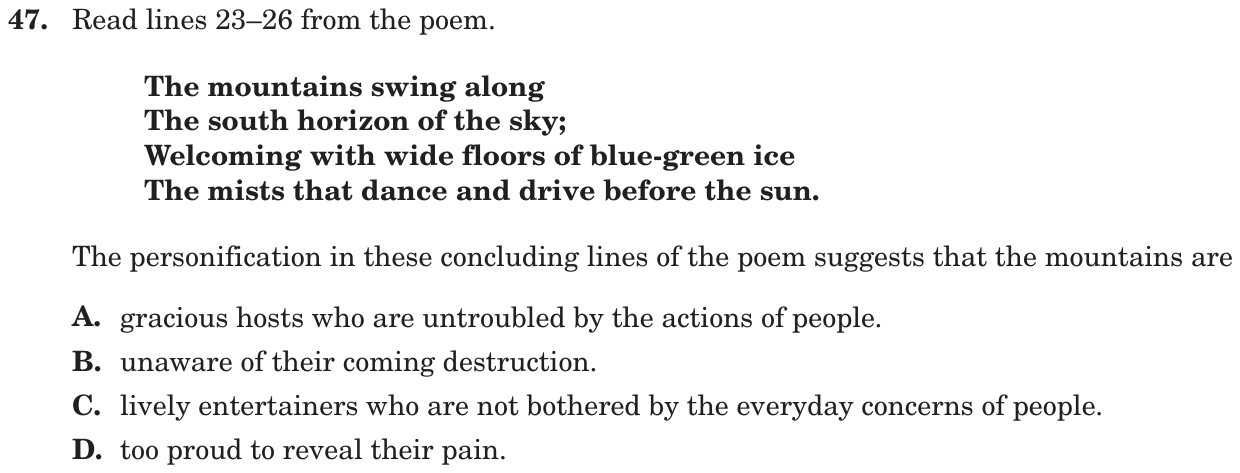
Question 53 of 53
2018 Test B English, question 50Passage Invention of the Telegraph
Samuel Morse, an American inventor, is credited with creating the electronic telegraph, a communication device that allows users to send messages using a system of short and long pulses that represent letters, numbers, and punctuation. In 1843 the United States Congress passed the Telegraph Bill, which provided Morse with the funds to build an electric telegraph system.
Invention of the Telegraph
Earlier Signal Systems
Long before Samuel F. B. Morse electrically transmitted his famous message “What hath God wrought?” from Washington to Baltimore on May 24, 1844, there were signaling systems that enabled people to communicate over distances. Most were visual or “semaphore” systems using flags or lights. In the eighteenth century, such systems used an observer who would decipher a signal from a high tower on a distant hill and then send it on to the next station. The young American republic wanted just such a system along its entire Atlantic coast and offered a prize of $30,000 for a workable proposal. The framers of this legislation had no way of knowing that when they used the word “telegraph” to refer to this visual semaphore system, they would be offered an entirely new and revolutionary means of communication—electricity.
The Growth of an Idea
The idea of using electricity to communicate over distance is said to have occurred to Morse during a conversation aboard ship when he was returning from Europe in 1832. Michael Faraday’s recently invented electromagnet was much discussed by the ship’s passengers, and when Morse came to understand how it worked, he speculated that it might be possible to send a coded message over a wire. While a student at Yale College years before, he had written his parents a letter about how interesting he found the lectures on electricity. Despite what he had learned at Yale, Morse found when he began to develop his idea that he had little real understanding of the nature of electricity, and after sporadic attempts to work with batteries, magnets, and wires, he finally turned for help to a colleague at the University of the City of New York, Leonard D. Gale.
Gale was a professor of chemistry and familiar with the electrical work of Princeton’s Joseph Henry, a true pioneer in the new field. Well before Morse had his shipboard idea about a telegraph, Henry rang a bell at a distance by opening and closing an electric circuit. In 1831, he had published an article, of which Morse was unaware, that contained details suggesting the idea of an electric telegraph. Gale’s help and his knowledge of this article proved crucial to Morse’s telegraph system because Gale not only pointed out flaws in the system but showed Morse how he could regularly boost the strength of a signal and overcome the distance problems he had encountered by using a relay system Henry had invented. Henry’s experiments, Gale’s assistance, and, soon after, hiring the young technician Alfred Vail were keys to Morse’s success.
Obstacles and Opportunities
By December 1837, Morse had enough confidence in his new system to apply for the federal government’s appropriation, and during the next year he conducted demonstrations of his telegraph both in New York and Washington.
However, when the economic disaster known as the Panic of 1837 took hold of the nation and caused a long depression, Morse was forced to wait for better times. It was during this period that Morse visited Europe again and tried not only to secure patent protection overseas but to examine competing telegraph systems in England. . . .
By 1843, the country was beginning to recover economically, and Morse again asked Congress for the $30,000 that would allow him to build a telegraph line from Washington to Baltimore, forty miles away. The House of Representatives eventually passed the bill containing the Morse appropriation, and the Senate approved it in the final hours of that Congress’s last session. With President Tyler’s signature, Morse received the cash he needed and began to carry out plans for an underground telegraph line.
Realizing a Great Invention
Morse had hired the ingenious construction engineer Ezra Cornell to lay the pipe carrying the wire, and although Cornell did his job superbly, one of Morse’s partners, Congressman F. O. J. Smith, had purchased wire with defective insulation. Too much time had been wasted laying bad wire, and with the project on a rigid deadline, something had to be done quickly. Cornell suggested that the fastest and cheapest way of connecting Washington and Baltimore was to string wires overhead on trees and poles. The desperate Morse gave the go-ahead, and the line was completed in time for the dramatic and spectacularly successful link between the Supreme Court chamber of the Capitol building and the railroad station in Baltimore.
Soon, as overhead wires connected cities up and down the Atlantic coast, the dots-and-dashes method that recorded messages on a long moving strip of paper was replaced by the operator’s ability to interpret the code in real time. . . . Telegraph lines soon extended westward, and within Morse’s own lifetime they connected the continents of Europe and America.
“Invention of the Telegraph”—Public Domain/Library of Congress
legislation: Telegraph Bill
dots-and-dashes method: the short and long pulses of Morse code that are sent and received by telegraph operators
The first transatlantic electric telegraph message was sent in 1858, and by 1902 the British All-Red Line connected most of the world.
Source: U.S. Bureau of the Census. Historical Statistics of the United States, Colonial Times to 1970, Bicentennial Edition, Part 2. Washington, D.C., 1975.
Question
Read this sentence from paragraph 7.
The desperate Morse gave the go-ahead, and the line was completed in time for the dramatic and spectacularly successful link between the Supreme Court chamber of the Capitol building and the railroad station in Baltimore.
The words “dramatic” and “spectacularly” in the sentence convey a
- Asense of relief and fulfillment that the line was finished.
- Bsense of wonder and of celebration that the telegraph line was completed on time.
- Cfeeling of excitement about the future possibilities of the telegraph.
- Dfeeling of confidence about being able to continue the work.
Show the answer
Correct answer: B
The question asks what the words “dramatic” and “spectacularly” convey in the sentence. Morse and Cornell rushed to post the wires overhead, and the “rigid deadline” (paragraph 7) was successfully met. The words have a positive and victorious tone that is consistent with the feeling of wonder that it worked and of celebration that the construction was completed, making Option B correct.
Option A is incorrect because, while there may have been some feelings of relief and fulfilment that the lines were in place, the passage does not say so, and instead it focuses on the wonder and joy Morse and Cornell felt overcoming setbacks and completing the construction of Morse’s telegraph system.
Option C is incorrect because the passage does not share whether Morse or Cornell considered the future possibilities of the telegraph, only that the finished product was “dramatic,” implying it was amazing to see.
Option D is incorrect because, while the passage later discusses the expansion of overhead wires “up and down the Atlantic coast” and how they “connected the continents of Europe and America” (paragraph 8), there is no evidence shared in the passage that Morse planned to continue his work with electricity.
Question analysis
This word choice question asks what the words “dramatic” and “spectacularly” convey in a sentence from “Invention of the Telegraph” about the first Washington-to-Baltimore line. Students must read the connotations of two words in context, and the choices name feelings that are all believable for a project rushed to meet a deadline.
- Grade level
- Grade 7 reading and task
- Compared with grade 7
- At grade 7 Reading the connotation of words in context is typical grade 7 work. The sentence is quoted, but the choices are close in meaning, which demands careful attention to what the two words themselves suggest.
- Estimated difficulty
- Moderate: several steps, or a close reading with one strong distractor.
- Thinking it demands
- Depth of knowledge 2, skills and concepts · mainly understand
- What makes it hard
- A very close wrong answer moderate
- Reading between the lines moderate
- Every choice must be checked minor
- Evidence
- Answered from one sentence or line
- Reading level
- Passage: about grade 11, 910 words; question and choices: about grade 9, 94 words.
- Students, last 30 days
- Not enough answers yet to show (it takes 10).
Why it is hard, traps and wrong answers (shows the answer)
Why it is hard
Every choice names a reasonable emotion for the end of a race against a deadline, which makes this a question about two words rather than about the situation. Students who read the whole sentence are pulled toward relief by “desperate,” and those who read ahead are pulled toward the future by paragraph 8. The words point to an audience impressed by a public success, not to Morse’s private feelings or plans.
A very close wrong answer moderate Choosing the answer
The relief-and-fulfillment choice has the same shape as the key, a pair of feelings about finishing the line; only the feelings differ, and “desperate” nearby favors relief while “dramatic” and “spectacularly” point to wonder. (Embretson & Wetzel, 1987; Gorin & Embretson, 2006; Ascalon et al., 2007)
Reading between the lines moderate Working it out
“Dramatic” and “spectacularly” describe the event, not anyone’s emotions, so the feeling they convey, wonder at the result and celebration of its success, has to be inferred from their connotations. (Graesser, Singer & Trabasso, 1994; Kintsch, 1998)
Every choice must be checked minor Choosing the answer
All four choices name positive feelings that suit a project rushed to completion, so none can be dismissed by tone alone. (Embretson & Wetzel, 1987)
Strategy: Ask what kind of event people call dramatic or spectacular, then pick the feeling those two words express, not a feeling the surrounding story might suggest.
Traps
- Wrong tone or attitude: Misjudges the tone, attitude or point of view, such as reading admiration as criticism, or taking a character's or subject's feelings for the author's.
- Wrong part of the text: A choice is true of another paragraph, stanza or speaker than the one asked about.
The wrong answers, classified
A Wrong tone or attitude (Graesser, Singer & Trabasso, 1994)
Takes Morse’s likely feeling, relief for a “desperate” man facing a “rigid deadline,” for what the author’s words convey, though “dramatic” and “spectacularly” celebrate an impressive success.
C Wrong part of the text (Kirsch & Mosenthal, 1990)
Looks ahead to paragraph 8, where lines spread along the coast and to Europe, but the sentence celebrates the first link itself, not hopes for what came later.
D Reads too much in (Graesser, Singer & Trabasso, 1994)
Assumes that success breeds confidence to keep going, but the sentence says nothing about further work, and the two words describe the event itself.
Working it out, step by step
Figure out what the question asks
This is a word-meaning question. It asks what feeling two words give the sentence: “dramatic” and “spectacularly.” Focus on those two words, not on how Morse might have felt.
Read the sentence in its setting
Paragraph 7 tells of a race against time. Bad wire had wasted time, and the project had “a rigid deadline.” Cornell’s idea of wires on poles saved the day. Then “the line was completed in time for the dramatic and spectacularly successful link between the Supreme Court chamber of the Capitol building and the railroad station in Baltimore.”
Explain the two words
Something dramatic is exciting and striking, like the big moment in a play. Something done spectacularly is done in an amazing way that is wonderful to see. Both words describe the event as a grand public success. They make you feel wonder and want to celebrate. The sentence also says the line was done “in time,” or on time.
Check each choice
- A is wrong. The “desperate” Morse may have felt relief. But the two words describe an amazing event, not a quiet sigh of relief.
- B fits. The words show wonder and celebration, and the line was finished on time.
- C is wrong. The sentence is about this first link. The future comes later, in paragraph 8.
- D is wrong. The sentence says nothing about going on with more work.
Choose the answer
“Dramatic” and “spectacularly” cheer a thrilling success that came right on time. So the answer is B, “sense of wonder and of celebration that the telegraph line was completed on time.”
Why this answer and not the closest wrong one
A is the closest trap because “desperate” is in the same sentence. Relief is a quiet, private feeling that a worry is over. But “dramatic” and “spectacularly” are loud, showy words. People use them for something amazing to watch. That points to wonder and celebration, as B says.
More questions like this
The original DOE question
The passage “Invention of the Telegraph” as printed (pages 146–148)