Passage Excerpt from “How We Made the First Flight”
Excerpt from “How We Made the First Flight”
by Orville Wright
In 1903 brothers Wilbur and Orville Wright conducted experiments related to flying machines. These experiments would eventually lead to air travel becoming a reliable form of transportation.
During the night of December 16, 1903, a strong cold wind blew from the north. When we arose on the morning of the 17th, the puddles of water, which had been standing about camp since the recent rains, were covered with ice. The wind had a velocity of 10 to 12 meters per second (22 to 27 miles an hour). We thought it would die down before long, and so remained indoors the early part of the morning. But when ten o’clock arrived, and the wind was as brisk as ever, we decided that we had better get the machine out and attempt a flight. We hung out the signal for the men of the Life Saving Station.1 We thought that by facing the flyer into a strong wind, there ought to be no trouble in launching it from the level ground about camp. We realized the difficulties of flying in so high a wind, but estimated that the added dangers in flight would be partly compensated for by the slower speed in landing.
Final Preparations
We laid the track on a smooth stretch of ground about one hundred feet north of the new building. The biting cold wind made work difficult, and we had to warm up frequently in our living room, where we had a good fire in an improvised stove made of a large carbide2 can. By the time all was ready, J. T. Daniels, W. S. Dough and A. D. Etheridge, members of the Kill Devil3 Life Saving Station; W. C. Brinkley of Manteo, and Johnny Moore, a boy from Nags Head,4 had arrived.
We had a “Richard” hand anemometer with which we measured the velocity of the wind. Measurements made just before starting the first flight showed velocities of 11 to 12 meters per second, or 24 to 27 miles per hour. . . .
Audacity—and Calculation
Wilbur having used his turn in the unsuccessful attempt on the 14th, the right to the first trial now belonged to me. After running the motor a few minutes to heat it up, I released the wire that held the machine to the track, and the machine started forward in the wind. Wilbur ran at the side of the machine, holding the wing to balance it on the track. Unlike the start on the 14th, made in a calm, the machine, facing a 27-mile wind, started very slowly. Wilbur was able to stay with it till it lifted from the track after a forty-foot run. One of the Life Saving men snapped the camera for us, taking a picture just as the machine had reached the end of the track and had risen to a height of about two feet. The slow forward speed of the machine over the ground is clearly shown in the picture by Wilbur’s attitude. He stayed along beside the machine without any effort.
Flight
The course of the flight up and down was exceedingly erratic, partly due to the irregularity of the air, and partly to lack of experience in handling this machine. The control of the front rudder was difficult on account of its being balanced too near the center. This gave it a tendency to turn itself when started; so that it turned too far on one side and then too far on the other. As a result the machine would rise suddenly to about ten feet, and then as suddenly dart for the ground. A sudden dart when a little over a hundred feet from the end of the track, or a little over 120 feet from the point at which it rose into the air, ended the flight. As the velocity of the wind was over 35 feet per second and the speed of the machine over the ground against this wind ten feet per second, the speed of the machine relative to the air was over 45 feet per second, and the length of the flight was equivalent to a flight of 540 feet made in calm air. This flight lasted only 12 seconds, but it was nevertheless the first in the history of the world in which a machine carrying a man had raised itself by its own power into the air in full flight, had sailed forward without reduction of speed and had finally landed at a point as high as that from which it started.
From “How We Made the First Flight” by Orville Wright—Public Domain/Federal Aviation Administration
1Life Saving Station: one of the rescue stations along the Atlantic coastline that provided assistance to mariners in distress
2carbide: a very hard material composed of carbon and other heavy metals
3Kill Devil: the town of Kill Devil Hills in eastern North Carolina
4Nags Head: a town in eastern North Carolina
Question
Read this sentence from paragraph 5.
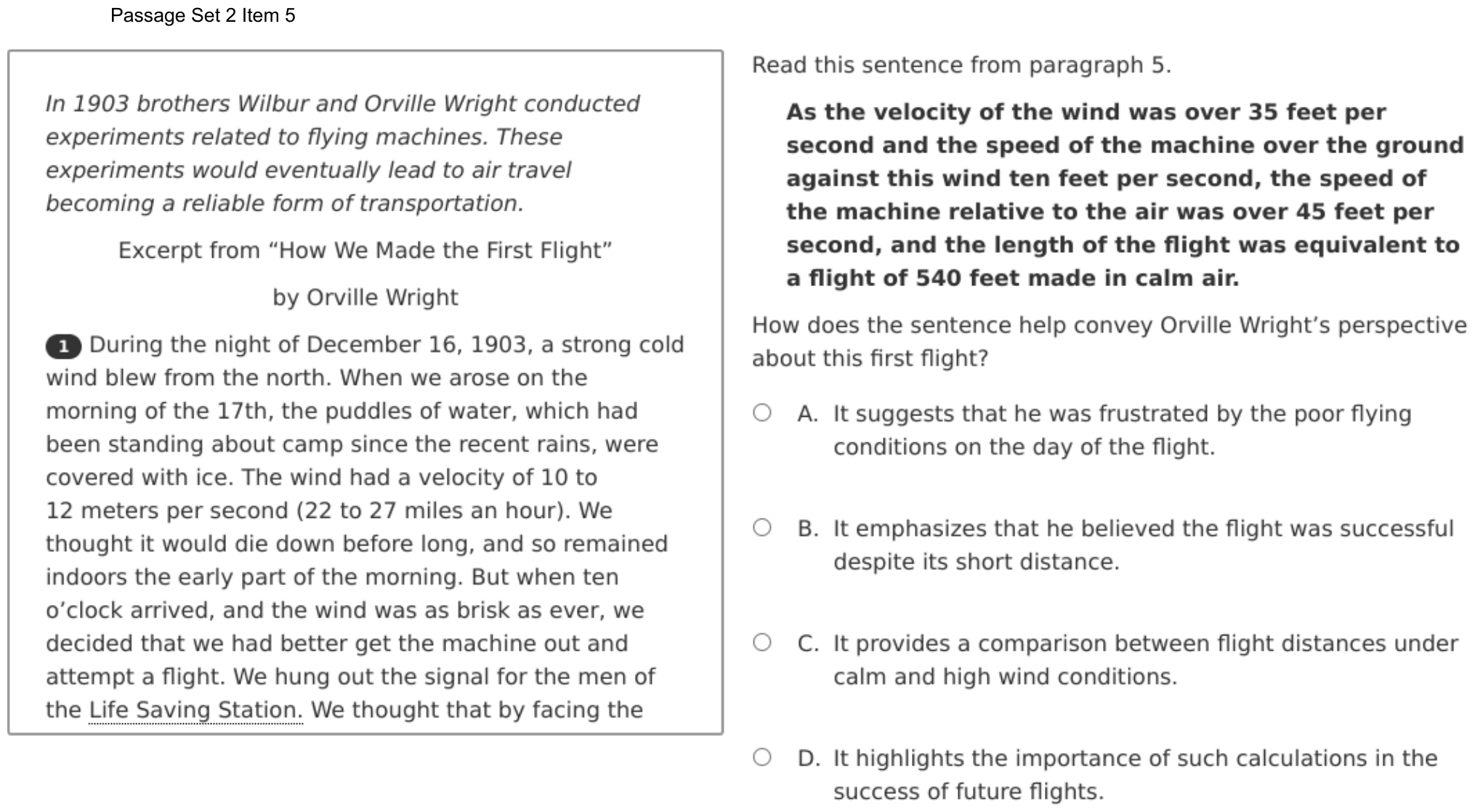
As the velocity of the wind was over 35 feet per second and the speed of the machine over the ground against this wind ten feet per second, the speed of the machine relative to the air was over 45 feet per second, and the length of the flight was equivalent to a flight of 540 feet made in calm air.
How does the sentence help convey Orville Wright’s perspective about this first flight?
- AIt suggests that he was frustrated by the poor flying conditions on the day of the flight.
- BIt emphasizes that he believed the flight was successful despite its short distance.
- CIt provides a comparison between flight distances under calm and high wind conditions.
- DIt highlights the importance of such calculations in the success of future flights.
Show the answer
Correct answer: B
The question asks how the sentence from paragraph 5 helps convey Orville Wright’s perspective about the first flight.
A. Incorrect. Although the sentence from paragraph 5 refers to the velocity of the wind during the flight, there is no indication that Orville felt a sense of frustration with the windy conditions. Instead, the sentence emphasizes the “speed of the machine relative to the air” and presents the equivalent flight length if the machine had flown through calm air (“the length of the flight was equivalent to a flight of 540 feet made in calm air”), details that emphasize the importance of the Wrights’ accomplishment.
B. CORRECT. In the sentence from paragraph 5, Orville uses the wind velocity and the machine speed to highlight the distance that the plane covered while in the air and to determine the distance that it would have flown on a day with calm winds, which emphasizes the magnitude of the accomplishment.
C. Incorrect. Since Orville does not suggest in the sentence from paragraph 5 how far the plane traveled under the actual conditions of high winds, the comparison is incomplete. Additionally, this statement does not address the reason that he would make such a comparison, which allowed him to describe the flight in more impressive terms (540 feet versus 120 feet).
D. Incorrect. Unlike the wind velocity calculations made in preparation for the flight, which might help in determining the success of future flights, the comparative calculations that Orville provides in the sentence from paragraph 5 help interpret the results of the first flight (by describing how fast and far the machine flew relative to the flying conditions) and thereby communicate its success. The calculations of the first flight’s relative speed and equivalent distance would not affect the success of future flights, but the information does provide context for understanding the Wright brothers’ accomplishment.
Question analysis
This point-of-view question quotes the long sentence from paragraph 5 in which Orville Wright works out the machine’s speed through the air and the length of an equivalent flight in calm air. Students must decide how this sentence helps convey his perspective on the first flight. The sentence is mostly numbers, from 35 feet per second to 540 feet, which makes its purpose easy to miss.
- Grade level
- Grade 8 reading and task
- Compared with grade 7
- Above grade 7 Grade 7 point-of-view questions usually rest on words that show feeling. This sentence is a chain of speeds and distances with no feeling words, so students must work out why Orville bothers with the arithmetic, a step beyond typical grade 7 work.
- Estimated difficulty
- Hard: combines ideas, needs a plan, and has more than one tempting wrong answer.
- Thinking it demands
- Depth of knowledge 3, strategic thinking · mainly analyze
- What makes it hard
- How, not what moderate
- Reading between the lines moderate
- Complex sentences minor
- Evidence
- Answered from one paragraph or stanza
- Reading level
- Passage: about grade 7, 816 words; question and choices: about grade 9, 132 words.
- Students, last 30 days
- Not enough answers yet to show (it takes 10).
Why it is hard, traps and wrong answers (shows the answer)
Why it is hard
Point-of-view questions usually turn on feeling words, and this sentence has none, only speeds and a distance. Students must ask why Orville bothers with the arithmetic, and the answer is that 540 feet in calm air makes a 12-second hop look like the achievement he believed it was. The strongest pull describes the sentence’s content accurately, a comparison of calm and windy flight, without saying what it reveals, so students who answer what instead of why lose the point.
How, not what moderate Working it out
The question asks why Orville includes this calculation, so students must see that converting a short hop into “a flight of 540 feet made in calm air” is his way of showing that it counted. (Anderson & Krathwohl, 2001)
Reading between the lines moderate Working it out
The sentence holds no word of feeling or judgment; his view that the flight succeeded must be read from his choice to restate about 120 feet over the ground as 540 feet through the air. (Graesser, Singer & Trabasso, 1994; Kintsch, 1998)
Complex sentences minor Understanding the question
The 61-word sentence chains four measurements, a wind over 35 feet per second, a ground speed of ten, an airspeed over 45 and the 540-foot equivalent, joined by “As,” “and” and commas. (Abedi & Lord, 2001; Freedle & Kostin, 1993; Messick, 1989)
Strategy: Work out what the speeds and distances in the sentence describe, then ask why Orville includes them at this point and what that choice tells you about his view of the flight.
Traps
- Wrong purpose or structure: Names a purpose, structure or effect that the part does not serve, or describes what a part says when the question asks what it does.
- Wrong tone or attitude: Misjudges the tone, attitude or point of view, such as reading admiration as criticism, or taking a character's or subject's feelings for the author's.
- Outside knowledge: A choice is plausible in the real world but not supported by this text.
The wrong answers, classified
A Wrong tone or attitude (Graesser, Singer & Trabasso, 1994)
Links the high wind to the cold, hard morning of paragraphs 1 and 2 and assumes Orville resented it, though here he uses the wind’s speed to make the flight count for more.
C Wrong purpose or structure (Anderson & Krathwohl, 2001)
Describes what the sentence contains, a flight measured against one in calm air, without saying what that comparison shows about Orville’s view of the flight, which is what the question asks.
D Outside knowledge (King et al., 2004; Recht & Leslie, 1988)
Assumes careful calculations must be meant to guide later flights, a reasonable idea about early aviation, but this sentence measures the flight just made and looks no further ahead.
Working it out, step by step
Figure out what the question asks
This asks about Orville Wright’s perspective, or point of view. How did he feel about the first flight? The quoted sentence is full of numbers, not feelings. So ask why Orville bothered to do this math.
Sort out the numbers
The wind blew against the machine at over 35 feet per second. The machine moved over the ground at 10 feet per second. It was flying into the wind, so the air rushed past it even faster. Add them: it moved through the air at over 45 feet per second. The flight lasted 12 seconds. Over the ground, that is 10 × 12 = 120 feet. Through the air, it is 45 × 12 = 540 feet. That is how Orville gets “a flight of 540 feet made in calm air.”
Ask why Orville does this math
Paragraph 5 says the flight ended “a little over 120 feet from the point at which it rose into the air.” That sounds short. But Orville shows it was really much more. In calm air, the same flight would have gone 540 feet. He wants you to see that the short hop was a real flight. So his view is that the flight was a success.
Check each choice
- A does not fit. There is no sign of frustration. Orville uses the wind to make the flight count for more.
- B fits. The math turns a short flight into an impressive one.
- C does not fit. The sentence does compare calm and windy air. But that only says what the sentence contains, not what Orville thinks.
- D does not fit. The math measures the flight that just happened. It does not look ahead to future flights.
Watch out: C is tempting because it describes the sentence correctly. But the question asks about his perspective. C never says how he felt about the flight.
Choose the answer
Orville does the math to show that his short flight was a real success. So the answer is B, “It emphasizes that he believed the flight was successful despite its short distance.”
Why this answer and not the closest wrong one
C is the closest wrong choice. It is true that the sentence compares a windy flight with one “made in calm air.” But C only tells what the sentence says. The question asks why Orville says it. He turns about 120 feet into 540 feet to show the flight was a real achievement. B gives that reason.
More questions like this
The original DOE question
The passage “Excerpt from “How We Made the First Flight”” as printed (pages 13–14)