2020 Test A English
Question 1 of 57
2020 Test A English, question 1Question
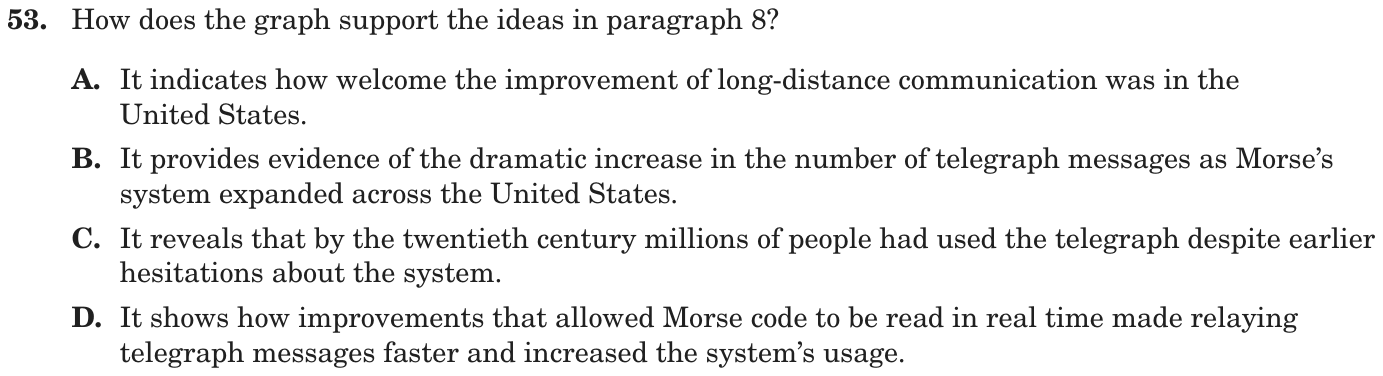
What is the best way to combine the sentences?
(1) Scientists now believe that Jupiter may have as many as seventy-nine moons.
(2) One of Jupiter’s moons is named Io.
(3) Io has the greatest number of active volcanoes in the solar system.
- AIo, which is one of Jupiter’s moons, has the greatest number of active volcanoes in the solar system, and scientists now believe that Jupiter may have as many as seventy-nine moons.
- BScientists now believe that Jupiter may have as many as seventy-nine moons, and one of them is named Io, which has the greatest number of active volcanoes in the solar system.
- CScientists now believe that Jupiter may have as many as seventy-nine moons, including one named Io, which has the greatest number of active volcanoes in the solar system.
- DIo, a moon with the greatest number of active volcanoes in the solar system, is one of Jupiter’s moons, and scientists now believe that Jupiter may have as many as seventy-nine moons.
Show the answer
Correct answer: C
The question asks for the best way to combine the sentences.
A. Incorrect. Although the sentence incorporates the ideas presented in the three original sentences, it is incorrect because the combination suggests an incorrect relationship between the ideas. By beginning with “Io,” the sentence places emphasis on the moon and the detail about the number of active volcanoes rather than the key idea that “scientists now believe that Jupiter may have as many as seventy-nine moons.” Since Io is an example of one of Jupiter’s moons, the details about Io should follow and be subordinate to the main clause, which provides new information about the number of Jupiter’s moons in general.
B. Incorrect. Although the sentence incorporates all three ideas from the original sentences and correctly places the detail about the number of active volcanoes on Io in a dependent clause, this option is incorrect because it presents an imprecise relationship between the ideas. By using the conjunction (connecting word) “and,” the sentence construction suggests that scientists “now believe” that “Jupiter may have as many as seventy-nine moons” and that “one of them is named Io,” instead of presenting Io as an example of one of Jupiter’s moons.
C. CORRECT. This sentence is the best way to combine the original sentences because it uses a complex sentence to present ideas clearly and precisely, and it shows the relationship between the ideas in the original sentences. The sentence starts by stating the number of moons scientists now believe Jupiter may have and then specifies that one of those moons is named Io. The dependent clause “which has the greatest number of active volcanoes in the solar system” immediately follows the word “Io” to provide additional information about the moon. A dependent clause contains a subject (“which,” referring to Io) and a verb (“has”) but is not a complete sentence on its own.
D. Incorrect. The sentence incorporates the key ideas from the original sentences, but its structure does not accurately present the relationship between these ideas. The beginning of the sentence includes the detail about Io having “the greatest number of active volcanoes in the solar system” before specifying that Io is one of the seventy-nine moons of Jupiter. The presentation of the details about Io at the beginning lessens the emphasis of the key idea that “scientists now believe that Jupiter may have as many as seventy-nine moons.”
Question analysis
This sentence-combining question gives three short sentences: scientists believe Jupiter may have as many as seventy-nine moons, one moon is named Io, and Io has the most active volcanoes in the solar system. Students must choose the single sentence that joins all three facts while showing how they relate, and the four versions differ only in order and connecting structure.
- Grade level
- Grade 7 reading and task
- Compared with grade 7
- At grade 7 Combining sentences so the ideas relate clearly is grade 7 language work. The three sentences are short, but every version keeps all the facts, so the choice rests on which idea leads and which is tucked into a clause, a typical grade 7 demand.
- Estimated difficulty
- Moderate: several steps, or a close reading with one strong distractor.
- Thinking it demands
- Depth of knowledge 2, skills and concepts · mainly evaluate
- What makes it hard
- A very close wrong answer moderate
- How sentences fit together moderate
- Every choice must be checked minor
- Evidence
- Answered from one sentence or line
- Reading level
- Question and choices: about grade 10, 162 words.
- Students, last 30 days
- Not enough answers yet to show (it takes 10).
Why it is hard, traps and wrong answers (shows the answer)
Why it is hard
Because every version keeps all three facts and is grammatical, the question is about emphasis and connection, which students rarely check for. Two versions open with Io and its volcanoes and leave the seventy-nine moons trailing after “and,” and one of them also calls Io a moon twice. The strongest pull is the version with the right order that still joins Io with “and,” so Io’s name reads as a second piece of news rather than an example of the moons just counted.
A very close wrong answer moderate Choosing the answer
The “and one of them is named Io” version matches the key in its order and in its which-clause about volcanoes; only its connector differs from the key’s “including one named Io.” (Embretson & Wetzel, 1987; Gorin & Embretson, 2006; Ascalon et al., 2007)
How sentences fit together moderate Working it out
Students must see that sentence 1 is the main news and that sentences 2 and 3 narrow to one example, so Io belongs inside the sentence about Jupiter’s seventy-nine moons. (Halliday & Hasan, 1976)
Every choice must be checked minor Choosing the answer
Every version is grammatical and keeps all three facts, so none can be ruled out by an error; each is judged on which idea leads and how the others attach. (Embretson & Wetzel, 1987)
Strategy: Decide which of the three sentences states the main idea and which ones add detail, then check whether each version’s order and structure show that relationship.
Traps
- Wrong transition: A connecting word or phrase that signals the wrong relationship, such as contrast where the idea continues.
- Changes the meaning: A revision is correct English but no longer says what the writer meant.
The wrong answers, classified
A Changes the meaning (Connors & Lunsford, 1988)
Opens with Io and its volcanoes and adds the moon count with “and,” so the main news about Jupiter trails behind its own example as an afterthought.
B Wrong transition (Halliday & Hasan, 1976)
Keeps the right order and the which-clause, but “and one of them is named Io” adds Io as a second piece of news instead of an example of those moons.
D Changes the meaning (Connors & Lunsford, 1988)
Leads with Io’s volcanoes, then says Io “is one of Jupiter’s moons” right after calling it “a moon,” and leaves the main news about Jupiter for the end.
Working it out, step by step
Figure out what the question asks
This asks for the best way to join three sentences into one. All four choices keep every fact. So the best one shows how the facts relate. Decide which fact is the main idea and which ones add detail.
Find the main idea
Sentence 1 is the big news: “Scientists now believe that Jupiter may have as many as seventy-nine moons.” Sentences 2 and 3 zoom in on one of those moons, Io. Io is an example of the moons, and its volcanoes are a detail about Io. So the main idea should come first, and Io should fit inside it.
Name the rule
Put the main idea in the main part of the sentence. Tuck the details in with words like including and which. For example: My school has thirty clubs. One is chess. The chess club meets on Fridays. Joined: My school has thirty clubs, including a chess club, which meets on Fridays.
Check each choice
- A is wrong. It starts with Io and its volcanoes. The main news about Jupiter trails at the end after “and.”
- B is wrong. The order is right. But “and one of them is named Io” adds Io as a second piece of news, not as an example.
- C is right. “Including one named Io” shows Io is one of the moons. Then “which” adds the fact about its volcanoes.
- D is wrong. It calls Io “a moon,” then says again that it “is one of Jupiter’s moons.” The main news comes last.
Watch out: B is very close to C. The only change is “and one of them is named Io” in place of “including one named Io.” The word “including” shows that Io belongs to the group.
Choose the answer
C leads with the main news and tucks in Io as an example. So the answer is C, “Scientists now believe that Jupiter may have as many as seventy-nine moons, including one named Io, which has the greatest number of active volcanoes in the solar system.”
Why this answer and not the closest wrong one
B is the closest wrong answer. It has the right order and the same “which” clause. But “and” tacks Io’s name on as a separate fact, as if it were more news. “Including” shows that Io is one of the seventy-nine moons. That ties the three facts together most clearly.
More questions like this
The original DOE question
Question 2 of 57
2020 Test A English, question 2Question
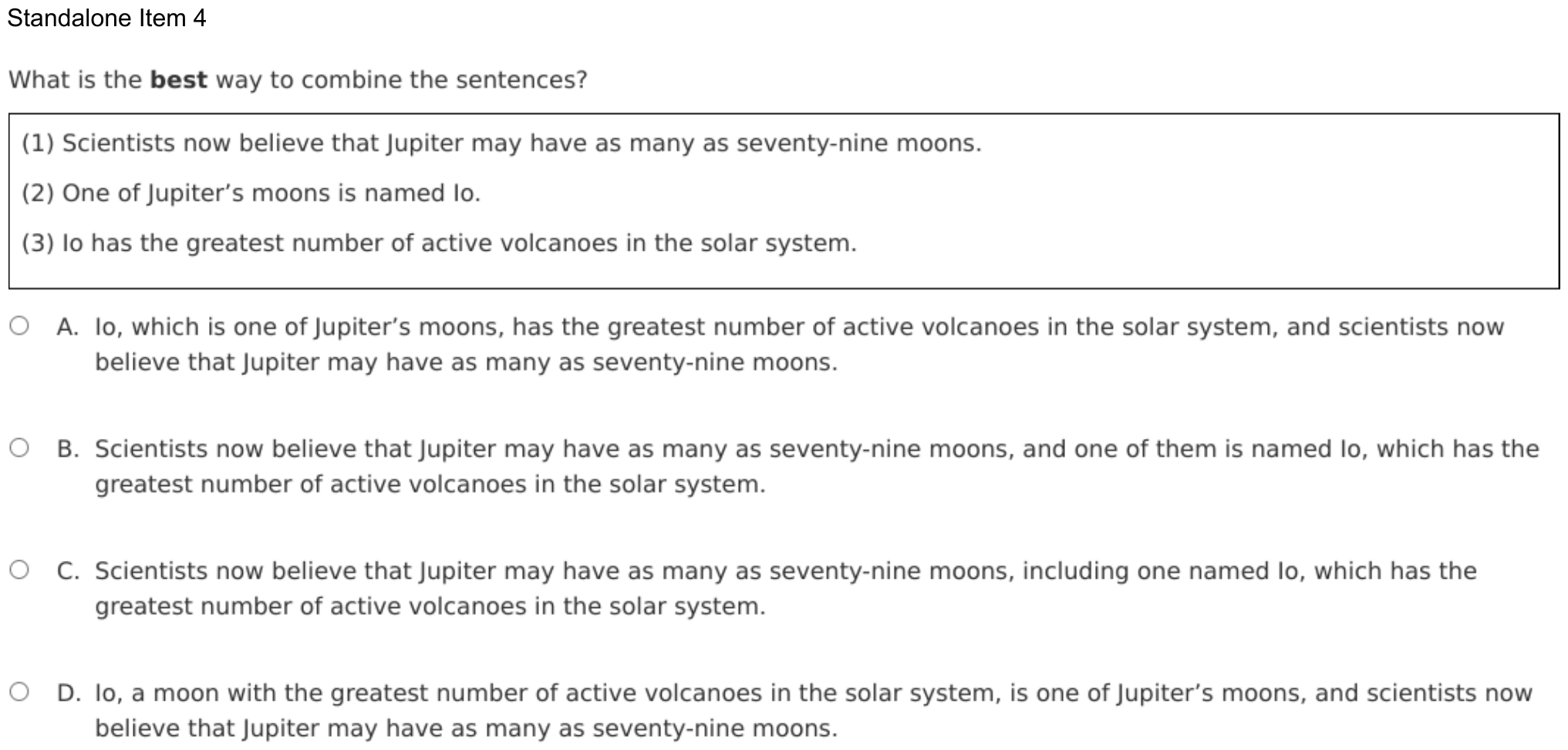
Read this paragraph.
In September 2016 the National Museum of African American History and Culture opened as part of the Smithsonian Institution, the museum is already the Smithsonian’s third most popular site. Experts say that they expect this newest Smithsonian facility to welcome nearly 4 million visitors a year. The museum features more than 30,000 objects, including Muhammad Ali’s boxing gloves and a dress sewn by Rosa Parks. A commemorative copy of the Emancipation Proclamation, written in 1863 during the presidency of Abraham Lincoln, is also on display at the museum.
Which revision corrects the error in sentence structure in the paragraph?
- AInstitution, and the
- Byear, and the
- Cobjects, which include
- DProclamation, which was written
Show the answer
Correct answer: A
The question asks for the correction of an error in sentence structure in the paragraph.
The first sentence is a run-on sentence because both clauses—“In September 2016 the National Museum of African American History and Culture opened as part of the Smithsonian Institution” and “the museum is already the Smithsonian’s third most popular site”—are independent clauses, and independent clauses should not be combined without the use of a conjunction and a comma. The revision in Option A adds the word “and” after the comma, which corrects the run-on.
Option B, Option C, Option D are incorrect responses because the corresponding underlined portions in the paragraph are not structural errors. No edits are needed to correct those portions of the text.
Question analysis
This sentence-structure question gives a short paragraph about the opening of the National Museum of African American History and Culture. Students must find which of four spots holds a real error, such as a run-on, a fragment or a misplaced phrase, and pick the revision that fixes it. Long names stretch the sentences, and the spots that need no change can look just as suspicious.
- Grade level
- Grade 6 reading and task
- Compared with grade 7
- Below grade 7 Fixing run-ons and fragments is taught before grade 7, and here students check four short spots in one paragraph for a single structural error. Long institution names add reading load but no extra grammar.
- Estimated difficulty
- Straightforward: two steps or one careful reading.
- Thinking it demands
- Depth of knowledge 2, skills and concepts · mainly apply
- What makes it hard
- A rule that doesn't sound wrong moderate
- Complex sentences minor
- Every choice must be checked minor
- Evidence
- Answered from one paragraph or stanza
- Reading level
- Question and choices: about grade 10, 111 words.
- Corrected from the DOE handbook
- A misdescribed detail in the explanation was corrected.
- Students, last 30 days
- Not enough answers yet to show (it takes 10).
Why it is hard, traps and wrong answers (shows the answer)
Why it is hard
Students who miss this one usually look for the error in the wrong place: the phrases “including Muhammad Ali’s boxing gloves” and “written in 1863” look suspicious, while the real splice hides behind the long museum name. The question rewards checking each spot for a subject and verb on both sides of its punctuation. Two choices offer the same “, and the” fix, so knowing the fix is not enough without finding where it belongs.
A rule that doesn't sound wrong moderate Working it out
The error is a comma splice after “Institution,” where a comma alone joins two complete clauses, and a comma sounds like a natural pause when the sentence is read aloud. (Connors & Lunsford, 1988)
Complex sentences minor Understanding the question
The eight-word museum name stretches the first clause, so by the time “the museum is already” arrives, it reads like a continuation rather than a new subject and verb. (Abedi & Lord, 2001; Freedle & Kostin, 1993; Messick, 1989)
Every choice must be checked minor Choosing the answer
The four underlined spots fall in four different sentences, and each has to be tested for whether a complete sentence sits on both sides of its punctuation. (Embretson & Wetzel, 1987)
Strategy: Check each sentence for a subject and main verb and count its complete thoughts, then decide whether the spot each choice changes actually breaks a rule before picking a fix.
The wrong answers, classified
B Fixes what isn't broken (Connors & Lunsford, 1988)
Recognizes “, and the” as the usual run-on fix but applies it where a period already separates two complete, correctly punctuated sentences.
C Fixes what isn't broken (Connors & Lunsford, 1988)
Believes a phrase opening with “including” after a comma is a fragment, so turns it into a which-clause, though the phrase already attaches correctly to “objects.”
D Fixes what isn't broken (Connors & Lunsford, 1988)
Thinks “written in 1863” cannot describe the copy without “which was,” though the sentence already has its verb “is” and the phrase is correctly set off.
What was corrected from the DOE handbook, and why
- Explanation: The handbook says the correct revision “adds the word ‘and’ before the comma.” In “Institution, and the,” the word “and” comes after the comma, so the site now says “after the comma.”
Working it out, step by step
Figure out what the question asks
This question is about sentence structure, or how a sentence is built. One of the four underlined spots has a mistake. You need the change that fixes it.
Learn the run-on rule
A complete sentence has a subject (who or what it is about) and a verb (the action). It can stand alone. You cannot join two complete sentences with only a comma. That mistake is called a run-on.
Wrong: I was hungry, I ate an apple.
Fixed: I was hungry, and I ate an apple.
A period would also work: I was hungry. I ate an apple.Find the run-on
Look at the first sentence. The words before the comma can stand alone: “In September 2016 the National Museum of African American History and Culture opened as part of the Smithsonian Institution.” So can the words after it: “the museum is already the Smithsonian’s third most popular site.” Only a comma joins them. That is a run-on.
Check each choice
- A is right. “Institution, and the” adds the joining word “and” after the comma. That fixes the run-on.
- B is wrong. A period already splits those two sentences correctly.
- C is wrong. “Including Muhammad Ali’s boxing gloves” already describes the objects. It needs no change.
- D is wrong. “Written in 1863” already describes the copy. The sentence already has its verb, “is.”
Watch out: C and D are not bad sentences. But they change spots that were already correct, and the run-on stays.
Choose the answer
Now the first sentence says the museum opened, and it is already very popular. Those are two complete ideas, joined the right way. So the answer is A: Institution, and the.
Why this answer and not the closest wrong one
D is a tempting choice, because “which was written” also sounds fine. But a change that sounds fine is not a fix. The question asks you to correct the error. Only A changes the first sentence, where the run-on is.
More questions like this
The original DOE question
Question 3 of 57
2020 Test A English, question 3Question
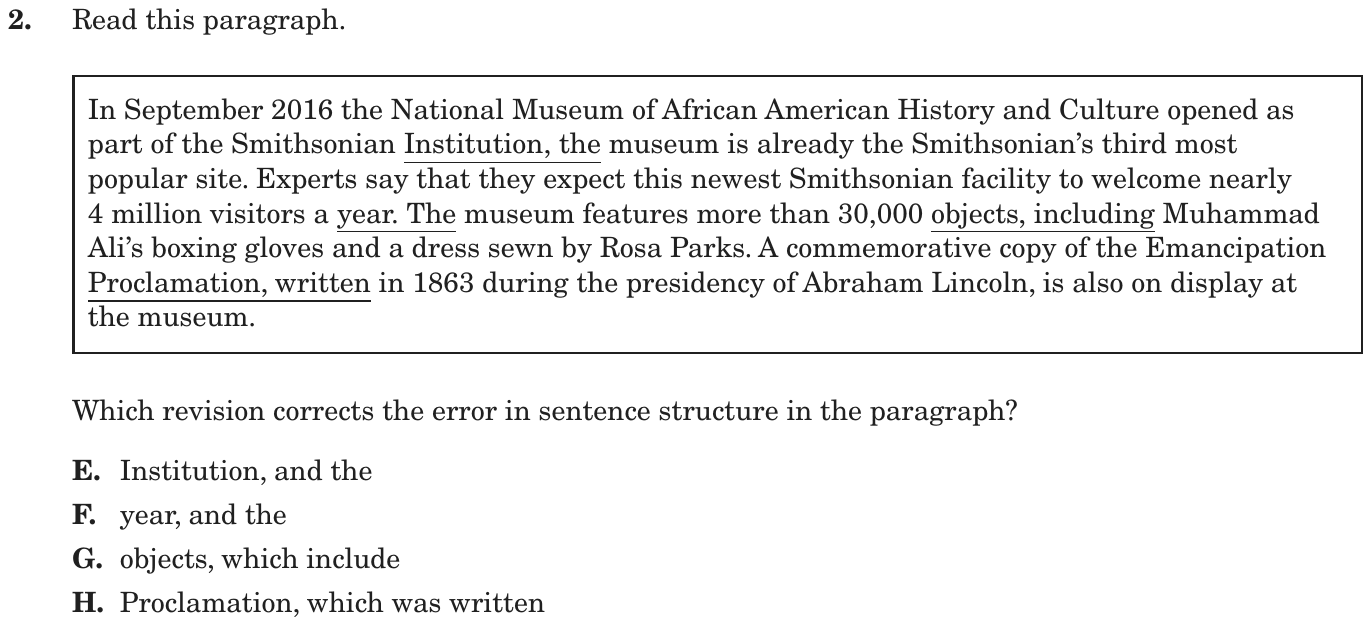
Read this sentence.
The Appalachian Trail is a really long trail that a lot of people do each year.
Which revision of the sentence uses the most precise language?
- AThe Appalachian Trail is an extremely long trail that millions of people do each year.
- BThe Appalachian Trail is a 2,200-mile trail that more than a million people hike each year.
- CThe Appalachian Trail is a 2,200-mile trail that two million people hike each year.
- DThe Appalachian Trail is a lengthy trail that a couple million people do each year.
Show the answer
Correct answer: C
The question asks for the revision of the sentence that uses the most precise language.
A. Incorrect. The word “extremely” does not specify the precise length of the trail (2,200 miles); “millions” is less precise than the specific number of people who hike the trail each year (two million); and the verb “do” imprecisely describes the purpose of visiting the trail (hiking).
B. Incorrect. While the revision specifies the precise length of the trail and the verb “hike” precisely describes the purpose of visiting the trail, “more than a million” is less precise than the specific number of people who hike the trail each year (two million).
C. CORRECT. The length of the trail (2,200 miles), the specific number of people who hike the trail each year (two million), and the action of the visitors (hiking) are clear and precise in this revision of the sentence.
D. Incorrect. The word “lengthy” is less precise than specifying the actual length of the trail (2,200 miles); “a couple million” is less precise than the specific number of people who hike the trail each year (two million); and the verb “do” imprecisely describes the purpose of visiting the trail (hiking).
Question analysis
This precise-language question gives a casual sentence saying the Appalachian Trail is “a really long trail that a lot of people do each year” and asks which revision is most precise. Several revisions swap in more specific words or numbers, so students must check every part of each sentence, not just the first improvement they notice.
- NYS standards
- 7L3a precise and concise language
- Grade level
- Grade 6 reading and task
- Compared with grade 7
- Below grade 7 Choosing precise wording is grade 7 language work, but this item is one short sentence in everyday words. Typical grade 7 revision sets the same choice inside a paragraph, with more wording to weigh.
- Estimated difficulty
- Straightforward: two steps or one careful reading.
- Thinking it demands
- Depth of knowledge 1, recall and reproduction · mainly evaluate
- What makes it hard
- A very close wrong answer moderate
- Every choice must be checked minor
- Evidence
- Answered from one sentence or line
- Reading level
- Question and choices: about grade 6, 89 words.
- Students, last 30 days
- Not enough answers yet to show (it takes 10).
Why it is hard, traps and wrong answers (shows the answer)
Why it is hard
The question is quick once each revision is tested on three points: how long the trail is, how many people hike it, and what they do there. The near miss catches students who stop checking once they see the mileage and the verb “hike,” though its count of hikers is still a range. Words such as “extremely” and “lengthy” are the other snare, since they sound sharper without saying any more.
A very close wrong answer moderate Choosing the answer
The right revision and the one with “more than a million” share the 2,200-mile length and the verb “hike,” and differ only in the hiker count: an exact two million or an open-ended floor. (Embretson & Wetzel, 1987; Gorin & Embretson, 2006; Ascalon et al., 2007)
Every choice must be checked minor Choosing the answer
Each revision repairs a different part of “a really long trail that a lot of people do,” so all four have to be checked for the length, the count and the verb. (Embretson & Wetzel, 1987)
Strategy: Check each revision on three points: how long the trail is, how many people visit, and what they do there. Keep only a version that is exact on all three.
Traps
- Wordy, vague or informal: A revision is grammatical but wordy, imprecise or too casual for the passage.
The wrong answers, classified
A Wordy, vague or informal (Connors & Lunsford, 1988)
Treats “extremely long” and “millions” as upgrades, though neither gives a length or a count, and the vague verb “do” is still there.
B Wordy, vague or informal (Connors & Lunsford, 1988)
Sees the exact length and the verb “hike” and stops checking, missing that “more than a million” is looser than a specific number of hikers.
D Wordy, vague or informal (Connors & Lunsford, 1988)
Takes the fancier “lengthy” and the casual “a couple million” for sharper wording, though neither is exact and “do” still does not say what visitors do.
Working it out, step by step
Figure out what the question asks
You need the revision with the most precise language. Precise means exact. A precise word tells the reader exactly what or how much. For example, a lot of homework is vague, but three pages of math homework is precise. The sentence has three vague parts: “a really long trail,” “a lot of people,” and the verb “do.”
Make a three-part test
The most precise revision must fix all three parts.
- How long is the trail? Look for an exact length.
- How many people go? Look for an exact number.
- What do they do there? Do is vague. People hike a trail.
A choice that fixes only one or two parts is not the most precise.
Check each choice
- C gives “a 2,200-mile trail,” “two million people,” and “hike.” It passes all three tests.
- B gives the length and “hike.” But “more than a million” is not exact. It could mean 1.1 million or 5 million.
- A says “extremely long” and “millions.” Neither is exact, and it keeps “do.”
- D says “lengthy” and “a couple million.” These sound fancier but say no more. It also keeps “do.”
Pick the answer
Watch out: B is very close. It has the length and the right verb, so many students stop there. But its count of people is still loose. Only C is exact on all three parts. So the answer is C.
Why this answer and not the closest wrong one
B is the closest wrong answer. It matches C on the length, 2,200 miles, and on the verb “hike.” The only difference is the number of hikers. “More than a million” sets a low limit but gives no exact count. “Two million” tells the reader exactly how many, so C is more precise.
More questions like this
The original DOE question
Question 4 of 57
2020 Test A English, question 4Question
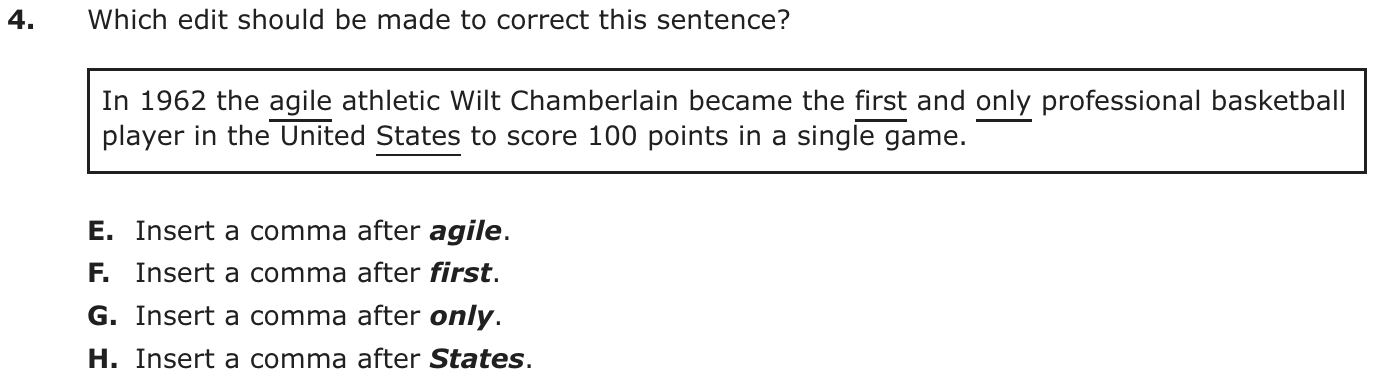
Which edit should be made to correct this sentence?
In 1962 the agile athletic Wilt Chamberlain became the first and only professional basketball player in the United States to score 100 points in a single game.
- AInsert a comma after agile.
- BInsert a comma after first.
- CInsert a comma after only.
- DInsert a comma after States.
Show the answer
Correct answer: A
The question asks which edit should be made to correct the sentence.
A. CORRECT. The sentence in the box needs a comma to separate the coordinate adjectives. Coordinate adjectives describe characteristics of the same noun or subject and are connected with a comma or “and.” This option is the only one that places a comma where it is needed, between the coordinate adjectives “agile” and “athletic.”
B. Incorrect. The option incorrectly adds a comma in the middle of the phrase “first and only,” which modifies, or gives additional information about, “professional basketball player.”
C. Incorrect. The option incorrectly adds a comma between two adjectives that are not coordinate adjectives. “Only” is part of the phrase “first and only” and is modifying “professional basketball player.”
D. Incorrect. The option is incorrect because a comma is not needed to set off the phrase “to score 100 points in a single game.”
Question analysis
This punctuation question gives one sentence about Wilt Chamberlain, the basketball player who scored 100 points in a single professional game in 1962, and asks which comma edit corrects it. All four choices add a comma, three after describing words and one after the country’s name, so students must decide which spot a comma rule truly requires.
- NYS standards
- 7L2 capitalization, punctuation, and spelling
- Grade level
- Grade 7 reading and task
- Compared with grade 7
- At grade 7 Deciding where a comma belongs in one sentence is typical grade 7 editing, and the rule tested here is part of the grade 7 language standards. The sentence sounds natural as printed, so the needed comma must be found by rule, not by ear.
- Estimated difficulty
- Straightforward: two steps or one careful reading.
- Thinking it demands
- Depth of knowledge 1, recall and reproduction · mainly apply
- What makes it hard
- A rule that doesn't sound wrong moderate
- Every choice must be checked minor
- Evidence
- Answered from one sentence or line
- Reading level
- Question and choices: about grade 7, 54 words.
- Students, last 30 days
- Not enough answers yet to show (it takes 10).
Why it is hard, traps and wrong answers (shows the answer)
Why it is hard
The sentence sounds natural as printed, so a student listening for pauses could put a comma in almost any of the four places. The question rewards knowing the test for coordinate adjectives: when “and” fits between two describing words and their order can be swapped, a comma belongs there. “Agile and athletic” passes that test, while “only and professional” fails, because “first and only” works as one unit that limits the whole phrase “professional basketball player.”
A rule that doesn't sound wrong moderate Working it out
The missing comma falls between “agile” and “athletic,” two adjectives that each describe Chamberlain, and the phrase reads smoothly without it, so the error has to be found by rule rather than by ear. (Connors & Lunsford, 1988)
Every choice must be checked minor Choosing the answer
All four edits add a comma, and two of the spots come between describing words, after “agile” and after “only,” so each pair must be tested with “and” before one is chosen. (Embretson & Wetzel, 1987)
Strategy: Take the four marked words one at a time, say what the words on either side of each are doing, and add a comma only where a rule calls for one, not wherever you would pause.
Traps
- Punctuation: A comma, semicolon, colon, dash or apostrophe used where it does not belong, or missing where it does.
The wrong answers, classified
B Punctuation (Connors & Lunsford, 1988)
Hears an emphatic pause in “the first and only,” as if writing “the first, and only,” though a single comma there splits a pair that works as one unit.
C Punctuation (Connors & Lunsford, 1988)
Believes any two describing words in a row need a comma and spots “only professional,” though “only” cannot be swapped with “professional” or joined to it by “and.”
D Punctuation (Connors & Lunsford, 1988)
Puts a comma before “to score 100 points in a single game” because the sentence is long, though that phrase tells what made him the first player and takes no comma.
Working it out, step by step
Figure out what the question asks
This is a punctuation question. Punctuation means marks like commas and periods. Each choice adds one comma to the sentence about Wilt Chamberlain. Only one of those commas is needed. Find the spot where a comma rule calls for one. Don’t just go by where you would pause when you read it aloud.
Learn the rule for describing words
An adjective is a describing word. Sometimes two adjectives in a row each describe the same noun (a naming word). They are equal partners, so a comma goes between them.
Two quick tests tell you. Can you put “and” between them? Can you swap their order? If both work, use a comma. Example: a long, boring movie. You could also say a long and boring movie or a boring, long movie.
Test agile and athletic
The sentence begins “In 1962 the agile athletic Wilt Chamberlain.” Agile means quick and light on your feet. Athletic means strong and good at sports. Both words describe Chamberlain. Now try the tests. The agile and athletic Wilt Chamberlain makes sense. So does the athletic, agile Wilt Chamberlain. Both tests pass, so a comma belongs after “agile.”
Check each choice
- A fits. “Agile” and “athletic” are equal describing words, so they need a comma.
- B does not fit. “First and only” is a pair already joined by “and.” One comma does not go inside a pair like that. You write salt and pepper, not salt, and pepper.
- C does not fit. Try the “and” test: only and professional makes no sense. “Only” goes with “first,” not with “professional.”
- D does not fit. The words after “States” tell what he was the first to do. They finish the idea, so no comma goes before them.
Choose the answer
Watch out: C is tempting because “only professional” is also two describing words in a row. But that pair fails the “and” test. The fixed sentence begins In 1962 the agile, athletic Wilt Chamberlain. So the answer is A: insert a comma after agile.
Why this answer and not the closest wrong one
C is the closest wrong answer. Like A, it puts a comma between two describing words. But only A’s pair passes the tests. You can say agile and athletic, but you can’t say only and professional. “Only” belongs with “first.” Together, “first and only” describe the whole phrase “professional basketball player.”
More questions like this
The original DOE question
Question 5 of 57
2020 Test A English, question 5Question
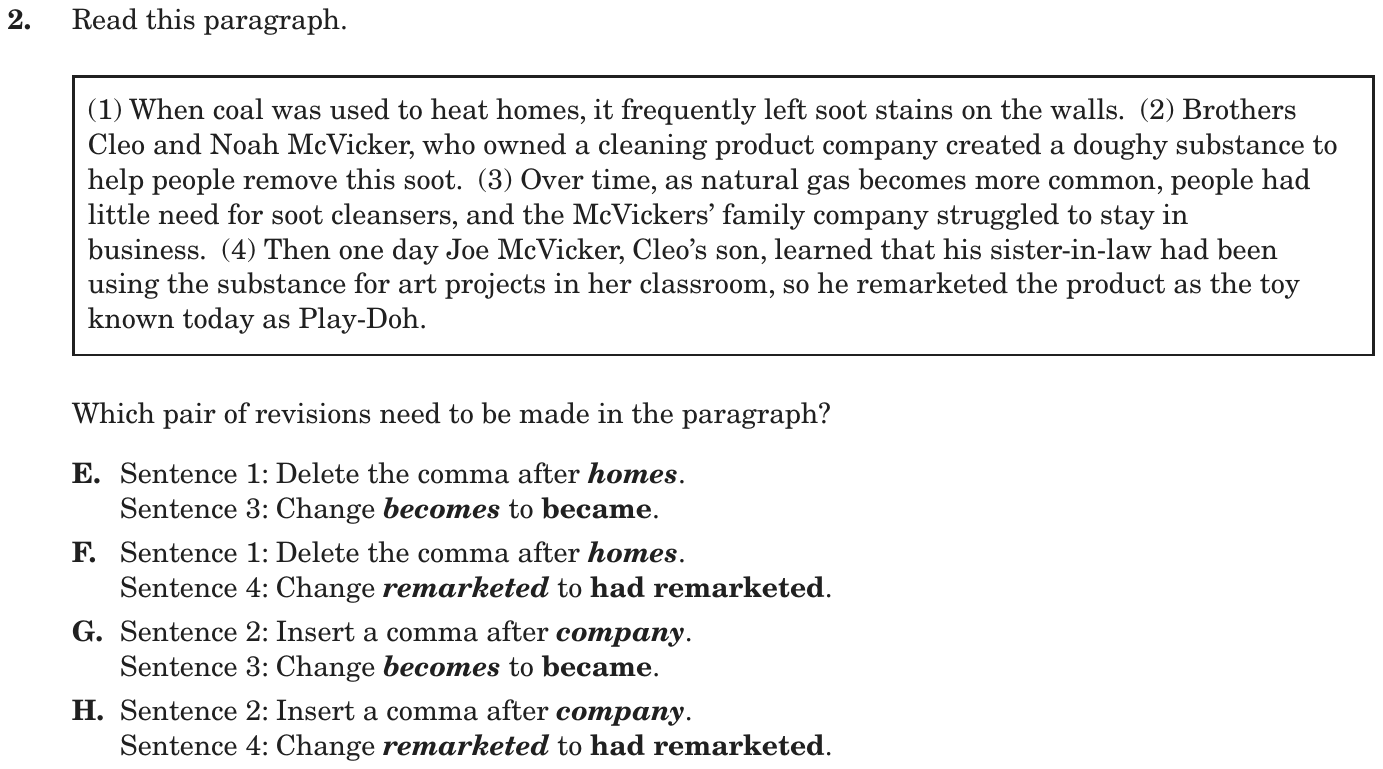
Read this paragraph.
(1) When coal was used to heat homes, it frequently left soot stains on the walls. (2) Brothers Cleo and Noah McVicker, who owned a cleaning product company created a doughy substance to help people remove this soot. (3) Over time, as natural gas becomes more common, people had little need for soot cleansers, and the McVickers’ family company struggled to stay in business. (4) Then one day Joe McVicker, Cleo’s son, learned that his sister-in-law had been using the substance for art projects in her classroom, so he remarketed the product as the toy known today as Play-Doh.
Which pair of revisions need to be made in the paragraph?
- A
Sentence 1: Delete the comma after homes.
Sentence 3: Change becomes to became.
- B
Sentence 1: Delete the comma after homes.
Sentence 4: Change remarketed to had remarketed.
- C
Sentence 2: Insert a comma after company.
Sentence 3: Change becomes to became.
- D
Sentence 2: Insert a comma after company.
Sentence 4: Change remarketed to had remarketed.
Show the answer
Correct answer: C
This is the answer (C)
The question asks for the pair of revisions needed to correct the errors in the paragraph, which appear in sentence 2 and sentence 3.
Option C is correct because it is the only choice that revises the errors in both sentence 2 and sentence 3.
In sentence 2 (Option C and Option D), a comma needs to follow the word “company” to set off the phrase “who owned a cleaning product company.” A comma is necessary because the phrase is a nonrestrictive clause: the phrase provides extra information about Cleo and Noah McVicker’s line of work, but the phrase is not necessary in order to understand the meaning of the sentence.
The second error is in sentence 3 (Option A and Option C), which incorrectly shifts the verb into the present tense. The clause “as natural gas becomes more common” should be “as natural gas became more common.”
The comma after the word “homes” in sentence 1 (Option A and Option B) is necessary for separating the subordinate clause “When coal was used to heat homes” from the main clause.
In sentence 4 (Option B and Option D), the word “remarketed” is in the past tense established in the rest of the paragraph and should not change to the past perfect tense “had remarketed.”
Question analysis
This editing question gives a short paragraph about how a soot cleaner became the toy Play-Doh and asks which pair of revisions it needs. Students must check comma use and verb tense, and because each choice pairs two edits, one correct fix can hide a wrong one.
- Grade level
- Grade 6 reading and task
- Compared with grade 7
- At grade 7 Comma rules and verb tense are taught by grade 6, but here the student must judge four separate edits and accept a choice only if both of its edits are needed, which matches grade 7 demand.
- Estimated difficulty
- Moderate: several steps, or a close reading with one strong distractor.
- Thinking it demands
- Depth of knowledge 2, skills and concepts · mainly apply
- What makes it hard
- A rule that doesn't sound wrong moderate
- A very close wrong answer moderate
- Every choice must be checked minor
- Evidence
- Answered from one paragraph or stanza
- Reading level
- Question and choices: about grade 7, 155 words.
- Students, last 30 days
- Not enough answers yet to show (it takes 10).
Why it is hard, traps and wrong answers (shows the answer)
Why it is hard
The paragraph holds two errors of different kinds, an unclosed “who” clause and a slip into present tense, and the other two proposed edits change text that is already correct. Students who catch the tense shift but not the comma are left between two pairs, and many then delete the sound comma after the opening “When” clause. The question rewards finding both errors in the paragraph before reading the pairs.
A rule that doesn't sound wrong moderate Working it out
The “who owned a cleaning product company” clause opens with a comma but never closes, and sentence 2 still reads smoothly aloud, so the missing comma after “company” is easy to miss. (Connors & Lunsford, 1988)
A very close wrong answer moderate Choosing the answer
The right pair and the pair that deletes the comma after “homes” share the “becomes” to “became” fix, so only the comma edit, after “company” or after “homes”, tells them apart. (Embretson & Wetzel, 1987; Gorin & Embretson, 2006; Ascalon et al., 2007)
Every choice must be checked minor Choosing the answer
The four pairs draw on four possible edits in four sentences, so each edit has to be judged on its own and a pair accepted only when both are needed. (Embretson & Wetzel, 1987)
Strategy: Find the errors yourself before looking at the pairs: check whether each comma is needed or missing, and check that each verb's tense fits when its event happened.
Traps
- Punctuation: A comma, semicolon, colon, dash or apostrophe used where it does not belong, or missing where it does.
- Verb tense or form: The wrong tense, an inconsistent shift of tense, or a wrong verb form.
- Fixes what isn't broken: Changes a part of the sentence that was already correct, while the real error stays; or, where the question asks which sentence has an error or should go, picks one that is correct and belongs.
The wrong answers, classified
A Punctuation (Connors & Lunsford, 1988)
Gets the “becomes” to “became” fix but, missing the unclosed “who” clause in sentence 2, deletes the comma that correctly ends the opening clause of sentence 1.
B Fixes what isn't broken (Connors & Lunsford, 1988)
Changes two correct parts, deleting the comma after an opening clause and adding a needless past perfect, while both real errors in sentences 2 and 3 stay.
D Verb tense or form (Connors & Lunsford, 1988)
Adds the needed comma after “company” but thinks the later event needs “had remarketed”, missing the real tense error, the present-tense “becomes” in sentence 3.
Working it out, step by step
Figure out what the question asks
Each choice is a pair of edits. You need the pair where both edits are needed. If even one edit in a pair changes something that was already right, that pair is wrong. The best plan is to find the errors yourself first. Then look for the pair that fixes them.
Check the comma in sentence 2
Sentence 2 says “Brothers Cleo and Noah McVicker, who owned a cleaning product company created a doughy substance.” The part “who owned a cleaning product company” is extra information. The sentence still makes sense without it. Extra information in the middle of a sentence needs a comma on both sides. Example: My aunt, who lives in Ohio, sent me a card. Sentence 2 has the first comma but not the second. So you need to add a comma after “company.”
Check the comma in sentence 1
Sentence 1 starts with “When coal was used to heat homes.” That part is a dependent clause (a group of words with a verb that can’t stand alone as a sentence). When a sentence starts with one, a comma goes after it. Example: When the bell rang, we ran outside. So the comma after “homes” is correct. Deleting it would add an error. That rules out choices A and B.
Check the verb in sentence 3
Verb tense tells when something happens. This paragraph tells a story from the past, so its verbs should stay in the past. Sentence 3 says “as natural gas becomes more common.” The word “becomes” is present tense. But the same sentence uses “had” and “struggled,” which are past tense. So change “becomes” to became.
Check the verb in sentence 4
Sentence 4 says Joe learned about the art projects, so he “remarketed” the product. Remarketed means sold it again in a new way. The form had remarketed is for something that happened before another past event. But Joe remarketed the product after he learned about the art projects. So the plain past “remarketed” is right. No change is needed.
Find the pair that matches
The two needed edits are: add a comma after “company,” and change “becomes” to “became.”
- A fixes the verb but deletes a correct comma.
- B makes two changes that are not needed.
- D adds the comma but changes a verb that was already right.
- C makes exactly the two needed edits.
So the answer is C.
Why this answer and not the closest wrong one
Choice A is the closest wrong answer, because it has the same “becomes” to “became” fix. But A also deletes the comma after “homes,” and that comma belongs after an opening “When” clause. Only C fixes both real errors and changes nothing that was already right.
More questions like this
The original DOE question
Question 6 of 57
2020 Test A English, question 6Passage Find Time to Volunteer
Find Time to Volunteer
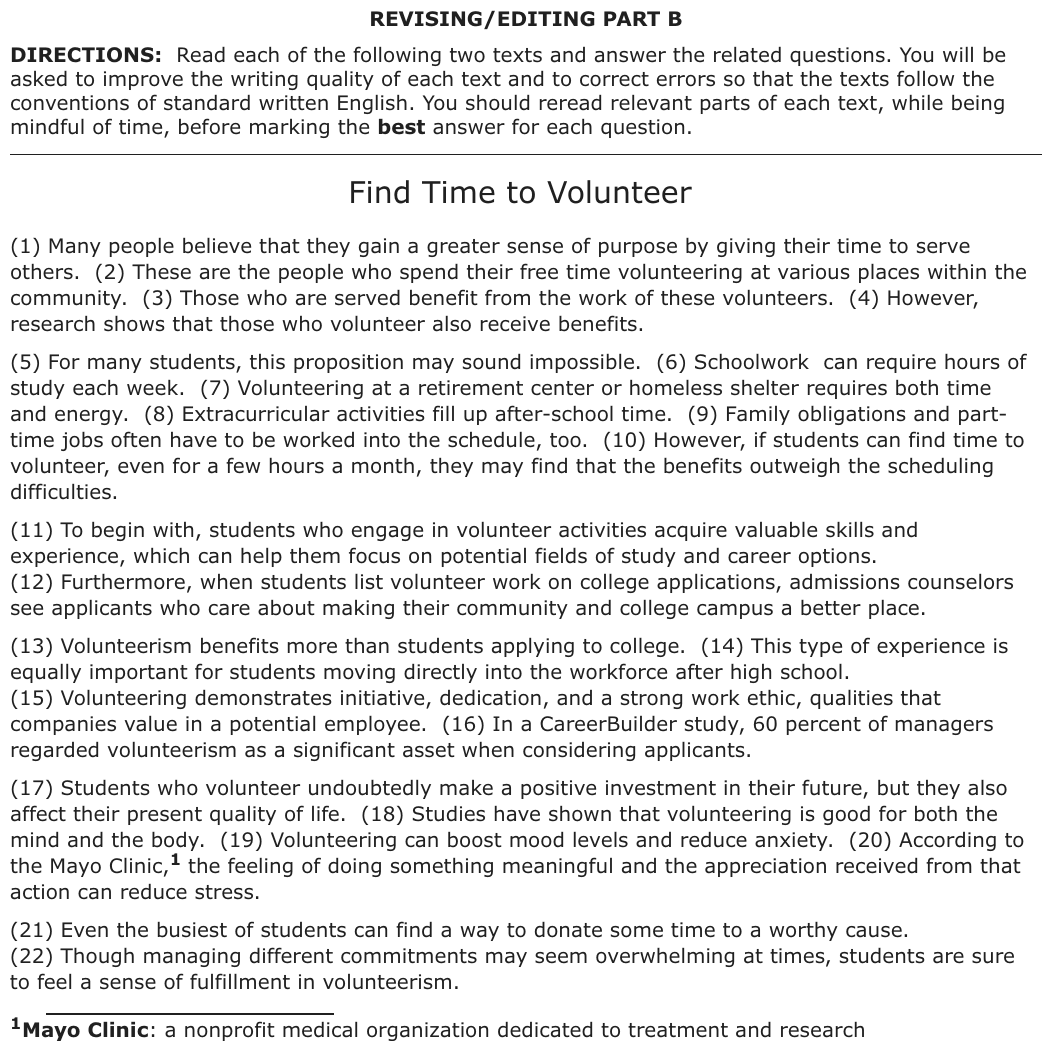
(1) Many people believe that they gain a greater sense of purpose by giving their time to serve others. (2) These are the people who spend their free time volunteering at various places within the community. (3) Those who are served benefit from the work of these volunteers. (4) However, research shows that those who volunteer also receive benefits.
(5) For many students, this proposition may sound impossible. (6) Schoolwork can require hours of study each week. (7) Volunteering at a retirement center or homeless shelter requires both time and energy. (8) Extracurricular activities fill up after-school time. (9) Family obligations and part-time jobs often have to be worked into the schedule, too. (10) However, if students can find time to volunteer, even for a few hours a month, they may find that the benefits outweigh the scheduling difficulties.
(11) To begin with, students who engage in volunteer activities acquire valuable skills and experience, which can help them focus on potential fields of study and career options. (12) Furthermore, when students list volunteer work on college applications, admissions counselors see applicants who care about making their community and college campus a better place.
(13) Volunteerism benefits more than students applying to college. (14) This type of experience is equally important for students moving directly into the workforce after high school. (15) Volunteering demonstrates initiative, dedication, and a strong work ethic, qualities that companies value in a potential employee. (16) In a CareerBuilder study, 60 percent of managers regarded volunteerism as a significant asset when considering applicants.
(17) Students who volunteer undoubtedly make a positive investment in their future, but they also affect their present quality of life. (18) Studies have shown that volunteering is good for both the mind and the body. (19) Volunteering can boost mood levels and reduce anxiety. (20) According to the Mayo Clinic,1 the feeling of doing something meaningful and the appreciation received from that action can reduce stress.
(21) Even the busiest of students can find a way to donate some time to a worthy cause. (22) Though managing different commitments may seem overwhelming at times, students are sure to feel a sense of fulfillment in volunteerism.
1Mayo Clinic: a nonprofit medical organization dedicated to treatment and research
Question
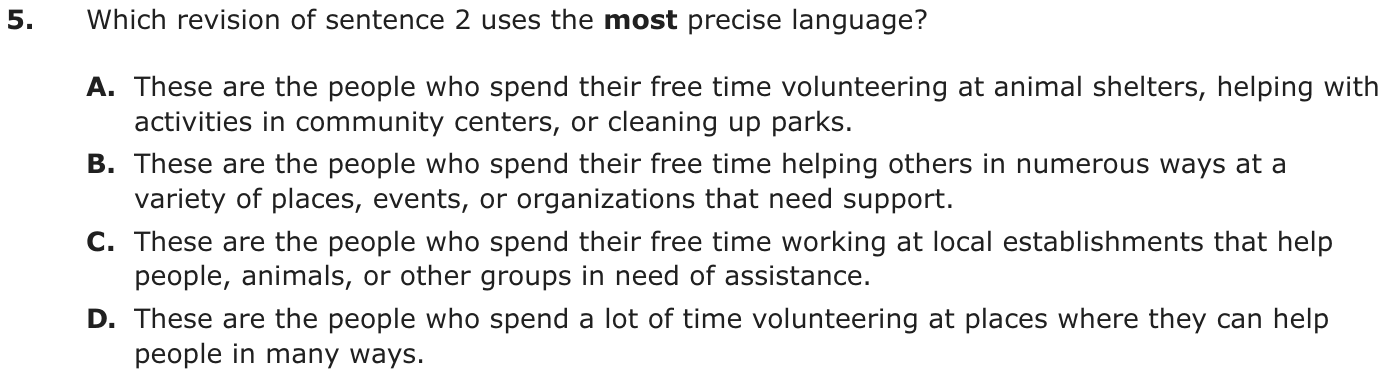
Which revision of sentence 2 uses the most precise language?
- AThese are the people who spend their free time volunteering at animal shelters, helping with activities in community centers, or cleaning up parks.
- BThese are the people who spend their free time helping others in numerous ways at a variety of places, events, or organizations that need support.
- CThese are the people who spend their free time working at local establishments that help people, animals, or other groups in need of assistance.
- DThese are the people who spend a lot of time volunteering at places where they can help people in many ways.
Show the answer
Correct answer: A
The question asks which revision of sentence 2 uses the most precise language.
A. CORRECT. In sentence 2, the author states that people who volunteer in their free time do so “at various places.” The revision to sentence 2 provides the most precise language because it references three specific places (animal shelters, community centers, and parks) where people often volunteer.
B. Incorrect. Although this sentence mentions “a variety of places, events, or organizations” at which people volunteer, the revision does not use the most precise language, because it does not list specific places, events, or organizations.
C. Incorrect. Although this sentence mentions “local establishments that help people, animals, or other groups,” the revision does not use the most precise language, because it does not name the specific types of establishments at which people can volunteer.
D. Incorrect. Although this sentence mentions “places where [volunteers] can help people in many ways,” the revision does not use the most precise language, because it does not provide specific examples of where people can volunteer.
Question analysis
This revising question uses a persuasive essay urging high school students to find time to volunteer. It asks which rewrite of the second sentence, about the people who spend free time volunteering at various places, uses the most precise language. The trap is that longer, list-like wording can look more specific than it really is.
- Grade level
- Grade 6 reading and task
- Compared with grade 7
- Below grade 7 Grade 7 writers learn to replace vague wording with precise language. Here that skill is applied to one sentence of a plain persuasive essay, with no grammar to fix, which makes it lighter than typical grade 7 revision work.
- Estimated difficulty
- Routine: one familiar step, little to misread.
- Thinking it demands
- Depth of knowledge 1, recall and reproduction · mainly evaluate
- What makes it hard
- Evidence
- Answered from one sentence or line
- Reading level
- Passage: about grade 11, 354 words; question and choices: about grade 10, 102 words.
- Students, last 30 days
- Not enough answers yet to show (it takes 10).
Why it is hard, traps and wrong answers (shows the answer)
Why it is hard
Sentence 2’s vague phrase is “various places,” and only one revision replaces it with places a reader can picture: animal shelters, community centers and parks. The wrong revisions grow longer or list the kinds of people helped, which can pass for precision on a quick read. Asking whether a revision names a real place settles it.
Every choice must be checked minor Choosing the answer
Every revision is longer than sentence 2 and sounds more detailed, so each has to be checked for whether it names actual places or only adds general words such as “organizations” and “establishments.” (Embretson & Wetzel, 1987)
Strategy: Find the vague phrase in sentence 2, then ask of each revision whether it tells the reader something more definite or simply uses more words to say the same thing.
Traps
- Wordy, vague or informal: A revision is grammatical but wordy, imprecise or too casual for the passage.
The wrong answers, classified
B Wordy, vague or informal (Connors & Lunsford, 1988)
Mistakes a longer string of general categories, “places, events, or organizations,” for precision, though none is named and the sentence only grows wordier.
C Wordy, vague or informal (Connors & Lunsford, 1988)
Is drawn by the three-part list of people, animals and other groups, but “local establishments” still leaves the actual places unnamed.
D Wordy, vague or informal (Connors & Lunsford, 1988)
Accepts “a lot of time” and “many ways,” which keep the original’s vagueness and even drop the point that volunteers give their free time.
Working it out, step by step
Figure out what the question asks
You need to rewrite sentence 2 with more precise language. Precise means exact. Precise words help the reader picture something real. Sentence 2 says: “These are the people who spend their free time volunteering at various places within the community.” Look for the part that is vague.
Find the vague phrase
The vague phrase is “at various places.” Various means different kinds. But the sentence never says which places. You can’t picture them. A better sentence would name real places. Example: I help out at different spots is vague. I help out at the library and the food bank is precise.
Check each choice
- A names three real places: “animal shelters,” “community centers,” and “parks.” You can picture each one.
- B says “a variety of places, events, or organizations.” That is a longer list of general words. It still names nothing real.
- C says “local establishments.” An establishment is a business or group. It still doesn’t say which ones.
- D says “a lot of time” and “many ways.” Those words are vague too. D even drops the idea of free time.
Pick the answer
Watch out: C has a list, “people, animals, or other groups,” so it looks detailed. But that list tells who gets help, not where volunteers go. Only one choice names the places. So the answer is A.
Why this answer and not the closest wrong one
C is the closest wrong answer. Its list of people, animals and other groups sounds specific. But “local establishments” could be any place at all. A replaces “various places” with three places a reader can picture: animal shelters, community centers and parks. That makes A the most precise.
More questions like this
The original DOE question
The passage “Find Time to Volunteer” as printed (page 163)
Question 7 of 57
2020 Test A English, question 7Uses the passage above: “Find Time to Volunteer”.
Question
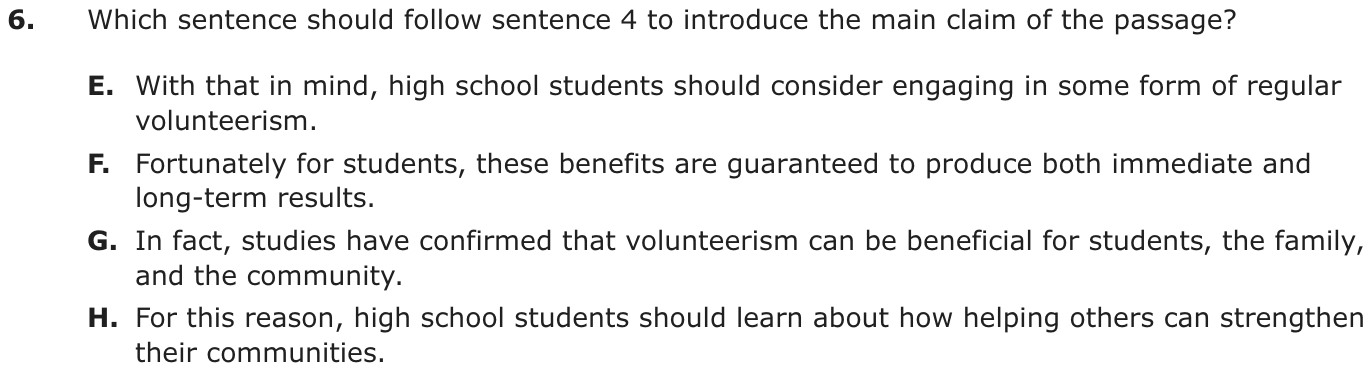
Which sentence should follow sentence 4 to introduce the main claim of the passage?
- AWith that in mind, high school students should consider engaging in some form of regular volunteerism.
- BFortunately for students, these benefits are guaranteed to produce both immediate and long-term results.
- CIn fact, studies have confirmed that volunteerism can be beneficial for students, the family, and the community.
- DFor this reason, high school students should learn about how helping others can strengthen their communities.
Show the answer
Correct answer: A
The question asks which sentence should follow sentence 4 to introduce the main claim of the passage.
A. CORRECT. Sentence 4 states that “research shows that those who volunteer also receive benefits.” The sentence in the option logically follows the ideas in sentence 4 and provides the best thesis statement for the passage because it introduces the main claim that high school students should consider the benefits of volunteerism.
B. Incorrect. While the sentence refers to the “benefits” mentioned in sentence 4, it erroneously asserts that “immediate and long-term results” are “guaranteed.” In addition, the sentence does not introduce the main claim of the passage that volunteering is beneficial for high school students.
C. Incorrect. Although the sentence states that “volunteerism can be beneficial for students,” it introduces the idea that “the family, and the community” benefit as well, which is not part of the main argument. Therefore, this sentence should not follow sentence 4 to introduce the main claim of the passage.
D. Incorrect. Although the sentence introduces the claim that “high school students should learn about” volunteering, it focuses on the idea that volunteering strengthens the community, which is not the main claim. This sentence does not accurately introduce the claim that volunteering is beneficial for high school students and thus should not follow sentence 4.
Question analysis
This introduction question asks which sentence should come right after sentence 4 of the volunteering essay to state its main claim. Students must work out what the whole essay argues and match it to an opening line, while the choices mention benefits, studies and communities in ways that sound like a thesis.
- NYS standards
- 7W1a introducing claims and counterclaims
- Grade level
- Grade 7 reading and task
- Compared with grade 7
- At grade 7 Stating a precise claim is a core grade 7 argument skill. Students must sense the essay’s claim from all six paragraphs and test four openers that each sound like a thesis, typical of careful grade 7 revision.
- Estimated difficulty
- Moderate: several steps, or a close reading with one strong distractor.
- Thinking it demands
- Depth of knowledge 2, skills and concepts · mainly evaluate
- What makes it hard
- Evidence in several places moderate
- A very close wrong answer moderate
- How sentences fit together minor
- Evidence
- Answered from the whole text
- Reading level
- Passage: about grade 11, 354 words; question and choices: about grade 10, 76 words.
- Students, last 30 days
- Not enough answers yet to show (it takes 10).
Why it is hard, traps and wrong answers (shows the answer)
Why it is hard
Three of the four sentences sound like a thesis, and two contain “high school students should,” so tone decides nothing. Students go wrong when they choose a sentence that only repeats the research point of sentence 4, or one that urges a different action. The question rewards stating the essay’s claim first, that students should volunteer because it pays off for them, and then finding the sentence that says exactly that.
Evidence in several places moderate Working it out
The essay never states its claim in one sentence; it has to be pieced together from the benefits for college, work and health in paragraphs 3 to 5 and sentence 21’s “Even the busiest of students can find a way.” (Kirsch & Mosenthal, 1990; Gorin & Embretson, 2006)
A very close wrong answer moderate Choosing the answer
The right sentence and the one about strengthening communities both open with a linking phrase and “high school students should”; they part only on what students should do, volunteer or learn about communities. (Embretson & Wetzel, 1987; Gorin & Embretson, 2006; Ascalon et al., 2007)
How sentences fit together minor Working it out
The new sentence follows sentence 4’s “those who volunteer also receive benefits,” so it must turn that research point into what students should do about it. (Halliday & Hasan, 1976)
Strategy: Skim the body paragraphs and state in a few words what the essay wants its readers to believe. Then choose the sentence that says exactly that and follows naturally from sentence 4.
Traps
- Off the point: Adds or keeps something that does not support the paragraph's or the passage's focus, or an introduction or conclusion that misses the main point.
- Too broad or too strong: A choice overstates, generalizes, or uses absolute words the text does not support.
The wrong answers, classified
B Too broad or too strong (King et al., 2004)
Follows the word “benefits” from sentence 4 but overstates them as “guaranteed” and never says what students should do, so no claim is introduced.
C Off the point (Halliday & Hasan, 1976)
Likes the research-sounding “studies have confirmed,” but it restates sentence 4 as a fact rather than a claim and widens the benefits to families and the community.
D Off the point (Halliday & Hasan, 1976)
Sees the thesis-like “high school students should,” but it asks students to learn about strengthening communities, a point the essay never develops, instead of urging them to volunteer.
Working it out, step by step
Figure out what the question asks
You need a sentence to go right after sentence 4. It must introduce the main claim. A claim is the main point a writer wants you to believe or act on. In an essay like this, it is often a should statement. Example: Students should get more sleep. So first figure out what the whole essay argues.
Find the essay’s main claim
The essay keeps urging students to make time to help. Sentence 10 says “if students can find time to volunteer, even for a few hours a month, they may find that the benefits outweigh the scheduling difficulties.” Paragraphs 3 to 5 give benefits for college, jobs and health. Sentence 21 says “Even the busiest of students can find a way to donate some time to a worthy cause.” So the claim is: high school students should volunteer, because it helps them.
Use the clue in sentence 5
The new sentence will sit just before sentence 5. Sentence 5 says “For many students, this proposition may sound impossible.” A proposition is a suggestion. So the sentence before it must suggest something students could do. That points to a sentence telling students to volunteer.
Check each choice
- A says students “should consider engaging in some form of regular volunteerism.” That is the essay’s claim. “With that in mind” links it to the benefits in sentence 4.
- B says the benefits are “guaranteed.” That overstates them, and it never tells students to do anything.
- C just repeats that studies found benefits. It also adds families, which the essay never discusses.
- D tells students to “learn about” helping communities. The essay never argues for that.
Pick the answer
Watch out: D also says “high school students should,” so it sounds like a claim. But it asks them to learn, not to volunteer. Only one choice states what the essay argues. So the answer is A.
Why this answer and not the closest wrong one
D is the closest wrong answer, because it also tells high school students what they should do. But the essay never asks students to study how helping makes communities stronger. It argues that volunteering pays off for the students themselves. A says exactly that, and it sets up “this proposition” in sentence 5.
More questions like this
The original DOE question
Question 8 of 57
2020 Test A English, question 8Uses the passage above: “Find Time to Volunteer”.
Question
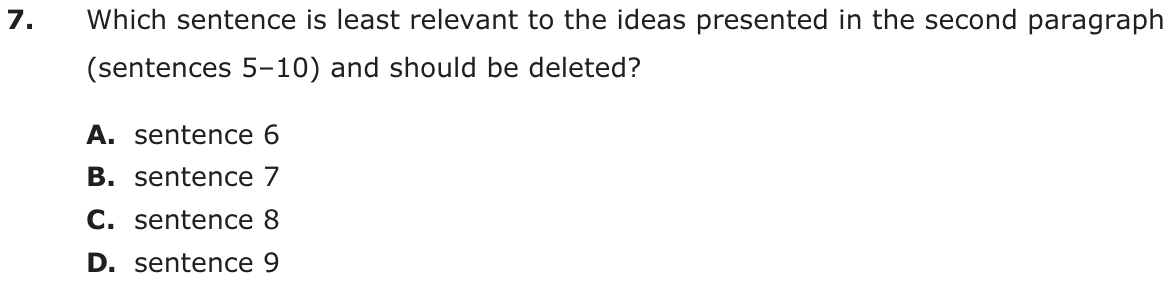
Which sentence is least relevant to the ideas presented in the second paragraph (sentences 5–10) and should be deleted?
- Asentence 6
- Bsentence 7
- Csentence 8
- Dsentence 9
Show the answer
Correct answer: B
The question asks which sentence is least relevant to the ideas presented in the second paragraph (sentences 5–10) and should be deleted.
A. Incorrect. Sentence 5 introduces the topic of the second paragraph, which is that finding time to volunteer “may sound impossible” for many students. Sentence 6 logically follows this idea because it provides one reason why students might hesitate or be unable to volunteer. Therefore, sentence 6 is relevant to the ideas presented in the second paragraph and should not be deleted.
B. CORRECT. Sentence 7 states that “time and energy” are required for volunteering, which partially addresses the topic of the second paragraph about the various commitments that fill high school students’ schedules. However, sentence 7 interrupts the flow of the paragraph by interjecting specific examples (“volunteering at a retirement center or homeless shelter”) into a general list of activities and commitments. Thus, the sentence is the least relevant to the paragraph and should be deleted.
C. Incorrect. In the second paragraph, the author discusses why some high school students may hesitate to volunteer. In sentences 6 and 9, the author points out that “schoolwork” and “family obligations and part-time jobs” are activities that require students’ time and may cause them to hesitate taking on any additional activities. Sentence 8 contributes to this idea by stating that “extracurricular activities” also require a time commitment from students. As a result, sentence 8 contributes to the ideas in the second paragraph and should not be deleted.
D. Incorrect. In the second paragraph, the author acknowledges that some high school students may hesitate to volunteer because of “schoolwork” and “extracurricular activities.” Sentence 9 contributes to this idea by stating that “family obligations and part-time jobs” also require a time commitment and may cause students to hesitate to volunteer. Therefore, sentence 9 contributes to the ideas in the second paragraph and should not be deleted.
Question analysis
This revising question focuses on the second paragraph of the volunteering essay, which explains why students may think they have no time to help others. Students pick the one sentence that is least relevant and should be deleted. Since every sentence touches on how students spend their time, the challenge is seeing which one breaks the paragraph’s line of thought.
- NYS standards
- 7W1b supporting claims with evidence
- Grade level
- Grade 7 reading and task
- Compared with grade 7
- At grade 7 Spotting a sentence that does not belong is regular grade 7 revision work. The paragraph is short and plain, but every candidate is loosely tied to students’ busy lives, so students must pin down the paragraph’s exact point first.
- Estimated difficulty
- Moderate: several steps, or a close reading with one strong distractor.
- Thinking it demands
- Depth of knowledge 2, skills and concepts · mainly analyze
- What makes it hard
- How sentences fit together moderate
- Every choice must be checked minor
- Evidence
- Answered from one paragraph or stanza
- Reading level
- Passage: about grade 11, 354 words; question and choices: about grade 5, 22 words.
- Students, last 30 days
- Not enough answers yet to show (it takes 10).
Why it is hard, traps and wrong answers (shows the answer)
Why it is hard
The sentence to delete is the only one in the paragraph that mentions volunteering, so students who test each sentence against the essay’s topic keep it and cut one of the others. The paragraph’s point is narrower: sentence 5 says volunteering “may sound impossible” for many students, and sentences 6, 8 and 9 list what already fills their schedules. Sentence 7 is loosely related, which is why the stem asks for the least relevant sentence rather than an irrelevant one.
How sentences fit together moderate Working it out
Sentences 6, 8 and 9 list the commitments that already fill students’ time, schoolwork, activities, family and jobs, while sentence 7 turns to what volunteering itself demands and breaks that list. (Halliday & Hasan, 1976)
Every choice must be checked minor Choosing the answer
Every candidate touches on students’ busy lives, and sentence 7 is the only one that mentions volunteering, so each must be tested against the paragraph’s exact point rather than the essay’s topic. (Embretson & Wetzel, 1987)
Strategy: Say in a few words what sentences 5 and 10 tell you the paragraph is about. Then test each listed sentence: does it add to that point, or does it shift to a different one?
Traps
- Fixes what isn't broken: Changes a part of the sentence that was already correct, while the real error stays; or, where the question asks which sentence has an error or should go, picks one that is correct and belongs.
The wrong answers, classified
A Fixes what isn't broken (Connors & Lunsford, 1988)
Cuts sentence 6 because schoolwork says nothing about volunteering, judging by the essay’s topic word, though schoolwork is the first commitment on the paragraph’s list.
C Fixes what isn't broken (Connors & Lunsford, 1988)
Treats extracurricular activities as a separate subject, though sentence 8 adds another after-school demand to the list explaining why volunteering seems impossible.
D Fixes what isn't broken (Connors & Lunsford, 1988)
Senses that the paragraph lists school pressures and cuts family obligations and part-time jobs as outside school, missing that “too” adds them to the same list of demands.
Working it out, step by step
Figure out what the question asks
You need the sentence in paragraph 2 that fits least and should be cut. Every sentence in a paragraph should support its main point. Example: My dog loves the park. He chases balls. Cats sleep a lot. He rolls in the grass. The cat sentence doesn’t fit. So first find the paragraph’s point. Then test each listed sentence against it.
Find the paragraph’s main point
Sentence 5 says “For many students, this proposition may sound impossible.” The proposition is the idea of volunteering. Sentence 10 says the benefits may “outweigh the scheduling difficulties.” So the paragraph is about why students feel too busy. The sentences in between should list what already fills their time.
Test each listed sentence
- Sentence 6: “Schoolwork can require hours of study each week.” That is one thing that fills their time.
- Sentence 7: “Volunteering at a retirement center or homeless shelter requires both time and energy.” This is about volunteering itself. It names two places, and it breaks the list.
- Sentence 8: “Extracurricular activities fill up after-school time.” These are things like sports and clubs. That is another item on the list.
- Sentence 9: “Family obligations and part-time jobs” fill time “too.” The word too adds them to the same list.
Read the paragraph without it
Try reading sentences 6, 8 and 9 in a row. Schoolwork, activities, family and jobs make one smooth list of things that fill a student’s week. Then sentence 10 answers that worry. Nothing is missing when sentence 7 is gone. That shows it is the least relevant.
Pick the answer
Watch out: Sentence 9 can seem off topic, because family and jobs are outside school. That makes D tempting. But the paragraph is about everything that fills a student’s time. So the answer is B, sentence 7.
Why this answer and not the closest wrong one
Sentence 9 is the closest wrong answer, because family and jobs are not schoolwork. But its last word, “too,” adds them to the same list as schoolwork and activities. Sentence 7 is the only one about what volunteering takes, not what already fills the week. So B is the one to cut.
More questions like this
The original DOE question
Question 9 of 57
2020 Test A English, question 9Uses the passage above: “Find Time to Volunteer”.
Question
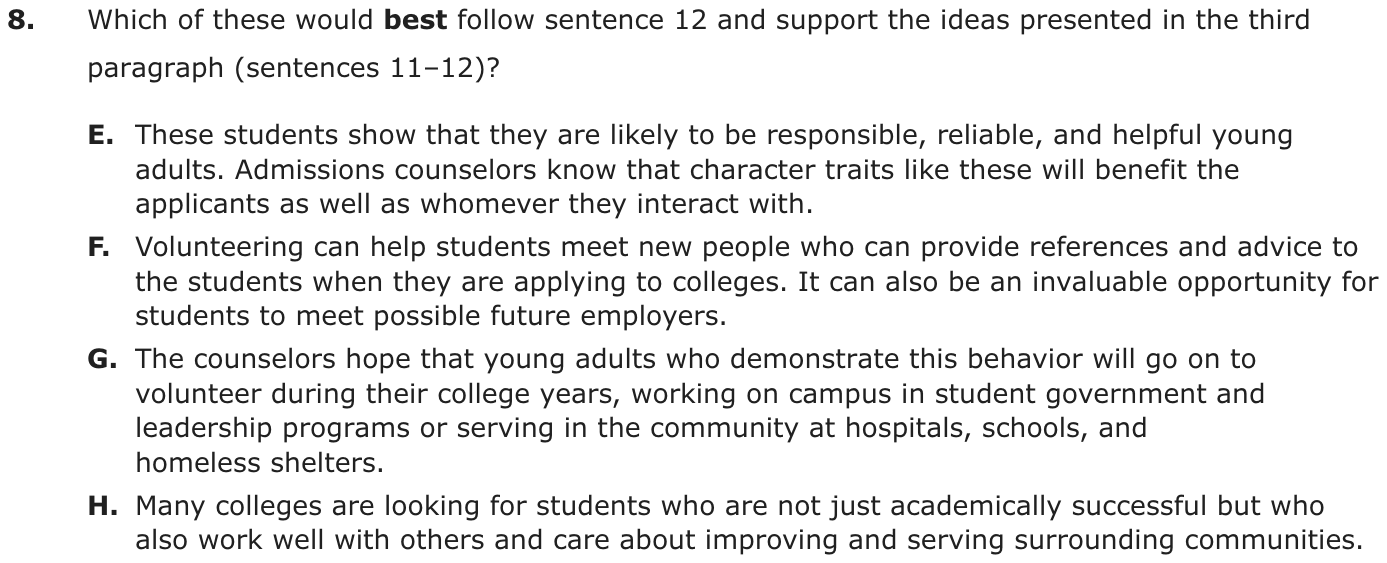
Which of these would best follow sentence 12 and support the ideas presented in the third paragraph (sentences 11–12)?
- AThese students show that they are likely to be responsible, reliable, and helpful young adults. Admissions counselors know that character traits like these will benefit the applicants as well as whomever they interact with.
- BVolunteering can help students meet new people who can provide references and advice to the students when they are applying to colleges. It can also be an invaluable opportunity for students to meet possible future employers.
- CThe counselors hope that young adults who demonstrate this behavior will go on to volunteer during their college years, working on campus in student government and leadership programs or serving in the community at hospitals, schools, and homeless shelters.
- DMany colleges are looking for students who are not just academically successful but who also work well with others and care about improving and serving surrounding communities.
Show the answer
Correct answer: D
The question asks which option would best follow sentence 12 to support the ideas presented in the third paragraph (sentences 11–12).
A. Incorrect. The subject of the main clause in sentence 12 is “admissions counselors.” Although the second sentence in the option mentions “admissions counselors,” it does not support the ideas in the paragraph, because the statement that “admissions counselors know that character traits like these will benefit the applicants” focuses on how students benefit, while sentence 12 focuses on how these traits benefit the community.
B. Incorrect. While sentence 11 discusses the potential academic and professional connections that can be made through volunteering, sentence 12 moves on to the topic of college admissions. Since the sentences in the option revert back to the topic of connections, they do not support and logically follow a sentence about how college admissions counselors view students with volunteering experience.
C. Incorrect. Although the sentence in the option continues on the subject of admissions counselors and follows the idea in sentence 12 that these counselors tend to favor students who “care about making their community and college campus a better place,” the sentence focuses on what students will do while in college rather than on how volunteering helps them get into college. Therefore, the sentence does not best follow sentence 12 and support the ideas presented in the third paragraph.
D. CORRECT. In sentence 12, the author states that college admissions counselors view students who list volunteer work on admissions applications as “applicants who care about making their community and college campus a better place.” The sentence in the option best follows sentence 12 and supports the ideas in the third paragraph because it provides additional details about why admissions counselors look beyond academics when considering students for admissions and the positive qualities assigned to those who have volunteering experience.
Question analysis
This supporting-details question asks which addition would best follow the volunteering essay’s sentence about how college admissions counselors view applicants who list volunteer work. Every option mentions college and sounds reasonable on its own, so students must decide which one develops the paragraph’s point rather than drifting to a related idea.
- NYS standards
- 7W1b supporting claims with evidence
- Grade level
- Grade 8 reading and task
- Compared with grade 7
- Above grade 7 Grade 7 students choose evidence that supports a claim. Here the options are one or two full sentences, all of them about college, and the right fit depends on the precise idea in sentence 12, a finer judgment than usual.
- Estimated difficulty
- Hard: combines ideas, needs a plan, and has more than one tempting wrong answer.
- Thinking it demands
- Depth of knowledge 2, skills and concepts · mainly evaluate
- What makes it hard
- A very close wrong answer major
- How sentences fit together moderate
- A lot to read minor
- Evidence
- Answered from one paragraph or stanza
- Reading level
- Passage: about grade 11, 354 words; question and choices: about grade 13, 153 words.
- Students, last 30 days
- Not enough answers yet to show (it takes 10).
Why it is hard, traps and wrong answers (shows the answer)
Why it is hard
Every option stays on the subject of college, so the work is matching sentence 12’s exact idea: counselors see applicants who care about making their community a better place. The near miss also explains what counselors value, but it swaps caring for the community for a new set of traits and ends on what those traits do for the applicants. Students who restate sentence 12 before reading the options can hear that the right one simply widens it, from community service to what colleges want beyond grades.
A very close wrong answer major Choosing the answer
The right sentence and the two-sentence option about responsible, reliable, helpful students both explain why volunteers impress admissions; only the right one keeps sentence 12’s point, caring about improving communities. (Embretson & Wetzel, 1987; Gorin & Embretson, 2006; Ascalon et al., 2007)
How sentences fit together moderate Working it out
The new sentence must extend sentence 12’s specific idea, what admissions counselors see in volunteers, rather than return to sentence 11’s skills and careers or move on to college life. (Halliday & Hasan, 1976)
A lot to read minor Understanding the question
The options run 27 to 39 words, two of them two sentences long, and all four are about college, so topic alone rules none of them out. (Kintsch, 1998; Gorin & Embretson, 2006; Freedle & Kostin, 1993)
Strategy: Restate sentence 12 in your own words, then ask of each option whether it explains or extends that exact point about what admissions counselors value.
Traps
- Off the point: Adds or keeps something that does not support the paragraph's or the passage's focus, or an introduction or conclusion that misses the main point.
The wrong answers, classified
A Off the point (Halliday & Hasan, 1976)
Follows the admissions counselors from sentence 12 but replaces caring for the community with new traits, responsibility and reliability, and turns to how those traits help the applicants.
B Off the point (Halliday & Hasan, 1976)
Is drawn by “applying to colleges,” but networking for references and future employers is a new benefit that neither sentence 11 nor sentence 12 develops.
C Off the point (Halliday & Hasan, 1976)
Stays with the counselors and picks up “college campus” from sentence 12, but jumps ahead to what students might do in college instead of explaining admission decisions.
Working it out, step by step
Figure out what the question asks
You need the sentence that best follows sentence 12. A good next sentence adds to the same idea. It does not jump to a new point. Example: after Dogs make loyal pets, the sentence They stay by their owners’ side fits. Dogs come in many colors drifts away. So first put sentence 12 in your own words.
Restate sentence 12
Sentence 12 says that “when students list volunteer work on college applications, admissions counselors see applicants who care about making their community and college campus a better place.” Admissions counselors are the people who choose which students get into a college. So the idea is this: colleges like volunteers because volunteers care about their communities.
Check each choice
- D says colleges want students who are “not just academically successful.” That means more than good grades. They also want students who “care about improving and serving surrounding communities.” That explains sentence 12 and builds on it.
- A swaps in new traits: “responsible, reliable, and helpful.” Then it says those traits help the applicants and the people around them. It drops caring for the community.
- B brings in a new benefit: meeting people who can give advice or jobs. Neither sentence 11 nor sentence 12 talks about that.
- C jumps ahead to what students might do in college. It doesn’t explain how volunteering helps them get in.
Pick the answer
Watch out: A is the most tempting. It is about what counselors value, just like the right answer. But it changes the reason they value it. Only D keeps sentence 12’s idea of caring for the community. So the answer is D.
Why this answer and not the closest wrong one
A is the closest wrong answer. Like D, it explains why admissions counselors like volunteers. But A’s reasons are new ones, such as being responsible and reliable. D keeps sentence 12’s exact idea, caring about the community, and adds that colleges want more than good grades. So D supports the paragraph best.
More questions like this
The original DOE question
Question 10 of 57
2020 Test A English, question 10Uses the passage above: “Find Time to Volunteer”.
Question
Which concluding sentence should replace sentence 22 to provide the best support for the argument presented in the passage?
- AIn every city, there are homeless shelters, food pantries, youth centers, and political campaigns that depend on the support and commitment of hardworking young people.
- BClearly, students who volunteer will experience a host of benefits, such as learning new skills, meeting interesting people, opening up opportunities for the future, and gaining a sense of satisfaction.
- CWhen students carefully evaluate their activities and prioritize volunteerism, they find a way to work it into their schedule and are soon encouraging their peers to do the same.
- DWhether they are seeking admission to college, preparing to enter the workforce, or simply looking to reduce stress, high school students who volunteer can help themselves as much as they help others.
Show the answer
Correct answer: D
The question asks which concluding sentence should replace sentence 22 to provide the best support for the argument presented in the passage.
A. Incorrect. Although the sentence lists examples of organizations that depend on “hardworking young people” as volunteers, it should not replace sentence 22, because its use of specific examples does not provide a strong conclusion to the main idea in the passage, and it does not best support the main argument that students benefit themselves and their community when volunteering.
B. Incorrect. While the sentence supports the argument that students “will experience a host of benefits” through volunteerism, it should not replace sentence 22 as a concluding sentence, because it does not best support the main argument that volunteerism benefits both the students and their community.
C. Incorrect. Although the sentence emphasizes the importance of prioritizing volunteerism, it should not replace sentence 22, because it focuses on the main idea in the second paragraph (“For many students, this proposition may sound impossible.”), rather than the main argument that volunteerism benefits both students and their community. This sentence introduces the idea that student volunteers “are soon encouraging their peers” to volunteer, which does not best support the argument presented in the passage.
D. CORRECT. This sentence should replace sentence 22 to conclude the passage because it lists specific reasons for volunteering (“Whether they are seeking admission to college, preparing to enter the workforce, or simply looking to reduce stress”) and best supports the main argument that volunteering not only helps students but can also help their community (“high school students who volunteer can help themselves as much as they help others”).
Question analysis
This conclusion question asks which sentence should replace the last line of the essay urging high school students to volunteer. Students need a closing statement that best supports the argument as a whole. Several options list benefits or name real places to volunteer, so the challenge is telling an ending that fits the whole essay from one that drifts.
- NYS standards
- 7W1e concluding an argument
- Grade level
- Grade 7 reading and task
- Compared with grade 7
- At grade 7 Writing a conclusion that sums up an argument is a grade 7 standard. Students recognize one rather than write it, but they must keep the essay’s several reasons in mind while judging four endings that all sound final.
- Estimated difficulty
- Moderate: several steps, or a close reading with one strong distractor.
- Thinking it demands
- Depth of knowledge 2, skills and concepts · mainly evaluate
- What makes it hard
- Evidence in several places moderate
- A very close wrong answer moderate
- Evidence
- Answered from the whole text
- Reading level
- Passage: about grade 11, 354 words; question and choices: about grade 15, 134 words.
- Students, last 30 days
- Not enough answers yet to show (it takes 10).
Why it is hard, traps and wrong answers (shows the answer)
Why it is hard
All four endings sound final, and the strongest wrong one is a fair-sounding list of benefits that opens with “Clearly.” The right ending wins on fit: its three reasons are the essay’s own, college, work and stress, and it keeps the opening idea that volunteers help others as well as themselves. Students who sketch the essay’s reasons paragraph by paragraph before reading the endings can see which one gathers them and which adds a point of its own.
Evidence in several places moderate Working it out
The reasons a conclusion must gather sit in three body paragraphs, college admission in paragraph 3, the workforce in paragraph 4 and stress in paragraph 5, well before sentence 22. (Kirsch & Mosenthal, 1990; Gorin & Embretson, 2006)
A very close wrong answer moderate Choosing the answer
The right ending and the “host of benefits” ending both list what volunteers gain; they part on whether the list matches the essay’s own reasons and keeps the help volunteers give others. (Embretson & Wetzel, 1987; Gorin & Embretson, 2006; Ascalon et al., 2007)
Strategy: List the essay’s reasons for volunteering, one phrase per paragraph, then pick the ending that pulls them together without bringing in a new point.
Traps
- Too narrow: A single detail offered as the central idea or a summary, or a summary that keeps minor details and leaves out an essential part.
- Off the point: Adds or keeps something that does not support the paragraph's or the passage's focus, or an introduction or conclusion that misses the main point.
The wrong answers, classified
A Off the point (Halliday & Hasan, 1976)
Likes the concrete list of shelters, pantries and campaigns, but naming groups that need young volunteers sums up none of the essay’s reasons for volunteering.
B Too narrow (King et al., 2004)
Sums up only what students gain, adding “meeting interesting people,” which the essay never mentions, and drops the point that volunteers help others too.
C Off the point (Halliday & Hasan, 1976)
Carries on sentence 21’s point that busy students can find time, then adds students recruiting their peers, so it ends on scheduling instead of the reasons to volunteer.
Working it out, step by step
Figure out what the question asks
You need a new last sentence for the essay. A good conclusion sums up the argument. It pulls the main reasons together without adding a new idea. Example: an essay on biking to school might end, Biking keeps you fit, saves money and helps clean the air. So first list this essay’s reasons.
List the essay’s reasons
- Paragraph 1: volunteers help others, and “those who volunteer also receive benefits” (sentence 4).
- Paragraph 3: volunteering helps with college applications.
- Paragraph 4: it helps students “moving directly into the workforce,” which means starting a job.
- Paragraph 5: it helps the mind and body, and it “can reduce stress.”
So a good ending names college, work and stress. It also keeps the idea that volunteers help both others and themselves.
Check each choice
- D names all three: “seeking admission to college, preparing to enter the workforce, or simply looking to reduce stress.” It ends with students who “help themselves as much as they help others.” That matches the essay.
- B lists benefits, but it adds “meeting interesting people.” The essay never says that. It also leaves out helping others.
- A lists places that need volunteers. It sums up none of the essay’s reasons.
- C is about fitting volunteering into a schedule and getting friends to join. Getting friends to join is a new idea.
Pick the answer
Watch out: B starts with “Clearly” and lists good things, so it sounds like an ending. But its list is not the essay’s list. So the answer is D.
Why this answer and not the closest wrong one
B is the closest wrong answer, because it also sums up what volunteers gain. But it adds a benefit the essay never discusses, and it drops the help volunteers give others. D gathers the essay’s own reasons, college, work and stress, and keeps both sides of the essay’s idea.
More questions like this
The original DOE question
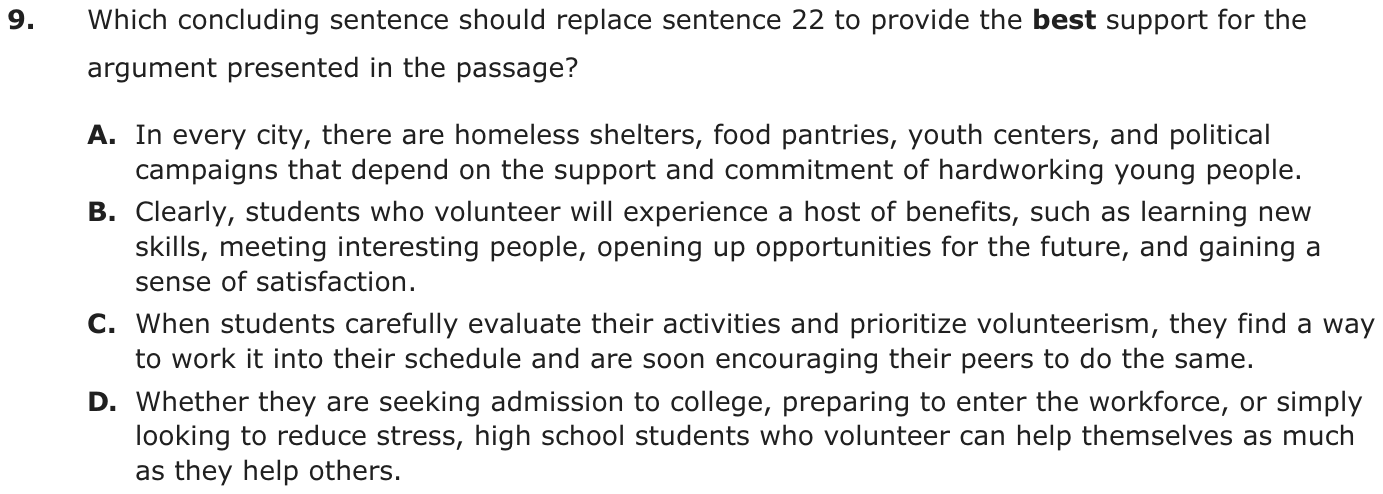
Question 11 of 57
2020 Test A English, question 11Passage The Benefits of Indoor Plants
The Benefits of Indoor Plants
(1) In an age of endless media content, it is easy to see why people might prefer to stay inside. (2) According to a study sponsored by the Environmental Protection Agency, Americans spend an average of 87 percent of their time indoors. (3) Scientists say that this separation between people and nature puts people at risk for physical and psychological issues.
(4) During the process of photosynthesis, plants convert carbon dioxide into oxygen and remove many harmful toxins from the air. (5) Spending prolonged periods of time indoors, away from plants, deprives people of these benefits. (6) Air that is not regularly detoxified can lead to a condition known as sick building syndrome. (7) This disorder first came to light in the 1970s when many office workers in the United States began to complain of unexplained flu-like symptoms. (8) Researchers determined the cause to be volatile organic compounds, or VOCs. (9) VOCs are harmful chemicals that are emitted by everyday objects such as carpet, furniture, cleaning products, and computers. (10) The NASA Clean Air Study found a simple way to remove a significant number of VOCs within a 24-hour period: add plants to indoor spaces.
(11) Adding plants to indoor spaces has psychological benefits too. (12) Research has long linked time spent in natural environments with increased energy and feelings of contentment. (13) While being outdoors is an excellent option for improving a person’s mental health, recent research has indicated that encountering natural elements while indoors can also help. (14) To experience the maximum benefit of natural elements, experts suggest placing at least one live plant per 100 square feet of home or office space.
(15) Connecting with nature, even just by being near an indoor plant, is a significant factor in a person’s well-being. (16) Sitting in front of an electronic screen all day isn’t natural, and today’s workers need to get up and get outdoors. (17) Richard Ryan, a psychology professor at the University of Rochester, puts it this way: “Nature is something within which we flourish, so having it be more a part of our lives is critical, especially when we live and work in built environments.”
Question
Which sentence should follow sentence 3 to best introduce the topic of the passage?
- APlacing plants in homes and offices can provide a healthy bridge between nature and the indoors.
- BIt is important for people to realize that they need to spend more time near plants, whether indoors or out in nature.
- CFor their personal health and well-being, people need to spend more time outdoors or bring the outdoors in.
- DIndividuals with little connection to nature can experience illness, depression, and higher levels of stress.
Show the answer
Correct answer: A
The question asks which sentence should follow sentence 3 to best introduce the topic of the passage.
A. CORRECT. The sentence introduces the overall topic by previewing the main ideas in the passage. It introduces the connection between natural elements and well-being (“a healthy bridge”) and sets up the main argument of the passage (“Placing plants in homes and offices” can increase people’s well-being).
B. Incorrect. Although sentence 3 mentions the connection between “people and nature,” this sentence references the importance of spending time near plants while both indoors and outdoors. However, the passage focuses specifically on the benefits of having indoor plants.
C. Incorrect: Though the sentence describes a reason why indoor plants are important (“For [people’s] personal health and well-being”), the topic of the passage is related to the need for indoor plants, not the need for people to spend more time outdoors.
D. Incorrect. While the sentence refers to how time away from nature can affect health and well-being, the vague wording (“little connection to nature”) makes this sentence too broad to introduce the topic of the passage, and thus, it should not follow sentence 3.
Question analysis
This revising question works with the four-paragraph passage “The Benefits of Indoor Plants” and asks which sentence should follow sentence 3 to introduce the passage's topic. The opening paragraph ends on the health risks of time spent away from nature, and every choice continues that thought in some way, so students must judge which one prepares a reader for what the passage goes on to cover.
- NYS standards
- 7W2a introducing and organizing a topic
- Grade level
- Grade 7 reading and task
- Compared with grade 7
- At grade 7 Introducing a topic so that it previews what follows is a grade 7 writing standard, practised often in class. The passage is short and plainly worded, and the choices differ in focus rather than in grammar, typical grade 7 revision.
- Estimated difficulty
- Moderate: several steps, or a close reading with one strong distractor.
- Thinking it demands
- Depth of knowledge 2, skills and concepts · mainly evaluate
- What makes it hard
- A very close wrong answer moderate
- Evidence in several places moderate
- How sentences fit together minor
- Evidence
- Answered from the whole text
- Reading level
- Passage: about grade 12, 346 words; question and choices: about grade 9, 84 words.
- Students, last 30 days
- Not enough answers yet to show (it takes 10).
Why it is hard, traps and wrong answers (shows the answer)
Why it is hard
The first paragraph ends on a problem, and all four choices continue it plausibly, so the decision is about scope. The passage is about plants indoors, and the near miss offers outdoor time as an equal remedy, while another widens the subject to plants anywhere and a third simply restates the danger. Students who skim the topic sentences of the later paragraphs before choosing see that only an indoor solution introduces what follows.
A very close wrong answer moderate Choosing the answer
The choice ending “or bring the outdoors in” sounds like the key's “bridge between nature and the indoors,” but it adds spending more time outdoors, a remedy the passage does not develop. (Embretson & Wetzel, 1987; Gorin & Embretson, 2006; Ascalon et al., 2007)
Evidence in several places moderate Working it out
The topic only emerges from the later paragraphs: plants cleaning indoor air in sentences 4–10, their psychological benefits in 11–14, and nature brought indoors in 15–17. (Kirsch & Mosenthal, 1990; Gorin & Embretson, 2006)
How sentences fit together minor Working it out
The new sentence must follow sentence 3's warning about “separation between people and nature” and lead into sentence 4's photosynthesis, so it has to name plants as the remedy. (Halliday & Hasan, 1976)
Strategy: Skim the first sentence of each later paragraph to see what the passage actually covers, then test each choice: would it set up those paragraphs without promising something they never discuss?
Traps
- Half right: One half of a two-part choice is right and the other is not.
- Too broad or too strong: A choice overstates, generalizes, or uses absolute words the text does not support.
- Says it twice: Repeats an idea that the sentence or passage already states.
The wrong answers, classified
B Too broad or too strong (King et al., 2004)
Accepts a sentence about needing plants, but “whether indoors or out in nature” widens the subject to plants anywhere, while the passage discusses only plants inside.
C Half right (King et al., 2004; Thissen, Steinberg & Fitzpatrick, 1989)
Is drawn by “bring the outdoors in” and “health and well-being,” but the other half, spending more time outdoors, is a remedy the passage never goes on to develop.
D Says it twice (Connors & Lunsford, 1988)
Follows sentence 3 smoothly by naming illness, depression and stress, but that only restates its “physical and psychological issues” and never introduces plants, the passage's subject.
Working it out, step by step
Figure out what the question asks
This revising question asks you to add a sentence that introduces the topic. Such a sentence tells the reader what the passage will be about. For example, an essay about why dogs make good pets might start: Dogs make loyal, loving pets. The new sentence goes after sentence 3, so it must also follow from it.
Find the passage’s topic
Skim the rest of the passage. Sentences 4–10 tell how plants clean indoor air. Sentences 11–14 say plants indoors help the mind. Sentences 15–17 say even an indoor plant connects you with nature. So the topic is plants inside homes and offices. The title says it too: “The Benefits of Indoor Plants.”
Connect it to sentence 3
Sentence 3 names a problem: “this separation between people and nature puts people at risk for physical and psychological issues.” Psychological means having to do with the mind and feelings. The best next sentence should name the fix the passage talks about: bringing plants indoors.
Check each choice
- A is right. It names plants “in homes and offices” as “a healthy bridge between nature and the indoors.” A bridge connects two things, so plants bring nature inside. That sets up every later paragraph.
- B is wrong. “Whether indoors or out in nature” widens the topic to plants anywhere. The passage only discusses plants inside.
- C is wrong. It offers two fixes: more time outdoors, or bringing the outdoors in. The passage develops only the second. C never even mentions plants.
- D is wrong. It just repeats sentence 3’s problem in new words. It never brings up plants, the subject of the passage.
Look closely at choice C
Watch out: C sounds close because of “bring the outdoors in.” But the passage gives no tips for spending more time outside. Sentence 13 mentions being outdoors only on its way to the indoor point. So half of C promises something the passage never delivers.
Choose the answer
Only one choice moves from sentence 3’s problem to the passage’s answer, plants inside. So the answer is A.
Why this answer and not the closest wrong one
C is the closest wrong answer, because “bring the outdoors in” sounds like A. But C gives equal weight to spending more time outdoors, and the passage never develops that idea. A points only to plants indoors, which is exactly what the rest of the passage is about.
More questions like this
The original DOE question
The passage “The Benefits of Indoor Plants” as printed (page 60)
Question 12 of 57
2020 Test A English, question 12Uses the passage above: “The Benefits of Indoor Plants”.
Question
Which transition word or phrase should be added to the beginning of sentence 5?
- AAs a result,
- BPrimarily,
- CIn contrast,
- DUnfortunately,
Show the answer
Correct answer: D
The question asks for the transition word or phrase that should be added to the beginning of sentence 5.
A. Incorrect. The transition phrase “As a result” conveys a cause-and-effect relationship that does not exist between the ideas in sentence 4 and sentence 5. Although the plants’ conversion of carbon dioxide into oxygen removes harmful toxins from the air, the process of photosynthesis (sentence 4) does not deprive people of the plants’ benefits (sentence 5).
B. Incorrect. Although the passage describes why people should spend time in close proximity to plants, the idea in sentence 5 shifts from the benefits described in sentence 4 to what people lose without them, rather than elaborating on sentence 4. The transition word “Primarily” incorrectly suggests that the sentences describe the same idea.
C. Incorrect. Although sentence 4 describes a positive idea (plants are beneficial) and sentence 5 describes a negative idea (deprivation), the transition phrase “In contrast” conveys an inaccurate relationship between the ideas in the sentences. Sentence 5 is not arguing against the beneficial effect of plants and should not begin with a transition that implies opposition.
D. CORRECT. The relationship between the ideas in the sentences is correctly conveyed with the transition word “Unfortunately,” which signals the shift from the positive effect described in sentence 4 (plants are helpful) to the emphasis in sentence 5 that the positive effect is dependent on proximity to plants.
Question analysis
This transitions question on “The Benefits of Indoor Plants,” a short informational passage, asks which word or phrase should be added to the start of sentence 5. Students must reread sentence 4, on how plants clean indoor air, and sentence 5, on spending long periods indoors, and name the link between them, since all four options are familiar transitions.
- NYS standards
- 7W2d transitions in informative writing
- Grade level
- Grade 7 reading and task
- Compared with grade 7
- At grade 7 Choosing a transition that matches how two sentences relate is everyday grade 7 writing work. Here sentence 5 is not reprinted with the question, so students must find it in the passage first, and more than one option seems to fit.
- Estimated difficulty
- Moderate: several steps, or a close reading with one strong distractor.
- Thinking it demands
- Depth of knowledge 2, skills and concepts · mainly evaluate
- What makes it hard
- How sentences fit together moderate
- Reading between the lines minor
- Evidence
- Answered from one paragraph or stanza
- Reading level
- Passage: about grade 12, 346 words; question and choices: about grade 7, 20 words.
- Corrected from the DOE handbook
- The explanation contradicted itself about how sentences 4 and 5 relate; one sentence was corrected.
- Students, last 30 days
- Not enough answers yet to show (it takes 10).
Why it is hard, traps and wrong answers (shows the answer)
Why it is hard
The question does not print sentence 5, so students first have to find it in the second paragraph and read it beside sentence 4. Two options then sound right: sentence 5 seems to follow from sentence 4, and it moves from good news to bad. Neither fits exactly, because photosynthesis does not cause people to stay inside and missing a benefit does not dispute it, so the point goes to students who hear a writer regretting a loss.
How sentences fit together moderate Working it out
Sentence 5’s “these benefits” points back to the oxygen and cleaner air of sentence 4, and the link it needs is a drawback of that good news, people kept away from plants, rather than a cause or an opposition. (Halliday & Hasan, 1976)
Reading between the lines minor Working it out
“Unfortunately” states no logical relation; it voices the writer’s regret, so students who scan the options for a cause, contrast or emphasis word must infer that sentence 5 turns toward a loss. (Graesser, Singer & Trabasso, 1994; Kintsch, 1998)
Strategy: Read sentences 4 and 5 back to back and say in a few words how the second relates to the first, then try each option at the start of sentence 5 and keep the one that matches.
Traps
- Wrong transition: A connecting word or phrase that signals the wrong relationship, such as contrast where the idea continues.
The wrong answers, classified
A Wrong transition (Halliday & Hasan, 1976)
Treats sentence 5 as an effect of photosynthesis, but plants cleaning the air does not make anyone stay indoors; the loss comes from being away from the plants.
B Wrong transition (Halliday & Hasan, 1976)
Uses “Primarily” as if sentence 5 elaborated on sentence 4’s main point, but sentence 5 moves from what plants give to what people lose without them.
C Wrong transition (Halliday & Hasan, 1976)
Hears the move from the benefits of plants to people missing them as a contrast, but sentence 5 builds on sentence 4 through “these benefits” instead of arguing against it.
What was corrected from the DOE handbook, and why
- Explanation: The DOE’s explanation of Option B (“Primarily”) says “the idea in sentence 5 is actually in opposition to the idea in sentence 4 rather than an elaboration of it.” Its explanation of Option C (“In contrast”) says the opposite: “Sentence 5 is not arguing against the beneficial effect of plants and should not begin with a transition that implies opposition,” and it explains the answer as a shift from the positive effect in sentence 4 to the point that the effect depends on being near plants. The site now says that the idea in sentence 5 shifts from the benefits described in sentence 4 to what people lose without them, rather than elaborating on sentence 4. The site made the same correction to this item as printed in the 2026 practice test (2026 Test A English, question 44). Option B is still wrong, and the answer, D (“Unfortunately”), is unchanged.
Working it out, step by step
Figure out what the question asks
You need a transition to start sentence 5. A transition is a word or phrase that shows how two ideas connect. For example, as a result shows a cause and its effect. To pick one, see how sentence 5 connects to sentence 4, the sentence just before it.
Find sentences 4 and 5
Both are in the second paragraph. Sentence 4 says: “During the process of photosynthesis, plants convert carbon dioxide into oxygen and remove many harmful toxins from the air.”
Sentence 5 says: “Spending prolonged periods of time indoors, away from plants, deprives people of these benefits.”
Work out how they connect
Photosynthesis is the way plants use sunlight to make their food. While they do it, they give off oxygen and clean the air. That is good news. In sentence 5, “prolonged” means long, and “deprives” means keeps from having. The words “these benefits” point back to the oxygen and clean air. So people who stay inside, far from plants, miss out. The paragraph turns from good news to bad news.
Check each choice
- A is wrong. “As a result” means sentence 4 causes sentence 5. But plants cleaning the air does not make people stay indoors.
- B is wrong. “Primarily” means mainly. It suggests sentence 5 says more about the same idea. But sentence 5 moves from what plants give to what people lose without them.
- C is wrong. “In contrast” sets up an opposite idea. But sentence 5 does not argue against sentence 4. It builds on it with “these benefits.”
- D is right. “Unfortunately” means sadly. It warns that bad news comes after good news.
Watch out: C is tempting, because the mood changes from good to bad. But a change in mood is not an opposite. Sentence 4 is still true.
Choose the answer
Sentence 5 would read: Unfortunately, spending prolonged periods of time indoors, away from plants, deprives people of these benefits. So the answer is D.
Why this answer and not the closest wrong one
C is the closest wrong answer, since the paragraph turns from good news to bad. But “In contrast” would mean sentence 5 argues against sentence 4. It doesn’t. Plants still clean the air. Sentence 5 only says that people miss this help when they stay inside. “Unfortunately” shows that sad turn without setting up an opposite.
More questions like this
The original DOE question

Question 13 of 57
2020 Test A English, question 13Uses the passage above: “The Benefits of Indoor Plants”.
Question
Which sentence could best follow sentence 13 to support the ideas in the third paragraph (sentences 11–14)?
- AA global study of 7,600 workers from sixteen countries revealed that employees who worked in spaces with natural elements, such as indoor plants, were more creative and productive than employees who worked in spaces without natural elements.
- BSpecifically, a study suggests that one well-known hotel is popular among guests because its owners have made a significant investment in landscaping and indoor plants known to have a relaxing effect.
- CIn fact, one recent study suggested that people who are routinely exposed to natural elements seem to increase their compassion for others, perhaps because that exposure generates compassion for the environment in which they live.
- DAccording to a study that was conducted in 2003, plants can reduce the amount of noise that people perceive in indoor spaces with hard surfaces, just as adding carpet can make a room seem quieter.
Show the answer
Correct answer: A
The question asks for the sentence that could best follow sentence 13 to support the ideas in the third paragraph (sentences 11–14).
A. CORRECT. The sentence could best follow sentence 13 because it directly supports the main idea of the third paragraph that indoor plants provide “psychological benefits” (sentence 11) by presenting the findings of a relevant research study. The details about the study provide a concrete example of the mental benefits of indoor plants: the employees in the study who worked near plants “were more creative” and accomplished more than those who worked in spaces without plants.
B. Incorrect. Although the sentence describes a study in which indoor plants were found to have a positive effect, it does not clearly support the ideas in sentences 11–14, because the sentence focuses on the popularity of the hotel rather than psychological benefits. Therefore, this sentence does not best follow sentence 13 to support the ideas in the third paragraph.
C. Incorrect. Although the sentence suggests that being “routinely exposed to natural elements” can increase the positive emotion of compassion, it could not best follow sentence 13, because the reference to “natural elements” is too vague to sufficiently support the ideas in the third paragraph. The sentence does not logically follow the idea from sentence 13, which refers specifically to “encountering natural elements while indoors.”
D. Incorrect. The sentence develops the idea that indoor plants are helpful by comparing them to carpeting and stating that they can reduce the amount of noise that people perceive. Noise cancellation, though convenient, is irrelevant to the topic of the third paragraph, which is specific to the psychological benefits of indoor plants. Therefore, this sentence does not best follow sentence 13 to support the ideas in the third paragraph.
Question analysis
This supporting-details question asks which sentence could best follow sentence 13 to back up the third paragraph (sentences 11–14) of the indoor-plants passage. All four options report a study or finding about plants or nature, so students must check each against what the paragraph is about and where sentence 13 leaves off.
- NYS standards
- 7W2b developing a topic
- Grade level
- Grade 8 reading and task
- Compared with grade 7
- Above grade 7 Grade 7 writers choose relevant evidence for a point. Here each option is a long sentence describing a plausible study, and the best fit depends on matching the paragraph's exact point, a finer judgment than typical grade 7 work.
- Estimated difficulty
- Hard: combines ideas, needs a plan, and has more than one tempting wrong answer.
- Thinking it demands
- Depth of knowledge 2, skills and concepts · mainly evaluate
- What makes it hard
- A very close wrong answer moderate
- How sentences fit together moderate
- A lot to read minor
- Evidence
- Answered from one paragraph or stanza
- Reading level
- Passage: about grade 12, 346 words; question and choices: about grade 15, 151 words.
- Students, last 30 days
- Not enough answers yet to show (it takes 10).
Why it is hard, traps and wrong answers (shows the answer)
Why it is hard
Every option cites a study about plants or nature, and two name feelings, a relaxing effect and compassion, which sound more psychological than the key's creativity and productivity. The decision rests on two conditions from the paragraph: the benefit must be psychological, and the nature must be indoors. Students who test only one condition end up with the compassion study, which is not about indoor spaces, or the hotel, whose finding is about popularity.
A very close wrong answer moderate Choosing the answer
The compassion choice and the key both report a study tying natural elements to a mental effect; the compassion study drops the indoor setting that sentence 13 specifies and turns to caring for others. (Embretson & Wetzel, 1987; Gorin & Embretson, 2006; Ascalon et al., 2007)
How sentences fit together moderate Working it out
The added sentence sits between sentence 13's research on “encountering natural elements while indoors” and sentence 14's one plant per 100 square feet, so it must give evidence about nature indoors. (Halliday & Hasan, 1976)
A lot to read minor Understanding the question
The options run 31 to 37 words, each describing a different study, so four separate findings must be read and held against the paragraph's point. (Kintsch, 1998; Gorin & Embretson, 2006; Freedle & Kostin, 1993)
Strategy: Restate sentences 11 and 13 in your own words, then ask of each option whether it gives evidence for that exact point or for a related benefit the paragraph does not discuss.
Traps
- Off the point: Adds or keeps something that does not support the paragraph's or the passage's focus, or an introduction or conclusion that misses the main point.
- Too broad or too strong: A choice overstates, generalizes, or uses absolute words the text does not support.
The wrong answers, classified
B Off the point (Halliday & Hasan, 1976)
Spots indoor plants and a “relaxing effect,” but the finding is that a hotel is popular with guests, a business result rather than evidence about people's well-being.
C Too broad or too strong (King et al., 2004)
Sees compassion as a psychological benefit, but the study covers exposure to “natural elements” in general, not the indoor encounters of sentence 13, and its benefit is caring for others.
D Off the point (Halliday & Hasan, 1976)
Accepts any benefit of indoor plants, but rooms that seem quieter are an acoustic advantage, not the psychological effects that sentence 11 names as the paragraph's subject.
Working it out, step by step
Figure out what the question asks
This revising question asks for a supporting detail. A supporting detail is a fact or example that backs up a paragraph’s point. The new sentence goes after sentence 13, in the third paragraph. So first pin down that paragraph’s exact point.
Find the paragraph’s point
Sentence 11 states it: “Adding plants to indoor spaces has psychological benefits too.” Psychological benefits are good effects on the mind and feelings. Sentence 13 adds that “encountering natural elements while indoors can also help.” Natural elements are bits of nature, like plants.
Set two tests
So the new sentence must pass two tests. First, it must show a benefit for the mind. Second, it must be about nature indoors. Think of a paragraph about how bedtime reading helps kids sleep. A study about bedtime reading would fit. A study about reading on the bus would not.
Check each choice
- A is right. Workers near “natural elements, such as indoor plants,” were “more creative and productive.” Creative means good at new ideas. Productive means getting more done. Both are benefits for the mind, and the plants are indoors.
- B is wrong. The finding is that a hotel is popular with guests. That is about business, not people’s minds.
- C is wrong. It is about being “routinely exposed to natural elements” anywhere, not indoors. Its benefit is caring for others.
- D is wrong. Making a room seem quieter is about sound, not the mind.
Watch out: C names a feeling, compassion, so it sounds like a benefit for the mind. But it drops the indoor setting that sentence 13 is about.
Choose the answer
Only one choice shows a benefit for the mind from nature indoors. So the answer is A.
Why this answer and not the closest wrong one
C is the closest wrong answer, because compassion is a feeling. But its study is about natural elements in general, not inside a building. Sentence 13 is about nature indoors, and sentence 14 tells how many plants to put in a room. A fits right between them.
More questions like this
The original DOE question
Question 14 of 57
2020 Test A English, question 14Uses the passage above: “The Benefits of Indoor Plants”.
Question
Which sentence presents ideas irrelevant to the topic of the passage and should be deleted?
- Asentence 11
- Bsentence 14
- Csentence 15
- Dsentence 16
Show the answer
Correct answer: D
The question asks for the sentence that presents ideas irrelevant to the topic of the passage and should be deleted.
A. Incorrect. Sentence 11 presents one of the key reasons why plants are so important in indoor spaces: they have a positive effect on mental health. The idea that plants provide psychological benefits is relevant to the topic of the passage, and the sentence should not be deleted.
B. Incorrect. Sentence 14 is relevant to the topic because it explains how many plants a person should add to a space in order to experience “the maximum benefit of natural elements.” This idea addresses the main topic of the passage, and the sentence should not be deleted.
C. Incorrect. Although “connecting with nature” is somewhat broader than the topic of the passage, sentence 15 is relevant and belongs in the passage because it specifically refers to using indoor plants as one way to connect with nature (“even just by being near an indoor plant”). Therefore, the sentence should not be deleted.
D. CORRECT. While the topic of the passage is the harm caused by the “separation between people and nature” (sentence 3), the reference in sentence 16 to “an electronic screen” is irrelevant to the topic of the passage. The idea that “today’s workers need to get up and get outdoors” (sentence 16) is, in fact, the opposite of what the passage argues, and the sentence should be deleted.
Question analysis
Which sentence in the last two paragraphs of the indoor-plants passage presents ideas irrelevant to its topic and should be deleted? Each of the four listed sentences mentions nature, plants or well-being in some way, so students must pin down exactly what the passage argues before deciding which one does not serve it.
- NYS standards
- 7W2b developing a topic
- Grade level
- Grade 7 reading and task
- Compared with grade 7
- At grade 7 Spotting a sentence that strays from a passage's topic is regular grade 7 revision work. The passage is short and plainly worded, and its topic is named in its title, so this is a typical grade 7 demand.
- Estimated difficulty
- Straightforward: two steps or one careful reading.
- Thinking it demands
- Depth of knowledge 2, skills and concepts · mainly analyze
- What makes it hard
- How sentences fit together moderate
- Every choice must be checked minor
- Evidence
- Answered from the whole text
- Reading level
- Passage: about grade 12, 346 words; question and choices: about grade 6, 19 words.
- Students, last 30 days
- Not enough answers yet to show (it takes 10).
Why it is hard, traps and wrong answers (shows the answer)
Why it is hard
The stray sentence is camouflaged by its links to the opening: screens recall the media of sentence 1, and “isn't natural” sounds like the passage's theme. What gives it away is its advice, to leave the building, when the passage argues for bringing nature into it, along with its chatty tone. Students who cut a sentence for being general or practical have judged by style rather than by the passage's claim.
How sentences fit together moderate Working it out
Sentence 16 echoes sentence 1's “endless media content” with its “electronic screen,” so it seems connected, yet its call to “get outdoors” pulls against a passage about bringing plants inside. (Halliday & Hasan, 1976)
Every choice must be checked minor Choosing the answer
The four listed sentences span paragraphs 3 and 4, and each mentions nature, plants or well-being, so each must be read in place and tested against the passage's point. (Embretson & Wetzel, 1987)
Strategy: Say in one phrase what the whole passage argues, then read each listed sentence in place and ask whether it supports that argument or steers the reader toward a different idea.
Traps
- Fixes what isn't broken: Changes a part of the sentence that was already correct, while the real error stays; or, where the question asks which sentence has an error or should go, picks one that is correct and belongs.
The wrong answers, classified
A Fixes what isn't broken (Connors & Lunsford, 1988)
Cuts sentence 11 because it turns from air quality to the mind, though it is the topic sentence of the paragraph on psychological benefits.
B Fixes what isn't broken (Connors & Lunsford, 1988)
Sees the advice of one live plant per 100 square feet as a practical aside, though it tells readers how to get the benefit the passage describes.
C Fixes what isn't broken (Connors & Lunsford, 1988)
Thinks sentence 15's “connecting with nature” strays beyond indoor plants, missing that “even just by being near an indoor plant” ties it directly to the passage's topic.
Working it out, step by step
Figure out what the question asks
You need to find the sentence that is off topic. Every sentence in a passage should support its main point. For example, in a paragraph about why dogs make good pets, My cousin has a red bike doesn’t belong. You would cut a sentence like that.
Name the passage’s topic
The title is “The Benefits of Indoor Plants.” The passage says plants inside clean the air and help the mind. Its fix for too much time indoors is to bring nature inside, with plants in homes and offices.
Read sentence 16 in place
Sentence 16 says, “Sitting in front of an electronic screen all day isn’t natural, and today’s workers need to get up and get outdoors.” It switches to screens. It tells workers to go outside. It never mentions plants. The passage doesn’t object to going outdoors. Sentence 13 even calls it “an excellent option.” But sentence 16 steers away from the topic, plants indoors, to a different fix.
Check each choice
- A is wrong. Sentence 11 is the third paragraph’s topic sentence: plants indoors help the mind.
- B is wrong. Sentence 14 tells how many plants to use, one per 100 square feet. That helps readers get the benefit.
- C is wrong. “Connecting with nature” sounds broad. But it adds “even just by being near an indoor plant,” which ties it to the topic.
- D is right. Sentence 16 is about screens and going outside, not indoor plants.
Watch out: Sentence 15 is tempting because it starts with a big idea. Read the whole sentence before you cut it.
Choose the answer
Without sentence 16, sentence 15 leads straight into the professor’s words about nature in our lives. Nothing is lost. So the answer is D, sentence 16.
Why this answer and not the closest wrong one
Sentence 15 is the closest wrong answer, because “connecting with nature” sounds wider than the topic. But it names an indoor plant, so it supports the passage. Sentence 16 names no plant at all. It sends workers outdoors, a different idea from bringing nature inside.
More questions like this
The original DOE question
Question 15 of 57
2020 Test A English, question 15Uses the passage above: “The Benefits of Indoor Plants”.
Question
Which concluding sentence should follow sentence 17 to best support the information presented in the passage?
- ABecause indoor plants absorb the carbon dioxide in our air and release the oxygen we need to breathe, they are vital to our wholeness and wellness.
- BExperts say that adding a Boston fern, a spider plant, or an aloe vera plant is a good place to start if you want to begin to incorporate nature into your home or office.
- CMore people should consider bringing natural elements inside to improve general wellness and reverse some of the negative effects of an indoor-centered society.
- DAs one study has confirmed, houseplants are a wise investment because they can remove almost 90 percent of the toxins in the air within the span of 24 hours.
Show the answer
Correct answer: C
The question asks for the concluding sentence that should follow sentence 17 to best support the information presented in the passage.
A. Incorrect. Although the sentence describes plants as “vital to our wholeness and wellness,” the detail about the absorption of carbon dioxide from the air is overly specific and does not capture the broader argument presented in the passage (that placing plants indoors “is a significant factor in a person’s well-being” [sentence 15]).
B. Incorrect. The sentence’s reference to particular types of plants suitable for indoor spaces supports the idea of incorporating nature into a home or office, but the sentence does not address the benefits people can experience for doing so and thus does not present a logical conclusion for the information in the passage.
C. CORRECT. The sentence directly presents the argument of the passage (“More people should consider bringing natural elements inside”) and supports the central ideas in the second and third paragraphs relating to the health and psychological benefits of having indoor plants.
D. Incorrect. Although the sentence notes the positive impact that houseplants can have on air quality, the sentence does not logically follow the preceding information about the overall benefits to a person’s health and well-being.
Question analysis
This conclusion question asks which sentence should follow the last line of the indoor-plants passage, a quotation from a psychology professor about nature and people who live and work in built environments. Students must choose an ending that fits the passage as a whole, not only its last paragraph, and every option sounds like a reasonable closing line when read on its own.
- NYS standards
- 7W2e concluding informative writing
- Grade level
- Grade 7 reading and task
- Compared with grade 7
- At grade 7 Choosing a concluding sentence that reflects a whole passage is standard grade 7 writing work. The passage is seventeen plain sentences, so keeping its main points in view is manageable, and the task matches typical grade 7 revision.
- Estimated difficulty
- Straightforward: two steps or one careful reading.
- Thinking it demands
- Depth of knowledge 2, skills and concepts · mainly evaluate
- What makes it hard
- Evidence in several places moderate
- The right answer is reworded minor
- Evidence
- Answered from the whole text
- Reading level
- Passage: about grade 12, 346 words; question and choices: about grade 13, 125 words.
- Students, last 30 days
- Not enough answers yet to show (it takes 10).
Why it is hard, traps and wrong answers (shows the answer)
Why it is hard
Three of the endings sound like conclusions: one praises plants as “vital,” one offers practical first steps, and one cites a striking statistic. Only one, though, restates the passage's whole argument, that people should bring nature indoors for their health. Students lose the point when an ending repeats a single fact, such as photosynthesis or toxin removal, or adds new specifics, and the question rewards weighing each ending against all four paragraphs.
Evidence in several places moderate Working it out
A fitting ending must gather the air-cleaning benefits of sentences 4–10, the psychological benefits of 11–14 and the closing case for keeping nature near, ideas that lie across three paragraphs. (Kirsch & Mosenthal, 1990; Gorin & Embretson, 2006)
The right answer is reworded minor Choosing the answer
The key speaks of “natural elements” and “an indoor-centered society,” new wording for the passage's argument, while two wrong endings repeat its carbon dioxide, oxygen and toxins. (Freedle & Kostin, 1993; Kirsch & Mosenthal, 1990)
Strategy: List what each paragraph contributes, then choose the ending that sums up the passage's message rather than repeating a single fact or adding a new one.
Traps
- Too narrow: A single detail offered as the central idea or a summary, or a summary that keeps minor details and leaves out an essential part.
- Off the point: Adds or keeps something that does not support the paragraph's or the passage's focus, or an introduction or conclusion that misses the main point.
The wrong answers, classified
A Too narrow (King et al., 2004)
Likes the conclusive “vital to our wholeness and wellness,” but the ending rests on one air-quality fact from sentence 4 and leaves out the psychological benefits.
B Off the point (Halliday & Hasan, 1976)
Likes ending on a practical first step, but naming a Boston fern, a spider plant and aloe vera adds new details and says nothing about why plants help.
D Too narrow (King et al., 2004)
Returns to the toxin-removal finding of paragraph 2 with a new figure, “almost 90 percent,” narrowing the ending to air quality and dropping the mental-health benefits.
Working it out, step by step
Figure out what the question asks
You need a concluding sentence, the last line of the passage. A good conclusion sums up the main point of the whole passage. It doesn’t add new facts. For example, an essay about recess might end: Recess helps kids’ bodies and minds, so schools should keep it.
Sum up the passage
- Sentences 1–3: People spend most of their time indoors, away from nature, and that puts their health at risk.
- Sentences 4–10: Indoor plants clean the air.
- Sentences 11–14: Indoor plants help the mind.
- Sentences 15–17: Being near nature, even one plant, matters for well-being.
So the main point is: bring nature indoors to help both body and mind.
Check each choice
- A is wrong. It rests on one fact from sentence 4, about carbon dioxide and oxygen. It leaves out the benefits for the mind.
- B is wrong. It adds new details, three kinds of plants. It doesn’t say why plants help.
- C is right. “Bringing natural elements inside” is the passage’s fix. Wellness means good health, of body and mind. “An indoor-centered society” recalls sentences 1 and 2, about people staying inside.
- D is wrong. It brings back only the toxins, with a new number, “almost 90 percent.” It drops the benefits for the mind.
Watch out: A sounds like an ending because it calls plants “vital to our wholeness and wellness.” But its reason covers only the air we breathe.
Choose the answer
Only one ending sums up the whole passage: people should bring nature inside for their health. So the answer is C.
Why this answer and not the closest wrong one
A is the closest wrong answer, because it sounds like a strong ending. But it repeats one fact, that plants turn carbon dioxide into oxygen. The passage also argues that plants help the mind. C covers the whole argument: bring nature inside to improve wellness.
More questions like this
The original DOE question
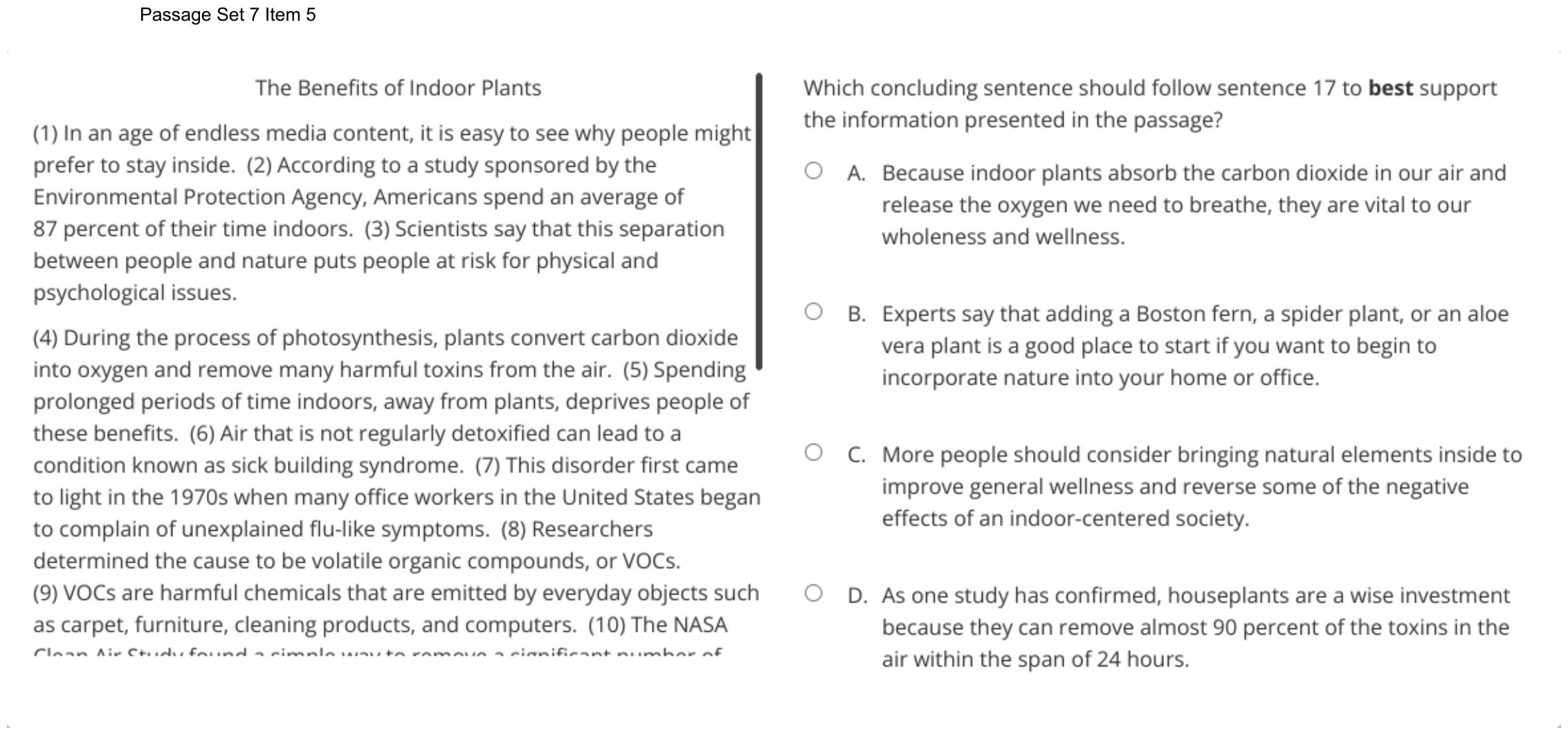
Question 16 of 57
2020 Test A English, question 16Passage Champion of the Channel
Champion of the Channel
In 1926 an editor at the London Daily News predicted that Gertrude Ederle, an American swimmer with eighteen world records and three Olympic medals, would fail in her attempt to swim across the English Channel. He claimed that “even the most uncompromising champion of the rights and capacities of women must admit that in contests of physical skill, speed and endurance they must remain forever the weaker sex.” Yet, at only nineteen years old, Ederle not only became the first woman to accomplish this feat, she also broke the men’s record by two hours. Gertrude Ederle’s triumphant swim across the English Channel was a testimony to her determination, innovative spirit, and passion for swimming.
Crossing the English Channel is a daunting task for any swimmer. At its narrowest point, the channel measures twenty-one miles across. Its icy waters hover around sixty degrees Fahrenheit, and its unruly tides and currents toss swimmers about like bobbing corks. Stinging jellyfish, seaweed, and floating debris from shipwrecks and lost cargoes present added hazards.
For decades the channel’s perils have defeated countless swimmers. Ederle, too, failed in her first attempt to cross the channel in 1925. Just six miles short of finishing, she became ill, and her coach had to haul her out of the water. Undeterred, Ederle decided to try again. Ederle knew that if she did not complete the challenge this time, she might never get the opportunity to set this record, because a rival female swimmer was preparing to make her second attempt at the crossing as well.
To prepare for the marathon swim, Ederle found ways to improve her equipment. She and her sister Meg discovered that melted candle wax perfectly sealed goggle edges, effectively waterproofing Ederle’s goggles against hammering waves. The sisters also designed a two-piece silk swimsuit for Ederle. During her first channel-crossing attempt she had worn a standard one-piece swimsuit that, after the lengthy hours of swimming across the channel, had stretched out, filling with water and creating drag, making an already challenging task almost insurmountable. Unlike the cumbersome typical bathing suit, this silk invention weighed little and allowed for easy movement.
On August 6, 1926, Ederle waded into the channel near Cape Gris-Nez, France. At first she shivered in the bone-chilling water even though she had covered her body in eight layers of grease for insulation. Her limbs felt stiff. Her strokes were irregular. Driving forward, she fought to clear her mind and find what she called her “sphere,” a place where the sea became her only companion and the shrieks of gulls and the humming of boat engines faded away. Using a new overhand stroke called the American crawl, Ederle eventually settled into a steady pace, briskly breaking through waves.
Throughout Ederle’s swim, two tugboats accompanied her. One carried newspaper reporters who wired dispatches of her progress to shore. The other, displaying a sign that read “This way, ole kid!” with an arrow pointing forward, transported her coach, family, and friends. Her coach played songs, such as “Yes, We Have No Bananas,” on a phonograph so that Ederle could time her strokes to the rhythm. Using a net, her coach also passed her baby bottles of broth for nourishment.
For hours Ederle swam, dodging debris with an amused smile. However, as she neared the English shore, a sudden fierce storm erupted. The tides and waves forced Ederle backward, and she fought the stubborn swells for several hours. The salty water caused her tongue to swell and inflamed her ears. Yet Ederle felt indescribably happy as she churned through the sea. Finally, as she neared the English shore, the storm abated, and the tide turned. No longer fighting against her, the sea pushed her toward the shore and victory.
After fourteen hours and thirty-one minutes, Ederle, on wobbly legs, stepped onto the English shore. The waiting crowd roared, honked their automobile horns, blasted their tugboat whistles, and set off flares that flashed in the sky. Ederle had swum into history.
When Ederle returned to New York, she received a parade, where thousands of people shouted “Trudy!” Not only were everyday American citizens proud of Ederle, but she also inspired them to be more active. Over the next few years, more than 60,000 people credited her with motivating them to earn their American Red Cross swimming certificates. Gertrude Ederle’s accomplishment proved to the world that with determination and passion, it was possible for a person to achieve his or her goals.
SOLO SWIMS ACROSS THE ENGLISH CHANNEL
|
Earliest Speed Records |
||
| Year | Swimmer | Time |
| 1875 | Matthew Webb (M) | 21 hours, 45 minutes |
| 1923 | Enrico Tiraboschi (M) | 16 hours, 33 minutes |
| 1926 | Gertrude Ederle (F) | 14 hours, 31 minutes |
| 1926 | Arnst Vierkotter (M) | 12 hours, 38 minutes |
| Current Speed Records | ||
| Year | Swimmer | Time |
| 2012 | Trent Grimsey (M) | 6 hours, 55 minutes |
| 2006 | Yvetta Hlavacova (F) | 7 hours, 25 minutes |
Question
What do the newspaper editor’s comments in paragraph 1 reveal about the challenges Ederle faced in attempting her feat?
- ARegardless of her ability, being an American put Ederle at a serious disadvantage over a Londoner, who would be more familiar with the English Channel.
- BAt the time, Ederle still needed more training in order to succeed in the daunting task of swimming the English Channel.
- CWhile Ederle could participate in athletic competition, some people were not comfortable with her attempt to swim the channel because no woman had ever attempted it before.
- DIn spite of her previous achievements, Ederle still experienced social as well as physical obstacles in attempting to swim the channel.
Show the answer
Correct answer: D
The question asks what the newspaper editor’s comments in paragraph 1 reveal about Ederle’s challenges leading up to her attempt to swim across the channel.
A. Incorrect. The idea that Ederle was at a disadvantage because she was American rather than English, and thus less familiar with the channel, was not the basis for the newspaper editor’s comments about the outcome of her swim.
B. Incorrect. The passage establishes that Ederle was a highly accomplished swimmer who had won major world competitions (“Gertrude Ederle, an American swimmer with eighteen world records and three Olympic medals” [paragraph 1]).
C. Incorrect. The newspaper editor’s point was that Ederle would be unsuccessful in her attempt to complete the swim because she was a woman, not that people were uncomfortable with the idea since no woman had attempted it before.
D. CORRECT. The comments reveal a lack of social support since many people believed that a woman, no matter how skilled a swimmer, did not have the strength to overcome the physical challenges that the dangerous channel waters presented (“He claimed that ‘even the most uncompromising champion of the rights and capacities of women must admit that in contests of physical skill, speed and endurance they must remain forever the weaker sex.’ ” [paragraph 1]).
Question analysis
In 1926 a London newspaper editor predicted that Gertrude Ederle would fail to swim the English Channel, and this reading question asks what his comments in the first paragraph reveal about the challenges she faced. Students must infer from the editor's own words what stood in her way, and the wrong choices offer believable obstacles that the passage never connects to him.
- Grade level
- Grade 7 reading and task
- Compared with grade 7
- At grade 7 Reading an opinion for what it shows about a person's situation is everyday grade 7 inference. This question points to both of the editor's sentences rather than quoting just one, so the evidence is in plain view and the work is weighing four readings.
- Estimated difficulty
- Moderate: several steps, or a close reading with one strong distractor.
- Thinking it demands
- Depth of knowledge 2, skills and concepts · mainly understand
- What makes it hard
- A very close wrong answer moderate
- Reading between the lines moderate
- Complex sentences minor
- Evidence
- Answered from one paragraph or stanza
- Reading level
- Passage: about grade 9, 790 words; question and choices: about grade 14, 112 words.
- Students, last 30 days
- Not enough answers yet to show (it takes 10).
Why it is hard, traps and wrong answers (shows the answer)
Why it is hard
Pointing to both of the editor's sentences puts his reason in plain view, so the work lies in naming what kind of obstacle a sexist prediction is. Students who see prejudice but not its stated basis fall for the near miss, which blames the lack of earlier female attempts, though Ederle herself had tried in 1925. The right answer is the only one that pairs that prejudice with the channel's physical dangers, and it rewards reading his words as a judgment about women, not about her.
A very close wrong answer moderate Choosing the answer
The right choice and the one about people being uncomfortable both find a social obstacle despite her skill; they part on its cause, the editor's claim that women are “the weaker sex” or the idea that no woman had tried. (Embretson & Wetzel, 1987; Gorin & Embretson, 2006; Ascalon et al., 2007)
Reading between the lines moderate Working it out
Neither of the editor's sentences names an obstacle, so a prediction of failure and a remark about women's “physical skill, speed and endurance” must be read as prejudice she faced on top of the channel's own dangers. (Graesser, Singer & Trabasso, 1994; Kintsch, 1998)
Complex sentences minor Understanding the question
The editor's quoted claim runs 30 words, opening with “even the most uncompromising champion of the rights and capacities of women” and holding its point, “the weaker sex”, until the end. (Abedi & Lord, 2001; Freedle & Kostin, 1993; Messick, 1989)
Strategy: Put the editor's reasoning into your own words before looking at the choices, then reject any choice whose reason for doubting Ederle is not the one he actually gives.
Traps
- Half right: One half of a two-part choice is right and the other is not.
- Outside knowledge: A choice is plausible in the real world but not supported by this text.
- Word match: Repeats striking words or phrases from the text, so it looks supported, but its meaning does not fit the question.
The wrong answers, classified
A Outside knowledge (King et al., 2004; Recht & Leslie, 1988)
Imagines a rivalry between an American and Londoners who know the channel, a plausible reason for doubt that the editor never gives, since his claim is about women.
B Word match (Freedle & Kostin, 1993)
Picks up “daunting task” from paragraph 2 and reads a prediction of failure as a sign she was undertrained, though the same sentence credits her with eighteen world records.
C Half right (King et al., 2004; Thissen, Steinberg & Fitzpatrick, 1989)
Rightly sees people doubting a woman's attempt but gives the wrong reason; the editor cites women's supposed weakness, and Ederle had already tried the crossing in 1925.
Working it out, step by step
Understand what the question asks
This question asks you to make an inference. An inference is a conclusion you reach from clues when the text does not say it outright. The editor’s comments are in paragraph 1. You need to work out what they show about the problems Ederle had to face.
Find the editor’s two comments
Paragraph 1 says the editor “predicted that Gertrude Ederle, an American swimmer with eighteen world records and three Olympic medals, would fail in her attempt to swim across the English Channel.” Then it gives his reason. He said that women “must remain forever the weaker sex.”
Put his reason in your own words
The editor’s full sentence is long, and its point comes at the very end. He meant that even people who support women must agree that women will always be weaker in sports. His reason had nothing to do with Ederle’s own skill, which her records proved. He doubted her only because she was a woman. That is a social obstacle: a problem that comes from what other people believe.
Add the dangers of the swim
On top of that, the swim itself was dangerous. Paragraph 2 calls the crossing “a daunting task for any swimmer.” Daunting means scary and hard. The paragraph lists “icy waters,” rough tides and “stinging jellyfish.” So Ederle had two kinds of trouble: people’s doubts and the hard swim itself.
Check each choice
- D fits: “in spite of her previous achievements” matches her records, and “social as well as physical obstacles” matches the editor’s doubts plus the rough water.
- A is wrong because the editor never mentions her being American or Londoners knowing the channel.
- B is wrong because nothing says she needed more training, and her eighteen world records show she was well prepared.
- C is wrong because the editor’s reason was that women are weaker, not that no woman had tried.
Watch out: C also spots people doubting her, so it is tempting. But it gives the wrong reason for the doubt. Paragraph 3 even says Ederle herself had tried in 1925.
Choose the answer
The editor’s words show that Ederle faced prejudice against women on top of a dangerous swim. So the answer is D.
Why this answer and not the closest wrong one
C is the choice most likely to fool you. It also sees that some people doubted Ederle. But it blames the doubt on no woman having tried before. The editor’s real reason was his belief that women are “the weaker sex.” D names that social obstacle and adds the physical ones, so D fits best.
More questions like this
The original DOE question
The passage “Champion of the Channel” as printed (pages 56–57)
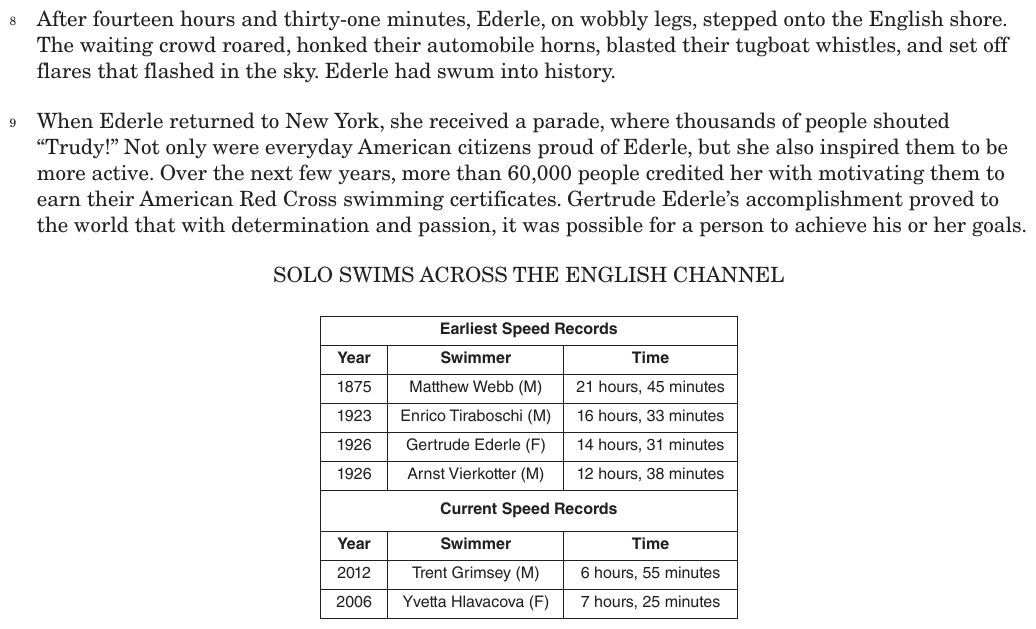
Question 17 of 57
2020 Test A English, question 17Uses the passage above: “Champion of the Channel”.
Question
Which sentence is the best summary of the steps that Ederle took to prepare for her second attempt to swim across the English Channel?
- AWorking with her sister, Ederle waterproofed her goggles using melted candle wax to seal the edges and designed a two-piece silk bathing suit that was lightweight and would not stretch out during the long swim.
- BEderle covered her body in numerous layers of grease for insulation and focused on finding her “sphere” during her swim.
- CEderle began training with her coach, who played music while she swam to help her time her strokes to the music.
- DEderle focused on developing better equipment than the standard swimsuit that proved cumbersome during her first attempt to cross the channel.
Show the answer
Correct answer: A
The answer is (A)
The question asks for the best summary of Ederle’s steps to prepare for her second attempt to swim across the English Channel. Ederle’s preparation is outlined in paragraph 4.
Option A is correct because it acknowledges the idea that Ederle involved her sister in this process, and it details the efforts the two took to improve Ederle’s equipment, including waxing her goggles and designing a better swimsuit.
Option B is incorrect because it focuses on Ederle’s actions in the moments before (covering her body with grease for insulation) and during her swim (finding her “sphere”), not her overall preparation methods.
Option C is incorrect because it refers to a practice that was employed to help Ederle keep her strokes in rhythm during her swim.
Option D is incorrect because it does not refer to the series of steps that Ederle took to prepare for her swim but rather to just one of the efforts made (improving equipment) without acknowledging her sister’s contributions.
Question analysis
This reading question asks for the best summary of the steps swimmer Gertrude Ederle took to prepare for her second attempt to cross the English Channel. The passage describes many things Ederle and her helpers did, so students must sort out which ones were preparation and which summary covers them most completely.
- NYS standards
- 7R2 theme or central idea
- Grade level
- Grade 6 reading and task
- Compared with grade 7
- Below grade 7 Summarizing the steps described in one paragraph is a grade 6 skill; grade 7 summaries usually cover a whole text and how it develops. The demand here is a careful match between details and choices.
- Estimated difficulty
- Straightforward: two steps or one careful reading.
- Thinking it demands
- Depth of knowledge 2, skills and concepts · mainly understand
- What makes it hard
- A very close wrong answer moderate
- Every choice must be checked minor
- Evidence
- Answered from one paragraph or stanza
- Reading level
- Passage: about grade 9, 790 words; question and choices: about grade 12, 121 words.
- Students, last 30 days
- Not enough answers yet to show (it takes 10).
Why it is hard, traps and wrong answers (shows the answer)
Why it is hard
The preparation is confined to paragraph 4, but the passage keeps describing things Ederle and her team did, so students must separate getting ready from the swim itself. The grease is the trickiest, since she put it on before entering the water. Between the two equipment summaries, the one that lists the goggles, the suit and her sister's help is the fuller account.
A very close wrong answer moderate Choosing the answer
The right summary and the one about better equipment than the standard swimsuit describe the same work, and only the waxed goggles and Meg's help, missing from the shorter one, tell them apart. (Embretson & Wetzel, 1987; Gorin & Embretson, 2006; Ascalon et al., 2007)
Every choice must be checked minor Choosing the answer
Two choices take real details from the swim itself, the grease and the phonograph, so each must be placed in time, before the swim or during it. (Embretson & Wetzel, 1987)
Strategy: Find the paragraph that describes how Ederle got ready, list its steps in order, and choose the summary that matches that list most completely.
Traps
- Wrong part of the text: A choice is true of another paragraph, stanza or speaker than the one asked about.
- Too narrow: A single detail offered as the central idea or a summary, or a summary that keeps minor details and leaves out an essential part.
The wrong answers, classified
B Wrong part of the text (Kirsch & Mosenthal, 1990)
Takes the grease she wore on the day and her search for her “sphere” in the water, both from paragraph 5's account of the swim, as preparation.
C Twists what the text says (King et al., 2004)
Turns the phonograph her coach played from a tugboat during the crossing into training sessions, which the passage never describes.
D Too narrow (King et al., 2004)
Captures the idea of better equipment but mentions only the swimsuit, leaving out the waxed goggles and her sister Meg, so it summarizes one step of several.
Working it out, step by step
Figure out what the question asks
A summary tells the main points in a short way. This asks for the steps Ederle took to get ready for her second try. So focus on what she did before the swim, not during it.
Find the paragraph about getting ready
Paragraph 4 begins: “To prepare for the marathon swim, Ederle found ways to improve her equipment.” That word “prepare” tells you this is the paragraph you need.
List the steps in paragraph 4
- She and her sister Meg found that “melted candle wax perfectly sealed goggle edges.” That kept water out of her goggles.
- The sisters “designed a two-piece silk swimsuit” for her.
- Her old suit had “stretched out, filling with water and creating drag.” Drag is a pull that slows you down.
- The new suit “weighed little and allowed for easy movement.”
Check each choice
- A names her sister, the waxed goggles, and the light silk suit. It covers every step.
- B: the grease and her “sphere” come from paragraph 5, the day of the swim itself.
- C: her coach played music on a phonograph, an old record player, during the swim (paragraph 6). The passage never describes training sessions.
- D is about better gear, but it mentions only the swimsuit.
Watch out: D is true, but it leaves out the goggles and Meg’s help. A summary of the steps should name the steps.
Pick the answer
Choice A matches the full list of steps from paragraph 4, with nothing missing. So the answer is A.
Why this answer and not the closest wrong one
D is the closest wrong answer, because better equipment is the main idea of paragraph 4. But D tells only about the swimsuit. It leaves out the waxed goggles and her sister Meg. A includes every step, so it is the best summary.
More questions like this
The original DOE question
Question 18 of 57
2020 Test A English, question 18Uses the passage above: “Champion of the Channel”.
Question
Read this sentence from paragraph 4.
During her first channel-crossing attempt she had worn a standard one-piece swimsuit that, after the lengthy hours of swimming across the channel, had stretched out, filling with water and creating drag, making an already challenging task almost insurmountable.
The word “insurmountable” is used to highlight
- Ahow the bathing suit made it impossible for Ederle to make it across the channel.
- Bhow Ederle and her sister decided to improve Ederle’s swimming equipment in a creative way.
- Cthat the flaws in Ederle’s bathing suit made a difficult task even more complicated.
- Dthat the swimming equipment Ederle used needed to be custom made for her attempt.
Show the answer
Correct answer: C
The question asks about the effect of the word “insurmountable,” which means “incapable of being overcome,” in paragraph 4.
A. Incorrect. Ederle did not complete her first swim because she became ill (“Just six miles short of finishing, she became ill, and her coach had to haul her out of the water.” [paragraph 3]), not because the suit made it impossible for Ederle to complete her swim.
B. Incorrect. The author uses the word “insurmountable” to draw attention to the increased difficulty caused by the suit, not to draw attention to the sisters’ creativity in solving the problem.
C. CORRECT. The suit Ederle wore during her first attempt to swim the channel “stretched out, filling with water and creating drag” (paragraph 4), which likely contributed to her failed attempt to swim across the channel.
D. Incorrect. The passage does not address whether the original suit was custom made, simply that the suit created additional difficulties for Ederle in a situation that was already difficult.
Question analysis
This vocabulary-in-context question quotes a sentence about the stretched-out swimsuit Gertrude Ederle wore on her first attempt to swim the English Channel and asks what the word insurmountable is used to highlight. Students must decide what point the word stresses in this sentence rather than simply define it, and the choices range from the old suit's effects to the sisters' new equipment.
- Grade level
- Grade 7 reading and task
- Compared with grade 7
- At grade 7 Explaining what a strong word emphasizes in context is standard grade 7 vocabulary work. The sentence is printed in the question, which saves a search, but it is long, with several phrases stacked between the swimsuit and the key word.
- Estimated difficulty
- Moderate: several steps, or a close reading with one strong distractor.
- Thinking it demands
- Depth of knowledge 2, skills and concepts · mainly analyze
- What makes it hard
- Hard words moderate
- A very close wrong answer moderate
- Complex sentences minor
- Evidence
- Answered from one sentence or line
- Reading level
- Passage: about grade 9, 790 words; question and choices: about grade 10, 108 words.
- Students, last 30 days
- Not enough answers yet to show (it takes 10).
Why it is hard, traps and wrong answers (shows the answer)
Why it is hard
The phrase to weigh is “an already challenging task almost insurmountable”, and two small words carry it: “already” says the swim was hard to begin with, and “almost” stops short of impossible. Students who know only the dictionary meaning blame the suit for a failure that paragraph 3 pins on illness. Those who look past the sentence to the sisters' new gear answer a different question, about the fix rather than the problem the word stresses.
Hard words moderate Understanding the question
The question hinges on “insurmountable”, impossible to overcome, which is softened by the “almost” in front of it and set against the “already challenging task” it describes. (Perfetti, 2007; Freedle & Kostin, 1993)
A very close wrong answer moderate Choosing the answer
The right choice and the one saying the suit made the crossing impossible both blame the old suit; they differ only in degree, which is exactly what “almost” decides. (Embretson & Wetzel, 1987; Gorin & Embretson, 2006; Ascalon et al., 2007)
Complex sentences minor Understanding the question
The stem prints all 38 words of the sentence, but between the swimsuit and “insurmountable” come an inserted time phrase, the verb “had stretched out” and two “-ing” phrases, so the link is easy to lose. (Abedi & Lord, 2001; Freedle & Kostin, 1993; Messick, 1989)
Strategy: Say in your own words what the quoted sentence claims about the old swimsuit, then choose the statement that restates that claim, checking each choice against the sentence word by word.
Traps
- Dictionary meaning, not meaning here: A common meaning of the word that does not fit its use in this text.
- Wrong purpose or structure: Names a purpose, structure or effect that the part does not serve, or describes what a part says when the question asks what it does.
- Reads too much in: A reasonable-sounding conclusion that goes further than the text allows.
The wrong answers, classified
A Dictionary meaning, not meaning here (Perfetti, 2007)
Gives “insurmountable” its full dictionary force and drops “almost”, so the suit seems to have made the crossing impossible, though paragraph 3 says she stopped in 1925 because she became ill.
B Wrong purpose or structure (Anderson & Krathwohl, 2001)
Describes what the paragraph goes on to do, the sisters' creative silk suit and waxed goggles, when the quoted sentence and its key word dwell on the old suit's flaws.
D Reads too much in (Graesser, Singer & Trabasso, 1994)
Reasons that because a standard suit failed, her gear had to be custom made, a conclusion the passage never draws and the word does not point toward.
Working it out, step by step
Figure out the word’s job
This question asks why the author chose one word, “insurmountable,” in paragraph 4. First you need to know what the word means. Then you can see which idea it helps the sentence stress.
Break the word into parts
To surmount something is to get over it or on top of it, the way a climber gets to the top of a cliff. The start in- means not, and the end -able means can be. So something insurmountable cannot be gotten over. It is too hard to beat.
Read the words around it
The old suit “had stretched out, filling with water and creating drag.” Drag is a force that pulls back on you and slows you down. This made “an already challenging task almost insurmountable.” Two small words matter a lot. Already tells you the swim was hard even before the suit caused trouble. Almost tells you it came close to impossible, but not all the way.
Decide what the word stresses
Put together, the phrase stresses how much worse the old suit made things. A task that was hard to begin with became even harder. The word does not say the suit by itself made the swim impossible.
Check each choice
- C fits: the suit’s flaws made “a difficult task even more complicated,” just like “already challenging” plus “almost insurmountable.”
- A is wrong because it drops “almost,” and paragraph 3 says her first try ended when she “became ill.”
- B is wrong because the sisters’ clever new gear comes in other sentences, while this word is about the problem.
- D is wrong because the passage never says her gear had to be custom made.
Watch out: A uses the word’s dictionary meaning. Always read the small words around a key word.
Choose the answer
The word shows how the old suit turned a hard swim into a nearly hopeless one. So the answer is C.
Why this answer and not the closest wrong one
A comes closest, since “insurmountable” alone does mean impossible. But the author wrote “almost” in front of it. And paragraph 3 says illness, not the suit, ended her first try. C keeps the exact amount the sentence gives: a hard task made even harder.
More questions like this
The original DOE question
Question 19 of 57
2020 Test A English, question 19Uses the passage above: “Champion of the Channel”.
Question
Which statement describes how the author’s use of a problem-and-solution structure in paragraph 5 contributes to the development of ideas in the passage?
- ADetailing the challenges presented by the cold channel waters highlights the effectiveness of Ederle’s training.
- BDescribing Ederle’s physical difficulties during her swim provides evidence of the team effort required to ensure her safety.
- CExplaining the difficulties that arose early in the effort helps predict the additional obstacles that occurred during Ederle’s attempt.
- DIllustrating Ederle’s process of blocking out her discomfort shows that swimming the channel was both a mental and a physical challenge.
Show the answer
Correct answer: D
The question asks how a problem-and-solution structure in paragraph 5 contributes to the ideas presented in the passage.
A. Incorrect. The details in paragraph 5 do not provide a connection between the cold temperature of the water and the effectiveness of Ederle’s training.
B. Incorrect. The difficulties Ederle encountered were only partially relieved by her team, and her team’s efforts to ensure Ederle’s safety are not explained in the passage.
C. Incorrect. The paragraph does not focus on the relationship between the problems Ederle encountered at the start of her swim and the problems she encountered during or near the end of her swim.
D. CORRECT. The paragraph describes how the water’s temperature made Ederle uncomfortable and made it difficult for her to regulate her stroke. The paragraph continues with the explanation of how she overcame these issues by focusing her mind on the sea and tuning out the distractions in her surroundings (“the sea became her only companion and the shrieks of gulls and the humming of boat engines faded away” [paragraph 5]).
Question analysis
Gertrude Ederle's cold, stiff first hours in the English Channel are told as problem and solution, and this text-structure question asks what that pattern adds to the passage's ideas. Students must spot the troubles she met in the cold water and how she handled them, then pick the abstract statement that accounts for both halves of the pattern.
- Grade level
- Grade 8 reading and task
- Compared with grade 7
- Above grade 7 A problem-and-solution question about one paragraph is familiar grade 7 fare, yet these four answers are general claims about the swim, each tied to a real hardship, so students need a clear map of the paragraph before judging them.
- Estimated difficulty
- Hard: combines ideas, needs a plan, and has more than one tempting wrong answer.
- Thinking it demands
- Depth of knowledge 3, strategic thinking · mainly analyze
- What makes it hard
- How, not what major
- Every choice must be checked moderate
- Figurative or literary language minor
- Evidence
- Answered from one paragraph or stanza
- Reading level
- Passage: about grade 9, 790 words; question and choices: about grade 14, 95 words.
- Students, last 30 days
- Not enough answers yet to show (it takes 10).
Why it is hard, traps and wrong answers (shows the answer)
Why it is hard
The opening halves of the choices are all accurate, which moves the whole decision onto their second halves. Readers who notice only the physical side of the paragraph, the cold and the stiffness, reach for training, teamwork or foreshadowing to explain it. The paragraph's turning point is a mental one, clearing her mind until the noise faded, and only the statement that names both a mental and a physical challenge accounts for the problem and the solution together.
How, not what major Working it out
The question asks what paragraph 5's pairing of problems (bone-chilling water, stiff limbs, irregular strokes) with solutions (finding her “sphere”, the American crawl) does for the passage, so retelling the hardships earns nothing. (Anderson & Krathwohl, 2001)
Every choice must be checked moderate Choosing the answer
Each choice opens with a fair description of paragraph 5, the cold water, her physical difficulties, the early struggle, so only what each claims that description shows can be tested. (Embretson & Wetzel, 1987)
Figurative or literary language minor Understanding the question
The mental half of the solution is told in images, a place where “the sea became her only companion” and gulls and engines “faded away”, which must be read as blocking out discomfort. (Graesser, Singer & Trabasso, 1994; Kintsch, 1998)
Strategy: Sort paragraph 5 into two lists, what went wrong for Ederle early in the swim and what she did about it, then ask what that pairing shows about the swim as a whole.
Traps
- Wrong purpose or structure: Names a purpose, structure or effect that the part does not serve, or describes what a part says when the question asks what it does.
- Outside knowledge: A choice is plausible in the real world but not supported by this text.
- Wrong part of the text: A choice is true of another paragraph, stanza or speaker than the one asked about.
The wrong answers, classified
A Outside knowledge (King et al., 2004; Recht & Leslie, 1988)
Assumes that coping with icy water proves good training, a natural idea from sports, but paragraph 5 never mentions training and credits her focus and her stroke.
B Wrong part of the text (Kirsch & Mosenthal, 1990)
Brings in the tugboat crew of paragraph 6, the coach passing broth and playing songs, though paragraph 5 shows Ederle coping alone and never raises her safety.
C Wrong purpose or structure (Anderson & Krathwohl, 2001)
Treats the early shivering and stiffness as a setup for the storm of paragraph 7, a link the paragraph never makes, since it resolves its own problems with a steady pace.
Working it out, step by step
Learn what the question asks
A problem-and-solution structure tells about a difficulty and then how someone deals with it. The question asks what this pattern in paragraph 5 adds to the ideas of the passage. So first sort the paragraph into problems and solutions.
List the problems in paragraph 5
When Ederle waded in, “she shivered in the bone-chilling water.” Next, “Her limbs felt stiff. Her strokes were irregular.” Limbs are arms and legs. Irregular means uneven, not steady. All of these are troubles with her body.
List her solutions
Ederle “fought to clear her mind.” She looked for what she called her “sphere.” There, “the sea became her only companion and the shrieks of gulls and the humming of boat engines faded away.” In other words, she shut out the noise and her discomfort. Then, using the American crawl, she “settled into a steady pace.”
Connect problems and solutions
The problems were physical, which means of the body. A big part of the fix was mental, which means of the mind. She calmed her thoughts so her body could keep working. So the paragraph shows that the swim tested her mind as well as her body.
Check each choice
- D fits: blocking out her discomfort shows the swim was “both a mental and a physical challenge.”
- A is wrong because paragraph 5 never mentions her training.
- B is wrong because her team on the tugboats appears in paragraph 6, and her safety is never discussed.
- C is wrong because the early troubles are solved inside this paragraph instead of setting up later ones.
Watch out: A storm does hit in paragraph 7, so C may look right. But paragraph 5 does not point ahead to it.
Choose the answer
Only D explains both the problem and the way Ederle solved it. So the answer is D.
Why this answer and not the closest wrong one
C is tempting, since a storm really does strike in paragraph 7. But paragraph 5 never hints at it. The paragraph ends with its problem solved, as Ederle is “briskly breaking through waves.” D explains both halves of the pattern: troubles of the body, eased by the mind.
More questions like this
The original DOE question
Question 20 of 57
2020 Test A English, question 20Uses the passage above: “Champion of the Channel”.
Question
Which sentence best supports the idea that Ederle succeeded in swimming across the channel because of her innovative approach to the challenge?
- A“Yet, at only nineteen years old, Ederle not only became the first woman to accomplish this feat, she also broke the men’s record by two hours.” (paragraph 1)
- B“At first she shivered in the bone-chilling water even though she had covered her body in eight layers of grease for insulation.” (paragraph 5)
- C“Using a new overhand stroke called the American crawl, Ederle eventually settled into a steady pace, briskly breaking through waves.” (paragraph 5)
- D“No longer fighting against her, the sea pushed her toward the shore and victory.” (paragraph 7)
Show the answer
Correct answer: C
The answer is (C)
The question asks for the best support for the idea that Ederle’s swim across the channel was successful because of her innovative approach to the challenge.
Option C is correct because the sentence from paragraph 5 explains that Ederle employed a newly developed type of stroke that allowed her to maintain her pace through the rough water.
Option A is incorrect because the sentence from paragraph 1 shows that her performance was groundbreaking but not necessarily creative.
Option B is incorrect because the layers of grease primarily served to help maintain Ederle’s body temperature in the water, and there is nothing in the passage to suggest that this was an innovative practice.
Option D is incorrect because the sentence from paragraph 7 simply states that Ederle fought against the waves and completed her swim, and it does not describe how Ederle employed innovative techniques.
Question analysis
This reading question asks which quoted sentence best supports the idea that Gertrude Ederle crossed the English Channel because of an innovative approach. Each quotation describes a real moment of her story, so students must test each one against what innovative actually means.
- NYS standards
- 7R1 textual evidence and inferences
- Grade level
- Grade 7 reading and task
- Compared with grade 7
- At grade 7 Choosing the sentence that best supports an idea is a core grade 7 reading task. The quotations come with paragraph numbers, so the demand is a careful check of each against the key word innovative, as in typical grade 7 practice.
- Estimated difficulty
- Straightforward: two steps or one careful reading.
- Thinking it demands
- Depth of knowledge 2, skills and concepts · mainly evaluate
- What makes it hard
- Evidence
- Answered from several paragraphs or stanzas
- Reading level
- Passage: about grade 9, 790 words; question and choices: about grade 12, 108 words.
- Corrected from the DOE handbook
- A wrong paragraph number in the explanation was corrected.
- Students, last 30 days
- Not enough answers yet to show (it takes 10).
Why it is hard, traps and wrong answers (shows the answer)
Why it is hard
The claim has two parts, success and an innovative cause, and only one quotation shows both. The record-breaking sentence proves the success but says nothing about method, while the grease is a technique the passage never calls new and that did not keep her from shivering. The word “new” in the crawl sentence is the signal careful readers use.
Every choice must be checked minor Choosing the answer
Each quotation shows a real part of the swim, so each must pass two tests: it shows something new that Ederle did, and that thing helped her finish. (Embretson & Wetzel, 1987)
Strategy: Pin down what innovative means in your own words, then ask of each quoted sentence whether it shows an innovative approach of Ederle's at work and helping her succeed.
Traps
- Reads too much in: A reasonable-sounding conclusion that goes further than the text allows.
- Supports only part of the claim: In a question about evidence: a line that backs one half of the claim but not the other, or a related point rather than the claim itself.
The wrong answers, classified
A Supports only part of the claim (King et al., 2004; Thissen, Steinberg & Fitzpatrick, 1989)
Picks the passage's headline result, first woman and two hours under the men's record, which proves she succeeded but shows no new method behind it.
B Reads too much in (Graesser, Singer & Trabasso, 1994)
Treats eight layers of grease as an innovation, though the passage never calls it new and says she shivered despite it, so it is not shown driving her success.
D Supports only part of the claim (King et al., 2004; Thissen, Steinberg & Fitzpatrick, 1989)
Chooses the turning tide that carried her to “victory”, which helped her finish but was a change in the sea, not an approach Ederle devised.
What was corrected from the DOE handbook, and why
- Explanation: The handbook says the sentence in choice D comes from paragraph 6. The choice itself and the passage place it in paragraph 7 (“No longer fighting against her, the sea pushed her toward the shore and victory.”), so the explanation now says paragraph 7.
Working it out, step by step
Figure out what the question asks
Innovative means new and creative, a fresh way of doing something. You need a sentence that shows two things. First, Ederle used something new. Second, that new thing helped her succeed.
Look for something new
- A says she was the first woman across and beat the men’s record. That shows she succeeded, but not how.
- B says she wore grease “for insulation,” a layer that keeps heat in. The passage never calls the grease new.
- C says she used “a new overhand stroke called the American crawl” (paragraph 5). Here is the word “new.”
- D says the sea pushed her to shore. That is the tide changing, not something Ederle did.
Check that it helped her
Choice C goes on: she “eventually settled into a steady pace, briskly breaking through waves.” A stroke is the way you move your arms to swim. Briskly means quickly and with energy. So the new stroke gave her a steady, quick pace. That helped her get across.
Rule out the grease
Watch out: B can seem clever, since the grease was meant to keep her warm. But the same sentence says she still “shivered in the bone-chilling water.” So the passage does not call it new, and it does not show it helping her win.
Pick the answer
Only C shows a new method that helped her succeed. So the answer is C.
Why this answer and not the closest wrong one
B is the closest wrong answer, because grease for warmth sounds smart. But the passage never says it was new, and she shivered anyway. C has both parts: the word “new” and a result, a “steady pace” through the waves.
More questions like this
The original DOE question
Question 21 of 57
2020 Test A English, question 21Uses the passage above: “Champion of the Channel”.
Question
Paragraph 7 contributes to the development of the central idea of the passage by
- Aillustrating that Ederle’s physical strength and mental fortitude allowed her to stay focused on her goal.
- Bconveying that Ederle pushed herself to the edge of her physical capabilities in order to complete the swim.
- Chighlighting the impact the severe weather had on Ederle’s emotions during her swim.
- Demphasizing the surge of emotions Ederle felt as she came closer to achieving a personal goal.
Show the answer
Correct answer: D
The answer is (D)
The question asks for an explanation of how paragraph 7 contributes to the development of a central idea of the passage. Paragraph 7 is mainly about Ederle’s physical and emotional state as she pushed through a difficult portion of her swim and realized her goal was in sight. A central idea of the passage is that Ederle’s passion and determination allowed her to accomplish her goal of being the first woman to cross the English Channel.
Option D is correct because it emphasizes her passion by referring to the overwhelming emotions Ederle felt as she progressed during her swim, despite the unfavorable conditions (paragraph 7: “For hours Ederle swam, dodging debris with an amused smile” and “Yet Ederle felt indescribably happy as she churned through the sea.”).
Option A is incorrect because, although Ederle needed physical strength and mental fortitude to complete the swim, the paragraph contributes to a central idea because it highlights her emotion as she swam, not her physical strength or mental fortitude.
Option B is incorrect because the paragraph focuses on Ederle’s emotional response to the challenging circumstances and not the idea that Ederle was at the “edge of her physical capabilities.”
Option C is incorrect because Ederle’s feelings of happiness and amusement were caused by her anticipation and excitement as she approached achieving her goal, not by the severe weather.
Question analysis
This reading question asks how the paragraph about the storm near the end of Gertrude Ederle's English Channel swim contributes to the passage's central idea. Students must decide what the paragraph mainly does and connect it to the larger point, while every choice sounds like a fair description of a hard swim.
- Grade level
- Grade 8 reading and task
- Compared with grade 7
- Above grade 7 Explaining how one paragraph develops a central idea is a grade 7 standard, but here several choices sound true of a hard swim through a storm, and the student must see what the paragraph is mainly about, beyond typical grade 7 work.
- Estimated difficulty
- Hard: combines ideas, needs a plan, and has more than one tempting wrong answer.
- Thinking it demands
- Depth of knowledge 3, strategic thinking · mainly analyze
- What makes it hard
- A very close wrong answer major
- Evidence in several places moderate
- How, not what moderate
- Evidence
- Answered from several paragraphs or stanzas
- Reading level
- Passage: about grade 9, 790 words; question and choices: about grade 11, 76 words.
- Students, last 30 days
- Not enough answers yet to show (it takes 10).
Why it is hard, traps and wrong answers (shows the answer)
Why it is hard
Paragraph 7 is crowded with hardship, a storm, a swollen tongue and inflamed ears, so the obvious reading is that it shows toughness. The author's pointed “Yet Ederle felt indescribably happy” turns it toward emotion, which ties it to the passion named in the thesis. Several choices are fair about the swim in general, and this is one of the closer calls on the test, since strength is also on display.
A very close wrong answer major Choosing the answer
The right choice and the strength-and-fortitude one both describe Ederle's inner state as she nears her goal, and only whether paragraph 7 stresses her feelings or her toughness separates them, since she does fight “the stubborn swells for several hours”. (Embretson & Wetzel, 1987; Gorin & Embretson, 2006; Ascalon et al., 2007)
Evidence in several places moderate Working it out
The central idea, her “determination, innovative spirit, and passion for swimming”, is stated in paragraph 1, six paragraphs before the storm it must be connected to. (Kirsch & Mosenthal, 1990; Gorin & Embretson, 2006)
How, not what moderate Working it out
The question asks how paragraph 7 develops the central idea, so the student must weigh what its details stress, the “amused smile” and “indescribably happy”, not just what happens. (Anderson & Krathwohl, 2001)
Strategy: Mark the words in paragraph 7 that describe how Ederle felt and what she endured, decide which the author stresses, then connect that to the passage's stated central idea.
Traps
- True but not the answer: A choice says something accurate about the text that does not answer this question.
- Too broad or too strong: A choice overstates, generalizes, or uses absolute words the text does not support.
The wrong answers, classified
A True but not the answer (King et al., 2004; Embretson & Wetzel, 1987)
Credits strength and mental fortitude, which the hours against the swells partly show, but the paragraph's turn on “Yet” stresses her joy, not her toughness.
B Too broad or too strong (King et al., 2004)
Inflates the swollen tongue and inflamed ears into reaching “the edge of her physical capabilities”, an extreme the paragraph never claims.
C Twists what the text says (King et al., 2004)
Sees both the storm and her feelings but makes the weather the cause of her emotions, when she felt happy in spite of it.
Working it out, step by step
Figure out what the question asks
You need to explain how paragraph 7 helps build the central idea, the main point of the passage. So first find the central idea. Then see what paragraph 7 stresses.
Find the central idea
The last sentence of paragraph 1 says: “Gertrude Ederle’s triumphant swim across the English Channel was a testimony to her determination, innovative spirit, and passion for swimming.” A testimony here means proof. Passion means a strong love for something.
See what happens in paragraph 7
A fierce storm pushes Ederle backward. She fights “the stubborn swells for several hours.” Swells are big, rolling waves. Salt water makes her tongue swell and her ears sore. Then the storm ends, and the sea pushes her “toward the shore and victory.”
Notice what the author stresses
Look at the feeling words. She swims “dodging debris with an amused smile.” In the middle of the pain, the author writes: “Yet Ederle felt indescribably happy as she churned through the sea.” Indescribably means too much to put into words. The word “Yet” shows a surprise. She felt joy in spite of the pain. That shows her passion for swimming.
Check each choice
- D: a “surge of emotions” as she came closer to her goal. A surge is a sudden rush. This matches the smile and the happiness.
- A: strength and “mental fortitude,” or toughness. She was tough, but the paragraph stresses her joy.
- B: the paragraph never says she reached “the edge of her physical capabilities.”
- C says the storm caused her feelings. She was happy in spite of the storm, not because of it.
Watch out: A is tempting because she fought for hours. But the “Yet” sentence turns to how she felt.
Pick the answer
Paragraph 7 builds the passage’s idea of her passion by showing her feelings. So the answer is D.
Why this answer and not the closest wrong one
A is the closest wrong answer, because she does fight “the stubborn swells for several hours.” But the paragraph’s key words are about feeling: “amused smile” and “indescribably happy.” Those link to her “passion for swimming” in paragraph 1. D names those emotions.
More questions like this
The original DOE question
Question 22 of 57
2020 Test A English, question 22Uses the passage above: “Champion of the Channel”.
Question
The idea that many people were interested in Ederle’s attempt to swim the channel is illustrated in the passage mainly through the
- Ainformation about Ederle’s competition with another female swimmer who was also attempting to cross the channel.
- Bdetails about the reports of Ederle’s progress during the swim and the celebration of her successful completion of the swim.
- Cdetails about how Ederle’s historic swim contributed to an increase in the number of people learning how to swim.
- Dinformation about the resources Ederle used throughout her swim to maintain her motivation and stamina.
Show the answer
Correct answer: B
The question asks how the idea that many people were interested in Ederle’s attempt to swim the channel is mainly illustrated in the passage.
A. Incorrect. While paragraph 3 states that “a rival female swimmer was preparing to make her second attempt at the crossing as well,” which suggests that Ederle’s competitor was interested in Ederle’s attempt to swim the channel, this information does not establish that many people were interested in Ederle’s attempt.
B. CORRECT. Paragraph 6 includes the detail that newspaper reporters followed Ederle on a tugboat and “wired dispatches of her progress to shore,” which suggests that an audience was waiting for news about Ederle’s progress. Paragraph 8 states that when Ederle reached the shore, “the waiting crowd roared, honked their automobile horns, blasted their tugboat whistles, and set off flares that flashed in the sky.” Further, paragraph 9 states that when Ederle returned to New York, “thousands of people” attended a parade in her honor. These details describing the celebration of Ederle’s feat further illustrate the idea that many people were interested in what she had accomplished.
C. Incorrect. While paragraph 9 states that “more than 60,000 people credited [Ederle] with motivating them to earn their American Red Cross swimming certificates,” this detail describes how Ederle’s historic swim influenced people after the fact but does not illustrate the level of public interest during the attempt itself.
D. Incorrect. Paragraph 6 provides details about how Ederle’s “coach, family, and friends” displayed signs, played songs, and “passed her baby bottles of broth” to help her maintain her motivation and stamina. However, these resources do not suggest the idea that people beyond Ederle’s immediate support team were interested in her attempt to swim the channel.
Question analysis
Public interest in Gertrude Ederle's 1926 English Channel swim is the focus of this reading question, which asks which details in the passage mainly illustrate that many people cared about her attempt. Students must gather signs of attention from several paragraphs, and every choice points to real details that involve other people in her story.
- Grade level
- Grade 7 reading and task
- Compared with grade 7
- At grade 7 Matching an idea to the details that develop it is standard grade 7 work. The supporting details are spread across several late paragraphs and must be gathered before the choices can be judged, a typical grade 7 demand.
- Estimated difficulty
- Moderate: several steps, or a close reading with one strong distractor.
- Thinking it demands
- Depth of knowledge 2, skills and concepts · mainly evaluate
- What makes it hard
- Evidence in several places moderate
- Reading between the lines minor
- Evidence
- Answered from several paragraphs or stanzas
- Reading level
- Passage: about grade 9, 790 words; question and choices: about grade 13, 92 words.
- Students, last 30 days
- Not enough answers yet to show (it takes 10).
Why it is hard, traps and wrong answers (shows the answer)
Why it is hard
The idea has two parts, many people and interest in the attempt itself, and each wrong choice satisfies one at most. The strongest pull is the 60,000 swimming certificates, a huge number tied to Ederle but describing what people did in the years afterward. Students who hold both parts in mind, and who remember that paragraph 6 carries reporters as well as family, find the details that answer it.
Evidence in several places moderate Working it out
The right details sit in three places: reporters wiring dispatches from a tugboat in paragraph 6, the roaring crowd and flares in paragraph 8, and the New York parade in paragraph 9. (Kirsch & Mosenthal, 1990; Gorin & Embretson, 2006)
Reading between the lines minor Working it out
No sentence says people were interested; the student must infer an eager audience from reporters sending news to shore and a crowd already “waiting” when she landed. (Graesser, Singer & Trabasso, 1994; Kintsch, 1998)
Strategy: Hold each choice to both parts of the idea in the stem: the details must involve many people, and they must show interest in the attempt itself, not some other link to Ederle.
Traps
- Supports only part of the claim: In a question about evidence: a line that backs one half of the claim but not the other, or a related point rather than the claim itself.
The wrong answers, classified
A Supports only part of the claim (King et al., 2004; Thissen, Steinberg & Fitzpatrick, 1989)
Matches “attempting to cross the channel” to the stem's attempt, but the rival preparing her own crossing in paragraph 3 is one swimmer, not many people following Ederle.
C Supports only part of the claim (King et al., 2004; Thissen, Steinberg & Fitzpatrick, 1989)
Counts the 60,000 people who earned swimming certificates, which shows many people moved by Ederle but describes her influence after the swim, not interest in the attempt itself.
D Supports only part of the claim (King et al., 2004; Thissen, Steinberg & Fitzpatrick, 1989)
Points to the coach, family and friends who played songs and passed broth from the tugboat, people who cared about the attempt but a small circle, not a wide public.
Working it out, step by step
Find the two parts of the idea
This asks you to find the details that best show an idea. The idea has two parts. Many people, not just a few, cared about Ederle. And they were interested in the attempt itself, the swim as it happened. The right choice must show both.
Look for news and crowds
Paragraph 6 says reporters on a tugboat “wired dispatches of her progress to shore.” Dispatches are news reports. In paragraph 8, “The waiting crowd roared” as she stepped onto the English shore. In paragraph 9, “thousands of people shouted” her name at a parade in New York.
See what these details show
Reporters send news only when readers want it. So people on land were following the swim as it happened. The crowd was “waiting” before she even arrived. Then thousands cheered her at home. These details show that a great many people cared about her swim.
Check each choice
- B fits: the reports of her progress and the celebration show many people following the swim.
- A is wrong because the rival swimmer in paragraph 3 is one person, not many people.
- C is wrong because the swimming certificates came in later years, after the swim.
- D is wrong because her coach, family and friends were a small group, not the wider public.
Watch out: C has the biggest number, more than 60,000 people. But it tells what people did after the swim was over.
Choose the answer
Only B shows many people paying attention while Ederle swam and when she finished. So the answer is B.
Why this answer and not the closest wrong one
C is the closest wrong answer, since 60,000 is a huge number of people. But they earned their certificates “over the next few years,” long after the swim. That shows her influence, not interest in the attempt. B shows people following the swim as it happened and cheering when she finished.
More questions like this
The original DOE question
Question 23 of 57
2020 Test A English, question 23Uses the passage above: “Champion of the Channel”.
Question
Which sentence from the passage best conveys the author’s perspective regarding the impact of Ederle’s accomplishment?
- A“Undeterred, Ederle decided to try again.” (paragraph 3)
- B“For hours Ederle swam, dodging debris with an amused smile.” (paragraph 7)
- C“Yet Ederle felt indescribably happy as she churned through the sea.” (paragraph 7)
- D“Ederle had swum into history.” (paragraph 8)
Show the answer
Correct answer: D
The question asks for the sentence from the passage that best conveys the author’s perspective about the impact of Ederle’s swim.
A. Incorrect. Although this option shows Ederle’s determination to accomplish her goal, it does not convey the author’s perspective. Rather, the option reinforces Ederle’s own perspective about the challenge that she was facing.
B. Incorrect. The sentence presented in this option is incorrect because it relates to Ederle’s state of mind as she came closer to achieving her goal and does not provide details about the author’s opinion of the impact of Ederle’s accomplishment.
C. Incorrect. The sentence presented in this option is incorrect because it simply presents Ederle’s emotional state as she nears her goal and does not provide information about the author’s perspective.
D. CORRECT. This option is correct because, throughout the passage, the author emphasizes that Ederle’s accomplishment was memorable and great, which is best stated in the sentence from paragraph 8.
Question analysis
What did Gertrude Ederle's English Channel swim mean in the author's eyes? This point-of-view question asks which quoted sentence best shows the author's perspective on its impact, and because the quotations all come from the story of her attempts, students must tell the author's judgment apart from sentences reporting what Ederle did or felt.
- Grade level
- Grade 7 reading and task
- Compared with grade 7
- At grade 7 Telling an author's perspective apart from a subject's actions and moods is ordinary grade 7 point-of-view work. Each choice is a single sentence with its paragraph given, so little searching is needed and the demand is typical.
- Estimated difficulty
- Straightforward: two steps or one careful reading.
- Thinking it demands
- Depth of knowledge 2, skills and concepts · mainly analyze
- What makes it hard
- How, not what moderate
- Figurative or literary language minor
- Evidence
- Answered from several paragraphs or stanzas
- Reading level
- Passage: about grade 9, 790 words; question and choices: about grade 11, 52 words.
- Students, last 30 days
- Not enough answers yet to show (it takes 10).
Why it is hard, traps and wrong answers (shows the answer)
Why it is hard
Two tests apply at once: whose view a sentence gives, and whether that view concerns the swim's impact. Three sentences narrate Ederle herself, before the swim and in the water, and the word “Undeterred” can make the first sound like the author's praise. The five-word sentence that closes paragraph 8 is easy to skim past, because it states impact through an image rather than in plain terms.
How, not what moderate Working it out
The question asks for the author's judgment, so sentences that narrate Ederle's choices and moods, her decision to try again, her “amused smile”, her happiness in the storm, have to be set aside. (Anderson & Krathwohl, 2001)
Figurative or literary language minor Understanding the question
The only sentence about impact states it as a figure of speech, “Ederle had swum into history”, which must be read as a claim that the swim earned a lasting place. (Graesser, Singer & Trabasso, 1994; Kintsch, 1998)
Strategy: Ask of each quotation whether it reports Ederle's actions or feelings, or whether it is the author stepping back to judge what the swim meant. Only the second kind answers this question.
Traps
- Wrong tone or attitude: Misjudges the tone, attitude or point of view, such as reading admiration as criticism, or taking a character's or subject's feelings for the author's.
- True but not the answer: A choice says something accurate about the text that does not answer this question.
The wrong answers, classified
A True but not the answer (King et al., 2004; Embretson & Wetzel, 1987)
Hears the author admiring her resolve in “Undeterred”, a real touch of judgment, but it concerns her decision after the 1925 failure, not what her eventual swim meant or changed.
B Wrong tone or attitude (Graesser, Singer & Trabasso, 1994)
Takes Ederle's “amused smile” while dodging debris as the author's opinion, though it records her mood in the water and says nothing about the swim's impact.
C Wrong tone or attitude (Graesser, Singer & Trabasso, 1994)
Reads “indescribably happy” as the author's enthusiasm, but the happiness is Ederle's own, felt while she fought the storm, and it says nothing about lasting effects.
Working it out, step by step
Unpack the key words
A perspective is a point of view, the way someone sees a subject. Impact means the effect something has on the world. So you need a sentence where the author judges what Ederle’s swim meant. A sentence that only tells what Ederle did or felt won’t count.
Test each sentence two ways
Ask two questions about each choice. First, is this the author’s own judgment, or does it just tell what Ederle did or felt? Second, is it about the effect of the swim, or about something else? The right sentence passes both tests.
Check each choice
- A: “Undeterred, Ederle decided to try again” (paragraph 3) tells her choice after failing in 1925, so it comes before the swim and can’t show its effect.
- B: “dodging debris with an amused smile” (paragraph 7) shows her mood in the water.
- C: “Ederle felt indescribably happy” (paragraph 7) tells her own feelings, not the author’s view.
- D: “Ederle had swum into history” (paragraph 8) is the author stepping back to judge what the swim meant.
Watch out: Undeterred means not discouraged, so A can sound like praise from the author. But it is about her decision, not the swim’s effect.
Explain the figure of speech
“Swum into history” is a figure of speech, words that mean more than they literally say. History is not a place you can swim to. The phrase means her swim was so important that people will remember it for a long time. So the sentence judges the swim’s impact.
Choose the answer
Only choice D gives the author’s own view of what the swim achieved. So the answer is D.
Why this answer and not the closest wrong one
A is the closest wrong answer, since the word “Undeterred” holds a note of praise. But the sentence reports Ederle’s choice to try again after she failed. That happened before the big swim, so it can’t show the swim’s impact. D is the author’s own claim that the swim made history.
More questions like this
The original DOE question
Question 24 of 57
2020 Test A English, question 24Uses the passage above: “Champion of the Channel”.
Question
The table supports the information in paragraph 9 mainly by
- Aemphasizing that people have continued to swim across the channel and have significantly reduced the speed record.
- Bsuggesting that Ederle inspired women to swim across the channel in an attempt to break the current speed record.
- Crevealing that other women competed with Ederle to set a record time for swimming across the English Channel.
- Dproviding a comparison between the earliest channel-swimming records and the current record times.
Show the answer
Correct answer: A
The question asks how the table supports the information in paragraph 9.
A. CORRECT. The table supports the information in paragraph 9 by showing that people have continued to swim the channel and have improved upon past records. The information in the table about records set by those who came after Ederle builds upon the idea that “Gertrude Ederle’s accomplishment proved to the world that with determination and passion, it was possible for a person to achieve his or her goals” (paragraph 9).
B. Incorrect. Even though paragraph 9 states that Ederle “inspired [everyday American citizens] to be more active” and the table presents the time for the current female record holder, there is no indication in paragraph 9 or in the table that the record holder was inspired by Ederle.
C. Incorrect. Although paragraph 3 mentions that Ederle had a female rival and the table includes the speed record of another female swimmer, paragraph 9 focuses on the impact Ederle’s swim had on average Americans (“inspired them to be more active” and “motivating them to earn their American Red Cross swimming certificates”) and does not provide information about other female swimmers competing with Ederle to set the channel-swim record.
D. Incorrect. Although paragraph 1 mentions that Ederle “broke the men’s record by two hours” and the table allows for comparisons between the earliest speed records and those of the present day, there is no mention in paragraph 9 of past, present, or future channel-swim records.
Question analysis
Paragraph 9 of “Champion of the Channel” tells how Gertrude Ederle's swim inspired ordinary Americans and what it proved, and the question asks in what way the table of channel speed records, from 1875 to the present, supports that paragraph. Students must compare swim times across eras and connect them to one paragraph, while several choices mention real details from the table or the passage.
- Grade level
- Grade 8 reading and task
- Compared with grade 7
- Above grade 7 Grade 7 readers often say what a chart or table shows. This asks how a table of records spanning 137 years supports one paragraph's point, and more than one choice states something accurate about it, which is above grade 7 demand.
- Estimated difficulty
- Hard: combines ideas, needs a plan, and has more than one tempting wrong answer.
- Thinking it demands
- Depth of knowledge 3, strategic thinking · mainly analyze
- What makes it hard
- A very close wrong answer major
- Reading between the lines moderate
- Reading a figure, table or graph moderate
- How, not what minor
- Evidence
- Answered from several paragraphs or stanzas
- Reading level
- Passage: about grade 9, 790 words; question and choices: about grade 11, 76 words.
- Corrected from the DOE handbook
- An inaccurate description of the table in the explanation was corrected.
- Students, last 30 days
- Not enough answers yet to show (it takes 10).
Why it is hard, traps and wrong answers (shows the answer)
Why it is hard
This printing ties the table to paragraph 9, which is about Ederle inspiring ordinary Americans and proving that determination pays off, not about speed records. The link is therefore indirect: swimmers kept attempting the crossing and cut her time by more than half, extending her example. Wrong answers pull two ways, toward the accurate description of the table's layout and toward the choice that echoes the paragraph's word “inspired” while inventing a tie to a later swimmer.
A very close wrong answer major Choosing the answer
The comparison choice is literally true of the table, its earliest records set beside current ones; it differs from the key only by stopping at the comparison instead of saying what it shows, a record that kept falling. (Embretson & Wetzel, 1987; Gorin & Embretson, 2006; Ascalon et al., 2007)
Reading between the lines moderate Working it out
Paragraph 9 never mentions records; it says Ederle's swim “proved to the world” that determination achieves goals, so students must infer that later swimmers cutting her time by more than half carry that point forward. (Graesser, Singer & Trabasso, 1994; Kintsch, 1998)
Reading a figure, table or graph moderate Understanding the question
The table's two sections have to be compared row against row, Webb's 21 hours 45 minutes and Ederle's 14 hours 31 minutes against Grimsey's 6 hours 55 minutes, to see how far the record fell. (Lesh, Post & Behr, 1987; Kirsch & Mosenthal, 1990)
How, not what minor Working it out
The stem asks how the table works with one paragraph, its purpose rather than its contents, so a choice that only describes what the table lists answers a different question. (Anderson & Krathwohl, 2001)
Strategy: Sum up paragraph 9 in a phrase of your own, then compare the times in the table's two sections, and test each choice on two counts: the table must show it, and it must bear on that paragraph.
Traps
- Wrong purpose or structure: Names a purpose, structure or effect that the part does not serve, or describes what a part says when the question asks what it does.
- Reads too much in: A reasonable-sounding conclusion that goes further than the text allows.
- Twists what the text says: Uses the text's topic and ideas but changes what it says: who did it, how much, when, or why.
The wrong answers, classified
B Reads too much in (Graesser, Singer & Trabasso, 1994)
Matches paragraph 9's “inspired them to be more active” with Hlavacova's 2006 record, but nothing in the paragraph or the table says Ederle inspired her or any later swimmer.
C Twists what the text says (King et al., 2004)
Joins the rival woman of paragraph 3 to the table's other woman, Hlavacova, who swam eighty years later, inventing a contest for the record that neither source describes.
D Wrong purpose or structure (Anderson & Krathwohl, 2001)
Accurately describes the table's layout, earliest records beside current ones, but names its contents rather than how the falling times extend paragraph 9's point about determination.
What was corrected from the DOE handbook, and why
- Explanation: In rejecting choice C, the handbook says the table “includes the speed records of other female swimmers.” The table lists only one woman besides Ederle: Yvetta Hlavacova (2006, 7 hours, 25 minutes). The explanation now says the table “includes the speed record of another female swimmer,” the wording of the DOE’s own later printing of this explanation. The reason for rejecting C is unchanged: paragraph 9 says nothing about other women competing with Ederle.
Working it out, step by step
Figure out what the question asks
To support something means to back it up. So this asks how the table backs up paragraph 9. Don’t just describe what the table lists. Ask how its facts help prove the point of that paragraph.
Sum up paragraph 9
Paragraph 9 tells what happened after Ederle’s swim. She “inspired them to be more active.” Then the paragraph ends with its big point. Her swim “proved to the world that with determination and passion, it was possible for a person to achieve his or her goals.”
Determination means not giving up. So the point is this: if you keep at it, you can reach your goal.
Read the table’s two parts
The table lists the fastest swims across the channel. The top part shows the earliest records. The bottom part shows the current ones. These rows matter most:
Year Swimmer Time 1875 Matthew Webb 21 hours, 45 minutes 1926 Gertrude Ederle 14 hours, 31 minutes 2012 Trent Grimsey 6 hours, 55 minutes Connect the table to paragraph 9
Swimmers kept trying long after 1926. Half of Ederle’s time is about 7 hours and 15 minutes. Grimsey’s time in 2012 beats even that. So today’s record is less than half of her time. Each new record shows people who stuck with a hard goal and reached it. That carries on the point of paragraph 9.
Check each choice
- A fits. People kept crossing and “significantly reduced the speed record.” Significantly means by a lot. A lower record means a faster time.
- B is wrong. Paragraph 9 says Ederle inspired everyday Americans to be more active. Nothing says she inspired any woman to chase the record.
- C is wrong. The table lists only one other woman, Yvetta Hlavacova. She swam in 2006, 80 years after Ederle, so they never competed.
- D is wrong. It is true of the table, but it only tells how the table is laid out. Paragraph 9 never even mentions records.
Watch out: D uses the table’s own headings, so it sounds right. But the question asks how the table supports paragraph 9, not what is in it.
Choose the answer
The table shows swimmers chasing the record for years and cutting Ederle’s time by more than half. That backs up the point about determination. So the answer is A.
Why this answer and not the closest wrong one
D comes closest, because the table really does set the earliest records beside the current ones. But D stops at describing the table. A tells what that comparison shows: people kept trying, and the record fell from 14 hours and 31 minutes to under 7 hours.
More questions like this
The original DOE question
Question 25 of 57
2020 Test A English, question 25Passage 5 Reasons Physical Books Might Be Better Than E-Books
5 Reasons Physical Books Might Be Better Than E-Books
by Shaunacy Ferro
Though e-book1 readers have become a more common sight around town, traditional books still have their evangelists.2 According to The New York Times, e-book sales have been falling in 2015. Print definitely isn’t dead. In fact, according to some research, it may actually be a better choice for some readers. While scientists are still trying to tease out exactly how digital reading affects us differently, here are five ways e-books might be inferior to their dead-tree cousins.
E-books can reduce reading comprehension.
In a study of middle schoolers, West Chester University researchers found that students who read on iPads3 had lower reading comprehension than when they read traditional printed books. They discovered that the kids sometimes skipped text in favor of interactive features in the e-books, suggesting that certain multimedia in children’s e-books can be detrimental to the practice of reading itself. However, the researchers noted that some interactive features in e-books are designed to enhance comprehension, and that those might be more helpful than game-type interactive graphics.
Young kids can get distracted by e-books.
Similar results were found by a small study by the Joan Ganz Cooney Center that consisted of 32 kids reading e-books and print books with their parents. It found that “enhanced” e-books might be distracting. Kids who read enhanced e-books—ones with interactive, multimedia experiences—were more engaged with them physically, but in the end they remembered fewer narrative details than those who read print books or basic e-books.
You remember less about a book’s timeline.
Another study of adults also found that e-books can be hard to absorb. The researchers asked 25 people to read a 28-page story on a Kindle4 and 25 to read the story in paperback, then asked the readers to put 14 events from the story in chronological order. Those who read the story on a Kindle performed worse on the chronology test than the book readers, though they performed about the same as print readers in other tests. Earlier research by the same scholars, from Stavanger University in Norway, found that Norwegian 10th graders also remembered more about texts if they read them in print rather than on a computer screen.
They’re not great as textbooks.
While e-book textbooks are often cheaper (and easier to carry) than traditional door-stop5 textbooks, college students often don’t prefer them. In some surveys of college kids, the majority of students have reported preferring print books. However, a 2012 study from the UK’s National Literacy Trust of kids ages 8 to 16 found that more than 50 percent of children reported preferring screen reading.
They’re tiring.
Staring at a lit screen can be tiring for the eyes and the brain. A 2005 study from Sweden found that reading digitally required a higher cognitive workload than reading on paper. Furthermore, staring at LED6 screens at night can disrupt sleep patterns. A 2014 Harvard study found that people who used e-readers with LED screens at night slept worse and were more tired the next day. So, if you’re going to go for an e-book, go for one without the backlight.
The take-away message? If you’re really trying to absorb material, you might want to go for a physical book. And if you’re going to be up all night studying, turn off the backlight.
However, all this may not mean that reading on a Kindle is really going to melt your brain. For instance, reading an e-book on a computer is a much different experience than reading on a Kindle, which is specifically designed for consuming books. So, too, is playing with an interactive e-book on an iPad, compared to using a simpler e-book device that only presents the text, with no opportunities to click away into digital distractions.
And some studies have found that part of the difference between the way people absorb information from e-books versus paper might be due to approaching e-books differently—in one test, participants didn’t regulate their study time with digital books like they did with paper texts, leading to worse performances. It’s possible that our expectations of e-book reading—as well as the different designs of the digital reading experience on a computer or iPad or Kindle—might affect how we approach the text and how much effort we put into studying them. As generations of e-book readers evolve, and people become more accustomed to the idea of sitting down with a digital textbook, these factors could change—for better or for worse.
“5 Reasons Physical Books Might Be Better Than E-Books” by Shaunacy Ferro from MENTAL FLOSS, October 2, 2015. Copyright © 2015 Mental Floss, Inc.
1e-book: an electronic book, a publication made available digitally for reading on a computer or other device
2evangelists: advocates or supporters
3iPads: tablet computers
4Kindle: device for reading e-books
5door-stop: a reference to the idea that some textbooks are large and heavy enough to hold a door open
6LED: Light-emitting diode; LEDs are often used as a backlight for electronic devices such as smart phones and tablets.
Question
The details in paragraph 1 convey a central idea of the passage by noting that
- Afewer people are buying e-books than printed books.
- Bprinted books have some advantages over e-books.
- Cprinted books rely on natural materials more than e-books.
- Dsome people recommend buying printed books over e-books.
Show the answer
Correct answer: B
The question asks how the details in paragraph 1 convey a central idea of the passage. A specific central idea that needs to be identified in order to correctly answer this question is that reading a digital book “might be inferior” (paragraph 1) to reading a traditional book.
A. Incorrect. In paragraph 1, the author notes that despite the popularity of e-books, their sales fell in 2015, leading to the author’s statement that “print definitely isn’t dead.” While these statements suggest that readers still purchase and enjoy printed books, sales information between print and e-books is not compared. Therefore, these details do not convey a central idea of the passage.
B. CORRECT. The author states in paragraph 1 that “according to some research,” reading a traditional book “may actually be a better choice for some readers” because “digital reading affects us differently.” The author then supports this statement throughout the passage, detailing five advantages that printed books have over e-books. This detail helps convey a central idea of the passage.
C. Incorrect. In paragraph 1, the author refers to printed books as “traditional books” and the “dead-tree cousins” of e-books. Although these references suggest that printed books rely on natural materials more than e-books do, the author does not provide additional details in the passage to convey this idea. Therefore, this detail does not help convey a central idea of the passage.
D. Incorrect. Although the author states in paragraph 1 that “traditional books still have their evangelists,” the author does not provide additional statistics or details in the passage to convey the idea that some people recommend buying printed books over e-books. Therefore, this detail does not help convey a central idea of the passage.
Question analysis
This central-idea question asks how the details in the opening paragraph of a magazine article comparing printed books and e-books convey one of the passage's central ideas. Students must connect the introduction to what the rest of the article goes on to develop, while each choice seizes on something the first paragraph mentions.
- Grade level
- Grade 6 reading and task
- Compared with grade 7
- Below grade 7 Connecting an opening paragraph to a central idea is a grade 6 and 7 skill. This article is plainly organized, with a short introduction and bold headings, so the task is lighter than typical grade 7 central-idea work.
- Estimated difficulty
- Straightforward: two steps or one careful reading.
- Thinking it demands
- Depth of knowledge 2, skills and concepts · mainly understand
- What makes it hard
- Evidence
- Answered from one paragraph or stanza
- Reading level
- Passage: about grade 10, 829 words; question and choices: about grade 7, 46 words.
- Students, last 30 days
- Not enough answers yet to show (it takes 10).
Why it is hard, traps and wrong answers (shows the answer)
Why it is hard
Paragraph 1 packs four separate details into five sentences, and three of them become wrong choices: the falling e-book sales, print's “evangelists” and the joke about dead trees. The question rewards checking which detail the rest of the article develops, and the five bold headings that follow each name a way print beats the screen. Students who judge each choice against paragraph 1 alone can find support for all four.
The right answer is reworded minor Choosing the answer
The right choice recasts “may actually be a better choice” and “e-books might be inferior” in new words, while the wrong choices echo “sales”, “evangelists” and “dead-tree cousins”. (Freedle & Kostin, 1993; Kirsch & Mosenthal, 1990)
Figurative or literary language minor Understanding the question
Paragraph 1 is playful, calling print's supporters “evangelists” and paper books “dead-tree cousins”, and both phrases must be read as jokes rather than as claims. (Graesser, Singer & Trabasso, 1994; Kintsch, 1998)
Strategy: Read paragraph 1, then skim the bold headings to see which of its statements the rest of the article develops; a central idea is one the passage keeps returning to.
Traps
- Too narrow: A single detail offered as the central idea or a summary, or a summary that keeps minor details and leaves out an essential part.
- Twists what the text says: Uses the text's topic and ideas but changes what it says: who did it, how much, when, or why.
- Taking figurative language literally: A choice reads a figure of speech or image at face value.
The wrong answers, classified
A Twists what the text says (King et al., 2004)
Reads “e-book sales have been falling” as print outselling e-books, a comparison of sales the paragraph never makes and the rest of the article never mentions.
C Taking figurative language literally (Graesser, Singer & Trabasso, 1994)
Takes “dead-tree cousins” as a point about what books are made of, when it is a joking name for paper books and the article never discusses materials.
D Too narrow (King et al., 2004)
Rests on the opening remark that print still has its “evangelists”, a single detail about supporters that the article drops in favor of research findings.
Working it out, step by step
Know what a central idea is
A central idea is a main point that the whole passage keeps coming back to. So you need a detail in paragraph 1 that the rest of the article develops. A detail that shows up once and is then dropped doesn’t count.
Read paragraph 1 closely
Paragraph 1 makes several points. It says e-book “sales have been falling.” It says print still has its “evangelists,” which the footnote explains means supporters. Then comes the key line: print “may actually be a better choice for some readers.” The paragraph ends by promising “five ways e-books might be inferior,” or worse, compared with paper books.
Use the headings as a map
The bold headings show what the rest of the article is about. Two of them are “E-books can reduce reading comprehension” and “They’re tiring.” Each heading names one way paper books may beat e-books. So the point the article develops is that print has some advantages.
Check each choice
- B fits: the five sections that follow each give one advantage of printed books.
- A is wrong because the paragraph says e-book sales fell, not that fewer e-books than print books are sold.
- C is wrong because “dead-tree cousins” is a joke name for paper books, and the article never discusses materials.
- D is wrong because the supporters are mentioned once, and the article reports research instead of advice.
Watch out: A starts from a real detail but adds a comparison the paragraph never makes.
Choose the answer
The article keeps returning to the ways print may be better than e-books. So the answer is B.
Why this answer and not the closest wrong one
D comes close, because paragraph 1 does say print has supporters. But the article never returns to them. Instead, every section after paragraph 1 gives research showing one way print may beat e-books. That is why B, “printed books have some advantages over e-books,” is the central idea.
More questions like this
The original DOE question
The passage “5 Reasons Physical Books Might Be Better Than E-Books” as printed (pages 58–59)
Question 26 of 57
2020 Test A English, question 26Uses the passage above: “5 Reasons Physical Books Might Be Better Than E-Books”.
Question
Which evidence from the passage best supports the claim that “print definitely isn’t dead” (paragraph 1)?
- AMost college students prefer using paper books to using e-books.
- BScientists are still studying the effects of reading on a screen.
- CPaper books are less disruptive to sleep patterns than e-books are.
- DReading on a screen can affect both the eyes and the brain.
Show the answer
Correct answer: A
The question asks which evidence from the passage best supports the claim in paragraph 1 that “print definitely isn’t dead.”
A. CORRECT. In paragraph 5, the author points out that “while e-book textbooks are often cheaper (and easier to carry) than traditional door-stop textbooks, college students often don’t prefer them.” The author adds that “in some surveys of college kids, the majority of students have reported preferring print books.” As a result, this evidence from the passage supports the claim in paragraph 1 that “print definitely isn’t dead.”
B. Incorrect. In paragraph 1, the author notes that “scientists are still trying to tease out exactly how digital reading affects us differently.” This detail shows that research on reading on a screen is still going on, but it says nothing about whether people still choose print, so it does not support the claim in paragraph 1 that “print definitely isn’t dead.”
C. Incorrect. Although the main idea of paragraph 6 is supported by the 2014 study that showed that “people who used e-readers with LED screens at night slept worse and were more tired the next day,” this detail does not support the claim in paragraph 1 that “print definitely isn’t dead.”
D. Incorrect. The author states in paragraph 6 that “staring at a lit screen can be tiring for the eyes and the brain” and that “reading digitally required a higher cognitive workload.” Although these details illustrate how using e-readers can have negative physical and mental effects, they do not support the claim in paragraph 1 that “print definitely isn’t dead.”
Question analysis
This evidence question takes the claim “print definitely isn't dead” from the opening of an article comparing printed books and e-books and asks which evidence from the passage best supports it. Students must pin down exactly what the claim says before judging the evidence, since all four choices come from the article and sound related.
- Grade level
- Grade 7 reading and task
- Compared with grade 7
- Above grade 7 Grade 7 students judge whether evidence is relevant to a claim, but this claim is a short idiom whose precise meaning must be settled first, and every choice paraphrases a real finding, which makes the comparison finer than typical.
- Estimated difficulty
- Hard: combines ideas, needs a plan, and has more than one tempting wrong answer.
- Thinking it demands
- Depth of knowledge 3, strategic thinking · mainly evaluate
- What makes it hard
- Reading between the lines major
- Figurative or literary language moderate
- The right answer is reworded minor
- Evidence
- Answered from several paragraphs or stanzas
- Reading level
- Passage: about grade 10, 829 words; question and choices: about grade 6, 59 words.
- Corrected from the DOE handbook
- The explanation of one wrong choice discussed a different detail; it now explains that choice.
- Students, last 30 days
- Not enough answers yet to show (it takes 10).
Why it is hard, traps and wrong answers (shows the answer)
Why it is hard
The sentence right after the claim says print “may actually be a better choice”, and the two wrong choices about sleep and tired eyes support exactly that, which makes them feel like the answer. The claim itself is narrower: print is still alive, still chosen by readers. Only one choice reports people choosing print, and its wording overstates the surveys, so students must accept an imperfect paraphrase over accurate findings that prove a different point.
Reading between the lines major Working it out
The article never ties any evidence to “Print definitely isn't dead”; the student must read it as print still being chosen and find that in paragraph 5's surveys, four paragraphs away. (Graesser, Singer & Trabasso, 1994; Kintsch, 1998)
Figurative or literary language moderate Understanding the question
“Isn't dead” is an idiom, and its exact sense, still bought and read rather than still worthwhile, decides between the survey of college students and the findings about sleep and tired eyes. (Graesser, Singer & Trabasso, 1994; Kintsch, 1998)
The right answer is reworded minor Choosing the answer
The right choice turns “in some surveys of college kids, the majority” into “Most college students prefer”, a looser paraphrase careful readers may distrust, while another choice echoes “the eyes and the brain”. (Freedle & Kostin, 1993; Kirsch & Mosenthal, 1990)
Strategy: Put the claim “print definitely isn't dead” into your own words first, then ask whether each choice proves that exact point or a different one made nearby in paragraph 1.
Traps
- Supports only part of the claim: In a question about evidence: a line that backs one half of the claim but not the other, or a related point rather than the claim itself.
- True but not the answer: A choice says something accurate about the text that does not answer this question.
The wrong answers, classified
B True but not the answer (King et al., 2004; Embretson & Wetzel, 1987)
Picks the sentence nearest the claim, that scientists are still working out how digital reading differs, a true remark about unfinished research that says nothing about print surviving.
C Supports only part of the claim (King et al., 2004; Thissen, Steinberg & Fitzpatrick, 1989)
Uses the 2014 Harvard sleep finding, a real advantage of paper that backs the next sentence's “better choice” but not the claim that people still buy and read print.
D Supports only part of the claim (King et al., 2004; Thissen, Steinberg & Fitzpatrick, 1989)
Chooses the finding that a lit screen tires “the eyes and the brain”, a drawback of e-books that argues print is better, not that print remains in use.
What was corrected from the DOE handbook, and why
- Explanation: Choice B is “Scientists are still studying the effects of reading on a screen,” from paragraph 1 (“scientists are still trying to tease out exactly how digital reading affects us differently”). The handbook's explanation of B instead discusses the iPad reading-comprehension study of paragraph 2, apparently left over from an earlier version of the choice. The explanation now addresses B: ongoing research says nothing about whether people still choose print. The answer, A, is unchanged.
Working it out, step by step
Pin down the claim
This asks you to find evidence for a claim. “Print definitely isn’t dead” is an idiom, a saying that doesn’t mean exactly what its words say. Books can’t really die. The claim means printed books are still being bought and read. People still choose them.
Watch for the nearby claim
The very next sentence makes a different claim. It says print “may actually be a better choice for some readers.” Being better is not the same as being alive. So you need evidence that people still choose print, not evidence that print is good for you.
Find people choosing print
Paragraph 5 says that “in some surveys of college kids, the majority of students have reported preferring print books.” A majority means more than half. They pick paper even though e-books are “often cheaper (and easier to carry).” So many readers still choose print, which shows it is still alive.
Check each choice
- A fits: most college students in those surveys prefer paper books.
- B is wrong because research still going on says nothing about whether people still choose print.
- C is wrong because better sleep is a reason print may be better, not proof that people still use it.
- D is wrong because tired eyes and brains are also a reason print may be better.
Watch out: C and D support the “better choice” sentence, not “isn’t dead.”
Choose the answer
Only A shows that many readers still choose paper books today. So the answer is A.
Why this answer and not the closest wrong one
C is the most tempting wrong answer. The finding that lit screens hurt sleep is real, and it favors paper. But it shows print may be better, not that it is still alive. A shows readers still choosing print. It says “Most college students” when the passage reports only “some surveys,” but it is still the best fit.
More questions like this
The original DOE question
Question 27 of 57
2020 Test A English, question 27Uses the passage above: “5 Reasons Physical Books Might Be Better Than E-Books”.
Question
The studies described in paragraph 6 are important to the author’s observations in paragraphs 7 and 8 because the findings
- Ashow that the author has personal opinions to share beyond the ideas included in the studies.
- Bgive the author the opportunity to reach practical conclusions about reading that are based on scientific evidence.
- Chighlight the author’s statement that digital reading experiences vary based on the individual and the device.
- Dsupport the author’s inference that more studies on more types of devices are needed.
Show the answer
Correct answer: B
The question asks how the findings from the studies described in paragraph 6 are important to the author’s observations in paragraphs 7 and 8.
A. Incorrect. The evidence from the studies mentioned in paragraph 6 is not substantially supported by the personal opinions the author shares in paragraph 7 (“And if you’re going to be up all night studying, turn off the backlight”) or in paragraph 8 (“melt your brain” and “digital distractions”).
B. CORRECT. In paragraph 6, the author cites studies from 2005 and 2014 that found that LED screens can “disrupt sleep patterns” and that “people who used e-readers with LED screens at night slept worse and were more tired the next day.” Then, in paragraph 7, the author suggests that “if you’re going to be up all night studying, turn off the backlight,” and in paragraph 8, the author explains some differences between reading e-books on various devices. This information is not based on a personal opinion; instead, it is based on practical conclusions drawn from scientific evidence.
C. Incorrect. In paragraph 6, the author cites a 2005 study in which researchers found that “reading digitally required a higher cognitive workload than reading on paper.” Then, in paragraph 8, the author concludes that “reading an e-book on a computer is a much different experience than reading on a Kindle, which is specifically designed for consuming books.” Although the findings in paragraph 6 are important, they do not highlight the information presented by the author that digital reading experiences vary based on the reader and the device.
D. Incorrect. The author states in paragraph 8 that “reading an e-book on a computer is a much different experience than reading on a Kindle” and mentions how the same thing is true for “an interactive e-book on an iPad” compared with an e-book on “a simpler e-book device.” Readers may conclude that this statement is meant to indicate the author’s belief that more studies on more types of devices are needed. However, the author does not state or imply this belief in the passage.
Question analysis
This question asks why the studies on screen fatigue and sleep in paragraph 6 of an article about e-books matter to the observations the author makes in the next two paragraphs. Students must trace the connection between the research and the later paragraphs, and each choice describes that link in abstract terms that are easy to confuse.
- Grade level
- Grade 8 reading and task
- Compared with grade 7
- Above grade 7 Tracing how evidence leads to an author's conclusions is grade 7 argument work, but this item spans three paragraphs, and the four explanations of the link are abstract and close in wording, more demanding than typical grade 7 work.
- Estimated difficulty
- Hard: combines ideas, needs a plan, and has more than one tempting wrong answer.
- Thinking it demands
- Depth of knowledge 3, strategic thinking · mainly analyze
- What makes it hard
- How, not what major
- Evidence in several places moderate
- The right answer is reworded minor
- Evidence
- Answered from several paragraphs or stanzas
- Reading level
- Passage: about grade 10, 829 words; question and choices: about grade 11, 80 words.
- Students, last 30 days
- Not enough answers yet to show (it takes 10).
Why it is hard, traps and wrong answers (shows the answer)
Why it is hard
Every choice describes a link between evidence and commentary, so the student has to know both what paragraph 6 found and what paragraphs 7 and 8 do with it. The tempting wrong answer borrows paragraph 8's real point that devices differ and wrongly credits the sleep and workload studies with it. Seeing that the backlight advice comes straight from the Harvard study is what makes the general wording of the right choice convincing.
How, not what major Working it out
The question asks how paragraph 6's findings function for the paragraphs after them, a relationship between evidence and conclusion, so knowing what the sleep and workload studies found is only the first step. (Anderson & Krathwohl, 2001)
Evidence in several places moderate Working it out
The links run across three paragraphs: the Harvard backlight finding becomes “turn off the backlight” in paragraph 7, and the tired brain returns as “melt your brain” in paragraph 8. (Kirsch & Mosenthal, 1990; Gorin & Embretson, 2006)
The right answer is reworded minor Choosing the answer
The right choice names no study, screen or device, speaking only of “practical conclusions” and “scientific evidence”, while two wrong choices echo paragraph 8's talk of devices. (Freedle & Kostin, 1993; Kirsch & Mosenthal, 1990)
Strategy: Note what the paragraph 6 studies found, then find the sentences in paragraphs 7 and 8 that draw on those findings and describe what the author does with them.
Traps
- Half right: One half of a two-part choice is right and the other is not.
- Reads too much in: A reasonable-sounding conclusion that goes further than the text allows.
- Wrong purpose or structure: Names a purpose, structure or effect that the part does not serve, or describes what a part says when the question asks what it does.
The wrong answers, classified
A Wrong purpose or structure (Anderson & Krathwohl, 2001)
Treats the casual phrases of paragraphs 7 and 8, such as “melt your brain”, as opinions beyond the research, when the advice there grows directly out of the studies.
C Half right (King et al., 2004; Thissen, Steinberg & Fitzpatrick, 1989)
Gets paragraph 8's point about devices right but adds variation by individual, which paragraphs 7 and 8 never mention, and the studies in paragraph 6 compare screens with paper, not readers.
D Reads too much in (Graesser, Singer & Trabasso, 1994)
Infers from paragraph 8's device comparisons that the author wants more research on more devices, a sensible thought that the passage never states.
Working it out, step by step
Understand the link asked about
This asks how evidence connects to the author’s comments. First see what the studies in paragraph 6 found. Then see what the author does with those findings in paragraphs 7 and 8.
Read the studies in paragraph 6
A 2005 study found that “reading digitally required a higher cognitive workload.” Cognitive workload means how hard your brain has to work. A 2014 study found that people who read on lit screens at night “slept worse and were more tired the next day.”
See how the author uses them
In paragraph 7 the author advises, “if you’re going to be up all night studying, turn off the backlight.” That tip comes straight from the sleep study. Paragraph 8 then warns you not to take the findings too far. It says they “may not mean that reading on a Kindle is really going to melt your brain.” Both are practical, real-life conclusions drawn from science.
Check each choice
- B fits: the studies let the author reach “practical conclusions” based on “scientific evidence.”
- A is wrong because the advice in paragraphs 7 and 8 grows out of the studies, not out of opinions beyond them.
- C is wrong because nothing says reading changes from person to person, and the studies compare screens with paper.
- D is wrong because the author never says more studies are needed.
Watch out: C is half right. Paragraph 8 does say devices differ, but the part about each person is never stated.
Choose the answer
The findings in paragraph 6 lead straight to the author’s practical advice. So the answer is B.
Why this answer and not the closest wrong one
C comes closest, because paragraph 8 does say a computer and a Kindle feel different. But the studies in paragraph 6 compare screens with paper, and no one says reading changes from person to person. B fits the clear link: a sleep study turned into the advice to turn off the backlight.
More questions like this
The original DOE question
Question 28 of 57
2020 Test A English, question 28Uses the passage above: “5 Reasons Physical Books Might Be Better Than E-Books”.
Question
What is the best summary of the research into the effects of e-book reading?
- AE-books are disliked by college students and preferred by kids, and their interactive features are distracting.
- BSome e-books can aid comprehension, but most e-book readers remember few details.
- CE-books reduce reading comprehension and increase distraction, and they are tiring for the eyes and brain.
- DEnhanced e-books engage children, but they offer them too many opportunities to be distracted by non-reading activities.
Show the answer
Correct answer: C
The question asks which sentence is the best summary of the research into the effects of e-book reading.
A. Incorrect. In paragraph 5, the author notes that “college students often don’t prefer” e-book textbooks but that more than half the children in a study reported “preferring screen reading.” Paragraph 3 describes a study that showed that “ ‘enhanced’ ” e-books might be distracting for young children. Therefore, this sentence is not the best summary, because it overstates the opinions of college students and implies that college students are distracted by interactive features, which is not discussed in the text.
B. Incorrect. According to the information in paragraph 3, children who read “ ‘enhanced’ ” e-books “remembered fewer narrative details than those who read print books or basic e-books.” A study conducted with a group of tenth graders showed that these students “remembered more about texts if they read them in print rather than on a computer screen” (paragraph 4). Although the author points out in paragraph 2 that “some interactive features in e-books are designed to enhance comprehension,” a study found that “ ‘enhanced’ e-books might be distracting” (paragraph 3). Therefore, this sentence does not provide the best summary of the research about e-book reading, because the author does not show that e-books aid in reading comprehension.
C. CORRECT. The author states in paragraph 2 that studies found that “students who read on iPads had lower reading comprehension than when they read traditional printed books” and that “e-books can be detrimental to the practice of reading itself.” In paragraph 3, the author also points out that a study found that “ ‘enhanced’ e-books might be distracting” and that children “remembered fewer narrative details than those who read print books or basic e-books.” Finally, in paragraph 6, the author states that “staring at a lit screen can be tiring for the eyes and the brain” and that “a 2005 study from Sweden found that reading digitally required a higher cognitive workload than reading on paper.” Therefore, this sentence provides the best summary of the research about e-book reading, because it includes accurate information about the results of the studies discussed in the text.
D. Incorrect. In paragraph 2, the author does point out that “researchers noted that some interactive features in e-books are designed to enhance comprehension, and that those might be more helpful than game-type interactive graphics.” The author also explains in paragraph 3 how children “were more engaged with [e-books] physically.” But because this sentence does not include important details about reading comprehension or the physical toll of e-book reading on readers, it does not provide the best summary of the research about e-book reading.
Question analysis
This summary question asks for the best summary of the research an article reports on the effects of reading e-books instead of printed books. Students must pull findings together from several sections, and the choices differ in how completely and how accurately they reflect what the studies found.
- Grade level
- Grade 7 reading and task
- Compared with grade 7
- At grade 7 Summarizing research spread across an article is grade 7 work. The five bold headings make the findings easy to locate, so the demand is typical: weighing four summaries for accuracy and for how much they cover.
- Estimated difficulty
- Moderate: several steps, or a close reading with one strong distractor.
- Thinking it demands
- Depth of knowledge 2, skills and concepts · mainly understand
- What makes it hard
- Every choice must be checked moderate
- Evidence in several places minor
- Evidence
- Answered from the whole text
- Reading level
- Passage: about grade 10, 829 words; question and choices: about grade 10, 75 words.
- Students, last 30 days
- Not enough answers yet to show (it takes 10).
Why it is hard, traps and wrong answers (shows the answer)
Why it is hard
The right summary practically restates three of the article's bold headings, so students who use the headings as a map can answer quickly. The wrong summaries fail in different ways: one mixes in survey preferences, which are not effects of reading, one stretches a few studies to “most e-book readers”, and one is accurate but covers only the enhanced e-books. Spotting each flaw takes more care than spotting the answer.
Every choice must be checked moderate Choosing the answer
Each summary joins two or three findings, and every part must be checked: “disliked” against “don't prefer”, “most e-book readers” against small studies, “too many opportunities” against one study of 32 kids. (Embretson & Wetzel, 1987)
Evidence in several places minor Working it out
The findings are spread over five sections, but bold headings such as “E-books can reduce reading comprehension” and “They're tiring” make each one easy to find. (Kirsch & Mosenthal, 1990; Gorin & Embretson, 2006)
Strategy: List the main finding under each bold heading, then pick the choice that reflects several of them accurately without adding claims or stretching any single finding.
Traps
- Too narrow: A single detail offered as the central idea or a summary, or a summary that keeps minor details and leaves out an essential part.
- Half right: One half of a two-part choice is right and the other is not.
- Too broad or too strong: A choice overstates, generalizes, or uses absolute words the text does not support.
The wrong answers, classified
A Half right (King et al., 2004; Thissen, Steinberg & Fitzpatrick, 1989)
Gets the distraction finding right but adds readers' preferences, which are survey results rather than effects of reading, and hardens college students' “don't prefer” into “disliked”.
B Too broad or too strong (King et al., 2004)
Turns features “designed to enhance comprehension” into e-books that aid it and stretches a few small studies to “most e-book readers”, a sweep the article never makes.
D Too narrow (King et al., 2004)
Accurately sums up the findings on enhanced, interactive e-books in paragraphs 2 and 3 but leaves out comprehension, timelines, textbooks and tired eyes.
Working it out, step by step
Know what a good summary does
A summary gives the main points in a few words. A good one gets each point right. It doesn’t add new claims or stretch one finding too far. Here you need to sum up what research found about the effects of reading e-books.
Use the bold headings
The headings list the main findings:
- “E-books can reduce reading comprehension.” Comprehension means understanding.
- “Young kids can get distracted by e-books.”
- “You remember less about a book’s timeline.”
- “They’re not great as textbooks.”
- “They’re tiring.”
Match the right choice to the findings
Choice C says e-books “reduce reading comprehension and increase distraction,” and that they “are tiring for the eyes and brain.” That covers three headings: understanding, distraction and tiredness. Each part matches what the studies found.
Check each choice
- C fits: it joins three key findings and states each one correctly.
- A is wrong because what readers prefer is not an effect of reading, and “don’t prefer” is not “disliked.”
- B is wrong because some features are only designed to help, and no study covers “most” e-book readers.
- D is wrong because it covers only enhanced e-books and leaves out comprehension, timelines and tiredness.
Watch out: D is true as far as it goes. But it sums up just one section, so it is too narrow.
Choose the answer
Choice C brings together the main findings from several sections. So the answer is C.
Why this answer and not the closest wrong one
D comes closest, because every word of it is true about enhanced e-books. But a summary of the research has to cover more than one study. C brings together understanding, distraction and tiredness, the findings of several sections, without adding anything the passage doesn’t say.
More questions like this
The original DOE question
Question 29 of 57
2020 Test A English, question 29Uses the passage above: “5 Reasons Physical Books Might Be Better Than E-Books”.
Question
Which sentence from the passage suggests that people in the future will likely choose e-books over print books?
- A“They discovered that the kids sometimes skipped text in favor of interactive features in the e-books, suggesting that certain multimedia in children’s e-books can be detrimental to the practice of reading itself.” (paragraph 2)
- B“However, the researchers noted that some interactive features in e-books are designed to enhance comprehension, and that those might be more helpful than game-type interactive graphics.” (paragraph 2)
- C“Kids who read enhanced e-books—ones with interactive, multimedia experiences—were more engaged with them physically, but in the end they remembered fewer narrative details than those who read print books or basic e-books.” (paragraph 3)
- D“However, a 2012 study from the UK’s National Literacy Trust of kids ages 8 to 16 found that more than 50 percent of children reported preferring screen reading.” (paragraph 5)
Show the answer
Correct answer: D
The question asks which sentence from the passage suggests that people in the future will likely choose e-books over print books.
A. Incorrect. While this sentence from paragraph 2 implies high engagement with the interactive features of e-books, it does not provide explicit evidence indicating that engagement with e-books is a reason for choosing them over print books.
B. Incorrect. While this sentence from paragraph 2 highlights some of the benefits of e-books, such as the potential to “enhance comprehension,” those benefits are not explicitly linked to readers choosing e-books over print books.
C. Incorrect. This sentence from paragraph 3 provides evidence that shows both benefits and drawbacks of reading e-books, including higher engagement but a decreased ability to recall details. Therefore, the sentence does not clarify why readers would choose e-books over print books.
D. CORRECT. In this sentence from paragraph 5, the author cites a 2012 study that found that over 50 percent of 8- to 16-year-olds “reported preferring screen reading.” Since this specific age group will one day influence the future of reading and the results of the study point to a significant percentage preferring screen reading, this sentence provides compelling evidence for what readers will prefer in the future.
Question analysis
Based on a magazine article about e-books and printed books, this question asks which quoted sentence suggests that people in the future will likely choose e-books over print. Students must reason from a present-day research finding to a likely future, while each quoted sentence reports research on children and e-books.
- NYS standards
- 7R1 textual evidence and inferences
- Grade level
- Grade 7 reading and task
- Compared with grade 7
- At grade 7 Drawing a logical inference from a quoted finding is typical grade 7 evidence work. The sentences are printed in the choices, so the reading load is light, but the student must still reason from a study's results to readers' future choices.
- Estimated difficulty
- Straightforward: two steps or one careful reading.
- Thinking it demands
- Depth of knowledge 2, skills and concepts · mainly evaluate
- What makes it hard
- Reading between the lines moderate
- A lot to read minor
- Evidence
- Answered from one sentence or line
- Reading level
- Passage: about grade 10, 829 words; question and choices: about grade 15, 138 words.
- Students, last 30 days
- Not enough answers yet to show (it takes 10).
Why it is hard, traps and wrong answers (shows the answer)
Why it is hard
The question asks for a prediction, but the article only reports studies of the present, so the student has to decide what kind of finding could point to the future. Preference is the link: what children choose now hints at what readers will choose later. Sentences about engagement and well-designed features sound favorable to e-books, yet they describe how e-books work, not whether anyone prefers them.
Reading between the lines moderate Working it out
No sentence mentions the future; the student must see that children of 8 to 16 who prefer screens today are tomorrow's readers, a step the article leaves unstated. (Graesser, Singer & Trabasso, 1994; Kintsch, 1998)
A lot to read minor Understanding the question
Each choice is a full quoted sentence of 26 to 34 words, three of them packed with study details, so comparing the four takes more reading than the short stem suggests. (Kintsch, 1998; Gorin & Embretson, 2006; Freedle & Kostin, 1993)
Strategy: Decide what kind of evidence could predict what people will choose later, then check each sentence for that kind of evidence instead of general praise or criticism of e-books.
Traps
- Reads too much in: A reasonable-sounding conclusion that goes further than the text allows.
- Supports only part of the claim: In a question about evidence: a line that backs one half of the claim but not the other, or a related point rather than the claim itself.
The wrong answers, classified
A Reads too much in (Graesser, Singer & Trabasso, 1994)
Reads kids skipping text “in favor of interactive features” as a liking that will win readers, though the sentence presents the habit as “detrimental” to reading.
B Supports only part of the claim (King et al., 2004; Thissen, Steinberg & Fitzpatrick, 1989)
Takes features “designed to enhance comprehension” as a sign e-books will win out, but the sentence is about what some features might do, not what readers choose.
C Reads too much in (Graesser, Singer & Trabasso, 1994)
Treats children being “more engaged with them physically” as a lasting preference, ignoring that they remembered fewer details and that the study measured engagement and recall, not preference.
Working it out, step by step
Understand the prediction
This asks for evidence that points to the future. But the article reports only studies of the past and present. So you need a clue about today that hints at what readers will choose later.
Think about what predicts a choice
What people will choose later depends on what they like now. So look for a sentence about preference, which means the thing a person likes better. It helps if those people are young, because young readers are the readers of the future.
Find the preference sentence
Choice D quotes a 2012 study of “kids ages 8 to 16.” It found that “more than 50 percent of children reported preferring screen reading.” So more than half of these young readers already like screens better. As they grow up, many of them may keep choosing e-books.
Check each choice
- D fits: young readers already prefer screens, which hints at the future.
- A is wrong because skipping text is called “detrimental,” or harmful, and it shows no one choosing e-books.
- B is wrong because it tells what some features might do, not what readers like.
- C is wrong because the study measured how much kids remembered, not which books they liked.
Watch out: B and C sound good for e-books. But neither one says what readers choose.
Choose the answer
Only D tells what young readers prefer, which points to later choices. So the answer is D.
Why this answer and not the closest wrong one
B comes closest, since features “designed to enhance comprehension” sound like a reason e-books might win. But the sentence only says what some features are meant to do. It says nothing about what readers choose. D reports what more than half of young readers already prefer, and that hints at the future.
More questions like this
The original DOE question
Question 30 of 57
2020 Test A English, question 30Uses the passage above: “5 Reasons Physical Books Might Be Better Than E-Books”.
Question
Which evidence in the passage is most relevant to the author’s claim that “our expectations of e-book reading . . . might affect how we approach the text” (paragraph 9)?
- AStudies found that students used their study time less productively with e-books than with print books.
- BA study found that e-books enhanced with multimedia engaged children to interact physically.
- CAdult readers recalled more details from a story read in a print book than in an e-book.
- DOne study found that people who read e-books had poor recall of chronological events.
Show the answer
Correct answer: A
The question asks which evidence in the passage is most relevant to the author’s claim that “our expectations of e-book reading . . . might affect how we approach the text” (paragraph 9).
A. CORRECT. According to information in the passage, “kids sometimes skipped text in favor of interactive features” (paragraph 2) and they “remembered fewer narrative details” (paragraph 3). Additionally, a study found that “participants didn’t regulate their study time with digital books like they did with paper texts, leading to worse performances” (paragraph 9). This information directly demonstrates the author’s claim that expectations of e-book reading might affect how people approach the text.
B. Incorrect. In paragraph 3, the author states that e-books may be physically engaging, but they are also “distracting,” and readers who used them “remembered fewer narrative details.” While this evidence is important in helping readers understand why children who read e-books may comprehend less information than children who read print text, the evidence does not as strongly relate to the author’s claim as the idea in the correct answer does.
C. Incorrect. The author states that one “study of adults also found that e-books can be hard to absorb” (paragraph 4) and that “if you’re really trying to absorb material, you might want to go for a physical book” (paragraph 7). Although the evidence presented here provides support for the idea that retaining information from an e-book is more difficult than from a print book, it does not as strongly relate to the author’s claim as the idea in the correct answer does.
D. Incorrect. The author points out in paragraph 4 that adults “who read the story on a Kindle performed worse on the chronology test than the book readers.” Although this evidence shows how well adults can recall a series of events read in an e-book versus how well adults can recall a series of events read in a print book, the evidence does not as strongly relate to the author’s claim as the idea in the correct answer does.
Question analysis
In paragraph 9 of “5 Reasons Physical Books Might Be Better Than E-Books,” the author suggests that what we expect from e-book reading may change the way we read, and students must pick the research finding that bears most directly on that claim. Every choice reports a study from the article, so the claim itself must be pinned down before any finding is judged.
- Grade level
- Grade 7 reading and task
- Compared with grade 7
- At grade 7 Deciding which evidence bears on a claim is everyday grade 7 work with arguments. An ellipsis trims the quoted claim, and the four findings come from separate studies, but each is brief and clearly stated, keeping the demand typical.
- Estimated difficulty
- Moderate: several steps, or a close reading with one strong distractor.
- Thinking it demands
- Depth of knowledge 2, skills and concepts · mainly evaluate
- What makes it hard
- The right answer is reworded moderate
- Reading between the lines minor
- Complex sentences minor
- Evidence
- Answered from several paragraphs or stanzas
- Reading level
- Passage: about grade 10, 829 words; question and choices: about grade 9, 86 words.
- Corrected from the DOE handbook
- A reversed statement of the author’s claim in the explanation was corrected.
- Students, last 30 days
- Not enough answers yet to show (it takes 10).
Why it is hard, traps and wrong answers (shows the answer)
Why it is hard
The quoted claim runs from cause to effect: what readers expect of e-books shapes the way they handle the text. Findings about results, such as weaker recall of a story's events, show that e-reading went worse but not why, so they miss the claim. The fitting study is in paragraph 9 itself, just before the claim, though the key generalizes it, and the most tempting wrong answer describes a behavior that the passage pins on the e-books' multimedia features.
The right answer is reworded moderate Choosing the answer
The key turns paragraph 9's “didn't regulate their study time with digital books like they did with paper texts” into “used their study time less productively,” while wrong choices keep paragraph 3's “enhanced” and paragraph 4's chronology wording. (Freedle & Kostin, 1993; Kirsch & Mosenthal, 1990)
Reading between the lines minor Working it out
Students must see that managing study time is a way of approaching a text, one shaped by what readers expect of a screen, though the passage never labels it so. (Graesser, Singer & Trabasso, 1994; Kintsch, 1998)
Complex sentences minor Understanding the question
The ellipsis in the quoted claim cuts “as well as the different designs of the digital reading experience,” so the full sentence names two causes and must be reread to isolate expectations. (Abedi & Lord, 2001; Freedle & Kostin, 1993; Messick, 1989)
Strategy: Read the whole sentence in paragraph 9, since the ellipsis cuts out a phrase about device design, then state what the claim says affects what, and test each finding against that link.
Traps
- Supports only part of the claim: In a question about evidence: a line that backs one half of the claim but not the other, or a related point rather than the claim itself.
- Twists what the text says: Uses the text's topic and ideas but changes what it says: who did it, how much, when, or why.
The wrong answers, classified
B Supports only part of the claim (King et al., 2004; Thissen, Steinberg & Fitzpatrick, 1989)
Treats children engaging physically with enhanced e-books as a way of approaching the text, but paragraph 3 traces that engagement to the multimedia features, not to readers' expectations.
C Twists what the text says (King et al., 2004)
Mixes the children who “remembered fewer narrative details” with the adult Kindle study, whose readers fell short only at ordering events, and reports a result rather than an approach.
D Supports only part of the claim (King et al., 2004; Thissen, Steinberg & Fitzpatrick, 1989)
Accurately recalls that Kindle readers did worse at putting 14 events in order, but that is an outcome of e-reading and says nothing about expectations shaping how people read.
What was corrected from the DOE handbook, and why
- Explanation: The handbook ends its explanation of choice A by saying the evidence demonstrates “the author’s claim that expectations of e-book reading might be affected by how people approach the text.” The claim in paragraph 9, quoted in the question, runs the other way: “our expectations of e-book reading . . . might affect how we approach the text.” The sentence now reads “might affect how people approach the text.”
Working it out, step by step
Put the claim in plain words
This asks you to match evidence to a claim. Expectations are what you think something will be like. How you approach a text is the way you go about reading it. So the claim says that what we expect from e-books may change how we read them. The cause is what we expect. The effect is how we read.
Find the evidence in paragraph 9
Look just before the claim, in paragraph 9. The author says the difference “might be due to approaching e-books differently.” Then comes a test. In it, “participants didn’t regulate their study time with digital books like they did with paper texts, leading to worse performances.”
Participants are the people in a study. To regulate means to control or plan.
Connect the evidence to the claim
Planning your study time is part of how you approach a text. These readers planned their time worse with e-books than with paper, and they did worse. The author thinks what readers expect from e-books may explain why. Choice A says the same thing in other words. Using time “less productively” means getting less done with it.
Check each choice
- A fits. It shows people going about their reading in a different way with e-books.
- B is wrong. In paragraph 3, kids played with “enhanced” e-books because of the books’ multimedia features. That is about how the books were made, not what readers expected.
- C is wrong. It mixes up two studies. The kids in paragraph 3 remembered fewer details. The adults in paragraph 4 did worse only at putting events in order.
- D is wrong. It is true, but poor memory of events is a result. It doesn’t show how people went about reading.
Watch out: B and D both tell what happened with e-books. The claim is about why people read them differently.
Choose the answer
Only one choice shows readers handling their reading in a different way with e-books. So the answer is A.
Why this answer and not the closest wrong one
B comes closest, because playing with an e-book is a kind of behavior. But paragraph 3 credits the books’ multimedia features for it, not what readers expected. A shows readers planning their study time worse on screens. That is how they approached the text.
More questions like this
The original DOE question
Question 31 of 57
2020 Test A English, question 31Uses the passage above: “5 Reasons Physical Books Might Be Better Than E-Books”.
Question
Which sentence from the passage best reveals the author’s point of view about e-books?
- A“While scientists are still trying to tease out exactly how digital reading affects us differently, here are five ways e-books might be inferior to their dead-tree cousins.” (paragraph 1)
- B“While e-book textbooks are often cheaper (and easier to carry) than traditional door-stop textbooks, college students often don’t prefer them.” (paragraph 5)
- C“For instance, reading an e-book on a computer is a much different experience than reading on a Kindle, which is specifically designed for consuming books.” (paragraph 8)
- D“So, too, is playing with an interactive e-book on an iPad, compared to using a simpler e-book device that only presents the text, with no opportunities to click away into digital distractions.” (paragraph 8)
Show the answer
Correct answer: A
The question asks which sentence from the passage best reveals the author’s point of view about e-books.
A. CORRECT. The sentence from paragraph 1 best reveals the author’s point of view because it introduces the author’s argument that “e-books might be inferior,” which is illustrated throughout the text.
B. Incorrect. The sentence from paragraph 5 provides a small detail about college students preferring traditional books over e-books despite the fact that e-books may seem ideal by being “cheaper (and easier to carry).” This statement supports one point made in the text but not the author’s broader point of view about e-books in general.
C. Incorrect. In the second sentence from paragraph 8, the author discusses answers to why “all this may not mean that reading on a Kindle is really going to melt your brain” and compares reading on a Kindle with reading on a computer to explain how they are different. The sentence focuses on the experiences with using two types of e-book devices rather than on the author’s broader opinion about e-books.
D. Incorrect. In the last sentence from paragraph 8, the author uses the previous comparison between reading on a Kindle and reading on a computer to illustrate the differences between “playing with an interactive e-book on an iPad” and using “a simpler e-book device that only presents the text” and limits distractions. However, similar to the sentence in Option C, this sentence focuses on the experiences of using two types of e-book devices rather than on the author’s broader point of view about e-books.
Question analysis
This point-of-view question asks which sentence best reveals the author's own view of e-books in a magazine article weighing them against printed books. Students must separate a sentence that states the author's position from sentences that support or qualify it, and the article's later hedging about e-books can blur the picture.
- Grade level
- Grade 7 reading and task
- Compared with grade 7
- At grade 7 Identifying an author's point of view in an informational article is standard grade 7 work. The quotations are labeled by paragraph and the article's stance stays consistent, so the demand matches a typical grade 7 point-of-view item.
- Estimated difficulty
- Straightforward: two steps or one careful reading.
- Thinking it demands
- Depth of knowledge 2, skills and concepts · mainly analyze
- What makes it hard
- How, not what minor
- Complex sentences minor
- Evidence
- Answered from the whole text
- Reading level
- Passage: about grade 10, 829 words; question and choices: about grade 14, 122 words.
- Students, last 30 days
- Not enough answers yet to show (it takes 10).
Why it is hard, traps and wrong answers (shows the answer)
Why it is hard
The article announces its stance in the first paragraph, so the question rewards recognizing the sentence where the author sets up the whole list of reasons. The pull comes from a sentence about college students passing up cheaper e-book textbooks, which agrees with the author but reports one finding. The two sentences from paragraph 8 compare devices, and their mention of “digital distractions” can sound like a verdict without being one.
How, not what minor Working it out
Point of view must be told apart from reported fact: three sentences describe students' habits or devices, and only one carries the author's verdict, “might be inferior”. (Anderson & Krathwohl, 2001)
Complex sentences minor Understanding the question
The right sentence holds its point behind a long “While scientists are still trying to tease out” clause, and paragraph 8's “So, too, is playing with” sentence borrows its meaning from the one before. (Abedi & Lord, 2001; Freedle & Kostin, 1993; Messick, 1989)
Strategy: First decide in a few words what the author thinks about e-books overall, then find the sentence that states that view rather than one piece of support for it.
Traps
- Too narrow: A single detail offered as the central idea or a summary, or a summary that keeps minor details and leaves out an essential part.
- True but not the answer: A choice says something accurate about the text that does not answer this question.
The wrong answers, classified
B Too narrow (King et al., 2004)
Takes the finding that college students pass up cheaper e-book textbooks, one supporting detail for one of the five reasons, as the author's overall view of e-books.
C True but not the answer (King et al., 2004; Embretson & Wetzel, 1987)
Picks paragraph 8's contrast between reading on a computer and on a Kindle, an accurate comparison of two devices that passes no judgment on e-books as such.
D True but not the answer (King et al., 2004; Embretson & Wetzel, 1987)
Hears criticism in “digital distractions”, but the sentence explains how an interactive iPad e-book differs from a text-only device, part of the article's hedge, not its verdict.
Working it out, step by step
Know what point of view means
An author’s point of view is what the author thinks about a topic. You need the sentence that shows how the author sees e-books overall. One small fact, or a comparison of two devices, isn’t enough.
Sum up the author’s view
The title says physical books “Might Be Better Than E-Books.” The article then gives five reasons, one under each bold heading. So the author thinks e-books may be worse than print for some kinds of reading.
Find where the author says it
Choice A comes from paragraph 1. It ends, “here are five ways e-books might be inferior to their dead-tree cousins.” Inferior means worse. “Dead-tree cousins” is a joke name for paper books, since paper is made from trees. This sentence states the author’s view and sets up the whole list.
Check each choice
- A fits: it states the author’s overall view that e-books “might be inferior.”
- B is wrong because it reports one finding about college students, which supports just one reason.
- C is wrong because it compares a computer and a Kindle without judging e-books.
- D is wrong because it explains how an iPad e-book differs from a simpler device, not what the author thinks.
Watch out: B agrees with the author, so it seems right. But it is one small piece of support, not the view itself.
Choose the answer
Choice A is where the author announces the opinion behind the whole article. So the answer is A.
Why this answer and not the closest wrong one
B comes closest, because it fits the author’s view. But it reports what college students prefer, one detail in one section. A is where the author states the opinion the whole article supports: e-books “might be inferior” to print.
More questions like this
The original DOE question
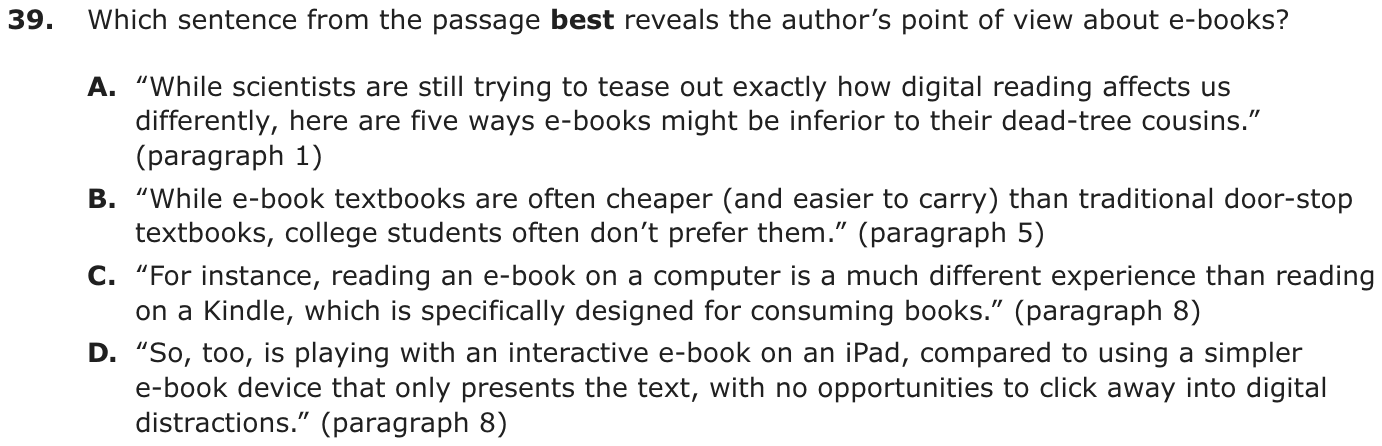
Question 32 of 57
2020 Test A English, question 32Passage Snowy Mountains
Snowy Mountains
by John Gould Fletcher
Higher and still more high,
Palaces made for cloud,
Above the dingy city-roofs
Blue-white like angels with broad wings,
Pillars of the sky at rest
The mountains from the great plateau
Uprise.
But the world heeds them not;
They have been here now for too long a time.
The world makes war on them,
Tunnels their granite cliffs,
Splits down their shining sides,
Plasters their cliffs with soap-advertisements,
Destroys the lonely fragments of their peace.
Vaster and still more vast,
Peak after peak, pile after pile,
Wilderness still untamed,
To which the future is as was the past,
Barrier spread by Gods,
Sunning their shining foreheads,
Barrier broken down by those who do not need
The joy of time-resisting storm-worn stone,
The mountains swing along
The south horizon of the sky;
Welcoming with wide floors of blue-green ice
The mists that dance and drive before the sun.
“Snowy Mountains” by John Gould Fletcher—Public Domain
Question
The description in the first stanza (lines 1–7) helps establish a central idea of the poem by
- Acomparing the length of time the mountains have existed with the length of time the city has existed.
- Bcontrasting the grandeur of the mountains with the structures in the city below them.
- Cimplying that the mountains are a source of inspiration to the people in the city below.
- Dsuggesting that the mountains are larger than the people in the city realize.
Show the answer
Correct answer: B
The question asks how the description in the first stanza helps establish a central idea of the poem. The poem is mostly about the grandeur of the mountains in spite of the spread of civilization. The first stanza contrasts these two elements, which is stated in Option B.
Option A is incorrect because it is a detail that is referenced later in the poem.
Option C is incorrect because the poem actually communicates the message that people do not recognize the greatness of the mountains.
Option D is incorrect because, although the first stanza mentions the size of the mountains, it does not imply that people cannot see how large the mountains are.
Question analysis
This question about John Gould Fletcher’s poem “Snowy Mountains” asks how the first stanza’s description helps establish a central idea of the poem. Students must interpret images such as palaces, pillars and angels, decide what the opening lines do with them, and judge which choice states that role without adding ideas.
- Grade level
- Grade 7 reading and task
- Compared with grade 7
- At grade 7 Linking one stanza to a poem’s central idea is a common grade 7 task, and these images are vivid and concrete. The inverted, century-old syntax adds a little challenge but no unusual demand.
- Estimated difficulty
- Straightforward: two steps or one careful reading.
- Thinking it demands
- Depth of knowledge 2, skills and concepts · mainly analyze
- What makes it hard
- Figurative or literary language moderate
- Complex sentences minor
- Evidence
- Answered from one paragraph or stanza
- Reading level
- Passage: 161 words (a poem; reading level not measured); question and choices: about grade 8, 77 words.
- Students, last 30 days
- Not enough answers yet to show (it takes 10).
Why it is hard, traps and wrong answers (shows the answer)
Why it is hard
The first stanza sets its majestic images directly against “the dingy city-roofs,” so students who read it as a picture find the contrast without much trouble. The losses come from importing ideas from later in the poem, people’s neglect in stanza 2 or the passing of time, into seven lines that contain neither. The inverted word order slows a first reading but does not hide the meaning.
Figurative or literary language moderate Understanding the question
The contrast is carried by images, not statements: “Palaces made for cloud” and “angels with broad wings” rise “Above the dingy city-roofs,” and students must read grandeur and drabness from those pictures. (Graesser, Singer & Trabasso, 1994; Kintsch, 1998)
Complex sentences minor Understanding the question
The stanza is one inverted sentence: five lines of images come before its subject, “The mountains,” in line 6 and its verb, “Uprise,” in line 7. (Abedi & Lord, 2001; Freedle & Kostin, 1993; Messick, 1989)
Strategy: Reread lines 1–7 and sum up in a phrase what the stanza does, then check each choice against those seven lines.
Traps
- Reads too much in: A reasonable-sounding conclusion that goes further than the text allows.
- Wrong part of the text: A choice is true of another paragraph, stanza or speaker than the one asked about.
- Outside knowledge: A choice is plausible in the real world but not supported by this text.
The wrong answers, classified
A Wrong part of the text (Kirsch & Mosenthal, 1990)
Brings in time, which the poem raises only in line 9 and line 18; the first stanza sets mountains against city by height and splendor, not by age.
C Outside knowledge (King et al., 2004; Recht & Leslie, 1988)
Assumes that majestic mountains inspire the people below them, a common idea about nature, but the stanza shows no reaction from the city, and the next stanza says the world “heeds them not.”
D Reads too much in (Graesser, Singer & Trabasso, 1994)
Combines line 1’s “Higher and still more high” with the poem’s later charge that people ignore the mountains, but nothing in lines 1–7 says the city misjudges how large they are.
Working it out, step by step
Figure out what the question asks
This question asks how the first stanza helps build a central idea of the poem. A stanza is a group of lines in a poem, like a paragraph. A central idea is a main message. Only lines 1 to 7 matter here, from “Higher and still more high” to “Uprise.”
Read the pictures in lines 1–7
The mountains are called “Palaces made for cloud” in line 2. In line 4 they are “Blue-white like angels with broad wings.” In line 5 they are “Pillars of the sky at rest.” Palaces, angels and pillars are all grand, high and beautiful. But line 3 places them “Above the dingy city-roofs.”
Explain what the pictures show
“Dingy” means dull and dirty. So the stanza sets two things side by side. Up high are the shining, noble mountains. Down below are the drab roofs of the city. This is a contrast: two things put together to show how different they are. Grandeur means greatness and splendor. The stanza shows the mountains’ grandeur next to the plain city.
Check each choice
- A is wrong. Time is not in lines 1–7. It first comes up in line 9, “They have been here now for too long a time.”
- B fits. Grand mountains rise over dingy city roofs.
- C is wrong. The stanza never shows people being inspired. In fact, line 8 says “the world heeds them not,” or pays them no attention.
- D is wrong. Line 1 says the mountains are high. But nothing says the city misjudges their size.
Choose the answer
The first stanza puts splendid mountains above a dull city. So the answer is B, “contrasting the grandeur of the mountains with the structures in the city below them.”
Why this answer and not the closest wrong one
D is the closest trap. It mixes line 1 with an idea from later in the poem, that people ignore the mountains. But the question is about lines 1–7 only. Those lines show a contrast in looks: high and splendid against low and dingy. They say nothing about what people think.
More questions like this
The original DOE question
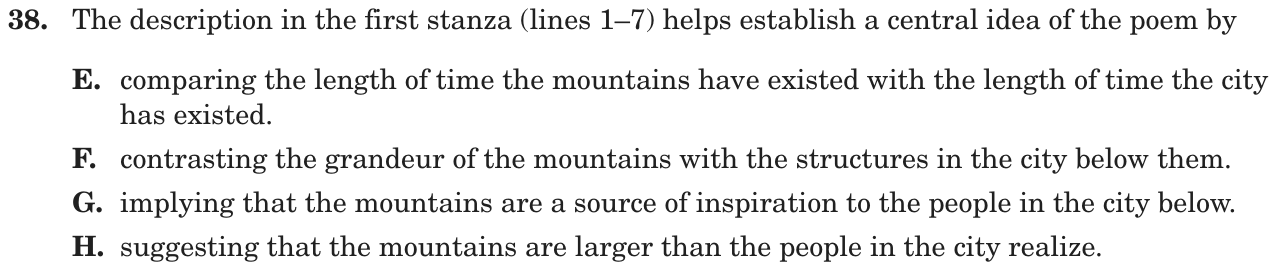
The passage “Snowy Mountains” as printed (page 142)
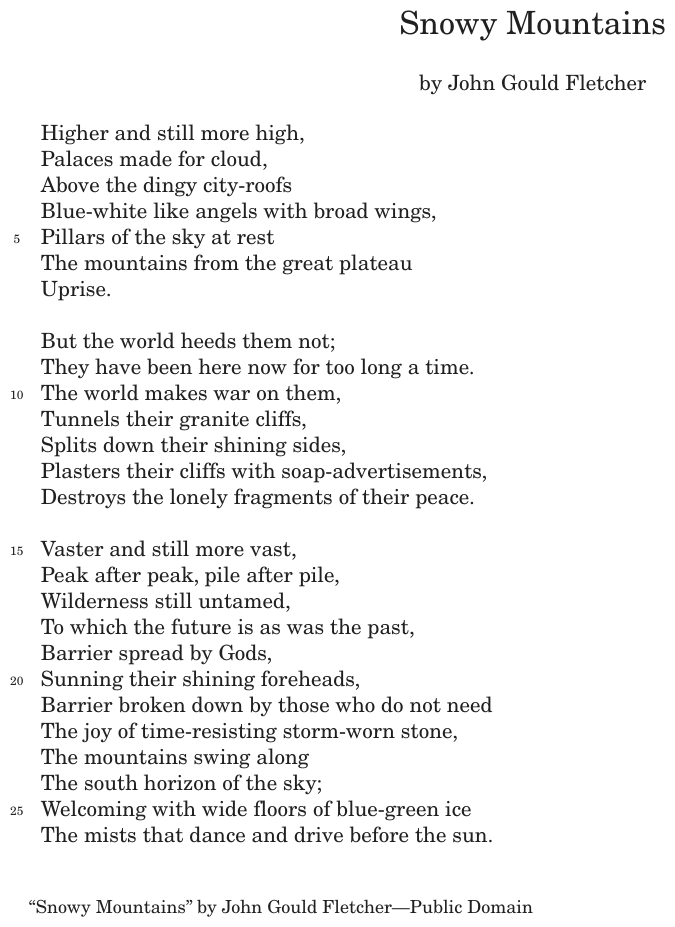
Question 33 of 57
2020 Test A English, question 33Uses the passage above: “Snowy Mountains”.
Question
Read line 5 from the poem.
Pillars of the sky at rest
The line helps develop the theme of the poem by suggesting that the mountains
- Aserve a noble and supportive purpose in the world.
- Battract the clouds with their strength and permanence.
- Cremain untamed through the ages.
- Dprovide protection for the people.
Show the answer
Correct answer: A
The question asks how the line from the poem helps develop the theme of the poem. Line 5 helps develop the theme that the mountains are more important than people realize by suggesting that the mountains serve a noble, foundational purpose in the world, as explained in Option A.
Option B is incorrect because, while the poem does describe the strength and permanence of the mountains, the line does not suggest that these traits attract the clouds.
Option C is incorrect because, while the line states that the highest peaks are “at rest,” that phrase describes stillness, not wildness; the poem calls the mountains “still untamed” only later (line 17), and line 5 does not suggest it.
Option D is incorrect because, while pillars are strong and may indicate shelter, there is no suggestion in the line that the mountains are protecting the people. Additionally, this concept is not a theme of the poem.
Question analysis
This figurative language question asks how the metaphor “Pillars of the sky at rest” in “Snowy Mountains” helps develop the poem’s theme. Students must work out what calling mountains pillars of the sky suggests about them, and it is tricky because every choice sounds like something this poem could say.
- Grade level
- Grade 8 reading and task
- Compared with grade 7
- Above grade 7 Grade 7 students interpret metaphors, but here they must also connect a short image to the poem’s theme and choose among abstract options, a step closer to grade 8 work on figurative meaning and theme.
- Estimated difficulty
- Hard: combines ideas, needs a plan, and has more than one tempting wrong answer.
- Thinking it demands
- Depth of knowledge 3, strategic thinking · mainly analyze
- What makes it hard
- Figurative or literary language major
- The right answer is reworded moderate
- Combines ideas minor
- Evidence
- Answered from one sentence or line
- Reading level
- Passage: 161 words (a poem; reading level not measured); question and choices: about grade 3, 52 words.
- Corrected from the DOE handbook
- A claim in the explanation that the poem contradicts was corrected.
- Students, last 30 days
- Not enough answers yet to show (it takes 10).
Why it is hard, traps and wrong answers (shows the answer)
Why it is hard
This is hard because every choice says something the poem could plausibly mean, and two of them borrow real phrases from other lines. Students who test choices against the poem as a whole find support for the wrong ones; the question rewards testing them against the single image of pillars holding up the sky. Seeing that pillars both support and ennoble a structure leads directly to the key.
Figurative or literary language major Understanding the question
The answer depends on unpacking one metaphor: pillars hold up a roof, so “Pillars of the sky” casts the mountains as supports of the heavens, and “at rest” adds a calm, dignified strength. (Graesser, Singer & Trabasso, 1994; Kintsch, 1998)
The right answer is reworded moderate Choosing the answer
The key uses words the poem never does, “noble” and “supportive,” while wrong choices echo “cloud” from line 2 and “untamed” from line 17 and so look anchored in the text. (Freedle & Kostin, 1993; Kirsch & Mosenthal, 1990)
Combines ideas minor Working it out
Students must interpret the image and then link it to the poem’s theme, that the mountains matter more than the world below recognizes. (Embretson, 1998; Daniel & Embretson, 2010)
Strategy: Ask what a pillar is and why a poet might call mountains “pillars of the sky,” then test each choice against line 5 alone before thinking about the rest of the poem.
Traps
- Wrong part of the text: A choice is true of another paragraph, stanza or speaker than the one asked about.
- Half right: One half of a two-part choice is right and the other is not.
- Reads too much in: A reasonable-sounding conclusion that goes further than the text allows.
The wrong answers, classified
B Half right (King et al., 2004; Thissen, Steinberg & Fitzpatrick, 1989)
Strength and permanence fit both pillars and the poem, but attracting clouds comes from line 2’s “Palaces made for cloud,” and line 5 says nothing about drawing clouds in.
C Wrong part of the text (Kirsch & Mosenthal, 1990)
Takes “Wilderness still untamed” from line 17, a genuine idea of the third stanza, and attaches it to line 5, whose pillars “at rest” suggest calm support, not wildness.
D Reads too much in (Graesser, Singer & Trabasso, 1994)
Follows the pillar image one step too far, from pillars to a roof to shelter for people, though neither the line nor the poem shows the mountains protecting anyone.
What was corrected from the DOE handbook, and why
- Explanation: The handbook rejects Option C by saying the mountains “do not remain untamed or untouched,” but line 17 calls them “Wilderness still untamed,” and the handbook’s own explanation of the third-stanza question relies on that line. The site now says that “at rest” describes stillness, not wildness, and that the poem calls the mountains “still untamed” only later, in line 17, so line 5 does not suggest it.
Working it out, step by step
Figure out what the question asks
This asks what one image, line 5, adds to the poem’s theme. A theme is the big message of a poem. Here the theme is that the mountains are great and important, even though people ignore them. You need to decide what “Pillars of the sky” says about the mountains.
Look closely at line 5
Line 5 reads “Pillars of the sky at rest.” It is part of the first stanza’s list of grand pictures. The list also has “Palaces made for cloud” in line 2. Line 5 is a metaphor. A metaphor calls one thing by the name of another to compare them, without using “like” or “as.”
Explain what pillars do
A pillar is a tall, strong column that holds up a roof. Big, important buildings, like temples and courthouses, have pillars. So calling the mountains “Pillars of the sky” makes them seem to hold up the sky. That is a supporting job. It is also a grand, noble one. “At rest” adds calm. The pillars stand still and steady.
Check each choice
- A fits. Holding up the sky is a noble, supportive job.
- B is wrong. Clouds come from line 2. Line 5 says nothing about pulling clouds in.
- C is wrong. “Wilderness still untamed” is line 17, not line 5. Pillars “at rest” suggest calm, not wildness.
- D is wrong. Pillars hold up roofs, and roofs can shelter people. But the line never shows the mountains protecting anyone.
Choose the answer
Pillars hold things up and make a building grand. So the answer is A, “serve a noble and supportive purpose in the world.”
Why this answer and not the closest wrong one
C is the strongest trap, because the poem really does call the mountains untamed. But that is line 17. Test each choice against line 5 alone. A pillar is a support, and a pillar of the sky is a grand one. Only A comes straight from that picture.
More questions like this
The original DOE question
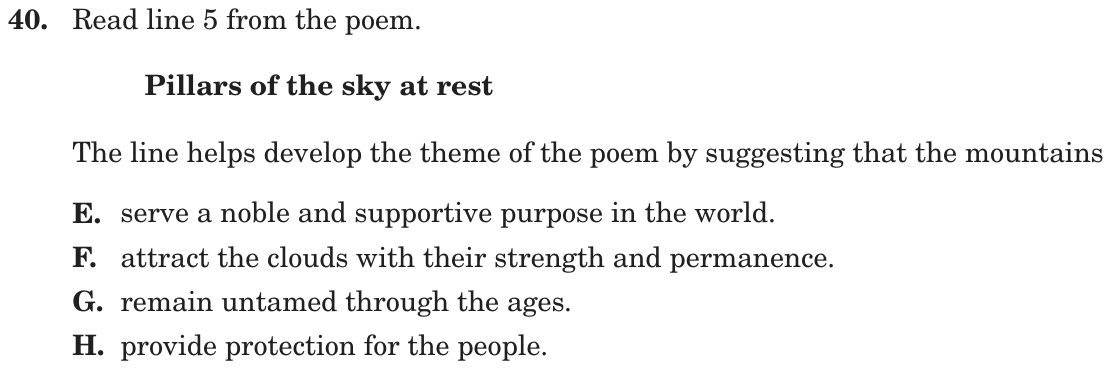
Question 34 of 57
2020 Test A English, question 34Uses the passage above: “Snowy Mountains”.
Question
How does isolating the word “Uprise” in line 7 affect the meaning of the poem?
- AIt creates a contrast between the great plateau and the city buildings.
- BIt reveals the similarity between the tall buildings in the city and the tall mountains on the horizon.
- CIt creates a vision of the region before people developed the land.
- DIt emphasizes that the mountains dominate the landscape.
Show the answer
Correct answer: D
The question asks how the isolation of the word affects the meaning of the poem. The isolation of the word “Uprise” powerfully emphasizes the first stanza’s description of the magnificent mountains standing tall above the land below, as expressed in Option D.
Option A is incorrect because the word describes the mountains and, therefore, does not create a contrast between the plateau and the city buildings, but rather between the mountains and the plateau.
Option B is incorrect because the word contrasts the mountains with the plateau; it does not compare the mountains to the buildings in the city.
Option C is incorrect because the first stanza describes the already developed land over which the mountains rise.
Question analysis
In “Snowy Mountains,” the opening stanza builds a long sentence about the mountains and saves its verb, “Uprise,” for a line of its own. This poetry structure question asks how isolating that single word affects the poem’s meaning, so students need to think about how a line break shapes what the reader notices, as well as about what the stanza describes.
- Grade level
- Grade 8 reading and task
- Compared with grade 7
- At grade 7 Grade 7 poetry questions often ask about word choice; this one asks about a structural choice, a one-word line, which is less familiar, though the stanza’s images make the intended effect fairly easy to sense.
- Estimated difficulty
- Moderate: several steps, or a close reading with one strong distractor.
- Thinking it demands
- Depth of knowledge 2, skills and concepts · mainly analyze
- What makes it hard
- Complex sentences moderate
- How, not what moderate
- Evidence
- Answered from one paragraph or stanza
- Reading level
- Passage: 161 words (a poem; reading level not measured); question and choices: about grade 8, 64 words.
- Students, last 30 days
- Not enough answers yet to show (it takes 10).
Why it is hard, traps and wrong answers (shows the answer)
Why it is hard
Students who see that “Uprise” is the verb the whole stanza has been building toward recognize the effect quickly: the mountains rise over everything else in the picture. Those who treat the word as one more image look for a comparison instead and find several, because the stanza is full of buildings, roofs and a plateau. The real test is sorting which contrast belongs to the mountains.
Complex sentences moderate Understanding the question
The stanza is one long sentence that withholds its subject until line 6 and its verb until line 7, so “Uprise” lands as the payoff of five lines of images. (Abedi & Lord, 2001; Freedle & Kostin, 1993; Messick, 1989)
How, not what moderate Working it out
The question asks about a line break, a structural choice, rather than a word’s meaning, and students must judge what setting one verb on its own line makes the reader notice. (Anderson & Krathwohl, 2001)
Strategy: Read the stanza aloud and notice where the long sentence finally reaches its verb, then ask what ending on that single word makes the reader see.
Traps
- Taking figurative language literally: A choice reads a figure of speech or image at face value.
- Half right: One half of a two-part choice is right and the other is not.
The wrong answers, classified
A Half right (King et al., 2004; Thissen, Steinberg & Fitzpatrick, 1989)
Rightly senses a contrast in the stanza but pairs the wrong things: “Uprise” sets the mountains against the land below them, not the plateau against the city’s buildings.
B Twists what the text says (King et al., 2004)
Notices that the mountains are compared to “Palaces” and “Pillars,” but those grand buildings are set against the “dingy city-roofs,” so the stanza contrasts mountains and city rather than likening them.
C Taking figurative language literally (Graesser, Singer & Trabasso, 1994)
Takes “Uprise” at face value, as mountains pushing up out of the plateau long ago, but line 3’s “dingy city-roofs” place the scene in a land already built on.
Working it out, step by step
Figure out what the question asks
This asks about a choice the poet made in how the poem looks. Line 7 is only one word: “Uprise.” You need to say what setting that word alone on its line does to the meaning.
Find the sentence the word ends
The whole first stanza is one long sentence. Lines 1 to 5 are a string of pictures: palaces, angels, pillars. The subject, “The mountains from the great plateau,” does not come until line 6. Line 7 then gives the verb, or action word, which is “Uprise.” A plateau is a wide area of high, flat land.
Think about the effect
“Uprise” means rise up. The reader waits six lines for this action. Then it stands by itself, like the mountains standing alone over the land. The short line makes you stop and picture them rising above everything, even “the dingy city-roofs.” So the mountains dominate the scene. To dominate is to tower over and be the main thing you notice.
Check each choice
- A is wrong. “Uprise” is about the mountains rising. It does not set the plateau against the city buildings.
- B is wrong. The stanza does not show the city and the mountains as alike. The city roofs are “dingy,” while the mountains are like palaces.
- C is wrong. Line 3 already shows a city, so this is not the land before people.
- D fits. The lone word makes the mountains tower over the whole picture.
Choose the answer
Ending the long sentence on one lone word makes the mountains stand out over everything. So the answer is D, “It emphasizes that the mountains dominate the landscape.”
Why this answer and not the closest wrong one
A is the closest trap, because the stanza does contain a contrast. But it is between the mountains and everything below them. “Uprise” is the mountains’ own action, so its effect must be about the mountains. Only D keeps the focus there.
More questions like this
The original DOE question
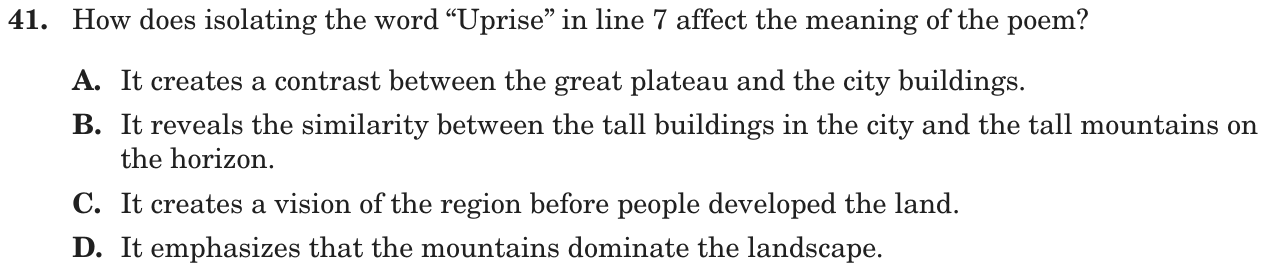
Question 35 of 57
2020 Test A English, question 35Uses the passage above: “Snowy Mountains”.
Question
How does the poet develop the speaker’s point of view in the second stanza (lines 8–14)?
- Aby describing images of the mountains’ awe-inspiring size and strength
- Bby illustrating the differences among the various ways humans can affect the natural environment
- Cby criticizing society for taking careless, harmful courses of action against nature
- Dby demonstrating how the mountains and the people are able to benefit from each other
Show the answer
Correct answer: C
The question asks how the poet develops the speaker’s point of view in the second stanza.
A. Incorrect. The speaker’s descriptions of the mountains’ awe-inspiring size and strength mainly occur in the first and third stanzas, while in the second stanza, the speaker focuses on humanity and its negative effect on the mountains.
B. Incorrect. The wording of the second stanza—“makes war” (line 10), “Splits down their shining sides” (line 12), and “Destroys the lonely fragments” (line 14)—communicates the speaker’s position that people’s main impact on the mountains is destructive; the wording does not illustrate different ways people impact the natural environment.
C. CORRECT. In the second stanza, the speaker criticizes the destructive actions of “the world” (lines 8 and 10) against the mountains—actions such as tunneling “their granite cliffs” (line 11) and destroying “the lonely fragments of their peace” (line 14).
D. Incorrect. In the second stanza, the speaker does not describe a positive relationship between the mountains and the people.
Question analysis
This point-of-view question on the poem “Snowy Mountains” asks how the poet develops the speaker’s outlook in the second stanza, lines 8–14. Students must read the stanza on its own, decide what attitude its images and verbs express, and then find the choice that names both that attitude and the way it comes across.
- Grade level
- Grade 6 reading and task
- Compared with grade 7
- Below grade 7 Below typical grade 7 demand. Grade 7 point-of-view questions often require weighing subtle or shifting attitudes; this stanza is seven short lines with one consistent stance, carried by strong action words, so it suits grade 6.
- Estimated difficulty
- Straightforward: two steps or one careful reading.
- Thinking it demands
- Depth of knowledge 2, skills and concepts · mainly analyze
- What makes it hard
- How, not what moderate
- Figurative or literary language minor
- Evidence
- Answered from one paragraph or stanza
- Reading level
- Passage: 161 words (a poem; reading level not measured); question and choices: about grade 10, 66 words.
- Students, last 30 days
- Not enough answers yet to show (it takes 10).
Why it is hard, traps and wrong answers (shows the answer)
Why it is hard
The speaker’s anger in lines 8–14 is plain, and most students sense that the stanza blames people. Points are lost to choices that describe the poem’s admiration of the peaks, which belongs to the stanzas around this one, or that list the stanza’s actions without their hostility. Staying inside the seven lines and reading the attitude in verbs such as “makes war” and “Destroys” settles it quickly.
How, not what moderate Working it out
The stem asks how the viewpoint is built, and the answer lies in what the world does in lines 10–14: it “makes war,” “Tunnels,” “Splits,” “Plasters” and “Destroys.” (Anderson & Krathwohl, 2001)
Figurative or literary language minor Understanding the question
The stanza personifies the mountains as victims, ignored and robbed of “the lonely fragments of their peace,” so the criticism of people comes through sympathy for the peaks. (Graesser, Singer & Trabasso, 1994; Kintsch, 1998)
Strategy: Read lines 8–14 by themselves and put the speaker’s attitude into a few words of your own before looking at the choices.
Traps
- Twists what the text says: Uses the text's topic and ideas but changes what it says: who did it, how much, when, or why.
- Wrong part of the text: A choice is true of another paragraph, stanza or speaker than the one asked about.
The wrong answers, classified
A Wrong part of the text (Kirsch & Mosenthal, 1990)
Describes the first and third stanzas, which marvel at the peaks’ height and vastness; in lines 8–14 the “granite cliffs” and “shining sides” appear only as things being damaged.
B Twists what the text says (King et al., 2004)
Sees that the stanza names several human actions, tunneling, splitting and plastering, but they are all blows in one “war,” not different kinds of effect laid side by side.
D Wrong tone or attitude (Graesser, Singer & Trabasso, 1994)
Reads tunnels and advertisements as people putting the mountains to use, a kind of exchange, and misses the hostility of “The world makes war on them.”
Working it out, step by step
Figure out what the question asks
This asks about point of view. That is how the speaker, the voice talking in the poem, feels about the subject. It also asks how the poet shows that feeling. Look only at the second stanza, lines 8 to 14.
Read the second stanza closely
The stanza opens with “But the world heeds them not” (line 8). To heed something is to pay attention to it. Then “the world” starts to act. It “makes war on them,” “Tunnels their granite cliffs,” and “Splits down their shining sides.” It covers them with ads. Finally, in line 14, it “Destroys the lonely fragments of their peace.”
Decide what the speaker thinks
Here “the world” means people in general. People ignore the mountains, yet keep hurting them. Each action is an attack: making war, tunneling, splitting, plastering, destroying. The speaker is clearly on the mountains’ side. By listing these acts, the speaker blames people for being careless and harmful. Blaming someone for what they do wrong is called criticism.
Check each choice
- A does not fit. Size and strength fill the first and third stanzas, as in “Higher and still more high” and “Vaster and still more vast.” In lines 8 to 14, the mountains are only victims.
- B does not fit. The stanza lists several acts, but it does not compare them. They are all part of one “war.”
- C fits. The stanza blames society for ignoring and harming the mountains.
- D does not fit. The stanza shows no give-and-take. People only harm the mountains, and the mountains get nothing back.
Choose the answer
The speaker’s view comes through a list of careless, harmful acts that the poem plainly condemns. So the answer is C.
Why this answer and not the closest wrong one
B is the closest wrong choice, because the stanza really does name several ways people affect the mountains. But the speaker is not studying how they differ. Each one is another blow in the same attack, and the speaker is upset by all of them. C names that anger as criticism, which is what the stanza does.
More questions like this
The original DOE question
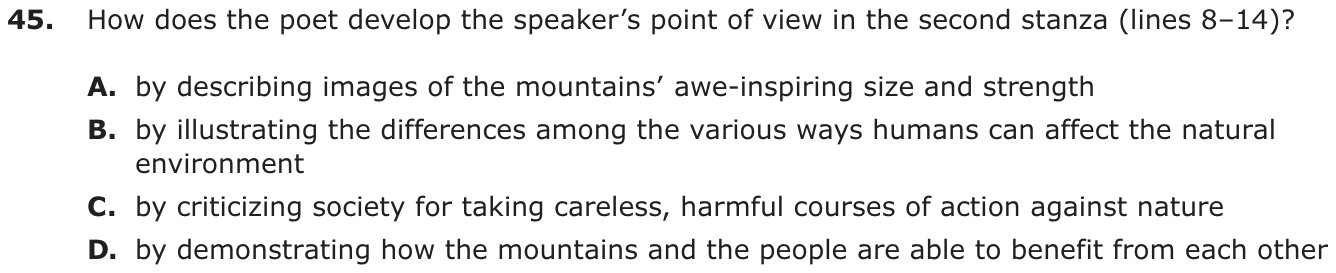
Question 36 of 57
2020 Test A English, question 36Uses the passage above: “Snowy Mountains”.
Question
Which line from the poem best supports the idea that people have sacrificed priceless natural beauty in order to make a profit?
- A“Above the dingy city-roofs” (line 3)
- B“The world makes war on them,” (line 10)
- C“Tunnels their granite cliffs,” (line 11)
- D“Plasters their cliffs with soap-advertisements,” (line 13)
Show the answer
Correct answer: D
The question asks for the line from the poem that best supports the idea that people have sacrificed natural beauty for profit.
A. Incorrect. While city roofs may spoil the natural beauty, they do not directly symbolize financial gain or profit in line 3.
B. Incorrect. Although making a profit might have been the root cause of the damage that was done to the mountains, making war on the mountains is not a direct message about profit or financial gain in line 10.
C. Incorrect. Although tunneling through the mountains affects the natural beauty of the mountains, it does not directly symbolize financial gain or profit in line 11.
D. CORRECT. Advertisements are often used as a means to gain a profit, as implied by the soap advertisements in line 13. Additionally, the word “Plasters,” in line 13, communicates a negative connotation for the use of advertisements on the priceless natural beauty of the mountains.
Question analysis
In this textual evidence question on John Gould Fletcher’s poem “Snowy Mountains,” students pick the line that best backs the claim that people traded priceless natural beauty for profit. Most of the quoted lines show damage of some kind, so the deciding question is which one also shows why the damage was done.
- NYS standards
- 7R1 textual evidence and inferences
- Grade level
- Grade 7 reading and task
- Compared with grade 7
- At grade 7 Matching a claim to a quoted line is standard grade 7 evidence work, and these four lines are short and numbered. The images are concrete, so little inference is needed once the claim is read carefully.
- Estimated difficulty
- Straightforward: two steps or one careful reading.
- Thinking it demands
- Depth of knowledge 2, skills and concepts · mainly evaluate
- What makes it hard
- Every choice must be checked moderate
- Reading between the lines minor
- Evidence
- Answered from one sentence or line
- Reading level
- Passage: 161 words (a poem; reading level not measured); question and choices: about grade 6, 45 words.
- Students, last 30 days
- Not enough answers yet to show (it takes 10).
Why it is hard, traps and wrong answers (shows the answer)
Why it is hard
Three of the four quoted lines show damage to the mountains, which meets the first half of the claim and makes the question a test of the second half. Students who look only for harm tend to settle on the loudest image of attack, “makes war on them.” The one line that contains a product for sale is the only one showing beauty traded for money, and once that is seen the choice is quick.
Every choice must be checked moderate Choosing the answer
Lines 10, 11 and 13 all show people harming the mountains, so each must be held against the claim’s second half, making a profit, which only one of them carries. (Embretson & Wetzel, 1987)
Reading between the lines minor Working it out
No line names money; profit has to be read from “soap-advertisements,” which exist to sell a product, while “Plasters” supplies the spoiling of the cliffs’ beauty. (Graesser, Singer & Trabasso, 1994; Kintsch, 1998)
Strategy: Underline the two things the claim needs, harm to the mountains’ beauty and a money motive, then read each quoted line and cross out any that shows only one of them.
Traps
- Supports only part of the claim: In a question about evidence: a line that backs one half of the claim but not the other, or a related point rather than the claim itself.
- Outside knowledge: A choice is plausible in the real world but not supported by this text.
The wrong answers, classified
A Reads too much in (Graesser, Singer & Trabasso, 1994)
Connects “dingy city-roofs” with industry and money-making, but line 3 only places the city below the peaks and shows neither profit nor harm done to them.
B Supports only part of the claim (King et al., 2004; Thissen, Steinberg & Fitzpatrick, 1989)
Chooses the stanza’s fiercest line, but “makes war on them” shows attack in general with no motive, so it backs the lost beauty without the profit.
C Outside knowledge (King et al., 2004; Recht & Leslie, 1988)
Brings in a real-world reason, tunnels dug for railways or mines that earn money, though line 11 itself shows only the cliffs being cut, with no sign of gain.
Working it out, step by step
Figure out what the question asks
This asks for evidence: the line that best supports an idea. Notice that the idea makes two claims. People have spoiled the mountains’ beauty, and they did it to make money, or a profit. The best line must show both parts, not just one.
Read the four lines in the poem
Choice A, “Above the dingy city-roofs,” comes from the first stanza, where the poem praises the peaks. Dingy means grimy and gloomy. The other three choices come from the second stanza, where people attack the mountains. In order, they are “The world makes war on them” (line 10), “Tunnels their granite cliffs” (line 11) and “Plasters their cliffs with soap-advertisements” (line 13).
Test each line for harm and money
An advertisement is a sign that tries to get you to buy something. Soap ads are there to sell soap, so they are about profit. To plaster something is to cover it thickly and messily, like paste on a wall. Picture the bright cliffs smeared with ugly signs, all to sell a product.
Line Harms the mountains? Shows money? 3 No No 10 Yes No 11 Yes No 13 Yes Yes Check each choice
- A does not fit. Line 3 only places the dirty city below the peaks. It shows no harm to the mountains and no money.
- B does not fit. The words “makes war” show an attack, but not the reason for it.
- C does not fit. Tunnels do damage the cliffs. You may know that tunnels are dug for trains or mines, but the line itself never mentions money.
- D fits. It shows the beauty spoiled and a product being sold.
Choose the answer
Only line 13 shows both the harm and the money behind it. So the answer is D, line 13.
Why this answer and not the closest wrong one
B is the strongest trap, because “makes war” is the fiercest image of harm in the poem. But the idea also needs a reason: making a profit. War on the mountains could happen for any reason. Only the soap ads show something being sold, so only D backs up both parts of the idea.
More questions like this
The original DOE question
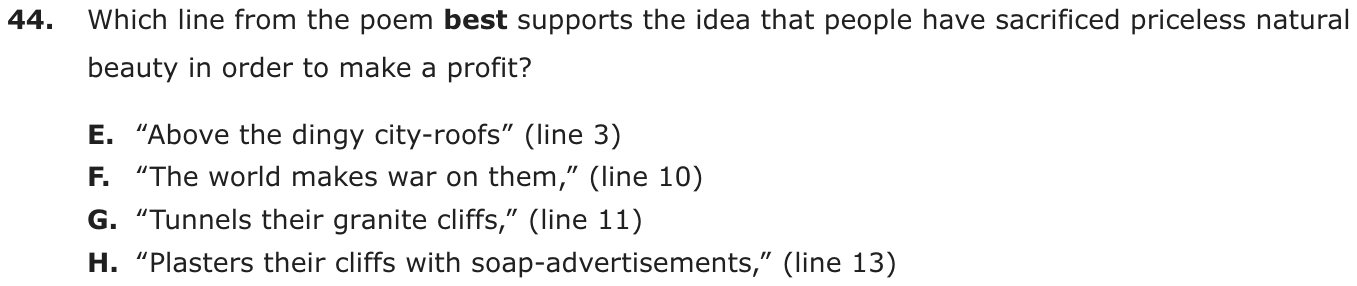
Question 37 of 57
2020 Test A English, question 37Uses the passage above: “Snowy Mountains”.
Question
Which detail from the poem reflects the speaker’s view that people often fail to appreciate what is familiar?
- A“The mountains from the great plateau” (line 6)
- B“They have been here now for too long a time.” (line 9)
- C“Splits down their shining sides,” (line 12)
- D“To which the future is as was the past,” (line 18)
Show the answer
Correct answer: B
The question asks for the detail from the poem that reflects the speaker’s view that people often fail to appreciate that which is familiar.
Line 9 (Option B) most directly supports this idea by implying that the mountains have been here for so long that people are accustomed to seeing them and no longer appreciate their beauty and value, making Option B the correct response.
Option A is incorrect because line 6 describes the mountains’ location, rather than their longevity or familiarity.
Option C is incorrect because, in line 12, the mention of harm that has been done to the mountains does not connect to a sense of overfamiliarity.
Option D is incorrect because, although line 18 alludes to the longevity of the mountains, it does not connect the longevity with a sense of overfamiliarity or the failure of people to appreciate the mountains’ worth.
Question analysis
Students pick the detail from the poem “Snowy Mountains” that reflects the speaker’s view that people often fail to appreciate what is familiar. The idea is never stated outright, so students must read each quoted line in its context and decide which one implies both familiarity and a loss of appreciation.
- Grade level
- Grade 7 reading and task
- Compared with grade 7
- At grade 7 Evidence questions like this are typical grade 7 work, but the support here is implied rather than stated, which adds an inference step beyond simple matching of words.
- Estimated difficulty
- Moderate: several steps, or a close reading with one strong distractor.
- Thinking it demands
- Depth of knowledge 2, skills and concepts · mainly evaluate
- What makes it hard
- Reading between the lines moderate
- Every choice must be checked minor
- Evidence
- Answered from one sentence or line
- Reading level
- Passage: 161 words (a poem; reading level not measured); question and choices: about grade 3, 52 words.
- Students, last 30 days
- Not enough answers yet to show (it takes 10).
Why it is hard, traps and wrong answers (shows the answer)
Why it is hard
The claim joins two ideas, long familiarity and failing to appreciate, and the right line shows them only together with the line before it. Students who match the idea of time pick the line about the future and the past, and those who match neglect pick a line of damage. Reading line 9 as the explanation for line 8 is the key move.
Reading between the lines moderate Working it out
The line never says “familiar”; its meaning comes from its place right after “But the world heeds them not,” where being here “too long” reads as the reason for that neglect. (Graesser, Singer & Trabasso, 1994; Kintsch, 1998)
Every choice must be checked minor Choosing the answer
Each quoted line has to be read in its stanza, because out of context lines 9 and 18 both sound like statements about time. (Embretson & Wetzel, 1987)
Strategy: Restate the claim as “people stop valuing something because they are used to it,” then check each quoted line within its stanza for a reason people might stop noticing the mountains.
Traps
- Supports only part of the claim: In a question about evidence: a line that backs one half of the claim but not the other, or a related point rather than the claim itself.
The wrong answers, classified
A Little reason to choose it (Haladyna & Downing, 1993; Rodriguez, 2005)
Line 6 only places the mountains above “the great plateau” and touches neither familiarity nor appreciation, so it mainly draws students who are guessing.
C Supports only part of the claim (King et al., 2004; Thissen, Steinberg & Fitzpatrick, 1989)
Shows people harming the mountains, which fits the speaker’s complaint that they are not valued, but “Splits down their shining sides” gives no sign that familiarity is the cause.
D Supports only part of the claim (King et al., 2004; Thissen, Steinberg & Fitzpatrick, 1989)
Notices that line 18 stresses how long the mountains endure, but it describes their permanence, not people growing used to them and ceasing to value them.
Working it out, step by step
Figure out what the question asks
This asks for a line that shows one of the speaker’s views: people often fail to appreciate what is familiar. Familiar means something you know well and see all the time. To appreciate is to value something. So the line must show people no longer valuing the mountains because they are used to them.
Read each line in its place
Line 9 says, “They have been here now for too long a time.” Read it with line 8 just before it: “But the world heeds them not.” “Heeds” means pays attention to. So the world ignores the mountains. Line 9 gives the reason. They have been around so long that people are used to them.
Explain what line 9 means
The mountains have not done anything wrong by being old. The words “too long” show how people feel about them. Something you see every day starts to seem plain. You stop noticing it. That is exactly the idea in the question: people stop valuing what is familiar.
Check each choice
- A is wrong. Line 6 only tells where the mountains are, above “the great plateau.”
- B fits. It explains that people ignore the mountains because they have seen them for so long.
- C is wrong. Line 12 shows harm, but it does not say familiarity is the cause.
- D is wrong. Line 18 means the mountains do not change over time. It is about how long they last, not about people getting used to them.
Choose the answer
Line 9 explains why the world ignores the mountains: people are too used to them. So the answer is B, “They have been here now for too long a time.”
Why this answer and not the closest wrong one
D is the closest trap, since lines 9 and 18 both talk about time. But line 18 praises the mountains for lasting. Line 9 follows “the world heeds them not” and explains it. Only line 9 links long familiarity to people not caring.
More questions like this
The original DOE question
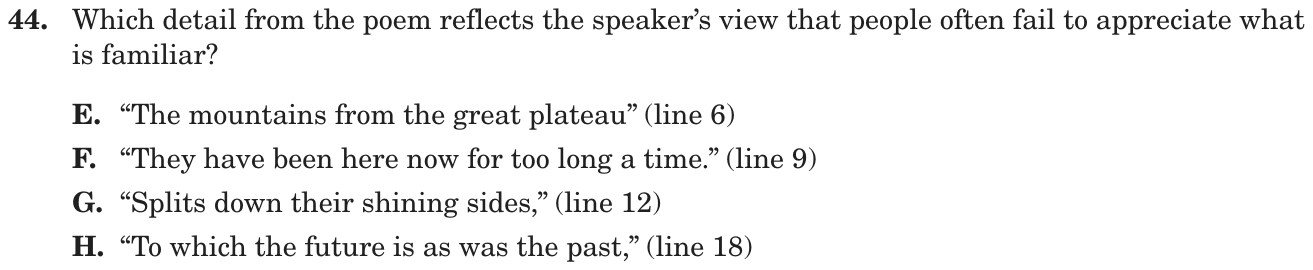
Question 38 of 57
2020 Test A English, question 38Uses the passage above: “Snowy Mountains”.
Question
How do the details in the third stanza (lines 15–26) most contribute to the development of a theme of the poem?
- Aby reflecting nature’s capacity to resist change
- Bby showing that nature is capable of influencing human will
- Cby exposing how a lack of awareness leads to nature’s ruin
- Dby explaining why people must respect nature
Show the answer
Correct answer: A
The question asks how the details in the third stanza most contribute to the development of a theme of the poem.
A. CORRECT. In the third stanza, phrases such as “Wilderness still untamed” (line 17), “time-resisting storm-worn stone” (line 22), and “The mountains swing along” (line 23) convey the message that in spite of the destruction described in the second stanza, the mountains manage to maintain their wild magnificence.
B. Incorrect. While the phrase “Barrier broken down” (line 21) conveys the idea that people can have some effect on the natural landscape, it does not convey how nature affects people.
C. Incorrect. The phrase “those who do not need” (line 21) implies a choice to damage nature and not a lack of awareness or understanding.
D. Incorrect. The third stanza is not a call to humanity to respect the mountains but a description of the untamed, welcoming mountains and the joy they provide for those who appreciate them.
Question analysis
Students trace how the details of the third and final stanza of “Snowy Mountains,” lines 15–26, most contribute to developing a theme of the poem. Because the stanza is a single sentence that runs from line 15 to the poem’s last word, students must keep its whole movement in mind before deciding what it adds.
- Grade level
- Grade 8 reading and task
- Compared with grade 7
- Above grade 7 Grade 7 theme questions usually rest on a few clear details. Here students must hold a twelve-line stanza of inverted, piled-up phrases in mind and pick among four reasonable lessons about nature, a heavier load closer to grade 8.
- Estimated difficulty
- Hard: combines ideas, needs a plan, and has more than one tempting wrong answer.
- Thinking it demands
- Depth of knowledge 3, strategic thinking · mainly analyze
- What makes it hard
- Complex sentences moderate
- Figurative or literary language moderate
- Evidence in several places moderate
- Evidence
- Answered from one paragraph or stanza
- Reading level
- Passage: 161 words (a poem; reading level not measured); question and choices: about grade 7, 55 words.
- Students, last 30 days
- Not enough answers yet to show (it takes 10).
Why it is hard, traps and wrong answers (shows the answer)
Why it is hard
The final stanza holds both endurance and damage, and the stem’s “most” asks which of the two its details build. Students who fix on the broken barrier choose ruin, a reading the second stanza seems to confirm, while those who tally the stanza’s details find untamed wilderness, time-resisting stone and mountains swinging at ease. Because the stanza is one long, inverted sentence, that tally is slow, which is what makes the question hard.
Complex sentences moderate Understanding the question
Lines 15–26 are one sentence in which phrase after phrase, from “Vaster and still more vast” to “storm-worn stone,” comes before its subject, “The mountains,” in line 23. (Abedi & Lord, 2001; Freedle & Kostin, 1993; Messick, 1989)
Figurative or literary language moderate Understanding the question
The message of endurance is carried by personification: the peaks have “shining foreheads,” are “spread by Gods,” and “swing along” the horizon welcoming the mists. (Graesser, Singer & Trabasso, 1994; Kintsch, 1998)
Evidence in several places moderate Working it out
The theme has to be assembled from details scattered over twelve lines, “Wilderness still untamed,” “the future is as was the past,” “time-resisting,” and weighed against the single line of damage. (Kirsch & Mosenthal, 1990; Gorin & Embretson, 2006)
Strategy: Read lines 15–26 as one long sentence, find its main subject and verb, and sum up its message in a phrase; then check each choice against the whole stanza, not a single line.
Traps
- Too narrow: A single detail offered as the central idea or a summary, or a summary that keeps minor details and leaves out an essential part.
- Outside knowledge: A choice is plausible in the real world but not supported by this text.
- Reversed relationship: Cause and effect, or the order of events, turned around.
The wrong answers, classified
B Reversed relationship (King et al., 2004)
Turns the influence around: in this stanza people break down the barrier while the peaks endure, and nothing shows the mountains shaping what people want.
C Too narrow (King et al., 2004)
Builds on line 21’s “Barrier broken down,” the stanza’s one line of damage, and lets it stand for twelve lines that mostly celebrate the mountains as wild and lasting.
D Outside knowledge (King et al., 2004; Recht & Leslie, 1988)
States the lesson a nature poem is expected to teach, that people must respect nature, but the stanza describes the mountains and never tells readers what to do.
Working it out, step by step
Figure out what the question asks
This asks about theme, the big message of the poem. You need to see what the details of the third stanza, lines 15 to 26, add to that message. The word “most” matters. Pick the idea that most of the details support, not just one line.
Gather the details in lines 15 to 26
The peaks grow “Vaster and still more vast” (line 15). They are a “Wilderness still untamed” (line 17). For them, the future is “as was the past” (line 18). Their stone is “time-resisting” (line 22). In the last four lines, “The mountains swing along” the sky and welcome the mists. Only line 21 shows damage: the barrier is “broken down.”
Find what the details share
Untamed means still wild, not controlled by people. If the future is the same as the past, the mountains are not changing. Time-resisting means they hold out against the years. And at the end of the stanza, they are still moving along at ease. Nearly every detail shows the same thing. The mountains last and stay wild, which is nature’s power to resist change.
Check each choice
- A fits. Wild, unchanging, time-resisting mountains show nature holding out against change.
- B does not fit. It turns things around. In this stanza, people affect the mountains. Nothing shows the mountains changing what people want.
- C does not fit. Line 21 shows damage, but it is one line out of twelve. The stanza does not end in ruin either: the mountains still swing along and welcome the mists.
- D does not fit. These lines paint a picture of the peaks. They give readers no orders and no reasons to behave a certain way.
Choose the answer
Most of the third stanza shows mountains that stay wild and lasting. So the answer is A.
Why this answer and not the closest wrong one
C is the closest trap, because line 21 does show the barrier “broken down,” and the second stanza is full of harm. But this question is about the third stanza, and it asks what the details most add. Most of the other lines there show mountains that are vast, wild and lasting. That builds A, not ruin.
More questions like this
The original DOE question
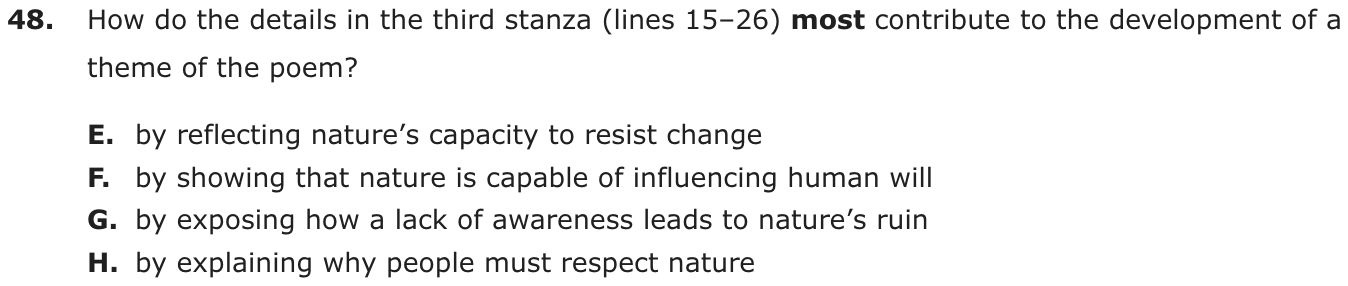
Question 39 of 57
2020 Test A English, question 39Uses the passage above: “Snowy Mountains”.
Question
Read lines 21–22 from the poem.
Barrier broken down by those who do not need
The joy of time-resisting storm-worn stone,
How do the lines help convey the speaker’s point of view?
- AThey suggest that the speaker wants to remove the obstacles that prevent others from experiencing the wonders of nature.
- BThey reveal the speaker’s opinion that some people are too busy to appreciate natural beauty.
- CThey suggest the speaker’s dismay that people destroy the natural landscape without understanding the ramifications of their actions.
- DThey explain that the speaker is confident that nature will never be fully destroyed by people.
Show the answer
Correct answer: C
The question asks how the lines help convey the speaker’s point of view. The words “those who do not need / The joy” in lines 21–22 suggest the speaker’s sadness that people do not realize that they are destroying something wonderful and irreplaceable, as expressed in Option C.
Option A is incorrect because the word “barrier” (line 21) refers to the speaker’s opinion that the mountains were “spread by Gods” (line 19) and not to an obstacle that the speaker thinks should be removed.
Option B is incorrect because, while the lines indicate that people have lost the need to connect with nature, they do not reveal that the speaker thinks that the cause of this loss is busyness.
Option D is incorrect because, although the speaker does say that the stone is “time-resisting” (line 22), this belief is only a small detail of the speaker’s point of view.
Question analysis
Students explain how lines 21–22 of the poem “Snowy Mountains” convey the speaker’s point of view about people who break down the mountains’ barrier. The lines are hard to parse because a phrase runs across the line break and “need” is used in an unusual way, so students must first work out what the sentence says before judging the speaker’s feeling.
- Grade level
- Grade 8 reading and task
- Compared with grade 7
- Above grade 7 Reading a speaker’s attitude is grade 7 work, but this sentence runs across a line break with unusual phrasing, and the choices require fine distinctions between feelings and reasons, which pushes it above typical grade 7 demand.
- Estimated difficulty
- Hard: combines ideas, needs a plan, and has more than one tempting wrong answer.
- Thinking it demands
- Depth of knowledge 2, skills and concepts · mainly analyze
- What makes it hard
- Complex sentences major
- Reading between the lines moderate
- Hard words minor
- Evidence
- Answered from one sentence or line
- Reading level
- Passage: 161 words (a poem; reading level not measured); question and choices: about grade 9, 99 words.
- Students, last 30 days
- Not enough answers yet to show (it takes 10).
Why it is hard, traps and wrong answers (shows the answer)
Why it is hard
Two lines of compressed, inverted verse must be untangled before any choice can be judged, and the meaning of “need” in them is unusual. Once the lines are paraphrased as people who do not value the old stone breaking it down, the speaker’s sorrow is clear, but two wrong choices offer neighboring readings. One supplies a reason the poem never gives, and the other carries the stanza’s idea of endurance into a certainty the lines contradict.
Complex sentences major Understanding the question
The sentence breaks mid-phrase, “those who do not need / The joy of time-resisting storm-worn stone,” and has no main verb of its own, so students must first work out who breaks what. (Abedi & Lord, 2001; Freedle & Kostin, 1993; Messick, 1989)
Reading between the lines moderate Working it out
Neither dismay nor ignorance is stated; both have to be inferred from describing people as not needing “the joy” of what they break down. (Graesser, Singer & Trabasso, 1994; Kintsch, 1998)
Hard words minor Understanding the question
“Barrier” here means the mountain range as a wall, not an obstacle, and the key uses “ramifications,” a word many students will not know. (Perfetti, 2007; Freedle & Kostin, 1993)
Strategy: Rephrase the two lines in plain words, starting with who breaks the barrier and what they do not need, then decide which feeling of the speaker that wording reveals.
Traps
- Dictionary meaning, not meaning here: A common meaning of the word that does not fit its use in this text.
- Outside knowledge: A choice is plausible in the real world but not supported by this text.
- Too broad or too strong: A choice overstates, generalizes, or uses absolute words the text does not support.
The wrong answers, classified
A Dictionary meaning, not meaning here (Perfetti, 2007)
Takes “Barrier” in its everyday sense of an obstacle to clear away, but here it is the mountain range itself, “spread by Gods,” which the speaker values.
B Outside knowledge (King et al., 2004; Recht & Leslie, 1988)
Supplies a familiar modern explanation, that people are too busy for nature, though the lines say only that some people do not need this joy, not why.
D Too broad or too strong (King et al., 2004)
Stretches “time-resisting” into certainty that nature can never be destroyed, though the same sentence shows the barrier being broken down by people.
Working it out, step by step
Figure out what the question asks
This asks what lines 21 and 22 show about the speaker’s point of view, or feelings and opinion. The lines are tangled, so first you need to put them in plain words.
Read the lines in their place
The two lines are “Barrier broken down by those who do not need / The joy of time-resisting storm-worn stone,” in the third stanza. Two lines earlier, line 19 calls the mountains a “Barrier spread by Gods,” or a wall made by the gods. So the barrier is the mountain range itself. It is not an obstacle in someone’s way.
Put the lines in plain words
Here is the meaning. The mountains are being broken down by people who feel no need for the joy that old, strong stone gives. These people do not value what they are destroying. The speaker is sad and upset about this. That feeling is dismay. Ramifications are the results that follow from an action. People break the mountains without seeing what they lose.
Check each choice
- A is wrong. The “barrier” is the mountains, which the speaker loves. The speaker does not want them removed.
- B is wrong. The lines never say why people don’t value the stone. Being too busy is a reason brought in from outside.
- C fits. The speaker is dismayed that people destroy the mountains without seeing their worth.
- D is wrong. The same lines show the barrier being “broken down.” They show worry about harm, not confidence that nature is safe.
Choose the answer
The lines show sorrow at people breaking down something they do not value. So the answer is C, “They suggest the speaker’s dismay that people destroy the natural landscape without understanding the ramifications of their actions.”
Why this answer and not the closest wrong one
B is the closest trap. It also says people fail to value nature. But it adds a reason, being busy, that the poem never gives. The lines only say these people “do not need” the joy. C stays with what the lines show: harm done by people who don’t see its cost.
More questions like this
The original DOE question
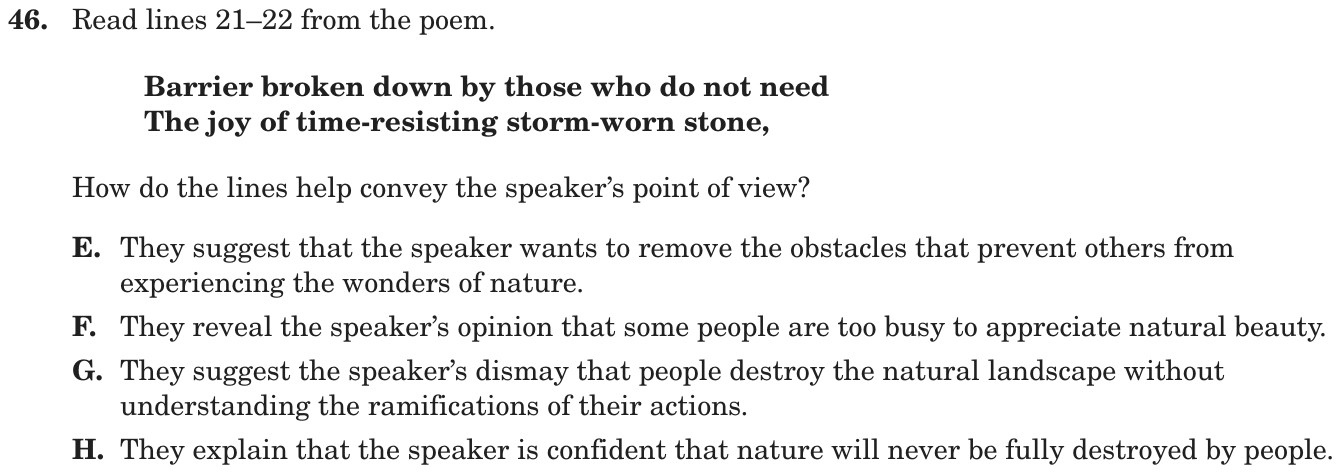
Question 40 of 57
2020 Test A English, question 40Uses the passage above: “Snowy Mountains”.
Question
Read lines 23–26 from the poem.
The mountains swing along
The south horizon of the sky;
Welcoming with wide floors of blue-green ice
The mists that dance and drive before the sun.
The personification in these concluding lines of the poem suggests that the mountains are
- Agracious hosts who are untroubled by the actions of people.
- Bunaware of their coming destruction.
- Clively entertainers who are amused by the everyday concerns of people.
- Dtoo proud to reveal their pain.
Show the answer
Correct answer: A
The question asks what the personification in the concluding lines of the poem suggests about the mountains.
A. CORRECT. Line 25’s use of the word “Welcoming” suggests that the mountains are kind hosts. Lines 23 and 26, with language such as “The mountains swing along” and “The mists that dance and drive before the sun,” imply the carefree nature of the mountains as they resist the destructive work of humanity.
B. Incorrect. The personification in the lines conveys a sense of optimism and endurance, with no language to suggest coming destruction.
C. Incorrect. Although the lines mention that “the mountains swing along” (line 23) and “the mists . . . dance” (line 26), the personification is used to describe the mountains’ perseverance, rather than to suggest that the mountains are amused by the concerns of others.
D. Incorrect. Although the second stanza develops the idea that the mountains have been mistreated by humans, which might be a source of pain, the concluding lines emphasize the joy and perseverance of the mountains as they “swing along” (line 23) despite significant adversity.
Question analysis
Students interpret the personification in the closing lines of “Snowy Mountains,” lines 23–26, and decide what it suggests about the mountains on the south horizon. They need to see which human actions the poet gives the mountains and what kind of character those actions create, and then choose among four quite different personalities.
- Grade level
- Grade 7 reading and task
- Compared with grade 7
- At grade 7 Grade 7 readers routinely interpret personification, and here the four lines are printed with the question. The images are concrete and the choices give the mountains clearly different roles and moods, so careful matching settles it.
- Estimated difficulty
- Straightforward: two steps or one careful reading.
- Thinking it demands
- Depth of knowledge 2, skills and concepts · mainly understand
- What makes it hard
- Figurative or literary language moderate
- Complex sentences minor
- Evidence
- Answered from one sentence or line
- Reading level
- Passage: 161 words (a poem; reading level not measured); question and choices: about grade 6, 77 words.
- Students, last 30 days
- Not enough answers yet to show (it takes 10).
Why it is hard, traps and wrong answers (shows the answer)
Why it is hard
The closing lines are calm and generous, and the task is to turn their personification into a character. Students who give the mists’ dancing to the mountains see performers, but the performer choice also has the mountains amused by people’s concerns, which nothing here supports, so a careful reader rejects it. The remaining losses come from carrying the second stanza’s damage into lines that show only ease and welcome.
Figurative or literary language moderate Understanding the question
The human traits must be sorted by who has them: the mountains “swing along” and are “Welcoming,” while the mists are the ones that “dance and drive before the sun.” (Graesser, Singer & Trabasso, 1994; Kintsch, 1998)
Complex sentences minor Understanding the question
In “Welcoming with wide floors of blue-green ice / The mists,” the object of “Welcoming” comes after a long phrase and a line break, so who welcomes whom is easy to lose. (Abedi & Lord, 2001; Freedle & Kostin, 1993; Messick, 1989)
Strategy: Underline each verb or describing word in lines 23–26 that gives the mountains a human trait, then check every choice against all of them.
Traps
- Twists what the text says: Uses the text's topic and ideas but changes what it says: who did it, how much, when, or why.
- Reads too much in: A reasonable-sounding conclusion that goes further than the text allows.
The wrong answers, classified
B Reads too much in (Graesser, Singer & Trabasso, 1994)
Takes the mountains’ carefree swinging as ignorance and adds the earlier stanzas’ damage to it, but these four lines are serene and hint at no destruction to come.
C Twists what the text says (King et al., 2004)
Gives the mists’ dancing to the mountains and so makes them performers, then adds amusement at people’s concerns, though here the mountains only swing along and welcome the mists.
D Wrong tone or attitude (Graesser, Singer & Trabasso, 1994)
Imagines a brave face hiding the wounds of the second stanza, but the lines show the mountains at ease and welcoming, with no sign of pride or pain.
Working it out, step by step
Figure out what the question asks
This asks about personification. That is when a writer describes a thing as if it were a person, with human actions or moods. You need to decide what kind of character the mountains seem to be in lines 23 to 26.
Find who does each action
The four lines are one sentence. In line 23, “The mountains swing along” the edge of the sky. Line 25 shows them “Welcoming with wide floors of blue-green ice.” The guests arrive in line 26: “The mists that dance and drive before the sun.” The mountains do two things here, swing along and welcome. The dancing belongs to the mists.
Decide what the actions suggest
Welcoming guests is what a host does. A host invites others in and makes them comfortable. Gracious means warm and polite. To swing along is to move in a relaxed, easy way. The second stanza was full of harm, yet here the mountains seem calm. They are untroubled, or not worried or upset.
Check each choice
- A fits. The mountains welcome the mists like gracious hosts, and they move at ease.
- B does not fit. Nothing in these lines hints at harm to come. The mood is calm and bright.
- C does not fit. Line 26 gives the dancing to the mists. And nothing shows the mountains laughing at people’s daily worries.
- D does not fit. There is no sign of pride or hidden pain. The mountains seem relaxed and open.
Choose the answer
Like kind hosts, the mountains greet their guests and stay calm. So the answer is A.
Why this answer and not the closest wrong one
C may tempt you, because swinging and dancing both sound lively. But check who dances: line 26 gives the dancing to the mists. The mountains are the ones “Welcoming” them, so they are hosts, not entertainers. C also says the mountains are amused by people, and these lines never show that.
More questions like this
The original DOE question
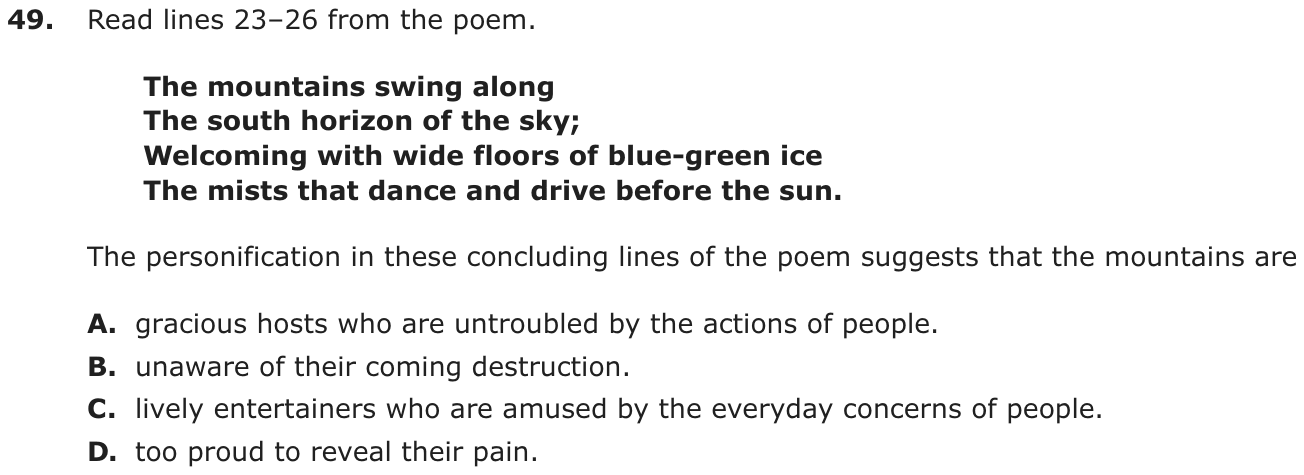
Question 41 of 57
2020 Test A English, question 41Passage Excerpt from A Voice in the Wilderness
Excerpt from A Voice in the Wilderness
by Grace Livingston Hill
With a lurch the train came to a dead stop and Margaret Earle, hastily gathering up her belongings, hurried down the aisle and got out into the night.
It occurred to her, as she swung her heavy suit-case down the rather long step to the ground, and then carefully swung herself after it, that it was strange that neither conductor, brakeman, nor porter had come to help her off the train, when all three had taken the trouble to tell her that hers was the next station; but she could hear voices up ahead. Perhaps something was the matter with the engine that detained them and they had forgotten her for the moment.
The ground was rough where she stood, and there seemed no sign of a platform. Did they not have platforms in this wild Western land, or was the train so long that her car had stopped before reaching it?
She strained her eyes into the darkness, and tried to make out things from the two or three specks of light that danced about like fireflies in the distance. She could dimly see moving figures away up near the engine, and each one evidently carried a lantern. The train was tremendously long. A sudden feeling of isolation took possession of her. Perhaps she ought not to have got out until some one came to help her. Perhaps the train had not pulled into the station yet and she ought to get back on it and wait. Yet if the train started before she found the conductor she might be carried on somewhere and he justly blame her for a fool.
There did not seem to be any building on that side of the track. It was probably on the other, but she was standing too near the cars to see over. She tried to move back to look, but the ground sloped and she slipped and fell in the cinders, bruising her knee and cutting her wrist.
In sudden panic she arose. She would get back into the train, no matter what the consequences. They had no right to put her out here, away off from the station, at night, in a strange country. If the train started before she could find the conductor she would tell him that he must back it up again and let her off. He certainly could not expect her to get out like this.
She lifted the heavy suit-case up the high step that was even farther from the ground than it had been when she came down, because her fall had loosened some of the earth and caused it to slide away from the track. Then, reaching to the rail of the step, she tried to pull herself up, but as she did so the engine gave a long snort and the whole train, as if it were in league against her, lurched forward crazily, shaking off her hold. She slipped to her knees again, the suit-case, toppled from the lower step, descending upon her, and together they slid and rolled down the short bank, while the train . . . ran giddily off into the night.
The horror of being deserted helped the girl to rise in spite of bruises and shock. She lifted imploring hands to the unresponsive cars as they hurried by her—one, two, three, with bright windows, each showing a passenger, comfortable and safe inside, unconscious of her need.
A moment of useless screaming, running, trying to attract some one’s attention, a sickening sense of terror and failure, and the last car slatted itself past with a mocking clatter, as if it enjoyed her discomfort.
Margaret stood dazed, reaching out helpless hands, then dropped them at her sides and gazed after the fast-retreating train, the light on its last car swinging tauntingly, blinking now and then with a leer in its eye, rapidly vanishing from her sight into the depth of the night.
She gasped and looked about her for the station that but a short moment before had been so real to her mind; and, lo! on this side and on that there was none!
The night was wide like a great floor shut in by a low, vast dome of curving blue set with the largest, most wonderful stars she had ever seen. Heavy shadows of purple-green, smoke-like, hovered over earth darker and more intense than the unfathomable blue of the night sky. It seemed like the secret nesting-place of mysteries wherein no human foot might dare intrude. It was incredible that such could be but common sage-brush, sand, and greasewood wrapped about with the beauty of the lonely night.
No building broke the inky outlines of the plain, nor friendly light streamed out to cheer her heart. Not even a tree was in sight, except on the far horizon, where a heavy line of deeper darkness might mean a forest. Nothing, absolutely nothing, in the blue, deep, starry dome above and the bluer darkness of the earth below save one sharp shaft ahead like a black mast throwing out a dark arm across the track.
As soon as she sighted it she picked up her baggage and made her painful way toward it, for her knees and wrist were bruised and her baggage was heavy.
A soft drip, drip greeted her as she drew nearer; something plashing down among the cinders by the track. Then she saw the tall column with its arm outstretched, and looming darker among the sage-brush the outlines of a water-tank. It was so she recognized the engine’s drinking-tank, and knew that she had mistaken a pause to water the engine for a regular stop at a station.
cinders: track bed made from the residue of burnt coal
From A VOICE IN THE WILDERNESS by Grace Livingston Hill—Public Domain
Question
In paragraph 2, how does the phrase “when all three had taken the trouble to tell her” affect the tone in the first part of the excerpt?
- AIt creates an accusatory tone by suggesting that Margaret believes that others are responsible for her problem.
- BIt introduces a defiant tone by suggesting that Margaret left the train early to prove a point.
- CIt suggests a frustrated tone by showing that Margaret feels confused by the inconsistent help offered by the railroad employees.
- DIt establishes an appreciative tone by showing that Margaret feels cared for by the railroad employees.
Show the answer
Correct answer: C
The question asks how the phrase affects the tone in the first part of the excerpt. The phrase includes the words “all three” and “taken the trouble,” emphasizing Margaret’s early frustration as she recalls with some confused irritation that the men thought she needed an abundance of help earlier, but none of them is around to help when the train stops, as indicated in Option C.
Option A is incorrect because when Margaret recalls the interaction, there is no indication that she blames the men for her current problem.
Option B is incorrect because, while the description of how Margaret “hastily [gathers] up her belongings” and “[hurries] down the aisle” (paragraph 1) gives the appearance of being defiant, there is no evidence that she intentionally put herself in this vulnerable position just to make a point.
Option D is incorrect because when Margaret recalls the interaction, there is no evidence that she appreciates the care shown to her, but rather she seems a bit offended that the men do not think she could take care of herself, as shown by the author’s description of the forceful way she exits the train without assistance when it stops.
Question analysis
This tone question looks at a phrase from the opening of Grace Livingston Hill’s novel A Voice in the Wilderness, as Margaret Earle steps off a train at night. Students decide what attitude the phrase about the three railroad men creates. The wording is low-key and old-fashioned, which makes the attitude behind it easy to misjudge.
- Grade level
- Grade 8 reading and task
- Compared with grade 7
- Above grade 7 Grade 7 tone questions usually rest on clearly charged words; this one hinges on an understated phrase in century-old prose. Students must read how Margaret feels about the trainmen from context, without help from any strongly worded clue.
- Estimated difficulty
- Hard: combines ideas, needs a plan, and has more than one tempting wrong answer.
- Thinking it demands
- Depth of knowledge 2, skills and concepts · mainly analyze
- What makes it hard
- A very close wrong answer major
- Complex sentences moderate
- Reading between the lines moderate
- Hard words minor
- Evidence
- Answered from one paragraph or stanza
- Reading level
- Passage: about grade 8, 981 words; question and choices: about grade 10, 96 words.
- Students, last 30 days
- Not enough answers yet to show (it takes 10).
Why it is hard, traps and wrong answers (shows the answer)
Why it is hard
The phrase is understated, and old-fashioned wording hides how Margaret feels. Students who sense criticism of the trainmen often push it too far into blame, which she does not reach until paragraph 6, while those who take “taken the trouble” at face value hear gratitude. The question rewards reading the whole sentence: “it was strange” and her quick excuse about engine trouble show puzzlement and mild irritation, not accusation.
A very close wrong answer major Choosing the answer
The accusatory choice and the frustrated choice both find a negative attitude toward the railroad employees; only the degree separates them, since Margaret calls their absence “strange” and excuses it rather than blaming them. (Embretson & Wetzel, 1987; Gorin & Embretson, 2006; Ascalon et al., 2007)
Complex sentences moderate Understanding the question
The phrase sits deep inside a 66-word sentence that opens with her swinging the suit-case down and closes with voices up ahead, so its contrast is easy to lose. (Abedi & Lord, 2001; Freedle & Kostin, 1993; Messick, 1989)
Reading between the lines moderate Working it out
Margaret never says she is annoyed; the feeling comes from the contrast between “all three had taken the trouble to tell her” and none of them coming to help. (Graesser, Singer & Trabasso, 1994; Kintsch, 1998)
Hard words minor Understanding the question
Each choice turns on a tone word, “accusatory,” “defiant,” “frustrated,” “appreciative,” and students unsure of these labels cannot match them to the scene. (Perfetti, 2007; Freedle & Kostin, 1993)
Strategy: Reread the full sentence the phrase sits in, ask how Margaret feels about the three men at this moment, and match both the feeling and its reason to a choice.
Traps
- Too broad or too strong: A choice overstates, generalizes, or uses absolute words the text does not support.
- Wrong tone or attitude: Misjudges the tone, attitude or point of view, such as reading admiration as criticism, or taking a character's or subject's feelings for the author's.
The wrong answers, classified
A Too broad or too strong (King et al., 2004)
Rightly hears criticism of the three trainmen but inflates puzzlement into blame; she even excuses them with possible engine trouble, and only in paragraph 6 thinks “They had no right.”
B Reads too much in (Graesser, Singer & Trabasso, 1994)
Builds a story of defiance from her hasty exit in paragraph 1, though nothing suggests she left the train early to prove anything to anyone.
D Wrong tone or attitude (Graesser, Singer & Trabasso, 1994)
Takes “taken the trouble” as gratitude for the men’s care, reading the phrase on its own and missing the sentence’s point that none of them came to help.
Working it out, step by step
Figure out what the question asks
This asks about tone: the feeling or attitude that the words give. What does one phrase show about how Margaret feels toward the train workers?
Read the whole sentence
In paragraph 2, Margaret thinks “it was strange that neither conductor, brakeman, nor porter had come to help her off the train, when all three had taken the trouble to tell her that hers was the next station.”
Work out the feeling
A conductor, a brakeman and a porter are train workers. To take the trouble means to make an effort. All three made an effort to tell her about her stop. But now none of them comes to help. That doesn’t add up, and she calls it “strange.” She feels puzzled and a bit annoyed. That is frustration.
She even makes excuses for them: “Perhaps something was the matter with the engine.” So she is not blaming them.
Check each choice
- A is wrong. “Accusatory” means blaming. Margaret makes excuses for the workers instead.
- B is wrong. “Defiant” means boldly refusing to obey. Nothing shows she left the train to prove a point.
- C is right. The workers were helpful at first and then vanished. She is confused and frustrated.
- D is wrong. “Appreciative” means thankful. The point is that nobody came to help.
Watch out: A is tempting because she does find the workers’ absence odd. But odd is not the same as their fault.
Choose the answer
The phrase shows Margaret puzzled by help that came and then disappeared. So the answer is C.
Why this answer and not the closest wrong one
A is the closest wrong answer, because both A and C find something negative in her thoughts. But A goes too far. Margaret does not blame the workers. She guesses they “had forgotten her for the moment.” She is puzzled, not accusing, as C says.
More questions like this
The original DOE question
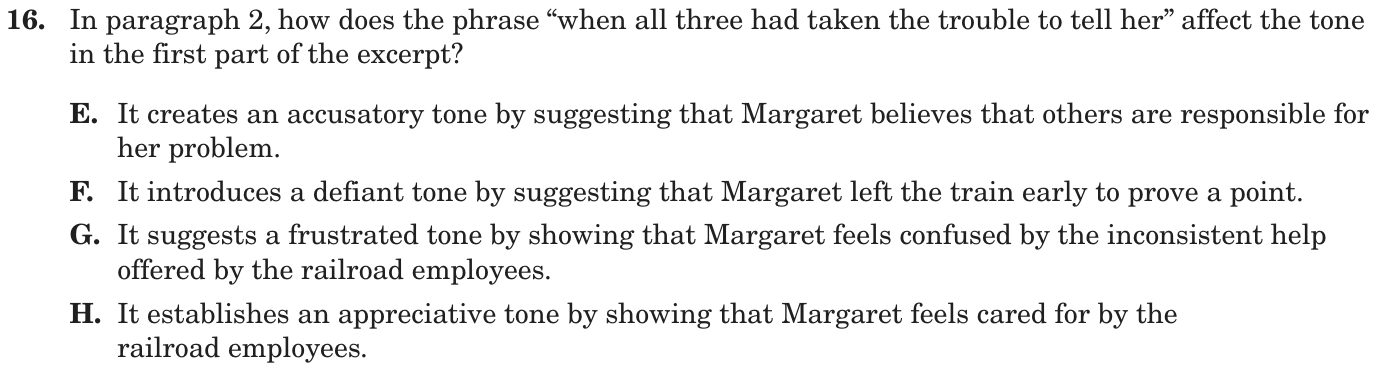
The passage “Excerpt from A Voice in the Wilderness” as printed (pages 128–129)
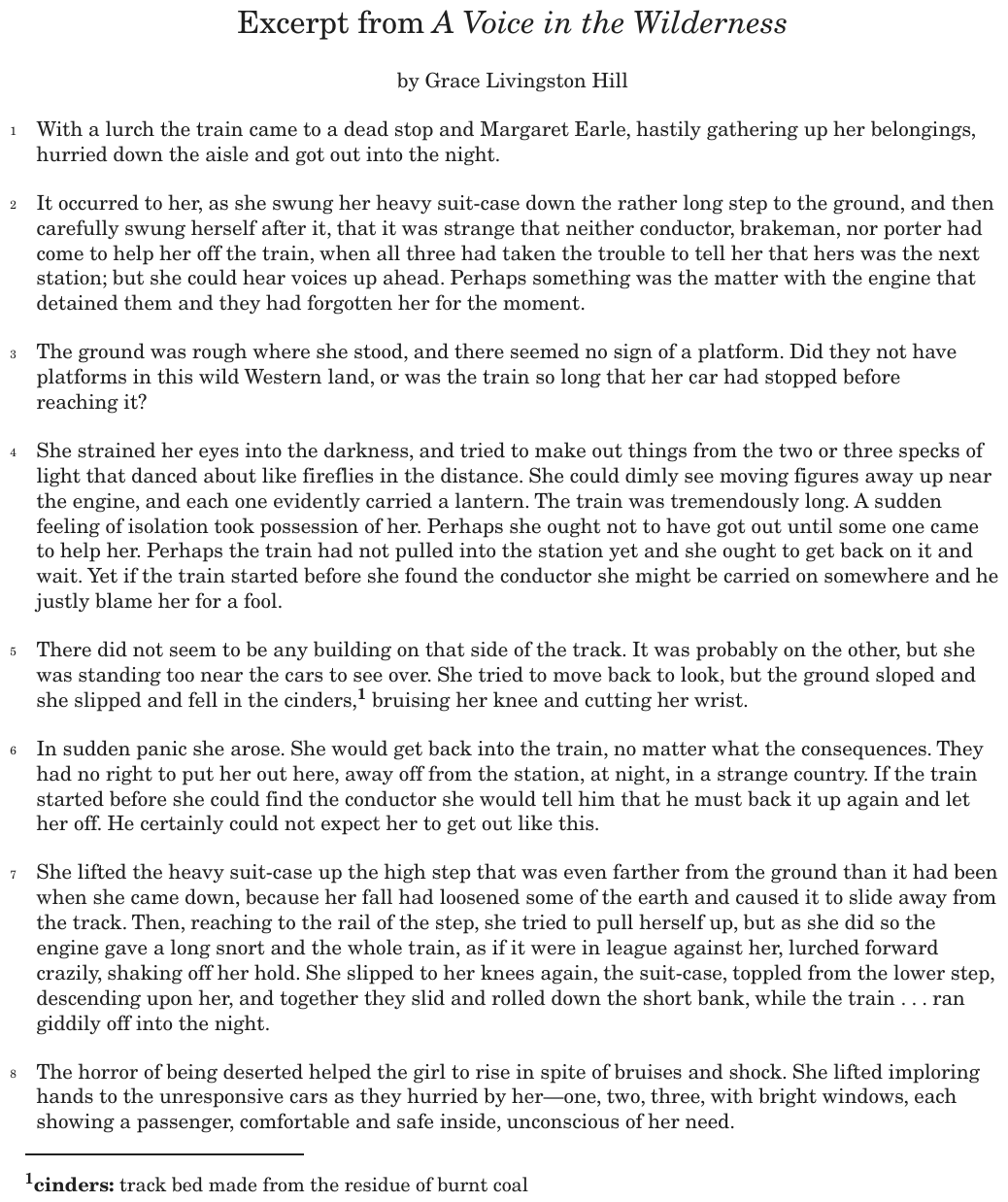
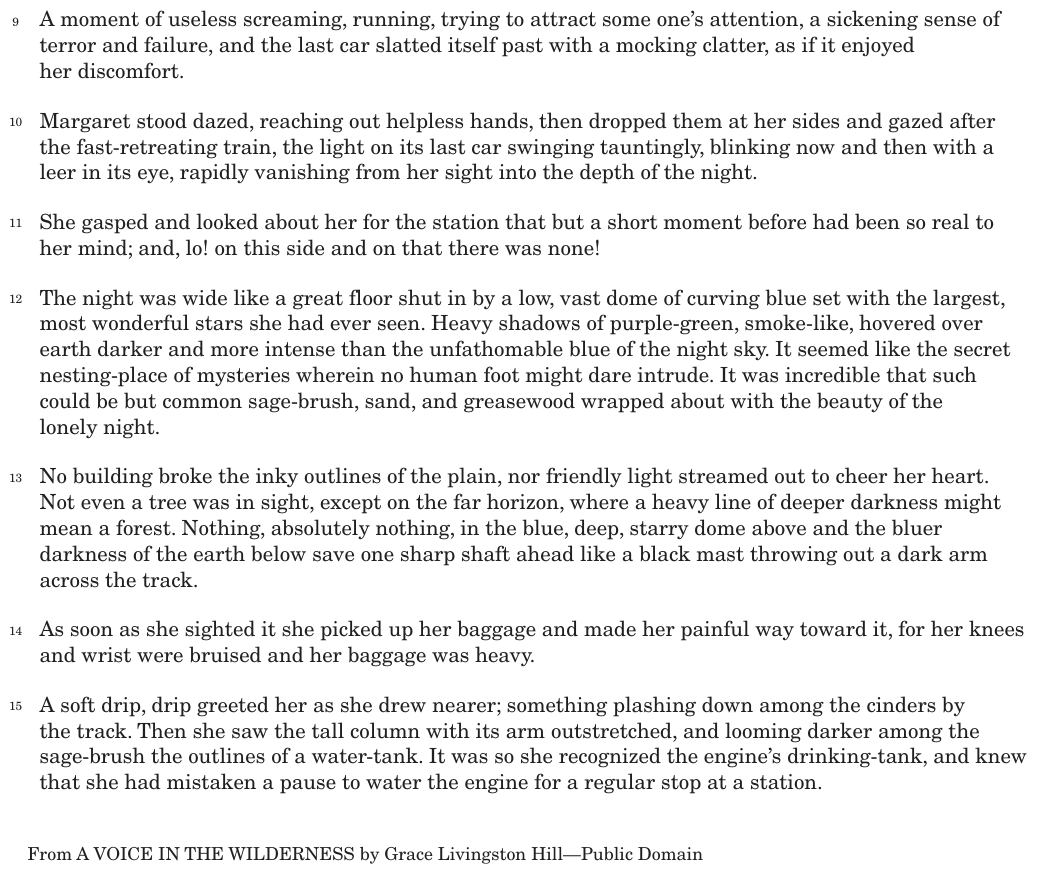
Question 42 of 57
2020 Test A English, question 42Uses the passage above: “Excerpt from A Voice in the Wilderness”.
Question
Which sentence from the excerpt best supports the idea that Margaret is unaccustomed to traveling to new places by train?
- A“With a lurch the train came to a dead stop and Margaret Earle, hastily gathering up her belongings, hurried down the aisle and got out into the night.” (paragraph 1)
- B“Perhaps something was the matter with the engine that detained them and they had forgotten her for the moment.” (paragraph 2)
- C“Did they not have platforms in this wild Western land, or was the train so long that her car had stopped before reaching it?” (paragraph 3)
- D“She could dimly see moving figures away up near the engine, and each one evidently carried a lantern.” (paragraph 4)
Show the answer
Correct answer: C
The question asks for evidence from the excerpt that best supports the idea that Margaret is unfamiliar with traveling to new places by train.
A. Incorrect. Margaret’s actions in the sentence from paragraph 1 are decisive as she gathers her belongings to exit the train; she is familiar with rail travel.
B. Incorrect. In the sentence from paragraph 2, Margaret is using her knowledge about trains to attempt to interpret the actions of others; she is familiar with trains, even if a particular destination has not been mentioned.
C. CORRECT. If Margaret has never traveled to this region by train before, she must guess or attempt to interpret what she sees. This idea is best represented in the sentence in paragraph 3 where she questions whether the stations in the West have platforms.
D. Incorrect. While the sentence from paragraph 4 shows that Margaret is trying to better understand her situation in the darkness, her ability to identify the train’s engine and the figures carrying lanterns indicates some familiarity with her mode of travel.
Question analysis
Students choose the sentence from Grace Livingston Hill’s A Voice in the Wilderness that best supports the idea that Margaret is unaccustomed to traveling to new places by train. The four choices come from paragraphs 1–4, as she steps down from the train into the dark. Each reveals something about her, so students must test them against this one idea.
- NYS standards
- 7R1 textual evidence and inferences
- Grade level
- Grade 7 reading and task
- Compared with grade 7
- At grade 7 A typical grade 7 evidence task: the four quotations come from the opening paragraphs and carry paragraph numbers. The challenge is that several show Margaret unsure of herself, so students must match the specific idea in the claim, not any sign of doubt.
- Estimated difficulty
- Moderate: several steps, or a close reading with one strong distractor.
- Thinking it demands
- Depth of knowledge 2, skills and concepts · mainly evaluate
- What makes it hard
- Every choice must be checked moderate
- Reading between the lines minor
- Evidence
- Answered from several paragraphs or stanzas
- Reading level
- Passage: about grade 8, 981 words; question and choices: about grade 11, 113 words.
- Students, last 30 days
- Not enough answers yet to show (it takes 10).
Why it is hard, traps and wrong answers (shows the answer)
Why it is hard
Uncertainty runs through all four quotations, so the general mood of the opening cannot pick the answer. The claim is specific, a traveler new to such places, and only one sentence ties her confusion to the region itself rather than to a delay, the darkness or her haste. Students who match feelings instead of the claim usually settle on her guess about engine trouble.
Every choice must be checked moderate Choosing the answer
All four quotations, from paragraphs 1 to 4, show Margaret unsure in the dark, so each has to be tested against the narrower idea of someone new to this kind of journey. (Embretson & Wetzel, 1987)
Reading between the lines minor Working it out
No sentence says Margaret is new to the West; students must infer it from her puzzled question whether stations in “this wild Western land” lack platforms. (Graesser, Singer & Trabasso, 1994; Kintsch, 1998)
Strategy: Restate the claim in your own words, then ask of each quotation whether it proves that idea specifically or only shows some other feeling Margaret has at that moment.
Traps
- Supports only part of the claim: In a question about evidence: a line that backs one half of the claim but not the other, or a related point rather than the claim itself.
The wrong answers, classified
A Supports only part of the claim (King et al., 2004; Thissen, Steinberg & Fitzpatrick, 1989)
Reads her hurried exit as a nervous newcomer’s, though “hastily gathering up her belongings” shows someone who knows what to do when her stop is called.
B Supports only part of the claim (King et al., 2004; Thissen, Steinberg & Fitzpatrick, 1989)
Hears doubt in “Perhaps something was the matter with the engine,” but guessing at the cause of a delay is how an experienced rider reasons, not a newcomer puzzling over a place.
D Supports only part of the claim (King et al., 2004; Thissen, Steinberg & Fitzpatrick, 1989)
Notices the guesswork in “dimly” and “evidently,” but the darkness causes it, and she still picks out the engine and the crew’s lanterns, which shows she knows trains.
Working it out, step by step
Figure out what the question asks
This asks for evidence: the sentence that best supports an idea. The idea is that Margaret is unaccustomed to traveling to new places by train. Unaccustomed means not used to something. So look for a sentence where a new place puzzles her.
Notice what the choices share
All four sentences come from paragraphs 1 to 4, just after Margaret steps off the train at night. In most of them she is unsure. So feeling unsure is not enough. The right sentence must tie her confusion to the strange place itself.
Look closely at paragraph 3
Paragraph 3 asks “Did they not have platforms in this wild Western land, or was the train so long that her car had stopped before reaching it?” A platform is the raised floor beside the tracks where people get on and off. Margaret wonders if stations out West even have them. She does not know how things work in this region. That shows she is not used to traveling here.
Check each choice
- A does not fit. She is “hastily gathering up her belongings,” which means in a hurry. She knows what to do when her stop comes.
- B does not fit. Guessing about engine trouble is how someone who knows trains would think.
- C fits. She does not know what stations are like in this new land.
- D does not fit. The dark makes it hard to see. Yet she still picks out the engine and the lanterns.
Watch out: B begins with “Perhaps,” so it sounds unsure. But her doubt is about the train, not the place.
Choose the answer
Only the question about platforms shows that this place is unfamiliar to her. So the answer is C.
Why this answer and not the closest wrong one
B is the closest wrong choice, since Margaret is unsure in it too. But there she reasons like an experienced rider: maybe the engine broke down. In C, she wonders what stations are like in “this wild Western land.” Only C shows a traveler who is not used to new places.
More questions like this
The original DOE question
Question 43 of 57
2020 Test A English, question 43Uses the passage above: “Excerpt from A Voice in the Wilderness”.
Question
Read this sentence from paragraph 4.
She strained her eyes into the darkness, and tried to make out things from the two or three specks of light that danced about like fireflies in the distance.
The simile used in the sentence affects the tone of the paragraph by emphasizing a
- Afeeling of comfort as Margaret connects her unfamiliar surroundings with familiar images.
- Bsense of lonesomeness as Margaret realizes that she is on her own in the wilderness.
- Csense of tranquility as Margaret is distracted from the urgency of her situation by the beauty of the night.
- Dfeeling of dread as Margaret regards the desolation of the land that surrounds her.
Show the answer
Correct answer: B
The question asks how the simile in the sentence from paragraph 4 reflects the tone of the paragraph. The image of two or three fireflies creating small specks of light in the darkness creates a sense of isolation or loneliness in Margaret, as shown in the sentence, “A sudden feeling of isolation took possession of her” (paragraph 4). Therefore, Option B is correct.
Option A is incorrect because Margaret is confused and indecisive, showing her discomfort with her situation.
Option C is incorrect because Margaret expresses distress in her situation, questions her decision, and worries about being labeled a “fool” (paragraph 4).
Option D is incorrect because the simile is meant to show how far away things are from Margaret, not create a feeling of dread, which develops later in paragraph 9.
Question analysis
This figurative-language question asks how a simile comparing distant lights to fireflies affects the tone of paragraph 4 in A Voice in the Wilderness. Students connect the image to Margaret’s state of mind as she stands beside the stopped train in the dark. The choices range from calm to fear, so the answer must rest on what Margaret is thinking.
- Grade level
- Grade 7 reading and task
- Compared with grade 7
- At grade 7 Explaining how a simile shapes tone is regular grade 7 work with figurative language, and this one is typical. Students must read the comparison in the light of the paragraph around it, since the image alone could suggest several moods.
- Estimated difficulty
- Moderate: several steps, or a close reading with one strong distractor.
- Thinking it demands
- Depth of knowledge 2, skills and concepts · mainly analyze
- What makes it hard
- A very close wrong answer moderate
- Figurative or literary language moderate
- Hard words minor
- Evidence
- Answered from one paragraph or stanza
- Reading level
- Passage: about grade 8, 981 words; question and choices: about grade 9, 109 words.
- Students, last 30 days
- Not enough answers yet to show (it takes 10).
Why it is hard, traps and wrong answers (shows the answer)
Why it is hard
The simile itself is gentle, which is why the comforting reading tempts some students, but the paragraph around it is not: two sentences later, “A sudden feeling of isolation took possession of her.” That sentence decides the question. The harder choice is between loneliness now and the dread and desolation that come after the train has gone, so the question rewards keeping to paragraph 4.
A very close wrong answer moderate Choosing the answer
The dread choice is built like the lonesomeness choice, a feeling plus Margaret alone in empty country, “the desolation of the land” beside “on her own in the wilderness”; only the feeling named, dread rather than loneliness, separates them. (Embretson & Wetzel, 1987; Gorin & Embretson, 2006; Ascalon et al., 2007)
Figurative or literary language moderate Understanding the question
Fireflies are usually a cheerful, homey image, so students must read the simile through its setting, “two or three specks of light” far off in the dark, to see that it stresses distance. (Graesser, Singer & Trabasso, 1994; Kintsch, 1998)
Hard words minor Understanding the question
The choices hinge on near-synonyms for feelings, “lonesomeness,” “tranquility,” “dread” and “desolation,” whose shades of meaning have to be weighed against one paragraph. (Perfetti, 2007; Freedle & Kostin, 1993)
Strategy: Picture the scene the comparison creates, then reread paragraph 4 around it and choose the feeling that the paragraph itself supports.
Traps
- Wrong part of the text: A choice is true of another paragraph, stanza or speaker than the one asked about.
- Taking figurative language literally: A choice reads a figure of speech or image at face value.
The wrong answers, classified
A Taking figurative language literally (Graesser, Singer & Trabasso, 1994)
Takes fireflies at face value as a cozy, familiar image, but Margaret is straining to see and wondering whether she should have left the train, hardly comforted.
C Wrong part of the text (Kirsch & Mosenthal, 1990)
Brings in the beauty of the night, which belongs to paragraph 12’s stars and sky after the train has gone, not to this anxious moment beside it.
D Wrong part of the text (Kirsch & Mosenthal, 1990)
Moves ahead to the dread and desolate land of paragraphs 9 to 13, after the train leaves; here the faraway lights stress distance and a first feeling of isolation.
Working it out, step by step
Figure out what the question asks
This asks about a simile: a comparison that uses “like” or “as.” How does this simile shape the tone, or feeling, of paragraph 4?
Find the simile
Margaret looks into the dark and sees “two or three specks of light that danced about like fireflies in the distance.” The far-off lights are compared to fireflies.
Picture what it shows
Fireflies are tiny lights. Here there are only two or three, and they are far away. Everything else is dark. The picture makes Margaret seem small and far from other people. A few lines later, the paragraph says it: “A sudden feeling of isolation took possession of her.” Isolation means being alone and cut off.
Check each choice
- A is wrong. Fireflies can seem cozy, but Margaret is straining to see. She feels alone, not comforted.
- B is right. The tiny, faraway lights stress that she is on her own.
- C is wrong. The beauty of the night comes later, in paragraph 12. Here she is worried.
- D is wrong. Dread and the empty land come later, after the train leaves.
Watch out: D jumps ahead. Her terror starts in paragraph 9, and the empty land appears in paragraphs 12 and 13. Both come after the train is gone.
Choose the answer
The few faraway specks of light in the dark make Margaret feel small and alone. So the answer is B.
Why this answer and not the closest wrong one
D is the closest wrong answer, because Margaret does feel dread later in the story. But in paragraph 4 the train is still there, and the land has not been described yet. The paragraph names the feeling itself: “a sudden feeling of isolation.” Lonesomeness matches that.
More questions like this
The original DOE question
Question 44 of 57
2020 Test A English, question 44Uses the passage above: “Excerpt from A Voice in the Wilderness”.
Question
How do Margaret’s earlier interactions with the conductor, brakeman, and porter affect the plot?
- AThey prompt Margaret to get off the train without further assistance.
- BThey cause Margaret to think that she knows what to do once she gets off the train.
- CThey compel Margaret to wonder whether the train has not pulled all the way into the station.
- DThey lead Margaret to believe that train stations in rural areas lack platforms.
Show the answer
Correct answer: A
The question asks how Margaret’s earlier interactions with the conductor, brakeman, and porter affect the plot.
A. CORRECT. Because the conductor, brakeman, and porter have all “taken the trouble to tell her that hers was the next station” (paragraph 2), Margaret assumes that the next time the train stops, she will have reached her station. This assumption causes Margaret to get off the train at the next stop without waiting for help or confirmation, but the stop turns out to be just “a pause to water the engine” (paragraph 15). This mistaken assumption creates the main problem that Margaret confronts in the passage.
B. Incorrect. Although Margaret’s earlier interactions with the three railroad employees cause her to think that she knows when to get off the train, it is clear from paragraph 4 that Margaret is deeply confused and does not know what to do once she has exited the train car. She muses uneasily, “Perhaps she ought not to have got out until some one came to help her. Perhaps the train had not pulled into the station yet and she ought to get back on it and wait” (paragraph 4).
C. Incorrect. Margaret wonders in paragraph 3 whether the train is “so long that her car had stopped before reaching [the station]” and speculates in paragraph 4 that “the train had not pulled into the station yet.” These thoughts reflect her assumption (based on her interactions with the three railroad employees) that the next stop is her station. However, Margaret’s speculation that the train has not fully pulled into the station does not significantly affect the plot.
D. Incorrect. Margaret wonders in paragraph 3 whether they “have platforms in this wild Western land” and is expecting to see a platform because her interactions with the three railroad employees have led her to believe that she has reached a station. However, it is unclear whether Margaret really believes that rural stations all lack platforms, and her speculation on this point is not further developed in the passage and does not affect the plot.
Question analysis
This plot question on A Voice in the Wilderness asks how Margaret’s earlier dealings with the conductor, brakeman and porter, mentioned only in passing in paragraph 2, affect what happens to her. Students must connect that brief remark to later events in the excerpt. Several choices describe things that do happen, so students must judge which one those conversations truly cause.
- Grade level
- Grade 8 reading and task
- Compared with grade 7
- Above grade 7 Grade 7 plot questions ask how story elements affect one another, usually through an event and its result. Here the cause is a clause inside a long sentence of century-old prose, and students must trace its effect across the excerpt rather than within one paragraph.
- Estimated difficulty
- Hard: combines ideas, needs a plan, and has more than one tempting wrong answer.
- Thinking it demands
- Depth of knowledge 3, strategic thinking · mainly analyze
- What makes it hard
- Evidence in several places moderate
- Reading between the lines moderate
- Complex sentences minor
- Evidence
- Answered from the whole text
- Reading level
- Passage: about grade 8, 981 words; question and choices: about grade 7, 72 words.
- Students, last 30 days
- Not enough answers yet to show (it takes 10).
Why it is hard, traps and wrong answers (shows the answer)
Why it is hard
The talks with the trainmen are mentioned once, in the middle of a long sentence, and the question asks students to see them as the start of the whole plot. Several choices describe thoughts Margaret really has right after she steps down, which makes them feel connected, but those thoughts change nothing. The point goes to students who trace cause to consequence: told her stop was next, she gets off alone at a water tank.
Evidence in several places moderate Working it out
The cause sits in paragraph 2, where all three men had told her “hers was the next station,” and the effect shows only in paragraph 15, when the stop proves to be a water tank. (Kirsch & Mosenthal, 1990; Gorin & Embretson, 2006)
Reading between the lines moderate Working it out
The excerpt never says the men’s words made her step off; students must infer that their assurance is why she left the train at the first stop without waiting for anyone. (Graesser, Singer & Trabasso, 1994; Kintsch, 1998)
Complex sentences minor Understanding the question
The interactions appear in a 66-word sentence in paragraph 2, tucked into a “when” clause after a run of commas, so they read as a passing detail rather than a cause. (Abedi & Lord, 2001; Freedle & Kostin, 1993; Messick, 1989)
Strategy: Reread paragraph 2 to find what the three men told Margaret, then trace how that information shapes the events that follow, and choose the effect that matters most to the plot.
Traps
- True but not the answer: A choice says something accurate about the text that does not answer this question.
- Twists what the text says: Uses the text's topic and ideas but changes what it says: who did it, how much, when, or why.
- Reads too much in: A reasonable-sounding conclusion that goes further than the text allows.
The wrong answers, classified
B Twists what the text says (King et al., 2004)
Rightly links the men’s words to her confidence about when to get off, but stretches it to knowing what to do afterward, when paragraph 4 shows her at a loss.
C True but not the answer (King et al., 2004; Embretson & Wetzel, 1987)
Names a real result of the men’s words, her guess in paragraphs 3 and 4 that the train has not yet reached the station, but that passing worry changes nothing in the plot.
D Reads too much in (Graesser, Singer & Trabasso, 1994)
Turns her puzzled question about platforms in “this wild Western land” into a firm belief about rural stations, an idea the excerpt never develops.
Working it out, step by step
Figure out what the question asks
This asks how something from earlier affects the plot. The plot is the chain of events in a story. What did the three train workers tell Margaret, and what did that cause?
Find what the workers told her
Paragraph 2 says it was strange that “neither conductor, brakeman, nor porter had come to help her off the train, when all three had taken the trouble to tell her that hers was the next station.” A conductor, a brakeman and a porter are all people who work on a train.
Trace what happened because of it
Three workers told her that her stop was next. So when the train stopped, she was sure she had arrived. She got off alone, without waiting for anyone to help. But in paragraph 15 she learns it was only “a pause to water the engine.” Their words set off the whole problem: she is left alone in the dark.
Check each choice
- A fits. Their words led her to get off by herself.
- B does not fit. They told her when to get off, not what to do next. In paragraph 4 she is lost: “Perhaps she ought not to have got out until some one came to help her.”
- C does not fit. She does wonder this, but the thought changes nothing in the story.
- D does not fit. She only asks a question about platforms. She never decides anything about country stations.
Choose the answer
The workers’ words made Margaret step off the train on her own at the wrong stop. So the answer is A.
Why this answer and not the closest wrong one
C is the closest wrong choice. The workers’ words do make her guess that the train has not reached the station yet. But that guess goes nowhere. What changes the story is that she gets off alone at a stop that is not a station. That is A.
More questions like this
The original DOE question
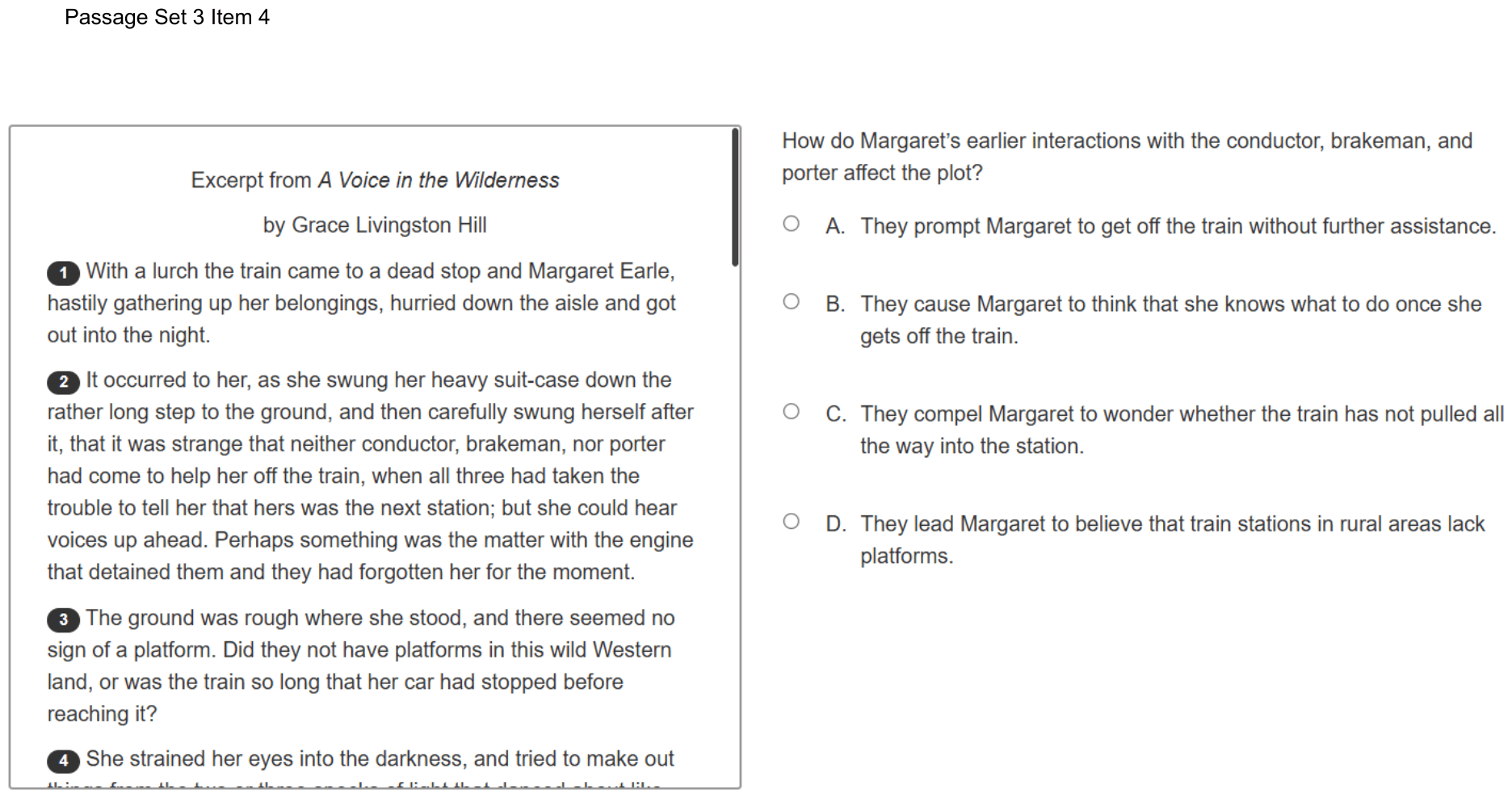
Question 45 of 57
2020 Test A English, question 45Uses the passage above: “Excerpt from A Voice in the Wilderness”.
Question
Read paragraph 9 from the excerpt.
A moment of useless screaming, running, trying to attract some one’s attention, a sickening sense of terror and failure, and the last car slatted itself past with a mocking clatter, as if it enjoyed her discomfort.
The imagery in this sentence conveys the
- Agrowing irritation Margaret feels as she is ignored by people on the train.
- Beffort Margaret is making despite being physically unable to keep up with the train.
- Canger that Margaret is experiencing as she watches the train leave without her.
- Dvulnerability Margaret feels as the train leaves her behind.
Show the answer
Correct answer: D
The question asks for an explanation of what the imagery in the excerpt from paragraph 9 conveys. The words “useless” and “failure” in the sentence indicate that Margaret’s best efforts do not help her. The phrase “the last car slatted itself past” shows that Margaret is helpless to stop the train from departing, which leaves her completely vulnerable, as described in Option D.
Option A is incorrect because describing Margaret’s “sickening sense of terror” indicates that she is extremely afraid of being left behind rather than increasingly irritated with the other passengers.
Option B is incorrect because Margaret spends her time “screaming, running, trying to attract some one’s attention” in an effort to be noticed so that the train will stop, not attempting to run as fast as the train.
Option C is incorrect because while Margaret’s screaming and running could easily suggest feelings of anger, descriptions of her “sickening sense of terror and failure” indicate otherwise.
Question analysis
This imagery question quotes paragraph 9 of A Voice in the Wilderness, a single long sentence describing the moment the last car of the train rattles past Margaret. Students decide what feeling the imagery conveys. The scene is full of action and noise, so it is easy to name an emotion that fits her behavior but not the words used.
- Grade level
- Grade 7 reading and task
- Compared with grade 7
- At grade 7 Reading imagery for a character’s feelings is everyday grade 7 work. Paragraph 9 is a single sentence with strong emotional words, so the task stays inside one sentence rather than ranging across the story.
- Estimated difficulty
- Straightforward: two steps or one careful reading.
- Thinking it demands
- Depth of knowledge 2, skills and concepts · mainly analyze
- What makes it hard
- Figurative or literary language moderate
- Complex sentences minor
- A very close wrong answer minor
- Evidence
- Answered from one paragraph or stanza
- Reading level
- Passage: about grade 8, 981 words; question and choices: about grade 9, 97 words.
- Corrected from the DOE handbook
- A misspelling of the main character’s name in the explanation was corrected.
- Students, last 30 days
- Not enough answers yet to show (it takes 10).
Why it is hard, traps and wrong answers (shows the answer)
Why it is hard
The sentence names Margaret’s feelings outright, “terror and failure,” and calls her screaming “useless,” so the question is mostly about trusting those words over the noisy action around them. Students who read the actions alone tend to name anger or irritation. Seeing that a train which seems to enjoy her distress makes her look powerless, not angry, is what leads to the right reading.
Figurative or literary language moderate Understanding the question
The last car “slatted itself past with a mocking clatter, as if it enjoyed her discomfort,” and students must see that the personified mockery stresses her helplessness, not her temper. (Graesser, Singer & Trabasso, 1994; Kintsch, 1998)
Complex sentences minor Understanding the question
Paragraph 9 is one 36-word sentence that lists fragments, “useless screaming, running” and “a sickening sense of terror and failure,” before its only main verb arrives. (Abedi & Lord, 2001; Freedle & Kostin, 1993; Messick, 1989)
A very close wrong answer minor Choosing the answer
The anger choice shares the right one’s frame, a feeling as the train leaves her behind, and differs only in the feeling named, which the sentence’s “terror and failure” settle. (Embretson & Wetzel, 1987; Gorin & Embretson, 2006; Ascalon et al., 2007)
Strategy: Pick out the words in the sentence that name feelings, along with what the personified train seems to do, and match the choice to those words.
Traps
- Wrong tone or attitude: Misjudges the tone, attitude or point of view, such as reading admiration as criticism, or taking a character's or subject's feelings for the author's.
- Twists what the text says: Uses the text's topic and ideas but changes what it says: who did it, how much, when, or why.
The wrong answers, classified
A Wrong tone or attitude (Graesser, Singer & Trabasso, 1994)
Rightly sees that no one notices her, but names irritation, a mild and growing annoyance, where the sentence speaks of a “sickening sense of terror.”
B Twists what the text says (King et al., 2004)
Treats her running as a race to keep pace with the train, though she runs and screams only “to attract some one’s attention” so the train will stop.
C Wrong tone or attitude (Graesser, Singer & Trabasso, 1994)
Reads the screaming and the train’s “mocking clatter” as signs of anger, overlooking “terror and failure,” the words the sentence uses for what she feels.
What was corrected from the DOE handbook, and why
- Explanation: The handbook spells the name “Margret” once, in the reason Option C is wrong. The passage and the rest of the explanation spell it “Margaret,” as the site now does.
Working it out, step by step
Figure out what the question asks
This asks about imagery: words that help you see, hear or feel a scene. What do the images in paragraph 9 show about Margaret?
Find the key words
Paragraph 9 describes “useless screaming, running, trying to attract some one’s attention.” She feels “a sickening sense of terror and failure.” Then “the last car slatted itself past with a mocking clatter, as if it enjoyed her discomfort.”
Work out what the words mean
“Useless” and “failure” tell you nothing she does works. “Terror” is great fear. The train even seems to mock her, like a mean person laughing. Giving human traits to a thing is called personification. All of this shows she is helpless. That feeling is vulnerability: being open to harm, with no way to protect yourself.
Check each choice
- A is wrong. Irritation is mild annoyance. The sentence says “terror.”
- B is wrong. She runs to get someone’s attention, not to keep up with the train.
- C is wrong. Screaming might suggest anger, but the sentence names “terror and failure.”
- D is right. She is helpless as the train leaves her behind.
Watch out: The train is “mocking,” which might make you think of anger. But it is the train that seems mean. Her own feelings are fear and failure.
Choose the answer
The images show a girl who can do nothing as the train leaves. So the answer is D.
Why this answer and not the closest wrong one
C is the closest wrong answer, because screaming and a mocking train can suggest anger. But the sentence names her feelings directly: “a sickening sense of terror and failure.” Those are the feelings of someone who is helpless, not angry. D matches those words.
More questions like this
The original DOE question
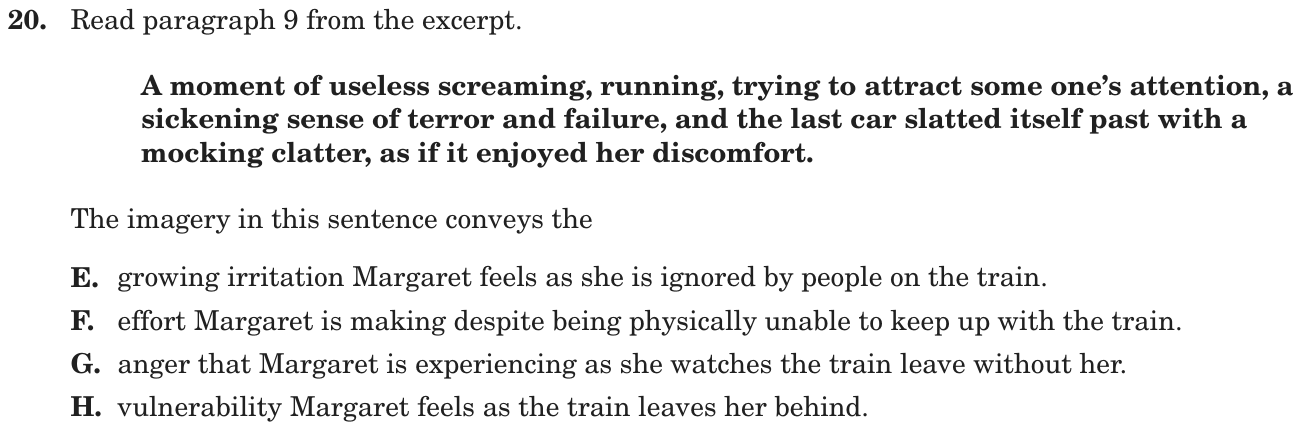
Question 46 of 57
2020 Test A English, question 46Uses the passage above: “Excerpt from A Voice in the Wilderness”.
Question
How does Margaret’s experience in paragraph 9 emphasize a theme of the excerpt?
- AIt confirms Margaret’s understanding that she cannot rely on help from anyone else.
- BIt leads Margaret to realize that her desire to change her situation is impractical.
- CIt causes Margaret to believe that her own actions led to an unfavorable outcome.
- DIt reinforces Margaret’s frustration about her lack of control over her surroundings.
Show the answer
Correct answer: A
The question asks about the relationship between the theme and paragraph 9, where Margaret desperately tries to get someone on the train to notice her.
A. CORRECT. One important theme of this excerpt concerns Margaret’s willingness to take action to ensure that she reaches her destination. This determination, described in Option A, is why she gathers her belongings together without help, gets off the train without being assisted by employees, and then attempts to climb back on while the train employees are busy examining the engine.
B. Incorrect. While the narrator describes her screaming as useless, she does not feel that her efforts overall are useless, and she does not give up until paragraph 10.
C. Incorrect. While Margaret is feeling a sense of “failure” in paragraph 9, she does not condemn herself as the train moves away.
D. Incorrect. Margaret expresses “terror” in paragraph 9 over being unable to catch someone’s attention, not frustration about her lack of control over her surroundings.
Question analysis
This theme question asks how Margaret’s experience in paragraph 9 of A Voice in the Wilderness, as she screams and runs while the train pulls away, emphasizes a theme of the excerpt. It is a lightly reworded version of an earlier handbook question. Every choice describes a believable reaction to being left behind, so the answer depends on the excerpt’s larger pattern.
- Grade level
- Grade 8 reading and task
- Compared with grade 7
- Above grade 7 Typical grade 7 theme questions trace a given theme through a text. Here students must decide which theme one frantic paragraph supports, and all four choices describe reactions that fit the scene, so the decision draws on the whole excerpt.
- Estimated difficulty
- Among the hardest on the SHSAT: a non-obvious approach, heavy reading, or a well-hidden trap.
- Thinking it demands
- Depth of knowledge 3, strategic thinking · mainly analyze
- What makes it hard
- Reading between the lines major
- Evidence in several places moderate
- Evidence
- Answered from the whole text
- Reading level
- Passage: about grade 8, 981 words; question and choices: about grade 10, 65 words.
- Students, last 30 days
- Not enough answers yet to show (it takes 10).
Why it is hard, traps and wrong answers (shows the answer)
Why it is hard
Each choice names a feeling a stranded traveler might have, and two lean on the paragraph’s own words, “useless” and “failure,” so the paragraph alone cannot decide it. Paragraph 9 must be read as the last link in a chain of trainmen, passengers and a departing train that all leave her to herself. Students who judge from that one paragraph often decide she has given up, though she soon picks up her bags and walks toward the dark shaft by the track.
Reading between the lines major Working it out
The theme is never stated; it must be drawn from paragraph 9’s cries that no one answers and from the passengers “comfortable and safe inside, unconscious of her need” in paragraph 8. (Graesser, Singer & Trabasso, 1994; Kintsch, 1998)
Evidence in several places moderate Working it out
The pattern begins in paragraph 2, when no trainman helps her off, and runs through the train lurching away “as if it were in league against her” in paragraph 7. (Kirsch & Mosenthal, 1990; Gorin & Embretson, 2006)
Strategy: Sum up in a phrase what keeps happening to Margaret from the start of the excerpt to its end, then check which choice paragraph 9’s own words most clearly add to.
Traps
- Too broad or too strong: A choice overstates, generalizes, or uses absolute words the text does not support.
- Wrong tone or attitude: Misjudges the tone, attitude or point of view, such as reading admiration as criticism, or taking a character's or subject's feelings for the author's.
The wrong answers, classified
B Too broad or too strong (King et al., 2004)
Stretches the “useless screaming” of one moment into a judgment that changing her situation is impractical, though she soon gathers her bags and sets off toward the shaft ahead.
C Reads too much in (Graesser, Singer & Trabasso, 1994)
Turns the “sense of terror and failure” into self-blame, though Margaret never says that her own choice to step off the train caused her trouble.
D Wrong tone or attitude (Graesser, Singer & Trabasso, 1994)
Fits the indifferent train, but names frustration over control where paragraph 9 stresses terror at being ignored by everyone aboard.
Working it out, step by step
Figure out what the question asks
This asks about a theme: a big idea a story keeps coming back to. How does what happens in paragraph 9 point to a theme? The right choice should fit a pattern across the whole excerpt.
Read paragraph 9
Paragraph 9 describes “A moment of useless screaming, running, trying to attract some one’s attention, a sickening sense of terror and failure.” Margaret screams and runs, trying to get someone to notice her. No one does. The last car rolls past “as if it enjoyed her discomfort.”
Find the same thing earlier
This is not the first time. In paragraph 2, none of the workers “had come to help her off the train.” In paragraph 8, the passengers sit “comfortable and safe inside, unconscious of her need.” That means they don’t know she needs help. Paragraph 9 is one more time when nobody comes. She will have to count on herself.
Check each choice
- A fits. Her cries go unanswered, just as before. She cannot rely on anyone else.
- B does not fit. Impractical means not sensible or workable. Her screaming fails, but she never decides that trying to change things is pointless. In paragraph 14 she “picked up her baggage” and set off again.
- C does not fit. She feels “failure,” but she never blames herself.
- D does not fit. The paragraph shows terror at being ignored, not frustration about having no control over her surroundings.
Choose the answer
Paragraph 9 adds one more moment where no one helps Margaret. So the answer is A.
Why this answer and not the closest wrong one
B is the closest wrong choice, because paragraph 9 calls her screaming “useless.” But one failed moment does not mean she gives up. Soon she takes her bags and walks toward the tall dark shape ahead. What stays true from paragraph 2 to paragraph 9 is that no one helps her. That is A.
More questions like this
The original DOE question
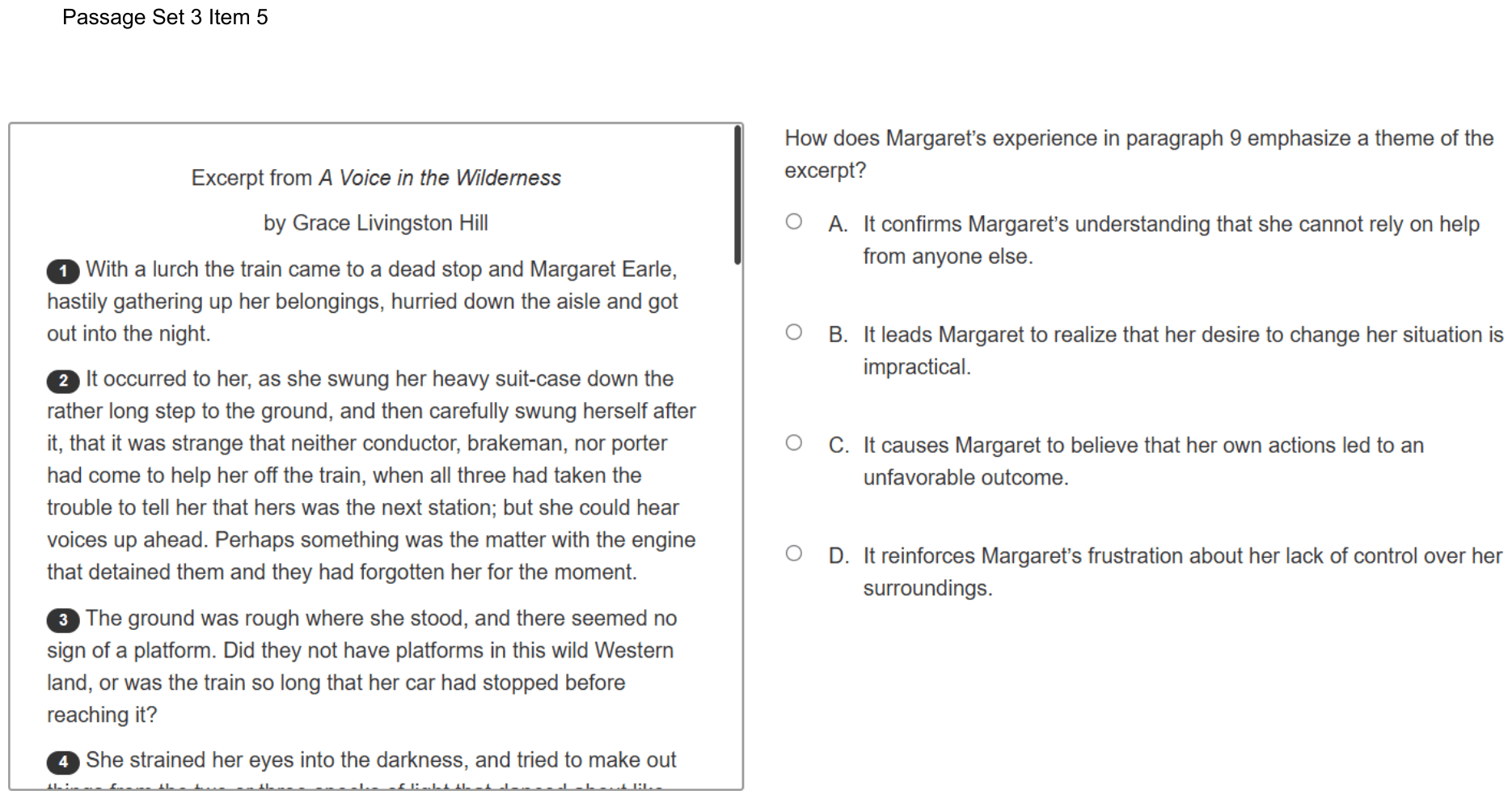
Question 47 of 57
2020 Test A English, question 47Uses the passage above: “Excerpt from A Voice in the Wilderness”.
Question
Read paragraph 10 from the excerpt.
Margaret stood dazed, reaching out helpless hands, then dropped them at her sides and gazed after the fast-retreating train, the light on its last car swinging tauntingly, blinking now and then with a leer in its eye, rapidly vanishing from her sight into the depth of the night.
What does the figurative language in this sentence emphasize?
- Athe sense of doubt that Margaret experiences when she is deciding what to do next
- Bthe anger that Margaret feels toward the people on the train who she expected to help her
- Cthe embarrassment that Margaret feels when she imagines what others will think of her
- Dthe hopelessness that Margaret feels when she accepts that the train is continuing on
Show the answer
Correct answer: D
The question asks for what the figurative language illustrates in the sentence. As Margaret stands and reaches out “helpless hands,” the language used to describe the train as “swinging tauntingly” and having “a leer in its eye” confirms Margaret’s fears of being left alone and feeling foolish; there is nothing she can do to change the situation, as expressed in Option D.
Option A is incorrect because, while the image of Margaret’s helpless hands dropping at her sides could suggest a sense of doubt, the figurative language in the sentence emphasizes a different feeling about her situation and does not indicate her intentions.
Option B is incorrect because, while the figurative language seems to give a malevolent quality to the train, it is not referring to the people onboard, who are described in paragraph 8 as “comfortable and safe inside, unconscious of her need.”
Option C is incorrect because, while Margaret is worried in paragraph 4 about embarrassing herself, she now feels “dazed” because she is overwhelmed with the seriousness of what has just happened.
Question analysis
This figurative-language question quotes paragraph 10 of A Voice in the Wilderness, where Margaret watches the train disappear and its light seems to taunt her. Students decide what the personification of the train emphasizes about her situation. The image is vivid but brief, so students need to link it to the feeling the whole paragraph builds.
- Grade level
- Grade 7 reading and task
- Compared with grade 7
- At grade 7 Interpreting personification is part of grade 7 work on figurative language. This sentence gives the train a leer and a taunting light, so students must decide whose feeling the image reflects, a step beyond naming the figure of speech.
- Estimated difficulty
- Moderate: several steps, or a close reading with one strong distractor.
- Thinking it demands
- Depth of knowledge 2, skills and concepts · mainly analyze
- What makes it hard
- Figurative or literary language moderate
- Complex sentences minor
- Evidence
- Answered from one paragraph or stanza
- Reading level
- Passage: about grade 8, 981 words; question and choices: about grade 8, 122 words.
- Students, last 30 days
- Not enough answers yet to show (it takes 10).
Why it is hard, traps and wrong answers (shows the answer)
Why it is hard
The figurative language belongs to the train, so students have to translate a taunting, leering light into a statement about Margaret’s state. Some read the taunt as the cause of an emotion, embarrassment or anger, instead of as a picture of how powerless she is. Her “helpless hands,” dropped to her sides as the light vanishes, confirm that she has accepted the train is gone.
Figurative or literary language moderate Understanding the question
The train’s light is personified, “swinging tauntingly, blinking now and then with a leer in its eye,” and students must decide what a mocking machine says about Margaret rather than about the train. (Graesser, Singer & Trabasso, 1994; Kintsch, 1998)
Complex sentences minor Understanding the question
Paragraph 10 is a single 48-word sentence that strings together participle phrases, “reaching out,” “swinging tauntingly,” “rapidly vanishing,” so the figurative part arrives only after her gestures. (Abedi & Lord, 2001; Freedle & Kostin, 1993; Messick, 1989)
Strategy: Find the phrases that give the train human traits, then ask what they add to the picture of Margaret standing by the track, using only this sentence.
Traps
- Wrong part of the text: A choice is true of another paragraph, stanza or speaker than the one asked about.
- Twists what the text says: Uses the text's topic and ideas but changes what it says: who did it, how much, when, or why.
The wrong answers, classified
A Reads too much in (Graesser, Singer & Trabasso, 1994)
Reads “dazed” and the dropped hands as doubt about her next step, though the sentence shows her watching the train vanish, not weighing what to do.
B Twists what the text says (King et al., 2004)
Transfers the train’s taunting leer to the people aboard, though paragraph 8 says the passengers were “unconscious of her need,” and nothing here shows anger at them.
C Wrong part of the text (Kirsch & Mosenthal, 1990)
Carries over paragraph 4’s worry that the conductor would “blame her for a fool,” a feeling the taunting light seems to echo, though she is now dazed rather than embarrassed.
Working it out, step by step
Figure out what the question asks
This asks about figurative language: words that mean more than their plain meaning. What feeling does it stress in paragraph 10?
Find the figurative language
Paragraph 10 describes the train’s last light “swinging tauntingly, blinking now and then with a leer in its eye.” Margaret stands “reaching out helpless hands, then dropped them at her sides.”
Work out what it means
“Tauntingly” means in a teasing, mean way. A leer is a nasty, sly look. A light can’t really tease anyone. The author gives the train human traits to show it is leaving her, and she can do nothing. When she drops her hands, she stops trying. She accepts that the train is gone. That feeling is hopelessness.
Check each choice
- A is wrong. She is not deciding what to do next. She is just watching the train go.
- B is wrong. The mean look belongs to the train, not the people. The passengers did not even know she needed help.
- C is wrong. She worried about looking foolish back in paragraph 4. Now she is “dazed.”
- D is right. Her dropped hands and the mocking light show she has lost hope.
Watch out: The teasing light may remind you of her fear of being called a fool. But that was earlier. Here she has lost all hope of stopping the train.
Choose the answer
The figurative language shows Margaret giving up as the train disappears. So the answer is D.
Why this answer and not the closest wrong one
C is the closest wrong answer, because a teasing train seems to fit embarrassment. But Margaret is not thinking about what others will say. She stands “dazed” and drops her “helpless hands.” The mocking light shows the train is gone for good. That is hopelessness, so D fits better.
More questions like this
The original DOE question
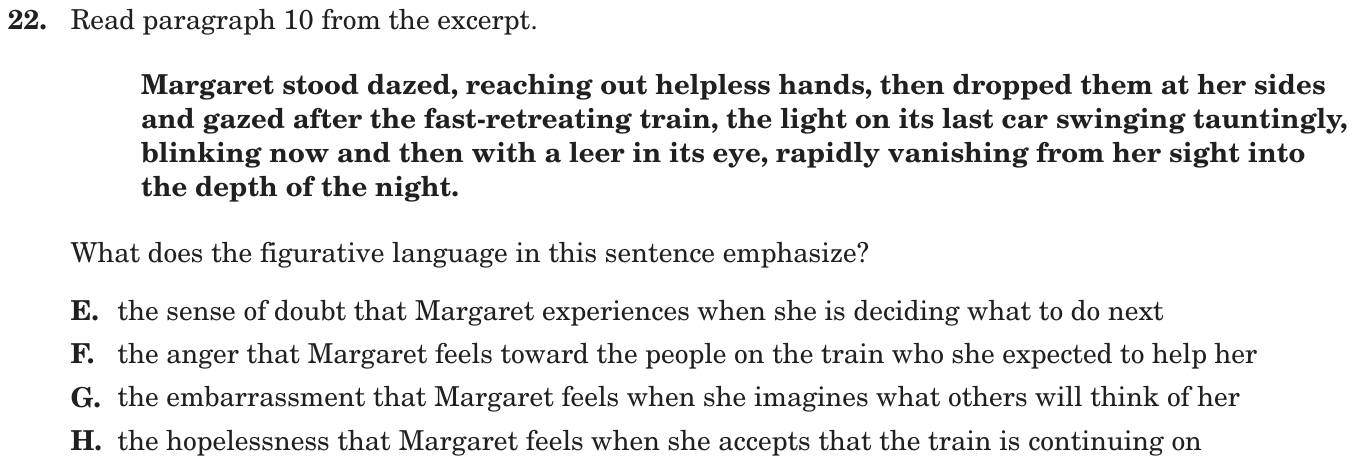
Question 48 of 57
2020 Test A English, question 48Uses the passage above: “Excerpt from A Voice in the Wilderness”.
Question
How does paragraph 11 contribute to the plot of the excerpt?
- AIt reveals that the reality of the situation is different from Margaret’s assumptions.
- BIt illustrates that Margaret’s main problem is her own imagination.
- CIt shows that Margaret is surprised by the unexpected adventure she is about to undertake.
- DIt provides insight into how Margaret reacts to stressful situations.
Show the answer
Correct answer: A
The question asks how paragraph 11 contributes to the plot of the excerpt.
A. CORRECT. In paragraph 5, Margaret assumes there is a station (“It was probably on the other [side], but she was standing too near the cars to see”), but in paragraph 11, the station that had been “so real” in Margaret’s mind actually does not exist.
B. Incorrect. Margaret’s main problem is not that her imagination has led her astray but rather that her inexperience with this train route has caused her to misinterpret the events that have occurred. Paragraph 11 reveals that she has been acting on faulty assumptions; however, her assumptions are somewhat justified by the events that have occurred.
C. Incorrect. While Margaret seems somewhat in awe of her surroundings in paragraph 12 and she “gasped” in paragraph 11, her exclamation is one of shock at the discovery, not surprise over an unexpected adventure.
D. Incorrect. While paragraph 11 describes how Margaret responds to the distressing situation that her actions and decisions have created, the paragraph does not offer insight into how Margaret generally responds to problems or conflicts.
Question analysis
This plot-structure question asks how paragraph 11 of A Voice in the Wilderness, a single exclaiming sentence that begins “She gasped,” contributes to the plot once Margaret is alone beside the track. Students relate the paragraph to what comes before and after it. Its archaic phrasing, with “lo!” and an inverted clause, makes the plain meaning harder to see.
- Grade level
- Grade 7 reading and task
- Compared with grade 7
- At grade 7 Explaining what a single paragraph adds to a plot is standard grade 7 structure work. Paragraph 11 is one short sentence, but its old-fashioned exclamation has to be linked to the paragraphs around it, which adds a step.
- Estimated difficulty
- Moderate: several steps, or a close reading with one strong distractor.
- Thinking it demands
- Depth of knowledge 2, skills and concepts · mainly analyze
- What makes it hard
- Evidence in several places moderate
- A very close wrong answer moderate
- Hard words minor
- Evidence
- Answered from several paragraphs or stanzas
- Reading level
- Passage: about grade 8, 981 words; question and choices: about grade 10, 58 words.
- Students, last 30 days
- Not enough answers yet to show (it takes 10).
Why it is hard, traps and wrong answers (shows the answer)
Why it is hard
Paragraph 11 is a single exclaiming sentence whose job is to overturn what Margaret, and the reader, have believed since she stepped down. Students who link it to her earlier guesses about a platform and a building see the reversal at once. Those who read it alone fasten on her gasp or on the words “so real to her mind,” and choose a reading about her character or her imagination rather than the plot.
Evidence in several places moderate Working it out
The assumption the paragraph overturns was built earlier: in paragraph 3 she wonders about a platform, and in paragraph 5 she decides the station is “probably on the other” side. (Kirsch & Mosenthal, 1990; Gorin & Embretson, 2006)
A very close wrong answer moderate Choosing the answer
The choice about her imagination and the right one both describe a gap between what Margaret pictured and what is there; they differ on whether the fault lies in her mind or in the missing station. (Embretson & Wetzel, 1987; Gorin & Embretson, 2006; Ascalon et al., 2007)
Hard words minor Understanding the question
The paragraph announces its reversal in old-fashioned words, “lo! on this side and on that there was none,” which students unused to such phrasing may read past. (Perfetti, 2007; Freedle & Kostin, 1993)
Strategy: Translate paragraph 11 into plain modern English, reread the paragraphs just before and after it, and judge each choice by what this paragraph itself shows.
Traps
- Twists what the text says: Uses the text's topic and ideas but changes what it says: who did it, how much, when, or why.
- Too broad or too strong: A choice overstates, generalizes, or uses absolute words the text does not support.
The wrong answers, classified
B Twists what the text says (King et al., 2004)
Seizes on “so real to her mind” and blames her imagination, though the station she expected is truly missing and the danger she faces is real.
C Wrong tone or attitude (Graesser, Singer & Trabasso, 1994)
Hears surprise in “gasped” and “lo!” but takes it for eagerness about an adventure, when it is shock at finding no station on either side.
D Too broad or too strong (King et al., 2004)
Makes a general claim about how Margaret handles stress, which could fit almost any paragraph, while this one reports a single discovery that turns the plot.
Working it out, step by step
Figure out what the question asks
This asks how paragraph 11 moves the plot, the chain of events, forward. What changes for Margaret in this paragraph?
Read paragraph 11
Paragraph 11 is one sentence: “She gasped and looked about her for the station that but a short moment before had been so real to her mind; and, lo! on this side and on that there was none!”
Put it in plain words
“Lo!” is an old word that means “Look!” The words “on this side and on that there was none” mean there was no station on either side of the track. Earlier, in paragraph 5, she guessed the building “was probably on the other” side. An assumption is something you believe without checking. Now she sees that her assumption was wrong. There is no station at all.
Check each choice
- A fits. What she assumed, a station, is different from what is real, no station.
- B does not fit. Her imagination is not the problem. The missing station is a real problem.
- C does not fit. Her gasp is shock, not excitement about an adventure.
- D does not fit. She gasps, but the paragraph’s job is the discovery. It does not show how she usually handles stress.
Choose the answer
Paragraph 11 shows that the station Margaret counted on is not there. So the answer is A.
Why this answer and not the closest wrong one
B is the closest wrong choice. Both A and B notice a gap between what Margaret pictured and what is there. But B blames her imagination. Her trouble is real: there is no station, and the train is gone. A says what the paragraph does. It shows the truth is different from what she assumed.
More questions like this
The original DOE question
Question 49 of 57
2020 Test A English, question 49Passage Invention of the Telegraph
Samuel Morse, an American inventor, is credited with creating the electronic telegraph, a communication device that allows users to send messages using a system of short and long pulses that represent letters, numbers, and punctuation. In 1843 the United States Congress passed the Telegraph Bill, which provided Morse with the funds to build an electric telegraph system.
Invention of the Telegraph
Earlier Signal Systems
Long before Samuel F. B. Morse electrically transmitted his famous message “What hath God wrought?” from Washington to Baltimore on May 24, 1844, there were signaling systems that enabled people to communicate over distances. Most were visual or “semaphore” systems using flags or lights. In the eighteenth century, such systems used an observer who would decipher a signal from a high tower on a distant hill and then send it on to the next station. The young American republic wanted just such a system along its entire Atlantic coast and offered a prize of $30,000 for a workable proposal. The framers of this legislation had no way of knowing that when they used the word “telegraph” to refer to this visual semaphore system, they would be offered an entirely new and revolutionary means of communication—electricity.
The Growth of an Idea
The idea of using electricity to communicate over distance is said to have occurred to Morse during a conversation aboard ship when he was returning from Europe in 1832. Michael Faraday’s recently invented electromagnet was much discussed by the ship’s passengers, and when Morse came to understand how it worked, he speculated that it might be possible to send a coded message over a wire. While a student at Yale College years before, he had written his parents a letter about how interesting he found the lectures on electricity. Despite what he had learned at Yale, Morse found when he began to develop his idea that he had little real understanding of the nature of electricity, and after sporadic attempts to work with batteries, magnets, and wires, he finally turned for help to a colleague at the University of the City of New York, Leonard D. Gale.
Gale was a professor of chemistry and familiar with the electrical work of Princeton’s Joseph Henry, a true pioneer in the new field. Well before Morse had his shipboard idea about a telegraph, Henry rang a bell at a distance by opening and closing an electric circuit. In 1831, he had published an article, of which Morse was unaware, that contained details suggesting the idea of an electric telegraph. Gale’s help and his knowledge of this article proved crucial to Morse’s telegraph system because Gale not only pointed out flaws in the system but showed Morse how he could regularly boost the strength of a signal and overcome the distance problems he had encountered by using a relay system Henry had invented. Henry’s experiments, Gale’s assistance, and, soon after, hiring the young technician Alfred Vail were keys to Morse’s success.
Obstacles and Opportunities
By December 1837, Morse had enough confidence in his new system to apply for the federal government’s appropriation, and during the next year he conducted demonstrations of his telegraph both in New York and Washington.
However, when the economic disaster known as the Panic of 1837 took hold of the nation and caused a long depression, Morse was forced to wait for better times. It was during this period that Morse visited Europe again and tried not only to secure patent protection overseas but to examine competing telegraph systems in England. . . .
By 1843, the country was beginning to recover economically, and Morse again asked Congress for the $30,000 that would allow him to build a telegraph line from Washington to Baltimore, forty miles away. The House of Representatives eventually passed the bill containing the Morse appropriation, and the Senate approved it in the final hours of that Congress’s last session. With President Tyler’s signature, Morse received the cash he needed and began to carry out plans for an underground telegraph line.
Realizing a Great Invention
Morse had hired the ingenious construction engineer Ezra Cornell to lay the pipe carrying the wire, and although Cornell did his job superbly, one of Morse’s partners, Congressman F. O. J. Smith, had purchased wire with defective insulation. Too much time had been wasted laying bad wire, and with the project on a rigid deadline, something had to be done quickly. Cornell suggested that the fastest and cheapest way of connecting Washington and Baltimore was to string wires overhead on trees and poles. The desperate Morse gave the go-ahead, and the line was completed in time for the dramatic and spectacularly successful link between the Supreme Court chamber of the Capitol building and the railroad station in Baltimore.
Soon, as overhead wires connected cities up and down the Atlantic coast, the dots-and-dashes method that recorded messages on a long moving strip of paper was replaced by the operator’s ability to interpret the code in real time. . . . Telegraph lines soon extended westward, and within Morse’s own lifetime they connected the continents of Europe and America.
“Invention of the Telegraph”—Public Domain/Library of Congress
legislation: Telegraph Bill
dots-and-dashes method: the short and long pulses of Morse code that are sent and received by telegraph operators
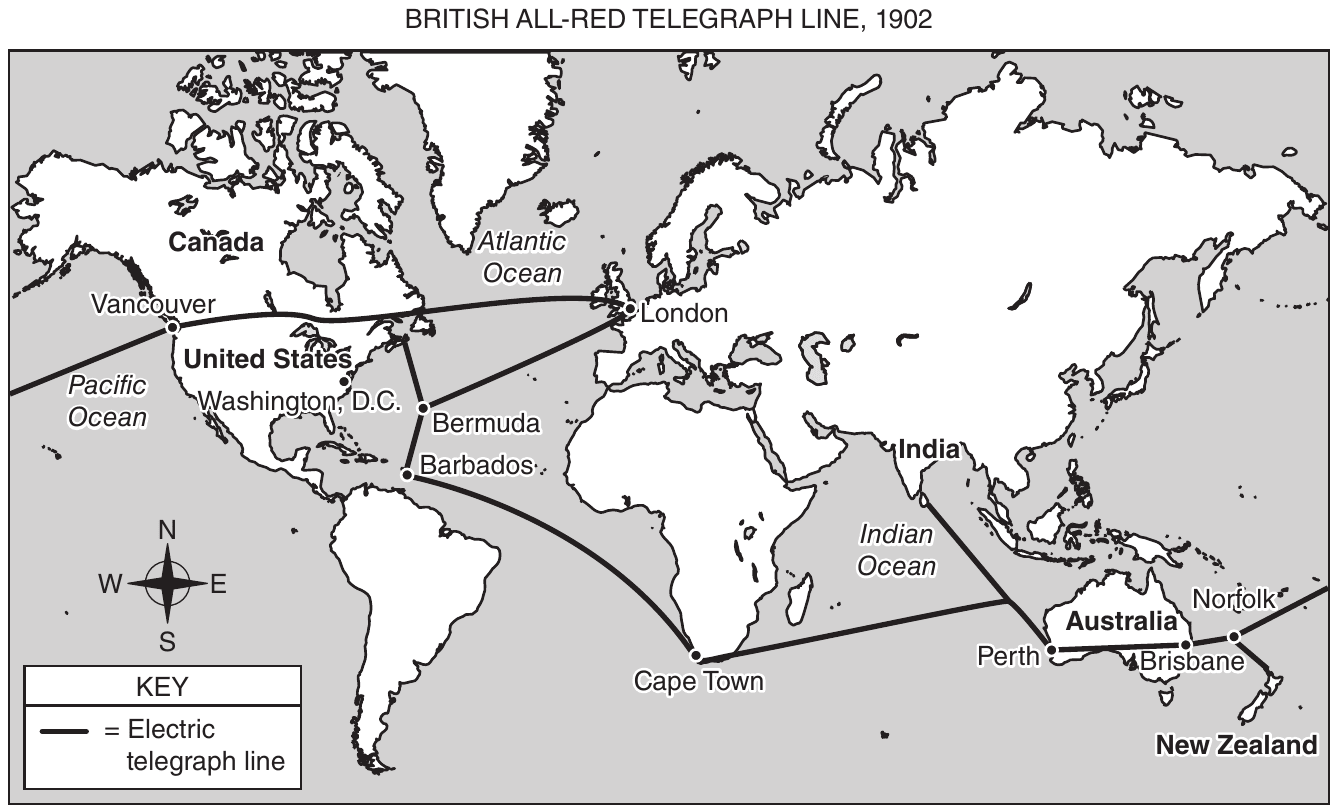
The first transatlantic electric telegraph message was sent in 1858, and by 1902 the British All-Red Line connected most of the world.
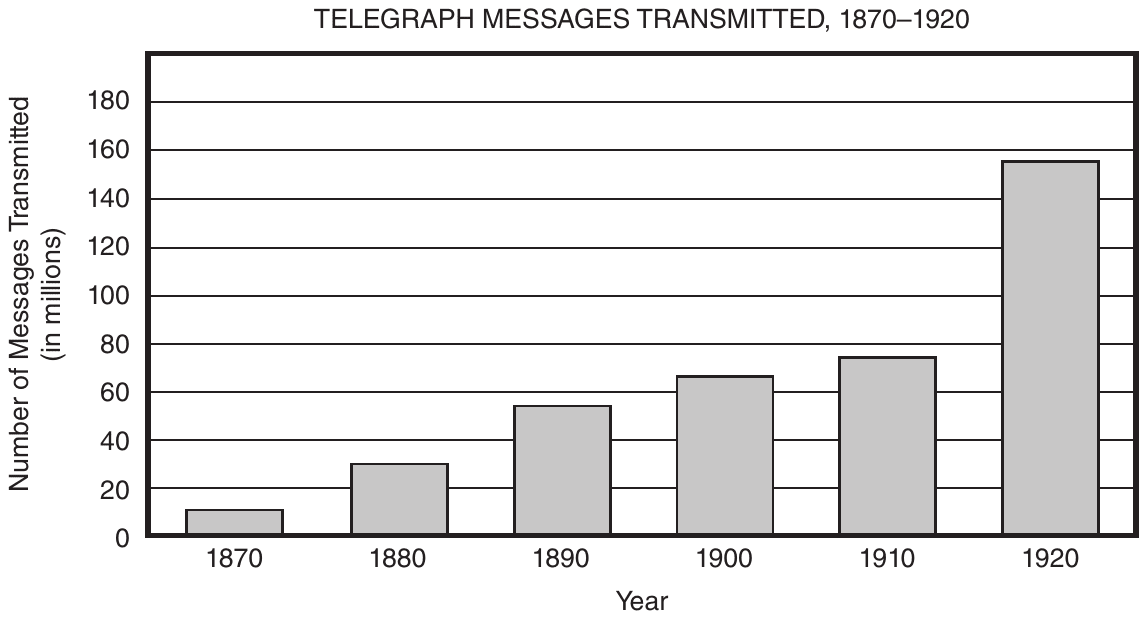
Source: U.S. Bureau of the Census. Historical Statistics of the United States, Colonial Times to 1970, Bicentennial Edition, Part 2. Washington, D.C., 1975.
Question
Which statement describes how the author’s use of problem-solution in paragraph 2 contributes to the development of ideas in the passage?
- AMorse’s discussion on a ship about Faraday’s electromagnet reminded him of the Yale College lectures on electricity, which he had enjoyed but had not fully understood, inspiring him to learn more about electricity from his colleague Gale.
- BMorse’s discouragement over his lack of knowledge of electricity prompted him to experiment with batteries, magnets, and wires, which led to the development of a new long-distance communication system.
- CMorse’s difficulty in understanding how Faraday’s electromagnet worked was frustrating, and it pushed him to create a system for sending signals over wires.
- DMorse’s longtime fascination was not enough to make up for his lack of knowledge about electricity, so he eventually sought help from Gale.
Show the answer
Correct answer: D
The question asks for the best explanation of how the use of problem-solution in paragraph 2 helps develop the ideas in the passage. Option D is correct because it explains that Morse realized his problem was that he was not knowledgeable enough to continue his experimentation without help, so the solution was to seek help from a colleague.
Option A is incorrect because, while the discussion on the ship fascinated Morse and reminded him of the lectures he had attended at Yale College, it was his failed attempts with electricity that caused him to reach out to Gale for help.
Option B is incorrect because, while “Morse found when he began to develop his idea that he had little real understanding of the nature of electricity” (paragraph 2), the paragraph does not state that he was discouraged; it was his failed experimentation that resulted in him first realizing that he needed help.
Option C is incorrect because the paragraph states that “Morse came to understand how [Faraday’s electromagnet] worked,” and that understanding is what caused him to think about sending messages over a wire. Also, Morse’s difficulty was in understanding the properties of electricity in general once he began his experimentation.
Question analysis
In this text structure question about “Invention of the Telegraph,” students explain how the problem-and-solution pattern in paragraph 2 develops ideas about Samuel Morse. All four choices are long sentences built from real details about the ship, Yale and Gale, so students must check each one’s account of what led to what.
- Grade level
- Grade 8 reading and task
- Compared with grade 7
- Above grade 7 Identifying problem and solution is familiar from earlier grades, but these choices are long, detail-packed chains in which a single misplaced cause makes an option wrong, which demands closer checking than typical grade 7 items.
- Estimated difficulty
- Hard: combines ideas, needs a plan, and has more than one tempting wrong answer.
- Thinking it demands
- Depth of knowledge 2, skills and concepts · mainly analyze
- What makes it hard
- Every choice must be checked major
- A very close wrong answer moderate
- The right answer is reworded moderate
- A lot to read moderate
- How, not what minor
- Evidence
- Answered from one paragraph or stanza
- Reading level
- Passage: about grade 11, 910 words; question and choices: about grade 16, 132 words.
- Corrected from the DOE handbook
- A wrong paragraph number in the explanation was corrected.
- A misspelled name in the explanation was corrected.
- A punctuation slip in the explanation was corrected.
- Students, last 30 days
- Not enough answers yet to show (it takes 10).
Why it is hard, traps and wrong answers (shows the answer)
Why it is hard
Every choice is assembled from things the paragraph really mentions, so recognition is useless and only the order of causes decides. The most tempting wrong choice ends with Gale, the right solution, but invents a reminder of the Yale lectures to get there; others turn the failed experiments into the solution or reverse what Morse understood. The question rewards reading each long choice clause by clause, which costs time.
Every choice must be checked major Choosing the answer
Each choice is a chain of two or three causes built from real details, the ship, Faraday, Yale, the batteries and wires, Gale, so every link has to be checked against paragraph 2’s order of events. (Embretson & Wetzel, 1987)
A very close wrong answer moderate Choosing the answer
The Yale-reminder choice and the key both join Morse’s enjoyment of electricity, his weak grasp of it and his turn to Gale; they part on one detail, the claim that the shipboard talk “reminded him” of Yale, which the paragraph never makes. (Embretson & Wetzel, 1987; Gorin & Embretson, 2006; Ascalon et al., 2007)
The right answer is reworded moderate Choosing the answer
The key turns the Yale letter and the shipboard speculation into “longtime fascination,” a phrase the passage never uses, while the wrong choices repeat its names and phrases and so look better supported. (Freedle & Kostin, 1993; Kirsch & Mosenthal, 1990)
A lot to read moderate Understanding the question
The four choices run to about 110 words, the longest 37, and paragraph 2 itself packs a voyage, a college letter, failed experiments and a colleague into four sentences. (Kintsch, 1998; Gorin & Embretson, 2006; Freedle & Kostin, 1993)
How, not what minor Working it out
Students must name the paragraph’s problem, too little understanding of electricity, and its solution, Gale, before judging which account of the pattern is accurate. (Anderson & Krathwohl, 2001)
Strategy: Name the problem and the solution in paragraph 2 in a few words each, then choose the option whose sequence of events matches the paragraph exactly.
Traps
- Reversed relationship: Cause and effect, or the order of events, turned around.
- Half right: One half of a two-part choice is right and the other is not.
The wrong answers, classified
A Half right (King et al., 2004; Thissen, Steinberg & Fitzpatrick, 1989)
Ends correctly with Morse learning from Gale, but invents its cause: the paragraph never says the shipboard talk reminded Morse of Yale, and it skips the failed experiments that sent him to Gale.
B Reversed relationship (King et al., 2004)
Reverses cause and effect: the “sporadic attempts” with batteries, magnets and wires exposed Morse’s weak grasp of electricity and sent him to Gale, rather than flowing from discouragement and producing the system.
C Twists what the text says (King et al., 2004)
Says Morse struggled to understand Faraday’s electromagnet, but the paragraph states that he “came to understand how it worked,” and that understanding is what gave him the idea.
What was corrected from the DOE handbook, and why
- Explanation: The handbook places the sentence “Morse found when he began to develop his idea that he had little real understanding of the nature of electricity” in paragraph 3. It is in paragraph 2, the paragraph the question is about, so the site now says “(paragraph 2).”
- Explanation: The handbook spells Leonard Gale’s name “Gail.” The passage spells it “Gale,” and so does the site now.
- Explanation: The handbook capitalizes “Also” after a semicolon (“over a wire; Also, Morse’s difficulty…”). The site starts a new sentence instead: “over a wire. Also, Morse’s difficulty…”
Working it out, step by step
Figure out what the question asks
This asks about problem-solution in paragraph 2. Problem-solution is a way to organize writing. First you learn about a problem, then how someone solved it. Find the problem and the solution. Then pick the choice that tells them in the right order.
Find the problem in paragraph 2
Paragraph 2 starts with “The idea of using electricity to communicate over distance.” It says Morse had enjoyed the electricity lectures at Yale. But then comes the problem: “Morse found when he began to develop his idea that he had little real understanding of the nature of electricity.”
Find the solution
The same sentence goes on: “after sporadic attempts to work with batteries, magnets, and wires, he finally turned for help to a colleague.” “Sporadic” means now and then, not steady. A colleague is a coworker. So Morse was interested in the subject, tried on his own, and did not succeed. His interest was not enough. His solution was to ask Gale for help.
Check each choice
- A is wrong. It ends with Gale, but the paragraph never says the ship talk “reminded him” of Yale. It also skips the failed tries.
- B is wrong. It has the order backward. The experiments showed the problem. They did not build the system.
- C is wrong. The paragraph says Morse “came to understand how it worked,” meaning the electromagnet.
- D fits. Long interest was not enough, so he got help from Gale.
Choose the answer
The problem was Morse’s weak grasp of electricity, and the solution was Gale. So the answer is D, “Morse’s longtime fascination was not enough to make up for his lack of knowledge about electricity, so he eventually sought help from Gale.”
Why this answer and not the closest wrong one
A is the closest trap. Like D, it mentions Yale, Morse’s weak grasp of electricity and Gale. But it adds a link the paragraph never makes, that the ship talk reminded him of Yale. With long choices, check every part. One made-up link makes the whole choice wrong.
More questions like this
The original DOE question
The passage “Invention of the Telegraph” as printed (pages 146–148)
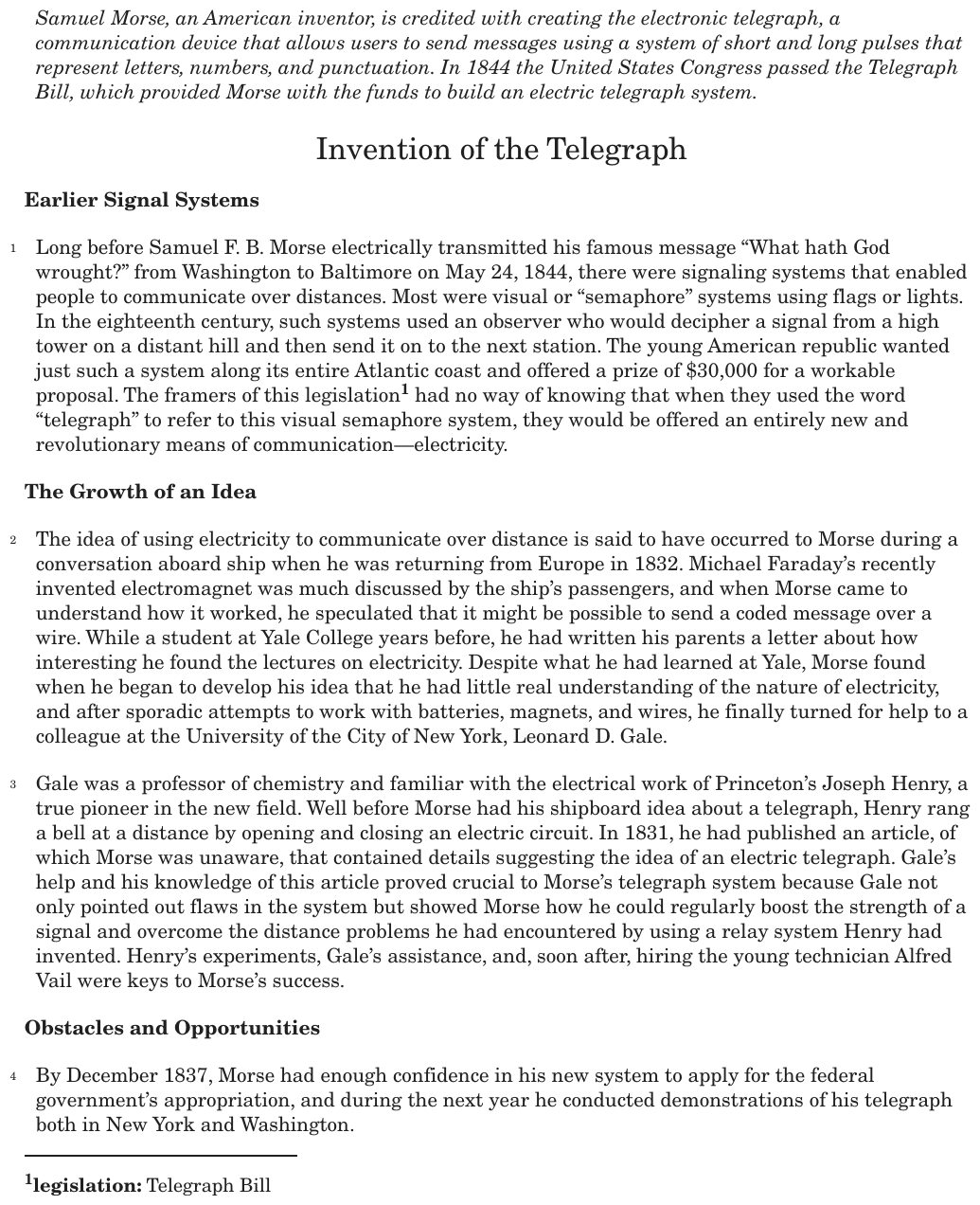
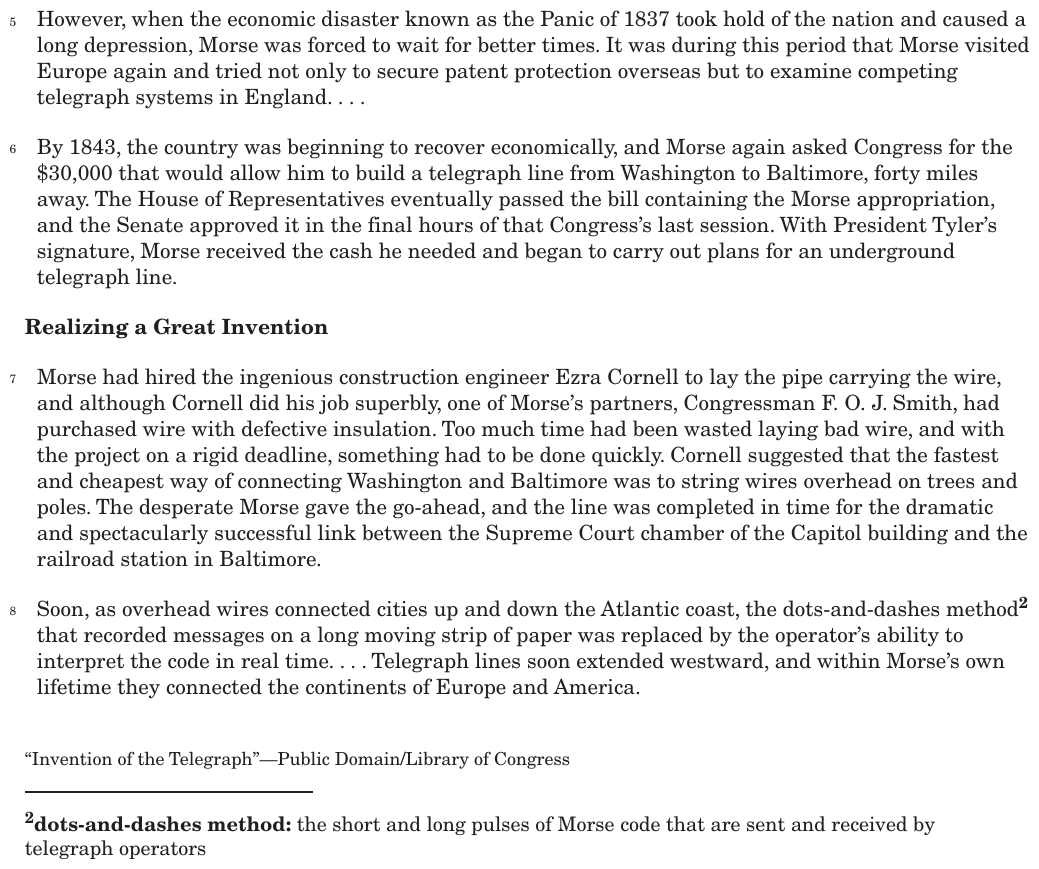
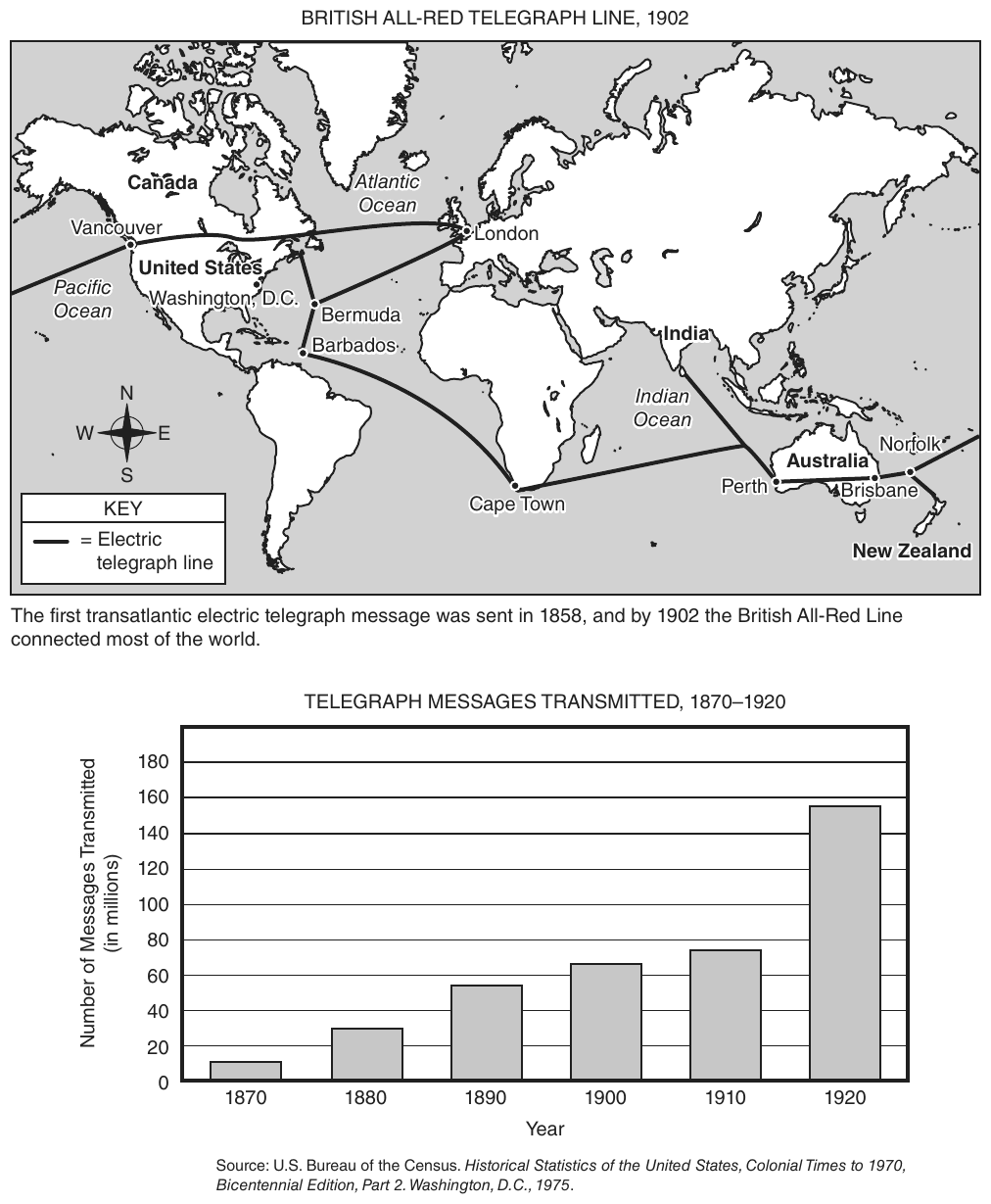
Question 50 of 57
2020 Test A English, question 50Uses the passage above: “Invention of the Telegraph”.
Question
Which statement describes how the author’s use of sequencing in paragraph 3 contributes to the overall structure of the passage?
- AIt shows that several people were simultaneously attempting to create an electric telegraph.
- BIt shows how the invention of the electric telegraph depended on information and techniques discovered by others.
- CIt shows that multiple means of long-distance communication were being used at the same time.
- DIt shows how quickly long-distance communication changed from visual signals to electrical signals.
Show the answer
Correct answer: B
The question asks how the use of sequencing, or arranging in chronological order, in paragraph 3 contributes to the overall structure of the passage. Paragraph 3 outlines the information that Gale knew who Henry was (“Well before Morse had his shipboard idea about a telegraph, Henry rang a bell at a distance by opening and closing an electric circuit”) and that Gale told Morse. Gale’s input was “crucial to Morse’s telegraph system,” and hiring Vail was an additional and necessary help.
Therefore, Option B is correct because the creation of Morse’s telegraph involved a series of steps that each built upon earlier ideas and inventions from others, such as Henry, Gale, and Vail.
Option A is incorrect because, although the inventions and advancements of others assisted in the development of the telegraph, the passage does not suggest that the other men were attempting to create their own telegraph systems.
Option C is incorrect because the only other long-distance communication system mentioned in the passage is the outdated semaphore system discussed in paragraph 1.
Option D is incorrect because the telegraph system was in development for more than ten years because of the lack of funding and the need for further experimentation.
Question analysis
Students explain how the sequence of events in paragraph 3 of “Invention of the Telegraph” contributes to the passage’s overall structure. The paragraph names several people and their roles in a few long sentences, and the choices make claims about the invention’s history that must each be checked against it.
- Grade level
- Grade 8 reading and task
- Compared with grade 7
- At grade 7 Sequencing is familiar grade 7 structure work. This paragraph packs several people and dates into long sentences, but once the order is clear the role of the sequence is fairly direct, so the demand is typical.
- Estimated difficulty
- Moderate: several steps, or a close reading with one strong distractor.
- Thinking it demands
- Depth of knowledge 2, skills and concepts · mainly analyze
- What makes it hard
- Complex sentences moderate
- How, not what moderate
- Much to keep track of minor
- Evidence
- Answered from one paragraph or stanza
- Reading level
- Passage: about grade 11, 910 words; question and choices: about grade 12, 77 words.
- Students, last 30 days
- Not enough answers yet to show (it takes 10).
Why it is hard, traps and wrong answers (shows the answer)
Why it is hard
Paragraph 3 is dense, but its last sentence nearly states the answer: Henry’s experiments, Gale’s help and Vail were “keys to Morse’s success.” Students lose the point when Henry’s telegraph-like article makes them imagine a race, or when the stem’s “overall structure” sends them back to the semaphore towers of paragraph 1. The question rewards reading the time markers as a chain of borrowed knowledge.
Complex sentences moderate Understanding the question
The key facts sit in embedded sentences, such as “an article, of which Morse was unaware, that contained details suggesting the idea,” and a 53-word sentence on what Gale showed Morse. (Abedi & Lord, 2001; Freedle & Kostin, 1993; Messick, 1989)
How, not what moderate Working it out
The stem asks what the order of events contributes to the passage’s structure, so students must see the time words, “Well before,” “In 1831,” “soon after,” as showing Morse building on others’ work. (Anderson & Krathwohl, 2001)
Much to keep track of minor Working it out
Four people, Henry, Gale, Vail and Morse, and two of Henry’s inventions have to be kept straight to see who supplied what to whom. (Sweller, 1988; Carpenter, Just & Shell, 1990)
Strategy: Put the events of paragraph 3 in order, noting who did what and when, then ask what that order shows about Morse’s invention.
Traps
- Twists what the text says: Uses the text's topic and ideas but changes what it says: who did it, how much, when, or why.
- Too broad or too strong: A choice overstates, generalizes, or uses absolute words the text does not support.
- Wrong part of the text: A choice is true of another paragraph, stanza or speaker than the one asked about.
The wrong answers, classified
A Twists what the text says (King et al., 2004)
Reads Henry’s article “suggesting the idea of an electric telegraph” as a rival effort, but the paragraph places Henry’s work “well before” Morse’s and shows it helping him.
C Wrong part of the text (Kirsch & Mosenthal, 1990)
Brings back the flag and light systems of paragraph 1, which came before the telegraph; paragraph 3 describes no other means of communication in use alongside it.
D Too broad or too strong (King et al., 2004)
Follows the passage’s overall move from semaphore to electricity but adds “how quickly,” though Morse’s idea of 1832 did not become a working line until 1844.
Working it out, step by step
Figure out what the question asks
This asks about sequencing in paragraph 3. Sequencing means putting events in time order. You need to say what that order shows about Morse’s invention.
Put paragraph 3’s events in order
Paragraph 3 uses time words. “Well before Morse had his shipboard idea about a telegraph, Henry rang a bell at a distance.” It adds that “In 1831, he had published an article” that hinted at an electric telegraph. Then Gale showed Morse “a relay system Henry had invented.” Last, Morse hired Alfred Vail “soon after.”
See what the order shows
A relay is a device that boosts a signal so it can travel farther. Each event in the order is someone else’s work that helped Morse. Henry’s work came first. Gale passed it on. Vail added his skill. The last sentence sums it up: these were all “keys to Morse’s success.” So Morse built his telegraph on what others had found.
Check each choice
- A is wrong. Henry’s work came “well before” Morse’s and helped him. Nobody was racing at the same time.
- B fits. The order shows Morse depending on earlier work by Henry, Gale and Vail.
- C is wrong. Paragraph 3 talks only about electric work. Flags and lights are in paragraph 1.
- D is wrong. Nothing here shows speed. Morse’s idea came in 1832, and his line opened in 1844.
Choose the answer
The time order shows one person’s work feeding the next, all leading to Morse. So the answer is B, “It shows how the invention of the electric telegraph depended on information and techniques discovered by others.”
Why this answer and not the closest wrong one
A is the strongest trap, because Henry’s article had details “suggesting the idea of an electric telegraph.” That can sound like a rival. But the time words show Henry came first, and Gale used his work to help Morse. Earlier work that helps is what B describes.
More questions like this
The original DOE question
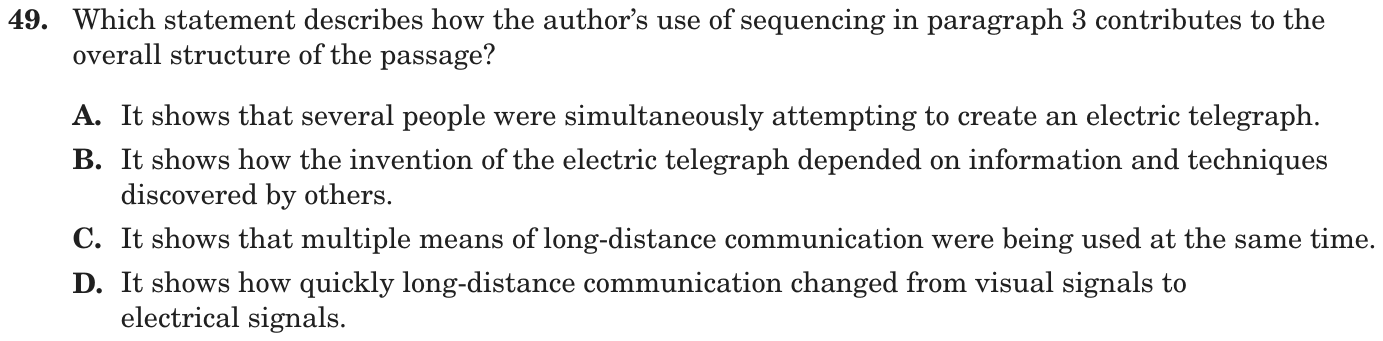
Question 51 of 57
2020 Test A English, question 51Uses the passage above: “Invention of the Telegraph”.
Question
The details of the section “The Growth of an Idea” convey a central idea of the passage by suggesting that
- Athe collaborative efforts of colleagues resulted in successful communication over a wire.
- Ba great deal of interest and work was devoted to understanding how to use electricity to send signals.
- CFaraday’s invention of the electromagnet inspired the invention of the telegraph.
- Dcolleges like Yale played a great role in making new discoveries about electricity and its applications.
Show the answer
Correct answer: B
The question asks how a passage section helps convey a central idea of the passage. Paragraph 3 states that “Henry’s experiments, Gale’s assistance, and, soon after, hiring the young technician Alfred Vail were keys to Morse’s success.” The level of interest inspired Morse and others to work together to find a way to use electricity to send long-distance messages.
Option B is correct; the section helps convey a central idea because, overall, the section focuses on what fascinated Morse enough to begin his work and how others were just as interested and willing to work to achieve this goal.
Option A is incorrect because, although the word collaborative suggests that multiple people contributed to the telegraph’s success, the option does not clarify the research and effort needed in order to understand how to use electricity to send signals.
Option C is incorrect because when Morse came to understand how Faraday’s electromagnet worked, Morse wondered if it might be possible to send a coded message over a wire, but that thought later evolved into the telegraph only after more research and experimentation.
Option D is incorrect because the influence of what Morse learned at Yale was only a minor factor in his development of the telegraph.
Question analysis
This central idea question asks what the details in the section “The Growth of an Idea” suggest about the passage “Invention of the Telegraph.” The section covers Faraday’s electromagnet, Morse’s Yale lectures, and help from Gale, Henry and Vail, so students must judge which statement those details support as a group, and more than one choice sounds right.
- Grade level
- Grade 8 reading and task
- Compared with grade 7
- Above grade 7 Grade 7 central-idea questions usually have one clearly best summary. Here two paragraphs of names and events must be weighed, and several choices restate true details, so judging which fits the whole section is unusually demanding.
- Estimated difficulty
- Among the hardest on the SHSAT: a non-obvious approach, heavy reading, or a well-hidden trap.
- Thinking it demands
- Depth of knowledge 3, strategic thinking · mainly understand
- What makes it hard
- A very close wrong answer major
- Evidence in several places moderate
- The right answer is reworded moderate
- Evidence
- Answered from several paragraphs or stanzas
- Reading level
- Passage: about grade 11, 910 words; question and choices: about grade 12, 77 words.
- Students, last 30 days
- Not enough answers yet to show (it takes 10).
Why it is hard, traps and wrong answers (shows the answer)
Why it is hard
This is among the hardest questions in the set because the most tempting wrong choice reads like a paraphrase of the section’s final sentence. Rejecting it means noticing that the section never shows a message getting through and never shows Henry working with Morse, who had not even read his article. The right choice is vague by design, and only a summary of both paragraphs together shows that it fits better.
A very close wrong answer major Choosing the answer
The colleagues choice and the interest-and-work choice both describe effort spent on sending signals by wire; they part on one claim, that the effort “resulted in successful communication,” which the section never shows, the working line arriving in paragraph 7. (Embretson & Wetzel, 1987; Gorin & Embretson, 2006; Ascalon et al., 2007)
Evidence in several places moderate Working it out
The idea emerges only from details across two paragraphs, passengers discussing the electromagnet, Morse’s Yale letter, his failed attempts, Henry’s bell and article, Gale’s relay advice, taken together. (Kirsch & Mosenthal, 1990; Gorin & Embretson, 2006)
The right answer is reworded moderate Choosing the answer
The key names none of the section’s people, while the wrong choices echo its “colleague,” “over a wire,” Faraday’s electromagnet and Yale, and so look more firmly rooted in the text. (Freedle & Kostin, 1993; Kirsch & Mosenthal, 1990)
Strategy: Summarize paragraphs 2 and 3 together in one sentence of your own before reading the choices, then choose the statement closest to your summary, checking that every part of it is true of this section.
Traps
- Half right: One half of a two-part choice is right and the other is not.
- Too narrow: A single detail offered as the central idea or a summary, or a summary that keeps minor details and leaves out an essential part.
- Too broad or too strong: A choice overstates, generalizes, or uses absolute words the text does not support.
The wrong answers, classified
A Half right (King et al., 2004; Thissen, Steinberg & Fitzpatrick, 1989)
Rightly sees teamwork in the section’s close, but successful communication over Morse’s wire comes later, under “Realizing a Great Invention,” and the passage never shows Henry working with Morse.
C Too narrow (King et al., 2004)
Treats the spark as the whole story: Faraday’s electromagnet gave Morse the idea, but the section goes on to years of failed attempts and help from others.
D Too broad or too strong (King et al., 2004)
Inflates a passing mention: Morse’s Yale lectures appear once, and the section notes that despite them he had “little real understanding of the nature of electricity.”
Working it out, step by step
Figure out what the question asks
This asks what the section “The Growth of an Idea” says about a central idea, or main message. The section is paragraphs 2 and 3. Sum up both paragraphs together before you look at the choices.
List the section’s details
On the ship, Faraday’s electromagnet “was much discussed by the ship’s passengers.” Morse had found the electricity lectures at Yale interesting. He made “sporadic attempts” on his own. In paragraph 3, Henry “rang a bell at a distance by opening and closing an electric circuit.” Gale showed Morse how to use Henry’s relay system.
Find what the details share
Look at what links these details. Passengers talked about electricity. Morse was curious and kept trying. Henry ran tests and wrote an article. Gale gave advice. All of it is people taking an interest in electricity and working to send signals with it. That is the section’s main point. A working telegraph line does not appear until paragraph 7.
Check each choice
- A is close but wrong. Morse’s telegraph does not send a message until paragraph 7. Also, Henry never worked with Morse. At first, Morse did not even know about Henry’s article.
- B fits. It covers the interest and the work in both paragraphs.
- C is wrong. The electromagnet gave Morse the idea, but that is only the start of the section.
- D is wrong. Yale is only a small part of paragraph 2. And “Despite what he had learned at Yale,” Morse still knew little.
Choose the answer
The section shows lots of interest and effort aimed at sending signals with electricity. So the answer is B, “a great deal of interest and work was devoted to understanding how to use electricity to send signals.”
Why this answer and not the closest wrong one
A sounds like a summary of the section’s last sentence, which is why it tempts. But it claims the teamwork “resulted in successful communication,” and that only happens in a later section. B claims less, so every detail in paragraphs 2 and 3 fits it.
More questions like this
The original DOE question
Question 52 of 57
2020 Test A English, question 52Uses the passage above: “Invention of the Telegraph”.
Question
Read this sentence from paragraph 7.
The desperate Morse gave the go-ahead, and the line was completed in time for the dramatic and spectacularly successful link between the Supreme Court chamber of the Capitol building and the railroad station in Baltimore.
The words “dramatic” and “spectacularly” in the sentence convey a
- Asense of relief and fulfillment that the line was finished.
- Bsense of wonder and celebration that the telegraph line was accomplished.
- Cfeeling of excitement about the future possibilities of the telegraph.
- Dfeeling of confidence about being able to continue the work.
Show the answer
Correct answer: B
The question asks what the words “dramatic” and “spectacularly” convey in the sentence from paragraph 7.
A. Incorrect. While there may have been some feelings of relief and fulfillment when the lines were finished, the passage instead focuses on the wonder and joy that Morse and Cornell felt after overcoming setbacks and completing the construction of the telegraph system.
B. CORRECT. Morse and Cornell rushed to post the wires overhead, and the “rigid deadline” (paragraph 7) was successfully met. The words have a positive and victorious tone that is consistent with the feeling of wonder that it worked and of celebration that the construction was completed.
C. Incorrect. The passage does not share whether Morse or Cornell considered the future possibilities of the telegraph; it shares only that the finished product was “dramatic,” implying it was amazing to see.
D. Incorrect. While the passage later discusses the expansion of overhead wires “up and down the Atlantic coast” and how they “connected the continents of Europe and America” (paragraph 8), there is no evidence shared in the passage that Morse planned to continue his work with electricity.
Question analysis
Students judge the connotation of two words, “dramatic” and “spectacularly,” in the sentence from “Invention of the Telegraph” that describes the completion of Samuel Morse’s first telegraph link from Washington to Baltimore. Because the same sentence calls Morse “desperate” and says the line was finished just in time, several feelings seem to fit the moment, and the choices name four of them.
- Grade level
- Grade 7 reading and task
- Compared with grade 7
- At grade 7 Judging what two adjectives convey is standard grade 7 word-choice work, and the sentence is printed with the question. The challenge is that all four choices name believable feelings, so students must separate the words’ own connotations from the situation around them.
- Estimated difficulty
- Moderate: several steps, or a close reading with one strong distractor.
- Thinking it demands
- Depth of knowledge 2, skills and concepts · mainly understand
- What makes it hard
- A very close wrong answer moderate
- Reading between the lines moderate
- Every choice must be checked minor
- Evidence
- Answered from one sentence or line
- Reading level
- Passage: about grade 11, 910 words; question and choices: about grade 10, 91 words.
- Students, last 30 days
- Not enough answers yet to show (it takes 10).
Why it is hard, traps and wrong answers (shows the answer)
Why it is hard
The quoted sentence offers two tempting sources for the answer besides the two words the stem names: Morse is “desperate,” and the line is finished “in time.” Students who read the situation rather than the words choose relief, and those who think ahead to paragraph 8’s spreading wires choose excitement about the future. The question rewards asking what “dramatic” and “spectacularly” say about the link itself, an event that impressed and was celebrated.
A very close wrong answer moderate Choosing the answer
The relief choice is built like the key, a pair of feelings about the finished line; only the feelings differ, and “dramatic” and “spectacularly” point to wonder at a public success, not release from worry. (Embretson & Wetzel, 1987; Gorin & Embretson, 2006; Ascalon et al., 2007)
Reading between the lines moderate Working it out
Neither word names an emotion: “dramatic” and “spectacularly” describe the link itself, so the feeling they carry has to be inferred from their sense of an impressive public show. (Graesser, Singer & Trabasso, 1994; Kintsch, 1998)
Every choice must be checked minor Choosing the answer
All four choices name a positive feeling that suits a race against a “rigid deadline,” so tone alone rules none of them out. (Embretson & Wetzel, 1987)
Strategy: Before reading the choices, picture something you would call dramatic and spectacularly successful, and name the feeling those words give it; then find the choice closest to that feeling.
Traps
- Wrong tone or attitude: Misjudges the tone, attitude or point of view, such as reading admiration as criticism, or taking a character's or subject's feelings for the author's.
- Wrong part of the text: A choice is true of another paragraph, stanza or speaker than the one asked about.
The wrong answers, classified
A Wrong tone or attitude (Graesser, Singer & Trabasso, 1994)
Takes what Morse probably felt, relief after a “desperate” scramble to beat the deadline, for what the author’s two words convey, which is admiration for a striking success.
C Wrong part of the text (Kirsch & Mosenthal, 1990)
Brings in paragraph 8, where wires spread along the coast and across the ocean, but this sentence is about the first finished link and says nothing of what might follow.
D Reads too much in (Graesser, Singer & Trabasso, 1994)
Assumes success would leave Morse confident about pressing on, but the sentence never looks past the finished line, and the two words describe the event, not his plans.
Working it out, step by step
Figure out what the question asks
This question is about connotation, the feeling a word carries beyond its dictionary meaning. It names two words, “dramatic” and “spectacularly.” Your job is to name the feeling those two words give the sentence. Other words in the sentence should not decide your answer.
See what is happening in paragraph 7
Just before this sentence, Morse’s team lost time laying wire that turned out to be faulty. The job was also “on a rigid deadline” with no time to spare. Cornell had a quick fix: to “string wires overhead on trees and poles” instead. Morse agreed, and the line was done in time. The sentence describes the moment the first link worked, from the Capitol in Washington to the train station in Baltimore.
Work out what the two words suggest
A dramatic event grabs your attention, the way the high point of a movie does. Spectacularly comes from spectacle, a grand sight that makes people stop and stare. So the author is saying the link was more than finished. It was a thrilling public success. Words like these make a reader marvel at what was done and want to cheer.
Check each choice
- A does not fit. Morse was “desperate,” so he may have felt relief. But that feeling comes from the word “desperate,” not from the two words the question asks about.
- B fits. Wonder matches an amazing sight, and celebration matches a great success.
- C does not fit. This sentence is only about the finished link. Wires spreading to other places come later, in paragraph 8.
- D does not fit. The two words describe the event itself. They tell nothing about Morse’s plans for more work.
Choose the answer
The words “dramatic” and “spectacularly” make the first telegraph link sound like a thrilling show. So the answer is B, a “sense of wonder and celebration that the telegraph line was accomplished.”
Why this answer and not the closest wrong one
A is the closest trap, since it also names two good feelings about the finished line. But relief is the quiet feeling you get when worry ends. The words “dramatic” and “spectacularly” are loud and showy. They make the link sound like something to gasp at and cheer for, and that is wonder and celebration.
More questions like this
The original DOE question
Question 53 of 57
2020 Test A English, question 53Uses the passage above: “Invention of the Telegraph”.
Question
Which sentence is the best summary of how Morse obtained the funding necessary to build his telegraph system?
- AMorse’s application for a federal grant was delayed until 1843, so he spent time traveling in Europe, where he concentrated on obtaining a patent for his system.
- BMorse applied for a government grant that required both houses of Congress and the president to pass a bill awarding him $30,000 for his telegraph project.
- CMorse applied for a government appropriation and conducted telegraph demonstrations to show that his system could work, and after a delay caused by a financial depression, Congress approved the $30,000 appropriation in 1843.
- DWorking with Gale and Vail allowed Morse to find flaws in Henry’s work and to develop his own ideas before applying for the federal government appropriation.
Show the answer
Correct answer: C
The question asks for the best summary of how Morse obtained the funding necessary to build his telegraph system.
A. Incorrect. This summary focuses mostly on what Morse did while his application for funding was delayed in the United States rather than on how Morse acquired the funding, because during this period, Morse tried “not only to secure patent protection overseas but to examine competing telegraph systems in England” (paragraph 5). Therefore, it is not the best summary of how Morse obtained the funding necessary to build his telegraph system.
B. Incorrect. Although this summary mentions how Morse applied for the “federal government’s appropriation” (paragraph 4), it primarily focuses on the actions of the House of Representatives and the Senate, not on Morse’s efforts to obtain funding. Therefore, it is not the best summary of how Morse obtained the funding necessary to build his telegraph system.
C. CORRECT. This summary best describes how Morse obtained the funding that he needed for his telegraph system, because it explains that Morse applied “for the federal government’s appropriation, and during the next year he conducted demonstrations of his telegraph” (paragraph 4). In paragraph 5, the author explains the impact that the Panic of 1837 had on Morse’s request. In paragraph 6, the author describes how by 1843, economic times had improved, so Morse again “asked Congress for the $30,000” and was awarded the funds after “the Senate approved it.”
D. Incorrect. This summary is not the best summary of how Morse obtained the funding necessary to build his telegraph system, because it relates how Morse worked with others to develop his ideas about the telegraph and how Gale and Vail were the “keys to Morse’s success” (paragraph 3) before he applied for funding.
Question analysis
Students read “Invention of the Telegraph” and pick the best one-sentence summary of how Samuel Morse secured federal funding for his telegraph line. The money story is spread over several paragraphs alongside other events in Morse’s life, and the four long choices each blend true details, so students must decide what a good summary of this one process includes.
- Grade level
- Grade 7 reading and task
- Compared with grade 7
- At grade 7 Summarizing a short chain of events is everyday grade 7 work, and every fact needed is stated plainly. The main demand is patience with long choices rather than any hard inference.
- Estimated difficulty
- Moderate: several steps, or a close reading with one strong distractor.
- Thinking it demands
- Depth of knowledge 2, skills and concepts · mainly understand
- What makes it hard
- A very close wrong answer moderate
- Evidence in several places moderate
- A lot to read minor
- Evidence
- Answered from several paragraphs or stanzas
- Reading level
- Passage: about grade 11, 910 words; question and choices: about grade 13, 126 words.
- Corrected from the DOE handbook
- A date in the passage introduction was corrected.
- A wrong word in the explanation was corrected.
- Students, last 30 days
- Not enough answers yet to show (it takes 10).
Why it is hard, traps and wrong answers (shows the answer)
Why it is hard
Every choice is built from real events, so the question is less about spotting a false statement than about judging what a summary of the funding must contain. Students who accept the first accurate sentence they meet stop at the account of Congress and the president, which skips the years between application and approval. Listing the stages first, application, demonstrations, delay and vote, turns the long choices into a quick checklist.
A very close wrong answer moderate Choosing the answer
The summary about both houses and the president is accurate and ends where the key does, with the $30,000 approved; what separates them is the middle stretch, the demonstrations and the depression’s delay, which only the key covers. (Embretson & Wetzel, 1987; Gorin & Embretson, 2006; Ascalon et al., 2007)
Evidence in several places moderate Working it out
The funding story is split over paragraphs 4 to 6: the December 1837 application, demonstrations in New York and Washington, the Panic of 1837 with a trip to Europe, and the 1843 request and vote. (Kirsch & Mosenthal, 1990; Gorin & Embretson, 2006)
A lot to read minor Understanding the question
Each choice is a single sentence of 26 to 33 words carrying dates, a dollar amount, Congress and several people, and every piece has to be checked against the passage. (Kintsch, 1998; Gorin & Embretson, 2006; Freedle & Kostin, 1993)
Strategy: Find the part of the passage about paying for the telegraph and jot down each step in order; then pick the summary that matches your list from start to finish without wandering off it.
Traps
- Too narrow: A single detail offered as the central idea or a summary, or a summary that keeps minor details and leaves out an essential part.
- Wrong part of the text: A choice is true of another paragraph, stanza or speaker than the one asked about.
The wrong answers, classified
A Too narrow (King et al., 2004)
Builds the summary on Morse’s European patent trip, something he did while the money stalled, and drops the demonstrations and the 1843 vote that actually produced the funds.
B Too narrow (King et al., 2004)
Gives only the final step, a bill passed by the House and Senate and signed by the president, and omits the demonstrations and the depression that held the money up for years.
D Wrong part of the text (Kirsch & Mosenthal, 1990)
Pulls in paragraph 3, where Gale and Vail help Morse build the system, which concerns the invention, not the money, and puts the flaws in Henry’s work, though Gale found them in Morse’s system.
What was corrected from the DOE handbook, and why
- Passage: The 2024–2025 handbook’s introduction says “In 1844, the United States Congress passed the Telegraph Bill.” Congress passed the $30,000 appropriation in March 1843; 1844 is the year of Morse’s first message. Paragraph 6 describes the 1843 approval, and Option C, the correct answer, says 1843, so the introduction reads “In 1843.” The site shares this passage with 2018 Test B English, where the same correction is recorded.
- Explanation: The handbook says Option A focuses on what Morse did while his application was delayed “rather than on how Morse acquired the patent.” The question asks how Morse obtained his funding, and the patent is what Option A does focus on, so the site now says “rather than on how Morse acquired the funding.”
Working it out, step by step
Figure out what the question asks
This question wants a summary. A summary is a short retelling that keeps only the main points, in the order they happen. The topic is narrow: how Morse got the money for his telegraph. So the best choice must be true, stay on the money, and tell that story from beginning to end.
Find where the money story is told
The funding story runs through paragraphs 4, 5 and 6. By December 1837, Morse felt ready “to apply for the federal government’s appropriation” (paragraph 4). The next year, “he conducted demonstrations of his telegraph both in New York and Washington” (paragraph 4). Then a money crisis “caused a long depression,” and Morse “was forced to wait for better times” (paragraph 5). In 1843 he “again asked Congress for the $30,000,” and this time he got it (paragraph 6).
Explain the words and list the steps
Some words may be new. An appropriation is money that lawmakers agree to pay out for a planned project. Demonstrations are public shows that prove a machine works. A depression is a long period when businesses struggle and cash is scarce. Now put the story in order:
- Morse asked for the money.
- He showed people his telegraph working.
- Hard times made him wait.
- In 1843 Congress said yes to the $30,000.
Check each choice
- A does not fit. It is mostly about a trip to Europe for a patent (a legal right that stops others from copying an invention). Morse made that trip while he waited. A leaves out the demonstrations and the vote.
- B does not fit. It is true, but it gives only the final step, when the House, the Senate and the president approved the bill. It skips the demonstrations and the years of waiting.
- C fits. It covers the request, the demonstrations, the delay from the depression and the 1843 approval, in that order.
- D does not fit. Gale and Vail helped Morse build the telegraph, not pay for it. And the flaws Gale pointed out were in Morse’s system, while D puts them in Henry’s work.
Choose the answer
Only one choice tells the whole funding story, from the first request to the final yes, without drifting to other topics. So the answer is C.
Why this answer and not the closest wrong one
B is the hardest choice to rule out, because nothing in it is false. But it starts at the very end of the story. It drops the demonstrations Morse gave and the long wait during the depression. A summary must hold all the main steps, and C is the only choice that does.
More questions like this
The original DOE question
Question 54 of 57
2020 Test A English, question 54Uses the passage above: “Invention of the Telegraph”.
Question
The idea that, in the mid-nineteenth century, the United States was mostly unaware of the possibilities of electricity is illustrated in the passage mainly through the
- Adescription of the government’s initial desire to expand a semaphore signaling system that used either flags or lights along the Atlantic Coast.
- Bdelay by the House of Representatives to pass the bill funding Morse’s telegraph line six years after he first applied for the appropriation.
- Cdiscussions of the newly invented electromagnet that sparked the idea of sending codes through wires.
- Ddescription of how an electric circuit could be closed to ring a bell at a distance.
Show the answer
Correct answer: A
The question asks for information that conveys the idea that the United States was mostly unaware of the possibilities of electricity in the mid-nineteenth century. The passage states that most signaling systems at the time were “visual or ‘semaphore’ systems using flags or lights” (paragraph 1) and that the United States was looking for “just such a system along its entire Atlantic coast” (paragraph 1).
Option A is correct because waving lights and flags reveals how limiting and simple the system of the time was, and Option A states that the United States wanted to expand this system, not improve upon it.
Option B is incorrect because the delay in funding had to do with the Panic of 1837 and the “long depression” (paragraph 5), not because the House of Representatives was not aware or ready for innovation in the use of electricity.
Option C is incorrect because it focuses on what prompted Morse to consider an electronic wire-based communications system.
Option D is incorrect because it describes a basic aspect of an early electrical discovery that demonstrated the interest of scientists in the possibilities of electricity, not the United States as a whole.
Question analysis
Students identify how “Invention of the Telegraph” mainly illustrates the idea that, in the mid-1800s, the United States was largely unaware of what electricity could do. The idea is implied rather than stated, so students must decide which detail truly reveals the nation’s thinking at the time.
- Grade level
- Grade 8 reading and task
- Compared with grade 7
- Above grade 7 Grade 7 evidence questions often match a stated idea to a sentence. This idea is only implied, so students must infer what a historical detail reveals about a whole nation’s understanding, closer to grade 8 inference.
- Estimated difficulty
- Hard: combines ideas, needs a plan, and has more than one tempting wrong answer.
- Thinking it demands
- Depth of knowledge 3, strategic thinking · mainly evaluate
- What makes it hard
- Reading between the lines moderate
- Evidence in several places moderate
- Hard words minor
- Evidence
- Answered from one paragraph or stanza
- Reading level
- Passage: about grade 11, 910 words; question and choices: about grade 12, 102 words.
- Students, last 30 days
- Not enough answers yet to show (it takes 10).
Why it is hard, traps and wrong answers (shows the answer)
Why it is hard
The stem asks about a whole nation’s understanding, so details about individuals with electrical interests, the ship’s passengers and Henry, show the opposite of what is needed. The real trap is the funding delay, which looks like official indifference but has an economic cause the passage states. Students who remember that the semaphore plan came with a remark about not knowing electricity was coming find the answer.
Reading between the lines moderate Working it out
The idea is implied: wanting a semaphore system shows unawareness only alongside paragraph 1’s comment that its framers “had no way of knowing” they would be offered electricity. (Graesser, Singer & Trabasso, 1994; Kintsch, 1998)
Evidence in several places moderate Working it out
The choices point to four separate places, paragraph 1’s semaphore plan, the funding delay of paragraphs 4 to 6, the shipboard talk in paragraph 2 and Henry’s bell in paragraph 3, and each must be checked there. (Kirsch & Mosenthal, 1990; Gorin & Embretson, 2006)
Hard words minor Understanding the question
“Semaphore” and “appropriation” are uncommon words, and the passage defines “semaphore” only in passing, as systems “using flags or lights.” (Perfetti, 2007; Freedle & Kostin, 1993)
Strategy: For each choice, find the detail in the passage and ask whether the author uses it to show what the country did or did not understand about electricity.
Traps
- Twists what the text says: Uses the text's topic and ideas but changes what it says: who did it, how much, when, or why.
- Supports only part of the claim: In a question about evidence: a line that backs one half of the claim but not the other, or a related point rather than the claim itself.
The wrong answers, classified
B Twists what the text says (King et al., 2004)
Reads the long wait for funding as doubt about electricity, but the passage gives a different cause, the Panic of 1837 and the “long depression” that followed.
C Supports only part of the claim (King et al., 2004; Thissen, Steinberg & Fitzpatrick, 1989)
The ship’s passengers did discuss the new electromagnet, but that shows a few people interested in electricity, not a country unaware of what it could do.
D Supports only part of the claim (King et al., 2004; Thissen, Steinberg & Fitzpatrick, 1989)
Henry’s bell rung at a distance is a real detail, but it shows a scientist exploring electricity’s uses, the opposite of unawareness, and says nothing about the nation.
Working it out, step by step
Figure out what the question asks
This asks which part of the passage best shows an idea. The idea is that in the mid-1800s, the United States mostly did not know what electricity could do. Look for a detail about the country as a whole, not about one scientist.
Find the detail in paragraph 1
Paragraph 1 says most early systems were visual, or semaphore, “systems using flags or lights.” Then it says, “The young American republic wanted just such a system along its entire Atlantic coast.” The next sentence explains that its lawmakers “had no way of knowing” they would be offered “an entirely new and revolutionary means of communication—electricity.”
Explain what the detail shows
A semaphore system sends signals people can see, like waving flags. The country asked for that old kind of system. It did not ask for an electric one, because it did not know one was possible. “Revolutionary” means bringing a huge change. So the government’s plan shows how unaware the nation was of what electricity could do.
Check each choice
- A fits. The government wanted to spread flags and lights, not electric signals.
- B is wrong. The delay had a money cause. The Panic of 1837 “caused a long depression.” It was not about electricity.
- C is wrong. Passengers talking about the electromagnet shows interest in electricity, the opposite of not knowing about it.
- D is wrong. Henry ringing a bell shows one scientist exploring electricity. It says nothing about the whole country.
Choose the answer
The country’s wish for a flags-and-lights system shows it did not yet see what electricity could do. So the answer is A, the description of the government’s plan for a semaphore system along the Atlantic Coast.
Why this answer and not the closest wrong one
B is the closest trap, because a long wait for money can look like doubt about electricity. But paragraph 5 gives the real cause, the Panic of 1837 and the hard times after it. A is backed by the passage’s own words: the lawmakers “had no way of knowing” electricity was coming.
More questions like this
The original DOE question
Question 55 of 57
2020 Test A English, question 55Uses the passage above: “Invention of the Telegraph”.
Question
With which statement would the author most likely agree?
- AMorse’s telegraph was successful because the wires were strung aboveground rather than underground as originally planned.
- BUnderstanding the importance of Morse’s telegraph requires detailed knowledge of electrical systems.
- CThe implementation of Morse’s telegraph system was overly influenced by economic factors.
- DMorse’s invention of the telegraph made a great stride toward better connecting people across the United States and across the world.
Show the answer
Correct answer: D
The question asks which statement best represents a viewpoint held by the author of the passage. Paragraph 8 states that “Telegraph lines soon extended westward, and within Morse’s own lifetime they connected the continents of Europe and America.”
Therefore, Option D is correct because the author presents Morse’s telegraph as a great leap in the ability to quickly communicate messages over distances never before imagined.
Option A is incorrect because the author explains that the aboveground wiring was used only because “Cornell suggested that [it was] the fastest and cheapest way” (paragraph 7), not because it would be more successful.
Option B is incorrect because the author conveys the importance of this advancement in communication without providing detailed information about electrical systems.
Option C is incorrect because, while the Panic of 1837 caused a delay in Morse’s funding, the author shows that Morse received the appropriation in 1843 and was able to overcome the financial setback he faced.
Question analysis
This question asks which statement the author of “Invention of the Telegraph” would most likely agree with, based on the passage’s account of Samuel Morse’s work. Students must infer the author’s view from the passage as a whole, and every choice takes up a real topic from the story, so each must be checked for how strongly it is supported.
- Grade level
- Grade 7 reading and task
- Compared with grade 7
- At grade 7 Inferring an author’s position from an informational text is typical grade 7 work. The author’s attitude is fairly clear in the passage’s word choice, so this matches a routine state-test question in demand.
- Estimated difficulty
- Straightforward: two steps or one careful reading.
- Thinking it demands
- Depth of knowledge 3, strategic thinking · mainly analyze
- What makes it hard
- Reading between the lines moderate
- Evidence in several places minor
- Evidence
- Answered from the whole text
- Reading level
- Passage: about grade 11, 910 words; question and choices: about grade 12, 70 words.
- Students, last 30 days
- Not enough answers yet to show (it takes 10).
Why it is hard, traps and wrong answers (shows the answer)
Why it is hard
The passage’s admiration for Morse’s achievement is steady from the first paragraph to the map, so most students recognize the author’s view. The wrong choices each take a real episode, the overhead wires, Morse’s struggle with electricity, the depression, and turn it into a judgment the author never makes. Watching for evaluative words such as “overly” and “because” separates them.
Reading between the lines moderate Working it out
The author never states an opinion outright; it shows in word choice such as “revolutionary,” “ingenious,” “spectacularly successful” and the heading “Realizing a Great Invention.” (Graesser, Singer & Trabasso, 1994; Kintsch, 1998)
Evidence in several places minor Working it out
Support for the key is spread from paragraph 1’s “revolutionary means of communication” to paragraph 8’s lines that “connected the continents” and the map caption’s line that “connected most of the world.” (Kirsch & Mosenthal, 1990; Gorin & Embretson, 2006)
Strategy: Look for the author’s own judgments, the words that show approval or criticism, then choose the statement those words support most directly.
Traps
- Too broad or too strong: A choice overstates, generalizes, or uses absolute words the text does not support.
- Reads too much in: A reasonable-sounding conclusion that goes further than the text allows.
The wrong answers, classified
A Reads too much in (Graesser, Singer & Trabasso, 1994)
Turns a deadline fix into the reason for success: Cornell proposed overhead wires as “the fastest and cheapest way” after bad wire wasted time, not as a better design.
B Twists what the text says (King et al., 2004)
Shifts Morse’s own need to understand electricity onto the reader, though the author conveys the invention’s importance with almost no technical detail about how it works.
C Too broad or too strong (King et al., 2004)
Economic factors did matter, the Panic of 1837 delayed funding and cost drove the overhead wires, but “overly” adds a criticism the author never makes.
Working it out, step by step
Figure out what the question asks
This asks which statement the author would most likely agree with. The author never states an opinion directly. So look for word choice that shows approval or criticism. Then pick the statement those words support.
Find the author’s judging words
Start with paragraph 1. There the author calls electricity “an entirely new and revolutionary means of communication,” which is strong praise. The last section has the heading “Realizing a Great Invention,” more praise. In paragraph 8, the lines spread until “they connected the continents of Europe and America” in Morse’s lifetime. The map caption adds that by 1902 the line “connected most of the world” as well.
Put the author’s view in plain words
“Revolutionary” means bringing a huge change. “Great Invention” is plain praise. The author also shows the lines spreading from city to city, then across oceans. So the author admires the telegraph as a big step forward in linking people. That is what “a great stride” means: a big step forward.
Check each choice
- A is wrong. Overhead wires were used because they were “the fastest and cheapest way” after bad wire wasted time. That doesn’t make them the reason for success.
- B is wrong. The author shows the telegraph’s importance with almost no technical detail.
- C is wrong. Money problems did delay Morse. But “overly” means too much, and the author never makes that complaint.
- D fits. The author praises how the telegraph connected the country and the world.
Choose the answer
The author’s words praise the telegraph for linking people far apart. So the answer is D, “Morse’s invention of the telegraph made a great stride toward better connecting people across the United States and across the world.”
Why this answer and not the closest wrong one
C is the closest trap, because money troubles really did matter. The Panic of 1837 delayed the funding. But the word “overly” turns a fact into a complaint, and the author never complains. D matches the praise the author gives from the first paragraph to the map.
More questions like this
The original DOE question
Question 56 of 57
2020 Test A English, question 56Uses the passage above: “Invention of the Telegraph”.
Question
How does the map provide additional support for a central idea of the passage?
- Aby demonstrating that Morse’s telegraph system greatly exceeded the limitations of previous long-distance communication systems
- Bby indicating that Morse was lacking foresight by seeking a patent only in North America
- Cby proving that Gale’s advice helped Morse extend the telegraph’s range much farther than first thought possible
- Dby showing that the Morse telegraph had a surprisingly immense influence across the world
Show the answer
Correct answer: A
The question asks how the map provides additional support for a central idea of the passage.
A. CORRECT. The map shows the telegraph line crossing continents in 1902, just forty-four years after the first transatlantic message was sent in 1858. This is a much greater distance than the first line Morse built between “the Supreme Court chamber of the Capitol building and the railroad station in Baltimore” (paragraph 7).
B. Incorrect. The map shows the distance the line covers; it does not indicate Morse’s lack of foresight in seeking patents only in North America.
C. Incorrect. While Gale’s advice was crucial to Morse’s success, the map shows the physical line stretching across continents many years later, after their initial work.
D. Incorrect. While it can be inferred that the telegraph had influence across the world, the amount of influence cannot be determined.
Question analysis
This question pairs “Invention of the Telegraph” with a map of the British All-Red Telegraph Line in 1902 and asks how the map adds support for a central idea of the passage. Students must read a world map with a key and a caption, connect what it shows to the story of Samuel Morse’s invention, and sort through four claims about the map that vary in how far they go.
- Grade level
- Grade 8 reading and task
- Compared with grade 7
- Above grade 7 Linking a graphic to a text is familiar grade 7 work. Here students must pin down a central idea of the passage and work out how a 1902 world map, made decades after Morse’s first line, bears on it, a step beyond typical demand.
- Estimated difficulty
- Hard: combines ideas, needs a plan, and has more than one tempting wrong answer.
- Thinking it demands
- Depth of knowledge 3, strategic thinking · mainly analyze
- What makes it hard
- A very close wrong answer major
- Evidence in several places moderate
- Reading a figure, table or graph moderate
- Evidence
- Answered from the whole text
- Reading level
- Passage: about grade 11, 910 words; question and choices: about grade 11, 75 words.
- Corrected from the DOE handbook
- An inaccurate detail in the explanation was corrected.
- Students, last 30 days
- Not enough answers yet to show (it takes 10).
Why it is hard, traps and wrong answers (shows the answer)
Why it is hard
Lines on a map can prove how far the telegraph reached, and the question turns on how much more than that each choice claims. The key depends on a link back to paragraph 1, where a message went only as far as the next hilltop tower, read many minutes before the map. The influence choice skips that link and states the map’s message in bigger terms, so students who do not ask what a map of routes can show are drawn to it.
A very close wrong answer major Choosing the answer
The influence choice, a telegraph with “a surprisingly immense influence across the world,” sounds like a fair reading of lines circling the globe; it differs from the key in claiming impact and surprise rather than reach beyond earlier systems. (Embretson & Wetzel, 1987; Gorin & Embretson, 2006; Ascalon et al., 2007)
Evidence in several places moderate Working it out
The earlier systems the key measures against are in paragraph 1, towers on distant hills passing flag and light signals from station to station, far from the map at the end of the passage. (Kirsch & Mosenthal, 1990; Gorin & Embretson, 2006)
Reading a figure, table or graph moderate Understanding the question
The map shows a 1902 British line from London to Canada and Vancouver, south through Bermuda and Barbados to Cape Town, and on to India, Australia and New Zealand, with Washington left unconnected. (Lesh, Post & Behr, 1987; Kirsch & Mosenthal, 1990)
Strategy: Look at what the map and its caption actually show, sum up a central idea of the passage in your own words, and keep only a choice that both of them back up.
Traps
- Too broad or too strong: A choice overstates, generalizes, or uses absolute words the text does not support.
- Reads too much in: A reasonable-sounding conclusion that goes further than the text allows.
The wrong answers, classified
B Twists what the text says (King et al., 2004)
Reads the unconnected Washington dot as a patenting mistake of Morse’s, though a map of lines shows nothing about patents and paragraph 5 has him seeking protection overseas.
C Reads too much in (Graesser, Singer & Trabasso, 1994)
Remembers that Gale’s relay advice solved Morse’s “distance problems,” but a 1902 map that names no inventors cannot prove what that advice made possible decades earlier.
D Too broad or too strong (King et al., 2004)
Turns the map’s reach into a claim about impact, though routes on a map show where messages could travel, not how much the world changed or that anyone was surprised.
What was corrected from the DOE handbook, and why
- Explanation: The handbook says the 1902 line came “forty-four years after the first message was sent in 1858.” The first telegraph message was Morse’s in 1844 (paragraph 1); 1858 is the year of the first transatlantic message, as the map’s caption says. The site now says “the first transatlantic message.”
Working it out, step by step
Figure out what the question asks
This question asks how a graphic adds to the passage. You need two things. First, what does the map really show? Second, which central idea, a main point the whole passage builds, does it back up?
Read the map and its caption
This map is a picture of one British network of telegraph wires, as it stood in 1902. In its key, a thick black line stands for an electric telegraph line. From London, a line crosses the Atlantic Ocean and Canada to Vancouver. Other lines reach Bermuda, Barbados, Cape Town, India, Australia and New Zealand. According to the caption, by 1902 this network “connected most of the world.”
Recall the older ways of signaling
Next, compare that with paragraph 1. Before electricity, people signaled with flags or lights. An observer would “decipher a signal from a high tower on a distant hill and then send it on to the next station.” So a message could only jump as far as a person could see. Even Morse’s first line, in paragraph 6, reached Baltimore, just “forty miles away.”
Connect the map to that idea
The caption says the first message across the Atlantic was sent in 1858. Only 44 years later, in 1902, lines crossed several oceans and linked much of the globe. Paragraph 8 adds that telegraph lines “connected the continents of Europe and America” before Morse died. So the map supports a central idea: electric telegraph lines went far beyond the reach of older signal systems.
Check each choice
- A fits. Lines that span oceans go far past the limits of hilltop towers.
- B does not fit. A map of lines shows nothing about patents. Also, paragraph 5 says Morse sought patent protection in Europe, too.
- C does not fit. The map names no inventors, so it cannot prove what Gale’s advice did decades before.
- D does not fit. The map shows where lines went, not how much they changed the world, and nothing on it shows surprise.
Choose the answer
The map shows telegraph lines reaching around the globe, far past what flags and towers could do. So the answer is A.
Why this answer and not the closest wrong one
D is the closest trap, because lines around the world seem to prove a huge effect. But a map of routes shows only how far messages could travel. It cannot measure influence, and it cannot show that anyone was surprised. A sticks to what a map of lines can prove: the telegraph reached much farther than earlier systems.
More questions like this
The original DOE question
Question 57 of 57
2020 Test A English, question 57Uses the passage above: “Invention of the Telegraph”.
Question
How does the graph support the ideas in paragraph 8?
- AIt indicates how welcome the improvement of long-distance communication was in the United States.
- BIt provides evidence of the dramatic increase in the number of telegraph messages as Morse’s system expanded across the United States.
- CIt reveals that by the twentieth century millions of people had used the telegraph despite earlier hesitations about the system.
- DIt shows how improvements that allowed Morse code to be read in real time made relaying telegraph messages faster and increased the system’s usage.
Show the answer
Correct answer: B
The question asks how the graph supports the ideas in paragraph 8. The graph shows the number of messages transmitted from 1870 to 1920. In 1920 almost 160 million messages were transmitted, showing a “dramatic”—more than double—increase from 1910, which makes Option B the correct answer.
Option A is incorrect because, while it can be implied from the expansion shown on the graph that people possibly welcomed the improvement in long-distance communication, the graph does not state this explicitly.
Option C is incorrect because the graph does not show how many people used the telegraph, but rather it shows the number of messages sent. Additionally, paragraph 8 provides no details about hesitation on the part of individuals.
Option D is incorrect because, while improvements in recording and interpreting code were made, the graph does not show the effect of this advancement on the speed or number of messages being transmitted.
Question analysis
This question asks how a graph that accompanies “Invention of the Telegraph” supports the ideas in paragraph 8, the passage’s closing account of what followed the first telegraph line. Students must connect a data display to a paragraph of text, and the choices differ in how much they claim a graph of this kind could prove.
- Grade level
- Grade 7 reading and task
- Compared with grade 7
- At grade 7 Connecting a graph to a paragraph is standard grade 7 work with mixed formats. The demand is typical: read the paragraph, read the data, and check that a claim about the graph does not go beyond it.
- Estimated difficulty
- Moderate: several steps, or a close reading with one strong distractor.
- Thinking it demands
- Depth of knowledge 2, skills and concepts · mainly analyze
- What makes it hard
- Reading a figure, table or graph moderate
- A very close wrong answer moderate
- Combines ideas minor
- Evidence
- Answered from one paragraph or stanza
- Reading level
- Passage: about grade 11, 910 words; question and choices: about grade 11, 88 words.
- Corrected from the DOE handbook
- A misreading of the graph in the explanation was corrected.
- Students, last 30 days
- Not enough answers yet to show (it takes 10).
Why it is hard, traps and wrong answers (shows the answer)
Why it is hard
The graph is simple to read; the challenge is deciding how much a count of messages can prove. Wrong choices claim the graph shows public feeling, numbers of people, or the effect of one improvement, and the last of these is tempting because paragraph 8 mentions that improvement. Students who ask what the vertical axis measures can reject all three quickly.
Reading a figure, table or graph moderate Understanding the question
The bar graph counts messages in millions, rising from about 10 in 1870 to about 155 in 1920; it measures neither people, nor speed, nor causes, which is what rules out three choices. (Lesh, Post & Behr, 1987; Kirsch & Mosenthal, 1990)
A very close wrong answer moderate Choosing the answer
The key and the real-time-reading choice both tie the rise in messages to a change described in paragraph 8; they part on one detail, the claim that relaying became “faster,” which a count of messages cannot show. (Embretson & Wetzel, 1987; Gorin & Embretson, 2006; Ascalon et al., 2007)
Combines ideas minor Working it out
Students must join the graph’s fifty years of growth to paragraph 8’s spread of overhead wires along the coast, westward and across the ocean. (Embretson, 1998; Daniel & Embretson, 2010)
Strategy: Reread paragraph 8 and look at what the graph measures, then for each choice ask whether both the paragraph and the graph back it up.
Traps
- Reads too much in: A reasonable-sounding conclusion that goes further than the text allows.
- Twists what the text says: Uses the text's topic and ideas but changes what it says: who did it, how much, when, or why.
The wrong answers, classified
A Reads too much in (Graesser, Singer & Trabasso, 1994)
Infers from the growth that people welcomed the telegraph, which may be true, but a count of messages cannot show how anyone felt about the change.
C Twists what the text says (King et al., 2004)
Treats messages as people, reading “in millions” as millions of users, and adds “earlier hesitations” that neither the graph nor paragraph 8 mentions.
D Reads too much in (Graesser, Singer & Trabasso, 1994)
Takes real-time reading of code from paragraph 8 and credits it with the rise in messages, but the graph shows only totals, not what caused them or how fast messages moved.
What was corrected from the DOE handbook, and why
- Explanation: The handbook says 1920 showed an “almost double” increase from 1910. The graph shows about 75 million messages in 1910 and about 155 million in 1920, so the number more than doubled. The site now says “more than double.”
Working it out, step by step
Figure out what the question asks
This asks how the bar graph supports paragraph 8. To answer, you need to know two things. What does paragraph 8 say? And what does the graph actually measure?
Read paragraph 8
Paragraph 8 says that “overhead wires connected cities up and down the Atlantic coast.” Then “Telegraph lines soon extended westward, and within Morse’s own lifetime they connected the continents of Europe and America.” So the main idea is growth. The telegraph spread farther and farther.
Read the bar graph
The graph’s title is Telegraph Messages Transmitted, 1870–1920. Its side axis counts messages, in millions. The bars rise every ten years. There were about 10 million messages in 1870 and about 75 million in 1910. In 1920 there were about 155 million. That last jump is more than double. The graph counts messages. It does not count people, speed or feelings.
Check each choice
- A is wrong. A count of messages can’t show how welcome something was. That is a feeling.
- B fits. The bars show a huge rise in messages as the lines spread.
- C is wrong. The graph counts messages, not people. Nothing mentions “earlier hesitations” either.
- D is wrong. Paragraph 8 does mention reading code “in real time,” or right away. But the graph shows totals only. It can’t show what caused the rise or how fast messages moved.
Choose the answer
The graph shows messages rising from about 10 million to about 155 million as the wires spread. So the answer is B, “It provides evidence of the dramatic increase in the number of telegraph messages as Morse’s system expanded across the United States.”
Why this answer and not the closest wrong one
D is the closest trap, since paragraph 8 really does mention reading code in real time. But ask what the side of the graph measures. It counts messages, nothing else. A count can show that use grew, as B says. It can’t show that messages got faster, or why.
More questions like this
The original DOE question