Also in 2026 Practice Test C English, question 2.
Passage Invention of the Telegraph
Samuel Morse, an American inventor, is credited with creating the electronic telegraph, a communication device that allows users to send messages using a system of short and long pulses that represent letters, numbers, and punctuation. In 1843 the United States Congress passed the Telegraph Bill, which provided Morse with the funds to build an electric telegraph system.
Invention of the Telegraph
Earlier Signal Systems
Long before Samuel F. B. Morse electrically transmitted his famous message “What hath God wrought?” from Washington to Baltimore on May 24, 1844, there were signaling systems that enabled people to communicate over distances. Most were visual or “semaphore” systems using flags or lights. In the eighteenth century, such systems used an observer who would decipher a signal from a high tower on a distant hill and then send it on to the next station. The young American republic wanted just such a system along its entire Atlantic coast and offered a prize of $30,000 for a workable proposal. The framers of this legislation had no way of knowing that when they used the word “telegraph” to refer to this visual semaphore system, they would be offered an entirely new and revolutionary means of communication—electricity.
The Growth of an Idea
The idea of using electricity to communicate over distance is said to have occurred to Morse during a conversation aboard ship when he was returning from Europe in 1832. Michael Faraday’s recently invented electromagnet was much discussed by the ship’s passengers, and when Morse came to understand how it worked, he speculated that it might be possible to send a coded message over a wire. While a student at Yale College years before, he had written his parents a letter about how interesting he found the lectures on electricity. Despite what he had learned at Yale, Morse found when he began to develop his idea that he had little real understanding of the nature of electricity, and after sporadic attempts to work with batteries, magnets, and wires, he finally turned for help to a colleague at the University of the City of New York, Leonard D. Gale.
Gale was a professor of chemistry and familiar with the electrical work of Princeton’s Joseph Henry, a true pioneer in the new field. Well before Morse had his shipboard idea about a telegraph, Henry rang a bell at a distance by opening and closing an electric circuit. In 1831, he had published an article, of which Morse was unaware, that contained details suggesting the idea of an electric telegraph. Gale’s help and his knowledge of this article proved crucial to Morse’s telegraph system because Gale not only pointed out flaws in the system but showed Morse how he could regularly boost the strength of a signal and overcome the distance problems he had encountered by using a relay system Henry had invented. Henry’s experiments, Gale’s assistance, and, soon after, hiring the young technician Alfred Vail were keys to Morse’s success.
Obstacles and Opportunities
By December 1837, Morse had enough confidence in his new system to apply for the federal government’s appropriation, and during the next year he conducted demonstrations of his telegraph both in New York and Washington.
However, when the economic disaster known as the Panic of 1837 took hold of the nation and caused a long depression, Morse was forced to wait for better times. It was during this period that Morse visited Europe again and tried not only to secure patent protection overseas but to examine competing telegraph systems in England. . . .
By 1843, the country was beginning to recover economically, and Morse again asked Congress for the $30,000 that would allow him to build a telegraph line from Washington to Baltimore, forty miles away. The House of Representatives eventually passed the bill containing the Morse appropriation, and the Senate approved it in the final hours of that Congress’s last session. With President Tyler’s signature, Morse received the cash he needed and began to carry out plans for an underground telegraph line.
Realizing a Great Invention
Morse had hired the ingenious construction engineer Ezra Cornell to lay the pipe carrying the wire, and although Cornell did his job superbly, one of Morse’s partners, Congressman F. O. J. Smith, had purchased wire with defective insulation. Too much time had been wasted laying bad wire, and with the project on a rigid deadline, something had to be done quickly. Cornell suggested that the fastest and cheapest way of connecting Washington and Baltimore was to string wires overhead on trees and poles. The desperate Morse gave the go-ahead, and the line was completed in time for the dramatic and spectacularly successful link between the Supreme Court chamber of the Capitol building and the railroad station in Baltimore.
Soon, as overhead wires connected cities up and down the Atlantic coast, the dots-and-dashes method that recorded messages on a long moving strip of paper was replaced by the operator’s ability to interpret the code in real time. . . . Telegraph lines soon extended westward, and within Morse’s own lifetime they connected the continents of Europe and America.
“Invention of the Telegraph”—Public Domain/Library of Congress
legislation: Telegraph Bill
dots-and-dashes method: the short and long pulses of Morse code that are sent and received by telegraph operators
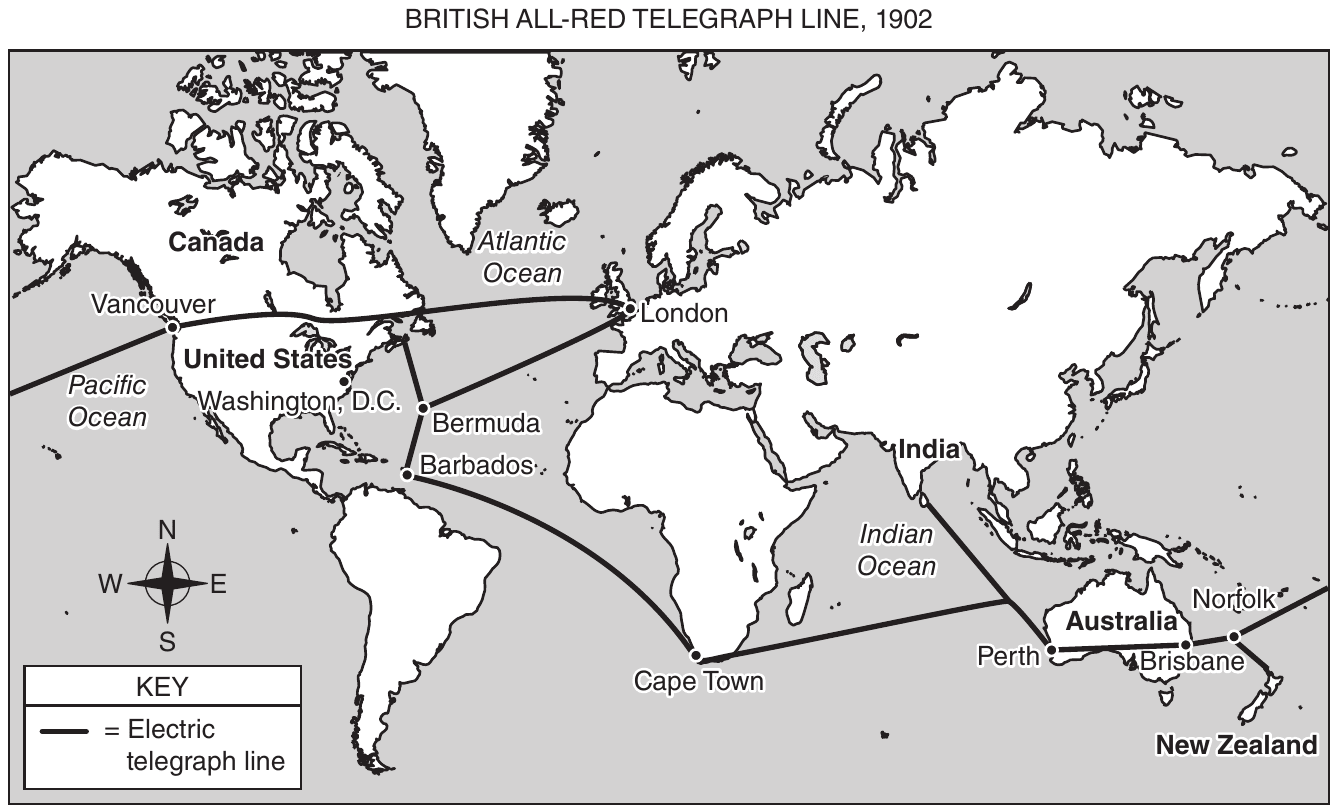
The first transatlantic electric telegraph message was sent in 1858, and by 1902 the British All-Red Line connected most of the world.
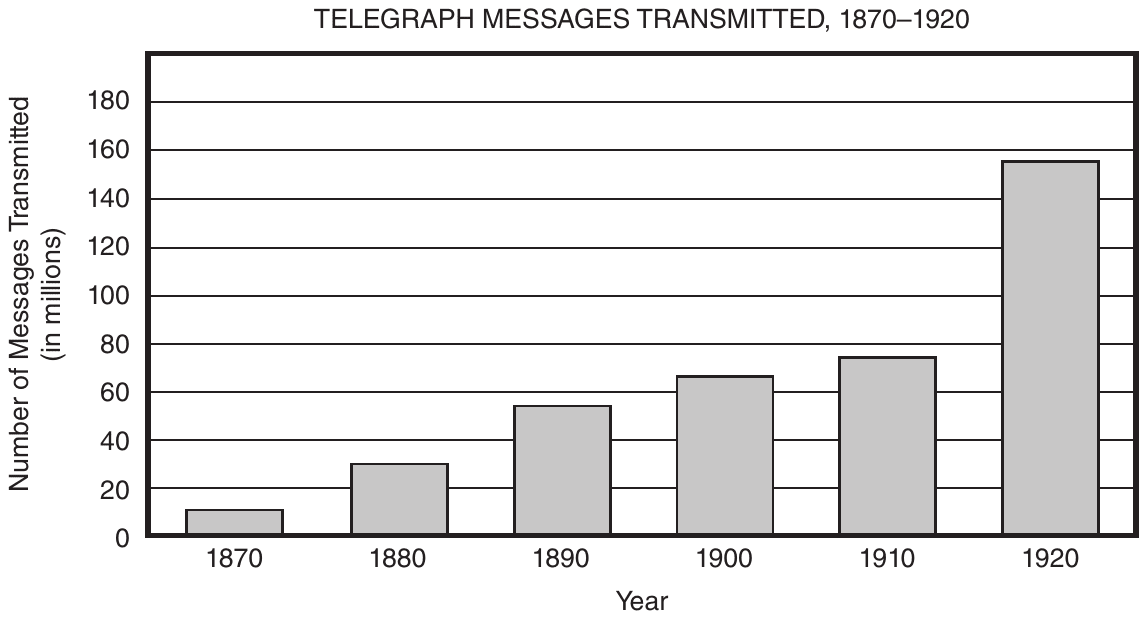
Source: U.S. Bureau of the Census. Historical Statistics of the United States, Colonial Times to 1970, Bicentennial Edition, Part 2. Washington, D.C., 1975.
Question
Which sentence is the best summary of how Morse obtained the funding necessary to build his telegraph system?
- AMorse’s application for a federal grant was delayed until 1843, so he spent time traveling in Europe, where he concentrated on obtaining a patent for his system.
- BMorse applied for a government grant that required both houses of Congress and the president to pass a bill awarding him $30,000 for his telegraph project.
- CMorse applied for a government appropriation and conducted telegraph demonstrations to show that his system could work, and after a delay caused by a financial depression, Congress approved the $30,000 appropriation in 1843.
- DWorking with Gale and Vail allowed Morse to find flaws in Henry’s work and to develop his own ideas before applying for the federal government appropriation.
Show the answer
Correct answer: C
The question asks for the best summary of how Morse obtained the funding necessary to build his telegraph system.
A. Incorrect. This summary focuses mostly on what Morse did while his application for funding was delayed in the United States rather than on how Morse acquired the funding, because during this period, Morse tried “not only to secure patent protection overseas but to examine competing telegraph systems in England” (paragraph 5). Therefore, it is not the best summary of how Morse obtained the funding necessary to build his telegraph system.
B. Incorrect. Although this summary mentions how Morse applied for the “federal government’s appropriation” (paragraph 4), it primarily focuses on the actions of the House of Representatives and the Senate, not on Morse’s efforts to obtain funding. Therefore, it is not the best summary of how Morse obtained the funding necessary to build his telegraph system.
C. CORRECT. This summary best describes how Morse obtained the funding that he needed for his telegraph system, because it explains that Morse applied “for the federal government’s appropriation, and during the next year he conducted demonstrations of his telegraph” (paragraph 4). In paragraph 5, the author explains the impact that the Panic of 1837 had on Morse’s request. In paragraph 6, the author describes how by 1843, economic times had improved, so Morse again “asked Congress for the $30,000” and was awarded the funds after “the Senate approved it.”
D. Incorrect. This summary is not the best summary of how Morse obtained the funding necessary to build his telegraph system, because it relates how Morse worked with others to develop his ideas about the telegraph and how Gale and Vail were the “keys to Morse’s success” (paragraph 3) before he applied for funding.
Question analysis
Students read “Invention of the Telegraph” and pick the best one-sentence summary of how Samuel Morse secured federal funding for his telegraph line. The money story is spread over several paragraphs alongside other events in Morse’s life, and the four long choices each blend true details, so students must decide what a good summary of this one process includes.
- Grade level
- Grade 7 reading and task
- Compared with grade 7
- At grade 7 Summarizing a short chain of events is everyday grade 7 work, and every fact needed is stated plainly. The main demand is patience with long choices rather than any hard inference.
- Estimated difficulty
- Moderate: several steps, or a close reading with one strong distractor.
- Thinking it demands
- Depth of knowledge 2, skills and concepts · mainly understand
- What makes it hard
- A very close wrong answer moderate
- Evidence in several places moderate
- A lot to read minor
- Evidence
- Answered from several paragraphs or stanzas
- Reading level
- Passage: about grade 11, 910 words; question and choices: about grade 13, 126 words.
- Corrected from the DOE handbook
- A date in the passage introduction was corrected.
- A wrong word in the explanation was corrected.
- Students, last 30 days
- Not enough answers yet to show (it takes 10).
Why it is hard, traps and wrong answers (shows the answer)
Why it is hard
Every choice is built from real events, so the question is less about spotting a false statement than about judging what a summary of the funding must contain. Students who accept the first accurate sentence they meet stop at the account of Congress and the president, which skips the years between application and approval. Listing the stages first, application, demonstrations, delay and vote, turns the long choices into a quick checklist.
A very close wrong answer moderate Choosing the answer
The summary about both houses and the president is accurate and ends where the key does, with the $30,000 approved; what separates them is the middle stretch, the demonstrations and the depression’s delay, which only the key covers. (Embretson & Wetzel, 1987; Gorin & Embretson, 2006; Ascalon et al., 2007)
Evidence in several places moderate Working it out
The funding story is split over paragraphs 4 to 6: the December 1837 application, demonstrations in New York and Washington, the Panic of 1837 with a trip to Europe, and the 1843 request and vote. (Kirsch & Mosenthal, 1990; Gorin & Embretson, 2006)
A lot to read minor Understanding the question
Each choice is a single sentence of 26 to 33 words carrying dates, a dollar amount, Congress and several people, and every piece has to be checked against the passage. (Kintsch, 1998; Gorin & Embretson, 2006; Freedle & Kostin, 1993)
Strategy: Find the part of the passage about paying for the telegraph and jot down each step in order; then pick the summary that matches your list from start to finish without wandering off it.
Traps
- Too narrow: A single detail offered as the central idea or a summary, or a summary that keeps minor details and leaves out an essential part.
- Wrong part of the text: A choice is true of another paragraph, stanza or speaker than the one asked about.
The wrong answers, classified
A Too narrow (King et al., 2004)
Builds the summary on Morse’s European patent trip, something he did while the money stalled, and drops the demonstrations and the 1843 vote that actually produced the funds.
B Too narrow (King et al., 2004)
Gives only the final step, a bill passed by the House and Senate and signed by the president, and omits the demonstrations and the depression that held the money up for years.
D Wrong part of the text (Kirsch & Mosenthal, 1990)
Pulls in paragraph 3, where Gale and Vail help Morse build the system, which concerns the invention, not the money, and puts the flaws in Henry’s work, though Gale found them in Morse’s system.
What was corrected from the DOE handbook, and why
- Passage: The 2024–2025 handbook’s introduction says “In 1844, the United States Congress passed the Telegraph Bill.” Congress passed the $30,000 appropriation in March 1843; 1844 is the year of Morse’s first message. Paragraph 6 describes the 1843 approval, and Option C, the correct answer, says 1843, so the introduction reads “In 1843.” The site shares this passage with 2018 Test B English, where the same correction is recorded.
- Explanation: The handbook says Option A focuses on what Morse did while his application was delayed “rather than on how Morse acquired the patent.” The question asks how Morse obtained his funding, and the patent is what Option A does focus on, so the site now says “rather than on how Morse acquired the funding.”
Working it out, step by step
Figure out what the question asks
This question wants a summary. A summary is a short retelling that keeps only the main points, in the order they happen. The topic is narrow: how Morse got the money for his telegraph. So the best choice must be true, stay on the money, and tell that story from beginning to end.
Find where the money story is told
The funding story runs through paragraphs 4, 5 and 6. By December 1837, Morse felt ready “to apply for the federal government’s appropriation” (paragraph 4). The next year, “he conducted demonstrations of his telegraph both in New York and Washington” (paragraph 4). Then a money crisis “caused a long depression,” and Morse “was forced to wait for better times” (paragraph 5). In 1843 he “again asked Congress for the $30,000,” and this time he got it (paragraph 6).
Explain the words and list the steps
Some words may be new. An appropriation is money that lawmakers agree to pay out for a planned project. Demonstrations are public shows that prove a machine works. A depression is a long period when businesses struggle and cash is scarce. Now put the story in order:
- Morse asked for the money.
- He showed people his telegraph working.
- Hard times made him wait.
- In 1843 Congress said yes to the $30,000.
Check each choice
- A does not fit. It is mostly about a trip to Europe for a patent (a legal right that stops others from copying an invention). Morse made that trip while he waited. A leaves out the demonstrations and the vote.
- B does not fit. It is true, but it gives only the final step, when the House, the Senate and the president approved the bill. It skips the demonstrations and the years of waiting.
- C fits. It covers the request, the demonstrations, the delay from the depression and the 1843 approval, in that order.
- D does not fit. Gale and Vail helped Morse build the telegraph, not pay for it. And the flaws Gale pointed out were in Morse’s system, while D puts them in Henry’s work.
Choose the answer
Only one choice tells the whole funding story, from the first request to the final yes, without drifting to other topics. So the answer is C.
Why this answer and not the closest wrong one
B is the hardest choice to rule out, because nothing in it is false. But it starts at the very end of the story. It drops the demonstrations Morse gave and the long wait during the depression. A summary must hold all the main steps, and C is the only choice that does.
More questions like this
The original DOE question
The passage “Invention of the Telegraph” as printed (pages 146–148)