Passage 5 Reasons Physical Books Might Be Better Than E-Books
5 Reasons Physical Books Might Be Better Than E-Books
by Shaunacy Ferro
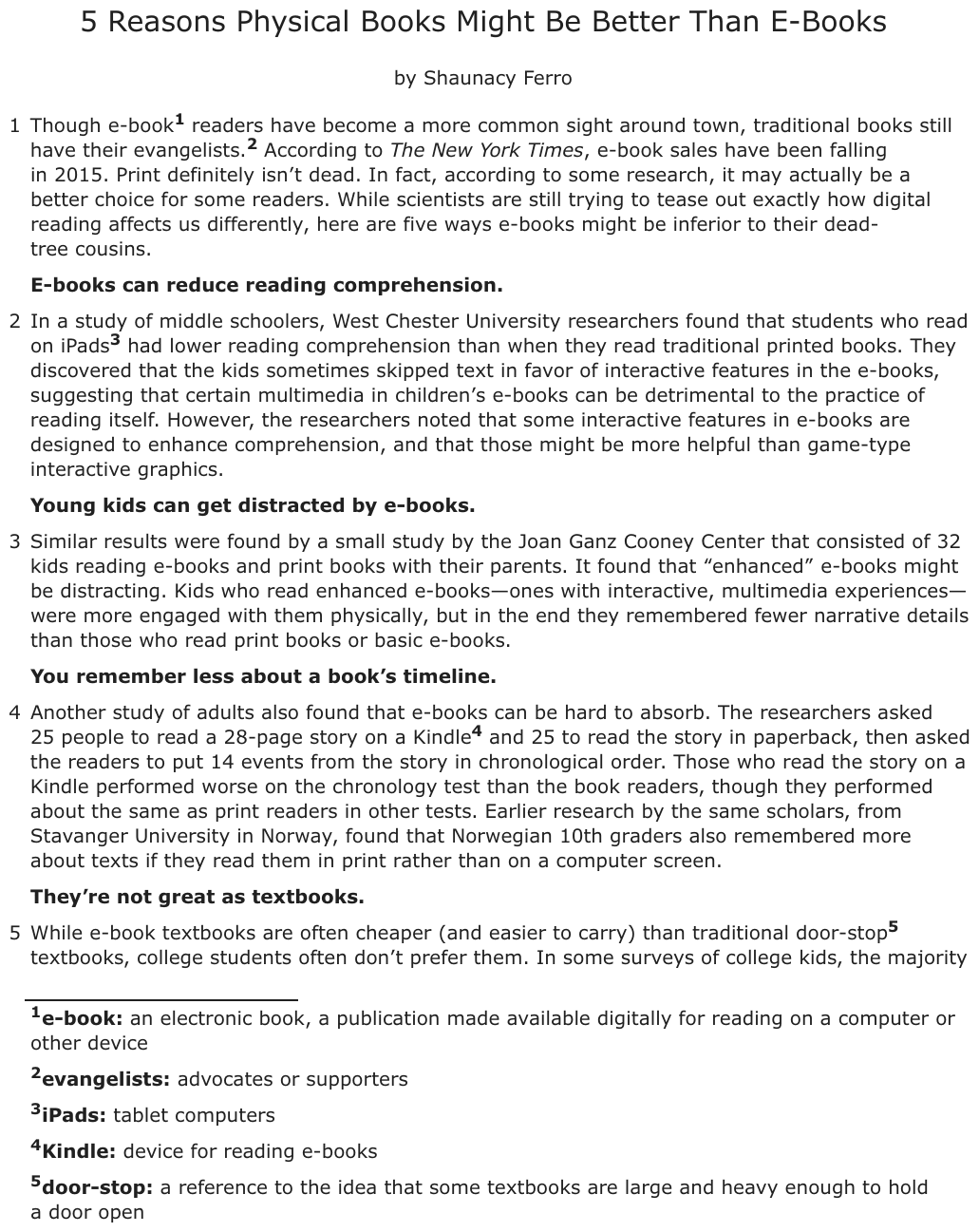
Though e-book1 readers have become a more common sight around town, traditional books still have their evangelists.2 According to The New York Times, e-book sales have been falling in 2015. Print definitely isn’t dead. In fact, according to some research, it may actually be a better choice for some readers. While scientists are still trying to tease out exactly how digital reading affects us differently, here are five ways e-books might be inferior to their dead-tree cousins.
E-books can reduce reading comprehension.
In a study of middle schoolers, West Chester University researchers found that students who read on iPads3 had lower reading comprehension than when they read traditional printed books. They discovered that the kids sometimes skipped text in favor of interactive features in the e-books, suggesting that certain multimedia in children’s e-books can be detrimental to the practice of reading itself. However, the researchers noted that some interactive features in e-books are designed to enhance comprehension, and that those might be more helpful than game-type interactive graphics.
Young kids can get distracted by e-books.
Similar results were found by a small study by the Joan Ganz Cooney Center that consisted of 32 kids reading e-books and print books with their parents. It found that “enhanced” e-books might be distracting. Kids who read enhanced e-books—ones with interactive, multimedia experiences—were more engaged with them physically, but in the end they remembered fewer narrative details than those who read print books or basic e-books.
You remember less about a book’s timeline.
Another study of adults also found that e-books can be hard to absorb. The researchers asked 25 people to read a 28-page story on a Kindle4 and 25 to read the story in paperback, then asked the readers to put 14 events from the story in chronological order. Those who read the story on a Kindle performed worse on the chronology test than the book readers, though they performed about the same as print readers in other tests. Earlier research by the same scholars, from Stavanger University in Norway, found that Norwegian 10th graders also remembered more about texts if they read them in print rather than on a computer screen.
They’re not great as textbooks.
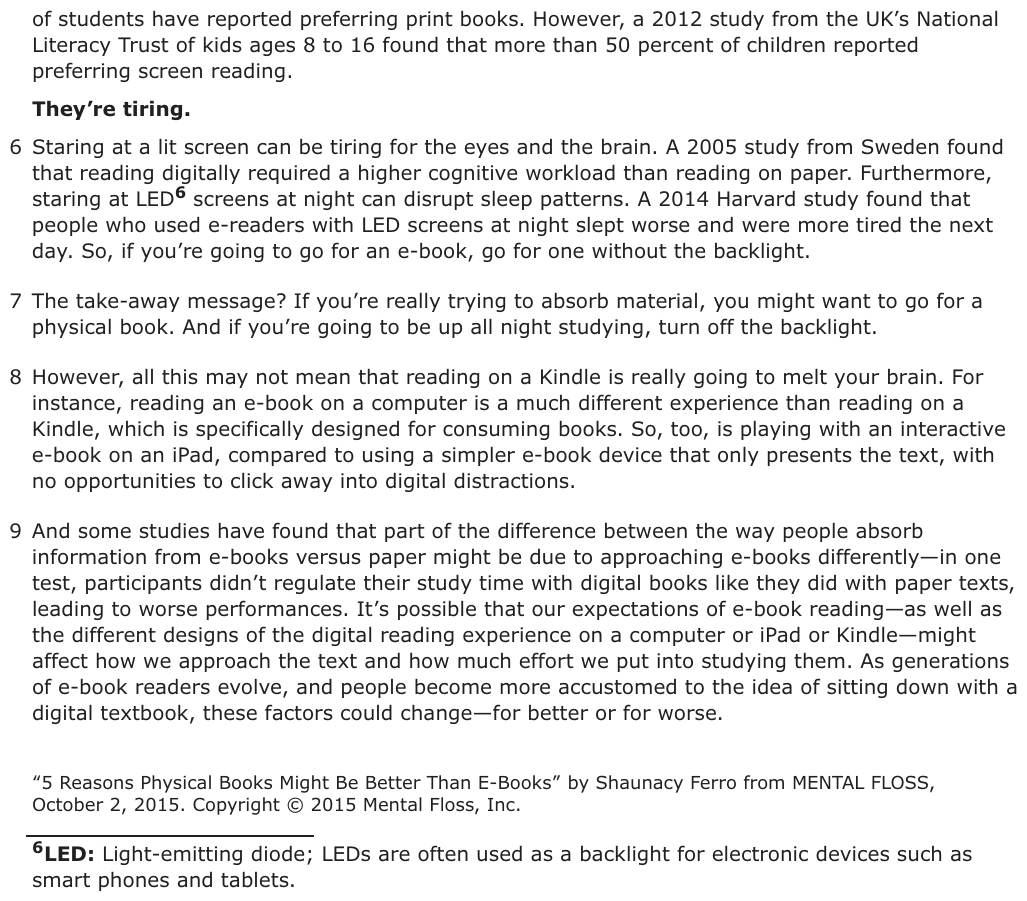
While e-book textbooks are often cheaper (and easier to carry) than traditional door-stop5 textbooks, college students often don’t prefer them. In some surveys of college kids, the majority of students have reported preferring print books. However, a 2012 study from the UK’s National Literacy Trust of kids ages 8 to 16 found that more than 50 percent of children reported preferring screen reading.
They’re tiring.
Staring at a lit screen can be tiring for the eyes and the brain. A 2005 study from Sweden found that reading digitally required a higher cognitive workload than reading on paper. Furthermore, staring at LED6 screens at night can disrupt sleep patterns. A 2014 Harvard study found that people who used e-readers with LED screens at night slept worse and were more tired the next day. So, if you’re going to go for an e-book, go for one without the backlight.
The take-away message? If you’re really trying to absorb material, you might want to go for a physical book. And if you’re going to be up all night studying, turn off the backlight.
However, all this may not mean that reading on a Kindle is really going to melt your brain. For instance, reading an e-book on a computer is a much different experience than reading on a Kindle, which is specifically designed for consuming books. So, too, is playing with an interactive e-book on an iPad, compared to using a simpler e-book device that only presents the text, with no opportunities to click away into digital distractions.
And some studies have found that part of the difference between the way people absorb information from e-books versus paper might be due to approaching e-books differently—in one test, participants didn’t regulate their study time with digital books like they did with paper texts, leading to worse performances. It’s possible that our expectations of e-book reading—as well as the different designs of the digital reading experience on a computer or iPad or Kindle—might affect how we approach the text and how much effort we put into studying them. As generations of e-book readers evolve, and people become more accustomed to the idea of sitting down with a digital textbook, these factors could change—for better or for worse.
“5 Reasons Physical Books Might Be Better Than E-Books” by Shaunacy Ferro from MENTAL FLOSS, October 2, 2015. Copyright © 2015 Mental Floss, Inc.
1e-book: an electronic book, a publication made available digitally for reading on a computer or other device
2evangelists: advocates or supporters
3iPads: tablet computers
4Kindle: device for reading e-books
5door-stop: a reference to the idea that some textbooks are large and heavy enough to hold a door open
6LED: Light-emitting diode; LEDs are often used as a backlight for electronic devices such as smart phones and tablets.
Question
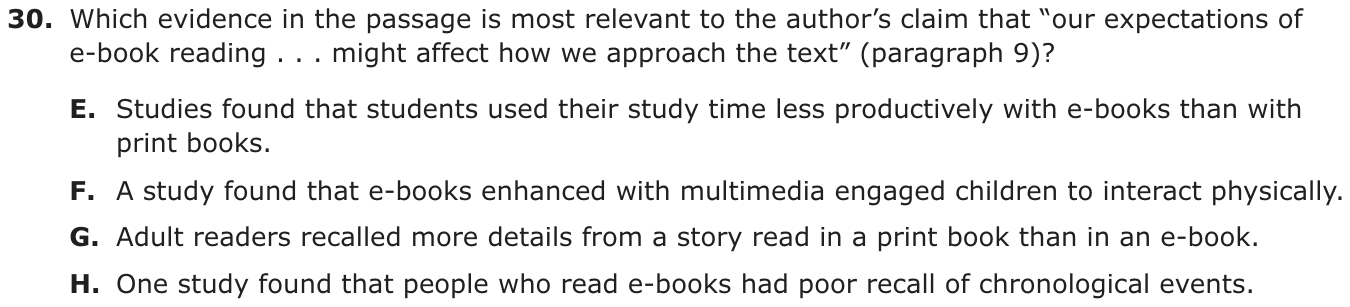
Which evidence in the passage is most relevant to the author’s claim that “our expectations of e-book reading . . . might affect how we approach the text” (paragraph 9)?
- AStudies found that students used their study time less productively with e-books than with print books.
- BA study found that e-books enhanced with multimedia engaged children to interact physically.
- CAdult readers recalled more details from a story read in a print book than in an e-book.
- DOne study found that people who read e-books had poor recall of chronological events.
Show the answer
Correct answer: A
The question asks which evidence in the passage is most relevant to the author’s claim that “our expectations of e-book reading . . . might affect how we approach the text” (paragraph 9).
A. CORRECT. According to information in the passage, “kids sometimes skipped text in favor of interactive features” (paragraph 2) and they “remembered fewer narrative details” (paragraph 3). Additionally, a study found that “participants didn’t regulate their study time with digital books like they did with paper texts, leading to worse performances” (paragraph 9). This information directly demonstrates the author’s claim that expectations of e-book reading might affect how people approach the text.
B. Incorrect. In paragraph 3, the author states that e-books may be physically engaging, but they are also “distracting,” and readers who used them “remembered fewer narrative details.” While this evidence is important in helping readers understand why children who read e-books may comprehend less information than children who read print text, the evidence does not as strongly relate to the author’s claim as the idea in the correct answer does.
C. Incorrect. The author states that one “study of adults also found that e-books can be hard to absorb” (paragraph 4) and that “if you’re really trying to absorb material, you might want to go for a physical book” (paragraph 7). Although the evidence presented here provides support for the idea that retaining information from an e-book is more difficult than from a print book, it does not as strongly relate to the author’s claim as the idea in the correct answer does.
D. Incorrect. The author points out in paragraph 4 that adults “who read the story on a Kindle performed worse on the chronology test than the book readers.” Although this evidence shows how well adults can recall a series of events read in an e-book versus how well adults can recall a series of events read in a print book, the evidence does not as strongly relate to the author’s claim as the idea in the correct answer does.
Question analysis
In paragraph 9 of “5 Reasons Physical Books Might Be Better Than E-Books,” the author suggests that what we expect from e-book reading may change the way we read, and students must pick the research finding that bears most directly on that claim. Every choice reports a study from the article, so the claim itself must be pinned down before any finding is judged.
- Grade level
- Grade 7 reading and task
- Compared with grade 7
- At grade 7 Deciding which evidence bears on a claim is everyday grade 7 work with arguments. An ellipsis trims the quoted claim, and the four findings come from separate studies, but each is brief and clearly stated, keeping the demand typical.
- Estimated difficulty
- Moderate: several steps, or a close reading with one strong distractor.
- Thinking it demands
- Depth of knowledge 2, skills and concepts · mainly evaluate
- What makes it hard
- The right answer is reworded moderate
- Reading between the lines minor
- Complex sentences minor
- Evidence
- Answered from several paragraphs or stanzas
- Reading level
- Passage: about grade 10, 829 words; question and choices: about grade 9, 86 words.
- Corrected from the DOE handbook
- A reversed statement of the author’s claim in the explanation was corrected.
- Students, last 30 days
- Not enough answers yet to show (it takes 10).
Why it is hard, traps and wrong answers (shows the answer)
Why it is hard
The quoted claim runs from cause to effect: what readers expect of e-books shapes the way they handle the text. Findings about results, such as weaker recall of a story's events, show that e-reading went worse but not why, so they miss the claim. The fitting study is in paragraph 9 itself, just before the claim, though the key generalizes it, and the most tempting wrong answer describes a behavior that the passage pins on the e-books' multimedia features.
The right answer is reworded moderate Choosing the answer
The key turns paragraph 9's “didn't regulate their study time with digital books like they did with paper texts” into “used their study time less productively,” while wrong choices keep paragraph 3's “enhanced” and paragraph 4's chronology wording. (Freedle & Kostin, 1993; Kirsch & Mosenthal, 1990)
Reading between the lines minor Working it out
Students must see that managing study time is a way of approaching a text, one shaped by what readers expect of a screen, though the passage never labels it so. (Graesser, Singer & Trabasso, 1994; Kintsch, 1998)
Complex sentences minor Understanding the question
The ellipsis in the quoted claim cuts “as well as the different designs of the digital reading experience,” so the full sentence names two causes and must be reread to isolate expectations. (Abedi & Lord, 2001; Freedle & Kostin, 1993; Messick, 1989)
Strategy: Read the whole sentence in paragraph 9, since the ellipsis cuts out a phrase about device design, then state what the claim says affects what, and test each finding against that link.
Traps
- Supports only part of the claim: In a question about evidence: a line that backs one half of the claim but not the other, or a related point rather than the claim itself.
- Twists what the text says: Uses the text's topic and ideas but changes what it says: who did it, how much, when, or why.
The wrong answers, classified
B Supports only part of the claim (King et al., 2004; Thissen, Steinberg & Fitzpatrick, 1989)
Treats children engaging physically with enhanced e-books as a way of approaching the text, but paragraph 3 traces that engagement to the multimedia features, not to readers' expectations.
C Twists what the text says (King et al., 2004)
Mixes the children who “remembered fewer narrative details” with the adult Kindle study, whose readers fell short only at ordering events, and reports a result rather than an approach.
D Supports only part of the claim (King et al., 2004; Thissen, Steinberg & Fitzpatrick, 1989)
Accurately recalls that Kindle readers did worse at putting 14 events in order, but that is an outcome of e-reading and says nothing about expectations shaping how people read.
What was corrected from the DOE handbook, and why
- Explanation: The handbook ends its explanation of choice A by saying the evidence demonstrates “the author’s claim that expectations of e-book reading might be affected by how people approach the text.” The claim in paragraph 9, quoted in the question, runs the other way: “our expectations of e-book reading . . . might affect how we approach the text.” The sentence now reads “might affect how people approach the text.”
Working it out, step by step
Put the claim in plain words
This asks you to match evidence to a claim. Expectations are what you think something will be like. How you approach a text is the way you go about reading it. So the claim says that what we expect from e-books may change how we read them. The cause is what we expect. The effect is how we read.
Find the evidence in paragraph 9
Look just before the claim, in paragraph 9. The author says the difference “might be due to approaching e-books differently.” Then comes a test. In it, “participants didn’t regulate their study time with digital books like they did with paper texts, leading to worse performances.”
Participants are the people in a study. To regulate means to control or plan.
Connect the evidence to the claim
Planning your study time is part of how you approach a text. These readers planned their time worse with e-books than with paper, and they did worse. The author thinks what readers expect from e-books may explain why. Choice A says the same thing in other words. Using time “less productively” means getting less done with it.
Check each choice
- A fits. It shows people going about their reading in a different way with e-books.
- B is wrong. In paragraph 3, kids played with “enhanced” e-books because of the books’ multimedia features. That is about how the books were made, not what readers expected.
- C is wrong. It mixes up two studies. The kids in paragraph 3 remembered fewer details. The adults in paragraph 4 did worse only at putting events in order.
- D is wrong. It is true, but poor memory of events is a result. It doesn’t show how people went about reading.
Watch out: B and D both tell what happened with e-books. The claim is about why people read them differently.
Choose the answer
Only one choice shows readers handling their reading in a different way with e-books. So the answer is A.
Why this answer and not the closest wrong one
B comes closest, because playing with an e-book is a kind of behavior. But paragraph 3 credits the books’ multimedia features for it, not what readers expected. A shows readers planning their study time worse on screens. That is how they approached the text.
More questions like this
The original DOE question
The passage “5 Reasons Physical Books Might Be Better Than E-Books” as printed (pages 58–59)