2026 Practice Test D English
Question 1 of 50
2026 Practice Test D English, question 1Passage A Memory Revolution
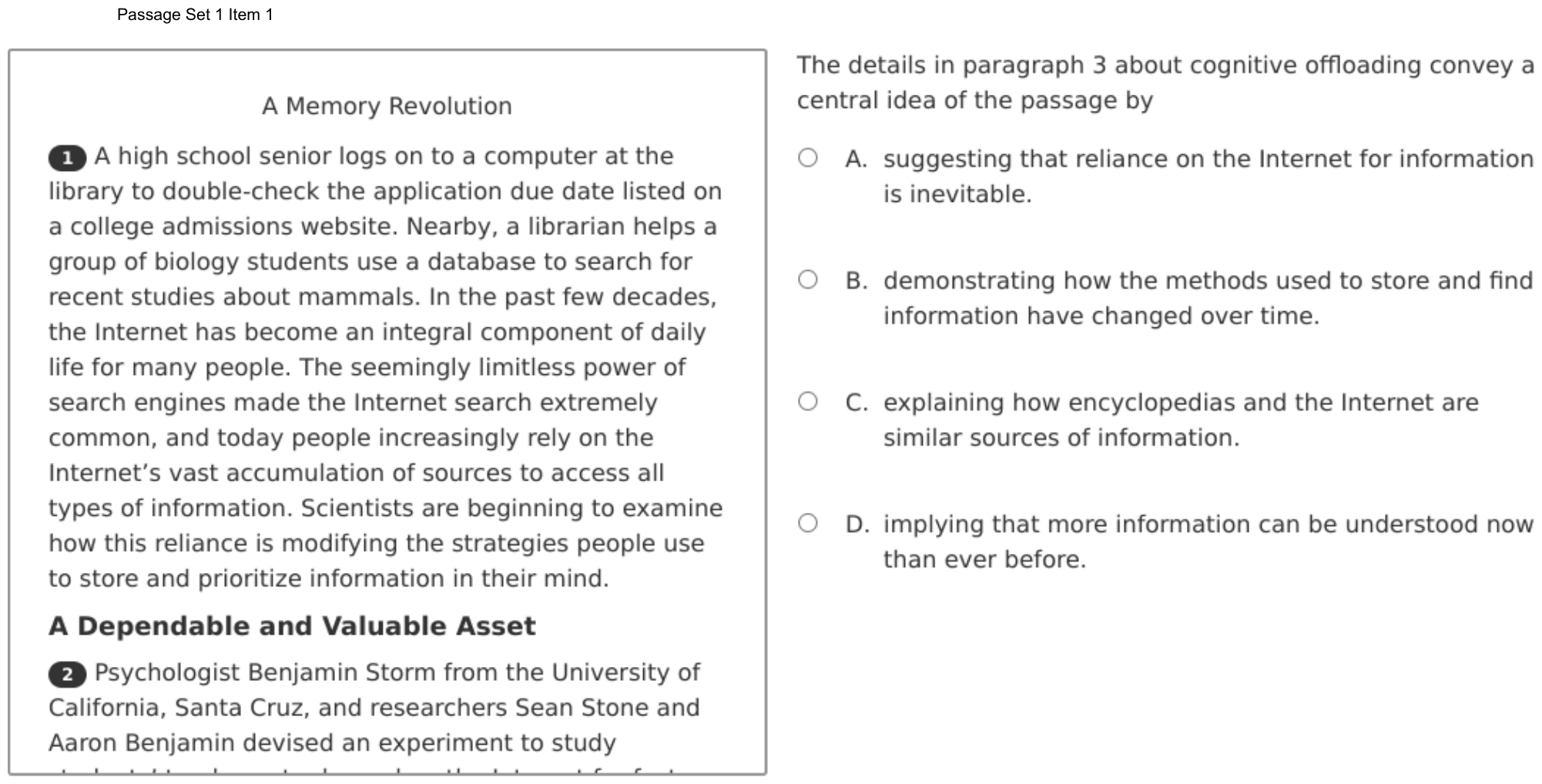
A Memory Revolution
A high school senior logs on to a computer at the library to double-check the application due date listed on a college admissions website. Nearby, a librarian helps a group of biology students use a database to search for recent studies about mammals. In the past few decades, the Internet has become an integral component of daily life for many people. The seemingly limitless power of search engines made the Internet search extremely common, and today people increasingly rely on the Internet’s vast accumulation of sources to access all types of information. Scientists are beginning to examine how this reliance is modifying the strategies people use to store and prioritize information in their mind.
A Dependable and Valuable Asset
Psychologist Benjamin Storm from the University of California, Santa Cruz, and researchers Sean Stone and Aaron Benjamin devised an experiment to study students’ tendency to depend on the Internet for facts. To begin, the scientists divided sixty participants into multiple groups, including an “Internet” group and a “memory” group, and placed them in front of computers. The Internet group was required to use the search engine Google to answer eight challenging trivia questions. In contrast, participants in the memory group were permitted to use only their personal knowledge to answer the questions. In the second round, the researchers administered notably easier questions. This time, they allowed each group the option of using Google as they answered. Their results showed that 83 percent of the Internet group continued to consult Google in the second round, while only 63 percent of the memory group chose to do so.
People’s growing inclination to rely on the Internet in order to retrieve information, particularly facts and figures, is called cognitive offloading. Canadian researcher Evan F. Risko and British researcher Sam Gilbert, who have written extensively about the topic, say a similar process has been taking place for centuries. In the past, people used resources like encyclopedias to assist their memories; however, today the Internet, serving as a vast extended memory, allows people to digitally access and retrieve much larger volumes of information. Consequently, people’s minds are free for other cognitive feats, such as connecting data, learning new information, or solving problems.
Filing Information Away
The use of the Internet also appears to be modifying the strategies people use to store information in their mind. Researchers Betsy Sparrow from Columbia University, Jenny Liu from the University of Wisconsin-Madison, and Daniel Wegner from Harvard University conducted several studies to discover how people efficiently manage their information intake.
To begin, the researchers examined how people evaluate which information deserves their effort to remember. For this experiment, participants read forty trivia facts, such as “An ostrich’s eye is bigger than its brain,” and typed the statements into a computer file. Half the participants had been previously told the file would be saved, while half believed it would be erased. Next, the participants wrote down every fact they could recall. Those who believed the information would be erased and no longer available could recall 40 percent more facts than those who thought the information would be saved.
In another experiment, the same researchers tested the ability of study participants to remember where to access information. For this trial, participants read and typed trivia statements, which they saved in folders with generic names such as “Facts” and “Items.” After spending ten minutes writing down all the facts they could recall from memory, participants were asked which folder contained a particular fact based on a keyword. For example, “Which folder has the fact about ostriches?” Overall, participants recalled the information’s location more often than the content itself, correctly identifying 49 percent of the folders for specific facts while remembering only 23 percent of the actual trivia. The researchers concluded that our memory is adapting to the Internet age by prioritizing where to locate information even when the specific details are forgotten. According to Sparrow, the Internet has become an important form of transactive memory, an external source of the recollections and associative networks that constitute memory.
As the Internet’s resources continue to expand our “external” memory, some question whether the process may cause people to depend too heavily on technology. However, Steven Pinker, a professor of psychology at Harvard University, says, “Knowledge is increasing exponentially; human brainpower and waking hours are not. Fortunately, the Internet and information technologies are helping us manage, search and retrieve our collective intellectual output at different scales, from Twitter and previews to e-books and online encyclopedias. Far from making us stupid, these technologies are the only things that will keep us smart.”
Question
The details in paragraph 3 about cognitive offloading convey a central idea of the passage by
- Asuggesting that reliance on the Internet for information is inevitable.
- Bdemonstrating how the methods used to store and find information have changed over time.
- Cexplaining how encyclopedias and the Internet are similar sources of information.
- Dimplying that more information can be understood now than ever before.
Show the answer
Correct answer: B
The question asks how the details in paragraph 3 about cognitive offloading convey a central idea of the passage.
A. Incorrect. Although paragraph 3 describes the Internet as “a vast extended memory,” it does not present reliance on the Internet for information as inevitable. The paragraph states that the Internet “allows people to digitally access and retrieve much larger volumes of information” and indicates that this benefit leaves people free to focus on “connecting data, learning new information, or solving problems.” However, these details about the benefits of the Internet do not express an opinion about the inevitability of Internet reliance.
B. CORRECT. A central idea of the passage is that the Internet is changing how people retain information. Paragraph 3 supports this idea by stating that “a similar process has been taking place for centuries” and that “in the past,” resources such as encyclopedias were used to store and find information. The details provided in paragraph 3 about encyclopedias and the Internet show that people have always used resources to remember information and that these resources change over time as people develop new ways to “assist their memories.”
C. Incorrect. While paragraph 3 does compare the use of encyclopedias to obtain information in the past with the use of today’s Internet, this comparison fails to convey the central idea of the passage that the Internet is changing how people remember information.
D. Incorrect. Although paragraph 3 states that “much larger volumes of information” are available on the Internet than what has been available in previous methods of information storage, such as encyclopedias, this fact does not relate to an increase in the ability to understand that information and is not a central idea of the passage.
Question analysis
This central-idea question on “A Memory Revolution,” an article about how relying on the Internet affects the way people remember, asks how the details about cognitive offloading in paragraph 3 convey a central idea of the passage. The paragraph mentions encyclopedias, the Internet and freed-up minds, and the choices each build on a different detail, so students must see what the paragraph adds to the article as a whole.
- Grade level
- Grade 8 reading and task
- Compared with grade 7
- At grade 7 Tying one paragraph’s details to a central idea is regular grade 7 work. Paragraph 3 is short, but terms such as “cognitive offloading” and “extended memory” are abstract, and students must settle on the article’s central idea before judging the paragraph.
- Estimated difficulty
- Moderate: several steps, or a close reading with one strong distractor.
- Thinking it demands
- Depth of knowledge 2, skills and concepts · mainly understand
- What makes it hard
- The right answer is reworded moderate
- A very close wrong answer minor
- Hard words minor
- Evidence
- Answered from one paragraph or stanza
- Reading level
- Passage: about grade 14, 763 words; question and choices: about grade 11, 61 words.
- Corrected from the DOE handbook
- An inaccurate statement about paragraph 3 in the explanation was corrected.
- Students, last 30 days
- Not enough answers yet to show (it takes 10).
Why it is hard, traps and wrong answers (shows the answer)
Why it is hard
Paragraph 3 is built on a then-and-now contrast: encyclopedias once helped people remember, and today the Internet does the same job on a far larger scale. Students who notice only the pairing take it for a likeness, while those who stop at the opening “growing inclination to rely on the Internet” are tempted to call the reliance unstoppable. The point goes to students who first name the article’s central idea, that the Internet is changing how people remember, and then read the paragraph as one stage in a long history.
The right answer is reworded moderate Choosing the answer
The key’s “methods used to store and find information have changed over time” appears nowhere in paragraph 3, while the wrong choices stay near its own wording: reliance on the Internet, encyclopedias beside the Internet, and more information. (Freedle & Kostin, 1993; Kirsch & Mosenthal, 1990)
A very close wrong answer minor Choosing the answer
The choice calling encyclopedias and the Internet similar sources sets up the same old-and-new pairing as the key; it parts only on likeness versus change, which the paragraph’s “however, today” decides. (Embretson & Wetzel, 1987; Gorin & Embretson, 2006; Ascalon et al., 2007)
Hard words minor Understanding the question
The paragraph explains its idea in abstract terms, “cognitive offloading,” “a vast extended memory” and “other cognitive feats,” which must be decoded before its then-and-now structure shows. (Perfetti, 2007; Freedle & Kostin, 1993)
Strategy: Put the article’s central idea about the Internet and memory into your own words first, then test each choice against what paragraph 3’s sentences actually say, not against a word it shares with them.
Traps
- True but not the answer: A choice says something accurate about the text that does not answer this question.
- Twists what the text says: Uses the text's topic and ideas but changes what it says: who did it, how much, when, or why.
- Too broad or too strong: A choice overstates, generalizes, or uses absolute words the text does not support.
The wrong answers, classified
A Too broad or too strong (King et al., 2004)
Builds on the “growing inclination to rely on the Internet” and a process “taking place for centuries,” then hardens them into “inevitable,” a claim the paragraph never makes.
C True but not the answer (King et al., 2004; Embretson & Wetzel, 1987)
Sees, accurately, that paragraph 3 sets encyclopedias beside the Internet as aids to memory, but stops at the likeness and misses the “however” that turns the comparison into a change.
D Twists what the text says (King et al., 2004)
Matches “much larger volumes of information” to more information and swaps the paragraph’s “access and retrieve” for “understood,” though reaching more facts is not grasping them better.
What was corrected from the DOE handbook, and why
- Explanation: The DOE’s explanation of Option A says that paragraph 3 “does not discuss reliance on the Internet for information.” It does: the paragraph opens “People’s growing inclination to rely on the Internet in order to retrieve information, particularly facts and figures, is called cognitive offloading.” What the paragraph does not do is present that reliance as inevitable, which is why Option A is wrong, as the explanation’s last sentence says. The site now reads “it does not present reliance on the Internet for information as inevitable.”
Working it out, step by step
Figure out what the question asks
This is a central idea question. A central idea is a main point the whole article makes. Here the main point is that the Internet is changing how people remember. The question asks how paragraph 3 adds to that point. Paragraph 3 is about “cognitive offloading,” so first work out what that term means.
Read paragraph 3 closely
Paragraph 3 begins: “People’s growing inclination to rely on the Internet in order to retrieve information, particularly facts and figures, is called cognitive offloading.” Then it says “a similar process has been taking place for centuries.” Next comes the key sentence: “In the past, people used resources like encyclopedias to assist their memories; however, today the Internet, serving as a vast extended memory, allows people to digitally access and retrieve much larger volumes of information.”
Put the paragraph in plain words
An inclination is a habit of leaning toward something. Cognitive means having to do with thinking. To offload is to hand a load to someone else. So cognitive offloading means letting an outside tool do some of your remembering. People have done this for a long time. Long ago they used encyclopedias, books full of facts. Today they use the Internet. The word “however” marks the change from then to now. So the paragraph shows the tools for storing and finding facts changing over time.
Check each choice
- A does not fit. The paragraph does talk about people relying on the Internet. But it never says that reliance is inevitable, which means it cannot be avoided.
- B fits. The paragraph moves from encyclopedias “in the past” to the Internet “today.” That is a change in how people store and find information.
- C does not fit. The paragraph does set the two side by side. But it uses them to show a change, not to say they are alike.
- D does not fit. People can “access and retrieve” more information. That means find it and pull it up, not understand it.
Watch out: C is tempting because encyclopedias and the Internet both help memory. Read past the likeness to the word “however.”
Choose the answer
Paragraph 3 shows people moving from encyclopedias to the Internet to help them remember. That supports the article’s point that the Internet is changing memory. So the answer is B, “demonstrating how the methods used to store and find information have changed over time.”
Why this answer and not the closest wrong one
C is the closest wrong choice. Paragraph 3 does compare encyclopedias and the Internet. But the comparison makes a point about change: the Internet now holds “much larger volumes of information.” B names that change. C stops at the likeness, so it misses what the paragraph adds to the article.
More questions like this
The original DOE question
The passage “A Memory Revolution” as printed (pages 3–4)
Question 2 of 50
2026 Practice Test D English, question 2Uses the passage above: “A Memory Revolution”.
Question
How do the details about the experiment described in paragraph 5 convey a central idea of the passage?
- AThey suggest that the act of repeating information by typing it on a keyboard may improve a person’s memory.
- BThey explain that a person will forget information faster if the information is considered unimportant.
- CThey indicate that a person may start to forget details when the amount of information becomes overwhelming.
- DThey suggest that memory is affected by whether a person expects to have access to the information in the future.
Show the answer
Correct answer: D
The question asks how the details of the experiment described in paragraph 5 convey a central idea of the passage.
A. Incorrect. Although paragraph 5 states that participants read the trivia facts and then “typed the statements into a computer file,” it does not explain the impact of repetition on memory, nor does this convey a central idea of the passage.
B. Incorrect. Paragraph 5 acknowledges that people evaluate which information is important enough to remember, but it does not describe the rate at which people forget unimportant information. According to the paragraph, information is considered less important to remember if a person believes that he or she will be able to retrieve that information easily in the future. This does not mean the information is unimportant but rather that it is readily available for future access.
C. Incorrect. Paragraph 5 specifies the number of trivia facts that study participants were given to read (forty), but it does not describe the amount of information as a factor in the participants’ memory performance. According to the paragraph, it was not the amount of information but rather the expectation of future availability that affected how much information participants were able to recall.
D. CORRECT. A central idea of the passage is that the way the human memory stores information is changing because of the Internet. The details of the experiment support this idea by indicating that study participants remembered different amounts of information based on whether they “thought the information would be saved” (paragraph 5). Those who “believed the information would be erased and no longer available” (paragraph 5) remembered 40 percent more than those who expected to be able to access the information again in a saved computer file. Therefore, paragraph 5 conveys the central idea that the expectation of future access to information is a key element in “how people evaluate which information deserves their effort to remember.”
Question analysis
Paragraph 5 of “A Memory Revolution” describes an experiment in which people typed forty trivia facts, such as one about an ostrich’s eye, into a computer file and then wrote down all they could recall. This central-idea question asks how the experiment’s details convey a central idea of the passage. Each choice offers a different lesson about memory, so the experiment’s actual result must decide.
- Grade level
- Grade 7 reading and task
- Compared with grade 7
- At grade 7 Explaining what an experiment’s results show is common grade 7 reading. The experiment in paragraph 5 is told in plain words and its result is a single comparison, so the main demand is restating that result as an idea.
- Estimated difficulty
- Straightforward: two steps or one careful reading.
- Thinking it demands
- Depth of knowledge 2, skills and concepts · mainly understand
- What makes it hard
- Evidence
- Answered from one paragraph or stanza
- Reading level
- Passage: about grade 14, 763 words; question and choices: about grade 12, 88 words.
- Students, last 30 days
- Not enough answers yet to show (it takes 10).
Why it is hard, traps and wrong answers (shows the answer)
Why it is hard
The experiment is short and its result fits in one sentence, so most students find the idea once they ask what differed between the two groups. The trap is the paragraph’s framing, “which information deserves their effort to remember,” which invites talk of important and unimportant facts and leads to the choice about forgetting. Others reach for what they know about studying, such as writing things down, instead of the one condition the researchers changed.
Reading between the lines minor Working it out
Paragraph 5 never names the cause; students must see that both groups read and typed the same forty facts, so only what they were told about the file can explain the 40 percent gap. (Graesser, Singer & Trabasso, 1994; Kintsch, 1998)
A very close wrong answer minor Choosing the answer
The choice about forgetting unimportant information shares the key’s idea that how people regard information affects memory; it differs in the reason, importance rather than expected access, and adds a speed nobody measured. (Embretson & Wetzel, 1987; Gorin & Embretson, 2006; Ascalon et al., 2007)
Strategy: Restate the experiment in paragraph 5 and its result in one sentence of your own, then reject any choice that rests on something the experiment did not set up or measure.
Traps
- Twists what the text says: Uses the text's topic and ideas but changes what it says: who did it, how much, when, or why.
- Outside knowledge: A choice is plausible in the real world but not supported by this text.
- Reads too much in: A reasonable-sounding conclusion that goes further than the text allows.
The wrong answers, classified
A Outside knowledge (King et al., 2004; Recht & Leslie, 1988)
Brings in the study tip that writing facts down helps memory, but both groups typed the same statements, so typing cannot explain why one group recalled 40 percent more.
B Twists what the text says (King et al., 2004)
Starts from “which information deserves their effort to remember” and calls the saved facts unimportant, though they were only expected to stay available, and no speed of forgetting was measured.
C Reads too much in (Graesser, Singer & Trabasso, 1994)
Takes forty trivia facts for an overload that made people forget, though both groups read the same forty, so the amount cannot explain the difference between them.
Working it out, step by step
Figure out what the question asks
This is a central idea question. It asks what the experiment in paragraph 5 shows. It also asks how that result supports a main point of the article. The article’s main point is that the Internet is changing how people remember.
Find the experiment in paragraph 5
In paragraph 5, participants, the people in the study, “read forty trivia facts” and “typed the statements into a computer file.” Then: “Half the participants had been previously told the file would be saved, while half believed it would be erased.” The result: “Those who believed the information would be erased and no longer available could recall 40 percent more facts than those who thought the information would be saved.”
Work out what the result means
Both groups read the same forty facts. Both typed them the same way. Only one thing was different: what each group expected to happen to the file. People who thought the facts would be gone remembered more. People who thought the facts would be saved remembered less. So your memory depends on whether you expect to look the facts up later. This fits the article’s point. When people know they can find facts again, they work less to remember them.
Check each choice
- A does not fit. Both groups typed the facts, so typing cannot explain why one group remembered more.
- B does not fit. Nobody called the saved facts unimportant. They were just expected to stay available. The study also never measured how fast people forget.
- C does not fit. Both groups read forty facts, so the amount was the same for everyone.
- D fits. What people expected about later access changed how much they remembered.
Watch out: B is tempting because the paragraph talks about “which information deserves their effort to remember.” But the saved facts were not judged unimportant. They were judged easy to find later.
Choose the answer
The only difference between the groups was whether they expected the file to be saved. So the answer is D, “They suggest that memory is affected by whether a person expects to have access to the information in the future.”
Why this answer and not the closest wrong one
B is the closest wrong choice. Like D, it says that how people see information affects memory. But B gives the wrong reason and adds a speed of forgetting. The study never tested importance or speed. The one thing it changed was whether people expected to see the facts again. That is exactly what D says.
More questions like this
The original DOE question
Question 3 of 50
2026 Practice Test D English, question 3Uses the passage above: “A Memory Revolution”.
Question
Read this sentence from paragraph 7.
As the Internet’s resources continue to expand our “external” memory, some question whether the process may cause people to depend too heavily on technology.
How does the sentence contribute to the structure and development of ideas in the passage?
- AIt presents a claim about the risks of relying on the Internet that prompted the research described in paragraphs 2 and 6.
- BIt contrasts a disadvantage of relying on the Internet with the benefits of Internet use that are described in paragraphs 2 and 6.
- CIt signals a shift from a neutral viewpoint in paragraphs 2 and 6 to a presentation of an argument and a counterargument.
- DIt introduces a counterargument and marks a transition from an optimistic tone in paragraphs 2 and 6 to a cautious tone as the counterargument is developed.
Show the answer
Correct answer: C
The question asks how the sentence from paragraph 7 contributes to the structure and development of ideas in the passage.
A. Incorrect. Although the studies showed, in part, that reliance on the Internet is increasing (“participants recalled the information’s location more often than the content itself” [paragraph 6]), the studies were not conducted in order to determine the risks of Internet use. The claim in the sentence did not prompt the research described in paragraphs 2 and 6.
B. Incorrect. While the sentence in paragraph 7 poses a question about the disadvantages of relying on the Internet, paragraphs 2 and 6 present the study data on Internet use and memory in a neutral tone (“correctly identifying 49 percent of the folders for specific facts while remembering only 23 percent of the actual trivia” [paragraph 6]). Neither study describes the availability of information on the Internet as an advantage or a disadvantage.
C. CORRECT. Paragraphs 2 and 6 describe the results of experiments related to the Internet’s effect on memory without commenting on the advantages or disadvantages of relying on that technology, and the sentence in paragraph 7 presents a questioning viewpoint that moves away from the neutral perspective of the broader passage. The opinion in the sentence is directly argued against in the three sentences that follow it, which present an extended quote from Steven Pinker, a psychology professor at Harvard University. Pinker refutes the idea expressed by the sentence, stating that “knowledge is increasing exponentially; human brainpower and waking hours are not.” He adds that technologies such as the Internet “are the only things that will keep us smart.”
D. Incorrect. Although the sentence in paragraph 7 expresses caution about the possible effects of the Internet on memory, the passage does not shift from an optimistic tone to a cautious tone. Actually, paragraph 6 provides the data on Internet use and memory in a neutral tone. The argument expressed by the sentence is also not elaborated on in the sentences that follow, but is immediately argued against by Steven Pinker, a professor of psychology. The last sentence of paragraph 7 in fact refutes the culled sentence: “ ‘Far from making us stupid, these technologies are the only things that will keep us smart.’ ”
Question analysis
This text-structure question quotes the sentence that opens the last paragraph of “A Memory Revolution,” where some people question whether the Internet may make us depend too heavily on technology. Students decide how it contributes to the structure and development of ideas in the article. Every choice also describes the experiments in paragraphs 2 and 6, so students must judge how the article presents them and what follows.
- Grade level
- Grade 8 reading and task
- Compared with grade 7
- Above grade 7 Grade 7 structure questions often ask what one sentence does in its paragraph. This one asks how a sentence turns the whole article, and every choice also characterizes paragraphs 2 and 6, closer to grade 8 work on opposing viewpoints.
- Estimated difficulty
- Hard: combines ideas, needs a plan, and has more than one tempting wrong answer.
- Thinking it demands
- Depth of knowledge 3, strategic thinking · mainly analyze
- What makes it hard
- How, not what moderate
- A very close wrong answer moderate
- Evidence in several places moderate
- Hard words minor
- Evidence
- Answered from several paragraphs or stanzas
- Reading level
- Passage: about grade 14, 763 words; question and choices: about grade 12, 129 words.
- Students, last 30 days
- Not enough answers yet to show (it takes 10).
Why it is hard, traps and wrong answers (shows the answer)
Why it is hard
The quoted sentence is the article’s only worried note, and the question asks what it does there. Students must judge two things at once: how the earlier studies sound, plain numbers such as 49 and 23 percent with no verdict, and what follows, Pinker’s “However” and a confident rebuttal. The near miss rightly calls the sentence an opposing view but hears the studies as cheerful and expects caution to follow, so only students who read on to the end of paragraph 7 can rule it out.
How, not what moderate Working it out
The stem asks what the sentence does in the article, and its job is a turn: from studies reported without judgment to a worry that Pinker’s quotation rebuts in the same paragraph. (Anderson & Krathwohl, 2001)
A very close wrong answer moderate Choosing the answer
The choice about a counterargument and a cautious tone shares the key’s frame, a shift away from paragraphs 2 and 6 toward opposing views; it differs in calling those paragraphs optimistic and the ending cautious. (Embretson & Wetzel, 1987; Gorin & Embretson, 2006; Ascalon et al., 2007)
Evidence in several places moderate Working it out
Every choice also characterizes paragraphs 2 and 6, so students must recall how the Google study and the folder study were reported, as percentages with no praise or blame, before judging the sentence. (Kirsch & Mosenthal, 1990; Gorin & Embretson, 2006)
Hard words minor Understanding the question
The choices judge structure in abstract words, “neutral viewpoint,” “counterargument,” “optimistic tone” and “cautious tone,” which students must match to how the article actually sounds. (Perfetti, 2007; Freedle & Kostin, 1993)
Strategy: Describe in a word or two how paragraphs 2 and 6 present their studies and what the rest of paragraph 7 does with the quoted sentence’s idea, then test both halves of every choice.
Traps
- Wrong tone or attitude: Misjudges the tone, attitude or point of view, such as reading admiration as criticism, or taking a character's or subject's feelings for the author's.
- Wrong part of the text: A choice is true of another paragraph, stanza or speaker than the one asked about.
- Reads too much in: A reasonable-sounding conclusion that goes further than the text allows.
The wrong answers, classified
A Reads too much in (Graesser, Singer & Trabasso, 1994)
Assumes the worry about depending on technology launched the research, though it appears only after the studies, and paragraph 2 says its experiment set out to study a “tendency to depend on the Internet.”
B Wrong part of the text (Kirsch & Mosenthal, 1990)
Credits paragraphs 2 and 6 with benefits found elsewhere, the freed-up minds of paragraph 3 under the heading “A Dependable and Valuable Asset,” though the two studies report results without calling them good.
D Wrong tone or attitude (Graesser, Singer & Trabasso, 1994)
Rightly sees an opposing view raised but hears the studies as optimistic and the ending as cautious, when Pinker’s quotation answers the worry at once and closes on “keep us smart.”
Working it out, step by step
Figure out what the question asks
This is a structure question. Structure is how the parts of an article fit together. The question asks what the sentence does at the start of paragraph 7. Each choice also describes paragraphs 2 and 6. So you must check two things: how those paragraphs sound, and what comes after the sentence.
Look at paragraphs 2 and 6
Paragraph 2 reports that “83 percent of the Internet group continued to consult Google in the second round, while only 63 percent of the memory group chose to do so.” Paragraph 6 reports “correctly identifying 49 percent of the folders for specific facts while remembering only 23 percent of the actual trivia.” These paragraphs give numbers. They do not say the results are good or bad. Writing that takes no side like this is called neutral.
Read the sentence and what follows
The sentence says “some question whether the process may cause people to depend too heavily on technology.” That is a worry, an argument against relying on the Internet. The very next word is “However.” Then Steven Pinker answers the worry. He ends, “Far from making us stupid, these technologies are the only things that will keep us smart.” An answer to an argument is called a counterargument. So the article moves from neutral reports to an argument and a counterargument.
Check each choice
- A does not fit. The worry comes after the studies. Nothing says it caused the research.
- B does not fit. Paragraphs 2 and 6 do not describe benefits. They only report numbers.
- C fits. The sentence shifts from neutral reports to an argument, and Pinker’s answer follows.
- D does not fit. Paragraphs 2 and 6 are not optimistic, or hopeful. And the end is not cautious. Pinker answers the worry with confidence.
Watch out: D is tempting because the sentence does raise an opposing view. But D gets both tones wrong.
Choose the answer
The sentence turns the article from plain reports to a debate. So the answer is C, “It signals a shift from a neutral viewpoint in paragraphs 2 and 6 to a presentation of an argument and a counterargument.”
Why this answer and not the closest wrong one
D is the closest wrong choice. Both C and D see the sentence bringing in an opposing view. But D calls paragraphs 2 and 6 optimistic, when they only give percentages. D also says a cautious tone follows. Instead, Pinker rejects the worry and ends with “keep us smart.” Only C describes both sides of the turn correctly.
More questions like this
The original DOE question
Question 4 of 50
2026 Practice Test D English, question 4Uses the passage above: “A Memory Revolution”.
Question
The study described in paragraph 6 influenced researchers’ ideas about memory in the digital age by
- Ahighlighting instances when organizing detailed information made it easier to remember.
- Bconfirming that keywords can be remembered more easily than large amounts of information.
- Cidentifying a shift in focus from remembering specific information to knowing where to find it.
- Demphasizing that remembering a basic idea is more important than storing detailed information.
Show the answer
Correct answer: C
The question asks how the study described in paragraph 6 influenced researchers’ ideas about memory in the digital age.
A. Incorrect. The study required participants to organize information into folders, but the results suggest that organizing the information did not make the information easier to remember; instead, participants remembered the folder in which to find the information but forgot the information itself.
B. Incorrect. Although the participants in the study were given a keyword, such as “ostrich,” when asked to remember “which folder contained a particular fact,” the study was significant for researchers because it demonstrated that “our memory is adapting to the Internet age by prioritizing where to locate information even when the specific details are forgotten” (paragraph 6). The study confirmed that participants were remembering where the information was stored, because they were able to provide the name of the folder where the information was stored.
C. CORRECT. The study in paragraph 6 demonstrated that participants were better able to recall where to find certain information than to recall the information itself. This influenced researchers’ ideas about memory in the digital age: “Overall, participants recalled the information’s location more often than the content itself, correctly identifying 49 percent of the folders for specific facts while remembering only 23 percent of the actual trivia” (paragraph 6).
D. Incorrect. The study did not examine the relative importance of remembering basic information or storing detailed information. It examined the effect of the Internet on the information that people remember and concluded that human memory “is adapting to the Internet age by prioritizing where to locate information” (paragraph 6).
Question analysis
This development-of-ideas question on “A Memory Revolution” asks how the folder experiment in paragraph 6, where participants saved trivia statements in folders named “Facts” and “Items” and were later quizzed, influenced researchers’ ideas about memory in the digital age. Students must understand what the experiment measured and what the researchers made of it, while the choices echo its keywords, folders and details.
- Grade level
- Grade 7 reading and task
- Compared with grade 7
- At grade 7 Explaining how a study shaped researchers’ thinking is typical grade 7 work with informational texts. The researchers state their conclusion in paragraph 6, which shortens the search, though the paragraph’s percentages and terms such as “transactive memory” need care.
- Estimated difficulty
- Straightforward: two steps or one careful reading.
- Thinking it demands
- Depth of knowledge 2, skills and concepts · mainly understand
- What makes it hard
- A very close wrong answer minor
- Much to keep track of minor
- Evidence
- Answered from one paragraph or stanza
- Reading level
- Passage: about grade 14, 763 words; question and choices: about grade 13, 67 words.
- Corrected from the DOE handbook
- A mislabeled term in the explanation was corrected.
- Students, last 30 days
- Not enough answers yet to show (it takes 10).
Why it is hard, traps and wrong answers (shows the answer)
Why it is hard
The researchers state their conclusion in paragraph 6, that memory is “prioritizing where to locate information even when the specific details are forgotten,” so the question mostly rewards recognizing it in new words. The risk lies in the experiment’s moving parts: a student who mixes up the folder, the fact and the keyword can believe that filing helped recall or that keywords were the finding. The closest wrong choice keeps the downgrading of detail and swaps a basic idea in for location.
A very close wrong answer minor Choosing the answer
The choice about a basic idea mirrors the key’s first half, detailed information losing out; it differs only in what wins, a basic idea instead of knowing where the information is kept. (Embretson & Wetzel, 1987; Gorin & Embretson, 2006; Ascalon et al., 2007)
Much to keep track of minor Working it out
Paragraph 6 juggles three things a participant might recall, the fact, its folder and the keyword cue, plus two percentages, so students must keep straight that 49 percent is folders and 23 percent is trivia. (Sweller, 1988; Carpenter, Just & Shell, 1990)
Strategy: Locate the researchers’ own conclusion in paragraph 6, restate it in plain words, and choose the option that matches it, not one that borrows a word from the description of the experiment.
Traps
- Reads too much in: A reasonable-sounding conclusion that goes further than the text allows.
- Word match: Repeats striking words or phrases from the text, so it looks supported, but its meaning does not fit the question.
- Twists what the text says: Uses the text's topic and ideas but changes what it says: who did it, how much, when, or why.
The wrong answers, classified
A Reads too much in (Graesser, Singer & Trabasso, 1994)
Assumes filing the facts in folders must have helped people remember them, though participants recalled only 23 percent of the trivia while naming the right folder 49 percent of the time.
B Word match (Freedle & Kostin, 1993)
Seizes on “keyword” in paragraph 6, but the keyword was only the cue in the question put to participants; what they remembered best was a folder with a generic name such as “Facts.”
D Twists what the text says (King et al., 2004)
Reads “prioritizing” as a ranking of what matters and turns knowing where a fact is kept into remembering a basic idea, though participants recalled locations, not the gist of the facts.
What was corrected from the DOE handbook, and why
- Explanation: The DOE’s explanation of Option B ends by saying that participants “were able to provide the name of the folder (keyword) where the information was stored.” In paragraph 6 the keyword is the cue the participants were given (the same explanation begins “the participants in the study were given a keyword, such as ‘ostrich’”); the folders had generic names such as “Facts” and “Items.” Calling the folder name a keyword makes the sentence seem to support Option B (“keywords can be remembered more easily”), the option it is rejecting. The site drops “(keyword).”
Working it out, step by step
Figure out what the question asks
This asks what the study in paragraph 6 taught the researchers about memory today. The researchers state their own conclusion in the paragraph. Find it, put it in plain words, and match it to a choice.
Follow the steps of the study
Participants typed trivia facts and saved them in folders. The folders had plain names, such as “Facts” and “Items.” Later each person got a keyword, a hint word, in a question like “Which folder has the fact about ostriches?” The result: “participants recalled the information’s location more often than the content itself, correctly identifying 49 percent of the folders for specific facts while remembering only 23 percent of the actual trivia.”
Read the researchers’ conclusion
Paragraph 6 says “our memory is adapting to the Internet age by prioritizing where to locate information even when the specific details are forgotten.” To prioritize is to put first. So people now put first knowing where a fact is kept. They may forget the fact itself. That is a shift in focus, a change in what memory pays attention to.
Check each choice
- A does not fit. Filing the facts in folders did not help people remember them. They recalled only 23 percent of the facts.
- B does not fit. The keyword, like “ostriches,” was only the hint in the question. What people remembered was the folder, such as “Facts.”
- C fits. Memory shifted from the facts themselves to where to find them.
- D does not fit. People remembered locations, not a basic idea of each fact.
Watch out: D is tempting because “prioritizing” sounds like deciding what matters most. But the study ranked nothing. It found that people recalled where facts were, not what they said.
Choose the answer
The study showed people remembering where facts were kept better than the facts. So the answer is C, “identifying a shift in focus from remembering specific information to knowing where to find it.”
Why this answer and not the closest wrong one
D is the closest wrong choice. Like C, it says detailed facts lose out. But it says a basic idea wins instead. In the study, what won was location: 49 percent of the folders against 23 percent of the facts. C names location, so C matches the researchers’ own conclusion.
More questions like this
The original DOE question
Question 5 of 50
2026 Practice Test D English, question 5Uses the passage above: “A Memory Revolution”.
Question
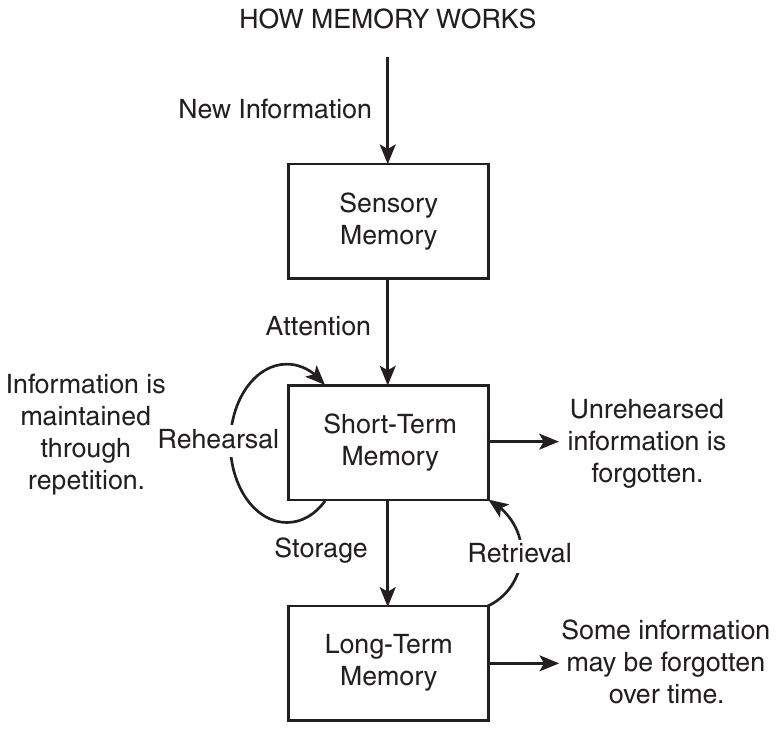
How does the diagram provide additional support for the topic presented in the passage?
- AIt reveals why human brains must adapt to obtaining information from the Internet as opposed to other sources.
- BIt indicates how people can use the Internet to help improve their long-term recollection of information.
- CIt shows how study participants’ brains distinguished between important and unimportant details.
- DIt depicts the idea that repetition and rehearsal are necessary to recall information when tools such as search engines are unavailable.
Show the answer
Correct answer: D
The question asks how the diagram provides additional support for the topic presented in the passage.
A. Incorrect. While the diagram indicates that the human brain has the ability to maintain different types of memory, the diagram does not show the need for the brain to adapt to obtaining information from the Internet rather than from other sources.
B. Incorrect. The diagram enhances the reader’s understanding of how long-term memories are formed, but it does not provide details about how the Internet can be used to improve long-term recollection of information.
C. Incorrect. The diagram provides an understanding of how details that are important to people can become stored because of an effort made to recall them. However, the diagram does not show how people decide which information is important and which is not.
D. CORRECT. The diagram depicts the connections that the human brain maintains between the different forms of memory. It also illustrates the idea that repetition and rehearsal are important steps in creating memories, as unrehearsed information will be forgotten. This supports the passage by highlighting the idea that access to search engines and other tools leads people to skip rehearsal and repetition steps that create memories, because people know that the information is readily accessible.
Question analysis
This question pairs “A Memory Revolution” with its flow diagram, “How Memory Works,” which follows new information from sensory memory through short-term and long-term memory, and asks how the diagram supports the topic of the passage. Students must read the diagram’s boxes, arrows and notes and relate them to an article about the Internet that never refers to the diagram, so the connection has to be worked out.
- Grade level
- Grade 8 reading and task
- Compared with grade 7
- Above grade 7 Grade 7 students regularly connect a diagram to a text. This flow diagram of memory never mentions the Internet, so students must build the bridge to the article’s studies themselves, and every choice claims something the diagram alone cannot show.
- Estimated difficulty
- Hard: combines ideas, needs a plan, and has more than one tempting wrong answer.
- Thinking it demands
- Depth of knowledge 3, strategic thinking · mainly analyze
- What makes it hard
- Combines ideas moderate
- Reading a figure, table or graph moderate
- Every choice must be checked minor
- Evidence
- Answered from the whole text
- Reading level
- Passage: about grade 14, 763 words; question and choices: about grade 12, 81 words.
- Students, last 30 days
- Not enough answers yet to show (it takes 10).
Why it is hard, traps and wrong answers (shows the answer)
Why it is hard
The diagram is a general model of memory, and every choice, even the right one, goes beyond it by bringing in the Internet, search engines or the study participants. The way through is to ask which choice rests on something the diagram really shows, and only one names its rehearsal loop and the forgetting of unrehearsed information. The strongest pull uses the diagram’s long-term memory and retrieval but claims the Internet improves recollection, the opposite of what paragraph 5’s experiment found.
Combines ideas moderate Working it out
The diagram never mentions the Internet and the article never mentions the diagram, so students must join its rehearsal loop to paragraph 5’s finding that people who expected the facts to be saved remembered fewer. (Embretson, 1998; Daniel & Embretson, 2010)
Reading a figure, table or graph moderate Understanding the question
Students must follow the arrows from “Attention” into short-term memory and find the “Rehearsal” loop beside “Information is maintained through repetition,” with “Unrehearsed information is forgotten” on the other side. (Lesh, Post & Behr, 1987; Kirsch & Mosenthal, 1990)
Every choice must be checked minor Choosing the answer
Three choices tie the diagram to the Internet, adaptation or the study participants, and even the key mentions search engines, so each claim must be held against the boxes and arrows actually drawn. (Embretson & Wetzel, 1987)
Strategy: Trace the diagram’s arrows from new information to long-term memory and say what each label shows, then ask which choice links that process to the studies without crediting the diagram with ideas it never shows.
Traps
- Reads too much in: A reasonable-sounding conclusion that goes further than the text allows.
- Wrong part of the text: A choice is true of another paragraph, stanza or speaker than the one asked about.
- Twists what the text says: Uses the text's topic and ideas but changes what it says: who did it, how much, when, or why.
The wrong answers, classified
A Reads too much in (Graesser, Singer & Trabasso, 1994)
Credits the diagram with the article’s claim that memory is “adapting to the Internet age” and adds a “must,” though its boxes and arrows show memory in general and never mention the Internet.
B Twists what the text says (King et al., 2004)
Joins the diagram’s long-term memory and retrieval arrow to the Internet as outside memory, though paragraph 5 found that people who expected the facts to be saved recalled fewer of them.
C Wrong part of the text (Kirsch & Mosenthal, 1990)
Reads the “Attention” arrow and the forgotten unrehearsed information as a picture of paragraph 5’s experiment, though the diagram shows no participants and nothing about judging what is important.
Working it out, step by step
Figure out what the question asks
This asks how the diagram supports the article. The diagram is the flow chart called “HOW MEMORY WORKS” at the end of the passage. It never mentions the Internet. So you must find what it shows, then link that to the article.
Follow the arrows in the diagram
Start at the top. An arrow labeled “New Information” goes into the box “Sensory Memory.” The “Attention” arrow leads to “Short-Term Memory.” From there, two things can happen. On the left, a loop labeled “Rehearsal” sits beside the note “Information is maintained through repetition.” On the right, a note says “Unrehearsed information is forgotten.” A “Storage” arrow leads down to “Long-Term Memory,” and a “Retrieval” arrow leads back up.
Explain what the diagram means
To rehearse information is to repeat it, the way you practice lines for a play. To maintain something is to keep it. So the diagram says that information you repeat stays with you. Information you don’t repeat is lost. Repeating takes effort.
Link the diagram to the passage
Paragraph 5 describes people who typed forty facts. Some thought the file would be saved. Others thought it would be erased. Those who thought it would be erased “could recall 40 percent more facts.” They knew they could not look the facts up later. So they made the effort to remember. The diagram shows that effort: rehearsal. When search engines are at hand, people may skip it.
Check each choice
- A does not fit. The diagram never mentions the Internet. It does not say brains must adapt.
- B does not fit. The diagram shows nothing about using the Internet. Paragraph 5 even found that people remembered less when they expected the facts to be saved.
- C does not fit. The diagram shows memory in general. It shows no study participants and no sorting of important facts.
- D fits. The “Rehearsal” loop shows that repeating information keeps it. Without a tool to look things up, that repeating is what lets you recall.
Watch out: B is tempting because the diagram has “Long-Term Memory” and “Retrieval,” and the article calls the Internet an outside memory. But the diagram is about the brain, not the Internet.
Choose the answer
The diagram shows rehearsal keeping information and unrehearsed information being forgotten. That explains why people who can’t look facts up must work to remember them. So the answer is D, “It depicts the idea that repetition and rehearsal are necessary to recall information when tools such as search engines are unavailable.”
Why this answer and not the closest wrong one
B is the closest wrong choice. It uses the diagram’s “Long-Term Memory” and “Retrieval” labels. But the diagram never shows the Internet improving recall. The passage says the opposite: expecting the facts to be saved made people remember fewer. D rests on what the diagram really shows, the “Rehearsal” loop and the note “Unrehearsed information is forgotten.”
More questions like this
The original DOE question
Question 6 of 50
2026 Practice Test D English, question 6Uses the passage above: “A Memory Revolution”.
Question
Which evidence from the passage is most relevant to the claim in paragraph 7 that “ ‘far from making us stupid, these technologies are the only things that will keep us smart’ ”?
- Athe revelation that most people opted to use the Internet to answer relatively easy trivia questions rather than relying on their own brainpower (paragraph 2)
- Bthe assertion that the storage of information on the Internet frees people to focus on higher-order tasks such as problem solving (paragraph 3)
- Cthe connection between how people organize information in their mind and their ability to recall that information (paragraph 5)
- Dthe description of transactive memory as an expansive external source that people can use to store information (paragraph 6)
Show the answer
Correct answer: B
The question asks for the evidence from the passage that is most relevant to the claim in paragraph 7 that “ ‘far from making us stupid, these technologies are the only things that will keep us smart.’ ”
A. Incorrect. Whether the participants decided to use the Internet to answer easy trivia questions varied based on the options that the participants were given during the first part of the experiment and, therefore, cannot be relevant to the claim in paragraph 7. Even when given the option of using the Internet, some participants chose to recall information from memory instead.
B. CORRECT. The assertion made in paragraph 3 that states that cognitive offloading allows for “people’s minds [to be] free for other cognitive feats, such as connecting data, learning new information, or solving problems” is relevant to the claim in paragraph 7 because it indicates that the ability to store large amounts of information within the brain does not necessarily make someone smart. It also suggests that if people did not have to use so much effort simply organizing and storing information, their brain would be free to conduct higher-order tasks: “the Internet, serving as a vast extended memory, allows people to digitally access and retrieve much larger volumes of information. Consequently, people’s minds are free for other cognitive feats, such as connecting data, learning new information, or solving problems” (paragraph 3).
C. Incorrect. The discussion in the passage connecting how people organize information in their mind and their ability to recall that information focuses on the process of organizing information within human memory rather than on how technology helps keep people’s minds available for complex thoughts.
D. Incorrect. Although the passage provides an accurate description of transactive memory, it provides no indication of how using such memory would advance a person’s ability to maintain or improve intelligent thought.
Question analysis
This evidence question on “A Memory Revolution” quotes the claim, made by Harvard psychologist Steven Pinker at the end of the article, that technologies such as the Internet are the only things that will keep us smart. Students choose the finding from earlier in the passage that is most relevant to it. Each choice summarizes a point about technology or memory, so relevance, not accuracy, decides.
- Grade level
- Grade 7 reading and task
- Compared with grade 7
- At grade 7 Judging which evidence is most relevant to a claim is standard grade 7 argument work. The claim is short and quoted in the question, and each choice names its paragraph, but students must recall what each paragraph actually showed.
- Estimated difficulty
- Moderate: several steps, or a close reading with one strong distractor.
- Thinking it demands
- Depth of knowledge 2, skills and concepts · mainly evaluate
- What makes it hard
- A very close wrong answer moderate
- Reading between the lines minor
- Evidence in several places minor
- Evidence
- Answered from several paragraphs or stanzas
- Reading level
- Passage: about grade 14, 763 words; question and choices: about grade 14, 112 words.
- Students, last 30 days
- Not enough answers yet to show (it takes 10).
Why it is hard, traps and wrong answers (shows the answer)
Why it is hard
Every choice reports something the article really says, so the question turns on relevance: which finding would persuade a reader that technology keeps us smart. The transactive-memory finding is the trap, because Pinker himself speaks of retrieving “our collective intellectual output,” and an outside store of facts sounds like his point. That finding shows only that technology holds information; paragraph 3 adds what people do with the freed space, and that step is the claim.
A very close wrong answer moderate Choosing the answer
The transactive-memory choice and the key both describe the Internet storing information for people; only the key adds the result, minds free for “connecting data, learning new information, or solving problems,” which is what keeps us smart. (Embretson & Wetzel, 1987; Gorin & Embretson, 2006; Ascalon et al., 2007)
Reading between the lines minor Working it out
The key never says smart; students must see that freeing minds for “other cognitive feats” is exactly what Pinker means by technology that keeps us smart rather than stupid. (Graesser, Singer & Trabasso, 1994; Kintsch, 1998)
Evidence in several places minor Working it out
The four findings come from paragraphs 2, 3, 5 and 6, and each choice’s summary has to be matched back to what its paragraph actually showed before its relevance can be judged. (Kirsch & Mosenthal, 1990; Gorin & Embretson, 2006)
Strategy: Restate Pinker’s claim in your own words, then ask of each finding whether it would persuade a doubter of that claim itself or only of something related to it.
Traps
- Supports only part of the claim: In a question about evidence: a line that backs one half of the claim but not the other, or a related point rather than the claim itself.
- True but not the answer: A choice says something accurate about the text that does not answer this question.
The wrong answers, classified
A True but not the answer (King et al., 2004; Embretson & Wetzel, 1987)
Pairs paragraph 2’s Google users with the “brainpower” in Pinker’s quotation, but people choosing a search engine for easy questions fits the worry he answers, not his claim that technology keeps us smart.
C True but not the answer (King et al., 2004; Embretson & Wetzel, 1987)
Hears smartness in organizing and recalling information, but paragraph 5 found people recalled fewer facts when a computer would save them, which hardly shows technology keeping anyone smart.
D Supports only part of the claim (King et al., 2004; Thissen, Steinberg & Fitzpatrick, 1989)
Matches transactive memory to paragraph 7’s “external” memory and Pinker’s “retrieve,” but an outside store shows only that technology holds facts, not that it frees minds for harder thinking.
Working it out, step by step
Figure out what the question asks
This asks for evidence: the detail that best supports a claim. The claim comes from Steven Pinker in paragraph 7: “Far from making us stupid, these technologies are the only things that will keep us smart.” Put it in your own words first. Pinker says the Internet does not make us dumb. It helps us think better.
Ask what would prove the claim
To support this claim, a detail must show technology helping people think. A detail that only shows people using the Internet is not enough. Neither is one that only shows the Internet storing facts. Look for a result: something people can do better because of the Internet.
Find that result in paragraph 3
Paragraph 3 says the Internet, “serving as a vast extended memory, allows people to digitally access and retrieve much larger volumes of information.” The next sentence gives the result: “Consequently, people’s minds are free for other cognitive feats, such as connecting data, learning new information, or solving problems.” Consequently means “as a result.” Cognitive feats are hard thinking tasks. Since the Internet holds the facts, your mind has room for harder work.
Check each choice
- A does not fit. People choosing Google for easy questions sounds more like the worry Pinker answers. It does not show anyone getting smarter.
- B fits. Higher-order tasks are harder kinds of thinking. Freeing minds for them is how technology could keep us smart.
- C does not fit. It is about how well people recall facts. In paragraph 5, people even recalled fewer facts when a computer would save them.
- D does not fit. It shows only that the Internet can store information. It does not say what people gain from that.
Watch out: D is tempting because transactive memory sounds like the “external” memory in paragraph 7. But storing facts outside your head is only half the idea. B adds the payoff: room for harder thinking.
Choose the answer
Only paragraph 3 shows the Internet freeing people for harder thinking. So the answer is B, “the assertion that the storage of information on the Internet frees people to focus on higher-order tasks such as problem solving” (paragraph 3).
Why this answer and not the closest wrong one
D is the closest wrong choice. It is true that the Internet works as an outside store of facts. But that alone does not show anyone getting smarter. B goes one step further. Because the Internet holds the facts, minds are free for “connecting data, learning new information, or solving problems.” That step is what Pinker’s claim needs.
More questions like this
The original DOE question
Question 7 of 50
2026 Practice Test D English, question 7Uses the passage above: “A Memory Revolution”.
Question
The effect of the Internet on a person’s memory is illustrated in the passage through the presentation of studies that
- Aexamine how the use of search engines changes the way people evaluate and store information for future access.
- Bhighlight the difference between the capacity of the Internet and the ability of the human brain to locate information.
- Ccompare the type of information that can be obtained from the Internet with the type of information that is stored in the human brain.
- Demphasize the ease of obtaining information through search engines rather than remembering it without assistance.
Show the answer
Correct answer: A
The question asks how the studies presented in the passage are used to illustrate the effect of the Internet on a person’s memory.
A. CORRECT. The study described in paragraph 5 examined the effect of computer use on the way people evaluate information, specifically “which information deserves their effort to remember,” and determined that “those who believed the information would be erased and no longer available could recall 40 percent more facts than those who thought the information would be saved.” The study described in paragraph 2 established that the use of Internet search engines increases the “inclination to rely on the Internet in order to retrieve information” (paragraph 3), and the study in paragraph 6 examined how this reliance on technology affects the way people store information: “Overall, participants recalled the information’s location more often than the content itself.”
B. Incorrect. Although a difference in the ability of the human brain and the capacity of the Internet to locate information might seem evident, the studies cited in the passage did not examine the ability or the capacity of either. The studies did not measure what the human brain is capable of but rather how memory is affected by the use of the Internet.
C. Incorrect. While the studies explored the Internet’s effect on the way information is stored in human memory, the type of information was not described or compared. Instead, the studies indicated that location is the main difference between the information stored in the Internet and the information stored in human memory, noting that the Internet has become “an external source of the recollections and associative networks that constitute memory” (paragraph 6).
D. Incorrect. Although it is increasingly common to use the Internet to obtain information (paragraph 2) rather than try to memorize information (paragraph 5), the studies did not examine the difficulty or ease of obtaining/recalling information using either method.
Question analysis
This evidence question asks how the studies described in “A Memory Revolution” illustrate the Internet’s effect on a person’s memory. Students must recall three experiments, one with trivia questions and Google, one with trivia typed into a computer file, and one with named folders, and decide what they examine together. Each choice sounds like a fair claim about the Internet and the brain.
- Grade level
- Grade 8 reading and task
- Compared with grade 7
- At grade 7 Summing up what a text’s evidence shows is everyday grade 7 work. Here the evidence is three studies spread over paragraphs 2, 5 and 6, which adds recall, but each one is described in plain terms.
- Estimated difficulty
- Moderate: several steps, or a close reading with one strong distractor.
- Thinking it demands
- Depth of knowledge 2, skills and concepts · mainly understand
- What makes it hard
- Evidence in several places moderate
- Reading between the lines minor
- Every choice must be checked minor
- Evidence
- Answered from several paragraphs or stanzas
- Reading level
- Passage: about grade 14, 763 words; question and choices: about grade 12, 96 words.
- Students, last 30 days
- Not enough answers yet to show (it takes 10).
Why it is hard, traps and wrong answers (shows the answer)
Why it is hard
The question asks what the article’s studies show together, so a student needs a one-line summary of three experiments before reading the choices. The key is slightly loose, since only the first study uses a search engine, which can make a careful reader hesitate. The strongest pull comes from paragraph 2, where most people turned to Google even for easy questions; it sounds like proof that searching is easier, but no study weighed the effort of looking up against remembering.
Evidence in several places moderate Working it out
The three studies sit in paragraphs 2, 5 and 6, and the key gathers them: turning to Google even for easy questions, recalling less from a saved file, and remembering folders better than facts. (Kirsch & Mosenthal, 1990; Gorin & Embretson, 2006)
Reading between the lines minor Working it out
No sentence says what the studies share; students must abstract it, that expecting later access changes what people bother to store, from experiments built on Google, a computer file and named folders. (Graesser, Singer & Trabasso, 1994; Kintsch, 1998)
Every choice must be checked minor Choosing the answer
Each wrong choice names something the studies might plausibly have measured, the Internet’s capacity, kinds of information or ease of searching, and only a check of the three experiments shows that none did. (Embretson & Wetzel, 1987)
Strategy: Sum up in a phrase what the studies in paragraphs 2, 5 and 6 each tested, then pick the option that describes what they examined rather than a point made elsewhere in the article.
Traps
- Reads too much in: A reasonable-sounding conclusion that goes further than the text allows.
- Twists what the text says: Uses the text's topic and ideas but changes what it says: who did it, how much, when, or why.
- Wrong part of the text: A choice is true of another paragraph, stanza or speaker than the one asked about.
The wrong answers, classified
B Wrong part of the text (Kirsch & Mosenthal, 1990)
Borrows paragraph 3’s “much larger volumes of information” and Pinker’s remark about “human brainpower,” points made outside the studies, which never measured what the Internet or the brain can hold.
C Twists what the text says (King et al., 2004)
Turns paragraph 6’s gap between recalling where a fact was kept and recalling the fact itself into a comparison of kinds of information, though no study sorted facts by type.
D Reads too much in (Graesser, Singer & Trabasso, 1994)
Reads paragraph 2’s finding that 83 percent of the Internet group kept using Google as proof that searching is easier, though no study compared the effort of searching with remembering.
Working it out, step by step
Figure out what the question asks
This asks what the studies in the article have in common. How do they show the Internet’s effect on memory? There are three studies, in paragraphs 2, 5 and 6. Sum up each one in a few words. Then find the choice that fits all three.
Sum up the three studies
- Paragraph 2: People who had used Google kept using it, even for easy questions. In fact, “83 percent of the Internet group continued to consult Google in the second round.”
- Paragraph 5: People who thought a file of facts would be erased remembered more. They decided which facts deserved “their effort to remember.”
- Paragraph 6: People remembered where facts were kept better than the facts themselves.
Find what the studies share
Each study looks at how people treat information when a computer or search engine can hold it for them. People decide what is worth the effort to remember. Judging the value of something like this is called evaluating. People also change what they store in their minds, such as where a fact is instead of the fact. That is the effect on memory.
Check each choice
- A fits. The studies show people judging what to remember and storing where to find it.
- B does not fit. No study measured how much the Internet can hold or what the brain can do.
- C does not fit. No study sorted information into types.
- D does not fit. No study compared how easy it is to search and to remember.
Watch out: D is tempting because most people in paragraph 2 kept using Google. That might seem to show searching is easier. But the study never measured ease. It only counted who used Google.
Choose the answer
Only one choice describes what the studies actually tested. So the answer is A, “examine how the use of search engines changes the way people evaluate and store information for future access.”
Why this answer and not the closest wrong one
D is the closest wrong choice. It sounds like a fair reason people use Google. But none of the studies timed or rated the effort of searching or remembering. They tested what people chose to remember and what they stored. A describes that. Only the first study used a search engine, but the other two show the same pattern with a computer file and folders.
More questions like this
The original DOE question
Question 8 of 50
2026 Practice Test D English, question 8Passage Excerpt from “How We Made the First Flight”
Excerpt from “How We Made the First Flight”
by Orville Wright
In 1903 brothers Wilbur and Orville Wright conducted experiments related to flying machines. These experiments would eventually lead to air travel becoming a reliable form of transportation.
During the night of December 16, 1903, a strong cold wind blew from the north. When we arose on the morning of the 17th, the puddles of water, which had been standing about camp since the recent rains, were covered with ice. The wind had a velocity of 10 to 12 meters per second (22 to 27 miles an hour). We thought it would die down before long, and so remained indoors the early part of the morning. But when ten o’clock arrived, and the wind was as brisk as ever, we decided that we had better get the machine out and attempt a flight. We hung out the signal for the men of the Life Saving Station.1 We thought that by facing the flyer into a strong wind, there ought to be no trouble in launching it from the level ground about camp. We realized the difficulties of flying in so high a wind, but estimated that the added dangers in flight would be partly compensated for by the slower speed in landing.
Final Preparations
We laid the track on a smooth stretch of ground about one hundred feet north of the new building. The biting cold wind made work difficult, and we had to warm up frequently in our living room, where we had a good fire in an improvised stove made of a large carbide2 can. By the time all was ready, J. T. Daniels, W. S. Dough and A. D. Etheridge, members of the Kill Devil3 Life Saving Station; W. C. Brinkley of Manteo, and Johnny Moore, a boy from Nags Head,4 had arrived.
We had a “Richard” hand anemometer with which we measured the velocity of the wind. Measurements made just before starting the first flight showed velocities of 11 to 12 meters per second, or 24 to 27 miles per hour. . . .
Audacity—and Calculation
Wilbur having used his turn in the unsuccessful attempt on the 14th, the right to the first trial now belonged to me. After running the motor a few minutes to heat it up, I released the wire that held the machine to the track, and the machine started forward in the wind. Wilbur ran at the side of the machine, holding the wing to balance it on the track. Unlike the start on the 14th, made in a calm, the machine, facing a 27-mile wind, started very slowly. Wilbur was able to stay with it till it lifted from the track after a forty-foot run. One of the Life Saving men snapped the camera for us, taking a picture just as the machine had reached the end of the track and had risen to a height of about two feet. The slow forward speed of the machine over the ground is clearly shown in the picture by Wilbur’s attitude. He stayed along beside the machine without any effort.
Flight
The course of the flight up and down was exceedingly erratic, partly due to the irregularity of the air, and partly to lack of experience in handling this machine. The control of the front rudder was difficult on account of its being balanced too near the center. This gave it a tendency to turn itself when started; so that it turned too far on one side and then too far on the other. As a result the machine would rise suddenly to about ten feet, and then as suddenly dart for the ground. A sudden dart when a little over a hundred feet from the end of the track, or a little over 120 feet from the point at which it rose into the air, ended the flight. As the velocity of the wind was over 35 feet per second and the speed of the machine over the ground against this wind ten feet per second, the speed of the machine relative to the air was over 45 feet per second, and the length of the flight was equivalent to a flight of 540 feet made in calm air. This flight lasted only 12 seconds, but it was nevertheless the first in the history of the world in which a machine carrying a man had raised itself by its own power into the air in full flight, had sailed forward without reduction of speed and had finally landed at a point as high as that from which it started.
From “How We Made the First Flight” by Orville Wright—Public Domain/Federal Aviation Administration
1Life Saving Station: one of the rescue stations along the Atlantic coastline that provided assistance to mariners in distress
2carbide: a very hard material composed of carbon and other heavy metals
3Kill Devil: the town of Kill Devil Hills in eastern North Carolina
4Nags Head: a town in eastern North Carolina
Question
How does paragraph 1 introduce the idea that the Wright brothers knew that their flight attempt was risky?
- Athrough the mention of a signal to notify lifesaving experts that the flight attempt was about to begin
- Bby providing specific details about the speed of the wind and the Wright brothers’ response to the windy conditions
- Cby suggesting that a slower landing would be necessary at the end of the flight in order to maintain safety
- Dthrough the indication that the Wright brothers waited indoors for most of the morning because of the poor weather
Show the answer
Correct answer: A
The question asks how paragraph 1 introduces the idea that the Wright brothers knew that their flight attempt was risky.
A. CORRECT. Paragraph 1 describes the Wright brothers hanging out “the signal” to notify the lifesaving crew to stand by as they attempted flight; the need for lifesaving experts to be available in case of an accident introduces the idea that the attempted flight might crash.
B. Incorrect. The specifics on the speed of the wind by themselves do not emphasize the danger of the flight. While the brothers admitted that the strong wind posed certain risks, they also noted that the windy conditions might make landing safer (“estimated that the added dangers in flight would be partly compensated for by the slower speed in landing” [paragraph 1]).
C. Incorrect. A slower landing was expected as a result of the windy conditions, but it was not part of a plan to increase the safety of the flight.
D. Incorrect. While the Wright brothers’ initial decision to wait to see whether the wind would die down does suggest they were concerned about the safety of the flight, the explanation of their decision to proceed with the flight shows that they expected one benefit from the poor weather: “the slower speed in landing” (paragraph 1).
Question analysis
This question on Orville Wright’s account “How We Made the First Flight” asks how the opening paragraph, which describes a cold, windy December morning at the brothers’ camp, introduces the idea that the Wright brothers knew their flight attempt was risky. Students must judge which of four details from the paragraph does that work, and the paragraph mentions both dangers and reasons for confidence.
- Grade level
- Grade 8 reading and task
- Compared with grade 7
- Above grade 7 Finding how a paragraph introduces an idea is grade 7 work, but this paragraph is long and old-fashioned, every choice points to something it mentions, and students must decide which detail most clearly signals that the brothers saw a risk.
- Estimated difficulty
- Hard: combines ideas, needs a plan, and has more than one tempting wrong answer.
- Thinking it demands
- Depth of knowledge 3, strategic thinking · mainly evaluate
- What makes it hard
- Reading between the lines moderate
- Every choice must be checked moderate
- Complex sentences minor
- Evidence
- Answered from one paragraph or stanza
- Reading level
- Passage: about grade 7, 816 words; question and choices: about grade 10, 93 words.
- Students, last 30 days
- Not enough answers yet to show (it takes 10).
Why it is hard, traps and wrong answers (shows the answer)
Why it is hard
Paragraph 1 states the danger outright only in its last sentence, and that sentence then weighs it against a gentler landing, so the choice built on the brothers’ response to the wind is the strongest pull. The key rests on a quieter detail whose meaning comes from a footnote: men from a rescue station were signaled before the attempt. Students must decide which detail shows the brothers preparing for trouble, not just noticing the weather, and that test is narrower than most expect.
Reading between the lines moderate Working it out
The key never says danger: students must connect “the signal for the men of the Life Saving Station” to footnote 1, rescue stations for “mariners in distress,” and see that summoning rescuers means expecting trouble. (Graesser, Singer & Trabasso, 1994; Kintsch, 1998)
Every choice must be checked moderate Choosing the answer
All four details come from paragraph 1, and its plainest admission of danger, “We realized the difficulties of flying in so high a wind,” sits inside a wrong choice, so each detail must be weighed for what it shows. (Embretson & Wetzel, 1987)
Complex sentences minor Understanding the question
The paragraph’s last sentence sets danger against benefit, “the added dangers in flight would be partly compensated for by the slower speed in landing,” and students must untangle it to see the brothers playing the risk down. (Abedi & Lord, 2001; Freedle & Kostin, 1993; Messick, 1989)
Strategy: Locate each of the four details in paragraph 1, reread the sentence it sits in, and ask what that detail on its own reveals about what the brothers feared could go wrong.
Traps
- Supports only part of the claim: In a question about evidence: a line that backs one half of the claim but not the other, or a related point rather than the claim itself.
- Twists what the text says: Uses the text's topic and ideas but changes what it says: who did it, how much, when, or why.
The wrong answers, classified
B Supports only part of the claim (King et al., 2004; Thissen, Steinberg & Fitzpatrick, 1989)
Seizes on the wind speeds and “We realized the difficulties of flying in so high a wind,” but the response the paragraph describes is a calculation that a slower landing would offset the danger.
C Twists what the text says (King et al., 2004)
Turns the slower landing, a side effect of facing a strong wind, into a safety step the brothers needed, when the paragraph counts it as a partial offset to the added danger.
D Reads too much in (Graesser, Singer & Trabasso, 1994)
Reads the wait for calmer air as fear and stretches “the early part of the morning” into most of it, though at ten o’clock they decided to fly in the same brisk wind.
Working it out, step by step
Figure out what the question asks
This asks how paragraph 1 first shows that the Wright brothers knew their flight was risky. Risky means it could end badly. All four choices name details from paragraph 1. Your job is to find the detail that shows them getting ready for trouble.
Find the signal in paragraph 1
Paragraph 1 says “We hung out the signal for the men of the Life Saving Station.” The small number 1 after “Station” points to footnote 1 at the end of the excerpt. Read it. A Life Saving Station was “one of the rescue stations along the Atlantic coastline that provided assistance to mariners in distress.” Mariners are sailors. Distress means danger or trouble.
Work out what the signal means
The brothers called rescue workers before they tried to fly. People call rescuers only when someone might get hurt. So the signal shows the brothers knew the flight could go wrong. They wanted help close by in case of a crash.
Check each choice
- A fits. Signaling rescuers shows the brothers planned for trouble.
- B does not fit. The wind speeds are only numbers. The brothers’ response was to fly anyway, thinking “there ought to be no trouble in launching.”
- C does not fit. The slower landing was a side effect of the wind. They counted it as a plus, not as a safety step they needed.
- D does not fit. They stayed inside only “the early part of the morning,” hoping the wind would die down. Then they went out in the same wind.
Watch out: B is tempting because the paragraph says “We realized the difficulties of flying in so high a wind.” But that same sentence weighs those dangers against a slower landing. It plays the risk down.
Choose the answer
The call to the rescue station is the detail that shows the brothers preparing for danger. So the answer is A, “through the mention of a signal to notify lifesaving experts that the flight attempt was about to begin.”
Why this answer and not the closest wrong one
B is the closest wrong choice. The paragraph does admit the wind made flying harder. But the brothers then argue the danger down: a slower landing would partly make up for it. A shows them acting on the risk. They called in rescuers before they flew. You only do that if you think something could go wrong.
More questions like this
The original DOE question
The passage “Excerpt from “How We Made the First Flight”” as printed (pages 13–14)
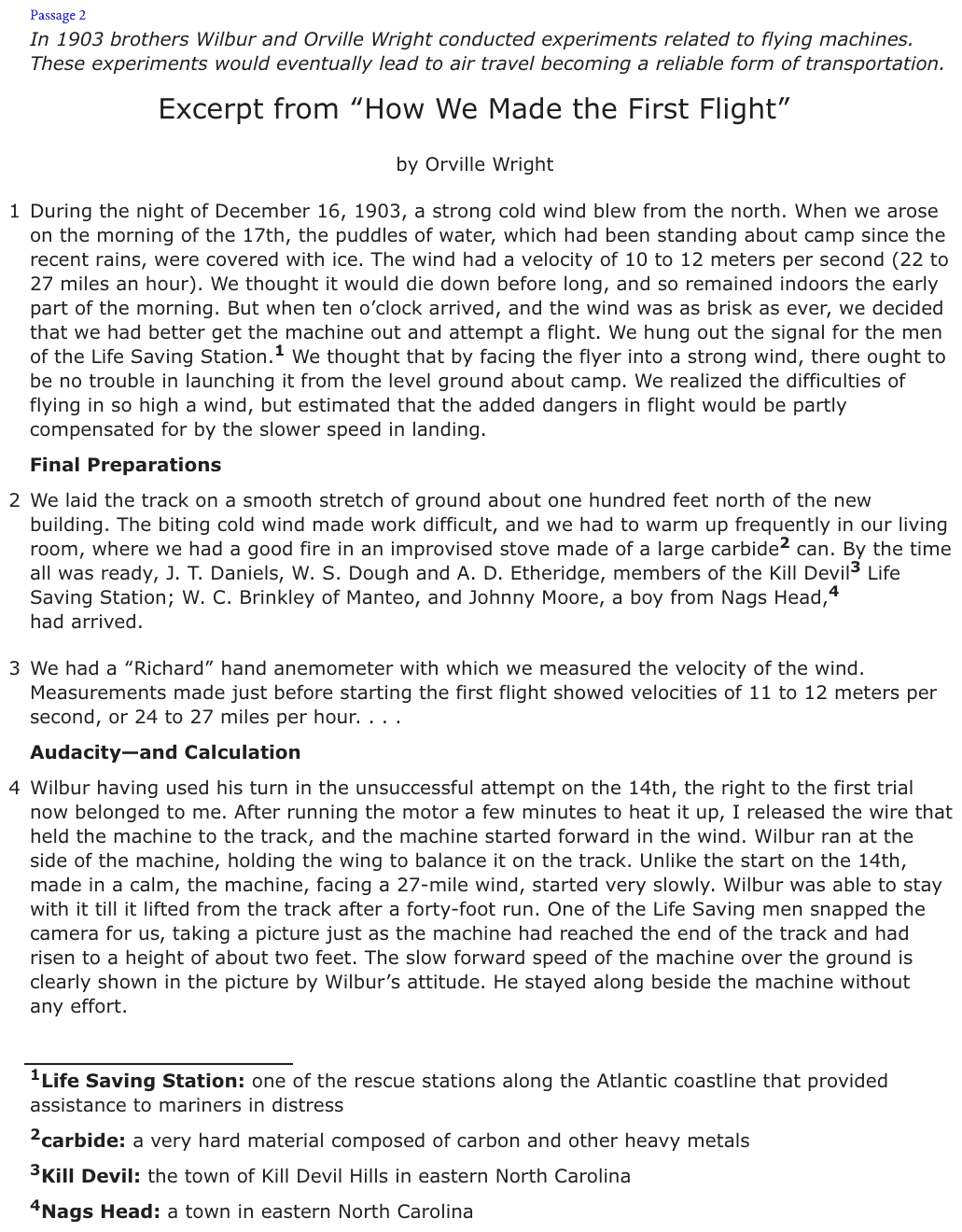
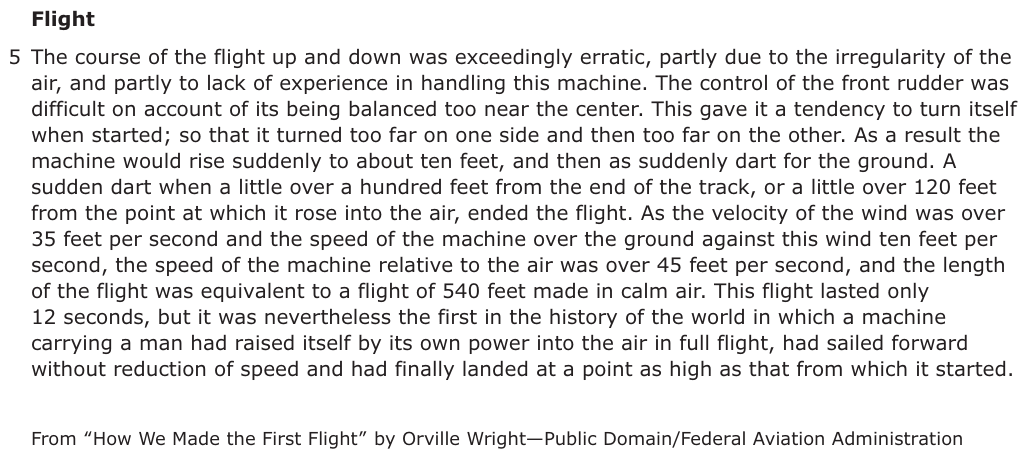
Question 9 of 50
2026 Practice Test D English, question 9Uses the passage above: “Excerpt from “How We Made the First Flight””.
Question
Read this sentence from paragraph 4.
Wilbur having used his turn in the unsuccessful attempt on the 14th, the right to the first trial now belonged to me.
The sentence contributes to the development of ideas in the excerpt by
- Ademonstrating the challenge of the extreme winter conditions during the flight.
- Brevealing how many tries it took for Wilbur Wright to finally get the machine to take flight.
- Cdemonstrating that both Orville and Wilbur Wright were eager to pilot what could potentially be the first flight.
- Dsuggesting a sense that both brothers felt confident they would soon succeed in completing the first flight.
Show the answer
Correct answer: C
The question asks how the sentence from paragraph 4 contributes to the development of ideas in the excerpt.
A. Incorrect. The sentence from paragraph 4 does not refer to the challenge of the winter conditions during the flight attempt.
B. Incorrect. While the sentence from paragraph 4 specifically references a previous flight several days earlier, it does not state how many attempts came before Wilbur’s attempt on December 14.
C. CORRECT. The sentence from paragraph 4 indicates that the Wright brothers had agreed to take turns attempting to achieve the first flight, which suggests their eagerness to each be the first to successfully fly the machine.
D. Incorrect. Orville’s trial came about simply because the brothers took turns, which would suggest that there was no greater likelihood of success or reason to be more confident at that moment than there had been for previous attempts.
Question analysis
This question quotes the sentence that opens the “Audacity—and Calculation” section of Orville Wright’s account, in which he explains that the first trial on December 17 was his because Wilbur had used his turn on the 14th. Students decide how the sentence contributes to the development of ideas in the excerpt. Several choices bring in other parts of the story, so students must stay with what this one sentence shows.
- Grade level
- Grade 8 reading and task
- Compared with grade 7
- At grade 7 Explaining what one quoted sentence adds is routine grade 7 work. This sentence is short but opens with an old-fashioned “Wilbur having used his turn” construction, and its point about the brothers is implied rather than stated.
- Estimated difficulty
- Moderate: several steps, or a close reading with one strong distractor.
- Thinking it demands
- Depth of knowledge 2, skills and concepts · mainly analyze
- What makes it hard
- A very close wrong answer moderate
- Reading between the lines moderate
- Complex sentences minor
- Evidence
- Answered from one sentence or line
- Reading level
- Passage: about grade 7, 816 words; question and choices: about grade 8, 102 words.
- Students, last 30 days
- Not enough answers yet to show (it takes 10).
Why it is hard, traps and wrong answers (shows the answer)
Why it is hard
The sentence is about whose turn it is, and the question asks what that arrangement says about the brothers. A quick reader may lose the subject in the opening phrase and think Wilbur is still trying, or may carry the cold of earlier paragraphs into a sentence that never mentions it. The harder call is between eagerness and confidence: the heading “Audacity—and Calculation” makes confidence sound right, but a failed attempt three days earlier gives no reason for it.
A very close wrong answer moderate Choosing the answer
The choice about confidence matches the key’s frame, both brothers feeling something about the first flight; it differs in one word, confident instead of eager, and only eagerness follows from taking turns. (Embretson & Wetzel, 1987; Gorin & Embretson, 2006; Ascalon et al., 2007)
Reading between the lines moderate Working it out
The sentence names no feeling; eagerness has to be read from the turn-taking itself, the brothers alternating for “the right to the first trial,” a chance each wanted to be his. (Graesser, Singer & Trabasso, 1994; Kintsch, 1998)
Complex sentences minor Understanding the question
The sentence opens with an absolute phrase, “Wilbur having used his turn in the unsuccessful attempt on the 14th,” whose subject is not the subject of the main clause, so a reader can lose track of who flies. (Abedi & Lord, 2001; Freedle & Kostin, 1993; Messick, 1989)
Strategy: Untangle the sentence first: say who used a turn, when, and who goes next. Then ask what the arrangement it describes suggests about the two brothers, and test each choice against that.
Traps
- Reads too much in: A reasonable-sounding conclusion that goes further than the text allows.
- Twists what the text says: Uses the text's topic and ideas but changes what it says: who did it, how much, when, or why.
- Wrong part of the text: A choice is true of another paragraph, stanza or speaker than the one asked about.
The wrong answers, classified
A Wrong part of the text (Kirsch & Mosenthal, 1990)
Carries the frozen puddles and “biting cold wind” of paragraphs 1 and 2 into this sentence, which says nothing about the weather and is only about whose turn it was.
B Twists what the text says (King et al., 2004)
Loses the subject of the opening phrase and has Wilbur keep trying until he flies, though the sentence mentions one failed attempt and gives this trial to Orville.
D Reads too much in (Graesser, Singer & Trabasso, 1994)
Reads “the right to the first trial” and the heading “Audacity—and Calculation” as confidence, but taking turns says nothing about their odds, and the attempt on the 14th had failed.
Working it out, step by step
Figure out what the question asks
This asks what one sentence adds to the excerpt. The sentence is short, but it starts in an old-fashioned way. First untangle who did what. Then ask what the sentence tells you about the two brothers.
Untangle the sentence
The sentence is “Wilbur having used his turn in the unsuccessful attempt on the 14th, the right to the first trial now belonged to me.” The first part gives a reason. In plain words: Wilbur already had his turn on the 14th. Unsuccessful means it failed. The second part says: so now it is my turn. The “me” is Orville, who wrote the excerpt. A trial here is a try.
Ask what taking turns shows
The brothers took turns trying to fly. Each one had a “right” to a turn. You take turns when both people want the same chance. Each brother wanted to be the pilot. This could be the first flight in history, so both were eager. Eager means they really wanted it.
Check each choice
- A does not fit. The sentence says nothing about the cold or the wind.
- B does not fit. It mentions only one failed try by Wilbur. And this trial was Orville’s, not Wilbur’s.
- C fits. Taking turns shows that each brother wanted to fly the machine.
- D does not fit. Nothing in the sentence shows confidence. The last try had failed, and it was simply Orville’s turn.
Watch out: D is tempting because the section heading is “Audacity—and Calculation.” Audacity means boldness. But taking turns shows eagerness, not a belief that they would succeed.
Choose the answer
The turn-taking shows that both brothers wanted to fly. So the answer is C, “demonstrating that both Orville and Wilbur Wright were eager to pilot what could potentially be the first flight.”
Why this answer and not the closest wrong one
D is the closest wrong choice. Both C and D describe how the brothers felt about the first flight. But the sentence gives no reason to feel sure of success. It even mentions “the unsuccessful attempt on the 14th.” What it does show is that each brother wanted his own turn. That is eagerness, so C fits better.
More questions like this
The original DOE question
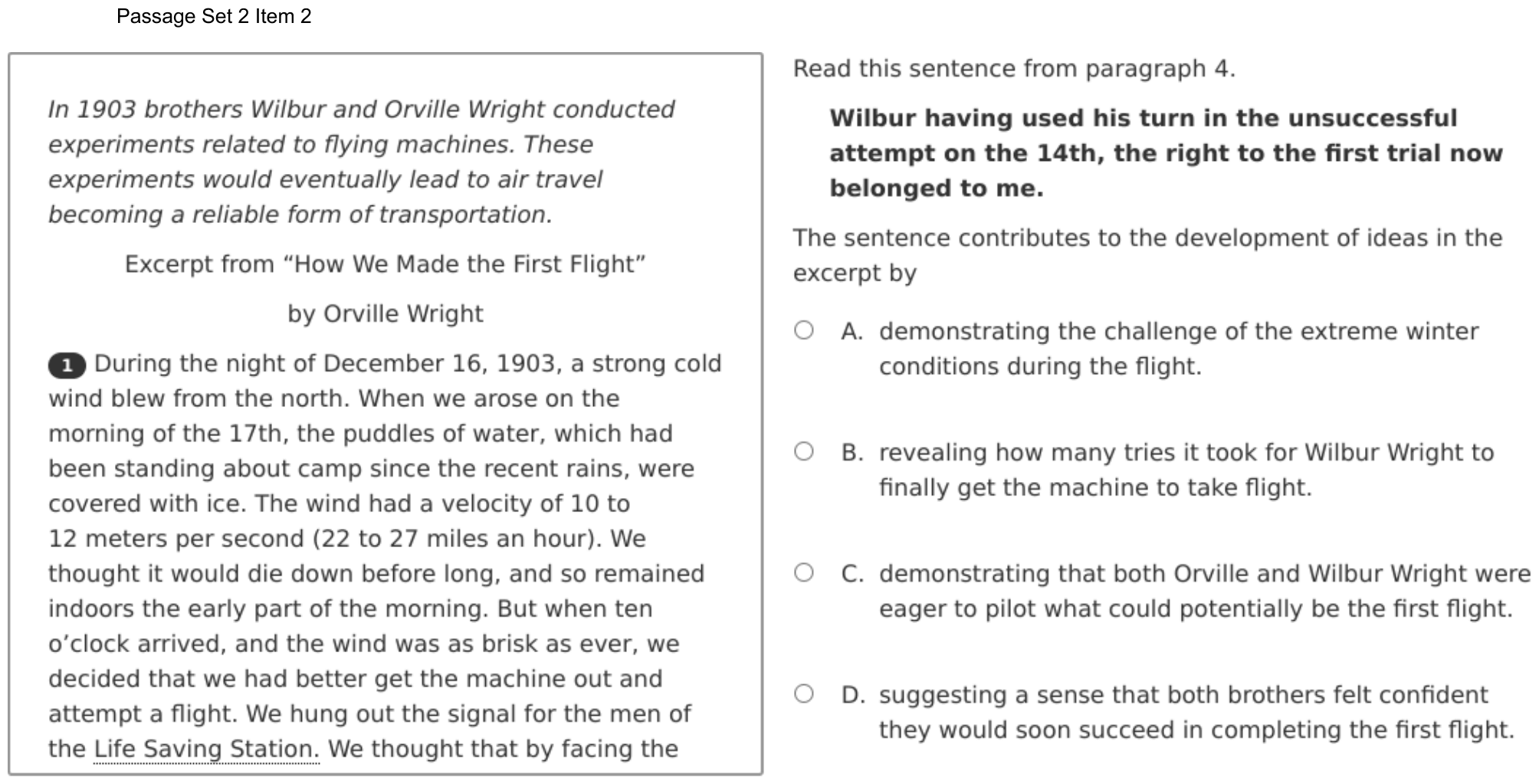
Question 10 of 50
2026 Practice Test D English, question 10Uses the passage above: “Excerpt from “How We Made the First Flight””.
Question
The photograph mentioned in paragraph 4 is significant because it
- Adocuments that the machine rose into the air as soon as the tethering wire was released.
- Bprovides proof of the critical moment the machine took flight.
- Cdocuments that the wind reduced the speed of the plane at the start of the flight.
- Dprovides proof that the pilot had to gradually increase the height of the plane in the air.
Show the answer
Correct answer: B
The question asks why the photograph mentioned in paragraph 4 is significant.
A. Incorrect. According to paragraph 4, the photograph was not taken immediately after the tethering wire was released but rather after an intervening period during which “Wilbur ran at the side of the machine, holding the wing to balance it on the track.” The picture was not taken until “the machine had reached the end of the track,” which occurred after a “forty-foot run” (paragraph 4).
B. CORRECT. The photograph mentioned in paragraph 4 is significant because it provides proof that the machine did, in fact, take flight: “One of the Life Saving men snapped the camera for us, taking a picture just as the machine had reached the end of the track and had risen to a height of about two feet. The slow forward speed of the machine over the ground is clearly shown in the picture by Wilbur’s attitude. He stayed along beside the machine without any effort.”
C. Incorrect. The photograph mentioned in paragraph 4 is described as showing the plane moving forward through the air at a height of two feet, but while the effect of the wind may be visible, it is not why the photo is significant. Instead, the photograph provides proof that the plane is, in fact, moving through the air (“One of the Life Saving men snapped the camera for us, taking a picture just as the machine had reached the end of the track and had risen to a height of about two feet. The slow forward speed of the machine over the ground is clearly shown in the picture by Wilbur’s attitude”).
D. Incorrect. Although the plane is shown at a height of two feet in the photograph mentioned in paragraph 4, the picture documents only one moment of the plane’s flight and does not provide proof that the pilot had to gradually increase the height of the plane in the air.
Question analysis
This question on Orville Wright’s account of the first airplane flight asks why the photograph mentioned in paragraph 4, taken by one of the Life Saving men, is significant. The photograph itself is not printed with the excerpt, so students must work from Orville’s description of the moment it was taken. Several choices describe the machine’s movement, so each must be checked against that description.
- Grade level
- Grade 8 reading and task
- Compared with grade 7
- Above grade 7 Grade 7 readers often explain why a detail matters. This photograph is not printed, so students must picture it from Orville’s description, which uses “attitude” in an old sense meaning posture, and then judge why the picture mattered.
- Estimated difficulty
- Hard: combines ideas, needs a plan, and has more than one tempting wrong answer.
- Thinking it demands
- Depth of knowledge 2, skills and concepts · mainly analyze
- What makes it hard
- Reading between the lines moderate
- The right answer is reworded moderate
- Hard words minor
- Evidence
- Answered from one paragraph or stanza
- Reading level
- Passage: about grade 7, 816 words; question and choices: about grade 7, 68 words.
- Students, last 30 days
- Not enough answers yet to show (it takes 10).
Why it is hard, traps and wrong answers (shows the answer)
Why it is hard
The photograph is not printed, so students work from three sentences of description, and the last two tell what Orville thinks the picture shows: the machine’s slow speed, visible in Wilbur’s easy pace. That stated detail is the strongest lure. The question asks for significance instead, which the excerpt leaves unstated; students must link the moment captured, the machine just off the track at the end of its run, to paragraph 5’s closing claim that this was the first such flight in history.
Reading between the lines moderate Working it out
Orville never says why the picture matters; students must notice it was taken “just as the machine had reached the end of the track and had risen to a height of about two feet,” the instant of lift-off. (Graesser, Singer & Trabasso, 1994; Kintsch, 1998)
The right answer is reworded moderate Choosing the answer
The key’s “critical moment the machine took flight” appears nowhere, while the wrong choices echo the paragraph’s released wire, the slow speed Orville says the picture shows, and the “height of about two feet.” (Freedle & Kostin, 1993; Kirsch & Mosenthal, 1990)
Hard words minor Understanding the question
Orville says the slow speed shows “by Wilbur’s attitude,” using attitude in an old sense, Wilbur’s posture as he keeps pace, which students must decode to follow the description of the picture. (Perfetti, 2007; Freedle & Kostin, 1993)
Strategy: Reread the three sentences about the picture in paragraph 4, note when it was taken and what Orville says it shows, then weigh which choice explains why such a picture would matter.
Traps
- True but not the answer: A choice says something accurate about the text that does not answer this question.
- Twists what the text says: Uses the text's topic and ideas but changes what it says: who did it, how much, when, or why.
- Reads too much in: A reasonable-sounding conclusion that goes further than the text allows.
The wrong answers, classified
A Twists what the text says (King et al., 2004)
Collapses the release of the wire and the lift-off into one moment, skipping Wilbur’s run beside the machine; it rose only after a forty-foot run, when the picture was taken.
C True but not the answer (King et al., 2004; Embretson & Wetzel, 1987)
Takes Orville’s own remark that the picture shows “the slow forward speed of the machine” as its significance, but that is a detail in the picture, not why a picture of this moment matters.
D Reads too much in (Graesser, Singer & Trabasso, 1994)
Treats the two-foot height as one step in a steady climb, though a single picture catches one instant and paragraph 5 describes sudden rises to ten feet and darts toward the ground.
Working it out, step by step
Figure out what the question asks
This asks why the photograph in paragraph 4 matters. The photograph is not printed with the excerpt. You have to picture it from Orville’s words. Find when it was taken. Then ask why a picture of that moment would be important.
Read the description of the photograph
Paragraph 4 says “One of the Life Saving men snapped the camera for us, taking a picture just as the machine had reached the end of the track and had risen to a height of about two feet.” The next sentences say “The slow forward speed of the machine over the ground is clearly shown in the picture by Wilbur’s attitude. He stayed along beside the machine without any effort.”
Work out what the picture shows
The machine had just left the track and was two feet in the air. So the picture caught the moment it lifted off. Here “attitude” means the way Wilbur held his body. He kept up with the machine easily, so it was moving slowly. Paragraph 5 says this flight was “the first in the history of the world” of its kind. A photo of that lift-off is proof that it really happened.
Check each choice
- A does not fit. The machine did not rise at once. It lifted “after a forty-foot run.”
- B fits. The picture caught the moment the machine first took flight.
- C does not fit. The picture does show the slow speed. But that is a detail in the photo, not why the photo matters.
- D does not fit. One picture shows one moment. It cannot show a steady climb. In fact, paragraph 5 says the machine rose and dropped suddenly.
Watch out: C is tempting because Orville himself says the slow speed is “clearly shown in the picture.” But the question asks why the picture is significant, which means important.
Choose the answer
The photo captured the very moment the first flight began. So the answer is B, “provides proof of the critical moment the machine took flight.”
Why this answer and not the closest wrong one
C is the closest wrong choice. Orville does say the picture shows the machine’s slow speed. But slow speed is not what makes this photo special. It was taken just as the machine “had risen to a height of about two feet” at the end of the track. That is proof of the first moment of flight, as B says.
More questions like this
The original DOE question
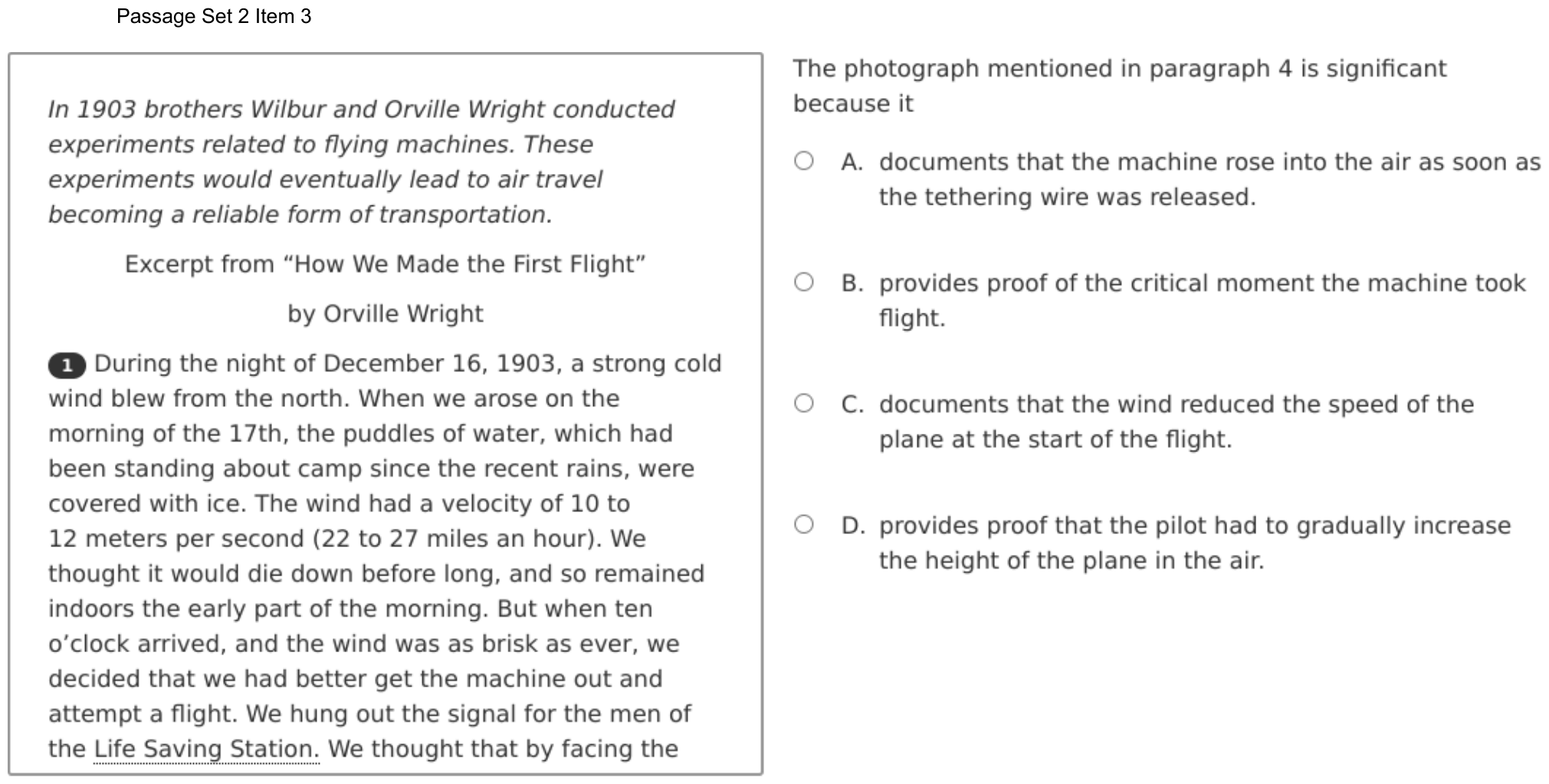
Question 11 of 50
2026 Practice Test D English, question 11Uses the passage above: “Excerpt from “How We Made the First Flight””.
Question
How do the details in paragraph 5 about the uneven nature of the flight convey a central idea of the excerpt?
- Aby explaining how the flawed design of the machine caused it to turn unpredictably in the air and brought the first flight by a person to an abrupt end
- Bby indicating that the difficulty in controlling the flight was caused by the rudimentary instruments of the machine and the inexperience of the pilot
- Cby explaining how the pilot and the plane overcame adverse conditions in order to complete the first piloted flight
- Dby indicating that the gradual change in wind velocity created an extreme environment in which to maneuver the plane and maintain its flight
Show the answer
Correct answer: C
The question asks how the details in paragraph 5 about the uneven nature of the flight convey a central idea of the excerpt.
A. Incorrect. Paragraph 5 explains that the rudder was unbalanced and the effect that this issue had on the flight, but the rudder was only part of the reason for the short flight. The length of the flight is not a central idea of the excerpt.
B. Incorrect. Although paragraph 5 does explain that the equipment contributed to the difficulty of controlling the plane’s flight, the lack of control over the flight is not a central idea of the excerpt, which focuses instead on the Wright brothers’ achievement of a successful flight despite the challenges involved.
C. CORRECT. The details in paragraph 5 describe the difficulties that the weather conditions and mechanical issues presented and how Orville’s flight was successful despite those problems. The Wright brothers’ ability to overcome difficult circumstances and complete the first flight is a central idea of the excerpt.
D. Incorrect. While paragraph 5 does emphasize the difficulty caused by the wind, it does not describe a “gradual change” in the wind, only that it was irregular.
Question analysis
This central-idea question asks how the details in paragraph 5 of Orville Wright’s “How We Made the First Flight,” which describe the machine darting up and down because of uneven air, a hard-to-control front rudder and the pilot’s inexperience, convey a central idea of the excerpt. The paragraph also includes speeds and distances, and students must decide what its details mean for the account as a whole.
- Grade level
- Grade 8 reading and task
- Compared with grade 7
- At grade 7 Linking a paragraph’s details to a central idea is regular grade 7 work. This paragraph is long and technical, with a rudder problem and a calculation of speeds, and most choices restate its problems accurately, so students must decide what the details add up to.
- Estimated difficulty
- Moderate: several steps, or a close reading with one strong distractor.
- Thinking it demands
- Depth of knowledge 2, skills and concepts · mainly understand
- What makes it hard
- The right answer is reworded moderate
- A lot to read minor
- Reading between the lines minor
- Evidence
- Answered from one paragraph or stanza
- Reading level
- Passage: about grade 7, 816 words; question and choices: about grade 12, 115 words.
- Students, last 30 days
- Not enough answers yet to show (it takes 10).
Why it is hard, traps and wrong answers (shows the answer)
Why it is hard
Most of paragraph 5 is about trouble, the uneven air, a rudder balanced too near the center, an inexperienced pilot and a dart that ended the flight, and two wrong choices describe that trouble accurately. What turns the details into a central idea is the paragraph’s last sentence, which calls the 12-second flight the first of its kind in history. Students who stop before it, or who take the problems as the point, miss that the excerpt is a story of success.
The right answer is reworded moderate Choosing the answer
The key’s “overcame adverse conditions” sums up the paragraph in new words, while the wrong choices repeat its own: the rudder’s “tendency to turn itself,” the dart that “ended the flight,” the “lack of experience” and “the velocity of the wind.” (Freedle & Kostin, 1993; Kirsch & Mosenthal, 1990)
A lot to read minor Understanding the question
Paragraph 5 runs about 250 words, and its problems and a 61-word speed calculation all come before the closing sentence, the only one that presents the flight as a success. (Kintsch, 1998; Gorin & Embretson, 2006; Freedle & Kostin, 1993)
Reading between the lines minor Working it out
The paragraph never says anyone overcame anything; students must set its problems beside its last sentence, a machine that “sailed forward” and landed “as high as that from which it started,” to see success despite them. (Graesser, Singer & Trabasso, 1994; Kintsch, 1998)
Strategy: Note what each part of paragraph 5 describes, from its first sentence to its last, then decide what the excerpt as a whole is about and choose the option that ties the two together.
Traps
- Too narrow: A single detail offered as the central idea or a summary, or a summary that keeps minor details and leaves out an essential part.
- True but not the answer: A choice says something accurate about the text that does not answer this question.
- Twists what the text says: Uses the text's topic and ideas but changes what it says: who did it, how much, when, or why.
The wrong answers, classified
A Too narrow (King et al., 2004)
Gets the rudder and the dart that ended the flight right but builds on that one failure, dropping the paragraph’s closing point that the short flight was still history’s first.
B True but not the answer (King et al., 2004; Embretson & Wetzel, 1987)
Restates the paragraph’s own explanation of the erratic course, inexperience and a hard-to-control rudder, which is accurate, but treats the lack of control as the point when the excerpt builds toward success.
D Twists what the text says (King et al., 2004)
Picks up “the velocity of the wind” and the hard flying but invents a “gradual change” in the wind, when the paragraph speaks only of “the irregularity of the air.”
Working it out, step by step
Figure out what the question asks
This is a central idea question. A central idea is a main point of the whole excerpt. Paragraph 5 describes an uneven, bumpy flight. The question asks how those details support a main point. So read the whole paragraph, including its last sentence.
Find the problems in paragraph 5
Paragraph 5 begins “The course of the flight up and down was exceedingly erratic, partly due to the irregularity of the air, and partly to lack of experience in handling this machine.” Erratic means jumpy and hard to predict. The front rudder, a part that steers, was hard to control. The machine “would rise suddenly to about ten feet, and then as suddenly dart for the ground.”
Read the last sentence
Then the paragraph turns. It says “This flight lasted only 12 seconds, but it was nevertheless the first in the history of the world in which a machine carrying a man had raised itself by its own power into the air in full flight.” Nevertheless means “even so.” The wind, the hard steering and the pilot’s inexperience all worked against him. Even so, the flight worked. Conditions that work against you are called adverse.
Check each choice
- A does not fit. The rudder problem and the sudden end are real. But A stops there and misses that the flight was a first.
- B does not fit. Paragraph 5 does blame the rudder and the pilot’s inexperience. But the excerpt is about success, not about the lack of control.
- C fits. The problems show what Orville overcame to make the first flight.
- D does not fit. The paragraph never says the wind changed gradually, or slowly. It speaks of “the irregularity of the air.”
Watch out: B is tempting because it repeats the paragraph’s own reasons for the bumpy flight. But true details are not the same as the main point.
Choose the answer
The problems in paragraph 5 make the success at the end more impressive. So the answer is C, “by explaining how the pilot and the plane overcame adverse conditions in order to complete the first piloted flight.”
Why this answer and not the closest wrong one
B is the closest wrong choice. It is true that the rudder and the pilot’s “lack of experience” made the flight hard to control. But that is only the first part of paragraph 5. The last sentence calls the flight the first of its kind. The problems show what had to be overcome. C ties the details to that success.
More questions like this
The original DOE question
Question 12 of 50
2026 Practice Test D English, question 12Uses the passage above: “Excerpt from “How We Made the First Flight””.
Question
Read this sentence from paragraph 5.
As the velocity of the wind was over 35 feet per second and the speed of the machine over the ground against this wind ten feet per second, the speed of the machine relative to the air was over 45 feet per second, and the length of the flight was equivalent to a flight of 540 feet made in calm air.
How does the sentence help convey Orville Wright’s perspective about this first flight?
- AIt suggests that he was frustrated by the poor flying conditions on the day of the flight.
- BIt emphasizes that he believed the flight was successful despite its short distance.
- CIt provides a comparison between flight distances under calm and high wind conditions.
- DIt highlights the importance of such calculations in the success of future flights.
Show the answer
Correct answer: B
The question asks how the sentence from paragraph 5 helps convey Orville Wright’s perspective about the first flight.
A. Incorrect. Although the sentence from paragraph 5 refers to the velocity of the wind during the flight, there is no indication that Orville felt a sense of frustration with the windy conditions. Instead, the sentence emphasizes the “speed of the machine relative to the air” and presents the equivalent flight length if the machine had flown through calm air (“the length of the flight was equivalent to a flight of 540 feet made in calm air”), details that emphasize the importance of the Wrights’ accomplishment.
B. CORRECT. In the sentence from paragraph 5, Orville uses the wind velocity and the machine speed to highlight the distance that the plane covered while in the air and to determine the distance that it would have flown on a day with calm winds, which emphasizes the magnitude of the accomplishment.
C. Incorrect. Since Orville does not suggest in the sentence from paragraph 5 how far the plane traveled under the actual conditions of high winds, the comparison is incomplete. Additionally, this statement does not address the reason that he would make such a comparison, which allowed him to describe the flight in more impressive terms (540 feet versus 120 feet).
D. Incorrect. Unlike the wind velocity calculations made in preparation for the flight, which might help in determining the success of future flights, the comparative calculations that Orville provides in the sentence from paragraph 5 help interpret the results of the first flight (by describing how fast and far the machine flew relative to the flying conditions) and thereby communicate its success. The calculations of the first flight’s relative speed and equivalent distance would not affect the success of future flights, but the information does provide context for understanding the Wright brothers’ accomplishment.
Question analysis
This point-of-view question quotes the long sentence from paragraph 5 in which Orville Wright works out the machine’s speed through the air and the length of an equivalent flight in calm air. Students must decide how this sentence helps convey his perspective on the first flight. The sentence is mostly numbers, from 35 feet per second to 540 feet, which makes its purpose easy to miss.
- Grade level
- Grade 8 reading and task
- Compared with grade 7
- Above grade 7 Grade 7 point-of-view questions usually rest on words that show feeling. This sentence is a chain of speeds and distances with no feeling words, so students must work out why Orville bothers with the arithmetic, a step beyond typical grade 7 work.
- Estimated difficulty
- Hard: combines ideas, needs a plan, and has more than one tempting wrong answer.
- Thinking it demands
- Depth of knowledge 3, strategic thinking · mainly analyze
- What makes it hard
- How, not what moderate
- Reading between the lines moderate
- Complex sentences minor
- Evidence
- Answered from one paragraph or stanza
- Reading level
- Passage: about grade 7, 816 words; question and choices: about grade 9, 132 words.
- Students, last 30 days
- Not enough answers yet to show (it takes 10).
Why it is hard, traps and wrong answers (shows the answer)
Why it is hard
Point-of-view questions usually turn on feeling words, and this sentence has none, only speeds and a distance. Students must ask why Orville bothers with the arithmetic, and the answer is that 540 feet in calm air makes a 12-second hop look like the achievement he believed it was. The strongest pull describes the sentence’s content accurately, a comparison of calm and windy flight, without saying what it reveals, so students who answer what instead of why lose the point.
How, not what moderate Working it out
The question asks why Orville includes this calculation, so students must see that converting a short hop into “a flight of 540 feet made in calm air” is his way of showing that it counted. (Anderson & Krathwohl, 2001)
Reading between the lines moderate Working it out
The sentence holds no word of feeling or judgment; his view that the flight succeeded must be read from his choice to restate about 120 feet over the ground as 540 feet through the air. (Graesser, Singer & Trabasso, 1994; Kintsch, 1998)
Complex sentences minor Understanding the question
The 61-word sentence chains four measurements, a wind over 35 feet per second, a ground speed of ten, an airspeed over 45 and the 540-foot equivalent, joined by “As,” “and” and commas. (Abedi & Lord, 2001; Freedle & Kostin, 1993; Messick, 1989)
Strategy: Work out what the speeds and distances in the sentence describe, then ask why Orville includes them at this point and what that choice tells you about his view of the flight.
Traps
- Wrong purpose or structure: Names a purpose, structure or effect that the part does not serve, or describes what a part says when the question asks what it does.
- Wrong tone or attitude: Misjudges the tone, attitude or point of view, such as reading admiration as criticism, or taking a character's or subject's feelings for the author's.
- Outside knowledge: A choice is plausible in the real world but not supported by this text.
The wrong answers, classified
A Wrong tone or attitude (Graesser, Singer & Trabasso, 1994)
Links the high wind to the cold, hard morning of paragraphs 1 and 2 and assumes Orville resented it, though here he uses the wind’s speed to make the flight count for more.
C Wrong purpose or structure (Anderson & Krathwohl, 2001)
Describes what the sentence contains, a flight measured against one in calm air, without saying what that comparison shows about Orville’s view of the flight, which is what the question asks.
D Outside knowledge (King et al., 2004; Recht & Leslie, 1988)
Assumes careful calculations must be meant to guide later flights, a reasonable idea about early aviation, but this sentence measures the flight just made and looks no further ahead.
Working it out, step by step
Figure out what the question asks
This asks about Orville Wright’s perspective, or point of view. How did he feel about the first flight? The quoted sentence is full of numbers, not feelings. So ask why Orville bothered to do this math.
Sort out the numbers
The wind blew against the machine at over 35 feet per second. The machine moved over the ground at 10 feet per second. It was flying into the wind, so the air rushed past it even faster. Add them: it moved through the air at over 45 feet per second. The flight lasted 12 seconds. Over the ground, that is 10 × 12 = 120 feet. Through the air, it is 45 × 12 = 540 feet. That is how Orville gets “a flight of 540 feet made in calm air.”
Ask why Orville does this math
Paragraph 5 says the flight ended “a little over 120 feet from the point at which it rose into the air.” That sounds short. But Orville shows it was really much more. In calm air, the same flight would have gone 540 feet. He wants you to see that the short hop was a real flight. So his view is that the flight was a success.
Check each choice
- A does not fit. There is no sign of frustration. Orville uses the wind to make the flight count for more.
- B fits. The math turns a short flight into an impressive one.
- C does not fit. The sentence does compare calm and windy air. But that only says what the sentence contains, not what Orville thinks.
- D does not fit. The math measures the flight that just happened. It does not look ahead to future flights.
Watch out: C is tempting because it describes the sentence correctly. But the question asks about his perspective. C never says how he felt about the flight.
Choose the answer
Orville does the math to show that his short flight was a real success. So the answer is B, “It emphasizes that he believed the flight was successful despite its short distance.”
Why this answer and not the closest wrong one
C is the closest wrong choice. It is true that the sentence compares a windy flight with one “made in calm air.” But C only tells what the sentence says. The question asks why Orville says it. He turns about 120 feet into 540 feet to show the flight was a real achievement. B gives that reason.
More questions like this
The original DOE question
Question 13 of 50
2026 Practice Test D English, question 13Uses the passage above: “Excerpt from “How We Made the First Flight””.
Question
Which sentence from the excerpt best supports the idea that the Wright brothers had to adapt their plans for the flight in order to accommodate the weather conditions?
- A“When we arose on the morning of the 17th, the puddles of water, which had been standing about camp since the recent rains, were covered with ice.” (paragraph 1)
- B“We realized the difficulties of flying in so high a wind, but estimated that the added dangers in flight would be partly compensated for by the slower speed in landing.” (paragraph 1)
- C“After running the motor a few minutes to heat it up, I released the wire that held the machine to the track, and the machine started forward in the wind.” (paragraph 4)
- D“The course of the flight up and down was exceedingly erratic, partly due to the irregularity of the air, and partly to lack of experience in handling this machine.” (paragraph 5)
Show the answer
Correct answer: B
The question asks which sentence from the excerpt best supports the idea that the Wright brothers had to adapt their plans for the flight in order to accommodate weather conditions.
A. Incorrect. Although the sentence from paragraph 1 mentions the rainy weather and frozen puddles, it does not specifically explain how these weather conditions forced the brothers to adapt their plans for the flight.
B. CORRECT. The sentence from paragraph 1 reveals that the Wright brothers adapted by making a risk calculation, based on the wind speed, before the flight. The high speed of the wind could cause difficulties in flight while simultaneously allowing for a slower, more controlled landing.
C. Incorrect. The sentence from paragraph 4 does mention wind, but it describes what Orville was doing during the attempted flight, not the factors he considered before the flight in order to adapt the plan.
D. Incorrect. Although the sentence from paragraph 5 mentions the “irregularity of the air” during the flight, the sentence does not describe how the brothers adapted their plans for the flight based on the weather.
Question analysis
This evidence question on Orville Wright’s account of the first flight asks which sentence best supports the idea that the Wright brothers had to adapt their plans for the flight to the weather conditions. The four quotations come from paragraphs 1, 4 and 5 and all mention ice, wind or air, so students must look past the weather words to what each sentence shows the brothers doing.
- NYS standards
- 7R1 textual evidence and inferences
- Grade level
- Grade 7 reading and task
- Compared with grade 7
- At grade 7 Choosing the sentence that best supports an idea is core grade 7 evidence work. The four quotations are printed in full with their paragraph numbers, and the idea has two parts, weather and a change of plans, so the check is careful but typical.
- Estimated difficulty
- Straightforward: two steps or one careful reading.
- Thinking it demands
- Depth of knowledge 2, skills and concepts · mainly evaluate
- What makes it hard
- Evidence
- Answered from several paragraphs or stanzas
- Reading level
- Passage: about grade 7, 816 words; question and choices: about grade 13, 148 words.
- Students, last 30 days
- Not enough answers yet to show (it takes 10).
Why it is hard, traps and wrong answers (shows the answer)
Why it is hard
The idea has two parts, the weather and a change in the brothers’ plans, and every quotation carries the first. Students who look only for weather words can be drawn to the erratic flight or the launch into the wind. Only one sentence shows the brothers thinking about the wind before they flew and deciding how to proceed, and once the second half of the idea is in view the choice is quick.
Every choice must be checked minor Choosing the answer
All four quotations mention ice, wind or air, so the weather half of the idea rules nothing out; each must be checked for the other half, a decision the brothers made because of it. (Embretson & Wetzel, 1987)
Reading between the lines minor Working it out
The key never says plan or adapt; students must see that weighing “the added dangers in flight” against “the slower speed in landing” is the brothers fitting their decision to the wind. (Graesser, Singer & Trabasso, 1994; Kintsch, 1998)
Strategy: Split the idea into its two parts, the weather and a change in the brothers’ plans, and keep only a quotation that shows both, not one that shows the weather alone.
Traps
- Supports only part of the claim: In a question about evidence: a line that backs one half of the claim but not the other, or a related point rather than the claim itself.
- True but not the answer: A choice says something accurate about the text that does not answer this question.
The wrong answers, classified
A True but not the answer (King et al., 2004; Embretson & Wetzel, 1987)
Picks the frozen puddles as proof of harsh weather, which they are, but the sentence only sets the scene and shows nothing the brothers did or decided because of it.
C Supports only part of the claim (King et al., 2004; Thissen, Steinberg & Fitzpatrick, 1989)
Takes running the motor “to heat it up” and starting “in the wind” as adjustments to the cold, but the sentence narrates the launch and never says a plan changed.
D Supports only part of the claim (King et al., 2004; Thissen, Steinberg & Fitzpatrick, 1989)
Notices “the irregularity of the air” linking the weather to the flight, but this sentence explains why the course was erratic once the machine was up, not how the brothers prepared.
Working it out, step by step
Figure out what the question asks
This asks for the sentence that best supports an idea. The idea has two parts. First, there was bad weather. Second, the brothers had to adapt, or change, their plans because of it. All four choices mention ice, wind or air. So look for the one that also shows a decision.
Check each sentence for both parts
- A shows the weather: icy puddles. But no one decides anything.
- B shows the wind and the brothers’ thinking about it before the flight.
- C describes the launch. It tells what Orville did, not a change of plans.
- D explains why the flight was bumpy once it was in the air. It shows no plan.
Read the sentence that fits
Paragraph 1 says “We realized the difficulties of flying in so high a wind, but estimated that the added dangers in flight would be partly compensated for by the slower speed in landing.” To estimate is to make a careful guess. Compensated for means “made up for.” The brothers knew the strong wind made flying harder. They weighed that against a good effect: a slower landing. Then they decided to fly anyway.
Explain how this shows adapting
The brothers did not just notice the wind. They thought about how it would change the flight, the bad and the good. They also planned on “facing the flyer into a strong wind.” Making plans that fit the weather is what adapting means.
Watch out: D is tempting because it links “the irregularity of the air” to the flight. But it tells what happened during the flight, not how the brothers planned for it.
Choose the answer
Only one sentence shows the brothers fitting their decision to the wind before they flew. So the answer is B, “We realized the difficulties of flying in so high a wind, but estimated that the added dangers in flight would be partly compensated for by the slower speed in landing.”
Why this answer and not the closest wrong one
D is the closest wrong choice. It does connect the weather to the flight. But it describes what happened in the air, after the plans were made. The idea needs the brothers changing plans because of the weather. Only B shows them thinking through the wind’s dangers and benefits before they decided to fly.
More questions like this
The original DOE question
Question 14 of 50
2026 Practice Test D English, question 14Uses the passage above: “Excerpt from “How We Made the First Flight””.
Question
The use of chronological structure contributes to the development of ideas in the excerpt by
- Aoutlining the actions that the Wright brothers took to prepare for and successfully complete the first flight.
- Bidentifying the primary factors that allowed the Wright brothers to overcome obstacles and achieve the first flight.
- Cshowing how the Wright brothers applied lessons learned from their previous flight attempts to accomplish the first flight.
- Ddemonstrating how the Wright brothers analyzed the impact of wind velocity to identify the ideal conditions for the first flight.
Show the answer
Correct answer: A
The question asks how the use of chronological structure contributes to the development of ideas in the excerpt.
A. CORRECT. Through the chronological structure, Orville addresses all stages of the flight in a way that builds from flight concerns and preparations for takeoff to his experiences during the flight and his successful landing.
B. Incorrect. While obstacles are presented within the excerpt, the chronological structure emphasizes the events that ended in the successful achievement of flight on that day rather than how the Wright brothers overcame obstacles.
C. Incorrect. The chronological structure of the excerpt does not show that the Wright brothers applied lessons learned from their previous attempts at flight; instead, the structure describes Orville’s December 17 attempt.
D. Incorrect. While Orville’s narrative certainly shows a strong need to analyze wind speed, this idea is not conveyed through the chronological structure of the excerpt. Additionally, the description of the first flight on December 17 indicates that it did not take place in ideal conditions (“We realized the difficulties of flying in so high a wind” [paragraph 1] and “The course of the flight up and down was exceedingly erratic, partly due to the irregularity of the air” [paragraph 5]).
Question analysis
This text-structure question asks how the chronological structure of Orville Wright’s “How We Made the First Flight,” an account that begins on the night of December 16, 1903, contributes to the development of ideas in the excerpt. Students must see what telling events in time order does for the account. Each choice names a purpose that could suit a story of the first airplane flight.
- Grade level
- Grade 7 reading and task
- Compared with grade 7
- Below grade 7 Grade 7 structure questions often ask how a less obvious pattern, such as problem and solution, shapes ideas. This excerpt is plainly told in time order, with dates and section headings, so recognizing what that order does is a lighter task.
- Estimated difficulty
- Straightforward: two steps or one careful reading.
- Thinking it demands
- Depth of knowledge 2, skills and concepts · mainly analyze
- What makes it hard
- How, not what minor
- A very close wrong answer minor
- Evidence
- Answered from the whole text
- Reading level
- Passage: about grade 7, 816 words; question and choices: about grade 11, 87 words.
- Students, last 30 days
- Not enough answers yet to show (it takes 10).
Why it is hard, traps and wrong answers (shows the answer)
Why it is hard
The excerpt is plainly chronological, with a date in its first sentence and headings that move from “Final Preparations” to “Flight,” so the structure is easy to recognize. The difficulty is in saying what that order does. The strongest pull sounds like the excerpt’s central idea, success over obstacles, but ranking the causes of success is analysis, not sequence, and the other choices invent lessons from the failed attempt on the 14th or a search for ideal winds.
How, not what minor Working it out
The question asks what telling events in time order does, and the excerpt moves from the night of December 16 through laying the track and the launch to the flight, so the structure’s job is to trace those steps. (Anderson & Krathwohl, 2001)
A very close wrong answer minor Choosing the answer
The choice about the primary factors shares the key’s ending, achieving the first flight; it differs in its first half, an analysis of what made success possible, which a time order does not set out. (Embretson & Wetzel, 1987; Gorin & Embretson, 2006; Ascalon et al., 2007)
Strategy: Skim the section headings and the first sentence of each paragraph to see how the excerpt moves through time, then test each choice against what a time order can do.
Traps
- Wrong purpose or structure: Names a purpose, structure or effect that the part does not serve, or describes what a part says when the question asks what it does.
- Twists what the text says: Uses the text's topic and ideas but changes what it says: who did it, how much, when, or why.
- Reads too much in: A reasonable-sounding conclusion that goes further than the text allows.
The wrong answers, classified
B Wrong purpose or structure (Anderson & Krathwohl, 2001)
Expects the structure to explain why the flight succeeded, a fair summary of the excerpt’s message, but time order tells events as they happened and never ranks which factors mattered most.
C Reads too much in (Graesser, Singer & Trabasso, 1994)
Builds on the failed attempt of the 14th and assumes the brothers learned from it, though the excerpt only contrasts that calm start with this windy one.
D Twists what the text says (King et al., 2004)
Recalls the anemometer readings and the risk estimate and turns them into a search for ideal conditions, though the brothers flew in a wind whose difficulties and added dangers they admitted.
Working it out, step by step
Figure out what the question asks
This is a structure question. Chronological structure means telling events in time order, from first to last. The question asks what that order does for the excerpt. So first check how the excerpt moves through time.
Trace the order of events
Look at the section headings and the start of each paragraph.
- Paragraph 1 starts “During the night of December 16, 1903.” The brothers decide to fly.
- Under “Final Preparations,” they lay the track and measure the wind.
- Under “Audacity—and Calculation,” Orville takes off.
- Under “Flight,” the machine flies and lands.
Say what the time order does
The story moves step by step. It goes from getting ready, to taking off, to flying, to landing. Each step leads to the next. By the end, you have followed everything the brothers did to make the first flight happen. The last sentence says the machine “had finally landed at a point as high as that from which it started.”
Check each choice
- A fits. Time order lays out what the brothers did to prepare and then to fly.
- B does not fit. Primary factors are the main causes. Time order tells events as they happen. It does not rank which causes mattered most.
- C does not fit. The excerpt mentions the failed try on the 14th. But it never says what they learned from it.
- D does not fit. They did not wait for ideal, or perfect, conditions. They flew in a strong wind and knew its dangers.
Watch out: B is tempting because the excerpt does show success over problems. But naming the main causes of success is a different job from telling events in order.
Choose the answer
The time order walks you through the preparations, the takeoff and the flight. So the answer is A, “outlining the actions that the Wright brothers took to prepare for and successfully complete the first flight.”
Why this answer and not the closest wrong one
B is the closest wrong choice. The excerpt does show the brothers succeeding despite problems. But time order cannot explain which factors mattered most. It just tells events in the order they happened. That is what A says: the time order outlines the actions, from getting ready to completing the flight.
More questions like this
The original DOE question
Question 15 of 50
2026 Practice Test D English, question 15Passage Wolves of the Sea
Wolves of the Sea
The cool and misty landscape of the Great Bear Rainforest can be found along the coast of British Columbia, Canada, and its nearby islands, from Vancouver Island to the Alaskan border. Within this protected area, wolves roam the forests, islands, and beaches. When biologist Chris Darimont began to study these wolves, he wanted to confer with local First Nations groups, as aboriginal Canadians are known, in order to learn what they knew about these wolves. He spoke with Chester Starr, an elder of the Heiltsuk Nation that has occupied the Great Bear Rainforest for thousands of years. What Starr had to say about the wolves changed Darimont’s perception of the animals.
Starr asked Darimont which wolves he and his team were going to study—the timber wolves (mainland wolves) or the coastal wolves on the islands. The question took Darimont by surprise. Biologists had always believed that the wolves that are sometimes spotted swimming between islands and eating salmon are the same wolves that live on the mainland. Darimont was intrigued by Starr’s classification of the wolves as two different groups. At first, he was hesitant to accept the idea. The distances between the mainland and the islands are small, less than a mile. Why would the wolves on the islands be any different from the wolves on the mainland? To find out, Darimont and his research team studied the wolves on the islands and in the densely forested territory of the Great Bear Rainforest for ten years.
Throughout the study, Darimont recorded several significant, observable differences between the “sea wolves,” as they are nicknamed, and the mainland wolves. Compared with the mainland wolves, the sea wolves are smaller in size and are strong swimmers. In 1996 sea wolves were spotted on an island nearly eight miles from any other land formation. While mainland wolves almost exclusively eat meat, such as deer and elk, and teach their young to hunt for land animals, sea wolves get as much as 90 percent of their nutrition from the sea and teach their young to dig for clams and to catch fish. Sea wolves regularly swim between islands and have been known to sneak up on a seal sunning itself on a rock and make a leaping attack from the water. Some salmon-eating mainland wolves come and go from the islands with the fish-spawning season, but the sea wolves are full-time island residents. Darimont suspects that some sea wolves live their entire life on the islands.
The sea wolves displayed not only physical and behavioral differences but also genetic variations from the mainland wolves. After collecting and analyzing the DNA in 800 samples of gray fur and wolf waste, researchers could produce hard biological evidence that sea wolves had genetic markers that made them distinct from the mainland wolves. A genetic marker is a variation in a DNA sequence that can be used to identify individuals or a species because it is passed down to offspring. Darimont hypothesizes that a change in habitat led to the eventual genetic differences between sea wolves and mainland wolves. Many years ago, loss of habitat and food sources forced some mainland wolves out to the islands. They learned to eat everything from kelp and fish eggs to the remains of sea creatures that washed up on the beach. Wolves living on the islands and mainland wolves became more isolated and rarely mated with each other. Over time the two types of wolves became more distinct.
It turned out that Chester Starr was right all along. “It sounded totally bizarre at first,” admits Darimont, “that there could be two versions of the species.” But he now realizes that this skepticism “definitely reflected my ignorance of indigenous knowledge at the time.” Learning to trust the wisdom of the Heiltsuk people opened Darimont up to knowledge accumulated over millennia and positioned him so that he could gather new scientific evidence about one of British Columbia’s most elusive species, the sea wolf.
Question
The details in paragraph 1 contribute to a central idea of the passage by showing that Darimont
- Abelieved the Great Bear Rainforest was an ideal location to study wolves in their natural habitat because it is a protected area.
- Bvalues different perspectives, because the information that Starr provided influenced the focus of Darimont’s research.
- Cthought the Great Bear Rainforest would provide opportunities to study different groups of wolves because the area includes forests and islands.
- Dunderstands the importance of respecting local community members, because Darimont sought permission from an elder of the Heiltsuk Nation before starting his research.
Show the answer
Correct answer: B
The question asks how the details about Darimont in paragraph 1 contribute to a central idea of the passage.
A. Incorrect. Although paragraph 1 includes the detail that the Great Bear Rainforest is a protected area, finding an ideal location to study wolves is not a central idea of the passage. Additionally, the paragraph does not describe Darimont’s beliefs about the Great Bear Rainforest.
B. CORRECT. Paragraph 1 explains why Darimont wanted to consult with Chester Starr, an elder of the Heiltsuk Nation: “When biologist Chris Darimont began to study these wolves, he wanted to confer with local First Nations groups, as aboriginal Canadians are known, in order to learn what they knew about these wolves.” The details in paragraph 1 show that Darimont valued Starr’s perspective (“What Starr had to say about the wolves changed Darimont’s perception of the animals”), even though it was different from Darimont’s own perspective at that time.
C. Incorrect. Paragraphs 1 and 2 show that Darimont did not initially believe that the mainland wolves and the coastal wolves were different groups. Therefore, the details in paragraph 1 do not provide evidence that Darimont chose the Great Bear Rainforest because of an expectation that there were separate groups of island wolves and timber wolves. Instead, he chose the Great Bear Rainforest for the opportunity to study what he had presumed to be one group of wolves.
D. Incorrect. Although Darimont sought out Chester Starr, an elder of the Heiltsuk Nation, before beginning his research, Darimont’s purpose in doing so was not to request Starr’s permission to study the wolves but to learn from Starr’s expert knowledge of the area and its wolves (“When biologist Chris Darimont began to study these wolves, he wanted to confer with local First Nations groups, as aboriginal Canadians are known, in order to learn what they knew about these wolves” [paragraph 1]).
Question analysis
This central idea question on “Wolves of the Sea,” an article about the coastal wolves of British Columbia’s Great Bear Rainforest, asks what the details in paragraph 1 show about the biologist Chris Darimont. Students must connect an introductory paragraph to the idea the whole passage develops, and each choice pairs a claim about Darimont with a reason that has to be checked.
- Grade level
- Grade 7 reading and task
- Compared with grade 7
- At grade 7 Linking an opening paragraph’s details to a central idea is standard grade 7 work. Paragraph 1 is plainly written, but each choice is a two-part claim about Darimont with a reason attached, so both halves must be checked against the text.
- Estimated difficulty
- Moderate: several steps, or a close reading with one strong distractor.
- Thinking it demands
- Depth of knowledge 2, skills and concepts · mainly analyze
- What makes it hard
- Reading between the lines moderate
- A very close wrong answer moderate
- Evidence in several places minor
- Evidence
- Answered from several paragraphs or stanzas
- Reading level
- Passage: about grade 10, 662 words; question and choices: about grade 13, 97 words.
- Corrected from the DOE handbook
- A missing word in the explanation was restored.
- Students, last 30 days
- Not enough answers yet to show (it takes 10).
Why it is hard, traps and wrong answers (shows the answer)
Why it is hard
Every choice pairs a claim about Darimont with a reason, so students who check only the first half can talk themselves into the respect choice, whose motive, asking permission, is a real-world custom the paragraph never mentions. The paragraph’s setting details, a protected area of forests and islands, invite readers to build beliefs about the study site that Darimont never states. The question rewards reading paragraph 1 as the opening of the passage’s larger story: a scientist learning from local knowledge.
Reading between the lines moderate Working it out
Paragraph 1 never says Darimont values other views; that has to be drawn from his wish “to learn what they knew” and from Starr changing “Darimont’s perception of the animals.” (Graesser, Singer & Trabasso, 1994; Kintsch, 1998)
A very close wrong answer moderate Choosing the answer
The respect choice shares the key’s picture of Darimont turning to the Heiltsuk and differs only in its reason: asking an elder’s permission instead of learning what the Heiltsuk knew about the wolves. (Embretson & Wetzel, 1987; Gorin & Embretson, 2006; Ascalon et al., 2007)
Evidence in several places minor Working it out
The central idea the paragraph serves is stated only in paragraph 5, where trusting “the wisdom of the Heiltsuk people” opens Darimont to knowledge “accumulated over millennia.” (Kirsch & Mosenthal, 1990; Gorin & Embretson, 2006)
Strategy: Sum up what paragraph 1 says Darimont did and why, recall what the passage as a whole is about, and test both parts of each choice, the claim and its reason, against the paragraph’s own words.
Traps
- Outside knowledge: A choice is plausible in the real world but not supported by this text.
- Twists what the text says: Uses the text's topic and ideas but changes what it says: who did it, how much, when, or why.
- Word match: Repeats striking words or phrases from the text, so it looks supported, but its meaning does not fit the question.
The wrong answers, classified
A Word match (Freedle & Kostin, 1993)
Picks up “protected area” from paragraph 1 and turns it into Darimont’s reason for choosing the site, though the paragraph never says what he thought of the rainforest.
C Twists what the text says (King et al., 2004)
Credits Darimont with expecting different groups of wolves, though it was Starr who drew that line; paragraph 2 says the question “took Darimont by surprise.”
D Outside knowledge (King et al., 2004; Recht & Leslie, 1988)
Supplies a familiar custom, asking an elder’s permission before research begins, though paragraph 1 says Darimont went to the First Nations “to learn what they knew about these wolves.”
What was corrected from the DOE handbook, and why
- Explanation: The DOE’s explanation of Option C says Darimont “chose Great Bear Rainforest.” The passage, and the next sentence of the same explanation, say “the Great Bear Rainforest,” so the site adds “the.”
Working it out, step by step
Figure out what the question asks
This is a central idea question. A central idea is a main point the whole passage builds. You need to see how paragraph 1 helps build that point. Each choice has two parts: something about Darimont, and a reason. Both parts must match the paragraph.
Find the passage’s central idea
The last paragraph spells it out. Starr “was right all along.” Then it says, “Learning to trust the wisdom of the Heiltsuk people opened Darimont up to knowledge accumulated over millennia.” Millennia means thousands of years. So a central idea is that a scientist learned from the long knowledge of the local people.
Read what paragraph 1 shows
Paragraph 1 says Darimont “wanted to confer with local First Nations groups, as aboriginal Canadians are known, in order to learn what they knew about these wolves.” To confer is to talk and share ideas. The paragraph ends, “What Starr had to say about the wolves changed Darimont’s perception of the animals.” His perception is the way he saw and understood them. So Darimont listened to a different point of view, and it changed how he saw the wolves.
Check each choice
- A is wrong. The paragraph calls the area protected. But it never says what Darimont thought of it as a place to study.
- B is right. A perspective is a point of view. Darimont wanted to hear what the First Nations knew. Starr’s words changed how he saw the wolves and what he set out to study.
- C is wrong. Darimont did not expect two groups of wolves. In paragraph 2, Starr’s question “took Darimont by surprise.”
- D is wrong. Darimont never asks for permission. He went “to learn what they knew about these wolves.”
Watch out: D sounds kind and respectful, so it pulls hard. But asking an elder’s permission is a custom you may know from real life. The paragraph never mentions it.
Choose the answer
Paragraph 1 shows Darimont seeking out what Starr knew and letting it change his view. That fits the passage’s central idea about trusting local knowledge. So the answer is B, “values different perspectives, because the information that Starr provided influenced the focus of Darimont’s research.”
Why this answer and not the closest wrong one
D is the closest wrong answer. Like B, it shows Darimont turning to a Heiltsuk elder. But its reason is wrong. Paragraph 1 says he wanted “to learn what they knew about these wolves,” not to get permission. B gives the reason the passage gives: what Starr knew changed Darimont’s view.
More questions like this
The original DOE question
The passage “Wolves of the Sea” as printed (pages 23–24)

Question 16 of 50
2026 Practice Test D English, question 16Uses the passage above: “Wolves of the Sea”.
Question
Why does the author include details about the conversation between Starr and Darimont in paragraph 2?
- Ato explain why Starr had closely observed the relationship between the two groups of wolves Darimont wanted to study
- Bto show that Darimont was hoping to work with Starr and to study both groups of wolves in the area
- Cto highlight that Darimont was unfamiliar with the area and expected Starr to help him find wolves to study
- Dto emphasize that the question asked by Starr caused Darimont to review his initial assumption about the wolves
Show the answer
Correct answer: D
The question asks why the author includes details about the conversation between Starr and Darimont in paragraph 2.
A. Incorrect. The details in paragraph 2 do not explain why Starr had closely observed the two groups of wolves. Instead, they convey that Starr believed the wolves to be separate groups (“Starr asked Darimont which wolves he and his team were going to study—the timber wolves (mainland wolves) or the coastal wolves on the islands”), a supposition that intrigued Darimont and ultimately changed the course of his research study.
B. Incorrect. Although paragraph 1 indicates that Darimont did hope to work with Starr (“he wanted to confer with local First Nations groups, as aboriginal Canadians are known, in order to learn what they knew about these wolves”), Darimont did not initially plan to study both groups of wolves in the area because, as the conversation in paragraph 2 indicates, he did not initially know they were two distinct groups of wolves.
C. Incorrect. The details about the conversation in paragraph 2 highlight that Darimont was eager to learn from Starr’s knowledge of the wolves (“Darimont was intrigued by Starr’s classification of the wolves as two different groups”), but they do not indicate that Darimont expected Starr’s help to find the wolves.
D. CORRECT. According to paragraph 2, Starr wanted to know which group of wolves Darimont planned to study—“the timber wolves (mainland wolves) or the coastal wolves on the islands.” The author states that the question “took Darimont by surprise,” adding that “Darimont was intrigued by Starr’s classification of the wolves as two different groups.” The author adds that Darimont was initially “hesitant to accept the idea” that the wolves were separate groups but ultimately spent years studying the two groups of wolves. These details indicate that the question Starr posed to Darimont forced Darimont to reevaluate his initial assumption “that the wolves that are sometimes spotted swimming between islands and eating salmon are the same wolves that live on the mainland” and investigate Starr’s observation that the wolves had separated into two distinct groups.
Question analysis
In paragraph 2 of “Wolves of the Sea,” the Heiltsuk elder Chester Starr asks Darimont whether his team will study the timber wolves or the coastal wolves on the islands. This question asks why the author includes the details of that conversation, so students must explain what a short exchange does for the passage, not just what was said.
- Grade level
- Grade 7 reading and task
- Compared with grade 7
- At grade 7 Explaining why an author includes a detail is everyday grade 7 structure work. The paragraph in question is short and plainly written, and each choice can be checked against it directly, so the demand is typical of grade 7.
- Estimated difficulty
- Straightforward: two steps or one careful reading.
- Thinking it demands
- Depth of knowledge 2, skills and concepts · mainly analyze
- What makes it hard
- How, not what moderate
- Reading between the lines minor
- Evidence
- Answered from one paragraph or stanza
- Reading level
- Passage: about grade 10, 662 words; question and choices: about grade 10, 91 words.
- Students, last 30 days
- Not enough answers yet to show (it takes 10).
Why it is hard, traps and wrong answers (shows the answer)
Why it is hard
The paragraph is short and the turn in it is clear: a question surprises Darimont, he doubts it, and he sets out to test it. The main risk is the choice that mixes a true fact from paragraph 1, that Darimont wanted to learn from Starr, with a plan to study two groups he did not yet know existed. Students who keep the order of events straight, what Darimont believed before and after Starr spoke, rule it out.
How, not what moderate Working it out
The stem asks why the conversation is there, so students must say what Starr’s question about “the timber wolves … or the coastal wolves” does to Darimont’s research, not just repeat it. (Anderson & Krathwohl, 2001)
Reading between the lines minor Working it out
Paragraph 2 never says Darimont rethought anything; the review of his assumption is pieced together from “took Darimont by surprise,” “hesitant to accept” and the ten-year study that followed. (Graesser, Singer & Trabasso, 1994; Kintsch, 1998)
Strategy: Read all of paragraph 2, not just Starr’s question, and say in your own words why the conversation matters to the research; then reject choices that add facts the paragraph never gives.
Traps
- Half right: One half of a two-part choice is right and the other is not.
- Twists what the text says: Uses the text's topic and ideas but changes what it says: who did it, how much, when, or why.
- Wrong purpose or structure: Names a purpose, structure or effect that the part does not serve, or describes what a part says when the question asks what it does.
The wrong answers, classified
A Wrong purpose or structure (Anderson & Krathwohl, 2001)
Assumes the conversation is there to show how Starr came to know the two groups, but paragraph 2 reports only his question, never how or why he watched the wolves.
B Half right (King et al., 2004; Thissen, Steinberg & Fitzpatrick, 1989)
Rightly recalls that Darimont hoped to learn from Starr, but he could not have planned to study “both groups” before Starr’s question told him there were two.
C Twists what the text says (King et al., 2004)
Turns Darimont’s wish to learn what the Heiltsuk knew into a newcomer asking a local guide to find wolves for him, a reason the passage never gives.
Working it out, step by step
Figure out what the question asks
This asks about the author’s purpose. Why did the author put the talk between Starr and Darimont into paragraph 2? Don’t just retell the talk. Ask what it does to Darimont and his research.
Find the conversation
Paragraph 2 opens with Starr’s question. He asked which wolves the team would study, “the timber wolves (mainland wolves) or the coastal wolves on the islands.” Next, “The question took Darimont by surprise.” Why? “Biologists had always believed” that the island wolves were “the same wolves that live on the mainland.”
Follow what happens next
Darimont “was intrigued,” which means curious. Still, “At first, he was hesitant to accept the idea.” Hesitant means unsure and slow to agree. Then, “To find out,” his team studied the wolves for ten years. So Starr’s question made Darimont rethink his first belief. He had assumed, or believed without checking, that all the wolves were one group.
Check each choice
- A is wrong. The paragraph gives Starr’s question. It never says how or why Starr watched the wolves.
- B is wrong. Darimont did hope to learn from Starr. But he could not plan to study both groups before he knew there were two.
- C is wrong. Nothing says Darimont needed Starr to help him find wolves.
- D is right. The question surprised Darimont and sent him to test his first idea. His initial assumption means that first idea.
Watch out: B mixes a true fact from paragraph 1 with a plan Darimont did not have yet. Keep the order of events straight.
Choose the answer
The talk shows Starr’s question changing how Darimont thought about the wolves. So the answer is D, “to emphasize that the question asked by Starr caused Darimont to review his initial assumption about the wolves.”
Why this answer and not the closest wrong one
B is the closest wrong answer. It is true that Darimont wanted to work with Starr. But before Starr spoke, Darimont thought all the wolves were one group. So he had no plan to study two groups. D fits the order of events: Starr asks, Darimont is surprised, and then he tests his old idea.
More questions like this
The original DOE question
Question 17 of 50
2026 Practice Test D English, question 17Uses the passage above: “Wolves of the Sea”.
Question
Read this sentence from paragraph 4.
After collecting and analyzing the DNA in 800 samples of gray fur and wolf waste, researchers could produce hard biological evidence that sea wolves had genetic markers that made them distinct from the mainland wolves.
The phrase “hard biological evidence” conveys that the goal of the research team was to
- Adevelop a procedure in order to ensure their study yielded plentiful data about the wolves.
- Bseek definitive scientific proof of the number of wolf species present in the area of the study.
- Cconduct a study to evaluate multiple theories about the diets of different wolf species.
- Ddiscover if the new data would provide information different from that of previous studies.
Show the answer
Correct answer: B
The question asks what the phrase “hard biological evidence” in the sentence from paragraph 4 conveys about the goal of the research team.
A. Incorrect. Although the research team followed a labor-intensive procedure, the phrase “hard biological evidence” refers to the product of their scientific research (the genetic markers revealed within the DNA samples), not the process by which they collected it. Their goal was not to develop a procedure for data collection but to determine precisely how many species of wolf were present in the area.
B. CORRECT. The research team wanted to prove or disprove the theory that two separate groups of wolves were present in the area, an idea that was already supported by the observations of scientists and local indigenous people. The phrase “hard biological evidence” conveys that the scientists wanted to bolster their observations of the wolves with concrete scientific data about the wolves’ biological makeup. The goal of the researchers was to use the data to prove how many species of wolf were present in the area of the study.
C. Incorrect. The research team gathered extensive data during their study (“After collecting and analyzing the DNA in 800 samples of gray fur and wolf waste” [paragraph 4]), and their goal in doing so was to evaluate a single theory about the wolves: that the wolves had evolved into two separate and genetically distinct species. The research team did not conduct the study in order to evaluate multiple theories about the diets of the wolves.
D. Incorrect. The phrase “hard biological evidence” does not suggest that the research team was hoping to discover if the new data would provide information that was different from previous studies. In fact, the goal of the research team was to use the genetic data to supplement their initial sources of information about the wolves and their own observations from the field.
Question analysis
This word-in-context question quotes a sentence from paragraph 4 of “Wolves of the Sea” about DNA taken from 800 samples of gray fur and wolf waste, and asks what the phrase “hard biological evidence” shows about the research team’s goal. Students must work out what the phrase says about the evidence and then turn that into a statement of purpose, choosing among four plausible aims for a study.
- Grade level
- Grade 8 reading and task
- Compared with grade 7
- Above grade 7 Grade 7 students regularly interpret a phrase in context. Here the phrase must be turned into a claim about the team’s purpose, which the passage never states outright, and the four choices are abstract research goals that each sound reasonable.
- Estimated difficulty
- Hard: combines ideas, needs a plan, and has more than one tempting wrong answer.
- Thinking it demands
- Depth of knowledge 2, skills and concepts · mainly understand
- What makes it hard
- Reading between the lines moderate
- Hard words moderate
- Evidence in several places minor
- Evidence
- Answered from several paragraphs or stanzas
- Reading level
- Passage: about grade 10, 662 words; question and choices: about grade 10, 114 words.
- Students, last 30 days
- Not enough answers yet to show (it takes 10).
Why it is hard, traps and wrong answers (shows the answer)
Why it is hard
The question asks for a purpose, but the phrase it quotes describes a result, so students have to reason from the kind of evidence produced to what the team wanted it for. Readers who take “hard” as difficult drift toward a goal about procedure, and those who remember that biologists had long thought the wolves were one group are drawn to a goal of overturning earlier studies. The key’s “number of wolf species” is looser than the passage’s “two versions of the species,” which can make careful readers hesitate.
Reading between the lines moderate Working it out
The passage never states the team’s goal, so students must work back from “hard biological evidence” to the question paragraph 2 set up: whether island and mainland wolves are really two groups. (Graesser, Singer & Trabasso, 1994; Kintsch, 1998)
Hard words moderate Understanding the question
“Hard” here means solid and conclusive, as in hard evidence, not difficult; students who know only the everyday sense connect it to the labor of analyzing 800 samples of fur and waste. (Perfetti, 2007; Freedle & Kostin, 1993)
Evidence in several places minor Working it out
The goal the phrase points to lies two paragraphs back, in Starr’s two-group question and Darimont’s ten-year study “to find out,” not in the sentence the stem quotes. (Kirsch & Mosenthal, 1990; Gorin & Embretson, 2006)
Strategy: Replace “hard” with a word that fits evidence produced by DNA analysis, then ask what the team wanted that kind of evidence for, recalling the question Darimont set out to answer.
Traps
- Dictionary meaning, not meaning here: A common meaning of the word that does not fit its use in this text.
- Reads too much in: A reasonable-sounding conclusion that goes further than the text allows.
- Wrong part of the text: A choice is true of another paragraph, stanza or speaker than the one asked about.
The wrong answers, classified
A Dictionary meaning, not meaning here (Perfetti, 2007)
Reads “hard” as difficult and ties it to the labor of analyzing 800 samples, so takes the goal to be a thorough procedure rather than conclusive proof.
C Wrong part of the text (Kirsch & Mosenthal, 1990)
Brings in the diet differences of paragraph 3, clams, fish and seals, as theories under test, though the DNA work in paragraph 4 asked whether two groups exist.
D Reads too much in (Graesser, Singer & Trabasso, 1994)
Knows that biologists “had always believed” the wolves were one group and assumes the team set out to contradict earlier studies, which the phrase about solid proof does not suggest.
Working it out, step by step
Figure out what the question asks
This asks what a phrase shows about the team’s goal. A goal is what you are trying to get. The phrase names the kind of evidence the team got. Work back from that to what they wanted it for.
Read the sentence with the phrase
In paragraph 4, the team studied “800 samples of gray fur and wolf waste.” Then they “could produce hard biological evidence that sea wolves had genetic markers that made them distinct from the mainland wolves.” A genetic marker is a small difference in the DNA that parents pass to their young. Distinct means clearly different.
Work out what “hard” means
Here “hard” does not mean difficult. Hard evidence is solid proof that is tough to argue with. Biological means it comes from living things and their bodies. So the team wanted firm proof from the wolves’ own bodies.
Connect the proof to the question
What did they want to prove? Go back to paragraph 2. Starr said there were two groups of wolves. Darimont was unsure. “To find out,” his team studied the wolves. The DNA gave a firm answer: the sea wolves really are a separate group. So the goal was solid proof of how many groups of wolves live there.
Check each choice
- A is wrong. It reads “hard” as hard work. The phrase is about how firm the proof is, not about a procedure.
- B is right. Definitive means final and settled. The team wanted settled proof of how many groups of wolves live there. B says “species,” which goes further than the passage. Darimont speaks only of “two versions of the species.”
- C is wrong. Diets come up in paragraph 3. The DNA work tested whether there were two groups.
- D is wrong. The phrase says nothing about earlier studies.
Watch out: D is tempting because biologists “had always believed” the wolves were one group. But “hard” evidence is about firm proof, not about beating old studies.
Choose the answer
“Hard biological evidence” shows the team wanted firm, scientific proof. So the answer is B, “seek definitive scientific proof of the number of wolf species present in the area of the study.”
Why this answer and not the closest wrong one
D is the closest wrong answer. Biologists had thought the wolves were one group, so D can seem to fit. But the phrase “hard biological evidence” is about how firm the proof is. It says nothing about earlier studies. B matches that: the team wanted settled proof of how many groups there were.
More questions like this
The original DOE question
Question 18 of 50
2026 Practice Test D English, question 18Uses the passage above: “Wolves of the Sea”.
Question
The author uses the word “admits” in paragraph 5 most likely to
- Anote that Darimont’s genetic research verified a theory based solely on field observations.
- Bimply that Darimont’s study was disappointing because the conclusion that he reached was not original.
- Cemphasize that Darimont’s study ultimately confirmed an idea that he had initially doubted.
- Dhighlight that Darimont’s results led him to draw a conclusion from his research that his team did not agree with.
Show the answer
Correct answer: C
The question asks for the most likely reason why the author uses the word “admits” in paragraph 5.
A. Incorrect. The word “admits” highlights the surprising difference between Darimont’s initial idea and the conclusion he ultimately drew from the results of the study. Though Darimont’s genetic research did, in fact, verify the field observations of the wolves, this does not explain the author’s use of the word “admits” in paragraph 5.
B. Incorrect. The conclusion that Darimont reached was actually quite original, since biologists widely believed the two separate groups of wolves to be one (“Biologists had always believed that the wolves that are sometimes spotted swimming between islands and eating salmon are the same wolves that live on the mainland” [paragraph 2]). The author uses the word “admits” in paragraph 5 to emphasize how unexpected Darimont found the conclusion to be (“The distances between the mainland and the islands are small, less than a mile. Why would the wolves on the islands be any different from the wolves on the mainland?” [paragraph 2]), not to indicate that the study was a disappointment.
C. CORRECT. The use of “admits” emphasizes that Darimont found the idea of two species of wolves “ ‘totally bizarre at first’ ” (paragraph 5) but ultimately proved it to be correct. Paragraph 2 suggests that Darimont, like other scientists, “had always believed that the wolves that are sometimes spotted swimming between islands and eating salmon are the same wolves that live on the mainland.” Therefore, the results of the study were likely to strike biologists as bizarre, and the use of the word “admits” in paragraph 5 highlights Darimont’s shift from doubt to confirmation.
D. Incorrect. Darimont’s team conducted the research that helped him confirm Starr’s idea and draw the conclusion that the wolves were separate species (“After collecting and analyzing the DNA in 800 samples of gray fur and wolf waste, researchers could produce hard biological evidence that sea wolves had genetic markers that made them distinct from the mainland wolves” [paragraph 4]). However, the opinions of Darimont’s research team are not described in the passage, and the word “admits” does not indicate that they disagreed with his conclusion.
Question analysis
This word-choice question asks why the author of “Wolves of the Sea” uses the verb “admits” to introduce Darimont’s own comment in paragraph 5, the passage’s last paragraph. Students must weigh what this one verb adds to the quotation, beyond simply reporting speech, and test four explanations that each make a claim about Darimont’s study.
- Grade level
- Grade 7 reading and task
- Compared with grade 7
- At grade 7 Explaining why an author picked one word is typical grade 7 work. “Admits” is a familiar verb and the quotation it introduces is short, though students must look beyond that one sentence to judge what the verb conveys.
- Estimated difficulty
- Moderate: several steps, or a close reading with one strong distractor.
- Thinking it demands
- Depth of knowledge 2, skills and concepts · mainly analyze
- What makes it hard
- How, not what moderate
- A very close wrong answer moderate
- Evidence
- Answered from several paragraphs or stanzas
- Reading level
- Passage: about grade 10, 662 words; question and choices: about grade 11, 72 words.
- Corrected from the DOE handbook
- A stray comma in the explanation was removed.
- Students, last 30 days
- Not enough answers yet to show (it takes 10).
Why it is hard, traps and wrong answers (shows the answer)
Why it is hard
Two choices describe what the study did, and both are accurate, so truth alone does not settle the question; the stem asks what one verb adds. Students who remember that the DNA backed up what had been observed can stop there without asking why Darimont would need to admit anything. The other two choices read the concession in “admits” as disappointment or as a dispute with the team, neither of which the passage describes.
How, not what moderate Working it out
The stem asks why the author chose “admits” over a neutral verb like “says,” so students must hear the verb’s sense of conceding an earlier mistake and link it to Darimont’s “totally bizarre” first reaction. (Anderson & Krathwohl, 2001)
A very close wrong answer moderate Choosing the answer
The verification choice and the key both say the study confirmed an earlier idea; only the key adds that Darimont had doubted it, which is the part “admits” actually conveys. (Embretson & Wetzel, 1987; Gorin & Embretson, 2006; Ascalon et al., 2007)
Strategy: Compare “admits” with a neutral verb such as “says,” decide what extra meaning it carries, and then check which choice that meaning explains, rather than which choice is simply true of the study.
Traps
- True but not the answer: A choice says something accurate about the text that does not answer this question.
- Wrong tone or attitude: Misjudges the tone, attitude or point of view, such as reading admiration as criticism, or taking a character's or subject's feelings for the author's.
- Reads too much in: A reasonable-sounding conclusion that goes further than the text allows.
The wrong answers, classified
A True but not the answer (King et al., 2004; Embretson & Wetzel, 1987)
Chooses a fact the passage supports, that the DNA work backed up what had been observed, but that says nothing about why Darimont “admits” his first reaction.
B Wrong tone or attitude (Graesser, Singer & Trabasso, 1994)
Hears “admits” as a reluctant confession that the study let him down, perhaps because Starr knew first, though the finding was new to biologists and Darimont sounds grateful.
D Reads too much in (Graesser, Singer & Trabasso, 1994)
Takes “admits” as giving way in an argument and imagines a team that rejected the conclusion, though the passage never reports what Darimont’s team thought.
What was corrected from the DOE handbook, and why
- Explanation: In its explanation of Option B, the DOE ends the quotation from paragraph 2 with a comma before the citation: “…the same wolves that live on the mainland,” [paragraph 2]. Nothing follows in the sentence, and the passage has a period there, so the site drops the comma.
Working it out, step by step
Figure out what the question asks
This asks why the author chose one word, “admits.” The author could have written says. So ask what extra meaning “admits” adds.
Find the word in paragraph 5
Paragraph 5 opens, “It turned out that Chester Starr was right all along.” Next comes “It sounded totally bizarre at first,” admits Darimont, “that there could be two versions of the species.” Bizarre means very strange. He now sees that this “skepticism” showed his “ignorance of indigenous knowledge at the time.” Skepticism means doubt. Indigenous means belonging to the people who first lived in a place.
Work out what “admits” means
To admit something is to say it is true, even if you would rather not. People often admit a mistake. So “admits” tells you Darimont first doubted Starr’s idea and now owns up to it. Back in paragraph 2, he “was hesitant to accept the idea.” Then his study proved that same idea right.
Check each choice
- A is wrong. The DNA work did back up what people had seen. But that fact does not explain why Darimont has to admit anything.
- B is wrong. Nothing says Darimont was let down. He sounds thankful for what he learned.
- C is right. “Admits” shows a change from doubt to agreement. His study confirmed, or proved true, an idea he once found strange.
- D is wrong. The passage never says what his team thought. No one argues with him.
Watch out: A is true about the study, so it is tempting. But the question asks what the word “admits” does, not what the study found.
Choose the answer
“Admits” stresses that Darimont once doubted Starr’s idea but came to see it was right. So the answer is C, “emphasize that Darimont’s study ultimately confirmed an idea that he had initially doubted.”
Why this answer and not the closest wrong one
A is the closest wrong answer. Like C, it says the study confirmed an earlier idea. But A leaves out the doubt. You only admit something you once got wrong or pushed away. C includes that change, from finding the idea “totally bizarre” to accepting it. That change is what “admits” adds.
More questions like this
The original DOE question
Question 19 of 50
2026 Practice Test D English, question 19Uses the passage above: “Wolves of the Sea”.
Question
Which sentence from the passage best supports the idea that sea wolves had successfully adapted to living on the islands?
- A“While mainland wolves almost exclusively eat meat, such as deer and elk, and teach their young to hunt for land animals, sea wolves get as much as 90 percent of their nutrition from the sea and teach their young to dig for clams and to catch fish.” (paragraph 3)
- B“Sea wolves regularly swim between islands and have been known to sneak up on a seal sunning itself on a rock and make a leaping attack from the water.” (paragraph 3)
- C“Darimont suspects that some sea wolves live their entire life on the islands.” (paragraph 3)
- D“Darimont hypothesizes that a change in habitat led to the eventual genetic differences between sea wolves and mainland wolves.” (paragraph 4)
Show the answer
Correct answer: A
The question asks for the sentence from the passage that best supports the idea that sea wolves had successfully adapted to living on the islands.
A. CORRECT. This sentence from paragraph 3 describes a significant difference in the diets of the mainland and sea wolves: the mainland wolves “almost exclusively eat meat, such as deer and elk, and teach their young to hunt for land animals,” whereas the sea wolves had adapted to the point where they derive “as much as 90 percent of their nutrition from the sea and teach their young to dig for clams and to catch fish.” This sentence emphasizes the dietary difference between the two groups of wolves and best supports the idea that sea wolves had successfully adapted to living on the islands.
B. Incorrect. Although this sentence from paragraph 3 describes one technique that the sea wolves used to hunt, it does not offer evidence as strong as that provided by the preceding sentence, which explains that sea wolves were able to derive “as much as 90 percent” (paragraph 3) of their sustenance from the sea alone (versus the mainland wolves, which “almost exclusively eat meat” from land animals [paragraph 3]).
C. Incorrect. Although this sentence from paragraph 3 states that “some sea wolves live their entire life on the islands,” it does not provide strong evidence of the necessary adaptations—namely, how these wolves were able to successfully live their whole lives on the islands. Living on the islands was not necessarily an adaptation in and of itself; the adaptation was the sea-based diet that enabled the sea wolves to live on the islands without access to land animals.
D. Incorrect. Although this sentence from paragraph 4 presents Darimont’s hypothesis that “a change in habitat led to the eventual genetic differences” between the wolves, the sentence does not describe any of the sea wolves’ adaptations nor best support the idea that the sea wolves successfully adapted to living on the islands.
Question analysis
This evidence question on “Wolves of the Sea” asks which sentence best supports the idea that sea wolves had successfully adapted to living on the islands. Three choices come from paragraph 3’s list of differences between sea wolves and mainland wolves and one from paragraph 4, so students must rank closely related sentences by how directly each shows the wolves thriving there.
- NYS standards
- 7R1 textual evidence and inferences
- Grade level
- Grade 8 reading and task
- Compared with grade 7
- Above grade 7 Grade 7 evidence questions often have one clearly relevant sentence. Here three neighboring sentences all describe the sea wolves’ island life, so students must decide what counts as successful adaptation and rank strong evidence against nearly as strong.
- Estimated difficulty
- Hard: combines ideas, needs a plan, and has more than one tempting wrong answer.
- Thinking it demands
- Depth of knowledge 3, strategic thinking · mainly evaluate
- What makes it hard
- A very close wrong answer moderate
- Reading between the lines moderate
- Every choice must be checked minor
- Evidence
- Answered from several paragraphs or stanzas
- Reading level
- Passage: about grade 10, 662 words; question and choices: about grade 12, 131 words.
- Students, last 30 days
- Not enough answers yet to show (it takes 10).
Why it is hard, traps and wrong answers (shows the answer)
Why it is hard
All four sentences are about sea wolves, and three describe their island lives, so the question turns on ranking evidence rather than spotting it. The seal attack is one of the passage’s most vivid images and shows a real island skill, which makes it hard to give up for a sentence about diet. The key wins because it shows a whole way of life changing, most food from the sea and the young taught to fish, while the other sentences offer one habit, a hedged guess or a cause.
A very close wrong answer moderate Choosing the answer
The seal-hunting sentence sits right after the key in paragraph 3 and also shows sea wolves living off the sea; it differs in showing one hunting trick instead of up to 90 percent of their food. (Embretson & Wetzel, 1987; Gorin & Embretson, 2006; Ascalon et al., 2007)
Reading between the lines moderate Working it out
No sentence uses the word “adapted,” so students must first decide what would prove an animal thrives in a new place, such as getting its food there and teaching that skill to its young. (Graesser, Singer & Trabasso, 1994; Kintsch, 1998)
Every choice must be checked minor Choosing the answer
Three of the four sentences come from paragraph 3’s list of island habits, and all four mention sea wolves or their habitat, so none can be dismissed at a glance. (Embretson & Wetzel, 1987)
Strategy: Before reading the choices, decide what would prove that an animal has adapted well to a new place, then rank the four sentences by how fully each one shows that, not merely whether it fits.
Traps
- Supports only part of the claim: In a question about evidence: a line that backs one half of the claim but not the other, or a related point rather than the claim itself.
- True but not the answer: A choice says something accurate about the text that does not answer this question.
The wrong answers, classified
B Supports only part of the claim (King et al., 2004; Thissen, Steinberg & Fitzpatrick, 1989)
Is impressed by the leaping attack on a seal, a real island skill, but one hunting technique shows less than wolves getting up to 90 percent of their food from the sea.
C Supports only part of the claim (King et al., 2004; Thissen, Steinberg & Fitzpatrick, 1989)
Matches “live their entire life on the islands” to the claim’s “living on the islands,” but it is Darimont’s guess about where the wolves stay, not how they manage there.
D True but not the answer (King et al., 2004; Embretson & Wetzel, 1987)
Sees “change in habitat” and thinks of adaptation, but the sentence gives Darimont’s theory of what caused the genetic differences, not evidence that the wolves thrive.
Working it out, step by step
Figure out what the question asks
This asks for evidence: the sentence that best supports a claim. The claim is that sea wolves “had successfully adapted to living on the islands.” To adapt is to change so you can live well in a new place.
Decide what strong proof looks like
Before you read the choices, ask what would prove an animal is doing well somewhere new. It can find its food there. It can also teach its young to live there. One clever trick is weaker proof. A guess is weaker still. So look for a sentence that shows a whole way of life built around the new home.
Test the diet sentence
Choice A comes from paragraph 3. It says “sea wolves get as much as 90 percent of their nutrition from the sea and teach their young to dig for clams and to catch fish.” Nutrition is the food a body needs. So almost all their food comes from the sea. They also pass those skills on to their pups. Mainland wolves, by contrast, “almost exclusively eat meat, such as deer and elk.” Exclusively means only.
Check the other choices
- B shows one hunting trick, a leap at a seal. It is a real island skill. But it shows less than a diet that is up to 90 percent from the sea.
- C uses the word “suspects,” so it is only Darimont’s guess. It also tells where some wolves live, not how they manage there.
- D gives Darimont’s idea about what caused the genetic differences. It does not show the wolves doing well.
Watch out: The seal attack in B is the most exciting picture. But one exciting hunt is weaker proof than a whole new diet.
Choose the answer
Sentence A shows sea wolves getting most of their food from the sea and training their young to do the same. So the answer is A, the sentence “While mainland wolves almost exclusively eat meat, such as deer and elk, and teach their young to hunt for land animals, sea wolves get as much as 90 percent of their nutrition from the sea and teach their young to dig for clams and to catch fish.”
Why this answer and not the closest wrong one
B is the closest wrong answer. It comes right after A in paragraph 3 and also shows sea wolves living off the sea. But B shows one way of hunting. A shows where nearly all their food comes from, and that they teach it to their young. That is stronger proof that they adapted well.
More questions like this
The original DOE question
Question 20 of 50
2026 Practice Test D English, question 20Uses the passage above: “Wolves of the Sea”.
Question
How did a change in habitat most affect the wolf population of the Great Bear Rainforest over time?
- AIt caused some of the wolves to learn new hunting techniques in order to catch increasingly scarce prey.
- BIt caused the wolves to form smaller packs and eventually separate, establishing distinct territories.
- CIt caused some of the wolves to gradually become a new, genetically distinct species as they adapted behaviorally.
- DIt caused the wolves to adapt their diet as different food sources became available in the area.
Show the answer
Correct answer: C
The question asks how a change in habitat most affected the wolf population of the Great Bear Rainforest over time.
A. Incorrect. Although the island wolves learned new hunting techniques (“dig for clams and to catch fish,” “sneak up on a seal sunning itself on a rock and make a leaping attack from the water” [paragraph 3]), there is no evidence in the passage that these hunting techniques were developed in response to scarcity of prey. The most significant effect of the change in habitat was not an influence on hunting techniques but the behavior differences that evolved because of the isolation of the groups of wolves from each other.
B. Incorrect. The change in habitat did not cause the wolves to form smaller packs but rather served to create distinctive behaviors because of the isolation of one pack from another, eventually causing the groups of wolves to become distinct species.
C. CORRECT. The change in habitat caused the wolves to gradually become two distinct species. Though the “sea wolves regularly swim between islands” and “some salmon-eating mainland wolves come and go from the islands,” the “sea wolves are full-time island residents” (paragraph 3). This behavioral adaptation to their environment caused the sea wolves to become “more isolated” from the mainland wolves; as a result, the two groups “rarely mated with each other,” and “over time the two types of wolves became more distinct” (paragraph 4).
D. Incorrect. Only the sea wolves adapted their diet. They did this not because different food sources became available in the area but because they were in an entirely different area from the mainland wolves.
Question analysis
This cause-and-effect question asks how a change in habitat most affected the wolf population of the Great Bear Rainforest over time, in the article “Wolves of the Sea.” Students must follow the account in paragraphs 3 and 4 of how some wolves came to live on the islands and pick the result the passage treats as the main one, among several that sound possible.
- Grade level
- Grade 7 reading and task
- Compared with grade 7
- At grade 7 Tracing how one event leads to another is core grade 7 informational reading. The effects here are spread over two paragraphs of science writing, and several choices mix real details with causes the passage never gives, which keeps the demand typical.
- Estimated difficulty
- Moderate: several steps, or a close reading with one strong distractor.
- Thinking it demands
- Depth of knowledge 2, skills and concepts · mainly analyze
- What makes it hard
- Evidence in several places moderate
- Reading between the lines minor
- Evidence
- Answered from several paragraphs or stanzas
- Reading level
- Passage: about grade 10, 662 words; question and choices: about grade 10, 85 words.
- Corrected from the DOE handbook
- Two grammar slips in the explanation were corrected.
- Students, last 30 days
- Not enough answers yet to show (it takes 10).
Why it is hard, traps and wrong answers (shows the answer)
Why it is hard
Several effects of the move are real, and the strongest wrong answer names one of them, a change of diet, but gives it the wrong cause by having food appear nearby instead of wolves being forced out to the islands. Students who stop at the first effect they recognize miss that the question asks what happened over time. The key’s “new, genetically distinct species” overstates the passage, which calls the wolves “two versions of the species,” though it is still the only choice that follows the chain to its end.
Evidence in several places moderate Working it out
The chain of effects runs across two paragraphs: the island habits of paragraph 3, then paragraph 4’s loss of habitat, isolation, rare mating and the two types becoming “more distinct” over time. (Kirsch & Mosenthal, 1990; Gorin & Embretson, 2006)
Reading between the lines minor Working it out
The word “most” and the phrase “over time” point past the first changes, a new diet and new skills, to the end of the chain, genetic difference, which students must rank as the main effect. (Graesser, Singer & Trabasso, 1994; Kintsch, 1998)
Strategy: Trace the chain of events in paragraphs 3 and 4 from the wolves’ move to the islands onward, then test each choice for who changed, why, and with what result.
Traps
- Twists what the text says: Uses the text's topic and ideas but changes what it says: who did it, how much, when, or why.
- Half right: One half of a two-part choice is right and the other is not.
- Outside knowledge: A choice is plausible in the real world but not supported by this text.
The wrong answers, classified
A Twists what the text says (King et al., 2004)
Joins paragraph 4’s lost food sources to paragraph 3’s new skills, but the scarcity drove wolves to the islands and a new diet, not to new ways of catching scarce prey.
B Outside knowledge (King et al., 2004; Recht & Leslie, 1988)
Supplies familiar facts about wolf packs and territories that the passage never mentions; the groups grew apart because island wolves stayed put and rarely mated with mainland wolves.
D Half right (King et al., 2004; Thissen, Steinberg & Fitzpatrick, 1989)
Rightly sees that diet changed, but only the island wolves changed it, after lost food forced them out, not because new food appeared in the area.
What was corrected from the DOE handbook, and why
- Explanation: The DOE’s explanation of Option B says “eventually causing the groups of wolves to became distinct species”; the site says “to become.” Its explanation of Option C says the change “caused the sea wolves to ‘became more isolated’ from the mainland wolves,” putting paragraph 4’s past-tense “became” after “to”; the site now reads “caused the sea wolves to become ‘more isolated’ from the mainland wolves.”
Working it out, step by step
Figure out what the question asks
This is a cause-and-effect question. The cause is a change in habitat. A habitat is the place where an animal lives and finds food. You need the biggest effect it had “over time.” So follow the whole chain of events to its end.
Find the cause in paragraph 4
Paragraph 4 says, “Many years ago, loss of habitat and food sources forced some mainland wolves out to the islands.” There, “They learned to eat everything from kelp and fish eggs to the remains of sea creatures that washed up on the beach.” Kelp is a kind of seaweed.
Follow the chain to its end
Next, the two groups “became more isolated and rarely mated with each other.” Isolated means cut off. Then, “Over time the two types of wolves became more distinct.” Distinct means clearly different. Darimont thinks the change in habitat “led to the eventual genetic differences.” Genetic means in the DNA, passed from parents to young. So the chain ends with the two groups becoming different in their DNA.
Check each choice
- A is wrong. Lost food sent wolves to the islands. The passage never says they learned tricks to catch scarce, or hard-to-find, prey.
- B is wrong. The passage never mentions packs or territories.
- C is right. Some wolves changed how they live, then grew apart in their DNA. One caution: C says “species.” The passage is more careful. It speaks of “two versions of the species.”
- D is wrong. Only the island wolves changed their diet. They did not find new food nearby. Lost food forced them to move.
Watch out: D names a real effect, a new diet. But that is only an early step, and D gives the wrong reason for it.
Choose the answer
The biggest effect over time was that the island wolves grew different in their DNA from the mainland wolves. So the answer is C, “It caused some of the wolves to gradually become a new, genetically distinct species as they adapted behaviorally.”
Why this answer and not the closest wrong one
D is the closest wrong answer, because the diet really did change. But D says new food “became available in the area.” The passage says the opposite: lost food forced some wolves out to the islands. A new diet is also only an early step. C follows the chain all the way to the change in their DNA.
More questions like this
The original DOE question
Question 21 of 50
2026 Practice Test D English, question 21Passage Ode to Fireworks
Ode to Fireworks
In autumn my mother drove us to the edge of the field
where the fair was set up year after year:
the carousel, the bumper cars, the long, low sheds
filled with prizewinning animals.
We—my sister, my cousin, and I—were ready for bed,
already in our pajamas. This was a treat we waited
all year for. We waited in the darkness
for the first low, dull thwumps, like someone
beating an old, filthy rug hung on a wash line.
Then we counted the seconds between the lightning
and thunder, as we also used to do, until the sky
lit up: red, blue, green, gold. In my mind’s eye
I can still see the straggly, ancient oak whose branches
reached up past the exhibition halls, silhouetted
against the spectrum of stars that cascaded behind it.
It was one thing to look up into the sky
and imagine yourself in it or to make out pictures
among the clouds, which my sister liked to do.
No, I would tell her, that cloud
does not look like an elephant, a hat, an umbrella.
But it was another thing to see
the sky at night written upon
with those jewels. (We lived in the country:
night was night.) All around us, crickets
stridulated in the stubble of what had been
somebody’s cornfield, their song rising and falling.
You could smell winter on the air’s edge.
Now, in the city, when the sky dips into shadow
at New Year’s or on the Fourth of July, I find myself
craning my neck upward at odd moments.
The city sky is always lit up. This is where we live now,
and it is how we live now, awash in light
of every hue. Everything is a constant celebration:
picking up washing at the cleaner’s or stopping by
the corner market for a loaf of heavy bread.
And the music around me is the music of people,
their voices rising and falling in a hundred languages.
But beneath the yellowish glow deep in the sky
of all our city lights pelting out into the universe,
I remember the feel of the pickup truck bumping
across the ridged field, as I kept waiting for those
childhood bursts, watching as they escorted us home.
Question
The comparison in lines 8–9 of the poem is used to convey
- Athe muffled pounding of explosions in the distance.
- Bthe way lightning streaks through the clouds.
- Cthe echoes of thunder on an autumn night.
- Dthe glow of sparks falling from the sky.
Show the answer
Correct answer: A
The question asks what the comparison in lines 8–9 of the poem is used to convey.
A. CORRECT. In lines 8–9 the speaker compares the deep thumping noises at the start of a fireworks show to the muffled thumping sound made when beating a rug to clean it. The imagery of “low, dull thwumps” (line 8) (onomatopoeia) describes a sound that is not clear or powerful. To the speaker, these low, distant explosions are the signal that the fireworks display is starting and that the loud, cracking sound of fireworks will be heard soon (“Then we counted the seconds between the lightning / and thunder” [lines 10–11]).
B. Incorrect. The comparison in lines 8–9 deals with the low sound of the first fireworks shooting off rather than the streaks of light they emit. To the speaker, the low thwumps (onomatopoeia) are the signal that fireworks are about to explode overhead, much like the way a streak of lightning during a storm indicates that a crash of thunder will follow in a few seconds.
C. Incorrect. The thwump (onomatopoeia) sounds are the start of the fireworks show, not thunder. As a comparison, the speaker says the initial thwumps of the fireworks signal anticipation for the full explosion that will come, much like the way the speaker would watch for lightning and count the seconds before an impending thunderclap (lines 10–11).
D. Incorrect. The muffled thwump (onomatopoeia) sounds occur before the dazzling explosion of lights and before sparks start to fall from the sky. The comparison focuses on the sounds of the experience, not the sight of the experience.
Question analysis
This figurative language question asks what the comparison in lines 8–9 of “Ode to Fireworks” conveys. In the poem an adult speaker remembers waiting with family, already in pajamas, for the fireworks at a country fair. Students must interpret an old-fashioned household image and decide what part of the show it describes, since the nearby lines mention sights as well as sounds.
- Grade level
- Grade 6 reading and task
- Compared with grade 7
- Below grade 7 Interpreting a simile is taught from grade 6, and this one takes up two lines of concrete words. The household chore it pictures may be unfamiliar, but the task is a single step, lighter than typical grade 7 poetry work.
- Estimated difficulty
- Straightforward: two steps or one careful reading.
- Thinking it demands
- Depth of knowledge 2, skills and concepts · mainly understand
- What makes it hard
- Evidence
- Answered from one sentence or line
- Reading level
- Passage: 379 words (a poem; reading level not measured); question and choices: about grade 3, 42 words.
- Students, last 30 days
- Not enough answers yet to show (it takes 10).
Why it is hard, traps and wrong answers (shows the answer)
Why it is hard
The comparison is about sound, and once students notice that, the sight-based choices about lightning and sparks fall away. The pull comes from the next lines, where the children count “the seconds between the lightning / and thunder,” a storm game that makes thunder seem like the thing being described. The question rewards staying inside lines 8–9, where “low, dull” and the beaten rug describe the first faint booms of the show.
Figurative or literary language moderate Understanding the question
Lines 8–9 pair the made-up sound word “thwumps” with a simile, someone beating an old rug on a wash line, so students must hear a dull, distant thud in an image about housework. (Graesser, Singer & Trabasso, 1994; Kintsch, 1998)
Something you must already know minor Working it out
The simile works only for readers who can imagine the flat whack of a rug being beaten clean on a line, a chore many students have never seen or heard. (Anderson & Krathwohl, 2001)
Strategy: Reread lines 8–9 slowly and ask which sense the comparison appeals to, sight, sound or touch, then pick the choice that describes that same experience.
Traps
- Taking figurative language literally: A choice reads a figure of speech or image at face value.
- Wrong part of the text: A choice is true of another paragraph, stanza or speaker than the one asked about.
The wrong answers, classified
B Wrong part of the text (Kirsch & Mosenthal, 1990)
Jumps to the “lightning” of line 10, but lines 8–9 come before the sky lights up and describe something heard in the darkness, not a streak of light.
C Taking figurative language literally (Graesser, Singer & Trabasso, 1994)
Takes the “lightning / and thunder” of lines 10–11 as a real storm and hears the thwumps as thunder, though the counting game only likens the fireworks to one.
D Wrong part of the text (Kirsch & Mosenthal, 1990)
Pictures the colors of lines 12–15, “red, blue, green, gold,” but the rug-beating image describes a dull sound heard before any sparks appear in the sky.
Working it out, step by step
Figure out what the question asks
This asks what a comparison helps you picture. Lines 8–9 compare one thing to another using “like.” That kind of comparison is called a simile. First ask which sense it describes: sight, sound or touch.
Find the comparison
The family waits in the dark. Lines 8–9 say they wait “for the first low, dull thwumps, like someone / beating an old, filthy rug hung on a wash line.” Thwumps is a made-up word that sounds like the noise it names. So the comparison is about a sound. It comes before the sky lights up.
Picture the rug
People used to hang a dusty rug on a line and hit it with a stick. Each hit makes a flat, soft thud, not a sharp bang. The words “low” and “dull” say the same thing. So the first fireworks sound like soft booms far away. Muffled means soft, as if wrapped in cloth.
Check each choice
- A is right. Dull thuds heard in the dark are the muffled pounding of explosions far off.
- B is wrong. Lightning is something you see. Lines 8–9 describe a sound heard before anything lights up.
- C is wrong. The thunder in lines 10–11 is part of a counting game. It compares the show to a storm. The rug image is about the fireworks.
- D is wrong. Sparks are something you see. The colors don’t come until line 12.
Watch out: Lines 10–11 mention “lightning” and “thunder.” That can make C look right. But the rug comparison comes first and is about the fireworks.
Choose the answer
The rug-beating simile makes the first fireworks sound like soft, faraway thuds. So the answer is A, “the muffled pounding of explosions in the distance.”
Why this answer and not the closest wrong one
C is the closest wrong answer, because thunder is a low boom too. But lines 10–11 only compare the show to a storm in a counting game. The rug image in lines 8–9 describes the fireworks themselves: dull, muffled thuds from far away. That is A.
More questions like this
The original DOE question
The passage “Ode to Fireworks” as printed (page 32)
Question 22 of 50
2026 Practice Test D English, question 22Uses the passage above: “Ode to Fireworks”.
Question
Read lines 22–23 from the poem.
the sky at night written upon
with those jewels.
What does the word choice in these lines convey about the speaker?
- AThe speaker values material possessions.
- BThe speaker imagines that the fireworks are magical.
- CThe speaker believes that the country setting is distinctive.
- DThe speaker cherishes the memory of seeing fireworks as a child.
Show the answer
Correct answer: D
The question asks what the word choice in lines 22–23 of the poem conveys about the speaker.
A. Incorrect. The word “jewels” is used figuratively to indicate the sentimental value that the experience of watching the fireworks holds for the speaker. There is no indication in the poem that the speaker values material possessions.
B. Incorrect. The use of the word “jewels” highlights the importance of the memory in the speaker’s mind. The imagery in the words “written upon” expresses the way the bright streaks of light curve and fly across the night sky, not that the speaker views the fireworks display as magical.
C. Incorrect. The speaker describes the elements of the fireworks display that stand out most clearly. The view of the bright, colorful fireworks streaking across the sky is distinct, but it is not unique to the country setting.
D. CORRECT. The word “jewels” creates a picture of watching shining and sparkling explosions in the night sky and suggests that this experience holds sentimental and emotional value for the speaker. The speaker cherishes the memory of the experience.
Question analysis
This question quotes lines 22–23 of “Ode to Fireworks,” in which the night sky is “written upon / with those jewels,” and asks what this word choice conveys about the speaker. Students must move from a striking metaphor for fireworks to what it reveals about the person describing them, and every choice names a different value or belief.
- Grade level
- Grade 7 reading and task
- Compared with grade 7
- At grade 7 Reading a speaker’s feelings through connotation is standard grade 7 work. The two lines are short and quoted, but the metaphor is compressed and the choices name abstract attitudes, so one careful inference is needed, as in typical grade 7 poetry.
- Estimated difficulty
- Moderate: several steps, or a close reading with one strong distractor.
- Thinking it demands
- Depth of knowledge 2, skills and concepts · mainly analyze
- What makes it hard
- Figurative or literary language moderate
- Reading between the lines moderate
- Evidence
- Answered from several paragraphs or stanzas
- Reading level
- Passage: 379 words (a poem; reading level not measured); question and choices: about grade 6, 59 words.
- Students, last 30 days
- Not enough answers yet to show (it takes 10).
Why it is hard, traps and wrong answers (shows the answer)
Why it is hard
The quoted lines are short, but the answer depends on what “jewels” suggests about the speaker, so students must move from an image to an attitude. The strongest pull comes from the words right after, where the speaker stresses that night in the country was truly dark, a real point but one about the setting, not about the jewel image. Students who take the gems literally or as magic stop at the surface of the metaphor instead of asking why someone would call a memory precious.
Figurative or literary language moderate Understanding the question
Lines 22–23 turn fireworks into “jewels” and the sky into a page “written upon,” a metaphor whose meaning lies in what jewels are worth to a person, not in what they are. (Graesser, Singer & Trabasso, 1994; Kintsch, 1998)
Reading between the lines moderate Working it out
The lines name no feeling; that the speaker cherishes the memory must be inferred from calling the fireworks “jewels” and from the speaker still craning upward for them years later in the city. (Graesser, Singer & Trabasso, 1994; Kintsch, 1998)
Strategy: Ask what “jewels” suggests beyond its literal meaning, picture the sky “written upon,” and then pick the attitude that fits both these lines and the poem as a whole.
Traps
- Wrong part of the text: A choice is true of another paragraph, stanza or speaker than the one asked about.
- Reads too much in: A reasonable-sounding conclusion that goes further than the text allows.
- Taking figurative language literally: A choice reads a figure of speech or image at face value.
The wrong answers, classified
A Taking figurative language literally (Graesser, Singer & Trabasso, 1994)
Takes “jewels” at face value, as valuable possessions, though the word describes fireworks in the sky and nothing in the poem is about owning things.
B Reads too much in (Graesser, Singer & Trabasso, 1994)
Sees the sky being “written upon” with gems as a fantasy and calls it magic, though the speaker describes real fireworks watched from a field with family.
C Wrong part of the text (Kirsch & Mosenthal, 1990)
Is drawn by the parenthesis that follows, “We lived in the country,” which does stress the setting, but the jewel image itself says nothing about the country.
Working it out, step by step
Figure out what the question asks
This asks what a word choice shows about the speaker. The speaker is the “I” who tells the poem. Look past what the words say. Ask what feeling they show.
Find the lines
In stanza 2, the speaker says “it was another thing to see / the sky at night written upon / with those jewels.” A stanza is a group of lines in a poem, like a paragraph. The jewels are the fireworks. The sky is like a page they write on.
Think about what jewels mean
Calling fireworks jewels is a metaphor: a comparison without “like” or “as.” Jewels are rare, bright and precious. People keep them safe and treasure them. So the word shows how much the sight meant to the speaker. Even now, in the city, the speaker says “I find myself / craning my neck upward at odd moments.” Craning means stretching your neck to look.
Check each choice
- A is wrong. The jewels are fireworks, not things the speaker owns.
- B is wrong. The speaker watched real fireworks from a field with family. Nothing calls them magic.
- C is wrong. The next words, “We lived in the country,” do stress the setting. But the jewel image itself is about how precious the sight was.
- D is right. To cherish is to treasure and hold dear. Jewels are treasures.
Watch out: C is tempting because the country comes up right after the jewels. Keep your eyes on lines 22–23 themselves.
Choose the answer
Calling the fireworks jewels shows a treasured childhood memory. So the answer is D, “The speaker cherishes the memory of seeing fireworks as a child.”
Why this answer and not the closest wrong one
C is the closest wrong answer. The poem does say they lived in the country, where night was truly dark. But that is the next thought, not the jewel image. Jewels are treasures. They show how much the speaker valued the sight. D says just that: the speaker treasures the memory.
More questions like this
The original DOE question
Question 23 of 50
2026 Practice Test D English, question 23Uses the passage above: “Ode to Fireworks”.
Question
The use of italics on the word “night” in line 24 is most likely intended to emphasize the
- Asense of mystery in the darkness.
- Bsense of absolute darkness.
- Cspeaker’s fear of night.
- Dspeaker’s certainty about that night.
Show the answer
Correct answer: B
The question asks what the use of italics on the word “night” in line 24 is most likely intended to emphasize.
A. Incorrect. The purpose of italicizing the word “night” is not to convey mystery. While the speaker refers to not knowing the exact location where the firework viewing took place (“in the stubble of what had been / somebody’s cornfield” [lines 25–26]), the emphasis on “night” is meant to highlight the darkness and contrast the bright light from the fireworks soaring across the sky.
B. CORRECT. The italics are intended to place emphasis on one key aspect of nighttime—total darkness. The speaker is making a point that night in the country was truly dark, unlike the night the speaker currently experiences in a city, where light emitted from buildings and vehicles prevents complete darkness.
C. Incorrect. The tone in the second stanza is positive, showing admiration for the beauty visible in true darkness rather than fear: “But it was another thing to see / the sky at night written upon / with those jewels” (lines 21–23).
D. Incorrect. The speaker is talking about the general experience of watching fireworks on several occasions, not focusing on the events of a specific night. The use of italics on the word “night” emphasizes the speaker’s memory of the persistent darkness.
Question analysis
In “Ode to Fireworks,” the word “night” is printed in italics in line 24, inside the speaker’s aside about living in the country. This craft question asks what the italics are most likely meant to emphasize, so students must think about what stressing one ordinary word does and choose among moods and meanings the word could carry.
- Grade level
- Grade 7 reading and task
- Compared with grade 7
- At grade 7 Grade 7 students explain how word choice shapes meaning; here the device is italics on one everyday word, which is studied less often. The surrounding lines are plain, so a single careful inference settles it, a typical grade 7 demand.
- Estimated difficulty
- Moderate: several steps, or a close reading with one strong distractor.
- Thinking it demands
- Depth of knowledge 2, skills and concepts · mainly analyze
- What makes it hard
- How, not what moderate
- A very close wrong answer moderate
- Evidence in several places minor
- Evidence
- Answered from one paragraph or stanza
- Reading level
- Passage: 379 words (a poem; reading level not measured); question and choices: about grade 5, 36 words.
- Students, last 30 days
- Not enough answers yet to show (it takes 10).
Why it is hard, traps and wrong answers (shows the answer)
Why it is hard
One plain word in a parenthesis carries the question, and its meaning comes from the stress, not the dictionary. Darkness is easy to see; the harder step is choosing what the italics add to it, and mystery is a familiar partner for darkness that the stanza never develops. Students who read on to the brightly lit city of the third stanza see that the speaker is insisting on how complete the country dark was.
How, not what moderate Working it out
The stem asks what italics do, not what a word means, so students must hear the stress in “night was night” as insisting that the country night was fully dark, as night should be. (Anderson & Krathwohl, 2001)
A very close wrong answer moderate Choosing the answer
The mystery choice and the key both tie the italics to darkness; they differ only in what the darkness carries, a sense of mystery or its sheer completeness. (Embretson & Wetzel, 1987; Gorin & Embretson, 2006; Ascalon et al., 2007)
Evidence in several places minor Working it out
The point of the stress becomes clear from the third stanza, where “The city sky is always lit up” and the speaker now lives “awash in light / of every hue.” (Kirsch & Mosenthal, 1990; Gorin & Embretson, 2006)
Strategy: Read line 24 aloud, stressing “night” as the italics do, and ask what the speaker insists on about nights in the country; then check whether the rest of the poem backs that reading.
Traps
- Reads too much in: A reasonable-sounding conclusion that goes further than the text allows.
- Wrong tone or attitude: Misjudges the tone, attitude or point of view, such as reading admiration as criticism, or taking a character's or subject's feelings for the author's.
- Wrong purpose or structure: Names a purpose, structure or effect that the part does not serve, or describes what a part says when the question asks what it does.
The wrong answers, classified
A Reads too much in (Graesser, Singer & Trabasso, 1994)
Links darkness with mystery, a common pairing, but nothing in the stanza is hidden or puzzling; the stress falls on how dark the country night was.
C Wrong tone or attitude (Graesser, Singer & Trabasso, 1994)
Assumes a child out in the dark must be afraid, but the stanza is full of wonder, with “jewels” in the sky and crickets singing, and shows no fear.
D Wrong purpose or structure (Anderson & Krathwohl, 2001)
Knows italics can mark insistence but reads “night” as one particular evening, though the speaker means country nights in general, at a fair held “year after year.”
Working it out, step by step
Figure out what the question asks
This asks why one word is in italics. Italics are slanted letters. Writers use them to stress a word, the way you would say it louder. So ask what the speaker insists on.
Read the line aloud
Lines 23–24 say “(We lived in the country: / night was night.)” Read it aloud and lean on the second “night.” It means night was really night. It was as dark as night should be, with no city lights.
Use the rest of the poem
Stanza 3 shows the opposite. “The city sky is always lit up.” The speaker now lives “awash in light / of every hue.” Awash means flooded. A hue is a color. So the italics stress how completely dark the country night was. That darkness made the fireworks stand out.
Check each choice
- A is wrong. Darkness can feel mysterious. But nothing in the stanza is hidden or puzzling.
- B is right. Absolute means total. The italics stress that the dark was total.
- C is wrong. The speaker shows wonder, not fear. The sky is full of “jewels.”
- D is wrong. “That night” would mean one evening. The speaker means country nights in general, at a fair held “year after year.”
Watch out: A pairs darkness with mystery, which feels natural. But the speaker stresses how dark it was, not that it felt strange.
Choose the answer
The italics insist that country nights were fully dark. So the answer is B, “sense of absolute darkness.”
Why this answer and not the closest wrong one
A is the closest wrong answer, since both A and B link the italics to darkness. But the stanza never treats the night as strange or secret. The bright city sky in stanza 3 shows what the stress is for: country nights were completely dark. That is B.
More questions like this
The original DOE question
Question 24 of 50
2026 Practice Test D English, question 24Uses the passage above: “Ode to Fireworks”.
Question
What is the purpose of the repeated words “rising and falling” in lines 26 and 37?
- Ato create a distinction between solitude and meaningful interaction
- Bto demonstrate a connection between the speaker’s past and present
- Cto emphasize the speaker’s attention to the surrounding sounds
- Dto compare the fireworks to common sights and sounds
Show the answer
Correct answer: B
The question asks what the purpose is of the repeated words “rising and falling” in lines 26 and 37.
A. Incorrect. These lines do not provide insight into the speaker’s interactions or feelings of solitude. The speaker mentions the emptiness of the country and the crowds in the city, but these repeated words are meant to draw a connection between the locations rather than show differences between them.
B. CORRECT. The first mention of these words occurs during a recollection of the speaker’s past, and the second takes place during a description of the speaker’s present. The speaker looks to the connections between the country setting (“All around us, crickets / stridulated in the stubble of what had been / somebody’s cornfield, their song rising and falling” [lines 24–26]) and the city setting (“And the music around me is the music of people, / their voices rising and falling in a hundred languages” [lines 36–37]) as a source of comfort.
C. Incorrect. Even though the lines call out specific sounds, the purpose of the repetition of the words in the two parts of the poem is to show how the speaker connects the two settings. The “rising and falling” of the sounds is one detail the speaker highlights.
D. Incorrect. The repetition of the words “rising and falling” is used to compare the different locations in the speaker’s life, not to compare fireworks to the sounds of crickets in the country or to the sounds of people moving and talking in the city.
Question analysis
The phrase “rising and falling” appears twice in “Ode to Fireworks,” in line 26 for the crickets’ song and in line 37 for people’s voices. This question asks for the purpose of repeating it, so students must compare the two places where it appears and decide what the echo does for the poem as a whole.
- Grade level
- Grade 7 reading and task
- Compared with grade 7
- At grade 7 Grade 7 students analyze how a poem’s structure develops its meaning. The repeated words are easy to spot, but they sit eleven lines apart in different stanzas, and the four purposes offered each sound possible, a typical grade 7 structure task.
- Estimated difficulty
- Moderate: several steps, or a close reading with one strong distractor.
- Thinking it demands
- Depth of knowledge 2, skills and concepts · mainly analyze
- What makes it hard
- How, not what moderate
- Evidence in several places moderate
- Evidence
- Answered from several paragraphs or stanzas
- Reading level
- Passage: 379 words (a poem; reading level not measured); question and choices: about grade 8, 51 words.
- Corrected from the DOE handbook
- The DOE printed this question’s explanation after a different question; the site matches the question with its own explanation.
- Students, last 30 days
- Not enough answers yet to show (it takes 10).
Why it is hard, traps and wrong answers (shows the answer)
Why it is hard
The repeated words are easy to find; the work is seeing that they sit on either side of the poem’s turn from childhood memory to city life. The strongest pull is the accurate observation that both lines describe sounds, which tells what the lines say rather than why the poet repeats them. The country and city are contrasted elsewhere in the poem, so a choice built on a contrast also tempts, though repeating the same words joins the two scenes instead of separating them.
How, not what moderate Working it out
The stem asks for the purpose of a repetition, so it is not enough to see that both lines describe sounds; students must say what echoing “rising and falling” does for the poem. (Anderson & Krathwohl, 2001)
Evidence in several places moderate Working it out
The two uses sit eleven lines apart in different stanzas, the crickets’ song in the remembered country field and city voices “in a hundred languages” in the present, and must be read together. (Kirsch & Mosenthal, 1990; Gorin & Embretson, 2006)
Strategy: Reread the lines around each use of “rising and falling,” describe each scene in a phrase, and ask what echoing the same words in both scenes accomplishes for the poem.
Traps
- Wrong purpose or structure: Names a purpose, structure or effect that the part does not serve, or describes what a part says when the question asks what it does.
- Reads too much in: A reasonable-sounding conclusion that goes further than the text allows.
- Twists what the text says: Uses the text's topic and ideas but changes what it says: who did it, how much, when, or why.
The wrong answers, classified
A Reads too much in (Graesser, Singer & Trabasso, 1994)
Reads solitude into the country scene and company into the city, though the speaker watched with a mother, sister and cousin, and the repeated words link the scenes.
C Wrong purpose or structure (Anderson & Krathwohl, 2001)
Notices that both lines describe sounds, the crickets’ song and people’s voices, which is true, but that is what the lines say, not why the words are repeated.
D Twists what the text says (King et al., 2004)
Assumes the repetition must refer to the fireworks of the title, though “rising and falling” describes crickets and voices and compares neither one to fireworks.
What was corrected from the DOE handbook, and why
- Explanation: In the DOE’s explanations appendix, the explanation printed after this question belongs to question 25 (“how the memory in lines 41–42 affects the speaker”) and marks D correct, and this question’s explanation (“what the purpose is of the repeated words ‘rising and falling’ in lines 26 and 37”) is printed after question 25, marking B correct. Read page by page, the appendix gives this question the answer D. The site gives the question the explanation that restates it, and the answer follows that explanation: B, because the words join the crickets’ song of the speaker’s country childhood (line 26) to the voices of the city in the present (line 37).
Working it out, step by step
Figure out what the question asks
This asks about purpose: why the poet repeats the words “rising and falling.” Don’t just say what the lines describe. Ask what repeating the same words does for the poem.
Find both uses
The first is in line 26, in the country of the speaker’s childhood. Crickets “stridulated in the stubble of what had been / somebody’s cornfield, their song rising and falling.” To stridulate is to chirp by rubbing body parts together. The second is in line 37, in the city today: “their voices rising and falling in a hundred languages.”
See what the repeat does
The two uses sit on either side of the poem’s big turn. Stanza 2 is the past in the country. Stanza 3 is the present in the city. The crickets’ song then and people’s voices now rise and fall alike. Using the same words in both places links the two times. So the repeat ties the speaker’s past to the present.
Check each choice
- A is wrong. Solitude means being alone. But the speaker was with family in the country. And the repeat joins the scenes. It does not set them apart.
- B is right. The same words join a childhood scene to a scene from now.
- C is wrong. Both lines do describe sounds. But that is what the lines say, not why the words repeat.
- D is wrong. The words describe crickets and voices. Neither is compared to fireworks.
Watch out: C is true, which makes it tempting. But a purpose question asks why, not what.
Choose the answer
The repeated words link the country past to the city present. So the answer is B, “to demonstrate a connection between the speaker’s past and present.”
Why this answer and not the closest wrong one
C is the closest wrong answer. It is true that both lines describe sounds the speaker hears. But the question asks for the purpose. The crickets belong to the speaker’s past, and the voices to the present. Repeating “rising and falling” joins the two times. That connection is B.
More questions like this
The original DOE question
Question 25 of 50
2026 Practice Test D English, question 25Uses the passage above: “Ode to Fireworks”.
Question
Read lines 41–42 from the poem.
I kept waiting for those
childhood bursts, watching as they escorted us home.
How does this memory affect the speaker?
- AThe speaker believes it is impossible to ever return to a place in the past.
- BThe speaker is still amused by the impatience felt during fireworks displays.
- CThe speaker now regrets abandoning the rural way of life.
- DThe speaker feels a sense of comfort when reflecting on the past.
Show the answer
Correct answer: D
The question asks how the memory in lines 41–42 affects the speaker.
A. Incorrect. The speaker does not express concern in these lines about the impossibility of returning to childhood or the past. For the speaker, the past and the memories associated with it are a source of comfort and a way to remember simpler times (“I remember the feel of the pickup truck bumping / across the ridged field” [lines 40–41]).
B. Incorrect. While the speaker recalls anticipation before the start of a fireworks display, there is no hint that the speaker is impatient. Particularly in lines 41–42, the speaker is reminded of the expectation of hearing and seeing fireworks and the sense of simple contentment felt in the experience (“I find myself / craning my neck upward at odd moments” [lines 29–30]).
C. Incorrect. The speaker is reflecting on past experiences and pointing out the elements of the city that remind the speaker of these past experiences. The speaker acknowledges the differences between the country and city settings but does not convey regret for leaving the rural area (“This is where we live now, / and it is how we live now, awash in light / of every hue” [lines 31–33]).
D. CORRECT. The memory of watching the fireworks on the way home creates a sense of comfort that stays with the speaker (“escorted us home”). The speaker looks forward to moments when the youthful experience (“childhood bursts”) of being excited by something like a fireworks display can be a source of happiness.
Question analysis
This question quotes the last lines of “Ode to Fireworks,” where the adult speaker, now living in the city, recalls waiting for the “childhood bursts” that “escorted us home,” and asks how this memory affects the speaker. Students must read the feeling in a brief closing image and check each choice against the whole final stanza about city life.
- Grade level
- Grade 7 reading and task
- Compared with grade 7
- At grade 7 Inferring how an experience affects a speaker is regular grade 7 work. The two quoted lines are plain, but the feeling behind them is implied rather than named, and the choices offer four believable reactions to a memory.
- Estimated difficulty
- Moderate: several steps, or a close reading with one strong distractor.
- Thinking it demands
- Depth of knowledge 2, skills and concepts · mainly understand
- What makes it hard
- Reading between the lines moderate
- Evidence in several places minor
- Figurative or literary language minor
- Evidence
- Answered from one paragraph or stanza
- Reading level
- Passage: 379 words (a poem; reading level not measured); question and choices: about grade 6, 74 words.
- Corrected from the DOE handbook
- The DOE printed this question’s explanation after a different question; the site matches the question with its own explanation.
- Students, last 30 days
- Not enough answers yet to show (it takes 10).
Why it is hard, traps and wrong answers (shows the answer)
Why it is hard
The memory is warm, but warm memories of a lost place are easy to read as sadness, and the choice about regretting the move to the city draws students who hear nostalgia as complaint. The other wrong choices turn the anticipation of “kept waiting” into impatience or make the past impossible to reach, both stronger than anything the lines say. Students who read the whole sentence from “But beneath the yellowish glow” see a speaker carried home by the memory, not mourning it.
Reading between the lines moderate Working it out
Lines 41–42 name no feeling, so the comfort must be read from fireworks that “escorted us home” and from the grown speaker still waiting for “those / childhood bursts” in the city. (Graesser, Singer & Trabasso, 1994; Kintsch, 1998)
Evidence in several places minor Working it out
Ruling out regret takes the rest of the third stanza, where city life is “a constant celebration” and “This is where we live now” is said without complaint. (Kirsch & Mosenthal, 1990; Gorin & Embretson, 2006)
Figurative or literary language minor Understanding the question
“Escorted us home” makes the fireworks companions guarding the family’s drive across the field, a personification that carries the sense of safety the question asks about. (Graesser, Singer & Trabasso, 1994; Kintsch, 1998)
Strategy: Read lines 38–42 as one sentence, starting from “But beneath the yellowish glow,” and ask how the speaker feels about the city and about the memory, using the whole third stanza, before choosing.
Traps
- Wrong tone or attitude: Misjudges the tone, attitude or point of view, such as reading admiration as criticism, or taking a character's or subject's feelings for the author's.
- Too broad or too strong: A choice overstates, generalizes, or uses absolute words the text does not support.
- Twists what the text says: Uses the text's topic and ideas but changes what it says: who did it, how much, when, or why.
The wrong answers, classified
A Too broad or too strong (King et al., 2004)
Turns a speaker who looks back into one mourning a place for good, with the absolute “impossible to ever return,” though the poem never says so and keeps the memory alive.
B Twists what the text says (King et al., 2004)
Turns the eager waiting of “kept waiting for those / childhood bursts” into impatience and adds amusement, though nothing in the lines is treated as funny.
C Wrong tone or attitude (Graesser, Singer & Trabasso, 1994)
Reads the speaker’s longing for the country as regret for leaving it, though the third stanza calls city life “a constant celebration” and never wishes the move undone.
What was corrected from the DOE handbook, and why
- Explanation: In the DOE’s explanations appendix, the explanation printed after this question belongs to question 24 (“what the purpose is of the repeated words ‘rising and falling’ in lines 26 and 37”) and marks B correct, and this question’s explanation (“how the memory in lines 41–42 affects the speaker”) is printed after question 24, marking D correct. Read page by page, the appendix gives this question the answer B. The site gives the question the explanation that restates it, and the answer follows that explanation: D, because the memory of the fireworks that “escorted us home” is a source of comfort to the speaker.
Working it out, step by step
Figure out what the question asks
This asks how a memory makes the speaker feel. The lines don’t name a feeling. So you have to infer it, which means figure it out from clues.
Read the whole sentence
The sentence starts in line 38: “But beneath the yellowish glow deep in the sky / of all our city lights pelting out into the universe, / I remember the feel of the pickup truck bumping / across the ridged field, as I kept waiting for those / childhood bursts, watching as they escorted us home.” The bursts are the fireworks.
Work out the feeling
To escort is to go along with someone to guide or protect them. So the speaker pictures the fireworks keeping the family company on the way home. That is a safe, warm picture. The memory comes back even under the bright city sky. It works like a favorite old song that still makes you feel good.
Check each choice
- A is wrong. The speaker never says it is “impossible to ever return.” The memory is still alive.
- B is wrong. The waiting was eager, not impatient. Nothing is treated as funny.
- C is wrong. Regret means wishing you had done something else. The speaker never wishes the move undone. The city is “a constant celebration.”
- D is right. The fireworks that “escorted us home” give the speaker a sense of comfort.
Watch out: Missing the past is not the same as regret. C reads a complaint into the poem that is not there.
Choose the answer
The memory of the fireworks bringing the family home warms the speaker. So the answer is D, “The speaker feels a sense of comfort when reflecting on the past.”
Why this answer and not the closest wrong one
C is the closest wrong answer, because the speaker clearly misses the country. But stanza 3 says “This is where we live now” with no complaint. It even calls city life “a constant celebration.” The memory warms the speaker. It does not make the speaker wish to undo the move. That is comfort, choice D.
More questions like this
The original DOE question
Question 26 of 50
2026 Practice Test D English, question 26Uses the passage above: “Ode to Fireworks”.
Question
The fireworks in the poem represent the speaker’s
- Awish to return to a simpler way of living.
- Bbittersweet feelings about leaving the past behind.
- Chigh expectations for everyday life.
- Dreflections on past interactions with relatives.
Show the answer
Correct answer: B
The question asks what the fireworks in the poem represent about the speaker.
A. Incorrect. While the speaker misses elements of the past, the speaker is also positive about the present, with comparisons to a “constant celebration” (line 33) and descriptions of “the music of people” (line 36). The speaker does not indicate a desire to return to a simpler way of living.
B. CORRECT. The speaker misses the experience of watching the fireworks display with family and friends but understands that time has progressed and that life is now different. The lines “This was a treat we waited / all year for” (lines 6–7) highlight the significance of the memory of waiting for and watching the fireworks. In the speaker’s present, the lines “I remember the feel of the pickup truck bumping / across the ridged field” (lines 40–41) emphasize the key details from the experience that stand out in the speaker’s mind when something in the current environment reminds the speaker of the past.
C. Incorrect. While the speaker does share details about the present and the tone is generally positive, the fireworks do not suggest that the speaker has high expectations for how everyday life should be. The third stanza (lines 28–42) describes the speaker’s daily life in the city, but the speaker does not form expectations from these everyday moments.
D. Incorrect. While the speaker does mention discussing cloud shapes with a family member in lines 19–20, the fireworks serve as a more general reminder of the speaker’s past life. Viewing the bright lights of the city makes the speaker recall memories of the speaker’s past and the feelings of anticipation before the fireworks show.
Question analysis
This question about symbolism asks what the fireworks represent in “Ode to Fireworks,” a 42-line poem in which an adult speaker remembers watching fireworks at a country fair as a child. Students must weigh all three stanzas to decide what the central image stands for, and the choices name abstract feelings and wishes that are close to one another.
- Grade level
- Grade 8 reading and task
- Compared with grade 7
- Above grade 7 Grade 7 students interpret symbols, usually where the text makes their meaning fairly clear. Here they must hold a 42-line poem in mind and choose among four abstract feelings, two of them very close, which goes beyond typical grade 7 work.
- Estimated difficulty
- Hard: combines ideas, needs a plan, and has more than one tempting wrong answer.
- Thinking it demands
- Depth of knowledge 3, strategic thinking · mainly analyze
- What makes it hard
- Figurative or literary language moderate
- A very close wrong answer moderate
- Evidence in several places moderate
- Evidence
- Answered from the whole text
- Reading level
- Passage: 379 words (a poem; reading level not measured); question and choices: about grade 8, 35 words.
- Corrected from the DOE handbook
- The explanation of C misdescribed the third stanza; one sentence was corrected.
- Students, last 30 days
- Not enough answers yet to show (it takes 10).
Why it is hard, traps and wrong answers (shows the answer)
Why it is hard
This symbol question asks students to hold the whole 42-line poem in mind and weigh two feelings at once: the speaker misses the fireworks of childhood but speaks warmly of city life. Readers who notice only the longing choose a wish to go back, and readers who fix on one detail choose the relatives or the city’s “constant celebration.” The key’s “bittersweet” is the one word that holds both halves, which is why it is easy to pass over for a choice that states only one.
Figurative or literary language moderate Understanding the question
The fireworks are never explained; they are “jewels” in stanza 2 and the “childhood bursts” that “escorted us home” in stanza 3, so their meaning as a symbol must be built from images. (Graesser, Singer & Trabasso, 1994; Kintsch, 1998)
A very close wrong answer moderate Choosing the answer
The wish-to-return choice and the key both read the fireworks as feelings about the past; they differ in whether the speaker wants that past back or has accepted leaving it. (Embretson & Wetzel, 1987; Gorin & Embretson, 2006; Ascalon et al., 2007)
Evidence in several places moderate Working it out
The answer needs all three stanzas: the treat “we waited / all year for,” the dark country night, and the city stanza’s “This is where we live now,” which shows acceptance beside longing. (Kirsch & Mosenthal, 1990; Gorin & Embretson, 2006)
Strategy: Note how the speaker describes the fireworks in each stanza and how the speaker feels about the present in the last one, then choose the feeling that fits all three stanzas, not only the first.
Traps
- Reads too much in: A reasonable-sounding conclusion that goes further than the text allows.
- Word match: Repeats striking words or phrases from the text, so it looks supported, but its meaning does not fit the question.
- Too narrow: A single detail offered as the central idea or a summary, or a summary that keeps minor details and leaves out an essential part.
The wrong answers, classified
A Reads too much in (Graesser, Singer & Trabasso, 1994)
Takes the poem’s fond memories of the country as a wish to go back, though the speaker accepts “where we live now” and never asks to return.
C Word match (Freedle & Kostin, 1993)
Links the fireworks to line 33’s “Everything is a constant celebration,” then turns that into high expectations for daily life, which the poem never mentions.
D Too narrow (King et al., 2004)
Fixes on the mother, sister and cousin of the first stanza, real details, but the fireworks stand for a whole period of the speaker’s life, not time with relatives.
What was corrected from the DOE handbook, and why
- Explanation: Rejecting C, the handbook's explanation calls the third stanza (lines 28–42) “the speaker’s imaginings” and “fantasies”. The stanza describes the speaker's real life in the city now: “This is where we live now”, picking up washing at the cleaner's, stopping by the corner market. It now says the stanza describes the speaker's daily life in the city. The answer, B, is unchanged.
Working it out, step by step
Figure out what the question asks
This asks what the fireworks represent, or stand for. A thing in a poem that stands for a bigger idea is called a symbol. Look at the fireworks in all three stanzas. Then see how the speaker feels about the past and the present.
Look at the past
Stanza 1 shows how special the fireworks were: “This was a treat we waited / all year for.” Stanza 2 calls them “jewels.” In stanza 3 the speaker still remembers them: “I remember the feel of the pickup truck bumping / across the ridged field.” So the speaker misses that time.
Look at the present
The speaker also accepts city life: “This is where we live now, / and it is how we live now.” The city is “a constant celebration,” full of “the music of people.” So the speaker is not unhappy now. The speaker misses the past but has moved on. That feeling is bittersweet: happy and sad at the same time.
Check each choice
- A is wrong. The speaker never says they want to go back to the country.
- B is right. The fireworks stand for a loved past the speaker has left behind. The feeling is both warm and sad.
- C is wrong. The “constant celebration” describes city life. Nothing shows high expectations.
- D is wrong. Relatives appear in stanza 1. But the fireworks stand for a whole time of life, not just time with family.
Watch out: A notices only the longing. It misses that the speaker accepts “where we live now.”
Choose the answer
The fireworks hold both the joy of the past and the sadness of leaving it. So the answer is B, “bittersweet feelings about leaving the past behind.”
Why this answer and not the closest wrong one
A is the closest wrong answer. Both A and B are about feelings for the past. But A says the speaker wants to return, and the poem never says that. The speaker calls the city “a constant celebration” and accepts “where we live now.” Missing the past while accepting the present is bittersweet. That is B.
More questions like this
The original DOE question
Question 27 of 50
2026 Practice Test D English, question 27Passage Excerpt from The Highest Tide
Excerpt from The Highest Tide
by Jim Lynch
The narrator’s summer job is collecting marine specimens in Puget Sound, Washington. In this excerpt, he is looking for specimens in the mudflats before daybreak. Mudflats, or flats, are coastal landforms created when sediment and silt from tides are deposited as the tides recede.
I rounded the oyster beds, to the far side. . . . It was low tide by then, and I saw the water hesitating at its apex, neither leaving nor returning, patiently waiting for the gravitational gears to shift. Dozens of anxious clams started squirting in unison like they did whenever vibrating grains of sand warned them predators were approaching. I stopped and waited with them, to actually see the moment when the tide started returning with its invisible buffet of plankton for the clams, oysters, mussels and other filter feeders. It was right then, ankle deep in the Sound, feet numbing, eyes relaxed, that I saw the nudibranch.1
In all my time on the flats I’d never seen one before. I’d read about them, sure. I’d handled them at aquariums but never in the wild, and I’d never even seen a photo of one this stunning. It was just three inches long but with dozens of fluorescent, orange-tipped hornlike plumes jutting from the back of its see-through body that appeared to be lit from within.
Nudibranchs are often called the butterflies of the sea, but even that understates their dazzle. Almost everything else in the northern Pacific is dressed to blend with pale surroundings. Nudibranchs don’t bother, in part because they taste so lousy they don’t need camouflage to survive. But also, I decided right then, because their beauty is so startling it earns them a free pass, the same way everyday life brakes for peacocks, parade floats. . . .
The dark mudflats loomed like wet, flattened dunes stretching deep into Skookumchuck Bay in front of our house. From a distance, they looked too barren to support sea life. Up close, they still did, unless you knew where to find the hearty clams, worms and tiny creatures that flourish in mud. . . . I’m not sure why I decided to take a look. It was still an hour before sunrise, and I knew exactly what the bars2 looked like in the moonlight, but for some reason, I couldn’t resist.
I heard it long before I saw it. It was an exhale, a release of sorts, and I instantly wondered if a whale was stranded again. We had a young minke3 stuck out there two summers prior, and it made similar noises until the tide rose high enough for rescuers to help free it. . . . I looked for a hulking silhouette but couldn’t find one. I waited, but there were no more sounds. Still, I went toward what I thought I’d heard, avoiding stepping into the mud until I had to. I knew the flats well enough to know I could get stuck just about anywhere. The general rule was you didn’t venture out past the shells and gravel with an incoming tide. I sank up to my knees twice, and numbing water filled my boots.
. . . I kept stepping toward the one sound I’d heard, a growing part of me hoping I’d find nothing at all. When I stopped to rest and yank up my socks, my headlamp crossed it. My first thought? A giant octopus.
Puget Sound has some of the biggest octopi in the world. They often balloon to a hundred pounds. Even the great Jacques Cousteau4 himself came to study them. But when I saw the long tubular shape of its upper body and the tangle of tentacles below it, I knew it was more than an octopus. I came closer, within fifty feet, close enough to see its large cylindrical siphon5 quiver. I couldn’t tell if it was making any sounds at that point, because it was impossible to hear anything over the blood in my ears. . . .
The creature’s body came to a triangular point above narrow fins that lay flat on the mud like wings, but it was hard to be sure exactly where it all began or ended, or how long its tentacles truly were, because I was afraid to pry my eyes off its jumble of arms for more than half a second. I didn’t know whether I was within reach, and its arms were as big around as my ankle and lined with suckers the size of half-dollars. If they even twitched I would have run. So, I was looking at it and not looking at it while my heart spangled my vision. I saw fragments, pieces, and tried to fuse them in my mind but couldn’t be certain of the whole. I knew what it had to be, but I wouldn’t allow myself to even think the two words. Then I gradually realized the dark shiny disc in the middle of the rubbery mass was too perfectly round to be mud or a reflection.
It was too late to smother my scream. Its eye was the size of a hubcap.6
From THE HIGHEST TIDE by Jim Lynch. Copyright © 2005 by Jim Lynch. Used by permission of Bloomsbury USA. All rights reserved.
1nudibranch: type of sea slug
2bars: sandbars
3minke: species of small whale
4Jacques Cousteau: renowned French oceanographer
5siphon: tube-like organ that is used for drawing in or removing fluids
6hubcap: removable cap over the end of a wheel axle
Question
In paragraph 3, the phrase “the butterflies of the sea” conveys the idea that
- Anudibranchs do not have to work as hard as other animals to survive in the ocean.
- Bnudibranchs have colorful features that make them stand out.
- Cnudibranchs are delicate and have trouble adapting to their environment.
- Dnudibranchs are rare and difficult to find in the ocean.
Show the answer
Correct answer: B
The question asks what idea the phrase “the butterflies of the sea” in paragraph 3 conveys.
A. Incorrect. While the narrator does say that they “taste so lousy they don’t need camouflage to survive” (paragraph 3), the phrase explains that their bright appearance poses no threat to their lives.
B. CORRECT. The narrator describes the vibrant colors of the nudibranch in paragraph 2. Then in paragraph 3, the narrator says that “their beauty is so startling.” The nudibranchs are colorful and unique, just as many butterflies are.
C. Incorrect. The narrator describes the distinct appearance of the nudibranch but does not suggest that nudibranchs struggle to adapt to their environment because of this trait.
D. Incorrect. In paragraph 2, the narrator states, “I’d handled them at aquariums but never in the wild, and I’d never even seen a photo of one this stunning.” Although this suggests that the narrator has rarely encountered a nudibranch in the wild, it does not suggest that they are rare in the wild in general.
Question analysis
This figurative-language question asks what the phrase “the butterflies of the sea” conveys about nudibranchs, the sea slugs the narrator spots on a Puget Sound mudflat in an excerpt from the novel The Highest Tide. Students must use the description around the phrase to decide which quality of butterflies the comparison points to.
- Grade level
- Grade 7 reading and task
- Compared with grade 7
- At grade 7 Interpreting a figurative comparison from context is standard grade 7 language work. The description around the phrase is vivid and close at hand, so the demand is typical, even though the creature itself may be unfamiliar.
- Estimated difficulty
- Straightforward: two steps or one careful reading.
- Thinking it demands
- Depth of knowledge 2, skills and concepts · mainly understand
- What makes it hard
- Figurative or literary language moderate
- An unfamiliar subject minor
- Evidence
- Answered from one paragraph or stanza
- Reading level
- Passage: about grade 6, 902 words; question and choices: about grade 7, 58 words.
- Students, last 30 days
- Not enough answers yet to show (it takes 10).
Why it is hard, traps and wrong answers (shows the answer)
Why it is hard
The nickname is explained in the same sentence, where the narrator says even it “understates their dazzle”, so the question is mostly a matter of reading on a few words. The trap is reading on too far: the next sentences explain why nudibranchs can afford to be showy, a different point. Students who bring their own idea of butterflies as fragile, or who turn the narrator's first sighting into rarity, drift away from what he stresses.
Figurative or literary language moderate Understanding the question
The comparison's point is supplied by the clause right after it, “even that understates their dazzle”, and by paragraph 2's fluorescent, orange-tipped plumes, not by anything butterflies are usually known for. (Graesser, Singer & Trabasso, 1994; Kintsch, 1998)
An unfamiliar subject minor Understanding the question
Few students have seen a nudibranch, footnoted only as a type of sea slug, so the picture of it must be built entirely from paragraph 2's description. (Recht & Leslie, 1988; Kintsch, 1998)
Strategy: Read the phrase with the sentence it sits in and the description of the nudibranch just before it, then decide which quality of butterflies the comparison is pointing to.
Traps
- True but not the answer: A choice says something accurate about the text that does not answer this question.
- Outside knowledge: A choice is plausible in the real world but not supported by this text.
- Reads too much in: A reasonable-sounding conclusion that goes further than the text allows.
The wrong answers, classified
A True but not the answer (King et al., 2004; Embretson & Wetzel, 1987)
Draws on the next sentences, which say nudibranchs taste too lousy to need camouflage, a real point about their survival but not what the butterfly comparison conveys.
C Outside knowledge (King et al., 2004; Recht & Leslie, 1988)
Brings in the familiar idea that butterflies are delicate, which the passage never uses; nothing suggests nudibranchs struggle to adapt, and the comparison is about their dazzle.
D Reads too much in (Graesser, Singer & Trabasso, 1994)
Turns the narrator never having seen one in the wild into a claim that nudibranchs are rare, which reflects his experience, not the meaning of the nickname.
Working it out, step by step
Spot the comparison
This asks about figurative language, words that compare two things to make a point. In paragraph 3, nudibranchs are called “the butterflies of the sea.” You need to decide which quality of butterflies the comparison points to.
Read the rest of the sentence
The sentence goes on: “but even that understates their dazzle.” To understate means to say less than the full truth. Dazzle means bright, eye-catching beauty. So the narrator means nudibranchs are even more dazzling than butterflies.
Look back at paragraph 2
Paragraph 2 describes the one he found. It had “dozens of fluorescent, orange-tipped hornlike plumes.” Fluorescent means glowing with bright color. Plumes are feathery tufts. Its body even seemed “to be lit from within.” Like a butterfly, it is bright and colorful, and it stands out.
Check each choice
- B fits: “colorful features that make them stand out” matches the glowing plumes and the dazzle.
- A is wrong because their bad taste explains how they survive, not what the butterfly phrase means.
- C is wrong because the passage never says nudibranchs are delicate or struggle to fit in.
- D is wrong because the narrator never seeing one in the wild is his own experience, not proof they are rare.
Watch out: A uses real details from the same paragraph. But they answer a different question: why nudibranchs can afford to be showy.
Choose the answer
The butterfly comparison points to the nudibranch’s bright, eye-catching colors. So the answer is B.
Why this answer and not the closest wrong one
A comes closest, since the same paragraph says nudibranchs “don’t need camouflage to survive.” But that explains why they can afford to be bright. The butterfly phrase itself is about their beauty, which even the nickname “understates.” B names that beauty: colorful features that stand out.
More questions like this
The original DOE question

The passage “Excerpt from The Highest Tide” as printed (pages 64–65)
Question 28 of 50
2026 Practice Test D English, question 28Uses the passage above: “Excerpt from The Highest Tide”.
Question
Read these sentences from paragraph 4.
I’m not sure why I decided to take a look. It was still an hour before sunrise, and I knew exactly what the bars looked like in the moonlight, but for some reason, I couldn’t resist.
The sentences contribute to the overall structure of the excerpt by
- Aintroducing the mysterious creature that the narrator discovers.
- Bindicating a shift from the narrator recalling the past to the narrator reflecting on the present.
- Cestablishing a struggle with fear that the narrator must overcome.
- Dbuilding tension through indicating that the narrator is going to see something unexpected.
Show the answer
Correct answer: D
The question asks for an explanation of how selected sentences from paragraph 4 contribute to the overall structure of the excerpt.
A. Incorrect. These sentences set a tense and mysterious tone for what is about to happen in the excerpt, but they do not introduce the creature the narrator discovers.
B. Incorrect. While the narrator reveals that he is familiar with the terrain (“I knew exactly what the bars looked like in the moonlight”), this does not show the narrator recalling the past or reflecting on the present; it demonstrates the narrator’s knowledge of the mudflats.
C. Incorrect. These sentences reveal the narrator’s curiosity, which is his prime motivation for venturing out to the mudflats, and his familiarity with the terrain shows that at this point, he does not feel afraid.
D. CORRECT. The narrator creates a feeling of mystery and suspense with language that shows how the situation is unknown. Phrases such as “I couldn’t resist” and “I’m not sure why” reveal the narrator’s curiosity, as well as the tension of feeling drawn to explore the mudflats in the moonlight.
Question analysis
This text-structure question quotes the narrator's admission that he cannot say why he decided to walk out onto the dark mudflats, and asks how these sentences contribute to the structure of the excerpt from The Highest Tide. Students must judge what the sentences do at this point in the story, not just what they say, and the choices name four quite different jobs.
- Grade level
- Grade 7 reading and task
- Compared with grade 7
- At grade 7 Explaining how a piece of narration shapes a story's structure is grade 7 literary work. The sentences are quoted and short, but the student must look past what they say to the effect they create, a typical grade 7 demand.
- Estimated difficulty
- Moderate: several steps, or a close reading with one strong distractor.
- Thinking it demands
- Depth of knowledge 2, skills and concepts · mainly analyze
- What makes it hard
- How, not what moderate
- Reading between the lines moderate
- Evidence
- Answered from several paragraphs or stanzas
- Reading level
- Passage: about grade 6, 902 words; question and choices: about grade 8, 99 words.
- Students, last 30 days
- Not enough answers yet to show (it takes 10).
Why it is hard, traps and wrong answers (shows the answer)
Why it is hard
The sentences say little on their own, the narrator going out before dawn to a place he knows well, so their purpose shows only from where they sit, right before the sound in paragraph 5. Students who know the ending tend to read the fear and the creature back into this moment, which is why the choices about fear and about introducing the creature pull. The narrator's own puzzlement about why he went is what builds the suspense.
How, not what moderate Working it out
The question asks what the two sentences do in the story, so their content, an early hour and a familiar view of the sandbars, matters only as a setup for what comes next. (Anderson & Krathwohl, 2001)
Reading between the lines moderate Working it out
Nothing is said to be coming; the tension must be inferred from an unexplained pull, “I'm not sure why” and “for some reason, I couldn't resist”, just before the strange sound. (Graesser, Singer & Trabasso, 1994; Kintsch, 1998)
Strategy: Place the two sentences in the order of events, what came before and what comes right after, and ask what job they do for a reader at that point in the story.
Traps
- Wrong part of the text: A choice is true of another paragraph, stanza or speaker than the one asked about.
- Wrong purpose or structure: Names a purpose, structure or effect that the part does not serve, or describes what a part says when the question asks what it does.
The wrong answers, classified
A Wrong part of the text (Kirsch & Mosenthal, 1990)
Jumps ahead to the creature, which is first heard in paragraph 5 and seen in paragraph 6; these sentences only explain why the narrator went out.
B Wrong purpose or structure (Anderson & Krathwohl, 2001)
Notices the present-tense “I'm not sure” and reads it as a shift in time, but it is a passing comment, and the narration around it stays in the past.
C Wrong part of the text (Kirsch & Mosenthal, 1990)
Reads the fear of paragraphs 6 and 8 into this moment, but here the narrator is pulled by curiosity, and fear arrives only when he hopes to find nothing.
Working it out, step by step
Know what the question asks
This asks about structure: what job these two sentences do in the story. Think about where they sit. Then ask how they make a reader feel about what will happen next.
Look at the sentences closely
The narrator says, “I’m not sure why I decided to take a look.” He knows “exactly what the bars looked like in the moonlight.” The bars are sandbars, so there should be nothing new to see. Yet “for some reason, I couldn’t resist.” He can’t explain why he feels pulled out onto the flats.
See what comes right after
The next paragraph begins, “I heard it long before I saw it.” A strange sound leads him to a giant creature. So his mysterious pull comes just before something unexpected. Tension is the nervous feeling of waiting to find out what happens. These sentences build that feeling.
Check each choice
- D fits: the sentences build tension by hinting that something unexpected is coming.
- A is wrong because the creature doesn’t appear yet, since he first hears it in paragraph 5.
- B is wrong because “I’m not sure” is a short comment, and the story stays in the past.
- C is wrong because he is curious here, and fear comes later, when he hopes he will “find nothing at all.”
Watch out: C reads his later fear back into this moment. Right now he is drawn forward, not scared.
Choose the answer
The sentences make you wonder what is waiting out on the flats. So the answer is D.
Why this answer and not the closest wrong one
C comes closest, because the narrator is badly scared by the end. But in these sentences he feels pulled by a curiosity he can’t explain. That unexplained pull, just before a strange sound, builds suspense. D names that job.
More questions like this
The original DOE question
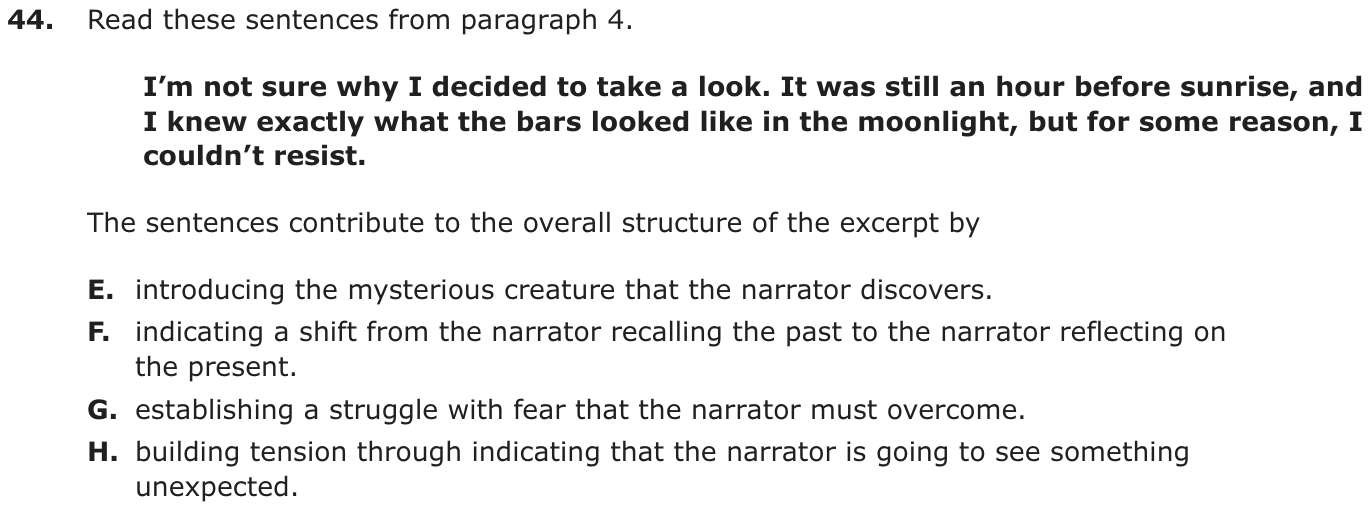
Question 29 of 50
2026 Practice Test D English, question 29Uses the passage above: “Excerpt from The Highest Tide”.
Question
The narrator’s actions in paragraph 5 reveal that he is
- Aexpecting to see the familiar sight of a stranded minke.
- Bconfident about exploring farther into the mudflats.
- Cunconcerned about becoming stuck in the mudflats.
- Ddetermined to discover the source of the sound.
Show the answer
Correct answer: D
The question asks what the narrator’s actions in paragraph 5 reveal about him.
A. Incorrect. The paragraph begins with the narrator wondering “if a whale was stranded again” because of one that had gotten stuck before and had “made similar noises.” However, the narrator explains that he “looked for a hulking silhouette but couldn’t find one” before he “went toward what [he] thought [he’d] heard,” so readers can conclude that he continues to walk through the dangerous mudflats not because he expects to find a whale but because he is curious to find out what made the noise.
B. Incorrect. The fact that the narrator knows about a whale that was stranded on the mudflats “two summers prior” indicates that he is familiar with the area, and he does mention that he has some knowledge of the mudflats. However, in the paragraph, he reveals that his knowledge is of the dangers there: “I knew the flats well enough to know I could get stuck just about anywhere.” He also explains that as he moves, he avoids “stepping into the mud until [he] had to.” The fact that he acknowledges the danger and tries to avoid it indicates that he is cautious rather than confident.
C. Incorrect. In the paragraph, the narrator’s recollection that even though he could not see the silhouette of a whale, “still, [he] went toward what [he] thought [he’d] heard” might make him seem unconcerned about getting stuck. However, even as he continues, he moves carefully, avoiding “stepping into the mud until [he] had to” because he knows the mudflats “well enough to know [he] could get stuck just about anywhere.”
D. CORRECT. In the paragraph, the narrator describes the dangers of walking on the mudflats by stating that he “knew the flats well enough to know [he] could get stuck just about anywhere,” but he continues walking toward the sound. Despite knowing the dangers, he still “went toward what [he] thought [he’d] heard,” and this shows that he is determined to find out what made the sound.
Question analysis
This inference question asks what the narrator's actions reveal about him when he hears a strange sound on the mudflats before dawn and sets off toward it. Students must read what he does alongside what he says he knows about the flats, and several choices fit one detail of the paragraph but not the whole of it.
- Grade level
- Grade 7 reading and task
- Compared with grade 7
- At grade 7 Inferring a character's trait from actions is core grade 7 literary reading. The evidence sits in one paragraph and the actions are concrete, so the item is typical, though the long paragraph mixes memory, rules and movement.
- Estimated difficulty
- Straightforward: two steps or one careful reading.
- Thinking it demands
- Depth of knowledge 2, skills and concepts · mainly understand
- What makes it hard
- Reading between the lines moderate
- Much to keep track of minor
- Evidence
- Answered from one paragraph or stanza
- Reading level
- Passage: about grade 6, 902 words; question and choices: about grade 8, 41 words.
- Students, last 30 days
- Not enough answers yet to show (it takes 10).
Why it is hard, traps and wrong answers (shows the answer)
Why it is hard
Paragraph 5 shows two things at once, a narrator who knows exactly how dangerous the flats are and one who keeps walking toward a sound anyway. Choices that see only the walking call him confident or unconcerned, and the one that sees only his first thought has him expecting a whale. The word “Still”, after his search for a silhouette comes up empty, is the hinge that shows determination.
Reading between the lines moderate Working it out
The trait is never named; it must be drawn from what he does, especially “Still, I went toward what I thought I'd heard” after seeing nothing and hearing nothing more. (Graesser, Singer & Trabasso, 1994; Kintsch, 1998)
Much to keep track of minor Working it out
The paragraph mixes a memory of the stranded minke, a rule about incoming tides and his own steps, and the student must keep his caution and his persistence in view together. (Sweller, 1988; Carpenter, Just & Shell, 1990)
Strategy: List what the narrator does in paragraph 5, step by step, and note what he knows while doing it; then ask what those actions, taken together, say about him.
Traps
- Wrong tone or attitude: Misjudges the tone, attitude or point of view, such as reading admiration as criticism, or taking a character's or subject's feelings for the author's.
- Twists what the text says: Uses the text's topic and ideas but changes what it says: who did it, how much, when, or why.
The wrong answers, classified
A Twists what the text says (King et al., 2004)
Builds on his first thought that a whale was stranded again, but he finds no silhouette and keeps going, and one stranding two summers before hardly makes it a familiar sight.
B Wrong tone or attitude (Graesser, Singer & Trabasso, 1994)
Reads “I knew the flats well” as confidence, but he knew them well enough to know he could get stuck anywhere, which is wariness, not confidence.
C Wrong tone or attitude (Graesser, Singer & Trabasso, 1994)
Takes his pressing on as indifference, ignoring that he avoids stepping into the mud until he has to because he knows how easily he could sink.
Working it out, step by step
Know what the question asks
This asks you to make an inference about a character. You judge what the narrator is like from what he does. The text never names the trait, so look closely at his actions.
List his actions in paragraph 5
He hears a sound and wonders if a whale is stranded. He “looked for a hulking silhouette but couldn’t find one.” He waits, but hears nothing more. Then he says, “Still, I went toward what I thought I’d heard.” He sinks to his knees twice, and cold water fills his boots.
Notice what he knows
He knows the danger. He says, “I knew the flats well enough to know I could get stuck just about anywhere.” The word “Still” matters here. It means even so. Even with no whale in sight and no more sounds, he keeps heading toward the noise.
Check each choice
- D fits: he keeps going toward the sound despite the danger, so he is determined to find its source.
- A is wrong because he finds no whale and keeps going, and one stranding two summers ago is not a familiar sight.
- B is wrong because knowing he could get stuck anywhere makes him careful, not confident.
- C is wrong because he avoids “stepping into the mud until I had to,” so he does worry about getting stuck.
Watch out: B and C notice only that he keeps walking. They miss how carefully he moves.
Choose the answer
He presses on toward the sound even though he knows the mud is dangerous. So the answer is D.
Why this answer and not the closest wrong one
B comes closest, because he says he knows the flats well. But what he knows is how easily he could get stuck, so he is careful, not confident. Pressing on anyway, after seeing nothing and hearing nothing more, shows determination.
More questions like this
The original DOE question
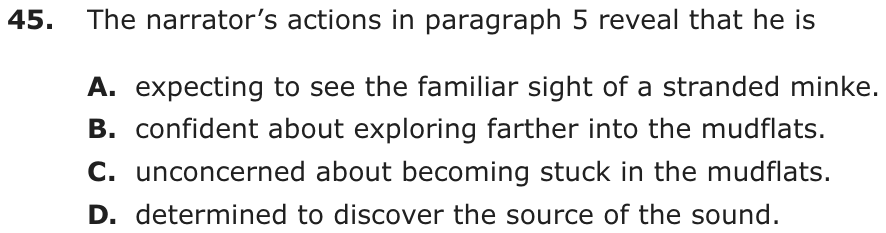
Question 30 of 50
2026 Practice Test D English, question 30Uses the passage above: “Excerpt from The Highest Tide”.
Question
How does the setting affect the plot of the excerpt?
- AThe darkness of the mudflats before sunrise causes the narrator to pay close attention to his surroundings.
- BThe rugged terrain of the mudflats makes it more difficult for the narrator to do his job.
- CThe slow return of the tide along the mudflats forces the narrator to be patient during his journey.
- DThe barren appearance of the mudflats creates a sense of mystery that unsettles the narrator.
Show the answer
Correct answer: A
The question asks how the setting affects the plot of the excerpt.
A. CORRECT. In paragraph 4, the narrator says that it is an hour before sunrise. It is difficult to see because the mudflats are dark, so the narrator, while familiar with the terrain of the mudflats, is cautious.
B. Incorrect. While the terrain of the mudflats is challenging because of the “wet, flattened dunes” (paragraph 4), the narrator is familiar with the terrain and moves carefully. In addition, the excerpt focuses on the narrator’s curiosity and enjoyment as he explores the mudflats, not on his work collecting specimens.
C. Incorrect. In paragraph 1, the narrator watches the water “hesitating at its apex” and “patiently waiting for the gravitational gears to shift.” This illustrates that the narrator is already familiar with the changes in his surroundings, that the tide is slow to move in, and that he can move carefully through the mudflats without the threat of rising water.
D. Incorrect. While the narrator is on the mudflats for the entire excerpt, the phrase “eyes relaxed” in paragraph 1 indicates that the narrator feels comfortable there. The narrator does not show fear until paragraph 6, when a growing fear about the unknown creature arises.
Question analysis
Set on the mudflats of Puget Sound before daybreak, this excerpt from the novel The Highest Tide is the basis for a question about how setting affects plot. Students must link features of the place and time to what the narrator does across the whole excerpt, and each choice pairs a real feature of the setting with an effect that may or may not be in the text.
- Grade level
- Grade 8 reading and task
- Compared with grade 7
- Above grade 7 Analyzing how setting shapes plot is a grade 7 literary standard, but the excerpt never states the link: the effect must be inferred from scattered details, and every choice names a genuine feature of the flats, which is beyond typical work.
- Estimated difficulty
- Hard: combines ideas, needs a plan, and has more than one tempting wrong answer.
- Thinking it demands
- Depth of knowledge 3, strategic thinking · mainly analyze
- What makes it hard
- Reading between the lines major
- The right answer is reworded moderate
- Evidence in several places moderate
- Evidence
- Answered from the whole text
- Reading level
- Passage: about grade 6, 902 words; question and choices: about grade 8, 77 words.
- Corrected from the DOE handbook
- A statement in the explanation that contradicted the excerpt’s introduction was corrected.
- Students, last 30 days
- Not enough answers yet to show (it takes 10).
Why it is hard, traps and wrong answers (shows the answer)
Why it is hard
Every choice names a real feature of the mudflats, so the question turns on which feature the excerpt actually shows shaping events. The darkness never gets a sentence of its own; it is felt in a sound heard before anything is seen, a silhouette that cannot be found and a headlamp beam. The barren look of the flats is the strongest pull, because the scene is eerie, but the narrator knows life hides in the mud and his unease comes from the creature.
Reading between the lines major Working it out
The excerpt never says the darkness changes anything; the effect must be assembled from the hour before sunrise, the sound heard “long before I saw it”, the missing silhouette and the headlamp that finally finds the creature. (Graesser, Singer & Trabasso, 1994; Kintsch, 1998)
The right answer is reworded moderate Choosing the answer
The right choice uses no words from the text, while the wrong ones echo it: the “barren” look of the flats, the water “patiently waiting”, the narrator's summer job. (Freedle & Kostin, 1993; Kirsch & Mosenthal, 1990)
Evidence in several places moderate Working it out
The darkness is established in paragraph 4 and felt in paragraphs 5, 6 and 8, so no single passage shows the setting at work. (Kirsch & Mosenthal, 1990; Gorin & Embretson, 2006)
Strategy: Collect the details of time, place and conditions across the excerpt, then for each choice ask whether the text shows that feature of the setting actually changing what the narrator does.
Traps
- Twists what the text says: Uses the text's topic and ideas but changes what it says: who did it, how much, when, or why.
- Reads too much in: A reasonable-sounding conclusion that goes further than the text allows.
The wrong answers, classified
B Reads too much in (Graesser, Singer & Trabasso, 1994)
Combines the introduction's specimen job with his sinking to his knees to infer a harder workday, though the excerpt follows a strange sound and never shows his work suffering.
C Twists what the text says (King et al., 2004)
Borrows paragraph 1's water “patiently waiting” at low tide and has the tide force the narrator to wait, when he chose to stop and watch it turn.
D Twists what the text says (King et al., 2004)
Joins the flats' barren look from a distance to his later fear, but he knows life hides in the mud, and what unsettles him is the creature, not the landscape.
What was corrected from the DOE handbook, and why
- Explanation: In rejecting choice B, the handbook says “the excerpt shows that the narrator explores the mudflats for curiosity and enjoyment, not work.” But the introduction says the narrator’s summer job is collecting marine specimens and that “in this excerpt, he is looking for specimens in the mudflats before daybreak.” The explanation now says the excerpt focuses on his curiosity and enjoyment as he explores the mudflats, not on his work collecting specimens. That keeps the handbook’s point (the excerpt is not about the terrain making his job harder) without contradicting the introduction.
Working it out, step by step
Know what setting and plot mean
The setting is where and when a story happens. The plot is the chain of events. This asks which part of the setting changes what happens or what the narrator does.
Find the time of day
Paragraph 4 says, “It was still an hour before sunrise.” The narrator is out on the mudflats in the dark. The only light comes from the moon and his headlamp.
See how the dark shapes events
Because it is dark, he must rely on sounds and small clues. He says, “I heard it long before I saw it.” He looks for “a hulking silhouette,” a dark outline, but can’t find one. He spots the creature only when “my headlamp crossed it.” Then he stares hard, trying to make out its shape. The darkness keeps him alert and watching closely.
Check each choice
- A fits: the dark makes him pay close attention to everything around him.
- B is wrong because the excerpt follows a strange sound and never shows the ground making his job harder.
- C is wrong because in paragraph 1 he chooses to stop and watch the tide, and nothing forces him.
- D is wrong because he knows life hides in the mud, and what scares him is the creature.
Watch out: D feels right because the scene is eerie. But the flats’ empty look never troubles him.
Choose the answer
The darkness before sunrise is what keeps the narrator listening and looking so carefully. So the answer is A.
Why this answer and not the closest wrong one
D comes closest, because the dark flats do feel spooky. But the narrator says they only look “too barren to support sea life” from far away, and he knows better. His fear comes from the creature. The darkness, though, shapes every step: he hears before he sees and must watch closely.
More questions like this
The original DOE question
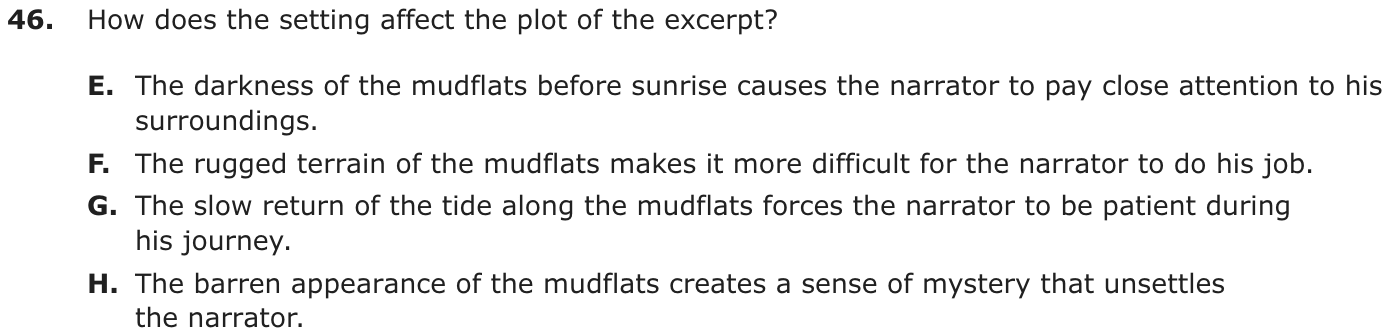
Question 31 of 50
2026 Practice Test D English, question 31Uses the passage above: “Excerpt from The Highest Tide”.
Question
Which sentence from paragraph 5 supports the idea that the narrator is taking a risk?
- A“It was an exhale, a release of sorts, and I instantly wondered if a whale was stranded again.”
- B“I looked for a hulking silhouette but couldn’t find one.”
- C“I waited, but there were no more sounds.”
- D“I knew the flats well enough to know I could get stuck just about anywhere.”
Show the answer
Correct answer: D
The question asks which sentence from paragraph 5 supports the idea that the narrator is taking a risk.
A. Incorrect. In this sentence, the narrator is describing the exhale of a creature and his concern that the sound might be coming from a whale in danger. At no point does the narrator suggest that this is a dangerous situation.
B. Incorrect. This sentence describes a “hulking silhouette” because the narrator is searching for a whale that might be stranded. This expression refers to the size of the whale and not to any danger the narrator might face.
C. Incorrect. The narrator’s words “no more sounds” are used to illustrate his listening for what may be a whale. At this point, the narrator is still concerned about the possibility that a whale may be stranded, not the possibility of being in danger.
D. CORRECT. The idea that the narrator could become stuck in the mud of the flats means that the surroundings pose some danger or difficulty.
Question analysis
Students choose which sentence from one tense paragraph of The Highest Tide shows that the narrator is taking a risk as he follows a strange sound across the mudflats. In this evidence question, all four sentences come from the same scene, so students must tell real danger to the narrator apart from a mood of suspense.
- NYS standards
- 7R1 textual evidence and inferences
- Grade level
- Grade 6 reading and task
- Compared with grade 7
- Below grade 7 Choosing the sentence that supports an idea is a grade 6 and 7 skill. Here all four choices come from one paragraph and only the idea of danger needs matching, a lighter task than typical grade 7 evidence work.
- Estimated difficulty
- Routine: one familiar step, little to misread.
- Thinking it demands
- Depth of knowledge 2, skills and concepts · mainly evaluate
- What makes it hard
- Evidence
- Answered from one paragraph or stanza
- Reading level
- Passage: about grade 6, 902 words; question and choices: about grade 5, 65 words.
- Students, last 30 days
- Not enough answers yet to show (it takes 10).
Why it is hard, traps and wrong answers (shows the answer)
Why it is hard
Only one of the four sentences mentions anything that could happen to the narrator himself, so this is among the easiest questions on the test. The other three build suspense, a strange exhale, a missing silhouette, a silence, and a student who confuses suspense with danger may pick one. Asking who is at risk in each sentence settles it at once.
Reading between the lines minor Working it out
The right sentence states only what the narrator knows, that he could get stuck; it shows a risk because the sentences around it have him walking out onto the mud anyway. (Graesser, Singer & Trabasso, 1994; Kintsch, 1998)
Strategy: Decide what taking a risk would mean for the narrator in this place, then test each sentence for a danger to him rather than a feeling of suspense.
Traps
- Supports only part of the claim: In a question about evidence: a line that backs one half of the claim but not the other, or a related point rather than the claim itself.
- Word match: Repeats striking words or phrases from the text, so it looks supported, but its meaning does not fit the question.
The wrong answers, classified
A Supports only part of the claim (King et al., 2004; Thissen, Steinberg & Fitzpatrick, 1989)
Senses danger in a possibly stranded whale, but the danger would be the whale's, and the sentence shows the narrator only wondering, not exposing himself to anything.
B Word match (Freedle & Kostin, 1993)
Hears menace in “hulking silhouette”, but the phrase describes the size of the whale he expected, and failing to find one puts him in no danger.
C Reads too much in (Graesser, Singer & Trabasso, 1994)
Reads the silence after the sound as ominous, but waiting and listening is a pause in his search, not something that puts him at risk.
Working it out, step by step
Know what the question asks
This asks you to find evidence. Taking a risk means doing something that could hurt you. So look for a sentence that shows a danger to the narrator himself.
Think about the danger on the flats
Mudflats are soft and wet. A person can sink into the mud and get stuck as the water rises. Paragraph 5 even gives a rule: “The general rule was you didn’t venture out past the shells and gravel with an incoming tide.”
Find the sentence about danger
Choice D says, “I knew the flats well enough to know I could get stuck just about anywhere.” So the narrator knows he could get stuck. Yet he keeps walking out toward the sound. That means he is taking a risk.
Check each choice
- D fits: getting stuck is a danger to him, and he goes on anyway.
- A is wrong because a stranded whale would be in danger, not the narrator.
- B is wrong because “hulking silhouette,” a huge dark shape, describes the whale he expected, not a threat.
- C is wrong because waiting in silence builds suspense but puts him in no danger.
Watch out: A, B and C create a spooky mood. But a spooky mood is not the same as a risk.
Choose the answer
Only one sentence names something that could happen to the narrator himself. So the answer is D.
Why this answer and not the closest wrong one
A comes closest, because a stranded whale sounds serious. But the danger in that sentence belongs to the whale. Only D names something that could happen to the narrator: getting stuck in the mud.
More questions like this
The original DOE question
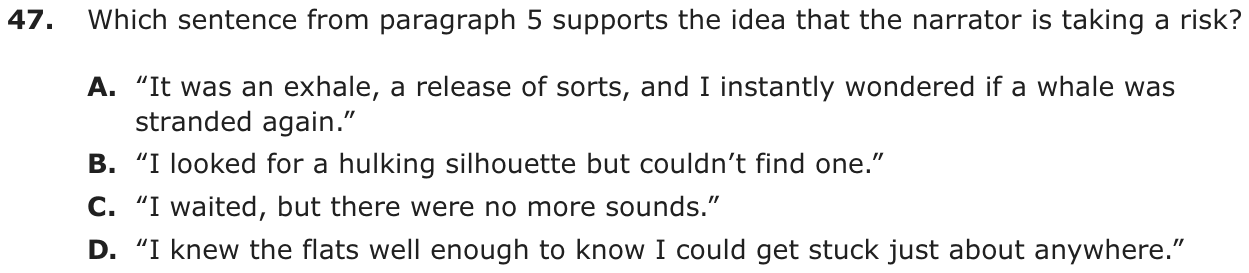
Question 32 of 50
2026 Practice Test D English, question 32Uses the passage above: “Excerpt from The Highest Tide”.
Question
Read this sentence from paragraph 6.
I kept stepping toward the one sound I’d heard, a growing part of me hoping I’d find nothing at all.
How do the narrator’s actions develop a central idea of the excerpt?
- AThe narrator’s concern about the origin of the noise shows dedication to helping preserve sea life in the mudflats.
- BThe narrator’s curiosity about the sea life in the mudflats outweighs any fear about the situation.
- CThe narrator’s knowledge about a variety of sea life encourages a search for more specimens to study.
- DThe narrator’s eagerness about new specimens of sea life outweighs the reality that the area is an unlikely place to find them.
Show the answer
Correct answer: B
The question asks how the narrator’s actions, as described in the sentence from paragraph 6, develop a central idea of the excerpt.
A. Incorrect. The sentence highlights the narrator’s concern about sea life and the creatures living within the flats. However, these ideas do not develop what is being described in the excerpt.
B. CORRECT. The narrator “kept stepping toward the one sound,” indicating a sense of curiosity. However, the words “a growing part of me hoping I’d find nothing” suggest a rising fear or concern. Ultimately, the narrator’s curiosity outweighs his growing fear and is a central idea in the excerpt, as shown by the fact that the narrator does not run away when finally encountering the creature.
C. Incorrect. While the narrator’s descriptions of the nudibranch and other sea life demonstrate a knowledge of these creatures, as well as a desire to discover more in the mudflats, the knowledge the narrator exhibits is not what is being illustrated in the excerpt.
D. Incorrect. The excerpt does describe the narrator’s enjoyment at seeing a nudibranch in paragraph 2, and in paragraph 4, the narrator clearly states that there is an abundance of life in the seemingly barren mudflats, including “hearty clams, worms and tiny creatures that flourish in mud.” However, the sentence demonstrates the narrator’s curiosity in spite of fear, not an eagerness about or fascination with the mudflats.
Question analysis
This central-idea question quotes a sentence in which the narrator keeps walking toward a mysterious sound while part of him hopes to find nothing, and asks how his actions develop a central idea of the excerpt. Students must read the mixed feelings packed into one sentence and connect them to the larger story of his walk on the flats.
- Grade level
- Grade 7 reading and task
- Compared with grade 7
- At grade 7 Connecting a character's actions to a central idea is grade 7 work. The quoted sentence states both the action and the feeling, so the task is typical, though the four choices are long and each names a different motive.
- Estimated difficulty
- Moderate: several steps, or a close reading with one strong distractor.
- Thinking it demands
- Depth of knowledge 2, skills and concepts · mainly analyze
- What makes it hard
- Reading between the lines moderate
- Evidence in several places minor
- Evidence
- Answered from several paragraphs or stanzas
- Reading level
- Passage: about grade 6, 902 words; question and choices: about grade 9, 111 words.
- Students, last 30 days
- Not enough answers yet to show (it takes 10).
Why it is hard, traps and wrong answers (shows the answer)
Why it is hard
The quoted sentence holds both halves of the answer, an action and a wish that pulls against it, but neither is named. The wrong choices each supply a motive the sentence does not show, a rescue, a hunt for specimens, an eagerness for new finds, and two of them borrow real details from elsewhere in the excerpt. Students who split the sentence into what he does and what he hopes avoid all three.
Reading between the lines moderate Working it out
The sentence names neither feeling: curiosity must be read from “kept stepping toward the one sound” and fear from “a growing part of me hoping I'd find nothing at all”. (Graesser, Singer & Trabasso, 1994; Kintsch, 1998)
Evidence in several places minor Working it out
To count as a central idea, the pull between curiosity and fear has to recur, from “I couldn't resist” in paragraph 4 to “If they even twitched I would have run” in paragraph 8. (Kirsch & Mosenthal, 1990; Gorin & Embretson, 2006)
Strategy: Split the quoted sentence into what the narrator does and what part of him feels, then ask which motive behind those actions runs through the rest of the excerpt.
Traps
- Reads too much in: A reasonable-sounding conclusion that goes further than the text allows.
- Twists what the text says: Uses the text's topic and ideas but changes what it says: who did it, how much, when, or why.
The wrong answers, classified
A Reads too much in (Graesser, Singer & Trabasso, 1994)
Links the sound to the minke freed two summers before and assumes a mission to help sea life, but the sentence shows him pressing on while hoping to find nothing.
C Twists what the text says (King et al., 2004)
Draws on his specimen job and his knowledge of nudibranchs to turn this moment into a hunt for specimens, when he is following one strange sound with mixed feelings.
D Twists what the text says (King et al., 2004)
Copies the right answer's pattern of one force outweighing another, but pits eagerness for specimens against an “unlikely place” that paragraph 4 says only looks barren from a distance.
Working it out, step by step
Know what the question asks
This asks how the narrator’s actions build a central idea, a main point that runs through the whole excerpt. Start by splitting the sentence into what he does and what he feels.
Split the sentence in two
What he does: “I kept stepping toward the one sound I’d heard.” He keeps moving forward. What he feels: “a growing part of me hoping I’d find nothing at all.” Part of him is afraid of what he might find, and that fear is growing.
Weigh the two feelings
He is scared, but he keeps going anyway. So his curiosity, his wish to know, is stronger than his fear. This pull runs through the excerpt. In paragraph 4 he “couldn’t resist” going out. In paragraph 8 he stays and stares at the creature, though he admits, “If they even twitched I would have run.”
Check each choice
- B fits: his curiosity “outweighs any fear,” since his steps forward win out over his wish to find nothing.
- A is wrong because nothing shows he wants to protect sea life, and he even hopes to find nothing.
- C is wrong because he is following one strange sound, not hunting for specimens to study.
- D is wrong because paragraph 4 says the flats only look empty from far away.
Watch out: D copies B’s pattern of one thing outweighing another. But its details don’t match the excerpt.
Choose the answer
The narrator’s steps show curiosity winning out over a growing fear. So the answer is B.
Why this answer and not the closest wrong one
A comes closest, because two summers earlier a stranded whale had needed help. But in this sentence the narrator hopes to find nothing at all. Someone set on a rescue would not hope that. B explains both halves: he is afraid, yet his curiosity keeps him walking.
More questions like this
The original DOE question
Question 33 of 50
2026 Practice Test D English, question 33Uses the passage above: “Excerpt from The Highest Tide”.
Question
Read these sentences from paragraph 8.
So, I was looking at it and not looking at it while my heart spangled my vision. I saw fragments, pieces, and tried to fuse them in my mind but couldn’t be certain of the whole.
The sensory language “spangled my vision,” “I saw fragments, pieces,” and “tried to fuse them in my mind” conveys the narrator’s
- Aextreme excitement about making a great discovery.
- Breluctant acceptance that he needs to leave the mudflats.
- Cterrified confusion about the creature in the mudflats.
- Dsudden concern about his personal safety.
Show the answer
Correct answer: C
The question asks what the sensory language in the sentences from paragraph 8 conveys about the narrator.
A. Incorrect. While the narrator does not leave the mudflats and is curious about what has been found, the main emotions described in paragraph 8 are fear and confusion as the narrator tries to comprehend the size of the animal.
B. Incorrect. The language focuses on the narrator’s inability to organize what he sees into useful thoughts and conclusions, and while the narrator feels fear in paragraph 8—“I was afraid” and “I would have run”—the narrator refuses to leave the mudflats out of curiosity.
C. CORRECT. The phrase “spangled my vision” illustrates that the narrator cannot fully recognize what has appeared on the mudflats. The sight is so amazing, the narrator is trying to “fuse” together “fragments” and “pieces” because seeing the creature has created so much emotion in the narrator that he feels confused.
D. Incorrect. While the narrator is feeling some fear, as expressed in paragraph 8, the phrases actually indicate that the narrator’s amazement causes him to struggle to take in the view of the creature before him.
Question analysis
This question about sensory language asks what three phrases, including “spangled my vision,” convey about the narrator as he stares at a huge creature in the mud in an excerpt from The Highest Tide. Students must interpret unusual imagery and choose among emotions that all seem possible at such a startling moment.
- Grade level
- Grade 8 reading and task
- Compared with grade 7
- Above grade 7 Interpreting sensory language for a character's state of mind is grade 7 work, but spangled is an unusual verb, and the paragraph partly supports several of the emotions offered, so the choice must be matched precisely to the quoted phrases.
- Estimated difficulty
- Hard: combines ideas, needs a plan, and has more than one tempting wrong answer.
- Thinking it demands
- Depth of knowledge 2, skills and concepts · mainly analyze
- What makes it hard
- Figurative or literary language major
- A very close wrong answer moderate
- Hard words minor
- Evidence
- Answered from one paragraph or stanza
- Reading level
- Passage: about grade 6, 902 words; question and choices: about grade 7, 92 words.
- Students, last 30 days
- Not enough answers yet to show (it takes 10).
Why it is hard, traps and wrong answers (shows the answer)
Why it is hard
The quoted phrases are about perception, not feeling: the narrator sees fragments and cannot assemble them, while his heart pounds hard enough to blur his sight. The fear is clear from the surrounding sentences, where he is afraid to look away and ready to run, and that context makes the choice about personal safety very tempting. The answer must cover both the terror and the confusion, and the word “spangled” can mislead readers into hearing excitement.
Figurative or literary language major Understanding the question
The phrases describe seeing in pieces, “looking at it and not looking at it”, a heart that “spangled” his vision, “fragments” he cannot “fuse”, and the emotion has to be read from that broken sight. (Graesser, Singer & Trabasso, 1994; Kintsch, 1998)
A very close wrong answer moderate Choosing the answer
The right choice and the one about concern for his safety both name fear; they part on what the quoted phrases show, a mind unable to piece the creature together or a worry about its reach. (Embretson & Wetzel, 1987; Gorin & Embretson, 2006; Ascalon et al., 2007)
Hard words minor Understanding the question
“Spangled”, to scatter with glittering spots, is a rare word, and its sparkle can suggest delight, which opens a reading of excitement to students who miss the fear around it. (Perfetti, 2007; Freedle & Kostin, 1993)
Strategy: Ask what the three quoted phrases together say about how the narrator is seeing and thinking at this moment, then choose the emotion that accounts for all three, not just one.
Traps
- True but not the answer: A choice says something accurate about the text that does not answer this question.
- Wrong tone or attitude: Misjudges the tone, attitude or point of view, such as reading admiration as criticism, or taking a character's or subject's feelings for the author's.
The wrong answers, classified
A Wrong tone or attitude (Graesser, Singer & Trabasso, 1994)
Reads the pounding heart and glittering vision as the thrill of a great find, missing that he is afraid to take his eyes off the creature and cannot make sense of it.
B Twists what the text says (King et al., 2004)
Turns “If they even twitched I would have run”, a possibility, into an accepted need to leave, though the narrator stays and the phrases describe how he sees.
D True but not the answer (King et al., 2004; Embretson & Wetzel, 1987)
Matches the fear in paragraph 8, where he wonders whether he is within reach, but the quoted phrases describe broken seeing and puzzling, and his fear has been building, not sudden.
Working it out, step by step
Know what the question asks
Sensory language describes what a character sees, hears or feels. This asks what feeling the three quoted phrases show. Your answer must explain all three phrases, not just one.
Explain the hard words
To spangle means to cover with glittering spots. His heart pounds so hard that his sight seems to sparkle and blur. Fragments are small broken pieces. To fuse means to join together.
Put the phrases together
He sees only “fragments, pieces.” He tries “to fuse them in my mind” but “couldn’t be certain of the whole.” So he is confused, unable to tell what the creature really is. The sentences around them show he is also terrified. He is “afraid to pry my eyes off” its arms, and his heart is racing.
Check each choice
- C fits: “terrified confusion” covers both his fear and his broken, puzzled seeing.
- A is wrong because “spangled” may sound happy, but he is frightened, not thrilled.
- B is wrong because he never decides to leave, and he would run only if the arms moved.
- D is wrong because the phrases show confused seeing, and his fear has been growing since paragraph 6.
Watch out: D is close, since he is afraid. But it leaves out the confusion the phrases show.
Choose the answer
The phrases show a frightened narrator who cannot piece together what he sees. So the answer is C.
Why this answer and not the closest wrong one
D comes closest, because the narrator truly fears for his safety. But the quoted phrases are about how he sees: in pieces he can’t join. That is confusion. C names both the fear and the confusion, so it fits all three phrases.
More questions like this
The original DOE question
Question 34 of 50
2026 Practice Test D English, question 34Uses the passage above: “Excerpt from The Highest Tide”.
Question
The author develops the narrator’s point of view when the narrator sees the creature by
- Adescribing the narrator’s movements as he approaches the creature.
- Bemphasizing the odds of finding the creature in an area inhabited by a rival species.
- Cshowing the narrator’s growing realization of the creature’s identity.
- Dcomparing the size of the creature to the size of a vehicle.
Show the answer
Correct answer: C
The question asks how the author develops the narrator’s point of view when the narrator sees the creature.
A. Incorrect. The author’s description of how the narrator moves toward the creature has to do with the terrain and the narrator’s sense of awe. The narrator’s perspective is not represented through how he approaches the creature; it is presented later in the excerpt when the narrator is studying the creature.
B. Incorrect. In this excerpt, while the narrator does discuss other large animals (minke whale, paragraph 5; octopi, paragraph 7) that have appeared on the mudflats, these are examples to show the variety of animal life that can be discovered on the mudflats, not rivals of the creature discovered at the end of the excerpt.
C. CORRECT. In paragraph 7, the narrator describes the largest octopi in the world and then states that this creature is “more than an octopus.” The narrator then states that it is “impossible to hear anything over the blood in my ears,” and in paragraph 8, he describes the creature’s body in detail, as well as his growing fear and amazement as he begins to realize what the creature really is.
D. Incorrect. While the narrator observes that the creature’s eye is as large as a hubcap in paragraph 9, a comparison to an entire car is never made. This detail is for description but does not give the narrator’s point of view.
Question analysis
This point-of-view question asks how the author develops the narrator's perspective at the moment he comes upon a huge, unknown sea creature at the end of the excerpt from The Highest Tide. Students must track the narration over the last paragraphs and decide which technique shapes what readers see through his eyes.
- Grade level
- Grade 8 reading and task
- Compared with grade 7
- At grade 7 Analyzing how an author develops a narrator's point of view is a grade 7 standard. The key paragraphs are dense with description and suspense, but the choices are fairly distinct, so the overall demand is typical of grade 7 work.
- Estimated difficulty
- Moderate: several steps, or a close reading with one strong distractor.
- Thinking it demands
- Depth of knowledge 2, skills and concepts · mainly analyze
- What makes it hard
- How, not what moderate
- Evidence in several places minor
- Reading between the lines minor
- Evidence
- Answered from several paragraphs or stanzas
- Reading level
- Passage: about grade 6, 902 words; question and choices: about grade 9, 60 words.
- Students, last 30 days
- Not enough answers yet to show (it takes 10).
Why it is hard, traps and wrong answers (shows the answer)
Why it is hard
The narrator's guesses change from paragraph to paragraph, octopus, then something more, then a name he refuses to say, and the answer is that progression rather than any single detail. The wrong choices fasten on details, his approach across the mud, the octopi of Puget Sound, the hubcap, and each misdescribes or misplaces it. Readers who track what he believes at each step see the growing realization.
How, not what moderate Working it out
The question asks how the author builds the narrator's point of view, so the student must name a technique, a step-by-step realization, rather than any single thing he sees or does. (Anderson & Krathwohl, 2001)
Evidence in several places minor Working it out
The realization unfolds across paragraphs 6 to 9: “A giant octopus” becomes “more than an octopus”, then “I knew what it had to be”, and finally an eye the size of a hubcap. (Kirsch & Mosenthal, 1990; Gorin & Embretson, 2006)
Reading between the lines minor Working it out
The creature is never named; “the two words” the narrator will not let himself think have to be understood as a name he already suspects. (Graesser, Singer & Trabasso, 1994; Kintsch, 1998)
Strategy: Reread paragraphs 6 through 9 and track what the narrator notices, thinks and feels at each step, then pick the choice that describes the technique the author uses across those steps.
Traps
- Wrong part of the text: A choice is true of another paragraph, stanza or speaker than the one asked about.
- Twists what the text says: Uses the text's topic and ideas but changes what it says: who did it, how much, when, or why.
The wrong answers, classified
A Wrong part of the text (Kirsch & Mosenthal, 1990)
Looks to paragraphs 5 and 6, where he wades and sinks toward the sound, but the question is about the moment he sees the creature, when moving gives way to looking.
B Twists what the text says (King et al., 2004)
Turns the octopi of paragraph 7 into a rival species and talks of odds, though the narrator mentions octopi only as his first guess and never weighs any chances.
D Twists what the text says (King et al., 2004)
Misremembers the last line, where the creature's eye, not its body, is compared to a hubcap, a part of a wheel, not a whole vehicle.
Working it out, step by step
Know what the question asks
Point of view here means how the narrator sees and understands what is happening. The question asks how the author shows his view once the creature appears. Look for a method the author uses across several paragraphs.
Track his guesses
Follow what the narrator thinks the creature is:
- Paragraph 6: “My first thought? A giant octopus.”
- Paragraph 7: “I knew it was more than an octopus.”
- Paragraph 8: “I knew what it had to be, but I wouldn’t allow myself to even think the two words.”
- Paragraph 9: “Its eye was the size of a hubcap.”
See the pattern
Each step brings him closer to knowing what the creature is. First comes a guess, then a doubt, then a name he won’t let himself think. Finally a huge eye makes him scream. The author shows his growing realization, his slow understanding, one step at a time.
Check each choice
- C fits: “growing realization of the creature’s identity” matches his changing guesses, and identity means what something is.
- A is wrong because his steps closer reveal little, while his thoughts change from paragraph to paragraph.
- B is wrong because the octopus is only his first guess, not a rival, and he never talks about odds.
- D is wrong because only the eye is compared to a hubcap, a cover on a car wheel.
Watch out: D uses a real detail but gets it wrong. A hubcap is part of a wheel, not a whole vehicle.
Choose the answer
The author builds the narrator’s view by showing him slowly work out what he is looking at. So the answer is C.
Why this answer and not the closest wrong one
A comes closest, because the narrator does move closer after he sees the creature, to “within fifty feet.” But his steps tell little about how he sees it. What changes from paragraph to paragraph is his thinking: his guesses grow until he understands. That is C.
More questions like this
The original DOE question

Question 35 of 50
2026 Practice Test D English, question 35Passage Martial Arts for the Mind and Body
Martial Arts for the Mind and Body
(1) The martial arts blend a series of physical movements with strategic mental discipline so that practitioners can defend themselves, physically defeat an opponent, or both. (2) Historians are unsure of exactly when and where martial arts were first used. (3) Martial arts have been practiced by several different societies for many centuries. (4) Martial arts such as karate, kung fu, tae kwon do, and judo are still taught and practiced as methods of self-defense, but they offer students more than that. (5) The study of martial arts can provide students with a way to enhance their mental discipline as well as their physical fitness.
(6) Discipline, focus, and respect are important qualities for everyone to have. (7) However, for most people these qualities are not innate; they must be learned and practiced. (8) The study of martial arts can provide an opportunity to develop these skills. (9) Students are rewarded for their dedication by passing tests and advancing to higher ranks or levels. (10) For example, in a typical tae kwon do class, students learn discipline by diligently practicing moves, improve focus by listening carefully, and demonstrate respect by bowing to the instructor and following directions.
(11) For teenagers, martial arts classes provide a safe and structured environment for gaining physical skills, building confidence, and enjoying a sense of community. (12) A lot of teens go through hard situations as they try to do well in school and in life. (13) A martial arts class can provide teens with a physical outlet for stress while also challenging them mentally. (14) Participating in a martial arts program also helps children and teens focus on self-improvement rather than on competition. (15) Progressing through levels of achievement involves mastering more physically demanding techniques. (16) It requires students to take responsibility and be accountable for achieving set goals. (17) Students gain confidence and experience companionship with other students who are progressing through the ranks.
(18) Adults who practice martial arts can experience many of the same benefits that younger people do, but perhaps the greatest of these is health and fitness. (19) Adult martial arts students often see changes in their body within weeks of beginning a program.
(20) For people interested in studying a martial art, there are many ways to learn and practice. (21) In addition to private studios, community recreation centers often offer low-cost or free martial arts classes. (22) There are even online videos that introduce students to the basic concepts. (23) People should study martial arts.
Question
What is the best way to combine sentences 2 and 3?
- AHistorians, who are unsure of exactly when and where martial arts were first used, know that martial arts have been practiced by several different societies for many centuries.
- BWhile historians are unsure of exactly when and where martial arts were first used, they do know that martial arts have been practiced by several different societies for many centuries.
- CBecause historians know that martial arts have been practiced by several different societies for many centuries, they are unsure of exactly when and where martial arts were first used.
- DMartial arts have been practiced by several different societies for many centuries, and historians are unsure of exactly when and where martial arts were first used.
Show the answer
Correct answer: B
The question asks for the best way to combine sentences 2 and 3.
A. Incorrect. This way of combining sentences 2 and 3 places unnecessary emphasis on characterizing historians, and it does not clearly show the contrasting relationship between the idea from sentence 2 that historians do not know the exact origins of martial arts and the idea in sentence 3 that historians know that martial arts have a long history.
B. CORRECT. This option is correct because the word “while” at the beginning of the sentence best indicates the contrast between the ideas in sentences 2 and 3. Sentence 2 states that historians do not know the exact origins of martial arts (“unsure of exactly when and where”). Sentence 3 describes what historians do know about these origins (“practiced by several different societies for many centuries”). This combination indicates that historians have a general understanding about the origins of martial arts even though they cannot confirm the exact details.
C. Incorrect. Starting this sentence with the word “because” indicates a cause-and-effect relationship that does not exist between the ideas in the original sentences. The idea from sentence 3, that historians know that martial arts have been practiced for many years, did not cause the idea in sentence 2, that historians do not know exact details about the origins of martial arts.
D. Incorrect. The conjunction (connecting word) “and” does not clearly show how the ideas in sentences 2 and 3 are related. While “and” can be used to combine related sentences, it does not demonstrate the contrast between the idea in sentence 2, that historians do not know the exact origins of martial arts, and the idea in sentence 3, that historians know that martial arts have a long history.
Question analysis
This sentence-combining question uses sentences 2 and 3 of a passage on the benefits of martial arts: historians are unsure when and where martial arts were first used, and the arts have been practiced by many societies for centuries. Students must choose the combination whose connecting word shows how the two facts relate, among four grammatical versions.
- Grade level
- Grade 7 reading and task
- Compared with grade 7
- At grade 7 Joining two sentences with a word that shows how their ideas relate is routine grade 7 work. Both sentences are short and plain, and the four versions differ mainly in one connecting word or structure, so the task is typical.
- Estimated difficulty
- Straightforward: two steps or one careful reading.
- Thinking it demands
- Depth of knowledge 2, skills and concepts · mainly evaluate
- What makes it hard
- How sentences fit together moderate
- Every choice must be checked minor
- Evidence
- Answered from one sentence or line
- Reading level
- Passage: about grade 11, 402 words; question and choices: about grade 13, 122 words.
- Students, last 30 days
- Not enough answers yet to show (it takes 10).
Why it is hard, traps and wrong answers (shows the answer)
Why it is hard
The two sentences are short and plain, and the only real decision is the relationship between them: uncertainty about origins set against knowledge of a long history. The relative-clause version tempts most because it sounds polished and keeps everything, yet it turns the uncertainty into a description of historians and drops the contrast. The versions with “Because” and “and” are easier to rule out once the contrast is named, since one invents a cause and the other only adds.
How sentences fit together moderate Working it out
Sentence 2 says what historians do not know and sentence 3 what they do, so the combined sentence needs a word that marks that contrast, which students should name before reading the choices. (Halliday & Hasan, 1976)
Every choice must be checked minor Choosing the answer
All four versions keep both facts and are grammatical, so each must be read through to see whether its opening word or structure shows contrast, addition, cause or mere description. (Embretson & Wetzel, 1987)
Strategy: Before reading the choices, decide how sentence 3 relates to sentence 2: an added fact, a cause, or a contrast. Then pick the version whose opening word or structure signals that relationship.
Traps
- Wrong transition: A connecting word or phrase that signals the wrong relationship, such as contrast where the idea continues.
- Changes the meaning: A revision is correct English but no longer says what the writer meant.
The wrong answers, classified
A Changes the meaning (Connors & Lunsford, 1988)
Keeps both facts in one polished sentence, but tucking sentence 2 into a “who” clause makes it a description of historians and hides the contrast between unknown and known.
C Wrong transition (Halliday & Hasan, 1976)
Opens with “Because,” making the long history the cause of historians’ uncertainty about origins, a cause-and-effect link the two facts do not have.
D Wrong transition (Halliday & Hasan, 1976)
Joins the sentences with “and,” which simply adds one fact to the other in reverse order, so nothing signals that what historians know contrasts with what they don’t.
Working it out, step by step
Figure out what the question asks
This asks how to join two sentences into one. The best way shows how the two ideas are related. So first figure out how they relate.
Read sentences 2 and 3
Sentence 2: “Historians are unsure of exactly when and where martial arts were first used.” Sentence 3: “Martial arts have been practiced by several different societies for many centuries.” A historian studies the past. Sentence 2 tells what historians don’t know. Sentence 3 tells what they do know. That is a contrast: two ideas that pull different ways.
Name the rule
When two ideas contrast, join them with a contrast word, such as while, although or but. Here “while” means although. For example: Sam forgot the exact date. He knew it was in May. Joined: While Sam forgot the exact date, he knew it was in May.
Check each choice
- A is wrong. The part that starts with “who” just describes the historians. The contrast between not knowing and knowing gets lost.
- B is right. “While” shows the contrast. The words “do know” make it even clearer.
- C is wrong. “Because” means one thing causes the other. A long history does not cause historians to be unsure.
- D is wrong. “And” just adds one fact to another. It does not show the contrast.
Watch out: A sounds smooth and keeps every fact, so it is tempting. But a good combined sentence must also show how the ideas relate.
Choose the answer
B joins the two facts and shows the contrast. So the answer is B, “While historians are unsure of exactly when and where martial arts were first used, they do know that martial arts have been practiced by several different societies for many centuries.”
Why this answer and not the closest wrong one
A is the closest wrong answer. It keeps both facts in one smooth sentence. But tucking sentence 2 into a “who” part turns it into a description of historians. Nothing marks the turn from what they don’t know to what they do. B’s “While” and “do know” make that contrast plain.
More questions like this
The original DOE question
The passage “Martial Arts for the Mind and Body” as printed (page 52)
Question 36 of 50
2026 Practice Test D English, question 36Uses the passage above: “Martial Arts for the Mind and Body”.
Question
Where should sentence 10 be moved to improve the organization of the second paragraph (sentences 6–10)?
- Ato the beginning of the paragraph (before sentence 6)
- Bbetween sentences 6 and 7
- Cbetween sentences 7 and 8
- Dbetween sentences 8 and 9
Show the answer
Correct answer: D
The question asks where sentence 10 should be moved to improve the organization of the second paragraph.
A. Incorrect. Starting this paragraph with sentence 10 would weaken the paragraph’s organization because it would place a supporting detail sentence (sentence 10) before the topic sentence (sentence 6). Sentence 6 belongs at the beginning of the paragraph because it introduces the topic—the qualities of discipline, focus, and respect. Sentence 10 supports the key idea of the paragraph, that these qualities can be developed through the study of martial arts. If sentence 10 preceded sentence 6, the transitional phrase “for example” would refer to an unspecified topic and idea.
B. Incorrect. Sentence 6 presents the idea that “discipline, focus, and respect are important qualities for everyone to have,” but the example in sentence 10 does not directly relate to this idea. Sentence 10 explains how martial arts develop these qualities, not why they are important qualities to have. Because sentence 10 is not directly related to the idea in sentence 6 (the qualities are important), it should not follow sentence 6.
C. Incorrect. Sentences 7 and 8 should not be separated, because the idea presented in sentence 8—that “the study of martial arts can provide an opportunity to develop these skills”—is directly related to the idea from sentence 7—that the skills of discipline, focus, and respect “are not innate; they must be learned and practiced.” Sentence 10 supports the idea from sentence 8 by describing an example from a typical martial arts class, so sentence 10 should not precede sentence 8.
D. CORRECT. This option is correct because sentence 10 logically follows and supports the idea in sentence 8 that “the study of martial arts can provide an opportunity to develop” the qualities of discipline, focus, and respect. Sentence 10 explains this idea with examples, describing three specific ways that students in a typical tae kwon do class develop discipline, focus, and respect—by “diligently practicing,” “listening carefully,” and “bowing to the instructor and following directions.”
Question analysis
This organization question asks where sentence 10, a “For example” sentence describing a typical tae kwon do class, should be moved within the second paragraph of the martial arts passage. Students must work out what idea the example illustrates and read the paragraph with the sentence in each position, since several spots sound acceptable.
- Grade level
- Grade 7 reading and task
- Compared with grade 7
- At grade 7 Placing a sentence where it supports the right idea is regular grade 7 revision work. The paragraph is five plain sentences and the opening “For example” is a strong clue, which keeps the demand typical of grade 7.
- Estimated difficulty
- Moderate: several steps, or a close reading with one strong distractor.
- Thinking it demands
- Depth of knowledge 2, skills and concepts · mainly analyze
- What makes it hard
- How sentences fit together moderate
- A very close wrong answer minor
- Much to keep track of minor
- Evidence
- Answered from one paragraph or stanza
- Reading level
- Passage: about grade 11, 402 words; question and choices: about grade 7, 31 words.
- Students, last 30 days
- Not enough answers yet to show (it takes 10).
Why it is hard, traps and wrong answers (shows the answer)
Why it is hard
The example sentence fits loosely almost anywhere in a paragraph about discipline, focus and respect, so students have to ask what exactly it is an example of. The slot just before sentence 8 is the trap: the class’s practicing seems to illustrate sentence 7’s claim that the qualities “must be learned and practiced,” but the paragraph has not yet brought in martial arts. Those who match the example to sentence 8’s claim about martial arts place it correctly.
How sentences fit together moderate Working it out
Sentence 10 opens with “For example,” so it must follow the claim it illustrates, sentence 8’s point that studying martial arts can “develop these skills,” before sentence 9 turns to rewards. (Halliday & Hasan, 1976)
A very close wrong answer minor Choosing the answer
The slots before and after sentence 8 are neighbors, and the tae kwon do class could seem to illustrate sentence 7 as well as sentence 8, so only rereading tells them apart. (Embretson & Wetzel, 1987; Gorin & Embretson, 2006; Ascalon et al., 2007)
Much to keep track of minor Working it out
Each of the four positions means rereading a five-sentence paragraph in a new order in your head while keeping track of what “these qualities” and “these skills” refer to. (Sweller, 1988; Carpenter, Just & Shell, 1990)
Strategy: Ask which sentence the tae kwon do class is an example of, then reread the paragraph with sentence 10 placed right after it and check that every sentence still follows the one before.
Traps
- Sentence in the wrong place: Puts a sentence where it breaks the order of ideas or separates it from what it refers to.
The wrong answers, classified
A Sentence in the wrong place (Halliday & Hasan, 1976)
Moves the example to the front, where “For example” would point back to nothing and the topic sentence would come after its own illustration.
B Sentence in the wrong place (Halliday & Hasan, 1976)
Places the example after sentence 6, but the class shows how the qualities are built, not why everyone needs them, and it would cut sentence 7’s “However” off from sentence 6.
C Sentence in the wrong place (Halliday & Hasan, 1976)
Hears sentence 7’s “learned and practiced” echoed in “learn” and “practicing,” but the example must come after sentence 8, which first connects the qualities to martial arts.
Working it out, step by step
Figure out what the question asks
This asks where to move sentence 10 so paragraph 2 reads in a better order. Sentence 10 starts with “For example.” So it must come right after the idea it is an example of.
Name the rule
An example goes right after the claim it shows. “For example” points back to the sentence before it. For instance: Reading builds your word power. For example, you meet new words in every book. If the example came first, it would point back to nothing.
Find what sentence 10 shows
Sentence 10 says students “learn discipline by diligently practicing moves, improve focus by listening carefully, and demonstrate respect by bowing to the instructor and following directions.” Diligently means with steady, careful effort. This shows how martial arts build those three qualities. Sentence 8 makes that claim: “The study of martial arts can provide an opportunity to develop these skills.” So sentence 10 belongs right after sentence 8.
Read the new order
Now the paragraph runs 6, 7, 8, 10, 9. Sentence 6 names the qualities. Sentence 7 says they “must be learned and practiced.” Sentence 8 says martial arts can build them. Sentence 10 gives the tae kwon do example. Then sentence 9 tells how students are rewarded. Each sentence leads to the next.
Check each choice
- A is wrong. “For example” would point back to nothing.
- B is wrong. Sentence 6 says why the qualities matter, but the class shows how they are built. It would also cut sentence 7’s “However” off from sentence 6.
- C is wrong. Sentence 7 never mentions martial arts. Sentence 8 is the first to link the qualities to martial arts.
- D is right. The example follows the claim it shows.
Watch out: Sentence 7 says “learned and practiced,” and sentence 10 uses “learn” and “practicing.” That echo pulls you toward C.
Choose the answer
Sentence 10 gives an example of sentence 8’s claim. It belongs right after it. So the answer is D, “between sentences 8 and 9.”
Why this answer and not the closest wrong one
C is the closest wrong answer, because sentence 7 talks about learning and practice too. But sentence 7 does not mention martial arts. Sentence 8 claims that martial arts can build these skills, and the tae kwon do class is an example of exactly that. So the example belongs right after sentence 8.
More questions like this
The original DOE question
Question 37 of 50
2026 Practice Test D English, question 37Uses the passage above: “Martial Arts for the Mind and Body”.
Question
Which revision of sentence 12 best maintains the formal style established in the passage?
- AA lot of teens have to put up with difficult things while trying to do well in school and in life.
- BMany teenagers deal with tough situations as they try to stay on top of their studies and do well in life.
- CMany teenagers encounter challenges as they work to succeed both academically and personally.
- DA lot of teens face problems as they work to keep up with their schoolwork and find personal success.
Show the answer
Correct answer: C
The question asks for the revision of sentence 12 that best maintains the formal style established in the passage.
A. Incorrect. The phrases “A lot,” “put up with,” “difficult things,” and “do well in school” are worded informally; therefore, this sentence does not consistently maintain the formal style established in the passage.
B. Incorrect. The phrases “deal with,” “tough situations,” “stay on top of,” and “do well in life” are worded informally; therefore, this sentence does not consistently maintain the formal style established in the passage.
C. CORRECT. This option is correct because it uses clear and scholarly wording throughout the whole sentence. The phrases “many teenagers,” “encounter challenges,” and “succeed both academically and personally” make the sentence’s style more consistently formal than the other options.
D. Incorrect. The phrases “A lot,” “face problems,” and “keep up with” are worded informally; therefore, this sentence does not consistently maintain the formal style established in the passage.
Question analysis
This style question asks which revision of sentence 12, “A lot of teens go through hard situations as they try to do well in school and in life,” best keeps the formal style of the martial arts passage. Students compare four rewrites phrase by phrase, listening for casual expressions in each one.
- Grade level
- Grade 6 reading and task
- Compared with grade 7
- Below grade 7 Keeping a formal style is practiced from grade 6, and here it is tested in one sentence with familiar casual phrases. Typical grade 7 style work asks for subtler choices of precise, content-specific words across a passage.
- Estimated difficulty
- Routine: one familiar step, little to misread.
- Thinking it demands
- Depth of knowledge 1, recall and reproduction · mainly evaluate
- What makes it hard
- Evidence
- Answered from one sentence or line
- Reading level
- Passage: about grade 11, 402 words; question and choices: about grade 8, 87 words.
- Students, last 30 days
- Not enough answers yet to show (it takes 10).
Why it is hard, traps and wrong answers (shows the answer)
Why it is hard
Most students hear the casual phrases at once, and only one version avoids all of them, so this is one of the easier revising questions. The risk is stopping at a formal start: one version opens with “Many teenagers” and then slides into “tough situations,” and another sounds serious with “face problems” but begins with “A lot of teens.” Checking every phrase, not the first few words, is all the question asks.
Every choice must be checked minor Choosing the answer
Each rewrite mixes formal and casual wording, “Many teenagers” beside “deal with” and “stay on top of,” so every phrase of every version has to be checked, not just the opening words. (Embretson & Wetzel, 1987)
Something you must already know minor Working it out
Students must recognize idioms such as “put up with” and “keep up with” as spoken English, a sense of register that the question expects them to bring. (Anderson & Krathwohl, 2001)
Strategy: Underline every casual phrase in each rewrite, such as everyday idioms or vague words, and keep only the version with none; one formal phrase is not enough.
Traps
- Wordy, vague or informal: A revision is grammatical but wordy, imprecise or too casual for the passage.
The wrong answers, classified
A Wordy, vague or informal (Connors & Lunsford, 1988)
Trades “go through hard situations” for “put up with difficult things” and keeps “A lot of teens,” swapping one set of casual phrases for another.
B Wordy, vague or informal (Connors & Lunsford, 1988)
Is reassured by the formal opening “Many teenagers,” but the rest, “deal with,” “tough situations” and “stay on top of,” is everyday speech.
D Wordy, vague or informal (Connors & Lunsford, 1988)
Likes the more serious “face problems” and “personal success,” but keeps the casual “A lot of teens” and “keep up with their schoolwork.”
Working it out, step by step
Figure out what the question asks
This asks which rewrite of sentence 12 matches the passage’s formal style. Formal style is the careful, serious way of writing you use in a school report. It skips the casual words you might use with friends.
Spot the casual words
Sentence 12 says, “A lot of teens go through hard situations as they try to do well in school and in life.” “A lot of,” “teens” and “go through” sound like talking with a friend. Compare sentence 11, which speaks of “a safe and structured environment.” The rest of the passage uses careful words like those.
Name the rule
Formal writing uses exact, serious words and skips everyday sayings. For example, Kids have a ton of homework is casual. Students have a large amount of homework is formal. Check every phrase in each choice, not just the first few words.
Check each choice
- A is wrong. “A lot of teens,” “put up with” and “difficult things” are casual.
- B is wrong. It starts well with “Many teenagers.” But “deal with,” “tough situations” and “stay on top of” are casual.
- C is right. Every phrase is formal. To encounter challenges is to meet hard problems. Academically means in school. Personally means in your own life.
- D is wrong. “Face problems” sounds serious. But “A lot of teens” and “keep up with” are casual.
Watch out: B and D each have a formal phrase or two. One formal phrase is not enough.
Choose the answer
Only C is formal from start to finish. So the answer is C, “Many teenagers encounter challenges as they work to succeed both academically and personally.”
Why this answer and not the closest wrong one
B is the closest wrong answer, because it opens with the formal “Many teenagers.” But it then slides into everyday phrases like “deal with” and “stay on top of.” C keeps the same meaning and stays formal from start to end. Words like “encounter challenges” and “academically” match the careful style of the passage.
More questions like this
The original DOE question
Question 38 of 50
2026 Practice Test D English, question 38Uses the passage above: “Martial Arts for the Mind and Body”.
Question
Which transitional phrase should be added to the beginning of sentence 17?
- AOver time,
- BIn fact,
- CEven so,
- DFor instance,
Show the answer
Correct answer: A
The question asks for the transitional phrase that should be added to the beginning of sentence 17.
A. CORRECT. This option is correct because it best shows the chronological progression between the ideas in sentence 16—progressing through levels of achievement “requires students to take responsibility and be accountable for achieving set goals”—and the ideas in sentence 17—“students gain confidence and experience companionship with other students who are progressing through the ranks.” The transitional phrase “over time” shows the gradual nature of the relationship between the cause in sentence 16 and the effect in sentence 17.
B. Incorrect. Though the ideas in sentences 16 and 17 are related, “in fact” does not show the correct relationship between the ideas. The transitional phrase “in fact” emphasizes an idea by giving a detail or example of greater intensity, but the ideas in sentence 16—progressing through levels “requires students to take responsibility and be accountable for achieving set goals”—and the ideas in sentence 17—“students gain confidence and experience companionship with other students who are progressing through the ranks”—are related by cause and effect rather than by (degree of) intensity.
C. Incorrect. The transitional phrase “even so” is used to connect opposing ideas, but the ideas in sentence 16—progressing through levels “requires students to take responsibility and be accountable for achieving set goals”—do not contrast with the ideas in sentence 17—“students gain confidence and experience companionship with other students who are progressing through the ranks.”
D. Incorrect. Although the transitional phrase “for instance” connects an idea with a related example, it does not show the cause-and-effect relationship between the ideas in sentence 16—progressing through levels “requires students to take responsibility and be accountable for achieving set goals”—and the ideas in sentence 17—“students gain confidence and experience companionship with other students who are progressing through the ranks.”
Question analysis
This transition question asks which phrase should begin sentence 17 of the martial arts passage, which says students gain confidence and companionship with others progressing through the ranks. Students must work out how it relates to sentences 15 and 16, on mastering harder techniques and meeting set goals, because all four phrases are common openers that sound natural.
- NYS standards
- 7W2d transitions in informative writing
- Grade level
- Grade 7 reading and task
- Compared with grade 7
- At grade 7 Choosing a transition that fits the link between sentences is routine grade 7 writing work. The sentences are short and plain, but more than one phrase sounds acceptable on a first reading, so careful but typical reasoning is needed.
- Estimated difficulty
- Moderate: several steps, or a close reading with one strong distractor.
- Thinking it demands
- Depth of knowledge 2, skills and concepts · mainly evaluate
- What makes it hard
- How sentences fit together moderate
- Reading between the lines minor
- Evidence
- Answered from one paragraph or stanza
- Reading level
- Passage: about grade 11, 402 words; question and choices: about grade 3, 19 words.
- Corrected from the DOE handbook
- A grammar slip in the explanation was corrected.
- Students, last 30 days
- Not enough answers yet to show (it takes 10).
Why it is hard, traps and wrong answers (shows the answer)
Why it is hard
All four phrases are common transitions, and “In fact” in particular sounds natural in front of almost any sentence that adds a point. The question rewards naming the link first: sentence 17 describes what students gain as they move up, a result that comes with time, not a stronger restatement, a contrast or an example. Students who read sentences 15 to 17 as one progression find the time phrase; those who test each phrase by sound tend to stop at the emphatic one.
How sentences fit together moderate Working it out
Sentence 16 says moving up the levels makes students responsible for “achieving set goals”; sentence 17 gives what they gain while “progressing through the ranks,” a result that builds up gradually. (Halliday & Hasan, 1976)
Reading between the lines minor Working it out
No word in either sentence says time passes or that one thing causes another, so students must infer that confidence and companionship come from the effort described in sentences 15 and 16. (Graesser, Singer & Trabasso, 1994; Kintsch, 1998)
Strategy: Restate sentences 16 and 17 in your own words and name the link between them, such as example, contrast, emphasis or time, before trying each phrase in front of sentence 17.
Traps
- Wrong transition: A connecting word or phrase that signals the wrong relationship, such as contrast where the idea continues.
The wrong answers, classified
B Wrong transition (Halliday & Hasan, 1976)
Hears “In fact” as a natural way to add a point, but sentence 17 does not restate sentence 16 more strongly; it names what follows from meeting goals.
C Wrong transition (Halliday & Hasan, 1976)
Sets the hard work of sentences 15 and 16 against the rewards of sentence 17 and calls it a contrast, though gaining confidence follows from that work rather than despite it.
D Wrong transition (Halliday & Hasan, 1976)
Takes sentence 17 as an example of sentence 16, but confidence and companionship are results of taking responsibility for goals, not instances of it.
What was corrected from the DOE handbook, and why
- Explanation: The DOE’s explanation of Option C says “the ideas in sentence 16 … does not contrast with the ideas in sentence 17.” The subject is “ideas,” so the site now says “do not contrast.”
Working it out, step by step
Figure out what the question asks
This asks for a transition to start sentence 17. A transition is a word or phrase that shows how two ideas connect. First figure out the link between sentences 16 and 17. Then pick the phrase that names it.
Read sentences 15 to 17
Sentence 15 says moving up “involves mastering more physically demanding techniques.” Sentence 16 says, “It requires students to take responsibility and be accountable for achieving set goals.” Being accountable means you must answer for your own results. Sentence 17 says, “Students gain confidence and experience companionship with other students who are progressing through the ranks.” Companionship means friendship.
Name the link
Confidence and friendship don’t come in one day. They grow as students keep working and moving up the ranks. So sentence 17 is a result that builds slowly. A time phrase fits. For example: I practiced piano every day. Over time, I could play the whole song.
Check each choice
- A is right. “Over time” shows the rewards grow as students keep working.
- B is wrong. “In fact” adds a stronger version of the same point. Sentence 17 makes a new point.
- C is wrong. “Even so” means in spite of that. Confidence comes because of hard work, not in spite of it.
- D is wrong. “For instance” starts an example. Confidence is a result of taking responsibility, not an example of it.
Watch out: “In fact” sounds natural in front of almost any sentence. Name the link before you test the phrases by sound.
Choose the answer
With the phrase added, sentence 17 begins Over time, students gain confidence. So the answer is A, “Over time,” added to the beginning of sentence 17.
Why this answer and not the closest wrong one
B is the closest wrong answer, since “In fact” is a common way to add a point. But “In fact” signals a stronger restatement. Sentence 17 doesn’t restate sentence 16. It tells what students gain as they keep moving up. That gain builds slowly, so “Over time” fits best.
More questions like this
The original DOE question
Question 39 of 50
2026 Practice Test D English, question 39Uses the passage above: “Martial Arts for the Mind and Body”.
Question
Which sentence would best follow and support sentence 18?
- AAdult students gain discipline, focus, self-control, and respect, which are qualities that help them advance in their careers.
- BMany adults initially train in a martial art simply to get exercise without realizing that the training also helps develop other skills.
- CThe exercise involved in training helps people strengthen their heart, boost endurance, improve balance, and develop muscle tone.
- DPeople who commit to training in the martial arts are usually concerned about improving their overall physical health.
Show the answer
Correct answer: C
The question asks for the sentence that would best follow and support sentence 18.
A. Incorrect. Though the idea of advancing one’s career is certainly appealing for adults, this benefit is not directly tied to “health and fitness” and, therefore, does not support sentence 18.
B. Incorrect. While the passage does discuss potential benefits related to discipline, focus, and confidence (sentences 6 and 11), sentence 18 is solely related to health and fitness benefits and should not be followed by a description of “other skills.”
C. CORRECT. This option is correct because sentence 18 conveys that the greatest benefit of practicing martial arts is “health and fitness,” and the sentence illustrates some specific ways that martial arts training helps improve physical fitness—“strengthen their heart, boost endurance, improve balance, and develop muscle tone.”
D. Incorrect. Some readers may choose this option because sentence 5, sentence 15, and sentence 18 discuss the physical aspects of practicing martial arts, but the idea that people who practice martial arts are concerned about their overall health does not provide further details about the connection between training and health.
Question analysis
This supporting-details question asks which sentence would best follow and support sentence 18 of the martial arts passage, which says adults gain many of the same benefits as younger students and names the greatest of them. Every choice is about adults or training, so students must match the exact point of sentence 18 rather than its general subject.
- NYS standards
- 7W2b developing a topic
- Grade level
- Grade 7 reading and task
- Compared with grade 7
- At grade 7 Adding a detail that supports a given sentence is a regular grade 7 writing task. Sentence 18 names its focus plainly and its paragraph is only two sentences long, so the demand is typical, though two choices stay close to the topic.
- Estimated difficulty
- Straightforward: two steps or one careful reading.
- Thinking it demands
- Depth of knowledge 2, skills and concepts · mainly evaluate
- What makes it hard
- How sentences fit together moderate
- A very close wrong answer minor
- Evidence
- Answered from one paragraph or stanza
- Reading level
- Passage: about grade 11, 402 words; question and choices: about grade 11, 84 words.
- Corrected from the DOE handbook
- The DOE printed this question’s explanation after a different question; the site matches the question with its own explanation.
- Students, last 30 days
- Not enough answers yet to show (it takes 10).
Why it is hard, traps and wrong answers (shows the answer)
Why it is hard
Sentence 18 states its focus plainly, so the question mostly tests whether students hold to it. Two choices drift back to the mental side of the passage, discipline, focus and other skills, which paragraphs 2 and 3 have already covered. The closest wrong answer stays on physical health but describes the people who train, so it adds nothing about how training improves fitness; the key is the only one to list effects on the body.
How sentences fit together moderate Working it out
Sentence 18 names one benefit, “perhaps the greatest of these is health and fitness,” so the next sentence must give details of that benefit, not of the mental ones the passage covered earlier. (Halliday & Hasan, 1976)
A very close wrong answer minor Choosing the answer
The choice about health-minded trainees and the key both concern training and physical health; the key says what the exercise does for the body, the other only what trainees care about. (Embretson & Wetzel, 1987; Gorin & Embretson, 2006; Ascalon et al., 2007)
Strategy: Reread sentence 18 and note which benefit it singles out, then ask of each choice whether it gives specific details about that benefit or shifts to another one.
Traps
- Off the point: Adds or keeps something that does not support the paragraph's or the passage's focus, or an introduction or conclusion that misses the main point.
The wrong answers, classified
A Off the point (Halliday & Hasan, 1976)
Lists discipline, focus, self-control and respect, qualities from paragraph 2, and adds careers, but sentence 18 singles out health and fitness for adults.
B Off the point (Halliday & Hasan, 1976)
Starts with adults training “to get exercise,” which sounds on topic, but its point is the other skills they gain without realizing it, a turn away from fitness.
D Off the point (Halliday & Hasan, 1976)
Stays on physical health but says what trainees care about, not what training does for them, so it gives no detail about the benefit sentence 18 names.
What was corrected from the DOE handbook, and why
- Explanation: In the DOE’s explanations appendix, the explanation printed after this question belongs to question 40 (“the concluding sentence that best replaces sentence 23 and supports the topic presented in the passage”) and marks B correct, and this question’s explanation (“the sentence that would best follow and support sentence 18”) is printed after question 40, marking C correct. Read page by page, the appendix gives this question the answer B. The site gives the question the explanation that restates it, and the answer follows that explanation: C, because sentence 18 names health and fitness as the greatest benefit for adults, and Option C gives specific ways that training improves fitness.
Working it out, step by step
Figure out what the question asks
This asks which sentence should come right after sentence 18 and support it. To support a sentence is to give details that back it up. So first find what sentence 18 is about.
Read sentence 18
Sentence 18 says adults “can experience many of the same benefits that younger people do, but perhaps the greatest of these is health and fitness.” A benefit is a good result. So the next sentence should give details about health and fitness. It should show how training helps the body.
Name the rule
A supporting sentence stays on the same point and adds details. For example: Dogs make good pets. They are loyal, playful and easy to train. The second sentence gives details about the first. A sentence about cats would drift off the point.
Check each choice
- A is wrong. Discipline, focus and respect are qualities of the mind. Careers are off the point too.
- B is wrong. It starts with exercise, then turns to “other skills.”
- C is right. It names four ways training helps the body. Endurance means being able to keep going for a long time. Muscle tone means firm, strong muscles.
- D is wrong. It tells what people who train care about, not what training does for them.
Watch out: D stays on physical health, so it looks on topic. But it gives no details about how training improves fitness.
Choose the answer
Only C gives details of the health and fitness benefit. So the answer is C, “The exercise involved in training helps people strengthen their heart, boost endurance, improve balance, and develop muscle tone.”
Why this answer and not the closest wrong one
D is the closest wrong answer, because it also talks about physical health. But it describes the people who train, not the benefit. Sentence 18 names health and fitness as the greatest benefit. C backs that up with real effects on the body: a stronger heart, endurance, balance and muscle tone.
More questions like this
The original DOE question
Question 40 of 50
2026 Practice Test D English, question 40Uses the passage above: “Martial Arts for the Mind and Body”.
Question
Which concluding sentence should replace sentence 23 to best support the topic presented in the passage?
- AWith so many ways to begin studying martial arts, people can easily discover how the skills needed to progress in rank may help them in life.
- BBy taking advantage of opportunities to practice martial arts, people can experience the satisfaction of achieving goals while also improving themselves.
- CBecause people are eager to reap the mental and physical benefits of studying martial arts, enrollment in martial arts courses has increased.
- DWhile taking martial arts classes can improve health for both young people and adults, the effects are clearly more immediate for adults.
Show the answer
Correct answer: B
The question asks for the concluding sentence that best replaces sentence 23 and supports the topic presented in the passage.
A. Incorrect. The phrase “the skills needed to progress in rank” is vague, and progressing in rank is not related to the overall topic of the passage, which is the benefits of studying martial arts. The topic of the passage is not the “many ways to begin studying martial arts” or how “people can easily discover” the benefits of martial arts.
B. CORRECT. This option is correct because it best supports the topic of the passage—the benefits of studying martial arts—by stating two reasons why people should study martial arts: to “experience the satisfaction of achieving goals while also improving themselves.”
C. Incorrect. Some readers may choose this option because it refers to the benefits of martial arts, but the word “because” and the detail that “enrollment in martial arts courses has increased” make this sentence unrelated to the overall topic of the passage, which is about the benefits of studying martial arts, not the number of people who participate.
D. Incorrect. Although the benefits of studying martial arts are described for both teens (in the third paragraph) and adults (in the fourth paragraph), the topic of the passage is the overall benefits of studying martial arts, which include mental discipline (discussed in the first, second, and third paragraphs) in addition to health benefits. Furthermore, the passage does not compare the health effects of studying martial arts across age groups.
Question analysis
This conclusion question asks which sentence should replace sentence 23, the bare closing line “People should study martial arts,” to best support the topic of the passage. Students must keep all five paragraphs in view, from mental discipline to fitness to ways of getting started, because every choice sounds like a reasonable final line when read on its own.
- NYS standards
- 7W2e concluding informative writing
- Grade level
- Grade 8 reading and task
- Compared with grade 7
- Above grade 7 Grade 7 writers choose conclusions that follow from a passage’s topic. This passage covers mental and physical benefits for different ages, and each long choice picks up a real thread, so judging the best fit takes more than typical grade 7 work.
- Estimated difficulty
- Hard: combines ideas, needs a plan, and has more than one tempting wrong answer.
- Thinking it demands
- Depth of knowledge 2, skills and concepts · mainly evaluate
- What makes it hard
- A very close wrong answer moderate
- Evidence in several places moderate
- A lot to read minor
- Evidence
- Answered from the whole text
- Reading level
- Passage: about grade 11, 402 words; question and choices: about grade 12, 106 words.
- Corrected from the DOE handbook
- The DOE printed this question’s explanation after a different question; the site matches the question with its own explanation.
- Students, last 30 days
- Not enough answers yet to show (it takes 10).
Why it is hard, traps and wrong answers (shows the answer)
Why it is hard
Every ending borrows something real from the passage: ways to begin, ranks, mental and physical benefits, or adults’ quick results. The work is deciding what the whole passage is about, the benefits of martial arts for mind and body, and then noticing which ending adds a new claim or shrinks the topic. The rank-based ending is hardest to reject because it is shaped like the key and promises help “in life,” but its focus is how easily people discover rank skills.
A very close wrong answer moderate Choosing the answer
The rank choice is built like the key, a phrase about ways or chances to train followed by what people gain; it differs in resting on the vague “skills needed to progress in rank.” (Embretson & Wetzel, 1987; Gorin & Embretson, 2006; Ascalon et al., 2007)
Evidence in several places moderate Working it out
The topic is pieced together from all five paragraphs, from the opening’s mind-and-body claim through teens, adults’ fitness and ways to learn, so a fitting ending must cover both kinds of benefit. (Kirsch & Mosenthal, 1990; Gorin & Embretson, 2006)
A lot to read minor Understanding the question
Each choice is a two-part sentence of 21 to 26 words, and each picks up a real thread of the passage, so all four must be held against the topic. (Kintsch, 1998; Gorin & Embretson, 2006; Freedle & Kostin, 1993)
Strategy: State the passage’s topic in a few words using all five paragraphs, then test each ending: does it sum up that topic, or does it narrow it or add a new claim?
Traps
- Off the point: Adds or keeps something that does not support the paragraph's or the passage's focus, or an introduction or conclusion that misses the main point.
- Too narrow: A single detail offered as the central idea or a summary, or a summary that keeps minor details and leaves out an essential part.
The wrong answers, classified
A Too narrow (King et al., 2004)
Follows on from the last paragraph’s many ways to start, but rests the ending on vague “skills needed to progress in rank,” one thread of paragraphs 2 and 3, not the benefits overall.
C Off the point (Halliday & Hasan, 1976)
Names the passage’s “mental and physical benefits,” which fits, but ends on rising enrollment, a claim about numbers of students that the passage never discusses.
D Half right (King et al., 2004; Thissen, Steinberg & Fitzpatrick, 1989)
Rightly says training can improve health for young people and adults, but adds that adults clearly benefit sooner, a comparison the passage never makes, and drops the mental benefits.
What was corrected from the DOE handbook, and why
- Explanation: In the DOE’s explanations appendix, the explanation printed after this question belongs to question 39 (“the sentence that would best follow and support sentence 18”) and marks C correct, and this question’s explanation (“the concluding sentence that best replaces sentence 23 and supports the topic presented in the passage”) is printed after question 39, marking B correct. Read page by page, the appendix gives this question the answer C. The site gives the question the explanation that restates it, and the answer follows that explanation: B, because it sums up the passage’s topic, the benefits of studying martial arts.
Working it out, step by step
Figure out what the question asks
This asks for a better last sentence. A good concluding sentence sums up the topic of the whole passage. Sentence 23, “People should study martial arts,” is short and plain. It doesn’t remind the reader why.
Find the passage’s topic
Sentence 5 states the topic. Martial arts can help students “enhance their mental discipline as well as their physical fitness.” Enhance means improve. Paragraph 2 covers discipline, focus and respect. Paragraph 3 covers teens and goals. Paragraph 4 covers adults and fitness. Paragraph 5 lists ways to start. So the topic is how martial arts help both mind and body.
Name the rule
A conclusion should sum up the main point. It should not shrink the point or add a brand-new claim. For example, after a report on why sleep matters, a good ending is Getting enough sleep helps both your body and your mind. A poor one is More people buy pillows now.
Check each choice
- A is wrong. It rests on vague “skills needed to progress in rank,” one small part of the passage.
- B is right. “Opportunities to practice” follows paragraph 5. “Achieving goals” and “improving themselves” sum up the benefits.
- C is wrong. Enrollment is the number of people who sign up. The passage never says it has gone up.
- D is wrong. The passage never says adults see results sooner than young people. D also leaves out the benefits to the mind.
Watch out: A is built like B and promises help “in life.” But it shrinks the topic to rank skills.
Choose the answer
B sums up what the whole passage says martial arts offer. So the answer is B, “By taking advantage of opportunities to practice martial arts, people can experience the satisfaction of achieving goals while also improving themselves.”
Why this answer and not the closest wrong one
A is the closest wrong answer. Like B, it starts with ways to begin and ends with what people gain. But its gain is vague “skills needed to progress in rank.” That is only one thread of the passage. B sums up the whole topic: reaching goals and improving yourself.
More questions like this
The original DOE question
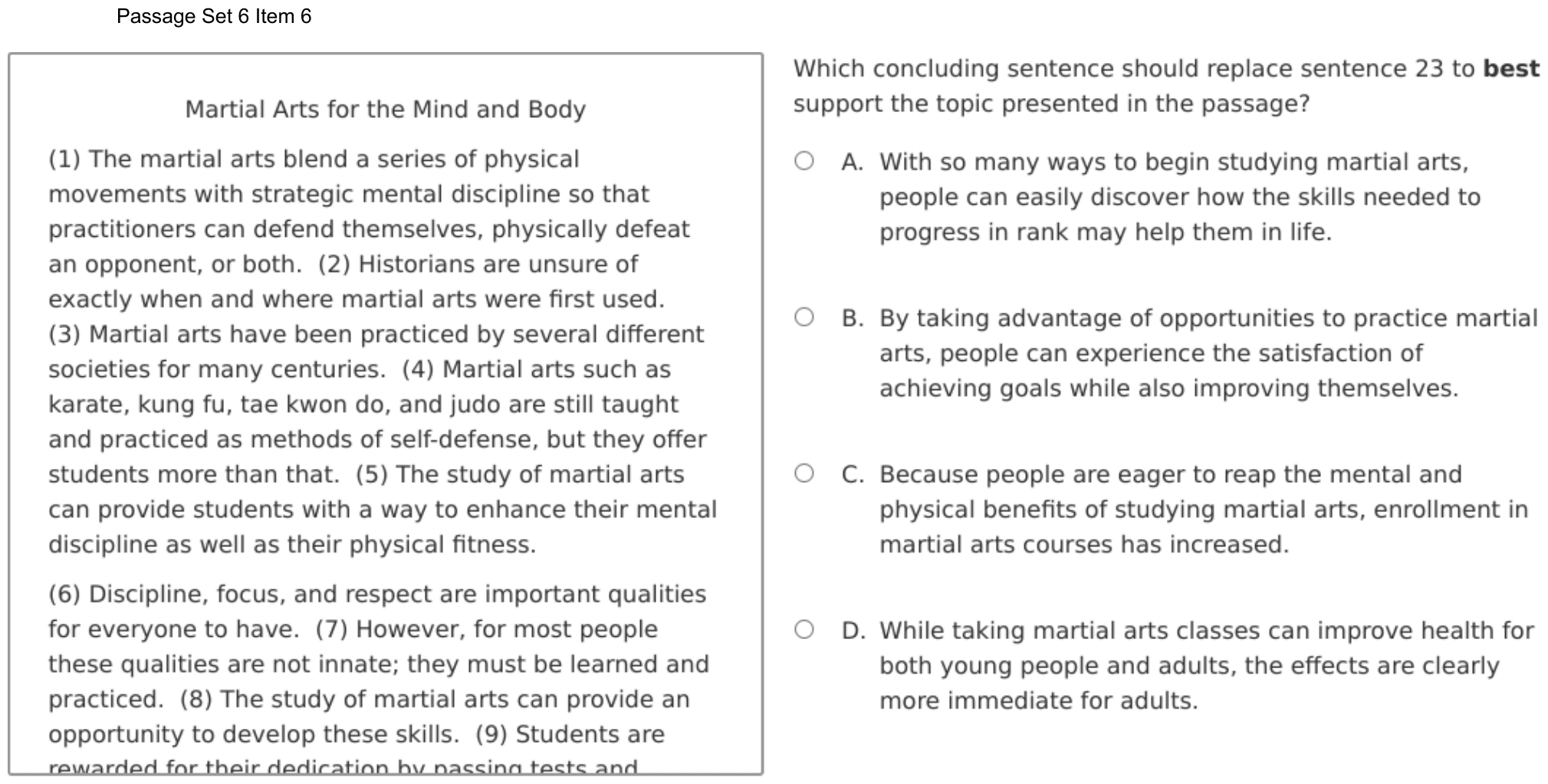
Question 41 of 50
2026 Practice Test D English, question 41Passage Moving through Mountains
Moving through Mountains
(1) An age-old proverb says that necessity is the mother of invention. (2) Centuries of human ingenuity in the face of obstacles prove this to be true. (3) For many years the Swiss Alps, a mountain range spanning southern Switzerland and northern Italy, were such an obstacle. (4) Roads and railways had to navigate around the mountains or through winding tunnels inside the mountains, making the transportation of people and goods difficult and time consuming. (5) In 2016 these burdens were eased with the completion of the Gotthard Base Tunnel.
(6) Construction of the high-speed railway tunnel began in 1996. (7) The tunnel was created through the use of tunnel-boring machines, which are giant drills with a flat rotating head called a cutter head. (8) Each of the tunnel-boring machines used during the construction of the tunnel was about the length of four football fields arranged end-to-end. (9) During the seventeen-year construction period, 28 million tons of rock were removed, enough to rebuild the Great Pyramid of Giza five times. (10) This massive construction project is reported to have cost $12 billion. (11) After that, 4 million cubic meters of concrete, or enough concrete to build eighty-four Empire State Buildings, were used to construct and support the tunnel.
(12) By 2020 the high-speed railway will carry more than 250 freight trains and 55 passenger trains a day, with most traveling at speeds of around 100 to 125 miles per hour. (13) It will be faster for people to travel between northern and southern Europe. (14) The travel time between the European cities of Zurich, Switzerland, and Milan, Italy, will be reduced by an hour. (15) Many European leaders compare the Gotthard Base Tunnel to the Channel Tunnel, a 33-mile underwater tunnel that connects the United Kingdom and France. (16) While there is no roadway in the Channel Tunnel, people can drive their cars onto special trains that will carry vehicles through to the other side.
(17) Just as traffic congestion in major cities led to the construction of underground local transportation, natural formations, such as mountain ranges, have also sent people underground for faster, easier, and cheaper methods of transportation across larger areas. (18) There is renewed interest in constructing innovative methods of transportation that will help eliminate problems associated with traveling to and from certain areas.
Question
Which sentence should be added after sentence 5 to introduce the main topic of the passage?
- AThe construction of the Gotthard Base Tunnel was approved by Swiss voters in 1992 and was funded by tolls, fuel taxes, and government loans.
- BLeaders from several European countries attended the opening ceremonies for the Gotthard Base Tunnel, a Swiss tunnel.
- CThe Gotthard Base Tunnel is the world’s longest and deepest railway tunnel, stretching 35.5 miles straight through the base of the Swiss Alps.
- DThe Gotthard Base Tunnel continues to help reduce the number of freight trucks on the roadways in the Swiss Alps.
Show the answer
Correct answer: C
The Answer is (C)
The question asks which sentence should be added to the end of the first paragraph in order to introduce the topic of the passage, which is the description, construction, and use of the Gotthard Base Tunnel.
Option C correctly presents and describes the Gotthard Base Tunnel.
Option A is incorrect because it offers overly detailed information about the funding used to build the Gotthard Base Tunnel, and it does not provide a description of the tunnel.
Option B is incorrect because it gives details about the opening ceremony of the tunnel, and it does not provide a description of the tunnel.
Option D is incorrect because it offers a result of completing the Gotthard Base Tunnel, rather than offering an introductory statement presenting and describing the tunnel.
Question analysis
This revising question uses a short informational passage about the Gotthard Base Tunnel through the Swiss Alps and asks which sentence best introduces the main topic at the end of the first paragraph. Several choices offer true-sounding facts about the tunnel, so students must tell an introduction apart from a supporting detail.
- NYS standards
- 7W2a introducing and organizing a topic
- Grade level
- Grade 7 reading and task
- Compared with grade 7
- At grade 7 Choosing a sentence that introduces a topic and previews what follows is standard grade 7 writing work. The passage is short and factual, and the wrong choices are related details, much like a classroom revision exercise.
- Estimated difficulty
- Straightforward: two steps or one careful reading.
- Thinking it demands
- Depth of knowledge 2, skills and concepts · mainly evaluate
- What makes it hard
- Evidence in several places moderate
- How sentences fit together minor
- Evidence
- Answered from the whole text
- Reading level
- Passage: about grade 11, 362 words; question and choices: about grade 9, 97 words.
- Students, last 30 days
- Not enough answers yet to show (it takes 10).
Why it is hard, traps and wrong answers (shows the answer)
Why it is hard
Most students find the descriptive sentence once they ask what a reader needs right after the tunnel is first named. Points are lost to sentences that follow on smoothly from the word “completion” or that name a real benefit, but which set up a passage about something else. The right sentence even adds facts the passage never states, so students should judge fit rather than hunt for repeated words.
Evidence in several places moderate Working it out
The topic the new sentence must introduce only emerges across all four paragraphs: what the Gotthard Base Tunnel is, how it was dug, and what it will do for travel. (Kirsch & Mosenthal, 1990; Gorin & Embretson, 2006)
How sentences fit together minor Working it out
The added sentence follows sentence 5, which names the tunnel only as what eased the burdens, so it should present the tunnel itself before paragraph 2 turns to its construction. (Halliday & Hasan, 1976)
Strategy: Skim the first sentence of each paragraph to see what the passage as a whole covers, then pick the sentence that would prepare a reader for all of it.
Traps
- Too narrow: A single detail offered as the central idea or a summary, or a summary that keeps minor details and leaves out an essential part.
- Off the point: Adds or keeps something that does not support the paragraph's or the passage's focus, or an introduction or conclusion that misses the main point.
The wrong answers, classified
A Off the point (Halliday & Hasan, 1976)
Picks voter approval in 1992 and funding by tolls, fuel taxes and loans, background that would set up a passage about financing, which this one never discusses.
B Off the point (Halliday & Hasan, 1976)
Follows naturally from “the completion of the Gotthard Base Tunnel” in sentence 5, but an opening ceremony with European leaders is not what the passage goes on to describe.
D Too narrow (King et al., 2004)
Offers one result, fewer freight trucks on Alpine roads, which echoes the difficult roads of sentence 4 but does not present the tunnel before the passage explains it.
Working it out, step by step
Figure out what the question asks
The new sentence goes at the end of paragraph 1, right after sentence 5. It must introduce the main topic, which is what the whole passage is mostly about. So first you need to know what the whole passage covers.
Skim the passage for its topic
Sentence 5 ends paragraph 1: “In 2016 these burdens were eased with the completion of the Gotthard Base Tunnel.” Paragraph 2 tells how the tunnel was built. Paragraph 3 tells how it will make travel faster. Paragraph 4 tells why people build tunnels like it. So the passage is about the Gotthard Base Tunnel: what it is, how it was built, and what it does.
See what sentence 5 leaves out
Sentence 5 names the tunnel, but it doesn’t say what the tunnel is. A reader doesn’t yet know how long it is or what makes it special. Then paragraph 2 jumps right into building it. So the new sentence should describe the tunnel itself. That gets the reader ready for the rest.
Check each choice
- A is about voters and money from tolls and taxes. The passage never discusses how the tunnel was paid for.
- B is about an opening ceremony. The passage never describes one.
- C says what the tunnel is: “the world’s longest and deepest railway tunnel,” running “straight through the base of the Swiss Alps.”
- D gives one result, fewer trucks on the roads. That is a detail, not an introduction.
Watch out: D links back to the slow roads in sentence 4, so it seems to fit. But it is one benefit, and the passage never mentions trucks.
Pick the answer
Choice C presents the tunnel and tells what makes it special. So the answer is C.
Why this answer and not the closest wrong one
Choice D is the closest wrong answer. It is about the tunnel, and it ties back to the hard travel in sentence 4. But it gives a result before the reader even knows what the tunnel is. C describes the tunnel itself, and that is what an introduction needs.
More questions like this
The original DOE question
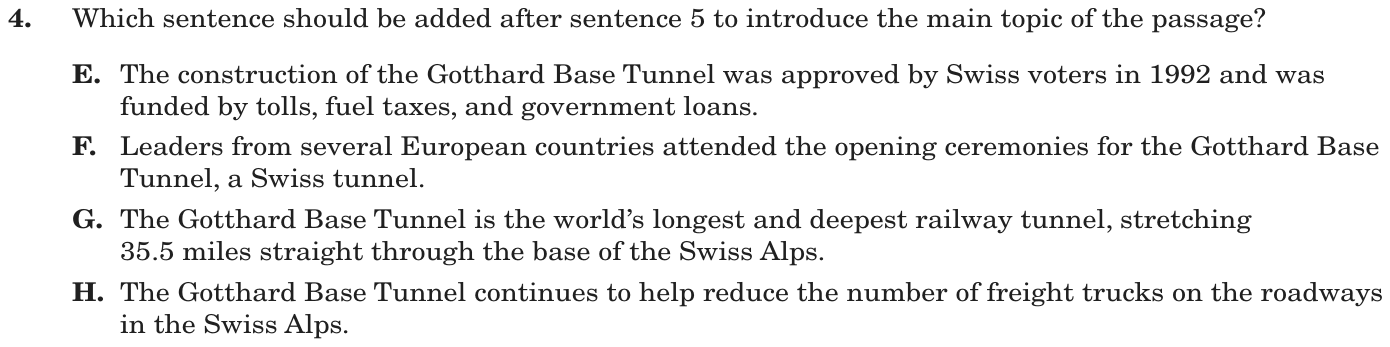
The passage “Moving through Mountains” as printed (page 48)
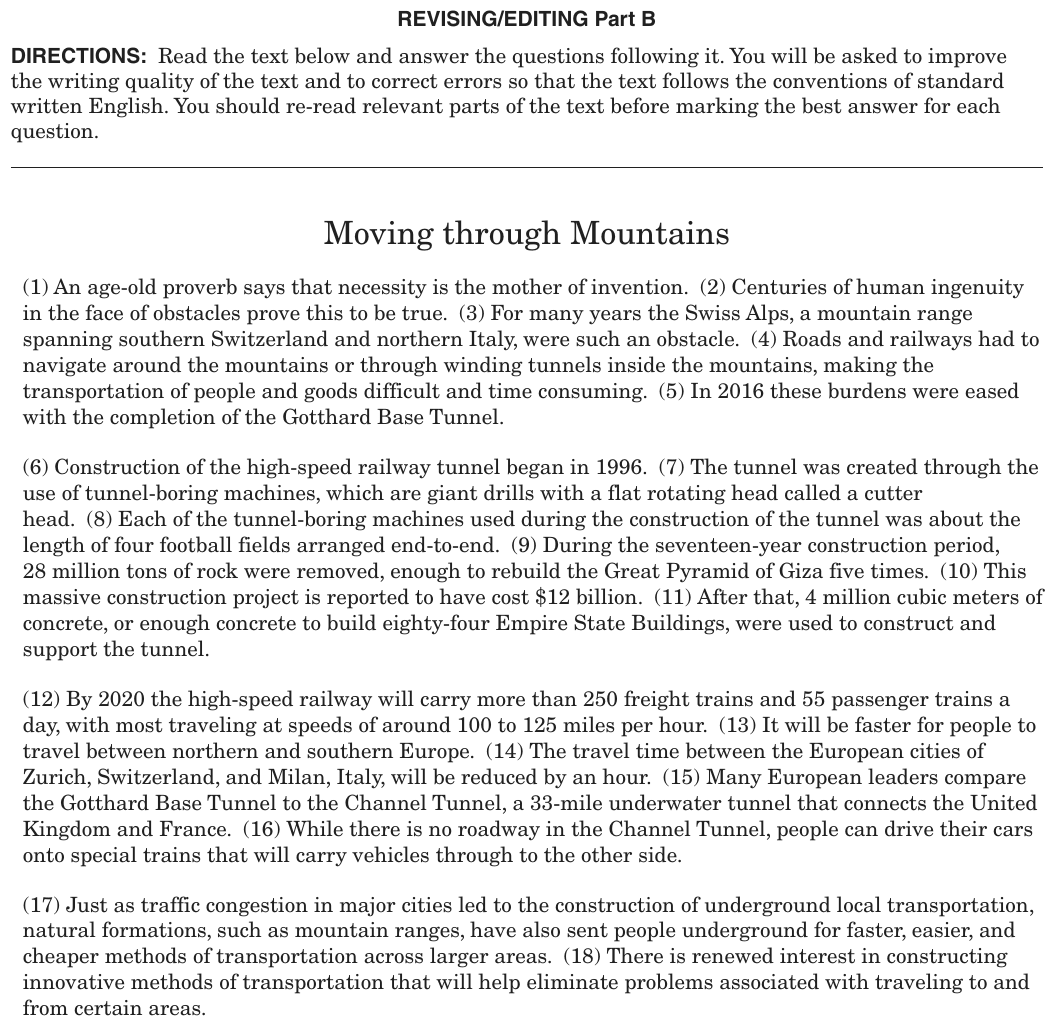
Question 42 of 50
2026 Practice Test D English, question 42Uses the passage above: “Moving through Mountains”.
Question
Which sentence should be added to follow and support sentence 7?
- AThe tunnel-boring machine is helpful to tunnel builders in the modern era and has been an improvement over dynamite.
- BThese enormous tunnel-boring machines function somewhat like a cheese grater, with the cutter head grinding slowly through rock and stone.
- CEngineers had considered making a tunnel under the mountains for many years, but it was impossible to do without modern tunnel-boring machines.
- DDifferent types of cutter heads are used with tunnel-boring machines depending on the geology of the area where the tunnel is being created.
Show the answer
Correct answer: B
This is the answer (B)
The question asks for a sentence that provides additional details about the tunnel-boring machines used to build the Gotthard Base Tunnel in order to support the description of the machines in sentence 7.
Option B is correct because it offers specific details about how tunnel-boring machines, such as the ones used to create the Gotthard Base Tunnel, drill through rock.
Option A is incorrect because it offers information about how tunnel-boring machines were an improvement over previous methods but does not include information about how the machines work.
Option C is incorrect because it presents the idea that the tunnel could not be built until advances were made in tunnel-boring machine technology and does not describe how the machines function.
Option D is incorrect because, though it explains that there are different types of cutter heads used for different geologies, the geology of the tunnel area is not discussed in sentence 7, nor in the rest of the paragraph.
Question analysis
This revising question asks which new sentence should follow and support a description of the tunnel-boring machines used to dig the Gotthard Base Tunnel. Every choice is about the machines, so students must decide which one actually develops the sentence before it rather than drifting to a related topic.
- NYS standards
- 7W2b developing a topic
- Grade level
- Grade 7 reading and task
- Compared with grade 7
- At grade 7 Adding a detail that supports a given sentence is a regular grade 7 writing task. The demand is typical: a short paragraph, plain vocabulary, and wrong choices that stay on the subject of the machines but serve other purposes.
- Estimated difficulty
- Moderate: several steps, or a close reading with one strong distractor.
- Thinking it demands
- Depth of knowledge 2, skills and concepts · mainly evaluate
- What makes it hard
- How sentences fit together moderate
- Evidence
- Answered from one paragraph or stanza
- Reading level
- Passage: about grade 11, 362 words; question and choices: about grade 11, 94 words.
- Students, last 30 days
- Not enough answers yet to show (it takes 10).
Why it is hard, traps and wrong answers (shows the answer)
Why it is hard
All four choices are about tunnel-boring machines, so topic alone settles nothing. The right sentence shows how the machines work and leads into their size in sentence 8, while the strongest wrong one wanders into geology. Some students also distrust the cheese-grater comparison as too casual, though a vivid analogy is exactly the kind of support a definition needs.
How sentences fit together moderate Working it out
The new sentence sits between sentence 7, which defines the machines, and sentence 8, which gives their size, so it has to keep describing the machines that dug this tunnel. (Halliday & Hasan, 1976)
Strategy: Reread sentence 7 and note exactly what it describes, then test each choice by asking whether it tells the reader more about that same thing or starts a new point.
Traps
- Off the point: Adds or keeps something that does not support the paragraph's or the passage's focus, or an introduction or conclusion that misses the main point.
- Wordy, vague or informal: A revision is grammatical but wordy, imprecise or too casual for the passage.
The wrong answers, classified
A Wordy, vague or informal (Connors & Lunsford, 1988)
Accepts a general claim that the machine is “helpful to tunnel builders in the modern era”, which praises it without adding any detail about how it works.
C Off the point (Halliday & Hasan, 1976)
Explains why the tunnel could not be built earlier, turning from what the machines are to the project's history, a topic the paragraph never takes up.
D Off the point (Halliday & Hasan, 1976)
Builds on the term “cutter head” from sentence 7, but varying heads for different geology starts a new subject that the paragraph never returns to.
Working it out, step by step
Figure out what the question asks
You need a sentence to go right after sentence 7. It must support sentence 7. That means it should tell more about the same thing sentence 7 is about.
Read sentence 7 closely
Sentence 7 says: “The tunnel was created through the use of tunnel-boring machines, which are giant drills with a flat rotating head called a cutter head.” So sentence 7 is about the machines and how they dig. Now look ahead. Sentence 8 tells how long each machine was. So the new sentence sits between two sentences about the machines.
Make sense of the key words
To bore means to drill a hole. A tunnel-boring machine is a huge drill that digs a tunnel. The cutter head is the spinning front part that cuts the rock. A good supporting sentence will help you picture how this machine works.
Check each choice
- B compares the machine to a cheese grater, “with the cutter head grinding slowly through rock and stone.” It shows how the machine works.
- A says the machine is “helpful to tunnel builders in the modern era.” That is praise, with no detail about how it works.
- C is about why the tunnel could not be built earlier. That is a new topic.
- D is about different cutter heads for different kinds of rock. The paragraph never talks about kinds of rock.
Watch out: D repeats the words “cutter heads,” so it seems connected. But it starts a subject the paragraph never comes back to.
Pick the answer
Choice B keeps describing the machines from sentence 7 and leads well into sentence 8. So the answer is B.
Why this answer and not the closest wrong one
D is the closest wrong answer, because it uses the term “cutter heads” from sentence 7. But it is about choosing heads for different rock, which the paragraph drops at once. B explains how the cutter head of these machines works, and that is exactly what sentence 7 set up.
More questions like this
The original DOE question
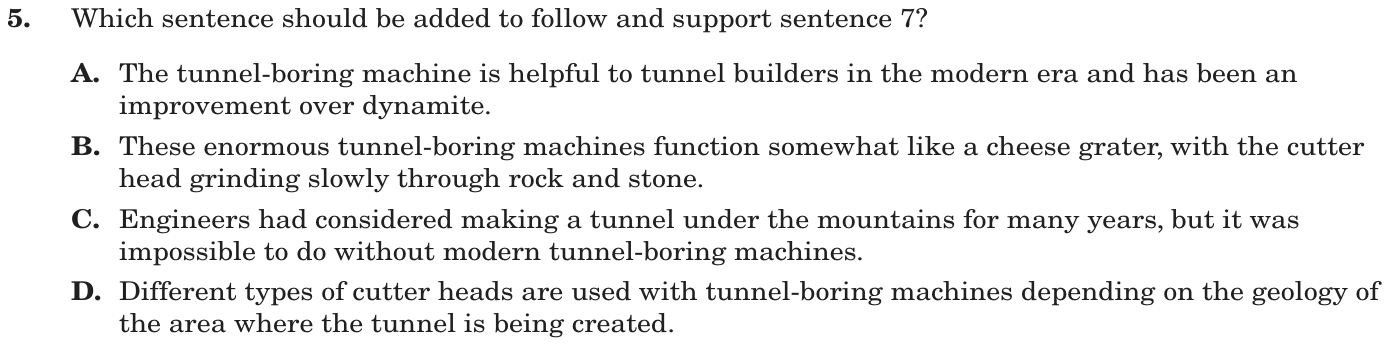
Question 43 of 50
2026 Practice Test D English, question 43Uses the passage above: “Moving through Mountains”.
Question
Where should sentence 11 be moved in order to improve the organization of the second paragraph (sentences 6–11)?
- Ato the beginning of the paragraph (before sentence 6)
- Bbetween sentences 6 and 7
- Cbetween sentences 8 and 9
- Dbetween sentences 9 and 10
Show the answer
Correct answer: D
The Answer is (D)
The question asks where sentence 11, which completes the detailed steps of how the tunnel was built, should be moved within the second paragraph in order to improve the organization of the paragraph.
Option D, placing the sentence between sentences 9 and 10, is correct because placing the sentence there helps the reader understand the full sequence of steps performed in constructing the tunnel before the cost of the project is introduced.
Option A, placing the sentence at the beginning of the paragraph (before sentence 6), is incorrect because it would not make sense since the process of building the tunnel has not yet been introduced.
Similarly, Option B is incorrect because placing the sentence after sentence 6 would not make sense given that adding concrete would have to happen after the rock was broken down and removed from the tunnel.
Option C, placing the sentence between sentences 8 and 9, would also be incorrect because the use of concrete did not take place before the removal of “28 million tons of rock” (sentence 9).
Question analysis
This revising question asks where to move a sentence about the concrete used to support the Gotthard Base Tunnel so the second paragraph is better organized. Students must follow the order of the construction steps and notice what the sentence's opening words refer back to, since several positions sound acceptable at a glance.
- Grade level
- Grade 7 reading and task
- Compared with grade 7
- At grade 7 Ordering sentences logically is a grade 7 writing skill. Here the student follows a sequence of construction steps and a time-order signal word, a short, typical grade 7 revision task with four nearby positions to compare.
- Estimated difficulty
- Moderate: several steps, or a close reading with one strong distractor.
- Thinking it demands
- Depth of knowledge 2, skills and concepts · mainly analyze
- What makes it hard
- How sentences fit together major
- A very close wrong answer moderate
- Much to keep track of minor
- Every choice must be checked minor
- Evidence
- Answered from one paragraph or stanza
- Reading level
- Passage: about grade 11, 362 words; question and choices: about grade 7, 33 words.
- Students, last 30 days
- Not enough answers yet to show (it takes 10).
Why it is hard, traps and wrong answers (shows the answer)
Why it is hard
The question turns on two signal phrases: what “After that” must follow, and what “This massive construction project” sums up. Students who see only that the concrete belongs with the digging often park it beside the machine details, before the rock has been cleared. Those who try each position in context see that lining the tunnel can only follow removing the rock.
How sentences fit together major Working it out
Sentence 11 opens with “After that”, so it must follow the rock removal in sentence 9, while “This massive construction project” in sentence 10 reads best as the paragraph's close. (Halliday & Hasan, 1976)
A very close wrong answer moderate Choosing the answer
Moving the sentence between sentences 8 and 9 differs from the right spot, between 9 and 10, by a single sentence, and only seeing that sentence 9's rock removal must come first tells them apart. (Embretson & Wetzel, 1987; Gorin & Embretson, 2006; Ascalon et al., 2007)
Much to keep track of minor Working it out
The construction steps, from the 1996 start through the machines, the 28 million tons of rock and the concrete, have to be kept in order across six sentences. (Sweller, 1988; Carpenter, Just & Shell, 1990)
Every choice must be checked minor Choosing the answer
Each of the four positions has to be tried by rereading the paragraph with the concrete sentence in place, since several sound acceptable at a glance. (Embretson & Wetzel, 1987)
Strategy: Look at the signal words that open sentence 11 and ask what event they must follow. Then read the paragraph with the sentence in each position to check the order of events.
Traps
- Sentence in the wrong place: Puts a sentence where it breaks the order of ideas or separates it from what it refers to.
The wrong answers, classified
A Sentence in the wrong place (Halliday & Hasan, 1976)
Moves the sentence to open the paragraph, where “After that” would follow the 2016 completion in sentence 5, putting the concrete work after the tunnel was finished.
B Sentence in the wrong place (Halliday & Hasan, 1976)
Reads “After that” as following the 1996 start of construction, which sounds smooth but has the tunnel lined with concrete before any machine had bored it.
C Sentence in the wrong place (Halliday & Hasan, 1976)
Sees that the concrete comes after the machines did their work but places it before sentence 9, so the tunnel is lined before its 28 million tons of rock are removed.
Working it out, step by step
Figure out what the question asks
Sentence 11 is in the wrong spot. You need to move it so paragraph 2 tells events in the right order. Paragraph 2 is sentences 6 to 11.
Look at the clue words in sentence 11
Sentence 11 says: “After that, 4 million cubic meters of concrete, or enough concrete to build eighty-four Empire State Buildings, were used to construct and support the tunnel.” “After that” is a transition, a word or phrase that links ideas. It tells you the concrete came after some other event. You need to find that event.
Put the building steps in order
Think about how you build a tunnel. First you dig out the rock. Then you line the hole with concrete to hold it up.
- Sentence 6: work began in 1996.
- Sentences 7 and 8: the machines that did the digging.
- Sentence 9: “28 million tons of rock were removed.”
- Sentence 10: the project cost $12 billion.
The concrete must come after the rock is removed. So sentence 11 belongs right after sentence 9.
Read the paragraph in the new order
Sentence 9 removes the rock. “After that,” the concrete is poured. Then sentence 10 sums up “This massive construction project” and its cost. The cost makes a good last point. Right now, sentence 11 comes after the cost. So “After that” seems to mean after paying. That makes no sense.
Check each choice
- A, before sentence 6: “After that” would point back to sentence 5, after the tunnel was finished.
- B, after sentence 6: the concrete would come before any digging.
- C, between 8 and 9: the tunnel would be lined before the rock was removed.
- D, between 9 and 10: the concrete comes right after the rock is removed.
Watch out: C is only one spot away from D. Ask yourself: is the rock gone yet? In C, it isn’t.
Pick the answer
So the answer is D, between sentences 9 and 10.
Now the paragraph goes: start, machines, digging, concrete, cost.
Why this answer and not the closest wrong one
Choice C is close because it puts the concrete after the machines. But sentence 9 is where the rock is removed, and you can’t line a tunnel that is still full of rock. Only D puts “After that” right after the rock removal.
More questions like this
The original DOE question

Question 44 of 50
2026 Practice Test D English, question 44Uses the passage above: “Moving through Mountains”.
Question
Which sentence presents information that shifts away from the main topic of the third paragraph (sentences 12–16) and should be removed?
- Asentence 13
- Bsentence 14
- Csentence 15
- Dsentence 16
Show the answer
Correct answer: D
The answer is (D)
The question asks which sentence should be removed because it presents an idea that shifts away from the main idea of the third paragraph, which is about the transportation benefits of the Gotthard Base Tunnel.
Option D (sentence 16) is the correct response because, even though the sentence provides additional information about the Channel Tunnel, it does not help the reader understand the benefits of the Gotthard Base Tunnel, so it should be removed.
Option A (sentence 13) is incorrect because the idea of faster travel times is important to the development of the main idea of the paragraph.
Option B (sentence 14) is incorrect because the sentence provides a specific example of decreased travel time between two cities when traveling through the Gotthard Base Tunnel, supporting the development of ideas in the paragraph.
Option C (sentence 15) is incorrect because the sentence compares the Gotthard Base Tunnel to another tunnel that provides an important connection between places, and the sentence supports the idea that transportation innovations are beneficial.
Question analysis
This revising question looks at the paragraph describing what the Gotthard Base Tunnel will do for travel in Europe and asks which sentence shifts away from that topic and should be removed. Every sentence is related to tunnels and travel, so students must judge which one no longer serves the paragraph's main point.
- NYS standards
- 7W2b developing a topic
- Grade level
- Grade 6 reading and task
- Compared with grade 7
- Below grade 7 Cutting a sentence that strays from a paragraph's focus is practiced from grade 6. The paragraph is five sentences of plain facts with one clear topic, so this asks less than a typical grade 7 revision task.
- Estimated difficulty
- Straightforward: two steps or one careful reading.
- Thinking it demands
- Depth of knowledge 2, skills and concepts · mainly analyze
- What makes it hard
- A very close wrong answer moderate
- How sentences fit together minor
- Evidence
- Answered from one paragraph or stanza
- Reading level
- Passage: about grade 11, 362 words; question and choices: about grade 6, 24 words.
- Students, last 30 days
- Not enough answers yet to show (it takes 10).
Why it is hard, traps and wrong answers (shows the answer)
Why it is hard
The paragraph drifts gradually, which makes this harder than a plain hunt for the odd sentence out. The Channel Tunnel arrives in sentence 15 as a comparison that still concerns the Gotthard tunnel's importance, and only the next sentence leaves the Gotthard tunnel behind entirely. Students who cut at the first mention of the other tunnel lose the point, so it pays to ask which sentence says nothing about the Gotthard tunnel or the travel it speeds up.
A very close wrong answer moderate Choosing the answer
Sentence 15 is the first to mention the Channel Tunnel, so it looks like the shift, but it still compares that tunnel with the Gotthard; sentence 16 is wholly about car trains under the Channel. (Embretson & Wetzel, 1987; Gorin & Embretson, 2006; Ascalon et al., 2007)
How sentences fit together minor Working it out
The paragraph's focus, the faster travel the Gotthard tunnel will bring, has to be held while each of sentences 13 through 16 is tested against it. (Halliday & Hasan, 1976)
Strategy: State the paragraph's topic in a few words, then check each listed sentence against it. The sentence to cut is the one that talks about something other than that topic.
The wrong answers, classified
A Fixes what isn't broken (Connors & Lunsford, 1988)
Cuts sentence 13 as a vague restatement, but “It will be faster for people to travel between northern and southern Europe” is the paragraph's central claim.
B Fixes what isn't broken (Connors & Lunsford, 1988)
Treats the Zurich-to-Milan example as a side detail, though the hour saved between those cities is concrete proof of the faster travel the paragraph promises.
C Fixes what isn't broken (Connors & Lunsford, 1988)
Rightly senses the Channel Tunnel is a detour but cuts the comparison that still concerns the Gotthard tunnel, leaving in sentence 16, which is only about car-carrying trains.
Working it out, step by step
Figure out what the question asks
Every sentence in a paragraph should support its main topic. One sentence in paragraph 3 drifts to a different topic. You need to find it so it can be cut.
Find the paragraph’s main topic
Paragraph 3 is sentences 12 to 16. Sentence 12 says the railway will carry many trains at high speeds. Sentence 13 says: “It will be faster for people to travel between northern and southern Europe.” So the topic is how the Gotthard Base Tunnel will make travel faster.
Test each sentence against the topic
- Sentence 13 states the topic: faster travel.
- Sentence 14 gives an example. The trip between Zurich and Milan will be an hour shorter.
- Sentence 15 compares the Gotthard Base Tunnel to the Channel Tunnel. It still talks about the Gotthard tunnel.
- Sentence 16 says “people can drive their cars onto special trains” in the Channel Tunnel. It says nothing about the Gotthard tunnel.
Watch for the trap
Watch out: Sentence 15 is the first to name the Channel Tunnel. So it can look like the place where the paragraph shifts. But it compares that tunnel with the Gotthard tunnel. That keeps it tied to the topic. Sentence 16 leaves the Gotthard tunnel behind completely.
Pick the answer
Sentence 16 is only about car trains in the Channel Tunnel. So the answer is D, sentence 16.
Why this answer and not the closest wrong one
Choice C, sentence 15, is the closest wrong answer, since it brings in the Channel Tunnel. But it still talks about the Gotthard Base Tunnel by comparing the two. Sentence 16 talks only about the Channel Tunnel, so it is the one that shifts away.
More questions like this
The original DOE question

Question 45 of 50
2026 Practice Test D English, question 45Uses the passage above: “Moving through Mountains”.
Question
Which transition phrase should be added to the beginning of sentence 18?
- AAlthough the Gotthard Base Tunnel is mainly for freight trains
- BWith the Gotthard Base Tunnel taking ten years to complete
- CBecause of the successful completion of the Gotthard Base Tunnel
- DAs the number of trains using the Gotthard Base Tunnel increases
Show the answer
Correct answer: C
The answer is (C)
The question asks for a transition that bridges the ideas between sentences 17 and 18 and accurately presents the relationship.
Option C is correct because it bridges the sentences by referring to the Gotthard Base Tunnel as a solution to the problems described in sentence 17 and logically introducing sentence 18.
Option A is incorrect because the use of the word “although” and the mention of freight trains suggest that sentence 18 will be about other types of vehicles that use the Gotthard Base Tunnel, and the transition phrase does not logically precede the sentence.
Option B is incorrect because the reference to the amount of time it took to build the tunnel does not help lead into the idea presented in sentence 18.
Option D is incorrect because it suggests that sentence 18 is related to the increasing number of trains using the Gotthard Base Tunnel, which is not accurate.
Question analysis
This revising question asks which introductory phrase should begin the last sentence of a passage about the Gotthard Base Tunnel, linking it to the idea before it. All four phrases are grammatical and mention the tunnel, so students must work out the logical relationship between the two sentences and check each phrase against the facts given earlier.
- NYS standards
- 7W2d transitions in informative writing
- Grade level
- Grade 7 reading and task
- Compared with grade 7
- At grade 7 Choosing a transition that shows how two ideas relate is a core grade 7 writing skill. The two sentences involved are short and the vocabulary is plain, so this is typical classroom revision work.
- Estimated difficulty
- Straightforward: two steps or one careful reading.
- Thinking it demands
- Depth of knowledge 2, skills and concepts · mainly evaluate
- What makes it hard
- How sentences fit together moderate
- Every choice must be checked minor
- Evidence
- Answered from one paragraph or stanza
- Reading level
- Passage: about grade 11, 362 words; question and choices: about grade 6, 52 words.
- Students, last 30 days
- Not enough answers yet to show (it takes 10).
Why it is hard, traps and wrong answers (shows the answer)
Why it is hard
The task is to see that renewed interest is a result, which calls for an opener that names a cause. Phrases that are merely true of the tunnel, or that tie interest to growing traffic, read smoothly and slip past students who do not test the logic. One opener also gives the construction time as ten years, which careful readers can reject against the seventeen-year period in sentence 9.
How sentences fit together moderate Working it out
Sentence 17 widens the view from this tunnel to tunnels in general, and sentence 18 reports renewed interest, so the opener has to name what caused that interest. (Halliday & Hasan, 1976)
Every choice must be checked minor Choosing the answer
All four openers are grammatical and name the Gotthard Base Tunnel, so each has to be read into sentence 18 and checked against facts given earlier in the passage. (Embretson & Wetzel, 1987)
Strategy: Read sentences 17 and 18 together and decide how they are connected: by contrast, by time, or by cause. Then choose the opening that expresses that link and fits facts already stated.
Traps
- Wrong transition: A connecting word or phrase that signals the wrong relationship, such as contrast where the idea continues.
The wrong answers, classified
A Wrong transition (Halliday & Hasan, 1976)
Likes the accurate freight detail from sentence 12, but “Although” promises a contrast, and nothing in sentence 18 runs against the tunnel being mainly for freight.
B Wrong transition (Halliday & Hasan, 1976)
Accepts a time detail that explains nothing about renewed interest and gets the time wrong, since sentence 9 gives a seventeen-year construction period.
D Wrong transition (Halliday & Hasan, 1976)
Senses that sentence 18 needs a cause but names growing train traffic, a plausible link the passage never makes, when the interest follows from the tunnel's completion.
Working it out, step by step
Figure out what the question asks
A transition is a word or phrase that links two ideas. Some show contrast, like although. Some show time, like then. Some show cause, like because. You need the opening for sentence 18 that shows how it links to sentence 17.
Read sentences 17 and 18 together
Sentence 17 says mountain ranges “have also sent people underground for faster, easier, and cheaper methods of transportation across larger areas.” Sentence 18 says: “There is renewed interest in constructing innovative methods of transportation.” Renewed interest means people care about something again. Innovative means new and creative.
Decide how the ideas connect
Why would people care about new kinds of travel again? Because the whole passage just showed a tunnel that worked. It solved the mountain problem. So sentence 18 is a result. The opening should name the cause.
Check each choice
- C, “Because of the successful completion of the Gotthard Base Tunnel,” names the cause. The tunnel’s success led to new interest.
- A starts with “Although,” which signals a contrast. Nothing in sentence 18 goes against the tunnel being for freight.
- B gives the building time, which doesn’t explain new interest. It is also wrong. Sentence 9 says the work took seventeen years, not ten.
- D names more trains as the cause. The passage never makes that link.
Watch out: D also sounds like a cause, so it is the most tempting wrong choice.
Pick the answer
The new sentence reads: Because of the successful completion of the Gotthard Base Tunnel, there is renewed interest in… So the answer is C.
Why this answer and not the closest wrong one
D is the closest wrong answer, because it also gives a cause. But the passage never says the number of trains made people interested. The tunnel’s success is what the whole passage builds up to, so C links the ideas best.
More questions like this
The original DOE question
Question 46 of 50
2026 Practice Test D English, question 46Uses the passage above: “Moving through Mountains”.
Question
Which concluding sentence should be added after sentence 18 to support the topic presented in the passage?
- AThere is proof that underground tunnels such as the Gotthard Base Tunnel are beneficial to the economy of the surrounding area.
- BThe Gotthard Base Tunnel is an extraordinary example of how human ingenuity and persistence can overcome great obstacles.
- CThe completion of the Gotthard Base Tunnel shows that people can work together to achieve important goals.
- DThe Swiss government is confident that the economic impact of the Gotthard Base Tunnel will be worth its construction cost.
Show the answer
Correct answer: B
The answer is (B)
The question asks for a concluding sentence that supports key ideas about the topic developed earlier in the passage.
Option B is correct because it supports the points made in the introductory paragraph by affirming the idea that the Gotthard Base Tunnel is an example of a way people have improved life by overcoming obstacles.
Option A is incorrect because the economies of surrounding areas were never mentioned in the passage.
Option C is incorrect because, although the construction of the Gotthard Base Tunnel appears to have required many people to work together, the passage does not explicitly mention people or groups working together.
Option D is incorrect because it focuses on the cost of the Gotthard Base Tunnel, which is referred to only in sentence 10 of the passage.
Question analysis
This revising question asks which concluding sentence should end the passage about building the Gotthard Base Tunnel. Students must recognize the passage's overall point and choose a conclusion that sums it up, avoiding sentences that sound reasonable but add claims the passage never supports.
- NYS standards
- 7W2e concluding informative writing
- Grade level
- Grade 7 reading and task
- Compared with grade 7
- At grade 7 Picking a concluding sentence that reflects a passage's central idea is standard grade 7 writing work. Students must keep the whole short passage in mind and reject conclusions that bring in claims it never makes.
- Estimated difficulty
- Moderate: several steps, or a close reading with one strong distractor.
- Thinking it demands
- Depth of knowledge 2, skills and concepts · mainly evaluate
- What makes it hard
- Evidence in several places moderate
- A very close wrong answer moderate
- Evidence
- Answered from the whole text
- Reading level
- Passage: about grade 11, 362 words; question and choices: about grade 12, 92 words.
- Students, last 30 days
- Not enough answers yet to show (it takes 10).
Why it is hard, traps and wrong answers (shows the answer)
Why it is hard
The conclusion has to return to the idea the passage opened with, which sits at the far end of the text from where the new sentence goes. Students who have forgotten the proverb about necessity tend to choose by tone, and three choices sound like fitting final lessons or benefits. What the question rewards is matching the conclusion to the opening's own words, ingenuity and obstacles.
Evidence in several places moderate Working it out
The passage's point is set out in sentences 1 to 3, the proverb about necessity and “human ingenuity in the face of obstacles”, about fifteen sentences before the spot where the conclusion goes. (Kirsch & Mosenthal, 1990; Gorin & Embretson, 2006)
A very close wrong answer moderate Choosing the answer
The right conclusion and the teamwork one share a frame, the tunnel as proof of what people can do, and differ only in the lesson: ingenuity against obstacles, from sentences 1 to 3, or teamwork, which the passage never mentions. (Embretson & Wetzel, 1987; Gorin & Embretson, 2006; Ascalon et al., 2007)
Strategy: Say in one sentence what the whole passage is about, then choose the conclusion that restates that idea without adding claims the passage never makes.
Traps
- Off the point: Adds or keeps something that does not support the paragraph's or the passage's focus, or an introduction or conclusion that misses the main point.
- Too narrow: A single detail offered as the central idea or a summary, or a summary that keeps minor details and leaves out an essential part.
The wrong answers, classified
A Off the point (Halliday & Hasan, 1976)
Ends on a claim of “proof” that tunnels help local economies, a benefit that sounds right for a conclusion but that the passage never discusses.
C Off the point (Halliday & Hasan, 1976)
Sees that the ending should state a broad human lesson but picks teamwork, which the passage never raises, instead of the ingenuity against obstacles it opened with.
D Too narrow (King et al., 2004)
Seizes on the $12 billion cost, mentioned once in sentence 10, and adds a government opinion the passage never reports, narrowing the ending to one detail.
Working it out, step by step
Figure out what the question asks
You need a last sentence for the passage. A good conclusion sums up the main idea. It often goes back to the point made at the start. It should not add new claims that the passage never made.
Find the main idea at the start
Sentence 1 says: “An age-old proverb says that necessity is the mother of invention.” Sentence 2 says: “Centuries of human ingenuity in the face of obstacles prove this to be true.” Sentence 3 says the Swiss Alps “were such an obstacle.”
Put the main idea in plain words
A proverb is an old saying. Necessity is the mother of invention means that when people really need something, they find a clever way to get it. Ingenuity means cleverness. An obstacle is something in the way. So the passage says people use cleverness to get past what blocks them. The tunnel is the example.
Check each choice
- B says the tunnel shows “how human ingenuity and persistence can overcome great obstacles.” This repeats the opening idea. Persistence means not giving up.
- A is about the economy, meaning money and jobs, of nearby areas. The passage never discusses that.
- C is about people working together. The passage never mentions teamwork.
- D is about the cost and the government’s opinion. The cost comes up only once, in sentence 10.
Watch out: C sounds like a fine life lesson for an ending. But a conclusion must match this passage, and teamwork is not its point.
Pick the answer
Choice B restates the passage’s main idea without adding anything new. It ties the ending back to the beginning. So the answer is B.
Why this answer and not the closest wrong one
C is the closest wrong answer, because it also uses the tunnel to teach a lesson. But teamwork never comes up in the passage. B uses the passage’s own words, “human ingenuity” against “obstacles,” so it closes the passage the way it opened.
More questions like this
The original DOE question
Question 47 of 50
2026 Practice Test D English, question 47Question
Read this paragraph.
(1) Walking dogs, cleaning kennels, hand-feeding newborn kittens, and supporting the pet-adoption process, the animal shelter is looking for volunteers to help with a variety of tasks. (2) Working at the animal shelter is a great way for young people, especially those who aspire to care for and protect animals, to gain valuable work experience. (3) In addition to hands-on training with animal care, volunteers will learn important job skills, such as punctuality, responsibility, and personal initiative. (4) Caring for animals can also help volunteers develop empathy, which is the awareness and understanding of the feelings of others.
Which sentence contains an error in its construction and should be revised?
- Asentence 1
- Bsentence 2
- Csentence 3
- Dsentence 4
Show the answer
Correct answer: A
The answer is (A)
The question asks for the identification of the sentence in the paragraph that has an error in its construction and should be revised.
Option A (sentence 1) is the correct response because sentence 1 contains a structural error. The sentence begins with a list of modifying phrases: “Walking dogs, cleaning kennels, hand-feeding newborn kittens, and supporting the pet-adoption process.” As written, this list modifies the closest noun phrase, “the animal shelter,” which is illogical because the list describes tasks at the animal shelter, not the shelter itself. The list should follow the word “tasks” at the end of the sentence, so that it is closer to the word that it modifies.
Option B, Option C, and Option D are incorrect responses because sentence 2, sentence 3, and sentence 4 do not contain structural errors.
For Option B, the phrase “especially those who aspire to care for and protect animals” in sentence 2 correctly modifies “young people.”
For Option C, the structure of sentence 3 allows the words “In addition to hands-on training with animal care” to correctly modify “volunteers will learn.”
For Option D, the phrase “which is the awareness and understanding of the feelings of others” in sentence 4 correctly modifies the word “empathy.”
Question analysis
This editing question gives a paragraph inviting young people to volunteer at an animal shelter and asks which sentence is built incorrectly and should be revised. The error is in sentence structure, not spelling or punctuation, and every sentence contains long descriptive phrases, so students must check what each phrase actually describes.
- NYS standards
- 7L1 grammar and usage conventions
- Grade level
- Grade 7 reading and task
- Compared with grade 7
- At grade 7 Spotting a misplaced or dangling modifier is the grade 7 grammar skill tested here. The faulty sentence reads smoothly and the correct sentences also hold long modifying phrases, so it matches a careful grade 7 editing task.
- Estimated difficulty
- Moderate: several steps, or a close reading with one strong distractor.
- Thinking it demands
- Depth of knowledge 2, skills and concepts · mainly analyze
- What makes it hard
- A rule that doesn't sound wrong major
- Every choice must be checked moderate
- Complex sentences minor
- Evidence
- Answered from one paragraph or stanza
- Reading level
- Question and choices: about grade 10, 113 words.
- Students, last 30 days
- Not enough answers yet to show (it takes 10).
Why it is hard, traps and wrong answers (shows the answer)
Why it is hard
The faulty sentence is the first one and the smoothest-sounding, because the mind supplies the missing volunteers who walk the dogs. Students who judge by ear pass over it and then flag a correct sentence that merely sounds busy. The question rewards asking, for every opening phrase, which noun it actually attaches to.
A rule that doesn't sound wrong major Working it out
Sentence 1's opening list, “Walking dogs, cleaning kennels, hand-feeding newborn kittens”, grammatically describes “the animal shelter”, an error that sounds natural because readers know volunteers will do those tasks. (Connors & Lunsford, 1988)
Every choice must be checked moderate Choosing the answer
The stem names no kind of error, so all four sentences must be checked, and sentences 2, 3 and 4 each contain a long phrase that could look misplaced. (Embretson & Wetzel, 1987)
Complex sentences minor Understanding the question
Every sentence carries a lengthy modifier, from the interrupting “especially those who aspire to care for and protect animals” to the closing definition of empathy, so the faulty one does not stand out. (Abedi & Lord, 2001; Freedle & Kostin, 1993; Messick, 1989)
Strategy: In each sentence, find every descriptive phrase and ask which noun sits next to it. Any phrase placed beside a noun it cannot logically describe marks the sentence to revise.
The wrong answers, classified
B Fixes what isn't broken (Connors & Lunsford, 1988)
Flags the interruption “especially those who aspire to care for and protect animals” as an error, though it correctly describes “young people” and the sentence is complete.
C Fixes what isn't broken (Connors & Lunsford, 1988)
Suspects the opening phrase “In addition to hands-on training with animal care” dangles like sentence 1's, but it leads straight into “volunteers”, who receive the training.
D Fixes what isn't broken (Connors & Lunsford, 1988)
Picks the “which is the awareness and understanding of the feelings of others” clause as misplaced, though it sits right after “empathy”, the word it defines.
Working it out, step by step
Figure out what the question asks
This asks which sentence is built wrong. The words may be fine, but the parts are in the wrong order or don’t fit together. The question doesn’t say what kind of error to look for. So you need to check all four sentences.
Learn the rule about describing phrases
A modifier is a word or phrase that describes something. It must sit right next to the thing it describes. If it sits next to the wrong word, the sentence says something silly. Example: Barking loudly, the mail carrier ran from the dog. This says the mail carrier was barking! Fix: The mail carrier ran from the dog, which was barking loudly.
Test sentence 1
Sentence 1 begins with a list: “Walking dogs, cleaning kennels, hand-feeding newborn kittens, and supporting the pet-adoption process.” Right after the comma comes “the animal shelter.” So the sentence says the shelter is walking dogs and feeding kittens. A shelter is a place. It can’t do those things. The list really describes the “tasks” at the end of the sentence. One fix moves the list after that word: …volunteers to help with a variety of tasks, such as walking dogs, cleaning kennels…
Test sentences 2, 3, and 4
- Sentence 2: “especially those who aspire to care for and protect animals” comes right after “young people.” It describes them, so it is in the right place. (To aspire means to hope or aim.)
- Sentence 3: “In addition to hands-on training with animal care” leads straight into “volunteers.” The volunteers get the training, so it fits.
- Sentence 4: “which is the awareness and understanding of the feelings of others” comes right after “empathy.” It explains that word, so it fits.
Watch out: Sentence 3 also starts with a phrase and a comma, so choice C can look like sentence 1. Ask who gets the training. The volunteers do.
Pick the answer
Only sentence 1 puts a describing phrase next to the wrong noun. So the answer is A, sentence 1.
Why this answer and not the closest wrong one
Sentence 3 is the closest trap, because it also opens with a phrase and a comma. But the word after its comma is “volunteers,” and the volunteers really do get the training. In sentence 1, the words after the comma are “the animal shelter,” and a shelter can’t walk dogs.
More questions like this
The original DOE question
Question 48 of 50
2026 Practice Test D English, question 48Question
Read this sentence.
In the Whispering Gallery of Grand Central Terminal, people whispering a message in one corner can be clearly heard in the opposite corner, regardless of surrounding noise, because the tiled archways send the sound through the environment.
Which revision to the words send the sound through the environment uses the most precise language?
Drag the correct phrase into the box.
In the Whispering Gallery of Grand Central Terminal, people whispering a message in one corner can be clearly heard in the opposite corner, regardless of surrounding noise, because the tiled archways ____.
On the test you drag one of the tiles into the box; here, choose it.
- Aguide the sound waves in a specific direction
- Bfocus the sound waves to travel through the space
- Cdirect the sound waves to move along the curves of the arches
- Dtransfer the sound waves to a variety of different locations
Show the answer
Correct answer: C
The question asks for the revision to the words send the sound through the environment that uses the most precise language.
Incorrect. The phrase “guide the sound waves in a specific direction” is not the most precise revision. “A specific direction” does not explain precisely where the sound waves travel.
Incorrect. The phrase “focus the sound waves to travel through the space” is not the most precise revision, because it does not precisely describe where the waves move. The phrase “through the space” does not provide the reader with more specific information as to where in the space the sound waves travel.
CORRECT. The phrase “direct the sound waves to move along the curves of the arches” uses precise language to explain how the waves travel. The wording “direct the sound waves” is more specific than “send the sound” as in the original sentence, and the action “move along the curves” conveys more detail than the phrase “through the environment.”
Incorrect. The phrase “transfer the sound waves to a variety of different locations” is not the most precise revision, because it does not precisely convey where the waves move to. The phrase “variety of different locations” is vague and does not add clarity.
Question analysis
This precise-language question gives a sentence about the Whispering Gallery in Grand Central Terminal, where a whisper in one corner is heard in the opposite corner, and asks which revision of “send the sound through the environment” is most precise. On the test students drag one of four phrase tiles into the box, and every tile sounds more technical than the original.
- NYS standards
- 7L3a precise and concise language
- Grade level
- Grade 6 reading and task
- Compared with grade 7
- Below grade 7 Replacing vague wording with exact wording is taught by grade 6. Here it is one sentence about a familiar place and four phrase tiles, a single judgment, which is lighter than typical grade 7 revision of a whole paragraph.
- Estimated difficulty
- Straightforward: two steps or one careful reading.
- Thinking it demands
- Depth of knowledge 1, recall and reproduction · mainly evaluate
- What makes it hard
- A very close wrong answer moderate
- Every choice must be checked minor
- Evidence
- Answered from one sentence or line
- Reading level
- Question and choices: about grade 8, 133 words.
- Corrected from the DOE handbook
- A misquotation of the sentence in the explanation was corrected.
- Students, last 30 days
- Not enough answers yet to show (it takes 10).
Why it is hard, traps and wrong answers (shows the answer)
Why it is hard
All four tiles upgrade “send the sound” to “the sound waves” with a sharper verb, so the original’s vagueness survives only in the endings. The tile that promises “a specific direction” sounds precise because of that word, yet it never names the direction; the key is the only tile that says where the sound travels. Dragging a tile into the box adds nothing to the task beyond picking one choice.
A very close wrong answer moderate Choosing the answer
The “specific direction” tile is built like the key, a precise verb and “the sound waves”; the two differ only in the ending, a direction never named versus “along the curves of the arches.” (Embretson & Wetzel, 1987; Gorin & Embretson, 2006; Ascalon et al., 2007)
Every choice must be checked minor Choosing the answer
Every tile sounds more exact than the original, so students must ask of each one whether a reader could tell how the sound gets from one corner to the opposite one. (Embretson & Wetzel, 1987)
Strategy: Reread the whole sentence, then ask of each tile whether a reader could picture exactly how the sound gets from one corner of the gallery to the other.
Traps
- Wordy, vague or informal: A revision is grammatical but wordy, imprecise or too casual for the passage.
- Changes the meaning: A revision is correct English but no longer says what the writer meant.
The wrong answers, classified
A Wordy, vague or informal (Connors & Lunsford, 1988)
Trusts the word “specific,” which sounds exact, but “a specific direction” never says which direction, so the phrase stays as vague as the original.
B Wordy, vague or informal (Connors & Lunsford, 1988)
Is drawn by the technical “focus the sound waves,” but “through the space” just restates “through the environment” and says nothing about the archways.
D Changes the meaning (Connors & Lunsford, 1988)
Picks the scientific-sounding “transfer,” but sending sound to “a variety of different locations” contradicts a whisper heard in the one opposite corner, and the phrase repeats itself.
What was corrected from the DOE handbook, and why
- Explanation: The DOE’s explanation of the correct phrase says that “move along the curves” conveys more detail than “the phrase ‘moving through the environment.’” The sentence in the question says the archways “send the sound through the environment”; the word “moving” is not in it. The site now quotes the sentence’s own words: “the phrase ‘through the environment.’”
Working it out, step by step
Figure out what the question asks
This asks which phrase is most precise. Precise language is exact. It tells the reader just what happens, so they can picture it. The phrase you pick replaces the underlined words.
See what the sentence needs
The sentence says a whisper in one corner “can be clearly heard in the opposite corner.” Why? “because the tiled archways send the sound through the environment.” That ending is vague, or unclear. “Through the environment” could mean anywhere. A better phrase would say how the sound gets from one corner to the other.
Name the rule
Precise writing swaps general words for exact ones. For example, The dog went over there is vague. The dog ran under the porch is precise. Now you know just where the dog went.
Check each choice
- A is wrong. “A specific direction” sounds exact. But it never says which direction.
- B is wrong. “Through the space” is just another way to say “through the environment.”
- C is right. “Along the curves of the arches” tells exactly where the sound travels. It follows the curved arches to the far corner.
- D is wrong. “A variety of different locations” is vague. It also clashes with a whisper heard in one corner. And “variety” and “different” say the same thing twice.
Watch out: The word “specific” makes A sound precise. Ask whether you can picture the path. With A, you can’t.
Choose the answer
With the tile in place, the sentence ends because the tiled archways direct the sound waves to move along the curves of the arches. So the answer is C. On the test, you drag the tile “direct the sound waves to move along the curves of the arches” into the box.
Why this answer and not the closest wrong one
A is the closest wrong answer. It has a strong verb, “guide,” and the word “specific.” But it never names the direction, so the reader still can’t picture the path. C says exactly where the sound goes: along the curves of the arches. That explains how a whisper reaches the opposite corner.
More questions like this
The original DOE question
Question 49 of 50
2026 Practice Test D English, question 49Question
Read this sentence.
Robert Cornelius is credited with taking the first, official selfie as a daguerreotype, an image recorded on a copper plate coated in silver, using a process that was more complicated than photos of today which are digitized or printed from film and do not require subjects to sit for nearly fifteen minutes to avoid blurring the image.
Which two edits should be made to correct the sentence?
Select the two correct answers.
Choose every answer that is correct, then check. The DOE has not published how answers with several parts are scored; this site counts one right only when every part is right.
- ADelete the comma after first.
- BDelete the comma after daguerreotype.
- CDelete the comma after silver.
- DAdd a comma after today.
- EAdd a comma after film.
Show the answer
Correct answer: A and D
The question asks which two edits should be made to correct the sentence.
A. CORRECT. The comma after “first” must be deleted to correct the sentence. The adjectives “first” and “official” are not coordinate adjectives that independently modify the noun “selfie.” Cornelius did not take the “first selfie” and also the “official selfie.” Rather, he took the first selfie that was considered official. Placing a comma between the words “first” and “official” incorrectly separates two adjectives that work together to describe the selfie.
B. Incorrect. The comma after “daguerreotype” must not be deleted, because it is used correctly to introduce an explanation. The phrase “an image recorded on a copper plate coated in silver” is an appositive—a noun phrase that defines “daguerreotype.”
C. Incorrect. The comma after “silver” is placed correctly, marking the end of the phrase “an image recorded on a copper plate coated in silver” that defines “daguerreotype.” Because the sentence continues to explain the process Robert Cornelius used, the comma after “silver” is needed to end the appositive and separate it from the phrase that follows.
D. CORRECT. A comma is needed after “today” because the following phrase, “which are digitized or printed from film,” is a nonrestrictive clause that gives nonessential information about the “photos of today” preceding it.
E. Incorrect. No comma is needed after “film,” because the words “and do not require subjects to sit” are part of the same relative clause that begins with “which are digitized…”. The conjunction “and” joins two predicates within the same clause. Both actions belong to the same clause and the same subject (which); they are not separate independent clauses that need to be punctuated with a comma.
Question analysis
This punctuation question gives one long sentence about Robert Cornelius, credited with one of the earliest selfies, and the daguerreotype, an image made on a silver-coated copper plate, and asks which two of five comma edits correct it. Five words are underlined, and each needs its own decision about a comma, with credit only when both chosen edits are right.
- NYS standards
- 7L2 capitalization, punctuation, and spelling
- Grade level
- Grade 8 reading and task
- Compared with grade 7
- Above grade 7 The comma rules tested appear in the grade 6 and 7 standards, but the sentence runs 57 words, two of the rules are subtle ones, and both selections must be right, which makes this harder than typical grade 7 editing.
- Estimated difficulty
- Hard: combines ideas, needs a plan, and has more than one tempting wrong answer.
- Thinking it demands
- Depth of knowledge 2, skills and concepts · mainly apply
- What makes it hard
- A rule that doesn't sound wrong major
- Much to keep track of moderate
- Complex sentences moderate
- Evidence
- Answered from one sentence or line
- Reading level
- Question and choices: about grade 7, 100 words.
- Corrected from the DOE handbook
- A grammar term in the explanation was corrected.
- Students, last 30 days
- Not enough answers yet to show (it takes 10).
Why it is hard, traps and wrong answers (shows the answer)
Why it is hard
The sentence is long, two of its five decisions turn on subtle comma rules, and the site counts the answer right only when both edits are right. The comma before “and do not require” is the strongest trap, because a comma before “and” is a habit many students apply without checking whether a new clause begins. The paired commas around “an image recorded on a copper plate coated in silver” are already correct, and deleting either one breaks the pair.
A rule that doesn't sound wrong major Working it out
Both needed edits rest on rules students rarely hear: “first, official” are not coordinate adjectives, so no comma, and “which are digitized” adds nonessential detail about photos of today, so it needs one. (Connors & Lunsford, 1988)
Much to keep track of moderate Working it out
There are five comma decisions in one sentence and both selections must be right to score, so each edit is judged on its own while the rest of the sentence is held in mind. (Sweller, 1988; Carpenter, Just & Shell, 1990)
Complex sentences moderate Understanding the question
The sentence runs 57 words and stacks an appositive, a participial phrase beginning “using a process,” and a relative clause with two verbs, so finding where each phrase starts and ends is itself the task. (Abedi & Lord, 2001; Freedle & Kostin, 1993; Messick, 1989)
Strategy: Take the five underlined words one at a time: name what the phrase after each one does in the sentence, decide whether a comma belongs there, and choose only the two edits you are sure of.
Traps
- Punctuation: A comma, semicolon, colon, dash or apostrophe used where it does not belong, or missing where it does.
The wrong answers, classified
B Punctuation (Connors & Lunsford, 1988)
Deletes the comma that opens the appositive “an image recorded on a copper plate coated in silver,” which defines daguerreotype and must be set off from it.
C Punctuation (Connors & Lunsford, 1988)
Deletes the comma that closes the same appositive, perhaps feeling the sentence has too many commas, though a phrase set off mid-sentence needs a comma on each side.
E Punctuation (Connors & Lunsford, 1988)
Applies the habit of a comma before “and,” though here “and” joins two verbs that share one subject, “which,” inside one clause, not two complete clauses.
A Punctuation (Connors & Lunsford, 1988)
Left out by students who think a comma always separates two adjectives, though “first” describes “official selfie” as a unit, so the adjectives are not coordinate.
D Punctuation (Connors & Lunsford, 1988)
Left out by students who read “photos of today which are digitized” as one essential phrase, missing that the which-clause adds nonessential detail and needs a comma.
What was corrected from the DOE handbook, and why
- Explanation: The DOE’s explanation of Option C says the comma after “silver” “is needed to separate the clauses.” Neither side of that comma is a clause. Before it is the appositive “an image recorded on a copper plate coated in silver,” as the explanations of Options B and C say; after it is the phrase “using a process that was more complicated…,” a participial phrase with no subject of its own. The comma ends the appositive. The site now says the comma “is needed to end the appositive and separate it from the phrase that follows.”
Working it out, step by step
Figure out what the question asks
This asks which two comma edits fix the sentence. Five words are underlined. Decide about each comma one at a time. You must pick both right edits.
Check the comma after first
A comma goes between two describing words only if each one describes the noun on its own. Test it: can you put “and” between them? A long and hard test works, so you write a long, hard test. But the first and official selfie sounds wrong. “First” describes “official selfie” as a unit. So delete the comma after first. That is A.
Check the commas around silver
“An image recorded on a copper plate coated in silver” tells what a daguerreotype is. A phrase that renames the noun just before it is called an appositive. An appositive in the middle of a sentence needs a comma on each side. Example: My dog, a small beagle, loves walks. So keep the commas after daguerreotype and silver. B and C are wrong.
Check the comma after today
A clause is a group of words with its own verb. “Which are digitized or printed from film” is a clause that adds extra facts about photos of today. A “which” clause that adds extra facts gets a comma before it. Example: I read that book, which is very long. So add a comma after today. That is D.
Check the comma after film
The words “and do not require subjects to sit” are part of the same “which” clause. “Which” is the subject of both verbs, “are digitized or printed” and “do not require.” When “and” joins two verbs that share one subject, no comma goes before it. Example: She sings and dances. So E is wrong.
Watch out: Many students put a comma before every “and.” That leads to E. A comma goes before “and” when it joins two full sentences, not two verbs.
Choose the answers
Delete the comma after first, and add a comma after today. So the answers are A and D. Be sure to select both of them.
Why this answer and not the closest wrong one
E is the closest wrong answer, because a comma before “and” is a common habit. But after film, “and” joins two verbs that share one subject, “which.” No new sentence starts there, so no comma belongs. A and D fix the two real errors.
More questions like this
The original DOE question
Question 50 of 50
2026 Practice Test D English, question 50Question
What is the best way to combine the sentences?
(1) Scientists now believe that Jupiter may have as many as seventy-nine moons.
(2) One of Jupiter’s moons is named Io.
(3) Io has the greatest number of active volcanoes in the solar system.
- AIo, which is one of Jupiter’s moons, has the greatest number of active volcanoes in the solar system, and scientists now believe that Jupiter may have as many as seventy-nine moons.
- BScientists now believe that Jupiter may have as many as seventy-nine moons, and one of them is named Io, which has the greatest number of active volcanoes in the solar system.
- CScientists now believe that Jupiter may have as many as seventy-nine moons, including one named Io, which has the greatest number of active volcanoes in the solar system.
- DIo, a moon with the greatest number of active volcanoes in the solar system, is one of Jupiter’s moons, and scientists now believe that Jupiter may have as many as seventy-nine moons.
Show the answer
Correct answer: C
The question asks for the best way to combine the sentences.
A. Incorrect. Although the sentence incorporates the ideas presented in the three original sentences, it is incorrect because the combination suggests an incorrect relationship between the ideas. By beginning with “Io,” the sentence places emphasis on the moon and the detail about the number of active volcanoes rather than the key idea that “scientists now believe that Jupiter may have as many as seventy-nine moons.” Since Io is an example of one of Jupiter’s moons, the details about Io should follow and be subordinate to the main clause, which provides new information about the number of Jupiter’s moons in general.
B. Incorrect. Although the sentence incorporates all three ideas from the original sentences and correctly places the detail about the number of active volcanoes on Io in a dependent clause, this option is incorrect because it presents an imprecise relationship between the ideas. By using the conjunction (connecting word) “and,” the sentence construction suggests that scientists “now believe” that “Jupiter may have as many as seventy-nine moons” and that “one of them is named Io,” instead of presenting Io as an example of one of Jupiter’s moons.
C. CORRECT. This sentence is the best way to combine the original sentences because it uses a complex sentence to present ideas clearly and precisely, and it shows the relationship between the ideas in the original sentences. The sentence starts by stating the number of moons scientists now believe Jupiter may have and then specifies that one of those moons is named Io. The dependent clause “which has the greatest number of active volcanoes in the solar system” immediately follows the word “Io” to provide additional information about the moon. A dependent clause contains a subject (“which,” referring to Io) and a verb (“has”) but is not a complete sentence on its own.
D. Incorrect. The sentence incorporates the key ideas from the original sentences, but its structure does not accurately present the relationship between these ideas. The beginning of the sentence includes the detail about Io having “the greatest number of active volcanoes in the solar system” before specifying that Io is one of the seventy-nine moons of Jupiter. The presentation of the details about Io at the beginning lessens the emphasis of the key idea that “scientists now believe that Jupiter may have as many as seventy-nine moons.”
Question analysis
This sentence-combining question gives three short sentences: scientists believe Jupiter may have as many as seventy-nine moons, one moon is named Io, and Io has the most active volcanoes in the solar system. Students must choose the single sentence that joins all three facts while showing how they relate, and the four versions differ only in order and connecting structure.
- Grade level
- Grade 7 reading and task
- Compared with grade 7
- At grade 7 Combining sentences so the ideas relate clearly is grade 7 language work. The three sentences are short, but every version keeps all the facts, so the choice rests on which idea leads and which is tucked into a clause, a typical grade 7 demand.
- Estimated difficulty
- Moderate: several steps, or a close reading with one strong distractor.
- Thinking it demands
- Depth of knowledge 2, skills and concepts · mainly evaluate
- What makes it hard
- A very close wrong answer moderate
- How sentences fit together moderate
- Every choice must be checked minor
- Evidence
- Answered from one sentence or line
- Reading level
- Question and choices: about grade 10, 162 words.
- Students, last 30 days
- Not enough answers yet to show (it takes 10).
Why it is hard, traps and wrong answers (shows the answer)
Why it is hard
Because every version keeps all three facts and is grammatical, the question is about emphasis and connection, which students rarely check for. Two versions open with Io and its volcanoes and leave the seventy-nine moons trailing after “and,” and one of them also calls Io a moon twice. The strongest pull is the version with the right order that still joins Io with “and,” so Io’s name reads as a second piece of news rather than an example of the moons just counted.
A very close wrong answer moderate Choosing the answer
The “and one of them is named Io” version matches the key in its order and in its which-clause about volcanoes; only its connector differs from the key’s “including one named Io.” (Embretson & Wetzel, 1987; Gorin & Embretson, 2006; Ascalon et al., 2007)
How sentences fit together moderate Working it out
Students must see that sentence 1 is the main news and that sentences 2 and 3 narrow to one example, so Io belongs inside the sentence about Jupiter’s seventy-nine moons. (Halliday & Hasan, 1976)
Every choice must be checked minor Choosing the answer
Every version is grammatical and keeps all three facts, so none can be ruled out by an error; each is judged on which idea leads and how the others attach. (Embretson & Wetzel, 1987)
Strategy: Decide which of the three sentences states the main idea and which ones add detail, then check whether each version’s order and structure show that relationship.
Traps
- Wrong transition: A connecting word or phrase that signals the wrong relationship, such as contrast where the idea continues.
- Changes the meaning: A revision is correct English but no longer says what the writer meant.
The wrong answers, classified
A Changes the meaning (Connors & Lunsford, 1988)
Opens with Io and its volcanoes and adds the moon count with “and,” so the main news about Jupiter trails behind its own example as an afterthought.
B Wrong transition (Halliday & Hasan, 1976)
Keeps the right order and the which-clause, but “and one of them is named Io” adds Io as a second piece of news instead of an example of those moons.
D Changes the meaning (Connors & Lunsford, 1988)
Leads with Io’s volcanoes, then says Io “is one of Jupiter’s moons” right after calling it “a moon,” and leaves the main news about Jupiter for the end.
Working it out, step by step
Figure out what the question asks
This asks for the best way to join three sentences into one. All four choices keep every fact. So the best one shows how the facts relate. Decide which fact is the main idea and which ones add detail.
Find the main idea
Sentence 1 is the big news: “Scientists now believe that Jupiter may have as many as seventy-nine moons.” Sentences 2 and 3 zoom in on one of those moons, Io. Io is an example of the moons, and its volcanoes are a detail about Io. So the main idea should come first, and Io should fit inside it.
Name the rule
Put the main idea in the main part of the sentence. Tuck the details in with words like including and which. For example: My school has thirty clubs. One is chess. The chess club meets on Fridays. Joined: My school has thirty clubs, including a chess club, which meets on Fridays.
Check each choice
- A is wrong. It starts with Io and its volcanoes. The main news about Jupiter trails at the end after “and.”
- B is wrong. The order is right. But “and one of them is named Io” adds Io as a second piece of news, not as an example.
- C is right. “Including one named Io” shows Io is one of the moons. Then “which” adds the fact about its volcanoes.
- D is wrong. It calls Io “a moon,” then says again that it “is one of Jupiter’s moons.” The main news comes last.
Watch out: B is very close to C. The only change is “and one of them is named Io” in place of “including one named Io.” The word “including” shows that Io belongs to the group.
Choose the answer
C leads with the main news and tucks in Io as an example. So the answer is C, “Scientists now believe that Jupiter may have as many as seventy-nine moons, including one named Io, which has the greatest number of active volcanoes in the solar system.”
Why this answer and not the closest wrong one
B is the closest wrong answer. It has the right order and the same “which” clause. But “and” tacks Io’s name on as a separate fact, as if it were more news. “Including” shows that Io is one of the seventy-nine moons. That ties the three facts together most clearly.
More questions like this
The original DOE question