2025 Practice Test B English
Question 1 of 57
2025 Practice Test B English, question 1Passage Excerpt from “It’s Time to Stop Thinking That All Non-Native Species Are Evil”
Excerpt from “It’s Time to Stop Thinking That All Non-Native Species Are Evil”
by Emma Marris
The author of this opinion article attended a symposium, or conference, in Missoula, Montana, at which biologists and other scientists discussed species of plants and animals that are not native to the areas in which they live.
Invasive species are scary. It was ecologist Charles Elton, back in the 1950s, who introduced the militaristic “invasion” metaphor to describe exotic plants and animals—but there’s no question some can be extremely destructive.
The brown tree snake has eaten a dozen kinds of forest birds in Guam to extinction; zebra mussels clog pipes around the Great Lakes; the common house cat turns out to be, in Australia, a mercilessly effective killer of cute, fluffy marsupials like the bilby and the numbat.
As scientists have sounded the alarm about these pests, the public has gotten the message. Citizen groups rip out non-native plants. Native gardens have become increasingly popular, both as ways to celebrate the unique flora of each region and as tiny hot spots of diversity. Native trees provide food for native bugs, which feed native birds. Food chains developed over thousands of years of co-evolution unfold in our backyards. . . .
So we’ve learned, scientists and laypeople alike, that native species are good and non-natives are bad.
Julian Olden, a biologist at the University of Washington, Seattle, who co-organized the symposium, recently polled nearly 2,000 ecologists. Among his findings: a substantial number of them said they would immediately eradicate a hypothetical non-native forest plant, even if it were shown to have no effect on the forest. Olden calls this the “guilty even when proven innocent” approach.
That kind of approach is not very useful on a rapidly changing planet.
Exotics Are Everywhere
Climate change is making it harder even to decide who the invaders are.
How, scientists at the symposium wondered, do you define “native” on a warming planet, when plants and animals are already moving toward the poles or up mountainsides in search of climate conditions they can tolerate? Should we consider them “invasive” in their new homes? Regardless of what we label them, conservationists will be reluctant to remove them from their new environs—to do so would stymie1 their chances of adapting to the warmer future we’re creating.
And then there are the non-natives that we actually like. Most domestic crops are exotic in most of the places they’re grown, but there are even wild exotics that “do good,” forming useful relationships with native species.
Edwin Grosholz of the University of California, Davis, told the recent symposium about one such relationship. On beaches in his state, non-native spartina grass has become important habitat for the endangered California clapper rail, a plump shorebird with a downward curving bill more at home on land than in the air. A project to rip out and poison the spartina—which grows in dense swaths that exclude many other shorebirds—saw clapper rail numbers go tumbling downward.
There are other examples like that. The endangered southwestern willow flycatcher nests in “invasive” tamarisk shrubs. Many native (and beautiful) Hawaiian flowers are now pollinated by the Japanese white-eye bird—because the native pollinators have been driven extinct by other non-native species.
Should we impose further risk on already endangered natives by severing these relationships? Or should we admire the resilience of nature and let such “well-behaved” exotics stay? . . .
Leave them alone, more and more conservationists are arguing, and stop focusing obsessively on categorizing species as native or non-native. Mark Davis, an ecologist at Macalester College in St. Paul, Minnesota, once considered himself an “invasion biologist”—but not anymore. “I am actively trying to get the field to retire the invader narrative,” he said in Missoula.
A Good Thing, Not the Only Thing
After all, nativeness is just one environmental value, and arguably not as important as preventing extinctions and preserving biodiversity. In some cases we can best serve biodiversity by leaving the non-natives alone or even—brace yourself, now—introducing them on purpose.
This is the thinking behind, for example, installing the Aldabra tortoise on the islands of Mauritius. The islands lost their own large tortoises, and the fruiting plants that formerly had their seeds moved around by these fruit-loving reptiles have been on the decline. A tortoise that’s related to the island’s large tortoises—a non-native from the Seychelles in the Indian Ocean that was intentionally introduced in 2004—is now handling some of that work.
Most of the time, for the time being, conserving species still means focusing on supporting them in their historical habitats, planting natives and removing non-natives. We can and should do that in places where it is feasible and important to us.
From “It’s Time to Stop Thinking That All Non-Native Species Are Evil” by Emma Marris from NATIONAL GEOGRAPHIC MAGAZINE, July 24, 2014. Copyright © 2014 by National Geographic Society.
1stymie: hinder or interfere with
Question
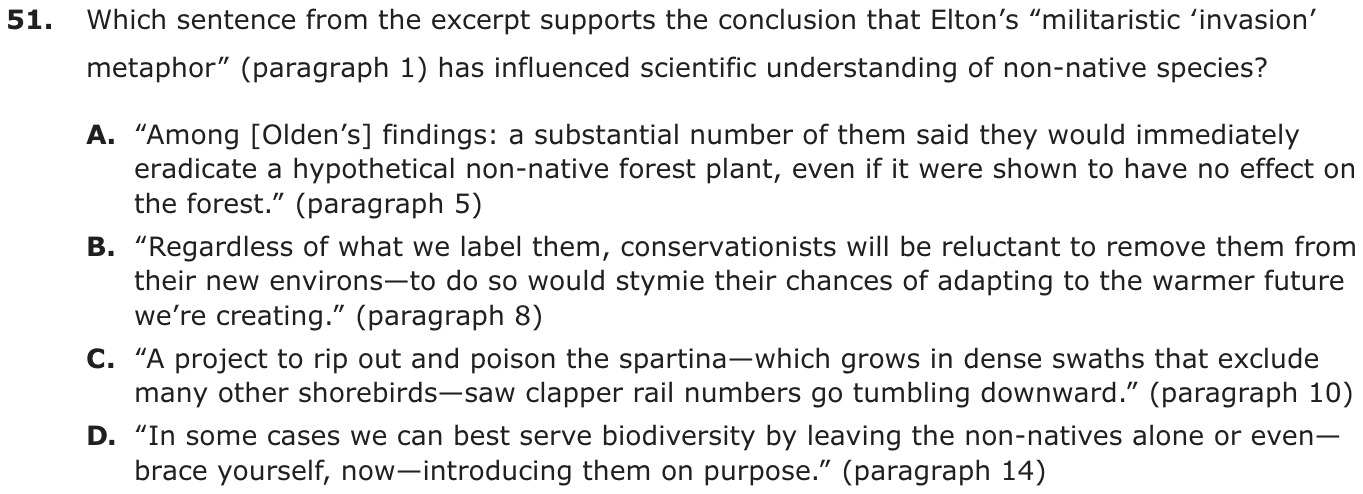
Which sentence from the excerpt supports the conclusion that Elton’s “militaristic ‘invasion’ metaphor” (paragraph 1) has influenced scientific understanding of non-native species?
- A“Among [Olden’s] findings: a substantial number of them said they would immediately eradicate a hypothetical non-native forest plant, even if it were shown to have no effect on the forest.” (paragraph 5)
- B“Regardless of what we label them, conservationists will be reluctant to remove them from their new environs—to do so would stymie their chances of adapting to the warmer future we’re creating.” (paragraph 8)
- C“A project to rip out and poison the spartina—which grows in dense swaths that exclude many other shorebirds—saw clapper rail numbers go tumbling downward.” (paragraph 10)
- D“In some cases we can best serve biodiversity by leaving the non-natives alone or even—brace yourself, now—introducing them on purpose.” (paragraph 14)
Show the answer
Correct answer: A
The question asks which sentence from the excerpt supports the conclusion that Elton’s “militaristic ‘invasion’ metaphor” (paragraph 1) has influenced scientific understanding of non-native species.
A. CORRECT. This sentence shows that of the 2,000 ecologists Olden polled, many said they think it is right to “immediately eradicate” non-native plants even if they are demonstrably harmless in their new environment. The response of these ecologists supports that Elton’s metaphor discussed in paragraph 1 has influenced scientific understanding.
B. Incorrect. Rather than supporting the idea that the militaristic metaphor has influenced scientists, this sentence shows that conservationists, at any rate, are happy to let non-native species thrive wherever they can, given global warming.
C. Incorrect. While this sentence does refer to efforts to eradicate a non-native species, the main point of it is that these efforts ended up harming a native species (the clapper rail shorebird).
D. Incorrect. In contrast to supporting the idea that the militaristic invasion metaphor has influenced scientific understanding of non-native species, this sentence puts forth the bold idea of treating non-native species as something to be welcomed.
Question analysis
This evidence question asks which sentence from an opinion article about non-native species supports the conclusion that ecologist Charles Elton's war-like “invasion” metaphor has shaped how scientists think. Students must work out what attitude the metaphor implies and then judge which quotation shows that attitude at work in science.
- Grade level
- Grade 8 reading and task
- Compared with grade 7
- At grade 7 Finding evidence for a stated conclusion is grade 7 work. This conclusion is abstract, about a metaphor's influence on thinking, and the vocabulary, such as eradicate and environs, adds load, but the choices are fairly distinct.
- Estimated difficulty
- Moderate: several steps, or a close reading with one strong distractor.
- Thinking it demands
- Depth of knowledge 2, skills and concepts · mainly evaluate
- What makes it hard
- Reading between the lines moderate
- Hard words minor
- Evidence
- Answered from several paragraphs or stanzas
- Reading level
- Passage: about grade 11, 815 words; question and choices: about grade 16, 135 words.
- Corrected from the DOE handbook
- A wording slip in the explanation was corrected.
- Students, last 30 days
- Not enough answers yet to show (it takes 10).
Why it is hard, traps and wrong answers (shows the answer)
Why it is hard
The conclusion is abstract, that a figure of speech shaped how scientists think, so the student has to translate it into behavior: treating every non-native as an enemy to destroy. The spartina sentence describes exactly that kind of attack, which makes it tempting, but its point is the harm the attack did to a native bird. Two other sentences show conservationists and the author moving away from the invasion view, the opposite of what is asked.
Reading between the lines moderate Working it out
The right sentence never mentions Elton or war; eradicating a plant even when it is “shown to have no effect” must be recognized as the invasion mindset, which Olden calls “guilty even when proven innocent”. (Graesser, Singer & Trabasso, 1994; Kintsch, 1998)
Hard words minor Understanding the question
“Militaristic”, “eradicate”, “environs” and “stymie” all appear in the stem or the choices, and only “stymie” is footnoted. (Perfetti, 2007; Freedle & Kostin, 1993)
Strategy: Work out what attitude the invasion metaphor encourages toward non-native species, then test each sentence for evidence that scientists hold that attitude.
Traps
- Supports only part of the claim: In a question about evidence: a line that backs one half of the claim but not the other, or a related point rather than the claim itself.
The wrong answers, classified
B Supports only part of the claim (King et al., 2004; Thissen, Steinberg & Fitzpatrick, 1989)
Picks a sentence about labels and conservationists, but it says they would hesitate to remove species moving with the climate, the opposite of the war-like attitude in question.
C Supports only part of the claim (King et al., 2004; Thissen, Steinberg & Fitzpatrick, 1989)
Spots a war-like campaign, ripping out and poisoning spartina, but the sentence's point is that removal hurt the clapper rail, and it says nothing about how scientists think.
D Supports only part of the claim (King et al., 2004; Thissen, Steinberg & Fitzpatrick, 1989)
Chooses the author's case for leaving non-natives alone or even introducing them, which shows thinking turning against the invasion metaphor, not shaped by it.
What was corrected from the DOE handbook, and why
- Explanation: The handbook reads “many said they think it is right to “immediately eradicate” non-native species plants.” Paragraph 5 is about “a hypothetical non-native forest plant,” so the explanation now reads “non-native plants.”
Working it out, step by step
Unpack the conclusion
A metaphor describes one thing as if it were another. In paragraph 1, Elton called the spread of non-native species an “invasion,” as if they were an enemy army. Militaristic means having to do with war. So the conclusion says this war-like way of talking has shaped how scientists think about non-native species.
Picture that way of thinking
If you see a species as an invader, you treat it as an enemy. You want to get rid of it, whether or not it does any harm. So look for a sentence that shows scientists thinking this way.
Find the scientists’ answers
Paragraph 5 describes a poll of nearly 2,000 ecologists, scientists who study living things and where they live. Many said they would “immediately eradicate,” or wipe out, a non-native plant. They would do it “even if it were shown to have no effect on the forest.” The plant would do no harm, yet they would destroy it. Olden calls this “guilty even when proven innocent.”
Check each choice
- A fits: scientists would destroy a harmless plant just because it is non-native, which is the invasion way of thinking.
- B is wrong because conservationists being reluctant, or unwilling, to remove species is the opposite attitude.
- C is wrong because its point is that removing the grass hurt a native bird, not what scientists believe.
- D is wrong because the author argues for leaving non-natives alone, which goes against the invasion idea.
Watch out: C describes an attack on a plant, so it sounds war-like. But it tells what happened, not how scientists think.
Choose the answer
Only A shows scientists treating a non-native species as an enemy, even when it is harmless. So the answer is A.
Why this answer and not the closest wrong one
C comes closest, because ripping out and poisoning a plant looks like the war the metaphor describes. But the sentence reports that this harmed the clapper rail. It doesn’t show what scientists believe. A shows many ecologists ready to destroy even a harmless plant, which is the invasion way of thinking at work.
More questions like this
The original DOE question
The passage “Excerpt from “It’s Time to Stop Thinking That All Non-Native Species Are Evil”” as printed (pages 68–70)
Question 2 of 57
2025 Practice Test B English, question 2Uses the passage above: “Excerpt from “It’s Time to Stop Thinking That All Non-Native Species Are Evil””.
Question
Which detail provides the most relevant support for the claim that “climate change is making it harder even to decide who the invaders are” (paragraph 7)?
- Athe mention in paragraph 8 of non-native species that are forced to seek new habitats
- Bthe acknowledgment in paragraph 9 that non-native species include many domestic crops
- Cthe description in paragraph 11 of the interactions between native and non-native species
- Dthe account in paragraph 13 of an ecologist who changed his beliefs about non-native species
Show the answer
Correct answer: A
The question asks which detail provides the most relevant support for the claim that “climate change is making it harder even to decide who the invaders are” (paragraph 7).
A. CORRECT. The fact that many plants and animals have no choice but to seek out “climate conditions they can tolerate” (paragraph 8) makes it much harder to decide whether to call these species invaders.
B. Incorrect. The fact that many domestic crops are non-native species has nothing to do with climate change affecting our discernment of which species are invaders.
C. Incorrect. The description in paragraph 11 of native and non-native species interacting never suggests that climate change is a factor in these interactions and never suggests that climate change muddies our understanding of which species is native and which is non-native.
D. Incorrect. While the example of Mark Davis so thoroughly changing his beliefs about non-native species is a powerful one, the role that climate change might have played in this reversal is never discussed.
Question analysis
Here students choose the detail that gives the most relevant support to the claim that climate change is making it harder even to decide which species are invaders, in an article rethinking non-native species. Each choice names a paragraph, and the article gives several different reasons to question the label, so every detail must be checked against the whole claim.
- Grade level
- Grade 7 reading and task
- Compared with grade 7
- Below grade 7 Judging which detail supports a claim is grade 7 argument work, but here the choices name their paragraphs, the claim is short and specific, and only one key idea must be matched, so the task is lighter than typical.
- Estimated difficulty
- Straightforward: two steps or one careful reading.
- Thinking it demands
- Depth of knowledge 2, skills and concepts · mainly evaluate
- What makes it hard
- Evidence
- Answered from one paragraph or stanza
- Reading level
- Passage: about grade 11, 815 words; question and choices: about grade 11, 76 words.
- Students, last 30 days
- Not enough answers yet to show (it takes 10).
Why it is hard, traps and wrong answers (shows the answer)
Why it is hard
The claim has two parts, climate change as the cause and blurred labels as the effect, and every wrong detail muddies the word “invader” without any help from the climate. Crops, helpful partnerships and a converted invasion biologist all complicate the label, so a student who checks only the effect finds four plausible answers. Only paragraph 8 talks about a warming planet.
Every choice must be checked minor Choosing the answer
The choices describe paragraphs instead of quoting them, so each of paragraphs 8, 9, 11 and 13 must be reread for a link to climate. (Embretson & Wetzel, 1987)
The right answer is reworded minor Choosing the answer
The right choice says “forced to seek new habitats” where paragraph 8 says species are moving “toward the poles or up mountainsides in search of climate conditions they can tolerate”. (Freedle & Kostin, 1993; Kirsch & Mosenthal, 1990)
Strategy: Name the cause and the effect in the claim, then test each detail for both; a detail that fits only one part is not the most relevant support.
Traps
- Supports only part of the claim: In a question about evidence: a line that backs one half of the claim but not the other, or a related point rather than the claim itself.
The wrong answers, classified
B Supports only part of the claim (King et al., 2004; Thissen, Steinberg & Fitzpatrick, 1989)
Points to crops as non-natives people like, which complicates the label “invader”, but paragraph 9 never connects them to a changing climate.
C Supports only part of the claim (King et al., 2004; Thissen, Steinberg & Fitzpatrick, 1989)
Picks the helpful pairings of native and non-native species in paragraph 11, which blur good and bad but have nothing to do with a warming planet.
D Supports only part of the claim (King et al., 2004; Thissen, Steinberg & Fitzpatrick, 1989)
Chooses Mark Davis's turn away from invasion biology, a striking change of mind that nothing in paragraph 13 ties to climate change.
Working it out, step by step
Split the claim into two parts
This asks for the detail that best supports a claim. The claim has a cause and an effect. The cause is climate change. The effect is that it is harder to tell which species are invaders. The best support must connect both parts.
Find where climate comes up
Paragraph 8 comes right after the claim, and it talks about “a warming planet.” Plants and animals “are already moving toward the poles or up mountainsides in search of climate conditions they can tolerate.” To tolerate means to be able to live with. As places get hotter, many species move to cooler ones.
See why the labels get harder
When a species moves to a new place, it is not native there. But it didn’t really invade. Heat pushed it out of its old home. So scientists ask whether such species should be called invasive “in their new homes.” Climate change blurs the line between native and invader.
Check each choice
- A fits: species forced to move by the climate link the cause to the effect.
- B is wrong because crops are non-natives people like, but paragraph 9 never mentions climate.
- C is wrong because the helpful pairings in paragraph 11 have nothing to do with climate change.
- D is wrong because nothing ties Mark Davis’s change of mind to a warming planet.
Watch out: B, C and D all make the word invader less clear. But only A shows climate change doing it.
Choose the answer
Only A shows climate change making the word invader hard to apply. So the answer is A.
Why this answer and not the closest wrong one
B comes closest, since crops are non-natives we welcome, and that does complicate the word invader. But paragraph 9 says nothing about climate. A has both parts of the claim: a warming planet, and species that end up in new homes where the old labels don’t fit.
More questions like this
The original DOE question
Question 3 of 57
2025 Practice Test B English, question 3Uses the passage above: “Excerpt from “It’s Time to Stop Thinking That All Non-Native Species Are Evil””.
Question
Which two phrases from paragraph 3 most affect the tone of the excerpt?
Move the two correct answers to the box.
Phrases That Most Affect the Tone of the Excerpt
On the test you drag tiles into the box; here, choose them below. The DOE has not published how answers with several parts are scored; this site counts one right only when every part is right.
- A“sounded the alarm”
- B“gotten the message”
- C“rip out”
- D“become increasingly popular”
- E“provide food”
Show the answer
Correct answer: A and C
The question asks for the two phrases from paragraph 3 that most affect the tone of the excerpt.
A. “sounded the alarm”: CORRECT. This phrase affects the tone of the excerpt by conveying the stark sense of urgency surrounding the debate over the ecological impact of non-native species. The reference to an alarm sounding evokes the feeling of being on high alert.
B. “gotten the message”: Incorrect. This phrase does not most affect the tone of the excerpt.
C. “rip out”: CORRECT. This phrase affects the tone of the excerpt by vividly depicting the effect of widespread misunderstanding of non-native species.
D. “become increasingly popular”: Incorrect. This phrase does not most affect the tone of the excerpt.
E. “provide food”: Incorrect. This phrase does not most affect the tone of the excerpt.
Question analysis
This select-two tone question on Emma Marris’s opinion article about non-native species lists five short phrases from paragraph 3 and asks which two most affect the tone of the excerpt. On the test students move two tiles into a box, and both must be right. All five are common, everyday expressions, so students must weigh how strongly each one colors the excerpt.
- Grade level
- Grade 7 reading and task
- Compared with grade 7
- At grade 7 Typical grade 7 tone questions quote the words and ask what effect they have. Here students pick the two phrases themselves from five in one short paragraph and compare how much feeling each carries, which keeps the demand at grade level.
- Estimated difficulty
- Moderate: several steps, or a close reading with one strong distractor.
- Thinking it demands
- Depth of knowledge 2, skills and concepts · mainly analyze
- What makes it hard
- A very close wrong answer moderate
- Figurative or literary language moderate
- Much to keep track of minor
- Evidence
- Answered from one paragraph or stanza
- Reading level
- Passage: about grade 11, 815 words; question and choices: about grade 3, 42 words.
- Students, last 30 days
- Not enough answers yet to show (it takes 10).
Why it is hard, traps and wrong answers (shows the answer)
Why it is hard
Most students hear the urgency of “sounded the alarm” at once, and the point is lost on the second pick. The idiom that ends the same sentence sounds just as colorful, while “rip out” is a short, everyday verb whose force is easy to read past as plain weeding. Swapping each phrase for a neutral word and asking how much feeling is lost separates them, and credit comes only when both tiles are right.
A very close wrong answer moderate Choosing the answer
“Sounded the alarm” and “gotten the message” are paired idioms in the first sentence of paragraph 3, both about the warning passing from scientists to the public, and only the first carries urgency. (Embretson & Wetzel, 1987; Gorin & Embretson, 2006; Ascalon et al., 2007)
Figurative or literary language moderate Understanding the question
The tone lives in connotation: “sounded the alarm” borrows the picture of a siren or bell, and “rip out” shows plants torn up by force where “remove” would sound flat. (Graesser, Singer & Trabasso, 1994; Kintsch, 1998)
Much to keep track of minor Working it out
Five tiles compete for one box and both picks must be right, so each phrase’s charge has to be weighed against the other four, since the stem asks which affect the tone “most.” (Sweller, 1988; Carpenter, Just & Shell, 1990)
Strategy: Swap each phrase for a plain word with the same meaning, reread its sentence, and keep the two whose replacement changes the feeling of the passage the most.
Traps
- Wrong tone or attitude: Misjudges the tone, attitude or point of view, such as reading admiration as criticism, or taking a character's or subject's feelings for the author's.
- Taking figurative language literally: A choice reads a figure of speech or image at face value.
The wrong answers, classified
B Wrong tone or attitude (Graesser, Singer & Trabasso, 1994)
Hears an idiom as colorful as “sounded the alarm” in the same sentence and takes it as equally charged, though “gotten the message” only says the public accepted the warning.
D Wrong tone or attitude (Graesser, Singer & Trabasso, 1994)
Hears approval in the word “popular” and takes it as setting the tone, though “become increasingly popular” is a neutral report of a trend in gardening.
E Wrong tone or attitude (Graesser, Singer & Trabasso, 1994)
Is drawn by the pleasant picture of native trees feeding bugs that feed birds, though “provide food” is plain, factual wording that any science textbook might use.
C Taking figurative language literally (Graesser, Singer & Trabasso, 1994)
Left out by students who read “rip out” as a plain account of weeding, missing that the verb pictures citizen groups tearing up plants by force, where “remove” would be neutral.
Working it out, step by step
Figure out what the question asks
This is a tone question. Tone is the feeling or attitude that a writer’s words give a passage. You need the two phrases from paragraph 3 that carry the most feeling. Words can carry feeling beyond their plain meaning. On the test you drag two tiles into the box. On this site, you choose two of the five. Both must be right.
Read paragraph 3 in its place
The excerpt opens with “Invasive species are scary.” Paragraph 2 lists the harm some invaders do. Then paragraph 3 says “As scientists have sounded the alarm about these pests, the public has gotten the message. Citizen groups rip out non-native plants.” The rest of the paragraph is calm. It says native gardens are popular, and native trees feed bugs that feed birds.
Swap each phrase for plain words
A good test is to swap each phrase for plain words with the same meaning. Then ask how much feeling is lost.
- “sounded the alarm” becomes warned. An alarm is a loud bell for danger, like a fire alarm. The sense of danger is lost.
- “gotten the message” becomes understood. Little changes.
- “rip out” becomes remove. To rip is to tear roughly and fast. The force is lost.
- “become increasingly popular” becomes grown more common. Little changes.
- “provide food” becomes feed. Nothing changes.
See what the two phrases do
Urgency is the feeling that something must be done right now. “Sounded the alarm” makes non-native species sound like an emergency. “Rip out” shows people tearing up plants with force. Together they make the fight against non-natives sound urgent and harsh. That matches paragraph 1, which calls the word “invasion” militaristic, or warlike. The author goes on to question treating every non-native as bad.
Check each of the five tiles
- A fits. It adds urgency.
- B does not fit. It is an idiom, a saying whose meaning differs from its words. It only means the public understood.
- C fits. It adds force.
- D does not fit. It calmly reports a trend in gardening.
- E does not fit. It is plain, factual wording.
Watch out: B sits in the same sentence as A, and it sounds just as colorful. But it adds no danger and no force.
Choose both answers
So the answers are A and C. On the test, move the tiles “sounded the alarm” and “rip out” into the box Phrases That Most Affect the Tone of the Excerpt. You need both to get the point.
Why this answer and not the closest wrong one
B is the closest wrong choice. It is an idiom in the same sentence as A, so it seems just as strong. But swap in understood, and the feeling barely changes. C is easier to miss because it is short. Swap in remove, and the force is gone.
More questions like this
The original DOE question
Question 4 of 57
2025 Practice Test B English, question 4Uses the passage above: “Excerpt from “It’s Time to Stop Thinking That All Non-Native Species Are Evil””.
Question
Which sentence from the excerpt supports the idea that some species are able to adjust to change?
- A“Native gardens have become increasingly popular, both as ways to celebrate the unique flora of each region and as tiny hot spots of diversity.” (paragraph 3)
- B“Many native (and beautiful) Hawaiian flowers are now pollinated by the Japanese white-eye bird—because the native pollinators have been driven extinct by other non-native species.” (paragraph 11)
- C“After all, nativeness is just one environmental value, and arguably not as important as preventing extinctions and preserving biodiversity.” (paragraph 14)
- D“The islands lost their own large tortoises, and the fruiting plants that formerly had their seeds moved around by these fruit-loving reptiles have been on the decline.” (paragraph 15)
Show the answer
Correct answer: B
The question asks which sentence from the excerpt supports the idea that some species are able to adjust to change.
A. Incorrect. This sentence discusses native gardens, featuring native species, which presumably have no need to adjust to change.
B. CORRECT. This sentence demonstrates that some species—in this case, Hawaiian flowers—have adapted well to change: the flowers thrive thanks to new pollinators.
C. Incorrect. This sentence focuses on the importance of “preventing extinctions and preserving biodiversity” but does not address the fact that being able to adjust to change is one thing that helps achieve those goals.
D. Incorrect. Far from demonstrating that some species can adjust to change, this sentence discusses species that were not adjusting to the loss of large tortoises and were therefore “on the decline.”
Question analysis
Using an article that argues not every non-native species is harmful, this evidence question asks students to pick the sentence showing that some species are able to adjust to change. Students must decide what adjusting to change would look like in nature, then find a quotation that actually shows a species doing it.
- NYS standards
- 7R1 textual evidence and inferences
- Grade level
- Grade 7 reading and task
- Compared with grade 7
- At grade 7 Selecting a sentence that supports an idea is typical grade 7 evidence work. The quotations are labeled, but the idea is stated generally and must be recognized inside a specific ecological example, a small inference that keeps the item at grade level.
- Estimated difficulty
- Moderate: several steps, or a close reading with one strong distractor.
- Thinking it demands
- Depth of knowledge 2, skills and concepts · mainly evaluate
- What makes it hard
- Reading between the lines moderate
- A very close wrong answer moderate
- Evidence
- Answered from one sentence or line
- Reading level
- Passage: about grade 11, 815 words; question and choices: about grade 14, 117 words.
- Students, last 30 days
- Not enough answers yet to show (it takes 10).
Why it is hard, traps and wrong answers (shows the answer)
Why it is hard
The idea is general and every choice is specific, so the student must recognize adjustment inside an ecological example. The Mauritius sentence is the trap: the paragraph it comes from ends with a new tortoise taking over, which is adjustment, but the quoted sentence stops at the decline. Judging only the words quoted, and asking whether a species carried on after a change, separates the two.
Reading between the lines moderate Working it out
The right sentence never says “adjust”; Hawaiian flowers now pollinated by a newcomer after their native pollinators died out must be recognized as species coping with a change. (Graesser, Singer & Trabasso, 1994; Kintsch, 1998)
A very close wrong answer moderate Choosing the answer
The Hawaiian sentence and the Mauritius sentence both describe plants losing the animals that served them; they part on the outcome, a new pollinator or a decline. (Embretson & Wetzel, 1987; Gorin & Embretson, 2006; Ascalon et al., 2007)
Strategy: For each quotation, ask whether a species faces a change and whether the sentence shows it carrying on successfully; judge only the words quoted.
Traps
- Supports only part of the claim: In a question about evidence: a line that backs one half of the claim but not the other, or a related point rather than the claim itself.
- True but not the answer: A choice says something accurate about the text that does not answer this question.
The wrong answers, classified
A True but not the answer (King et al., 2004; Embretson & Wetzel, 1987)
Picks the popularity of native gardens, which is about what people plant and celebrate, not about any species coping with a change in its world.
C True but not the answer (King et al., 2004; Embretson & Wetzel, 1987)
Chooses the author's ranking of nativeness below preventing extinctions, a statement of values that shows no species adapting to anything.
D Supports only part of the claim (King et al., 2004; Thissen, Steinberg & Fitzpatrick, 1989)
Remembers that a new tortoise later took over seed-spreading on Mauritius, but the quoted sentence shows only the change, plants declining after their tortoises vanished, not any adjustment.
Working it out, step by step
Know what the question asks
To adjust to change means to keep going when something important in your world changes. You need a sentence that shows a species facing a change and carrying on. Judge only the words in each quoted sentence.
Look for a change
Choice B says the native pollinators of some Hawaiian flowers “have been driven extinct.” Extinct means gone forever. Pollinators are animals that carry pollen between flowers so the plants can make seeds. Losing them is a huge change for the flowers.
Look for the adjustment
The same sentence says the flowers “are now pollinated by the Japanese white-eye bird.” A new bird does the job the old pollinators used to do. So the flowers carried on after the change. That is adjusting.
Check each choice
- B fits: the flowers lost their pollinators and gained a new one.
- A is wrong because native gardens are about what people like to plant, and no species adjusts to anything.
- C is wrong because it states the author’s values and shows no species at all.
- D is wrong because the plants “have been on the decline,” which means they are getting fewer, not adjusting.
Watch out: Later in paragraph 15, a new tortoise takes over some of the lost tortoises’ work. But the sentence in D stops at the decline.
Choose the answer
Only B shows a species carrying on after a big change. So the answer is B.
Why this answer and not the closest wrong one
D comes closest, because it also shows plants losing the animals that helped them. But D’s sentence ends with the plants in decline. B’s sentence goes further: a new bird now does the work, so the flowers carry on. That is a species adjusting to change.
More questions like this
The original DOE question
Question 5 of 57
2025 Practice Test B English, question 5Uses the passage above: “Excerpt from “It’s Time to Stop Thinking That All Non-Native Species Are Evil””.
Question
The details in the section “A Good Thing, Not the Only Thing” convey a central idea of the excerpt by suggesting that
- Asome non-native species can replace native species that are unable to survive on their own.
- Bdecisions about whether to keep non-native species should be considered on an individual basis.
- Cthe scientists who study rapidly changing ecosystems agree that non-native species enhance biodiversity.
- Da natural habitat that is healthy should be able to support a blend of native and non-native species.
Show the answer
Correct answer: B
The question asks how the details in the section “A Good Thing, Not the Only Thing” convey a central idea of the excerpt.
A. Incorrect. While paragraph 15 does discuss introducing non-native Aldabra tortoises to replace native tortoises that no longer exist, the real point of this section is to show that non-native species can sometimes help support native species that still exist but are struggling. In this case, the Aldabra tortoises are now moving seeds around for the fruiting plants on the islands where the tortoises have been introduced.
B. CORRECT. This section discusses situations in which non-native species should be kept (as in the example of the Aldabra tortoises in paragraph 15) but also asserts that “most of the time . . . conserving species still means focusing on supporting them in their historical habitats, planting natives and removing non-natives” (paragraph 16). This section makes the point that the issue of non-natives needs to be considered on a case-by-case basis.
C. Incorrect. This section does not claim that non-native species always or even usually enhance biodiversity; rather, it states that “in some cases we can best serve biodiversity by leaving the non-natives alone or even—brace yourself, now—introducing them on purpose” (paragraph 14), later adding that “most of the time . . . conserving species still means focusing on supporting them in their historical habitats, planting natives and removing non-natives” (paragraph 16).
D. Incorrect. While the section happens to give a good example of a habitat that supports both native and non-native species (the islands of Mauritius), it never suggests that being able to do so is a defining characteristic of healthy habitats.
Question analysis
This central-idea question asks how the details in the final section of an article on non-native species, titled “A Good Thing, Not the Only Thing,” convey a central idea of the excerpt. Students must sum up the section as a whole, including its example of a tortoise brought to the islands of Mauritius, and match it to the article's larger argument.
- Grade level
- Grade 8 reading and task
- Compared with grade 7
- Above grade 7 Explaining how a section conveys a central idea is grade 7 work, but this section mixes an argument, an example and a closing paragraph, and the choices differ in how far they generalize from it, which demands more than typical.
- Estimated difficulty
- Hard: combines ideas, needs a plan, and has more than one tempting wrong answer.
- Thinking it demands
- Depth of knowledge 3, strategic thinking · mainly understand
- What makes it hard
- The right answer is reworded moderate
- Evidence in several places moderate
- Evidence
- Answered from several paragraphs or stanzas
- Reading level
- Passage: about grade 11, 815 words; question and choices: about grade 11, 82 words.
- Students, last 30 days
- Not enough answers yet to show (it takes 10).
Why it is hard, traps and wrong answers (shows the answer)
Why it is hard
The section's most memorable content is an example, the Aldabra tortoise doing the work of the islands' lost tortoises, and a choice built on it is the strongest pull. The central idea sits instead in the qualifiers at the start and end of the section: some cases favor non-natives, most still call for removing them. Students who summarize all three paragraphs in a sentence, including the last, arrive at the case-by-case reading.
The right answer is reworded moderate Choosing the answer
The right choice's “on an individual basis” appears nowhere in the section, while the wrong choices echo it: a non-native standing in for natives, “biodiversity”, natives alongside non-natives. (Freedle & Kostin, 1993; Kirsch & Mosenthal, 1990)
Evidence in several places moderate Working it out
The case-by-case idea comes only from joining paragraph 14's “In some cases” to paragraph 16's “Most of the time” and “where it is feasible and important to us”. (Kirsch & Mosenthal, 1990; Gorin & Embretson, 2006)
Strategy: Sum up the section's three paragraphs in one sentence of your own, including its example and its final paragraph, then compare that sentence with each choice.
Traps
- Too narrow: A single detail offered as the central idea or a summary, or a summary that keeps minor details and leaves out an essential part.
- Too broad or too strong: A choice overstates, generalizes, or uses absolute words the text does not support.
- Reads too much in: A reasonable-sounding conclusion that goes further than the text allows.
The wrong answers, classified
A Too narrow (King et al., 2004)
Builds on the Aldabra tortoise standing in for Mauritius's lost tortoises, a single example, and misses the closing point that most conservation still means removing non-natives.
C Too broad or too strong (King et al., 2004)
Turns “In some cases” into a consensus that non-natives enhance biodiversity, though the section limits the claim and the article shows ecologists divided over it.
D Reads too much in (Graesser, Singer & Trabasso, 1994)
Draws a rule about healthy habitats from the Mauritius example, though the section never defines a healthy habitat or says it should hold a mix of species.
Working it out, step by step
Know what the question asks
A section is a part of an article under its own heading. This one runs from paragraph 14 to paragraph 16. You need to sum up the whole section, including its last paragraph. Then match that summary to a central idea.
Read paragraph 14
It says that “in some cases” we help nature most “by leaving the non-natives alone.” We might even bring them in “on purpose.” The words “in some cases” are the key. They mean sometimes, not always.
Read the example and the ending
Paragraph 15 gives an example. A non-native tortoise was brought to Mauritius to spread the seeds of fruiting plants. Then paragraph 16 says that “most of the time,” saving species still means “planting natives and removing non-natives.” We should do that “where it is feasible and important to us.” Feasible means possible.
Put the section together
Sometimes it is best to keep a non-native species. Most of the time it is best to remove it. So each case has to be judged on its own. That is what “on an individual basis” means.
Check each choice
- B fits: deciding case by case matches both “in some cases” and “most of the time.”
- A is wrong because the tortoise is one example, and the section ends by saying removal is still the usual choice.
- C is wrong because the section never says scientists agree, and “in some cases” is far from always.
- D is wrong because the section never says what a healthy habitat should hold.
Watch out: A is built on the section’s most memorable detail. But the main idea comes from the words that limit the claim.
Choose the answer
The section says to keep non-natives in some cases and remove them in others. So the answer is B.
Why this answer and not the closest wrong one
A comes closest, because the Aldabra tortoise really does take over work the lost tortoises once did. But that is one case. The section ends by saying that most of the time we still remove non-natives. B covers both sides: some cases call for keeping them, and others call for removing them.
More questions like this
The original DOE question
Question 6 of 57
2025 Practice Test B English, question 6Uses the passage above: “Excerpt from “It’s Time to Stop Thinking That All Non-Native Species Are Evil””.
Question
Climate change has affected efforts to manage invasive species mainly by causing ecologists to
- Acall upon the public to be more tolerant of the presence of non-native species.
- Badmit that past attempts to eliminate non-native species have damaged the environment.
- Cfind ways of ensuring that native species are not harmed by the arrival of new species.
- Dacknowledge that it is not realistic for some species to remain in their native habitats.
Show the answer
Correct answer: D
This question asks how climate change has mainly affected efforts to manage invasive species.
A. Incorrect. While ecologists are now arguing for some non-native species to be left alone (paragraph 13), they are arguing specifically on behalf of “well-behaved” non-native species (paragraph 12), not non-native species in general.
B. Incorrect. While paragraph 10 describes how removing a non-native species negatively affected a native species, the excerpt never discusses the idea that attempts to eliminate non-native species might have damaged the environment.
C. Incorrect. While the excerpt refers to climate change causing plants and animals to move to more tolerable environments (paragraph 8), it does not specifically discuss ways to ensure that the arrival of these non-native species does not harm native species.
D. CORRECT. As paragraph 8 says, “plants and animals are already moving toward the poles” because of climate change, and ecologists recognize that those species need to do so to adapt “to the warmer future we’re creating.”
Question analysis
This question asks how climate change has mainly affected efforts to manage invasive species, according to an article arguing that not all non-native species are harmful. Students must locate the article's brief discussion of a warming planet and recognize its point when it is restated in different words.
- Grade level
- Grade 8 reading and task
- Compared with grade 7
- At grade 7 Tracing how one factor shapes an idea is grade 7 work. The relevant discussion is a single paragraph, but it is built from long questions rather than statements, and the choices restate it abstractly, so the item sits at a typical grade 7 level.
- Estimated difficulty
- Moderate: several steps, or a close reading with one strong distractor.
- Thinking it demands
- Depth of knowledge 2, skills and concepts · mainly understand
- What makes it hard
- The right answer is reworded moderate
- Complex sentences minor
- Reading between the lines minor
- Evidence
- Answered from several paragraphs or stanzas
- Reading level
- Passage: about grade 11, 815 words; question and choices: about grade 10, 71 words.
- Students, last 30 days
- Not enough answers yet to show (it takes 10).
Why it is hard, traps and wrong answers (shows the answer)
Why it is hard
Climate change is discussed in only one paragraph, and that paragraph mostly asks questions, so the student has to work out what the scientists concluded from what they wondered. The wrong choices borrow ideas from later in the article, leaving well-behaved exotics alone and the spartina project, or bring in a common conservation goal, and none of them is tied to a warming planet. Finding paragraph 8 first makes the rest straightforward.
The right answer is reworded moderate Choosing the answer
The right choice's “not realistic for some species to remain in their native habitats” shares no words with paragraph 8, which speaks of plants and animals “moving toward the poles or up mountainsides”. (Freedle & Kostin, 1993; Kirsch & Mosenthal, 1990)
Complex sentences minor Understanding the question
Paragraph 8 makes its point through questions, the first broken by “scientists at the symposium wondered”, so what ecologists accept has to be pulled out of what they ask. (Abedi & Lord, 2001; Freedle & Kostin, 1993; Messick, 1989)
Reading between the lines minor Working it out
The acknowledgment is implied: reluctance to remove species that would otherwise lose their chance of “adapting to the warmer future” shows that staying put is no longer an option. (Graesser, Singer & Trabasso, 1994; Kintsch, 1998)
Strategy: Find where the article actually discusses a warming planet and what the scientists there are wondering about, then match a choice to that discussion.
Traps
- Wrong part of the text: A choice is true of another paragraph, stanza or speaker than the one asked about.
- Too broad or too strong: A choice overstates, generalizes, or uses absolute words the text does not support.
- Outside knowledge: A choice is plausible in the real world but not supported by this text.
The wrong answers, classified
A Wrong part of the text (Kirsch & Mosenthal, 1990)
Borrows paragraph 13's plea to leave non-natives alone, which concerns well-behaved exotics and is made within the field, not to the public, and has no link to climate.
B Too broad or too strong (King et al., 2004)
Stretches one failed removal, the spartina project of paragraph 10, into ecologists admitting that past removals harmed the environment, and that example has nothing to do with climate.
C Outside knowledge (King et al., 2004; Recht & Leslie, 1988)
Assumes the rule the article questions, that newcomers threaten natives, so protecting natives seems the obvious response, but paragraph 8 talks of letting moving species adapt.
Working it out, step by step
Know what the question asks
This asks how climate change has changed the way scientists handle non-native species. First find the part of the article that talks about climate. Then see what the scientists there accept.
Find the climate paragraph
Paragraphs 7 and 8 are about climate change. Paragraph 8 says that on “a warming planet,” plants and animals “are already moving toward the poles or up mountainsides.” They are looking for “climate conditions they can tolerate,” which means weather they can survive.
See what the scientists accept
Paragraph 8 says conservationists “will be reluctant to remove them.” Reluctant means unwilling. Removing them “would stymie” their “chances of adapting to the warmer future.” The footnote says stymie means to hinder, or hold back. In other words, scientists accept that these species can’t stay where they were. To survive, they have to move.
Check each choice
- D fits: ecologists admit that some species can’t realistically stay in their native homes.
- A is wrong because the call to leave non-natives alone in paragraphs 12 and 13 is about “well-behaved” ones, not climate.
- B is wrong because the one failed removal in paragraph 10 has nothing to do with climate.
- C is wrong because paragraph 8 talks about letting moving species adapt, not shielding natives from newcomers.
Watch out: A sounds close because it is also about putting up with non-natives. But it comes from a part of the article that never mentions climate.
Choose the answer
Climate change has made ecologists accept that some species must leave their old homes. So the answer is D.
Why this answer and not the closest wrong one
A comes closest, because the article does argue for leaving some non-natives alone. But that argument is about helpful newcomers, and it never mentions climate. Paragraphs 7 and 8 are where climate change comes up. There, scientists accept that many species must leave their old homes to survive, which is D.
More questions like this
The original DOE question

Question 7 of 57
2025 Practice Test B English, question 7Uses the passage above: “Excerpt from “It’s Time to Stop Thinking That All Non-Native Species Are Evil””.
Question
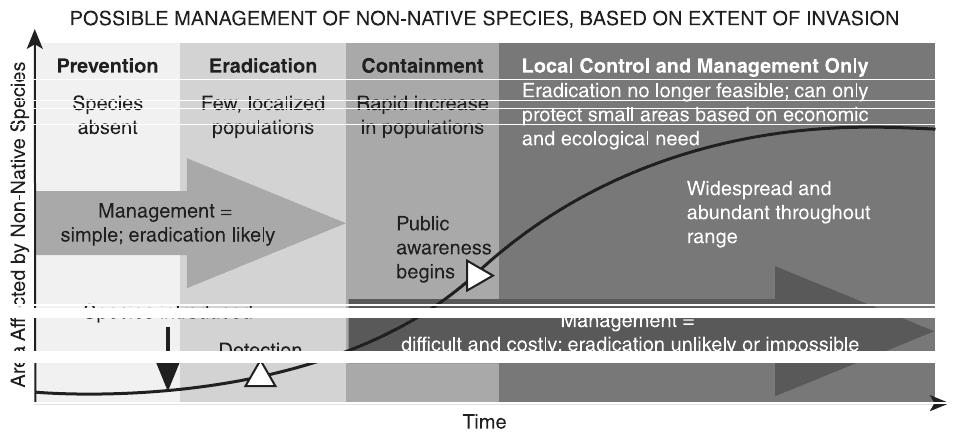
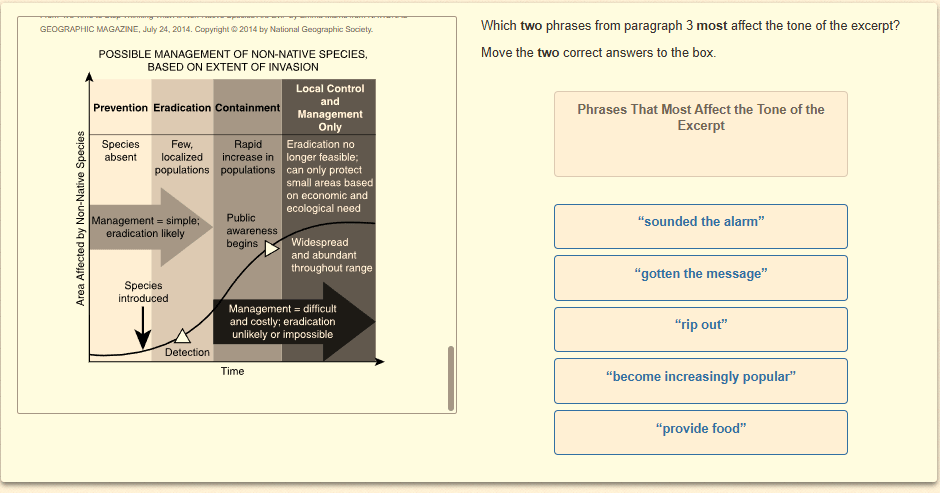
How does the chart provide additional support for a central idea of the excerpt?
- Aby implying that the public becomes aware of non-native species only after removal is impossible
- Bby showing that the complete removal of non-native species is usually not achievable after a certain period of time
- Cby demonstrating why non-native species can be destructive if they are not removed from an area immediately
- Dby explaining how some conservation groups have approached the removal of non-native species
Show the answer
Correct answer: B
The question asks how the chart provides additional support for a central idea of the excerpt.
A. Incorrect. The chart indicates that the public tends to become aware of non-native species once eradication is “unlikely or impossible,” not strictly impossible. Furthermore, this idea is not a central idea of the excerpt.
B. CORRECT. The chart strongly suggests that once “rapid increase in populations” of non-native species has occurred, eradication will be “unlikely or impossible.”
C. Incorrect. While the chart does show that non-native species can eventually be impossible to eradicate, it never addresses the issue of how the non-native species might be destructive to their new environments.
D. Incorrect. The chart shows how non-native species become harder and harder to remove as their population grows but does not explain how any conservation groups have approached their removal.
Question analysis
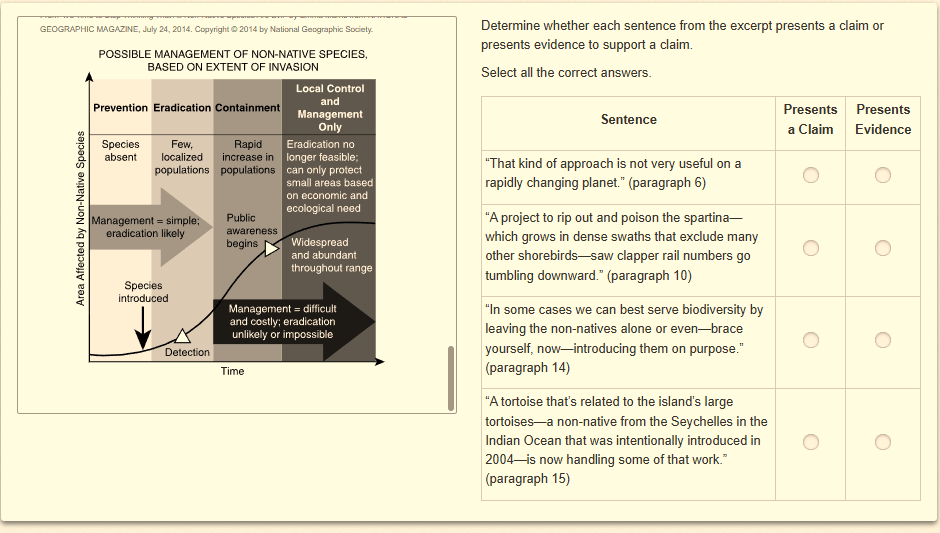
This question asks how a chart titled “Possible Management of Non-Native Species, Based on Extent of Invasion” supports a central idea of an article arguing that not all non-native species are harmful. Students must read the chart's stages, labels and curve, then decide which statement the chart actually shows and which also fits the article's argument.
- Grade level
- Grade 8 reading and task
- Compared with grade 7
- At grade 7 Grade 7 students connect graphics to a text, but this chart packs four stages, two arrows, a curve and several labels into one figure, and its pattern must be linked to an argument made in words, demanding but within upper grade 7.
- Estimated difficulty
- Moderate: several steps, or a close reading with one strong distractor.
- Thinking it demands
- Depth of knowledge 2, skills and concepts · mainly analyze
- What makes it hard
- Reading a figure, table or graph moderate
- A very close wrong answer moderate
- Combines ideas minor
- Evidence
- Answered from the whole text
- Reading level
- Passage: about grade 11, 815 words; question and choices: about grade 12, 78 words.
- Students, last 30 days
- Not enough answers yet to show (it takes 10).
Why it is hard, traps and wrong answers (shows the answer)
Why it is hard
The chart is easy to read in outline, simple management on the left and costly, likely failed eradication on the right, and the right choice restates that contrast. The pull comes from the “Public awareness begins” marker, placed at the border of the stage where eradication is no longer feasible, which makes a statement about public awareness look like a faithful reading. It is nearly faithful, but it describes one marker, not a central idea the article develops.
Reading a figure, table or graph moderate Understanding the question
The chart packs four shaded stages, two arrows, an S-shaped curve and three markers into one figure, and its message lies in the arrows: eradication “likely” early, “unlikely or impossible” later. (Lesh, Post & Behr, 1987; Kirsch & Mosenthal, 1990)
A very close wrong answer moderate Choosing the answer
The right choice and the public-awareness choice both read the late stages where removal fails; the awareness marker even sits on the border of “Eradication no longer feasible”, so only centrality separates them. (Embretson & Wetzel, 1987; Gorin & Embretson, 2006; Ascalon et al., 2007)
Combines ideas minor Working it out
The chart's pattern has to be matched to the article's argument that nativeness is one value among several and that removal makes sense only where “feasible and important to us”. (Embretson, 1998; Daniel & Embretson, 2010)
Strategy: Read the chart's title, axes and stage labels, say in one sentence what it shows happening over time, then ask which part of the article's argument that pattern supports.
Traps
- Too narrow: A single detail offered as the central idea or a summary, or a summary that keeps minor details and leaves out an essential part.
- Reads too much in: A reasonable-sounding conclusion that goes further than the text allows.
- Wrong part of the text: A choice is true of another paragraph, stanza or speaker than the one asked about.
The wrong answers, classified
A Too narrow (King et al., 2004)
Reads the “Public awareness begins” marker, which sits where eradication becomes unlikely or impossible, as the chart's point, though it is one label and public awareness is not a central idea.
C Reads too much in (Graesser, Singer & Trabasso, 1994)
Takes the rising curve of area affected as proof of damage, but the chart tracks spread and the difficulty of removal, never harm, and the article questions removing non-natives on reflex.
D Wrong part of the text (Kirsch & Mosenthal, 1990)
Credits the chart with the citizen groups of paragraph 3 and the spartina project of paragraph 10, but it shows general stages of possible management, not any group's actual approach.
Working it out, step by step
Know what the question asks
This asks how the chart supports a central idea, a main point of the article. First read the chart and say in your own words what it shows. Then link that to the article’s argument.
Read the chart from left to right
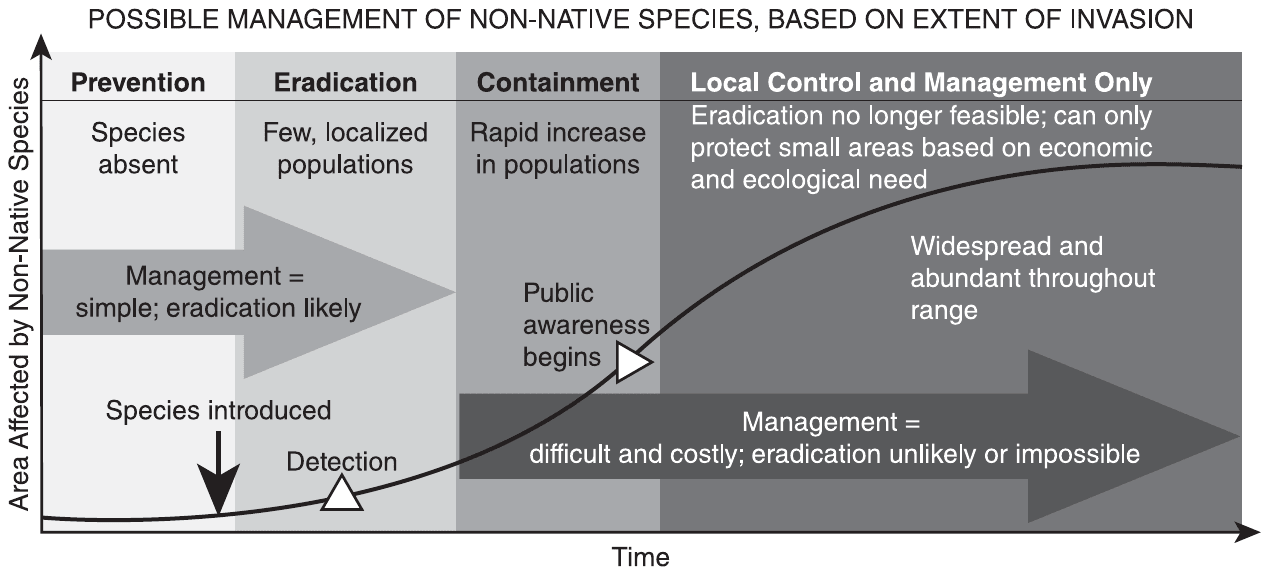
Time moves from left to right. The curve shows how much area a non-native species covers. Eradication means wiping a species out completely. Early on, the arrow says management is “simple” and eradication is “likely.” Then the species spreads fast. From there on, management is “difficult and costly,” and eradication is “unlikely or impossible.” In the last stage it is “no longer feasible,” or no longer possible.
Link the chart to the article
The article argues that we shouldn’t treat every non-native species the same way. Paragraph 16 says we should remove non-natives “in places where it is feasible and important to us.” The chart shows when removal is possible: mostly early, before the species spreads. After that, wiping it out usually can’t be done.
Check each choice
- B fits: complete removal is usually not possible after a certain time, which is the chart’s main message.
- A is wrong because the “Public awareness begins” marker is one small label, and the article never discusses when the public notices.
- C is wrong because the chart shows how far a species spreads, not how much damage it does.
- D is wrong because the chart shows general stages, not what any real group has done.
Watch out: A reads the marker correctly, since it does sit late, where removal is already hard. But it picks a detail, not the chart’s main point.
Choose the answer
The chart shows that removal works only early, which backs up the article’s argument. So the answer is B.
Why this answer and not the closest wrong one
A comes closest, since the chart does place “Public awareness begins” late, when removal is already hard. But that is one small marker, and the article never says when the public first notices a species. B states the chart’s main message, that removal works only early. That backs up the article’s point that removing non-natives isn’t always possible.
More questions like this
The original DOE question
Question 8 of 57
2025 Practice Test B English, question 8Uses the passage above: “Excerpt from “It’s Time to Stop Thinking That All Non-Native Species Are Evil””.
Question
Determine whether each sentence from the excerpt presents a claim or presents evidence to support a claim.
Select all the correct answers.
Choose one answer in each row, then check. The DOE has not published how answers with several parts are scored; this site counts one right only when every part is right.
| Presents a Claim | Presents Evidence | |
|---|---|---|
| “That kind of approach is not very useful on a rapidly changing planet.” (paragraph 6) | ||
| “A project to rip out and poison the spartina—which grows in dense swaths that exclude many other shorebirds—saw clapper rail numbers go tumbling downward.” (paragraph 10) | ||
| “In some cases we can best serve biodiversity by leaving the non-natives alone or even—brace yourself, now—introducing them on purpose.” (paragraph 14) | ||
| “A tortoise that’s related to the island’s large tortoises—a non-native from the Seychelles in the Indian Ocean that was intentionally introduced in 2004—is now handling some of that work.” (paragraph 15) |
Show the answer
Correct answer: “That kind of approach is not very useful on a rapidly changing planet.” (paragraph 6): Presents a Claim; “A project to rip out and poison the spartina—which grows in dense swaths that exclude many other shorebirds—saw clapper rail numbers go tumbling downward.” (paragraph 10): Presents Evidence; “In some cases we can best serve biodiversity by leaving the non-natives alone or even—brace yourself, now—introducing them on purpose.” (paragraph 14): Presents a Claim; “A tortoise that’s related to the island’s large tortoises—a non-native from the Seychelles in the Indian Ocean that was intentionally introduced in 2004—is now handling some of that work.” (paragraph 15): Presents Evidence
The question asks which quotations from the excerpt present a claim and which present evidence in support of a claim. (A claim is a statement made as part of an argument that can be supported or proved with evidence. Supporting evidence can include facts, figures, details, quotations, or other sources of data and information that can be evaluated by others.)
Row 1: Presents a claim [“That kind of approach is not very useful on a rapidly changing planet.” (paragraph 6)]. The phrase “is not very useful” indicates that the sentence expresses a claim—an arguable statement, or in this case an opinion, for which the author must provide proof.
Row 2: Presents evidence [“A project to rip out and poison the spartina—which grows in dense swaths that exclude many other shorebirds—saw clapper rail numbers go tumbling downward.” (paragraph 10)]. Despite its figurative language (“tumbling downward”), this sentence does not present a claim that must be supported by evidence. Instead, the sentence provides factual information—that numbers of clapper rail birds decreased when spartina grass was removed—that is evidence for another claim, that non-native plants can be welcome sometimes.
Row 3: Presents a claim [“In some cases we can best serve biodiversity by leaving the non-natives alone or even—brace yourself, now—introducing them on purpose.” (paragraph 14)]. The wording “we can best serve” signals that this sentence presents a claim—a statement being made as part of an argument that needs proof in order to be accepted—regarding the best way to achieve biodiversity.
Row 4: Presents evidence [“A tortoise that’s related to the island’s large tortoises—a non-native from the Seychelles in the Indian Ocean that was intentionally introduced in 2004—is now handling some of that work.” (paragraph 15)]. Although this sentence does not provide statistics, quotations, or other obvious markers that signal evidence, it does provide a factual example—non-native tortoises are now moving the seeds of fruiting plants in a way that preserves the diversity of plant life on the islands of Mauritius—that is used to support the author’s claim that non-native species can help preserve diversity.
Question analysis
This table-grid question on the opinion article about non-native species gives four sentences, from paragraphs 6, 10, 14 and 15, and asks whether each presents a claim or presents evidence to support a claim. Students make four separate decisions, and credit comes only when every row is right, so each sentence must be judged by the job it does in the author’s argument.
- Grade level
- Grade 7 reading and task
- Compared with grade 7
- At grade 7 Telling a claim from the evidence for it is core grade 7 argument work. The four sentences come labeled with their paragraphs, but they are long and broken by dashes and asides, and all four must be sorted correctly, a typical demand overall.
- Estimated difficulty
- Moderate: several steps, or a close reading with one strong distractor.
- Thinking it demands
- Depth of knowledge 2, skills and concepts · mainly analyze
- What makes it hard
- Much to keep track of moderate
- How, not what minor
- Complex sentences minor
- Figurative or literary language minor
- Evidence
- Answered from several paragraphs or stanzas
- Reading level
- Passage: about grade 11, 815 words; question and choices: about grade 8, 22 words.
- Students, last 30 days
- Not enough answers yet to show (it takes 10).
Why it is hard, traps and wrong answers (shows the answer)
Why it is hard
The two claims carry the author’s judgment in a few words, “not very useful” and “we can best serve,” while the two evidence rows report what happened. Students go wrong when they sort by surface: dramatic wording makes the spartina report sound like opinion, and the tortoise sentence, with no number or quotation, can pass for the author’s assertion. Asking whether a sentence judges or reports settles each row, but all four must be right for credit.
Much to keep track of moderate Working it out
Sentences from paragraphs 6, 10, 14 and 15 are judged one at a time, and the question is scored right only when all four rows are, so one doubtful row costs the point. (Sweller, 1988; Carpenter, Just & Shell, 1990)
How, not what minor Working it out
Each row asks what a sentence does in the argument, not what it is about: rows 3 and 4 both concern bringing in non-natives on purpose, but one argues for it and one reports it. (Anderson & Krathwohl, 2001)
Complex sentences minor Understanding the question
In the two evidence rows, 17 and 22 words separate the subject from its verb, “A project … saw” and “A tortoise … is now handling,” most of them inside dashes. (Abedi & Lord, 2001; Freedle & Kostin, 1993; Messick, 1989)
Figurative or literary language minor Understanding the question
Row 2 reports a result in vivid words, a project to “rip out and poison” the grass and clapper rail numbers that “go tumbling downward,” so a report can sound like an opinion. (Graesser, Singer & Trabasso, 1994; Kintsch, 1998)
Strategy: For each sentence, ask whether it states a judgment the author must argue for or reports something that happened or was found, and sort it by that test alone.
Traps
- Wrong purpose or structure: Names a purpose, structure or effect that the part does not serve, or describes what a part says when the question asks what it does.
- Wrong tone or attitude: Misjudges the tone, attitude or point of view, such as reading admiration as criticism, or taking a character's or subject's feelings for the author's.
The wrong answers, classified
1:B Wrong purpose or structure (Anderson & Krathwohl, 2001)
Takes “a rapidly changing planet” as plain fact, the climate change the next section describes, and misses that “not very useful” is the author’s own verdict on the approach Olden describes.
2:A Wrong tone or attitude (Graesser, Singer & Trabasso, 1994)
Hears opinion in the vivid “rip out and poison” and “go tumbling downward,” though the sentence reports what happened to clapper rail numbers once a project removed the spartina.
3:B Wrong purpose or structure (Anderson & Krathwohl, 2001)
Sees that the sentence backs the case for leaving non-natives alone and so calls it support, missing that “we can best serve” is itself a claim, which the tortoise example then backs.
4:A Wrong purpose or structure (Anderson & Krathwohl, 2001)
Expects evidence to come as numbers, studies or quotations, so takes the plain report that a tortoise brought in during 2004 “is now handling some of that work” as an assertion.
Working it out, step by step
Figure out what the question asks
Decide the job each of the four sentences does in the argument. A claim is a statement the author wants you to accept, such as an opinion or a judgment. People could disagree with it, so it needs support. Evidence is a fact, an example or an event that backs up a claim. Ask: does the sentence judge, or does it report what happened?
Sort the sentence from paragraph 6
Row 1 says “That kind of approach is not very useful on a rapidly changing planet.” The approach is the one in paragraph 5. There, many ecologists said they would wipe out a non-native plant even if it had no effect on the forest. The words “not very useful” are the author’s judgment. Someone could disagree, so the article has to argue for it. This sentence presents a claim.
Watch out: “A rapidly changing planet” sounds like a fact. But the point of the sentence is the judgment about the approach.
Sort the sentence from paragraph 10
Row 2 is long, so set aside the part between the dashes. What is left says “A project to rip out and poison the spartina” saw clapper rail numbers fall. Spartina is a grass that is not native to California. The clapper rail is an endangered shorebird that lives in it. So the sentence reports what happened: the grass was removed, and the birds declined. It backs the claim in paragraph 9 that some non-natives “do good.” This row presents evidence.
Watch out: Vivid words like “go tumbling downward” can sound like an opinion. But they only mean the numbers fell fast. Strong wording does not turn a report into a claim.
Sort the sentence from paragraph 14
Row 3 says “In some cases we can best serve biodiversity by leaving the non-natives alone or even—brace yourself, now—introducing them on purpose.” Biodiversity is the variety of living things in a place. The words “we can best serve” show the author’s judgment about what is best. “Brace yourself” shows she expects you to be surprised. A surprising idea needs proof. This sentence presents a claim.
Sort the sentence from paragraph 15
Row 4 also has a long part between dashes. Without it, the sentence says “A tortoise that’s related to the island’s large tortoises” is “now handling some of that work.” The sentence before explains the work. The islands lost their own large tortoises, which used to spread the seeds of fruiting plants. Now a non-native tortoise, brought in on purpose in 2004, does part of that job. It is a real example. It backs row 3’s claim. This row presents evidence.
Watch out: Evidence does not need numbers or quotations. An example of what happened counts.
Fill in the table
- Row 1 (paragraph 6): Presents a Claim
- Row 2 (paragraph 10): Presents Evidence
- Row 3 (paragraph 14): Presents a Claim
- Row 4 (paragraph 15): Presents Evidence
On the test and on this site, click one circle in each row. All four rows must be right to get the point.
Why this answer and not the closest wrong one
Row 2 is the hardest. “Rip out and poison” and “tumbling downward” sound strong, like an opinion. But the sentence reports a project and its result: the bird numbers fell. Nobody judges what is best. So it is evidence for the claim that some non-natives “do good.”
More questions like this
The original DOE question
Question 9 of 57
2025 Practice Test B English, question 9Passage A Miracle Mile
A Miracle Mile
In the 1950s people compared running one mile in four minutes to scaling Mount Everest and nicknamed the feat a “dream mile.” Although such an accomplishment was considered humanly impossible, several elite runners aimed to break that supposedly impenetrable barrier. One of them was a twenty-five-year-old medical student named Roger Bannister.
Roger Bannister had tasted failure during the 1952 Olympics. There, he was favored to win the 1,500-meter competition, a distance slightly shorter than a mile, but he finished in a dismal fourth place instead. Bannister’s performance was a disappointment for him and his country, Great Britain. Determined to redeem himself, Bannister postponed his plans to retire from racing and focused on the ultimate prize—breaking the four-minute-mile barrier.
Bannister attacked the elusive milestone with a positive attitude and logical planning. The amateur athlete decided to use intensive interval training to develop endurance and speed. For these workouts, Bannister ran an interval of ten consecutive laps on a quarter-mile track, aiming for sixty seconds each lap. In between intervals, he let his body recover for two minutes.
By early 1954, Bannister had succeeded in lowering his quarter-mile pace to sixty-one seconds, but he had to shave off at least one more second in order to reach his target. Frustrated by the plateau he had reached, Bannister took a break from training and went mountain climbing for three days. The rest from running permitted his muscles to recuperate and left him feeling refreshed. When Bannister returned to the track, he completed ten quarter-mile-long intervals at fifty-nine seconds each. He finally felt prepared to attempt to break the world record.
As a member of the Amateur Athletic Association (AAA), Bannister joined the AAA team for a track meet against Oxford University. The event took place on a cinder track in Oxford on May 6, 1954. Bannister and his two AAA teammates, Chris Chataway and Chris Brasher, were close friends and frequent running partners. Chataway and Brasher agreed to help Bannister accomplish his goal by being his “rabbits.”
In track and field, rabbits are runners who enter the race solely to pace a teammate for a segment of the course. Typically, a runner settles in behind the rabbit and allows the rabbit to set an appropriate tempo. Additionally, by running behind the rabbit, the runner conserves about 15 percent of his or her effort. When the starting pistol fired, Brasher pounced into the lead, and Bannister followed behind his first rabbit.
Propelled by the excitement, Bannister lost his instinctive feel for his pace and shouted “Faster!” at Brasher. Brasher, however, remained composed and maintained his current steady but grueling pace, completing the first two laps in a desirable one minute and fifty-eight seconds. Then Chataway surged forward, leading Bannister at this same punishing rate for another lap and a half. At the beginning of the back straightaway of the track, Bannister bolted past Chataway. Bannister said, “I felt that the moment of a lifetime had come. There was no pain, only a great unity of movement and aim.” Bannister crossed the finish line in 3 minutes 59.4 seconds. The ecstatic crowd erupted the moment the timekeeper announced the word “three.”
Soon after Bannister’s achievement, four other athletes matched his performance. A new mindset had taken root among runners. Over the years, the record continued to fall. However, the current record, 3 minutes 43.13 seconds, has stood unbroken since 1999. Some question whether this record represents the limits of human ability. But perhaps there is another Bannister, an athlete who, with willpower and dedication, will accomplish the miraculous.
Question
The words “feat,” “humanly impossible,” and “impenetrable barrier” in paragraph 1 affect the tone of the paragraph because they
- Ahighlight the idea that only the most skilled runners would be able to run a four-minute mile.
- Bemphasize the idea that running a mile in less than four minutes was a seemingly unattainable goal.
- Cconvey the competitiveness among elite runners to consistently set and break speed records.
- Dshow the intensity of the training programs athletes endure in order to achieve their goals.
Show the answer
Correct answer: B
The question asks how the words “feat,” “humanly impossible,” and “impenetrable barrier” in paragraph 1 affect the tone of the paragraph.
A. Incorrect. Although paragraph 1 states that “several elite runners aimed to break that supposedly impenetrable barrier,” the words “feat,” “humanly impossible,” and “impenetrable barrier” suggest that the goal was unattainable even for the most skilled runners.
B. CORRECT. No one had ever been able to run a mile in less than four minutes, and the words “feat,” “humanly impossible,” and “impenetrable barrier” imply that the goal seemed unattainable. These words also reinforce the comparison of running a four-minute mile to “scaling Mount Everest” (paragraph 1).
C. Incorrect. The words “feat,” “humanly impossible,” and “impenetrable barrier” describe how challenging and almost impossible running a four-minute mile seemed, and while other elite runners “aimed to break that supposedly impenetrable barrier” (paragraph 1), the paragraph focuses on Roger Bannister, not the competition among elite runners seeking to break the record.
D. Incorrect. Bannister’s training program is described in paragraphs 3 and 4, and the words “feat,” “humanly impossible,” and “impenetrable barrier” are used in paragraph 1 to describe the magnitude of Bannister’s goal to run a four-minute mile. Though his training program was intense, these words relate to the intensity of the goal itself, not to the intensity of his training.
Question analysis
This tone question on “A Miracle Mile,” an article about Roger Bannister and the four-minute mile, asks how three word choices in the opening paragraph, “feat,” “humanly impossible” and “impenetrable barrier,” affect its tone. Students must read the connotations of strong words in context and decide what they stress, while choices that echo other parts of the passage compete for attention.
- Grade level
- Grade 6 reading and task
- Compared with grade 7
- Below grade 7 Grade 7 tone questions often ask students to find the telling words themselves. Here the three words are quoted and sit in one short opening paragraph, and their shared meaning is strong and plain, so one careful reading is enough.
- Estimated difficulty
- Straightforward: two steps or one careful reading.
- Thinking it demands
- Depth of knowledge 2, skills and concepts · mainly analyze
- What makes it hard
- A very close wrong answer minor
- Hard words minor
- Evidence
- Answered from one paragraph or stanza
- Reading level
- Passage: about grade 10, 587 words; question and choices: about grade 11, 80 words.
- Students, last 30 days
- Not enough answers yet to show (it takes 10).
Why it is hard, traps and wrong answers (shows the answer)
Why it is hard
The three quoted words all make the same point, and the opening comparison with “scaling Mount Everest” makes it again, so the effect is easy to sense. Points are lost on degree: the sentence holding two of the three words also names “several elite runners,” which makes a choice about only the best runners look supported. Students who hold on to “humanly impossible” rule it out, and the choices about rivalry and training fall away once they check that the words describe the goal, not the runners or their preparation.
A very close wrong answer minor Choosing the answer
The choice about only the most skilled runners and the right one both stress how hard the four-minute mile was; they differ on degree, possible for the best runners or thought impossible for anyone. (Embretson & Wetzel, 1987; Gorin & Embretson, 2006; Ascalon et al., 2007)
Hard words minor Understanding the question
“Impenetrable” and “feat” carry the tone, and a student who does not know that impenetrable means impossible to break through may miss how absolute the barrier sounded. (Perfetti, 2007; Freedle & Kostin, 1993)
Strategy: Decide what feeling the three quoted words share, then reread paragraph 1 to see what they describe, and keep only a choice that fits both the feeling and the thing described.
Traps
- Twists what the text says: Uses the text's topic and ideas but changes what it says: who did it, how much, when, or why.
- Word match: Repeats striking words or phrases from the text, so it looks supported, but its meaning does not fit the question.
- Wrong part of the text: A choice is true of another paragraph, stanza or speaker than the one asked about.
The wrong answers, classified
A Twists what the text says (King et al., 2004)
Sees that the words stress difficulty but scales it down to a feat for the best runners only, though “humanly impossible” says no runner at all was thought able to do it.
C Word match (Freedle & Kostin, 1993)
Picks up “elite runners aimed to break” from the same sentence and turns it into a rivalry over records, though the three words describe the barrier, not the runners.
D Wrong part of the text (Kirsch & Mosenthal, 1990)
Carries the intensive interval training of paragraphs 3 and 4 back to paragraph 1, where the words measure the size of the goal, not the effort of preparing for it.
Working it out, step by step
Figure out what the question asks
This is a tone question. Tone is the feeling or attitude that a writer’s words give a passage. The question names three word choices from paragraph 1. You need to decide what feeling they share and what they describe.
Find the words in paragraph 1
Paragraph 1 says people “compared running one mile in four minutes to scaling Mount Everest.” Scaling means climbing. Mount Everest is the tallest mountain on Earth. The paragraph calls running that fast a “feat.” The next sentence says “Although such an accomplishment was considered humanly impossible, several elite runners aimed to break that supposedly impenetrable barrier.”
Work out what the words mean
A feat is an amazing deed that is very hard to do. Humanly impossible means no person could ever do it. Impenetrable means impossible to break through, and a barrier is a wall. All three say the same thing. A mile under four minutes seemed like a goal no one could reach. A word for that is unattainable.
Check each choice
- A does not fit. It says the best runners could do it. But “humanly impossible” means no one could.
- B fits. The words make the four-minute mile sound out of reach.
- C does not fit. The words describe the barrier, not a contest between runners.
- D does not fit. Training comes later, in paragraphs 3 and 4. These words describe the goal itself.
Watch out: A is tempting because the same sentence mentions “several elite runners.” Elite means the very best. But even they were not expected to succeed.
Choose the answer
The three words make the goal sound almost impossible for anyone. So the answer is B, “emphasize the idea that running a mile in less than four minutes was a seemingly unattainable goal.”
Why this answer and not the closest wrong one
A is the closest wrong choice. It also says the four-minute mile was hard. But A says that only the most skilled runners could do it. The passage says it was “considered humanly impossible.” People thought no runner at all could do it. That is why B fits better.
More questions like this
The original DOE question
The passage “A Miracle Mile” as printed (page 13)
Question 10 of 57
2025 Practice Test B English, question 10Uses the passage above: “A Miracle Mile”.
Question
Read these sentences from paragraph 7.
Bannister said, “I felt that the moment of a lifetime had come. There was no pain, only a great unity of movement and aim.”
The sentences contribute to the development of ideas in the passage by showing that Bannister
- Aknew that he was about to achieve the goal he had worked toward.
- Bwas no longer experiencing personal disappointment from his past failure in the Olympics.
- Cfelt grateful to his teammates for helping him take the lead.
- Dwas satisfied that his training had helped him perfect his running technique.
Show the answer
Correct answer: A
The question asks how the sentences from paragraph 7 contribute to the development of ideas in the passage.
A. CORRECT. The sentences from paragraph 7 show that toward the end of the race, Bannister knew that the goal of breaking the four-minute-mile barrier was within his grasp and that he had the focus necessary to achieve it. The sentence following Bannister’s quotation states that he did indeed meet his goal, crossing “the finish line in 3 minutes 59.4 seconds” (paragraph 7).
B. Incorrect. The feelings Bannister expressed in the sentences from paragraph 7 did not erase those feelings related to his loss at the 1952 Olympics, which were what drove him to the achievement he was about to make.
C. Incorrect. While the quotation states that Bannister felt “unity,” this pertains to his running, not to his work with the team. The sentences from paragraph 7 capture Bannister’s focus on his chance to break the barrier and what he was feeling at that moment.
D. Incorrect. The sentences from paragraph 7 express Bannister’s realization that he was on the verge of reaching a goal. The sentences show that in the seconds before crossing the finish line, Bannister was fully focused on the end goal and was not thinking about his training or his running technique.
Question analysis
This question quotes Roger Bannister’s own words from his famous race, “I felt that the moment of a lifetime had come,” and asks how they contribute to the development of ideas in “A Miracle Mile.” Students interpret an athlete’s description of a feeling and decide what it shows about him. Each choice links the quotation to a different part of his story.
- Grade level
- Grade 7 reading and task
- Compared with grade 7
- At grade 7 Explaining what a quoted sentence adds to a passage is everyday grade 7 work, and these two sentences are short. Their abstract phrase “a great unity of movement and aim” takes some interpreting, which keeps the demand typical rather than light.
- Estimated difficulty
- Moderate: several steps, or a close reading with one strong distractor.
- Thinking it demands
- Depth of knowledge 2, skills and concepts · mainly analyze
- What makes it hard
- Reading between the lines moderate
- Figurative or literary language minor
- Evidence
- Answered from one paragraph or stanza
- Reading level
- Passage: about grade 10, 587 words; question and choices: about grade 7, 93 words.
- Students, last 30 days
- Not enough answers yet to show (it takes 10).
Why it is hard, traps and wrong answers (shows the answer)
Why it is hard
Bannister’s words describe a feeling, and each choice explains it by a different part of his story. The right reading comes from where the quotation sits: on the back straight, seconds from the finish, so “the moment of a lifetime” is the record within reach. Students who take “unity of movement” as polished form, or “no pain” as the end of his Olympic hurt, tie the quotation to his training or his past instead of to this race.
Reading between the lines moderate Working it out
The quotation never names the record; students must link “the moment of a lifetime had come” to the four-minute goal and to the finish in 3 minutes 59.4 seconds reported right after it. (Graesser, Singer & Trabasso, 1994; Kintsch, 1998)
Figurative or literary language minor Understanding the question
“A great unity of movement and aim” is abstract, and “There was no pain” can be heard as emotional relief, so the words invite readings about technique, teamwork or old disappointment. (Graesser, Singer & Trabasso, 1994; Kintsch, 1998)
Strategy: Read the quotation together with the sentences around it in paragraph 7, put Bannister’s state of mind into your own words, and test each choice against what the quotation itself says.
Traps
- Wrong part of the text: A choice is true of another paragraph, stanza or speaker than the one asked about.
- Reads too much in: A reasonable-sounding conclusion that goes further than the text allows.
- Dictionary meaning, not meaning here: A common meaning of the word that does not fit its use in this text.
The wrong answers, classified
B Reads too much in (Graesser, Singer & Trabasso, 1994)
Hears “There was no pain” as the end of the hurt from his 1952 fourth place, but the pain meant is the strain of the race, and the quotation never looks back.
C Dictionary meaning, not meaning here (Perfetti, 2007)
Takes “unity” in its everyday sense of people pulling together and credits his rabbits, though the unity is of his own “movement and aim,” just after he passed Chataway to run alone.
D Wrong part of the text (Kirsch & Mosenthal, 1990)
Brings in the training of paragraphs 3 and 4 and reads “unity of movement” as perfected technique, but the quotation records a feeling during the race, not a verdict on his preparation.
Working it out, step by step
Figure out what the question asks
This asks what Bannister’s words show about him at that moment in the race. To answer, you need to know where the quotation comes. So read the sentences just before it and just after it.
Find where the quotation comes
Paragraph 7 tells the story of the race. Just before the quotation, “Bannister bolted past Chataway.” Bolted means ran off suddenly and fast. Chataway was his second rabbit, a teammate who set the pace. Now Bannister was in front, near the end. Just after the quotation, “Bannister crossed the finish line in 3 minutes 59.4 seconds.” That is under four minutes.
Put his words in your own words
He says “I felt that the moment of a lifetime had come.” The moment of a lifetime is the most important moment a person ever has. For Bannister, that was breaking the four-minute mile. “A great unity of movement and aim” means his body and his goal were working as one. He could feel that he was about to do it.
Check each choice
- A fits. He senses that his big goal is about to happen.
- B does not fit. “There was no pain” means he felt no strain in the race. He is not thinking back to 1952.
- C does not fit. The unity is of his own “movement and aim,” not of his team. He had just passed Chataway to run alone.
- D does not fit. The words describe a feeling during the race. They say nothing about his training or his technique, which means his way of running.
Watch out: D is tempting because “unity of movement” sounds like perfect running form. But Bannister is not judging his training here. He is feeling the big moment arrive.
Choose the answer
The quotation shows Bannister sensing that his goal was near, and the next sentence shows he reached it. So the answer is A, “knew that he was about to achieve the goal he had worked toward.”
Why this answer and not the closest wrong one
D is the closest wrong choice. His training did help him, and he was running well. But the quotation is about a feeling: “the moment of a lifetime had come.” It looks ahead to the finish, not back at his practice. A matches that feeling of a goal about to be reached.
More questions like this
The original DOE question
Question 11 of 57
2025 Practice Test B English, question 11Uses the passage above: “A Miracle Mile”.
Question
Which sentence best supports the idea that Bannister needed an alternative to “logical planning” (paragraph 3) in order to accomplish his goal?
- A“Bannister’s performance was a disappointment for him and his country, Great Britain.” (paragraph 2)
- B“The amateur athlete decided to use intensive interval training to develop endurance and speed.” (paragraph 3)
- C“For these workouts, Bannister ran an interval of ten consecutive laps on a quarter-mile track, aiming for sixty seconds each lap.” (paragraph 3)
- D“Frustrated by the plateau he had reached, Bannister took a break from training and went mountain climbing for three days.” (paragraph 4)
Show the answer
Correct answer: D
The question asks which sentence best supports the idea that Bannister needed an alternative to “logical planning” (paragraph 3) in order to accomplish his goal.
A. Incorrect. The outcome of the 1952 Olympics, referenced in the sentence from paragraph 2, is what prompted Bannister to seek a new goal: “Determined to redeem himself, Bannister . . . focused on the ultimate prize—breaking the four-minute-mile barrier” (paragraph 2).
B. Incorrect. The sentence from paragraph 3 does not show an alternative to Bannister’s training plan to “develop endurance and speed” (paragraph 3) and his focus on using logical planning in order to accomplish his goal.
C. Incorrect. The sentence from paragraph 3 focuses on details of his training plan, explaining the “intensive interval training” (paragraph 3) that Bannister used to build his endurance and speed, not an alternative form of preparation.
D. CORRECT. The sentence from paragraph 4 explains that Bannister reached a point where he could not improve his time despite the strict training plan he had created. Taking a break from his training to spend time mountain climbing “permitted his muscles to recuperate and left him feeling refreshed” (paragraph 4).
Question analysis
This textual evidence question on “A Miracle Mile” asks which sentence best supports the idea that Roger Bannister needed an alternative to the “logical planning” described in paragraph 3. Students must understand what his plan was before they can recognize a departure from it. The four sentences come from paragraphs 2 to 4, which cover his Olympic loss and his training.
- Grade level
- Grade 7 reading and task
- Compared with grade 7
- At grade 7 Matching a sentence to an idea is standard grade 7 evidence work, and the four sentences come from three short, plain paragraphs. The idea itself is worded abstractly, so students must first decide what an alternative to “logical planning” would look like.
- Estimated difficulty
- Straightforward: two steps or one careful reading.
- Thinking it demands
- Depth of knowledge 2, skills and concepts · mainly evaluate
- What makes it hard
- Evidence
- Answered from several paragraphs or stanzas
- Reading level
- Passage: about grade 10, 587 words; question and choices: about grade 12, 92 words.
- Corrected from the DOE handbook
- A wrong paragraph number in the explanation was corrected.
- Students, last 30 days
- Not enough answers yet to show (it takes 10).
Why it is hard, traps and wrong answers (shows the answer)
Why it is hard
The question turns on one decision: the interval training is the logical plan, so a sentence describing it cannot show an alternative to it. Once that is settled, three days of mountain climbing stand out as the only break from the plan. Students lose the point when they read “alternative” loosely and pick the sentence that introduces the training, or when they treat the Olympic disappointment as the moment his methods had to change.
Reading between the lines minor Working it out
The stem never says what the “logical planning” was; students must see that it is the interval training of paragraph 3, so the alternative has to be a step away from that training. (Graesser, Singer & Trabasso, 1994; Kintsch, 1998)
Evidence in several places minor Working it out
The stem points to paragraph 3, where two of the four sentences sit, but the departure from the plan comes in paragraph 4, after Bannister stalls at sixty-one seconds a lap. (Kirsch & Mosenthal, 1990; Gorin & Embretson, 2006)
Strategy: First reread paragraph 3 to see what Bannister’s “logical planning” was, then ask of each sentence whether it shows that plan or something different from it.
Traps
- Supports only part of the claim: In a question about evidence: a line that backs one half of the claim but not the other, or a related point rather than the claim itself.
- True but not the answer: A choice says something accurate about the text that does not answer this question.
The wrong answers, classified
A True but not the answer (King et al., 2004; Embretson & Wetzel, 1987)
Picks the 1952 disappointment, an accurate sentence that explains why Bannister took up the goal, but it comes before the plan and shows no step away from it.
B Supports only part of the claim (King et al., 2004; Thissen, Steinberg & Fitzpatrick, 1989)
Takes the decision to use intensive interval training as the alternative, missing that this training is the logical plan itself, so the sentence shows the plan, not a departure from it.
C Supports only part of the claim (King et al., 2004; Thissen, Steinberg & Fitzpatrick, 1989)
Chooses the workout details, ten laps aimed at sixty seconds each, which spell out the plan’s routine rather than any change to it.
What was corrected from the DOE handbook, and why
- Explanation: The DOE’s explanation of Option C begins “The sentence from paragraph 4 focuses on details of his training plan.” Option C quotes a sentence from paragraph 3 (“For these workouts, Bannister ran an interval of ten consecutive laps on a quarter-mile track, aiming for sixty seconds each lap”) and labels it “(paragraph 3),” and the explanation goes on to describe the “intensive interval training” of paragraph 3. The site now says “The sentence from paragraph 3.” The DOE’s 2021–2022 guide, where this question first appeared, has the same slip.
Working it out, step by step
Figure out what the question asks
This asks for evidence: the sentence that best supports an idea. The idea is that Bannister needed an alternative to his “logical planning.” An alternative is a different way of doing something. So first find out what his plan was. Then look for a sentence where he steps away from it.
Find the logical plan in paragraph 3
Paragraph 3 says “Bannister attacked the elusive milestone with a positive attitude and logical planning.” The next sentence tells what the plan was: “The amateur athlete decided to use intensive interval training to develop endurance and speed.” Interval training means running hard for a set stretch, resting, then running hard again.
Find where the plan stopped working
Paragraph 4 says he got down to sixty-one seconds a lap, but he needed sixty. Then “Frustrated by the plateau he had reached, Bannister took a break from training and went mountain climbing for three days.” A plateau is a point where you stop getting better. Climbing was not part of his plan. Afterward, he ran each lap in fifty-nine seconds.
Check each choice
- A does not fit. It is from paragraph 2. It tells why he chose the goal, before he had any plan.
- B does not fit. Interval training is the logical plan, not an alternative to it.
- C does not fit. It is from paragraph 3. It gives details of the same plan: ten laps, sixty seconds each.
- D fits. He stops training, does something else, and it works.
Watch out: B is tempting because it describes a choice Bannister made. But that choice was the plan itself.
Choose the answer
Only D shows Bannister trying something outside his plan. So the answer is D, “Frustrated by the plateau he had reached, Bannister took a break from training and went mountain climbing for three days.”
Why this answer and not the closest wrong one
B is the closest wrong choice. It names a decision Bannister made. But that decision, interval training, was his logical plan. The question asks for a step away from the plan. Only D shows him leaving training behind. The rest “permitted his muscles to recuperate,” which means recover.
More questions like this
The original DOE question
Question 12 of 57
2025 Practice Test B English, question 12Uses the passage above: “A Miracle Mile”.
Question
Which sentence from the passage indicates that Bannister nearly made a mistake that would have cost him the world record?
- A“By early 1954, Bannister had succeeded in lowering his quarter-mile pace to sixty-one seconds, but he had to shave off at least one more second in order to reach his target.” (paragraph 4)
- B“When the starting pistol fired, Brasher pounced into the lead, and Bannister followed behind his first rabbit.” (paragraph 6)
- C“Propelled by the excitement, Bannister lost his instinctive feel for his pace and shouted ‘Faster!’ at Brasher.” (paragraph 7)
- D“At the beginning of the back straightaway of the track, Bannister bolted past Chataway.” (paragraph 7)
Show the answer
Correct answer: C
The question asks which sentence indicates that Bannister nearly made a mistake that would have cost him the world record.
A. Incorrect. The sentence from paragraph 4 describes a challenge Bannister faced during his training period, when he used “intensive interval training to develop endurance and speed” (paragraph 3). Bannister ran laps on a “quarter-mile track” (paragraph 3) and was able to control his pace at this time—unlike during the actual race to break the record.
B. Incorrect. The sentence from paragraph 6 describes the start of the race and Brasher’s role as “first rabbit” for Bannister. Bannister was behind Brasher, following their plan for breaking the record.
C. CORRECT. If Bannister had begun running faster than the “steady but grueling pace” (paragraph 7) set by his “rabbit,” he would likely not have had enough energy to finish the race. As paragraph 6 notes, “the runner conserves about 15 percent of his or her effort” by allowing the rabbit to set the pace. Bannister had “lost his instinctive feel for his pace” (paragraph 7) in the excitement of the race. If he had given in to his impulse to run faster and bypassed the rabbit at that point in the race, it would have cost him energy, and, in turn, the record.
D. Incorrect. The sentence from paragraph 7 describes how Bannister leaped ahead of Chataway, his second “rabbit,” at the appropriate time in the effort to break the record. Chataway had “surged forward, leading Bannister at this same punishing rate for another lap and a half” (paragraph 7) before Bannister moved past him.
Question analysis
This textual evidence question asks which sentence from “A Miracle Mile” shows that Roger Bannister nearly made a mistake that could have cost him the world record. The passage never says outright that he slipped, so students must use what it explains about running a race to judge which moment was a real danger. The four choices span both his training and the race itself.
- Grade level
- Grade 7 reading and task
- Compared with grade 7
- At grade 7 Grade 7 evidence questions usually match a sentence to an idea the text states. This mistake is never named as one, so students must infer which moment put the record at risk, a typical grade 7 inference within a short, clear passage.
- Estimated difficulty
- Moderate: several steps, or a close reading with one strong distractor.
- Thinking it demands
- Depth of knowledge 2, skills and concepts · mainly evaluate
- What makes it hard
- Reading between the lines moderate
- Evidence in several places minor
- Every choice must be checked minor
- Evidence
- Answered from several paragraphs or stanzas
- Reading level
- Passage: about grade 10, 587 words; question and choices: about grade 11, 102 words.
- Students, last 30 days
- Not enough answers yet to show (it takes 10).
Why it is hard, traps and wrong answers (shows the answer)
Why it is hard
The near mistake is easy to miss because it never happens: Brasher ignores the shout, and the race goes on at the planned pace. Students must see that losing his feel for the pace put the record at risk, using what paragraph 6 explains about rabbits. The sudden surge past Chataway sounds rash and the training plateau sounds like a near failure, so students who look for drama or for falling short land on the wrong moment.
Reading between the lines moderate Working it out
The passage never calls the shout of “Faster!” a mistake; students must infer it from “lost his instinctive feel for his pace” and from Brasher’s refusal to change his steady pace. (Graesser, Singer & Trabasso, 1994; Kintsch, 1998)
Evidence in several places minor Working it out
Why running faster would have cost the record is explained a paragraph earlier, in paragraph 6, where following a rabbit saves a runner about 15 percent of his or her effort. (Kirsch & Mosenthal, 1990; Gorin & Embretson, 2006)
Every choice must be checked minor Choosing the answer
Each sentence shows a setback or a bold move, from the training plateau to the final surge, so each has to be judged against the idea of a near mistake. (Embretson & Wetzel, 1987)
Strategy: For each quoted sentence, ask whether it shows Bannister doing something that could have hurt his chances, and use what the passage explains about racing to judge how serious it was.
Traps
- Reads too much in: A reasonable-sounding conclusion that goes further than the text allows.
- Supports only part of the claim: In a question about evidence: a line that backs one half of the claim but not the other, or a related point rather than the claim itself.
- Outside knowledge: A choice is plausible in the real world but not supported by this text.
The wrong answers, classified
A Supports only part of the claim (King et al., 2004; Thissen, Steinberg & Fitzpatrick, 1989)
Takes the 1954 plateau, one second short of the target pace, as the near miss, but it was a setback in training that rest overcame, not a mistake.
B Outside knowledge (King et al., 2004; Recht & Leslie, 1988)
Assumes that trailing at the start is a racing error, but paragraph 6 explains that a runner behind a rabbit saves about 15 percent of his or her effort.
D Reads too much in (Graesser, Singer & Trabasso, 1994)
Reads “bolted” as a reckless burst, but Bannister passed Chataway only after his rabbits had paced him for three and a half laps, and the move won him the record.
Working it out, step by step
Figure out what the question asks
This asks for a sentence that shows a near mistake. That is something that almost went wrong. It would have cost Bannister the record. So look for a moment when he did something that could have ruined the race.
Learn how a rabbit helps
Paragraph 6 explains rabbits. They are teammates who run in front to set the speed. It says “Typically, a runner settles in behind the rabbit and allows the rabbit to set an appropriate tempo.” Tempo means speed. Also, “by running behind the rabbit, the runner conserves about 15 percent of his or her effort.” Conserves means saves.
Find the moment that went wrong
Paragraph 7 begins “Propelled by the excitement, Bannister lost his instinctive feel for his pace and shouted” at Brasher to go faster. He lost his natural sense of how fast to run. If Brasher had sped up, Bannister could have used up his energy too soon. But Brasher “remained composed,” which means calm. He kept the steady pace, and that saved the race.
Check each choice
- A does not fit. The training plateau was a setback, not a mistake. A rest fixed it.
- B does not fit. Following a rabbit was the plan. Paragraph 6 shows that it saves effort.
- C fits. Bannister wanted to go faster too early, which could have worn him out.
- D does not fit. Passing Chataway near the end was the right move. It won him the record.
Watch out: D is tempting because “bolted” sounds wild. But he waited until his rabbits had paced him for three and a half laps.
Choose the answer
Only C shows Bannister almost doing something that could have cost him the record. So the answer is C, “Propelled by the excitement, Bannister lost his instinctive feel for his pace and shouted ‘Faster!’ at Brasher.”
Why this answer and not the closest wrong one
D is the closest wrong choice, since bolting past Chataway was a bold, sudden move. But it came at the right time, and it led to the record. In C, Bannister lost his sense of pace and wanted to speed up too early. Only his rabbit’s calm saved him. That is a near mistake.
More questions like this
The original DOE question
Question 13 of 57
2025 Practice Test B English, question 13Uses the passage above: “A Miracle Mile”.
Question
Bannister’s loss in the 1952 Olympics influenced his decision to pursue breaking the four-minute-mile barrier by
- Aallowing him to recognize his weaknesses and improve his running ability.
- Bprompting him to take a different approach to his regular training.
- Cmotivating him to prove to himself that he could set and achieve a goal.
- Dgiving him the opportunity to reach a goal no runner had ever accomplished.
Show the answer
Correct answer: C
The question asks how Bannister’s loss in the 1952 Olympics influenced his decision to pursue breaking the four-minute-mile barrier.
A. Incorrect. While Bannister recognized the weaknesses that led to his poor performance in the Olympics and worked “to develop endurance and speed” (paragraph 3), the loss made him “determined to redeem himself” (paragraph 2). The desire for redemption influenced Bannister to focus specifically on running a mile in under four minutes, rather than on winning other races or training for other distances.
B. Incorrect. Although Bannister developed an “intensive interval training” plan to improve his “endurance and speed” (paragraph 3), he applied a different approach only after his progress toward a four-minute mile reached a “plateau” (paragraph 4) in 1954. It was his desire to “shave off at least one more second in order to reach his target” (paragraph 4) that prompted him to take a break from interval training and go mountain climbing for three days.
C. CORRECT. Bannister sought to redeem himself after “he finished in a dismal fourth place” at the Olympics (paragraph 2). He thought that his performance “was a disappointment for him and his country, Great Britain,” and he responded by setting a goal to successfully conquer the four-minute mile, which was considered the “ultimate prize” (paragraph 2).
D. Incorrect. Bannister’s loss at the 1952 Olympics motivated him to change his training focus to reaching the “ultimate prize” (paragraph 2) of breaking the four-minute-mile barrier, which no other runner had accomplished. His loss at the Olympics did not present him with a specific opportunity to reach this goal.
Question analysis
This cause-and-effect question on “A Miracle Mile” asks how Roger Bannister’s disappointing finish at the 1952 Olympics shaped his decision to chase the four-minute mile. Students trace how one event led to a choice. The passage gives the reason in a single phrase, and the choices restate it alongside effects that sound believable for any athlete after a loss.
- Grade level
- Grade 7 reading and task
- Compared with grade 7
- At grade 7 Explaining how one event influenced a person’s decision is standard grade 7 work, and the cause is set out in one short paragraph. The choices put the passage’s ideas in new words, so students must match meaning rather than phrases.
- Estimated difficulty
- Moderate: several steps, or a close reading with one strong distractor.
- Thinking it demands
- Depth of knowledge 2, skills and concepts · mainly understand
- What makes it hard
- The right answer is reworded moderate
- Hard words minor
- Evidence
- Answered from one paragraph or stanza
- Reading level
- Passage: about grade 10, 587 words; question and choices: about grade 10, 64 words.
- Students, last 30 days
- Not enough answers yet to show (it takes 10).
Why it is hard, traps and wrong answers (shows the answer)
Why it is hard
The answer sits in a single phrase, but the choices compete with stories that fit any athlete after a loss, such as learning from weaknesses or changing a routine. Both sound right because Bannister did train hard afterward, yet the passage ties the loss only to his wish to redeem himself, and the change of routine comes later, from the 1954 plateau. Students who keep to the question’s focus, the decision to chase the record, find a motive rather than a method.
The right answer is reworded moderate Choosing the answer
Paragraph 2 says the loss left Bannister “determined to redeem himself”; the right choice recasts this as proving to himself he could set and reach a goal, while a wrong one reuses the passage’s word “training.” (Freedle & Kostin, 1993; Kirsch & Mosenthal, 1990)
Hard words minor Understanding the question
“Redeem himself,” to make up for a failure, is the key phrase, and a student unsure of it may not see that the loss gave him a reason rather than a lesson. (Perfetti, 2007; Freedle & Kostin, 1993)
Strategy: Find the sentence in paragraph 2 that tells how Bannister responded to the 1952 loss, restate it in your own words, and compare each choice with your restatement.
Traps
- Half right: One half of a two-part choice is right and the other is not.
- Outside knowledge: A choice is plausible in the real world but not supported by this text.
- Wrong part of the text: A choice is true of another paragraph, stanza or speaker than the one asked about.
The wrong answers, classified
A Outside knowledge (King et al., 2004; Recht & Leslie, 1988)
Supplies a familiar sports lesson, that a loss shows an athlete what to fix, but paragraph 2 makes the loss a reason to redeem himself and names no weaknesses.
B Wrong part of the text (Kirsch & Mosenthal, 1990)
Borrows the change of routine from paragraph 4, where the 1954 plateau, not the Olympic loss, sent Bannister off to climb mountains for three days.
D Half right (King et al., 2004; Thissen, Steinberg & Fitzpatrick, 1989)
Gets right that no runner had yet broken four minutes, but the loss opened no door for him; finishing fourth gave him a motive, not a chance.
Working it out, step by step
Figure out what the question asks
This asks about cause and effect. The cause is Bannister’s loss at the 1952 Olympics. The effect is his decision to chase the four-minute mile. You need to find how the first led to the second.
Read paragraph 2
Paragraph 2 says he “finished in a dismal fourth place instead.” Dismal means very disappointing. Then it says “Bannister’s performance was a disappointment for him and his country, Great Britain. Determined to redeem himself, Bannister postponed his plans to retire from racing and focused on the ultimate prize.” The prize was breaking the four-minute mile.
Understand what redeem himself means
To redeem yourself means to make up for a failure. You show that you are better than your worst moment. Bannister had let himself down. So he set a huge new goal to prove what he could do. The loss gave him a reason to try, which is a motive.
Check each choice
- A does not fit. Paragraph 2 never names any weaknesses he found.
- B does not fit. He changed his routine in paragraph 4, in 1954. That was because of a plateau, not the Olympic loss.
- C fits. He wanted to make up for the loss by reaching a big goal.
- D does not fit. Losing did not give him a chance at the record. It gave him a reason.
Watch out: A sounds like a common sports lesson: losing shows you what to fix. But the passage does not say that.
Choose the answer
The loss made Bannister “determined to redeem himself” with a new goal. So the answer is C, “motivating him to prove to himself that he could set and achieve a goal.”
Why this answer and not the closest wrong one
A is the closest wrong choice. Athletes often learn from a loss, so it sounds right. But paragraph 2 never says what Bannister was bad at. It says the loss made him “determined to redeem himself.” That is about motivation, so C fits better.
More questions like this
The original DOE question
Question 14 of 57
2025 Practice Test B English, question 14Uses the passage above: “A Miracle Mile”.
Question
How did interval training affect Bannister’s performance?
- AIt helped him learn how to moderate his pace while running.
- BIt helped him conserve effort when running with teammates.
- CIt helped him improve his pace and stamina while running.
- DIt helped him decrease his recovery time after an intense run.
Show the answer
Correct answer: C
The question asks how interval training affected Bannister’s performance.
A. Incorrect. The moderation of his pace was achieved through the use of “rabbits,” described in paragraph 6, more than through his method of interval training.
B. Incorrect. Bannister worked individually during the interval training period and then paced himself with a two-person team of “rabbits,” which were introduced in paragraph 5 and explained in paragraph 6. It was the use of “rabbits” during the race that helped him conserve some of his effort, not the interval training.
C. CORRECT. As paragraph 3 states, the goal of Bannister’s training program was to “develop endurance and speed,” which are synonyms of the words “stamina” and “pace.”
D. Incorrect. Although Bannister “let his body recover for two minutes” (paragraph 3) during interval training, this was not the primary effect of the training on Bannister’s performance. Instead, interval training allowed him to develop greater endurance and speed.
Question analysis
This question asks how interval training affected Roger Bannister’s performance as he prepared to run a mile in under four minutes, according to “A Miracle Mile.” It tests finding a detail the passage states and recognizing it in a choice that may use different words. The passage describes several parts of his preparation and race, so students must keep track of which one the question is about.
- Grade level
- Grade 6 reading and task
- Compared with grade 7
- Below grade 7 Below typical grade 7 demand: the passage states the purpose of the training in a single sentence. A grade 7 student only needs to locate it and compare the choices with it, without inferring anything.
- Estimated difficulty
- Straightforward: two steps or one careful reading.
- Thinking it demands
- Depth of knowledge 1, recall and reproduction · mainly understand
- What makes it hard
- Evidence
- Answered from one paragraph or stanza
- Reading level
- Passage: about grade 10, 587 words; question and choices: about grade 7, 48 words.
- Corrected from the DOE handbook
- The DOE’s 2026 explanations appendix skips this question; the explanation and answer key here are the DOE’s own, from its 2021–2022 guide (question 40), relettered.
- Students, last 30 days
- Not enough answers yet to show (it takes 10).
Why it is hard, traps and wrong answers (shows the answer)
Why it is hard
Paragraph 3 states what the training was for, so the task is to match that sentence and ignore details from elsewhere. The rabbits of paragraph 6, who set Bannister’s tempo and save his effort, supply two tempting effects that belong to the race, not the workouts. The two-minute rests sit in the training paragraph itself, so a student skimming for “recover” can mistake part of the method for its result.
A very close wrong answer minor Choosing the answer
The choice about moderating his pace and the right one both concern pace; only the right one matches the training’s stated aim, to “develop endurance and speed.” (Embretson & Wetzel, 1987; Gorin & Embretson, 2006; Ascalon et al., 2007)
The right answer is reworded minor Choosing the answer
The right choice turns “endurance and speed” into stamina and pace, while two wrong ones reuse the passage’s own words, “conserves” effort from paragraph 6 and “recover” from paragraph 3. (Freedle & Kostin, 1993; Kirsch & Mosenthal, 1990)
Strategy: Find the paragraph that introduces interval training, note what the training was meant to develop, and pick the choice that means the same thing.
Traps
- Wrong part of the text: A choice is true of another paragraph, stanza or speaker than the one asked about.
- Word match: Repeats striking words or phrases from the text, so it looks supported, but its meaning does not fit the question.
- Twists what the text says: Uses the text's topic and ideas but changes what it says: who did it, how much, when, or why.
The wrong answers, classified
A Twists what the text says (King et al., 2004)
Sees the sixty-second laps as practice in holding a pace, but the training aimed to build speed and endurance, and in the race his rabbits had to hold his tempo for him.
B Wrong part of the text (Kirsch & Mosenthal, 1990)
Matches the saving of “about 15 percent of his or her effort,” which paragraph 6 credits to running behind a rabbit in the race, not to interval training.
D Word match (Freedle & Kostin, 1993)
Spots “recover” in paragraph 3 and picks the choice about recovery time, though the two-minute rest is part of the workout, and nothing says it grew shorter.
What was corrected from the DOE handbook, and why
- Explanation and answer key: The 2026 printable test includes this question (Passage Set 2, Item 6), but the explanations appendix skips it: it explains only five of the six questions on “A Miracle Mile.” The question is question 40 of the DOE’s NYC Guide to the SHSAT for 2022 Admissions (the 2021–2022 guide, page 165), with the same stem and options lettered E–H. The explanation is the guide’s (page 218) and its key is G; both are relettered E–H to A–D here, so the key is C.
Working it out, step by step
Figure out what the question asks
This asks what interval training did for Bannister’s running. So find the paragraph that first describes interval training. Look for what it was meant to build.
Find interval training in paragraph 3
Paragraph 3 says “The amateur athlete decided to use intensive interval training to develop endurance and speed.” In each workout he ran ten laps, aiming for sixty seconds a lap. Then he rested for two minutes and ran again. That is what an interval is here: a hard stretch of running between rests.
See what the training did
Endurance means being able to keep going for a long time. Another word for it is stamina. Speed is how fast you run, which is your pace. Paragraph 4 shows the result. By early 1954, he had lowered “his quarter-mile pace to sixty-one seconds.” He was getting faster.
Check each choice
- A does not fit. To moderate your pace means to keep it steady and not too fast. In the race, his rabbits did that for him. He even lost his feel for his pace.
- B does not fit. Saving effort came from running behind rabbits in the race (paragraph 6).
- C fits. Stamina and pace are other words for endurance and speed.
- D does not fit. He rested two minutes between runs. Nothing says that rest got shorter.
Watch out: D is tempting because paragraph 3 mentions rest: “he let his body recover for two minutes.” But the rest is part of the workout, not a result of it.
Choose the answer
Interval training built Bannister’s speed and endurance. So the answer is C, “It helped him improve his pace and stamina while running.”
Why this answer and not the closest wrong one
A is the closest wrong choice, because it is also about pace. But the training aimed “to develop endurance and speed,” not to keep his pace in check. In the race, Bannister “lost his instinctive feel for his pace,” and Brasher had to keep it steady. C matches what the training was for.
More questions like this
The original DOE question
Question 15 of 57
2025 Practice Test B English, question 15Uses the passage above: “A Miracle Mile”.
Question
How does the author’s use of chronological structure contribute to the development of ideas in the passage?
- AIt presents the increasing physical effects of Bannister’s training methods as he prepared to break the four-minute-mile barrier.
- BIt shows the increase in Bannister’s confidence in his ability to break the four-minute-mile barrier.
- CIt emphasizes the key events in Bannister’s life that inspired him to break the four-minute-mile barrier.
- DIt highlights the progression of Bannister’s training and details about his successful attempt to break the four-minute-mile barrier.
Show the answer
Correct answer: D
The question asks how the author’s use of chronological structure contributes to the development of ideas in the passage.
A. Incorrect. While paragraph 4 mentions the “plateau” Bannister dealt with and the break that “permitted his muscles to recuperate,” the chronological structure of the passage focuses mainly on the progression of Bannister’s process over time.
B. Incorrect. Even though the passage suggests that Bannister’s ability to break the four-minute-mile barrier improved and that he felt “prepared to attempt to break the world record” (paragraph 4), the chronological structure of the passage primarily serves to show how Bannister’s progress over time led to his success.
C. Incorrect. The chronological structure of the passage begins with an acknowledgment that Bannister was inspired to break the four-minute-mile barrier by his loss at the 1952 Olympics (paragraph 2); however, the overall organization of the passage highlights his dedicated efforts over time to break the four-minute-mile barrier.
D. CORRECT. The chronological structure of the passage follows the progression of Bannister’s training from his loss at the 1952 Olympics to the race where he ran the first sub-four-minute mile on May 6, 1954 (paragraph 5).
Question analysis
This text-structure question asks how the chronological structure of “A Miracle Mile,” an article about Roger Bannister’s attempt to run a mile in under four minutes, contributes to the development of its ideas. The article moves from the 1950s to the present day, and each choice names a thread a reader might trace through it, so students must decide which one the time order really follows.
- Grade level
- Grade 7 reading and task
- Compared with grade 7
- Below grade 7 Grade 7 students analyze how an author organizes a text. Here the stem names the structure, and the article moves through dated events in plain prose, so seeing what the order brings out is lighter than most grade 7 structure questions.
- Estimated difficulty
- Straightforward: two steps or one careful reading.
- Thinking it demands
- Depth of knowledge 2, skills and concepts · mainly analyze
- What makes it hard
- How, not what minor
- Every choice must be checked minor
- Evidence in several places minor
- Evidence
- Answered from the whole text
- Reading level
- Passage: about grade 10, 587 words; question and choices: about grade 13, 84 words.
- Students, last 30 days
- Not enough answers yet to show (it takes 10).
Why it is hard, traps and wrong answers (shows the answer)
Why it is hard
The article tells Bannister’s story in order, and the right choice simply names what that order follows: training that improves, then the race itself. Each wrong choice picks a thread the text touches without tracing, a confidence present from the start, a physical toll mentioned once, an inspiration that comes only from 1952. Students who sum up each paragraph in a few words see that only the training and the race run all the way through.
How, not what minor Working it out
The stem names the structure and asks what it does, so students must say which thread the time order follows from the 1952 Olympics to May 6, 1954, not retell the events. (Anderson & Krathwohl, 2001)
Every choice must be checked minor Choosing the answer
Each wrong thread has a foothold: “a positive attitude” and “finally felt prepared” for confidence, muscles that needed to “recuperate” for physical effects, and the 1952 loss for inspiration. (Embretson & Wetzel, 1987)
Evidence in several places minor Working it out
A thread counts only if it runs from paragraph 2 to paragraph 7, so it must cover both the training of paragraphs 3 and 4 and the race told in paragraphs 5 to 7. (Kirsch & Mosenthal, 1990; Gorin & Embretson, 2006)
Strategy: Note in a few words what each paragraph covers, in order, then choose the description that matches what the whole sequence follows rather than one detail along the way.
Traps
- Twists what the text says: Uses the text's topic and ideas but changes what it says: who did it, how much, when, or why.
- Reads too much in: A reasonable-sounding conclusion that goes further than the text allows.
- Too narrow: A single detail offered as the central idea or a summary, or a summary that keeps minor details and leaves out an essential part.
The wrong answers, classified
A Twists what the text says (King et al., 2004)
Recalls the plateau and the muscles that needed to “recuperate” in paragraph 4, but the article tracks lap times falling from sixty-one to fifty-nine seconds, not a physical toll that grows.
B Reads too much in (Graesser, Singer & Trabasso, 1994)
Follows Bannister from “Frustrated by the plateau” to “finally felt prepared” and “the moment of a lifetime,” but he began with “a positive attitude,” and the order traces training, not confidence.
C Too narrow (King et al., 2004)
Starts from the 1952 Olympic loss that left him “Determined to redeem himself,” but that single event belongs to paragraph 2, and the later paragraphs follow training and a race, not further inspirations.
Working it out, step by step
Figure out what the question asks
This is a structure question. Chronological structure means telling events in time order, from first to last. The question asks what that order helps the passage show. So sum up each paragraph in a few words. Then see which thread runs through all of them.
Sum up each paragraph in order
- Paragraph 1: In the 1950s, a four-minute mile seemed impossible.
- Paragraph 2: Bannister loses at the 1952 Olympics and sets his goal.
- Paragraph 3: He makes a training plan.
- Paragraph 4: By early 1954, his laps get faster.
- Paragraph 5: A race is set for May 6, 1954. Two teammates will set his pace.
- Paragraphs 6–7: The race is run. He finishes in 3 minutes 59.4 seconds.
- Paragraph 8: Other runners match him, and over the years the record is lowered.
See what the order follows
Most of the passage follows two things. First, his training improves step by step. The track is a quarter mile, so four laps make a mile. Sixty seconds a lap would be exactly four minutes. He goes from sixty-one seconds a lap to fifty-nine, so the goal comes within reach. Second, the passage gives details of the race. It is set up in paragraph 5 and run in paragraphs 6 and 7. Progression means step-by-step progress.
Check each choice
- A does not fit. His body comes up only now and then, as when a rest “permitted his muscles to recuperate” in paragraph 4. Recuperate means recover. The passage never tracks effects that grow, and A leaves out the race.
- B does not fit. He had “a positive attitude” from the start, in paragraph 3. The order follows what he did, not how sure he felt.
- C does not fit. Only one event inspired him, the 1952 loss in paragraph 2. After that come training and the race.
- D fits. The order traces his training and then the record-breaking race.
Watch out: B is tempting because he “finally felt prepared” in paragraph 4. But that is one moment, not the thread of the whole passage.
Choose the answer
The time order follows Bannister’s training as it improves, then the race where he broke the barrier. So the answer is D, “It highlights the progression of Bannister’s training and details about his successful attempt to break the four-minute-mile barrier.”
Why this answer and not the closest wrong one
B is the closest wrong choice. Bannister does end up ready, and he “finally felt prepared” in paragraph 4. But he began with “a positive attitude,” so his confidence does not build from low to high. The paragraphs follow his training and then the race itself. Only D names both.
More questions like this
The original DOE question
Question 16 of 57
2025 Practice Test B English, question 16Passage Excerpt from In Search of the Unknown
Excerpt from In Search of the Unknown
by Robert W. Chambers
It was at that time the policy of the trustees and officers of the Zoological Gardens neither to employ collectors nor to send out expeditions in search of specimens. The society decided to depend upon voluntary contributions, and I was always busy, part of the day, in dictating answers to correspondents who wrote offering their services as hunters of big game, collectors of all sorts of fauna, trappers, snarers, and also to those who offered specimens for sale, usually at exorbitant rates.
To the proprietors of . . . mangy lynxes, moth-eaten coyotes, and dancing bears I returned courteous but uncompromising refusals—of course, first submitting all such letters, together with my replies, to Professor Farrago.
One day towards the end of May, however, just as I was leaving Bronx Park to return to town, Professor Lesard, of the reptilian department, called out to me that Professor Farrago wanted to see me a moment; so I . . . retraced my steps to the temporary, wooden building occupied by Professor Farrago, general superintendent of the Zoological Gardens. The professor, who was sitting at his desk before a pile of letters and replies submitted for approval by me, pushed his glasses down and looked over them at me with a whimsical smile that suggested amusement, impatience, annoyance, and perhaps a faint trace of apology.
“Now, here’s a letter,” he said, with a deliberate gesture towards a sheet of paper impaled on a file—“a letter that I suppose you remember.” He disengaged the sheet of paper and handed it to me.
“Oh yes,” I replied, with a shrug; “of course the man is mistaken—or—”
“Or what?” demanded Professor Farrago, tranquilly, wiping his glasses.
“—Or a liar,” I replied.
After a silence he leaned back in his chair and bade me read the letter to him again, and I did so with a contemptuous tolerance for the writer, who must have been either a very innocent victim or a very stupid swindler. I said as much to Professor Farrago, but, to my surprise, he appeared to waver.
“I suppose,” he said, with his near-sighted, embarrassed smile, “that nine hundred and ninety-nine men in a thousand would throw that letter aside and condemn the writer as a liar or a fool?”
“In my opinion,” said I, “he’s one or the other.”
“He isn’t—in mine,” said the professor, placidly.
“What!” I exclaimed. “Here is a man living all alone on a strip of rock and sand between the wilderness and the sea, who wants you to send somebody to take charge of a bird that doesn’t exist!”
“How do you know,” asked Professor Farrago, “that the bird in question does not exist?”
“It is generally accepted,” I replied, sarcastically, “that the great auk has been extinct for years. Therefore I may be pardoned for doubting that our correspondent possesses a pair of them alive.”
“Oh, you young fellows,” said the professor, smiling wearily, “you embark on a theory for destinations that don’t exist.”
He leaned back in his chair, his amused eyes searching space for the imagery that made him smile.
“Like swimming squirrels, you navigate with the help of Heaven and a stiff breeze, but you never land where you hope to—do you?”
Rather red in the face, I said: “Don’t you believe the great auk to be extinct?”
“Audubon saw the great auk.”
“Who has seen a single specimen since?”
“Nobody—except our correspondent here,” he replied, laughing.
I laughed, too, considering the interview at an end, but the professor went on, coolly:
“Whatever it is that our correspondent has—and I am daring to believe that it is the great auk itself—I want you to secure it for the society.”
When my astonishment subsided my first conscious sentiment was one of pity. Clearly, Professor Farrago was on the verge of dotage—ah, what a loss to the world!
I believe now that Professor Farrago perfectly interpreted my thoughts, but he betrayed neither resentment nor impatience. I drew a chair up beside his desk—there was nothing to do but to obey, and this fool’s errand was none of my conceiving.
Together we made out a list of articles necessary for me and itemized the expenses I might incur, and I set a date for my return, allowing no margin for a successful termination to the expedition.
“Never mind that,” said the professor. “What I want you to do is to get those birds here safely. Now, how many men will you take?”
“None,” I replied, bluntly; “it’s a useless expense, unless there is something to bring back. If there is I’ll wire you, you may be sure.”
“Very well,” said Professor Farrago, good-humoredly, “you shall have all the assistance you may require. Can you leave to-night?”
The old gentleman was certainly prompt. I nodded, half-sulkily, aware of his amusement.
“So,” I said, picking up my hat, “I am to start north to find a place called Black Harbor, where there is a man named Halyard who possesses, among other household utensils, two extinct great auks—”
We were both laughing by this time. I asked him why on earth he credited the assertion of a man he had never before heard of.
“I suppose,” he replied, with the same half-apologetic, half-humorous smile, “it is instinct. I feel, somehow, that this man Halyard has got an auk—perhaps two. I can’t get away from the idea that we are on the eve of acquiring the rarest of living creatures. It’s odd for a scientist to talk as I do; doubtless you’re shocked—admit it, now!”
But I was not shocked; on the contrary, I was conscious that the same strange hope that Professor Farrago cherished was beginning, in spite of me, to stir my pulses, too.
“If he has—” I began, then stopped.
The professor and I looked hard at each other in silence.
“Go on,” he said, encouragingly.
But I had nothing more to say, for the prospect of beholding with my own eyes a living specimen of the great auk produced a series of conflicting emotions within me which rendered speech profanely superfluous.
From IN SEARCH OF THE UNKNOWN by Robert W. Chambers—Public Domain
Audubon: John James Audubon, an ornithologist and artist who created scientific illustrations of birds
dotage: a loss of reasoning brought about by old age
Question
Read paragraph 2 from the excerpt.
To the proprietors of . . . mangy lynxes, moth-eaten coyotes, and dancing bears I returned courteous but uncompromising refusals—of course, first submitting all such letters, together with my replies, to Professor Farrago.
This paragraph helps develop the plot by establishing that the narrator
- Adislikes writing refusal letters for the animals offered to the zoological society.
- Battempts to predict what the professor would say in the refusal letters.
- Cbelieves that many of the animals offered are not acceptable for the zoological society.
- Dresents the professor’s insistence on reviewing the refusal letters.
Show the answer
Correct answer: C
The question asks how paragraph 2 helps develop the plot.
A. Incorrect. As paragraph 1 indicates, writing such letters is one of the main parts of the narrator’s job (“and I was always busy, part of the day, in dictating answers to correspondents”), and he shows no indication of disliking this work. The letters are to inform people whether the zoo will accept their animals.
B. Incorrect. Paragraph 2 indicates that the narrator offers his letters to the professor merely for official approval. At the start of the excerpt, the narrator is confident in his reply and does not anticipate that his response will differ from that of the professor, so he has no need to “predict what the professor would say.”
C. CORRECT. The phrase “uncompromising refusals” in paragraph 2 indicates the confidence that the narrator initially has in his belief that the animals described in the letters are not of value to the society. This confidence is badly shaken as the plot unfolds, as when Professor Farrago states that “ ‘I am daring to believe that it is the great auk itself’ ” (paragraph 23). The narrator’s transition from an attitude of dismissive doubt to one of budding hopefulness is a major part of the plot (“But I was not shocked; on the contrary, I was conscious that the same strange hope that Professor Farrago cherished was beginning, in spite of me, to stir my pulses, too” [paragraph 34]).
D. Incorrect. The narrator does not resent the professor’s review of the letters; instead, the phrase “of course” in paragraph 2 shows that he expects to submit the letters to the professor as part of his job.
Question analysis
In this plot question on an excerpt from Robert W. Chambers’s novel In Search of the Unknown, students read paragraph 2, in which a zoo employee describes answering people who offer animals for sale. The question asks what the paragraph establishes about the narrator. Its old-fashioned vocabulary and its long, dash-broken sentence make the narrator’s attitude harder to pin down.
- Grade level
- Grade 7 reading and task
- Compared with grade 7
- At grade 7 Explaining how one paragraph develops a plot is regular grade 7 work, and this one is quoted in full. Its early-1900s wording, with words such as “proprietors” and “uncompromising,” adds some load but no unusual reasoning.
- Estimated difficulty
- Straightforward: two steps or one careful reading.
- Thinking it demands
- Depth of knowledge 2, skills and concepts · mainly analyze
- What makes it hard
- Hard words moderate
- Complex sentences minor
- The right answer is reworded minor
- Evidence
- Answered from one paragraph or stanza
- Reading level
- Passage: about grade 9, 1066 words; question and choices: about grade 11, 94 words.
- Students, last 30 days
- Not enough answers yet to show (it takes 10).
Why it is hard, traps and wrong answers (shows the answer)
Why it is hard
The paragraph’s attitude sits in its adjectives: lynxes that are “mangy,” coyotes that are “moth-eaten” and refusals that are “uncompromising.” Students who read that scorn as the narrator’s mood about his job, or who hear grumbling in “of course,” choose a feeling about the work instead of a judgment of the animals. The plot point is that the narrator starts out sure the offers are worthless, the confidence the great auk letter is about to test.
Hard words moderate Understanding the question
“Proprietors,” “uncompromising,” “mangy” and “moth-eaten” carry the meaning: the owners of shabby animals get firm refusals, and a student who misses these words cannot tell what the narrator thinks of the offers. (Perfetti, 2007; Freedle & Kostin, 1993)
Complex sentences minor Understanding the question
The paragraph is one inverted sentence that opens with “To the proprietors of,” reaches “I returned” only midway and ends with a dash clause about the professor’s review. (Abedi & Lord, 2001; Freedle & Kostin, 1993; Messick, 1989)
The right answer is reworded minor Choosing the answer
Three wrong choices repeat the paragraph’s “refusals” and “letters,” while the right one restates the scorn for the animals as a judgment that they do not suit the society. (Freedle & Kostin, 1993; Kirsch & Mosenthal, 1990)
Strategy: Paraphrase paragraph 2 in plain modern words, noting what each descriptive word reveals about the narrator, then keep only a choice those words actually support.
Traps
- Twists what the text says: Uses the text's topic and ideas but changes what it says: who did it, how much, when, or why.
- Wrong tone or attitude: Misjudges the tone, attitude or point of view, such as reading admiration as criticism, or taking a character's or subject's feelings for the author's.
- Reads too much in: A reasonable-sounding conclusion that goes further than the text allows.
The wrong answers, classified
A Twists what the text says (King et al., 2004)
Moves the scorn of “mangy” and “moth-eaten” from the animals to the task, though the refusals are “courteous” and paragraph 1 presents answering letters as routine daily work.
B Reads too much in (Graesser, Singer & Trabasso, 1994)
Builds a guessing game from his sending each reply to Professor Farrago, though he expects his refusals simply to be approved and nothing shows him second-guessing the professor.
D Wrong tone or attitude (Graesser, Singer & Trabasso, 1994)
Hears irritation in the dash and “of course,” but the phrase marks the review as routine, and his clash with the professor begins only with the great auk letter.
Working it out, step by step
Figure out what the question asks
This asks what paragraph 2 tells you about the narrator, the person telling the story. It also asks how that sets up the plot, the chain of events in a story. The paragraph is one long, old-fashioned sentence. So put it in plain words first.
Put paragraph 2 in plain words
Proprietors are owners. People wrote offering animals to the zoo. The narrator lists some: “mangy lynxes, moth-eaten coyotes, and dancing bears.” Mangy means with patchy, sick-looking fur. Moth-eaten means old and worn out. He sent the owners “courteous but uncompromising refusals.” Courteous means polite. Uncompromising means firm, with no chance of changing his mind.
Decide what it shows about him
The words “mangy” and “moth-eaten” show what he thinks of the animals. To him, they are shabby and not good enough for the zoo. He turns them all down. This sets up the plot. When the letter about the great auk comes, he is ready to reject it too. That is where the story’s conflict begins.
Check each choice
- A does not fit. His refusals are polite, and paragraph 1 shows that answering letters is his everyday job. Nothing says he dislikes it.
- B does not fit. He sends his replies to the professor to be approved. He is not guessing what the professor would say.
- C fits. He judges that the animals offered are not good enough.
- D does not fit. “Of course” shows that the review is normal. He does not resent it, or feel bitter about it.
Watch out: A is tempting because the narrator sounds scornful. But his scorn is for the animals, not for the job.
Choose the answer
Paragraph 2 shows the narrator turning down animals he thinks are unfit. So the answer is C, “believes that many of the animals offered are not acceptable for the zoological society.”
Why this answer and not the closest wrong one
A is the closest wrong choice. The narrator’s words do sound scornful. But the scorn is aimed at the animals, “mangy” and “moth-eaten,” not at the job of writing letters. His refusals are even “courteous.” C names his real judgment: these animals are not right for the zoo.
More questions like this
The original DOE question
The passage “Excerpt from In Search of the Unknown” as printed (page 21)
Question 17 of 57
2025 Practice Test B English, question 17Uses the passage above: “Excerpt from In Search of the Unknown”.
Question
Read this sentence from paragraph 3.
The professor, who was sitting at his desk before a pile of letters and replies submitted for approval by me, pushed his glasses down and looked over them at me with a whimsical smile that suggested amusement, impatience, annoyance, and perhaps a faint trace of apology.
What does the phrase “a faint trace of apology” convey about the professor?
- AIt indicates that the professor feels bad that he has to call the narrator to his office after work.
- BIt shows that the professor is hesitant to share his opinions with the narrator.
- CIt implies that the professor is uncomfortable criticizing the narrator’s work.
- DIt suggests that the professor knows that the conversation will be frustrating for the narrator.
Show the answer
Correct answer: D
The question asks what the phrase “a faint trace of apology” in paragraph 3 conveys about the professor.
A. Incorrect. The fact that the narrator had intended to leave the office for the day is not the source of the professor’s faintly apologetic manner, which is instead caused by the professor’s understanding that their conversation about the letter and the expedition is likely to cause an argument (“with a whimsical smile that suggested amusement, impatience, annoyance” [paragraph 3]). In paragraph 29, the professor asks the narrator if he can leave on an expedition that same evening, which indicates that the professor does not feel bad about taking up the narrator’s time after work.
B. Incorrect. The paragraphs that follow the sentence from paragraph 3 show the professor sharing his opinions without pause, even when his opinion of the narrator is unflattering (“ ‘Like swimming squirrels, you navigate with the help of Heaven and a stiff breeze, but you never land where you hope to—do you?’ ” [paragraph 17]).
C. Incorrect. The professor knows that the narrator will push back regarding the letter, but the professor is not uncomfortable challenging the narrator. Professor Farrago seems perfectly at ease and comfortable as he begins the discussion with the narrator.
D. CORRECT. The professor is both amused and annoyed by the narrator’s dismissal of the possibility that great auks still exist, and the professor knows that the narrator is likely to react negatively to being sent on what the narrator considers a “fool’s errand” (paragraph 25).
Question analysis
This question focuses on a single phrase in the excerpt from Robert W. Chambers’s In Search of the Unknown: as the professor looks up from a pile of letters, his whimsical smile shows “a faint trace of apology.” Students must work out what that hint of apology says about him. The phrase is brief and old-fashioned, and several explanations for it seem natural.
- Grade level
- Grade 8 reading and task
- Compared with grade 7
- Above grade 7 Grade 7 students often infer a character’s feelings from a description. Here the phrase ends a 46-word sentence of early-1900s prose, follows three other moods, and has to be interpreted from the scene as a whole, beyond typical grade 7 work.
- Estimated difficulty
- Among the hardest on the SHSAT: a non-obvious approach, heavy reading, or a well-hidden trap.
- Thinking it demands
- Depth of knowledge 3, strategic thinking · mainly analyze
- What makes it hard
- Reading between the lines major
- A very close wrong answer moderate
- Evidence in several places moderate
- Complex sentences minor
- Evidence
- Answered from several paragraphs or stanzas
- Reading level
- Passage: about grade 9, 1066 words; question and choices: about grade 10, 123 words.
- Students, last 30 days
- Not enough answers yet to show (it takes 10).
Why it is hard, traps and wrong answers (shows the answer)
Why it is hard
The phrase comes before a word of the conversation is spoken, so the reason for the apology lies ahead in the text. Two natural guesses compete with it: the professor has called the narrator back just as he was leaving, and he is about to question one of the narrator’s replies. Only a reader who follows the scene to the narrator’s scorn for the letter and the errand sees that the professor, at ease throughout, is sorry for what he is about to put the narrator through.
Reading between the lines major Working it out
Nothing explains the apology; students must reason from the talk that follows, in which the professor sends the narrator after birds the narrator believes extinct, that the professor expects resistance. (Graesser, Singer & Trabasso, 1994; Kintsch, 1998)
A very close wrong answer moderate Choosing the answer
The choice about criticizing the narrator’s work and the right one both tie the apology to the coming talk about a letter; one places discomfort in the professor, the other frustration in the narrator. (Embretson & Wetzel, 1987; Gorin & Embretson, 2006; Ascalon et al., 2007)
Evidence in several places moderate Working it out
What the professor anticipates appears only later: the narrator’s scorn for the letter in paragraphs 5–14 and his view of the trip as a “fool’s errand” in paragraph 25. (Kirsch & Mosenthal, 1990; Gorin & Embretson, 2006)
Complex sentences minor Understanding the question
The phrase closes a 46-word sentence, after a clause about the pile of letters and a run of three other moods, “amusement, impatience, annoyance.” (Abedi & Lord, 2001; Freedle & Kostin, 1993; Messick, 1989)
Strategy: Read the full sentence and then the conversation it opens, and test each choice against how the professor actually speaks and acts in that conversation.
Traps
- Reads too much in: A reasonable-sounding conclusion that goes further than the text allows.
- Half right: One half of a two-part choice is right and the other is not.
- Twists what the text says: Uses the text's topic and ideas but changes what it says: who did it, how much, when, or why.
The wrong answers, classified
A Reads too much in (Graesser, Singer & Trabasso, 1994)
Ties the apology to the timing, since Professor Lesard stopped the narrator as he was leaving Bronx Park, but the professor later asks him to leave on the trip that same night.
B Twists what the text says (King et al., 2004)
Reads the apology, and the “embarrassed smile” of paragraph 9, as reluctance to speak, though the professor states his belief in the letter plainly and even teases the narrator.
C Half right (King et al., 2004; Thissen, Steinberg & Fitzpatrick, 1989)
Rightly senses that the professor is about to challenge the narrator’s reply to a letter, but he does it “placidly” and “coolly,” with no sign of discomfort.
Working it out, step by step
Figure out what the question asks
This asks what one phrase shows about the professor: “a faint trace of apology.” Faint means slight, and a trace is a small sign. So his smile looks a little bit sorry. Why would he feel sorry? You find out from the talk that follows.
Read the whole sentence
Paragraph 3 says the professor looked at the narrator “with a whimsical smile that suggested amusement, impatience, annoyance, and perhaps a faint trace of apology.” Whimsical means playful. He is amused by the narrator and a bit annoyed with him. Then he picks up a letter the narrator has already turned down.
See what the professor is about to do
The professor is about to defend that letter. Then he sends the narrator after the birds in it. The narrator thinks the birds are extinct, or all dead. In paragraph 25 he calls the trip “this fool’s errand,” a pointless job. The professor seems to know the narrator will hate this. That is why his smile looks a little sorry.
Check each choice
- A does not fit. He later asks, “Can you leave to-night?” (paragraph 29). He is not sorry about taking the narrator’s time.
- B does not fit. He shares his opinion plainly: “He isn’t—in mine” (paragraph 11).
- C does not fit. He does challenge the narrator, but calmly. He speaks “placidly” and “coolly,” with no sign of being uneasy.
- D fits. He knows the talk will annoy the narrator.
Watch out: C is tempting because the professor is about to disagree with the narrator. But nothing shows that he is uncomfortable about it.
Choose the answer
The slight apology shows that the professor expects the narrator to be frustrated. So the answer is D, “It suggests that the professor knows that the conversation will be frustrating for the narrator.”
Why this answer and not the closest wrong one
C is the closest wrong choice. Both C and D link the apology to the talk about the letter. But C puts the bad feeling in the professor, as if he were nervous. He is not. He speaks “placidly,” which means calmly. D puts the bad feeling in the narrator, and the narrator does get upset.
More questions like this
The original DOE question
Question 18 of 57
2025 Practice Test B English, question 18Uses the passage above: “Excerpt from In Search of the Unknown”.
Question
How does the exchange between the professor and the narrator in paragraphs 8–11 contribute to the development of the characters?
- AIt establishes the conflict between the professor and the narrator concerning the validity of the letter.
- BIt suggests a theme of collaboration because the narrator and the professor regularly work together.
- CIt reveals the characters’ traits by contrasting the narrator’s distrust with how easily the professor is deceived by what he reads.
- DIt hints that the resolution will involve the narrator accepting the professor’s opinion about the content of the letter.
Show the answer
Correct answer: A
The question asks how the exchange between the professor and the narrator in paragraphs 8–11 contributes to the development of the characters.
A. CORRECT. Paragraphs 8–11 help develop the characters by revealing the difference between the opinions of the narrator and the professor. The narrator believes without any doubts that Halyard, the man who wrote the letter about the auks, is either “ ‘a liar or a fool’ ” (paragraph 9), while the professor believes in the possibility that the writer of the letter could actually be telling the truth (“I said as much to Professor Farrago, but, to my surprise, he appeared to waver” [paragraph 8]).
B. Incorrect. In paragraph 8, the narrator reacts to the letter writer with “a contemptuous tolerance,” and he is shocked to learn that the professor actually agrees with the man (paragraph 11) whom the narrator has bluntly condemned as a liar or a fool (“ ‘In my opinion,’ said I, ‘he’s one or the other.’ ” [paragraph 10]). The exchange presents an emphatic disagreement between the narrator and the professor, and it does not show them working together in a collaborative manner.
C. Incorrect. Although the narrator initially distrusts the contents of the letter and shows “contemptuous tolerance for the writer” (paragraph 8), the excerpt portrays the professor as experienced and intelligent, not as one who is easily deceived.
D. Incorrect. While the narrator does begin to consider the professor’s perspective at the end of the excerpt, paragraphs 8–11 primarily serve to establish the difference of opinion between the narrator and the professor about the writer of the letter.
Question analysis
This question on the excerpt from In Search of the Unknown asks how a short exchange in paragraphs 8–11, in which the narrator and Professor Farrago discuss a letter about a bird, contributes to the development of the two characters. Students must read what each man says and decide what the exchange adds. Some choices describe the pair accurately in part only.
- Grade level
- Grade 8 reading and task
- Compared with grade 7
- At grade 7 The task matches the grade 8 standard on how lines of dialogue reveal character, but the four paragraphs are short and the two speakers’ positions are stated outright, so the demand stays at a typical grade 7 level.
- Estimated difficulty
- Moderate: several steps, or a close reading with one strong distractor.
- Thinking it demands
- Depth of knowledge 2, skills and concepts · mainly analyze
- What makes it hard
- A very close wrong answer moderate
- How, not what minor
- Reading between the lines minor
- Evidence
- Answered from several paragraphs or stanzas
- Reading level
- Passage: about grade 9, 1066 words; question and choices: about grade 13, 90 words.
- Students, last 30 days
- Not enough answers yet to show (it takes 10).
Why it is hard, traps and wrong answers (shows the answer)
Why it is hard
The four paragraphs are short and the disagreement is plain, so most students see that the men differ about the letter. The difficulty lies in the wording of the choices. One describes the contrast in terms of character, which suits the stem, but calls the professor easily deceived, a judgment only the narrator holds. The right choice speaks of a conflict, which sounds like plot rather than character, so students must trust that the conflict is what reveals the two men.
A very close wrong answer moderate Choosing the answer
The choice that contrasts the narrator’s distrust with an easily deceived professor and the right one both set the men’s views of the letter against each other; they part on whether the professor is fooled. (Embretson & Wetzel, 1987; Gorin & Embretson, 2006; Ascalon et al., 2007)
How, not what minor Working it out
The stem asks about the characters, while the right choice names a conflict over the letter, so students must see that the disagreement itself is what reveals each man. (Anderson & Krathwohl, 2001)
Reading between the lines minor Working it out
The professor’s side is four words, “He isn’t—in mine,” and students must read them as openness to the letter’s truth, set against the narrator’s flat “one or the other.” (Graesser, Singer & Trabasso, 1994; Kintsch, 1998)
Strategy: Sum up in a phrase what each man says and does in paragraphs 8–11, then check every part of each choice against those four paragraphs, since a choice can describe one character correctly and the other not.
Traps
- Half right: One half of a two-part choice is right and the other is not.
- Wrong part of the text: A choice is true of another paragraph, stanza or speaker than the one asked about.
- True but not the answer: A choice says something accurate about the text that does not answer this question.
The wrong answers, classified
B True but not the answer (King et al., 2004; Embretson & Wetzel, 1987)
Rests on a true fact, that the narrator submits his work to the professor, but in paragraphs 8–11 the two disagree sharply and nothing shows them cooperating.
C Half right (King et al., 2004; Thissen, Steinberg & Fitzpatrick, 1989)
Gets the narrator’s distrust right but adopts his view that the professor is gullible, though the professor only declines to call the writer a liar or a fool and stays calm.
D Wrong part of the text (Kirsch & Mosenthal, 1990)
Knows that the narrator later comes to share the professor’s hope, in paragraph 34, but in paragraphs 8–11 he still insists the writer is “one or the other.”
Working it out, step by step
Figure out what the question asks
This asks what paragraphs 8–11 show about the two characters. Look at what each man says about the letter. Then compare their views.
Find the narrator’s view
In paragraph 8, the narrator reads the letter with “a contemptuous tolerance for the writer.” Contemptuous means full of scorn. He thinks the writer is “either a very innocent victim or a very stupid swindler.” A swindler is a cheat. In paragraph 10, he says the writer is a liar or a fool: “he’s one or the other.”
Find the professor’s view
The professor does not agree. In paragraph 8, the narrator notices that “to my surprise, he appeared to waver.” To waver means to be unsure. In paragraph 11, the professor answers, “He isn’t—in mine.” He means that in his opinion the writer is not a liar or a fool. So the two men clash over whether the letter is true. A clash like this is a conflict.
Check each choice
- A fits. The two men disagree about whether the letter can be trusted. Validity means whether something is true.
- B does not fit. They do work together, but here they disagree.
- C does not fit. The narrator’s distrust is right, but the professor is not fooled. He calmly refuses to call the writer a liar.
- D does not fit. The narrator starts to hope later, in paragraph 34. In paragraphs 8–11 he does not budge.
Watch out: C is tempting because half of it is true. The narrator does distrust the letter. But the idea that the professor has been fooled is only the narrator’s view.
Choose the answer
Paragraphs 8–11 set the narrator’s scorn against the professor’s open mind. So the answer is A, “It establishes the conflict between the professor and the narrator concerning the validity of the letter.”
Why this answer and not the closest wrong one
C is the closest wrong choice. It is right about the narrator’s distrust. But it speaks of “how easily the professor is deceived.” Deceived means tricked. The story never shows that. He stays calm and thinks for himself. A describes both men correctly: they disagree about the letter.
More questions like this
The original DOE question
Question 19 of 57
2025 Practice Test B English, question 19Uses the passage above: “Excerpt from In Search of the Unknown”.
Question
The professor’s observations in paragraphs 15–17 create tension in the excerpt by causing the narrator to feel
- Aflustered by the professor’s criticism of his logic.
- Bannoyed by the professor’s sarcasm about his inexperience.
- Cconfused by the professor’s lack of respect for his opinion.
- Dfrustrated by the professor’s lack of interest in his theory.
Show the answer
Correct answer: A
The question asks how the professor’s observations in paragraphs 15–17 create tension in the excerpt.
A. CORRECT. The professor criticizes “ ‘you young fellows’ ” (paragraph 15), suggesting that the ideas of young scientists like the narrator are unsupported (“ ‘like swimming squirrels’ ” [paragraph 17]) and inaccurate (“ ‘but you never land where you hope to—do you?’ ” [paragraph 17] and “ ‘you embark on a theory for destinations that don’t exist’ ” [paragraph 15]). The narrator then becomes “red in the face” (paragraph 18), indicating that the narrator is upset by the professor’s criticism, and asks the professor about the great auk in an attempt to defend himself.
B. Incorrect. While the narrator does experience a negative reaction to the professor’s words, the professor is being genuine, not sarcastic. In fact, the sarcasm comes from the narrator in paragraph 14 (“ ‘It is generally accepted,’ I replied, sarcastically, ‘that the great auk has been extinct for years. Therefore I may be pardoned for doubting that our correspondent possesses a pair of them alive’ ”), not from the professor.
C. Incorrect. The professor’s observations cause the narrator to blush with embarrassment (“rather red in the face” [paragraph 18]), but the narrator understands the point that the professor is making about the narrator’s acceptance of the idea that great auks do not exist. The narrator recognizes that the professor is criticizing his youthful ideas, not his opinion.
D. Incorrect. The professor shows amusement with the narrator’s perspective. The narrator is embarrassed and upset by the professor’s words, but the narrator does not display frustration with the professor’s lack of interest in a commonly held view of the existence of a certain species of bird.
Question analysis
In this question on In Search of the Unknown, Professor Farrago makes remarks about “you young fellows,” comparing them to swimming squirrels that never land where they hope. Students must decide how these remarks in paragraphs 15–17 make the narrator feel and so create tension. The comparison is odd and old-fashioned, and the four choices name similar negative feelings with different causes.
- Grade level
- Grade 8 reading and task
- Compared with grade 7
- Above grade 7 Grade 7 students infer feelings from a character’s reactions, usually from plainly stated emotions. Here the cause is a puzzling figurative jab about “swimming squirrels,” the reaction is shown only through a physical sign, and the choices offer four close negative feelings.
- Estimated difficulty
- Hard: combines ideas, needs a plan, and has more than one tempting wrong answer.
- Thinking it demands
- Depth of knowledge 2, skills and concepts · mainly analyze
- What makes it hard
- Figurative or literary language major
- A very close wrong answer moderate
- Reading between the lines moderate
- Evidence
- Answered from several paragraphs or stanzas
- Reading level
- Passage: about grade 9, 1066 words; question and choices: about grade 9, 52 words.
- Students, last 30 days
- Not enough answers yet to show (it takes 10).
Why it is hard, traps and wrong answers (shows the answer)
Why it is hard
The professor’s two images are odd, and students must decode them as a comment on how the narrator reasons before they can say why he blushes. Every choice names an unpleasant feeling, so the decision rests on its cause. “You young fellows” makes sarcasm about inexperience the natural guess, but the sarcasm in this scene is the narrator’s own, and the professor smiles “wearily” and speaks in earnest. The narrator’s pointed reply shows he followed the criticism, not that it confused him.
Figurative or literary language major Understanding the question
The criticism comes in images: young men who “embark on a theory for destinations that don’t exist” and who, like swimming squirrels, “never land where you hope to,” a picture of reasoning that goes astray. (Graesser, Singer & Trabasso, 1994; Kintsch, 1998)
A very close wrong answer moderate Choosing the answer
The choice about annoyance at sarcasm and the right one both name a bad reaction to the professor’s remarks; they part on the cause, sincere criticism of his logic or mockery of his youth. (Embretson & Wetzel, 1987; Gorin & Embretson, 2006; Ascalon et al., 2007)
Reading between the lines moderate Working it out
The narrator never names his feeling; it shows only in “Rather red in the face” and in the defensive question that follows about whether the great auk is extinct. (Graesser, Singer & Trabasso, 1994; Kintsch, 1998)
Strategy: Paraphrase what the professor says about “you young fellows” in paragraphs 15–17, find how the narrator reacts in paragraph 18, and choose the feeling and the cause that both fit.
Traps
- Wrong tone or attitude: Misjudges the tone, attitude or point of view, such as reading admiration as criticism, or taking a character's or subject's feelings for the author's.
- Twists what the text says: Uses the text's topic and ideas but changes what it says: who did it, how much, when, or why.
- Word match: Repeats striking words or phrases from the text, so it looks supported, but its meaning does not fit the question.
The wrong answers, classified
B Wrong tone or attitude (Graesser, Singer & Trabasso, 1994)
Hears mockery in “Oh, you young fellows,” but the professor is sincere; the sarcasm belongs to the narrator, who “sarcastically” insists in paragraph 14 that the great auk is extinct.
C Twists what the text says (King et al., 2004)
Takes the blush in paragraph 18 as confusion, though the narrator answers at once with a pointed question, which shows he understood the professor’s point well enough to push back.
D Word match (Freedle & Kostin, 1993)
Is drawn by “theory” in paragraph 15 and calls the professor uninterested, though he engages the narrator’s view closely enough to answer it with two vivid images.
Working it out, step by step
Figure out what the question asks
This asks how the professor’s words in paragraphs 15–17 make the narrator feel. Tension is a feeling of strain between characters. Each choice names a feeling and a cause. Both parts must be right.
Read what the professor says
In paragraph 15 he says, “Oh, you young fellows,” and “you embark on a theory for destinations that don’t exist.” To embark means to set out on a trip. He means young men set out with an idea toward places that are not there. Their reasoning leads them to wrong answers. In paragraph 17 he adds, “Like swimming squirrels, you navigate with the help of Heaven and a stiff breeze, but you never land where you hope to—do you?”
Understand the picture
A swimming squirrel can’t really steer. It drifts with luck and the wind. The professor is saying the narrator’s thinking drifts the same way and misses the truth. That is a criticism of his logic, or reasoning. In paragraph 18, the narrator is “Rather red in the face.” He is flustered, which means embarrassed and upset.
Check each choice
- A fits. He turns red after the professor criticizes his reasoning.
- B does not fit. Sarcasm is saying the opposite of what you mean in order to mock. The professor means what he says. The sarcastic one is the narrator, in paragraph 14.
- C does not fit. He is not confused. He fires back a sharp question right away.
- D does not fit. The professor answers the narrator’s idea closely, so he is interested in it.
Watch out: B is tempting because “you young fellows” points to the narrator’s youth. But the professor is sincere, not sarcastic.
Choose the answer
The professor says the narrator’s reasoning goes astray, and the narrator turns red. So the answer is A, “flustered by the professor’s criticism of his logic.”
Why this answer and not the closest wrong one
B is the closest wrong choice. Both A and B say the narrator feels bad. But B blames sarcasm. Paragraph 14 says the narrator “replied, sarcastically,” so the sarcasm is his own. The professor means his words seriously. A names the real cause: criticism of the narrator’s thinking.
More questions like this
The original DOE question
Question 20 of 57
2025 Practice Test B English, question 20Uses the passage above: “Excerpt from In Search of the Unknown”.
Question
How does the interaction between the narrator and the professor in paragraphs 26–28 contribute to the development of the theme?
- AIt illustrates the professor’s patience as the narrator argues against making the expedition.
- BIt reveals the narrator’s frustration with his limited role in making decisions for the zoological society.
- CIt emphasizes the professor’s desire to acquire new specimens for the zoological society at any cost.
- DIt shows the narrator’s acceptance of his assignment despite his personal objections.
Show the answer
Correct answer: D
The question asks how the interaction between the narrator and the professor in paragraphs 26–28 contributes to the development of the theme.
A. Incorrect. Paragraphs 26–28 do not show the narrator arguing against making the expedition. He instead argues that it is unnecessary for the professor to pay to send extra men on the expedition. The narrator points out that he can ask for assistance if he does, in fact, find great auks (“ ‘None,’ I replied, bluntly; ‘it’s a useless expense, unless there is something to bring back. If there is I’ll wire you, you may be sure’ ” [paragraph 28]).
B. Incorrect. When the professor criticizes the narrator’s blind acceptance of the theory about the existence of the auks, the narrator is frustrated and embarrassed. This frustration does not stem from his inability to make decisions for the zoological society.
C. Incorrect. The professor states that “ ‘what I want you to do is to get those birds here safely’ ” (paragraph 27), which indicates that his main priority is the birds’ safety rather than acquiring specimens regardless of the consequences (i.e., at any cost).
D. CORRECT. Paragraph 26 describes the professor and the narrator making practical plans for the expedition (“we made out a list of articles necessary for me and itemized the expenses I might incur”), indicating the narrator’s acceptance of his assignment while also revealing that he does not anticipate a “successful termination to the expedition.” Paragraph 28 further describes the personal objections of the narrator, who believes that adding extra men to the expedition is pointless (“ ‘a useless expense’ ”), since he does not expect to find any great auks to bring back.
Question analysis
This theme question on In Search of the Unknown asks how paragraphs 26–28, in which the narrator and Professor Farrago talk over supplies, expenses and how many men to bring, contribute to the development of the theme. Students must decode formal, old-fashioned phrasing, then judge what the interaction shows. Every choice sounds like something the excerpt might say.
- Grade level
- Grade 8 reading and task
- Compared with grade 7
- Above grade 7 Grade 7 theme questions trace an idea through clear events. Paragraphs 26–28 are dense with formal phrasing such as “allowing no margin for a successful termination,” and each choice pairs a real detail with a claim, which pushes the task above grade 7.
- Estimated difficulty
- Hard: combines ideas, needs a plan, and has more than one tempting wrong answer.
- Thinking it demands
- Depth of knowledge 2, skills and concepts · mainly analyze
- What makes it hard
- Complex sentences moderate
- Reading between the lines moderate
- How, not what minor
- Evidence
- Answered from several paragraphs or stanzas
- Reading level
- Passage: about grade 9, 1066 words; question and choices: about grade 13, 76 words.
- Students, last 30 days
- Not enough answers yet to show (it takes 10).
Why it is hard, traps and wrong answers (shows the answer)
Why it is hard
Each choice pairs a real feature of the scene with a claim, and the claims must be checked against three short paragraphs of formal prose. The narrator does object, bluntly, so the choice that has him arguing against the trip draws strongly; what he rejects is the cost of extra men, while he plans the trip itself. Students who decode “allowing no margin for a successful termination” see the whole picture: he is going, and he expects to fail.
Complex sentences moderate Understanding the question
Paragraph 26 is a 36-word sentence that ends “allowing no margin for a successful termination to the expedition,” formal wording for planning as if the search will fail. (Abedi & Lord, 2001; Freedle & Kostin, 1993; Messick, 1989)
Reading between the lines moderate Working it out
The narrator never says he accepts the trip; his acceptance shows in the planning, and his objection in the blunt “None” and “a useless expense” of paragraph 28. (Graesser, Singer & Trabasso, 1994; Kintsch, 1998)
How, not what minor Working it out
The stem asks about the theme, yet every choice describes a character’s attitude, so students must judge which attitude these paragraphs show rather than look for a stated theme. (Anderson & Krathwohl, 2001)
Strategy: Translate each of paragraphs 26–28 into plain modern words, then check each choice’s claim about the narrator or the professor against exactly what those three paragraphs show.
Traps
- Half right: One half of a two-part choice is right and the other is not.
- Too broad or too strong: A choice overstates, generalizes, or uses absolute words the text does not support.
- Wrong part of the text: A choice is true of another paragraph, stanza or speaker than the one asked about.
The wrong answers, classified
A Half right (King et al., 2004; Thissen, Steinberg & Fitzpatrick, 1989)
Gets the professor’s patience right, since he answers “Never mind that,” but the narrator never argues against going; he refuses only to take men along.
B Wrong part of the text (Kirsch & Mosenthal, 1990)
Carries over the grudging obedience of paragraph 25, “nothing to do but to obey,” though in paragraphs 26–28 the narrator sets his own return date and decides how many men to take.
C Too broad or too strong (King et al., 2004)
Inflates the professor’s wish for the birds into a desire for specimens “at any cost,” though the two men itemize expenses and he asks for the birds to arrive safely.
Working it out, step by step
Figure out what the question asks
This asks how paragraphs 26–28 build the theme. A theme is a big message of a story. Read the three paragraphs. Decide what the narrator does and what he thinks.
Read paragraph 26
Paragraph 26 says “Together we made out a list of articles necessary for me and itemized the expenses I might incur.” Articles are supplies, and itemized means listed one by one. So the narrator is planning the trip. But he sets a return date “allowing no margin for a successful termination to the expedition.” A margin is extra room. He leaves no extra time in case he finds the birds. He plans as if he will find nothing.
Read paragraphs 27 and 28
The professor asks how many men he will take. The narrator answers bluntly, which means in a short, plain way. He takes none. Extra men would be “a useless expense, unless there is something to bring back.” He still thinks the birds are not real. Yet he does not refuse to go. He accepts the job while doubting it.
Check each choice
- A does not fit. The professor is patient, but the narrator never argues against going. He only refuses to take men.
- B does not fit. Here the narrator makes decisions himself, like his return date and how many men to take.
- C does not fit. They count the costs, and the professor wants the birds safe. That is not “at any cost.”
- D fits. He plans the trip but shows he thinks it is pointless.
Watch out: A is tempting because the professor does stay calm. But the narrator is planning the trip, not fighting it.
Choose the answer
The narrator does the job while making his doubts clear. So the answer is D, “It shows the narrator’s acceptance of his assignment despite his personal objections.”
Why this answer and not the closest wrong one
A is the closest wrong choice. The professor does answer calmly, “Never mind that.” But A says the narrator argues against making the trip. He does not. He helps plan it and only objects to taking men. D captures both parts: he goes, and he still doubts.
More questions like this
The original DOE question
Question 21 of 57
2025 Practice Test B English, question 21Uses the passage above: “Excerpt from In Search of the Unknown”.
Question
Which sentence from the excerpt best explains why the professor is eager to send the narrator on an expedition?
- A“I believe now that Professor Farrago perfectly interpreted my thoughts, but he betrayed neither resentment nor impatience.” (paragraph 25)
- B“Together we made out a list of articles necessary for me and itemized the expenses I might incur, and I set a date for my return, allowing no margin for a successful termination to the expedition.” (paragraph 26)
- C“ ‘What I want you to do is to get those birds here safely.’ ” (paragraph 27)
- D“ ‘I can’t get away from the idea that we are on the eve of acquiring the rarest of living creatures.’ ” (paragraph 33)
Show the answer
Correct answer: D
The question asks which sentence from the excerpt best explains why the professor is eager to send the narrator on an expedition.
A. Incorrect. The sentence from paragraph 25 says that the professor “perfectly interpreted” the narrator’s thoughts: in paragraph 24, the narrator suspects the professor is losing his ability to reason because his request (to secure the great auk for the society) seems impossible. The professor is excited about the discovery, but the narrator doubts whether the discovery is real. The sentence does not explain why the professor is excited, however.
B. Incorrect. Paragraph 26 shows the professor and the narrator planning the logistics of the trip, but it does not explain why the professor is eager to send the narrator on the expedition.
C. Incorrect. Although the sentence from paragraph 27 expresses the professor’s interest in having the narrator bring the birds back safely, it does not show the underlying reason why the safety of the birds is so crucial, which is that the great auk is extremely rare.
D. CORRECT. The sentence from paragraph 33 reveals the professor’s excitement to get “ ‘the rarest of living creatures,’ ” the great auk. In paragraph 14, the narrator states that “it is generally accepted . . . that the great auk has been extinct for years,” which would make a living auk incredibly rare and explains the professor’s eagerness for the narrator to go on the expedition.
Question analysis
This textual evidence question asks which sentence from In Search of the Unknown best explains why Professor Farrago is eager to send the narrator to collect a pair of great auks from a man who wrote to the zoo. Students must find the sentence that gives the professor’s reason, and the four quotations, from paragraphs 25 to 33, all concern the expedition in some way.
- Grade level
- Grade 7 reading and task
- Compared with grade 7
- At grade 7 Choosing the sentence that best explains a character’s motive is standard grade 7 evidence work. The four quotations are short and labeled, but students must tell a reason for the professor’s eagerness apart from sentences that merely relate to the trip.
- Estimated difficulty
- Moderate: several steps, or a close reading with one strong distractor.
- Thinking it demands
- Depth of knowledge 2, skills and concepts · mainly evaluate
- What makes it hard
- A very close wrong answer moderate
- Reading between the lines minor
- Hard words minor
- Evidence
- Answered from several paragraphs or stanzas
- Reading level
- Passage: about grade 9, 1066 words; question and choices: about grade 12, 109 words.
- Corrected from the DOE handbook
- A detail in the explanation was attributed to the wrong paragraph; it was corrected.
- Students, last 30 days
- Not enough answers yet to show (it takes 10).
Why it is hard, traps and wrong answers (shows the answer)
Why it is hard
Every quotation concerns the expedition, so the question rests on the difference between a sentence that relates to the trip and one that gives the professor’s reason for wanting it. The order to bring the birds back safely shows his eagerness plainly and draws students who stop there. Only the sentence about “the rarest of living creatures” supplies a motive, and it gains its weight from the narrator’s earlier claim that the great auk is extinct.
A very close wrong answer moderate Choosing the answer
The professor’s order to “get those birds here safely” and the right sentence are both his words about the birds; one says what he wants, the other why he wants it. (Embretson & Wetzel, 1987; Gorin & Embretson, 2006; Ascalon et al., 2007)
Reading between the lines minor Working it out
The right sentence never mentions the expedition, and its force depends on paragraph 14, where the narrator says the great auk “has been extinct for years.” (Graesser, Singer & Trabasso, 1994; Kintsch, 1998)
Hard words minor Understanding the question
“On the eve of acquiring” is an idiom for being about to obtain, and a student who takes “eve” as evening misses that the professor feels the prize is near. (Perfetti, 2007; Freedle & Kostin, 1993)
Strategy: Restate the question as “Why does the professor want the narrator to go?” and ask of each quotation whether it gives a reason or only describes part of the plan.
Traps
- Supports only part of the claim: In a question about evidence: a line that backs one half of the claim but not the other, or a related point rather than the claim itself.
- Word match: Repeats striking words or phrases from the text, so it looks supported, but its meaning does not fit the question.
- True but not the answer: A choice says something accurate about the text that does not answer this question.
The wrong answers, classified
A True but not the answer (King et al., 2004; Embretson & Wetzel, 1987)
Picks the professor reading the narrator’s doubts with “neither resentment nor impatience,” a true picture of his calm that says nothing about why he wants the birds.
B Word match (Freedle & Kostin, 1993)
Is drawn by “the expedition” at the end of the sentence, but the list of supplies, costs and a return date is planning, not the professor’s motive.
C Supports only part of the claim (King et al., 2004; Thissen, Steinberg & Fitzpatrick, 1989)
Takes the professor’s instruction to bring the birds safely as his reason, but it states what he wants done; why the birds matter appears only in paragraph 33.
What was corrected from the DOE handbook, and why
- Explanation: The DOE’s explanation of Option A says “In the sentence from paragraph 25, the narrator suspects the professor is losing his ability to reason.” That suspicion is in paragraph 24 (“Clearly, Professor Farrago was on the verge of dotage,” where dotage is “a loss of reasoning brought about by old age”). The sentence from paragraph 25, which is Option A, says that the professor “perfectly interpreted my thoughts” and showed “neither resentment nor impatience.” The site now says: “The sentence from paragraph 25 says that the professor ‘perfectly interpreted’ the narrator’s thoughts: in paragraph 24, the narrator suspects the professor is losing his ability to reason.” The rest of the explanation is unchanged: Option A is still wrong because the sentence does not explain why the professor is eager to send the narrator.
Working it out, step by step
Figure out what the question asks
This asks for evidence: the sentence that best explains why the professor is eager to send the narrator. So look for a reason, not a plan or an order.
Recall what the narrator believes
In paragraph 14, the narrator says “that the great auk has been extinct for years.” Extinct means no longer alive anywhere on Earth. So a living great auk would be amazingly rare. The letter writer claims to have two of them.
Find the professor’s reason
In paragraph 33, the professor says, “I can’t get away from the idea that we are on the eve of acquiring the rarest of living creatures.” On the eve of means just about to. Acquiring means getting. He thinks the zoo is close to getting the rarest animal alive. That is why he is eager to send the narrator.
Check each choice
- A does not fit. It is from paragraph 25. It says the professor understood the narrator’s thoughts. Those thoughts are in paragraph 24: the professor was “on the verge of dotage,” or losing his reason in old age. A shows the professor’s calm, not his reason.
- B does not fit. It describes planning the trip, not why.
- C does not fit. It says what the professor wants done, but not why the birds matter.
- D fits. It gives his reason: a chance at the rarest of creatures.
Watch out: C is tempting because the professor is talking about the birds. But it is an order, not a reason.
Choose the answer
Only D explains what makes the trip so exciting to the professor. So the answer is D, “I can’t get away from the idea that we are on the eve of acquiring the rarest of living creatures.”
Why this answer and not the closest wrong one
C is the closest wrong choice. In C, the professor says “What I want you to do is to get those birds here safely.” That tells what he wants. D tells why he wants it: the birds may be “the rarest of living creatures.” The question asks for the reason, so D fits better.
More questions like this
The original DOE question
Question 22 of 57
2025 Practice Test B English, question 22Uses the passage above: “Excerpt from In Search of the Unknown”.
Question
How does paragraph 34 help develop the plot of the excerpt?
- AIt shows that the narrator is beginning to consider the possibility of finding the great auks.
- BIt demonstrates that the narrator is struggling to understand why the professor thinks the great auks exist.
- CIt establishes that the narrator is willing to let the professor overrule him about the great auks.
- DIt emphasizes that the narrator feels a sense of urgency to complete the expedition to locate the great auks.
Show the answer
Correct answer: A
The question asks how paragraph 34 helps develop the plot of the excerpt.
A. CORRECT. Despite his initial disbelief, the narrator admits in paragraph 34 that he is starting to feel the “same strange hope” the professor feels, which is to find the great auks (paragraph 33).
B. Incorrect. While the narrator does make an effort in paragraphs 11–22 to understand the professor’s thinking, paragraph 34 reveals that the narrator has been affected by the professor’s “strange hope” for the auks and is beginning to share this hope “in spite of” himself.
C. Incorrect. The narrator describes a feeling of hope in paragraph 34 that would not be present if he had simply been overruled by the professor and did not share any of the professor’s belief in the possibility that the auks exist. In addition, it was established before paragraph 34 that the narrator was willing to be overruled (“I drew a chair up beside his desk—there was nothing to do but to obey, and this fool’s errand was none of my conceiving” [paragraph 25]).
D. Incorrect. The narrator does not express a sense of urgency in paragraph 34 to complete the expedition. Instead, he expresses hope that the great auks might really exist.
Question analysis
This plot question on In Search of the Unknown asks how paragraph 34, a single long sentence near the end of the excerpt, helps develop the story of the narrator’s assignment to bring back two great auks. Students must put its formal phrasing into plain words and connect it to the conversation that comes before it.
- Grade level
- Grade 7 reading and task
- Compared with grade 7
- At grade 7 Explaining how a paragraph moves a plot forward is regular grade 7 work, and paragraph 34 is a single sentence. Its formal wording, such as “in spite of me” and “stir my pulses,” has to be put into plain words first.
- Estimated difficulty
- Straightforward: two steps or one careful reading.
- Thinking it demands
- Depth of knowledge 2, skills and concepts · mainly analyze
- What makes it hard
- Complex sentences minor
- Figurative or literary language minor
- Evidence
- Answered from one paragraph or stanza
- Reading level
- Passage: about grade 9, 1066 words; question and choices: about grade 10, 79 words.
- Students, last 30 days
- Not enough answers yet to show (it takes 10).
Why it is hard, traps and wrong answers (shows the answer)
Why it is hard
Put into plain words, the paragraph has the narrator admitting that the professor’s hope is starting to take hold of him, which is the turn the question asks about. The losses come from reading it through earlier scenes: his obedience in paragraph 25 makes giving way to the professor look like the point, and the word “strange” makes puzzlement look likely. The paragraph records a change in what he believes, not in what he does.
Complex sentences minor Understanding the question
Paragraph 34 is one 31-word sentence that turns on “on the contrary” and breaks its main clause with “in spite of me,” so its point, a hope beginning to stir, arrives late. (Abedi & Lord, 2001; Freedle & Kostin, 1993; Messick, 1989)
Figurative or literary language minor Understanding the question
“To stir my pulses” means to excite, and a student who reads it as a racing heart may take it for haste to leave rather than hope that the birds exist. (Graesser, Singer & Trabasso, 1994; Kintsch, 1998)
Strategy: Restate paragraph 34 in plain modern words, then test each choice against what this paragraph itself says about the narrator.
Traps
- Wrong part of the text: A choice is true of another paragraph, stanza or speaker than the one asked about.
- Reads too much in: A reasonable-sounding conclusion that goes further than the text allows.
- Twists what the text says: Uses the text's topic and ideas but changes what it says: who did it, how much, when, or why.
The wrong answers, classified
B Twists what the text says (King et al., 2004)
Takes “the same strange hope” as the narrator puzzling over the professor’s belief, though the sentence says that hope is now stirring in the narrator himself.
C Wrong part of the text (Kirsch & Mosenthal, 1990)
Brings in paragraph 25, where the narrator draws up a chair because he must obey, but paragraph 34 shows him starting to share the hope, not yielding to an order.
D Reads too much in (Graesser, Singer & Trabasso, 1994)
Reads stirring pulses as eagerness to finish the trip quickly, though the excitement is about the chance that the birds exist, and the paragraph says nothing of speed.
Working it out, step by step
Figure out what the question asks
This asks how paragraph 34 moves the story forward. Read that paragraph closely. Then decide what has changed for the narrator.
Read paragraph 34 closely
Paragraph 34 says “But I was not shocked; on the contrary, I was conscious that the same strange hope that Professor Farrago cherished was beginning, in spite of me, to stir my pulses, too.” On the contrary means the opposite is true. Cherished means held dear. To stir his pulses means to make his heart beat faster with excitement.
Put it in your own words
The professor hopes the great auks are real. Now the narrator feels that same hope starting in himself. “In spite of me” means he did not want to feel it, but he does. Before, he called the letter writer a liar or a fool. Now he is starting to think the birds might really be found.
Check each choice
- A fits. He begins to hope that the birds could be found.
- B does not fit. He is not puzzling over the professor’s belief. He is starting to share it.
- C does not fit. Giving in to the professor came earlier, in paragraph 25: “there was nothing to do but to obey.” Paragraph 34 is about hope, not obeying.
- D does not fit. Nothing in the paragraph is about hurrying.
Watch out: D is tempting because a racing pulse can sound like rushing. But the excitement is about the birds, not about speed.
Choose the answer
Paragraph 34 shows the narrator’s doubt starting to turn into hope. So the answer is A, “It shows that the narrator is beginning to consider the possibility of finding the great auks.”
Why this answer and not the closest wrong one
C is the closest wrong choice. The narrator did agree to obey the professor. But that happened in paragraph 25, and he was not happy about it. In paragraph 34, something new happens. He feels “the same strange hope” as the professor. A names that change.
More questions like this
The original DOE question
Question 23 of 57
2025 Practice Test B English, question 23Uses the passage above: “Excerpt from In Search of the Unknown”.
Question
Which sentence best demonstrates the professional relationship between the narrator and the professor?
- A“He disengaged the sheet of paper and handed it to me.” (paragraph 4)
- B“Clearly, Professor Farrago was on the verge of dotage—ah, what a loss to the world!” (paragraph 24)
- C“I drew a chair up beside his desk—there was nothing to do but to obey, and this fool’s errand was none of my conceiving.” (paragraph 25)
- D“ ‘Very well,’ said Professor Farrago, good-humoredly, ‘you shall have all the assistance you may require.’ ” (paragraph 29)
Show the answer
Correct answer: C
The question asks which sentence best demonstrates the professional relationship between the narrator and the professor.
A. Incorrect. Although the professor’s handing of the paper to the narrator indicates that they are beginning to discuss the letter about the great auk, the sentence from paragraph 4 does not convey the relationship between a subordinate employee (the narrator) and a superior (the professor).
B. Incorrect. The sentence from paragraph 24 presents the narrator’s immediate internal reaction to the professor’s words. The sentence emphasizes that the professor’s belief in the great auk’s existence is so outrageous that the narrator initially thinks the professor is starting to lose touch with reality. This is a momentary reaction to the professor’s words, not a demonstration of the professional relationship between the two.
C. CORRECT. The sentence from paragraph 25 reveals that while the narrator disagrees with the professor (“this fool’s errand was none of my conceiving”), he obeys because he works for the professor (“there was nothing to do but to obey”).
D. Incorrect. The professor’s good-humored offer of assistance in the sentence from paragraph 29 does not best demonstrate the underlying employer-employee relationship between the professor and the narrator. The narrator has to go on the expedition because the professor, his boss, told him to.
Question analysis
This textual evidence question on In Search of the Unknown asks which sentence best demonstrates the professional relationship between the narrator, who answers letters for a zoological society, and Professor Farrago. The four quotations come from different points in their conversation about a letter. Several show the two men dealing with each other, so students must weigh which one shows the relationship most clearly.
- Grade level
- Grade 7 reading and task
- Compared with grade 7
- At grade 7 Picking the sentence that best shows a relationship between characters is typical grade 7 evidence work. The four quotations are short and labeled, and the main step is deciding what a professional relationship would look like in this scene.
- Estimated difficulty
- Moderate: several steps, or a close reading with one strong distractor.
- Thinking it demands
- Depth of knowledge 2, skills and concepts · mainly evaluate
- What makes it hard
- Reading between the lines moderate
- Every choice must be checked minor
- Hard words minor
- Evidence
- Answered from several paragraphs or stanzas
- Reading level
- Passage: about grade 9, 1066 words; question and choices: about grade 10, 84 words.
- Students, last 30 days
- Not enough answers yet to show (it takes 10).
Why it is hard, traps and wrong answers (shows the answer)
Why it is hard
Several quotations show the two men interacting, and the professor’s offer of “all the assistance you may require” even shows him controlling the society’s resources. The best evidence is the sentence in which the employee’s position is plain: he disagrees, yet he must obey. Students who read “professional” loosely as anything that happens at work pick the handing over of the letter, and those who look only at the professor’s authority stop at his offer of help.
Reading between the lines moderate Working it out
Students must first decide what a professional relationship looks like here, a superior and an employee bound to carry out his orders, before they can see it in “nothing to do but to obey.” (Graesser, Singer & Trabasso, 1994; Kintsch, 1998)
Every choice must be checked minor Choosing the answer
All four sentences show the two men dealing with each other, from handing over a letter to granting help, so each must be weighed for what it shows about rank. (Embretson & Wetzel, 1987)
Hard words minor Understanding the question
The right sentence ends “this fool’s errand was none of my conceiving,” old-fashioned wording for saying the pointless trip was not his idea, which shows the disagreement that makes his obedience telling. (Perfetti, 2007; Freedle & Kostin, 1993)
Strategy: Decide first what a professional relationship between these two men involves, then ask of each quotation whether it shows that relationship or only a passing moment between them.
Traps
- Supports only part of the claim: In a question about evidence: a line that backs one half of the claim but not the other, or a related point rather than the claim itself.
- True but not the answer: A choice says something accurate about the text that does not answer this question.
- Reads too much in: A reasonable-sounding conclusion that goes further than the text allows.
The wrong answers, classified
A Reads too much in (Graesser, Singer & Trabasso, 1994)
Treats the handing over of a letter as a boss giving an order, though the gesture only opens their discussion and shows nothing about who must answer to whom.
B True but not the answer (King et al., 2004; Embretson & Wetzel, 1987)
Chooses the narrator’s private verdict that the professor is near “dotage,” an accurate view of his thoughts in paragraph 24 but a passing reaction, not a sign of their working roles.
D Supports only part of the claim (King et al., 2004; Thissen, Steinberg & Fitzpatrick, 1989)
Sees the professor granting help as a superior’s power, which is partly right, but the sentence shows his good humor more than the narrator’s duty to follow orders.
Working it out, step by step
Figure out what the question asks
This asks for the sentence that best shows their professional relationship. That means how they relate at work: who is the boss, and who must follow orders. Paragraph 3 calls Professor Farrago the “general superintendent of the Zoological Gardens.” He is the man in charge. The narrator sends him letters for approval.
Look for a sign of boss and worker
Paragraph 25 says “I drew a chair up beside his desk—there was nothing to do but to obey, and this fool’s errand was none of my conceiving.” To obey means to do what you are told. A fool’s errand is a pointless task. “None of my conceiving” means it was not his idea.
Put it in your own words
The narrator thinks the trip is silly. Still, he must do it, because the professor is his boss. A worker who disagrees but follows orders anyway shows a work relationship clearly. That is what this sentence does.
Check each choice
- A does not fit. Handing over a letter starts their talk. It shows nothing about who is in charge.
- B does not fit. It is the narrator’s private thought that the professor is losing his reason in old age. It is a passing reaction.
- C fits. The narrator must obey even though he disagrees.
- D does not fit. It shows the professor in a good mood. It does not show the narrator’s duty to follow orders.
Watch out: D is tempting because a boss is the one who offers help. But the sentence mostly shows his good humor.
Choose the answer
Only C shows the narrator following an order he does not agree with. So the answer is C, “I drew a chair up beside his desk—there was nothing to do but to obey, and this fool’s errand was none of my conceiving.”
Why this answer and not the closest wrong one
D is the closest wrong choice. The professor does have the power to offer “all the assistance you may require.” But that sentence mainly shows him being friendly. C shows the heart of the work relationship. The narrator thinks the job is foolish, yet he has “nothing to do but to obey.”
More questions like this
The original DOE question
Question 24 of 57
2025 Practice Test B English, question 24Uses the passage above: “Excerpt from In Search of the Unknown”.
Question
How does the author develop the contrast between the narrator’s point of view and the professor’s point of view?
- Aby providing both the narrator’s and professor’s thoughts on how age and experience influence each other’s reasoning
- Bby using the conversation between the narrator and the professor to emphasize their reactions to the letter
- Cby describing the professor’s persistent efforts to change the narrator’s mind about the letter
- Dby including dialogue that explains why the professor is the supervisor and the narrator is his subordinate
Show the answer
Correct answer: B
The question asks how the author develops the contrast between the narrator’s point of view and the professor’s point of view.
A. Incorrect. The excerpt does not describe the narrator’s thoughts about how age and experience influence the professor’s reasoning in enough detail to fully contrast them against the thoughts about the narrator that the professor expresses in paragraphs 15–17. The narrator’s idea that the professor might be “on the verge of dotage” (paragraph 24) is meant in a humorous way.
B. CORRECT. The primary conflict of the excerpt revolves around the narrator’s disagreement with the professor about whether the letter about the great auks could be true. As the two men converse, their contrasting attitudes toward the letter become clear: the narrator dismisses the possibility of great auks out of hand (“ ‘of course the man is mistaken’ ” [paragraph 5]; “ ‘here is a man . . . who wants you to send somebody to take charge of a bird that doesn’t exist!’ ” [paragraph 12]), while the professor calmly admits that although “ ‘nine hundred and ninety-nine men in a thousand would throw that letter aside and condemn the writer’ ” (paragraph 9), he himself believes that the writer could be telling the truth (“ ‘How do you know,’ asked Professor Farrago, ‘that the bird in question does not exist?’ ” [paragraph 13]).
C. Incorrect. The professor explains why he disagrees with the narrator (paragraphs 19–21), but he does not make persistent efforts to convince the narrator to change his mind about the letter. Instead he states that the narrator will go on an expedition to retrieve “ ‘whatever it is that our correspondent has’ ” (paragraph 23), thereby requiring the narrator to go collect the great auks whether the narrator believes in them or not.
D. Incorrect. The point of the dialogue is not to explain the subordinate-supervisor relationship between the narrator and the professor but rather to contrast what each character believes about the contents of the letter.
Question analysis
This point-of-view question asks how Robert W. Chambers develops the contrast between the narrator’s outlook and Professor Farrago’s in the excerpt from In Search of the Unknown. Students must step back from single lines and judge the author’s method across the whole excerpt. The choices describe techniques in general terms, and several connect to real moments in the story.
- Grade level
- Grade 8 reading and task
- Compared with grade 7
- Above grade 7 Analyzing how an author contrasts two characters’ points of view is the grade 7 standard itself, but here students must judge the main method across the whole excerpt, and each choice names an abstract method that touches something in the text.
- Estimated difficulty
- Hard: combines ideas, needs a plan, and has more than one tempting wrong answer.
- Thinking it demands
- Depth of knowledge 3, strategic thinking · mainly analyze
- What makes it hard
- How, not what major
- A very close wrong answer moderate
- Evidence in several places moderate
- Evidence
- Answered from the whole text
- Reading level
- Passage: about grade 9, 1066 words; question and choices: about grade 11, 84 words.
- Students, last 30 days
- Not enough answers yet to show (it takes 10).
Why it is hard, traps and wrong answers (shows the answer)
Why it is hard
The right choice is plain enough to seem too obvious, so students look for something more specific. The excerpt offers a candidate: the professor teases “you young fellows,” and the narrator decides the old man is near “dotage,” which makes age look like the method. Those remarks are passing jokes, while the men’s opposite reactions to Halyard’s letter run through the whole conversation. The question rewards judging what carries the contrast from start to end rather than what is most striking.
How, not what major Working it out
The question asks for the author’s method across the whole excerpt, and every choice names an abstract technique, so students must step back from single lines to see that the dialogue carries the contrast. (Anderson & Krathwohl, 2001)
A very close wrong answer moderate Choosing the answer
The choice about age and experience and the right one both describe the two men’s opposed views as they come out in the excerpt; they part on the subject, their ages or the letter. (Embretson & Wetzel, 1987; Gorin & Embretson, 2006; Ascalon et al., 2007)
Evidence in several places moderate Working it out
The contrast builds from the narrator’s “of course the man is mistaken” in paragraph 5 to the professor’s appeal to “instinct” in paragraph 33, so no single passage shows the method. (Kirsch & Mosenthal, 1990; Gorin & Embretson, 2006)
Strategy: For each choice, find where the excerpt does what the choice describes, and ask whether that method carries the contrast through the whole excerpt or appears only once or twice.
Traps
- Too narrow: A single detail offered as the central idea or a summary, or a summary that keeps minor details and leaves out an essential part.
- Twists what the text says: Uses the text's topic and ideas but changes what it says: who did it, how much, when, or why.
- Wrong purpose or structure: Names a purpose, structure or effect that the part does not serve, or describes what a part says when the question asks what it does.
The wrong answers, classified
A Too narrow (King et al., 2004)
Notices the jab at “you young fellows” and the narrator’s thought of “dotage,” but two passing remarks about age are not how the author builds the contrast across the excerpt.
C Twists what the text says (King et al., 2004)
Overstates the professor’s role, since he asks a few calm questions and then simply assigns the trip, never working to win the narrator over.
D Wrong purpose or structure (Anderson & Krathwohl, 2001)
Knows that the professor is the superior, but no line of dialogue explains how either man got his position; the talk is about the letter, not their ranks.
Working it out, step by step
Figure out what the question asks
This asks about the author’s method. How does the author show that the two men see things differently? Look at how the whole excerpt is built, not just one line.
Notice how the excerpt is told
Most of the excerpt is a conversation. The two men talk back and forth about the letter. Each answer shows how one man reacts to it. So their reactions to the letter are where the contrast shows up. A contrast is a clear difference between two things.
Find the two reactions
The narrator says “of course the man is mistaken” (paragraph 5). He laughs at the idea of “a bird that doesn’t exist!” (paragraph 12). The professor stays open. In paragraph 13 he asks how the narrator can be sure “that the bird in question does not exist.” In paragraph 23, he is “daring to believe” it is the great auk.
Check each choice
- A does not fit. Age comes up only twice: “you young fellows” and the narrator’s thought about “dotage.” Two short remarks do not build the contrast.
- B fits. The talk about the letter shows their opposite reactions.
- C does not fit. The professor asks a few calm questions and then simply sends the narrator. He does not keep trying to change his mind.
- D does not fit. No line explains how either man got his job.
Watch out: A is tempting because those remarks about age are real. But they are passing moments, not the author’s main method.
Choose the answer
The author builds the contrast through the two men’s talk about the letter. So the answer is B, “by using the conversation between the narrator and the professor to emphasize their reactions to the letter.”
Why this answer and not the closest wrong one
A is the closest wrong choice. The professor does tease “you young fellows,” and the narrator does think of “dotage.” But those are two quick remarks. From paragraph 5 to paragraph 33, the two men keep reacting to the letter in opposite ways. That steady back-and-forth builds the contrast, so B fits.
More questions like this
The original DOE question
Question 25 of 57
2025 Practice Test B English, question 25Passage At Dusk
At Dusk
by Natasha Trethewey
At first I think she is calling a child,
my neighbor, leaning through her doorway
at dusk, street lamps just starting to hum
the backdrop of evening. Then I hear
the high-pitched wheedling1 we send out
to animals who know only sound, not
the meanings of our words—here here—
nor how they sometimes fall short.
In another yard, beyond my neighbor’s
sight, the cat lifts her ears, turns first
toward the voice, then back
to the constellation of fireflies flickering
near her head. It’s as if she can’t decide
whether to leap over the low hedge,
the neat row of flowers, and bound
onto the porch, into the steady circle
of light, or stay where she is: luminous
possibility—all that would keep her
away from home—flitting before her.
I listen as my neighbor’s voice trails off.
She’s given up calling for now, left me
to imagine her inside the house waiting,
perhaps in a chair in front of the TV,
or walking around, doing small tasks;
left me to wonder that I too might lift
my voice, sure of someone out there,
send it over the lines stitching here
to there, certain the sounds I make
are enough to call someone home.
“At Dusk” from NATIVE GUARD by Natasha Trethewey, published by Houghton Mifflin Company. Copyright © 2006 by Natasha Trethewey. All rights reserved.
1wheedling: speaking in a flattering manner
Question
Which lines from the poem best support the idea that the neighbor’s efforts to call the cat home directly affect the speaker?
- A“At first I think she is calling a child, / my neighbor” (lines 1–2)
- B“the high-pitched wheedling we send out / to animals who know only sound” (lines 5–6)
- C“I listen as my neighbor’s voice trails off. / She’s given up calling for now” (lines 20–21)
- D“left me to wonder that I too might lift / my voice, sure of someone out there” (lines 25–26)
Show the answer
Correct answer: D
The question asks for the best textual support for the idea that the neighbor’s actions in calling the cat directly affect the speaker of the poem.
A. Incorrect. Lines 1–2 show that the speaker has noticed the neighbor’s calling and guessed the reason for it. The speaker at first believes that the neighbor is “calling a child,” but then the speaker notices a sound associated with the time of day—the “street lamps just starting to hum / the backdrop of evening” (lines 3–4). However, the poem does not describe any direct effects on the speaker’s own opinions or behavior caused by these aspects of the surroundings.
B. Incorrect. The “high-pitched wheedling” sound the speaker mentions in line 5 might be assumed to have an annoying effect. However, the poem includes no indication that the sound has any direct effect on the speaker or that the speaker has any personal reaction to the sound. Instead, in lines 6–7, the speaker concentrates on explaining the reason people make the sound: to communicate with “animals who know only sound, not / the meanings of our words.”
C. Incorrect. In lines 20–21, the speaker actively listens “as my neighbor’s voice trails off,” which could be interpreted as an effect of the neighbor’s call. However, the speaker’s listening soon comes to an end because the neighbor has “given up calling for now,” and the poem does not describe any direct effects on the speaker’s own opinions or behavior caused by listening. Therefore, lines 20–21 do not best support the idea that the neighbor’s actions directly affect the speaker of the poem.
D. CORRECT. In lines 25–26, after observing the neighbor calling the cat, the speaker begins to reflect on the speaker’s own behavior and motivations, wondering if, like the neighbor, the speaker “might lift” the speaker’s voice to call someone who is surely “out there.” The speaker’s description of being left “to wonder” indicates that the speaker’s thoughts are a direct effect of observing the neighbor’s efforts to call the cat.
Question analysis
This reading question asks which lines from Natasha Trethewey's poem At Dusk best support the idea that a neighbor's efforts to call her cat home directly affect the speaker. Every option quotes lines connected to the calling, so students must tell lines that merely describe the scene from lines that show its effect on the person watching.
- NYS standards
- 7R1 textual evidence and inferences
- Grade level
- Grade 7 reading and task
- Compared with grade 7
- At grade 7 Choosing lines that support an idea is grade 7 evidence work. The quotations are short and the poem's language is plain, but each must be checked against a specific claim, a typical grade 7 task.
- Estimated difficulty
- Moderate: several steps, or a close reading with one strong distractor.
- Thinking it demands
- Depth of knowledge 2, skills and concepts · mainly evaluate
- What makes it hard
- Reading between the lines moderate
- Every choice must be checked moderate
- Evidence
- Answered from one sentence or line
- Reading level
- Passage: 236 words (a poem; reading level not measured); question and choices: about grade 5, 79 words.
- Students, last 30 days
- Not enough answers yet to show (it takes 10).
Why it is hard, traps and wrong answers (shows the answer)
Why it is hard
Every quotation shows the speaker noticing the call in some way, so the question is how strong a connection “directly affect” requires. The listening lines are the trap: they stop one line short of “left me,” where the effect begins. Students who ask what the calling makes the speaker think or want find the lines in which the speaker imagines calling out too.
Reading between the lines moderate Working it out
Students must decide what counts as an effect on the speaker: hearing and listening are reactions, but only lines 25–26 show the calling changing what the speaker thinks or wants. (Graesser, Singer & Trabasso, 1994; Kintsch, 1998)
Every choice must be checked moderate Choosing the answer
All four quotations involve the speaker and the calling, from “I think” to “we send out” to “I listen,” so each has to be tested for an effect, not just a connection. (Embretson & Wetzel, 1987)
Strategy: For each quotation, ask what the speaker does, thinks or feels because of the calling; lines that only report a sound or an event show no effect.
Traps
- Supports only part of the claim: In a question about evidence: a line that backs one half of the claim but not the other, or a related point rather than the claim itself.
- True but not the answer: A choice says something accurate about the text that does not answer this question.
The wrong answers, classified
A Supports only part of the claim (King et al., 2004; Thissen, Steinberg & Fitzpatrick, 1989)
Takes the speaker's first guess, that a child is being called, as an effect, but the lines only record how the speaker interpreted the sound, not any change it caused.
B True but not the answer (King et al., 2004; Embretson & Wetzel, 1987)
Chooses the lines on the “high-pitched wheedling,” which explain how people call animals in general and show no personal reaction from the speaker.
C Supports only part of the claim (King et al., 2004; Thissen, Steinberg & Fitzpatrick, 1989)
Treats “I listen” as the effect, but these lines report the voice fading and the neighbor stopping, and the speaker's response begins only with “left me” after them.
Working it out, step by step
Figure out what the question asks
You need the lines that best show the neighbor’s calling has a direct effect on the speaker. The speaker is the “I” who tells the poem. An effect here is a change in what the speaker thinks, feels or does.
Find where the effect begins
In line 20 the neighbor’s voice “trails off.” She has given up calling, and that “left me” with new thoughts. First it “left me / to imagine her inside the house waiting” (lines 21–22). Then it “left me to wonder that I too might lift / my voice, sure of someone out there” (lines 25–26).
Work out what the lines mean
“I too” means the speaker now thinks of doing what the neighbor did. The speaker imagines calling out to someone, the way the neighbor called the cat. Watching her call has changed the speaker’s own thoughts and wishes. That is a direct effect.
Check each choice
- A is wrong. Lines 1–2 show only the speaker’s first guess about the sound. Nothing changes for the speaker.
- B is wrong. Lines 5–6 explain how people in general call animals. They show no reaction from the speaker.
- C is wrong. Lines 20–21 show the speaker listening as the calling stops. The effect starts after them, with “left me.”
- D is right. The speaker wonders about lifting “my voice” too.
Watch out: C is tempting because “I listen” is a reaction. But hearing a sound is not the same as being changed by it.
Choose the answer
Lines 25–26 show the calling making the speaker want to call out too. So the answer is D.
Why this answer and not the closest wrong one
C is the closest wrong answer. In it the speaker does listen to the neighbor. But the lines only report her voice fading and the calling ending. The speaker’s own response begins with “left me to wonder,” in line 25. There the speaker thinks of calling someone too. That is the direct effect.
More questions like this
The original DOE question
The passage “At Dusk” as printed (page 48)
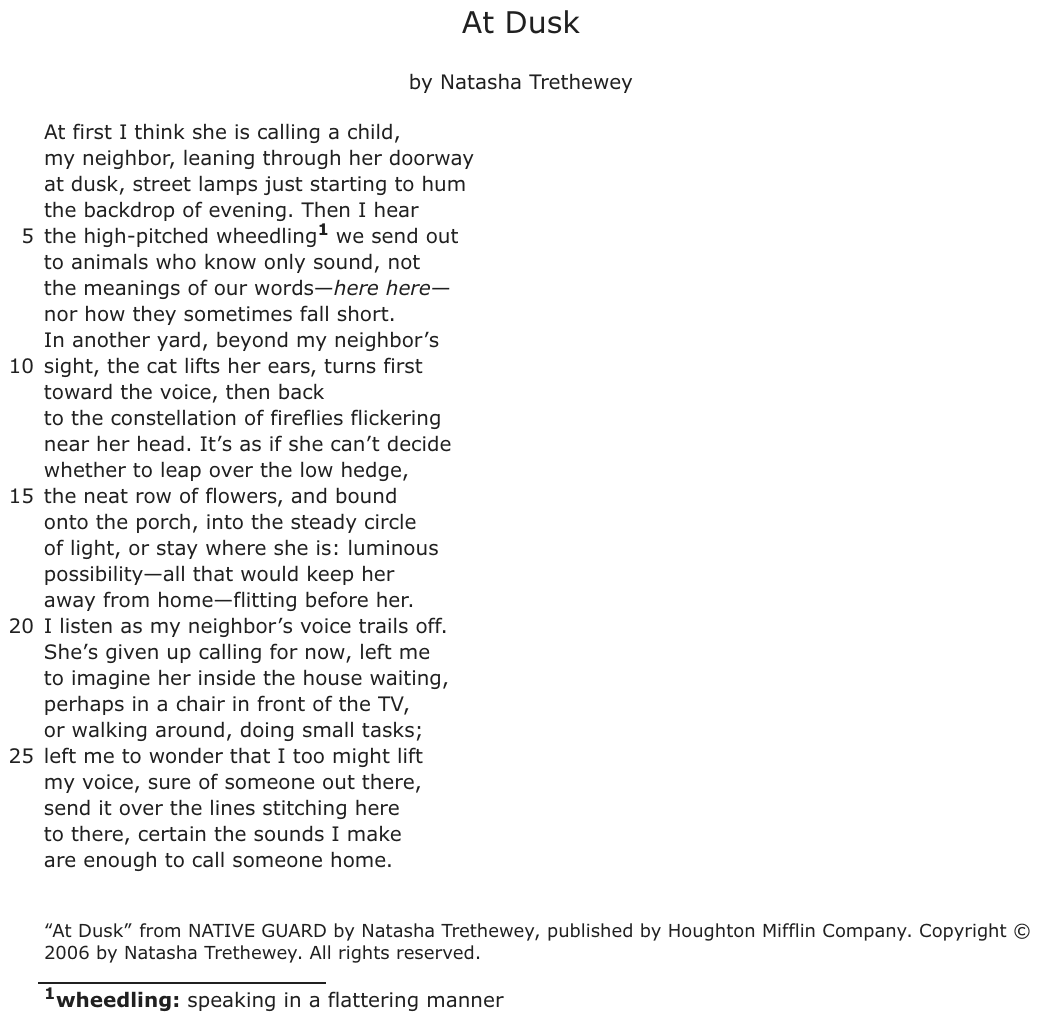
Question 26 of 57
2025 Practice Test B English, question 26Uses the passage above: “At Dusk”.
Question
The isolation of the words “—here here—” in line 7 contributes to the meaning of the poem mainly by
- Ademonstrating how people try to communicate in familiar ways but are still sometimes misunderstood.
- Bshowing how people can feel desperate to connect with others but give up quickly when their first attempts are ignored.
- Cusing the unspoken bond between the neighbor and her cat to highlight the understanding people have with their pets.
- Dillustrating the use of a simple expression to call home those who are loved and missed.
Show the answer
Correct answer: D
The question asks how the isolation of the words “—here here—” in line 7 mainly contributes to the meaning of the poem.
A. Incorrect. The words “—here here—” do interrupt the speaker’s observation in lines 7–8 that “our words . . . / . . . sometimes fall short.” However, in lines 5–7, the speaker observes that the neighbor accompanies her words with a “high-pitched wheedling” that people “send out” because they are aware that animals “know only sound, not / the meanings of our words,” indicating that the neighbor does not actually expect her words to be understood. The description of the cat’s response in lines 10–11 (“the cat lifts her ears, turns first / toward the voice, then back”) does not suggest that the neighbor’s message is misunderstood but rather suggests that the cat prefers not to respond to it.
B. Incorrect. In lines 20–21, the “neighbor’s voice trails off,” and she does give up calling the cat. However, rather than any desperation to connect, the neighbor’s use of a “high-pitched wheedling” (line 5) simply indicates her understanding that the cat, like other animals, understands “only sound, not / the meanings of our words” (lines 6–7) such as “here here.” Furthermore, the neighbor does not give up quickly. In lines 21–22, the speaker says the neighbor has “given up calling for now” but is still “waiting” for the cat.
C. Incorrect. In lines 4–7, the speaker describes the neighbor calling to the cat with a “high-pitched wheedling.” The sound may indicate a bond between the neighbor and the cat because the neighbor does understand that animals “know only sound, not / the meanings of our words” (lines 6–7). However, the use of the words “here here” in line 7 does not indicate that bond, because they are used as an example of the type of words that animals do not understand.
D. CORRECT. The speaker’s initial thought in line 1 that the neighbor is calling a child, rather than a cat, suggests that the neighbor loves and misses the cat. Lines 4–7 then present the speaker’s observation that the neighbor uses a “high-pitched wheedling,” to emphasize the simple words of her call, “—here here—.” The idea that the words are an example of a simple expression used to call home a missed loved one is reinforced in lines 25–29, when the speaker is “left . . . to wonder” whether the speaker, too, “might lift / [his or her] voice” and be able “to call someone home.”
Question analysis
This reading question asks how setting off the words here here with dashes in line 7 adds to the meaning of At Dusk, Natasha Trethewey's poem about a neighbor calling her cat at nightfall. Students must work out what two plain, isolated words contribute to the whole poem, choosing among four readings about how people and animals communicate and connect.
- Grade level
- Grade 8 reading and task
- Compared with grade 7
- Above grade 7 Grade 7 students explain how a line adds to a poem, but here the feature is a tiny typographic choice, and its meaning has to be built from the whole poem rather than nearby lines, which goes beyond typical grade 7 work.
- Estimated difficulty
- Among the hardest on the SHSAT: a non-obvious approach, heavy reading, or a well-hidden trap.
- Thinking it demands
- Depth of knowledge 3, strategic thinking · mainly analyze
- What makes it hard
- A very close wrong answer major
- Evidence in several places moderate
- How, not what moderate
- Evidence
- Answered from the whole text
- Reading level
- Passage: 236 words (a poem; reading level not measured); question and choices: about grade 9, 87 words.
- Corrected from the DOE handbook
- A grammar slip in the explanation was corrected.
- Students, last 30 days
- Not enough answers yet to show (it takes 10).
Why it is hard, traps and wrong answers (shows the answer)
Why it is hard
The words sit inside a sentence about animals not knowing the meanings of our words and about words that “sometimes fall short,” so the nearest lines point toward miscommunication. The poem's frame points elsewhere: it opens with a call that sounds like a parent's, ends with the speaker hoping a voice can “call someone home,” and even repeats “here” in line 27. Students who read only around line 7 choose the misunderstanding; those who connect the isolated call to the first and last lines see what it is for.
A very close wrong answer major Choosing the answer
The misunderstanding choice and the right one agree that “here here” is a familiar way of calling; they part only on what it shows, failed communication or a call home to someone missed. (Embretson & Wetzel, 1987; Gorin & Embretson, 2006; Ascalon et al., 2007)
Evidence in several places moderate Working it out
The right reading rests on lines far from line 7: the speaker's first guess that a child is being called, and the last line's wish “to call someone home.” (Kirsch & Mosenthal, 1990; Gorin & Embretson, 2006)
How, not what moderate Working it out
The question asks what setting two words apart with dashes and italics does for the poem, a typographic choice whose purpose the poem never explains. (Anderson & Krathwohl, 2001)
Strategy: Ask what the two words are meant to do and whom they are aimed at, then keep the choice that the poem's other lines confirm.
Traps
- Wrong purpose or structure: Names a purpose, structure or effect that the part does not serve, or describes what a part says when the question asks what it does.
- Twists what the text says: Uses the text's topic and ideas but changes what it says: who did it, how much, when, or why.
- Reads too much in: A reasonable-sounding conclusion that goes further than the text allows.
The wrong answers, classified
A Wrong purpose or structure (Anderson & Krathwohl, 2001)
Reads the words through line 8's “sometimes fall short” as failed communication, but the cat does hear and turn toward the call, and the ending hopes such sounds can bring someone home.
B Twists what the text says (King et al., 2004)
Sees the neighbor stop calling and calls her desperate and quick to quit, though she has given up only “for now” and is still waiting inside.
C Reads too much in (Graesser, Singer & Trabasso, 1994)
Assumes an owner and a pet share a silent understanding, but “here here” is spoken aloud, and the poem offers it as words animals cannot follow.
What was corrected from the DOE handbook, and why
- Explanation: In rejecting choice C, the handbook reads “the use of the words “here here” in line 7 do not indicate that bond.” It now reads “does not,” to agree with “use.”
Working it out, step by step
Figure out what the question asks
In line 7 the words here here are set apart by dashes and slanted letters (italics). The question asks what this does for the poem’s meaning. Think about what the words are for and who they are aimed at.
Look at line 7
Line 7 reads “the meanings of our words—here here—.” These are the words the neighbor calls to her cat. Setting them apart lets you hear them, as if spoken aloud. They are simple words that mean “come here.” Lines 6–7 say animals know “only sound, not / the meanings of our words.”
Connect to the start and end
In line 1 the speaker first thinks the neighbor “is calling a child.” So the call sounds like a parent calling someone they love. The poem ends with the hope that a voice can be “enough to call someone home” (line 29). So here here is a simple call to bring a loved one home.
Check each choice
- A is wrong. The cat isn’t confused. She “lifts her ears” and turns “toward the voice.” She just doesn’t come yet.
- B is wrong. The neighbor isn’t shown as desperate. She stops only “for now,” and the speaker pictures her waiting inside.
- C is wrong. Here here is spoken out loud. The poem treats it as words animals don’t understand, not a silent bond.
- D is right. It is a simple call to someone loved and missed.
Watch out: Line 8 says words “sometimes fall short,” which points toward A. But read the first and last lines too.
Choose the answer
The two words stand for the simple call people use to bring loved ones home. So the answer is D.
Why this answer and not the closest wrong one
A is the closest wrong answer, because line 8 says our words “sometimes fall short.” But the cat does hear the call and turn toward it. And the poem ends by hoping the sounds “are enough to call someone home.” D links the two words to that wish, and to the first guess that a child is being called.
More questions like this
The original DOE question
Question 27 of 57
2025 Practice Test B English, question 27Uses the passage above: “At Dusk”.
Question
The details in lines 10–17 about the cat convey a central idea of the poem by
- Ashowing that returning home after experiencing independence is challenging.
- Bsuggesting that caring for others means allowing them to grow and to roam freely.
- Cimplying that expecting to feel at home in the natural world leads to disappointment.
- Demphasizing the conflicting desires to return to the familiar and to explore the unknown.
Show the answer
Correct answer: D
The question asks how the details in lines 10–17 convey a central idea of the poem.
A. Incorrect. In lines 10–17, the speaker says that the cat’s actions—she “turns first / toward the voice, then back”—make the cat seem “as if she can’t decide” whether to return home or to explore “the constellation of fireflies flickering / near her head.” However, while the cat is indecisive, it is not the experience of independence that causes this conflict for the cat but rather the “luminous / possibility . . . flitting before her” (lines 17–19).
B. Incorrect. The neighbor’s calling of the cat indicates that she does allow it to roam outside regularly. However, the details in these lines focus not on whether allowing the cat to roam is an expression of caring but on the cat’s reaction to the neighbor’s calls, “as if she can’t decide” (line 13) whether to return home “into the steady circle / of light” (lines 16–17) or stay and enjoy the “luminous / possibility” (lines 17–18) that the night offers. Furthermore, the neighbor’s “wheedling” (line 5) and the timing of her call, “at dusk” (line 3), introduce the possibility that encouraging others to come home expresses more caring than allowing them to roam freely.
C. Incorrect. Lines 10–17 describe the reactions of the cat, who is exploring the natural world, including a “constellation of fireflies flickering / near her head,” when the neighbor calls to her. The poet describes the cat’s conflict by saying that “It’s as if she can’t decide” whether to stay outdoors or return “into the steady circle / of light” at home with the neighbor. However, the cat’s indecision demonstrates that, rather than being a disappointment, the natural world is as appealing as home.
D. CORRECT. Lines 10–11 describe how the cat “turns first / toward the voice, then back,” indicating that the cat is experiencing a conflict. To the speaker, the cat seems “as if she can’t decide” (line 13) between exploring “the constellation of fireflies” (line 12) outdoors and returning to the familiar “steady circle / of light” (lines 16–17) indoors. This central idea that someone might experience a conflict between exploring and returning to the familiar is suggested again in lines 28–29 when the speaker wonders whether “the sounds I make / are enough to call someone home.”
Question analysis
This reading question asks how the lines describing a cat in another yard, as the neighbor calls from her doorway, convey a central idea of Natasha Trethewey's poem At Dusk. Students must turn a concrete picture of an animal's behavior into a general idea and check each proposed lesson against what the cat actually does in these lines.
- Grade level
- Grade 7 reading and task
- Compared with grade 7
- At grade 7 Showing how specific lines convey a central idea is grade 7 work. The cat's behavior is concrete and easy to picture, so the step from image to idea is a typical grade 7 poetry task.
- Estimated difficulty
- Moderate: several steps, or a close reading with one strong distractor.
- Thinking it demands
- Depth of knowledge 2, skills and concepts · mainly understand
- What makes it hard
- Figurative or literary language moderate
- Reading between the lines minor
- Evidence
- Answered from one paragraph or stanza
- Reading level
- Passage: 236 words (a poem; reading level not measured); question and choices: about grade 9, 66 words.
- Corrected from the DOE handbook
- A grammar slip in the explanation was corrected.
- Students, last 30 days
- Not enough answers yet to show (it takes 10).
Why it is hard, traps and wrong answers (shows the answer)
Why it is hard
The lines show a cat turning toward the voice and back to the fireflies, then hesitating between the porch light and the night, so the idea is a pull in two directions. The most tempting wrong answer also describes trouble going home but explains it by time spent away, a cause these lines never give. Other choices bring in lessons about caring for pets or about nature letting us down, which the bright images of the night contradict.
Figurative or literary language moderate Understanding the question
The two pulls are images, “the constellation of fireflies flickering” for the unknown and “the steady circle / of light” on the porch for the familiar, and both must be read that way. (Graesser, Singer & Trabasso, 1994; Kintsch, 1998)
Reading between the lines minor Working it out
Students must turn one cat's hesitation in a yard into an idea about people, a step these lines leave to the reader until the speaker's own wish at the end of the poem. (Graesser, Singer & Trabasso, 1994; Kintsch, 1998)
Strategy: Describe in plain words what the cat does in lines 10–17 and why, then choose the general idea that matches that behavior without adding causes the lines never give.
Traps
- Half right: One half of a two-part choice is right and the other is not.
- Outside knowledge: A choice is plausible in the real world but not supported by this text.
- Twists what the text says: Uses the text's topic and ideas but changes what it says: who did it, how much, when, or why.
The wrong answers, classified
A Half right (King et al., 2004; Thissen, Steinberg & Fitzpatrick, 1989)
Rightly sees that going home is hard for the cat but blames a taste of independence, when the lines show her drawn by the fireflies now, not changed by time away.
B Outside knowledge (King et al., 2004; Recht & Leslie, 1988)
Brings in a familiar belief that caring means letting loved ones roam, but lines 10–17 describe the cat's choice, not how the neighbor shows care.
C Twists what the text says (King et al., 2004)
Turns the poem's picture of nature upside down: the fireflies and the “luminous / possibility” make the outdoors appealing, not a source of disappointment.
What was corrected from the DOE handbook, and why
- Explanation: In rejecting choice A, the handbook reads “the cat’s actions—she “turns first / toward the voice, then back”—makes the cat seem.” It now reads “make,” to agree with “actions.”
Working it out, step by step
Figure out what the question asks
Lines 10–17 are about the cat. A central idea is a main message of the poem. You need the idea that these details about the cat show.
Read what the cat does
The cat “lifts her ears, turns first / toward the voice, then back / to the constellation of fireflies flickering / near her head” (lines 10–13). Then the speaker says, “It’s as if she can’t decide” (line 13). She could leap “onto the porch, into the steady circle / of light” (lines 16–17). Or she could “stay where she is” (line 17).
Work out what it means
The porch light is home. It is familiar, something the cat knows well. The fireflies are like a “constellation,” a group of stars. They stand for the unknown night and its wonders. The cat is pulled both ways. Part of her wants home. Part of her wants to stay out and explore.
Check each choice
- A is wrong. Going home is hard for the cat. But the reason is the fireflies near her now. The lines never say she got used to being free.
- B is wrong. These lines are about the cat’s choice. They say nothing about caring for her or letting her roam.
- C is wrong. Nature is not disappointing here. The fireflies make the outdoors glow.
- D is right. The cat is torn between the familiar porch and the unknown night.
Watch out: A sounds close, because the cat really does have trouble going home. But A adds a cause the poem never gives.
Choose the answer
The cat turns toward home and then back to the fireflies. So the answer is D.
Why this answer and not the closest wrong one
A is the closest wrong answer. It is right that going home is hard for the cat. But A blames a taste of freedom from time spent away. The poem says nothing about that. It shows two pulls at once: the voice and light of home, and the fireflies close by. D names both desires.
More questions like this
The original DOE question

Question 28 of 57
2025 Practice Test B English, question 28Uses the passage above: “At Dusk”.
Question
The phrases “luminous possibility” and “all that would keep her / away from home” (lines 17–19) affect the poem by
- Ahighlighting the cat’s lack of concern for the neighbor.
- Bimplying that the speaker finds the cat’s current situation interesting.
- Csuggesting that the cat is compelled by its sense of wonder to remain outdoors.
- Dindicating that the speaker supports the cat’s decision to ignore the neighbor.
Show the answer
Correct answer: C
The question asks how the phrases “luminous possibility” and “all that would keep her / away from home” (lines 17–19) affect the poem.
A. Incorrect. In lines 20–21, the neighbor’s voice “trails off,” and the speaker states that “she’s given up calling for now,” which could be interpreted as a lack of concern. However, these lines describe the neighbor rather than the cat. The phrases from lines 17–19 are used to explain that what keeps the cat from returning home is the allure of “luminous possibility.” The use of the phrase “all that would keep her” suggests that the cat would likely return home to the security of “the steady circle / of light” (lines 16–17) if not for the possibilities offered by the night, implying that the cat usually prefers to be at home with the neighbor. The phrases do not highlight a lack of concern for the neighbor on the part of the cat.
B. Incorrect. While the phrase “luminous possibility” does convey a high degree of interest, it is used to describe why being outside at night appeals to the cat. It does not describe the speaker’s interest in the cat. The speaker observes the cat as it tries to decide between returning home and staying out and then concludes that it is only “luminous / possibility . . . that would keep [the cat] / away from home.”
C. CORRECT. The phrases are used to explain that the cat, though tempted to return home, is also tempted or compelled by “luminous possibility” to remain outdoors. The phrases convey a sense of wonder about what the night may offer, and it is the powerful effect of this sense of wonder (“all that would keep her / away from home”) that ultimately tempts the cat to remain outdoors rather than return to the comforts of home.
D. Incorrect. Lines 17–19 present the speaker’s observations about the cat as it tries to decide whether to stay where it is or return home. The speaker explains that it is only “luminous possibility” that can convince the cat to stay rather than return to the comforts of home. While the speaker then imagines the neighbor indoors, there is no indication that the speaker supports the cat’s decision. The speaker merely notes that the neighbor stops calling to the cat “for now” (line 21), and then the speaker reflects on the possible results of calling someone home.
Question analysis
This reading question asks how the phrases luminous possibility and all that would keep her away from home, which describe what surrounds a cat in a nearby yard, affect the poem At Dusk. Students must interpret abstract, figurative wording and work out whose feelings it conveys: the cat's, the neighbor's or the speaker's.
- Grade level
- Grade 8 reading and task
- Compared with grade 7
- At grade 7 Explaining how word choice affects a poem is grade 7 work. These phrases are abstract and broken across lines, which adds some challenge, but the lines around them are concrete, so the task stays within typical grade 7 demand.
- Estimated difficulty
- Moderate: several steps, or a close reading with one strong distractor.
- Thinking it demands
- Depth of knowledge 2, skills and concepts · mainly analyze
- What makes it hard
- Figurative or literary language moderate
- Reading between the lines minor
- Complex sentences minor
- Evidence
- Answered from one paragraph or stanza
- Reading level
- Passage: 236 words (a poem; reading level not measured); question and choices: about grade 8, 63 words.
- Students, last 30 days
- Not enough answers yet to show (it takes 10).
Why it is hard, traps and wrong answers (shows the answer)
Why it is hard
The phrases belong to the speaker but describe what tempts the cat, and the choices exploit that by offering the speaker's interest or approval, or the cat's indifference to its owner. The words “all that would keep her / away from home” imply that home still pulls at the cat, so only an attraction strong enough to hold her outside fits. Students who first settle whose experience the phrases describe can rule out most choices at once.
Figurative or literary language moderate Understanding the question
“Luminous possibility” is abstract, an unnamed promise glowing in the dusk, and students must see it as what draws the cat, the counterweight to “the steady circle / of light” at home. (Graesser, Singer & Trabasso, 1994; Kintsch, 1998)
Reading between the lines minor Working it out
The phrases are the speaker's words about the cat, so students must work out that they convey the cat's pull, not the speaker's opinion or the neighbor's feelings. (Graesser, Singer & Trabasso, 1994; Kintsch, 1998)
Complex sentences minor Understanding the question
The phrases are broken across lines 17–19 and set off by dashes, so “flitting before her” is separated from “possibility” by the inserted “all that would keep her / away from home.” (Abedi & Lord, 2001; Freedle & Kostin, 1993; Messick, 1989)
Strategy: Decide first who or what the phrases describe, then keep only choices about that same subject and check that the phrases themselves show what each one claims.
Traps
- Wrong tone or attitude: Misjudges the tone, attitude or point of view, such as reading admiration as criticism, or taking a character's or subject's feelings for the author's.
- Reads too much in: A reasonable-sounding conclusion that goes further than the text allows.
The wrong answers, classified
A Reads too much in (Graesser, Singer & Trabasso, 1994)
Reads the cat's staying out as indifference to its owner, though “all that would keep her / away from home” implies home would win without the night's attractions.
B Wrong tone or attitude (Graesser, Singer & Trabasso, 1994)
Notices that “luminous possibility” is the speaker's lyrical phrase and takes it as the speaker's own interest, when it describes the wonder drawing the cat.
D Reads too much in (Graesser, Singer & Trabasso, 1994)
Assumes that describing the night so warmly means the speaker approves of the cat ignoring the neighbor, an opinion the poem never states.
Working it out, step by step
Figure out what the question asks
You need to know what two phrases do in the poem. First decide who they describe. Here they describe the cat and what pulls at her.
Find the phrases in lines 17–19
The cat could go home, “or stay where she is: luminous / possibility—all that would keep her / away from home—flitting before her.”
Work out what the words mean
“Luminous” means glowing with light. “Possibility” means what might happen. “Flitting” means darting quickly about, like the fireflies near her head. So the glowing night is full of exciting chances. It is everything that “would keep her / away from home.” That sense of wonder is what holds the cat outside.
Check each choice
- A is wrong. “All that would keep her / away from home” means home pulls at her too. She isn’t uncaring.
- B is wrong. The phrases describe what draws the cat, not how the speaker feels.
- C is right. The night’s glow and wonder tempt the cat to stay out. “Compelled” means strongly pulled.
- D is wrong. The speaker never says the cat is right to stay out.
Watch out: B is tempting because “luminous possibility” is the speaker’s own beautiful wording. But the speaker uses it to show what the cat sees.
Choose the answer
The phrases show a wonder strong enough to hold the cat outdoors. So the answer is C.
Why this answer and not the closest wrong one
B is the closest wrong answer. The speaker does choose these glowing words. But they describe the night that is “flitting before her,” the cat. They explain what keeps her “away from home.” C fits, because the phrases show the cat drawn by wonder to stay outside.
More questions like this
The original DOE question
Question 29 of 57
2025 Practice Test B English, question 29Uses the passage above: “At Dusk”.
Question
Read lines 11–13 from the poem.
toward the voice, then back
to the constellation of fireflies flickering
near her head
Which idea from the poem does the imagery in these lines help convey?
- AThe cat lacks a preference for going in or staying out.
- BThe cat is eager to see what will happen next.
- CThe cat wants to understand the unpredictable behavior of the fireflies.
- DThe cat is fascinated by the natural world and finds the indoors unremarkable.
Show the answer
Correct answer: D
The question asks which idea the imagery in lines 11–13 helps convey.
A. Incorrect. Line 13 includes the speaker’s observation that the cat seems “as if she can’t decide” whether to stay outside or go to the neighbor. However, the imagery of the “constellation of fireflies flickering” in line 12 suggests that the cat does have a preference for exploring the more exciting “luminous / possibility” (lines 17–18) of the outdoors.
B. Incorrect. The imagery in lines 10–11 of the cat turning “first / toward the voice, then back” might seem to suggest that the cat is eagerly watching both the neighbor and the fireflies to see what will happen next. However, line 13, in which the cat seems “as if she can’t decide,” indicates that what will happen next is actually under the cat’s control.
C. Incorrect. The imagery in lines 12–13 of the “fireflies flickering / near her head” does indicate the fireflies’ unpredictable behavior. However, the imagery in lines 10–11 of the cat turning “first / toward the voice, then back” establishes that the cat’s attention is split between the fireflies and the “high-pitched wheedling” (line 5) of the neighbor’s voice, rather than being fully captured by wanting to understand the fireflies.
D. CORRECT. The imagery in line 12 of “the constellation of fireflies flickering” suggests that the outdoors holds fascinating attractions, an idea supported by the description in lines 17–18 of the cat’s current location outdoors as one filled with “luminous / possibility.” The imagery in lines 10–11 of the cat turning “first / toward the voice, then back” indicates that the cat has considered but rejected the option of returning indoors, and the description in lines 16–17 of the indoors as offering only a “steady circle / of light” suggests that the indoors seems unremarkable to the cat in comparison to the outdoors.
Question analysis
This reading question quotes three lines from At Dusk in which a cat turns from a calling voice back to fireflies flickering near her head, and asks which idea the imagery helps convey. Students must interpret a visual image in light of the lines around it and judge how far the poem supports each reading of the cat's attention.
- Grade level
- Grade 8 reading and task
- Compared with grade 7
- Above grade 7 Grade 7 students explain what imagery conveys, but this image is brief and the four ideas offered for it differ in subtle ways, so ruling them out takes closer reading than typical grade 7 work.
- Estimated difficulty
- Hard: combines ideas, needs a plan, and has more than one tempting wrong answer.
- Thinking it demands
- Depth of knowledge 3, strategic thinking · mainly analyze
- What makes it hard
- Reading between the lines major
- Figurative or literary language moderate
- Evidence in several places minor
- Evidence
- Answered from one paragraph or stanza
- Reading level
- Passage: 236 words (a poem; reading level not measured); question and choices: about grade 6, 77 words.
- Students, last 30 days
- Not enough answers yet to show (it takes 10).
Why it is hard, traps and wrong answers (shows the answer)
Why it is hard
The answer is the best available rather than a perfect one: its first half is plain in the image of the cat turning back to the fireflies, while its second half rests on the comparison with a steady porch light. Meanwhile the very next words say she “can't decide,” which makes indifference look like the safe reading. The question rewards seeing that being torn is not the same as having no preference, since the image shows which way she turns.
Reading between the lines major Working it out
The quoted lines never mention the indoors, so the claim that the cat finds it unremarkable has to be drawn from the contrast with “the steady circle / of light” in lines 16–17. (Graesser, Singer & Trabasso, 1994; Kintsch, 1998)
Figurative or literary language moderate Understanding the question
“The constellation of fireflies flickering” turns insects into a field of stars beside the cat's head, and that image of wonder is what students are asked to interpret. (Graesser, Singer & Trabasso, 1994; Kintsch, 1998)
Evidence in several places minor Working it out
The words right after the quotation say “It's as if she can't decide,” and the evidence that tips the balance sits in lines 16–19, outside the three lines quoted. (Kirsch & Mosenthal, 1990; Gorin & Embretson, 2006)
Strategy: Picture the cat's movements in these three lines, then test each choice against the words of lines 10–19 and drop any idea the image does not actually show.
Traps
- Twists what the text says: Uses the text's topic and ideas but changes what it says: who did it, how much, when, or why.
- Reads too much in: A reasonable-sounding conclusion that goes further than the text allows.
- Word match: Repeats striking words or phrases from the text, so it looks supported, but its meaning does not fit the question.
The wrong answers, classified
A Twists what the text says (King et al., 2004)
Takes “as if she can't decide” in line 13 to mean the cat has no preference, but being torn means feeling two pulls, and these lines show her turning back to the fireflies.
B Reads too much in (Graesser, Singer & Trabasso, 1994)
Reads the cat's turning back and forth as eager waiting for what will happen, though the lines show attention divided between two pulls, not suspense.
C Word match (Freedle & Kostin, 1993)
Repeats the fireflies' flickering from the image and invents a wish to understand their behavior, when the lines show fascination with the lights, not curiosity about insects.
Working it out, step by step
Figure out what the question asks
Imagery is language that helps you see, hear or feel a scene. You need the idea that the images in lines 11–13 help show.
Picture lines 10–13
The cat “turns first / toward the voice, then back / to the constellation of fireflies flickering / near her head.” A constellation is a group of stars that forms a picture. So the fireflies are like little stars blinking around her. She hears the call, but she turns back to them.
Compare outdoors and indoors
Outside, the night sparkles like stars. Lines 17–18 call it “luminous / possibility,” full of glowing chances. Home is “the steady circle / of light” on the porch (lines 16–17). Steady means it does not change. Next to the flickering stars, that light is plain. Unremarkable means not special.
Check each choice
- A is wrong. The cat “can’t decide,” but that means she feels two pulls. The image shows her turning back to the fireflies.
- B is wrong. She is not waiting for something to happen. Her attention is split between two pulls.
- C is wrong. She is drawn to the fireflies’ glow, not trying to figure out how they act.
- D is right. She is fascinated by the night, and the porch light is plain next to it.
Watch out: A is tempting because of line 13. But being torn is not the same as having no preference.
Choose the answer
The poem never says the cat has made up her mind. But the images make the night magical and home ordinary. That fits D best. So the answer is D.
Why this answer and not the closest wrong one
A is the closest wrong answer, since the next words say “It’s as if she can’t decide.” But a cat with no preference would not care either way. This cat turns back to the fireflies, which shows a strong pull. D fits that pull, and the plain “steady circle / of light” shows why home seems less special.
More questions like this
The original DOE question
Question 30 of 57
2025 Practice Test B English, question 30Uses the passage above: “At Dusk”.
Question
How does the setting affect the events of the poem?
- AIt enables the speaker to regularly overhear the neighbor calling for her cat at dusk.
- BIt allows the speaker to observe the neighbor quietly without interacting with her.
- CIt shows how living in close proximity helps the speaker feel connected to the neighbor.
- DIt shows how feeling isolated causes the speaker to imagine interactions with the neighbor.
Show the answer
Correct answer: B
The question asks how the setting affects the events discussed in the poem.
A. Incorrect. In line 2, the speaker refers to the woman calling for her cat as “my neighbor,” which clearly suggests that the speaker lives next door to the woman. However, although the two live next door to each other, line 1 suggests that perhaps the speaker does not regularly overhear the neighbor because the speaker initially thinks that the neighbor is “calling a child” and only later realizes the neighbor is calling to a cat. Although the setting places the speaker and the neighbor in close proximity, the poem does not indicate the frequency or regularity with which the speaker overhears the neighbor.
B. CORRECT. In the first four lines, the speaker observes the actions of the neighbor as the neighbor leans out to call for the cat at dusk. Despite the speaker’s observation of the neighbor, there is no indication that the neighbor notices the speaker. The reader can conclude that because of the time of day and the speaker being in the house next door, the speaker can observe the neighbor without being observed by her or having to interact with her.
C. Incorrect. The setting of the poem is a neighborhood at nightfall, as indicated by “at dusk” in line 3, the reference to “another yard” in line 9, and the flickering fireflies in line 12. However, while the speaker is close enough to the neighbor to overhear her calling to the cat, there is no indication that the speaker feels connected to the neighbor. Instead, the speaker expresses curiosity about the neighbor after the neighbor goes inside, and the speaker is “left . . . / to imagine her inside the house waiting” (lines 21–22). The fact the speaker initially thought that the neighbor was calling a child indicates that the speaker is not familiar with the neighbor and her habits, and there is no indication that the speaker feels connected to the neighbor.
D. Incorrect. In lines 22–24, the speaker imagines what the neighbor may be doing while the neighbor is waiting inside for the cat to return, but the speaker is imagining the neighbor’s solitary experience after the neighbor has momentarily “given up” on calling to the cat (line 21). The speaker does not imagine personally interacting with the neighbor but rather briefly imagines what the neighbor is doing at home while the cat is away.
Question analysis
This reading question asks how the setting of At Dusk, a neighborhood at nightfall where a woman leans from her doorway to call her cat, affects the events of the poem. Because so little happens, students must infer the setting's role from small details, and several choices sound reasonable without being supported by the poem.
- Grade level
- Grade 8 reading and task
- Compared with grade 7
- Above grade 7 Grade 7 students analyze how setting shapes events, usually in a story with a clear plot. This poem has almost no action, so the student must reason from a handful of details about place and time, which is harder than typical grade 7 work.
- Estimated difficulty
- Hard: combines ideas, needs a plan, and has more than one tempting wrong answer.
- Thinking it demands
- Depth of knowledge 3, strategic thinking · mainly analyze
- What makes it hard
- A very close wrong answer major
- Reading between the lines moderate
- Evidence
- Answered from the whole text
- Reading level
- Passage: 236 words (a poem; reading level not measured); question and choices: about grade 8, 67 words.
- Students, last 30 days
- Not enough answers yet to show (it takes 10).
Why it is hard, traps and wrong answers (shows the answer)
Why it is hard
Little happens in this poem, so the setting's role must be built from small details: a neighbor at her doorway at dusk, a cat in another yard, a speaker who hears and watches but never speaks. The strongest wrong answer is right about overhearing and wrong only in claiming it happens regularly, which the speaker's first mistaken guess argues against. The other choices supply a feeling of closeness or of isolation that the poem never states.
A very close wrong answer major Choosing the answer
The overhearing choice describes what the setting allows almost as well as the right one and fails on a single word, “regularly,” since the poem records one evening and the speaker first mistakes the call. (Embretson & Wetzel, 1987; Gorin & Embretson, 2006; Ascalon et al., 2007)
Reading between the lines moderate Working it out
The setting's effect is never stated; it has to be inferred from the speaker hearing and watching from nearby while the neighbor, “leaning through her doorway,” never seems to notice anyone. (Graesser, Singer & Trabasso, 1994; Kintsch, 1998)
Strategy: Picture the scene from the speaker's position, then check each choice word by word against the poem and reject any that claims something the poem never states.
Traps
- Too broad or too strong: A choice overstates, generalizes, or uses absolute words the text does not support.
- Reads too much in: A reasonable-sounding conclusion that goes further than the text allows.
- Twists what the text says: Uses the text's topic and ideas but changes what it says: who did it, how much, when, or why.
The wrong answers, classified
A Too broad or too strong (King et al., 2004)
Rightly sees that living next door lets the speaker overhear the call, but “regularly” is unsupported, and the first guess about a child suggests the call is unfamiliar.
C Reads too much in (Graesser, Singer & Trabasso, 1994)
Connects living close by with the poem's interest in connection and the speaker's “I too,” but the speaker never claims to feel close to the neighbor.
D Twists what the text says (King et al., 2004)
Notices the speaker picturing the neighbor indoors and calls it imagined interaction, but the speaker pictures her alone, waiting or doing small tasks, and never mentions feeling isolated.
Working it out, step by step
Figure out what the question asks
The setting is where and when a story or poem takes place. You need to see how the setting shapes what happens in the poem.
Picture the setting
It is “dusk” (line 3), the dim time just after sunset. The neighbor is “leaning through her doorway” (line 2). The cat is “In another yard” (line 9). The speaker is close enough to hear and watch it all. But the speaker never speaks to the neighbor. Nothing shows the neighbor notices the speaker.
Work out the effect
Living next door puts the speaker close by. In the fading light, the speaker can watch quietly. So the speaker sees the neighbor and the cat without joining in. The whole poem is what the speaker sees, hears and imagines from there.
Check each choice
- A is wrong. The word “regularly” is the problem. The poem shows one evening.
- B is right. The speaker watches from nearby and never talks with the neighbor.
- C is wrong. The speaker never says they feel close to the neighbor.
- D is wrong. The poem never says the speaker feels lonely. The speaker pictures the neighbor alone inside, not the two of them talking.
Watch out: A is almost right, since living nearby does let the speaker overhear. One word makes it wrong.
Choose the answer
The setting lets the speaker watch quietly from close by. So the answer is B.
Why this answer and not the closest wrong one
A is the closest wrong answer. Living next door does let the speaker hear the call. But nothing says it happens often. The poem tells about one evening. At first the speaker even thinks a child is being called. B fits what the poem shows: the speaker watches without ever talking to the neighbor.
More questions like this
The original DOE question

Question 31 of 57
2025 Practice Test B English, question 31Uses the passage above: “At Dusk”.
Question
The poet develops a theme about making connections with others mainly through the
- Aexploration of the desires of the speaker and the neighbor.
- Bspeaker’s observations of the sights and sounds in the neighborhood.
- Cspeculations the speaker makes about what the neighbor does inside her house.
- Dspeaker’s explanation of the cat’s thoughts and actions.
Show the answer
Correct answer: A
The question asks for an explanation of how the poet develops a theme about making connections with others.
A. CORRECT. The speaker first describes the neighbor calling the cat in a “high-pitched wheedling” (line 5) voice before giving up and returning indoors. The neighbor’s desire to have the cat return home prompts the speaker to wonder whether the speaker could call out and be “certain the sounds . . . / are enough to call someone home” (lines 28–29). These final lines most develop the theme of connection by conveying a desire to be able to prompt someone’s return.
B. Incorrect. Line 1, in which the speaker at first thinks the sound in the neighborhood is the neighbor “calling a child,” might be assumed to introduce a theme of making connections with others. However, other descriptions of the sights and sounds of the neighborhood, including the time of day—“at dusk, street lamps just starting to hum / the backdrop of evening” (lines 3–4) and “constellation of fireflies flickering” (line 12) near the cat—have no relationship to a theme of connection.
C. Incorrect. In lines 22–24, the speaker imagines the neighbor’s activities inside her house: “perhaps in a chair in front of the TV, / or walking around, doing small tasks.” Although the speaker does imagine the neighbor is doing these things to pass time while “waiting” (line 22) for the cat, the neighbor’s actions—and even the speaker’s imagining—are carried out alone, so they do not develop a theme of connection.
D. Incorrect. Lines 10–19 present the speaker’s observations of the cat, which “turns first / toward the voice, then back” when the neighbor calls, then appears “as if she can’t decide” whether to return to the neighbor or stay outside. Although the cat’s indecision about whether to heed the neighbor’s call might seem to develop a theme about making connections, lines 10–19 focus more on the relative appeal of the cat’s two options—returning to “the steady circle / of light” at home or pursuing the “luminous / possibility . . . flitting before her”—than on any connection between the cat and its owner or between the speaker and the neighbor.
Question analysis
This reading question asks which element of Natasha Trethewey's poem At Dusk mainly develops its theme about making connections with others. All four choices describe something that really happens in the poem, from neighborhood sights to a cat's hesitation, so students must weigh how much each part contributes to that theme.
- Grade level
- Grade 8 reading and task
- Compared with grade 7
- Above grade 7 Analyzing how a theme develops is grade 7 work, but here the student must rank four genuine features of the poem by how much each builds the theme, a comparison that asks more than typical grade 7 work.
- Estimated difficulty
- Hard: combines ideas, needs a plan, and has more than one tempting wrong answer.
- Thinking it demands
- Depth of knowledge 3, strategic thinking · mainly analyze
- What makes it hard
- Every choice must be checked moderate
- Evidence in several places moderate
- The right answer is reworded minor
- Evidence
- Answered from the whole text
- Reading level
- Passage: 236 words (a poem; reading level not measured); question and choices: about grade 8, 53 words.
- Students, last 30 days
- Not enough answers yet to show (it takes 10).
Why it is hard, traps and wrong answers (shows the answer)
Why it is hard
The question asks what mainly carries the theme, and every choice is a real part of the poem, so ruling choices out means ranking them, not spotting errors. The cat takes up the most lines and is the one being called home, which makes it the strongest lure, though its lines are about her choice between two places. What builds the theme is the neighbor's wish to bring the cat home, echoed by the speaker's wish to call someone home.
Every choice must be checked moderate Choosing the answer
All four choices name something that really fills the poem, so each must be weighed by how much it builds the theme of connection, not by whether it is there. (Embretson & Wetzel, 1987)
Evidence in several places moderate Working it out
The theme is built from the two ends of the poem: the neighbor calling and then waiting in lines 1–8 and 20–22, and the speaker's wish in lines 25–29 to send a voice out. (Kirsch & Mosenthal, 1990; Gorin & Embretson, 2006)
The right answer is reworded minor Choosing the answer
The right choice speaks of “desires,” a word the poem never uses, while the wrong ones echo its sounds, the neighbor's house and the cat. (Freedle & Kostin, 1993; Kirsch & Mosenthal, 1990)
Strategy: For each choice, find the lines it refers to and ask how directly they bear on making connections with others; keep the choice whose lines do so most fully.
Traps
- Wrong part of the text: A choice is true of another paragraph, stanza or speaker than the one asked about.
- Too narrow: A single detail offered as the central idea or a summary, or a summary that keeps minor details and leaves out an essential part.
- True but not the answer: A choice says something accurate about the text that does not answer this question.
The wrong answers, classified
B True but not the answer (King et al., 2004; Embretson & Wetzel, 1987)
Picks the poem's sights and sounds, the humming street lamps and the fireflies, which set the scene at dusk but are not where the poem says anything about reaching others.
C Too narrow (King et al., 2004)
Chooses the speaker picturing the neighbor in front of the TV, a real moment of imagining another life, but three lines of solitary tasks cannot carry the theme alone.
D Wrong part of the text (Kirsch & Mosenthal, 1990)
Notices how many lines follow the cat, the one being called home, but they weigh the porch light against the night, not one person reaching toward another.
Working it out, step by step
Figure out what the question asks
A theme is a big message about life. This poem has a theme about making connections, or reaching out to others. You need the part of the poem that mainly builds that theme.
Look at what the neighbor wants
The neighbor wants her cat to come home. She calls out at dusk with a “high-pitched wheedling” (line 5). Wheedling means sweet-talking. When she stops, the speaker pictures her “inside the house waiting” (line 22). Her wish is to reach the cat and bring her back.
Look at what the speaker wants
Her calling “left me to wonder that I too might lift / my voice” (lines 25–26). The speaker hopes the sounds “are enough to call someone home” (line 29). So the speaker wants to reach someone too. Both people wish to call someone back to them. That shared wish builds the theme of connection.
Check each choice
- A is right. The desires, or wishes, of the neighbor and the speaker carry the theme.
- B is wrong. The humming street lamps and the fireflies set the scene. They don’t show anyone reaching out.
- C is wrong. The guesses about the neighbor inside fill only three lines, and they show her alone.
- D is wrong. The cat lines weigh home against the night. They don’t show one person reaching another.
Watch out: D is tempting because the cat fills many lines. But they are about her choice, not about a connection.
Choose the answer
The poem builds its theme through what the neighbor and the speaker both want. So the answer is A.
Why this answer and not the closest wrong one
D is the closest wrong answer, since the cat takes up lines 10–19. But those lines weigh the porch light against the glowing night. The theme of connection comes from two wishes. The neighbor wants to call the cat home. The speaker wants to “call someone home” too. A names those desires.
More questions like this
The original DOE question

Question 32 of 57
2025 Practice Test B English, question 32Passage Using Fire to Keep a Prairie Healthy
Using Fire to Keep a Prairie Healthy
Inside the 40,000-acre Joseph H. Williams Tallgrass Prairie Preserve in northern Oklahoma, herds of bison roam on the scenic land that is home to hundreds of different species of plants and animals. While one of the greatest threats to the prairie is wildfire, the use of controlled fires is actually an effective way to protect this idyllic landscape.
Fires that are started by lightning or other natural circumstances are inevitable, and the results can be disastrous. However, hundreds of years ago the American Indian people who inhabited the Great Plains area between Minnesota and Texas realized that these fires could also be helpful. The bison in the area seemed to prefer grazing on tender new grass on the recently burned land rather than on grass in the unburned areas. The American Indian people began to deliberately burn areas of land for bison to graze on, which enticed the herds away from the people’s crops.
Today conservationists at the Tallgrass Prairie Preserve and farmers in the Great Plains continue to use controlled burns for land management. Intentionally burning a portion of land can dramatically improve the quality of the vegetation that regrows there. The fires burn away weedy undergrowth and help limit the overcrowding of shrubs and trees in the burn area, creating less competition for water and nutrients. Additionally, the process of burning excess plant matter adds nitrogen, an essential element for plant growth, to the soil.
One common target of controlled burns at the preserve and the surrounding area is the invasive red cedar tree. A single red cedar tree can consume up to 40 gallons of water per day, taking this vital resource away from other plant life. These tall trees also cast shade that prevents sunlight from reaching the plants beneath them. The fast-growing red cedar trees tend to crowd out prairie grasses, the primary food source for wild and domestic animals that make the prairie their home. An imbalance in one component of the prairie’s ecosystem affects the entire web of life. Controlled burns help maintain this ecosystem’s delicate balance.
Of course, these controlled fires are intended to burn only a portion of an area. A total burn, which is a risk with an uncontrolled wildfire, would destroy all wildlife as well as the crops farmers plant for income. The key to using controlled fires is knowing which areas of land to burn and when. Conservation experts at the preserve employ the “patch-burn” approach, meaning they rotate which portion of land is burned each year. They study the land to find out which areas would most benefit from being burned, and then they arrange about a dozen burns over one-third of the land. This patch burning contains the fire within a specific area and allows animals in the burn area to safely relocate. The following year, conservationists will burn a different section of the preserve, while the land burned the previous year regrows healthier than before.
Researchers have tracked and studied the variety of plant species and animals that live on the preserve, and their studies show that the patch-burn approach has restored biodiversity to the area by promoting the growth of species that were at risk of being crowded out. The patch-burn system is so successful that the conservationists at the preserve provide training to prairie farmers about conducting controlled burns on their own land. Burning land to make it healthy may seem counterintuitive, but strategic controlled fires have helped the prairie sustain life for hundreds of years and, with careful management, will continue to do so.
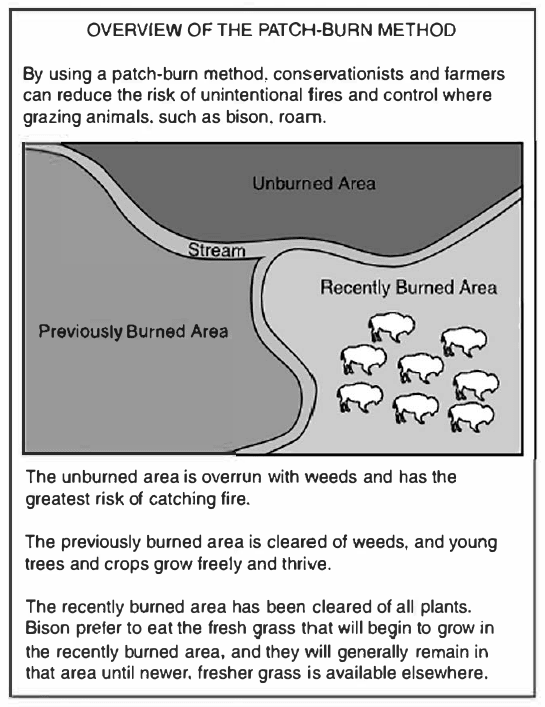
Question
According to the passage, how did fires started by natural causes prompt American Indians to begin practicing controlled burns?
- Aby drawing animals in to the area to feed on the new growth sprouting from the burned land
- Bby destroying tall trees and reducing the shade that had hindered the growth of planted crops
- Cby burning off excess vegetation and increasing the availability of nutrients for the remaining plants
- Dby causing changes to the bison’s migration habits as bison herds fled from the wildfires on the prairie
Show the answer
Correct answer: A
The question asks how observing the effects of the fires started by natural causes prompted American Indians to begin practicing controlled burns.
A. CORRECT. In paragraph 2, the author states that American Indians observed bison “grazing on tender new grass on the recently burned land rather than on grass in the unburned areas.” These observations prompted the practice of controlled burns as a means of enticing “the herds away from the people’s crops.”
B. Incorrect. Although the author mentions in paragraph 4 that the primary targets of a controlled burn are red cedar trees and that “these tall trees also cast shade that prevents sunlight from reaching the plants beneath them,” this detail supports why conservationists use controlled burns today, not what initially prompted the use of controlled burns.
C. Incorrect. While the author states in paragraph 3 that “the process of burning excess plant matter adds nitrogen, an essential element for plant growth, to the soil” and that “intentionally burning a portion of land can dramatically improve the quality of the vegetation that regrows there,” these details do not explain the initial observations that prompted American Indians to practice controlled burning.
D. Incorrect. While paragraph 2 mentions that bison moved to a new area to graze because they preferred the “tender new grass on the recently burned land,” there is no indication in the passage that bison changed their migration habits in order to flee wildfires.
Question analysis
This key-details question about an article on controlled burns at an Oklahoma tallgrass prairie preserve asks how fires started by lightning or other natural causes led American Indians to begin burning land on purpose. Students must find the passage's account of that early practice, and since the article describes several effects of fire, each choice has to be checked against what those first observers actually saw.
- Grade level
- Grade 7 reading and task
- Compared with grade 7
- At grade 7 Finding a stated cause in an informational text is regular grade 7 reading. The answer sits in one short paragraph, but the article describes several effects of fire, old and new, and the choices draw on them, which keeps the demand typical.
- Estimated difficulty
- Straightforward: two steps or one careful reading.
- Thinking it demands
- Depth of knowledge 2, skills and concepts · mainly understand
- What makes it hard
- Evidence
- Answered from one paragraph or stanza
- Reading level
- Passage: about grade 11, 598 words; question and choices: about grade 9, 86 words.
- Students, last 30 days
- Not enough answers yet to show (it takes 10).
Why it is hard, traps and wrong answers (shows the answer)
Why it is hard
The stem points to one short paragraph, but the article goes on to list many more benefits of fire, and two wrong choices borrow them: shade cleared from under red cedars and nutrients returned to the soil. Both are true of controlled burns today, not of what the Great Plains peoples first noticed. Students who return to paragraph 2 and restate the bison’s taste for freshly burned grass find the answer quickly.
Every choice must be checked minor Choosing the answer
Two wrong choices name real benefits of burning from later paragraphs, cedar shade removed in paragraph 4 and nutrients freed in paragraph 3, so each must be tested against what the early peoples saw. (Embretson & Wetzel, 1987)
Reading between the lines minor Working it out
Paragraph 2 never says the bison’s grazing caused the practice; students connect “realized that these fires could also be helpful” to the preference for burned land and the deliberate burns that follow. (Graesser, Singer & Trabasso, 1994; Kintsch, 1998)
Strategy: Go to the paragraph about the Great Plains peoples of hundreds of years ago, restate in your own words what they noticed after natural fires, and test each choice against that observation.
Traps
- Wrong part of the text: A choice is true of another paragraph, stanza or speaker than the one asked about.
- True but not the answer: A choice says something accurate about the text that does not answer this question.
- Twists what the text says: Uses the text's topic and ideas but changes what it says: who did it, how much, when, or why.
The wrong answers, classified
B Wrong part of the text (Kirsch & Mosenthal, 1990)
Borrows paragraph 4’s red cedars, whose shade blocks sunlight from the plants beneath them, and adds “planted crops,” though that shade explains modern burns, not the first deliberate ones.
C True but not the answer (King et al., 2004; Embretson & Wetzel, 1987)
States paragraph 3’s real benefits, weedy undergrowth burned away and nitrogen added to the soil, but the article gives them as reasons for burning today, not as what the early peoples observed.
D Twists what the text says (King et al., 2004)
Remembers that bison moved onto burned land but turns their preference for “tender new grass” into herds fleeing wildfire, a change in migration the passage never describes.
Working it out, step by step
Figure out what the question asks
This question asks about a cause. Long ago, fires started by lightning gave American Indians an idea. They began to burn land on purpose. You need to find what they saw that led them to do it. A controlled burn is a fire that people set and keep inside a planned area.
Find the right paragraph
Paragraph 2 tells this part of the story. It says the people “realized that these fires could also be helpful.” Then it says what they noticed: “The bison in the area seemed to prefer grazing on tender new grass on the recently burned land rather than on grass in the unburned areas.”
Put it in your own words
Grazing means eating grass. After a fire, soft new grass grew, and the bison liked it best. So the people began to burn land on purpose. The new grass pulled the herds to that land. That kept the bison away from the crops. The paragraph says the burning “enticed the herds away from the people’s crops.” Enticed means tempted or drew.
Check each choice
- A is right. The burned land drew animals, the bison, to eat the new grass.
- B is wrong. The shade of tall trees comes from paragraph 4. It explains why people burn red cedars today, not how burning began.
- C is wrong. Burning off weeds and adding nutrients come from paragraph 3. Nutrients are what plants need to grow. These are reasons for burning today.
- D is wrong. The bison moved toward the fresh grass. The passage never says herds fled from fires.
Watch out: C is true about controlled burns. But the question asks what first gave the people the idea. Paragraph 2 says it was the bison.
Choose the answer
The early people saw bison come to burned land to eat the new grass. So the answer is A: “by drawing animals in to the area to feed on the new growth sprouting from the burned land.”
Why this answer and not the closest wrong one
C is the closest wrong answer, because it names real good effects of fire. But paragraph 3 gives those as reasons people burn land “today.” The question asks how burning began hundreds of years ago. Paragraph 2 says it began when people watched bison feed on burned land.
More questions like this
The original DOE question
The passage “Using Fire to Keep a Prairie Healthy” as printed (page 41)
Question 33 of 57
2025 Practice Test B English, question 33Uses the passage above: “Using Fire to Keep a Prairie Healthy”.
Question
Targeting red cedar trees in controlled burns affects the animals that live on the prairie mostly by
- Aensuring that the animals’ main food source has the conditions needed for it to thrive.
- Bendangering the animals that live near the trees scheduled for removal.
- Cmaking sure that the water supply for the animals is sufficient.
- Dreducing the animals’ natural source of shade and protection from the elements.
Show the answer
Correct answer: A
The question asks how targeting red cedar trees in controlled burns affects the animals that live on the prairie.
A. CORRECT. According to information in paragraph 4, targeting invasive red cedar trees with controlled burns affects animals that live on the prairie by ensuring that these trees do not “crowd out prairie grasses, the primary food source for wild and domestic animals that make the prairie their home.” The paragraph also states that each red cedar tree consumes “up to 40 gallons of water per day, taking this vital resource away from other plant life.” Removing red cedars thus increases the amount of water available to the prairie grasses and helps maintain favorable conditions for the animals’ main source of food.
B. Incorrect. Although the author mentions the potential danger to wildlife from an uncontrolled burn in paragraph 5, the author emphasizes that patch burning “allows animals in the burn area to safely relocate.” Therefore, the animals that live near trees scheduled for removal are not endangered by the controlled burns.
C. Incorrect. In paragraph 4, the author states that “a single red cedar tree can consume up to 40 gallons of water per day, taking this vital resource away from other plant life.” However, the author does not suggest that reducing the number of red cedar trees through controlled burns ensures a sufficient water supply for animals that live on the prairie.
D. Incorrect. In paragraph 4, the author states that “these tall trees also cast shade that prevents sunlight from reaching the plants beneath them.” However, the author does not suggest that using controlled burns to eliminate red cedar trees reduces a natural source of shade for prairie animals. The red cedar trees are invasive; therefore, the author does not consider them a “natural” part of the prairie ecosystem.
Question analysis
This question asks how burning invasive red cedar trees on purpose mostly affects the wild and domestic animals that live on the Oklahoma prairie. Students follow a chain of cause and effect through the paragraph on red cedars, which describes the trees' heavy water use, their shade and their spread, and must pick out the effect that matters most to the animals.
- Grade level
- Grade 7 reading and task
- Compared with grade 7
- At grade 7 Grade 7 readers routinely trace how one change leads to another in an informational text. This chain stays within one paragraph, but the paragraph names several things the cedars take from the prairie, and the stem's “mostly” asks for the main effect.
- Estimated difficulty
- Moderate: several steps, or a close reading with one strong distractor.
- Thinking it demands
- Depth of knowledge 2, skills and concepts · mainly analyze
- What makes it hard
- Reading between the lines moderate
- Much to keep track of minor
- The right answer is reworded minor
- Evidence
- Answered from one paragraph or stanza
- Reading level
- Passage: about grade 11, 598 words; question and choices: about grade 9, 66 words.
- Students, last 30 days
- Not enough answers yet to show (it takes 10).
Why it is hard, traps and wrong answers (shows the answer)
Why it is hard
Paragraph 4 lists three harms the red cedar does, drinking water, casting shade and crowding out grasses, and the wrong choices hand the water and the shade straight to the animals. In the text, all three harms fall on plants, and animals feel them only through the grasses they eat. Students who ask who suffers each harm see that protecting the food supply is the main effect the stem’s “mostly” asks for.
Reading between the lines moderate Working it out
Paragraph 4 never names an effect on animals; students must chain the cedars crowding out “prairie grasses,” the grasses being “the primary food source,” and the burns that remove the cedars. (Graesser, Singer & Trabasso, 1994; Kintsch, 1998)
Much to keep track of minor Working it out
The paragraph names three harms at once, 40 gallons of water a day, shade over the plants below and crowding, and students must track which living things each harm reaches. (Sweller, 1988; Carpenter, Just & Shell, 1990)
The right answer is reworded minor Choosing the answer
The right choice speaks of “conditions needed for it to thrive” without naming grass or cedars, while the wrong ones repeat the paragraph’s vivid details of water and shade. (Freedle & Kostin, 1993; Kirsch & Mosenthal, 1990)
Strategy: Reread the paragraph about red cedars and list each way the trees harm the prairie, then ask which of those harms reaches the animals and which would matter to them most.
Traps
- Twists what the text says: Uses the text's topic and ideas but changes what it says: who did it, how much, when, or why.
- Outside knowledge: A choice is plausible in the real world but not supported by this text.
The wrong answers, classified
B Outside knowledge (King et al., 2004; Recht & Leslie, 1988)
Assumes that fire near animals must endanger them, a common belief, though paragraph 5 says patch burning “allows animals in the burn area to safely relocate.”
C Twists what the text says (King et al., 2004)
Seizes on the 40 gallons a red cedar drinks each day, but the passage says that water is taken from “other plant life,” not from the animals’ supply.
D Twists what the text says (King et al., 2004)
Turns the cedars’ shade, which blocks sunlight from “the plants beneath them,” into shelter for animals, though the passage treats the invasive trees as a harm, never a natural refuge.
Working it out, step by step
Figure out what the question asks
This question asks about cause and effect. People burn red cedar trees on purpose. You need to find how that mostly helps the animals. The word “mostly” means you want the biggest effect, not just any effect.
Find what the red cedars do
Paragraph 4 is about red cedars. It names three harms. First, one tree can drink “up to 40 gallons of water per day, taking this vital resource away from other plant life.” Second, the trees “cast shade that prevents sunlight from reaching the plants beneath them.” Third, they “tend to crowd out prairie grasses, the primary food source for wild and domestic animals.”
Ask who each harm hurts
Look at who loses each time. The water is taken from “other plant life.” The shade blocks light from “the plants beneath them.” The crowding pushes out prairie grasses. So every harm falls on plants. The animals feel it through the grass, because grass is their main food. Primary means main. So burning the cedars mostly helps the animals by protecting their food.
Check each choice
- A is right. The animals’ main food source is prairie grass. With the cedars gone, the grass gets water, sunlight and room to grow.
- B is wrong. Paragraph 5 says patch burning “allows animals in the burn area to safely relocate.” Relocate means move somewhere else.
- C is wrong. The cedars take water from plants. The passage never says the animals run short of water.
- D is wrong. The shade blocks light from plants. The passage never calls it shelter for animals.
Watch out: The 40 gallons of water is a striking fact, so C is tempting. But that water is taken from “other plant life.”
Choose the answer
Burning the cedars keeps the grass healthy, and the grass feeds the animals. Thrive means grow well. So the answer is A: “ensuring that the animals’ main food source has the conditions needed for it to thrive.”
Why this answer and not the closest wrong one
C is the closest wrong answer, because paragraph 4 does talk about water. But it says the cedars take water from plants, not from animals. The grass, the animals’ main food, is what suffers from all three harms. So A fits better.
More questions like this
The original DOE question
Question 34 of 57
2025 Practice Test B English, question 34Uses the passage above: “Using Fire to Keep a Prairie Healthy”.
Question
Read this sentence from paragraph 6.
The patch-burn system is so successful that the conservationists at the preserve provide training to prairie farmers about conducting controlled burns on their own land.
The author includes this sentence to show that
- Athe conservationists are better qualified to lead preservation efforts than farmers are.
- Bthe conservationists are eager to involve others in the preservation of the prairie.
- Cthe conservationists’ efforts will restore the original beauty and biodiversity of the region.
- Dthe conservationists’ training program should serve as a model for other conservation organizations.
Show the answer
Correct answer: B
The question asks what the author intends to show by using the second sentence in paragraph 6 in the passage.
A. Incorrect. Although the author refers to the conservationists as “experts” in paragraph 5 and states that conservationists “provide training to prairie farmers” (paragraph 6), the second sentence in paragraph 6 does not imply that the conservationists are better qualified to lead preservation efforts than farmers are. Instead, the sentence shows that conservationists believe that prairie farmers are capable of performing the controlled burns that contribute to overall conservation efforts.
B. CORRECT. The conservationists are eager to involve others in the preservation of the prairie, because “studies show that the patch-burn approach has restored biodiversity to the area by promoting the growth of species that were at risk of being crowded out” and that the process has “helped the prairie sustain life for hundreds of years” (paragraph 6). The second sentence in paragraph 6 describes how conservationists are sharing their knowledge about preservation techniques with people who live on the prairie.
C. Incorrect. Although the author points out in paragraph 6 that “studies show that the patch-burn approach has restored biodiversity to the area by promoting the growth of species that were at risk of being crowded out,” the idea that controlled burns may help restore the original biodiversity of the prairie is not the focus of the second sentence in paragraph 6, which notes only that conservationists are providing training to farmers about controlled burns.
D. Incorrect. The author mentions in paragraph 6 that the patch-burn system has been “successful” and suggests in the last sentence of the paragraph that the use of controlled burns will continue to benefit the prairie ecosystem. These details imply that this system will continue to be used and may even become more widespread. However, the second sentence in paragraph 6 merely describes a patch-burn training program that already exists and does not suggest that this program should serve as a model for other organizations.
Question analysis
This question quotes a sentence from the last paragraph of the prairie article, about the preserve's conservationists training farmers to run controlled burns on their own land, and asks why the author includes it. Students must work out what this one sentence contributes, and because every choice sounds like something a successful program might show, the test is whether the sentence itself supports it.
- NYS standards
- 7R5 structure and genre features
- Grade level
- Grade 7 reading and task
- Compared with grade 7
- At grade 7 Explaining why an author includes a sentence is everyday grade 7 work. The sentence is short and plainly worded, and the choices stay close to the passage's ideas, so each must be measured against what the sentence itself says.
- Estimated difficulty
- Moderate: several steps, or a close reading with one strong distractor.
- Thinking it demands
- Depth of knowledge 2, skills and concepts · mainly analyze
- What makes it hard
- How, not what moderate
- Reading between the lines moderate
- Evidence
- Answered from one sentence or line
- Reading level
- Passage: about grade 11, 598 words; question and choices: about grade 11, 89 words.
- Students, last 30 days
- Not enough answers yet to show (it takes 10).
Why it is hard, traps and wrong answers (shows the answer)
Why it is hard
Every choice reads something into one plain sentence, so the decision is how far the sentence lets a reader go. Teaching farmers to burn their own land shows a wish to spread the work, which the right choice calls eagerness to involve others. The wrong choices go further: to a ranking of experts over farmers, to restoring the region’s original beauty, or to a model for other organizations, none of which the sentence states.
How, not what moderate Working it out
The stem asks why the author includes the training sentence, so students must say what it adds after the studies of restored biodiversity, not merely restate that farmers are trained. (Anderson & Krathwohl, 2001)
Reading between the lines moderate Working it out
Nothing in the sentence calls the conservationists “eager”; that has to be read from their choosing to teach their method to farmers so that it spreads beyond the preserve. (Graesser, Singer & Trabasso, 1994; Kintsch, 1998)
Strategy: Restate the sentence in your own words, then ask what it adds to the paragraph's account of the patch-burn system's success, rejecting any choice that claims more than the sentence says.
Traps
- Reads too much in: A reasonable-sounding conclusion that goes further than the text allows.
- Wrong part of the text: A choice is true of another paragraph, stanza or speaker than the one asked about.
- Too broad or too strong: A choice overstates, generalizes, or uses absolute words the text does not support.
The wrong answers, classified
A Reads too much in (Graesser, Singer & Trabasso, 1994)
Reads experts training farmers as a ranking of who should lead, though the sentence shows trust that farmers can run burns themselves, not a claim of superior qualifications.
C Wrong part of the text (Kirsch & Mosenthal, 1990)
Draws on the sentence before, where studies show “the patch-burn approach has restored biodiversity,” and adds “original beauty,” though the training sentence itself is about sharing the method.
D Too broad or too strong (King et al., 2004)
Takes “so successful” as an endorsement and stretches one preserve’s training of local farmers into a model that other conservation organizations should follow, a recommendation the author never makes.
Working it out, step by step
Figure out what the question asks
This question asks why the author put one sentence in the passage. The sentence says the patch-burn system works so well that the preserve’s experts train farmers. You need to decide what that sentence shows, and no more.
Read the sentence closely
The sentence says “the conservationists at the preserve provide training to prairie farmers about conducting controlled burns on their own land.” Conservationists are people who work to protect nature. Conducting means carrying out. So the experts teach farmers to do the burns themselves.
Decide what it shows
Why would experts teach their method to others? Because they want more people to help. Their method works, so they share it. Then the burns can happen on farms too, not only at the preserve. That shows they want others to join in protecting the prairie. Preservation means keeping something safe and healthy.
Check each choice
- A is wrong. Teaching farmers shows trust that farmers can do it. It doesn’t say experts should lead instead of farmers.
- B is right. Training farmers brings more people into caring for the prairie.
- C is wrong. Restored biodiversity comes from the sentence before. Biodiversity means many kinds of living things. This sentence is about sharing the method.
- D is wrong. The author never says other groups should copy this program.
Watch out: The words “so successful” make D sound right. But the sentence only says the preserve trains local farmers. It doesn’t call the program a model for others.
Choose the answer
The experts share their method so farmers can help too. So the answer is B: “the conservationists are eager to involve others in the preservation of the prairie.”
Why this answer and not the closest wrong one
D is the closest wrong answer, because “so successful” sounds like high praise. But D adds an idea the sentence never states: that other groups should copy the program. B stays with what the sentence shows, experts teaching farmers so they can help.
More questions like this
The original DOE question
Question 35 of 57
2025 Practice Test B English, question 35Uses the passage above: “Using Fire to Keep a Prairie Healthy”.
Question
Which details from the passage best convey the central idea that using the patch-burn method is an effective way to protect and manage prairie land?
- Athe explanation that conservationists use the alternating burn pattern of the patch-burn method in order to allow the animals in the area to avoid the fire
- Bthe information that conservationists evaluate which land would most benefit from a controlled burn before applying the patch-burn method
- Cthe information that conservationists have determined that the patch-burn method has promoted the growth of species that were at risk of being crowded out
- Dthe explanation that conservationists are able to control the fire in the patch-burn method by arranging separate burns across the designated portion of land
Show the answer
Correct answer: C
The question asks which details from the passage best convey the central idea that using the patch-burn method is an effective way to protect and manage prairie land.
A. Incorrect. The author explains in paragraph 5 that “patch burning contains the fire within a specific area and allows animals in the burn area to safely relocate.” This explanation conveys two supporting ideas: the patch-burn method is controllable, and patch-burn fires do not pose a threat to animals. However, this explanation does not address the broader central idea that the patch-burn method is an effective way to protect and manage prairie land.
B. Incorrect. In paragraph 5, the author states that “the key to using controlled fires is knowing which areas of land to burn and when.” The author then provides information about how conservation experts “study the land to find out which areas would most benefit from being burned.” However, these details convey supporting ideas rather than the central idea that using the patch-burn method is an effective way to protect and manage prairie land.
C. CORRECT. In paragraph 3, the author states that “fires burn away weedy undergrowth and help limit the overcrowding of shrubs and trees in the burn area, creating less competition for water and nutrients.” Also, in paragraph 6, the author states that patch burning “has restored biodiversity to the area by promoting the growth of species that were at risk of being crowded out.” These details directly convey the central idea that using the patch-burn method is an effective way to protect and manage prairie land.
D. Incorrect. The author explains in paragraph 5 how conservationists “arrange about a dozen burns over one-third of the land,” which helps show how the patch-burn method is applied by conservationists. However, this is a supporting detail that conveys the idea that the burns are deliberately set and carefully controlled. This detail does not convey the central idea that using the patch-burn method is an effective way to manage and protect prairie land.
Question analysis
This evidence question on the article about controlled burns at an Oklahoma tallgrass prairie preserve asks which details best convey the central idea that the patch-burn method is an effective way to protect and manage prairie land. Every choice reports something the article really says about the method, so students must decide which details speak most directly to the central idea as stated.
- Grade level
- Grade 7 reading and task
- Compared with grade 7
- At grade 7 Matching details to a stated central idea is regular grade 7 work, and the article is short and clearly written. Each choice is a long, accurate description, so the work lies in judging relevance rather than truth, which is typical.
- Estimated difficulty
- Moderate: several steps, or a close reading with one strong distractor.
- Thinking it demands
- Depth of knowledge 2, skills and concepts · mainly evaluate
- What makes it hard
- Every choice must be checked moderate
- Evidence in several places minor
- A lot to read minor
- Evidence
- Answered from several paragraphs or stanzas
- Reading level
- Passage: about grade 11, 598 words; question and choices: about grade 13, 118 words.
- Students, last 30 days
- Not enough answers yet to show (it takes 10).
Why it is hard, traps and wrong answers (shows the answer)
Why it is hard
The central idea joins three words, protect, manage and effective, and each wrong choice speaks to protect or manage with a step in carrying out the method: keeping animals safe, choosing the land, controlling the fire. Only a result shows that the method is effective, and the one result offered is the return of species once at risk of being crowded out. Students who ask what each detail proves, not what it is about, separate how the method works from whether it works.
Every choice must be checked moderate Choosing the answer
All four choices report the patch-burn method accurately, the animals’ safe relocation, the study of the land, the dozen burns and the restored species, so truth rules none out; each must be tested for proof the method works. (Embretson & Wetzel, 1987)
Evidence in several places minor Working it out
Three choices come from paragraph 5, where the method is explained, while the result that shows it works, restored biodiversity, sits in paragraph 6, after the description ends. (Kirsch & Mosenthal, 1990; Gorin & Embretson, 2006)
A lot to read minor Understanding the question
Each choice is a noun phrase of 19 to 26 words opening “the explanation that” or “the information that,” so four long details must be unpacked before they can be compared. (Kintsch, 1998; Gorin & Embretson, 2006; Freedle & Kostin, 1993)
Strategy: Restate the central idea in your own words, noting what “effective” requires, then ask of each choice whether that detail would persuade a doubtful reader of the whole idea.
Traps
- Supports only part of the claim: In a question about evidence: a line that backs one half of the claim but not the other, or a related point rather than the claim itself.
The wrong answers, classified
A Supports only part of the claim (King et al., 2004; Thissen, Steinberg & Fitzpatrick, 1989)
Links “protect” in the central idea to the animals’ chance to “safely relocate” in paragraph 5, a true detail of how patch burns are run, not proof they improve the prairie.
B Supports only part of the claim (King et al., 2004; Thissen, Steinberg & Fitzpatrick, 1989)
Hears effectiveness in “would most benefit,” but experts studying the land before a burn shows how they plan where to burn, not that the burns have worked.
D Supports only part of the claim (King et al., 2004; Thissen, Steinberg & Fitzpatrick, 1989)
Connects “manage” and “protect” to fire kept under control by arranging “about a dozen burns over one-third of the land,” which shows how the method is applied, not what it achieves.
Working it out, step by step
Figure out what the question asks
This asks which details best support a central idea. A central idea is a main point the whole passage develops. Here the idea is given: the patch-burn method is an effective way to protect and manage prairie land. Effective means it works and gets good results. So look for details that show results, not just how the method is done.
Find how the method works
Paragraph 5 explains the patch-burn method. The experts “rotate which portion of land is burned each year.” Rotate means take turns. First, “They study the land to find out which areas would most benefit from being burned.” Then “they arrange about a dozen burns over one-third of the land.” This “contains the fire within a specific area and allows animals in the burn area to safely relocate.” These details tell how the method is done.
Find what the method achieves
Paragraph 6 gives the results. Researchers studied the plants and animals on the preserve. Their studies show “that the patch-burn approach has restored biodiversity to the area by promoting the growth of species that were at risk of being crowded out.” Biodiversity means many kinds of living things. A species is one kind of plant or animal. Crowded out means pushed aside, the way red cedars crowd out prairie grasses in paragraph 4. So the method helped species that were losing ground. That shows it works.
Check each choice
- A does not fit. Animals escaping safely shows the burns are done with care. It does not show the land gets healthier.
- B does not fit. Studying the land is a planning step before a burn. It shows how the experts choose, not whether the burns work.
- C fits. It reports a result: the method helped species that were at risk.
- D does not fit. Arranging a dozen burns shows how the fire is kept under control. It does not show what the burns achieve.
Watch out: D sounds like “manage,” since the experts control the fire. But controlling a fire is part of doing the method. Only a result proves the method is effective.
Choose the answer
Only one choice shows the patch-burn method getting good results. So the answer is C, “the information that conservationists have determined that the patch-burn method has promoted the growth of species that were at risk of being crowded out.”
Why this answer and not the closest wrong one
D is the closest wrong choice. Careful control sounds like good management. But D only describes how the burns are set up. A method can be done carefully and still fail. C gives the proof that it works: studies show the burns “restored biodiversity.” Paragraph 6 even calls the system “so successful.”
More questions like this
The original DOE question
Question 36 of 57
2025 Practice Test B English, question 36Uses the passage above: “Using Fire to Keep a Prairie Healthy”.
Question
Which sentence supports the idea that farmers and people who manage land may be concerned about using fire as a way to benefit the land?
- A“While one of the greatest threats to the prairie is wildfire, the use of controlled fires is actually an effective way to protect this idyllic landscape.” (paragraph 1)
- B“The American Indian people began to deliberately burn areas of land for bison to graze on, which enticed the herds away from the people’s crops.” (paragraph 2)
- C“This patch burning contains the fire within a specific area and allows animals in the burn area to safely relocate.” (paragraph 5)
- D“The following year, conservationists will burn a different section of the preserve, while the land burned the previous year regrows healthier than before.” (paragraph 5)
Show the answer
Correct answer: A
The question asks which sentence supports the idea that farmers and people who manage land may be concerned about using fire as a way to benefit the land.
A. CORRECT. The sentence from paragraph 1 supports the idea that farmers and people who manage land may be concerned about using fire as a way to benefit the land because it acknowledges that “one of the greatest threats to the prairie is wildfire.”
B. Incorrect. Although the sentence from paragraph 2 relates how American Indians “began to deliberately burn areas of land for bison to graze on” and to protect people’s crops, the sentence does not support the idea that farmers and people who manage land may be concerned about using fire as a way to benefit the land. Instead, it focuses on the cause-and-effect relationship between bison and newly burned areas.
C. Incorrect. The sentence from paragraph 5 provides details about how “patch burning contains the fire” and “allows animals in the burn area to safely relocate,” but it does not adequately support the idea that farmers and people who manage land may be concerned about using fire as a way to benefit the land, because it does not mention that wildfires can be a threat to the prairie.
D. Incorrect. While the sentence from paragraph 5 does explain how “conservationists will burn a different section of the preserve” in order to rotate the process year after year so that the burned land has time to regrow, the sentence does not support the idea that farmers and people who manage land may be concerned about using fire as a way to benefit the land because it does not mention the potential for total burns.
Question analysis
This evidence question asks which sentence from the article on controlled prairie burns supports the idea that farmers and others who manage land may be concerned about using fire to benefit it. The passage never states that concern directly, so students must infer it, and all four quoted sentences, taken from across the article, talk about burning land in some way.
- Grade level
- Grade 8 reading and task
- Compared with grade 7
- Above grade 7 Grade 7 evidence questions usually ask for support of an idea the text states. This idea, that people who manage land may worry about using fire, is never stated outright, so students must infer which sentence implies it, more than typical.
- Estimated difficulty
- Hard: combines ideas, needs a plan, and has more than one tempting wrong answer.
- Thinking it demands
- Depth of knowledge 3, strategic thinking · mainly evaluate
- What makes it hard
- Reading between the lines major
- A very close wrong answer moderate
- Every choice must be checked minor
- Evidence
- Answered from one sentence or line
- Reading level
- Passage: about grade 11, 598 words; question and choices: about grade 13, 123 words.
- Students, last 30 days
- Not enough answers yet to show (it takes 10).
Why it is hard, traps and wrong answers (shows the answer)
Why it is hard
The idea to support is about people’s feelings, yet none of the four sentences mentions farmers worrying, so students have to decide what would justify such worry. The opening sentence does it by naming wildfire as a great threat before praising controlled fire, a concession many students read past as background. The strongest pull is the sentence on containing the fire, which implies caution but presents patch burning as the answer, not the concern.
Reading between the lines major Working it out
No sentence mentions worry; students must see that calling wildfire “one of the greatest threats to the prairie” gives landowners a reason to fear fire, and that “actually” answers that fear. (Graesser, Singer & Trabasso, 1994; Kintsch, 1998)
A very close wrong answer moderate Choosing the answer
The patch-burn sentence about containing the fire “within a specific area” also hints at fire’s danger; it differs from the right one by describing the safeguard without ever naming a threat. (Embretson & Wetzel, 1987; Gorin & Embretson, 2006; Ascalon et al., 2007)
Every choice must be checked minor Choosing the answer
The four sentences come from paragraphs 1, 2 and 5, and each is about burning land, so each must be tested for a hint of risk rather than for its topic. (Embretson & Wetzel, 1987)
Strategy: Before rereading the choices, decide what a sentence would need to say to show that landowners have reason to be wary of fire, then test each quoted sentence for exactly that.
Traps
- Supports only part of the claim: In a question about evidence: a line that backs one half of the claim but not the other, or a related point rather than the claim itself.
- True but not the answer: A choice says something accurate about the text that does not answer this question.
The wrong answers, classified
B True but not the answer (King et al., 2004; Embretson & Wetzel, 1987)
Links “the people’s crops” to farmers, but the sentence tells how early burns drew bison away from the crops and shows no worry about fire itself.
C Supports only part of the claim (King et al., 2004; Thissen, Steinberg & Fitzpatrick, 1989)
Sees caution in containing the fire “within a specific area,” but the sentence explains how patch burning keeps animals safe and never says fire threatens the land.
D Supports only part of the claim (King et al., 2004; Thissen, Steinberg & Fitzpatrick, 1989)
Takes the yearly rotation as a careful precaution, but the sentence describes the schedule and land that “regrows healthier than before,” which backs the benefit, not the worry.
Working it out, step by step
Figure out what the question asks
This is an evidence question. Evidence is the words in a text that back up an idea. The idea here is that farmers might worry about using fire to help land. No sentence says farmers are worried. So look for a sentence that gives them a reason to fear fire.
Decide what the evidence needs
A sentence that supports this idea must show that fire can be dangerous. If fire can harm land, people have a reason to be careful with it. So test each sentence with one question: does it say fire is a threat?
Look closely at paragraph 1
Choice A quotes paragraph 1. Its first half says “one of the greatest threats to the prairie is wildfire.” That is a reason to fear fire. Its second half says controlled fires are “actually” helpful. The word “actually” pushes back against that fear. It means: you might expect fire to hurt the land, but here it helps.
Check each choice
- A is right. It names wildfire as a great threat. That gives farmers a reason to worry about fire.
- B is wrong. It tells how early burns drew bison away from crops. It shows no danger from fire.
- C is wrong. It tells how patch burning keeps the fire in one area. It describes a safety step but never names a threat.
- D is wrong. It describes burning a new section each year. It shows a benefit: land that “regrows healthier than before.”
Watch out: C hints that fire must be contained, or kept in, so it sounds careful. But it describes the solution, not the danger.
Choose the answer
Only one sentence names fire as a danger. So the answer is A, the sentence from paragraph 1: “While one of the greatest threats to the prairie is wildfire, the use of controlled fires is actually an effective way to protect this idyllic landscape.” Idyllic means peaceful and lovely.
Why this answer and not the closest wrong one
C is the closest wrong answer, because keeping fire “within a specific area” suggests caution. But C only explains how patch burning works. It never says fire can harm the prairie. A does, by calling wildfire one of the greatest threats.
More questions like this
The original DOE question
Question 37 of 57
2025 Practice Test B English, question 37Uses the passage above: “Using Fire to Keep a Prairie Healthy”.
Question
Read this sentence from paragraph 6.
Burning land to make it healthy may seem counterintuitive, but strategic controlled fires have helped the prairie sustain life for hundreds of years and, with careful management, will continue to do so.
The words “counterintuitive” and “strategic” in the sentence convey the idea that
- Athe safest methods are sometimes the least effective at solving complex challenges.
- Bthorough investigation of uncommon methodologies can lead to beneficial results.
- Cdetailed planning can ensure that a potentially destructive action has a positive impact.
- Dplans that entail a certain amount of risk almost always result in success.
Show the answer
Correct answer: C
The question asks which idea the words “counterintuitive” and “strategic” convey in the last sentence in paragraph 6 in the passage.
A. Incorrect. Though the author states in paragraph 6 that conservationists have used safe and “strategic” methods, those methods have not been ineffective, since “the patch-burn system is so successful that the conservationists at the preserve provide training to prairie farmers about conducting controlled burns on their own land” (paragraph 6). Therefore, the words “counterintuitive” and “strategic” in the last sentence of paragraph 6 do not convey the idea that the safest methods are sometimes the least effective at solving complex challenges.
B. Incorrect. Although the author points out in paragraph 6 that researchers’ studies have shown “that the patch-burn approach has restored biodiversity to the area by promoting the growth of species that were at risk of being crowded out,” the author does not suggest that the methodologies conservationists used to conduct the patch burns are uncommon, since the methods were used by “the American Indian people [who] began to deliberately burn areas of land for bison to graze on” (paragraph 2). Therefore, the words “counterintuitive” and “strategic” in the last sentence of paragraph 6 do not convey the idea that thorough investigation of uncommon methodologies can lead to beneficial results.
C. CORRECT. In paragraph 1, the author states that “one of the greatest threats to the prairie is wildfire,” so the idea of conducting controlled burns suggests risk and runs “counter,” or contrary, to people’s common expectations, or “intuition,” about the dangers of fires. Thus, the words “counterintuitive” and “strategic” in the last sentence of paragraph 6 convey the idea that detailed planning can ensure that a potentially destructive action has a positive impact.
D. Incorrect. The author states in paragraph 6 that “the patch-burn system is so successful that the conservationists at the preserve provide training to prairie farmers.” This statement supports the idea of the action being “strategic” in order to achieve success. However, the statement does not suggest that because the process is “counterintuitive,” or unexpected, it involves a certain amount of risk to achieve that success. Therefore, the words “counterintuitive” and “strategic” in the last sentence of paragraph 6 do not convey the idea that plans that entail a certain amount of risk almost always result in success.
Question analysis
This vocabulary question takes the last sentence of the prairie article, which says burning land to make it healthy may seem counterintuitive, and asks what the words “counterintuitive” and “strategic” convey together. Students need the meaning of a hard word built from a prefix, then must match the pair to a general statement, and the choices are worded abstractly.
- Grade level
- Grade 8 reading and task
- Compared with grade 7
- Above grade 7 A typical grade 7 vocabulary question asks what one word means in context. This one pairs a hard word, “counterintuitive,” with “strategic” and asks for the idea they express together, with four abstract general statements to weigh.
- Estimated difficulty
- Hard: combines ideas, needs a plan, and has more than one tempting wrong answer.
- Thinking it demands
- Depth of knowledge 2, skills and concepts · mainly understand
- What makes it hard
- A very close wrong answer moderate
- Hard words moderate
- Combines ideas minor
- Evidence
- Answered from one sentence or line
- Reading level
- Passage: about grade 11, 598 words; question and choices: about grade 11, 97 words.
- Students, last 30 days
- Not enough answers yet to show (it takes 10).
Why it is hard, traps and wrong answers (shows the answer)
Why it is hard
Students first need the meaning of “counterintuitive,” then must see what it says here: that burning land to heal it seems backward because fire destroys. “Strategic” supplies the other half, careful planning. The most tempting wrong answer gets the planning right but misreads the first word as “uncommon,” and others turn the pair into a rule about risk or a warning about safe methods. The question rewards translating each word before reading the abstract choices.
A very close wrong answer moderate Choosing the answer
The choice about “thorough investigation of uncommon methodologies” follows the key’s pattern, planning that leads to a good result, and differs only in calling the method uncommon instead of potentially destructive. (Embretson & Wetzel, 1987; Gorin & Embretson, 2006; Ascalon et al., 2007)
Hard words moderate Understanding the question
“Counterintuitive,” contrary to what one would expect, is an uncommon word, and the choices add “methodologies” and “entail,” so the options are as hard to read as the sentence. (Perfetti, 2007; Freedle & Kostin, 1993)
Combines ideas minor Working it out
The two words point different ways, one to burning that seems harmful and one to careful planning, and the answer must join both into a single general statement. (Embretson, 1998; Daniel & Embretson, 2010)
Strategy: Break “counterintuitive” into its parts, counter and intuitive, decide what each of the two words says about burning land, then find the statement that joins both meanings without adding claims of its own.
Traps
- Half right: One half of a two-part choice is right and the other is not.
- Too broad or too strong: A choice overstates, generalizes, or uses absolute words the text does not support.
- Twists what the text says: Uses the text's topic and ideas but changes what it says: who did it, how much, when, or why.
The wrong answers, classified
A Twists what the text says (King et al., 2004)
Reads “counterintuitive” as a hint that the safe choice fails, but the sentence praises carefully managed fire and never says safer methods are less effective.
B Half right (King et al., 2004; Thissen, Steinberg & Fitzpatrick, 1989)
Matches “strategic” to thorough investigation, since the experts “study the land,” but takes “counterintuitive” to mean uncommon, though the passage traces burning back hundreds of years.
D Too broad or too strong (King et al., 2004)
Hears risk in “counterintuitive” and success in “strategic” but turns them into a rule that risky plans “almost always” succeed, far more than one sentence about the prairie claims.
Working it out, step by step
Figure out what the question asks
This question asks about two words in the last sentence: “counterintuitive” and “strategic.” You need the idea the two words give together. So first figure out what each word means here.
Break down “counterintuitive”
Counter means against. Intuitive means what you would naturally expect. So counterintuitive means the opposite of what you would expect. The sentence says “Burning land to make it healthy may seem counterintuitive.” Fire usually destroys things. So burning land to help it seems backward. Paragraph 1 even calls wildfire “one of the greatest threats to the prairie.”
Figure out “strategic”
Strategic means carefully planned to reach a goal. Paragraph 5 shows that planning. The experts “study the land to find out which areas would most benefit from being burned.” Then they burn only part of the land each year. Put the two words together. Fire seems harmful, but careful planning makes it helpful.
Check each choice
- A is wrong. The sentence doesn’t say safe methods fail. It praises a method that works.
- B is wrong. It treats counterintuitive as if it meant uncommon. But burning isn’t new. Paragraph 2 says people did it “hundreds of years ago.”
- C is right. Strategic matches detailed planning. Counterintuitive matches an action that could destroy, fire, which turns out to help.
- D is wrong. “Almost always” is far too strong. The sentence is about prairie fires, not all risky plans.
Watch out: B gets strategic right, since the experts study the land. But counterintuitive doesn’t mean uncommon. It means against what you would expect.
Choose the answer
Fire seems destructive, but a careful plan makes it helpful. So the answer is C: “detailed planning can ensure that a potentially destructive action has a positive impact.”
Why this answer and not the closest wrong one
B is the closest wrong answer, because its first part, careful study, fits strategic. But its second part calls the method uncommon, and people have burned the prairie for hundreds of years. C fits both words: careful planning, and an action that seems harmful but helps.
More questions like this
The original DOE question
Question 38 of 57
2025 Practice Test B English, question 38Uses the passage above: “Using Fire to Keep a Prairie Healthy”.
Question
With which statement would the author most likely agree?
- AIt is important to explain the purposes and the risks of controlled burns to the people living near a proposed burn area.
- BIt is necessary to thoroughly examine a particular region in order to plan and execute a successful controlled burn.
- CMonitoring animals’ reactions after a controlled burn on the prairie is a minor part of scientists’ research.
- DConservationists should consider the helpful aspects of invasive species before executing a controlled burn.
Show the answer
Correct answer: B
The question asks with which statement the author of the passage would most likely agree.
A. Incorrect. In paragraph 5, the author states that “patch burning contains the fire within a specific area and allows animals in the burn area to safely relocate,” and paragraph 6 states that conservationists “provide [important] training to prairie farmers about conducting controlled burns on their own land.” However, the author does not explicitly take a position about the importance of explaining the purposes and the risks of controlled burns to the people living near a proposed burn area. Therefore, the evidence in the passage does not strongly suggest that the author would agree with this statement.
B. CORRECT. In paragraph 5, the author points out that conservationists “study the land to find out which areas would most benefit from being burned, and then they arrange about a dozen burns over one-third of the land” and “rotate which portion of land is burned each year” so that animals, such as bison, can “safely relocate.” Therefore, the author would most likely agree that it is necessary to thoroughly examine a particular region in order to plan and execute a successful controlled burn.
C. Incorrect. The author of the passage would be unlikely to agree that monitoring animals’ reactions after a controlled burn on the prairie is a minor part of scientists’ research. In paragraph 5, the author explains that patch burning “allows animals in the burn area to safely relocate” and that conservationists “burn a different section of the preserve” each year to ensure that animals have an abundant area to graze while other areas are being burned.
D. Incorrect. According to the information in paragraph 4, conservationists commonly target invasive red cedar trees because they are tall trees that “crowd out prairie grasses, the primary food source for wild and domestic animals that make the prairie their home.” Since the focus is on the harm that the invasive red cedar can cause, the author would be unlikely to agree that conservationists should consider the helpful aspects of invasive species before executing a controlled burn.
Question analysis
This point-of-view question asks which statement the author of the prairie-burning article would most likely agree with. Students infer the author's position from details spread through the passage, and since some choices sound like sensible advice in general, each must be traced back to what the article actually supports.
- Grade level
- Grade 7 reading and task
- Compared with grade 7
- At grade 7 Inferring what an author would agree with is typical grade 7 work on point of view. The choices draw on different paragraphs, and the author's views are stated fairly plainly, so careful checking settles it without a long chain of inference.
- Estimated difficulty
- Straightforward: two steps or one careful reading.
- Thinking it demands
- Depth of knowledge 2, skills and concepts · mainly analyze
- What makes it hard
- Every choice must be checked moderate
- Reading between the lines minor
- Evidence
- Answered from several paragraphs or stanzas
- Reading level
- Passage: about grade 11, 598 words; question and choices: about grade 11, 81 words.
- Students, last 30 days
- Not enough answers yet to show (it takes 10).
Why it is hard, traps and wrong answers (shows the answer)
Why it is hard
The right statement is close to a paraphrase of paragraph 5, where the experts study the land before choosing where to burn, so careful readers settle this quickly. The risk is a statement that sounds wise in general: explaining a burn’s purposes and risks to its neighbors is good practice, but the article never raises it. The other two contradict the text, which values research on animals and treats red cedars only as a harm.
Every choice must be checked moderate Choosing the answer
The statements touch different parts of the article, research in paragraph 6, invasive species in paragraph 4 and safety in general, so each must be traced to what the author says, if anything. (Embretson & Wetzel, 1987)
Reading between the lines minor Working it out
The author never gives an opinion on planning burns; agreement must be inferred from the report that experts “study the land” before arranging about a dozen burns. (Graesser, Singer & Trabasso, 1994; Kintsch, 1998)
Strategy: For each statement, find the paragraph it relates to and ask whether the author says something close to it, says the opposite, or says nothing; choose only a statement the text backs.
Traps
- Outside knowledge: A choice is plausible in the real world but not supported by this text.
- Twists what the text says: Uses the text's topic and ideas but changes what it says: who did it, how much, when, or why.
The wrong answers, classified
A Outside knowledge (King et al., 2004; Recht & Leslie, 1988)
Agrees with a sensible safety practice, telling neighbors about a burn’s purposes and risks, but the article discusses training farmers, never informing people who live near a burn.
C Twists what the text says (King et al., 2004)
Notices that the article says more about land than about animals and calls watching them minor, though paragraph 6 reports researchers tracking the preserve’s animals and finding biodiversity restored.
D Outside knowledge (King et al., 2004; Recht & Leslie, 1988)
Imagines a balanced view in which invasive species have helpful sides, though paragraph 4 presents the red cedar only as a threat that drinks water, blocks sunlight and crowds out grasses.
Working it out, step by step
Figure out what the question asks
This question asks which statement the author would most likely agree with. The author doesn’t state an opinion on these ideas outright. So check each statement against what the passage says. Pick the one the passage backs up.
Find what the author stresses
Paragraph 5 says “The key to using controlled fires is knowing which areas of land to burn and when.” Next it says the experts “study the land to find out which areas would most benefit from being burned.” Only after that do they plan “about a dozen burns over one-third of the land.” A dozen means 12.
Put it in your own words
The author calls knowing where and when to burn “the key.” A key is the most important part. The experts study the land before they plan a single burn. So the author thinks careful study comes first. A burn works only when people know the land well.
Check each choice
- A is wrong. This sounds like good advice. But the passage never talks about warning neighbors before a burn.
- B is right. It matches paragraph 5. The experts study the land, then plan the burns.
- C is wrong. Paragraph 6 says researchers “tracked and studied” the animals. The author treats that research as important, not minor.
- D is wrong. Paragraph 4 shows the invasive red cedar only as harmful. Invasive means spreading where it doesn’t belong.
Watch out: A is tempting because it is wise in real life. But you must pick what this author would agree with, based on the passage.
Choose the answer
The author shows the experts studying the land before they plan. Execute here means carry out. So the answer is B: “It is necessary to thoroughly examine a particular region in order to plan and execute a successful controlled burn.”
Why this answer and not the closest wrong one
A is the closest wrong answer, because explaining a burn to the neighbors is sensible. But the passage never raises it. B matches what paragraph 5 actually says: the experts “study the land” before they plan the burns.
More questions like this
The original DOE question
Question 39 of 57
2025 Practice Test B English, question 39Uses the passage above: “Using Fire to Keep a Prairie Healthy”.
Question
How do the diagram and its text provide additional support for the topic presented in the passage?
- Aby depicting how the landscape in a given area changes as the patch-burn method is applied
- Bby indicating that patch-burn fires are best suited for use in areas with certain features
- Cby revealing that the patch-burn method is used primarily on uninhabited areas of land
- Dby comparing the size of the area burned by the patch-burn method with that of unburned areas
Show the answer
Correct answer: A
The question asks how the diagram and its text provide additional support for the topic presented in the passage.
A. CORRECT. The text of the diagram states that “by using a patch-burn method, conservationists and farmers can reduce the risk of unintentional fires and control where grazing animals, such as bison, roam.” By showing the pattern of controlled burns and the resulting bison migration in a given area, the diagram depicts how the landscape changes as the patch-burn method is applied.
B. Incorrect. Although the text mentions areas “where grazing animals, such as bison, roam,” the diagram does not depict distinctive features of the land such as trees or brush and therefore does not indicate that patch-burn fires are best suited for use in areas with certain features.
C. Incorrect. While the text mentions “grazing animals, such as bison” and the diagram shows the bison grazing in only one area, the diagram and its text do not indicate that the patch-burn method is used on uninhabited land.
D. Incorrect. While the areas of land depicted in the diagram do indicate that the sizes of the areas differ, the text provided does not compare the sizes of the areas burned by the patch-burn method with those of unburned areas or indicate that this factor is important in reducing the risk of uncontrolled fires or controlling “where grazing animals, such as bison, roam.”
Question analysis
This question asks how a diagram titled “Overview of the Patch-Burn Method,” printed with the article on controlled burns at an Oklahoma prairie preserve, supports the passage's topic. The diagram shows a stretch of land divided into three areas, each with a caption, so students must take in what the picture and its text show together and tie that to the article.
- Grade level
- Grade 7 reading and task
- Compared with grade 7
- At grade 7 Explaining how a graphic adds to a text is a grade 7 skill. This diagram is simple and clearly labeled, but students must take in its three areas and captions together and match them to an abstract description, a typical demand.
- Estimated difficulty
- Moderate: several steps, or a close reading with one strong distractor.
- Thinking it demands
- Depth of knowledge 2, skills and concepts · mainly analyze
- What makes it hard
- Reading a figure, table or graph moderate
- Reading between the lines moderate
- How, not what minor
- Evidence
- Answered from the whole text
- Reading level
- Passage: about grade 11, 598 words; question and choices: about grade 9, 79 words.
- Students, last 30 days
- Not enough answers yet to show (it takes 10).
Why it is hard, traps and wrong answers (shows the answer)
Why it is hard
The diagram shows three areas side by side, and the key insight is that they are one piece of land at three moments in the patch-burn cycle. Students who read it only as a map look for spatial claims instead, about land features, people or the sizes of the areas. The caption calling the unburned area “overrun with weeds” is the likeliest snare, since it sounds like advice on which land to burn.
Reading a figure, table or graph moderate Understanding the question
The diagram’s meaning is split among a map of three shaded areas, an introduction and three captions, which must be read together to see what the picture adds to the passage. (Lesh, Post & Behr, 1987; Kirsch & Mosenthal, 1990)
Reading between the lines moderate Working it out
Nothing in the diagram mentions the passing of time; students must infer that the unburned, recently burned and previously burned areas are stages the same land passes through as the burns rotate. (Graesser, Singer & Trabasso, 1994; Kintsch, 1998)
How, not what minor Working it out
The stem asks how the diagram supports the passage, a question of function, so describing what is drawn is not enough; it must be tied to the yearly rotation of paragraph 5. (Anderson & Krathwohl, 2001)
Strategy: Read the diagram's title, introduction and three captions before the choices, sum up in one sentence what the diagram shows, and check each choice against something you can actually point to in it.
Traps
- Reads too much in: A reasonable-sounding conclusion that goes further than the text allows.
- True but not the answer: A choice says something accurate about the text that does not answer this question.
The wrong answers, classified
B Reads too much in (Graesser, Singer & Trabasso, 1994)
Reads the caption calling the unburned area “overrun with weeds” as advice on which land suits a burn, though the captions describe each stage, not features that make land suitable.
C Reads too much in (Graesser, Singer & Trabasso, 1994)
Sees no houses or people on the map and decides patch burns are kept to empty land, though bison graze there and a caption mentions crops growing.
D True but not the answer (King et al., 2004; Embretson & Wetzel, 1987)
Notices that the three shaded areas differ in size, which is true of the drawing, but no caption compares them, and size is not what the diagram explains.
Working it out, step by step
Figure out what the question asks
This question asks how the diagram helps the passage. A diagram is a drawing that explains how something works. You need to say what it adds, not just what it shows. So read its title, its short introduction and its three captions. Captions are the short notes under a picture.
Read the diagram
The title, printed in capital letters, is “Overview of the Patch-Burn Method.” The drawing shows one stretch of land. A stream splits it into three areas, labeled “Unburned Area,” “Recently Burned Area” and “Previously Burned Area.” A herd of bison stands in the recently burned area.
Read the three captions
- The unburned area “is overrun with weeds and has the greatest risk of catching fire.”
- The recently burned area “has been cleared of all plants.” Bison come to eat the fresh grass that grows there.
- The previously burned area “is cleared of weeds, and young trees and crops grow freely and thrive.”
These are three stages the same land goes through: weedy, burned, then healthy. Paragraph 5 says the experts burn a different section each year, while “the land burned the previous year regrows healthier than before.”
Check each choice
- A is right. The diagram shows land changing from weedy, to burned, to healthy as the method is used.
- B is wrong. The captions describe each stage. They don’t say some kinds of land suit burning best.
- C is wrong. Bison live in the drawing, and a caption mentions crops. Uninhabited means with no one living there, and nothing says that.
- D is wrong. The areas are different sizes in the drawing. But no caption compares sizes.
Watch out: B is tempting because “overrun with weeds” sounds like a reason to burn. But that caption describes the first stage. It is not a rule for choosing land.
Choose the answer
Depicting means showing in a picture. So the answer is A: “by depicting how the landscape in a given area changes as the patch-burn method is applied.”
Why this answer and not the closest wrong one
B is the closest wrong answer, because the weedy unburned area does sound like land that needs a fire. But the diagram gives no rules for picking land. It shows one piece of land changing, stage by stage, as the burns rotate. That is what A says.
More questions like this
The original DOE question
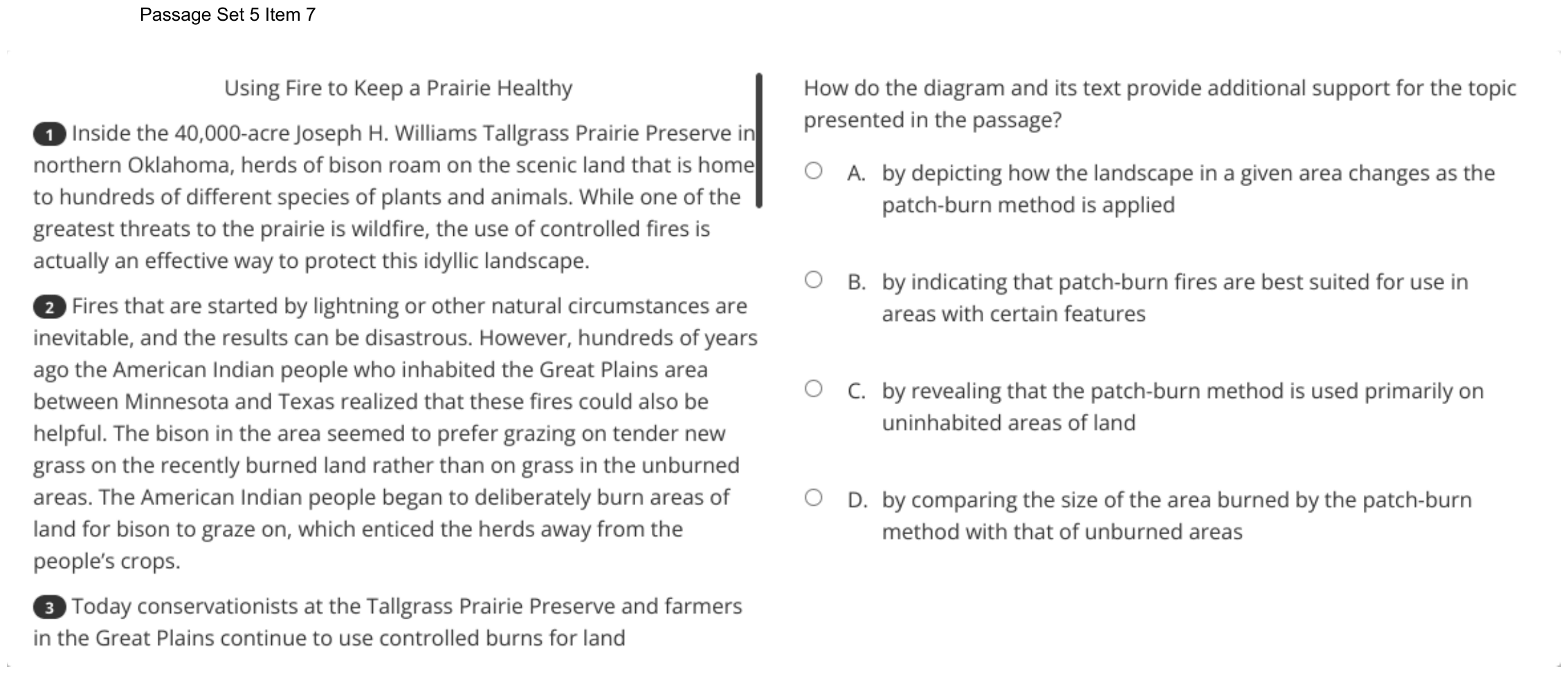
Question 40 of 57
2025 Practice Test B English, question 40Passage Letter from Brooklyn
Letter from Brooklyn
by Jacob Scheier
I can already see how this will end.
How I will grow tired of the bridge’s
steep incline, and the absent-minded tourists
wandering into the bicycle path.
The weather will turn cold.
But that all happens later.
For now it is the early edge of fall,
leaves green still while the air narrows,
is slightly crisp, almost grazing
the hair of my arm like a passing stranger,
as though the air has been forced into intimacy
by the brevity of daylight.
But when it starts darkening at 4,
this closeness, I know, will be a felt distance,
like someone drawing your attention
to their lack of intimacy.
These days I am still walking at a cathedral pace
beneath the branches bending across avenues,
brownstones like rows of lived-in chapels,
like a pop-up picture book I could have had as a child,
but didn’t. How Brooklyn makes me nostalgic
for the moment I am walking inside of.
These late afternoons filled
with a loneliness that makes me feel
distinctly myself, and an awareness
of how rare that is.
“Letter from Brooklyn” from LETTER FROM BROOKLYN: POEMS by Jacob Scheier, published by ECW Press. Copyright © 2013 by Jacob Scheier All rights reserved.
brevity: briefness
cathedral: meditative
chapels: private places of prayer or worship
nostalgic: yearning for the past
Question
How does the structure of the poem affect the poem’s meaning?
- AThe lack of a rhyming pattern suggests that the beauty of each passing day is unique.
- BThe lengths of the sentences represent the complexity of the thoughts being represented.
- CThe use of complete sentences implies the speaker’s appreciation for the clear beginning and ending of each season.
- DThe single long stanza reflects the continuous flow of the speaker’s thoughts.
Show the answer
Correct answer: D
The question asks how the structure of the poem affects its meaning.
A. Incorrect. Though the poem lacks a rhyming pattern, such a structure is not related to the uniqueness of the passing days. The speaker is savoring “the early edge of fall” (line 7) and describes walks taken on “these days” (line 17), but the beauty the speaker appreciates is attributed to the fall season rather than to a unique day. Further, the poem is primarily concerned with broad seasonal shifts, not the passing of each day, and the absence of rhyme does not suggest that each day is unique in its beauty.
B. Incorrect. The poem includes both long sentences (such as the one in lines 7–12) and short sentences (such as those in lines 5 and 6). However, the sentence lengths are not connected with the complexity of the ideas expressed.
C. Incorrect. A complete sentence serves to present the beginning and the end of a single thought, but the poem is not primarily concerned with the speaker’s thoughts on the “clear beginning and ending of each season.” Though it contrasts the speaker’s feelings and experiences during different seasons, the poem does not present descriptions focused specifically on the beginnings or ends of these seasons.
D. CORRECT. Unlike poems that are broken into stanzas reflecting unified groups of thoughts, this poem is one long stanza. This structure serves to emphasize the uninterrupted flow of the speaker’s thoughts from time to time and experience to experience without a clear break between any specific thoughts.
Question analysis
This poetry question asks how the structure of Jacob Scheier's “Letter from Brooklyn,” a poem about walking through the city in early fall, affects its meaning. Students must look at how the poem is built, its sentences, line breaks, stanzas and lack of rhyme, and decide which feature really shapes what the poem says.
- NYS standards
- 7R5 structure and genre features
- Grade level
- Grade 7 reading and task
- Compared with grade 7
- At grade 7 Grade 7 standards ask how a poem's form shapes its meaning. Here each choice names a feature of form that students must first confirm in the poem and then link to its meaning, a typical grade 7 poetry task on a short poem.
- Estimated difficulty
- Moderate: several steps, or a close reading with one strong distractor.
- Thinking it demands
- Depth of knowledge 2, skills and concepts · mainly analyze
- What makes it hard
- How, not what moderate
- Every choice must be checked moderate
- Something you must already know minor
- Evidence
- Answered from the whole text
- Reading level
- Passage: 217 words (a poem; reading level not measured); question and choices: about grade 8, 70 words.
- Students, last 30 days
- Not enough answers yet to show (it takes 10).
Why it is hard, traps and wrong answers (shows the answer)
Why it is hard
Checking whether a feature exists rules out little here, since the poem is unrhymed, its sentences vary widely and it has one stanza. The decision rests on which feature matches what the speaker does: thoughts move from future to present to memory without a break. The strongest pull ties the lack of rhyme to the uniqueness of each day, which sounds like the poem’s theme of rare moments but is not something rhyme or its absence can show.
How, not what moderate Working it out
The question is about form, so students must ask what the single unbroken stanza does: it carries the speaker from the coming cold back to the present walk without a pause. (Anderson & Krathwohl, 2001)
Every choice must be checked moderate Choosing the answer
Three choices name features the poem really has, no rhyme, sentences from five words to six lines, and one stanza, so the meaning each feature is given is what separates them. (Embretson & Wetzel, 1987)
Something you must already know minor Working it out
Students must know what a stanza and a rhyming pattern are, and that a poem without stanza breaks has no white space marking separate groups of thought. (Anderson & Krathwohl, 2001)
Strategy: For each choice, first check that the poem really has the feature named, then ask whether that feature fits what the speaker is doing throughout the poem, not just in one line.
Traps
- Wrong purpose or structure: Names a purpose, structure or effect that the part does not serve, or describes what a part says when the question asks what it does.
- Reads too much in: A reasonable-sounding conclusion that goes further than the text allows.
The wrong answers, classified
A Reads too much in (Graesser, Singer & Trabasso, 1994)
Applies the habit of finding meaning in free verse, linking the missing rhyme to each day’s unique beauty, which echoes “how rare that is” but follows from nothing in the form.
B Wrong purpose or structure (Anderson & Krathwohl, 2001)
Rightly sees sentences ranging from five words to six lines, but gives their length a job, matching complex thoughts, that the poem never connects to it.
C Wrong purpose or structure (Anderson & Krathwohl, 2001)
Assumes complete sentences marking each season’s clear start and end, though the last four lines are a fragment and the poem follows fall’s gradual early turn.
Working it out, step by step
Figure out what the question asks
This question asks how the poem’s structure shapes its meaning. Structure means how the poem is built: its stanzas, its sentences and its rhyme. A stanza is a group of lines set apart by a blank line. It is like a paragraph in a poem.
Look at how the poem is built
The poem has 26 lines and no blank lines, so it is one long stanza. The lines don’t rhyme. The sentences have many lengths. Line 5, “The weather will turn cold,” is short. The sentence in lines 7–12 runs six lines.
Follow the speaker’s thoughts
The speaker is the voice talking in the poem. Line 1 jumps ahead: “I can already see how this will end.” Line 6 comes back: “But that all happens later.” Then the speaker describes the fall air, then the walk, then a lonely feeling. One thought slides into the next with no stop. One unbroken stanza matches that steady flow.
Check each choice
- A is wrong. The poem has no rhyme. But missing rhyme can’t show that each day’s beauty is unique, or one of a kind.
- B is wrong. The sentences do vary in length. But the poem doesn’t link long sentences to hard thoughts.
- C is wrong. The poem isn’t about each season’s clear start and end. It describes fall just starting to turn.
- D is right. The single stanza matches thoughts that flow on with no breaks.
Watch out: Three choices name real features of the poem. So don’t stop at Is this true? Ask whether that feature really creates the meaning the choice gives it.
Choose the answer
Continuous means going on without stopping. So the answer is D: “The single long stanza reflects the continuous flow of the speaker’s thoughts.”
Why this answer and not the closest wrong one
A is the closest wrong answer, because the poem does praise a rare moment. But rhyme, or no rhyme, can’t show that each day is unique. One long stanza can show thoughts flowing without a stop. That is how the speaker thinks, from line 1 to line 26.
More questions like this
The original DOE question
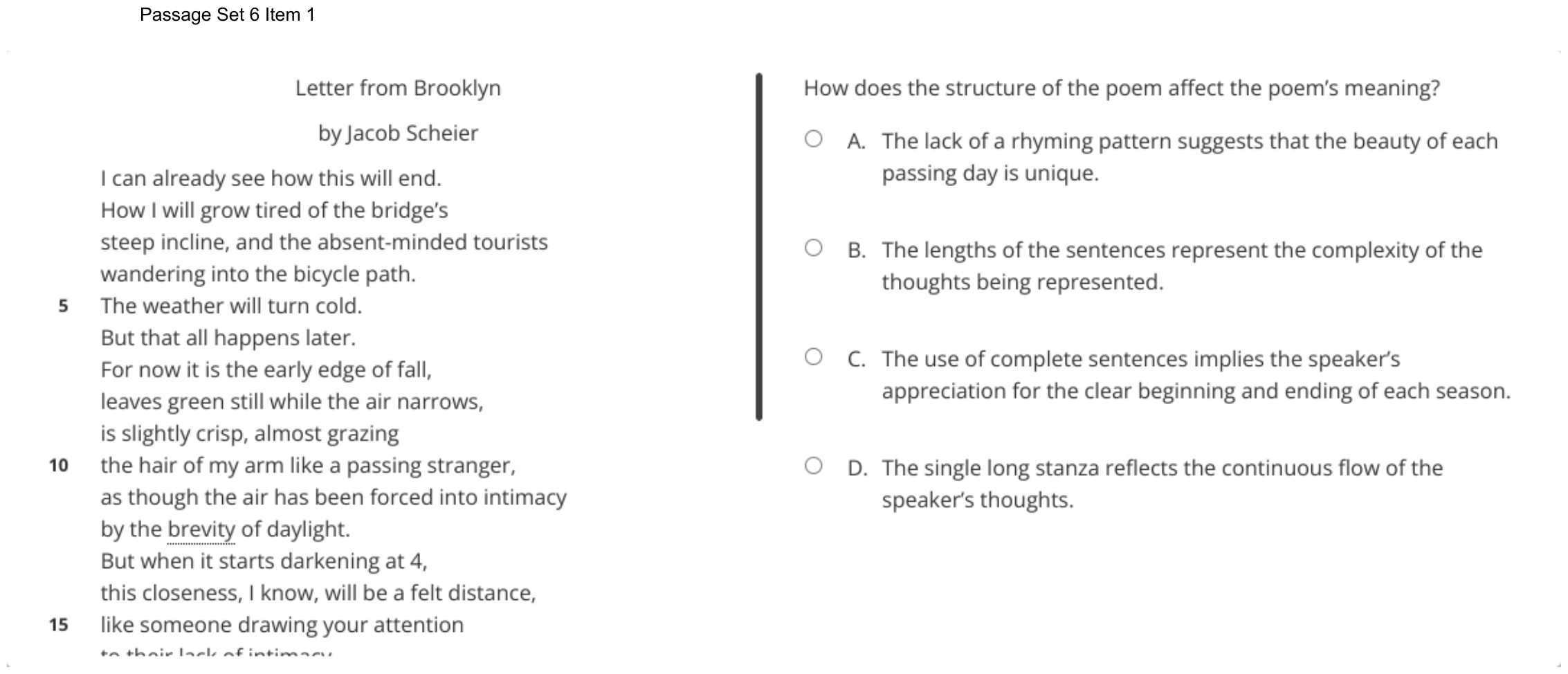
The passage “Letter from Brooklyn” as printed (page 50)
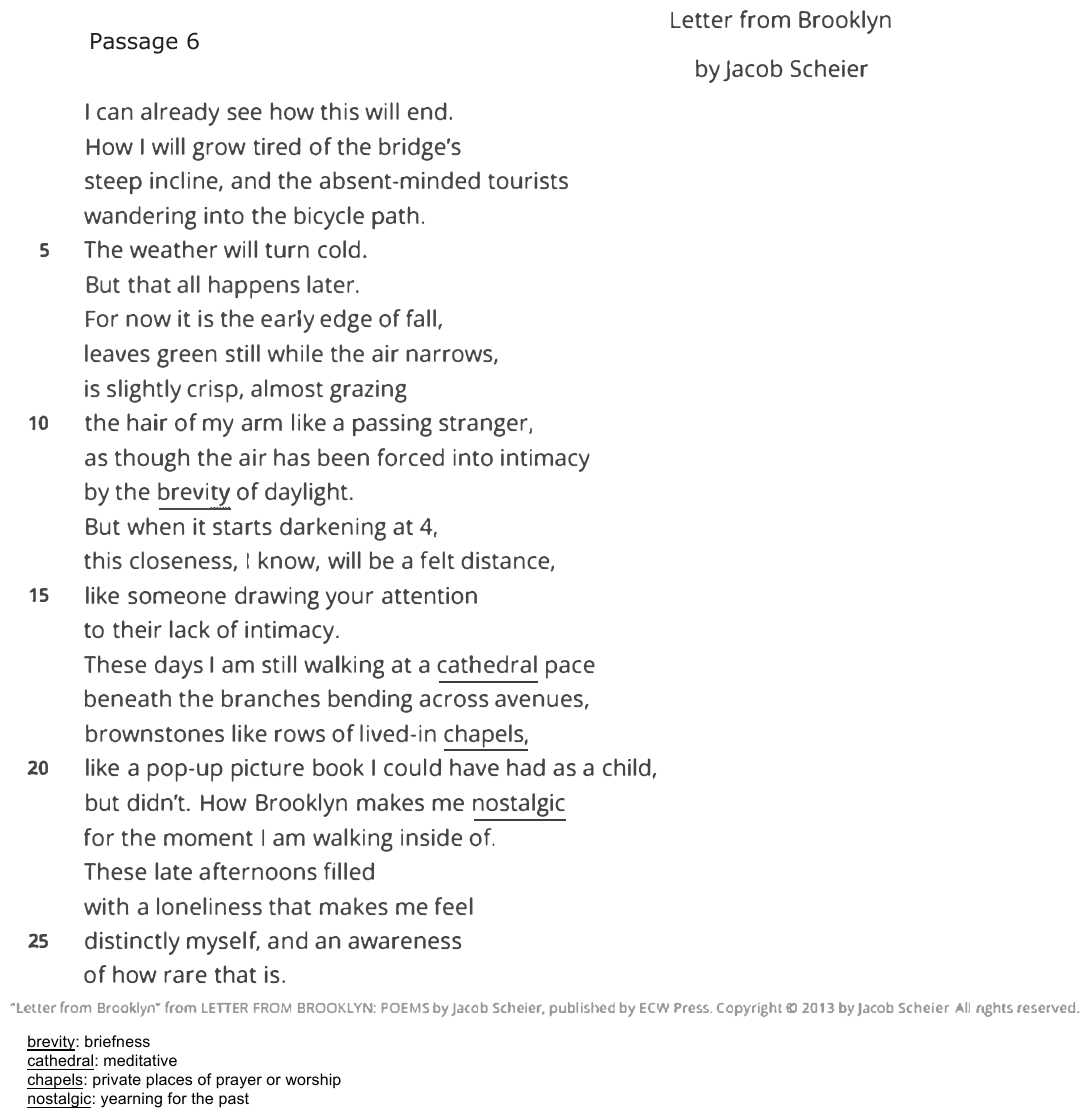
Question 41 of 57
2025 Practice Test B English, question 41Uses the passage above: “Letter from Brooklyn”.
Question
Which lines support the idea that a change in the weather will lessen the speaker’s appreciation for the city?
- A“as though the air has been forced into intimacy / by the brevity of daylight.” (lines 11–12)
- B“But when it starts darkening at 4, / this closeness, I know, will be a felt distance,” (lines 13–14)
- C“like someone drawing your attention / to their lack of intimacy.” (lines 15–16)
- D“These days I am still walking . . . / beneath the branches bending across avenues,” (lines 17–18)
Show the answer
Correct answer: B
The question asks which lines from the poem support the idea that a change in the weather will lessen the speaker’s appreciation for the city.
A. Incorrect. These lines focus on the positive way the air feels to the speaker during “the early edge of fall” (line 7). They suggest that the speaker appreciates this experience currently, while being aware that the feeling might not last.
B. CORRECT. In these lines, the speaker describes the shift in the “closeness” of the air as the weather changes and “it starts darkening at 4.” The speaker clearly indicates that the positive emotions surrounding this closeness, with “leaves green still” and the air “slightly crisp” (lines 8–9), will soon be “a felt distance,” suggesting that the turn in the weather will make the city less appealing.
C. Incorrect. Although these lines compare the darkening, changing weather to a person revealing a “lack of intimacy,” that specific comparison does not focus on a diminishing appreciation for the city.
D. Incorrect. These lines describe the “cathedral pace” (line 17) at which the speaker walks, emphasizing a meditative or thoughtful experience. Such a description suggests the speaker still appreciates the city, not that the speaker’s appreciation will lessen.
Question analysis
This evidence question asks which lines from “Letter from Brooklyn” support the idea that a change in the weather will lessen the speaker's appreciation for the city. All four choices come from the middle of the poem, where the speaker describes the feel of the early-fall air through figurative comparisons, so students must read each pair of lines closely for both parts of the idea.
- Grade level
- Grade 8 reading and task
- Compared with grade 7
- Above grade 7 Choosing lines that support an idea is standard grade 7 evidence work. Here the idea is carried by figurative comparisons about the air, and the four choices sit within a few lines of one another, so separating them takes closer reading than is typical.
- Estimated difficulty
- Hard: combines ideas, needs a plan, and has more than one tempting wrong answer.
- Thinking it demands
- Depth of knowledge 2, skills and concepts · mainly evaluate
- What makes it hard
- A very close wrong answer moderate
- Figurative or literary language moderate
- Reading between the lines minor
- Evidence
- Answered from one sentence or line
- Reading level
- Passage: 217 words (a poem; reading level not measured); question and choices: about grade 6, 74 words.
- Students, last 30 days
- Not enough answers yet to show (it takes 10).
Why it is hard, traps and wrong answers (shows the answer)
Why it is hard
All four choices come from lines 11–18, and three speak of closeness, distance or intimacy, so the vocabulary of the claim is everywhere. The idea has two parts, a change in the weather and a weaker feeling for the city, and only one pair of lines holds both. The strongest pull is the second half of the same sentence, which puts the loss of intimacy most vividly but leaves the darkening behind in the lines before.
A very close wrong answer moderate Choosing the answer
Lines 13–14 and 15–16 are one sentence split in two: the first half names the darkening at 4 and the coming distance, the second only describes what that distance feels like. (Embretson & Wetzel, 1987; Gorin & Embretson, 2006; Ascalon et al., 2007)
Figurative or literary language moderate Understanding the question
The weaker feeling for the city is never stated; it comes through images, the air’s “closeness” turning into “a felt distance,” like a person pointing out their “lack of intimacy.” (Graesser, Singer & Trabasso, 1994; Kintsch, 1998)
Reading between the lines minor Working it out
Students must accept “when it starts darkening at 4” as the change in the weather the stem names, since the lines speak of daylight, not of cold or rain. (Graesser, Singer & Trabasso, 1994; Kintsch, 1998)
Strategy: Split the idea into its two parts, a change in the weather and a weaker feeling for the city, and choose the lines that hold both on their own, without help from the lines around them.
Traps
- Supports only part of the claim: In a question about evidence: a line that backs one half of the claim but not the other, or a related point rather than the claim itself.
The wrong answers, classified
A Supports only part of the claim (King et al., 2004; Thissen, Steinberg & Fitzpatrick, 1989)
Takes “the brevity of daylight” as the coming change, but these lines say the short days force the air “into intimacy,” a closeness the speaker enjoys now.
C Supports only part of the claim (King et al., 2004; Thissen, Steinberg & Fitzpatrick, 1989)
Chooses the vivid “lack of intimacy,” which does show the feeling weakening, but these lines only finish the simile and never mention the darkening that causes it.
D Supports only part of the claim (King et al., 2004; Thissen, Steinberg & Fitzpatrick, 1989)
Hears a coming change in “still walking,” but the lines show the speaker enjoying a slow walk under the branches now and say nothing of the weather turning.
Working it out, step by step
Figure out what the question asks
This is an evidence question. The idea has two parts. First, the weather will change. Second, the speaker will enjoy the city less. You need the lines that hold both parts by themselves.
Read the lines around the choices
Lines 9–12 describe the early-fall air now. It is “almost grazing / the hair of my arm like a passing stranger.” Grazing here means lightly touching. The speaker says the air feels close, like “intimacy.” Intimacy means a warm, close feeling between people. Lines 13–16 then look ahead to shorter days.
Find both parts in lines 13–14
Lines 13–14 say: “But when it starts darkening at 4, / this closeness, I know, will be a felt distance”. Darkening at 4 means the sun setting at 4 o’clock, as days get shorter. That is the change in the weather. “This closeness” is the warm feeling the speaker has now. It will turn into distance. So the good feeling will fade.
Check each choice
- A is wrong. Lines 11–12 describe the closeness the speaker enjoys now. Nothing has faded yet.
- B is right. It names the change, the early dark, and the loss, closeness turning into “a felt distance.”
- C is wrong. Lines 15–16 finish the comparison: the distance feels like a person pointing out their “lack of intimacy.” But these lines never mention the weather.
- D is wrong. Lines 17–18 show the speaker enjoying a slow walk now. They say nothing about the weather turning.
Watch out: C is tempting because “lack of intimacy” sounds like a lost feeling. But the change in weather is back in lines 13–14.
Choose the answer
Only one pair of lines holds both the change and the fading feeling. So the answer is B, lines 13–14, which begin “But when it starts darkening at 4”.
Why this answer and not the closest wrong one
C is the closest wrong answer, because it shows the good feeling slipping away. But lines 15–16 only describe what that distance feels like. They don’t say what causes it. Lines 13–14 give both parts: the early dark and the fading closeness.
More questions like this
The original DOE question
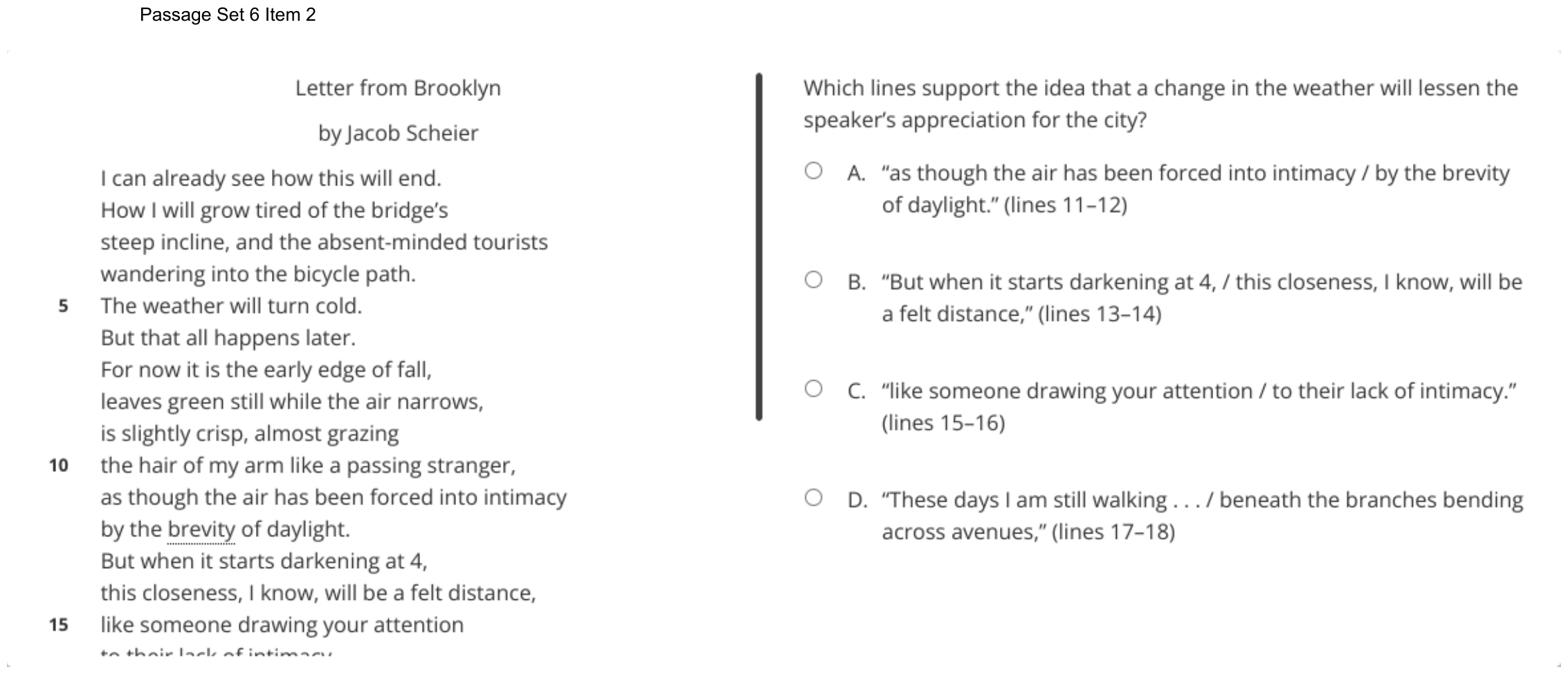
Question 42 of 57
2025 Practice Test B English, question 42Uses the passage above: “Letter from Brooklyn”.
Question
Read lines 5–6 from the poem.
The weather will turn cold.
But that all happens later.
How do the lines develop a central theme of the poem?
- AThey highlight a contrast between the different seasons.
- BThey show the sequence of the changes that are expected to occur.
- CThey warn about a problem that requires thoughtful preparation.
- DThey emphasize the importance of valuing the present.
Show the answer
Correct answer: D
The question asks how lines 5–6 develop a central theme of the poem.
A. Incorrect. In this poem, the speaker describes the impressions of one day in one season: “For now it is the early edge of fall, / leaves green still while the air narrows, / is slightly crisp” (lines 7–9). Despite the reference in line 5 to the eventual arrival of cold weather, lines 5–6 primarily emphasize the speaker’s wish to stay focused on the present moment. A contrast between seasons is not a central theme of the poem.
B. Incorrect. The words “The weather will turn cold” in line 5 refer to one change that is expected to occur, but lines 5–6 do not show a sequence of changes. The line that follows returns to the present: “For now . . .” (line 7).
C. Incorrect. Although the statement that the weather “will turn cold” in line 5 could be construed as a warning, there is no support in lines 5–6 for the idea that some problems require thoughtful preparation. The speaker is reflecting on a fleeting experience, not preparing to solve a problem.
D. CORRECT. Immediately after the line “The weather will turn cold” (line 5), the speaker returns to the current moment: “But that all happens later” (line 6). These lines help develop a central theme by emphasizing the speaker’s choice to value and focus on the present moment. The “But” at the start of line 6 shows the speaker pulling back from the future and refocusing on the present, thus emphasizing the importance of savoring “the moment I am walking inside of” (line 22).
Question analysis
This theme question quotes two short lines from early in “Letter from Brooklyn,” where the speaker says the weather will turn cold, and asks how they develop a central theme of the poem. Students must work out what the pair of lines does at that point and connect it to the whole poem, since each choice describes something two lines about the future could plausibly do.
- Grade level
- Grade 7 reading and task
- Compared with grade 7
- At grade 7 Explaining how particular lines develop a poem's theme is core grade 7 work. These two lines are short and plainly worded, so the demand lies in relating them to the theme of the whole poem, which is typical.
- Estimated difficulty
- Moderate: several steps, or a close reading with one strong distractor.
- Thinking it demands
- Depth of knowledge 2, skills and concepts · mainly analyze
- What makes it hard
- Reading between the lines moderate
- How, not what moderate
- Evidence
- Answered from one paragraph or stanza
- Reading level
- Passage: 217 words (a poem; reading level not measured); question and choices: about grade 5, 63 words.
- Students, last 30 days
- Not enough answers yet to show (it takes 10).
Why it is hard, traps and wrong answers (shows the answer)
Why it is hard
Two short, plain lines carry a theme only when read with their neighbors: the speaker forecasts cold, then dismisses it with “But that all happens later” and returns to “For now.” Students who read line 5 alone take the pair as a forecast and look for contrast, sequence or warning. The tempting contrast choice has some truth, since “But” does mark a turn, yet the turn is from future to present, not from one season to another.
Reading between the lines moderate Working it out
Line 6 never says the present matters; students infer it from “But” pulling back from the forecast and from “For now” in line 7 turning to the early fall around the speaker. (Graesser, Singer & Trabasso, 1994; Kintsch, 1998)
How, not what moderate Working it out
The stem asks how two lines develop a theme, so students must see their job, setting the future aside, rather than their content, a prediction of cold weather. (Anderson & Krathwohl, 2001)
Strategy: Read the lines just before and after lines 5–6, decide what the speaker does with the thought of cold weather, and connect that to what the poem as a whole keeps returning to.
Traps
- Wrong purpose or structure: Names a purpose, structure or effect that the part does not serve, or describes what a part says when the question asks what it does.
- Wrong part of the text: A choice is true of another paragraph, stanza or speaker than the one asked about.
- Reads too much in: A reasonable-sounding conclusion that goes further than the text allows.
The wrong answers, classified
A Wrong purpose or structure (Anderson & Krathwohl, 2001)
Sees cold weather set against early fall and hears contrast in “But,” yet the turn in line 6 is from later to now, and the poem never weighs one season against another.
B Wrong part of the text (Kirsch & Mosenthal, 1990)
Takes the opening forecast, tiring of the bridge and the tourists and then the cold, as a sequence, though lines 5–6 name one change and then set it aside.
C Reads too much in (Graesser, Singer & Trabasso, 1994)
Treats the coming cold as a problem to plan for, though the speaker makes no preparations and simply dismisses the future with “But that all happens later.”
Working it out, step by step
Figure out what the question asks
This question asks how lines 5–6 help build a theme. A theme is a big message about life that a poem keeps coming back to. So ask what these two lines do in the poem. Then link that to the whole poem.
Read the lines in place
Lines 1–5 look ahead. The speaker will grow tired of the bridge and the tourists, and “The weather will turn cold.” Then line 6 says, “But that all happens later.” Line 7 begins “For now it is the early edge of fall.” So the speaker thinks of the future, then pushes it aside.
Put it in your own words
“But” marks a turn. The speaker turns from later back to now. It is like saying, Sure, winter is coming, but it isn’t here yet. Then the poem spends many lines enjoying the fall walk. Line 22 speaks of “the moment I am walking inside of.” So lines 5–6 help show a big idea: enjoy the present while you have it.
Check each choice
- A is wrong. The turn is from later to now, not from one season to another. The poem doesn’t compare seasons.
- B is wrong. Lines 5–6 name one change, cold weather, and then set it aside. That is not a sequence, or series of steps.
- C is wrong. The speaker doesn’t get ready for the cold. The speaker simply says it “happens later.”
- D is right. The lines push the future aside so the speaker can enjoy the present.
Watch out: A is tempting because “But” signals a contrast. Ask what is being contrasted. It is later and now, not two seasons.
Choose the answer
Valuing means treating something as precious. So the answer is D: “They emphasize the importance of valuing the present.”
Why this answer and not the closest wrong one
A is the closest wrong answer, because line 6 does turn with “But.” Yet the turn moves from the future back to “For now.” The poem never weighs one season against another. It keeps coming back to the present moment, which is what D says.
More questions like this
The original DOE question
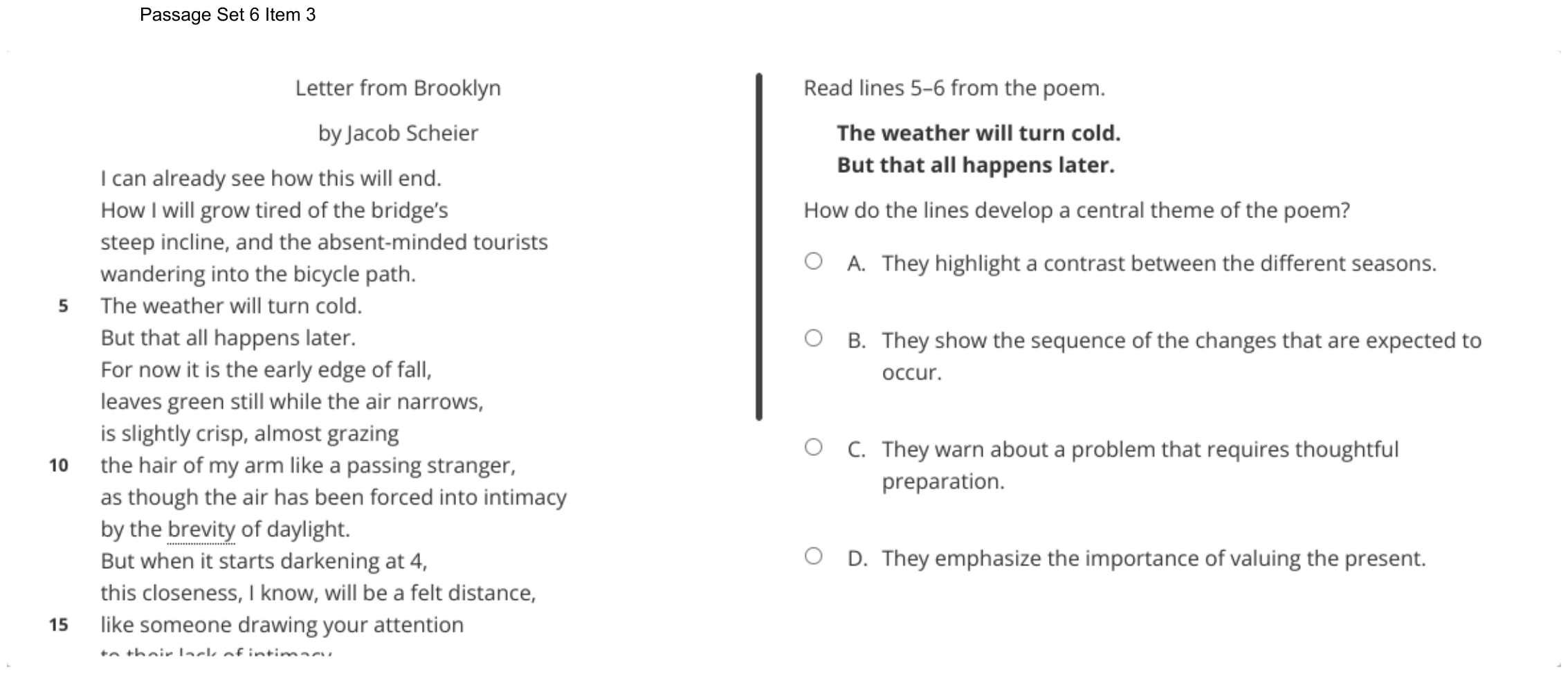
Question 43 of 57
2025 Practice Test B English, question 43Uses the passage above: “Letter from Brooklyn”.
Question
Read lines 7–9 from the poem.
For now it is the early edge of fall,
leaves green still while the air narrows,
is slightly crisp,
The word choice in the lines helps convey the speaker’s belief that
- Athe beauty of the current season should still be appreciated.
- Bthe changes in the weather signify the end of the most pleasant season.
- Cthe transition from one season to another happens swiftly and without warning.
- Dthe change in the weather is so subtle that people rarely observe or feel it.
Show the answer
Correct answer: A
The question asks what belief of the speaker is conveyed by the word choice in lines 7–9 of the poem.
A. CORRECT. Words and phrases in these lines, such as “leaves green still” and “slightly crisp,” have a positive connotation, indicating that the speaker believes in appreciating this season while it still lasts.
B. Incorrect. Although imagery such as “leaves green still” and “slightly crisp” in these lines suggests that the speaker enjoys the season, the speaker never indicates that the present season is the most pleasant of all seasons.
C. Incorrect. The phrases “the early edge of fall” and “the air narrows” in these lines imply that the season is just beginning to change, but there is no indication from these phrases that the changes will be swift and without warning. In fact, the narrowing of the air could be a warning of a greater, more gradual change in weather.
D. Incorrect. The speaker experiences the change in weather as subtle: “the air narrows, / is slightly crisp.” However, the speaker does not refer to the viewpoints of others. The entire viewpoint in the poem is personal and introspective, as represented by the use of the pronoun “I” throughout.
Question analysis
This word-choice question quotes three lines from “Letter from Brooklyn” describing the early edge of fall, when the leaves are still green and the air is slightly crisp. Students must work out what the connotations of these words reveal about the speaker's belief, and several choices mix an accurate reading of the lines with a claim they do not support.
- Grade level
- Grade 7 reading and task
- Compared with grade 7
- At grade 7 Explaining how word choice conveys a speaker's feelings is everyday grade 7 work. These three lines are short and concrete, but their meaning rests on the connotations of a few small words, which matches a typical grade 7 task.
- Estimated difficulty
- Moderate: several steps, or a close reading with one strong distractor.
- Thinking it demands
- Depth of knowledge 2, skills and concepts · mainly understand
- What makes it hard
- Figurative or literary language moderate
- Reading between the lines minor
- Evidence
- Answered from one sentence or line
- Reading level
- Passage: 217 words (a poem; reading level not measured); question and choices: about grade 5, 86 words.
- Students, last 30 days
- Not enough answers yet to show (it takes 10).
Why it is hard, traps and wrong answers (shows the answer)
Why it is hard
The three lines are short, and every choice builds on something real in them: a change in the weather, a season ending, subtlety. What separates the answer is the time words, “For now,” “early edge” and “still,” which say that something good is present and passing. Students lose the point by stretching a reasonable sense of loss into a claim about the best season, or by turning the speaker’s private notice into what other people miss.
Figurative or literary language moderate Understanding the question
The belief lies in connotation: “early edge of fall” and “leaves green still” mark a season only starting to turn, and “the air narrows” describes the change through an image. (Graesser, Singer & Trabasso, 1994; Kintsch, 1998)
Reading between the lines minor Working it out
“For now” at the start of line 7 signals that the moment will pass, and students must infer that the speaker values it for that reason, since no line states the belief. (Graesser, Singer & Trabasso, 1994; Kintsch, 1998)
Strategy: Mark the words in lines 7–9 that describe time and the feel of the air, decide whether each sounds positive, negative or neutral, then choose the belief that fits those connotations and nothing more.
Traps
- Half right: One half of a two-part choice is right and the other is not.
- Reads too much in: A reasonable-sounding conclusion that goes further than the text allows.
- Twists what the text says: Uses the text's topic and ideas but changes what it says: who did it, how much, when, or why.
The wrong answers, classified
B Reads too much in (Graesser, Singer & Trabasso, 1994)
Senses loss in a turning season, which the poem does suggest, but claims the speaker sees this as ending “the most pleasant season,” a ranking the lines never make.
C Twists what the text says (King et al., 2004)
Reads “the air narrows” as a sudden shift, though “early edge” and “slightly crisp” describe a season only beginning to turn, gradually and with clear signs.
D Half right (King et al., 2004; Thissen, Steinberg & Fitzpatrick, 1989)
Rightly hears the change as subtle in “slightly crisp,” but adds that people rarely notice it, though the lines record the speaker feeling it on the hair of an arm.
Working it out, step by step
Figure out what the question asks
This question is about word choice. The exact words a poet picks can show feelings. You need the belief that lines 7–9 show. So look at what each word suggests, not only what it means.
Mark the time words
The lines say “For now it is the early edge of fall, / leaves green still while the air narrows, / is slightly crisp.” Notice the time words. “For now” means this won’t last. “Early edge” means fall has just begun. “Still” means the leaves have not changed color yet.
Hear what the words suggest
“Slightly crisp” means a little cool and fresh. It sounds pleasant, not harsh. When the air “narrows,” it seems to tighten and grow cooler. So the speaker enjoys this moment. The time words show the speaker knows it will pass. Put together, they say: this lovely early fall is still here, so enjoy it now.
Check each choice
- A is right. “Still” and “For now” show the season is still here to enjoy.
- B is wrong. The speaker never calls this the most pleasant season. Nothing ranks the seasons.
- C is wrong. “Early edge” and “slightly” describe a slow, gentle change, not a sudden one.
- D is wrong. The change is subtle, or hard to notice. But the speaker feels it on “the hair of my arm.” The lines say nothing about other people.
Watch out: D starts out right, because the change is gentle. But it adds a claim about other people that the lines never make.
Choose the answer
The words show a pleasant season that is still here, for now. So the answer is A: “the beauty of the current season should still be appreciated.”
Why this answer and not the closest wrong one
B is the closest wrong answer, because the poem does hint that something good is ending. But the lines never call fall the best season. They say only that this pleasant time is here “for now.” That fits A: enjoy the season while it lasts.
More questions like this
The original DOE question
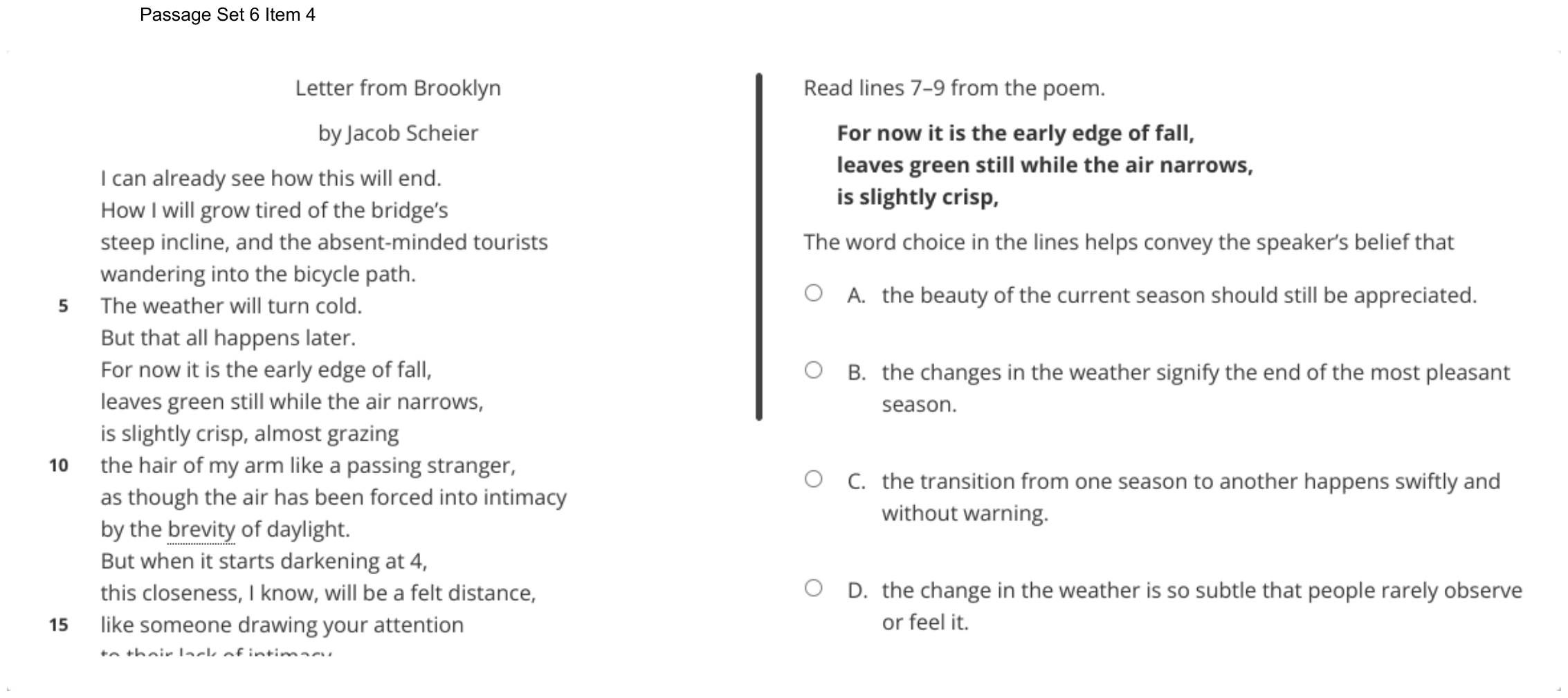
Question 44 of 57
2025 Practice Test B English, question 44Uses the passage above: “Letter from Brooklyn”.
Question
The details in lines 9–12 convey a central idea of the poem by
- Ashowing that the cool weather makes the speaker reflect more deeply on life.
- Bsuggesting that the speaker feels uncomfortable with what the coming weather signifies.
- Cimplying that the sensations the speaker experiences during the fall season are fleeting.
- Dsuggesting that the thought of fall approaching increases the loneliness the speaker feels.
Show the answer
Correct answer: C
The question asks how lines 9–12 convey a central idea of the poem.
A. Incorrect. Although the speaker discusses the very beginning of cool weather in these lines, the speaker does not reflect on life in these lines.
B. Incorrect. Although the description in these lines likens the movement of crisp air to “a passing stranger,” that comparison does not have a negative connotation in this context; it does not suggest that the speaker is uncomfortable. Rather, it is used to describe the subtle physical sensation of cool air on the speaker’s arm.
C. CORRECT. By using a description of the crisp air as “a passing stranger” and the daylight as being brief, these lines express the poem’s central idea that the joy of early fall is temporary or fleeting.
D. Incorrect. Although the speaker acknowledges the coming fall in these lines, there is no mention of loneliness. The speaker reveals a loneliness in lines 23–26 but gives no hint of that feeling in lines 9–12. Further, this loneliness is not a central idea of the poem.
Question analysis
This central-idea question on Jacob Scheier’s poem “Letter from Brooklyn” asks how lines 9–12, where the crisp early-fall air grazes the speaker’s arm, convey a central idea of the poem. Students must interpret a simile and a personification packed into four short lines and connect what they suggest to the poem as a whole, while each choice names a different feeling or idea.
- Grade level
- Grade 8 reading and task
- Compared with grade 7
- Above grade 7 Grade 7 students explain how particular lines develop a central idea. These four lines make their point only through a simile and a personification about air and daylight, and linking them to the whole poem takes more interpretation than typical grade 7 work.
- Estimated difficulty
- Hard: combines ideas, needs a plan, and has more than one tempting wrong answer.
- Thinking it demands
- Depth of knowledge 2, skills and concepts · mainly analyze
- What makes it hard
- Figurative or literary language major
- Reading between the lines moderate
- The right answer is reworded minor
- Evidence
- Answered from one paragraph or stanza
- Reading level
- Passage: 217 words (a poem; reading level not measured); question and choices: about grade 8, 63 words.
- Students, last 30 days
- Not enough answers yet to show (it takes 10).
Why it is hard, traps and wrong answers (shows the answer)
Why it is hard
The four lines describe a sensation, cool air almost grazing an arm, and the central idea sits in two small words, “passing” and “brevity.” The strongest pull hears the stranger and the air “forced into intimacy” as unwelcome, borrowing the unease the poem saves for the darkening of lines 13–16. Other choices bring in moods from elsewhere, the meditative walk and the loneliness of the last lines, so students must judge only what lines 9–12 themselves suggest.
Figurative or literary language major Understanding the question
The lines never say the moment is short: the air almost grazes the speaker’s arm “like a passing stranger” and is “forced into intimacy / by the brevity of daylight,” so “passing” and “brevity” carry the idea. (Graesser, Singer & Trabasso, 1994; Kintsch, 1998)
Reading between the lines moderate Working it out
Students must tie the brief touch and the short days to a central idea the poem never states, that early fall is slipping away, framed by “For now” in line 7 and “But when it starts darkening” in line 13. (Graesser, Singer & Trabasso, 1994; Kintsch, 1998)
The right answer is reworded minor Choosing the answer
The right choice says “fleeting” where the lines say “passing” and “brevity,” while a wrong choice borrows the poem’s own word “loneliness” from line 24, which makes it look supported. (Freedle & Kostin, 1993; Kirsch & Mosenthal, 1990)
Strategy: Paraphrase lines 9–12 in plain words, checking the glossary for unfamiliar words, then decide what the comparison suggests about the speaker’s experience and test each choice against these four lines.
Traps
- Wrong part of the text: A choice is true of another paragraph, stanza or speaker than the one asked about.
- Wrong tone or attitude: Misjudges the tone, attitude or point of view, such as reading admiration as criticism, or taking a character's or subject's feelings for the author's.
- Reads too much in: A reasonable-sounding conclusion that goes further than the text allows.
The wrong answers, classified
A Reads too much in (Graesser, Singer & Trabasso, 1994)
Senses that the poem is meditative and credits the cool air with prompting deep thought, though lines 9–12 record a light, passing touch on the arm, not reflections on life.
B Wrong tone or attitude (Graesser, Singer & Trabasso, 1994)
Hears something unwelcome in “a passing stranger” and in air “forced into intimacy,” though the touch is light and the closeness enjoyed; unease arrives only with the darkening of lines 13–16.
D Wrong part of the text (Kirsch & Mosenthal, 1990)
Brings the “loneliness” of lines 23–26 into lines that never mention it, and even there it makes the speaker feel “distinctly myself,” not lonelier as fall approaches.
Working it out, step by step
Figure out what the question asks
This asks how lines 9–12 help build a central idea. A central idea is a main point the poem keeps coming back to. First work out what the four lines say. Then see how they connect to the rest of the poem. Test each choice against these four lines.
Read lines 9–12
The sentence is about the air, named in line 8. Lines 9–12 say it “is slightly crisp, almost grazing / the hair of my arm like a passing stranger, / as though the air has been forced into intimacy / by the brevity of daylight.” Crisp means cool and fresh. Grazing here means lightly touching. Intimacy means closeness. The glossary says brevity means “briefness.”
Work out the comparisons
“Like a passing stranger” is a simile, a comparison that uses like or as. A stranger who passes you on the street is there for a moment, then gone. So the cool air touches the speaker lightly and briefly. The next lines treat the air like a person pushed into closeness by the short daylight. Giving human feelings to something that isn’t human is called personification. Both “passing” and “brevity” point to the same thing: this feeling won’t last.
Connect the lines to the poem
The rest of the poem agrees. Line 7 begins “For now it is the early edge of fall.” Lines 13–14 look ahead: “But when it starts darkening at 4,” this closeness “will be a felt distance.” Lines 21–22 say Brooklyn makes the speaker “nostalgic / for the moment I am walking inside of.” So a central idea is that this early-fall moment is precious and passes quickly. Fleeting means lasting only a short time.
Check each choice
- A does not fit. These lines describe a touch on the skin, not thoughts about life.
- B does not fit. The touch is light, and the speaker enjoys the closeness now. The worry comes later, in lines 13–16.
- C fits. “Passing” and “brevity” show that the feelings of early fall won’t last.
- D does not fit. Lines 9–12 never mention loneliness, which comes in line 24. And line 7 says fall has already begun.
Watch out: B is tempting because “stranger” and “forced into intimacy” can sound unpleasant. But the stranger only passes by, and the touch is light.
Choose the answer
The brief touch and the short daylight show that this early-fall moment slips away fast. Sensations are feelings you get through your senses, like touch. So the answer is C, “implying that the sensations the speaker experiences during the fall season are fleeting.”
Why this answer and not the closest wrong one
B is the closest wrong choice, because “forced” and “stranger” can sound unpleasant. But line 14 calls this feeling “this closeness,” and losing it is what will feel bad. So the closeness is welcome now. What lines 9–12 stress is how brief it is, which is C.
More questions like this
The original DOE question
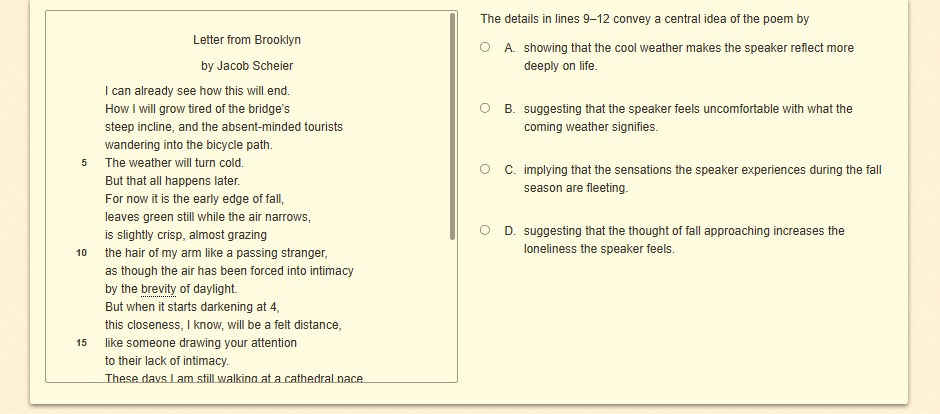
Question 45 of 57
2025 Practice Test B English, question 45Uses the passage above: “Letter from Brooklyn”.
Question
Which idea does the comparison of the brownstone houses to “a pop-up picture book I could have had as a child, / but didn’t” in lines 20–21 convey?
- AIt reveals that some people are still influenced by powerful images from childhood.
- BIt indicates that the neighborhood the speaker is walking through is charming and appealing.
- CIt suggests that the speaker has wanted to live in the neighborhood since childhood.
- DIt suggests that people often experience lingering regret from their past.
Show the answer
Correct answer: B
The question asks what the comparison of the brownstone houses to “a pop-up picture book I could have had as a child, / but didn’t” (lines 20–21) conveys.
A. Incorrect. While the lines explain that the neighborhood reminds the speaker of images from childhood pop-up books, those images are not described as very powerful or influential.
B. CORRECT. Pop-up picture books are likely to delight a child with their unique, often beautiful representations of buildings that pop up out of the page. The comparison in these lines helps explain how the speaker views these brownstones with a childlike wonder and appreciation.
C. Incorrect. Though in these lines the speaker compares this neighborhood to scenes in children’s pop-up picture books, there is no clear evidence that the speaker wants to live there, only that the speaker appreciates its appeal.
D. Incorrect. The lines state that the speaker did not have a “pop-up picture book” of the neighborhood’s brownstones as a child, but not in a way that emphasizes regret. Rather, the speaker compares the neighborhood to images from pop-up books in general to suggest that the neighborhood looks beautiful and delightful.
Question analysis
This figurative-language question asks what idea the poem conveys by comparing Brooklyn's brownstone houses to “a pop-up picture book I could have had as a child, / but didn't.” Students must interpret a simile in context, deciding how the closing words “but didn't” fit with the rest of the comparison and with the speaker's mood during the walk.
- Grade level
- Grade 7 reading and task
- Compared with grade 7
- At grade 7 Interpreting a simile in a poem is routine grade 7 work. This comparison uses a familiar childhood object, and the only complication is the added “but didn't,” which invites a reading that the rest of the lines must confirm or rule out.
- Estimated difficulty
- Straightforward: two steps or one careful reading.
- Thinking it demands
- Depth of knowledge 2, skills and concepts · mainly understand
- What makes it hard
- Figurative or literary language moderate
- Reading between the lines minor
- Evidence
- Answered from one sentence or line
- Reading level
- Passage: 217 words (a poem; reading level not measured); question and choices: about grade 8, 78 words.
- Students, last 30 days
- Not enough answers yet to show (it takes 10).
Why it is hard, traps and wrong answers (shows the answer)
Why it is hard
The core of the simile is easy: a row of brownstones looks like a pop-up picture book, something charming. The difficulty is the closing “but didn’t,” which tempts students toward regret or toward a story about the speaker’s childhood. Students who ask what the comparison says about the houses, rather than about the speaker’s past, see that the lines praise the neighborhood.
Figurative or literary language moderate Understanding the question
The simile likens brownstones to a pop-up picture book, and its point, that the street looks as delightful as a child’s book, has to be drawn from what such books are like. (Graesser, Singer & Trabasso, 1994; Kintsch, 1998)
Reading between the lines minor Working it out
The tag “but didn’t” invites a reading of regret, so students must decide from the walk at a “cathedral pace” around it that the comparison is about delight, not loss. (Graesser, Singer & Trabasso, 1994; Kintsch, 1998)
Strategy: Work out what the brownstones and a pop-up picture book have in common, decide what part “but didn't” plays in the comparison, and test each choice against what the lines actually say.
Traps
- Wrong tone or attitude: Misjudges the tone, attitude or point of view, such as reading admiration as criticism, or taking a character's or subject's feelings for the author's.
- Taking figurative language literally: A choice reads a figure of speech or image at face value.
- Too broad or too strong: A choice overstates, generalizes, or uses absolute words the text does not support.
The wrong answers, classified
A Too broad or too strong (King et al., 2004)
Generalizes from one speaker’s comparison to what “some people” feel and calls the images “powerful,” though the lines describe how the brownstones look, not lasting childhood influences.
C Taking figurative language literally (Graesser, Singer & Trabasso, 1994)
Reads “could have had as a child” as a fact about the speaker’s childhood wishes, though the simile only compares the houses to pages in a book.
D Wrong tone or attitude (Graesser, Singer & Trabasso, 1994)
Hears regret in “but didn’t” and widens it to people in general, though the speaker mentions the missing book only in passing while enjoying the walk.
Working it out, step by step
Figure out what the question asks
This question asks about a simile. A simile compares two things using like or as. Here the speaker compares brownstones to a pop-up picture book. Brownstones are old row houses built of reddish-brown stone. You need the idea this comparison gives.
Read the comparison
Lines 19–21 say “brownstones like rows of lived-in chapels, / like a pop-up picture book I could have had as a child, / but didn’t.” A pop-up book has pictures that stand up off the page when you open it. These books often show houses and streets. Children love them.
Put it in your own words
So the street looks charming and magical, like a page in a child’s favorite book. The words “but didn’t” just mean the speaker never owned such a book. Around these lines the speaker walks at a “cathedral pace.” The glossary says cathedral means “meditative,” or calm and thoughtful. The mood is peaceful and happy, not sad.
Check each choice
- A is wrong. The lines describe how the houses look. They don’t claim childhood pictures stay powerful for people.
- B is right. Comparing the houses to a pop-up book shows they look charming, or delightful.
- C is wrong. The speaker never says they wanted to live there as a child.
- D is wrong. “But didn’t” is said in passing. The speaker is enjoying the walk, not full of regret, or sorrow over the past.
Watch out: “But didn’t” can sound sad, so D is tempting. Ask what the comparison says about the houses, not about the speaker’s past.
Choose the answer
The comparison praises how the houses look. So the answer is B: “It indicates that the neighborhood the speaker is walking through is charming and appealing.”
Why this answer and not the closest wrong one
D is the closest wrong answer, because “but didn’t” hints at something missed. But the speaker is enjoying a slow walk under the branches. The simile’s job is to show how lovely the brownstones look. That points to B, not to regret.
More questions like this
The original DOE question
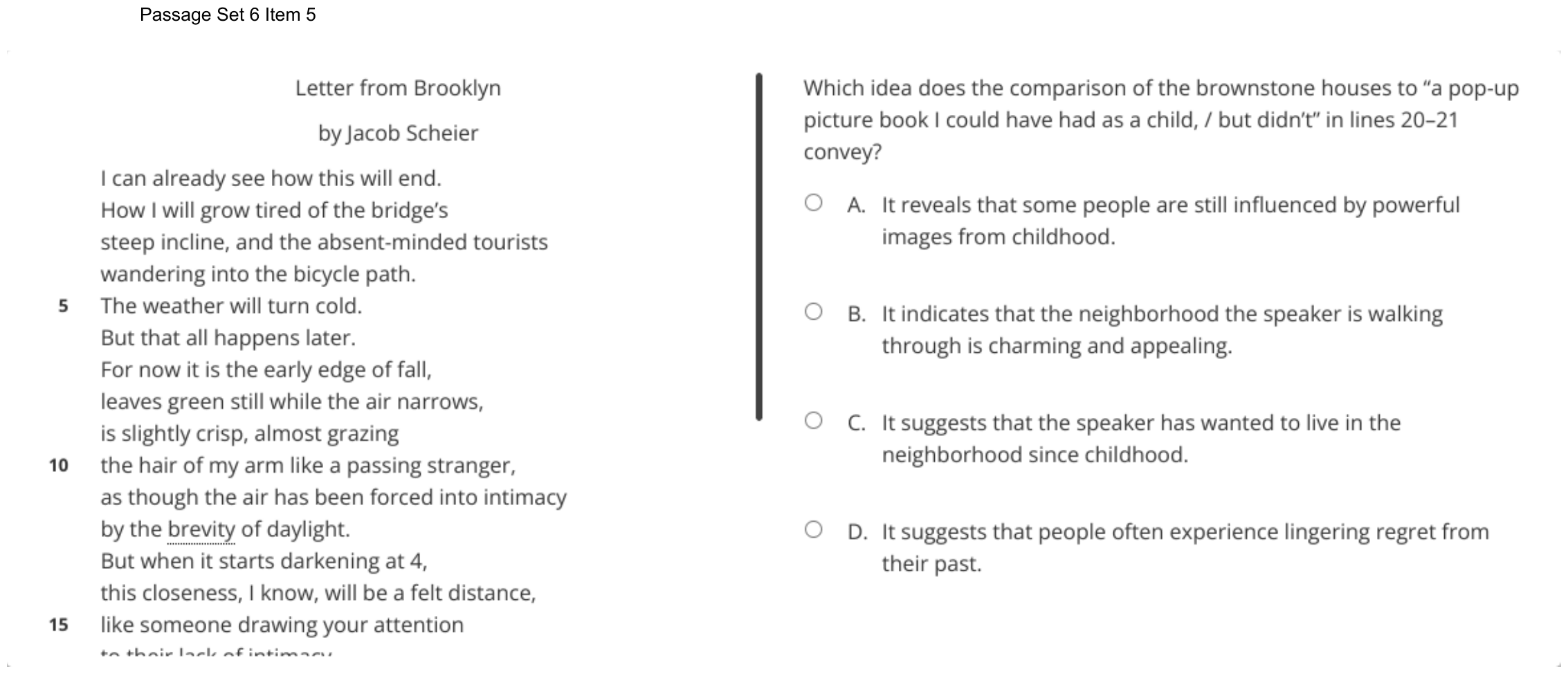
Question 46 of 57
2025 Practice Test B English, question 46Uses the passage above: “Letter from Brooklyn”.
Question
Read these lines from the poem.
I can already see how this will end. (line 1)
How Brooklyn makes me nostalgic
for the moment I am walking inside of. (lines 21–22)
The lines develop a central idea of the poem by
- Asuggesting the speaker’s desire to find a way to break free from the repetitive pattern of daily life.
- Brevealing the speaker’s feelings of disappointment over the predictable change in season.
- Cemphasizing the speaker’s awareness of the future significance of the present moment in the setting.
- Dshowing the speaker’s anticipation of specific emotions caused by an intimate knowledge of the setting.
Show the answer
Correct answer: C
The question asks how line 1 and lines 21–22 develop a central idea of the poem.
A. Incorrect. Although these lines suggest that life is governed by repetitive patterns, such as the change of seasons, they do not suggest that the speaker wishes to break free from these natural cycles of change, and a desire for freedom is not a central idea of the poem.
B. Incorrect. Although the speaker acknowledges that colder weather will inevitably bring disappointment, the speaker does not suggest in these lines that the predictability of changing weather is itself disappointing. Rather, the speaker recognizes the value of enjoying the present moment.
C. CORRECT. These lines connect the present warmer weather with the future colder weather and develop the central idea that the present “moment I am walking inside of” must be embraced because the speaker will be “nostalgic” for it in the future.
D. Incorrect. In these lines, the speaker is aware that specific emotions will occur in the future, during cold weather, but this awareness is only part of the more complex central idea of the poem, which is that current emotions and feelings must be recognized, experienced, and appreciated.
Question analysis
This central-idea question pairs the first line of “Letter from Brooklyn” with lines 21–22, where Brooklyn makes the speaker nostalgic “for the moment I am walking inside of,” and asks how they develop a central idea of the poem. Students must link excerpts from opposite ends of the poem, untangle a paradoxical image and choose among four abstract statements.
- Grade level
- Grade 8 reading and task
- Compared with grade 7
- Above grade 7 Grade 7 students analyze how lines develop a central idea. Here two excerpts twenty lines apart must be read together, one of them built on a paradox, and the four choices are long and abstract, well beyond typical grade 7 work.
- Estimated difficulty
- Among the hardest on the SHSAT: a non-obvious approach, heavy reading, or a well-hidden trap.
- Thinking it demands
- Depth of knowledge 3, strategic thinking · mainly analyze
- What makes it hard
- Figurative or literary language major
- A very close wrong answer moderate
- Evidence in several places moderate
- Evidence
- Answered from several paragraphs or stanzas
- Reading level
- Passage: 217 words (a poem; reading level not measured); question and choices: about grade 7, 99 words.
- Students, last 30 days
- Not enough answers yet to show (it takes 10).
Why it is hard, traps and wrong answers (shows the answer)
Why it is hard
This is among the hardest questions in the set because the two excerpts must be joined through a paradox and then matched to four long, abstract statements. Line 1 foresees an ending; lines 21–22 miss a moment while it is still happening, so both look at now from the future. Students who see only the foresight pick the choice about anticipated emotions, while those who hear gloom in “how this will end” settle on disappointment or a wish to escape.
Figurative or literary language major Understanding the question
Lines 21–22 are a paradox: “nostalgic,” glossed as yearning for the past, is aimed at “the moment I am walking inside of,” so the speaker already feels the present as a future memory. (Graesser, Singer & Trabasso, 1994; Kintsch, 1998)
A very close wrong answer moderate Choosing the answer
The choice about anticipating “specific emotions” shares the key’s link between future and present; it differs by tracing those feelings to knowing the setting well, which neither excerpt says. (Embretson & Wetzel, 1987; Gorin & Embretson, 2006; Ascalon et al., 2007)
Evidence in several places moderate Working it out
The excerpts are the poem’s first line and lines 21–22, twenty lines apart, and what joins them, the speaker looking ahead at the present, shows only when they are read side by side. (Kirsch & Mosenthal, 1990; Gorin & Embretson, 2006)
Strategy: Paraphrase each excerpt on its own, using the glossary's meaning of “nostalgic,” then decide what the first line and the last two share and match that to a choice.
Traps
- Half right: One half of a two-part choice is right and the other is not.
- Wrong tone or attitude: Misjudges the tone, attitude or point of view, such as reading admiration as criticism, or taking a character's or subject's feelings for the author's.
- Reads too much in: A reasonable-sounding conclusion that goes further than the text allows.
The wrong answers, classified
A Reads too much in (Graesser, Singer & Trabasso, 1994)
Links “how this will end” and growing tired of the bridge to a dull routine and imagines a wish to escape it, which the poem never expresses.
B Wrong tone or attitude (Graesser, Singer & Trabasso, 1994)
Hears resignation in “I can already see how this will end” and reads it as disappointment with the seasons, missing that the speaker treasures the present walk.
D Half right (King et al., 2004; Thissen, Steinberg & Fitzpatrick, 1989)
Rightly sees the speaker foreseeing feelings in line 1, but traces them to an “intimate knowledge of the setting,” while lines 21–22 long for the present moment itself.
Working it out, step by step
Figure out what the question asks
This question gives two pieces of the poem: line 1 and lines 21–22. You need the central idea they build together. A central idea is the main point the poem keeps working toward. Read each piece alone first, then join them.
Read line 1
Line 1 says “I can already see how this will end.” The speaker looks ahead. Lines 2–5 then list what will come: growing tired of the bridge, and the cold. So the speaker already pictures the future while living in the present.
Read lines 21–22
The lines say “How Brooklyn makes me nostalgic / for the moment I am walking inside of.” The glossary says nostalgic means “yearning for the past.” Yearning means longing. But the speaker longs for now, a moment still happening. That is a paradox, an idea that seems impossible but makes sense. The speaker knows this walk will be a precious memory.
Join the two pieces
Both pieces look at the present from the future. In line 1, the speaker sees the end coming. In lines 21–22, the speaker already misses the walk. So the speaker knows this present moment will matter later. Significance means importance.
Check each choice
- A is wrong. The speaker never wants to break free from daily routine.
- B is wrong. Line 1 can sound gloomy. But the speaker isn’t upset with the seasons. The speaker treasures the walk.
- C is right. The speaker sees that this moment in Brooklyn will be precious later.
- D is wrong. The speaker does foresee feelings. But neither piece says they come from knowing the place well.
Watch out: D gets the looking-ahead part of line 1 right. But lines 21–22 long for the moment itself, not for feelings caused by knowing the city.
Choose the answer
So the answer is C: “emphasizing the speaker’s awareness of the future significance of the present moment in the setting.”
Why this answer and not the closest wrong one
D is the closest wrong answer, because line 1 does show the speaker foreseeing feelings. But D says they come from an “intimate knowledge of the setting.” Neither piece says that. Lines 21–22 miss the moment while it is still happening. C captures that: the present will matter in the future.
More questions like this
The original DOE question
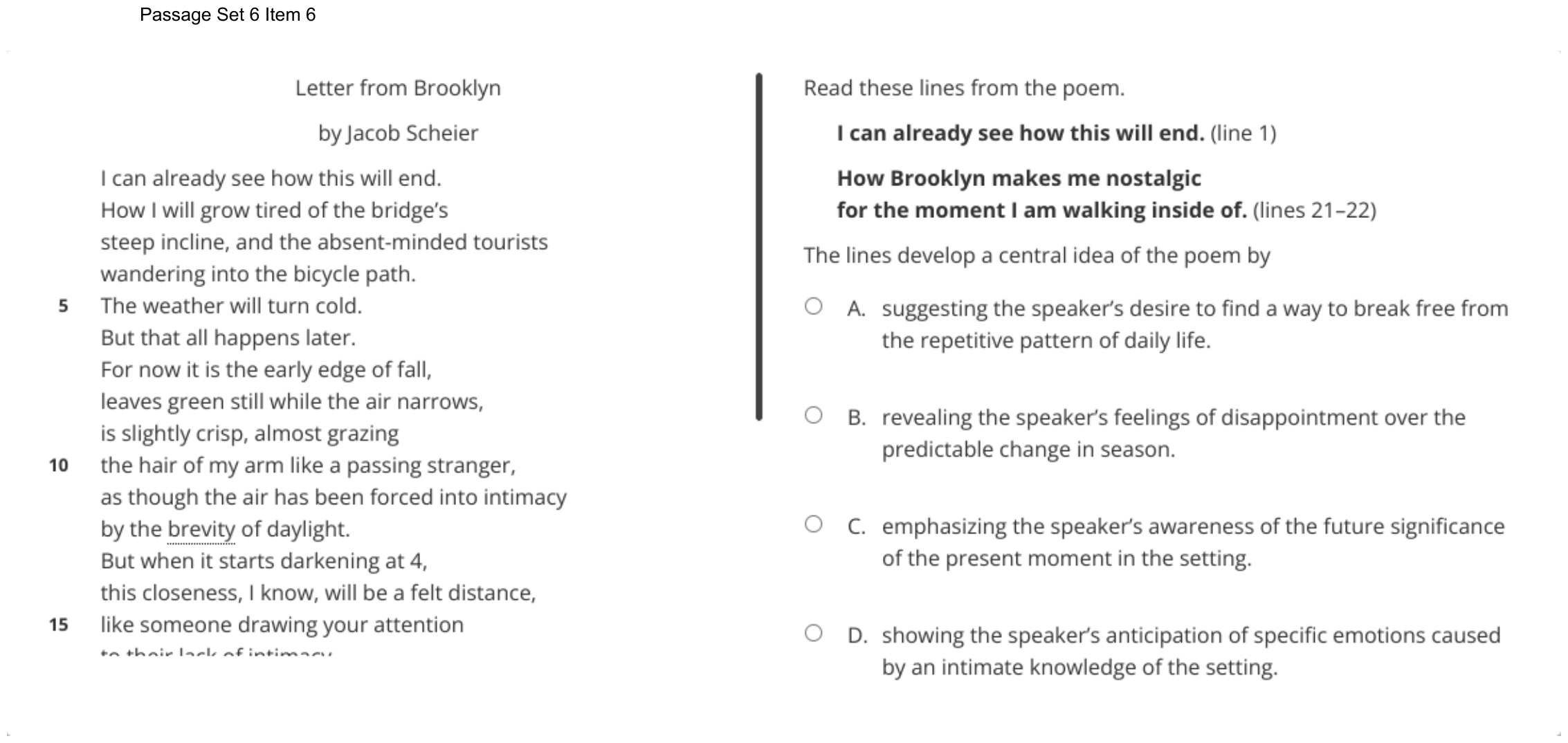
Question 47 of 57
2025 Practice Test B English, question 47Uses the passage above: “Letter from Brooklyn”.
Question
The speaker’s thoughts throughout the poem develop a theme by showing that
- Aalthough people may hold expectations for the future, some people long for present experiences while they are still happening.
- Bthough people come from different places, most people feel drawn to the special charm a city holds.
- Calthough people can make decisions about their life, there will always be some things beyond their control.
- Dthough general expectations exist, people have no way of knowing what a given day will actually bring.
Show the answer
Correct answer: A
The question asks how the speaker’s thoughts throughout the poem develop a theme.
A. CORRECT. The speaker’s thoughts develop some tension because seasonal change will inevitably come: “The weather will turn cold” (line 5). However, the speaker is still able to enjoy the present experience because “that all happens later” (line 6). In lines 21–22, the speaker begins to describe experiences that create a longing for the present, even while it is still happening (“How Brooklyn makes me nostalgic / for the moment I am walking inside of”), developing a theme of the poem.
B. Incorrect. The speaker’s thoughts reveal an appreciation for the city, but this appreciation is highly personal and individual. These thoughts do not indicate that most people will feel drawn to cities.
C. Incorrect. Some things, such as seasons, are beyond human control, as the speaker concedes: “I can already see how this will end” (line 1). However, the theme of the poem is not that certain things are inevitable, but that one can live in the present moment and enjoy that experience before change occurs.
D. Incorrect. The speaker’s thoughts are not showing that people are surprised by what the days bring; the thoughts of the speaker suggest that people experience many seasons in Brooklyn and have reasonable expectations about what these days will bring.
Question analysis
This theme question asks what theme the speaker's thoughts develop across all of “Letter from Brooklyn,” from the opening line about how things will end to the closing lines about loneliness on late afternoons. Each choice is a broad statement about people in two parts, so students must check both halves against the speaker's reflections.
- NYS standards
- 7R2 theme or central idea
- Grade level
- Grade 8 reading and task
- Compared with grade 7
- Above grade 7 Stating a theme is a grade 7 standard, often tested with one clearly fitting choice. Here every choice is a two-part general statement about people, and students must test both halves of each against a whole poem of abstract reflection, more than typical.
- Estimated difficulty
- Hard: combines ideas, needs a plan, and has more than one tempting wrong answer.
- Thinking it demands
- Depth of knowledge 3, strategic thinking · mainly analyze
- What makes it hard
- Reading between the lines moderate
- Every choice must be checked moderate
- Evidence in several places minor
- Evidence
- Answered from the whole text
- Reading level
- Passage: 217 words (a poem; reading level not measured); question and choices: about grade 9, 82 words.
- Students, last 30 days
- Not enough answers yet to show (it takes 10).
Why it is hard, traps and wrong answers (shows the answer)
Why it is hard
The four themes are broad statements about people, each in two halves, and every one can borrow something from the poem: the seasons are beyond control, the city has charm, the future brings surprises. The right one matches the speaker’s double vision, knowing what is coming and longing for the present while it lasts. The strongest pull is the theme about things beyond control, whose second half fits the turning seasons and whose first half the poem never raises.
Reading between the lines moderate Working it out
The poem never states its theme; it must be built from the speaker’s forecasts in lines 1–6 and the paradox of being “nostalgic / for the moment I am walking inside of.” (Graesser, Singer & Trabasso, 1994; Kintsch, 1998)
Every choice must be checked moderate Choosing the answer
Every choice is a two-part “although” or “though” statement about people, and three have one plausible half, so each half must be checked against the poem on its own. (Embretson & Wetzel, 1987)
Evidence in several places minor Working it out
The theme draws on the whole poem, from the opening “I can already see how this will end” to the lonely late afternoons of lines 23–26. (Kirsch & Mosenthal, 1990; Gorin & Embretson, 2006)
Strategy: Sum up in a sentence what the speaker keeps thinking about from the first line to the last, then test both halves of each choice against the poem and reject any half it does not support.
Traps
- Half right: One half of a two-part choice is right and the other is not.
- Too broad or too strong: A choice overstates, generalizes, or uses absolute words the text does not support.
- Twists what the text says: Uses the text's topic and ideas but changes what it says: who did it, how much, when, or why.
The wrong answers, classified
B Too broad or too strong (King et al., 2004)
Turns one speaker’s love of Brooklyn into a claim that “most people” feel drawn to a city’s charm, though no other person’s view appears in the poem.
C Half right (King et al., 2004; Thissen, Steinberg & Fitzpatrick, 1989)
Accepts the half about things beyond control, since the weather will turn cold regardless, but the poem says nothing about people making decisions about their lives.
D Twists what the text says (King et al., 2004)
Turns the coming season into an unknown, though the speaker opens with “I can already see how this will end” and knows exactly what the weather will bring.
Working it out, step by step
Figure out what the question asks
This question asks for the theme of the whole poem. A theme is a big message about life. Each choice has two halves, joined by although or though. Both halves must fit the poem. If one half doesn’t, the choice is wrong.
Trace the speaker’s thoughts
The poem opens by looking ahead: “I can already see how this will end.” The speaker expects to tire of the bridge, and “The weather will turn cold.” Then the speaker turns to now: “But that all happens later.” Most of the poem enjoys the fall walk. Lines 21–22 sum it up: “How Brooklyn makes me nostalgic / for the moment I am walking inside of.”
Put it in your own words
Nostalgic means longing for the past. Yet the speaker longs for the present, while it is still going on. So the speaker does two things at once. The speaker expects what the future will bring. And the speaker treasures, or deeply values, the present. That is the theme.
Check each choice
- A is right. First half: the speaker expects cold weather and boredom. Second half: the speaker longs for the walk while it is still going on.
- B is wrong. Only one person speaks in the poem. Nothing says most people feel drawn to cities.
- C is wrong. The weather is beyond anyone’s control, so its second half fits. But the poem never talks about people making decisions about their lives.
- D is wrong. The speaker knows what is coming. The future isn’t a mystery here.
Watch out: C is tempting because the speaker can’t stop the cold. But test both halves. Its first half, about making decisions, isn’t in the poem.
Choose the answer
So the answer is A: “although people may hold expectations for the future, some people long for present experiences while they are still happening.”
Why this answer and not the closest wrong one
C is the closest wrong answer, because the seasons are beyond the speaker’s control. But the poem never mentions people making decisions about their lives. A matches both halves: the speaker expects what is coming, and longs for the present while it lasts.
More questions like this
The original DOE question
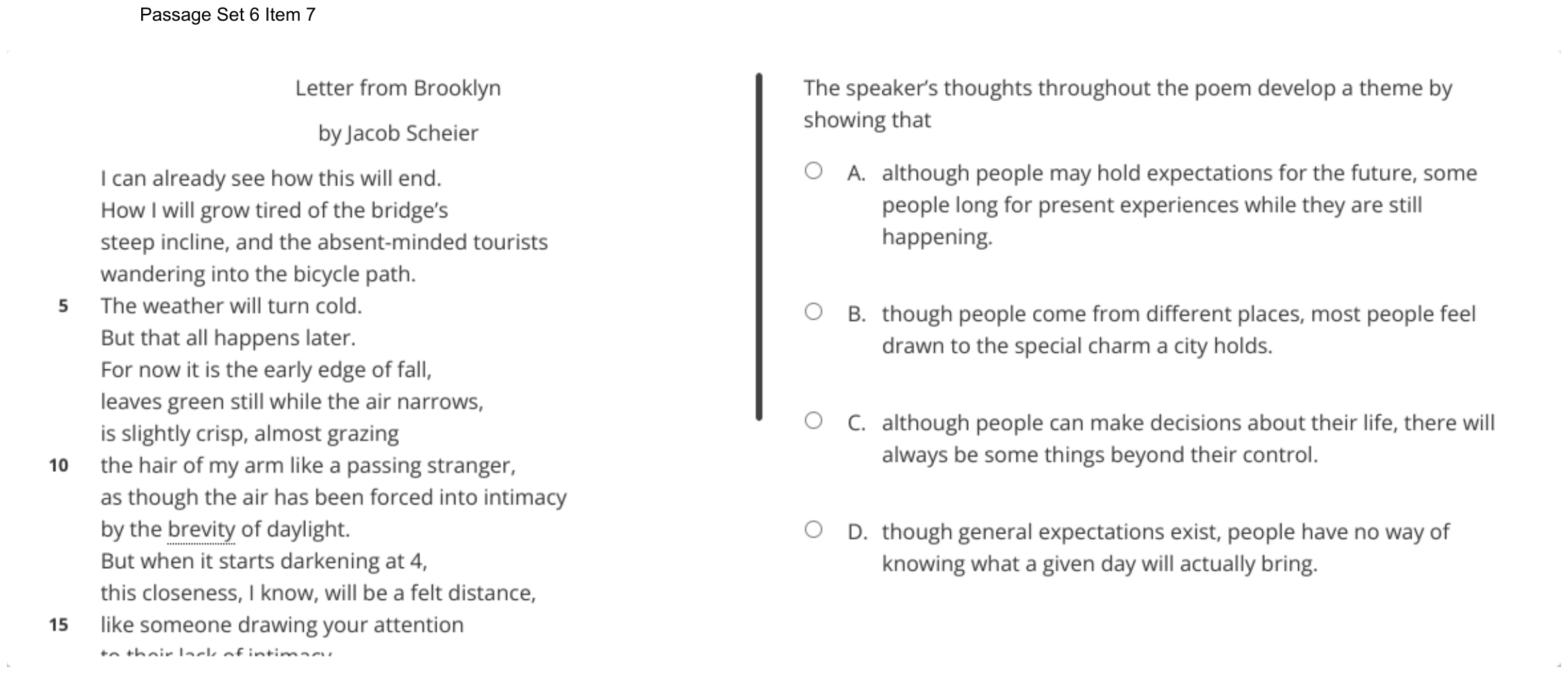
Question 48 of 57
2025 Practice Test B English, question 48Uses the passage above: “Letter from Brooklyn”.
Question
The poet develops the speaker’s point of view by
- Aproviding details about the speaker’s longing to be in a different place.
- Bshowing the speaker’s sense of unease about the passing seasons.
- Cincluding details about the speaker’s hope that life will remain unchanged.
- Dshowing the speaker’s desire to treasure and appreciate the changes taking place.
Show the answer
Correct answer: D
The question asks how the poet develops the speaker’s point of view.
A. Incorrect. The speaker concedes that at some point, Brooklyn will become tiresome (lines 2–4). However, the bulk of the poem reveals the speaker’s appreciation for experiencing Brooklyn, not a desire to be in some other place.
B. Incorrect. Cold weather is inevitable, and the speaker is well aware of this future shift as well as the change in attitude it will bring. Nevertheless, the speaker does not focus on this future but rather embraces the current season, describing it in vivid detail.
C. Incorrect. The speaker is not hopeful that life will remain unchanged. Rather, the speaker accepts and appreciates the seasonal changes that occur.
D. CORRECT. The speaker’s point of view is largely positive and appreciative of the shift in seasons. This point of view is developed by language that shows a close connection between the speaker and the setting. For example, the speaker uses words such as “intimacy” (line 11) and “closeness” (line 14) and the description of the “pop-up picture book” (line 20). Finally, the conclusion emphasizes the point of view: “These late afternoons filled / with a loneliness that makes me feel / distinctly myself, and an awareness / of how rare that is” (lines 23–26).
Question analysis
This point-of-view question asks how the poet develops the speaker’s point of view in “Letter from Brooklyn,” in which the speaker walks through the city at the start of fall knowing that colder, darker days lie ahead. The speaker’s thoughts move between the present and the future, so students must weigh the whole poem, and each choice names a different attitude.
- Grade level
- Grade 8 reading and task
- Compared with grade 7
- Above grade 7 Typical grade 7 point-of-view questions focus on one passage or stanza. This one asks for the speaker’s attitude across a whole poem of shifting moods, and several choices rest on real lines, so judging the overall view takes more than typical grade 7 work.
- Estimated difficulty
- Hard: combines ideas, needs a plan, and has more than one tempting wrong answer.
- Thinking it demands
- Depth of knowledge 3, strategic thinking · mainly analyze
- What makes it hard
- Evidence in several places moderate
- Reading between the lines moderate
- Every choice must be checked minor
- Evidence
- Answered from the whole text
- Reading level
- Passage: 217 words (a poem; reading level not measured); question and choices: about grade 7, 54 words.
- Students, last 30 days
- Not enough answers yet to show (it takes 10).
Why it is hard, traps and wrong answers (shows the answer)
Why it is hard
The poem opens by predicting its own end and returns to the coming dark in lines 13–16, so a reader who weighs those lines heavily finds unease, and the speaker does feel some. But the speaker turns back to the present each time, with “But that all happens later” and “These days I am still walking,” and the closing lines call the moment rare. The point of view is a wish to savor what is passing, and only a choice that fits the whole poem, not its most anxious lines, matches it.
Evidence in several places moderate Working it out
The point of view has to hold from line 1 to line 26 while the poem swings between the future, tiring of the bridge and darkening at 4, and the present walk under the branches. (Kirsch & Mosenthal, 1990; Gorin & Embretson, 2006)
Reading between the lines moderate Working it out
No line names the speaker’s attitude; it has to be drawn from “For now,” the walk “at a cathedral pace,” the nostalgia “for the moment I am walking inside of” and “how rare that is.” (Graesser, Singer & Trabasso, 1994; Kintsch, 1998)
Every choice must be checked minor Choosing the answer
Three wrong choices rest on real lines, tiring of the bridge’s “steep incline,” the “felt distance” of line 14 and the nostalgia of lines 21–22, so each must be weighed against the whole poem. (Embretson & Wetzel, 1987)
Strategy: Sum up in one sentence how the speaker feels about the present walk and about the season ahead, then pick the choice that holds true from the first line to the last.
Traps
- Wrong tone or attitude: Misjudges the tone, attitude or point of view, such as reading admiration as criticism, or taking a character's or subject's feelings for the author's.
- Reads too much in: A reasonable-sounding conclusion that goes further than the text allows.
- Twists what the text says: Uses the text's topic and ideas but changes what it says: who did it, how much, when, or why.
The wrong answers, classified
A Twists what the text says (King et al., 2004)
Turns the forecast that the speaker “will grow tired” of the bridge and the tourists into a present longing to be elsewhere, though the rest of the poem savors Brooklyn’s streets.
B Wrong tone or attitude (Graesser, Singer & Trabasso, 1994)
Fixes on the coming cold and the “felt distance” of lines 13–16, real notes of unease, and takes them for the whole view, though “But that all happens later” sets the future aside.
C Reads too much in (Graesser, Singer & Trabasso, 1994)
Reads nostalgia “for the moment I am walking inside of” as a wish that nothing change, though the speaker opens by accepting “how this will end” and treasures the moment because it passes.
Working it out, step by step
Figure out what the question asks
This asks about point of view: how the speaker, the voice talking in the poem, feels about what is happening. The question is about the whole poem, not a few lines. So follow the speaker’s feelings from line 1 to line 26. The right choice must fit all of it.
Follow the speaker’s thoughts
The poem moves back and forth in time. Lines 1–5 look ahead: “I can already see how this will end.” The speaker will tire of the bridge, and “The weather will turn cold.” Line 6 turns back: “But that all happens later.” Lines 7–12 describe the cool air of early fall. Lines 13–16 look ahead again, to days that get dark at 4 o’clock. Line 17 returns to now: “These days I am still walking at a cathedral pace.”
See how the speaker treats now
The glossary says cathedral means “meditative,” or calm and thoughtful. The speaker walks slowly to take everything in. Brownstones look “like a pop-up picture book.” Lines 21–22 say “How Brooklyn makes me nostalgic / for the moment I am walking inside of.” Nostalgic means “yearning for the past.” Yet the speaker longs for right now. In the last lines, even the loneliness of late afternoon is welcome. It makes the speaker feel “distinctly myself,” and aware “of how rare that is.”
Put the point of view in words
The speaker knows this season will end. That is why each moment matters. The speaker notices the first signs of fall, like the crisp air, and savors them. To treasure something is to value it highly. So the speaker wants to treasure and appreciate the changes happening now.
Check each choice
- A does not fit. Lines 2–4 say the speaker will tire of the bridge someday. But the speaker enjoys Brooklyn now and never wishes to be elsewhere.
- B does not fit. Lines 13–16 show some unease about the dark days ahead. But each time, the speaker turns back to the present.
- C does not fit. The speaker knows from line 1 that this will end, and treasures the moment because it will pass.
- D fits. The speaker savors the early-fall walk while it lasts.
Watch out: B rests on real lines: the closeness the speaker feels now “will be a felt distance” (line 14). But that is one part of the poem, not the whole view.
Choose the answer
The speaker knows the season will change and holds on to each moment of it. So the answer is D, “showing the speaker’s desire to treasure and appreciate the changes taking place.”
Why this answer and not the closest wrong one
B is the closest wrong choice, because lines 13–16 do show unease. But each time the poem looks ahead, the speaker turns back to now: “But that all happens later” and “These days I am still walking.” The poem ends by calling the moment rare. The main feeling is a wish to treasure the present, which is D.
More questions like this
The original DOE question
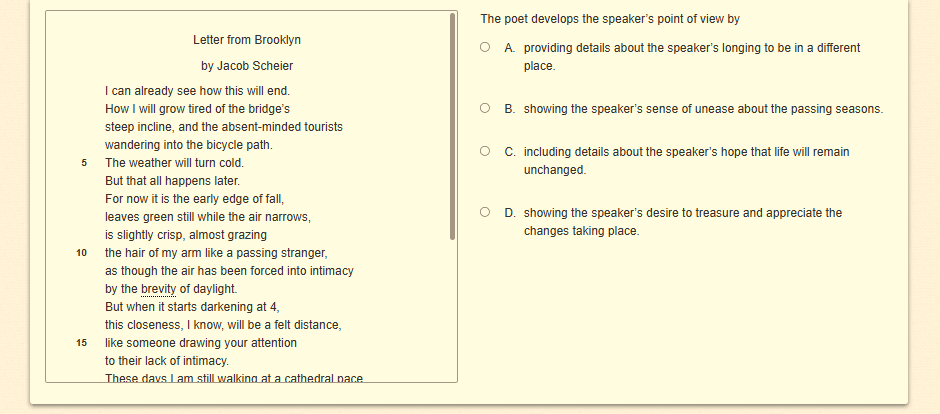
Question 49 of 57
2025 Practice Test B English, question 49Passage The End of an Era
The End of an Era
(1) In 2004, the National Aeronautics and Space Administration (NASA) landed a rover, or robotic vehicle, named Opportunity on the surface of Mars. (2) The rover’s mission was to search for evidence of water and life on the planet. (3) The rover was designed to gather data on Mars for about 90 days, but Opportunity’s assignment did not come to an end until nearly 15 years later in 2019.
(4) During the rover’s mission, a high-resolution camera on the rover’s robotic arm took magnified photographs of the surface of Mars. (5) The photographs revealed small round rocks scattered across the surface of the planet. (6) The scientists nicknamed these rocks “blueberries” based on the rocks’ resemblance to the fruit. (7) These rocks were important because their spherical shape suggested that liquid water may have flowed over them for a substantial amount of time.
(8) Opportunity continued to provide valuable data about craters and other surface features. (9) Throughout the mission, the rover traveled a total of 28.06 miles across Mars’ surface. (10) When Opportunity had traveled nearly the length of a marathon, scientists celebrated the accomplishment by naming the valley that the rover was in Marathon Valley. (11) However, in 2018, a dust storm spread all over the planet, putting the rover’s progress on hold.
(12) Prior to this planet-wide dust storm, minor dust storms had periodically deposited a layer of dust onto the solar panels of the rover. (13) These prevented it from charging its batteries. (14) Scientists then had to rely on the passing winds and dust devils to clean off the solar panels. (15) After the massive 2018 dust storm subsided, scientists expected to be able to reestablish communication with Opportunity. (16) They made repeated attempts but to no avail. (17) In 2019, NASA finally declared Opportunity’s mission complete.
(18) Opportunity was an important asset in scientists’ study of Mars; it returned valuable data about our neighbor planet and survived powerful dust storms. (19) NASA described the mission of Opportunity as “one of the most successful and enduring feats of interplanetary exploration.” (20) Even though this rover’s journey ended, other rovers still roam the surface of Mars.
Question
Which sentence should follow sentence 3 to best introduce the topic of the passage?
- ADespite the challenges of operating on the surface of another planet, the Opportunity rover made many valuable contributions to the field of space research.
- BThe Opportunity rover mission was a success because it informed NASA scientists about how water might have existed on Mars.
- CThroughout the historic mission of the Opportunity rover, NASA scientists had to overcome challenges created by the flaws in the rover’s design.
- DThe Opportunity rover mission surpassed the original timeline of the assignment and allowed scientists to collect additional data about the planet Mars.
Show the answer
Correct answer: A
The question asks for the sentence that should follow sentence 3 to best introduce the topic of the passage.
A. CORRECT. This sentence best introduces the passage’s topic: the Opportunity rover had many accomplishments on its mission, despite numerous challenges. Some of those accomplishments include providing high-resolution photographs (paragraph 2), traveling long distances (paragraph 3), and providing data about craters and other surface features (paragraph 3).
B. Incorrect. Although paragraph 2 discusses how photographs taken by the rover showed rocks that may have been shaped by water, this idea alone is not the topic of the entire passage.
C. Incorrect. While this sentence incorporates ideas about difficulties the scientists encountered because of the Opportunity rover’s design (paragraph 4), the main topic of the passage is not the design flaws and obstacles scientists encountered throughout the mission. The passage primarily focuses on the achievements of the mission.
D. Incorrect. While it is true that the Opportunity rover mission lasted much longer than planned (sentence 3), this fact is a supporting detail of the passage, not the main topic of the passage; surpassing the original timeline is only one of the rover’s many achievements mentioned in the passage.
Question analysis
This revising question works with “The End of an Era,” a passage about NASA's Opportunity rover on Mars, and asks which sentence should follow sentence 3 to best introduce the topic. Students must keep the whole passage in view, from the rover's photographs and travels to the dust storms that ended its mission, and judge which choice previews it best.
- NYS standards
- 7W2a introducing and organizing a topic
- Grade level
- Grade 7 reading and task
- Compared with grade 7
- At grade 7 Choosing a sentence that introduces a passage's topic is a standard grade 7 writing task. The passage is twenty plain sentences about one rover mission, and every choice draws on that mission, so it calls for a typical careful comparison.
- Estimated difficulty
- Moderate: several steps, or a close reading with one strong distractor.
- Thinking it demands
- Depth of knowledge 2, skills and concepts · mainly evaluate
- What makes it hard
- Evidence in several places moderate
- How sentences fit together minor
- Evidence
- Answered from the whole text
- Reading level
- Passage: about grade 11, 337 words; question and choices: about grade 14, 101 words.
- Students, last 30 days
- Not enough answers yet to show (it takes 10).
Why it is hard, traps and wrong answers (shows the answer)
Why it is hard
Sentence 3 already tells a striking story, a 90-day mission that lasted nearly fifteen years, and the most tempting continuation simply repeats it in new words. The other near misses each pick one part of the passage, the water evidence or the dust problems, and make it the whole. The question rewards skimming every paragraph first and choosing the sentence that covers both the achievements and the hardships, the pairing the final paragraph makes.
Evidence in several places moderate Working it out
The topic only emerges from the later paragraphs: the “blueberries” of sentences 4–7, the 28.06 miles of paragraph 3, the dust storms of paragraph 4 and NASA’s praise in sentence 19. (Kirsch & Mosenthal, 1990; Gorin & Embretson, 2006)
How sentences fit together minor Working it out
The new sentence follows sentence 3’s surprise that a 90-day mission lasted nearly 15 years, so it must turn from that fact to what the mission achieved. (Halliday & Hasan, 1976)
Strategy: Skim the opening sentence of each later paragraph to see what the passage covers, then ask which choice would prepare a reader for all of it.
Traps
- Too narrow: A single detail offered as the central idea or a summary, or a summary that keeps minor details and leaves out an essential part.
- Says it twice: Repeats an idea that the sentence or passage already states.
- Off the point: Adds or keeps something that does not support the paragraph's or the passage's focus, or an introduction or conclusion that misses the main point.
The wrong answers, classified
B Too narrow (King et al., 2004)
Picks the water finding of paragraph 2, a real result, but it covers one paragraph and leaves out the rover’s travels, its endurance and the dust storms.
C Off the point (Halliday & Hasan, 1976)
Builds on the dust that blocked the solar panels in paragraph 4, but the passage never blames flaws in the rover’s design and dwells on its achievements.
D Says it twice (Connors & Lunsford, 1988)
Follows sentence 3 smoothly, but saying the mission “surpassed the original timeline” only restates the 90 days that became 15 years instead of introducing what comes next.
Working it out, step by step
Figure out what the question asks
This revising question asks for a sentence to add after sentence 3. It should introduce the topic of the whole passage. A good introduction gives a preview, a quick look at everything coming. It doesn’t repeat one fact or zoom in on one part. For example, a report on a soccer season might begin: The team lost two stars but still won the title. That previews both the struggles and the wins.
Skim each paragraph
- Paragraph 2 (sentences 4–7): The rover’s camera found small round rocks that hinted at water.
- Paragraph 3 (sentences 8–11): It sent data and traveled 28.06 miles. Then a huge dust storm stopped it.
- Paragraph 4 (sentences 12–17): Dust had covered its solar panels before. After the 2018 storm, NASA could not reach it.
- Paragraph 5 (sentences 18–20): It “returned valuable data about our neighbor planet and survived powerful dust storms.”
Name the topic
So the passage covers two things. One is what the rover achieved: photos, data and miles. The other is its challenges, mainly the dust storms. Challenges are hard problems. Sentence 18 puts both together. The new sentence should preview both.
Check each choice
- A is right. It names the challenges and the “many valuable contributions.” That covers the whole passage.
- B is wrong. Water is only paragraph 2. It leaves out the travel and the dust storms.
- C is wrong. The passage never blames flaws in the rover’s design. It mostly praises the rover.
- D is wrong. Sentence 3 already says the mission lasted far past 90 days. D repeats it instead of looking ahead.
Watch out: D follows sentence 3 smoothly, so it sounds right. But it only restates sentence 3 in new words.
Choose the answer
So the answer is A: “Despite the challenges of operating on the surface of another planet, the Opportunity rover made many valuable contributions to the field of space research.”
Why this answer and not the closest wrong one
D is the closest wrong answer, because it flows right after sentence 3. But it only repeats that the mission lasted longer than planned. A previews both halves of the passage: the rover’s achievements and the challenges it survived. Sentence 18 sums up the same two ideas.
More questions like this
The original DOE question
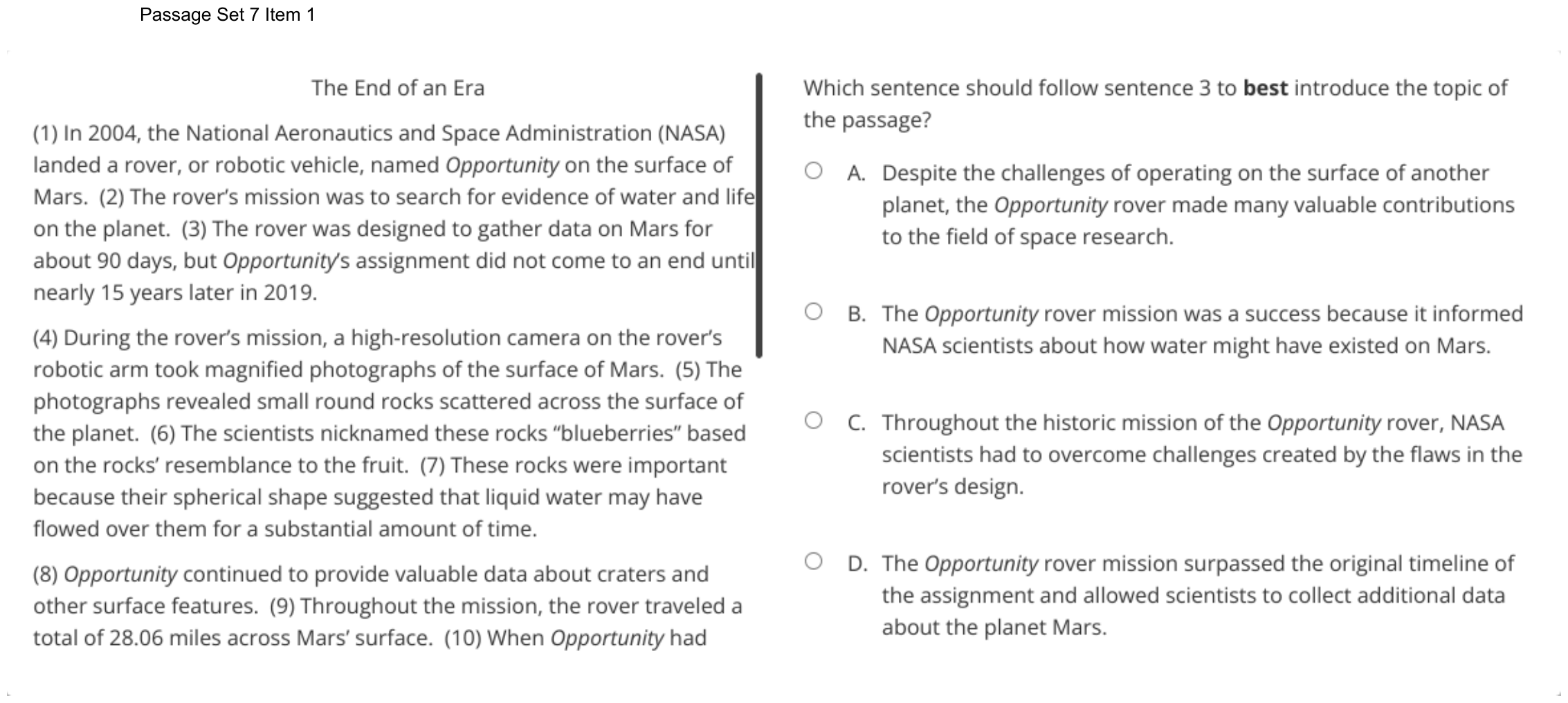
The passage “The End of an Era” as printed (page 60)
Question 50 of 57
2025 Practice Test B English, question 50Uses the passage above: “The End of an Era”.
Question
Which word should be added to the beginning of sentence 8 to provide a better transition to the third paragraph (sentences 8–11)?
Move the correct answer to the box.
(8) ____ Opportunity continued to provide valuable data about craters and other surface features.
On the test you drag one of the tiles into the box; here, choose it.
- AOverall,
- BFurthermore,
- CMeanwhile,
- DConsequently,
Show the answer
Correct answer: C
The question asks for the word that should be added to the beginning of sentence 8 to provide a better transition to the third paragraph (sentences 8–11).
“Overall,” is incorrect and should not be added. While sentence 8 is a more general statement than sentence 7, the word “Overall” would imply that all of the third paragraph features general information about the Opportunity rover. Instead, paragraphs 2 and 3 both describe specific accomplishments of the Opportunity rover (the discovery of possible water on Mars and the distance the rover traveled), so these paragraphs require a word between them that does not transition from the specific to the general.
“Furthermore,” is incorrect and should not be added. The word “Furthermore” would suggest that the author is making an argument in paragraph 2 that is further developed by the statement in sentence 8 and the rest of paragraph 3. Because this is not the case, the word “Furthermore” is not a suitable transition from one paragraph to the next.
“Meanwhile,” is correct and should be added. The word “Meanwhile” is an appropriate transition to add to the beginning of sentence 8, since the actions of the Opportunity rover in paragraph 2 (taking photographs) and in paragraph 3 (traveling long distances) happened at the same time and both served critical functions to the overall mission.
“Consequently,” is incorrect and should not be added. The word “Consequently” would create a cause-and-effect relationship that does not exist between the paragraphs. The passage gives no indication that the rover’s actions in the third paragraph (traveling a far distance) resulted from the actions in the second paragraph (taking photographs).
Question analysis
In this transition question, sentence 8 opens the third paragraph of the Opportunity rover passage with a blank, and on the test students move one of four word tiles into the box. The paragraph before ends with the “blueberries,” small round rocks that hinted at water, so students must decide how the rover's further work relates to that discovery.
- NYS standards
- 7W2d transitions in informative writing
- Grade level
- Grade 7 reading and task
- Compared with grade 7
- Above grade 7 Choosing a transition is regular grade 7 writing work, but this one links two paragraphs, and two of the four words fit the sentence's grammar and sound natural, so the choice turns on exactly how the paragraphs relate.
- Estimated difficulty
- Hard: combines ideas, needs a plan, and has more than one tempting wrong answer.
- Thinking it demands
- Depth of knowledge 2, skills and concepts · mainly evaluate
- What makes it hard
- A very close wrong answer moderate
- How sentences fit together moderate
- Reading between the lines minor
- Evidence
- Answered from several paragraphs or stanzas
- Reading level
- Passage: about grade 11, 337 words; question and choices: about grade 9, 43 words.
- Students, last 30 days
- Not enough answers yet to show (it takes 10).
Why it is hard, traps and wrong answers (shows the answer)
Why it is hard
Two tiles sound natural in the blank, and the one most students reach for first is an all-purpose adding word. The key goes a step further: it marks the rover’s work in paragraph 3 as happening alongside the photographs of paragraph 2, a relationship the word “continued” supports. Students who test each tile against how the paragraphs relate, rather than against the sound of the sentence, also rule out a summing-up word and a cause word.
A very close wrong answer moderate Choosing the answer
“Furthermore” and “Meanwhile” both let paragraph 3 add to paragraph 2; only “Meanwhile” also says the rover’s further work went on during the same mission, as “continued” implies. (Embretson & Wetzel, 1987; Gorin & Embretson, 2006; Ascalon et al., 2007)
How sentences fit together moderate Working it out
The tile must link the “blueberries” of paragraph 2 to the craters and miles of paragraph 3, so students must decide how two paragraphs relate, not just two sentences. (Halliday & Hasan, 1976)
Reading between the lines minor Working it out
The timing is never stated; it comes from “During the rover’s mission” in sentence 4 and “continued” in sentence 8, which place both kinds of work in the same years. (Graesser, Singer & Trabasso, 1994; Kintsch, 1998)
Strategy: State in your own words how what the rover did in paragraph 2 relates to what it did in paragraph 3, then test the relationship each tile signals against that.
Traps
- Wrong transition: A connecting word or phrase that signals the wrong relationship, such as contrast where the idea continues.
The wrong answers, classified
A Wrong transition (Halliday & Hasan, 1976)
Treats sentence 8 as a summing up because it is broader than sentence 7, though paragraph 3 goes on to give new specifics such as the 28.06 miles.
B Wrong transition (Halliday & Hasan, 1976)
Adds paragraph 3 as one more achievement, which sounds natural, but “Furthermore” signals a point being built up, not two kinds of work carried on during one mission.
D Wrong transition (Halliday & Hasan, 1976)
Hears “continued” as a result of the blueberry discovery and adds a cause-and-effect link, though nothing says the rover’s later work followed from its photographs.
Working it out, step by step
Figure out what the question asks
On the test, you move one word tile into the box at the start of sentence 8. The word is a transition, a word that shows how two ideas connect. Some transitions add an idea, some show a result, some sum up, and some show time. You need the one that links paragraph 2 to paragraph 3.
Compare the two paragraphs
Paragraph 2 begins “During the rover’s mission.” It tells how the camera found the round rocks called “blueberries.” Paragraph 3 begins “Opportunity continued to provide valuable data about craters and other surface features.” Craters are bowl-shaped holes in the ground. So paragraph 3 tells about other work the rover kept doing in those same years.
Test each transition
- Overall sums things up. But paragraph 3 gives new facts, like the 28.06 miles.
- Furthermore adds one more reason to an argument, as in Dogs are loyal. Furthermore, they are fun. But paragraph 2 isn’t arguing a point. It tells what the rover did.
- Meanwhile means during that same time. It links things that go on together.
- Consequently means as a result. But the photos didn’t cause the rover’s later work.
See why “Meanwhile” fits
While the camera was finding blueberries, the rover was also studying craters and driving many miles. The word “continued” in sentence 8 shows that the work kept going. “Meanwhile” tells the reader these jobs happened during the same mission.
Watch out: “Furthermore” sounds natural in the blank, so many students choose B. But it only says here is one more point. It doesn’t show two kinds of work going on at the same time.
Choose the answer
With the tile in place, sentence 8 reads: Meanwhile, Opportunity continued to provide valuable data about craters and other surface features. So the answer is C: move the tile “Meanwhile,” into the box.
Why this answer and not the closest wrong one
B, “Furthermore,” is the closest wrong answer, because it also adds information. But it treats paragraph 2 as one point in an argument. The passage just tells what the rover did. “Meanwhile” links the two paragraphs in time, and it matches the word “continued.”
More questions like this
The original DOE question
Question 51 of 57
2025 Practice Test B English, question 51Uses the passage above: “The End of an Era”.
Question
Which revision of sentence 11 best maintains the formal style established in the passage?
- AHowever, in 2018, a dust storm covered the planet, bringing the rover’s progress to a standstill.
- BHowever, in 2018, a dust storm shrouded the planet, impermanently halting the rover’s progress.
- CHowever, in 2018, a dust storm enveloped the whole of the planet, arresting the rover’s progress for a time.
- DHowever, in 2018, a dust storm covered up the whole planet, which quickly brought a stop to the progress of the rover.
Show the answer
Correct answer: A
The question asks for the revision of sentence 11 that best maintains the formal style established in the passage.
A. CORRECT. This sentence uses clear and formal writing throughout. The phrase “covered the planet” is accurate and formal without being overly poetic, and “standstill” is a precise word for putting something “on hold,” as expressed by the original sentence, while maintaining the formal style of the passage.
B. Incorrect. Although the sentence is formal in style, the word “shrouded” is overly poetic, and the phrase “impermanently halting” is too stilted and formal for the style and tone of the passage.
C. Incorrect. Although the sentence is formal in style, the words “enveloped” and “arresting” are overly poetic, especially when used in the same sentence, and the phrases “the whole of the planet” and “for a time” are needlessly wordy and imprecise, compared with the formal scientific language of the passage.
D. Incorrect. The phrases “covered up the whole planet” and “quickly brought a stop to the progress of the rover” are less formal and unnecessarily wordy, compared with the formal style established by the rest of the passage.
Question analysis
This style question asks which revision of sentence 11, about the 2018 dust storm that covered Mars and stopped the Opportunity rover, best maintains the formal style of the passage. All four versions say the same thing, so students must compare word choice and wordiness and decide which one reads like the rest of the passage.
- Grade level
- Grade 8 reading and task
- Compared with grade 7
- Above grade 7 Keeping a formal style is grade 7 writing work, usually tested by spotting slang or casual wording. Here all four revisions keep the meaning and differ in register by degrees, so students must judge the passage's own style closely, more than typical.
- Estimated difficulty
- Hard: combines ideas, needs a plan, and has more than one tempting wrong answer.
- Thinking it demands
- Depth of knowledge 2, skills and concepts · mainly evaluate
- What makes it hard
- Something you must already know moderate
- Every choice must be checked moderate
- Hard words minor
- Evidence
- Answered from one sentence or line
- Reading level
- Passage: about grade 11, 337 words; question and choices: about grade 9, 80 words.
- Students, last 30 days
- Not enough answers yet to show (it takes 10).
Why it is hard, traps and wrong answers (shows the answer)
Why it is hard
The question turns on what “formal” means. Many students equate it with impressive words and choose the revision with “enveloped” and “arresting,” or the one with “shrouded,” missing that both are more poetic than a passage that reports dates and distances. The casual revision is easy to reject, so the real test is preferring the plainest formal sentence to the grandest one.
Something you must already know moderate Working it out
Students must know that a formal informational style is plain and precise, so words such as “shrouded,” “enveloped” and “arresting” are too ornate for a passage that reports miles and dates. (Anderson & Krathwohl, 2001)
Every choice must be checked moderate Choosing the answer
All four revisions keep the meaning of sentence 11 and differ only in register and length, so each must be heard against the passage’s voice rather than checked for errors. (Embretson & Wetzel, 1987)
Hard words minor Understanding the question
“Impermanently,” “shrouded” and “arresting,” in its sense of stopping, are uncommon words, and students must judge how they sound in the passage, not only what they mean. (Perfetti, 2007; Freedle & Kostin, 1993)
Strategy: Reread a few sentences around sentence 11 to hear the passage's voice, then check each revision for casual phrasing, needless words and words that would sound out of place in that voice.
Traps
- Wordy, vague or informal: A revision is grammatical but wordy, imprecise or too casual for the passage.
The wrong answers, classified
B Wordy, vague or informal (Connors & Lunsford, 1988)
Equates formal with elevated, so “shrouded” and “impermanently halting” seem best, though both are stilted and poetic beside the passage’s plain reporting of facts.
C Wordy, vague or informal (Connors & Lunsford, 1988)
Avoids casual words, but “enveloped” and “arresting” are poetic, and “the whole of the planet” and “for a time” add words the plain version does without.
D Wordy, vague or informal (Connors & Lunsford, 1988)
Keeps the meaning, but the casual “covered up” and the roundabout “brought a stop to the progress of the rover” make it wordier and less formal.
Working it out, step by step
Figure out what the question asks
This question asks which version of sentence 11 keeps the passage’s formal style. Formal writing is serious and clear, like a textbook. It avoids slang and casual words. But formal doesn’t mean fancy. Formal writing about science uses plain, exact words. For example, The game got called off is casual. The contest was halted indefinitely is too fancy. The game was canceled is formal and plain.
Hear the passage’s voice
Sentence 9 says “the rover traveled a total of 28.06 miles across Mars’ surface.” Sentence 12 says minor storms “deposited a layer of dust onto the solar panels.” The words are exact and plain. The passage gives dates and numbers. It doesn’t paint poetic pictures.
Check each revision
- A is right. “Covered the planet” is plain and exact. A standstill is a complete stop, a clear way to say “on hold.”
- B is wrong. “Shrouded” is poetic. A shroud is a cloth wrapped around a body. “Impermanently halting” sounds stiff and odd.
- C is wrong. “Enveloped” and “arresting” are fancy words. Here arresting means stopping. “The whole of the planet” and “for a time” add extra words.
- D is wrong. “Covered up” is casual. “Brought a stop to the progress of the rover” is wordy, or longer than it needs to be.
Watch out: Many students think formal means big words, so they choose C. But a passage of dates and miles calls for plain words.
Choose the answer
Only A is both formal and plain, like the rest of the passage. So the answer is A: “However, in 2018, a dust storm covered the planet, bringing the rover’s progress to a standstill.”
Why this answer and not the closest wrong one
C is the closest wrong answer, because it has no slang and sounds serious. But “enveloped” and “arresting” are poetic, and “the whole of the planet” is wordy. The passage reports facts in plain words. A says the same thing in the plainest formal way.
More questions like this
The original DOE question
Question 52 of 57
2025 Practice Test B English, question 52Uses the passage above: “The End of an Era”.
Question
Read this sentence.
One of Opportunity’s major contributions was finding possible evidence of the presence of water on Mars.
Where should the sentence be added to the passage?
- Abetween sentences 2 and 3
- Bat the beginning of the second paragraph (before sentence 4)
- Cat the end of the second paragraph (after sentence 7)
- Dbetween sentences 8 and 9
Show the answer
Correct answer: B
The question asks where the sentence should be added to the passage.
A. Incorrect. While sentence 2 refers to Opportunity’s mission to search for evidence of water, sentence 3 mentions the rover lasting much longer than anticipated. Placing the sentence between these two ideas, rather than at the start of the second paragraph, where it introduces the topic of the paragraph, would create a disjointed and confusing experience for the reader.
B. CORRECT. The sentence introduces the idea of finding possible evidence of water on Mars, which is the main topic of the second paragraph.
C. Incorrect. The sentence sets up the main idea of paragraph 2, which is the possibility of water on Mars. As a concluding sentence, it would be repetitive and confusing.
D. Incorrect. The sentence introduces the possibility of water on Mars, while sentences 8 and 9 discuss other surface features and the distance traveled by the rover. Adding the sentence here would create a disorganized paragraph.
Question analysis
This organization question gives a new sentence about Opportunity's possible discovery of evidence of water on Mars and asks where it should be added to the rover passage. Students must follow the order of ideas across the first three paragraphs, because the sentence echoes ideas that appear in several places and could seem to fit more than one of them.
- NYS standards
- 7W2a introducing and organizing a topic
- Grade level
- Grade 7 reading and task
- Compared with grade 7
- At grade 7 Deciding where a sentence belongs is typical grade 7 revision work. The four positions span three paragraphs of a plain passage, and the sentence's wording connects to more than one of them, so the order of ideas must be checked.
- Estimated difficulty
- Moderate: several steps, or a close reading with one strong distractor.
- Thinking it demands
- Depth of knowledge 2, skills and concepts · mainly analyze
- What makes it hard
- How sentences fit together moderate
- A very close wrong answer moderate
- Evidence
- Answered from several paragraphs or stanzas
- Reading level
- Passage: about grade 11, 337 words; question and choices: about grade 7, 52 words.
- Students, last 30 days
- Not enough answers yet to show (it takes 10).
Why it is hard, traps and wrong answers (shows the answer)
Why it is hard
The new sentence reads well in more than one place, because water comes up in sentence 2, in sentence 7 and near the “valuable data” of sentence 8. Its wording settles the matter: “One of Opportunity’s major contributions” announces a topic, so it belongs ahead of the evidence. The strongest pull places it as a closing line after sentence 7, where it restates the point the blueberries have just made.
How sentences fit together moderate Working it out
The new sentence names a contribution in general terms, so it belongs before sentence 4, where the camera and the “blueberries” supply the details, not after them. (Halliday & Hasan, 1976)
A very close wrong answer moderate Choosing the answer
The two positions in paragraph 2, before sentence 4 and after sentence 7, both keep the sentence beside the water evidence; they differ only in whether it introduces the details or sums them up. (Embretson & Wetzel, 1987; Gorin & Embretson, 2006; Ascalon et al., 2007)
Strategy: Find what the new sentence is about and where the passage discusses that, then read the sentence in each offered position and check whether it introduces, interrupts or repeats the ideas around it.
Traps
- Sentence in the wrong place: Puts a sentence where it breaks the order of ideas or separates it from what it refers to.
- Says it twice: Repeats an idea that the sentence or passage already states.
The wrong answers, classified
A Sentence in the wrong place (Halliday & Hasan, 1976)
Matches the sentence to sentence 2’s search for water, but there it announces the finding before the photographs are described and cuts into the account of the mission’s length.
C Says it twice (Connors & Lunsford, 1988)
Uses it as a wrap-up after the blueberries, a common paragraph shape, but there it only repeats sentence 7’s point about water instead of introducing the paragraph’s topic.
D Sentence in the wrong place (Halliday & Hasan, 1976)
Links “major contributions” to the “valuable data” of sentence 8, though paragraph 3 covers craters, distance traveled and the dust storm, not water.
Working it out, step by step
Figure out what the question asks
This question asks where a new sentence belongs. First find what the sentence is about. Then find where the passage talks about that. Last, decide whether the sentence should start that part, interrupt it or end it.
Read the new sentence
It says that one of Opportunity’s major contributions was “finding possible evidence of the presence of water on Mars.” It names a big idea in general terms. A sentence like that is a topic sentence. A topic sentence tells what a paragraph will be about. It usually comes first. For example, Dogs help people in many ways. comes before the details about guiding, herding and comforting.
Find where water comes up
Paragraph 2 (sentences 4–7) gives the details. The camera took close-up photos. They showed small round rocks, nicknamed “blueberries.” Sentence 7 says the rocks’ round shape “suggested that liquid water may have flowed over them.” So the new sentence should come right before these details, at the start of paragraph 2.
Check each choice
- A is wrong. Between sentences 2 and 3, it would announce the finding before the photos are described. It would also break up the facts about the mission’s length.
- B is right. Before sentence 4, it introduces the paragraph about the round rocks and water.
- C is wrong. After sentence 7, it would only repeat the point sentence 7 just made.
- D is wrong. Paragraph 3 is about craters, miles and the dust storm, not water.
Watch out: C is tempting because some paragraphs end with a summary. But sentence 7 already makes the point about water.
Choose the answer
So the answer is B: “at the beginning of the second paragraph (before sentence 4).”
Why this answer and not the closest wrong one
C is the closest wrong answer, because it keeps the sentence in the paragraph about water. But the sentence names a topic, so it works best before the details. After sentence 7, it would repeat what the blueberries just showed. Before sentence 4, it tells readers what is coming.
More questions like this
The original DOE question
Question 53 of 57
2025 Practice Test B English, question 53Uses the passage above: “The End of an Era”.
Question
What is the best way to combine sentences 12 and 13?
- APreventing the rover from charging its batteries, minor dust storms had periodically deposited a layer of dust onto the solar panels of the rover prior to this planet-wide dust storm.
- BPeriodically depositing a layer of dust onto the solar panels of the rover prior to this planet-wide dust storm, minor dust storms had prevented it from charging its batteries.
- CMinor dust storms, prior to this planet-wide dust storm, prevented the rover from charging its batteries because they had periodically deposited a layer of dust onto the solar panels of the rover.
- DPrior to this planet-wide dust storm, minor dust storms had periodically deposited a layer of dust onto the solar panels of the rover, preventing it from charging its batteries.
Show the answer
Correct answer: D
The question asks for the best way to combine sentences 12 and 13.
A. Incorrect. The phrase “this planet-wide dust storm” in the original sentence 12 makes a direct reference to sentence 11 and therefore acts as a transition that should be kept at the beginning. In this sentence, the transition phrase is placed at the end of the sentence, making the phrase confusing. In addition, the sentence is unnecessarily repetitive and wordy.
B. Incorrect. This combination unnecessarily turns sentence 12 into an overly long participial phrase, making the connection between “it” and its antecedent, “the rover,” unclear and distracting from the subject of the sentence, “minor dust storms.”
C. Incorrect. Not only does this combination move the reference to “this planet-wide dust storm” farther from sentence 11, but it is also unnecessarily wordy, adding “because” and repeating “the rover.”
D. CORRECT. This sentence efficiently and accurately adds sentence 13 to sentence 12 as a participial phrase by changing “These prevented” to “preventing,” while also retaining the meanings of the original sentences 12 and 13.
Question analysis
This sentence-combining question asks for the best way to join two sentences from the rover passage: one saying minor dust storms had periodically coated the rover's solar panels, the other saying this kept it from charging its batteries. The four versions keep the same facts in different orders, so students must judge which is clearest and most concise in context.
- Grade level
- Grade 8 reading and task
- Compared with grade 7
- Above grade 7 Combining two sentences is grade 7 work, usually with one version clearly better. These four are long, keep the same facts and differ in order and wording, so students must weigh clarity and concision across nearly identical sentences, more than typical.
- Estimated difficulty
- Hard: combines ideas, needs a plan, and has more than one tempting wrong answer.
- Thinking it demands
- Depth of knowledge 2, skills and concepts · mainly evaluate
- What makes it hard
- How sentences fit together moderate
- Every choice must be checked moderate
- Complex sentences minor
- Evidence
- Answered from one sentence or line
- Reading level
- Passage: about grade 11, 337 words; question and choices: about grade 13, 129 words.
- Corrected from the DOE handbook
- Two grammar terms in the explanation were corrected.
- Students, last 30 days
- Not enough answers yet to show (it takes 10).
Why it is hard, traps and wrong answers (shows the answer)
Why it is hard
None of the versions is plainly ungrammatical, so the ear gives little help, and the version with “because” looks best to students who value a clearly stated cause. Its cost is wordiness and a weaker link: the result comes first and the reference back to sentence 11 is buried mid-sentence. The question rewards keeping the original order, cause then effect, and folding sentence 13 in as a short closing phrase.
How sentences fit together moderate Working it out
“Prior to this planet-wide dust storm” points back to sentence 11, so the best version keeps it first; three versions move it later, which loosens the link between the two sentences. (Halliday & Hasan, 1976)
Every choice must be checked moderate Choosing the answer
All four versions keep every fact of sentences 12 and 13 and run 29 to 32 words, so none can be ruled out by content; order, pronouns and repetition decide. (Embretson & Wetzel, 1987)
Complex sentences minor Understanding the question
Each version is one long sentence built around a participial phrase or a “because” clause, and at that length a stranded “it” or a doubled “the rover” is easy to miss. (Abedi & Lord, 2001; Freedle & Kostin, 1993; Messick, 1989)
Strategy: Read sentence 11 first, then compare the versions on how smoothly each connects to it, how many words it uses, and whether every pronoun has a clear antecedent.
Traps
- Wordy, vague or informal: A revision is grammatical but wordy, imprecise or too casual for the passage.
- Unclear pronoun: A pronoun whose reference is vague or ambiguous, or one in the wrong case.
The wrong answers, classified
A Wordy, vague or informal (Connors & Lunsford, 1988)
Opens with the effect as a participial phrase, which pushes “prior to this planet-wide dust storm,” the link to sentence 11, to the end and names “the rover” twice.
B Unclear pronoun (Connors & Lunsford, 1988)
Packs sentence 12 into a 19-word opening phrase, so “it” follows “this planet-wide dust storm” and no longer points clearly to the rover buried inside the phrase.
C Wordy, vague or informal (Connors & Lunsford, 1988)
Likes the clear cause word “because,” but the result now comes first, “the rover” appears twice, and “prior to this planet-wide dust storm” splits the subject from its verb.
What was corrected from the DOE handbook, and why
- Explanation: The DOE’s explanation of Option B says the combination turns sentence 12 into “an overly long dependent clause,” and its explanation of Option D says Option D adds sentence 13 to sentence 12 “as a dependent clause” by changing “These prevented” to “preventing.” Neither is a clause: “Periodically depositing a layer of dust onto the solar panels of the rover prior to this planet-wide dust storm” (Option B) and “preventing it from charging its batteries” (Option D) have no subject or finite verb of their own. Both are participial phrases, and the site now calls them that. The reasoning and the answer, Option D, are unchanged.
Working it out, step by step
Figure out what the question asks
This question asks for the best way to join sentences 12 and 13 into one sentence. The best version keeps the meaning, uses few words and is clear. It should also connect smoothly to sentence 11, the sentence before.
Read the sentences in order
Sentence 11 tells about the giant 2018 dust storm. Sentence 12 begins “Prior to this planet-wide dust storm.” Prior to means before. That phrase points back to sentence 11, so it works best at the start. Sentence 12 says small storms put dust on the solar panels. Sentence 13 gives the result: “These prevented it from charging its batteries.”
Learn the tool: a participial phrase
A participial phrase is a group of words built on a verb form, often an -ing word. It describes something, but it has no subject and can’t stand alone. Example: The dog ran to the door. It wagged its tail. becomes The dog ran to the door, wagging its tail. Choice D does this. It turns “These prevented” into “preventing.”
Check each choice
- A is wrong. It starts with the result. It moves “prior to this planet-wide dust storm” to the end, far from sentence 11. It also says “the rover” twice.
- B is wrong. Its long opening phrase hides the rover. Then “it” comes after “minor dust storms,” so it is hard to tell what “it” means.
- C is wrong. It adds “because,” puts the result first and says “the rover” twice. It is wordier than D.
- D is right. It keeps the link to sentence 11 first, gives the cause, then adds the result as a short participial phrase.
Watch out: C looks clear because “because” names the cause. But it is longer, and it puts an extra phrase between “Minor dust storms” and its verb.
Choose the answer
So the answer is D: “Prior to this planet-wide dust storm, minor dust storms had periodically deposited a layer of dust onto the solar panels of the rover, preventing it from charging its batteries.”
Why this answer and not the closest wrong one
C is the closest wrong answer, because “because” makes the cause very clear. But C puts the result first and repeats “the rover.” D keeps the original order, cause then result. It also keeps the link to sentence 11 up front, in fewer words.
More questions like this
The original DOE question
Question 54 of 57
2025 Practice Test B English, question 54Question
In September 2016 the National Museum of African American History and Culture opened as part of the Smithsonian Institution, the museum is already the Smithsonian’s third most popular site. Experts say that they expect this newest Smithsonian facility to welcome nearly 4 million visitors a year. The museum features more than 30,000 objects, including Muhammad Ali’s boxing gloves and a dress sewn by Rosa Parks. A commemorative copy of the Emancipation Proclamation, written in 1863 during the presidency of Abraham Lincoln, is also on display at the museum.
Which part of the paragraph contains an error in sentence structure?
Select the one error.
On the test you click the words in the text; here, choose them below.
- AInstitution, the
- Byear. The
- Cobjects, including
- DProclamation, written
Show the answer
Correct answer: A
The question asks which part of the paragraph contains an error in sentence structure.
Choice 1: “Institution, the” contains an error in sentence structure. The comma between these two words creates a type of run-on sentence known as a comma splice because both clauses—“In September 2016 the National Museum of African American History and Culture opened as part of the Smithsonian Institution” and “the museum is already the Smithsonian’s third most popular site”—are independent clauses, and must be separated with either a period or semicolon. If a comma is used to join the clauses together, a conjunction such as and would need to be added after the comma [converting the comma splice into a correct compound sentence].
Choice 2: “year. The” is correctly constructed, with independent clauses on both sides of the period (“Experts say that they expect this newest Smithsonian facility to welcome nearly 4 million visitors a year” and “The museum features more than 30,000 objects, including Muhammad Ali’s boxing gloves and a dress sewn by Rosa Parks”).
Choice 3: “objects, including” is correctly constructed. The sentence is correct as written with the nonrestrictive prepositional phrase (“including Muhammad Ali’s boxing gloves and a dress sewn by Rosa Parks”) properly preceded by a comma.
Choice 4: “Proclamation, written” is correctly constructed. The sentence is correct, with the nonrestrictive participial phrase (“written in 1863 during the presidency of Abraham Lincoln”) properly offset by a comma on either side.
Question analysis
This sentence-structure question shows a short paragraph about the 2016 opening of the National Museum of African American History and Culture, with four short phrases underlined. On the test students click the one part that contains an error in sentence structure, and the long names and the commas in the paragraph can make every spot look suspicious.
- Grade level
- Grade 6 reading and task
- Compared with grade 7
- Below grade 7 Finding run-ons and fragments is taught before grade 7, and here students check four short underlined spots in one paragraph for a single error in sentence structure. Long institution names add reading load but no extra grammar.
- Estimated difficulty
- Straightforward: two steps or one careful reading.
- Thinking it demands
- Depth of knowledge 2, skills and concepts · mainly apply
- What makes it hard
- A rule that doesn't sound wrong moderate
- Complex sentences minor
- Every choice must be checked minor
- Evidence
- Answered from one paragraph or stanza
- Reading level
- Question and choices: about grade 10, 107 words.
- Corrected from the DOE handbook
- Two grammar terms in the explanation were corrected.
- Students, last 30 days
- Not enough answers yet to show (it takes 10).
Why it is hard, traps and wrong answers (shows the answer)
Why it is hard
Students no longer have to supply the fix, only find the faulty spot, so the question rests on recognizing a comma splice. The error sits in the first sentence behind a long museum name, while the phrases “including Muhammad Ali’s boxing gloves” and “written in 1863” look more suspicious to anyone unsure about phrases set off by commas. Testing each spot for a full sentence on both sides finds it quickly.
A rule that doesn't sound wrong moderate Working it out
A comma alone joins two full clauses at “Institution, the,” and because the long museum name delays the break, the comma reads as a pause rather than a missing period. (Connors & Lunsford, 1988)
Complex sentences minor Understanding the question
The first clause runs 19 words, most of them the museum’s name, so by the time “the museum is already” arrives it sounds like a continuation, not a new sentence. (Abedi & Lord, 2001; Freedle & Kostin, 1993; Messick, 1989)
Every choice must be checked minor Choosing the answer
Each of the four clickable phrases straddles a comma or a period, so students must check, at every one, whether the words on each side could stand as a sentence. (Embretson & Wetzel, 1987)
Strategy: Find the subject and main verb of each sentence and count how many complete thoughts it holds, then check whether the punctuation at each underlined spot suits what comes on either side.
Traps
- Fixes what isn't broken: Changes a part of the sentence that was already correct, while the real error stays; or, where the question asks which sentence has an error or should go, picks one that is correct and belongs.
The wrong answers, classified
B Fixes what isn't broken (Connors & Lunsford, 1988)
Suspects the break after “year” because two sentences meet there, though a period already separates two complete sentences correctly, each with its own subject and verb.
C Fixes what isn't broken (Connors & Lunsford, 1988)
Believes a phrase opening with “including” after a comma is a fragment, though it correctly attaches examples to “more than 30,000 objects” within a complete sentence.
D Fixes what isn't broken (Connors & Lunsford, 1988)
Thinks “written in 1863” cannot describe the copy without “which was,” though the sentence already has its verb “is” and the participial phrase is correctly set off.
What was corrected from the DOE handbook, and why
- Explanation: The DOE’s explanation of choice 3 calls “including Muhammad Ali’s boxing gloves and a dress sewn by Rosa Parks” a “nonrestrictive appositive phrase.” An appositive renames a noun; this phrase gives examples of the objects, and “including” followed by a noun phrase works as a preposition, so it is a prepositional phrase. The explanation of choice 4 calls “written in 1863 during the presidency of Abraham Lincoln” a “nonrestrictive clause”; it has no subject or finite verb of its own, so it is a participial phrase. The site now says “nonrestrictive prepositional phrase” and “nonrestrictive participial phrase.” Both parts are still correctly constructed, and the answer, “Institution, the,” is unchanged.
Working it out, step by step
Figure out what the question asks
This question asks you to find the one error in sentence structure. Sentence structure is how a sentence is built. On the test, you click the part with the mistake. At each part, ask: could the words on each side stand as a sentence?
Learn the rule: no comma splice
An independent clause is a group of words with a subject and a verb that can stand alone as a sentence. You can’t join two of them with just a comma. That mistake is called a comma splice. Example: I ran home, the rain started. Fix it with a period: I ran home. The rain started. You could also add and after the comma.
Test “Institution, the”
Before the comma: “In September 2016 the National Museum of African American History and Culture opened as part of the Smithsonian Institution.” That is a full sentence. After the comma: “the museum is already the Smithsonian’s third most popular site.” That is a full sentence too. Only a comma joins them, so this is a comma splice. Fix: put a period after Institution and start The museum with a capital.
Check “year. The” and “objects, including”
- “year. The” is correct. A period already separates two full sentences.
- “objects, including” is correct. A preposition is a linking word like with or for, and “including” works like one here. A prepositional phrase is that word plus the words after it. “Including Muhammad Ali’s boxing gloves and a dress sewn by Rosa Parks” is a prepositional phrase. It gives examples of the objects, and a comma correctly attaches it.
Check “Proclamation, written”
“Written in 1863 during the presidency of Abraham Lincoln” is a participial phrase. That is a group of words built on a verb form, here written, with no subject of its own. It tells when the Proclamation was written. Commas correctly set it off, and the sentence keeps its main verb, “is.”
Watch out: Phrases starting with “including” and “written” can’t stand alone, so they may look like errors. But each one is attached to a full sentence. That is correct.
Choose the answer
Only the first part joins two full sentences with just a comma. So the answer is A: “Institution, the” contains the error. On the test, you would click that phrase.
Why this answer and not the closest wrong one
“Objects, including” is the closest wrong answer, because the words after its comma can’t stand alone. But they don’t need to. That phrase only adds examples to a full sentence. At “Institution, the,” both sides are full sentences, so a comma alone is not enough.
More questions like this
The original DOE question
Question 55 of 57
2025 Practice Test B English, question 55Question
Read these sentences.
(1) Flyby missions near Jupiter have been happening since 1973.
(2) Flyby missions allow scientists to collect data about Jupiter and its moons.
What is the best way to combine the sentences to clarify the relationship between the ideas?
- AWhile flyby missions near Jupiter have been happening since 1973, scientists collect data about the planet and its moons.
- BAlthough there have been flyby missions near Jupiter since 1973, they have allowed scientists to collect data about the planet and its moons.
- CFlyby missions near Jupiter, which allow scientists to collect data about the planet and its moons, have been happening since 1973.
- DFlyby missions have been happening near Jupiter, but scientists have been collecting data about the planet and its moons since 1973.
Show the answer
Correct answer: C
The question asks for the best way to combine the sentences to clarify the relationship between the ideas.
A. Incorrect. Even though the two ideas from the original sentences are incorporated into the combined sentence, the use of the conjunction “while” in the first part of the sentence suggests that there is a simultaneous but unrelated relationship between the two ideas, which is incorrect.
B. Incorrect. The combined sentence incorporates the ideas from both sentences, but the conjunction “although” suggests that scientists were allowed to collect data even though there were flyby missions, which is an inaccurate way to express the relationship between the ideas.
C. CORRECT. This sentence is the best way to combine the sentences because it accurately reflects the relationship between the ideas by using the nonrestrictive clause “which allow scientists to collect data about the planet and its moons” to describe the purpose of the flyby missions. (Nonrestrictive clauses are adjective clauses that give additional information about a word or phrase. They sometimes begin with the relative pronoun “which” and are set off by commas.) The idea that the missions “have been happening since 1973” follows the nonrestrictive clause.
D. Incorrect. The combined sentence uses the conjunction “but” to connect the ideas in the two original sentences. This suggests a contrasting relationship between ideas, which is an inaccurate way to connect the ideas expressed in the original sentences.
Question analysis
This sentence-combining question gives two short sentences about flyby missions near Jupiter, one saying they have happened since 1973 and the other that they let scientists collect data about the planet and its moons. Students choose the combination that makes the relationship between the ideas clear, weighing what each connecting word or clause says about how the facts relate.
- NYS standards
- 7L1 grammar and usage conventions
- Grade level
- Grade 7 reading and task
- Compared with grade 7
- At grade 7 Combining two short sentences so their relationship is clear is regular grade 7 work. Both sentences here are brief and plainly related, and the versions differ mainly in their connecting words, so this is a typical, fairly quick task.
- Estimated difficulty
- Straightforward: two steps or one careful reading.
- Thinking it demands
- Depth of knowledge 2, skills and concepts · mainly evaluate
- What makes it hard
- How sentences fit together moderate
- Every choice must be checked minor
- Evidence
- Answered from one sentence or line
- Reading level
- Question and choices: about grade 9, 119 words.
- Corrected from the DOE handbook
- A wrong word in the explanation of D was corrected.
- Students, last 30 days
- Not enough answers yet to show (it takes 10).
Why it is hard, traps and wrong answers (shows the answer)
Why it is hard
The two sentences are short, and the work lies in naming how they relate before reading the versions. The most tempting one, beginning “While,” keeps both facts but drops the word “allow,” so the missions no longer explain the data. Students who test each connector against the relationship also catch the concession in “Although” and the contrast in “but,” which also moves the date onto the data collection.
How sentences fit together moderate Working it out
Students must first name the relationship, that the missions make the data possible, a link only the version with “which allow” keeps, since the others recast it as time, concession or contrast. (Halliday & Hasan, 1976)
Every choice must be checked minor Choosing the answer
All four versions keep both facts and read smoothly, so each joining word, “While,” “Although,” “which” and “but,” has to be tested for what it claims. (Embretson & Wetzel, 1987)
Strategy: Before reading the choices, decide in a few words how the two facts are connected, then reject any version whose joining word signals a different relationship or shifts what a detail describes.
Traps
- Wrong transition: A connecting word or phrase that signals the wrong relationship, such as contrast where the idea continues.
- Changes the meaning: A revision is correct English but no longer says what the writer meant.
The wrong answers, classified
A Wrong transition (Halliday & Hasan, 1976)
Keeps both facts and reads smoothly, but “While” presents the missions and the data collection as merely happening at the same time and drops “allow,” the link between them.
B Wrong transition (Halliday & Hasan, 1976)
Treats “Although” as a neutral joining word, but it makes the data collection happen in spite of the missions, when the missions are what make it possible.
D Changes the meaning (Connors & Lunsford, 1988)
Joins the facts with “but,” implying a contrast, and moves “since 1973” from the missions to the data collection, so the date now describes something else.
What was corrected from the DOE handbook, and why
- Explanation: Rejecting D, the handbook's explanation says “but” “suggests an adverse relationship between ideas”. “Adverse” means harmful; the point is that “but” signals a contrast, which the two sentences don't have. It now says “a contrasting relationship”. The answer, C, is unchanged.
Working it out, step by step
Figure out what the question asks
This question asks for the best way to join two sentences. The joined sentence must show how the ideas are related. So first decide how they connect. Then pick the version whose joining word shows that link.
Find the relationship
Sentence 1 says flyby missions near Jupiter “have been happening since 1973.” A flyby mission sends a spacecraft past a planet without landing. Sentence 2 says the missions “allow scientists to collect data about Jupiter and its moons.” Data means facts and measurements. So sentence 2 tells what the missions do for scientists. The ideas don’t contrast, or clash. They fit together.
Learn the tool: a which clause
A clause is a group of words with a subject and a verb. A which clause adds extra facts about a noun. Commas set it off. Example: My bike, which has red wheels, is new. The extra facts describe the bike. In C, “which allow scientists to collect data about the planet and its moons” describes the missions.
Check each choice
- A is wrong. “While” makes the two facts just happen at the same time. It drops “allow,” so the missions no longer explain the data.
- B is wrong. “Although” means in spite of the fact that. It suggests scientists got data even though there were missions. That is backward.
- C is right. The which clause tells what the missions do, and the date stays with the missions.
- D is wrong. “But” signals a contrast that isn’t there. It also moves “since 1973” onto the data collecting.
Watch out: A reads smoothly and keeps both facts. But “While” loses the link: the missions are what make the data possible.
Choose the answer
So the answer is C: “Flyby missions near Jupiter, which allow scientists to collect data about the planet and its moons, have been happening since 1973.”
Why this answer and not the closest wrong one
A is the closest wrong answer, because it keeps both facts and sounds fine. But “While” only says two things happen at once. It drops the word “allow,” which shows the missions make the data collection possible. C keeps that link with its which clause.
More questions like this
The original DOE question
Question 56 of 57
2025 Practice Test B English, question 56Question
Which sentence in the paragraph contains an error in construction and should be revised?
(1) On the evening of July 13, 2019, a major power outage affected the Upper West Side of Manhattan in New York City. (2) Leaving approximately 73,000 residents without electricity for three long hours, lights did not function, refrigerators did not stay cold, and air conditioners did not work. (3) Longtime city residents were particularly confused because an eerily similar event had occurred years earlier—on the exact same day! (4) The famous New York City Blackout of 1977, which lasted for 25 hours, also happened on July 13, an odd coincidence to say the least.
Move the answer to the box. There is only one error in construction.
Contains an error in construction
On the test you drag one of the tiles into the box; here, choose it.
- ASentence 1
- BSentence 2
- CSentence 3
- DSentence 4
Show the answer
Correct answer: B
The question asks which sentence in the paragraph contains an error in construction.
Sentence 1: Construction is correct. An introductory prepositional phrase is correctly punctuated in sentence 1 and describes when the power outage occurred. Similarly, the direct object, “the Upper West Side of Manhattan in New York City,” is presented clearly in terms of what area was “affected” by the power outage.
Sentence 2: Contains an error in construction. In sentence 2, the phrase “Leaving approximately 73,000 residents without electricity for three long hours” is a dangling modifier because it is not clearly modifying any word or words in the sentence. It actually further describes the “power outage” in sentence 1. In clear and correct construction, all modifiers should be in the same sentence as and near the words they describe in order to avoid confusion.
Sentence 3: Construction is correct. A dash is used appropriately in sentence 3 to show a break in thought and to introduce the phrase “on the exact same day.”
Sentence 4: Construction is correct. Two commas are used correctly in sentence 4 to set off the nonessential clause “which lasted for 25 hours” from the rest of the sentence. Similarly, one comma is used to set off the nonessential appositive “an odd coincidence to say the least.” Both of these elements are nonessential to the sentence’s overall meaning and are thus correctly separated from the sentence by the use of commas.
Question analysis
This editing question gives a four-sentence paragraph about the July 13, 2019, blackout on Manhattan's Upper West Side, which fell on the same date as the famous 1977 New York City blackout. On the test students move one sentence tile into a box marked as containing an error in construction, and since the error is not named, every sentence must be checked.
- NYS standards
- 7L1 grammar and usage conventions
- Grade level
- Grade 7 reading and task
- Compared with grade 7
- At grade 7 Finding a sentence with a construction error in a short paragraph is typical grade 7 editing. The question does not name the kind of error, and the paragraph's dash, exclamation point and added phrases all give students something to second-guess.
- Estimated difficulty
- Moderate: several steps, or a close reading with one strong distractor.
- Thinking it demands
- Depth of knowledge 2, skills and concepts · mainly analyze
- What makes it hard
- A rule that doesn't sound wrong moderate
- Every choice must be checked moderate
- Evidence
- Answered from one paragraph or stanza
- Reading level
- Question and choices: about grade 8, 122 words.
- Students, last 30 days
- Not enough answers yet to show (it takes 10).
Why it is hard, traps and wrong answers (shows the answer)
Why it is hard
The dangling phrase is easy to accept because the reader already knows from sentence 1 what left the residents in the dark. Students who do not ask what the opening phrase describes look elsewhere, and sentence 4 is the likeliest victim, since its closing phrase about an odd coincidence seems to hang loose. The question rewards naming the subject of each sentence and checking that every added phrase belongs to it.
A rule that doesn't sound wrong moderate Working it out
The opening phrase of sentence 2, “Leaving approximately 73,000 residents without electricity,” has no word to modify; it sounds acceptable because sentence 1’s power outage supplies the missing subject. (Connors & Lunsford, 1988)
Every choice must be checked moderate Choosing the answer
The error is not named, and three sentences hold features that invite doubt: sentence 1’s date and place names, sentence 3’s dash and exclamation point, sentence 4’s two set-off phrases. (Embretson & Wetzel, 1987)
Strategy: Take the sentences one at a time: name the subject and main verb, ask what each opening or added phrase describes, and check whether each mark of punctuation has a job.
Traps
- Fixes what isn't broken: Changes a part of the sentence that was already correct, while the real error stays; or, where the question asks which sentence has an error or should go, picks one that is correct and belongs.
The wrong answers, classified
A Fixes what isn't broken (Connors & Lunsford, 1988)
Suspects the long opening date or the string of place names, though sentence 1 has a clear subject and verb and its introductory phrase is correctly punctuated.
C Fixes what isn't broken (Connors & Lunsford, 1988)
Treats the dash and the exclamation point as errors because they look informal, though the dash correctly sets off “on the exact same day” and the sentence is complete.
D Fixes what isn't broken (Connors & Lunsford, 1988)
Rightly checks what each phrase describes but decides “an odd coincidence to say the least” dangles, though it correctly sums up the whole clause before it.
Working it out, step by step
Figure out what the question asks
This question asks which sentence is built wrong. On the test, you move one sentence tile into the box. The question doesn’t name the kind of error. So check each sentence. Find its subject, who or what the sentence is about, and its verb.
Learn the rule: no dangling modifier
A modifier is a word or phrase that describes something. An opening phrase must describe the subject right after the comma. If it can’t, it is a dangling modifier. Example: Running to the bus, my backpack fell. The backpack wasn’t running! Fix: Running to the bus, I dropped my backpack.
Test sentence 2
Sentence 2 opens with “Leaving approximately 73,000 residents without electricity for three long hours.” What did the leaving? The power outage did, but the outage is back in sentence 1. After the comma, the subject is “lights.” Lights didn’t leave people without power. So the opening phrase dangles. One fix: The outage left about 73,000 residents without electricity for three long hours. Then a new sentence lists what stopped working.
Check the other sentences
- Sentence 1 is correct. Its opening phrase tells when, and a comma sets it off. Its subject is “a major power outage,” and its verb is “affected.”
- Sentence 3 is correct. The dash sets off “on the exact same day” for effect. The sentence is complete.
- Sentence 4 is correct. Commas set off “which lasted for 25 hours.” The ending, “an odd coincidence to say the least,” sums up the fact before it.
Watch out: Sentence 4 tempts many students, because its ending seems to hang loose. But it names the whole fact before it, the same date. That is allowed.
Choose the answer
Only sentence 2 has an opening phrase with nothing to describe. So the answer is B: move the tile “Sentence 2” into the box labeled “Contains an error in construction.”
Why this answer and not the closest wrong one
Sentence 4 is the closest wrong answer, because “an odd coincidence to say the least” seems loose. But it sums up the whole idea before it, which is correct. In sentence 2, the opening phrase should describe the outage. Yet the word after the comma is “lights.”
More questions like this
The original DOE question
Question 57 of 57
2025 Practice Test B English, question 57Question
How should the paragraph be revised?
(1) Danielle spent several hours preparing for an upcoming audition for a play at the community theater. (2) First she did vocal exercises to practice her diction and projection so that her words would carry clearly throughout the large auditorium. (3) Then she studies the text of the monologue to better understand the emotions, and motivations of the character she plans to portray. (4) Finally she recited her monologue in front of a mirror many times, making slight adjustments and improvements to her performance each time.
- ASentence 1: Change spent to had spent, AND insert a comma after play.
- BSentence 2: Change did to does, AND insert a comma after projection.
- CSentence 3: Change studies to studied, AND delete the comma after emotions.
- DSentence 4: Change recited to recites, AND delete the comma after times.
Show the answer
Correct answer: C
The question asks how the paragraph should be revised.
A. Incorrect. The revisions in this option introduce new errors. The word “spent” is correct in the simple past tense because it encompasses the actions described throughout the rest of the paragraph, all of which happened during those “several hours.” Additionally, adding a comma after the word “play” would be incorrect because it would unnecessarily separate the prepositional phrase “at the community theater” from the rest of the sentence.
B. Incorrect. The revisions in this option introduce new errors. The word “did” is correct as written in the past tense because the past tense is used throughout the paragraph. There is no comma needed after the word “projection” because “so” is functioning not as a conjunction but rather as part of the conjunction phrase “so that,” which does not take a comma.
C. CORRECT. Changing the word “studies” from the present tense to the past tense “studied” is necessary to match the past tense established in the paragraph (“spent,” “recited”). Additionally, the comma after the word “emotions” needs to be removed because the words “emotions and motivations” are part of a group (series) of two elements, and when there are only two elements in a series, a comma is not used.
D. Incorrect. The revisions in this option introduce new errors. The word “recited” is correct as written in the past tense because the past tense is used throughout the paragraph. Also, removing the comma after “times” is incorrect because the comma is needed in order to separate the modifying phrase “making slight adjustments and improvements to her performance each time” from the main clause.
Question analysis
This grammar and punctuation question gives a four-sentence paragraph about Danielle preparing for an audition at the community theater, with eight spots underlined. Each answer choice pairs a verb change with a comma change in a single sentence, so students must judge verb tense and comma use together and accept a choice only if both of its edits are needed.
- Grade level
- Grade 6 reading and task
- Compared with grade 7
- Below grade 7 Keeping verb tense consistent and using commas correctly are taught before grade 7, and this paragraph is short and plain. Each choice bundles two edits, so a student who spots one real error can confirm the answer with the other.
- Estimated difficulty
- Routine: one familiar step, little to misread.
- Thinking it demands
- Depth of knowledge 1, recall and reproduction · mainly apply
- What makes it hard
- Evidence
- Answered from one paragraph or stanza
- Reading level
- Question and choices: about grade 10, 133 words.
- Students, last 30 days
- Not enough answers yet to show (it takes 10).
Why it is hard, traps and wrong answers (shows the answer)
Why it is hard
The shift to “Then she studies” stands out in a story told in the past tense with “spent,” “did” and “recited,” and finding either half of the right option is enough to choose it. That makes this one of the easiest editing questions. Students who miss it usually trust a half-remembered comma rule, such as a comma before “so,” and stop checking the verb in the same option.
A rule that doesn't sound wrong minor Working it out
Only two nouns, “emotions” and “motivations,” follow “the,” so the comma between them has no job, yet a habit of putting commas before “and” in lists hides it. (Connors & Lunsford, 1988)
Every choice must be checked minor Choosing the answer
The four options each pair a tense change with a comma change, one option per sentence, and an option is right only when both of its edits repair real errors. (Embretson & Wetzel, 1987)
Strategy: Find the tense of the paragraph's first verb, check every underlined verb against it, and then confirm that the comma change in the same choice is needed too.
The wrong answers, classified
A Verb tense or form (Connors & Lunsford, 1988)
Thinks “had spent” is needed because the preparing came before the audition, and accepts a comma after “play” that would cut off “at the community theater.”
B Punctuation (Connors & Lunsford, 1988)
Applies the rule of a comma before “so” joining two clauses, missing that “so that” opens a purpose clause with no comma, and accepts the present-tense “does.”
D Verb tense or form (Connors & Lunsford, 1988)
Notices that the tenses clash but takes the present-tense “studies” as the standard, shifts “recited” to match, and drops the comma that sets off “making slight adjustments.”
Working it out, step by step
Figure out what the question asks
This question asks how to fix the paragraph. Each choice makes two changes in one sentence: a verb change and a comma change. A choice is right only if both changes fix real errors. So check both halves.
Rule 1: keep one tense
Tense is when an action happens: past, present or future. A story should stay in one tense. Example: I woke up and eat breakfast mixes tenses. It should be I woke up and ate breakfast. This paragraph is in the past: “spent,” “did,” “recited.” But sentence 3 says “Then she studies.” That is present tense. It should be “studied.”
Rule 2: no comma between two
When only two things are joined by and, don’t put a comma between them. Example: I like apples and pears. Sentence 3 says “the emotions, and motivations.” There are only two things, so the comma should go. Fixed: the emotions and motivations of the character.
Check each choice
- A is wrong. “Spent” is already correct past tense. A comma after “play” would cut off “at the community theater.”
- B is wrong. “Does” is present tense, so it would create an error. And no comma goes before “so that.”
- C is right. “Studied” fixes the tense, and dropping the comma fixes the pair.
- D is wrong. “Recites” would create an error. The comma after “times” is needed to set off “making slight adjustments and improvements to her performance each time.”
Watch out: B tempts students who remember a comma before “so.” But “so that” tells a purpose, why she practiced, and takes no comma.
Choose the answer
So the answer is C: “Sentence 3: Change studies to studied, AND delete the comma after emotions.”
Why this answer and not the closest wrong one
B is the closest wrong answer, because many students put a comma before “so.” But “so that” explains a purpose, and it takes no comma. Also, B’s change to “does” would break the past tense. Both of C’s changes fix real errors.
More questions like this
The original DOE question