2025 Practice Test A English
Question 1 of 57
2025 Practice Test A English, question 1Passage Snowy Mountains
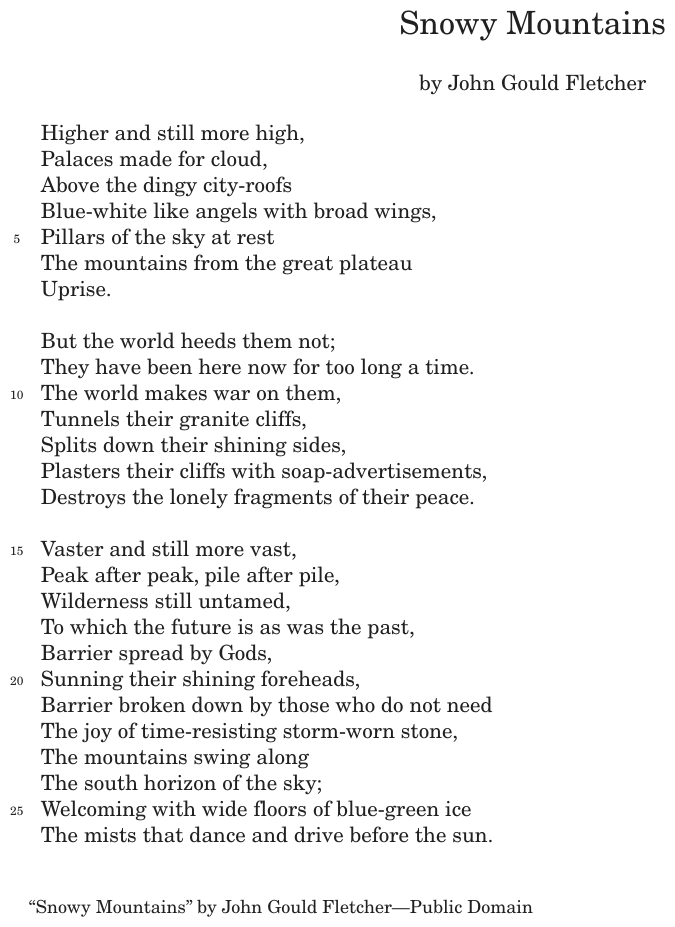
Snowy Mountains
by John Gould Fletcher
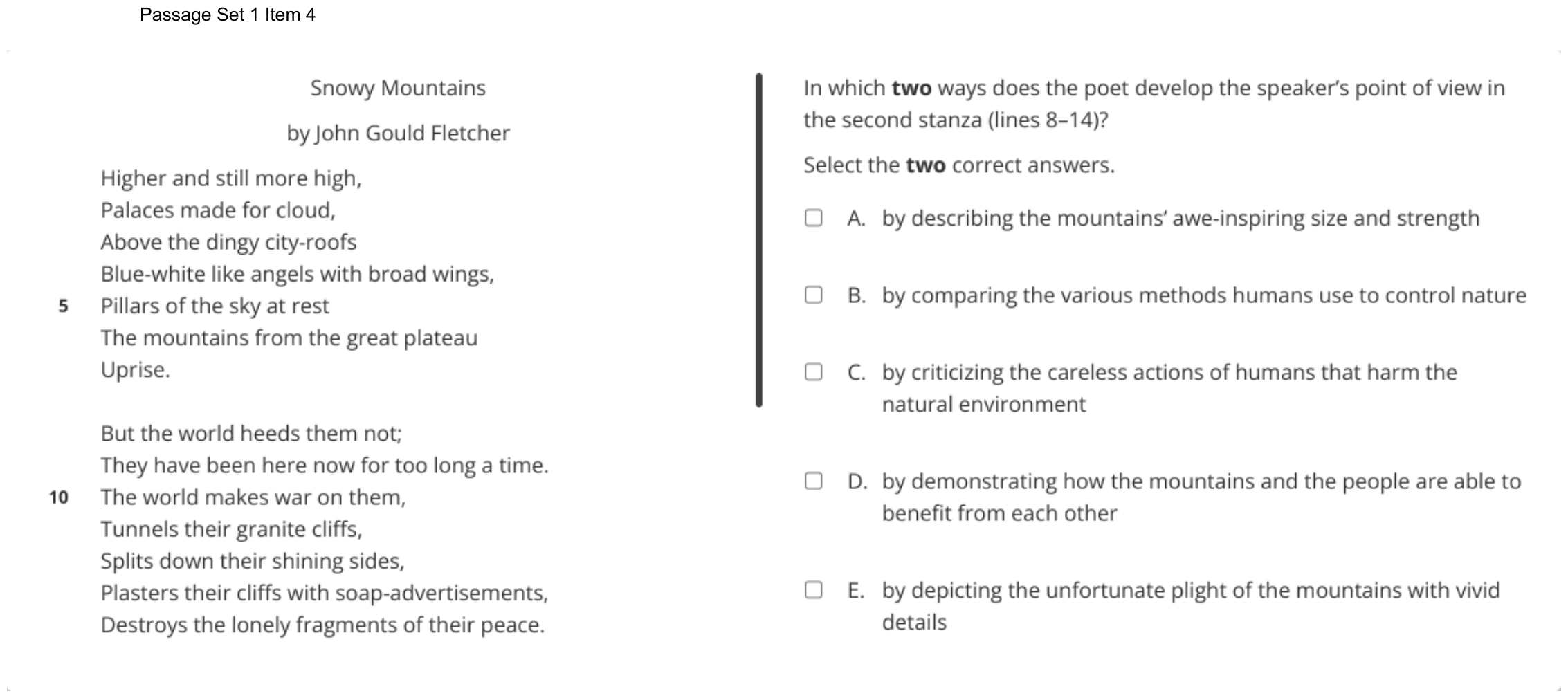
Higher and still more high,
Palaces made for cloud,
Above the dingy city-roofs
Blue-white like angels with broad wings,
Pillars of the sky at rest
The mountains from the great plateau
Uprise.
But the world heeds them not;
They have been here now for too long a time.
The world makes war on them,
Tunnels their granite cliffs,
Splits down their shining sides,
Plasters their cliffs with soap-advertisements,
Destroys the lonely fragments of their peace.
Vaster and still more vast,
Peak after peak, pile after pile,
Wilderness still untamed,
To which the future is as was the past,
Barrier spread by Gods,
Sunning their shining foreheads,
Barrier broken down by those who do not need
The joy of time-resisting storm-worn stone,
The mountains swing along
The south horizon of the sky;
Welcoming with wide floors of blue-green ice
The mists that dance and drive before the sun.
“Snowy Mountains” by John Gould Fletcher—Public Domain
Question
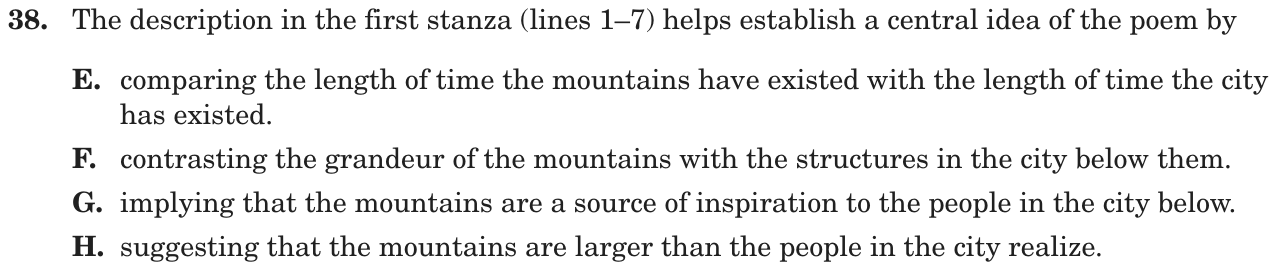
The description in the first stanza (lines 1–7) helps establish a central idea of the poem by
- Acomparing the length of time the mountains have existed with the length of time the city has existed.
- Bcontrasting the grandeur of the mountains with the structures in the city below them.
- Cimplying that the mountains are a source of inspiration to the people in the city below.
- Dsuggesting that the mountains are larger than the people in the city realize.
Show the answer
Correct answer: B
The question asks how the description in the first stanza helps establish a central idea of the poem. The poem is mostly about the grandeur of the mountains in spite of the spread of civilization. The first stanza contrasts these two elements, which is stated in Option B.
Option A is incorrect because it is a detail that is referenced later in the poem.
Option C is incorrect because the poem actually communicates the message that people do not recognize the greatness of the mountains.
Option D is incorrect because, although the first stanza mentions the size of the mountains, it does not imply that people cannot see how large the mountains are.
Question analysis
This question about John Gould Fletcher’s poem “Snowy Mountains” asks how the first stanza’s description helps establish a central idea of the poem. Students must interpret images such as palaces, pillars and angels, decide what the opening lines do with them, and judge which choice states that role without adding ideas.
- Grade level
- Grade 7 reading and task
- Compared with grade 7
- At grade 7 Linking one stanza to a poem’s central idea is a common grade 7 task, and these images are vivid and concrete. The inverted, century-old syntax adds a little challenge but no unusual demand.
- Estimated difficulty
- Straightforward: two steps or one careful reading.
- Thinking it demands
- Depth of knowledge 2, skills and concepts · mainly analyze
- What makes it hard
- Figurative or literary language moderate
- Complex sentences minor
- Evidence
- Answered from one paragraph or stanza
- Reading level
- Passage: 161 words (a poem; reading level not measured); question and choices: about grade 8, 77 words.
- Students, last 30 days
- Not enough answers yet to show (it takes 10).
Why it is hard, traps and wrong answers (shows the answer)
Why it is hard
The first stanza sets its majestic images directly against “the dingy city-roofs,” so students who read it as a picture find the contrast without much trouble. The losses come from importing ideas from later in the poem, people’s neglect in stanza 2 or the passing of time, into seven lines that contain neither. The inverted word order slows a first reading but does not hide the meaning.
Figurative or literary language moderate Understanding the question
The contrast is carried by images, not statements: “Palaces made for cloud” and “angels with broad wings” rise “Above the dingy city-roofs,” and students must read grandeur and drabness from those pictures. (Graesser, Singer & Trabasso, 1994; Kintsch, 1998)
Complex sentences minor Understanding the question
The stanza is one inverted sentence: five lines of images come before its subject, “The mountains,” in line 6 and its verb, “Uprise,” in line 7. (Abedi & Lord, 2001; Freedle & Kostin, 1993; Messick, 1989)
Strategy: Reread lines 1–7 and sum up in a phrase what the stanza does, then check each choice against those seven lines.
Traps
- Reads too much in: A reasonable-sounding conclusion that goes further than the text allows.
- Wrong part of the text: A choice is true of another paragraph, stanza or speaker than the one asked about.
- Outside knowledge: A choice is plausible in the real world but not supported by this text.
The wrong answers, classified
A Wrong part of the text (Kirsch & Mosenthal, 1990)
Brings in time, which the poem raises only in line 9 and line 18; the first stanza sets mountains against city by height and splendor, not by age.
C Outside knowledge (King et al., 2004; Recht & Leslie, 1988)
Assumes that majestic mountains inspire the people below them, a common idea about nature, but the stanza shows no reaction from the city, and the next stanza says the world “heeds them not.”
D Reads too much in (Graesser, Singer & Trabasso, 1994)
Combines line 1’s “Higher and still more high” with the poem’s later charge that people ignore the mountains, but nothing in lines 1–7 says the city misjudges how large they are.
Working it out, step by step
Figure out what the question asks
This question asks how the first stanza helps build a central idea of the poem. A stanza is a group of lines in a poem, like a paragraph. A central idea is a main message. Only lines 1 to 7 matter here, from “Higher and still more high” to “Uprise.”
Read the pictures in lines 1–7
The mountains are called “Palaces made for cloud” in line 2. In line 4 they are “Blue-white like angels with broad wings.” In line 5 they are “Pillars of the sky at rest.” Palaces, angels and pillars are all grand, high and beautiful. But line 3 places them “Above the dingy city-roofs.”
Explain what the pictures show
“Dingy” means dull and dirty. So the stanza sets two things side by side. Up high are the shining, noble mountains. Down below are the drab roofs of the city. This is a contrast: two things put together to show how different they are. Grandeur means greatness and splendor. The stanza shows the mountains’ grandeur next to the plain city.
Check each choice
- A is wrong. Time is not in lines 1–7. It first comes up in line 9, “They have been here now for too long a time.”
- B fits. Grand mountains rise over dingy city roofs.
- C is wrong. The stanza never shows people being inspired. In fact, line 8 says “the world heeds them not,” or pays them no attention.
- D is wrong. Line 1 says the mountains are high. But nothing says the city misjudges their size.
Choose the answer
The first stanza puts splendid mountains above a dull city. So the answer is B, “contrasting the grandeur of the mountains with the structures in the city below them.”
Why this answer and not the closest wrong one
D is the closest trap. It mixes line 1 with an idea from later in the poem, that people ignore the mountains. But the question is about lines 1–7 only. Those lines show a contrast in looks: high and splendid against low and dingy. They say nothing about what people think.
More questions like this
The original DOE question
The passage “Snowy Mountains” as printed (page 142)
Question 2 of 57
2025 Practice Test A English, question 2Uses the passage above: “Snowy Mountains”.
Question
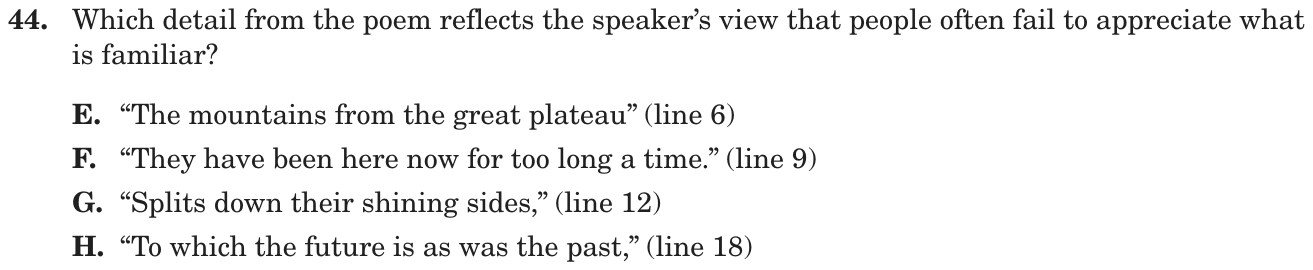
Which detail from the poem reflects the speaker’s view that people often fail to appreciate what is familiar?
- A“The mountains from the great plateau” (line 6)
- B“They have been here now for too long a time.” (line 9)
- C“Splits down their shining sides,” (line 12)
- D“To which the future is as was the past,” (line 18)
Show the answer
Correct answer: B
The question asks for the detail from the poem that reflects the speaker’s view that people often fail to appreciate that which is familiar.
Line 9 (Option B) most directly supports this idea by implying that the mountains have been here for so long that people are accustomed to seeing them and no longer appreciate their beauty and value, making Option B the correct response.
Option A is incorrect because line 6 describes the mountains’ location, rather than their longevity or familiarity.
Option C is incorrect because, in line 12, the mention of harm that has been done to the mountains does not connect to a sense of overfamiliarity.
Option D is incorrect because, although line 18 alludes to the longevity of the mountains, it does not connect the longevity with a sense of overfamiliarity or the failure of people to appreciate the mountains’ worth.
Question analysis
Students pick the detail from the poem “Snowy Mountains” that reflects the speaker’s view that people often fail to appreciate what is familiar. The idea is never stated outright, so students must read each quoted line in its context and decide which one implies both familiarity and a loss of appreciation.
- Grade level
- Grade 7 reading and task
- Compared with grade 7
- At grade 7 Evidence questions like this are typical grade 7 work, but the support here is implied rather than stated, which adds an inference step beyond simple matching of words.
- Estimated difficulty
- Moderate: several steps, or a close reading with one strong distractor.
- Thinking it demands
- Depth of knowledge 2, skills and concepts · mainly evaluate
- What makes it hard
- Reading between the lines moderate
- Every choice must be checked minor
- Evidence
- Answered from one sentence or line
- Reading level
- Passage: 161 words (a poem; reading level not measured); question and choices: about grade 3, 52 words.
- Students, last 30 days
- Not enough answers yet to show (it takes 10).
Why it is hard, traps and wrong answers (shows the answer)
Why it is hard
The claim joins two ideas, long familiarity and failing to appreciate, and the right line shows them only together with the line before it. Students who match the idea of time pick the line about the future and the past, and those who match neglect pick a line of damage. Reading line 9 as the explanation for line 8 is the key move.
Reading between the lines moderate Working it out
The line never says “familiar”; its meaning comes from its place right after “But the world heeds them not,” where being here “too long” reads as the reason for that neglect. (Graesser, Singer & Trabasso, 1994; Kintsch, 1998)
Every choice must be checked minor Choosing the answer
Each quoted line has to be read in its stanza, because out of context lines 9 and 18 both sound like statements about time. (Embretson & Wetzel, 1987)
Strategy: Restate the claim as “people stop valuing something because they are used to it,” then check each quoted line within its stanza for a reason people might stop noticing the mountains.
Traps
- Supports only part of the claim: In a question about evidence: a line that backs one half of the claim but not the other, or a related point rather than the claim itself.
The wrong answers, classified
A Little reason to choose it (Haladyna & Downing, 1993; Rodriguez, 2005)
Line 6 only places the mountains above “the great plateau” and touches neither familiarity nor appreciation, so it mainly draws students who are guessing.
C Supports only part of the claim (King et al., 2004; Thissen, Steinberg & Fitzpatrick, 1989)
Shows people harming the mountains, which fits the speaker’s complaint that they are not valued, but “Splits down their shining sides” gives no sign that familiarity is the cause.
D Supports only part of the claim (King et al., 2004; Thissen, Steinberg & Fitzpatrick, 1989)
Notices that line 18 stresses how long the mountains endure, but it describes their permanence, not people growing used to them and ceasing to value them.
Working it out, step by step
Figure out what the question asks
This asks for a line that shows one of the speaker’s views: people often fail to appreciate what is familiar. Familiar means something you know well and see all the time. To appreciate is to value something. So the line must show people no longer valuing the mountains because they are used to them.
Read each line in its place
Line 9 says, “They have been here now for too long a time.” Read it with line 8 just before it: “But the world heeds them not.” “Heeds” means pays attention to. So the world ignores the mountains. Line 9 gives the reason. They have been around so long that people are used to them.
Explain what line 9 means
The mountains have not done anything wrong by being old. The words “too long” show how people feel about them. Something you see every day starts to seem plain. You stop noticing it. That is exactly the idea in the question: people stop valuing what is familiar.
Check each choice
- A is wrong. Line 6 only tells where the mountains are, above “the great plateau.”
- B fits. It explains that people ignore the mountains because they have seen them for so long.
- C is wrong. Line 12 shows harm, but it does not say familiarity is the cause.
- D is wrong. Line 18 means the mountains do not change over time. It is about how long they last, not about people getting used to them.
Choose the answer
Line 9 explains why the world ignores the mountains: people are too used to them. So the answer is B, “They have been here now for too long a time.”
Why this answer and not the closest wrong one
D is the closest trap, since lines 9 and 18 both talk about time. But line 18 praises the mountains for lasting. Line 9 follows “the world heeds them not” and explains it. Only line 9 links long familiarity to people not caring.
More questions like this
The original DOE question
Question 3 of 57
2025 Practice Test A English, question 3Uses the passage above: “Snowy Mountains”.
Question
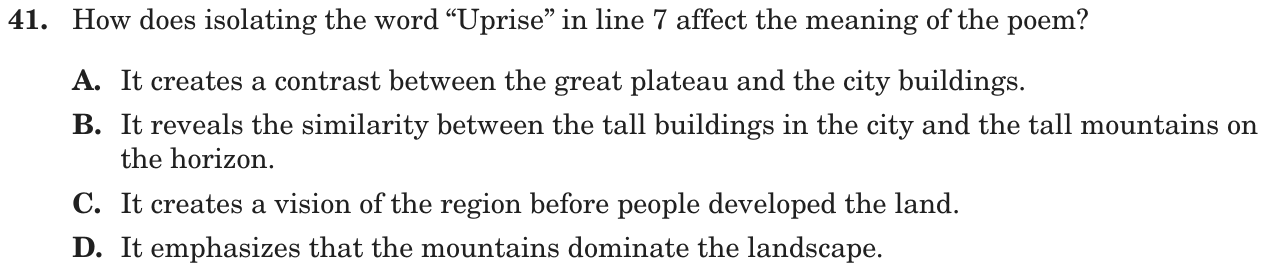
How does isolating the word “Uprise” in line 7 affect the meaning of the poem?
- AIt creates a contrast between the great plateau and the city buildings.
- BIt reveals the similarity between the tall buildings in the city and the tall mountains on the horizon.
- CIt creates a vision of the region before people developed the land.
- DIt emphasizes that the mountains dominate the landscape.
Show the answer
Correct answer: D
The question asks how the isolation of the word affects the meaning of the poem. The isolation of the word “Uprise” powerfully emphasizes the first stanza’s description of the magnificent mountains standing tall above the land below, as expressed in Option D.
Option A is incorrect because the word describes the mountains and, therefore, does not create a contrast between the plateau and the city buildings, but rather between the mountains and the plateau.
Option B is incorrect because the word contrasts the mountains with the plateau; it does not compare the mountains to the buildings in the city.
Option C is incorrect because the first stanza describes the already developed land over which the mountains rise.
Question analysis
In “Snowy Mountains,” the opening stanza builds a long sentence about the mountains and saves its verb, “Uprise,” for a line of its own. This poetry structure question asks how isolating that single word affects the poem’s meaning, so students need to think about how a line break shapes what the reader notices, as well as about what the stanza describes.
- Grade level
- Grade 8 reading and task
- Compared with grade 7
- At grade 7 Grade 7 poetry questions often ask about word choice; this one asks about a structural choice, a one-word line, which is less familiar, though the stanza’s images make the intended effect fairly easy to sense.
- Estimated difficulty
- Moderate: several steps, or a close reading with one strong distractor.
- Thinking it demands
- Depth of knowledge 2, skills and concepts · mainly analyze
- What makes it hard
- Complex sentences moderate
- How, not what moderate
- Evidence
- Answered from one paragraph or stanza
- Reading level
- Passage: 161 words (a poem; reading level not measured); question and choices: about grade 8, 64 words.
- Students, last 30 days
- Not enough answers yet to show (it takes 10).
Why it is hard, traps and wrong answers (shows the answer)
Why it is hard
Students who see that “Uprise” is the verb the whole stanza has been building toward recognize the effect quickly: the mountains rise over everything else in the picture. Those who treat the word as one more image look for a comparison instead and find several, because the stanza is full of buildings, roofs and a plateau. The real test is sorting which contrast belongs to the mountains.
Complex sentences moderate Understanding the question
The stanza is one long sentence that withholds its subject until line 6 and its verb until line 7, so “Uprise” lands as the payoff of five lines of images. (Abedi & Lord, 2001; Freedle & Kostin, 1993; Messick, 1989)
How, not what moderate Working it out
The question asks about a line break, a structural choice, rather than a word’s meaning, and students must judge what setting one verb on its own line makes the reader notice. (Anderson & Krathwohl, 2001)
Strategy: Read the stanza aloud and notice where the long sentence finally reaches its verb, then ask what ending on that single word makes the reader see.
Traps
- Taking figurative language literally: A choice reads a figure of speech or image at face value.
- Half right: One half of a two-part choice is right and the other is not.
The wrong answers, classified
A Half right (King et al., 2004; Thissen, Steinberg & Fitzpatrick, 1989)
Rightly senses a contrast in the stanza but pairs the wrong things: “Uprise” sets the mountains against the land below them, not the plateau against the city’s buildings.
B Twists what the text says (King et al., 2004)
Notices that the mountains are compared to “Palaces” and “Pillars,” but those grand buildings are set against the “dingy city-roofs,” so the stanza contrasts mountains and city rather than likening them.
C Taking figurative language literally (Graesser, Singer & Trabasso, 1994)
Takes “Uprise” at face value, as mountains pushing up out of the plateau long ago, but line 3’s “dingy city-roofs” place the scene in a land already built on.
Working it out, step by step
Figure out what the question asks
This asks about a choice the poet made in how the poem looks. Line 7 is only one word: “Uprise.” You need to say what setting that word alone on its line does to the meaning.
Find the sentence the word ends
The whole first stanza is one long sentence. Lines 1 to 5 are a string of pictures: palaces, angels, pillars. The subject, “The mountains from the great plateau,” does not come until line 6. Line 7 then gives the verb, or action word, which is “Uprise.” A plateau is a wide area of high, flat land.
Think about the effect
“Uprise” means rise up. The reader waits six lines for this action. Then it stands by itself, like the mountains standing alone over the land. The short line makes you stop and picture them rising above everything, even “the dingy city-roofs.” So the mountains dominate the scene. To dominate is to tower over and be the main thing you notice.
Check each choice
- A is wrong. “Uprise” is about the mountains rising. It does not set the plateau against the city buildings.
- B is wrong. The stanza does not show the city and the mountains as alike. The city roofs are “dingy,” while the mountains are like palaces.
- C is wrong. Line 3 already shows a city, so this is not the land before people.
- D fits. The lone word makes the mountains tower over the whole picture.
Choose the answer
Ending the long sentence on one lone word makes the mountains stand out over everything. So the answer is D, “It emphasizes that the mountains dominate the landscape.”
Why this answer and not the closest wrong one
A is the closest trap, because the stanza does contain a contrast. But it is between the mountains and everything below them. “Uprise” is the mountains’ own action, so its effect must be about the mountains. Only D keeps the focus there.
More questions like this
The original DOE question
Question 4 of 57
2025 Practice Test A English, question 4Uses the passage above: “Snowy Mountains”.
Question
In which two ways does the poet develop the speaker’s point of view in the second stanza (lines 8–14)?
Select the two correct answers.
Choose every answer that is correct, then check. The DOE has not published how answers with several parts are scored; this site counts one right only when every part is right.
- Aby describing the mountains’ awe-inspiring size and strength
- Bby comparing the various methods humans use to control nature
- Cby criticizing the careless actions of humans that harm the natural environment
- Dby demonstrating how the mountains and the people are able to benefit from each other
- Eby depicting the unfortunate plight of the mountains with vivid details
Show the answer
Correct answer: C and E
The question asks for the two ways in which the poet develops the speaker’s point of view in the second stanza (lines 8–14).
A. Incorrect. The speaker’s descriptions of the mountains’ awe-inspiring size and strength mainly occur in the first and third stanzas, while in the second stanza, the speaker focuses on humanity and its negative effect on the mountains.
B. Incorrect. The wording of the second stanza—“makes war” (line 10), “Splits down their shining sides” (line 12), and “Destroys the lonely fragments” (line 14)—communicates the speaker’s position that people’s main impact on the mountains is destructive, but the stanza does not compare the various methods people use to control nature.
C. CORRECT. In the second stanza, the speaker criticizes the careless and destructive actions of society or “the world” (lines 8 and 10) that harm the natural environment. Humans are described as both heedless of the mountains (“heeds them not”) and harmfully warlike (“makes war on them”). The speaker cites the harm done to the mountains when people “[tunnel] their granite cliffs” (line 11) and “[split] down their shining sides” (line 12), thus “[destroying] the lonely fragments of their peace” (line 14).
D. Incorrect. In the second stanza, the speaker does not describe a mutually beneficial relationship between the mountains and the people. Although people clearly derive benefits from the mountains by plastering “their cliffs with soap-advertisements” (line 13), the stanza does not demonstrate that the mountains receive any benefit from the harmful actions of the people.
E. CORRECT. In the second stanza, the speaker depicts the unfortunate plight of the mountains with vivid details. Lines 11–14 feature expressive wording that sharply illustrates the mountains’ misfortune: “Tunnels their granite cliffs, / Splits down their shining sides, / Plasters their cliffs with soap-advertisements.”
Question analysis
This select-two question on John Gould Fletcher’s poem “Snowy Mountains” asks in which two ways the poet develops the speaker’s point of view in the second stanza, lines 8–14. It reworks a one-answer handbook question, now with five choices. Each choice has to be judged on its own, and a choice that fits the poem as a whole is not enough.
- Grade level
- Grade 6 reading and task
- Compared with grade 7
- At grade 7 Typical grade 7 point-of-view questions ask for one answer about a longer text. This stanza is only seven short lines with one steady attitude, but students must find two right choices out of five and judge each one separately.
- Estimated difficulty
- Moderate: several steps, or a close reading with one strong distractor.
- Thinking it demands
- Depth of knowledge 2, skills and concepts · mainly analyze
- What makes it hard
- How, not what moderate
- Every choice must be checked moderate
- Hard words minor
- Evidence
- Answered from one paragraph or stanza
- Reading level
- Passage: 161 words (a poem; reading level not measured); question and choices: about grade 8, 79 words.
- Students, last 30 days
- Not enough answers yet to show (it takes 10).
Why it is hard, traps and wrong answers (shows the answer)
Why it is hard
Most students sense the anger at “the world” in lines 8–14 and find the criticism of people quickly. The point is lost on the second pick, because the other right choice names a technique, vivid details of the mountains’ suffering, and can look like plain description. The choice about comparing methods tempts students who see a list of human actions, and the awe of the first and third stanzas pulls those who drift outside the stanza, while both picks must be right to score.
How, not what moderate Working it out
The stem asks how the viewpoint is built, and both right choices are methods: a judgment of “the world” that “makes war,” and the vivid verbs “Tunnels,” “Splits” and “Plasters” in lines 11–13. (Anderson & Krathwohl, 2001)
Every choice must be checked moderate Choosing the answer
All five choices must be tested and both picks must be right, so finding the criticism of people is only half the work; the second right choice is about imagery, not message. (Embretson & Wetzel, 1987)
Hard words minor Understanding the question
One right choice turns on “plight,” a hard situation; a student who does not know the word cannot see that it names the damage done to the mountains in lines 11–14. (Perfetti, 2007; Freedle & Kostin, 1993)
Strategy: Restate in your own words what lines 8–14 say and how they say it, then test each of the five choices on its own and keep only the two that fit this stanza rather than the whole poem.
Traps
- Twists what the text says: Uses the text's topic and ideas but changes what it says: who did it, how much, when, or why.
- Wrong part of the text: A choice is true of another paragraph, stanza or speaker than the one asked about.
The wrong answers, classified
A Wrong part of the text (Kirsch & Mosenthal, 1990)
Brings in the awe of the first and third stanzas, “Higher and still more high” and “Vaster and still more vast,” though in lines 8–14 the cliffs appear only as things being damaged.
B Twists what the text says (King et al., 2004)
Sees that lines 11–13 list several human acts, tunneling, splitting and plastering, but the stanza never weighs one against another; all are blows in one war, not methods of control.
D Wrong tone or attitude (Graesser, Singer & Trabasso, 1994)
Treats the soap advertisements as people getting some use from the cliffs and imagines an exchange, missing the hostility of “The world makes war on them” and “Destroys.”
E Wrong purpose or structure (Anderson & Krathwohl, 2001)
Left out by students who see the vivid verbs as mere description of damage rather than the way the speaker builds sympathy, or who do not know that “plight” means a bad situation.
Working it out, step by step
Figure out what the question asks
This asks about point of view: how the speaker, the voice talking in the poem, feels about the subject. It also asks how the poet shows that feeling. Stay inside the second stanza, lines 8 to 14. You must pick two answers, so test all five choices one at a time.
Read the second stanza closely
Line 8 says “But the world heeds them not.” To heed something is to pay attention to it. Here “the world” means people in general. Line 10 says “The world makes war on them.” Lines 11 to 13 list what people do: “Tunnels their granite cliffs, / Splits down their shining sides, / Plasters their cliffs with soap-advertisements.” Line 14 ends with “Destroys the lonely fragments of their peace.”
Name how the speaker feels
The speaker is on the mountains’ side. People ignore the mountains, yet they keep attacking them. The speaker blames people for this harm. Pointing out what someone does wrong is called criticizing. The speaker also makes you feel sorry for the mountains. Strong action words like “Tunnels,” “Splits” and “Plasters” paint a sharp picture of the damage. Sharp word pictures like these are called vivid details.
Check each of the five choices
- A does not fit. The mountains’ great size fills the first and third stanzas, as in “Higher and still more high.” In lines 8 to 14 they are only being hurt.
- B does not fit. The stanza lists several things people do, but it never compares them. They are all part of one “war.”
- C fits. The speaker criticizes people for careless acts that damage nature.
- D does not fit. The mountains get nothing good from people. The stanza shows only harm.
- E fits. A plight is a bad or sad situation. The vivid verbs in lines 11 to 13 show the mountains’ plight.
Watch out: B is tempting because the stanza names several acts. But a list is not a comparison.
Choose both answers
The speaker’s view comes through two things: blame for people, and a vivid picture of the mountains’ suffering. Select both choices on the screen. You need both to get the point. So the answers are C and E.
Why this answer and not the closest wrong one
E is the right answer that is easiest to miss, because it can look like plain description. But those vivid details are how the speaker makes you feel for the mountains. B is the closest wrong choice. The stanza does list several human acts, yet it never weighs one against another. Each act is just one more blow.
More questions like this
The original DOE question
Question 5 of 57
2025 Practice Test A English, question 5Uses the passage above: “Snowy Mountains”.
Question
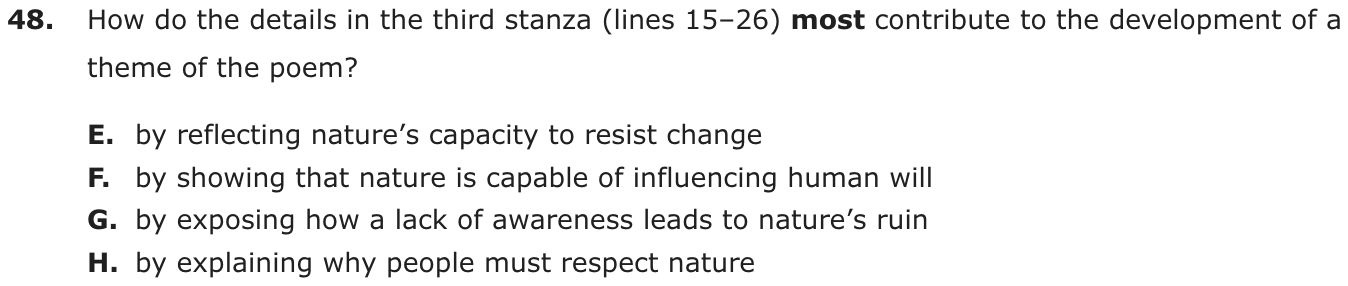
How do the details in the third stanza (lines 15–26) most contribute to the development of a theme of the poem?
- Aby reflecting nature’s capacity to resist change
- Bby showing that nature is capable of influencing human will
- Cby exposing how a lack of awareness leads to nature’s ruin
- Dby explaining why people must respect nature
Show the answer
Correct answer: A
The question asks how the details in the third stanza most contribute to the development of a theme of the poem.
A. CORRECT. In the third stanza, phrases such as “Wilderness still untamed” (line 17), “time-resisting storm-worn stone” (line 22), and “The mountains swing along” (line 23) convey the message that in spite of the destruction described in the second stanza, the mountains manage to maintain their wild magnificence.
B. Incorrect. While the phrase “Barrier broken down” (line 21) conveys the idea that people can have some effect on the natural landscape, it does not convey how nature affects people.
C. Incorrect. The phrase “those who do not need” (line 21) implies a choice to damage nature and not a lack of awareness or understanding.
D. Incorrect. The third stanza is not a call to humanity to respect the mountains but a description of the untamed, welcoming mountains and the joy they provide for those who appreciate them.
Question analysis
Students trace how the details of the third and final stanza of “Snowy Mountains,” lines 15–26, most contribute to developing a theme of the poem. Because the stanza is a single sentence that runs from line 15 to the poem’s last word, students must keep its whole movement in mind before deciding what it adds.
- Grade level
- Grade 8 reading and task
- Compared with grade 7
- Above grade 7 Grade 7 theme questions usually rest on a few clear details. Here students must hold a twelve-line stanza of inverted, piled-up phrases in mind and pick among four reasonable lessons about nature, a heavier load closer to grade 8.
- Estimated difficulty
- Hard: combines ideas, needs a plan, and has more than one tempting wrong answer.
- Thinking it demands
- Depth of knowledge 3, strategic thinking · mainly analyze
- What makes it hard
- Complex sentences moderate
- Figurative or literary language moderate
- Evidence in several places moderate
- Evidence
- Answered from one paragraph or stanza
- Reading level
- Passage: 161 words (a poem; reading level not measured); question and choices: about grade 7, 55 words.
- Students, last 30 days
- Not enough answers yet to show (it takes 10).
Why it is hard, traps and wrong answers (shows the answer)
Why it is hard
The final stanza holds both endurance and damage, and the stem’s “most” asks which of the two its details build. Students who fix on the broken barrier choose ruin, a reading the second stanza seems to confirm, while those who tally the stanza’s details find untamed wilderness, time-resisting stone and mountains swinging at ease. Because the stanza is one long, inverted sentence, that tally is slow, which is what makes the question hard.
Complex sentences moderate Understanding the question
Lines 15–26 are one sentence in which phrase after phrase, from “Vaster and still more vast” to “storm-worn stone,” comes before its subject, “The mountains,” in line 23. (Abedi & Lord, 2001; Freedle & Kostin, 1993; Messick, 1989)
Figurative or literary language moderate Understanding the question
The message of endurance is carried by personification: the peaks have “shining foreheads,” are “spread by Gods,” and “swing along” the horizon welcoming the mists. (Graesser, Singer & Trabasso, 1994; Kintsch, 1998)
Evidence in several places moderate Working it out
The theme has to be assembled from details scattered over twelve lines, “Wilderness still untamed,” “the future is as was the past,” “time-resisting,” and weighed against the single line of damage. (Kirsch & Mosenthal, 1990; Gorin & Embretson, 2006)
Strategy: Read lines 15–26 as one long sentence, find its main subject and verb, and sum up its message in a phrase; then check each choice against the whole stanza, not a single line.
Traps
- Too narrow: A single detail offered as the central idea or a summary, or a summary that keeps minor details and leaves out an essential part.
- Outside knowledge: A choice is plausible in the real world but not supported by this text.
- Reversed relationship: Cause and effect, or the order of events, turned around.
The wrong answers, classified
B Reversed relationship (King et al., 2004)
Turns the influence around: in this stanza people break down the barrier while the peaks endure, and nothing shows the mountains shaping what people want.
C Too narrow (King et al., 2004)
Builds on line 21’s “Barrier broken down,” the stanza’s one line of damage, and lets it stand for twelve lines that mostly celebrate the mountains as wild and lasting.
D Outside knowledge (King et al., 2004; Recht & Leslie, 1988)
States the lesson a nature poem is expected to teach, that people must respect nature, but the stanza describes the mountains and never tells readers what to do.
Working it out, step by step
Figure out what the question asks
This asks about theme, the big message of the poem. You need to see what the details of the third stanza, lines 15 to 26, add to that message. The word “most” matters. Pick the idea that most of the details support, not just one line.
Gather the details in lines 15 to 26
The peaks grow “Vaster and still more vast” (line 15). They are a “Wilderness still untamed” (line 17). For them, the future is “as was the past” (line 18). Their stone is “time-resisting” (line 22). In the last four lines, “The mountains swing along” the sky and welcome the mists. Only line 21 shows damage: the barrier is “broken down.”
Find what the details share
Untamed means still wild, not controlled by people. If the future is the same as the past, the mountains are not changing. Time-resisting means they hold out against the years. And at the end of the stanza, they are still moving along at ease. Nearly every detail shows the same thing. The mountains last and stay wild, which is nature’s power to resist change.
Check each choice
- A fits. Wild, unchanging, time-resisting mountains show nature holding out against change.
- B does not fit. It turns things around. In this stanza, people affect the mountains. Nothing shows the mountains changing what people want.
- C does not fit. Line 21 shows damage, but it is one line out of twelve. The stanza does not end in ruin either: the mountains still swing along and welcome the mists.
- D does not fit. These lines paint a picture of the peaks. They give readers no orders and no reasons to behave a certain way.
Choose the answer
Most of the third stanza shows mountains that stay wild and lasting. So the answer is A.
Why this answer and not the closest wrong one
C is the closest trap, because line 21 does show the barrier “broken down,” and the second stanza is full of harm. But this question is about the third stanza, and it asks what the details most add. Most of the other lines there show mountains that are vast, wild and lasting. That builds A, not ruin.
More questions like this
The original DOE question
Question 6 of 57
2025 Practice Test A English, question 6Uses the passage above: “Snowy Mountains”.
Question
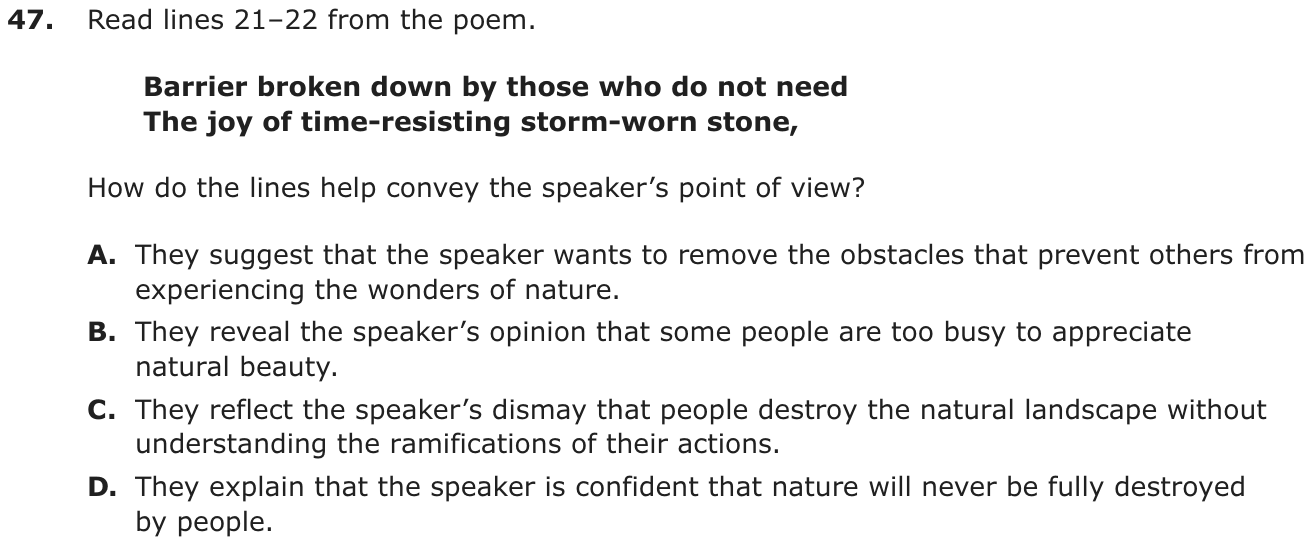
Read lines 21–22 from the poem.
Barrier broken down by those who do not need
The joy of time-resisting storm-worn stone,
How do the lines help convey the speaker’s point of view?
- AThey suggest that the speaker wants to remove the obstacles that prevent others from experiencing the wonders of nature.
- BThey reveal the speaker’s opinion that some people are too busy to appreciate natural beauty.
- CThey reflect the speaker’s dismay that people destroy the natural landscape without understanding the ramifications of their actions.
- DThey explain that the speaker is confident that nature will never be fully destroyed by people.
Show the answer
Correct answer: C
The question asks how lines 21–22 help convey the speaker’s point of view.
A. Incorrect. The word “barrier” (line 21) refers to the speaker’s opinion that the mountains were “spread by Gods” (line 19) and not to an obstacle that the speaker thinks should be removed.
B. Incorrect. While the lines indicate that people have lost the need to connect with nature, they do not reveal that the speaker thinks that the cause of this loss is busyness.
C. CORRECT. The words “those who do not need / The joy” in lines 21–22 reflect the speaker’s sadness that people do not realize that they are destroying something wonderful and irreplaceable.
D. Incorrect. Although the speaker does say that the stone is “time-resisting” (line 22), this belief is only a small detail of the speaker’s point of view.
Question analysis
Two lines from the final stanza of “Snowy Mountains” describe a barrier broken down by people who do not need “The joy of time-resisting storm-worn stone,” and students must explain how these lines convey the speaker’s point of view. The phrasing is compact and old-fashioned, with an unusual use of “need,” so working out the plain meaning comes before choosing among close descriptions of the speaker’s feelings.
- Grade level
- Grade 8 reading and task
- Compared with grade 7
- Above grade 7 Grade 7 students often infer a speaker’s attitude from clear statements. Here the attitude must be drawn from a compressed sentence broken across two lines, and the choices differ in fine shades of feeling and cause.
- Estimated difficulty
- Hard: combines ideas, needs a plan, and has more than one tempting wrong answer.
- Thinking it demands
- Depth of knowledge 2, skills and concepts · mainly analyze
- What makes it hard
- Complex sentences major
- Reading between the lines moderate
- Hard words minor
- Evidence
- Answered from one sentence or line
- Reading level
- Passage: 161 words (a poem; reading level not measured); question and choices: about grade 9, 99 words.
- Students, last 30 days
- Not enough answers yet to show (it takes 10).
Why it is hard, traps and wrong answers (shows the answer)
Why it is hard
Before any choice can be judged, the compressed, inverted verse has to be put into plain English: people with no use for the old stone’s joy have broken the barrier down. Once that paraphrase is in hand, the speaker’s sorrow is clear, yet two wrong choices offer nearby readings. One supplies a cause the lines never give, busyness, and the other turns the stone’s endurance into a promise that the same sentence contradicts.
Complex sentences major Understanding the question
The lines break mid-phrase, “those who do not need / The joy of time-resisting storm-worn stone,” inside a sentence whose subject arrives only in line 23, so who breaks what must be untangled first. (Abedi & Lord, 2001; Freedle & Kostin, 1993; Messick, 1989)
Reading between the lines moderate Working it out
Neither dismay nor ignorance is stated; both must be inferred from describing the people as not needing “The joy” of the stone they break down. (Graesser, Singer & Trabasso, 1994; Kintsch, 1998)
Hard words minor Understanding the question
“Barrier” here means the mountain range as a great wall, not an obstacle, and the key turns on “ramifications,” a word many seventh graders will not know. (Perfetti, 2007; Freedle & Kostin, 1993)
Strategy: Read lines 21–22 with the lines just before them, restate the sentence in your own words, and then decide what the speaker thinks of the people it describes.
Traps
- Dictionary meaning, not meaning here: A common meaning of the word that does not fit its use in this text.
- Outside knowledge: A choice is plausible in the real world but not supported by this text.
- Too broad or too strong: A choice overstates, generalizes, or uses absolute words the text does not support.
The wrong answers, classified
A Dictionary meaning, not meaning here (Perfetti, 2007)
Hears “Barrier” in its everyday sense of something blocking the way, but here it is the mountain range itself, “spread by Gods,” and the speaker regrets its breaking.
B Outside knowledge (King et al., 2004; Recht & Leslie, 1988)
Supplies a familiar modern explanation, people too busy for nature, though the lines say only that some people do not need this joy and never say why.
D Too broad or too strong (King et al., 2004)
Stretches “time-resisting” into certainty that nature can never be destroyed, overlooking that these lines show the barrier already “broken down” by people.
Working it out, step by step
Figure out what the question asks
This asks about point of view: what the speaker thinks and feels. Read lines 21 and 22, and decide what they show about the speaker’s attitude toward the people in them.
Read the lines with the ones before
Two lines earlier, the poem names the mountains a “Barrier spread by Gods” (line 19). A barrier is a wall, and here the wall is the mountain range itself. Line 21 says this barrier is “broken down by those who do not need” something. Line 22 says what that something is: “The joy of time-resisting storm-worn stone.”
Put the lines in plain words
Time-resisting means the stone has held out against ages of time. Storm-worn means storms have rubbed it down. So this stone is very old and very tough. In plain words: the mountains are being torn down by people who have no use for the joy this ancient stone can give. The speaker sounds sad and troubled that something so lasting is wrecked by people who do not value it.
Check each choice
- A does not fit. Here “Barrier” means the mountains, not something blocking the way. The speaker is sorry it was broken, not eager to remove it.
- B does not fit. The lines never give a reason, such as being too busy. That idea comes from outside the poem.
- C fits. Dismay is a mix of sadness and alarm. Ramifications are the effects an action leads to later on. The speaker is dismayed that people wreck the mountains with no thought for what they are losing.
- D does not fit. The stone is “time-resisting,” but the same lines show it broken down. They express sorrow, not confidence.
Choose the answer
The lines show the mountains being broken by people who see no value in them, and the speaker is upset. So the answer is C.
Why this answer and not the closest wrong one
B is the strongest trap, because being too busy for nature sounds like a fair reason. But lines 21 and 22 never explain why these people do not need the stone’s joy. B adds a cause from outside the poem. C stays with what the lines show: damage to the mountains, done by people who do not value them, and the speaker’s distress.
More questions like this
The original DOE question
Question 7 of 57
2025 Practice Test A English, question 7Uses the passage above: “Snowy Mountains”.
Question
Read lines 23–26 from the poem.
The mountains swing along
The south horizon of the sky;
Welcoming with wide floors of blue-green ice
The mists that dance and drive before the sun.
The personification in these concluding lines of the poem suggests that the mountains are
- Agracious hosts who are untroubled by the actions of people.
- Bunaware of their coming destruction.
- Clively entertainers who are amused by the everyday concerns of people.
- Dtoo proud to reveal their pain.
Show the answer
Correct answer: A
The question asks what the personification in the concluding lines of the poem suggests about the mountains.
A. CORRECT. Line 25’s use of the word “Welcoming” suggests that the mountains are kind hosts. Lines 23 and 26, with language such as “The mountains swing along” and “The mists that dance and drive before the sun,” imply the carefree nature of the mountains as they resist the destructive work of humanity.
B. Incorrect. The personification in the lines conveys a sense of optimism and endurance, with no language to suggest coming destruction.
C. Incorrect. Although the lines mention that “the mountains swing along” (line 23) and “the mists . . . dance” (line 26), the personification is used to describe the mountains’ perseverance, rather than to suggest that the mountains are amused by the concerns of others.
D. Incorrect. Although the second stanza develops the idea that the mountains have been mistreated by humans, which might be a source of pain, the concluding lines emphasize the joy and perseverance of the mountains as they “swing along” (line 23) despite significant adversity.
Question analysis
Students interpret the personification in the closing lines of “Snowy Mountains,” lines 23–26, and decide what it suggests about the mountains on the south horizon. They need to see which human actions the poet gives the mountains and what kind of character those actions create, and then choose among four quite different personalities.
- Grade level
- Grade 7 reading and task
- Compared with grade 7
- At grade 7 Grade 7 readers routinely interpret personification, and here the four lines are printed with the question. The images are concrete and the choices give the mountains clearly different roles and moods, so careful matching settles it.
- Estimated difficulty
- Straightforward: two steps or one careful reading.
- Thinking it demands
- Depth of knowledge 2, skills and concepts · mainly understand
- What makes it hard
- Figurative or literary language moderate
- Complex sentences minor
- Evidence
- Answered from one sentence or line
- Reading level
- Passage: 161 words (a poem; reading level not measured); question and choices: about grade 6, 77 words.
- Students, last 30 days
- Not enough answers yet to show (it takes 10).
Why it is hard, traps and wrong answers (shows the answer)
Why it is hard
The closing lines are calm and generous, and the task is to turn their personification into a character. Students who give the mists’ dancing to the mountains see performers, but the performer choice also has the mountains amused by people’s concerns, which nothing here supports, so a careful reader rejects it. The remaining losses come from carrying the second stanza’s damage into lines that show only ease and welcome.
Figurative or literary language moderate Understanding the question
The human traits must be sorted by who has them: the mountains “swing along” and are “Welcoming,” while the mists are the ones that “dance and drive before the sun.” (Graesser, Singer & Trabasso, 1994; Kintsch, 1998)
Complex sentences minor Understanding the question
In “Welcoming with wide floors of blue-green ice / The mists,” the object of “Welcoming” comes after a long phrase and a line break, so who welcomes whom is easy to lose. (Abedi & Lord, 2001; Freedle & Kostin, 1993; Messick, 1989)
Strategy: Underline each verb or describing word in lines 23–26 that gives the mountains a human trait, then check every choice against all of them.
Traps
- Twists what the text says: Uses the text's topic and ideas but changes what it says: who did it, how much, when, or why.
- Reads too much in: A reasonable-sounding conclusion that goes further than the text allows.
The wrong answers, classified
B Reads too much in (Graesser, Singer & Trabasso, 1994)
Takes the mountains’ carefree swinging as ignorance and adds the earlier stanzas’ damage to it, but these four lines are serene and hint at no destruction to come.
C Twists what the text says (King et al., 2004)
Gives the mists’ dancing to the mountains and so makes them performers, then adds amusement at people’s concerns, though here the mountains only swing along and welcome the mists.
D Wrong tone or attitude (Graesser, Singer & Trabasso, 1994)
Imagines a brave face hiding the wounds of the second stanza, but the lines show the mountains at ease and welcoming, with no sign of pride or pain.
Working it out, step by step
Figure out what the question asks
This asks about personification. That is when a writer describes a thing as if it were a person, with human actions or moods. You need to decide what kind of character the mountains seem to be in lines 23 to 26.
Find who does each action
The four lines are one sentence. In line 23, “The mountains swing along” the edge of the sky. Line 25 shows them “Welcoming with wide floors of blue-green ice.” The guests arrive in line 26: “The mists that dance and drive before the sun.” The mountains do two things here, swing along and welcome. The dancing belongs to the mists.
Decide what the actions suggest
Welcoming guests is what a host does. A host invites others in and makes them comfortable. Gracious means warm and polite. To swing along is to move in a relaxed, easy way. The second stanza was full of harm, yet here the mountains seem calm. They are untroubled, or not worried or upset.
Check each choice
- A fits. The mountains welcome the mists like gracious hosts, and they move at ease.
- B does not fit. Nothing in these lines hints at harm to come. The mood is calm and bright.
- C does not fit. Line 26 gives the dancing to the mists. And nothing shows the mountains laughing at people’s daily worries.
- D does not fit. There is no sign of pride or hidden pain. The mountains seem relaxed and open.
Choose the answer
Like kind hosts, the mountains greet their guests and stay calm. So the answer is A.
Why this answer and not the closest wrong one
C may tempt you, because swinging and dancing both sound lively. But check who dances: line 26 gives the dancing to the mists. The mountains are the ones “Welcoming” them, so they are hosts, not entertainers. C also says the mountains are amused by people, and these lines never show that.
More questions like this
The original DOE question
Question 8 of 57
2025 Practice Test A English, question 8Uses the passage above: “Snowy Mountains”.
Question
Which quotations from the poem support the theme that nature’s unspoiled beauty is splendid, and which quotations support the theme that human creations detract from natural wonder?
Move each answer to the correct box.
Choose one answer in each row, then check. The DOE has not published how answers with several parts are scored; this site counts one right only when every part is right.
| Nature’s Unspoiled Beauty is Splendid | Human Creations Detract from Natural Wonder | |
|---|---|---|
| “Above the dingy city-roofs / Blue-white like angels with broad wings,” (lines 3–4) | ||
| “Pillars of the sky at rest / The mountains from the great plateau / Uprise.” (lines 5–7) | ||
| “Tunnels their granite cliffs, / Splits down their shining sides,” (lines 11–12) | ||
| “Wilderness still untamed, / To which the future is as was the past,” (lines 17–18) | ||
| “The south horizon of the sky; / Welcoming with wide floors of blue-green ice” (lines 24–25) |
Show the answer
Correct answer: “Above the dingy city-roofs / Blue-white like angels with broad wings,” (lines 3–4): Human Creations Detract from Natural Wonder; “Pillars of the sky at rest / The mountains from the great plateau / Uprise.” (lines 5–7): Nature’s Unspoiled Beauty is Splendid; “Tunnels their granite cliffs, / Splits down their shining sides,” (lines 11–12): Human Creations Detract from Natural Wonder; “Wilderness still untamed, / To which the future is as was the past,” (lines 17–18): Nature’s Unspoiled Beauty is Splendid; “The south horizon of the sky; / Welcoming with wide floors of blue-green ice” (lines 24–25): Nature’s Unspoiled Beauty is Splendid
The question identifies two themes and asks which quotations from the poem support each theme. Each quotation should be moved to one of the two boxes: “Nature’s Unspoiled Beauty is Splendid” or “Human Creations Detract from Natural Wonder.”
“Above the dingy city-roofs / Blue-white like angels with broad wings,” (lines 3–4)
This quotation supports the theme that human creations detract from natural wonder. The lines describe the city-roofs as “dingy,” suggesting that they mar the lovely background of the blue-white mountains, which are compared to angels, a simile that vividly conveys the wonder of nature. The description in the lines primarily serves to create a contrast between the city’s unsightly appearance and the beauty of the mountains, thereby providing support for the theme that human creations (i.e. the city) detract from natural wonder.
“Pillars of the sky at rest / The mountains from the great plateau / Uprise.” (lines 5–7)
This quotation supports the theme that nature’s unspoiled beauty is splendid. By describing the mountains as “pillars of the sky” that “uprise” dramatically from a large plateau, the lines primarily convey a sense of the mountains’ dramatic and impressive size. The description suggests that the mountains are holding up the sky, a powerful image of an unspoiled, natural landscape.
“Tunnels their granite cliffs, / Splits down their shining sides,” (lines 11–12)
The quotation supports the theme that human creations detract from natural wonder. The words “tunnels” and “splits” emphasize that human intervention in nature is destructive, breaking apart the “shining sides” of the mountain. These lines suggest that human creations—such as building a tunnel through a mountain—detract from natural wonder, diminishing its beauty and serenity.
“Wilderness still untamed, / To which the future is as was the past,” (lines 17–18)
The quotation supports the theme that nature’s unspoiled beauty is splendid by indicating that the natural mountainous landscape is both splendid and unspoiled (“wilderness still untamed”). The phrase “to which the future is as was the past” suggests that nature in its unspoiled state is timeless or eternal, further supporting the theme.
“The south horizon of the sky; / Welcoming with wide floors of blue-green ice” (lines 24–25)
The quotation supports the theme that nature’s unspoiled beauty is splendid. The reference to the “wide floors of blue-green ice” emphasizes that the landscape is beautiful, and the description in the lines conveys the grandiose splendor of nature, conveying an image of the “south horizon of the sky” majestically “welcoming” one’s eye, inviting appreciation of its unspoiled beauty.
Question analysis
This sorting question on the poem “Snowy Mountains” gives two themes, the splendor of unspoiled nature and the way human creations detract from natural wonder, and asks students to place five quotations under them. The quotations come from all three stanzas. Students make five separate judgments, and a line’s most vivid image is not always the best guide to where it belongs.
- Grade level
- Grade 7 reading and task
- Compared with grade 7
- At grade 7 Matching quotations to a stated theme is routine grade 7 evidence work, and both themes are given. The added demand is volume: five separate judgments on lines from all three stanzas of old-fashioned verse, each of which must land in the right box.
- Estimated difficulty
- Moderate: several steps, or a close reading with one strong distractor.
- Thinking it demands
- Depth of knowledge 2, skills and concepts · mainly analyze
- What makes it hard
- Much to keep track of moderate
- Reading between the lines moderate
- Figurative or literary language minor
- Evidence
- Answered from several paragraphs or stanzas
- Reading level
- Passage: 161 words (a poem; reading level not measured); question and choices: about grade 9, 34 words.
- Students, last 30 days
- Not enough answers yet to show (it takes 10).
Why it is hard, traps and wrong answers (shows the answer)
Why it is hard
Most tiles sort quickly once a student asks whether people appear in the lines. The first tile is the hard one: its angel simile is pure splendor, yet the “dingy city-roofs” beneath it set the city against the peaks, and only that contrast fits the second theme. The tunneling lines hide their human actor outside the tile. With five placements that must all be right, one hasty tile loses the question.
Much to keep track of moderate Working it out
Five tiles from all three stanzas go into two boxes and every placement must be right, so a student holds both themes in mind while judging each quotation on its own. (Sweller, 1988; Carpenter, Just & Shell, 1990)
Reading between the lines moderate Working it out
Two tiles name no person: in lines 3–4 the human presence is only the “dingy city-roofs,” and in lines 11–12 the subject, “The world,” sits back in line 10, outside the tile. (Graesser, Singer & Trabasso, 1994; Kintsch, 1998)
Figurative or literary language minor Understanding the question
The splendor is carried by images rather than statements, the mountains as “angels,” “Pillars of the sky” and “wide floors of blue-green ice,” which students must read as praise of untouched nature. (Graesser, Singer & Trabasso, 1994; Kintsch, 1998)
Strategy: Read each quotation to the end and ask whether it shows something people have made or done; then sort it by what the lines as a whole are about, not by one word.
Traps
- Supports only part of the claim: In a question about evidence: a line that backs one half of the claim but not the other, or a related point rather than the claim itself.
- Taking figurative language literally: A choice reads a figure of speech or image at face value.
- Word match: Repeats striking words or phrases from the text, so it looks supported, but its meaning does not fit the question.
The wrong answers, classified
1:A Supports only part of the claim (King et al., 2004; Thissen, Steinberg & Fitzpatrick, 1989)
Files the lines under splendor for the angel simile, which shows beauty but not beauty unspoiled; the “dingy city-roofs” put a human creation right beneath it.
2:B Taking figurative language literally (Graesser, Singer & Trabasso, 1994)
Takes “Pillars” as something people build, a human structure, when the metaphor makes the mountains themselves the columns that hold up the sky.
3:A Word match (Freedle & Kostin, 1993)
Is drawn by “granite cliffs” and “shining sides,” words of admiration, and misses that “Tunnels” and “Splits” are what “The world” of line 10 does to the mountains.
4:B Reads too much in (Graesser, Singer & Trabasso, 1994)
Reads “still untamed” as a sign that people are trying to tame the land, though the lines praise a wilderness that people have not changed and that time leaves as it was.
5:B Wrong part of the text (Kirsch & Mosenthal, 1990)
Remembers that the last stanza blames those who broke down the “Barrier” in lines 21–22 and carries that charge to lines 24–25, which only picture ice and sky.
Working it out, step by step
Figure out what the question asks
This is a sorting question. You get two themes. A theme is a big idea a poem keeps coming back to. The first theme says nature that people have not spoiled is splendid, which means grand and beautiful. The second says things people make detract from nature, which means they take away from its wonder. For each quotation, ask: does it show something people made or did?
Sort the lines about the city
Lines 3 and 4 say “Above the dingy city-roofs / Blue-white like angels with broad wings.” The angel picture is beautiful. But right under the mountains are “dingy city-roofs.” Dingy means dirty and dull. City roofs are something people built. The lines set the dirty city against the shining mountains. So this quotation shows a human creation taking away from nature’s wonder.
Sort the lines about the pillars
Lines 5 to 7 say “Pillars of the sky at rest / The mountains from the great plateau / Uprise.” Pillars are tall posts that hold something up. A plateau is a high, flat stretch of land. The mountains rise up like giant posts holding up the sky. No people appear here. This quotation shows how splendid untouched nature is.
Sort the lines about tunnels
Lines 11 and 12 say “Tunnels their granite cliffs, / Splits down their shining sides.” These lines do not say who does this. Look back at line 10: “The world makes war on them.” So “the world,” meaning people, cuts tunnels and splits the mountains. The cliffs shine, but people are breaking them. This quotation shows human creations hurting nature.
Sort the last two quotations
Lines 17 and 18 say “Wilderness still untamed, / To which the future is as was the past.” Untamed means not controlled or changed by people. The second line means the mountains will stay as they always were. Lines 24 and 25 say “The south horizon of the sky; / Welcoming with wide floors of blue-green ice.” That is a picture of sky and ice, with no people in it. Both praise unspoiled nature.
Place each quotation in its box
- Lines 3–4 (the city roofs): Human Creations Detract from Natural Wonder
- Lines 5–7 (the pillars): Nature’s Unspoiled Beauty is Splendid
- Lines 11–12 (the tunnels): Human Creations Detract from Natural Wonder
- Lines 17–18 (the wilderness): Nature’s Unspoiled Beauty is Splendid
- Lines 24–25 (the ice): Nature’s Unspoiled Beauty is Splendid
Drag each tile into its box. All five must be right to get the point.
Why this answer and not the closest wrong one
Lines 3 and 4 are the hardest tile. The angel image alone would fit the first box. But that box is about beauty that is unspoiled. These lines put the dingy city right under the shining peaks. The dirty roofs spoil the view, so the tile belongs in the second box.
More questions like this
The original DOE question
Question 9 of 57
2025 Practice Test A English, question 9Passage Excerpt from “Scribe Like an Egyptian”
Excerpt from “Scribe Like an Egyptian”
by Hilary Wilson
In ancient Egypt, literacy was the key to success. However, contrary to popular belief, not all Egyptian scribes understood hieroglyphs. Many relied instead on the simpler hieratic script for the multitude of everyday documents generated by the Egyptian bureaucracy.
Hieroglyphs—“the Words of God”—compose a writing system with more than 1,000 distinct characters, the meanings of which were lost for 1,500 years before they were deciphered by Jean-François Champollion in 1822. Including both ideograms (which convey a whole word or idea, either concrete or abstract, in a single sign) and phonograms (representing either an alphabetic sound or a group of consonants), [the writing system] was used in formal inscriptions on tomb and temple walls as well as on elaborate funerary papyri. For everyday purposes, however, scribes used a shorthand version of the hieroglyphic script known as hieratic, which was quicker to write and more economical of space. The two writings existed side by side for at least 2,500 years.
Scraps of ancient hieratic writing, mostly penned by student scribes on limestone flakes called ostraca, suggest that no matter how humble his origins, an educated Egyptian could achieve almost anything. Horemheb (d.1292 B.C.) is a good example. Born of middle-ranking parents, his scribal training led to an army career. From Scribe of Recruits, during the reign of Akhenaten (1353–1336 B.C.), Horemheb rose through the military ranks and, by the rule of Tutankhamun (1332–1323 B.C.), he was commander in chief of the Egyptian forces. As a close adviser of the young Pharaoh, Horemheb was appointed “Deputy of the King throughout the Two Lands,” and might have expected to succeed to the throne should the king die childless. He had to wait a few years, but eventually Horemheb achieved the pinnacle of his career by becoming the last king of the 18th Dynasty, making his mark by instituting dramatic reforms to the organisation of the army, the judiciary and administration in general. The lasting success of these changes owed much to his scribal background. . . .
But education was not available to all. Government departments and major temples supported schools, where boys commenced their training at six or seven, sometimes earlier. To these boarding establishments . . . family or household servants delivered the students’ food and drink rations daily for several years, during which time the student was not contributing to the family’s income. Boys from poorer families could only hope to be educated with support from a wealthier relative or patron, or through apprenticeship to an older scribe, perhaps the local clerk or land agent, who would teach them the basics of the scribe’s craft. This limited the scope for employment but such “on the job” training allowed apprentices to help out at home while learning. . . .
Scribal education began with the elementary principles of the hieratic script. The lowliest scribes, who trained for just five or six years, probably learned only the rudiments of the hieroglyphic script. Students were set exemplar documents and extracts from popular texts to copy, to practice their hieratic handwriting on basic-format letters, reports and contracts, while absorbing the good advice contained in the texts. Surviving examples of copy-work sometimes include tutors’ corrections added in red. Some significant Egyptian literary works survive almost exclusively from student copies.
A schoolboy “dictionary” of hieroglyphs with their hieratic equivalents shows that a knowledge of more than 450 signs was required for everyday writing purposes. Lessons in record-keeping and filing and labelling enabled any half-competent scribe to perform that most essential of all scribal functions: the making and updating of lists. For professions such as those of government official, priest or lawyer, a scribe would train for several more years, increasing his vocabulary to perhaps a thousand or more signs. Those with the best handwriting or drawing skills might follow the craft of creating beautifully illustrated copies of funerary texts, commonly called Books of the Dead. Others could become draughtsmen, artists or architects. Doctors compiled their own collections of medication recipes, treatments and associated incantations, many copied from texts found in the House of Life, the temple library. Lawyers had to be familiar with the corpus of civil and religious laws and precedents found in the official records, which were administered by archivists. Egypt’s bureaucratic society depended on the skills of an army of scribes of all ranks from filing clerk to tax assessor. For young Egyptians, “be a scribe” was the best of career advice.
From “Scribe Like an Egyptian” by Hilary Wilson from HISTORY TODAY, August 8, 2019. Copyright © 2019 by History Today Ltd. Company.
Question
Which sentence from the excerpt best supports the idea that there were different levels of education for a scribe?
- A“However, contrary to popular belief, not all Egyptian scribes understood hieroglyphs.” (paragraph 1)
- B“For everyday purposes, however, scribes used a shorthand version of the hieroglyphic script known as hieratic, which was quicker to write and more economical of space.” (paragraph 2)
- C“This limited the scope for employment but such ‘on the job’ training allowed apprentices to help out at home while learning.” (paragraph 4)
- D“For professions such as those of government official, priest or lawyer, a scribe would train for several more years, increasing his vocabulary to perhaps a thousand or more signs.” (paragraph 6)
Show the answer
Correct answer: D
The question asks for a sentence from the excerpt that best supports the idea that different levels of education were available to scribes.
A. Incorrect. The sentence from paragraph 1 provides evidence that Egyptian scribes used two different forms of writing, but it does not address the topic of education or the different levels of education that were available to scribes.
B. Incorrect. The advantages and purposes of hieratic script are described in this sentence from paragraph 2, but this explanation of the advantages and purposes does not suggest that there were different levels of education for scribes.
C. Incorrect. The fact that scribes could learn their trade through apprenticeships as discussed in this sentence from paragraph 4 does provide evidence that another method of learning to be a scribe was possible, but this process was for a limited entry into becoming a scribe, not the continued education scribes would need in order to work in specific areas.
D. CORRECT. By explaining that certain professions required additional years of training, this sentence from paragraph 6 supports the idea that different levels of education existed for scribes.
Question analysis
This evidence question on Hilary Wilson’s “Scribe Like an Egyptian,” a magazine article about how ancient Egyptian scribes learned their trade, asks which quoted sentence best supports the idea that scribes received different levels of education. The four sentences come from paragraphs 1, 2, 4 and 6, and more than one seems to touch on the idea, so close reading of each decides it.
- Grade level
- Grade 8 reading and task
- Compared with grade 7
- Above grade 7 Choosing the sentence that best supports an idea is routine grade 7 evidence work. Here several quotations touch on ways scribes differed, and the article’s dense, technical wording makes those differences harder to sort than usual.
- Estimated difficulty
- Hard: combines ideas, needs a plan, and has more than one tempting wrong answer.
- Thinking it demands
- Depth of knowledge 3, strategic thinking · mainly evaluate
- What makes it hard
- Reading between the lines moderate
- Every choice must be checked moderate
- Hard words minor
- Evidence
- Answered from several paragraphs or stanzas
- Reading level
- Passage: about grade 12, 755 words; question and choices: about grade 13, 110 words.
- Students, last 30 days
- Not enough answers yet to show (it takes 10).
Why it is hard, traps and wrong answers (shows the answer)
Why it is hard
Two of the wrong sentences are not off topic: one says not all scribes understood hieroglyphs, the other that apprenticeship narrowed a scribe’s job prospects, and both imply that scribes differed. The question rewards asking what the idea actually claims, that schooling itself came in stages, and only the sentence about professions that required more years of training says so outright. Students who stop at the first sentence suggesting a difference lose the point.
Reading between the lines moderate Working it out
The right sentence never says “levels”; students must see that training “for several more years” for official, priest or lawyer posts means a higher tier of schooling than the basic course. (Graesser, Singer & Trabasso, 1994; Kintsch, 1998)
Every choice must be checked moderate Choosing the answer
Two other quotations also hint at differences among scribes, paragraph 1’s “not all Egyptian scribes understood hieroglyphs” and paragraph 4’s “limited the scope for employment,” so each must be weighed, not just scanned. (Embretson & Wetzel, 1987)
Hard words minor Understanding the question
Terms such as “hieratic,” “economical of space” and “scope for employment” slow the reading of the quotations, and the shorthand sentence is hard to dismiss until hieratic is understood as a script. (Perfetti, 2007; Freedle & Kostin, 1993)
Strategy: Ask what a sentence would have to say to prove that scribal education came in levels, then test each quotation against that and prefer a direct statement over a hint.
Traps
- Supports only part of the claim: In a question about evidence: a line that backs one half of the claim but not the other, or a related point rather than the claim itself.
- True but not the answer: A choice says something accurate about the text that does not answer this question.
The wrong answers, classified
A Supports only part of the claim (King et al., 2004; Thissen, Steinberg & Fitzpatrick, 1989)
Reads “not all Egyptian scribes understood hieroglyphs” as proof of different levels of schooling, but it reports a difference in knowledge without saying anything about how scribes were taught.
B True but not the answer (King et al., 2004; Embretson & Wetzel, 1987)
Picks the sentence on hieratic as a faster everyday shorthand, which describes how scribes wrote, not how long or how far any of them studied.
C Supports only part of the claim (King et al., 2004; Thissen, Steinberg & Fitzpatrick, 1989)
Sees that on-the-job training “limited the scope for employment” and takes it for a lower level of education, though the sentence contrasts two routes into the trade, not stages of study.
Working it out, step by step
Figure out what the question asks
This asks for the sentence that best supports one idea: scribes could get “different levels of education.” A level is a stage. Some scribes studied for a short time, and others went on to study more. You need a sentence that shows a difference in schooling, not just any difference between scribes.
Find what each level looked like
Paragraphs 5 and 6 describe the training. Paragraph 5 says the lowest scribes studied for only five or six years. They learned just the basics of hieroglyphs. Paragraph 6 says that more than 450 signs were needed for everyday writing. Then choice D adds a higher level: “For professions such as those of government official, priest or lawyer, a scribe would train for several more years, increasing his vocabulary to perhaps a thousand or more signs.”
Work out what choice D means
A profession is a job that needs special training. Choice D says some jobs needed more years of study and more signs, perhaps over a thousand. A basic scribe stopped sooner and knew fewer signs. So schooling came in stages: a basic course, and then more years for the top jobs. That is what the question means by levels of education.
Check each choice
- A does not fit. It says not all scribes understood hieroglyphs. That is a difference in what scribes knew. It says nothing about how they were taught.
- B does not fit. It explains hieratic, a faster shorthand way of writing. That is about writing, not schooling.
- C does not fit. It is about apprentices, who learned on the job from an older scribe. That is a different way into the work, not a higher or lower stage of study.
- D fits. Some jobs needed several more years of training.
Watch out: A is tempting because it shows that scribes were not all alike. But it never mentions school.
Choose the answer
Only one sentence shows some scribes studying for years after the basic course. So the answer is D.
Why this answer and not the closest wrong one
A is the closest wrong choice. It shows that some scribes knew hieroglyphs and others did not. But it doesn’t say why, or how long anyone studied. D says plainly that some jobs needed several more years of training. That is a level of education above the basic one.
More questions like this
The original DOE question
The passage “Excerpt from “Scribe Like an Egyptian”” as shown on the test
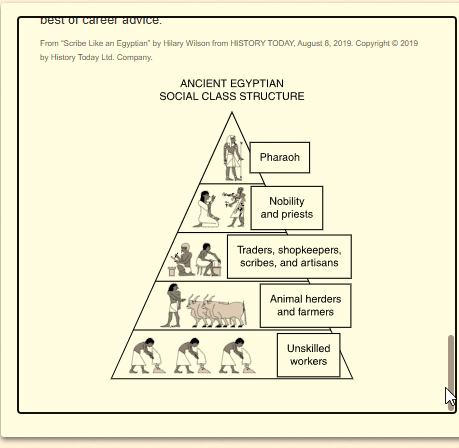
Question 10 of 57
2025 Practice Test A English, question 10Uses the passage above: “Excerpt from “Scribe Like an Egyptian””.
Question
Read this sentence from paragraph 2.
Including both ideograms (which convey a whole word or idea, either concrete or abstract, in a single sign) and phonograms (representing either an alphabetic sound or a group of consonants), [the writing system] was used in formal inscriptions on tomb and temple walls as well as on elaborate funerary papyri.
The author’s purpose for including the sentence is to
- Aexplain that hieroglyphs were reserved for royal and religious purposes.
- Bdemonstrate the methods experts use to interpret hieroglyphs.
- Cclarify the significance of hieroglyphs in language and literature.
- Ddescribe the basic features of hieroglyphs and how they were typically used.
Show the answer
Correct answer: D
The question asks for an explanation of the author’s purpose for including a sentence in paragraph 2 that describes the two types of hieroglyphs and the main uses of this particular writing system.
A. Incorrect. The sentence explains that hieroglyphs were used for formal inscriptions, but it does not suggest that these inscriptions were limited to royal and religious contexts.
B. Incorrect. The sentence describes the two basic types of hieroglyphs, ideograms and phonograms, but it does not address how experts interpret the ancient writing system. A sentence earlier in the paragraph explains that the hieroglyphs were deciphered by Champollion, but it does not explain how he deciphered them.
C. Incorrect. Although the sentence explains that the hieroglyphs were typically used for formal inscriptions, it does not provide an explanation of the significance or importance of hieroglyphs in the Egyptian language.
D. CORRECT. The sentence explains that hieroglyphs included both phonograms and ideograms that were used in formal inscriptions and funeral papyri; therefore, this sentence achieves the purpose of describing the basic features of hieroglyphs as conveying either words and ideas or sounds, in addition to explaining the common uses for the writing system.
Question analysis
This author’s-purpose question quotes a long, technical sentence from paragraph 2 of “Scribe Like an Egyptian” about the ancient Egyptian hieroglyphic writing system, and asks why the author includes it. Students must make sense of its specialist vocabulary before they can say what the sentence contributes to the paragraph and to the article.
- Grade level
- Grade 8 reading and task
- Compared with grade 7
- At grade 7 Explaining why an author includes a sentence is regular grade 7 work. This one is long, with definitions in parentheses and a bracketed insert, but it is quoted in full, so the task stays within one sentence.
- Estimated difficulty
- Straightforward: two steps or one careful reading.
- Thinking it demands
- Depth of knowledge 2, skills and concepts · mainly analyze
- What makes it hard
- Complex sentences moderate
- Hard words minor
- How, not what minor
- Evidence
- Answered from one sentence or line
- Reading level
- Passage: about grade 12, 755 words; question and choices: about grade 11, 103 words.
- Students, last 30 days
- Not enough answers yet to show (it takes 10).
Why it is hard, traps and wrong answers (shows the answer)
Why it is hard
Once the parentheses are set aside, the sentence says two simple things: what kinds of signs hieroglyphs were, and where they appeared. The wrong purposes each go one step beyond that, turning tombs and temples into an exclusive royal and religious use, borrowing Champollion’s deciphering from the sentence before, or claiming a significance the sentence never weighs. Students who untangle the syntax first find the matching purpose quickly.
Complex sentences moderate Understanding the question
The quoted sentence runs fifty words, two parenthetical definitions come before the verb, and its subject, the bracketed “[the writing system],” appears only after thirty words of description. (Abedi & Lord, 2001; Freedle & Kostin, 1993; Messick, 1989)
Hard words minor Understanding the question
“Ideograms,” “phonograms” and “funerary papyri” are specialist terms; the parentheses define the first two, but students who stall on them may not reach the sentence’s plain point about where the signs were used. (Perfetti, 2007; Freedle & Kostin, 1993)
How, not what minor Working it out
The stem asks why the author includes the sentence, so students must match the job it does in paragraph 2 to a purpose, and only one purpose stays within what the sentence actually covers. (Anderson & Krathwohl, 2001)
Strategy: Restate the quoted sentence in plain words, setting the parentheses aside at first, then choose the purpose that fits everything the sentence says and nothing more.
Traps
- Reads too much in: A reasonable-sounding conclusion that goes further than the text allows.
- Wrong part of the text: A choice is true of another paragraph, stanza or speaker than the one asked about.
- Wrong purpose or structure: Names a purpose, structure or effect that the part does not serve, or describes what a part says when the question asks what it does.
The wrong answers, classified
A Reads too much in (Graesser, Singer & Trabasso, 1994)
Reads “formal inscriptions on tomb and temple walls” and “funerary papyri” as royal and religious only, though the sentence names where hieroglyphs usually appeared, not a rule reserving them.
B Wrong part of the text (Kirsch & Mosenthal, 1990)
Remembers that Champollion deciphered the signs, which the sentence before reports, and takes this sentence for an account of how experts read them, though it never mentions interpreting.
C Wrong purpose or structure (Anderson & Krathwohl, 2001)
Chooses an important-sounding purpose, the significance of hieroglyphs in language and literature, though the sentence never says why the script mattered or mentions any literature.
Working it out, step by step
Figure out what the question asks
This asks why the author put this sentence in paragraph 2. In other words, what job does the sentence do? First work out what the sentence says. Then pick the purpose that matches all of it and adds nothing extra.
Untangle the long sentence
The sentence is long, so set the parentheses aside at first. The main part says the writing system “was used in formal inscriptions on tomb and temple walls as well as on elaborate funerary papyri.” An inscription is writing carved or painted on something. Funerary means having to do with burials. Papyri are scrolls made from papyrus, a kind of early paper.
Read the parentheses
Now add back the two kinds of signs. Ideograms “convey a whole word or idea” in one sign. Phonograms stand for “either an alphabetic sound or a group of consonants.” Consonants are letter sounds like b, t and m. So one kind of hieroglyph shows a meaning, and the other shows a sound.
Sum up the sentence’s job
Put the two parts together. The sentence tells what hieroglyphs were made of: signs for ideas and signs for sounds. It also tells where people usually used them: on tombs, temples and burial scrolls. So its job is to describe what hieroglyphs were like and how they were used.
Check each choice
- A does not fit. The sentence says where hieroglyphs usually appeared. It never says they were reserved, or kept only, for kings and religion.
- B does not fit. The sentence before it says Champollion figured out the signs. This sentence never says how experts read them.
- C does not fit. The sentence never says why hieroglyphs mattered, and it never mentions literature.
- D fits. It names both parts: the basic features and the usual uses.
Watch out: Tombs and temples sound royal and religious, so A tempts. But “used in” is not the same as “reserved for.”
Choose the answer
The sentence describes the two kinds of signs and where they were usually used. So the answer is D.
Why this answer and not the closest wrong one
A is the closest wrong choice. Tombs and temples do suggest kings and religion. But the sentence only lists where hieroglyphs were used. It never says they were kept for those uses alone. D matches everything the sentence says and adds nothing it doesn’t.
More questions like this
The original DOE question
Question 11 of 57
2025 Practice Test A English, question 11Uses the passage above: “Excerpt from “Scribe Like an Egyptian””.
Question
Which statement summarizes the process that schools used to train scribes?
- ABoys had to memorize around 450 hieratic signs. Once they had learned these, they were expected to copy literary texts that contained valuable lessons.
- BBoys spent at least five years learning hieratic signs, which they practiced by copying texts. During this period, they were also introduced to basic hieroglyphs.
- CBoys spent five or six years learning the basics of hieratic script. After this period, they could become apprentices and begin learning hieroglyphics.
- DBoys were taught two different scripts. They practiced both types by copying lists and eventually progressed to writing letters, reports, and contracts.
Show the answer
Correct answer: B
The question asks for the best summary of the process that schools used to train scribes.
A. Incorrect. This summary incorrectly explains that scribes were expected to learn 450 hieratic signs instead of 450 hieroglyphs along with their hieratic versions as explained in paragraph 6. In paragraph 5, the author explains that scribes copied texts as part of the process of learning the scripts rather than as practice after the signs had already been memorized.
B. CORRECT. Paragraph 5 explains that students began by learning hieratic script and studied for about five or six years by using “exemplar documents and extracts from popular texts to copy, to practice their hieratic handwriting.” The paragraph also explains that during this time, they learned only the basics of hieroglyphic script.
C. Incorrect. Although paragraph 5 does explain that the scribes spent five or six years learning hieratic script, it does not suggest that hieroglyphs were learned only during apprenticeships.
D. Incorrect. This summary correctly explains that scribes learned two types of scripts, but the second sentence of the summary is incorrect. In paragraph 5, the author explains that the students copied from exemplar texts, but the author clearly states that the purpose of this copy work was “to practice their hieratic handwriting” and does not suggest that the copy work was used to practice hieroglyphs. Paragraph 6 explains that scribes could make lists as part of their professional skills but does not suggest that copy work was used to help them learn this task. Paragraph 5 mentions letters, reports, and contracts as the formats students practiced on while copying, not as a later stage of their training.
Question analysis
This summary question on “Scribe Like an Egyptian” asks which statement sums up how ancient Egyptian schools trained young scribes. Each choice is a two-sentence summary that combines years of study, kinds of script and copying practice, so students must check every detail against what the article says about scribal education.
- Grade level
- Grade 8 reading and task
- Compared with grade 7
- Above grade 7 Summarizing a process is a grade 7 standard, but these four summaries are long, two-part and mostly accurate, and the details they mix up come from three different paragraphs, so judging them asks more than typical grade 7 work.
- Estimated difficulty
- Hard: combines ideas, needs a plan, and has more than one tempting wrong answer.
- Thinking it demands
- Depth of knowledge 2, skills and concepts · mainly understand
- What makes it hard
- A very close wrong answer moderate
- Evidence in several places moderate
- The right answer is reworded minor
- Evidence
- Answered from several paragraphs or stanzas
- Reading level
- Passage: about grade 12, 755 words; question and choices: about grade 7, 104 words.
- Corrected from the DOE handbook
- A detail in the explanation that misdescribes the excerpt was corrected.
- Students, last 30 days
- Not enough answers yet to show (it takes 10).
Why it is hard, traps and wrong answers (shows the answer)
Why it is hard
Every wrong summary opens with something true or nearly true, so a quick reading of first sentences cannot separate them. Most of the errors concern order: one makes copying follow memorizing, one turns apprenticeship into a later stage where hieroglyphs begin, and one makes the copied letters, reports and contracts a later step. Students who check the order of training against paragraph 5, not just the facts, find the only summary with nothing out of place.
A very close wrong answer moderate Choosing the answer
The apprenticeship summary repeats the right one’s opening, years of hieratic study, and parts from it on one phrase: hieroglyphs come “After this period” instead of “During this period.” (Embretson & Wetzel, 1987; Gorin & Embretson, 2006; Ascalon et al., 2007)
Evidence in several places moderate Working it out
The details sit in three paragraphs: the five or six years, the copying and the hieroglyph basics in paragraph 5, apprenticeship in paragraph 4, and the 450-sign dictionary and list-making in paragraph 6. (Kirsch & Mosenthal, 1990; Gorin & Embretson, 2006)
The right answer is reworded minor Choosing the answer
The right summary puts the text in new words, “at least five years” and “basic hieroglyphs,” while wrong ones repeat its own details: “five or six years,” the “450” signs, “letters, reports, and contracts.” (Freedle & Kostin, 1993; Kirsch & Mosenthal, 1990)
Strategy: Note what the article says students learned, for how long and by what method, then check both sentences of each summary against those notes; one wrong detail rules a summary out.
Traps
- Half right: One half of a two-part choice is right and the other is not.
- Twists what the text says: Uses the text's topic and ideas but changes what it says: who did it, how much, when, or why.
The wrong answers, classified
A Twists what the text says (King et al., 2004)
Takes paragraph 6’s 450 signs, hieroglyphs listed with their hieratic forms, as hieratic signs to memorize first, and makes copying come afterward, though copying was how students learned.
C Half right (King et al., 2004; Thissen, Steinberg & Fitzpatrick, 1989)
Gets the five or six years of hieratic right, then makes apprenticeship, the other route paragraph 4 offers poorer boys, a later stage where hieroglyphs are first taught.
D Half right (King et al., 2004; Thissen, Steinberg & Fitzpatrick, 1989)
Rightly says two scripts were taught, then claims students copied lists for both and only later wrote letters, reports and contracts, though paragraph 5 ties copying to hieratic and to those very formats.
What was corrected from the DOE handbook, and why
- Explanation: The DOE’s explanation of Option D ends: “Paragraph 6 explains that scribes could make lists and write letters as part of their professional skills but does not suggest that copy work was used to help them learn these tasks.” Paragraph 6 mentions the making and updating of lists, but not letters. Letters come up in paragraph 5, where students copy texts “to practice their hieratic handwriting” on basic-format letters, reports and contracts, so the excerpt does tie the copy work to letters. The site now says that paragraph 6 explains that scribes could make lists as part of their professional skills but does not suggest that copy work was used to help them learn this task, and that paragraph 5 mentions letters, reports, and contracts as the formats students practiced on while copying, not as a later stage of their training. Option D is still wrong, and the answer, B, is unchanged.
Working it out, step by step
Figure out what the question asks
This asks for the best summary of how schools trained scribes. A summary retells the main steps in a few words. Each choice has two sentences. Both must match the article, including the order of the steps. One wrong detail rules a choice out.
Find the training in paragraph 5
Paragraph 5 says training began with the basics of hieratic script. The lowest scribes studied for five or six years, and others studied longer. In that time they learned only the basics of hieroglyphs. Students were given “exemplar documents and extracts from popular texts to copy, to practice their hieratic handwriting.” Exemplar means model. Extracts are short pieces. So they learned by copying good examples.
Sort out paragraphs 4 and 6
Two other paragraphs hold details that look alike. Paragraph 4 describes apprenticeship. An apprentice learns on the job from a skilled worker. It was another way in for boys from poorer families, not a step after school. Paragraph 6 mentions a list of hieroglyphs with their hieratic forms. It says more than 450 signs were needed for everyday writing. It never says students memorized them before copying.
Check each choice
- A does not fit. The 450 signs were hieroglyphs paired with their hieratic forms. And copying was how students learned, not a step after memorizing.
- B fits. Students spent at least five years on hieratic, practiced by copying, and learned basic hieroglyphs along the way.
- C does not fit. Apprenticeship was a different route, not a later stage. Hieroglyphs were not saved for apprentices.
- D does not fit. The copying was to practice hieratic. Lists come up in paragraph 6 as a job skill, not as practice. Letters, reports and contracts were what students copied, not a later stage.
Choose the answer
Watch out: C starts out right, with five or six years of hieratic. Then it says hieroglyphs came “After this period” instead of during it. That one change makes it wrong.
Only B gets every detail and the order right. So the answer is B.
Why this answer and not the closest wrong one
C is the closest wrong choice. It gets the five or six years of hieratic right. But it says hieroglyphs came afterward, through apprenticeship. Paragraph 5 says students learned the basics of hieroglyphs during their schooling. Apprenticeship was a separate path for poorer boys. B says “During this period,” which matches.
More questions like this
The original DOE question
Question 12 of 57
2025 Practice Test A English, question 12Uses the passage above: “Excerpt from “Scribe Like an Egyptian””.
Question
Which claim is best supported by the information presented in paragraphs 3 and 4?
- AEducation was difficult for the common citizens of Egypt to obtain.
- BOnce students began studying to become scribes, their future held more possibilities.
- CIf someone wanted to become a scribe, support from outside sources such as the government or a temple was necessary.
- DBecoming a successful scribe required a student’s family to sacrifice time and money in order to ensure the best education.
Show the answer
Correct answer: B
The question asks for the claim that is best supported by the details in paragraphs 3 and 4.
A. Incorrect. While paragraph 4 does explain that boys from poorer families had more challenges in receiving an education, the paragraph also provides examples of obtaining a patron or getting an apprenticeship as ways that these aspiring scribes could attain an education. Furthermore, the details in paragraph 3 do not provide any support for the claim that “common citizens” had difficulty getting an education because that paragraph focuses on the example of one person who was able to become a king as a result of his background as a scribe.
B. CORRECT. In paragraph 3, the author provides an example of a person who used his skills as a scribe to rise through the ranks of society by describing the achievements of Horemheb to support the idea that “no matter how humble his origins, an educated Egyptian could achieve almost anything.” The author continues in paragraph 4 to explain that with the proper support, some young Egyptians could become educated, thereby opening more opportunities for themselves.
C. Incorrect. Paragraph 4 explains that schools were supported by the government and religious institutions, but it also explains that apprenticeships were a method of learning the craft of the scribe. As the paragraph indicates, boys could also be helped in their education by support from “a wealthier relative or patron.”
D. Incorrect. In paragraph 4, the author details the sacrifices that families made to keep their sons at the schools, while boys from poorer families could only hope for a patron or an apprenticeship. Paragraph 4 also explains that apprentices could help out at home while learning, so the sacrifice of time and money was not required of every family.
Question analysis
This inference question asks which claim is best supported by paragraphs 3 and 4 of “Scribe Like an Egyptian,” which tell the story of the scribe Horemheb and describe who could get a scribal education in ancient Egypt. Students must weigh each claim against both paragraphs together, and several claims echo a single sentence closely enough to look supported.
- Grade level
- Grade 8 reading and task
- Compared with grade 7
- Above grade 7 Choosing the claim a passage best supports is core grade 7 work. Here the claim must fit two paragraphs that do different jobs, one telling a single man’s story and one explaining access to schooling, and some choices fit only part of that.
- Estimated difficulty
- Hard: combines ideas, needs a plan, and has more than one tempting wrong answer.
- Thinking it demands
- Depth of knowledge 3, strategic thinking · mainly evaluate
- What makes it hard
- Evidence in several places moderate
- The right answer is reworded moderate
- Reading between the lines minor
- Evidence
- Answered from several paragraphs or stanzas
- Reading level
- Passage: about grade 12, 755 words; question and choices: about grade 10, 75 words.
- Corrected from the DOE handbook
- A misdescription of the passage in the explanation of one wrong answer was corrected.
- Students, last 30 days
- Not enough answers yet to show (it takes 10).
Why it is hard, traps and wrong answers (shows the answer)
Why it is hard
The trap is a claim that paragraph 4 seems to state almost word for word, which makes it feel safer than the right one. But the question asks for support from both paragraphs, and Horemheb’s story points the other way, toward what schooling made possible. The two other wrong claims harden paragraph 4’s details into rules, a necessary sponsor or a required family sacrifice, so words like “necessary” and “required” are the ones to test.
Evidence in several places moderate Working it out
The claim must fit two paragraphs that do different work: paragraph 3 follows Horemheb from army scribe to king, and paragraph 4 explains who could pay for schooling and what the alternatives were. (Kirsch & Mosenthal, 1990; Gorin & Embretson, 2006)
The right answer is reworded moderate Choosing the answer
The right claim restates paragraph 3’s “an educated Egyptian could achieve almost anything” in new words, while the most tempting wrong one nearly copies paragraph 4’s opening, “education was not available to all.” (Freedle & Kostin, 1993; Kirsch & Mosenthal, 1990)
Reading between the lines minor Working it out
Students must connect Horemheb’s rise with paragraph 4’s account of who got schooling to see that both paragraphs are about education opening doors, a link the author leaves implicit. (Graesser, Singer & Trabasso, 1994; Kintsch, 1998)
Strategy: Sum up paragraph 3 and paragraph 4 in a sentence each, then test every claim against both summaries, watching for words that make a claim stronger than the text.
Traps
- Too narrow: A single detail offered as the central idea or a summary, or a summary that keeps minor details and leaves out an essential part.
- Too broad or too strong: A choice overstates, generalizes, or uses absolute words the text does not support.
- Reads too much in: A reasonable-sounding conclusion that goes further than the text allows.
The wrong answers, classified
A Too narrow (King et al., 2004)
Rests on paragraph 4’s opening, “education was not available to all,” and ignores paragraph 3, whose Horemheb shows an educated man rising from modest origins to the throne.
C Too broad or too strong (King et al., 2004)
Makes the government and temple schools of paragraph 4 “necessary,” overlooking its other routes: help from “a wealthier relative or patron,” or apprenticeship to a working scribe.
D Reads too much in (Graesser, Singer & Trabasso, 1994)
Turns the rations and lost income that some families bore in paragraph 4 into a requirement for every successful scribe, and adds “the best education,” which the paragraph never mentions.
What was corrected from the DOE handbook, and why
- Explanation: The DOE’s explanation of D said paragraph 4 details sacrifices “necessary for some poorer families,” and that paragraph 3’s Horemheb, born of middle-ranking parents, shows the sacrifice was not required of all families. In paragraph 4 the rations and lost income are those of families whose sons were at the schools; poorer boys could only hope for a patron or an apprenticeship; and paragraph 3 says nothing about what Horemheb’s family gave up. The explanation now says so: D is wrong because apprentices could help out at home while learning, so not every family made the sacrifice.
Working it out, step by step
Figure out what the question asks
This asks which claim is best supported by paragraphs 3 and 4 together. A claim is a statement that someone says is true. The right claim must fit both paragraphs. Watch for strong words, like “necessary,” that go further than the text.
Sum up paragraph 3
Paragraph 3 tells about Horemheb. His parents were middle-ranking, not rich or powerful. His training as a scribe led to a job in the army. He rose to lead the army, then to serve the young king, and in the end he became king himself. The author uses him to show that “no matter how humble his origins, an educated Egyptian could achieve almost anything.” Humble origins means an ordinary family background.
Sum up paragraph 4
Paragraph 4 opens by saying that not everyone could get an education. Government offices and big temples ran schools. Families sent food and drink for years, while the boy earned nothing for them. Poorer boys could hope for help from “a wealthier relative or patron.” A patron is someone who pays for another person’s training. Or they could learn on the job from a working scribe. That path led to fewer jobs.
Put the two paragraphs together
Both paragraphs are about what schooling could do for a boy. Paragraph 3 shows a man rising all the way to king because he trained as a scribe. Paragraph 4 shows that, with the right support, boys could get that schooling. It even notes that the on-the-job path led to fewer jobs. So education opened doors. That is what choice B says.
Check each choice
- A does not fit. It matches only the start of paragraph 4. Paragraph 4 also gives ways in for poorer boys, and paragraph 3 shows a man from an ordinary family rising to the top.
- B fits. Both paragraphs show schooling leading to more possibilities.
- C does not fit. A government or temple school was not “necessary.” A relative, a patron or an apprenticeship could also work.
- D does not fit. Apprentices could help out at home while they learned, so not every family gave up time and money. And the paragraphs never mention “the best education.”
Choose the answer
The claim that fits both paragraphs is that schooling gave a boy more possibilities. So the answer is B.
Why this answer and not the closest wrong one
A is the closest wrong choice, because paragraph 4 begins by saying not everyone could get an education. But the question asks about paragraphs 3 and 4. Paragraph 3 tells of a scribe from an ordinary family who became king. Paragraph 4 shows ways around the cost. Both point to what education made possible, which is B.
More questions like this
The original DOE question
Question 13 of 57
2025 Practice Test A English, question 13Uses the passage above: “Excerpt from “Scribe Like an Egyptian””.
Question
Hieratic script was particularly valuable in a bureaucratic government because
- Ausing hieratic script was an efficient way for scribes to produce large amounts of documentation.
- Bmany members of the general public could comprehend information that was written in hieratic script.
- Cknowledge of hieratic script prepared scribes to serve their society in increasingly challenging roles.
- Dpeople from different professional backgrounds could easily communicate with one another in hieratic script.
Show the answer
Correct answer: A
The question asks why hieratic script was especially valuable in a bureaucratic government.
A. CORRECT. Hieratic script is described in paragraph 1 as being simpler for the “multitude of everyday documents” generated by the government and as “quicker to write and more economical of space” in paragraph 2. The logical conclusion based on these details is that hieratic script was more efficient for the large amounts of documentation produced by the government.
B. Incorrect. In paragraph 4, the author explains that “education was not available to all,” suggesting that only people who were educated could read and write. The excerpt as a whole does not provide sufficient information to indicate what portion of the general public would be able to comprehend material written in hieratic script.
C. Incorrect. The idea that becoming a scribe could lead to taking different positions in society is addressed in paragraphs 3, 4, and 6. However, the use of hieratic script in the fields of medicine, law, or religion does not necessarily explain the value of the script for the bureaucratic government referenced in the question.
D. Incorrect. Although different professions such as doctors and lawyers used hieratic script, the author uses these professions as examples of different job opportunities for scribes in paragraph 6. There is no discussion in the excerpt about different professions communicating with each other, and these professions were not necessarily part of the bureaucratic government.
Question analysis
This inference question on “Scribe Like an Egyptian” asks why hieratic, one of the two scripts of ancient Egypt, was especially valuable to a bureaucratic government. The article never gives the reason in a single sentence, so students must connect what it says about Egypt’s bureaucracy with what it says about the script itself. Each choice offers a reasonable-sounding benefit.
- Grade level
- Grade 7 reading and task
- Compared with grade 7
- At grade 7 Drawing a conclusion from two neighboring paragraphs is typical grade 7 inference work. The word “bureaucratic” and the article’s formal style add some load, but the details needed are close together and plainly stated.
- Estimated difficulty
- Straightforward: two steps or one careful reading.
- Thinking it demands
- Depth of knowledge 2, skills and concepts · mainly understand
- What makes it hard
- Evidence in several places minor
- Hard words minor
- Reading between the lines minor
- Evidence
- Answered from several paragraphs or stanzas
- Reading level
- Passage: about grade 12, 755 words; question and choices: about grade 13, 68 words.
- Students, last 30 days
- Not enough answers yet to show (it takes 10).
Why it is hard, traps and wrong answers (shows the answer)
Why it is hard
The two facts that answer the question sit a few lines apart in the first two paragraphs, so the work is mostly connecting them. The wrong reasons all sound like advantages a simpler script might bring, public readability, career preparation, communication across professions, and each rests on a guess or on the excerpt’s talk of scribal careers rather than on what it says hieratic was used for. Students who return to the description of hieratic itself avoid them.
Evidence in several places minor Working it out
The reason is split between paragraph 1, where hieratic serves the “multitude of everyday documents,” and paragraph 2, where it is “quicker to write and more economical of space.” (Kirsch & Mosenthal, 1990; Gorin & Embretson, 2006)
Hard words minor Understanding the question
The stem turns on “bureaucratic,” a word students must connect to a government that runs on paperwork; without it, the link to large amounts of documentation is hard to see. (Perfetti, 2007; Freedle & Kostin, 1993)
Reading between the lines minor Working it out
No sentence says why hieratic helped the government; students must combine speed and compactness with the sheer volume of records to reach efficiency. (Graesser, Singer & Trabasso, 1994; Kintsch, 1998)
Strategy: Find the sentences that describe hieratic script and what it was used for, then pick the choice those sentences support rather than one that only sounds like an advantage.
Traps
- Reads too much in: A reasonable-sounding conclusion that goes further than the text allows.
- True but not the answer: A choice says something accurate about the text that does not answer this question.
- Outside knowledge: A choice is plausible in the real world but not supported by this text.
The wrong answers, classified
B Reads too much in (Graesser, Singer & Trabasso, 1994)
Reasons that a simpler script must have been readable by ordinary people, though paragraph 4 says “education was not available to all” and the excerpt never says the public read hieratic.
C True but not the answer (King et al., 2004; Embretson & Wetzel, 1987)
Recalls the careers in paragraphs 3 and 6 that schooling opened to scribes, which is true of the excerpt but explains a scribe’s prospects, not why the government valued hieratic.
D Outside knowledge (King et al., 2004; Recht & Leslie, 1988)
Imagines hieratic as a shared language linking doctors, lawyers and officials, a sensible-sounding benefit the excerpt never raises; paragraph 6 names those professions only as careers for scribes.
Working it out, step by step
Figure out what the question asks
This asks why hieratic script was so useful to a bureaucratic government. A bureaucracy is a government run by many officials, with lots of paperwork. Hieratic is the quick, simple form of Egyptian writing. Look for what the article says about hieratic and what it was used for.
Find the evidence in paragraphs 1 and 2
Paragraph 1 says many scribes used hieratic for the “multitude of everyday documents” that the government produced. Multitude means a huge number. Paragraph 2 says hieratic was “quicker to write and more economical of space.” Economical of space means it took up less room on the page.
Connect the two facts
Put the facts together. The government made a huge number of papers. Hieratic was fast to write and used less space. So scribes could turn out lots of papers quickly. Getting a lot done with little time and effort is called being efficient.
Check each choice
- A fits. Hieratic let scribes make large amounts of paperwork quickly.
- B does not fit. Paragraph 4 says “education was not available to all.” The article never says ordinary people could read hieratic.
- C does not fit. Training did lead to careers, but that explains a scribe’s chances, not why the government valued the script.
- D does not fit. Paragraph 6 lists jobs like doctor and lawyer as careers for scribes. It never says those workers wrote to each other in hieratic.
Watch out: B sounds sensible, since a simpler script seems easier for anyone to read. But that is a guess, not something the article says.
Choose the answer
Hieratic was fast and compact, and the government needed a huge number of documents. So the answer is A.
Why this answer and not the closest wrong one
B is the closest wrong choice, because a simpler script does sound easier to read. But the article says only some Egyptians got an education. It never says the public could read hieratic. A rests on two facts the article states: the government made a “multitude of everyday documents,” and hieratic was quicker to write.
More questions like this
The original DOE question
Question 14 of 57
2025 Practice Test A English, question 14Uses the passage above: “Excerpt from “Scribe Like an Egyptian””.
Question
The diagram after paragraph 6 best provides additional support for the topic of the excerpt by
- Ademonstrating the place of scribes in ancient Egyptian social structure.
- Bdepicting the types of tasks performed by each social class.
- Cindicating that scribes were able to easily improve their social ranking.
- Dcomparing the social positions of each social class in ancient Egypt.
Show the answer
Correct answer: A
The question asks how the diagram of ancient Egyptian class structure supports the topic of the excerpt.
A. CORRECT. The focus of the excerpt is the opportunities available to scribes in different professions and how people became scribes and therefore improved their position. By illustrating the position of the scribes in the class structure of ancient Egypt, the diagram supports the idea that scribes were valuable members of society.
B. Incorrect. The professions of the different social classes are shown in the diagram, but it does not address specific tasks. Furthermore, the main topic of the excerpt is the role of the scribes in society rather than the tasks performed by the different social classes.
C. Incorrect. While the diagram does show the position of scribes in the social hierarchy, it does not provide an illustration of movement between the different classes or rankings, so the diagram does not support the idea that scribes were able to improve their social standing.
D. Incorrect. The diagram shows the class structure as hierarchical and can support readers’ efforts to compare the different social positions. However, the role of scribes in society, rather than a general comparison of different classes, is the main focus of the excerpt.
Question analysis
This question on “Scribe Like an Egyptian” asks how the diagram after paragraph 6, a pyramid of ancient Egyptian social classes from the pharaoh at the top to unskilled workers at the base, gives additional support to the excerpt’s topic. Students must decide what the excerpt is mainly about and then judge what the graphic adds, and several choices describe something the pyramid really shows.
- Grade level
- Grade 7 reading and task
- Compared with grade 7
- At grade 7 Linking a graphic to a text is regular grade 7 work, and this five-level pyramid is simple and clearly labeled. The demand lies in naming the excerpt’s topic first and judging how the diagram bears on it.
- Estimated difficulty
- Moderate: several steps, or a close reading with one strong distractor.
- Thinking it demands
- Depth of knowledge 2, skills and concepts · mainly analyze
- What makes it hard
- A very close wrong answer moderate
- Reading a figure, table or graph moderate
- How, not what minor
- Evidence
- Answered from the whole text
- Reading level
- Passage: about grade 12, 755 words; question and choices: about grade 9, 57 words.
- Students, last 30 days
- Not enough answers yet to show (it takes 10).
Why it is hard, traps and wrong answers (shows the answer)
Why it is hard
More than one choice is true of the pyramid, so the question is decided by the excerpt’s topic, not by the picture alone. Students who look only at the diagram see a ranking of all the classes; students who remember that the article is about scribes look for where scribes stand. The choice about rising easily borrows Horemheb’s story from the text and credits it to a drawing that shows no movement.
A very close wrong answer moderate Choosing the answer
The choice about comparing every class’s position differs from the right one in a single detail, all classes rather than scribes, and both are true of the pyramid. (Embretson & Wetzel, 1987; Gorin & Embretson, 2006; Ascalon et al., 2007)
Reading a figure, table or graph moderate Understanding the question
Scribes are not a tier of their own: they share the third of five tiers with merchants and craftsmen, below the pharaoh, nobles and priests and above farmers, herders and laborers. (Lesh, Post & Behr, 1987; Kirsch & Mosenthal, 1990)
How, not what minor Working it out
The stem asks how the diagram supports the excerpt’s topic, so students must first decide the topic is scribes, then judge what the picture adds to it. (Anderson & Krathwohl, 2001)
Strategy: State the excerpt’s topic in a few words, then test each choice twice: is it true of the diagram, and does it connect the diagram to that topic?
Traps
- True but not the answer: A choice says something accurate about the text that does not answer this question.
- Wrong part of the text: A choice is true of another paragraph, stanza or speaker than the one asked about.
- Wrong purpose or structure: Names a purpose, structure or effect that the part does not serve, or describes what a part says when the question asks what it does.
The wrong answers, classified
B Wrong purpose or structure (Anderson & Krathwohl, 2001)
Notices the small figures at work, such as the herders with their cattle, and takes tasks as the diagram’s point, though its labels name classes and the excerpt is about scribes.
C Wrong part of the text (Kirsch & Mosenthal, 1990)
Carries Horemheb’s rise from scribe to king in paragraph 3 over to the diagram, which shows fixed tiers with no arrows or movement, and nothing about rising easily.
D True but not the answer (King et al., 2004; Embretson & Wetzel, 1987)
Describes what the pyramid plainly does, rank all five classes against one another, which is accurate but misses why the diagram belongs with an excerpt about scribes.
Working it out, step by step
Figure out what the question asks
This asks how the diagram after paragraph 6 adds to the topic of the excerpt. First name the topic. Then ask two things about each choice. Is it true of the diagram? And does it connect the diagram to that topic?
Name the excerpt’s topic
The excerpt is about scribes, people trained to read and write for others. It tells how they learned, who could study, and what jobs they could get. Every paragraph comes back to scribes. So the diagram should add something about scribes.
Read the diagram
The diagram is a pyramid with five levels. From the top down, they are the Pharaoh, nobles and priests, then “Traders, shopkeepers, scribes, and artisans,” then herders and farmers, and last unskilled workers. Artisans are skilled craftspeople. Scribes sit in the third level, the middle one. They are below the ruler and the nobles, and above farmers and workers.
Check each choice
- A fits. The diagram shows where scribes stood in Egyptian society, which ties it to the topic.
- B does not fit. The labels name groups of people, not the tasks each group did.
- C does not fit. The levels are fixed, and nothing in the diagram shows anyone moving up. Horemheb’s rise comes from paragraph 3, not the diagram.
- D does not fit. The pyramid does rank all the classes. But that alone does not connect it to an excerpt about scribes.
Watch out: More than one choice is true of the picture. The right one must also fit the topic.
Choose the answer
The diagram supports the topic by showing where scribes fit among the classes of ancient Egypt. So the answer is A.
Why this answer and not the closest wrong one
D is the closest wrong choice, because the pyramid really does compare every class. But the excerpt is about scribes, not about every class. A is true of the diagram too, and it also links the diagram to the topic. It points to the place of scribes in the middle level.
More questions like this
The original DOE question
Question 15 of 57
2025 Practice Test A English, question 15Uses the passage above: “Excerpt from “Scribe Like an Egyptian””.
Question
Based on the excerpt, which statement would the author most strongly agree with?
- ABoys in Egypt were encouraged to enter the same profession as older male relatives.
- BKnowledge of hieroglyphs was helpful to Egyptians who were interested in becoming scribes.
- CHieratic script was more practical to ancient Egyptians than hieroglyphs were.
- DBoys in Egypt who studied for only a few years were unlikely to find employment as scribes.
Show the answer
Correct answer: C
The question asks for a statement with which the author would most strongly agree.
A. Incorrect. The author only addresses boys who entered the profession of scribes. While the author does address the role of the family in supporting a boy’s education or securing an apprenticeship, the author does not provide any discussion to support the idea that boys were only encouraged to follow the professions of their male relatives.
B. Incorrect. The author explains that communication using hieroglyphs was not widely practiced in everyday correspondence and that hieratic script was the more popular form of writing. While being able to read and use hieroglyphs would have been helpful, it was not common for citizens to use this formal form of communication. In addition, scribes were trained to learn hieroglyphs and hieratic script as part of their education, so prior ability to read or compose hieroglyphs was not a requirement.
C. CORRECT. As described in paragraph 2, hieratic script was more efficient and economical than hieroglyphs. Because this script was used for “everyday purposes,” it was the more practical of the scripts as hieroglyphs were reserved for “formal inscriptions.”
D. Incorrect. In paragraph 6, the author indicates that “any half-competent scribe” could become employed in making and updating lists. While the paragraph later indicates that scribes would need to study several more years to be employed in a wider range of professions, there is no indication that employment as a scribe would be unavailable to a boy who studied for only a few years.
Question analysis
This point-of-view question asks which statement the author of “Scribe Like an Egyptian” would most strongly agree with. The four statements deal with family careers, knowledge of hieroglyphs, Egypt’s two scripts and the length of training, so students must test each one against the article and separate what the author says from what merely sounds likely.
- Grade level
- Grade 8 reading and task
- Compared with grade 7
- At grade 7 Inferring which statement an author would accept is typical grade 7 work. The four statements draw on different parts of a dense article, and some sound sensible without being backed by it, so each must be checked carefully.
- Estimated difficulty
- Moderate: several steps, or a close reading with one strong distractor.
- Thinking it demands
- Depth of knowledge 2, skills and concepts · mainly analyze
- What makes it hard
- Every choice must be checked moderate
- Reading between the lines moderate
- Evidence
- Answered from several paragraphs or stanzas
- Reading level
- Passage: about grade 12, 755 words; question and choices: about grade 9, 68 words.
- Students, last 30 days
- Not enough answers yet to show (it takes 10).
Why it is hard, traps and wrong answers (shows the answer)
Why it is hard
The right statement is a comparison the author never makes in so many words, while the statement about hieroglyphs sounds like something any author on scribes would accept. The question rewards asking which statement the excerpt itself backs most firmly, and paragraph 2’s contrast between everyday and formal writing does that directly. The two statements about boys rest on assumptions, sons following relatives and short training leaving boys jobless, that the excerpt never makes and partly contradicts.
Every choice must be checked moderate Choosing the answer
The four statements cover four topics, family careers, hieroglyphs, the two scripts and length of training, so each has to be traced to its own paragraph before they can be compared. (Embretson & Wetzel, 1987)
Reading between the lines moderate Working it out
The author never ranks the scripts; “more practical” has to be drawn from paragraph 2, where hieratic is for “everyday purposes” and quicker to write, while hieroglyphs go on “formal inscriptions.” (Graesser, Singer & Trabasso, 1994; Kintsch, 1998)
Strategy: For each statement, find the paragraph that deals with its topic and decide whether the author says it, implies it or never addresses it; keep the one with the firmest support.
Traps
- Reads too much in: A reasonable-sounding conclusion that goes further than the text allows.
- Twists what the text says: Uses the text's topic and ideas but changes what it says: who did it, how much, when, or why.
- Outside knowledge: A choice is plausible in the real world but not supported by this text.
The wrong answers, classified
A Outside knowledge (King et al., 2004; Recht & Leslie, 1988)
Applies the familiar idea that sons follow their fathers’ trades, perhaps prompted by paragraph 4’s “wealthier relative,” though the excerpt never says boys were steered toward relatives’ professions.
B Twists what the text says (King et al., 2004)
Builds on paragraph 6, where more signs led to better posts, but shifts the benefit to the time before training, though boys learned the signs at school starting at six or seven.
D Reads too much in (Graesser, Singer & Trabasso, 1994)
Infers from paragraph 6’s extra years for officials, priests and lawyers that short training meant no job, though “any half-competent scribe” could keep lists and the least-trained scribes studied only five or six years.
Working it out, step by step
Figure out what the question asks
This asks which statement the author would most strongly agree with. The author may not say it in the same words, but the excerpt must clearly back it. The four choices cover four topics, so find the paragraph for each one.
Find what the author says about the scripts
Paragraph 1 says many scribes used the simpler hieratic script for everyday papers. Paragraph 2 says hieroglyphs went on “formal inscriptions,” such as tomb and temple walls. Hieratic was used for “everyday purposes.” It was faster to write and took less space. Formal means used for special, serious occasions.
Work out what that means
Practical means useful for real, everyday needs. The author shows hieratic doing the daily work, such as letters, reports and contracts. Hieroglyphs were kept for special uses. So the author would agree that hieratic was more practical than hieroglyphs. The author never uses the words “more practical,” but the facts point there.
Check each choice
- A does not fit. The excerpt never says boys were pushed into a relative’s job.
- B does not fit. Boys learned the signs at school, starting at six or seven. The excerpt never says knowing hieroglyphs beforehand helped. Paragraph 1 even says not all scribes understood them.
- C fits. Hieratic was quicker, smaller and used for everyday work.
- D does not fit. Paragraph 6 says “any half-competent scribe” could keep lists. Half-competent means only partly skilled. The lowest scribes studied only five or six years and still worked.
Watch out: B sounds like something any author would accept. But the excerpt does not back it.
Choose the answer
The excerpt shows hieratic doing the everyday work, faster and in less space. So the answer is C.
Why this answer and not the closest wrong one
B is the closest wrong choice. Knowing hieroglyphs sounds helpful for a future scribe. But boys learned their signs at school, and paragraph 1 says not all scribes understood hieroglyphs at all. C rests on paragraph 2, where hieratic is quicker to write and used for “everyday purposes.”
More questions like this
The original DOE question
Question 16 of 57
2025 Practice Test A English, question 16Passage Excerpt from Winter Wheat
Excerpt from Winter Wheat
by Mildred Walker
Ellen, the narrator, is preparing to leave her parents and the family farm for college the next day.
The text of this excerpt is not reproduced here for copyright reasons. Read it as printed on the test under “The original DOE question” on each question’s page.
From WINTER WHEAT by Mildred Walker, published by University of Nebraska Press. Copyright © 1944 by Harcourt, Brace and Company, Inc. Copyright renewed 1971 by Mildred Walker. All rights reserved.
Question
Which sentence from the excerpt supports the idea that Ellen understands what her father is really thinking, and which sentence supports the idea that Ellen and her father share similar interests?
Move the correct answer to each box.
Supports the idea that Ellen understands what her father is really thinking
Supports the idea that Ellen and her father share similar interests
On the test you drag tiles into the boxes; here, choose each box’s tile from its menu. Each tile can be used once. The DOE has not published how answers with several parts are scored; this site counts one right only when every part is right.
Show the answer
Correct answer: blank 1: “Well, we don’t have to decide tonight,” Dad said, but I knew he wanted to go into Clark City.” (paragraph 6); blank 2: “He’s the one who gets excited when I do about spring coming or a serial running in the magazine we’re both reading” (paragraph 1)
The question asks for the identification of one sentence that supports the idea that Ellen understands what her father is really thinking, and one sentence that supports the idea that Ellen and her father share similar interests.
A. Incorrect. (“I love Dad’s way of talking that makes him seem different from other ranchers.” [paragraph 1]) This sentence from paragraph 1 presents a unique quality that Ellen loves about her father, but it does not provide evidence for the idea that Ellen and her father share similar interests or that Ellen understands what her father is really thinking.
B. CORRECT. (“He’s the one who gets excited when I do about spring coming or a serial running in the magazine we’re both reading” [paragraph 1]) This sentence from paragraph 1 shows that Ellen and her father both get excited about the coming of spring and share an enthusiasm for reading magazine serials (stories published in serial installments). Thus, it provides clear evidence for the idea that Ellen and her father share similar interests.
C. CORRECT. (“ ‘Well, we don’t have to decide tonight,’ Dad said, but I knew he wanted to go into Clark City.” [paragraph 6]) This sentence from paragraph 6 provides evidence that Ellen and her father share the same unspoken wish to go to Clark City rather than for Ellen to catch the train at Gotham, as suggested in paragraph 5 by Ellen’s mother. This quotation reveals that Ellen understands the true preference that her father is not expressing aloud, thereby providing evidence for the idea that Ellen understands what her father is really thinking.
D. Incorrect. (“We’d go in right after dinner and go around to the stores, Dad going one way and Mom and I another.” [paragraph 7]) Although this sentence from paragraph 7 indicates that Ellen can predict how her father would behave in a particular scenario, it does not show that Ellen understands what her father is really thinking, nor does it provide evidence for the idea that Ellen and her father share similar interests.
Question analysis
This evidence question on an excerpt from Mildred Walker’s 1944 novel Winter Wheat asks for one quotation showing that Ellen understands what her father is really thinking and another showing that the two share interests. On the test students drag two of four sentence tiles into labeled boxes, so each quotation’s exact wording decides where it belongs, if anywhere.
- Grade level
- Grade 7 reading and task
- Compared with grade 7
- At grade 7 Matching quotations to ideas about a character is grade 7 evidence work, and the novel’s language is plain. Placing two of four tiles, with credit only when both are right, adds a step, and every tile mentions Ellen’s father.
- Estimated difficulty
- Moderate: several steps, or a close reading with one strong distractor.
- Thinking it demands
- Depth of knowledge 2, skills and concepts · mainly evaluate
- What makes it hard
- Much to keep track of moderate
- Reading between the lines minor
- Evidence
- Answered from several paragraphs or stanzas
- Reading level
- Passage: about grade 6, 80 words; question and choices: about grade 9, 61 words.
- Corrected from the DOE handbook
- A repeated word in the explanation was corrected.
- Students, last 30 days
- Not enough answers yet to show (it takes 10).
Why it is hard, traps and wrong answers (shows the answer)
Why it is hard
Each box has a tile that matches it closely, so the question is less about finding evidence than about not being drawn by the near misses. Ellen’s detailed picture of the town trip in paragraph 7 shows she knows her father’s habits, which can pass for knowing his mind, and the tiles about shared excitement and a shared wish can each seem to fit the other box. Because credit needs both placements, one doubtful tile costs the whole question.
Much to keep track of moderate Working it out
Two boxes must both be right, and all four tiles mention Dad, so each tile has to be held against two different ideas before the two that fit neither can be set aside. (Sweller, 1988; Carpenter, Just & Shell, 1990)
Reading between the lines minor Working it out
The first box turns on the gap between what Dad says and what Ellen knows: “Dad said, but I knew he wanted” marks a wish he does not speak aloud. (Graesser, Singer & Trabasso, 1994; Kintsch, 1998)
Strategy: Treat the boxes as two separate evidence questions: restate each idea in your own words, then test all four tiles against it before placing one, since two tiles fit neither box.
Traps
- Supports only part of the claim: In a question about evidence: a line that backs one half of the claim but not the other, or a related point rather than the claim itself.
- Reads too much in: A reasonable-sounding conclusion that goes further than the text allows.
The wrong answers, classified
DB Reads too much in (Graesser, Singer & Trabasso, 1994)
Puts the town-trip tile in the first box because Ellen can foresee how Dad will spend the afternoon in town, though foreseeing his errands is not knowing an unspoken wish.
BC Supports only part of the claim (King et al., 2004; Thissen, Steinberg & Fitzpatrick, 1989)
Swaps the right tiles, reading Dad’s excitement, which he shows openly, as a hidden thought Ellen grasps, and their one shared wish for Clark City as a shared interest.
CA True but not the answer (King et al., 2004; Embretson & Wetzel, 1987)
Fills the first box correctly but puts Ellen’s love of Dad’s way of talking in the second, though admiring how he speaks is her feeling, not an interest they share.
What was corrected from the DOE handbook, and why
- Explanation: The DOE’s explanation of Option D says the sentence does not “provide evidence for the idea that that Ellen and her father share similar interests,” with “that” printed twice. The site prints it once.
Working it out, step by step
Figure out what the question asks
This question has two boxes, and each needs a different idea. Box 1: Ellen knows what Dad is really thinking, even when he doesn’t say it. Box 2: Ellen and Dad like the same things. On the test you drag a tile into each box. On this site you pick each box’s tile from a menu. Two tiles are left over.
Find a hidden thought for box 1
In paragraph 5, Mom says Ellen can catch the train at Gotham, the nearby stop. Then paragraph 6 says “ ‘Well, we don’t have to decide tonight,’ Dad said, but I knew he wanted to go into Clark City.” Dad’s words put off the choice. But Ellen knows his real wish, the trip into town. The word “but” marks the gap between what he says and what she knows.
Find a shared interest for box 2
Paragraph 1 says Dad is “the one who gets excited when I do about spring coming or a serial running in the magazine we’re both reading.” A serial is a story printed in parts, one part in each issue of a magazine. Ellen and Dad look forward to spring together, and they read the same story. Those are shared interests.
Rule out the other two tiles
- “I love Dad’s way of talking that makes him seem different from other ranchers.” (paragraph 1) This is Ellen’s feeling about how Dad talks. It is not a hidden thought, and it is not an interest they share.
- “We’d go in right after dinner and go around to the stores, Dad going one way and Mom and I another.” (paragraph 7) Ellen pictures how a trip to town would go. Knowing Dad’s habits is not knowing his unspoken wish. And here they split up.
Watch out: Don’t swap the two right tiles. Dad shows his excitement openly, so it is not a hidden thought.
Fill in both boxes
- Box 1, Ellen understands what her father is really thinking: “Well, we don’t have to decide tonight,” Dad said, but I knew he wanted to go into Clark City.” (paragraph 6)
- Box 2, Ellen and her father share similar interests: “He’s the one who gets excited when I do about spring coming or a serial running in the magazine we’re both reading” (paragraph 1)
Both boxes must be right to get the point.
Why this answer and not the closest wrong one
The town-trip tile is the closest wrong choice for box 1. In paragraph 7, Ellen can picture just what Dad would do in town. But that shows she knows his habits. In paragraph 6, Dad says one thing, and Ellen knows he wants another. That is knowing what he is really thinking.
More questions like this
The original DOE question
The passage “Excerpt from Winter Wheat” as shown on the test
Question 17 of 57
2025 Practice Test A English, question 17Uses the passage above: “Excerpt from Winter Wheat”.
Question
Read these sentences from paragraph 2.
Dad always said Mom could make all the dishes he’d had back in Vermont as well as though she were a New Englander herself, instead of a Russian. All of a sudden, I realized that tomorrow when those beans would be ready to eat I’d be going away. It gave me a funny feeling.
The sentences help develop a theme of the excerpt by
- Asuggesting that life presents people with many challenges.
- Bimplying that the stress of major life events can cause confusion.
- Cdemonstrating that moving on from the familiar is a common human experience.
- Demphasizing the idea that people can easily learn the routines of being part of a new culture.
Show the answer
Correct answer: C
The question asks how the sentences in paragraph 2 help develop a theme of the excerpt.
A. Incorrect. Although the sentences from paragraph 2 describe Ellen’s “funny feeling” upon realizing that she will no longer be home when the beans that her mother is making are ready to eat, the details do not show that life presents many challenges. Additionally, the theme that life presents people with many challenges is not a theme found in the excerpt.
B. Incorrect. The sentences from paragraph 2 state that Ellen has “a funny feeling” while awaiting a major life event, but they do not indicate that she is confused or stressed. The details in the sentences convey a sense of wistfulness, but the theme that the stress of major life events causes confusion is not found in the excerpt.
C. CORRECT. The sentences from paragraph 2 show that Ellen’s mother has moved on from the familiar and left her childhood home behind, just as Ellen is about to do. This information links the experiences of parent and child and helps develop the theme that moving beyond the familiar is a common human experience.
D. Incorrect. Although the sentences from paragraph 2 show that Ellen’s mother has learned to cook New England food very well (“as though she were a New Englander herself”), they do not provide information about how easy or difficult it was for Ellen’s mother to learn a new way of cooking. The theme that people can easily learn the routines of a new culture is not a theme found in the excerpt.
Question analysis
This theme question quotes three sentences from paragraph 2 of the Winter Wheat excerpt, about Mom’s cooking and Ellen’s sudden realization that she is leaving, and asks how they help develop a theme. Students must connect a small kitchen moment to an idea that runs through the whole excerpt, choosing among theme statements that range from narrow to very general.
- Grade level
- Grade 8 reading and task
- Compared with grade 7
- Above grade 7 Explaining how details develop a theme is a grade 7 standard. These sentences never state the idea, so students must infer it from a remark about Mom’s cooking and Ellen’s passing feeling, then link it to the whole excerpt, more than typical grade 7 work.
- Estimated difficulty
- Hard: combines ideas, needs a plan, and has more than one tempting wrong answer.
- Thinking it demands
- Depth of knowledge 3, strategic thinking · mainly analyze
- What makes it hard
- Reading between the lines major
- Evidence in several places moderate
- How, not what minor
- Evidence
- Answered from the whole text
- Reading level
- Passage: about grade 6, 80 words; question and choices: about grade 7, 117 words.
- Students, last 30 days
- Not enough answers yet to show (it takes 10).
Why it is hard, traps and wrong answers (shows the answer)
Why it is hard
The quoted sentences seem to be about cooking and a passing mood, and the link to a theme hides in where the parents come from. Students who miss that Dad and Mom both left homes far away read the passage as being about Mom’s skill or Ellen’s nerves, and pick a theme built on one of those. The vague choice about life’s challenges catches students who sense that leaving is hard but cannot pin the theme to these details.
Reading between the lines major Working it out
The theme is never stated: students must notice that “back in Vermont” and “instead of a Russian” mean both parents left their first homes, just as Ellen realizes she will be “going away.” (Graesser, Singer & Trabasso, 1994; Kintsch, 1998)
Evidence in several places moderate Working it out
A theme of the excerpt must hold beyond paragraph 2, so the choice has to be checked against Dad’s trip back East in the flashback and Mom’s Russian name in paragraph 22. (Kirsch & Mosenthal, 1990; Gorin & Embretson, 2006)
How, not what minor Working it out
The stem asks how the sentences develop a theme, so a remark about cooking has to be read for what it reveals about the parents’ pasts, not for its subject. (Anderson & Krathwohl, 2001)
Strategy: Note what each quoted sentence tells you about the person in it, then pick the theme that these details and the rest of the excerpt both support.
Traps
- Reads too much in: A reasonable-sounding conclusion that goes further than the text allows.
- Too broad or too strong: A choice overstates, generalizes, or uses absolute words the text does not support.
- Wrong tone or attitude: Misjudges the tone, attitude or point of view, such as reading admiration as criticism, or taking a character's or subject's feelings for the author's.
The wrong answers, classified
A Too broad or too strong (King et al., 2004)
Chooses a theme loose enough to fit almost any story; the sentences show the parents’ pasts and a sudden realization, not a series of challenges.
B Wrong tone or attitude (Graesser, Singer & Trabasso, 1994)
Hears stress and confusion in Ellen’s “funny feeling,” though the sentences suggest a quiet, wistful realization, and nothing in the excerpt shows her confused about leaving.
D Reads too much in (Graesser, Singer & Trabasso, 1994)
Seizes on Mom cooking “as though she were a New Englander herself” and adds that adapting was easy, which the sentence never says; it praises her skill, not the ease of learning.
Working it out, step by step
Figure out what the question asks
This asks how three sentences from paragraph 2 help build a theme. A theme is a big idea about life that a story keeps showing. Look at what each sentence tells you about the people in it, not just at its subject, cooking.
Read the sentence about Mom and Dad
The first sentence says “Dad always said Mom could make all the dishes he’d had back in Vermont as well as though she were a New Englander herself, instead of a Russian.” Vermont is a state far to the east, in New England. Dad grew up there. Mom came from Russia. So both parents left the places where they grew up.
Read the sentences about Ellen
The next sentences say “All of a sudden, I realized that tomorrow when those beans would be ready to eat I’d be going away. It gave me a funny feeling.” The beans are soaking for tomorrow’s meal. Ellen sees that she won’t be home to eat them. She is about to leave her own home, just as her parents once left theirs.
Find the theme
Put the two parts together. Dad left Vermont, Mom left Russia, and now Ellen is leaving the farm. Each of them moves on from a familiar place. So the sentences show that leaving what you know is something many people go through. Ellen’s “funny feeling” is wistful, a quiet sadness, like missing home before you go.
Check each choice
- A does not fit. It is so broad it could fit almost any story. These sentences show leaving home, not many challenges.
- B does not fit. Ellen’s feeling is quiet and wistful. Nothing shows her stressed or confused.
- C fits. Parents and daughter all move on from a familiar home.
- D does not fit. Dad praises Mom’s cooking, but the sentence never says learning it was easy.
Choose the answer
The sentences link Ellen’s leaving to her parents’ own leaving long ago. So the answer is C.
Why this answer and not the closest wrong one
B is the closest wrong choice, because a “funny feeling” before a big change could sound like stress. But Ellen is not mixed up or panicked. She simply realizes she will be gone tomorrow. The sentences tie that moment to her parents’ moves from Vermont and Russia. That shared experience of leaving is C.
More questions like this
The original DOE question
Question 18 of 57
2025 Practice Test A English, question 18Uses the passage above: “Excerpt from Winter Wheat”.
Question
Read this sentence from paragraph 3.
“I’ll be taking the train tomorrow night,” I said aloud, more to hear it myself.
This remark contributes to the conflict in the excerpt by
- Arevealing Dad’s reasons for wanting to drive to the city.
- Bcausing tension between Mom and Dad.
- Cleading Ellen to distance herself from both Mom and Dad.
- Dshowing Mom’s reluctance to plan that far in advance.
Show the answer
Correct answer: B
The question asks how the sentence from paragraph 3 contributes to the conflict in the excerpt.
A. Incorrect. Although Ellen’s father does want to drive to the city, this sentence does not reveal his reasons for wanting to do so. Ellen’s father’s wish to drive to the city is important to the conflict of the excerpt not because of his underlying reasons but because his wish differs from Ellen’s mother’s wish to take Ellen to the train at Gotham—a difference of opinion that introduces tension between the parents.
B. CORRECT. The sentence causes Ellen’s parents to propose competing options for taking her to the train, and the resulting conversation recalls fraught memories of an earlier leave-taking in the family. The disagreement between Ellen’s mother and father over where to take Ellen to catch the train heightens the tension between them. Because the primary conflict of the excerpt is Ellen’s anxiety about the effect her leaving will have on the relationship between her parents, this remark contributes to the conflict by bringing her parents’ disagreement into view.
C. Incorrect. Although Ellen will put physical distance between herself and her parents on the following day, the remark she makes does not lead her to emotionally distance herself from her parents. Moreover, the emotional distance between Ellen and her parents is not the primary source of conflict in the excerpt.
D. Incorrect. While paragraph 1 states that Ellen’s mother “seems to think of nothing farther away than today or perhaps yesterday or tomorrow morning,” the sentence in paragraph 3 does not show any reluctance to plan far in advance. Moreover, planning for the future is not a source of conflict in the excerpt.
Question analysis
This plot question quotes Ellen’s remark in paragraph 3 of the Winter Wheat excerpt, said aloud mostly so she can hear it herself, and asks how it contributes to the excerpt’s conflict. Students must first work out what the conflict is, since the story has no fight or villain, and then follow what the remark leads to.
- Grade level
- Grade 8 reading and task
- Compared with grade 7
- At grade 7 Analyzing how a line of dialogue drives a plot matches the grade 8 wording of the standard. The remark is short and plain, though, and what it sets off plays out in the next few paragraphs, which keeps the demand typical.
- Estimated difficulty
- Moderate: several steps, or a close reading with one strong distractor.
- Thinking it demands
- Depth of knowledge 2, skills and concepts · mainly analyze
- What makes it hard
- Reading between the lines moderate
- Evidence in several places moderate
- How, not what minor
- Evidence
- Answered from several paragraphs or stanzas
- Reading level
- Passage: about grade 6, 80 words; question and choices: about grade 5, 65 words.
- Students, last 30 days
- Not enough answers yet to show (it takes 10).
Why it is hard, traps and wrong answers (shows the answer)
Why it is hard
The remark itself is plain, and neither parent raises a voice in reply, so the tension it causes is easy to miss. Students who do not see that the excerpt’s real problem is Ellen’s worry about her parents look for a more visible effect, such as Dad’s wish to drive her or Mom’s habit of thinking no farther than tomorrow. The question rewards reading the remark together with the quiet exchange it starts in paragraphs 4 to 6.
Reading between the lines moderate Working it out
The excerpt never names its conflict; students must infer from paragraph 6 and the closing paragraph that Ellen worries about her very different parents getting along once she leaves. (Graesser, Singer & Trabasso, 1994; Kintsch, 1998)
Evidence in several places moderate Working it out
The remark’s effect unfolds over the next three paragraphs: Dad offers to drive into town, Mom says the Gotham train will do, and Dad puts off the decision. (Kirsch & Mosenthal, 1990; Gorin & Embretson, 2006)
How, not what minor Working it out
The question asks what the remark does for the plot, not what it says; a plain statement of travel plans matters only for the disagreement it sets off. (Anderson & Krathwohl, 2001)
Strategy: Name the excerpt’s central problem in your own words first, then reread the remark with the paragraphs right after it and pick the choice that shows how the remark feeds that problem.
Traps
- Twists what the text says: Uses the text's topic and ideas but changes what it says: who did it, how much, when, or why.
- Wrong part of the text: A choice is true of another paragraph, stanza or speaker than the one asked about.
- Reads too much in: A reasonable-sounding conclusion that goes further than the text allows.
The wrong answers, classified
A Twists what the text says (King et al., 2004)
Sees that the remark prompts Dad’s offer to drive Ellen into town but credits it with revealing his reasons, which neither the remark nor his offer gives; Ellen guesses one later.
C Reads too much in (Graesser, Singer & Trabasso, 1994)
Turns Ellen’s coming departure into an emotional withdrawal, though after speaking she grows no more distant; she worries about her parents and, in the flashback, clings to Mom.
D Wrong part of the text (Kirsch & Mosenthal, 1990)
Recalls paragraph 1’s comment that Mom thinks no farther ahead than tomorrow morning, but the remark shows nothing of the kind: Mom answers it at once with a plan of her own.
Working it out, step by step
Figure out what the question asks
This asks how Ellen’s remark adds to the conflict, the main problem in the story. The remark itself is plain. It just says when she will leave. So look at what happens right after she says it.
Name the story’s conflict
In paragraph 6, Ellen says her going away was hard on both parents. They were very different, and she was part of them both. In paragraph 25, she says she feels a distance between them. She wonders how they will get along without her. So the conflict is Ellen’s worry about her two very different parents once she is gone.
See what the remark sets off
Right after Ellen speaks, her parents disagree. In paragraph 4, Dad offers to drive her into town. In paragraph 5, Mom says there is no need, because Ellen can catch the train at Gotham. In paragraph 6, Dad puts off the choice, though Ellen knows he wants to go to town. Neither parent shouts, but they want different things.
Connect the remark to the conflict
Ellen’s simple remark brings her parents’ differences into the open. Their quiet disagreement shows the tension between them. Tension is a tight, uneasy feeling between people. That tension is just what worries Ellen about leaving. So the remark feeds the conflict by causing tension between Mom and Dad.
Check each choice
- A does not fit. Dad offers to drive, but no one explains why he wants to.
- B fits. The remark leads straight to the parents’ disagreement.
- C does not fit. Ellen doesn’t pull away from her parents. She worries about them.
- D does not fit. Paragraph 1 says Mom doesn’t think far ahead. But here Mom answers at once with a plan of her own.
Watch out: D borrows a detail from paragraph 1. The remark itself shows nothing of the kind.
Choose the answer
The remark starts a quiet disagreement about how Ellen will leave. So the answer is B.
Why this answer and not the closest wrong one
A is the closest wrong choice, because the remark does lead to Dad’s offer to drive. But Dad never gives his reasons. What matters is that Mom wants something else. Their different wishes show the tension between them, and that tension is what Ellen worries about. That is B.
More questions like this
The original DOE question
Question 19 of 57
2025 Practice Test A English, question 19Uses the passage above: “Excerpt from Winter Wheat”.
Question
Read this sentence from paragraph 9.
I tried to, and then I just sat still and looked straight at it.
How does the phrase “looked straight at it” contribute to the meaning of the excerpt?
- AIt shows that Ellen is willing to deal with a problem directly instead of ignoring it.
- BIt suggests that Ellen studies all parts of an issue and not just its surface.
- CIt illustrates that Ellen examines both sides of an argument.
- DIt implies that Ellen is eager to seek wisdom from past experiences.
Show the answer
Correct answer: A
The question asks how the phrase “looked straight at it” in paragraph 9 contributes to the meaning of the excerpt.
A. CORRECT. The phrase shows Ellen deciding to directly confront the memory even though she initially wanted to ignore it (“I couldn’t keep from thinking of that time Dad went back East. I tried to” [paragraph 9]). Though the memory is emotionally fraught for Ellen, the phrase “looked straight at it” shows that she is willing to face problems—such as a painful family memory—head-on.
B. Incorrect. The phrase in paragraph 9 does not show Ellen studying all parts of an issue but rather forcing herself to focus on something she would have preferred not to think about.
C. Incorrect. In looking “straight at” the memory, Ellen is not considering both sides of an argument. Instead, she is making herself think about an uncomfortable memory that she had been trying to avoid revisiting. The phrase indicates that she is finally willing to directly confront an unsettling recollection.
D. Incorrect. Given the detail in paragraph 9 that Ellen initially attempted to keep from thinking about her father’s trip to Vermont, the phrase “looked straight at it” indicates a willingness, but not an eagerness, to seek wisdom from reflecting on past experiences.
Question analysis
This word-meaning question quotes a sentence from paragraph 9 of the Winter Wheat excerpt, where Ellen sits on her bed the night before she leaves home, and asks how the phrase “looked straight at it” contributes to the excerpt’s meaning. Students must work out what “it” refers to and read the phrase figuratively, using the sentences around it.
- Grade level
- Grade 7 reading and task
- Compared with grade 7
- At grade 7 Interpreting a figurative phrase in context is routine grade 7 work. The phrase is short and quoted with its sentence, but its meaning depends on the sentence before it, so students cannot judge it from the quotation alone.
- Estimated difficulty
- Straightforward: two steps or one careful reading.
- Thinking it demands
- Depth of knowledge 2, skills and concepts · mainly understand
- What makes it hard
- Figurative or literary language moderate
- Reading between the lines minor
- Evidence
- Answered from one paragraph or stanza
- Reading level
- Passage: about grade 6, 80 words; question and choices: about grade 6, 87 words.
- Students, last 30 days
- Not enough answers yet to show (it takes 10).
Why it is hard, traps and wrong answers (shows the answer)
Why it is hard
Once “it” is traced to the memory of Dad’s leaving, the phrase reads naturally as facing something hard, and the sentence that follows it in paragraph 9 says as much. The wrong choices make the act more intellectual than it is, studying every part or weighing two sides, or make Ellen eager when she has just tried not to think about it. Students who read the phrase only by itself are likeliest to slip.
Figurative or literary language moderate Understanding the question
Nothing is literally looked at: “it” is a memory, so “looked straight at it” means facing the painful thought of Dad’s trip back East instead of pushing it away. (Graesser, Singer & Trabasso, 1994; Kintsch, 1998)
Reading between the lines minor Working it out
What “it” refers to, and what “I tried to” leaves out, both sit in the sentence before, “I couldn’t keep from thinking of that time Dad went back East.” (Graesser, Singer & Trabasso, 1994; Kintsch, 1998)
Strategy: Reread the sentence before the quoted one to find what “it” is, picture what looking straight at that would mean, and test each choice against the whole of paragraph 9.
Traps
- Reads too much in: A reasonable-sounding conclusion that goes further than the text allows.
- Half right: One half of a two-part choice is right and the other is not.
- Twists what the text says: Uses the text's topic and ideas but changes what it says: who did it, how much, when, or why.
The wrong answers, classified
B Reads too much in (Graesser, Singer & Trabasso, 1994)
Reads “looked straight at it” as close study of an issue from every angle, but Ellen is making herself face a memory she tried to avoid, not analyzing its parts.
C Twists what the text says (King et al., 2004)
Keeps the idea of looking at something carefully but turns it into weighing both sides of an argument, though Ellen sits alone with a memory and no one is arguing.
D Half right (King et al., 2004; Thissen, Steinberg & Fitzpatrick, 1989)
Rightly sees Ellen turning back to a past experience but calls her eager to learn from it, though paragraph 9 shows she first tried hard not to think of it.
Working it out, step by step
Figure out what the question asks
This asks what the phrase “looked straight at it” adds to the meaning of the excerpt. First you need to know what “it” is. Then picture what looking straight at that thing would mean.
Find what “it” means
Paragraph 9 says “I couldn’t keep from thinking of that time Dad went back East. I tried to.” So “it” is a memory of the night Dad left on a trip. “I tried to” means Ellen tried not to think about it. The memory is painful, so she tried to push it away.
Picture the phrase
Ellen can’t look at a memory with her eyes. So “looked straight at it” is a figure of speech, words that mean more than they literally say. It means she stopped running from the memory and faced it. The next sentence in paragraph 9 agrees. It says facing a thought is sometimes better than working hard to avoid it.
Check each choice
- A fits. Ellen faces a hard memory instead of ignoring it.
- B does not fit. She is not studying every part of an issue. She is making herself think about one painful memory.
- C does not fit. No one is arguing, so there are no two sides to weigh.
- D does not fit. Ellen first tried hard not to think about the memory, so she isn’t eager.
Watch out: D is half right, since Ellen does turn to the past. But eager means wanting to do something, and at first she didn’t want to.
Choose the answer
The phrase shows Ellen choosing to face a painful memory head-on. So the answer is A.
Why this answer and not the closest wrong one
D is the closest wrong choice, because Ellen does think about a past experience. But paragraph 9 says she first tried to keep from thinking about it. Only then did she sit still and face it. She is willing, not eager. That makes A the better fit: she deals with the problem directly.
More questions like this
The original DOE question
Question 20 of 57
2025 Practice Test A English, question 20Uses the passage above: “Excerpt from Winter Wheat”.
Question
The words “cold” and “dark” affect the tone in paragraph 10 by
- Ahighlighting the feeling of unpredictability among the family members.
- Bshowing the feelings of anger and resentment Ellen directs toward her parents.
- Cexaggerating the feeling of regret Dad experiences when leaving his family.
- Demphasizing the feelings of separation and loss that Ellen feels.
Show the answer
Correct answer: D
The question asks how the words “cold” and “dark” affect the tone in paragraph 10.
A. Incorrect. The mood of paragraph 10 is primarily one of sadness as Ellen says goodbye to her father at the train station. The words “cold” and “dark” do not convey unpredictability but rather emphasize Ellen’s feeling of loss over the departure of her father.
B. Incorrect. Although the father’s departure causes tension with his wife (“ ‘I’ll manage,’ Mom snapped back” [paragraph 11]), Ellen does not display anger or resentment toward her parents.
C. Incorrect. Although Ellen’s father states that he wishes his family could come with him on the trip to Vermont (“ ‘I wish you could go, Anna,’ Dad said to Mom, ‘and we could take Ellen’ ” [paragraph 12]), the words “cold” and “dark” describe Ellen’s perspective on her father’s departure. They create a tone of sadness from Ellen at being left behind rather than a tone of regret from her father because he has to leave.
D. CORRECT. In paragraph 10, Ellen states, “I could feel how cold and dark it was.” The words “cold” and “dark” highlight her emotional response to the departure of her father, emphasizing the almost physical sense of grief she feels at being separated from someone so precious to her.
Question analysis
This tone question asks how the words “cold” and “dark” affect the tone of paragraph 10 of the Winter Wheat excerpt, where Ellen remembers waiting for the train one November night as her father set off for Vermont. Students must decide what the two words add beyond describing the night itself.
- Grade level
- Grade 7 reading and task
- Compared with grade 7
- At grade 7 Explaining how word choice shapes tone is regular grade 7 work. The two words are named in the question and sit in one short paragraph, so the main step is seeing that they carry feeling as well as describing a November night.
- Estimated difficulty
- Straightforward: two steps or one careful reading.
- Thinking it demands
- Depth of knowledge 2, skills and concepts · mainly analyze
- What makes it hard
- Figurative or literary language moderate
- Reading between the lines minor
- Evidence
- Answered from one paragraph or stanza
- Reading level
- Passage: about grade 6, 80 words; question and choices: about grade 10, 53 words.
- Students, last 30 days
- Not enough answers yet to show (it takes 10).
Why it is hard, traps and wrong answers (shows the answer)
Why it is hard
The two words are named in the stem and appear together in a single sentence of paragraph 10, so the main step is seeing that they describe a feeling as well as the weather. The wrong choices shift the feeling to someone else or swap it for another, borrowing Mom’s sharp reply and Dad’s wish from the paragraphs just after. Students who keep their attention on Ellen waiting for the train in paragraph 10 have little trouble.
Figurative or literary language moderate Understanding the question
“Cold” and “dark” describe a November night, yet the grown narrator says she “could feel how cold and dark it was,” so the weather words carry her sense of loss as Dad leaves. (Graesser, Singer & Trabasso, 1994; Kintsch, 1998)
Reading between the lines minor Working it out
Paragraph 10 never names a feeling; the sadness comes from details such as Ellen holding Mom’s hand and Dad seeming strange in his good clothes. (Graesser, Singer & Trabasso, 1994; Kintsch, 1998)
Strategy: Reread paragraph 10 and ask what Ellen is going through at that moment, then choose the option that names the feeling the two words strengthen and the person who has it.
Traps
- Wrong tone or attitude: Misjudges the tone, attitude or point of view, such as reading admiration as criticism, or taking a character's or subject's feelings for the author's.
- Wrong part of the text: A choice is true of another paragraph, stanza or speaker than the one asked about.
The wrong answers, classified
A Wrong tone or attitude (Graesser, Singer & Trabasso, 1994)
Links darkness with not knowing what comes next, but nothing in paragraph 10 is uncertain: Dad’s trip is settled, and the words deepen Ellen’s sadness, not suspense.
B Wrong tone or attitude (Graesser, Singer & Trabasso, 1994)
Carries the sharpness of Mom’s “I’ll manage” into Ellen’s feelings and calls it anger at her parents, though Ellen holds her mother’s hand and blames no one.
C Wrong part of the text (Kirsch & Mosenthal, 1990)
Gives the feeling to Dad because in paragraph 12 he wishes his wife and daughter could come, though the cold and dark are what Ellen feels as she waits to see him off.
Working it out, step by step
Figure out what the question asks
This asks how two words, “cold” and “dark,” affect the tone of paragraph 10. Tone is the feeling the writing gives off. Ask whose feeling it is and what that feeling is.
Find the words in paragraph 10
Paragraph 10 begins Ellen’s memory of the night Dad left for Vermont. It was November, and dark when the train came. Ellen says that even now, years later, “I could feel how cold and dark it was.” She held Mom’s hand. Dad looked strange in his good clothes. They stood there without talking.
Work out the feeling
Cold and dark describe a November night. But Ellen can still feel them years later, so the words carry her feelings too. Cold and dark are lonely, sad words. Her father is leaving, and she feels cut off from him. The words stress her sense of separation and loss.
Check each choice
- A does not fit. Nothing is uncertain. Dad’s trip is planned, and the words make the scene sad, not unpredictable.
- B does not fit. Ellen holds Mom’s hand. She blames no one, so there is no anger.
- C does not fit. Dad says in paragraph 12 that he wishes they could come. But the cold and dark are what Ellen feels, not Dad.
- D fits. The words deepen Ellen’s sadness at being separated from her father.
Watch out: C borrows Dad’s wish from a later paragraph and gives him the feeling.
Choose the answer
“Cold” and “dark” show how lonely and sad Ellen felt as her father left. So the answer is D.
Why this answer and not the closest wrong one
C is the closest wrong choice, because Dad does wish his family could come with him. But that wish is in paragraph 12. In paragraph 10, Ellen says “I could feel how cold and dark it was.” The feeling belongs to her. The words stress her sense of being separated from her father, which is D.
More questions like this
The original DOE question
Question 21 of 57
2025 Practice Test A English, question 21Uses the passage above: “Excerpt from Winter Wheat”.
Question
Read these sentences from the excerpt.
Mom seems to think of nothing farther away than today or perhaps yesterday or tomorrow morning. (paragraph 1)
Mom was fixing oatmeal for tomorrow morning. (paragraph 19)
The sentences help develop a central idea of the excerpt by
- Asuggesting that practical people focus on current needs rather than worrying about the future.
- Bshowing that parents tend to consider the needs of their children before thinking of themselves.
- Crevealing that it is sometimes important to plan ahead.
- Dillustrating that dreaming about the future is a waste of time.
Show the answer
Correct answer: A
The question asks how the sentences from paragraph 1 and paragraph 19 help develop a central idea of the excerpt.
A. CORRECT. The sentences illustrate a practical aspect of Ellen’s mother’s personality and show that she is concerned with an immediate task that needs to be completed. The details in these sentences help develop the central idea that practical people focus on current needs—such as preparing food for the following day—rather than worrying about the future.
B. Incorrect. These sentences do not show Ellen’s mother focusing on her daughter’s needs before her own, and the idea that parents consider their own needs only after considering those of their children is not a central idea of the excerpt.
C. Incorrect. Although the sentence from paragraph 19 shows Ellen’s mother planning a few hours ahead by preparing the next morning’s breakfast, the idea that it is sometimes important to plan ahead is not a central idea of the excerpt, nor is it supported by the sentence from paragraph 1.
D. Incorrect. The details in the sentences do not show that it is a waste of time to dream about the future. The sentences highlight the tendency of Ellen’s mother to focus her attention on the practical necessities of the moment, but the idea that dreaming about the future is a waste of time is not a central idea of the excerpt.
Question analysis
This central-idea question quotes two sentences about Ellen’s mother from paragraphs 1 and 19 of the Winter Wheat excerpt, far apart in the story, and asks how they help develop a central idea. Students must see what the two sentences have in common and decide which general statement about people they actually support.
- Grade level
- Grade 7 reading and task
- Compared with grade 7
- At grade 7 Connecting repeated details about a character to a central idea is typical grade 7 work. Both sentences are short and plain, but they sit eighteen paragraphs apart, and the choices are broad statements that must be checked for overreach.
- Estimated difficulty
- Moderate: several steps, or a close reading with one strong distractor.
- Thinking it demands
- Depth of knowledge 2, skills and concepts · mainly analyze
- What makes it hard
- Reading between the lines moderate
- Evidence in several places minor
- Every choice must be checked minor
- Evidence
- Answered from several paragraphs or stanzas
- Reading level
- Passage: about grade 6, 80 words; question and choices: about grade 7, 91 words.
- Students, last 30 days
- Not enough answers yet to show (it takes 10).
Why it is hard, traps and wrong answers (shows the answer)
Why it is hard
Read alone, the oatmeal sentence looks like a lesson in getting ready for tomorrow, which is why the planning choice tempts. Paired with paragraph 1’s description of Mom, though, it shows a mind fixed on the next practical task, the opposite of thinking far ahead. The other wrong choices go past the sentences, into parents’ sacrifices or a verdict on daydreaming, and students who keep both sentences in view can set them aside.
Reading between the lines moderate Working it out
Neither sentence states an idea; students must see what they share, Mom’s attention stopping at today and tomorrow morning, and then decide what general statement that habit supports. (Graesser, Singer & Trabasso, 1994; Kintsch, 1998)
Evidence in several places minor Working it out
The sentences come from paragraphs 1 and 19, and paragraph 1 sets Mom’s present-minded talk against Dad’s plans for next year, a contrast that frames the idea. (Kirsch & Mosenthal, 1990; Gorin & Embretson, 2006)
Every choice must be checked minor Choosing the answer
Three choices speak of the future, planning or dreaming, so each must be tested against both sentences, not just the oatmeal for tomorrow morning. (Embretson & Wetzel, 1987)
Strategy: Say in your own words what both sentences show about how Mom thinks and acts, then choose the statement that follows from that without going further than the sentences do.
Traps
- Too broad or too strong: A choice overstates, generalizes, or uses absolute words the text does not support.
- Too narrow: A single detail offered as the central idea or a summary, or a summary that keeps minor details and leaves out an essential part.
- Outside knowledge: A choice is plausible in the real world but not supported by this text.
The wrong answers, classified
B Outside knowledge (King et al., 2004; Recht & Leslie, 1988)
Brings in the common belief that parents put children first, treating breakfast-making as self-sacrifice, though neither sentence sets Mom’s needs against Ellen’s or says whom the oatmeal is for.
C Too narrow (King et al., 2004)
Builds a lesson about planning on the oatmeal prepared for the next morning alone, a single detail that paragraph 1’s picture of Mom’s short horizon works against.
D Too broad or too strong (King et al., 2004)
Hardens Mom’s focus on the present into a verdict that dreaming is “a waste of time,” a judgment the excerpt never passes on Dad’s talk of travel or anyone’s.
Working it out, step by step
Figure out what the question asks
This asks how two sentences about Mom help build a central idea, a main idea the story develops. Find what the two sentences have in common. Then pick the idea that follows from both, without going further.
Read the first sentence
Paragraph 1 says “Mom seems to think of nothing farther away than today or perhaps yesterday or tomorrow morning.” Just before this, Ellen says Dad is always talking about going places next year. So Mom is different. Her mind stays on the here and now.
Read the second sentence
Paragraph 19 says “Mom was fixing oatmeal for tomorrow morning.” This is the night Dad left on his trip, and Ellen is sad. But Mom does the next useful job, making breakfast. Again her mind goes no farther than tomorrow morning.
Find the shared idea
Both sentences show Mom as practical. Practical means focused on real, useful tasks. She deals with what needs doing now and next, not with far-off plans or dreams. So the sentences develop the idea that practical people focus on current needs instead of worrying about the future.
Check each choice
- A fits. Both sentences show Mom focused on today’s needs.
- B does not fit. Neither sentence weighs Mom’s needs against Ellen’s.
- C does not fit. Oatmeal for the next morning is a small step, not planning ahead. Paragraph 1 says Mom doesn’t think far ahead at all.
- D does not fit. The story never says dreaming is a waste of time. It doesn’t judge Dad’s talk of travel.
Watch out: Read alone, the oatmeal sentence looks like planning ahead. Read it together with paragraph 1.
Choose the answer
Both sentences show Mom paying attention to what is needed now, not to the far future. So the answer is A.
Why this answer and not the closest wrong one
C is the closest wrong choice, because making oatmeal for tomorrow does look like planning. But paragraph 1 says Mom thinks no farther ahead than tomorrow morning. The oatmeal is just the next job, not a long-range plan. Together the sentences show a practical mind fixed on present needs, which is A.
More questions like this
The original DOE question
Question 22 of 57
2025 Practice Test A English, question 22Uses the passage above: “Excerpt from Winter Wheat”.
Question
The flashback in paragraphs 10–24 affects the plot by
- Ashowing that the departure of one member of the family makes extra work for those left on the farm.
- Bshowing that the bond within the family persists even when its members are apart.
- Cexplaining why Ellen fears that leaving her parents will be too difficult.
- Dillustrating the close connection Ellen has with both of her parents.
Show the answer
Correct answer: D
The question asks how the flashback in paragraphs 10–24 affects the plot of the excerpt.
A. Incorrect. The flashback does not show that Ellen and her mother faced extra work as a result of the father’s trip to Vermont. Although paragraph 19 describes Ellen’s mother making oatmeal for the next day’s breakfast, this task was not extra work.
B. Incorrect. Although the flashback highlights Ellen’s fondness for each of her parents, it describes her father’s initial departure only and does not show what happened to the familial bond while he is away.
C. Incorrect. Although Ellen describes the memory of her father’s departure as something she wanted to avoid thinking about, she does not fear that it will be too difficult to leave her parents. Instead, she is concerned about what will happen to her parents’ relationship when she is no longer there.
D. CORRECT. The flashback illustrates the close connection that Ellen has with her parents by describing her sadness over the departure of her father (“My throat ached all the way” [paragraph 15]) and presenting a moment of comfort and reassurance between Ellen and her mother (“She laid her hand against my face and it felt rough and hard but firm” [paragraph 20]).
Question analysis
This text-structure question asks how the long flashback in paragraphs 10–24 of the Winter Wheat excerpt, Ellen’s memory of the night her father left by train for Vermont, affects the plot. Students must hold fifteen paragraphs in mind, see why the narrator recalls that night just before her own departure, and choose among several believable effects.
- Grade level
- Grade 8 reading and task
- Compared with grade 7
- Above grade 7 Grade 7 students study how a flashback shapes a story. This one runs through most of the excerpt, so students must sum up a long stretch of narrative and then tell apart choices that are close in meaning, more than typical grade 7 work.
- Estimated difficulty
- Among the hardest on the SHSAT: a non-obvious approach, heavy reading, or a well-hidden trap.
- Thinking it demands
- Depth of knowledge 3, strategic thinking · mainly analyze
- What makes it hard
- Evidence in several places major
- A very close wrong answer moderate
- How, not what moderate
- Evidence
- Answered from the whole text
- Reading level
- Passage: about grade 6, 80 words; question and choices: about grade 7, 64 words.
- Students, last 30 days
- Not enough answers yet to show (it takes 10).
Why it is hard, traps and wrong answers (shows the answer)
Why it is hard
The flashback is most of the excerpt, and it carries several things at once: grief at Dad’s leaving, the parents’ stiffness with each other, Mom’s comfort, the mystery of her Russian name. The two strongest wrong choices sound like plot effects, a bond lasting through absence or a fear of leaving, while the key describes a relationship, so students looking for an event to point to may pass it by. Students must sum up the whole memory and test each choice against what it actually shows.
Evidence in several places major Working it out
The support for “both of her parents” lies in two separate stretches of a fifteen-paragraph flashback: Ellen’s aching throat after Dad’s train leaves in paragraph 15, and Mom’s hand on her face in paragraph 20. (Kirsch & Mosenthal, 1990; Gorin & Embretson, 2006)
A very close wrong answer moderate Choosing the answer
The choice about the family bond persisting while members are apart shares the right one’s subject, family closeness, and differs in one claim, that the bond lasts through a separation the flashback never follows. (Embretson & Wetzel, 1987; Gorin & Embretson, 2006; Ascalon et al., 2007)
How, not what moderate Working it out
The stem asks how the flashback affects the plot, yet the keyed effect is about character, so students must accept that the memory works by showing Ellen’s ties to each parent before she leaves. (Anderson & Krathwohl, 2001)
Strategy: Summarize what happens in the flashback and how Ellen feels at each stage, then compare it with the present-day scenes before and after it and decide what the memory adds.
Traps
- Twists what the text says: Uses the text's topic and ideas but changes what it says: who did it, how much, when, or why.
- Reads too much in: A reasonable-sounding conclusion that goes further than the text allows.
- Outside knowledge: A choice is plausible in the real world but not supported by this text.
The wrong answers, classified
A Outside knowledge (King et al., 2004; Recht & Leslie, 1988)
Assumes a farmer’s absence must mean more chores, perhaps from Dad’s reminder about the cow and Mom’s “I’ll manage,” though the flashback never shows Ellen and Mom burdened with extra work.
B Reads too much in (Graesser, Singer & Trabasso, 1994)
Sees the warmth between Ellen and her parents and stretches it into a bond that lasts through a long separation, though the memory ends the night Dad leaves.
C Twists what the text says (King et al., 2004)
Ties the flashback to Ellen’s unease about leaving but misplaces the worry: what troubles her is how her parents will manage without her, not whether leaving will be too hard.
Working it out, step by step
Figure out what the question asks
This asks how the flashback in paragraphs 10–24 affects the story. A flashback is a scene from the past that interrupts the present. Here Ellen, about to leave for college, remembers the night Dad left for Vermont years ago. Sum up what the memory shows, then test each choice.
Sum up the flashback
Ellen and Mom see Dad off at the train in the cold dark. On the drive home, Ellen says “My throat ached all the way.” At home, Mom comforts her: “She laid her hand against my face and it felt rough and hard but firm.” Later, Mom laughs warmly about her name, and the house feels right again.
See what the memory shows
An aching throat is the tight, sore feeling you get when you hold back tears. That shows how much Ellen loves her father. Mom’s firm hand and warm laugh show how close Ellen is to her mother. So the flashback shows Ellen’s strong tie to both parents.
Check each choice
- A does not fit. The flashback never shows Ellen and Mom with extra farm work.
- B does not fit. The memory ends the night Dad leaves. It never shows the family while he is away.
- C does not fit. Ellen’s worry is about how her parents will get along without her, not about whether leaving will be too hard.
- D fits. It shows Ellen’s love for Dad and her closeness to Mom.
Watch out: B also talks about family closeness. But it says the bond lasts through time apart, which the flashback never shows.
Choose the answer
The flashback shows how close Ellen is to her father and to her mother. So the answer is D.
Why this answer and not the closest wrong one
B is the closest wrong choice, because it also describes a strong family bond. But B says the bond lasts while family members are apart. The flashback stops on the night Dad leaves, so it never shows that. It does show Ellen grieving for Dad and comforted by Mom. That is D.
More questions like this
The original DOE question
Question 23 of 57
2025 Practice Test A English, question 23Uses the passage above: “Excerpt from Winter Wheat”.
Question
Which sentence from the excerpt provides evidence that Mom wants Ellen to understand the family’s heritage?
- A“Mom folded the ironing board and put it inside their bedroom that was just off the kitchen.” (paragraph 2)
- B“ ‘There’s no need to go to town; she can catch the train at Gotham just as well.’ ” (paragraph 5)
- C“We’d go in right after dinner and go around to the stores, Dad going one way and Mom and I another.” (paragraph 7)
- D“ ‘Why, Yeléna, you know that; Anna Petrovna.’ ” (paragraph 22)
Show the answer
Correct answer: D
The question asks which sentence from the excerpt provides evidence that Mom wants Ellen to understand the family’s heritage.
A. Incorrect. Although this sentence from paragraph 2 describes a domestic moment that takes place within the family home, it does not relate to the heritage of either parent and therefore does not provide evidence that her mother wants Ellen to understand the family’s heritage.
B. Incorrect. Although this sentence from paragraph 5 provides the name of the train station closest to Ellen’s family’s farm, the train stop at Gotham is not related to the family’s heritage. Therefore, this sentence does not provide clear evidence that her mother wants Ellen to understand the family’s heritage.
C. Incorrect. Although this sentence from paragraph 7 describes an aspect of the family dynamic (Ellen predicts that while browsing in stores in town, “Dad [would go] one way and Mom and I another”), their shopping habits do not provide clear evidence that her mother wants Ellen to understand the family’s heritage.
D. CORRECT. In this sentence from paragraph 22, Ellen’s mother addresses her by the Russian version of her name (Yeléna) and repeats her own Russian name (Anna Petrovna). The choice to call her daughter Yeléna instead of Ellen follows immediately after Ellen asks, “Mom, was that really your name—what Dad called you?” (paragraph 21), and the mother’s surprised response provides evidence that she both wants and expects Ellen to understand the family’s Russian heritage.
Question analysis
This evidence question asks which quoted sentence from the Winter Wheat excerpt shows that Mom wants Ellen to understand the family’s heritage. The four sentences, from paragraphs 2, 5, 7 and 22, all involve Mom, so students must reread each one in its paragraph to see what it really shows about her.
- Grade level
- Grade 6 reading and task
- Compared with grade 7
- Below grade 7 Finding the sentence that supports a stated idea is everyday grade 7 work. The quotations are short and plainly worded and the idea is concrete, so one careful rereading of each in context is enough, a lighter task than usual.
- Estimated difficulty
- Routine: one familiar step, little to misread.
- Thinking it demands
- Depth of knowledge 2, skills and concepts · mainly evaluate
- What makes it hard
- Evidence
- Answered from several paragraphs or stanzas
- Reading level
- Passage: about grade 6, 80 words; question and choices: about grade 8, 83 words.
- Students, last 30 days
- Not enough answers yet to show (it takes 10).
Why it is hard, traps and wrong answers (shows the answer)
Why it is hard
Only one of the four sentences touches the family’s origins at all, so a student who knows what heritage means can rule out the others at a glance. The small risk lies with students who match “Mom wants” to any line where Mom states a preference, or who do not recognize the Russian names, since the quotation stops before Mom mentions Russia.
Reading between the lines minor Working it out
The quoted line never mentions heritage; students must see that Mom calling Ellen “Yeléna” and repeating “Anna Petrovna,” as things Ellen should already know, shows her wish to pass on their Russian roots. (Graesser, Singer & Trabasso, 1994; Kintsch, 1998)
Evidence in several places minor Working it out
The names’ Russian origin is clearest outside the quotation, in the rest of paragraph 22, where Mom names her birthplace, and in paragraph 2’s “instead of a Russian.” (Kirsch & Mosenthal, 1990; Gorin & Embretson, 2006)
Strategy: Define heritage in your own words, then reread each quoted sentence in its paragraph and ask whether it shows Mom handing something about the family on to Ellen.
Traps
- True but not the answer: A choice says something accurate about the text that does not answer this question.
- Supports only part of the claim: In a question about evidence: a line that backs one half of the claim but not the other, or a related point rather than the claim itself.
The wrong answers, classified
A True but not the answer (King et al., 2004; Embretson & Wetzel, 1987)
Picks an everyday moment of Mom putting away the ironing board, perhaps remembering that paragraph 2 also mentions her Russian roots, though this sentence shows only housework.
B Supports only part of the claim (King et al., 2004; Thissen, Steinberg & Fitzpatrick, 1989)
Matches “Mom wants” to Mom’s spoken preference that Ellen catch the train at Gotham, which backs half the idea, a wish of Mom’s, but concerns travel, not heritage.
C True but not the answer (King et al., 2004; Embretson & Wetzel, 1987)
Notices Mom and Ellen shopping together in Ellen’s imagined trip to town, a sign of closeness, but going around the stores says nothing about where the family comes from.
Working it out, step by step
Figure out what the question asks
This asks which sentence shows that Mom wants Ellen to understand the family’s heritage. Heritage is the history and traditions a family passes down, such as where it came from. Look for a sentence where Mom shares something about the family’s roots.
Look at the conversation
At the train, Dad called Mom Anna Petrovna, a name Ellen had never heard him use. In paragraph 21, Ellen asks, “Mom, was that really your name—what Dad called you?” In paragraph 22, Mom answers, “Why, Yeléna, you know that; Anna Petrovna.” Then she reminds Ellen that she was born in Russia.
Work out what Mom’s answer shows
Mom calls her daughter Yeléna, the Russian form of Ellen. She repeats her own Russian name. She also says “you know that,” as if Ellen should already know. Mom is surprised that Ellen doesn’t. That shows Mom wants and expects Ellen to know where the family comes from.
Check each choice
- A does not fit. Folding the ironing board is housework. It says nothing about the family’s past.
- B does not fit. Mom does want something here, the train at Gotham. But that is about travel, not heritage.
- C does not fit. Shopping in town shows family habits, not family roots.
- D fits. Mom uses Russian names and expects Ellen to know them.
Watch out: B tempts because it shows what Mom wants. But the question asks what she wants Ellen to understand about the family.
Choose the answer
Only one sentence has Mom passing on the family’s Russian roots. So the answer is D.
Why this answer and not the closest wrong one
B is the closest wrong choice, because Mom states a wish in it: Ellen can catch the train at Gotham. But that wish is about the trip, not the family’s past. In D, Mom uses the Russian names Yeléna and Anna Petrovna. She is surprised that Ellen doesn’t know them. That shows she wants Ellen to understand her heritage.
More questions like this
The original DOE question
Question 24 of 57
2025 Practice Test A English, question 24Uses the passage above: “Excerpt from Winter Wheat”.
Question
What is Ellen’s primary mood at key points in the excerpt?
Move the correct answer to each box in the table.
| Paragraphs | Ellen’s Primary Mood |
|---|---|
| 1–2 | |
| 7–8 | |
| 9–10 |
On the test you drag tiles into the boxes; here, choose each box’s tile from its menu. Each tile can be used once. The DOE has not published how answers with several parts are scored; this site counts one right only when every part is right.
Show the answer
Correct answer: blank 1: Affectionate; blank 2: Wishful; blank 3: Worried
The question asks for identification of Ellen’s primary mood in key points in the excerpt—paragraphs 1–2, paragraphs 7–8, and paragraphs 9–10.
B. Affectionate: CORRECT. Ellen’s primary mood in paragraphs 1–2 is affectionate. She states in the first sentence of paragraph 1 that she loves her father’s way of talking and then describes with affection her mother’s reassuring certainty and her father’s appreciation of her mother’s cooking.
E. Wishful: CORRECT. Ellen’s primary mood in paragraphs 7–8 is wishful as she pictures the two departure scenarios available to her. She expresses in detail her longing for the “other people and excitement” at the train station in town, along with her wish to have plenty of “time to wave from the platform and then again from your window by your seat,” and her dislike of the idea of leaving from Gotham, where the train “only stops long enough for you to get on and you hardly have time to taste the flavor of going away.”
C. Worried: CORRECT. Ellen’s primary mood in paragraphs 9–10 is worried. Her worry is suggested by the description of her posture in the first sentence of paragraph 9 (“I sat . . . with my arms around my knees”). In the next sentence, she reveals that she “couldn’t keep from thinking,” or worrying, about her concern that her departure will be as tense as the time her father left for a trip to Vermont.
A. Calm: Incorrect. Ellen’s mood is not primarily calm in any of the paragraphs in the table. In paragraphs 1–2, her reflections might seem to focus on calm times, but any mood of calm is shattered by her sudden realization that she’d “be going away” the next day. Similarly, although paragraph 7 describes what might be a calm or routine day of shopping in town, she is imagining the scene in great detail as a way of making a difficult decision about where she would prefer to catch the train. Finally, in paragraphs 9–10, Ellen is far from calm as she forces herself to look “straight at” an upsetting childhood memory of seeing her father off on a long train trip.
D. Jealous: Incorrect. Ellen’s mood is not primarily jealous in any of the paragraphs in the table. In paragraphs 1–2, she admires and enjoys the positive atmosphere created by her father’s praise of her mother, rather than expressing jealousy. The contrast in paragraphs 7–8 between her narration of the two possible departure plans might seem to suggest that Ellen is jealous of the family whom she and her parents once watched depart from the town, but instead, her narration reflects Ellen’s wishful desire to recreate that pleasurable town visit as part of her own departure. In paragraphs 9–10, her flashback memory is focused on the stiffness of her parents’ behavior and includes no indications that she feels jealousy of either parent.
Question analysis
This question on the Winter Wheat excerpt asks students to identify Ellen’s primary mood at three points in the story: paragraphs 1–2, 7–8 and 9–10. On the test students drag mood words from five tiles into a table, and each stretch of the story mixes more than one feeling, so they must judge which feeling dominates each one.
- Grade level
- Grade 7 reading and task
- Compared with grade 7
- At grade 7 Tracking how a narrator’s feelings change across a story is grade 7 work, and the writing is plain. Placing three tiles with all-or-nothing credit, where each stretch holds mixed feelings, raises the demand only somewhat.
- Estimated difficulty
- Moderate: several steps, or a close reading with one strong distractor.
- Thinking it demands
- Depth of knowledge 2, skills and concepts · mainly understand
- What makes it hard
- Reading between the lines moderate
- Much to keep track of moderate
- Evidence
- Answered from several paragraphs or stanzas
- Reading level
- Passage: about grade 6, 80 words; question and choices: about grade 6, 24 words.
- Corrected from the DOE handbook
- The punctuation of an ellipsis in a quotation was corrected.
- Students, last 30 days
- Not enough answers yet to show (it takes 10).
Why it is hard, traps and wrong answers (shows the answer)
Why it is hard
Each stretch of the story holds more than one feeling, so the word “primary” does the work. The quiet evening of paragraphs 1–2 and Ellen sitting still in paragraph 9 both invite Calm, though the first is full of her fondness for her parents and the second shows her forcing herself to face a painful memory. With three placements that must all be right, a student who settles for the setting’s mood in either row loses the question.
Reading between the lines moderate Working it out
No mood is named: affection must be read from “I love Dad’s way of talking,” wishfulness from Ellen picturing waving from the platform, and worry from her arms around her knees. (Graesser, Singer & Trabasso, 1994; Kintsch, 1998)
Much to keep track of moderate Working it out
Three rows, five tiles that cannot be reused, and credit only when all three are right: each stretch must be judged on its own while the two leftover moods are kept out. (Sweller, 1988; Carpenter, Just & Shell, 1990)
Strategy: Reread each stretch of paragraphs by itself and name Ellen’s main feeling in your own words before looking at the tiles, then place the closest tile; two tiles will be left over.
Traps
- Wrong tone or attitude: Misjudges the tone, attitude or point of view, such as reading admiration as criticism, or taking a character's or subject's feelings for the author's.
The wrong answers, classified
BEA Wrong tone or attitude (Graesser, Singer & Trabasso, 1994)
Reads Ellen sitting still and looking “straight at” the memory in paragraph 9 as calm, though she has just failed to stop thinking of Dad’s leaving and is bracing to face it.
AEC Wrong tone or attitude (Graesser, Singer & Trabasso, 1994)
Puts Calm in the first row because paragraphs 1–2 show a quiet evening of ironing and reading, taking the scene’s mood for Ellen’s, which is warm affection for both parents.
BDC Wrong tone or attitude (Graesser, Singer & Trabasso, 1994)
Puts Jealous in the middle row, reading envy into Ellen’s memory of seeing another family off from the town station, when she is only wishing for a send-off like theirs.
What was corrected from the DOE handbook, and why
- Explanation: The DOE’s explanation of “Worried” quotes the first sentence of paragraph 9 as “I sat. . . with my arms around my knees,” with the first dot set against “sat,” as if a sentence ended there. The words are left out from the middle of the sentence, so the site spaces the ellipsis as the DOE’s explanations do elsewhere: “I sat . . . with my arms around my knees.”
Working it out, step by step
Figure out what the question asks
This table asks for Ellen’s primary mood, her main feeling, in three parts of the story. Each part may hold more than one feeling, so pick the strongest. On the test you drag a tile into each box. On this site you pick from a menu in each row. Each tile is used once, so two are left over.
Read paragraphs 1–2
Ellen begins by saying she loves the way Dad talks. She likes that he gets excited about the same things she does. She admires how sure Mom is that things will turn out well. She tells how Dad praises Mom’s cooking. These details are warm and loving. Affectionate means showing love and fondness. So the mood is Affectionate.
Read paragraphs 7–8
Ellen pictures leaving from Clark City. The family would shop and eat supper in town. At the station there would be “other people and excitement.” She would have “time to wave from the platform and then again from your window by your seat.” At Gotham, the train “only stops long enough for you to get on.” She longs for the big send-off. So the mood is Wishful.
Read paragraphs 9–10
Paragraph 9 begins “I sat . . . with my arms around my knees.” People often curl up like that when they feel uneasy. Ellen “couldn’t keep from thinking” of the night Dad left on a trip. That parting was sad and tense. She fears her own leaving may be like it. So the mood is Worried.
Rule out the two extra tiles
- Calm does not fit any row. In paragraph 9, Ellen sits still. But she is bracing herself to face a painful memory, not resting. And the quiet evening of paragraphs 1–2 is full of warm feeling for her parents.
- Jealous does not fit any row. Ellen remembers seeing another family off at the town station. She wants a send-off like theirs, but she doesn’t resent them.
Watch out: Sitting still is not the same as feeling calm.
Fill in the table
- Paragraphs 1–2: Affectionate
- Paragraphs 7–8: Wishful
- Paragraphs 9–10: Worried
All three rows must be right to get the point.
Why this answer and not the closest wrong one
Calm is the closest wrong tile, for paragraphs 9–10. Ellen sits still, and that can look calm. But she has just tried and failed to stop thinking about Dad’s leaving. Her arms are wrapped around her knees. She is facing a memory that upsets her, so Worried fits better.
More questions like this
The original DOE question
Question 25 of 57
2025 Practice Test A English, question 25Passage Excerpt from Do Them No Harm!
Excerpt from Do Them No Harm!
by Zoa L. Swayne
This narrative is about the Nez Perce, an American Indian tribe, in what is now northern Idaho. The tribe is preparing for a gathering before the coming winter.
In the moon of Ta-Yum, the hottest days of summer, when salmon spawn in the little streams and huckleberries ripen in the high mountains, people from many villages of the Chopunnish Nation gathered in the Oyaip Prairie for the work and festivities of their annual camas1 harvest.
From far and near The People came. . . .
Should a stranger enter their homeland and ask, “Where are you from?” the reply was always, “We are Nee-mee-poo, The People who live here in this place.”
It was a time of Lawtiwa-mah-ton—a time of being friends together—when The People came for this last chance to enjoy being together before the Cold Moons kept them close to their fires. The visiting and trading, the foot racing and horse racing, and the gambling and stick games would be remembered and talked about long after they had forgotten the drudgery of digging and roasting camas, picking berries, or drying meat and fish. Lawtiwa-mah-ton! It was good to be friends together.
As was their custom since wahk-kee-ma, a time far back beyond the memory of man, they set up their camps in the same locations their parents and grandparents had occupied before them. Red Bear’s people, from Kamiah, made their camp near the trail that came out of the mountains. Their neighbors in Kamiah Valley, The People from Tee-e-lap-a-lo, had their camp close by. Across the wide meadow, by the great roasting pits, the camps of the Te-wap-poo and Ask-kah-poo were located. The tepees and ish-nash, brush shelters, of other groups nestled in their accustomed areas in and among the pines in such numbers that they encircled the entire meadow land.
Red Bear’s people had traveled all summer with neighboring bands, gathering and preparing roots, picking and drying berries, drying and smoking meat and fish for their winter food supply. Now they were at the Oyaip camp. The women worked hard to dig and cure as many bags of roots as they could during the warm, sunny days, for the sharp night air brought warnings that WARM was going and COLD was coming.
Everyone helped in some way. Most of the men fished or hunted for meat. While many of the women dug and roasted camas, other women and older children picked and dried berries.
And the younger children played. They played at hunting. They played with the babies. They played with their horses and puppies. They learned how to live through their play.
This sun, happiness, peace, and quiet blessed the Red Bear camp. All were busy with their daily tasks, until sudden cries came from the children playing by the trail.
“People coming! People coming! People coming on the trail from the high mountains!” they called as they ran to their elders, who looked sharply at the figures of approaching horsemen.
Were they friends or enemies? Did they bring good news or bad?
“Who can it be? What brings them here?” were the questions in every mind.
“Could they be the four hunters who had gone to Buffalo Country two summers past? Would they have news of the families who had gone long ago to Buffalo Country and never returned?”
It was customary for a hunting party to be gone for more than one season.
“Looks like hunters,” the older men agreed. “Looks like they had good hunting. Maybe our four hunters. [They have] been gone many moons.”
“Looks like five people—not four,” others observed.
Excitement grew as the riders came close enough to be recognized.
“A-a-a-a-a, they are our four hunters! But who is the fifth person?” they asked.
“Looks like a woman. Who is she?”
The hunters rode up to the welcoming crowd, proud to show off the loads of meat, hides, and other trophies of their hunt. They paraded around the encampment for all to see how strong their Hunting Power had been—what great hunters they, themselves, were.
Red Bear’s people rejoiced at their hunters’ success. Good hunters brought good to everybody. The meat meant plenty of food and the hides meant soft-tanned robes to give comfort through the Cold Moons. But it was the sight of the frail figure of the woman that aroused their curiosity. Who was she? Where had she come from? . . .
“Belongs to Red Bear people. Gone then come back,” the hunters said, as they dismounted and unloaded their packs. . . .
Now they could see! She was the daughter of the family gone so long ago! The girl-child who had left came back now—a grown woman.
“Wat-ku-ese!” the women cried. “Gone-from-Home-then-Come-Back. Wat-ku-ese!” And Wat-ku-ese was her name from that time on.
Gentle arms lifted Wat-ku-ese from her horse. The women brought her food and made a place for her to rest. For many suns they cared for her until she became stronger.
One evening Wat-ku-ese told her story for all to hear.
From DO THEM NO HARM!: Lewis and Clark Among the Nez Perce by Zoa L. Swayne. Published by Caxton Press. Copyright © 1990 by Zoa L. Swayne. Orofino, Idaho and Legacy House, Inc. Orofino, Idaho. All rights reserved.
1camas: a wild, edible plant
Question
Paragraph 1 contributes to the setting of the excerpt by establishing that
- Athe story’s location is a plentiful place that allows The People to enjoy a comfortable gathering.
- Bthe events in the story occurred in the past and are being remembered by The People.
- Cthe camp in the story is changing and that the changes are causing problems for The People.
- Dthe story’s plot begins as The People are observing their land and what it offers them.
Show the answer
Correct answer: A
The question asks how paragraph 1 contributes to the setting of the excerpt.
A. CORRECT. Paragraph 1 describes summer “when salmon spawn,” “huckleberries ripen,” and The People gather for “their annual camas harvest.” These descriptions show the abundance of food in the place where the excerpt occurs.
B. Incorrect. Although the setting refers to past events, the narration is not by The People. In addition, the voice narrating the excerpt is not an element of the setting.
C. Incorrect. Nothing in paragraph 1 suggests that the camp is changing in any way. The People gather annually in this place. In addition, the language used to describe the setting does not suggest any problems.
D. Incorrect. The People are not making observations about the setting in paragraph 1. They are described as performing actions, such as gathering “for the work and festivities of their annual . . . harvest.”
Question analysis
This setting question asks what the opening paragraph of Zoa L. Swayne’s narrative Do Them No Harm! establishes about the time and place of the Nez Perce camas harvest. The paragraph is one long sentence crowded with unfamiliar names, so students must look past them to the details and decide what kind of place and season they describe.
- Grade level
- Grade 6 reading and task
- Compared with grade 7
- Below grade 7 Seeing how an opening paragraph sets the scene matches the grade 6 standard, which names setting directly. The paragraph is one long sentence with unfamiliar Nez Perce names, but its details are concrete and the task is a single inference.
- Estimated difficulty
- Straightforward: two steps or one careful reading.
- Thinking it demands
- Depth of knowledge 2, skills and concepts · mainly analyze
- What makes it hard
- Reading between the lines moderate
- Complex sentences minor
- Evidence
- Answered from one paragraph or stanza
- Reading level
- Passage: about grade 5, 885 words; question and choices: about grade 8, 76 words.
- Students, last 30 days
- Not enough answers yet to show (it takes 10).
Why it is hard, traps and wrong answers (shows the answer)
Why it is hard
The paragraph is crowded with names, but its details are concrete: fish, berries, a harvest, festivities. Students who add them up see abundance and a happy gathering; those who look past them reach for ideas about who tells the story or about changes to come. The choice about The People observing their land is the subtle one, because the land’s gifts are there but no one in the paragraph is watching them.
Reading between the lines moderate Working it out
Paragraph 1 never calls the place plentiful; that has to be inferred from salmon that “spawn in the little streams,” huckleberries that “ripen,” and many villages gathering for the camas harvest. (Graesser, Singer & Trabasso, 1994; Kintsch, 1998)
Complex sentences minor Understanding the question
Paragraph 1 is a single sentence that opens with “In the moon of Ta-Yum,” a second time phrase and a “when” clause, so its subject, “people from many villages,” arrives only halfway through. (Abedi & Lord, 2001; Freedle & Kostin, 1993; Messick, 1989)
Strategy: Underline every detail in paragraph 1 about time, place and activity, then decide what overall impression of the setting they create before reading the choices.
Traps
- Half right: One half of a two-part choice is right and the other is not.
- Twists what the text says: Uses the text's topic and ideas but changes what it says: who did it, how much, when, or why.
- Reads too much in: A reasonable-sounding conclusion that goes further than the text allows.
The wrong answers, classified
B Half right (King et al., 2004; Thissen, Steinberg & Fitzpatrick, 1989)
Rightly notes that the story is set in the past, then adds that The People are remembering it, though an outside narrator tells the story.
C Reads too much in (Graesser, Singer & Trabasso, 1994)
Senses change in the coming cold of later paragraphs and reads trouble into the opening, though paragraph 1 describes a yearly gathering with no hint of problems.
D Twists what the text says (King et al., 2004)
Sees what the land offers, salmon, berries and camas, but has The People surveying it, when paragraph 1 shows them gathering to work and celebrate, not observing.
Working it out, step by step
Figure out what the question asks
The setting of a story is where and when it takes place. This asks what paragraph 1 tells you about the setting. The paragraph is one long sentence with many new names. Look past the names to the details.
Find the details
Paragraph 1 says it is “the hottest days of summer.” It is a time “when salmon spawn in the little streams and huckleberries ripen in the high mountains.” To spawn means to lay eggs. To ripen means to get ready to eat. People from many villages come to the Oyaip Prairie “for the work and festivities” of their yearly harvest. Festivities are celebrations.
Decide what the details show
Fish, berries and a harvest all mean food. So this is a place with plenty to eat. Many villages come together to work and to celebrate. So it is a happy gathering, too. The paragraph shows a rich, friendly place.
Check each choice
- A fits: a plentiful place where The People gather in comfort. Plentiful means having a lot.
- B: the story does happen in the past. But a narrator tells it. A narrator is the voice telling the story. The People are not remembering it.
- C: nothing in paragraph 1 is changing or causing problems. The gathering happens every year.
- D: The People are not studying the land. They have come to work and celebrate.
Watch out: D mentions what the land offers, which is in paragraph 1. But no one in the paragraph is watching the land.
Pick the answer
Paragraph 1 sets up a place full of food and good company. So the answer is A.
Why this answer and not the closest wrong one
D is a close wrong answer, because the land’s gifts, fish, berries and camas, are all in paragraph 1. But D says The People are observing the land. They are not. They have come “for the work and festivities” of the harvest. A sums up what the details show: plenty of food and a happy gathering.
More questions like this
The original DOE question
The passage “Excerpt from Do Them No Harm!” as printed (pages 177–178)
Question 26 of 57
2025 Practice Test A English, question 26Uses the passage above: “Excerpt from Do Them No Harm!”.
Question
In paragraphs 4 and 6, the beginning of the change in seasons affects the characters mainly by
- Acausing them to collect their bounty and feel eager to celebrate before it becomes cold.
- Bmaking them want to rest and relax before the challenging work of the harvest begins.
- Cforcing them to give up leisure time to prepare their camp for the coming winter.
- Dallowing them to trade the goods they have prepared during the warm months.
Show the answer
Correct answer: A
The question asks how the beginning of the change of seasons mainly affects the characters.
A. CORRECT. Paragraph 4 describes the time as the last chance for The People to be together “before the Cold Moons kept them close to their fires.” Paragraph 6 tells about how the women were working hard to dig and cure roots, because “WARM was going and COLD was coming.” These paragraphs describe both celebration and preparation before the winter comes.
B. Incorrect. Paragraphs 4 and 6 describe the characters working hard, but there is no discussion of them wanting to rest and relax.
C. Incorrect. While both paragraphs describe some of the work involved in the harvest, paragraph 4 also lists a number of leisure activities, such as visiting, foot racing, horse racing, gambling, and stick games. The characters are still taking the time to relax.
D. Incorrect. While paragraph 4 mentions trading in a list of activities that the characters are doing, this is just one of many activities. Allowing the characters to trade goods is not the way the change in seasons mainly affects them.
Question analysis
This question on how setting shapes characters asks how the first signs of winter mainly affect The People in paragraphs 4 and 6 of Do Them No Harm!, a narrative about a Nez Perce harvest gathering. Students must draw on two separate paragraphs and pick the effect both support, among choices that each borrow real activities from the story.
- Grade level
- Grade 7 reading and task
- Compared with grade 7
- At grade 7 Explaining how setting shapes what characters do is typical grade 7 work on story elements. Students combine details from two separate paragraphs, a step beyond reading one, but the language is plain and the details concrete.
- Estimated difficulty
- Moderate: several steps, or a close reading with one strong distractor.
- Thinking it demands
- Depth of knowledge 2, skills and concepts · mainly analyze
- What makes it hard
- A very close wrong answer moderate
- Evidence in several places minor
- Evidence
- Answered from several paragraphs or stanzas
- Reading level
- Passage: about grade 5, 885 words; question and choices: about grade 7, 73 words.
- Students, last 30 days
- Not enough answers yet to show (it takes 10).
Why it is hard, traps and wrong answers (shows the answer)
Why it is hard
Each paragraph shows a different response to the coming winter, play in paragraph 4 and hard work in paragraph 6, and only one choice keeps both. Students who read paragraph 6 alone see work under pressure and decide the cold costs The People their free time, though paragraph 4 lists races and games. The question rewards checking each choice against both paragraphs, not just the one read last.
A very close wrong answer moderate Choosing the answer
The right choice and the one about giving up leisure both have The People preparing before the cold; they differ only in whether the season brings celebration or takes it away. (Embretson & Wetzel, 1987; Gorin & Embretson, 2006; Ascalon et al., 2007)
Evidence in several places minor Working it out
The answer must fit both paragraphs: paragraph 4’s racing, gambling and stick games before “the Cold Moons” and paragraph 6’s women digging roots because “COLD was coming.” (Kirsch & Mosenthal, 1990; Gorin & Embretson, 2006)
Strategy: Find what paragraphs 4 and 6 each say about the approaching cold, then note what The People do because of it, and choose the effect that fits both paragraphs.
Traps
- Half right: One half of a two-part choice is right and the other is not.
- Too narrow: A single detail offered as the central idea or a summary, or a summary that keeps minor details and leaves out an essential part.
- Reversed relationship: Cause and effect, or the order of events, turned around.
The wrong answers, classified
B Reversed relationship (King et al., 2004)
Puts rest before work, though the harvest is already under way at the Oyaip camp, and nothing shows The People wanting to relax before it begins.
C Half right (King et al., 2004; Thissen, Steinberg & Fitzpatrick, 1989)
Sees the hard work of digging and curing roots before winter but misses paragraph 4’s racing, games and visiting, so the loss of leisure is invented.
D Too narrow (King et al., 2004)
Seizes on trading, one item in paragraph 4’s list of activities, and treats that single detail as the main effect of the coming cold.
Working it out, step by step
Figure out what the question asks
Summer is ending and winter is coming. This asks how that change mainly affects the characters in paragraphs 4 and 6. Your answer has to fit both paragraphs, not just one.
Read paragraph 4
Paragraph 4 calls this time “this last chance to enjoy being together before the Cold Moons kept them close to their fires.” The Cold Moons are the winter months. The People enjoy “the foot racing and horse racing, and the gambling and stick games.” So, before winter, they celebrate together.
Read paragraph 6
Paragraph 6 says “The women worked hard to dig and cure as many bags of roots as they could during the warm, sunny days.” To cure food means to dry it so it keeps. Why rush? Because “the sharp night air brought warnings that WARM was going and COLD was coming.” So, before winter, they also gather and store food.
Check each choice
- A fits both: they collect their bounty and celebrate before the cold. Bounty means a large supply of good things, like food.
- B: no one wants to rest before the work. The harvest work is already going on.
- C: they don’t give up leisure, which is free time for fun. Paragraph 4 is full of races and games.
- D: trading is only one item in paragraph 4’s list. It is not the main effect.
Pick the answer
Watch out: C is tempting if you read only paragraph 6, which is all hard work. But paragraph 4 shows play. Only one choice fits both paragraphs. So the answer is A.
Why this answer and not the closest wrong one
C is the closest wrong answer. Like A, it has The People getting ready for winter. But C says they give up their free time. Paragraph 4 says the opposite: races, games and visiting fill this “last chance to enjoy being together.” A keeps both the work and the fun.
More questions like this
The original DOE question

Question 27 of 57
2025 Practice Test A English, question 27Uses the passage above: “Excerpt from Do Them No Harm!”.
Question
How do paragraphs 7 and 9 convey a central idea of the excerpt?
- Aby explaining that The People often explore different areas, which shows the value of trying new things
- Bby revealing that The People must complete many tasks, which shows the necessity of being organized
- Cby suggesting that The People are influenced by the weather, which shows their close relationship with nature
- Dby demonstrating that The People work together, which shows the importance of contributing to the community
Show the answer
Correct answer: D
The question asks how paragraphs 7 and 9 convey a central idea of the excerpt.
A. Incorrect. Paragraphs 7 and 9 describe activities that The People do at the Red Bear camp. They do not describe The People exploring new areas.
B. Incorrect. While paragraph 7 lists some of the activities that The People did to help, neither paragraph emphasizes that The People need to be organized.
C. Incorrect. Paragraph 9 mentions how the sun blessed the Red Bear camp. However, these paragraphs do not otherwise mention weather.
D. CORRECT. Paragraph 7 lists activities that The People do with one another. Paragraph 9 states that “all were busy with their daily tasks.” Everyone is contributing to the community in their preparation for winter.
Question analysis
This central idea question asks how two short paragraphs, one listing the camp’s chores and one describing a peaceful day, convey a central idea of the Nez Perce narrative. Each choice joins a statement about The People with a broader lesson, so students must check that both parts are supported by those two paragraphs.
- Grade level
- Grade 7 reading and task
- Compared with grade 7
- At grade 7 Linking paragraphs to a central idea is standard grade 7 work. Both paragraphs are short and plainly worded, but each choice pairs a claim about The People with a broader lesson, and both halves must hold.
- Estimated difficulty
- Straightforward: two steps or one careful reading.
- Thinking it demands
- Depth of knowledge 2, skills and concepts · mainly analyze
- What makes it hard
- Evidence
- Answered from several paragraphs or stanzas
- Reading level
- Passage: about grade 5, 885 words; question and choices: about grade 10, 77 words.
- Students, last 30 days
- Not enough answers yet to show (it takes 10).
Why it is hard, traps and wrong answers (shows the answer)
Why it is hard
Both paragraphs are short and plainly worded, and paragraph 7’s first sentence nearly states the idea. The wrong choices each pair something near the text with a lesson it does not teach: the division of jobs read as a call for organization, the blessing of the sun read as dependence on weather. Checking that each half of a choice appears in paragraphs 7 and 9 avoids them.
A very close wrong answer minor Choosing the answer
The right choice and the one about many tasks both start from paragraph 7’s list of jobs; they part on the lesson drawn, contributing to the community or being organized. (Embretson & Wetzel, 1987; Gorin & Embretson, 2006; Ascalon et al., 2007)
Reading between the lines minor Working it out
The lesson is never stated: “Everyone helped in some way” and “All were busy with their daily tasks” have to be read as a picture of a community where each person contributes. (Graesser, Singer & Trabasso, 1994; Kintsch, 1998)
Strategy: Note what paragraphs 7 and 9 actually describe, then check both halves of each choice: the detail must appear there and the lesson must follow from it.
Traps
- Half right: One half of a two-part choice is right and the other is not.
- Wrong part of the text: A choice is true of another paragraph, stanza or speaker than the one asked about.
- Twists what the text says: Uses the text's topic and ideas but changes what it says: who did it, how much, when, or why.
The wrong answers, classified
A Twists what the text says (King et al., 2004)
Turns the summer of travel and gathering in paragraph 6 into exploring new places, though paragraph 5 says each group camps where its parents and grandparents camped.
B Half right (King et al., 2004; Thissen, Steinberg & Fitzpatrick, 1989)
Rightly sees the many tasks of paragraph 7, but the stress falls on everyone helping, and neither paragraph draws a lesson about being organized.
C Wrong part of the text (Kirsch & Mosenthal, 1990)
Links the sun that “blessed” the camp in paragraph 9 with the coming cold of paragraphs 4 and 6, but paragraphs 7 and 9 dwell on daily work, not weather.
Working it out, step by step
Figure out what the question asks
A central idea is a big point the story keeps showing. This asks how paragraphs 7 and 9 show one. Each choice has two parts: something The People do, and a lesson. Both parts must come from these paragraphs.
Read paragraphs 7 and 9
Paragraph 7 begins “Everyone helped in some way.” Then it lists jobs. Men fished and hunted. Women dug and roasted camas. Other women and older children picked and dried berries. Paragraph 9 says “All were busy with their daily tasks.”
Decide what the paragraphs show
Every person has a job, and every job helps the whole group. The food they gather will feed everyone through the winter. So the paragraphs show people working together. The lesson is that each person’s part matters to the community. A community is a group of people who live and work together.
Check each choice
- D fits. The People work together, which shows that helping the community matters.
- A: no one explores new places. Paragraph 5 says they camp where their parents and grandparents camped.
- B: there are many tasks, but nothing says being organized is the point. The point is that everyone helps.
- C: paragraph 9 mentions the sun once. The paragraphs are about work, not weather.
Watch out: B starts out right, with many tasks. But its lesson doesn’t come from the text.
Pick the answer
Both paragraphs stress that everyone takes part in the work. That shows how much each person gives to the group. So the answer is D.
Why this answer and not the closest wrong one
B is the closest wrong answer, because paragraph 7 does list many jobs. But the paragraph stresses who does them: “Everyone helped in some way.” Nothing says the jobs need careful planning. D draws the lesson the paragraphs really show: each person pitches in for the group.
More questions like this
The original DOE question
Question 28 of 57
2025 Practice Test A English, question 28Uses the passage above: “Excerpt from Do Them No Harm!”.
Question
In paragraph 8, the author repeats the word “played” most likely to
- Aemphasize how much the adults enjoy observing the children.
- Bshow how everyone finds a way to enjoy being at the gathering.
- Cindicate the variety of activities available at the gathering.
- Dcharacterize the manner in which the children master the work of adults.
Show the answer
Correct answer: D
The question asks what is the most likely reason that the author repeats the word “played” in paragraph 8.
A. Incorrect. Paragraph 7 describes the different tasks that the adults were doing at this time. They were not watching the children play, because they were busy working.
B. Incorrect. While everyone enjoys being at the gathering, the word “played” does not describe the activities of the adults. As described in paragraph 7, the adults are working together at various tasks.
C. Incorrect. The word “played” is used before phrases describing what the children did. It is not used to list activities available for all at the gathering.
D. CORRECT. The word “played” appears before different activities that the children did, such as pretending to hunt, take care of the babies, and take care of the animals. They played by pretending to do adult activities. The last sentence states that the children “learned how to live through their play.”
Question analysis
This word-choice question asks why the author repeats the word “played” in a short paragraph about the younger children at the Nez Perce camp. Students must see what the repetition builds toward and match it to answer choices written in more abstract, formal wording than the simple paragraph itself.
- Grade level
- Grade 7 reading and task
- Compared with grade 7
- At grade 7 Explaining why an author repeats a word is common grade 7 work on word choice. The paragraph is five short sentences, but the choices are worded abstractly, so students must translate the paragraph’s point into the test’s more formal language.
- Estimated difficulty
- Moderate: several steps, or a close reading with one strong distractor.
- Thinking it demands
- Depth of knowledge 2, skills and concepts · mainly analyze
- What makes it hard
- How, not what moderate
- Reading between the lines moderate
- The right answer is reworded minor
- Evidence
- Answered from one paragraph or stanza
- Reading level
- Passage: about grade 5, 885 words; question and choices: about grade 9, 53 words.
- Students, last 30 days
- Not enough answers yet to show (it takes 10).
Why it is hard, traps and wrong answers (shows the answer)
Why it is hard
The paragraph is five short sentences, and the repetition is obvious; the challenge is saying what it adds up to. Students who stop at the repeated word see a list of games and settle on variety, while those who read to the final sentence find that the play is practice for adult life. The abstract wording of the right choice has to be matched to that plain final sentence.
How, not what moderate Working it out
The stem asks why “played” is repeated four times, so students must name the effect of the pattern, which the closing sentence, “They learned how to live through their play,” spells out. (Anderson & Krathwohl, 2001)
Reading between the lines moderate Working it out
Playing at hunting, with babies and with horses copies grown-up work, as the hunters of paragraph 7 show, and students must see that likeness to connect the play with learning adult tasks. (Graesser, Singer & Trabasso, 1994; Kintsch, 1998)
The right answer is reworded minor Choosing the answer
The right choice uses none of paragraph 8’s words, while one wrong choice borrows “enjoy being” together from paragraph 4 and another names the “gathering.” (Freedle & Kostin, 1993; Kirsch & Mosenthal, 1990)
Strategy: Read paragraph 8 to the end and ask what the string of “played” sentences adds up to, then match that idea to a choice even if the wording differs.
Traps
- Wrong purpose or structure: Names a purpose, structure or effect that the part does not serve, or describes what a part says when the question asks what it does.
- Too broad or too strong: A choice overstates, generalizes, or uses absolute words the text does not support.
- Reads too much in: A reasonable-sounding conclusion that goes further than the text allows.
The wrong answers, classified
A Reads too much in (Graesser, Singer & Trabasso, 1994)
Imagines adults happily watching the children, though paragraph 7 shows the adults busy fishing, hunting, digging and drying food.
B Too broad or too strong (King et al., 2004)
Stretches the children’s play to everyone at the gathering, though the adults in paragraph 7 are working, so the repetition describes only the children.
C Wrong purpose or structure (Anderson & Krathwohl, 2001)
Notices that each “played” introduces a different activity and takes the point to be variety, missing the last sentence about learning to live through play.
Working it out, step by step
Figure out what the question asks
The author uses the word “played” over and over in paragraph 8. Repeating a word is a way to make a point. You need to figure out what point the repetition makes.
Read paragraph 8
Paragraph 8 says: “And the younger children played. They played at hunting. They played with the babies. They played with their horses and puppies. They learned how to live through their play.” The last sentence tells you where the list was going.
See what the play has in common
The children “played at hunting,” which means they pretended to hunt. Caring for babies and horses is grown-up work, too. In paragraph 7, the adults hunt, fish and gather food. So the children copy adult work when they play. The last line says “They learned how to live through their play.” Their games are practice for grown-up life.
Check each choice
- D fits. The repeated word shows how the children learn adult work by playing. To master something means to learn to do it well.
- A: the adults aren’t watching. Paragraph 7 shows them busy working.
- B: only the children play. The adults are working.
- C: the play does vary, but variety isn’t the point. The last sentence is.
Pick the answer
Watch out: C is tempting because each “played” leads to a new activity. But the paragraph builds to learning, not to variety. So the answer is D.
Why this answer and not the closest wrong one
C is the closest wrong answer, because hunting, babies and horses are different kinds of play. But the paragraph doesn’t stop at the list. It ends with “They learned how to live through their play.” Each kind of play copies adult work, so D explains why the word is repeated.
More questions like this
The original DOE question
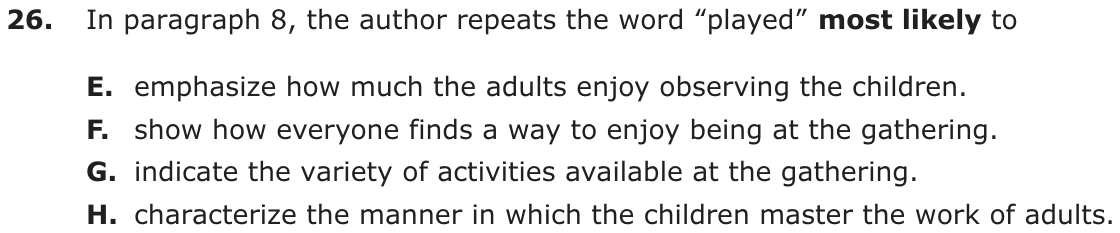
Question 29 of 57
2025 Practice Test A English, question 29Uses the passage above: “Excerpt from Do Them No Harm!”.
Question
How do paragraphs 11–13 affect the plot of the excerpt?
- AThey establish a feeling of mystery by presenting different points of view about the arriving people.
- BThey contribute to the rising action by developing the idea that the arriving people could present a problem.
- CThey lead to a turning point by describing the moment that the crowd realizes why the strangers have come.
- DThey explain the cause of the main conflict by providing background information about the strangers.
Show the answer
Correct answer: B
The question asks how paragraphs 11–13 affect the plot of the excerpt.
A. Incorrect. The paragraphs contain questions about the arriving people. They do not present differing points of view.
B. CORRECT. The paragraphs ask questions in which the characters wonder whether the arriving people are friends or enemies, or whether they might be bringing good news or bad news. By suggesting that the arriving people could present problems such as these, the paragraphs contribute to the rising action.
C. Incorrect. The paragraphs do not lead to a turning point. Instead, they lead to the climax—the moment the characters discover who the visitors are. This means the paragraphs contribute to the rising action.
D. Incorrect. Paragraphs 11–13 ask questions. They do not provide background information about the strangers; instead, they ask for it.
Question analysis
This plot question asks how paragraphs 11–13, a series of questions the villagers ask as riders approach their camp, affect the plot of the Nez Perce narrative. Students must know terms such as rising action and turning point and apply them precisely, since several choices describe these paragraphs in ways that sound right but place them wrongly in the story.
- Grade level
- Grade 8 reading and task
- Compared with grade 7
- Above grade 7 Grade 7 plot questions usually ask what one event causes. Here students apply terms such as rising action and turning point to three short paragraphs of questions, which matches the grade 8 focus on how parts of a story propel the action.
- Estimated difficulty
- Hard: combines ideas, needs a plan, and has more than one tempting wrong answer.
- Thinking it demands
- Depth of knowledge 3, strategic thinking · mainly analyze
- What makes it hard
- A very close wrong answer major
- How, not what moderate
- Something you must already know minor
- Evidence
- Answered from several paragraphs or stanzas
- Reading level
- Passage: about grade 5, 885 words; question and choices: about grade 9, 77 words.
- Students, last 30 days
- Not enough answers yet to show (it takes 10).
Why it is hard, traps and wrong answers (shows the answer)
Why it is hard
Paragraphs 11–13 contain nothing but questions, so the answer depends on what questions do in a plot. Friends or enemies, good news or bad, they raise the chance of trouble and build toward the arrival. The trap is that they also create mystery, and the choice that says so fails only on one phrase about differing viewpoints. A second risk is jumping ahead: at this point no one even knows who the riders are, let alone why they came.
A very close wrong answer major Choosing the answer
The right choice and the one about mystery both see the questions building uncertainty about the riders; only the claim of “different points of view,” when the questions are “in every mind,” separates them. (Embretson & Wetzel, 1987; Gorin & Embretson, 2006; Ascalon et al., 2007)
How, not what moderate Working it out
The stem asks what paragraphs 11–13 do for the plot, so students must place a run of unanswered questions in the story’s shape rather than retell them. (Anderson & Krathwohl, 2001)
Something you must already know minor Working it out
The choices rely on plot terms the excerpt never explains, rising action, turning point and main conflict, and judging them means knowing what each one names. (Anderson & Krathwohl, 2001)
Strategy: Note what the villagers know and do not yet know in paragraphs 11–13, then compare that with what happens later in the excerpt to place these paragraphs in the plot.
Traps
- Half right: One half of a two-part choice is right and the other is not.
- Wrong part of the text: A choice is true of another paragraph, stanza or speaker than the one asked about.
- Wrong purpose or structure: Names a purpose, structure or effect that the part does not serve, or describes what a part says when the question asks what it does.
The wrong answers, classified
A Half right (King et al., 2004; Thissen, Steinberg & Fitzpatrick, 1989)
Rightly feels the mystery in the villagers’ questions but adds “different points of view,” though the whole camp shares the same questions.
C Wrong part of the text (Kirsch & Mosenthal, 1990)
Jumps ahead to the recognition in paragraphs 17–23; in paragraphs 11–13 the crowd does not yet know who the riders are, let alone why they came.
D Wrong purpose or structure (Anderson & Krathwohl, 2001)
Notices the hunters gone two summers and the families who never returned, but those details arrive as questions, and the excerpt has no conflict they explain.
Working it out, step by step
Figure out what the question asks
This asks how paragraphs 11–13 move the story along. You need some plot words. The plot is the order of events in a story. The rising action is the part where tension builds. Tension is the feeling that something big may happen. A turning point is the moment when things change.
Read paragraphs 11 to 13
These paragraphs are all questions. Paragraph 11 asks: “Were they friends or enemies? Did they bring good news or bad?” In paragraph 12, “Who can it be?” is one of “the questions in every mind.” Paragraph 13 asks if the riders are the hunters who left “two summers past.”
Decide what the questions do
The words “enemies” and “bad” news show the camp is worried. The riders might bring trouble. No one knows yet. So the questions build tension as the riders get closer. That is rising action. The answers come later. The crowd knows the hunters in paragraph 18. They learn who the woman is in paragraphs 22 and 23.
Check each choice
- B fits. The questions raise the chance of a problem and build tension.
- A: there is mystery, but not “different points of view.” Everyone asks the same questions.
- C: in these paragraphs, no one knows who the riders are yet, let alone why they came. So nothing here is the moment the crowd realizes anything.
- D: the paragraphs ask about the strangers. They give no background facts about them.
Pick the answer
Watch out: A is very close. The questions do create mystery. But one wrong phrase, “different points of view,” rules it out. So the answer is B.
Why this answer and not the closest wrong one
A is the closest wrong answer, because the questions do make the scene mysterious. But the questions are “in every mind,” so there are no different points of view. B names what the questions do for the plot: they hint that the riders could bring trouble, and they build tension.
More questions like this
The original DOE question
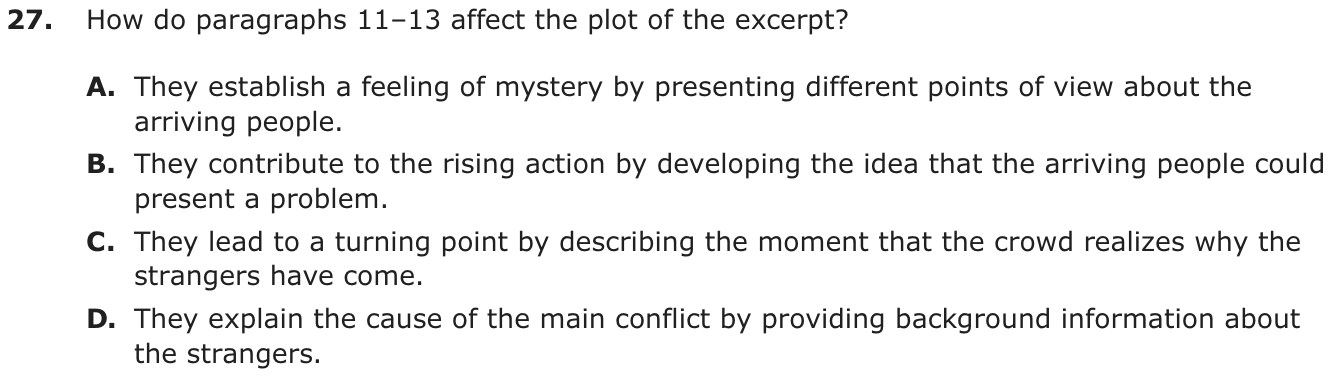
Question 30 of 57
2025 Practice Test A English, question 30Uses the passage above: “Excerpt from Do Them No Harm!”.
Question
In paragraph 20, the phrases “trophies of their hunt” and “paraded around” affect the paragraph by
- Asuggesting that the hunters are rewarded for their leadership.
- Bemphasizing that The People are dependent on the hunters for food.
- Crevealing that the hunters are pleased with their success.
- Dindicating that The People have gathered specifically to welcome the hunters.
Show the answer
Correct answer: C
The question asks how the phrases “trophies of their hunt” and “paraded around” affect paragraph 20.
A. Incorrect. The phrase “trophies of their hunt” describes the animals that the hunters have successfully found. They have already received their rewards (the animals) and are showing them to The People.
B. Incorrect. The excerpt describes many ways that The People find and prepare their own food. While they appreciate the extra food, they are not dependent on the hunters.
C. CORRECT. The hunters “paraded around” because they were proud of the animals they had been able to get while hunting. Since a trophy is a recognition of success, they consider these animals their trophies.
D. Incorrect. The phrases show the pride the hunters feel. As paragraph 20 says, the hunters want “all to see how strong their Hunting Power had been.” The phrases are focused on the hunters rather than on those who have gathered around them.
Question analysis
This word-meaning question looks at the phrases “trophies of their hunt” and “paraded around” in the scene where four Nez Perce hunters ride back into camp, and asks what the phrases add to the paragraph. Students must work out what the words suggest in this context, not just their dictionary meanings, and weigh four plausible effects on the paragraph.
- Grade level
- Grade 6 reading and task
- Compared with grade 7
- Below grade 7 Grade 7 students analyze the connotations of words in context. These two phrases are familiar and sit in one short paragraph with helpful context nearby, so this is lighter than typical grade 7 word-choice work.
- Estimated difficulty
- Straightforward: two steps or one careful reading.
- Thinking it demands
- Depth of knowledge 2, skills and concepts · mainly analyze
- What makes it hard
- Evidence
- Answered from one paragraph or stanza
- Reading level
- Passage: about grade 5, 885 words; question and choices: about grade 8, 55 words.
- Corrected from the DOE handbook
- A quotation in the explanation was corrected to match the passage.
- Students, last 30 days
- Not enough answers yet to show (it takes 10).
Why it is hard, traps and wrong answers (shows the answer)
Why it is hard
Paragraph 20 nearly states the answer: the hunters are “proud to show off” their loads and parade “for all to see how strong their Hunting Power had been.” Errors come from neighboring details instead: the welcoming crowd in the same paragraph, the food for everyone in the next, or the everyday sense of a trophy as an award. Reading the phrases inside their own sentences settles it.
Figurative or literary language minor Understanding the question
“Trophies of their hunt” turns meat and hides into prizes and “paraded around” suggests a show, and students must read both as signs of pride rather than of awards or ceremony. (Graesser, Singer & Trabasso, 1994; Kintsch, 1998)
The right answer is reworded minor Choosing the answer
The right choice recasts “proud to show off” in new words, while one wrong choice echoes the “welcoming crowd” and another the “plenty of food” of paragraph 21. (Freedle & Kostin, 1993; Kirsch & Mosenthal, 1990)
Strategy: Think about what each phrase usually suggests, then reread the whole of paragraph 20 to check that meaning against the context before looking at the choices.
Traps
- Dictionary meaning, not meaning here: A common meaning of the word that does not fit its use in this text.
- Too broad or too strong: A choice overstates, generalizes, or uses absolute words the text does not support.
- Twists what the text says: Uses the text's topic and ideas but changes what it says: who did it, how much, when, or why.
The wrong answers, classified
A Dictionary meaning, not meaning here (Perfetti, 2007)
Reads “trophies” as prizes handed out for an achievement and adds leadership, but the trophies are the meat and hides, and nothing mentions leading.
B Too broad or too strong (King et al., 2004)
Borrows paragraph 21’s point that good hunters bring food for all and inflates it into dependence, though The People gather much of their own food.
D Twists what the text says (King et al., 2004)
Is drawn by the “welcoming crowd” in the same paragraph, but The People came to Oyaip for the camas harvest and simply greet the hunters who arrive.
What was corrected from the DOE handbook, and why
- Explanation: The handbook’s explanation of Option C says the hunters “parade around.” Paragraph 20, and the question itself, say they “paraded around the encampment,” so the site now quotes “paraded around” and puts the rest of that sentence in the past tense to match.
Working it out, step by step
Figure out what the question asks
This asks what two phrases add to paragraph 20: “trophies of their hunt” and “paraded around.” Think about what each phrase suggests. Then check it against the whole paragraph.
Think about each phrase
A trophy is something you show off to prove you won, like a cup for a winning team. Here the trophies are the meat and hides from the hunt. To parade is to march around so people can watch, like in a parade. Both phrases suggest showing off something you are proud of.
Check the whole paragraph
Paragraph 20 says the hunters were “proud to show off the loads of meat, hides, and other trophies of their hunt.” Then “They paraded around the encampment for all to see how strong their Hunting Power had been.” An encampment is a camp. The paragraph ends “what great hunters they, themselves, were.” So the hunters are proud of how well they did.
Check each choice
- C fits. The hunters are pleased with their success.
- A: no one gives the hunters a prize. The trophies are what they caught, and nothing mentions leading.
- B: The People get much of their own food. They dig roots, pick berries and fish. They don’t depend on the hunters to eat.
- D: The People came for the camas harvest. They greet the hunters when they arrive. They did not gather just for them.
Watch out: D is tempting because the paragraph mentions a “welcoming crowd.” But the two phrases describe the hunters, not the crowd.
Pick the answer
Both phrases show the hunters proudly showing off the results of a good hunt. So the answer is C: the hunters are pleased with their success.
Why this answer and not the closest wrong one
D and B are the closest wrong answers, because they use nearby details: the “welcoming crowd” and the food the hunters bring. But the two phrases are about the hunters themselves. They are “proud to show off” what they caught. That pride is C.
More questions like this
The original DOE question
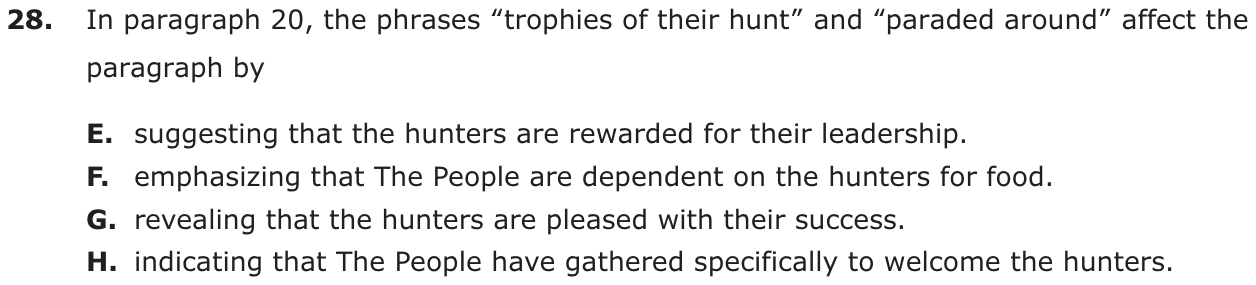
Question 31 of 57
2025 Practice Test A English, question 31Uses the passage above: “Excerpt from Do Them No Harm!”.
Question
Which quotation from the excerpt best supports the idea that The People feel a connection to members of their group in spite of distance?
- A“As was their custom since wahk-kee-ma, a time far back beyond the memory of man, they set up their camps in the same locations their parents and grandparents had occupied before them.” (paragraph 5)
- B“ ‘Would they have news of the families who had gone long ago to Buffalo Country and never returned?’ ” (paragraph 13)
- C“ ‘Looks like hunters,’ the older men agreed. ‘Looks like they had good hunting.’ ” (paragraph 15)
- D“But it was the sight of the frail figure of the woman that aroused their curiosity.” (paragraph 21)
Show the answer
Correct answer: B
The question asks which quotation from the excerpt best supports the idea that The People feel a connection to members of their group in spite of distance.
A. Incorrect. This quotation describes the fact that The People always set up their camps in the same places their parents and grandparents used before them. This quotation highlights the customs The People continue from their ancestors, but it does not focus on their present personal connections.
B. CORRECT. This quotation alludes to The People’s eagerness to hear about the families who had traveled away from their group. This eagerness shows that they still feel a connection to these families, even though they are far apart.
C. Incorrect. This quotation describes The People’s analysis of the visitors—that they may be hunters. It does not show a connection to the visitors.
D. Incorrect. This quotation shows that The People are curious about a stranger who has come into their camp. It does not show closeness to distant members of the group.
Question analysis
This textual evidence question asks which quotation from the Nez Perce narrative best supports the idea that The People feel connected to members of their group even when those members are far away. The quotations come from across the excerpt, so students must make sure the one they choose fits both parts of that idea.
- Grade level
- Grade 7 reading and task
- Compared with grade 7
- At grade 7 Choosing the quotation that supports an idea is everyday grade 7 work. Here the idea joins two conditions, connection and distance, and the quotations come from across the excerpt, which keeps the demand at a solid grade 7 level.
- Estimated difficulty
- Moderate: several steps, or a close reading with one strong distractor.
- Thinking it demands
- Depth of knowledge 2, skills and concepts · mainly evaluate
- What makes it hard
- Reading between the lines moderate
- Every choice must be checked minor
- Evidence
- Answered from several paragraphs or stanzas
- Reading level
- Passage: about grade 5, 885 words; question and choices: about grade 9, 107 words.
- Corrected from the DOE handbook
- The explanation described one wrong choice's quotation inaccurately; that sentence was corrected.
- Students, last 30 days
- Not enough answers yet to show (it takes 10).
Why it is hard, traps and wrong answers (shows the answer)
Why it is hard
The idea joins two conditions, connection and distance, and the quotations satisfy them unevenly. The camp-location line shows a strong tie, but to ancestors across time rather than to members far away, and the line about the woman involves a returning member before anyone knows she is one. The right line is easy to pass over because it is a question, yet asking after families long gone shows they still matter.
Reading between the lines moderate Working it out
The right quotation is a question, not a statement of feeling; students must infer that asking for news of families “gone long ago” shows a bond that distance has not broken. (Graesser, Singer & Trabasso, 1994; Kintsch, 1998)
Every choice must be checked minor Choosing the answer
Each quotation has to pass two tests, a bond with group members and members who are far away, and the camp-location line passes only the first. (Embretson & Wetzel, 1987)
Strategy: Test each quotation against both parts of the idea: does it show a bond with group members, and does that bond reach people who are far away?
Traps
- Supports only part of the claim: In a question about evidence: a line that backs one half of the claim but not the other, or a related point rather than the claim itself.
- Reads too much in: A reasonable-sounding conclusion that goes further than the text allows.
The wrong answers, classified
A Supports only part of the claim (King et al., 2004; Thissen, Steinberg & Fitzpatrick, 1989)
Sees a bond in camping where parents and grandparents camped, but that ties The People to ancestors across time, not to members far away.
C Supports only part of the claim (King et al., 2004; Thissen, Steinberg & Fitzpatrick, 1989)
Remembers that the older men go on to say “Maybe our four hunters,” but the quoted words only judge the hunt and show no feeling for absent members.
D Reads too much in (Graesser, Singer & Trabasso, 1994)
Knows the woman turns out to be a lost member, but at this point no one knows who she is, so the curiosity is about a stranger, not a bond.
What was corrected from the DOE handbook, and why
- Explanation: Choice A quotes paragraph 5: The People “set up their camps in the same locations their parents and grandparents had occupied before them.” The handbook's explanation says the quotation describes them returning “to perform the same traditional tasks and enjoy the same festivities as their ancestors,” which the sentence doesn't say. The explanation now describes the quotation as it is. The reason A is wrong is unchanged: it shows a custom kept from their ancestors, not a connection to members who are far away. The answer, B, is unchanged.
Working it out, step by step
Figure out what the question asks
You need the quotation that best shows The People feel close to group members who are far away. The idea has two parts: a connection, and distance. The right quotation must show both.
Test each quotation on both parts
- A (paragraph 5): they camp where “their parents and grandparents” camped. That is a connection, but to people from the past, not to people far away.
- B (paragraph 13): “Would they have news of the families who had gone long ago to Buffalo Country and never returned?” These families are far away and long gone. The People still want news of them.
- C (paragraph 15): the men only guess that the riders are hunters who had a good hunt. They show no feeling for anyone.
- D (paragraph 21): The People are curious about the woman. They don’t know yet that she is one of them.
See why B shows a connection
You only ask for news about people you care about. The families left “long ago.” They went to Buffalo Country, far from the camp. Yet The People still wonder about them. So time and distance have not broken the bond.
Pick the answer
Watch out: A shows a strong bond too, so it is tempting. But it ties The People to their parents and grandparents, across time. It is not about members who are far away. So the answer is B.
Why this answer and not the closest wrong one
A is the closest wrong answer, because camping where parents and grandparents camped shows a strong tie. But that tie stretches across years, not across distance. B is about families who went far away “long ago,” and The People still want news of them. Only B passes both tests.
More questions like this
The original DOE question
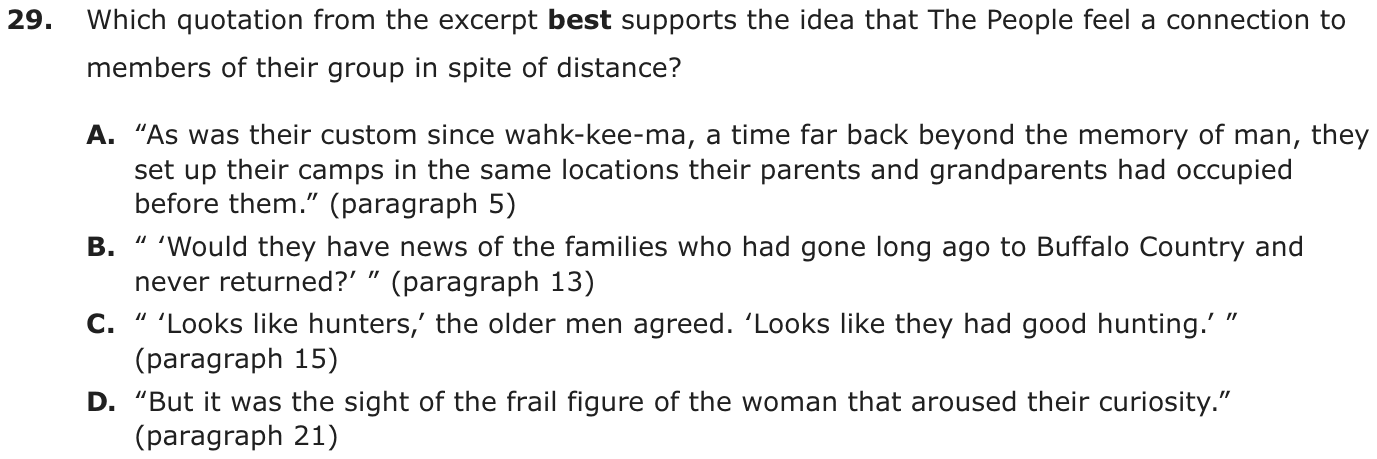
Question 32 of 57
2025 Practice Test A English, question 32Uses the passage above: “Excerpt from Do Them No Harm!”.
Question
Read these sentences from paragraph 22.
“Belongs to Red Bear people. Gone then come back.”
How does this statement affect the villagers in the excerpt?
- AIt increases their concern about why the woman is in their camp.
- BIt makes them hopeful that more lost members will return before the winter.
- CIt causes shock, leading them to grieve for the loss of the woman and her family.
- DIt inspires amazement, making them want to reconnect with their returned family member.
Show the answer
Correct answer: D
The question asks how the statement from paragraph 22 affects the villagers in the excerpt.
A. Incorrect. In paragraph 21, the villagers question who the woman is and from where she has come, but they are merely curious about her and not necessarily concerned, as there is no indication in paragraph 22 that she might be a threat.
B. Incorrect. This statement reveals that the woman is a member of the Red Bear people who has returned, and in paragraph 15 there is a reference to four hunters who have been gone a long time. However, this statement serves only to satisfy the villagers’ curiosity about who this woman is; it does not make the villagers hopeful that other people will also return.
C. Incorrect. Though paragraph 23 reveals that the villagers are somewhat surprised because the girl has grown into a woman, paragraph 24 suggests they are excited to receive her. There is no reason given in paragraph 22 for them to grieve for her loss, since she has returned.
D. CORRECT. The hunters’ words from paragraph 22 amaze the villagers, who do not at first recognize the woman. Once they know she is one of their own, they are eager to interact with her, as revealed in paragraphs 24 and 25, where they give her a new name and care for her.
Question analysis
This question quotes the hunters’ brief words about the frail woman who rides into camp with them, “Belongs to Red Bear people. Gone then come back,” and asks how the statement affects the villagers. Students must follow the scene that comes next and judge the villagers’ feelings from what they shout and do, since the excerpt never names those feelings directly.
- Grade level
- Grade 7 reading and task
- Compared with grade 7
- At grade 7 Explaining how a line of dialogue affects characters is grade 7 story analysis. The hunters’ words are short and the response follows at once, so the main demand is inferring the villagers’ state of mind, a routine grade 7 step.
- Estimated difficulty
- Straightforward: two steps or one careful reading.
- Thinking it demands
- Depth of knowledge 2, skills and concepts · mainly analyze
- What makes it hard
- Reading between the lines moderate
- Evidence
- Answered from several paragraphs or stanzas
- Reading level
- Passage: about grade 5, 885 words; question and choices: about grade 6, 78 words.
- Students, last 30 days
- Not enough answers yet to show (it takes 10).
Why it is hard, traps and wrong answers (shows the answer)
Why it is hard
The hunters’ words answer the question the crowd has been asking, who the woman is, and what follows is recognition and welcome. Students who carry over an earlier mood, worry about strangers or sadness at a long absence, misread the moment. The hopeful-sounding choice about more members returning goes one step past the text, which shows joy over this return and nothing about others.
Reading between the lines moderate Working it out
The villagers’ reaction is never named; it is shown in paragraphs 23–25, where “Now they could see!”, the women cry out her new name and gentle arms lift her from her horse. (Graesser, Singer & Trabasso, 1994; Kintsch, 1998)
Strategy: Read the paragraphs right after the hunters speak and note what the villagers say and do. Then choose the reaction those words and actions show.
Traps
- Wrong tone or attitude: Misjudges the tone, attitude or point of view, such as reading admiration as criticism, or taking a character's or subject's feelings for the author's.
- Reads too much in: A reasonable-sounding conclusion that goes further than the text allows.
The wrong answers, classified
A Wrong tone or attitude (Graesser, Singer & Trabasso, 1994)
Carries over the worry of paragraph 11, friends or enemies, though by now the hunters vouch for the woman and the statement removes any reason for concern.
B Reads too much in (Graesser, Singer & Trabasso, 1994)
Connects the return to paragraph 13’s wish for news of families who never came back, then assumes hope that others will follow, which the excerpt never shows.
C Wrong tone or attitude (Graesser, Singer & Trabasso, 1994)
Rightly senses surprise but reads it as grief, prompted by the woman’s frail figure and long absence, though the women cry out her new name and care for her.
Working it out, step by step
Figure out what the question asks
The hunters say: “Belongs to Red Bear people. Gone then come back.” This asks how those words affect the villagers. The story doesn’t name their feelings. So look at what they say and do next.
See what happens next
- Paragraph 23: “Now they could see! She was the daughter of the family gone so long ago!”
- Paragraph 24: the women cry out “Wat-ku-ese!” This becomes her new name.
- Paragraph 25: “Gentle arms lifted Wat-ku-ese from her horse.” The women bring her food and care for her.
Name the feelings
The exclamation points in paragraph 23 show surprise and wonder. A little girl has come back as a grown woman, and they can hardly believe it. That is amazement. Then they give her a name, feed her and care for her. They want to bring her back into the family. That is reconnecting, or becoming close again.
Check each choice
- D fits: amazement, then wanting to reconnect.
- A: the hunters say she belongs to the Red Bear people. That ends any worry.
- B: nothing says they hope others will return before winter.
- C: they are surprised, but they don’t grieve, or feel deep sadness. They cheer and care for her.
Watch out: C is tempting because she is frail and was gone a long time. But the women’s actions are happy and gentle.
Pick the answer
The villagers are amazed, and they rush to welcome her back home. So the answer is D.
Why this answer and not the closest wrong one
C is the closest wrong answer, because the news is a shock and the woman is frail. But nobody mourns. The women shout her new name, and “Gentle arms lifted Wat-ku-ese from her horse.” Those are signs of joy and care. That matches D, amazement and a wish to reconnect.
More questions like this
The original DOE question
Question 33 of 57
2025 Practice Test A English, question 33Uses the passage above: “Excerpt from Do Them No Harm!”.
Question
The details in paragraph 5 about the locations of the camps and the details in paragraphs 23–24 about the reaction to the woman convey a theme of the excerpt by
- Arevealing the difficulties posed by moving often each year.
- Bshowing the connectedness among The People through the years.
- Cindicating the value to The People of retelling stories about the past.
- Ddemonstrating the importance of choosing appropriate names.
Show the answer
Correct answer: B
The question asks how the details in paragraph 5 about the locations of the camps and the details in paragraphs 23–24 about the reaction to the woman convey a theme of the excerpt.
A. Incorrect. Paragraph 5 does not reveal that The People move often, only that they come together near each other at this particular time of year. Paragraphs 23–24 reveal a resolution to the difficulty of people who are absent for some time, but they do not relate to the difficulty of moving often each year.
B. CORRECT. The details in paragraph 5 show that each year The People set up their camps beside the same neighbors, in the places their parents and grandparents used before them, demonstrating their connectedness. Similarly, the details in paragraphs 23–24 reveal that The People quickly embrace a member of their group who had gone away but has since returned. Taken together, these sections reveal just how much The People rely on their connectedness, a theme of the excerpt.
C. Incorrect. Although paragraph 5 suggests that The People keep the customs of their ancestors alive, it does not reference storytelling. Further, though paragraphs 23–24 suggest that The People had knowledge of this woman’s absence, they do not indicate that this knowledge came from stories in particular.
D. Incorrect. In paragraph 24, an appropriate new name, meaning “Gone-from-Home-then-Come-Back,” is bestowed on the returned woman. However, the importance of appropriate names is not a theme of the excerpt. Rather, the theme that is emphasized is the importance of the connection among The People, exemplified by the annual gathering and the warm welcome extended to the woman who has returned after a long absence.
Question analysis
This theme question asks how two sets of details in the Nez Perce narrative, where each group pitches its camp and how the camp reacts to a woman who has come back after many years, together convey a theme. Students must connect two parts of the excerpt that are far apart and find the one idea that both of them express.
- Grade level
- Grade 7 reading and task
- Compared with grade 7
- At grade 7 Tracing a theme across a text is the grade 7 central idea standard. Students must join two passages far apart in the excerpt, but each is concrete, and the theme they share is the kind grade 7 readers routinely name.
- Estimated difficulty
- Moderate: several steps, or a close reading with one strong distractor.
- Thinking it demands
- Depth of knowledge 3, strategic thinking · mainly analyze
- What makes it hard
- Evidence in several places moderate
- Reading between the lines minor
- Evidence
- Answered from several paragraphs or stanzas
- Reading level
- Passage: about grade 5, 885 words; question and choices: about grade 9, 65 words.
- Corrected from the DOE handbook
- The explanation described the wrong paragraph's details; that sentence was corrected.
- Students, last 30 days
- Not enough answers yet to show (it takes 10).
Why it is hard, traps and wrong answers (shows the answer)
Why it is hard
Each set of details on its own suggests several ideas, tradition, travel, naming, but the theme has to explain both at once. Students who focus on paragraph 24’s new name or on storytelling elsewhere in the excerpt choose an idea that fits only one passage. Naming what the old campsites and the warm welcome have in common, ties that last across years and distance, leads straight to the key.
Evidence in several places moderate Working it out
The two sets of details sit eighteen paragraphs apart, the camps in the places “their parents and grandparents had occupied” and the welcome given Wat-ku-ese, and the theme must fit both. (Kirsch & Mosenthal, 1990; Gorin & Embretson, 2006)
Reading between the lines minor Working it out
Neither passage names the theme; students must see that returning to ancestral campsites and embracing a lost daughter both show bonds that last across years. (Graesser, Singer & Trabasso, 1994; Kintsch, 1998)
Strategy: Sum up each set of details in a phrase, the camp locations and the reaction to the woman, then name the one idea both sets share before reading the choices.
Traps
- Too narrow: A single detail offered as the central idea or a summary, or a summary that keeps minor details and leaves out an essential part.
- Wrong part of the text: A choice is true of another paragraph, stanza or speaker than the one asked about.
- Twists what the text says: Uses the text's topic and ideas but changes what it says: who did it, how much, when, or why.
The wrong answers, classified
A Twists what the text says (King et al., 2004)
Assumes the yearly trek means constant moving, but paragraph 5 stresses returning to the same sites, and paragraphs 23–24 say nothing about travel.
C Wrong part of the text (Kirsch & Mosenthal, 1990)
Links customs kept “beyond the memory of man” to storytelling, likely recalling Wat-ku-ese telling her story at the end, but neither cited section is about retelling.
D Too narrow (King et al., 2004)
Fixes on the naming of Wat-ku-ese in paragraph 24, one vivid detail, and ignores the camp locations in paragraph 5 that the theme must also explain.
What was corrected from the DOE handbook, and why
- Explanation: The handbook's explanation of B says paragraph 5 shows The People coming together “to share in recreational activities.” The races and games are in paragraph 4; paragraph 5, the one the question names, is about camping each year in the same places as their parents and grandparents, beside the same neighbors. The sentence now describes paragraph 5. The answer, B, is unchanged.
Working it out, step by step
Figure out what the question asks
A theme is a big idea a story shows about life. This asks for the theme shared by two parts of the story. One is paragraph 5, about where the camps go. The other is paragraphs 23–24, about the woman who comes back. The theme has to fit both.
Sum up paragraph 5
Paragraph 5 says they set up camp “in the same locations their parents and grandparents had occupied before them.” The same neighbors camp side by side each year. Red Bear’s neighbors “had their camp close by.” So the families stay tied to each other and to the past, year after year.
Sum up paragraphs 23 and 24
In paragraph 23 the camp learns “She was the daughter of the family gone so long ago!” She left as a little girl and came back grown. Yet they know her as one of their own. In paragraph 24 the women joyfully give her a new name. She is welcomed home after many years.
Find the shared idea
Both parts show bonds that last a long time. The People keep the same camps and neighbors through the years. They also welcome back a member who was gone for years. So the theme is how connected The People stay over time.
Check each choice
- B fits both parts: connectedness through the years.
- A: paragraph 5 is about going back to the same places, not moving often. Paragraphs 23–24 don’t mention moving at all.
- C: neither part is about retelling old stories.
- D: the new name is only in paragraph 24. It says nothing about the camps in paragraph 5.
Watch out: The naming of Wat-ku-ese is easy to remember, so D is tempting. But a theme must fit both parts.
Pick the answer
The camp locations and the warm welcome both show bonds that last through the years. So the answer is B.
Why this answer and not the closest wrong one
D is the closest wrong answer, because the naming in paragraph 24 stands out. But a name says nothing about where the camps go in paragraph 5. B explains both parts: The People camp beside the same neighbors year after year, and they welcome back a daughter gone for years.
More questions like this
The original DOE question
Question 34 of 57
2025 Practice Test A English, question 34Passage Excerpt from “The Spirit of the Herd”
Excerpt from “The Spirit of the Herd”
by Dallas Lore Sharp
In this excerpt, published in 1914, author and professor Dallas Lore Sharp describes a summer cattle roundup in Oregon. The heat and dust had been relentless for three days. The cowboys were exhausted, and the cattle were restless. The ranch boss, Wade, had led the drive to a watering place, only to find it empty.
Along with the wagon had come the fresh horses—one of them being Peroxide Jim, a supple, powerful, clean-limbed buckskin, a horse, I think, that had as fine and intelligent an animal-face as any creature I ever saw. Wade had been saving this horse for emergency work. And why should he not have been saved fresh for just such a need as this? Are there not superior horses as well as superior men—a Peroxide Jim to complement a Wade?
The horse knew the cattle business and knew his rider perfectly; and though there was nothing like sentiment about the boss of the P Ranch riders, his faith in Peroxide Jim was complete. . . .
The desert, where the herd was camped, was one of the highest of a series of tablelands, or benches; it lay as level as a floor, rimmed by sheer rock, from which there was a drop to the bench of sage below. The herd when overtaken by the dusk had been headed for a pass descending to the next lower bench, but was now halted within a mile of the rim rock on the east, where there was a perpendicular fall of about three hundred feet. . . .
In the taut silence of the stirless desert night, with the tension of the herd at the snapping-point, any quick, unwonted sight or sound would stampede them. The sneezing of a horse, the flare of a match, would be enough to send the whole four thousand headlong—blind, frenzied, trampling—till spent and scattered over the plain.
And so, as he rode, Wade began to sing. The rider ahead of him took up the air and passed it on until, above the stepping stir of the hoofs rose the faint voices of the men, and all the herd was bound about by the slow plaintive measures of some old song. It was not to soothe their savage breasts that the riders sang to the cattle, but rather to preempt the dreaded silence, to relieve the tension, and so to prevent the shock of any sudden startling noise.
So they sang and rode and the night wore on to one o’clock, when Wade, coming up on the rim-rock side, felt a cool breeze fan his face, and caught a breath of fresh, moist wind with the taste of water in it.
He checked his horse instantly, listening as the wind swept past him over the cattle. But they must already have smelled it, for they had ceased their milling, the whole herd standing motionless, the indistinct forms close to him in the dark showing their bald faces lifted to drink the sweet wet breath that came over the rim. Then they started on again, but faster, and with a rumbling now from their hoarse throats that tightened Wade’s grip on the reins.
The sound seemed to come out of the earth, a low, rumbling mumble, as dark as the night and as wide as the plain, a thick, inarticulate bellow that stood every rider stiff in his stirrups. . . .
Then the breeze caught the dust and carried it back from the gray-coated, ghostly shapes, and Wade saw that the animals were still moving in a circle. He must keep them going. He touched his horse to ride on with them, when across the black sky flashed a vivid streak of lightning.
There was a snort from the steers, a quick clap of horns and hoofs from far within the herd, a tremor of the plain, a roar, a surging mass—and Wade was riding the flank of a wild stampede. Before him, behind him, beside him, pressing hard upon his horse, galloped the frenzied steers, and beyond them a multitude borne on, and bearing him on, by the heave of the galloping herd.
Wade was riding for his life. He knew it. His horse knew it. He was riding to turn the herd, too, back from the rim, as the horse also knew. The cattle were after water—water-mad—ready to go over the precipice to get it, carrying horse and rider with them. Wade was the only rider between the herd and the rim. It was black as death. He could see nothing in the sage, could scarcely discern the pounding, panting shadows at his side. He knew that he was being borne toward the rim, how fast he could not tell, but he knew by the swish of the brush against his tapaderos and the plunging of the horse that the ground was growing stonier, that they were nearing the rocks.
To outrun the herd was his only chance for life. If he could come up with the leaders he might not only escape, but even stand a chance of heading them off upon the plain and saving the herd. There were cattle still ahead of him; how many, what part of them all, he could not make out in the dark. But the horse knew. The reins hung on his straight neck, where his rider had dropped them, as, yelling and firing over the wild herd, he had given this horse the race to win, to lose.
They were riding the rim. Close on their left bore down the flank of the herd, and on their right, under their very feet, was a precipice, so close that they felt its blackness—its three hundred feet of fall! . . .
. . . Then Wade found himself racing neck and neck with a big white steer, which the horse, with marvelous instinct, seemed to pick out from a bunch, and to cling to, forcing him gradually ahead, till, cutting him free from the bunch entirely, he bore him off into the swishing sage.
The steers coming on close behind followed their leader, and in, after them, swung others. The tide was turning from the rim. More and more were veering, and within a short time the whole herd, bearing off from the cliffs, was pounding over the open plains.
Whose race was it? It was Peroxide Jim’s, according to Wade, for not by word or by touch of hand or knee had the horse been directed in the run. From the flash of the lightning the horse had taken the bit, had covered an indescribably perilous path at top speed, had outrun the herd and turned it from the edge of the rim rock, without a false step or a tremor of fear.
From “The Spirit of the Herd” by Dallas Lore Sharp—Public Domain
tablelands: plateaus, flat areas of land sharply elevated from the surrounding area
tapaderos: leather covers for stirrups
Question
Which sentence from the excerpt best explains why Wade reserved Peroxide Jim for “emergency work” (paragraph 1)?
- A“Are there not superior horses as well as superior men—a Peroxide Jim to complement a Wade?” (paragraph 1)
- B“Before him, behind him, beside him, pressing hard upon his horse, galloped the frenzied steers, and beyond them a multitude borne on, and bearing him on, by the heave of the galloping herd.” (paragraph 10)
- C“He knew that he was being borne toward the rim, how fast he could not tell, but he knew by the swish of the brush against his tapaderos and the plunging of the horse that the ground was growing stonier, that they were nearing the rocks.” (paragraph 11)
- D“From the flash of the lightning the horse had taken the bit, had covered an indescribably perilous path at top speed, had outrun the herd and turned it from the edge of the rim rock, without a false step or a tremor of fear.” (paragraph 16)
Show the answer
Correct answer: D
The question asks which sentence from the excerpt best explains why Wade reserved Peroxide Jim for “emergency work” (paragraph 1).
A. Incorrect. While the sentence from paragraph 1 refers to Peroxide Jim as being a superior horse, it does not tell why he would be useful in an emergency. The mention of Peroxide Jim’s superiority does not describe the attributes that would make him an appealing choice for use in an emergency.
B. Incorrect. The sentence from paragraph 10 does not describe the actions of Peroxide Jim. The sentence describes what Wade and the horse were experiencing, but it does not include any reference to how Peroxide Jim was responding to the situation.
C. Incorrect. The sentence from paragraph 11 describes Wade’s experiences and does not focus on the actions of Peroxide Jim. It reveals Wade’s awareness of the danger he was in, but the only reference to Peroxide Jim in this sentence is the description of the horse having to work harder to run on the stonier ground as they neared the edge: from “the plunging of the horse,” Wade knew “that the ground was growing stonier, that they were nearing the rocks.” This quotation does not show that Peroxide Jim was the right horse to use for emergency work because it does not indicate, at this point in the text, that he was responding in a way that saved the herd or Wade.
D. CORRECT. The sentence from paragraph 16 describes Peroxide Jim’s high level of skill and ability to perform in a life-and-death situation. Not only did Peroxide Jim recognize the emergency immediately (“From the flash of the lightning the horse had taken the bit”), but the horse also proved to have the physical capability (“had covered an indescribably perilous path at top speed, had outrun the herd and turned it from the edge of the rim rock”) and the mental toughness (“without a false step or a tremor of fear”) required to respond appropriately to the dangerous situation.
Question analysis
This evidence question on Dallas Lore Sharp’s “The Spirit of the Herd,” a 1914 account of a night stampede on an Oregon cattle drive, asks which sentence best explains why the ranch boss Wade kept his horse Peroxide Jim for “emergency work.” The four quoted sentences come from different parts of the excerpt and are long, so the choice takes careful reading.
- Grade level
- Grade 8 reading and task
- Compared with grade 7
- At grade 7 Finding the sentence that best explains a detail is regular grade 7 evidence work. The four quotations, though, are long sentences from across a dense excerpt written in 1914, so the reading load is heavier than usual.
- Estimated difficulty
- Moderate: several steps, or a close reading with one strong distractor.
- Thinking it demands
- Depth of knowledge 2, skills and concepts · mainly evaluate
- What makes it hard
- Evidence in several places moderate
- A lot to read minor
- Reading between the lines minor
- Evidence
- Answered from the whole text
- Reading level
- Passage: about grade 8, 1160 words; question and choices: about grade 13, 160 words.
- Students, last 30 days
- Not enough answers yet to show (it takes 10).
Why it is hard, traps and wrong answers (shows the answer)
Why it is hard
The question links the start of the excerpt to its end, and the nearest quotation is the most tempting: the narrator’s rhetorical question about “superior horses” sits beside the phrase and seems to explain it. It praises the horse without showing what he can do. The two stampede sentences show the emergency itself, so the point goes to students who look for the horse acting on his own and find it in the final paragraph.
Evidence in several places moderate Working it out
The phrase “emergency work” is in paragraph 1, but the proof of the horse’s worth comes only at the very end, in paragraph 16, after the stampede has been turned. (Kirsch & Mosenthal, 1990; Gorin & Embretson, 2006)
A lot to read minor Understanding the question
Three of the quotations run 33 to 46 words, and two of them describe the stampede in vivid detail without saying what the horse does, so sorting them takes time. (Kintsch, 1998; Gorin & Embretson, 2006; Freedle & Kostin, 1993)
Reading between the lines minor Working it out
Students must decide what an emergency horse needs, speed, nerve and judgment without a rider’s guidance, before the last sentence reads as an answer to paragraph 1. (Graesser, Singer & Trabasso, 1994; Kintsch, 1998)
Strategy: Decide what a horse saved for emergencies would need to be able to do, then pick the quotation that gives the clearest proof that Peroxide Jim can do it.
Traps
- Supports only part of the claim: In a question about evidence: a line that backs one half of the claim but not the other, or a related point rather than the claim itself.
- True but not the answer: A choice says something accurate about the text that does not answer this question.
The wrong answers, classified
A Supports only part of the claim (King et al., 2004; Thissen, Steinberg & Fitzpatrick, 1989)
Stays beside the phrase in paragraph 1 and accepts the claim that Peroxide Jim is “superior,” which praises him but gives no sign of what makes him useful in a crisis.
B True but not the answer (King et al., 2004; Embretson & Wetzel, 1987)
Picks the most vivid picture of the stampede, which shows the emergency itself but says nothing about how Peroxide Jim handles it.
C Supports only part of the claim (King et al., 2004; Thissen, Steinberg & Fitzpatrick, 1989)
Notices “the plunging of the horse” at a tense moment, but the sentence is about Wade sensing the rocks ahead, not about the horse meeting the danger.
Working it out, step by step
Figure out what the question asks
This asks for evidence. In paragraph 1, Wade was saving Peroxide Jim for “emergency work.” Which sentence best explains why? You need a sentence that shows what this horse can do when something goes wrong.
Decide what to look for
An emergency is a sudden, dangerous event. A horse saved for one should be fast, steady and smart. It should act quickly when things go wrong. So look for the sentence that shows the horse himself doing that.
Read the last sentence of the excerpt
Paragraph 16 says “From the flash of the lightning the horse had taken the bit, had covered an indescribably perilous path at top speed, had outrun the herd and turned it from the edge of the rim rock, without a false step or a tremor of fear.”
Put the sentence in plain words
The bit is the metal bar in a horse’s mouth that the reins attach to. A horse that “had taken the bit” runs on its own. Perilous means dangerous. A tremor is a small shake. So the moment the stampede began, the horse took charge. He raced along a dangerous path, got ahead of the herd and turned it from the cliff. He never stumbled or showed fear.
Check each choice
- A does not fit. It calls him “superior,” but it shows no skill.
- B does not fit. It shows the stampede, but not how the horse handles it.
- C does not fit. It is about Wade sensing the rocks ahead.
- D fits. It shows the horse saving the herd in a real emergency.
Watch out: A sits right next to “emergency work” in paragraph 1, so it seems to explain it. But praise is not proof.
Choose the answer
The last sentence shows exactly why the horse was worth saving for emergencies. So the answer is D.
Why this answer and not the closest wrong one
A is the closest wrong choice. It sits beside the words “emergency work” and praises the horse. But calling a horse “superior” does not say what it can do. D shows the horse in action: fast, sure-footed and fearless in a real emergency. That explains why Wade saved him.
More questions like this
The original DOE question
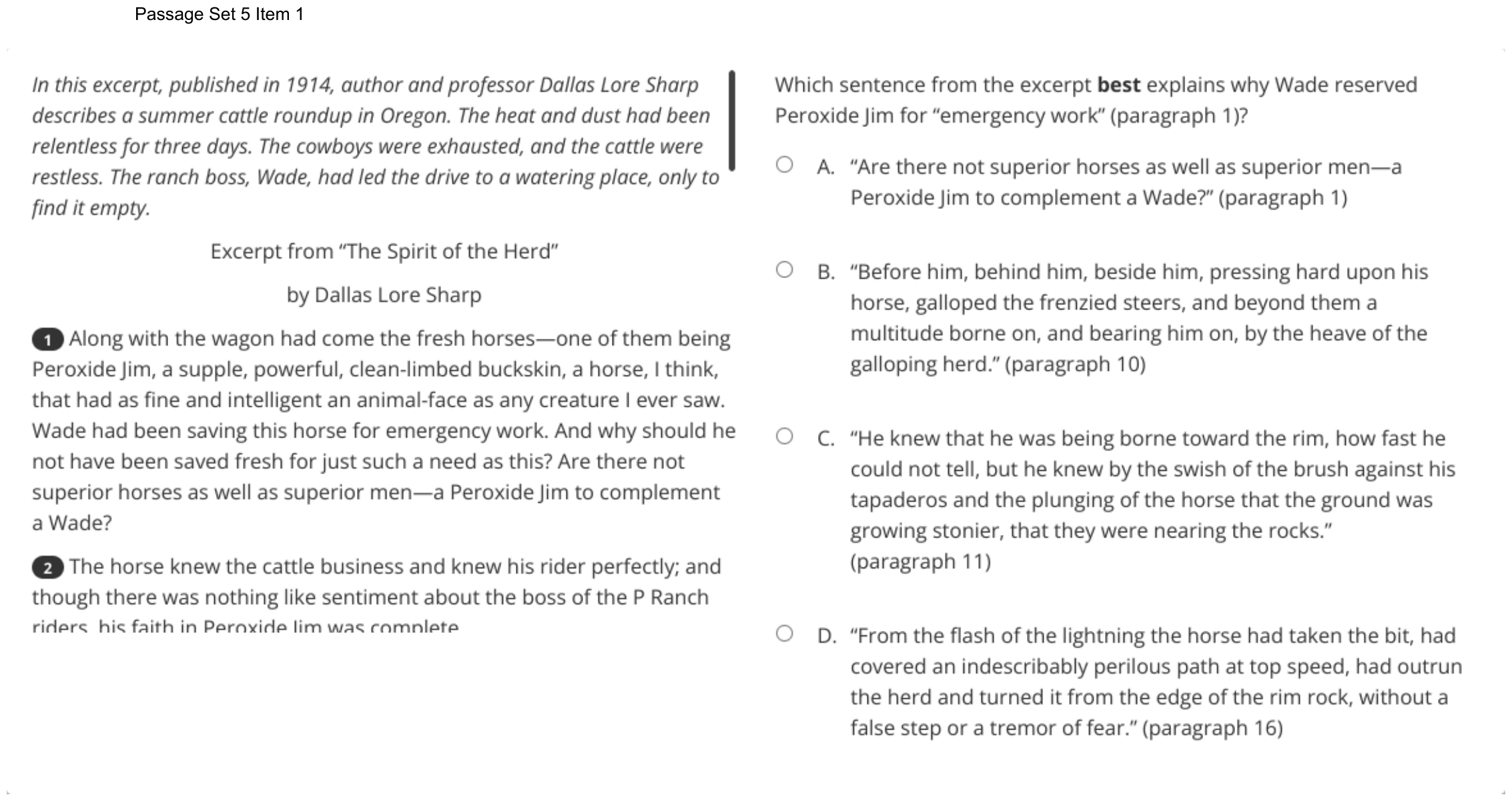
The passage “Excerpt from “The Spirit of the Herd”” as printed (page 41)
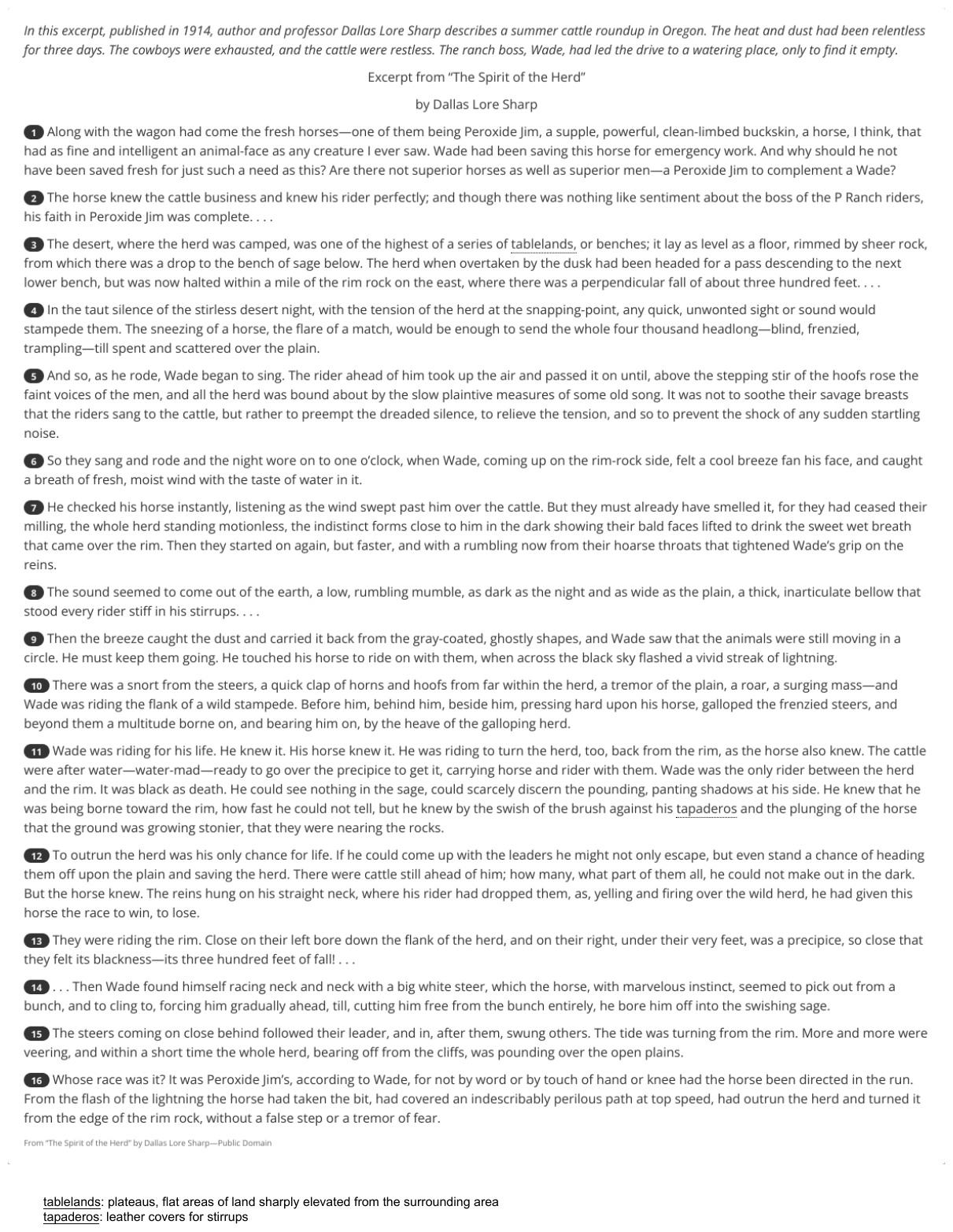
Question 35 of 57
2025 Practice Test A English, question 35Uses the passage above: “Excerpt from “The Spirit of the Herd””.
Question
Paragraphs 1–2 contribute to the development of the central idea of the excerpt by
- Arevealing the respect Wade had for his horse.
- Bemphasizing Wade’s high expectations of his horse and himself.
- Cindicating that Wade and his horse understood the cattle business.
- Ddemonstrating Wade’s ability to gauge a horse’s competence.
Show the answer
Correct answer: A
The question asks how paragraphs 1–2 contribute to the development of the central idea of the excerpt.
A. CORRECT. The description of Peroxide Jim in paragraph 1 indicates that the horse was a fine animal (“Along with the wagon had come the fresh horses—one of them being Peroxide Jim, a supple, powerful, clean-limbed buckskin, a horse, I think, that had as fine and intelligent an animal-face as any creature I ever saw” [paragraph 1]). The statement in paragraph 2 that Wade’s “faith in Peroxide Jim was complete” supports the central idea of the excerpt that Wade believed in Peroxide Jim’s abilities even before the horse turned the herd and saved the cattle.
B. Incorrect. Paragraphs 1–2 do not emphasize Wade’s high expectations for himself, nor are these expectations a central idea of the excerpt. The narrator expresses a high opinion of Wade’s abilities in his comparison of Peroxide Jim and Wade, referring to the horse as a “complement” (paragraph 1) for Wade; however, Wade showed complete trust in the horse’s ability to save the herd without his help, as evidenced by Wade dropping the reins to allow the horse to control the situation (paragraph 12).
C. Incorrect. The paragraphs refer to Peroxide Jim’s ability to handle cattle; in fact, paragraph 2 says that “the horse knew the cattle business.” It can be inferred that Wade had this knowledge as well, but this idea is not the focus of paragraphs 1–2 and is not the central idea of the excerpt.
D. Incorrect. Wade’s ability to judge a horse’s competence is not a central idea of the excerpt. The event described in the text is proof that Wade knew how to judge a horse’s ability: Wade trusted Peroxide Jim, and Peroxide Jim did not let him down. The option puts the focus on Wade and one of his strengths, when the central idea and focus of the excerpt is Peroxide Jim’s abilities and strengths, not Wade’s.
Question analysis
This central-idea question asks how the first two paragraphs of “The Spirit of the Herd,” which introduce the buckskin horse Peroxide Jim and the ranch boss Wade, contribute to the excerpt’s central idea. Students connect these opening details to the story of the stampede that follows. The narrator’s old-fashioned rhetorical questions can make the paragraphs’ point hard to pin down.
- Grade level
- Grade 8 reading and task
- Compared with grade 7
- At grade 7 Explaining how opening paragraphs build a central idea is typical grade 7 work. The two paragraphs are short, but the narrator’s rhetorical questions and old-fashioned phrasing must be decoded, and the central idea must come from the rest of the excerpt.
- Estimated difficulty
- Moderate: several steps, or a close reading with one strong distractor.
- Thinking it demands
- Depth of knowledge 2, skills and concepts · mainly analyze
- What makes it hard
- Reading between the lines moderate
- How, not what moderate
- Complex sentences minor
- Evidence
- Answered from several paragraphs or stanzas
- Reading level
- Passage: about grade 8, 1160 words; question and choices: about grade 9, 48 words.
- Students, last 30 days
- Not enough answers yet to show (it takes 10).
Why it is hard, traps and wrong answers (shows the answer)
Why it is hard
The opening paragraphs talk about both Wade and his horse, so every choice can find a foothold in them. The question turns on the excerpt as a whole, which ends by giving the race to Peroxide Jim, and only Wade’s regard for the horse points toward that ending. Students lose the point by picking a skill of Wade’s own, which his trust only implies, or by repeating “knew the cattle business,” a line said of the horse alone.
Reading between the lines moderate Working it out
Respect is never named; it must be read from Wade “saving this horse for emergency work” and from his “faith in Peroxide Jim” being “complete” in paragraph 2. (Graesser, Singer & Trabasso, 1994; Kintsch, 1998)
How, not what moderate Working it out
The question asks how two opening paragraphs serve the excerpt’s central idea, so students must know where the story ends, with the race credited to the horse, before judging them. (Anderson & Krathwohl, 2001)
Complex sentences minor Understanding the question
Paragraph 1 makes its point through two old-fashioned rhetorical questions, beginning “And why should he not” and “Are there not superior horses,” whose answers students must supply. (Abedi & Lord, 2001; Freedle & Kostin, 1993; Messick, 1989)
Strategy: Restate paragraphs 1 and 2 in plain words, decide what the excerpt as a whole is mainly about, and pick the option that links the two.
Traps
- Half right: One half of a two-part choice is right and the other is not.
- Word match: Repeats striking words or phrases from the text, so it looks supported, but its meaning does not fit the question.
- Reads too much in: A reasonable-sounding conclusion that goes further than the text allows.
The wrong answers, classified
B Half right (King et al., 2004; Thissen, Steinberg & Fitzpatrick, 1989)
Takes “superior horses as well as superior men” as Wade’s demands on both, but the paragraphs show only his trust in the horse, never his expectations of himself.
C Word match (Freedle & Kostin, 1993)
Repeats “knew the cattle business,” which paragraph 2 says of the horse alone, and treats that background detail as the point the excerpt builds toward.
D Reads too much in (Graesser, Singer & Trabasso, 1994)
Credits Wade with a talent for judging horses, which his trust implies, but the paragraphs show faith in one horse, and the excerpt’s focus is that horse’s deeds.
Working it out, step by step
Figure out what the question asks
This asks how paragraphs 1 and 2 help build the central idea. The central idea is the most important idea of the whole excerpt. So first find the central idea. Then see how the opening leads to it.
Find the central idea
The excerpt ends in paragraph 16: “Whose race was it? It was Peroxide Jim’s, according to Wade.” The horse saved the herd on his own, and Wade gives him the credit. The central idea is that Peroxide Jim is a remarkable horse who earns Wade’s trust.
Read paragraphs 1 and 2
Paragraph 1 says “Wade had been saving this horse for emergency work.” Paragraph 2 says “though there was nothing like sentiment about the boss of the P Ranch riders, his faith in Peroxide Jim was complete.”
Work out what they show
Sentiment means soft, tender feelings. Wade was a tough boss, not a soft one. Faith means trust. Even so, he trusted this horse completely. Saving the horse for the hardest jobs shows the same respect. The rest of the excerpt proves that respect was deserved.
Check each choice
- A fits. The paragraphs show how much Wade respected his horse.
- B does not fit. They never say what Wade expects of himself.
- C does not fit. “The horse knew the cattle business” is said about the horse, and it is only background.
- D does not fit. His trust may hint that he judges horses well. But the paragraphs show faith in one horse, and the excerpt is about what that horse does.
Choose the answer
The opening shows Wade’s respect, and the ending shows the horse deserved it. So the answer is A.
Why this answer and not the closest wrong one
D is the closest wrong choice. Wade’s trust does hint that he knows good horses. But paragraphs 1 and 2 show his faith in one horse, not a skill at judging horses. The excerpt is about that horse. Wade’s respect points straight to the end, where he gives the race to Peroxide Jim. That is A.
More questions like this
The original DOE question
Question 36 of 57
2025 Practice Test A English, question 36Uses the passage above: “Excerpt from “The Spirit of the Herd””.
Question
How does paragraph 3 convey the effect of the setting on the cattle drive?
- AIt shows how the growing darkness created challenges for the riders in getting the herd to move.
- BIt describes how the changing elevation contributed to the dangerousness of the environment.
- CIt describes how the desert created an uncomfortable feeling of isolation for the riders and the cattle.
- DIt shows how the steep terrain made it difficult for the cattle to keep moving forward.
Show the answer
Correct answer: B
The question asks how paragraph 3 conveys the effect of the setting on the cattle drive.
A. Incorrect. The riders were not trying to move the herd through the darkness. Instead, the reference to the growing darkness (“overtaken by the dusk”) indicates that the riders had halted the animals for the night because moving the herd across the desert in the darkness would have been much too dangerous because of the sheer drop-off at the edge of the tableland. The riders needed the daylight to navigate the herd safely through the “pass descending to the next lower bench.”
B. CORRECT. Paragraph 3 describes the land where the herd was as being “as level as a floor” but “rimmed by sheer rock, from which there was a drop to the bench of sage below.” The drop was “a perpendicular fall of about three hundred feet”—any animal or person could fall over that edge. It was the change in height, from flat tableland to sheer drop-off, that made the terrain so dangerous.
C. Incorrect. The use of the word “desert” in the first sentence of the paragraph does not highlight the isolation of the setting or indicate that the riders and the herd were uncomfortable being alone. Instead, the word merely establishes the setting where the action occurred: “it lay as level as a floor, rimmed by sheer rock, from which there was a drop to the bench of sage below.”
D. Incorrect. The excerpt does not indicate that the steep terrain made it difficult for the herd to move forward. The herd was not expected to navigate the steep terrain. Instead, the steep terrain presented a danger to the herd that must be avoided. The riders intended to move the herd safely through passes that descended gradually to lower elevations.
Question analysis
This setting question on “The Spirit of the Herd” asks how paragraph 3, which describes the high desert where the herd has stopped for the night, conveys the setting’s effect on the cattle drive. Students must understand unusual landform words, one explained in a footnote, and work out what the land means for the herd. Several choices name a real feature of the scene.
- Grade level
- Grade 8 reading and task
- Compared with grade 7
- Above grade 7 Grade 7 students analyze how setting affects a story, usually from plainly worded description. This paragraph relies on terms such as tablelands, benches and rim rock, and never names the effect, so students must work it out from the description.
- Estimated difficulty
- Hard: combines ideas, needs a plan, and has more than one tempting wrong answer.
- Thinking it demands
- Depth of knowledge 2, skills and concepts · mainly analyze
- What makes it hard
- A very close wrong answer moderate
- Hard words moderate
- Reading between the lines minor
- Evidence
- Answered from one paragraph or stanza
- Reading level
- Passage: about grade 8, 1160 words; question and choices: about grade 9, 76 words.
- Students, last 30 days
- Not enough answers yet to show (it takes 10).
Why it is hard, traps and wrong answers (shows the answer)
Why it is hard
Paragraph 3 reads like a surveyor’s report, flat land ending in a sheer drop, with no word of fear. Students must turn its landforms into a picture and see that a herd camped a mile from a three-hundred-foot fall is in danger. The strongest wrong answer gets the cliff right but makes it a barrier to the drive, and others seize on the dusk or on the loneliness a desert suggests.
A very close wrong answer moderate Choosing the answer
The choice about steep terrain blocking the herd and the right one both rest on the drop at the rim; they differ only in its effect, a hazard to avoid or an obstacle to movement. (Embretson & Wetzel, 1987; Gorin & Embretson, 2006; Ascalon et al., 2007)
Hard words moderate Understanding the question
The paragraph’s landforms, “tablelands, or benches,” “rim rock,” a “pass descending to the next lower bench” and a “perpendicular fall,” must be pictured before the danger is clear. (Perfetti, 2007; Freedle & Kostin, 1993)
Reading between the lines minor Working it out
The paragraph never calls the drop dangerous; students must infer it from “sheer rock” and “about three hundred feet,” a danger that becomes real only when the herd stampedes toward the rim. (Graesser, Singer & Trabasso, 1994; Kintsch, 1998)
Strategy: Make a quick sketch of the land paragraph 3 describes and mark where the herd is halted, then ask what that setting means for the drive and test each choice against it.
Traps
- Twists what the text says: Uses the text's topic and ideas but changes what it says: who did it, how much, when, or why.
- Outside knowledge: A choice is plausible in the real world but not supported by this text.
The wrong answers, classified
A Twists what the text says (King et al., 2004)
Turns “overtaken by the dusk” into a struggle to get the herd moving, though the herd was halted for the night and the paragraph stresses the drop, not darkness.
C Outside knowledge (King et al., 2004; Recht & Leslie, 1988)
Assumes a desert must feel lonely, a common association, though the paragraph uses “desert” only to place the herd on a level plain and says nothing of isolation.
D Twists what the text says (King et al., 2004)
Rightly notices the sheer drop but makes it an obstacle to forward movement, when the herd was headed for a pass and the cliff was a hazard to avoid.
Working it out, step by step
Figure out what the question asks
This asks about setting, the place and time of a story. How does the land in paragraph 3 affect the cattle drive? A cattle drive is a trip where riders move a large herd of cattle across the land.
Read paragraph 3
The herd is camped on high, flat land “rimmed by sheer rock, from which there was a drop to the bench of sage below.” The herd “was now halted within a mile of the rim rock on the east, where there was a perpendicular fall of about three hundred feet.”
Picture the land
The note says tablelands are “flat areas of land sharply elevated from the surrounding area.” A bench is another name for one. Picture giant steps. The herd is on a high step. Its edge is sheer rock, a straight drop. Perpendicular means straight up and down. So the herd has stopped within a mile of a cliff about 300 feet high.
Work out the effect
Elevation is how high the land is. Here the elevation changes suddenly, from flat ground to a steep cliff. A scared herd could run right over the edge. That makes the place dangerous. Later, this danger comes true when the stampede races toward the rim.
Check each choice
- A does not fit. The herd was halted for the night. The riders were not trying to move it.
- B fits. The sudden drop makes the place dangerous.
- C does not fit. The paragraph says nothing about feeling lonely.
- D does not fit. The herd was headed for a pass, an easier way down. The cliff was a danger to avoid.
Choose the answer
The change in height, from flat land to a sheer drop, makes the setting dangerous. So the answer is B.
Why this answer and not the closest wrong one
D is the closest wrong choice, because it also points to the steep drop. But the herd was not trying to climb down the cliff. It was headed for a pass and had stopped for the night. The drop matters because the herd could fall over it. That danger is what B describes.
More questions like this
The original DOE question
Question 37 of 57
2025 Practice Test A English, question 37Uses the passage above: “Excerpt from “The Spirit of the Herd””.
Question
How does paragraph 9 fit into the overall structure of the excerpt?
- AIt hints at the change in the setting that caused Wade to suddenly become alert.
- BIt creates a false sense of calm that shows how unprepared the men were for what was about to happen.
- CIt introduces the idea that Wade was a skillful leader in unpredictable circumstances.
- DIt presents the incident that caused the main conflict Wade and Peroxide Jim addressed.
Show the answer
Correct answer: D
The question asks how paragraph 9 fits into the overall structure of the excerpt.
A. Incorrect. Wade was alert long before the events of paragraph 9. In paragraph 5, he began singing to the cattle because he knew that they were on the verge of stampeding. He was even more alert when he “caught a breath of fresh, moist wind with the taste of water in it” (paragraph 6) and heard the low rumbling of the herd in paragraph 8: “The sound seemed to come out of the earth, a low, rumbling mumble.”
B. Incorrect. Wade and the other riders were not calm; rather, they were alert and attempting to keep the cattle calm by singing to them. They were as prepared as they could be for what was about to happen, as shown in paragraph 1, through the selection of fresh horses and, specifically, Wade’s choice to ride Peroxide Jim in the face of possible danger: “Wade had been saving this horse for emergency work.”
C. Incorrect. Although Wade’s leadership is implied in paragraph 9 (“He must keep them going. He touched his horse to ride on with them”), his leadership is revealed in earlier portions of the excerpt as well (“Wade had been saving this horse” [paragraph 1]; “Wade began to sing” [paragraph 5]), so this is not new information being introduced in paragraph 9 of the excerpt.
D. CORRECT. Paragraph 9 describes the lightning strike that made the cattle panic and stampede. The stampede is the main conflict Wade and Peroxide Jim addressed in the excerpt; and therefore, paragraph 9 fits into the overall structure of the excerpt by presenting the incident that caused the main conflict.
Question analysis
This text-structure question asks how paragraph 9 of “The Spirit of the Herd,” Dallas Lore Sharp’s account of a cattle drive through the Oregon desert at night, fits into the overall structure of the excerpt. Students must judge what the paragraph does at that moment in the story, and several choices describe something real in the scene around it.
- Grade level
- Grade 8 reading and task
- Compared with grade 7
- At grade 7 Explaining how a paragraph fits a story’s structure is typical grade 7 work. The 1914 prose is dense, but this paragraph is short and its role is clear once the paragraphs around it are read.
- Estimated difficulty
- Moderate: several steps, or a close reading with one strong distractor.
- Thinking it demands
- Depth of knowledge 2, skills and concepts · mainly analyze
- What makes it hard
- How, not what moderate
- Evidence in several places moderate
- Complex sentences minor
- Evidence
- Answered from the whole text
- Reading level
- Passage: about grade 8, 1160 words; question and choices: about grade 7, 73 words.
- Corrected from the DOE handbook
- A paragraph number and a detail that is not in the excerpt were corrected in the explanation.
- Students, last 30 days
- Not enough answers yet to show (it takes 10).
Why it is hard, traps and wrong answers (shows the answer)
Why it is hard
Paragraph 9 is short and its turning point comes in its final words, so a student who reads it as a pause in the night’s tension, or as a portrait of Wade, can miss that it sets off everything after it. The wrong choices each describe something that happens around this point in the story, which is why checking what came earlier matters: Wade was already alert and already leading. Seeing the paragraph as the hinge between suspense and stampede settles it.
How, not what moderate Working it out
The question asks what paragraph 9 does in the sequence of events, and its job is carried by its last clause, the lightning that the next paragraph turns into a stampede. (Anderson & Krathwohl, 2001)
Evidence in several places moderate Working it out
Ruling out the choices about alertness and leadership means looking back: Wade starts the singing in paragraph 5, reins in his horse at the moist wind in paragraph 7, and had saved Peroxide Jim in paragraph 1. (Kirsch & Mosenthal, 1990; Gorin & Embretson, 2006)
Complex sentences minor Understanding the question
The paragraph’s key event arrives at the end of a long sentence in inverted order, “across the black sky flashed a vivid streak of lightning,” after Wade’s plan to keep riding. (Abedi & Lord, 2001; Freedle & Kostin, 1993; Messick, 1989)
Strategy: Sum up what happens before, during and after paragraph 9 in a few words each, then pick the choice that describes the paragraph’s role in that sequence.
Traps
- Wrong part of the text: A choice is true of another paragraph, stanza or speaker than the one asked about.
- Wrong purpose or structure: Names a purpose, structure or effect that the part does not serve, or describes what a part says when the question asks what it does.
- Wrong tone or attitude: Misjudges the tone, attitude or point of view, such as reading admiration as criticism, or taking a character's or subject's feelings for the author's.
The wrong answers, classified
A Wrong part of the text (Kirsch & Mosenthal, 1990)
Connects the breeze that clears the dust in paragraph 9 to Wade’s alertness, but the change that alerted him was the moist wind of paragraph 6, and he was watchful even earlier.
B Wrong tone or attitude (Graesser, Singer & Trabasso, 1994)
Takes the clearing dust and the herd’s steady circling as a lull, then calls the riders unprepared, though they were tense and ready, singing to the herd on fresh horses.
C Wrong purpose or structure (Anderson & Krathwohl, 2001)
Sees leadership in Wade’s resolve that “He must keep them going,” which is there, but paragraph 9 does not introduce it: he had saved his best horse and started the singing earlier.
What was corrected from the DOE handbook, and why
- Explanation: The DOE’s explanation of Option A says “In paragraph 4, he began singing to the cattle.” Wade begins to sing in paragraph 5 (“And so, as he rode, Wade began to sing”), as the explanation of Option C itself says; paragraph 4 describes the tension that makes the singing necessary. The same explanation says Wade “heard thunder in paragraph 8,” but the excerpt has no thunder: the sound in paragraph 8 is the herd’s “thick, inarticulate bellow,” the rumbling that comes “from their hoarse throats” in paragraph 7. The site now says “In paragraph 5, he began singing” and “heard the low rumbling of the herd in paragraph 8.” Option A is still wrong, and the answer, D, is unchanged.
Working it out, step by step
Figure out what the question asks
This asks how paragraph 9 fits into the structure of the excerpt. Structure is the order of events and how the parts connect. Ask what happens before paragraph 9, in it, and right after it.
Sum up what comes before
Before paragraph 9, the night is tense. In paragraph 1, Wade had been saving Peroxide Jim, his best horse, for an emergency. In paragraph 5, “Wade began to sing” to keep the herd from being startled. In paragraph 6, he caught a moist wind. In paragraph 8, the herd’s low rumbling “stood every rider stiff in his stirrups.” Everyone is alert.
Read paragraph 9
Paragraph 9 says the breeze cleared the dust, and Wade saw that the animals “were still moving in a circle.” He decided “He must keep them going.” Then the paragraph ends with the key event: “across the black sky flashed a vivid streak of lightning.” Vivid means very bright.
See what comes right after
Paragraph 10 begins with a snort from the steers and a roar. Then “Wade was riding the flank of a wild stampede.” A stampede is a sudden wild run by a frightened herd. The rest of the excerpt is Wade and Peroxide Jim racing to turn the herd from the cliff. So the lightning in paragraph 9 sets off the main conflict.
Check each choice
- A does not fit. Wade was alert long before. He began singing in paragraph 5, caught the moist wind in paragraph 6 and heard the herd rumbling in paragraph 8.
- B does not fit. The riders were not calm or unprepared. They were singing to the herd, and Wade had a fresh horse ready.
- C does not fit. Wade’s leadership shows earlier, when he saved his best horse and started the singing.
- D fits. The lightning causes the stampede that Wade and Peroxide Jim must stop.
Choose the answer
Paragraph 9 ends with the lightning that starts the stampede, the problem the rest of the excerpt is about. So the answer is D.
Why this answer and not the closest wrong one
C is the closest wrong choice, because Wade does lead in paragraph 9 when he decides “He must keep them going.” But C says the paragraph introduces his leadership. We already saw it in paragraph 1, when he saved his best horse, and in paragraph 5, when he started the singing. What is new in paragraph 9 is the lightning.
More questions like this
The original DOE question
Question 38 of 57
2025 Practice Test A English, question 38Uses the passage above: “Excerpt from “The Spirit of the Herd””.
Question
Read this sentence from paragraph 13.
Close on their left bore down the flank of the herd, and on their right, under their very feet, was a precipice, so close that they felt its blackness—its three hundred feet of fall!
The phrase “bore down the flank of the herd” conveys that Wade
- Astruggled to see the front of the herd.
- Bhad to ride quickly to keep up with the herd.
- Cwas forced to ride between the edge of the cliff and the herd.
- Dknew that the drop of the cliff would frighten the herd.
Show the answer
Correct answer: C
The question asks what the phrase “bore down the flank of the herd” (paragraph 13) conveys about Wade.
A. Incorrect. While Wade struggled to see the front of the herd, the words “bore down the flank of the herd” (paragraph 13) are meant to convey the intensity of the situation Wade was in, not the way the herd is blocking his vision.
B. Incorrect. The sentence from paragraph 13 states that the herd was “close on their left” and includes the phrase “bore down.” Both of these phrases indicate that Wade was trapped between the stampeding herd and the steep cliff. Wade and Peroxide Jim were struggling to reach the very front of the herd to turn it away from the edge.
C. CORRECT. The phrase “bore down the flank of the herd” from paragraph 13 conveys the overwhelming strength of the herd. The herd was forcing Wade toward the cliff. The wording in the quotation emphasizes the immediate danger of the situation and conveys the idea that Wade and Peroxide Jim were almost forced over the edge of the precipice by the stampeding herd.
D. Incorrect. The phrase “bore down the flank of the herd” (paragraph 13) does not indicate anything about the fear felt by the herd. The phrase is about Wade’s position between the edge of the stampeding herd and the drop-off. Wade was aware of the danger the herd was in if he and Peroxide Jim could not turn the cattle from the edge.
Question analysis
This vocabulary-in-context question quotes a sentence from paragraph 13 of “The Spirit of the Herd,” at the height of the stampede, and asks what the phrase “bore down the flank of the herd” conveys about Wade. Students need the meaning of “bore down” and “flank” as they are used here. Some choices describe real moments of the stampede, so students must stick to what this phrase shows.
- Grade level
- Grade 7 reading and task
- Compared with grade 7
- At grade 7 Working out a phrase’s meaning from its sentence is routine grade 7 work. The words “bore down” and “flank” are less common, but the full sentence is quoted with the question, so the task stays within one sentence.
- Estimated difficulty
- Straightforward: two steps or one careful reading.
- Thinking it demands
- Depth of knowledge 2, skills and concepts · mainly understand
- What makes it hard
- Complex sentences moderate
- Hard words minor
- Evidence
- Answered from one sentence or line
- Reading level
- Passage: about grade 8, 1160 words; question and choices: about grade 3, 94 words.
- Students, last 30 days
- Not enough answers yet to show (it takes 10).
Why it is hard, traps and wrong answers (shows the answer)
Why it is hard
Once the sentence is untangled, the herd pressing in on the left and the cliff on the right, the answer is a picture of Wade squeezed between them. The trouble is the word order and the phrase itself: students who read “bore down” as speed think about keeping pace, and those who recall the darkness of the paragraph before pick a detail this sentence never mentions.
Complex sentences moderate Understanding the question
The sentence is inverted: “the flank of the herd” is the subject of “bore down,” placed after its verb, so a quick reader may think Wade bore down along the herd instead. (Abedi & Lord, 2001; Freedle & Kostin, 1993; Messick, 1989)
Hard words minor Understanding the question
Both “flank,” the side of the herd, and “bore down,” pressed in hard, are uncommon in this sense, and the stem asks about exactly those words. (Perfetti, 2007; Freedle & Kostin, 1993)
Strategy: Read the whole quoted sentence rather than the phrase alone, picture the scene it describes, and pick what this sentence itself shows about Wade.
Traps
- Dictionary meaning, not meaning here: A common meaning of the word that does not fit its use in this text.
- Wrong part of the text: A choice is true of another paragraph, stanza or speaker than the one asked about.
- Reads too much in: A reasonable-sounding conclusion that goes further than the text allows.
The wrong answers, classified
A Wrong part of the text (Kirsch & Mosenthal, 1990)
Recalls from paragraph 12 that Wade could not tell how many cattle were ahead of him, which is true there, but this sentence says nothing about what he could see.
B Dictionary meaning, not meaning here (Perfetti, 2007)
Takes “bore down” in its sense of rushing forward and gives the speed to Wade, when in this sentence it is the herd’s flank pressing in on his left.
D Reads too much in (Graesser, Singer & Trabasso, 1994)
Assumes the cliff would scare the cattle, but they are “water-mad” and ready to go over the edge, and the phrase describes Wade’s position, not their fear.
Working it out, step by step
Figure out what the question asks
This asks what the phrase “bore down the flank of the herd” shows about Wade. To answer, read the whole sentence, not just the phrase.
Learn the hard words
A flank is the side of an animal or of a group. To bear down, here “bore down,” means to press in hard on something. A precipice is a cliff, a very steep drop.
Untangle the sentence
The sentence puts its words in an unusual order. In everyday order it would say: The flank of the herd bore down close on their left. So the side of the herd pushed in on Wade and his horse from the left. On the right, “under their very feet, was a precipice.”
Picture where Wade is
Wade is squeezed. Thousands of running cattle press in on one side. A 300-foot drop sits on the other side. He has no room to move away from either one. He is forced to ride in the narrow space between the herd and the cliff edge.
Check each choice
- A does not fit. Paragraph 12 says he could not tell how many cattle were ahead, but this sentence is about the sides.
- B does not fit. Here the herd does the bearing down, not Wade.
- C fits. He rides between the herd and the cliff.
- D does not fit. The cattle were “water-mad,” ready to go over the edge. Nothing says the cliff scared them.
Choose the answer
The phrase shows the herd pushing Wade toward the edge. So the answer is C.
Why this answer and not the closest wrong one
B is the closest wrong choice, because “bore down” can mean rushing forward fast. But in this sentence the herd does the bearing down, not Wade. The herd presses in from the left while the cliff waits on the right. That squeeze is what C describes.
More questions like this
The original DOE question
Question 39 of 57
2025 Practice Test A English, question 39Uses the passage above: “Excerpt from “The Spirit of the Herd””.
Question
Read these sentences from the excerpt.
He was riding to turn the herd, too, back from the rim, as the horse also knew. (paragraph 11)
It was Peroxide Jim’s, according to Wade, for not by word or by touch of hand or knee had the horse been directed in the run. (paragraph 16)
How do these sentences develop a central idea in the excerpt?
- AThey suggest that Wade would have been unable to save the herd without Peroxide Jim.
- BThey imply that Wade spent many hours training Peroxide Jim to herd cattle.
- CThey show that Peroxide Jim was able to understand a situation and take action.
- DThey indicate that Peroxide Jim was unafraid of the dangers presented by the stampede and the cliff.
Show the answer
Correct answer: C
The question asks how the sentences from paragraph 11 and paragraph 16 develop a central idea in the excerpt.
A. Incorrect. While Peroxide Jim’s presence was critical to saving the herd, the details in paragraph 11 and paragraph 16 do not focus on this idea. The primary idea is that the horse was so intelligent and aware that he acted on his own.
B. Incorrect. The excerpt does not tell who trained Peroxide Jim. It can be inferred that Peroxide Jim had been well trained and was knowledgeable of working cattle; however, there is no indication that Wade was the person who trained Peroxide Jim, only that Wade knew of Peroxide Jim’s abilities, respected the skilled horse, and was “saving this horse for emergency work” (paragraph 1). Because the reader cannot infer from the excerpt that Wade was the trainer, this idea cannot be considered central to the excerpt.
C. CORRECT. Wade recognized that Peroxide Jim knew to turn the herd without any instruction from him. Throughout the excerpt, Wade exhibited confidence in his horse, Peroxide Jim. For example, the narrator says that Wade’s “faith in Peroxide Jim was complete” in paragraph 2. After Wade let go of the reins (paragraph 12), the horse took over, doing exactly what needed to be done to save Wade, the herd, and himself: “a big white steer, which the horse, with marvelous instinct, seemed to pick out from a bunch, and to cling to, forcing him gradually ahead, till, cutting him free from the bunch entirely, he bore him off into the swishing sage” (paragraph 14).
D. Incorrect. The sentence from paragraph 11 and the sentence from paragraph 16 show that Peroxide Jim acted skillfully and with the knowledge that the ride was dangerous (“Wade was riding for his life. He knew it. His horse knew it” [paragraph 11]). Neither sentence indicates whether Peroxide Jim was afraid. The excerpt does say, later in paragraph 16, that the horse turned the herd “without a false step or a tremor of fear,” but these two sentences focus on his awareness of the danger and his ability to act on his own, not on his lack of fear.
Question analysis
This question quotes two sentences from “The Spirit of the Herd,” one from the middle of the stampede and one from its end, and asks how together they develop a central idea of the excerpt. Students must see what the two sentences share and connect it to the story as a whole. Each choice sounds reasonable for this story, which makes the exact wording of the two sentences decisive.
- Grade level
- Grade 8 reading and task
- Compared with grade 7
- Above grade 7 Grade 7 central-idea questions usually ask about one paragraph or the whole text. Here students must find what two sentences five paragraphs apart have in common and link it to the excerpt’s central idea, among choices that all sound believable.
- Estimated difficulty
- Hard: combines ideas, needs a plan, and has more than one tempting wrong answer.
- Thinking it demands
- Depth of knowledge 3, strategic thinking · mainly analyze
- What makes it hard
- Reading between the lines moderate
- Complex sentences moderate
- Evidence in several places moderate
- Evidence
- Answered from several paragraphs or stanzas
- Reading level
- Passage: about grade 8, 1160 words; question and choices: about grade 6, 121 words.
- Corrected from the DOE handbook
- An inaccurate statement in the explanation was corrected.
- Students, last 30 days
- Not enough answers yet to show (it takes 10).
Why it is hard, traps and wrong answers (shows the answer)
Why it is hard
Each choice says something a reader could believe about this story, so the exact content of the two quoted sentences decides it. What they share is knowledge and independence: the horse knew the goal and ran the race undirected. Fearlessness is stated in the very next sentence of paragraph 16, which makes it easy to credit to these two, and the claim that Wade could not have managed alone sounds like a fair summary of the ending.
Reading between the lines moderate Working it out
Neither sentence says the horse understood; that has to be read from “as the horse also knew” and from the race being his because he was not directed “by word or by touch.” (Graesser, Singer & Trabasso, 1994; Kintsch, 1998)
Complex sentences moderate Understanding the question
The second sentence is an inverted negative passive, “not by word or by touch of hand or knee had the horse been directed,” and the first tucks its point into a trailing clause. (Abedi & Lord, 2001; Freedle & Kostin, 1993; Messick, 1989)
Evidence in several places moderate Working it out
The two sentences sit five paragraphs apart, and the detail that tempts students most, “without a false step or a tremor of fear,” follows the second one in paragraph 16. (Kirsch & Mosenthal, 1990; Gorin & Embretson, 2006)
Strategy: Note what the two quoted sentences have in common, then pick the option that states that shared point, making sure it comes from these sentences and not from elsewhere in the excerpt.
Traps
- Wrong part of the text: A choice is true of another paragraph, stanza or speaker than the one asked about.
- Reads too much in: A reasonable-sounding conclusion that goes further than the text allows.
- Outside knowledge: A choice is plausible in the real world but not supported by this text.
The wrong answers, classified
A Reads too much in (Graesser, Singer & Trabasso, 1994)
Goes a step past the sentences: the horse clearly mattered, but they stress what he knew and did on his own, not that Wade would have failed without him.
B Outside knowledge (King et al., 2004; Recht & Leslie, 1988)
Assumes a rider trains his own horse, a common idea, but the excerpt never says who trained Peroxide Jim, and these sentences stress what he did undirected.
D Wrong part of the text (Kirsch & Mosenthal, 1990)
Draws on “without a false step or a tremor of fear,” which comes after the quoted sentence in paragraph 16; the two sentences show his understanding, not his courage.
What was corrected from the DOE handbook, and why
- Explanation: The handbook’s explanation of Option D says “There is no indication that Peroxide Jim was not afraid; in fact, it is likely the awareness of the danger and the fear associated with that knowledge contributed to the horse’s motivation to turn the herd.” Paragraph 16 says the opposite: the horse turned the herd “without a false step or a tremor of fear” (the handbook’s explanation of question 29 cites these words as his mental toughness). The site now says that neither of the two quoted sentences indicates whether Peroxide Jim was afraid, which is still why Option D is wrong: they focus on his awareness of the danger and his ability to act on his own.
Working it out, step by step
Figure out what the question asks
This asks what two quoted sentences have in common and how they build a central idea, the main idea of the excerpt. Focus on what these two sentences say, not on other parts of the story.
Read the first sentence
Paragraph 11 says “He was riding to turn the herd, too, back from the rim, as the horse also knew.” To turn the herd is to make it change direction. The words “as the horse also knew” mean the horse understood the goal too.
Read the second sentence
Paragraph 16 says the race was the horse’s, “for not by word or by touch of hand or knee had the horse been directed in the run.” Directed means told where to go. Riders guide a horse with their voice, their hands on the reins and their knees. Wade did none of that. The horse ran the race on his own.
Put the two together
Both sentences show the same thing. The horse understood what was happening. Then he acted on his own, with no one telling him what to do. This builds the central idea that Peroxide Jim is a smart horse who saves the herd by himself.
Check each choice
- A does not fit. The sentences do not say whether Wade could have done it alone. They focus on what the horse knew and did.
- B does not fit. The excerpt never says who trained the horse.
- C fits. The horse understood the situation and took action.
- D does not fit. The horse was fearless, but neither quoted sentence says so.
Choose the answer
The two sentences show a horse that understood the danger and acted on his own. So the answer is C.
Why this answer and not the closest wrong one
D is the closest wrong choice, because the horse really was fearless. But that comes from a later sentence in paragraph 16: “without a false step or a tremor of fear.” The two quoted sentences say nothing about fear. They show that the horse knew the goal and acted with no one guiding him. That is C.
More questions like this
The original DOE question
Question 40 of 57
2025 Practice Test A English, question 40Uses the passage above: “Excerpt from “The Spirit of the Herd””.
Question
How do the details in paragraphs 14–16 help convey a central idea of the excerpt?
- AThey highlight Peroxide Jim’s natural ability to control the herd.
- BThey emphasize the danger of the situation from which Peroxide Jim rescued the herd.
- CThey show that Peroxide Jim’s physical strength allowed him to force the herd to turn.
- DThey indicate that Peroxide Jim anticipated the herd’s stampede before the men did.
Show the answer
Correct answer: A
The question asks how the details in paragraphs 14–16 help convey a central idea of the excerpt.
A. CORRECT. Paragraphs 14–16 describe how Peroxide Jim’s “marvelous instinct” headed off the herd and drove it away from the cliff. Wade acknowledged that without his instruction, Peroxide Jim knew to find the leader of the herd, cut him off from the rest of the herd, and then lead him to safety, confident that the remainder of the herd would follow. Paragraph 16 confirms this: “Whose race was it? It was Peroxide Jim’s, according to Wade, for not by word or by touch of hand or knee had the horse been directed in the run.” This reinforces a central idea of the excerpt regarding the horse’s amazing intellect and ability.
B. Incorrect. Although paragraphs 14–16 mention the “rim,” the “cliffs,” and the “indescribably perilous path,” these details are not the focus of the paragraphs. They are descriptions of the setting where Peroxide Jim’s able and effective actions saved the stampeding herd, and it is these actions that are the central idea being conveyed.
C. Incorrect. Although Peroxide Jim is called “powerful” in paragraph 1, his physical strength is neither a central idea of the excerpt nor the focus of paragraphs 14–16. His success at turning the herd was attributed to his intellect and instinct, not his physical strength.
D. Incorrect. The excerpt does not suggest that Peroxide Jim anticipated the herd’s stampede before the men did. In fact, the excerpt indicates that Wade led the men in singing to cover sudden noises that might cause the herd to stampede, indicating that Wade was alert to that possibility. Paragraph 7 also indicates that Wade anticipated the stampede, as he “checked his horse instantly” and “tightened [his] grip on the reins” as soon as he smelled water on the wind and heard the low rumbling of the herd that preceded the lightning strike. The narrator notes Wade’s actions well before the horse’s actions. Paragraphs 14–16 describe how Peroxide Jim acted after the stampede began.
Question analysis
This central-idea question asks how the details in the last three paragraphs of “The Spirit of the Herd,” where the stampede is finally turned away from the cliff, help convey a central idea. Students must decide what those details mainly show about Peroxide Jim. Several choices touch on something real in the story, so the paragraphs’ main emphasis decides it.
- Grade level
- Grade 7 reading and task
- Compared with grade 7
- At grade 7 Linking a passage’s final paragraphs to its central idea is a familiar grade 7 task. Paragraphs 14–16 are short and vivid, but several choices mention something those paragraphs touch on, so students must judge what the details mainly emphasize.
- Estimated difficulty
- Moderate: several steps, or a close reading with one strong distractor.
- Thinking it demands
- Depth of knowledge 2, skills and concepts · mainly analyze
- What makes it hard
- How, not what moderate
- The right answer is reworded minor
- Complex sentences minor
- Evidence
- Answered from several paragraphs or stanzas
- Reading level
- Passage: about grade 8, 1160 words; question and choices: about grade 8, 66 words.
- Corrected from the DOE handbook
- Details in the explanation that are not in the excerpt were corrected.
- Students, last 30 days
- Not enough answers yet to show (it takes 10).
Why it is hard, traps and wrong answers (shows the answer)
Why it is hard
The three paragraphs mix danger with skill, so a choice about danger can quote them and still miss what they emphasize. The detail that carries the central idea is that no word or touch directed the horse: he picked out the lead steer himself and the herd followed. Students who remember that Peroxide Jim was called “powerful” credit his strength, and a few reverse the order of events, putting his reaction before Wade’s.
How, not what moderate Working it out
The question asks what the details in paragraphs 14–16 do, so students must see that the rim and the “perilous path” are background and the horse’s choices are the point. (Anderson & Krathwohl, 2001)
The right answer is reworded minor Choosing the answer
The right choice calls the horse’s skill a “natural ability,” a plain paraphrase of “marvelous instinct,” while a wrong choice repeats the danger words the paragraphs use. (Freedle & Kostin, 1993; Kirsch & Mosenthal, 1990)
Complex sentences minor Understanding the question
Paragraph 14 tells how the horse turns the herd in one 50-word sentence full of commas, “which the horse, with marvelous instinct, seemed to pick out from a bunch, and to cling to.” (Abedi & Lord, 2001; Freedle & Kostin, 1993; Messick, 1989)
Strategy: Note what paragraphs 14–16 mostly focus on, then test each choice by asking whether it names that focus or only a detail mentioned along the way.
Traps
- True but not the answer: A choice says something accurate about the text that does not answer this question.
- Twists what the text says: Uses the text's topic and ideas but changes what it says: who did it, how much, when, or why.
- Reversed relationship: Cause and effect, or the order of events, turned around.
The wrong answers, classified
B True but not the answer (King et al., 2004; Embretson & Wetzel, 1987)
Notices the “rim,” the “cliffs” and the “indescribably perilous path,” but these details set the scene; the paragraphs dwell on how the horse turned the herd.
C Twists what the text says (King et al., 2004)
Gets right that the horse turned the herd, perhaps recalling “powerful” from paragraph 1, but the paragraphs credit his “marvelous instinct,” not his strength.
D Reversed relationship (King et al., 2004)
Puts the horse’s reaction before the men’s, but Wade sensed trouble in paragraph 7 when the wind changed, and the horse took the bit only at the lightning.
What was corrected from the DOE handbook, and why
- Explanation: The handbook’s explanation of Option D says Wade reacted “as soon as he smelled the rain and heard the low rumble of thunder that preceded the lightning strike.” The excerpt has no rain and no thunder. In paragraph 6 Wade catches “a breath of fresh, moist wind with the taste of water in it,” and in paragraph 7 the rumbling comes “from their hoarse throats,” the cattle’s; that rumbling is what “tightened Wade’s grip on the reins.” The site now says “as soon as he smelled water on the wind and heard the low rumbling of the herd that preceded the lightning strike.”
Working it out, step by step
Figure out what the question asks
This asks how the details in paragraphs 14 to 16 help show a central idea, a main idea of the excerpt. What do these last three paragraphs mostly focus on?
Read paragraphs 14 to 16
In paragraph 14, the horse, “with marvelous instinct, seemed to pick out from a bunch” a big white steer. Paragraph 15 says “The steers coming on close behind followed their leader.” Paragraph 16 says the race was the horse’s, “for not by word or by touch of hand or knee had the horse been directed in the run.”
Work out what the details show
An instinct is a natural sense of what to do, without being taught or told. A steer is one of the cattle. The horse picked out one big steer and pushed it off into the sage, away from the cliff. The rest followed it as their leader. No one guided the horse. So the horse controlled the whole herd using his own natural skill.
Check each choice
- A fits. The details show the horse’s natural ability to control the herd.
- B does not fit. The “rim” and the “cliffs” set the scene. The focus is how the horse turned the herd.
- C does not fit. The horse does not overpower the herd. He picks the leader, and the others follow.
- D does not fit. In paragraph 7, Wade sensed trouble first. The cattle’s rumbling “tightened Wade’s grip on the reins.” The horse took charge only “From the flash of the lightning.”
Choose the answer
The last three paragraphs show the horse’s natural skill at turning the herd. So the answer is A.
Why this answer and not the closest wrong one
B is the closest wrong choice, because the paragraphs do mention the rim and a “perilous,” or dangerous, path. But the danger is the background. The paragraphs mostly show what the horse did: he chose the lead steer and turned the herd with no one guiding him. That natural skill is A.
More questions like this
The original DOE question
Question 41 of 57
2025 Practice Test A English, question 41Uses the passage above: “Excerpt from “The Spirit of the Herd””.
Question
Which sentence from the excerpt best reveals the mood on the drive before the lightning struck?
- A“The herd when overtaken by the dusk had been headed for a pass descending to the next lower bench, but was now halted within a mile of the rim rock on the east, where there was a perpendicular fall of about three hundred feet.” (paragraph 3)
- B“It was not to soothe their savage breasts that the riders sang to the cattle, but rather to preempt the dreaded silence, to relieve the tension, and so to prevent the shock of any sudden startling noise.” (paragraph 5)
- C“He checked his horse instantly, listening as the wind swept past him over the cattle.” (paragraph 7)
- D“Then the breeze caught the dust and carried it back from the gray-coated, ghostly shapes, and Wade saw that the animals were still moving in a circle.” (paragraph 9)
Show the answer
Correct answer: B
The question asks which sentence from the excerpt best reveals the mood on the drive before the lightning struck.
A. Incorrect. The sentence from paragraph 3 describes the setting but does not contain words that create a strong mood. In fact, this sentence shows that while there were dangerous surroundings, the riders and the herd were “now halted.”
B. CORRECT. The sentence from paragraph 5 describes the riders singing “to preempt the dreaded silence, to relieve the tension” and to prevent “shock” from any sudden noise. These words provide a strong sense of the tense, heavy mood in which a terrible event such as a stampede could quickly happen.
C. Incorrect. In the sentence from paragraph 7, Wade has become aware of a change in the weather (“caught a breath of fresh, moist wind with the taste of water” [paragraph 6]) and is seeking to verify it. Even though a rainstorm was one concern the riders had, the words describing Wade’s immediate reaction to his discovery do not best convey the mood of dread and foreboding that the men and horses feel just before the lightning strike.
D. Incorrect. While the words “ghostly” and “still moving in a circle” in the sentence from paragraph 9 create a strange and mysterious image, the mood before the lightning struck was not one of mystery or suspense. Instead, these descriptive words are used to indicate Wade’s faint ability to see the herd moving in the dark.
Question analysis
This mood question on “The Spirit of the Herd” asks which sentence best reveals the mood on the cattle drive before the lightning struck and set off the stampede. Students compare four long quotations from paragraphs 3, 5, 7 and 9. All four describe the night leading up to it, so students must weigh which one’s wording does the most to set a mood.
- Grade level
- Grade 7 reading and task
- Compared with grade 7
- At grade 7 Picking the sentence that best reveals a mood is ordinary grade 7 work on word choice. The four quotations are long, come from four different paragraphs and are written in 1914 English, so the main demand is reading them closely.
- Estimated difficulty
- Straightforward: two steps or one careful reading.
- Thinking it demands
- Depth of knowledge 2, skills and concepts · mainly evaluate
- What makes it hard
- Hard words minor
- A lot to read minor
- Evidence
- Answered from several paragraphs or stanzas
- Reading level
- Passage: about grade 8, 1160 words; question and choices: about grade 11, 143 words.
- Students, last 30 days
- Not enough answers yet to show (it takes 10).
Why it is hard, traps and wrong answers (shows the answer)
Why it is hard
Only one quotation names a feeling outright, and once students notice “dreaded silence” and “tension,” the question is easy. The losses come from mood-sounding words elsewhere: the “ghostly shapes” of paragraph 9 suggest an eerie mystery, and Wade’s sudden stop in paragraph 7 suggests alarm. Neither captures the strained waiting that hangs over the whole drive.
Hard words minor Understanding the question
The right sentence is the hardest to read: “preempt” and the old saying about soothing “savage breasts” surround the plain mood words “dreaded” and “tension.” (Perfetti, 2007; Freedle & Kostin, 1993)
A lot to read minor Understanding the question
The quotations from paragraphs 3 and 5 run 44 and 37 words, and all four describe the night before the stampede, so each must be read for words that carry feeling. (Kintsch, 1998; Gorin & Embretson, 2006; Freedle & Kostin, 1993)
Strategy: Underline the words in each quotation that carry feeling, then pick the one whose wording most directly captures the mood of the drive before the lightning.
Traps
- Supports only part of the claim: In a question about evidence: a line that backs one half of the claim but not the other, or a related point rather than the claim itself.
- Wrong tone or attitude: Misjudges the tone, attitude or point of view, such as reading admiration as criticism, or taking a character's or subject's feelings for the author's.
The wrong answers, classified
A Supports only part of the claim (King et al., 2004; Thissen, Steinberg & Fitzpatrick, 1989)
Senses danger in the “perpendicular fall of about three hundred feet,” but the sentence states facts about the land and contains no word of feeling.
C Supports only part of the claim (King et al., 2004; Thissen, Steinberg & Fitzpatrick, 1989)
Sees alertness in Wade checking his horse “instantly,” but the sentence reports one quick reaction to the wind, not the feeling that hangs over the drive.
D Wrong tone or attitude (Graesser, Singer & Trabasso, 1994)
Is drawn to “ghostly shapes,” a phrase with a mood of its own, but it describes how dimly Wade saw the cattle through the dust, not the riders’ tension.
Working it out, step by step
Figure out what the question asks
This asks about mood, the feeling a piece of writing gives you. Which sentence best shows the feeling on the drive before the lightning struck? Look for words that name or carry a feeling.
Read the sentence from paragraph 5
Paragraph 5 says “It was not to soothe their savage breasts that the riders sang to the cattle, but rather to preempt the dreaded silence, to relieve the tension, and so to prevent the shock of any sudden startling noise.”
Work out what it means
“Soothe their savage breasts” is an old saying about calming wild feelings with music. To preempt something is to act early to stop it. So the singing was not meant as soothing music. The riders sang to fill a silence they dreaded, or feared, and to ease the tension. They also wanted to keep any sudden noise from scaring the herd. The mood is tense and nervous.
Check each choice
- A does not fit. It tells where the herd stopped and how far the drop was. It gives facts, not feelings.
- B fits. Words like “dreaded” and “tension” name the feeling.
- C does not fit. Wade stops to listen. That is one quick action, not the mood of the night.
- D does not fit. “Ghostly shapes” sounds spooky, but it describes cattle seen dimly through dust.
Choose the answer
Only one sentence names the tense feeling of the night. So the answer is B.
Why this answer and not the closest wrong one
D is the closest wrong choice, because “ghostly” sounds eerie. But that word only describes how the cattle looked in the dark and the dust. B names the feeling outright: a “dreaded silence” and “tension.” That is the mood on the drive before the lightning struck.
More questions like this
The original DOE question
Question 42 of 57
2025 Practice Test A English, question 42Passage Massachusetts: Lowell National Historical Park
Massachusetts: Lowell National Historical Park
During the first half of the 19th century, Lowell, Massachusetts, quickly transformed itself from a farm town to a bustling industrial city. In time, Lowell became a model of industry, gaining global recognition for its state-of-the-art technology, innovative canal and dam system, mill architecture, boardinghouses, churches, and ethnic neighborhoods. Young Yankee women, immigrant families, and European tourists all flocked to Lowell to find work at one of the many textile mills, or visit the industrious city that was becoming a popular tourist destination. As one Scottish traveler observed during his visit to America, “Niagara and Lowell are the two objects I will longest remember in my American journey, the one the glory of American scenery, the other of American industry.” Today, Lowell National Historical Park welcomes visitors to enjoy the sights of Lowell and learn about the history of one of America’s most significant industrial cities.
The Boston merchants who founded Lowell in 1821 and named it after Francis Cabot Lowell chose to locate the town along Massachusetts’s Merrimack River to take advantage of the kinetic energy offered by the Pawtucket waterfalls. Over six miles of canals powered the waterwheels of Lowell’s mills, whose massive five- and six-story brick buildings dominated the city’s landscape. . . . The most recognized of these buildings are the Lowell Manufacturing Company chartered in 1821, the Suffolk or Wannalancit Mill completed around the 1880s, the Boott Mill Company established in 1835, and the Boott Mill Boardinghouse that opened in 1838. By the 1850s, 40 textile mills employing over 10,000 workers stretched for about a mile along the river. . . .
The city’s female workforce was significant in the history of Lowell. From the early to mid-1800s, women left the constricted lifestyle of small rural towns and rural areas for independent industrial city life. Most were young single Yankee girls, who were tired of the limited opportunities offered by their domestic work. Women found that Lowell’s mills offered monthly wages for their services and provided them room and board. Although these women gained economic independence in Lowell, the mill boardinghouse keepers constantly supervised their social activities, for which they hardly had any time, considering their daily 12- to 14-hour work schedules. At the end of the day, the factory bell signaled the “mill girls” to return to their boardinghouses. They were expected to adhere to the strict code of conduct respecting curfew and attending church.
Yankee “mill girls” continued to dominate the Lowell workforce until the 1840s, when the city began to find it difficult to compete with the growing industrial development in other New England communities. As profits fell, the mill industry cut wages. These wage cuts, deteriorating working conditions, and long workdays led the “mill girls” to protest and organize strikes. When their demands went unheard, the women left Lowell, and immigrant groups replaced them in the workforce. Despite the low wages and unhealthy work conditions, immigrants were eager to find work.
The immigrants replacing the Yankee “mill girls” during the 1840s were predominantly Irish Catholics, who traveled to America during the Great Potato Famine. Although Lowell received an influx of Irish families during this time, the Irish were a part of the city’s history from its birth, and before the “mill girls” arrived, they built Lowell’s historic canals, mills, and boardinghouses. Initially, Lowell’s Protestant community was slow to welcome Irish immigrants, but the hostility between Yankee Protestants and Irish Catholics eventually disappeared. Irish immigrants dominated the industrial scene until the Civil War, when other immigrant groups began to work in the city mills.
Like the Irish, the French-Canadians, Greeks, Poles, Portuguese, Russian Jews, and Armenians who came to work in Lowell’s mills faced long work hours, low wages, and poor living conditions in the city’s crowded tenements. By the time Lowell’s industry declined, the city had become an ethnic melting pot, where each group claimed its own distinct neighborhood, like the Irish immigrants’ “New Dublin” or “Acre,” and the French-Canadians’ “Little Canada.” The city officially began to close down its mills in the 1920s and ’30s after Lowell’s outdated mills could no longer compete against the state-of-the-art cotton mills in other communities and working conditions continued to decline as Lowell’s companies stopped reinvesting in their mills. . . . Despite a brief resurgence during World War II, the city shut down its last surviving mill by the mid-1950s.
From “Massachusetts: Lowell National Historical Park”—Public Domain/National Park Service
Yankee: native to New England
Niagara: a town in northwestern New York State well known as the location of Niagara Falls, a series of waterfalls on the Canadian border
domestic work: household duties like cooking and cleaning
Question
Read this sentence from paragraph 1.
As one Scottish traveler observed during his visit to America, “Niagara and Lowell are the two objects I will longest remember in my American journey, the one the glory of American scenery, the other of American industry.”
The author most likely includes the quotation from the Scottish traveler in order to
- Asuggest that people around the world saw the direct contribution of nature and industry to the United States.
- Bcompare the natural and industrial attractions in the United States at that time.
- Cconvey the idea that the United States offered both natural and industrial attractions.
- Dimply that the natural resources in the United States contributed to the development of industry.
Show the answer
Correct answer: C
The question asks why the author most likely includes the quotation from the Scottish traveler in paragraph 1 of the passage.
A. Incorrect. While it is likely that people outside the United States recognized that both the natural landscape and the bustling industry were significant, the quotation from the Scottish traveler is meant to convey the variety of the types of attractions in the U.S., not to make a general statement about their contribution.
B. Incorrect. The Scottish traveler mentions both “American scenery” and “American industry” in the quotation, but the intent is to highlight that they are each points of interest. The quotation does not provide a comparison of the two attractions.
C. CORRECT. The quotation emphasizes the idea that the United States offers different attractions. The Scottish traveler highlights the two places in the United States that he will most remember: first, the beautiful natural formation of Niagara Falls (“ ‘the glory of American scenery’ ”) and second, the industrial city of Lowell (“ ‘the glory . . . of American industry’ ”).
D. Incorrect. The Scottish traveler mentions both “American scenery” and “American industry” in the quotation but does not imply that the natural resources contributed to the development of industry.
Question analysis
This reading question asks why the author of a National Park Service article about Lowell, Massachusetts, quotes a Scottish traveler who named Niagara and Lowell as the sights he would remember longest from his American journey. Students must work out the job a quotation does in an opening paragraph, and the traveler's compressed, old-fashioned wording has to be untangled first.
- NYS standards
- 7R5 structure and genre features
- Grade level
- Grade 7 reading and task
- Compared with grade 7
- At grade 7 Grade 7 readers regularly explain why an author includes a quotation. This one adds a sentence in older English built on a compressed “the one…, the other…” pattern, but it is a single sentence in a plainly organized opening paragraph, so the demand stays typical.
- Estimated difficulty
- Moderate: several steps, or a close reading with one strong distractor.
- Thinking it demands
- Depth of knowledge 2, skills and concepts · mainly analyze
- What makes it hard
- A very close wrong answer moderate
- How, not what moderate
- Complex sentences minor
- Evidence
- Answered from one sentence or line
- Reading level
- Passage: about grade 15, 764 words; question and choices: about grade 11, 115 words.
- Students, last 30 days
- Not enough answers yet to show (it takes 10).
Why it is hard, traps and wrong answers (shows the answer)
Why it is hard
Most of the work is translating the traveler's compressed remark into plain words: Niagara stands for American scenery, Lowell for American industry, and both are high points of his trip. Students who see the two placed side by side often take the pairing for a comparison, while others read more into it, a worldwide verdict or a link between waterfalls and mills. The question rewards stating only what the remark does in the paragraph, which is to set Lowell beside Niagara as a sight worth the journey.
A very close wrong answer moderate Choosing the answer
The comparison choice names the same pair as the key, Niagara's scenery and Lowell's industry; it differs only in the verb, “compare” instead of conveying that the country offered both kinds of attraction. (Embretson & Wetzel, 1987; Gorin & Embretson, 2006; Ascalon et al., 2007)
How, not what moderate Working it out
The stem asks why the author placed the traveler's remark in paragraph 1, so its job, backing the sentence before it about tourists visiting the industrious city, matters more than its content. (Anderson & Krathwohl, 2001)
Complex sentences minor Understanding the question
The 37-word sentence ends in the compressed, old-fashioned “the one the glory of American scenery, the other of American industry,” where the verb and the second “glory” are left out. (Abedi & Lord, 2001; Freedle & Kostin, 1993; Messick, 1989)
Strategy: Put the traveler's remark into plain modern words, reread the sentence before it about who came to Lowell, and pick the purpose that fits both without reading more into the remark than it says.
Traps
- Wrong purpose or structure: Names a purpose, structure or effect that the part does not serve, or describes what a part says when the question asks what it does.
- Reads too much in: A reasonable-sounding conclusion that goes further than the text allows.
- Too broad or too strong: A choice overstates, generalizes, or uses absolute words the text does not support.
The wrong answers, classified
A Too broad or too strong (King et al., 2004)
Stretches one Scottish visitor's memory into what “people around the world” saw, perhaps from the paragraph's “global recognition,” and adds a “direct contribution” that the remark never claims.
B Wrong purpose or structure (Anderson & Krathwohl, 2001)
Takes the remark's side-by-side pattern, “the one … the other,” for a comparison, though the traveler weighs neither against the other and simply names each as a highlight.
D Reads too much in (Graesser, Singer & Trabasso, 1994)
Connects Niagara's waterfalls to the Pawtucket falls that powered Lowell's mills in paragraph 2, a link between nature and industry that the traveler's remark never draws.
Working it out, step by step
Figure out what the question asks
This question asks about the author’s purpose. You need to say why the author put the Scottish traveler’s words into paragraph 1. Don’t just restate what he says. Ask what job his words do in the paragraph.
Find the quotation and its neighbor
The traveler’s words are in paragraph 1: “Niagara and Lowell are the two objects I will longest remember in my American journey.” He ends with “the one the glory of American scenery, the other of American industry.” Now look at the sentence just before it. It says European tourists came to “visit the industrious city that was becoming a popular tourist destination.”
Put his words in plain English
The old-fashioned ending leaves words out. “The one” means the first place he named, Niagara. “The other” means the second place, Lowell. Glory means the finest thing, the pride. Industry means factories and the work done in them. So he is saying: Niagara Falls is the best of America’s natural beauty, and Lowell is the best of its industry. Both are the sights he will remember longest.
Check each choice
- A is wrong. One visitor is not “people around the world.” He also never says nature or industry made a “direct contribution” to the country.
- B is wrong. He names the two places side by side, but he never weighs one against the other.
- C is right. He names a natural wonder and an industrial wonder as the two highlights of his trip. So America offered both kinds of attraction.
- D is wrong. He never says nature helped industry grow. The waterfalls that powered the mills come up in paragraph 2, not in his words.
Watch out: “The one” and “the other” set the two places side by side. That can feel like a comparison, which leads to B. But he praises both. He does not compare them.
Choose the answer
The author uses the quotation to show that America had two kinds of sights worth the trip: natural ones like Niagara and industrial ones like Lowell. So the answer is C.
Why this answer and not the closest wrong one
B is the closest wrong answer. It names the same pair, nature and industry. But to compare is to show how two things are alike or different. The traveler doesn’t do that. He simply names Niagara and Lowell as two highlights. C says just that: the country offered both kinds of attraction.
More questions like this
The original DOE question
The passage “Massachusetts: Lowell National Historical Park” as printed (page 50)
Question 43 of 57
2025 Practice Test A English, question 43Uses the passage above: “Massachusetts: Lowell National Historical Park”.
Question
A central idea that Lowell was “one of America’s most significant industrial cities” (paragraph 1) is conveyed in the passage primarily through a description of the
- Acanals, mills, and boardinghouses that were built by immigrants.
- Bmill girls and immigrants who comprised Lowell’s workforce.
- Cdevelopment of the mills and the workforce established to support them.
- Dcultural diversity of the people who lived in the area.
Show the answer
Correct answer: C
The question asks which description conveys the central idea that Lowell was “one of America’s most significant industrial cities” (paragraph 1).
A. Incorrect. While the passage does state that the city’s canals, mills, and boardinghouses were built by early immigrants from Ireland, these details do not contribute to the development of the overall idea that Lowell was a significant industrial city.
B. Incorrect. The details about the women and immigrants who worked in the mills are important to the passage, but these details alone do not show that Lowell was a significant industrial city.
C. CORRECT. The details throughout the passage about the development of the mills and the people who worked in them convey the significance of Lowell in early American industry. Paragraph 2 shares details about the businesses that started in the 1800s and contributed to the development of industry in the region (“The most recognized of these buildings are the Lowell Manufacturing Company chartered in 1821, the Suffolk or Wannalancit Mill completed around the 1880s, the Boott Mill Company established in 1835, and the Boott Mill Boardinghouse that opened in 1838”). Then paragraphs 3–6 provide specific details about the people who worked in the mills at different points in time.
D. Incorrect. Although the passage references Lowell’s culturally diverse community (“Young Yankee women, immigrant families, and European tourists all flocked to Lowell to find work at one of the many textile mills” [paragraph 1]), these groups alone are not what marked Lowell as a significant industrial city.
Question analysis
This central idea question asks which kind of description in an article about the Massachusetts mill city of Lowell does most to show that it was one of America's most significant industrial cities. Students need a map of all six paragraphs, because every choice names something the passage really describes, and the question turns on which description does the main work.
- Grade level
- Grade 8 reading and task
- Compared with grade 7
- Above grade 7 Grade 7 students trace how a central idea is developed, usually through a few supporting details. Here the strands to weigh run through six dense paragraphs of dates, mills and worker groups, and the stem is long and passive, so it asks more than typical.
- Estimated difficulty
- Hard: combines ideas, needs a plan, and has more than one tempting wrong answer.
- Thinking it demands
- Depth of knowledge 3, strategic thinking · mainly analyze
- What makes it hard
- A very close wrong answer major
- Evidence in several places moderate
- A lot to read minor
- Complex sentences minor
- Evidence
- Answered from the whole text
- Reading level
- Passage: about grade 15, 764 words; question and choices: about grade 10, 63 words.
- Corrected from the DOE handbook
- A grammatical error in the explanation was corrected.
- An inaccurate detail in the explanation was corrected.
- Students, last 30 days
- Not enough answers yet to show (it takes 10).
Why it is hard, traps and wrong answers (shows the answer)
Why it is hard
Every choice names something the passage really describes, so truth rules nothing out; the question turns on which description carries the claim that Lowell mattered as an industrial city. Because four of the six paragraphs follow the workers, the workforce alone looks like the passage's main thread, and students who forget paragraph 2's mills take the half for the whole. Diversity and the immigrant builders are real themes too, but neither says anything about Lowell's industrial standing.
A very close wrong answer major Choosing the answer
The workforce choice is the key with one half removed: both describe the people who worked the mills, but only the key also names the development of the mills, which paragraph 2 builds with dates and numbers. (Embretson & Wetzel, 1987; Gorin & Embretson, 2006; Ascalon et al., 2007)
Evidence in several places moderate Working it out
The industrial picture is built in two stages, the canals and mills of paragraph 2 and the successive workforces of paragraphs 3 to 6, so each choice must be measured against the whole passage. (Kirsch & Mosenthal, 1990; Gorin & Embretson, 2006)
A lot to read minor Understanding the question
Six paragraphs pack in mill names, dates from 1821 to the 1950s and a string of worker groups, from Yankee mill girls to Irish, French-Canadian and Greek immigrants. (Kintsch, 1998; Gorin & Embretson, 2006; Freedle & Kostin, 1993)
Complex sentences minor Understanding the question
The stem is a long passive sentence that quotes paragraph 1 inside it and holds the real question, “primarily through a description of the,” until its last words. (Abedi & Lord, 2001; Freedle & Kostin, 1993; Messick, 1989)
Strategy: Note in a phrase what each of the six paragraphs is about, then test each choice against the stem's claim: would that description make a reader see Lowell as a major industrial city?
Traps
- Too narrow: A single detail offered as the central idea or a summary, or a summary that keeps minor details and leaves out an essential part.
- True but not the answer: A choice says something accurate about the text that does not answer this question.
The wrong answers, classified
A Too narrow (King et al., 2004)
Seizes on paragraph 5's clause that Irish workers built the canals, mills and boardinghouses, one fact about construction rather than the account of mills and workers that shows Lowell's importance.
B Too narrow (King et al., 2004)
Sees that paragraphs 3 to 6 follow the mill girls and the immigrants who replaced them, but leaves out the mills themselves, the heart of paragraph 2's industrial picture.
D True but not the answer (King et al., 2004; Embretson & Wetzel, 1987)
Recalls paragraph 6's “ethnic melting pot” and paragraph 1's “ethnic neighborhoods,” which are real, but the city's diversity says nothing about its standing as an industrial city.
What was corrected from the DOE handbook, and why
- Explanation: The handbook’s explanation of Option B says “The details about the women and immigrants who worked in the mills is important to the passage.” The subject is “details,” so the site now says “are important.”
- Explanation: The handbook’s explanation of Option C says paragraph 2 describes “the businesses that started in the early 1800s,” but the sentence it then quotes includes “the Suffolk or Wannalancit Mill completed around the 1880s,” late in the century. The site now says “the businesses that started in the 1800s.”
Working it out, step by step
Figure out what the question asks
This is a central idea question. A central idea is a main point that the whole passage builds. The point here is that Lowell was “one of America’s most significant industrial cities.” Significant means important. You need the description that does the most to show this.
Map the six paragraphs
- Paragraph 1: Lowell grows from a farm town into a famous industrial city.
- Paragraph 2: The mills: canals, huge brick buildings, mills started across the 1800s, and by the 1850s, “40 textile mills employing over 10,000 workers.”
- Paragraphs 3 and 4: The Yankee “mill girls” who worked in the mills.
- Paragraphs 5 and 6: The Irish and other immigrants who took their place.
See how the picture is built
The passage shows Lowell’s importance in two parts. First it describes the mills: how they were built and how big they grew. Then it follows the workers who ran them, group after group. Together, the mills and the workforce show a major industrial city. Workforce means all the people who do the work. Either part alone tells only half the story.
Check each choice
- A is wrong. Paragraph 5 does say the Irish built the canals, mills and boardinghouses. But that is one fact in one sentence, not the main description.
- B is wrong. The mill girls and immigrants fill paragraphs 3 to 6. But this choice leaves out the mills themselves, the heart of paragraph 2.
- C is right. It covers both parts: how the mills grew and the workers who kept them running.
- D is wrong. Lowell did become an “ethnic melting pot.” But a mix of cultures doesn’t show that a city was an industrial leader.
Watch out: Four of the six paragraphs are about workers, so B looks like the main thread. It is only half of it.
Choose the answer
The central idea is carried by the growth of the mills plus the workforce gathered to run them. So the answer is C.
Why this answer and not the closest wrong one
B is the closest wrong answer. It matches the second half of C, the people who worked in the mills. But it drops the mills, with their six miles of canals and, by the 1850s, 40 mills. Workers alone don’t make a city an industrial giant. C keeps both halves, so it fits the whole passage.
More questions like this
The original DOE question
Question 44 of 57
2025 Practice Test A English, question 44Uses the passage above: “Massachusetts: Lowell National Historical Park”.
Question
Which sentence from paragraph 2 best supports the idea that Lowell became “a bustling industrial city” (paragraph 1) in a short period of time?
- A“The Boston merchants who founded Lowell in 1821 and named it after Francis Cabot Lowell chose to locate the town along Massachusetts’s Merrimack River to take advantage of the kinetic energy offered by the Pawtucket waterfalls.”
- B“Over six miles of canals powered the waterwheels of Lowell’s mills, whose massive five- and six-story brick buildings dominated the city’s landscape.”
- C“The most recognized of these buildings are the Lowell Manufacturing Company chartered in 1821, the Suffolk or Wannalancit Mill completed around the 1880s, the Boott Mill Company established in 1835, and the Boott Mill Boardinghouse that opened in 1838.”
- D“By the 1850s, 40 textile mills employing over 10,000 workers stretched for about a mile along the river.”
Show the answer
Correct answer: D
The question asks for the sentence in paragraph 2 that best supports the idea that Lowell became “a bustling industrial city” (paragraph 1) in a short period of time.
A. Incorrect. While the sentence provides details on when the town of Lowell was founded and the natural features of the area, it does not support the idea that the city became “a bustling industrial city” in a short period of time.
B. Incorrect. Although this sentence indicates that the mill buildings were a noticeable feature of the city and provides details on how the mills worked, it does not specifically show that Lowell had become “a bustling industrial city” in a short period of time.
C. Incorrect. While this sentence lists some recognizable mill buildings along the river and notes when their associated businesses were established, it does not support the idea that Lowell had become “a bustling industrial city” in a short period of time.
D. CORRECT. This sentence indicates that within only a few decades of the city’s founding, it experienced massive industrial growth, with “40 textile mills employing over 10,000 workers,” supporting the idea that Lowell became “a bustling industrial city” in a short period of time.
Question analysis
Here students choose which sentence from the second paragraph of an article about Lowell, Massachusetts, best supports the claim that the town became a bustling industrial city in a short period of time. All four sentences describe Lowell's founding, mills or canals, and several carry dates, so students must weigh what each one actually shows about how fast the city grew.
- NYS standards
- 7R1 textual evidence and inferences
- Grade level
- Grade 7 reading and task
- Compared with grade 7
- At grade 7 Picking the sentence that best supports a claim is standard grade 7 evidence work. The claim carries a time condition as well as a description, and all four choices come from one short paragraph, so the demand is typical of grade 7.
- Estimated difficulty
- Moderate: several steps, or a close reading with one strong distractor.
- Thinking it demands
- Depth of knowledge 2, skills and concepts · mainly evaluate
- What makes it hard
- Reading between the lines moderate
- Every choice must be checked minor
- Evidence
- Answered from one paragraph or stanza
- Reading level
- Passage: about grade 15, 764 words; question and choices: about grade 14, 131 words.
- Students, last 30 days
- Not enough answers yet to show (it takes 10).
Why it is hard, traps and wrong answers (shows the answer)
Why it is hard
The claim has two parts, a bustling industrial city and a short time to get there, and most sentences in paragraph 2 meet only one. The list of mills with their founding dates is the strongest pull, because its dates seem to answer the time half, yet they run into the 1880s and show four buildings, not a busy city. The question rewards pairing the 1850s figures with the 1821 founding.
Reading between the lines moderate Working it out
The 1850s sentence shows speed only beside the founding date in the paragraph's first sentence: getting from 1821 to 40 mills and 10,000 workers took about thirty years, a span students must work out. (Graesser, Singer & Trabasso, 1994; Kintsch, 1998)
Every choice must be checked minor Choosing the answer
All four sentences come from paragraph 2 and describe Lowell's mills or canals, and three carry dates, so each must be tested for both the scale and the speed of growth. (Embretson & Wetzel, 1987)
Strategy: Split the claim into its two parts, a busy industrial city and a short span of time, and check each sentence for evidence of both rather than accepting one that fits only half.
Traps
- Supports only part of the claim: In a question about evidence: a line that backs one half of the claim but not the other, or a related point rather than the claim itself.
- True but not the answer: A choice says something accurate about the text that does not answer this question.
The wrong answers, classified
A True but not the answer (King et al., 2004; Embretson & Wetzel, 1987)
Takes the founding year, 1821, as evidence about time, but the sentence only explains why the merchants built beside the Pawtucket falls and says nothing about how the city grew.
B Supports only part of the claim (King et al., 2004; Thissen, Steinberg & Fitzpatrick, 1989)
Sees six miles of canals and “massive five- and six-story brick buildings” as proof of a bustling city, but the sentence gives no date, so it cannot show speed.
C Supports only part of the claim (King et al., 2004; Thissen, Steinberg & Fitzpatrick, 1989)
Treats the list of charters and openings as proof of fast growth, but it names only four buildings, and the Wannalancit Mill's 1880s date stretches the list over some sixty years.
Working it out, step by step
Split the claim into two parts
This is an evidence question. You need the sentence that best supports a claim, and the claim has two parts. First, Lowell became “a bustling industrial city,” a busy factory town. Second, it happened “in a short period of time.” The best sentence must support both parts, not just one.
Find the starting date
Paragraph 2 opens with the town’s start. The Boston merchants “founded Lowell in 1821.” That gives you a starting point. Now look for a sentence that shows how big Lowell got, and by when.
Work out how long it took
The last sentence of paragraph 2 says: “By the 1850s, 40 textile mills employing over 10,000 workers stretched for about a mile along the river.” From 1821 to the 1850s is only about 30 years. In that time, Lowell went from a new town to 40 mills and over 10,000 workers. That is fast growth, and it is clearly bustling.
Check each choice
- A is wrong. It tells why the town was built by the waterfalls. It says nothing about how the city grew.
- B is wrong. Six miles of canals and “massive five- and six-story brick buildings” do sound busy. But there is no date, so it can’t show speed.
- C is wrong. It has dates, but they run from 1821 to the 1880s, about 60 years. And it names just four buildings, not a whole busy city.
- D is right. It shows a big city of mills and workers only about 30 years after Lowell began.
Watch out: C is tempting because it is full of dates. But dates alone don’t prove speed, and these are spread over decades.
Choose the answer
Only one sentence shows both a busy industrial city and a short time to get there. So the answer is D.
Why this answer and not the closest wrong one
C is the closest wrong answer, since its dates seem to answer the time part. But they stretch from 1821 to the 1880s, and they cover only four buildings. D gives the size of the whole mill city, 40 mills and over 10,000 workers, about 30 years after the founding.
More questions like this
The original DOE question
Question 45 of 57
2025 Practice Test A English, question 45Uses the passage above: “Massachusetts: Lowell National Historical Park”.
Question
Read this sentence from paragraph 3.
From the early to mid-1800s, women left the constricted lifestyle of small rural towns and rural areas for independent industrial city life.
Which statement best describes how the sentence fits into the overall structure of the passage?
- AIt provides a transition from a description of the mills to a description of the workforce in those mills.
- BIt indicates a shift in tone from positive and hopeful to negative and dissatisfied with working conditions at the mill.
- CIt summarizes a challenge that led many women to leave their hometown and seek work in urban areas.
- DIt begins a comparison of the mill workforce between the mid-1800s and the late 1800s.
Show the answer
Correct answer: A
The question asks which statement best describes how the sentence in paragraph 3 fits into the overall structure of the passage.
A. CORRECT. The sentence in paragraph 3 provides a transition from the overall description of the city and the mills to a description of the women who made up the workforce in the mills. The idea that women left domestic life in favor of working in the mills is important in the passage, and the sentence serves to connect that idea to the previous discussion about the mills.
B. Incorrect. While the mill girls’ dissatisfaction with their working conditions is addressed later in the passage (“These wage cuts, deteriorating working conditions, and long workdays led the ‘mill girls’ to protest and organize strikes” [paragraph 4]), the sentence in paragraph 3 does not indicate a shift in tone from positive to negative. The sentence provides a transition to the discussion of the women who worked in the mills.
C. Incorrect. Although the sentence in paragraph 3 mentions that women became interested in working in the mills because of the “constricted lifestyle of small rural towns,” structurally the sentence does not function as a summary because, instead of expanding on the idea of the difficulties or challenges of life in small rural towns and rural areas, the paragraph goes on to describe the advantages and disadvantages of life in the city for these women.
D. Incorrect. The sentence in paragraph 3 focuses on the choices women made to leave rural towns to work in the city in the early to mid-1800s, not the mid-1800s to the late 1800s. The sentence does not create a comparison between the workforce in the mid-1800s and that in the late 1800s.
Question analysis
A sentence from the start of paragraph 3 of the Lowell article, about women leaving the limited life of rural towns for the city, is the focus of this text-structure question. Students decide how it fits into the structure of the passage as a whole, so they must place it within the order of all six paragraphs instead of judging it by itself.
- NYS standards
- 7R5 structure and genre features
- Grade level
- Grade 8 reading and task
- Compared with grade 7
- Above grade 7 Grade 7 structure questions often ask what a paragraph does. This one asks how a single sentence serves a six-paragraph history and offers four abstract roles, so the student must hold the passage's whole plan in mind, more than typical grade 7 work.
- Estimated difficulty
- Hard: combines ideas, needs a plan, and has more than one tempting wrong answer.
- Thinking it demands
- Depth of knowledge 3, strategic thinking · mainly analyze
- What makes it hard
- How, not what moderate
- Evidence in several places moderate
- Reading between the lines minor
- Evidence
- Answered from the whole text
- Reading level
- Passage: about grade 15, 764 words; question and choices: about grade 9, 116 words.
- Students, last 30 days
- Not enough answers yet to show (it takes 10).
Why it is hard, traps and wrong answers (shows the answer)
Why it is hard
The answer depends on seeing the passage's plan, mills first and then the people who ran them, and placing this sentence at the seam. Its wording invites a content answer instead, since it really does describe a hardship that drove women to the city, and the later strikes tempt students to see a darker tone beginning here. The fit of the key is also imperfect, because the paragraph's opening sentence starts the turn, so students must choose the best description rather than an exact one.
How, not what moderate Working it out
The question asks what the sentence does in the passage, and its content, women escaping a “constricted lifestyle,” is easy to restate, which makes a summary of that content feel like an answer. (Anderson & Krathwohl, 2001)
Evidence in several places moderate Working it out
The sentence's role shows only from its neighbors: paragraph 2 ends with 40 mills and 10,000 workers, and paragraph 3 then follows the women who left rural towns to work in them. (Kirsch & Mosenthal, 1990; Gorin & Embretson, 2006)
Reading between the lines minor Working it out
Paragraph 3's first sentence, “The city's female workforce was significant,” already names the new subject, so students must see this second sentence as part of the turn rather than a fresh point. (Graesser, Singer & Trabasso, 1994; Kintsch, 1998)
Strategy: Sum up each paragraph in a few words, then look at what comes just before and just after this sentence and decide what role it plays at that point in the passage.
Traps
- Wrong purpose or structure: Names a purpose, structure or effect that the part does not serve, or describes what a part says when the question asks what it does.
- Wrong tone or attitude: Misjudges the tone, attitude or point of view, such as reading admiration as criticism, or taking a character's or subject's feelings for the author's.
The wrong answers, classified
B Wrong tone or attitude (Graesser, Singer & Trabasso, 1994)
Expects a turn toward complaint because the mill girls later strike, but this sentence is hopeful about “independent industrial city life,” and the protests wait until paragraph 4.
C Wrong purpose or structure (Anderson & Krathwohl, 2001)
Restates what the sentence says, women escaping a “constricted lifestyle,” instead of what it does, and the paragraph goes on to life in Lowell rather than rural hardship.
D Wrong purpose or structure (Anderson & Krathwohl, 2001)
Sees the dates “early to mid-1800s” and expects a then-and-later contrast, though the sentence opens the mill girls' story and the passage sets up no such comparison.
Working it out, step by step
Figure out what the question asks
This is a structure question. Structure is how a passage is put together. You need to say what job this sentence does in the whole passage. Don’t just restate what it says. Ask what comes before it and what comes after it.
Look at what comes before
Paragraph 2 is all about the mills. It ends with “40 textile mills employing over 10,000 workers.” Then paragraph 3 begins: “The city’s female workforce was significant in the history of Lowell.” Workforce means the people who do the work. The sentence in the question comes right after that: “From the early to mid-1800s, women left the constricted lifestyle of small rural towns and rural areas for independent industrial city life.”
Look at what comes after
Constricted means tight and limited. So women left small, limited farm towns to live on their own in the city. After this, the passage stays with the workers. Paragraphs 3 and 4 tell about the mill girls’ wages, rules, strikes and leaving. Paragraphs 5 and 6 tell about the immigrants who replaced them. So the passage turns here, from the mills to the people who worked in them.
Check each choice
- A is right. The sentence helps carry the reader from the mills to the workforce in those mills.
- B is wrong. The tone isn’t negative here. “Independent industrial city life” sounds hopeful. The protests and strikes don’t come until paragraph 4.
- C is wrong. It tells what the sentence says, not what it does. And the paragraph goes on to life in Lowell, not to more about hard times back home.
- D is wrong. The passage never compares workers of the mid-1800s with workers of the late 1800s.
Watch out: C sounds right because the sentence really does describe a limited life that women wanted to leave. But the question asks about its role, not its content.
Choose the answer
Paragraph 3’s first sentence names the new subject. This sentence carries it forward by telling where the workers came from. Together they move the passage from mills to people. So the answer is A.
Why this answer and not the closest wrong one
C is the closest wrong answer. It is true that women wanted to escape a “constricted lifestyle.” But C describes what the sentence says, not the job it does. The paragraph then moves on to life in Lowell. A names the job: the sentence links the story of the mills to the story of the mill workers.
More questions like this
The original DOE question
Question 46 of 57
2025 Practice Test A English, question 46Uses the passage above: “Massachusetts: Lowell National Historical Park”.
Question
Read this sentence from paragraph 5.
Although Lowell received an influx of Irish families during this time, the Irish were a part of the city’s history from its birth, and before the “mill girls” arrived, they built Lowell’s historic canals, mills, and boardinghouses.
How does this sentence contribute to the development of ideas in the passage?
- AIt implies that Lowell was founded by early Irish immigrants.
- BIt emphasizes the important role Irish immigrants played in Lowell’s history.
- CIt suggests that the new Irish immigrants were readily accepted into the community.
- DIt highlights the working relationship between the mill girls and the new Irish immigrants.
Show the answer
Correct answer: B
The question asks how the sentence in paragraph 5 contributes to the development of ideas in the passage.
A. Incorrect. The sentence from paragraph 5 does not imply that Lowell was founded by early Irish immigrants. The sentence explains how Irish immigrants had been settling in Lowell since the city was established and that they contributed to the construction of the city, which allowed it to become an industrial center several decades later.
B. CORRECT. The sentence from paragraph 5 shows that early Irish immigrants were critical to the success of Lowell as an industrial city. This information supports the development of the idea that the work of Irish immigrants and immigrants from other places is an important element in the historical significance of industry in Lowell.
C. Incorrect. The sentence from paragraph 5 does not suggest that new Irish immigrants were readily accepted into the community. Paragraph 5 states that “initially, Lowell’s Protestant community was slow to welcome Irish immigrants, but the hostility between Yankee Protestants and Irish Catholics eventually disappeared.”
D. Incorrect. The sentence from paragraph 5 does not highlight the relationship between the mill girls and the new Irish immigrants. Paragraph 4 explains how the mill girls left Lowell, and paragraph 5 states that the mill girls were replaced by “predominantly Irish Catholics, who traveled to America during the Great Potato Famine” but does not discuss a relationship between them.
Question analysis
This question quotes a sentence from paragraph 5 of the Lowell article about Irish families, who arrived in large numbers in the 1840s but had been part of the city since its birth. Students explain how the sentence contributes to the development of the passage's ideas, and because it packs several groups and periods into one line, they must keep straight who did what and when.
- Grade level
- Grade 7 reading and task
- Compared with grade 7
- At grade 7 Explaining how one sentence develops a passage's ideas is a core grade 7 skill. The sentence is long but its meaning is direct, and the text around it settles most of the choices, so the demand is typical.
- Estimated difficulty
- Straightforward: two steps or one careful reading.
- Thinking it demands
- Depth of knowledge 2, skills and concepts · mainly analyze
- What makes it hard
- Complex sentences minor
- Evidence in several places minor
- Evidence
- Answered from one paragraph or stanza
- Reading level
- Passage: about grade 15, 764 words; question and choices: about grade 10, 103 words.
- Students, last 30 days
- Not enough answers yet to show (it takes 10).
Why it is hard, traps and wrong answers (shows the answer)
Why it is hard
Once the long sentence is untangled, its point is plain: the Irish were in Lowell from the start and built its canals, mills and boardinghouses. The likeliest slip is reading “from its birth” as founding the city, which paragraph 2 credits to Boston merchants. The other wrong choices invent a welcome or a partnership that the surrounding sentences contradict or never mention, so a quick check of paragraph 5 settles them.
Complex sentences minor Understanding the question
The 37-word sentence moves through three times at once, the influx “during this time,” the city's birth and the years before the mill girls arrived, so who did what and when must be sorted out. (Abedi & Lord, 2001; Freedle & Kostin, 1993; Messick, 1989)
Evidence in several places minor Working it out
Ruling out the founding choice needs paragraph 2's “Boston merchants who founded Lowell,” and ruling out a warm welcome needs the next sentence's “slow to welcome Irish immigrants.” (Kirsch & Mosenthal, 1990; Gorin & Embretson, 2006)
Strategy: Put the quoted sentence into your own words, then check each choice against the sentences around it in paragraph 5 and against what earlier paragraphs say about the city's beginnings.
Traps
- Twists what the text says: Uses the text's topic and ideas but changes what it says: who did it, how much, when, or why.
- Reads too much in: A reasonable-sounding conclusion that goes further than the text allows.
The wrong answers, classified
A Twists what the text says (King et al., 2004)
Reads “part of the city's history from its birth” and building the canals as founding the city, though paragraph 2 says Boston merchants founded Lowell in 1821.
C Twists what the text says (King et al., 2004)
Remembers that the hostility toward Irish Catholics “eventually disappeared” and overlooks “Initially, … slow to welcome,” turning a gradual change into a ready acceptance.
D Reads too much in (Graesser, Singer & Trabasso, 1994)
Sees the Irish and the mill girls named in one sentence and assumes they worked side by side, a relationship the passage never describes; the Irish later replaced them.
Working it out, step by step
Figure out what the question asks
This structure question asks what one sentence adds to the passage’s ideas. First you need to understand the sentence. It is long and jumps between three times, so take it apart piece by piece.
Break the sentence into parts
The sentence is in paragraph 5. Here are its three parts:
- “Although Lowell received an influx of Irish families during this time”: an influx is a big wave of people arriving, and “this time” means the 1840s.
- “the Irish were a part of the city’s history from its birth”: its birth means the city’s very beginning.
- “they built Lowell’s historic canals, mills, and boardinghouses”: this happened before the mill girls came.
Say it in your own words
Put together, the sentence says: Many Irish families came in the 1840s, but the Irish had been in Lowell from the start. They built its canals, mills and boardinghouses. Without those canals and mills, there would be no industrial city. So the sentence shows how much the Irish mattered to Lowell’s story.
Check each choice
- A is wrong. Being there “from its birth” is not the same as founding the city. Paragraph 2 names the founders: “The Boston merchants who founded Lowell in 1821.”
- B is right. The Irish were there from the start and built the city’s mills and canals. That is an important role.
- C is wrong. The very next sentence says “Lowell’s Protestant community was slow to welcome Irish immigrants.” So they were not readily, or easily, accepted.
- D is wrong. The passage never says the Irish and the mill girls worked together. Later, the Irish replaced them.
Watch out: “From its birth” can sound like they started the city, which leads to A. Check paragraph 2 to see who founded Lowell.
Choose the answer
The sentence makes clear that the Irish helped build Lowell from its first days. So the answer is B.
Why this answer and not the closest wrong one
A is the closest wrong answer, because the sentence links the Irish to the city’s “birth.” But being part of a city from the start is different from founding it. Boston merchants founded Lowell. The Irish built its canals and mills. B fits, because it names that important role without stretching it.
More questions like this
The original DOE question
Question 47 of 57
2025 Practice Test A English, question 47Uses the passage above: “Massachusetts: Lowell National Historical Park”.
Question
Which sentence best summarizes the mill girls’ experience as the dominant workforce in Lowell?
- AThe mill girls were eager to leave their domestic duties and small towns behind, so they went to work in the mills of Lowell.
- BOriginally, the mill girls were satisfied to work in Lowell, but as they left their jobs at the Lowell mills, immigrants arrived to fill the empty positions.
- CYoung women left home to work in the Lowell mills, but the mill girls soon became dissatisfied with the working conditions and rigid boardinghouse rules.
- DThe mill girls embraced city life when they came to work in Lowell’s mills, but when their protests about unfavorable working conditions went unanswered, they left.
Show the answer
Correct answer: D
The question asks for the sentence that best summarizes the mill girls’ time as the dominant workforce in Lowell.
A. Incorrect. While the passage explains that mill girls were initially eager to leave the domestic duties of life in rural areas, the summary sentence does not address the details about the mill girls’ time working in the mills or the changes that led the mill girls to leave the industry.
B. Incorrect. Mill girls initially found satisfaction in the mill work and lifestyle, and when they did leave, immigrants filled the empty jobs. This summary sentence, however, does not address the details about the mill girls’ time as the primary workforce in Lowell or the circumstances that led them to leave their jobs in the mid-1800s.
C. Incorrect. Mill girls did leave home to work in the Lowell mills, and they did grow dissatisfied over time, but this summary sentence does not include details about the mill girls’ actions to improve the working conditions.
D. CORRECT. This sentence summary best captures the mill girls’ experience as outlined in paragraphs 3 and 4. The sentence concisely summarizes both the women’s initial excitement about the opportunity to live independently (“Women found that Lowell’s mills offered monthly wages for their services and provided them room and board” [paragraph 3]) and their eventual inability to secure better working conditions (“When their demands went unheard, the women left Lowell, and immigrant groups replaced them in the workforce” [paragraph 4]).
Question analysis
This summary question asks which sentence best sums up the experience of the Yankee mill girls during the years they were Lowell's main workforce. Students must pull together the account spread over paragraphs 3 and 4, and every choice is a two-part sentence that sounds accurate, so each must be checked for what it includes, what it leaves out and what it gets slightly wrong.
- Grade level
- Grade 8 reading and task
- Compared with grade 7
- Above grade 7 Summarizing part of a text is a grade 7 standard, usually tested with one clearly complete choice. Here all four summaries are long, two-part and largely accurate, so ranking them by completeness and precision asks more than typical grade 7 work.
- Estimated difficulty
- Hard: combines ideas, needs a plan, and has more than one tempting wrong answer.
- Thinking it demands
- Depth of knowledge 2, skills and concepts · mainly understand
- What makes it hard
- Every choice must be checked moderate
- A very close wrong answer moderate
- Evidence in several places minor
- Evidence
- Answered from several paragraphs or stanzas
- Reading level
- Passage: about grade 15, 764 words; question and choices: about grade 11, 116 words.
- Students, last 30 days
- Not enough answers yet to show (it takes 10).
Why it is hard, traps and wrong answers (shows the answer)
Why it is hard
This is a completeness question: every summary is built from true pieces of paragraphs 3 and 4, and the right one is the only one that runs from arrival to departure with the cause in between. Students who stop at dissatisfaction feel they have the whole arc, because the turn against working conditions is the story's middle. Writing a one-line summary first, with a beginning, a turning point and an end, makes the gaps in the others easy to see.
Every choice must be checked moderate Choosing the answer
All four summaries are two-part sentences of 24 to 27 words that sound accurate, so each has to be checked for what it leaves out: the arrival, the wage cuts and protests, or the departure. (Embretson & Wetzel, 1987)
A very close wrong answer moderate Choosing the answer
The dissatisfaction summary shares the key's shape, women coming to the mills and then turning against their working conditions; it differs only in the ending, where the key has unanswered protests and the women leaving. (Embretson & Wetzel, 1987; Gorin & Embretson, 2006; Ascalon et al., 2007)
Evidence in several places minor Working it out
The mill girls' story runs from paragraph 3, on why they came and how they lived, to paragraph 4, on wage cuts, strikes and their departure in the 1840s. (Kirsch & Mosenthal, 1990; Gorin & Embretson, 2006)
Strategy: Write your own one-sentence summary of paragraphs 3 and 4 before reading the choices, then compare each choice with it claim by claim, including its words about timing and cause.
Traps
- Too narrow: A single detail offered as the central idea or a summary, or a summary that keeps minor details and leaves out an essential part.
The wrong answers, classified
A Too narrow (King et al., 2004)
Covers only why the women came, leaving domestic work and small towns behind, and stops before their years as the workforce, the wage cuts and their leaving.
B Too narrow (King et al., 2004)
Gets the start and the replacement by immigrants right but drops the wage cuts, protests and strikes that paragraph 4 gives as the reason the women left.
C Too narrow (King et al., 2004)
Keeps the arrival and the growing discontent, adding the minor boardinghouse rules, but leaves out the protests and the women leaving, and “soon” skips the years before the 1840s wage cuts.
Working it out, step by step
Figure out what the question asks
This question asks for the best summary. A summary retells the main events in a few words. It covers the beginning, the middle and the end. Here you sum up the mill girls’ time as Lowell’s main workforce. Their story is in paragraphs 3 and 4.
Find the beginning of their story
Paragraph 3 says the women came for “independent industrial city life.” They found that the mills “offered monthly wages for their services and provided them room and board.” Room and board means a place to live and meals. So at first, they were glad to come. Their days were long, though, and the rules were strict.
Find the middle and the end
Paragraph 4 gives the turning point. In the 1840s, profits fell and the mills cut wages. “These wage cuts, deteriorating working conditions, and long workdays” led the women to protest and strike. Deteriorating means getting worse. Then comes the end: “When their demands went unheard, the women left Lowell.”
Check each choice
- A is wrong. It tells only why they came. It stops before their years at work and their leaving.
- B is wrong. It has the start and the end. But it skips the middle: the wage cuts and protests that made them leave.
- C is wrong. It has the start and the unhappy middle, but no protests and no leaving. Also, “soon” is off, since the trouble came years later, in the 1840s.
- D is right. It covers all three parts: they embraced city life, protested bad conditions, and left when no one listened. Embraced means happily welcomed.
Watch out: C feels complete because it ends with the women unhappy. But their story doesn’t end there. They protested, and then they left.
Choose the answer
Only one summary runs from the mill girls’ arrival to their leaving, with the cause in between. So the answer is D.
Why this answer and not the closest wrong one
C is the closest wrong answer. Like D, it starts with the women coming to the mills and then growing unhappy. But it stops there. It leaves out the protests and the women leaving Lowell, which is how their time as the main workforce ended. D tells the whole story.
More questions like this
The original DOE question
Question 48 of 57
2025 Practice Test A English, question 48Uses the passage above: “Massachusetts: Lowell National Historical Park”.
Question
The reason Lowell lost its status as an industrial leader is best illustrated through the
- Adescription of poor living and working conditions.
- Bexplanation for why some immigrant groups struggled to live together.
- Ccomparison with other mills that used modern methods.
- Dinformation about the mills opening temporarily during World War II.
Show the answer
Correct answer: C
The question asks for the reason that best illustrates why Lowell lost its status as an industrial leader.
A. Incorrect. While the passage discusses the “long work hours, low wages, and poor living conditions in the city’s crowded tenements” (paragraph 6) in Lowell, these details highlight the living and working conditions of immigrant groups. The author does not state that poor living and working conditions are the reason Lowell lost its status as a “model of industry.”
B. Incorrect. Paragraph 5 in the passage acknowledges that there was some tension between the different ethnic and religious groups in Lowell, but this idea is not what led to Lowell’s decline as a “model of industry.”
C. CORRECT. When Lowell was initially established, the mills in the city thrived because of their advanced manufacturing methods (“gaining global recognition for its state-of-the-art technology, innovative canal and dam system, [and] mill architecture” [paragraph 1]). However, manufacturing technology changed and improved over time, and many mill owners chose to close the mills rather than modernize them, resulting in Lowell’s loss of status as a “model of industry” (“The city officially began to close down its mills in the 1920s and ’30s after Lowell’s outdated mills could no longer compete against the state-of-the-art cotton mills in other communities” [paragraph 6]).
D. Incorrect. The details about the temporary revival of the mills during World War II do not show why Lowell is no longer considered a “model of industry.” The mills were used briefly during wartime because of an increased need for supplies, but this use of the mills was short-lived.
Question analysis
Why did Lowell lose its place as an industrial leader, a decline that ended with its last mill closing by the mid-1950s? This evidence question asks which part of the article best illustrates the reason, so students must find where the passage explains the cause and match it to a choice worded in general terms, while other late details compete for attention.
- Grade level
- Grade 7 reading and task
- Compared with grade 7
- At grade 7 Using a text to explain a cause is typical grade 7 work. The reason is stated directly near the end of the passage, but the choices name it in abstract terms, so a careful match is needed, as in ordinary grade 7 reading.
- Estimated difficulty
- Moderate: several steps, or a close reading with one strong distractor.
- Thinking it demands
- Depth of knowledge 2, skills and concepts · mainly evaluate
- What makes it hard
- The right answer is reworded moderate
- Complex sentences minor
- Evidence in several places minor
- Evidence
- Answered from one paragraph or stanza
- Reading level
- Passage: about grade 15, 764 words; question and choices: about grade 9, 50 words.
- Students, last 30 days
- Not enough answers yet to show (it takes 10).
Why it is hard, traps and wrong answers (shows the answer)
Why it is hard
The reason is stated, but in a sentence that pairs it with worsening working conditions, and conditions get far more space in the passage, from paragraph 4's wage cuts to paragraph 6's crowded tenements. Students who match the choices to familiar words land on the conditions, which the passage presents as a result of companies not reinvesting. The key has to be recognized in new wording, as a comparison with modern mills elsewhere.
The right answer is reworded moderate Choosing the answer
The key's “comparison with other mills that used modern methods” rewords “could no longer compete against the state-of-the-art cotton mills,” while wrong choices repeat the text's “poor living conditions,” “working conditions” and “World War II.” (Freedle & Kostin, 1993; Kirsch & Mosenthal, 1990)
Complex sentences minor Understanding the question
The 47-word sentence that gives the reason joins two clauses under one “after,” outdated mills that “could no longer compete” and working conditions that “continued to decline,” so both can look like causes. (Abedi & Lord, 2001; Freedle & Kostin, 1993; Messick, 1989)
Evidence in several places minor Working it out
The cause echoes earlier hints, paragraph 1's “state-of-the-art technology” and paragraph 4's trouble competing with “other New England communities,” which confirm that competition is the passage's explanation. (Kirsch & Mosenthal, 1990; Gorin & Embretson, 2006)
Strategy: Find the sentence that tells why Lowell's mills shut down, restate the cause in your own words, then choose the description that matches that cause rather than a detail that merely appears nearby.
Traps
- Supports only part of the claim: In a question about evidence: a line that backs one half of the claim but not the other, or a related point rather than the claim itself.
- True but not the answer: A choice says something accurate about the text that does not answer this question.
- Twists what the text says: Uses the text's topic and ideas but changes what it says: who did it, how much, when, or why.
The wrong answers, classified
A Supports only part of the claim (King et al., 2004; Thissen, Steinberg & Fitzpatrick, 1989)
Finds the sentence about the closings but takes its declining working conditions as the reason, though they follow from companies no longer reinvesting, the same neglect that left the mills outdated.
B Twists what the text says (King et al., 2004)
Recasts paragraph 5's hostility between Yankee Protestants and Irish Catholics, which “eventually disappeared,” as a struggle among immigrant groups, though the passage never ties it to the decline.
D True but not the answer (King et al., 2004; Embretson & Wetzel, 1987)
Picks the World War II detail because it belongs to the mills' last years, but a “brief resurgence” describes a short revival, not why Lowell fell behind.
Working it out, step by step
Figure out what the question asks
This evidence question asks why Lowell lost its place as an industrial leader. First find where the passage gives the reason. Then pick the choice that matches it, even if it uses different words.
Find the reason in paragraph 6
Look near the end of the passage, where the mills close. Paragraph 6 says the city began to close its mills “after Lowell’s outdated mills could no longer compete against the state-of-the-art cotton mills in other communities.” This is the reason the passage gives.
Put the reason in plain words
Outdated means old-fashioned. State-of-the-art means the newest and best. To compete is to keep up with rivals. So mills in other places had newer machines, and Lowell’s old mills couldn’t keep up. That is a comparison: Lowell’s mills next to more modern mills elsewhere. It is a big change, too. In paragraph 1, Lowell was famous for its own “state-of-the-art technology.”
Rule out the working conditions
Choice A is the hard one to rule out. The same sentence says working conditions got worse “as Lowell’s companies stopped reinvesting in their mills.” Reinvesting means putting money back in, for repairs and new machines. Mills that get no new money also fall out of date. So the worse conditions came along with the decline. Falling behind modern mills elsewhere is what cost Lowell its lead. The passage’s longer descriptions of poor conditions, in paragraphs 4 and 6, tell how hard life was for workers. They don’t explain why the mills closed.
Check the other choices
- B is wrong. The passage tells of tension between Yankee Protestants and Irish Catholics, which “eventually disappeared.” It never links this to the mills closing.
- C is right. It matches the reason: Lowell’s mills fell behind more modern mills.
- D is wrong. The World War II “brief resurgence” was a short comeback. It doesn’t explain why Lowell fell behind.
Watch out: A repeats words from the passage, so it feels safe. But matching the words is not the same as matching the reason.
Choose the answer
The passage says Lowell’s outdated mills could not keep up with modern mills in other places. Choice C names that comparison. So the answer is C.
Why this answer and not the closest wrong one
A is the closest wrong answer, because the closing sentence also says “working conditions continued to decline.” But the passage ties that to the companies no longer spending on their mills. A leader loses its place when others get ahead. C names that: other mills used modern methods, and Lowell’s did not.
More questions like this
The original DOE question
Question 49 of 57
2025 Practice Test A English, question 49Passage The Benefits of Indoor Plants
The Benefits of Indoor Plants
(1) In an age of endless media content, it is easy to see why people might prefer to stay inside. (2) According to a study sponsored by the Environmental Protection Agency, Americans spend an average of 87 percent of their time indoors. (3) Scientists say that this separation between people and nature puts people at risk for physical and psychological issues.
(4) During the process of photosynthesis, plants convert carbon dioxide into oxygen and remove many harmful toxins from the air. (5) Spending prolonged periods of time indoors, away from plants, deprives people of these benefits. (6) Air that is not regularly detoxified can lead to a condition known as sick building syndrome. (7) This disorder first came to light in the 1970s when many office workers in the United States began to complain of unexplained flu-like symptoms. (8) Researchers determined the cause to be volatile organic compounds, or VOCs. (9) VOCs are harmful chemicals that are emitted by everyday objects such as carpet, furniture, cleaning products, and computers. (10) The NASA Clean Air Study found a simple way to remove a significant number of VOCs within a 24-hour period: add plants to indoor spaces.
(11) Adding plants to indoor spaces has psychological benefits too. (12) Research has long linked time spent in natural environments with increased energy and feelings of contentment. (13) While being outdoors is an excellent option for improving a person’s mental health, recent research has indicated that encountering natural elements while indoors can also help. (14) To experience the maximum benefit of natural elements, experts suggest placing at least one live plant per 100 square feet of home or office space.
(15) Connecting with nature, even just by being near an indoor plant, is a significant factor in a person’s well-being. (16) Sitting in front of an electronic screen all day isn’t natural, and today’s workers need to get up and get outdoors. (17) Richard Ryan, a psychology professor at the University of Rochester, puts it this way: “Nature is something within which we flourish, so having it be more a part of our lives is critical, especially when we live and work in built environments.”
Question
Which sentence should follow sentence 3 to best introduce the topic of the passage?
- APlacing plants in homes and offices can provide a healthy bridge between nature and the indoors.
- BIt is important for people to realize that they need to spend more time near plants, whether indoors or out in nature.
- CFor their personal health and well-being, people need to spend more time outdoors or bring the outdoors in.
- DIndividuals with little connection to nature can experience illness, depression, and higher levels of stress.
Show the answer
Correct answer: A
The question asks which sentence should follow sentence 3 to best introduce the topic of the passage.
A. CORRECT. The sentence introduces the overall topic by previewing the main ideas in the passage. It introduces the connection between natural elements and well-being (“a healthy bridge”) and sets up the main argument of the passage (“Placing plants in homes and offices” can increase people’s well-being).
B. Incorrect. Although sentence 3 mentions the connection between “people and nature,” this sentence references the importance of spending time near plants while both indoors and outdoors. However, the passage focuses specifically on the benefits of having indoor plants.
C. Incorrect: Though the sentence describes a reason why indoor plants are important (“For [people’s] personal health and well-being”), the topic of the passage is related to the need for indoor plants, not the need for people to spend more time outdoors.
D. Incorrect. While the sentence refers to how time away from nature can affect health and well-being, the vague wording (“little connection to nature”) makes this sentence too broad to introduce the topic of the passage, and thus, it should not follow sentence 3.
Question analysis
This revising question works with the four-paragraph passage “The Benefits of Indoor Plants” and asks which sentence should follow sentence 3 to introduce the passage's topic. The opening paragraph ends on the health risks of time spent away from nature, and every choice continues that thought in some way, so students must judge which one prepares a reader for what the passage goes on to cover.
- NYS standards
- 7W2a introducing and organizing a topic
- Grade level
- Grade 7 reading and task
- Compared with grade 7
- At grade 7 Introducing a topic so that it previews what follows is a grade 7 writing standard, practised often in class. The passage is short and plainly worded, and the choices differ in focus rather than in grammar, typical grade 7 revision.
- Estimated difficulty
- Moderate: several steps, or a close reading with one strong distractor.
- Thinking it demands
- Depth of knowledge 2, skills and concepts · mainly evaluate
- What makes it hard
- A very close wrong answer moderate
- Evidence in several places moderate
- How sentences fit together minor
- Evidence
- Answered from the whole text
- Reading level
- Passage: about grade 12, 346 words; question and choices: about grade 9, 84 words.
- Students, last 30 days
- Not enough answers yet to show (it takes 10).
Why it is hard, traps and wrong answers (shows the answer)
Why it is hard
The first paragraph ends on a problem, and all four choices continue it plausibly, so the decision is about scope. The passage is about plants indoors, and the near miss offers outdoor time as an equal remedy, while another widens the subject to plants anywhere and a third simply restates the danger. Students who skim the topic sentences of the later paragraphs before choosing see that only an indoor solution introduces what follows.
A very close wrong answer moderate Choosing the answer
The choice ending “or bring the outdoors in” sounds like the key's “bridge between nature and the indoors,” but it adds spending more time outdoors, a remedy the passage does not develop. (Embretson & Wetzel, 1987; Gorin & Embretson, 2006; Ascalon et al., 2007)
Evidence in several places moderate Working it out
The topic only emerges from the later paragraphs: plants cleaning indoor air in sentences 4–10, their psychological benefits in 11–14, and nature brought indoors in 15–17. (Kirsch & Mosenthal, 1990; Gorin & Embretson, 2006)
How sentences fit together minor Working it out
The new sentence must follow sentence 3's warning about “separation between people and nature” and lead into sentence 4's photosynthesis, so it has to name plants as the remedy. (Halliday & Hasan, 1976)
Strategy: Skim the first sentence of each later paragraph to see what the passage actually covers, then test each choice: would it set up those paragraphs without promising something they never discuss?
Traps
- Half right: One half of a two-part choice is right and the other is not.
- Too broad or too strong: A choice overstates, generalizes, or uses absolute words the text does not support.
- Says it twice: Repeats an idea that the sentence or passage already states.
The wrong answers, classified
B Too broad or too strong (King et al., 2004)
Accepts a sentence about needing plants, but “whether indoors or out in nature” widens the subject to plants anywhere, while the passage discusses only plants inside.
C Half right (King et al., 2004; Thissen, Steinberg & Fitzpatrick, 1989)
Is drawn by “bring the outdoors in” and “health and well-being,” but the other half, spending more time outdoors, is a remedy the passage never goes on to develop.
D Says it twice (Connors & Lunsford, 1988)
Follows sentence 3 smoothly by naming illness, depression and stress, but that only restates its “physical and psychological issues” and never introduces plants, the passage's subject.
Working it out, step by step
Figure out what the question asks
This revising question asks you to add a sentence that introduces the topic. Such a sentence tells the reader what the passage will be about. For example, an essay about why dogs make good pets might start: Dogs make loyal, loving pets. The new sentence goes after sentence 3, so it must also follow from it.
Find the passage’s topic
Skim the rest of the passage. Sentences 4–10 tell how plants clean indoor air. Sentences 11–14 say plants indoors help the mind. Sentences 15–17 say even an indoor plant connects you with nature. So the topic is plants inside homes and offices. The title says it too: “The Benefits of Indoor Plants.”
Connect it to sentence 3
Sentence 3 names a problem: “this separation between people and nature puts people at risk for physical and psychological issues.” Psychological means having to do with the mind and feelings. The best next sentence should name the fix the passage talks about: bringing plants indoors.
Check each choice
- A is right. It names plants “in homes and offices” as “a healthy bridge between nature and the indoors.” A bridge connects two things, so plants bring nature inside. That sets up every later paragraph.
- B is wrong. “Whether indoors or out in nature” widens the topic to plants anywhere. The passage only discusses plants inside.
- C is wrong. It offers two fixes: more time outdoors, or bringing the outdoors in. The passage develops only the second. C never even mentions plants.
- D is wrong. It just repeats sentence 3’s problem in new words. It never brings up plants, the subject of the passage.
Look closely at choice C
Watch out: C sounds close because of “bring the outdoors in.” But the passage gives no tips for spending more time outside. Sentence 13 mentions being outdoors only on its way to the indoor point. So half of C promises something the passage never delivers.
Choose the answer
Only one choice moves from sentence 3’s problem to the passage’s answer, plants inside. So the answer is A.
Why this answer and not the closest wrong one
C is the closest wrong answer, because “bring the outdoors in” sounds like A. But C gives equal weight to spending more time outdoors, and the passage never develops that idea. A points only to plants indoors, which is exactly what the rest of the passage is about.
More questions like this
The original DOE question
The passage “The Benefits of Indoor Plants” as printed (page 60)
Question 50 of 57
2025 Practice Test A English, question 50Uses the passage above: “The Benefits of Indoor Plants”.
Question
Which transition word or phrase should be added to the beginning of sentence 5 to emphasize the relationship between sentences 4 and 5?
Move the correct answer to the box.
(5) ____ spending prolonged periods of time indoors, away from plants, deprives people of these benefits.
On the test you drag one of the tiles into the box; here, choose it.
- AAs a result,
- BPrimarily,
- CIn contrast,
- DUnfortunately,
Show the answer
Correct answer: D
The question asks for the transition word or phrase that should be added to the beginning of sentence 5.
“As a result,” is incorrect and should not be added. The transition phrase “As a result” conveys a cause-and-effect relationship that does not exist between the ideas in sentence 4 and sentence 5. Although the plants’ conversion of carbon dioxide into oxygen removes harmful toxins from the air, the process of photosynthesis (sentence 4) does not deprive people of the plants’ benefits (sentence 5).
“Primarily,” is incorrect and should not be added. Although the passage describes why people should spend time nearby or in close proximity to plants, the idea in sentence 5 shifts from the benefits described in sentence 4 to what people lose without them, rather than elaborating on sentence 4. The transition word “Primarily” incorrectly suggests that the sentences describe the same idea.
“In contrast,” is incorrect and should not be added. Although sentence 4 describes a positive idea (plants are beneficial) and sentence 5 describes a negative idea (deprivation), the transition phrase “In contrast” conveys an inaccurate relationship between the ideas in the sentences. Sentence 5 is not arguing against the beneficial effect of plants and should not begin with a transition that implies opposition.
“Unfortunately,” is correct and should be added. The relationship between the ideas in the sentences is correctly conveyed with the transition word “Unfortunately,” which signals the shift from the positive effect described in sentence 4 (plants are helpful) to the emphasis in sentence 5 that the positive effect is dependent on proximity or nearness to plants.
Question analysis
In this revising question, sentence 5 of the indoor-plants passage has a blank at its start, and on the test students move one of four word tiles into the box. They must decide how sentence 5, on what long stretches indoors cost people, relates to sentence 4, on what plants do for the air, since every tile is a common transition that sounds possible.
- NYS standards
- 7W2d transitions in informative writing
- Grade level
- Grade 7 reading and task
- Compared with grade 7
- At grade 7 Choosing a transition that shows how two sentences relate is routine grade 7 writing work. The two sentences are short and the four options familiar, but more than one sounds acceptable on a first reading, so the demand is a careful but typical one.
- Estimated difficulty
- Moderate: several steps, or a close reading with one strong distractor.
- Thinking it demands
- Depth of knowledge 2, skills and concepts · mainly evaluate
- What makes it hard
- How sentences fit together moderate
- Reading between the lines minor
- Evidence
- Answered from one paragraph or stanza
- Reading level
- Passage: about grade 12, 346 words; question and choices: about grade 7, 48 words.
- Corrected from the DOE handbook
- The explanation contradicted itself about how sentences 4 and 5 relate; one sentence was corrected.
- Students, last 30 days
- Not enough answers yet to show (it takes 10).
Why it is hard, traps and wrong answers (shows the answer)
Why it is hard
Two of the tiles name relationships that seem to fit at first: sentence 5 does follow from sentence 4, and it does turn from good news to bad. Neither is exact, because spending time indoors is not caused by photosynthesis, and missing out on a benefit does not oppose it. The answer is a word of regret rather than a logical connector, which students trained on cause and contrast words may not consider first.
How sentences fit together moderate Working it out
Sentence 5's “these benefits” points back to sentence 4's cleaner air, and the link is a downside of what was just praised, people indoors missing out, which neither cause nor opposition captures. (Halliday & Hasan, 1976)
Reading between the lines minor Working it out
The right tile signals the writer's regret rather than a logical link, so students who look only for cause, contrast or emphasis must infer that a negative turn is what the sentences need. (Graesser, Singer & Trabasso, 1994; Kintsch, 1998)
Strategy: Say in your own words what sentence 4 states and what sentence 5 adds, name the link between them before looking at the tiles, then reject any tile that claims a relationship the sentences do not have.
Traps
- Wrong transition: A connecting word or phrase that signals the wrong relationship, such as contrast where the idea continues.
The wrong answers, classified
A Wrong transition (Halliday & Hasan, 1976)
Hears sentence 5 as a consequence of sentence 4, but time spent indoors is not a result of photosynthesis; the loss comes from being away from plants.
B Wrong transition (Halliday & Hasan, 1976)
Uses “Primarily” to stress sentence 5's point, but the word ranks one idea above others and expresses no relationship to sentence 4 at all.
C Wrong transition (Halliday & Hasan, 1976)
Senses the turn from plants' benefits to people missing them and calls it a contrast, but sentence 5 does not dispute sentence 4; it depends on its “these benefits.”
What was corrected from the DOE handbook, and why
- Explanation: Rejecting “Primarily,”, the handbook's explanation says sentence 5 “is actually in opposition to the idea in sentence 4”. Rejecting “In contrast,”, the same explanation says sentence 5 “is not arguing against the beneficial effect of plants and should not begin with a transition that implies opposition”, and it explains the answer as a shift from the benefits to what people lose. The first sentence now describes that shift. The answer, “Unfortunately,”, is unchanged.
Working it out, step by step
Figure out what the question asks
You need a transition to start sentence 5. A transition is a word or phrase that shows how two ideas connect. On the test, you drag one tile into the box. To choose, first work out how sentence 5 connects to sentence 4.
Read sentences 4 and 5
Sentence 4 gives good news. Photosynthesis is how plants make food from sunlight, air and water. As they do it, plants “convert carbon dioxide into oxygen and remove many harmful toxins from the air.” Toxins are poisons. Sentence 5 says that spending long stretches indoors, away from plants, “deprives people of these benefits.” To deprive means to keep someone from having something.
Name the link between them
“These benefits” points back to sentence 4. So sentence 5 doesn’t argue with sentence 4. It agrees that plants help. Then it adds bad news: people stuck indoors miss out on that help. You need a word that turns from good news to a downside.
Learn what each tile signals
- As a result, shows cause and effect: It rained hard. As a result, the game was canceled.
- Primarily, means mainly. It ranks one thing above others.
- In contrast, shows two things that are opposites: Cats like to be alone. In contrast, dogs like company.
- Unfortunately, signals bad news: The pool is great. Unfortunately, it is closed today.
Test each tile in sentence 5
- A, As a result, is wrong. Photosynthesis doesn’t cause people to stay indoors. Sentence 4 is not the cause of sentence 5.
- B, Primarily, is wrong. It shows no link to sentence 4 at all.
- C, In contrast, is wrong. Sentence 5 doesn’t oppose sentence 4. It builds on “these benefits.”
- D, Unfortunately, is right. It turns from what plants do for us to what we lose without them.
Watch out: The ideas do go from good to bad, so “In contrast” is tempting. But missing out on a benefit is not the opposite of the benefit. That is the trap in C.
Choose the answer
With the tile in place, sentence 5 reads: Unfortunately, spending prolonged periods of time indoors, away from plants, deprives people of these benefits. Prolonged means long. So the answer is D: move the tile “Unfortunately,” into the box.
Why this answer and not the closest wrong one
“In contrast,” is the closest wrong tile, since sentence 5 does turn from good news to bad. But a contrast needs two ideas that pull against each other. Sentence 5 depends on sentence 4’s “these benefits” and says people miss them. “Unfortunately,” fits that turn exactly.
More questions like this
The original DOE question
Question 51 of 57
2025 Practice Test A English, question 51Uses the passage above: “The Benefits of Indoor Plants”.
Question
Which sentence could best follow sentence 13 to support the ideas in the third paragraph (sentences 11–14)?
- AA global study of 7,600 workers from sixteen countries revealed that employees who worked in spaces with natural elements, such as indoor plants, were more creative and productive than employees who worked in spaces without natural elements.
- BSpecifically, a study suggests that one well-known hotel is popular among guests because its owners have made a significant investment in landscaping and indoor plants known to have a relaxing effect.
- CIn fact, one recent study suggested that people who are routinely exposed to natural elements seem to increase their compassion for others, perhaps because that exposure generates compassion for the environment in which they live.
- DAccording to a study that was conducted in 2003, plants can reduce the amount of noise that people perceive in indoor spaces with hard surfaces, just as adding carpet can make a room seem quieter.
Show the answer
Correct answer: A
The question asks for the sentence that could best follow sentence 13 to support the ideas in the third paragraph (sentences 11–14).
A. CORRECT. The sentence could best follow sentence 13 because it directly supports the main idea of the third paragraph that indoor plants provide “psychological benefits” (sentence 11) by presenting the findings of a relevant research study. The details about the study provide a concrete example of the mental benefits of indoor plants: the employees in the study who worked near plants “were more creative” and accomplished more than those who worked in spaces without plants.
B. Incorrect. Although the sentence describes a study in which indoor plants were found to have a positive effect, it does not clearly support the ideas in sentences 11–14, because the sentence focuses on the popularity of the hotel rather than psychological benefits. Therefore, this sentence does not best follow sentence 13 to support the ideas in the third paragraph.
C. Incorrect. Although the sentence suggests that being “routinely exposed to natural elements” can increase the positive emotion of compassion, it could not best follow sentence 13, because the reference to “natural elements” is too vague to sufficiently support the ideas in the third paragraph. The sentence does not logically follow the idea from sentence 13, which refers specifically to “encountering natural elements while indoors.”
D. Incorrect. The sentence develops the idea that indoor plants are helpful by comparing them to carpeting and stating that they can reduce the amount of noise that people perceive. Noise cancellation, though convenient, is irrelevant to the topic of the third paragraph, which is specific to the psychological benefits of indoor plants. Therefore, this sentence does not best follow sentence 13 to support the ideas in the third paragraph.
Question analysis
This supporting-details question asks which sentence could best follow sentence 13 to back up the third paragraph (sentences 11–14) of the indoor-plants passage. All four options report a study or finding about plants or nature, so students must check each against what the paragraph is about and where sentence 13 leaves off.
- NYS standards
- 7W2b developing a topic
- Grade level
- Grade 8 reading and task
- Compared with grade 7
- Above grade 7 Grade 7 writers choose relevant evidence for a point. Here each option is a long sentence describing a plausible study, and the best fit depends on matching the paragraph's exact point, a finer judgment than typical grade 7 work.
- Estimated difficulty
- Hard: combines ideas, needs a plan, and has more than one tempting wrong answer.
- Thinking it demands
- Depth of knowledge 2, skills and concepts · mainly evaluate
- What makes it hard
- A very close wrong answer moderate
- How sentences fit together moderate
- A lot to read minor
- Evidence
- Answered from one paragraph or stanza
- Reading level
- Passage: about grade 12, 346 words; question and choices: about grade 15, 151 words.
- Students, last 30 days
- Not enough answers yet to show (it takes 10).
Why it is hard, traps and wrong answers (shows the answer)
Why it is hard
Every option cites a study about plants or nature, and two name feelings, a relaxing effect and compassion, which sound more psychological than the key's creativity and productivity. The decision rests on two conditions from the paragraph: the benefit must be psychological, and the nature must be indoors. Students who test only one condition end up with the compassion study, which is not about indoor spaces, or the hotel, whose finding is about popularity.
A very close wrong answer moderate Choosing the answer
The compassion choice and the key both report a study tying natural elements to a mental effect; the compassion study drops the indoor setting that sentence 13 specifies and turns to caring for others. (Embretson & Wetzel, 1987; Gorin & Embretson, 2006; Ascalon et al., 2007)
How sentences fit together moderate Working it out
The added sentence sits between sentence 13's research on “encountering natural elements while indoors” and sentence 14's one plant per 100 square feet, so it must give evidence about nature indoors. (Halliday & Hasan, 1976)
A lot to read minor Understanding the question
The options run 31 to 37 words, each describing a different study, so four separate findings must be read and held against the paragraph's point. (Kintsch, 1998; Gorin & Embretson, 2006; Freedle & Kostin, 1993)
Strategy: Restate sentences 11 and 13 in your own words, then ask of each option whether it gives evidence for that exact point or for a related benefit the paragraph does not discuss.
Traps
- Off the point: Adds or keeps something that does not support the paragraph's or the passage's focus, or an introduction or conclusion that misses the main point.
- Too broad or too strong: A choice overstates, generalizes, or uses absolute words the text does not support.
The wrong answers, classified
B Off the point (Halliday & Hasan, 1976)
Spots indoor plants and a “relaxing effect,” but the finding is that a hotel is popular with guests, a business result rather than evidence about people's well-being.
C Too broad or too strong (King et al., 2004)
Sees compassion as a psychological benefit, but the study covers exposure to “natural elements” in general, not the indoor encounters of sentence 13, and its benefit is caring for others.
D Off the point (Halliday & Hasan, 1976)
Accepts any benefit of indoor plants, but rooms that seem quieter are an acoustic advantage, not the psychological effects that sentence 11 names as the paragraph's subject.
Working it out, step by step
Figure out what the question asks
This revising question asks for a supporting detail. A supporting detail is a fact or example that backs up a paragraph’s point. The new sentence goes after sentence 13, in the third paragraph. So first pin down that paragraph’s exact point.
Find the paragraph’s point
Sentence 11 states it: “Adding plants to indoor spaces has psychological benefits too.” Psychological benefits are good effects on the mind and feelings. Sentence 13 adds that “encountering natural elements while indoors can also help.” Natural elements are bits of nature, like plants.
Set two tests
So the new sentence must pass two tests. First, it must show a benefit for the mind. Second, it must be about nature indoors. Think of a paragraph about how bedtime reading helps kids sleep. A study about bedtime reading would fit. A study about reading on the bus would not.
Check each choice
- A is right. Workers near “natural elements, such as indoor plants,” were “more creative and productive.” Creative means good at new ideas. Productive means getting more done. Both are benefits for the mind, and the plants are indoors.
- B is wrong. The finding is that a hotel is popular with guests. That is about business, not people’s minds.
- C is wrong. It is about being “routinely exposed to natural elements” anywhere, not indoors. Its benefit is caring for others.
- D is wrong. Making a room seem quieter is about sound, not the mind.
Watch out: C names a feeling, compassion, so it sounds like a benefit for the mind. But it drops the indoor setting that sentence 13 is about.
Choose the answer
Only one choice shows a benefit for the mind from nature indoors. So the answer is A.
Why this answer and not the closest wrong one
C is the closest wrong answer, because compassion is a feeling. But its study is about natural elements in general, not inside a building. Sentence 13 is about nature indoors, and sentence 14 tells how many plants to put in a room. A fits right between them.
More questions like this
The original DOE question
Question 52 of 57
2025 Practice Test A English, question 52Uses the passage above: “The Benefits of Indoor Plants”.
Question
Which sentence presents ideas irrelevant to the topic of the passage and should be deleted?
- Asentence 11
- Bsentence 14
- Csentence 15
- Dsentence 16
Show the answer
Correct answer: D
The question asks for the sentence that presents ideas irrelevant to the topic of the passage and should be deleted.
A. Incorrect. Sentence 11 presents one of the key reasons why plants are so important in indoor spaces: they have a positive effect on mental health. The idea that plants provide psychological benefits is relevant to the topic of the passage, and the sentence should not be deleted.
B. Incorrect. Sentence 14 is relevant to the topic because it explains how many plants a person should add to a space in order to experience “the maximum benefit of natural elements.” This idea addresses the main topic of the passage, and the sentence should not be deleted.
C. Incorrect. Although “connecting with nature” is somewhat broader than the topic of the passage, sentence 15 is relevant and belongs in the passage because it specifically refers to using indoor plants as one way to connect with nature (“even just by being near an indoor plant”). Therefore, the sentence should not be deleted.
D. CORRECT. While the topic of the passage is the harm caused by the “separation between people and nature” (sentence 3), the reference in sentence 16 to “an electronic screen” is irrelevant to the topic of the passage. The idea that “today’s workers need to get up and get outdoors” (sentence 16) is, in fact, the opposite of what the passage argues, and the sentence should be deleted.
Question analysis
Which sentence in the last two paragraphs of the indoor-plants passage presents ideas irrelevant to its topic and should be deleted? Each of the four listed sentences mentions nature, plants or well-being in some way, so students must pin down exactly what the passage argues before deciding which one does not serve it.
- NYS standards
- 7W2b developing a topic
- Grade level
- Grade 7 reading and task
- Compared with grade 7
- At grade 7 Spotting a sentence that strays from a passage's topic is regular grade 7 revision work. The passage is short and plainly worded, and its topic is named in its title, so this is a typical grade 7 demand.
- Estimated difficulty
- Straightforward: two steps or one careful reading.
- Thinking it demands
- Depth of knowledge 2, skills and concepts · mainly analyze
- What makes it hard
- How sentences fit together moderate
- Every choice must be checked minor
- Evidence
- Answered from the whole text
- Reading level
- Passage: about grade 12, 346 words; question and choices: about grade 6, 19 words.
- Students, last 30 days
- Not enough answers yet to show (it takes 10).
Why it is hard, traps and wrong answers (shows the answer)
Why it is hard
The stray sentence is camouflaged by its links to the opening: screens recall the media of sentence 1, and “isn't natural” sounds like the passage's theme. What gives it away is its advice, to leave the building, when the passage argues for bringing nature into it, along with its chatty tone. Students who cut a sentence for being general or practical have judged by style rather than by the passage's claim.
How sentences fit together moderate Working it out
Sentence 16 echoes sentence 1's “endless media content” with its “electronic screen,” so it seems connected, yet its call to “get outdoors” pulls against a passage about bringing plants inside. (Halliday & Hasan, 1976)
Every choice must be checked minor Choosing the answer
The four listed sentences span paragraphs 3 and 4, and each mentions nature, plants or well-being, so each must be read in place and tested against the passage's point. (Embretson & Wetzel, 1987)
Strategy: Say in one phrase what the whole passage argues, then read each listed sentence in place and ask whether it supports that argument or steers the reader toward a different idea.
Traps
- Fixes what isn't broken: Changes a part of the sentence that was already correct, while the real error stays; or, where the question asks which sentence has an error or should go, picks one that is correct and belongs.
The wrong answers, classified
A Fixes what isn't broken (Connors & Lunsford, 1988)
Cuts sentence 11 because it turns from air quality to the mind, though it is the topic sentence of the paragraph on psychological benefits.
B Fixes what isn't broken (Connors & Lunsford, 1988)
Sees the advice of one live plant per 100 square feet as a practical aside, though it tells readers how to get the benefit the passage describes.
C Fixes what isn't broken (Connors & Lunsford, 1988)
Thinks sentence 15's “connecting with nature” strays beyond indoor plants, missing that “even just by being near an indoor plant” ties it directly to the passage's topic.
Working it out, step by step
Figure out what the question asks
You need to find the sentence that is off topic. Every sentence in a passage should support its main point. For example, in a paragraph about why dogs make good pets, My cousin has a red bike doesn’t belong. You would cut a sentence like that.
Name the passage’s topic
The title is “The Benefits of Indoor Plants.” The passage says plants inside clean the air and help the mind. Its fix for too much time indoors is to bring nature inside, with plants in homes and offices.
Read sentence 16 in place
Sentence 16 says, “Sitting in front of an electronic screen all day isn’t natural, and today’s workers need to get up and get outdoors.” It switches to screens. It tells workers to go outside. It never mentions plants. The passage doesn’t object to going outdoors. Sentence 13 even calls it “an excellent option.” But sentence 16 steers away from the topic, plants indoors, to a different fix.
Check each choice
- A is wrong. Sentence 11 is the third paragraph’s topic sentence: plants indoors help the mind.
- B is wrong. Sentence 14 tells how many plants to use, one per 100 square feet. That helps readers get the benefit.
- C is wrong. “Connecting with nature” sounds broad. But it adds “even just by being near an indoor plant,” which ties it to the topic.
- D is right. Sentence 16 is about screens and going outside, not indoor plants.
Watch out: Sentence 15 is tempting because it starts with a big idea. Read the whole sentence before you cut it.
Choose the answer
Without sentence 16, sentence 15 leads straight into the professor’s words about nature in our lives. Nothing is lost. So the answer is D, sentence 16.
Why this answer and not the closest wrong one
Sentence 15 is the closest wrong answer, because “connecting with nature” sounds wider than the topic. But it names an indoor plant, so it supports the passage. Sentence 16 names no plant at all. It sends workers outdoors, a different idea from bringing nature inside.
More questions like this
The original DOE question
Question 53 of 57
2025 Practice Test A English, question 53Uses the passage above: “The Benefits of Indoor Plants”.
Question
Which concluding sentence should follow sentence 17 to best support the information presented in the passage?
- ABecause indoor plants absorb the carbon dioxide in our air and release the oxygen we need to breathe, they are vital to our wholeness and wellness.
- BExperts say that adding a Boston fern, a spider plant, or an aloe vera plant is a good place to start if you want to begin to incorporate nature into your home or office.
- CMore people should consider bringing natural elements inside to improve general wellness and reverse some of the negative effects of an indoor-centered society.
- DAs one study has confirmed, houseplants are a wise investment because they can remove almost 90 percent of the toxins in the air within the span of 24 hours.
Show the answer
Correct answer: C
The question asks for the concluding sentence that should follow sentence 17 to best support the information presented in the passage.
A. Incorrect. Although the sentence describes plants as “vital to our wholeness and wellness,” the detail about the absorption of carbon dioxide from the air is overly specific and does not capture the broader argument presented in the passage (that placing plants indoors “is a significant factor in a person’s well-being” [sentence 15]).
B. Incorrect. The sentence’s reference to particular types of plants suitable for indoor spaces supports the idea of incorporating nature into a home or office, but the sentence does not address the benefits people can experience for doing so and thus does not present a logical conclusion for the information in the passage.
C. CORRECT. The sentence directly presents the argument of the passage (“More people should consider bringing natural elements inside”) and supports the central ideas in the second and third paragraphs relating to the health and psychological benefits of having indoor plants.
D. Incorrect. Although the sentence notes the positive impact that houseplants can have on air quality, the sentence does not logically follow the preceding information about the overall benefits to a person’s health and well-being.
Question analysis
This conclusion question asks which sentence should follow the last line of the indoor-plants passage, a quotation from a psychology professor about nature and people who live and work in built environments. Students must choose an ending that fits the passage as a whole, not only its last paragraph, and every option sounds like a reasonable closing line when read on its own.
- NYS standards
- 7W2e concluding informative writing
- Grade level
- Grade 7 reading and task
- Compared with grade 7
- At grade 7 Choosing a concluding sentence that reflects a whole passage is standard grade 7 writing work. The passage is seventeen plain sentences, so keeping its main points in view is manageable, and the task matches typical grade 7 revision.
- Estimated difficulty
- Straightforward: two steps or one careful reading.
- Thinking it demands
- Depth of knowledge 2, skills and concepts · mainly evaluate
- What makes it hard
- Evidence in several places moderate
- The right answer is reworded minor
- Evidence
- Answered from the whole text
- Reading level
- Passage: about grade 12, 346 words; question and choices: about grade 13, 125 words.
- Students, last 30 days
- Not enough answers yet to show (it takes 10).
Why it is hard, traps and wrong answers (shows the answer)
Why it is hard
Three of the endings sound like conclusions: one praises plants as “vital,” one offers practical first steps, and one cites a striking statistic. Only one, though, restates the passage's whole argument, that people should bring nature indoors for their health. Students lose the point when an ending repeats a single fact, such as photosynthesis or toxin removal, or adds new specifics, and the question rewards weighing each ending against all four paragraphs.
Evidence in several places moderate Working it out
A fitting ending must gather the air-cleaning benefits of sentences 4–10, the psychological benefits of 11–14 and the closing case for keeping nature near, ideas that lie across three paragraphs. (Kirsch & Mosenthal, 1990; Gorin & Embretson, 2006)
The right answer is reworded minor Choosing the answer
The key speaks of “natural elements” and “an indoor-centered society,” new wording for the passage's argument, while two wrong endings repeat its carbon dioxide, oxygen and toxins. (Freedle & Kostin, 1993; Kirsch & Mosenthal, 1990)
Strategy: List what each paragraph contributes, then choose the ending that sums up the passage's message rather than repeating a single fact or adding a new one.
Traps
- Too narrow: A single detail offered as the central idea or a summary, or a summary that keeps minor details and leaves out an essential part.
- Off the point: Adds or keeps something that does not support the paragraph's or the passage's focus, or an introduction or conclusion that misses the main point.
The wrong answers, classified
A Too narrow (King et al., 2004)
Likes the conclusive “vital to our wholeness and wellness,” but the ending rests on one air-quality fact from sentence 4 and leaves out the psychological benefits.
B Off the point (Halliday & Hasan, 1976)
Likes ending on a practical first step, but naming a Boston fern, a spider plant and aloe vera adds new details and says nothing about why plants help.
D Too narrow (King et al., 2004)
Returns to the toxin-removal finding of paragraph 2 with a new figure, “almost 90 percent,” narrowing the ending to air quality and dropping the mental-health benefits.
Working it out, step by step
Figure out what the question asks
You need a concluding sentence, the last line of the passage. A good conclusion sums up the main point of the whole passage. It doesn’t add new facts. For example, an essay about recess might end: Recess helps kids’ bodies and minds, so schools should keep it.
Sum up the passage
- Sentences 1–3: People spend most of their time indoors, away from nature, and that puts their health at risk.
- Sentences 4–10: Indoor plants clean the air.
- Sentences 11–14: Indoor plants help the mind.
- Sentences 15–17: Being near nature, even one plant, matters for well-being.
So the main point is: bring nature indoors to help both body and mind.
Check each choice
- A is wrong. It rests on one fact from sentence 4, about carbon dioxide and oxygen. It leaves out the benefits for the mind.
- B is wrong. It adds new details, three kinds of plants. It doesn’t say why plants help.
- C is right. “Bringing natural elements inside” is the passage’s fix. Wellness means good health, of body and mind. “An indoor-centered society” recalls sentences 1 and 2, about people staying inside.
- D is wrong. It brings back only the toxins, with a new number, “almost 90 percent.” It drops the benefits for the mind.
Watch out: A sounds like an ending because it calls plants “vital to our wholeness and wellness.” But its reason covers only the air we breathe.
Choose the answer
Only one ending sums up the whole passage: people should bring nature inside for their health. So the answer is C.
Why this answer and not the closest wrong one
A is the closest wrong answer, because it sounds like a strong ending. But it repeats one fact, that plants turn carbon dioxide into oxygen. The passage also argues that plants help the mind. C covers the whole argument: bring nature inside to improve wellness.
More questions like this
The original DOE question
Question 54 of 57
2025 Practice Test A English, question 54Question
Which sentence of the paragraph should be revised to correct a vague pronoun?
(1) Eliza and Brianna have been singing in their school chorus since they were in fourth grade. (2) The girls always sing a duet at the school talent show, and they take turns singing the national anthem before school sporting events. (3) Outside of school, she also sings in a choir made up of young and old members of her community. (4) Both girls hope that they will be able to continue singing for many more years.
- Asentence 1
- Bsentence 2
- Csentence 3
- Dsentence 4
Show the answer
Correct answer: C
The question asks for identification of the sentence with a vague pronoun.
A. Incorrect. There is no vague pronoun in sentence 1, which correctly uses the plural pronouns “their”/“they” to refer to both Eliza and Brianna.
B. Incorrect. There is no vague pronoun in sentence 2, which uses the pronoun “they” to correctly refer to both girls again.
C. CORRECT. Sentence 3 is the only sentence where the pronoun is vague. The sentence uses the pronoun “she” near the beginning, but whether “she” refers to Eliza or Brianna is unclear.
D. Incorrect. There is no vague pronoun in sentence 4, which uses the pronoun “they” to correctly refer to “both girls.”
Question analysis
This editing question gives a short paragraph about Eliza and Brianna, two girls who have sung in their school chorus since fourth grade, and asks which sentence should be revised to fix a vague pronoun. Students must trace each pronoun back to the person or people it stands for and ask whether a reader could tell who is meant.
- NYS standards
- 7L1 grammar and usage conventions
- Grade level
- Grade 6 reading and task
- Compared with grade 7
- Below grade 7 Recognizing and fixing vague pronouns is taught in grade 6. This paragraph is four short sentences in everyday language with one rule to apply, lighter than the multi-error paragraphs typical of grade 7 editing.
- Estimated difficulty
- Routine: one familiar step, little to misread.
- Thinking it demands
- Depth of knowledge 1, recall and reproduction · mainly apply
- What makes it hard
- Evidence
- Answered from one paragraph or stanza
- Reading level
- Question and choices: about grade 5, 90 words.
- Students, last 30 days
- Not enough answers yet to show (it takes 10).
Why it is hard, traps and wrong answers (shows the answer)
Why it is hard
The paragraph is short, plainly worded and about two named girls, so the one singular pronoun stands out once students look for the person each pronoun stands for. Points are lost mainly by students unsure what “vague” means, who suspect a sentence with several pronouns or a plural “they” instead. Tracing each pronoun back to its noun settles the question in seconds.
Something you must already know minor Working it out
Students must know what makes a pronoun vague: “she” in sentence 3 could mean either Eliza or Brianna, while each plural “they” clearly means both girls. (Anderson & Krathwohl, 2001)
Strategy: Circle every pronoun, draw a line from each to the noun it replaces, and look for one where the line could go to more than one person.
Traps
- Fixes what isn't broken: Changes a part of the sentence that was already correct, while the real error stays; or, where the question asks which sentence has an error or should go, picks one that is correct and belongs.
The wrong answers, classified
A Fixes what isn't broken (Connors & Lunsford, 1988)
Sees two pronouns, “their” and “they,” in the first sentence and suspects confusion, though both are plural and plainly refer to Eliza and Brianna together.
B Fixes what isn't broken (Connors & Lunsford, 1988)
Thinks “The girls” and “they” are too general and wants the names repeated, though both point clearly back to the two girls just named.
D Fixes what isn't broken (Connors & Lunsford, 1988)
Wonders whether “they” could include the choir members of the sentence before, though “Both girls” at the start of sentence 4 fixes who “they” are.
Working it out, step by step
Learn the rule for pronouns
A pronoun is a short word that stands in for a noun, like she, he, they or it. A pronoun is vague when the reader can’t tell who it means. For example: Ana and Lily went to the park, and she fell. Who fell, Ana or Lily? You can’t tell.
Trace each pronoun to its noun
- Sentence 1: “their” and “they” mean both girls, Eliza and Brianna.
- Sentence 2: “they” means “The girls,” both of them.
- Sentence 3: “she” and “her” mean one girl. But which one?
- Sentence 4: “they” means “Both girls.”
Find the vague one
Sentence 3 says, “Outside of school, she also sings in a choir made up of young and old members of her community.” Two girls were just named. “She” could be Eliza or Brianna. The reader can’t tell who sings in the choir.
Show the fix
Replace the pronoun with a name: Outside of school, Brianna also sings in a choir made up of young and old members of her community. It could just as well be Eliza. The point is to name one girl. Now the reader knows who sings in the choir.
Check each choice
- A is wrong. “Their” and “they” are plural, meaning more than one. Both clearly mean the two girls.
- B is wrong. “They” points back to “The girls,” just named.
- C is right. “She” could mean either girl.
- D is wrong. “Both girls” at the start makes “they” clear.
Watch out: Having many pronouns doesn’t make a sentence vague. Sentence 1 has two, but each one is clear.
Choose the answer
Only sentence 3 has a pronoun that could point to two different people. So the answer is C, sentence 3.
Why this answer and not the closest wrong one
Sentence 1 is the closest wrong answer, because it has two pronouns, “their” and “they.” But both are plural, and both mean Eliza and Brianna together. In sentence 3, the singular “she” could mean either girl. So only sentence 3 needs a fix.
More questions like this
The original DOE question
Question 55 of 57
2025 Practice Test A English, question 55Question
Which revision corrects the error in sentence structure in the paragraph?
The land on Earth has not always been separated into the seven continents, at one time a massive supercontinent, known as Pangaea, covered one-third of Earth’s surface. Additionally, the supercontinent was surrounded by ocean waters called Panthalassa, much of which were in Earth’s Southern Hemisphere. Geologists believe that the supercontinent split apart over millions of years because of the movement of the tectonic plates that form Earth’s crust. In fact, experts predict that over the next 250 million years the movement of the plates will cause the seven continents to merge into a supercontinent again.
- Acontinents. At
- Bsurface; additionally,
- CPanthalassa. Much
- Dcrust, in fact,
Show the answer
Correct answer: A
The question asks for the revision that corrects the error in sentence structure in the paragraph.
A. CORRECT. The first sentence of the paragraph is a run-on because both clauses—“The land on Earth has not always been separated into the seven continents” and “at one time a massive supercontinent, known as Pangaea, covered one-third of Earth’s surface”—are independent clauses. Independent clauses are complete sentences, and two complete sentences should not be combined with just a comma. The revision is correct because it separates the two sentences by placing a period where it is needed after “continents” and by capitalizing the word “At.”
B. Incorrect. While adding a semicolon after “surface” can be considered a correct way to separate the independent clauses “at one time a massive supercontinent, known as Pangaea, covered one-third of Earth’s surface” and “Additionally, the supercontinent was surrounded by ocean waters called Panthalassa, much of which were in Earth’s Southern Hemisphere,” this change does not address the sentence structure error in the paragraph (the run-on sentence). The use of a period separating the independent clauses (complete sentences) is correct as is.
C. Incorrect. Adding a period after “Panthalassa” would separate the dependent clause “much of which were in Earth’s Southern Hemisphere” from its antecedent: “ocean waters called Panthalassa.” The dependent clause cannot stand on its own, because it shares elements with the main clause. A dependent clause is not a complete sentence and must be joined with an independent clause. The clause beginning with “much of which” is an adjective clause that modifies “ocean waters.” Changing the comma to a period creates a new error (a sentence fragment) and does not address the existing sentence structure error at the beginning of the paragraph (the run-on sentence).
D. Incorrect. Removing the period after “crust” would create a run-on sentence because the period is needed to separate two complete sentences—“Geologists believe that the supercontinent split apart over millions of years because of the movement of the tectonic plates that form Earth’s crust” and “In fact, experts predict that over the next 250 million years the movement of the plates will cause the seven continents to merge into a supercontinent again.” A comma after “crust” would combine these sentences into a run-on, creating a new error in the sentence without fixing the existing sentence structure error (the run-on sentence) at the beginning of the paragraph.
Question analysis
This editing question shows a short paragraph about Pangaea, the supercontinent that once covered a third of Earth’s surface, and the ocean around it, with four underlined spots, and asks which revision corrects the error in sentence structure. Each revision changes only punctuation and capitals at one spot, so the decision rests on how the clauses around each spot fit together.
- Grade level
- Grade 6 reading and task
- Compared with grade 7
- Below grade 7 Fixing run-ons and fragments is taught well before grade 7, and this item tests that basic skill in one short paragraph. The sentences are long, with an appositive and a clause beginning “much of which,” but the grammar involved stays simple.
- Estimated difficulty
- Straightforward: two steps or one careful reading.
- Thinking it demands
- Depth of knowledge 2, skills and concepts · mainly apply
- What makes it hard
- A rule that doesn't sound wrong moderate
- Every choice must be checked minor
- Complex sentences minor
- Evidence
- Answered from one paragraph or stanza
- Reading level
- Question and choices: about grade 9, 114 words.
- Corrected from the DOE handbook
- Two grammar terms in the explanation were corrected.
- Students, last 30 days
- Not enough answers yet to show (it takes 10).
Why it is hard, traps and wrong answers (shows the answer)
Why it is hard
The error is in the first sentence, but it hides behind a comma that sounds like an ordinary pause, while the later spots carry features that look riskier: a transition word, a clause beginning “much of which,” the phrase “in fact.” Students who test each spot for a complete sentence on both sides find the splice at once. Those who look for a revision that merely sounds polished are drawn to the semicolon, which is correct but fixes nothing.
A rule that doesn't sound wrong moderate Working it out
The comma after “continents” joins two complete sentences, and because “at one time” sounds like an introductory phrase continuing the thought, the splice reads as a natural pause. (Connors & Lunsford, 1988)
Every choice must be checked minor Choosing the answer
Each revision changes only punctuation at one underlined spot, and the semicolon one is correct English, so students must ask whether each spot was wrong to begin with, not only whether the change looks right. (Embretson & Wetzel, 1987)
Complex sentences minor Understanding the question
The paragraph’s sentences are long, with the appositive “known as Pangaea” and the clause “much of which were,” whose odd-sounding verb draws suspicion to a spot that is correctly punctuated. (Abedi & Lord, 2001; Freedle & Kostin, 1993; Messick, 1989)
Strategy: At each underlined spot, read the words on both sides and ask whether each side could stand as a sentence, then pick the revision that leaves every sentence correctly joined or separated.
Traps
- Fixes what isn't broken: Changes a part of the sentence that was already correct, while the real error stays; or, where the question asks which sentence has an error or should go, picks one that is correct and belongs.
- Fragment or run-on: Creates or keeps a sentence fragment, a run-on sentence or a comma splice.
The wrong answers, classified
B Fixes what isn't broken (Connors & Lunsford, 1988)
Knows a semicolon can join two clauses before “additionally” and picks that tidy-looking change, though the period it replaces was already correct and the comma splice up front remains.
C Fragment or run-on (Connors & Lunsford, 1988)
Treats the long second sentence as a run-on and splits it after “Panthalassa,” leaving “Much of which were in Earth’s Southern Hemisphere” as a fragment with no main clause.
D Fragment or run-on (Connors & Lunsford, 1988)
Thinks “in fact” belongs inside the sentence before it, set off by commas, which joins two complete sentences with only a comma and creates the error the paragraph already has.
What was corrected from the DOE handbook, and why
- Explanation: The DOE’s explanation of Option C says a period after “Panthalassa” would separate the dependent clause “much of which were in Earth’s Southern Hemisphere” “from its subject: ‘ocean waters called Panthalassa.’” The clause has a subject of its own, “much”; “ocean waters called Panthalassa” is its antecedent, the noun phrase that “which” refers to. The explanation also calls the clause “an adjective for ‘ocean waters’”; a clause is not an adjective but an adjective (relative) clause, which modifies the noun. The site now says “from its antecedent” and “an adjective clause that modifies ‘ocean waters.’” The reasoning and the answer, A, are unchanged.
Working it out, step by step
Learn the rule for joining sentences
An independent clause is a group of words with a subject and a verb that can stand alone as a sentence. Two of them can’t be joined with only a comma. That mistake is a run-on sentence, also called a comma splice. For example: I love soccer, my brother loves chess. Fix it with a period: I love soccer. My brother loves chess.
Test each underlined spot
At each spot, read the words on both sides. Ask: could each side stand alone as a sentence?
- After “continents”: both sides are complete. A comma joins them, so this is an error.
- After “surface”: a period already separates two sentences. That is correct.
- After “Panthalassa”: the words after the comma can’t stand alone. The comma is correct.
- After “crust”: a period already separates two sentences. That is correct.
Look closely at the first sentence
The first part says “The land on Earth has not always been separated into the seven continents.” That is a full sentence. The second part says “at one time a massive supercontinent, known as Pangaea, covered one-third of Earth’s surface.” Its subject is “supercontinent,” and its verb is “covered.” So it is a full sentence too. The words “At one time” start a new sentence.
Show the fix
Change the comma to a period, and capitalize the next word: The land on Earth has not always been separated into the seven continents. At one time a massive supercontinent, known as Pangaea, covered one-third of Earth’s surface. Now each sentence stands on its own. That is the revision continents. At.
Check each choice
- A is right. It splits the run-on into two sentences.
- B is wrong. A semicolon could join those two sentences, but the period there was already correct. It fixes nothing.
- C is wrong. “Much of which were in Earth’s Southern Hemisphere” is a dependent clause, a group of words with a verb that can’t be a sentence by itself. “Which” points back to “ocean waters called Panthalassa,” its antecedent. So the clause must stay attached.
- D is wrong. A comma after “crust” would join two full sentences. That makes a new run-on.
Choose the answer
Only the comma after “continents” joins two complete sentences. So the answer is A, continents. At.
Why this answer and not the closest wrong one
B is the closest wrong choice, because a semicolon can correctly join two sentences. But the spot after “surface” already had a period, which was correct. Changing it does not fix the real error. The comma splice after “continents” would still be there. Only A fixes it.
More questions like this
The original DOE question
Question 56 of 57
2025 Practice Test A English, question 56Question
Which pair of revisions is needed to correct the errors in the paragraph?
(1) Yalina, Michael, and Malcolm love making pancakes with their granddad on Saturday mornings. (2) Yalina’s job is to open the box and pour the pancake mix into a bowl, slowly adding water, eggs, melted butter, and blueberries. (3) Michael uses a wooden spoon to vigorously stir the mixture until it is smooth, and Malcolm helps Granddad carefully pour the batter onto a griddle one-fourth cup at a time. (4) Granddad turns each pancake when they start to bubble, while all three siblings get the table ready for a sweet delicious breakfast.
- ASentence 1: Delete the comma after Yalina, AND change their to her.
- BSentence 2: Change is to are, AND delete the comma after bowl.
- CSentence 3: Change it is to they are, AND delete the comma after smooth.
- DSentence 4: Change they start to it starts, AND insert a comma after sweet.
Show the answer
Correct answer: D
The question asks which two revisions are needed to correct the paragraph.
A. Incorrect. The comma is needed after “Yalina” to separate the first and second names in the series of three names (Yalina, Michael, and Malcolm). The possessive determiner “their” is also correct as written because it refers back to “Yalina, Michael, and Malcolm,” a plural group of people.
B. Incorrect. Changing “is” to “are” would introduce an error in subject-verb agreement into the sentence; the singular subject “Yalina’s job” requires the singular verb “is.” The comma after “bowl” is required because it separates the phrase “slowly adding water, eggs, melted butter, and blueberries,” which modifies how Yalina prepares the batter, from the remainder of the sentence.
C. Incorrect. “It is” refers to the singular noun “mixture,” so this singular pronoun and verb form is correct. The comma after “smooth” is necessary because this is a compound sentence where two independent clauses (“Michael uses a wooden spoon to vigorously stir the mixture until it is smooth” and “Malcolm helps Granddad carefully pour the batter onto a griddle one-fourth cup at a time”) are joined using a coordinating conjunction, which requires a comma.
D. CORRECT. The plural pronoun “they” refers incorrectly to a singular antecedent, “each pancake.” The pronoun should be changed to a singular one to match its antecedent. A comma is needed between two adjectives of equal importance that modify the noun “breakfast.” Because “sweet” and “delicious” could be written as “sweet and delicious,” they are of equal importance, and a comma is needed.
Question analysis
This editing question gives a four-sentence paragraph about three siblings making blueberry pancakes with their granddad and asks which pair of revisions corrects its errors. Eight words or commas are underlined, and each choice bundles a pronoun or verb change with a comma change in one sentence, so a choice is right only if both of its edits are needed.
- Grade level
- Grade 7 reading and task
- Compared with grade 7
- At grade 7 Pronoun and verb agreement and comma use are grade 6 and 7 conventions. Checking eight underlined spots across four long sentences, and accepting a pair only when both edits are needed, matches typical grade 7 editing.
- Estimated difficulty
- Moderate: several steps, or a close reading with one strong distractor.
- Thinking it demands
- Depth of knowledge 2, skills and concepts · mainly apply
- What makes it hard
- A rule that doesn't sound wrong moderate
- Every choice must be checked moderate
- Evidence
- Answered from one paragraph or stanza
- Reading level
- Question and choices: about grade 8, 149 words.
- Students, last 30 days
- Not enough answers yet to show (it takes 10).
Why it is hard, traps and wrong answers (shows the answer)
Why it is hard
The errors sit together in the paragraph's last sentence, and neither is heard easily, so students who judge by ear look for problems elsewhere. The strongest pull applies two familiar but wrong rules, no comma before “and” and a plural pronoun for a mixture of several ingredients, to a sentence that is already correct. The question rewards testing each pronoun against its noun and each comma against a rule before reading the pairs.
A rule that doesn't sound wrong moderate Working it out
Both real errors sound natural: “each pancake … when they start to bubble” passes because several pancakes are cooking, and “sweet delicious breakfast” seldom sounds as if it needs a comma between its adjectives. (Connors & Lunsford, 1988)
Every choice must be checked moderate Choosing the answer
Eight underlined spots are paired into four proposed revisions, one pair per sentence, and a pair is right only if both of its edits fix real errors, so every edit has to be tried in place. (Embretson & Wetzel, 1987)
Strategy: Before reading the choices, test each underlined spot yourself: find what each pronoun and verb refers to, and decide whether each comma is needed. Then look for the pair whose two edits both fix real errors.
Traps
- Fixes what isn't broken: Changes a part of the sentence that was already correct, while the real error stays; or, where the question asks which sentence has an error or should go, picks one that is correct and belongs.
- Agreement: A verb that does not agree with its subject, or a pronoun that does not agree with the word it stands for.
- Punctuation: A comma, semicolon, colon, dash or apostrophe used where it does not belong, or missing where it does.
The wrong answers, classified
A Fixes what isn't broken (Connors & Lunsford, 1988)
Deletes the comma after the first of three names in a series and changes “their” to “her,” though the pronoun refers to all three siblings.
B Agreement (Connors & Lunsford, 1988)
Counts two tasks, opening the box and pouring, and wants the plural “are,” though the subject is the singular “job,” and drops the comma before “slowly adding.”
C Punctuation (Connors & Lunsford, 1988)
Applies the rule that a comma never comes before “and,” though this one joins two complete clauses, and makes “it” plural for the ingredients, though it means the mixture.
Working it out, step by step
Figure out what the question asks
Eight spots are underlined. Each choice offers two changes in one sentence. A choice is right only if both of its changes fix real errors. So test each underlined spot yourself first.
Test sentence 1
Commas go between the items in a list of three or more: ham, eggs, and toast. So the comma after “Yalina” is needed. “Their” is plural, and it means all three kids, so it is correct too. Nothing needs fixing here, so A is out.
Test sentence 2
A verb must match its subject, the word the sentence is about. Here the subject is “Yalina’s job,” one job, so “is” is right. Example: My chore is easy, not My chore are easy. The comma after “bowl” is needed too. It shows that “slowly adding water” tells what Yalina does. Without it, the bowl seems to be adding the water. So B is out.
Test sentence 3
“It” means “the mixture,” one thing, so “it is” is correct. The comma after “smooth” comes before “and.” When and joins two complete sentences, put a comma before it. Example: I made the salad, and Dad grilled the fish. Here both halves are complete: Michael stirs, and Malcolm pours. So C is out.
Watch out: Some students learn that a comma never goes before and. That is not true when and joins two complete sentences. Believing it leads to C.
Fix the pronoun in sentence 4
A pronoun must match its noun in number. One thing takes it, and more than one takes they. Here the noun is “each pancake,” one at a time. So “they start” should be “it starts.” Example: Each cookie is done when it turns brown.
Watch out: Many pancakes are on the griddle, so they sounds fine. But each means you are talking about one pancake at a time.
Fix the comma in sentence 4
Two describing words of equal weight need a comma between them. Test: can you put and between them, or swap them? Sweet and delicious breakfast and delicious, sweet breakfast both work. So write sweet, delicious breakfast. Compare three small dogs. You can’t say three and small dogs, so no comma there.
Choose the answer
Both changes in sentence 4 fix real errors. Fixed, it reads: Granddad turns each pancake when it starts to bubble, while all three siblings get the table ready for a sweet, delicious breakfast. So the answer is D.
Why this answer and not the closest wrong one
C is the closest wrong answer. It relies on two wrong ideas: that a comma never comes before and, and that a mix of many ingredients needs they. But the comma joins two complete sentences, and “it” means the one mixture. Only D’s two changes both fix real errors.
More questions like this
The original DOE question
Question 57 of 57
2025 Practice Test A English, question 57Question
Which sentence in the paragraph contains an error in construction?
(1) The blobfish, a creature that certainly resembles its name, is an unusual fish whose body is mostly composed of pink, gelatinous flesh. (2) Because it has very few muscles and its density is close to that of water, the blobfish spends its life floating slightly above the ocean floor. (3) It must wait patiently for whatever edible matter might float by its mouth. (4) The blobfish’s downturned mouth, slimy skin, and pale coloring caused them to be voted the World’s Ugliest Animal in 2013.
Move the answer to the box. There is only one error in construction.
Contains an error in construction
On the test you drag one of the tiles into the box; here, choose it.
- ASentence 1
- BSentence 2
- CSentence 3
- DSentence 4
Show the answer
Correct answer: D
The question asks for identification of the one sentence in the paragraph that contains an error in construction.
Sentence 1: Construction is correct. The singular pronoun “its” matches the number of the word it refers to, the singular noun “blobfish.” Additionally, the appositive phrase “a creature that certainly resembles its name” is correctly set off by commas to provide an extra, but not essential, detail about the blobfish. The comma separating “pink” and “gelatinous” is correct because these are coordinate adjectives. There are no errors in sentence 1.
Sentence 2: Construction is correct. The singular pronouns “it” and “its” match the number of the word they refer to, the singular noun “blobfish.” Additionally, the structure of the sentence correctly shows that the clause “Because it has very few muscles and its density is close to that of water” explains why “the blobfish” spends its life floating. There are no errors in sentence 2.
Sentence 3: Construction is correct. The “it” and “its” in the sentence refer to “the blobfish” mentioned in the previous sentence. The use of singular pronouns in sentence 3 is consistent with the rest of the paragraph. There are no errors in sentence 3.
Sentence 4: Contains an error in construction. Sentence 4 erroneously uses the plural pronoun “them” to refer to the blobfish, when the singular “it” should have been used. Although sentence 4 starts by correctly referring to the blobfish in the singular (“the blobfish’s”), it erroneously switches to plural usage midway through: “caused them to be voted.” This is an error because the rest of the paragraph refers to the blobfish in the singular. The singular construction of the paragraph starts with “a creature” and “an unusual fish” in sentence 1 and continues throughout sentence 2 (“it has,” “its density,” “the blobfish,” and “its life”), sentence 3 (“It must” and “its mouth”), and the first half of sentence 4 (“the blobfish’s”). Proper construction requires sentence 4 to maintain the paragraph’s consistent use of singular references. To fix the construction error in sentence 4, the plural pronoun “them” should be changed to the singular pronoun “it” (i.e., “The blobfish’s downturned mouth, slimy skin, and pale coloring caused it to be voted the World’s Ugliest Animal in 2013.”).
Question analysis
This editing question gives a four-sentence paragraph describing the blobfish, a pink, jelly-like fish that floats just above the ocean floor, and asks which sentence contains an error in construction. On the test students move a sentence tile into a box; the kind of error is not named, so every sentence, with its commas, describing phrases and pronouns, must be checked.
- NYS standards
- 7L1 grammar and usage conventions
- Grade level
- Grade 7 reading and task
- Compared with grade 7
- At grade 7 The grammar here is taught by grade 6, but the question does not say what kind of error to look for, and the correct sentences carry commas, describing phrases and pronouns of their own, which is typical of grade 7 editing.
- Estimated difficulty
- Moderate: several steps, or a close reading with one strong distractor.
- Thinking it demands
- Depth of knowledge 2, skills and concepts · mainly analyze
- What makes it hard
- A rule that doesn't sound wrong moderate
- Every choice must be checked moderate
- Evidence
- Answered from one paragraph or stanza
- Reading level
- Question and choices: about grade 6, 112 words.
- Corrected from the DOE handbook
- Two grammar terms in the explanation were wrong; both sentences were corrected.
- Students, last 30 days
- Not enough answers yet to show (it takes 10).
Why it is hard, traps and wrong answers (shows the answer)
Why it is hard
The faulty pronoun is camouflaged by the list right before it, which makes a plural sound natural, so students who read by ear pass the last sentence and flag a correct one. The likeliest victim is sentence 2, where “it” comes before the noun it stands for, which some students wrongly believe is not allowed. The question rewards asking, for each pronoun, what noun it stands for and whether the number matches.
A rule that doesn't sound wrong moderate Working it out
“Them” in sentence 4 follows the plural list “downturned mouth, slimy skin, and pale coloring,” so it sounds right, though what was voted ugliest is the singular blobfish. (Connors & Lunsford, 1988)
Every choice must be checked moderate Choosing the answer
The stem names no kind of error, and every sentence has a pronoun or a set-off phrase that could be suspect, from the opening appositive to the “Because it has” clause, so all four must be checked. (Embretson & Wetzel, 1987)
Strategy: Check each sentence in turn: the subject and verb, what every pronoun refers to, and what each describing phrase attaches to, without trusting how smoothly the sentence sounds.
Traps
- Fixes what isn't broken: Changes a part of the sentence that was already correct, while the real error stays; or, where the question asks which sentence has an error or should go, picks one that is correct and belongs.
The wrong answers, classified
A Fixes what isn't broken (Connors & Lunsford, 1988)
Suspects the long interruption “a creature that certainly resembles its name” or the comma in “pink, gelatinous,” though both are correct and the sentence is complete.
B Fixes what isn't broken (Connors & Lunsford, 1988)
Believes a pronoun cannot come before its noun, so flags “Because it has very few muscles,” though “it” correctly looks ahead to “the blobfish” in the main clause.
C Fixes what isn't broken (Connors & Lunsford, 1988)
Assumes “It” must point to the nearest noun, “the ocean floor,” and calls it unclear, though only the blobfish could wait for food to float by.
What was corrected from the DOE handbook, and why
- Explanation: The handbook's explanation of sentence 1 calls “a creature that certainly resembles its name” a clause; it is an appositive phrase, a noun phrase that renames “the blobfish”, and now says so. Its explanation of sentence 2 says the “Because…” clause “modifies the words ‘the blobfish’”; an introductory “because” clause tells why something happens, so it modifies the verb, and the sentence now says it explains why the blobfish spends its life floating. The answer, sentence 4, is unchanged.
Working it out, step by step
Figure out what the question asks
You need the one sentence with an error in construction, a mistake in how the sentence is built. The question doesn’t say what kind of error. So check each sentence’s commas, phrases and pronouns. A pronoun is a word like it or them that stands in for a noun.
Check sentence 1
“A creature that certainly resembles its name” is an extra phrase that renames the blobfish. Commas around an extra phrase are correct: Max, my brother, plays drums. In “pink, gelatinous,” a comma sits between two describing words of equal weight. Gelatinous means jelly-like. You could say pink and gelatinous, so the comma is right.
Check sentences 2 and 3
Sentence 2 starts, “Because it has very few muscles.” This part tells why the blobfish floats. Here “it” comes before “the blobfish.” That is allowed when the noun follows soon after: Because she was tired, Maya went to bed. In sentence 3, “It” can only mean the blobfish. Only the fish could wait for food to float by its mouth. Both sentences are correct.
Watch out: Some students think a pronoun can never come before its noun. That makes sentence 2 look wrong, which leads to B.
Find the error in sentence 4
Sentence 4 says the fish’s features “caused them to be voted the World’s Ugliest Animal in 2013.” What was voted the ugliest animal? The blobfish, one animal. A pronoun must match its noun in number. So it should be it, not them. The rest of the paragraph calls the blobfish it every time.
Watch out: The list just before, “downturned mouth, slimy skin, and pale coloring,” is plural. That makes them sound right. But a mouth, skin and coloring can’t be voted an animal.
Show the fix
Fixed, the sentence reads: The blobfish’s downturned mouth, slimy skin, and pale coloring caused it to be voted the World’s Ugliest Animal in 2013. Now the pronoun matches the one blobfish.
Choose the answer
Sentences 1, 2 and 3 are built correctly. Only sentence 4 has a pronoun that doesn’t match its noun. So the answer is D: move the tile “Sentence 4” into the box labeled “Contains an error in construction.”
Why this answer and not the closest wrong one
Sentence 2 is the closest wrong answer, because “it” comes before the word “blobfish.” That is allowed, since the noun follows right away. In sentence 4, though, “them” is plural but stands for one blobfish. That mismatch is the real error.
More questions like this
The original DOE question