2022 Test A English
Question 1 of 57
2022 Test A English, question 1Question
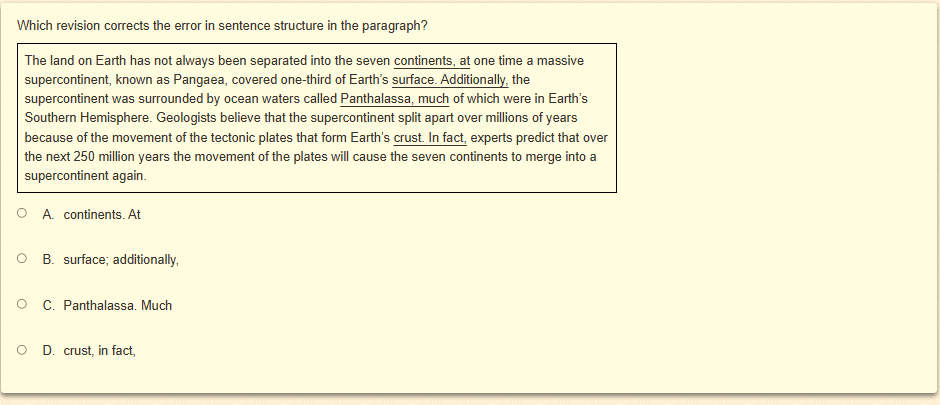
Which revision corrects the error in sentence structure in the paragraph?
The land on Earth has not always been separated into the seven continents, at one time a massive supercontinent, known as Pangaea, covered one-third of Earth’s surface. Additionally, the supercontinent was surrounded by ocean waters called Panthalassa, much of which were in Earth’s Southern Hemisphere. Geologists believe that the supercontinent split apart over millions of years because of the movement of the tectonic plates that form Earth’s crust. In fact, experts predict that over the next 250 million years the movement of the plates will cause the seven continents to merge into a supercontinent again.
- Acontinents. At
- Bsurface; additionally,
- CPanthalassa. Much
- Dcrust, in fact,
Show the answer
Correct answer: A
The question asks for the revision that corrects the error in sentence structure in the paragraph.
A. CORRECT. The first sentence of the paragraph is a run-on because both clauses—“The land on Earth has not always been separated into the seven continents” and “at one time a massive supercontinent, known as Pangaea, covered one-third of Earth’s surface”—are independent clauses. Independent clauses are complete sentences, and two complete sentences should not be combined with just a comma. The revision is correct because it separates the two sentences by placing a period where it is needed after “continents” and by capitalizing the word “At.”
B. Incorrect. While adding a semicolon after “surface” can be considered a correct way to separate the independent clauses “at one time a massive supercontinent, known as Pangaea, covered one-third of Earth’s surface” and “Additionally, the supercontinent was surrounded by ocean waters called Panthalassa, much of which were in Earth’s Southern Hemisphere,” this change does not address the sentence structure error in the paragraph (the run-on sentence). The use of a period separating the independent clauses (complete sentences) is correct as is.
C. Incorrect. Adding a period after “Panthalassa” would separate the dependent clause “much of which were in Earth’s Southern Hemisphere” from its antecedent: “ocean waters called Panthalassa.” The dependent clause cannot stand on its own, because it shares elements with the main clause. A dependent clause is not a complete sentence and must be joined with an independent clause. The clause beginning with “much of which” is an adjective clause that modifies “ocean waters.” Changing the comma to a period creates a new error (a sentence fragment) and does not address the existing sentence structure error at the beginning of the paragraph (the run-on sentence).
D. Incorrect. Removing the period after “crust” would create a run-on sentence because the period is needed to separate two complete sentences—“Geologists believe that the supercontinent split apart over millions of years because of the movement of the tectonic plates that form Earth’s crust” and “In fact, experts predict that over the next 250 million years the movement of the plates will cause the seven continents to merge into a supercontinent again.” A comma after “crust” would combine these sentences into a run-on, creating a new error in the sentence without fixing the existing sentence structure error (the run-on sentence) at the beginning of the paragraph.
Question analysis
This editing question shows a short paragraph about Pangaea, the supercontinent that once covered a third of Earth’s surface, and the ocean around it, with four underlined spots, and asks which revision corrects the error in sentence structure. Each revision changes only punctuation and capitals at one spot, so the decision rests on how the clauses around each spot fit together.
- Grade level
- Grade 6 reading and task
- Compared with grade 7
- Below grade 7 Fixing run-ons and fragments is taught well before grade 7, and this item tests that basic skill in one short paragraph. The sentences are long, with an appositive and a clause beginning “much of which,” but the grammar involved stays simple.
- Estimated difficulty
- Straightforward: two steps or one careful reading.
- Thinking it demands
- Depth of knowledge 2, skills and concepts · mainly apply
- What makes it hard
- A rule that doesn't sound wrong moderate
- Every choice must be checked minor
- Complex sentences minor
- Evidence
- Answered from one paragraph or stanza
- Reading level
- Question and choices: about grade 9, 114 words.
- Corrected from the DOE handbook
- Two grammar terms in the explanation were corrected.
- Students, last 30 days
- Not enough answers yet to show (it takes 10).
Why it is hard, traps and wrong answers (shows the answer)
Why it is hard
The error is in the first sentence, but it hides behind a comma that sounds like an ordinary pause, while the later spots carry features that look riskier: a transition word, a clause beginning “much of which,” the phrase “in fact.” Students who test each spot for a complete sentence on both sides find the splice at once. Those who look for a revision that merely sounds polished are drawn to the semicolon, which is correct but fixes nothing.
A rule that doesn't sound wrong moderate Working it out
The comma after “continents” joins two complete sentences, and because “at one time” sounds like an introductory phrase continuing the thought, the splice reads as a natural pause. (Connors & Lunsford, 1988)
Every choice must be checked minor Choosing the answer
Each revision changes only punctuation at one underlined spot, and the semicolon one is correct English, so students must ask whether each spot was wrong to begin with, not only whether the change looks right. (Embretson & Wetzel, 1987)
Complex sentences minor Understanding the question
The paragraph’s sentences are long, with the appositive “known as Pangaea” and the clause “much of which were,” whose odd-sounding verb draws suspicion to a spot that is correctly punctuated. (Abedi & Lord, 2001; Freedle & Kostin, 1993; Messick, 1989)
Strategy: At each underlined spot, read the words on both sides and ask whether each side could stand as a sentence, then pick the revision that leaves every sentence correctly joined or separated.
Traps
- Fixes what isn't broken: Changes a part of the sentence that was already correct, while the real error stays; or, where the question asks which sentence has an error or should go, picks one that is correct and belongs.
- Fragment or run-on: Creates or keeps a sentence fragment, a run-on sentence or a comma splice.
The wrong answers, classified
B Fixes what isn't broken (Connors & Lunsford, 1988)
Knows a semicolon can join two clauses before “additionally” and picks that tidy-looking change, though the period it replaces was already correct and the comma splice up front remains.
C Fragment or run-on (Connors & Lunsford, 1988)
Treats the long second sentence as a run-on and splits it after “Panthalassa,” leaving “Much of which were in Earth’s Southern Hemisphere” as a fragment with no main clause.
D Fragment or run-on (Connors & Lunsford, 1988)
Thinks “in fact” belongs inside the sentence before it, set off by commas, which joins two complete sentences with only a comma and creates the error the paragraph already has.
What was corrected from the DOE handbook, and why
- Explanation: The DOE’s explanation of Option C says a period after “Panthalassa” would separate the dependent clause “much of which were in Earth’s Southern Hemisphere” “from its subject: ‘ocean waters called Panthalassa.’” The clause has a subject of its own, “much”; “ocean waters called Panthalassa” is its antecedent, the noun phrase that “which” refers to. The explanation also calls the clause “an adjective for ‘ocean waters’”; a clause is not an adjective but an adjective (relative) clause, which modifies the noun. The site now says “from its antecedent” and “an adjective clause that modifies ‘ocean waters.’” The reasoning and the answer, A, are unchanged.
Working it out, step by step
Learn the rule for joining sentences
An independent clause is a group of words with a subject and a verb that can stand alone as a sentence. Two of them can’t be joined with only a comma. That mistake is a run-on sentence, also called a comma splice. For example: I love soccer, my brother loves chess. Fix it with a period: I love soccer. My brother loves chess.
Test each underlined spot
At each spot, read the words on both sides. Ask: could each side stand alone as a sentence?
- After “continents”: both sides are complete. A comma joins them, so this is an error.
- After “surface”: a period already separates two sentences. That is correct.
- After “Panthalassa”: the words after the comma can’t stand alone. The comma is correct.
- After “crust”: a period already separates two sentences. That is correct.
Look closely at the first sentence
The first part says “The land on Earth has not always been separated into the seven continents.” That is a full sentence. The second part says “at one time a massive supercontinent, known as Pangaea, covered one-third of Earth’s surface.” Its subject is “supercontinent,” and its verb is “covered.” So it is a full sentence too. The words “At one time” start a new sentence.
Show the fix
Change the comma to a period, and capitalize the next word: The land on Earth has not always been separated into the seven continents. At one time a massive supercontinent, known as Pangaea, covered one-third of Earth’s surface. Now each sentence stands on its own. That is the revision continents. At.
Check each choice
- A is right. It splits the run-on into two sentences.
- B is wrong. A semicolon could join those two sentences, but the period there was already correct. It fixes nothing.
- C is wrong. “Much of which were in Earth’s Southern Hemisphere” is a dependent clause, a group of words with a verb that can’t be a sentence by itself. “Which” points back to “ocean waters called Panthalassa,” its antecedent. So the clause must stay attached.
- D is wrong. A comma after “crust” would join two full sentences. That makes a new run-on.
Choose the answer
Only the comma after “continents” joins two complete sentences. So the answer is A, continents. At.
Why this answer and not the closest wrong one
B is the closest wrong choice, because a semicolon can correctly join two sentences. But the spot after “surface” already had a period, which was correct. Changing it does not fix the real error. The comma splice after “continents” would still be there. Only A fixes it.
More questions like this
The original DOE question
Question 2 of 57
2022 Test A English, question 2Question
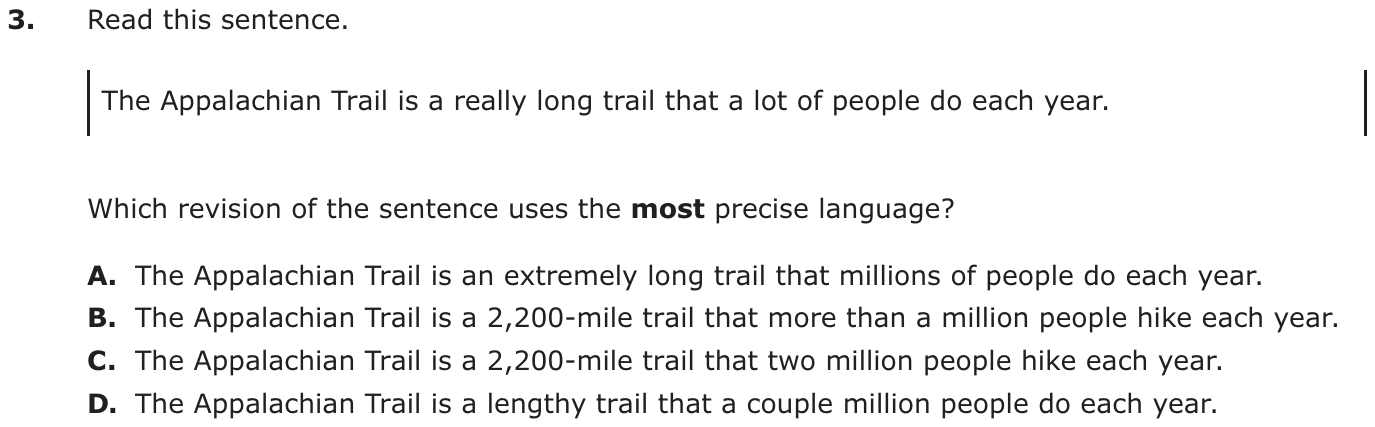
Read this sentence.
The Appalachian Trail is a really long trail that a lot of people do each year.
Which revision of the sentence uses the most precise language?
- AThe Appalachian Trail is an extremely long trail that millions of people do each year.
- BThe Appalachian Trail is a 2,200-mile trail that more than a million people hike each year.
- CThe Appalachian Trail is a 2,200-mile trail that two million people hike each year.
- DThe Appalachian Trail is a lengthy trail that a couple million people do each year.
Show the answer
Correct answer: C
The question asks for the revision of the sentence that uses the most precise language.
A. Incorrect. The word “extremely” does not specify the precise length of the trail (2,200 miles); “millions” is less precise than the specific number of people who hike the trail each year (two million); and the verb “do” imprecisely describes the purpose of visiting the trail (hiking).
B. Incorrect. While the revision specifies the precise length of the trail and the verb “hike” precisely describes the purpose of visiting the trail, “more than a million” is less precise than the specific number of people who hike the trail each year (two million).
C. CORRECT. The length of the trail (2,200 miles), the specific number of people who hike the trail each year (two million), and the action of the visitors (hiking) are clear and precise in this revision of the sentence.
D. Incorrect. The word “lengthy” is less precise than specifying the actual length of the trail (2,200 miles); “a couple million” is less precise than the specific number of people who hike the trail each year (two million); and the verb “do” imprecisely describes the purpose of visiting the trail (hiking).
Question analysis
This precise-language question gives a casual sentence saying the Appalachian Trail is “a really long trail that a lot of people do each year” and asks which revision is most precise. Several revisions swap in more specific words or numbers, so students must check every part of each sentence, not just the first improvement they notice.
- NYS standards
- 7L3a precise and concise language
- Grade level
- Grade 6 reading and task
- Compared with grade 7
- Below grade 7 Choosing precise wording is grade 7 language work, but this item is one short sentence in everyday words. Typical grade 7 revision sets the same choice inside a paragraph, with more wording to weigh.
- Estimated difficulty
- Straightforward: two steps or one careful reading.
- Thinking it demands
- Depth of knowledge 1, recall and reproduction · mainly evaluate
- What makes it hard
- A very close wrong answer moderate
- Every choice must be checked minor
- Evidence
- Answered from one sentence or line
- Reading level
- Question and choices: about grade 6, 89 words.
- Students, last 30 days
- Not enough answers yet to show (it takes 10).
Why it is hard, traps and wrong answers (shows the answer)
Why it is hard
The question is quick once each revision is tested on three points: how long the trail is, how many people hike it, and what they do there. The near miss catches students who stop checking once they see the mileage and the verb “hike,” though its count of hikers is still a range. Words such as “extremely” and “lengthy” are the other snare, since they sound sharper without saying any more.
A very close wrong answer moderate Choosing the answer
The right revision and the one with “more than a million” share the 2,200-mile length and the verb “hike,” and differ only in the hiker count: an exact two million or an open-ended floor. (Embretson & Wetzel, 1987; Gorin & Embretson, 2006; Ascalon et al., 2007)
Every choice must be checked minor Choosing the answer
Each revision repairs a different part of “a really long trail that a lot of people do,” so all four have to be checked for the length, the count and the verb. (Embretson & Wetzel, 1987)
Strategy: Check each revision on three points: how long the trail is, how many people visit, and what they do there. Keep only a version that is exact on all three.
Traps
- Wordy, vague or informal: A revision is grammatical but wordy, imprecise or too casual for the passage.
The wrong answers, classified
A Wordy, vague or informal (Connors & Lunsford, 1988)
Treats “extremely long” and “millions” as upgrades, though neither gives a length or a count, and the vague verb “do” is still there.
B Wordy, vague or informal (Connors & Lunsford, 1988)
Sees the exact length and the verb “hike” and stops checking, missing that “more than a million” is looser than a specific number of hikers.
D Wordy, vague or informal (Connors & Lunsford, 1988)
Takes the fancier “lengthy” and the casual “a couple million” for sharper wording, though neither is exact and “do” still does not say what visitors do.
Working it out, step by step
Figure out what the question asks
You need the revision with the most precise language. Precise means exact. A precise word tells the reader exactly what or how much. For example, a lot of homework is vague, but three pages of math homework is precise. The sentence has three vague parts: “a really long trail,” “a lot of people,” and the verb “do.”
Make a three-part test
The most precise revision must fix all three parts.
- How long is the trail? Look for an exact length.
- How many people go? Look for an exact number.
- What do they do there? Do is vague. People hike a trail.
A choice that fixes only one or two parts is not the most precise.
Check each choice
- C gives “a 2,200-mile trail,” “two million people,” and “hike.” It passes all three tests.
- B gives the length and “hike.” But “more than a million” is not exact. It could mean 1.1 million or 5 million.
- A says “extremely long” and “millions.” Neither is exact, and it keeps “do.”
- D says “lengthy” and “a couple million.” These sound fancier but say no more. It also keeps “do.”
Pick the answer
Watch out: B is very close. It has the length and the right verb, so many students stop there. But its count of people is still loose. Only C is exact on all three parts. So the answer is C.
Why this answer and not the closest wrong one
B is the closest wrong answer. It matches C on the length, 2,200 miles, and on the verb “hike.” The only difference is the number of hikers. “More than a million” sets a low limit but gives no exact count. “Two million” tells the reader exactly how many, so C is more precise.
More questions like this
The original DOE question
Question 3 of 57
2022 Test A English, question 3Question
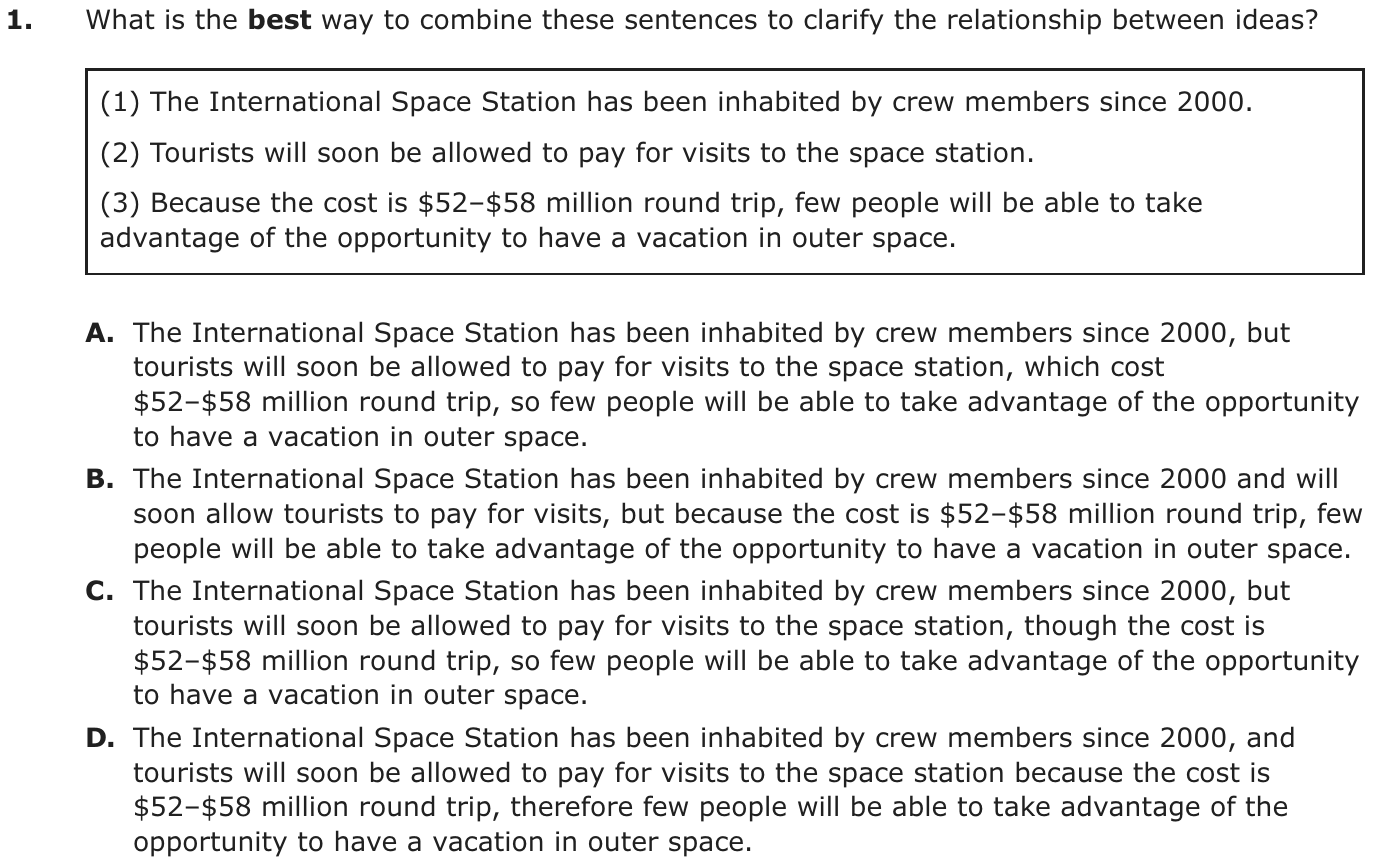
What is the best way to combine these sentences to clarify the relationship between ideas?
(1) The International Space Station has been inhabited by crew members since 2000.
(2) Tourists will soon be allowed to pay for visits to the space station.
(3) Because the cost is $52–$58 million round trip, few people will be able to take advantage of the opportunity to have a vacation in outer space.
- AThe International Space Station has been inhabited by crew members since 2000, but tourists will soon be allowed to pay for visits to the space station, which cost $52–$58 million round trip, so few people will be able to take advantage of the opportunity to have a vacation in outer space.
- BThe International Space Station has been inhabited by crew members since 2000 and will soon allow tourists to pay for visits, but because the cost is $52–$58 million round trip, few people will be able to take advantage of the opportunity to have a vacation in outer space.
- CThe International Space Station has been inhabited by crew members since 2000, but tourists will soon be allowed to pay for visits to the space station, though the cost is $52–$58 million round trip, so few people will be able to take advantage of the opportunity to have a vacation in outer space.
- DThe International Space Station has been inhabited by crew members since 2000, and tourists will soon be allowed to pay for visits to the space station because the cost is $52–$58 million round trip, therefore few people will be able to take advantage of the opportunity to have a vacation in outer space.
Show the answer
Correct answer: B
The question asks for the best way to combine the sentences.
A. Incorrect. Although the option combines the sentences in a way that accurately reflects the meaning of each individual sentence, the combined sentence is a string of clauses that do not effectively cohere. Because it is poorly structured, the combined sentence does not clarify the relationship of ideas as effectively as the correct response does. The sentence incorrectly uses “but tourists,” and “which cost” modifies “the space station” but does not modify the trip. Compared with the correct response, the combined sentence in this option is also imprecise and unnecessarily wordy.
B. CORRECT. The option uses a complex sentence to present ideas clearly and precisely, and it shows the relationship between the ideas in the original sentences. In the first part of the sentence, the conjunction “and” correctly joins the first and second sentences by indicating a relationship, rather than a contrast, between the two. In the second part of the sentence, the conjunction “but” adds additional emphasis to the fact that while tourists will be allowed to visit the space station, the cost of the trip will likely prohibit most people from visiting.
C. Incorrect. Although the option combines the sentences in a way that accurately reflects the meaning of each individual sentence, the combined sentence is a string of clauses that do not effectively cohere. Because it is so poorly structured, the combined sentence does not clarify the relationship of ideas as effectively as the correct response does. Compared with the correct response, the combined sentence in this option is also imprecise and unnecessarily wordy.
D. Incorrect. The combination of the sentences contains an illogical relationship between ideas with the statement that tourists will be allowed to pay for visits to the space station because the cost is $52–$58 million round trip. The connection between the idea that “tourists will soon be allowed to pay for visits” and the subsequent “therefore few people will be able to take advantage of the opportunity” is also illogical.
Question analysis
This sentence-combining question gives three sentences about the International Space Station, its crew and the high price of a tourist trip, and asks for the best way to join them into one. Every version keeps the same facts, so students must judge which connecting words show how the ideas relate while the sentences stay long and nearly identical.
- Grade level
- Grade 8 reading and task
- Compared with grade 7
- Above grade 7 Grade 7 students practice joining two short sentences with a fitting conjunction. Here three sentences become one long sentence in four nearly identical versions, so students must weigh every connecting word and clause rather than spot one error.
- Estimated difficulty
- Hard: combines ideas, needs a plan, and has more than one tempting wrong answer.
- Thinking it demands
- Depth of knowledge 2, skills and concepts · mainly evaluate
- What makes it hard
- How sentences fit together major
- Complex sentences moderate
- Every choice must be checked moderate
- Evidence
- Answered from one sentence or line
- Reading level
- Question and choices: about grade 15, 261 words.
- Students, last 30 days
- Not enough answers yet to show (it takes 10).
Why it is hard, traps and wrong answers (shows the answer)
Why it is hard
None of the wrong versions drops a fact, and two of them are loose rather than plainly ungrammatical, so the ear is little help. Students lose the point by accepting the smoothest chain of clauses without asking what each connector claims: whether the crew and the tourists really contrast, what the price belongs to, and what the price explains. The question rewards deciding the three links before reading the versions, then checking them one connector at a time.
How sentences fit together major Working it out
Sentence 2 simply adds to sentence 1, while sentence 3’s price works against the tourist plan and explains why few will go, so every “but,” “though,” “because” or “so” in a version must fit one of those links. (Halliday & Hasan, 1976)
Complex sentences moderate Understanding the question
Each version is one sentence of 48 to 53 words with four clauses, and at that length a “which cost” hanging on the wrong noun or a comma before “therefore” is easy to read past. (Abedi & Lord, 2001; Freedle & Kostin, 1993; Messick, 1989)
Every choice must be checked moderate Choosing the answer
All four versions keep the same facts in the same order and share most of their words, so none can be ruled out by content; each connecting word has to be tested in turn. (Embretson & Wetzel, 1987)
Strategy: Before reading the choices, decide how each sentence relates to the next: added fact, contrast, or cause and result. Then check every connecting word in each version against those links.
Traps
- Misplaced modifier: A describing word or phrase that attaches to the wrong word, or to nothing in the sentence.
- Wordy, vague or informal: A revision is grammatical but wordy, imprecise or too casual for the passage.
- Wrong transition: A connecting word or phrase that signals the wrong relationship, such as contrast where the idea continues.
The wrong answers, classified
A Misplaced modifier (Connors & Lunsford, 1988)
Keeps the price as the reason few can go, marked by “so,” but misses that “which cost” hangs on “the space station” and that “but” sets crew against tourists.
C Wordy, vague or informal (Connors & Lunsford, 1988)
Keeps every fact in order, but stacking “but,” “though” and “so” in one sentence turns the price into an aside instead of plainly the reason few people will go.
D Wrong transition (Halliday & Hasan, 1976)
Keeps sentence 3’s “because the cost is” word for word, but here it explains why tourists are allowed, and “therefore” after a comma splices on the result.
Working it out, step by step
Figure out what the question asks
You need to join three sentences into one. The best version shows clearly how the ideas connect. Joining words do that job. A conjunction is a joining word, like and, but, so or because. Each one tells the reader something. And adds a fact. But shows a contrast (two ideas that pull against each other). Because and so show a cause and its result.
Decide how the three sentences connect
Sentence 1 says crews have lived on the station since 2000. Sentence 2 adds a new fact: tourists will soon be able to visit. That is not a contrast, so it needs and. Sentence 3 works against sentence 2. The trip costs “$52–$58 million round trip.” That price is also the reason few people will go. So you need a contrast and a reason. Example: The pool is open to all, but because it costs $90, few kids swim there.
Test each choice
- B uses “and will soon allow tourists” to add the new fact. Then “but because the cost is” shows the contrast and the reason. Every link is right.
- A joins sentence 2 with “but tourists,” as if crews and tourists were opposites. Also, “which cost” comes right after “the space station.” So it sounds like the station costs that much, not the trip.
- C stacks “but,” “though” and “so” in one long chain. The price turns into a side note instead of the clear reason.
- D says tourists may visit “because the cost is” so high. That makes no sense. And “therefore” after a comma joins two sentences the wrong way.
Pick the answer
Watch out: A is the most tempting. It keeps the price as the reason, with “so.” But its “but” and its “which” send the reader the wrong way. Only one choice links every idea correctly. So the answer is B.
Why this answer and not the closest wrong one
A is the closest wrong answer. Like B, it says the price keeps most people away. But A sets crews against tourists with “but tourists.” Its “which cost” also seems to give the price of the station. B uses and for the added fact and but because for the price, so each link is clear.
More questions like this
The original DOE question
Question 4 of 57
2022 Test A English, question 4Question
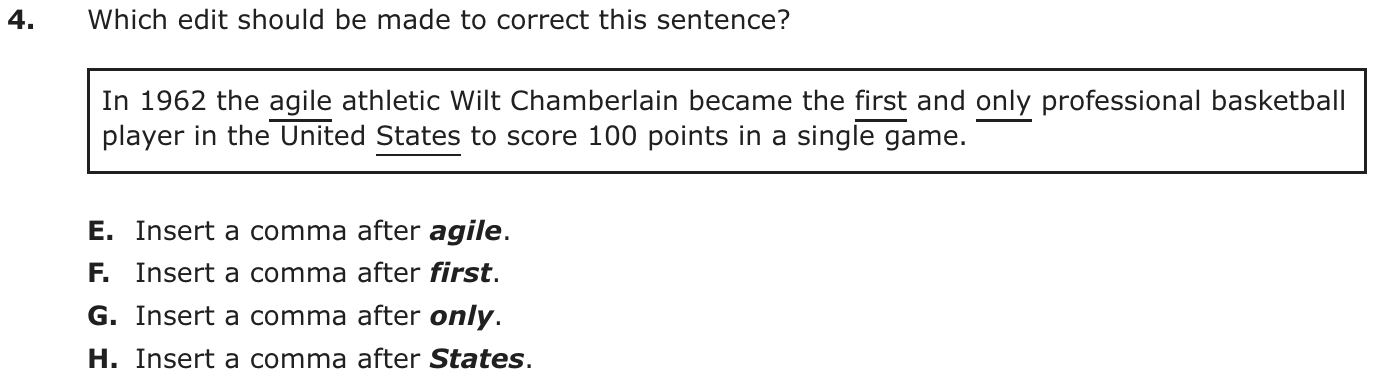
Which edit should be made to correct this sentence?
In 1962 the agile athletic Wilt Chamberlain became the first and only professional basketball player in the United States to score 100 points in a single game.
- AInsert a comma after agile.
- BInsert a comma after first.
- CInsert a comma after only.
- DInsert a comma after States.
Show the answer
Correct answer: A
The question asks which edit should be made to correct the sentence.
A. CORRECT. The sentence in the box needs a comma to separate the coordinate adjectives. Coordinate adjectives describe characteristics of the same noun or subject and are connected with a comma or “and.” This option is the only one that places a comma where it is needed, between the coordinate adjectives “agile” and “athletic.”
B. Incorrect. The option incorrectly adds a comma in the middle of the phrase “first and only,” which modifies, or gives additional information about, “professional basketball player.”
C. Incorrect. The option incorrectly adds a comma between two adjectives that are not coordinate adjectives. “Only” is part of the phrase “first and only” and is modifying “professional basketball player.”
D. Incorrect. The option is incorrect because a comma is not needed to set off the phrase “to score 100 points in a single game.”
Question analysis
This punctuation question gives one sentence about Wilt Chamberlain, the basketball player who scored 100 points in a single professional game in 1962, and asks which comma edit corrects it. All four choices add a comma, three after describing words and one after the country’s name, so students must decide which spot a comma rule truly requires.
- NYS standards
- 7L2 capitalization, punctuation, and spelling
- Grade level
- Grade 7 reading and task
- Compared with grade 7
- At grade 7 Deciding where a comma belongs in one sentence is typical grade 7 editing, and the rule tested here is part of the grade 7 language standards. The sentence sounds natural as printed, so the needed comma must be found by rule, not by ear.
- Estimated difficulty
- Straightforward: two steps or one careful reading.
- Thinking it demands
- Depth of knowledge 1, recall and reproduction · mainly apply
- What makes it hard
- A rule that doesn't sound wrong moderate
- Every choice must be checked minor
- Evidence
- Answered from one sentence or line
- Reading level
- Question and choices: about grade 7, 54 words.
- Students, last 30 days
- Not enough answers yet to show (it takes 10).
Why it is hard, traps and wrong answers (shows the answer)
Why it is hard
The sentence sounds natural as printed, so a student listening for pauses could put a comma in almost any of the four places. The question rewards knowing the test for coordinate adjectives: when “and” fits between two describing words and their order can be swapped, a comma belongs there. “Agile and athletic” passes that test, while “only and professional” fails, because “first and only” works as one unit that limits the whole phrase “professional basketball player.”
A rule that doesn't sound wrong moderate Working it out
The missing comma falls between “agile” and “athletic,” two adjectives that each describe Chamberlain, and the phrase reads smoothly without it, so the error has to be found by rule rather than by ear. (Connors & Lunsford, 1988)
Every choice must be checked minor Choosing the answer
All four edits add a comma, and two of the spots come between describing words, after “agile” and after “only,” so each pair must be tested with “and” before one is chosen. (Embretson & Wetzel, 1987)
Strategy: Take the four marked words one at a time, say what the words on either side of each are doing, and add a comma only where a rule calls for one, not wherever you would pause.
Traps
- Punctuation: A comma, semicolon, colon, dash or apostrophe used where it does not belong, or missing where it does.
The wrong answers, classified
B Punctuation (Connors & Lunsford, 1988)
Hears an emphatic pause in “the first and only,” as if writing “the first, and only,” though a single comma there splits a pair that works as one unit.
C Punctuation (Connors & Lunsford, 1988)
Believes any two describing words in a row need a comma and spots “only professional,” though “only” cannot be swapped with “professional” or joined to it by “and.”
D Punctuation (Connors & Lunsford, 1988)
Puts a comma before “to score 100 points in a single game” because the sentence is long, though that phrase tells what made him the first player and takes no comma.
Working it out, step by step
Figure out what the question asks
This is a punctuation question. Punctuation means marks like commas and periods. Each choice adds one comma to the sentence about Wilt Chamberlain. Only one of those commas is needed. Find the spot where a comma rule calls for one. Don’t just go by where you would pause when you read it aloud.
Learn the rule for describing words
An adjective is a describing word. Sometimes two adjectives in a row each describe the same noun (a naming word). They are equal partners, so a comma goes between them.
Two quick tests tell you. Can you put “and” between them? Can you swap their order? If both work, use a comma. Example: a long, boring movie. You could also say a long and boring movie or a boring, long movie.
Test agile and athletic
The sentence begins “In 1962 the agile athletic Wilt Chamberlain.” Agile means quick and light on your feet. Athletic means strong and good at sports. Both words describe Chamberlain. Now try the tests. The agile and athletic Wilt Chamberlain makes sense. So does the athletic, agile Wilt Chamberlain. Both tests pass, so a comma belongs after “agile.”
Check each choice
- A fits. “Agile” and “athletic” are equal describing words, so they need a comma.
- B does not fit. “First and only” is a pair already joined by “and.” One comma does not go inside a pair like that. You write salt and pepper, not salt, and pepper.
- C does not fit. Try the “and” test: only and professional makes no sense. “Only” goes with “first,” not with “professional.”
- D does not fit. The words after “States” tell what he was the first to do. They finish the idea, so no comma goes before them.
Choose the answer
Watch out: C is tempting because “only professional” is also two describing words in a row. But that pair fails the “and” test. The fixed sentence begins In 1962 the agile, athletic Wilt Chamberlain. So the answer is A: insert a comma after agile.
Why this answer and not the closest wrong one
C is the closest wrong answer. Like A, it puts a comma between two describing words. But only A’s pair passes the tests. You can say agile and athletic, but you can’t say only and professional. “Only” belongs with “first.” Together, “first and only” describe the whole phrase “professional basketball player.”
More questions like this
The original DOE question
Question 5 of 57
2022 Test A English, question 5Question
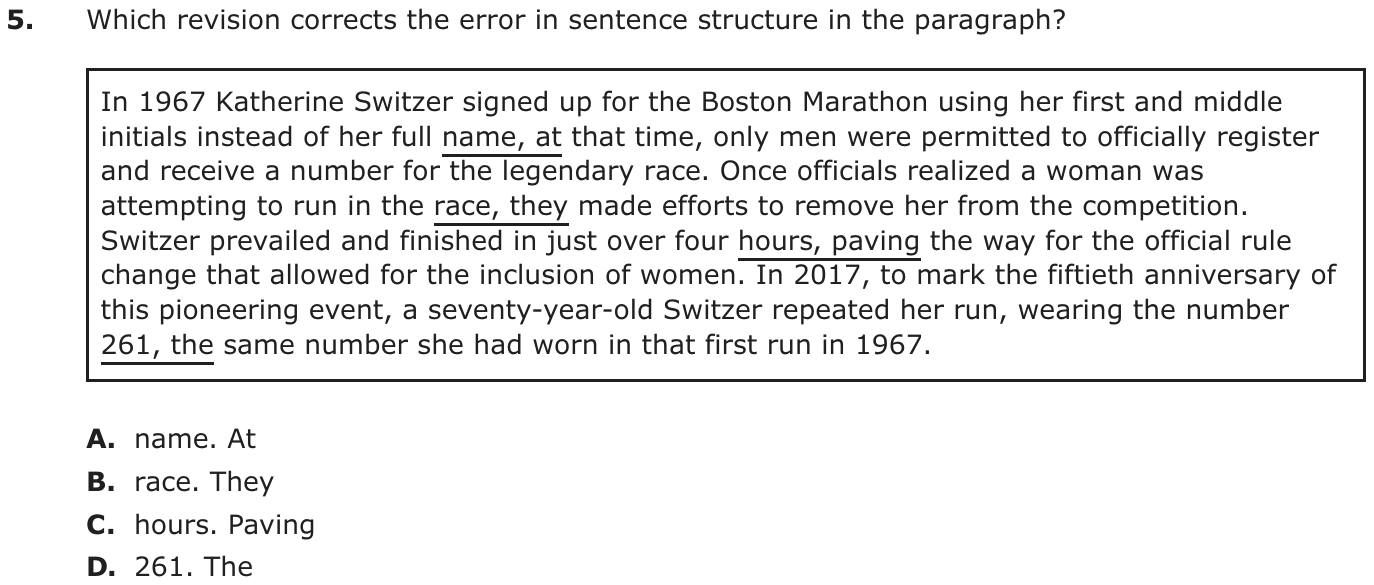
Which revision corrects the error in sentence structure in the paragraph?
In 1967 Kathrine Switzer signed up for the Boston Marathon using her first and middle initials instead of her full name, at that time, only men were permitted to officially register and receive a number for the legendary race. Once officials realized a woman was attempting to run in the race, they made efforts to remove her from the competition. Switzer prevailed and finished in just over four hours, paving the way for the official rule change that allowed for the inclusion of women. In 2017, to mark the fiftieth anniversary of this pioneering event, a seventy-year-old Switzer repeated her run, wearing the number 261, the same number she had worn in that first run in 1967.
- Aname. At
- Brace. They
- Chours. Paving
- D261. The
Show the answer
Correct answer: A
The question asks for the revision that corrects the error in sentence structure in the paragraph.
A. CORRECT. As written, the first sentence (“In 1967 Kathrine Switzer . . . legendary race.”) is a run-on sentence because a comma is used to combine two independent clauses. Independent clauses are complete sentences with a subject and a verb. The clauses—“In 1967 Kathrine Switzer signed up for the Boston Marathon using her first and middle initials instead of her full name” and “at that time, only men were permitted to officially register and receive a number for the legendary race”—should be separated with a period instead. This revision correctly places a period after the word “name” and capitalizes the word “At” to separate the two independent clauses into two sentences.
B. Incorrect. The revision introduces an error into the paragraph and does not revise the run-on in the first sentence. The clause “Once officials realized a woman was attempting to run in the race” is a dependent clause functioning as an adverb of the independent clause that follows it. Changing the comma after the word “race” to a period would incorrectly separate the adverbial dependent clause from the independent clause.
C. Incorrect. The revision introduces an error into the paragraph and does not revise the run-on in the first sentence. The sentence “Switzer prevailed and finished in just over four hours, paving the way for the official rule change that allowed for the inclusion of women” combines an independent clause (“Switzer prevailed and finished in just over four hours”) and a participial phrase (“paving the way for the official rule change that allowed for the inclusion of women”). The phrase “paving the way for the official rule change that allowed for the inclusion of women” is not a complete sentence and must stay connected to the first part of the sentence. Changing the comma after “hours” to a period would incorrectly separate the participial phrase from the independent clause.
D. Incorrect. The revision introduces an error into the paragraph and does not revise the run-on in the first sentence. Changing the comma after “261” to a period would incorrectly separate the appositive phrase “the same number she had worn in that first run in 1967” from the words it describes (“number 261”). Additionally, the phrase “the same number she had worn in that first run in 1967” is not a complete sentence.
Question analysis
This sentence-structure question gives a four-sentence paragraph about Kathrine Switzer, who entered the 1967 Boston Marathon under her initials when only men could register and ran it again at seventy. Students pick the revision that corrects its error in sentence structure, and because every choice turns an underlined comma into a period, each spot needs its own check.
- Grade level
- Grade 6 reading and task
- Compared with grade 7
- Below grade 7 Run-ons and fragments are taught before grade 7, and this item checks that skill at four underlined spots in one short paragraph. The clauses and phrases around the correct commas take some grammar sense, but the core skill is basic.
- Estimated difficulty
- Straightforward: two steps or one careful reading.
- Thinking it demands
- Depth of knowledge 2, skills and concepts · mainly apply
- What makes it hard
- A rule that doesn't sound wrong moderate
- Every choice must be checked minor
- Complex sentences minor
- Evidence
- Answered from one paragraph or stanza
- Reading level
- Question and choices: about grade 7, 131 words.
- Corrected from the DOE handbook
- A misspelled name in the paragraph and its explanation was corrected.
- Grammar terms in the explanations of two wrong options were corrected.
- Students, last 30 days
- Not enough answers yet to show (it takes 10).
Why it is hard, traps and wrong answers (shows the answer)
Why it is hard
Every choice makes the same kind of change, so the question comes down to telling one real comma splice from three commas doing legitimate work. The most dangerous spot is after “race,” where a subject and verb sit on both sides of the comma, just as at the real error, and only the word “Once” marks the first part as dependent. Students who test each side for a complete thought, not just for a subject and a verb, find the splice in the opening sentence quickly.
A rule that doesn't sound wrong moderate Working it out
The run-on hides behind the short phrase “at that time,” which makes the comma after “name” sound like an ordinary pause; only checking that each side can stand alone exposes the comma splice. (Connors & Lunsford, 1988)
Every choice must be checked minor Choosing the answer
All four revisions swap a comma for a period, so every underlined spot needs the same test: could the words before it and the words after it each stand as a sentence? (Embretson & Wetzel, 1987)
Complex sentences minor Understanding the question
The three correct commas guard three different structures, an opening “Once” clause, a participial phrase beginning with “paving” and an appositive after “261,” and each has to be recognized as unable to stand alone. (Abedi & Lord, 2001; Freedle & Kostin, 1993; Messick, 1989)
Strategy: At each underlined comma, read the words before it and the words after it as separate pieces and ask whether each could stand alone as a sentence; that shows where a period belongs.
Traps
- Fragment or run-on: Creates or keeps a sentence fragment, a run-on sentence or a comma splice.
The wrong answers, classified
B Fragment or run-on (Connors & Lunsford, 1988)
Finds a subject and verb on both sides of the comma after “race” and calls it a splice, missing that “Once” makes the first part a dependent clause that cannot stand alone.
C Fragment or run-on (Connors & Lunsford, 1988)
Treats the long third sentence as a run-on and ends it after “hours,” leaving “Paving the way for the official rule change” as a fragment with no subject or main verb.
D Fragment or run-on (Connors & Lunsford, 1988)
Spots the subject and verb “she had worn” after the comma following “261,” but they sit inside a phrase that renames the number, so the new sentence would be a fragment.
What was corrected from the DOE handbook, and why
- Stem and explanation: The handbook spells the runner’s name “Katherine Switzer” in the paragraph and twice in the explanation. She is Kathrine Switzer, who entered the 1967 Boston Marathon as “K. V. Switzer,” so the site now spells her name that way, in the question’s title too. No answer depends on the spelling.
- Explanation: The DOE’s explanation of Option C calls “paving the way for the official rule change that allowed for the inclusion of women” a dependent clause, and on that basis calls the sentence a complex sentence. The words have no subject or finite verb of their own: they are a participial phrase, which the site now calls them, and the site no longer calls the sentence complex for that reason. Its explanation of Option D calls “the same number she had worn in that first run in 1967” a modifying clause; it is an appositive phrase, a noun phrase that renames “number 261,” and the site now says so. Neither phrase can stand alone as a sentence, so Options C and D are still wrong, and the answer, Option A, is unchanged.
Working it out, step by step
Figure out what the question asks
This is a sentence structure question. In one spot, two full sentences are joined by only a comma. That mistake is called a run-on. Every choice turns one underlined comma into a period. Only one of those changes fixes a run-on. The other three would break off a piece that can’t stand alone.
Learn the rule for run-ons
An independent clause is a group of words that makes sense alone. It has a subject and a verb. The subject is who or what the sentence is about. The verb tells what the subject does or is. A comma alone can’t join two independent clauses. Use a period instead.
Example: It rained, we stayed inside. Fix: It rained. We stayed inside.
Test the comma after name
Read the words before that comma: “In 1967 Kathrine Switzer signed up for the Boston Marathon using her first and middle initials instead of her full name.” That makes sense alone. Now read the words after it: “at that time, only men were permitted to officially register.” That makes sense alone too. Its subject is “only men,” and its verb is “were permitted.” So two full sentences are joined by a comma. That is the run-on.
Test the other three commas
- B (after “race”): The first part is “Once officials realized a woman was attempting to run in the race.” The word “Once” makes it a dependent clause. That is a group of words with a subject and verb that can’t stand alone.
- C (after “hours”): The words starting “paving the way for the official rule change” are a participial phrase. The phrase starts with an -ing verb form and adds information. It has no subject of its own.
- D (after “261”): “the same number she had worn in that first run in 1967” is an appositive phrase. It renames the noun right before it, the number 261. It can’t stand alone either.
Choose the answer
Watch out: B is the trickiest. It has a subject and a verb on each side of its comma, “officials realized” and “they made.” But “Once” keeps the first part from standing alone. Only the comma after “name” joins two full sentences. A period goes there, and “At” gets a capital letter. So the answer is A: name. At.
Why this answer and not the closest wrong one
B is the closest wrong answer. Like the comma after “name,” its comma has a subject and a verb on each side. But “Once” means the first part needs the words after the comma to finish its thought. At the comma after “name,” both sides already stand alone. So that comma is the real run-on.
More questions like this
The original DOE question
Question 6 of 57
2022 Test A English, question 6Passage Cracking the Code
Cracking the Code
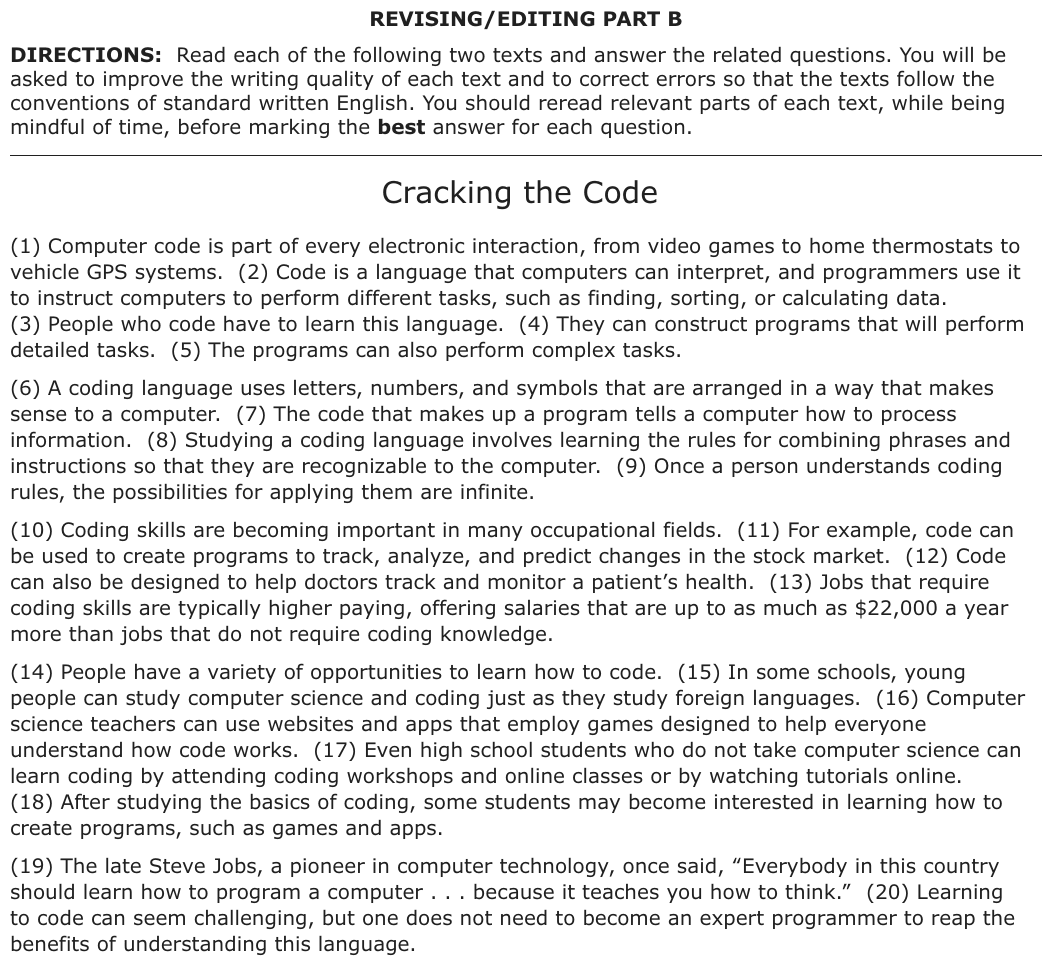
(1) Computer code is part of every electronic interaction, from video games to home thermostats to vehicle GPS systems. (2) Code is a language that computers can interpret, and programmers use it to instruct computers to perform different tasks, such as finding, sorting, or calculating data. (3) People who code have to learn this language. (4) They can construct programs that will perform detailed tasks. (5) The programs can also perform complex tasks.
(6) A coding language uses letters, numbers, and symbols that are arranged in a way that makes sense to a computer. (7) The code that makes up a program tells a computer how to process information. (8) Studying a coding language involves learning the rules for combining phrases and instructions so that they are recognizable to the computer. (9) Once a person understands coding rules, the possibilities for applying them are infinite.
(10) Coding skills are becoming important in many occupational fields. (11) For example, code can be used to create programs to track, analyze, and predict changes in the stock market. (12) Code can also be designed to help doctors track and monitor a patient’s health. (13) Jobs that require coding skills are typically higher paying, offering salaries that are up to as much as $22,000 a year more than jobs that do not require coding knowledge.
(14) People have a variety of opportunities to learn how to code. (15) In some schools, young people can study computer science and coding just as they study foreign languages. (16) Computer science teachers can use websites and apps that employ games designed to help everyone understand how code works. (17) Even high school students who do not take computer science can learn coding by attending coding workshops and online classes or by watching tutorials online. (18) After studying the basics of coding, some students may become interested in learning how to create programs, such as games and apps.
(19) The late Steve Jobs, a pioneer in computer technology, once said, “Everybody in this country should learn how to program a computer . . . because it teaches you how to think.” (20) Learning to code can seem challenging, but one does not need to become an expert programmer to reap the benefits of understanding this language.
Question
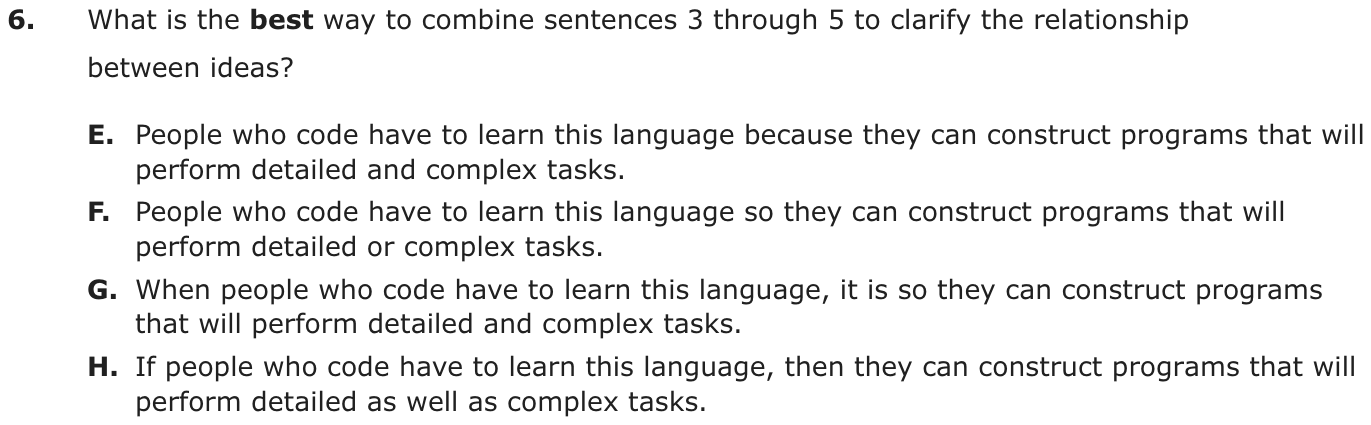
What is the best way to combine sentences 3 through 5 to clarify the relationship between ideas?
- APeople who code have to learn this language because they can construct programs that will perform detailed and complex tasks.
- BPeople who code have to learn this language so they can construct programs that will perform detailed or complex tasks.
- CWhen people who code have to learn this language, it is so they can construct programs that will perform detailed and complex tasks.
- DIf people who code have to learn this language, then they can construct programs that will perform detailed as well as complex tasks.
Show the answer
Correct answer: B
The question asks for the best way to combine sentences 3 through 5 to clarify the relationship between ideas.
A. Incorrect. While this sentence shows a relationship between the ideas, it does not clarify the relationship accurately. Learning the language of code does not depend on people’s previous ability to construct programs that will perform detailed and complex tasks. The word “because” incorrectly indicates that people can already construct complex programs prior to learning the coding language that would allow them to do so.
B. CORRECT. This sentence accurately shows the relationship between the ideas of the sentences. Before people can construct programs that will perform detailed and complex tasks, they have to learn a coding language. Knowing that language will, in turn, allow them to build programs that can perform detailed and complex tasks.
C. Incorrect. This sentence does not accurately express the relationship between ideas because the sentence implies that some people who code do not have to learn the language to perform their job functions. The passage clearly states that “computer code is part of every electronic interaction” (sentence 1) and that “programmers use it to instruct computers to perform different tasks” (sentence 2).
D. Incorrect. The conditional (If . . . then) construction of the sentence in Option D does not convey the intended relationship of the ideas in the sentences. The “then” statement (“they can construct programs that will perform detailed as well as complex tasks”) does not follow the condition of the “if” statement (“people who code have to learn this language”).
Question analysis
This sentence-combining question uses the first paragraph of “Cracking the Code,” a passage about computer coding, and asks for the best way to join sentences 3 through 5: coders must learn the language, they can build programs for detailed tasks, and those programs can also handle complex ones. Each version links the ideas with a different word, so students must judge which states the relationship accurately.
- Grade level
- Grade 7 reading and task
- Compared with grade 7
- At grade 7 Joining short sentences with a word that shows how their ideas relate is typical grade 7 work. Here three sentences become one and every version is grammatical, so the choice rests on whether the joining words state the logic accurately.
- Estimated difficulty
- Moderate: several steps, or a close reading with one strong distractor.
- Thinking it demands
- Depth of knowledge 2, skills and concepts · mainly evaluate
- What makes it hard
- A very close wrong answer moderate
- How sentences fit together moderate
- Every choice must be checked minor
- Evidence
- Answered from one paragraph or stanza
- Reading level
- Passage: about grade 10, 357 words; question and choices: about grade 9, 101 words.
- Students, last 30 days
- Not enough answers yet to show (it takes 10).
Why it is hard, traps and wrong answers (shows the answer)
Why it is hard
Every version is a correct sentence carrying the same facts, so the question tests logic rather than grammar: what does learning the language make possible? The look-alike joined by “because” is the main danger, since it seems to give a reason for learning. Careful readers may also pause over the key’s “detailed or complex tasks,” looser than sentence 5’s “also,” but the joining word, not that slip, is what separates the best sentence from the rest.
A very close wrong answer moderate Choosing the answer
The version joined by “because” matches the key word for word except for its linking word and “and” in place of “or,” so the decision rests on which way the link between learning and building runs. (Embretson & Wetzel, 1987; Gorin & Embretson, 2006; Ascalon et al., 2007)
How sentences fit together moderate Working it out
Sentence 3 states a requirement and sentences 4 and 5 state what meeting it allows, so the combined sentence must present learning the language as the means and building programs as the purpose. (Halliday & Hasan, 1976)
Every choice must be checked minor Choosing the answer
All four versions are grammatical and keep the same facts; only the opening or joining words change, “because,” “so,” “When … it is so” and “If … then,” and each must be weighed. (Embretson & Wetzel, 1987)
Strategy: Before reading the choices, decide in your own words how sentence 3 relates to sentences 4 and 5, then check whether each version’s opening or joining word signals that same relationship.
Traps
- Wrong transition: A connecting word or phrase that signals the wrong relationship, such as contrast where the idea continues.
- Wordy, vague or informal: A revision is grammatical but wordy, imprecise or too casual for the passage.
The wrong answers, classified
A Wrong transition (Halliday & Hasan, 1976)
Hears “because” as giving the reason to learn the language, but it treats the ability to build detailed and complex programs as already there, when that ability comes from learning.
C Wordy, vague or informal (Connors & Lunsford, 1988)
Is drawn by the formal ring of “When … it is so,” which buries the purpose in a clumsy frame and suggests coders must learn the language only on some occasions.
D Wrong transition (Halliday & Hasan, 1976)
Keeps learning before building but frames it with “If … then,” turning a stated requirement into a mere possibility, though having to learn a language does not by itself let anyone build programs.
Working it out, step by step
Figure out what the question asks
This asks you to join three short sentences into one. The new sentence must show how the ideas connect. All four choices are correct sentences with the same facts. What changes is the joining word. So first decide how the ideas connect. Then find the joining word that says so.
Read sentences 3 through 5
Sentence 3 says “People who code have to learn this language.” Sentence 4 says “They can construct programs that will perform detailed tasks.” Sentence 5 adds “The programs can also perform complex tasks.” To construct is to build. Detailed tasks have many small parts. Complex tasks are complicated and hard to do.
Name the link between the ideas
Why do coders have to learn the language? So that they can build programs. Learning comes first. Building programs is the goal it makes possible. A word that shows a goal, or purpose, is “so” (short for “so that”). Example: I practice piano so I can play in the concert. The practice comes first, and the concert is the goal.
Check each choice
- A does not fit. “Because” gives a reason that is already true. It says coders learn the language because they can already build programs. That gets the order backward.
- B fits. “So” shows that building programs is the goal of learning the language. It says “detailed or complex tasks” where sentence 5 means both, a small slip. But its joining word is right.
- C does not fit. “When” suggests coders only sometimes have to learn the language. And “it is so” is wordy.
- D does not fit. “If” makes learning sound like a maybe. The passage says coders “have to learn” it. That is a must.
Choose the answer
Watch out: A is the most tempting. It matches B almost word for word, and “because” sounds like a reason to learn. But it points the wrong way. B shows that learning leads to building. So the answer is B.
Why this answer and not the closest wrong one
A is the closest wrong answer. It uses the same words as B except for the joining word. “Because” makes building programs the reason coders learn the language, as if they could already do it. “So” makes building programs the goal that learning leads to. Learning comes first, so B shows the link correctly.
More questions like this
The original DOE question
The passage “Cracking the Code” as printed (page 40)
Question 7 of 57
2022 Test A English, question 7Uses the passage above: “Cracking the Code”.
Question
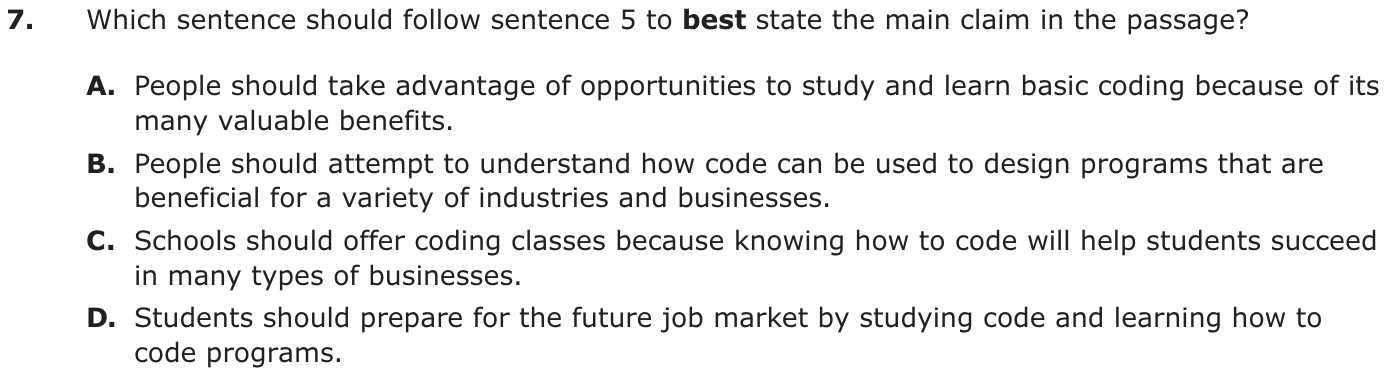
Which sentence should follow sentence 5 to best state the main claim in the passage?
- APeople should take advantage of opportunities to study and learn basic coding because of its many valuable benefits.
- BPeople should attempt to understand how code can be used to design programs that are beneficial for a variety of industries and businesses.
- CSchools should offer coding classes because knowing how to code will help students succeed in many types of businesses.
- DStudents should prepare for the future job market by studying code and learning how to code programs.
Show the answer
Correct answer: A
The question asks for the sentence that should follow sentence 5 to best state the main claim in the passage.
A. CORRECT. This sentence logically follows sentence 5 and introduces the main idea of the passage: that due to the high demand for coding skills across a wide range of industries and disciplines, learning basic coding skills can provide a range of opportunities for personal growth.
B. Incorrect. While this sentence incorporates a point made in the passage about how coding can benefit many occupational fields (sentence 10), this idea alone does not address the entire argument in the passage. This sentence does not capture the passage’s emphasis on the variety of ways people can learn how to code (sentence 14).
C. Incorrect. While this sentence incorporates ideas about opportunities to learn coding skills in school (fourth paragraph), the larger claim presented in the passage is not about opportunities schools should offer in order to help students learn to code. The passage primarily focuses on the opportunities offered to people who take on the challenge of learning to code.
D. Incorrect. Although the passage discusses the opportunities that are available to some students to learn coding skills in school (sentences 15–16), this point is a supporting detail of the passage, not the main claim of the passage.
Question analysis
This introduction question asks which sentence, added after sentence 5 of “Cracking the Code,” would best state the main claim of the passage. Students must work out what the whole argument is driving at, across paragraphs on what code is, how it is used at work and where people can learn it, and then choose among four sentences that each sound like a claim.
- NYS standards
- 7W1a introducing claims and counterclaims
- Grade level
- Grade 7 reading and task
- Compared with grade 7
- At grade 7 Introducing a precise claim is a core grade 7 argument skill. Students must find the claim behind all five paragraphs, since the first paragraph only explains what code is, and compare four sentences that each tell someone what to do.
- Estimated difficulty
- Straightforward: two steps or one careful reading.
- Thinking it demands
- Depth of knowledge 2, skills and concepts · mainly evaluate
- What makes it hard
- Evidence in several places moderate
- Every choice must be checked minor
- Evidence
- Answered from the whole text
- Reading level
- Passage: about grade 10, 357 words; question and choices: about grade 10, 91 words.
- Students, last 30 days
- Not enough answers yet to show (it takes 10).
Why it is hard, traps and wrong answers (shows the answer)
Why it is hard
The claim is clearest at the very end, where sentence 20 says anyone can benefit from understanding code without becoming an expert. Each wrong option grows out of one paragraph, the industries of paragraph 3 or the students and schools of paragraph 4, so it sounds supported but speaks to too few people or asks for the wrong action. The question rewards naming the whole argument before reading the options.
Evidence in several places moderate Working it out
The first paragraph only explains what code is, so the claim must be pieced together from later parts: coding’s value at work in paragraph 3, the ways to learn in paragraph 4 and sentence 20’s benefits for non-experts. (Kirsch & Mosenthal, 1990; Gorin & Embretson, 2006)
Every choice must be checked minor Choosing the answer
All four options are “should” statements built from real material in the passage, so each has to be checked for whom it addresses and what it asks them to do. (Embretson & Wetzel, 1987)
Strategy: Before reading the choices, note in a phrase what each paragraph adds, then say in one sentence what the whole passage wants its readers to do, and pick the option that matches all of it.
Traps
- Too narrow: A single detail offered as the central idea or a summary, or a summary that keeps minor details and leaves out an essential part.
- Off the point: Adds or keeps something that does not support the paragraph's or the passage's focus, or an introduction or conclusion that misses the main point.
The wrong answers, classified
B Too narrow (King et al., 2004)
Builds on the stock-market and medical programs of paragraph 3, but asks people only to understand how code serves industries, never to learn it, and leaves out the ways to learn.
C Off the point (Halliday & Hasan, 1976)
Takes the schools of sentence 15 as the heart of the argument and turns the claim into a duty for schools, a demand the passage never makes of them.
D Too narrow (King et al., 2004)
Joins the higher-paying jobs of sentence 13 to the students of paragraph 4, but limits the claim to students preparing for jobs, while the passage addresses everyone and promises benefits beyond pay.
Working it out, step by step
Figure out what the question asks
This asks for the main claim of the whole passage. A claim is the main point a writer argues for. The new sentence goes after sentence 5, at the end of the first paragraph. So it should tell the reader what the whole passage will argue. Each choice tells someone what they “should” do. Find the one that fits all five paragraphs.
Sum up each paragraph
- Paragraph 1 (sentences 1–5): code is everywhere, and coders must learn its language.
- Paragraph 2 (sentences 6–9): how a coding language works.
- Paragraph 3 (sentences 10–13): coding skills matter in many jobs and can mean higher pay.
- Paragraph 4 (sentences 14–18): “People have a variety of opportunities to learn how to code.”
- Paragraph 5 (sentences 19–20): everybody should learn, and you don’t have to be an expert.
Find the claim in the ending
The end of a passage often makes its point clearest. Sentence 19 quotes Steve Jobs: “Everybody in this country should learn how to program a computer.” Sentence 20 says “one does not need to become an expert programmer to reap the benefits of understanding this language.” To reap benefits is to get good things from something. So the claim is this: everyone should learn at least basic coding, because it helps in many ways.
Check each choice
- A fits. It speaks to all people. “Basic coding” matches sentence 20. “Opportunities” matches paragraph 4. “Many valuable benefits” covers jobs, pay and more.
- B does not fit. It asks people only to understand how businesses use code, the idea of paragraph 3. It never says to learn coding.
- C does not fit. The passage never tells schools what to do. Schools are just one place to learn, in sentence 15.
- D does not fit. It speaks only to students, and only about jobs. The passage speaks to everybody.
Choose the answer
Watch out: D sounds right because the passage does talk about students and jobs. But those are only parts of paragraphs 3 and 4. Only A covers who the passage speaks to and why they should learn. So the answer is A.
Why this answer and not the closest wrong one
D is a close wrong answer, because studying code for good jobs is part of the passage. But D limits the claim to students and to jobs. Sentence 19 says “Everybody” should learn. The reason Steve Jobs gives is that it “teaches you how to think,” which is not about jobs at all. A speaks to all people and all the benefits.
More questions like this
The original DOE question
Question 8 of 57
2022 Test A English, question 8Uses the passage above: “Cracking the Code”.
Question
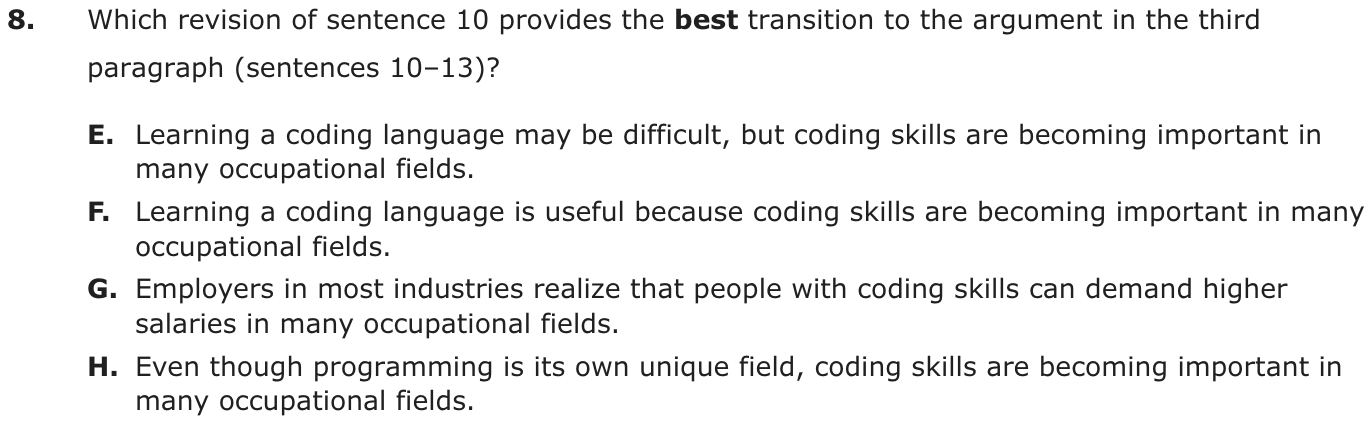
Which revision of sentence 10 provides the best transition to the argument in the third paragraph (sentences 10–13)?
- ALearning a coding language may be difficult, but coding skills are becoming important in many occupational fields.
- BLearning a coding language is useful because coding skills are becoming important in many occupational fields.
- CEmployers in most industries realize that people with coding skills can demand higher salaries in many occupational fields.
- DEven though programming is its own unique field, coding skills are becoming important in many occupational fields.
Show the answer
Correct answer: B
The question asks for the best revision of sentence 10 to provide a transition to the argument in the third paragraph.
A. Incorrect. Some readers may choose this option because the second paragraph does discuss the complexities of coding; however, it does not discuss the difficulties of learning coding. The third paragraph demonstrates some of the complex ways coding is used in specific fields but does not illustrate how difficult learning coding may be.
B. CORRECT. This sentence provides the best revision of the transition sentence. The second paragraph ends with “the possibilities for applying them are infinite” (sentence 9), which supports the idea that people in “many occupational fields” (sentence 10) can benefit from having coding skills. The third paragraph illustrates this idea by providing specific examples of occupations that benefit from coding (stock market traders and doctors).
C. Incorrect. While sentence 13 suggests that employers recognize the value of coding skills, sentences 11 and 12 give examples of different industries that employ people who know how to code. The transition sentence should introduce the idea that coding skills are valuable to potential employees.
D. Incorrect. Some readers may choose this option because the second paragraph provides a brief definition of coding—“A coding language uses letters, numbers, and symbols that are arranged in a way that makes sense to a computer” (sentence 6)—which shows how this element of programming works, but the second paragraph does not specifically discuss what makes the field of computer programming unique. The third paragraph discusses how coding can be used in a variety of occupational fields (sentence 10).
Question analysis
This transitions question asks which revision of sentence 10, the opening sentence of the third paragraph of “Cracking the Code,” would best lead into that paragraph’s argument. Students must link the second paragraph, on how coding languages work, to the third, on coding in fields such as stock trading and medicine, and judge four versions that each begin differently.
- NYS standards
- 7W1d transitions in arguments
- Grade level
- Grade 7 reading and task
- Compared with grade 7
- At grade 7 Grade 7 transition questions often ask for one connecting word. This one asks for a whole topic sentence, so students must sum up two paragraphs and see how they connect, though the passage’s plain language keeps it within typical grade 7 work.
- Estimated difficulty
- Moderate: several steps, or a close reading with one strong distractor.
- Thinking it demands
- Depth of knowledge 2, skills and concepts · mainly evaluate
- What makes it hard
- How sentences fit together moderate
- A very close wrong answer moderate
- Evidence
- Answered from several paragraphs or stanzas
- Reading level
- Passage: about grade 10, 357 words; question and choices: about grade 13, 84 words.
- Students, last 30 days
- Not enough answers yet to show (it takes 10).
Why it is hard, traps and wrong answers (shows the answer)
Why it is hard
Three of the four versions end with the original sentence 10, so the choice lies entirely in the opening words and the link they claim. A concession about difficulty sounds like a natural essay move, and sentence 20 even calls coding challenging, but nothing in paragraphs 2 or 3 sets difficulty against importance. Students who first name the real link between the paragraphs, that coding knowledge is worth having because many fields need it, can test each opening against that.
How sentences fit together moderate Working it out
The new opening must look back to paragraph 2, which ends on the “infinite” possibilities of knowing coding rules, and ahead to the stock-market and medical examples, so two paragraphs have to be tracked at once. (Halliday & Hasan, 1976)
A very close wrong answer moderate Choosing the answer
The concession version shares the key’s first words, “Learning a coding language,” and its whole closing clause; only the middle differs, “may be difficult, but” against “is useful because.” (Embretson & Wetzel, 1987; Gorin & Embretson, 2006; Ascalon et al., 2007)
Strategy: Sum up paragraph 2 and paragraph 3 in a few words each, then test every version of sentence 10 against both summaries, paying close attention to what its opening words claim.
Traps
- Wrong transition: A connecting word or phrase that signals the wrong relationship, such as contrast where the idea continues.
- Off the point: Adds or keeps something that does not support the paragraph's or the passage's focus, or an introduction or conclusion that misses the main point.
The wrong answers, classified
A Wrong transition (Halliday & Hasan, 1976)
Borrows sentence 20’s point that coding “can seem challenging” and sets it against importance with “but,” though neither paragraph 2 nor paragraph 3 raises difficulty, so the contrast connects nothing.
C Too narrow (King et al., 2004)
Picks up sentence 13’s higher salaries and speaks for employers, so the opening covers only the paragraph’s last point and gives no link back to paragraph 2 on coding languages.
D Off the point (Halliday & Hasan, 1976)
Takes paragraph 2’s technical account of code as proof that programming is “its own unique field,” an idea the passage never develops, and sets it against wider use with “Even though.”
Working it out, step by step
Figure out what the question asks
This asks for the best transition. A transition links one part of a piece of writing to the next, like a bridge. Sentence 10 opens the third paragraph. A good opening looks back at paragraph 2 and points ahead to paragraph 3. So first sum up both paragraphs.
Sum up paragraphs 2 and 3
Paragraph 2 explains that learning a coding language means learning its rules. It ends with sentence 9: “Once a person understands coding rules, the possibilities for applying them are infinite.” Infinite means without end. Paragraph 3 then gives examples of uses: tracking the stock market and helping doctors watch a patient’s health. Sentence 13 adds that coding jobs usually pay more.
Name the link between them
Paragraph 2 is about learning the language. Paragraph 3 shows why that learning pays off: many kinds of jobs use it. So the bridge should say that learning a coding language is worth it, because so many jobs need coding. “Occupational fields” are types of jobs.
Check each choice
- A does not fit. “May be difficult, but” sets up a contrast about how hard coding is. Neither paragraph talks about that.
- B fits. “Learning a coding language” looks back at paragraph 2. “Because” gives the reason it is useful, and paragraph 3 then shows that reason with examples.
- C does not fit. It is only about higher salaries, the last point in paragraph 3. It doesn’t link back to paragraph 2.
- D does not fit. The passage never says programming is “its own unique field.” That contrast connects to nothing.
Choose the answer
Watch out: A starts with the same words as B. Admitting that something is hard also sounds like a good essay move. Sentence 20 even says coding “can seem challenging.” But that comes at the very end, and paragraphs 2 and 3 never mention it. So the answer is B.
Why this answer and not the closest wrong one
A is the closest wrong answer. It shares B’s first words and its whole ending. Only the middle is different. A sets difficulty against importance, but neither paragraph is about difficulty. B tells why learning the language from paragraph 2 matters. Then paragraph 3 backs that up with examples of jobs.
More questions like this
The original DOE question
Question 9 of 57
2022 Test A English, question 9Uses the passage above: “Cracking the Code”.
Question
Which sentence would best follow sentence 13 and support the ideas in the third paragraph (sentences 10–13)?
- AExperienced programmers, software engineers, and system administrators at large companies can earn well over $100,000 a year.
- BHospitals, physicians’ offices, and pharmaceutical companies are frequently looking to hire people who code to help with a variety of tasks.
- CMany companies are eager to hire employees who have experience in a specific industry as well as knowledge of basic coding.
- DAccording to a report from a job market analytics firm, almost half of today’s jobs paying more than $58,000 a year call for some level of coding ability.
Show the answer
Correct answer: D
The question asks which sentence would best follow sentence 13 and support the ideas in the third paragraph.
A. Incorrect. While this sentence provides an example of a high salary, which is mentioned in the paragraph (sentence 13), the reference to “Experienced programmers, software engineers, and system administrators at large companies” focuses on specific occupations that may use coding, as opposed to the range of diverse occupations discussed in the third paragraph.
B. Incorrect. While sentence 12 does mention coding skills in the medical field as an example, the information provided in this answer supports only that idea and not the other ideas expressed in the third paragraph.
C. Incorrect. This sentence generally discusses employers looking for two things: “experience in a specific industry” and “knowledge of basic coding.” The third paragraph, however, discusses the possibilities of using coding skills in a variety of occupations. The words “experience in a specific industry” do not connect to the idea the paragraph develops.
D. CORRECT. This sentence provides specific evidence of the job market favoring potential employees who have coding ability. It supports what is stated in sentence 13, that “jobs that require coding skills are typically higher paying.”
Question analysis
This supporting-details question asks which sentence would best follow sentence 13 of “Cracking the Code,” which says jobs requiring coding skills tend to pay more, and support the ideas of the third paragraph. All four options are plausible facts about coding and work, from salaries to hiring, so students must judge which one backs up the paragraph as a whole.
- NYS standards
- 7W1b supporting claims with evidence
- Grade level
- Grade 7 reading and task
- Compared with grade 7
- Above grade 7 Choosing relevant evidence for a claim is grade 7 argument work. Here all four options are believable facts about coding and jobs, and the best one must fit both sentence 13 and the paragraph’s larger point, a finer judgment than usual.
- Estimated difficulty
- Hard: combines ideas, needs a plan, and has more than one tempting wrong answer.
- Thinking it demands
- Depth of knowledge 2, skills and concepts · mainly evaluate
- What makes it hard
- Every choice must be checked moderate
- How sentences fit together moderate
- Reading between the lines minor
- Evidence
- Answered from one paragraph or stanza
- Reading level
- Passage: about grade 10, 357 words; question and choices: about grade 12, 100 words.
- Students, last 30 days
- Not enough answers yet to show (it takes 10).
Why it is hard, traps and wrong answers (shows the answer)
Why it is hard
The paragraph makes two claims, that coding matters in many fields and that coding jobs pay more, and the best addition must serve both while following the sentence about pay. The $100,000 figure is the main trap, since it seems to back the pay claim but turns attention to computing careers, the opposite of the paragraph’s point. The hospital and industry-experience options each touch one idea of the paragraph and drift away from the rest.
Every choice must be checked moderate Choosing the answer
All four options are believable facts about coding and work, two of them with salary figures, so each must be tested against sentence 13’s pay comparison and sentence 10’s claim about many fields. (Embretson & Wetzel, 1987)
How sentences fit together moderate Working it out
The added sentence comes right after sentence 13, so it should carry on the point that coding jobs pay more while still serving the paragraph’s opening claim that coding matters in many occupations. (Halliday & Hasan, 1976)
Reading between the lines minor Working it out
Seeing why the job-market statistic fits takes a step of reasoning: if almost half of jobs paying over $58,000 call for coding, coding is both widespread and tied to better pay. (Graesser, Singer & Trabasso, 1994; Kintsch, 1998)
Strategy: Restate sentence 10 and sentence 13 in your own words, then ask of each option whether it is evidence for what those two sentences claim, not just a fact on the same topic.
Traps
- Off the point: Adds or keeps something that does not support the paragraph's or the passage's focus, or an introduction or conclusion that misses the main point.
The wrong answers, classified
A Off the point (Halliday & Hasan, 1976)
Matches sentence 13’s talk of pay with a striking salary, but it turns to computing careers such as software engineering instead of the many fields the paragraph describes, and compares nothing.
B Supports only part of the claim (King et al., 2004; Thissen, Steinberg & Fitzpatrick, 1989)
Extends sentence 12’s point about doctors to hospitals and drug companies, but it backs only the medical example and says nothing about pay, so it does not build on sentence 13.
C Off the point (Halliday & Hasan, 1976)
Sees support for coding’s value in companies wanting “knowledge of basic coding,” but the sentence adds a second demand, experience in one industry, which the paragraph never discusses.
Working it out, step by step
Figure out what the question asks
You need a sentence to add after sentence 13. It must support the third paragraph. To support means to give evidence: facts that back up a point. So first find the paragraph’s points. Then test each choice against them.
Find the paragraph’s two points
Sentence 10 says “Coding skills are becoming important in many occupational fields.” That means many kinds of jobs. Sentences 11 and 12 give examples: the stock market and doctors. Sentence 13 says “Jobs that require coding skills are typically higher paying.” So the paragraph makes two points. Coding matters in many kinds of jobs. And jobs that need coding tend to pay more.
Test each choice against both points
- A gives a big salary. But it names only computer jobs, like programmers and software engineers. The paragraph is about coding in many other fields.
- B is only about hospitals and drug companies. It repeats the doctor example and says nothing about pay.
- C brings in a new idea: “experience in a specific industry.” The paragraph never talks about that, and C says nothing about pay.
- D says “almost half of today’s jobs paying more than $58,000 a year call for some level of coding ability.”
See why D supports both points
D is about jobs that pay well, so it backs up sentence 13 on pay. It also says almost half of those jobs need some coding. Half of all well-paying jobs covers many kinds of work, not just computer jobs. That backs up sentence 10. D also names where its facts come from, a report, which makes it stronger evidence.
Choose the answer
Watch out: A is the most tempting. Its $100,000 salary seems to match sentence 13. But of course computer experts need coding. That doesn’t show that coding matters in other fields. So the answer is D.
Why this answer and not the closest wrong one
A is the closest wrong answer, since it talks about high pay. But it is about programmers and other computer jobs. The paragraph’s point is that coding helps in many fields beyond computers. D shows that almost half of all well-paying jobs call for some coding. It supports both the pay and the many fields.
More questions like this
The original DOE question
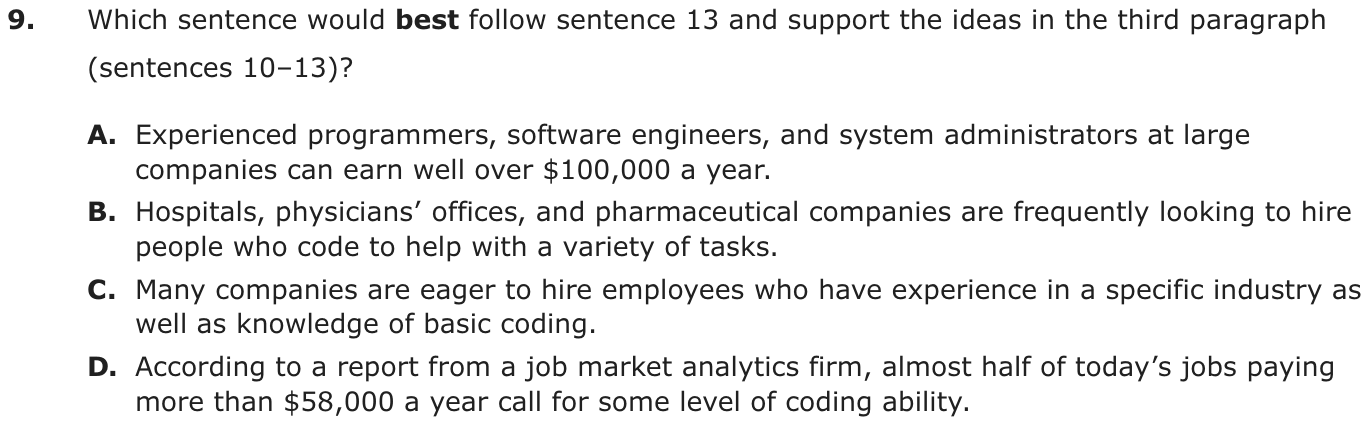
Question 10 of 57
2022 Test A English, question 10Uses the passage above: “Cracking the Code”.
Question
Which concluding sentence would best follow sentence 20 and support the argument presented in the passage?
- APeople should understand that knowing how to code is becoming an essential requirement for most high-paying jobs.
- BBy understanding basic coding concepts, people can participate in an increasingly digital job market.
- CStudents who want to secure a high-paying job in the technology industry should become proficient in coding.
- DSince coding is a valuable marketplace skill, today’s students should begin to write their own computer programs.
Show the answer
Correct answer: B
The question asks which concluding sentence would best follow sentence 20 and support the argument presented in the passage.
A. Incorrect. While the passage does state that “jobs that require coding skills are typically higher paying” (sentence 13), it does not say or imply that coding skills are needed for most high-paying jobs.
B. CORRECT. The sentence successfully summarizes the main argument of the passage, which is that coding is involved in all electronic interaction (sentence 1) and is a useful skill to master, especially in many occupational fields (sentence 10).
C. Incorrect. In the fourth paragraph, the passage does promote students taking advantage of opportunities to learn coding; however, this information is a supporting detail and would not serve as a strong conclusion to the argument presented in the passage.
D. Incorrect. Some readers may choose this sentence because the fourth paragraph discusses how “some students may become interested in learning how to create programs, such as games and apps” (sentence 18), but this detail is only one part of the overall argument in the passage.
Question analysis
This conclusion question asks which sentence should come after sentence 20, the last line of “Cracking the Code,” to close the passage and support its argument. The options mention high-paying jobs, students, the technology industry and the job market, so students must decide which ending fits the whole passage rather than one of its details.
- NYS standards
- 7W1e concluding an argument
- Grade level
- Grade 7 reading and task
- Compared with grade 7
- At grade 7 A closing statement that explains why an argument matters is part of the grade 7 writing standards. Here the ending must follow sentence 20 and reflect all five paragraphs, a typical grade 7 revising task with several reasonable-sounding options.
- Estimated difficulty
- Moderate: several steps, or a close reading with one strong distractor.
- Thinking it demands
- Depth of knowledge 2, skills and concepts · mainly evaluate
- What makes it hard
- Evidence in several places moderate
- The right answer is reworded minor
- How sentences fit together minor
- Evidence
- Answered from the whole text
- Reading level
- Passage: about grade 10, 357 words; question and choices: about grade 11, 80 words.
- Students, last 30 days
- Not enough answers yet to show (it takes 10).
Why it is hard, traps and wrong answers (shows the answer)
Why it is hard
Each wrong ending grows from something the passage does say, about high pay, students or creating programs, which makes it feel supported. The trap is in how far each one goes: one inflates better pay into a requirement for most good jobs, and two shrink the argument to students and programming. Keeping sentence 20’s point about non-experts in mind rules out most of them at once.
Evidence in several places moderate Working it out
A closing sentence must gather the whole argument: code is everywhere (sentence 1), it matters in many jobs (paragraph 3), anyone can learn it (paragraph 4) and even a basic grasp pays off (sentence 20). (Kirsch & Mosenthal, 1990; Gorin & Embretson, 2006)
The right answer is reworded minor Choosing the answer
The best ending uses words the passage never does, “basic coding concepts” and “increasingly digital job market,” while the others echo the “higher paying” jobs of sentence 13 or the programs of sentence 18. (Freedle & Kostin, 1993; Kirsch & Mosenthal, 1990)
How sentences fit together minor Working it out
The ending follows sentence 20, which says one need not become an expert programmer, so options that call for proficiency or for writing programs clash with the line just before them. (Halliday & Hasan, 1976)
Strategy: Reread sentence 20 and list the passage’s main points in a phrase each, then choose the ending that follows sentence 20 and covers those points without claiming more than they show.
Traps
- Too narrow: A single detail offered as the central idea or a summary, or a summary that keeps minor details and leaves out an essential part.
- Too broad or too strong: A choice overstates, generalizes, or uses absolute words the text does not support.
The wrong answers, classified
A Too broad or too strong (King et al., 2004)
Builds on sentence 13’s point that coding jobs pay more but inflates it into coding being “an essential requirement for most high-paying jobs,” a claim the passage never makes.
C Too narrow (King et al., 2004)
Is drawn by “high-paying job,” but it addresses only students aiming at the technology industry and asks for proficiency, though sentence 20 says no one needs to become an expert.
D Too narrow (King et al., 2004)
Builds on sentence 18’s students who may go on to create games and apps, so it ends on one detail of paragraph 4 instead of the passage’s case for everyone.
Working it out, step by step
Figure out what the question asks
This asks for the best concluding sentence, the last line of the passage. A good conclusion follows from the sentence before it and sums up the whole argument. It shouldn’t claim more than the passage shows. It also shouldn’t shrink the point down to one detail.
Reread sentence 20
Sentence 20 says “Learning to code can seem challenging, but one does not need to become an expert programmer to reap the benefits of understanding this language.” An expert is someone with great skill. So you don’t need great skill to gain from coding. Even a basic grasp helps. The last sentence should build on that idea.
List the passage’s main points
- Code is everywhere. It is “part of every electronic interaction” (sentence 1).
- Coding skills matter “in many occupational fields” (sentence 10).
- Anyone can find ways to learn (paragraph 4).
- Even a basic understanding pays off (sentence 20).
Check each choice
- A does not fit. Sentence 13 says coding jobs usually pay more. It never says coding is needed for “most high-paying jobs.” That claims too much.
- B fits. “Basic coding concepts” matches sentence 20: you don’t need to be an expert. “People” means everyone. Digital means done with computers. So an “increasingly digital job market” ties together code being everywhere and its use in many jobs.
- C does not fit. It speaks only to students who want tech jobs. Proficient means highly skilled, which sentence 20 says you don’t need to be.
- D does not fit. Writing programs is one detail from sentence 18. It is not the whole argument.
Choose the answer
Watch out: A sounds like a strong ending, and it builds on sentence 13. But it turns “typically higher paying” into a requirement for most good jobs. Only B follows sentence 20 and fits the whole passage. So the answer is B.
Why this answer and not the closest wrong one
A is the closest wrong answer. It grows out of sentence 13, which says coding jobs “are typically higher paying.” But paying more is not the same as being required. A claims more than the passage shows. B stays inside the passage: a basic understanding of coding helps people take part in a world of work full of computers.
More questions like this
The original DOE question
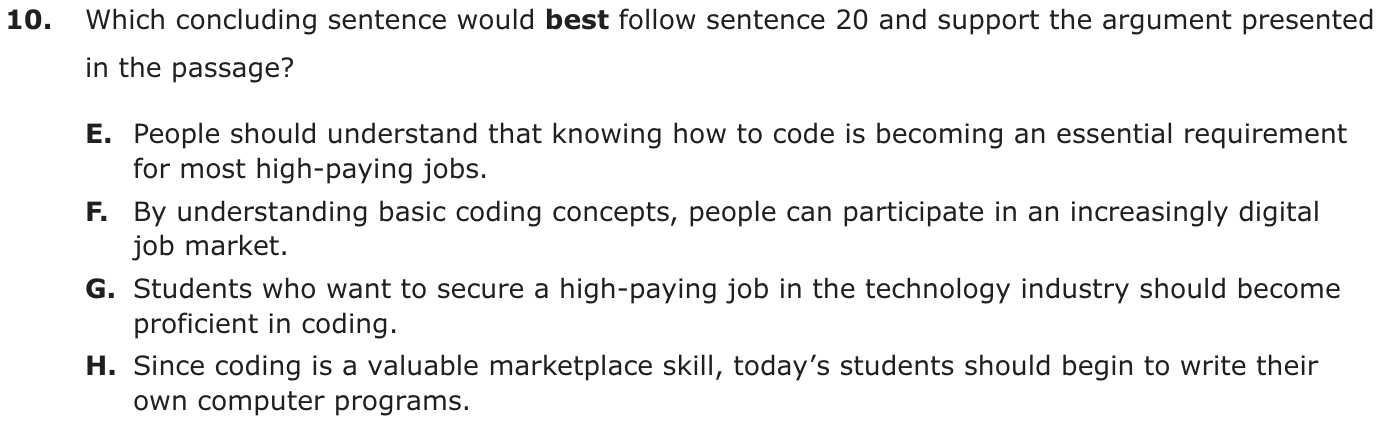
Question 11 of 57
2022 Test A English, question 11Passage Martial Arts for the Mind and Body
Martial Arts for the Mind and Body
(1) The martial arts blend a series of physical movements with strategic mental discipline so that practitioners can defend themselves, physically defeat an opponent, or both. (2) Historians are unsure of exactly when and where martial arts were first used. (3) Martial arts have been practiced by several different societies for many centuries. (4) Martial arts such as karate, kung fu, tae kwon do, and judo are still taught and practiced as methods of self-defense, but they offer students more than that. (5) The study of martial arts can provide students with a way to enhance their mental discipline as well as their physical fitness.
(6) Discipline, focus, and respect are important qualities for everyone to have. (7) However, for most people these qualities are not innate; they must be learned and practiced. (8) The study of martial arts can provide an opportunity to develop these skills. (9) Students are rewarded for their dedication by passing tests and advancing to higher ranks or levels. (10) For example, in a typical tae kwon do class, students learn discipline by diligently practicing moves, improve focus by listening carefully, and demonstrate respect by bowing to the instructor and following directions.
(11) For teenagers, martial arts classes provide a safe and structured environment for gaining physical skills, building confidence, and enjoying a sense of community. (12) A lot of teens go through hard situations as they try to do well in school and in life. (13) A martial arts class can provide teens with a physical outlet for stress while also challenging them mentally. (14) Participating in a martial arts program also helps children and teens focus on self-improvement rather than on competition. (15) Progressing through levels of achievement involves mastering more physically demanding techniques. (16) It requires students to take responsibility and be accountable for achieving set goals. (17) Students gain confidence and experience companionship with other students who are progressing through the ranks.
(18) Adults who practice martial arts can experience many of the same benefits that younger people do, but perhaps the greatest of these is health and fitness. (19) Adult martial arts students often see changes in their body within weeks of beginning a program.
(20) For people interested in studying a martial art, there are many ways to learn and practice. (21) In addition to private studios, community recreation centers often offer low-cost or free martial arts classes. (22) There are even online videos that introduce students to the basic concepts. (23) People should study martial arts.
Question
What is the best way to combine sentences 2 and 3?
- AHistorians, who are unsure of exactly when and where martial arts were first used, know that martial arts have been practiced by several different societies for many centuries.
- BWhile historians are unsure of exactly when and where martial arts were first used, they do know that martial arts have been practiced by several different societies for many centuries.
- CBecause historians know that martial arts have been practiced by several different societies for many centuries, they are unsure of exactly when and where martial arts were first used.
- DMartial arts have been practiced by several different societies for many centuries, and historians are unsure of exactly when and where martial arts were first used.
Show the answer
Correct answer: B
The question asks for the best way to combine sentences 2 and 3.
A. Incorrect. This way of combining sentences 2 and 3 places unnecessary emphasis on characterizing historians, and it does not clearly show the contrasting relationship between the idea from sentence 2 that historians do not know the exact origins of martial arts and the idea in sentence 3 that historians know that martial arts have a long history.
B. CORRECT. This option is correct because the word “while” at the beginning of the sentence best indicates the contrast between the ideas in sentences 2 and 3. Sentence 2 states that historians do not know the exact origins of martial arts (“unsure of exactly when and where”). Sentence 3 describes what historians do know about these origins (“practiced by several different societies for many centuries”). This combination indicates that historians have a general understanding about the origins of martial arts even though they cannot confirm the exact details.
C. Incorrect. Starting this sentence with the word “because” indicates a cause-and-effect relationship that does not exist between the ideas in the original sentences. The idea from sentence 3, that historians know that martial arts have been practiced for many years, did not cause the idea in sentence 2, that historians do not know exact details about the origins of martial arts.
D. Incorrect. The conjunction (connecting word) “and” does not clearly show how the ideas in sentences 2 and 3 are related. While “and” can be used to combine related sentences, it does not demonstrate the contrast between the idea in sentence 2, that historians do not know the exact origins of martial arts, and the idea in sentence 3, that historians know that martial arts have a long history.
Question analysis
This sentence-combining question uses sentences 2 and 3 of a passage on the benefits of martial arts: historians are unsure when and where martial arts were first used, and the arts have been practiced by many societies for centuries. Students must choose the combination whose connecting word shows how the two facts relate, among four grammatical versions.
- Grade level
- Grade 7 reading and task
- Compared with grade 7
- At grade 7 Joining two sentences with a word that shows how their ideas relate is routine grade 7 work. Both sentences are short and plain, and the four versions differ mainly in one connecting word or structure, so the task is typical.
- Estimated difficulty
- Straightforward: two steps or one careful reading.
- Thinking it demands
- Depth of knowledge 2, skills and concepts · mainly evaluate
- What makes it hard
- How sentences fit together moderate
- Every choice must be checked minor
- Evidence
- Answered from one sentence or line
- Reading level
- Passage: about grade 11, 402 words; question and choices: about grade 13, 122 words.
- Students, last 30 days
- Not enough answers yet to show (it takes 10).
Why it is hard, traps and wrong answers (shows the answer)
Why it is hard
The two sentences are short and plain, and the only real decision is the relationship between them: uncertainty about origins set against knowledge of a long history. The relative-clause version tempts most because it sounds polished and keeps everything, yet it turns the uncertainty into a description of historians and drops the contrast. The versions with “Because” and “and” are easier to rule out once the contrast is named, since one invents a cause and the other only adds.
How sentences fit together moderate Working it out
Sentence 2 says what historians do not know and sentence 3 what they do, so the combined sentence needs a word that marks that contrast, which students should name before reading the choices. (Halliday & Hasan, 1976)
Every choice must be checked minor Choosing the answer
All four versions keep both facts and are grammatical, so each must be read through to see whether its opening word or structure shows contrast, addition, cause or mere description. (Embretson & Wetzel, 1987)
Strategy: Before reading the choices, decide how sentence 3 relates to sentence 2: an added fact, a cause, or a contrast. Then pick the version whose opening word or structure signals that relationship.
Traps
- Wrong transition: A connecting word or phrase that signals the wrong relationship, such as contrast where the idea continues.
- Changes the meaning: A revision is correct English but no longer says what the writer meant.
The wrong answers, classified
A Changes the meaning (Connors & Lunsford, 1988)
Keeps both facts in one polished sentence, but tucking sentence 2 into a “who” clause makes it a description of historians and hides the contrast between unknown and known.
C Wrong transition (Halliday & Hasan, 1976)
Opens with “Because,” making the long history the cause of historians’ uncertainty about origins, a cause-and-effect link the two facts do not have.
D Wrong transition (Halliday & Hasan, 1976)
Joins the sentences with “and,” which simply adds one fact to the other in reverse order, so nothing signals that what historians know contrasts with what they don’t.
Working it out, step by step
Figure out what the question asks
This asks how to join two sentences into one. The best way shows how the two ideas are related. So first figure out how they relate.
Read sentences 2 and 3
Sentence 2: “Historians are unsure of exactly when and where martial arts were first used.” Sentence 3: “Martial arts have been practiced by several different societies for many centuries.” A historian studies the past. Sentence 2 tells what historians don’t know. Sentence 3 tells what they do know. That is a contrast: two ideas that pull different ways.
Name the rule
When two ideas contrast, join them with a contrast word, such as while, although or but. Here “while” means although. For example: Sam forgot the exact date. He knew it was in May. Joined: While Sam forgot the exact date, he knew it was in May.
Check each choice
- A is wrong. The part that starts with “who” just describes the historians. The contrast between not knowing and knowing gets lost.
- B is right. “While” shows the contrast. The words “do know” make it even clearer.
- C is wrong. “Because” means one thing causes the other. A long history does not cause historians to be unsure.
- D is wrong. “And” just adds one fact to another. It does not show the contrast.
Watch out: A sounds smooth and keeps every fact, so it is tempting. But a good combined sentence must also show how the ideas relate.
Choose the answer
B joins the two facts and shows the contrast. So the answer is B, “While historians are unsure of exactly when and where martial arts were first used, they do know that martial arts have been practiced by several different societies for many centuries.”
Why this answer and not the closest wrong one
A is the closest wrong answer. It keeps both facts in one smooth sentence. But tucking sentence 2 into a “who” part turns it into a description of historians. Nothing marks the turn from what they don’t know to what they do. B’s “While” and “do know” make that contrast plain.
More questions like this
The original DOE question
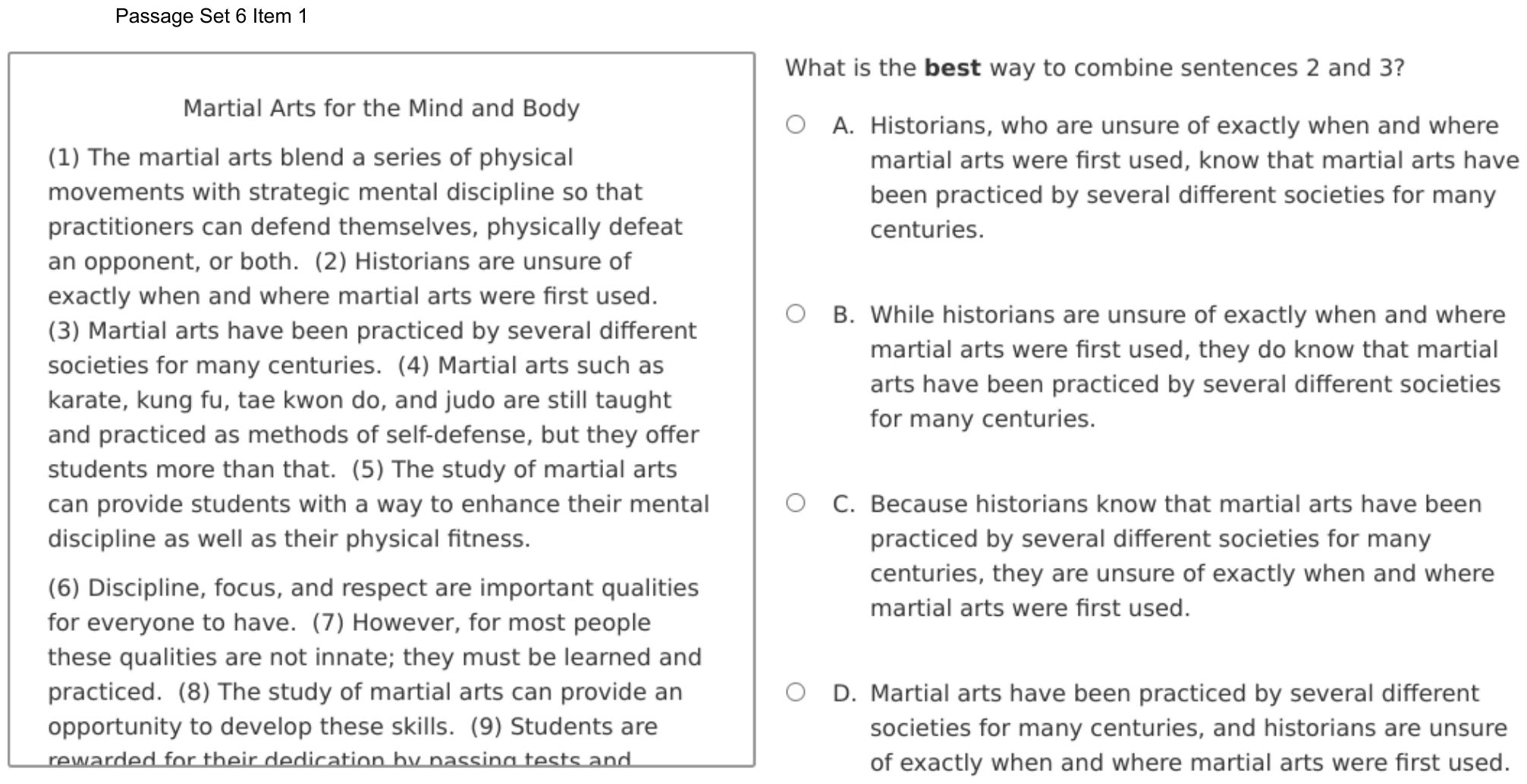
The passage “Martial Arts for the Mind and Body” as printed (page 52)
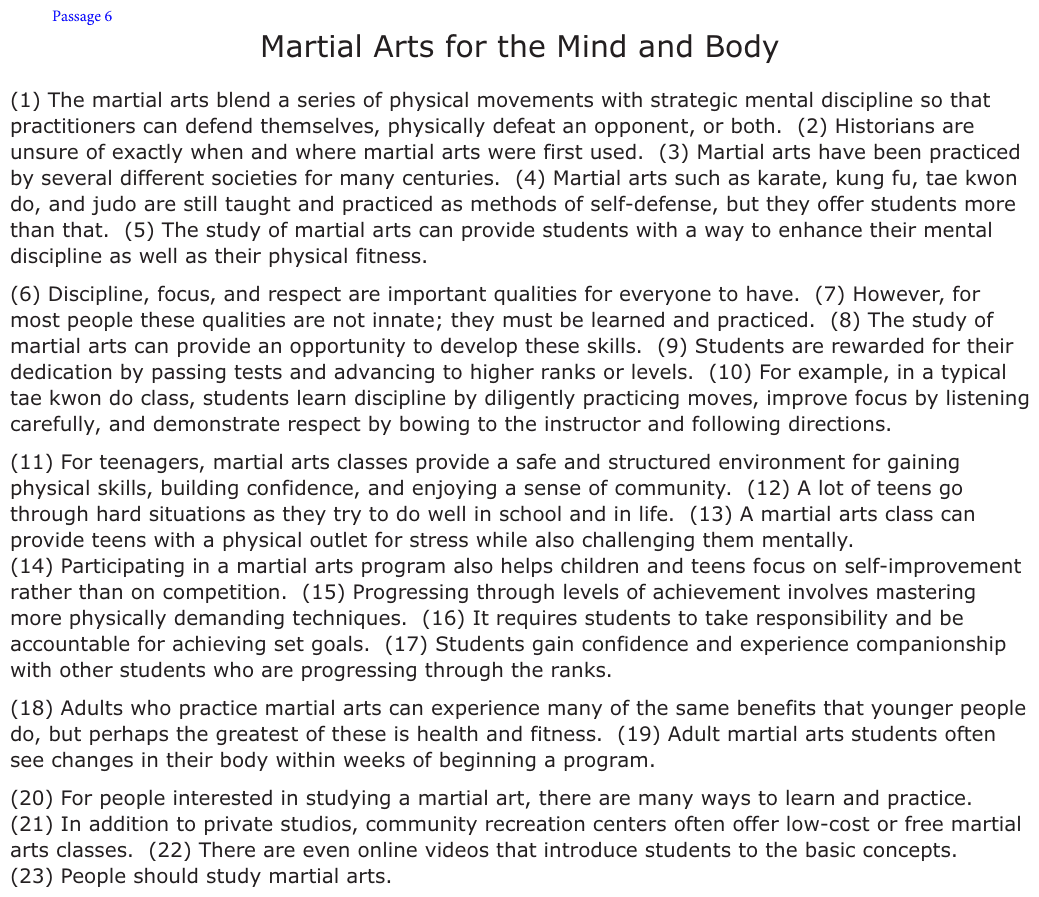
Question 12 of 57
2022 Test A English, question 12Uses the passage above: “Martial Arts for the Mind and Body”.
Question
Where should sentence 10 be moved to improve the organization of the second paragraph (sentences 6–10)?
- Ato the beginning of the paragraph (before sentence 6)
- Bbetween sentences 6 and 7
- Cbetween sentences 7 and 8
- Dbetween sentences 8 and 9
Show the answer
Correct answer: D
The question asks where sentence 10 should be moved to improve the organization of the second paragraph.
A. Incorrect. Starting this paragraph with sentence 10 would weaken the paragraph’s organization because it would place a supporting detail sentence (sentence 10) before the topic sentence (sentence 6). Sentence 6 belongs at the beginning of the paragraph because it introduces the topic—the qualities of discipline, focus, and respect. Sentence 10 supports the key idea of the paragraph, that these qualities can be developed through the study of martial arts. If sentence 10 preceded sentence 6, the transitional phrase “for example” would refer to an unspecified topic and idea.
B. Incorrect. Sentence 6 presents the idea that “discipline, focus, and respect are important qualities for everyone to have,” but the example in sentence 10 does not directly relate to this idea. Sentence 10 explains how martial arts develop these qualities, not why they are important qualities to have. Because sentence 10 is not directly related to the idea in sentence 6 (the qualities are important), it should not follow sentence 6.
C. Incorrect. Sentences 7 and 8 should not be separated, because the idea presented in sentence 8—that “the study of martial arts can provide an opportunity to develop these skills”—is directly related to the idea from sentence 7—that the skills of discipline, focus, and respect “are not innate; they must be learned and practiced.” Sentence 10 supports the idea from sentence 8 by describing an example from a typical martial arts class, so sentence 10 should not precede sentence 8.
D. CORRECT. This option is correct because sentence 10 logically follows and supports the idea in sentence 8 that “the study of martial arts can provide an opportunity to develop” the qualities of discipline, focus, and respect. Sentence 10 explains this idea with examples, describing three specific ways that students in a typical tae kwon do class develop discipline, focus, and respect—by “diligently practicing,” “listening carefully,” and “bowing to the instructor and following directions.”
Question analysis
This organization question asks where sentence 10, a “For example” sentence describing a typical tae kwon do class, should be moved within the second paragraph of the martial arts passage. Students must work out what idea the example illustrates and read the paragraph with the sentence in each position, since several spots sound acceptable.
- Grade level
- Grade 7 reading and task
- Compared with grade 7
- At grade 7 Placing a sentence where it supports the right idea is regular grade 7 revision work. The paragraph is five plain sentences and the opening “For example” is a strong clue, which keeps the demand typical of grade 7.
- Estimated difficulty
- Moderate: several steps, or a close reading with one strong distractor.
- Thinking it demands
- Depth of knowledge 2, skills and concepts · mainly analyze
- What makes it hard
- How sentences fit together moderate
- A very close wrong answer minor
- Much to keep track of minor
- Evidence
- Answered from one paragraph or stanza
- Reading level
- Passage: about grade 11, 402 words; question and choices: about grade 7, 31 words.
- Students, last 30 days
- Not enough answers yet to show (it takes 10).
Why it is hard, traps and wrong answers (shows the answer)
Why it is hard
The example sentence fits loosely almost anywhere in a paragraph about discipline, focus and respect, so students have to ask what exactly it is an example of. The slot just before sentence 8 is the trap: the class’s practicing seems to illustrate sentence 7’s claim that the qualities “must be learned and practiced,” but the paragraph has not yet brought in martial arts. Those who match the example to sentence 8’s claim about martial arts place it correctly.
How sentences fit together moderate Working it out
Sentence 10 opens with “For example,” so it must follow the claim it illustrates, sentence 8’s point that studying martial arts can “develop these skills,” before sentence 9 turns to rewards. (Halliday & Hasan, 1976)
A very close wrong answer minor Choosing the answer
The slots before and after sentence 8 are neighbors, and the tae kwon do class could seem to illustrate sentence 7 as well as sentence 8, so only rereading tells them apart. (Embretson & Wetzel, 1987; Gorin & Embretson, 2006; Ascalon et al., 2007)
Much to keep track of minor Working it out
Each of the four positions means rereading a five-sentence paragraph in a new order in your head while keeping track of what “these qualities” and “these skills” refer to. (Sweller, 1988; Carpenter, Just & Shell, 1990)
Strategy: Ask which sentence the tae kwon do class is an example of, then reread the paragraph with sentence 10 placed right after it and check that every sentence still follows the one before.
Traps
- Sentence in the wrong place: Puts a sentence where it breaks the order of ideas or separates it from what it refers to.
The wrong answers, classified
A Sentence in the wrong place (Halliday & Hasan, 1976)
Moves the example to the front, where “For example” would point back to nothing and the topic sentence would come after its own illustration.
B Sentence in the wrong place (Halliday & Hasan, 1976)
Places the example after sentence 6, but the class shows how the qualities are built, not why everyone needs them, and it would cut sentence 7’s “However” off from sentence 6.
C Sentence in the wrong place (Halliday & Hasan, 1976)
Hears sentence 7’s “learned and practiced” echoed in “learn” and “practicing,” but the example must come after sentence 8, which first connects the qualities to martial arts.
Working it out, step by step
Figure out what the question asks
This asks where to move sentence 10 so paragraph 2 reads in a better order. Sentence 10 starts with “For example.” So it must come right after the idea it is an example of.
Name the rule
An example goes right after the claim it shows. “For example” points back to the sentence before it. For instance: Reading builds your word power. For example, you meet new words in every book. If the example came first, it would point back to nothing.
Find what sentence 10 shows
Sentence 10 says students “learn discipline by diligently practicing moves, improve focus by listening carefully, and demonstrate respect by bowing to the instructor and following directions.” Diligently means with steady, careful effort. This shows how martial arts build those three qualities. Sentence 8 makes that claim: “The study of martial arts can provide an opportunity to develop these skills.” So sentence 10 belongs right after sentence 8.
Read the new order
Now the paragraph runs 6, 7, 8, 10, 9. Sentence 6 names the qualities. Sentence 7 says they “must be learned and practiced.” Sentence 8 says martial arts can build them. Sentence 10 gives the tae kwon do example. Then sentence 9 tells how students are rewarded. Each sentence leads to the next.
Check each choice
- A is wrong. “For example” would point back to nothing.
- B is wrong. Sentence 6 says why the qualities matter, but the class shows how they are built. It would also cut sentence 7’s “However” off from sentence 6.
- C is wrong. Sentence 7 never mentions martial arts. Sentence 8 is the first to link the qualities to martial arts.
- D is right. The example follows the claim it shows.
Watch out: Sentence 7 says “learned and practiced,” and sentence 10 uses “learn” and “practicing.” That echo pulls you toward C.
Choose the answer
Sentence 10 gives an example of sentence 8’s claim. It belongs right after it. So the answer is D, “between sentences 8 and 9.”
Why this answer and not the closest wrong one
C is the closest wrong answer, because sentence 7 talks about learning and practice too. But sentence 7 does not mention martial arts. Sentence 8 claims that martial arts can build these skills, and the tae kwon do class is an example of exactly that. So the example belongs right after sentence 8.
More questions like this
The original DOE question
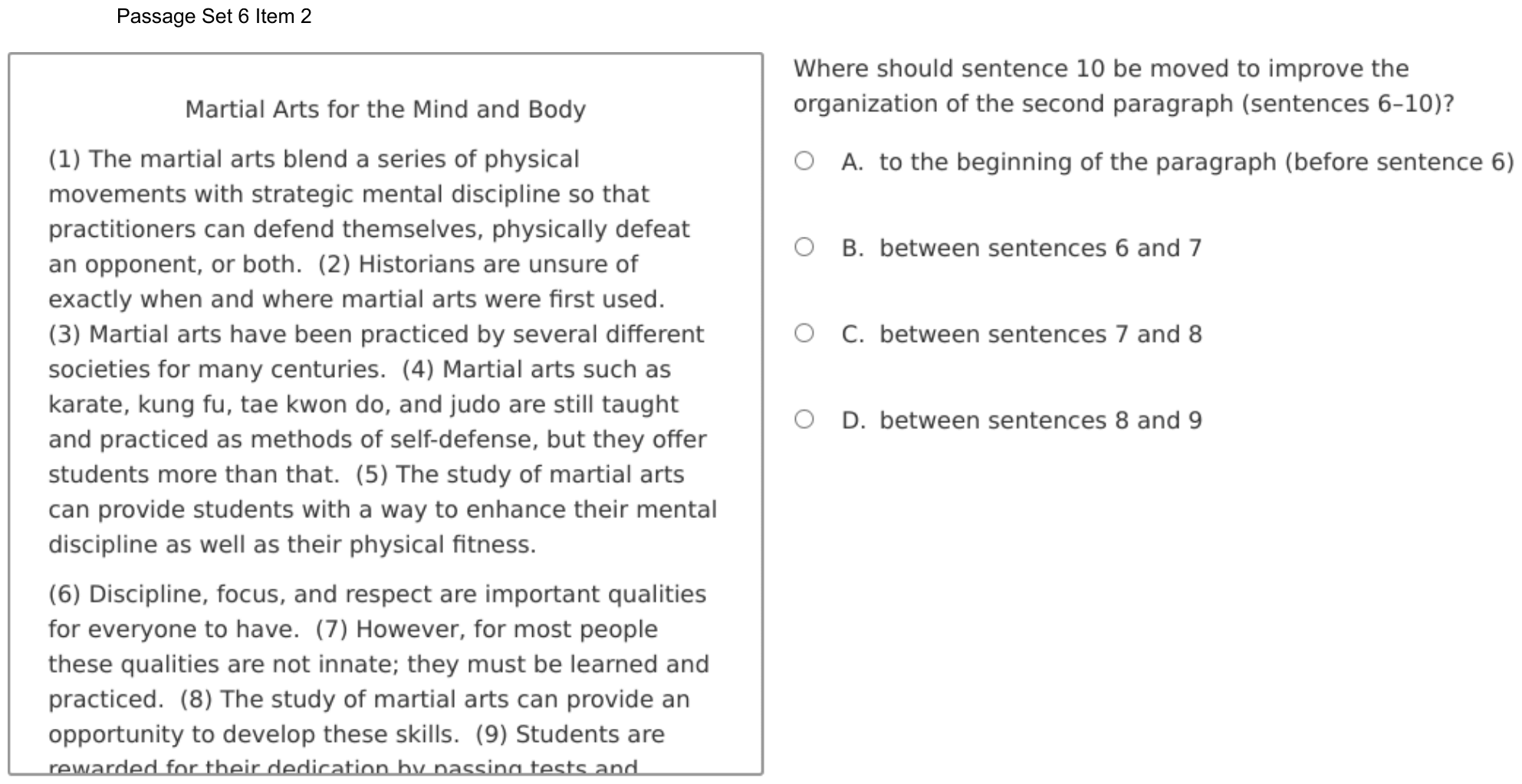
Question 13 of 57
2022 Test A English, question 13Uses the passage above: “Martial Arts for the Mind and Body”.
Question
Which revision of sentence 12 best maintains the formal style established in the passage?
- AA lot of teens have to put up with difficult things while trying to do well in school and in life.
- BMany teenagers deal with tough situations as they try to stay on top of their studies and do well in life.
- CMany teenagers encounter challenges as they work to succeed both academically and personally.
- DA lot of teens face problems as they work to keep up with their schoolwork and find personal success.
Show the answer
Correct answer: C
The question asks for the revision of sentence 12 that best maintains the formal style established in the passage.
A. Incorrect. The phrases “A lot,” “put up with,” “difficult things,” and “do well in school” are worded informally; therefore, this sentence does not consistently maintain the formal style established in the passage.
B. Incorrect. The phrases “deal with,” “tough situations,” “stay on top of,” and “do well in life” are worded informally; therefore, this sentence does not consistently maintain the formal style established in the passage.
C. CORRECT. This option is correct because it uses clear and scholarly wording throughout the whole sentence. The phrases “many teenagers,” “encounter challenges,” and “succeed both academically and personally” make the sentence’s style more consistently formal than the other options.
D. Incorrect. The phrases “A lot,” “face problems,” and “keep up with” are worded informally; therefore, this sentence does not consistently maintain the formal style established in the passage.
Question analysis
This style question asks which revision of sentence 12, “A lot of teens go through hard situations as they try to do well in school and in life,” best keeps the formal style of the martial arts passage. Students compare four rewrites phrase by phrase, listening for casual expressions in each one.
- Grade level
- Grade 6 reading and task
- Compared with grade 7
- Below grade 7 Keeping a formal style is practiced from grade 6, and here it is tested in one sentence with familiar casual phrases. Typical grade 7 style work asks for subtler choices of precise, content-specific words across a passage.
- Estimated difficulty
- Routine: one familiar step, little to misread.
- Thinking it demands
- Depth of knowledge 1, recall and reproduction · mainly evaluate
- What makes it hard
- Evidence
- Answered from one sentence or line
- Reading level
- Passage: about grade 11, 402 words; question and choices: about grade 8, 87 words.
- Students, last 30 days
- Not enough answers yet to show (it takes 10).
Why it is hard, traps and wrong answers (shows the answer)
Why it is hard
Most students hear the casual phrases at once, and only one version avoids all of them, so this is one of the easier revising questions. The risk is stopping at a formal start: one version opens with “Many teenagers” and then slides into “tough situations,” and another sounds serious with “face problems” but begins with “A lot of teens.” Checking every phrase, not the first few words, is all the question asks.
Every choice must be checked minor Choosing the answer
Each rewrite mixes formal and casual wording, “Many teenagers” beside “deal with” and “stay on top of,” so every phrase of every version has to be checked, not just the opening words. (Embretson & Wetzel, 1987)
Something you must already know minor Working it out
Students must recognize idioms such as “put up with” and “keep up with” as spoken English, a sense of register that the question expects them to bring. (Anderson & Krathwohl, 2001)
Strategy: Underline every casual phrase in each rewrite, such as everyday idioms or vague words, and keep only the version with none; one formal phrase is not enough.
Traps
- Wordy, vague or informal: A revision is grammatical but wordy, imprecise or too casual for the passage.
The wrong answers, classified
A Wordy, vague or informal (Connors & Lunsford, 1988)
Trades “go through hard situations” for “put up with difficult things” and keeps “A lot of teens,” swapping one set of casual phrases for another.
B Wordy, vague or informal (Connors & Lunsford, 1988)
Is reassured by the formal opening “Many teenagers,” but the rest, “deal with,” “tough situations” and “stay on top of,” is everyday speech.
D Wordy, vague or informal (Connors & Lunsford, 1988)
Likes the more serious “face problems” and “personal success,” but keeps the casual “A lot of teens” and “keep up with their schoolwork.”
Working it out, step by step
Figure out what the question asks
This asks which rewrite of sentence 12 matches the passage’s formal style. Formal style is the careful, serious way of writing you use in a school report. It skips the casual words you might use with friends.
Spot the casual words
Sentence 12 says, “A lot of teens go through hard situations as they try to do well in school and in life.” “A lot of,” “teens” and “go through” sound like talking with a friend. Compare sentence 11, which speaks of “a safe and structured environment.” The rest of the passage uses careful words like those.
Name the rule
Formal writing uses exact, serious words and skips everyday sayings. For example, Kids have a ton of homework is casual. Students have a large amount of homework is formal. Check every phrase in each choice, not just the first few words.
Check each choice
- A is wrong. “A lot of teens,” “put up with” and “difficult things” are casual.
- B is wrong. It starts well with “Many teenagers.” But “deal with,” “tough situations” and “stay on top of” are casual.
- C is right. Every phrase is formal. To encounter challenges is to meet hard problems. Academically means in school. Personally means in your own life.
- D is wrong. “Face problems” sounds serious. But “A lot of teens” and “keep up with” are casual.
Watch out: B and D each have a formal phrase or two. One formal phrase is not enough.
Choose the answer
Only C is formal from start to finish. So the answer is C, “Many teenagers encounter challenges as they work to succeed both academically and personally.”
Why this answer and not the closest wrong one
B is the closest wrong answer, because it opens with the formal “Many teenagers.” But it then slides into everyday phrases like “deal with” and “stay on top of.” C keeps the same meaning and stays formal from start to end. Words like “encounter challenges” and “academically” match the careful style of the passage.
More questions like this
The original DOE question
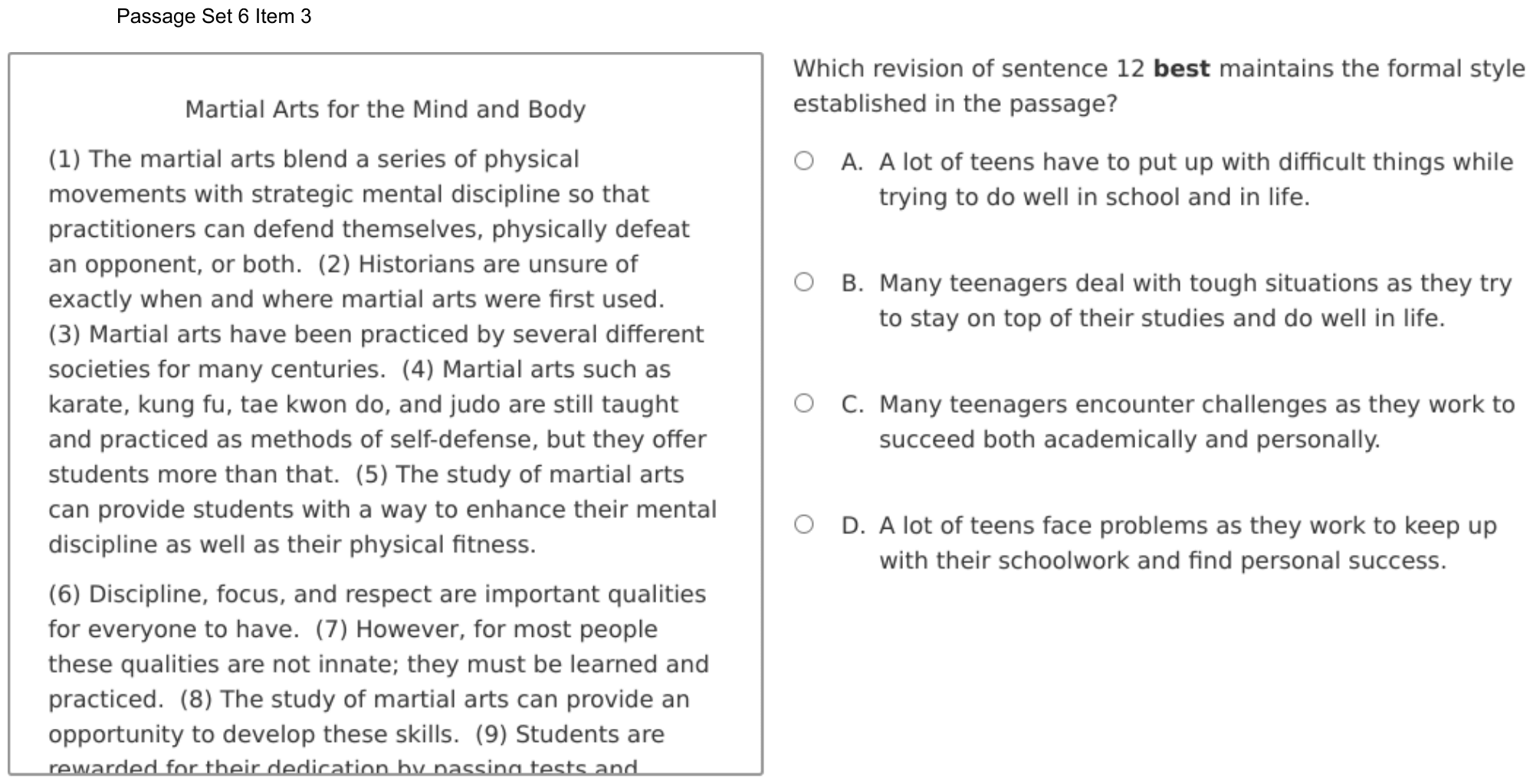
Question 14 of 57
2022 Test A English, question 14Uses the passage above: “Martial Arts for the Mind and Body”.
Question
Which transitional phrase should be added to the beginning of sentence 17?
- AOver time,
- BIn fact,
- CEven so,
- DFor instance,
Show the answer
Correct answer: A
The question asks for the transitional phrase that should be added to the beginning of sentence 17.
A. CORRECT. This option is correct because it best shows the chronological progression between the ideas in sentence 16—progressing through levels of achievement “requires students to take responsibility and be accountable for achieving set goals”—and the ideas in sentence 17—“students gain confidence and experience companionship with other students who are progressing through the ranks.” The transitional phrase “over time” shows the gradual nature of the relationship between the cause in sentence 16 and the effect in sentence 17.
B. Incorrect. Though the ideas in sentences 16 and 17 are related, “in fact” does not show the correct relationship between the ideas. The transitional phrase “in fact” emphasizes an idea by giving a detail or example of greater intensity, but the ideas in sentence 16—progressing through levels “requires students to take responsibility and be accountable for achieving set goals”—and the ideas in sentence 17—“students gain confidence and experience companionship with other students who are progressing through the ranks”—are related by cause and effect rather than by (degree of) intensity.
C. Incorrect. The transitional phrase “even so” is used to connect opposing ideas, but the ideas in sentence 16—progressing through levels “requires students to take responsibility and be accountable for achieving set goals”—do not contrast with the ideas in sentence 17—“students gain confidence and experience companionship with other students who are progressing through the ranks.”
D. Incorrect. Although the transitional phrase “for instance” connects an idea with a related example, it does not show the cause-and-effect relationship between the ideas in sentence 16—progressing through levels “requires students to take responsibility and be accountable for achieving set goals”—and the ideas in sentence 17—“students gain confidence and experience companionship with other students who are progressing through the ranks.”
Question analysis
This transition question asks which phrase should begin sentence 17 of the martial arts passage, which says students gain confidence and companionship with others progressing through the ranks. Students must work out how it relates to sentences 15 and 16, on mastering harder techniques and meeting set goals, because all four phrases are common openers that sound natural.
- NYS standards
- 7W2d transitions in informative writing
- Grade level
- Grade 7 reading and task
- Compared with grade 7
- At grade 7 Choosing a transition that fits the link between sentences is routine grade 7 writing work. The sentences are short and plain, but more than one phrase sounds acceptable on a first reading, so careful but typical reasoning is needed.
- Estimated difficulty
- Moderate: several steps, or a close reading with one strong distractor.
- Thinking it demands
- Depth of knowledge 2, skills and concepts · mainly evaluate
- What makes it hard
- How sentences fit together moderate
- Reading between the lines minor
- Evidence
- Answered from one paragraph or stanza
- Reading level
- Passage: about grade 11, 402 words; question and choices: about grade 3, 19 words.
- Corrected from the DOE handbook
- A grammar slip in the explanation was corrected.
- Students, last 30 days
- Not enough answers yet to show (it takes 10).
Why it is hard, traps and wrong answers (shows the answer)
Why it is hard
All four phrases are common transitions, and “In fact” in particular sounds natural in front of almost any sentence that adds a point. The question rewards naming the link first: sentence 17 describes what students gain as they move up, a result that comes with time, not a stronger restatement, a contrast or an example. Students who read sentences 15 to 17 as one progression find the time phrase; those who test each phrase by sound tend to stop at the emphatic one.
How sentences fit together moderate Working it out
Sentence 16 says moving up the levels makes students responsible for “achieving set goals”; sentence 17 gives what they gain while “progressing through the ranks,” a result that builds up gradually. (Halliday & Hasan, 1976)
Reading between the lines minor Working it out
No word in either sentence says time passes or that one thing causes another, so students must infer that confidence and companionship come from the effort described in sentences 15 and 16. (Graesser, Singer & Trabasso, 1994; Kintsch, 1998)
Strategy: Restate sentences 16 and 17 in your own words and name the link between them, such as example, contrast, emphasis or time, before trying each phrase in front of sentence 17.
Traps
- Wrong transition: A connecting word or phrase that signals the wrong relationship, such as contrast where the idea continues.
The wrong answers, classified
B Wrong transition (Halliday & Hasan, 1976)
Hears “In fact” as a natural way to add a point, but sentence 17 does not restate sentence 16 more strongly; it names what follows from meeting goals.
C Wrong transition (Halliday & Hasan, 1976)
Sets the hard work of sentences 15 and 16 against the rewards of sentence 17 and calls it a contrast, though gaining confidence follows from that work rather than despite it.
D Wrong transition (Halliday & Hasan, 1976)
Takes sentence 17 as an example of sentence 16, but confidence and companionship are results of taking responsibility for goals, not instances of it.
What was corrected from the DOE handbook, and why
- Explanation: The DOE’s explanation of Option C says “the ideas in sentence 16 … does not contrast with the ideas in sentence 17.” The subject is “ideas,” so the site now says “do not contrast.”
Working it out, step by step
Figure out what the question asks
This asks for a transition to start sentence 17. A transition is a word or phrase that shows how two ideas connect. First figure out the link between sentences 16 and 17. Then pick the phrase that names it.
Read sentences 15 to 17
Sentence 15 says moving up “involves mastering more physically demanding techniques.” Sentence 16 says, “It requires students to take responsibility and be accountable for achieving set goals.” Being accountable means you must answer for your own results. Sentence 17 says, “Students gain confidence and experience companionship with other students who are progressing through the ranks.” Companionship means friendship.
Name the link
Confidence and friendship don’t come in one day. They grow as students keep working and moving up the ranks. So sentence 17 is a result that builds slowly. A time phrase fits. For example: I practiced piano every day. Over time, I could play the whole song.
Check each choice
- A is right. “Over time” shows the rewards grow as students keep working.
- B is wrong. “In fact” adds a stronger version of the same point. Sentence 17 makes a new point.
- C is wrong. “Even so” means in spite of that. Confidence comes because of hard work, not in spite of it.
- D is wrong. “For instance” starts an example. Confidence is a result of taking responsibility, not an example of it.
Watch out: “In fact” sounds natural in front of almost any sentence. Name the link before you test the phrases by sound.
Choose the answer
With the phrase added, sentence 17 begins Over time, students gain confidence. So the answer is A, “Over time,” added to the beginning of sentence 17.
Why this answer and not the closest wrong one
B is the closest wrong answer, since “In fact” is a common way to add a point. But “In fact” signals a stronger restatement. Sentence 17 doesn’t restate sentence 16. It tells what students gain as they keep moving up. That gain builds slowly, so “Over time” fits best.
More questions like this
The original DOE question
Question 15 of 57
2022 Test A English, question 15Uses the passage above: “Martial Arts for the Mind and Body”.
Question
Which sentence would best follow and support sentence 18?
- AAdult students gain discipline, focus, self-control, and respect, which are qualities that help them advance in their careers.
- BMany adults initially train in a martial art simply to get exercise without realizing that the training also helps develop other skills.
- CThe exercise involved in training helps people strengthen their heart, boost endurance, improve balance, and develop muscle tone.
- DPeople who commit to training in the martial arts are usually concerned about improving their overall physical health.
Show the answer
Correct answer: C
The question asks for the sentence that would best follow and support sentence 18.
A. Incorrect. Though the idea of advancing one’s career is certainly appealing for adults, this benefit is not directly tied to “health and fitness” and, therefore, does not support sentence 18.
B. Incorrect. While the passage does discuss potential benefits related to discipline, focus, and confidence (sentences 6 and 11), sentence 18 is solely related to health and fitness benefits and should not be followed by a description of “other skills.”
C. CORRECT. This option is correct because sentence 18 conveys that the greatest benefit of practicing martial arts is “health and fitness,” and the sentence illustrates some specific ways that martial arts training helps improve physical fitness—“strengthen their heart, boost endurance, improve balance, and develop muscle tone.”
D. Incorrect. Some readers may choose this option because sentence 5, sentence 15, and sentence 18 discuss the physical aspects of practicing martial arts, but the idea that people who practice martial arts are concerned about their overall health does not provide further details about the connection between training and health.
Question analysis
This supporting-details question asks which sentence would best follow and support sentence 18 of the martial arts passage, which says adults gain many of the same benefits as younger students and names the greatest of them. Every choice is about adults or training, so students must match the exact point of sentence 18 rather than its general subject.
- NYS standards
- 7W2b developing a topic
- Grade level
- Grade 7 reading and task
- Compared with grade 7
- At grade 7 Adding a detail that supports a given sentence is a regular grade 7 writing task. Sentence 18 names its focus plainly and its paragraph is only two sentences long, so the demand is typical, though two choices stay close to the topic.
- Estimated difficulty
- Straightforward: two steps or one careful reading.
- Thinking it demands
- Depth of knowledge 2, skills and concepts · mainly evaluate
- What makes it hard
- How sentences fit together moderate
- A very close wrong answer minor
- Evidence
- Answered from one paragraph or stanza
- Reading level
- Passage: about grade 11, 402 words; question and choices: about grade 11, 84 words.
- Corrected from the DOE handbook
- The DOE printed this question’s explanation after a different question; the site matches the question with its own explanation.
- Students, last 30 days
- Not enough answers yet to show (it takes 10).
Why it is hard, traps and wrong answers (shows the answer)
Why it is hard
Sentence 18 states its focus plainly, so the question mostly tests whether students hold to it. Two choices drift back to the mental side of the passage, discipline, focus and other skills, which paragraphs 2 and 3 have already covered. The closest wrong answer stays on physical health but describes the people who train, so it adds nothing about how training improves fitness; the key is the only one to list effects on the body.
How sentences fit together moderate Working it out
Sentence 18 names one benefit, “perhaps the greatest of these is health and fitness,” so the next sentence must give details of that benefit, not of the mental ones the passage covered earlier. (Halliday & Hasan, 1976)
A very close wrong answer minor Choosing the answer
The choice about health-minded trainees and the key both concern training and physical health; the key says what the exercise does for the body, the other only what trainees care about. (Embretson & Wetzel, 1987; Gorin & Embretson, 2006; Ascalon et al., 2007)
Strategy: Reread sentence 18 and note which benefit it singles out, then ask of each choice whether it gives specific details about that benefit or shifts to another one.
Traps
- Off the point: Adds or keeps something that does not support the paragraph's or the passage's focus, or an introduction or conclusion that misses the main point.
The wrong answers, classified
A Off the point (Halliday & Hasan, 1976)
Lists discipline, focus, self-control and respect, qualities from paragraph 2, and adds careers, but sentence 18 singles out health and fitness for adults.
B Off the point (Halliday & Hasan, 1976)
Starts with adults training “to get exercise,” which sounds on topic, but its point is the other skills they gain without realizing it, a turn away from fitness.
D Off the point (Halliday & Hasan, 1976)
Stays on physical health but says what trainees care about, not what training does for them, so it gives no detail about the benefit sentence 18 names.
What was corrected from the DOE handbook, and why
- Explanation: In the DOE’s explanations appendix, the explanation printed after this question belongs to question 40 (“the concluding sentence that best replaces sentence 23 and supports the topic presented in the passage”) and marks B correct, and this question’s explanation (“the sentence that would best follow and support sentence 18”) is printed after question 40, marking C correct. Read page by page, the appendix gives this question the answer B. The site gives the question the explanation that restates it, and the answer follows that explanation: C, because sentence 18 names health and fitness as the greatest benefit for adults, and Option C gives specific ways that training improves fitness.
Working it out, step by step
Figure out what the question asks
This asks which sentence should come right after sentence 18 and support it. To support a sentence is to give details that back it up. So first find what sentence 18 is about.
Read sentence 18
Sentence 18 says adults “can experience many of the same benefits that younger people do, but perhaps the greatest of these is health and fitness.” A benefit is a good result. So the next sentence should give details about health and fitness. It should show how training helps the body.
Name the rule
A supporting sentence stays on the same point and adds details. For example: Dogs make good pets. They are loyal, playful and easy to train. The second sentence gives details about the first. A sentence about cats would drift off the point.
Check each choice
- A is wrong. Discipline, focus and respect are qualities of the mind. Careers are off the point too.
- B is wrong. It starts with exercise, then turns to “other skills.”
- C is right. It names four ways training helps the body. Endurance means being able to keep going for a long time. Muscle tone means firm, strong muscles.
- D is wrong. It tells what people who train care about, not what training does for them.
Watch out: D stays on physical health, so it looks on topic. But it gives no details about how training improves fitness.
Choose the answer
Only C gives details of the health and fitness benefit. So the answer is C, “The exercise involved in training helps people strengthen their heart, boost endurance, improve balance, and develop muscle tone.”
Why this answer and not the closest wrong one
D is the closest wrong answer, because it also talks about physical health. But it describes the people who train, not the benefit. Sentence 18 names health and fitness as the greatest benefit. C backs that up with real effects on the body: a stronger heart, endurance, balance and muscle tone.
More questions like this
The original DOE question
Question 16 of 57
2022 Test A English, question 16Uses the passage above: “Martial Arts for the Mind and Body”.
Question
Which concluding sentence should replace sentence 23 to best support the topic presented in the passage?
- AWith so many ways to begin studying martial arts, people can easily discover how the skills needed to progress in rank may help them in life.
- BBy taking advantage of opportunities to practice martial arts, people can experience the satisfaction of achieving goals while also improving themselves.
- CBecause people are eager to reap the mental and physical benefits of studying martial arts, enrollment in martial arts courses has increased.
- DWhile taking martial arts classes can improve health for both young people and adults, the effects are clearly more immediate for adults.
Show the answer
Correct answer: B
The question asks for the concluding sentence that best replaces sentence 23 and supports the topic presented in the passage.
A. Incorrect. The phrase “the skills needed to progress in rank” is vague, and progressing in rank is not related to the overall topic of the passage, which is the benefits of studying martial arts. The topic of the passage is not the “many ways to begin studying martial arts” or how “people can easily discover” the benefits of martial arts.
B. CORRECT. This option is correct because it best supports the topic of the passage—the benefits of studying martial arts—by stating two reasons why people should study martial arts: to “experience the satisfaction of achieving goals while also improving themselves.”
C. Incorrect. Some readers may choose this option because it refers to the benefits of martial arts, but the word “because” and the detail that “enrollment in martial arts courses has increased” make this sentence unrelated to the overall topic of the passage, which is about the benefits of studying martial arts, not the number of people who participate.
D. Incorrect. Although the benefits of studying martial arts are described for both teens (in the third paragraph) and adults (in the fourth paragraph), the topic of the passage is the overall benefits of studying martial arts, which include mental discipline (discussed in the first, second, and third paragraphs) in addition to health benefits. Furthermore, the passage does not compare the health effects of studying martial arts across age groups.
Question analysis
This conclusion question asks which sentence should replace sentence 23, the bare closing line “People should study martial arts,” to best support the topic of the passage. Students must keep all five paragraphs in view, from mental discipline to fitness to ways of getting started, because every choice sounds like a reasonable final line when read on its own.
- NYS standards
- 7W2e concluding informative writing
- Grade level
- Grade 8 reading and task
- Compared with grade 7
- Above grade 7 Grade 7 writers choose conclusions that follow from a passage’s topic. This passage covers mental and physical benefits for different ages, and each long choice picks up a real thread, so judging the best fit takes more than typical grade 7 work.
- Estimated difficulty
- Hard: combines ideas, needs a plan, and has more than one tempting wrong answer.
- Thinking it demands
- Depth of knowledge 2, skills and concepts · mainly evaluate
- What makes it hard
- A very close wrong answer moderate
- Evidence in several places moderate
- A lot to read minor
- Evidence
- Answered from the whole text
- Reading level
- Passage: about grade 11, 402 words; question and choices: about grade 12, 106 words.
- Corrected from the DOE handbook
- The DOE printed this question’s explanation after a different question; the site matches the question with its own explanation.
- Students, last 30 days
- Not enough answers yet to show (it takes 10).
Why it is hard, traps and wrong answers (shows the answer)
Why it is hard
Every ending borrows something real from the passage: ways to begin, ranks, mental and physical benefits, or adults’ quick results. The work is deciding what the whole passage is about, the benefits of martial arts for mind and body, and then noticing which ending adds a new claim or shrinks the topic. The rank-based ending is hardest to reject because it is shaped like the key and promises help “in life,” but its focus is how easily people discover rank skills.
A very close wrong answer moderate Choosing the answer
The rank choice is built like the key, a phrase about ways or chances to train followed by what people gain; it differs in resting on the vague “skills needed to progress in rank.” (Embretson & Wetzel, 1987; Gorin & Embretson, 2006; Ascalon et al., 2007)
Evidence in several places moderate Working it out
The topic is pieced together from all five paragraphs, from the opening’s mind-and-body claim through teens, adults’ fitness and ways to learn, so a fitting ending must cover both kinds of benefit. (Kirsch & Mosenthal, 1990; Gorin & Embretson, 2006)
A lot to read minor Understanding the question
Each choice is a two-part sentence of 21 to 26 words, and each picks up a real thread of the passage, so all four must be held against the topic. (Kintsch, 1998; Gorin & Embretson, 2006; Freedle & Kostin, 1993)
Strategy: State the passage’s topic in a few words using all five paragraphs, then test each ending: does it sum up that topic, or does it narrow it or add a new claim?
Traps
- Off the point: Adds or keeps something that does not support the paragraph's or the passage's focus, or an introduction or conclusion that misses the main point.
- Too narrow: A single detail offered as the central idea or a summary, or a summary that keeps minor details and leaves out an essential part.
The wrong answers, classified
A Too narrow (King et al., 2004)
Follows on from the last paragraph’s many ways to start, but rests the ending on vague “skills needed to progress in rank,” one thread of paragraphs 2 and 3, not the benefits overall.
C Off the point (Halliday & Hasan, 1976)
Names the passage’s “mental and physical benefits,” which fits, but ends on rising enrollment, a claim about numbers of students that the passage never discusses.
D Half right (King et al., 2004; Thissen, Steinberg & Fitzpatrick, 1989)
Rightly says training can improve health for young people and adults, but adds that adults clearly benefit sooner, a comparison the passage never makes, and drops the mental benefits.
What was corrected from the DOE handbook, and why
- Explanation: In the DOE’s explanations appendix, the explanation printed after this question belongs to question 39 (“the sentence that would best follow and support sentence 18”) and marks C correct, and this question’s explanation (“the concluding sentence that best replaces sentence 23 and supports the topic presented in the passage”) is printed after question 39, marking B correct. Read page by page, the appendix gives this question the answer C. The site gives the question the explanation that restates it, and the answer follows that explanation: B, because it sums up the passage’s topic, the benefits of studying martial arts.
Working it out, step by step
Figure out what the question asks
This asks for a better last sentence. A good concluding sentence sums up the topic of the whole passage. Sentence 23, “People should study martial arts,” is short and plain. It doesn’t remind the reader why.
Find the passage’s topic
Sentence 5 states the topic. Martial arts can help students “enhance their mental discipline as well as their physical fitness.” Enhance means improve. Paragraph 2 covers discipline, focus and respect. Paragraph 3 covers teens and goals. Paragraph 4 covers adults and fitness. Paragraph 5 lists ways to start. So the topic is how martial arts help both mind and body.
Name the rule
A conclusion should sum up the main point. It should not shrink the point or add a brand-new claim. For example, after a report on why sleep matters, a good ending is Getting enough sleep helps both your body and your mind. A poor one is More people buy pillows now.
Check each choice
- A is wrong. It rests on vague “skills needed to progress in rank,” one small part of the passage.
- B is right. “Opportunities to practice” follows paragraph 5. “Achieving goals” and “improving themselves” sum up the benefits.
- C is wrong. Enrollment is the number of people who sign up. The passage never says it has gone up.
- D is wrong. The passage never says adults see results sooner than young people. D also leaves out the benefits to the mind.
Watch out: A is built like B and promises help “in life.” But it shrinks the topic to rank skills.
Choose the answer
B sums up what the whole passage says martial arts offer. So the answer is B, “By taking advantage of opportunities to practice martial arts, people can experience the satisfaction of achieving goals while also improving themselves.”
Why this answer and not the closest wrong one
A is the closest wrong answer. Like B, it starts with ways to begin and ends with what people gain. But its gain is vague “skills needed to progress in rank.” That is only one thread of the passage. B sums up the whole topic: reaching goals and improving yourself.
More questions like this
The original DOE question
Question 17 of 57
2022 Test A English, question 17Passage Excerpt from “Scribe Like an Egyptian”
Excerpt from “Scribe Like an Egyptian”
by Hilary Wilson
In ancient Egypt, literacy was the key to success. However, contrary to popular belief, not all Egyptian scribes understood hieroglyphs. Many relied instead on the simpler hieratic script for the multitude of everyday documents generated by the Egyptian bureaucracy.
Hieroglyphs—“the Words of God”—compose a writing system with more than 1,000 distinct characters, the meanings of which were lost for 1,500 years before they were deciphered by Jean-François Champollion in 1822. Including both ideograms (which convey a whole word or idea, either concrete or abstract, in a single sign) and phonograms (representing either an alphabetic sound or a group of consonants), [the writing system] was used in formal inscriptions on tomb and temple walls as well as on elaborate funerary papyri. For everyday purposes, however, scribes used a shorthand version of the hieroglyphic script known as hieratic, which was quicker to write and more economical of space. The two writings existed side by side for at least 2,500 years.
Scraps of ancient hieratic writing, mostly penned by student scribes on limestone flakes called ostraca, suggest that no matter how humble his origins, an educated Egyptian could achieve almost anything. Horemheb (d.1292 B.C.) is a good example. Born of middle-ranking parents, his scribal training led to an army career. From Scribe of Recruits, during the reign of Akhenaten (1353–1336 B.C.), Horemheb rose through the military ranks and, by the rule of Tutankhamun (1332–1323 B.C.), he was commander in chief of the Egyptian forces. As a close adviser of the young Pharaoh, Horemheb was appointed “Deputy of the King throughout the Two Lands,” and might have expected to succeed to the throne should the king die childless. He had to wait a few years, but eventually Horemheb achieved the pinnacle of his career by becoming the last king of the 18th Dynasty, making his mark by instituting dramatic reforms to the organisation of the army, the judiciary and administration in general. The lasting success of these changes owed much to his scribal background. . . .
But education was not available to all. Government departments and major temples supported schools, where boys commenced their training at six or seven, sometimes earlier. To these boarding establishments . . . family or household servants delivered the students’ food and drink rations daily for several years, during which time the student was not contributing to the family’s income. Boys from poorer families could only hope to be educated with support from a wealthier relative or patron, or through apprenticeship to an older scribe, perhaps the local clerk or land agent, who would teach them the basics of the scribe’s craft. This limited the scope for employment but such “on the job” training allowed apprentices to help out at home while learning. . . .
Scribal education began with the elementary principles of the hieratic script. The lowliest scribes, who trained for just five or six years, probably learned only the rudiments of the hieroglyphic script. Students were set exemplar documents and extracts from popular texts to copy, to practice their hieratic handwriting on basic-format letters, reports and contracts, while absorbing the good advice contained in the texts. Surviving examples of copy-work sometimes include tutors’ corrections added in red. Some significant Egyptian literary works survive almost exclusively from student copies.
A schoolboy “dictionary” of hieroglyphs with their hieratic equivalents shows that a knowledge of more than 450 signs was required for everyday writing purposes. Lessons in record-keeping and filing and labelling enabled any half-competent scribe to perform that most essential of all scribal functions: the making and updating of lists. For professions such as those of government official, priest or lawyer, a scribe would train for several more years, increasing his vocabulary to perhaps a thousand or more signs. Those with the best handwriting or drawing skills might follow the craft of creating beautifully illustrated copies of funerary texts, commonly called Books of the Dead. Others could become draughtsmen, artists or architects. Doctors compiled their own collections of medication recipes, treatments and associated incantations, many copied from texts found in the House of Life, the temple library. Lawyers had to be familiar with the corpus of civil and religious laws and precedents found in the official records, which were administered by archivists. Egypt’s bureaucratic society depended on the skills of an army of scribes of all ranks from filing clerk to tax assessor. For young Egyptians, “be a scribe” was the best of career advice.
From “Scribe Like an Egyptian” by Hilary Wilson from HISTORY TODAY, August 8, 2019. Copyright © 2019 by History Today Ltd. Company.
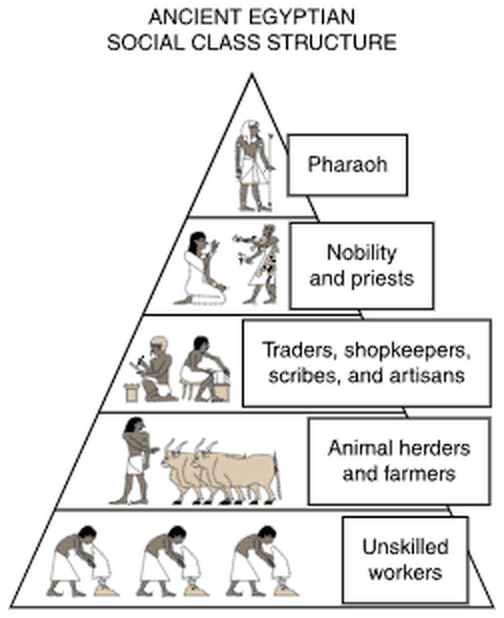
bureaucracy: an administrative staff of government officials
funerary papyri: a sheet or scroll of papyrus containing religious images and hieroglyphs meant to help the deceased be reborn in the afterlife
rudiments: basics
schoolboy: slang that refers to materials used during the course of receiving an education
draughtsmen: people who draw plans of machinery or structures
corpus: a collection of writings
Question
Which sentence from the excerpt best supports the idea that there were different levels of education for a scribe?
- A“However, contrary to popular belief, not all Egyptian scribes understood hieroglyphs.” (paragraph 1)
- B“For everyday purposes, however, scribes used a shorthand version of the hieroglyphic script known as hieratic, which was quicker to write and more economical of space.” (paragraph 2)
- C“This limited the scope for employment but such ‘on the job’ training allowed apprentices to help out at home while learning.” (paragraph 4)
- D“For professions such as those of government official, priest or lawyer, a scribe would train for several more years, increasing his vocabulary to perhaps a thousand or more signs.” (paragraph 6)
Show the answer
Correct answer: D
The question asks for a sentence from the excerpt that best supports the idea that different levels of education were available to scribes.
A. Incorrect. The sentence from paragraph 1 provides evidence that Egyptian scribes used two different forms of writing, but it does not address the topic of education or the different levels of education that were available to scribes.
B. Incorrect. The advantages and purposes of hieratic script are described in this sentence from paragraph 2, but this explanation of the advantages and purposes does not suggest that there were different levels of education for scribes.
C. Incorrect. The fact that scribes could learn their trade through apprenticeships as discussed in this sentence from paragraph 4 does provide evidence that another method of learning to be a scribe was possible, but this process was for a limited entry into becoming a scribe, not the continued education scribes would need in order to work in specific areas.
D. CORRECT. By explaining that certain professions required additional years of training, this sentence from paragraph 6 supports the idea that different levels of education existed for scribes.
Question analysis
This evidence question on Hilary Wilson’s “Scribe Like an Egyptian,” a magazine article about how ancient Egyptian scribes learned their trade, asks which quoted sentence best supports the idea that scribes received different levels of education. The four sentences come from paragraphs 1, 2, 4 and 6, and more than one seems to touch on the idea, so close reading of each decides it.
- Grade level
- Grade 8 reading and task
- Compared with grade 7
- Above grade 7 Choosing the sentence that best supports an idea is routine grade 7 evidence work. Here several quotations touch on ways scribes differed, and the article’s dense, technical wording makes those differences harder to sort than usual.
- Estimated difficulty
- Hard: combines ideas, needs a plan, and has more than one tempting wrong answer.
- Thinking it demands
- Depth of knowledge 3, strategic thinking · mainly evaluate
- What makes it hard
- Reading between the lines moderate
- Every choice must be checked moderate
- Hard words minor
- Evidence
- Answered from several paragraphs or stanzas
- Reading level
- Passage: about grade 12, 810 words; question and choices: about grade 13, 110 words.
- Students, last 30 days
- Not enough answers yet to show (it takes 10).
Why it is hard, traps and wrong answers (shows the answer)
Why it is hard
Two of the wrong sentences are not off topic: one says not all scribes understood hieroglyphs, the other that apprenticeship narrowed a scribe’s job prospects, and both imply that scribes differed. The question rewards asking what the idea actually claims, that schooling itself came in stages, and only the sentence about professions that required more years of training says so outright. Students who stop at the first sentence suggesting a difference lose the point.
Reading between the lines moderate Working it out
The right sentence never says “levels”; students must see that training “for several more years” for official, priest or lawyer posts means a higher tier of schooling than the basic course. (Graesser, Singer & Trabasso, 1994; Kintsch, 1998)
Every choice must be checked moderate Choosing the answer
Two other quotations also hint at differences among scribes, paragraph 1’s “not all Egyptian scribes understood hieroglyphs” and paragraph 4’s “limited the scope for employment,” so each must be weighed, not just scanned. (Embretson & Wetzel, 1987)
Hard words minor Understanding the question
Terms such as “hieratic,” “economical of space” and “scope for employment” slow the reading of the quotations, and the shorthand sentence is hard to dismiss until hieratic is understood as a script. (Perfetti, 2007; Freedle & Kostin, 1993)
Strategy: Ask what a sentence would have to say to prove that scribal education came in levels, then test each quotation against that and prefer a direct statement over a hint.
Traps
- Supports only part of the claim: In a question about evidence: a line that backs one half of the claim but not the other, or a related point rather than the claim itself.
- True but not the answer: A choice says something accurate about the text that does not answer this question.
The wrong answers, classified
A Supports only part of the claim (King et al., 2004; Thissen, Steinberg & Fitzpatrick, 1989)
Reads “not all Egyptian scribes understood hieroglyphs” as proof of different levels of schooling, but it reports a difference in knowledge without saying anything about how scribes were taught.
B True but not the answer (King et al., 2004; Embretson & Wetzel, 1987)
Picks the sentence on hieratic as a faster everyday shorthand, which describes how scribes wrote, not how long or how far any of them studied.
C Supports only part of the claim (King et al., 2004; Thissen, Steinberg & Fitzpatrick, 1989)
Sees that on-the-job training “limited the scope for employment” and takes it for a lower level of education, though the sentence contrasts two routes into the trade, not stages of study.
Working it out, step by step
Figure out what the question asks
This asks for the sentence that best supports one idea: scribes could get “different levels of education.” A level is a stage. Some scribes studied for a short time, and others went on to study more. You need a sentence that shows a difference in schooling, not just any difference between scribes.
Find what each level looked like
Paragraphs 5 and 6 describe the training. Paragraph 5 says the lowest scribes studied for only five or six years. They learned just the basics of hieroglyphs. Paragraph 6 says that more than 450 signs were needed for everyday writing. Then choice D adds a higher level: “For professions such as those of government official, priest or lawyer, a scribe would train for several more years, increasing his vocabulary to perhaps a thousand or more signs.”
Work out what choice D means
A profession is a job that needs special training. Choice D says some jobs needed more years of study and more signs, perhaps over a thousand. A basic scribe stopped sooner and knew fewer signs. So schooling came in stages: a basic course, and then more years for the top jobs. That is what the question means by levels of education.
Check each choice
- A does not fit. It says not all scribes understood hieroglyphs. That is a difference in what scribes knew. It says nothing about how they were taught.
- B does not fit. It explains hieratic, a faster shorthand way of writing. That is about writing, not schooling.
- C does not fit. It is about apprentices, who learned on the job from an older scribe. That is a different way into the work, not a higher or lower stage of study.
- D fits. Some jobs needed several more years of training.
Watch out: A is tempting because it shows that scribes were not all alike. But it never mentions school.
Choose the answer
Only one sentence shows some scribes studying for years after the basic course. So the answer is D.
Why this answer and not the closest wrong one
A is the closest wrong choice. It shows that some scribes knew hieroglyphs and others did not. But it doesn’t say why, or how long anyone studied. D says plainly that some jobs needed several more years of training. That is a level of education above the basic one.
More questions like this
The original DOE question
The passage “Excerpt from “Scribe Like an Egyptian”” as shown on the test
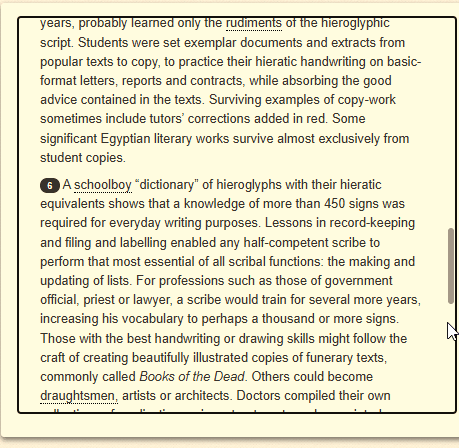
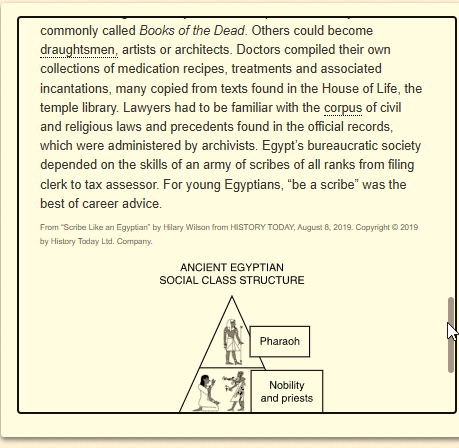
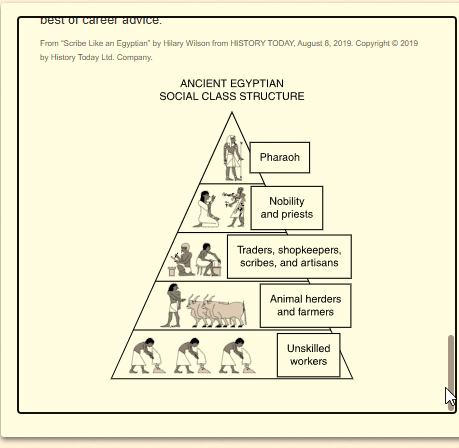
Question 18 of 57
2022 Test A English, question 18Uses the passage above: “Excerpt from “Scribe Like an Egyptian””.
Question
Read this sentence from paragraph 2.
Including both ideograms (which convey a whole word or idea, either concrete or abstract, in a single sign) and phonograms (representing either an alphabetic sound or a group of consonants), [the writing system] was used in formal inscriptions on tomb and temple walls as well as on elaborate funerary papyri.
The author’s purpose for including the sentence is to
- Aexplain that hieroglyphs were reserved for royal and religious purposes.
- Bdemonstrate the methods experts use to interpret hieroglyphs.
- Cclarify the significance of hieroglyphs in language and literature.
- Ddescribe the basic features of hieroglyphs and how they were typically used.
Show the answer
Correct answer: D
The question asks for an explanation of the author’s purpose for including a sentence in paragraph 2 that describes the two types of hieroglyphs and the main uses of this particular writing system.
A. Incorrect. The sentence explains that hieroglyphs were used for formal inscriptions, but it does not suggest that these inscriptions were limited to royal and religious contexts.
B. Incorrect. The sentence describes the two basic types of hieroglyphs, ideograms and phonograms, but it does not address how experts interpret the ancient writing system. A sentence earlier in the paragraph explains that the hieroglyphs were deciphered by Champollion, but it does not explain how he deciphered them.
C. Incorrect. Although the sentence explains that the hieroglyphs were typically used for formal inscriptions, it does not provide an explanation of the significance or importance of hieroglyphs in the Egyptian language.
D. CORRECT. The sentence explains that hieroglyphs included both phonograms and ideograms that were used in formal inscriptions and funeral papyri; therefore, this sentence achieves the purpose of describing the basic features of hieroglyphs as conveying either words and ideas or sounds, in addition to explaining the common uses for the writing system.
Question analysis
This author’s-purpose question quotes a long, technical sentence from paragraph 2 of “Scribe Like an Egyptian” about the ancient Egyptian hieroglyphic writing system, and asks why the author includes it. Students must make sense of its specialist vocabulary before they can say what the sentence contributes to the paragraph and to the article.
- Grade level
- Grade 8 reading and task
- Compared with grade 7
- At grade 7 Explaining why an author includes a sentence is regular grade 7 work. This one is long, with definitions in parentheses and a bracketed insert, but it is quoted in full, so the task stays within one sentence.
- Estimated difficulty
- Straightforward: two steps or one careful reading.
- Thinking it demands
- Depth of knowledge 2, skills and concepts · mainly analyze
- What makes it hard
- Complex sentences moderate
- Hard words minor
- How, not what minor
- Evidence
- Answered from one sentence or line
- Reading level
- Passage: about grade 12, 810 words; question and choices: about grade 11, 103 words.
- Students, last 30 days
- Not enough answers yet to show (it takes 10).
Why it is hard, traps and wrong answers (shows the answer)
Why it is hard
Once the parentheses are set aside, the sentence says two simple things: what kinds of signs hieroglyphs were, and where they appeared. The wrong purposes each go one step beyond that, turning tombs and temples into an exclusive royal and religious use, borrowing Champollion’s deciphering from the sentence before, or claiming a significance the sentence never weighs. Students who untangle the syntax first find the matching purpose quickly.
Complex sentences moderate Understanding the question
The quoted sentence runs fifty words, two parenthetical definitions come before the verb, and its subject, the bracketed “[the writing system],” appears only after thirty words of description. (Abedi & Lord, 2001; Freedle & Kostin, 1993; Messick, 1989)
Hard words minor Understanding the question
“Ideograms,” “phonograms” and “funerary papyri” are specialist terms; the parentheses define the first two, but students who stall on them may not reach the sentence’s plain point about where the signs were used. (Perfetti, 2007; Freedle & Kostin, 1993)
How, not what minor Working it out
The stem asks why the author includes the sentence, so students must match the job it does in paragraph 2 to a purpose, and only one purpose stays within what the sentence actually covers. (Anderson & Krathwohl, 2001)
Strategy: Restate the quoted sentence in plain words, setting the parentheses aside at first, then choose the purpose that fits everything the sentence says and nothing more.
Traps
- Reads too much in: A reasonable-sounding conclusion that goes further than the text allows.
- Wrong part of the text: A choice is true of another paragraph, stanza or speaker than the one asked about.
- Wrong purpose or structure: Names a purpose, structure or effect that the part does not serve, or describes what a part says when the question asks what it does.
The wrong answers, classified
A Reads too much in (Graesser, Singer & Trabasso, 1994)
Reads “formal inscriptions on tomb and temple walls” and “funerary papyri” as royal and religious only, though the sentence names where hieroglyphs usually appeared, not a rule reserving them.
B Wrong part of the text (Kirsch & Mosenthal, 1990)
Remembers that Champollion deciphered the signs, which the sentence before reports, and takes this sentence for an account of how experts read them, though it never mentions interpreting.
C Wrong purpose or structure (Anderson & Krathwohl, 2001)
Chooses an important-sounding purpose, the significance of hieroglyphs in language and literature, though the sentence never says why the script mattered or mentions any literature.
Working it out, step by step
Figure out what the question asks
This asks why the author put this sentence in paragraph 2. In other words, what job does the sentence do? First work out what the sentence says. Then pick the purpose that matches all of it and adds nothing extra.
Untangle the long sentence
The sentence is long, so set the parentheses aside at first. The main part says the writing system “was used in formal inscriptions on tomb and temple walls as well as on elaborate funerary papyri.” An inscription is writing carved or painted on something. Funerary means having to do with burials. Papyri are scrolls made from papyrus, a kind of early paper.
Read the parentheses
Now add back the two kinds of signs. Ideograms “convey a whole word or idea” in one sign. Phonograms stand for “either an alphabetic sound or a group of consonants.” Consonants are letter sounds like b, t and m. So one kind of hieroglyph shows a meaning, and the other shows a sound.
Sum up the sentence’s job
Put the two parts together. The sentence tells what hieroglyphs were made of: signs for ideas and signs for sounds. It also tells where people usually used them: on tombs, temples and burial scrolls. So its job is to describe what hieroglyphs were like and how they were used.
Check each choice
- A does not fit. The sentence says where hieroglyphs usually appeared. It never says they were reserved, or kept only, for kings and religion.
- B does not fit. The sentence before it says Champollion figured out the signs. This sentence never says how experts read them.
- C does not fit. The sentence never says why hieroglyphs mattered, and it never mentions literature.
- D fits. It names both parts: the basic features and the usual uses.
Watch out: Tombs and temples sound royal and religious, so A tempts. But “used in” is not the same as “reserved for.”
Choose the answer
The sentence describes the two kinds of signs and where they were usually used. So the answer is D.
Why this answer and not the closest wrong one
A is the closest wrong choice. Tombs and temples do suggest kings and religion. But the sentence only lists where hieroglyphs were used. It never says they were kept for those uses alone. D matches everything the sentence says and adds nothing it doesn’t.
More questions like this
The original DOE question
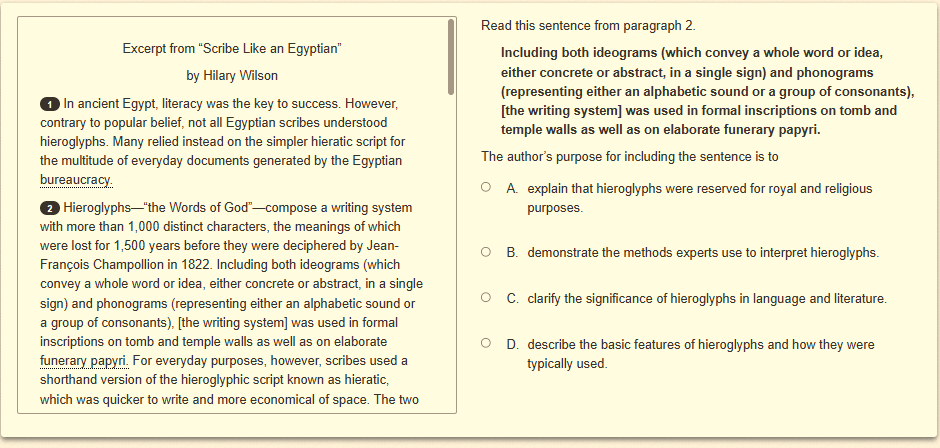
Question 19 of 57
2022 Test A English, question 19Uses the passage above: “Excerpt from “Scribe Like an Egyptian””.
Question
Which statement summarizes the process that schools used to train scribes?
- ABoys had to memorize around 450 hieratic signs. Once they had learned these, they were expected to copy literary texts that contained valuable lessons.
- BBoys spent at least five years learning hieratic signs, which they practiced by copying texts. During this period, they were also introduced to basic hieroglyphs.
- CBoys spent five or six years learning the basics of hieratic script. After this period, they could become apprentices and begin learning hieroglyphics.
- DBoys were taught two different scripts. They practiced both types by copying lists and eventually progressed to writing letters, reports, and contracts.
Show the answer
Correct answer: B
The question asks for the best summary of the process that schools used to train scribes.
A. Incorrect. This summary incorrectly explains that scribes were expected to learn 450 hieratic signs instead of 450 hieroglyphs along with their hieratic versions as explained in paragraph 6. In paragraph 5, the author explains that scribes copied texts as part of the process of learning the scripts rather than as practice after the signs had already been memorized.
B. CORRECT. Paragraph 5 explains that students began by learning hieratic script and studied for about five or six years by using “exemplar documents and extracts from popular texts to copy, to practice their hieratic handwriting.” The paragraph also explains that during this time, they learned only the basics of hieroglyphic script.
C. Incorrect. Although paragraph 5 does explain that the scribes spent five or six years learning hieratic script, it does not suggest that hieroglyphs were learned only during apprenticeships.
D. Incorrect. This summary correctly explains that scribes learned two types of scripts, but the second sentence of the summary is incorrect. In paragraph 5, the author explains that the students copied from exemplar texts, but the author clearly states that the purpose of this copy work was “to practice their hieratic handwriting” and does not suggest that the copy work was used to practice hieroglyphs. Paragraph 6 explains that scribes could make lists as part of their professional skills but does not suggest that copy work was used to help them learn this task. Paragraph 5 mentions letters, reports, and contracts as the formats students practiced on while copying, not as a later stage of their training.
Question analysis
This summary question on “Scribe Like an Egyptian” asks which statement sums up how ancient Egyptian schools trained young scribes. Each choice is a two-sentence summary that combines years of study, kinds of script and copying practice, so students must check every detail against what the article says about scribal education.
- Grade level
- Grade 8 reading and task
- Compared with grade 7
- Above grade 7 Summarizing a process is a grade 7 standard, but these four summaries are long, two-part and mostly accurate, and the details they mix up come from three different paragraphs, so judging them asks more than typical grade 7 work.
- Estimated difficulty
- Hard: combines ideas, needs a plan, and has more than one tempting wrong answer.
- Thinking it demands
- Depth of knowledge 2, skills and concepts · mainly understand
- What makes it hard
- A very close wrong answer moderate
- Evidence in several places moderate
- The right answer is reworded minor
- Evidence
- Answered from several paragraphs or stanzas
- Reading level
- Passage: about grade 12, 810 words; question and choices: about grade 7, 104 words.
- Corrected from the DOE handbook
- A detail in the explanation that misdescribes the excerpt was corrected.
- Students, last 30 days
- Not enough answers yet to show (it takes 10).
Why it is hard, traps and wrong answers (shows the answer)
Why it is hard
Every wrong summary opens with something true or nearly true, so a quick reading of first sentences cannot separate them. Most of the errors concern order: one makes copying follow memorizing, one turns apprenticeship into a later stage where hieroglyphs begin, and one makes the copied letters, reports and contracts a later step. Students who check the order of training against paragraph 5, not just the facts, find the only summary with nothing out of place.
A very close wrong answer moderate Choosing the answer
The apprenticeship summary repeats the right one’s opening, years of hieratic study, and parts from it on one phrase: hieroglyphs come “After this period” instead of “During this period.” (Embretson & Wetzel, 1987; Gorin & Embretson, 2006; Ascalon et al., 2007)
Evidence in several places moderate Working it out
The details sit in three paragraphs: the five or six years, the copying and the hieroglyph basics in paragraph 5, apprenticeship in paragraph 4, and the 450-sign dictionary and list-making in paragraph 6. (Kirsch & Mosenthal, 1990; Gorin & Embretson, 2006)
The right answer is reworded minor Choosing the answer
The right summary puts the text in new words, “at least five years” and “basic hieroglyphs,” while wrong ones repeat its own details: “five or six years,” the “450” signs, “letters, reports, and contracts.” (Freedle & Kostin, 1993; Kirsch & Mosenthal, 1990)
Strategy: Note what the article says students learned, for how long and by what method, then check both sentences of each summary against those notes; one wrong detail rules a summary out.
Traps
- Half right: One half of a two-part choice is right and the other is not.
- Twists what the text says: Uses the text's topic and ideas but changes what it says: who did it, how much, when, or why.
The wrong answers, classified
A Twists what the text says (King et al., 2004)
Takes paragraph 6’s 450 signs, hieroglyphs listed with their hieratic forms, as hieratic signs to memorize first, and makes copying come afterward, though copying was how students learned.
C Half right (King et al., 2004; Thissen, Steinberg & Fitzpatrick, 1989)
Gets the five or six years of hieratic right, then makes apprenticeship, the other route paragraph 4 offers poorer boys, a later stage where hieroglyphs are first taught.
D Half right (King et al., 2004; Thissen, Steinberg & Fitzpatrick, 1989)
Rightly says two scripts were taught, then claims students copied lists for both and only later wrote letters, reports and contracts, though paragraph 5 ties copying to hieratic and to those very formats.
What was corrected from the DOE handbook, and why
- Explanation: The DOE’s explanation of Option D ends: “Paragraph 6 explains that scribes could make lists and write letters as part of their professional skills but does not suggest that copy work was used to help them learn these tasks.” Paragraph 6 mentions the making and updating of lists, but not letters. Letters come up in paragraph 5, where students copy texts “to practice their hieratic handwriting” on basic-format letters, reports and contracts, so the excerpt does tie the copy work to letters. The site now says that paragraph 6 explains that scribes could make lists as part of their professional skills but does not suggest that copy work was used to help them learn this task, and that paragraph 5 mentions letters, reports, and contracts as the formats students practiced on while copying, not as a later stage of their training. Option D is still wrong, and the answer, B, is unchanged.
Working it out, step by step
Figure out what the question asks
This asks for the best summary of how schools trained scribes. A summary retells the main steps in a few words. Each choice has two sentences. Both must match the article, including the order of the steps. One wrong detail rules a choice out.
Find the training in paragraph 5
Paragraph 5 says training began with the basics of hieratic script. The lowest scribes studied for five or six years, and others studied longer. In that time they learned only the basics of hieroglyphs. Students were given “exemplar documents and extracts from popular texts to copy, to practice their hieratic handwriting.” Exemplar means model. Extracts are short pieces. So they learned by copying good examples.
Sort out paragraphs 4 and 6
Two other paragraphs hold details that look alike. Paragraph 4 describes apprenticeship. An apprentice learns on the job from a skilled worker. It was another way in for boys from poorer families, not a step after school. Paragraph 6 mentions a list of hieroglyphs with their hieratic forms. It says more than 450 signs were needed for everyday writing. It never says students memorized them before copying.
Check each choice
- A does not fit. The 450 signs were hieroglyphs paired with their hieratic forms. And copying was how students learned, not a step after memorizing.
- B fits. Students spent at least five years on hieratic, practiced by copying, and learned basic hieroglyphs along the way.
- C does not fit. Apprenticeship was a different route, not a later stage. Hieroglyphs were not saved for apprentices.
- D does not fit. The copying was to practice hieratic. Lists come up in paragraph 6 as a job skill, not as practice. Letters, reports and contracts were what students copied, not a later stage.
Choose the answer
Watch out: C starts out right, with five or six years of hieratic. Then it says hieroglyphs came “After this period” instead of during it. That one change makes it wrong.
Only B gets every detail and the order right. So the answer is B.
Why this answer and not the closest wrong one
C is the closest wrong choice. It gets the five or six years of hieratic right. But it says hieroglyphs came afterward, through apprenticeship. Paragraph 5 says students learned the basics of hieroglyphs during their schooling. Apprenticeship was a separate path for poorer boys. B says “During this period,” which matches.
More questions like this
The original DOE question
Question 20 of 57
2022 Test A English, question 20Uses the passage above: “Excerpt from “Scribe Like an Egyptian””.
Question
Which claim is best supported by the information presented in paragraphs 3 and 4?
- AEducation was difficult for the common citizens of Egypt to obtain.
- BOnce students began studying to become scribes, their future held more possibilities.
- CIf someone wanted to become a scribe, support from outside sources such as the government or a temple was necessary.
- DBecoming a successful scribe required a student’s family to sacrifice time and money in order to ensure the best education.
Show the answer
Correct answer: B
The question asks for the claim that is best supported by the details in paragraphs 3 and 4.
A. Incorrect. While paragraph 4 does explain that boys from poorer families had more challenges in receiving an education, the paragraph also provides examples of obtaining a patron or getting an apprenticeship as ways that these aspiring scribes could attain an education. Furthermore, the details in paragraph 3 do not provide any support for the claim that “common citizens” had difficulty getting an education because that paragraph focuses on the example of one person who was able to become a king as a result of his background as a scribe.
B. CORRECT. In paragraph 3, the author provides an example of a person who used his skills as a scribe to rise through the ranks of society by describing the achievements of Horemheb to support the idea that “no matter how humble his origins, an educated Egyptian could achieve almost anything.” The author continues in paragraph 4 to explain that with the proper support, some young Egyptians could become educated, thereby opening more opportunities for themselves.
C. Incorrect. Paragraph 4 explains that schools were supported by the government and religious institutions, but it also explains that apprenticeships were a method of learning the craft of the scribe. As the paragraph indicates, boys could also be helped in their education by support from “a wealthier relative or patron.”
D. Incorrect. In paragraph 4, the author details the sacrifices that families made to keep their sons at the schools, while boys from poorer families could only hope for a patron or an apprenticeship. Paragraph 4 also explains that apprentices could help out at home while learning, so the sacrifice of time and money was not required of every family.
Question analysis
This inference question asks which claim is best supported by paragraphs 3 and 4 of “Scribe Like an Egyptian,” which tell the story of the scribe Horemheb and describe who could get a scribal education in ancient Egypt. Students must weigh each claim against both paragraphs together, and several claims echo a single sentence closely enough to look supported.
- Grade level
- Grade 8 reading and task
- Compared with grade 7
- Above grade 7 Choosing the claim a passage best supports is core grade 7 work. Here the claim must fit two paragraphs that do different jobs, one telling a single man’s story and one explaining access to schooling, and some choices fit only part of that.
- Estimated difficulty
- Hard: combines ideas, needs a plan, and has more than one tempting wrong answer.
- Thinking it demands
- Depth of knowledge 3, strategic thinking · mainly evaluate
- What makes it hard
- Evidence in several places moderate
- The right answer is reworded moderate
- Reading between the lines minor
- Evidence
- Answered from several paragraphs or stanzas
- Reading level
- Passage: about grade 12, 810 words; question and choices: about grade 10, 75 words.
- Corrected from the DOE handbook
- A misdescription of the passage in the explanation of one wrong answer was corrected.
- Students, last 30 days
- Not enough answers yet to show (it takes 10).
Why it is hard, traps and wrong answers (shows the answer)
Why it is hard
The trap is a claim that paragraph 4 seems to state almost word for word, which makes it feel safer than the right one. But the question asks for support from both paragraphs, and Horemheb’s story points the other way, toward what schooling made possible. The two other wrong claims harden paragraph 4’s details into rules, a necessary sponsor or a required family sacrifice, so words like “necessary” and “required” are the ones to test.
Evidence in several places moderate Working it out
The claim must fit two paragraphs that do different work: paragraph 3 follows Horemheb from army scribe to king, and paragraph 4 explains who could pay for schooling and what the alternatives were. (Kirsch & Mosenthal, 1990; Gorin & Embretson, 2006)
The right answer is reworded moderate Choosing the answer
The right claim restates paragraph 3’s “an educated Egyptian could achieve almost anything” in new words, while the most tempting wrong one nearly copies paragraph 4’s opening, “education was not available to all.” (Freedle & Kostin, 1993; Kirsch & Mosenthal, 1990)
Reading between the lines minor Working it out
Students must connect Horemheb’s rise with paragraph 4’s account of who got schooling to see that both paragraphs are about education opening doors, a link the author leaves implicit. (Graesser, Singer & Trabasso, 1994; Kintsch, 1998)
Strategy: Sum up paragraph 3 and paragraph 4 in a sentence each, then test every claim against both summaries, watching for words that make a claim stronger than the text.
Traps
- Too narrow: A single detail offered as the central idea or a summary, or a summary that keeps minor details and leaves out an essential part.
- Too broad or too strong: A choice overstates, generalizes, or uses absolute words the text does not support.
- Reads too much in: A reasonable-sounding conclusion that goes further than the text allows.
The wrong answers, classified
A Too narrow (King et al., 2004)
Rests on paragraph 4’s opening, “education was not available to all,” and ignores paragraph 3, whose Horemheb shows an educated man rising from modest origins to the throne.
C Too broad or too strong (King et al., 2004)
Makes the government and temple schools of paragraph 4 “necessary,” overlooking its other routes: help from “a wealthier relative or patron,” or apprenticeship to a working scribe.
D Reads too much in (Graesser, Singer & Trabasso, 1994)
Turns the rations and lost income that some families bore in paragraph 4 into a requirement for every successful scribe, and adds “the best education,” which the paragraph never mentions.
What was corrected from the DOE handbook, and why
- Explanation: The DOE’s explanation of D said paragraph 4 details sacrifices “necessary for some poorer families,” and that paragraph 3’s Horemheb, born of middle-ranking parents, shows the sacrifice was not required of all families. In paragraph 4 the rations and lost income are those of families whose sons were at the schools; poorer boys could only hope for a patron or an apprenticeship; and paragraph 3 says nothing about what Horemheb’s family gave up. The explanation now says so: D is wrong because apprentices could help out at home while learning, so not every family made the sacrifice.
Working it out, step by step
Figure out what the question asks
This asks which claim is best supported by paragraphs 3 and 4 together. A claim is a statement that someone says is true. The right claim must fit both paragraphs. Watch for strong words, like “necessary,” that go further than the text.
Sum up paragraph 3
Paragraph 3 tells about Horemheb. His parents were middle-ranking, not rich or powerful. His training as a scribe led to a job in the army. He rose to lead the army, then to serve the young king, and in the end he became king himself. The author uses him to show that “no matter how humble his origins, an educated Egyptian could achieve almost anything.” Humble origins means an ordinary family background.
Sum up paragraph 4
Paragraph 4 opens by saying that not everyone could get an education. Government offices and big temples ran schools. Families sent food and drink for years, while the boy earned nothing for them. Poorer boys could hope for help from “a wealthier relative or patron.” A patron is someone who pays for another person’s training. Or they could learn on the job from a working scribe. That path led to fewer jobs.
Put the two paragraphs together
Both paragraphs are about what schooling could do for a boy. Paragraph 3 shows a man rising all the way to king because he trained as a scribe. Paragraph 4 shows that, with the right support, boys could get that schooling. It even notes that the on-the-job path led to fewer jobs. So education opened doors. That is what choice B says.
Check each choice
- A does not fit. It matches only the start of paragraph 4. Paragraph 4 also gives ways in for poorer boys, and paragraph 3 shows a man from an ordinary family rising to the top.
- B fits. Both paragraphs show schooling leading to more possibilities.
- C does not fit. A government or temple school was not “necessary.” A relative, a patron or an apprenticeship could also work.
- D does not fit. Apprentices could help out at home while they learned, so not every family gave up time and money. And the paragraphs never mention “the best education.”
Choose the answer
The claim that fits both paragraphs is that schooling gave a boy more possibilities. So the answer is B.
Why this answer and not the closest wrong one
A is the closest wrong choice, because paragraph 4 begins by saying not everyone could get an education. But the question asks about paragraphs 3 and 4. Paragraph 3 tells of a scribe from an ordinary family who became king. Paragraph 4 shows ways around the cost. Both point to what education made possible, which is B.
More questions like this
The original DOE question
Question 21 of 57
2022 Test A English, question 21Uses the passage above: “Excerpt from “Scribe Like an Egyptian””.
Question
Hieratic script was particularly valuable in a bureaucratic government because
- Ausing hieratic script was an efficient way for scribes to produce large amounts of documentation.
- Bmany members of the general public could comprehend information that was written in hieratic script.
- Cknowledge of hieratic script prepared scribes to serve their society in increasingly challenging roles.
- Dpeople from different professional backgrounds could easily communicate with one another in hieratic script.
Show the answer
Correct answer: A
The question asks why hieratic script was especially valuable in a bureaucratic government.
A. CORRECT. Hieratic script is described in paragraph 1 as being simpler for the “multitude of everyday documents” generated by the government and as “quicker to write and more economical of space” in paragraph 2. The logical conclusion based on these details is that hieratic script was more efficient for the large amounts of documentation produced by the government.
B. Incorrect. In paragraph 4, the author explains that “education was not available to all,” suggesting that only people who were educated could read and write. The excerpt as a whole does not provide sufficient information to indicate what portion of the general public would be able to comprehend material written in hieratic script.
C. Incorrect. The idea that becoming a scribe could lead to taking different positions in society is addressed in paragraphs 3, 4, and 6. However, the use of hieratic script in the fields of medicine, law, or religion does not necessarily explain the value of the script for the bureaucratic government referenced in the question.
D. Incorrect. Although different professions such as doctors and lawyers used hieratic script, the author uses these professions as examples of different job opportunities for scribes in paragraph 6. There is no discussion in the excerpt about different professions communicating with each other, and these professions were not necessarily part of the bureaucratic government.
Question analysis
This inference question on “Scribe Like an Egyptian” asks why hieratic, one of the two scripts of ancient Egypt, was especially valuable to a bureaucratic government. The article never gives the reason in a single sentence, so students must connect what it says about Egypt’s bureaucracy with what it says about the script itself. Each choice offers a reasonable-sounding benefit.
- Grade level
- Grade 7 reading and task
- Compared with grade 7
- At grade 7 Drawing a conclusion from two neighboring paragraphs is typical grade 7 inference work. The word “bureaucratic” and the article’s formal style add some load, but the details needed are close together and plainly stated.
- Estimated difficulty
- Straightforward: two steps or one careful reading.
- Thinking it demands
- Depth of knowledge 2, skills and concepts · mainly understand
- What makes it hard
- Evidence in several places minor
- Hard words minor
- Reading between the lines minor
- Evidence
- Answered from several paragraphs or stanzas
- Reading level
- Passage: about grade 12, 810 words; question and choices: about grade 13, 68 words.
- Students, last 30 days
- Not enough answers yet to show (it takes 10).
Why it is hard, traps and wrong answers (shows the answer)
Why it is hard
The two facts that answer the question sit a few lines apart in the first two paragraphs, so the work is mostly connecting them. The wrong reasons all sound like advantages a simpler script might bring, public readability, career preparation, communication across professions, and each rests on a guess or on the excerpt’s talk of scribal careers rather than on what it says hieratic was used for. Students who return to the description of hieratic itself avoid them.
Evidence in several places minor Working it out
The reason is split between paragraph 1, where hieratic serves the “multitude of everyday documents,” and paragraph 2, where it is “quicker to write and more economical of space.” (Kirsch & Mosenthal, 1990; Gorin & Embretson, 2006)
Hard words minor Understanding the question
The stem turns on “bureaucratic,” a word students must connect to a government that runs on paperwork; without it, the link to large amounts of documentation is hard to see. (Perfetti, 2007; Freedle & Kostin, 1993)
Reading between the lines minor Working it out
No sentence says why hieratic helped the government; students must combine speed and compactness with the sheer volume of records to reach efficiency. (Graesser, Singer & Trabasso, 1994; Kintsch, 1998)
Strategy: Find the sentences that describe hieratic script and what it was used for, then pick the choice those sentences support rather than one that only sounds like an advantage.
Traps
- Reads too much in: A reasonable-sounding conclusion that goes further than the text allows.
- True but not the answer: A choice says something accurate about the text that does not answer this question.
- Outside knowledge: A choice is plausible in the real world but not supported by this text.
The wrong answers, classified
B Reads too much in (Graesser, Singer & Trabasso, 1994)
Reasons that a simpler script must have been readable by ordinary people, though paragraph 4 says “education was not available to all” and the excerpt never says the public read hieratic.
C True but not the answer (King et al., 2004; Embretson & Wetzel, 1987)
Recalls the careers in paragraphs 3 and 6 that schooling opened to scribes, which is true of the excerpt but explains a scribe’s prospects, not why the government valued hieratic.
D Outside knowledge (King et al., 2004; Recht & Leslie, 1988)
Imagines hieratic as a shared language linking doctors, lawyers and officials, a sensible-sounding benefit the excerpt never raises; paragraph 6 names those professions only as careers for scribes.
Working it out, step by step
Figure out what the question asks
This asks why hieratic script was so useful to a bureaucratic government. A bureaucracy is a government run by many officials, with lots of paperwork. Hieratic is the quick, simple form of Egyptian writing. Look for what the article says about hieratic and what it was used for.
Find the evidence in paragraphs 1 and 2
Paragraph 1 says many scribes used hieratic for the “multitude of everyday documents” that the government produced. Multitude means a huge number. Paragraph 2 says hieratic was “quicker to write and more economical of space.” Economical of space means it took up less room on the page.
Connect the two facts
Put the facts together. The government made a huge number of papers. Hieratic was fast to write and used less space. So scribes could turn out lots of papers quickly. Getting a lot done with little time and effort is called being efficient.
Check each choice
- A fits. Hieratic let scribes make large amounts of paperwork quickly.
- B does not fit. Paragraph 4 says “education was not available to all.” The article never says ordinary people could read hieratic.
- C does not fit. Training did lead to careers, but that explains a scribe’s chances, not why the government valued the script.
- D does not fit. Paragraph 6 lists jobs like doctor and lawyer as careers for scribes. It never says those workers wrote to each other in hieratic.
Watch out: B sounds sensible, since a simpler script seems easier for anyone to read. But that is a guess, not something the article says.
Choose the answer
Hieratic was fast and compact, and the government needed a huge number of documents. So the answer is A.
Why this answer and not the closest wrong one
B is the closest wrong choice, because a simpler script does sound easier to read. But the article says only some Egyptians got an education. It never says the public could read hieratic. A rests on two facts the article states: the government made a “multitude of everyday documents,” and hieratic was quicker to write.
More questions like this
The original DOE question
Question 22 of 57
2022 Test A English, question 22Uses the passage above: “Excerpt from “Scribe Like an Egyptian””.
Question
The diagram after paragraph 6 best provides additional support for the topic of the excerpt by
- Ademonstrating the place of scribes in ancient Egyptian social structure.
- Bdepicting the types of tasks performed by each social class.
- Cindicating that scribes were able to easily improve their social ranking.
- Dcomparing the social positions of each social class in ancient Egypt.
Show the answer
Correct answer: A
The question asks how the diagram of ancient Egyptian class structure supports the topic of the excerpt.
A. CORRECT. The focus of the excerpt is the opportunities available to scribes in different professions and how people became scribes and therefore improved their position. By illustrating the position of the scribes in the class structure of ancient Egypt, the diagram supports the idea that scribes were valuable members of society.
B. Incorrect. The professions of the different social classes are shown in the diagram, but it does not address specific tasks. Furthermore, the main topic of the excerpt is the role of the scribes in society rather than the tasks performed by the different social classes.
C. Incorrect. While the diagram does show the position of scribes in the social hierarchy, it does not provide an illustration of movement between the different classes or rankings, so the diagram does not support the idea that scribes were able to improve their social standing.
D. Incorrect. The diagram shows the class structure as hierarchical and can support readers’ efforts to compare the different social positions. However, the role of scribes in society, rather than a general comparison of different classes, is the main focus of the excerpt.
Question analysis
This question on “Scribe Like an Egyptian” asks how the diagram after paragraph 6, a pyramid of ancient Egyptian social classes from the pharaoh at the top to unskilled workers at the base, gives additional support to the excerpt’s topic. Students must decide what the excerpt is mainly about and then judge what the graphic adds, and several choices describe something the pyramid really shows.
- Grade level
- Grade 7 reading and task
- Compared with grade 7
- At grade 7 Linking a graphic to a text is regular grade 7 work, and this five-level pyramid is simple and clearly labeled. The demand lies in naming the excerpt’s topic first and judging how the diagram bears on it.
- Estimated difficulty
- Moderate: several steps, or a close reading with one strong distractor.
- Thinking it demands
- Depth of knowledge 2, skills and concepts · mainly analyze
- What makes it hard
- A very close wrong answer moderate
- Reading a figure, table or graph moderate
- How, not what minor
- Evidence
- Answered from the whole text
- Reading level
- Passage: about grade 12, 810 words; question and choices: about grade 9, 57 words.
- Students, last 30 days
- Not enough answers yet to show (it takes 10).
Why it is hard, traps and wrong answers (shows the answer)
Why it is hard
More than one choice is true of the pyramid, so the question is decided by the excerpt’s topic, not by the picture alone. Students who look only at the diagram see a ranking of all the classes; students who remember that the article is about scribes look for where scribes stand. The choice about rising easily borrows Horemheb’s story from the text and credits it to a drawing that shows no movement.
A very close wrong answer moderate Choosing the answer
The choice about comparing every class’s position differs from the right one in a single detail, all classes rather than scribes, and both are true of the pyramid. (Embretson & Wetzel, 1987; Gorin & Embretson, 2006; Ascalon et al., 2007)
Reading a figure, table or graph moderate Understanding the question
Scribes are not a tier of their own: they share the third of five tiers with merchants and craftsmen, below the pharaoh, nobles and priests and above farmers, herders and laborers. (Lesh, Post & Behr, 1987; Kirsch & Mosenthal, 1990)
How, not what minor Working it out
The stem asks how the diagram supports the excerpt’s topic, so students must first decide the topic is scribes, then judge what the picture adds to it. (Anderson & Krathwohl, 2001)
Strategy: State the excerpt’s topic in a few words, then test each choice twice: is it true of the diagram, and does it connect the diagram to that topic?
Traps
- True but not the answer: A choice says something accurate about the text that does not answer this question.
- Wrong part of the text: A choice is true of another paragraph, stanza or speaker than the one asked about.
- Wrong purpose or structure: Names a purpose, structure or effect that the part does not serve, or describes what a part says when the question asks what it does.
The wrong answers, classified
B Wrong purpose or structure (Anderson & Krathwohl, 2001)
Notices the small figures at work, such as the herders with their cattle, and takes tasks as the diagram’s point, though its labels name classes and the excerpt is about scribes.
C Wrong part of the text (Kirsch & Mosenthal, 1990)
Carries Horemheb’s rise from scribe to king in paragraph 3 over to the diagram, which shows fixed tiers with no arrows or movement, and nothing about rising easily.
D True but not the answer (King et al., 2004; Embretson & Wetzel, 1987)
Describes what the pyramid plainly does, rank all five classes against one another, which is accurate but misses why the diagram belongs with an excerpt about scribes.
Working it out, step by step
Figure out what the question asks
This asks how the diagram after paragraph 6 adds to the topic of the excerpt. First name the topic. Then ask two things about each choice. Is it true of the diagram? And does it connect the diagram to that topic?
Name the excerpt’s topic
The excerpt is about scribes, people trained to read and write for others. It tells how they learned, who could study, and what jobs they could get. Every paragraph comes back to scribes. So the diagram should add something about scribes.
Read the diagram
The diagram is a pyramid with five levels. From the top down, they are the Pharaoh, nobles and priests, then “Traders, shopkeepers, scribes, and artisans,” then herders and farmers, and last unskilled workers. Artisans are skilled craftspeople. Scribes sit in the third level, the middle one. They are below the ruler and the nobles, and above farmers and workers.
Check each choice
- A fits. The diagram shows where scribes stood in Egyptian society, which ties it to the topic.
- B does not fit. The labels name groups of people, not the tasks each group did.
- C does not fit. The levels are fixed, and nothing in the diagram shows anyone moving up. Horemheb’s rise comes from paragraph 3, not the diagram.
- D does not fit. The pyramid does rank all the classes. But that alone does not connect it to an excerpt about scribes.
Watch out: More than one choice is true of the picture. The right one must also fit the topic.
Choose the answer
The diagram supports the topic by showing where scribes fit among the classes of ancient Egypt. So the answer is A.
Why this answer and not the closest wrong one
D is the closest wrong choice, because the pyramid really does compare every class. But the excerpt is about scribes, not about every class. A is true of the diagram too, and it also links the diagram to the topic. It points to the place of scribes in the middle level.
More questions like this
The original DOE question
Question 23 of 57
2022 Test A English, question 23Uses the passage above: “Excerpt from “Scribe Like an Egyptian””.
Question
Based on the excerpt, which statement would the author most strongly agree with?
- ABoys in Egypt were encouraged to enter the same profession as older male relatives.
- BKnowledge of hieroglyphs was helpful to Egyptians who were interested in becoming scribes.
- CHieratic script was more practical to ancient Egyptians than hieroglyphs were.
- DBoys in Egypt who studied for only a few years were unlikely to find employment as scribes.
Show the answer
Correct answer: C
The question asks for a statement with which the author would most strongly agree.
A. Incorrect. The author only addresses boys who entered the profession of scribes. While the author does address the role of the family in supporting a boy’s education or securing an apprenticeship, the author does not provide any discussion to support the idea that boys were only encouraged to follow the professions of their male relatives.
B. Incorrect. The author explains that communication using hieroglyphs was not widely practiced in everyday correspondence and that hieratic script was the more popular form of writing. While being able to read and use hieroglyphs would have been helpful, it was not common for citizens to use this formal form of communication. In addition, scribes were trained to learn hieroglyphs and hieratic script as part of their education, so prior ability to read or compose hieroglyphs was not a requirement.
C. CORRECT. As described in paragraph 2, hieratic script was more efficient and economical than hieroglyphs. Because this script was used for “everyday purposes,” it was the more practical of the scripts as hieroglyphs were reserved for “formal inscriptions.”
D. Incorrect. In paragraph 6, the author indicates that “any half-competent scribe” could become employed in making and updating lists. While the paragraph later indicates that scribes would need to study several more years to be employed in a wider range of professions, there is no indication that employment as a scribe would be unavailable to a boy who studied for only a few years.
Question analysis
This point-of-view question asks which statement the author of “Scribe Like an Egyptian” would most strongly agree with. The four statements deal with family careers, knowledge of hieroglyphs, Egypt’s two scripts and the length of training, so students must test each one against the article and separate what the author says from what merely sounds likely.
- Grade level
- Grade 8 reading and task
- Compared with grade 7
- At grade 7 Inferring which statement an author would accept is typical grade 7 work. The four statements draw on different parts of a dense article, and some sound sensible without being backed by it, so each must be checked carefully.
- Estimated difficulty
- Moderate: several steps, or a close reading with one strong distractor.
- Thinking it demands
- Depth of knowledge 2, skills and concepts · mainly analyze
- What makes it hard
- Every choice must be checked moderate
- Reading between the lines moderate
- Evidence
- Answered from several paragraphs or stanzas
- Reading level
- Passage: about grade 12, 810 words; question and choices: about grade 9, 68 words.
- Students, last 30 days
- Not enough answers yet to show (it takes 10).
Why it is hard, traps and wrong answers (shows the answer)
Why it is hard
The right statement is a comparison the author never makes in so many words, while the statement about hieroglyphs sounds like something any author on scribes would accept. The question rewards asking which statement the excerpt itself backs most firmly, and paragraph 2’s contrast between everyday and formal writing does that directly. The two statements about boys rest on assumptions, sons following relatives and short training leaving boys jobless, that the excerpt never makes and partly contradicts.
Every choice must be checked moderate Choosing the answer
The four statements cover four topics, family careers, hieroglyphs, the two scripts and length of training, so each has to be traced to its own paragraph before they can be compared. (Embretson & Wetzel, 1987)
Reading between the lines moderate Working it out
The author never ranks the scripts; “more practical” has to be drawn from paragraph 2, where hieratic is for “everyday purposes” and quicker to write, while hieroglyphs go on “formal inscriptions.” (Graesser, Singer & Trabasso, 1994; Kintsch, 1998)
Strategy: For each statement, find the paragraph that deals with its topic and decide whether the author says it, implies it or never addresses it; keep the one with the firmest support.
Traps
- Reads too much in: A reasonable-sounding conclusion that goes further than the text allows.
- Twists what the text says: Uses the text's topic and ideas but changes what it says: who did it, how much, when, or why.
- Outside knowledge: A choice is plausible in the real world but not supported by this text.
The wrong answers, classified
A Outside knowledge (King et al., 2004; Recht & Leslie, 1988)
Applies the familiar idea that sons follow their fathers’ trades, perhaps prompted by paragraph 4’s “wealthier relative,” though the excerpt never says boys were steered toward relatives’ professions.
B Twists what the text says (King et al., 2004)
Builds on paragraph 6, where more signs led to better posts, but shifts the benefit to the time before training, though boys learned the signs at school starting at six or seven.
D Reads too much in (Graesser, Singer & Trabasso, 1994)
Infers from paragraph 6’s extra years for officials, priests and lawyers that short training meant no job, though “any half-competent scribe” could keep lists and the least-trained scribes studied only five or six years.
Working it out, step by step
Figure out what the question asks
This asks which statement the author would most strongly agree with. The author may not say it in the same words, but the excerpt must clearly back it. The four choices cover four topics, so find the paragraph for each one.
Find what the author says about the scripts
Paragraph 1 says many scribes used the simpler hieratic script for everyday papers. Paragraph 2 says hieroglyphs went on “formal inscriptions,” such as tomb and temple walls. Hieratic was used for “everyday purposes.” It was faster to write and took less space. Formal means used for special, serious occasions.
Work out what that means
Practical means useful for real, everyday needs. The author shows hieratic doing the daily work, such as letters, reports and contracts. Hieroglyphs were kept for special uses. So the author would agree that hieratic was more practical than hieroglyphs. The author never uses the words “more practical,” but the facts point there.
Check each choice
- A does not fit. The excerpt never says boys were pushed into a relative’s job.
- B does not fit. Boys learned the signs at school, starting at six or seven. The excerpt never says knowing hieroglyphs beforehand helped. Paragraph 1 even says not all scribes understood them.
- C fits. Hieratic was quicker, smaller and used for everyday work.
- D does not fit. Paragraph 6 says “any half-competent scribe” could keep lists. Half-competent means only partly skilled. The lowest scribes studied only five or six years and still worked.
Watch out: B sounds like something any author would accept. But the excerpt does not back it.
Choose the answer
The excerpt shows hieratic doing the everyday work, faster and in less space. So the answer is C.
Why this answer and not the closest wrong one
B is the closest wrong choice. Knowing hieroglyphs sounds helpful for a future scribe. But boys learned their signs at school, and paragraph 1 says not all scribes understood hieroglyphs at all. C rests on paragraph 2, where hieratic is quicker to write and used for “everyday purposes.”
More questions like this
The original DOE question
Question 24 of 57
2022 Test A English, question 24Passage Excerpt from Do Them No Harm!
Excerpt from Do Them No Harm!
by Zoa L. Swayne
This narrative is about the Nez Perce, an American Indian tribe, in what is now northern Idaho. The tribe is preparing for a gathering before the coming winter.
In the moon of Ta-Yum, the hottest days of summer, when salmon spawn in the little streams and huckleberries ripen in the high mountains, people from many villages of the Chopunnish Nation gathered in the Oyaip Prairie for the work and festivities of their annual camas1 harvest.
From far and near The People came. . . .
Should a stranger enter their homeland and ask, “Where are you from?” the reply was always, “We are Nee-mee-poo, The People who live here in this place.”
It was a time of Lawtiwa-mah-ton—a time of being friends together—when The People came for this last chance to enjoy being together before the Cold Moons kept them close to their fires. The visiting and trading, the foot racing and horse racing, and the gambling and stick games would be remembered and talked about long after they had forgotten the drudgery of digging and roasting camas, picking berries, or drying meat and fish. Lawtiwa-mah-ton! It was good to be friends together.
As was their custom since wahk-kee-ma, a time far back beyond the memory of man, they set up their camps in the same locations their parents and grandparents had occupied before them. Red Bear’s people, from Kamiah, made their camp near the trail that came out of the mountains. Their neighbors in Kamiah Valley, The People from Tee-e-lap-a-lo, had their camp close by. Across the wide meadow, by the great roasting pits, the camps of the Te-wap-poo and Ask-kah-poo were located. The tepees and ish-nash, brush shelters, of other groups nestled in their accustomed areas in and among the pines in such numbers that they encircled the entire meadow land.
Red Bear’s people had traveled all summer with neighboring bands, gathering and preparing roots, picking and drying berries, drying and smoking meat and fish for their winter food supply. Now they were at the Oyaip camp. The women worked hard to dig and cure as many bags of roots as they could during the warm, sunny days, for the sharp night air brought warnings that WARM was going and COLD was coming.
Everyone helped in some way. Most of the men fished or hunted for meat. While many of the women dug and roasted camas, other women and older children picked and dried berries.
And the younger children played. They played at hunting. They played with the babies. They played with their horses and puppies. They learned how to live through their play.
This sun, happiness, peace, and quiet blessed the Red Bear camp. All were busy with their daily tasks, until sudden cries came from the children playing by the trail.
“People coming! People coming! People coming on the trail from the high mountains!” they called as they ran to their elders, who looked sharply at the figures of approaching horsemen.
Were they friends or enemies? Did they bring good news or bad?
“Who can it be? What brings them here?” were the questions in every mind.
“Could they be the four hunters who had gone to Buffalo Country two summers past? Would they have news of the families who had gone long ago to Buffalo Country and never returned?”
It was customary for a hunting party to be gone for more than one season.
“Looks like hunters,” the older men agreed. “Looks like they had good hunting. Maybe our four hunters. [They have] been gone many moons.”
“Looks like five people—not four,” others observed.
Excitement grew as the riders came close enough to be recognized.
“A-a-a-a-a, they are our four hunters! But who is the fifth person?” they asked.
“Looks like a woman. Who is she?”
The hunters rode up to the welcoming crowd, proud to show off the loads of meat, hides, and other trophies of their hunt. They paraded around the encampment for all to see how strong their Hunting Power had been—what great hunters they, themselves, were.
Red Bear’s people rejoiced at their hunters’ success. Good hunters brought good to everybody. The meat meant plenty of food and the hides meant soft-tanned robes to give comfort through the Cold Moons. But it was the sight of the frail figure of the woman that aroused their curiosity. Who was she? Where had she come from? . . .
“Belongs to Red Bear people. Gone then come back,” the hunters said, as they dismounted and unloaded their packs. . . .
Now they could see! She was the daughter of the family gone so long ago! The girl-child who had left came back now—a grown woman.
“Wat-ku-ese!” the women cried. “Gone-from-Home-then-Come-Back. Wat-ku-ese!” And Wat-ku-ese was her name from that time on.
Gentle arms lifted Wat-ku-ese from her horse. The women brought her food and made a place for her to rest. For many suns they cared for her until she became stronger.
One evening Wat-ku-ese told her story for all to hear.
From DO THEM NO HARM!: Lewis and Clark Among the Nez Perce by Zoa L. Swayne. Published by Caxton Press. Copyright © 1990 by Zoa L. Swayne. Orofino, Idaho and Legacy House, Inc. Orofino, Idaho. All rights reserved.
1camas: a wild, edible plant
Question
Paragraph 1 contributes to the setting of the excerpt by establishing that
- Athe story’s location is a plentiful place that allows The People to enjoy a comfortable gathering.
- Bthe events in the story occurred in the past and are being remembered by The People.
- Cthe camp in the story is changing and that the changes are causing problems for The People.
- Dthe story’s plot begins as The People are observing their land and what it offers them.
Show the answer
Correct answer: A
The question asks how paragraph 1 contributes to the setting of the excerpt.
A. CORRECT. Paragraph 1 describes summer “when salmon spawn,” “huckleberries ripen,” and The People gather for “their annual camas harvest.” These descriptions show the abundance of food in the place where the excerpt occurs.
B. Incorrect. Although the setting refers to past events, the narration is not by The People. In addition, the voice narrating the excerpt is not an element of the setting.
C. Incorrect. Nothing in paragraph 1 suggests that the camp is changing in any way. The People gather annually in this place. In addition, the language used to describe the setting does not suggest any problems.
D. Incorrect. The People are not making observations about the setting in paragraph 1. They are described as performing actions, such as gathering “for the work and festivities of their annual . . . harvest.”
Question analysis
This setting question asks what the opening paragraph of Zoa L. Swayne’s narrative Do Them No Harm! establishes about the time and place of the Nez Perce camas harvest. The paragraph is one long sentence crowded with unfamiliar names, so students must look past them to the details and decide what kind of place and season they describe.
- Grade level
- Grade 6 reading and task
- Compared with grade 7
- Below grade 7 Seeing how an opening paragraph sets the scene matches the grade 6 standard, which names setting directly. The paragraph is one long sentence with unfamiliar Nez Perce names, but its details are concrete and the task is a single inference.
- Estimated difficulty
- Straightforward: two steps or one careful reading.
- Thinking it demands
- Depth of knowledge 2, skills and concepts · mainly analyze
- What makes it hard
- Reading between the lines moderate
- Complex sentences minor
- Evidence
- Answered from one paragraph or stanza
- Reading level
- Passage: about grade 5, 885 words; question and choices: about grade 8, 76 words.
- Students, last 30 days
- Not enough answers yet to show (it takes 10).
Why it is hard, traps and wrong answers (shows the answer)
Why it is hard
The paragraph is crowded with names, but its details are concrete: fish, berries, a harvest, festivities. Students who add them up see abundance and a happy gathering; those who look past them reach for ideas about who tells the story or about changes to come. The choice about The People observing their land is the subtle one, because the land’s gifts are there but no one in the paragraph is watching them.
Reading between the lines moderate Working it out
Paragraph 1 never calls the place plentiful; that has to be inferred from salmon that “spawn in the little streams,” huckleberries that “ripen,” and many villages gathering for the camas harvest. (Graesser, Singer & Trabasso, 1994; Kintsch, 1998)
Complex sentences minor Understanding the question
Paragraph 1 is a single sentence that opens with “In the moon of Ta-Yum,” a second time phrase and a “when” clause, so its subject, “people from many villages,” arrives only halfway through. (Abedi & Lord, 2001; Freedle & Kostin, 1993; Messick, 1989)
Strategy: Underline every detail in paragraph 1 about time, place and activity, then decide what overall impression of the setting they create before reading the choices.
Traps
- Half right: One half of a two-part choice is right and the other is not.
- Twists what the text says: Uses the text's topic and ideas but changes what it says: who did it, how much, when, or why.
- Reads too much in: A reasonable-sounding conclusion that goes further than the text allows.
The wrong answers, classified
B Half right (King et al., 2004; Thissen, Steinberg & Fitzpatrick, 1989)
Rightly notes that the story is set in the past, then adds that The People are remembering it, though an outside narrator tells the story.
C Reads too much in (Graesser, Singer & Trabasso, 1994)
Senses change in the coming cold of later paragraphs and reads trouble into the opening, though paragraph 1 describes a yearly gathering with no hint of problems.
D Twists what the text says (King et al., 2004)
Sees what the land offers, salmon, berries and camas, but has The People surveying it, when paragraph 1 shows them gathering to work and celebrate, not observing.
Working it out, step by step
Figure out what the question asks
The setting of a story is where and when it takes place. This asks what paragraph 1 tells you about the setting. The paragraph is one long sentence with many new names. Look past the names to the details.
Find the details
Paragraph 1 says it is “the hottest days of summer.” It is a time “when salmon spawn in the little streams and huckleberries ripen in the high mountains.” To spawn means to lay eggs. To ripen means to get ready to eat. People from many villages come to the Oyaip Prairie “for the work and festivities” of their yearly harvest. Festivities are celebrations.
Decide what the details show
Fish, berries and a harvest all mean food. So this is a place with plenty to eat. Many villages come together to work and to celebrate. So it is a happy gathering, too. The paragraph shows a rich, friendly place.
Check each choice
- A fits: a plentiful place where The People gather in comfort. Plentiful means having a lot.
- B: the story does happen in the past. But a narrator tells it. A narrator is the voice telling the story. The People are not remembering it.
- C: nothing in paragraph 1 is changing or causing problems. The gathering happens every year.
- D: The People are not studying the land. They have come to work and celebrate.
Watch out: D mentions what the land offers, which is in paragraph 1. But no one in the paragraph is watching the land.
Pick the answer
Paragraph 1 sets up a place full of food and good company. So the answer is A.
Why this answer and not the closest wrong one
D is a close wrong answer, because the land’s gifts, fish, berries and camas, are all in paragraph 1. But D says The People are observing the land. They are not. They have come “for the work and festivities” of the harvest. A sums up what the details show: plenty of food and a happy gathering.
More questions like this
The original DOE question
The passage “Excerpt from Do Them No Harm!” as printed (pages 177–178)
Question 25 of 57
2022 Test A English, question 25Uses the passage above: “Excerpt from Do Them No Harm!”.
Question
In paragraphs 4 and 6, the beginning of the change in seasons affects the characters mainly by
- Acausing them to collect their bounty and feel eager to celebrate before it becomes cold.
- Bmaking them want to rest and relax before the challenging work of the harvest begins.
- Cforcing them to give up leisure time to prepare their camp for the coming winter.
- Dallowing them to trade the goods they have prepared during the warm months.
Show the answer
Correct answer: A
The question asks how the beginning of the change of seasons mainly affects the characters.
A. CORRECT. Paragraph 4 describes the time as the last chance for The People to be together “before the Cold Moons kept them close to their fires.” Paragraph 6 tells about how the women were working hard to dig and cure roots, because “WARM was going and COLD was coming.” These paragraphs describe both celebration and preparation before the winter comes.
B. Incorrect. Paragraphs 4 and 6 describe the characters working hard, but there is no discussion of them wanting to rest and relax.
C. Incorrect. While both paragraphs describe some of the work involved in the harvest, paragraph 4 also lists a number of leisure activities, such as visiting, foot racing, horse racing, gambling, and stick games. The characters are still taking the time to relax.
D. Incorrect. While paragraph 4 mentions trading in a list of activities that the characters are doing, this is just one of many activities. Allowing the characters to trade goods is not the way the change in seasons mainly affects them.
Question analysis
This question on how setting shapes characters asks how the first signs of winter mainly affect The People in paragraphs 4 and 6 of Do Them No Harm!, a narrative about a Nez Perce harvest gathering. Students must draw on two separate paragraphs and pick the effect both support, among choices that each borrow real activities from the story.
- Grade level
- Grade 7 reading and task
- Compared with grade 7
- At grade 7 Explaining how setting shapes what characters do is typical grade 7 work on story elements. Students combine details from two separate paragraphs, a step beyond reading one, but the language is plain and the details concrete.
- Estimated difficulty
- Moderate: several steps, or a close reading with one strong distractor.
- Thinking it demands
- Depth of knowledge 2, skills and concepts · mainly analyze
- What makes it hard
- A very close wrong answer moderate
- Evidence in several places minor
- Evidence
- Answered from several paragraphs or stanzas
- Reading level
- Passage: about grade 5, 885 words; question and choices: about grade 7, 73 words.
- Students, last 30 days
- Not enough answers yet to show (it takes 10).
Why it is hard, traps and wrong answers (shows the answer)
Why it is hard
Each paragraph shows a different response to the coming winter, play in paragraph 4 and hard work in paragraph 6, and only one choice keeps both. Students who read paragraph 6 alone see work under pressure and decide the cold costs The People their free time, though paragraph 4 lists races and games. The question rewards checking each choice against both paragraphs, not just the one read last.
A very close wrong answer moderate Choosing the answer
The right choice and the one about giving up leisure both have The People preparing before the cold; they differ only in whether the season brings celebration or takes it away. (Embretson & Wetzel, 1987; Gorin & Embretson, 2006; Ascalon et al., 2007)
Evidence in several places minor Working it out
The answer must fit both paragraphs: paragraph 4’s racing, gambling and stick games before “the Cold Moons” and paragraph 6’s women digging roots because “COLD was coming.” (Kirsch & Mosenthal, 1990; Gorin & Embretson, 2006)
Strategy: Find what paragraphs 4 and 6 each say about the approaching cold, then note what The People do because of it, and choose the effect that fits both paragraphs.
Traps
- Half right: One half of a two-part choice is right and the other is not.
- Too narrow: A single detail offered as the central idea or a summary, or a summary that keeps minor details and leaves out an essential part.
- Reversed relationship: Cause and effect, or the order of events, turned around.
The wrong answers, classified
B Reversed relationship (King et al., 2004)
Puts rest before work, though the harvest is already under way at the Oyaip camp, and nothing shows The People wanting to relax before it begins.
C Half right (King et al., 2004; Thissen, Steinberg & Fitzpatrick, 1989)
Sees the hard work of digging and curing roots before winter but misses paragraph 4’s racing, games and visiting, so the loss of leisure is invented.
D Too narrow (King et al., 2004)
Seizes on trading, one item in paragraph 4’s list of activities, and treats that single detail as the main effect of the coming cold.
Working it out, step by step
Figure out what the question asks
Summer is ending and winter is coming. This asks how that change mainly affects the characters in paragraphs 4 and 6. Your answer has to fit both paragraphs, not just one.
Read paragraph 4
Paragraph 4 calls this time “this last chance to enjoy being together before the Cold Moons kept them close to their fires.” The Cold Moons are the winter months. The People enjoy “the foot racing and horse racing, and the gambling and stick games.” So, before winter, they celebrate together.
Read paragraph 6
Paragraph 6 says “The women worked hard to dig and cure as many bags of roots as they could during the warm, sunny days.” To cure food means to dry it so it keeps. Why rush? Because “the sharp night air brought warnings that WARM was going and COLD was coming.” So, before winter, they also gather and store food.
Check each choice
- A fits both: they collect their bounty and celebrate before the cold. Bounty means a large supply of good things, like food.
- B: no one wants to rest before the work. The harvest work is already going on.
- C: they don’t give up leisure, which is free time for fun. Paragraph 4 is full of races and games.
- D: trading is only one item in paragraph 4’s list. It is not the main effect.
Pick the answer
Watch out: C is tempting if you read only paragraph 6, which is all hard work. But paragraph 4 shows play. Only one choice fits both paragraphs. So the answer is A.
Why this answer and not the closest wrong one
C is the closest wrong answer. Like A, it has The People getting ready for winter. But C says they give up their free time. Paragraph 4 says the opposite: races, games and visiting fill this “last chance to enjoy being together.” A keeps both the work and the fun.
More questions like this
The original DOE question

Question 26 of 57
2022 Test A English, question 26Uses the passage above: “Excerpt from Do Them No Harm!”.
Question
How do paragraphs 7 and 9 convey a central idea of the excerpt?
- Aby explaining that The People often explore different areas, which shows the value of trying new things
- Bby revealing that The People must complete many tasks, which shows the necessity of being organized
- Cby suggesting that The People are influenced by the weather, which shows their close relationship with nature
- Dby demonstrating that The People work together, which shows the importance of contributing to the community
Show the answer
Correct answer: D
The question asks how paragraphs 7 and 9 convey a central idea of the excerpt.
A. Incorrect. Paragraphs 7 and 9 describe activities that The People do at the Red Bear camp. They do not describe The People exploring new areas.
B. Incorrect. While paragraph 7 lists some of the activities that The People did to help, neither paragraph emphasizes that The People need to be organized.
C. Incorrect. Paragraph 9 mentions how the sun blessed the Red Bear camp. However, these paragraphs do not otherwise mention weather.
D. CORRECT. Paragraph 7 lists activities that The People do with one another. Paragraph 9 states that “all were busy with their daily tasks.” Everyone is contributing to the community in their preparation for winter.
Question analysis
This central idea question asks how two short paragraphs, one listing the camp’s chores and one describing a peaceful day, convey a central idea of the Nez Perce narrative. Each choice joins a statement about The People with a broader lesson, so students must check that both parts are supported by those two paragraphs.
- Grade level
- Grade 7 reading and task
- Compared with grade 7
- At grade 7 Linking paragraphs to a central idea is standard grade 7 work. Both paragraphs are short and plainly worded, but each choice pairs a claim about The People with a broader lesson, and both halves must hold.
- Estimated difficulty
- Straightforward: two steps or one careful reading.
- Thinking it demands
- Depth of knowledge 2, skills and concepts · mainly analyze
- What makes it hard
- Evidence
- Answered from several paragraphs or stanzas
- Reading level
- Passage: about grade 5, 885 words; question and choices: about grade 10, 77 words.
- Students, last 30 days
- Not enough answers yet to show (it takes 10).
Why it is hard, traps and wrong answers (shows the answer)
Why it is hard
Both paragraphs are short and plainly worded, and paragraph 7’s first sentence nearly states the idea. The wrong choices each pair something near the text with a lesson it does not teach: the division of jobs read as a call for organization, the blessing of the sun read as dependence on weather. Checking that each half of a choice appears in paragraphs 7 and 9 avoids them.
A very close wrong answer minor Choosing the answer
The right choice and the one about many tasks both start from paragraph 7’s list of jobs; they part on the lesson drawn, contributing to the community or being organized. (Embretson & Wetzel, 1987; Gorin & Embretson, 2006; Ascalon et al., 2007)
Reading between the lines minor Working it out
The lesson is never stated: “Everyone helped in some way” and “All were busy with their daily tasks” have to be read as a picture of a community where each person contributes. (Graesser, Singer & Trabasso, 1994; Kintsch, 1998)
Strategy: Note what paragraphs 7 and 9 actually describe, then check both halves of each choice: the detail must appear there and the lesson must follow from it.
Traps
- Half right: One half of a two-part choice is right and the other is not.
- Wrong part of the text: A choice is true of another paragraph, stanza or speaker than the one asked about.
- Twists what the text says: Uses the text's topic and ideas but changes what it says: who did it, how much, when, or why.
The wrong answers, classified
A Twists what the text says (King et al., 2004)
Turns the summer of travel and gathering in paragraph 6 into exploring new places, though paragraph 5 says each group camps where its parents and grandparents camped.
B Half right (King et al., 2004; Thissen, Steinberg & Fitzpatrick, 1989)
Rightly sees the many tasks of paragraph 7, but the stress falls on everyone helping, and neither paragraph draws a lesson about being organized.
C Wrong part of the text (Kirsch & Mosenthal, 1990)
Links the sun that “blessed” the camp in paragraph 9 with the coming cold of paragraphs 4 and 6, but paragraphs 7 and 9 dwell on daily work, not weather.
Working it out, step by step
Figure out what the question asks
A central idea is a big point the story keeps showing. This asks how paragraphs 7 and 9 show one. Each choice has two parts: something The People do, and a lesson. Both parts must come from these paragraphs.
Read paragraphs 7 and 9
Paragraph 7 begins “Everyone helped in some way.” Then it lists jobs. Men fished and hunted. Women dug and roasted camas. Other women and older children picked and dried berries. Paragraph 9 says “All were busy with their daily tasks.”
Decide what the paragraphs show
Every person has a job, and every job helps the whole group. The food they gather will feed everyone through the winter. So the paragraphs show people working together. The lesson is that each person’s part matters to the community. A community is a group of people who live and work together.
Check each choice
- D fits. The People work together, which shows that helping the community matters.
- A: no one explores new places. Paragraph 5 says they camp where their parents and grandparents camped.
- B: there are many tasks, but nothing says being organized is the point. The point is that everyone helps.
- C: paragraph 9 mentions the sun once. The paragraphs are about work, not weather.
Watch out: B starts out right, with many tasks. But its lesson doesn’t come from the text.
Pick the answer
Both paragraphs stress that everyone takes part in the work. That shows how much each person gives to the group. So the answer is D.
Why this answer and not the closest wrong one
B is the closest wrong answer, because paragraph 7 does list many jobs. But the paragraph stresses who does them: “Everyone helped in some way.” Nothing says the jobs need careful planning. D draws the lesson the paragraphs really show: each person pitches in for the group.
More questions like this
The original DOE question
Question 27 of 57
2022 Test A English, question 27Uses the passage above: “Excerpt from Do Them No Harm!”.
Question
In paragraph 8, the author repeats the word “played” most likely to
- Aemphasize how much the adults enjoy observing the children.
- Bshow how everyone finds a way to enjoy being at the gathering.
- Cindicate the variety of activities available at the gathering.
- Dcharacterize the manner in which the children master the work of adults.
Show the answer
Correct answer: D
The question asks what is the most likely reason that the author repeats the word “played” in paragraph 8.
A. Incorrect. Paragraph 7 describes the different tasks that the adults were doing at this time. They were not watching the children play, because they were busy working.
B. Incorrect. While everyone enjoys being at the gathering, the word “played” does not describe the activities of the adults. As described in paragraph 7, the adults are working together at various tasks.
C. Incorrect. The word “played” is used before phrases describing what the children did. It is not used to list activities available for all at the gathering.
D. CORRECT. The word “played” appears before different activities that the children did, such as pretending to hunt, take care of the babies, and take care of the animals. They played by pretending to do adult activities. The last sentence states that the children “learned how to live through their play.”
Question analysis
This word-choice question asks why the author repeats the word “played” in a short paragraph about the younger children at the Nez Perce camp. Students must see what the repetition builds toward and match it to answer choices written in more abstract, formal wording than the simple paragraph itself.
- Grade level
- Grade 7 reading and task
- Compared with grade 7
- At grade 7 Explaining why an author repeats a word is common grade 7 work on word choice. The paragraph is five short sentences, but the choices are worded abstractly, so students must translate the paragraph’s point into the test’s more formal language.
- Estimated difficulty
- Moderate: several steps, or a close reading with one strong distractor.
- Thinking it demands
- Depth of knowledge 2, skills and concepts · mainly analyze
- What makes it hard
- How, not what moderate
- Reading between the lines moderate
- The right answer is reworded minor
- Evidence
- Answered from one paragraph or stanza
- Reading level
- Passage: about grade 5, 885 words; question and choices: about grade 9, 53 words.
- Students, last 30 days
- Not enough answers yet to show (it takes 10).
Why it is hard, traps and wrong answers (shows the answer)
Why it is hard
The paragraph is five short sentences, and the repetition is obvious; the challenge is saying what it adds up to. Students who stop at the repeated word see a list of games and settle on variety, while those who read to the final sentence find that the play is practice for adult life. The abstract wording of the right choice has to be matched to that plain final sentence.
How, not what moderate Working it out
The stem asks why “played” is repeated four times, so students must name the effect of the pattern, which the closing sentence, “They learned how to live through their play,” spells out. (Anderson & Krathwohl, 2001)
Reading between the lines moderate Working it out
Playing at hunting, with babies and with horses copies grown-up work, as the hunters of paragraph 7 show, and students must see that likeness to connect the play with learning adult tasks. (Graesser, Singer & Trabasso, 1994; Kintsch, 1998)
The right answer is reworded minor Choosing the answer
The right choice uses none of paragraph 8’s words, while one wrong choice borrows “enjoy being” together from paragraph 4 and another names the “gathering.” (Freedle & Kostin, 1993; Kirsch & Mosenthal, 1990)
Strategy: Read paragraph 8 to the end and ask what the string of “played” sentences adds up to, then match that idea to a choice even if the wording differs.
Traps
- Wrong purpose or structure: Names a purpose, structure or effect that the part does not serve, or describes what a part says when the question asks what it does.
- Too broad or too strong: A choice overstates, generalizes, or uses absolute words the text does not support.
- Reads too much in: A reasonable-sounding conclusion that goes further than the text allows.
The wrong answers, classified
A Reads too much in (Graesser, Singer & Trabasso, 1994)
Imagines adults happily watching the children, though paragraph 7 shows the adults busy fishing, hunting, digging and drying food.
B Too broad or too strong (King et al., 2004)
Stretches the children’s play to everyone at the gathering, though the adults in paragraph 7 are working, so the repetition describes only the children.
C Wrong purpose or structure (Anderson & Krathwohl, 2001)
Notices that each “played” introduces a different activity and takes the point to be variety, missing the last sentence about learning to live through play.
Working it out, step by step
Figure out what the question asks
The author uses the word “played” over and over in paragraph 8. Repeating a word is a way to make a point. You need to figure out what point the repetition makes.
Read paragraph 8
Paragraph 8 says: “And the younger children played. They played at hunting. They played with the babies. They played with their horses and puppies. They learned how to live through their play.” The last sentence tells you where the list was going.
See what the play has in common
The children “played at hunting,” which means they pretended to hunt. Caring for babies and horses is grown-up work, too. In paragraph 7, the adults hunt, fish and gather food. So the children copy adult work when they play. The last line says “They learned how to live through their play.” Their games are practice for grown-up life.
Check each choice
- D fits. The repeated word shows how the children learn adult work by playing. To master something means to learn to do it well.
- A: the adults aren’t watching. Paragraph 7 shows them busy working.
- B: only the children play. The adults are working.
- C: the play does vary, but variety isn’t the point. The last sentence is.
Pick the answer
Watch out: C is tempting because each “played” leads to a new activity. But the paragraph builds to learning, not to variety. So the answer is D.
Why this answer and not the closest wrong one
C is the closest wrong answer, because hunting, babies and horses are different kinds of play. But the paragraph doesn’t stop at the list. It ends with “They learned how to live through their play.” Each kind of play copies adult work, so D explains why the word is repeated.
More questions like this
The original DOE question
Question 28 of 57
2022 Test A English, question 28Uses the passage above: “Excerpt from Do Them No Harm!”.
Question
How do paragraphs 11–13 affect the plot of the excerpt?
- AThey establish a feeling of mystery by presenting different points of view about the arriving people.
- BThey contribute to the rising action by developing the idea that the arriving people could present a problem.
- CThey lead to a turning point by describing the moment that the crowd realizes why the strangers have come.
- DThey explain the cause of the main conflict by providing background information about the strangers.
Show the answer
Correct answer: B
The question asks how paragraphs 11–13 affect the plot of the excerpt.
A. Incorrect. The paragraphs contain questions about the arriving people. They do not present differing points of view.
B. CORRECT. The paragraphs ask questions in which the characters wonder whether the arriving people are friends or enemies, or whether they might be bringing good news or bad news. By suggesting that the arriving people could present problems such as these, the paragraphs contribute to the rising action.
C. Incorrect. The paragraphs do not lead to a turning point. Instead, they lead to the climax—the moment the characters discover who the visitors are. This means the paragraphs contribute to the rising action.
D. Incorrect. Paragraphs 11–13 ask questions. They do not provide background information about the strangers; instead, they ask for it.
Question analysis
This plot question asks how paragraphs 11–13, a series of questions the villagers ask as riders approach their camp, affect the plot of the Nez Perce narrative. Students must know terms such as rising action and turning point and apply them precisely, since several choices describe these paragraphs in ways that sound right but place them wrongly in the story.
- Grade level
- Grade 8 reading and task
- Compared with grade 7
- Above grade 7 Grade 7 plot questions usually ask what one event causes. Here students apply terms such as rising action and turning point to three short paragraphs of questions, which matches the grade 8 focus on how parts of a story propel the action.
- Estimated difficulty
- Hard: combines ideas, needs a plan, and has more than one tempting wrong answer.
- Thinking it demands
- Depth of knowledge 3, strategic thinking · mainly analyze
- What makes it hard
- A very close wrong answer major
- How, not what moderate
- Something you must already know minor
- Evidence
- Answered from several paragraphs or stanzas
- Reading level
- Passage: about grade 5, 885 words; question and choices: about grade 9, 77 words.
- Students, last 30 days
- Not enough answers yet to show (it takes 10).
Why it is hard, traps and wrong answers (shows the answer)
Why it is hard
Paragraphs 11–13 contain nothing but questions, so the answer depends on what questions do in a plot. Friends or enemies, good news or bad, they raise the chance of trouble and build toward the arrival. The trap is that they also create mystery, and the choice that says so fails only on one phrase about differing viewpoints. A second risk is jumping ahead: at this point no one even knows who the riders are, let alone why they came.
A very close wrong answer major Choosing the answer
The right choice and the one about mystery both see the questions building uncertainty about the riders; only the claim of “different points of view,” when the questions are “in every mind,” separates them. (Embretson & Wetzel, 1987; Gorin & Embretson, 2006; Ascalon et al., 2007)
How, not what moderate Working it out
The stem asks what paragraphs 11–13 do for the plot, so students must place a run of unanswered questions in the story’s shape rather than retell them. (Anderson & Krathwohl, 2001)
Something you must already know minor Working it out
The choices rely on plot terms the excerpt never explains, rising action, turning point and main conflict, and judging them means knowing what each one names. (Anderson & Krathwohl, 2001)
Strategy: Note what the villagers know and do not yet know in paragraphs 11–13, then compare that with what happens later in the excerpt to place these paragraphs in the plot.
Traps
- Half right: One half of a two-part choice is right and the other is not.
- Wrong part of the text: A choice is true of another paragraph, stanza or speaker than the one asked about.
- Wrong purpose or structure: Names a purpose, structure or effect that the part does not serve, or describes what a part says when the question asks what it does.
The wrong answers, classified
A Half right (King et al., 2004; Thissen, Steinberg & Fitzpatrick, 1989)
Rightly feels the mystery in the villagers’ questions but adds “different points of view,” though the whole camp shares the same questions.
C Wrong part of the text (Kirsch & Mosenthal, 1990)
Jumps ahead to the recognition in paragraphs 17–23; in paragraphs 11–13 the crowd does not yet know who the riders are, let alone why they came.
D Wrong purpose or structure (Anderson & Krathwohl, 2001)
Notices the hunters gone two summers and the families who never returned, but those details arrive as questions, and the excerpt has no conflict they explain.
Working it out, step by step
Figure out what the question asks
This asks how paragraphs 11–13 move the story along. You need some plot words. The plot is the order of events in a story. The rising action is the part where tension builds. Tension is the feeling that something big may happen. A turning point is the moment when things change.
Read paragraphs 11 to 13
These paragraphs are all questions. Paragraph 11 asks: “Were they friends or enemies? Did they bring good news or bad?” In paragraph 12, “Who can it be?” is one of “the questions in every mind.” Paragraph 13 asks if the riders are the hunters who left “two summers past.”
Decide what the questions do
The words “enemies” and “bad” news show the camp is worried. The riders might bring trouble. No one knows yet. So the questions build tension as the riders get closer. That is rising action. The answers come later. The crowd knows the hunters in paragraph 18. They learn who the woman is in paragraphs 22 and 23.
Check each choice
- B fits. The questions raise the chance of a problem and build tension.
- A: there is mystery, but not “different points of view.” Everyone asks the same questions.
- C: in these paragraphs, no one knows who the riders are yet, let alone why they came. So nothing here is the moment the crowd realizes anything.
- D: the paragraphs ask about the strangers. They give no background facts about them.
Pick the answer
Watch out: A is very close. The questions do create mystery. But one wrong phrase, “different points of view,” rules it out. So the answer is B.
Why this answer and not the closest wrong one
A is the closest wrong answer, because the questions do make the scene mysterious. But the questions are “in every mind,” so there are no different points of view. B names what the questions do for the plot: they hint that the riders could bring trouble, and they build tension.
More questions like this
The original DOE question
Question 29 of 57
2022 Test A English, question 29Uses the passage above: “Excerpt from Do Them No Harm!”.
Question
In paragraph 20, the phrases “trophies of their hunt” and “paraded around” affect the paragraph by
- Asuggesting that the hunters are rewarded for their leadership.
- Bemphasizing that The People are dependent on the hunters for food.
- Crevealing that the hunters are pleased with their success.
- Dindicating that The People have gathered specifically to welcome the hunters.
Show the answer
Correct answer: C
The question asks how the phrases “trophies of their hunt” and “paraded around” affect paragraph 20.
A. Incorrect. The phrase “trophies of their hunt” describes the animals that the hunters have successfully found. They have already received their rewards (the animals) and are showing them to The People.
B. Incorrect. The excerpt describes many ways that The People find and prepare their own food. While they appreciate the extra food, they are not dependent on the hunters.
C. CORRECT. The hunters “paraded around” because they were proud of the animals they had been able to get while hunting. Since a trophy is a recognition of success, they consider these animals their trophies.
D. Incorrect. The phrases show the pride the hunters feel. As paragraph 20 says, the hunters want “all to see how strong their Hunting Power had been.” The phrases are focused on the hunters rather than on those who have gathered around them.
Question analysis
This word-meaning question looks at the phrases “trophies of their hunt” and “paraded around” in the scene where four Nez Perce hunters ride back into camp, and asks what the phrases add to the paragraph. Students must work out what the words suggest in this context, not just their dictionary meanings, and weigh four plausible effects on the paragraph.
- Grade level
- Grade 6 reading and task
- Compared with grade 7
- Below grade 7 Grade 7 students analyze the connotations of words in context. These two phrases are familiar and sit in one short paragraph with helpful context nearby, so this is lighter than typical grade 7 word-choice work.
- Estimated difficulty
- Straightforward: two steps or one careful reading.
- Thinking it demands
- Depth of knowledge 2, skills and concepts · mainly analyze
- What makes it hard
- Evidence
- Answered from one paragraph or stanza
- Reading level
- Passage: about grade 5, 885 words; question and choices: about grade 8, 55 words.
- Corrected from the DOE handbook
- A quotation in the explanation was corrected to match the passage.
- Students, last 30 days
- Not enough answers yet to show (it takes 10).
Why it is hard, traps and wrong answers (shows the answer)
Why it is hard
Paragraph 20 nearly states the answer: the hunters are “proud to show off” their loads and parade “for all to see how strong their Hunting Power had been.” Errors come from neighboring details instead: the welcoming crowd in the same paragraph, the food for everyone in the next, or the everyday sense of a trophy as an award. Reading the phrases inside their own sentences settles it.
Figurative or literary language minor Understanding the question
“Trophies of their hunt” turns meat and hides into prizes and “paraded around” suggests a show, and students must read both as signs of pride rather than of awards or ceremony. (Graesser, Singer & Trabasso, 1994; Kintsch, 1998)
The right answer is reworded minor Choosing the answer
The right choice recasts “proud to show off” in new words, while one wrong choice echoes the “welcoming crowd” and another the “plenty of food” of paragraph 21. (Freedle & Kostin, 1993; Kirsch & Mosenthal, 1990)
Strategy: Think about what each phrase usually suggests, then reread the whole of paragraph 20 to check that meaning against the context before looking at the choices.
Traps
- Dictionary meaning, not meaning here: A common meaning of the word that does not fit its use in this text.
- Too broad or too strong: A choice overstates, generalizes, or uses absolute words the text does not support.
- Twists what the text says: Uses the text's topic and ideas but changes what it says: who did it, how much, when, or why.
The wrong answers, classified
A Dictionary meaning, not meaning here (Perfetti, 2007)
Reads “trophies” as prizes handed out for an achievement and adds leadership, but the trophies are the meat and hides, and nothing mentions leading.
B Too broad or too strong (King et al., 2004)
Borrows paragraph 21’s point that good hunters bring food for all and inflates it into dependence, though The People gather much of their own food.
D Twists what the text says (King et al., 2004)
Is drawn by the “welcoming crowd” in the same paragraph, but The People came to Oyaip for the camas harvest and simply greet the hunters who arrive.
What was corrected from the DOE handbook, and why
- Explanation: The handbook’s explanation of Option C says the hunters “parade around.” Paragraph 20, and the question itself, say they “paraded around the encampment,” so the site now quotes “paraded around” and puts the rest of that sentence in the past tense to match.
Working it out, step by step
Figure out what the question asks
This asks what two phrases add to paragraph 20: “trophies of their hunt” and “paraded around.” Think about what each phrase suggests. Then check it against the whole paragraph.
Think about each phrase
A trophy is something you show off to prove you won, like a cup for a winning team. Here the trophies are the meat and hides from the hunt. To parade is to march around so people can watch, like in a parade. Both phrases suggest showing off something you are proud of.
Check the whole paragraph
Paragraph 20 says the hunters were “proud to show off the loads of meat, hides, and other trophies of their hunt.” Then “They paraded around the encampment for all to see how strong their Hunting Power had been.” An encampment is a camp. The paragraph ends “what great hunters they, themselves, were.” So the hunters are proud of how well they did.
Check each choice
- C fits. The hunters are pleased with their success.
- A: no one gives the hunters a prize. The trophies are what they caught, and nothing mentions leading.
- B: The People get much of their own food. They dig roots, pick berries and fish. They don’t depend on the hunters to eat.
- D: The People came for the camas harvest. They greet the hunters when they arrive. They did not gather just for them.
Watch out: D is tempting because the paragraph mentions a “welcoming crowd.” But the two phrases describe the hunters, not the crowd.
Pick the answer
Both phrases show the hunters proudly showing off the results of a good hunt. So the answer is C: the hunters are pleased with their success.
Why this answer and not the closest wrong one
D and B are the closest wrong answers, because they use nearby details: the “welcoming crowd” and the food the hunters bring. But the two phrases are about the hunters themselves. They are “proud to show off” what they caught. That pride is C.
More questions like this
The original DOE question
Question 30 of 57
2022 Test A English, question 30Uses the passage above: “Excerpt from Do Them No Harm!”.
Question
Which quotation from the excerpt best supports the idea that The People maintain a connection to members of their group in spite of distance?
- A“As was their custom since wahk-kee-ma, a time far back beyond the memory of man, they set up their camps in the same locations their parents and grandparents had occupied before them.” (paragraph 5)
- B“ ‘Would they have news of the families who had gone long ago to Buffalo Country and never returned?’ ” (paragraph 13)
- C“ ‘Looks like hunters,’ the older men agreed. ‘Looks like they had good hunting.’ ” (paragraph 15)
- D“But it was the sight of the frail figure of the woman that aroused their curiosity.” (paragraph 21)
Show the answer
Correct answer: B
The question asks which quotation from the excerpt best supports the idea that The People maintain a connection to members of their group in spite of distance.
A. Incorrect. This quotation describes the fact that The People always set up their camps in the same places their parents and grandparents used before them. This quotation highlights the customs The People continue from their ancestors, but it does not focus on their present personal connections.
B. CORRECT. This quotation alludes to The People’s eagerness to hear about the families who had traveled away from their group. This eagerness shows that they still feel a connection to these families, even though they are far apart.
C. Incorrect. This quotation describes The People’s analysis of the visitors—that they may be hunters. It does not show a connection to the visitors.
D. Incorrect. This quotation shows that The People are curious about a stranger who has come into their camp. It does not show closeness to distant members of the group.
Question analysis
This textual evidence question on the excerpt from Do Them No Harm!, set at a Nez Perce camp during the yearly camas harvest, asks which quotation best supports the idea that The People maintain a connection to members of their group in spite of distance. The quotations come from four different paragraphs, and each must be checked against both halves of that idea.
- Grade level
- Grade 7 reading and task
- Compared with grade 7
- At grade 7 Matching a quotation to an idea is routine grade 7 evidence work. This idea has two parts, keeping up ties and being far apart, and the four lines come from different points in the story, a standard grade 7 demand.
- Estimated difficulty
- Moderate: several steps, or a close reading with one strong distractor.
- Thinking it demands
- Depth of knowledge 2, skills and concepts · mainly evaluate
- What makes it hard
- Reading between the lines moderate
- Every choice must be checked minor
- Evidence
- Answered from several paragraphs or stanzas
- Reading level
- Passage: about grade 5, 885 words; question and choices: about grade 9, 107 words.
- Corrected from the DOE handbook
- The explanation described one wrong choice’s quotation inaccurately; that sentence was corrected.
- Students, last 30 days
- Not enough answers yet to show (it takes 10).
Why it is hard, traps and wrong answers (shows the answer)
Why it is hard
The idea pairs connection with distance, and the strongest-sounding line covers only one of them: camping where parents and grandparents camped keeps a tie across generations, not across miles. The line about the frail woman tempts readers who know she turns out to be a lost daughter, though no one knows it yet. The answer is easy to overlook because it is phrased as a hopeful question, yet asking after families long gone is exactly how the connection is kept.
Reading between the lines moderate Working it out
The right quotation is a question the villagers ask, not a statement of their bond; students must see that wanting news of families “gone long ago” is a way of keeping that bond alive. (Graesser, Singer & Trabasso, 1994; Kintsch, 1998)
Every choice must be checked minor Choosing the answer
Each line must pass two tests, a tie to members of the group and members who are far away; the camp-site line from paragraph 5 passes the first test and fails the second. (Embretson & Wetzel, 1987)
Strategy: Split the idea into its two parts, an ongoing tie to group members and members who are far away, then read each quotation in its paragraph and keep only one that shows both.
Traps
- Supports only part of the claim: In a question about evidence: a line that backs one half of the claim but not the other, or a related point rather than the claim itself.
- Reads too much in: A reasonable-sounding conclusion that goes further than the text allows.
The wrong answers, classified
A Supports only part of the claim (King et al., 2004; Thissen, Steinberg & Fitzpatrick, 1989)
Takes camping where parents and grandparents once camped as a lasting bond, but it links The People to ancestors across time, not to living members far away.
C Supports only part of the claim (King et al., 2004; Thissen, Steinberg & Fitzpatrick, 1989)
Connects these riders to the absent hunters the older men name a moment later, but the quoted words only judge the hunt and show no tie to anyone far away.
D Reads too much in (Graesser, Singer & Trabasso, 1994)
Reads ahead to the woman being a daughter who left long ago, but at this line she is still a stranger, and curiosity about a stranger keeps up no connection.
What was corrected from the DOE handbook, and why
- Explanation: Choice A quotes paragraph 5: The People “set up their camps in the same locations their parents and grandparents had occupied before them.” The handbook’s explanation says the quotation describes them returning “to perform the same traditional tasks and enjoy the same festivities as their ancestors,” which the sentence doesn’t say. The explanation now describes the quotation as it is. The reason A is wrong is unchanged: it shows a custom kept from their ancestors, not a connection to members who are far away. The answer, B, is unchanged. The site made the same correction to this explanation as printed in the 2024–2025 guide (2024 Test B English, question 29).
Working it out, step by step
Figure out what the question asks
This asks for evidence: the quotation that best supports an idea. The idea has two parts. The People keep a connection, or bond, with members of their group. And those members are far away. The right quotation must show both parts. One part alone is not enough.
Read paragraph 13 in its place
In paragraphs 10 to 12, the children shout that riders are coming down the mountain trail. Everyone wonders who they are. Paragraph 13 gives their hopes: “Could they be the four hunters who had gone to Buffalo Country two summers past? Would they have news of the families who had gone long ago to Buffalo Country and never returned?”
Work out what the question shows
Some families left the group “long ago.” They went far away to Buffalo Country and never came home. Yet The People still hope for news of them. You only ask about people you still care about. So the bond holds across the miles and the years. Later, paragraph 23 shows that the woman riding with the hunters is “the daughter of the family gone so long ago!” The People welcome her and care for her.
Check each choice
- A (paragraph 5) does not fit. The People set up camp where “their parents and grandparents” camped before them. That is a custom from their ancestors, the family members who lived long ago. It is not a bond with members who are far away now.
- B (paragraph 13) fits. The People want news of families who left long ago and went far away.
- C (paragraph 15) does not fit. The older men only guess that the riders are hunters who had a good hunt.
- D (paragraph 21) does not fit. The People are curious about a stranger. At this point, no one knows she belongs to the group.
Choose the answer
Watch out: A is the most tempting, since camping where your grandparents camped is a strong tie. But that tie reaches back in time, not out across distance. Only B shows both parts of the idea. So the answer is B.
Why this answer and not the closest wrong one
A is the closest wrong answer. It shows The People keeping an old custom from their ancestors. But it says nothing about group members who live far away now. B is about families who went to Buffalo Country and never returned. The People still want news of them, so the bond lasts in spite of distance.
More questions like this
The original DOE question
Question 31 of 57
2022 Test A English, question 31Passage Excerpt from “The Food Business Incubator”
Excerpt from “The Food Business Incubator”
by Mandalit Del Barco
“La Cocina” means “the kitchen” in Spanish. It’s also the name of a business incubator1 based in San Francisco’s Mission District. Since it began in 2005, it’s been helping local food entrepreneurs, many of whom are low-income immigrant women, develop their small businesses.
Over the years, many of its alumni have found success: more than 50 chefs in its program have become self-sufficient business owners, and many of them have opened their own brick-and-mortar restaurants. Two alumnae of its culinary program . . . were even recognized as semi-finalists for prestigious James Beard awards.2
A new cookbook, We Are La Cocina: Recipes in Pursuit of the American Dream, tells some of their stories.
Executive director Caleb Zigas says the nonprofit La Cocina grew out of two grassroots economic development organizations3 who found many people cooking at their homes and selling food on the streets. The vendors needed an affordable commercial kitchen space and technical assistance in order for their businesses to be legally viable. La Cocina provided just such a space, in addition to helping them develop business plans, pull city permits and more.
Zigas says as many as eight businesses can work in the kitchen space at La Cocina at any one time. Some can prep for a farmers’ market sale, corporate catering gigs or weddings, while others might be making and packaging their food products.
“It’s just an incredible and exciting range of techniques, flavors, perspectives, age, language. And that’s a really beautiful thing,” he says. . . .
Twice a year, La Cocina hosts “F&B: Voices from the Kitchen,” a storytelling project where their chefs can tell their own stories, as they do in the new cookbook. Some of the chefs will be on tour to promote the book, whose proceeds will go to support La Cocina entrepreneurs.
NPR4 caught up with . . . La Cocina chefs, who shared their stories:
Mariko Grady, Aedan Fermented Foods
At La Cocina, you can often hear Mariko Grady singing or humming as she prepares miso, koji, and amasake. Her fermented products come in four different flavors, including mushroom and chicken, to be used in soups and sauces. She originally brought the fermenting rice and barley koji seeds from Japan, where she had a 30-year career as a singer and dancer with the prestigious modern theatrical dance group she founded, Pappa Tarahumara. They performed around the world, and 16 years ago, had a one-night show in San Francisco. The man who would become her husband was in the audience. She soon joined him in San Francisco, often returning to Tokyo to rehearse. But after the earthquake and tsunami hit Japan in 2011, her company disbanded. . . . Grady focused on nourishing her family and creating a line of fermented products that she sells online, at local Bay Area stores and at the Ferry Plaza Farmers Market. She began at La Cocina in 2012 and named her business after her son, Aedan. (Written in Kanji characters, the name means “wisdom” and “handed down from generation to generation.”) . . . Her fermented products are “also full of wisdom about how to relate to nature and how to create a healthy life,” she says. . . .
Shani Jones, Peaches Patties
Shani Jones is a native San Franciscan. Her father was born in New Orleans, her mother, in Jamaica. She says their home was always filled with a variety of spices and dishes like jerk chicken and Jamaican patties—savory pastries filled with beef or chicken. Jones says she learned to cook from her mother, whose nickname was Peaches. After returning from college in Atlanta, Jones worked on her doctorate in organizational leadership and management while driving a Lyft5 car. She often told passengers about her idea of opening a catering company with her mom’s recipes. They steered her to La Cocina, where she developed her own business, named after her mother. Five years later, she caters and runs a kiosk6 at a small food cooperative in Bernal Heights, where some of her handmade patties have an Ethiopian twist, “because my husband is Ethiopian.” Jones has big aspirations for Peaches Patties: “The ultimate goal,” she says, “is to be the patty kingpin7 of the West Coast.”
From “The Food Business Incubator That Helps Immigrant Women Pursue The American Dream” by Mandalit Del Barco from WEEKEND EDITION SUNDAY, June 19, 2019. Copyright © 2019 NPR.
QUALIFICATIONS FOR LA COCINA APPLICANTS
| Level of Income | La Cocina considers assets and access to opportunity when screening applicants. La Cocina’s mission is to support entrepreneurs who face barriers to becoming successful in the food industry. Applicants must be classified as low- or very-low-income earners according to the Housing and Urban Development (HUD) Guidelines for San Francisco. |
|---|---|
| Business Plan | Applicants must have a business plan that is ready to be put into action. La Cocina will help applicants refine an existing business plan. Applicants without a business plan should contact one of La Cocina’s partner organizations for guidance in developing one. |
| Viable Product | The applicant’s food must not only be delicious but also stand out. For a business to make a profit, there also has to be a market for the food. |
| Entrepreneurial Work Ethic | La Cocina is excited to work with entrepreneurs who are motivated and passionate about growing their business. Succeeding in the food industry requires a lot of heart and hard work. |
| Community Spirit | The 30+ entrepreneurs who share La Cocina’s kitchen are from many different backgrounds. La Cocina values the community it has created and expects each entrepreneur to be active in bringing the spirit of La Cocina to the wider world. In order to succeed in the La Cocina kitchen, accepted applicants must be flexible and willing to work closely with others. |
Source: La Cocina
1business incubator: company that helps new and startup companies develop by providing services such as management training and office space
2James Beard awards: an award named after American cook and author James Beard, considered one of the highest honors in the culinary industry
3economic development organizations: organizations whose mission is to promote economic improvement within a specific geographical area
4NPR: National Public Radio, a nonprofit media organization that produces and distributes news and cultural programming
5Lyft: ride-sharing company where people use their own cars to provide rides to customers
6kiosk: cart or small structure with one or more open sides that is used to vend merchandise or services
7kingpin: the leader in a group or undertaking
Question
Read this sentence from paragraph 2.
Two alumnae of its culinary program . . . were even recognized as semi-finalists for prestigious James Beard awards.
The words “recognized” and “prestigious” in the sentence convey that La Cocina
- Amakes an effort to identify chefs who have a strong entrepreneurial work ethic.
- Bhas the ability to mentor chefs to reach the highest levels of achievement in their craft.
- Cis focused on establishing local food entrepreneurs as celebrated professionals in their industry.
- Dis dedicated to assisting chefs in developing new and innovative products.
Show the answer
Correct answer: B
The question asks what the words “recognized” and “prestigious” convey about La Cocina.
A. Incorrect. While later information indicates that La Cocina bases its choices on the work ethic of entrepreneurs as well as their financial needs, the use of the words “recognized” and “prestigious” in the context of the sentence is not related to the work ethic of the chefs.
B. CORRECT. The fact that alumni of the La Cocina program have received recognition as semi-finalists for prestigious awards shows that La Cocina has helped members of its program achieve at the highest level.
C. Incorrect. As paragraph 1 indicates, La Cocina focuses on helping local food entrepreneurs develop their small businesses. While some participants in the program have earned official recognition, La Cocina is not primarily focused on establishing entrepreneurs as celebrated professionals.
D. Incorrect. La Cocina assists chefs with the development of their small businesses, not necessarily with their development of specific products.
Question analysis
This word-choice question quotes a sentence from paragraph 2 of “The Food Business Incubator,” an NPR article about La Cocina, a San Francisco program for food entrepreneurs: two alumnae of its culinary program were recognized as semi-finalists for prestigious James Beard awards. Students decide what the words “recognized” and “prestigious” convey about La Cocina itself, and several choices sound like fair praise for any cooking program.
- Grade level
- Grade 7 reading and task
- Compared with grade 7
- Above grade 7 Judging the connotation of two words is regular grade 7 work, and the sentence is printed with the question. Here students must then turn the words’ praise of two chefs into a claim about the organization, choosing between close statements, which goes beyond typical demand.
- Estimated difficulty
- Hard: combines ideas, needs a plan, and has more than one tempting wrong answer.
- Thinking it demands
- Depth of knowledge 2, skills and concepts · mainly analyze
- What makes it hard
- Reading between the lines moderate
- A very close wrong answer moderate
- The right answer is reworded minor
- Evidence
- Answered from one paragraph or stanza
- Reading level
- Passage: about grade 10, 1057 words; question and choices: about grade 10, 86 words.
- Students, last 30 days
- Not enough answers yet to show (it takes 10).
Why it is hard, traps and wrong answers (shows the answer)
Why it is hard
The two words are plainly positive, so the challenge is not their tone but what they say about the organization rather than the two chefs. Students must decide whether an honor reached by alumnae shows a capability of La Cocina or a goal it pursues, and the excerpt’s own statement of its focus, helping entrepreneurs develop small businesses, rules out the goal. The other choices attach the words to the table’s work-ethic and product rows, which the sentence never touches.
Reading between the lines moderate Working it out
The sentence praises two alumnae, not La Cocina; students must reason that if former members became semi-finalists for “prestigious” awards, the program that trained them can bring chefs to the top of their field. (Graesser, Singer & Trabasso, 1994; Kintsch, 1998)
A very close wrong answer moderate Choosing the answer
The choice about celebrated professionals and the right one both read the awards as chefs reaching the top; they differ in whether that shows what La Cocina can do or what it is focused on. (Embretson & Wetzel, 1987; Gorin & Embretson, 2006; Ascalon et al., 2007)
The right answer is reworded minor Choosing the answer
The right choice uses words the excerpt never does, “mentor” and “highest levels of achievement,” while wrong ones borrow its own: the table’s “entrepreneurial work ethic,” paragraph 1’s “local food entrepreneurs,” paragraph 5’s “food products.” (Freedle & Kostin, 1993; Kirsch & Mosenthal, 1990)
Strategy: Say what the two words add to the plain fact that two former members reached an awards list, then test each choice against paragraph 1’s account of what La Cocina actually sets out to do.
Traps
- Reads too much in: A reasonable-sounding conclusion that goes further than the text allows.
- Dictionary meaning, not meaning here: A common meaning of the word that does not fit its use in this text.
- Twists what the text says: Uses the text's topic and ideas but changes what it says: who did it, how much, when, or why.
The wrong answers, classified
A Dictionary meaning, not meaning here (Perfetti, 2007)
Reads “recognized” in its everyday sense of “identified” and links it to the table’s work-ethic row, but here it means honored, and the James Beard awards did the honoring.
C Reads too much in (Graesser, Singer & Trabasso, 1994)
Sees the awards as fame and concludes that making chefs celebrated is La Cocina’s aim, but paragraph 1 says its focus is helping entrepreneurs develop their small businesses.
D Twists what the text says (King et al., 2004)
Keeps the idea that La Cocina assists chefs but shifts the help to inventing products, recalling the table’s food that must “stand out,” though the sentence is about honors, not products.
Working it out, step by step
Figure out what the question asks
This question is about word choice. Two words, “recognized” and “prestigious,” add meaning to a sentence. You must decide what they show about La Cocina, the program itself, not just about two of its chefs.
Look at the sentence in paragraph 2
Paragraph 2 says that two alumnae of the program “were even recognized as semi-finalists for prestigious James Beard awards.” Alumnae are women who once took part in a program. Here, recognized means honored. Prestigious means highly respected. Footnote 2 says these awards are “considered one of the highest honors in the culinary industry.” Culinary means having to do with cooking.
Work out what the words show
Two women trained by La Cocina came close to one of the top prizes in cooking. That says something about the program that taught them. It can bring its chefs near the very top of their field. The small word “even” adds pride. It tells you this honor is something special.
Check each choice
- A is wrong. Here “recognized” does not mean picked out by La Cocina. The award judges did the honoring. Work ethic never comes up.
- B is right. To mentor means to guide and teach. A craft is a skill, like cooking. The honors show La Cocina can guide chefs to great heights in their craft.
- C is wrong. Fame is not what La Cocina aims for. Paragraph 1 says it helps cooks “develop their small businesses.”
- D is wrong. The sentence is about honors for chefs. It says nothing about inventing new products.
Watch out: C is tempting, since awards do make chefs celebrated, or famous. But C claims fame is La Cocina’s focus, and the excerpt never says so.
Choose the answer
The two words show that La Cocina can help the chefs it trains rise near the top of their craft. So the answer is B.
Why this answer and not the closest wrong one
C comes nearest to being right. It reads the honor as La Cocina’s main goal. B reads it as proof of what La Cocina can do. Paragraph 1 names the real goal, building small businesses. So the award shows a strength of the program, not its purpose.
More questions like this
The original DOE question
The passage “Excerpt from “The Food Business Incubator”” as printed (pages 158–160)
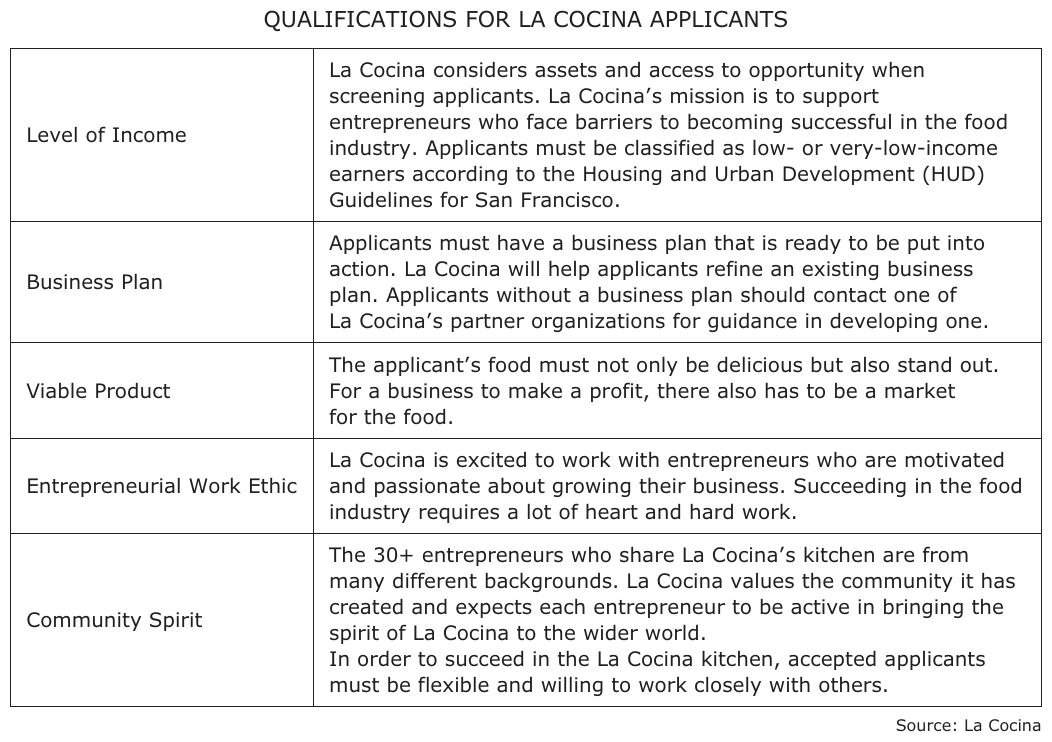
Question 32 of 57
2022 Test A English, question 32Uses the passage above: “Excerpt from “The Food Business Incubator””.
Question
Paragraph 4 contributes to the development of ideas about La Cocina in paragraph 1 by
- Aspecifying how La Cocina helps local food entrepreneurs become successful.
- Bexplaining what kind of goals La Cocina tries to set for local food entrepreneurs.
- Cproviding background information about local food entrepreneurs in San Francisco.
- Ddescribing how Caleb Zigas discovered the need to provide assistance to local food entrepreneurs.
Show the answer
Correct answer: A
The question asks how paragraph 4 contributes to the development of ideas about La Cocina in paragraph 1.
A. CORRECT. Paragraph 4 lists ways that La Cocina provides support to local food entrepreneurs. This supports the statement in paragraph 1 that La Cocina has been “helping local food entrepreneurs, many of whom are low-income immigrant women, develop their small businesses.”
B. Incorrect. Paragraph 1 simply states that La Cocina tries to help local food entrepreneurs develop their businesses, but neither paragraph describes or mentions any goals that La Cocina sets for local food entrepreneurs.
C. Incorrect. While paragraph 4 mentions some background information on where local food entrepreneurs were found, these details do not directly support any ideas in paragraph 1.
D. Incorrect. The description of the process by which Caleb Zigas realized there was a need for La Cocina provides background for the organization, but it does not directly support any ideas in paragraph 1.
Question analysis
This text-structure question asks how paragraph 4 of the La Cocina article contributes to the development of ideas about the nonprofit in paragraph 1. Paragraph 4 gives executive director Caleb Zigas’s account of how La Cocina started and whom it served, so students must set the two paragraphs side by side and decide what the later one adds.
- Grade level
- Grade 7 reading and task
- Compared with grade 7
- At grade 7 Explaining how one paragraph develops an idea from another is core grade 7 structure work. Both paragraphs are short and plain, but paragraph 4 holds several kinds of information and several choices echo its details, so close checking is needed.
- Estimated difficulty
- Moderate: several steps, or a close reading with one strong distractor.
- Thinking it demands
- Depth of knowledge 2, skills and concepts · mainly analyze
- What makes it hard
- How, not what moderate
- Every choice must be checked minor
- Evidence in several places minor
- Evidence
- Answered from several paragraphs or stanzas
- Reading level
- Passage: about grade 10, 1057 words; question and choices: about grade 12, 61 words.
- Students, last 30 days
- Not enough answers yet to show (it takes 10).
Why it is hard, traps and wrong answers (shows the answer)
Why it is hard
Paragraph 4 opens with background, the grassroots groups that found people cooking at home and selling on the streets, and only its last sentence says what La Cocina provided. Students who stop at the opening find the background choice accurate and the Zigas choice plausible, since his name leads the paragraph. The question rewards asking which part of paragraph 4 builds on paragraph 1’s claim about helping entrepreneurs develop businesses, and that part is the list of services.
How, not what moderate Working it out
The stem asks how paragraph 4 develops paragraph 1, so students must match paragraph 1’s general “helping local food entrepreneurs … develop their small businesses” to paragraph 4’s specifics: kitchen space, business plans, city permits. (Anderson & Krathwohl, 2001)
Every choice must be checked minor Choosing the answer
Paragraph 4 mixes an origin story told by Zigas, the vendors’ needs and La Cocina’s services, and the wrong choices draw on the first two, so each must be checked for who did what. (Embretson & Wetzel, 1987)
Evidence in several places minor Working it out
The two paragraphs are separated by the alumni successes and the cookbook, so paragraph 1’s statement of what La Cocina does must be carried across them and set beside paragraph 4. (Kirsch & Mosenthal, 1990; Gorin & Embretson, 2006)
Strategy: Write down what paragraph 1 says La Cocina does, then go through paragraph 4 sentence by sentence and ask which sentences expand on that statement; check who does what in each choice.
Traps
- Twists what the text says: Uses the text's topic and ideas but changes what it says: who did it, how much, when, or why.
- True but not the answer: A choice says something accurate about the text that does not answer this question.
- Wrong purpose or structure: Names a purpose, structure or effect that the part does not serve, or describes what a part says when the question asks what it does.
The wrong answers, classified
B Wrong purpose or structure (Anderson & Krathwohl, 2001)
Equates help with “business plans” with setting goals and so credits paragraph 4 with explaining La Cocina’s targets for entrepreneurs, a purpose neither paragraph serves.
C True but not the answer (King et al., 2004; Embretson & Wetzel, 1987)
Rightly notes that paragraph 4 describes people cooking at home and selling food on the streets, but that background is about the vendors and adds nothing to paragraph 1’s point about La Cocina.
D Twists what the text says (King et al., 2004)
Reads “Caleb Zigas says” as Zigas making the discovery, but in paragraph 4 two grassroots organizations found the home cooks, and Zigas only tells how La Cocina grew out of them.
Working it out, step by step
Understand the question
This is a question about how a text is put together. You need to see how paragraph 4 builds on an idea from paragraph 1. Find the idea in paragraph 1 first. Then ask what paragraph 4 adds to it.
Find the idea in paragraph 1
Paragraph 1 says that since 2005, La Cocina has been “helping local food entrepreneurs, many of whom are low-income immigrant women, develop their small businesses.” An entrepreneur is a person who starts a business. Notice that this statement is general. It tells you that La Cocina helps, but not how.
See what paragraph 4 adds
Paragraph 4 opens with a little history. Two grassroots groups “found many people cooking at their homes and selling food on the streets.” (Grassroots means started by ordinary people in a community.) Then the paragraph gets specific. La Cocina gave those cooks a kitchen, “in addition to helping them develop business plans, pull city permits and more.” Those are the actual ways it helps.
Check each choice
- A is right. Paragraph 4 names the help: a kitchen, business plans and city permits. That shows how La Cocina helps cooks succeed.
- B is wrong. Neither paragraph mentions goals that La Cocina sets for the cooks.
- C is wrong. Paragraph 4 does describe the cooks selling on the streets. But that is background about the cooks. It doesn’t build on paragraph 1’s idea about La Cocina.
- D is wrong. Zigas only tells the story. In paragraph 4, it is the two grassroots groups that found the cooks. Zigas discovers nothing there.
Watch out: C is tempting because its facts are true. A true detail is still wrong if it doesn’t answer the question.
Choose the answer
Paragraph 1 says that La Cocina helps. Paragraph 4 spells out exactly how it helps. So the answer is A.
Why this answer and not the closest wrong one
The strongest wrong choice is C. It describes the start of paragraph 4 correctly. But the question asks how paragraph 4 develops an idea about La Cocina. Only the list of services does that. It turns paragraph 1’s general word, helping, into real examples.
More questions like this
The original DOE question
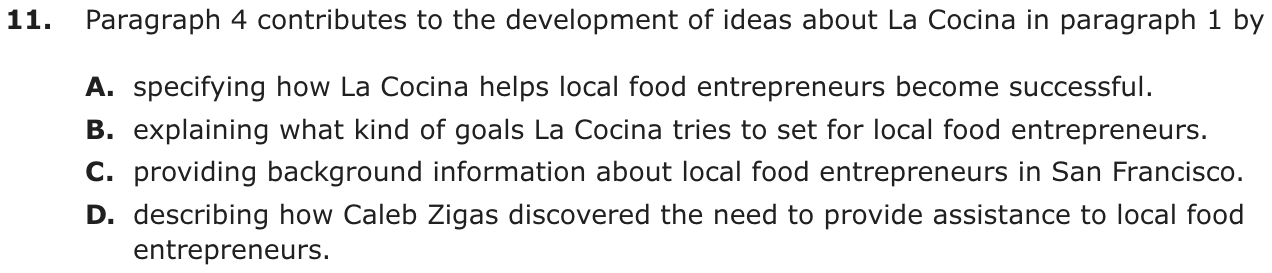
Question 33 of 57
2022 Test A English, question 33Uses the passage above: “Excerpt from “The Food Business Incubator””.
Question
The description of Mariko Grady’s background in paragraph 9 contributes to a central idea in the excerpt by
- Ademonstrating what people are looking for when they come to La Cocina.
- Bexplaining why La Cocina is the best option for people starting out in the food business.
- Cshowing how La Cocina can help people find success in the food business even though they have a background in something different.
- Dconfirming that La Cocina was originally established for small business owners who are looking to expand their services.
Show the answer
Correct answer: C
The question asks how the description of Mariko Grady’s background in paragraph 9 contributes to a central idea in the excerpt.
A. Incorrect. The paragraph about Mariko Grady describes her earlier success in the field of theatrical dance and how she later started her own small cooking business. It does not describe what she was looking for when she came to La Cocina.
B. Incorrect. The excerpt does not argue that La Cocina is the best option for people starting out in the food business, and the description in paragraph 9 does not support that idea.
C. CORRECT. The detailed background story of Mariko Grady describes that Grady started a small food business after working as “a singer and dancer with the prestigious modern theatrical dance group she founded” and then, after that ended, created a fermented food product line. This information contributes to a central idea in the excerpt that many of the people working with La Cocina, like Grady, “needed an affordable commercial kitchen space and technical assistance in order for their businesses to be legally viable. La Cocina provided just such a space, in addition to helping them develop business plans, pull city permits and more” (paragraph 4).
D. Incorrect. While Mariko Grady is now a food business owner that La Cocina has helped since 2012, Grady’s story does more to illustrate how people from non-business backgrounds can receive special support from La Cocina in order to do more with their business.
Question analysis
This central-idea question turns to paragraph 9 of the La Cocina article, the profile of Mariko Grady, who makes miso, koji and other fermented foods for her company, Aedan Fermented Foods. It asks how the description of her background contributes to a central idea of the excerpt, so students must sum up a long life story and decide what it illustrates about the incubator.
- Grade level
- Grade 7 reading and task
- Compared with grade 7
- At grade 7 Connecting one person’s story to a central idea is regular grade 7 reading work. Paragraph 9 is long and packed with names, places and Japanese food words, but the four choices differ clearly once the story is summed up.
- Estimated difficulty
- Straightforward: two steps or one careful reading.
- Thinking it demands
- Depth of knowledge 2, skills and concepts · mainly analyze
- What makes it hard
- A lot to read moderate
- Reading between the lines minor
- Evidence
- Answered from one paragraph or stanza
- Reading level
- Passage: about grade 10, 1057 words; question and choices: about grade 11, 85 words.
- Students, last 30 days
- Not enough answers yet to show (it takes 10).
Why it is hard, traps and wrong answers (shows the answer)
Why it is hard
Grady’s profile is a life story, and the question asks what it shows about La Cocina, which the paragraph mentions only at its start and in one dated sentence. Students who sum it up as a dancer turned food maker find the answer quickly. Those who skim may pick a choice that sounds like a fair lesson about the program, such as what newcomers seek or why it was founded, without checking that the paragraph shows it.
A lot to read moderate Understanding the question
Paragraph 9 runs about 215 words and packs in miso, koji and amasake, a 30-year stage career, a husband met at a show, the 2011 tsunami and the meaning of “Aedan,” so its point must be sifted from many facts. (Kintsch, 1998; Gorin & Embretson, 2006; Freedle & Kostin, 1993)
Reading between the lines minor Working it out
The paragraph never says that La Cocina helped someone from another field succeed; students must set Grady’s career as “a singer and dancer” beside the business she built after joining in 2012 and draw that conclusion. (Graesser, Singer & Trabasso, 1994; Kintsch, 1998)
Strategy: Sum up paragraph 9 in a sentence of your own, then test each choice twice: does Grady’s story actually show it, and does the rest of the excerpt treat it as a central idea?
Traps
- Too broad or too strong: A choice overstates, generalizes, or uses absolute words the text does not support.
- Reads too much in: A reasonable-sounding conclusion that goes further than the text allows.
- Twists what the text says: Uses the text's topic and ideas but changes what it says: who did it, how much, when, or why.
The wrong answers, classified
A Reads too much in (Graesser, Singer & Trabasso, 1994)
Assumes that a profile of one member reveals what everyone hopes to find at La Cocina, but paragraph 9 tells Grady’s past and her products, never what she was seeking when she joined.
B Too broad or too strong (King et al., 2004)
Inflates one success story into a ranking, though the excerpt never compares La Cocina with any other path into the food business, so “the best option” goes beyond it.
D Twists what the text says (King et al., 2004)
Echoes paragraph 1’s help for small businesses but makes Grady’s story proof of La Cocina’s founding purpose, though paragraph 4 traces it to home cooks and street vendors who needed kitchen space.
Working it out, step by step
Decide what to look for
Paragraph 9 tells the life story of Mariko Grady. You need to decide what her story adds to a central idea, a big idea of the whole excerpt. First, sum up her story in one sentence. Then see what it shows about La Cocina.
Pick out the key facts
Paragraph 9 is long, so look for the main facts. In Japan, Grady had “a 30-year career as a singer and dancer.” After the 2011 earthquake and tsunami, her dance company broke up. Then she began making fermented foods, like miso. These foods are left to change slowly, with help from tiny living things. “She began at La Cocina in 2012.” Now she sells her products “online, at local Bay Area stores and at the Ferry Plaza Farmers Market.”
Sum up her story
Here is her story in one sentence: Grady was a singer and dancer for 30 years, then built a food business with La Cocina’s help. Food was not her first career. Yet she now sells a whole line of products. Her story is one example of a central idea: La Cocina helps people grow food businesses.
Check each choice
- A is wrong. The paragraph never says what Grady hoped to find when she joined.
- B is wrong. The excerpt never compares La Cocina with other programs, so it can’t call it “the best option.”
- C is right. Grady came from dance, a very different field, and she found success in food.
- D is wrong. Paragraph 4 explains how La Cocina began: groups found home cooks and street sellers who needed a kitchen. Grady’s story says nothing about that start.
Watch out: A sounds like a fair lesson. But check that the paragraph actually shows it, and this one does not.
Choose the answer
Grady’s story shows someone from a whole different career succeeding in food with La Cocina behind her. So the answer is C.
Why this answer and not the closest wrong one
A is the closest wrong answer, because one member’s story can seem to show what all members want. But paragraph 9 tells Grady’s past and her products, not her hopes. C matches what the paragraph does show: a dancer who built a food business.
More questions like this
The original DOE question
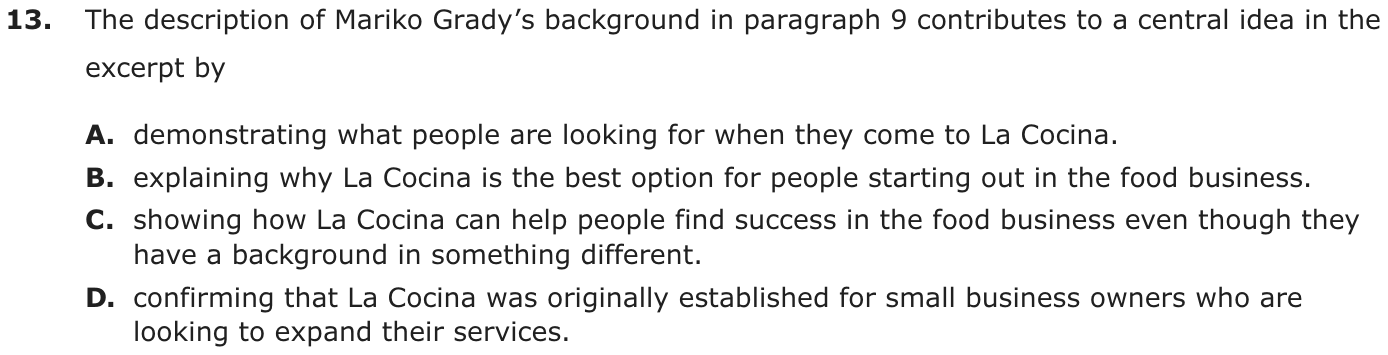
Question 34 of 57
2022 Test A English, question 34Uses the passage above: “Excerpt from “The Food Business Incubator””.
Question
Which statement would the author most likely agree with?
- AThe publicity efforts La Cocina engages in will help its business design spread to other cities.
- BThe variety of exciting food available in San Francisco is due to the work of La Cocina.
- CLa Cocina offers a method that will guarantee business ownership for qualified entrepreneurs.
- DLa Cocina does admirable work in supporting the efforts of ambitious cooks who may have few resources.
Show the answer
Correct answer: D
The question asks with which statement the author would most likely agree.
A. Incorrect. The author does not suggest at any point that La Cocina would like to expand its work and mission to other cities.
B. Incorrect. While the author describes some of the work of talented chefs from La Cocina, at no point does the author imply that the many food choices that exist in San Francisco are because of La Cocina.
C. Incorrect. While the author does describe how La Cocina can help entrepreneurs find success, at no point does the author suggest that La Cocina can guarantee success.
D. CORRECT. The descriptions of the income requirements as well as the information that some of the chefs are James Beard award semi-finalists and others have achieved success with their businesses all help show that the author admires the work of La Cocina in helping chefs who have few resources.
Question analysis
This point-of-view question asks which statement the author of the NPR article about La Cocina, a San Francisco nonprofit that helps food entrepreneurs, would most likely agree with. The author reports facts and profiles two chefs rather than giving opinions outright, so students must infer the author’s attitude from what the article chooses to report and test each statement against it.
- Grade level
- Grade 7 reading and task
- Compared with grade 7
- At grade 7 Inferring which statement an author would accept is typical grade 7 point-of-view work. This reporter lets facts and two chefs’ stories carry the view, but each statement can be checked directly against the article, which keeps the demand ordinary.
- Estimated difficulty
- Straightforward: two steps or one careful reading.
- Thinking it demands
- Depth of knowledge 3, strategic thinking · mainly analyze
- What makes it hard
- Reading between the lines moderate
- Evidence in several places minor
- The right answer is reworded minor
- Evidence
- Answered from the whole text
- Reading level
- Passage: about grade 10, 1057 words; question and choices: about grade 11, 72 words.
- Corrected from the DOE handbook
- An inaccurate detail in the explanation was corrected.
- Students, last 30 days
- Not enough answers yet to show (it takes 10).
Why it is hard, traps and wrong answers (shows the answer)
Why it is hard
Because the author reports rather than argues, students must build the author’s attitude from the facts chosen, then test four statements that all speak well of La Cocina. Three of them claim more than the article does: that it will spread to other cities, that it accounts for the city’s food, that it guarantees ownership. The right statement is the modest one, and students drawn to bigger praise lose the point.
Reading between the lines moderate Working it out
The reporter never states an opinion; admiration has to be read from what the article chooses to include: the income rule, the 50-plus self-sufficient owners, the James Beard semi-finalists and two chefs’ stories. (Graesser, Singer & Trabasso, 1994; Kintsch, 1998)
Evidence in several places minor Working it out
Support for the author’s view is scattered from paragraph 1’s low-income immigrant women through paragraph 2’s successes to the table’s Level of Income row, so no single passage settles it. (Kirsch & Mosenthal, 1990; Gorin & Embretson, 2006)
The right answer is reworded minor Choosing the answer
The right statement speaks of “ambitious cooks” with “few resources,” words the article never uses, while wrong ones echo its own “exciting” and “San Francisco” or the table’s talk of qualifications. (Freedle & Kostin, 1993; Kirsch & Mosenthal, 1990)
Strategy: Ask what the article’s choice of facts and stories shows about how the author regards La Cocina, then measure each statement against that view and against what the article actually reports.
Traps
- Too broad or too strong: A choice overstates, generalizes, or uses absolute words the text does not support.
- Reads too much in: A reasonable-sounding conclusion that goes further than the text allows.
- Twists what the text says: Uses the text's topic and ideas but changes what it says: who did it, how much, when, or why.
The wrong answers, classified
A Reads too much in (Graesser, Singer & Trabasso, 1994)
Takes the chefs’ book tour and the twice-yearly storytelling events as a growth plan, but the article reports promotion of a cookbook, not any intention to take La Cocina’s model to other cities.
B Twists what the text says (King et al., 2004)
Stretches the “exciting range” of flavors inside La Cocina’s kitchen into the cause of all the food variety in San Francisco, a link the author never makes.
C Too broad or too strong (King et al., 2004)
Builds on the more than 50 chefs who became self-sufficient owners and the table’s qualifications, but “guarantee” overstates, since the author reports successes, not a promise to every qualified applicant.
What was corrected from the DOE handbook, and why
- Explanation: The handbook’s explanation of Option D says that “some of the chefs are James Beard award recipients.” The excerpt never says any chef won the award: paragraph 2 says two alumnae “were even recognized as semi-finalists for prestigious James Beard awards.” The site now says “some of the chefs are James Beard award semi-finalists.” The answer is unchanged.
Working it out, step by step
Think about the author’s view
This asks about the author’s point of view, or how the author feels about the topic. The author is a reporter who mostly gives facts. So you have to read the author’s feelings from the facts the author chose to include.
Gather the clues
- Paragraph 1: La Cocina helps cooks, “many of whom are low-income immigrant women.” Low-income means earning little money.
- Paragraph 2: “more than 50 chefs in its program have become self-sufficient business owners.” Self-sufficient means able to support themselves.
- Paragraph 2 also says two alumnae “were even recognized as semi-finalists” for top cooking awards. Semi-finalists reach the round before the final. They did not win.
- Paragraph 10: Shani Jones hopes “to be the patty kingpin of the West Coast.” A kingpin is the leader of a group.
Work out the author’s opinion
Put the clues together. The cooks often start with little money. Many of them dream big, like Jones. La Cocina helps them, and many succeed. The word “even” shows the author is impressed. So the author admires La Cocina’s work. Admirable means deserving praise. Ambitious means wanting to achieve a lot.
Check each choice
- A is wrong. Some chefs will tour to promote a cookbook. That is not a plan to bring La Cocina to other cities.
- B is wrong. The author never says La Cocina is the reason San Francisco has so many kinds of food.
- C is wrong. To guarantee means to promise for sure. The author reports successes but promises nothing.
- D is right. It matches the clues: cooks with little money, big dreams and praise for the help they get.
Watch out: A is tempting because a book tour does spread the word. But spreading the word is not opening in new cities.
Choose the answer
The author would agree that La Cocina deserves praise for helping driven cooks who have little money. So the answer is D.
Why this answer and not the closest wrong one
A is the most tempting wrong choice. The chefs’ book tour and storytelling events do share La Cocina’s story. But the article never mentions taking its model to other cities. D claims only what the article supports, so it is the better choice.
More questions like this
The original DOE question
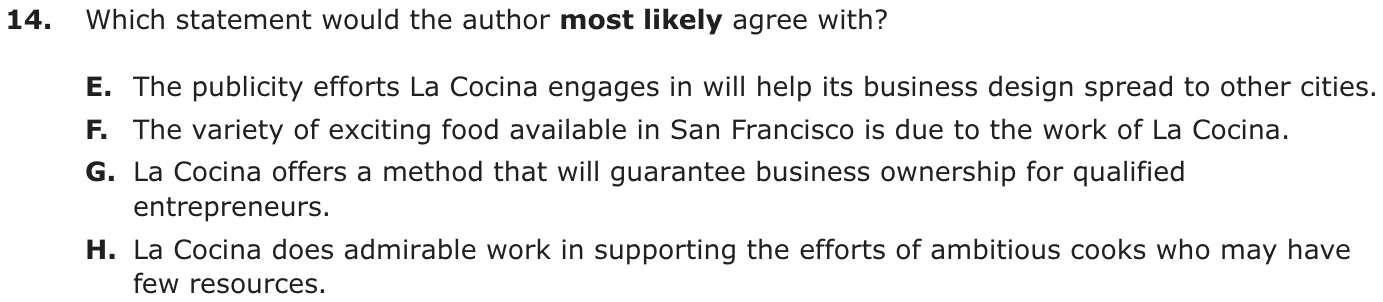
Question 35 of 57
2022 Test A English, question 35Uses the passage above: “Excerpt from “The Food Business Incubator””.
Question
Which detail would be most important to include in a summary of the excerpt?
- ALa Cocina produced a cookbook that includes some members’ stories.
- BLa Cocina provides legal and technical assistance to its members.
- CPotential vendors need a market for their food before considering La Cocina.
- DThere are different types of venues that food vendors from La Cocina use.
Show the answer
Correct answer: B
The question asks which detail would be most important to include in a summary of the excerpt.
A. Incorrect. The detail about the cookbook that includes members’ stories is mentioned briefly but not developed. It should not be included in a summary, because it does not most help support the central idea that La Cocina helps food entrepreneurs expand their businesses.
B. CORRECT. The fact that La Cocina provides legal and technical assistance is a key factor in the success of the chefs who participate. Paragraph 4 explains that La Cocina provides technical and legal assistance by helping businesses navigate city permits and meet other challenges. This detail supports the central idea by sharing how La Cocina helps food entrepreneurs expand their businesses.
C. Incorrect. The specific requirements for chefs to be accepted at La Cocina are lesser details and should not be included in a summary, because they do not strongly support the central idea that La Cocina helps its members expand their food businesses.
D. Incorrect. Paragraph 5 indicates that vendors from La Cocina sell their food at various venues, including farmers’ markets and corporate events. However, this is a detail that is not developed and should not be included in a summary since it does not support the central idea as clearly as does the detail that La Cocina provides members with legal and technical support for their businesses.
Question analysis
This summary question asks which detail would be most important to include in a summary of the La Cocina article, which runs from the nonprofit’s origins and services to profiles of two chefs and a table of qualifications for applicants. Each choice draws on the article, so students must first decide what the excerpt is mainly about and then separate central details from minor ones.
- NYS standards
- 7R2 theme or central idea
- Grade level
- Grade 7 reading and task
- Compared with grade 7
- At grade 7 Picking the detail a summary needs is grade 7 central-idea work. The choices are short and plainly worded, but each comes from somewhere in a long article, so students must hold its main idea in mind while weighing them.
- Estimated difficulty
- Straightforward: two steps or one careful reading.
- Thinking it demands
- Depth of knowledge 2, skills and concepts · mainly understand
- What makes it hard
- Evidence
- Answered from the whole text
- Reading level
- Passage: about grade 10, 1057 words; question and choices: about grade 9, 59 words.
- Students, last 30 days
- Not enough answers yet to show (it takes 10).
Why it is hard, traps and wrong answers (shows the answer)
Why it is hard
All four details are drawn from the excerpt, so accuracy eliminates little; the test is importance. The cookbook is the most tempting minor detail, because it has a paragraph of its own and returns in paragraph 7 with the book tour, yet both mentions are brief. Students who first state what the excerpt mainly shows, how La Cocina helps cooks build legal businesses, keep the detail that carries that idea.
Evidence in several places minor Working it out
The four details come from paragraphs 3, 4 and 5 and the table, and the cookbook returns in paragraph 7, so each must be judged against the whole excerpt, not the part it comes from. (Kirsch & Mosenthal, 1990; Gorin & Embretson, 2006)
Reading between the lines minor Working it out
The excerpt never states its main idea in one sentence; students must work out from paragraph 1, paragraph 4 and the two profiles that it is about how La Cocina helps cooks build businesses. (Graesser, Singer & Trabasso, 1994; Kintsch, 1998)
Strategy: Before reading the choices, state in one sentence what the excerpt is mainly about, then keep the detail that most directly develops that idea, not one the article mentions once and leaves.
Traps
- Too narrow: A single detail offered as the central idea or a summary, or a summary that keeps minor details and leaves out an essential part.
The wrong answers, classified
A Too narrow (King et al., 2004)
Remembers the cookbook because its italic title fills paragraph 3 and the book tour returns in paragraph 7, but each mention is brief and says nothing about how La Cocina helps cooks.
C Too narrow (King et al., 2004)
Picks a requirement from the table’s Viable Product row, that there has to be a market for the food, which is one screening rule rather than what the excerpt is about.
D Too narrow (King et al., 2004)
Recalls the farmers’ markets, catering gigs and weddings of paragraph 5 and the profiles’ online sales and kiosk, accurate details about where members sell but not about what La Cocina does.
Working it out, step by step
Learn what a summary needs
A summary is a short retelling of a text’s most important ideas. It leaves out small details. To pick the right detail, first decide what the whole excerpt is mainly about.
State the main idea
The excerpt opens with La Cocina’s purpose: helping cooks start and grow small food businesses. Paragraph 4 explains how that help works. Paragraphs 9 and 10 show two chefs who built businesses there. So the main idea is this: La Cocina helps cooks with few resources build real food businesses.
Find the detail that carries it
Paragraph 4 says the cooks needed “technical assistance in order for their businesses to be legally viable.” Technical assistance is expert help with the practical side of a job. La Cocina gave that help, including how to “pull city permits.” Permits keep a business within the law. So choice B, legal and technical help, describes the heart of what La Cocina does.
Check each choice
- A is wrong. The cookbook gets one short sentence in paragraph 3 and a brief return in paragraph 7. It is a side detail.
- B is right. It names the main kind of help La Cocina gives.
- C is wrong. The need for a market comes from one row of the table. It is one screening rule, not the main point.
- D is wrong. Paragraph 5 lists places members sell, like farmers’ markets and weddings. That tells where they sell, not what La Cocina does.
Watch out: A is tempting because the cookbook has its own paragraph and an italic title. But the excerpt mentions it and moves on.
Choose the answer
A summary needs the help at the center of the excerpt: legal and technical support for members. So the answer is B.
Why this answer and not the closest wrong one
The cookbook choice, A, is the nearest miss. It is easy to remember, and it does tell some members’ stories. But the excerpt never explains the book or builds on it. B names the support that explains how the cooks in the excerpt succeed, so it belongs in a summary.
More questions like this
The original DOE question
Question 36 of 57
2022 Test A English, question 36Uses the passage above: “Excerpt from “The Food Business Incubator””.
Question
The table provides additional support for a central idea of the excerpt by
- Ashowing how La Cocina works with partner organizations to further educate and advance successful applicants within the food industry.
- Bexplaining how applicants are prepared to develop their own businesses once they leave La Cocina.
- Cestablishing that La Cocina is dedicated to its mission to provide delicious food to different communities.
- Demphasizing that applicants must be willing to dedicate time to promoting and developing their business with La Cocina.
Show the answer
Correct answer: D
The question asks how the table provides additional support for a central idea of the excerpt.
A. Incorrect. The table describes the requirements that allow food entrepreneurs to qualify to participate in La Cocina. While the table does mention that applicants without a business plan should contact one of La Cocina’s partner organizations, it does not specifically explain how La Cocina works with these partner organizations to help educate successful applicants.
B. Incorrect. The table describes the ways entrepreneur chefs must qualify in order to be accepted into La Cocina, not how their businesses can be successful after they leave.
C. Incorrect. While the table mentions community spirit, this is in reference to the type of energy La Cocina wishes to establish within its group kitchen space. The excerpt and table do not discuss providing food to different communities within or outside San Francisco as specific goals of La Cocina.
D. CORRECT. A central idea of the excerpt is that La Cocina helps local food entrepreneurs develop their businesses. The table lists requirements for people who want to participate in La Cocina. They must be willing to work hard to promote their own businesses as they use the resources that La Cocina provides.
Question analysis
This question asks how the table “Qualifications for La Cocina Applicants,” printed after the NPR article, provides additional support for a central idea of the excerpt. The table’s five rows, from level of income to community spirit, are written in full sentences, so students must read it as closely as the article and decide how the two connect.
- Grade level
- Grade 8 reading and task
- Compared with grade 7
- Above grade 7 Grade 7 readers often connect a table to a text. This one holds five rows of requirements written as sentences, not numbers, and students must tie it to a central idea through long choices, more than typical grade 7 work.
- Estimated difficulty
- Hard: combines ideas, needs a plan, and has more than one tempting wrong answer.
- Thinking it demands
- Depth of knowledge 3, strategic thinking · mainly analyze
- What makes it hard
- Reading a figure, table or graph moderate
- The right answer is reworded moderate
- Combines ideas minor
- Evidence
- Answered from the whole text
- Reading level
- Passage: about grade 10, 1057 words; question and choices: about grade 13, 81 words.
- Corrected from the DOE handbook
- A detail of the table was restated accurately in the explanation.
- Students, last 30 days
- Not enough answers yet to show (it takes 10).
Why it is hard, traps and wrong answers (shows the answer)
Why it is hard
The table is easy to read row by row but hard to connect, because it lists entry requirements while the article describes help and success. Each wrong choice grabs a real phrase from the table or an idea from the article, partner organizations, delicious food, alumni starting their own businesses, and attaches it to a claim the table does not make. The right choice is the only one that sums up several rows at once, the work ethic and community spirit expected of applicants.
Reading a figure, table or graph moderate Understanding the question
The table holds five rows of full sentences, and the telling details sit in single phrases: “should contact one of La Cocina’s partner organizations,” “a lot of heart and hard work,” “active in bringing the spirit of La Cocina to the wider world.” (Lesh, Post & Behr, 1987; Kirsch & Mosenthal, 1990)
The right answer is reworded moderate Choosing the answer
The right choice speaks of dedicating time to “promoting and developing” a business, words the table never uses, while wrong choices lift its own “partner organizations,” “mission,” “delicious” and “community.” (Freedle & Kostin, 1993; Kirsch & Mosenthal, 1990)
Combines ideas minor Working it out
Students must join two sources, a central idea of the article, that La Cocina helps cooks develop businesses, and a table about who may apply, then say what the second adds to the first. (Embretson, 1998; Daniel & Embretson, 2010)
Strategy: Sum up each row of the table in a few words, state a central idea of the article in a sentence, and keep only a choice that the rows actually show and that fits that idea.
Traps
- Word match: Repeats striking words or phrases from the text, so it looks supported, but its meaning does not fit the question.
- Twists what the text says: Uses the text's topic and ideas but changes what it says: who did it, how much, when, or why.
- Wrong part of the text: A choice is true of another paragraph, stanza or speaker than the one asked about.
The wrong answers, classified
A Twists what the text says (King et al., 2004)
Finds the partner organizations in the Business Plan row, but the table sends only applicants without a plan to them for guidance and says nothing about further training for accepted chefs.
B Wrong part of the text (Kirsch & Mosenthal, 1990)
Carries over the article’s alumni who opened their own restaurants and its help with permits, but the table covers who may enter La Cocina, not how members are prepared to leave.
C Word match (Freedle & Kostin, 1993)
Strings the table’s words “mission,” “delicious” and “community” into a mission of feeding communities, though the table’s community is the one La Cocina has built among the entrepreneurs sharing its kitchen.
What was corrected from the DOE handbook, and why
- Explanation: The handbook’s explanation of Option A says the table states that applicants without a business plan “must contact” one of La Cocina’s partner organizations. The table’s Business Plan row says they “should contact” one: it is advice, while the row’s requirement is that applicants “must have a business plan that is ready to be put into action.” The site now says “should contact.” The answer is unchanged.
Working it out, step by step
See how the table connects
This question links the table to the article. The table, “Qualifications for La Cocina Applicants,” lists what people need to join. Qualifications are the skills or traits you must have. You must decide how the table supports a central idea of the article.
Sum up each row
Row What it asks of applicants Level of Income earn little money Business Plan have a plan ready to use Viable Product make food that tastes great, stands out and can sell Entrepreneurial Work Ethic be eager and work hard Community Spirit work well with others and spread La Cocina’s spirit Most rows describe people ready to put in real effort.
Connect the table to the article
A central idea of the article is that La Cocina helps cooks develop their businesses. The table shows what La Cocina expects in return. It wants people “motivated and passionate about growing their business.” It says success “requires a lot of heart and hard work.” It expects each cook to be “active in bringing the spirit of La Cocina to the wider world.” So the help goes to people who will give time to their business.
Check each choice
- A is wrong. The table says applicants without a plan “should contact” a partner group for advice. That happens before applying. It doesn’t show La Cocina working with partners to train accepted cooks.
- B is wrong. The table is about getting in, not about leaving La Cocina later.
- C is wrong. The table uses the words “delicious” and “community.” But its community is the cooks who share the kitchen, not neighborhoods La Cocina feeds.
- D is right. The work-ethic row calls for hard work at growing a business. The community row asks cooks to spread La Cocina’s spirit. Both take time and effort.
Choose the answer
The table shows that La Cocina wants cooks ready to work hard at building their businesses. So the answer is D.
Why this answer and not the closest wrong one
A is the closest wrong answer, because “partner organizations” really is in the table. But the table only suggests that people without a business plan get advice from one. It never shows La Cocina teaming up with partners to train its members. D sums up several rows at once.
More questions like this
The original DOE question
Question 37 of 57
2022 Test A English, question 37Passage Excerpt from “The Past and the Future of the Earth’s Oldest Trees”
Excerpt from “The Past and the Future of the Earth’s Oldest Trees”
by Alex Ross
About forty-five hundred years ago, not long after the completion of the Great Pyramid at Giza, a seed of Pinus longaeva, the Great Basin bristlecone pine, landed on a steep slope in what are now known as the White Mountains, in eastern California. The seed may have travelled there on a gust of wind, its flight aided by a winglike attachment to the nut. Or it could have been planted by a bird known as the Clark’s nutcracker, which likes to hide pine seeds in caches; nutcrackers have phenomenal spatial1 memory and can recall thousands of such caches. This seed, however, lay undisturbed. On a moist day in fall, or in the wake of melting snows in spring, a seedling appeared above ground—a stubby one-inch stem with a tuft of bright-green shoots.
Most seedlings die within a year; the mortality rate is more than ninety-nine percent. The survivors are sometimes seen growing in the shadow of a fallen tree. The landscape of the Ancient Bristlecone Pine Forest, as this area of the White Mountains is called, is littered with fragments of dead trees—trunks, limbs, roots, and smaller chunks. Pinus longaeva grows exclusively in subalpine regions of the Great Basin, which stretches from the eastern slopes of the Sierra Nevada to the Wasatch Range, in Utah. Conditions are generally too arid for the dead wood to rot; instead, it erodes, sanded down like rock. The remnants may harbor nutrients and fungi that help new trees grow. Bristlecones rise from the bones of their ancestors—a city within a cemetery.
Coast redwoods and giant sequoias, California’s gargantuan world-record-holding trees, can grow fifty feet or more in their first twenty years. Bristlecones rise agonizingly slowly. After four or five years, the seedling on the steep slope would have been just a few inches higher, sprouting needles in place of the embryonic shoots. The needles are a deep green, tough, resinous, and closely bunched in groups of five. On a mature tree, they live for fifty years or more. Decades may have passed before the tree was human height, and decades more before it resembled a conventional pine. Bristlecone saplings grow straight up, with relatively sparse foliage, looking like undernourished Christmas trees. After a few hundred years—by which time the Old Kingdom of Egypt had fallen—it was probably forty or fifty feet in height.
Many tree species live for hundreds of years. A smaller but not inconsiderable number, including the sequoias and certain yews, oaks, cypresses, and junipers, survive for thousands. Once a bristlecone has established itself in the unforgiving conditions of the White Mountains, it can last almost indefinitely. The trees tend to grow some distance from one another, so fires almost never destroy an entire stand. Because only a few other plant species can handle the dry, cold climate, the bristlecones face little competition. Unlike most plants, they tolerate dolomite soil, which is composed of a chalky type of limestone that is heavily alkaline and low in nutrients. As for insect threats, bristlecone wood is so dense that mountain-pine beetles and other pests can rarely burrow their way into it.
Empires rose and fell; wars raged; . . . and the tree from 2500 B.C. continued its implacable slow-motion existence, adding about two-hundredths of an inch to the diameter of its trunk each year. Minute changes in the tree-ring record make bristlecones an exceptionally useful source of data about changing conditions on Earth. When rains are heavier than normal, the rings widen. When volcanic eruptions cause global cooling, frost rings make the anomaly2 visible. . . .
As the millennia go by, bristlecones become contorted and wraithlike.3 The main stem, or leader, dies back. Entire branches, even the trunk itself, become fossils. At first glance, the tree may look dead. Such is the case of the forty-five-hundred-year-old tree that clings to life near the tourist path that now runs through the Ancient Bristlecone Pine Forest. Spears of dead wood jut into the air. The trunk is a marbled hulk stripped of bark, like driftwood thrown from a vanished ocean. A ribbon of live bark runs up one side, funneling water and nutrients to clumps of green needles high above. All told, the tree is an unprepossessing specimen; most people march past it without giving it a second glance. . . .
. . . No two super-elderly trees look alike, to the point where they have acquired the characteristics of individuals. Trees are prone to anthropomorphism; we project our dreams and our anxieties onto them. Bristlecones have been called elders, sentinels, sages. The possibility that climate change will cause their extinction has inspired a spate4 of alarmed news stories, although tree scientists tend to discount the idea that the bristlecones are in immediate danger. They have survived any number of catastrophes in the past; they may survive humanity.
From “The Past and the Future of the Earth’s Oldest Trees” by Alex Ross from THE NEW YORKER, January 20, 2020. Copyright © 2020 by Condé Nast. All rights reserved.
1spatial: relating to physical space
2anomaly: oddity
3wraithlike: ghostly
4spate: sudden abundance
Question
What is the effect of comparing groups of bristlecone pines to “a city within a cemetery” (paragraph 2)?
- AIt illustrates that the new tree’s appearance is markedly different from that of mature bristlecone pines.
- BIt emphasizes the new tree’s ability to use resources left by prior generations of bristlecone pines.
- CIt highlights the tree’s capacity for a long life if it is able to survive to maturity.
- DIt reveals that the tree’s dense growth patterns are unusual in arid conditions.
Show the answer
Correct answer: B
The question asks what the effect is of comparing groups of bristlecone pines to “a city within a cemetery” (paragraph 2).
A. Incorrect. The reference to “a city within a cemetery” describes how new trees use the remnants of their “ancestors” (paragraph 2) and makes no comment on the appearance of young versus mature trees.
B. CORRECT. The “cemetery” contains “the bones of their ancestors” (paragraph 2)—“ancestors” being earlier generations of bristlecone pines—which provide some of the nutrients that the new trees need.
C. Incorrect. The reference to “a cemetery” is not a comment on how long bristlecone pines can live; rather, it illustrates that the new pines are using remnants of their “ancestors” (paragraph 2) to grow.
D. Incorrect. Although the climate is mentioned in paragraph 2, it is not the reason for the comparison to “a city within a cemetery.” The comment is intended to illustrate how the new trees use nutrients left behind by the old ones.
Question analysis
This figurative language question on Alex Ross’s article about the bristlecone pine, one of the Earth’s oldest trees, asks what effect the author creates by comparing groups of these trees to “a city within a cemetery.” Students must interpret a metaphor in context, and the choices raise ideas the excerpt discusses elsewhere, so they must stay with what this comparison itself conveys.
- Grade level
- Grade 7 reading and task
- Compared with grade 7
- At grade 7 Interpreting a metaphor from nearby context is standard grade 7 work. The phrase closes a paragraph whose earlier sentences give the needed context, so the demand is typical, though the excerpt’s rich vocabulary adds some reading load.
- Estimated difficulty
- Straightforward: two steps or one careful reading.
- Thinking it demands
- Depth of knowledge 2, skills and concepts · mainly analyze
- What makes it hard
- Figurative or literary language moderate
- Hard words minor
- Evidence
- Answered from one paragraph or stanza
- Reading level
- Passage: about grade 8, 851 words; question and choices: about grade 10, 79 words.
- Students, last 30 days
- Not enough answers yet to show (it takes 10).
Why it is hard, traps and wrong answers (shows the answer)
Why it is hard
The comparison closes paragraph 2, and the sentence just before it explains it: the dead wood may hold nutrients and fungi that help seedlings grow. Students who read the image on its own reach for ideas from elsewhere in the excerpt, such as the trees’ great age, the look of young and old trees, or the dry climate. The question rewards reading the metaphor against its neighbors, which makes it fairly quick.
Figurative or literary language moderate Understanding the question
Both halves of the metaphor need decoding: the “city” is the living bristlecones, and the “cemetery” is the dead trunks, limbs and roots littering the slope, “the bones of their ancestors.” (Graesser, Singer & Trabasso, 1994; Kintsch, 1998)
Hard words minor Understanding the question
The sentence that explains the image, “The remnants may harbor nutrients and fungi that help new trees grow,” depends on “remnants” and on “harbor” in its less familiar sense of hold. (Perfetti, 2007; Freedle & Kostin, 1993)
Strategy: Work out what the “city” and the “cemetery” each stand for by rereading the sentences just before the phrase, then choose the effect that both halves of the comparison support.
Traps
- True but not the answer: A choice says something accurate about the text that does not answer this question.
- Taking figurative language literally: A choice reads a figure of speech or image at face value.
- Wrong part of the text: A choice is true of another paragraph, stanza or speaker than the one asked about.
The wrong answers, classified
A Wrong part of the text (Kirsch & Mosenthal, 1990)
Reads the city and the cemetery as young and old trees that look different, a contrast drawn between paragraphs 3 and 6, though here the cemetery is dead wood.
C True but not the answer (King et al., 2004; Embretson & Wetzel, 1987)
Applies the excerpt’s main idea, the trees’ great age, to this phrase, but a city in a cemetery shows living trees rising from dead ones, not how long they last.
D Taking figurative language literally (Graesser, Singer & Trabasso, 1994)
Takes “city” at face value as crowded growth and pairs it with the paragraph’s “arid” conditions, though paragraph 4 says bristlecones grow some distance apart.
Working it out, step by step
Figure out what the question asks
This asks about a comparison. In paragraph 2, the author calls groups of bristlecones “a city within a cemetery.” You need to figure out what this picture helps the reader understand about the trees.
Read the sentences around it
Paragraph 2 says the forest floor is “littered with fragments of dead trees—trunks, limbs, roots, and smaller chunks.” Next it says, “The remnants may harbor nutrients and fungi that help new trees grow.” Then comes the comparison: “Bristlecones rise from the bones of their ancestors—a city within a cemetery.”
Decode the two halves of the picture
Remnants are leftover pieces. To harbor something here means to hold it. Fungi are living things such as mushrooms and molds. A cemetery is a place for the dead, so it stands for the dead wood. A city is full of life, so it stands for the living trees. Their ancestors are the trees that lived and died before them. So new trees grow out of the old ones’ remains and use what those remains hold.
Check each choice
- A does not fit. The image is about living trees and dead wood. It says nothing about how young and old trees look.
- B fits. New trees use the nutrients and fungi left behind by earlier generations.
- C does not fit. The excerpt does show that bristlecones live long, but this image is about growing from dead wood.
- D does not fit. A city may sound crowded, but paragraph 4 says the trees “grow some distance from one another.”
Choose the answer
The comparison shows living trees rising from, and feeding on, the remains of their ancestors. So the answer is B.
Why this answer and not the closest wrong one
C is tempting, because long life is what the whole excerpt is about. But the sentence just before the comparison explains it: the dead wood may hold nutrients that help new trees grow. The picture is about the living drawing on the dead, which is what B says.
More questions like this
The original DOE question
The passage “Excerpt from “The Past and the Future of the Earth’s Oldest Trees”” as printed (pages 193–194)
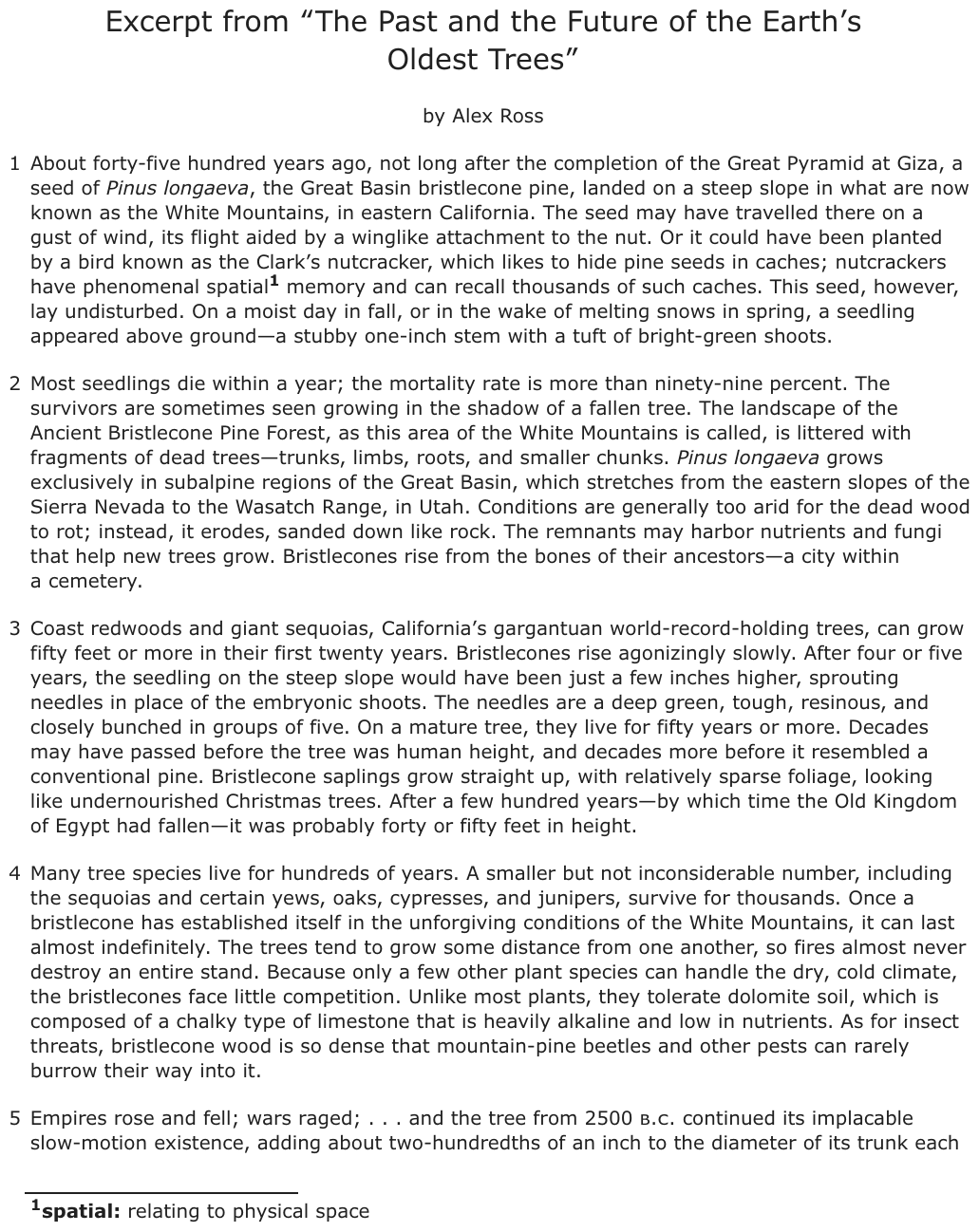
Question 38 of 57
2022 Test A English, question 38Uses the passage above: “Excerpt from “The Past and the Future of the Earth’s Oldest Trees””.
Question
In paragraph 4, the idea that the bristlecone pine can withstand difficult conditions is illustrated mainly through
- Aa comparison of the bristlecone pine with similar trees that are known for their long lives.
- Ba description of specific qualities of the bristlecone pine that make it suited to its environment.
- Can explanation of why the White Mountains are the best place for the bristlecone pine to grow.
- Dan examination of why the bristlecone pine has few competitors in the White Mountains.
Show the answer
Correct answer: B
The question asks how paragraph 4 mainly conveys the idea that the bristlecone pine can withstand difficult conditions.
A. Incorrect. While paragraph 4 does mention the bristlecone pine in conjunction with other long-living trees, this does not explain in any way how the bristlecone pine can survive difficult conditions.
B. CORRECT. Paragraph 4 mentions several qualities that help the bristlecone pine survive a difficult environment: it can survive in a “dry, cold climate” as few plants can, it tolerates a soil that is heavily alkaline and low in nutrients, and the density of its wood protects it from insects.
C. Incorrect. Paragraph 4 focuses on the qualities of the bristlecone pine that make it well suited to the White Mountains rather than on why the White Mountains are well suited to bristlecone pines.
D. Incorrect. While paragraph 4 does acknowledge that the bristlecone pine has few competitors because the pine can stand conditions few other plants can stand, it is the examination of the pine’s unique qualities that explains how the pine survives those conditions.
Question analysis
Students examine paragraph 4 of an article about the bristlecone pine and decide how it mainly illustrates the idea that this tree can withstand harsh conditions. The paragraph mixes comparisons with other species, facts about the White Mountains and facts about the tree, so students must recognize the main way the author builds the idea.
- Grade level
- Grade 7 reading and task
- Compared with grade 7
- At grade 7 Grade 7 students often identify how a paragraph supports an idea, and this one is typical in demand: one plainly written paragraph of seven sentences, with a few unfamiliar terms such as “dolomite” and “alkaline.”
- Estimated difficulty
- Moderate: several steps, or a close reading with one strong distractor.
- Thinking it demands
- Depth of knowledge 2, skills and concepts · mainly analyze
- What makes it hard
- How, not what moderate
- The right answer is reworded minor
- Evidence
- Answered from one paragraph or stanza
- Reading level
- Passage: about grade 8, 851 words; question and choices: about grade 9, 79 words.
- Students, last 30 days
- Not enough answers yet to show (it takes 10).
Why it is hard, traps and wrong answers (shows the answer)
Why it is hard
Paragraph 4 opens with other long-lived trees and then lists what lets the bristlecone last: spacing that keeps fires from spreading, tolerance of dry cold and poor soil, and wood too dense for beetles. The strongest lure lifts one item from that list and calls it the paragraph’s method. Students who step back and ask what most of the sentences describe see a set of the tree’s own traits.
How, not what moderate Working it out
The stem asks how paragraph 4 makes its case, so its sentences have to be sorted by kind: a comparison with other long-lived trees, the setting, and the bristlecone’s own traits. (Anderson & Krathwohl, 2001)
The right answer is reworded minor Choosing the answer
The key names no detail, only “specific qualities” that suit the tree to “its environment,” while the wrong choices echo the paragraph’s long-lived trees, the White Mountains and “little competition.” (Freedle & Kostin, 1993; Kirsch & Mosenthal, 1990)
Strategy: Reread paragraph 4 and label each sentence by what it tells you, then ask which kind of detail carries most of the paragraph’s case that the tree is tough.
Traps
- Too narrow: A single detail offered as the central idea or a summary, or a summary that keeps minor details and leaves out an essential part.
- True but not the answer: A choice says something accurate about the text that does not answer this question.
- Reversed relationship: Cause and effect, or the order of events, turned around.
The wrong answers, classified
A True but not the answer (King et al., 2004; Embretson & Wetzel, 1987)
Notices that the paragraph opens by naming sequoias, yews and other trees that live for thousands of years, but that comparison sets the scene and shows nothing about surviving hardship.
C Reversed relationship (King et al., 2004)
Turns the relationship around: the paragraph shows the tree fitted to “unforgiving conditions,” not the White Mountains suiting the tree, let alone being the best place for it.
D Too narrow (King et al., 2004)
Takes one result, little competition because few plants handle the dry, cold climate, for the paragraph’s main method, when it is one item in a list of survival traits.
Working it out, step by step
Figure out what the question asks
This asks how paragraph 4 mainly shows that the bristlecone can survive harsh conditions. Mainly means the method used in most of the paragraph, not in a single sentence. So sort the sentences by what they do.
Sort what paragraph 4 tells you
Here is what the paragraph covers, in order:
- Many trees live hundreds or even thousands of years.
- Once settled, a bristlecone “can last almost indefinitely,” or with no set end.
- The trees grow apart, so a fire rarely burns a whole group.
- Few plants can stand the dry, cold climate, so there is little competition.
- They can live in dolomite soil, which is chalky and low in nutrients.
- Their wood is so dense, or tightly packed, that beetles can rarely bore in.
Find the pattern
After the first two sentences, nearly every sentence describes the tree itself. It grows spread out. It handles cold, dry air and poor soil. Its wood is too hard for insects. Each of these is a quality, or trait, that fits the tree to its tough home. That list of traits is how the paragraph shows the tree’s toughness.
Check each choice
- A does not fit. Other long-lived trees are named only at the start. That sets the scene but shows nothing about surviving hardship.
- B fits. Most of the paragraph lists the tree’s own traits that help it survive.
- C does not fit. It turns things around. The paragraph shows the tree suited to harsh mountains, not the mountains being the best place for it.
- D does not fit. Little competition is one item in the list, not the main method.
Choose the answer
Paragraph 4 mainly works by describing what lets the bristlecone handle its harsh home. So the answer is B.
Why this answer and not the closest wrong one
D is the closest trap, since paragraph 4 does say the trees face little competition. But that is just one result. The paragraph also points to spacing, tolerance of poor soil and dense wood. B covers all of these traits together, so it names the main method.
More questions like this
The original DOE question
Question 39 of 57
2022 Test A English, question 39Uses the passage above: “Excerpt from “The Past and the Future of the Earth’s Oldest Trees””.
Question
Read this sentence from paragraph 5.
Empires rose and fell; wars raged; . . . and the tree from 2500 B.C. continued its implacable slow-motion existence, adding about two-hundredths of an inch to the diameter of its trunk each year.
The sentence contributes to the development of ideas in the excerpt by
- Aemphasizing the bristlecone pine’s precise growth pattern.
- Bsuggesting that things that seem well established face threats.
- Cdescribing the pace of the life cycle of the bristlecone pine.
- Dexplaining the reason for the bristlecone pine’s longevity.
Show the answer
Correct answer: C
The question asks how the first sentence of paragraph 5 contributes to the development of ideas in the excerpt.
A. Incorrect. While “two-hundredths of an inch” is a reference to the bristlecone pine’s growth pattern, the point of the reference—and of the entire sentence—is to emphasize the incredibly slow pace of the pine’s life cycle.
B. Incorrect. While “wars raged” is a threat that empires face, the point of mentioning wars and the rise and fall of empires is to emphasize the bristlecone pine’s slow-paced life cycle by contrasting its slowness with the big, dramatic changes taking place in human history during that life cycle.
C. CORRECT. Making reference to huge changes in human history such as the rise and fall of empires and the raging of wars provides a sharp contrast to the incredibly slow growth of the bristlecone pine.
D. Incorrect. This sentence describes how slowly the bristlecone pine grows in contrast to how dramatically human history changes in the same time span but never explains the reasons for the pine’s longevity.
Question analysis
This text structure question quotes a sentence from paragraph 5 of Alex Ross’s excerpt on bristlecone pines, the one that begins “Empires rose and fell; wars raged.” Students must explain how the sentence contributes to the development of ideas, and the choices offer four plausible readings of its purpose.
- Grade level
- Grade 8 reading and task
- Compared with grade 7
- At grade 7 Grade 7 students regularly explain how a sentence develops an idea. This sentence adds demanding vocabulary such as “implacable” and mixes human history with a botanical detail, but it is printed with the question, so the overall demand stays typical.
- Estimated difficulty
- Moderate: several steps, or a close reading with one strong distractor.
- Thinking it demands
- Depth of knowledge 2, skills and concepts · mainly analyze
- What makes it hard
- How, not what moderate
- Hard words minor
- Evidence
- Answered from one sentence or line
- Reading level
- Passage: about grade 8, 851 words; question and choices: about grade 7, 83 words.
- Students, last 30 days
- Not enough answers yet to show (it takes 10).
Why it is hard, traps and wrong answers (shows the answer)
Why it is hard
The sentence sets the rise and fall of empires beside a tree that adds a sliver of trunk each year, and its job is the contrast between those two speeds. Students who stop at the opening clauses read a warning about threats, and those who know the excerpt is about age expect the sentence to explain that age. Holding the whole sentence together shows that it describes how slowly the tree lives.
How, not what moderate Working it out
Students must work out why an article about a tree mentions empires and wars: the human upheavals are a fast-moving backdrop that makes the tree’s “slow-motion existence” look slower still. (Anderson & Krathwohl, 2001)
Hard words minor Understanding the question
“Implacable,” meaning relentless and unstoppable, describes the tree’s steady life, and students who do not know it lose part of the contrast the sentence builds. (Perfetti, 2007; Freedle & Kostin, 1993)
Strategy: Ask why an article about a tree mentions empires and wars at all, and what the sentence’s last clause adds; then pick the purpose the whole sentence serves.
Traps
- Reads too much in: A reasonable-sounding conclusion that goes further than the text allows.
- Wrong purpose or structure: Names a purpose, structure or effect that the part does not serve, or describes what a part says when the question asks what it does.
- Twists what the text says: Uses the text's topic and ideas but changes what it says: who did it, how much, when, or why.
The wrong answers, classified
A Twists what the text says (King et al., 2004)
Takes the figure “about two-hundredths of an inch” as a sign of precision, though “about” makes it approximate and the number is there to show how little the trunk grows.
B Wrong purpose or structure (Anderson & Krathwohl, 2001)
Treats the falling empires and raging wars as the sentence’s point, a warning that established things are threatened, when they serve as a backdrop of rapid change.
D Reads too much in (Graesser, Singer & Trabasso, 1994)
Joins the tree’s slow growth to its great age and concludes that the sentence explains its longevity, but it only shows the tree outlasting history; paragraph 4 gives the reasons.
Working it out, step by step
Figure out what the question asks
This asks about the job of one sentence, the first one in paragraph 5. You need to decide what it adds to the excerpt’s ideas. Look at both halves of the sentence, the part about people and the part about the tree.
Look at both halves of the sentence
The first half is about human history: “Empires rose and fell; wars raged.” These are huge, fast changes. The second half is about the tree. It “continued its implacable slow-motion existence.” It added “about two-hundredths of an inch to the diameter of its trunk each year.”
Work out what the sentence shows
Implacable means steady and impossible to stop. Slow-motion means extremely slow. Diameter is the distance straight across the trunk. Two-hundredths of an inch is a tiny amount. While whole empires came and went, the tree barely grew. This contrast, a side-by-side difference, makes the tree’s pace of life seem even slower.
Check each choice
- A does not fit. The amount is “about” two-hundredths of an inch, so it is not exact. The number is there to show how little the tree grows.
- B does not fit. Empires and wars are a background of fast change, not a warning about threats.
- C fits. The sentence shows how slowly the tree lives and grows.
- D does not fit. The sentence shows the tree outlasting history but never says why it lives so long. Paragraph 4 gives those reasons.
Choose the answer
The sentence sets fast human history beside the tree’s tiny yearly growth. So the answer is C.
Why this answer and not the closest wrong one
D is tempting, because the sentence does show a very old tree. But showing that something lasts is not the same as explaining why. The sentence gives no cause. It only sets fast human change beside slow growth, and that describes the pace of the tree’s life, as C says.
More questions like this
The original DOE question
Question 40 of 57
2022 Test A English, question 40Uses the passage above: “Excerpt from “The Past and the Future of the Earth’s Oldest Trees””.
Question
The phrases “clings to life” and “stripped of bark” in paragraph 6 are used to highlight
- Athat the tree is fragile and needs help to avoid becoming extinct.
- Bhow the tree can be misunderstood because of its appearance.
- Chow the tree interests observers with its unusual appearance.
- Dthat the tree manages to survive even when partially fossilized.
Show the answer
Correct answer: D
The question asks what the phrases “clings to life” and “stripped of bark” in paragraph 6 are used to emphasize.
A. Incorrect. While these two phrases are suggestive of the tree’s fragility, nothing in this paragraph suggests that the tree needs help to avoid extinction.
B. Incorrect. While the tree may be misunderstood to be dead because it is “stripped of bark,” the phrase “clings to life” emphasizes the fact that the tree is not dead but manages to survive.
C. Incorrect. The paragraph says that far from being interested in the tree’s unusual appearance, “most people march past it without giving it a second glance” (paragraph 6).
D. CORRECT. The phrase “clings to life” emphasizes that the tree is still surviving even though it is partially fossilized, as shown by its “marbled hulk stripped of bark” (paragraph 6).
Question analysis
This word meaning question asks what the phrases “clings to life” and “stripped of bark” highlight in paragraph 6 of an article about a forty-five-hundred-year-old bristlecone pine. Students must interpret figurative and descriptive language in context, read the phrases against the rest of the paragraph, and find the idea the author uses them to stress.
- Grade level
- Grade 7 reading and task
- Compared with grade 7
- At grade 7 Explaining what figurative phrases emphasize is everyday grade 7 work. Both phrases sit in one short paragraph of concrete description and the choices are brief, so the demand is typical, though vocabulary such as “unprepossessing” adds some load.
- Estimated difficulty
- Moderate: several steps, or a close reading with one strong distractor.
- Thinking it demands
- Depth of knowledge 2, skills and concepts · mainly analyze
- What makes it hard
- Figurative or literary language moderate
- Reading between the lines minor
- Evidence
- Answered from one paragraph or stanza
- Reading level
- Passage: about grade 8, 851 words; question and choices: about grade 7, 56 words.
- Students, last 30 days
- Not enough answers yet to show (it takes 10).
Why it is hard, traps and wrong answers (shows the answer)
Why it is hard
One phrase points to death and the other to life, and the question asks what the pair stresses together. The strongest lure explains only the bark phrase: paragraph 6 does say the tree may look dead, so a choice about being misunderstood seems well grounded. Students who give “clings to life” equal weight see a tree that survives even as its trunk turns to fossil.
Figurative or literary language moderate Understanding the question
“Clings to life” personifies the tree as holding on by a thread, and “stripped of bark” belongs to the image of a “marbled hulk” like driftwood, so the pair sets death beside survival. (Graesser, Singer & Trabasso, 1994; Kintsch, 1998)
Reading between the lines minor Working it out
The key’s “partially fossilized” is never said of this tree; it comes from linking “stripped of bark” to the paragraph’s earlier statement that “Entire branches, even the trunk itself, become fossils.” (Graesser, Singer & Trabasso, 1994; Kintsch, 1998)
Strategy: Decide what each phrase suggests by itself, then what the two say when read together within paragraph 6, and choose the idea that both phrases support.
Traps
- True but not the answer: A choice says something accurate about the text that does not answer this question.
- Half right: One half of a two-part choice is right and the other is not.
- Twists what the text says: Uses the text's topic and ideas but changes what it says: who did it, how much, when, or why.
The wrong answers, classified
A Half right (King et al., 2004; Thissen, Steinberg & Fitzpatrick, 1989)
Hears fragility in “clings to life,” which the phrase does suggest, but adds a need for help against extinction that paragraph 6 never mentions and paragraph 7 plays down.
B True but not the answer (King et al., 2004; Embretson & Wetzel, 1987)
Rests on a real point of paragraph 6, that the tree “may look dead” at first glance, but “clings to life” stresses its survival, not how people misjudge it.
C Twists what the text says (King et al., 2004)
Assumes an odd-looking tree draws attention, reversing the paragraph, which says “most people march past it without giving it a second glance.”
Working it out, step by step
Figure out what the question asks
This asks about two phrases in paragraph 6, “clings to life” and “stripped of bark.” You need to see what they point out when you read them together. Look for the idea that both phrases support.
Find the phrases in paragraph 6
In very old bristlecones, “Entire branches, even the trunk itself, become fossils” (paragraph 6). Next the author describes one 4,500-year-old tree “that clings to life near the tourist path” (paragraph 6). Its “trunk is a marbled hulk stripped of bark,” like driftwood. Still, “A ribbon of live bark runs up one side,” carrying water and nutrients to green needles high above.
Work out what each phrase means
To cling to life is to hold on to it hard, like gripping a rope. A fossil here is wood so old and dead that it has hardened, almost like stone. A hulk is a big, empty shell. Stripped of bark means the bark is gone. So one phrase shows a bare, fossil-like trunk, and the other shows a tree that is still alive. Together they show a tree that survives even though much of it has turned to fossil.
Check each choice
- A does not fit. The phrase “clings to life” does hint that the tree is fragile. But nothing in paragraph 6 says it needs help to avoid dying out.
- B does not fit. The paragraph says the tree “may look dead.” But “clings to life” stresses that it survives, not that people misjudge it.
- C does not fit. Paragraph 6 says the opposite: “most people march past it without giving it a second glance.”
- D fits. The bare, fossil-like trunk and the tree’s grip on life together show survival.
Choose the answer
The two phrases set a dead-looking trunk beside a tree that refuses to die. So the answer is D.
Why this answer and not the closest wrong one
B is the closest trap, because the tree really can look dead. But B explains only the bark phrase. The phrase “clings to life” tells you the tree is still living. D uses both phrases: a trunk that has turned to fossil, and a tree that survives anyway.
More questions like this
The original DOE question

Question 41 of 57
2022 Test A English, question 41Uses the passage above: “Excerpt from “The Past and the Future of the Earth’s Oldest Trees””.
Question
The details in paragraph 7 convey a central idea of the excerpt by suggesting that
- Athe success of the bristlecone pine lies in its ability to resist climate change.
- Bthe uncommon appearance of the bristlecone pine is related to its ability to survive.
- Cthe attachment that humans have to the bristlecone pine is understandable.
- Dthe longevity of the bristlecone pine continues to encourage experts.
Show the answer
Correct answer: D
The question asks which central idea of the excerpt is supported by the details in paragraph 7.
A. Incorrect. While paragraph 7 mentions the pines’ ability to survive climate change, the central idea is about the trees’ longevity. Surviving climate change is a part of the pines’ longevity, but just surviving climate change does not fully encompass the central idea of the excerpt.
B. Incorrect. Although the paragraph mentions that the “super-elderly trees” are each unique in appearance, their appearance does not directly connect to their ability to survive. The details in paragraph 7 emphasize the durability and longevity of the trees.
C. Incorrect. While the beginning of paragraph 7 expresses the idea that each bristlecone pine appears to be a unique individual and supports the idea that humans relate to the pines, the paragraph expresses a stronger central idea in the last two sentences about the pines’ survival.
D. CORRECT. The longevity of bristlecone pines is a central idea of the excerpt. Experts are encouraged that bristlecone pines have survived many catastrophes, and the details in the second half of paragraph 7 draw direct attention to the trees’ longevity.
Question analysis
Students explain how the details in paragraph 7, the closing paragraph of Alex Ross’s excerpt on bristlecone pines, convey a central idea of the whole piece. The paragraph moves from people seeing old trees as individuals to alarmed news stories and the views of tree scientists, so students must decide which thread ties to the excerpt’s main idea.
- Grade level
- Grade 8 reading and task
- Compared with grade 7
- Above grade 7 Grade 7 central idea questions often ask what a passage is mostly about. Here students must connect one closing paragraph that touches several topics to an idea of the whole excerpt, reading its details for what they imply as well as what they say.
- Estimated difficulty
- Hard: combines ideas, needs a plan, and has more than one tempting wrong answer.
- Thinking it demands
- Depth of knowledge 3, strategic thinking · mainly understand
- What makes it hard
- Reading between the lines major
- The right answer is reworded moderate
- Evidence in several places minor
- Evidence
- Answered from the whole text
- Reading level
- Passage: about grade 8, 851 words; question and choices: about grade 10, 63 words.
- Students, last 30 days
- Not enough answers yet to show (it takes 10).
Why it is hard, traps and wrong answers (shows the answer)
Why it is hard
Paragraph 7 moves through several topics, trees that look like individuals, people projecting feelings onto them, alarmed news and calm scientists, and only its last two sentences connect to the excerpt’s main idea. The strongest lure states a true point about human attachment that the paragraph does make, while the key has to be inferred from the scientists’ calm and the trees’ record of survival. Naming the central idea first, the trees’ extraordinary age, shows which thread of the paragraph serves it.
Reading between the lines major Working it out
Nothing in paragraph 7 says experts are encouraged; it has to be read from “tree scientists tend to discount the idea that the bristlecones are in immediate danger,” set against the “alarmed news stories.” (Graesser, Singer & Trabasso, 1994; Kintsch, 1998)
The right answer is reworded moderate Choosing the answer
The key speaks of “longevity” and of experts being encouraged, words the paragraph never uses, while two wrong choices repeat its “climate change” and “survive” and so look better anchored. (Freedle & Kostin, 1993; Kirsch & Mosenthal, 1990)
Evidence in several places minor Working it out
Recognizing longevity as a central idea draws on the whole excerpt: the tree from the time of the Great Pyramid in paragraph 1, its endurance in paragraph 4 and its ring record in paragraph 5. (Kirsch & Mosenthal, 1990; Gorin & Embretson, 2006)
Strategy: Name the central idea of the whole excerpt first, then reread paragraph 7 and find the sentences that connect to it.
Traps
- True but not the answer: A choice says something accurate about the text that does not answer this question.
- Twists what the text says: Uses the text's topic and ideas but changes what it says: who did it, how much, when, or why.
- Reads too much in: A reasonable-sounding conclusion that goes further than the text allows.
The wrong answers, classified
A Twists what the text says (King et al., 2004)
Joins the paragraph’s mention of climate change to the trees’ survival and makes resisting it the secret of their success, but the paragraph only reports fears and gives no such cause.
B Reads too much in (Graesser, Singer & Trabasso, 1994)
Links the remark that no two old trees look alike to their survival, a connection paragraph 7 never draws; the detail shows only that they seem like individuals.
C True but not the answer (King et al., 2004; Embretson & Wetzel, 1987)
Relies on the paragraph’s real remarks about people calling the trees elders, sentinels and sages, but that human attachment is a side point, not a central idea of the excerpt.
Working it out, step by step
Figure out what the question asks
This asks how paragraph 7 connects to a central idea, a main point of the whole excerpt. So first name that idea. Then find which details in paragraph 7 point to it.
Name the excerpt’s central idea
The excerpt follows a tree that has lived about 4,500 years. Paragraph 1 starts its story near the time of the Great Pyramid. A settled bristlecone “can last almost indefinitely” (paragraph 4). Paragraph 5 shows a tree living on while empires “rose and fell.” So a central idea is the bristlecone’s amazing longevity, or long life.
Find the matching details in paragraph 7
Paragraph 7 first says people treat the old trees almost like persons. Then it turns to climate change. News stories sound alarmed, “although tree scientists tend to discount the idea that the bristlecones are in immediate danger.” To discount an idea is to doubt it. The last sentence gives the reason: “They have survived any number of catastrophes in the past; they may survive humanity.”
Explain what the details suggest
A catastrophe is a terrible disaster. The trees have lived through so many disasters that scientists are not very worried. In other words, the trees’ long record of survival gives the experts hope. That ties paragraph 7 to the central idea of longevity.
Check each choice
- A does not fit. Climate change comes up only as a fear in the news. The paragraph never says the trees succeed by resisting it.
- B does not fit. Paragraph 7 says no two old trees look alike, but it never links their looks to their survival.
- C does not fit. People do call the trees “elders, sentinels, sages,” but that feeling is a side point, not a central idea.
- D fits. Experts take comfort from how long the trees have survived.
Choose the answer
Paragraph 7 ends on the trees’ long survival and the experts’ calm about their future. So the answer is D.
Why this answer and not the closest wrong one
C is the strongest trap, because paragraph 7 really does say people feel close to the trees. But the question asks for a central idea of the whole excerpt. Long life runs through every paragraph, and the last two sentences of paragraph 7 tie into it. That is why D fits better.
More questions like this
The original DOE question

Question 42 of 57
2022 Test A English, question 42Uses the passage above: “Excerpt from “The Past and the Future of the Earth’s Oldest Trees””.
Question
Throughout the excerpt, the author conveys his point of view mainly by
- Asharing details about the qualities of the bristlecone pine that make it an unusual tree.
- Bcomparing the bristlecone pine to global empires that lasted thousands of years before falling.
- Cexplaining the way the seemingly sickly appearance of the bristlecone pine contrasts with its ability to survive.
- Darguing that the bristlecone pine has survived past threats to its survival and will continue to thrive.
Show the answer
Correct answer: A
The question asks how the author mainly conveys his point of view throughout the excerpt.
A. CORRECT. The author clearly conveys his interest in and admiration of the bristlecone pine by sharing many details throughout the excerpt that show how unusual the tree is; these include details about the tree using remnants from previous generations (paragraph 2), details about the tree’s “agonizingly” slow growth rate (paragraph 3), and details about the incredibly difficult growing conditions that the tree thrives in (paragraph 4).
B. Incorrect. While the author does briefly compare the bristlecone pine to global empires (paragraphs 1, 3, and 5), he mainly offers many details throughout the excerpt about what makes the bristlecone pine so unusual.
C. Incorrect. While paragraph 6 largely focuses on the contrast of the pine’s sickly appearance with its ability to survive, this is just one detail about the pine that makes it unusual. The author offers many such details throughout the excerpt.
D. Incorrect. The author suggests in paragraph 7 that the bristlecone pine “may survive humanity,” but this is just one detail about the bristlecone that the author offers in an excerpt full of details, each of which contributes to an understanding of how unusual this tree is.
Question analysis
This point-of-view question asks how Alex Ross mainly conveys his view of the bristlecone pine throughout an excerpt from his article “The Past and the Future of the Earth’s Oldest Trees.” His attitude is never stated directly, and each choice is tied to something in the piece, so students must judge what he does most consistently.
- Grade level
- Grade 7 reading and task
- Compared with grade 7
- At grade 7 Grade 7 readers are regularly asked how an author reveals a point of view in nonfiction. This excerpt is long and descriptive, and every choice grows out of a real detail, so students must weigh the whole piece before choosing.
- Estimated difficulty
- Moderate: several steps, or a close reading with one strong distractor.
- Thinking it demands
- Depth of knowledge 3, strategic thinking · mainly analyze
- What makes it hard
- Evidence in several places moderate
- How, not what moderate
- Evidence
- Answered from the whole text
- Reading level
- Passage: about grade 8, 851 words; question and choices: about grade 9, 75 words.
- Students, last 30 days
- Not enough answers yet to show (it takes 10).
Why it is hard, traps and wrong answers (shows the answer)
Why it is hard
Every choice grows from something real in the excerpt, so the question turns on the word “throughout.” The strongest lure describes paragraph 6 well but nothing else, another inflates the closing “may survive humanity” into an argument, and a third makes the history references the method. Students who sum up each paragraph in a few words see that most of them describe an unusual feature of the tree, which is how the author’s admiration comes through.
Evidence in several places moderate Working it out
The author’s view has to be gathered from across the excerpt: seedlings rising from dead wood, growth “agonizingly slowly,” wood too dense for beetles, the ring record and the fossilized trunk. (Kirsch & Mosenthal, 1990; Gorin & Embretson, 2006)
How, not what moderate Working it out
The stem asks how the view is conveyed, a method, so students must notice that the author seldom states an opinion and instead piles up details that make the tree remarkable. (Anderson & Krathwohl, 2001)
Strategy: Note in a few words what the author does in each paragraph, then test each choice against that list, keeping in mind that the question says “throughout.”
Traps
- Too narrow: A single detail offered as the central idea or a summary, or a summary that keeps minor details and leaves out an essential part.
- Too broad or too strong: A choice overstates, generalizes, or uses absolute words the text does not support.
- Twists what the text says: Uses the text's topic and ideas but changes what it says: who did it, how much, when, or why.
The wrong answers, classified
B Twists what the text says (King et al., 2004)
Turns the brief mentions of the Great Pyramid, the Old Kingdom and fallen empires, which mark how long the tree has lived, into a comparison with empires that lasted millennia.
C Too narrow (King et al., 2004)
Takes paragraph 6’s contrast between a tree that “may look dead” and one that “clings to life” for the author’s method throughout, though it is one striking detail among many.
D Too broad or too strong (King et al., 2004)
Hardens the closing “they may survive humanity” into a confident claim that the tree will thrive, and calls the excerpt an argument, though it mostly describes.
Working it out, step by step
Figure out what the question asks
This asks how the author mainly shows his point of view, his attitude toward the bristlecone. The word “throughout” means across the whole excerpt. So the answer must describe something he does in most paragraphs, not just one.
Note what each paragraph does
- Paragraph 1: a seed lands about 4,500 years ago.
- Paragraph 2: young trees grow from the dead wood of old ones.
- Paragraph 3: they grow “agonizingly slowly.”
- Paragraph 4: they survive cold, dry air, poor soil and insects.
- Paragraph 5: their rings record changes on Earth.
- Paragraph 6: an ancient tree looks dead but “clings to life.”
- Paragraph 7: the trees “may survive humanity.”
Find the pattern
Almost every paragraph adds a fact about something unusual in the tree. The author rarely states his opinion outright. Instead, he piles up amazing details: its great age, its slow growth, its toughness. These details show his wonder and respect without his having to say so.
Check each choice
- A fits. Across the whole excerpt, the author shares details that make the tree unusual.
- B does not fit. The pyramid, the Old Kingdom and the fallen empires come up only briefly, to mark how long the tree has lived. They are not the author’s main method.
- C does not fit. The contrast between looking sickly and staying alive belongs to paragraph 6 only.
- D does not fit. The excerpt mostly describes rather than argues. And “they may survive humanity” is a maybe, not a promise that the trees will thrive.
Choose the answer
The author’s view comes through the many unusual details he gathers. So the answer is A.
Why this answer and not the closest wrong one
C is the strongest trap, because paragraph 6 really does contrast a tree that “may look dead” with one that “clings to life.” But the question says “throughout.” That contrast is one detail in one paragraph. A describes what the author does in nearly every paragraph.
More questions like this
The original DOE question
Question 43 of 57
2022 Test A English, question 43Uses the passage above: “Excerpt from “The Past and the Future of the Earth’s Oldest Trees””.
Question
What is the best summary of the bristlecone pine’s life cycle?
- AThe bristlecone pine takes root as a stubby seedling in the mountains. Over time, it grows slowly in a hostile environment with alkaline soil that ensures little competition from other trees.
- BThe bristlecone pine grows up slowly from the fragments of its dead ancestors. Over time, it begins to become contorted in appearance but continues to funnel water and nutrients to its stem.
- CThe bristlecone pine grows slowly in an environment hostile to other trees. Over time, its trunk and some branches fossilize, but it funnels water and nutrients to other parts that are still alive.
- DThe bristlecone pine grows only in one location in the mountains. Over time, it develops sparse foliage that fossilizes slowly, but the trunk and branches stay alive, as revealed by ribbons of live bark.
Show the answer
Correct answer: C
The question asks for the best summary of the bristlecone pine’s life cycle.
A. Incorrect. Though the summary in this option covers key points in the life cycle, it focuses on minor details (“stubby seedling” and “alkaline soil”) while leaving out major details of the life cycle (for example, the fact that parts of the trees become fossilized over time).
B. Incorrect. This option addresses the unique quality of the pine growing from “fragments of its dead ancestors”; however, it does not address the fossilization phase, which is a major part of the life cycle. In addition, this option incorrectly states that the tree continues to funnel nutrients to its stem.
C. CORRECT. The option describes the key phases of the pine’s life cycle without focusing on minor details. The organization of the summary is chronological, and the information presented is accurate.
D. Incorrect. The option focuses more on the location and the appearance of the pine than on the phases of the pine’s life cycle. The option also describes the pine’s appearance inaccurately: it says that the foliage fossilizes and the trunk and branches stay alive, but paragraph 6 says that “entire branches, even the trunk itself, become fossils.” It provides little information about the main phases of the pine’s life cycle.
Question analysis
This summary question asks students to choose the best summary of the life cycle of the Great Basin bristlecone pine, as described across Alex Ross’s excerpt about the Earth’s oldest trees. Each choice is two sentences long and sounds accurate, and the differences lie in which stages of the tree’s long life each one includes and how faithfully it reports them.
- Grade level
- Grade 8 reading and task
- Compared with grade 7
- Above grade 7 Summarizing a process is regular grade 7 work, but this life cycle unfolds across six paragraphs of dense description, and each choice is a two-sentence summary with accurate-sounding details, so spotting small omissions and errors takes more than typical care.
- Estimated difficulty
- Hard: combines ideas, needs a plan, and has more than one tempting wrong answer.
- Thinking it demands
- Depth of knowledge 3, strategic thinking · mainly understand
- What makes it hard
- Every choice must be checked major
- Evidence in several places moderate
- A very close wrong answer moderate
- Evidence
- Answered from the whole text
- Reading level
- Passage: about grade 8, 851 words; question and choices: about grade 9, 141 words.
- Corrected from the DOE handbook
- An inaccurate statement in the explanation was corrected.
- Students, last 30 days
- Not enough answers yet to show (it takes 10).
Why it is hard, traps and wrong answers (shows the answer)
Why it is hard
A good summary of this life cycle has to reach old age, when the trunk and branches turn to fossil while a strip of bark keeps the tree alive, and it has to get that stage right. One wrong choice never gets past youth, another reaches old age but keeps the wrong part alive, and a third mixes up which parts fossilize. Recalling paragraph 6 exactly, with every choice two sentences long, is what makes the question slow.
Every choice must be checked major Choosing the answer
Each two-sentence summary sounds accurate, and its flaw is an omission or a wrong detail, such as nutrients sent to a stem that dies back or foliage that fossilizes, so every clause must be checked. (Embretson & Wetzel, 1987)
Evidence in several places moderate Working it out
The life cycle runs across six paragraphs: the seedling in paragraph 1, the dead ancestors in 2, slow growth in 3, harsh conditions in 4, and fossilized wood with a live ribbon of bark in 6. (Kirsch & Mosenthal, 1990; Gorin & Embretson, 2006)
A very close wrong answer moderate Choosing the answer
The ancestors-and-stem summary has the key’s shape, slow growth, then decline, then water and nutrients still funneled; it differs in where they go, the stem, which paragraph 6 says “dies back.” (Embretson & Wetzel, 1987; Gorin & Embretson, 2006; Ascalon et al., 2007)
Strategy: Before reading the choices, list the stages of the tree’s life from seed to old age with one detail each, then check every sentence of each summary against the passage.
Traps
- Too narrow: A single detail offered as the central idea or a summary, or a summary that keeps minor details and leaves out an essential part.
- Twists what the text says: Uses the text's topic and ideas but changes what it says: who did it, how much, when, or why.
- Half right: One half of a two-part choice is right and the other is not.
The wrong answers, classified
A Too narrow (King et al., 2004)
Covers only the tree’s youth, the stubby seedling and slow growth in poor alkaline soil, and stops before the fossilizing and the live strip of bark that mark its old age.
B Half right (King et al., 2004; Thissen, Steinberg & Fitzpatrick, 1989)
Starts accurately with growth among dead ancestors and a contorted old age, but sends water and nutrients to the stem, which dies back, and leaves out fossilization.
D Twists what the text says (King et al., 2004)
Assembles real words from the excerpt, sparse foliage, fossils and live bark, but swaps which parts fossilize and shrinks a range across the Great Basin to one location.
What was corrected from the DOE handbook, and why
- Explanation: The handbook says Option D “contains an accurate description of the pine’s appearance.” It does not: Option D says the foliage fossilizes and the trunk and branches stay alive, but paragraph 6 says that “entire branches, even the trunk itself, become fossils,” as the correct answer, Option C, also says. The site now says that the option describes the pine’s appearance inaccurately.
Working it out, step by step
Figure out what the question asks
This asks for the best summary of the bristlecone’s life cycle. A life cycle is the stages of a living thing’s life, from its start to old age. A good summary covers the main stages in order and gets each one right.
List the stages from the excerpt
- Young: the seedling grows “agonizingly slowly” (paragraph 3).
- Settled: it lives where few plants “can handle the dry, cold climate” (paragraph 4).
- Old: “The main stem, or leader, dies back,” and “Entire branches, even the trunk itself, become fossils” (paragraph 6).
- Still alive: “A ribbon of live bark runs up one side, funneling water and nutrients to clumps of green needles high above” (paragraph 6).
Explain the hard words
Hostile means unfriendly or harsh. To fossilize here means to turn into hard, dead wood, almost like stone. To funnel is to carry something along a narrow path. Contorted means twisted out of shape. Nutrients are the things a plant needs to grow. Foliage means leaves, which for a pine are its needles.
Check each choice
- A does not fit. It stops while the tree is young. It never reaches old age, when parts of the tree turn to fossil.
- B does not fit. The main stem “dies back,” so water is not sent to the stem. B also leaves out the fossil stage.
- C fits. It gives slow growth in a harsh place, then a fossilized trunk and branches, with water still carried to the living parts.
- D does not fit. Paragraph 2 says bristlecones grow in high areas across the Great Basin, a region that stretches into Utah. That is not one location. D also mixes up the parts: the trunk and branches turn to fossil, not the foliage.
Choose the answer
Only one summary reaches old age and gets every stage right. So the answer is C.
Why this answer and not the closest wrong one
B looks the most like the right answer. Like C, it moves from young growth to old age and has water and nutrients still flowing. But it sends them to the stem, and paragraph 6 says the stem “dies back.” C sends them to the parts still alive, which matches the ribbon of live bark.
More questions like this
The original DOE question
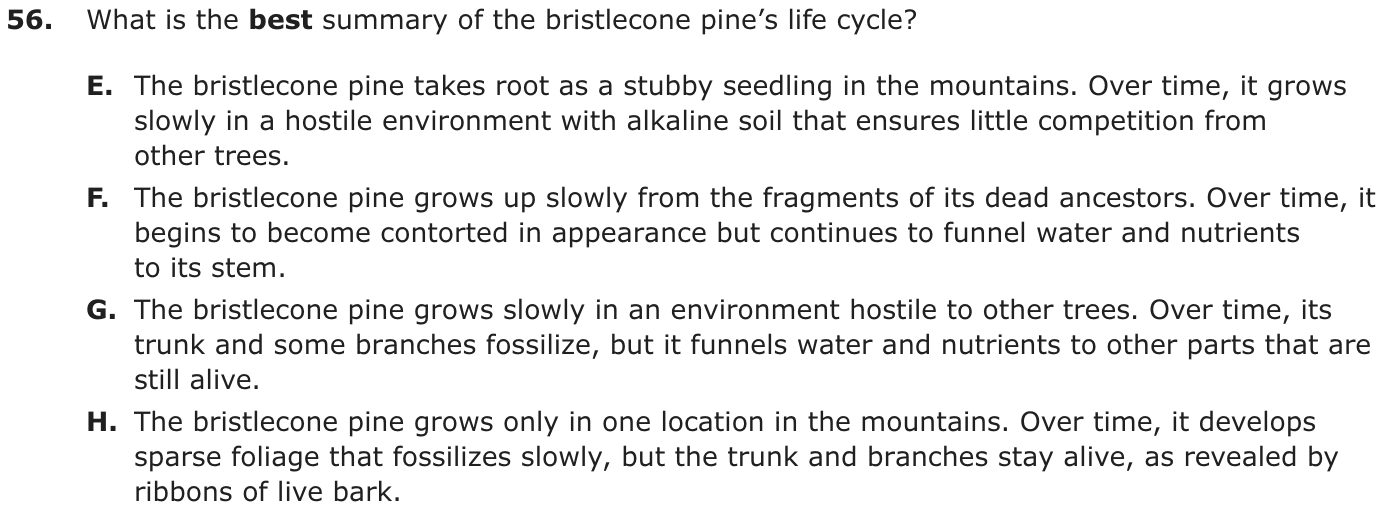
Question 44 of 57
2022 Test A English, question 44Passage Bird Talk
Bird Talk
by Carl Sandburg
And now when the branches were beginning to be heavy,
It was the time when they once had said, “This is the
beginning of summer.”
The shrilling of the frogs was not so shrill as in the
first weeks after the broken winter;
The birds took their hops and zigzags a little more
anxious; a home is a home; worms are worms.
The yellow spreads of the dandelions and buttercups
reached across the green pastures.
Tee whee and tee whee came on the breezes, and the grackles
chuzzled their syllables.
And it was the leaves with a strong soft wind over them
that talked most of all and said more than any others
though speaking the fewest words.
It was the green leaves trickling out the gaunt nowhere
of winter, out on the gray hungry branches—
It was the leaves on the branches, beginning to be heavy,
who said as they said one time before, “This is the be-
ginning of summer.”
We shall never blame the birds who come
where the river and the road make the Grand Crossing
and talk there, sitting in circles talking bird talk.
If they ask in their circles as to who is here
and as to who is not here and who used to be here,
Or if instead of counting up last year as against
this year, they count up this year as against next
year, and have their bird chatter about who is here
this year who won’t be here next year,
We shall never blame the birds.
If I have put your face among leaf faces, child,
Or if I have put your voice among bird voices,
Blame me no more than the bluejays.
“Bird Talk” by Carl Sandburg—Public domain.
Question
Read lines 6–7 from the poem.
The birds took their hops and zigzags a little more
anxious; a home is a home; worms are worms.
What idea from the second stanza do the lines help develop?
- AThe birds are eager for the return of warmer months.
- BThe birds are most likely to thrive during the spring.
- CThe birds naturally adjust to the seasonal changes.
- DThe birds instinctively prepare for the future.
Show the answer
Correct answer: C
The question asks how lines 6–7 from the poem develop an idea from the second stanza.
A. Incorrect. In lines 2–3, the tree branches exclaim that “ ‘This is the / beginning of summer,’ ” and the birds respond by taking “their hops and zigzags a little more / anxious” (lines 6–7); however, the birds’ eager reaction to the return of warmer weather is not referenced in the second stanza of the poem, which is more about the nature of birds generally than the changing of the seasons.
B. Incorrect. Birds are more likely to thrive in warmer weather as evidenced by some birds’ migration to a warmer climate during winter, and the creatures in the first stanza are responding to the “ ‘beginning of summer’ ” (line 3) in their own way, such as the birds who are taking “their hops and zigzags a little more / anxious” (lines 6–7). However, the thriving of birds during a particular season is not the focus of the second stanza; rather, it is focused on the general nature of birds.
C. CORRECT. The birds are taking “their hops and zigzags a little more / anxious” (lines 6–7) in light of warmer weather, but they are not making a big to-do of the change because “a home is a home; worms are worms” (line 7) any time of the year. Such a natural adjustment to seasonal changes is reflected in the second stanza, where the birds “count up this year as against next / year” (lines 26–27) because they are well accustomed to the cyclical nature of things.
D. Incorrect. Although the birds’ actions of “hops and zigzags” (line 6) may indicate some sort of preparation, these actions are not preparation but rather the internalized cognizance of the change that has occurred with little conscious thought. As revealed in the second stanza, birds do not ponder much about past or future but rather adapt naturally as things change.
Question analysis
This question on Carl Sandburg’s poem “Bird Talk” quotes lines 6–7, where the birds hop and zigzag “a little more anxious,” and asks which idea from the second stanza they help develop. Students must link two compressed lines in the first stanza to a later stanza about birds gathered at the Grand Crossing, and every choice sounds like a fair claim about birds.
- Grade level
- Grade 8 reading and task
- Compared with grade 7
- Above grade 7 Typical grade 7 poetry questions ask what one line or stanza shows on its own. Here two compressed lines from the first stanza must be tied to an idea the second stanza never states, in Sandburg’s loose, unusual phrasing.
- Estimated difficulty
- Among the hardest on the SHSAT: a non-obvious approach, heavy reading, or a well-hidden trap.
- Thinking it demands
- Depth of knowledge 3, strategic thinking · mainly analyze
- What makes it hard
- Reading between the lines major
- A very close wrong answer moderate
- Evidence in several places moderate
- Figurative or literary language moderate
- Evidence
- Answered from several paragraphs or stanzas
- Reading level
- Passage: 296 words (a poem; reading level not measured); question and choices: about grade 5, 70 words.
- Students, last 30 days
- Not enough answers yet to show (it takes 10).
Why it is hard, traps and wrong answers (shows the answer)
Why it is hard
The stem runs in an unusual direction: two lines from the first stanza must help develop an idea that only the second stanza holds, and the poem never states it. Students who read “next year” as planning are drawn to preparation, a choice built on the key’s own frame, while others answer from the first stanza’s summer or from what they know about birds. The question rewards hearing the birds’ roll call of who is gone as the same matter-of-fact acceptance as “worms are worms.”
Reading between the lines major Working it out
Neither stanza states the shared idea: students must hear calm acceptance in “a home is a home; worms are worms” and in birds tallying “who won’t be here next year,” then call it adjusting to change. (Graesser, Singer & Trabasso, 1994; Kintsch, 1998)
A very close wrong answer moderate Choosing the answer
The choice about instinctive preparation shares the key’s shape, birds acting by nature as time passes; it differs only in what the birds do, prepare for the future rather than adjust to the seasons. (Embretson & Wetzel, 1987; Gorin & Embretson, 2006; Ascalon et al., 2007)
Evidence in several places moderate Working it out
Lines 6–7 sit in the first stanza and the idea lives in the second, lines 20–29, so students must carry two lines across the poem and match them to the gathering at the Grand Crossing. (Kirsch & Mosenthal, 1990; Gorin & Embretson, 2006)
Figurative or literary language moderate Understanding the question
“A home is a home; worms are worms” says nothing on its surface; its meaning, a shrug that life goes on as it always has, has to be read from the repetition. (Graesser, Singer & Trabasso, 1994; Kintsch, 1998)
Strategy: Paraphrase the second stanza first: what are the birds doing and saying at the Grand Crossing? Then reread lines 6–7 and ask which idea about birds both passages share.
Traps
- Reads too much in: A reasonable-sounding conclusion that goes further than the text allows.
- Wrong part of the text: A choice is true of another paragraph, stanza or speaker than the one asked about.
- Outside knowledge: A choice is plausible in the real world but not supported by this text.
The wrong answers, classified
A Wrong part of the text (Kirsch & Mosenthal, 1990)
Hears “a little more anxious” as eagerness for the summer announced in lines 2–3, an idea of the first stanza, while the second stanza never mentions weather or warmth.
B Outside knowledge (King et al., 2004; Recht & Leslie, 1988)
Brings in the real fact that birds do well in warm weather, which neither lines 6–7 nor the birds’ talk of who is gone says, and the poem’s season is summer, not spring.
D Reads too much in (Graesser, Singer & Trabasso, 1994)
Sees nest-building in “a home is a home” and planning in counting “this year as against next / year,” but the birds only note who will be missing and make no preparations.
Working it out, step by step
Figure out what the question asks
This question points in an unusual direction. Lines 6–7 are in the first stanza. A stanza is a group of lines set apart by a blank line. But the idea you need is in the second stanza, lines 20–29. The question asks which idea in stanza 2 these earlier lines also help build. So find the idea in stanza 2 first. Then see how lines 6–7 support it.
Find the idea in stanza 2
In stanza 2, birds sit “in circles talking bird talk.” They ask “who is here / and as to who is not here and who used to be here.” They also talk about “who is here / this year who won’t be here next year.” The birds simply count the changes. They are not upset by them. The speaker says, “We shall never blame the birds.” The idea: birds take the changes that time brings as a normal part of life.
Read lines 6–7 closely
Lines 6–7 say “The birds took their hops and zigzags a little more / anxious; a home is a home; worms are worms.” As summer comes, the birds hop about a little more nervously and busily. That is a small change. Then the speaker shrugs: “a home is a home; worms are worms.” Life goes on as it always does. The birds change a little and carry on, with no fuss.
See what the two parts share
Both parts show birds meeting change calmly. In lines 6–7, the season turns, and the birds adjust a little. To adjust is to change a little to fit something new. In stanza 2, the birds note who has come and gone, and life goes on. So lines 6–7 help build stanza 2’s idea: birds naturally adjust to the changing seasons.
Check each choice
- A does not fit. Stanza 2 never mentions warm weather or being eager for it.
- B does not fit. Nothing in the poem says birds do best in spring. The poem’s season is the start of summer.
- C fits. Both parts show birds taking seasonal change calmly, as a matter of course.
- D does not fit. The birds talk about next year, but they make no plans for it.
Watch out: D is tempting because “a home is a home” can sound like nest building. But the birds only count who will be missing. They do not get ready for anything.
Choose the answer
Lines 6–7 and stanza 2 both show birds accepting change as natural. So the answer is C, “The birds naturally adjust to the seasonal changes.”
Why this answer and not the closest wrong one
D is the closest wrong choice. Like C, it says birds act by nature as time passes. But D says they prepare, or get ready. In stanza 2, the birds talk about next year only to count who “won’t be here next year.” In lines 6–7, they hop about and carry on. They adjust to change. They do not plan for it.
More questions like this
The original DOE question
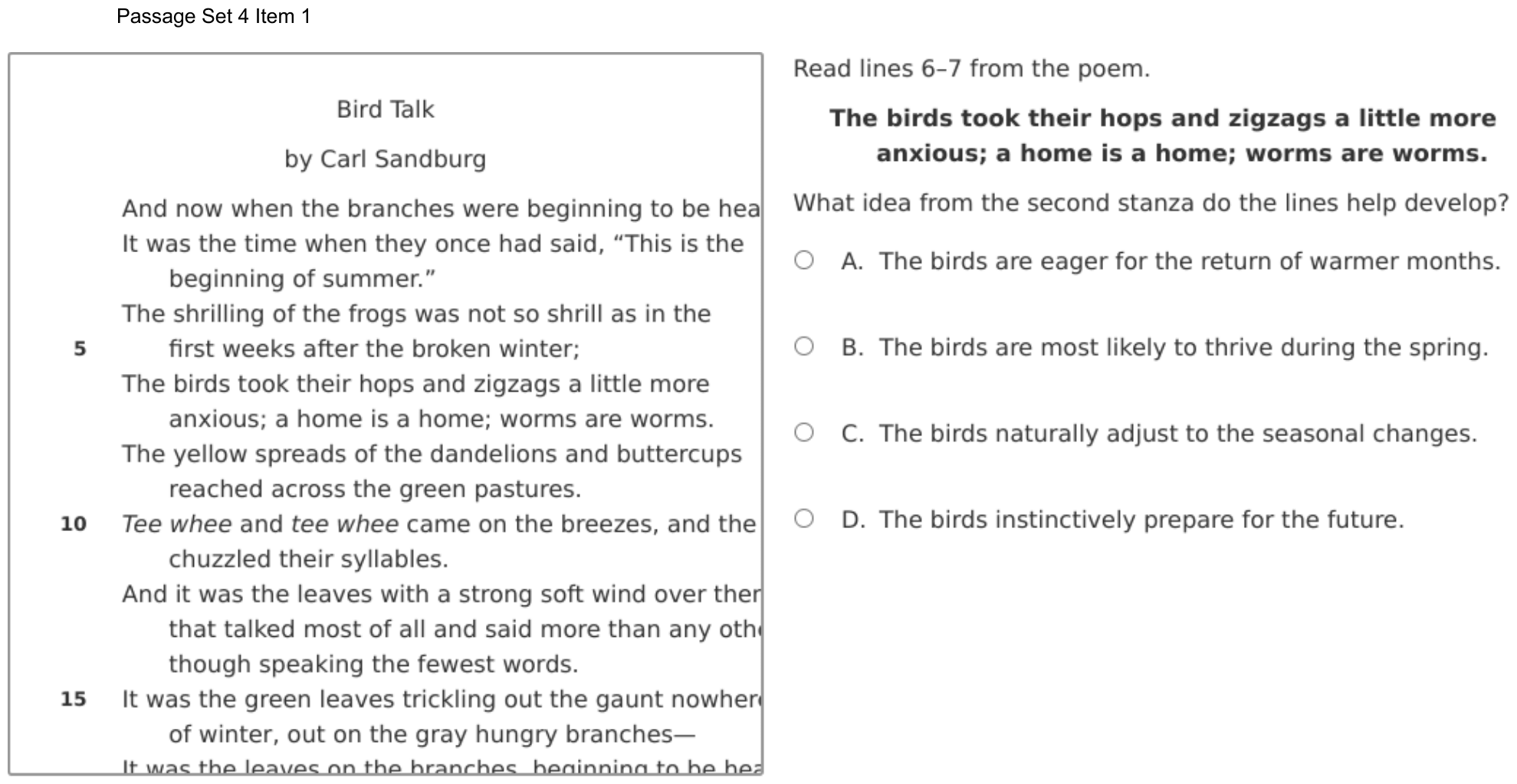
The passage “Bird Talk” as printed (page 32)
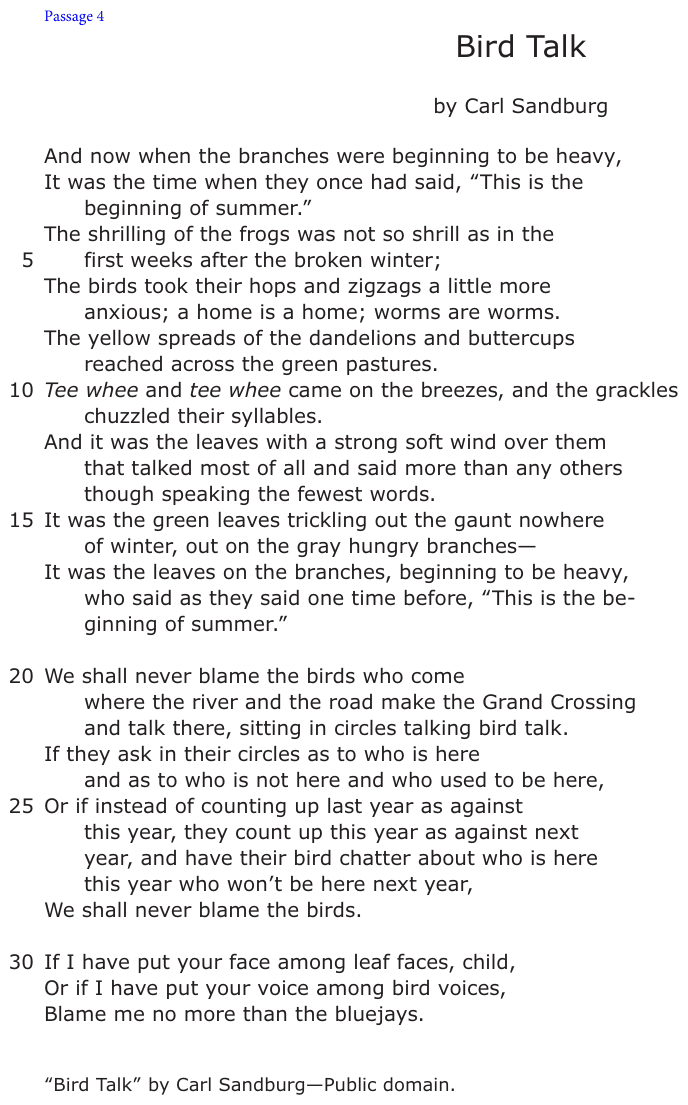
Question 45 of 57
2022 Test A English, question 45Uses the passage above: “Bird Talk”.
Question
Read lines 12–14 from the poem.
And it was the leaves with a strong soft wind over them
that talked most of all and said more than any others
though speaking the fewest words.
What does the phrase “talked most of all” in line 13 convey?
- AIt establishes that the speaker thinks the sound of wind in the leaves is the best indication that the season is changing.
- BIt introduces the idea that the sound of the wind in the leaves remains constant throughout the seasons.
- CIt suggests that the speaker is overwhelmed by the sounds of nature that emerge as the season changes.
- DIt emphasizes that the sounds of nature enable the speaker to appreciate each season of the year.
Show the answer
Correct answer: A
This question asks for what a phrase reveals about the speaker’s perspective on the change in seasons.
A. CORRECT. The first stanza of the poem establishes the way different parts of the natural world, including both plants and animals, respond to the change in season. These lines reflect the way the wind in the leaves is the best indication of the seasonal change because it is the wind in the leaves that “talked most of all and said more than any others / though speaking the fewest words” (lines 13–14).
B. Incorrect. Although the sound of the wind is the most obvious sign of the seasonal change per the speaker, it is in response to the “ ‘beginning of summer’ ” (line 3) that the wind speaks through the leaves. The poem does not reveal that this figurative speech occurs throughout the seasons, only that it occurs during the transition to summer.
C. Incorrect. While the language used by the speaker indicates a deep appreciation for the natural phenomenon being witnessed, the language used does not indicate a feeling of being overwhelmed but rather a feeling of awareness.
D. Incorrect. Using the personification of the wind “speaking” (line 14) indicates an appreciation by the speaker for the power and volume of the wind’s voice, but only one instance of the wind’s speech, that which occurs at the “ ‘beginning of summer’ ” (line 3), is chronicled by the speaker in the poem.
Question analysis
Students interpret the personification in lines 12–14 of “Bird Talk,” where the leaves under a strong soft wind “talked most of all,” and decide what that phrase conveys. Because the leaves also speak “the fewest words,” the line seems to contradict itself, and its meaning depends on how it fits Sandburg’s first stanza about the start of summer.
- Grade level
- Grade 7 reading and task
- Compared with grade 7
- At grade 7 Explaining what a figurative phrase conveys about a speaker’s view is standard grade 7 work. The three lines are printed with the question, though the phrase still has to be read against the rest of the first stanza.
- Estimated difficulty
- Moderate: several steps, or a close reading with one strong distractor.
- Thinking it demands
- Depth of knowledge 2, skills and concepts · mainly understand
- What makes it hard
- Figurative or literary language moderate
- Reading between the lines moderate
- Evidence
- Answered from one paragraph or stanza
- Reading level
- Passage: 296 words (a poem; reading level not measured); question and choices: about grade 6, 119 words.
- Students, last 30 days
- Not enough answers yet to show (it takes 10).
Why it is hard, traps and wrong answers (shows the answer)
Why it is hard
The phrase ranks the leaves above the shrilling frogs and chattering birds as voices of the season, but it never says what they are best at, so students must supply the idea of a sign. The tempting wrong readings take the speaker’s pleasure in nature and stretch it to every season, or hear “talked most of all” as noise. The quiet words around the phrase, “strong soft wind” and “fewest words,” point to a calm sound that tells the most.
Figurative or literary language moderate Understanding the question
The leaves are personified, and the line seems to contradict itself: they “talked most of all and said more than any others / though speaking the fewest words.” (Graesser, Singer & Trabasso, 1994; Kintsch, 1998)
Reading between the lines moderate Working it out
Students must turn “said more than any others” into a judgment, that the leaves are the surest sign of summer, which lines 17–19 confirm when the leaves themselves announce “the beginning of summer.” (Graesser, Singer & Trabasso, 1994; Kintsch, 1998)
Strategy: Restate lines 12–14 in plain words, especially the contrast between saying more and speaking fewer words, then test each choice against the whole first stanza.
Traps
- Too broad or too strong: A choice overstates, generalizes, or uses absolute words the text does not support.
- Wrong tone or attitude: Misjudges the tone, attitude or point of view, such as reading admiration as criticism, or taking a character's or subject's feelings for the author's.
- Twists what the text says: Uses the text's topic and ideas but changes what it says: who did it, how much, when, or why.
The wrong answers, classified
B Twists what the text says (King et al., 2004)
Stretches “as they said one time before” into a sound heard all year, though the leaves have only just come out of “the gaunt nowhere / of winter.”
C Wrong tone or attitude (Graesser, Singer & Trabasso, 1994)
Hears “talked most of all” as a din that swamps the speaker, though the “strong soft wind” and “fewest words” describe a quiet sound noted calmly, with no sign of strain.
D Too broad or too strong (King et al., 2004)
Rightly senses the speaker’s pleasure in nature’s voices but widens it to “each season of the year,” though the poem watches only the turn to summer and singles out the leaves.
Working it out, step by step
Figure out what the question asks
This asks what a phrase conveys, or gets across. The phrase is “talked most of all” in line 13. Leaves can’t really talk. Giving a thing human actions, like talking, is called personification. You need to work out what the speaker means by saying the leaves talked the most.
Read lines 12–14
Lines 12–14 say “And it was the leaves with a strong soft wind over them / that talked most of all and said more than any others / though speaking the fewest words.” The others are the frogs and birds from earlier lines. The leaves “said more than any others,” yet they used “the fewest words.” So the quiet rustle of the leaves tells you more than all the frog and bird calls.
Find what the leaves say
The stanza ends with the leaves speaking. Lines 17–19 say it was “the leaves on the branches, beginning to be heavy,” who said “This is the beginning of summer.” So the leaves’ message is that the season has changed. The new leaves, rustling in the wind, are the clearest sign that summer has come.
Check each choice
- A fits. The leaves say the most about the season, so they are the best sign that it is changing.
- B does not fit. The leaves have just come out of “the gaunt nowhere / of winter.” Gaunt means thin and bare. The leaves do not rustle the same way all year.
- C does not fit. A “strong soft wind” and “the fewest words” describe a quiet sound. Nothing shows the speaker is overwhelmed, or swamped.
- D does not fit. The poem watches only one change, the start of summer, not each season.
Watch out: D is tempting because the speaker clearly enjoys nature’s sounds. But it stretches that to “each season of the year,” which the poem never covers.
Choose the answer
“Talked most of all” shows that the leaves tell the most about the change of season. So the answer is A, “It establishes that the speaker thinks the sound of wind in the leaves is the best indication that the season is changing.”
Why this answer and not the closest wrong one
D is the closest wrong choice. The speaker does seem to enjoy the sounds of nature. But the poem covers just one change, the turn to summer. And the phrase does more than show enjoyment. It ranks the leaves above the frogs and birds. They say the most about the change, so they are the best sign of it.
More questions like this
The original DOE question
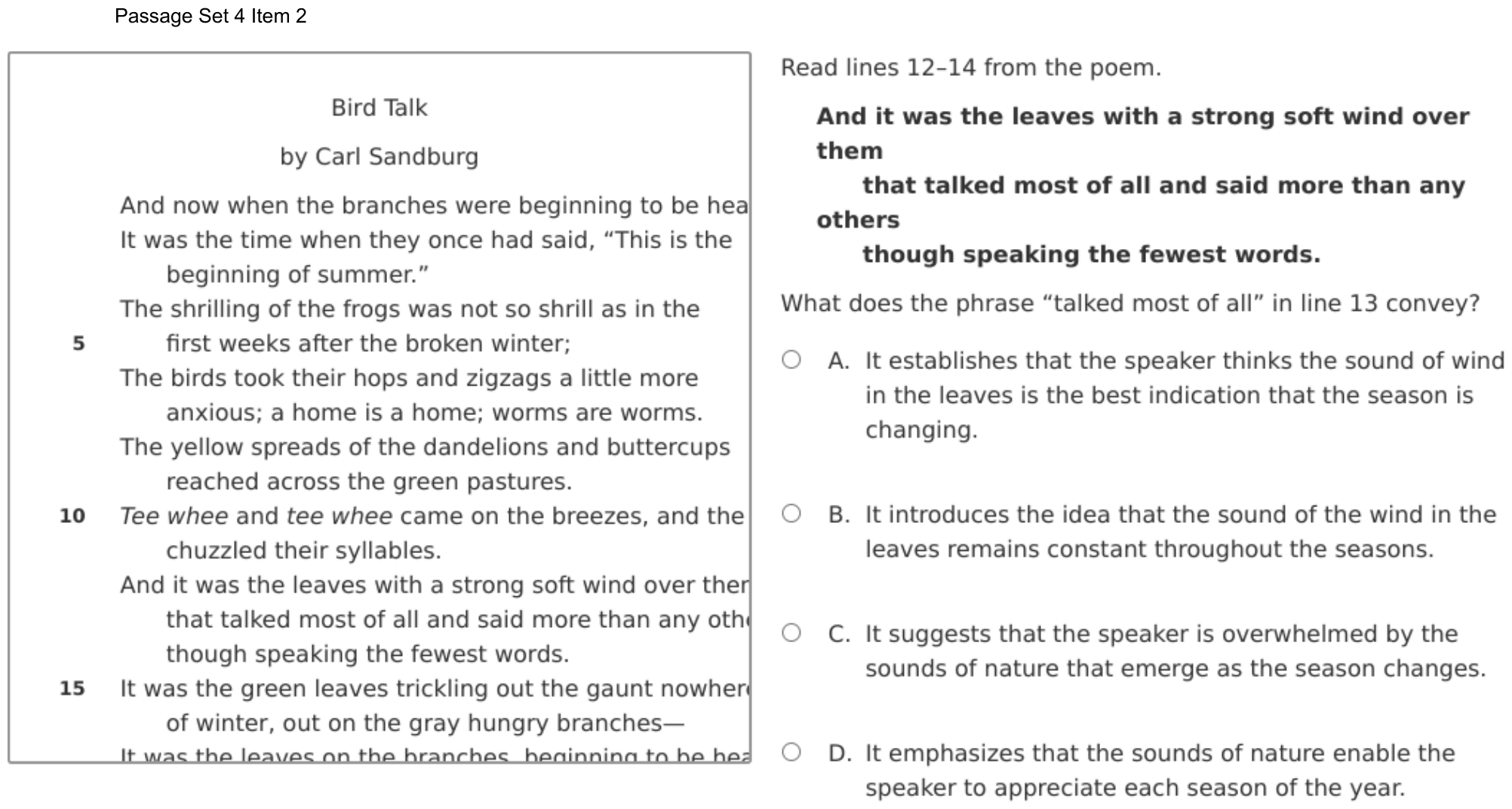
Question 46 of 57
2022 Test A English, question 46Uses the passage above: “Bird Talk”.
Question
How does the repetition of “ ‘This is the beginning of summer’ ” in lines 2–3 and lines 18–19 contribute to the meaning of the poem?
- AIt suggests that the shift to summer occurs in the same way each year.
- BIt emphasizes the idea that living things are prepared for the change of season.
- CIt highlights the idea that the first signs of summer are surprising each year.
- DIt builds expectations about what the natural world looks like during a change of season.
Show the answer
Correct answer: A
The question asks how the repetition of a phrase contributes to the meaning of the poem in terms of conveying information about a cyclical event.
A. CORRECT. This phrase is used twice verbatim, in both cases to show the figurative words spoken by the branches (lines 2–3) and the leaves on the branches (lines 18–19). Repetition of this phrase conveys the idea that the transition to summer occurs in the same manner each subsequent year and thus evokes the same response from nature.
B. Incorrect. While living things—branches and leaves—both make identical figurative utterances, they do so not because they have prepared for such an event. Rather, these living things take the change in stride because of the sameness and expectedness of the seasonal shifts, which occur in the same way each time.
C. Incorrect. Even though the branches and leaves have been imbued by the speaker with some degree of consciousness in their figurative ability to speak, they are not surprised by the change in seasons. They say the same thing each year because the same thing occurs each year in the same way.
D. Incorrect. Certain lines of the poem do describe the natural world during the change of seasons, such as lines 8–9: “The yellow spreads of the dandelions and buttercups / reached across the green pastures.” However, this repeated phrase serves to evoke a sense of sameness and inevitability; it is not a phrase related to the physical appearance of the natural world, only the way the natural world responds to the seasonal change with simple acceptance for its sameness. The repeated lines do not hold any sort of expectation or anticipation for the coming of summer; they help relay observations made about the state of the season.
Question analysis
This poetry question asks how the repetition of “This is the beginning of summer,” said by the branches in lines 2–3 and by the leaves in lines 18–19 of Sandburg’s “Bird Talk,” contributes to the poem’s meaning. Students must judge what the repetition does, not only what the words say, and the four choices read the repeated line in quite different ways.
- Grade level
- Grade 7 reading and task
- Compared with grade 7
- At grade 7 Explaining what a repeated phrase adds to a poem is familiar grade 7 work. Both passages are pointed out by line number, so the task is to judge the effect of the repetition rather than to find it.
- Estimated difficulty
- Straightforward: two steps or one careful reading.
- Thinking it demands
- Depth of knowledge 2, skills and concepts · mainly analyze
- What makes it hard
- How, not what moderate
- Reading between the lines minor
- Evidence
- Answered from one paragraph or stanza
- Reading level
- Passage: 296 words (a poem; reading level not measured); question and choices: about grade 7, 79 words.
- Students, last 30 days
- Not enough answers yet to show (it takes 10).
Why it is hard, traps and wrong answers (shows the answer)
Why it is hard
Both quotations are pointed out, so the work is deciding what the echo adds. Students who know that repetition emphasizes may grab a choice that begins “emphasizes,” and those who hear the quoted words as a cry of discovery may pick surprise, even though that choice shares the key’s “each year.” Reading the lead-ins, “once had said” and “one time before,” settles it: the line is an old, expected announcement.
How, not what moderate Working it out
The question asks what repeating the line does for the poem, not what the line says, so students must judge an effect of structure: the same words open the first stanza and close it. (Anderson & Krathwohl, 2001)
Reading between the lines minor Working it out
The clue is in the lead-ins, “they once had said” in line 2 and “as they said one time before” in line 18, which present the announcement as words said at this point in earlier years. (Graesser, Singer & Trabasso, 1994; Kintsch, 1998)
Strategy: Reread each quoted passage together with the line that leads into it, then decide what the poet gains by having the branches and the leaves say the same words.
Traps
- Reads too much in: A reasonable-sounding conclusion that goes further than the text allows.
- Wrong tone or attitude: Misjudges the tone, attitude or point of view, such as reading admiration as criticism, or taking a character's or subject's feelings for the author's.
- Wrong purpose or structure: Names a purpose, structure or effect that the part does not serve, or describes what a part says when the question asks what it does.
The wrong answers, classified
B Reads too much in (Graesser, Singer & Trabasso, 1994)
Moves from the calm, repeated announcement to the claim that branches and leaves were ready for summer, but saying the same words again shows recurrence, not preparation.
C Wrong tone or attitude (Graesser, Singer & Trabasso, 1994)
Keeps the idea of “each year” but hears the quoted words as a cry of surprise, though “once had said” and “one time before” make them a familiar, expected announcement.
D Wrong purpose or structure (Anderson & Krathwohl, 2001)
Gives the repeated line the job of the stanza’s pictures, the dandelions and green pastures, though it names when summer begins and says nothing about how the land looks.
Working it out, step by step
Figure out what the question asks
This asks about repetition, which means using the same words more than once. The words “This is the beginning of summer” appear in lines 2–3. They come back in lines 18–19. You need to work out what saying them twice adds to the poem’s meaning.
Read the words that lead in
Look at the words just before each quotation. Line 2 says “It was the time when they once had said.” Line 18 says the leaves “said as they said one time before.” Both lead-ins point to the past. The branches and leaves have said these words before, at this same time in other years.
Work out what the repetition shows
The same words come back, just as summer itself comes back. Each year the branches get heavy, the leaves come out, and it is summer again. The change happens the same way every time. So the repeated line works like a yearly announcement that nobody finds strange. It shows that the shift to summer follows a familiar pattern.
Check each choice
- A fits. The repeated words show summer arriving the same way each year.
- B does not fit. Saying the words again shows that summer returns. It does not show that living things got ready for it.
- C does not fit. Something said “one time before” is familiar, not surprising.
- D does not fit. The line only names a time. Pictures like the yellow dandelions show how the land looks.
Watch out: C also says “each year,” so it can look right. But the quoted words are calm, like an old saying, not a cry of surprise.
Choose the answer
The repeated line is an old announcement, made again because summer comes again. So the answer is A, “It suggests that the shift to summer occurs in the same way each year.”
Why this answer and not the closest wrong one
C is the closest wrong choice, because it also points to something that happens each year. But C says the first signs of summer are a surprise. The lead-ins say the opposite. The branches “once had said” these words, and the leaves said them “one time before.” Words said many times before are expected. They show a pattern, not a surprise.
More questions like this
The original DOE question
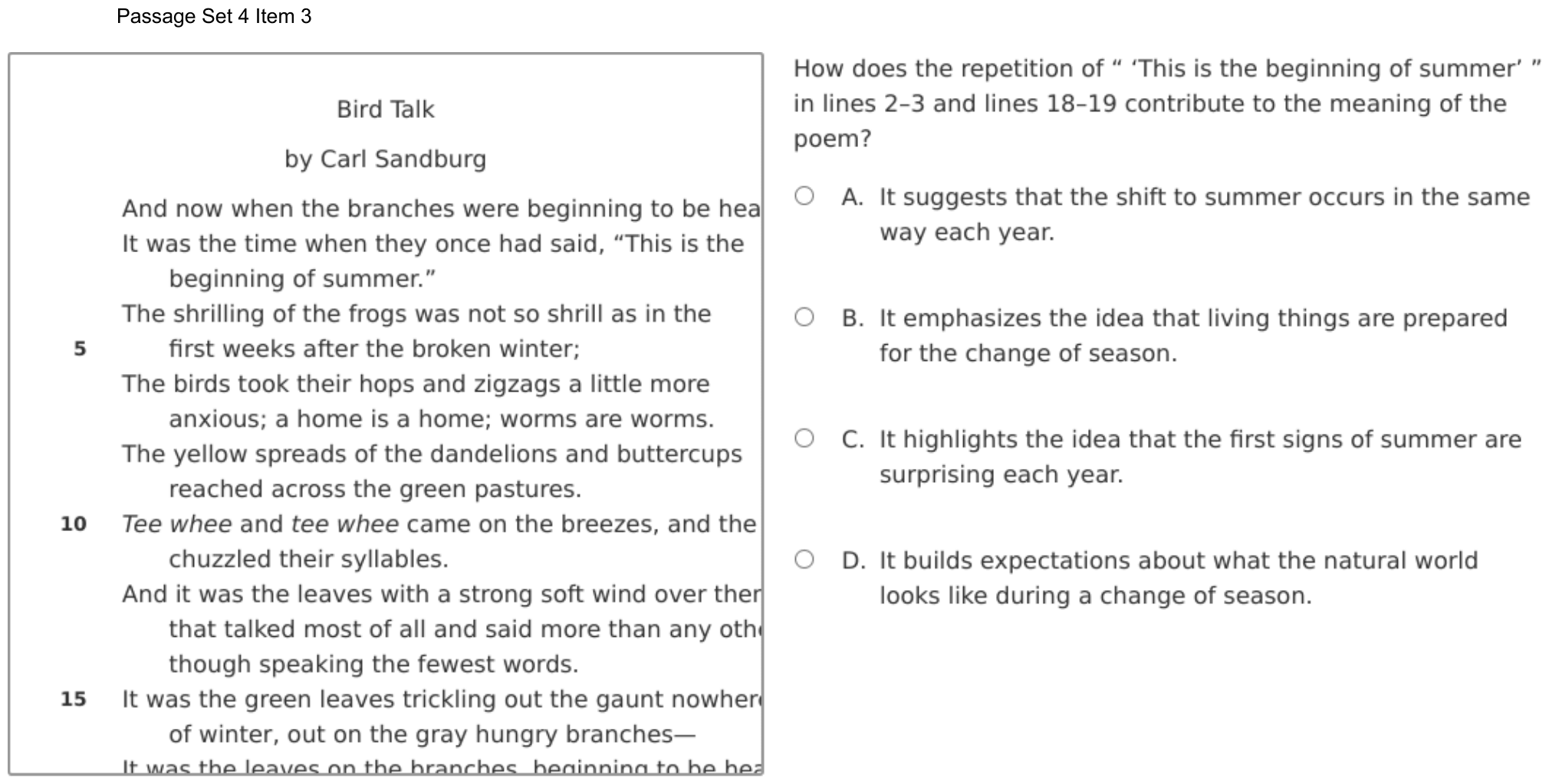
Question 47 of 57
2022 Test A English, question 47Uses the passage above: “Bird Talk”.
Question
Which lines from the poem best contrast with the idea of winter’s scarcity and bleakness?
- A“The shrilling of the frogs was not so shrill as in the / first weeks after the broken winter;” (lines 4–5)
- B“The yellow spreads of the dandelions and buttercups / reached across the green pastures.” (lines 8–9)
- C“Tee whee and tee whee came on the breezes, and the grackles / chuzzled their syllables.” (lines 10–11)
- D“Or if instead of counting up last year as against / this year, they count up this year as against next” (lines 25–26)
Show the answer
Correct answer: B
The question asks for the identification of a description that contrasts with the scarcity and bleakness of winter.
A. Incorrect. These lines indicate that the frogs are first very excited about the shift from winter to spring, which causes them to make a loud “shrilling,” yet their sounds lessen after a time and grow weaker. As such, these lines contrast two periods of spring (early vs. later) and the response of the frogs to these two periods; the lines do not contrast the bleakness of winter with the abundance of spring or summer.
B. CORRECT. During winter, there is scarcity of plant life and a bleak landscape: trees lose their leaves, snow covers the ground, and nature appears dark and shuttered. In contrast, these lines reveal the bright “yellow spreads” of flowers and the verdant “green pastures” that are signs that winter has abated.
C. Incorrect. This description contrasts the sounds of “the breezes” of warmer air and the sounds made by grackles—a type of bird—rather than the bleakness and scarcity of winter and the abundance of the “ ‘beginning of summer’ ” (line 3).
D. Incorrect. These lines show the contrast between the two ways of looking at things in terms of past vs. present or present vs. future; in this instance, the lines reveal the way birds naturally expect and adapt to the passing of time and the change of seasons. The lines do not present a contrast between winter and spring.
Question analysis
This textual evidence question on Carl Sandburg’s poem “Bird Talk” asks which lines best contrast with the idea of winter’s scarcity and bleakness. Students compare four quotations about frogs, flowers, birdsong and the birds’ yearly counting, and the challenge is finding the one whose images most fully show the opposite of a bare, bleak season.
- Grade level
- Grade 7 reading and task
- Compared with grade 7
- At grade 7 Choosing lines that fit an idea is routine grade 7 evidence work. The twist is that students look for the opposite of an idea, winter’s scarcity and bleakness, rather than support for it, though the quoted images are concrete.
- Estimated difficulty
- Straightforward: two steps or one careful reading.
- Thinking it demands
- Depth of knowledge 2, skills and concepts · mainly evaluate
- What makes it hard
- Every choice must be checked minor
- Hard words minor
- Evidence
- Answered from one sentence or line
- Reading level
- Passage: 296 words (a poem; reading level not measured); question and choices: about grade 6, 85 words.
- Students, last 30 days
- Not enough answers yet to show (it takes 10).
Why it is hard, traps and wrong answers (shows the answer)
Why it is hard
The question turns the usual evidence task around: students picture a scarce, bleak winter and then look for its opposite. The line that names winter outright is a trap, since it only compares the frogs’ noise in two stretches of spring, and the grackles’ calls show life without plenty. The flowers spreading “across the green pastures” are the one image of abundance and color.
Every choice must be checked minor Choosing the answer
Every quotation carries some sign of the season, frogs, flowers, birdsong and the birds’ yearly count, so each must be tested for images of plenty and color set against a bare winter. (Embretson & Wetzel, 1987)
Hard words minor Understanding the question
The stem’s “scarcity” and “bleakness” define what to look for; a student unsure of them cannot tell that yellow and green spreading across pastures is their opposite. (Perfetti, 2007; Freedle & Kostin, 1993)
Strategy: First picture what a scarce, bleak winter looks like, then read each quotation for images that show the plain opposite of that picture.
Traps
- Word match: Repeats striking words or phrases from the text, so it looks supported, but its meaning does not fit the question.
- Supports only part of the claim: In a question about evidence: a line that backs one half of the claim but not the other, or a related point rather than the claim itself.
The wrong answers, classified
A Word match (Freedle & Kostin, 1993)
Is drawn by “the broken winter,” the only mention of winter among the choices, but the lines compare the frogs’ shrilling early and later in spring, not winter’s bareness with plenty.
C Supports only part of the claim (King et al., 2004; Thissen, Steinberg & Fitzpatrick, 1989)
Picks the birdsong, which does show life returning after a silent season, but the calls say nothing about scarcity giving way to plenty, as the spreading flowers in lines 8–9 do.
D Word match (Freedle & Kostin, 1993)
Takes “as against” for the contrast the question asks about, though these lines set one year against another in the birds’ talk and hold no image of winter or of growth.
Working it out, step by step
Figure out what the question asks
This asks you to find lines that show the opposite of winter. Scarcity means not having enough of something. Bleakness means looking bare, cold and gloomy. So picture winter: bare branches, no flowers, gray and brown fields. Then look for the lines that show plenty and bright color instead.
Read lines 8–9
Lines 8–9 say “The yellow spreads of the dandelions and buttercups / reached across the green pastures.” Dandelions and buttercups are small yellow flowers. Pastures are grassy fields. A spread is a wide area covered with something. Here, yellow flowers stretch across green fields. That is a picture of color everywhere and plenty of growth. It is the exact opposite of a bare, gray winter.
Check each choice
- A does not fit. It mentions “the broken winter,” but it only compares how shrill, or sharp and high, the frogs sounded at two times. Nothing in it shows plenty.
- B fits. Yellow flowers spread over green fields, full of color and life.
- C does not fit. The birdsong shows that life is back. But it gives no picture of plenty or color to set against a bare winter.
- D does not fit. These lines compare one year with another in the birds’ talk. There is no winter and no growth in them.
Watch out: A is the only choice that names winter, so it can seem to fit. But mentioning winter is not the same as contrasting with it.
Choose the answer
Only lines 8–9 show plenty and bright color, the opposite of a scarce, bleak winter. So the answer is B, lines 8–9: “The yellow spreads of the dandelions and buttercups / reached across the green pastures.”
Why this answer and not the closest wrong one
C is a close wrong choice, since birdsong is a sign that life is back. But the question asks for a contrast with scarcity, or not having enough. Sounds alone do not show plenty. Lines 8–9 show flowers spreading wide across green fields. That picture of color and plenty is the clearest opposite of a bare, gray winter.
More questions like this
The original DOE question
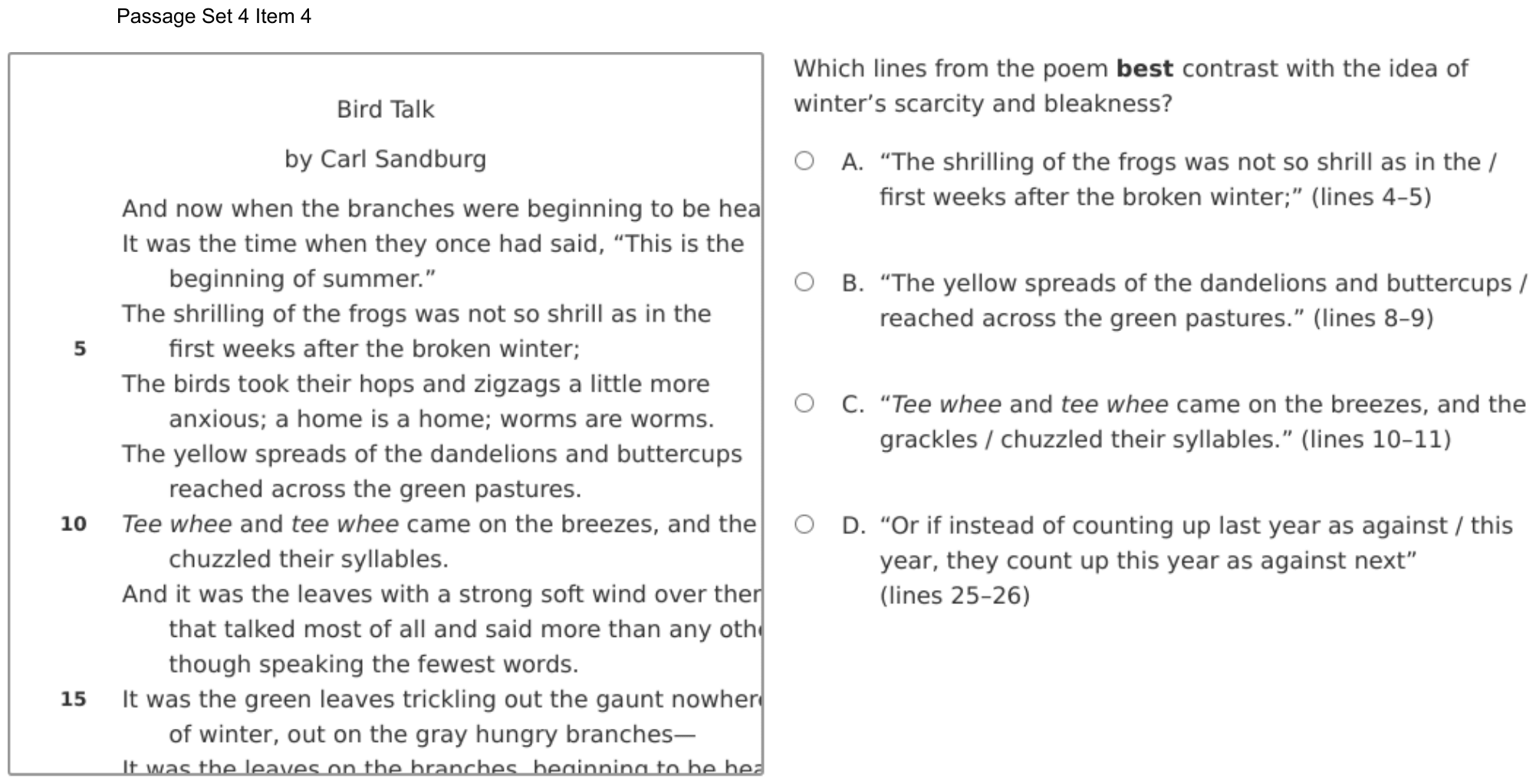
Question 48 of 57
2022 Test A English, question 48Uses the passage above: “Bird Talk”.
Question
How do lines 23–28 contribute to a central idea of the poem?
- AThey suggest that the speaker is aware of what has been lost in the winter.
- BThey imply that the birds sing the most in the summer.
- CThey reveal that the birds are subject to the cycles of nature.
- DThey emphasize that the speaker enjoys observing nature.
Show the answer
Correct answer: C
This question asks how the description of the “bird talk” contributes to the central idea of the poem.
A. Incorrect. The birds’ conversations may center around “who is here” and “who is not here and who used to be here” (lines 23–24), but the lines do not convey that the speaker feels a sense of loss, only that the birds have such figurative conversations in a direct way.
B. Incorrect. Though the birds are described by the speaker as “talking bird talk” (line 22), it is not suggested that this talk occurs more frequently in one season versus another, only that it occurs year after year because birds encounter seasonal changes as a constant.
C. CORRECT. In these lines, the birds gather, and some birds are not present but “used to be here” (line 24). These birds have likely succumbed to another of nature’s cycles: death, which affects all living things.
D. Incorrect. Though the description in these lines is a vivid one and includes anthropomorphism in the birds asking about “who is here” (line 23) and “counting up last year as against / this year” (lines 25–26), it gives no indication of the speaker’s level of enjoyment in observing nature.
Question analysis
This poetry question points to lines 23–28 of Carl Sandburg’s “Bird Talk,” where birds sitting in circles talk over who is here, who is not here and who won’t be here next year, and asks how those lines contribute to a central idea of the poem. Students must untangle Sandburg’s long, loosely joined lines and connect the birds’ chatter to the rest of the poem.
- Grade level
- Grade 8 reading and task
- Compared with grade 7
- Above grade 7 Grade 7 students often explain what a stanza adds to a poem. Here six lines of loosely punctuated free verse must first be decoded and then tied to a central idea the question leaves unnamed, more than typical grade 7 poetry work.
- Estimated difficulty
- Hard: combines ideas, needs a plan, and has more than one tempting wrong answer.
- Thinking it demands
- Depth of knowledge 3, strategic thinking · mainly analyze
- What makes it hard
- Reading between the lines major
- Complex sentences moderate
- Figurative or literary language minor
- How, not what minor
- Evidence
- Answered from several paragraphs or stanzas
- Reading level
- Passage: 296 words (a poem; reading level not measured); question and choices: about grade 5, 57 words.
- Corrected from the DOE handbook
- The explanation said a quoted phrase was in the lines the question asks about, though it comes just before them; that sentence was corrected.
- Students, last 30 days
- Not enough answers yet to show (it takes 10).
Why it is hard, traps and wrong answers (shows the answer)
Why it is hard
The lines are hard to untangle, and the meaning that matters, that some birds have died or gone and others will by next year, is only implied. Students who catch the sense of loss can still go wrong by handing it to the speaker and tying it to the first stanza’s winter, while others fall back on safe statements about enjoying nature or summer birdsong. The question rewards reading the birds’ count of last year, this year and next year as a cycle that repeats.
Reading between the lines major Working it out
The lines never name death or the seasons; students must work out that birds “who used to be here” and birds “who won’t be here next year” stand for losses that come round year after year. (Graesser, Singer & Trabasso, 1994; Kintsch, 1998)
Complex sentences moderate Understanding the question
Lines 23–28 are one unfinished sentence of stacked “if” clauses, “as to who is here / and as to who is not here,” with a count of “this year as against next” broken across two lines. (Abedi & Lord, 2001; Freedle & Kostin, 1993; Messick, 1989)
Figurative or literary language minor Understanding the question
The birds are pictured as a meeting that will “ask in their circles” and keep a yearly tally, so the census has to be read as the speaker’s playful image of what nature does. (Graesser, Singer & Trabasso, 1994; Kintsch, 1998)
How, not what minor Working it out
The stem asks what the lines add to “a central idea” without naming one, so students must first decide which idea of the poem the birds’ tally serves. (Anderson & Krathwohl, 2001)
Strategy: Put lines 23–28 into plain words, noting who is talking and what they keep track of, then ask what that adds to the poem as a whole before you look at the choices.
Traps
- Twists what the text says: Uses the text's topic and ideas but changes what it says: who did it, how much, when, or why.
- Wrong part of the text: A choice is true of another paragraph, stanza or speaker than the one asked about.
- Reads too much in: A reasonable-sounding conclusion that goes further than the text allows.
The wrong answers, classified
A Twists what the text says (King et al., 2004)
Rightly hears loss in “who used to be here,” but gives that awareness to the speaker and pins it on winter, though the birds keep the count and look ahead to next year too.
B Reads too much in (Graesser, Singer & Trabasso, 1994)
Hears “bird chatter” as song and joins it to the poem’s summer setting, but the lines compare who is present from year to year, not how much birds sing in each season.
D Wrong part of the text (Kirsch & Mosenthal, 1990)
Remembers the first stanza’s pleasure in dandelions, buttercups and talking leaves, but lines 23–28 are given over to the birds’ count and show nothing of the speaker’s enjoyment.
What was corrected from the DOE handbook, and why
- Explanation: The question asks about lines 23–28. The DOE’s explanation of Option B begins “Though the birds are described in these lines by the speaker as ‘talking bird talk’ (line 22).” That phrase is in line 22, just before the lines the question asks about, as the explanation’s own line number shows. The site drops “in these lines,” so the sentence now says that the speaker describes the birds as “talking bird talk” (line 22). The reason Option B is wrong is unchanged: the poem does not suggest that the birds talk more in one season than in another. The answer, C, is unchanged.
Working it out, step by step
Figure out what the question asks
This asks what lines 23–28 add to a central idea of the poem. A central idea is a big message the whole poem gets across. So you need to do two things. First, put the six lines into plain words. Then see how they connect to the rest of the poem.
Read lines 20 to 29
Lines 20–22 show birds that “talk there, sitting in circles talking bird talk.” Lines 23–24 say they ask “as to who is here / and as to who is not here and who used to be here.” Lines 25–28 say they count “this year as against next / year.” They talk “about who is here / this year who won’t be here next year.” Line 29 ends: “We shall never blame the birds.”
Put the lines in plain words
The birds are pictured like people at a meeting, taking a count. Some birds from last year are missing. They may have died or flown off. And some birds here now won’t be back next year. This happens again every year. Some birds arrive and some are lost. A pattern that repeats like this is called a cycle. The seasons are a cycle too.
Connect the lines to the poem
The first stanza (group of lines) shows a pattern that repeats too. Winter is over, and the leaves say again that summer is beginning. Line 18 says they spoke “as they said one time before.” So a central idea is that nature moves in cycles that come back again and again. Lines 23–28 show that the birds’ lives follow those cycles too. To be “subject to” something is to be ruled by it.
Check each choice
- A does not fit. The birds keep the count, not the speaker (the voice talking in the poem). The lines never mention winter, and they look ahead to next year too.
- B does not fit. Line 22 calls it “talking bird talk,” but lines 23–28 never compare seasons or say when birds sing most.
- C fits. Birds come and go year after year, as part of nature’s cycles.
- D does not fit. These lines are about the birds’ count. They show nothing about whether the speaker enjoys watching.
Choose the answer
Watch out: A is the most tempting, because “who used to be here” does hint at loss. But the birds are the ones counting, and the count goes on every year. The lines show a cycle, not one sad winter. So the answer is C.
Why this answer and not the closest wrong one
A is the closest wrong answer, because the lines do hint at loss. But it is the birds who count who is missing, not the speaker. The lines also look ahead to next year instead of back at winter. That yearly count of who comes and who goes shows birds living by nature’s cycles, which is C.
More questions like this
The original DOE question
Question 49 of 57
2022 Test A English, question 49Uses the passage above: “Bird Talk”.
Question
Throughout the poem, the poet conveys the speaker’s point of view by
- Agradually moving the speaker’s attention from one element of nature to another.
- Bproviding the speaker’s motivation for describing the landscape in great detail.
- Chighlighting the speaker’s emotional response as each season passes.
- Dshifting the speaker’s focus from external observations to personal reflection.
Show the answer
Correct answer: D
This question asks for an explanation of how the poet conveys the speaker’s point of view on the natural world and the change of seasons as presented in the poem.
A. Incorrect. Though in the first stanza the speaker describes various elements of nature such as branches, frogs, birds, flowers, and leaves, these elemental shifts are not precisely gradual and occur only in the first stanza. Further, the first stanza, though appreciative of the natural world, is primarily descriptive and does not develop the speaker’s perspective to the degree that other parts of the poem do.
B. Incorrect. While it may be inferred that the speaker describes the landscape to such a degree because it has revealed a seasonal shift, that this is indeed the speaker’s motivation is never explicitly conveyed by the poet.
C. Incorrect. Multiple seasons do not pass in the poem; only the shift to the “ ‘beginning of summer’ ” (line 3) occurs in an endless cycle. Further, the speaker does not reveal an emotional response; it is the responses of nature that the speaker describes.
D. CORRECT. The first stanza is the speaker’s observations of the natural world embracing a new season. In the second stanza, the speaker begins to reflect on how the natural world, as embodied by the birds, calmly accepts seasonal change in its perpetual sameness. The reflection continues in the third stanza, where it is revealed that the speaker has been addressing these observations to a child.
Question analysis
This point-of-view question asks how the poet of “Bird Talk” conveys the speaker’s point of view throughout the poem. Students must keep in mind the long opening description of early summer and the two shorter stanzas after it, and decide which description of the poet’s method holds from the first line to the last.
- Grade level
- Grade 8 reading and task
- Compared with grade 7
- Above grade 7 Grade 7 point-of-view questions often ask what a speaker thinks. This one asks how the poet conveys that view across all three stanzas of a long free-verse poem, and the choices name methods in general terms, closer to grade 8 work.
- Estimated difficulty
- Hard: combines ideas, needs a plan, and has more than one tempting wrong answer.
- Thinking it demands
- Depth of knowledge 3, strategic thinking · mainly analyze
- What makes it hard
- Evidence in several places moderate
- A very close wrong answer moderate
- How, not what moderate
- Figurative or literary language minor
- Evidence
- Answered from the whole text
- Reading level
- Passage: 296 words (a poem; reading level not measured); question and choices: about grade 10, 54 words.
- Students, last 30 days
- Not enough answers yet to show (it takes 10).
Why it is hard, traps and wrong answers (shows the answer)
Why it is hard
The first stanza takes up 19 of the poem’s 32 lines and moves steadily from branches to frogs, birds, flowers and leaves, so a choice that describes it alone feels right. The point of view shows only when the poem turns to “We” and then to “I” addressing a child, and that third stanza is three hard lines. Students must keep the whole poem’s course in mind and choose the method that holds from first line to last.
Evidence in several places moderate Working it out
The answer depends on all three stanzas at once: the long catalog of the season in lines 1–19, the shift to “We shall never blame the birds,” and the closing “If I have put your face … child.” (Kirsch & Mosenthal, 1990; Gorin & Embretson, 2006)
A very close wrong answer moderate Choosing the answer
The choice about moving from one element of nature to another and the key both describe a shift in the speaker’s attention; they differ in what shifts, nature to nature or the outside world to the speaker’s own thoughts. (Embretson & Wetzel, 1987; Gorin & Embretson, 2006; Ascalon et al., 2007)
How, not what moderate Working it out
The stem asks how the poet conveys a point of view, a method, so a choice must describe what the speaker does across the poem, not what the speaker sees. (Anderson & Krathwohl, 2001)
Figurative or literary language minor Understanding the question
The last stanza is cryptic, “Blame me no more than the bluejays,” and students who miss that the speaker is now talking about putting a child into the poem lose the move to reflection. (Graesser, Singer & Trabasso, 1994; Kintsch, 1998)
Strategy: Write one phrase for what the speaker attends to in each stanza, then keep only a choice that describes the whole sequence, not one stanza.
Traps
- Too narrow: A single detail offered as the central idea or a summary, or a summary that keeps minor details and leaves out an essential part.
- Reads too much in: A reasonable-sounding conclusion that goes further than the text allows.
- Twists what the text says: Uses the text's topic and ideas but changes what it says: who did it, how much, when, or why.
The wrong answers, classified
A Too narrow (King et al., 2004)
Describes the first stanza well, its walk from branches to frogs, birds, flowers and leaves, but misses the later turn to “We” and to the speaker’s own “I.”
B Reads too much in (Graesser, Singer & Trabasso, 1994)
Supplies a reason for all the description, perhaps from the closing words to a child, but the speaker never says why the landscape is described, and the reflection is not a motive.
C Twists what the text says (King et al., 2004)
Sees that the poem follows nature through a change of season but makes it many seasons and hands the creatures’ reactions, such as the birds’ anxious hops, to the speaker as feelings.
Working it out, step by step
Figure out what the question asks
This asks about point of view: how the speaker, the voice talking in the poem, sees things. It also asks how the poet shows that view across the whole poem. So look at what the speaker pays attention to in each of the three stanzas. A stanza is a group of lines set apart by a blank line.
Follow the speaker through the stanzas
- Stanza 1, lines 1–19: the speaker describes the world outside. There are branches, frogs, birds, flowers and leaves at the start of summer.
- Stanza 2, lines 20–29: the speaker starts to judge and think. “We shall never blame the birds.”
- Stanza 3, lines 30–32: the speaker says “I” and talks to a child: “If I have put your face among leaf faces, child.”
Name the change in focus
The poem starts with external observations, or things the speaker sees and hears outside. It ends with personal reflection, or the speaker’s own thoughts. In the last stanza, the speaker admits to putting a child’s face and voice into the poem. The speaker asks to be blamed “no more than the bluejays.” Since “We shall never blame the birds,” that means not at all. This move from looking outward to looking inward is how the speaker’s view comes through.
Check each choice
- A does not fit. Moving from branches to frogs to birds happens only in stanza 1. It misses the turn to “We” and “I.”
- B does not fit. The speaker never says why the landscape is described.
- C does not fit. Only one change of season happens, the start of summer. The anxious feelings belong to the birds, not the speaker.
- D fits. The speaker moves from describing nature to thinking about it.
Watch out: A describes stanza 1 very well. But the question says “Throughout the poem,” so the answer must cover all three stanzas.
Choose the answer
The speaker starts by watching nature and ends by thinking aloud to a child. So the answer is D, “shifting the speaker’s focus from external observations to personal reflection.”
Why this answer and not the closest wrong one
A is the closest wrong choice. Stanza 1 really does move from one part of nature to another. But that is only 19 of the 32 lines. In stanzas 2 and 3, the speaker turns to “We” and then “I,” and shares personal thoughts. Only D describes the speaker’s path from the first line to the last.
More questions like this
The original DOE question
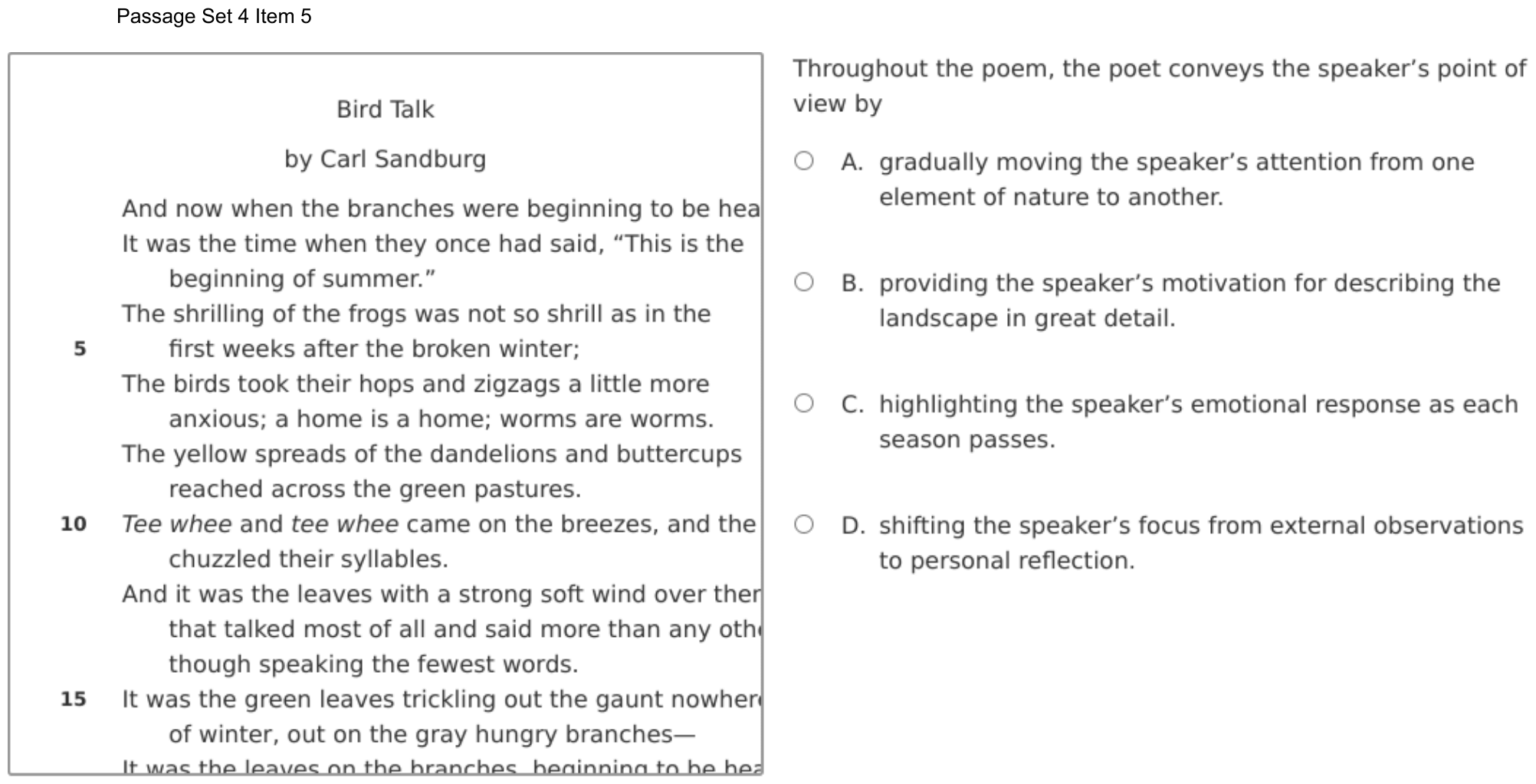
Question 50 of 57
2022 Test A English, question 50Uses the passage above: “Bird Talk”.
Question
Over the course of the poem, a central idea is developed mainly through the speaker’s
- Asense of eager anticipation as winter ends.
- Bdescription of the changes in nature as the seasons transition.
- Cobservation of the birds’ behavior as summer begins.
- Dprediction of future alterations in the physical landscape.
Show the answer
Correct answer: B
The question asks how the central idea about the natural acceptance of change by nature is developed by the speaker of the poem.
A. Incorrect. The speaker is an observer of the changes in nature as propelled by the seasons and shows no personal eagerness for the end of winter. Further, even though nature rejoices at the end of winter as exemplified by “the shrilling of the frogs” (line 4), the speaker merely records this and does not share in this display.
B. CORRECT. The response of nature to the “beginning of summer” (line 3) is the primary focus of the poem as revealed by the speaker through vivid descriptions of the sights, sounds, movements, and attitudes of the natural world.
C. Incorrect. The second stanza of the poem begins a reflection on birds “sitting in circles talking bird talk” (line 22) and taking a sort of attendance of who is present, but this behavioral description is largely figurative and meant to illustrate a point about the way the birds adapt quickly to change, not to develop a central idea of the poem in terms of how nature responds generally.
D. Incorrect. Seasonal changes are inevitable and cyclical per the speaker, but the speaker does not predict future changes to the landscape as a method of developing the central idea. Rather, the speaker describes nature’s response to changes that have already occurred.
Question analysis
Students decide how the speaker of Carl Sandburg’s “Bird Talk” mainly develops a central idea of the poem. The question does not name the idea, so students must work it out across the poem’s three stanzas and then weigh four accounts of what the speaker does, each tied to a different part or feature of the poem.
- Grade level
- Grade 7 reading and task
- Compared with grade 7
- At grade 7 Tracing how a central idea develops is core grade 7 work. Here the idea is never stated, so students must first infer it from 32 lines of free verse and then judge what the speaker mainly does to build it.
- Estimated difficulty
- Moderate: several steps, or a close reading with one strong distractor.
- Thinking it demands
- Depth of knowledge 3, strategic thinking · mainly analyze
- What makes it hard
- A very close wrong answer moderate
- Reading between the lines moderate
- Evidence in several places minor
- Evidence
- Answered from the whole text
- Reading level
- Passage: 296 words (a poem; reading level not measured); question and choices: about grade 9, 48 words.
- Students, last 30 days
- Not enough answers yet to show (it takes 10).
Why it is hard, traps and wrong answers (shows the answer)
Why it is hard
The title “Bird Talk” and the whole second stanza push students toward the birds, and the key differs from that choice only in taking in all of nature. Two other choices credit the speaker with something the poem gives elsewhere: the eagerness belongs to the frogs and birds, and the only look ahead is the birds’ talk of next year. Weighing what the speaker does across all 32 lines points to the description of nature changing.
A very close wrong answer moderate Choosing the answer
The choice about the birds’ behavior as summer begins matches the key’s frame, the speaker watching nature at the turn of the season; it differs only in narrowing nature to birds. (Embretson & Wetzel, 1987; Gorin & Embretson, 2006; Ascalon et al., 2007)
Reading between the lines moderate Working it out
The central idea is never stated, so students must first work out that the poem is about nature meeting the year’s turn calmly, then judge which of the speaker’s acts builds it most. (Graesser, Singer & Trabasso, 1994; Kintsch, 1998)
Evidence in several places minor Working it out
Birds appear in lines 6–7, 10–11, 20–29 and 31–32, so the title and the second stanza make them look central until the branches, frogs, flowers and leaves are counted too. (Kirsch & Mosenthal, 1990; Gorin & Embretson, 2006)
Strategy: Put the poem’s central idea into a sentence of your own, then ask which choice describes something the speaker really does and does the most to build that idea.
Traps
- Too narrow: A single detail offered as the central idea or a summary, or a summary that keeps minor details and leaves out an essential part.
- Wrong tone or attitude: Misjudges the tone, attitude or point of view, such as reading admiration as criticism, or taking a character's or subject's feelings for the author's.
- Reads too much in: A reasonable-sounding conclusion that goes further than the text allows.
The wrong answers, classified
A Wrong tone or attitude (Graesser, Singer & Trabasso, 1994)
Gives the speaker the stir of the shrilling frogs and anxious birds, but the speaker records it calmly, and the poem opens after winter, at “the beginning of summer.”
C Too narrow (King et al., 2004)
Follows the title and the birds’ circles at the Grand Crossing, but birds are one thread in a poem that also tracks branches, frogs, dandelions and leaves into summer.
D Reads too much in (Graesser, Singer & Trabasso, 1994)
Builds a forecast from the birds counting “this year as against next / year,” but that talk concerns who will be gone, not the land, and the speaker predicts nothing.
Working it out, step by step
Figure out what the question asks
This asks how a central idea is mainly built. A central idea is a big point the whole poem makes. First, put that idea in your own words. Then ask what the speaker does most, across the whole poem, to build it.
Find the central idea
The poem shows nature at “the beginning of summer.” The branches grow heavy, the frogs quiet down, the flowers spread and the leaves come out. In stanza 2, the birds calmly count who has come and gone. A central idea is that nature moves through the seasons, and living things accept the change as natural.
See how the speaker builds it
Most of the poem is description. Stanza 1 fills 19 of the 32 lines with changes in nature. It shows “The yellow spreads of the dandelions and buttercups” and “the green leaves trickling out the gaunt nowhere / of winter.” Trickling out means coming out slowly, a little at a time. Gaunt means thin and bare. Detail by detail, the speaker shows the season turning. That description is the main way the idea is built.
Check each choice
- A does not fit. The frogs and birds are stirred up, but the speaker describes them calmly. The poem also starts after winter is over.
- B fits. The speaker describes nature changing as the seasons turn.
- C does not fit. Birds are only one part. The poem also covers branches, frogs, flowers and leaves.
- D does not fit. The speaker predicts nothing about the land. The birds’ talk of next year is about who will be gone.
Watch out: C is tempting because the poem is called “Bird Talk” and stanza 2 is all about birds. But the central idea is about all of nature.
Choose the answer
The speaker builds the idea mostly through details of nature changing as summer begins. So the answer is B, “description of the changes in nature as the seasons transition.”
Why this answer and not the closest wrong one
C is the closest wrong choice. It also has the speaker watching nature as summer begins. But it narrows nature to birds. The poem’s changes come from many living things: branches, frogs, dandelions, buttercups and leaves. Only B takes in all of them, so only B describes how the whole poem builds its idea.
More questions like this
The original DOE question
Question 51 of 57
2022 Test A English, question 51Passage Excerpt from “It’s Time to Stop Thinking That All Non-Native Species Are Evil”
Excerpt from “It’s Time to Stop Thinking That All Non-Native Species Are Evil”
by Emma Marris
The author of this opinion article attended a symposium, or conference, in Missoula, Montana, at which biologists and other scientists discussed species of plants and animals that are not native to the areas in which they live.
Invasive species are scary. It was ecologist Charles Elton, back in the 1950s, who introduced the militaristic “invasion” metaphor to describe exotic plants and animals—but there’s no question some can be extremely destructive.
The brown tree snake has eaten a dozen kinds of forest birds in Guam to extinction; zebra mussels clog pipes around the Great Lakes; the common house cat turns out to be, in Australia, a mercilessly effective killer of cute, fluffy marsupials like the bilby and the numbat.
As scientists have sounded the alarm about these pests, the public has gotten the message. Citizen groups rip out non-native plants. Native gardens have become increasingly popular, both as ways to celebrate the unique flora of each region and as tiny hot spots of diversity. Native trees provide food for native bugs, which feed native birds. Food chains developed over thousands of years of co-evolution unfold in our backyards. . . .
So we’ve learned, scientists and laypeople alike, that native species are good and non-natives are bad.
Julian Olden, a biologist at the University of Washington, Seattle, who co-organized the symposium, recently polled nearly 2,000 ecologists. Among his findings: a substantial number of them said they would immediately eradicate a hypothetical non-native forest plant, even if it were shown to have no effect on the forest. Olden calls this the “guilty even when proven innocent” approach.
That kind of approach is not very useful on a rapidly changing planet.
Exotics Are Everywhere
Climate change is making it harder even to decide who the invaders are.
How, scientists at the symposium wondered, do you define “native” on a warming planet, when plants and animals are already moving toward the poles or up mountainsides in search of climate conditions they can tolerate? Should we consider them “invasive” in their new homes? Regardless of what we label them, conservationists will be reluctant to remove them from their new environs—to do so would stymie1 their chances of adapting to the warmer future we’re creating.
And then there are the non-natives that we actually like. Most domestic crops are exotic in most of the places they’re grown, but there are even wild exotics that “do good,” forming useful relationships with native species.
Edwin Grosholz of the University of California, Davis, told the recent symposium about one such relationship. On beaches in his state, non-native spartina grass has become important habitat for the endangered California clapper rail, a plump shorebird with a downward curving bill more at home on land than in the air. A project to rip out and poison the spartina—which grows in dense swaths that exclude many other shorebirds—saw clapper rail numbers go tumbling downward.
There are other examples like that. The endangered southwestern willow flycatcher nests in “invasive” tamarisk shrubs. Many native (and beautiful) Hawaiian flowers are now pollinated by the Japanese white-eye bird—because the native pollinators have been driven extinct by other non-native species.
Should we impose further risk on already endangered natives by severing these relationships? Or should we admire the resilience of nature and let such “well-behaved” exotics stay? . . .
Leave them alone, more and more conservationists are arguing, and stop focusing obsessively on categorizing species as native or non-native. Mark Davis, an ecologist at Macalester College in St. Paul, Minnesota, once considered himself an “invasion biologist”—but not anymore. “I am actively trying to get the field to retire the invader narrative,” he said in Missoula.
A Good Thing, Not the Only Thing
After all, nativeness is just one environmental value, and arguably not as important as preventing extinctions and preserving biodiversity. In some cases we can best serve biodiversity by leaving the non-natives alone or even—brace yourself, now—introducing them on purpose.
This is the thinking behind, for example, installing the Aldabra tortoise on the islands of Mauritius. The islands lost their own large tortoises, and the fruiting plants that formerly had their seeds moved around by these fruit-loving reptiles have been on the decline. A tortoise that’s related to the island’s large tortoises—a non-native from the Seychelles in the Indian Ocean that was intentionally introduced in 2004—is now handling some of that work.
Most of the time, for the time being, conserving species still means focusing on supporting them in their historical habitats, planting natives and removing non-natives. We can and should do that in places where it is feasible and important to us.
From “It’s Time to Stop Thinking That All Non-Native Species Are Evil” by Emma Marris from NATIONAL GEOGRAPHIC MAGAZINE, July 24, 2014. Copyright © 2014 by National Geographic Society.
1stymie: hinder or interfere with
Question
Which sentence from the excerpt supports the conclusion that Elton’s “militaristic ‘invasion’ metaphor” (paragraph 1) has influenced scientific understanding of non-native species?
- A“Among [Olden’s] findings: a substantial number of them said they would immediately eradicate a hypothetical non-native forest plant, even if it were shown to have no effect on the forest.” (paragraph 5)
- B“Regardless of what we label them, conservationists will be reluctant to remove them from their new environs—to do so would stymie their chances of adapting to the warmer future we’re creating.” (paragraph 8)
- C“A project to rip out and poison the spartina—which grows in dense swaths that exclude many other shorebirds—saw clapper rail numbers go tumbling downward.” (paragraph 10)
- D“In some cases we can best serve biodiversity by leaving the non-natives alone or even—brace yourself, now—introducing them on purpose.” (paragraph 14)
Show the answer
Correct answer: A
The question asks which sentence from the excerpt supports the conclusion that Elton’s “militaristic ‘invasion’ metaphor” (paragraph 1) has influenced scientific understanding of non-native species.
A. CORRECT. This sentence shows that of the 2,000 ecologists Olden polled, many said they think it is right to “immediately eradicate” non-native plants even if they are demonstrably harmless in their new environment. The response of these ecologists supports that Elton’s metaphor discussed in paragraph 1 has influenced scientific understanding.
B. Incorrect. Rather than supporting the idea that the militaristic metaphor has influenced scientists, this sentence shows that conservationists, at any rate, are happy to let non-native species thrive wherever they can, given global warming.
C. Incorrect. While this sentence does refer to efforts to eradicate a non-native species, the main point of it is that these efforts ended up harming a native species (the clapper rail shorebird).
D. Incorrect. In contrast to supporting the idea that the militaristic invasion metaphor has influenced scientific understanding of non-native species, this sentence puts forth the bold idea of treating non-native species as something to be welcomed.
Question analysis
This evidence question asks which sentence from an opinion article about non-native species supports the conclusion that ecologist Charles Elton's war-like “invasion” metaphor has shaped how scientists think. Students must work out what attitude the metaphor implies and then judge which quotation shows that attitude at work in science.
- Grade level
- Grade 8 reading and task
- Compared with grade 7
- At grade 7 Finding evidence for a stated conclusion is grade 7 work. This conclusion is abstract, about a metaphor's influence on thinking, and the vocabulary, such as eradicate and environs, adds load, but the choices are fairly distinct.
- Estimated difficulty
- Moderate: several steps, or a close reading with one strong distractor.
- Thinking it demands
- Depth of knowledge 2, skills and concepts · mainly evaluate
- What makes it hard
- Reading between the lines moderate
- Hard words minor
- Evidence
- Answered from several paragraphs or stanzas
- Reading level
- Passage: about grade 11, 815 words; question and choices: about grade 16, 135 words.
- Corrected from the DOE handbook
- A wording slip in the explanation was corrected.
- Students, last 30 days
- Not enough answers yet to show (it takes 10).
Why it is hard, traps and wrong answers (shows the answer)
Why it is hard
The conclusion is abstract, that a figure of speech shaped how scientists think, so the student has to translate it into behavior: treating every non-native as an enemy to destroy. The spartina sentence describes exactly that kind of attack, which makes it tempting, but its point is the harm the attack did to a native bird. Two other sentences show conservationists and the author moving away from the invasion view, the opposite of what is asked.
Reading between the lines moderate Working it out
The right sentence never mentions Elton or war; eradicating a plant even when it is “shown to have no effect” must be recognized as the invasion mindset, which Olden calls “guilty even when proven innocent”. (Graesser, Singer & Trabasso, 1994; Kintsch, 1998)
Hard words minor Understanding the question
“Militaristic”, “eradicate”, “environs” and “stymie” all appear in the stem or the choices, and only “stymie” is footnoted. (Perfetti, 2007; Freedle & Kostin, 1993)
Strategy: Work out what attitude the invasion metaphor encourages toward non-native species, then test each sentence for evidence that scientists hold that attitude.
Traps
- Supports only part of the claim: In a question about evidence: a line that backs one half of the claim but not the other, or a related point rather than the claim itself.
The wrong answers, classified
B Supports only part of the claim (King et al., 2004; Thissen, Steinberg & Fitzpatrick, 1989)
Picks a sentence about labels and conservationists, but it says they would hesitate to remove species moving with the climate, the opposite of the war-like attitude in question.
C Supports only part of the claim (King et al., 2004; Thissen, Steinberg & Fitzpatrick, 1989)
Spots a war-like campaign, ripping out and poisoning spartina, but the sentence's point is that removal hurt the clapper rail, and it says nothing about how scientists think.
D Supports only part of the claim (King et al., 2004; Thissen, Steinberg & Fitzpatrick, 1989)
Chooses the author's case for leaving non-natives alone or even introducing them, which shows thinking turning against the invasion metaphor, not shaped by it.
What was corrected from the DOE handbook, and why
- Explanation: The handbook reads “many said they think it is right to “immediately eradicate” non-native species plants.” Paragraph 5 is about “a hypothetical non-native forest plant,” so the explanation now reads “non-native plants.”
Working it out, step by step
Unpack the conclusion
A metaphor describes one thing as if it were another. In paragraph 1, Elton called the spread of non-native species an “invasion,” as if they were an enemy army. Militaristic means having to do with war. So the conclusion says this war-like way of talking has shaped how scientists think about non-native species.
Picture that way of thinking
If you see a species as an invader, you treat it as an enemy. You want to get rid of it, whether or not it does any harm. So look for a sentence that shows scientists thinking this way.
Find the scientists’ answers
Paragraph 5 describes a poll of nearly 2,000 ecologists, scientists who study living things and where they live. Many said they would “immediately eradicate,” or wipe out, a non-native plant. They would do it “even if it were shown to have no effect on the forest.” The plant would do no harm, yet they would destroy it. Olden calls this “guilty even when proven innocent.”
Check each choice
- A fits: scientists would destroy a harmless plant just because it is non-native, which is the invasion way of thinking.
- B is wrong because conservationists being reluctant, or unwilling, to remove species is the opposite attitude.
- C is wrong because its point is that removing the grass hurt a native bird, not what scientists believe.
- D is wrong because the author argues for leaving non-natives alone, which goes against the invasion idea.
Watch out: C describes an attack on a plant, so it sounds war-like. But it tells what happened, not how scientists think.
Choose the answer
Only A shows scientists treating a non-native species as an enemy, even when it is harmless. So the answer is A.
Why this answer and not the closest wrong one
C comes closest, because ripping out and poisoning a plant looks like the war the metaphor describes. But the sentence reports that this harmed the clapper rail. It doesn’t show what scientists believe. A shows many ecologists ready to destroy even a harmless plant, which is the invasion way of thinking at work.
More questions like this
The original DOE question
The passage “Excerpt from “It’s Time to Stop Thinking That All Non-Native Species Are Evil”” as printed (pages 68–70)
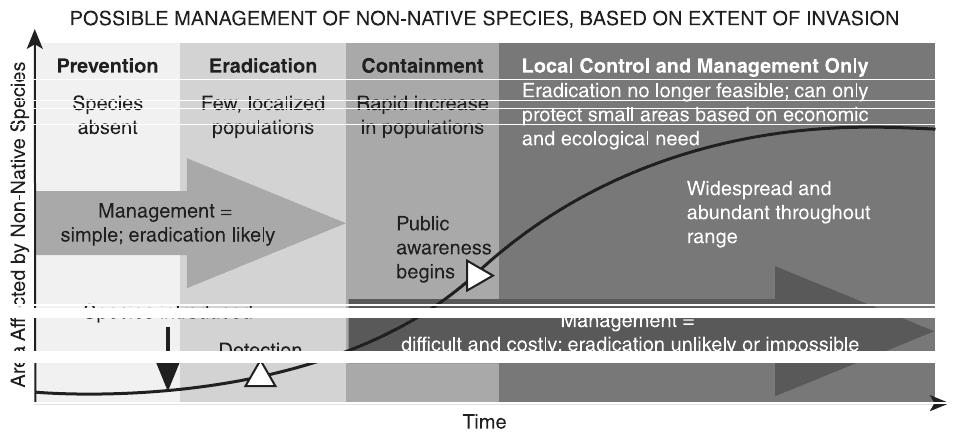
Question 52 of 57
2022 Test A English, question 52Uses the passage above: “Excerpt from “It’s Time to Stop Thinking That All Non-Native Species Are Evil””.
Question
Climate change has affected efforts to manage invasive species mainly by causing ecologists to
- Acall upon the public to be more tolerant of the presence of non-native species.
- Badmit that past attempts to eliminate non-native species have damaged the environment.
- Cfind ways of ensuring that native species are not harmed by the arrival of new species.
- Dacknowledge that it is not realistic for some species to remain in their native habitats.
Show the answer
Correct answer: D
This question asks how climate change has mainly affected efforts to manage invasive species.
A. Incorrect. While ecologists are now arguing for some non-native species to be left alone (paragraph 13), they are arguing specifically on behalf of “well-behaved” non-native species (paragraph 12), not non-native species in general.
B. Incorrect. While paragraph 10 describes how removing a non-native species negatively affected a native species, the excerpt never discusses the idea that attempts to eliminate non-native species might have damaged the environment.
C. Incorrect. While the excerpt refers to climate change causing plants and animals to move to more tolerable environments (paragraph 8), it does not specifically discuss ways to ensure that the arrival of these non-native species does not harm native species.
D. CORRECT. As paragraph 8 says, “plants and animals are already moving toward the poles” because of climate change, and ecologists recognize that those species need to do so to adapt “to the warmer future we’re creating.”
Question analysis
This question asks how climate change has mainly affected efforts to manage invasive species, according to an article arguing that not all non-native species are harmful. Students must locate the article's brief discussion of a warming planet and recognize its point when it is restated in different words.
- Grade level
- Grade 8 reading and task
- Compared with grade 7
- At grade 7 Tracing how one factor shapes an idea is grade 7 work. The relevant discussion is a single paragraph, but it is built from long questions rather than statements, and the choices restate it abstractly, so the item sits at a typical grade 7 level.
- Estimated difficulty
- Moderate: several steps, or a close reading with one strong distractor.
- Thinking it demands
- Depth of knowledge 2, skills and concepts · mainly understand
- What makes it hard
- The right answer is reworded moderate
- Complex sentences minor
- Reading between the lines minor
- Evidence
- Answered from several paragraphs or stanzas
- Reading level
- Passage: about grade 11, 815 words; question and choices: about grade 10, 71 words.
- Students, last 30 days
- Not enough answers yet to show (it takes 10).
Why it is hard, traps and wrong answers (shows the answer)
Why it is hard
Climate change is discussed in only one paragraph, and that paragraph mostly asks questions, so the student has to work out what the scientists concluded from what they wondered. The wrong choices borrow ideas from later in the article, leaving well-behaved exotics alone and the spartina project, or bring in a common conservation goal, and none of them is tied to a warming planet. Finding paragraph 8 first makes the rest straightforward.
The right answer is reworded moderate Choosing the answer
The right choice's “not realistic for some species to remain in their native habitats” shares no words with paragraph 8, which speaks of plants and animals “moving toward the poles or up mountainsides”. (Freedle & Kostin, 1993; Kirsch & Mosenthal, 1990)
Complex sentences minor Understanding the question
Paragraph 8 makes its point through questions, the first broken by “scientists at the symposium wondered”, so what ecologists accept has to be pulled out of what they ask. (Abedi & Lord, 2001; Freedle & Kostin, 1993; Messick, 1989)
Reading between the lines minor Working it out
The acknowledgment is implied: reluctance to remove species that would otherwise lose their chance of “adapting to the warmer future” shows that staying put is no longer an option. (Graesser, Singer & Trabasso, 1994; Kintsch, 1998)
Strategy: Find where the article actually discusses a warming planet and what the scientists there are wondering about, then match a choice to that discussion.
Traps
- Wrong part of the text: A choice is true of another paragraph, stanza or speaker than the one asked about.
- Too broad or too strong: A choice overstates, generalizes, or uses absolute words the text does not support.
- Outside knowledge: A choice is plausible in the real world but not supported by this text.
The wrong answers, classified
A Wrong part of the text (Kirsch & Mosenthal, 1990)
Borrows paragraph 13's plea to leave non-natives alone, which concerns well-behaved exotics and is made within the field, not to the public, and has no link to climate.
B Too broad or too strong (King et al., 2004)
Stretches one failed removal, the spartina project of paragraph 10, into ecologists admitting that past removals harmed the environment, and that example has nothing to do with climate.
C Outside knowledge (King et al., 2004; Recht & Leslie, 1988)
Assumes the rule the article questions, that newcomers threaten natives, so protecting natives seems the obvious response, but paragraph 8 talks of letting moving species adapt.
Working it out, step by step
Know what the question asks
This asks how climate change has changed the way scientists handle non-native species. First find the part of the article that talks about climate. Then see what the scientists there accept.
Find the climate paragraph
Paragraphs 7 and 8 are about climate change. Paragraph 8 says that on “a warming planet,” plants and animals “are already moving toward the poles or up mountainsides.” They are looking for “climate conditions they can tolerate,” which means weather they can survive.
See what the scientists accept
Paragraph 8 says conservationists “will be reluctant to remove them.” Reluctant means unwilling. Removing them “would stymie” their “chances of adapting to the warmer future.” The footnote says stymie means to hinder, or hold back. In other words, scientists accept that these species can’t stay where they were. To survive, they have to move.
Check each choice
- D fits: ecologists admit that some species can’t realistically stay in their native homes.
- A is wrong because the call to leave non-natives alone in paragraphs 12 and 13 is about “well-behaved” ones, not climate.
- B is wrong because the one failed removal in paragraph 10 has nothing to do with climate.
- C is wrong because paragraph 8 talks about letting moving species adapt, not shielding natives from newcomers.
Watch out: A sounds close because it is also about putting up with non-natives. But it comes from a part of the article that never mentions climate.
Choose the answer
Climate change has made ecologists accept that some species must leave their old homes. So the answer is D.
Why this answer and not the closest wrong one
A comes closest, because the article does argue for leaving some non-natives alone. But that argument is about helpful newcomers, and it never mentions climate. Paragraphs 7 and 8 are where climate change comes up. There, scientists accept that many species must leave their old homes to survive, which is D.
More questions like this
The original DOE question

Question 53 of 57
2022 Test A English, question 53Uses the passage above: “Excerpt from “It’s Time to Stop Thinking That All Non-Native Species Are Evil””.
Question
Which detail provides the most relevant support for the claim that “climate change is making it harder even to decide who the invaders are” (paragraph 7)?
- Athe mention in paragraph 8 of non-native species that are forced to seek new habitats
- Bthe acknowledgment in paragraph 9 that non-native species include many domestic crops
- Cthe description in paragraph 11 of the interactions between native and non-native species
- Dthe account in paragraph 13 of an ecologist who changed his beliefs about non-native species
Show the answer
Correct answer: A
The question asks which detail provides the most relevant support for the claim that “climate change is making it harder even to decide who the invaders are” (paragraph 7).
A. CORRECT. The fact that many plants and animals have no choice but to seek out “climate conditions they can tolerate” (paragraph 8) makes it much harder to decide whether to call these species invaders.
B. Incorrect. The fact that many domestic crops are non-native species has nothing to do with climate change affecting our discernment of which species are invaders.
C. Incorrect. The description in paragraph 11 of native and non-native species interacting never suggests that climate change is a factor in these interactions and never suggests that climate change muddies our understanding of which species is native and which is non-native.
D. Incorrect. While the example of Mark Davis so thoroughly changing his beliefs about non-native species is a powerful one, the role that climate change might have played in this reversal is never discussed.
Question analysis
Here students choose the detail that gives the most relevant support to the claim that climate change is making it harder even to decide which species are invaders, in an article rethinking non-native species. Each choice names a paragraph, and the article gives several different reasons to question the label, so every detail must be checked against the whole claim.
- Grade level
- Grade 7 reading and task
- Compared with grade 7
- Below grade 7 Judging which detail supports a claim is grade 7 argument work, but here the choices name their paragraphs, the claim is short and specific, and only one key idea must be matched, so the task is lighter than typical.
- Estimated difficulty
- Straightforward: two steps or one careful reading.
- Thinking it demands
- Depth of knowledge 2, skills and concepts · mainly evaluate
- What makes it hard
- Evidence
- Answered from one paragraph or stanza
- Reading level
- Passage: about grade 11, 815 words; question and choices: about grade 11, 76 words.
- Students, last 30 days
- Not enough answers yet to show (it takes 10).
Why it is hard, traps and wrong answers (shows the answer)
Why it is hard
The claim has two parts, climate change as the cause and blurred labels as the effect, and every wrong detail muddies the word “invader” without any help from the climate. Crops, helpful partnerships and a converted invasion biologist all complicate the label, so a student who checks only the effect finds four plausible answers. Only paragraph 8 talks about a warming planet.
Every choice must be checked minor Choosing the answer
The choices describe paragraphs instead of quoting them, so each of paragraphs 8, 9, 11 and 13 must be reread for a link to climate. (Embretson & Wetzel, 1987)
The right answer is reworded minor Choosing the answer
The right choice says “forced to seek new habitats” where paragraph 8 says species are moving “toward the poles or up mountainsides in search of climate conditions they can tolerate”. (Freedle & Kostin, 1993; Kirsch & Mosenthal, 1990)
Strategy: Name the cause and the effect in the claim, then test each detail for both; a detail that fits only one part is not the most relevant support.
Traps
- Supports only part of the claim: In a question about evidence: a line that backs one half of the claim but not the other, or a related point rather than the claim itself.
The wrong answers, classified
B Supports only part of the claim (King et al., 2004; Thissen, Steinberg & Fitzpatrick, 1989)
Points to crops as non-natives people like, which complicates the label “invader”, but paragraph 9 never connects them to a changing climate.
C Supports only part of the claim (King et al., 2004; Thissen, Steinberg & Fitzpatrick, 1989)
Picks the helpful pairings of native and non-native species in paragraph 11, which blur good and bad but have nothing to do with a warming planet.
D Supports only part of the claim (King et al., 2004; Thissen, Steinberg & Fitzpatrick, 1989)
Chooses Mark Davis's turn away from invasion biology, a striking change of mind that nothing in paragraph 13 ties to climate change.
Working it out, step by step
Split the claim into two parts
This asks for the detail that best supports a claim. The claim has a cause and an effect. The cause is climate change. The effect is that it is harder to tell which species are invaders. The best support must connect both parts.
Find where climate comes up
Paragraph 8 comes right after the claim, and it talks about “a warming planet.” Plants and animals “are already moving toward the poles or up mountainsides in search of climate conditions they can tolerate.” To tolerate means to be able to live with. As places get hotter, many species move to cooler ones.
See why the labels get harder
When a species moves to a new place, it is not native there. But it didn’t really invade. Heat pushed it out of its old home. So scientists ask whether such species should be called invasive “in their new homes.” Climate change blurs the line between native and invader.
Check each choice
- A fits: species forced to move by the climate link the cause to the effect.
- B is wrong because crops are non-natives people like, but paragraph 9 never mentions climate.
- C is wrong because the helpful pairings in paragraph 11 have nothing to do with climate change.
- D is wrong because nothing ties Mark Davis’s change of mind to a warming planet.
Watch out: B, C and D all make the word invader less clear. But only A shows climate change doing it.
Choose the answer
Only A shows climate change making the word invader hard to apply. So the answer is A.
Why this answer and not the closest wrong one
B comes closest, since crops are non-natives we welcome, and that does complicate the word invader. But paragraph 9 says nothing about climate. A has both parts of the claim: a warming planet, and species that end up in new homes where the old labels don’t fit.
More questions like this
The original DOE question
Question 54 of 57
2022 Test A English, question 54Uses the passage above: “Excerpt from “It’s Time to Stop Thinking That All Non-Native Species Are Evil””.
Question
The author’s use of cause and effect in paragraphs 10–11 mainly emphasizes the idea that
- Asome non-native species have helped their environments while others have had harmful impacts.
- Battempts to remove non-native species have seldom produced desired results.
- Csome endangered native species have flourished because of the presence of non-native species.
- Dinteractions between endangered native species and non-native species must be carefully monitored.
Show the answer
Correct answer: C
The question asks what the author’s use of cause and effect in paragraphs 10–11 mainly emphasizes.
A. Incorrect. The examples of cause and effect discussed in paragraphs 10–11, such as the spartina grass helping the clapper rail and the Japanese white-eye bird pollinating Hawaiian flowers, are all instances in which non-native species have helped their new environments.
B. Incorrect. While paragraph 10 does mention that efforts to eradicate the non-native spartina grass hurt the native clapper rail shorebird, the main emphasis in both paragraphs 10–11 is on the fact that certain non-native species have helped native species.
C. CORRECT. Paragraphs 10–11 focus on several examples of non-native species that have helped endangered native species flourish: non-native spartina grass providing “important habitat for the endangered California clapper rail” (paragraph 10), non-native tamarisk shrubs providing nesting places for the endangered southwestern willow flycatcher (paragraph 11), and the non-native Japanese white-eye bird pollinating Hawaiian flowers (paragraph 11).
D. Incorrect. While paragraphs 10–11 describe several interactions between non-native and native species, they never discuss monitoring these interactions.
Question analysis
This text-structure question asks what the cause-and-effect examples in two paragraphs of an article about non-native species mainly emphasize. The paragraphs describe a shorebird, a flycatcher and Hawaiian flowers, and students must decide what the examples have in common rather than fixing on any one of them.
- Grade level
- Grade 8 reading and task
- Compared with grade 7
- Above grade 7 Analyzing what a cause-and-effect structure emphasizes is grade 7 work, but these examples involve unfamiliar species and endangered status, and more than one choice is partly supported by the paragraphs, which raises the demand above typical.
- Estimated difficulty
- Hard: combines ideas, needs a plan, and has more than one tempting wrong answer.
- Thinking it demands
- Depth of knowledge 3, strategic thinking · mainly analyze
- What makes it hard
- A very close wrong answer major
- Reading between the lines moderate
- An unfamiliar subject minor
- Evidence
- Answered from several paragraphs or stanzas
- Reading level
- Passage: about grade 11, 815 words; question and choices: about grade 11, 62 words.
- Students, last 30 days
- Not enough answers yet to show (it takes 10).
Why it is hard, traps and wrong answers (shows the answer)
Why it is hard
The paragraphs mention harm as well as help, so a balanced statement about both looks accurate and even fair-minded. What the cause-and-effect pairs stress, though, is endangered natives depending on non-natives, and the right answer captures that while overstating it, since a bird whose numbers held up only with spartina's help can hardly be said to have flourished. Students must prefer the statement of the main emphasis to one that is partly supported but off the point.
A very close wrong answer major Choosing the answer
The right choice and the help-and-harm choice both say non-natives have aided their surroundings; they part on harm, which the paragraphs do mention, spartina crowding out shorebirds and other non-natives killing Hawaii's pollinators, but only in passing. (Embretson & Wetzel, 1987; Gorin & Embretson, 2006; Ascalon et al., 2007)
Reading between the lines moderate Working it out
Paragraph 10 states its cause and effect backwards, removing spartina sent clapper rail numbers “tumbling downward”, and the student must turn that around into the grass's presence helping the bird. (Graesser, Singer & Trabasso, 1994; Kintsch, 1998)
An unfamiliar subject minor Understanding the question
Five unfamiliar species crowd two paragraphs, spartina grass, the California clapper rail, tamarisk shrubs, the southwestern willow flycatcher and the Japanese white-eye, and each one's role must be kept straight. (Recht & Leslie, 1988; Kintsch, 1998)
Strategy: List each cause-and-effect pair in paragraphs 10 and 11, the species involved and what happened to them, then pick the statement that holds for the examples taken together.
Traps
- Too narrow: A single detail offered as the central idea or a summary, or a summary that keeps minor details and leaves out an essential part.
- Too broad or too strong: A choice overstates, generalizes, or uses absolute words the text does not support.
- Outside knowledge: A choice is plausible in the real world but not supported by this text.
The wrong answers, classified
A Too narrow (King et al., 2004)
Accurately notes helpful and harmful non-natives, but the harm is mentioned only in passing, and it leaves out what every example stresses, endangered natives depending on non-natives.
B Too broad or too strong (King et al., 2004)
Generalizes from the single spartina project in paragraph 10 to removal attempts in general, a “seldom” claim that neither paragraph makes.
D Outside knowledge (King et al., 2004; Recht & Leslie, 1988)
Adds a sensible-sounding call for careful monitoring, the kind of advice scientists often give, but neither paragraph says anything about watching over these relationships.
Working it out, step by step
Know what the question asks
In a cause-and-effect pattern, one thing makes another happen. You need the main idea that the causes and effects in paragraphs 10 and 11 stress. Start by listing each pair.
List each cause and effect
- Paragraph 10: non-native spartina grass gives the endangered clapper rail a home, so when people ripped out the grass, clapper rail numbers went “tumbling downward.”
- Paragraph 11: the endangered willow flycatcher nests in non-native tamarisk shrubs.
- Paragraph 11: native Hawaiian flowers are now pollinated by a non-native bird, the Japanese white-eye.
Find the common thread
Endangered means at risk of dying out. Pollinated means a bird or bug carries pollen between flowers so they can make seeds. In every pair, a native species depends on a non-native one. The newcomer gives it a home, a place to nest or a pollinator. Two of the natives, the clapper rail and the flycatcher, are endangered. So the paragraphs stress that some endangered natives do better because non-natives are there.
Check each choice
- C fits: some endangered natives have “flourished,” or done well, because non-natives are present.
- A is wrong because harm comes up only in passing, while every example stresses a native getting help.
- B is wrong because one removal project is not enough to say removal “seldom” works.
- D is wrong because the paragraphs never mention monitoring, or watching over, these relationships.
Watch out: The paragraphs do mention harm. Spartina crowds out some other shorebirds, and other non-natives wiped out Hawaii’s native pollinators. So A sounds balanced, but it misses the main point.
Choose the answer
The causes and effects show struggling natives, two of them endangered, helped by non-natives. So the answer is C.
Why this answer and not the closest wrong one
A comes closest, because the paragraphs mention harm as well as help. But the harm is only a side note. Every cause and effect shows a native relying on a non-native, and two of those natives are endangered birds. C names that main point, even though “flourished” is a strong word for birds that are still endangered.
More questions like this
The original DOE question
Question 55 of 57
2022 Test A English, question 55Uses the passage above: “Excerpt from “It’s Time to Stop Thinking That All Non-Native Species Are Evil””.
Question
Which sentence from the excerpt supports the idea that some species are able to adjust to change?
- A“Native gardens have become increasingly popular, both as ways to celebrate the unique flora of each region and as tiny hot spots of diversity.” (paragraph 3)
- B“Many native (and beautiful) Hawaiian flowers are now pollinated by the Japanese white-eye bird—because the native pollinators have been driven extinct by other non-native species.” (paragraph 11)
- C“After all, nativeness is just one environmental value, and arguably not as important as preventing extinctions and preserving biodiversity.” (paragraph 14)
- D“The islands lost their own large tortoises, and the fruiting plants that formerly had their seeds moved around by these fruit-loving reptiles have been on the decline.” (paragraph 15)
Show the answer
Correct answer: B
The question asks which sentence from the excerpt supports the idea that some species are able to adjust to change.
A. Incorrect. This sentence discusses native gardens, featuring native species, which presumably have no need to adjust to change.
B. CORRECT. This sentence demonstrates that some species—in this case, Hawaiian flowers—have adapted well to change: the flowers thrive thanks to new pollinators.
C. Incorrect. This sentence focuses on the importance of “preventing extinctions and preserving biodiversity” but does not address the fact that being able to adjust to change is one thing that helps achieve those goals.
D. Incorrect. Far from demonstrating that some species can adjust to change, this sentence discusses species that were not adjusting to the loss of large tortoises and were therefore “on the decline.”
Question analysis
Using an article that argues not every non-native species is harmful, this evidence question asks students to pick the sentence showing that some species are able to adjust to change. Students must decide what adjusting to change would look like in nature, then find a quotation that actually shows a species doing it.
- NYS standards
- 7R1 textual evidence and inferences
- Grade level
- Grade 7 reading and task
- Compared with grade 7
- At grade 7 Selecting a sentence that supports an idea is typical grade 7 evidence work. The quotations are labeled, but the idea is stated generally and must be recognized inside a specific ecological example, a small inference that keeps the item at grade level.
- Estimated difficulty
- Moderate: several steps, or a close reading with one strong distractor.
- Thinking it demands
- Depth of knowledge 2, skills and concepts · mainly evaluate
- What makes it hard
- Reading between the lines moderate
- A very close wrong answer moderate
- Evidence
- Answered from one sentence or line
- Reading level
- Passage: about grade 11, 815 words; question and choices: about grade 14, 117 words.
- Students, last 30 days
- Not enough answers yet to show (it takes 10).
Why it is hard, traps and wrong answers (shows the answer)
Why it is hard
The idea is general and every choice is specific, so the student must recognize adjustment inside an ecological example. The Mauritius sentence is the trap: the paragraph it comes from ends with a new tortoise taking over, which is adjustment, but the quoted sentence stops at the decline. Judging only the words quoted, and asking whether a species carried on after a change, separates the two.
Reading between the lines moderate Working it out
The right sentence never says “adjust”; Hawaiian flowers now pollinated by a newcomer after their native pollinators died out must be recognized as species coping with a change. (Graesser, Singer & Trabasso, 1994; Kintsch, 1998)
A very close wrong answer moderate Choosing the answer
The Hawaiian sentence and the Mauritius sentence both describe plants losing the animals that served them; they part on the outcome, a new pollinator or a decline. (Embretson & Wetzel, 1987; Gorin & Embretson, 2006; Ascalon et al., 2007)
Strategy: For each quotation, ask whether a species faces a change and whether the sentence shows it carrying on successfully; judge only the words quoted.
Traps
- Supports only part of the claim: In a question about evidence: a line that backs one half of the claim but not the other, or a related point rather than the claim itself.
- True but not the answer: A choice says something accurate about the text that does not answer this question.
The wrong answers, classified
A True but not the answer (King et al., 2004; Embretson & Wetzel, 1987)
Picks the popularity of native gardens, which is about what people plant and celebrate, not about any species coping with a change in its world.
C True but not the answer (King et al., 2004; Embretson & Wetzel, 1987)
Chooses the author's ranking of nativeness below preventing extinctions, a statement of values that shows no species adapting to anything.
D Supports only part of the claim (King et al., 2004; Thissen, Steinberg & Fitzpatrick, 1989)
Remembers that a new tortoise later took over seed-spreading on Mauritius, but the quoted sentence shows only the change, plants declining after their tortoises vanished, not any adjustment.
Working it out, step by step
Know what the question asks
To adjust to change means to keep going when something important in your world changes. You need a sentence that shows a species facing a change and carrying on. Judge only the words in each quoted sentence.
Look for a change
Choice B says the native pollinators of some Hawaiian flowers “have been driven extinct.” Extinct means gone forever. Pollinators are animals that carry pollen between flowers so the plants can make seeds. Losing them is a huge change for the flowers.
Look for the adjustment
The same sentence says the flowers “are now pollinated by the Japanese white-eye bird.” A new bird does the job the old pollinators used to do. So the flowers carried on after the change. That is adjusting.
Check each choice
- B fits: the flowers lost their pollinators and gained a new one.
- A is wrong because native gardens are about what people like to plant, and no species adjusts to anything.
- C is wrong because it states the author’s values and shows no species at all.
- D is wrong because the plants “have been on the decline,” which means they are getting fewer, not adjusting.
Watch out: Later in paragraph 15, a new tortoise takes over some of the lost tortoises’ work. But the sentence in D stops at the decline.
Choose the answer
Only B shows a species carrying on after a big change. So the answer is B.
Why this answer and not the closest wrong one
D comes closest, because it also shows plants losing the animals that helped them. But D’s sentence ends with the plants in decline. B’s sentence goes further: a new bird now does the work, so the flowers carry on. That is a species adjusting to change.
More questions like this
The original DOE question
Question 56 of 57
2022 Test A English, question 56Uses the passage above: “Excerpt from “It’s Time to Stop Thinking That All Non-Native Species Are Evil””.
Question
The details in the section “A Good Thing, Not the Only Thing” convey a central idea of the excerpt by suggesting that
- Asome non-native species can replace native species that are unable to survive on their own.
- Bdecisions about whether to keep non-native species should be considered on an individual basis.
- Cthe scientists who study rapidly changing ecosystems agree that non-native species enhance biodiversity.
- Da natural habitat that is healthy should be able to support a blend of native and non-native species.
Show the answer
Correct answer: B
The question asks how the details in the section “A Good Thing, Not the Only Thing” convey a central idea of the excerpt.
A. Incorrect. While paragraph 15 does discuss introducing non-native Aldabra tortoises to replace native tortoises that no longer exist, the real point of this section is to show that non-native species can sometimes help support native species that still exist but are struggling. In this case, the Aldabra tortoises are now moving seeds around for the fruiting plants on the islands where the tortoises have been introduced.
B. CORRECT. This section discusses situations in which non-native species should be kept (as in the example of the Aldabra tortoises in paragraph 15) but also asserts that “most of the time . . . conserving species still means focusing on supporting them in their historical habitats, planting natives and removing non-natives” (paragraph 16). This section makes the point that the issue of non-natives needs to be considered on a case-by-case basis.
C. Incorrect. This section does not claim that non-native species always or even usually enhance biodiversity; rather, it states that “in some cases we can best serve biodiversity by leaving the non-natives alone or even—brace yourself, now—introducing them on purpose” (paragraph 14), later adding that “most of the time . . . conserving species still means focusing on supporting them in their historical habitats, planting natives and removing non-natives” (paragraph 16).
D. Incorrect. While the section happens to give a good example of a habitat that supports both native and non-native species (the islands of Mauritius), it never suggests that being able to do so is a defining characteristic of healthy habitats.
Question analysis
This central-idea question asks how the details in the final section of an article on non-native species, titled “A Good Thing, Not the Only Thing,” convey a central idea of the excerpt. Students must sum up the section as a whole, including its example of a tortoise brought to the islands of Mauritius, and match it to the article's larger argument.
- Grade level
- Grade 8 reading and task
- Compared with grade 7
- Above grade 7 Explaining how a section conveys a central idea is grade 7 work, but this section mixes an argument, an example and a closing paragraph, and the choices differ in how far they generalize from it, which demands more than typical.
- Estimated difficulty
- Hard: combines ideas, needs a plan, and has more than one tempting wrong answer.
- Thinking it demands
- Depth of knowledge 3, strategic thinking · mainly understand
- What makes it hard
- The right answer is reworded moderate
- Evidence in several places moderate
- Evidence
- Answered from several paragraphs or stanzas
- Reading level
- Passage: about grade 11, 815 words; question and choices: about grade 11, 82 words.
- Students, last 30 days
- Not enough answers yet to show (it takes 10).
Why it is hard, traps and wrong answers (shows the answer)
Why it is hard
The section's most memorable content is an example, the Aldabra tortoise doing the work of the islands' lost tortoises, and a choice built on it is the strongest pull. The central idea sits instead in the qualifiers at the start and end of the section: some cases favor non-natives, most still call for removing them. Students who summarize all three paragraphs in a sentence, including the last, arrive at the case-by-case reading.
The right answer is reworded moderate Choosing the answer
The right choice's “on an individual basis” appears nowhere in the section, while the wrong choices echo it: a non-native standing in for natives, “biodiversity”, natives alongside non-natives. (Freedle & Kostin, 1993; Kirsch & Mosenthal, 1990)
Evidence in several places moderate Working it out
The case-by-case idea comes only from joining paragraph 14's “In some cases” to paragraph 16's “Most of the time” and “where it is feasible and important to us”. (Kirsch & Mosenthal, 1990; Gorin & Embretson, 2006)
Strategy: Sum up the section's three paragraphs in one sentence of your own, including its example and its final paragraph, then compare that sentence with each choice.
Traps
- Too narrow: A single detail offered as the central idea or a summary, or a summary that keeps minor details and leaves out an essential part.
- Too broad or too strong: A choice overstates, generalizes, or uses absolute words the text does not support.
- Reads too much in: A reasonable-sounding conclusion that goes further than the text allows.
The wrong answers, classified
A Too narrow (King et al., 2004)
Builds on the Aldabra tortoise standing in for Mauritius's lost tortoises, a single example, and misses the closing point that most conservation still means removing non-natives.
C Too broad or too strong (King et al., 2004)
Turns “In some cases” into a consensus that non-natives enhance biodiversity, though the section limits the claim and the article shows ecologists divided over it.
D Reads too much in (Graesser, Singer & Trabasso, 1994)
Draws a rule about healthy habitats from the Mauritius example, though the section never defines a healthy habitat or says it should hold a mix of species.
Working it out, step by step
Know what the question asks
A section is a part of an article under its own heading. This one runs from paragraph 14 to paragraph 16. You need to sum up the whole section, including its last paragraph. Then match that summary to a central idea.
Read paragraph 14
It says that “in some cases” we help nature most “by leaving the non-natives alone.” We might even bring them in “on purpose.” The words “in some cases” are the key. They mean sometimes, not always.
Read the example and the ending
Paragraph 15 gives an example. A non-native tortoise was brought to Mauritius to spread the seeds of fruiting plants. Then paragraph 16 says that “most of the time,” saving species still means “planting natives and removing non-natives.” We should do that “where it is feasible and important to us.” Feasible means possible.
Put the section together
Sometimes it is best to keep a non-native species. Most of the time it is best to remove it. So each case has to be judged on its own. That is what “on an individual basis” means.
Check each choice
- B fits: deciding case by case matches both “in some cases” and “most of the time.”
- A is wrong because the tortoise is one example, and the section ends by saying removal is still the usual choice.
- C is wrong because the section never says scientists agree, and “in some cases” is far from always.
- D is wrong because the section never says what a healthy habitat should hold.
Watch out: A is built on the section’s most memorable detail. But the main idea comes from the words that limit the claim.
Choose the answer
The section says to keep non-natives in some cases and remove them in others. So the answer is B.
Why this answer and not the closest wrong one
A comes closest, because the Aldabra tortoise really does take over work the lost tortoises once did. But that is one case. The section ends by saying that most of the time we still remove non-natives. B covers both sides: some cases call for keeping them, and others call for removing them.
More questions like this
The original DOE question
Question 57 of 57
2022 Test A English, question 57Uses the passage above: “Excerpt from “It’s Time to Stop Thinking That All Non-Native Species Are Evil””.
Question
How does the chart provide additional support for a central idea of the excerpt?
- Aby implying that the public becomes aware of non-native species only after removal is impossible
- Bby showing that the complete removal of non-native species is usually not achievable after a certain period of time
- Cby demonstrating why non-native species can be destructive if they are not removed from an area immediately
- Dby explaining how some conservation groups have approached the removal of non-native species
Show the answer
Correct answer: B
The question asks how the chart provides additional support for a central idea of the excerpt.
A. Incorrect. The chart indicates that the public tends to become aware of non-native species once eradication is “unlikely or impossible,” not strictly impossible. Furthermore, this idea is not a central idea of the excerpt.
B. CORRECT. The chart strongly suggests that once “rapid increase in populations” of non-native species has occurred, eradication will be “unlikely or impossible.”
C. Incorrect. While the chart does show that non-native species can eventually be impossible to eradicate, it never addresses the issue of how the non-native species might be destructive to their new environments.
D. Incorrect. The chart shows how non-native species become harder and harder to remove as their population grows but does not explain how any conservation groups have approached their removal.
Question analysis
This question asks how a chart titled “Possible Management of Non-Native Species, Based on Extent of Invasion” supports a central idea of an article arguing that not all non-native species are harmful. Students must read the chart's stages, labels and curve, then decide which statement the chart actually shows and which also fits the article's argument.
- Grade level
- Grade 8 reading and task
- Compared with grade 7
- At grade 7 Grade 7 students connect graphics to a text, but this chart packs four stages, two arrows, a curve and several labels into one figure, and its pattern must be linked to an argument made in words, demanding but within upper grade 7.
- Estimated difficulty
- Moderate: several steps, or a close reading with one strong distractor.
- Thinking it demands
- Depth of knowledge 2, skills and concepts · mainly analyze
- What makes it hard
- Reading a figure, table or graph moderate
- A very close wrong answer moderate
- Combines ideas minor
- Evidence
- Answered from the whole text
- Reading level
- Passage: about grade 11, 815 words; question and choices: about grade 12, 78 words.
- Students, last 30 days
- Not enough answers yet to show (it takes 10).
Why it is hard, traps and wrong answers (shows the answer)
Why it is hard
The chart is easy to read in outline, simple management on the left and costly, likely failed eradication on the right, and the right choice restates that contrast. The pull comes from the “Public awareness begins” marker, placed at the border of the stage where eradication is no longer feasible, which makes a statement about public awareness look like a faithful reading. It is nearly faithful, but it describes one marker, not a central idea the article develops.
Reading a figure, table or graph moderate Understanding the question
The chart packs four shaded stages, two arrows, an S-shaped curve and three markers into one figure, and its message lies in the arrows: eradication “likely” early, “unlikely or impossible” later. (Lesh, Post & Behr, 1987; Kirsch & Mosenthal, 1990)
A very close wrong answer moderate Choosing the answer
The right choice and the public-awareness choice both read the late stages where removal fails; the awareness marker even sits on the border of “Eradication no longer feasible”, so only centrality separates them. (Embretson & Wetzel, 1987; Gorin & Embretson, 2006; Ascalon et al., 2007)
Combines ideas minor Working it out
The chart's pattern has to be matched to the article's argument that nativeness is one value among several and that removal makes sense only where “feasible and important to us”. (Embretson, 1998; Daniel & Embretson, 2010)
Strategy: Read the chart's title, axes and stage labels, say in one sentence what it shows happening over time, then ask which part of the article's argument that pattern supports.
Traps
- Too narrow: A single detail offered as the central idea or a summary, or a summary that keeps minor details and leaves out an essential part.
- Reads too much in: A reasonable-sounding conclusion that goes further than the text allows.
- Wrong part of the text: A choice is true of another paragraph, stanza or speaker than the one asked about.
The wrong answers, classified
A Too narrow (King et al., 2004)
Reads the “Public awareness begins” marker, which sits where eradication becomes unlikely or impossible, as the chart's point, though it is one label and public awareness is not a central idea.
C Reads too much in (Graesser, Singer & Trabasso, 1994)
Takes the rising curve of area affected as proof of damage, but the chart tracks spread and the difficulty of removal, never harm, and the article questions removing non-natives on reflex.
D Wrong part of the text (Kirsch & Mosenthal, 1990)
Credits the chart with the citizen groups of paragraph 3 and the spartina project of paragraph 10, but it shows general stages of possible management, not any group's actual approach.
Working it out, step by step
Know what the question asks
This asks how the chart supports a central idea, a main point of the article. First read the chart and say in your own words what it shows. Then link that to the article’s argument.
Read the chart from left to right
Time moves from left to right. The curve shows how much area a non-native species covers. Eradication means wiping a species out completely. Early on, the arrow says management is “simple” and eradication is “likely.” Then the species spreads fast. From there on, management is “difficult and costly,” and eradication is “unlikely or impossible.” In the last stage it is “no longer feasible,” or no longer possible.
Link the chart to the article
The article argues that we shouldn’t treat every non-native species the same way. Paragraph 16 says we should remove non-natives “in places where it is feasible and important to us.” The chart shows when removal is possible: mostly early, before the species spreads. After that, wiping it out usually can’t be done.
Check each choice
- B fits: complete removal is usually not possible after a certain time, which is the chart’s main message.
- A is wrong because the “Public awareness begins” marker is one small label, and the article never discusses when the public notices.
- C is wrong because the chart shows how far a species spreads, not how much damage it does.
- D is wrong because the chart shows general stages, not what any real group has done.
Watch out: A reads the marker correctly, since it does sit late, where removal is already hard. But it picks a detail, not the chart’s main point.
Choose the answer
The chart shows that removal works only early, which backs up the article’s argument. So the answer is B.
Why this answer and not the closest wrong one
A comes closest, since the chart does place “Public awareness begins” late, when removal is already hard. But that is one small marker, and the article never says when the public first notices a species. B states the chart’s main message, that removal works only early. That backs up the article’s point that removing non-natives isn’t always possible.
More questions like this
The original DOE question