Question
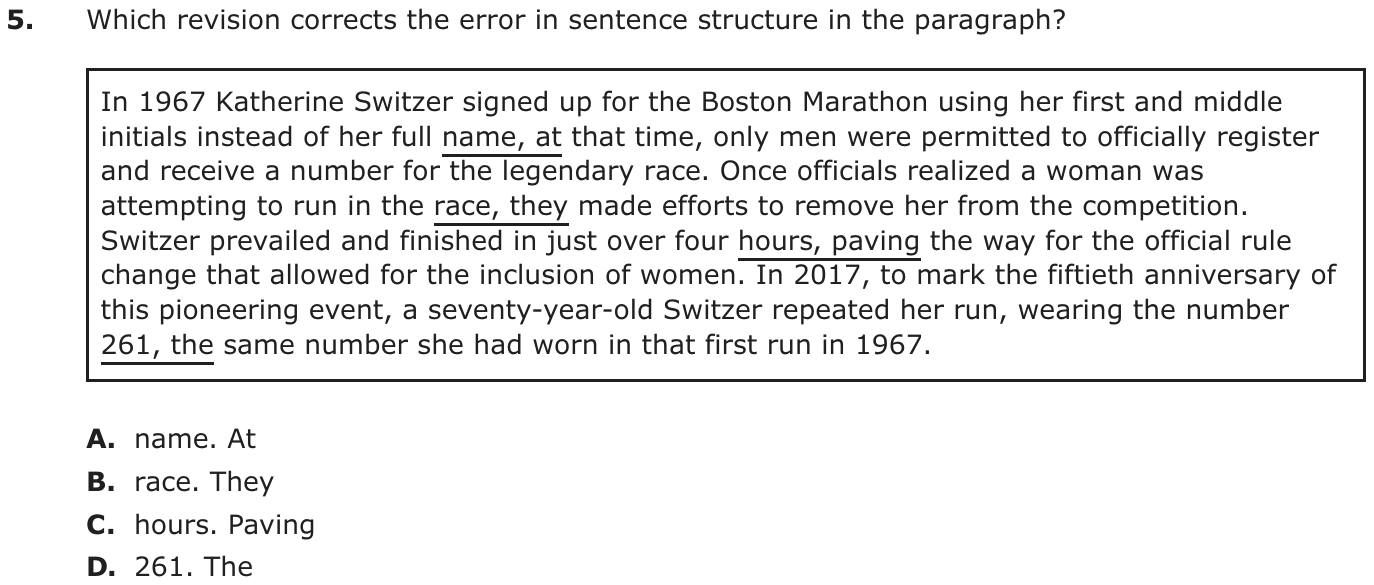
Which revision corrects the error in sentence structure in the paragraph?
In 1967 Kathrine Switzer signed up for the Boston Marathon using her first and middle initials instead of her full name, at that time, only men were permitted to officially register and receive a number for the legendary race. Once officials realized a woman was attempting to run in the race, they made efforts to remove her from the competition. Switzer prevailed and finished in just over four hours, paving the way for the official rule change that allowed for the inclusion of women. In 2017, to mark the fiftieth anniversary of this pioneering event, a seventy-year-old Switzer repeated her run, wearing the number 261, the same number she had worn in that first run in 1967.
- Aname. At
- Brace. They
- Chours. Paving
- D261. The
Show the answer
Correct answer: A
The question asks for the revision that corrects the error in sentence structure in the paragraph.
A. CORRECT. As written, the first sentence (“In 1967 Kathrine Switzer . . . legendary race.”) is a run-on sentence because a comma is used to combine two independent clauses. Independent clauses are complete sentences with a subject and a verb. The clauses—“In 1967 Kathrine Switzer signed up for the Boston Marathon using her first and middle initials instead of her full name” and “at that time, only men were permitted to officially register and receive a number for the legendary race”—should be separated with a period instead. This revision correctly places a period after the word “name” and capitalizes the word “At” to separate the two independent clauses into two sentences.
B. Incorrect. The revision introduces an error into the paragraph and does not revise the run-on in the first sentence. The clause “Once officials realized a woman was attempting to run in the race” is a dependent clause functioning as an adverb of the independent clause that follows it. Changing the comma after the word “race” to a period would incorrectly separate the adverbial dependent clause from the independent clause.
C. Incorrect. The revision introduces an error into the paragraph and does not revise the run-on in the first sentence. The sentence “Switzer prevailed and finished in just over four hours, paving the way for the official rule change that allowed for the inclusion of women” combines an independent clause (“Switzer prevailed and finished in just over four hours”) and a participial phrase (“paving the way for the official rule change that allowed for the inclusion of women”). The phrase “paving the way for the official rule change that allowed for the inclusion of women” is not a complete sentence and must stay connected to the first part of the sentence. Changing the comma after “hours” to a period would incorrectly separate the participial phrase from the independent clause.
D. Incorrect. The revision introduces an error into the paragraph and does not revise the run-on in the first sentence. Changing the comma after “261” to a period would incorrectly separate the appositive phrase “the same number she had worn in that first run in 1967” from the words it describes (“number 261”). Additionally, the phrase “the same number she had worn in that first run in 1967” is not a complete sentence.
Question analysis
This sentence-structure question gives a four-sentence paragraph about Kathrine Switzer, who entered the 1967 Boston Marathon under her initials when only men could register and ran it again at seventy. Students pick the revision that corrects its error in sentence structure, and because every choice turns an underlined comma into a period, each spot needs its own check.
- Grade level
- Grade 6 reading and task
- Compared with grade 7
- Below grade 7 Run-ons and fragments are taught before grade 7, and this item checks that skill at four underlined spots in one short paragraph. The clauses and phrases around the correct commas take some grammar sense, but the core skill is basic.
- Estimated difficulty
- Straightforward: two steps or one careful reading.
- Thinking it demands
- Depth of knowledge 2, skills and concepts · mainly apply
- What makes it hard
- A rule that doesn't sound wrong moderate
- Every choice must be checked minor
- Complex sentences minor
- Evidence
- Answered from one paragraph or stanza
- Reading level
- Question and choices: about grade 7, 131 words.
- Corrected from the DOE handbook
- A misspelled name in the paragraph and its explanation was corrected.
- Grammar terms in the explanations of two wrong options were corrected.
- Students, last 30 days
- Not enough answers yet to show (it takes 10).
Why it is hard, traps and wrong answers (shows the answer)
Why it is hard
Every choice makes the same kind of change, so the question comes down to telling one real comma splice from three commas doing legitimate work. The most dangerous spot is after “race,” where a subject and verb sit on both sides of the comma, just as at the real error, and only the word “Once” marks the first part as dependent. Students who test each side for a complete thought, not just for a subject and a verb, find the splice in the opening sentence quickly.
A rule that doesn't sound wrong moderate Working it out
The run-on hides behind the short phrase “at that time,” which makes the comma after “name” sound like an ordinary pause; only checking that each side can stand alone exposes the comma splice. (Connors & Lunsford, 1988)
Every choice must be checked minor Choosing the answer
All four revisions swap a comma for a period, so every underlined spot needs the same test: could the words before it and the words after it each stand as a sentence? (Embretson & Wetzel, 1987)
Complex sentences minor Understanding the question
The three correct commas guard three different structures, an opening “Once” clause, a participial phrase beginning with “paving” and an appositive after “261,” and each has to be recognized as unable to stand alone. (Abedi & Lord, 2001; Freedle & Kostin, 1993; Messick, 1989)
Strategy: At each underlined comma, read the words before it and the words after it as separate pieces and ask whether each could stand alone as a sentence; that shows where a period belongs.
Traps
- Fragment or run-on: Creates or keeps a sentence fragment, a run-on sentence or a comma splice.
The wrong answers, classified
B Fragment or run-on (Connors & Lunsford, 1988)
Finds a subject and verb on both sides of the comma after “race” and calls it a splice, missing that “Once” makes the first part a dependent clause that cannot stand alone.
C Fragment or run-on (Connors & Lunsford, 1988)
Treats the long third sentence as a run-on and ends it after “hours,” leaving “Paving the way for the official rule change” as a fragment with no subject or main verb.
D Fragment or run-on (Connors & Lunsford, 1988)
Spots the subject and verb “she had worn” after the comma following “261,” but they sit inside a phrase that renames the number, so the new sentence would be a fragment.
What was corrected from the DOE handbook, and why
- Stem and explanation: The handbook spells the runner’s name “Katherine Switzer” in the paragraph and twice in the explanation. She is Kathrine Switzer, who entered the 1967 Boston Marathon as “K. V. Switzer,” so the site now spells her name that way, in the question’s title too. No answer depends on the spelling.
- Explanation: The DOE’s explanation of Option C calls “paving the way for the official rule change that allowed for the inclusion of women” a dependent clause, and on that basis calls the sentence a complex sentence. The words have no subject or finite verb of their own: they are a participial phrase, which the site now calls them, and the site no longer calls the sentence complex for that reason. Its explanation of Option D calls “the same number she had worn in that first run in 1967” a modifying clause; it is an appositive phrase, a noun phrase that renames “number 261,” and the site now says so. Neither phrase can stand alone as a sentence, so Options C and D are still wrong, and the answer, Option A, is unchanged.
Working it out, step by step
Figure out what the question asks
This is a sentence structure question. In one spot, two full sentences are joined by only a comma. That mistake is called a run-on. Every choice turns one underlined comma into a period. Only one of those changes fixes a run-on. The other three would break off a piece that can’t stand alone.
Learn the rule for run-ons
An independent clause is a group of words that makes sense alone. It has a subject and a verb. The subject is who or what the sentence is about. The verb tells what the subject does or is. A comma alone can’t join two independent clauses. Use a period instead.
Example: It rained, we stayed inside. Fix: It rained. We stayed inside.
Test the comma after name
Read the words before that comma: “In 1967 Kathrine Switzer signed up for the Boston Marathon using her first and middle initials instead of her full name.” That makes sense alone. Now read the words after it: “at that time, only men were permitted to officially register.” That makes sense alone too. Its subject is “only men,” and its verb is “were permitted.” So two full sentences are joined by a comma. That is the run-on.
Test the other three commas
- B (after “race”): The first part is “Once officials realized a woman was attempting to run in the race.” The word “Once” makes it a dependent clause. That is a group of words with a subject and verb that can’t stand alone.
- C (after “hours”): The words starting “paving the way for the official rule change” are a participial phrase. The phrase starts with an -ing verb form and adds information. It has no subject of its own.
- D (after “261”): “the same number she had worn in that first run in 1967” is an appositive phrase. It renames the noun right before it, the number 261. It can’t stand alone either.
Choose the answer
Watch out: B is the trickiest. It has a subject and a verb on each side of its comma, “officials realized” and “they made.” But “Once” keeps the first part from standing alone. Only the comma after “name” joins two full sentences. A period goes there, and “At” gets a capital letter. So the answer is A: name. At.
Why this answer and not the closest wrong one
B is the closest wrong answer. Like the comma after “name,” its comma has a subject and a verb on each side. But “Once” means the first part needs the words after the comma to finish its thought. At the comma after “name,” both sides already stand alone. So that comma is the real run-on.
More questions like this
The original DOE question