Also in 2026 Practice Test B English, question 2.
Passage Excerpt from “The Past and the Future of the Earth’s Oldest Trees”
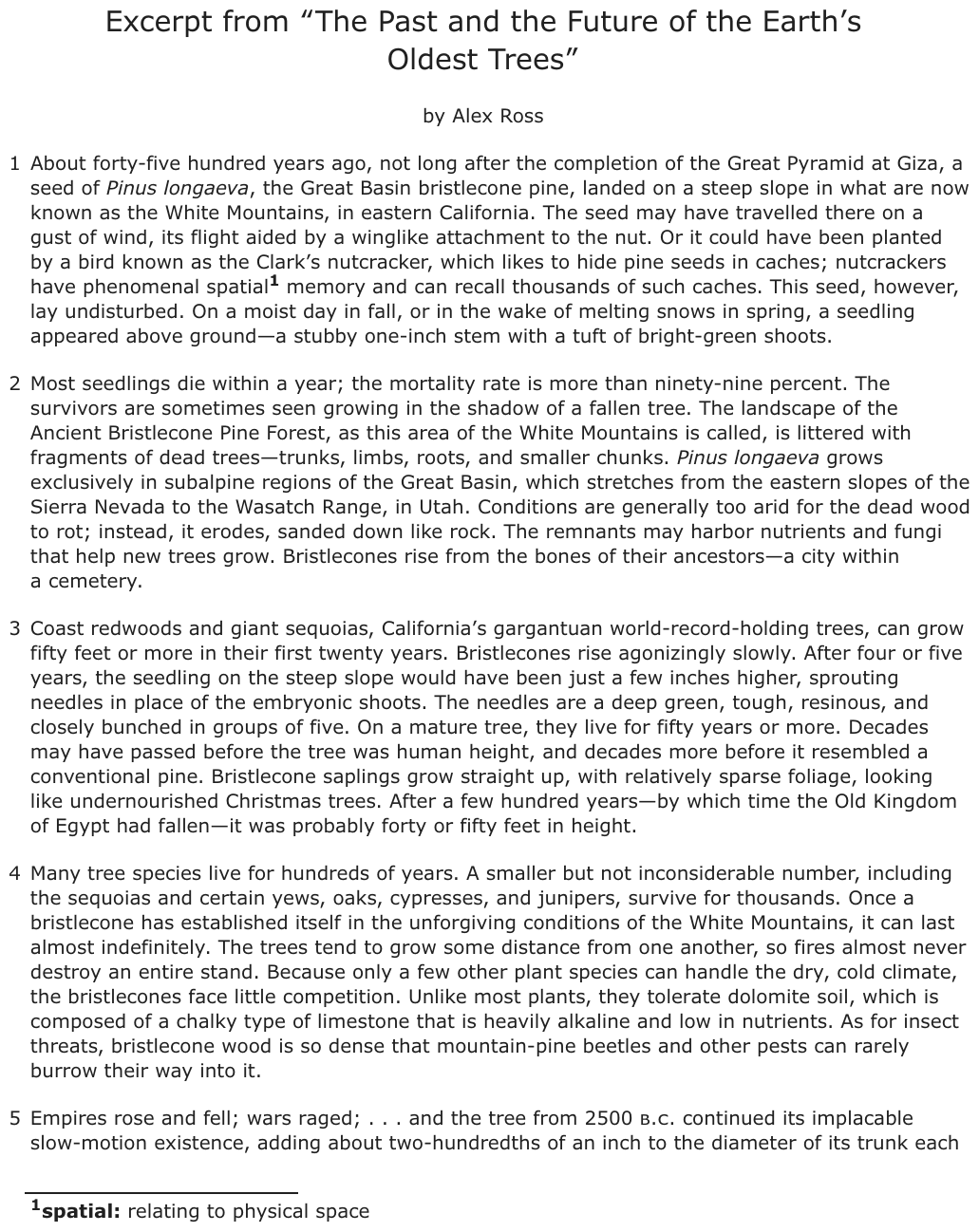
Excerpt from “The Past and the Future of the Earth’s Oldest Trees”
by Alex Ross
About forty-five hundred years ago, not long after the completion of the Great Pyramid at Giza, a seed of Pinus longaeva, the Great Basin bristlecone pine, landed on a steep slope in what are now known as the White Mountains, in eastern California. The seed may have travelled there on a gust of wind, its flight aided by a winglike attachment to the nut. Or it could have been planted by a bird known as the Clark’s nutcracker, which likes to hide pine seeds in caches; nutcrackers have phenomenal spatial1 memory and can recall thousands of such caches. This seed, however, lay undisturbed. On a moist day in fall, or in the wake of melting snows in spring, a seedling appeared above ground—a stubby one-inch stem with a tuft of bright-green shoots.
Most seedlings die within a year; the mortality rate is more than ninety-nine percent. The survivors are sometimes seen growing in the shadow of a fallen tree. The landscape of the Ancient Bristlecone Pine Forest, as this area of the White Mountains is called, is littered with fragments of dead trees—trunks, limbs, roots, and smaller chunks. Pinus longaeva grows exclusively in subalpine regions of the Great Basin, which stretches from the eastern slopes of the Sierra Nevada to the Wasatch Range, in Utah. Conditions are generally too arid for the dead wood to rot; instead, it erodes, sanded down like rock. The remnants may harbor nutrients and fungi that help new trees grow. Bristlecones rise from the bones of their ancestors—a city within a cemetery.
Coast redwoods and giant sequoias, California’s gargantuan world-record-holding trees, can grow fifty feet or more in their first twenty years. Bristlecones rise agonizingly slowly. After four or five years, the seedling on the steep slope would have been just a few inches higher, sprouting needles in place of the embryonic shoots. The needles are a deep green, tough, resinous, and closely bunched in groups of five. On a mature tree, they live for fifty years or more. Decades may have passed before the tree was human height, and decades more before it resembled a conventional pine. Bristlecone saplings grow straight up, with relatively sparse foliage, looking like undernourished Christmas trees. After a few hundred years—by which time the Old Kingdom of Egypt had fallen—it was probably forty or fifty feet in height.
Many tree species live for hundreds of years. A smaller but not inconsiderable number, including the sequoias and certain yews, oaks, cypresses, and junipers, survive for thousands. Once a bristlecone has established itself in the unforgiving conditions of the White Mountains, it can last almost indefinitely. The trees tend to grow some distance from one another, so fires almost never destroy an entire stand. Because only a few other plant species can handle the dry, cold climate, the bristlecones face little competition. Unlike most plants, they tolerate dolomite soil, which is composed of a chalky type of limestone that is heavily alkaline and low in nutrients. As for insect threats, bristlecone wood is so dense that mountain-pine beetles and other pests can rarely burrow their way into it.
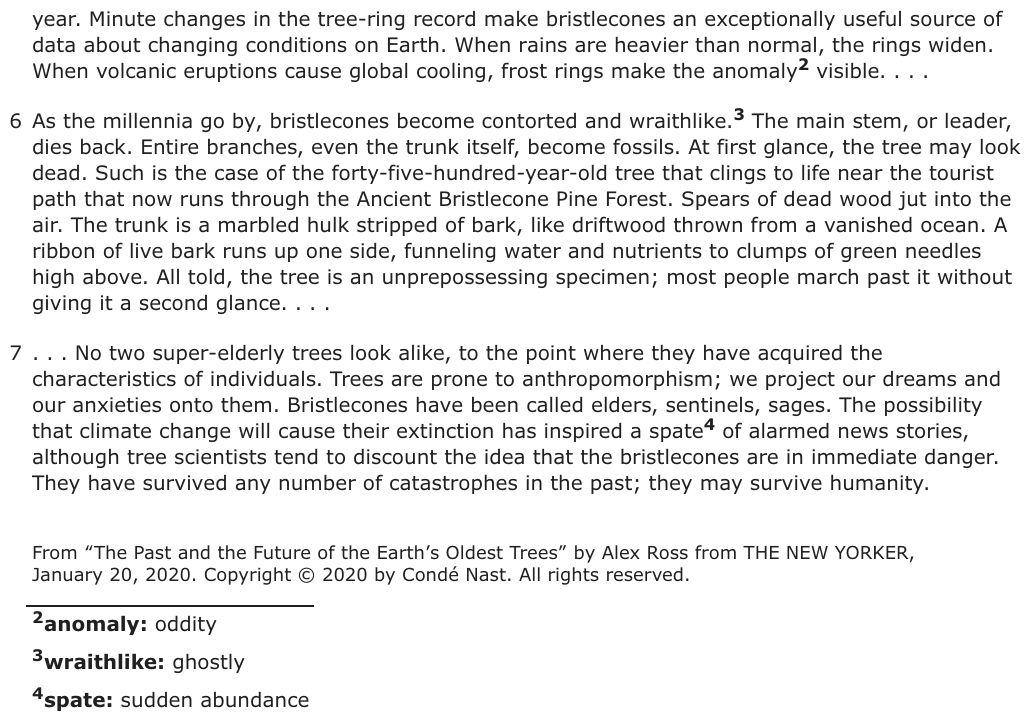
Empires rose and fell; wars raged; . . . and the tree from 2500 B.C. continued its implacable slow-motion existence, adding about two-hundredths of an inch to the diameter of its trunk each year. Minute changes in the tree-ring record make bristlecones an exceptionally useful source of data about changing conditions on Earth. When rains are heavier than normal, the rings widen. When volcanic eruptions cause global cooling, frost rings make the anomaly2 visible. . . .
As the millennia go by, bristlecones become contorted and wraithlike.3 The main stem, or leader, dies back. Entire branches, even the trunk itself, become fossils. At first glance, the tree may look dead. Such is the case of the forty-five-hundred-year-old tree that clings to life near the tourist path that now runs through the Ancient Bristlecone Pine Forest. Spears of dead wood jut into the air. The trunk is a marbled hulk stripped of bark, like driftwood thrown from a vanished ocean. A ribbon of live bark runs up one side, funneling water and nutrients to clumps of green needles high above. All told, the tree is an unprepossessing specimen; most people march past it without giving it a second glance. . . .
. . . No two super-elderly trees look alike, to the point where they have acquired the characteristics of individuals. Trees are prone to anthropomorphism; we project our dreams and our anxieties onto them. Bristlecones have been called elders, sentinels, sages. The possibility that climate change will cause their extinction has inspired a spate4 of alarmed news stories, although tree scientists tend to discount the idea that the bristlecones are in immediate danger. They have survived any number of catastrophes in the past; they may survive humanity.
From “The Past and the Future of the Earth’s Oldest Trees” by Alex Ross from THE NEW YORKER, January 20, 2020. Copyright © 2020 by Condé Nast. All rights reserved.
1spatial: relating to physical space
2anomaly: oddity
3wraithlike: ghostly
4spate: sudden abundance
Question
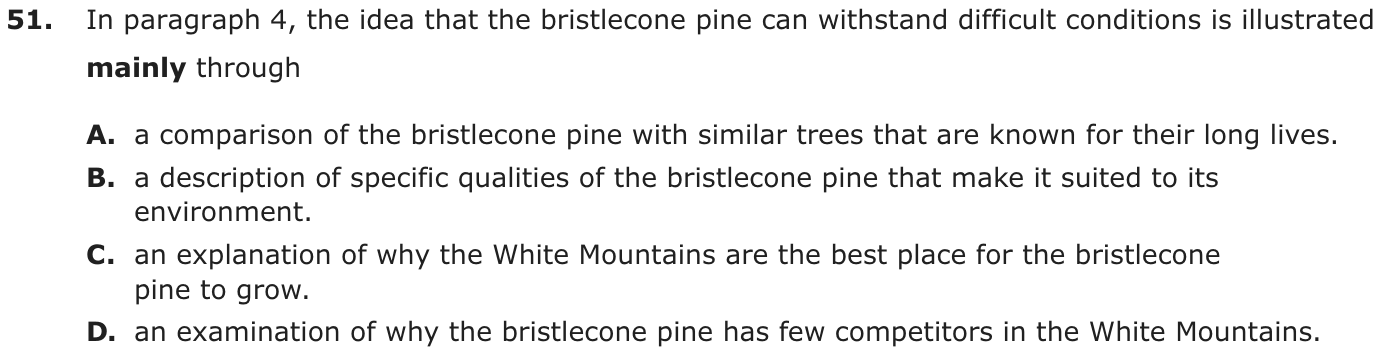
In paragraph 4, the idea that the bristlecone pine can withstand difficult conditions is illustrated mainly through
- Aa comparison of the bristlecone pine with similar trees that are known for their long lives.
- Ba description of specific qualities of the bristlecone pine that make it suited to its environment.
- Can explanation of why the White Mountains are the best place for the bristlecone pine to grow.
- Dan examination of why the bristlecone pine has few competitors in the White Mountains.
Show the answer
Correct answer: B
The question asks how paragraph 4 mainly conveys the idea that the bristlecone pine can withstand difficult conditions.
A. Incorrect. While paragraph 4 does mention the bristlecone pine in conjunction with other long-living trees, this does not explain in any way how the bristlecone pine can survive difficult conditions.
B. CORRECT. Paragraph 4 mentions several qualities that help the bristlecone pine survive a difficult environment: it can survive in a “dry, cold climate” as few plants can, it tolerates a soil that is heavily alkaline and low in nutrients, and the density of its wood protects it from insects.
C. Incorrect. Paragraph 4 focuses on the qualities of the bristlecone pine that make it well suited to the White Mountains rather than on why the White Mountains are well suited to bristlecone pines.
D. Incorrect. While paragraph 4 does acknowledge that the bristlecone pine has few competitors because the pine can stand conditions few other plants can stand, it is the examination of the pine’s unique qualities that explains how the pine survives those conditions.
Question analysis
Students examine paragraph 4 of an article about the bristlecone pine and decide how it mainly illustrates the idea that this tree can withstand harsh conditions. The paragraph mixes comparisons with other species, facts about the White Mountains and facts about the tree, so students must recognize the main way the author builds the idea.
- Grade level
- Grade 7 reading and task
- Compared with grade 7
- At grade 7 Grade 7 students often identify how a paragraph supports an idea, and this one is typical in demand: one plainly written paragraph of seven sentences, with a few unfamiliar terms such as “dolomite” and “alkaline.”
- Estimated difficulty
- Moderate: several steps, or a close reading with one strong distractor.
- Thinking it demands
- Depth of knowledge 2, skills and concepts · mainly analyze
- What makes it hard
- How, not what moderate
- The right answer is reworded minor
- Evidence
- Answered from one paragraph or stanza
- Reading level
- Passage: about grade 8, 851 words; question and choices: about grade 9, 79 words.
- Students, last 30 days
- Not enough answers yet to show (it takes 10).
Why it is hard, traps and wrong answers (shows the answer)
Why it is hard
Paragraph 4 opens with other long-lived trees and then lists what lets the bristlecone last: spacing that keeps fires from spreading, tolerance of dry cold and poor soil, and wood too dense for beetles. The strongest lure lifts one item from that list and calls it the paragraph’s method. Students who step back and ask what most of the sentences describe see a set of the tree’s own traits.
How, not what moderate Working it out
The stem asks how paragraph 4 makes its case, so its sentences have to be sorted by kind: a comparison with other long-lived trees, the setting, and the bristlecone’s own traits. (Anderson & Krathwohl, 2001)
The right answer is reworded minor Choosing the answer
The key names no detail, only “specific qualities” that suit the tree to “its environment,” while the wrong choices echo the paragraph’s long-lived trees, the White Mountains and “little competition.” (Freedle & Kostin, 1993; Kirsch & Mosenthal, 1990)
Strategy: Reread paragraph 4 and label each sentence by what it tells you, then ask which kind of detail carries most of the paragraph’s case that the tree is tough.
Traps
- Too narrow: A single detail offered as the central idea or a summary, or a summary that keeps minor details and leaves out an essential part.
- True but not the answer: A choice says something accurate about the text that does not answer this question.
- Reversed relationship: Cause and effect, or the order of events, turned around.
The wrong answers, classified
A True but not the answer (King et al., 2004; Embretson & Wetzel, 1987)
Notices that the paragraph opens by naming sequoias, yews and other trees that live for thousands of years, but that comparison sets the scene and shows nothing about surviving hardship.
C Reversed relationship (King et al., 2004)
Turns the relationship around: the paragraph shows the tree fitted to “unforgiving conditions,” not the White Mountains suiting the tree, let alone being the best place for it.
D Too narrow (King et al., 2004)
Takes one result, little competition because few plants handle the dry, cold climate, for the paragraph’s main method, when it is one item in a list of survival traits.
Working it out, step by step
Figure out what the question asks
This asks how paragraph 4 mainly shows that the bristlecone can survive harsh conditions. Mainly means the method used in most of the paragraph, not in a single sentence. So sort the sentences by what they do.
Sort what paragraph 4 tells you
Here is what the paragraph covers, in order:
- Many trees live hundreds or even thousands of years.
- Once settled, a bristlecone “can last almost indefinitely,” or with no set end.
- The trees grow apart, so a fire rarely burns a whole group.
- Few plants can stand the dry, cold climate, so there is little competition.
- They can live in dolomite soil, which is chalky and low in nutrients.
- Their wood is so dense, or tightly packed, that beetles can rarely bore in.
Find the pattern
After the first two sentences, nearly every sentence describes the tree itself. It grows spread out. It handles cold, dry air and poor soil. Its wood is too hard for insects. Each of these is a quality, or trait, that fits the tree to its tough home. That list of traits is how the paragraph shows the tree’s toughness.
Check each choice
- A does not fit. Other long-lived trees are named only at the start. That sets the scene but shows nothing about surviving hardship.
- B fits. Most of the paragraph lists the tree’s own traits that help it survive.
- C does not fit. It turns things around. The paragraph shows the tree suited to harsh mountains, not the mountains being the best place for it.
- D does not fit. Little competition is one item in the list, not the main method.
Choose the answer
Paragraph 4 mainly works by describing what lets the bristlecone handle its harsh home. So the answer is B.
Why this answer and not the closest wrong one
D is the closest trap, since paragraph 4 does say the trees face little competition. But that is just one result. The paragraph also points to spacing, tolerance of poor soil and dense wood. B covers all of these traits together, so it names the main method.
More questions like this
The original DOE question
The passage “Excerpt from “The Past and the Future of the Earth’s Oldest Trees”” as printed (pages 193–194)