Passage Cracking the Code
Cracking the Code
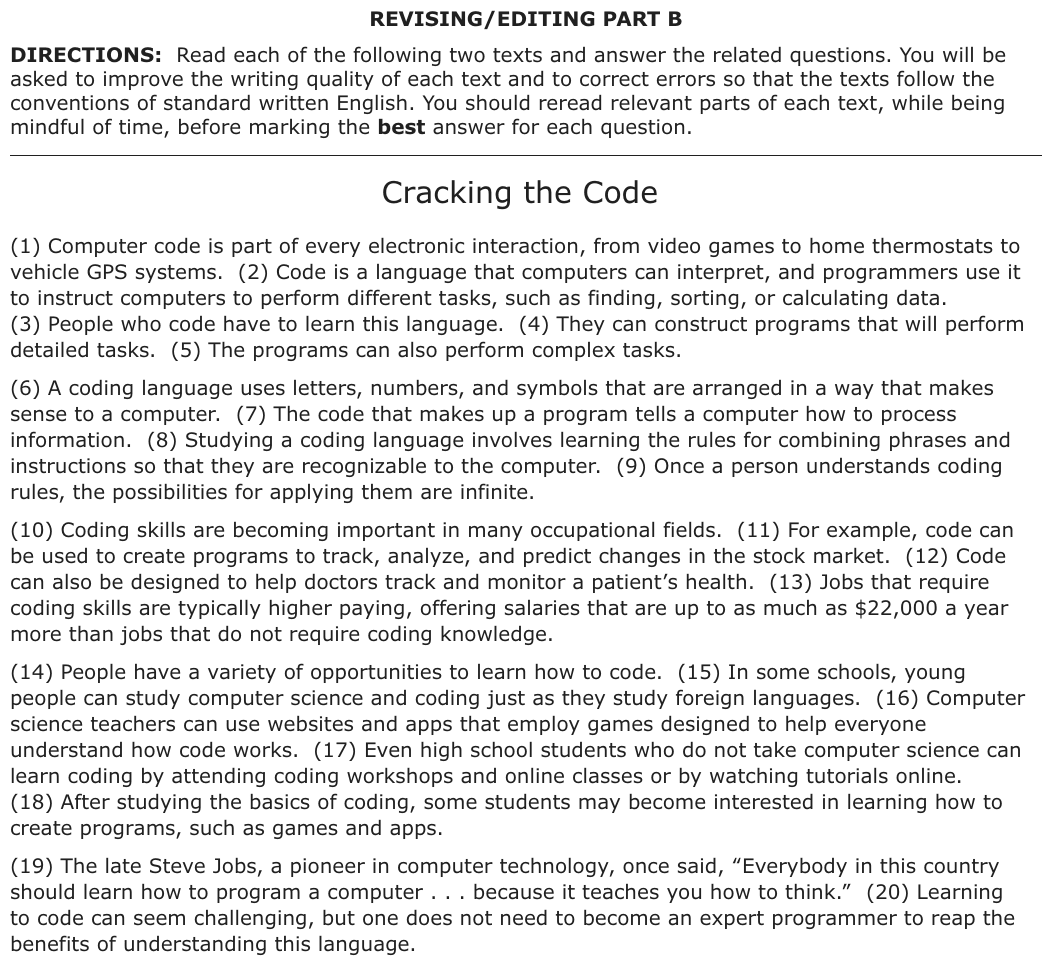
(1) Computer code is part of every electronic interaction, from video games to home thermostats to vehicle GPS systems. (2) Code is a language that computers can interpret, and programmers use it to instruct computers to perform different tasks, such as finding, sorting, or calculating data. (3) People who code have to learn this language. (4) They can construct programs that will perform detailed tasks. (5) The programs can also perform complex tasks.
(6) A coding language uses letters, numbers, and symbols that are arranged in a way that makes sense to a computer. (7) The code that makes up a program tells a computer how to process information. (8) Studying a coding language involves learning the rules for combining phrases and instructions so that they are recognizable to the computer. (9) Once a person understands coding rules, the possibilities for applying them are infinite.
(10) Coding skills are becoming important in many occupational fields. (11) For example, code can be used to create programs to track, analyze, and predict changes in the stock market. (12) Code can also be designed to help doctors track and monitor a patient’s health. (13) Jobs that require coding skills are typically higher paying, offering salaries that are up to as much as $22,000 a year more than jobs that do not require coding knowledge.
(14) People have a variety of opportunities to learn how to code. (15) In some schools, young people can study computer science and coding just as they study foreign languages. (16) Computer science teachers can use websites and apps that employ games designed to help everyone understand how code works. (17) Even high school students who do not take computer science can learn coding by attending coding workshops and online classes or by watching tutorials online. (18) After studying the basics of coding, some students may become interested in learning how to create programs, such as games and apps.
(19) The late Steve Jobs, a pioneer in computer technology, once said, “Everybody in this country should learn how to program a computer . . . because it teaches you how to think.” (20) Learning to code can seem challenging, but one does not need to become an expert programmer to reap the benefits of understanding this language.
Question
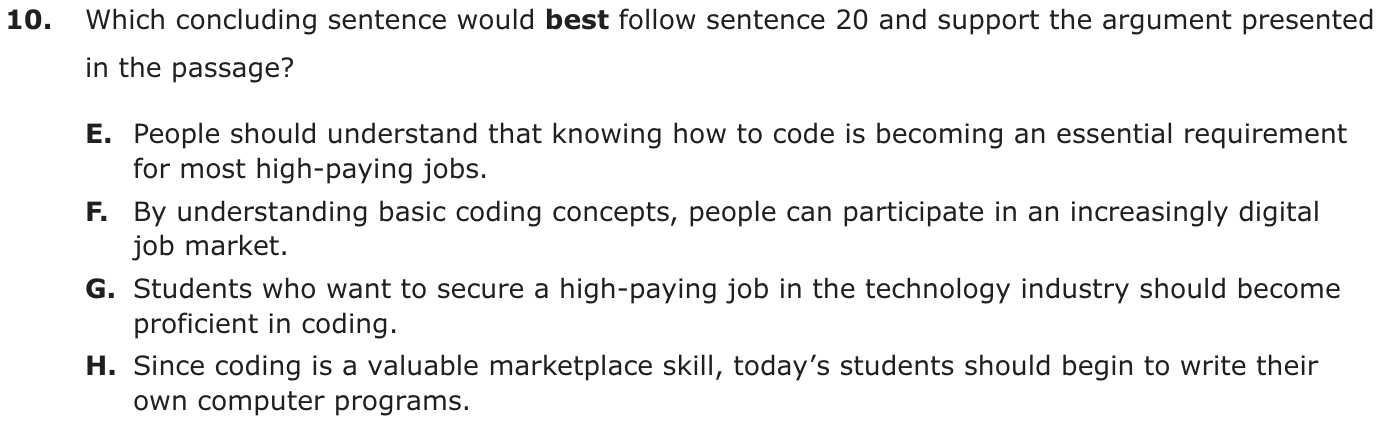
Which concluding sentence would best follow sentence 20 and support the argument presented in the passage?
- APeople should understand that knowing how to code is becoming an essential requirement for most high-paying jobs.
- BBy understanding basic coding concepts, people can participate in an increasingly digital job market.
- CStudents who want to secure a high-paying job in the technology industry should become proficient in coding.
- DSince coding is a valuable marketplace skill, today’s students should begin to write their own computer programs.
Show the answer
Correct answer: B
The question asks which concluding sentence would best follow sentence 20 and support the argument presented in the passage.
A. Incorrect. While the passage does state that “jobs that require coding skills are typically higher paying” (sentence 13), it does not say or imply that coding skills are needed for most high-paying jobs.
B. CORRECT. The sentence successfully summarizes the main argument of the passage, which is that coding is involved in all electronic interaction (sentence 1) and is a useful skill to master, especially in many occupational fields (sentence 10).
C. Incorrect. In the fourth paragraph, the passage does promote students taking advantage of opportunities to learn coding; however, this information is a supporting detail and would not serve as a strong conclusion to the argument presented in the passage.
D. Incorrect. Some readers may choose this sentence because the fourth paragraph discusses how “some students may become interested in learning how to create programs, such as games and apps” (sentence 18), but this detail is only one part of the overall argument in the passage.
Question analysis
This conclusion question asks which sentence should come after sentence 20, the last line of “Cracking the Code,” to close the passage and support its argument. The options mention high-paying jobs, students, the technology industry and the job market, so students must decide which ending fits the whole passage rather than one of its details.
- NYS standards
- 7W1e concluding an argument
- Grade level
- Grade 7 reading and task
- Compared with grade 7
- At grade 7 A closing statement that explains why an argument matters is part of the grade 7 writing standards. Here the ending must follow sentence 20 and reflect all five paragraphs, a typical grade 7 revising task with several reasonable-sounding options.
- Estimated difficulty
- Moderate: several steps, or a close reading with one strong distractor.
- Thinking it demands
- Depth of knowledge 2, skills and concepts · mainly evaluate
- What makes it hard
- Evidence in several places moderate
- The right answer is reworded minor
- How sentences fit together minor
- Evidence
- Answered from the whole text
- Reading level
- Passage: about grade 10, 357 words; question and choices: about grade 11, 80 words.
- Students, last 30 days
- Not enough answers yet to show (it takes 10).
Why it is hard, traps and wrong answers (shows the answer)
Why it is hard
Each wrong ending grows from something the passage does say, about high pay, students or creating programs, which makes it feel supported. The trap is in how far each one goes: one inflates better pay into a requirement for most good jobs, and two shrink the argument to students and programming. Keeping sentence 20’s point about non-experts in mind rules out most of them at once.
Evidence in several places moderate Working it out
A closing sentence must gather the whole argument: code is everywhere (sentence 1), it matters in many jobs (paragraph 3), anyone can learn it (paragraph 4) and even a basic grasp pays off (sentence 20). (Kirsch & Mosenthal, 1990; Gorin & Embretson, 2006)
The right answer is reworded minor Choosing the answer
The best ending uses words the passage never does, “basic coding concepts” and “increasingly digital job market,” while the others echo the “higher paying” jobs of sentence 13 or the programs of sentence 18. (Freedle & Kostin, 1993; Kirsch & Mosenthal, 1990)
How sentences fit together minor Working it out
The ending follows sentence 20, which says one need not become an expert programmer, so options that call for proficiency or for writing programs clash with the line just before them. (Halliday & Hasan, 1976)
Strategy: Reread sentence 20 and list the passage’s main points in a phrase each, then choose the ending that follows sentence 20 and covers those points without claiming more than they show.
Traps
- Too narrow: A single detail offered as the central idea or a summary, or a summary that keeps minor details and leaves out an essential part.
- Too broad or too strong: A choice overstates, generalizes, or uses absolute words the text does not support.
The wrong answers, classified
A Too broad or too strong (King et al., 2004)
Builds on sentence 13’s point that coding jobs pay more but inflates it into coding being “an essential requirement for most high-paying jobs,” a claim the passage never makes.
C Too narrow (King et al., 2004)
Is drawn by “high-paying job,” but it addresses only students aiming at the technology industry and asks for proficiency, though sentence 20 says no one needs to become an expert.
D Too narrow (King et al., 2004)
Builds on sentence 18’s students who may go on to create games and apps, so it ends on one detail of paragraph 4 instead of the passage’s case for everyone.
Working it out, step by step
Figure out what the question asks
This asks for the best concluding sentence, the last line of the passage. A good conclusion follows from the sentence before it and sums up the whole argument. It shouldn’t claim more than the passage shows. It also shouldn’t shrink the point down to one detail.
Reread sentence 20
Sentence 20 says “Learning to code can seem challenging, but one does not need to become an expert programmer to reap the benefits of understanding this language.” An expert is someone with great skill. So you don’t need great skill to gain from coding. Even a basic grasp helps. The last sentence should build on that idea.
List the passage’s main points
- Code is everywhere. It is “part of every electronic interaction” (sentence 1).
- Coding skills matter “in many occupational fields” (sentence 10).
- Anyone can find ways to learn (paragraph 4).
- Even a basic understanding pays off (sentence 20).
Check each choice
- A does not fit. Sentence 13 says coding jobs usually pay more. It never says coding is needed for “most high-paying jobs.” That claims too much.
- B fits. “Basic coding concepts” matches sentence 20: you don’t need to be an expert. “People” means everyone. Digital means done with computers. So an “increasingly digital job market” ties together code being everywhere and its use in many jobs.
- C does not fit. It speaks only to students who want tech jobs. Proficient means highly skilled, which sentence 20 says you don’t need to be.
- D does not fit. Writing programs is one detail from sentence 18. It is not the whole argument.
Choose the answer
Watch out: A sounds like a strong ending, and it builds on sentence 13. But it turns “typically higher paying” into a requirement for most good jobs. Only B follows sentence 20 and fits the whole passage. So the answer is B.
Why this answer and not the closest wrong one
A is the closest wrong answer. It grows out of sentence 13, which says coding jobs “are typically higher paying.” But paying more is not the same as being required. A claims more than the passage shows. B stays inside the passage: a basic understanding of coding helps people take part in a world of work full of computers.
More questions like this
The original DOE question
The passage “Cracking the Code” as printed (page 40)