2020 Test B English
Question 1 of 57
2020 Test B English, question 1Question
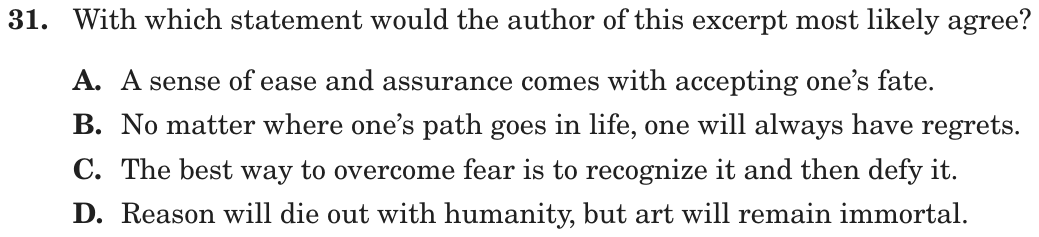
Which revision corrects the error in sentence structure in the paragraph?
The land on Earth has not always been separated into the seven continents, at one time a massive supercontinent, known as Pangaea, covered one-third of Earth’s surface. Additionally, the supercontinent was surrounded by ocean waters called Panthalassa, much of which were in Earth’s Southern Hemisphere. Geologists believe that the supercontinent split apart over millions of years because of the movement of the tectonic plates that form Earth’s crust. In fact, experts predict that over the next 250 million years the movement of the plates will cause the seven continents to merge into a supercontinent again.
- Acontinents. At
- Bsurface; additionally,
- CPanthalassa. Much
- Dcrust, in fact,
Show the answer
Correct answer: A
The question asks for the revision that corrects the error in sentence structure in the paragraph.
A. CORRECT. The first sentence of the paragraph is a run-on because both clauses—“The land on Earth has not always been separated into the seven continents” and “at one time a massive supercontinent, known as Pangaea, covered one-third of Earth’s surface”—are independent clauses. Independent clauses are complete sentences, and two complete sentences should not be combined with just a comma. The revision is correct because it separates the two sentences by placing a period where it is needed after “continents” and by capitalizing the word “At.”
B. Incorrect. While adding a semicolon after “surface” can be considered a correct way to separate the independent clauses “at one time a massive supercontinent, known as Pangaea, covered one-third of Earth’s surface” and “Additionally, the supercontinent was surrounded by ocean waters called Panthalassa, much of which were in Earth’s Southern Hemisphere,” this change does not address the sentence structure error in the paragraph (the run-on sentence). The use of a period separating the independent clauses (complete sentences) is correct as is.
C. Incorrect. Adding a period after “Panthalassa” would separate the dependent clause “much of which were in Earth’s Southern Hemisphere” from its antecedent: “ocean waters called Panthalassa.” The dependent clause cannot stand on its own, because it shares elements with the main clause. A dependent clause is not a complete sentence and must be joined with an independent clause. The clause beginning with “much of which” is an adjective clause that modifies “ocean waters.” Changing the comma to a period creates a new error (a sentence fragment) and does not address the existing sentence structure error at the beginning of the paragraph (the run-on sentence).
D. Incorrect. Removing the period after “crust” would create a run-on sentence because the period is needed to separate two complete sentences—“Geologists believe that the supercontinent split apart over millions of years because of the movement of the tectonic plates that form Earth’s crust” and “In fact, experts predict that over the next 250 million years the movement of the plates will cause the seven continents to merge into a supercontinent again.” A comma after “crust” would combine these sentences into a run-on, creating a new error in the sentence without fixing the existing sentence structure error (the run-on sentence) at the beginning of the paragraph.
Question analysis
This editing question shows a short paragraph about Pangaea, the supercontinent that once covered a third of Earth’s surface, and the ocean around it, with four underlined spots, and asks which revision corrects the error in sentence structure. Each revision changes only punctuation and capitals at one spot, so the decision rests on how the clauses around each spot fit together.
- Grade level
- Grade 6 reading and task
- Compared with grade 7
- Below grade 7 Fixing run-ons and fragments is taught well before grade 7, and this item tests that basic skill in one short paragraph. The sentences are long, with an appositive and a clause beginning “much of which,” but the grammar involved stays simple.
- Estimated difficulty
- Straightforward: two steps or one careful reading.
- Thinking it demands
- Depth of knowledge 2, skills and concepts · mainly apply
- What makes it hard
- A rule that doesn't sound wrong moderate
- Every choice must be checked minor
- Complex sentences minor
- Evidence
- Answered from one paragraph or stanza
- Reading level
- Question and choices: about grade 9, 114 words.
- Corrected from the DOE handbook
- Two grammar terms in the explanation were corrected.
- Students, last 30 days
- Not enough answers yet to show (it takes 10).
Why it is hard, traps and wrong answers (shows the answer)
Why it is hard
The error is in the first sentence, but it hides behind a comma that sounds like an ordinary pause, while the later spots carry features that look riskier: a transition word, a clause beginning “much of which,” the phrase “in fact.” Students who test each spot for a complete sentence on both sides find the splice at once. Those who look for a revision that merely sounds polished are drawn to the semicolon, which is correct but fixes nothing.
A rule that doesn't sound wrong moderate Working it out
The comma after “continents” joins two complete sentences, and because “at one time” sounds like an introductory phrase continuing the thought, the splice reads as a natural pause. (Connors & Lunsford, 1988)
Every choice must be checked minor Choosing the answer
Each revision changes only punctuation at one underlined spot, and the semicolon one is correct English, so students must ask whether each spot was wrong to begin with, not only whether the change looks right. (Embretson & Wetzel, 1987)
Complex sentences minor Understanding the question
The paragraph’s sentences are long, with the appositive “known as Pangaea” and the clause “much of which were,” whose odd-sounding verb draws suspicion to a spot that is correctly punctuated. (Abedi & Lord, 2001; Freedle & Kostin, 1993; Messick, 1989)
Strategy: At each underlined spot, read the words on both sides and ask whether each side could stand as a sentence, then pick the revision that leaves every sentence correctly joined or separated.
Traps
- Fixes what isn't broken: Changes a part of the sentence that was already correct, while the real error stays; or, where the question asks which sentence has an error or should go, picks one that is correct and belongs.
- Fragment or run-on: Creates or keeps a sentence fragment, a run-on sentence or a comma splice.
The wrong answers, classified
B Fixes what isn't broken (Connors & Lunsford, 1988)
Knows a semicolon can join two clauses before “additionally” and picks that tidy-looking change, though the period it replaces was already correct and the comma splice up front remains.
C Fragment or run-on (Connors & Lunsford, 1988)
Treats the long second sentence as a run-on and splits it after “Panthalassa,” leaving “Much of which were in Earth’s Southern Hemisphere” as a fragment with no main clause.
D Fragment or run-on (Connors & Lunsford, 1988)
Thinks “in fact” belongs inside the sentence before it, set off by commas, which joins two complete sentences with only a comma and creates the error the paragraph already has.
What was corrected from the DOE handbook, and why
- Explanation: The DOE’s explanation of Option C says a period after “Panthalassa” would separate the dependent clause “much of which were in Earth’s Southern Hemisphere” “from its subject: ‘ocean waters called Panthalassa.’” The clause has a subject of its own, “much”; “ocean waters called Panthalassa” is its antecedent, the noun phrase that “which” refers to. The explanation also calls the clause “an adjective for ‘ocean waters’”; a clause is not an adjective but an adjective (relative) clause, which modifies the noun. The site now says “from its antecedent” and “an adjective clause that modifies ‘ocean waters.’” The reasoning and the answer, A, are unchanged.
Working it out, step by step
Learn the rule for joining sentences
An independent clause is a group of words with a subject and a verb that can stand alone as a sentence. Two of them can’t be joined with only a comma. That mistake is a run-on sentence, also called a comma splice. For example: I love soccer, my brother loves chess. Fix it with a period: I love soccer. My brother loves chess.
Test each underlined spot
At each spot, read the words on both sides. Ask: could each side stand alone as a sentence?
- After “continents”: both sides are complete. A comma joins them, so this is an error.
- After “surface”: a period already separates two sentences. That is correct.
- After “Panthalassa”: the words after the comma can’t stand alone. The comma is correct.
- After “crust”: a period already separates two sentences. That is correct.
Look closely at the first sentence
The first part says “The land on Earth has not always been separated into the seven continents.” That is a full sentence. The second part says “at one time a massive supercontinent, known as Pangaea, covered one-third of Earth’s surface.” Its subject is “supercontinent,” and its verb is “covered.” So it is a full sentence too. The words “At one time” start a new sentence.
Show the fix
Change the comma to a period, and capitalize the next word: The land on Earth has not always been separated into the seven continents. At one time a massive supercontinent, known as Pangaea, covered one-third of Earth’s surface. Now each sentence stands on its own. That is the revision continents. At.
Check each choice
- A is right. It splits the run-on into two sentences.
- B is wrong. A semicolon could join those two sentences, but the period there was already correct. It fixes nothing.
- C is wrong. “Much of which were in Earth’s Southern Hemisphere” is a dependent clause, a group of words with a verb that can’t be a sentence by itself. “Which” points back to “ocean waters called Panthalassa,” its antecedent. So the clause must stay attached.
- D is wrong. A comma after “crust” would join two full sentences. That makes a new run-on.
Choose the answer
Only the comma after “continents” joins two complete sentences. So the answer is A, continents. At.
Why this answer and not the closest wrong one
B is the closest wrong choice, because a semicolon can correctly join two sentences. But the spot after “surface” already had a period, which was correct. Changing it does not fix the real error. The comma splice after “continents” would still be there. Only A fixes it.
More questions like this
The original DOE question
Question 2 of 57
2020 Test B English, question 2Question
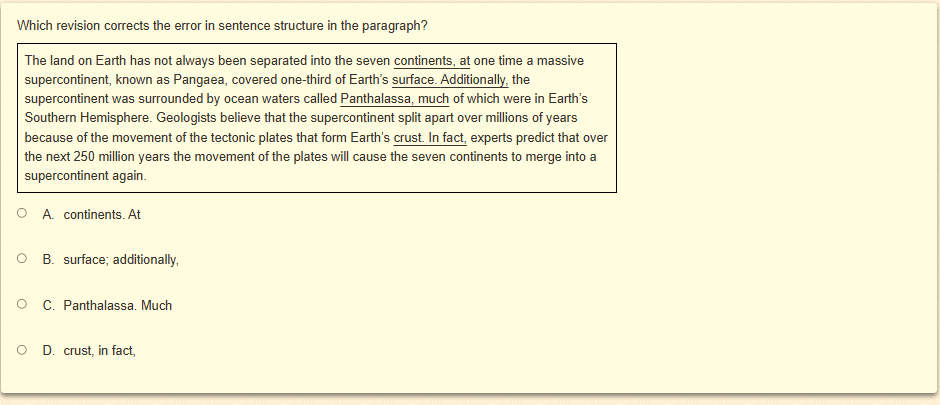
Read this paragraph.
(1) Walking dogs, cleaning kennels, hand-feeding newborn kittens, and supporting the pet-adoption process, the animal shelter is looking for volunteers to help with a variety of tasks. (2) Working at the animal shelter is a great way for young people, especially those who aspire to care for and protect animals, to gain valuable work experience. (3) In addition to hands-on training with animal care, volunteers will learn important job skills, such as punctuality, responsibility, and personal initiative. (4) Caring for animals can also help volunteers develop empathy, which is the awareness and understanding of the feelings of others.
Which sentence contains an error in its construction and should be revised?
- Asentence 1
- Bsentence 2
- Csentence 3
- Dsentence 4
Show the answer
Correct answer: A
The answer is (A)
The question asks for the identification of the sentence in the paragraph that has an error in its construction and should be revised.
Option A (sentence 1) is the correct response because sentence 1 contains a structural error. The sentence begins with a list of modifying phrases: “Walking dogs, cleaning kennels, hand-feeding newborn kittens, and supporting the pet-adoption process.” As written, this list modifies the closest noun phrase, “the animal shelter,” which is illogical because the list describes tasks at the animal shelter, not the shelter itself. The list should follow the word “tasks” at the end of the sentence, so that it is closer to the word that it modifies.
Option B, Option C, and Option D are incorrect responses because sentence 2, sentence 3, and sentence 4 do not contain structural errors.
For Option B, the phrase “especially those who aspire to care for and protect animals” in sentence 2 correctly modifies “young people.”
For Option C, the structure of sentence 3 allows the words “In addition to hands-on training with animal care” to correctly modify “volunteers will learn.”
For Option D, the phrase “which is the awareness and understanding of the feelings of others” in sentence 4 correctly modifies the word “empathy.”
Question analysis
This editing question gives a paragraph inviting young people to volunteer at an animal shelter and asks which sentence is built incorrectly and should be revised. The error is in sentence structure, not spelling or punctuation, and every sentence contains long descriptive phrases, so students must check what each phrase actually describes.
- NYS standards
- 7L1 grammar and usage conventions
- Grade level
- Grade 7 reading and task
- Compared with grade 7
- At grade 7 Spotting a misplaced or dangling modifier is the grade 7 grammar skill tested here. The faulty sentence reads smoothly and the correct sentences also hold long modifying phrases, so it matches a careful grade 7 editing task.
- Estimated difficulty
- Moderate: several steps, or a close reading with one strong distractor.
- Thinking it demands
- Depth of knowledge 2, skills and concepts · mainly analyze
- What makes it hard
- A rule that doesn't sound wrong major
- Every choice must be checked moderate
- Complex sentences minor
- Evidence
- Answered from one paragraph or stanza
- Reading level
- Question and choices: about grade 10, 113 words.
- Students, last 30 days
- Not enough answers yet to show (it takes 10).
Why it is hard, traps and wrong answers (shows the answer)
Why it is hard
The faulty sentence is the first one and the smoothest-sounding, because the mind supplies the missing volunteers who walk the dogs. Students who judge by ear pass over it and then flag a correct sentence that merely sounds busy. The question rewards asking, for every opening phrase, which noun it actually attaches to.
A rule that doesn't sound wrong major Working it out
Sentence 1's opening list, “Walking dogs, cleaning kennels, hand-feeding newborn kittens”, grammatically describes “the animal shelter”, an error that sounds natural because readers know volunteers will do those tasks. (Connors & Lunsford, 1988)
Every choice must be checked moderate Choosing the answer
The stem names no kind of error, so all four sentences must be checked, and sentences 2, 3 and 4 each contain a long phrase that could look misplaced. (Embretson & Wetzel, 1987)
Complex sentences minor Understanding the question
Every sentence carries a lengthy modifier, from the interrupting “especially those who aspire to care for and protect animals” to the closing definition of empathy, so the faulty one does not stand out. (Abedi & Lord, 2001; Freedle & Kostin, 1993; Messick, 1989)
Strategy: In each sentence, find every descriptive phrase and ask which noun sits next to it. Any phrase placed beside a noun it cannot logically describe marks the sentence to revise.
The wrong answers, classified
B Fixes what isn't broken (Connors & Lunsford, 1988)
Flags the interruption “especially those who aspire to care for and protect animals” as an error, though it correctly describes “young people” and the sentence is complete.
C Fixes what isn't broken (Connors & Lunsford, 1988)
Suspects the opening phrase “In addition to hands-on training with animal care” dangles like sentence 1's, but it leads straight into “volunteers”, who receive the training.
D Fixes what isn't broken (Connors & Lunsford, 1988)
Picks the “which is the awareness and understanding of the feelings of others” clause as misplaced, though it sits right after “empathy”, the word it defines.
Working it out, step by step
Figure out what the question asks
This asks which sentence is built wrong. The words may be fine, but the parts are in the wrong order or don’t fit together. The question doesn’t say what kind of error to look for. So you need to check all four sentences.
Learn the rule about describing phrases
A modifier is a word or phrase that describes something. It must sit right next to the thing it describes. If it sits next to the wrong word, the sentence says something silly. Example: Barking loudly, the mail carrier ran from the dog. This says the mail carrier was barking! Fix: The mail carrier ran from the dog, which was barking loudly.
Test sentence 1
Sentence 1 begins with a list: “Walking dogs, cleaning kennels, hand-feeding newborn kittens, and supporting the pet-adoption process.” Right after the comma comes “the animal shelter.” So the sentence says the shelter is walking dogs and feeding kittens. A shelter is a place. It can’t do those things. The list really describes the “tasks” at the end of the sentence. One fix moves the list after that word: …volunteers to help with a variety of tasks, such as walking dogs, cleaning kennels…
Test sentences 2, 3, and 4
- Sentence 2: “especially those who aspire to care for and protect animals” comes right after “young people.” It describes them, so it is in the right place. (To aspire means to hope or aim.)
- Sentence 3: “In addition to hands-on training with animal care” leads straight into “volunteers.” The volunteers get the training, so it fits.
- Sentence 4: “which is the awareness and understanding of the feelings of others” comes right after “empathy.” It explains that word, so it fits.
Watch out: Sentence 3 also starts with a phrase and a comma, so choice C can look like sentence 1. Ask who gets the training. The volunteers do.
Pick the answer
Only sentence 1 puts a describing phrase next to the wrong noun. So the answer is A, sentence 1.
Why this answer and not the closest wrong one
Sentence 3 is the closest trap, because it also opens with a phrase and a comma. But the word after its comma is “volunteers,” and the volunteers really do get the training. In sentence 1, the words after the comma are “the animal shelter,” and a shelter can’t walk dogs.
More questions like this
The original DOE question
Question 3 of 57
2020 Test B English, question 3Question
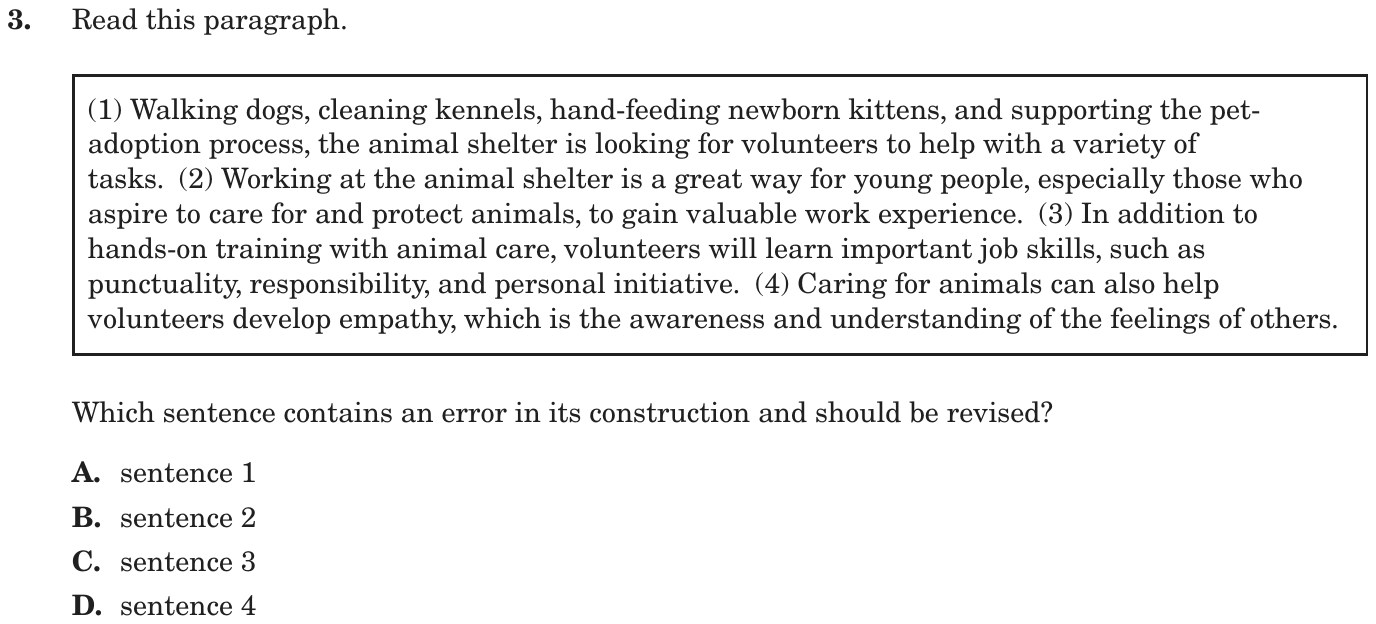
Which edit should be made to correct the sentence?
The Colosseum in Rome, Italy which is considered one of the “new” Seven Wonders of the World, is the largest amphitheater ever built and once could hold up to 50,000 spectators.
- ADelete the comma after Rome.
- BInsert a comma after Italy.
- CDelete the comma after World.
- DInsert a comma after built.
Show the answer
Correct answer: B
The question asks for the correction needed for an error in the sentence.
A. Incorrect. When a place name has more than one element, a comma is used to separate the elements for clarity.
B. CORRECT. The sentence needs a comma to set off the clause “which is considered one of the ‘new’ Seven Wonders of the World,” because the clause is not essential to the meaning of the sentence (nonrestrictive clause). This option is correct because it places a comma where it is needed, after “Italy,” to set off the nonrestrictive clause that follows.
C. Incorrect. This edit would remove the comma at the end of the nonrestrictive clause, which should be set off by commas at the beginning and the end.
D. Incorrect. A comma after “built” would separate the predicate “and once could hold up to 50,000 spectators” from the subject of the main clause. The predicates “is the largest amphitheater ever built” and “once could hold up to 50,000 spectators” both relate to the same subject (“The Colosseum in Rome, Italy”), so a comma should not be used to separate the second predicate from that subject.
Question analysis
This editing question gives one long sentence about the Colosseum in Rome and asks which comma edit corrects it. Students must know how commas work with a city and its country, with a descriptive clause beginning with which, and with two verbs that share one subject, because every choice adds or removes a comma.
- NYS standards
- 7L2 capitalization, punctuation, and spelling
- Grade level
- Grade 6 reading and task
- Compared with grade 7
- Below grade 7 Comma rules for place names and for extra information set off in a sentence are taught by grade 6. Here they are tested in one sentence with four marked spots, lighter than typical grade 7 editing of a whole paragraph.
- Estimated difficulty
- Straightforward: two steps or one careful reading.
- Thinking it demands
- Depth of knowledge 1, recall and reproduction · mainly apply
- What makes it hard
- A rule that doesn't sound wrong moderate
- Complex sentences minor
- Evidence
- Answered from one sentence or line
- Reading level
- Question and choices: about grade 6, 59 words.
- Students, last 30 days
- Not enough answers yet to show (it takes 10).
Why it is hard, traps and wrong answers (shows the answer)
Why it is hard
The which-clause has a closing comma after “World” but no opening one, and the sentence still sounds natural, so many students see the lone comma as the mistake instead of noticing its missing partner. Bracketing the extra description first, from “which” to “World,” exposes the gap quickly. The remaining choices fall to two rules students usually know: city and country are separated, and a second verb sharing the subject takes no comma.
A rule that doesn't sound wrong moderate Working it out
“Rome, Italy which is considered” reads smoothly aloud, yet the comma after “Italy” is needed twice over: to close the city-and-country pair and to open the nonessential which-clause. (Connors & Lunsford, 1988)
Complex sentences minor Understanding the question
Thirty-one words hold a two-part place name, a which-clause wedged between subject and verb, and two verbs, “is” and “once could hold,” sharing one subject, so each comma must be judged against that frame. (Abedi & Lord, 2001; Freedle & Kostin, 1993; Messick, 1989)
Strategy: Strip the sentence down to its main subject and verb, then check every marked spot against that core: what is the comma, or the missing comma, doing there?
Traps
- Punctuation: A comma, semicolon, colon, dash or apostrophe used where it does not belong, or missing where it does.
The wrong answers, classified
A Punctuation (Connors & Lunsford, 1988)
Treats “Rome, Italy” as a single name that should not be broken, not knowing that a comma always separates a city from the country that follows it.
C Punctuation (Connors & Lunsford, 1988)
Applies the sound rule against a comma between a subject and its verb to the comma before “is,” missing that it closes the which-clause and must stay.
D Punctuation (Connors & Lunsford, 1988)
Adds a pause before “and once could hold” because the sentence is long, though that second verb shares the subject, the Colosseum, and takes no comma.
Working it out, step by step
Figure out what the question asks
This is a punctuation question. Punctuation means marks like commas and periods. Four spots are underlined, at “Rome,” “Italy,” “World” and “built.” One edit fixes the sentence. Two comma rules decide it.
Learn the rule for extra information
Some groups of words just add an extra fact. If you take them out, the sentence still works. This is called a nonessential clause. A clause is a group of words with its own verb. A nonessential clause needs a comma before it and a comma after it, like a pair of brackets.
Example: Our school, which is very old, has a new gym. Without the middle part: Our school has a new gym.
Find the extra part
The extra part here starts at “which is considered” and ends at “of the World.” It adds a fun fact. Take it out and the sentence still works: The Colosseum in Rome, Italy, is the largest amphitheater ever built.
The comma after “World” closes the extra part. But nothing opens it. A comma is missing after “Italy.”
Learn the rule for places
A comma goes between a city and its country, as in “Rome, Italy.” If the sentence keeps going, put a comma after the country too. Example: She flew from Lima, Peru, to Miami.
So the comma after “Italy” is needed for two reasons. One comma does both jobs.
Check each choice
- A is wrong. The comma after “Rome” splits the city from the country. It must stay.
- B is right. It adds the missing comma that opens the extra part.
- C is wrong. The comma after “World” closes the extra part. Without it, neither end would be marked.
- D is wrong. The Colosseum “is the largest amphitheater” and “once could hold” many people. These are two verbs with one subject. No comma goes before the second verb. Example: Max swam fast and won a medal.
Watch out: C is tempting. A comma between a subject (who or what the sentence is about) and its verb is usually wrong. Here it is fine, because it is the second comma of a pair.
Choose the answer
With a comma after “Italy,” the extra part has a comma at each end. So the answer is B: insert a comma after Italy.
Why this answer and not the closest wrong one
C is the closest wrong answer. It treats the comma before “is” as the mistake. But that comma ends the extra part about the Seven Wonders. Delete it and nothing marks either end. B adds the missing opening comma, so both ends are marked.
More questions like this
The original DOE question
Question 4 of 57
2020 Test B English, question 4Question
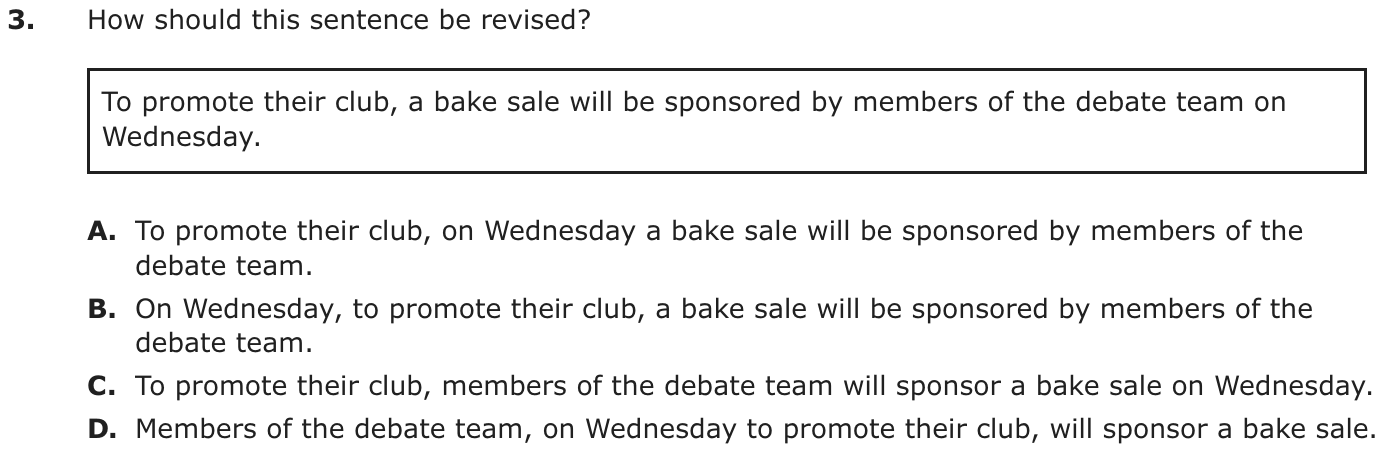
How should this sentence be revised?
To promote their club, a bake sale will be sponsored by members of the debate team on Wednesday.
- ATo promote their club, on Wednesday a bake sale will be sponsored by members of the debate team.
- BOn Wednesday, to promote their club, a bake sale will be sponsored by members of the debate team.
- CTo promote their club, members of the debate team will sponsor a bake sale on Wednesday.
- DMembers of the debate team, on Wednesday to promote their club, will sponsor a bake sale.
Show the answer
Correct answer: C
The question asks for the correct revision of the sentence in the box.
A. Incorrect. The revisions do not fix the error that “to promote their club” modifies “a bake sale.”
B. Incorrect. The revisions do not fix the error that “to promote their club” modifies “a bake sale.”
C. CORRECT. The revision is correct because it includes the phrase “to promote their club” clearly modifying “members of the debate team.”
D. Incorrect. While the revision clarifies that “to promote their club” relates to the “members of the debate team,” the rest of the sentence is poorly written because the insertion of “on Wednesday to promote their club” in the middle of the sentence interrupts the main clause, “Members of the debate team will sponsor a bake sale.”
Question analysis
This sentence-structure question gives one sentence about a debate team’s bake sale, planned for Wednesday to promote their club, and asks how it should be revised. The four rewrites shuffle the same three phrases into different orders, so students must check which word each phrase modifies and whether the whole sentence still reads naturally.
- NYS standards
- 7L1 grammar and usage conventions
- Grade level
- Grade 7 reading and task
- Compared with grade 7
- At grade 7 Placing a phrase so that it describes the right word is part of the grade 7 language standards, and this one-sentence item is a classic case. Choosing the rewrite that is both logical and smooth is typical grade 7 editing.
- Estimated difficulty
- Straightforward: two steps or one careful reading.
- Thinking it demands
- Depth of knowledge 2, skills and concepts · mainly evaluate
- What makes it hard
- A rule that doesn't sound wrong moderate
- Complex sentences minor
- Every choice must be checked minor
- A very close wrong answer minor
- Evidence
- Answered from one sentence or line
- Reading level
- Question and choices: about grade 7, 92 words.
- Students, last 30 days
- Not enough answers yet to show (it takes 10).
Why it is hard, traps and wrong answers (shows the answer)
Why it is hard
The sentence makes sense on a first reading, which is exactly why its error slips past students who edit by ear. Asking who is promoting the club exposes it and removes both rewrites that keep the bake sale as the subject, however neatly they are punctuated. What is left is a judgment of style, and the smoother rewrite keeps the subject and verb together instead of interrupting them with two phrases.
A rule that doesn't sound wrong moderate Working it out
“To promote their club” has to describe whatever comes right after its comma, and that is “a bake sale”; the meaning is so plain that few students notice the sale doing the promoting. (Connors & Lunsford, 1988)
Complex sentences minor Understanding the question
The original is passive, “a bake sale will be sponsored by members of the debate team,” which places the people who act after the verb, far from the phrase that should describe them. (Abedi & Lord, 2001; Freedle & Kostin, 1993; Messick, 1989)
Every choice must be checked minor Choosing the answer
Each rewrite rearranges the opening phrase, the time phrase and the main clause, so each has to be read through to see what follows “To promote their club” and whether anything splits a subject from its verb. (Embretson & Wetzel, 1987)
A very close wrong answer minor Choosing the answer
Two rewrites make the team members the subject of “will sponsor” with identical words; they part only on where the two phrases go, at the edges of the sentence or wedged between subject and verb. (Embretson & Wetzel, 1987; Gorin & Embretson, 2006; Ascalon et al., 2007)
Strategy: Ask who is really doing the promoting, then read each rewrite aloud in full, checking which words follow the opening phrase and whether the sentence reads smoothly from start to finish.
Traps
- Misplaced modifier: A describing word or phrase that attaches to the wrong word, or to nothing in the sentence.
The wrong answers, classified
A Misplaced modifier (Connors & Lunsford, 1988)
Moves “on Wednesday” ahead of the bake sale as if the time phrase were the misplaced part, but the sentence stays passive and the sale is still what “To promote their club” describes.
B Misplaced modifier (Connors & Lunsford, 1988)
Is drawn by the tidy commas around both fronted phrases, yet “a bake sale” still comes straight after them, so the sale remains the thing promoting the club.
D Misplaced modifier (Connors & Lunsford, 1988)
Rightly makes “Members of the debate team” the subject but parks “on Wednesday to promote their club” between it and “will sponsor,” a clumsy break the smoother rewrite avoids.
Working it out, step by step
Figure out what the question asks
You need the best way to rewrite the sentence. This is about a modifier. A modifier is a group of words that describes something else in the sentence. Here the opening words, “To promote their club,” are the modifier. Your job is to check what they describe.
Learn the rule for opening phrases
A sentence may start with a describing phrase and a comma. Then the phrase describes whatever comes right after the comma. So the one doing the action should come next.
Wrong: To get good seats, the line was joined early by Ana. A line can’t want good seats.
Right: To get good seats, Ana joined the line early.Find the problem in the sentence
To promote a club means to get people interested in it. In the sentence, the words right after the comma are “a bake sale.” So the sentence seems to say the bake sale is promoting the club. But a bake sale doesn’t have a club. The club belongs to the “members of the debate team.” They should come right after the comma, and they should do the action: they “will sponsor a bake sale.”
Check each choice
- A is wrong. It moves “on Wednesday” forward. But the bake sale is still what the opening phrase describes.
- B is wrong. It puts “On Wednesday,” at the front. The commas look neat, but “a bake sale” still follows “to promote their club.”
- C is right. “Members of the debate team” comes right after the comma. They are the ones promoting their club.
- D is wrong. The members come first. But “on Wednesday to promote their club” is stuck between the subject (who does the action) and the verb (the action word).
Watch out: D is tempting, since the members do the promoting. But its long middle part breaks up the main idea.
Choose the answer
C fixes the modifier and reads smoothly: To promote their club, members of the debate team will sponsor a bake sale on Wednesday. So the answer is C.
Why this answer and not the closest wrong one
D is the closest wrong answer. Like C, it makes the members the ones who promote the club. But D pushes a long phrase between “Members of the debate team” and “will sponsor.” C keeps the subject and the verb side by side, so it is easier to read.
More questions like this
The original DOE question
Question 5 of 57
2020 Test B English, question 5Passage The Free College Debate
The Free College Debate
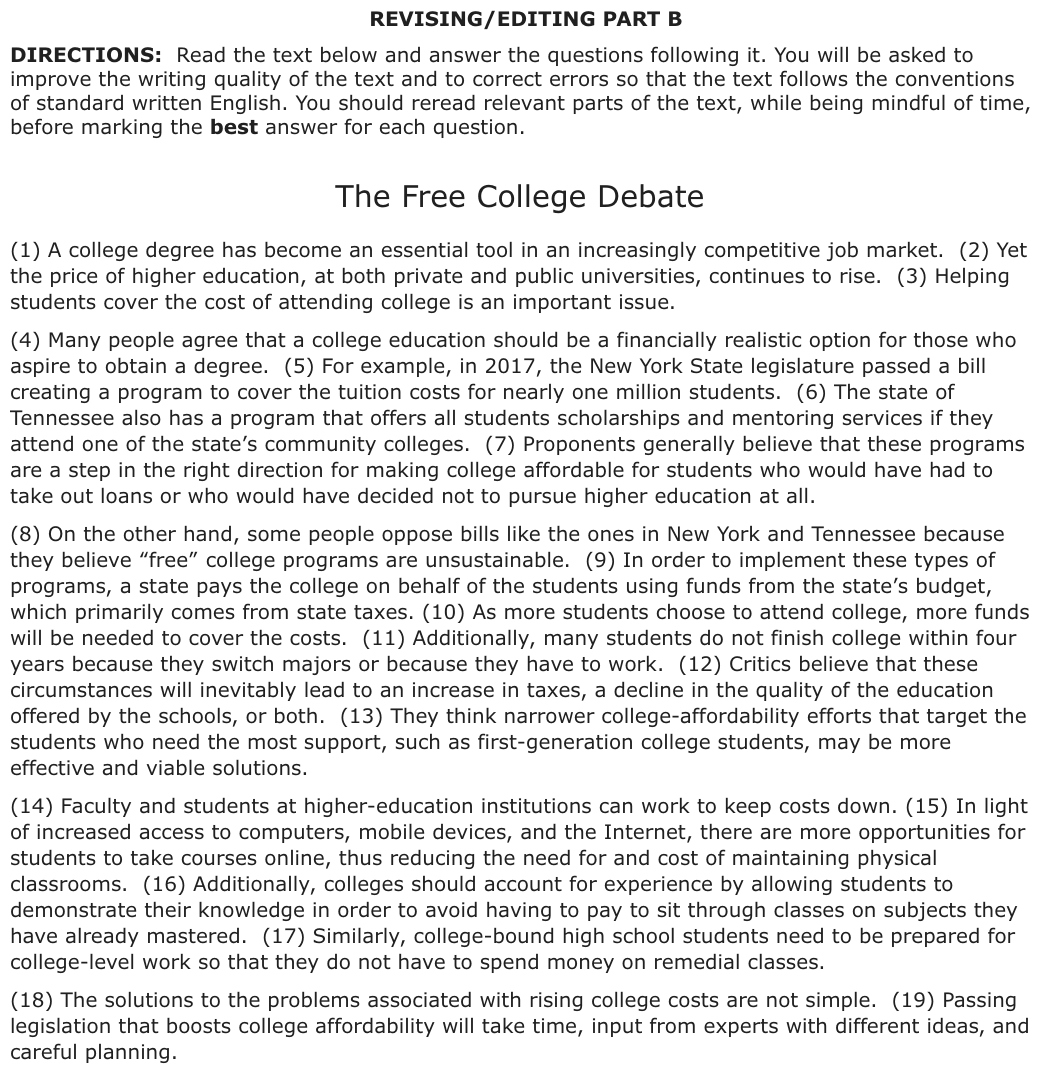
(1) A college degree has become an essential tool in an increasingly competitive job market. (2) Yet the price of higher education, at both private and public universities, continues to rise. (3) Helping students cover the cost of attending college is an important issue.
(4) Many people agree that a college education should be a financially realistic option for those who aspire to obtain a degree. (5) For example, in 2017, the New York State legislature passed a bill creating a program to cover the tuition costs for nearly one million students. (6) The state of Tennessee also has a program that offers all students scholarships and mentoring services if they attend one of the state’s community colleges. (7) Proponents generally believe that these programs are a step in the right direction for making college affordable for students who would have had to take out loans or who would have decided not to pursue higher education at all.
(8) On the other hand, some people oppose bills like the ones in New York and Tennessee because they believe “free” college programs are unsustainable. (9) In order to implement these types of programs, a state pays the college on behalf of the students using funds from the state’s budget, which primarily comes from state taxes. (10) As more students choose to attend college, more funds will be needed to cover the costs. (11) Additionally, many students do not finish college within four years because they switch majors or because they have to work. (12) Critics believe that these circumstances will inevitably lead to an increase in taxes, a decline in the quality of the education offered by the schools, or both. (13) They think narrower college-affordability efforts that target the students who need the most support, such as first-generation college students, may be more effective and viable solutions.
(14) Faculty and students at higher-education institutions can work to keep costs down. (15) In light of increased access to computers, mobile devices, and the Internet, there are more opportunities for students to take courses online, thus reducing the need for and cost of maintaining physical classrooms. (16) Additionally, colleges should account for experience by allowing students to demonstrate their knowledge in order to avoid having to pay to sit through classes on subjects they have already mastered. (17) Similarly, college-bound high school students need to be prepared for college-level work so that they do not have to spend money on remedial classes.
(18) The solutions to the problems associated with rising college costs are not simple. (19) Passing legislation that boosts college affordability will take time, input from experts with different ideas, and careful planning.
Question
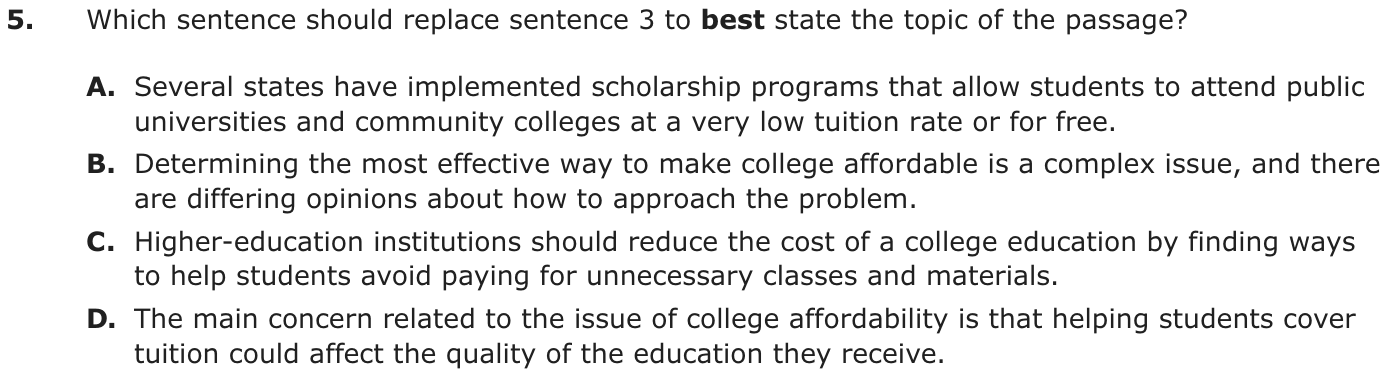
Which sentence should replace sentence 3 to best state the topic of the passage?
- ASeveral states have implemented scholarship programs that allow students to attend public universities and community colleges at a very low tuition rate or for free.
- BDetermining the most effective way to make college affordable is a complex issue, and there are differing opinions about how to approach the problem.
- CHigher-education institutions should reduce the cost of a college education by finding ways to help students avoid paying for unnecessary classes and materials.
- DThe main concern related to the issue of college affordability is that helping students cover tuition could affect the quality of the education they receive.
Show the answer
Correct answer: B
The question asks which sentence should replace sentence 3 to best state the topic of the passage.
A. Incorrect. Although this sentence mentions that “several states have implemented scholarship programs,” it does not clearly introduce the topic of the passage, which is differing opinions about and approaches to solving the problem of the cost of college.
B. CORRECT. This sentence best replaces sentence 3 because it clearly states the topic of “determining the most effective way to make college affordable.” It also provides an introduction to the “differing opinions” of proponents, who believe that states should provide low-cost or free tuition, and opponents, who believe that such state programs are “unsustainable” (sentence 8).
C. Incorrect. This sentence mentions the role of higher-education institutions in helping “reduce the cost of a college education” for students, which is an idea discussed in sentences 14 and 15 in the passage. Although the sentence provides details to support the topic of the passage by referring to “ways to help students avoid paying for unnecessary classes and materials,” it does not state the topic, which is differing opinions about and approaches to solving the problem of the cost of college.
D. Incorrect. Even though this sentence mentions “college affordability,” it is primarily focused on a problem that is related to, but different from, the issue discussed in the passage. The passage is concerned with “the price of higher education” (sentence 2), not how tuition rates “affect the quality of the education [students] receive.”
Question analysis
This revising question uses a passage about the rising cost of college and state programs that cover tuition, and asks which sentence should replace sentence 3 to state the passage's topic. Every choice is about college affordability, so students must tell a sentence that covers the whole passage from one that fits a single paragraph.
- NYS standards
- 7W2a introducing and organizing a topic
- Grade level
- Grade 7 reading and task
- Compared with grade 7
- At grade 7 Choosing a sentence that states a passage's topic is core grade 7 writing work. The passage is formal and five paragraphs long, but each paragraph opens by signalling its part of the subject, so the demand is typical.
- Estimated difficulty
- Straightforward: two steps or one careful reading.
- Thinking it demands
- Depth of knowledge 2, skills and concepts · mainly evaluate
- What makes it hard
- Evidence in several places moderate
- The right answer is reworded minor
- Evidence
- Answered from the whole text
- Reading level
- Passage: about grade 12, 427 words; question and choices: about grade 14, 110 words.
- Corrected from the DOE handbook
- A grammar slip in the explanation was corrected.
- Students, last 30 days
- Not enough answers yet to show (it takes 10).
Why it is hard, traps and wrong answers (shows the answer)
Why it is hard
The replacement must cover a passage that argues both sides of free college and then turns to campus cost-cutting, so a sentence about any one part falls short. Students most often take the state scholarship programs for the topic, because those programs fill the two middle paragraphs. Summing up each paragraph in a few words before reading the choices shows that only a sentence about the debate over how to make college affordable fits them all.
Evidence in several places moderate Working it out
The topic shows only across all five paragraphs: supporters of state programs in sentences 4–7, critics in 8–13, campus cost-cutting in 14–17, and the closing warning that solutions are not simple. (Kirsch & Mosenthal, 1990; Gorin & Embretson, 2006)
The right answer is reworded minor Choosing the answer
The right sentence says “complex issue” and “differing opinions,” words the passage never uses, while wrong ones echo its “scholarship,” “community colleges” and “helping students cover.” (Freedle & Kostin, 1993; Kirsch & Mosenthal, 1990)
Strategy: Note in a few words what each of the five paragraphs does, then choose the sentence that would prepare a reader for all of them rather than for one paragraph's details.
Traps
- Too narrow: A single detail offered as the central idea or a summary, or a summary that keeps minor details and leaves out an essential part.
- Off the point: Adds or keeps something that does not support the paragraph's or the passage's focus, or an introduction or conclusion that misses the main point.
The wrong answers, classified
A Too narrow (King et al., 2004)
Picks the state scholarship programs, which do fill paragraphs 2 and 3, but they are what the two sides argue about, not a topic that also covers paragraph 4.
C Too narrow (King et al., 2004)
Takes paragraph 4's cost-cutting ideas, such as not paying for classes already mastered, as the topic, though they are one approach among several and leave out the debate over state programs.
D Off the point (Halliday & Hasan, 1976)
Echoes the original sentence's “helping students cover” and sounds like a thesis, but it makes the passage about quality, which comes up once, among the critics' fears in sentence 12.
What was corrected from the DOE handbook, and why
- Explanation: In its reason for rejecting choice C, the handbook reads “which is a idea discussed in sentences 14 and 15.” It now reads “an idea.”
Working it out, step by step
Figure out what the question asks
The new sentence 3 should state the topic of the whole passage. The topic is what the passage is about overall. So the sentence must fit every paragraph, not just one part.
Sum up each paragraph
- Paragraph 1 (sentences 1–3): college matters, but it keeps costing more.
- Paragraph 2 (sentences 4–7): some people support state programs that pay for college.
- Paragraph 3 (sentences 8–13): critics say those programs can’t last.
- Paragraph 4 (sentences 14–17): colleges and students can cut costs.
- Paragraph 5 (sentences 18–19): the solutions “are not simple.”
Find the big idea
Put together, the passage is about one problem: how to make college affordable. Affordable means cheap enough to pay for. People disagree about the best way to do it. And the answers are not simple. The right sentence should say that.
Check each choice
- A is wrong. State programs fill paragraphs 2 and 3. But they are only what people argue about. A says nothing about the critics or about cutting costs.
- B is right. “A complex issue” and “differing opinions” cover the whole debate.
- C is wrong. Not paying for classes you don’t need is an idea from paragraph 4 only.
- D is wrong. The worry about quality comes up just once, in sentence 12.
Watch out: A is tempting because the state programs take up so much space. But a topic must cover all of the passage.
Choose the answer
B prepares the reader for both sides of the debate and for the cost-cutting ideas too. So the answer is B.
Why this answer and not the closest wrong one
A is the closest wrong answer. It names the state scholarship programs, which fill two paragraphs. But those programs are one thing people argue about, not the whole topic. A leaves out the critics and the ways to cut costs. B calls the issue “complex” and says opinions differ. That fits every paragraph.
More questions like this
The original DOE question
The passage “The Free College Debate” as printed (page 38)
Question 6 of 57
2020 Test B English, question 6Uses the passage above: “The Free College Debate”.
Question
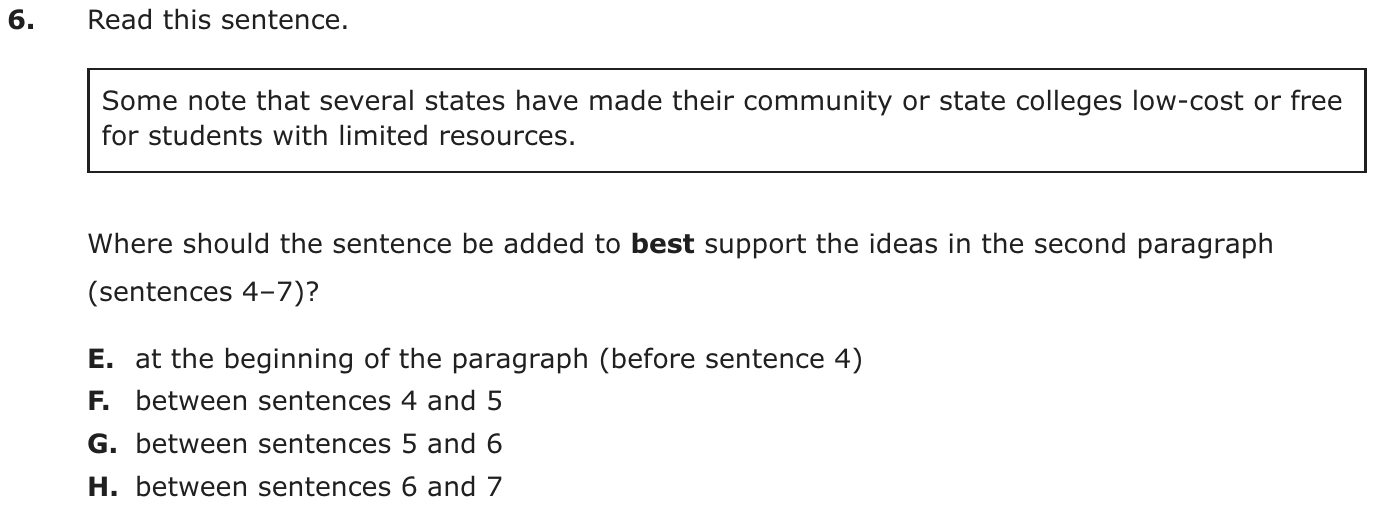
Read this sentence.
Some note that several states have made their community or state colleges low-cost or free for students with limited resources.
Where should the sentence be added to best support the ideas in the second paragraph (sentences 4–7)?
- Aat the beginning of the paragraph (before sentence 4)
- Bbetween sentences 4 and 5
- Cbetween sentences 5 and 6
- Dbetween sentences 6 and 7
Show the answer
Correct answer: B
The question asks where the sentence should be added to best support the ideas in the second paragraph (sentences 4–7).
A. Incorrect. Sentence 4 introduces the main idea of the second paragraph (making college “a financially realistic option for those who aspire to obtain a degree”) and should not be preceded by the added sentence, which focuses more narrowly on the specific ways that some states are implementing that idea.
B. CORRECT. The added sentence provides a proposed solution to the issue stated in sentence 4, that “a college education should be a financially realistic option.” Sentence 5 is an example of the programs discussed in the added sentence.
C. Incorrect. Sentences 5 and 6 offer examples of state governments providing “low-cost or free” tuition. The added sentence introduces this idea in the second paragraph and should come before these specific examples are provided as evidence.
D. Incorrect. Sentence 6 provides an example of the state government of Tennessee providing “low-cost or free” tuition, and sentence 7 further explains the opinion of those in favor of such programs (“a step in the right direction for making college affordable”). However, the ideas in sentences 6 and 7 follow from and support the idea in the added sentence. Therefore, the added sentence should be placed before sentences 6 and 7, which help elaborate its idea.
Question analysis
This revising question gives a sentence noting that several states have made public colleges low-cost or free and asks where it best fits in the paragraph about making college financially realistic. Students must follow how the paragraph moves between general claims and specific examples, since the sentence reads smoothly in more than one place.
- NYS standards
- 7W2a introducing and organizing a topic
- Grade level
- Grade 7 reading and task
- Compared with grade 7
- At grade 7 Placing a sentence so ideas follow logically is grade 7 writing work. The paragraph is only four sentences long and the four positions sit side by side, so this matches a typical grade 7 revision task.
- Estimated difficulty
- Moderate: several steps, or a close reading with one strong distractor.
- Thinking it demands
- Depth of knowledge 2, skills and concepts · mainly analyze
- What makes it hard
- How sentences fit together moderate
- Every choice must be checked moderate
- Evidence
- Answered from one paragraph or stanza
- Reading level
- Passage: about grade 12, 427 words; question and choices: about grade 6, 56 words.
- Students, last 30 days
- Not enough answers yet to show (it takes 10).
Why it is hard, traps and wrong answers (shows the answer)
Why it is hard
This is a general-before-specific question disguised by smooth reading: the added sentence fits grammatically anywhere in the paragraph. What decides it is that New York and Tennessee are examples of states making college low-cost or free, so the claim belongs before them and after sentence 4's broader belief. Students who place it as a summary before “these programs” have noticed a real link but put the claim after its own evidence.
How sentences fit together moderate Working it out
Sentence 5 opens “For example” and sentence 6 says Tennessee “also” has a program, so the claim about several states must come right before the New York example it introduces. (Halliday & Hasan, 1976)
Every choice must be checked moderate Choosing the answer
The new sentence reads smoothly in all four spots, even after the examples, where sentence 7's “these programs” seems to point back to it, so each position has to be tried in context. (Embretson & Wetzel, 1987)
Strategy: Decide whether the new sentence is a general statement or a specific example, then read the paragraph with it in each position and check that every example follows what it illustrates.
Traps
- Sentence in the wrong place: Puts a sentence where it breaks the order of ideas or separates it from what it refers to.
The wrong answers, classified
A Sentence in the wrong place (Halliday & Hasan, 1976)
Rightly treats the new sentence as general, then makes it the opener, ahead of sentence 4, the broader belief that college should be financially realistic.
C Sentence in the wrong place (Halliday & Hasan, 1976)
Drops the claim about several states between the New York and Tennessee examples, splitting the pair and leaving the first example without the statement it illustrates.
D Sentence in the wrong place (Halliday & Hasan, 1976)
Sees that sentence 7's “these programs” could refer back to the new sentence, but placed there it only restates what the New York and Tennessee examples have shown.
Working it out, step by step
Figure out what the question asks
You need the best place for a new sentence in paragraph 2. First ask: is it a general idea or a specific example? A general idea usually comes before the examples that show it.
Look at the new sentence
The new sentence says “several states have made their community or state colleges low-cost or free.” It does not name any state. So it is a general claim. A claim is a statement that something is true.
Look at sentences 4 to 7
- Sentence 4 is the paragraph’s main idea. College should be “a financially realistic option,” or something people can afford.
- Sentence 5 starts “For example” and names New York.
- Sentence 6 says Tennessee “also has a program.”
- Sentence 7 tells what supporters think of “these programs.”
New York and Tennessee are two of the “several states.” So the new sentence belongs right before them.
Check each choice
- A is wrong. Sentence 4 is the broader main idea, so it should stay first.
- B is right. The claim comes after the main idea. Then “For example” leads into New York.
- C is wrong. It splits New York and Tennessee, two examples that belong together.
- D is wrong. It puts the claim after both of the examples that show it.
Watch out: D is tempting, since “these programs” in sentence 7 could point back to it. But there the claim would just repeat what the examples already showed.
Choose the answer
The order should be main idea, then claim, then examples. So the answer is B, between sentences 4 and 5.
Why this answer and not the closest wrong one
D is the closest wrong answer, because the sentence reads smoothly there too. But a general claim should come before the examples that prove it. In B, the reader first hears about “several states.” Then “For example” brings in New York, and Tennessee follows.
More questions like this
The original DOE question
Question 7 of 57
2020 Test B English, question 7Uses the passage above: “The Free College Debate”.
Question
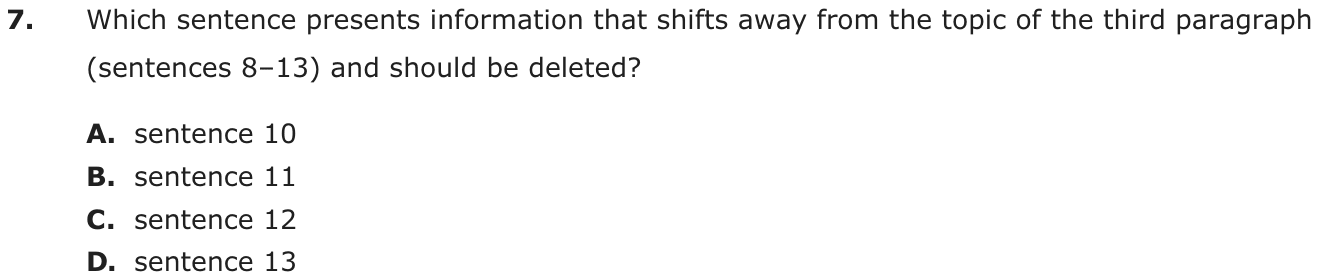
Which sentence presents information that shifts away from the topic of the third paragraph (sentences 8–13) and should be deleted?
- Asentence 10
- Bsentence 11
- Csentence 12
- Dsentence 13
Show the answer
Correct answer: B
The question asks which sentence presents information that shifts away from the topic of the third paragraph (sentences 8–13) and should be deleted.
A. Incorrect. Sentence 9 explains that scholarship funding comes “from the state’s budget, which primarily comes from state taxes.” Sentence 10 logically follows the idea in sentence 9 by explaining that “as more students choose to attend college, more funds will be needed to cover the costs.” Therefore, sentence 10 should not be deleted, because it does not shift away from the topic of the paragraph.
B. CORRECT. Sentence 10 makes the claim that “as more students choose to attend college, more funds will be needed to cover the costs.” Sentence 11 shifts away from this topic by focusing on how switching majors or working affects students’ ability to finish college, rather than on the additional funds that will be needed for scholarship programs. Therefore, sentence 11 should be deleted.
C. Incorrect. Sentence 9 states that scholarship program funding comes “from the state’s budget, which primarily comes from state taxes.” Sentence 10 points out that “as more students choose to attend college, more funds will be needed to cover the costs.” Sentence 12 elaborates on the critics’ opinions discussed in sentences 8–10. It reflects the belief that the “circumstances” described in sentences 9 and 10 “will inevitably lead to an increase in taxes, a decline in the quality of the education offered by the schools, or both.” Thus, sentence 12 should not be deleted, because it does not shift away from the topic of the paragraph.
D. Incorrect. Sentence 13 refers back to the “critics” mentioned in sentence 12 and expands on the critics’ concern about increased taxes mentioned in sentence 12 by stating that “narrower college-affordability efforts . . . may be more effective and viable solutions.” Therefore, sentence 13 should not be deleted because it logically follows the ideas in sentence 12 and serves as a concluding sentence for the paragraph.
Question analysis
This revising question asks which sentence in the paragraph about critics of free-college programs shifts away from the paragraph's topic and should be deleted. All four listed sentences mention students, funding or taxes, so students must follow the critics' chain of reasoning and find the sentence that does not advance it.
- NYS standards
- 7W2b developing a topic
- Grade level
- Grade 7 reading and task
- Compared with grade 7
- At grade 7 Cutting a sentence that strays from a paragraph's focus is standard grade 7 writing work. This paragraph is a six-sentence argument with formal words such as unsustainable and viable, which is typical of grade 7 revision passages.
- Estimated difficulty
- Moderate: several steps, or a close reading with one strong distractor.
- Thinking it demands
- Depth of knowledge 2, skills and concepts · mainly analyze
- What makes it hard
- How sentences fit together moderate
- Every choice must be checked minor
- Evidence
- Answered from one paragraph or stanza
- Reading level
- Passage: about grade 12, 427 words; question and choices: about grade 6, 23 words.
- Students, last 30 days
- Not enough answers yet to show (it takes 10).
Why it is hard, traps and wrong answers (shows the answer)
Why it is hard
Sentence 11 is camouflaged: it starts with a linking word, and a reader can argue that students who take longer to finish cost the state more. The paragraph, though, is about funding and taxes, and sentence 11 turns to why students switch majors or work. Students who cut sentence 13 sense a move toward solutions, but it still voices the critics, and the question rewards checking that each other sentence advances their case.
How sentences fit together moderate Working it out
Sentence 11 opens with “Additionally,” and sentence 12's “these circumstances” can be read as gathering it in, so the stray sentence looks attached to the critics' argument. (Halliday & Hasan, 1976)
Every choice must be checked minor Choosing the answer
Because sentence 11 can be defended, the answer comes mainly from confirming that sentences 10, 12 and 13 each carry the critics' case, which means testing every listed sentence. (Embretson & Wetzel, 1987)
Strategy: State the critics' argument in a few words, then check whether each listed sentence adds a link to that argument or turns aside to a different issue.
Traps
- Fixes what isn't broken: Changes a part of the sentence that was already correct, while the real error stays; or, where the question asks which sentence has an error or should go, picks one that is correct and belongs.
The wrong answers, classified
A Fixes what isn't broken (Connors & Lunsford, 1988)
Cuts sentence 10 as a loose prediction, though more students needing more funds is the link between state funding in sentence 9 and the critics' fear of higher taxes.
C Fixes what isn't broken (Connors & Lunsford, 1988)
Removes sentence 12 as mere opinion, though it states the critics' conclusion, higher taxes or lower quality, which the whole paragraph builds toward.
D Fixes what isn't broken (Connors & Lunsford, 1988)
Senses a turn when the critics propose “narrower college-affordability efforts,” but sentence 13 still reports what “They think,” completing their case rather than leaving it.
Working it out, step by step
Figure out what the question asks
Paragraph 3 (sentences 8–13) has one topic. One sentence wanders away from it. You need to find that sentence. First, say the paragraph’s topic in a few words.
Find the topic of paragraph 3
Sentence 8 says some people think “free” college programs are “unsustainable.” That means they can’t keep going for long. The reason is money. The state pays with tax money (sentence 9). More students means more money is needed (sentence 10). Critics fear higher taxes or worse schools (sentence 12). They want smaller programs instead (sentence 13).
Look at sentence 11
Sentence 11 says many students take more than four years “because they switch majors or because they have to work.” A major is the main subject a student studies. This sentence is about why students take longer. It never says what that costs the state or how it affects taxes. It moves away from the critics’ money argument.
Check each choice
- A is wrong. Sentence 10 links state money to the critics’ fears: more students, more costs.
- B is right. Sentence 11 turns to students’ reasons for taking longer.
- C is wrong. Sentence 12 gives the critics’ main fear: higher taxes or worse schools.
- D is wrong. Sentence 13 still tells what the critics think. It finishes their argument.
Watch out: Sentence 13 brings up a different plan, so D is tempting. But it begins “They think,” so it is still the critics talking.
Choose the answer
Without sentence 11, the paragraph moves smoothly from more costs to higher taxes. So the answer is B, sentence 11.
Why this answer and not the closest wrong one
D is the closest wrong answer, because sentence 13 talks about a different plan. But that plan belongs to the critics, so it stays on topic. Sentence 11 starts with “Additionally,” which makes it look like part of the argument. Yet it talks about switching majors and having jobs, not about the cost to the state.
More questions like this
The original DOE question
Question 8 of 57
2020 Test B English, question 8Uses the passage above: “The Free College Debate”.
Question
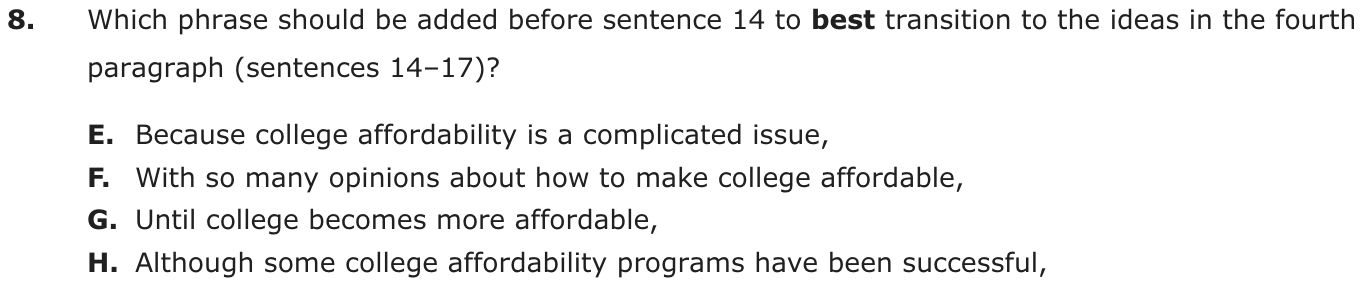
Which phrase should be added before sentence 14 to best transition to the ideas in the fourth paragraph (sentences 14–17)?
- ABecause college affordability is a complicated issue,
- BWith so many opinions about how to make college affordable,
- CUntil college becomes more affordable,
- DAlthough some college affordability programs have been successful,
Show the answer
Correct answer: C
The question asks which phrase should be added before sentence 14 to best transition to the ideas in the fourth paragraph (sentences 14–17).
A. Incorrect. Sentence 13 summarizes the viewpoint of opponents, who believe that targeted approaches to funding education “may be more effective and viable solutions,” and sentence 14 serves to introduce how “faculty and students at higher-education institutions can work to keep costs down.” Affordability is “a complicated issue,” but the use of the word “Because” suggests that the ideas that follow in sentences 14–17 will explain a cause-and-effect relationship. However, sentences 14–17 discuss ways faculty and students should work together to keep the cost of college down while waiting for a long-term solution to the problem, not a causal relationship.
B. Incorrect. Sentences 4–13 provide information about the viewpoint of proponents, who believe that “a college education should be a financially realistic option for those who aspire to obtain a degree” (sentence 4), and opponents, who believe free college programs are “unsustainable” (sentence 8). Although the phrase in this option mentions “opinions,” it indicates that the fourth paragraph will discuss why the number of opinions makes affordability a debatable issue. Instead, the fourth paragraph discusses ways faculty and students can help keep costs down until a solution is reached.
C. CORRECT. Sentence 13 summarizes the viewpoint of opponents, who believe that targeted approaches to funding education “may be more effective and viable solutions,” while proponents “generally believe that these [government] programs are a step in the right direction for making college affordable” (sentence 7). However, sentences 14–17 offer three possible solutions that could alleviate the problem in the meantime. Therefore, the phrase in this option should be added before sentence 14 to best transition to the ideas in the fourth paragraph because it suggests that until the issue of affordability is resolved, alternatives are available to help make a college education more affordable.
D. Incorrect. This phrase mentions “college affordability,” a topic discussed in the fourth paragraph. However, the ideas introduced in the phrase do not logically lead into the ideas discussed in sentences 14–17, because the phrase mentions “programs [that] have been successful,” whereas the paragraph states that “faculty and students at higher-education institutions can work to keep costs down” (sentence 14) and that colleges “should account for experience by allowing students to demonstrate their knowledge in order to avoid having to pay to sit through classes on subjects they have already mastered” (sentence 16). Use of the words “can” and “should” in these sentences indicates that the actions or programs mentioned in the paragraph have not been completed.
Question analysis
This revising question asks which introductory phrase should begin the fourth paragraph of a passage on college affordability, linking the debate over state tuition programs to the cost-saving ideas that follow. All four phrases sound natural, so students must work out the relationship between the paragraphs and choose the phrase that signals it accurately.
- NYS standards
- 7W2d transitions in informative writing
- Grade level
- Grade 8 reading and task
- Compared with grade 7
- Above grade 7 Grade 7 transition work usually links two sentences with a word such as however. Here the choices are whole phrases that set up an entire paragraph, and judging them needs a grasp of the full argument, which asks more than typical grade 7 work.
- Estimated difficulty
- Hard: combines ideas, needs a plan, and has more than one tempting wrong answer.
- Thinking it demands
- Depth of knowledge 3, strategic thinking · mainly evaluate
- What makes it hard
- How sentences fit together major
- Reading between the lines moderate
- Every choice must be checked minor
- Evidence
- Answered from several paragraphs or stanzas
- Reading level
- Passage: about grade 12, 427 words; question and choices: about grade 10, 48 words.
- Students, last 30 days
- Not enough answers yet to show (it takes 10).
Why it is hard, traps and wrong answers (shows the answer)
Why it is hard
Every phrase sounds like a reasonable bridge, and the right one can even seem odd at first, since cutting costs is itself a way to make college affordable. The key is seeing paragraph 4 as what campuses can do while the debate over state programs goes on, a reading the passage confirms only at its end. Students who link back to the many opinions, or accept a causal “Because,” have found real ideas from the passage but not the relationship between these two paragraphs.
How sentences fit together major Working it out
The phrase must link paragraph 3's case against state programs to paragraph 4's steps that “can work to keep costs down,” steps that make sense only as help in the meantime. (Halliday & Hasan, 1976)
Reading between the lines moderate Working it out
Nothing says paragraph 4's ideas are stopgaps; that has to be inferred from sentences 18 and 19, which say the solutions “are not simple” and “will take time.” (Graesser, Singer & Trabasso, 1994; Kintsch, 1998)
Every choice must be checked minor Choosing the answer
All four phrases are grammatical and about affordability, so each must be read into sentence 14 and judged by the relationship its first word signals. (Embretson & Wetzel, 1987)
Strategy: Sum up paragraphs 3 and 4 in a few words each, decide how the second relates to the first, then test the relationship each phrase's opening word signals.
Traps
- Wrong transition: A connecting word or phrase that signals the wrong relationship, such as contrast where the idea continues.
The wrong answers, classified
A Wrong transition (Halliday & Hasan, 1976)
Agrees that affordability is complicated, as sentence 18 says, but “Because” makes the complexity the reason faculty and students can cut costs, a cause the paragraph never gives.
B Wrong transition (Halliday & Hasan, 1976)
Rightly looks back to the clashing views of paragraphs 2 and 3, but offers the disagreement as the ground for the steps instead of marking them as help until a solution arrives.
D Wrong transition (Halliday & Hasan, 1976)
Hears “Although” as a natural turn to a new idea, but the passage never says any program has succeeded, and paragraph 4 does not set its steps against such programs.
Working it out, step by step
Figure out what the question asks
You need a phrase to start sentence 14. It should work as a transition: a word or phrase that shows how two ideas connect. Words like “because,” “although” and “until” each show a different link. So first work out how paragraph 4 connects to what came before.
Compare paragraphs 3 and 4
Paragraph 3 ends with the critics’ view of state programs. People still disagree, so there is no fix everyone accepts yet. Paragraph 4 then says “Faculty and students at higher-education institutions can work to keep costs down.” Faculty means teachers. The paragraph lists ways to do it: online classes, skipping classes you’ve mastered, and getting ready in high school.
Use the ending as a clue
Sentences 18 and 19 say the solutions “are not simple” and “will take time.” So a big fix is still far off. That makes paragraph 4’s ideas things to do in the meantime, while people wait. The phrase “Until college becomes more affordable” says exactly that.
Check each choice
- A is wrong. “Because” shows a cause. The issue being complicated is not the reason teachers can cut costs.
- B is wrong. It makes the many opinions the reason for the steps. The passage never links them that way.
- C is right. “Until” shows these are steps to take while waiting for a bigger fix.
- D is wrong. The passage never says any program has been successful.
Watch out: B looks back at the many opinions, which really are in the passage. But it doesn’t show how paragraph 4 relates to paragraph 3.
Choose the answer
Sentence 14 would read: Until college becomes more affordable, faculty and students at higher-education institutions can work to keep costs down. So the answer is C.
Why this answer and not the closest wrong one
B is the closest wrong answer, because the passage does share many opinions. But “With so many opinions” makes the opinions sound like the reason for the cost-cutting steps. They are not. C shows the steps are help for now, while the bigger problem waits to be solved.
More questions like this
The original DOE question
Question 9 of 57
2020 Test B English, question 9Uses the passage above: “The Free College Debate”.
Question
Which concluding sentence should be added after sentence 19 to support the topic of the passage?
- AThe increasing use of technology in college classrooms and the financial support from tuition scholarship programs will make colleges more affordable for many students.
- BStatewide tuition scholarship programs will make college more affordable for many students, but these programs may lead to new problems.
- CUntil the problems associated with the rising cost of college are solved, many students will pursue other options after graduating high school.
- DWhen the issue of college affordability is resolved, students will be able to make decisions about pursuing higher education without cost being the deciding factor.
Show the answer
Correct answer: D
The question asks which concluding sentence should be added after sentence 19 to support the topic of the passage.
A. Incorrect. Although sentence 15 cites “increased access to computers, mobile devices, and the Internet” and states that “there are more opportunities for students to take courses online, thus reducing the need for and cost of maintaining physical classrooms,” the primary topic discussed throughout the passage is that making college affordable is a complex issue on which people hold differing opinions, and sentences 18 and 19 stress that the solutions “are not simple” and “will take time.” The option instead states that technology and scholarship programs will make colleges more affordable. Therefore, the sentence should not be added after sentence 19, because it does not support the topic.
B. Incorrect. Sentence 5 presents the example of the New York State legislature, which “passed a bill creating a program to cover the tuition costs for nearly one million students.” Sentence 12 states that critics of this type of program believe that certain circumstances “will inevitably lead to an increase in taxes” or other issues such as low-quality education. However, the option covers only the statewide programs and their critics (sentences 4–13). It leaves out the ways faculty and students can keep costs down (sentences 14–17) and the closing point that solutions will take time and careful planning (sentences 18 and 19). Therefore, the sentence should not be added after sentence 19, because it does not support the topic.
C. Incorrect. Although sentence 7 states that scholarship programs are helpful “for students who would have had to take out loans or who would have decided not to pursue higher education at all,” the passage does not state that many students will stop pursuing higher education until the affordability issues are solved. In fact, sentence 14 states that there are ways faculty and students can “work to keep costs down.” Therefore, the sentence should not be added after sentence 19, because it does not support the topic.
D. CORRECT. The sentence in this option should be added after sentence 19 to support the topic because it acknowledges that the issue of college affordability discussed throughout the passage is not “resolved” but that when it is, students will be able to make decisions about attending college without concerns about cost. Sentence 18 states that “the solutions to the problems associated with rising college costs are not simple,” and sentence 19 adds that “passing legislation that boosts college affordability will take time,” ideas, and planning.
Question analysis
This revising question asks which concluding sentence should be added after the final sentence of a passage about the debate over making college affordable. Students must keep the whole passage in view and pick the ending that follows from its last paragraph, because several choices repeat real details or offer predictions that sound reasonable.
- NYS standards
- 7W2e concluding informative writing
- Grade level
- Grade 7 reading and task
- Compared with grade 7
- At grade 7 Choosing a conclusion that follows from a passage's central idea is standard grade 7 writing work. The passage is five formal paragraphs that present two sides and then practical steps, which the student must hold together, a typical grade 7 challenge.
- Estimated difficulty
- Moderate: several steps, or a close reading with one strong distractor.
- Thinking it demands
- Depth of knowledge 2, skills and concepts · mainly evaluate
- What makes it hard
- Evidence in several places moderate
- How sentences fit together minor
- Evidence
- Answered from the whole text
- Reading level
- Passage: about grade 12, 427 words; question and choices: about grade 13, 106 words.
- Corrected from the DOE handbook
- The explanation misstated the topic of the passage; that sentence was corrected.
- An inaccurate statement about the passage in the explanation was corrected.
- Students, last 30 days
- Not enough answers yet to show (it takes 10).
Why it is hard, traps and wrong answers (shows the answer)
Why it is hard
The strongest wrong ending is a fair summary of the passage's middle, the state programs and their critics, so it feels like a conclusion. It falls short because it drops the campus steps and the closing point that solutions are slow and complicated. Other endings echo the final paragraph's words or bundle two solutions into a promise, and students who keep the passage's caution in mind reject those quickly.
Evidence in several places moderate Working it out
Judging an ending means holding the whole passage: the debate over state programs in sentences 4–13, the campus cost-cutting in 14–17, and the warning in 18–19 that solutions take time. (Kirsch & Mosenthal, 1990; Gorin & Embretson, 2006)
How sentences fit together minor Working it out
The new sentence follows “will take time,” so an ending that looks ahead to when the problem “is resolved” continues the thought, while a confident promise of affordability contradicts it. (Halliday & Hasan, 1976)
Strategy: State the passage's topic and its final point in your own words, then test each ending: does it follow from both, or does it bring in a claim the passage never supports?
Traps
- Too narrow: A single detail offered as the central idea or a summary, or a summary that keeps minor details and leaves out an essential part.
- Too broad or too strong: A choice overstates, generalizes, or uses absolute words the text does not support.
- Off the point: Adds or keeps something that does not support the paragraph's or the passage's focus, or an introduction or conclusion that misses the main point.
The wrong answers, classified
A Too broad or too strong (King et al., 2004)
Bundles paragraph 4's online courses with the state scholarships and promises they “will make colleges more affordable,” a certainty the passage rejects just before by calling solutions “not simple.”
B Too narrow (King et al., 2004)
Sums up paragraphs 2 and 3 fairly, programs that help and the problems critics foresee, but leaves out the campus cost-cutting and the closing point about time and planning.
C Off the point (Halliday & Hasan, 1976)
Borrows “the problems associated with” rising costs from sentence 18 and adds a prediction about students choosing other paths, which the passage never makes.
What was corrected from the DOE handbook, and why
- Explanation: In rejecting choice A, the handbook says the topic of the passage is that “state and federal governments, not faculty and students, must resolve the issue of college affordability.” The passage never mentions the federal government, and sentences 14–17 are about what faculty and students can do. The topic, as question 5's answer puts it, is that making college affordable is a complex issue with differing opinions about how to approach it. The explanation now says so, and that choice A instead states that technology and scholarships will make college more affordable.
- Explanation: In rejecting choice B, the handbook says “the idea that these types of programs may lead to new problems is not thoroughly discussed in the passage.” Sentences 8–13 discuss exactly that: critics expect higher taxes or lower-quality education. Choice B falls short because it covers only the statewide programs and their critics, leaving out sentences 14–17 (what faculty and students can do) and the closing point that solutions take time and planning. The explanation now says that. The answer, D, is unchanged.
Working it out, step by step
Figure out what the question asks
You need a last sentence for the passage. A good conclusion fits the topic of the whole passage. It should also follow from sentence 19, the sentence right before it.
Recall the topic and the ending
The passage shows that making college affordable is a complex issue. People have different opinions about how to do it. Sentence 18 says the solutions “are not simple.” Sentence 19 says new laws “will take time, input from experts with different ideas, and careful planning.” So the passage ends by saying the problem is not solved yet.
Find the sentence that follows
D begins “When the issue of college affordability is resolved.” Resolved means solved. That fits right after “will take time.” It looks ahead to a day when the problem is fixed. Then cost won’t decide whether a student goes to college.
Check each choice
- A is wrong. It promises that technology and scholarships “will make colleges more affordable.” But the passage just said solutions are not simple.
- B is wrong. It sums up only the state programs and their critics. It leaves out the cost-cutting ideas and the point about time and planning.
- C is wrong. The passage never says students will choose other paths after high school.
- D is right. It fits the topic and follows sentence 19.
Watch out: B is a fair summary of paragraphs 2 and 3. That makes it feel like a conclusion. But it covers only part of the passage.
Choose the answer
D keeps the passage’s careful tone and looks ahead to a time when cost no longer decides. So the answer is D.
Why this answer and not the closest wrong one
B is the closest wrong answer. The passage really does discuss state programs and the problems critics expect. But B leaves out paragraph 4, on cutting costs, and the closing point that solutions take time. D follows “will take time” by looking ahead to when the issue “is resolved.”
More questions like this
The original DOE question
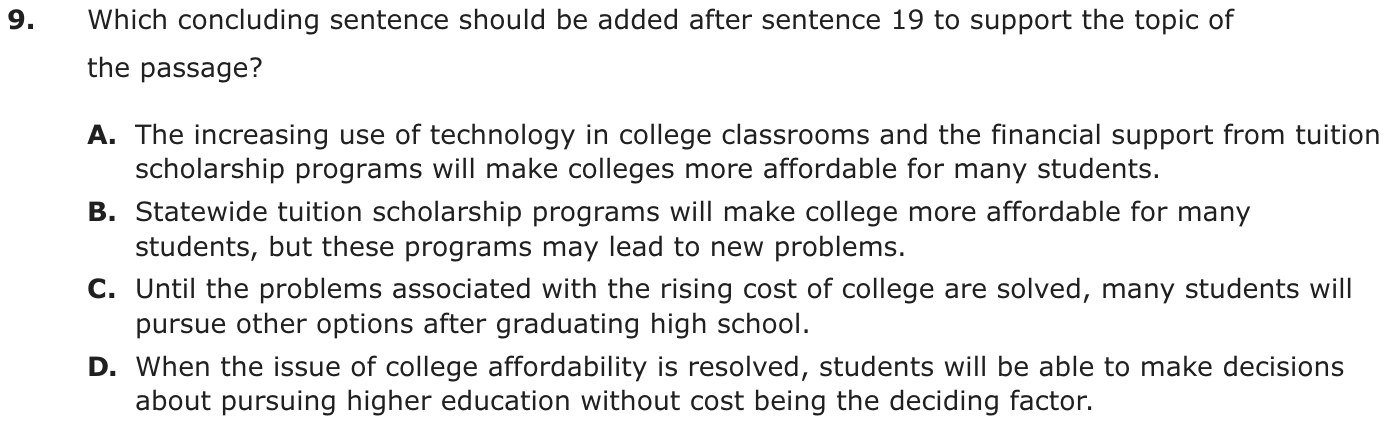
Question 10 of 57
2020 Test B English, question 10Passage Massachusetts: Lowell National Historical Park
Massachusetts: Lowell National Historical Park
During the first half of the 19th century, Lowell, Massachusetts, quickly transformed itself from a farm town to a bustling industrial city. In time, Lowell became a model of industry, gaining global recognition for its state-of-the-art technology, innovative canal and dam system, mill architecture, boardinghouses, churches, and ethnic neighborhoods. Young Yankee women, immigrant families, and European tourists all flocked to Lowell to find work at one of the many textile mills, or visit the industrious city that was becoming a popular tourist destination. As one Scottish traveler observed during his visit to America, “Niagara and Lowell are the two objects I will longest remember in my American journey, the one the glory of American scenery, the other of American industry.” Today, Lowell National Historical Park welcomes visitors to enjoy the sights of Lowell and learn about the history of one of America’s most significant industrial cities.
The Boston merchants who founded Lowell in 1821 and named it after Francis Cabot Lowell chose to locate the town along Massachusetts’s Merrimack River to take advantage of the kinetic energy offered by the Pawtucket waterfalls. Over six miles of canals powered the waterwheels of Lowell’s mills, whose massive five- and six-story brick buildings dominated the city’s landscape. . . . The most recognized of these buildings are the Lowell Manufacturing Company chartered in 1821, the Suffolk or Wannalancit Mill completed around the 1880s, the Boott Mill Company established in 1835, and the Boott Mill Boardinghouse that opened in 1838. By the 1850s, 40 textile mills employing over 10,000 workers stretched for about a mile along the river. . . .
The city’s female workforce was significant in the history of Lowell. From the early to mid-1800s, women left the constricted lifestyle of small rural towns and rural areas for independent industrial city life. Most were young single Yankee girls, who were tired of the limited opportunities offered by their domestic work. Women found that Lowell’s mills offered monthly wages for their services and provided them room and board. Although these women gained economic independence in Lowell, the mill boardinghouse keepers constantly supervised their social activities, for which they hardly had any time, considering their daily 12- to 14-hour work schedules. At the end of the day, the factory bell signaled the “mill girls” to return to their boardinghouses. They were expected to adhere to the strict code of conduct respecting curfew and attending church.
Yankee “mill girls” continued to dominate the Lowell workforce until the 1840s, when the city began to find it difficult to compete with the growing industrial development in other New England communities. As profits fell, the mill industry cut wages. These wage cuts, deteriorating working conditions, and long workdays led the “mill girls” to protest and organize strikes. When their demands went unheard, the women left Lowell, and immigrant groups replaced them in the workforce. Despite the low wages and unhealthy work conditions, immigrants were eager to find work.
The immigrants replacing the Yankee “mill girls” during the 1840s were predominantly Irish Catholics, who traveled to America during the Great Potato Famine. Although Lowell received an influx of Irish families during this time, the Irish were a part of the city’s history from its birth, and before the “mill girls” arrived, they built Lowell’s historic canals, mills, and boardinghouses. Initially, Lowell’s Protestant community was slow to welcome Irish immigrants, but the hostility between Yankee Protestants and Irish Catholics eventually disappeared. Irish immigrants dominated the industrial scene until the Civil War, when other immigrant groups began to work in the city mills.
Like the Irish, the French-Canadians, Greeks, Poles, Portuguese, Russian Jews, and Armenians who came to work in Lowell’s mills faced long work hours, low wages, and poor living conditions in the city’s crowded tenements. By the time Lowell’s industry declined, the city had become an ethnic melting pot, where each group claimed its own distinct neighborhood, like the Irish immigrants’ “New Dublin” or “Acre,” and the French-Canadians’ “Little Canada.” The city officially began to close down its mills in the 1920s and ’30s after Lowell’s outdated mills could no longer compete against the state-of-the-art cotton mills in other communities and working conditions continued to decline as Lowell’s companies stopped reinvesting in their mills. . . . Despite a brief resurgence during World War II, the city shut down its last surviving mill by the mid-1950s.
From “Massachusetts: Lowell National Historical Park”—Public Domain/National Park Service
Yankee: native to New England
Niagara: a town in northwestern New York State well known as the location of Niagara Falls, a series of waterfalls on the Canadian border
domestic work: household duties like cooking and cleaning
Question
Read this sentence from paragraph 1.
As one Scottish traveler observed during his visit to America, “Niagara and Lowell are the two objects I will longest remember in my American journey, the one the glory of American scenery, the other of American industry.”
The author most likely includes the quotation from the Scottish traveler in order to
- Asuggest that people around the world saw the direct contribution of nature and industry to the United States.
- Bcompare the natural and industrial attractions in the United States at that time.
- Cconvey the idea that the United States offered both natural and industrial attractions.
- Dimply that the natural resources in the United States contributed to the development of industry.
Show the answer
Correct answer: C
The question asks why the author most likely includes the quotation from the Scottish traveler in paragraph 1 of the passage.
A. Incorrect. While it is likely that people outside the United States recognized that both the natural landscape and the bustling industry were significant, the quotation from the Scottish traveler is meant to convey the variety of the types of attractions in the U.S., not to make a general statement about their contribution.
B. Incorrect. The Scottish traveler mentions both “American scenery” and “American industry” in the quotation, but the intent is to highlight that they are each points of interest. The quotation does not provide a comparison of the two attractions.
C. CORRECT. The quotation emphasizes the idea that the United States offers different attractions. The Scottish traveler highlights the two places in the United States that he will most remember: first, the beautiful natural formation of Niagara Falls (“ ‘the glory of American scenery’ ”) and second, the industrial city of Lowell (“ ‘the glory . . . of American industry’ ”).
D. Incorrect. The Scottish traveler mentions both “American scenery” and “American industry” in the quotation but does not imply that the natural resources contributed to the development of industry.
Question analysis
This reading question asks why the author of a National Park Service article about Lowell, Massachusetts, quotes a Scottish traveler who named Niagara and Lowell as the sights he would remember longest from his American journey. Students must work out the job a quotation does in an opening paragraph, and the traveler's compressed, old-fashioned wording has to be untangled first.
- NYS standards
- 7R5 structure and genre features
- Grade level
- Grade 7 reading and task
- Compared with grade 7
- At grade 7 Grade 7 readers regularly explain why an author includes a quotation. This one adds a sentence in older English built on a compressed “the one…, the other…” pattern, but it is a single sentence in a plainly organized opening paragraph, so the demand stays typical.
- Estimated difficulty
- Moderate: several steps, or a close reading with one strong distractor.
- Thinking it demands
- Depth of knowledge 2, skills and concepts · mainly analyze
- What makes it hard
- A very close wrong answer moderate
- How, not what moderate
- Complex sentences minor
- Evidence
- Answered from one sentence or line
- Reading level
- Passage: about grade 15, 764 words; question and choices: about grade 11, 115 words.
- Students, last 30 days
- Not enough answers yet to show (it takes 10).
Why it is hard, traps and wrong answers (shows the answer)
Why it is hard
Most of the work is translating the traveler's compressed remark into plain words: Niagara stands for American scenery, Lowell for American industry, and both are high points of his trip. Students who see the two placed side by side often take the pairing for a comparison, while others read more into it, a worldwide verdict or a link between waterfalls and mills. The question rewards stating only what the remark does in the paragraph, which is to set Lowell beside Niagara as a sight worth the journey.
A very close wrong answer moderate Choosing the answer
The comparison choice names the same pair as the key, Niagara's scenery and Lowell's industry; it differs only in the verb, “compare” instead of conveying that the country offered both kinds of attraction. (Embretson & Wetzel, 1987; Gorin & Embretson, 2006; Ascalon et al., 2007)
How, not what moderate Working it out
The stem asks why the author placed the traveler's remark in paragraph 1, so its job, backing the sentence before it about tourists visiting the industrious city, matters more than its content. (Anderson & Krathwohl, 2001)
Complex sentences minor Understanding the question
The 37-word sentence ends in the compressed, old-fashioned “the one the glory of American scenery, the other of American industry,” where the verb and the second “glory” are left out. (Abedi & Lord, 2001; Freedle & Kostin, 1993; Messick, 1989)
Strategy: Put the traveler's remark into plain modern words, reread the sentence before it about who came to Lowell, and pick the purpose that fits both without reading more into the remark than it says.
Traps
- Wrong purpose or structure: Names a purpose, structure or effect that the part does not serve, or describes what a part says when the question asks what it does.
- Reads too much in: A reasonable-sounding conclusion that goes further than the text allows.
- Too broad or too strong: A choice overstates, generalizes, or uses absolute words the text does not support.
The wrong answers, classified
A Too broad or too strong (King et al., 2004)
Stretches one Scottish visitor's memory into what “people around the world” saw, perhaps from the paragraph's “global recognition,” and adds a “direct contribution” that the remark never claims.
B Wrong purpose or structure (Anderson & Krathwohl, 2001)
Takes the remark's side-by-side pattern, “the one … the other,” for a comparison, though the traveler weighs neither against the other and simply names each as a highlight.
D Reads too much in (Graesser, Singer & Trabasso, 1994)
Connects Niagara's waterfalls to the Pawtucket falls that powered Lowell's mills in paragraph 2, a link between nature and industry that the traveler's remark never draws.
Working it out, step by step
Figure out what the question asks
This question asks about the author’s purpose. You need to say why the author put the Scottish traveler’s words into paragraph 1. Don’t just restate what he says. Ask what job his words do in the paragraph.
Find the quotation and its neighbor
The traveler’s words are in paragraph 1: “Niagara and Lowell are the two objects I will longest remember in my American journey.” He ends with “the one the glory of American scenery, the other of American industry.” Now look at the sentence just before it. It says European tourists came to “visit the industrious city that was becoming a popular tourist destination.”
Put his words in plain English
The old-fashioned ending leaves words out. “The one” means the first place he named, Niagara. “The other” means the second place, Lowell. Glory means the finest thing, the pride. Industry means factories and the work done in them. So he is saying: Niagara Falls is the best of America’s natural beauty, and Lowell is the best of its industry. Both are the sights he will remember longest.
Check each choice
- A is wrong. One visitor is not “people around the world.” He also never says nature or industry made a “direct contribution” to the country.
- B is wrong. He names the two places side by side, but he never weighs one against the other.
- C is right. He names a natural wonder and an industrial wonder as the two highlights of his trip. So America offered both kinds of attraction.
- D is wrong. He never says nature helped industry grow. The waterfalls that powered the mills come up in paragraph 2, not in his words.
Watch out: “The one” and “the other” set the two places side by side. That can feel like a comparison, which leads to B. But he praises both. He does not compare them.
Choose the answer
The author uses the quotation to show that America had two kinds of sights worth the trip: natural ones like Niagara and industrial ones like Lowell. So the answer is C.
Why this answer and not the closest wrong one
B is the closest wrong answer. It names the same pair, nature and industry. But to compare is to show how two things are alike or different. The traveler doesn’t do that. He simply names Niagara and Lowell as two highlights. C says just that: the country offered both kinds of attraction.
More questions like this
The original DOE question
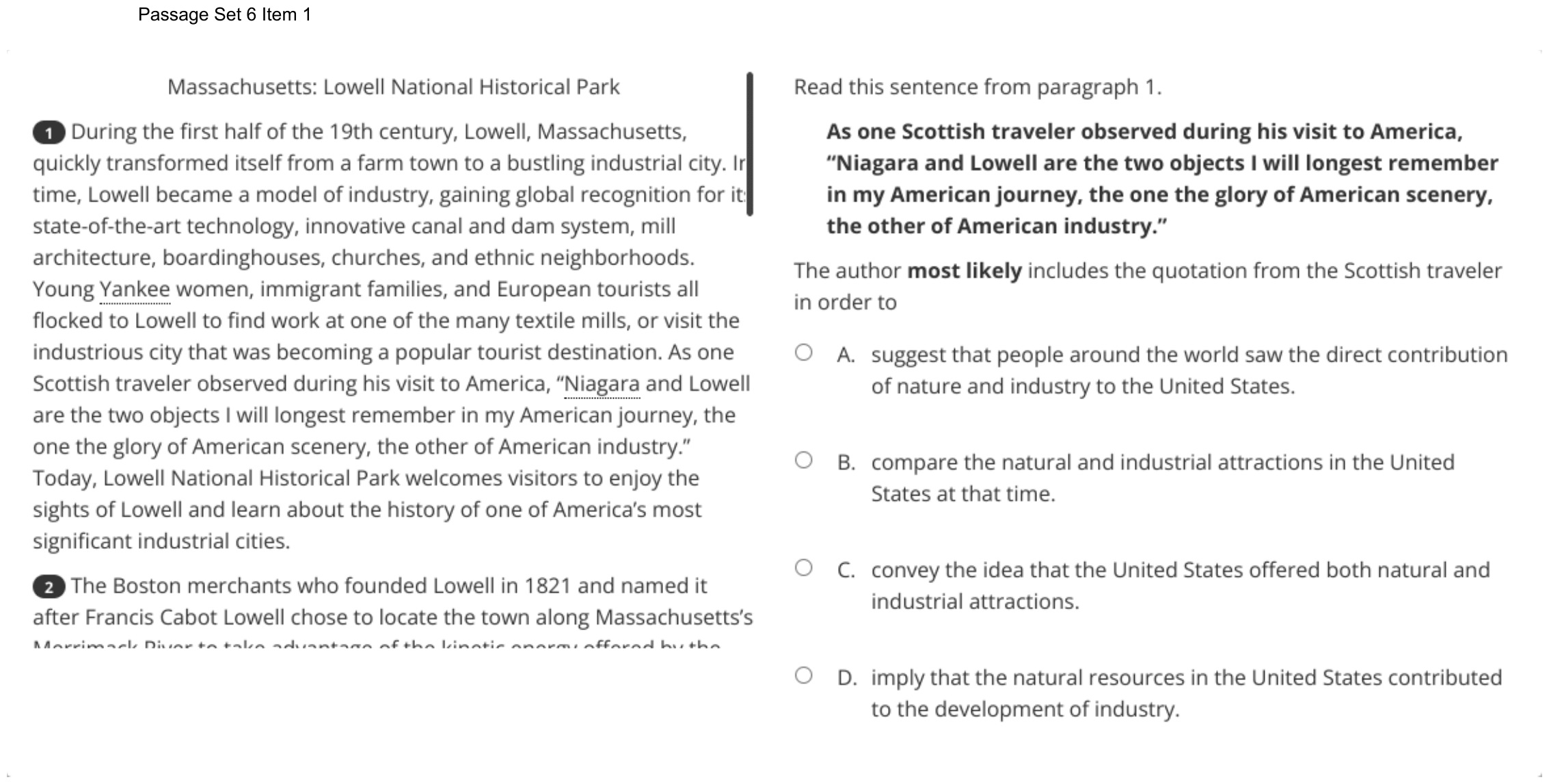
The passage “Massachusetts: Lowell National Historical Park” as printed (page 50)
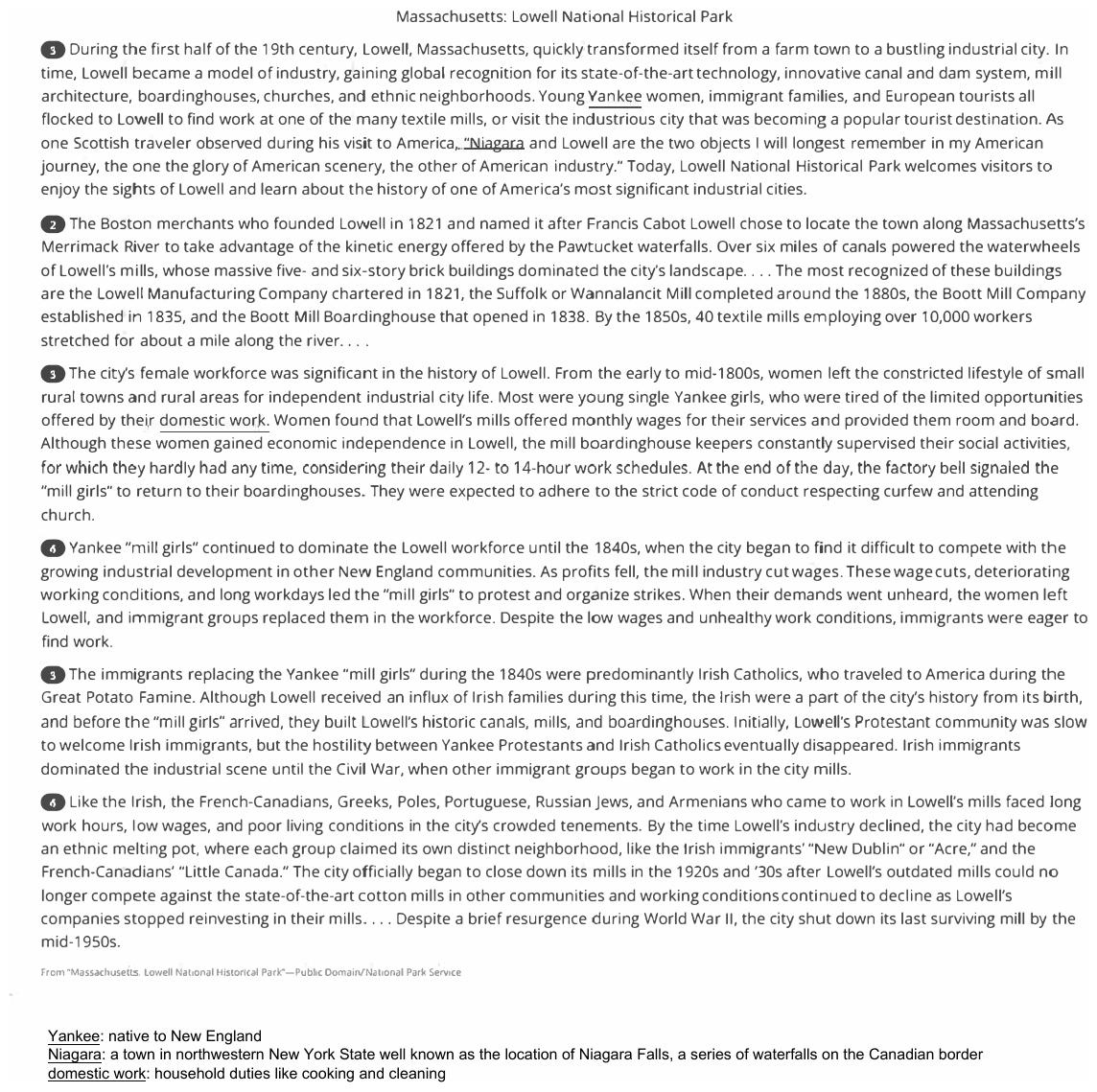
Question 11 of 57
2020 Test B English, question 11Uses the passage above: “Massachusetts: Lowell National Historical Park”.
Question
Which sentence from paragraph 2 best supports the idea that Lowell became “a bustling industrial city” (paragraph 1)?
- A“The Boston merchants who founded Lowell in 1821 and named it after Francis Cabot Lowell chose to locate the town along Massachusetts’s Merrimack River to take advantage of the kinetic energy offered by the Pawtucket waterfalls.”
- B“Over six miles of canals powered the waterwheels of Lowell’s mills, whose massive five- and six-story brick buildings dominated the city’s landscape.”
- C“The most recognized of these buildings are the Lowell Manufacturing Company chartered in 1821, the Suffolk or Wannalancit Mill completed around the 1880s, the Boott Mill Company established in 1835, and the Boott Mill Boardinghouse that opened in 1838.”
- D“By the 1850s, 40 textile mills employing over 10,000 workers stretched for about a mile along the river.”
Show the answer
Correct answer: D
The question asks for the sentence in paragraph 2 that best supports the idea that Lowell became “a bustling industrial city” (paragraph 1).
A. Incorrect. While the sentence provides details on when the town of Lowell was founded and the natural features of the area, it does not support the idea that the city became “a bustling industrial city.”
B. Incorrect. Although this sentence indicates that the mill buildings were a noticeable feature of the city and provides details on how the mills worked, it does not specifically show that Lowell had become “a bustling industrial city.”
C. Incorrect. While this sentence lists some recognizable mill buildings along the river and notes when their associated businesses were established, it does not support the idea that Lowell was “a bustling industrial city.”
D. CORRECT. This sentence indicates that within only a few decades of the city’s founding, it experienced massive industrial growth, with “40 textile mills employing over 10,000 workers,” supporting the idea that Lowell became “a bustling industrial city.”
Question analysis
An article on Lowell National Historical Park says the Massachusetts town became “a bustling industrial city,” and students pick the sentence from the article's second paragraph that best backs up that description. Every choice quotes the paragraph's account of the founding, canals and mills, so students must judge what each sentence actually shows about the city.
- NYS standards
- 7R1 textual evidence and inferences
- Grade level
- Grade 7 reading and task
- Compared with grade 7
- At grade 7 Picking the strongest support for a quoted phrase is ordinary grade 7 evidence work. The four candidates sit in a single short paragraph, and unlike the 2026 printing the claim has no time condition, so the demand is typical.
- Estimated difficulty
- Moderate: several steps, or a close reading with one strong distractor.
- Thinking it demands
- Depth of knowledge 2, skills and concepts · mainly evaluate
- What makes it hard
- Reading between the lines moderate
- Every choice must be checked minor
- Evidence
- Answered from one paragraph or stanza
- Reading level
- Passage: about grade 15, 764 words; question and choices: about grade 14, 125 words.
- Students, last 30 days
- Not enough answers yet to show (it takes 10).
Why it is hard, traps and wrong answers (shows the answer)
Why it is hard
With no time limit in the claim, the work is deciding what makes a city bustling as well as industrial. The sentence about canals and massive brick mills dominating the landscape is the strongest pull, because it sounds like an industrial city, yet it shows structures, not activity. Only the 1850s sentence counts people, more than 10,000 of them working in 40 mills along about a mile of river, which is what the word “bustling” asks for.
Reading between the lines moderate Working it out
“Bustling” means full of people and activity, so students must see that only the 1850s sentence, with “over 10,000 workers” in 40 mills, shows a busy city rather than buildings and machinery. (Graesser, Singer & Trabasso, 1994; Kintsch, 1998)
Every choice must be checked minor Choosing the answer
All four sentences come from paragraph 2 and concern the founders, canals or mills, so none can be dismissed at a glance; each has to be weighed for activity as well as industry. (Embretson & Wetzel, 1987)
Strategy: Decide what “bustling” adds to “industrial” before looking at the choices, then ask of each sentence from paragraph 2 whether it shows that quality as well as industry.
Traps
- Supports only part of the claim: In a question about evidence: a line that backs one half of the claim but not the other, or a related point rather than the claim itself.
- True but not the answer: A choice says something accurate about the text that does not answer this question.
The wrong answers, classified
A True but not the answer (King et al., 2004; Embretson & Wetzel, 1987)
Picks the founding sentence, which explains why the merchants built beside the Pawtucket falls, but a plan to use water power says nothing about what the city became.
B Supports only part of the claim (King et al., 2004; Thissen, Steinberg & Fitzpatrick, 1989)
Takes the canals and “massive five- and six-story brick buildings” as proof of a bustling city; they show industry, but only as structures, with no workers or activity.
C Supports only part of the claim (King et al., 2004; Thissen, Steinberg & Fitzpatrick, 1989)
Treats the list of four well-known mill buildings and their dates as evidence of a busy city, but naming landmarks shows the industry's buildings, not the bustle around them.
Working it out, step by step
Figure out what the question asks
This is an evidence question. You need the sentence that best supports, or backs up, a claim. The claim is that Lowell became “a bustling industrial city.” Industrial means full of factories. Bustling means busy and full of people. The best sentence must show both.
Look at paragraph 2
All four choices come from paragraph 2. The first tells why the town was built by the river. The next two describe the mills, which were factories, and their buildings. The last one says: “By the 1850s, 40 textile mills employing over 10,000 workers stretched for about a mile along the river.”
Work out what the last sentence shows
Textile mills are factories that make cloth. Forty of them is a lot of industry. Over 10,000 workers is a lot of people, all busy at work. A mile of mills along the river paints a crowded, busy scene. And Lowell was only founded in 1821, so it grew this big in about 30 years.
Check each choice
- A is wrong. It tells why the founders picked a spot by the waterfalls. That was the plan, not what the city became.
- B is wrong. The canals and “massive five- and six-story brick buildings” show industry. But they are only buildings, with no people or activity.
- C is wrong. It names four well-known buildings and their dates. A list of famous buildings doesn’t show a busy city.
- D is right. It shows lots of factories and lots of workers.
Watch out: B sounds big and industrial. But bustling needs people, and B has none.
Choose the answer
Only one sentence shows both the factories and the crowds of busy workers. So the answer is D.
Why this answer and not the closest wrong one
B comes closest, because huge mills that “dominated the city’s landscape” do show industry. But a city can have big buildings and still be quiet. D adds the people: over 10,000 workers in 40 mills. That is what makes a city bustling.
More questions like this
The original DOE question
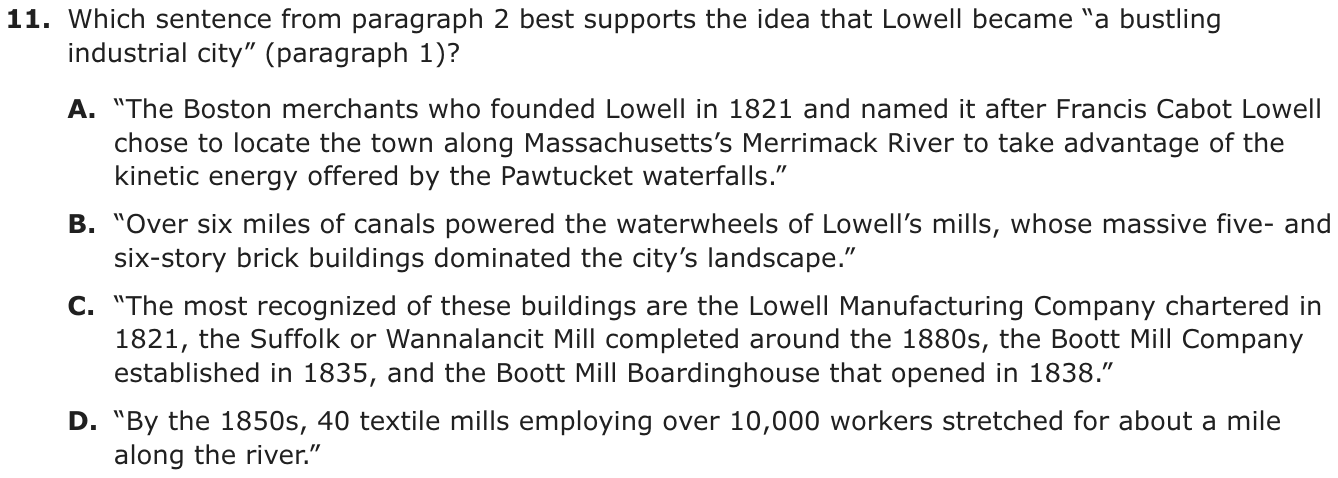
Question 12 of 57
2020 Test B English, question 12Uses the passage above: “Massachusetts: Lowell National Historical Park”.
Question
Read this sentence from paragraph 3.
From the early to mid-1800s, women left the constricted lifestyle of small rural towns and rural areas for independent industrial city life.
Which statement best describes how the sentence fits into the overall structure of the passage?
- AIt provides a transition from a description of the mills to a description of the workforce in those mills.
- BIt indicates a shift in tone from positive and hopeful to negative and dissatisfied with working conditions at the mill.
- CIt summarizes a challenge that led many women to leave their hometown and seek work in urban areas.
- DIt begins a comparison of the mill workforce between the mid-1800s and the late 1800s.
Show the answer
Correct answer: A
The question asks which statement best describes how the sentence in paragraph 3 fits into the overall structure of the passage.
A. CORRECT. The sentence in paragraph 3 provides a transition from the overall description of the city and the mills to a description of the women who made up the workforce in the mills. The idea that women left domestic life in favor of working in the mills is important in the passage, and the sentence serves to connect that idea to the previous discussion about the mills.
B. Incorrect. While the mill girls’ dissatisfaction with their working conditions is addressed later in the passage (“These wage cuts, deteriorating working conditions, and long workdays led the ‘mill girls’ to protest and organize strikes” [paragraph 4]), the sentence in paragraph 3 does not indicate a shift in tone from positive to negative. The sentence provides a transition to the discussion of the women who worked in the mills.
C. Incorrect. Although the sentence in paragraph 3 mentions that women became interested in working in the mills because of the “constricted lifestyle of small rural towns,” structurally the sentence does not function as a summary because, instead of expanding on the idea of the difficulties or challenges of life in small rural towns and rural areas, the paragraph goes on to describe the advantages and disadvantages of life in the city for these women.
D. Incorrect. The sentence in paragraph 3 focuses on the choices women made to leave rural towns to work in the city in the early to mid-1800s, not the mid-1800s to the late 1800s. The sentence does not create a comparison between the workforce in the mid-1800s and that in the late 1800s.
Question analysis
A sentence from the start of paragraph 3 of the Lowell article, about women leaving the limited life of rural towns for the city, is the focus of this text-structure question. Students decide how it fits into the structure of the passage as a whole, so they must place it within the order of all six paragraphs instead of judging it by itself.
- NYS standards
- 7R5 structure and genre features
- Grade level
- Grade 8 reading and task
- Compared with grade 7
- Above grade 7 Grade 7 structure questions often ask what a paragraph does. This one asks how a single sentence serves a six-paragraph history and offers four abstract roles, so the student must hold the passage's whole plan in mind, more than typical grade 7 work.
- Estimated difficulty
- Hard: combines ideas, needs a plan, and has more than one tempting wrong answer.
- Thinking it demands
- Depth of knowledge 3, strategic thinking · mainly analyze
- What makes it hard
- How, not what moderate
- Evidence in several places moderate
- Reading between the lines minor
- Evidence
- Answered from the whole text
- Reading level
- Passage: about grade 15, 764 words; question and choices: about grade 9, 116 words.
- Students, last 30 days
- Not enough answers yet to show (it takes 10).
Why it is hard, traps and wrong answers (shows the answer)
Why it is hard
The answer depends on seeing the passage's plan, mills first and then the people who ran them, and placing this sentence at the seam. Its wording invites a content answer instead, since it really does describe a hardship that drove women to the city, and the later strikes tempt students to see a darker tone beginning here. The fit of the key is also imperfect, because the paragraph's opening sentence starts the turn, so students must choose the best description rather than an exact one.
How, not what moderate Working it out
The question asks what the sentence does in the passage, and its content, women escaping a “constricted lifestyle,” is easy to restate, which makes a summary of that content feel like an answer. (Anderson & Krathwohl, 2001)
Evidence in several places moderate Working it out
The sentence's role shows only from its neighbors: paragraph 2 ends with 40 mills and 10,000 workers, and paragraph 3 then follows the women who left rural towns to work in them. (Kirsch & Mosenthal, 1990; Gorin & Embretson, 2006)
Reading between the lines minor Working it out
Paragraph 3's first sentence, “The city's female workforce was significant,” already names the new subject, so students must see this second sentence as part of the turn rather than a fresh point. (Graesser, Singer & Trabasso, 1994; Kintsch, 1998)
Strategy: Sum up each paragraph in a few words, then look at what comes just before and just after this sentence and decide what role it plays at that point in the passage.
Traps
- Wrong purpose or structure: Names a purpose, structure or effect that the part does not serve, or describes what a part says when the question asks what it does.
- Wrong tone or attitude: Misjudges the tone, attitude or point of view, such as reading admiration as criticism, or taking a character's or subject's feelings for the author's.
The wrong answers, classified
B Wrong tone or attitude (Graesser, Singer & Trabasso, 1994)
Expects a turn toward complaint because the mill girls later strike, but this sentence is hopeful about “independent industrial city life,” and the protests wait until paragraph 4.
C Wrong purpose or structure (Anderson & Krathwohl, 2001)
Restates what the sentence says, women escaping a “constricted lifestyle,” instead of what it does, and the paragraph goes on to life in Lowell rather than rural hardship.
D Wrong purpose or structure (Anderson & Krathwohl, 2001)
Sees the dates “early to mid-1800s” and expects a then-and-later contrast, though the sentence opens the mill girls' story and the passage sets up no such comparison.
Working it out, step by step
Figure out what the question asks
This is a structure question. Structure is how a passage is put together. You need to say what job this sentence does in the whole passage. Don’t just restate what it says. Ask what comes before it and what comes after it.
Look at what comes before
Paragraph 2 is all about the mills. It ends with “40 textile mills employing over 10,000 workers.” Then paragraph 3 begins: “The city’s female workforce was significant in the history of Lowell.” Workforce means the people who do the work. The sentence in the question comes right after that: “From the early to mid-1800s, women left the constricted lifestyle of small rural towns and rural areas for independent industrial city life.”
Look at what comes after
Constricted means tight and limited. So women left small, limited farm towns to live on their own in the city. After this, the passage stays with the workers. Paragraphs 3 and 4 tell about the mill girls’ wages, rules, strikes and leaving. Paragraphs 5 and 6 tell about the immigrants who replaced them. So the passage turns here, from the mills to the people who worked in them.
Check each choice
- A is right. The sentence helps carry the reader from the mills to the workforce in those mills.
- B is wrong. The tone isn’t negative here. “Independent industrial city life” sounds hopeful. The protests and strikes don’t come until paragraph 4.
- C is wrong. It tells what the sentence says, not what it does. And the paragraph goes on to life in Lowell, not to more about hard times back home.
- D is wrong. The passage never compares workers of the mid-1800s with workers of the late 1800s.
Watch out: C sounds right because the sentence really does describe a limited life that women wanted to leave. But the question asks about its role, not its content.
Choose the answer
Paragraph 3’s first sentence names the new subject. This sentence carries it forward by telling where the workers came from. Together they move the passage from mills to people. So the answer is A.
Why this answer and not the closest wrong one
C is the closest wrong answer. It is true that women wanted to escape a “constricted lifestyle.” But C describes what the sentence says, not the job it does. The paragraph then moves on to life in Lowell. A names the job: the sentence links the story of the mills to the story of the mill workers.
More questions like this
The original DOE question
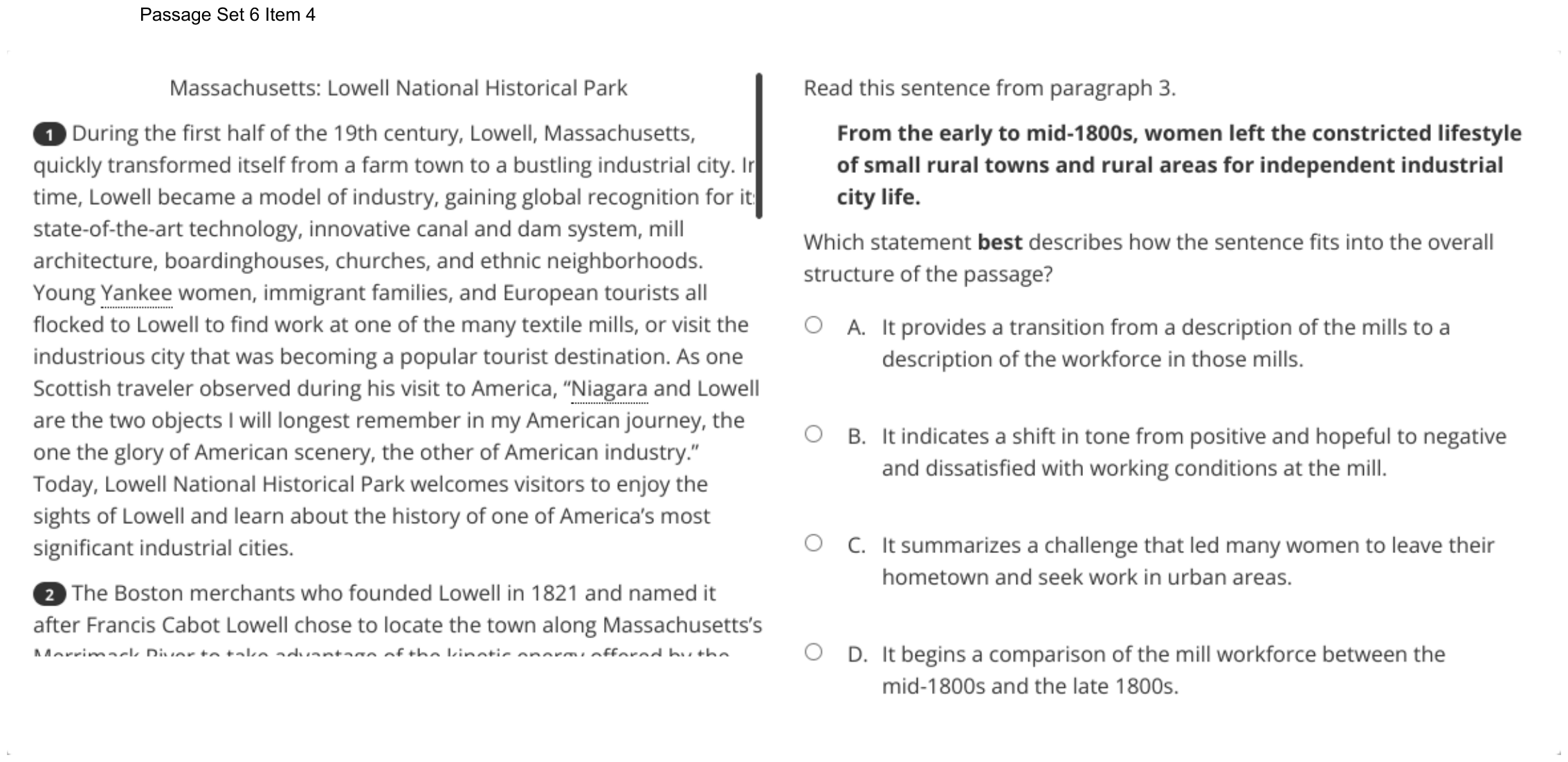
Question 13 of 57
2020 Test B English, question 13Uses the passage above: “Massachusetts: Lowell National Historical Park”.
Question
Read this sentence from paragraph 5.
Although Lowell received an influx of Irish families during this time, the Irish were a part of the city’s history from its birth, and before the “mill girls” arrived, they built Lowell’s historic canals, mills, and boardinghouses.
How does this sentence contribute to the development of ideas in the passage?
- AIt implies that Lowell was founded by early Irish immigrants.
- BIt emphasizes the important role Irish immigrants played in Lowell’s history.
- CIt suggests that the new Irish immigrants were readily accepted into the community.
- DIt highlights the working relationship between the mill girls and the new Irish immigrants.
Show the answer
Correct answer: B
The question asks how the sentence in paragraph 5 contributes to the development of ideas in the passage.
A. Incorrect. The sentence from paragraph 5 does not imply that Lowell was founded by early Irish immigrants. The sentence explains how Irish immigrants had been settling in Lowell since the city was established and that they contributed to the construction of the city, which allowed it to become an industrial center several decades later.
B. CORRECT. The sentence from paragraph 5 shows that early Irish immigrants were critical to the success of Lowell as an industrial city. This information supports the development of the idea that the work of Irish immigrants and immigrants from other places is an important element in the historical significance of industry in Lowell.
C. Incorrect. The sentence from paragraph 5 does not suggest that new Irish immigrants were readily accepted into the community. Paragraph 5 states that “initially, Lowell’s Protestant community was slow to welcome Irish immigrants, but the hostility between Yankee Protestants and Irish Catholics eventually disappeared.”
D. Incorrect. The sentence from paragraph 5 does not highlight the relationship between the mill girls and the new Irish immigrants. Paragraph 4 explains how the mill girls left Lowell, and paragraph 5 states that the mill girls were replaced by “predominantly Irish Catholics, who traveled to America during the Great Potato Famine” but does not discuss a relationship between them.
Question analysis
This question quotes a sentence from paragraph 5 of the Lowell article about Irish families, who arrived in large numbers in the 1840s but had been part of the city since its birth. Students explain how the sentence contributes to the development of the passage's ideas, and because it packs several groups and periods into one line, they must keep straight who did what and when.
- Grade level
- Grade 7 reading and task
- Compared with grade 7
- At grade 7 Explaining how one sentence develops a passage's ideas is a core grade 7 skill. The sentence is long but its meaning is direct, and the text around it settles most of the choices, so the demand is typical.
- Estimated difficulty
- Straightforward: two steps or one careful reading.
- Thinking it demands
- Depth of knowledge 2, skills and concepts · mainly analyze
- What makes it hard
- Complex sentences minor
- Evidence in several places minor
- Evidence
- Answered from one paragraph or stanza
- Reading level
- Passage: about grade 15, 764 words; question and choices: about grade 10, 103 words.
- Students, last 30 days
- Not enough answers yet to show (it takes 10).
Why it is hard, traps and wrong answers (shows the answer)
Why it is hard
Once the long sentence is untangled, its point is plain: the Irish were in Lowell from the start and built its canals, mills and boardinghouses. The likeliest slip is reading “from its birth” as founding the city, which paragraph 2 credits to Boston merchants. The other wrong choices invent a welcome or a partnership that the surrounding sentences contradict or never mention, so a quick check of paragraph 5 settles them.
Complex sentences minor Understanding the question
The 37-word sentence moves through three times at once, the influx “during this time,” the city's birth and the years before the mill girls arrived, so who did what and when must be sorted out. (Abedi & Lord, 2001; Freedle & Kostin, 1993; Messick, 1989)
Evidence in several places minor Working it out
Ruling out the founding choice needs paragraph 2's “Boston merchants who founded Lowell,” and ruling out a warm welcome needs the next sentence's “slow to welcome Irish immigrants.” (Kirsch & Mosenthal, 1990; Gorin & Embretson, 2006)
Strategy: Put the quoted sentence into your own words, then check each choice against the sentences around it in paragraph 5 and against what earlier paragraphs say about the city's beginnings.
Traps
- Twists what the text says: Uses the text's topic and ideas but changes what it says: who did it, how much, when, or why.
- Reads too much in: A reasonable-sounding conclusion that goes further than the text allows.
The wrong answers, classified
A Twists what the text says (King et al., 2004)
Reads “part of the city's history from its birth” and building the canals as founding the city, though paragraph 2 says Boston merchants founded Lowell in 1821.
C Twists what the text says (King et al., 2004)
Remembers that the hostility toward Irish Catholics “eventually disappeared” and overlooks “Initially, … slow to welcome,” turning a gradual change into a ready acceptance.
D Reads too much in (Graesser, Singer & Trabasso, 1994)
Sees the Irish and the mill girls named in one sentence and assumes they worked side by side, a relationship the passage never describes; the Irish later replaced them.
Working it out, step by step
Figure out what the question asks
This structure question asks what one sentence adds to the passage’s ideas. First you need to understand the sentence. It is long and jumps between three times, so take it apart piece by piece.
Break the sentence into parts
The sentence is in paragraph 5. Here are its three parts:
- “Although Lowell received an influx of Irish families during this time”: an influx is a big wave of people arriving, and “this time” means the 1840s.
- “the Irish were a part of the city’s history from its birth”: its birth means the city’s very beginning.
- “they built Lowell’s historic canals, mills, and boardinghouses”: this happened before the mill girls came.
Say it in your own words
Put together, the sentence says: Many Irish families came in the 1840s, but the Irish had been in Lowell from the start. They built its canals, mills and boardinghouses. Without those canals and mills, there would be no industrial city. So the sentence shows how much the Irish mattered to Lowell’s story.
Check each choice
- A is wrong. Being there “from its birth” is not the same as founding the city. Paragraph 2 names the founders: “The Boston merchants who founded Lowell in 1821.”
- B is right. The Irish were there from the start and built the city’s mills and canals. That is an important role.
- C is wrong. The very next sentence says “Lowell’s Protestant community was slow to welcome Irish immigrants.” So they were not readily, or easily, accepted.
- D is wrong. The passage never says the Irish and the mill girls worked together. Later, the Irish replaced them.
Watch out: “From its birth” can sound like they started the city, which leads to A. Check paragraph 2 to see who founded Lowell.
Choose the answer
The sentence makes clear that the Irish helped build Lowell from its first days. So the answer is B.
Why this answer and not the closest wrong one
A is the closest wrong answer, because the sentence links the Irish to the city’s “birth.” But being part of a city from the start is different from founding it. Boston merchants founded Lowell. The Irish built its canals and mills. B fits, because it names that important role without stretching it.
More questions like this
The original DOE question
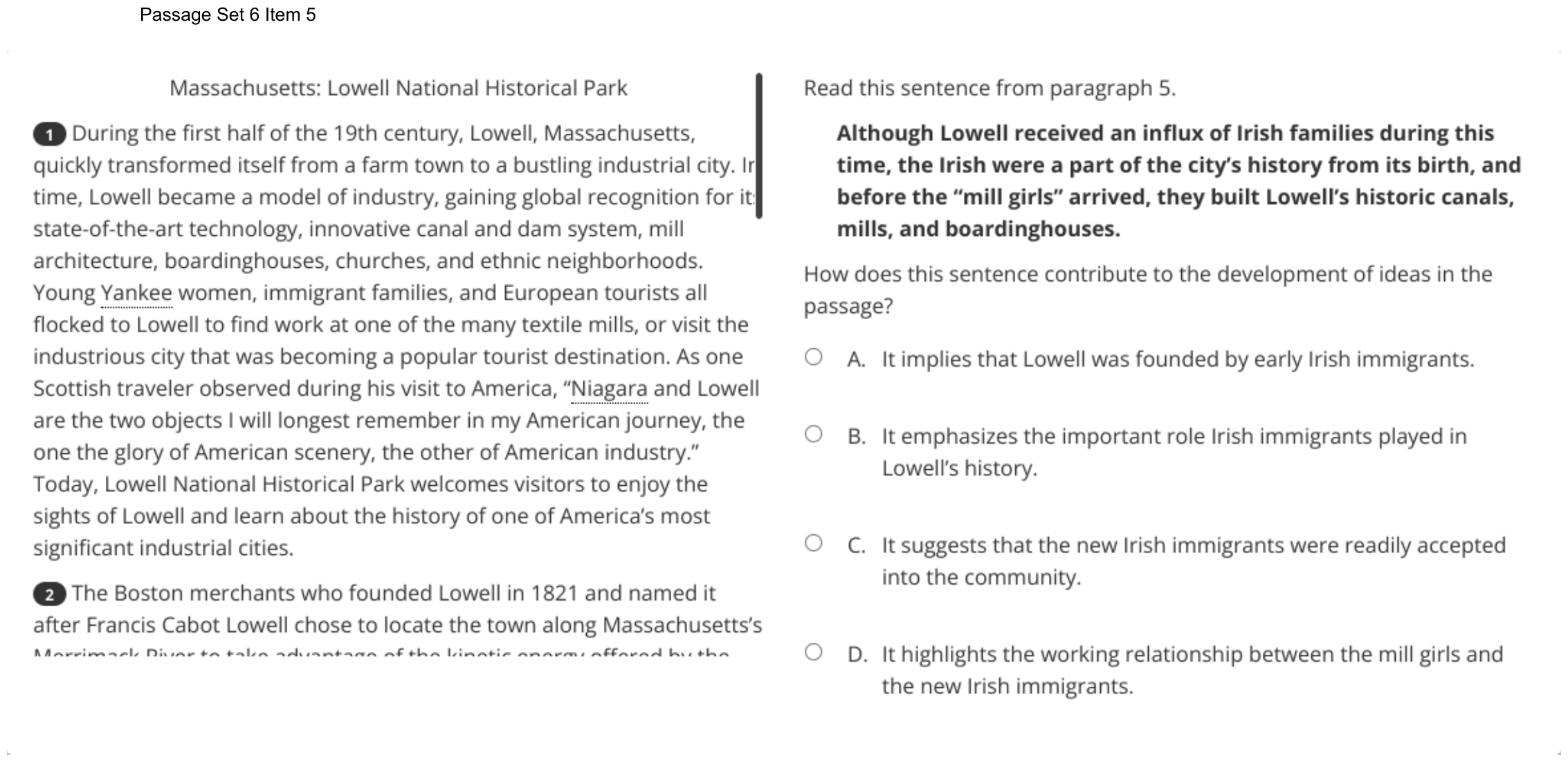
Question 14 of 57
2020 Test B English, question 14Uses the passage above: “Massachusetts: Lowell National Historical Park”.
Question
Which sentence best summarizes the mill girls’ experience as the dominant workforce in Lowell?
- AThe mill girls were eager to leave their domestic duties and small towns behind, so they went to work in the mills of Lowell.
- BOriginally, the mill girls were satisfied to work in Lowell, but as they left their jobs at the Lowell mills, immigrants arrived to fill the empty positions.
- CYoung women left home to work in the Lowell mills, but the mill girls soon became dissatisfied with the working conditions and rigid boardinghouse rules.
- DThe mill girls embraced city life when they came to work in Lowell’s mills, but when their protests about unfavorable working conditions went unanswered, they left.
Show the answer
Correct answer: D
The question asks for the sentence that best summarizes the mill girls’ time as the dominant workforce in Lowell.
A. Incorrect. While the passage explains that mill girls were initially eager to leave the domestic duties of life in rural areas, the summary sentence does not address the details about the mill girls’ time working in the mills or the changes that led the mill girls to leave the industry.
B. Incorrect. Mill girls initially found satisfaction in the mill work and lifestyle, and when they did leave, immigrants filled the empty jobs. This summary sentence, however, does not address the details about the mill girls’ time as the primary workforce in Lowell or the circumstances that led them to leave their jobs in the mid-1800s.
C. Incorrect. Mill girls did leave home to work in the Lowell mills, and they did grow dissatisfied over time, but this summary sentence does not include details about the mill girls’ actions to improve the working conditions.
D. CORRECT. This sentence summary best captures the mill girls’ experience as outlined in paragraphs 3 and 4. The sentence concisely summarizes both the women’s initial excitement about the opportunity to live independently (“Women found that Lowell’s mills offered monthly wages for their services and provided them room and board” [paragraph 3]) and their eventual inability to secure better working conditions (“When their demands went unheard, the women left Lowell, and immigrant groups replaced them in the workforce” [paragraph 4]).
Question analysis
This summary question asks which sentence best sums up the experience of the Yankee mill girls during the years they were Lowell's main workforce. Students must pull together the account spread over paragraphs 3 and 4, and every choice is a two-part sentence that sounds accurate, so each must be checked for what it includes, what it leaves out and what it gets slightly wrong.
- Grade level
- Grade 8 reading and task
- Compared with grade 7
- Above grade 7 Summarizing part of a text is a grade 7 standard, usually tested with one clearly complete choice. Here all four summaries are long, two-part and largely accurate, so ranking them by completeness and precision asks more than typical grade 7 work.
- Estimated difficulty
- Hard: combines ideas, needs a plan, and has more than one tempting wrong answer.
- Thinking it demands
- Depth of knowledge 2, skills and concepts · mainly understand
- What makes it hard
- Every choice must be checked moderate
- A very close wrong answer moderate
- Evidence in several places minor
- Evidence
- Answered from several paragraphs or stanzas
- Reading level
- Passage: about grade 15, 764 words; question and choices: about grade 11, 116 words.
- Students, last 30 days
- Not enough answers yet to show (it takes 10).
Why it is hard, traps and wrong answers (shows the answer)
Why it is hard
This is a completeness question: every summary is built from true pieces of paragraphs 3 and 4, and the right one is the only one that runs from arrival to departure with the cause in between. Students who stop at dissatisfaction feel they have the whole arc, because the turn against working conditions is the story's middle. Writing a one-line summary first, with a beginning, a turning point and an end, makes the gaps in the others easy to see.
Every choice must be checked moderate Choosing the answer
All four summaries are two-part sentences of 24 to 27 words that sound accurate, so each has to be checked for what it leaves out: the arrival, the wage cuts and protests, or the departure. (Embretson & Wetzel, 1987)
A very close wrong answer moderate Choosing the answer
The dissatisfaction summary shares the key's shape, women coming to the mills and then turning against their working conditions; it differs only in the ending, where the key has unanswered protests and the women leaving. (Embretson & Wetzel, 1987; Gorin & Embretson, 2006; Ascalon et al., 2007)
Evidence in several places minor Working it out
The mill girls' story runs from paragraph 3, on why they came and how they lived, to paragraph 4, on wage cuts, strikes and their departure in the 1840s. (Kirsch & Mosenthal, 1990; Gorin & Embretson, 2006)
Strategy: Write your own one-sentence summary of paragraphs 3 and 4 before reading the choices, then compare each choice with it claim by claim, including its words about timing and cause.
Traps
- Too narrow: A single detail offered as the central idea or a summary, or a summary that keeps minor details and leaves out an essential part.
The wrong answers, classified
A Too narrow (King et al., 2004)
Covers only why the women came, leaving domestic work and small towns behind, and stops before their years as the workforce, the wage cuts and their leaving.
B Too narrow (King et al., 2004)
Gets the start and the replacement by immigrants right but drops the wage cuts, protests and strikes that paragraph 4 gives as the reason the women left.
C Too narrow (King et al., 2004)
Keeps the arrival and the growing discontent, adding the minor boardinghouse rules, but leaves out the protests and the women leaving, and “soon” skips the years before the 1840s wage cuts.
Working it out, step by step
Figure out what the question asks
This question asks for the best summary. A summary retells the main events in a few words. It covers the beginning, the middle and the end. Here you sum up the mill girls’ time as Lowell’s main workforce. Their story is in paragraphs 3 and 4.
Find the beginning of their story
Paragraph 3 says the women came for “independent industrial city life.” They found that the mills “offered monthly wages for their services and provided them room and board.” Room and board means a place to live and meals. So at first, they were glad to come. Their days were long, though, and the rules were strict.
Find the middle and the end
Paragraph 4 gives the turning point. In the 1840s, profits fell and the mills cut wages. “These wage cuts, deteriorating working conditions, and long workdays” led the women to protest and strike. Deteriorating means getting worse. Then comes the end: “When their demands went unheard, the women left Lowell.”
Check each choice
- A is wrong. It tells only why they came. It stops before their years at work and their leaving.
- B is wrong. It has the start and the end. But it skips the middle: the wage cuts and protests that made them leave.
- C is wrong. It has the start and the unhappy middle, but no protests and no leaving. Also, “soon” is off, since the trouble came years later, in the 1840s.
- D is right. It covers all three parts: they embraced city life, protested bad conditions, and left when no one listened. Embraced means happily welcomed.
Watch out: C feels complete because it ends with the women unhappy. But their story doesn’t end there. They protested, and then they left.
Choose the answer
Only one summary runs from the mill girls’ arrival to their leaving, with the cause in between. So the answer is D.
Why this answer and not the closest wrong one
C is the closest wrong answer. Like D, it starts with the women coming to the mills and then growing unhappy. But it stops there. It leaves out the protests and the women leaving Lowell, which is how their time as the main workforce ended. D tells the whole story.
More questions like this
The original DOE question
Question 15 of 57
2020 Test B English, question 15Uses the passage above: “Massachusetts: Lowell National Historical Park”.
Question
A central idea that Lowell was “one of America’s most significant industrial cities” (paragraph 1) is conveyed in the passage primarily through a description of the
- Acanals, mills, and boardinghouses that were built by immigrants.
- Bmill girls and immigrants who comprised Lowell’s workforce.
- Cdevelopment of the mills and the workforce established to support them.
- Dcultural diversity of the people who lived in the area.
Show the answer
Correct answer: C
The question asks which description conveys the central idea that Lowell was “one of America’s most significant industrial cities” (paragraph 1).
A. Incorrect. While the passage does state that the city’s canals, mills, and boardinghouses were built by early immigrants from Ireland, these details do not contribute to the development of the overall idea that Lowell was a significant industrial city.
B. Incorrect. The details about the women and immigrants who worked in the mills are important to the passage, but these details alone do not show that Lowell was a significant industrial city.
C. CORRECT. The details throughout the passage about the development of the mills and the people who worked in them convey the significance of Lowell in early American industry. Paragraph 2 shares details about the businesses that started in the 1800s and contributed to the development of industry in the region (“The most recognized of these buildings are the Lowell Manufacturing Company chartered in 1821, the Suffolk or Wannalancit Mill completed around the 1880s, the Boott Mill Company established in 1835, and the Boott Mill Boardinghouse that opened in 1838”). Then paragraphs 3–6 provide specific details about the people who worked in the mills at different points in time.
D. Incorrect. Although the passage references Lowell’s culturally diverse community (“Young Yankee women, immigrant families, and European tourists all flocked to Lowell to find work at one of the many textile mills” [paragraph 1]), these groups alone are not what marked Lowell as a significant industrial city.
Question analysis
This central idea question asks which kind of description in an article about the Massachusetts mill city of Lowell does most to show that it was one of America's most significant industrial cities. Students need a map of all six paragraphs, because every choice names something the passage really describes, and the question turns on which description does the main work.
- Grade level
- Grade 8 reading and task
- Compared with grade 7
- Above grade 7 Grade 7 students trace how a central idea is developed, usually through a few supporting details. Here the strands to weigh run through six dense paragraphs of dates, mills and worker groups, and the stem is long and passive, so it asks more than typical.
- Estimated difficulty
- Hard: combines ideas, needs a plan, and has more than one tempting wrong answer.
- Thinking it demands
- Depth of knowledge 3, strategic thinking · mainly analyze
- What makes it hard
- A very close wrong answer major
- Evidence in several places moderate
- A lot to read minor
- Complex sentences minor
- Evidence
- Answered from the whole text
- Reading level
- Passage: about grade 15, 764 words; question and choices: about grade 10, 63 words.
- Corrected from the DOE handbook
- A grammatical error in the explanation was corrected.
- An inaccurate detail in the explanation was corrected.
- Students, last 30 days
- Not enough answers yet to show (it takes 10).
Why it is hard, traps and wrong answers (shows the answer)
Why it is hard
Every choice names something the passage really describes, so truth rules nothing out; the question turns on which description carries the claim that Lowell mattered as an industrial city. Because four of the six paragraphs follow the workers, the workforce alone looks like the passage's main thread, and students who forget paragraph 2's mills take the half for the whole. Diversity and the immigrant builders are real themes too, but neither says anything about Lowell's industrial standing.
A very close wrong answer major Choosing the answer
The workforce choice is the key with one half removed: both describe the people who worked the mills, but only the key also names the development of the mills, which paragraph 2 builds with dates and numbers. (Embretson & Wetzel, 1987; Gorin & Embretson, 2006; Ascalon et al., 2007)
Evidence in several places moderate Working it out
The industrial picture is built in two stages, the canals and mills of paragraph 2 and the successive workforces of paragraphs 3 to 6, so each choice must be measured against the whole passage. (Kirsch & Mosenthal, 1990; Gorin & Embretson, 2006)
A lot to read minor Understanding the question
Six paragraphs pack in mill names, dates from 1821 to the 1950s and a string of worker groups, from Yankee mill girls to Irish, French-Canadian and Greek immigrants. (Kintsch, 1998; Gorin & Embretson, 2006; Freedle & Kostin, 1993)
Complex sentences minor Understanding the question
The stem is a long passive sentence that quotes paragraph 1 inside it and holds the real question, “primarily through a description of the,” until its last words. (Abedi & Lord, 2001; Freedle & Kostin, 1993; Messick, 1989)
Strategy: Note in a phrase what each of the six paragraphs is about, then test each choice against the stem's claim: would that description make a reader see Lowell as a major industrial city?
Traps
- Too narrow: A single detail offered as the central idea or a summary, or a summary that keeps minor details and leaves out an essential part.
- True but not the answer: A choice says something accurate about the text that does not answer this question.
The wrong answers, classified
A Too narrow (King et al., 2004)
Seizes on paragraph 5's clause that Irish workers built the canals, mills and boardinghouses, one fact about construction rather than the account of mills and workers that shows Lowell's importance.
B Too narrow (King et al., 2004)
Sees that paragraphs 3 to 6 follow the mill girls and the immigrants who replaced them, but leaves out the mills themselves, the heart of paragraph 2's industrial picture.
D True but not the answer (King et al., 2004; Embretson & Wetzel, 1987)
Recalls paragraph 6's “ethnic melting pot” and paragraph 1's “ethnic neighborhoods,” which are real, but the city's diversity says nothing about its standing as an industrial city.
What was corrected from the DOE handbook, and why
- Explanation: The handbook’s explanation of Option B says “The details about the women and immigrants who worked in the mills is important to the passage.” The subject is “details,” so the site now says “are important.”
- Explanation: The handbook’s explanation of Option C says paragraph 2 describes “the businesses that started in the early 1800s,” but the sentence it then quotes includes “the Suffolk or Wannalancit Mill completed around the 1880s,” late in the century. The site now says “the businesses that started in the 1800s.”
Working it out, step by step
Figure out what the question asks
This is a central idea question. A central idea is a main point that the whole passage builds. The point here is that Lowell was “one of America’s most significant industrial cities.” Significant means important. You need the description that does the most to show this.
Map the six paragraphs
- Paragraph 1: Lowell grows from a farm town into a famous industrial city.
- Paragraph 2: The mills: canals, huge brick buildings, mills started across the 1800s, and by the 1850s, “40 textile mills employing over 10,000 workers.”
- Paragraphs 3 and 4: The Yankee “mill girls” who worked in the mills.
- Paragraphs 5 and 6: The Irish and other immigrants who took their place.
See how the picture is built
The passage shows Lowell’s importance in two parts. First it describes the mills: how they were built and how big they grew. Then it follows the workers who ran them, group after group. Together, the mills and the workforce show a major industrial city. Workforce means all the people who do the work. Either part alone tells only half the story.
Check each choice
- A is wrong. Paragraph 5 does say the Irish built the canals, mills and boardinghouses. But that is one fact in one sentence, not the main description.
- B is wrong. The mill girls and immigrants fill paragraphs 3 to 6. But this choice leaves out the mills themselves, the heart of paragraph 2.
- C is right. It covers both parts: how the mills grew and the workers who kept them running.
- D is wrong. Lowell did become an “ethnic melting pot.” But a mix of cultures doesn’t show that a city was an industrial leader.
Watch out: Four of the six paragraphs are about workers, so B looks like the main thread. It is only half of it.
Choose the answer
The central idea is carried by the growth of the mills plus the workforce gathered to run them. So the answer is C.
Why this answer and not the closest wrong one
B is the closest wrong answer. It matches the second half of C, the people who worked in the mills. But it drops the mills, with their six miles of canals and, by the 1850s, 40 mills. Workers alone don’t make a city an industrial giant. C keeps both halves, so it fits the whole passage.
More questions like this
The original DOE question
Question 16 of 57
2020 Test B English, question 16Uses the passage above: “Massachusetts: Lowell National Historical Park”.
Question
The reason Lowell lost its status as an industrial leader is best illustrated through the
- Adescription of poor living and working conditions.
- Bexplanation for why some immigrant groups struggled to live together.
- Ccomparison with other mills that used modern methods.
- Dinformation about the mills opening temporarily during World War II.
Show the answer
Correct answer: C
The question asks for the reason that best illustrates why Lowell lost its status as an industrial leader.
A. Incorrect. While the passage discusses the “long work hours, low wages, and poor living conditions in the city’s crowded tenements” (paragraph 6) in Lowell, these details highlight the living and working conditions of immigrant groups. The author does not state that poor living and working conditions are the reason Lowell lost its status as a “model of industry.”
B. Incorrect. Paragraph 5 in the passage acknowledges that there was some tension between the different ethnic and religious groups in Lowell, but this idea is not what led to Lowell’s decline as a “model of industry.”
C. CORRECT. When Lowell was initially established, the mills in the city thrived because of their advanced manufacturing methods (“gaining global recognition for its state-of-the-art technology, innovative canal and dam system, [and] mill architecture” [paragraph 1]). However, manufacturing technology changed and improved over time, and many mill owners chose to close the mills rather than modernize them, resulting in Lowell’s loss of status as a “model of industry” (“The city officially began to close down its mills in the 1920s and ’30s after Lowell’s outdated mills could no longer compete against the state-of-the-art cotton mills in other communities” [paragraph 6]).
D. Incorrect. The details about the temporary revival of the mills during World War II do not show why Lowell is no longer considered a “model of industry.” The mills were used briefly during wartime because of an increased need for supplies, but this use of the mills was short-lived.
Question analysis
Why did Lowell lose its place as an industrial leader, a decline that ended with its last mill closing by the mid-1950s? This evidence question asks which part of the article best illustrates the reason, so students must find where the passage explains the cause and match it to a choice worded in general terms, while other late details compete for attention.
- Grade level
- Grade 7 reading and task
- Compared with grade 7
- At grade 7 Using a text to explain a cause is typical grade 7 work. The reason is stated directly near the end of the passage, but the choices name it in abstract terms, so a careful match is needed, as in ordinary grade 7 reading.
- Estimated difficulty
- Moderate: several steps, or a close reading with one strong distractor.
- Thinking it demands
- Depth of knowledge 2, skills and concepts · mainly evaluate
- What makes it hard
- The right answer is reworded moderate
- Complex sentences minor
- Evidence in several places minor
- Evidence
- Answered from one paragraph or stanza
- Reading level
- Passage: about grade 15, 764 words; question and choices: about grade 9, 50 words.
- Students, last 30 days
- Not enough answers yet to show (it takes 10).
Why it is hard, traps and wrong answers (shows the answer)
Why it is hard
The reason is stated, but in a sentence that pairs it with worsening working conditions, and conditions get far more space in the passage, from paragraph 4's wage cuts to paragraph 6's crowded tenements. Students who match the choices to familiar words land on the conditions, which the passage presents as a result of companies not reinvesting. The key has to be recognized in new wording, as a comparison with modern mills elsewhere.
The right answer is reworded moderate Choosing the answer
The key's “comparison with other mills that used modern methods” rewords “could no longer compete against the state-of-the-art cotton mills,” while wrong choices repeat the text's “poor living conditions,” “working conditions” and “World War II.” (Freedle & Kostin, 1993; Kirsch & Mosenthal, 1990)
Complex sentences minor Understanding the question
The 47-word sentence that gives the reason joins two clauses under one “after,” outdated mills that “could no longer compete” and working conditions that “continued to decline,” so both can look like causes. (Abedi & Lord, 2001; Freedle & Kostin, 1993; Messick, 1989)
Evidence in several places minor Working it out
The cause echoes earlier hints, paragraph 1's “state-of-the-art technology” and paragraph 4's trouble competing with “other New England communities,” which confirm that competition is the passage's explanation. (Kirsch & Mosenthal, 1990; Gorin & Embretson, 2006)
Strategy: Find the sentence that tells why Lowell's mills shut down, restate the cause in your own words, then choose the description that matches that cause rather than a detail that merely appears nearby.
Traps
- Supports only part of the claim: In a question about evidence: a line that backs one half of the claim but not the other, or a related point rather than the claim itself.
- True but not the answer: A choice says something accurate about the text that does not answer this question.
- Twists what the text says: Uses the text's topic and ideas but changes what it says: who did it, how much, when, or why.
The wrong answers, classified
A Supports only part of the claim (King et al., 2004; Thissen, Steinberg & Fitzpatrick, 1989)
Finds the sentence about the closings but takes its declining working conditions as the reason, though they follow from companies no longer reinvesting, the same neglect that left the mills outdated.
B Twists what the text says (King et al., 2004)
Recasts paragraph 5's hostility between Yankee Protestants and Irish Catholics, which “eventually disappeared,” as a struggle among immigrant groups, though the passage never ties it to the decline.
D True but not the answer (King et al., 2004; Embretson & Wetzel, 1987)
Picks the World War II detail because it belongs to the mills' last years, but a “brief resurgence” describes a short revival, not why Lowell fell behind.
Working it out, step by step
Figure out what the question asks
This evidence question asks why Lowell lost its place as an industrial leader. First find where the passage gives the reason. Then pick the choice that matches it, even if it uses different words.
Find the reason in paragraph 6
Look near the end of the passage, where the mills close. Paragraph 6 says the city began to close its mills “after Lowell’s outdated mills could no longer compete against the state-of-the-art cotton mills in other communities.” This is the reason the passage gives.
Put the reason in plain words
Outdated means old-fashioned. State-of-the-art means the newest and best. To compete is to keep up with rivals. So mills in other places had newer machines, and Lowell’s old mills couldn’t keep up. That is a comparison: Lowell’s mills next to more modern mills elsewhere. It is a big change, too. In paragraph 1, Lowell was famous for its own “state-of-the-art technology.”
Rule out the working conditions
Choice A is the hard one to rule out. The same sentence says working conditions got worse “as Lowell’s companies stopped reinvesting in their mills.” Reinvesting means putting money back in, for repairs and new machines. Mills that get no new money also fall out of date. So the worse conditions came along with the decline. Falling behind modern mills elsewhere is what cost Lowell its lead. The passage’s longer descriptions of poor conditions, in paragraphs 4 and 6, tell how hard life was for workers. They don’t explain why the mills closed.
Check the other choices
- B is wrong. The passage tells of tension between Yankee Protestants and Irish Catholics, which “eventually disappeared.” It never links this to the mills closing.
- C is right. It matches the reason: Lowell’s mills fell behind more modern mills.
- D is wrong. The World War II “brief resurgence” was a short comeback. It doesn’t explain why Lowell fell behind.
Watch out: A repeats words from the passage, so it feels safe. But matching the words is not the same as matching the reason.
Choose the answer
The passage says Lowell’s outdated mills could not keep up with modern mills in other places. Choice C names that comparison. So the answer is C.
Why this answer and not the closest wrong one
A is the closest wrong answer, because the closing sentence also says “working conditions continued to decline.” But the passage ties that to the companies no longer spending on their mills. A leader loses its place when others get ahead. C names that: other mills used modern methods, and Lowell’s did not.
More questions like this
The original DOE question
Question 17 of 57
2020 Test B English, question 17Passage Excerpt from A Tramp Abroad
Excerpt from A Tramp Abroad
by Mark Twain
Now and then, while we rested, we watched the laborious ant at his work. I found nothing new in him—certainly nothing to change my opinion of him. It seems to me that in the matter of intellect the ant must be a strangely overrated bird. During many summers now I have watched him, when I ought to have been in better business, and I have not yet come across a living ant that seemed to have any more sense than a dead one. I refer to the ordinary ant, of course; I have had no experience of those wonderful Swiss and African ones which vote, keep drilled armies, . . . and dispute about religion. Those particular ants may be all that the naturalist paints them, but I am persuaded that the average ant is a sham.
I admit his industry, of course; he is the hardest working creature in the world—when anybody is looking—but his leather-headedness is the point I make against him. He goes out foraging, he makes a capture, and then what does he do? Go home? No; he goes anywhere but home. He doesn’t know where home is. His home may be only three feet away; no matter, he can’t find it. He makes his capture, as I have said; it is generally something which can be of no sort of use to himself or anybody else; it is usually seven times bigger than it ought to be; he hunts out the awkwardest place to take hold of it; he lifts it bodily up in the air by main force, and starts—not toward home, but in the opposite direction; not calmly and wisely, but with a frantic haste which is wasteful of his strength; he fetches up against a pebble, and, instead of going around it, he climbs over it backwards, dragging his booty after him, tumbles down on the other side, jumps up in a passion, kicks the dust off his clothes, moistens his hands, grabs his property viciously, yanks it this way, then that, shoves it ahead of him a moment, turns tail and lugs it after him another moment, gets madder and madder, then presently hoists it into the air and goes tearing away in an entirely new direction; comes to a weed; it never occurs to him to go around it. No; he must climb it, and he does climb it, dragging his worthless property to the top—which is as bright a thing to do as it would be for me to carry a sack of flour from Heidelberg to Paris by way of Strasburg steeple; when he gets up there he finds that that is not the place; takes a cursory glance at the scenery, and either climbs down again or tumbles down, and starts off once more—as usual, in a new direction. At the end of half an hour he fetches up within six inches of the place he started from, and lays his burden down. Meantime, he has been over all the ground for two yards around, and climbed all the weeds and pebbles he came across. Now he wipes the sweat from his brow, strokes his limbs, and then marches aimlessly off, in as violent a hurry as ever. He traverses a good deal of zig-zag country, and by and by stumbles on his same booty again. He does not remember to have ever seen it before; he looks around to see which is not the way home, grabs his bundle, and starts. He goes through the same adventures he had before; finally stops to rest, and a friend comes along.
Evidently the friend remarks that a last year’s grasshopper leg is a very noble acquisition, and inquires where he got it. Evidently the proprietor does not remember exactly where he did get it, but thinks he got it “around here somewhere.” Evidently the friend contracts to help him freight it home. Then, with a judgment peculiarly antic (pun not intentional), they take hold of opposite ends of that grasshopper leg and begin to tug with all their might in opposite directions. Presently they take a rest, and confer together. They decide that something is wrong, they can’t make out what. Then they go at it again, just as before. Same result. Mutual recriminations follow. Evidently each accuses the other of being an obstructionist. They warm up, and the dispute ends in a fight. They lock themselves together and chew each other’s jaws for a while; then they roll and tumble on the ground till one loses a horn or a leg and has to haul off for repairs. They make up and go to work again in the same old insane way, but the crippled ant is at a disadvantage; tug as he may, the other one drags off the booty and him at the end of it. Instead of giving up, he hangs on, and gets his shins bruised against every obstruction that comes in the way. By and by, when that grasshopper leg has been dragged all over the same old ground once more, it is finally dumped at about the spot where it originally lay. The two perspiring ants inspect it thoughtfully and decide that dried grasshopper legs are a poor sort of property after all, and then each starts off in a different direction to see if he can’t find an old nail or something else that is heavy enough to afford entertainment and at the same time valueless enough to make an ant want to own it. . . .
Science has recently discovered that the ant does not lay up anything for winter use. . . . He does not work, except when people are looking, and only then when the observer has a green, naturalistic look, and seems to be taking notes. This amounts to deception, and will injure him for the Sunday schools. He has not judgment enough to know what is good to eat from what isn’t. This amounts to ignorance, and will impair the world’s respect for him. . . . He cannot stroll around a stump and find his way home again. This amounts to idiocy, and once the damaging fact is established, thoughtful people will cease to look up to him. It is strange beyond comprehension that so manifest a humbug as the ant has been able to fool so many nations and keep it up so many ages without being found out.
we: the author and his fictional travel companion
From A TRAMP ABROAD by Mark Twain—Public Domain
Question
The phrase “those wonderful Swiss and African ones which vote, keep drilled armies, . . . and dispute about religion” in paragraph 1 shows that the author
- Abelieves that the behavior of the ants is reflected in other living creatures.
- Backnowledges that his observations of a few do not necessarily apply to all.
- Cknows that disproving a commonly held belief is challenging.
- Daccepts that there are flaws in his interpretation of the behavior of the ants.
Show the answer
Correct answer: B
The answer is (B)
The question asks about the phrase, which highlights the behavior of ants from different parts of the world, and about what the inclusion of the phrase shows about the author.
Option B is correct because the phrase is meant to communicate a caution that while the author believes most ants are foolish, his observations in the excerpt do not apply to all types of ants.
Option A is incorrect because, in the excerpt, the author is comparing species of ants to one another and not to other living creatures.
Option C is incorrect because the author never comments in the excerpt that challenging common or strongly held beliefs is, in general, difficult.
Option D is incorrect because the author never expresses in the excerpt the idea that the conclusions drawn about the ants’ behavior are flawed; the reference to Swiss and African ants is meant to show that those ants are an exception.
Question analysis
In this Mark Twain excerpt about ants, students must decide what a mocking aside about Swiss and African ants that “vote” and “keep drilled armies” reveals about the author's point of view. The tricky part is reading past the sarcasm to see what the aside does for his larger case against ants.
- Grade level
- Grade 8 reading and task
- Compared with grade 7
- Above grade 7 Grade 7 readers usually judge a narrator's stance from direct statements. Here the stance sits inside a sarcastic aside in long nineteenth-century sentences, so students must separate what Twain means from what he mocks, which goes beyond typical grade 7 work.
- Estimated difficulty
- Hard: combines ideas, needs a plan, and has more than one tempting wrong answer.
- Thinking it demands
- Depth of knowledge 2, skills and concepts · mainly analyze
- What makes it hard
- Figurative or literary language major
- A very close wrong answer moderate
- Reading between the lines moderate
- Evidence
- Answered from one sentence or line
- Reading level
- Passage: about grade 9, 1099 words; question and choices: about grade 8, 72 words.
- Students, last 30 days
- Not enough answers yet to show (it takes 10).
Why it is hard, traps and wrong answers (shows the answer)
Why it is hard
Most misses come from reading the aside as a sincere comparison or as a confession. Twain mocks the naturalists' stories of voting, warring ants while making clear that his verdict covers only the ordinary ant he has watched, so the phrase narrows his claim without weakening it. The key's wording, “observations of a few,” is abstract and does not echo the text, and students who catch the concession but not its limits drift to the choice about flaws in his interpretation.
Figurative or literary language major Understanding the question
The aside is mock praise: “wonderful” ants that “vote” and “dispute about religion” poke fun at the naturalists, so students must see that the joke also fences off which ants his verdict covers. (Graesser, Singer & Trabasso, 1994; Kintsch, 1998)
A very close wrong answer moderate Choosing the answer
B and D both read the aside as a concession about his conclusions; they part only on its kind, since B narrows which ants his verdict covers while D admits the verdict itself is flawed. (Embretson & Wetzel, 1987; Gorin & Embretson, 2006; Ascalon et al., 2007)
Reading between the lines moderate Working it out
The phrase says nothing about the author directly; his stance comes from its frame, “I refer to the ordinary ant, of course” before it and “the average ant is a sham” after. (Graesser, Singer & Trabasso, 1994; Kintsch, 1998)
Strategy: Reread the whole sentence the quoted phrase sits in, not just the quoted words, and decide what job the aside does there; then drop any choice describing an idea the paragraph never expresses.
Traps
- Twists what the text says: Uses the text's topic and ideas but changes what it says: who did it, how much, when, or why.
- Taking figurative language literally: A choice reads a figure of speech or image at face value.
The wrong answers, classified
A Taking figurative language literally (Graesser, Singer & Trabasso, 1994)
Takes the voting, army-keeping ants at face value as a likeness between ants and people, though the aside mocks those claims and compares only kinds of ants.
C Reads too much in (Graesser, Singer & Trabasso, 1994)
Carries the closing complaint that the ant has fooled “so many nations” into this sentence and decides the author finds disproving the belief hard, which he never says.
D Twists what the text says (King et al., 2004)
Rightly hears a concession in “I have had no experience,” but turns a limit on which ants he means into an admission that his reading of ants is wrong.
Working it out, step by step
Figure out what the question asks
This question is about the author’s point of view. In paragraph 1, Twain mentions some very special ants. You need to decide what that mention shows about Twain himself.
Read the whole sentence
Don’t read only the quoted words. Read the whole sentence in paragraph 1: “I refer to the ordinary ant, of course; I have had no experience of those wonderful Swiss and African ones which vote, keep drilled armies, . . . and dispute about religion.”
Then read the next sentence: “Those particular ants may be all that the naturalist paints them, but I am persuaded that the average ant is a sham.”
Work out what the phrase means
Twain is joking. No ant really votes or argues about religion. He is poking fun at wild stories told by naturalists (people who study nature).
But the joke also does a job. Twain says his opinion is about the “ordinary ant,” the kind he has watched. He has never seen those other ants. So he limits his claim to the ants he knows. He does not say his claim is wrong.
Check each choice
- A says ant behavior shows up in other creatures. No. Twain compares kinds of ants, not ants and other animals.
- B fits. He has watched only some ants, so his verdict may not fit every ant.
- C says he finds it hard to disprove a common belief. He never says that.
- D says he admits his view of ants is flawed. He doesn’t. He stays sure the ant is a sham.
Choose the answer
The phrase shows that Twain knows what he saw in the ants he watched may not be true of all ants. So the answer is B.
Why this answer and not the closest wrong one
D is the closest trap. Both B and D hear Twain admitting something. But D says he admits he is wrong. B says only that he limits which ants he means. Right after the phrase he writes, “I am persuaded that the average ant is a sham.” He is not backing down.
More questions like this
The original DOE question

The passage “Excerpt from A Tramp Abroad” as printed (pages 62–63)
Question 18 of 57
2020 Test B English, question 18Uses the passage above: “Excerpt from A Tramp Abroad”.
Question
In paragraph 2, how do the words “grabs,” “yanks,” and “tearing away” contribute to the meaning of the excerpt?
- AThey highlight the ant’s belief that his work is important.
- BThey illustrate that the ant is more efficient working on his own.
- CThey indicate the speed with which the ant completes his tasks.
- DThey emphasize the ant’s anxious efforts to be productive.
Show the answer
Correct answer: D
The answer is (D)
The question asks for an explanation of how the words “grabs,” “yanks,” and “tearing away” (paragraph 2) contribute to the meaning of the excerpt.
Option D is correct because these words convey sudden movements as the ant becomes more upset in his efforts to transport the grasshopper leg.
Option A is incorrect because the ant is never described in the excerpt as believing his work to be important.
Option B is incorrect because the ant’s inability to make progress while transporting the grasshopper leg by himself demonstrates the ant’s inefficiency (paragraph 2: “At the end of half an hour he fetches up within six inches of the place he started from”).
Option C is incorrect because the ant does not complete his tasks despite moving in a hurried and determined way (paragraph 2: “not calmly and wisely, but with a frantic haste which is wasteful of his strength”).
Question analysis
This word-choice question asks how three action words from Mark Twain's ant story, “grabs,” “yanks” and “tearing away,” add to the excerpt's meaning. The verbs are buried in one very long sentence that lists dozens of actions, so students must find them and decide what their connotations add to the picture of the ant.
- Grade level
- Grade 7 reading and task
- Compared with grade 7
- At grade 7 Grade 7 word-choice items usually ask about one word in a short passage. This one asks for the shared effect of three verbs scattered through a very long sentence, though their tone is fairly clear once found, which keeps it at grade 7.
- Estimated difficulty
- Moderate: several steps, or a close reading with one strong distractor.
- Thinking it demands
- Depth of knowledge 2, skills and concepts · mainly analyze
- What makes it hard
- Complex sentences moderate
- Figurative or literary language moderate
- A very close wrong answer minor
- Evidence
- Answered from one paragraph or stanza
- Reading level
- Passage: about grade 9, 1099 words; question and choices: about grade 6, 60 words.
- Corrected from the DOE handbook
- A wrong option letter in the explanation was corrected.
- A missing comma in the explanation was restored.
- Students, last 30 days
- Not enough answers yet to show (it takes 10).
Why it is hard, traps and wrong answers (shows the answer)
Why it is hard
The verbs themselves are easy words; the difficulty is deciding what they add. Their speed is obvious, which is why the choice about how fast the ant finishes his tasks catches readers who stop at speed and miss that nothing gets finished. The key reads the verbs together with “in a passion” and “madder and madder” around them, so it rewards looking at the words' surroundings rather than the words alone.
Complex sentences moderate Understanding the question
All three verbs are buried in one 183-word sentence of paragraph 2, strung through semicolons among about twenty other actions, so students must find them before judging them. (Abedi & Lord, 2001; Freedle & Kostin, 1993; Messick, 1989)
Figurative or literary language moderate Understanding the question
The verbs' force reads as a comic tantrum, “grabs his property viciously” soon after he “jumps up in a passion,” so their connotation of agitation, not skill, carries the meaning. (Graesser, Singer & Trabasso, 1994; Kintsch, 1998)
A very close wrong answer minor Choosing the answer
A and D both tie the verbs to the ant caring about his work; they differ in one part, since the verbs show his anxious efforts, as D says, but never reveal a belief, as A claims. (Embretson & Wetzel, 1987; Gorin & Embretson, 2006; Ascalon et al., 2007)
Strategy: Locate the three verbs in paragraph 2, read the clauses around each one, and describe their effect in your own words before looking at the choices.
Traps
- Twists what the text says: Uses the text's topic and ideas but changes what it says: who did it, how much, when, or why.
- Reads too much in: A reasonable-sounding conclusion that goes further than the text allows.
The wrong answers, classified
A Reads too much in (Graesser, Singer & Trabasso, 1994)
Reads the ant's vigor as proof that he thinks his work important, a belief the excerpt never gives him; the verbs show agitation, not conviction.
B Wrong tone or attitude (Graesser, Singer & Trabasso, 1994)
Hears the forceful verbs as signs of a capable worker and contrasts him with the bickering pair, though alone he ends six inches from where he began.
C Twists what the text says (King et al., 2004)
Rightly senses speed in “tearing away,” but the ant completes nothing; Twain calls it “a frantic haste which is wasteful of his strength.”
What was corrected from the DOE handbook, and why
- Explanation: The handbook’s last reason begins “Option H is incorrect because the ant does not complete his tasks despite moving in a hurried and determined way”, but H is its correct answer. The reason is about G, “They indicate the speed with which the ant completes his tasks,” so this site reads Option C (G relettered). This was already corrected on the site before this review.
- Explanation: The handbook quotes the words as “grabs” “yanks,” and “tearing away”. The comma after “grabs” is restored, as in the question.
Working it out, step by step
Figure out what the question asks
This is a word-choice question. It asks what three action words add to the excerpt. Think about how the words feel, not just what they mean.
Find the words in paragraph 2
All three words are in the very long sentence in paragraph 2. Look at the words around them. The ant “jumps up in a passion,” then “grabs his property viciously, yanks it this way, then that.” Soon he “gets madder and madder” and goes “tearing away in an entirely new direction.”
Work out what the words show
“In a passion” means in a fit of anger. “Viciously” means fiercely. So the words show a worked-up, frantic ant. He moves fast and rough, like a kid having a tantrum. He badly wants to get his job done.
But Twain also says the ant moves “with a frantic haste which is wasteful of his strength.” All that rushing gets him nowhere.
Check each choice
- A The excerpt never tells us what the ant believes about his work. The words show he is upset, not what he thinks.
- B Working alone, he ends up six inches from where he started. That is not efficient (getting a lot done without waste).
- C The words do show speed. But the ant never finishes anything.
- D fits. The words show anxious, frantic effort to get the job done.
Choose the answer
The rough, fast verbs show an upset ant trying hard to be productive. So the answer is D.
Why this answer and not the closest wrong one
C is the closest trap, because “tearing away” does sound fast. But C says the ant completes his tasks, and he never does. D keeps the speed and the worry but does not claim success. That is why D fits better.
More questions like this
The original DOE question

Question 19 of 57
2020 Test B English, question 19Uses the passage above: “Excerpt from A Tramp Abroad”.
Question
Read this sentence from paragraph 2.
At the end of half an hour he fetches up within six inches of the place he started from, and lays his burden down.
How does the sentence contribute to the development of the central idea of the excerpt?
- AIt reveals that the ant is aware of the purposelessness of his efforts and that he does not enjoy his work.
- BIt highlights how little the ant accomplishes despite the great amount of effort he exerts.
- CIt suggests that the ant has an industrious attitude and does not easily give up.
- DIt emphasizes that the ant does not thoughtfully consider how difficult it would be to carry his capture for such a long period of time.
Show the answer
Correct answer: B
The answer is (B)
The question asks how the sentence, which states that the ant ends up only six inches from his original starting point, contributes to the central idea of the excerpt.
Option B is correct because it explains how the idea in the sentence supports the central idea that “the average ant is a sham” (paragraph 1) by emphasizing his lack of progress and wasted effort.
Option A is incorrect because, while the author recognizes the pointlessness of the efforts, the ant never becomes aware that his efforts are purposeless.
Option C is incorrect because the ant ending up only six inches from his starting point suggests pointless effort, not an industrious or productive attitude.
Option D is incorrect because the emphasis of the sentence is on the ant’s wasted effort, not the difficulty and time involved, which the ant never realizes or evaluates.
Question analysis
Students read one sentence from paragraph 2 of Mark Twain's ant story, about where the ant finally sets down his burden, and explain how it develops the excerpt's central idea. The choices differ subtly on the ant's awareness, attitude and effort, so each must be checked closely against the sentence.
- Grade level
- Grade 7 reading and task
- Compared with grade 7
- At grade 7 Explaining how one sentence develops a central idea is standard grade 7 work, and this sentence is short and quoted in full. Twain's long, winding style adds some load, but the reasoning needed is brief.
- Estimated difficulty
- Straightforward: two steps or one careful reading.
- Thinking it demands
- Depth of knowledge 2, skills and concepts · mainly analyze
- What makes it hard
- How, not what moderate
- Every choice must be checked minor
- Evidence
- Answered from one sentence or line
- Reading level
- Passage: about grade 9, 1099 words; question and choices: about grade 8, 120 words.
- Corrected from the DOE handbook
- A wrong paragraph number in the explanation was corrected.
- Students, last 30 days
- Not enough answers yet to show (it takes 10).
Why it is hard, traps and wrong answers (shows the answer)
Why it is hard
Once a student reads the sentence as the punch line of the half hour before it, the key is close to obvious: thirty minutes of hauling have moved the ant six inches. Errors come from importing ideas from elsewhere, such as the narrator's grudging praise of the ant's industry, or from latching onto the time words and missing that the sentence measures distance gained, not effort planned.
How, not what moderate Working it out
The stem asks how the sentence develops the central idea, so students must connect “within six inches of the place he started from” to the claim that the average ant is a sham. (Anderson & Krathwohl, 2001)
Every choice must be checked minor Choosing the answer
The wrong choices differ from the key in one claim each, the ant's awareness, his persistence, his failure to plan, so each must be tested against the sentence. (Embretson & Wetzel, 1987)
Strategy: Read the sentences just before this one to see what filled the ant's half hour, then put the sentence's effect in your own words before checking the choices against the paragraph.
Traps
- Wrong part of the text: A choice is true of another paragraph, stanza or speaker than the one asked about.
- Twists what the text says: Uses the text's topic and ideas but changes what it says: who did it, how much, when, or why.
The wrong answers, classified
A Twists what the text says (King et al., 2004)
Hands the narrator's insight to the ant: the narrator sees the effort is pointless, but the ant never realizes it, and nothing says whether he enjoys working.
C Wrong part of the text (Kirsch & Mosenthal, 1990)
Recalls the grudging “I admit his industry” and the ant's later restarts, found elsewhere in paragraph 2, but this sentence shows half an hour gaining six inches.
D Twists what the text says (King et al., 2004)
Rightly sees a thoughtless ant and is drawn by “half an hour,” but the sentence stresses how little ground he gained, not the difficulty of a long carry.
What was corrected from the DOE handbook, and why
- Explanation: The handbook places “the average ant is a sham” in paragraph 2. The phrase ends paragraph 1, as question 27 on the same excerpt says, so the explanation now reads “(paragraph 1)”.
Working it out, step by step
Figure out what the question asks
This question asks how one sentence helps build the central idea. The central idea is that “the average ant is a sham.” He looks busy and wise, but he is not smart.
Read the sentence and what comes before
The sentence is in paragraph 2: “At the end of half an hour he fetches up within six inches of the place he started from, and lays his burden down.”
Read the sentences before it too. The ant has climbed weeds, tumbled down and changed direction again and again.
Work out what it means
“Fetches up” means ends up. A “burden” is a heavy load. So after thirty minutes of hard work, the ant is only six inches from where he began. All that effort got him almost nowhere. This is the punch line of his trip. It shows the ant works hard but gets almost nothing done.
Check each choice
- A The narrator sees that the work is pointless. The ant never does, and we never learn if he enjoys it.
- B fits. Half an hour of effort moves him only six inches.
- C The ant does keep going, but this sentence stresses failure, not a good attitude.
- D The sentence measures how little ground he gained. It is not about planning a long carry.
Choose the answer
The sentence shows how little the ant achieves for so much effort. So the answer is B.
Why this answer and not the closest wrong one
D is tempting because the sentence says “half an hour,” which sounds like a long carry. But the key fact is the distance: six inches from the start. That fact is about results, not about thinking ahead. B is about results, so it fits better.
More questions like this
The original DOE question
Question 20 of 57
2020 Test B English, question 20Uses the passage above: “Excerpt from A Tramp Abroad”.
Question
The description at the end of paragraph 2 of the ant repeating his actions conveys the idea that
- Amistakes are necessary in order to make progress.
- Brushing to reach a goal may lead to an undesirable outcome.
- Cbreaking out of a familiar pattern of events is difficult.
- Dindustriousness and foolishness is an unfortunate combination.
Show the answer
Correct answer: D
The question asks which idea the description at the end of paragraph 2 conveys about the repetition of the ant’s actions.
A. Incorrect. The description at the end of paragraph 2, in which the ant “goes through the same adventures” to no avail, does not convey the idea that mistakes are necessary in order to make progress.
B. Incorrect. The description at the end of paragraph 2, in which the ant runs away in a “violent” hurry and “traverses a good deal of zig-zag country, and by and by stumbles on his same booty again . . . not remember[ing] to have ever seen it before,” does not convey the idea that rushing to meet a goal may lead to an undesirable outcome, because the last line in paragraph 2 refers to the ant’s repetitive actions as an adventure (“He goes through the same adventures he had before”).
C. Incorrect. The description at the end of paragraph 2, in which the ant repeatedly “stumbles on his same booty again,” does not convey the idea that breaking out of a familiar pattern of events is difficult, because the industrious ant “does not remember” (paragraph 2) and is thus unaware that he is repeating his actions.
D. CORRECT. The description at the end of paragraph 2 says that the ant “traverses a good deal of zig-zag country, and by and by stumbles on his same booty again. He does not remember to have ever seen it before; he looks around to see which is not the way home, grabs his bundle, and starts. He goes through the same adventures he had before,” thus indicating that the ant is both industrious and foolish in his actions.
Question analysis
In this theme question on Mark Twain's “A Tramp Abroad,” students decide what idea is conveyed by the end of paragraph 2, where an ant sets down his load, wanders off, stumbles on it again without recognizing it, and repeats the whole journey. The choices are general life lessons, more than one of them linked to something the ant really does.
- Grade level
- Grade 8 reading and task
- Compared with grade 7
- Above grade 7 Typical grade 7 theme questions draw on a short story's plain events. Here the idea must come from the close of a very long, sarcastic nineteenth-century paragraph, and the choices are abstract morals that echo real details, above grade 7.
- Estimated difficulty
- Hard: combines ideas, needs a plan, and has more than one tempting wrong answer.
- Thinking it demands
- Depth of knowledge 3, strategic thinking · mainly analyze
- What makes it hard
- Reading between the lines major
- Figurative or literary language moderate
- Evidence in several places minor
- Hard words minor
- Evidence
- Answered from one paragraph or stanza
- Reading level
- Passage: about grade 9, 1099 words; question and choices: about grade 9, 53 words.
- Students, last 30 days
- Not enough answers yet to show (it takes 10).
Why it is hard, traps and wrong answers (shows the answer)
Why it is hard
All four choices are general morals, and two borrow real features of the scene, the ant's hurry and his repeated route, so the question turns on why the ant repeats himself. He forgets the booty and starts over with the same frantic energy, which joins the paragraph's opening concession about his industry to its charge of leather-headedness. Students who read the description as a warning about haste, or about being stuck in a rut, give the ant motives and awareness he never shows.
Reading between the lines major Working it out
No sentence states a lesson; students must join the ant's tireless restart, grabbing his bundle for “the same adventures,” with the fact that he “does not remember” the booty, to see effort wasted by stupidity. (Graesser, Singer & Trabasso, 1994; Kintsch, 1998)
Figurative or literary language moderate Understanding the question
Twain narrates the ant as a mock-heroic laborer who “wipes the sweat from his brow” and has “adventures,” so the idea arrives through irony and exaggeration rather than plain statement. (Graesser, Singer & Trabasso, 1994; Kintsch, 1998)
Evidence in several places minor Working it out
The two halves of the idea are named at the start of paragraph 2, “I admit his industry” and “his leather-headedness,” well above the closing description the question points to. (Kirsch & Mosenthal, 1990; Gorin & Embretson, 2006)
Hard words minor Understanding the question
The passage's “traverses” and “booty” and the choices' “industriousness” must be understood, and the key uses that abstract noun rather than the passage's own word, “industry.” (Perfetti, 2007; Freedle & Kostin, 1993)
Strategy: Work out from the surrounding sentences why the ant repeats his trip, then test each lesson against what the ant actually does and knows, word by word.
Traps
- Twists what the text says: Uses the text's topic and ideas but changes what it says: who did it, how much, when, or why.
- Reads too much in: A reasonable-sounding conclusion that goes further than the text allows.
- Outside knowledge: A choice is plausible in the real world but not supported by this text.
The wrong answers, classified
A Outside knowledge (King et al., 2004; Recht & Leslie, 1988)
Brings in the familiar saying that mistakes lead to progress, but the ant's blunders get him nowhere: he forgets his booty, finds it again and repeats the same trip.
B Twists what the text says (King et al., 2004)
Fastens on the march “in as violent a hurry as ever,” but the ant moves “aimlessly,” with no goal to rush toward, and repeats himself because he forgets, not because he hurries.
C Reads too much in (Graesser, Singer & Trabasso, 1994)
Sees the repeated journey as a rut the ant struggles to escape, but he “does not remember to have ever seen” the booty, so he never knows he is repeating anything.
Working it out, step by step
Figure out what the question asks
This asks for the idea, or message, behind a scene. At the end of paragraph 2, the ant does the same things all over again. Work out why he repeats himself. Then pick the lesson that fits.
Find the end of paragraph 2
Near the end, the ant “marches aimlessly off, in as violent a hurry as ever.” Then he “stumbles on his same booty again. He does not remember to have ever seen it before.” He grabs it and starts off. “He goes through the same adventures he had before.”
Aimlessly means with no goal. Booty is the thing he captured.
Work out what it means
The ant works hard and moves fast. But he forgets his own load, so he does the whole useless trip again. Twain names these two traits at the start of paragraph 2. He says, “I admit his industry,” and industry means hard work. But “his leather-headedness is the point I make against him.” Leather-headed means thick-headed, or foolish. Twain is joking that all that hard work is wasted.
Check each choice
- A is wrong. The ant’s mistakes get him nowhere. After half an hour, he is “within six inches of the place he started from.”
- B is wrong. The ant does hurry, but he has no goal to rush toward. He repeats himself because he forgets, not because he rushes.
- C is wrong. The ant doesn’t remember his booty, so he doesn’t know he is repeating anything. He isn’t trying to break a habit.
- D is right. Industriousness means being hardworking. An unfortunate combination is a bad mix. Hard work plus foolishness adds up to wasted effort.
Choose the answer
The scene shows a hard worker with no sense, doing the same useless job twice. So the answer is D.
Why this answer and not the closest wrong one
B comes closest, because the ant moves “in as violent a hurry as ever.” But hurrying is not why he repeats his trip. He repeats it because he forgets his booty. D names both of his traits: he works hard, and he is foolish.
More questions like this
The original DOE question

Question 21 of 57
2020 Test B English, question 21Uses the passage above: “Excerpt from A Tramp Abroad”.
Question
Which sentence from paragraph 2 best supports the idea that sheer “leather-headedness” (paragraph 2) amounts to “ignorance” and “idiocy” (paragraph 4)?
- A“He goes out foraging, he makes a capture, and then what does he do?”
- B“He lifts it bodily up in the air by main force,”
- C“When he gets up there he finds that that is not the place;”
- D“Now he wipes the sweat from his brow, strokes his limbs, and then marches aimlessly off, in as violent a hurry as ever.”
Show the answer
Correct answer: C
The answer is (C)
The question asks for a sentence in the excerpt that supports the idea that the ant’s “leather-headedness” (paragraph 2), or the ant’s stubborn determination to engage in foolish and worthless actions, amounts to ignorance and idiocy.
Option C is correct because, in the sentence in Option C, the ant realizes he is in the wrong place only after wasting effort and strength, which reveals his stupidity and lack of awareness.
Option A is incorrect because the sentence in Option A poses the question that the ant should ask himself and does not demonstrate the ant’s ignorance and idiocy.
Option B is incorrect because the sentence in Option B simply describes the ant’s action of lifting the grasshopper leg into a position to carry it.
Option D is incorrect because, while the sentence in Option D describes the ant’s exhaustion, which is caused by his stubborn determination, the sentence does not provide a connection to the ant’s leather-headedness.
Question analysis
This textual evidence question asks which sentence from paragraph 2 best shows that the ant's “leather-headedness” amounts to the “ignorance” and “idiocy” named later in Mark Twain's excerpt. Students must work out an old-fashioned insult and then choose among quotations that all describe the ant behaving oddly.
- Grade level
- Grade 8 reading and task
- Compared with grade 7
- Above grade 7 On a typical grade 7 test, an evidence question pairs a clear claim with one obviously fitting quotation. Here students must first decode an old-fashioned insult and connect it to judgments made two paragraphs later, which demands more interpretation.
- Estimated difficulty
- Hard: combines ideas, needs a plan, and has more than one tempting wrong answer.
- Thinking it demands
- Depth of knowledge 3, strategic thinking · mainly evaluate
- What makes it hard
- Hard words moderate
- Evidence in several places moderate
- Evidence
- Answered from several paragraphs or stanzas
- Reading level
- Passage: about grade 9, 1099 words; question and choices: about grade 7, 79 words.
- Corrected from the DOE handbook
- A wrong paragraph number in the explanation was corrected.
- Students, last 30 days
- Not enough answers yet to show (it takes 10).
Why it is hard, traps and wrong answers (shows the answer)
Why it is hard
Every quotation comes from the ant's absurd trip, so the question is which one shows a failure of sense on its own. Two are fragments cut just before the foolish part, and students who remember the full sentence credit them with more than they show. The marching-aimlessly line is the strongest rival; the key wins because it records a mistake the ant discovers only after great effort, matching paragraph 4's ant that cannot find his way.
Hard words moderate Understanding the question
“Leather-headedness” is an old insult meaning thick-headed stupidity; a student who reads it as toughness or stubbornness will look for force or persistence instead of foolishness. (Perfetti, 2007; Freedle & Kostin, 1993)
Evidence in several places moderate Working it out
The claim joins a word in paragraph 2 to “ignorance” and “idiocy” in paragraph 4, where idiocy is an ant that cannot “find his way home again.” (Kirsch & Mosenthal, 1990; Gorin & Embretson, 2006)
Strategy: Work out from context what “leather-headedness” means, then ask of each quotation whether it clearly shows that quality, and how it connects to the judgments in paragraph 4.
Traps
- Supports only part of the claim: In a question about evidence: a line that backs one half of the claim but not the other, or a related point rather than the claim itself.
- Wrong part of the text: A choice is true of another paragraph, stanza or speaker than the one asked about.
The wrong answers, classified
A Wrong part of the text (Kirsch & Mosenthal, 1990)
Remembers that this question leads into the ant going “anywhere but home,” but the quoted words only ask it; the foolish answer lies in the sentences after.
B Supports only part of the claim (King et al., 2004; Thissen, Steinberg & Fitzpatrick, 1989)
Picks the ant hoisting his prize “by main force,” which shows brute effort; the wrong-way start that would show poor sense comes after the quoted words.
D Supports only part of the claim (King et al., 2004; Thissen, Steinberg & Fitzpatrick, 1989)
Is drawn by “aimlessly,” but the sentence mostly shows the ant wiping sweat and hurrying off, not a misjudgment exposed the way the pointless climb is.
What was corrected from the DOE handbook, and why
- Explanation: The handbook places the ant’s “leather-headedness” in paragraph 4. The word is in paragraph 2, as the question itself says, so the explanation now reads “(paragraph 2)”.
Working it out, step by step
Figure out what the question asks
This is an evidence question. You need the sentence from paragraph 2 that best proves the ant is foolish. First you must know what the three insults mean.
Learn what the insults mean
In paragraph 2 Twain says, “his leather-headedness is the point I make against him.” Leather-headed is an old insult. It means thick-headed or dim. Watch out: it does not mean tough or strong.
In paragraph 4 he calls the ant’s acts “ignorance” (not knowing things) and “idiocy” (being very foolish). His example of idiocy is this: “He cannot stroll around a stump and find his way home again.”
Look for a foolish mistake
So look for a quote that, by itself, shows the ant making a foolish mistake. Choice C does. The ant drags his load to the top of a weed. Then “he finds that that is not the place.” He learns he is wrong only after all that work. That is a lot like an ant who can’t find his way home.
Check each choice
- A only asks a question. The foolish answer comes in later words.
- B shows the ant is strong, lifting his load “by main force.” Strength is not foolishness.
- C fits. It shows a mistake he finds only after wasting effort.
- D shows him sweaty and in a hurry. “Aimlessly” hints that he has no plan, but the quote shows no clear mistake.
Choose the answer
Choice C gives the clearest proof of a thick-headed ant. So the answer is C.
Why this answer and not the closest wrong one
D is the closest wrong choice, because “aimlessly” means without a goal. But D mostly shows the ant wiping sweat and rushing off. C shows a real error: he works hard to reach a spot, and it is the wrong spot. That matches “ignorance” and “idiocy” best.
More questions like this
The original DOE question
Question 22 of 57
2020 Test B English, question 22Uses the passage above: “Excerpt from A Tramp Abroad”.
Question
How does the presence of the friend in paragraph 3 influence the first ant’s behavior?
- AThe friend distracts the ant from finding the correct path home.
- BThe friend inspires the ant to consider a new approach to the situation.
- CThe friend encourages the ant to continue his worthless efforts.
- DThe friend tries to prevent the ant from finishing his task.
Show the answer
Correct answer: C
The answer is (C)
The question asks how the second ant, a friend, influences the first ant.
Option C is correct because the friend’s complimentary remark about the grasshopper leg serves to encourage the first ant to continue his efforts to drag the useless object home (paragraph 3: “Evidently the friend remarks that a last year’s grasshopper leg is a very noble acquisition”).
Option A is incorrect because the first ant does not know where his home is (paragraph 2: “He doesn’t know where home is. His home may be only three feet away; no matter, he can’t find it”).
Option B is incorrect because, while the friend offers to help the first ant (paragraph 3: “Evidently the friend contracts to help him freight it home”), he does not inspire a new approach to resolving the situation.
Option D is incorrect because, while the friend does make it difficult for the first ant to transport the grasshopper leg, the friend is not intentionally trying to prevent the first ant from reaching home (paragraph 3: “Then, with a judgment peculiarly antic [pun not intentional], they take hold of opposite ends of that grasshopper leg and begin to tug with all their might in opposite directions”).
Question analysis
This question asks how a second ant, the “friend” who arrives in paragraph 3 of Mark Twain's excerpt, affects the first ant's behavior. Students must follow cause and effect through a tug-of-war in which the two ants pull a grasshopper leg in opposite directions.
- NYS standards
- 7R3 plot elements and ideas
- Grade level
- Grade 7 reading and task
- Compared with grade 7
- At grade 7 Explaining how one character affects another is everyday grade 7 work, and the interaction here unfolds within a single paragraph. Reading the friend's remark about the grasshopper leg in context is the only subtle step.
- Estimated difficulty
- Straightforward: two steps or one careful reading.
- Thinking it demands
- Depth of knowledge 2, skills and concepts · mainly analyze
- What makes it hard
- Reading between the lines moderate
- Hard words minor
- Evidence
- Answered from one paragraph or stanza
- Reading level
- Passage: about grade 9, 1099 words; question and choices: about grade 6, 59 words.
- Corrected from the DOE handbook
- A wrong paragraph number in the explanation was corrected.
- Students, last 30 days
- Not enough answers yet to show (it takes 10).
Why it is hard, traps and wrong answers (shows the answer)
Why it is hard
The paragraph is chaotic, with tugging, a fight and a lost leg, and that chaos makes the friend look like an obstacle. What the question rewards is seeing that every move the friend makes, praising the leg and offering to help carry it, keeps the first ant hauling a worthless object. Students who judge the friend by the results of the tug-of-war, rather than by what he says and intends, are drawn away from the key.
Reading between the lines moderate Working it out
The effect is never stated: students must infer from the friend calling the leg “a very noble acquisition” and offering to “freight it home” that he spurs the first ant on. (Graesser, Singer & Trabasso, 1994; Kintsch, 1998)
Hard words minor Understanding the question
Mock-formal words such as “proprietor,” “contracts,” “recriminations” and “obstructionist” narrate the ants' exchange, and a student who stumbles on them loses track of who helps whom. (Perfetti, 2007; Freedle & Kostin, 1993)
Strategy: Trace what the first ant does before the friend arrives and what he does after; then ask how the friend's remark and offer change, or fail to change, that pattern.
Traps
- Twists what the text says: Uses the text's topic and ideas but changes what it says: who did it, how much, when, or why.
- Reads too much in: A reasonable-sounding conclusion that goes further than the text allows.
The wrong answers, classified
A Outside knowledge (King et al., 2004; Recht & Leslie, 1988)
Assumes the familiar idea that a chatty friend distracts you from your route, but paragraph 2 says the ant never knew “where home is” to begin with.
B Reads too much in (Graesser, Singer & Trabasso, 1994)
Takes the friend's offer to help as a fresh strategy, though the two ants go back to work “in the same old insane way.”
D Twists what the text says (King et al., 2004)
Turns the accidental tug in opposite directions, and the charge of being “an obstructionist,” into deliberate sabotage, though the friend set out to help carry the leg home.
What was corrected from the DOE handbook, and why
- Explanation: The handbook places “Evidently the friend remarks that a last year’s grasshopper leg is a very noble acquisition” in paragraph 2. The sentence opens paragraph 3, the paragraph the question asks about, so the explanation now reads “(paragraph 3: …)”.
Working it out, step by step
Figure out what the question asks
This question asks how one character affects another. You need to see how the friend changes, or doesn’t change, what the first ant does.
See what the ant does first
At the end of paragraph 2, the first ant has dragged the grasshopper leg around for a long time. He has gotten nowhere. He “finally stops to rest, and a friend comes along.” This rest is the moment he might have quit.
See what the friend says and does
In paragraph 3, the friend says the leg “is a very noble acquisition.” An acquisition is something you got. Noble means fine and grand. So the friend praises a worthless leg.
Then he “contracts to help him freight it home.” Contracts means agrees, and freight means carry. With this praise and help, the first ant goes right back to hauling the leg.
Check each choice
- A The ant was never on the right path, so the friend can’t pull him off it: “He doesn’t know where home is.”
- B No new plan appears. They work “in the same old insane way.”
- C fits. The friend’s praise and help keep the ant going at his useless task.
- D The tug in opposite directions is an accident. The friend meant to help, not to stop him.
Choose the answer
The friend cheers the ant on and helps him keep hauling junk. So the answer is C.
Why this answer and not the closest wrong one
D is the closest trap, because the friend does get in the way. Each ant even calls the other an obstructionist (someone who blocks things). But that happens by accident. What the friend chooses to do is praise the leg and help carry it. That pushes the ant to keep going, so C fits better.
More questions like this
The original DOE question

Question 23 of 57
2020 Test B English, question 23Uses the passage above: “Excerpt from A Tramp Abroad”.
Question
Which of the following best explains the author’s fascination with the ants?
- A“During many summers now I have watched him, when I ought to have been in better business, and I have not yet come across a living ant that seemed to have any more sense than a dead one.” (paragraph 1)
- B“I admit his industry, of course; he is the hardest working creature in the world—” (paragraph 2)
- C“Science has recently discovered that the ant does not lay up anything for winter use.” (paragraph 4)
- D“It is strange beyond comprehension that so manifest a humbug as the ant has been able to fool so many nations and keep it up so many ages without being found out.” (paragraph 4)
Show the answer
Correct answer: D
The answer is (D)
The question asks for the text from the passage that explains why the author finds the behavior of the ants fascinating. The author’s purpose in describing the excessively foolish actions of the ants is to prove his argument that in spite of what people have long believed, ants are completely lacking in intelligence.
Option D is correct because the quoted text in Option D shows the author’s interest in the difference between public opinion and observed truth.
Option A is incorrect because the quoted text in Option A provides details that reflect the author’s basic interest, but this observation does not extend to the level of fascination.
Option B is incorrect because the author’s main message in the excerpt is that the ant, however industrious, is foolish.
Option C is incorrect because the quoted text in Option C also provides details that would reflect a basic interest and observation but that do not extend to fascination.
Question analysis
This textual evidence question asks which of four quotations from Mark Twain's ant excerpt best explains why the narrator is so fascinated by ants. Nowhere does the excerpt say outright what draws him to them, so students must infer it and then weigh quotations that all show him paying attention to ants.
- Grade level
- Grade 8 reading and task
- Compared with grade 7
- Above grade 7 Grade 7 evidence questions usually match a quotation to a claim the text states. Here the claim, the narrator's fascination, is never named, so students must infer its cause from four quotations in a satirical, old-fashioned text.
- Estimated difficulty
- Among the hardest on the SHSAT: a non-obvious approach, heavy reading, or a well-hidden trap.
- Thinking it demands
- Depth of knowledge 3, strategic thinking · mainly evaluate
- What makes it hard
- Reading between the lines major
- Hard words moderate
- A lot to read minor
- Evidence
- Answered from the whole text
- Reading level
- Passage: about grade 9, 1099 words; question and choices: about grade 10, 116 words.
- Students, last 30 days
- Not enough answers yet to show (it takes 10).
Why it is hard, traps and wrong answers (shows the answer)
Why it is hard
The stem's word “fascination” clashes with a narrator who sneers at ants, and that clash is what makes the item hard. Students must recast fascination as puzzled interest and then look for the quotation that names its cause, the gap between the ant's reputation and its behavior. The quotation about years of watching is the trap: it shows interest without explaining it, and many careful readers settle on it.
Reading between the lines major Working it out
The excerpt never says the author is fascinated, and his tone is contempt, so students must infer that what holds his attention is the puzzle of how a “humbug” fooled whole nations. (Graesser, Singer & Trabasso, 1994; Kintsch, 1998)
Hard words moderate Understanding the question
The key turns on “so manifest a humbug,” meaning so obvious a fraud, and “strange beyond comprehension”; a student who skips those words cannot see that the line expresses wonder. (Perfetti, 2007; Freedle & Kostin, 1993)
A lot to read minor Understanding the question
Each choice is a full quotation, the longest 38 words, so the four together form a short passage of archaic prose to weigh. (Kintsch, 1998; Gorin & Embretson, 2006; Freedle & Kostin, 1993)
Strategy: Before reading the quotations, state in your own words what most seems to interest the narrator about ants; then pick the quotation that gives the reason behind his interest.
Traps
- Supports only part of the claim: In a question about evidence: a line that backs one half of the claim but not the other, or a related point rather than the claim itself.
- Wrong tone or attitude: Misjudges the tone, attitude or point of view, such as reading admiration as criticism, or taking a character's or subject's feelings for the author's.
The wrong answers, classified
A Supports only part of the claim (King et al., 2004; Thissen, Steinberg & Fitzpatrick, 1989)
Shows he has watched ants for many summers, real evidence of interest, but it describes his habit and verdict rather than what makes ants fascinating to him.
B Wrong tone or attitude (Graesser, Singer & Trabasso, 1994)
Treats the grudging “I admit his industry” as admiration, missing the dig “when anybody is looking” that follows and the attack on his “leather-headedness.”
C Supports only part of the claim (King et al., 2004; Thissen, Steinberg & Fitzpatrick, 1989)
Picks a scientific finding that the author uses as a charge against the ant; it belongs to his case, not to the reason the ant intrigues him.
Working it out, step by step
Figure out what the question asks
This question is about the author’s point of view. Twain sounds mostly annoyed with ants. So what keeps him so interested in them? You need the quote that gives the reason for his interest.
Think about the word fascination
Fascination means a strong interest, the kind that makes you keep watching. Twain mocks ants, so he does not admire them. What puzzles him is their good name. People all over the world think ants are wise. Twain thinks they are not.
Find the reason in paragraph 4
Look at the last sentence of paragraph 4: “It is strange beyond comprehension that so manifest a humbug as the ant has been able to fool so many nations.”
A humbug is a fake or a fraud. Manifest means plain to see. “Beyond comprehension” means too strange to understand. So Twain is amazed that such an obvious fake has fooled people for ages.
Check each choice
- A shows he has watched ants for years. It shows interest, but not the reason for it.
- B sounds like praise, but he adds “when anybody is looking.” It is really a dig at the ant.
- C is one fact he uses against the ant. It does not explain his interest.
- D fits. It names the puzzle: how a plain fake fooled so many people.
Choose the answer
Only choice D gives the reason Twain can’t stop thinking about ants. So the answer is D.
Why this answer and not the closest wrong one
A is the strongest trap, because watching ants for “many summers” shows real interest. But A only tells what he did. D tells why: he is amazed that the ant fooled “so many nations.” A question about fascination wants the cause.
More questions like this
The original DOE question
Question 24 of 57
2020 Test B English, question 24Uses the passage above: “Excerpt from A Tramp Abroad”.
Question
Read this sentence from paragraph 3.
Evidently the friend remarks that a last year’s grasshopper leg is a very noble acquisition, and inquires where he got it.
Which statement best describes how the sentence fits into the overall structure of the excerpt?
- AIt indicates a shift to the realization that the ants place great importance on an item that has little value.
- BIt emphasizes a shift from an analysis of the actions of the individual ant to an interpretation of the interaction between ants.
- CIt introduces a transition to the idea that specific observations about one ant allow for generalizations about all ants.
- DIt provides a transition to the observation that the ant’s friend is just as purposeful in his efforts toward a futile ending as the first ant is.
Show the answer
Correct answer: B
The question asks for an explanation of how the sentence from paragraph 3, which highlights the second ant’s interest in the grasshopper leg, fits into the structure of the excerpt.
A. Incorrect. The idea that the ant seeks out worthless items is established in paragraph 2 (“it is generally something which can be of no sort of use to himself or anybody else”) and in paragraph 3 (“valueless enough to make an ant want to own it”), but the sentence does not indicate a shift to a realization that the ants place great importance on an item that has little value.
B. CORRECT. This statement best describes how the sentence from paragraph 3 fits into the overall structure of the excerpt because the sentence emphasizes a shift from paragraph 2, which analyzes the actions of the first ant alone, to paragraph 3, which comments on the interaction between the two ants and the ensuing efforts of the two ants together as they “take hold of opposite ends of that grasshopper leg and begin to tug with all their might in opposite directions” (paragraph 3).
C. Incorrect. While the author states in paragraph 3 that the ants “take hold of opposite ends of that grasshopper leg and begin to tug with all their might in opposite directions” and they “go to work again in the same old insane way,” this statement does not best describe how the sentence from paragraph 3 fits into the overall structure of the excerpt, because the sentence does not create a transition to the idea that specific observations allow for a generalization about all ants.
D. Incorrect. Although the author states in paragraph 3 that “the friend contracts to help him freight [the grasshopper leg] home,” the author does not suggest that the ants’ actions are purposeful. Rather, the author describes their actions and their “judgment [as] peculiarly antic” (paragraph 3). Thus, the statement does not best describe how the sentence from paragraph 3 fits into the overall structure of the excerpt, because the sentence does not provide a transition to the observation that the ant’s friend is just as purposeful in his efforts toward a futile ending as the first ant is.
Question analysis
This structure question quotes the first sentence of paragraph 3 in Mark Twain's ant excerpt, where the ant's friend calls a grasshopper leg “a very noble acquisition,” and asks how the sentence fits the excerpt's overall structure. All four answers describe the sentence as a turning point of some kind, so the task is pinning down what is genuinely new here and what came earlier.
- NYS standards
- 7R5 structure and genre features
- Grade level
- Grade 8 reading and task
- Compared with grade 7
- Above grade 7 In grade 7, structure work typically centers on the role of a whole section. Here students must place one sentence within a long nineteenth-century satire and choose among four abstract accounts of a shift, a heavier demand than usual.
- Estimated difficulty
- Hard: combines ideas, needs a plan, and has more than one tempting wrong answer.
- Thinking it demands
- Depth of knowledge 2, skills and concepts · mainly analyze
- What makes it hard
- How, not what major
- Every choice must be checked moderate
- Figurative or literary language minor
- Evidence
- Answered from several paragraphs or stanzas
- Reading level
- Passage: about grade 9, 1099 words; question and choices: about grade 11, 129 words.
- Students, last 30 days
- Not enough answers yet to show (it takes 10).
Why it is hard, traps and wrong answers (shows the answer)
Why it is hard
Every choice is worded as a structural move, so all of them sound plausible, and the sentence's content, praise for a worthless grasshopper leg, draws students toward describing what it says. What is new here is a second ant: paragraph 2 followed one ant alone, and from this sentence on the excerpt imagines what two ants say and do together. The ants' taste for useless loot, by contrast, was established well before this point.
How, not what major Working it out
The stem asks how the sentence fits the excerpt's structure, so students must compare paragraph 2's lone ant with paragraph 3's pair rather than restate what the friend says about the grasshopper leg. (Anderson & Krathwohl, 2001)
Every choice must be checked moderate Choosing the answer
Each choice names a shift or transition in abstract terms, so each must be tested against paragraphs 2 and 3: is its idea present at all, and is it new at this sentence? (Embretson & Wetzel, 1987)
Figurative or literary language minor Understanding the question
Twain's “Evidently,” repeated through paragraph 3, marks the ants' conversation as his comic guess, and “very noble acquisition” is mock praise; the key's word “interpretation” depends on seeing that. (Graesser, Singer & Trabasso, 1994; Kintsch, 1998)
Strategy: Sum up what paragraph 2 does and what paragraph 3 does, then test each choice: is the change it names real, and does it begin with this sentence rather than earlier or later?
Traps
- Wrong purpose or structure: Names a purpose, structure or effect that the part does not serve, or describes what a part says when the question asks what it does.
- Reads too much in: A reasonable-sounding conclusion that goes further than the text allows.
- Twists what the text says: Uses the text's topic and ideas but changes what it says: who did it, how much, when, or why.
The wrong answers, classified
A Wrong purpose or structure (Anderson & Krathwohl, 2001)
Restates what the sentence says, that ants prize a worthless leg, and calls it a shift, though paragraph 2 already had the ant hauling captures “of no sort of use.”
C Reads too much in (Graesser, Singer & Trabasso, 1994)
Reads the sentence as widening one ant's story into a rule for all ants, but paragraph 3 follows two particular ants; the sweeping verdicts come in paragraphs 1 and 4.
D Twists what the text says (King et al., 2004)
Rightly sees the friend joining a futile effort, but the excerpt never measures his purposefulness against the first ant's, and Twain calls their judgment “peculiarly antic.”
Working it out, step by step
Figure out what the question asks
This question is about structure, the way a text is put together. It asks what role one sentence plays in the whole excerpt. So look at what comes before it and after it, and ask what is new.
Find where the sentence sits
The sentence opens paragraph 3. Just before it, paragraph 2 ends with the ant. He “finally stops to rest, and a friend comes along.” All of paragraph 2 follows this one ant on his own. Twain picks apart each thing he does.
See what changes in paragraph 3
From this sentence on, there are two ants. They “take hold of opposite ends of that grasshopper leg and begin to tug with all their might in opposite directions.” Then they argue, fight and make up.
Twain also keeps saying “Evidently.” He is guessing at what the ants say to each other. That is his interpretation, his own explanation of what he sees.
Check each choice
- A is wrong. Ants prizing worthless things is not new here. Paragraph 2 already said the ant’s capture “can be of no sort of use to himself or anybody else.”
- B is right. The focus moves from one ant’s actions to two ants together. Interaction means how they act with each other.
- C is wrong. Paragraph 3 follows two particular ants, not ants in general. Twain’s claims about all ants are in paragraphs 1 and 4.
- D is wrong. Twain never says the friend is as purposeful, or set on a goal, as the first ant. He calls their judgment “peculiarly antic,” or silly.
Choose the answer
The sentence brings in the second ant. It turns the excerpt from one ant alone to Twain’s take on two ants together. So the answer is B.
Why this answer and not the closest wrong one
A is the strongest trap, because in this sentence the friend calls an old leg “a very noble acquisition.” But a shift needs something new. Worthless loot was already in paragraph 2. The new thing is the friend, and B names that change.
More questions like this
The original DOE question
Question 25 of 57
2020 Test B English, question 25Uses the passage above: “Excerpt from A Tramp Abroad”.
Question
The central idea that “the average ant is a sham” (paragraph 1) is conveyed mainly through the
- Acomical descriptions of the inability of the ants to accomplish the task at hand.
- Bcomparison between ants from other countries and the ants being observed.
- Ckeen observations that the level of intelligence of ants is mostly overstated.
- Dconclusion that ants value objects that are of little practical use to them.
Show the answer
Correct answer: A
The answer is (A)
The question asks how the central idea that “the average ant is a sham” (paragraph 1) is expressed in the excerpt. The excerpt focuses on the author’s humorous explanation of the ineffective struggles of two ants to accomplish a task, and the excerpt concludes with the statement that ants are not as smart as people think: “the ant has been able to fool so many nations” (paragraph 4). This point is stated in Option A.
Option B is incorrect because the reference to ants in other locations is a detail mentioned only in paragraph 1 and is not directly related to the central idea mentioned in the question.
Option C is incorrect because, while the narrator does observe the ants, the observations made are highly opinionated and not characterized as especially insightful or perceptive.
Option D refers to the detail in paragraph 2 that states that the objects ants seek out are “generally something which can be of no sort of use to himself or anybody else” (paragraph 2), but this is not the main way the author conveys the premise that ants are a sham or false, and therefore, Option D is incorrect.
Question analysis
This central idea question hands students Mark Twain's claim that “the average ant is a sham” and asks how the excerpt mainly conveys it. Every choice points to something that really appears in the text, so students must judge which one does most of the work across the whole excerpt.
- Grade level
- Grade 7 reading and task
- Compared with grade 7
- At grade 7 Typical grade 7 central idea work asks students to find the idea; here it is supplied, so the task is tracing how it is developed. The long, old-fashioned passage adds reading load, but the task itself is standard.
- Estimated difficulty
- Moderate: several steps, or a close reading with one strong distractor.
- Thinking it demands
- Depth of knowledge 3, strategic thinking · mainly analyze
- What makes it hard
- How, not what moderate
- A lot to read moderate
- Every choice must be checked minor
- Evidence
- Answered from the whole text
- Reading level
- Passage: about grade 9, 1099 words; question and choices: about grade 9, 66 words.
- Students, last 30 days
- Not enough answers yet to show (it takes 10).
Why it is hard, traps and wrong answers (shows the answer)
Why it is hard
The question is less about finding the idea than about weighing how much of the excerpt each choice accounts for. Three choices name something that really appears, so a student who checks only whether a choice is true will keep two or three of them. The one that covers the long comic narratives in paragraphs 2 and 3 wins, and the trap is a choice that sounds analytical because it repeats the claim.
How, not what moderate Working it out
The idea is handed over in the stem, so the task is naming the method: the comic accounts of the lone ant's trip and the two ants' tug-of-war fill paragraphs 2 and 3. (Anderson & Krathwohl, 2001)
A lot to read moderate Understanding the question
The answer rests on the whole 1,100-word excerpt, including a 183-word sentence in paragraph 2, so students must judge what most of the text does rather than recall one line. (Kintsch, 1998; Gorin & Embretson, 2006; Freedle & Kostin, 1993)
Every choice must be checked minor Choosing the answer
Each wrong choice points to something real, the Swiss and African ants, the observing, the useless loot, so none can be dismissed without asking how much of the excerpt it explains. (Embretson & Wetzel, 1987)
Strategy: Note in a few words what each paragraph mostly does, then test every choice against those notes, checking each of its words rather than its general idea.
Traps
- Twists what the text says: Uses the text's topic and ideas but changes what it says: who did it, how much, when, or why.
- Too narrow: A single detail offered as the central idea or a summary, or a summary that keeps minor details and leaves out an essential part.
The wrong answers, classified
B Too narrow (King et al., 2004)
Picks the comparison sitting in the same sentence as the quoted claim, the Swiss and African ants, a one-line aside rather than the excerpt's main method.
C Twists what the text says (King et al., 2004)
Gets the claim right, that the ant is “strangely overrated,” but calls Twain's slapstick “keen observations” and restates the idea instead of naming how it is conveyed.
D Too narrow (King et al., 2004)
Seizes on the ant's taste for worthless loot, a real motif from the grasshopper leg to the old nail, but only one strand of the comic accounts.
Working it out, step by step
Figure out what the question asks
The question hands you the central idea: “the average ant is a sham.” A sham is a fake, something that is not what it seems. You don’t need to find the idea. You need to find how Twain mostly gets it across.
Note what each paragraph does
- Paragraph 1: Twain says ants are overrated.
- Paragraph 2: One ant drags his prize up weeds, over pebbles and the wrong way. After half an hour he is “within six inches of the place he started from.”
- Paragraph 3: Two ants tug one grasshopper leg in opposite directions, then fight.
- Paragraph 4: Twain sums up his charges against the ant.
See how the idea is shown
Paragraphs 2 and 3 are by far the longest. They are funny stories. In each one, ants work very hard and get nowhere. The jokes show that the ant is not smart, even though people think he is. That is how Twain proves the ant is a sham.
Check each choice
- A fits. The funny stories of ants failing at their task fill most of the excerpt.
- B The Swiss and African ants appear in just one sentence of paragraph 1.
- C only repeats the idea that ants are overrated. It does not say how the idea is shown.
- D The worthless loot is real, but it is only one detail inside the funny stories.
Choose the answer
Twain shows the ant is a sham mainly through comical, or funny, descriptions of ants failing at their job. So the answer is A.
Why this answer and not the closest wrong one
C is the closest trap, because it sounds smart and matches Twain’s opinion. But the question asks how the idea is shown, and C just says the idea again. Also, Twain’s stories are silly exaggerations, not “keen observations” (sharp, careful ones). A names the real method: the funny stories.
More questions like this
The original DOE question

Question 26 of 57
2020 Test B English, question 26Passage Using Fire to Keep a Prairie Healthy
Using Fire to Keep a Prairie Healthy
Inside the 40,000-acre Joseph H. Williams Tallgrass Prairie Preserve in northern Oklahoma, herds of bison roam on the scenic land that is home to hundreds of different species of plants and animals. While one of the greatest threats to the prairie is wildfire, the use of controlled fires is actually an effective way to protect this idyllic landscape.
Fires that are started by lightning or other natural circumstances are inevitable, and the results can be disastrous. However, hundreds of years ago the American Indian people who inhabited the Great Plains area between Minnesota and Texas realized that these fires could also be helpful. The bison in the area seemed to prefer grazing on tender new grass on the recently burned land rather than on grass in the unburned areas. The American Indian people began to deliberately burn areas of land for bison to graze on, which enticed the herds away from the people’s crops.
Today conservationists at the Tallgrass Prairie Preserve and farmers in the Great Plains continue to use controlled burns for land management. Intentionally burning a portion of land can dramatically improve the quality of the vegetation that regrows there. The fires burn away weedy undergrowth and help limit the overcrowding of shrubs and trees in the burn area, creating less competition for water and nutrients. Additionally, the process of burning excess plant matter adds nitrogen, an essential element for plant growth, to the soil.
One common target of controlled burns at the preserve and the surrounding area is the invasive red cedar tree. A single red cedar tree can consume up to 40 gallons of water per day, taking this vital resource away from other plant life. These tall trees also cast shade that prevents sunlight from reaching the plants beneath them. The fast-growing red cedar trees tend to crowd out prairie grasses, the primary food source for wild and domestic animals that make the prairie their home. An imbalance in one component of the prairie’s ecosystem affects the entire web of life. Controlled burns help maintain this ecosystem’s delicate balance.
Of course, these controlled fires are intended to burn only a portion of an area. A total burn, which is a risk with an uncontrolled wildfire, would destroy all wildlife as well as the crops farmers plant for income. The key to using controlled fires is knowing which areas of land to burn and when. Conservation experts at the preserve employ the “patch-burn” approach, meaning they rotate which portion of land is burned each year. They study the land to find out which areas would most benefit from being burned, and then they arrange about a dozen burns over one-third of the land. This patch burning contains the fire within a specific area and allows animals in the burn area to safely relocate. The following year, conservationists will burn a different section of the preserve, while the land burned the previous year regrows healthier than before.
Researchers have tracked and studied the variety of plant species and animals that live on the preserve, and their studies show that the patch-burn approach has restored biodiversity to the area by promoting the growth of species that were at risk of being crowded out. The patch-burn system is so successful that the conservationists at the preserve provide training to prairie farmers about conducting controlled burns on their own land. Burning land to make it healthy may seem counterintuitive, but strategic controlled fires have helped the prairie sustain life for hundreds of years and, with careful management, will continue to do so.
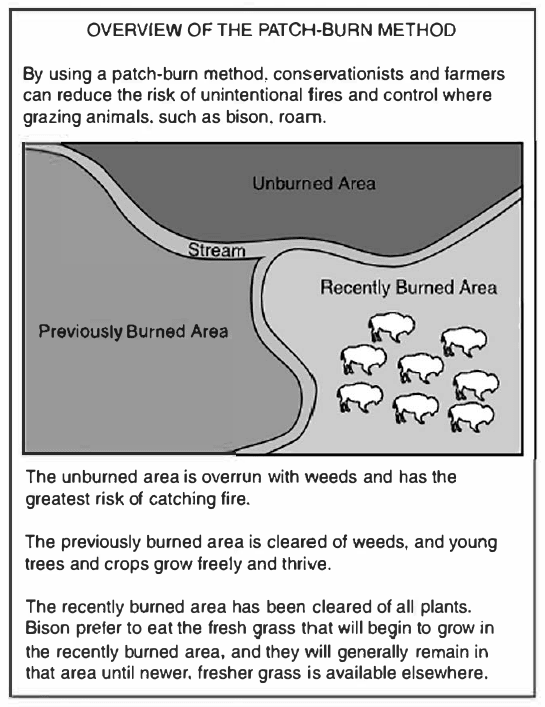
Question
According to the passage, how did fires started by natural causes prompt American Indians to begin practicing controlled burns?
- Aby drawing animals in to the area to feed on the new growth sprouting from the burned land
- Bby destroying tall trees and reducing the shade that had hindered the growth of planted crops
- Cby burning off excess vegetation and increasing the availability of nutrients for the remaining plants
- Dby causing changes to the bison’s migration habits as bison herds fled from the wildfires on the prairie
Show the answer
Correct answer: A
The question asks how observing the effects of the fires started by natural causes prompted American Indians to begin practicing controlled burns.
A. CORRECT. In paragraph 2, the author states that American Indians observed bison “grazing on tender new grass on the recently burned land rather than on grass in the unburned areas.” These observations prompted the practice of controlled burns as a means of enticing “the herds away from the people’s crops.”
B. Incorrect. Although the author mentions in paragraph 4 that the primary targets of a controlled burn are red cedar trees and that “these tall trees also cast shade that prevents sunlight from reaching the plants beneath them,” this detail supports why conservationists use controlled burns today, not what initially prompted the use of controlled burns.
C. Incorrect. While the author states in paragraph 3 that “the process of burning excess plant matter adds nitrogen, an essential element for plant growth, to the soil” and that “intentionally burning a portion of land can dramatically improve the quality of the vegetation that regrows there,” these details do not explain the initial observations that prompted American Indians to practice controlled burning.
D. Incorrect. While paragraph 2 mentions that bison moved to a new area to graze because they preferred the “tender new grass on the recently burned land,” there is no indication in the passage that bison changed their migration habits in order to flee wildfires.
Question analysis
This key-details question about an article on controlled burns at an Oklahoma tallgrass prairie preserve asks how fires started by lightning or other natural causes led American Indians to begin burning land on purpose. Students must find the passage's account of that early practice, and since the article describes several effects of fire, each choice has to be checked against what those first observers actually saw.
- Grade level
- Grade 7 reading and task
- Compared with grade 7
- At grade 7 Finding a stated cause in an informational text is regular grade 7 reading. The answer sits in one short paragraph, but the article describes several effects of fire, old and new, and the choices draw on them, which keeps the demand typical.
- Estimated difficulty
- Straightforward: two steps or one careful reading.
- Thinking it demands
- Depth of knowledge 2, skills and concepts · mainly understand
- What makes it hard
- Evidence
- Answered from one paragraph or stanza
- Reading level
- Passage: about grade 11, 598 words; question and choices: about grade 9, 86 words.
- Students, last 30 days
- Not enough answers yet to show (it takes 10).
Why it is hard, traps and wrong answers (shows the answer)
Why it is hard
The stem points to one short paragraph, but the article goes on to list many more benefits of fire, and two wrong choices borrow them: shade cleared from under red cedars and nutrients returned to the soil. Both are true of controlled burns today, not of what the Great Plains peoples first noticed. Students who return to paragraph 2 and restate the bison’s taste for freshly burned grass find the answer quickly.
Every choice must be checked minor Choosing the answer
Two wrong choices name real benefits of burning from later paragraphs, cedar shade removed in paragraph 4 and nutrients freed in paragraph 3, so each must be tested against what the early peoples saw. (Embretson & Wetzel, 1987)
Reading between the lines minor Working it out
Paragraph 2 never says the bison’s grazing caused the practice; students connect “realized that these fires could also be helpful” to the preference for burned land and the deliberate burns that follow. (Graesser, Singer & Trabasso, 1994; Kintsch, 1998)
Strategy: Go to the paragraph about the Great Plains peoples of hundreds of years ago, restate in your own words what they noticed after natural fires, and test each choice against that observation.
Traps
- Wrong part of the text: A choice is true of another paragraph, stanza or speaker than the one asked about.
- True but not the answer: A choice says something accurate about the text that does not answer this question.
- Twists what the text says: Uses the text's topic and ideas but changes what it says: who did it, how much, when, or why.
The wrong answers, classified
B Wrong part of the text (Kirsch & Mosenthal, 1990)
Borrows paragraph 4’s red cedars, whose shade blocks sunlight from the plants beneath them, and adds “planted crops,” though that shade explains modern burns, not the first deliberate ones.
C True but not the answer (King et al., 2004; Embretson & Wetzel, 1987)
States paragraph 3’s real benefits, weedy undergrowth burned away and nitrogen added to the soil, but the article gives them as reasons for burning today, not as what the early peoples observed.
D Twists what the text says (King et al., 2004)
Remembers that bison moved onto burned land but turns their preference for “tender new grass” into herds fleeing wildfire, a change in migration the passage never describes.
Working it out, step by step
Figure out what the question asks
This question asks about a cause. Long ago, fires started by lightning gave American Indians an idea. They began to burn land on purpose. You need to find what they saw that led them to do it. A controlled burn is a fire that people set and keep inside a planned area.
Find the right paragraph
Paragraph 2 tells this part of the story. It says the people “realized that these fires could also be helpful.” Then it says what they noticed: “The bison in the area seemed to prefer grazing on tender new grass on the recently burned land rather than on grass in the unburned areas.”
Put it in your own words
Grazing means eating grass. After a fire, soft new grass grew, and the bison liked it best. So the people began to burn land on purpose. The new grass pulled the herds to that land. That kept the bison away from the crops. The paragraph says the burning “enticed the herds away from the people’s crops.” Enticed means tempted or drew.
Check each choice
- A is right. The burned land drew animals, the bison, to eat the new grass.
- B is wrong. The shade of tall trees comes from paragraph 4. It explains why people burn red cedars today, not how burning began.
- C is wrong. Burning off weeds and adding nutrients come from paragraph 3. Nutrients are what plants need to grow. These are reasons for burning today.
- D is wrong. The bison moved toward the fresh grass. The passage never says herds fled from fires.
Watch out: C is true about controlled burns. But the question asks what first gave the people the idea. Paragraph 2 says it was the bison.
Choose the answer
The early people saw bison come to burned land to eat the new grass. So the answer is A: “by drawing animals in to the area to feed on the new growth sprouting from the burned land.”
Why this answer and not the closest wrong one
C is the closest wrong answer, because it names real good effects of fire. But paragraph 3 gives those as reasons people burn land “today.” The question asks how burning began hundreds of years ago. Paragraph 2 says it began when people watched bison feed on burned land.
More questions like this
The original DOE question
The passage “Using Fire to Keep a Prairie Healthy” as printed (page 41)
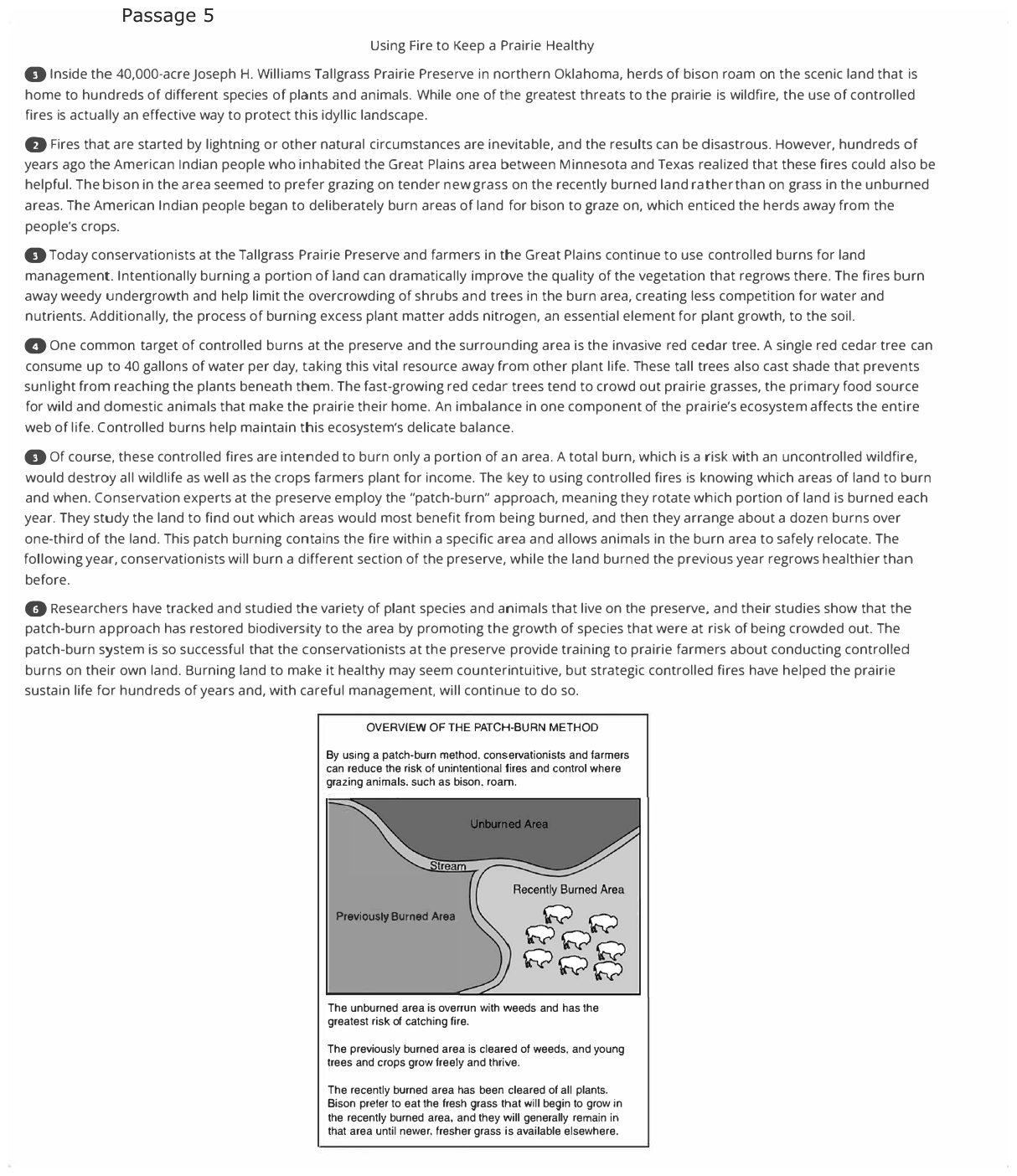
Question 27 of 57
2020 Test B English, question 27Uses the passage above: “Using Fire to Keep a Prairie Healthy”.
Question
Targeting red cedar trees in controlled burns affects the animals that live on the prairie mostly by
- Aensuring that the animals’ main food source has the conditions needed for it to thrive.
- Bendangering the animals that live near the trees scheduled for removal.
- Cmaking sure that the water supply for the animals is sufficient.
- Dreducing the animals’ natural source of shade and protection from the elements.
Show the answer
Correct answer: A
The question asks how targeting red cedar trees in controlled burns affects the animals that live on the prairie.
A. CORRECT. According to information in paragraph 4, targeting invasive red cedar trees with controlled burns affects animals that live on the prairie by ensuring that these trees do not “crowd out prairie grasses, the primary food source for wild and domestic animals that make the prairie their home.” The paragraph also states that each red cedar tree consumes “up to 40 gallons of water per day, taking this vital resource away from other plant life.” Removing red cedars thus increases the amount of water available to the prairie grasses and helps maintain favorable conditions for the animals’ main source of food.
B. Incorrect. Although the author mentions the potential danger to wildlife from an uncontrolled burn in paragraph 5, the author emphasizes that patch burning “allows animals in the burn area to safely relocate.” Therefore, the animals that live near trees scheduled for removal are not endangered by the controlled burns.
C. Incorrect. In paragraph 4, the author states that “a single red cedar tree can consume up to 40 gallons of water per day, taking this vital resource away from other plant life.” However, the author does not suggest that reducing the number of red cedar trees through controlled burns ensures a sufficient water supply for animals that live on the prairie.
D. Incorrect. In paragraph 4, the author states that “these tall trees also cast shade that prevents sunlight from reaching the plants beneath them.” However, the author does not suggest that using controlled burns to eliminate red cedar trees reduces a natural source of shade for prairie animals. The red cedar trees are invasive; therefore, the author does not consider them a “natural” part of the prairie ecosystem.
Question analysis
This question asks how burning invasive red cedar trees on purpose mostly affects the wild and domestic animals that live on the Oklahoma prairie. Students follow a chain of cause and effect through the paragraph on red cedars, which describes the trees' heavy water use, their shade and their spread, and must pick out the effect that matters most to the animals.
- Grade level
- Grade 7 reading and task
- Compared with grade 7
- At grade 7 Grade 7 readers routinely trace how one change leads to another in an informational text. This chain stays within one paragraph, but the paragraph names several things the cedars take from the prairie, and the stem's “mostly” asks for the main effect.
- Estimated difficulty
- Moderate: several steps, or a close reading with one strong distractor.
- Thinking it demands
- Depth of knowledge 2, skills and concepts · mainly analyze
- What makes it hard
- Reading between the lines moderate
- Much to keep track of minor
- The right answer is reworded minor
- Evidence
- Answered from one paragraph or stanza
- Reading level
- Passage: about grade 11, 598 words; question and choices: about grade 9, 66 words.
- Students, last 30 days
- Not enough answers yet to show (it takes 10).
Why it is hard, traps and wrong answers (shows the answer)
Why it is hard
Paragraph 4 lists three harms the red cedar does, drinking water, casting shade and crowding out grasses, and the wrong choices hand the water and the shade straight to the animals. In the text, all three harms fall on plants, and animals feel them only through the grasses they eat. Students who ask who suffers each harm see that protecting the food supply is the main effect the stem’s “mostly” asks for.
Reading between the lines moderate Working it out
Paragraph 4 never names an effect on animals; students must chain the cedars crowding out “prairie grasses,” the grasses being “the primary food source,” and the burns that remove the cedars. (Graesser, Singer & Trabasso, 1994; Kintsch, 1998)
Much to keep track of minor Working it out
The paragraph names three harms at once, 40 gallons of water a day, shade over the plants below and crowding, and students must track which living things each harm reaches. (Sweller, 1988; Carpenter, Just & Shell, 1990)
The right answer is reworded minor Choosing the answer
The right choice speaks of “conditions needed for it to thrive” without naming grass or cedars, while the wrong ones repeat the paragraph’s vivid details of water and shade. (Freedle & Kostin, 1993; Kirsch & Mosenthal, 1990)
Strategy: Reread the paragraph about red cedars and list each way the trees harm the prairie, then ask which of those harms reaches the animals and which would matter to them most.
Traps
- Twists what the text says: Uses the text's topic and ideas but changes what it says: who did it, how much, when, or why.
- Outside knowledge: A choice is plausible in the real world but not supported by this text.
The wrong answers, classified
B Outside knowledge (King et al., 2004; Recht & Leslie, 1988)
Assumes that fire near animals must endanger them, a common belief, though paragraph 5 says patch burning “allows animals in the burn area to safely relocate.”
C Twists what the text says (King et al., 2004)
Seizes on the 40 gallons a red cedar drinks each day, but the passage says that water is taken from “other plant life,” not from the animals’ supply.
D Twists what the text says (King et al., 2004)
Turns the cedars’ shade, which blocks sunlight from “the plants beneath them,” into shelter for animals, though the passage treats the invasive trees as a harm, never a natural refuge.
Working it out, step by step
Figure out what the question asks
This question asks about cause and effect. People burn red cedar trees on purpose. You need to find how that mostly helps the animals. The word “mostly” means you want the biggest effect, not just any effect.
Find what the red cedars do
Paragraph 4 is about red cedars. It names three harms. First, one tree can drink “up to 40 gallons of water per day, taking this vital resource away from other plant life.” Second, the trees “cast shade that prevents sunlight from reaching the plants beneath them.” Third, they “tend to crowd out prairie grasses, the primary food source for wild and domestic animals.”
Ask who each harm hurts
Look at who loses each time. The water is taken from “other plant life.” The shade blocks light from “the plants beneath them.” The crowding pushes out prairie grasses. So every harm falls on plants. The animals feel it through the grass, because grass is their main food. Primary means main. So burning the cedars mostly helps the animals by protecting their food.
Check each choice
- A is right. The animals’ main food source is prairie grass. With the cedars gone, the grass gets water, sunlight and room to grow.
- B is wrong. Paragraph 5 says patch burning “allows animals in the burn area to safely relocate.” Relocate means move somewhere else.
- C is wrong. The cedars take water from plants. The passage never says the animals run short of water.
- D is wrong. The shade blocks light from plants. The passage never calls it shelter for animals.
Watch out: The 40 gallons of water is a striking fact, so C is tempting. But that water is taken from “other plant life.”
Choose the answer
Burning the cedars keeps the grass healthy, and the grass feeds the animals. Thrive means grow well. So the answer is A: “ensuring that the animals’ main food source has the conditions needed for it to thrive.”
Why this answer and not the closest wrong one
C is the closest wrong answer, because paragraph 4 does talk about water. But it says the cedars take water from plants, not from animals. The grass, the animals’ main food, is what suffers from all three harms. So A fits better.
More questions like this
The original DOE question
Question 28 of 57
2020 Test B English, question 28Uses the passage above: “Using Fire to Keep a Prairie Healthy”.
Question
Read this sentence from paragraph 6.
The patch-burn system is so successful that the conservationists at the preserve provide training to prairie farmers about conducting controlled burns on their own land.
The author includes this sentence to show that
- Athe conservationists are better qualified to lead preservation efforts than farmers are.
- Bthe conservationists are eager to involve others in the preservation of the prairie.
- Cthe conservationists’ efforts will restore the original beauty and biodiversity of the region.
- Dthe conservationists’ training program should serve as a model for other conservation organizations.
Show the answer
Correct answer: B
The question asks what the author intends to show by using the second sentence in paragraph 6 in the passage.
A. Incorrect. Although the author refers to the conservationists as “experts” in paragraph 5 and states that conservationists “provide training to prairie farmers” (paragraph 6), the second sentence in paragraph 6 does not imply that the conservationists are better qualified to lead preservation efforts than farmers are. Instead, the sentence shows that conservationists believe that prairie farmers are capable of performing the controlled burns that contribute to overall conservation efforts.
B. CORRECT. The conservationists are eager to involve others in the preservation of the prairie, because “studies show that the patch-burn approach has restored biodiversity to the area by promoting the growth of species that were at risk of being crowded out” and that the process has “helped the prairie sustain life for hundreds of years” (paragraph 6). The second sentence in paragraph 6 describes how conservationists are sharing their knowledge about preservation techniques with people who live on the prairie.
C. Incorrect. Although the author points out in paragraph 6 that “studies show that the patch-burn approach has restored biodiversity to the area by promoting the growth of species that were at risk of being crowded out,” the idea that controlled burns may help restore the original biodiversity of the prairie is not the focus of the second sentence in paragraph 6, which notes only that conservationists are providing training to farmers about controlled burns.
D. Incorrect. The author mentions in paragraph 6 that the patch-burn system has been “successful” and suggests in the last sentence of the paragraph that the use of controlled burns will continue to benefit the prairie ecosystem. These details imply that this system will continue to be used and may even become more widespread. However, the second sentence in paragraph 6 merely describes a patch-burn training program that already exists and does not suggest that this program should serve as a model for other organizations.
Question analysis
This question quotes a sentence from the last paragraph of the prairie article, about the preserve's conservationists training farmers to run controlled burns on their own land, and asks why the author includes it. Students must work out what this one sentence contributes, and because every choice sounds like something a successful program might show, the test is whether the sentence itself supports it.
- NYS standards
- 7R5 structure and genre features
- Grade level
- Grade 7 reading and task
- Compared with grade 7
- At grade 7 Explaining why an author includes a sentence is everyday grade 7 work. The sentence is short and plainly worded, and the choices stay close to the passage's ideas, so each must be measured against what the sentence itself says.
- Estimated difficulty
- Moderate: several steps, or a close reading with one strong distractor.
- Thinking it demands
- Depth of knowledge 2, skills and concepts · mainly analyze
- What makes it hard
- How, not what moderate
- Reading between the lines moderate
- Evidence
- Answered from one sentence or line
- Reading level
- Passage: about grade 11, 598 words; question and choices: about grade 11, 89 words.
- Students, last 30 days
- Not enough answers yet to show (it takes 10).
Why it is hard, traps and wrong answers (shows the answer)
Why it is hard
Every choice reads something into one plain sentence, so the decision is how far the sentence lets a reader go. Teaching farmers to burn their own land shows a wish to spread the work, which the right choice calls eagerness to involve others. The wrong choices go further: to a ranking of experts over farmers, to restoring the region’s original beauty, or to a model for other organizations, none of which the sentence states.
How, not what moderate Working it out
The stem asks why the author includes the training sentence, so students must say what it adds after the studies of restored biodiversity, not merely restate that farmers are trained. (Anderson & Krathwohl, 2001)
Reading between the lines moderate Working it out
Nothing in the sentence calls the conservationists “eager”; that has to be read from their choosing to teach their method to farmers so that it spreads beyond the preserve. (Graesser, Singer & Trabasso, 1994; Kintsch, 1998)
Strategy: Restate the sentence in your own words, then ask what it adds to the paragraph's account of the patch-burn system's success, rejecting any choice that claims more than the sentence says.
Traps
- Reads too much in: A reasonable-sounding conclusion that goes further than the text allows.
- Wrong part of the text: A choice is true of another paragraph, stanza or speaker than the one asked about.
- Too broad or too strong: A choice overstates, generalizes, or uses absolute words the text does not support.
The wrong answers, classified
A Reads too much in (Graesser, Singer & Trabasso, 1994)
Reads experts training farmers as a ranking of who should lead, though the sentence shows trust that farmers can run burns themselves, not a claim of superior qualifications.
C Wrong part of the text (Kirsch & Mosenthal, 1990)
Draws on the sentence before, where studies show “the patch-burn approach has restored biodiversity,” and adds “original beauty,” though the training sentence itself is about sharing the method.
D Too broad or too strong (King et al., 2004)
Takes “so successful” as an endorsement and stretches one preserve’s training of local farmers into a model that other conservation organizations should follow, a recommendation the author never makes.
Working it out, step by step
Figure out what the question asks
This question asks why the author put one sentence in the passage. The sentence says the patch-burn system works so well that the preserve’s experts train farmers. You need to decide what that sentence shows, and no more.
Read the sentence closely
The sentence says “the conservationists at the preserve provide training to prairie farmers about conducting controlled burns on their own land.” Conservationists are people who work to protect nature. Conducting means carrying out. So the experts teach farmers to do the burns themselves.
Decide what it shows
Why would experts teach their method to others? Because they want more people to help. Their method works, so they share it. Then the burns can happen on farms too, not only at the preserve. That shows they want others to join in protecting the prairie. Preservation means keeping something safe and healthy.
Check each choice
- A is wrong. Teaching farmers shows trust that farmers can do it. It doesn’t say experts should lead instead of farmers.
- B is right. Training farmers brings more people into caring for the prairie.
- C is wrong. Restored biodiversity comes from the sentence before. Biodiversity means many kinds of living things. This sentence is about sharing the method.
- D is wrong. The author never says other groups should copy this program.
Watch out: The words “so successful” make D sound right. But the sentence only says the preserve trains local farmers. It doesn’t call the program a model for others.
Choose the answer
The experts share their method so farmers can help too. So the answer is B: “the conservationists are eager to involve others in the preservation of the prairie.”
Why this answer and not the closest wrong one
D is the closest wrong answer, because “so successful” sounds like high praise. But D adds an idea the sentence never states: that other groups should copy the program. B stays with what the sentence shows, experts teaching farmers so they can help.
More questions like this
The original DOE question
Question 29 of 57
2020 Test B English, question 29Uses the passage above: “Using Fire to Keep a Prairie Healthy”.
Question
Which details from the passage best convey the central idea that using the patch-burn method is an effective way to protect and manage prairie land?
- Athe explanation that conservationists use the alternating burn pattern of the patch-burn method in order to allow the animals in the area to avoid the fire
- Bthe information that conservationists evaluate which land would most benefit from a controlled burn before applying the patch-burn method
- Cthe information that conservationists have determined that the patch-burn method has promoted the growth of species that were at risk of being crowded out
- Dthe explanation that conservationists are able to control the fire in the patch-burn method by arranging separate burns across the designated portion of land
Show the answer
Correct answer: C
The question asks which details from the passage best convey the central idea that using the patch-burn method is an effective way to protect and manage prairie land.
A. Incorrect. The author explains in paragraph 5 that “patch burning contains the fire within a specific area and allows animals in the burn area to safely relocate.” This explanation conveys two supporting ideas: the patch-burn method is controllable, and patch-burn fires do not pose a threat to animals. However, this explanation does not address the broader central idea that the patch-burn method is an effective way to protect and manage prairie land.
B. Incorrect. In paragraph 5, the author states that “the key to using controlled fires is knowing which areas of land to burn and when.” The author then provides information about how conservation experts “study the land to find out which areas would most benefit from being burned.” However, these details convey supporting ideas rather than the central idea that using the patch-burn method is an effective way to protect and manage prairie land.
C. CORRECT. In paragraph 3, the author states that “fires burn away weedy undergrowth and help limit the overcrowding of shrubs and trees in the burn area, creating less competition for water and nutrients.” Also, in paragraph 6, the author states that patch burning “has restored biodiversity to the area by promoting the growth of species that were at risk of being crowded out.” These details directly convey the central idea that using the patch-burn method is an effective way to protect and manage prairie land.
D. Incorrect. The author explains in paragraph 5 how conservationists “arrange about a dozen burns over one-third of the land,” which helps show how the patch-burn method is applied by conservationists. However, this is a supporting detail that conveys the idea that the burns are deliberately set and carefully controlled. This detail does not convey the central idea that using the patch-burn method is an effective way to manage and protect prairie land.
Question analysis
This evidence question on the article about controlled burns at an Oklahoma tallgrass prairie preserve asks which details best convey the central idea that the patch-burn method is an effective way to protect and manage prairie land. Every choice reports something the article really says about the method, so students must decide which details speak most directly to the central idea as stated.
- Grade level
- Grade 7 reading and task
- Compared with grade 7
- At grade 7 Matching details to a stated central idea is regular grade 7 work, and the article is short and clearly written. Each choice is a long, accurate description, so the work lies in judging relevance rather than truth, which is typical.
- Estimated difficulty
- Moderate: several steps, or a close reading with one strong distractor.
- Thinking it demands
- Depth of knowledge 2, skills and concepts · mainly evaluate
- What makes it hard
- Every choice must be checked moderate
- Evidence in several places minor
- A lot to read minor
- Evidence
- Answered from several paragraphs or stanzas
- Reading level
- Passage: about grade 11, 598 words; question and choices: about grade 13, 118 words.
- Students, last 30 days
- Not enough answers yet to show (it takes 10).
Why it is hard, traps and wrong answers (shows the answer)
Why it is hard
The central idea joins three words, protect, manage and effective, and each wrong choice speaks to protect or manage with a step in carrying out the method: keeping animals safe, choosing the land, controlling the fire. Only a result shows that the method is effective, and the one result offered is the return of species once at risk of being crowded out. Students who ask what each detail proves, not what it is about, separate how the method works from whether it works.
Every choice must be checked moderate Choosing the answer
All four choices report the patch-burn method accurately, the animals’ safe relocation, the study of the land, the dozen burns and the restored species, so truth rules none out; each must be tested for proof the method works. (Embretson & Wetzel, 1987)
Evidence in several places minor Working it out
Three choices come from paragraph 5, where the method is explained, while the result that shows it works, restored biodiversity, sits in paragraph 6, after the description ends. (Kirsch & Mosenthal, 1990; Gorin & Embretson, 2006)
A lot to read minor Understanding the question
Each choice is a noun phrase of 19 to 26 words opening “the explanation that” or “the information that,” so four long details must be unpacked before they can be compared. (Kintsch, 1998; Gorin & Embretson, 2006; Freedle & Kostin, 1993)
Strategy: Restate the central idea in your own words, noting what “effective” requires, then ask of each choice whether that detail would persuade a doubtful reader of the whole idea.
Traps
- Supports only part of the claim: In a question about evidence: a line that backs one half of the claim but not the other, or a related point rather than the claim itself.
The wrong answers, classified
A Supports only part of the claim (King et al., 2004; Thissen, Steinberg & Fitzpatrick, 1989)
Links “protect” in the central idea to the animals’ chance to “safely relocate” in paragraph 5, a true detail of how patch burns are run, not proof they improve the prairie.
B Supports only part of the claim (King et al., 2004; Thissen, Steinberg & Fitzpatrick, 1989)
Hears effectiveness in “would most benefit,” but experts studying the land before a burn shows how they plan where to burn, not that the burns have worked.
D Supports only part of the claim (King et al., 2004; Thissen, Steinberg & Fitzpatrick, 1989)
Connects “manage” and “protect” to fire kept under control by arranging “about a dozen burns over one-third of the land,” which shows how the method is applied, not what it achieves.
Working it out, step by step
Figure out what the question asks
This asks which details best support a central idea. A central idea is a main point the whole passage develops. Here the idea is given: the patch-burn method is an effective way to protect and manage prairie land. Effective means it works and gets good results. So look for details that show results, not just how the method is done.
Find how the method works
Paragraph 5 explains the patch-burn method. The experts “rotate which portion of land is burned each year.” Rotate means take turns. First, “They study the land to find out which areas would most benefit from being burned.” Then “they arrange about a dozen burns over one-third of the land.” This “contains the fire within a specific area and allows animals in the burn area to safely relocate.” These details tell how the method is done.
Find what the method achieves
Paragraph 6 gives the results. Researchers studied the plants and animals on the preserve. Their studies show “that the patch-burn approach has restored biodiversity to the area by promoting the growth of species that were at risk of being crowded out.” Biodiversity means many kinds of living things. A species is one kind of plant or animal. Crowded out means pushed aside, the way red cedars crowd out prairie grasses in paragraph 4. So the method helped species that were losing ground. That shows it works.
Check each choice
- A does not fit. Animals escaping safely shows the burns are done with care. It does not show the land gets healthier.
- B does not fit. Studying the land is a planning step before a burn. It shows how the experts choose, not whether the burns work.
- C fits. It reports a result: the method helped species that were at risk.
- D does not fit. Arranging a dozen burns shows how the fire is kept under control. It does not show what the burns achieve.
Watch out: D sounds like “manage,” since the experts control the fire. But controlling a fire is part of doing the method. Only a result proves the method is effective.
Choose the answer
Only one choice shows the patch-burn method getting good results. So the answer is C, “the information that conservationists have determined that the patch-burn method has promoted the growth of species that were at risk of being crowded out.”
Why this answer and not the closest wrong one
D is the closest wrong choice. Careful control sounds like good management. But D only describes how the burns are set up. A method can be done carefully and still fail. C gives the proof that it works: studies show the burns “restored biodiversity.” Paragraph 6 even calls the system “so successful.”
More questions like this
The original DOE question
Question 30 of 57
2020 Test B English, question 30Uses the passage above: “Using Fire to Keep a Prairie Healthy”.
Question
Which sentence supports the idea that farmers and people who manage land may be concerned about using fire as a way to benefit the land?
- A“While one of the greatest threats to the prairie is wildfire, the use of controlled fires is actually an effective way to protect this idyllic landscape.” (paragraph 1)
- B“The American Indian people began to deliberately burn areas of land for bison to graze on, which enticed the herds away from the people’s crops.” (paragraph 2)
- C“This patch burning contains the fire within a specific area and allows animals in the burn area to safely relocate.” (paragraph 5)
- D“The following year, conservationists will burn a different section of the preserve, while the land burned the previous year regrows healthier than before.” (paragraph 5)
Show the answer
Correct answer: A
The question asks which sentence supports the idea that farmers and people who manage land may be concerned about using fire as a way to benefit the land.
A. CORRECT. The sentence from paragraph 1 supports the idea that farmers and people who manage land may be concerned about using fire as a way to benefit the land because it acknowledges that “one of the greatest threats to the prairie is wildfire.”
B. Incorrect. Although the sentence from paragraph 2 relates how American Indians “began to deliberately burn areas of land for bison to graze on” and to protect people’s crops, the sentence does not support the idea that farmers and people who manage land may be concerned about using fire as a way to benefit the land. Instead, it focuses on the cause-and-effect relationship between bison and newly burned areas.
C. Incorrect. The sentence from paragraph 5 provides details about how “patch burning contains the fire” and “allows animals in the burn area to safely relocate,” but it does not adequately support the idea that farmers and people who manage land may be concerned about using fire as a way to benefit the land, because it does not mention that wildfires can be a threat to the prairie.
D. Incorrect. While the sentence from paragraph 5 does explain how “conservationists will burn a different section of the preserve” in order to rotate the process year after year so that the burned land has time to regrow, the sentence does not support the idea that farmers and people who manage land may be concerned about using fire as a way to benefit the land because it does not mention the potential for total burns.
Question analysis
This evidence question asks which sentence from the article on controlled prairie burns supports the idea that farmers and others who manage land may be concerned about using fire to benefit it. The passage never states that concern directly, so students must infer it, and all four quoted sentences, taken from across the article, talk about burning land in some way.
- Grade level
- Grade 8 reading and task
- Compared with grade 7
- Above grade 7 Grade 7 evidence questions usually ask for support of an idea the text states. This idea, that people who manage land may worry about using fire, is never stated outright, so students must infer which sentence implies it, more than typical.
- Estimated difficulty
- Hard: combines ideas, needs a plan, and has more than one tempting wrong answer.
- Thinking it demands
- Depth of knowledge 3, strategic thinking · mainly evaluate
- What makes it hard
- Reading between the lines major
- A very close wrong answer moderate
- Every choice must be checked minor
- Evidence
- Answered from one sentence or line
- Reading level
- Passage: about grade 11, 598 words; question and choices: about grade 13, 123 words.
- Students, last 30 days
- Not enough answers yet to show (it takes 10).
Why it is hard, traps and wrong answers (shows the answer)
Why it is hard
The idea to support is about people’s feelings, yet none of the four sentences mentions farmers worrying, so students have to decide what would justify such worry. The opening sentence does it by naming wildfire as a great threat before praising controlled fire, a concession many students read past as background. The strongest pull is the sentence on containing the fire, which implies caution but presents patch burning as the answer, not the concern.
Reading between the lines major Working it out
No sentence mentions worry; students must see that calling wildfire “one of the greatest threats to the prairie” gives landowners a reason to fear fire, and that “actually” answers that fear. (Graesser, Singer & Trabasso, 1994; Kintsch, 1998)
A very close wrong answer moderate Choosing the answer
The patch-burn sentence about containing the fire “within a specific area” also hints at fire’s danger; it differs from the right one by describing the safeguard without ever naming a threat. (Embretson & Wetzel, 1987; Gorin & Embretson, 2006; Ascalon et al., 2007)
Every choice must be checked minor Choosing the answer
The four sentences come from paragraphs 1, 2 and 5, and each is about burning land, so each must be tested for a hint of risk rather than for its topic. (Embretson & Wetzel, 1987)
Strategy: Before rereading the choices, decide what a sentence would need to say to show that landowners have reason to be wary of fire, then test each quoted sentence for exactly that.
Traps
- Supports only part of the claim: In a question about evidence: a line that backs one half of the claim but not the other, or a related point rather than the claim itself.
- True but not the answer: A choice says something accurate about the text that does not answer this question.
The wrong answers, classified
B True but not the answer (King et al., 2004; Embretson & Wetzel, 1987)
Links “the people’s crops” to farmers, but the sentence tells how early burns drew bison away from the crops and shows no worry about fire itself.
C Supports only part of the claim (King et al., 2004; Thissen, Steinberg & Fitzpatrick, 1989)
Sees caution in containing the fire “within a specific area,” but the sentence explains how patch burning keeps animals safe and never says fire threatens the land.
D Supports only part of the claim (King et al., 2004; Thissen, Steinberg & Fitzpatrick, 1989)
Takes the yearly rotation as a careful precaution, but the sentence describes the schedule and land that “regrows healthier than before,” which backs the benefit, not the worry.
Working it out, step by step
Figure out what the question asks
This is an evidence question. Evidence is the words in a text that back up an idea. The idea here is that farmers might worry about using fire to help land. No sentence says farmers are worried. So look for a sentence that gives them a reason to fear fire.
Decide what the evidence needs
A sentence that supports this idea must show that fire can be dangerous. If fire can harm land, people have a reason to be careful with it. So test each sentence with one question: does it say fire is a threat?
Look closely at paragraph 1
Choice A quotes paragraph 1. Its first half says “one of the greatest threats to the prairie is wildfire.” That is a reason to fear fire. Its second half says controlled fires are “actually” helpful. The word “actually” pushes back against that fear. It means: you might expect fire to hurt the land, but here it helps.
Check each choice
- A is right. It names wildfire as a great threat. That gives farmers a reason to worry about fire.
- B is wrong. It tells how early burns drew bison away from crops. It shows no danger from fire.
- C is wrong. It tells how patch burning keeps the fire in one area. It describes a safety step but never names a threat.
- D is wrong. It describes burning a new section each year. It shows a benefit: land that “regrows healthier than before.”
Watch out: C hints that fire must be contained, or kept in, so it sounds careful. But it describes the solution, not the danger.
Choose the answer
Only one sentence names fire as a danger. So the answer is A, the sentence from paragraph 1: “While one of the greatest threats to the prairie is wildfire, the use of controlled fires is actually an effective way to protect this idyllic landscape.” Idyllic means peaceful and lovely.
Why this answer and not the closest wrong one
C is the closest wrong answer, because keeping fire “within a specific area” suggests caution. But C only explains how patch burning works. It never says fire can harm the prairie. A does, by calling wildfire one of the greatest threats.
More questions like this
The original DOE question
Question 31 of 57
2020 Test B English, question 31Uses the passage above: “Using Fire to Keep a Prairie Healthy”.
Question
Read this sentence from paragraph 6.
Burning land to make it healthy may seem counterintuitive, but strategic controlled fires have helped the prairie sustain life for hundreds of years and, with careful management, will continue to do so.
The words “counterintuitive” and “strategic” in the sentence convey the idea that
- Athe safest methods are sometimes the least effective at solving complex challenges.
- Bthorough investigation of uncommon methodologies can lead to beneficial results.
- Cdetailed planning can ensure that a potentially destructive action has a positive impact.
- Dplans that entail a certain amount of risk almost always result in success.
Show the answer
Correct answer: C
The question asks which idea the words “counterintuitive” and “strategic” convey in the last sentence in paragraph 6 in the passage.
A. Incorrect. Though the author states in paragraph 6 that conservationists have used safe and “strategic” methods, those methods have not been ineffective, since “the patch-burn system is so successful that the conservationists at the preserve provide training to prairie farmers about conducting controlled burns on their own land” (paragraph 6). Therefore, the words “counterintuitive” and “strategic” in the last sentence of paragraph 6 do not convey the idea that the safest methods are sometimes the least effective at solving complex challenges.
B. Incorrect. Although the author points out in paragraph 6 that researchers’ studies have shown “that the patch-burn approach has restored biodiversity to the area by promoting the growth of species that were at risk of being crowded out,” the author does not suggest that the methodologies conservationists used to conduct the patch burns are uncommon, since the methods were used by “the American Indian people [who] began to deliberately burn areas of land for bison to graze on” (paragraph 2). Therefore, the words “counterintuitive” and “strategic” in the last sentence of paragraph 6 do not convey the idea that thorough investigation of uncommon methodologies can lead to beneficial results.
C. CORRECT. In paragraph 1, the author states that “one of the greatest threats to the prairie is wildfire,” so the idea of conducting controlled burns suggests risk and runs “counter,” or contrary, to people’s common expectations, or “intuition,” about the dangers of fires. Thus, the words “counterintuitive” and “strategic” in the last sentence of paragraph 6 convey the idea that detailed planning can ensure that a potentially destructive action has a positive impact.
D. Incorrect. The author states in paragraph 6 that “the patch-burn system is so successful that the conservationists at the preserve provide training to prairie farmers.” This statement supports the idea of the action being “strategic” in order to achieve success. However, the statement does not suggest that because the process is “counterintuitive,” or unexpected, it involves a certain amount of risk to achieve that success. Therefore, the words “counterintuitive” and “strategic” in the last sentence of paragraph 6 do not convey the idea that plans that entail a certain amount of risk almost always result in success.
Question analysis
This vocabulary question takes the last sentence of the prairie article, which says burning land to make it healthy may seem counterintuitive, and asks what the words “counterintuitive” and “strategic” convey together. Students need the meaning of a hard word built from a prefix, then must match the pair to a general statement, and the choices are worded abstractly.
- Grade level
- Grade 8 reading and task
- Compared with grade 7
- Above grade 7 A typical grade 7 vocabulary question asks what one word means in context. This one pairs a hard word, “counterintuitive,” with “strategic” and asks for the idea they express together, with four abstract general statements to weigh.
- Estimated difficulty
- Hard: combines ideas, needs a plan, and has more than one tempting wrong answer.
- Thinking it demands
- Depth of knowledge 2, skills and concepts · mainly understand
- What makes it hard
- A very close wrong answer moderate
- Hard words moderate
- Combines ideas minor
- Evidence
- Answered from one sentence or line
- Reading level
- Passage: about grade 11, 598 words; question and choices: about grade 11, 97 words.
- Students, last 30 days
- Not enough answers yet to show (it takes 10).
Why it is hard, traps and wrong answers (shows the answer)
Why it is hard
Students first need the meaning of “counterintuitive,” then must see what it says here: that burning land to heal it seems backward because fire destroys. “Strategic” supplies the other half, careful planning. The most tempting wrong answer gets the planning right but misreads the first word as “uncommon,” and others turn the pair into a rule about risk or a warning about safe methods. The question rewards translating each word before reading the abstract choices.
A very close wrong answer moderate Choosing the answer
The choice about “thorough investigation of uncommon methodologies” follows the key’s pattern, planning that leads to a good result, and differs only in calling the method uncommon instead of potentially destructive. (Embretson & Wetzel, 1987; Gorin & Embretson, 2006; Ascalon et al., 2007)
Hard words moderate Understanding the question
“Counterintuitive,” contrary to what one would expect, is an uncommon word, and the choices add “methodologies” and “entail,” so the options are as hard to read as the sentence. (Perfetti, 2007; Freedle & Kostin, 1993)
Combines ideas minor Working it out
The two words point different ways, one to burning that seems harmful and one to careful planning, and the answer must join both into a single general statement. (Embretson, 1998; Daniel & Embretson, 2010)
Strategy: Break “counterintuitive” into its parts, counter and intuitive, decide what each of the two words says about burning land, then find the statement that joins both meanings without adding claims of its own.
Traps
- Half right: One half of a two-part choice is right and the other is not.
- Too broad or too strong: A choice overstates, generalizes, or uses absolute words the text does not support.
- Twists what the text says: Uses the text's topic and ideas but changes what it says: who did it, how much, when, or why.
The wrong answers, classified
A Twists what the text says (King et al., 2004)
Reads “counterintuitive” as a hint that the safe choice fails, but the sentence praises carefully managed fire and never says safer methods are less effective.
B Half right (King et al., 2004; Thissen, Steinberg & Fitzpatrick, 1989)
Matches “strategic” to thorough investigation, since the experts “study the land,” but takes “counterintuitive” to mean uncommon, though the passage traces burning back hundreds of years.
D Too broad or too strong (King et al., 2004)
Hears risk in “counterintuitive” and success in “strategic” but turns them into a rule that risky plans “almost always” succeed, far more than one sentence about the prairie claims.
Working it out, step by step
Figure out what the question asks
This question asks about two words in the last sentence: “counterintuitive” and “strategic.” You need the idea the two words give together. So first figure out what each word means here.
Break down “counterintuitive”
Counter means against. Intuitive means what you would naturally expect. So counterintuitive means the opposite of what you would expect. The sentence says “Burning land to make it healthy may seem counterintuitive.” Fire usually destroys things. So burning land to help it seems backward. Paragraph 1 even calls wildfire “one of the greatest threats to the prairie.”
Figure out “strategic”
Strategic means carefully planned to reach a goal. Paragraph 5 shows that planning. The experts “study the land to find out which areas would most benefit from being burned.” Then they burn only part of the land each year. Put the two words together. Fire seems harmful, but careful planning makes it helpful.
Check each choice
- A is wrong. The sentence doesn’t say safe methods fail. It praises a method that works.
- B is wrong. It treats counterintuitive as if it meant uncommon. But burning isn’t new. Paragraph 2 says people did it “hundreds of years ago.”
- C is right. Strategic matches detailed planning. Counterintuitive matches an action that could destroy, fire, which turns out to help.
- D is wrong. “Almost always” is far too strong. The sentence is about prairie fires, not all risky plans.
Watch out: B gets strategic right, since the experts study the land. But counterintuitive doesn’t mean uncommon. It means against what you would expect.
Choose the answer
Fire seems destructive, but a careful plan makes it helpful. So the answer is C: “detailed planning can ensure that a potentially destructive action has a positive impact.”
Why this answer and not the closest wrong one
B is the closest wrong answer, because its first part, careful study, fits strategic. But its second part calls the method uncommon, and people have burned the prairie for hundreds of years. C fits both words: careful planning, and an action that seems harmful but helps.
More questions like this
The original DOE question
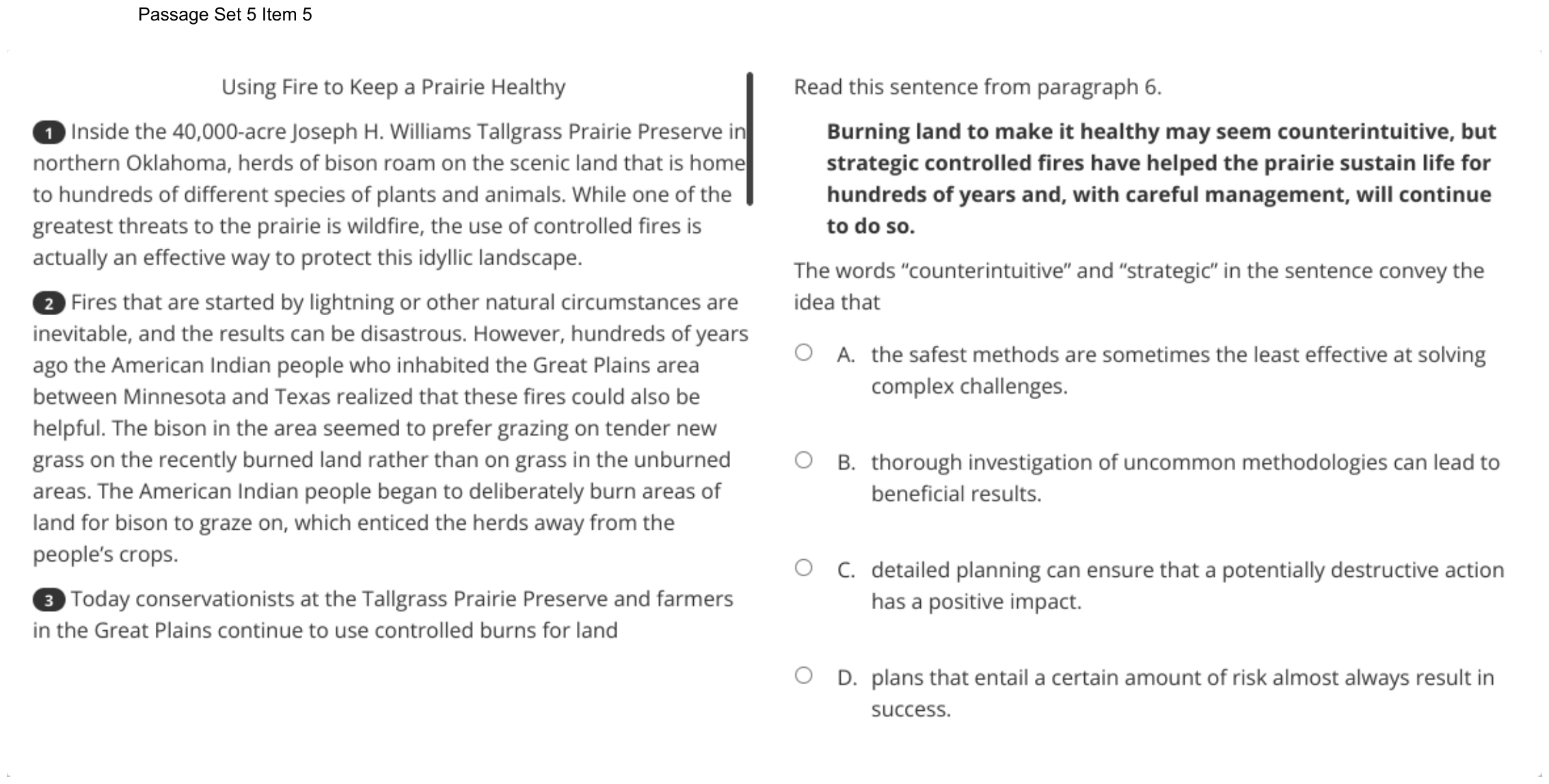
Question 32 of 57
2020 Test B English, question 32Uses the passage above: “Using Fire to Keep a Prairie Healthy”.
Question
With which statement would the author most likely agree?
- AIt is important to explain the purposes and the risks of controlled burns to the people living near a proposed burn area.
- BIt is necessary to thoroughly examine a particular region in order to plan and execute a successful controlled burn.
- CMonitoring animals’ reactions after a controlled burn on the prairie is a minor part of scientists’ research.
- DConservationists should consider the helpful aspects of invasive species before executing a controlled burn.
Show the answer
Correct answer: B
The question asks with which statement the author of the passage would most likely agree.
A. Incorrect. In paragraph 5, the author states that “patch burning contains the fire within a specific area and allows animals in the burn area to safely relocate,” and paragraph 6 states that conservationists “provide [important] training to prairie farmers about conducting controlled burns on their own land.” However, the author does not explicitly take a position about the importance of explaining the purposes and the risks of controlled burns to the people living near a proposed burn area. Therefore, the evidence in the passage does not strongly suggest that the author would agree with this statement.
B. CORRECT. In paragraph 5, the author points out that conservationists “study the land to find out which areas would most benefit from being burned, and then they arrange about a dozen burns over one-third of the land” and “rotate which portion of land is burned each year” so that animals, such as bison, can “safely relocate.” Therefore, the author would most likely agree that it is necessary to thoroughly examine a particular region in order to plan and execute a successful controlled burn.
C. Incorrect. The author of the passage would be unlikely to agree that monitoring animals’ reactions after a controlled burn on the prairie is a minor part of scientists’ research. In paragraph 5, the author explains that patch burning “allows animals in the burn area to safely relocate” and that conservationists “burn a different section of the preserve” each year to ensure that animals have an abundant area to graze while other areas are being burned.
D. Incorrect. According to the information in paragraph 4, conservationists commonly target invasive red cedar trees because they are tall trees that “crowd out prairie grasses, the primary food source for wild and domestic animals that make the prairie their home.” Since the focus is on the harm that the invasive red cedar can cause, the author would be unlikely to agree that conservationists should consider the helpful aspects of invasive species before executing a controlled burn.
Question analysis
This point-of-view question asks which statement the author of the prairie-burning article would most likely agree with. Students infer the author's position from details spread through the passage, and since some choices sound like sensible advice in general, each must be traced back to what the article actually supports.
- Grade level
- Grade 7 reading and task
- Compared with grade 7
- At grade 7 Inferring what an author would agree with is typical grade 7 work on point of view. The choices draw on different paragraphs, and the author's views are stated fairly plainly, so careful checking settles it without a long chain of inference.
- Estimated difficulty
- Straightforward: two steps or one careful reading.
- Thinking it demands
- Depth of knowledge 2, skills and concepts · mainly analyze
- What makes it hard
- Every choice must be checked moderate
- Reading between the lines minor
- Evidence
- Answered from several paragraphs or stanzas
- Reading level
- Passage: about grade 11, 598 words; question and choices: about grade 11, 81 words.
- Students, last 30 days
- Not enough answers yet to show (it takes 10).
Why it is hard, traps and wrong answers (shows the answer)
Why it is hard
The right statement is close to a paraphrase of paragraph 5, where the experts study the land before choosing where to burn, so careful readers settle this quickly. The risk is a statement that sounds wise in general: explaining a burn’s purposes and risks to its neighbors is good practice, but the article never raises it. The other two contradict the text, which values research on animals and treats red cedars only as a harm.
Every choice must be checked moderate Choosing the answer
The statements touch different parts of the article, research in paragraph 6, invasive species in paragraph 4 and safety in general, so each must be traced to what the author says, if anything. (Embretson & Wetzel, 1987)
Reading between the lines minor Working it out
The author never gives an opinion on planning burns; agreement must be inferred from the report that experts “study the land” before arranging about a dozen burns. (Graesser, Singer & Trabasso, 1994; Kintsch, 1998)
Strategy: For each statement, find the paragraph it relates to and ask whether the author says something close to it, says the opposite, or says nothing; choose only a statement the text backs.
Traps
- Outside knowledge: A choice is plausible in the real world but not supported by this text.
- Twists what the text says: Uses the text's topic and ideas but changes what it says: who did it, how much, when, or why.
The wrong answers, classified
A Outside knowledge (King et al., 2004; Recht & Leslie, 1988)
Agrees with a sensible safety practice, telling neighbors about a burn’s purposes and risks, but the article discusses training farmers, never informing people who live near a burn.
C Twists what the text says (King et al., 2004)
Notices that the article says more about land than about animals and calls watching them minor, though paragraph 6 reports researchers tracking the preserve’s animals and finding biodiversity restored.
D Outside knowledge (King et al., 2004; Recht & Leslie, 1988)
Imagines a balanced view in which invasive species have helpful sides, though paragraph 4 presents the red cedar only as a threat that drinks water, blocks sunlight and crowds out grasses.
Working it out, step by step
Figure out what the question asks
This question asks which statement the author would most likely agree with. The author doesn’t state an opinion on these ideas outright. So check each statement against what the passage says. Pick the one the passage backs up.
Find what the author stresses
Paragraph 5 says “The key to using controlled fires is knowing which areas of land to burn and when.” Next it says the experts “study the land to find out which areas would most benefit from being burned.” Only after that do they plan “about a dozen burns over one-third of the land.” A dozen means 12.
Put it in your own words
The author calls knowing where and when to burn “the key.” A key is the most important part. The experts study the land before they plan a single burn. So the author thinks careful study comes first. A burn works only when people know the land well.
Check each choice
- A is wrong. This sounds like good advice. But the passage never talks about warning neighbors before a burn.
- B is right. It matches paragraph 5. The experts study the land, then plan the burns.
- C is wrong. Paragraph 6 says researchers “tracked and studied” the animals. The author treats that research as important, not minor.
- D is wrong. Paragraph 4 shows the invasive red cedar only as harmful. Invasive means spreading where it doesn’t belong.
Watch out: A is tempting because it is wise in real life. But you must pick what this author would agree with, based on the passage.
Choose the answer
The author shows the experts studying the land before they plan. Execute here means carry out. So the answer is B: “It is necessary to thoroughly examine a particular region in order to plan and execute a successful controlled burn.”
Why this answer and not the closest wrong one
A is the closest wrong answer, because explaining a burn to the neighbors is sensible. But the passage never raises it. B matches what paragraph 5 actually says: the experts “study the land” before they plan the burns.
More questions like this
The original DOE question
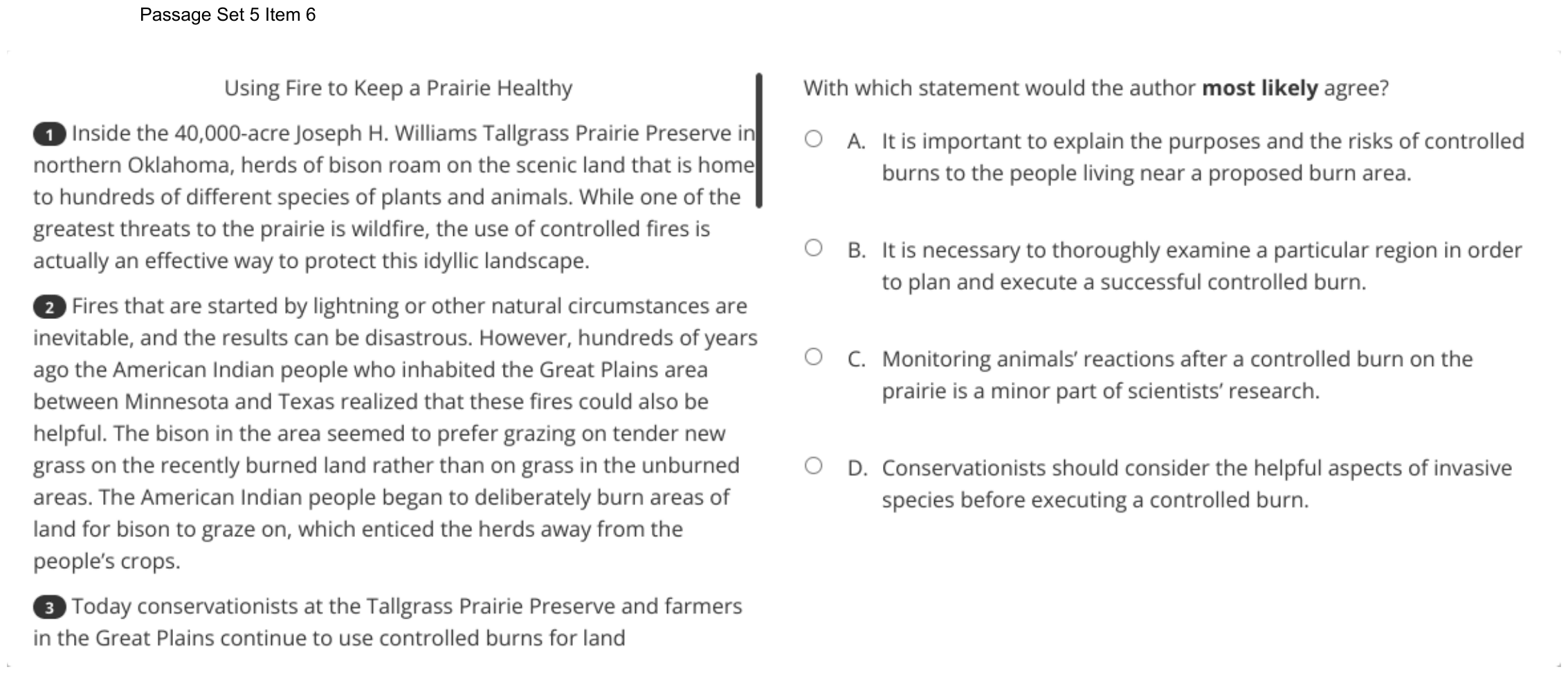
Question 33 of 57
2020 Test B English, question 33Uses the passage above: “Using Fire to Keep a Prairie Healthy”.
Question
How do the diagram and its text provide additional support for the topic presented in the passage?
- Aby depicting how the landscape in a given area changes as the patch-burn method is applied
- Bby indicating that patch-burn fires are best suited for use in areas with certain features
- Cby revealing that the patch-burn method is used primarily on uninhabited areas of land
- Dby comparing the size of the area burned by the patch-burn method with that of unburned areas
Show the answer
Correct answer: A
The question asks how the diagram and its text provide additional support for the topic presented in the passage.
A. CORRECT. The text of the diagram states that “by using a patch-burn method, conservationists and farmers can reduce the risk of unintentional fires and control where grazing animals, such as bison, roam.” By showing the pattern of controlled burns and the resulting bison migration in a given area, the diagram depicts how the landscape changes as the patch-burn method is applied.
B. Incorrect. Although the text mentions areas “where grazing animals, such as bison, roam,” the diagram does not depict distinctive features of the land such as trees or brush and therefore does not indicate that patch-burn fires are best suited for use in areas with certain features.
C. Incorrect. While the text mentions “grazing animals, such as bison” and the diagram shows the bison grazing in only one area, the diagram and its text do not indicate that the patch-burn method is used on uninhabited land.
D. Incorrect. While the areas of land depicted in the diagram do indicate that the sizes of the areas differ, the text provided does not compare the sizes of the areas burned by the patch-burn method with those of unburned areas or indicate that this factor is important in reducing the risk of uncontrolled fires or controlling “where grazing animals, such as bison, roam.”
Question analysis
This question asks how a diagram titled “Overview of the Patch-Burn Method,” printed with the article on controlled burns at an Oklahoma prairie preserve, supports the passage's topic. The diagram shows a stretch of land divided into three areas, each with a caption, so students must take in what the picture and its text show together and tie that to the article.
- Grade level
- Grade 7 reading and task
- Compared with grade 7
- At grade 7 Explaining how a graphic adds to a text is a grade 7 skill. This diagram is simple and clearly labeled, but students must take in its three areas and captions together and match them to an abstract description, a typical demand.
- Estimated difficulty
- Moderate: several steps, or a close reading with one strong distractor.
- Thinking it demands
- Depth of knowledge 2, skills and concepts · mainly analyze
- What makes it hard
- Reading a figure, table or graph moderate
- Reading between the lines moderate
- How, not what minor
- Evidence
- Answered from the whole text
- Reading level
- Passage: about grade 11, 598 words; question and choices: about grade 9, 79 words.
- Students, last 30 days
- Not enough answers yet to show (it takes 10).
Why it is hard, traps and wrong answers (shows the answer)
Why it is hard
The diagram shows three areas side by side, and the key insight is that they are one piece of land at three moments in the patch-burn cycle. Students who read it only as a map look for spatial claims instead, about land features, people or the sizes of the areas. The caption calling the unburned area “overrun with weeds” is the likeliest snare, since it sounds like advice on which land to burn.
Reading a figure, table or graph moderate Understanding the question
The diagram’s meaning is split among a map of three shaded areas, an introduction and three captions, which must be read together to see what the picture adds to the passage. (Lesh, Post & Behr, 1987; Kirsch & Mosenthal, 1990)
Reading between the lines moderate Working it out
Nothing in the diagram mentions the passing of time; students must infer that the unburned, recently burned and previously burned areas are stages the same land passes through as the burns rotate. (Graesser, Singer & Trabasso, 1994; Kintsch, 1998)
How, not what minor Working it out
The stem asks how the diagram supports the passage, a question of function, so describing what is drawn is not enough; it must be tied to the yearly rotation of paragraph 5. (Anderson & Krathwohl, 2001)
Strategy: Read the diagram's title, introduction and three captions before the choices, sum up in one sentence what the diagram shows, and check each choice against something you can actually point to in it.
Traps
- Reads too much in: A reasonable-sounding conclusion that goes further than the text allows.
- True but not the answer: A choice says something accurate about the text that does not answer this question.
The wrong answers, classified
B Reads too much in (Graesser, Singer & Trabasso, 1994)
Reads the caption calling the unburned area “overrun with weeds” as advice on which land suits a burn, though the captions describe each stage, not features that make land suitable.
C Reads too much in (Graesser, Singer & Trabasso, 1994)
Sees no houses or people on the map and decides patch burns are kept to empty land, though bison graze there and a caption mentions crops growing.
D True but not the answer (King et al., 2004; Embretson & Wetzel, 1987)
Notices that the three shaded areas differ in size, which is true of the drawing, but no caption compares them, and size is not what the diagram explains.
Working it out, step by step
Figure out what the question asks
This question asks how the diagram helps the passage. A diagram is a drawing that explains how something works. You need to say what it adds, not just what it shows. So read its title, its short introduction and its three captions. Captions are the short notes under a picture.
Read the diagram
The title, printed in capital letters, is “Overview of the Patch-Burn Method.” The drawing shows one stretch of land. A stream splits it into three areas, labeled “Unburned Area,” “Recently Burned Area” and “Previously Burned Area.” A herd of bison stands in the recently burned area.
Read the three captions
- The unburned area “is overrun with weeds and has the greatest risk of catching fire.”
- The recently burned area “has been cleared of all plants.” Bison come to eat the fresh grass that grows there.
- The previously burned area “is cleared of weeds, and young trees and crops grow freely and thrive.”
These are three stages the same land goes through: weedy, burned, then healthy. Paragraph 5 says the experts burn a different section each year, while “the land burned the previous year regrows healthier than before.”
Check each choice
- A is right. The diagram shows land changing from weedy, to burned, to healthy as the method is used.
- B is wrong. The captions describe each stage. They don’t say some kinds of land suit burning best.
- C is wrong. Bison live in the drawing, and a caption mentions crops. Uninhabited means with no one living there, and nothing says that.
- D is wrong. The areas are different sizes in the drawing. But no caption compares sizes.
Watch out: B is tempting because “overrun with weeds” sounds like a reason to burn. But that caption describes the first stage. It is not a rule for choosing land.
Choose the answer
Depicting means showing in a picture. So the answer is A: “by depicting how the landscape in a given area changes as the patch-burn method is applied.”
Why this answer and not the closest wrong one
B is the closest wrong answer, because the weedy unburned area does sound like land that needs a fire. But the diagram gives no rules for picking land. It shows one piece of land changing, stage by stage, as the burns rotate. That is what A says.
More questions like this
The original DOE question
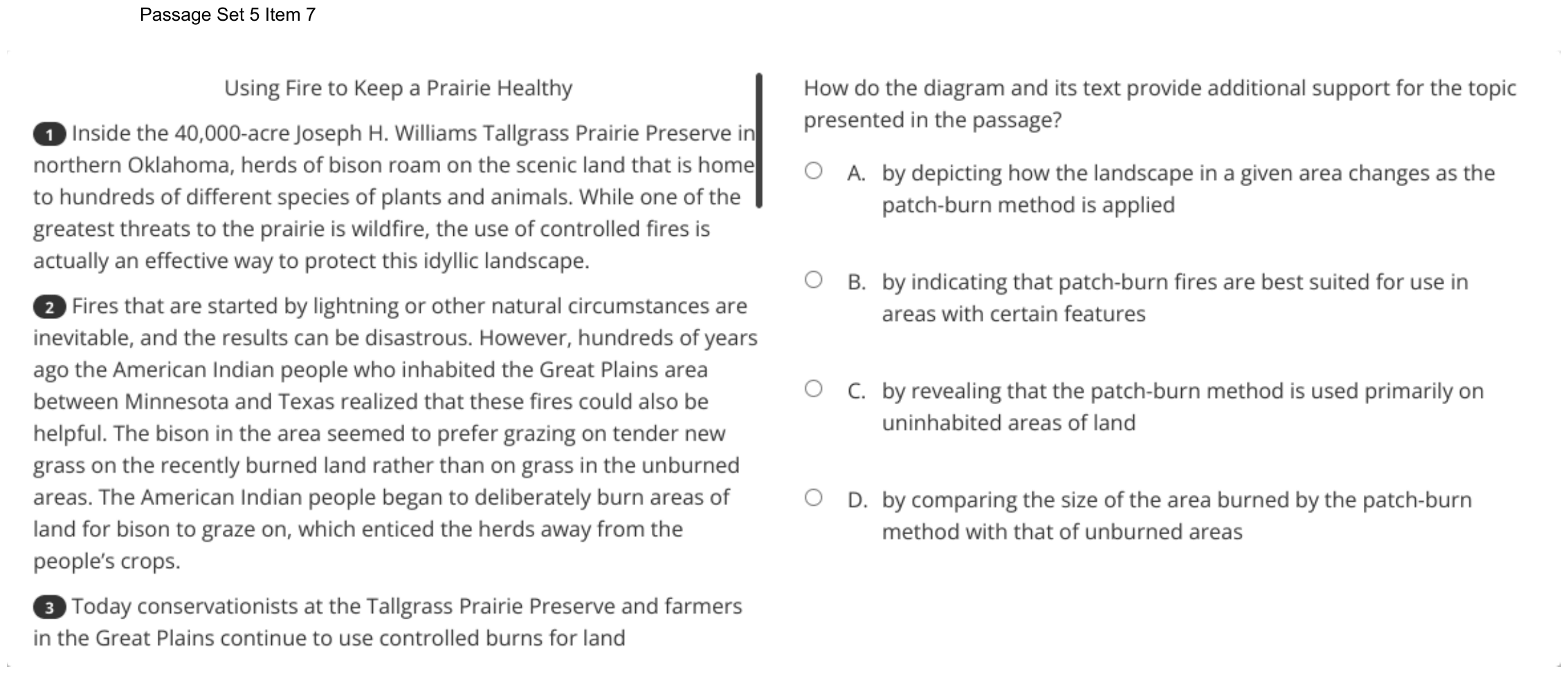
Question 34 of 57
2020 Test B English, question 34Passage Cross-Purposes
Cross-Purposes
What I am is built: concrete and steel.
I defy gravity. I am what every athlete
wants: to remain at the apex of the leap,
up in the air. And yet I am useful, too:
cars, trucks, people, even trains
make their way across my broad back.
Swallows and ospreys nest in my trusses.
What I am is motion. I am water, and I am older
than anything else you know. No human
built me. I am gravity’s best friend; I pool
and flow wherever gravity takes me.
I am the blood flowing in the runner’s chest,
and I catch everything: from the hills,
the mountains. It all washes down through me.
What you are is an accident,
what happens to rain when rain gives in
to Earth’s gravitational pull.
You are some tears dribbling from a mountain’s
eye, running down the pavements
of small towns, into the cities, to the sea.
You are the path of least resistance.
What I am is power. You, of course,
have none: you are a static lump, an artifact
slowly decaying. But my regal flow
nourishes grasses, permits empires to rise.
Those who made you will break you,
in time, replacing you with yet another
clumsy structure. I have seen. I know.
“Clumsy”? Being rebuilt makes me
a friend of time, does it not? And it means
that I have siblings—those “clumsy” structures,
my sisters and brothers.
We stitch across the rip you make.
We are steel thread to the human needle.
We bind you up. We sew you.
And I sow into you; in every cranny
of your superstructure my vapors cling.
They bring out your softness, your rust.
Boast your best, and boast better yet.
I am listening to the bright hum
of the wind in your wires. Because I am,
above all else, patient. I will wait for you.
ospreys: large birds
Question
How does the similar construction of the sentence in line 1 and the sentence in line 8 contribute to the meaning of the poem?
- AIt introduces the intended permanence of the structure and the ever-changing fluidity of the water.
- BIt shows that the structure can bridge the gap caused by the water.
- CIt suggests that the inflexible structure has more limitations than the adaptable water does.
- DIt contrasts the stability of the structure with the instability of the water.
Show the answer
Correct answer: A
The question asks how the similarity in the construction of lines 1 and 8 contributes to the meaning of the poem.
A. CORRECT. In line 1, the first speaker asserts, “What I am is built: concrete and steel,” and in line 8 the second speaker states, “What I am is motion. I am water, and I am older.” The similarities in the construction of these lines contribute to the meaning of the poem by establishing each speaker’s defining feature.
B. Incorrect. The focus of the lines is defining the speakers’ individuality, not how one speaker resolves a problem created by the other.
C. Incorrect. The structure is not stating in line 1 that it is limited because it was built to stand in place; on the contrary, the structure is stating that this sense of purpose and permanence is its strength.
D. Incorrect. Although in these lines the first speaker asserts “I am . . . built: concrete and steel” (line 1) and the second speaker asserts “I am . . . motion” (line 8), the construction of these lines does not contrast the stability and instability of the speakers. Rather, each speaker highlights its own features.
Question analysis
“Cross-Purposes” is a poem in two voices, one a structure of concrete and steel and the other water, and line 1 and line 8 both start their sentences with “What I am is.” Students explain what this parallel construction adds to the poem's meaning. The choices characterize the two speakers in closely related terms, so one word can decide between them.
- Grade level
- Grade 8 reading and task
- Compared with grade 7
- Above grade 7 Grade 7 poetry work often asks what a repeated phrase stresses. Here students must see what matching sentence openings set up for two personified speakers, then choose among abstract choices separated by single words, well above typical grade 7 demand.
- Estimated difficulty
- Among the hardest on the SHSAT: a non-obvious approach, heavy reading, or a well-hidden trap.
- Thinking it demands
- Depth of knowledge 3, strategic thinking · mainly analyze
- What makes it hard
- A very close wrong answer major
- How, not what moderate
- Figurative or literary language moderate
- Hard words minor
- Evidence
- Answered from several paragraphs or stanzas
- Reading level
- Passage: 316 words (a poem; reading level not measured); question and choices: about grade 9, 77 words.
- Students, last 30 days
- Not enough answers yet to show (it takes 10).
Why it is hard, traps and wrong answers (shows the answer)
Why it is hard
Seeing that one speaker is built and the other moves is the easy part, and two choices state that contrast in near-synonyms. What decides between them is judgment: in lines 1 and 8 each speaker simply announces what it is, proudly, and neither line weighs one against the other. A choice that calls the water unstable, ranks the speakers' limitations or jumps ahead to bridging a gap adds something those two lines do not say, so each word must be checked against them.
A very close wrong answer major Choosing the answer
The key and the stability choice draw the same contrast, built structure against moving water; they part only on “instability,” which turns the water's proud motion into a defect neither line admits. (Embretson & Wetzel, 1987; Gorin & Embretson, 2006; Ascalon et al., 2007)
How, not what moderate Working it out
The stem asks what the matching “What I am is” openings do, so students must see that they give each speaker a parallel self-definition, “built” in line 1 and “motion” in line 8. (Anderson & Krathwohl, 2001)
Figurative or literary language moderate Understanding the question
Both speakers are personified and the bridge is never named; students infer it from “concrete and steel” and the traffic crossing its “broad back,” then read the water's claim to be “older than anything” as a boast. (Graesser, Singer & Trabasso, 1994; Kintsch, 1998)
Hard words minor Understanding the question
The choices rest on abstract words the poem never uses, “permanence,” “fluidity,” “inflexible,” “adaptable” and “instability,” whose shades of judgment decide between them. (Perfetti, 2007; Freedle & Kostin, 1993)
Strategy: Copy the two sentences side by side, note what follows “What I am is” in each, and check every descriptive word in the choices against what those two sentences actually claim.
Traps
- Half right: One half of a two-part choice is right and the other is not.
- Reads too much in: A reasonable-sounding conclusion that goes further than the text allows.
- Wrong part of the text: A choice is true of another paragraph, stanza or speaker than the one asked about.
The wrong answers, classified
B Wrong part of the text (Kirsch & Mosenthal, 1990)
Borrows the fifth stanza's “We stitch across the rip you make,” where the structures span the water, but lines 1 and 8 only introduce the speakers and mention no gap.
C Reads too much in (Graesser, Singer & Trabasso, 1994)
Accepts the fair labels “inflexible” and “adaptable” and then the ranking built on them, a verdict the water argues in its later stanzas but lines 1 and 8 never make.
D Half right (King et al., 2004; Thissen, Steinberg & Fitzpatrick, 1989)
Gets the structure's stability right, but “instability” makes the water's motion a flaw, while line 8 offers motion as its very identity and adds that it is older than anything.
Working it out, step by step
Figure out what the question asks
This question is about how the poem is built. The sentences in lines 1 and 8 start the same way. You need to see what that matching pattern adds to the poem’s meaning.
Set the two sentences side by side
Line 1: “What I am is built: concrete and steel.”
Line 8: “What I am is motion.”Both begin with the same four words, “What I am is.” Line 1 opens the first stanza, and line 8 opens the second. A stanza is a group of lines in a poem, like a paragraph. So each speaker starts by telling you what it is.
Name the two speakers
The first speaker is a structure, most likely a bridge. Traffic and trains “make their way across my broad back.” It is “built” of concrete and steel, so it is meant to last. The second speaker is water. It is “motion,” always flowing and changing. So the matching lines bring in two very different speakers: one made to stay, one always moving.
Check each choice
- A is right. Permanence means lasting. Fluidity means flowing. Intended means planned, and the bridge was built to last.
- B is wrong. A gap first comes up in line 33: “We stitch across the rip you make.” Lines 1 and 8 say nothing about it.
- C is wrong. Inflexible means unable to bend, and adaptable means able to change. But neither line says one speaker has more limits. In line 2, the bridge even boasts, “I defy gravity.”
- D is wrong. Instability means being shaky or likely to fail. That makes the water’s motion sound like a weakness. But the water boasts that it is “older / than anything else you know.”
Watch out: D sets up the same pair as A. The one word that sinks it is “instability.”
Choose the answer
Each matching line names what its speaker is: one built to stay, one always on the move. So the answer is A.
Why this answer and not the closest wrong one
D is the closest wrong answer, because it also sets the steady bridge against the moving water. But “instability” calls the water weak or unsafe. In line 8, the water names its motion with pride. A describes each speaker the way it sees itself.
More questions like this
The original DOE question
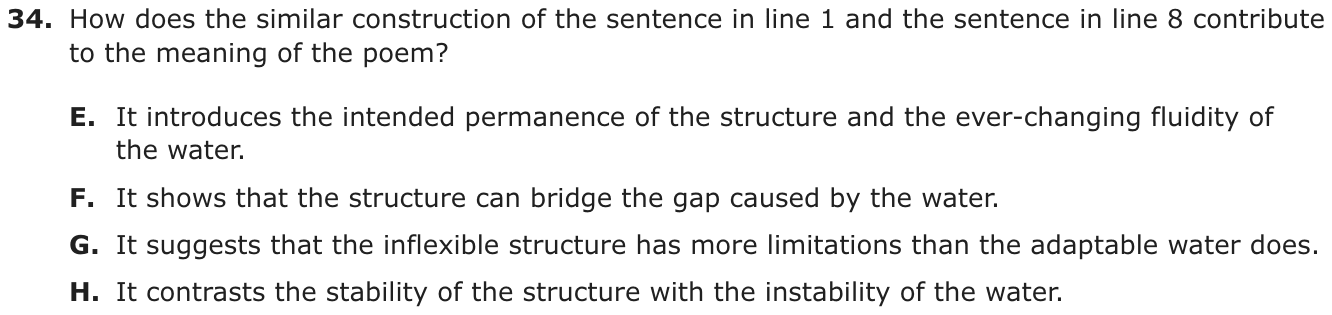
The passage “Cross-Purposes” as printed (pages 72–73)
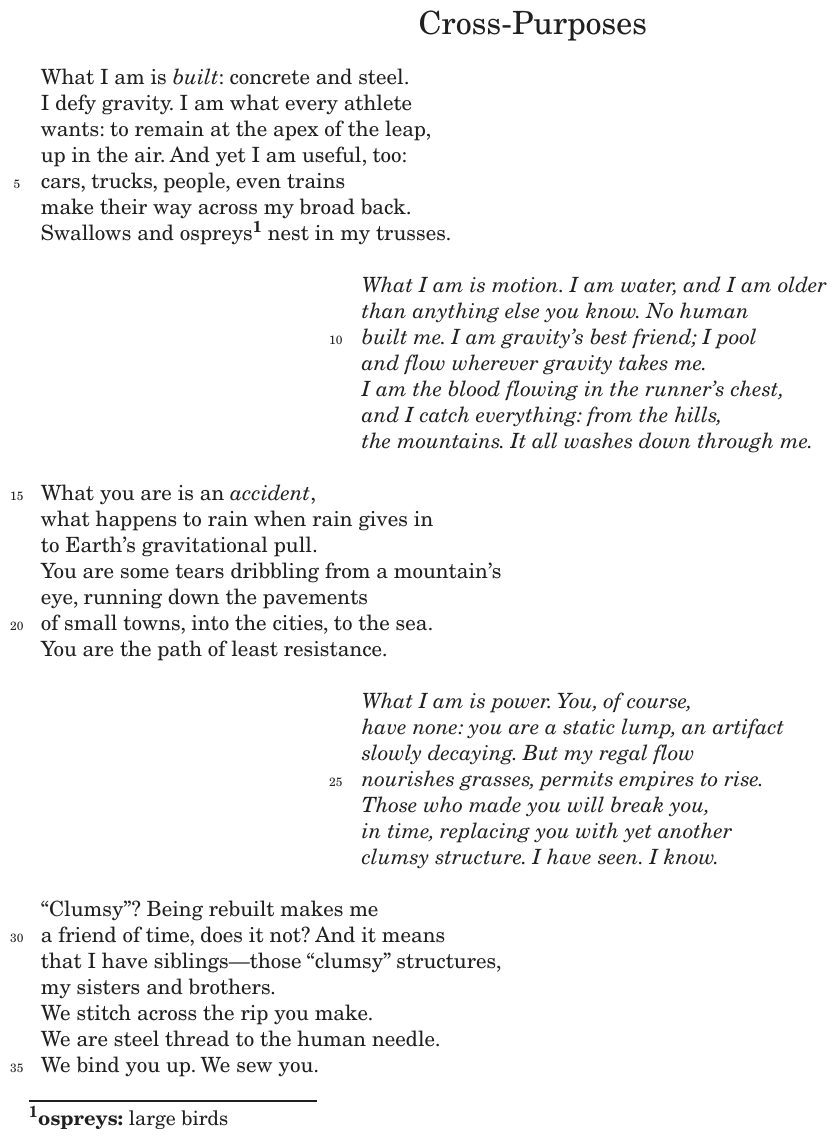
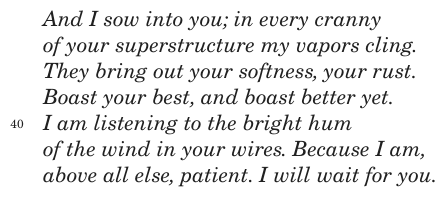
Question 35 of 57
2020 Test B English, question 35Uses the passage above: “Cross-Purposes”.
Question
Read lines 2–4 and lines 12–14 from the poem.
I am what every athlete
wants: to remain at the apex of the leap,
up in the air.
I am the blood flowing in the runner’s chest,
and I catch everything: from the hills,
the mountains.
How do the lines contribute to the development of a central idea of the poem?
- AThey establish that both the structure and the water have endurance and control.
- BThey highlight that both the structure and the water are powerful and impressive.
- CThey suggest that the structure and the water are unaware of how similar they are.
- DThey reveal that the structure and the water are surprised that they are interrelated.
Show the answer
Correct answer: B
The answer is (B)
The question asks how the lines contribute to the development of a central idea in the poem. The lines “I am what every athlete / wants” (lines 2–3) and “I am the blood flowing in the runner’s chest” (line 12) communicate that each speaker is an object of admiration and a powerful force, so Option B is correct.
Option A is incorrect because nothing in the language of the lines communicates control.
Option C is incorrect because the lines describe opposing characteristics: the structure’s description conveys stillness—remaining “up in the air” (line 4)—while the water’s description conveys movement—“flowing in the runner’s chest” (line 12). Additionally, the idea that the speakers fail to recognize similarities is not part of a central idea.
Option D is incorrect because there is no evidence in the poem that the two speakers understand that they are interrelated.
Question analysis
Students compare two sets of lines from the poem “Cross-Purposes” in which the structure and the water each describe themselves through athletes, one leaping and one running. The question asks how these lines develop a central idea, which means comparing two images that seem opposite and deciding what the pairing adds.
- Grade level
- Grade 8 reading and task
- Compared with grade 7
- Above grade 7 Typical grade 7 work asks what one image suggests. This question pairs images from two speakers in a two-voice poem and asks for a shared idea, with abstract choices that all sound plausible, which is above grade 7.
- Estimated difficulty
- Hard: combines ideas, needs a plan, and has more than one tempting wrong answer.
- Thinking it demands
- Depth of knowledge 3, strategic thinking · mainly analyze
- What makes it hard
- Figurative or literary language major
- Combines ideas moderate
- A very close wrong answer moderate
- Evidence
- Answered from several paragraphs or stanzas
- Reading level
- Passage: 316 words (a poem; reading level not measured); question and choices: about grade 7, 113 words.
- Students, last 30 days
- Not enough answers yet to show (it takes 10).
Why it is hard, traps and wrong answers (shows the answer)
Why it is hard
The athlete images point in opposite directions, one frozen in the air and one in motion, so students may look for a contrast when the question wants what the two share. Both speakers are borrowing the glamour of athletes to boast, which is what makes them powerful and impressive. The other choices either add a quality, control, that neither image carries, or credit the speakers with feelings the poem never shows.
Figurative or literary language major Understanding the question
Both claims are metaphors: the bridge is the athlete's dream of staying “at the apex of the leap,” and the water is “the blood flowing in the runner's chest,” so each image must be translated into a quality. (Graesser, Singer & Trabasso, 1994; Kintsch, 1998)
Combines ideas moderate Working it out
The two sets of lines come from rival speakers in different stanzas, and the answer has to name one idea true of both, not of either alone. (Embretson, 1998; Daniel & Embretson, 2010)
A very close wrong answer moderate Choosing the answer
A and B share the frame “both the structure and the water” plus two qualities; A's endurance is close to B's power, and only its added “control” finds no support in the lines. (Embretson & Wetzel, 1987; Gorin & Embretson, 2006; Ascalon et al., 2007)
Strategy: For each set of lines, ask what the speaker claims about itself through the athlete image; then keep only a choice that fits both speakers and these exact words.
Traps
- Half right: One half of a two-part choice is right and the other is not.
- Reads too much in: A reasonable-sounding conclusion that goes further than the text allows.
The wrong answers, classified
A Half right (King et al., 2004; Thissen, Steinberg & Fitzpatrick, 1989)
Hears stamina in the runner and in staying aloft, which is defensible, but nothing in either set of lines suggests control.
C Reads too much in (Graesser, Singer & Trabasso, 1994)
Notices that both speakers use athletes and assumes they miss the likeness, an idea the poem never develops; the images actually set stillness against motion.
D Wrong tone or attitude (Graesser, Singer & Trabasso, 1994)
Reads surprise into lines whose tone is boastful; neither speaker shows any sign of noticing a connection, let alone being surprised by it.
Working it out, step by step
Figure out what the question asks
This asks how two sets of lines build a central idea. The structure speaks one set, and the water speaks the other. You need one idea that fits both.
Read both sets of lines
The structure says, in lines 2–4: “I am what every athlete / wants: to remain at the apex of the leap, / up in the air.”
The water says, in lines 12–14: “I am the blood flowing in the runner’s chest, / and I catch everything.”
Work out what each speaker claims
The apex is the very top. Every athlete wishes they could stay at the top of a jump. The structure stays up there all the time. So it brags that it does what athletes dream of.
The water says it is the blood that keeps a runner going. Both speakers compare themselves to strong athletes. Both are showing off how powerful and impressive they are.
Check each choice
- A Endurance (lasting a long time) could fit. But nothing in the lines shows control.
- B fits. Both speakers boast of being powerful and impressive.
- C The poem never says they don’t notice how alike they are.
- D Neither speaker shows surprise. Their tone is proud.
Choose the answer
Both sets of lines show the speakers bragging about their power. So the answer is B.
Why this answer and not the closest wrong one
A is the closest choice. Like B, it says something good about both speakers. But A adds “control,” and neither set of lines shows either speaker controlling anything. Every part of B fits both sets of lines, with nothing extra.
More questions like this
The original DOE question
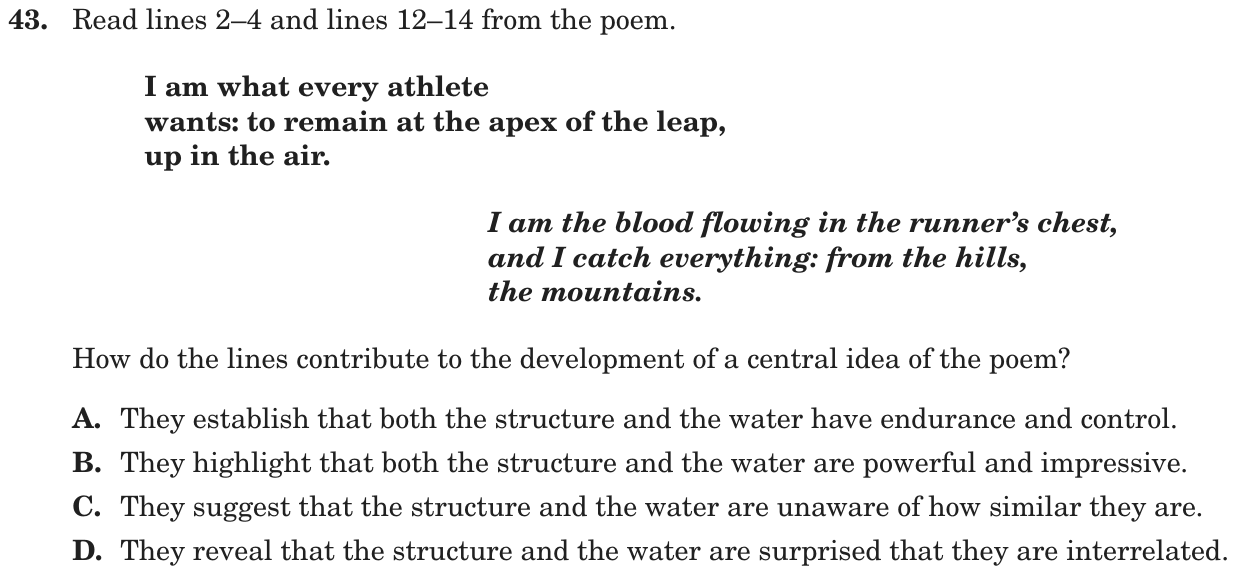
Question 36 of 57
2020 Test B English, question 36Uses the passage above: “Cross-Purposes”.
Question
The use of the words “siblings” and “my sisters and brothers” in lines 31–32 conveys the idea that the
- Aforms water can take are less diverse than the types of structures that exist.
- Bnumber of human-made structures is rapidly increasing.
- Cwater passes under many similar-looking structures as it flows.
- Dstructure is powerful because it is one of many.
Show the answer
Correct answer: D
The question asks which idea the use of the words “siblings” and “my sisters and brothers” in lines 31–32 conveys in the poem.
A. Incorrect. Although in line 29 the structure refers to itself as “being rebuilt” or taking on new forms, this idea is expressed to reinforce the idea that the structure’s presence is eternal (“a friend of time,” line 30). The use of the words “siblings” and “my sisters and brothers” in lines 31–32 does suggest that a variety of structures exist, but no comparison is drawn to suggest that the varieties of structures are more diverse than the forms of water.
B. Incorrect. While the use of the words “siblings” and “my sisters and brothers” in lines 31–32 conveys the idea that structures can be replicated by being built, it does not convey the idea that the number of human-made structures is rapidly increasing.
C. Incorrect. Although in line 33 the structure states, “We stitch across the rip you make,” suggesting that water passes under structures, the use of the words “siblings” and “my sisters and brothers” in lines 31–32 does not convey the idea that the structures that the water passes under are similar-looking.
D. CORRECT. The use of the words “siblings” and “my sisters and brothers” in lines 31–32 conveys the idea that the structure is powerful because it is one of many and because these structures “stitch across the rip” (line 33) that water makes.
Question analysis
This figurative-language question asks what idea the structure in “Cross-Purposes” conveys when it calls other structures its “siblings” and “my sisters and brothers” in lines 31–32. The words come in the fifth stanza, where the structure takes up the water’s word “clumsy,” so students must decide what this family language adds to the structure’s side of the exchange.
- Grade level
- Grade 7 reading and task
- Compared with grade 7
- At grade 7 Interpreting a metaphor in a poem is standard grade 7 work, and the family words themselves are simple. Students must still decide what the comparison means coming from a personified structure in the middle of an argument, a typical grade 7 step.
- Estimated difficulty
- Moderate: several steps, or a close reading with one strong distractor.
- Thinking it demands
- Depth of knowledge 2, skills and concepts · mainly analyze
- What makes it hard
- Figurative or literary language moderate
- Reading between the lines moderate
- A very close wrong answer minor
- Evidence
- Answered from one paragraph or stanza
- Reading level
- Passage: 316 words (a poem; reading level not measured); question and choices: about grade 7, 57 words.
- Students, last 30 days
- Not enough answers yet to show (it takes 10).
Why it is hard, traps and wrong answers (shows the answer)
Why it is hard
The family words answer the water’s taunt in the stanza before, that the structure’s makers will replace it with “yet another clumsy structure,” and the structure turns replacement into kinship. Students who read lines 31–32 alone may stop at the picture of a family, and the strongest wrong choice reads that family as look-alikes. The point arrives only in the next lines, where the structures act as one to bind the water, which makes their number a source of strength.
Figurative or literary language moderate Understanding the question
The structure calls other structures “siblings” and “my sisters and brothers,” a family metaphor followed at once by a sewing one, “We stitch across the rip you make,” so two figures must be read together. (Graesser, Singer & Trabasso, 1994; Kintsch, 1998)
Reading between the lines moderate Working it out
Nothing in lines 31–32 says the structure is powerful; students must infer it from the switch to “We” in the lines that follow, where the many structures together “bind” and “sew” the water. (Graesser, Singer & Trabasso, 1994; Kintsch, 1998)
A very close wrong answer minor Choosing the answer
The choice about similar-looking structures shares the right one’s idea of many structures; it differs in what their number means, a matter of looks rather than strength. (Embretson & Wetzel, 1987; Gorin & Embretson, 2006; Ascalon et al., 2007)
Strategy: Reread the whole fifth stanza, not just lines 31–32, and say what the structure is arguing there; then choose the idea that the family words add to that argument.
Traps
- Taking figurative language literally: A choice reads a figure of speech or image at face value.
- Reads too much in: A reasonable-sounding conclusion that goes further than the text allows.
- Twists what the text says: Uses the text's topic and ideas but changes what it says: who did it, how much, when, or why.
The wrong answers, classified
A Reads too much in (Graesser, Singer & Trabasso, 1994)
Notes that rebuilding and siblings imply many kinds of structures but adds a comparison with the forms water takes, which the fifth stanza never draws.
B Twists what the text says (King et al., 2004)
Takes rebuilding and a whole family of siblings as a sign that structures are multiplying fast, though rebuilding replaces one structure with another over time and adds none.
C Taking figurative language literally (Graesser, Singer & Trabasso, 1994)
Reads “siblings” as structures that resemble one another, as real siblings might, and adds the water flowing under them from line 33, but the family words stress kinship and number, not looks.
Working it out, step by step
Figure out what the question asks
This asks about figurative language, words that mean more than their plain meaning. In lines 31–32 the structure calls other structures “siblings” and “my sisters and brothers.” You need to decide what idea those family words give.
Read what the water said first
The family words answer an insult. In lines 26–28 the water says, “Those who made you will break you, / in time, replacing you with yet another / clumsy structure.” Clumsy means awkward and poorly made. The water means the structure won’t last.
Read the structure’s reply
In lines 29–32, the structure turns the insult around. Being rebuilt makes it “a friend of time.” It has “siblings,” other structures, which it calls “my sisters and brothers.” Then, in lines 33–35, it switches from “I” to “We.” It says, “We stitch across the rip you make.” It adds, “We bind you up. We sew you.” To stitch is to sew. The rip is the gap water cuts through the land.
Work out the idea
A family is a group that sticks together. Working as one, the many structures “bind” the water, like thread holding cloth. One bridge may be replaced, but the family goes on. So being one of many is what makes the structure strong.
Check each choice
- A is wrong. The lines never compare kinds of structures with forms of water.
- B is wrong. Being rebuilt swaps one structure for another. It doesn’t mean their number is growing fast.
- C is wrong. Real siblings may look alike, but that isn’t the point here. The family words show the structures are many and connected.
- D is right. The “We” lines show the many structures acting together, which gives them power.
Watch out: C is tempting if you picture siblings who look alike. Read on to line 35 to see what the family does.
Choose the answer
The family words show the structure gets its strength from being one of many. So the answer is D.
Why this answer and not the closest wrong one
C is the closest wrong answer. It also sees many structures, and in line 33 they do cross the water. But C makes the family words about looks. Lines 33–35 make them about strength: “We bind you up.” That is why D fits better.
More questions like this
The original DOE question
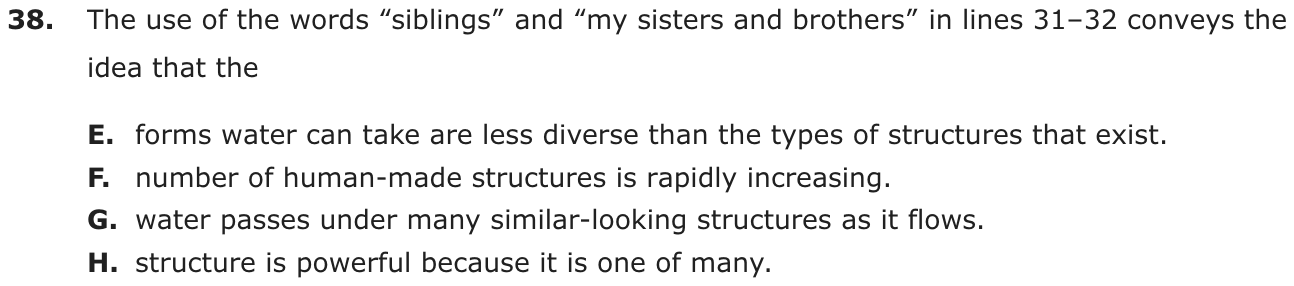
Question 37 of 57
2020 Test B English, question 37Uses the passage above: “Cross-Purposes”.
Question
The comparison to sewing in lines 33–35 helps show that the structure
- Aenhances the beauty of the natural landscape.
- Bbrings people together more effectively than nature does.
- Cprovides clear boundaries for natural environments.
- Dserves as a means for people to overcome an obstacle created by nature.
Show the answer
Correct answer: D
The answer is (D)
The question asks what the comparison in lines 33–35 shows about the structure. The speaker states, “We are steel thread to the human needle” (line 34), which illustrates that the structure (and others like it) is a tool used by humans to “bind . . . up” (line 35) or overcome “the rip” (line 33) that the water creates in the earth, making Option D correct.
Option A is incorrect because the language in the lines is used only to imply the flaw that the water creates—“the rip you make” (line 33).
Option B is incorrect because, while the water states that it enables “empires to rise” (line 25), implying that it is needed for society to thrive, it never shares a purpose of bringing people together through its existence.
Option C is incorrect because the language used for sewing (“We stitch across the rip you make” [line 33]) indicates the repair of a flaw and not the establishment of boundaries.
Question analysis
This figurative language question asks what the comparison to sewing, “We stitch across the rip you make,” shows about the structure in the poem “Cross-Purposes.” Students must work out what the speaker and the rip stand for, since the poem never names either, before the thread-and-needle metaphor makes sense.
- Grade level
- Grade 7 reading and task
- Compared with grade 7
- At grade 7 Interpreting an extended metaphor is standard grade 7 work, and the sewing words are concrete and familiar. One inference about what the speaker really is comes first, which keeps the task typical rather than hard.
- Estimated difficulty
- Moderate: several steps, or a close reading with one strong distractor.
- Thinking it demands
- Depth of knowledge 2, skills and concepts · mainly understand
- What makes it hard
- Figurative or literary language major
- Reading between the lines moderate
- Evidence
- Answered from one paragraph or stanza
- Reading level
- Passage: 316 words (a poem; reading level not measured); question and choices: about grade 8, 45 words.
- Corrected from the DOE handbook
- A misstatement of the question in the explanation was corrected.
- Two small typos in the explanation were corrected.
- Students, last 30 days
- Not enough answers yet to show (it takes 10).
Why it is hard, traps and wrong answers (shows the answer)
Why it is hard
Students who see that the structure is a bridge usually find the metaphor's sense: a river tears the land, and bridges stitch it closed for people to cross. The danger is the choice that also talks about connecting people, which matches the general idea of bridges but slips in a comparison with nature. The other choices treat stitching as decoration or as drawing lines, which a reader who pictures a needle closing a tear will not accept.
Figurative or literary language major Understanding the question
The sewing image runs over three lines: the river is a “rip,” bridges are “steel thread,” builders are “the human needle,” so each part must be mapped before the meaning appears. (Graesser, Singer & Trabasso, 1994; Kintsch, 1998)
Reading between the lines moderate Working it out
The poem never says the structure is a bridge or the rip a river gorge; students must infer both from earlier clues such as trains crossing its “broad back.” (Graesser, Singer & Trabasso, 1994; Kintsch, 1998)
Strategy: Use the earlier stanzas to work out what kind of structure is speaking and what the rip is, then translate the thread-and-needle comparison into plain terms.
Traps
- Reads too much in: A reasonable-sounding conclusion that goes further than the text allows.
- Twists what the text says: Uses the text's topic and ideas but changes what it says: who did it, how much, when, or why.
The wrong answers, classified
A Outside knowledge (King et al., 2004; Recht & Leslie, 1988)
Assumes bridges beautify a landscape, a common real-world view, but the lines describe repairing a tear, not adding beauty.
B Reads too much in (Graesser, Singer & Trabasso, 1994)
Rightly sees bridges joining people across water, but adds that they do it better than nature does, a comparison these lines never draw.
C Twists what the text says (King et al., 2004)
Treats stitches as lines that divide, while stitching across a rip pulls its two sides together rather than marking a boundary.
What was corrected from the DOE handbook, and why
- Explanation: The handbook says the question asks what the comparison “shows about the structure of the poem.” The question asks what it shows about the structure that speaks in the poem, not about the poem’s form, so “of the poem” was removed.
- Explanation: “(lines 25)” now reads “(line 25)”, and a stray closing parenthesis after “establishment of boundaries.” was removed.
Working it out, step by step
Figure out what the question asks
This asks what a comparison means. In lines 33–35 the structure compares itself to sewing. You need to turn that picture into plain words.
Read the sewing lines
The lines say: “We stitch across the rip you make. / We are steel thread to the human needle. / We bind you up. We sew you.”
“We” means the structure and its “siblings,” other structures like it. “You” is the water.
Match each part to the real thing
- The “rip” stands for the gap a river cuts through the land.
- The “steel thread” stands for the bridges.
- The “human needle” stands for the people who build them.
When you sew a rip, you pull the two sides back together. Bridges do the same. They join the land on both sides of a river, so people can cross.
Check each choice
- A The lines are about fixing a tear, not about adding beauty.
- B Bridges do bring people together, but the lines never say they do it better than nature.
- C Stitching across a rip pulls the sides together. It does not mark boundaries (lines that divide).
- D fits. The structure helps people get past the gap the water made.
Choose the answer
The sewing picture shows the structure helps people get past an obstacle the water created. So the answer is D.
Why this answer and not the closest wrong one
B is the closest trap, because bridges really do connect people. But B says they do it “more effectively than nature does.” The lines never compare the two that way. D sticks to what the picture shows: a tear made by water, closed by the structure so people can cross.
More questions like this
The original DOE question
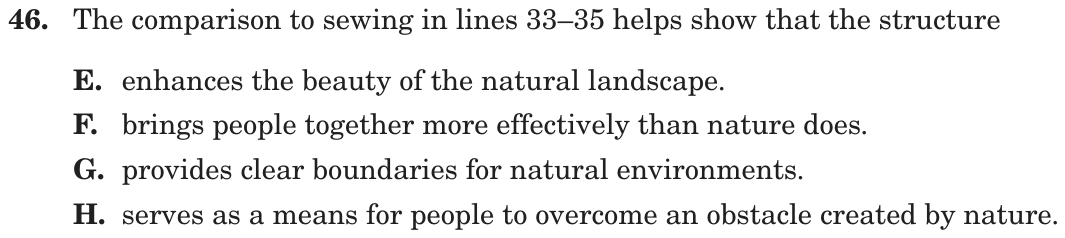
Question 38 of 57
2020 Test B English, question 38Uses the passage above: “Cross-Purposes”.
Question
The last stanza (lines 36–42) conveys a central idea of the poem by
- Ademonstrating that both the structure and the water depend on each other to fulfill their functions.
- Bimplying that a stronger structure would be able to resist the degradation caused by the water.
- Crevealing that the passage of time will render both the structure and the water obsolete.
- Dsuggesting that the water will eventually weaken the structure and will continue to exist after the structure is gone.
Show the answer
Correct answer: D
The answer is (D)
The question asks how the last stanza conveys a central idea of the poem. In lines 36–38, the speaker (the water) describes how its “vapors cling” to the structure, bringing out the structure’s “softness” and “rust,” thus destroying the structure over time. Also, in line 42, the speaker says it is “patient” and “will wait for you,” suggesting that the speaker will be around after the structure is gone. These phrases in the last stanza indicate that Option D is correct.
Option A is incorrect because the last stanza includes no indication that the structure and the water depend on each other.
Option B is incorrect because the last stanza refers to the opposing speaker (the structure) and not to any other structure.
Option C is incorrect because the last stanza addresses only the idea that the structure will grow weak and obsolete over time.
Question analysis
Students must explain how the final stanza of “Cross-Purposes,” spoken by the water, conveys a central idea of the poem. The stanza mixes a pun on sewing and sowing, images of vapor and rust, and a taunt about boasting, so students must read past the wordplay to the stanza's main claim.
- Grade level
- Grade 7 reading and task
- Compared with grade 7
- At grade 7 Linking a stanza to a poem's central idea is standard grade 7 work. The stanza's wordplay takes some decoding, but each choice can be checked against the stanza itself, so the overall demand is typical.
- Estimated difficulty
- Moderate: several steps, or a close reading with one strong distractor.
- Thinking it demands
- Depth of knowledge 2, skills and concepts · mainly analyze
- What makes it hard
- Figurative or literary language major
- A very close wrong answer moderate
- Hard words minor
- Evidence
- Answered from one paragraph or stanza
- Reading level
- Passage: 316 words (a poem; reading level not measured); question and choices: about grade 9, 78 words.
- Students, last 30 days
- Not enough answers yet to show (it takes 10).
Why it is hard, traps and wrong answers (shows the answer)
Why it is hard
The stanza's meaning is a quiet threat: moisture works into the structure, rusts it, and the water simply waits. Students who decode the rust and the waiting usually reach the key, but one wrong choice gets the decay right and then sweeps the water into it too. The taunt to “boast better yet” is the other snare, since read straight it sounds like an invitation to build a stronger structure.
Figurative or literary language major Understanding the question
The stanza works through wordplay and images: “I sow into you” puns on the structure's “We sew you,” vapors cling to bring out “your rust,” and “I will wait for you” is a threat. (Graesser, Singer & Trabasso, 1994; Kintsch, 1998)
A very close wrong answer moderate Choosing the answer
C and D agree that time will wear the structure down; they differ only in the water's fate, which D says outlasts the structure and C says becomes obsolete too, against “above all else, patient.” (Embretson & Wetzel, 1987; Gorin & Embretson, 2006; Ascalon et al., 2007)
Hard words minor Understanding the question
“Cranny” and “superstructure” in the stanza, and “degradation” and “obsolete” in the choices, are words a seventh grader may not know. (Perfetti, 2007; Freedle & Kostin, 1993)
Strategy: Paraphrase each sentence of the last stanza in plain words, then check both halves of every choice, since a choice can fit one speaker and not the other.
Traps
- Half right: One half of a two-part choice is right and the other is not.
- Taking figurative language literally: A choice reads a figure of speech or image at face value.
The wrong answers, classified
A Reads too much in (Graesser, Singer & Trabasso, 1994)
Reads the sew-and-sow echo as mutual need, but the last stanza shows the water acting on the structure, with no dependence either way.
B Taking figurative language literally (Graesser, Singer & Trabasso, 1994)
Takes the taunt “boast better yet” at face value, as if a stronger structure could resist, though the water's answer to any boast is that it will wait.
C Half right (King et al., 2004; Thissen, Steinberg & Fitzpatrick, 1989)
Gets the structure's decline right but makes the water obsolete as well, though it is “patient” and plans to outlast the structure.
Working it out, step by step
Figure out what the question asks
This asks how the last stanza shows a central idea. The water is speaking. You need to work out what it is really saying to the structure.
Read the last stanza
Lines 36–38 say: “And I sow into you; in every cranny / of your superstructure my vapors cling. / They bring out your softness, your rust.”
Lines 41–42 end the poem: “Because I am, / above all else, patient. I will wait for you.”
Work out the hidden threat
A cranny is a small crack. Vapors are tiny drops of water in the air, like mist. The superstructure is the main body of the structure. So the water’s mist creeps into every crack and makes the steel rust and weaken.
“Sow” sounds like “sew,” but it means to plant seeds. The water plants rust. Then it says it will wait. It expects to still be here after the structure is gone.
Check each choice
- A The stanza shows the water harming the structure, not needing it.
- B No stronger structure is mentioned. “Boast better yet” is a dare, not advice.
- C The structure will wear down, but the water won’t. It is patient and waiting.
- D fits. The water will rust the structure and outlast it.
Choose the answer
The water will slowly weaken the structure and still be around after it is gone. So the answer is D.
Why this answer and not the closest wrong one
C is the closest trap. C and D agree that time will wear down the structure. But C says the water will become obsolete, or useless, too. The water says the opposite: “I will wait for you.” Only D gets both speakers right.
More questions like this
The original DOE question
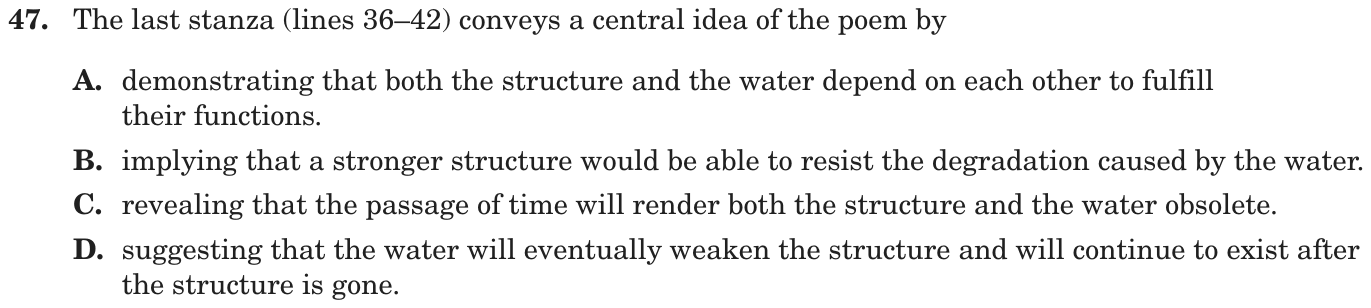
Question 39 of 57
2020 Test B English, question 39Uses the passage above: “Cross-Purposes”.
Question
Read lines 41–42 from the poem.
Because I am,
above all else, patient. I will wait for you.
Which of the following supports what is implied in these lines?
- A“I am older / than anything else you know.” (lines 8–9)
- B“No human / built me.” (lines 9–10)
- C“It all washes down through me.” (line 14)
- D“Those who made you will break you,” (line 26)
Show the answer
Correct answer: A
The answer is (A)
The question asks how the implication in lines 41–42 is supported by other lines in the poem. The words “patient” and “wait” in line 42 suggest that the speaker (the water) has the ability to outlast the other speaker because the water doesn’t weaken as it ages, making Option A (lines 8–9) the correct response.
Option B is incorrect because the promise made in line 42 is not affected by whether the water was built by humans (lines 9–10).
Option C is incorrect because, in line 14, the water’s ability to wait longer than the structure is not enhanced by what flows through the water.
Option D is incorrect because, in line 26, the water’s knowledge does not make its ability to wait any stronger—rather, its seemingly unending lifespan does.
Question analysis
This textual evidence question gives the water's closing words in “Cross-Purposes,” that it is patient and will wait, and asks which earlier line supports what they imply. Students must first state the implication in their own words, then choose among four lines spoken by the water that each say something true about it.
- NYS standards
- 7R1 textual evidence and inferences
- Grade level
- Grade 8 reading and task
- Compared with grade 7
- Above grade 7 Most grade 7 evidence items back up a claim the text states outright. Here the claim is only implied, and all four lines come from the same speaker, so students must reason about what patience would achieve, which goes beyond typical grade 7 work.
- Estimated difficulty
- Hard: combines ideas, needs a plan, and has more than one tempting wrong answer.
- Thinking it demands
- Depth of knowledge 3, strategic thinking · mainly evaluate
- What makes it hard
- Reading between the lines major
- Every choice must be checked moderate
- Evidence
- Answered from several paragraphs or stanzas
- Reading level
- Passage: 316 words (a poem; reading level not measured); question and choices: about grade 1, 57 words.
- Students, last 30 days
- Not enough answers yet to show (it takes 10).
Why it is hard, traps and wrong answers (shows the answer)
Why it is hard
The difficulty is in the first step: putting “I will wait for you” into words as a claim about time, that the water will still be there after the structure is gone. Students who read it as a prediction about the structure's end pick the line about humans breaking it, and those who read it as a contrast with built things pick the line about no human building the water. Only age directly supports a promise to outwait.
Reading between the lines major Working it out
Lines 41–42 never say the water will outlast the structure; students must state that implication of “patient” and “wait for you” before they can judge which earlier line supports it. (Graesser, Singer & Trabasso, 1994; Kintsch, 1998)
Every choice must be checked moderate Choosing the answer
All four lines are the water's own boasts from different stanzas, each true of it, so every one must be tested against the specific claim of lasting longer. (Embretson & Wetzel, 1987)
Strategy: Put the implied claim of the final two lines into your own words, then ask which earlier line gives a reason to believe that claim rather than just describing the water.
Traps
- Supports only part of the claim: In a question about evidence: a line that backs one half of the claim but not the other, or a related point rather than the claim itself.
- Reads too much in: A reasonable-sounding conclusion that goes further than the text allows.
The wrong answers, classified
B Supports only part of the claim (King et al., 2004; Thissen, Steinberg & Fitzpatrick, 1989)
Sees that being unbuilt sets the water apart from the structure, but having no human maker says nothing about its capacity to wait.
C Reads too much in (Graesser, Singer & Trabasso, 1994)
Reads “washes down through me” as slow erosion that will wear the structure away, though the line describes what the water carries, not how long it lasts.
D Supports only part of the claim (King et al., 2004; Thissen, Steinberg & Fitzpatrick, 1989)
Supports the structure's eventual end, but the implied claim is about the water outlasting it, which needs evidence of the water's long life.
Working it out, step by step
Figure out what the question asks
This is an evidence question. First, figure out what lines 41–42 hint at. Then find the earlier line that best supports that hint.
Work out the hint
The water says: “Because I am, / above all else, patient. I will wait for you.” Patient means able to wait calmly for a long time.
The water is telling the structure that it will still be here after the structure is gone. So the hidden claim is that the water will outlast the structure.
Find a line that supports it
To outlast something, you need a very long life. So look for a line about the water’s age. In lines 8–9 the water says: “I am older / than anything else you know.” It has already lasted longer than anything else. So it makes sense that it can outlast a bridge too.
Check each choice
- A fits. Great age backs up the claim that the water can wait the structure out.
- B “No human / built me” tells who made the water, not how long it lasts.
- C “It all washes down through me” tells what the water carries, not how long it lasts.
- D shows the structure will end, but not that the water will still be here.
Choose the answer
The water’s great age supports its promise to outwait the structure. So the answer is A.
Why this answer and not the closest wrong one
D is the closest trap, because “Those who made you will break you” also points to the structure’s end. But the hint in lines 41–42 is about the water lasting. D says nothing about the water. Only A gives proof of the water’s long life.
More questions like this
The original DOE question
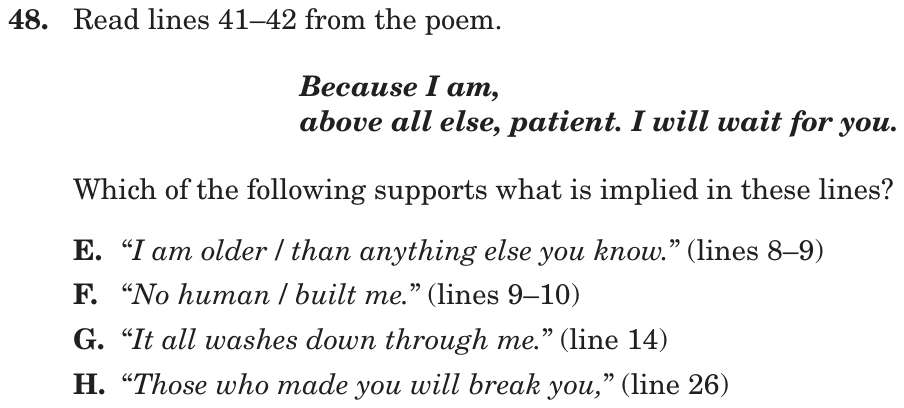
Question 40 of 57
2020 Test B English, question 40Uses the passage above: “Cross-Purposes”.
Question
How does the poet develop the points of view of the structure and the water?
- Aby giving an account of a discussion between them about the future of human civilization
- Bby narrating a debate they have over their impact on the environment
- Cby illustrating the unique power they each possess over nature
- Dby using personification to allow them to debate who is more important
Show the answer
Correct answer: D
The question asks how the poet develops the two points of view.
A. Incorrect. While the poem relates how the water views the structure as “an artifact / slowly decaying” (lines 23–24) and the structure refers to itself as “a friend of time” (line 30), the poet does not give an account of a discussion about the future of human civilization.
B. Incorrect. While the speakers do discuss their impact on the environment, there is no narrator speaking for them.
C. Incorrect. Although the structure states it is made of “concrete and steel” (line 1) and is a “steel thread to the human needle” (line 34), only the water claims to possess power over nature, stating that “all washes down through me” (line 14) and “what I am is power” (line 22).
D. CORRECT. The poet develops the speakers’ points of view by personifying (giving human characteristics to something nonhuman such as an object or animal) the structure and the water, allowing them to debate by criticizing each other and declaring their own importance.
Question analysis
This point-of-view question asks how the poet of “Cross-Purposes” develops the viewpoints of its two speakers, a human-made structure and a body of water, across six alternating stanzas. Each answer pairs a way of presenting the voices with a subject for their exchange, so students must check both halves against the poem, since a choice can be right about one and wrong about the other.
- Grade level
- Grade 7 reading and task
- Compared with grade 7
- At grade 7 This is exactly the grade 7 standard on how a writer develops and contrasts the points of view of different speakers. The choices are short, but each joins a way of presenting the voices to a subject, so two things must be checked at once.
- Estimated difficulty
- Moderate: several steps, or a close reading with one strong distractor.
- Thinking it demands
- Depth of knowledge 3, strategic thinking · mainly analyze
- What makes it hard
- How, not what moderate
- Something you must already know minor
- Every choice must be checked minor
- Evidence
- Answered from the whole text
- Reading level
- Passage: 316 words (a poem; reading level not measured); question and choices: about grade 9, 64 words.
- Students, last 30 days
- Not enough answers yet to show (it takes 10).
Why it is hard, traps and wrong answers (shows the answer)
Why it is hard
The poem is a direct exchange: stanzas alternate between two speakers who address each other as “you,” with no voice outside them. Most students sense the argument, which makes the narrated-debate choice the strongest pull, since its subject, the speakers’ effects on the land, does come up in the poem. The question is decided by the method half of each choice, and only one names a device the poet actually uses, letting the two speak for themselves about which matters more.
How, not what moderate Working it out
The stem asks how the poet develops the two viewpoints, so the right choice must name a method, speakers given voices to argue for themselves, and a choice that only reports what they say falls short. (Anderson & Krathwohl, 2001)
Something you must already know minor Working it out
The right choice relies on the term “personification,” which the poem never names, so students must recognize concrete and water that speak and boast as that device. (Anderson & Krathwohl, 2001)
Every choice must be checked minor Choosing the answer
Each choice pairs a way of presenting the voices, an account, narration, illustration or personification, with a subject, so both halves must be tested against all six stanzas. (Embretson & Wetzel, 1987)
Strategy: Go through the six stanzas noting who is speaking and what each speaker claims, then judge each choice twice: once for how it says the voices are presented, once for what it says they discuss.
Traps
- Half right: One half of a two-part choice is right and the other is not.
- Wrong purpose or structure: Names a purpose, structure or effect that the part does not serve, or describes what a part says when the question asks what it does.
The wrong answers, classified
A Too narrow (King et al., 2004)
Builds the whole exchange on passing references such as “permits empires to rise” and “the human needle,” though the speakers argue about themselves and never discuss where civilization is headed.
B Half right (King et al., 2004; Thissen, Steinberg & Fitzpatrick, 1989)
Rightly sees a debate, and the speakers do touch on their effects on the land and on each other, but “narrating” adds a narrator, while each speaker talks in its own voice.
C Wrong purpose or structure (Anderson & Krathwohl, 2001)
Lists the powers the speakers boast of, which is what the poem says rather than how the poet builds the viewpoints, and only the water claims power over nature.
Working it out, step by step
Figure out what the question asks
This asks about the poet’s method: how the poet shows what each speaker thinks. Each choice names a method and a topic. The right choice must get both parts right.
Notice who is speaking
The poem has six stanzas, or groups of lines. The structure speaks in stanzas 1, 3 and 5. The water speaks in stanzas 2, 4 and 6. Each one says “I” about itself and “you” to the other. No outside voice tells the story. A voice like that is called a narrator, and this poem has none.
Name the poet’s method
In real life, concrete and water have no voices. The poet lets them speak like people anyway. This is called personification: treating a thing as if it were a person. Then the two argue. The structure calls the water “an accident” (line 15). The water answers, “What I am is power. You, of course, / have none” (lines 22–23).
See what they argue about
Each speaker brags about itself and puts the other down. The structure says it is useful, carrying “cars, trucks, people, even trains” (line 5). The water says it is older and stronger. It ends by saying it will outlast the structure: “I will wait for you” (line 42). Their real fight is over which of them matters more.
Check each choice
- A is wrong. Empires come up only once, in line 25. The speakers argue about themselves, not the future of civilization.
- B is wrong. The speakers do mention their effects on the land. The water says it “nourishes grasses” (line 25). But “narrating” means a narrator tells the debate, and no one does. The two speak for themselves.
- C is wrong. It names what the speakers brag about, not how the poet presents them. Also, only the water claims power over nature: “It all washes down through me” (line 14).
- D is right. Personification lets the two argue about who is more important.
Choose the answer
The poet uses personification so the structure and the water can argue over who matters more. So the answer is D.
Why this answer and not the closest wrong one
B is the closest wrong answer. It is right that there is a debate, and the speakers do talk about their effects on the world around them. But B says the debate is narrated. In the poem, the structure and the water speak in their own voices. D names that method.
More questions like this
The original DOE question

Question 41 of 57
2020 Test B English, question 41Uses the passage above: “Cross-Purposes”.
Question
How does the form of the poem contribute to its meaning?
- AThe use of an equal number of lines in each stanza emphasizes that both speakers are equally important.
- BThe use of italics in some of the stanzas indicates the increasing tension between the structure and the water.
- CThe alternating positions of the stanzas highlight the opposing points of view of the speakers.
- DThe lack of a regular rhyme scheme or meter reflects the way the water changes the structure and the way the water itself changes.
Show the answer
Correct answer: C
The answer is (C)
The question asks how the form of the poem contributes to its meaning. The alternating positions of the stanzas create the appearance of a conversation in which the speakers share their opposing points of view, making Option C correct.
Option A is incorrect because the number of lines for each stanza does not emphasize the importance of the two speakers.
Option B is incorrect because italics are used mainly to designate the voice of the second speaker (the water).
Option D is incorrect because the lack of rhyme scheme or meter is intended to create a conversational tone, rather than reflect the changes the water causes or experiences.
Question analysis
This question about poetic form asks how the shape of “Cross-Purposes” on the page contributes to its meaning. Students must consider features such as stanza length, placement, italics and the lack of rhyme, and decide which one the poem actually uses to create meaning.
- Grade level
- Grade 8 reading and task
- Compared with grade 7
- Above grade 7 Grade 7 standards ask how genre features such as stanza form shape meaning, but most classroom questions point to one feature. Here students must weigh four features of the poem and the meaning each choice assigns, which is above typical grade 7 work.
- Estimated difficulty
- Hard: combines ideas, needs a plan, and has more than one tempting wrong answer.
- Thinking it demands
- Depth of knowledge 3, strategic thinking · mainly analyze
- What makes it hard
- How, not what major
- Every choice must be checked moderate
- Something you must already know minor
- Evidence
- Answered from the whole text
- Reading level
- Passage: 316 words (a poem; reading level not measured); question and choices: about grade 9, 87 words.
- Students, last 30 days
- Not enough answers yet to show (it takes 10).
Why it is hard, traps and wrong answers (shows the answer)
Why it is hard
All four choices point to something true about how the poem looks, so checking features against the page eliminates nothing. The real test is whether the meaning each choice assigns follows from the poem: equal stanzas do not make the rivals equal, italics mark the water's voice from its first stanza, and free verse is not a picture of erosion. Only the alternating placement maps directly onto two opposed speakers taking turns.
How, not what major Working it out
The question is about form, not content: students must ask what the page layout, indented italic stanzas against flush roman ones, does for the meaning. (Anderson & Krathwohl, 2001)
Every choice must be checked moderate Choosing the answer
Each choice names a feature that really exists, seven lines in every stanza, italics, alternating positions, no rhyme or meter, so every feature and the meaning given to it must be tested. (Embretson & Wetzel, 1987)
Something you must already know minor Working it out
Terms such as “stanza,” “rhyme scheme” and “meter” are assumed, and a student unsure what meter means cannot judge the choice about free verse. (Anderson & Krathwohl, 2001)
Strategy: For each feature named in the choices, first confirm it is really in the poem, then ask whether the meaning the choice gives it fits what happens in the poem.
Traps
- Wrong purpose or structure: Names a purpose, structure or effect that the part does not serve, or describes what a part says when the question asks what it does.
- Reads too much in: A reasonable-sounding conclusion that goes further than the text allows.
The wrong answers, classified
A Wrong purpose or structure (Anderson & Krathwohl, 2001)
Counts seven lines in every stanza, which is true, and reads that balance as equal importance, though the speakers spend the poem disputing which of them matters more.
B Wrong purpose or structure (Anderson & Krathwohl, 2001)
Notices the italics but misreads their job: they mark the water's voice from its first stanza onward, not a rising level of tension.
D Reads too much in (Graesser, Singer & Trabasso, 1994)
Applies the habit of treating free verse as a mirror of the subject, reading the missing rhyme and meter as the water's changes, which nothing in the poem supports.
Working it out, step by step
Figure out what the question asks
This asks about form: how the poem looks on the page, not just what it says. You need the feature that adds to the meaning.
Look at the page
Notice four things about the form.
- Every stanza has seven lines.
- Stanzas 2, 4 and 6 are in italics (slanted letters).
- Those italic stanzas are pushed to the right. The others sit on the left.
- The lines don’t rhyme and have no steady beat. That beat is called meter.
Work out what the layout shows
The stanzas on the left are the structure speaking. The italic stanzas on the right are the water. The two sides take turns, like two people arguing face to face. The back-and-forth placement makes it easy to see two opposite points of view.
Check each choice
- A The stanzas all have seven lines. But the speakers argue that they are not equal.
- B The italics mark the water’s voice from its first stanza to its last. They don’t show tension growing.
- C fits. The switching positions show the two opposing views.
- D Nothing suggests the missing rhyme stands for the water’s changes.
Choose the answer
The stanzas switch sides to show the speakers’ opposite views. So the answer is C.
Why this answer and not the closest wrong one
A is the closest trap, because every stanza really does have seven lines. But the speakers spend the whole poem arguing that they are not equal. Each one says it matters more. So equal stanzas can’t mean equal importance. C links the layout to what really happens: two sides taking turns.
More questions like this
The original DOE question
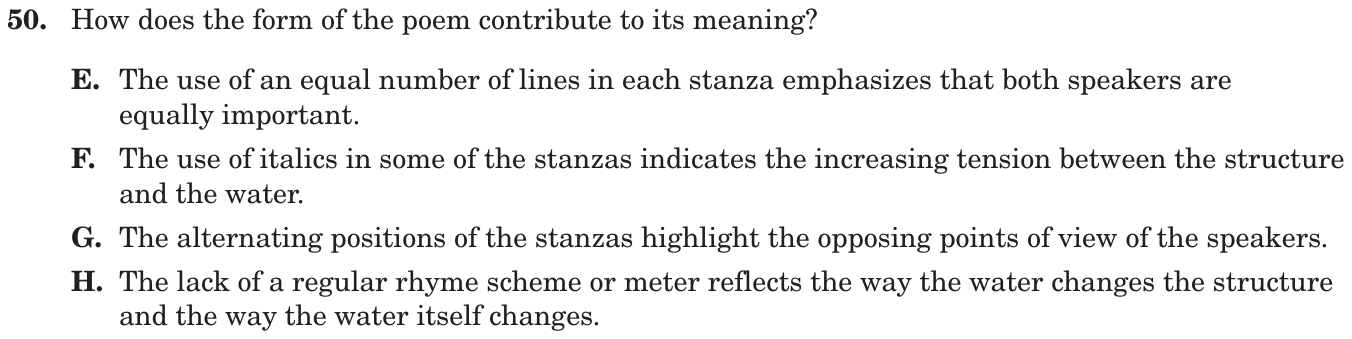
Question 42 of 57
2020 Test B English, question 42Passage Excerpt from “Impressions of an Indian Childhood”
Excerpt from “Impressions of an Indian Childhood”
by Zitkala-Sa
Zitkala-Sa (Gertrude Simmons Bonnin) was a Native American writer, musician, teacher, and political activist who was raised on the Yankton Sioux Reservation in South Dakota. In 1900 she published “Impressions of an Indian Childhood” (the term Indian was commonly used at the time to refer to Native American people) to expose readers to what life is like on a reservation.
Soon after breakfast Mother sometimes began her beadwork. On a bright, clear day, she pulled out the wooden pegs that pinned the skirt of our wigwam1 to the ground, and rolled the canvas part way up on its frame of slender poles. Then the cool morning breezes swept freely through our dwelling, now and then wafting the perfume of sweet grasses from newly burnt prairie.
Untying the long tasseled strings that bound a small brown buckskin2 bag, my mother spread upon a mat beside her bunches of colored beads, just as an artist arranges the paints upon his palette. On a lapboard she smoothed out a double sheet of soft white buckskin; and drawing from a beaded case that hung on the left of her wide belt a long, narrow blade, she trimmed the buckskin into shape. Often she worked upon small moccasins for her small daughter. Then I became intensely interested in her designing. With a proud, beaming face, I watched her work. In [my] imagination, I saw myself walking in a new pair of snugly fitting moccasins. I felt the envious eyes of my playmates upon the pretty red beads decorating my feet.
Close beside my mother I sat on a rug, with a scrap of buckskin in one hand and an awl in the other. This was the beginning of my practical observation lessons in the art of beadwork. From a skein3 of finely twisted threads of silvery sinews my mother pulled out a single one. With an awl she pierced the buckskin, and skillfully threaded it with the white sinew. Picking up the tiny beads one by one, she strung them with the point of her thread, always twisting it carefully after every stitch.
It took many trials before I learned how to knot my sinew thread on the point of my finger, as I saw her do. Then the next difficulty was in keeping my thread stiffly twisted, so that I could easily string my beads upon it. My mother required of me original designs for my lessons in beading. At first I frequently ensnared many a sunny hour into working a long design. Soon I learned from self-inflicted punishment to refrain from drawing complex patterns, for I had to finish whatever I began.
After some experience I usually drew easy and simple crosses and squares. These were some of the set forms. My original designs were not always symmetrical nor sufficiently characteristic, two faults with which my mother had little patience. The quietness of her oversight made me feel strongly responsible and dependent upon my own judgment. She treated me as a dignified little individual as long as I was on my good behavior; and how humiliated I was when some boldness of mine drew forth a rebuke from her!
In the choice of colors she left me to my own taste. I was pleased with an outline of yellow upon a background of dark blue, or a combination of red and myrtle-green. There was another of red with a bluish-gray that was more conventionally used. When I became a little familiar with designing and the various pleasing combinations of color, a harder lesson was given me. It was the sewing on, instead of beads, some tinted porcupine quills, moistened and flattened between the nails of the thumb and forefinger. My mother cut off the prickly ends and burned them at once in the centre fire. These sharp points were poisonous, and worked into the flesh wherever they lodged. For this reason, my mother said, I should not do much alone in quills until I was as tall as my cousin Warca-Ziwin.
Always after these confining lessons I was wild with surplus spirits, and found joyous relief in running loose in the open again. Many a summer afternoon a party of four or five of my playmates roamed over the hills with me. We each carried a light sharpened rod about four feet long, with which we pried up certain sweet roots. When we had eaten all the choice roots we chanced upon, we shouldered our rods and strayed off into patches of a stalky plant under whose yellow blossoms we found little crystal drops of gum. Drop by drop we gathered this nature’s rock-candy, until each of us could boast of a lump the size of a small bird’s egg. Soon satiated with its woody flavor, we tossed away our gum, to return again to the sweet roots.
From “Impressions of an Indian Childhood” by Zitkala-Sa—Public Domain
A BRIEF HISTORY OF BEADWORK IN SOUTH DAKOTA
| Date | Event |
|---|---|
| 1500s | The Dakota use beads made from bones, shells, stones, and animal teeth. European traders bring glass beads to North America. |
| Late 1600s | The Dakota begin trading with the French in Minnesota. |
| 1830s | The Dakota begin using glass beads in clothing, artwork, and decorations in place of Native-made beads. |
| 1862–1865 | The Dakota are expelled from their homelands in Minnesota as a result of the U.S.-Dakota War. |
| 1900s–1920s | The Dakota create items to sell outside their community. |
Source: MNopedia
1wigwam: hut with an arched framework of poles covered with bark, mats, or animal hides
2buckskin: leather made from the skin of a male deer
3skein: coiled length of yarn or other thread loosely wound on a reel
Question
In paragraph 1, the phrases “cool morning breezes swept freely” and “wafting the perfume of sweet grasses” affect the tone of the excerpt by suggesting
- Athe sadness that the author feels reflecting upon her former way of life.
- Bthe enthusiasm with which the author approached her work indoors.
- Cthe fond feelings that the author has toward her childhood experiences.
- Dthe mix of emotions that the author feels toward her work and her mother.
Show the answer
Correct answer: C
The question asks how the phrases “cool morning breezes swept freely” and “wafting the perfume of sweet grasses” affect the tone of the excerpt.
A. Incorrect. Although the author describes in paragraph 1 the setting of her childhood experiences, the positive wording of the phrases the author uses in the paragraph (“swept freely” and “perfume of sweet grasses”) does not suggest a tone of sadness the author feels when she reflects on her former way of life.
B. Incorrect. Although the phrases “cool morning breezes swept freely” and “wafting the perfume of sweet grasses” used in paragraph 1 create a positive tone, the phrases do not suggest an enthusiasm for the author’s work but rather suggest an appreciation of the peaceful beauty of her childhood.
C. CORRECT. In paragraph 1, the phrases “cool morning breezes swept freely” and “wafting the perfume of sweet grasses” are used to describe where the author’s childhood experiences took place. The phrases create a tone of fondness and evoke a feeling of happiness through their lyrical sensory detail: “swept freely” suggests a sense of joyful possibility, while “perfume,” “sweet,” and “cool” convey delight.
D. Incorrect. Although the author describes her mother’s beadwork lessons as “confining” in paragraph 7, the phrases in paragraph 1 do not suggest that the author feels conflicting or mixed emotions toward her work and her mother. Instead, the phrases convey a positive tone by affectionately describing the author’s childhood home.
Question analysis
This reading question asks how two sensory phrases about cool morning breezes and the scent of sweet grasses shape the tone of Zitkala-Sa's 1900 memoir of life on a Sioux reservation. Students must read the feeling behind descriptive language and decide what that feeling is directed at, since the choices pair different emotions with different subjects.
- Grade level
- Grade 7 reading and task
- Compared with grade 7
- At grade 7 Judging how sensory words shape tone is grade 7 reading work. Both phrases are quoted in the question, so little searching is needed, but the 1900 prose keeps the demand at a typical grade 7 level.
- Estimated difficulty
- Straightforward: two steps or one careful reading.
- Thinking it demands
- Depth of knowledge 2, skills and concepts · mainly analyze
- What makes it hard
- Figurative or literary language moderate
- Reading between the lines minor
- Hard words minor
- Evidence
- Answered from one paragraph or stanza
- Reading level
- Passage: about grade 8, 946 words; question and choices: about grade 7, 72 words.
- Corrected from the DOE handbook
- A misstatement of the question in the explanation was corrected.
- Students, last 30 days
- Not enough answers yet to show (it takes 10).
Why it is hard, traps and wrong answers (shows the answer)
Why it is hard
The phrases are so clearly pleasant that the real decision is what the pleasant feeling is about. They describe the wigwam on a clear morning, so the warmth belongs to the author's memory of her childhood, not to the beadwork the rest of the excerpt follows. Students who know the excerpt is about lessons tend to attach the mood to the work, and a few read sadness into any memoir.
Figurative or literary language moderate Understanding the question
The tone comes from sensory images, breezes that “swept freely” and “the perfume of sweet grasses,” which describe air and scent and leave the author's feeling to be read from them. (Graesser, Singer & Trabasso, 1994; Kintsch, 1998)
Reading between the lines minor Working it out
The phrases describe the dwelling, not the author, so her fondness for her childhood has to be inferred from how lovingly she remembers the setting. (Graesser, Singer & Trabasso, 1994; Kintsch, 1998)
Hard words minor Understanding the question
“Wafting” and “perfume,” used for the smell of grasses from newly burnt prairie, are unusual words that must be understood before the tone they create can be judged. (Perfetti, 2007; Freedle & Kostin, 1993)
Strategy: Decide what feeling the quoted words create on their own, then check what they describe: the right choice must match both the feeling and what it is about.
Traps
- Wrong tone or attitude: Misjudges the tone, attitude or point of view, such as reading admiration as criticism, or taking a character's or subject's feelings for the author's.
- Wrong part of the text: A choice is true of another paragraph, stanza or speaker than the one asked about.
The wrong answers, classified
A Wrong tone or attitude (Graesser, Singer & Trabasso, 1994)
Assumes an adult remembering a lost way of life must sound sad, but breezes that sweep freely and the perfume of sweet grasses carry delight, not grief.
B Wrong part of the text (Kirsch & Mosenthal, 1990)
Senses the positive mood but ties it to the beadwork, borrowing the interest the girl shows in paragraph 2, though these phrases describe breezes and scent, not work.
D Wrong part of the text (Kirsch & Mosenthal, 1990)
Brings in the “confining” lessons of paragraph 7 and the rebuke of paragraph 5, feelings that the two morning images of paragraph 1 do not touch.
What was corrected from the DOE handbook, and why
- Explanation: The handbook’s explanation begins by saying the question asks how the two phrases “affect the tone of paragraph 1 in the excerpt.” The phrases are in paragraph 1, but the question asks how they affect the tone of the excerpt, and the answer is about the author’s feelings toward her childhood as a whole. The explanation now reads “affect the tone of the excerpt.”
Working it out, step by step
Figure out what the question asks
This asks about tone. Tone is the feeling or attitude that a writer’s words show. You need the feeling that two phrases from paragraph 1 give the whole excerpt. An excerpt is a part taken from a longer piece.
Find the phrases in paragraph 1
Paragraph 1 describes a clear morning at home. The mother rolls up the side of the wigwam (a hut made of poles and covers). “Then the cool morning breezes swept freely through our dwelling.” A dwelling is a home. The breezes were “now and then wafting the perfume of sweet grasses.”
Work out the feeling
“Wafting” means gently carrying through the air. “Perfume” is a sweet smell. Cool air, sweet smells and breezes moving freely are all pleasant. The author is remembering her childhood home with love. That feeling is fondness, a warm liking for something.
Check each choice
- A is wrong. Nothing in these words is sad. They are bright and pleasant.
- B is wrong. The phrases describe air and smells, not her work.
- C is right. The loving details show warm feelings about her childhood.
- D is wrong. Mixed feelings, like the “confining” lessons, come later, in paragraph 7. These phrases have nothing negative in them.
Watch out: B is tempting, since the excerpt is mostly about beadwork lessons. But these two phrases describe the morning, not the work.
Choose the answer
The phrases make her childhood home feel cool, sweet and free. So the answer is C.
Why this answer and not the closest wrong one
B is the closest wrong answer, because the phrases do sound happy. But a choice must match both the feeling and what the feeling is about. These phrases describe breezes and the smell of grass at her home. That shows fond memories of her childhood, not eagerness to work.
More questions like this
The original DOE question
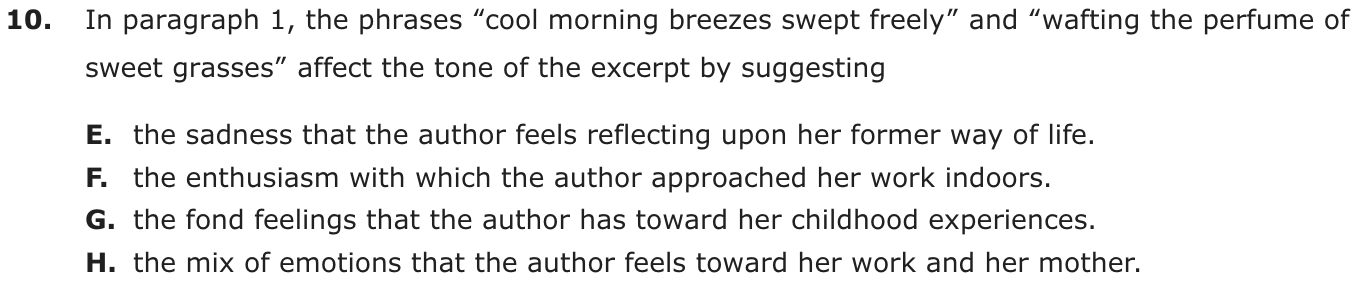
The passage “Excerpt from “Impressions of an Indian Childhood”” as printed (pages 42–43)
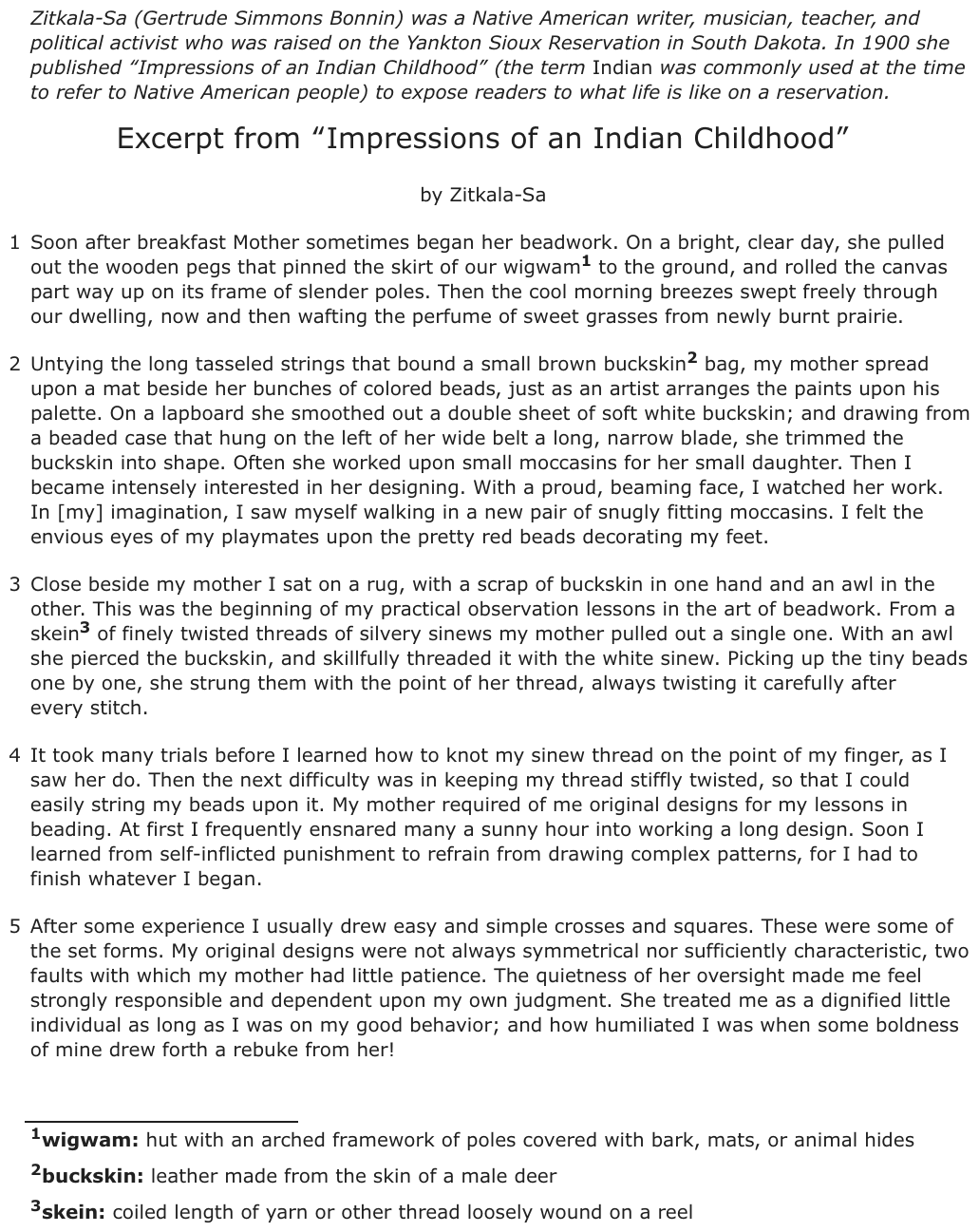
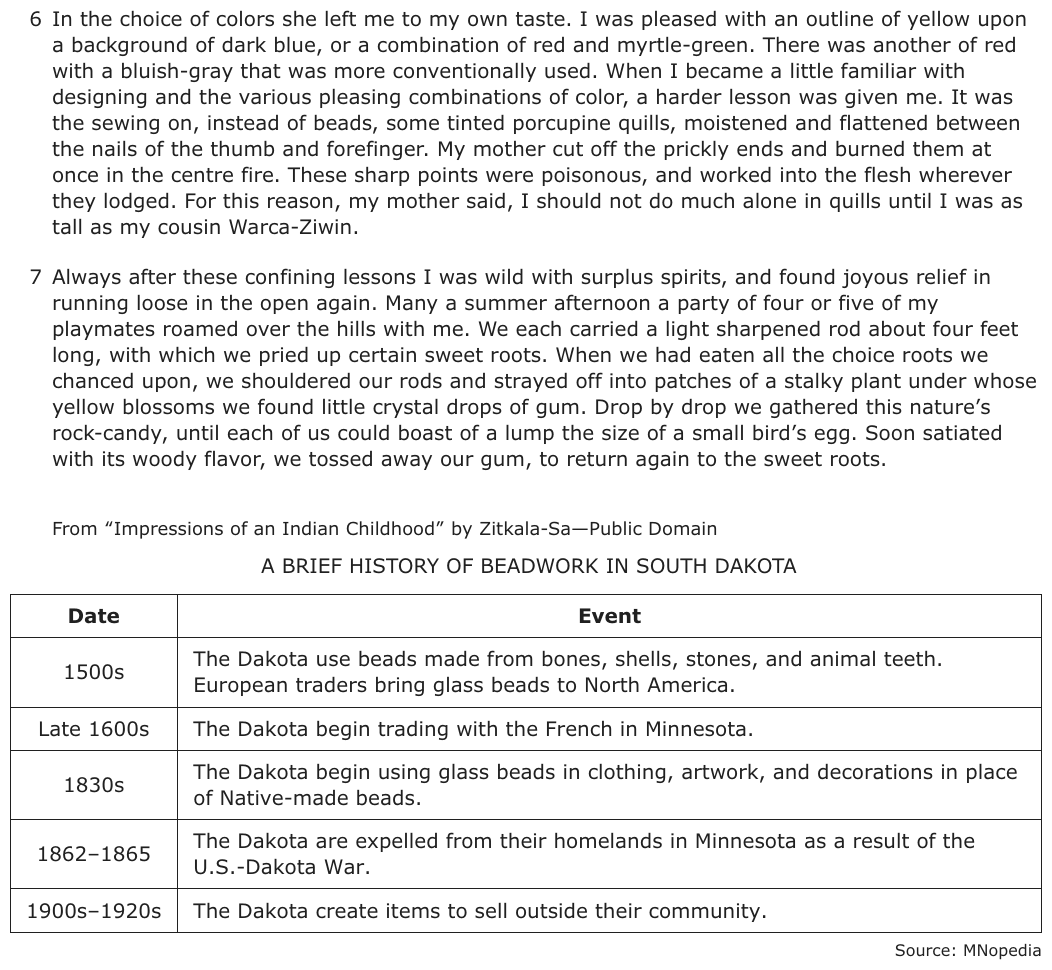
Question 43 of 57
2020 Test B English, question 43Uses the passage above: “Excerpt from “Impressions of an Indian Childhood””.
Question
The phrase “just as an artist arranges the paints upon his palette” in paragraph 2 suggests that
- Abeadwork is a true form of art.
- Bcolor is a source of artistic inspiration.
- Call artistic activities begin with a series of steps.
- Dthe beadworker tries to imitate art.
Show the answer
Correct answer: A
The question asks what the phrase “just as an artist arranges the paints upon his palette” in paragraph 2 suggests in the excerpt.
A. CORRECT. In paragraph 2, by comparing the way her mother arranges the beads to the way a painter “arranges the paints upon his palette,” the author emphasizes that her mother approaches her craft just as a painter does, thus suggesting that beadwork is a true form of art.
B. Incorrect. Although the author mentions “bunches of colored beads” in paragraph 2, this detail does not provide enough evidence for the idea that color inspires beadworkers. The phrase “just as an artist arranges the paints upon his palette” indicates the connection of beadwork to other forms of art in general, not necessarily to the specifics of color as a source of inspiration.
C. Incorrect. In paragraph 2, the author describes her mother “untying the long tasseled strings” and then spreading “upon a mat beside her bunches of colored beads.” However, the phrase “just as an artist arranges the paints upon his palette” does not suggest that all artistic activities begin with a series of steps. There is no mention in the passage of any other artistic activities involving multiple initial steps.
D. Incorrect. In paragraph 2, the author describes how her mother “spread upon a mat beside her bunches of colored beads” as the first step in the artistic process described in the passage. Therefore, the comparison between the mother’s process and a painter arranging paints on a palette suggests that the mother is creating art, not imitating it. There is no indication that the mother is copying a technique she has seen in other art forms.
Question analysis
This reading question asks what the comparison between Zitkala-Sa's mother laying out her colored beads and an artist arranging paints on a palette suggests. It tests reading a simile in context, and the choices include readings that fix on a single word or go further than the comparison itself.
- Grade level
- Grade 6 reading and task
- Compared with grade 7
- Below grade 7 Interpreting a simile is taught by grade 6. The phrase is short and quoted in the question, and one step of interpretation is enough, so this asks less than typical grade 7 work on figurative language.
- Estimated difficulty
- Routine: one familiar step, little to misread.
- Thinking it demands
- Depth of knowledge 2, skills and concepts · mainly understand
- What makes it hard
- Evidence
- Answered from one sentence or line
- Reading level
- Passage: about grade 8, 946 words; question and choices: about grade 6, 45 words.
- Students, last 30 days
- Not enough answers yet to show (it takes 10).
Why it is hard, traps and wrong answers (shows the answer)
Why it is hard
The comparison is quoted in the stem and makes one point: the mother lays out her beads the way a painter lays out paints, so her craft counts as art. Wrong answers fix on the word “paints,” stretch one comparison into a rule about all art, or read the comparison as copying. Asking what the two things being compared have in common settles it.
Figurative or literary language minor Understanding the question
The simile sets the mother laying out bunches of colored beads beside a painter arranging paints, and students must see what that comparison says about beadwork itself. (Graesser, Singer & Trabasso, 1994; Kintsch, 1998)
Strategy: Name the two things being compared and what they share, then choose the idea that comparison supports without adding anything the sentence does not say.
Traps
- Word match: Repeats striking words or phrases from the text, so it looks supported, but its meaning does not fit the question.
- Too broad or too strong: A choice overstates, generalizes, or uses absolute words the text does not support.
- Twists what the text says: Uses the text's topic and ideas but changes what it says: who did it, how much, when, or why.
The wrong answers, classified
B Word match (Freedle & Kostin, 1993)
Links “paints” with the “bunches of colored beads” and decides color is the point, though the simile compares how materials are arranged, not what inspires the artist.
C Too broad or too strong (King et al., 2004)
Turns one comparison about laying out beads into a rule about all artistic activities, a generalization the sentence does not make.
D Twists what the text says (King et al., 2004)
Sees that the simile links beadwork with painting but twists its point, reading it as the mother imitating art rather than practicing it.
Working it out, step by step
Figure out what the question asks
The phrase is a simile. A simile compares two things using “like” or “as.” You need to know what this comparison suggests about the mother’s beadwork.
Read the phrase in paragraph 2
The mother “spread upon a mat beside her bunches of colored beads, just as an artist arranges the paints upon his palette.” The word order is old-fashioned. It means she spread her bunches of colored beads on a mat beside her. A palette is the board a painter uses to hold and mix paints.
Work out what the comparison means
The two things being compared are the mother and a painter. Both lay out their colors before they start to make something. So the author treats her mother like a painter. That means beadwork is real art, just like painting.
Check each choice
- A is right. Comparing the mother to a painter shows that beadwork is a true art.
- B is wrong. The simile is about laying out materials, not about what gives an artist ideas.
- C is wrong. One comparison can’t prove a rule about all art.
- D is wrong. The mother is not copying art. She works the way an artist does, so she is making art.
Watch out: B is tempting because paints and colored beads both bring color to mind. But the simile is about how she arranges them.
Choose the answer
The simile puts the beadworker side by side with a painter. So the answer is A.
Why this answer and not the closest wrong one
B is the closest wrong answer. Paints and colored beads do share color. But the simile compares what the two people do: both arrange their materials before they create. Nothing is said about inspiration, which means where ideas come from. A matches the point that the mother works as an artist does.
More questions like this
The original DOE question

Question 44 of 57
2020 Test B English, question 44Uses the passage above: “Excerpt from “Impressions of an Indian Childhood””.
Question
The author’s use of sequence in paragraphs 1 and 2 contributes to the development of ideas in the excerpt by
- Alisting the many steps that are involved in the process of beading in order to explain its difficulty and complexity.
- Bconveying the importance of following the steps of the beading process in a precise order to work most efficiently.
- Cemphasizing the time required to fully prepare for and execute the many large and small tasks in the activity of beading.
- Ddetailing each step in preparation for beading in order to highlight the author’s enthusiasm for the work.
Show the answer
Correct answer: D
The question asks how the author’s use of sequence in paragraphs 1 and 2 contributes to the development of ideas in the excerpt.
A. Incorrect. In paragraph 2, the author does list the steps her mother takes in preparation to do beadwork, such as “untying the long tasseled strings” of the bag of beads, spreading the beads beside her on a mat, and using “a long, narrow blade” to trim the buckskin into shape. However, the language used to describe this sequence does not indicate that preparing to work with beads is difficult or complex.
B. Incorrect. Although the author’s description of untying the bag of beads, spreading the beads upon a mat, smoothing out a sheet of buckskin, and trimming the buckskin into shape in paragraph 2 indicates that the mother follows a certain routine, it does not place any emphasis on working most efficiently by following the steps of the beading process in a precise order.
C. Incorrect. In paragraph 2, the author describes her mother “untying the long tasseled strings that bound a small brown buckskin bag,” “spread[ing] upon a mat beside her bunches of colored beads,” “smooth[ing] out a double sheet of soft white buckskin; and drawing from a beaded case that hung on the left of her wide belt a long, narrow blade” to trim the buckskin. Although these descriptions do outline the steps in her process for creating beadwork, they do not emphasize the time required to do so, since the author does not mention in the excerpt how long it took her mother to fully prepare for and complete the large and small tasks in the activity of beading.
D. CORRECT. In paragraph 1, the author describes how the morning begins with her mother rolling up the canvas of the wigwam and allowing the breeze to come in. In paragraph 2, the author uses sensory language and precise sequencing to describe the way her mother prepares the beading materials by untying “the long tasseled strings that bound a small brown buckskin bag,” spreading the “bunches of colored beads” beside her, and smoothing out “a double sheet of soft white buckskin.” This combination of sequence and sensory language highlights the author’s enthusiasm for beadwork by emphasizing that the author pays close attention to her mother’s preparations.
Question analysis
This reading question asks how the step-by-step description of a mother preparing her beadwork, in the opening paragraphs of Zitkala-Sa's memoir, contributes to the excerpt's ideas. Every choice agrees that steps are listed, so students must judge which purpose the text actually supports and resist reasons that only sound likely for a craft.
- Grade level
- Grade 8 reading and task
- Compared with grade 7
- Above grade 7 Grade 7 structure questions usually ask what a paragraph adds to a topic. This one asks what an ordered description achieves, in dense 1900 prose where the purpose is never stated outright, which goes beyond typical grade 7 work.
- Estimated difficulty
- Hard: combines ideas, needs a plan, and has more than one tempting wrong answer.
- Thinking it demands
- Depth of knowledge 3, strategic thinking · mainly analyze
- What makes it hard
- How, not what major
- A very close wrong answer moderate
- Reading between the lines moderate
- Complex sentences minor
- Evidence
- Answered from several paragraphs or stanzas
- Reading level
- Passage: about grade 8, 946 words; question and choices: about grade 11, 95 words.
- Corrected from the DOE handbook
- A misquotation of the excerpt in the explanation was corrected.
- Students, last 30 days
- Not enough answers yet to show (it takes 10).
Why it is hard, traps and wrong answers (shows the answer)
Why it is hard
All four choices agree that the paragraphs lay out steps, so the question turns entirely on purpose, and three of the purposes sound like natural reasons to describe a craft. Nothing in paragraphs 1 and 2 calls the work hard, slow or a matter of efficiency; what they do show is a child following every move and becoming intensely interested. Students who look for the narrator's own reaction find the purpose, while those who reason from the steps alone drift to difficulty or time.
How, not what major Working it out
The stem asks what the ordered account of untying the bag, spreading the beads, and smoothing and trimming the buckskin does for the excerpt, a purpose the author never states. (Anderson & Krathwohl, 2001)
A very close wrong answer moderate Choosing the answer
The difficulty choice shares the right one's frame, steps laid out in order to show something, and differs only in what they show: how hard beading is, or how eagerly the girl watched. (Embretson & Wetzel, 1987; Gorin & Embretson, 2006; Ascalon et al., 2007)
Reading between the lines moderate Working it out
The enthusiasm has to be pieced together from the close attention to each step and from “intensely interested” and “a proud, beaming face” in paragraph 2. (Graesser, Singer & Trabasso, 1994; Kintsch, 1998)
Complex sentences minor Understanding the question
Paragraph 2 uses literary word order, as in “my mother spread upon a mat beside her bunches of colored beads,” which slows the reading of the very steps in question. (Abedi & Lord, 2001; Freedle & Kostin, 1993; Messick, 1989)
Strategy: For each choice, look in paragraphs 1 and 2 for words that would prove its purpose; a purpose that no sentence states or shows can be ruled out.
Traps
- Half right: One half of a two-part choice is right and the other is not.
- Wrong purpose or structure: Names a purpose, structure or effect that the part does not serve, or describes what a part says when the question asks what it does.
- Reads too much in: A reasonable-sounding conclusion that goes further than the text allows.
The wrong answers, classified
A Half right (King et al., 2004; Thissen, Steinberg & Fitzpatrick, 1989)
Rightly sees that paragraph 2 lists many preparation steps, then decides the list must show that beading is difficult and complex, which nothing in these paragraphs says.
B Wrong purpose or structure (Anderson & Krathwohl, 2001)
Reads the sequence as instructions about doing the steps in a precise order for efficiency, a purpose a watching child's memories never suggest.
C Reads too much in (Graesser, Singer & Trabasso, 1994)
Reasons that so many steps must take a long time, perhaps recalling the “many a sunny hour” of paragraph 4, but paragraphs 1 and 2 never mention time.
What was corrected from the DOE handbook, and why
- Explanation: In rejecting choice C, the handbook quotes paragraph 2 as “spread[ing them] upon a mat beside her bunches of colored beads.” In the excerpt, the bunches of colored beads are what the mother spreads (“my mother spread upon a mat beside her bunches of colored beads”). The inserted “them” refers to nothing and turns the beads into a place. The quotation now reads “spread[ing] upon a mat beside her bunches of colored beads,” which is how the handbook itself reads the sentence in its reason for rejecting choice A (“spreading the beads beside her on a mat”).
Working it out, step by step
Figure out what the question asks
Sequence means the order in which things happen. Paragraphs 1 and 2 tell the steps of a morning in order. The question asks why the author tells them step by step. What does that careful order help show?
List the steps
In paragraphs 1 and 2, the mother:
- rolls up the side of the wigwam to let in the breeze,
- unties a bag made of buckskin (soft deer leather),
- spreads her beads on a mat,
- smooths out a sheet of buckskin, and
- trims it into shape with a blade.
Find the author’s reaction
Right after the steps, the author tells how she felt. “Then I became intensely interested in her designing. With a proud, beaming face, I watched her work.” Intensely means very strongly. A beaming face has a big, happy smile. She noticed every little step because she was so excited. The details show her enthusiasm, or eager interest.
Check each choice
- A is wrong. The steps are listed, but nothing says beading is hard or complex.
- B is wrong. Nothing says the steps must go in a set order to save effort.
- C is wrong. Paragraphs 1 and 2 never say how long anything takes.
- D is right. The careful details show how closely the girl watched, with eager interest.
Watch out: A is tempting because there are many steps. But many steps don’t prove a task is hard. The author never calls it difficult.
Choose the answer
The step-by-step order shows a child following every move her mother makes. So the answer is D.
Why this answer and not the closest wrong one
A is the closest wrong answer. Like D, it says the steps are listed to show something. But no word in paragraphs 1 and 2 calls beading hard. The author does say she was “intensely interested” and had “a proud, beaming face.” That shows enthusiasm, so D fits better.
More questions like this
The original DOE question
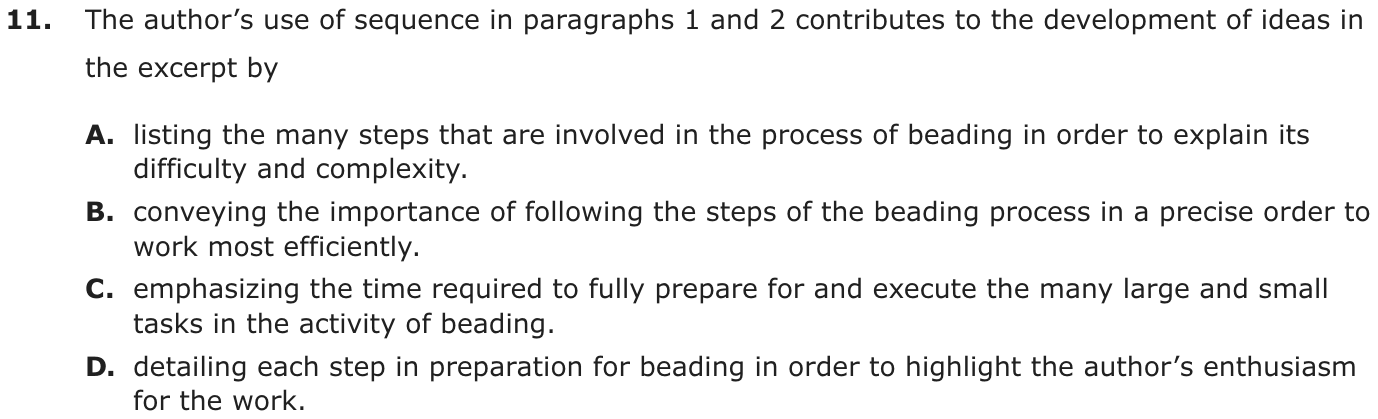
Question 45 of 57
2020 Test B English, question 45Uses the passage above: “Excerpt from “Impressions of an Indian Childhood””.
Question
The details in paragraph 3 convey a central idea of the excerpt by suggesting that
- Athe author was interested in the work because she knew her mother was making something for her.
- Bthe author had difficulty learning through observation but wanted to help her mother.
- Cthe author was determined to behave according to her mother’s standards and sought her approval.
- Dthe author had great admiration for her mother’s precision and mastery of her craft.
Show the answer
Correct answer: D
The question asks how the details in paragraph 3 convey a central idea of the excerpt.
A. Incorrect. In paragraph 2, the author mentions how her mother “worked upon small moccasins for her small daughter” and when she did, the author “became intensely interested in her [mother’s] designing.” However, in paragraph 3, the author is interested in her mother’s work mainly as part of her “lessons in the art of beadwork,” not because she knew her mother was making something for her.
B. Incorrect. In paragraph 3, the author receives “practical observation lessons in the art of beadwork” and describes how “from a skein of finely twisted threads of silvery sinews my mother pulled out a single one” and “pierced the buckskin, and skillfully threaded it with the white sinew.” The author describes the process in such detail that she provides no indication that she had difficulty learning through observation. The author also does not give any indication in the paragraph that she wanted to help her mother; she was there merely to observe and learn.
C. Incorrect. Although the author refers to her beading lessons with her mother as “practical observation lessons in the art of beadwork” and indicates that she sat “close beside” her mother while observing her beadwork, the author provides no indication in the paragraph that she was determined to behave according to her mother’s standards or that she sought her mother’s approval.
D. CORRECT. In paragraph 3, the author describes her mother’s artistry and craftsmanship by using language such as “skillfully threaded,” “picking up the tiny beads one by one,” and “twisting it carefully after every stitch.” These close observations indicate that the author greatly admired her mother’s mastery of her craft and the precision that went into every detail of her work.
Question analysis
This reading question asks how the details in the paragraph where young Zitkala-Sa sits beside her mother, watching her pierce buckskin and string tiny beads, point to a central idea of the excerpt. Several choices name feelings found elsewhere in the memoir, so students must stay with what this one paragraph shows.
- Grade level
- Grade 7 reading and task
- Compared with grade 7
- At grade 7 Linking a paragraph's details to a central idea is grade 7 reading. The answer rests on one short paragraph, but the student must turn its concrete details about thread and beads into an idea, a typical grade 7 demand.
- Estimated difficulty
- Straightforward: two steps or one careful reading.
- Thinking it demands
- Depth of knowledge 2, skills and concepts · mainly understand
- What makes it hard
- Reading between the lines moderate
- The right answer is reworded minor
- Evidence
- Answered from one paragraph or stanza
- Reading level
- Passage: about grade 8, 946 words; question and choices: about grade 9, 73 words.
- Students, last 30 days
- Not enough answers yet to show (it takes 10).
Why it is hard, traps and wrong answers (shows the answer)
Why it is hard
Paragraph 3 is short and concrete, but the feelings named in the choices come from all over the excerpt, so the danger is answering about the excerpt rather than this paragraph. The girl's interest in moccasins made for her belongs to paragraph 2, her struggles to paragraph 4, and good behavior to paragraph 5. Rereading paragraph 3 alone, and noticing how it describes the mother's hands at work, points to the right idea.
Reading between the lines moderate Working it out
Admiration is never named; it has to be inferred from the words chosen for the mother's work: “skillfully threaded,” beads picked up “one by one,” thread twisted “carefully after every stitch.” (Graesser, Singer & Trabasso, 1994; Kintsch, 1998)
The right answer is reworded minor Choosing the answer
The right choice says “precision and mastery,” words absent from paragraph 3, while wrong choices echo the excerpt's own “observation” lessons, its “difficulty” with thread, and the moccasins made for the daughter. (Freedle & Kostin, 1993; Kirsch & Mosenthal, 1990)
Strategy: Reread paragraph 3 by itself and note what its verbs and describing words emphasize, then match that emphasis to a choice and reject ideas drawn from other paragraphs.
Traps
- Wrong part of the text: A choice is true of another paragraph, stanza or speaker than the one asked about.
- Twists what the text says: Uses the text's topic and ideas but changes what it says: who did it, how much, when, or why.
The wrong answers, classified
A Wrong part of the text (Kirsch & Mosenthal, 1990)
Recalls that paragraph 2 makes the girl “intensely interested” when the moccasins are for her, but paragraph 3 presents the watching as the start of her lessons.
B Twists what the text says (King et al., 2004)
Pairs the “observation lessons” of paragraph 3 with the difficulty of paragraph 4 and adds a wish to help, though the girl struggles with her own thread, not with watching.
C Wrong part of the text (Kirsch & Mosenthal, 1990)
Draws on paragraph 5, where the mother treats her with dignity “as long as I was on my good behavior,” but paragraph 3 says nothing about standards or approval.
Working it out, step by step
Figure out what the question asks
Look only at paragraph 3. A central idea is an important message of the whole excerpt. You need the idea that the details in paragraph 3 show.
Find the details in paragraph 3
The girl sits “close beside” her mother and watches. The mother “skillfully threaded it with the white sinew.” Sinew is a strong cord made from an animal’s body. She picks up “the tiny beads one by one.” She keeps “twisting it carefully after every stitch.”
Work out what the details show
Words like “skillfully” and “carefully” show the mother is an expert. She works with precision, which means being exact. Her mastery, or great skill, shows in every small move. The girl notices each one. You watch someone this closely when you admire them, or think highly of them.
Check each choice
- A is wrong. The moccasins made for her come from paragraph 2. Paragraph 3 is about her lessons.
- B is wrong. Her trouble with thread comes in paragraph 4. Nothing says she wants to help.
- C is wrong. Good behavior comes up in paragraph 5, not paragraph 3.
- D is right. The careful details show admiration for her mother’s skill.
Watch out: A, B and C all use ideas from other paragraphs. Stay inside paragraph 3.
Choose the answer
Paragraph 3 shows a girl who watches her mother’s expert hands with wonder. So the answer is D.
Why this answer and not the closest wrong one
A is the closest wrong answer, because the girl really was “intensely interested” when her mother made moccasins for her. But that is in paragraph 2. Paragraph 3 calls the watching “the beginning of my practical observation lessons.” Its details praise how skillfully and carefully the mother works. That fits D.
More questions like this
The original DOE question
Question 46 of 57
2020 Test B English, question 46Uses the passage above: “Excerpt from “Impressions of an Indian Childhood””.
Question
Which sentence best summarizes the process of beading that is described in the excerpt?
- ATake a buckskin bag full of beads and spread them out on a mat in different colors like a paint palette; take a double sheet of buckskin and smooth it out on a table; take a sinew and awl and thread the beads onto the buckskin in a desired pattern.
- BCut the double sheet of buckskin into a shape; take a skein of sinew and pierce the buckskin with an awl; thread the sinew with beads of many different colors in a simple or complex pattern; twist the sinew to keep it tight after every stitch into the buckskin.
- CArrange the beads into groups of colors on a mat; smooth out a double sheet of buckskin and cut it to shape; take a single thread of sinew; pierce the buckskin with an awl; thread the buckskin with the sinew and string it with beads, carefully twisting after every stitch.
- DGather beads, buckskin, sinew, and awl and place them on a mat; cut the buckskin into the desired shape; decide on a pattern for the beads and create it using the sinews and the awl; thread the beads onto the sinew in the desired pattern and twist it tight.
Show the answer
Correct answer: C
The question asks which sentence best summarizes the process of beading that is described in the excerpt.
A. Incorrect. In paragraphs 2 and 3, the author describes how at the beginning of the process her mother “smoothed out a double sheet of soft white buckskin” on a lapboard (paragraph 2) and how she strings the beads into a pattern. However, this sentence does not describe the steps that take place between the preparation and the stringing of the beads. Thus, this sentence does not best summarize the beading process.
B. Incorrect. In paragraphs 2 and 3, the author describes the process her mother uses to string the beads with “the point of her thread, always twisting it carefully after every stitch” (paragraph 3). While this sentence includes some of the steps in the beading process, it does not describe the necessary preparation, namely spreading the beads out on a mat and smoothing out the buckskin on a lapboard. Thus, this sentence does not best summarize the beading process.
C. CORRECT. This sentence best summarizes the process of beading that is described in the excerpt because it includes details about each step in the process. In paragraph 2, the author explains how her mother “spread upon a mat beside her bunches of colored beads” and how “on a lapboard she smoothed out a double sheet of soft white buckskin; and drawing from a beaded case that hung on the left of her wide belt a long, narrow blade, she trimmed the buckskin into shape.” The author continues her description in paragraph 3, stating, “From a skein of finely twisted threads of silvery sinews my mother pulled out a single one. With an awl she pierced the buckskin, and skillfully threaded it with the white sinew. Picking up the tiny beads one by one, she strung them with the point of her thread, always twisting it carefully after every stitch.”
D. Incorrect. In paragraphs 2 and 3, the author describes the process her mother uses as she “smoothed out a double sheet of soft white buckskin” (paragraph 2) on a lapboard before stringing the beads. While this sentence includes most of the steps in the beading process, it excludes the step of piercing the buckskin. This sentence also provides few details about the process of beading and uses vague wording to describe each step. Therefore, the sentence does not best summarize the beading process.
Question analysis
This reading question asks which sentence best summarizes the beadwork process Zitkala-Sa watches her mother carry out, from laying out the materials to stringing the beads. Each choice is a long list of steps, so students must compare them detail by detail with the excerpt and notice what each one adds, leaves out or misplaces.
- Grade level
- Grade 8 reading and task
- Compared with grade 7
- Above grade 7 Summarizing a process is grade 7 reading, but the four summaries are long and nearly alike, and checking them against two paragraphs of 1900 prose with words like awl, sinew and skein is heavier than usual.
- Estimated difficulty
- Hard: combines ideas, needs a plan, and has more than one tempting wrong answer.
- Thinking it demands
- Depth of knowledge 2, skills and concepts · mainly understand
- What makes it hard
- Every choice must be checked major
- A lot to read moderate
- Hard words minor
- Evidence
- Answered from several paragraphs or stanzas
- Reading level
- Passage: about grade 8, 946 words; question and choices: about grade 16+, 212 words.
- Corrected from the DOE handbook
- An inaccurate detail about the excerpt in the explanation was corrected.
- Students, last 30 days
- Not enough answers yet to show (it takes 10).
Why it is hard, traps and wrong answers (shows the answer)
Why it is hard
This question is won by bookkeeping, not insight: list the mother's steps from the two paragraphs, then hold each long summary against the list. The most tempting wrong summary reads like a sensible craft routine in a sensible order, yet it never has the buckskin pierced and puts every tool on the mat. Others open with a familiar image or close with precise stitching while skipping steps, so students who check only the beginning or only the end are caught.
Every choice must be checked major Choosing the answer
Each summary is a chain of four to six steps, so all four must be checked step by step against paragraphs 2 and 3 for steps missing, added or out of order. (Embretson & Wetzel, 1987)
A lot to read moderate Understanding the question
The four choices together run to about 200 words of semicolon-linked steps, and the text they summarize is two paragraphs of dense 1900 prose. (Kintsch, 1998; Gorin & Embretson, 2006; Freedle & Kostin, 1993)
Hard words minor Understanding the question
Words like awl, sinew, skein and lapboard name the tools and materials, and a student unsure of them cannot tell which steps a summary has dropped. (Perfetti, 2007; Freedle & Kostin, 1993)
Strategy: List the mother's steps from paragraphs 2 and 3 in order, then check each choice against your list for a missing step, an invented detail or a step out of place.
Traps
- Too narrow: A single detail offered as the central idea or a summary, or a summary that keeps minor details and leaves out an essential part.
The wrong answers, classified
A Too narrow (King et al., 2004)
Keeps the familiar palette image but leaves out trimming the buckskin, piercing it with the awl and twisting the thread, and even moves the smoothing onto a table.
B Too narrow (King et al., 2004)
Matches paragraph 3's piercing and twisting closely but leaves out the preparation, laying out the beads and smoothing the buckskin, and starts the process with cutting.
D Too narrow (King et al., 2004)
Accepts a tidy, well-ordered outline that keeps most steps but leaves out smoothing the buckskin and piercing it with the awl, and piles every tool onto the mat.
What was corrected from the DOE handbook, and why
- Explanation: In rejecting choice B, the handbook says the choice leaves out the preparation, “namely spreading the beads and the buckskin out on a table.” The excerpt mentions no table: in paragraph 2 the mother spreads the beads on a mat and smooths out the buckskin on a lapboard. The explanation now says so. (Choice A’s “on a table” is part of a wrong answer and is left as printed.)
Working it out, step by step
Figure out what the question asks
You need the summary that best matches the beading steps in the excerpt. A summary is a short retelling of the main points. The best one keeps every main step, in order, and adds nothing new.
List the steps from paragraphs 2 and 3
Paragraphs 2 and 3 give the mother’s steps in order. The last one ends with her “always twisting it carefully after every stitch.”
- Spread the beads on a mat.
- Smooth out a double sheet of buckskin on a lapboard (a board held on the lap).
- Trim the buckskin into shape with a blade.
- Pull out a single sinew, a strong thread.
- Pierce (poke a hole in) the buckskin with an awl, a pointed tool.
- Thread the sinew through the buckskin.
- String the beads, twisting the thread after every stitch.
Check each choice against the list
- A is wrong. It skips trimming, piercing and twisting. It also says “on a table,” but she used a lapboard.
- B is wrong. It starts with cutting. It skips spreading the beads and smoothing the buckskin.
- C is right. It has every step, in the same order.
- D is wrong. It never says to smooth the buckskin or pierce it. It also puts every tool on the mat, but only the beads went there.
Watch out: D sounds like a sensible plan in a sensible order. But a summary must match the excerpt, not just sound right. Check it step by step.
Choose the answer
Only C follows the mother’s steps from start to finish. So the answer is C.
Why this answer and not the closest wrong one
D is the closest wrong answer. It is neat and keeps most of the steps. But it skips smoothing the buckskin and never says to pierce it with the awl. It also piles every tool onto the mat. C matches the excerpt step for step, so it is the best summary.
More questions like this
The original DOE question
Question 47 of 57
2020 Test B English, question 47Uses the passage above: “Excerpt from “Impressions of an Indian Childhood””.
Question
The idea that mastering moccasin design and creation requires experience is best illustrated in the excerpt through
- Athe information about the advanced technique of incorporating porcupine quills into a design.
- Bthe descriptions of the special materials that must be used to make decorated moccasins.
- Cthe descriptions of the various color combinations that make an attractive moccasin design.
- Dthe example of the author successfully and independently using a sharpened rod.
Show the answer
Correct answer: A
The question asks how the idea that mastering moccasin design and creation requires experience is best illustrated in the excerpt.
A. CORRECT. In paragraph 6, the author states that when she became more familiar with elements of design, “a harder lesson was given me.” According to the author, sewing on porcupine quills is a much more difficult task to master because it requires experience in handling the poisonous porcupine quills, which is why her mother told her not to “do much alone in quills” until she was older (paragraph 6). This information best illustrates the idea that mastering moccasin design and creation requires experience.
B. Incorrect. Although the author provides detailed descriptions of the materials used to make decorated moccasins (“colored beads” [paragraph 2]; “a skein of finely twisted threads of silvery sinews” [paragraph 3]; “tinted porcupine quills, moistened and flattened between the nails of the thumb and forefinger” [paragraph 6]), these descriptions do not illustrate the experience that is needed to gain mastery of moccasin design and creation.
C. Incorrect. Although the author describes the color combinations she used in making moccasins (“I was pleased with an outline of yellow upon a background of dark blue, or a combination of red and myrtle-green. There was another of red with a bluish-gray that was more conventionally used” [paragraph 6]), this information mainly illustrates the author’s satisfaction with her moccasin design, not the importance of experience in mastering the creation and design of moccasins.
D. Incorrect. In paragraph 7, the author tells of using a sharpened rod to dig for roots. She explains that she and her playmates used the rods to “[pry] up certain sweet roots,” which they ate before going off to gather gum from a stalky plant. The detail of the sharpened rod is from a recollection about the playtime that followed the “confining lessons” of moccasin making. However, the sharpened rod was not used to create moccasins.
Question analysis
This reading question asks which part of Zitkala-Sa's account of learning to bead moccasins best illustrates the idea that mastering the craft takes experience. The choices point to materials, color combinations, a technique and outdoor play, so students must find the detail that ties skill to practice rather than one that simply describes the craft.
- NYS standards
- 7R1 textual evidence and inferences
- Grade level
- Grade 7 reading and task
- Compared with grade 7
- At grade 7 Choosing the detail that best illustrates an idea is grade 7 evidence work. The idea is stated plainly in the question and each paragraph of the excerpt keeps to one topic, so the demand matches typical grade 7 tasks.
- Estimated difficulty
- Straightforward: two steps or one careful reading.
- Thinking it demands
- Depth of knowledge 2, skills and concepts · mainly evaluate
- What makes it hard
- Evidence
- Answered from one paragraph or stanza
- Reading level
- Passage: about grade 8, 946 words; question and choices: about grade 12, 69 words.
- Corrected from the DOE handbook
- An inaccurate account of the excerpt in the explanation was corrected.
- Students, last 30 days
- Not enough answers yet to show (it takes 10).
Why it is hard, traps and wrong answers (shows the answer)
Why it is hard
The idea of experience is spelled out in paragraph 6, where quillwork is a harder lesson given only after some practice and kept from the girl until she is older. The wrong choices describe things the excerpt really contains, materials, colors and a tool, so they look supported until each is asked whether it shows a learner needing practice. Students who put that one question to every choice find this a quick item.
Evidence in several places minor Working it out
The stem names no paragraph, so students must find where each choice's detail sits, from the beads and sinew of paragraphs 2 and 3 to the rods of paragraph 7. (Kirsch & Mosenthal, 1990; Gorin & Embretson, 2006)
Reading between the lines minor Working it out
The link to experience is implied in paragraph 6: quills come as “a harder lesson” once she is “a little familiar with designing,” and she must wait until she is “as tall as my cousin.” (Graesser, Singer & Trabasso, 1994; Kintsch, 1998)
Strategy: For each choice, find the part of the excerpt it refers to and ask whether it shows a learner needing practice before doing something, not just what the craft involves.
Traps
- Supports only part of the claim: In a question about evidence: a line that backs one half of the claim but not the other, or a related point rather than the claim itself.
- Wrong part of the text: A choice is true of another paragraph, stanza or speaker than the one asked about.
The wrong answers, classified
B Supports only part of the claim (King et al., 2004; Thissen, Steinberg & Fitzpatrick, 1989)
Picks the descriptions of beads, sinew and buckskin, which show what moccasins are made from but say nothing about the experience needed to master making them.
C Supports only part of the claim (King et al., 2004; Thissen, Steinberg & Fitzpatrick, 1989)
Points to the color combinations of paragraph 6, which come just before the quill lesson but show the girl's own taste and freedom to choose, not a skill that takes practice.
D Wrong part of the text (Kirsch & Mosenthal, 1990)
Seizes on the girl using a sharpened rod on her own, but the rods belong to her play in paragraph 7, digging sweet roots, and have nothing to do with moccasins.
What was corrected from the DOE handbook, and why
- Explanation: In rejecting choice D, the handbook says the author used a sharpened rod “to spear gum from trees” and that the children pried up sweet roots “to find the gum.” In paragraph 7 the rods are used to pry up sweet roots, which the children eat; afterwards they stray off to a stalky plant and find drops of gum under its yellow blossoms. Nothing is speared and no trees are mentioned. The explanation now says the rods were used to dig for roots, sweet roots the children ate before going off to gather gum from a stalky plant. The reason for rejecting D, that the rod was not used to make moccasins, is unchanged.
Working it out, step by step
Figure out what the question asks
You need the part of the excerpt that best shows one idea. The idea is that you need experience to master making moccasins. Experience means practice over time. Look for a learner who must practice before doing something harder.
Find the evidence in paragraph 6
Paragraph 6 says: “When I became a little familiar with designing and the various pleasing combinations of color, a harder lesson was given me.” The harder lesson was sewing on porcupine quills. Then her mother said “I should not do much alone in quills until I was as tall as my cousin Warca-Ziwin.”
Work out what it means
Quills are the sharp spines of a porcupine. Their points were “poisonous,” so they were dangerous. The girl got this lesson only after she knew the basics. Even then, she could not do much alone with quills until she was as tall as her cousin. That shows skill grows with experience.
Check each choice
- A is right. Quillwork is a harder skill she must earn through practice.
- B is wrong. The materials show what moccasins are made of, not how skill is gained.
- C is wrong. The colors show her own taste. Her mother “left me to my own taste.”
- D is wrong. The rods were for digging up sweet roots during play. They had nothing to do with moccasins.
Watch out: C comes right before the quills in paragraph 6, so it is easy to pick. But the colors show what she liked, not a skill she had to build up.
Choose the answer
The quill lesson comes only after practice, and working alone comes only once she has grown. So the answer is A.
Why this answer and not the closest wrong one
C is the closest wrong answer, since the colors come just before the quill lesson. But the girl was free to pick the colors she liked. That shows her taste, not a need for experience. The quills are called “a harder lesson,” given only once she knew the basics. That fits A.
More questions like this
The original DOE question
Question 48 of 57
2020 Test B English, question 48Uses the passage above: “Excerpt from “Impressions of an Indian Childhood””.
Question
How does the author distinguish her point of view from that of her mother?
- Aby describing their techniques for knotting sinew thread (paragraph 4)
- Bby describing their approaches to beadwork design (paragraph 5)
- Cby stating her mother’s instructions on working with quills (paragraph 6)
- Dby stating her mother’s ideas about activities after lessons (paragraph 7)
Show the answer
Correct answer: B
The question asks how the author distinguishes her point of view from that of her mother.
A. Incorrect. In paragraph 4, the author explains that “it took many trials before I learned how to knot my sinew thread on the point of my finger, as I saw her do” and that the “difficulty was in keeping my thread stiffly twisted, so that I could easily string my beads upon it.” Although this explanation describes the author’s difficulty in performing the same task as her mother, it does not distinguish her point of view from that of her mother. In fact, they seem to share the same point of view regarding the importance of the technique the author is attempting to learn.
B. CORRECT. In paragraph 5, the author distinguishes her point of view from that of her mother by describing their approaches to beadwork design. In the paragraph, the author states, “I usually drew easy and simple crosses and squares” and “My original designs were not always symmetrical nor sufficiently characteristic, two faults with which my mother had little patience.” The author also distinguishes her point of view from that of her mother by stating that “the quietness of [my mother’s] oversight made me feel strongly responsible and dependent upon my own judgment.”
C. Incorrect. In paragraph 6, the author states, “My mother cut off the prickly ends and burned them at once in the centre fire. These sharp points were poisonous, and worked into the flesh wherever they lodged. For this reason, my mother said, I should not do much alone in quills until I was as tall as my cousin Warca-Ziwin.” Although these instructions explain the importance of having experience and skill when working with quills, they do not distinguish the author’s point of view from that of her mother.
D. Incorrect. In paragraph 7, the author describes her beadwork lessons as “confining” and states that she liked to roam “over the hills” with her playmates after the lessons. However, she makes no mention of her mother in paragraph 7; the activities and ideas stated there belong to the author, not the mother.
Question analysis
This reading question asks how Zitkala-Sa separates her own point of view from her mother's in an excerpt about learning beadwork as a girl. Each choice points to a different paragraph, so students must revisit all four and find where the two perspectives actually differ, not just where one person speaks or acts.
- Grade level
- Grade 7 reading and task
- Compared with grade 7
- At grade 7 Analyzing how an author sets her view apart from another person's is a grade 7 standard. The memoir's sentences are long and old-fashioned, but its paragraphs are short and concrete, so the demand is typical of grade 7 reading.
- Estimated difficulty
- Moderate: several steps, or a close reading with one strong distractor.
- Thinking it demands
- Depth of knowledge 2, skills and concepts · mainly analyze
- What makes it hard
- Every choice must be checked moderate
- How, not what moderate
- Hard words minor
- Evidence
- Answered from several paragraphs or stanzas
- Reading level
- Passage: about grade 8, 946 words; question and choices: about grade 9, 51 words.
- Corrected from the DOE handbook
- A word-order slip in the explanation was corrected.
- Students, last 30 days
- Not enough answers yet to show (it takes 10).
Why it is hard, traps and wrong answers (shows the answer)
Why it is hard
Every paragraph named shows mother and daughter together, or the daughter alone, so each looks like a candidate until it is tested for an actual difference in outlook. The struggle to knot sinew is a difference in skill, not in view, and the warning about quills gives only the mother's side. Paragraph 5 is the one place where the girl's own designs and her mother's impatience with their faults are set side by side.
Every choice must be checked moderate Choosing the answer
Each choice points to a different paragraph, 4 through 7, so all four have to be reread and tested for two outlooks that actually differ, not just one person's action or advice. (Embretson & Wetzel, 1987)
How, not what moderate Working it out
The question asks how the author sets her view apart, so students must find where two outlooks meet and clash: her simple, imperfect designs against the faults her mother “had little patience” with. (Anderson & Krathwohl, 2001)
Hard words minor Understanding the question
The key sentence turns on “not always symmetrical nor sufficiently characteristic,” formal words that must be understood to see the mother's standards behind them. (Perfetti, 2007; Freedle & Kostin, 1993)
Strategy: For each paragraph named, ask whether it shows both the mother's view and the narrator's and sets them against each other; a paragraph with one perspective cannot be the answer.
Traps
- True but not the answer: A choice says something accurate about the text that does not answer this question.
- Wrong part of the text: A choice is true of another paragraph, stanza or speaker than the one asked about.
The wrong answers, classified
A True but not the answer (King et al., 2004; Embretson & Wetzel, 1987)
Sees the girl struggle to knot sinew the way her mother does, a real contrast in skill, but she learns the same method “as I saw her do,” so their views do not differ.
C True but not the answer (King et al., 2004; Embretson & Wetzel, 1987)
Picks the mother's warning about poisonous quills because it states her view, but the narrator reports it without setting any opinion of her own against it.
D Wrong part of the text (Kirsch & Mosenthal, 1990)
Credits the mother with ideas about play after lessons, though paragraph 7 gives only the narrator's own “joyous relief,” and the mother does not appear in it.
What was corrected from the DOE handbook, and why
- Explanation: The handbook reads “The author also distinguishes her point of view from that her of mother.” It now reads “from that of her mother,” as earlier in the same explanation.
Working it out, step by step
Figure out what the question asks
A point of view is how a person sees or judges something. You need a place where the author shows that she and her mother see things differently. Each choice names a different paragraph. Check each one for two views that don’t match.
Find two views in paragraph 5
The girl “usually drew easy and simple crosses and squares.” Then she says: “My original designs were not always symmetrical nor sufficiently characteristic, two faults with which my mother had little patience.”
Work out what it means
Symmetrical means the same on both sides. “Sufficiently characteristic” means typical enough of the usual style. The girl kept her designs easy and simple. Her mother cared about something else. She saw “faults,” or mistakes, in them. Having “little patience” means being quickly annoyed. So the two judge the designs differently.
Check each choice
- A is wrong. In paragraph 4 the girl learns to knot thread “as I saw her do.” She learns her mother’s way, so their views match.
- B is right. Paragraph 5 sets the girl’s designs against her mother’s standards.
- C is wrong. Paragraph 6 gives only the mother’s warning about quills. The girl does not disagree.
- D is wrong. The mother doesn’t appear in paragraph 7 at all.
Watch out: A is tempting because the girl struggles with something her mother can do. But that is a difference in skill, not in point of view.
Choose the answer
Paragraph 5 is the one place where the two views are set side by side. So the answer is B.
Why this answer and not the closest wrong one
A is the closest wrong answer. The girl does struggle to knot thread the way her mother does. But they agree on how it should be done. In paragraph 5, the girl’s simple designs meet her mother’s impatience with their “faults.” That is a real difference in how they see the work.
More questions like this
The original DOE question
Question 49 of 57
2020 Test B English, question 49Uses the passage above: “Excerpt from “Impressions of an Indian Childhood””.
Question
Read this sentence from paragraph 7.
Always after these confining lessons I was wild with surplus spirits, and found joyous relief in running loose in the open again.
Which sentence best describes how this sentence fits into the overall structure of the excerpt?
- AIt introduces a shift from the author’s demanding relationship with her mother to her more relaxed relationships with friends.
- BIt signals a change from the challenging aspects of life on the reservation to the advantages of living on the prairie.
- CIt highlights a contrast between the focus and control required while working and the freedom of having fun outside.
- DIt concludes the progression of events in the narrative by describing the sequence of events at the end of the author’s day.
Show the answer
Correct answer: C
The question asks which sentence best describes how the sentence from paragraph 7 fits into the overall structure of the excerpt.
A. Incorrect. Though the author feels humiliated “when some boldness of mine drew forth a rebuke from” her mother (paragraph 5) and characterizes her lessons with her mother as “confining” (paragraph 7), the overall passage does not portray a demanding relationship between the author and the mother. The shift introduced in the sentence from paragraph 7 is not from one of the author’s relationships to another; it is from work to play.
B. Incorrect. In paragraph 6, the author explains how working with porcupine quills is difficult because the “sharp points were poisonous, and worked into the flesh wherever they lodged.” Although this sentence suggests that working with porcupine quills was challenging, the sentence from paragraph 7 does not signal a change from the challenging aspects of life on the reservation to the advantages of living on the prairie. Most of paragraph 6 describes the author’s pleasure in creating designs in different colors.
C. CORRECT. In the sentence from paragraph 7, the author refers to her beadwork lessons as “confining” and states that after the lessons, she “was wild with surplus spirits” and “found joyous relief” in being outside and running around. The phrases “surplus spirits” and “joyous relief” highlight a sense of freedom that stands in strong contrast to the “confining” nature of the author’s beadwork lessons, which required intense focus and control.
D. Incorrect. In paragraph 7, the author describes how “many a summer afternoon” after her beadwork lessons, she and her friends used “a light sharpened rod” to gather “sweet roots” and “little crystal drops of gum.” She then explains that they later “tossed away our gum, to return again to the sweet roots.” However, the sentence from paragraph 7 does not conclude the progression of events in the narrative by describing the sequence of events at the end of the author’s day; the sentence appears at the beginning of paragraph 7 and provides a contrast with events from the previous paragraph.
Question analysis
This reading question quotes the sentence that opens the last paragraph of Zitkala-Sa's excerpt, where she tells how she felt after her beadwork lessons, and asks how it fits the overall structure. Several choices describe a turn or a contrast, so students must pin down exactly what is being set against what.
- Grade level
- Grade 7 reading and task
- Compared with grade 7
- At grade 7 Explaining how one sentence fits a text's structure is grade 7 reading. The sentence is quoted and its wording is vivid, but the student must connect it to the paragraphs on both sides of it, a typical grade 7 demand.
- Estimated difficulty
- Moderate: several steps, or a close reading with one strong distractor.
- Thinking it demands
- Depth of knowledge 2, skills and concepts · mainly analyze
- What makes it hard
- How, not what moderate
- A very close wrong answer moderate
- Hard words minor
- Evidence
- Answered from several paragraphs or stanzas
- Reading level
- Passage: about grade 8, 946 words; question and choices: about grade 10, 123 words.
- Students, last 30 days
- Not enough answers yet to show (it takes 10).
Why it is hard, traps and wrong answers (shows the answer)
Why it is hard
The sentence clearly marks a change, and every choice names some change, so the work lies in saying exactly what is set against what. The excerpt contrasts careful, controlled work with free play, and the word “confining” carries that contrast. Students lose the point by making the turn about people, reading one rebuke as a hard relationship, or about the day's timeline, when the sentence describes what always happened after lessons.
How, not what moderate Working it out
The stem asks how the sentence works in the excerpt's structure, so students must name the turn it marks, from the “confining” lessons of paragraphs 3–6 to running loose outdoors. (Anderson & Krathwohl, 2001)
A very close wrong answer moderate Choosing the answer
The relationships choice also describes a move from lessons with her mother to play with friends, and differs from the right one only in calling the bond with her mother demanding. (Embretson & Wetzel, 1987; Gorin & Embretson, 2006; Ascalon et al., 2007)
Hard words minor Understanding the question
Old-fashioned phrasing such as “wild with surplus spirits” and “joyous relief” has to be decoded as a burst of energy after hours of holding still. (Perfetti, 2007; Freedle & Kostin, 1993)
Strategy: Compare paragraph 6 with paragraph 7 and name what changes between them in a few words, then pick the choice whose two halves match both sides of that change.
Traps
- Half right: One half of a two-part choice is right and the other is not.
- Twists what the text says: Uses the text's topic and ideas but changes what it says: who did it, how much, when, or why.
- Wrong purpose or structure: Names a purpose, structure or effect that the part does not serve, or describes what a part says when the question asks what it does.
The wrong answers, classified
A Half right (King et al., 2004; Thissen, Steinberg & Fitzpatrick, 1989)
Notices the move from lessons with her mother to play with friends, but the excerpt shows a quiet, respectful teacher, not a demanding relationship; the turn is from work to play.
B Twists what the text says (King et al., 2004)
Inflates the move outdoors into a contrast between hardships of reservation life and the prairie's advantages, a far broader claim than one sentence about lessons supports.
D Wrong purpose or structure (Anderson & Krathwohl, 2001)
Takes the sentence as closing a day's events, since the excerpt begins after breakfast and paragraph 7 turns to afternoons, though it opens its paragraph with a contrast.
Working it out, step by step
Figure out what the question asks
This asks how one sentence fits the structure of the excerpt. Structure means how the parts are put together. You need to know what change this sentence marks.
Read the sentence closely
The sentence opens paragraph 7: “Always after these confining lessons I was wild with surplus spirits, and found joyous relief in running loose in the open again.” Confining means keeping you shut in or held still. “Surplus spirits” means extra energy. “Joyous relief” is a happy feeling of being free at last.
Compare what comes before and after
Paragraphs 3 to 6 show the lessons. The girl sits still and works with care. She learns to knot thread, plan designs and handle sharp quills. The rest of paragraph 7 shows her roaming the hills with friends. So this sentence turns from careful work to free play.
Check each choice
- A is wrong. The mother is a quiet, respectful teacher, not a demanding one. The shift is from work to play.
- B is wrong. The sentence sets lessons against play. It says nothing about reservation life being hard or the prairie being better.
- C is right. “Confining” lessons are set against “running loose in the open.”
- D is wrong. The sentence starts paragraph 7 and tells what always happened after lessons. It doesn’t end the story.
Watch out: A is tempting because the girl goes from her mother to her friends. But the sentence contrasts how she felt during lessons and after them.
Choose the answer
The sentence contrasts the focus that work needs with the freedom of playing outside. So the answer is C.
Why this answer and not the closest wrong one
A is the closest wrong answer. It also sees a move from lessons with her mother to play with friends. But A calls the relationship demanding. The mother teaches quietly and treats her daughter “as a dignified little individual” (paragraph 5). The real contrast is in the word “confining,” which sets held-still work against free play. That is C.
More questions like this
The original DOE question
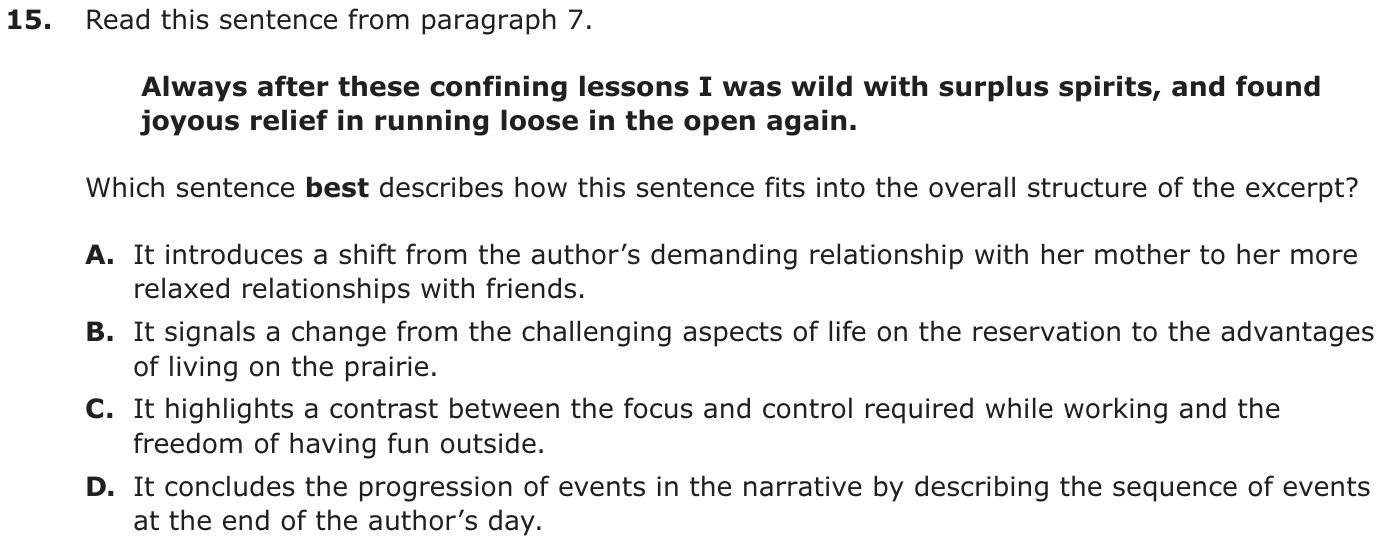
Question 50 of 57
2020 Test B English, question 50Uses the passage above: “Excerpt from “Impressions of an Indian Childhood””.
Question
The table after paragraph 7 expands on a central idea in the excerpt because it shows that
- Athe craft the author was learning was a tradition that endured through many generations and changes.
- Bthe author’s family incorporated traditional materials into their craft as a way of resisting the influence from European traders.
- Cthe uniqueness of the cultural tradition that the author learned as a child was eventually recognized in Europe.
- Dthe author was able to incorporate color into her craftwork as a result of trade with other peoples.
Show the answer
Correct answer: A
The question asks how the table after paragraph 7 expands on a central idea in the excerpt.
A. CORRECT. The table provides the chronology from the 1500s, when the Dakota created beadwork using “beads made from bones, shells, stones, and animal teeth,” to the 1830s, when the Dakota began “using glass beads,” and the 1900s, when they created items to “sell outside their community.” Thus, the table helps expand on a central idea by showing that the craft the author was learning is a tradition that has endured through many generations.
B. Incorrect. Although the table shows that the Dakota used “beads made from bones, shells, stones, and animal teeth” in the 1500s and that by the 1830s began “using glass beads in clothing, artwork, and decorations in place of Native-made beads,” it does not provide any information about the type of materials used by the author’s family.
C. Incorrect. While the information included in the table states that “European traders [brought] glass beads to North America” in the 1500s and that by the 1920s the Dakota created “items to sell outside their community,” there is no mention of whether the uniqueness of Dakota beadwork was recognized in Europe.
D. Incorrect. The table indicates that by the late 1600s the Dakota began trading with French traders from Europe who brought glass beads to the Americas and that by the 1830s the Dakota were “using glass beads in clothing, artwork, and decorations in place of Native-made beads.” However, the table provides no information about whether this work incorporated color. Therefore, the table does not show that the author was able to incorporate color into her craftwork as a result of trade with other peoples.
Question analysis
This reading question asks how a table titled A Brief History of Beadwork in South Dakota, printed after Zitkala-Sa's excerpt, expands on one of its central ideas. Students must read a short timeline of beads, trade and war and connect it to a girl learning beadwork, while avoiding choices that sound historically likely but go beyond the table.
- Grade level
- Grade 7 reading and task
- Compared with grade 7
- At grade 7 Connecting a table to a text's central idea is grade 7 work. The table is short and plainly worded, and linking a people's history to one girl's lessons is a typical grade 7 step.
- Estimated difficulty
- Moderate: several steps, or a close reading with one strong distractor.
- Thinking it demands
- Depth of knowledge 3, strategic thinking · mainly analyze
- What makes it hard
- Reading a figure, table or graph moderate
- Combines ideas moderate
- Reading between the lines minor
- Evidence
- Answered from several paragraphs or stanzas
- Reading level
- Passage: about grade 8, 946 words; question and choices: about grade 11, 87 words.
- Corrected from the DOE handbook
- A date in the explanation was corrected to match the table.
- Students, last 30 days
- Not enough answers yet to show (it takes 10).
Why it is hard, traps and wrong answers (shows the answer)
Why it is hard
The table holds plenty of tempting raw material: European traders, glass beads, sales outside the community. Wrong answers build unsupported stories out of it, about resistance, European recognition or the arrival of color, and the last is the hardest to resist because the excerpt is full of colored beads. Students who sum up the table in one phrase, a craft carried on through centuries of change, can check each choice against what the rows actually say.
Reading a figure, table or graph moderate Understanding the question
The table runs from the 1500s to the 1920s, and its point appears only when the five rows are read as a timeline: new beads, trade, war and expulsion, yet the beadwork goes on. (Lesh, Post & Behr, 1987; Kirsch & Mosenthal, 1990)
Combines ideas moderate Working it out
Students must join the table's history of the Dakota to one girl's lessons in paragraphs 3–6 and see that the craft she learns belongs to that long line. (Embretson, 1998; Daniel & Embretson, 2010)
Reading between the lines minor Working it out
Endurance is never stated; it has to be drawn from a beadwork history that spans four centuries, from bone and shell beads to items made for sale, through every change between. (Graesser, Singer & Trabasso, 1994; Kintsch, 1998)
Strategy: Read the table from top to bottom and say in a few words what it shows over time, then pick the choice that fits that pattern and also connects to the excerpt.
Traps
- Reads too much in: A reasonable-sounding conclusion that goes further than the text allows.
- Outside knowledge: A choice is plausible in the real world but not supported by this text.
- Twists what the text says: Uses the text's topic and ideas but changes what it says: who did it, how much, when, or why.
The wrong answers, classified
B Twists what the text says (King et al., 2004)
Imagines the family holding to traditional materials to resist traders, though the 1830s row shows the Dakota taking up glass beads in place of Native-made ones.
C Reads too much in (Graesser, Singer & Trabasso, 1994)
Joins the European traders of the first row to the sales outside the community in the last and concludes that Europe recognized the craft, which no row states.
D Outside knowledge (King et al., 2004; Recht & Leslie, 1988)
Links the excerpt's colored beads to the glass beads traders brought and assumes trade supplied the color, but the table never mentions color, so that link comes from outside it.
What was corrected from the DOE handbook, and why
- Explanation: In rejecting choice D, the handbook says that “by 1830” the Dakota were using glass beads in clothing, artwork and decorations. The table places that change in the 1830s (“The Dakota begin using glass beads …”), and the handbook’s own reason for rejecting choice B says “by the 1830s.” The explanation now reads “by the 1830s.”
Working it out, step by step
Figure out what the question asks
The excerpt ends with a table, a chart of facts in rows. You need to see how the table adds to a central idea of the excerpt. A central idea is an important message.
Read the table as a timeline
- 1500s: the Dakota make beads from bones, shells, stones and teeth.
- Late 1600s: they begin trading with the French.
- 1830s: they use glass beads “in place of Native-made beads.”
- 1862–1865: a war forces them out of their homelands.
- 1900s–1920s: they make items to sell outside their community.
Find the pattern
The beads change. Trade begins. A war drives the people from their land. But through all of it, the beadwork goes on for hundreds of years. The girl in the excerpt is learning this same craft from her mother. So the table shows her craft is a tradition, a custom passed down through many generations.
Check each choice
- A is right. The craft lasted through many changes over hundreds of years.
- B is wrong. The table shows the Dakota took up glass beads, not that they resisted traders.
- C is wrong. No row says Europe ever praised the craft.
- D is wrong. The table never mentions color.
Watch out: D is tempting because the excerpt is full of colored beads, and traders brought glass beads. But the link to color is a guess. The table doesn’t say it.
Choose the answer
The table shows beadwork lasting through centuries of change, just like the craft the girl learns. So the answer is A.
Why this answer and not the closest wrong one
D is the closest wrong answer. Traders did bring glass beads, and the girl’s beads are colorful. But no row of the table says trade gave the Dakota color. Nothing ties it to the author’s own work either. A sums up what the rows actually show: a craft that went on through change.
More questions like this
The original DOE question
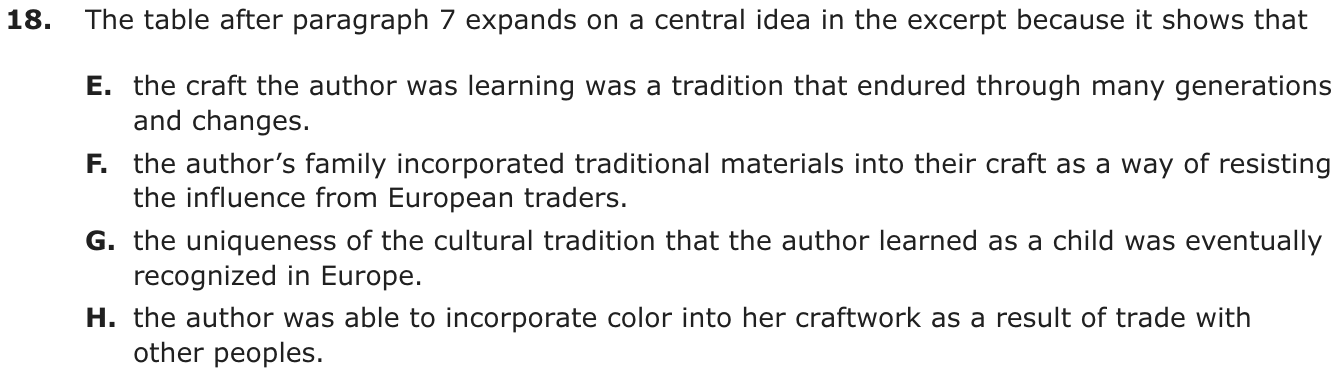
Question 51 of 57
2020 Test B English, question 51Passage Excerpt from “Niagara Falls”
Excerpt from “Niagara Falls”
by Rupert Brooke
The real secret of the beauty and terror of the Falls is not their height or width, but the feeling of colossal power and of unintelligible disaster caused by the plunge of that vast body of water. If that were taken away, there would be little visible change, but the heart would be gone.
The American Falls do not inspire this feeling in the same way as the Canadian. It is because they are less in volume, and because the water does not fall so much into one place. By comparison their beauty is almost delicate and fragile. They are extraordinarily level, one long curtain of lacework and woven foam. Seen from opposite, when the sun is on them, they are blindingly white, and the clouds of spray show dark against them. With both Falls the colour of the water is the ever-altering wonder. Greens and blues, purples and whites, melt into one another, fade, and come again, and change with the changing sun. Sometimes they are as richly diaphanous as a precious stone, and glow from within with a deep, inexplicable light. Sometimes the white intricacies of dropping foam become opaque and creamy. And always there are the rainbows. If you come suddenly upon the Falls from above, a great double rainbow, very vivid, spanning the extent of spray from top to bottom, is the first thing you see. If you wander along the cliff opposite, a bow springs into being in the American Falls, accompanies you courteously on your walk, dwindles and dies as the mist ends, and awakens again as you reach the Canadian tumult. And the bold traveller who attempts the trip under the American Falls sees, when he dare open his eyes to anything, tiny baby rainbows, some four or five yards in span, leaping from rock to rock among the foam, and gambolling beside him, barely out of hand’s reach, as he goes. One I saw in that place was a complete circle, such as I have never seen before, and so near that I could put my foot on it. It is a terrifying journey, beneath and behind the Falls. The senses are battered and bewildered by the thunder of the water and the assault of wind and spray; or rather, the sound is not of falling water, but merely of falling; a noise of unspecified ruin. So, if you are close behind the endless clamour, the sight cannot recognise liquid in the masses that hurl past. You are dimly and pitifully aware that sheets of light and darkness are falling in great curves in front of you. Dull omnipresent foam washes the face. Farther away, in the roar and hissing, clouds of spray seem literally to slide down some invisible plane of air.
Beyond the foot of the Falls the river is like a slipping floor of marble, green with veins of dirty white, made by the scum that was foam. It slides very quietly and slowly down for a mile or two, sullenly exhausted. Then it turns to a dull sage green, and hurries more swiftly, smooth and ominous. As the walls of the ravine close in, trouble stirs, and the waters boil and eddy. These are the lower rapids, a sight more terrifying than the Falls, because less intelligible. Close in its bands of rock the river surges tumultuously forward, writhing and leaping as if inspired by a demon. It is pressed by the straits into a visibly convex form. Great planes of water slide past. Sometimes it is thrown up into a pinnacle of foam higher than a house, or leaps with incredible speed from the crest of one vast wave to another, along the shining curve between, like the spring of a wild beast. Its motion continually suggests muscular action. The power manifest in these rapids moves one with a different sense of awe and terror from that of the Falls. Here the inhuman life and strength are spontaneous, active, almost resolute. . . . A place of fear.
One is drawn back, strangely, to a contemplation of the Falls, at every hour, and especially by night, when the cloud of spray becomes an immense visible ghost, straining and wavering high above the river, white and pathetic and translucent. The Victorian lies very close below the surface in every man. There one can sit and let great cloudy thoughts of destiny and the passage of empires drift through the mind; for such dreams are at home by Niagara. I could not get out of my mind the thought of a friend, who said that the rainbows over the Falls were like the arts and beauty and goodness, with regard to the stream of life—caused by it, thrown upon its spray, but unable to stay or direct or affect it, and ceasing when it ceased. In all comparisons that rise in the heart, the river, with its multitudinous waves and its single current, likens itself to a life, whether of an individual or of a community. A man’s life is of many flashing moments, and yet one stream; a nation’s flows through all its citizens, and yet is more than they. In such places, one is aware, with an almost insupportable and yet comforting certitude, that both men and nations are hurried onwards to their ruin or ending as inevitably as this dark flood. Some go down to it unreluctant, and meet it, like the river, not without nobility. And as incessant, as inevitable, and as unavailing as the spray that hangs over the Falls, is the white cloud of human crying. . . . With some such thoughts does the platitudinous heart win from the confusion and thunder of a Niagara peace that the quietest plains or most stable hills can never give.
From LETTERS FROM AMERICA by Rupert Brooke—Public Domain
diaphanous: sheer, translucent
platitudinous: clichéd, common
Question
The central idea that the Falls communicate a feeling of “unintelligible disaster” (paragraph 1) is conveyed in paragraph 2 through a description of
- Athe glow of the precious stones visible within the water.
- Bthe dynamic flow of the colors that are visible in the water.
- Cthe sudden appearance and disappearance of rainbows.
- Dthe sounds associated with a sense of falling.
Show the answer
Correct answer: D
The question asks for a specific detail from paragraph 2 that conveys the central idea that the Falls communicates a feeling of “unintelligible disaster” (paragraph 1). The sound of falling is described in paragraph 2 as “a noise of unspecified ruin,” so Option D is correct because it best connects with the idea of “unintelligible disaster” mentioned in paragraph 1.
Option A is incorrect because, although the water is described as “diaphanous as a precious stone” in paragraph 2 because of the “glow” coming from the interaction of the light, there are no stones within the water.
Option B is incorrect because the details in paragraph 2 about the flow of colors in the water are described as an “ever-altering wonder,” which conveys a sense of beauty and not a sense of disaster.
Option C is incorrect because the rainbows in paragraph 2 are described as “vivid” and accompanying someone “courteously” while he or she walks, which contributes to the idea that the appearance and disappearance of the rainbows are a pleasant experience and not disastrous.
Question analysis
This question on Rupert Brooke’s essay “Niagara Falls” asks which descriptive detail in paragraph 2 conveys the central idea that the Falls feel like an “unintelligible disaster.” Students must connect an idea from the opening paragraph to supporting evidence in a very long paragraph packed with vivid images, and judge the feeling each image creates.
- Grade level
- Grade 8 reading and task
- Compared with grade 7
- At grade 7 Linking a detail to a central idea is standard grade 7 work, but the evidence sits inside a paragraph of several hundred words of century-old prose, with words like “diaphanous” and “gambolling,” and must be matched by meaning rather than wording.
- Estimated difficulty
- Moderate: several steps, or a close reading with one strong distractor.
- Thinking it demands
- Depth of knowledge 2, skills and concepts · mainly analyze
- What makes it hard
- A lot to read moderate
- Figurative or literary language moderate
- Hard words minor
- Evidence
- Answered from one paragraph or stanza
- Reading level
- Passage: about grade 9, 987 words; question and choices: about grade 9, 58 words.
- Students, last 30 days
- Not enough answers yet to show (it takes 10).
Why it is hard, traps and wrong answers (shows the answer)
Why it is hard
The challenge is to find, in the essay’s longest paragraph, the one image that feels like disaster rather than beauty. Most of the paragraph is lovely, colors and rainbows that change and return, and the wrong choices draw on those passages. Students who keep the feeling of “unintelligible disaster” in mind, rather than just looking for things that appear and disappear, will find it in the sound of the water near the end.
A lot to read moderate Understanding the question
Paragraph 2 runs 407 words through colors, rainbows and a trip behind the water, and the sentence that matters, ending “a noise of unspecified ruin,” comes near its end. (Kintsch, 1998; Gorin & Embretson, 2006; Freedle & Kostin, 1993)
Figurative or literary language moderate Understanding the question
Students must judge the feeling each image creates, and only the sound “not of falling water, but merely of falling” carries a sense of disaster; the colors and rainbows are wonders. (Graesser, Singer & Trabasso, 1994; Kintsch, 1998)
Hard words minor Understanding the question
The key phrase “unintelligible disaster” must be matched to “unspecified ruin,” and words such as “diaphanous” and “intricacies” crowd the images around it. (Perfetti, 2007; Freedle & Kostin, 1993)
Strategy: Keep the words “unintelligible disaster” in mind, find each choice’s detail in paragraph 2, and ask what feeling the author’s words give that detail.
Traps
- Supports only part of the claim: In a question about evidence: a line that backs one half of the claim but not the other, or a related point rather than the claim itself.
- Taking figurative language literally: A choice reads a figure of speech or image at face value.
The wrong answers, classified
A Taking figurative language literally (Graesser, Singer & Trabasso, 1994)
Takes the simile “as richly diaphanous as a precious stone” to mean stones in the water, and links its “inexplicable light” to “unintelligible,” though the image is lovely.
B Supports only part of the claim (King et al., 2004; Thissen, Steinberg & Fitzpatrick, 1989)
Picks the shifting greens, blues and purples, hard to pin down like something unintelligible, but the author calls the color “the ever-altering wonder,” delight rather than disaster.
C Supports only part of the claim (King et al., 2004; Thissen, Steinberg & Fitzpatrick, 1989)
Notices that a rainbow “dwindles and dies” and “awakens again,” which sounds unsettling, but the bows are vivid and keep the walker company “courteously,” so nothing suggests disaster.
Working it out, step by step
Figure out what the question asks
Paragraph 1 says the Falls give a feeling of “unintelligible disaster.” “Unintelligible” means impossible to understand. You need the detail in paragraph 2 that feels like a disaster you can’t understand.
Find the matching words
Near the end of paragraph 2, the author goes behind the Falls. He says “the sound is not of falling water, but merely of falling; a noise of unspecified ruin.”
Work out what the words mean
“Merely” means just. The noise is not of water but of falling itself, as if everything were crashing down. “Ruin” means destruction, much like disaster. “Unspecified” means not named or not clear. So the sound is a crash of destruction you can’t explain. That matches “unintelligible disaster.”
Check each choice
- A is wrong. The water is only compared to a precious stone. There are no stones, and the image is lovely, not scary.
- B is wrong. The colors are called “the ever-altering wonder.” That is beauty, not disaster.
- C is wrong. The rainbows are “very vivid” and walk beside you “courteously,” which means politely. They are pleasant.
- D is right. The sound of falling is the “noise of unspecified ruin.”
Watch out: A rainbow that “dwindles and dies” sounds sad. But it “awakens again,” and the rainbows are a delight.
Choose the answer
Only the sound of falling carries the sense of a disaster. So the answer is D.
Why this answer and not the closest wrong one
C is the closest wrong answer, because a rainbow that “dwindles and dies” might seem gloomy. But the author makes the rainbows friendly and beautiful. “A noise of unspecified ruin” almost repeats the words “unintelligible disaster,” so D is the best match.
More questions like this
The original DOE question
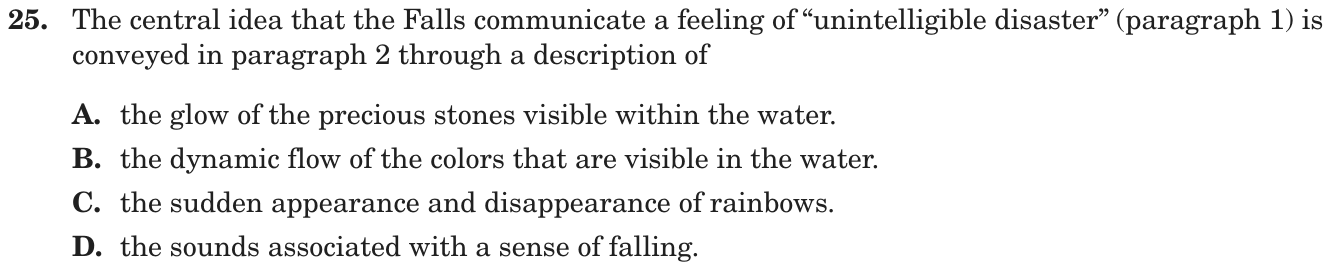
The passage “Excerpt from “Niagara Falls”” as printed (pages 134–135)
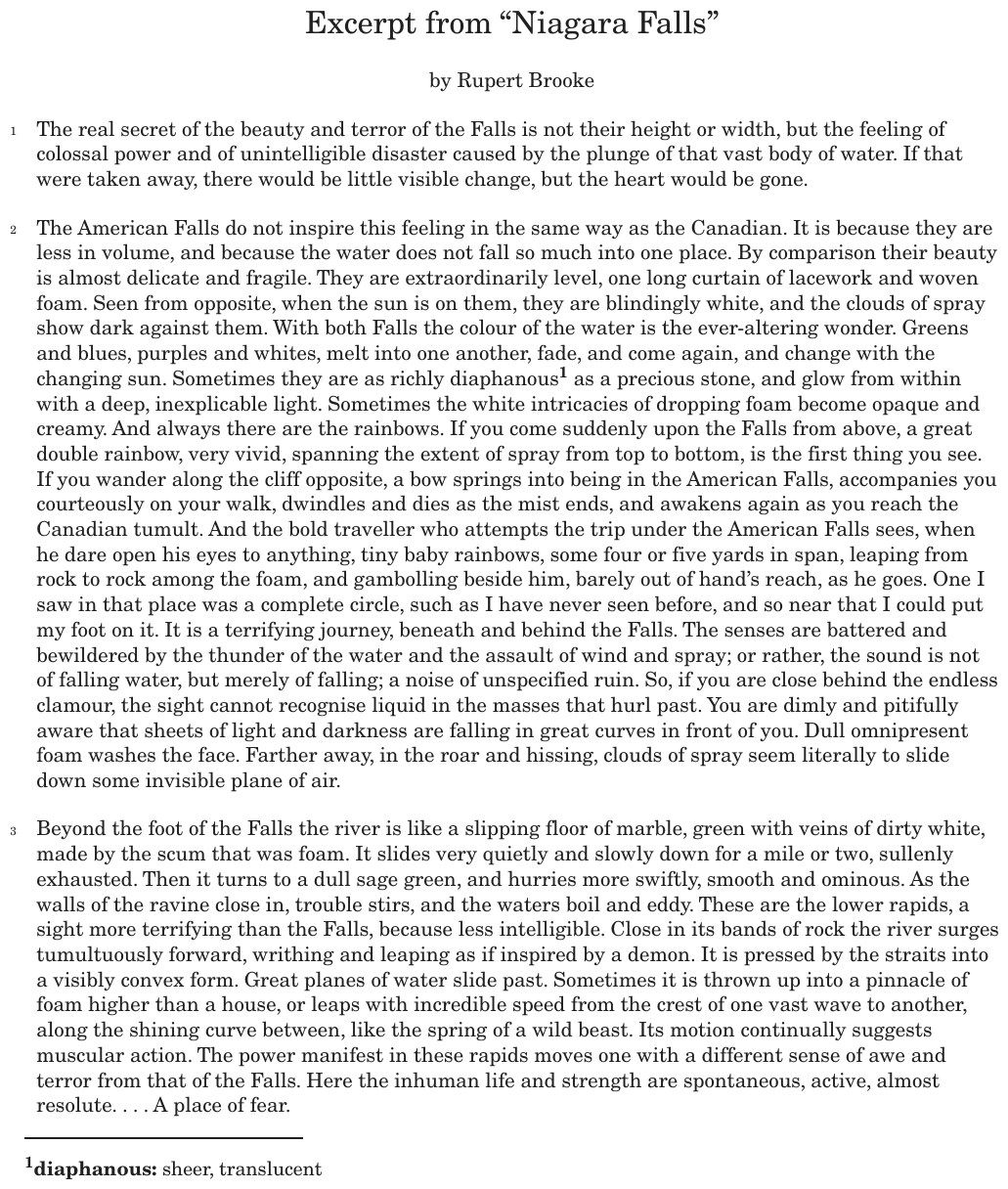
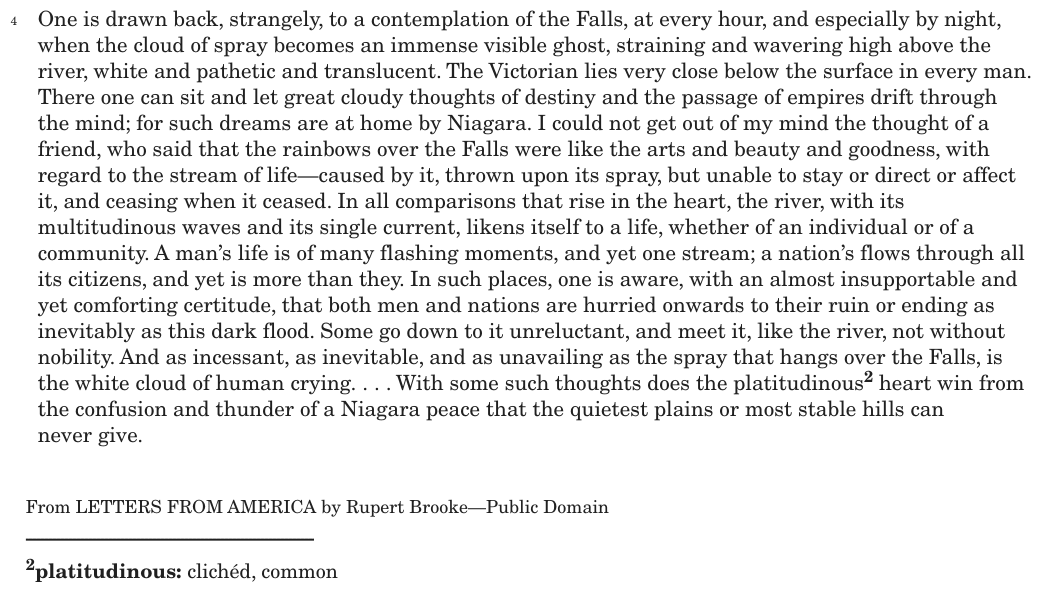
Question 52 of 57
2020 Test B English, question 52Uses the passage above: “Excerpt from “Niagara Falls””.
Question
Read this sentence from paragraph 2.
They are extraordinarily level, one long curtain of lacework and woven foam.
What is the effect of comparing the American Falls to a “long curtain of lacework and woven foam”?
- AIt demonstrates the timelessness of the American Falls.
- BIt conveys the secretive nature of the American Falls.
- CIt illustrates the elegant uniformity of the American Falls.
- DIt communicates the intense strength of the American Falls.
Show the answer
Correct answer: C
The question asks for the effect of the comparison being made in the sentence in paragraph 2. The word “lacework” in the sentence suggests an elegant piece of craftsmanship, and the “one long curtain” and “extraordinarily level” aspects of the Falls mean that the Falls are uniform or consistent; therefore, Option C is correct.
Option A is incorrect because neither “lacework and woven foam,” nor the quality of being extremely level, are related to timelessness.
Option B is incorrect because, while a curtain may suggest the idea of something being hidden or secret, the description of a delicate “lacework” curtain does not suggest this purpose.
Option D is incorrect because “lacework” is generally fragile and does not suggest great strength.
Question analysis
In this figurative language question, students explain the effect of a comparison in Rupert Brooke’s “Niagara Falls”: the American Falls as “one long curtain of lacework and woven foam.” They need to picture the image and read the sentences around it, since a curtain, lace and foam can each call up quite different qualities.
- Grade level
- Grade 7 reading and task
- Compared with grade 7
- At grade 7 Explaining the effect of a metaphor in a quoted sentence is routine grade 7 work. The older prose is harder than most grade 7 texts, but the sentences around this one give direct context clues.
- Estimated difficulty
- Straightforward: two steps or one careful reading.
- Thinking it demands
- Depth of knowledge 2, skills and concepts · mainly analyze
- What makes it hard
- Figurative or literary language moderate
- Hard words minor
- Evidence
- Answered from one sentence or line
- Reading level
- Passage: about grade 9, 987 words; question and choices: about grade 10, 70 words.
- Students, last 30 days
- Not enough answers yet to show (it takes 10).
Why it is hard, traps and wrong answers (shows the answer)
Why it is hard
The image is clear once pictured, and the sentences around it, about the American Falls being “delicate and fragile” and “extraordinarily level,” confirm what it means. Students go wrong by bringing in what they associate with curtains or with Niagara in general, hiding or power, instead of what this curtain is made of. The right choice also uses an abstract word that has to be connected back to “level.”
Figurative or literary language moderate Understanding the question
Students must translate “one long curtain of lacework and woven foam” into qualities: lace is delicate and finely made, and one long level curtain is even from end to end. (Graesser, Singer & Trabasso, 1994; Kintsch, 1998)
Hard words minor Understanding the question
The right choice uses “uniformity,” which students must link to “extraordinarily level” and “one long curtain,” just as “elegant” must be linked to the lacework. (Perfetti, 2007; Freedle & Kostin, 1993)
Strategy: Picture the image first, then reread the few sentences around it about the American Falls and keep only the choice that both the image and those sentences support.
Traps
- Wrong part of the text: A choice is true of another paragraph, stanza or speaker than the one asked about.
- Dictionary meaning, not meaning here: A common meaning of the word that does not fit its use in this text.
The wrong answers, classified
A Little reason to choose it (Haladyna & Downing, 1993; Rodriguez, 2005)
Nothing in lace, foam or a level edge suggests lasting through time, so this attracts mainly students guessing that a natural wonder must seem timeless.
B Dictionary meaning, not meaning here (Perfetti, 2007)
Uses the common sense of a curtain as something that hides, but this curtain is lacework, open and decorative, and nothing behind it is concealed.
D Wrong part of the text (Kirsch & Mosenthal, 1990)
Carries over the “colossal power” of paragraph 1, though paragraph 2 says the American Falls do not inspire that feeling as the Canadian do and calls their beauty fragile.
Working it out, step by step
Figure out what the question asks
This asks about the effect of a comparison. The author compares the American Falls to “one long curtain of lacework and woven foam.” What quality does that picture give them?
Read the sentence and its neighbor
The full sentence is “They are extraordinarily level, one long curtain of lacework and woven foam.” The sentence just before it says, “By comparison their beauty is almost delicate and fragile.”
Picture the comparison
Lacework is fancy cloth with fine, delicate patterns. It looks elegant, which means graceful and beautiful. “Extraordinarily level” and “one long curtain” mean the Falls are even all the way across, with no breaks. That evenness is uniformity: being the same all the way through. So the picture shows elegant uniformity.
Check each choice
- A is wrong. Nothing about lace or foam suggests lasting forever.
- B is wrong. A curtain can hide things, but lace is open and see-through. Nothing is hidden.
- C is right. Lace is elegant, and a level curtain is uniform.
- D is wrong. Lace is fragile, not strong.
Watch out: Paragraph 1 talks about “colossal power,” so D can seem right. But paragraph 2 says the American Falls “do not inspire this feeling” the way the Canadian Falls do.
Choose the answer
The lace curtain makes the American Falls look graceful and even. So the answer is C.
Why this answer and not the closest wrong one
D is the closest wrong answer, because the Falls seem powerful in other parts of the essay. But this sentence is about the American Falls, whose beauty is “delicate and fragile.” Lace is delicate, not strong. A smooth, level curtain of lace shows grace and evenness, as C says.
More questions like this
The original DOE question
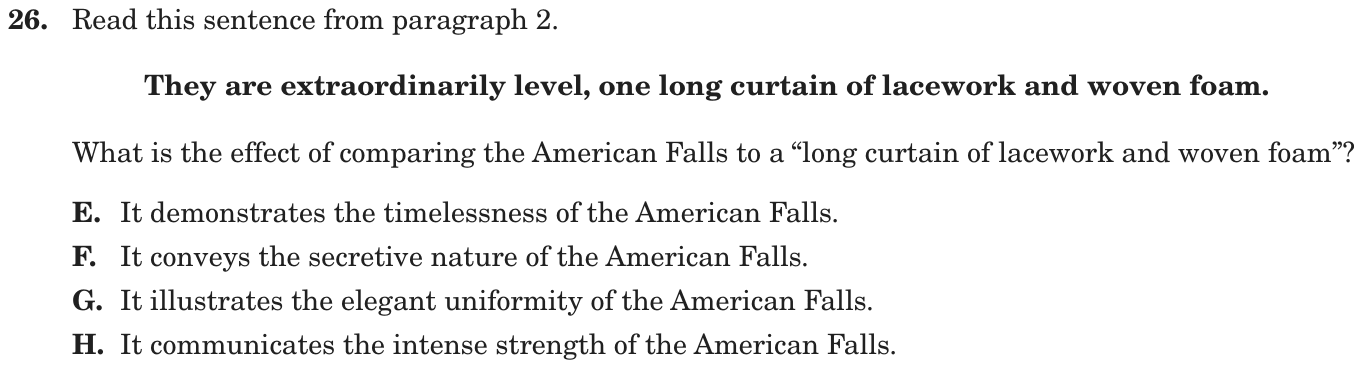
Question 53 of 57
2020 Test B English, question 53Uses the passage above: “Excerpt from “Niagara Falls””.
Question
Read this sentence from paragraph 3.
These are the lower rapids, a sight more terrifying than the Falls, because less intelligible.
Which statement best describes how the sentence fits into the overall structure of the excerpt?
- AIt signals a change from the positive aspects of the Falls to the negative aspects.
- BIt indicates a progression from the literal description of the water to a discussion of timeless truths.
- CIt reinforces a shift from the qualities of the Falls to the qualities of the river.
- DIt introduces a contrast between the obvious and the hidden features of the rapids.
Show the answer
Correct answer: C
The question asks for the statement that best describes how the sentence from paragraph 3 fits into the overall structure of the excerpt.
A. Incorrect. Although in paragraph 2 the author describes the beauty of the Falls as both an “ever-altering wonder” and an “assault of wind and spray,” in paragraph 3 the author does not signal a change from the positive aspects of the Falls to the negative aspects. Instead, the author provides a description of the river and the rapids below the Falls.
B. Incorrect. While the author compares the water of the river to “a slipping floor of marble, green with veins of dirty white, made by the scum that was foam” in paragraph 3, the statement that the lower rapids are “more terrifying than the Falls, because less intelligible” does not indicate a progression from the literal description of the water to a discussion of timeless truths. Instead, the author is merely describing all aspects of the rapids, both literally and figuratively.
C. CORRECT. The first sentence of paragraph 3 moves the description “beyond the foot of the Falls” to “the river” and then the paragraph begins to describe this location in further detail (“a dull sage green,” “hurries more swiftly,” “smooth and ominous,” “waters boil and eddy”) before reinforcing this shift by confirming it again with the words “These are the lower rapids, a sight more terrifying than the Falls.”
D. Incorrect. Although the author states that the waters of the rapids “boil and eddy” and suggests that the rapids are “less intelligible,” these statements do not introduce a contrast between the obvious and the hidden features of the rapids. They merely describe a feature and the sight of the lower rapids.
Question analysis
This text structure question quotes a sentence from paragraph 3 of Rupert Brooke’s “Niagara Falls,” in which the lower rapids are called “more terrifying than the Falls,” and asks how it fits the excerpt’s overall organization. It rewords a question from the 2018 handbook’s Test B. Every choice describes a turn the essay could plausibly take, so students need a clear picture of what each paragraph covers.
- NYS standards
- 7R5 structure and genre features
- Grade level
- Grade 8 reading and task
- Compared with grade 7
- Above grade 7 A typical grade 7 structure question asks what one paragraph adds. This one asks where a sentence from the middle of paragraph 3 fits in the whole essay, which means summing up four long paragraphs of century-old prose.
- Estimated difficulty
- Hard: combines ideas, needs a plan, and has more than one tempting wrong answer.
- Thinking it demands
- Depth of knowledge 3, strategic thinking · mainly analyze
- What makes it hard
- How, not what major
- Much to keep track of moderate
- Hard words moderate
- Evidence
- Answered from several paragraphs or stanzas
- Reading level
- Passage: about grade 9, 987 words; question and choices: about grade 8, 97 words.
- Students, last 30 days
- Not enough answers yet to show (it takes 10).
Why it is hard, traps and wrong answers (shows the answer)
Why it is hard
A sentence that compares the rapids with the Falls is easy to misplace, because both of its subjects appear elsewhere in the excerpt. The strongest pull is a real turn in the essay, from describing water to musing on destiny, that comes a paragraph later, while “more terrifying” draws students who forget that terror runs through the excerpt from its first sentence. The 2026 verb “reinforces” rewards those who saw that paragraph 3 had already left the Falls with “Beyond the foot of the Falls the river.”
How, not what major Working it out
The task is to place one sentence in the essay’s plan, and the sentence pulls the wrong way: it mentions “the Falls” and “more terrifying,” though its job is to confirm that paragraph 3 has already moved downstream to the rapids. (Anderson & Krathwohl, 2001)
Much to keep track of moderate Working it out
Placing the sentence takes a summary of all four long paragraphs at once: the Falls’ power, the two Falls’ beauty and the trip behind them, the river below, and the night thoughts on destiny. (Sweller, 1988; Carpenter, Just & Shell, 1990)
Hard words moderate Understanding the question
“Less intelligible” means harder to make sense of; a student who takes it as harder to see is led toward a contrast between obvious and hidden features of the rapids. (Perfetti, 2007; Freedle & Kostin, 1993)
Strategy: Sum up each of the four paragraphs in a few words, find where this sentence sits in that outline, and choose the description of the essay’s movement at exactly that point.
Traps
- Wrong part of the text: A choice is true of another paragraph, stanza or speaker than the one asked about.
The wrong answers, classified
A Twists what the text says (King et al., 2004)
Takes “more terrifying” as the essay’s first turn from the Falls’ beauty to their dangers, but this sentence is about the rapids, and paragraph 1 already speaks of “unintelligible disaster.”
B Wrong part of the text (Kirsch & Mosenthal, 1990)
Names a turn the excerpt really makes, from describing the water to “thoughts of destiny and the passage of empires,” but that turn comes in paragraph 4, not at the rapids.
D Wrong purpose or structure (Anderson & Krathwohl, 2001)
Reads “less intelligible” as less visible and finds a contrast between obvious and hidden features, though rapids that “boil and eddy” and leap like “a wild beast” are in plain view.
Working it out, step by step
Figure out what the question asks
This is a text structure question. Structure is the plan of a piece of writing: what each part does and how the parts connect. You get one sentence from paragraph 3. You must decide what job it does in the plan of the whole excerpt. So first sum up what each of the four paragraphs is about.
Sum up the four paragraphs
- Paragraph 1: the real secret of the Falls is “the feeling of colossal power.” Colossal means huge.
- Paragraph 2: the two Falls, their colors, the rainbows, and the scary trip behind the water.
- Paragraph 3: the river below the Falls and its wild rapids.
- Paragraph 4: the author goes back to the Falls at night and thinks about life and destiny, or what happens in the end.
See where paragraph 3 begins
Paragraph 3 opens with “Beyond the foot of the Falls the river is like a slipping floor of marble.” Beyond the foot means past the bottom. So the author has already left the Falls. He follows the river as it “hurries more swiftly” and the waters “boil and eddy,” or swirl. Then comes the sentence: “These are the lower rapids, a sight more terrifying than the Falls, because less intelligible.” Rapids are a stretch of fast, rough water. Less intelligible means harder to make sense of.
Decide what the sentence does
The sentence names the new place: the lower rapids. It also sets the rapids against the Falls. That tells you again that the essay has moved from the Falls to the river below them. To reinforce something is to make it stronger. The sentence reinforces a shift, or change of subject, that the paragraph’s first sentence began.
Check each choice
- A does not fit. Terror is not new here. Paragraph 1 already speaks of “unintelligible disaster,” and paragraph 2 calls the trip behind the Falls “a terrifying journey.”
- B does not fit. The essay does turn to big, timeless ideas, but in paragraph 4, not here.
- C fits. The sentence confirms the move from the Falls to the river.
- D does not fit. The rapids are in plain sight. “Less intelligible” means harder to understand, not hidden.
Watch out: B names a real turn in the essay. But it comes one paragraph later, with “thoughts of destiny and the passage of empires.”
Choose the answer
The sentence names the rapids and compares them with the Falls. That confirms the essay has moved downstream. So the answer is C, “It reinforces a shift from the qualities of the Falls to the qualities of the river.”
Why this answer and not the closest wrong one
B is the closest wrong choice, because the essay really does move from describing water to big ideas about life. But that move comes in paragraph 4, at night. The sentence in paragraph 3 is still describing water. Its job is to name the rapids and confirm that the essay has left the Falls for the river.
More questions like this
The original DOE question
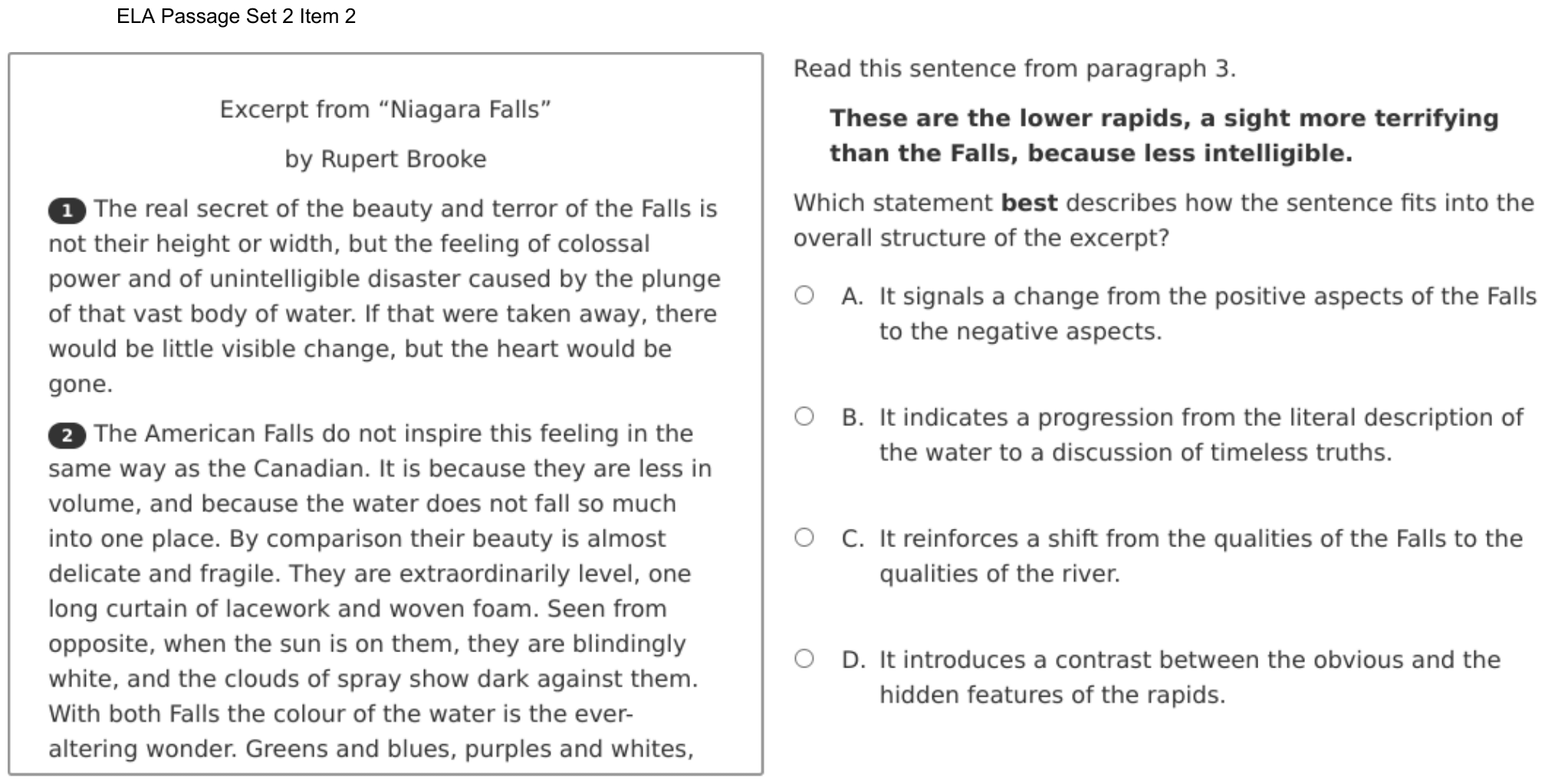
Question 54 of 57
2020 Test B English, question 54Uses the passage above: “Excerpt from “Niagara Falls””.
Question
Which sentence from the excerpt best supports the idea that the essence of the Falls lies in their emotional impact?
- A“If that were taken away, there would be little visible change, but the heart would be gone.” (paragraph 1)
- B“By comparison their beauty is almost delicate and fragile.” (paragraph 2)
- C“One is drawn back, strangely, to a contemplation of the Falls, at every hour, and especially by night, when the cloud of spray becomes an immense visible ghost, straining and wavering high above the river, white and pathetic and translucent.” (paragraph 4)
- D“A man’s life is of many flashing moments, and yet one stream; a nation’s flows through all its citizens, and yet is more than they.” (paragraph 4)
Show the answer
Correct answer: A
The question asks for the sentence from the excerpt that best supports the idea that the essence of the Falls lies in their emotional impact. The first sentence in the excerpt establishes that the “real secret of the beauty and terror of the Falls” is “the feeling of colossal power and of unintelligible disaster.” Option A is correct because the sentence in Option A best supports this notion by identifying these qualities as “the heart,” or essence, of the Falls.
While “delicate” and “fragile” are words that can be connected with certain kinds of emotions, in the sentence in Option B, they are connected with physical beauty, so Option B is incorrect.
Option C is incorrect because, while the sentence in Option C describes the power of the Falls to engage one in thought, it does not best support the idea that the essence of the Falls lies in their emotional impact.
Option D is incorrect because the sentence in Option D describes thoughts one may have while watching the Falls and is not focused on the Falls’ emotional impact.
Question analysis
In this textual evidence question, students choose the quotation from Rupert Brooke’s “Niagara Falls” that best supports the idea that the essence of the Falls lies in their emotional impact. Every choice is a vivid sentence from the excerpt, so the challenge is matching that precise idea instead of settling for a line that only sounds emotional.
- Grade level
- Grade 8 reading and task
- Compared with grade 7
- At grade 7 Grade 7 evidence questions usually offer one sentence that clearly matches the claim. Here all four quotations are long or figurative lines of older prose, and the claim itself, about an essence, is abstract.
- Estimated difficulty
- Moderate: several steps, or a close reading with one strong distractor.
- Thinking it demands
- Depth of knowledge 2, skills and concepts · mainly evaluate
- What makes it hard
- Reading between the lines moderate
- Hard words minor
- Evidence
- Answered from one paragraph or stanza
- Reading level
- Passage: about grade 9, 987 words; question and choices: about grade 11, 115 words.
- Corrected from the DOE handbook
- A misquotation of the passage in the explanation was corrected.
- A stray apostrophe in the explanation was removed.
- Students, last 30 days
- Not enough answers yet to show (it takes 10).
Why it is hard, traps and wrong answers (shows the answer)
Why it is hard
Every quotation carries feeling, so the test is whether a sentence says what the Falls’ essence is, not merely whether it is emotional. The right one is short and plain and depends on the sentence before it, which defines “that” as the feeling of power and disaster. Students who choose by the intensity of the language pass over it for the ghostly night scene or the reflections on life.
Reading between the lines moderate Working it out
The right sentence never says “emotion” or “essence”: students must see that “that” points back to “the feeling of colossal power,” and that “the heart” means the essence. (Graesser, Singer & Trabasso, 1994; Kintsch, 1998)
Hard words minor Understanding the question
The claim’s key word, “essence,” has to be matched to the text’s “real secret” and “heart,” two everyday words used here in an abstract sense. (Perfetti, 2007; Freedle & Kostin, 1993)
Strategy: Restate the idea in your own words, that the Falls matter because of how they make people feel, and test each quotation: does it say what the Falls’ essence is, or something else?
Traps
- Supports only part of the claim: In a question about evidence: a line that backs one half of the claim but not the other, or a related point rather than the claim itself.
The wrong answers, classified
B Supports only part of the claim (King et al., 2004; Thissen, Steinberg & Fitzpatrick, 1989)
Treats “delicate and fragile” as emotional words, but the sentence describes how the American Falls look beside the Canadian, not where the essence of the Falls lies.
C Supports only part of the claim (King et al., 2004; Thissen, Steinberg & Fitzpatrick, 1989)
Backs the emotional half, the spray as an “immense visible ghost” that draws people back, but describes the Falls’ pull without saying that their essence lies there.
D Supports only part of the claim (King et al., 2004; Thissen, Steinberg & Fitzpatrick, 1989)
Chooses a moving reflection the Falls inspire, but this sentence is about how a river resembles human lives and nations, not about the Falls’ emotional impact.
What was corrected from the DOE handbook, and why
- Explanation: The handbook quotes the first sentence as saying the “real secret of the beauty and terror of the Falls . . . lies in the feeling of colossal power and unintelligible disaster.” The passage says the real secret “is not their height or width, but the feeling of colossal power and of unintelligible disaster.” The site now quotes it exactly.
- Explanation: The handbook writes “the power of the Falls’ to engage one in thought”; the site drops the stray possessive apostrophe: “the power of the Falls to engage one in thought.”
Working it out, step by step
Figure out what the question asks
This asks for evidence for an idea: the essence of the Falls lies in their emotional impact. “Essence” means the most important part, what makes something what it is. “Emotional impact” means the way it makes people feel.
Read the opening of paragraph 1
The essay begins: “The real secret of the beauty and terror of the Falls is not their height or width, but the feeling of colossal power and of unintelligible disaster.” So the real secret of the Falls is a feeling.
Read the sentence that comes next
Next comes: “If that were taken away, there would be little visible change, but the heart would be gone.” “That” means the feeling. Take the feeling away, and the Falls would look the same. But “the heart” would be gone. Here, the heart means the most important part, the essence. So the essence is the feeling.
Check each choice
- A is right. It says the Falls would lose their heart without the feeling they create.
- B is wrong. It compares how the two Falls look, not what their essence is.
- C is wrong. It shows the Falls pull people back, but it never says the feeling is their essence.
- D is wrong. It compares a river to human lives and nations.
Watch out: C is full of feeling, with the spray like a ghost. But it describes a view, not what the Falls truly are.
Choose the answer
Only A says that the feeling is the heart of the Falls. So the answer is A.
Why this answer and not the closest wrong one
C is the closest wrong answer, because it is an emotional description. But it does not say where the essence of the Falls lies. A does. Without the feeling, almost nothing you can see would change, yet “the heart would be gone.”
More questions like this
The original DOE question
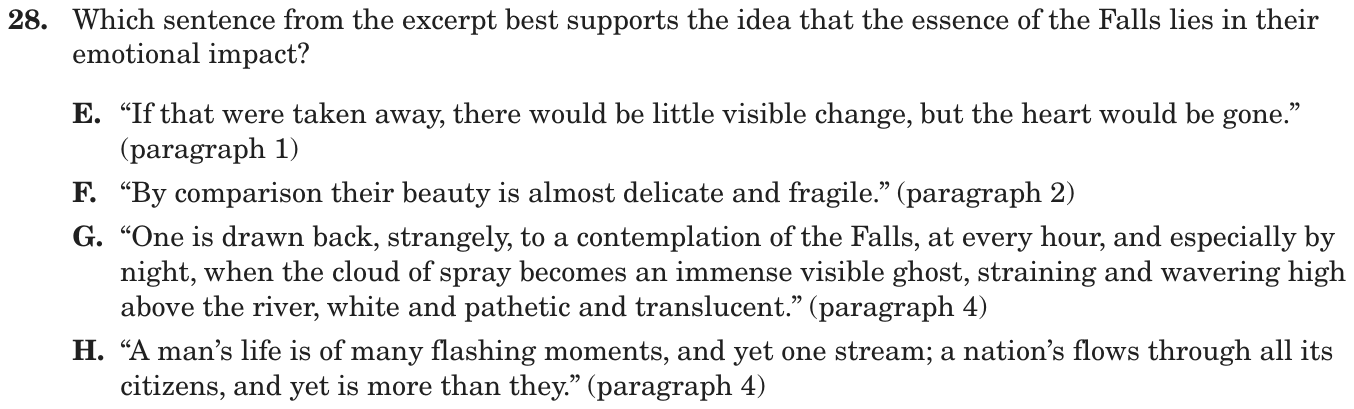
Question 55 of 57
2020 Test B English, question 55Uses the passage above: “Excerpt from “Niagara Falls””.
Question
Read this sentence from paragraph 4.
There one can sit and let great cloudy thoughts of destiny and the passage of empires drift through the mind; for such dreams are at home by Niagara.
The sentence most contributes to the development of ideas in the excerpt by
- Asuggesting that viewing the Falls can be a life-changing experience.
- Bshowing that the cliffs of the Falls are a good place for self-examination.
- Cemphasizing that the grandeur of the Falls seems impossible to grasp.
- Dhighlighting the type of reflection that is inspired by a visit to the Falls.
Show the answer
Correct answer: D
The question asks how the sentence from paragraph 4 contributes to the development of ideas in the excerpt.
The description of “cloudy thoughts of destiny and the passage of empires” in the sentence refers to the types of thoughts a person might have while observing the Falls, as stated in Option D.
Option A is incorrect because the sentence focuses on the idea that the Falls are a place of great contemplation but does not clarify that these thoughts are life-changing.
Option B is incorrect because the sentence does not describe focused thoughts of a personal nature; the grand, sweeping nature of the Falls inspires thoughts of the same caliber as “the passage of empires.”
Option C is incorrect because the sentence is about how the Falls inspire great thoughts but is not about how difficult it is to grasp the grandeur of the Falls.
Question analysis
This question asks how a sentence near the end of Rupert Brooke’s “Niagara Falls” contributes to the development of ideas in the excerpt. Students must make sense of abstract phrases such as “cloudy thoughts of destiny” and “the passage of empires” and then decide exactly what the sentence adds, since several choices sound close.
- Grade level
- Grade 8 reading and task
- Compared with grade 7
- At grade 7 Explaining how a sentence develops ideas is a grade 7 skill, and this sentence is quoted in full. The challenge is its abstract, old-fashioned wording, which a grade 7 reader must translate before comparing the choices.
- Estimated difficulty
- Moderate: several steps, or a close reading with one strong distractor.
- Thinking it demands
- Depth of knowledge 2, skills and concepts · mainly analyze
- What makes it hard
- A very close wrong answer moderate
- Figurative or literary language moderate
- Hard words minor
- Evidence
- Answered from one paragraph or stanza
- Reading level
- Passage: about grade 9, 987 words; question and choices: about grade 7, 94 words.
- Corrected from the DOE handbook
- A grammar slip in the explanation was corrected.
- Students, last 30 days
- Not enough answers yet to show (it takes 10).
Why it is hard, traps and wrong answers (shows the answer)
Why it is hard
The sentence is about thinking, and most of the choices describe thinking too, so the difference lies in what kind of thought and how much the sentence claims. Students lose the point by inflating daydreams into a life-changing experience or by turning thoughts about empires into self-examination. Paraphrasing the sentence before reading the choices, people sit by the Falls and think about destiny and history, keeps the right one in view.
A very close wrong answer moderate Choosing the answer
The self-examination choice and the right one both say the Falls prompt reflection; they differ in one detail, what the thoughts are about, and the sentence’s “destiny and the passage of empires” is not the self. (Embretson & Wetzel, 1987; Gorin & Embretson, 2006; Ascalon et al., 2007)
Figurative or literary language moderate Understanding the question
“Great cloudy thoughts” drifting through the mind borrow the image of the Falls’ spray, and “such dreams are at home by Niagara” treats the Falls as the natural home of this kind of daydream. (Graesser, Singer & Trabasso, 1994; Kintsch, 1998)
Hard words minor Understanding the question
“The passage of empires” and “destiny” are abstract, and students who cannot pin them down may not see that the thoughts concern history, not the thinker. (Perfetti, 2007; Freedle & Kostin, 1993)
Strategy: Paraphrase the sentence in plain words first, then test each choice against your paraphrase, rejecting any that adds a claim the sentence does not make.
Traps
- Too broad or too strong: A choice overstates, generalizes, or uses absolute words the text does not support.
- Wrong part of the text: A choice is true of another paragraph, stanza or speaker than the one asked about.
The wrong answers, classified
A Too broad or too strong (King et al., 2004)
Inflates the sentence’s daydreaming into a life-changing experience, though the author says only that great thoughts drift through the mind, not that they change anyone.
B Twists what the text says (King et al., 2004)
Turns the reflection inward, but the thoughts named are of “destiny and the passage of empires,” history on a grand scale, and the sentence says nothing about cliffs.
C Wrong part of the text (Kirsch & Mosenthal, 1990)
Borrows the earlier idea that the Falls and rapids are hard to understand, from paragraphs 1 and 3, but this sentence is about the thoughts they inspire.
What was corrected from the DOE handbook, and why
- Explanation: The handbook writes “the grand, sweeping nature of the falls inspire thoughts.” The subject “nature” takes “inspires,” and the passage always capitalizes “the Falls,” so the site now reads “the grand, sweeping nature of the Falls inspires thoughts.”
Working it out, step by step
Figure out what the question asks
This asks what one sentence adds to the essay’s ideas. Put the sentence in plain words first, then test each choice against it.
Read the sentence closely
The sentence says: “There one can sit and let great cloudy thoughts of destiny and the passage of empires drift through the mind; for such dreams are at home by Niagara.”
Put it in plain words
“Destiny” means what is meant to happen in the future. “The passage of empires” means great nations rising and falling over time. “At home by Niagara” means these dreams fit naturally at the Falls. So sitting by the Falls makes you think big thoughts about fate and history. The sentence names the kind of reflection, or deep thinking, the Falls bring on.
Check each choice
- A is wrong. Thoughts drift by, but nothing says they change a person’s life.
- B is wrong. The thoughts are about history and fate, not about yourself. The sentence doesn’t mention cliffs.
- C is wrong. This sentence is about the thoughts the Falls inspire, not about how hard they are to grasp.
- D is right. It names the type of thinking a visit to the Falls brings on.
Watch out: B is close, since both B and D are about reflection. Check what the thoughts are about: empires, not yourself.
Choose the answer
The sentence shows what kind of thoughts the Falls inspire. So the answer is D.
Why this answer and not the closest wrong one
B is the closest wrong answer, because both B and D say the Falls make people reflect. The difference is the topic. Self-examination means thinking about yourself. The sentence names “thoughts of destiny and the passage of empires.” Those are big ideas about history, not about the self.
More questions like this
The original DOE question
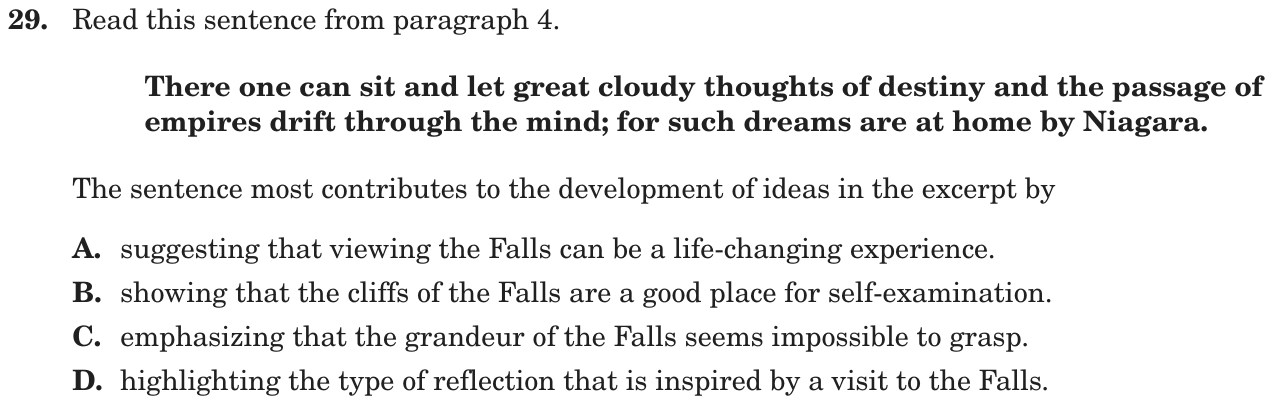
Question 56 of 57
2020 Test B English, question 56Uses the passage above: “Excerpt from “Niagara Falls””.
Question
In paragraph 4, the idea that human life and history travel toward the same ending is illustrated mainly through
- Athe discussion of how the rainbows visible in the Falls are like the art and beauty created by humankind.
- Bthe comparison between the movement of water in the Falls and the human experience.
- Cthe inclusion of details that show that every observer’s experience with the Falls is different.
- Dthe acknowledgment that contemplating the Falls at night sparks an awareness of humankind’s destiny.
Show the answer
Correct answer: B
The question asks how the discussion of human life and history is illustrated in paragraph 4 of the excerpt. The author concludes in paragraph 4 that the Falls can be compared to people and history by writing, “both men and nations are hurried onwards to their ruin or ending as inevitably as this dark flood,” making Option B correct.
Option A is incorrect because the discussion of rainbows in paragraph 4 focuses on the fate of art and beauty, not of humanity (“I could not get out of my mind the thought of a friend, who said that the rainbows over the Falls were like the arts and beauty and goodness, with regard to the stream of life—caused by it, thrown upon its spray, but unable to stay or direct or affect it, and ceasing when it ceased”).
Option C is incorrect because, in paragraph 4, the author talks about people in general when discussing “men and nations” and provides no evidence of the differences in specific individuals’ experience of the Falls.
Option D is incorrect because, while the setting at night does provide a place of contemplation, the author notes the “dark flood” as the overall illustration of the human experience.
Question analysis
In this question about the closing paragraph of Brooke’s “Niagara Falls,” students identify the main way the author illustrates the idea that human lives and history move toward the same ending. The paragraph is dense and philosophical and holds several images and reflections, so students must find the one that carries this particular idea.
- Grade level
- Grade 8 reading and task
- Compared with grade 7
- Above grade 7 Grade 7 students often trace how an idea is illustrated in a modern text; this paragraph is abstract reflection in long, formal sentences, with words like “certitude” and “multitudinous,” and offers several competing images to sort through.
- Estimated difficulty
- Hard: combines ideas, needs a plan, and has more than one tempting wrong answer.
- Thinking it demands
- Depth of knowledge 2, skills and concepts · mainly analyze
- What makes it hard
- Complex sentences major
- The right answer is reworded moderate
- Hard words minor
- Evidence
- Answered from one paragraph or stanza
- Reading level
- Passage: about grade 9, 987 words; question and choices: about grade 10, 80 words.
- Students, last 30 days
- Not enough answers yet to show (it takes 10).
Why it is hard, traps and wrong answers (shows the answer)
Why it is hard
Paragraph 4 holds three images, the night spray as a ghost, the friend’s rainbows, and the river as a life, and the question asks which one carries the idea of a shared ending. Students who recognize the stem’s idea in the word “destiny” or in rainbows “ceasing when it ceased” can stop too soon. The test is the word “illustrated”: only the comparison of the dark flood to men and nations shows them traveling to an end.
Complex sentences major Understanding the question
The key sentence buries its point in qualifiers: “one is aware, with an almost insupportable and yet comforting certitude, that both men and nations are hurried onwards to their ruin or ending as inevitably as this dark flood.” (Abedi & Lord, 2001; Freedle & Kostin, 1993; Messick, 1989)
The right answer is reworded moderate Choosing the answer
The right choice sums up the river-as-life comparison in plain words, “movement of water” and “human experience,” while wrong choices reuse the paragraph’s own “rainbows,” “art and beauty,” “night” and “destiny.” (Freedle & Kostin, 1993; Kirsch & Mosenthal, 1990)
Hard words minor Understanding the question
“Multitudinous,” “certitude,” “insupportable” and “unavailing” all fall in the sentences that carry the idea, so students must read through them to reach the comparison. (Perfetti, 2007; Freedle & Kostin, 1993)
Strategy: Locate the sentences in paragraph 4 about what happens to people and nations, then decide which choice best describes how those sentences make their point.
Traps
- Supports only part of the claim: In a question about evidence: a line that backs one half of the claim but not the other, or a related point rather than the claim itself.
- Outside knowledge: A choice is plausible in the real world but not supported by this text.
The wrong answers, classified
A Supports only part of the claim (King et al., 2004; Thissen, Steinberg & Fitzpatrick, 1989)
Picks the friend’s rainbow comparison, which is in paragraph 4 and does end “ceasing when it ceased,” but the ending it shows belongs to art and beauty, not people and nations.
C Outside knowledge (King et al., 2004; Recht & Leslie, 1988)
Brings in the commonsense idea that every visitor sees the Falls differently, but the paragraph speaks of “one” and of men and nations in general, never of differences.
D Supports only part of the claim (King et al., 2004; Thissen, Steinberg & Fitzpatrick, 1989)
Combines the night view with “thoughts of destiny,” both in the paragraph, but those describe when reflection happens, not the image that shows lives and nations sharing an end.
Working it out, step by step
Figure out what the question asks
This asks how paragraph 4 shows one idea: that people and nations all move toward the same ending. You need the main way the author makes that point.
Find the sentences about people and nations
Paragraph 4 says the river, “with its multitudinous waves and its single current, likens itself to a life, whether of an individual or of a community.” Later it says “both men and nations are hurried onwards to their ruin or ending as inevitably as this dark flood.”
Put the comparison in plain words
“Multitudinous” means very many. The river has many waves but one current. In the same way, a life has many moments but one path. “Inevitably” means in a way that cannot be stopped. The water rushes over the Falls no matter what. Every person and every nation reaches an end, too. The author shows this by comparing the moving water to human life.
Check each choice
- A is wrong. The rainbows stand for art and beauty, not for people and nations.
- B is right. The river’s rush to its end is compared to human lives and history.
- C is wrong. The author speaks of people in general. He never shows observers seeing the Falls differently.
- D is wrong. Night is when the thinking happens. It is not the picture that shows the shared ending.
Watch out: D uses real details from paragraph 4, night and destiny. But they tell when the author thinks, not how he shows the idea.
Choose the answer
The idea is shown through the river and its comparison to people. So the answer is B.
Why this answer and not the closest wrong one
D is the closest wrong answer, because paragraph 4 does mention night and “thoughts of destiny.” But those details only set the scene for thinking. The shared ending is shown through the river: people and nations are hurried onward like the dark flood. That comparison is B.
More questions like this
The original DOE question
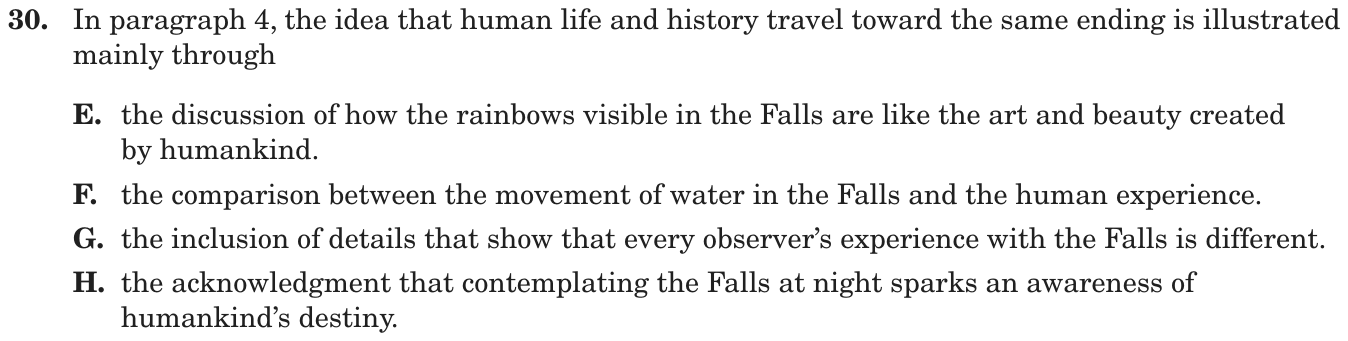
Question 57 of 57
2020 Test B English, question 57Uses the passage above: “Excerpt from “Niagara Falls””.
Question
With which statement would the author of this excerpt most likely agree?
- AA sense of ease and assurance comes with accepting one’s fate.
- BNo matter where one’s path goes in life, one will always have regrets.
- CThe best way to overcome fear is to recognize it and then defy it.
- DReason will die out with humanity, but art will remain immortal.
Show the answer
Correct answer: A
The question asks for the statement the author would agree with most. In paragraph 4, the author states that the Falls make a person feel “with an almost insupportable and yet comforting certitude, that both men and nations are hurried onwards to their ruin or ending.” Later, the final sentence says, “With some such thoughts does the platitudinous heart win from the confusion and thunder of a Niagara peace.” This sentence supports the author’s belief that a person can find peace in accepting the certainty of his or her own ending, as expressed in Option A.
Option B is incorrect because the author does not discuss regrets in the excerpt.
Option C is incorrect because, while the excerpt discusses fear when looking at the power of the Falls, the excerpt does not support the idea that one should defy fear.
Option D is incorrect because the excerpt states in paragraph 4 that art and beauty are “caused by” the stream of life and end with it, “ceasing when it ceased.”
Question analysis
This question asks students to infer which statement about life the author of “Niagara Falls” would most likely agree with, based on the reflections that close his essay. It is hard because the evidence sits in long, abstract sentences of century-old prose and must be pieced together from more than one place in the final paragraph.
- Grade level
- Grade 9 reading and task
- Compared with grade 7
- Above grade 7 Grade 7 point-of-view questions usually rest on a clearly stated opinion. Here the author’s view must be pieced together from abstract reflection on lives, nations and the river, with words like “insupportable” and “platitudinous,” which is closer to high school reading.
- Estimated difficulty
- Among the hardest on the SHSAT: a non-obvious approach, heavy reading, or a well-hidden trap.
- Thinking it demands
- Depth of knowledge 3, strategic thinking · mainly analyze
- What makes it hard
- Reading between the lines major
- Complex sentences major
- The right answer is reworded moderate
- Hard words moderate
- Evidence
- Answered from one paragraph or stanza
- Reading level
- Passage: about grade 9, 987 words; question and choices: about grade 6, 61 words.
- Corrected from the DOE handbook
- A misreading of a word in the passage was corrected in the explanation.
- Students, last 30 days
- Not enough answers yet to show (it takes 10).
Why it is hard, traps and wrong answers (shows the answer)
Why it is hard
This question asks for the author’s outlook, which he reaches only in the closing sentences of a long, abstract paragraph. The mood there is gloomy, with ruin, a dark flood and human crying, so students who read the mood but not the argument choose regret. The comfort and peace he finds in that certainty are easy to miss in the inverted final sentence, and they are exactly what the answer rests on.
Reading between the lines major Working it out
The author never states a belief; students must combine “comforting certitude,” people who meet their end “unreluctant” and “not without nobility,” and the closing “peace” into an attitude of accepting fate. (Graesser, Singer & Trabasso, 1994; Kintsch, 1998)
Complex sentences major Understanding the question
The last sentence inverts normal order, “With some such thoughts does the platitudinous heart win from the confusion and thunder of a Niagara peace,” so its subject and object are hard to find. (Abedi & Lord, 2001; Freedle & Kostin, 1993; Messick, 1989)
The right answer is reworded moderate Choosing the answer
The right statement uses none of the passage’s words, turning “certitude” into “assurance” and “peace” into “ease,” while wrong choices pick up “fear” and “art.” (Freedle & Kostin, 1993; Kirsch & Mosenthal, 1990)
Hard words moderate Understanding the question
“Certitude,” “unreluctant,” “unavailing” and “platitudinous” carry the author’s attitude, and the glossary defines only the last of them. (Perfetti, 2007; Freedle & Kostin, 1993)
Strategy: Reread the second half of paragraph 4 slowly, translating each long sentence into plain words, then choose the statement those lines support without adding ideas the author never mentions.
Traps
- Outside knowledge: A choice is plausible in the real world but not supported by this text.
- Reads too much in: A reasonable-sounding conclusion that goes further than the text allows.
The wrong answers, classified
B Reads too much in (Graesser, Singer & Trabasso, 1994)
Reads “the white cloud of human crying” and the dark flood as a claim about lifelong regret, though the author never mentions regret and finds comfort in the end.
C Outside knowledge (King et al., 2004; Recht & Leslie, 1988)
Falls back on familiar advice about facing fears, prompted by the excerpt’s talk of terror, but the author recommends accepting what is inevitable, not defying it.
D Twists what the text says (King et al., 2004)
Reverses the friend’s rainbow comparison: art and beauty are “caused by” the stream of life and end with it, “ceasing when it ceased,” so art is not immortal.
What was corrected from the DOE handbook, and why
- Explanation: The handbook rejects Option D because paragraph 4 says art is “unable to stay.” In the passage, art and beauty are “unable to stay or direct or affect” the stream of life: “stay” means to stop or hold back the stream, not to last. What shows that art is not immortal is that it is “caused by” the stream of life and ends with it, “ceasing when it ceased,” which the site now quotes.
Working it out, step by step
Figure out what the question asks
This asks which statement the author would most likely agree with. He never states his belief outright, so you must infer it from his words, especially at the end of paragraph 4.
Find what he says about endings
In paragraph 4, he says that at Niagara one feels “with an almost insupportable and yet comforting certitude” that people and nations reach an end. He adds: “Some go down to it unreluctant, and meet it, like the river, not without nobility.” His last sentence says the heart can “win from the confusion and thunder of a Niagara peace.”
Put his words in plain English
“Certitude” means being sure. “Insupportable” means too hard to bear. So knowing that everything ends is hard, yet it is also comforting. “Unreluctant” means willing. Some people meet their end willingly, with dignity. And the Falls give the heart peace. Put together: accepting what must happen brings calm.
Check each choice
- A is right. He finds comfort and peace in accepting fate. That is “ease and assurance.”
- B is wrong. He never mentions regrets.
- C is wrong. He talks about accepting what must happen, not about fighting fear.
- D is wrong. Art and beauty are “caused by” life and end with it, “ceasing when it ceased.” So art does not last forever.
Watch out: “The white cloud of human crying” sounds sad, so B may tempt you. But sadness is not regret, and the author ends on peace.
Choose the answer
The author finds calm and comfort in accepting what must come. So the answer is A.
Why this answer and not the closest wrong one
B is the closest wrong answer, because paragraph 4 mentions human crying and ruin. But the author never talks about regret. He calls the certainty of an ending “comforting,” and the essay closes on the word “peace.” Feeling calm by accepting fate is what A says.
More questions like this
The original DOE question