Passage Cross-Purposes
Cross-Purposes
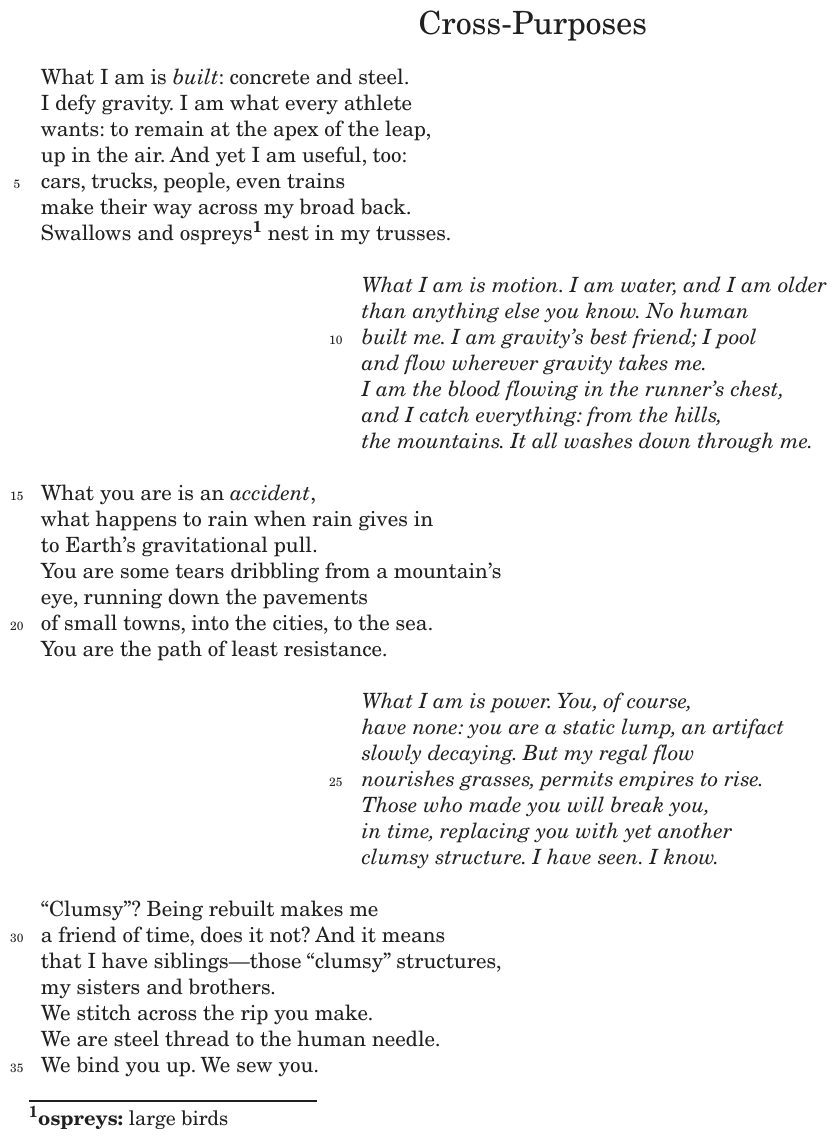
What I am is built: concrete and steel.
I defy gravity. I am what every athlete
wants: to remain at the apex of the leap,
up in the air. And yet I am useful, too:
cars, trucks, people, even trains
make their way across my broad back.
Swallows and ospreys nest in my trusses.
What I am is motion. I am water, and I am older
than anything else you know. No human
built me. I am gravity’s best friend; I pool
and flow wherever gravity takes me.
I am the blood flowing in the runner’s chest,
and I catch everything: from the hills,
the mountains. It all washes down through me.
What you are is an accident,
what happens to rain when rain gives in
to Earth’s gravitational pull.
You are some tears dribbling from a mountain’s
eye, running down the pavements
of small towns, into the cities, to the sea.
You are the path of least resistance.
What I am is power. You, of course,
have none: you are a static lump, an artifact
slowly decaying. But my regal flow
nourishes grasses, permits empires to rise.
Those who made you will break you,
in time, replacing you with yet another
clumsy structure. I have seen. I know.
“Clumsy”? Being rebuilt makes me
a friend of time, does it not? And it means
that I have siblings—those “clumsy” structures,
my sisters and brothers.
We stitch across the rip you make.
We are steel thread to the human needle.
We bind you up. We sew you.
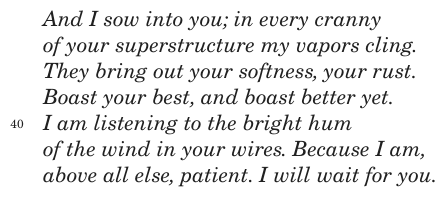
And I sow into you; in every cranny
of your superstructure my vapors cling.
They bring out your softness, your rust.
Boast your best, and boast better yet.
I am listening to the bright hum
of the wind in your wires. Because I am,
above all else, patient. I will wait for you.
ospreys: large birds
Question
How does the similar construction of the sentence in line 1 and the sentence in line 8 contribute to the meaning of the poem?
- AIt introduces the intended permanence of the structure and the ever-changing fluidity of the water.
- BIt shows that the structure can bridge the gap caused by the water.
- CIt suggests that the inflexible structure has more limitations than the adaptable water does.
- DIt contrasts the stability of the structure with the instability of the water.
Show the answer
Correct answer: A
The question asks how the similarity in the construction of lines 1 and 8 contributes to the meaning of the poem.
A. CORRECT. In line 1, the first speaker asserts, “What I am is built: concrete and steel,” and in line 8 the second speaker states, “What I am is motion. I am water, and I am older.” The similarities in the construction of these lines contribute to the meaning of the poem by establishing each speaker’s defining feature.
B. Incorrect. The focus of the lines is defining the speakers’ individuality, not how one speaker resolves a problem created by the other.
C. Incorrect. The structure is not stating in line 1 that it is limited because it was built to stand in place; on the contrary, the structure is stating that this sense of purpose and permanence is its strength.
D. Incorrect. Although in these lines the first speaker asserts “I am . . . built: concrete and steel” (line 1) and the second speaker asserts “I am . . . motion” (line 8), the construction of these lines does not contrast the stability and instability of the speakers. Rather, each speaker highlights its own features.
Question analysis
“Cross-Purposes” is a poem in two voices, one a structure of concrete and steel and the other water, and line 1 and line 8 both start their sentences with “What I am is.” Students explain what this parallel construction adds to the poem's meaning. The choices characterize the two speakers in closely related terms, so one word can decide between them.
- Grade level
- Grade 8 reading and task
- Compared with grade 7
- Above grade 7 Grade 7 poetry work often asks what a repeated phrase stresses. Here students must see what matching sentence openings set up for two personified speakers, then choose among abstract choices separated by single words, well above typical grade 7 demand.
- Estimated difficulty
- Among the hardest on the SHSAT: a non-obvious approach, heavy reading, or a well-hidden trap.
- Thinking it demands
- Depth of knowledge 3, strategic thinking · mainly analyze
- What makes it hard
- A very close wrong answer major
- How, not what moderate
- Figurative or literary language moderate
- Hard words minor
- Evidence
- Answered from several paragraphs or stanzas
- Reading level
- Passage: 316 words (a poem; reading level not measured); question and choices: about grade 9, 77 words.
- Students, last 30 days
- Not enough answers yet to show (it takes 10).
Why it is hard, traps and wrong answers (shows the answer)
Why it is hard
Seeing that one speaker is built and the other moves is the easy part, and two choices state that contrast in near-synonyms. What decides between them is judgment: in lines 1 and 8 each speaker simply announces what it is, proudly, and neither line weighs one against the other. A choice that calls the water unstable, ranks the speakers' limitations or jumps ahead to bridging a gap adds something those two lines do not say, so each word must be checked against them.
A very close wrong answer major Choosing the answer
The key and the stability choice draw the same contrast, built structure against moving water; they part only on “instability,” which turns the water's proud motion into a defect neither line admits. (Embretson & Wetzel, 1987; Gorin & Embretson, 2006; Ascalon et al., 2007)
How, not what moderate Working it out
The stem asks what the matching “What I am is” openings do, so students must see that they give each speaker a parallel self-definition, “built” in line 1 and “motion” in line 8. (Anderson & Krathwohl, 2001)
Figurative or literary language moderate Understanding the question
Both speakers are personified and the bridge is never named; students infer it from “concrete and steel” and the traffic crossing its “broad back,” then read the water's claim to be “older than anything” as a boast. (Graesser, Singer & Trabasso, 1994; Kintsch, 1998)
Hard words minor Understanding the question
The choices rest on abstract words the poem never uses, “permanence,” “fluidity,” “inflexible,” “adaptable” and “instability,” whose shades of judgment decide between them. (Perfetti, 2007; Freedle & Kostin, 1993)
Strategy: Copy the two sentences side by side, note what follows “What I am is” in each, and check every descriptive word in the choices against what those two sentences actually claim.
Traps
- Half right: One half of a two-part choice is right and the other is not.
- Reads too much in: A reasonable-sounding conclusion that goes further than the text allows.
- Wrong part of the text: A choice is true of another paragraph, stanza or speaker than the one asked about.
The wrong answers, classified
B Wrong part of the text (Kirsch & Mosenthal, 1990)
Borrows the fifth stanza's “We stitch across the rip you make,” where the structures span the water, but lines 1 and 8 only introduce the speakers and mention no gap.
C Reads too much in (Graesser, Singer & Trabasso, 1994)
Accepts the fair labels “inflexible” and “adaptable” and then the ranking built on them, a verdict the water argues in its later stanzas but lines 1 and 8 never make.
D Half right (King et al., 2004; Thissen, Steinberg & Fitzpatrick, 1989)
Gets the structure's stability right, but “instability” makes the water's motion a flaw, while line 8 offers motion as its very identity and adds that it is older than anything.
Working it out, step by step
Figure out what the question asks
This question is about how the poem is built. The sentences in lines 1 and 8 start the same way. You need to see what that matching pattern adds to the poem’s meaning.
Set the two sentences side by side
Line 1: “What I am is built: concrete and steel.”
Line 8: “What I am is motion.”Both begin with the same four words, “What I am is.” Line 1 opens the first stanza, and line 8 opens the second. A stanza is a group of lines in a poem, like a paragraph. So each speaker starts by telling you what it is.
Name the two speakers
The first speaker is a structure, most likely a bridge. Traffic and trains “make their way across my broad back.” It is “built” of concrete and steel, so it is meant to last. The second speaker is water. It is “motion,” always flowing and changing. So the matching lines bring in two very different speakers: one made to stay, one always moving.
Check each choice
- A is right. Permanence means lasting. Fluidity means flowing. Intended means planned, and the bridge was built to last.
- B is wrong. A gap first comes up in line 33: “We stitch across the rip you make.” Lines 1 and 8 say nothing about it.
- C is wrong. Inflexible means unable to bend, and adaptable means able to change. But neither line says one speaker has more limits. In line 2, the bridge even boasts, “I defy gravity.”
- D is wrong. Instability means being shaky or likely to fail. That makes the water’s motion sound like a weakness. But the water boasts that it is “older / than anything else you know.”
Watch out: D sets up the same pair as A. The one word that sinks it is “instability.”
Choose the answer
Each matching line names what its speaker is: one built to stay, one always on the move. So the answer is A.
Why this answer and not the closest wrong one
D is the closest wrong answer, because it also sets the steady bridge against the moving water. But “instability” calls the water weak or unsafe. In line 8, the water names its motion with pride. A describes each speaker the way it sees itself.
More questions like this
The original DOE question
The passage “Cross-Purposes” as printed (pages 72–73)