Passage Excerpt from A Tramp Abroad
Excerpt from A Tramp Abroad
by Mark Twain
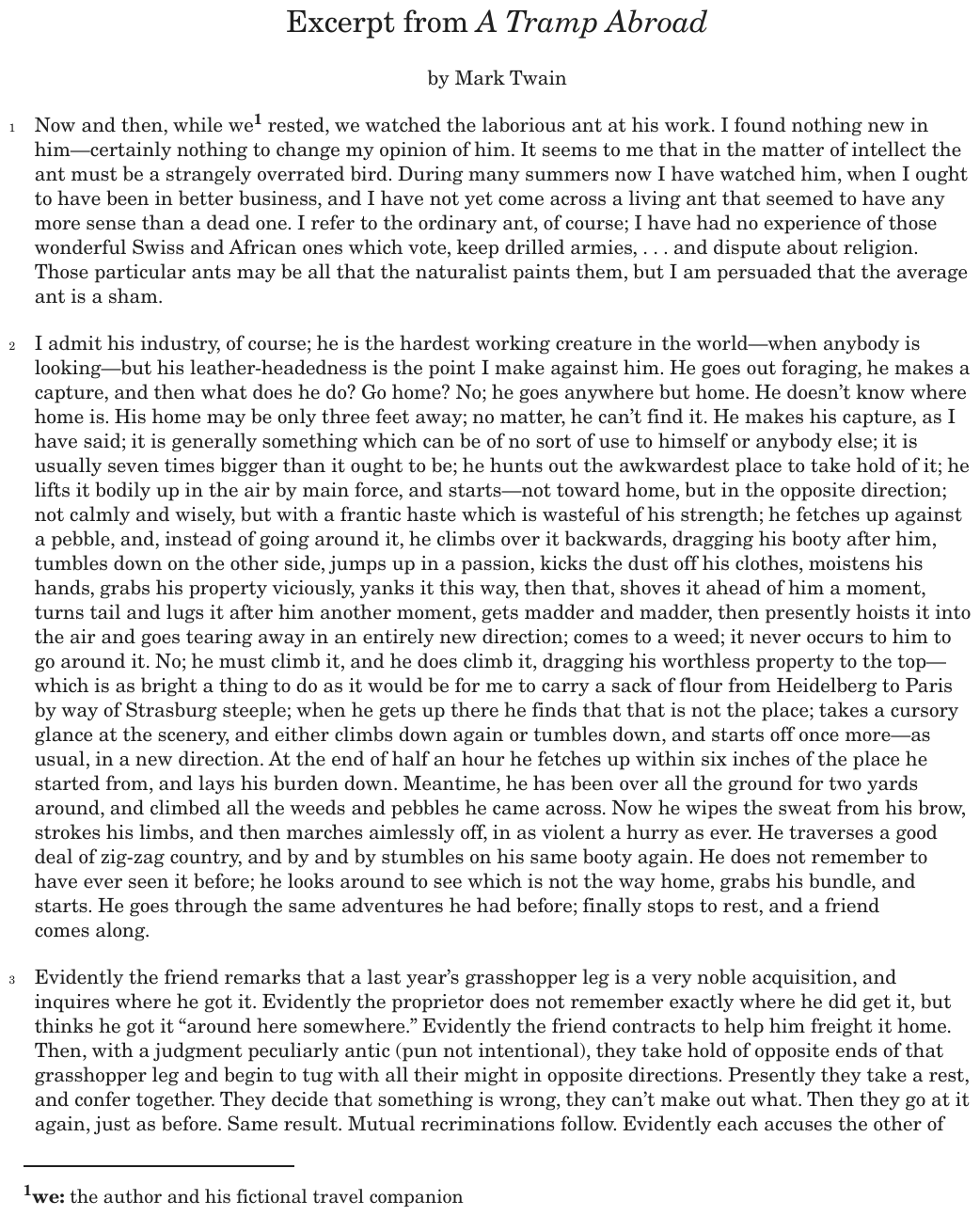
Now and then, while we rested, we watched the laborious ant at his work. I found nothing new in him—certainly nothing to change my opinion of him. It seems to me that in the matter of intellect the ant must be a strangely overrated bird. During many summers now I have watched him, when I ought to have been in better business, and I have not yet come across a living ant that seemed to have any more sense than a dead one. I refer to the ordinary ant, of course; I have had no experience of those wonderful Swiss and African ones which vote, keep drilled armies, . . . and dispute about religion. Those particular ants may be all that the naturalist paints them, but I am persuaded that the average ant is a sham.
I admit his industry, of course; he is the hardest working creature in the world—when anybody is looking—but his leather-headedness is the point I make against him. He goes out foraging, he makes a capture, and then what does he do? Go home? No; he goes anywhere but home. He doesn’t know where home is. His home may be only three feet away; no matter, he can’t find it. He makes his capture, as I have said; it is generally something which can be of no sort of use to himself or anybody else; it is usually seven times bigger than it ought to be; he hunts out the awkwardest place to take hold of it; he lifts it bodily up in the air by main force, and starts—not toward home, but in the opposite direction; not calmly and wisely, but with a frantic haste which is wasteful of his strength; he fetches up against a pebble, and, instead of going around it, he climbs over it backwards, dragging his booty after him, tumbles down on the other side, jumps up in a passion, kicks the dust off his clothes, moistens his hands, grabs his property viciously, yanks it this way, then that, shoves it ahead of him a moment, turns tail and lugs it after him another moment, gets madder and madder, then presently hoists it into the air and goes tearing away in an entirely new direction; comes to a weed; it never occurs to him to go around it. No; he must climb it, and he does climb it, dragging his worthless property to the top—which is as bright a thing to do as it would be for me to carry a sack of flour from Heidelberg to Paris by way of Strasburg steeple; when he gets up there he finds that that is not the place; takes a cursory glance at the scenery, and either climbs down again or tumbles down, and starts off once more—as usual, in a new direction. At the end of half an hour he fetches up within six inches of the place he started from, and lays his burden down. Meantime, he has been over all the ground for two yards around, and climbed all the weeds and pebbles he came across. Now he wipes the sweat from his brow, strokes his limbs, and then marches aimlessly off, in as violent a hurry as ever. He traverses a good deal of zig-zag country, and by and by stumbles on his same booty again. He does not remember to have ever seen it before; he looks around to see which is not the way home, grabs his bundle, and starts. He goes through the same adventures he had before; finally stops to rest, and a friend comes along.
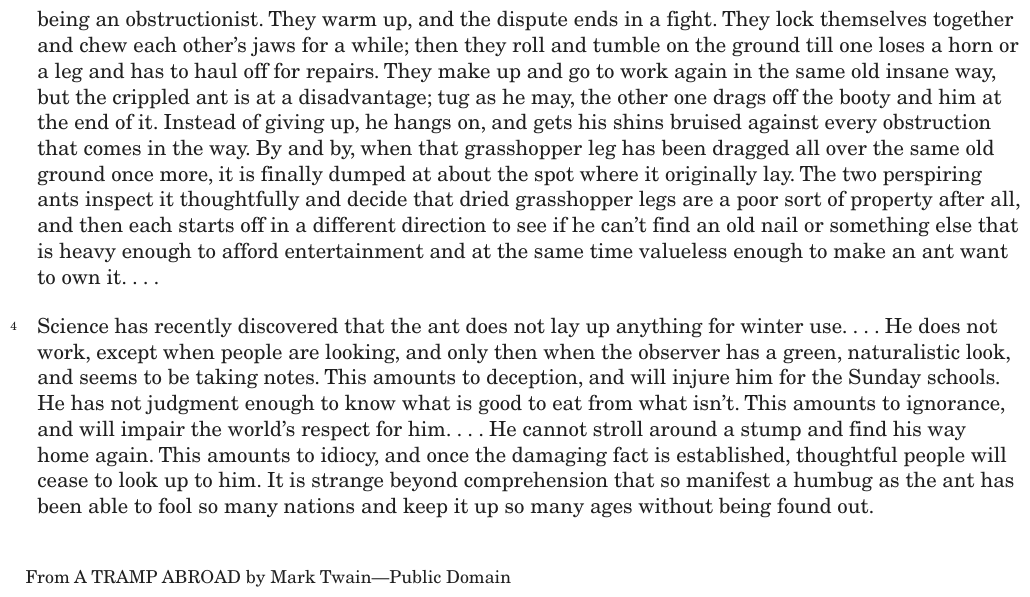
Evidently the friend remarks that a last year’s grasshopper leg is a very noble acquisition, and inquires where he got it. Evidently the proprietor does not remember exactly where he did get it, but thinks he got it “around here somewhere.” Evidently the friend contracts to help him freight it home. Then, with a judgment peculiarly antic (pun not intentional), they take hold of opposite ends of that grasshopper leg and begin to tug with all their might in opposite directions. Presently they take a rest, and confer together. They decide that something is wrong, they can’t make out what. Then they go at it again, just as before. Same result. Mutual recriminations follow. Evidently each accuses the other of being an obstructionist. They warm up, and the dispute ends in a fight. They lock themselves together and chew each other’s jaws for a while; then they roll and tumble on the ground till one loses a horn or a leg and has to haul off for repairs. They make up and go to work again in the same old insane way, but the crippled ant is at a disadvantage; tug as he may, the other one drags off the booty and him at the end of it. Instead of giving up, he hangs on, and gets his shins bruised against every obstruction that comes in the way. By and by, when that grasshopper leg has been dragged all over the same old ground once more, it is finally dumped at about the spot where it originally lay. The two perspiring ants inspect it thoughtfully and decide that dried grasshopper legs are a poor sort of property after all, and then each starts off in a different direction to see if he can’t find an old nail or something else that is heavy enough to afford entertainment and at the same time valueless enough to make an ant want to own it. . . .
Science has recently discovered that the ant does not lay up anything for winter use. . . . He does not work, except when people are looking, and only then when the observer has a green, naturalistic look, and seems to be taking notes. This amounts to deception, and will injure him for the Sunday schools. He has not judgment enough to know what is good to eat from what isn’t. This amounts to ignorance, and will impair the world’s respect for him. . . . He cannot stroll around a stump and find his way home again. This amounts to idiocy, and once the damaging fact is established, thoughtful people will cease to look up to him. It is strange beyond comprehension that so manifest a humbug as the ant has been able to fool so many nations and keep it up so many ages without being found out.
we: the author and his fictional travel companion
From A TRAMP ABROAD by Mark Twain—Public Domain
Question
The description at the end of paragraph 2 of the ant repeating his actions conveys the idea that
- Amistakes are necessary in order to make progress.
- Brushing to reach a goal may lead to an undesirable outcome.
- Cbreaking out of a familiar pattern of events is difficult.
- Dindustriousness and foolishness is an unfortunate combination.
Show the answer
Correct answer: D
The question asks which idea the description at the end of paragraph 2 conveys about the repetition of the ant’s actions.
A. Incorrect. The description at the end of paragraph 2, in which the ant “goes through the same adventures” to no avail, does not convey the idea that mistakes are necessary in order to make progress.
B. Incorrect. The description at the end of paragraph 2, in which the ant runs away in a “violent” hurry and “traverses a good deal of zig-zag country, and by and by stumbles on his same booty again . . . not remember[ing] to have ever seen it before,” does not convey the idea that rushing to meet a goal may lead to an undesirable outcome, because the last line in paragraph 2 refers to the ant’s repetitive actions as an adventure (“He goes through the same adventures he had before”).
C. Incorrect. The description at the end of paragraph 2, in which the ant repeatedly “stumbles on his same booty again,” does not convey the idea that breaking out of a familiar pattern of events is difficult, because the industrious ant “does not remember” (paragraph 2) and is thus unaware that he is repeating his actions.
D. CORRECT. The description at the end of paragraph 2 says that the ant “traverses a good deal of zig-zag country, and by and by stumbles on his same booty again. He does not remember to have ever seen it before; he looks around to see which is not the way home, grabs his bundle, and starts. He goes through the same adventures he had before,” thus indicating that the ant is both industrious and foolish in his actions.
Question analysis
In this theme question on Mark Twain's “A Tramp Abroad,” students decide what idea is conveyed by the end of paragraph 2, where an ant sets down his load, wanders off, stumbles on it again without recognizing it, and repeats the whole journey. The choices are general life lessons, more than one of them linked to something the ant really does.
- Grade level
- Grade 8 reading and task
- Compared with grade 7
- Above grade 7 Typical grade 7 theme questions draw on a short story's plain events. Here the idea must come from the close of a very long, sarcastic nineteenth-century paragraph, and the choices are abstract morals that echo real details, above grade 7.
- Estimated difficulty
- Hard: combines ideas, needs a plan, and has more than one tempting wrong answer.
- Thinking it demands
- Depth of knowledge 3, strategic thinking · mainly analyze
- What makes it hard
- Reading between the lines major
- Figurative or literary language moderate
- Evidence in several places minor
- Hard words minor
- Evidence
- Answered from one paragraph or stanza
- Reading level
- Passage: about grade 9, 1099 words; question and choices: about grade 9, 53 words.
- Students, last 30 days
- Not enough answers yet to show (it takes 10).
Why it is hard, traps and wrong answers (shows the answer)
Why it is hard
All four choices are general morals, and two borrow real features of the scene, the ant's hurry and his repeated route, so the question turns on why the ant repeats himself. He forgets the booty and starts over with the same frantic energy, which joins the paragraph's opening concession about his industry to its charge of leather-headedness. Students who read the description as a warning about haste, or about being stuck in a rut, give the ant motives and awareness he never shows.
Reading between the lines major Working it out
No sentence states a lesson; students must join the ant's tireless restart, grabbing his bundle for “the same adventures,” with the fact that he “does not remember” the booty, to see effort wasted by stupidity. (Graesser, Singer & Trabasso, 1994; Kintsch, 1998)
Figurative or literary language moderate Understanding the question
Twain narrates the ant as a mock-heroic laborer who “wipes the sweat from his brow” and has “adventures,” so the idea arrives through irony and exaggeration rather than plain statement. (Graesser, Singer & Trabasso, 1994; Kintsch, 1998)
Evidence in several places minor Working it out
The two halves of the idea are named at the start of paragraph 2, “I admit his industry” and “his leather-headedness,” well above the closing description the question points to. (Kirsch & Mosenthal, 1990; Gorin & Embretson, 2006)
Hard words minor Understanding the question
The passage's “traverses” and “booty” and the choices' “industriousness” must be understood, and the key uses that abstract noun rather than the passage's own word, “industry.” (Perfetti, 2007; Freedle & Kostin, 1993)
Strategy: Work out from the surrounding sentences why the ant repeats his trip, then test each lesson against what the ant actually does and knows, word by word.
Traps
- Twists what the text says: Uses the text's topic and ideas but changes what it says: who did it, how much, when, or why.
- Reads too much in: A reasonable-sounding conclusion that goes further than the text allows.
- Outside knowledge: A choice is plausible in the real world but not supported by this text.
The wrong answers, classified
A Outside knowledge (King et al., 2004; Recht & Leslie, 1988)
Brings in the familiar saying that mistakes lead to progress, but the ant's blunders get him nowhere: he forgets his booty, finds it again and repeats the same trip.
B Twists what the text says (King et al., 2004)
Fastens on the march “in as violent a hurry as ever,” but the ant moves “aimlessly,” with no goal to rush toward, and repeats himself because he forgets, not because he hurries.
C Reads too much in (Graesser, Singer & Trabasso, 1994)
Sees the repeated journey as a rut the ant struggles to escape, but he “does not remember to have ever seen” the booty, so he never knows he is repeating anything.
Working it out, step by step
Figure out what the question asks
This asks for the idea, or message, behind a scene. At the end of paragraph 2, the ant does the same things all over again. Work out why he repeats himself. Then pick the lesson that fits.
Find the end of paragraph 2
Near the end, the ant “marches aimlessly off, in as violent a hurry as ever.” Then he “stumbles on his same booty again. He does not remember to have ever seen it before.” He grabs it and starts off. “He goes through the same adventures he had before.”
Aimlessly means with no goal. Booty is the thing he captured.
Work out what it means
The ant works hard and moves fast. But he forgets his own load, so he does the whole useless trip again. Twain names these two traits at the start of paragraph 2. He says, “I admit his industry,” and industry means hard work. But “his leather-headedness is the point I make against him.” Leather-headed means thick-headed, or foolish. Twain is joking that all that hard work is wasted.
Check each choice
- A is wrong. The ant’s mistakes get him nowhere. After half an hour, he is “within six inches of the place he started from.”
- B is wrong. The ant does hurry, but he has no goal to rush toward. He repeats himself because he forgets, not because he rushes.
- C is wrong. The ant doesn’t remember his booty, so he doesn’t know he is repeating anything. He isn’t trying to break a habit.
- D is right. Industriousness means being hardworking. An unfortunate combination is a bad mix. Hard work plus foolishness adds up to wasted effort.
Choose the answer
The scene shows a hard worker with no sense, doing the same useless job twice. So the answer is D.
Why this answer and not the closest wrong one
B comes closest, because the ant moves “in as violent a hurry as ever.” But hurrying is not why he repeats his trip. He repeats it because he forgets his booty. D names both of his traits: he works hard, and he is foolish.
More questions like this
The original DOE question

The passage “Excerpt from A Tramp Abroad” as printed (pages 62–63)