Also in 2019 Test B English, question 52.
Passage Massachusetts: Lowell National Historical Park
Massachusetts: Lowell National Historical Park
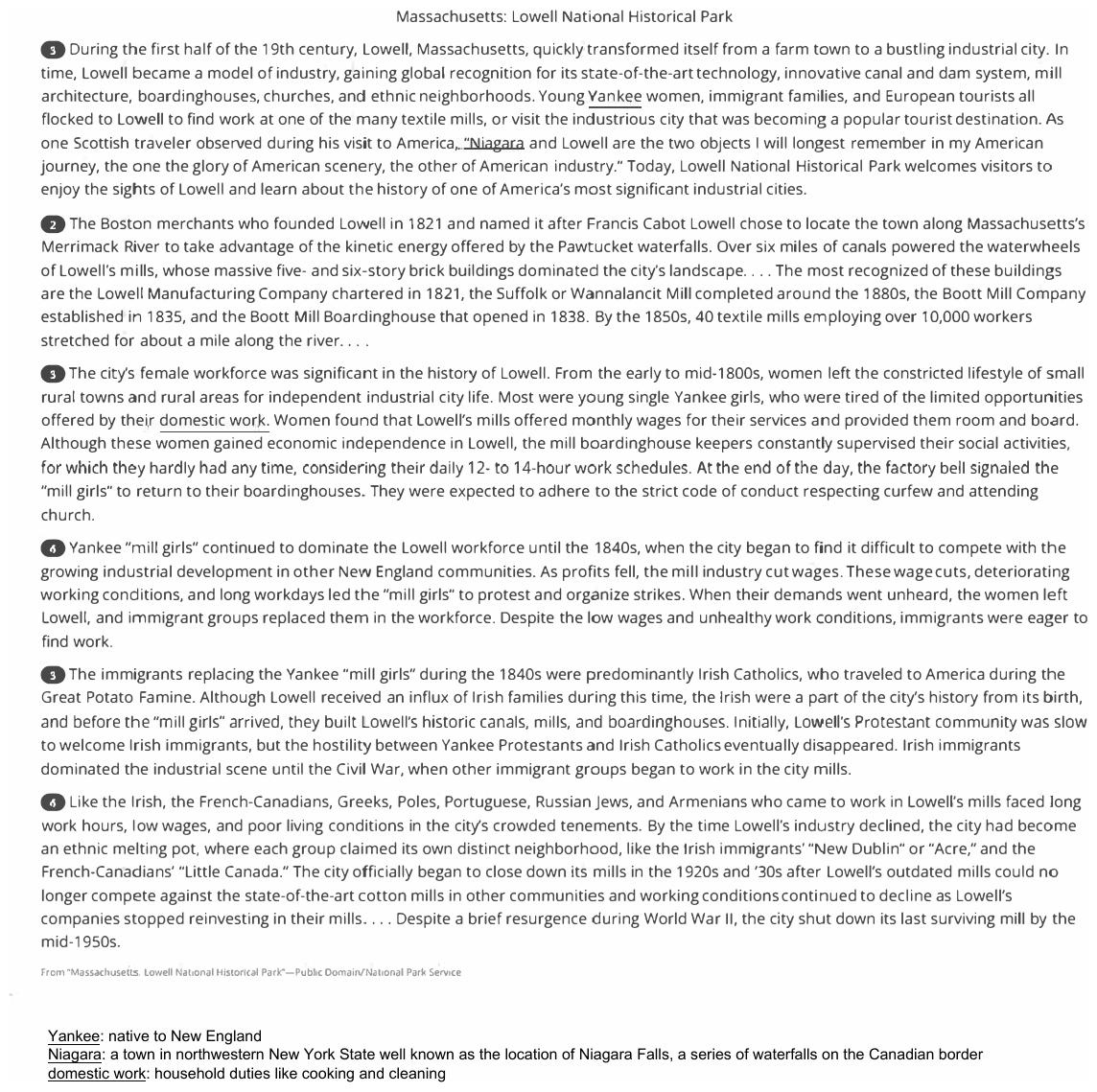
During the first half of the 19th century, Lowell, Massachusetts, quickly transformed itself from a farm town to a bustling industrial city. In time, Lowell became a model of industry, gaining global recognition for its state-of-the-art technology, innovative canal and dam system, mill architecture, boardinghouses, churches, and ethnic neighborhoods. Young Yankee women, immigrant families, and European tourists all flocked to Lowell to find work at one of the many textile mills, or visit the industrious city that was becoming a popular tourist destination. As one Scottish traveler observed during his visit to America, “Niagara and Lowell are the two objects I will longest remember in my American journey, the one the glory of American scenery, the other of American industry.” Today, Lowell National Historical Park welcomes visitors to enjoy the sights of Lowell and learn about the history of one of America’s most significant industrial cities.
The Boston merchants who founded Lowell in 1821 and named it after Francis Cabot Lowell chose to locate the town along Massachusetts’s Merrimack River to take advantage of the kinetic energy offered by the Pawtucket waterfalls. Over six miles of canals powered the waterwheels of Lowell’s mills, whose massive five- and six-story brick buildings dominated the city’s landscape. . . . The most recognized of these buildings are the Lowell Manufacturing Company chartered in 1821, the Suffolk or Wannalancit Mill completed around the 1880s, the Boott Mill Company established in 1835, and the Boott Mill Boardinghouse that opened in 1838. By the 1850s, 40 textile mills employing over 10,000 workers stretched for about a mile along the river. . . .
The city’s female workforce was significant in the history of Lowell. From the early to mid-1800s, women left the constricted lifestyle of small rural towns and rural areas for independent industrial city life. Most were young single Yankee girls, who were tired of the limited opportunities offered by their domestic work. Women found that Lowell’s mills offered monthly wages for their services and provided them room and board. Although these women gained economic independence in Lowell, the mill boardinghouse keepers constantly supervised their social activities, for which they hardly had any time, considering their daily 12- to 14-hour work schedules. At the end of the day, the factory bell signaled the “mill girls” to return to their boardinghouses. They were expected to adhere to the strict code of conduct respecting curfew and attending church.
Yankee “mill girls” continued to dominate the Lowell workforce until the 1840s, when the city began to find it difficult to compete with the growing industrial development in other New England communities. As profits fell, the mill industry cut wages. These wage cuts, deteriorating working conditions, and long workdays led the “mill girls” to protest and organize strikes. When their demands went unheard, the women left Lowell, and immigrant groups replaced them in the workforce. Despite the low wages and unhealthy work conditions, immigrants were eager to find work.
The immigrants replacing the Yankee “mill girls” during the 1840s were predominantly Irish Catholics, who traveled to America during the Great Potato Famine. Although Lowell received an influx of Irish families during this time, the Irish were a part of the city’s history from its birth, and before the “mill girls” arrived, they built Lowell’s historic canals, mills, and boardinghouses. Initially, Lowell’s Protestant community was slow to welcome Irish immigrants, but the hostility between Yankee Protestants and Irish Catholics eventually disappeared. Irish immigrants dominated the industrial scene until the Civil War, when other immigrant groups began to work in the city mills.
Like the Irish, the French-Canadians, Greeks, Poles, Portuguese, Russian Jews, and Armenians who came to work in Lowell’s mills faced long work hours, low wages, and poor living conditions in the city’s crowded tenements. By the time Lowell’s industry declined, the city had become an ethnic melting pot, where each group claimed its own distinct neighborhood, like the Irish immigrants’ “New Dublin” or “Acre,” and the French-Canadians’ “Little Canada.” The city officially began to close down its mills in the 1920s and ’30s after Lowell’s outdated mills could no longer compete against the state-of-the-art cotton mills in other communities and working conditions continued to decline as Lowell’s companies stopped reinvesting in their mills. . . . Despite a brief resurgence during World War II, the city shut down its last surviving mill by the mid-1950s.
From “Massachusetts: Lowell National Historical Park”—Public Domain/National Park Service
Yankee: native to New England
Niagara: a town in northwestern New York State well known as the location of Niagara Falls, a series of waterfalls on the Canadian border
domestic work: household duties like cooking and cleaning
Question
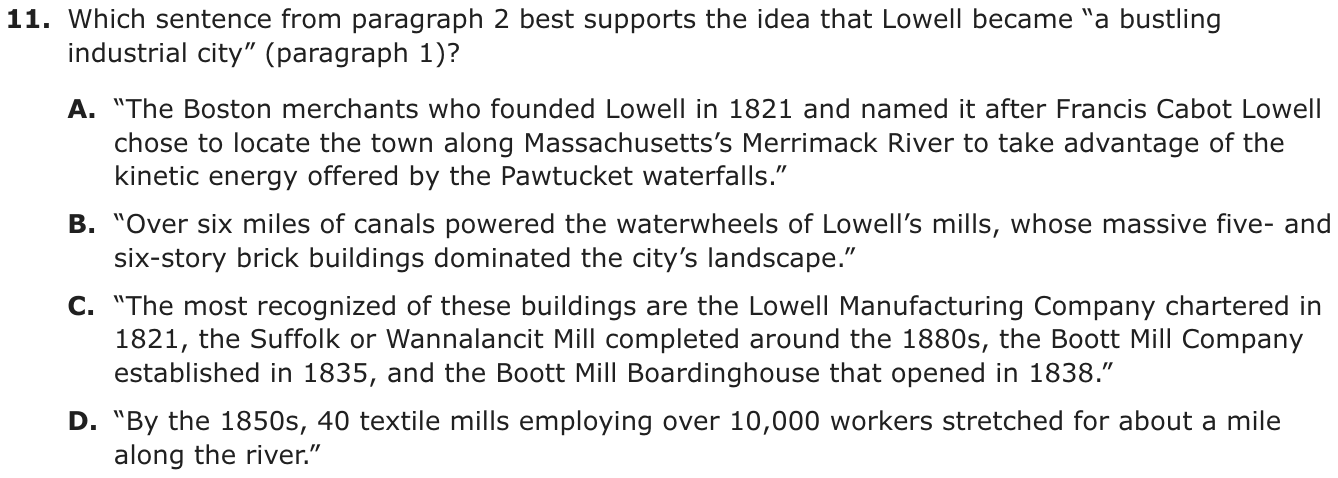
Which sentence from paragraph 2 best supports the idea that Lowell became “a bustling industrial city” (paragraph 1)?
- A“The Boston merchants who founded Lowell in 1821 and named it after Francis Cabot Lowell chose to locate the town along Massachusetts’s Merrimack River to take advantage of the kinetic energy offered by the Pawtucket waterfalls.”
- B“Over six miles of canals powered the waterwheels of Lowell’s mills, whose massive five- and six-story brick buildings dominated the city’s landscape.”
- C“The most recognized of these buildings are the Lowell Manufacturing Company chartered in 1821, the Suffolk or Wannalancit Mill completed around the 1880s, the Boott Mill Company established in 1835, and the Boott Mill Boardinghouse that opened in 1838.”
- D“By the 1850s, 40 textile mills employing over 10,000 workers stretched for about a mile along the river.”
Show the answer
Correct answer: D
The question asks for the sentence in paragraph 2 that best supports the idea that Lowell became “a bustling industrial city” (paragraph 1).
A. Incorrect. While the sentence provides details on when the town of Lowell was founded and the natural features of the area, it does not support the idea that the city became “a bustling industrial city.”
B. Incorrect. Although this sentence indicates that the mill buildings were a noticeable feature of the city and provides details on how the mills worked, it does not specifically show that Lowell had become “a bustling industrial city.”
C. Incorrect. While this sentence lists some recognizable mill buildings along the river and notes when their associated businesses were established, it does not support the idea that Lowell was “a bustling industrial city.”
D. CORRECT. This sentence indicates that within only a few decades of the city’s founding, it experienced massive industrial growth, with “40 textile mills employing over 10,000 workers,” supporting the idea that Lowell became “a bustling industrial city.”
Question analysis
An article on Lowell National Historical Park says the Massachusetts town became “a bustling industrial city,” and students pick the sentence from the article's second paragraph that best backs up that description. Every choice quotes the paragraph's account of the founding, canals and mills, so students must judge what each sentence actually shows about the city.
- NYS standards
- 7R1 textual evidence and inferences
- Grade level
- Grade 7 reading and task
- Compared with grade 7
- At grade 7 Picking the strongest support for a quoted phrase is ordinary grade 7 evidence work. The four candidates sit in a single short paragraph, and unlike the 2026 printing the claim has no time condition, so the demand is typical.
- Estimated difficulty
- Moderate: several steps, or a close reading with one strong distractor.
- Thinking it demands
- Depth of knowledge 2, skills and concepts · mainly evaluate
- What makes it hard
- Reading between the lines moderate
- Every choice must be checked minor
- Evidence
- Answered from one paragraph or stanza
- Reading level
- Passage: about grade 15, 764 words; question and choices: about grade 14, 125 words.
- Students, last 30 days
- Not enough answers yet to show (it takes 10).
Why it is hard, traps and wrong answers (shows the answer)
Why it is hard
With no time limit in the claim, the work is deciding what makes a city bustling as well as industrial. The sentence about canals and massive brick mills dominating the landscape is the strongest pull, because it sounds like an industrial city, yet it shows structures, not activity. Only the 1850s sentence counts people, more than 10,000 of them working in 40 mills along about a mile of river, which is what the word “bustling” asks for.
Reading between the lines moderate Working it out
“Bustling” means full of people and activity, so students must see that only the 1850s sentence, with “over 10,000 workers” in 40 mills, shows a busy city rather than buildings and machinery. (Graesser, Singer & Trabasso, 1994; Kintsch, 1998)
Every choice must be checked minor Choosing the answer
All four sentences come from paragraph 2 and concern the founders, canals or mills, so none can be dismissed at a glance; each has to be weighed for activity as well as industry. (Embretson & Wetzel, 1987)
Strategy: Decide what “bustling” adds to “industrial” before looking at the choices, then ask of each sentence from paragraph 2 whether it shows that quality as well as industry.
Traps
- Supports only part of the claim: In a question about evidence: a line that backs one half of the claim but not the other, or a related point rather than the claim itself.
- True but not the answer: A choice says something accurate about the text that does not answer this question.
The wrong answers, classified
A True but not the answer (King et al., 2004; Embretson & Wetzel, 1987)
Picks the founding sentence, which explains why the merchants built beside the Pawtucket falls, but a plan to use water power says nothing about what the city became.
B Supports only part of the claim (King et al., 2004; Thissen, Steinberg & Fitzpatrick, 1989)
Takes the canals and “massive five- and six-story brick buildings” as proof of a bustling city; they show industry, but only as structures, with no workers or activity.
C Supports only part of the claim (King et al., 2004; Thissen, Steinberg & Fitzpatrick, 1989)
Treats the list of four well-known mill buildings and their dates as evidence of a busy city, but naming landmarks shows the industry's buildings, not the bustle around them.
Working it out, step by step
Figure out what the question asks
This is an evidence question. You need the sentence that best supports, or backs up, a claim. The claim is that Lowell became “a bustling industrial city.” Industrial means full of factories. Bustling means busy and full of people. The best sentence must show both.
Look at paragraph 2
All four choices come from paragraph 2. The first tells why the town was built by the river. The next two describe the mills, which were factories, and their buildings. The last one says: “By the 1850s, 40 textile mills employing over 10,000 workers stretched for about a mile along the river.”
Work out what the last sentence shows
Textile mills are factories that make cloth. Forty of them is a lot of industry. Over 10,000 workers is a lot of people, all busy at work. A mile of mills along the river paints a crowded, busy scene. And Lowell was only founded in 1821, so it grew this big in about 30 years.
Check each choice
- A is wrong. It tells why the founders picked a spot by the waterfalls. That was the plan, not what the city became.
- B is wrong. The canals and “massive five- and six-story brick buildings” show industry. But they are only buildings, with no people or activity.
- C is wrong. It names four well-known buildings and their dates. A list of famous buildings doesn’t show a busy city.
- D is right. It shows lots of factories and lots of workers.
Watch out: B sounds big and industrial. But bustling needs people, and B has none.
Choose the answer
Only one sentence shows both the factories and the crowds of busy workers. So the answer is D.
Why this answer and not the closest wrong one
B comes closest, because huge mills that “dominated the city’s landscape” do show industry. But a city can have big buildings and still be quiet. D adds the people: over 10,000 workers in 40 mills. That is what makes a city bustling.
More questions like this
The original DOE question
The passage “Massachusetts: Lowell National Historical Park” as printed (page 50)