Figure
Question 1 of 49
2026 Practice Test B English, question 35Passage Using Fire to Keep a Prairie Healthy
Using Fire to Keep a Prairie Healthy
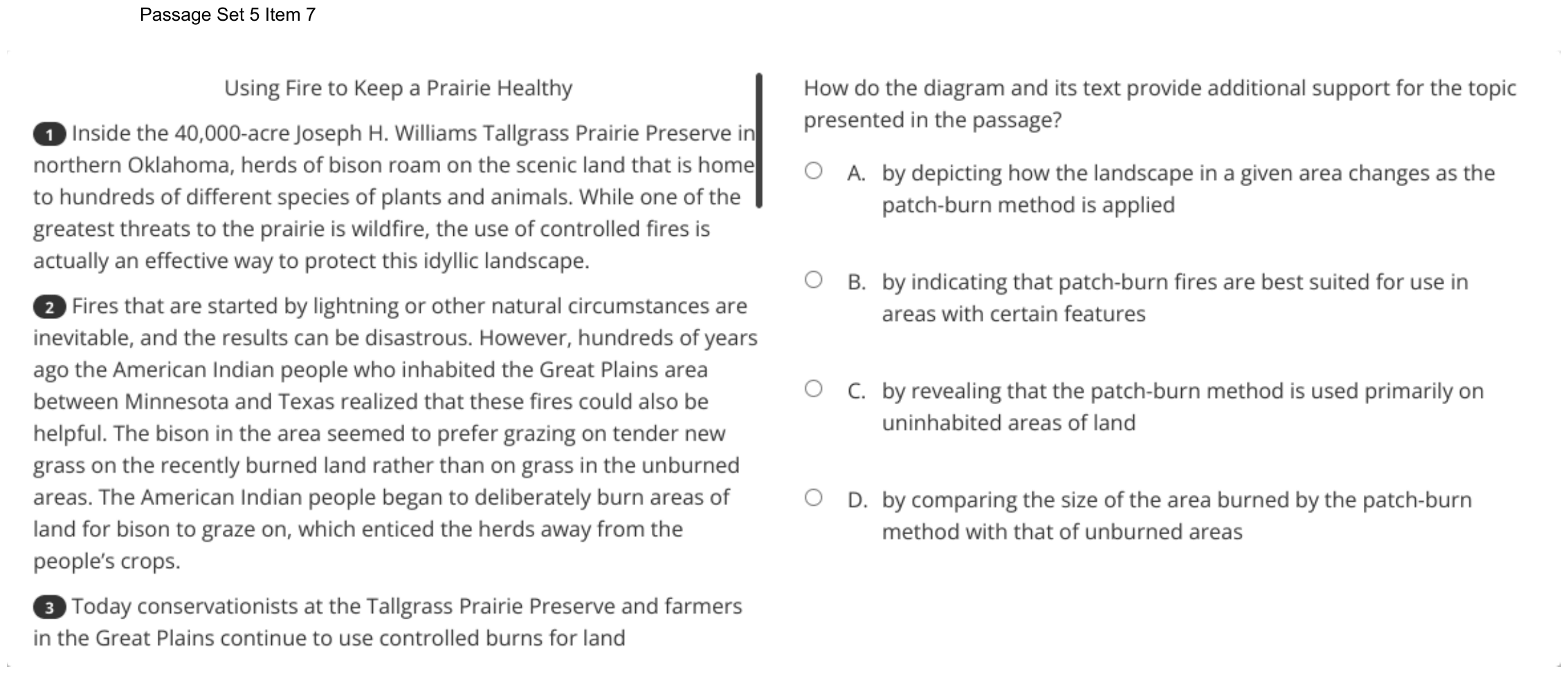
Inside the 40,000-acre Joseph H. Williams Tallgrass Prairie Preserve in northern Oklahoma, herds of bison roam on the scenic land that is home to hundreds of different species of plants and animals. While one of the greatest threats to the prairie is wildfire, the use of controlled fires is actually an effective way to protect this idyllic landscape.
Fires that are started by lightning or other natural circumstances are inevitable, and the results can be disastrous. However, hundreds of years ago the American Indian people who inhabited the Great Plains area between Minnesota and Texas realized that these fires could also be helpful. The bison in the area seemed to prefer grazing on tender new grass on the recently burned land rather than on grass in the unburned areas. The American Indian people began to deliberately burn areas of land for bison to graze on, which enticed the herds away from the people’s crops.
Today conservationists at the Tallgrass Prairie Preserve and farmers in the Great Plains continue to use controlled burns for land management. Intentionally burning a portion of land can dramatically improve the quality of the vegetation that regrows there. The fires burn away weedy undergrowth and help limit the overcrowding of shrubs and trees in the burn area, creating less competition for water and nutrients. Additionally, the process of burning excess plant matter adds nitrogen, an essential element for plant growth, to the soil.
One common target of controlled burns at the preserve and the surrounding area is the invasive red cedar tree. A single red cedar tree can consume up to 40 gallons of water per day, taking this vital resource away from other plant life. These tall trees also cast shade that prevents sunlight from reaching the plants beneath them. The fast-growing red cedar trees tend to crowd out prairie grasses, the primary food source for wild and domestic animals that make the prairie their home. An imbalance in one component of the prairie’s ecosystem affects the entire web of life. Controlled burns help maintain this ecosystem’s delicate balance.
Of course, these controlled fires are intended to burn only a portion of an area. A total burn, which is a risk with an uncontrolled wildfire, would destroy all wildlife as well as the crops farmers plant for income. The key to using controlled fires is knowing which areas of land to burn and when. Conservation experts at the preserve employ the “patch-burn” approach, meaning they rotate which portion of land is burned each year. They study the land to find out which areas would most benefit from being burned, and then they arrange about a dozen burns over one-third of the land. This patch burning contains the fire within a specific area and allows animals in the burn area to safely relocate. The following year, conservationists will burn a different section of the preserve, while the land burned the previous year regrows healthier than before.
Researchers have tracked and studied the variety of plant species and animals that live on the preserve, and their studies show that the patch-burn approach has restored biodiversity to the area by promoting the growth of species that were at risk of being crowded out. The patch-burn system is so successful that the conservationists at the preserve provide training to prairie farmers about conducting controlled burns on their own land. Burning land to make it healthy may seem counterintuitive, but strategic controlled fires have helped the prairie sustain life for hundreds of years and, with careful management, will continue to do so.
Question
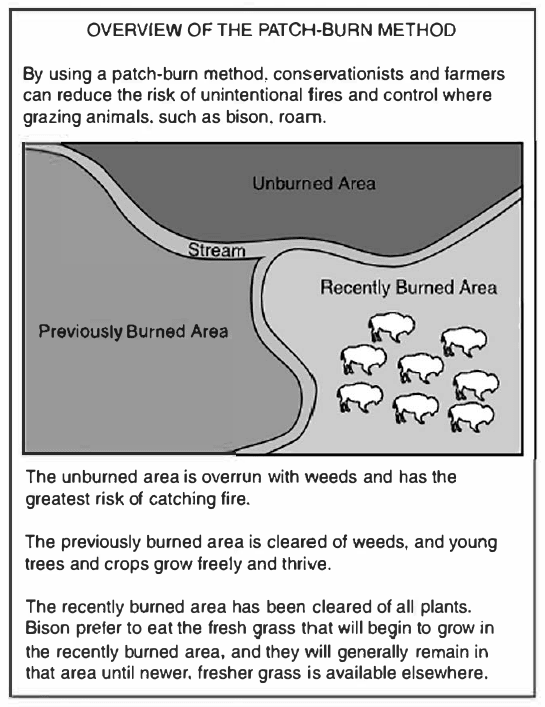
How do the diagram and its text provide additional support for the topic presented in the passage?
- Aby depicting how the landscape in a given area changes as the patch-burn method is applied
- Bby indicating that patch-burn fires are best suited for use in areas with certain features
- Cby revealing that the patch-burn method is used primarily on uninhabited areas of land
- Dby comparing the size of the area burned by the patch-burn method with that of unburned areas
Show the answer
Correct answer: A
The question asks how the diagram and its text provide additional support for the topic presented in the passage.
A. CORRECT. The text of the diagram states that “by using a patch-burn method, conservationists and farmers can reduce the risk of unintentional fires and control where grazing animals, such as bison, roam.” By showing the pattern of controlled burns and the resulting bison migration in a given area, the diagram depicts how the landscape changes as the patch-burn method is applied.
B. Incorrect. Although the text mentions areas “where grazing animals, such as bison, roam,” the diagram does not depict distinctive features of the land such as trees or brush and therefore does not indicate that patch-burn fires are best suited for use in areas with certain features.
C. Incorrect. While the text mentions “grazing animals, such as bison” and the diagram shows the bison grazing in only one area, the diagram and its text do not indicate that the patch-burn method is used on uninhabited land.
D. Incorrect. While the areas of land depicted in the diagram do indicate that the sizes of the areas differ, the text provided does not compare the sizes of the areas burned by the patch-burn method with those of unburned areas or indicate that this factor is important in reducing the risk of uncontrolled fires or controlling “where grazing animals, such as bison, roam.”
Question analysis
This question asks how a diagram titled “Overview of the Patch-Burn Method,” printed with the article on controlled burns at an Oklahoma prairie preserve, supports the passage's topic. The diagram shows a stretch of land divided into three areas, each with a caption, so students must take in what the picture and its text show together and tie that to the article.
- Grade level
- Grade 7 reading and task
- Compared with grade 7
- At grade 7 Explaining how a graphic adds to a text is a grade 7 skill. This diagram is simple and clearly labeled, but students must take in its three areas and captions together and match them to an abstract description, a typical demand.
- Estimated difficulty
- Moderate: several steps, or a close reading with one strong distractor.
- Thinking it demands
- Depth of knowledge 2, skills and concepts · mainly analyze
- What makes it hard
- Reading a figure, table or graph moderate
- Reading between the lines moderate
- How, not what minor
- Evidence
- Answered from the whole text
- Reading level
- Passage: about grade 11, 598 words; question and choices: about grade 9, 79 words.
- Students, last 30 days
- Not enough answers yet to show (it takes 10).
Why it is hard, traps and wrong answers (shows the answer)
Why it is hard
The diagram shows three areas side by side, and the key insight is that they are one piece of land at three moments in the patch-burn cycle. Students who read it only as a map look for spatial claims instead, about land features, people or the sizes of the areas. The caption calling the unburned area “overrun with weeds” is the likeliest snare, since it sounds like advice on which land to burn.
Reading a figure, table or graph moderate Understanding the question
The diagram’s meaning is split among a map of three shaded areas, an introduction and three captions, which must be read together to see what the picture adds to the passage. (Lesh, Post & Behr, 1987; Kirsch & Mosenthal, 1990)
Reading between the lines moderate Working it out
Nothing in the diagram mentions the passing of time; students must infer that the unburned, recently burned and previously burned areas are stages the same land passes through as the burns rotate. (Graesser, Singer & Trabasso, 1994; Kintsch, 1998)
How, not what minor Working it out
The stem asks how the diagram supports the passage, a question of function, so describing what is drawn is not enough; it must be tied to the yearly rotation of paragraph 5. (Anderson & Krathwohl, 2001)
Strategy: Read the diagram's title, introduction and three captions before the choices, sum up in one sentence what the diagram shows, and check each choice against something you can actually point to in it.
Traps
- Reads too much in: A reasonable-sounding conclusion that goes further than the text allows.
- True but not the answer: A choice says something accurate about the text that does not answer this question.
The wrong answers, classified
B Reads too much in (Graesser, Singer & Trabasso, 1994)
Reads the caption calling the unburned area “overrun with weeds” as advice on which land suits a burn, though the captions describe each stage, not features that make land suitable.
C Reads too much in (Graesser, Singer & Trabasso, 1994)
Sees no houses or people on the map and decides patch burns are kept to empty land, though bison graze there and a caption mentions crops growing.
D True but not the answer (King et al., 2004; Embretson & Wetzel, 1987)
Notices that the three shaded areas differ in size, which is true of the drawing, but no caption compares them, and size is not what the diagram explains.
Working it out, step by step
Figure out what the question asks
This question asks how the diagram helps the passage. A diagram is a drawing that explains how something works. You need to say what it adds, not just what it shows. So read its title, its short introduction and its three captions. Captions are the short notes under a picture.
Read the diagram
The title, printed in capital letters, is “Overview of the Patch-Burn Method.” The drawing shows one stretch of land. A stream splits it into three areas, labeled “Unburned Area,” “Recently Burned Area” and “Previously Burned Area.” A herd of bison stands in the recently burned area.
Read the three captions
- The unburned area “is overrun with weeds and has the greatest risk of catching fire.”
- The recently burned area “has been cleared of all plants.” Bison come to eat the fresh grass that grows there.
- The previously burned area “is cleared of weeds, and young trees and crops grow freely and thrive.”
These are three stages the same land goes through: weedy, burned, then healthy. Paragraph 5 says the experts burn a different section each year, while “the land burned the previous year regrows healthier than before.”
Check each choice
- A is right. The diagram shows land changing from weedy, to burned, to healthy as the method is used.
- B is wrong. The captions describe each stage. They don’t say some kinds of land suit burning best.
- C is wrong. Bison live in the drawing, and a caption mentions crops. Uninhabited means with no one living there, and nothing says that.
- D is wrong. The areas are different sizes in the drawing. But no caption compares sizes.
Watch out: B is tempting because “overrun with weeds” sounds like a reason to burn. But that caption describes the first stage. It is not a rule for choosing land.
Choose the answer
Depicting means showing in a picture. So the answer is A: “by depicting how the landscape in a given area changes as the patch-burn method is applied.”
Why this answer and not the closest wrong one
B is the closest wrong answer, because the weedy unburned area does sound like land that needs a fire. But the diagram gives no rules for picking land. It shows one piece of land changing, stage by stage, as the burns rotate. That is what A says.
More questions like this
The original DOE question
The passage “Using Fire to Keep a Prairie Healthy” as printed (page 41)
Question 2 of 49
2026 Practice Test C Math, question 6Question
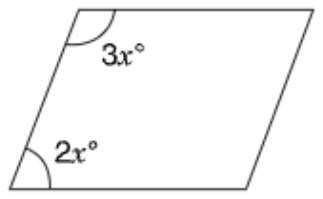
In the parallelogram above, what is the value of x?
- A36
- B18
- C6
- D5
Show the answer
Correct answer: A
In a parallelogram, any two adjacent angles are supplementary, so the sum of the two given angles is equal to 180°.
Write an equation showing that the sum of and is equal to 180°:
Solve for x:
Question analysis
A parallelogram is drawn with the two angles at the ends of its left side labeled 3x° and 2x°, and students find the value of x. It tests the angle facts of a parallelogram and solving a simple equation. Knowing what the two angles must add up to is the key fact, since the figure gives no other number.
- NYS standards
- Grade level
- Grade 8 content, by NYS standard
- Compared with grade 7
- At grade 7 The angle fact needed, about consecutive angles of a parallelogram, rests on grade 8 parallel-line reasoning. Once it is known, the work is one short equation, like a typical grade 7 problem about angle sums.
- Estimated difficulty
- Straightforward: two steps or one careful reading.
- Thinking it demands
- Depth of knowledge 2, skills and concepts · mainly apply
- What makes it hard
- Solution
- 2 steps
- Reading level
- Question and choices: about grade 7, 10 words.
- Students, last 30 days
- Not enough answers yet to show (it takes 10).
Why it is hard, traps and wrong answers (shows the answer)
Why it is hard
Once the angle fact is in place, 5x = 180 is a one-line equation, so the question tests recall more than computation. Students who use 90° for the pair land on half the right value, and the two smallest choices come only from combining the labels' 3 and 2. A sense check helps: x = 36 makes the angles 108° and 72°, one obtuse and one acute, just as the drawing shows.
Something you must already know moderate Working it out
The figure gives no number of degrees, only 3x° and 2x°, so everything rests on recalling that the two angles at the ends of one side of a parallelogram add to 180°. (Anderson & Krathwohl, 2001)
Reading a figure, table or graph minor Understanding the question
The marked angles sit at the upper and lower ends of the left side, consecutive rather than opposite, which is what makes them supplementary instead of equal. (Lesh, Post & Behr, 1987; Kirsch & Mosenthal, 1990)
Strategy: Decide what two angles that share a side of a parallelogram add up to, set 3x + 2x equal to that total, solve for x, and check that the two angles fit the figure.
Traps
- Wrong formula: Uses a related but wrong formula: perimeter for area, diameter for radius, area for volume, or a misremembered one.
- Stops one step early: A choice is a number from partway through the solution.
- Numbers taken from the question: Combines the numbers in the question without a model of the situation, or is simply a number that appears in the question.
The wrong answers, classified
B Wrong formula (King et al., 2004)
Uses 90° as the total of the two angles, the complementary total, so 5x = 90 gives 18, though consecutive angles of a parallelogram add to 180°.
C Numbers taken from the question (Hegarty, Mayer & Monk, 1995)
Multiplies the two coefficients from the labels, 3 × 2 = 6, without using any angle fact or writing an equation.
D Stops one step early (King et al., 2004; Gierl et al., 2017)
Combines 3x + 2x into 5x and gives the coefficient 5, stopping before dividing the 180° total by it.
Worked solution, step by step
Formulas used
- Neighboring angles of a parallelogram
- a and b are two angles of a parallelogram that share a side, like the top left and bottom left angles. They always add to 180°. Here is why. The four angles add to 360°, and opposite angles are equal. So each pair of neighbors is half of 360°.
Sort out the question
The figure is a parallelogram. That is a four-sided shape whose opposite sides are parallel, so they never meet. Two angles are marked: 3x° at the upper left and 2x° at the lower left. You need the value of x.
Write an equation for the angles
The two marked angles are at the two ends of the left side. So they are neighbors, not opposite angles. Use the rule that neighbors add to 180°:
Watch out: the total is 180°, not 90°. Using 90 gives 5x = 90 and x = 18, choice B.
Solve for x
Three x’s plus two x’s make five x’s:
Divide both sides by 5 to get x alone:
Watch out: stopping at 5, the number in front of x, gives choice D. Multiplying 3 × 2 = 6 gives choice C, but that uses no angle fact.
Choose the answer
The value of x is 36. It is a number, not the size of an angle. The angles themselves are 3 × 36 and 2 × 36 degrees.
So the answer is A, 36.
Check your answer
Find the two angles. The top one is degrees. The bottom one is degrees. They add to 180°. In the figure, the top angle is wide, more than 90°. The bottom one is narrow, less than 90°. That matches.
More questions like this
The original DOE question
Question 3 of 49
2026 Practice Test C Math, question 10Question
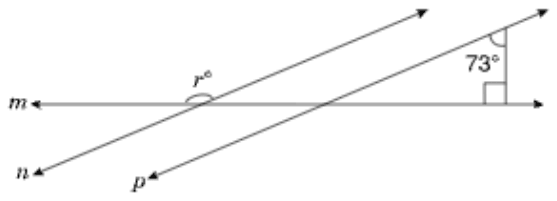
In the figure above, . Straight line m intersects both line n and line p. What is the value of r?
- A17
- B117
- C163
- D173
Show the answer
Correct answer: C
The triangle formed by line p, line m, and the line segment connecting the two contains a 73° angle, a right angle (90°), and a missing angle measuring x°. The sum of the interior angles of a triangle is 180°, so begin by finding the value of x:
Line m is a straight line, so it has a measure of 180°. The 17° angle from the triangle and the adjacent angle outside the triangle are supplementary, so they have a sum of 180°. Let s represent the measure of the adjacent angle outside the triangle. The value of s can be determined by subtracting:
Given that n and p are parallel lines and that they have been cut by a transversal, line m, then corresponding angles are congruent. Angles r and s are corresponding angles, so the value of r is congruent to the value of s, which is 163°.
Question analysis
Two parallel lines, n and p, cross a straight line m, and a segment drawn at a right angle to m forms a small triangle with lines m and p, where a 73° angle is marked. Students find the angle r at line n. It combines a triangle's angle sum, a straight angle and parallel lines, and the angle wanted sits away from the marked ones.
- NYS standards
- Grade level
- Grade 8 content, by NYS standard
- Compared with grade 7
- Above grade 7 Grade 7 angle problems use supplementary, vertical and adjacent angles. This one also needs the angle sum of a triangle and the angles formed by parallel lines and a transversal, grade 8 facts, chained across a busy figure.
- Estimated difficulty
- Hard: combines ideas, needs a plan, and has more than one tempting wrong answer.
- Thinking it demands
- Depth of knowledge 2, skills and concepts · mainly apply
- What makes it hard
- Reading a figure, table or graph moderate
- Combines ideas moderate
- Something you must already know minor
- Solution
- 3 steps
- Reading level
- Question and choices: about grade 3, 21 words.
- Students, last 30 days
- Not enough answers yet to show (it takes 10).
Why it is hard, traps and wrong answers (shows the answer)
Why it is hard
Each fact needs only a subtraction, but the student has to plan a route from the 73° angle at line p over to r at line n. The first number the route gives, the triangle's 17° angle, is listed, and it is the acute partner of r rather than r itself. The figure helps here: r is drawn plainly obtuse, and 163 is also 90 + 73, the triangle's exterior angle, which confirms it.
Reading a figure, table or graph moderate Understanding the question
The 73° sits between line p and the vertical segment, not between p and m, and r is the obtuse angle above m on the left of line n, far from every marked angle. (Lesh, Post & Behr, 1987; Kirsch & Mosenthal, 1990)
Combines ideas moderate Working it out
Three facts chain together: the triangle's angles sum to 180°, the angles along straight line m sum to 180°, and corresponding angles at the parallel lines n and p are equal. (Embretson, 1998; Daniel & Embretson, 2010)
Something you must already know minor Working it out
The angle pairs formed by a line crossing two parallel lines are a grade 8 topic, and the question uses them without naming them. (Anderson & Krathwohl, 2001)
Strategy: Find the third angle of the right triangle, use the straight line m to get the angle beside it, then carry that angle over to line n using the parallel lines.
Traps
- Stops one step early: A choice is a number from partway through the solution.
- An arithmetic slip: The right method with a plausible arithmetic error: a digit, a place value or a times-table fact.
The wrong answers, classified
A Stops one step early (King et al., 2004; Gierl et al., 2017)
Finds the triangle's third angle, 180 − 90 − 73 = 17, and stops, though r is the obtuse angle next to the 17° angle, not that angle itself.
B Little reason to choose it (Haladyna & Downing, 1993; Rodriguez, 2005)
No angle fact in the figure gives 117; even 180 − 73 is 107, so this choice mostly catches guesses at an obtuse angle.
D An arithmetic slip (Junker & Sijtsma, 2001)
Finds the 17° angle and subtracts it from 180 but borrows without reducing the 8, so 180 − 17 comes out as 173.
Worked solution, step by step
Formulas used
- Angles of a triangle
- a, b and c are the three angles inside any triangle. They always add up to 180°. If you know two of them, subtract their sum from 180° to find the third.
- Angles on a straight line
- a and b are two angles side by side on a straight line. Together they make a half turn, which is 180°. Use it to find the angle next to one you already know.
- Corresponding angles
- The symbol ∥ means is parallel to. When line m crosses two parallel lines, it makes the same angles at each crossing. Angles in the same position at the two crossings are called corresponding angles. They are equal.
Sort out the question
Lines n and p are parallel, and line m crosses both. Near line p, a straight-up segment meets line m. The small square shows a right angle, 90°. Line p, line m and that segment make a small triangle. Its top angle is 73°.
You need r, the wide angle where line n crosses line m.
Find the triangle’s third angle
The third angle is where line p crosses line m. Call it x. Use the triangle rule:
So that angle is 17°.
Watch out: this is not r. Stopping here gives choice A, 17.
Use the straight line m
The 17° angle sits above line m, on the right of line p. Beside it, on the left of line p, is a wide angle. Call it s. The two angles fill the straight line m, so they add to 180°:
So s is 163°.
Watch out: borrow carefully. 180 − 17 is 163, not 173, choice D.
Carry the angle to line n
Angle s is above line m and to the left of line p. Angle r is above line m and to the left of line n. They are in the same position, so they are corresponding angles. Since n and p are parallel:
So the answer is C, 163.
Check your answer
Look at the figure. Angle r is wider than a right angle, so it must be more than 90°. That rules out 17. Also, the narrow angle beside r, on the right of line n, matches the 17° angle at line p. And , as it should on a straight line.
More questions like this
The original DOE question
Question 4 of 49
2026 Practice Test C Math, question 12Question
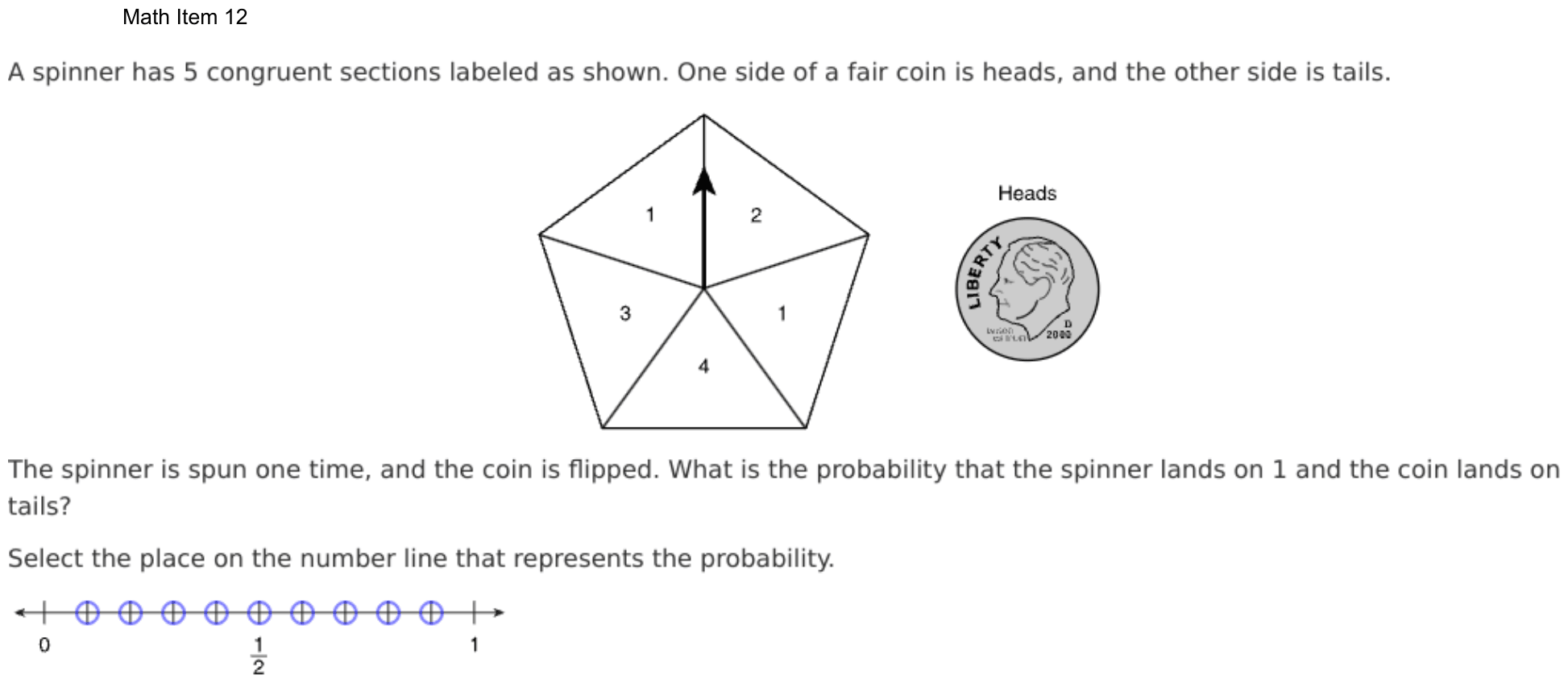
A spinner has 5 congruent sections labeled as shown. One side of a fair coin is heads, and the other side is tails.
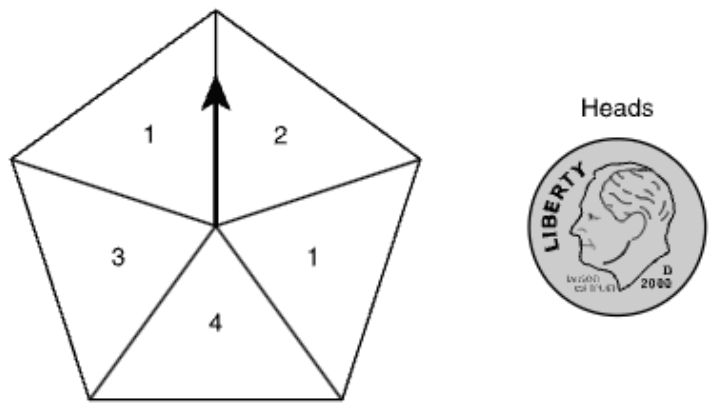
The spinner is spun one time, and the coin is flipped. What is the probability that the spinner lands on 1 and the coin lands on tails?
Select the place on the number line that represents the probability.
On the test you click a point on the number line; here, choose it from the menu.
Show the answer
Correct answer: the point 0.2
The spinner has five equal-sized sections. Two of the sections are labeled with a 1. So, the probability of landing on a 1 is two out of five, or 2/5.
A coin has two sides, one heads and one tails. So, the probability of landing on tails is one out of two, or 1/2.
The compound probability of the spinner landing on a 1 and the coin landing on tails can be calculated by multiplying 2/5 and 1/2 as shown:
Question analysis
A spinner with five equal sections is spun once and a fair coin is flipped. Students find the probability that the spinner lands on 1 and the coin shows tails, then select that point on a number line from 0 to 1. Counting the right sections and combining the two events correctly are the tricky parts.
- Grade level
- Grade 7 content, by NYS standard
- Compared with grade 7
- At grade 7 Finding the chance of two independent events together is grade 7 compound probability, here with one spinner and one coin. Counting sections from the picture and placing the result on a number line add two small steps.
- Estimated difficulty
- Moderate: several steps, or a close reading with one strong distractor.
- Thinking it demands
- Depth of knowledge 2, skills and concepts · mainly apply
- What makes it hard
- Solution
- 3 steps
- Reading level
- Question and choices: about grade 5, 59 words.
- Students, last 30 days
- Not enough answers yet to show (it takes 10).
Why it is hard, traps and wrong answers (shows the answer)
Why it is hard
The probability itself takes one multiplication of two simple fractions; the losses come before and after it. Before, the spinner has to be searched for every section labeled 1, and the coin's chance brought in as well. After, 1/5 has to be rewritten as 2/10 to find its point, since only 0, 1/2 and 1 are labeled. Checking that the result is smaller than both separate chances catches an addition.
Reading a figure, table or graph moderate Understanding the question
The two sections labeled 1, upper left and right, are not side by side, and the number line labels only 0, 1/2 and 1, so its nine points must be read as tenths. (Lesh, Post & Behr, 1987; Kirsch & Mosenthal, 1990)
Something you must already know minor Working it out
Nothing says that the chance of two independent events both happening is the product of their chances, 2/5 × 1/2, rather than their sum. (Anderson & Krathwohl, 2001)
Strategy: Count the sections labeled 1 to get the spinner's chance, take the coin's chance of tails, multiply the two because both must happen, and write the result in tenths.
Traps
- Stops one step early: A choice is a number from partway through the solution.
- Wrong operation: Adds instead of multiplying, divides the wrong way round, turns a ratio or rate upside down, or undoes a step in the wrong direction (subtracts what should be added back).
- Misreads the figure: Reads a value, label or tick spacing in a figure, table or graph wrongly.
The wrong answers, classified
0.4 Stops one step early (King et al., 2004; Gierl et al., 2017)
Finds the spinner's chance of landing on 1, two sections out of five, and plots 2/5 without multiplying by the coin's chance of tails.
0.9 Wrong operation (Hegarty, Mayer & Monk, 1995; King et al., 2004)
Adds the two chances, 2/5 + 1/2 = 9/10, instead of multiplying them, though both events must happen together.
0.1 Misreads the figure (Lesh, Post & Behr, 1987; Kirsch & Mosenthal, 1990)
Counts only one section labeled 1, so multiplies 1/5 by 1/2 and plots 1/10, missing the second 1 on the spinner.
Worked solution, step by step
Formulas used
- Probability of an event
- P is the probability, the chance that something happens. It goes from 0 (never) to 1 (always). The top counts the results you want. The bottom counts all possible results. It works when every result is equally likely, like equal sections of a spinner.
- Probability that two things both happen
- A and B are two events that do not affect each other, like a spin and a coin flip. P(A) and P(B) are their chances. Multiply them to get the chance that both happen. Needing both makes the chance smaller, never bigger.
Sort out the question
The spinner has 5 congruent sections. Congruent means the same size and shape, so each is equally likely. The coin has a heads side and a tails side. You need the chance that the spinner lands on 1 and the coin lands on tails.
Find the spinner’s chance
Two sections show 1: the upper left one and the one on the right. So 2 of the 5 equal sections give a 1:
Watch out: the two 1s are not next to each other. Counting only one gives 1/5 here, and 0.1 at the end.
Find the coin’s chance
A fair coin is equally likely to land on either side. Tails is 1 of its 2 sides:
Multiply the two chances
The spin and the flip do not affect each other, and both must happen. So multiply:
Watch out: stopping at 2/5 gives 0.4. Adding gives , or 0.9. Both are wrong.
Select the point
On the test, the number line labels only 0, 1/2 and 1. Between 0 and 1 are 9 targets, one at each tenth. 0.2 is the second target to the right of 0. On this site, choose 0.2 from the Point menu.
So the answer is the point at 0.2.
Check your answer
List every result. The spinner has 5 sections and the coin has 2 sides, so there are results, all equally likely. Just 2 of them are a 1 with tails, one for each section labeled 1. That is 2 out of 10, or 0.2.
More questions like this
The original DOE question
Question 5 of 49
2026 Practice Test C Math, question 20Question
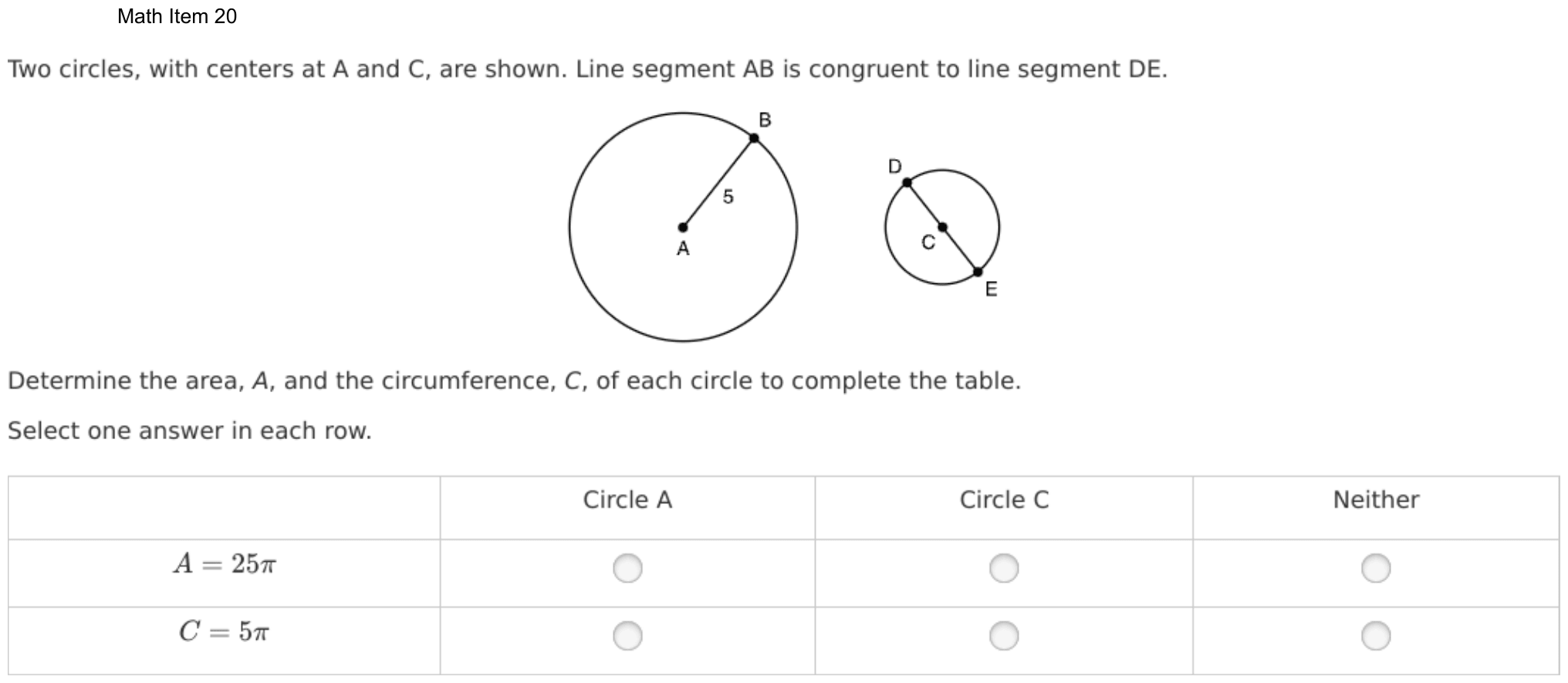
Two circles, with centers at A and C, are shown. Line segment AB is congruent to line segment DE.
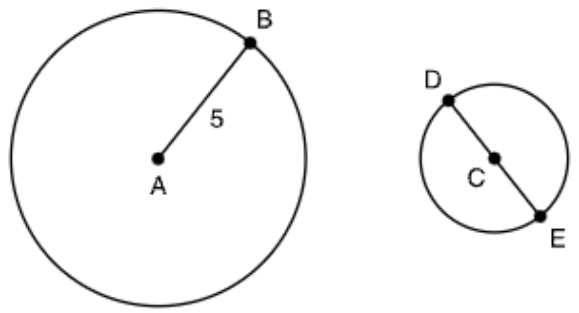
Determine the area, A, and the circumference, C, of each circle to complete the table.
Select one answer in each row.
Choose one answer in each row, then check. The DOE has not published how answers with several parts are scored; this site counts one right only when every part is right.
| Circle A | Circle C | Neither | |
|---|---|---|---|
Show the answer
Correct answer: A = 25π: Circle A; C = 5π: Circle C
: Circle A
: Circle C
As shown in the illustration, AB (the radius of Circle A) is 5 units in length. Since DE (the diameter of Circle C) is congruent to AB, we know it is also 5 units in length.
Circle A:
We know the radius of Circle A is 5 so the answer to row 1 is A.
Circle C:
We have to look for the circle with a diameter of 5. That is circle C.
Question analysis
Two circles centered at A and C are shown: radius AB of Circle A is labeled 5, and segment DE, drawn through C, is congruent to AB. Students decide whether an area of 25π and a circumference of 5π each belong to Circle A, Circle C or neither. Keeping radius and diameter apart, and area and circumference, is the challenge.
- NYS standards
- 7.G.4 circle area and circumference
- Grade level
- Grade 7 content, by NYS standard
- Compared with grade 7
- At grade 7 Applying the area and circumference formulas is the grade 7 circle standard. This gives a radius for one circle and, for the other, a segment known only through congruence, and both rows of the table must be right.
- Estimated difficulty
- Moderate: several steps, or a close reading with one strong distractor.
- Thinking it demands
- Depth of knowledge 2, skills and concepts · mainly apply
- What makes it hard
- Reading a figure, table or graph moderate
- Something you must already know moderate
- Much to keep track of minor
- Solution
- 4 steps
- Reading level
- Question and choices: about grade 5, 40 words.
- Students, last 30 days
- Not enough answers yet to show (it takes 10).
Why it is hard, traps and wrong answers (shows the answer)
Why it is hard
Circle A is direct: its labeled radius of 5 gives an area of 25π. Circle C is where points are lost, since its size comes from a sentence rather than a label, and the segment through its center is a diameter, so its circumference is 5π while its area is only 6.25π. The row labels favor guessers, because the A and C in A = 25π and C = 5π match the circles' names, though they stand for area and circumference.
Reading a figure, table or graph moderate Understanding the question
Circle C's size is shown only by segment DE, drawn through center C with no label, and only the stem's sentence that DE is congruent to AB makes it a diameter of 5. (Lesh, Post & Behr, 1987; Kirsch & Mosenthal, 1990)
Something you must already know moderate Working it out
Neither A = πr² nor C = πd is given, and one circle is measured by a radius and the other by a diameter, so each formula needs the right length. (Anderson & Krathwohl, 2001)
Much to keep track of minor Working it out
Four values are in play, areas of 25π and 6.25π and circumferences of 10π and 5π, and both rows must be matched correctly for the item to count. (Sweller, 1988; Carpenter, Just & Shell, 1990)
Strategy: Write down the radius and the diameter of each circle, compute both circles' areas and circumferences in terms of π, then match each value in the table.
Traps
- Wrong formula: Uses a related but wrong formula: perimeter for area, diameter for radius, area for volume, or a misremembered one.
- Misreads the question: Misses or misreads a condition or a word in the question: "at least", "each", "remaining", "not".
- A formula you must know: Needs a formula the test does not give: area, circumference, volume, probability rules.
The wrong answers, classified
1:B Wrong formula (King et al., 2004)
Squares the diameter instead of the radius, so Circle C's area seems to be π × 5² = 25π while Circle A's becomes 100π.
1:C Wrong formula (King et al., 2004)
Uses 2πr for the area, so Circle A seems to have an area of 10π and Circle C one of 5π, and no circle seems to have 25π.
2:A Wrong formula (King et al., 2004)
Uses π times the radius for the circumference, so Circle A's radius of 5 seems to give a circumference of 5π.
2:C Misreads the question (Hegarty, Mayer & Monk, 1995)
Overlooks that DE is congruent to AB, so Circle C has no known size, and with Circle A's circumference at 10π picks Neither.
Worked solution, step by step
Formulas used
- Area of a circle
- A is the area, the space inside the circle. r is the radius, the distance from the center to the edge. π (pi) is a fixed number, a little more than 3. Square the radius, then multiply by π.
- Circumference of a circle
- C is the circumference, the distance around the circle. d is the diameter, the distance across the circle through its center. A diameter is twice as long as a radius. Multiply the diameter by π.
Sort out the question
Circle A has its center at A. Its radius, AB, is 5. Circle C has its center at C. Segment DE goes through C, so it is a diameter. Congruent means the same length, so DE is 5 too.
Careful: in the table, A means area and C means circumference. Circle A and Circle C are just names.
Find each radius and diameter
Circle A: the radius is 5, so the diameter is .
Circle C: the diameter is 5, so the radius is .
Watch out: without the sentence about DE, Circle C seems to have no size. Then you might pick Neither for the second row.
Check the area row
Use the area formula for each circle. For Circle A:
For Circle C:
Only Circle A has an area of 25π.
Watch out: squaring Circle C’s diameter instead of its radius gives 25π by mistake.
Check the circumference row
Use the circumference formula for each circle. For Circle A:
For Circle C:
Only Circle C has a circumference of 5π.
Watch out: π times the radius is not the circumference. It would give Circle A 5π.
Fill in the table
Choose one button in each row. In the row for A = 25π, choose the Circle A column. In the row for C = 5π, choose the Circle C column. Neither stays empty.
So the answers are A = 25π: Circle A and C = 5π: Circle C.
Check your answer
Compare sizes. Circle A’s radius, 5, is twice Circle C’s radius, 2.5. So the distance around Circle C should be half of Circle A’s 10π. Half of 10π is 5π, which matches. And the bigger circle has the bigger area, 25π.
More questions like this
The original DOE question
Question 6 of 49
2026 Practice Test C Math, question 23Question
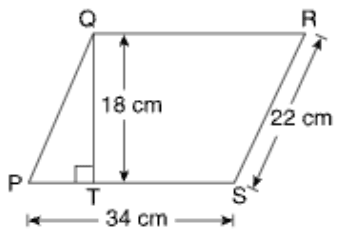
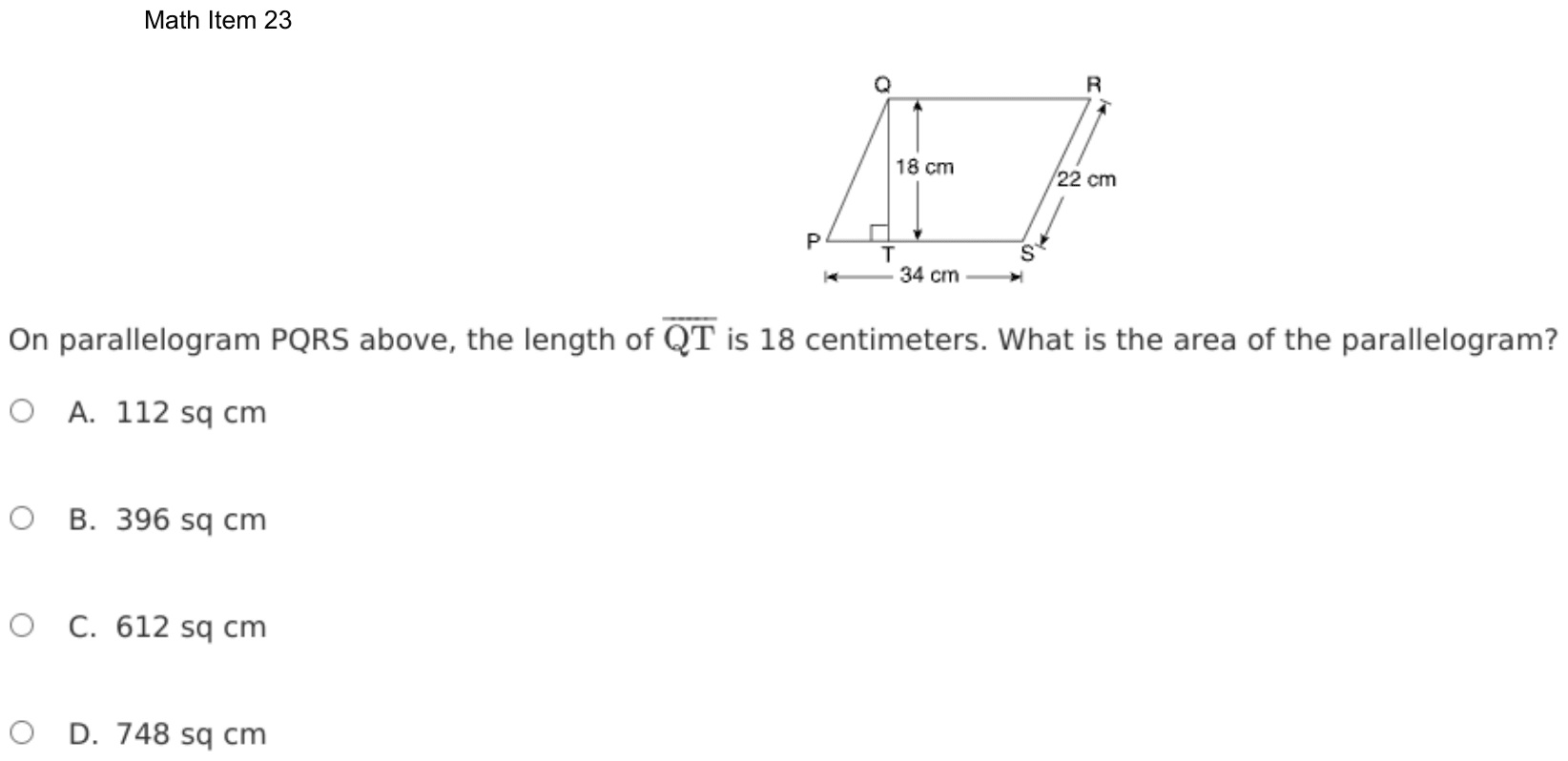
On parallelogram PQRS above, the length of is 18 centimeters. What is the area of the parallelogram?
- A112 sq cm
- B396 sq cm
- C612 sq cm
- D748 sq cm
Show the answer
Correct answer: C
PQRS is a parallelogram in which PS is a base and QT is an altitude. The base is 34 cm in length, and the height is the length of the altitude, so the height is 18 cm.
To determine the area of a parallelogram, multiply the base × the height:
Question analysis
Parallelogram PQRS is drawn with a 34 cm base PS, a 22 cm slanted side and an 18 cm segment QT at a right angle to the base, and students find its area. It tests the area formula for a parallelogram. One labeled length is not needed, so the base and height that go together have to be chosen.
- NYS standards
- 6.G.1 area of polygons
- Grade level
- Grade 6 content, by NYS standard
- Compared with grade 7
- Below grade 7 The area of a parallelogram is grade 6 content, used here once with the height already drawn and labeled. Grade 7 area tasks usually involve circles, composite shapes or scale drawings, so this is easier.
- Estimated difficulty
- Routine: one familiar step, little to misread.
- Thinking it demands
- Depth of knowledge 1, recall and reproduction · mainly apply
- What makes it hard
- Solution
- 1 step
- Reading level
- Question and choices: about grade 5, 25 words.
- Students, last 30 days
- Not enough answers yet to show (it takes 10).
Why it is hard, traps and wrong answers (shows the answer)
Why it is hard
One multiplication answers the question once the right pair of lengths is chosen. Each wrong choice pairs or combines the labeled lengths in another way: the two sides as for a rectangle, the height with the slanted side, or all four sides as a perimeter. Following the right-angle mark at T from QT down to PS identifies the base and height that belong together.
Reading a figure, table or graph minor Understanding the question
Three lengths are labeled, 34 cm, 18 cm and 22 cm, but only the base PS and the height QT meet at the right-angle mark; the slanted side RS is not needed. (Lesh, Post & Behr, 1987; Kirsch & Mosenthal, 1990)
Something you must already know minor Working it out
The formula, base times height, is not given, and the height must be the perpendicular distance between two sides, not the length of a slanted side. (Anderson & Krathwohl, 2001)
Strategy: Multiply the base by the height measured at a right angle to it, and check that the length you use as the height meets that base at a right-angle mark.
Traps
- Wrong formula: Uses a related but wrong formula: perimeter for area, diameter for radius, area for volume, or a misremembered one.
- Information you don't need: The question gives numbers or facts that play no part in the answer.
The wrong answers, classified
A Wrong formula (King et al., 2004)
Adds all four sides, 2 × (34 + 22) = 112, finding the perimeter of the parallelogram instead of its area.
B Misreads the figure (Lesh, Post & Behr, 1987; Kirsch & Mosenthal, 1990)
Multiplies the 18 cm height by the 22 cm slanted side, a pair that does not meet at a right angle, getting 396.
D Wrong formula (King et al., 2004)
Multiplies the two side lengths, 34 × 22 = 748, as if a parallelogram's area were side times side like a rectangle's.
Worked solution, step by step
Formulas used
- Area of a parallelogram
- A is the area. b is the base, the side the shape sits on. h is the height, the straight-up distance from the base to the opposite side, at a right angle to the base. It works because you can cut a triangle off one end, move it to the other end, and make a rectangle.
Sort out the question
PQRS is a parallelogram, a four-sided shape whose opposite sides are parallel. The figure shows three lengths. Side PS, the bottom, is 34 cm. Segment QT goes straight down from Q to PS and is 18 cm. Side RS is slanted and is 22 cm. You need the area, in square centimeters.
Pick the base and the height
The base is PS, 34 cm. The height must meet the base at a right angle. The small square at T shows that QT does. So the height is QT, 18 cm.
Watch out: the 22 cm side is slanted, so it is not the height. Multiplying 22 × 18 gives 396, choice B.
Multiply the base by the height
Use the area formula:
Break it up to multiply:
The area is 612 square centimeters.
Choose the answer
Watch out: 34 × 22 = 748, choice D, treats the shape like a rectangle. Adding all four sides gives 112, choice A. That is the perimeter, the distance around.
So the answer is C, 612 sq cm.
Check your answer
Estimate: 34 is about 30 and 18 is about 20, and . 612 is close. Also, the area must be less than , because the height is shorter than the slanted side.
More questions like this
The original DOE question
Question 7 of 49
2026 Practice Test C Math, question 34Question
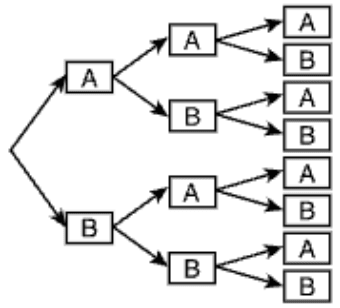
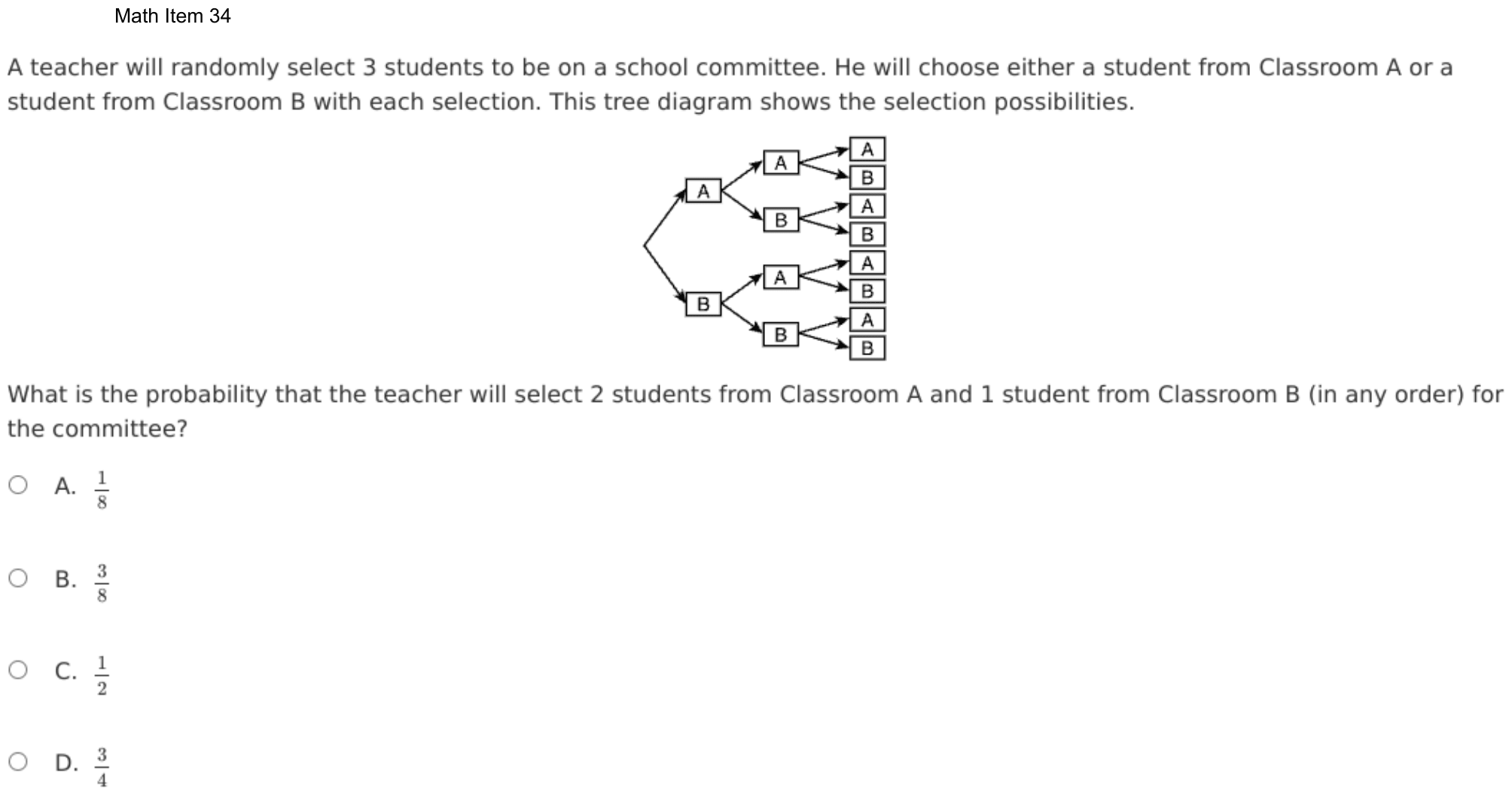
A teacher will randomly select 3 students to be on a school committee. He will choose either a student from Classroom A or a student from Classroom B with each selection. This tree diagram shows the selection possibilities.
What is the probability that the teacher will select 2 students from Classroom A and 1 student from Classroom B (in any order) for the committee?
- A
- B
- C
- D
Show the answer
Correct answer: B
The tree diagram shows that each of the 3 randomly selected students is from Classroom A or Classroom B. So the first chosen is either A or B, represented by the left column of the diagram.
The second student is either A or B, so if the first is A, the first two chosen will be either AA or AB. If the first is B, then the first two chosen will be either BA or BB, represented by the middle column.
The third student is either A or B, so if the first 2 were AA, the group of 3 would be either AAA or AAB. These outcomes are represented by the top two boxes of the right column. This pattern is followed so that 8 distinct outcomes can be visualized in order:
AAA, AAB, ABA, ABB, BAA, BAB, BBA, BBB
Since the order does not matter, there are 3 groups made up of 2 students from Classroom A and 1 student from Classroom B: AAB, ABA, and BAA.
Out of 8 possible outcomes, 3 outcomes have 2 students from Classroom A and 1 student from Classroom B. Therefore, the probability is 3 out of 8, or .
Question analysis
A teacher picks 3 students for a committee, each from Classroom A or Classroom B, and a tree diagram shows every possible sequence of picks. Students find the probability of getting 2 students from A and 1 from B in any order. Reading the tree as a list of outcomes, and counting each order, is the key.
- NYS standards
- Grade level
- Grade 7 content, by NYS standard
- Compared with grade 7
- At grade 7 Finding a compound probability from a tree diagram is a grade 7 standard, and here the tree is already drawn. Listing its paths and counting the ones that fit the event, in any order, is typical grade 7 classwork.
- Estimated difficulty
- Straightforward: two steps or one careful reading.
- Thinking it demands
- Depth of knowledge 2, skills and concepts · mainly apply
- What makes it hard
- Reading a figure, table or graph moderate
- Much to keep track of minor
- Solution
- 3 steps
- Reading level
- Question and choices: about grade 7, 65 words.
- Students, last 30 days
- Not enough answers yet to show (it takes 10).
Why it is hard, traps and wrong answers (shows the answer)
Why it is hard
The tree does the hard part of the setup, but it shows each outcome only as a path through three columns, not as a list. The parenthesis “in any order” is the key phrase: missing it leaves a single path, while reading the event loosely, as at least two from Classroom A, adds A, A, A. Writing out all eight paths and marking those with exactly two A’s settles the count.
Reading a figure, table or graph moderate Understanding the question
The tree prints only A or B in each box, so the eight three-pick outcomes, such as A, B, A, have to be read by tracing each path across all three columns. (Lesh, Post & Behr, 1987; Kirsch & Mosenthal, 1990)
Much to keep track of minor Working it out
All eight paths must be tracked while counting those with exactly two A’s and one B, and “in any order” means three of them count, not just A, A, B. (Sweller, 1988; Carpenter, Just & Shell, 1990)
Strategy: Follow each path through the tree to write out every three-letter outcome, mark the ones with exactly two A's and one B, and divide by the total number of outcomes.
Traps
- Misreads the question: Misses or misreads a condition or a word in the question: "at least", "each", "remaining", "not".
- Answers a different question: A choice is right for another quantity: the other unknown, the rest instead of the part, the part instead of the whole.
The wrong answers, classified
A Misreads the question (Hegarty, Mayer & Monk, 1995)
Counts only the path A, A, B, missing the stem’s “in any order”, so it finds 1 of the 8 outcomes instead of 3.
C Answers a different question (King et al., 2004; Hegarty, Mayer & Monk, 1995)
Counts every outcome with at least two picks from Classroom A, adding A, A, A to the three right paths, so 4 of 8, or 1/2.
D Answers a different question (King et al., 2004; Hegarty, Mayer & Monk, 1995)
Counts every outcome that mixes the two classrooms, including those with two from B, so 6 of the 8 outcomes, or 3/4.
Worked solution, step by step
Formulas used
- Probability
- P is the probability, the chance something happens. The top counts the outcomes that fit the event. The bottom counts every outcome that can happen. This works when every outcome is equally likely, like each path through this tree.
Sort out the question
The teacher picks 3 students, one at a time. Each pick is from Classroom A or Classroom B.
You need the chance of getting 2 students from A and 1 from B. The words “in any order” matter. They mean the B can be the first, second or third pick.
List every path in the tree
Each path from left to right is one outcome, or possible result. The top path is A, then A, then A. Read all of them:
AAA, AAB, ABA, ABB, BAA, BAB, BBA, BBB
Each pick has 2 choices, so there are outcomes in all.
Mark the ones that fit
Look for exactly two A’s and one B. Three outcomes fit: AAB, ABA and BAA.
Watch out: counting only AAB misses “in any order” and gives , choice A. AAA has three A’s, not two. Counting it too gives , choice C. Counting every mixed outcome gives , choice D, but three of those have two B’s.
Find the probability
Use the probability formula. 3 outcomes fit, out of 8:
So the answer is B, .
Check your answer
Count every outcome by type. Two A’s and one B: 3 outcomes. Two B’s and one A: 3 outcomes (ABB, BAB, BBA). All A’s: 1. All B’s: 1. , so each outcome was counted once.
More questions like this
The original DOE question
Question 8 of 49
2026 Practice Test C Math, question 42Question
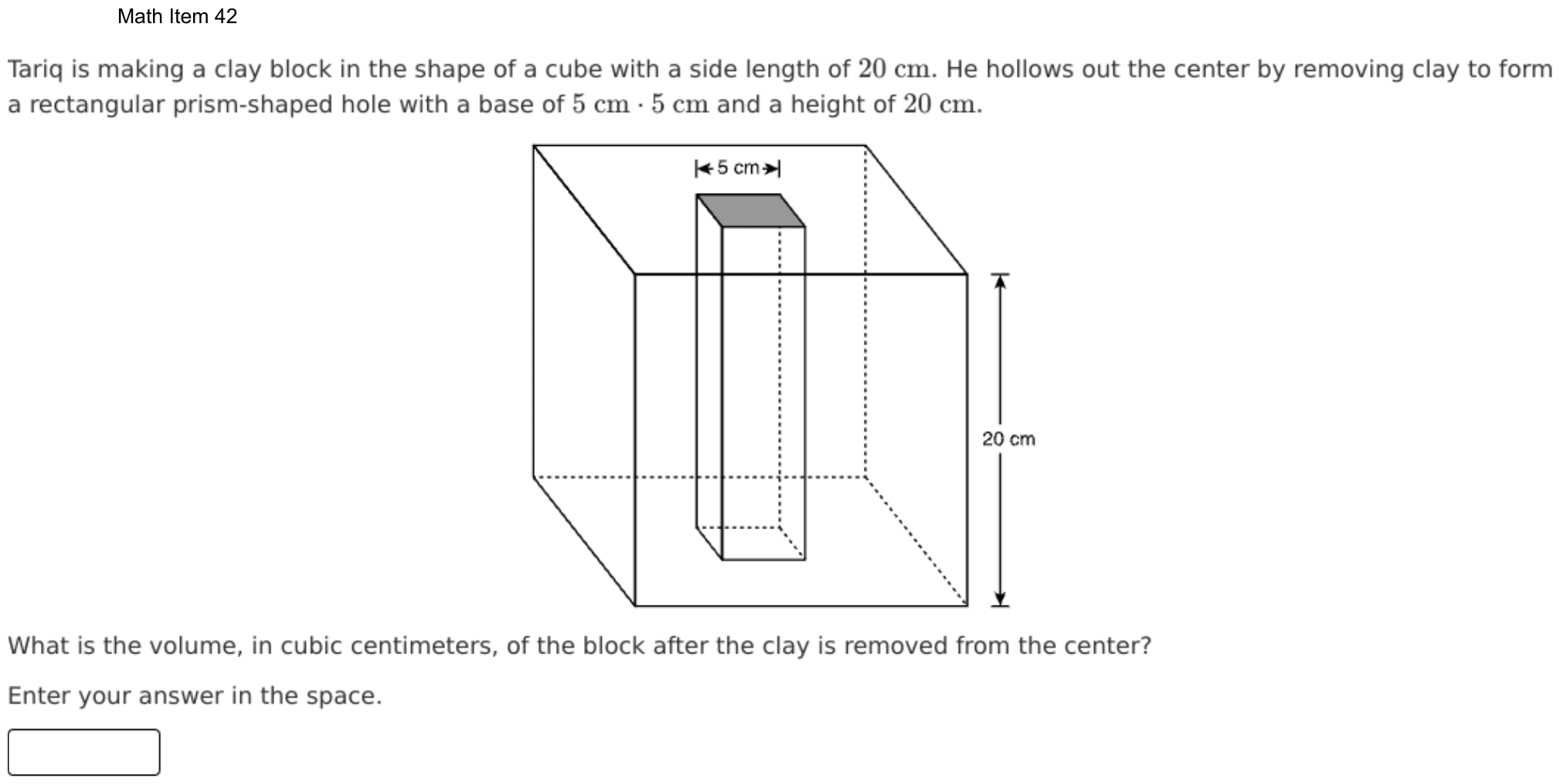
Tariq is making a clay block in the shape of a cube with a side length of . He hollows out the center by removing clay to form a rectangular prism-shaped hole with a base of and a height of .
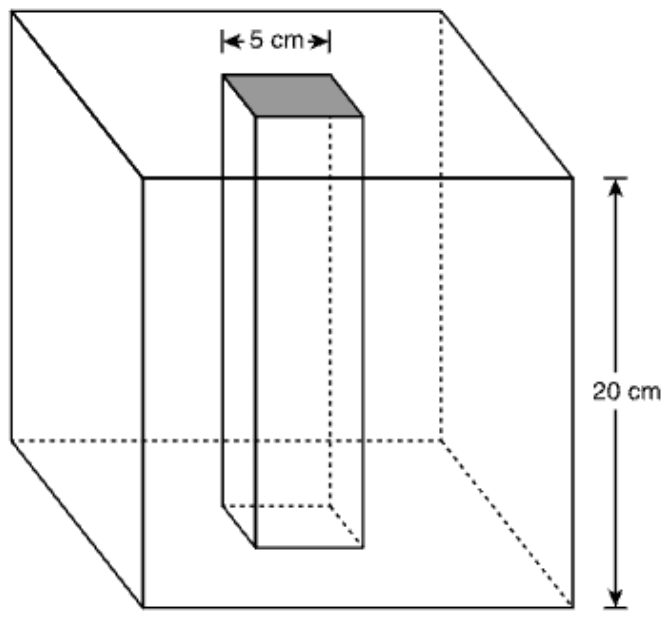
What is the volume, in cubic centimeters, of the block after the clay is removed from the center?
Enter your answer in the space.
Fill-in question: work out the answer and type it as a number.
Show the answer
Correct answer: 7,500
First, find the volume of the cube using the formula .
The length, width, and height of the cube are each equal to 20 cm.
Next, find the volume of the cut-out square prism, with equal length and width of 5 cm and height of 20 cm.
Finally, subtract the volume of the prism from the volume of the cube.
Question analysis
Tariq makes a clay cube 20 centimeters on each side and removes a rectangular prism from its center, with a 5 cm by 5 cm base and a height of 20 cm. Students type the volume of the block that is left, in cubic centimeters. It tests the volume of rectangular prisms, and the hole's size must be read carefully from the words and figure.
- Grade level
- Grade 7 content, by NYS standard
- Compared with grade 7
- At grade 7 Finding the volume of a solid made from rectangular prisms, here by taking one away, is named in the grade 7 standards. This is a direct case with whole numbers, two volumes and one subtraction.
- Estimated difficulty
- Straightforward: two steps or one careful reading.
- Thinking it demands
- Depth of knowledge 1, recall and reproduction · mainly apply
- What makes it hard
- Solution
- 3 steps
- Reading level
- Question and choices: about grade 8, 66 words.
- Students, last 30 days
- Not enough answers yet to show (it takes 10).
Why it is hard, traps and wrong answers (shows the answer)
Why it is hard
This is a direct composite-volume problem with whole numbers: one cube, one hole, one subtraction. What it checks is that both volumes are real volumes, the hole as tall as the cube, and that the subtraction is done at the end. Students who stop at the hole’s volume, or who subtract only the square face, give amounts that are easy to type and hard to doubt without choices.
Something you must already know minor Working it out
The volume of a rectangular prism, length times width times height, is not given, and it is needed twice, once for the 20 cm cube and once for the hole. (Anderson & Krathwohl, 2001)
Reading a figure, table or graph minor Understanding the question
The figure labels only the 5 cm opening and the cube’s 20 cm edge; the hole’s 20 cm height comes from the words, while the drawing shows it reaching from top to bottom. (Lesh, Post & Behr, 1987; Kirsch & Mosenthal, 1990)
An answer in an unexpected form minor Choosing the answer
The volume is typed with no choices to compare, so the hole’s 500 cubic centimeters or the cube’s 8,000 can be entered without any warning. (Enright, Morley & Sheehan, 2002)
Strategy: Find the volume of the full cube, then the volume of the square hole that runs from the top face to the bottom, and subtract the hole from the cube.
Traps
- Answers a different question: A choice is right for another quantity: the other unknown, the rest instead of the part, the part instead of the whole.
- Misreads the figure: Reads a value, label or tick spacing in a figure, table or graph wrongly.
- Wrong formula: Uses a related but wrong formula: perimeter for area, diameter for radius, area for volume, or a misremembered one.
The wrong answers, classified
500 Answers a different question (King et al., 2004; Hegarty, Mayer & Monk, 1995)
Finds the volume of the hole, 5 × 5 × 20 = 500 cubic centimeters, and gives the clay removed instead of the clay that is left.
7,875 Misreads the figure (Lesh, Post & Behr, 1987; Kirsch & Mosenthal, 1990)
Treats the hole as a 5 cm cube, 5 × 5 × 5 = 125, though it runs the full 20 cm height, so 8,000 − 125 = 7,875.
7,975 Wrong formula (King et al., 2004)
Subtracts only the area of the square opening, 5 × 5 = 25, from the cube’s 8,000, mixing a face’s area with the hole’s volume.
Worked solution, step by step
Formulas used
- Volume of a rectangular prism
- V is the volume, the space inside a solid. l is the length, w is the width and h is the height. A cube is a prism with all three the same. Volume is measured in cubic centimeters, tiny cubes 1 cm on each side.
Sort out the question
Tariq’s block starts as a cube 20 cm on each side. He removes a hole shaped like a rectangular prism, a box shape with flat rectangle sides. Its base is 5 cm by 5 cm, and its height is 20 cm. The figure shows it running from the top face to the bottom face.
You need the volume of the clay that is left, in cubic centimeters.
Find the volume of the cube
Use the volume formula. The length, width and height are all 20 cm:
The full cube holds 8,000 cubic cm of clay.
Find the volume of the hole
The hole is a prism too. Its length and width are 5 cm, and its height is 20 cm:
So 500 cubic cm of clay are removed.
Watch out: the hole is 20 cm tall, not 5 cm. Treating it as a small 5 cm cube gives 125 and the wrong answer 7,875. And 5 × 5 = 25 is only the area of the opening, not a volume. Subtracting it gives 7,975, also wrong.
Subtract the hole from the cube
The clay left is the cube minus the hole:
The block has 7,500 cubic cm of clay left.
Watch out: 500 is the clay taken out, not the clay that is left.
Enter the number
Type only the number, with no units. You can type 7500 or 7,500.
So you would enter 7,500.
Check your answer
Think of the cube as 20 flat layers, each 1 cm thick. Each layer is a 20 by 20 square, 400 square cm, with a 5 by 5 hole, 25 square cm. So each layer holds cubic cm of clay. Then . It matches.
More questions like this
The original DOE question
Question 9 of 49
2026 Practice Test D English, question 5Passage A Memory Revolution
A Memory Revolution
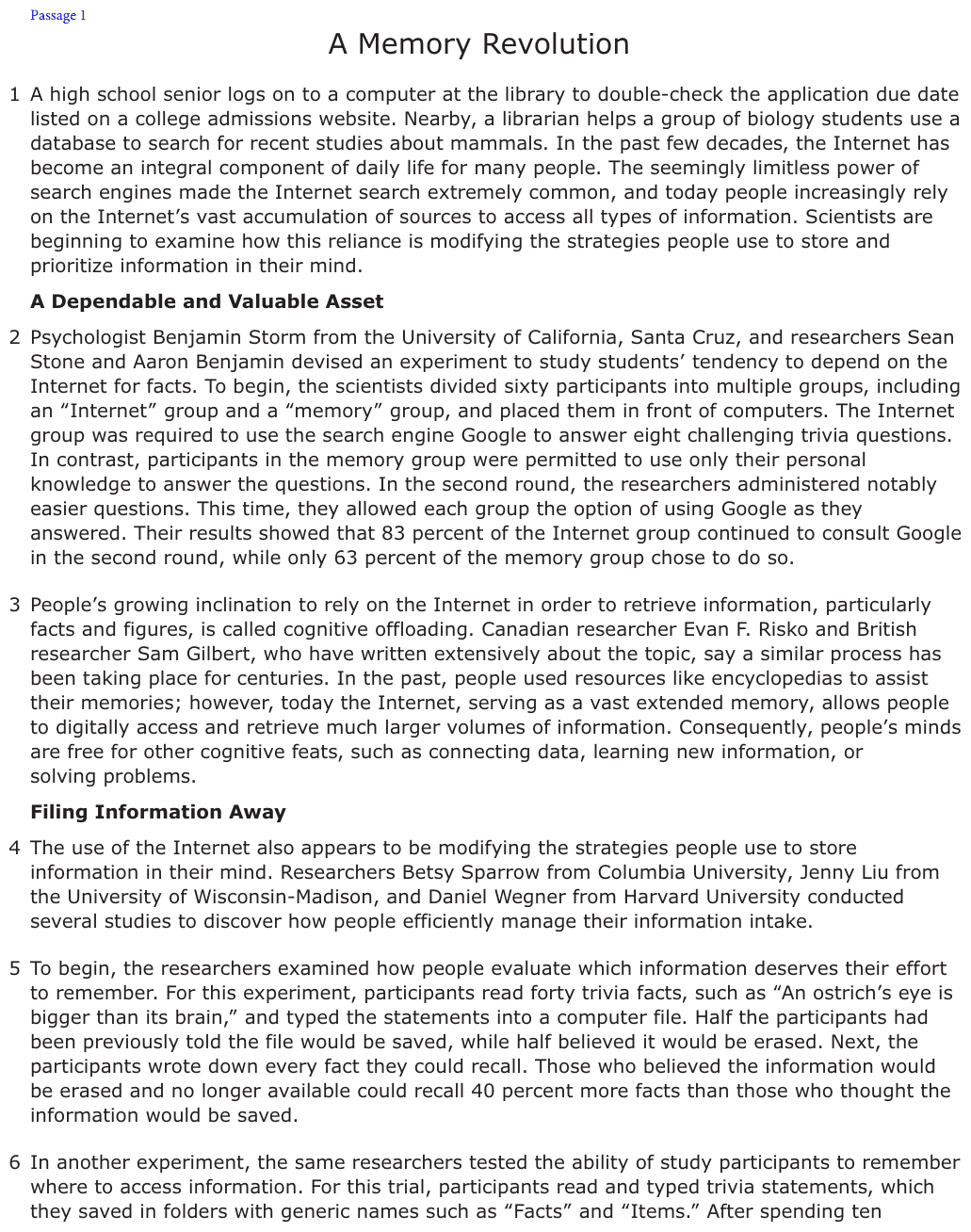
A high school senior logs on to a computer at the library to double-check the application due date listed on a college admissions website. Nearby, a librarian helps a group of biology students use a database to search for recent studies about mammals. In the past few decades, the Internet has become an integral component of daily life for many people. The seemingly limitless power of search engines made the Internet search extremely common, and today people increasingly rely on the Internet’s vast accumulation of sources to access all types of information. Scientists are beginning to examine how this reliance is modifying the strategies people use to store and prioritize information in their mind.
A Dependable and Valuable Asset
Psychologist Benjamin Storm from the University of California, Santa Cruz, and researchers Sean Stone and Aaron Benjamin devised an experiment to study students’ tendency to depend on the Internet for facts. To begin, the scientists divided sixty participants into multiple groups, including an “Internet” group and a “memory” group, and placed them in front of computers. The Internet group was required to use the search engine Google to answer eight challenging trivia questions. In contrast, participants in the memory group were permitted to use only their personal knowledge to answer the questions. In the second round, the researchers administered notably easier questions. This time, they allowed each group the option of using Google as they answered. Their results showed that 83 percent of the Internet group continued to consult Google in the second round, while only 63 percent of the memory group chose to do so.
People’s growing inclination to rely on the Internet in order to retrieve information, particularly facts and figures, is called cognitive offloading. Canadian researcher Evan F. Risko and British researcher Sam Gilbert, who have written extensively about the topic, say a similar process has been taking place for centuries. In the past, people used resources like encyclopedias to assist their memories; however, today the Internet, serving as a vast extended memory, allows people to digitally access and retrieve much larger volumes of information. Consequently, people’s minds are free for other cognitive feats, such as connecting data, learning new information, or solving problems.
Filing Information Away
The use of the Internet also appears to be modifying the strategies people use to store information in their mind. Researchers Betsy Sparrow from Columbia University, Jenny Liu from the University of Wisconsin-Madison, and Daniel Wegner from Harvard University conducted several studies to discover how people efficiently manage their information intake.
To begin, the researchers examined how people evaluate which information deserves their effort to remember. For this experiment, participants read forty trivia facts, such as “An ostrich’s eye is bigger than its brain,” and typed the statements into a computer file. Half the participants had been previously told the file would be saved, while half believed it would be erased. Next, the participants wrote down every fact they could recall. Those who believed the information would be erased and no longer available could recall 40 percent more facts than those who thought the information would be saved.
In another experiment, the same researchers tested the ability of study participants to remember where to access information. For this trial, participants read and typed trivia statements, which they saved in folders with generic names such as “Facts” and “Items.” After spending ten minutes writing down all the facts they could recall from memory, participants were asked which folder contained a particular fact based on a keyword. For example, “Which folder has the fact about ostriches?” Overall, participants recalled the information’s location more often than the content itself, correctly identifying 49 percent of the folders for specific facts while remembering only 23 percent of the actual trivia. The researchers concluded that our memory is adapting to the Internet age by prioritizing where to locate information even when the specific details are forgotten. According to Sparrow, the Internet has become an important form of transactive memory, an external source of the recollections and associative networks that constitute memory.
As the Internet’s resources continue to expand our “external” memory, some question whether the process may cause people to depend too heavily on technology. However, Steven Pinker, a professor of psychology at Harvard University, says, “Knowledge is increasing exponentially; human brainpower and waking hours are not. Fortunately, the Internet and information technologies are helping us manage, search and retrieve our collective intellectual output at different scales, from Twitter and previews to e-books and online encyclopedias. Far from making us stupid, these technologies are the only things that will keep us smart.”
Question
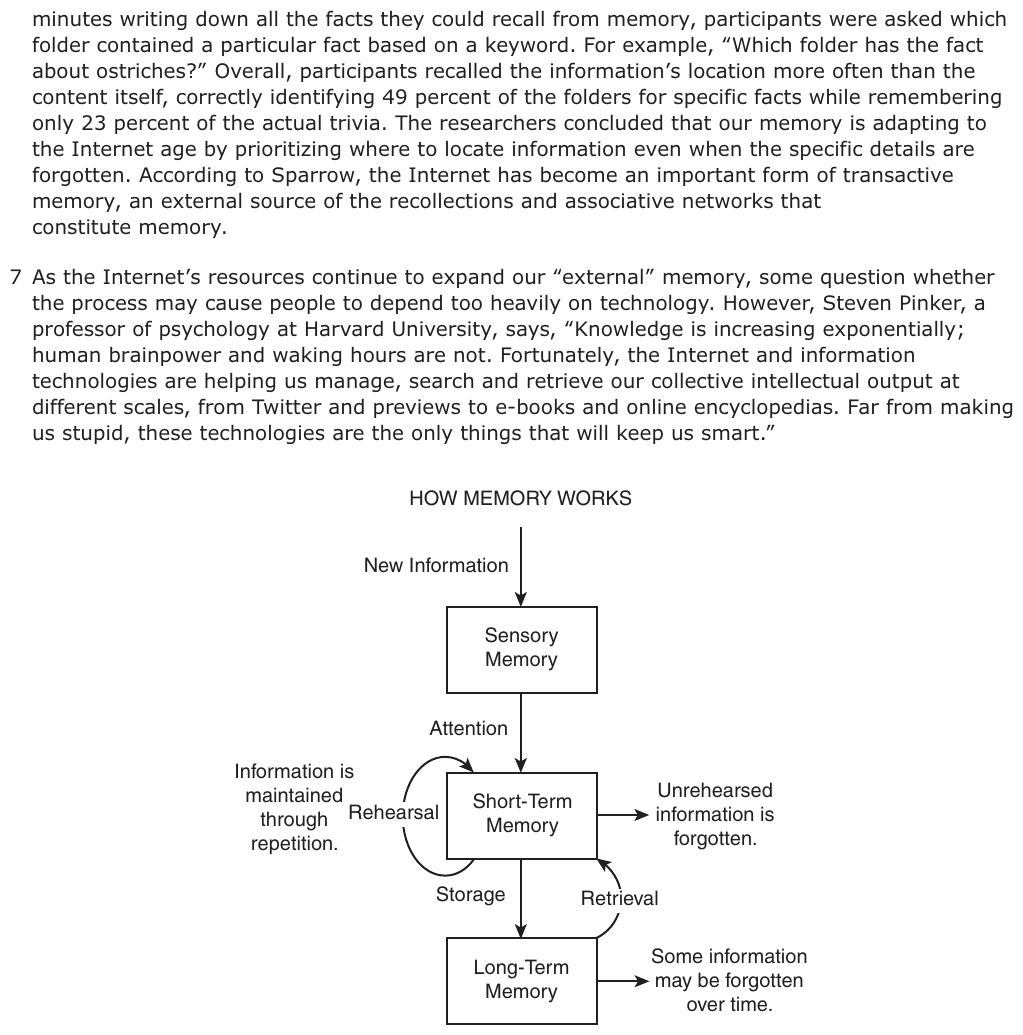
How does the diagram provide additional support for the topic presented in the passage?
- AIt reveals why human brains must adapt to obtaining information from the Internet as opposed to other sources.
- BIt indicates how people can use the Internet to help improve their long-term recollection of information.
- CIt shows how study participants’ brains distinguished between important and unimportant details.
- DIt depicts the idea that repetition and rehearsal are necessary to recall information when tools such as search engines are unavailable.
Show the answer
Correct answer: D
The question asks how the diagram provides additional support for the topic presented in the passage.
A. Incorrect. While the diagram indicates that the human brain has the ability to maintain different types of memory, the diagram does not show the need for the brain to adapt to obtaining information from the Internet rather than from other sources.
B. Incorrect. The diagram enhances the reader’s understanding of how long-term memories are formed, but it does not provide details about how the Internet can be used to improve long-term recollection of information.
C. Incorrect. The diagram provides an understanding of how details that are important to people can become stored because of an effort made to recall them. However, the diagram does not show how people decide which information is important and which is not.
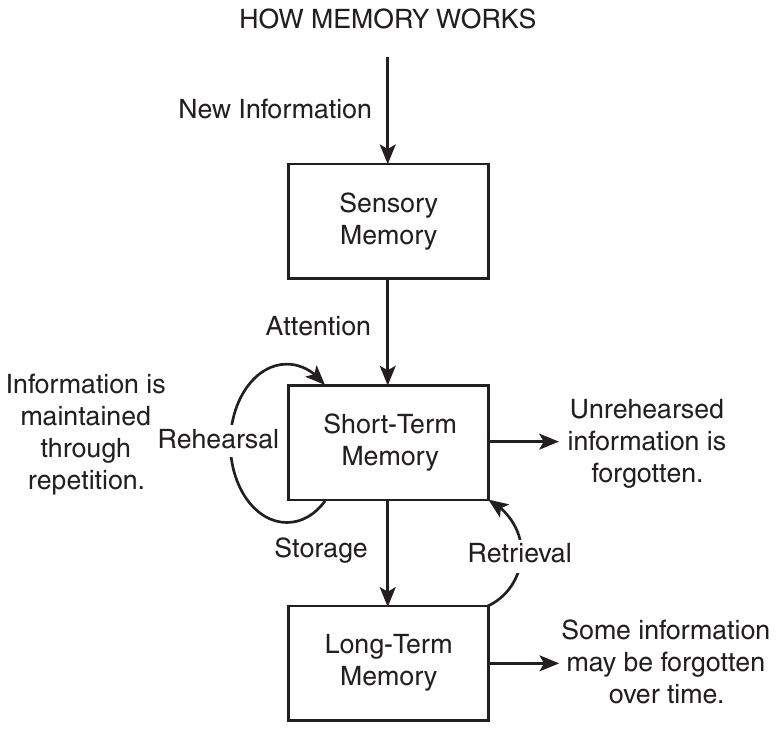
D. CORRECT. The diagram depicts the connections that the human brain maintains between the different forms of memory. It also illustrates the idea that repetition and rehearsal are important steps in creating memories, as unrehearsed information will be forgotten. This supports the passage by highlighting the idea that access to search engines and other tools leads people to skip rehearsal and repetition steps that create memories, because people know that the information is readily accessible.
Question analysis
This question pairs “A Memory Revolution” with its flow diagram, “How Memory Works,” which follows new information from sensory memory through short-term and long-term memory, and asks how the diagram supports the topic of the passage. Students must read the diagram’s boxes, arrows and notes and relate them to an article about the Internet that never refers to the diagram, so the connection has to be worked out.
- Grade level
- Grade 8 reading and task
- Compared with grade 7
- Above grade 7 Grade 7 students regularly connect a diagram to a text. This flow diagram of memory never mentions the Internet, so students must build the bridge to the article’s studies themselves, and every choice claims something the diagram alone cannot show.
- Estimated difficulty
- Hard: combines ideas, needs a plan, and has more than one tempting wrong answer.
- Thinking it demands
- Depth of knowledge 3, strategic thinking · mainly analyze
- What makes it hard
- Combines ideas moderate
- Reading a figure, table or graph moderate
- Every choice must be checked minor
- Evidence
- Answered from the whole text
- Reading level
- Passage: about grade 14, 763 words; question and choices: about grade 12, 81 words.
- Students, last 30 days
- Not enough answers yet to show (it takes 10).
Why it is hard, traps and wrong answers (shows the answer)
Why it is hard
The diagram is a general model of memory, and every choice, even the right one, goes beyond it by bringing in the Internet, search engines or the study participants. The way through is to ask which choice rests on something the diagram really shows, and only one names its rehearsal loop and the forgetting of unrehearsed information. The strongest pull uses the diagram’s long-term memory and retrieval but claims the Internet improves recollection, the opposite of what paragraph 5’s experiment found.
Combines ideas moderate Working it out
The diagram never mentions the Internet and the article never mentions the diagram, so students must join its rehearsal loop to paragraph 5’s finding that people who expected the facts to be saved remembered fewer. (Embretson, 1998; Daniel & Embretson, 2010)
Reading a figure, table or graph moderate Understanding the question
Students must follow the arrows from “Attention” into short-term memory and find the “Rehearsal” loop beside “Information is maintained through repetition,” with “Unrehearsed information is forgotten” on the other side. (Lesh, Post & Behr, 1987; Kirsch & Mosenthal, 1990)
Every choice must be checked minor Choosing the answer
Three choices tie the diagram to the Internet, adaptation or the study participants, and even the key mentions search engines, so each claim must be held against the boxes and arrows actually drawn. (Embretson & Wetzel, 1987)
Strategy: Trace the diagram’s arrows from new information to long-term memory and say what each label shows, then ask which choice links that process to the studies without crediting the diagram with ideas it never shows.
Traps
- Reads too much in: A reasonable-sounding conclusion that goes further than the text allows.
- Wrong part of the text: A choice is true of another paragraph, stanza or speaker than the one asked about.
- Twists what the text says: Uses the text's topic and ideas but changes what it says: who did it, how much, when, or why.
The wrong answers, classified
A Reads too much in (Graesser, Singer & Trabasso, 1994)
Credits the diagram with the article’s claim that memory is “adapting to the Internet age” and adds a “must,” though its boxes and arrows show memory in general and never mention the Internet.
B Twists what the text says (King et al., 2004)
Joins the diagram’s long-term memory and retrieval arrow to the Internet as outside memory, though paragraph 5 found that people who expected the facts to be saved recalled fewer of them.
C Wrong part of the text (Kirsch & Mosenthal, 1990)
Reads the “Attention” arrow and the forgotten unrehearsed information as a picture of paragraph 5’s experiment, though the diagram shows no participants and nothing about judging what is important.
Working it out, step by step
Figure out what the question asks
This asks how the diagram supports the article. The diagram is the flow chart called “HOW MEMORY WORKS” at the end of the passage. It never mentions the Internet. So you must find what it shows, then link that to the article.
Follow the arrows in the diagram
Start at the top. An arrow labeled “New Information” goes into the box “Sensory Memory.” The “Attention” arrow leads to “Short-Term Memory.” From there, two things can happen. On the left, a loop labeled “Rehearsal” sits beside the note “Information is maintained through repetition.” On the right, a note says “Unrehearsed information is forgotten.” A “Storage” arrow leads down to “Long-Term Memory,” and a “Retrieval” arrow leads back up.
Explain what the diagram means
To rehearse information is to repeat it, the way you practice lines for a play. To maintain something is to keep it. So the diagram says that information you repeat stays with you. Information you don’t repeat is lost. Repeating takes effort.
Link the diagram to the passage
Paragraph 5 describes people who typed forty facts. Some thought the file would be saved. Others thought it would be erased. Those who thought it would be erased “could recall 40 percent more facts.” They knew they could not look the facts up later. So they made the effort to remember. The diagram shows that effort: rehearsal. When search engines are at hand, people may skip it.
Check each choice
- A does not fit. The diagram never mentions the Internet. It does not say brains must adapt.
- B does not fit. The diagram shows nothing about using the Internet. Paragraph 5 even found that people remembered less when they expected the facts to be saved.
- C does not fit. The diagram shows memory in general. It shows no study participants and no sorting of important facts.
- D fits. The “Rehearsal” loop shows that repeating information keeps it. Without a tool to look things up, that repeating is what lets you recall.
Watch out: B is tempting because the diagram has “Long-Term Memory” and “Retrieval,” and the article calls the Internet an outside memory. But the diagram is about the brain, not the Internet.
Choose the answer
The diagram shows rehearsal keeping information and unrehearsed information being forgotten. That explains why people who can’t look facts up must work to remember them. So the answer is D, “It depicts the idea that repetition and rehearsal are necessary to recall information when tools such as search engines are unavailable.”
Why this answer and not the closest wrong one
B is the closest wrong choice. It uses the diagram’s “Long-Term Memory” and “Retrieval” labels. But the diagram never shows the Internet improving recall. The passage says the opposite: expecting the facts to be saved made people remember fewer. D rests on what the diagram really shows, the “Rehearsal” loop and the note “Unrehearsed information is forgotten.”
More questions like this
The original DOE question
The passage “A Memory Revolution” as printed (pages 3–4)
Question 10 of 49
2026 Practice Test D Math, question 8Question
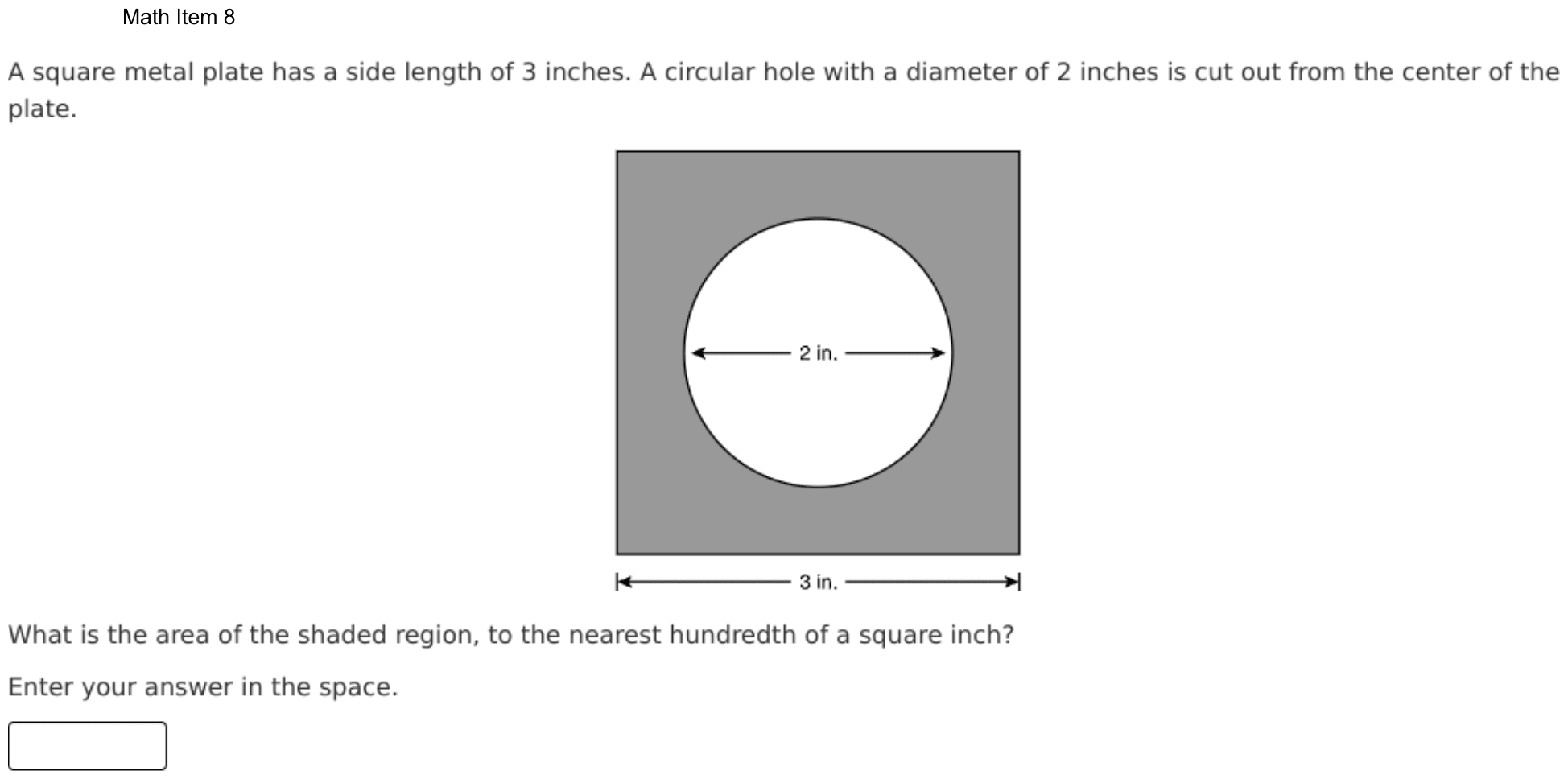
A square metal plate has a side length of 3 inches. A circular hole with a diameter of 2 inches is cut out from the center of the plate.
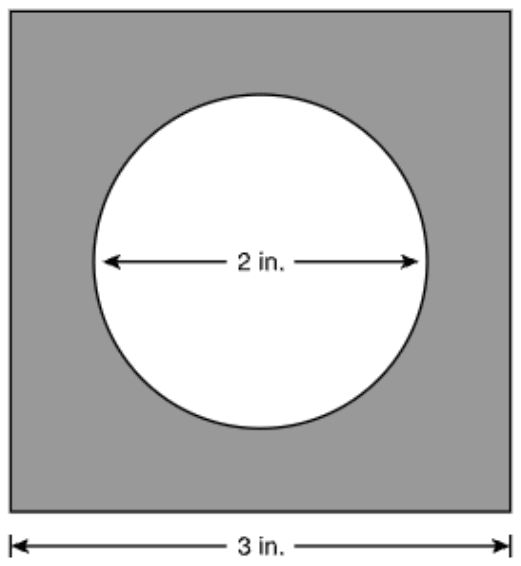
What is the area of the shaded region, to the nearest hundredth of a square inch?
Enter your answer in the space.
Fill-in question: work out the answer and type it as a number.
Show the answer
Correct answer: 5.86
To determine the area of a square, use .
Begin by finding the length of the side of the square, which is 3 inches. The area of the square is .
To determine the area of the circle, use .
The radius of the circle (the hole) is one-half the diameter or , so the area of the entire circle is
To determine the area of the shaded region, subtract the area of the hole in the square from the area of the square:
The shaded area to the nearest hundredth of a square inch sq in.
Question analysis
A 3-inch square metal plate has a circular hole 2 inches across cut from its center, and students find the area of the metal that is left, to the nearest hundredth of a square inch. It tests the areas of a circle and a square. Using the radius, not the diameter, and subtracting the right areas are the keys.
- NYS standards
- 7.G.4 circle area and circumference
- Grade level
- Grade 7 content, by NYS standard
- Compared with grade 7
- At grade 7 Finding a circle's area is a grade 7 standard, and subtracting a hole from a shape is common grade 7 practice. The radius must come from the diameter and the result must be rounded, but the steps are routine.
- Estimated difficulty
- Straightforward: two steps or one careful reading.
- Thinking it demands
- Depth of knowledge 2, skills and concepts · mainly apply
- What makes it hard
- Something you must already know moderate
- Combines ideas minor
- An answer in an unexpected form minor
- Solution
- 3 steps
- Reading level
- Question and choices: about grade 4, 49 words.
- Corrected from the DOE handbook
- A wrong symbol in the explanation was corrected.
- Students, last 30 days
- Not enough answers yet to show (it takes 10).
Why it is hard, traps and wrong answers (shows the answer)
Why it is hard
Every number is small, so the work is choosing the right pieces: the area of the square, the area of the hole, and the difference. A radius of 1 makes the circle's area simply π, which is easy to confuse with the circumference, 2π, when the formulas are half remembered. The region asked for is the gray metal, not the hole, and the final rounding goes up, since the third decimal place is 8.
Something you must already know moderate Working it out
Neither area formula is given, and the hole is labeled by its 2-inch diameter, so students must recall A = πr² and halve the diameter to get the radius 1 first. (Anderson & Krathwohl, 2001)
Combines ideas minor Working it out
The shaded metal is a square with a circle removed, so two area formulas are combined by subtraction rather than either one used alone. (Embretson, 1998; Daniel & Embretson, 2010)
An answer in an unexpected form minor Choosing the answer
The result is typed to the nearest hundredth with no choices to compare, so the long decimal 5.858… must be rounded up, not cut off after two places. (Enright, Morley & Sheehan, 2002)
Strategy: Halve the diameter to get the radius, find the area of the square and of the circle, subtract the circle from the square, and round only at the end.
Traps
- Answers a different question: A choice is right for another quantity: the other unknown, the rest instead of the part, the part instead of the whole.
- Wrong formula: Uses a related but wrong formula: perimeter for area, diameter for radius, area for volume, or a misremembered one.
- A formula you must know: Needs a formula the test does not give: area, circumference, volume, probability rules.
The wrong answers, classified
2.72 Wrong formula (King et al., 2004)
Uses the circumference, 2π × 1 ≈ 6.28, in place of the circle's area and subtracts it from the square's 9 square inches, getting about 2.72.
3.14 Answers a different question (King et al., 2004; Hegarty, Mayer & Monk, 1995)
Finds the area of the circular hole, π × 1² ≈ 3.14 square inches, and enters it instead of the area of the shaded metal left around it.
5.85 Rounds too early (King et al., 2004)
Works the area out correctly as about 5.858 but cuts off the extra digits instead of rounding up to the nearest hundredth.
What was corrected from the DOE handbook, and why
- Explanation: The DOE’s explanation gives the area of the hole as “π(1 in.)² ≅ 3.14 sq in.” The symbol ≅ means “is congruent to”, which an area and a number cannot be; the line means “is approximately equal to”, written ≈. The site now says “π(1 in.)² ≈ 3.14 sq in.”
Worked solution, step by step
Formulas used
- Area of a square
- A is the area, the amount of flat space inside. s is the length of one side. s² means s × s. It works because a square with side s holds s rows of s little unit squares.
- Area of a circle
- A is the area. r is the radius, the distance from the center to the edge. It is half the diameter, the distance straight across through the center. π (pi) is a number a little more than 3, about 3.14. r² means r × r.
Sort out the question
The plate is a square with 3-inch sides. A circle with a 2-inch diameter is cut out of the middle. The diameter is the distance straight across the circle through its center. The shaded region is the metal that is left. You need its area to the nearest hundredth of a square inch.
Find the area of the square
Use the formula for the area of a square, with s = 3 inches:
The whole plate, before the hole is cut, is 9 square inches.
Find the radius of the hole
The circle formula needs the radius, not the diameter. The figure labels the 2 in. distance across the hole. The radius is half of it:
The radius is 1 inch.
Find the area of the hole
Use the formula for the area of a circle, with r = 1 inch:
The sign ≈ means is about equal to. The hole is about 3.14 square inches.
Watch out: 2πr is the circumference, the distance around the circle, not its area. Using it gives 9 − 6.28 = 2.72. And 3.14 is the hole, not the metal, so do not stop there.
Subtract the hole from the square
The shaded metal is the square with the circle taken away:
The shaded region is about 5.86 square inches.
Round and enter the answer
With more digits of π, 3.1416, you get 9 − 3.1416 = 5.8584. The digit after the hundredths place is 8, which is 5 or more, so round up to 5.86. Chopping it to 5.85 is wrong. Type only the number, with no units.
So you would enter 5.86.
Check your answer
The hole is a bit more than a third of the plate, since 3.14 is a bit more than 9 ÷ 3 = 3. So the metal left should be a bit less than two thirds of 9, which is 6. The answer 5.86 is just under 6, so it makes sense.
More questions like this
The original DOE question
Question 11 of 49
2026 Practice Test D Math, question 12Question
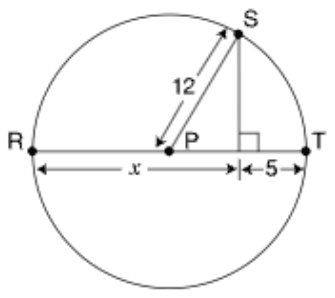
P is the center of the circle above, and R, S, and T are points on the circle. What is the value of x?
- A12
- B15
- C17
- D19
Show the answer
Correct answer: D
represents the radius of the circle and has length 12.
Both and are radii and also have length 12.
Therefore, the length of , which is a diameter, is 24 and is also represented by .
Question analysis
A circle with center P has points R, S and T on it, a segment SP labeled 12, and a vertical segment from S that splits RT into a piece labeled x and a piece labeled 5. Students find the value of x. It tests basic circle facts, and the challenge is seeing which lengths in the figure must be equal.
- Grade level
- Grade 7 content, by NYS standard
- Compared with grade 7
- At grade 7 Grade 7 circle work centers on area and circumference formulas. This needs only the fact that every radius has the same length, but spotting which segments are radii in a figure with extra markings is less routine than using a formula.
- Estimated difficulty
- Moderate: several steps, or a close reading with one strong distractor.
- Thinking it demands
- Depth of knowledge 2, skills and concepts · mainly apply
- What makes it hard
- Reading a figure, table or graph moderate
- No obvious method minor
- Solution
- 2 steps
- Reading level
- Question and choices: about grade 3, 24 words.
- Students, last 30 days
- Not enough answers yet to show (it takes 10).
Why it is hard, traps and wrong answers (shows the answer)
Why it is hard
The figure gives one measurement on a slanted radius and two labels on the diameter, and the right angle at the foot of the vertical segment is a decoy. Once RP and PT are seen as radii, RT is 24, and x is that diameter less the 5. Students who never connect the slanted 12 to the horizontal line fall back on the labeled numbers, adding 12 and 5, or take x to end at the center.
Reading a figure, table or graph moderate Understanding the question
The 12 labels the slanted segment SP, not the horizontal one, and the arrow for x runs from R past the center P to the foot of the vertical segment, so x is neither a radius nor a whole diameter. (Lesh, Post & Behr, 1987; Kirsch & Mosenthal, 1990)
No obvious method minor Working it out
The right-angle mark and the triangle under S suggest the Pythagorean theorem, which is no help; the way in is seeing that RP and PT are radii as well. (Schoenfeld, 1985)
Strategy: Mark every segment from P to the circle as 12, notice that R and T are the ends of a diameter, then write an equation for that diameter using x and the 5.
Traps
- Misreads the figure: Reads a value, label or tick spacing in a figure, table or graph wrongly.
- Information you don't need: The question gives numbers or facts that play no part in the answer.
- Numbers taken from the question: Combines the numbers in the question without a model of the situation, or is simply a number that appears in the question.
The wrong answers, classified
A Misreads the figure (Lesh, Post & Behr, 1987; Kirsch & Mosenthal, 1990)
Reads x as the radius RP, as if its arrow ended at the center P, though it runs past P to the foot of the vertical segment.
B Trusting the picture (Lesh, Post & Behr, 1987)
Judges x from the drawing, where it looks about three times as long as the piece labeled 5, instead of working from the radius of 12.
C Numbers taken from the question (Hegarty, Mayer & Monk, 1995)
Adds the two labeled numbers, 12 + 5 = 17, without placing the 12 on the diameter, as if x were a radius plus the 5.
Worked solution, step by step
Formulas used
- Radius and diameter
- r is the radius, the distance from the center to any point on the circle. d is the diameter, the distance straight across the circle through the center. A diameter is two radii laid end to end, one on each side of the center, so it is twice as long.
Sort out the question
P is the center of the circle, and R, S and T are on the circle. Segment SP is 12. Segment RT goes straight across through P. A short line from S meets RT at a right angle. It splits RT into x, from R to that point, and 5, from that point to T. You need x.
See that SP is a radius
SP runs from the center P to the point S on the circle. So SP is a radius, and the radius is 12. Every radius of a circle has the same length. RP and PT also run from the center to the circle, so RP = 12 and PT = 12.
Find the diameter RT
RT passes through the center, so it is a diameter. Use the formula with r = 12:
RT is 24 long. It is the radius RP plus the radius PT.
Solve for x
RT is also split into x and 5, so:
Subtract 5 from both sides:
Watch out: x runs from R past the center P, so it is longer than a radius. Reading it as 12, choice A, stops at P. Adding 12 + 5 = 17, choice C, puts the 12 in the wrong place.
Work from the numbers, not the picture
The figure is not drawn to scale. In it, x looks about three times as long as 5, which suggests 15, choice B. Trust the labels instead. The right triangle under S is not needed at all.
So the answer is D, 19.
Check your answer
The point where the short line meets RT is 19 from R. P is 12 from R, so that point is 19 − 12 = 7 past the center. Then 7 + 5 = 12, which is PT, a radius. Everything fits.
More questions like this
The original DOE question
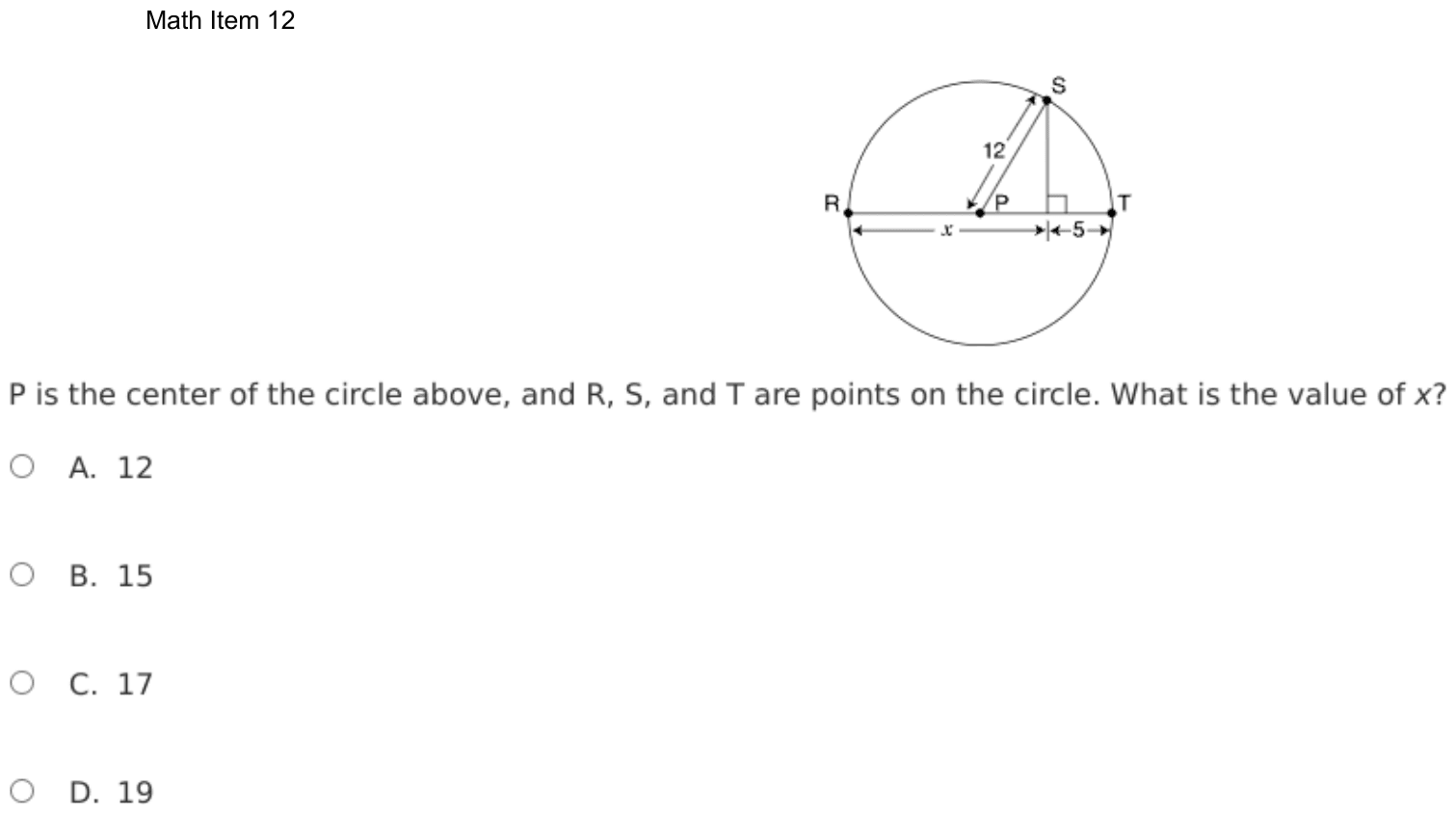
Question 12 of 49
2026 Practice Test D Math, question 13Question
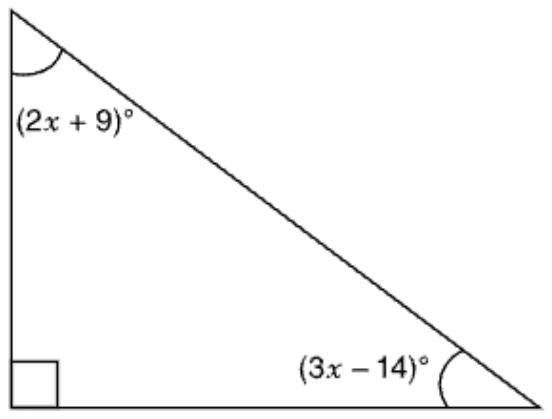
In the right triangle shown above, what is the measure of the smallest angle?
- A43°
- B44°
- C46°
- D47°
Show the answer
Correct answer: A
Since the three angles of a triangle have a sum of 180°, and since one angle is a right angle, the other two angles have a sum of 90°. By writing an equation and using inverse operations, the value of x can be found.
Now, use substitution to find the measure of the two angles to determine the smallest angle of the triangle.
The smallest angle is 43°.
Question analysis
A right triangle has its two other angles labeled (2x + 9)° and (3x − 14)°, and students find the measure of the smallest angle. It tests the angle sum of a triangle and solving a linear equation. Finding x is not the end: both angles must be worked out and compared to see which one is smallest.
- NYS standards
- Grade level
- Grade 8 content, by NYS standard
- Compared with grade 7
- Above grade 7 Grade 7 students write equations for unknown angles using complementary and supplementary angles. This also needs the angle sum of a triangle, which New York places in grade 8, plus substituting back and comparing, though each step is short.
- Estimated difficulty
- Moderate: several steps, or a close reading with one strong distractor.
- Thinking it demands
- Depth of knowledge 2, skills and concepts · mainly apply
- What makes it hard
- Combines ideas moderate
- Many steps minor
- Something you must already know minor
- Solution
- 4 steps
- Reading level
- Question and choices: about grade 6, 14 words.
- Students, last 30 days
- Not enough answers yet to show (it takes 10).
Why it is hard, traps and wrong answers (shows the answer)
Why it is hard
Setting the sum of the two labeled angles to 90° is the decision; the algebra after it is routine. The trap waits at the end: x = 19 is not an angle, and the expression at the top vertex, 2x + 9, gives the larger acute angle, 47°. Evaluating both expressions and checking that they add to 90° takes seconds and shows which one is smaller.
Combines ideas moderate Working it out
The angle facts and the algebra meet in one equation: the right angle means the two labeled angles add to 90°, and only that sum makes (2x + 9) + (3x − 14) solvable. (Embretson, 1998; Daniel & Embretson, 2010)
Many steps minor Working it out
After solving 5x − 5 = 90, both angle expressions must be evaluated and compared, because the question wants an angle, not x, and not the first angle found. (Daniel & Embretson, 2010; Enright, Morley & Sheehan, 2002)
Something you must already know minor Working it out
The 180° angle sum of a triangle is not printed, and only the small square at the bottom left shows that one angle is 90°. (Anderson & Krathwohl, 2001)
Strategy: Use the right angle to see that the other two angles add to 90°, solve that equation for x, then substitute into both expressions and compare them.
Traps
- Answers a different question: A choice is right for another quantity: the other unknown, the rest instead of the part, the part instead of the whole.
- A formula you must know: Needs a formula the test does not give: area, circumference, volume, probability rules.
The wrong answers, classified
B Little reason to choose it (Haladyna & Downing, 1993; Rodriguez, 2005)
No common working gives 44°; it sits one degree from the right measure and fits no consistent value of x, so it mostly draws estimates and guesses.
C Little reason to choose it (Haladyna & Downing, 1993; Rodriguez, 2005)
No common working gives 46°, which would need x = 20 and two angles adding to 95°, so it mostly catches guesses near 45°.
D Answers a different question (King et al., 2004; Hegarty, Mayer & Monk, 1995)
Solves x = 19 correctly but answers with 2x + 9 = 47°, the larger acute angle, instead of evaluating both expressions to find the smaller.
Worked solution, step by step
Formulas used
- Angles in a triangle
- a, b and c are the three angles of any triangle, in degrees. They always add up to 180 degrees. If you tear off the three corners and set them side by side, they make a straight line.
- The two other angles of a right triangle
- a and b are the two angles that are not the right angle. A right angle is 90 degrees, so the other two share what is left of the 180: 180 − 90 = 90.
Sort out the question
The small square at the bottom left corner marks a right angle, which is 90°. The top angle is (2x + 9)°, and the bottom right angle is (3x − 14)°. You need the smallest of the three angles. First find x, then find each angle.
Write an equation
The three angles add to 180°. The right angle uses 90° of that, so the other two angles add to 90°:
Solve for x
Combine the x terms, 2x + 3x = 5x. Combine the numbers, 9 − 14 = −5:
Add 5 to both sides, then divide both sides by 5:
Find both angles
Put x = 19 into each expression:
The three angles are 47°, 43° and 90°.
Watch out: x = 19 is not an angle. And the first angle you find, 47°, is not the smallest one. Stopping there gives choice D.
Pick the smallest angle
Compare 47°, 43° and 90°. The smallest is 43°. The figure is not drawn to scale, so do not judge the angles by how they look. Use the numbers.
So the answer is A, 43°.
Check your answer
Add the three angles: 47 + 43 + 90 = 180. That is the right total for a triangle. Also, 47 + 43 = 90, so the two smaller angles fill exactly what the right angle leaves.
More questions like this
The original DOE question
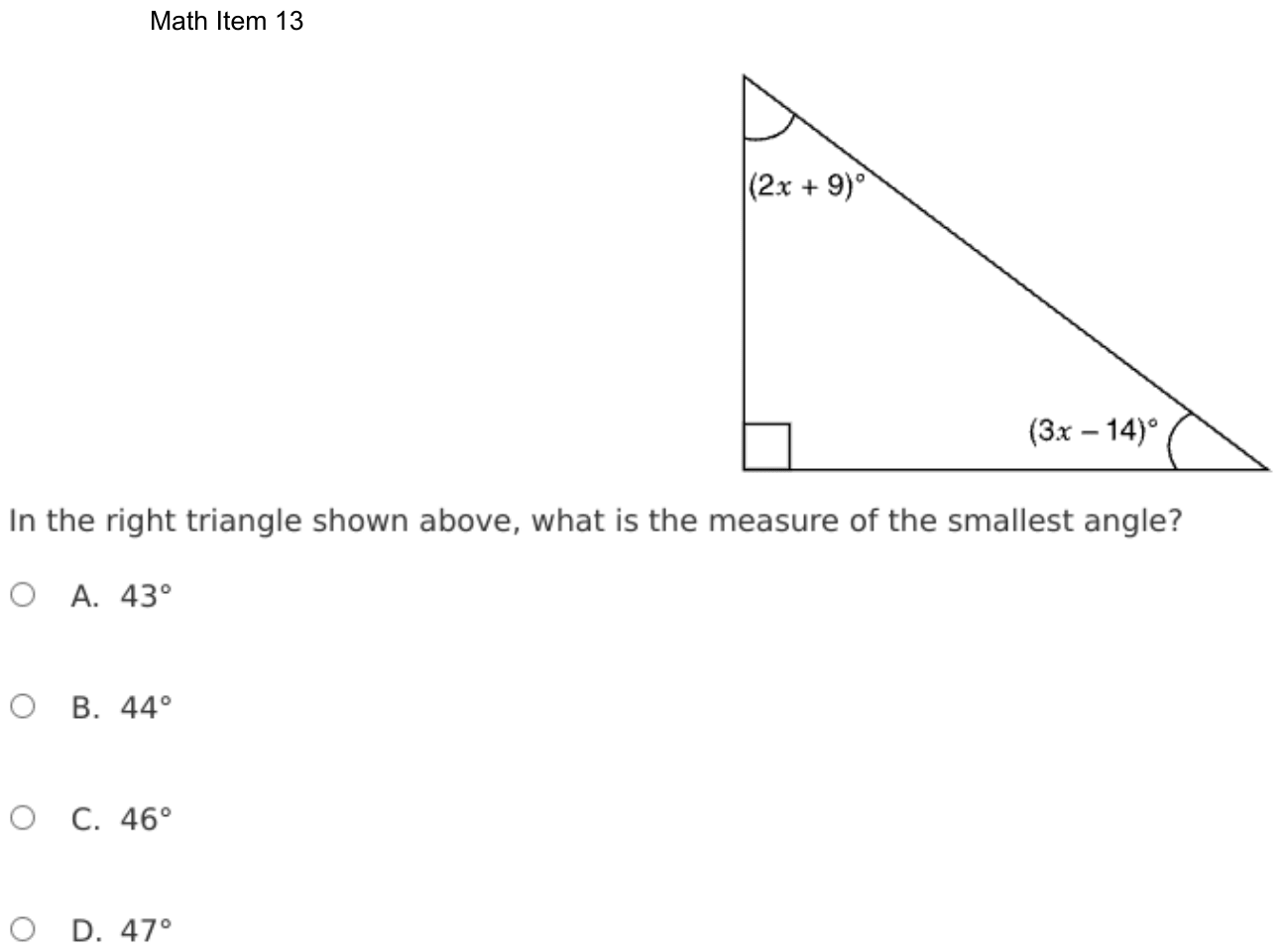
Question 13 of 49
2026 Practice Test D Math, question 47Question
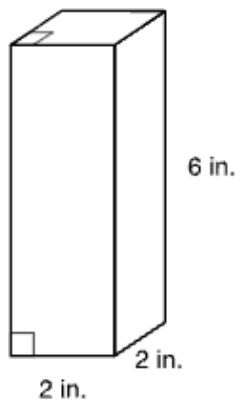
What shape will result from a horizontal slice of the figure above?
- Aa square that has 2-inch sides
- Ba triangle that has 2-inch sides
- Ca rectangle that has a 2-inch side and a 6-inch side
- Da triangle that has one 2-inch side and two 6-inch sides
Show the answer
Correct answer: A
Based on the diagram, the figure shown is a right rectangular prism with a square base. A horizontal slice of the figure will be a plane parallel to the square base, as in this example.
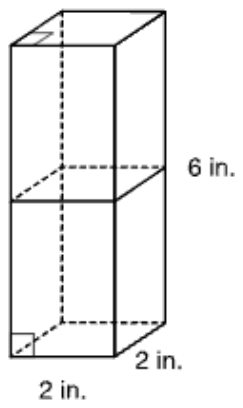
Since the horizontal slice is parallel to the base, it will be congruent to the base, which is a square with 2-inch sides.
Question analysis
A figure shows a right rectangular prism measuring 2 inches by 2 inches by 6 inches, standing on end. This geometry question asks what two-dimensional shape a horizontal slice of the prism makes. It tests visualizing cross-sections of solids, using the labeled lengths to name both the shape and its size.
- NYS standards
- 7.G.3 slicing three-dimensional solids
- Grade level
- Grade 7 content, by NYS standard
- Compared with grade 7
- At grade 7 Describing the shape made by slicing a prism parallel to its base is exactly the grade 7 standard. This is its simplest case, a single slice of a labeled right prism, typical of a classroom example.
- Estimated difficulty
- Routine: one familiar step, little to misread.
- Thinking it demands
- Depth of knowledge 1, recall and reproduction · mainly understand
- What makes it hard
- Solution
- 1 step
- Reading level
- Question and choices: about grade 2, 46 words.
- Students, last 30 days
- Not enough answers yet to show (it takes 10).
Why it is hard, traps and wrong answers (shows the answer)
Why it is hard
A horizontal cut runs parallel to the ground, and this prism stands on a square base, so the slice copies the base. The main danger is picturing the cut along the tall front face, which gives a 2-by-6 rectangle, the shape a vertical slice makes. The two triangles need a slanted cut through a corner and catch only students guessing.
Reading a figure, table or graph minor Understanding the question
The prism is drawn standing on end, 6 inches tall on a 2-by-2 base, so the cut has to be pictured in a flat drawing where the tall front face is the most visible shape. (Lesh, Post & Behr, 1987; Kirsch & Mosenthal, 1990)
Something you must already know minor Working it out
Students must know that a slice parallel to the base of a prism has the same shape and size as the base, which here is the square at the bottom. (Anderson & Krathwohl, 2001)
Strategy: Picture a flat cut across the prism parallel to the ground, ask which face of the prism that cut runs parallel to, and read that face's edge lengths from the labels.
Traps
- Misreads the question: Misses or misreads a condition or a word in the question: "at least", "each", "remaining", "not".
- Misunderstands the concept: A wrong belief about a concept: that percents can be added, that area grows like length, that averages can be averaged, that a bigger denominator means a bigger fraction.
The wrong answers, classified
B Misunderstands the concept (Smith, diSessa & Roschelle, 1993; De Bock et al., 1998; Ni & Zhou, 2005)
Expects a slice to cut off a corner and make a triangle, as a cut through a pyramid might, not a cut parallel to this square base.
C Misreads the question (Hegarty, Mayer & Monk, 1995)
Describes a vertical slice, which runs down the 6-inch height and makes a 2-by-6 rectangle, mixing up horizontal and vertical.
D Numbers taken from the question (Hegarty, Mayer & Monk, 1995)
Builds a triangle from the labels in the figure, one 2-inch and two 6-inch sides, a shape no horizontal cut of this prism can make.
Worked solution, step by step
Formulas used
- A slice parallel to the base
- The sign ≅ means congruent: the same shape and the same size. A prism has the same shape all the way up, like a stack of matching cards. So a cut parallel to its base, at any height, is a copy of the base.
Sort out the question
The figure is a right rectangular prism, a box shape whose faces are all rectangles. It stands on end. The two edges along the bottom are labeled 2 in. The tall edge is labeled 6 in.
You need the shape you get from a horizontal slice. Horizontal means flat, like the floor or a tabletop.
Find the base
The base is the face the prism stands on. The two bottom edges you can see are both labeled 2 in. The right-angle mark on the top face shows its corners are square. The top and the bottom match. So the base is a square with 2-inch sides.
Picture the slice
A horizontal slice cuts straight across the prism, parallel to the base. The walls of the prism go straight up, so the slice is a copy of the base. It is a square with 2-inch sides, at whatever height you cut.
The 6-inch height does not matter. It only tells how tall the stack of squares is.
Rule out the other shapes
Watch out: a 2-inch by 6-inch rectangle, choice C, comes from a vertical slice. That cut goes straight down, through the 6-inch height. A triangle, choice B or D, needs a slanted cut through a corner.
So the answer is A, a square that has 2-inch sides.
Check your answer
Picture the slice sliding up and down. At the bottom, it matches the base, 2 in. by 2 in. At the top, it matches the top face, the same square. In between, the walls are straight, so its size never changes.
More questions like this
The original DOE question
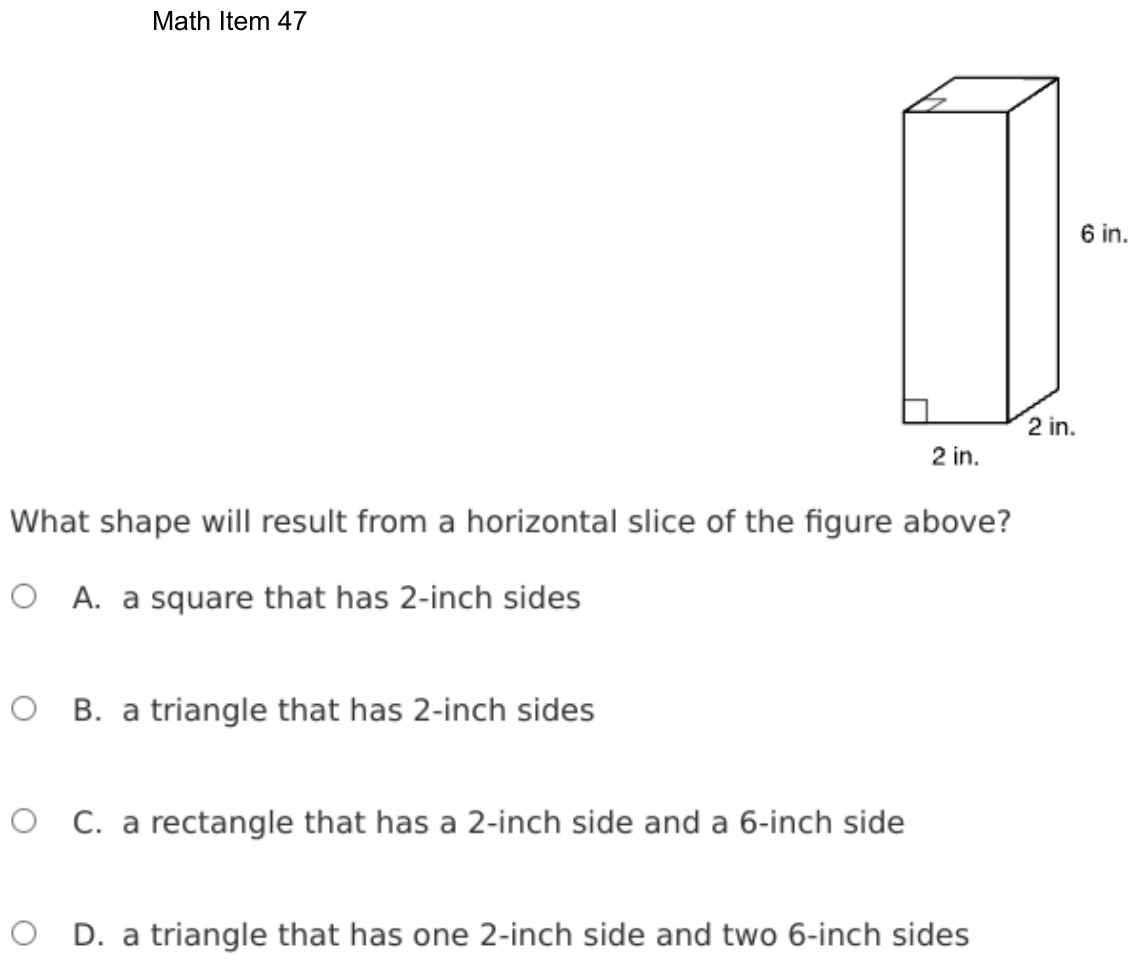
Question 14 of 49
2025 Practice Test A English, question 14Passage Excerpt from “Scribe Like an Egyptian”
Excerpt from “Scribe Like an Egyptian”
by Hilary Wilson
In ancient Egypt, literacy was the key to success. However, contrary to popular belief, not all Egyptian scribes understood hieroglyphs. Many relied instead on the simpler hieratic script for the multitude of everyday documents generated by the Egyptian bureaucracy.
Hieroglyphs—“the Words of God”—compose a writing system with more than 1,000 distinct characters, the meanings of which were lost for 1,500 years before they were deciphered by Jean-François Champollion in 1822. Including both ideograms (which convey a whole word or idea, either concrete or abstract, in a single sign) and phonograms (representing either an alphabetic sound or a group of consonants), [the writing system] was used in formal inscriptions on tomb and temple walls as well as on elaborate funerary papyri. For everyday purposes, however, scribes used a shorthand version of the hieroglyphic script known as hieratic, which was quicker to write and more economical of space. The two writings existed side by side for at least 2,500 years.
Scraps of ancient hieratic writing, mostly penned by student scribes on limestone flakes called ostraca, suggest that no matter how humble his origins, an educated Egyptian could achieve almost anything. Horemheb (d.1292 B.C.) is a good example. Born of middle-ranking parents, his scribal training led to an army career. From Scribe of Recruits, during the reign of Akhenaten (1353–1336 B.C.), Horemheb rose through the military ranks and, by the rule of Tutankhamun (1332–1323 B.C.), he was commander in chief of the Egyptian forces. As a close adviser of the young Pharaoh, Horemheb was appointed “Deputy of the King throughout the Two Lands,” and might have expected to succeed to the throne should the king die childless. He had to wait a few years, but eventually Horemheb achieved the pinnacle of his career by becoming the last king of the 18th Dynasty, making his mark by instituting dramatic reforms to the organisation of the army, the judiciary and administration in general. The lasting success of these changes owed much to his scribal background. . . .
But education was not available to all. Government departments and major temples supported schools, where boys commenced their training at six or seven, sometimes earlier. To these boarding establishments . . . family or household servants delivered the students’ food and drink rations daily for several years, during which time the student was not contributing to the family’s income. Boys from poorer families could only hope to be educated with support from a wealthier relative or patron, or through apprenticeship to an older scribe, perhaps the local clerk or land agent, who would teach them the basics of the scribe’s craft. This limited the scope for employment but such “on the job” training allowed apprentices to help out at home while learning. . . .
Scribal education began with the elementary principles of the hieratic script. The lowliest scribes, who trained for just five or six years, probably learned only the rudiments of the hieroglyphic script. Students were set exemplar documents and extracts from popular texts to copy, to practice their hieratic handwriting on basic-format letters, reports and contracts, while absorbing the good advice contained in the texts. Surviving examples of copy-work sometimes include tutors’ corrections added in red. Some significant Egyptian literary works survive almost exclusively from student copies.
A schoolboy “dictionary” of hieroglyphs with their hieratic equivalents shows that a knowledge of more than 450 signs was required for everyday writing purposes. Lessons in record-keeping and filing and labelling enabled any half-competent scribe to perform that most essential of all scribal functions: the making and updating of lists. For professions such as those of government official, priest or lawyer, a scribe would train for several more years, increasing his vocabulary to perhaps a thousand or more signs. Those with the best handwriting or drawing skills might follow the craft of creating beautifully illustrated copies of funerary texts, commonly called Books of the Dead. Others could become draughtsmen, artists or architects. Doctors compiled their own collections of medication recipes, treatments and associated incantations, many copied from texts found in the House of Life, the temple library. Lawyers had to be familiar with the corpus of civil and religious laws and precedents found in the official records, which were administered by archivists. Egypt’s bureaucratic society depended on the skills of an army of scribes of all ranks from filing clerk to tax assessor. For young Egyptians, “be a scribe” was the best of career advice.
From “Scribe Like an Egyptian” by Hilary Wilson from HISTORY TODAY, August 8, 2019. Copyright © 2019 by History Today Ltd. Company.
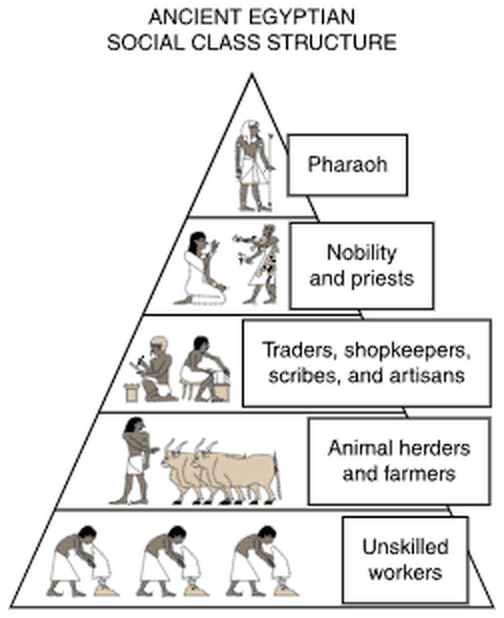
bureaucracy: an administrative staff of government officials
funerary papyri: a sheet or scroll of papyrus containing religious images and hieroglyphs meant to help the deceased be reborn in the afterlife
rudiments: basics
schoolboy: slang that refers to materials used during the course of receiving an education
draughtsmen: people who draw plans of machinery or structures
corpus: a collection of writings
Question
The diagram after paragraph 6 best provides additional support for the topic of the excerpt by
- Ademonstrating the place of scribes in ancient Egyptian social structure.
- Bdepicting the types of tasks performed by each social class.
- Cindicating that scribes were able to easily improve their social ranking.
- Dcomparing the social positions of each social class in ancient Egypt.
Show the answer
Correct answer: A
The question asks how the diagram of ancient Egyptian class structure supports the topic of the excerpt.
A. CORRECT. The focus of the excerpt is the opportunities available to scribes in different professions and how people became scribes and therefore improved their position. By illustrating the position of the scribes in the class structure of ancient Egypt, the diagram supports the idea that scribes were valuable members of society.
B. Incorrect. The professions of the different social classes are shown in the diagram, but it does not address specific tasks. Furthermore, the main topic of the excerpt is the role of the scribes in society rather than the tasks performed by the different social classes.
C. Incorrect. While the diagram does show the position of scribes in the social hierarchy, it does not provide an illustration of movement between the different classes or rankings, so the diagram does not support the idea that scribes were able to improve their social standing.
D. Incorrect. The diagram shows the class structure as hierarchical and can support readers’ efforts to compare the different social positions. However, the role of scribes in society, rather than a general comparison of different classes, is the main focus of the excerpt.
Question analysis
This question on “Scribe Like an Egyptian” asks how the diagram after paragraph 6, a pyramid of ancient Egyptian social classes from the pharaoh at the top to unskilled workers at the base, gives additional support to the excerpt’s topic. Students must decide what the excerpt is mainly about and then judge what the graphic adds, and several choices describe something the pyramid really shows.
- Grade level
- Grade 7 reading and task
- Compared with grade 7
- At grade 7 Linking a graphic to a text is regular grade 7 work, and this five-level pyramid is simple and clearly labeled. The demand lies in naming the excerpt’s topic first and judging how the diagram bears on it.
- Estimated difficulty
- Moderate: several steps, or a close reading with one strong distractor.
- Thinking it demands
- Depth of knowledge 2, skills and concepts · mainly analyze
- What makes it hard
- A very close wrong answer moderate
- Reading a figure, table or graph moderate
- How, not what minor
- Evidence
- Answered from the whole text
- Reading level
- Passage: about grade 12, 810 words; question and choices: about grade 9, 57 words.
- Students, last 30 days
- Not enough answers yet to show (it takes 10).
Why it is hard, traps and wrong answers (shows the answer)
Why it is hard
More than one choice is true of the pyramid, so the question is decided by the excerpt’s topic, not by the picture alone. Students who look only at the diagram see a ranking of all the classes; students who remember that the article is about scribes look for where scribes stand. The choice about rising easily borrows Horemheb’s story from the text and credits it to a drawing that shows no movement.
A very close wrong answer moderate Choosing the answer
The choice about comparing every class’s position differs from the right one in a single detail, all classes rather than scribes, and both are true of the pyramid. (Embretson & Wetzel, 1987; Gorin & Embretson, 2006; Ascalon et al., 2007)
Reading a figure, table or graph moderate Understanding the question
Scribes are not a tier of their own: they share the third of five tiers with merchants and craftsmen, below the pharaoh, nobles and priests and above farmers, herders and laborers. (Lesh, Post & Behr, 1987; Kirsch & Mosenthal, 1990)
How, not what minor Working it out
The stem asks how the diagram supports the excerpt’s topic, so students must first decide the topic is scribes, then judge what the picture adds to it. (Anderson & Krathwohl, 2001)
Strategy: State the excerpt’s topic in a few words, then test each choice twice: is it true of the diagram, and does it connect the diagram to that topic?
Traps
- True but not the answer: A choice says something accurate about the text that does not answer this question.
- Wrong part of the text: A choice is true of another paragraph, stanza or speaker than the one asked about.
- Wrong purpose or structure: Names a purpose, structure or effect that the part does not serve, or describes what a part says when the question asks what it does.
The wrong answers, classified
B Wrong purpose or structure (Anderson & Krathwohl, 2001)
Notices the small figures at work, such as the herders with their cattle, and takes tasks as the diagram’s point, though its labels name classes and the excerpt is about scribes.
C Wrong part of the text (Kirsch & Mosenthal, 1990)
Carries Horemheb’s rise from scribe to king in paragraph 3 over to the diagram, which shows fixed tiers with no arrows or movement, and nothing about rising easily.
D True but not the answer (King et al., 2004; Embretson & Wetzel, 1987)
Describes what the pyramid plainly does, rank all five classes against one another, which is accurate but misses why the diagram belongs with an excerpt about scribes.
Working it out, step by step
Figure out what the question asks
This asks how the diagram after paragraph 6 adds to the topic of the excerpt. First name the topic. Then ask two things about each choice. Is it true of the diagram? And does it connect the diagram to that topic?
Name the excerpt’s topic
The excerpt is about scribes, people trained to read and write for others. It tells how they learned, who could study, and what jobs they could get. Every paragraph comes back to scribes. So the diagram should add something about scribes.
Read the diagram
The diagram is a pyramid with five levels. From the top down, they are the Pharaoh, nobles and priests, then “Traders, shopkeepers, scribes, and artisans,” then herders and farmers, and last unskilled workers. Artisans are skilled craftspeople. Scribes sit in the third level, the middle one. They are below the ruler and the nobles, and above farmers and workers.
Check each choice
- A fits. The diagram shows where scribes stood in Egyptian society, which ties it to the topic.
- B does not fit. The labels name groups of people, not the tasks each group did.
- C does not fit. The levels are fixed, and nothing in the diagram shows anyone moving up. Horemheb’s rise comes from paragraph 3, not the diagram.
- D does not fit. The pyramid does rank all the classes. But that alone does not connect it to an excerpt about scribes.
Watch out: More than one choice is true of the picture. The right one must also fit the topic.
Choose the answer
The diagram supports the topic by showing where scribes fit among the classes of ancient Egypt. So the answer is A.
Why this answer and not the closest wrong one
D is the closest wrong choice, because the pyramid really does compare every class. But the excerpt is about scribes, not about every class. A is true of the diagram too, and it also links the diagram to the topic. It points to the place of scribes in the middle level.
More questions like this
The original DOE question
The passage “Excerpt from “Scribe Like an Egyptian”” as shown on the test
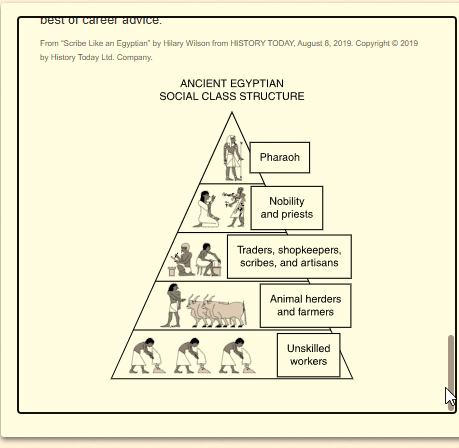
Question 15 of 49
2024 Test A Math, question 8Question
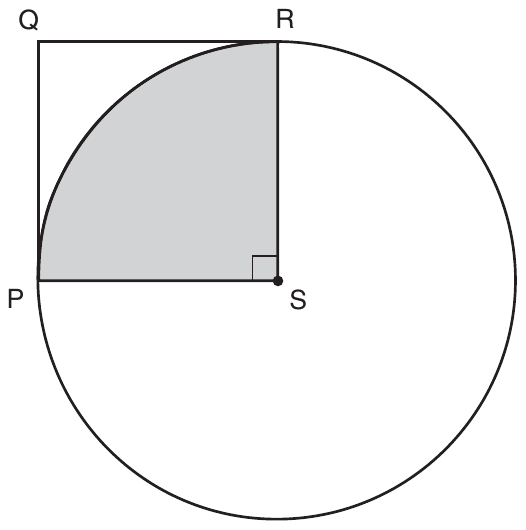
In the figure above, PQRS is a square. Point S is the center of the circle, and points P and R are on the circle. If the area of the square is 4 square centimeters, what is the area, in square centimeters, of the shaded quarter of the circle?
- A
- B
- C
- D
Show the answer
Correct answer: B
The area of square PQRS is 4 square centimeters. So
Sides PS and RS are each a radius of the circle. So the radius of the circle is 2 cm.
The shaded region is of the circle. The area of a circle is . So the area of the shaded region, in square centimeters, is
Question analysis
A geometry question with a figure: square PQRS has one corner at the center of a circle, and the quarter of the circle inside the square is shaded. Given the area of the square, students find the area of the shaded quarter circle. The key is connecting the square's side to the circle's radius.
- Grade level
- Grade 7 content, by NYS standard
- Compared with grade 7
- At grade 7 Circle area is grade 7 content, and this question adds only one linking step from the square's area to the radius. Typical grade 7 circle work gives the radius directly; here it takes one short extra inference.
- Estimated difficulty
- Straightforward: two steps or one careful reading.
- Thinking it demands
- Depth of knowledge 2, skills and concepts · mainly apply
- What makes it hard
- Reading a figure, table or graph moderate
- Something you must already know minor
- Combines ideas minor
- Solution
- 3 steps
- Reading level
- Question and choices: about grade 4, 52 words.
- Students, last 30 days
- Not enough answers yet to show (it takes 10).
Why it is hard, traps and wrong answers (shows the answer)
Why it is hard
The question chains three short facts: from the square's area to its side, from the side to the radius, and from the whole circle to a quarter of it. None is hard, but each wrong choice marks a broken link, most often the whole circle's area, which looks like a finished answer. Pointing to S as the center before computing anything settles the radius.
Reading a figure, table or graph moderate Understanding the question
The radius is never labeled: students must see that S is both a corner of the square and the circle's center, so sides PS and RS are radii. (Lesh, Post & Behr, 1987; Kirsch & Mosenthal, 1990)
Something you must already know minor Working it out
Neither the circle area formula, π times the radius squared, nor the step from a square's area to its side length is given. (Anderson & Krathwohl, 2001)
Combines ideas minor Working it out
Square and circle are linked in one chain: the area 4 gives a side of 2, the side is the radius, and the shaded part is a quarter of π × 2². (Embretson, 1998; Daniel & Embretson, 2010)
Strategy: Take the square root of the square's area to get its side, which is also the radius, then take one quarter of pi times the radius squared.
Traps
- Wrong formula: Uses a related but wrong formula: perimeter for area, diameter for radius, area for volume, or a misremembered one.
- Stops one step early: A choice is a number from partway through the solution.
- A formula you must know: Needs a formula the test does not give: area, circumference, volume, probability rules.
The wrong answers, classified
A Wrong formula (King et al., 2004)
Halves the square's side as if it were a diameter, so it uses a radius of 1, and one quarter of π × 1² gives π/4.
C Wrong formula (King et al., 2004)
Misremembers the circle's area as 2πr², blending it with the circumference 2πr, so one quarter of 2π × 2² gives 2π.
D Stops one step early (King et al., 2004; Gierl et al., 2017)
Finds the whole circle's area, π × 2² = 4π, and stops before taking the quarter that is shaded.
Worked solution, step by step
Formulas used
- Area of a square
- A is the area, the space inside. s is the length of one side, and s² means s × s. All four sides of a square are equal, so its area is side times side.
- Area of a circle
- A is the area of the whole circle. r is the radius: the distance from the center to the edge. π, called pi, is a number a little more than 3, about 3.14. Multiply π by r × r. This works for every circle.
Sort out the figure
PQRS is a square with an area of 4 sq cm. Point S is the center of the circle. Points P and R are on the circle. The shaded part is a quarter of the circle, inside the square. You need the shaded area, in square centimeters. The answer will have π in it.
Find the side of the square
Use the square formula. The area is 4, so find the number that times itself gives 4.
Each side is 2 cm long, because .
See that the side is the radius
Side SP goes from the center, S, to point P on the circle. So SP is a radius. So is side SR. The radius is 2 cm. Watch out: the side is a radius, not a diameter, the full width of the circle. Using a radius of 1 leads to , choice A.
Find the area of the whole circle
The whole circle has an area of 4π sq cm. Watch out: this is the whole circle. Stopping here gives choice D.
Take one quarter
The shaded part is one quarter of the circle, so take one quarter of 4π.
The shaded area is π sq cm. So the answer is B, .
Check your answer
π is about 3.14, so the shaded part is about 3.14 sq cm. The whole square is 4 sq cm. In the figure, the shaded part fills most of the square, but not all. So a bit less than 4 makes sense. The choice 4π is about 12.6, far too big.
More questions like this
The original DOE question
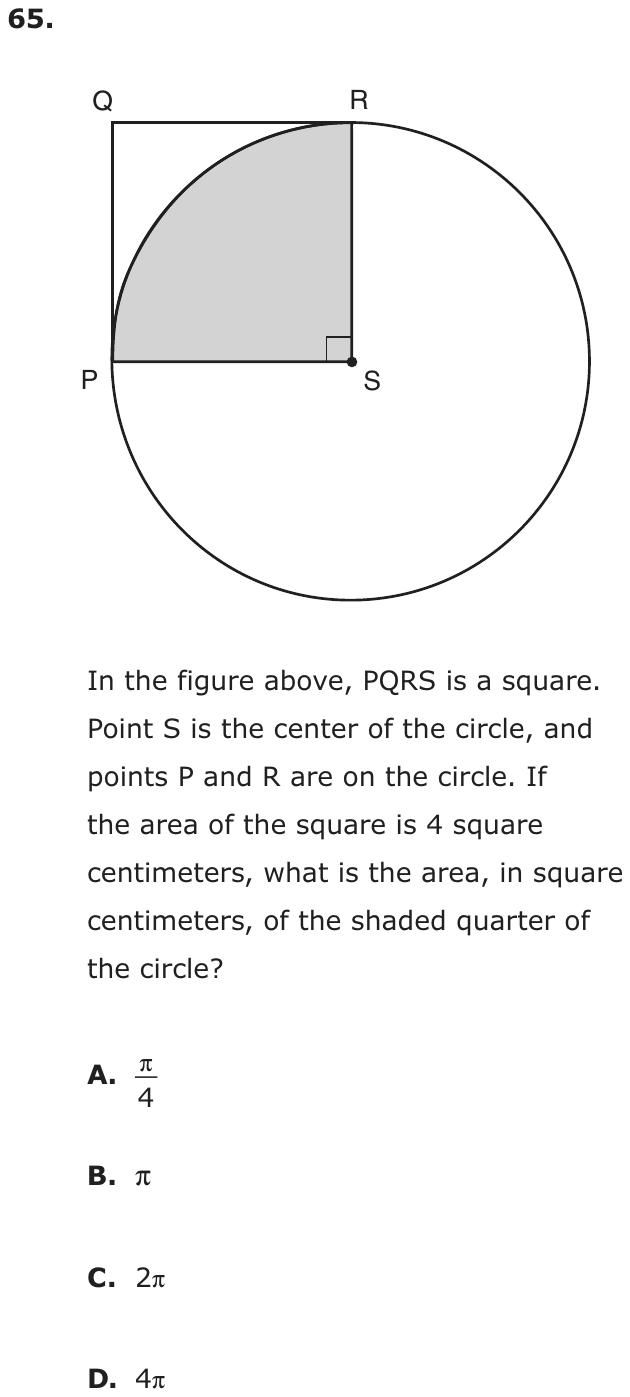
Question 16 of 49
2024 Test A Math, question 21Question
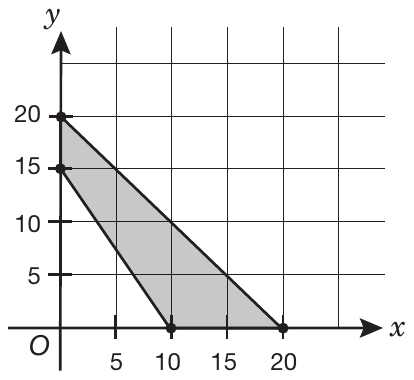
What is the area, in square units, of the shaded region shown in the figure above?
- A75
- B125
- C150
- D200
Show the answer
Correct answer: B
The area of the shaded region, in square units, is the area of the triangle created by the shaded and unshaded regions minus the area of the triangle created by the unshaded region.
The area of the triangle created by the shaded and unshaded regions is 200 square units.
The area of the triangle created by the unshaded region is 75 square units.
Subtract to find the area of the shaded region.
Question analysis
A coordinate geometry question: two line segments cross a grid, one from (0, 20) to (20, 0) and one from (0, 15) to (10, 0), and the region between them is shaded. Students find the shaded area. The shape is not a standard figure, so they need to see it as one triangle with another removed.
- Grade level
- Grade 6 content, by NYS standard
- Compared with grade 7
- At grade 7 Area of triangles is grade 6 content; finding a composite area by subtraction is the kind of task grade 7 students meet regularly. Points on the axes make every length easy to read.
- Estimated difficulty
- Straightforward: two steps or one careful reading.
- Thinking it demands
- Depth of knowledge 2, skills and concepts · mainly apply
- What makes it hard
- Reading a figure, table or graph moderate
- No obvious method minor
- Something you must already know minor
- Solution
- 3 steps
- Reading level
- Question and choices: about grade 6, 16 words.
- Students, last 30 days
- Not enough answers yet to show (it takes 10).
Why it is hard, traps and wrong answers (shows the answer)
Why it is hard
The shaded shape has no name, so the question is about seeing it as a difference of two right triangles whose legs lie on the axes. Once that is seen, both areas are one-line calculations. The wrong choices come from stopping after either triangle or from pairing a base from one segment with a height from the other.
Reading a figure, table or graph moderate Understanding the question
All four lengths come from where the two segments meet the axes, at 20 and 15 on the y-axis and at 10 and 20 on the x-axis, read against grid lines 5 units apart. (Lesh, Post & Behr, 1987; Kirsch & Mosenthal, 1990)
No obvious method minor Working it out
The shaded region is a four-sided shape with no formula of its own; it has to be seen as the large triangle with the small one removed. (Schoenfeld, 1985)
Something you must already know minor Working it out
The area of a triangle, one half of base times height, is assumed and not given. (Anderson & Krathwohl, 2001)
Strategy: Find the area of the large right triangle under the outer segment and subtract the area of the smaller triangle under the inner segment, reading the legs from the axes.
Traps
- Stops one step early: A choice is a number from partway through the solution.
- Answers a different question: A choice is right for another quantity: the other unknown, the rest instead of the part, the part instead of the whole.
- Misreads the figure: Reads a value, label or tick spacing in a figure, table or graph wrongly.
The wrong answers, classified
A Answers a different question (King et al., 2004; Hegarty, Mayer & Monk, 1995)
Finds the area of the small unshaded triangle, 1/2 × 10 × 15 = 75, and gives that region instead of the shaded one.
C Misreads the figure (Lesh, Post & Behr, 1987; Kirsch & Mosenthal, 1990)
Pairs the outer segment's x-intercept, 20, with the inner segment's y-intercept, 15, as if they bounded one triangle: 1/2 × 20 × 15 = 150.
D Stops one step early (King et al., 2004; Gierl et al., 2017)
Finds the area of the large triangle, 1/2 × 20 × 20 = 200, and stops before subtracting the unshaded triangle inside it.
Worked solution, step by step
Formulas used
- Area of a triangle
- A is the area. b is the base, the side the triangle sits on. h is the height: the straight-up distance from the base to the top corner, at a right angle to the base. You take half because a triangle is half of a rectangle with the same base and height.
Sort out the figure
The grid lines are 5 units apart. Two slanted segments run from the y-axis down to the x-axis. The outer one goes from 20 on the y-axis to 20 on the x-axis. The inner one goes from 15 on the y-axis to 10 on the x-axis. The shaded region is the strip between them. You need its area, in square units.
See the shape as two triangles
The shaded region has four sides, and it has no simple formula. But look at the big triangle under the outer segment, with its corner at O. It is the shaded strip plus the small white triangle. So the shaded area is the big triangle minus the small one.
Find the area of the big triangle
The big triangle has a right angle at O. Its base runs along the x-axis from 0 to 20, so it is 20 units. Its height runs up the y-axis from 0 to 20, so it is 20 units.
Watch out: this is the whole big triangle. Stopping here gives 200, choice D.
Find the area of the small triangle
The small triangle also has its right angle at O. Its base is 10 units, from 0 to 10 on the x-axis. Its height is 15 units, from 0 to 15 on the y-axis.
Watch out: 75 is the white triangle, choice A, not the shaded part. Also, pair the base and height of the same triangle. Mixing 20 and 15 gives 150, choice C.
Subtract to find the shaded area
Take the small white triangle away from the big triangle.
The shaded area is 125 square units. So the answer is B, 125.
Check your answer
In the figure, the shaded strip looks bigger than the white triangle. So the shaded area should be more than half of the big triangle, which is . 125 is more than 100. And , the whole big triangle.
More questions like this
The original DOE question
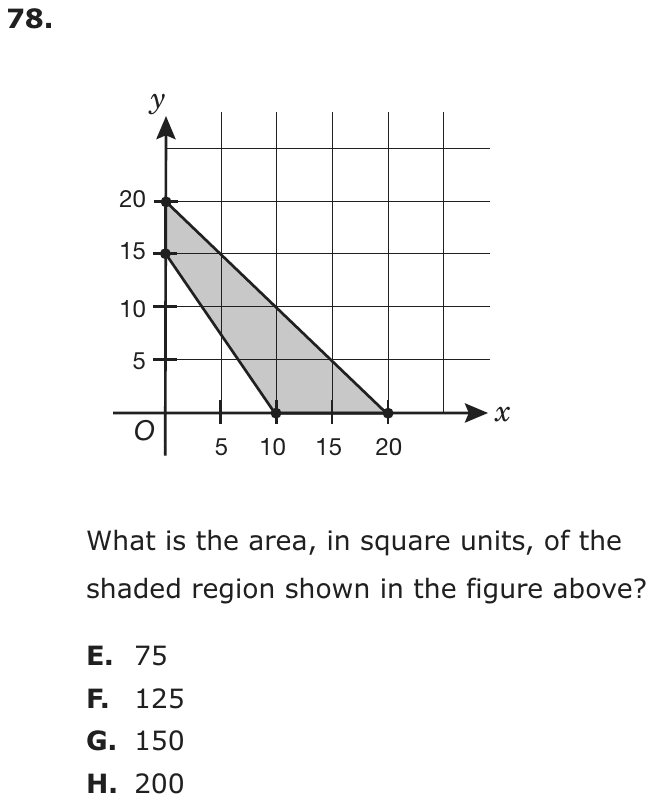
Question 17 of 49
2024 Test A Math, question 25Question
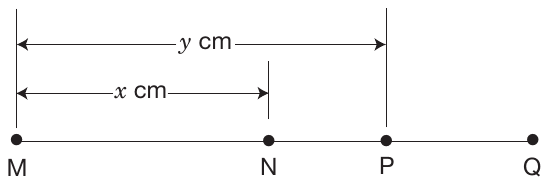
In the figure above, N is the midpoint of . Which segment has length centimeters?
- A
- B
- C
- D
Show the answer
Correct answer: A
These facts are given:
- N is the midpoint of .
- has a length of x centimeters.
- has a length of y centimeters.
Use the first two facts to determine that has a length of centimeters. So can be represented by , which is .
Question analysis
A geometry and algebra question with a labeled figure: points M, N, P and Q lie on a line, MN is x cm, MP is y cm, and N is the midpoint of MQ. Students find which segment has length 2x − y. They must turn the midpoint fact into an expression and read a difference of lengths on the figure.
- NYS standards
- Grade level
- Grade 7 content, by NYS standard
- Compared with grade 7
- Above grade 7 Grade 7 students evaluate and rewrite expressions but rarely read one as a length on a figure. Combining the midpoint idea from geometry with a difference of expressions, and no numbers, makes this more abstract than typical grade 7 work.
- Estimated difficulty
- Moderate: several steps, or a close reading with one strong distractor.
- Thinking it demands
- Depth of knowledge 2, skills and concepts · mainly analyze
- What makes it hard
- Variables instead of numbers moderate
- Reading a figure, table or graph moderate
- Solution
- 2 steps
- Reading level
- Question and choices: about grade 9, 20 words.
- Students, last 30 days
- Not enough answers yet to show (it takes 10).
Why it is hard, traps and wrong answers (shows the answer)
Why it is hard
The question reverses the usual task: instead of finding a length, students match an expression to a segment. The midpoint fact turns into MQ = 2x, and taking away the y of MP leaves the piece from P to Q. The wrong choices reward stopping at 2x, reading only the labeled arrows, or matching the letter y; picking x = 5 and y = 7 lets students check with numbers.
Variables instead of numbers moderate Understanding the question
Every length is a letter: MN is x, MP is y, and the target is the expression 2x − y, so the matching segment cannot be found by measuring. (Koedinger & Nathan, 2004; Enright, Morley & Sheehan, 2002)
Reading a figure, table or graph moderate Understanding the question
The figure marks only MN and MP with arrows; the length of MQ comes from the stem's midpoint fact, not from the drawing, and has to be written as 2x. (Lesh, Post & Behr, 1987; Kirsch & Mosenthal, 1990)
Strategy: Use the midpoint to write the length of the whole segment in terms of x, or pick sample values for x and y, then see which segment's length matches 2x − y.
Traps
- Stops one step early: A choice is a number from partway through the solution.
- Misreads the question: Misses or misreads a condition or a word in the question: "at least", "each", "remaining", "not".
The wrong answers, classified
B Misreads the question (Hegarty, Mayer & Monk, 1995)
Leaves out the midpoint fact, so the only difference it can read from the arrows is NP = y − x, which it takes for 2x − y.
C Stops one step early (King et al., 2004; Gierl et al., 2017)
Uses the midpoint to find that MQ is 2x centimeters and picks that segment, stopping before subtracting the y of MP.
D Numbers taken from the question (Hegarty, Mayer & Monk, 1995)
Sees y in the expression and picks MP, the segment labeled y, without working out the rest of 2x − y.
Worked solution, step by step
Formulas used
- Midpoint
- N is the midpoint of segment MQ, the point exactly in the middle. MN is the half from M to N, and MQ is the whole segment. The whole is two equal halves, so it is 2 times MN.
- Adding segments
- When points lie in order on a line, the short segments add up to the long one. MP runs from M to P, and PQ runs from P to Q. Put end to end, they make MQ.
Sort out the figure
Points M, N, P and Q lie in that order on a line. Segment MN is x cm long, and segment MP is y cm long. N is the midpoint of , the point exactly halfway from M to Q. You need the segment that is cm long.
Find the length of MQ
MN is half of MQ, so MQ is twice as long.
MQ is 2x cm long. Watch out: 2x is only part of the expression. Stopping here gives MQ, choice C.
Take MP away from MQ
Subtracting y from 2x means taking MP away from MQ. MP covers the part from M to P. What is left of MQ is the piece from P to Q.
So PQ is cm long. Watch out: do not pick MP just because y appears. MP is y, choice D. NP is , choice B. So the answer is A, .
Check your answer
Try numbers. Say x = 5, so MN = 5 and MQ = 10. Say y = 7, so MP = 7. Then PQ is . And . They match. NP would be , which does not.
More questions like this
The original DOE question
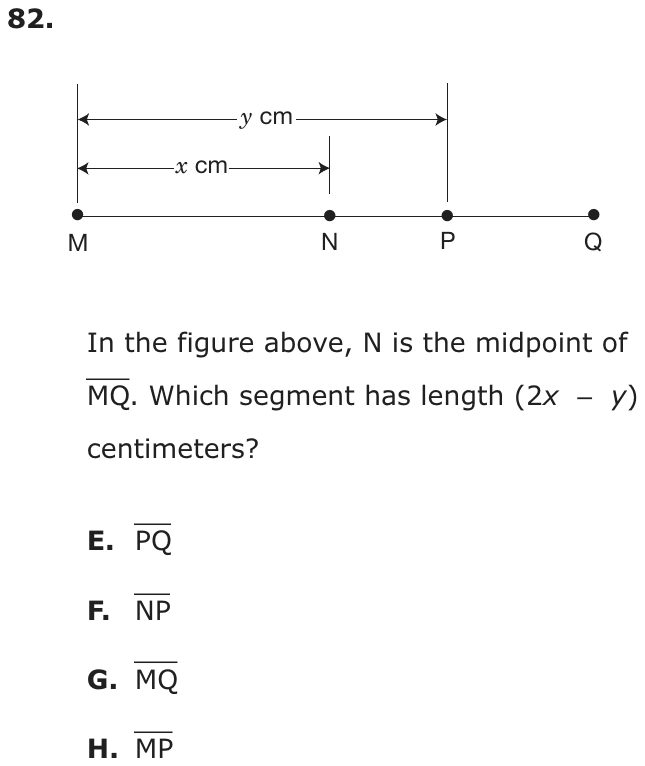
Question 18 of 49
2024 Test A Math, question 26Question
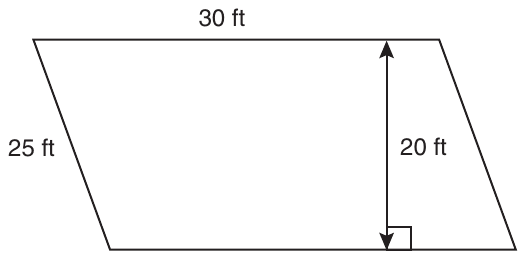
What is the area of the parallelogram shown above?
- A750 sq ft
- B600 sq ft
- C500 sq ft
- D300 sq ft
Show the answer
Correct answer: B
To find the area of a parallelogram, multiply the length of a side by the altitude for that side.
One property of parallelograms is that opposite sides are the same length.
So the bottom side of the parallelogram is 30 feet long and has an altitude of 20 feet.
Therefore, the area of the parallelogram, in square feet, is .
Question analysis
A geometry question with a figure: a parallelogram is labeled with a 30-foot top side, a 25-foot slanted side and a 20-foot height drawn at a right angle. Students find its area. The figure gives one length that is not needed, so students must pick the base and height that belong together.
- NYS standards
- 6.G.1 area of polygons
- Grade level
- Grade 6 content, by NYS standard
- Compared with grade 7
- Below grade 7 Area of a parallelogram is grade 6 content, and this is a one-step use of the formula. It is easier than typical grade 7 area work, which involves composite figures, circles or scale drawings.
- Estimated difficulty
- Routine: one familiar step, little to misread.
- Thinking it demands
- Depth of knowledge 1, recall and reproduction · mainly apply
- What makes it hard
- Solution
- 1 step
- Reading level
- Question and choices: about grade 2, 17 words.
- Students, last 30 days
- Not enough answers yet to show (it takes 10).
Why it is hard, traps and wrong answers (shows the answer)
Why it is hard
This is a one-step formula question with whole numbers, made slightly harder by one length too many. A student who multiplies the two side lengths, as for a rectangle, or brings in a triangle's one half, finds a listed choice. Matching the base to the height marked with a right angle is all it takes.
Reading a figure, table or graph minor Understanding the question
The figure labels three lengths, but only the 30-foot side and the 20-foot height drawn at a right angle to it belong together; the slanted 25-foot side is extra. (Lesh, Post & Behr, 1987; Kirsch & Mosenthal, 1990)
Something you must already know minor Working it out
The parallelogram area formula, base times height, is not given, and its height must be the perpendicular distance, not the slanted side. (Anderson & Krathwohl, 2001)
Strategy: Use base times height, where the height is the perpendicular distance between the two parallel sides chosen as bases.
Traps
- Wrong formula: Uses a related but wrong formula: perimeter for area, diameter for radius, area for volume, or a misremembered one.
- Information you don't need: The question gives numbers or facts that play no part in the answer.
The wrong answers, classified
A Wrong formula (King et al., 2004)
Multiplies the two side lengths, 30 × 25 = 750, as if a parallelogram's area were side times side like a rectangle's.
C Misreads the figure (Lesh, Post & Behr, 1987; Kirsch & Mosenthal, 1990)
Pairs the 20-foot height with the slanted 25-foot side, 25 × 20 = 500, though the height is drawn at a right angle to the 30-foot sides.
D Wrong formula (King et al., 2004)
Uses the triangle formula, 1/2 × 30 × 20 = 300, halving the base times the height.
Worked solution, step by step
Formulas used
- Area of a parallelogram
- A is the area. b is the base, one of the two parallel sides. h is the height: the straight distance between the two parallel sides, at a right angle to the base. It works because you can cut a triangle off one end, move it to the other end and make a rectangle.
Sort out the figure
A parallelogram is a four-sided shape whose opposite sides are parallel. Parallel means they never meet. The figure shows three lengths. The top side is 30 ft. The slanted left side is 25 ft. The arrow from top to bottom is 20 ft, and the small square shows a right angle. You need the area, in square feet.
Choose the base and height
The height must make a right angle with the base. The 20 ft arrow meets the bottom side at a right angle. Opposite sides of a parallelogram are equal, so the bottom side is 30 ft too. So the base is 30 ft and the height is 20 ft. Watch out: the slanted 25 ft side is not needed. Using gives choice C.
Find the area
The area is 600 sq ft. Watch out: do not multiply the two sides, . That is choice A. Do not take half either, which is for triangles and gives 300, choice D. So the answer is B, 600 sq ft.
Check your answer
Picture cutting the triangle off the left end and sliding it to the right end. The shape becomes a rectangle 30 ft long and 20 ft tall, with an area of 600 sq ft. 750 is too big, because the shape is only 20 ft tall, not 25 ft.
More questions like this
The original DOE question
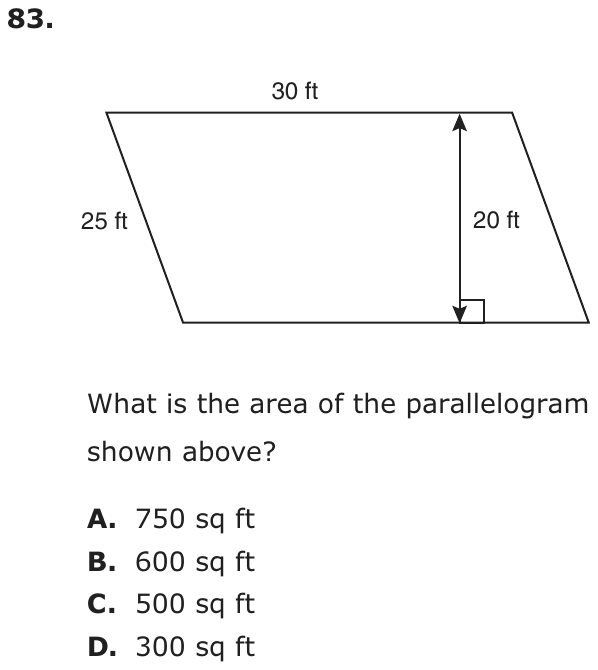
Question 19 of 49
2024 Test A Math, question 39Question
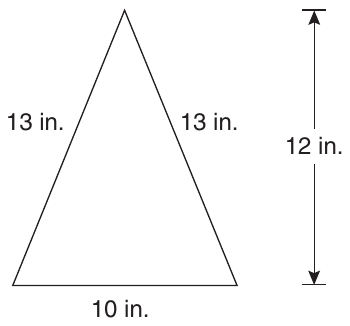
Raquel is cutting out pieces of cardboard to make a pyramid. She will use a square piece for the base and identical triangular pieces for the sides. The figure above shows the dimensions of the triangle for each side. What will be the total surface area, in square inches, of the pyramid, including the square base?
- A280
- B295
- C340
- D360
Show the answer
Correct answer: C
Surface area is found by calculating the area of each side, including the base, and adding them all together.
The base of the pyramid measures 10 inches on each side, so the area of the base is
Each triangular face has a base of 10 inches and a height of 12 inches, so the area of each face is
There are 4 triangular faces (because the square base has 4 edges, each of which will have a triangular face). So the total surface area of the pyramid is the sum of the areas of 4 triangles and 1 square.
So the total surface area is 340 square inches.
Question analysis
This surface area word problem shows one triangular face, with sides of 13 inches, a base of 10 inches and a height of 12 inches, that Raquel will use to build a cardboard pyramid with a square base. Students find the total area of the base and all the triangular sides. Picturing the solid and choosing the right measurements from the figure are the tricky parts.
- Grade level
- Grade 7 content, by NYS standard
- Compared with grade 7
- Above grade 7 Grade 7 students find the surface area of a pyramid from a drawn net or solid. Here only one triangular face is shown, so students must picture the whole pyramid, count its faces, and choose which labeled length belongs in the area formula.
- Estimated difficulty
- Hard: combines ideas, needs a plan, and has more than one tempting wrong answer.
- Thinking it demands
- Depth of knowledge 2, skills and concepts · mainly apply
- What makes it hard
- Reading a figure, table or graph moderate
- Combines ideas moderate
- Something you must already know minor
- Solution
- 4 steps
- Reading level
- Question and choices: about grade 6, 56 words.
- Corrected from the DOE handbook
- A wrong unit in the explanation was corrected.
- Students, last 30 days
- Not enough answers yet to show (it takes 10).
Why it is hard, traps and wrong answers (shows the answer)
Why it is hard
Students have to build the pyramid in their heads from one flat triangle, then choose the right measurement from three labels. The 13-inch sides look like the natural height, and using them gives a listed total; picturing a pyramid with three sloping faces gives another. Sketching the square base with a triangle on each edge, and marking 12 as the height, settles both the face count and the formula.
Reading a figure, table or graph moderate Understanding the question
The figure gives one triangle with three length labels, 13, 13 and 10, and puts its height, 12, on a separate arrow beside it, where it is easy to overlook. (Lesh, Post & Behr, 1987; Kirsch & Mosenthal, 1990)
Combines ideas moderate Working it out
The solid is never drawn: students must see that the square's side equals the triangle's 10-inch base, count four triangles, and add triangle and square areas. (Embretson, 1998; Daniel & Embretson, 2010)
Something you must already know minor Working it out
A triangle's area uses its perpendicular height, not a slanted side, and a pyramid on a square base has four triangular faces; neither fact is given. (Anderson & Krathwohl, 2001)
Strategy: Sketch the pyramid: a square base whose side is the triangle's base, and one triangular face on each side of the square. Find each area with the matching formula, then add them all.
Traps
- Misreads the figure: Reads a value, label or tick spacing in a figure, table or graph wrongly.
- Information you don't need: The question gives numbers or facts that play no part in the answer.
- Misunderstands the concept: A wrong belief about a concept: that percents can be added, that area grows like length, that averages can be averaged, that a bigger denominator means a bigger fraction.
The wrong answers, classified
A Misunderstands the concept (Smith, diSessa & Roschelle, 1993; De Bock et al., 1998; Ni & Zhou, 2005)
Counts only three triangular faces, as if the pyramid had a triangular base, so 3 × 60 + 100 = 280.
B Misunderstands the concept (Smith, diSessa & Roschelle, 1993; De Bock et al., 1998; Ni & Zhou, 2005)
Counts three faces and also uses the 13-inch side as each triangle's height: 3 × 65 + 100 = 295.
D Misreads the figure (Lesh, Post & Behr, 1987; Kirsch & Mosenthal, 1990)
Takes the 13-inch slanted side as each triangle's height instead of the 12-inch arrow beside it, so 4 × 65 + 100 = 360.
What was corrected from the DOE handbook, and why
- Explanation: The handbook ends “So the total surface area is 340 square feet.” The triangle’s dimensions are in inches and the question asks for square inches, so the site now reads “340 square inches.”
Worked solution, step by step
Formulas used
- Area of a triangle
- A is the area. b is the base, the side the triangle sits on. h is the height: the straight-up distance from the base to the top corner, at a right angle to the base. You take half because a triangle is half of a rectangle with the same base and height.
- Area of a square
- A is the area and s is the length of one side. All four sides of a square are equal, so the area is side times side.
- Surface area
- A face is one flat side of a solid shape. The surface area is the total area of the outside. Picture unfolding the solid into flat pieces. Then add up the area of every piece.
Sort out the question
Raquel’s pyramid has a square base. Each side is a triangle like the one in the figure. The triangle’s base is 10 in. Its two slanted sides are 13 in. Its height, the arrow beside it, is 12 in. You need the total surface area, including the square base, in square inches.
Picture the pyramid
Surface area is the total area of all the flat sides, called faces. Each triangle stands on one edge of the square. So each edge of the square is 10 inches, the same as the triangle’s base. A square has 4 edges, so the pyramid has 4 triangles.
Here that is 4 triangles plus 1 square. Watch out: counting only 3 triangles gives 280, choice A.
Find the area of one triangle
Each triangle is 60 square inches. Watch out: the height is 12 in., the straight-up arrow. It is not 13 in., the slanted side. Using 13 gives 65 for each triangle and 360 in all, choice D.
Find the area of the base
The base is a square with sides of 10 inches, the same as each triangle’s base.
The square base is 100 square inches.
Add all five faces
The four triangles and the square together cover 340 square inches.
So the answer is C, 340 square inches.
Check your answer
Each triangle is half of a 10 by 12 rectangle, which has an area of 120. So two triangles make 120, and four make 240. Add the base: . The units fit too: inches times inches gives square inches.
More questions like this
The original DOE question
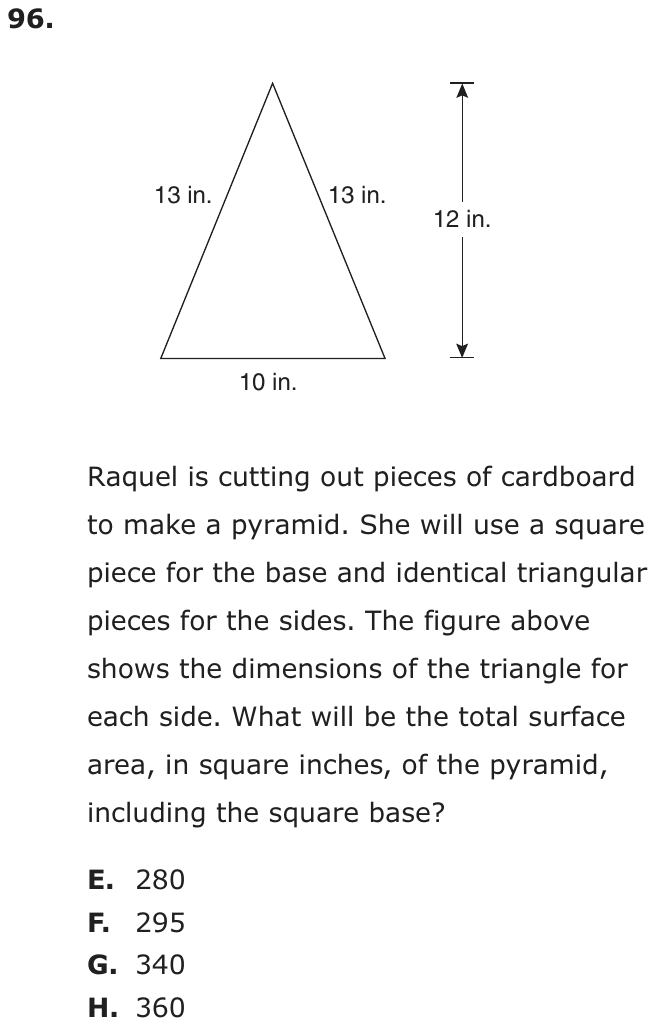
Question 20 of 49
2024 Test B English, question 40Passage Invention of the Telegraph
Samuel Morse, an American inventor, is credited with creating the electronic telegraph, a communication device that allows users to send messages using a system of short and long pulses that represent letters, numbers, and punctuation. In 1843 the United States Congress passed the Telegraph Bill, which provided Morse with the funds to build an electric telegraph system.
Invention of the Telegraph
Earlier Signal Systems
Long before Samuel F. B. Morse electrically transmitted his famous message “What hath God wrought?” from Washington to Baltimore on May 24, 1844, there were signaling systems that enabled people to communicate over distances. Most were visual or “semaphore” systems using flags or lights. In the eighteenth century, such systems used an observer who would decipher a signal from a high tower on a distant hill and then send it on to the next station. The young American republic wanted just such a system along its entire Atlantic coast and offered a prize of $30,000 for a workable proposal. The framers of this legislation had no way of knowing that when they used the word “telegraph” to refer to this visual semaphore system, they would be offered an entirely new and revolutionary means of communication—electricity.
The Growth of an Idea
The idea of using electricity to communicate over distance is said to have occurred to Morse during a conversation aboard ship when he was returning from Europe in 1832. Michael Faraday’s recently invented electromagnet was much discussed by the ship’s passengers, and when Morse came to understand how it worked, he speculated that it might be possible to send a coded message over a wire. While a student at Yale College years before, he had written his parents a letter about how interesting he found the lectures on electricity. Despite what he had learned at Yale, Morse found when he began to develop his idea that he had little real understanding of the nature of electricity, and after sporadic attempts to work with batteries, magnets, and wires, he finally turned for help to a colleague at the University of the City of New York, Leonard D. Gale.
Gale was a professor of chemistry and familiar with the electrical work of Princeton’s Joseph Henry, a true pioneer in the new field. Well before Morse had his shipboard idea about a telegraph, Henry rang a bell at a distance by opening and closing an electric circuit. In 1831, he had published an article, of which Morse was unaware, that contained details suggesting the idea of an electric telegraph. Gale’s help and his knowledge of this article proved crucial to Morse’s telegraph system because Gale not only pointed out flaws in the system but showed Morse how he could regularly boost the strength of a signal and overcome the distance problems he had encountered by using a relay system Henry had invented. Henry’s experiments, Gale’s assistance, and, soon after, hiring the young technician Alfred Vail were keys to Morse’s success.
Obstacles and Opportunities
By December 1837, Morse had enough confidence in his new system to apply for the federal government’s appropriation, and during the next year he conducted demonstrations of his telegraph both in New York and Washington.
However, when the economic disaster known as the Panic of 1837 took hold of the nation and caused a long depression, Morse was forced to wait for better times. It was during this period that Morse visited Europe again and tried not only to secure patent protection overseas but to examine competing telegraph systems in England. . . .
By 1843, the country was beginning to recover economically, and Morse again asked Congress for the $30,000 that would allow him to build a telegraph line from Washington to Baltimore, forty miles away. The House of Representatives eventually passed the bill containing the Morse appropriation, and the Senate approved it in the final hours of that Congress’s last session. With President Tyler’s signature, Morse received the cash he needed and began to carry out plans for an underground telegraph line.
Realizing a Great Invention
Morse had hired the ingenious construction engineer Ezra Cornell to lay the pipe carrying the wire, and although Cornell did his job superbly, one of Morse’s partners, Congressman F. O. J. Smith, had purchased wire with defective insulation. Too much time had been wasted laying bad wire, and with the project on a rigid deadline, something had to be done quickly. Cornell suggested that the fastest and cheapest way of connecting Washington and Baltimore was to string wires overhead on trees and poles. The desperate Morse gave the go-ahead, and the line was completed in time for the dramatic and spectacularly successful link between the Supreme Court chamber of the Capitol building and the railroad station in Baltimore.
Soon, as overhead wires connected cities up and down the Atlantic coast, the dots-and-dashes method that recorded messages on a long moving strip of paper was replaced by the operator’s ability to interpret the code in real time. . . . Telegraph lines soon extended westward, and within Morse’s own lifetime they connected the continents of Europe and America.
“Invention of the Telegraph”—Public Domain/Library of Congress
legislation: Telegraph Bill
dots-and-dashes method: the short and long pulses of Morse code that are sent and received by telegraph operators
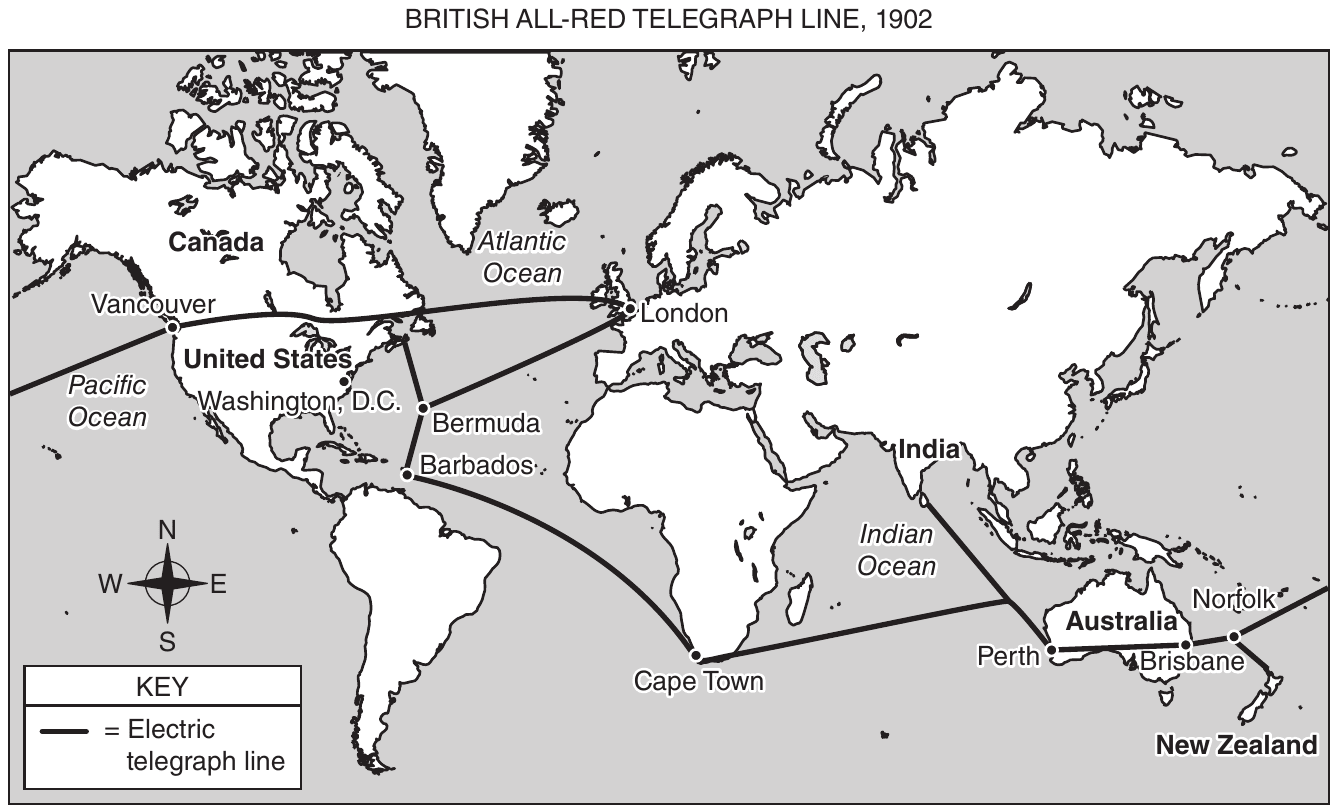
The first transatlantic electric telegraph message was sent in 1858, and by 1902 the British All-Red Line connected most of the world.
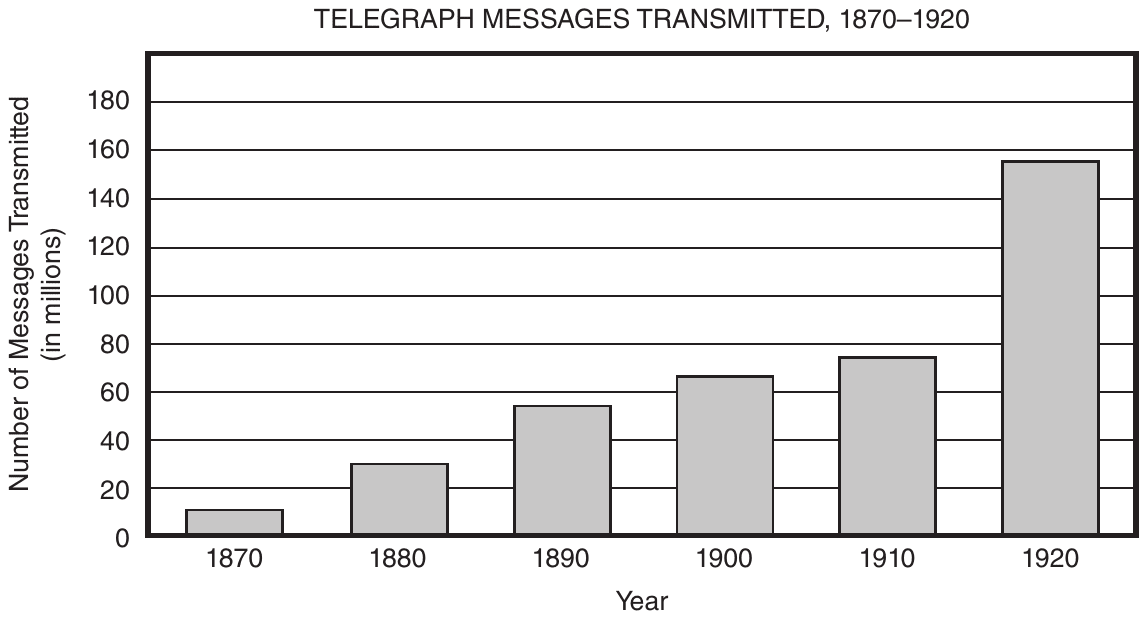
Source: U.S. Bureau of the Census. Historical Statistics of the United States, Colonial Times to 1970, Bicentennial Edition, Part 2. Washington, D.C., 1975.
Question
How does the map provide additional support for a central idea of the passage?
- Aby demonstrating that Morse’s telegraph system greatly exceeded the limitations of previous long-distance communication systems
- Bby indicating that Morse was lacking foresight by seeking a patent only in North America
- Cby proving that Gale’s advice helped Morse extend the telegraph’s range much farther than first thought possible
- Dby showing that the Morse telegraph had a surprisingly immense influence across the world
Show the answer
Correct answer: A
The question asks how the map provides additional support for a central idea of the passage.
A. CORRECT. The map shows the telegraph line crossing continents in 1902, just forty-four years after the first transatlantic message was sent in 1858. This is a much greater distance than the first line Morse built between “the Supreme Court chamber of the Capitol building and the railroad station in Baltimore” (paragraph 7).
B. Incorrect. The map shows the distance the line covers; it does not indicate Morse’s lack of foresight in seeking patents only in North America.
C. Incorrect. While Gale’s advice was crucial to Morse’s success, the map shows the physical line stretching across continents many years later, after their initial work.
D. Incorrect. While it can be inferred that the telegraph had influence across the world, the amount of influence cannot be determined.
Question analysis
This question pairs “Invention of the Telegraph” with a map of the British All-Red Telegraph Line in 1902 and asks how the map adds support for a central idea of the passage. Students must read a world map with a key and a caption, connect what it shows to the story of Samuel Morse’s invention, and sort through four claims about the map that vary in how far they go.
- Grade level
- Grade 8 reading and task
- Compared with grade 7
- Above grade 7 Linking a graphic to a text is familiar grade 7 work. Here students must pin down a central idea of the passage and work out how a 1902 world map, made decades after Morse’s first line, bears on it, a step beyond typical demand.
- Estimated difficulty
- Hard: combines ideas, needs a plan, and has more than one tempting wrong answer.
- Thinking it demands
- Depth of knowledge 3, strategic thinking · mainly analyze
- What makes it hard
- A very close wrong answer major
- Evidence in several places moderate
- Reading a figure, table or graph moderate
- Evidence
- Answered from the whole text
- Reading level
- Passage: about grade 11, 910 words; question and choices: about grade 11, 75 words.
- Corrected from the DOE handbook
- An inaccurate detail in the explanation was corrected.
- Students, last 30 days
- Not enough answers yet to show (it takes 10).
Why it is hard, traps and wrong answers (shows the answer)
Why it is hard
Lines on a map can prove how far the telegraph reached, and the question turns on how much more than that each choice claims. The key depends on a link back to paragraph 1, where a message went only as far as the next hilltop tower, read many minutes before the map. The influence choice skips that link and states the map’s message in bigger terms, so students who do not ask what a map of routes can show are drawn to it.
A very close wrong answer major Choosing the answer
The influence choice, a telegraph with “a surprisingly immense influence across the world,” sounds like a fair reading of lines circling the globe; it differs from the key in claiming impact and surprise rather than reach beyond earlier systems. (Embretson & Wetzel, 1987; Gorin & Embretson, 2006; Ascalon et al., 2007)
Evidence in several places moderate Working it out
The earlier systems the key measures against are in paragraph 1, towers on distant hills passing flag and light signals from station to station, far from the map at the end of the passage. (Kirsch & Mosenthal, 1990; Gorin & Embretson, 2006)
Reading a figure, table or graph moderate Understanding the question
The map shows a 1902 British line from London to Canada and Vancouver, south through Bermuda and Barbados to Cape Town, and on to India, Australia and New Zealand, with Washington left unconnected. (Lesh, Post & Behr, 1987; Kirsch & Mosenthal, 1990)
Strategy: Look at what the map and its caption actually show, sum up a central idea of the passage in your own words, and keep only a choice that both of them back up.
Traps
- Too broad or too strong: A choice overstates, generalizes, or uses absolute words the text does not support.
- Reads too much in: A reasonable-sounding conclusion that goes further than the text allows.
The wrong answers, classified
B Twists what the text says (King et al., 2004)
Reads the unconnected Washington dot as a patenting mistake of Morse’s, though a map of lines shows nothing about patents and paragraph 5 has him seeking protection overseas.
C Reads too much in (Graesser, Singer & Trabasso, 1994)
Remembers that Gale’s relay advice solved Morse’s “distance problems,” but a 1902 map that names no inventors cannot prove what that advice made possible decades earlier.
D Too broad or too strong (King et al., 2004)
Turns the map’s reach into a claim about impact, though routes on a map show where messages could travel, not how much the world changed or that anyone was surprised.
What was corrected from the DOE handbook, and why
- Explanation: The handbook says the 1902 line came “forty-four years after the first message was sent in 1858.” The first telegraph message was Morse’s in 1844 (paragraph 1); 1858 is the year of the first transatlantic message, as the map’s caption says. The site now says “the first transatlantic message.”
Working it out, step by step
Figure out what the question asks
This question asks how a graphic adds to the passage. You need two things. First, what does the map really show? Second, which central idea, a main point the whole passage builds, does it back up?
Read the map and its caption
This map is a picture of one British network of telegraph wires, as it stood in 1902. In its key, a thick black line stands for an electric telegraph line. From London, a line crosses the Atlantic Ocean and Canada to Vancouver. Other lines reach Bermuda, Barbados, Cape Town, India, Australia and New Zealand. According to the caption, by 1902 this network “connected most of the world.”
Recall the older ways of signaling
Next, compare that with paragraph 1. Before electricity, people signaled with flags or lights. An observer would “decipher a signal from a high tower on a distant hill and then send it on to the next station.” So a message could only jump as far as a person could see. Even Morse’s first line, in paragraph 6, reached Baltimore, just “forty miles away.”
Connect the map to that idea
The caption says the first message across the Atlantic was sent in 1858. Only 44 years later, in 1902, lines crossed several oceans and linked much of the globe. Paragraph 8 adds that telegraph lines “connected the continents of Europe and America” before Morse died. So the map supports a central idea: electric telegraph lines went far beyond the reach of older signal systems.
Check each choice
- A fits. Lines that span oceans go far past the limits of hilltop towers.
- B does not fit. A map of lines shows nothing about patents. Also, paragraph 5 says Morse sought patent protection in Europe, too.
- C does not fit. The map names no inventors, so it cannot prove what Gale’s advice did decades before.
- D does not fit. The map shows where lines went, not how much they changed the world, and nothing on it shows surprise.
Choose the answer
The map shows telegraph lines reaching around the globe, far past what flags and towers could do. So the answer is A.
Why this answer and not the closest wrong one
D is the closest trap, because lines around the world seem to prove a huge effect. But a map of routes shows only how far messages could travel. It cannot measure influence, and it cannot show that anyone was surprised. A sticks to what a map of lines can prove: the telegraph reached much farther than earlier systems.
More questions like this
The original DOE question
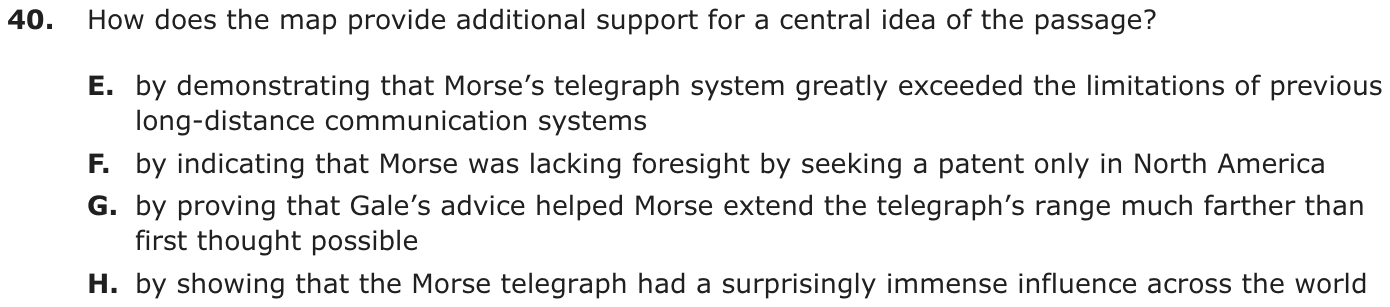
The passage “Invention of the Telegraph” as printed (pages 146–148)
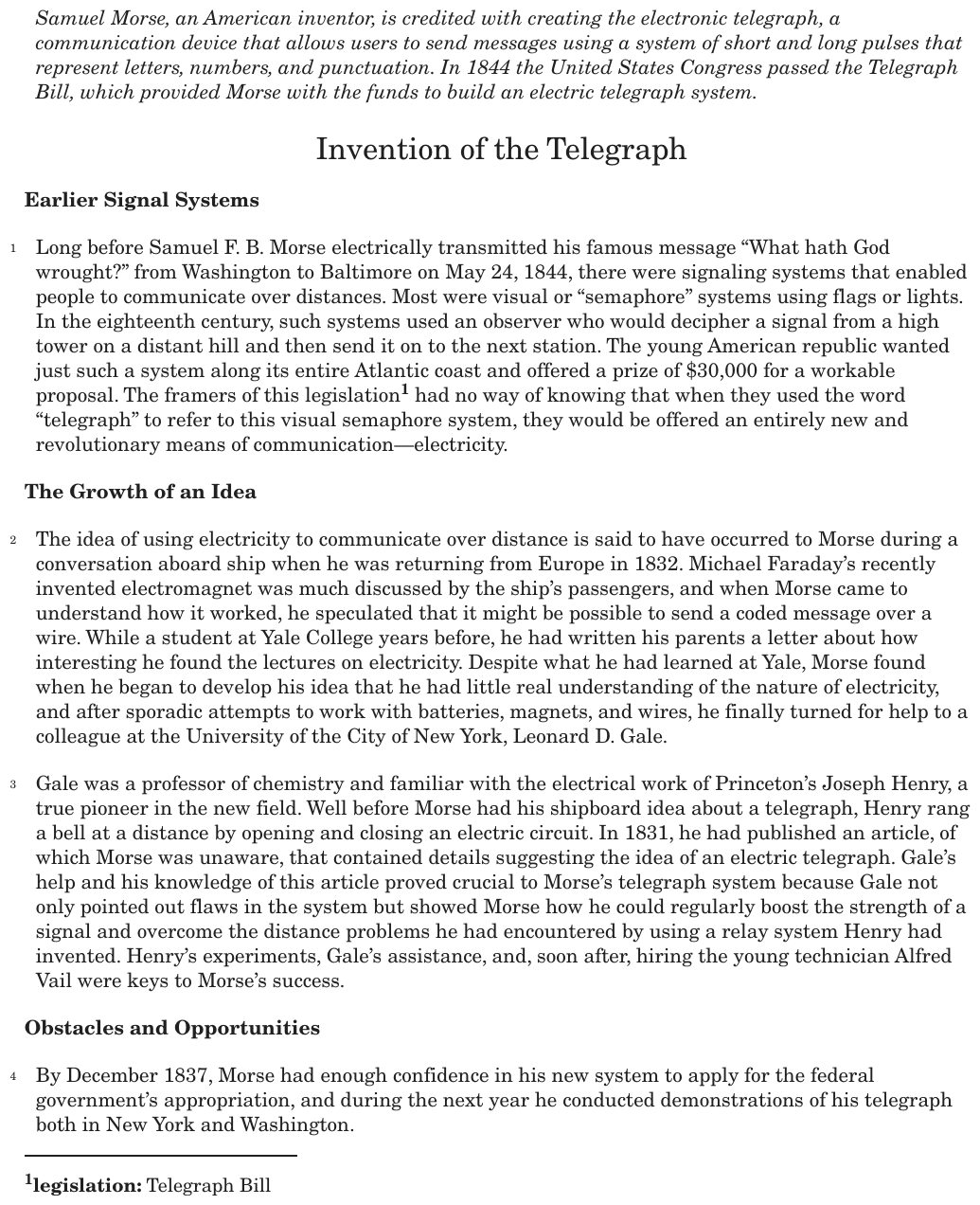
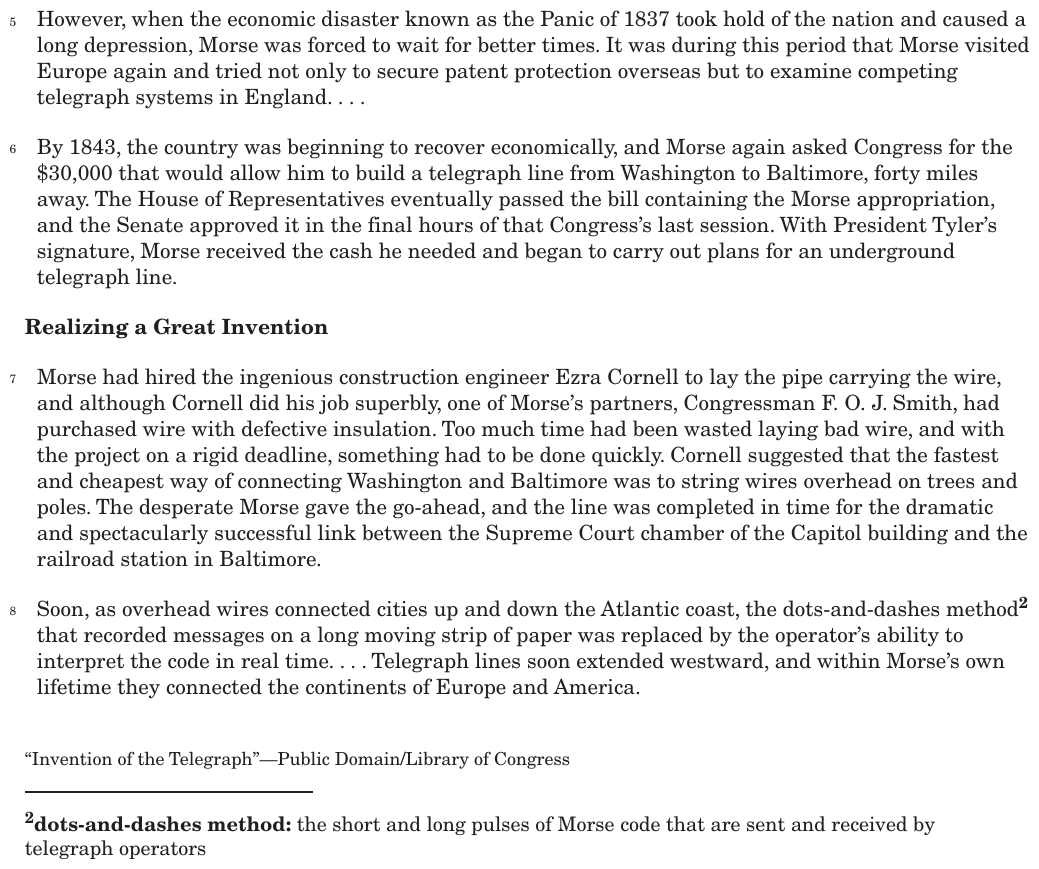
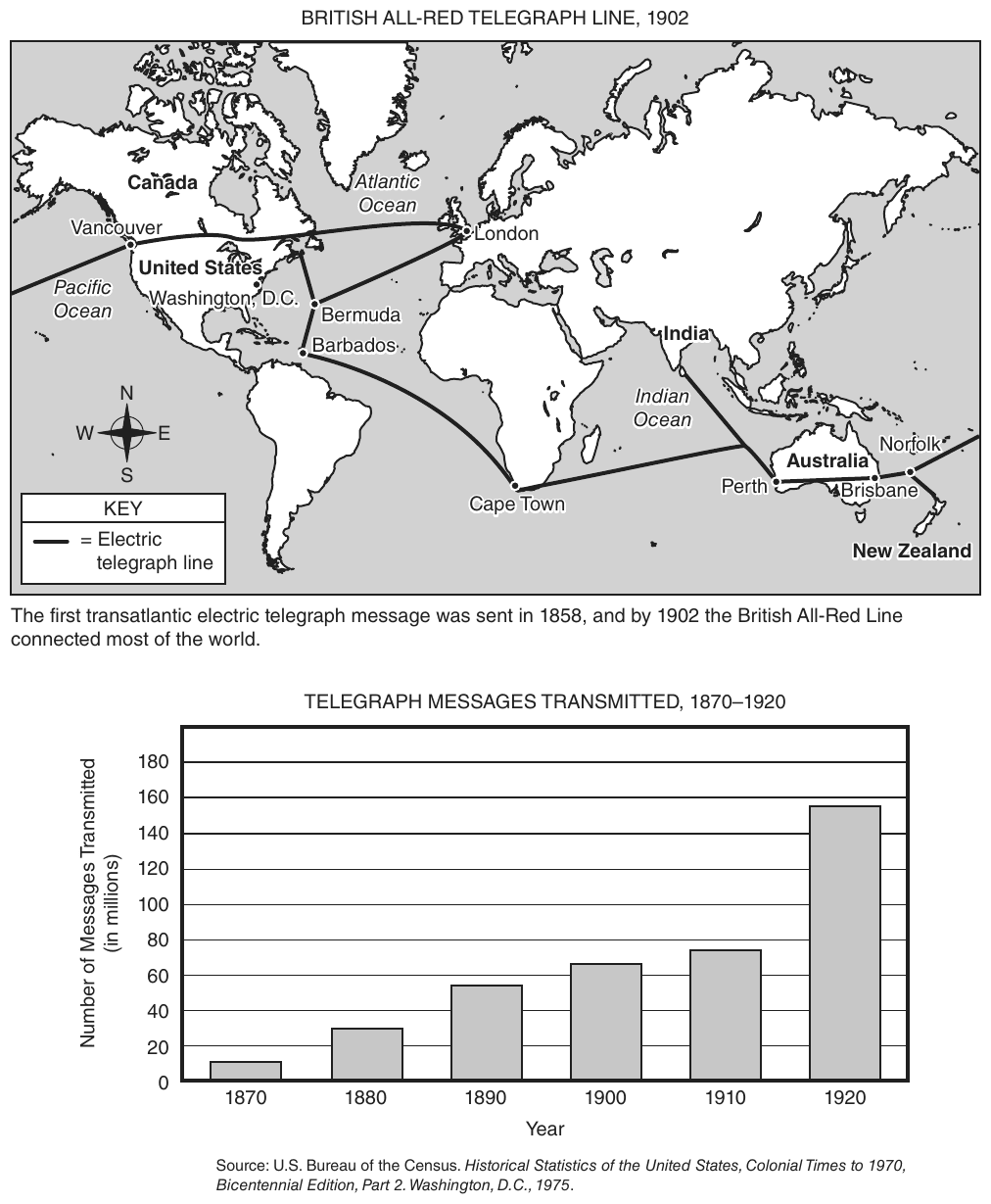
Question 21 of 49
2024 Test B Math, question 3Question
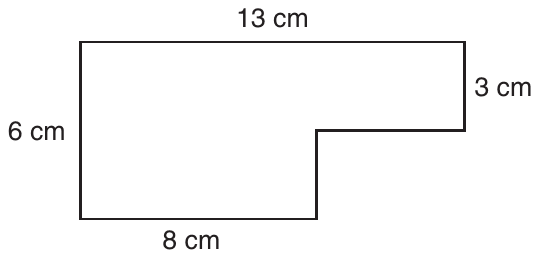
The figure above shows a scale drawing of a garden, where 1 centimeter represents 2.5 meters. What is the perimeter of the actual garden in meters?
Grid-in question: work out the answer and enter it as a number.
Show the answer
Correct answer: 95
First, find the perimeter of the figure.
Two sides do not have labels. The top of the figure measures 13 cm and the bottom shows a length measuring 8 cm, so the horizontal side without a label measures 5 cm .
The left side of the figure measures 6 cm and the right side shows a length measuring 3 cm, so the vertical side without a label measures 3 cm .
So the total perimeter of the scale drawing is
Use the scale to find the perimeter of the actual garden:
Question analysis
A grid-in on a scale drawing of an L-shaped garden, where each centimeter stands for 2.5 meters and two sides carry no labels. Students find the perimeter of the drawing, then convert it to the real garden's perimeter in meters. The unlabeled sides are easy to leave out.
- Grade level
- Grade 7 content, by NYS standard
- Compared with grade 7
- At grade 7 Scale drawings are grade 7 content, and a typical task converts one or two given lengths. Here two missing sides must be worked out and the perimeter assembled before the scale applies, more steps but nothing beyond grade 7.
- Estimated difficulty
- Moderate: several steps, or a close reading with one strong distractor.
- Thinking it demands
- Depth of knowledge 2, skills and concepts · mainly apply
- What makes it hard
- Reading a figure, table or graph moderate
- Combines ideas minor
- An answer in an unexpected form minor
- Solution
- 4 steps
- Reading level
- Question and choices: about grade 9, 24 words.
- Students, last 30 days
- Not enough answers yet to show (it takes 10).
Why it is hard, traps and wrong answers (shows the answer)
Why it is hard
The figure hides the work: it labels four of the six sides, and the missing two are short pieces of the notch that are easy to overlook. Once all six are found, the scale step is a single multiplication, but it must go the right way, since the real garden is larger than the drawing. Tracing the outline and counting six sides guards against the most common loss.
Reading a figure, table or graph moderate Understanding the question
Two sides of the notch carry no labels, so students must find them from the opposite sides: 13 − 8 = 5 cm across and 6 − 3 = 3 cm down. (Lesh, Post & Behr, 1987; Kirsch & Mosenthal, 1990)
Combines ideas minor Working it out
The perimeter of an L-shaped drawing has to be joined to a scale of 2.5 meters per centimeter, two separate skills in one answer. (Embretson, 1998; Daniel & Embretson, 2010)
An answer in an unexpected form minor Choosing the answer
With no choices, nothing flags a perimeter that is missing two sides or still in centimeters; the student must check the six-sided total alone. (Enright, Morley & Sheehan, 2002)
Strategy: Use the opposite sides to work out the two unlabeled lengths, add all six sides of the drawing, then multiply the total in centimeters by 2.5 meters per centimeter.
Traps
- Misreads the figure: Reads a value, label or tick spacing in a figure, table or graph wrongly.
- Stops one step early: A choice is a number from partway through the solution.
- Wrong operation: Adds instead of multiplying, divides the wrong way round, turns a ratio or rate upside down, or undoes a step in the wrong direction (subtracts what should be added back).
The wrong answers, classified
75 Misreads the figure (Lesh, Post & Behr, 1987; Kirsch & Mosenthal, 1990)
Adds only the four labeled sides, 13 + 3 + 8 + 6 = 30 cm, and scales that to 75 m, missing the two unlabeled sides of the notch.
38 Stops one step early (King et al., 2004; Gierl et al., 2017)
Finds the drawing's perimeter, 38 cm, correctly and grids it without applying the scale of 2.5 meters per centimeter.
15.2 Wrong operation (Hegarty, Mayer & Monk, 1995; King et al., 2004)
Divides the 38 cm perimeter by 2.5 instead of multiplying, shrinking the garden though each centimeter of the drawing stands for 2.5 meters.
Worked solution, step by step
Formulas used
- Perimeter
- P is the perimeter, the distance all the way around a shape. Add the length of every side, once each. It works for any shape with straight sides, even one with a corner cut out.
- Using a scale
- s is the scale, the number of meters that 1 centimeter on the drawing stands for. Here s is 2.5. Each centimeter on the drawing is 2.5 meters in real life, so you multiply.
Sort out what you know
The figure is a scale drawing, a small copy of the real garden. Each 1 cm on the drawing stands for 2.5 m in the real garden. You need the perimeter of the real garden in meters. The perimeter is the distance all the way around.
The shape has 6 sides. Four are labeled: 13 cm, 3 cm, 8 cm and 6 cm. The two sides around the cut-out corner have no labels.
Find the missing side across
Look at the top side, 13 cm. Below it, the bottom side (8 cm) and the short unlabeled side across the notch together reach just as far. So the missing side is the difference.
The missing side across is 5 cm.
Find the missing side going down
Now look at the left side, 6 cm. On the right, the 3 cm side and the unlabeled side going down together make the same height.
The missing side going down is 3 cm.
Add all six sides
The perimeter of the drawing is 38 cm. Watch out: adding only the four labeled sides gives 30 cm. That leads to the wrong answer 75.
Change to real meters
Each centimeter stands for 2.5 meters, so multiply by 2.5.
Here and . The real perimeter is 95 meters. Watch out: 38 is still in centimeters, so do not grid it. Dividing by 2.5 gives 15.2, which makes the garden smaller than its drawing.
So you would grid 95.
Check your answer
Slide the two notch sides out to the corner. The distance around stays the same, so it equals a 13 cm by 6 cm rectangle: . Also, 95 meters is more than 38, which fits, because each centimeter stands for more than 1 meter.
More questions like this
The original DOE question
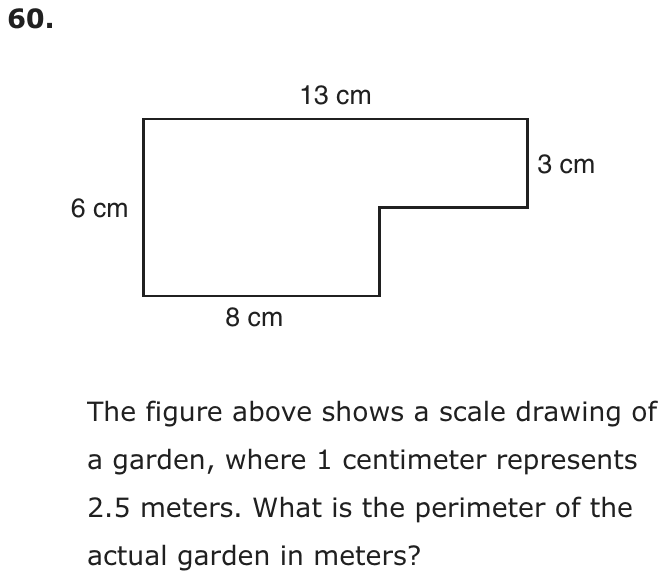
Question 22 of 49
2024 Test B Math, question 5Question
The figure below is a triangular prism. The lateral sides are rectangles.
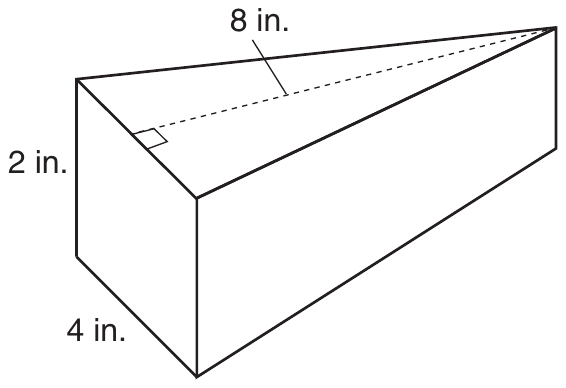
What is the volume of the figure, in cubic inches?
Grid-in question: work out the answer and enter it as a number.
Show the answer
Correct answer: 32
The volume of a triangular prism is found by multiplying the area of the triangular base by the height of the prism.
The area of the triangular base of the prism is square inches.
The height of the triangular prism is 2 inches.
So the volume of the triangular prism, in cubic inches, is .
Question analysis
A geometry grid-in: find the volume, in cubic inches, of a triangular prism drawn with its triangular faces on top and bottom. The drawing gives a 4-inch side of the triangle, a dashed 8-inch height drawn to that side, and a 2-inch edge. Students must recall the volume formula and match each length to its role.
- NYS standards
- 7.G.6 area, surface area, and volume
- Grade level
- Grade 7 content, by NYS standard
- Compared with grade 7
- At grade 7 Finding the volume of a right triangular prism is named in the grade 7 standards, and this is a direct two-step case. The only extra demand is reading a slanted drawing to see which length plays which role.
- Estimated difficulty
- Straightforward: two steps or one careful reading.
- Thinking it demands
- Depth of knowledge 2, skills and concepts · mainly apply
- What makes it hard
- Solution
- 2 steps
- Reading level
- Question and choices: about grade 5, 22 words.
- Students, last 30 days
- Not enough answers yet to show (it takes 10).
Why it is hard, traps and wrong answers (shows the answer)
Why it is hard
The question rewards knowing that a prism's volume is its base area times its height, then matching each length to its job. The drawing lies on its side, with a short 2-inch height and the triangle flat on top, which makes the base harder to spot. Most lost points come from the one half: leaving it out doubles the volume, and stopping at the triangle's area gives half of it.
Something you must already know moderate Working it out
Neither formula is given: the volume is the area of the triangular base times the prism's height, and that area needs the one half in 1/2 × base × height. (Anderson & Krathwohl, 2001)
Reading a figure, table or graph minor Understanding the question
The prism lies with its triangles on top and bottom, so the 2-inch vertical edge is its height, while the dashed 8-inch line is the triangle's height to the 4-inch side. (Lesh, Post & Behr, 1987; Kirsch & Mosenthal, 1990)
An answer in an unexpected form minor Choosing the answer
There are no choices, so a product that forgets the one half, or one that stops at the area of the triangle, gives no warning. (Enright, Morley & Sheehan, 2002)
Strategy: Find the area of the triangular face as one half times base times height, using the 4-inch side and the dashed 8-inch height, then multiply by the 2-inch edge of the prism.
Traps
- Wrong formula: Uses a related but wrong formula: perimeter for area, diameter for radius, area for volume, or a misremembered one.
- Stops one step early: A choice is a number from partway through the solution.
- A formula you must know: Needs a formula the test does not give: area, circumference, volume, probability rules.
The wrong answers, classified
64 Wrong formula (King et al., 2004)
Multiplies 4 × 8 × 2 = 64 as for a rectangular box, leaving out the one half in the area of the triangular base.
16 Stops one step early (King et al., 2004; Gierl et al., 2017)
Finds the triangle's area, 1/2 × 4 × 8 = 16 square inches, and stops before multiplying by the prism's 2-inch height.
Worked solution, step by step
Formulas used
- Area of a triangle
- A is the area. b is the base, one side of the triangle. h is the height, the straight distance from that side to the opposite corner, at a right angle to the side. You take half because a triangle is half of a rectangle with the same base and height.
- Volume of a prism
- V is the volume, the space inside. B is the area of the base, the shape at each end. H is the height of the prism, the distance between the two ends. It works because the prism is like a stack of layers, each the shape of the base.
Sort out the figure
A prism is a solid with two matching ends joined by flat sides. Here the ends are triangles, on the top and bottom. The other sides are rectangles. You need the volume, the space inside, in cubic inches.
The dashed line on the top triangle is 8 in. It meets one side of the triangle at a right angle (the small square). The bottom edge under that side is 4 in. The edge going straight up is 2 in.
Find the triangle’s base and height
The side that the dashed line meets is the top edge of a rectangle face. Opposite sides of a rectangle are equal. So that side is 4 in., the same as the bottom edge under it.
So the triangle has a base of 4 in. Its height is the dashed line, 8 in., because it meets the base at a right angle.
Find the area of the triangle
The triangle’s area is 16 square inches. Watch out: 16 is only the area of one end. Stopping here gives the wrong answer 16.
Multiply by the prism’s height
The height of the prism is the distance between the two triangles. That is the 2 in. edge.
The volume is 32 cubic inches. Watch out: do not forget the one half. is the volume of a box, not of this prism.
So you would grid 32.
Check your answer
Picture a box that is 4 in. by 8 in. by 2 in. Its volume is cubic inches. The triangle has half the area of a 4 by 8 rectangle, so the prism holds half as much as the box. Half of 64 is 32.
More questions like this
The original DOE question
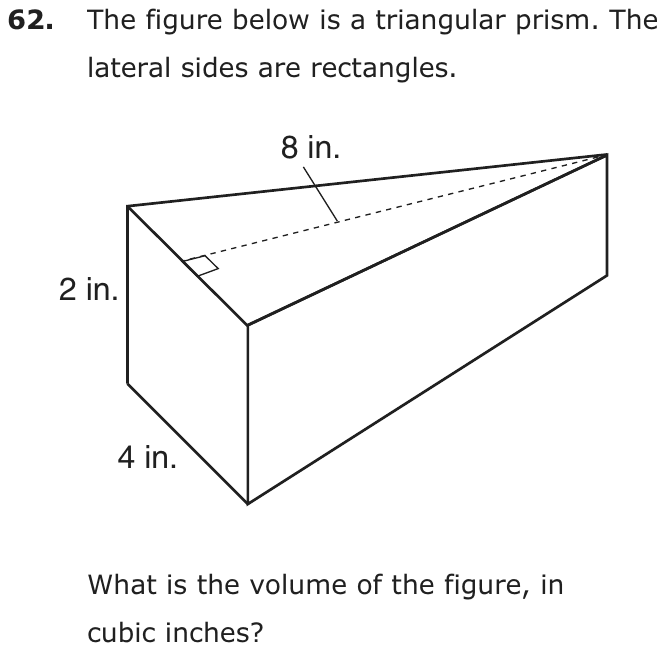
Question 23 of 49
2024 Test B Math, question 32Question
Two circular plates have the dimensions shown.
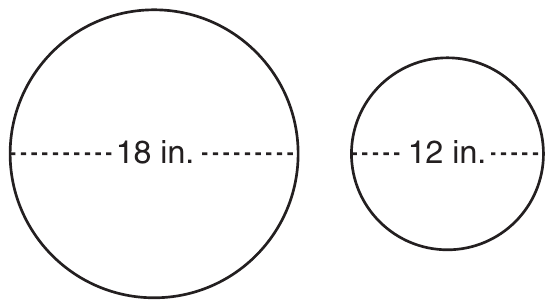
What is the difference between the areas of the two plates, in square inches?
- A
- B
- C
- D
Show the answer
Correct answer: C
First, determine the area of each circle using the formula :
A circle with a diameter of 18 inches has a radius of 9 inches, so the area is .
A circle with a diameter of 12 inches has a radius of 6 inches, so the area is .
The difference between the two areas is .
Question analysis
Two circular plates are drawn with their diameters marked in inches, and students find the difference between their areas in square inches, in terms of pi. It tests the area of a circle. The diameters, not the radii, are marked, so a step comes before the area formula, which the test does not provide.
- NYS standards
- 7.G.4 circle area and circumference
- Grade level
- Grade 7 content, by NYS standard
- Compared with grade 7
- At grade 7 Finding a circle's area is a grade 7 standard, and this asks for two areas and their difference. It matches typical classwork: the formula must be recalled and each diameter halved first, with no further twist.
- Estimated difficulty
- Straightforward: two steps or one careful reading.
- Thinking it demands
- Depth of knowledge 1, recall and reproduction · mainly apply
- What makes it hard
- Solution
- 3 steps
- Reading level
- Question and choices: about grade 5, 25 words.
- Students, last 30 days
- Not enough answers yet to show (it takes 10).
Why it is hard, traps and wrong answers (shows the answer)
Why it is hard
Two area calculations and a subtraction, kept in terms of π, make this routine for students who know the area formula. Points are lost by using the labeled diameters as radii, by subtracting circumferences, or by subtracting the radii before squaring, and each of these has a listed answer. Writing both areas, 81π and 36π, before subtracting avoids all three.
Something you must already know moderate Working it out
The area formula A = πr² is not given, and the figure labels each plate by its diameter, so 18 and 12 must be halved to radii of 9 and 6 first. (Anderson & Krathwohl, 2001)
Reading a figure, table or graph minor Understanding the question
The dashed lines run all the way across each circle, which marks them as diameters; reading the 18 in. and 12 in. as radii leads to a listed choice. (Lesh, Post & Behr, 1987; Kirsch & Mosenthal, 1990)
Strategy: Halve each diameter to get the radius, find each plate's area as pi times the radius squared, and subtract the smaller area from the larger.
Traps
- Wrong formula: Uses a related but wrong formula: perimeter for area, diameter for radius, area for volume, or a misremembered one.
- A faulty procedure: A systematic but wrong procedure: adding fractions straight across, applying an exponent to each term of a sum, dropping a sign when moving a term.
- A formula you must know: Needs a formula the test does not give: area, circumference, volume, probability rules.
The wrong answers, classified
A Wrong formula (King et al., 2004)
Subtracts the circumferences, 18π − 12π = 6π, using πd, the distance around a circle, in place of the area formula.
B A faulty procedure (Brown & Burton, 1978; Tatsuoka, 1983)
Subtracts the radii first, 9 − 6 = 3, and then squares, π(3)² = 9π, as if the difference of two squares were the square of the difference.
D Wrong formula (King et al., 2004)
Uses the labeled diameters as radii, π(18)² − π(12)² = 324π − 144π = 180π, forgetting to halve them first.
Worked solution, step by step
Formulas used
- Area of a circle
- A is the area, the flat space inside the circle. r is the radius, the distance from the center to the edge. It is half the diameter. π (pi) is a fixed number, about 3.14. r² means r × r. Use it for the space inside any circle.
Sort out the question
Each dashed line goes all the way across its circle, through the center. A line like that is a diameter. The big plate has a diameter of 18 inches. The small plate has a diameter of 12 inches.
You need the difference between the two areas. That means the big area minus the small area, in square inches.
Find each radius
The area formula uses the radius, not the diameter. The radius is half the diameter.
The radii are 9 inches and 6 inches. Watch out: If you use 18 and 12 as the radii, you get , choice D.
Find the big plate’s area
The big plate’s area is square inches. Keep π as a symbol, since all the choices use π.
Find the small plate’s area
The small plate’s area is square inches. Squaring means multiplying a number by itself, so .
Subtract the two areas
Subtract the numbers in front of π, just as 81 apples minus 36 apples is 45 apples. The difference is square inches.
Watch out: Don’t subtract the radii first. Squaring 9 − 6 = 3 gives , choice B. Subtracting the distances around the plates, , gives , choice A. That uses the wrong formula.
So the answer is C, .
Check your answer
Estimate with π about 3. The big plate is about square inches. The small one is about . The difference is about 135, and . It matches.
More questions like this
The original DOE question
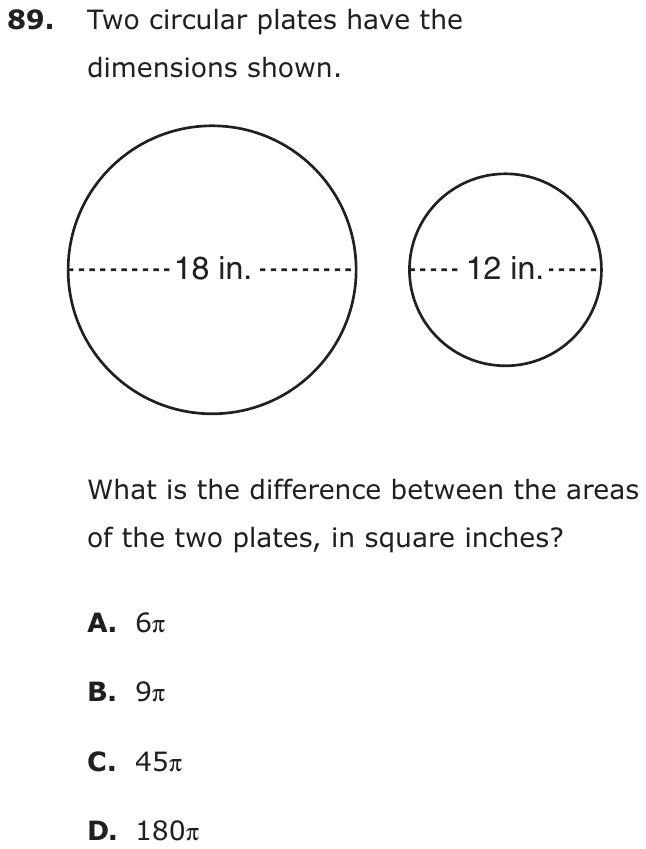
Question 24 of 49
2024 Test B Math, question 39Question
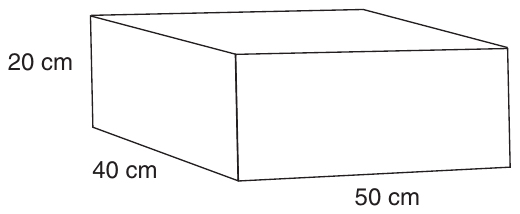
What is the total surface area, in square centimeters, of the closed box shown above?
- A3,800
- B5,600
- C7,600
- D40,000
Show the answer
Correct answer: C
To find surface area, use the formula :
Question analysis
A drawing of a closed box gives its length, width and height in centimeters, and students find its total surface area in square centimeters. It tests surface area of a rectangular prism. The work is short, but every face of the box has to be accounted for, and surface area must be kept apart from volume.
- Grade level
- Grade 7 content, by NYS standard
- Compared with grade 7
- At grade 7 Surface area of a rectangular prism is a grade 7 standard, and this box has whole-number dimensions shown in a drawing. Three face areas, a sum and the opposite faces make it typical practice rather than a stretch.
- Estimated difficulty
- Straightforward: two steps or one careful reading.
- Thinking it demands
- Depth of knowledge 1, recall and reproduction · mainly apply
- What makes it hard
- Solution
- 3 steps
- Reading level
- Question and choices: about grade 8, 15 words.
- Students, last 30 days
- Not enough answers yet to show (it takes 10).
Why it is hard, traps and wrong answers (shows the answer)
Why it is hard
Finding the three face areas, 800, 1,000 and 2,000, is quick; the question tests whether students account for all six faces. The wrong choices are what the box would give with only three faces, with the top left off, or with the dimensions multiplied into a volume. Listing the faces in pairs before adding is the safest route.
Something you must already know minor Working it out
No surface-area formula is given; students must know that a box's six faces come in three matching pairs, 20 × 40, 20 × 50 and 40 × 50. (Anderson & Krathwohl, 2001)
Reading a figure, table or graph minor Understanding the question
The drawing shows only three faces and labels 20, 40 and 50 cm on separate edges, so the hidden faces and their dimensions have to be pictured. (Lesh, Post & Behr, 1987; Kirsch & Mosenthal, 1990)
Strategy: Find the areas of the three different faces from the labeled length, width and height, add them, and double the sum to cover the opposite faces.
Traps
- Stops one step early: A choice is a number from partway through the solution.
- Wrong formula: Uses a related but wrong formula: perimeter for area, diameter for radius, area for volume, or a misremembered one.
- Misreads the question: Misses or misreads a condition or a word in the question: "at least", "each", "remaining", "not".
The wrong answers, classified
A Stops one step early (King et al., 2004; Gierl et al., 2017)
Adds the three different face areas, 800 + 1,000 + 2,000 = 3,800, and stops before doubling for the matching opposite faces.
B Misreads the question (Hegarty, Mayer & Monk, 1995)
Leaves out the 40-by-50 top, as for an open box, 7,600 − 2,000 = 5,600, though the stem says the box is closed.
D Wrong formula (King et al., 2004)
Multiplies the three dimensions, 20 × 40 × 50 = 40,000, which is the box's volume in cubic centimeters, not its surface area.
Worked solution, step by step
Formulas used
- Surface area of a box
- SA is the surface area, the total area of all six faces. l is the length, w is the width and h is the height. lw, lh and wh are the areas of the three different faces. You double because each face has a matching face on the opposite side.
Sort out the question
The box is a rectangular prism, a box shape with six rectangle faces. Its length is 50 cm, its width is 40 cm and its height is 20 cm.
The box is closed, so it has a top. Surface area is the total area of all the outside faces, in square centimeters.
Find the three different faces
The faces come in matching pairs. Find the area of one face from each pair. Multiply its two edges.
Faces Edges Area of one (sq cm) Front and back 50 × 20 1,000 Left and right 40 × 20 800 Top and bottom 50 × 40 2,000 Add the faces and double
Use the formula. Add the three areas. Then double the sum to cover the matching faces you can’t see.
The surface area is 7,600 square centimeters.
Avoid the traps
Watch out: Stopping at 3,800 counts only three faces, choice A. Leaving off the top, as for an open box, gives 5,600, choice B. Multiplying all three edges gives 40,000, choice D. That is the volume, in cubic centimeters.
So the answer is C, 7,600.
Check your answer
Add all six faces one by one: . Also check the units. Area multiplies two lengths, so it is in square centimeters. Multiplying three lengths gives cubic units, which is volume.
More questions like this
The original DOE question
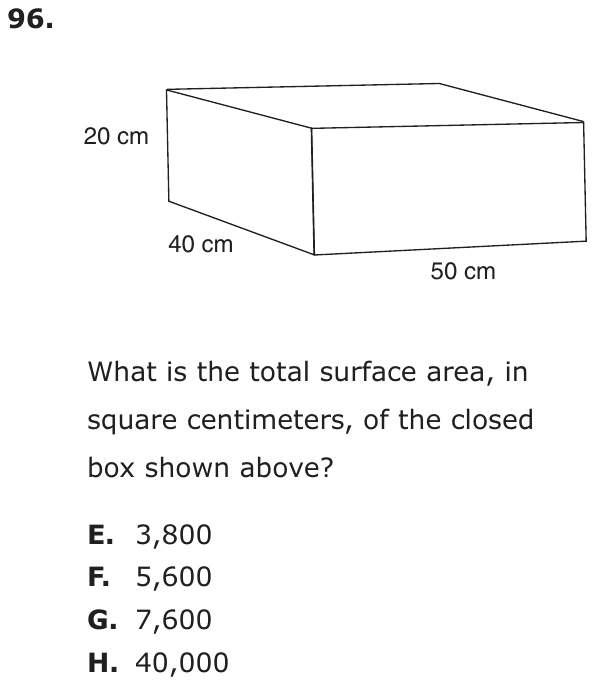
Question 25 of 49
2024 Test B Math, question 48Question
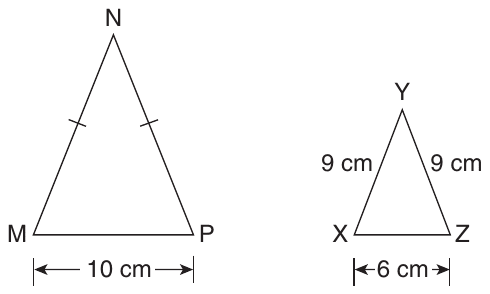
Triangle MNP is similar to triangle XYZ, and . What is the perimeter of triangle MNP?
- A25 cm
- B30 cm
- C36 cm
- D40 cm
Show the answer
Correct answer: D
Similar geometric figures have sides that are proportional.
Because , both unknown sides are equal to 15. Therefore, the three sides of MNP are 15, 15, and 10. The perimeter of a triangle is the sum of its three side lengths.
Question analysis
Two isosceles triangles are drawn, one with all its side lengths labeled and the other with only its base labeled, and the triangles are similar. Students find the perimeter of triangle MNP in centimeters. It tests similar figures and proportional sides, and the catch is that two sides must be found from the scale and the equal-sides marks.
- Grade level
- Grade 8 content, by NYS standard
- Compared with grade 7
- Above grade 7 Similar triangles are grade 8 geometry, though grade 7 scale drawings use the same proportional reasoning. Students also need the equal-sides marks to find a missing side, a combined step beyond routine grade 7 scale work.
- Estimated difficulty
- Moderate: several steps, or a close reading with one strong distractor.
- Thinking it demands
- Depth of knowledge 2, skills and concepts · mainly apply
- What makes it hard
- Solution
- 3 steps
- Reading level
- Question and choices: about grade 3, 20 words.
- Students, last 30 days
- Not enough answers yet to show (it takes 10).
Why it is hard, traps and wrong answers (shows the answer)
Why it is hard
The question chains a scale factor to a perimeter, and both links have a trap. Some students scale by adding, since the base grew by 4, and others find the 15 cm leg correctly but then add only some of the sides. Writing all three sides of the large triangle, 15, 15 and 10, before adding is what the question rewards.
Reading a figure, table or graph moderate Understanding the question
The figure carries every number: tick marks show MN = NP, the base MP is 10 cm, and triangle XYZ has 9 cm legs on a 6 cm base. (Lesh, Post & Behr, 1987; Kirsch & Mosenthal, 1990)
Something you must already know minor Working it out
Students must know that corresponding sides of similar triangles share one scale factor, here 10/6 = 5/3, though the stem never says so. (Anderson & Krathwohl, 2001)
Error-prone arithmetic minor Working it out
The scale factor 5/3 is a fraction, and 9 × 5/3 = 15 is easier to get right by dividing 9 by 3 first. (Brown & Burton, 1978; Junker & Sijtsma, 2001)
Strategy: Compare the two bases to get the scale factor, multiply a leg of the small triangle by it, then use the equal sides to add up the perimeter.
Traps
- Stops one step early: A choice is a number from partway through the solution.
- Misunderstands the concept: A wrong belief about a concept: that percents can be added, that area grows like length, that averages can be averaged, that a bigger denominator means a bigger fraction.
The wrong answers, classified
A Stops one step early (King et al., 2004; Gierl et al., 2017)
Finds a scaled leg of 15 cm but adds only it and the 10 cm base, 15 + 10 = 25, leaving out the second 15 cm side.
B Stops one step early (King et al., 2004; Gierl et al., 2017)
Finds both legs, 15 cm each, but adds only 15 + 15 and leaves out the 10 cm base; calling all three sides 10 cm also gives 30.
C Misunderstands the concept (Smith, diSessa & Roschelle, 1993; De Bock et al., 1998; Ni & Zhou, 2005)
Adds 4 cm to each leg because the base grew from 6 to 10, making the legs 13 cm: 13 + 13 + 10 = 36.
Worked solution, step by step
Formulas used
- Similar triangles
- Similar triangles have the same shape but can differ in size. MN matches XY, and MP matches XZ. Each side of the big triangle is the same number of times as long as its matching side. So these two fractions are equal.
- Perimeter of a triangle
- P is the perimeter, the distance all the way around. a, b and c are the lengths of the three sides. Add them to go once around the shape.
Sort out the question
In triangle MNP, the base MP is 10 cm. The tick marks on MN and NP show those two sides are equal. In triangle XYZ, the base XZ is 6 cm, and XY and YZ are each 9 cm.
Similar means the same shape, with every side scaled by the same amount. You need the perimeter of MNP, the sum of its three sides.
Match the sides
The letters line up in order: M with X, N with Y, and P with Z. So the base MP matches the base XZ. The side MN matches XY, and NP matches YZ.
Find the scale factor
The scale factor is how many times bigger MNP is. Compare the two bases.
Every side of MNP is times as long as its matching side in XYZ.
Find the equal sides
Use the similar triangles formula with XY = 9.
Divide 9 by 3 first to keep the numbers small. MN is 15 cm. Since MN = NP, NP is 15 cm too.
Watch out: The base grew by 4 cm, but adding 4 cm to each side is wrong. That gives 13 cm sides and 36, choice C. Similar shapes grow by multiplying.
Add the three sides
The perimeter is 40 cm. Watch out: Leaving out one 15 cm side gives 25, choice A. Leaving out the base gives 30, choice B.
So the answer is D, 40 cm.
Check your answer
The small triangle’s perimeter is 9 + 9 + 6 = 24 cm. Perimeters grow by the same scale factor as the sides. So . It matches.
More questions like this
The original DOE question
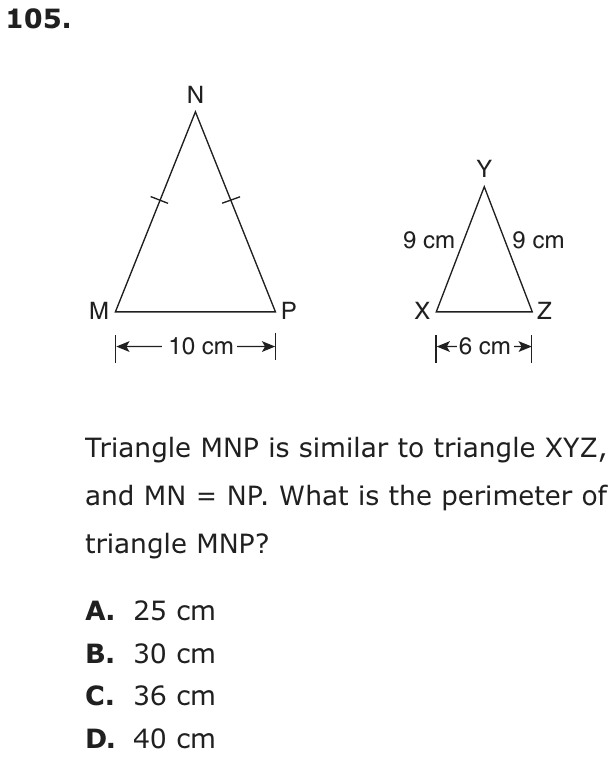
Question 26 of 49
2024 Test B Math, question 52Question
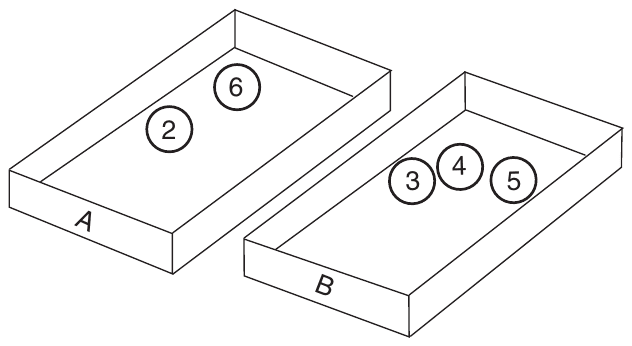
Five numbered balls are placed in two boxes as shown in the figure above. Davina picks one ball at random from Box B and places it in Box A. Then Yusuf picks one ball from Box A without looking. What is the probability that Yusuf will pick a ball with an odd number?
- A
- B
- C
- D
Show the answer
Correct answer: A
The probability of Davina picking an odd-numbered ball from Box B is . If Davina places an odd-numbered ball in Box A, then the probability of Yusuf picking an odd-numbered ball from Box A is . The probability of both of these events happening is the product of the two probabilities.
Question analysis
Two boxes hold five numbered balls, and Davina moves one ball at random from Box B into Box A before Yusuf draws one from Box A. Students find the probability that Yusuf's ball shows an odd number. It tests two-stage probability, and the tricky part is that the second draw depends on which ball was moved.
- NYS standards
- Grade level
- Grade 7 content, by NYS standard
- Compared with grade 7
- Above grade 7 Grade 7 compound probability lists outcomes for independent stages such as coins or spinners. Here the first random move changes what is in the second box, so students must follow two linked stages, a dependence typical grade 7 work does not include.
- Estimated difficulty
- Among the hardest on the SHSAT: a non-obvious approach, heavy reading, or a well-hidden trap.
- Thinking it demands
- Depth of knowledge 3, strategic thinking · mainly analyze
- What makes it hard
- Solution
- 3 steps
- Reading level
- Question and choices: about grade 4, 57 words.
- Students, last 30 days
- Not enough answers yet to show (it takes 10).
Why it is hard, traps and wrong answers (shows the answer)
Why it is hard
Two chance events are hidden in what reads like a question about a single draw. Every listed wrong answer is a reasonable single-stage answer, either one of the two factors on its own or a count of odd balls across both boxes. Listing the nine equally likely pairs, Davina's ball and then Yusuf's, shows that only two of them end with an odd ball and makes the structure visible without any formula.
No obvious method major Working it out
The stem asks one question about Yusuf's draw, but the answer depends on Davina's earlier random pick; the key is that Box A starts with only even balls, so Yusuf can draw odd only by drawing the ball she moved. (Schoenfeld, 1985)
Something you must already know minor Working it out
Multiplying the chances of the two stages, 2/3 for an odd ball moving and 1/3 for Yusuf then drawing it, is a rule students must bring themselves. (Anderson & Krathwohl, 2001)
Reading a figure, table or graph minor Understanding the question
The numbers appear only in the figure, Box A holding 2 and 6 and Box B holding 3, 4 and 5, so the odd balls have to be spotted there. (Lesh, Post & Behr, 1987; Kirsch & Mosenthal, 1990)
Strategy: List every equally likely pair of a ball moved by Davina and a ball picked by Yusuf, and count the pairs that end with an odd ball.
Traps
- Stops one step early: A choice is a number from partway through the solution.
- Numbers taken from the question: Combines the numbers in the question without a model of the situation, or is simply a number that appears in the question.
The wrong answers, classified
B Stops one step early (King et al., 2004; Gierl et al., 2017)
Finds Yusuf's chance of drawing the odd ball once one is in Box A, 1 out of 3, leaving out the chance that Davina moves an odd ball at all.
C Numbers taken from the question (Hegarty, Mayer & Monk, 1995)
Counts the odd balls in the figure, 3 and 5, over all five balls, 2/5, ignoring that Yusuf draws only from Box A.
D Stops one step early (King et al., 2004; Gierl et al., 2017)
Gives the chance that Davina moves an odd ball, 2 out of 3, the first stage only, without multiplying by Yusuf's 1/3 chance of drawing it.
Worked solution, step by step
Formulas used
- Probability
- P is the probability, the chance that something happens. It is a number from 0 to 1. The top counts the results you want. The bottom counts all the results that can happen. It works when every result is equally likely.
- Chance of events in a row
- A and B are two events that happen one after the other. P(A) is the chance of the first. P(B after A) is the chance of the second, counting only what is left after the first. You multiply because the second must also happen inside the share of times the first did.
Read the figure
Box A holds balls numbered 2 and 6. Box B holds balls numbered 3, 4 and 5.
An odd number does not divide evenly by 2. So the only odd balls are 3 and 5, and both start in Box B. Box A starts with no odd balls at all.
Spot the two chance events
Two things happen by chance, one after the other:
- Davina picks one of the 3 balls in Box B and moves it to Box A.
- Then Yusuf picks one of the 3 balls now in Box A.
Yusuf gets an odd ball only if both go right. Davina must move an odd ball. Then Yusuf must pick that very ball.
The question asks only about Yusuf. But his chance depends on Davina’s pick, which comes first.
Find the chance for Davina’s pick
Box B has 3 balls, and 2 of them, the 3 and the 5, are odd.
If she moves the 4 instead, Box A holds only even balls. Then Yusuf can’t get an odd ball at all.
Find the chance for Yusuf’s pick
Say Davina moved an odd ball. Box A now holds 3 balls: the 2, the 6 and that one odd ball.
Watch out: alone is choice B. It forgets that Davina might move the 4.
Multiply the two chances
Both events must happen, so use the rule for events in a row.
Watch out: alone, choice D, stops after Davina’s pick. , choice C, counts 2 odd balls out of all 5. But Yusuf picks only from Box A.
So the answer is A, .
Check your answer
List all 9 equally likely outcomes. Davina can move 3, 4 or 5. Then Yusuf picks one of 3 balls.
| Ball moved | Box A then | Odd picks |
|---|---|---|
| 3 | 2, 6, 3 | 1 |
| 4 | 2, 6, 4 | 0 |
| 5 | 2, 6, 5 | 1 |
That is 2 odd picks out of 9, or .
More questions like this
The original DOE question
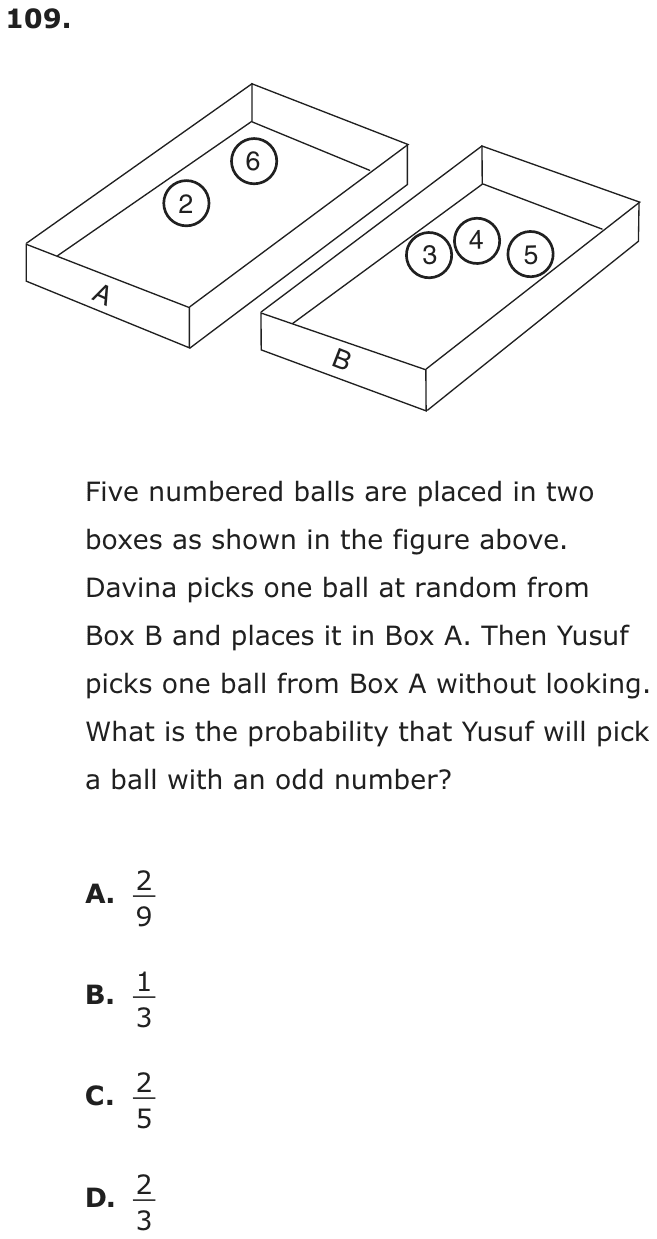
Question 27 of 49
2023 Test A Math, question 4Question
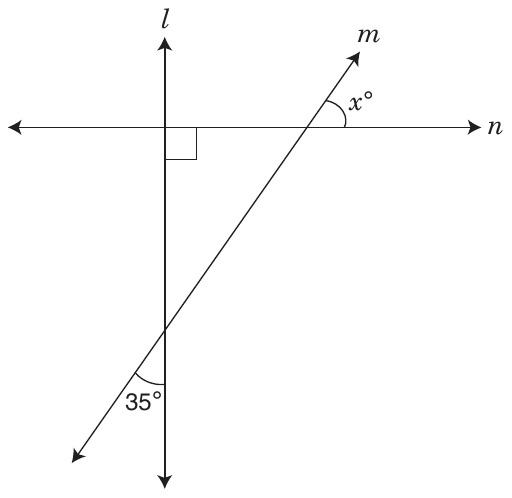
In the figure above, line l is perpendicular to line n. What is the value of x?
Grid-in question: work out the answer and enter it as a number.
Show the answer
Correct answer: 55
Since vertical angles are congruent, the right triangle in the figure has acute angles with measures of 35° and x°. The interior angles of a triangle sum to 180°, so set up an equation to solve for x:
Question analysis
Three lines cross in a figure: line l is perpendicular to line n, and a slanted line m meets them at a marked 35° angle and an unknown angle x. This geometry grid-in asks for the value of x. Students must see the right triangle the lines form and carry the marked angles into it using vertical angles.
- NYS standards
- Grade level
- Grade 8 content, by NYS standard
- Compared with grade 7
- Above grade 7 Grade 7 angle problems use vertical, supplementary and complementary angles. This one also needs the angle sum of a triangle, which New York places in grade 8, and the triangle is not drawn as a separate shape, so students must spot it.
- Estimated difficulty
- Moderate: several steps, or a close reading with one strong distractor.
- Thinking it demands
- Depth of knowledge 2, skills and concepts · mainly apply
- What makes it hard
- Reading a figure, table or graph moderate
- Something you must already know moderate
- An answer in an unexpected form minor
- Solution
- 3 steps
- Reading level
- Question and choices: about grade 4, 17 words.
- Students, last 30 days
- Not enough answers yet to show (it takes 10).
Why it is hard, traps and wrong answers (shows the answer)
Why it is hard
The figure hides a small right triangle between the three lines, and the question is easy once students see it. Its angles are the right angle, the vertical partner of the 35° angle and the vertical partner of x, so x is what the right angle and 35° leave of 180°. Students who never spot the triangle tend to guess a direct relationship between the two marked angles, which no angle fact supports.
Reading a figure, table or graph moderate Understanding the question
Neither marked angle is inside the right triangle that lines l, m and n form: the 35° opens below the point where m crosses l, and x opens above line n, so each must be carried in as a vertical angle. (Lesh, Post & Behr, 1987; Kirsch & Mosenthal, 1990)
Something you must already know moderate Working it out
The stem states only that l is perpendicular to n; students must supply that vertical angles are equal and that the three angles of a triangle add to 180°. (Anderson & Krathwohl, 2001)
An answer in an unexpected form minor Choosing the answer
As a grid-in it offers no choices, so 125, the right angle plus the 35° angle, can be gridded with nothing to signal the missing subtraction. (Enright, Morley & Sheehan, 2002)
Strategy: Find the triangle formed by the three lines, use vertical angles to move the 35° and x° angles inside it, and apply the triangle's angle sum with the right angle.
Traps
- Stops one step early: A choice is a number from partway through the solution.
- A formula you must know: Needs a formula the test does not give: area, circumference, volume, probability rules.
The wrong answers, classified
125 Stops one step early (King et al., 2004; Gierl et al., 2017)
Adds the right angle and the 35° angle, 90 + 35 = 125, and grids that sum without subtracting it from the triangle's 180°.
35 Misunderstands the concept (Smith, diSessa & Roschelle, 1993; De Bock et al., 1998; Ni & Zhou, 2005)
Assumes line m crosses l and n at equal angles, as it would cross two parallel lines, though l and n are perpendicular.
Worked solution, step by step
Formulas used
- Vertical angles
- When two lines cross, they make an X. The angles straight across from each other in the X are called vertical angles. a and b are one such pair. They are always equal, because each one plus the angle between them makes a straight line.
- Angles of a triangle
- A, B and C are the three angles inside any triangle, in degrees. They always add up to 180°. Use it when you know two of the angles and need the third.
Sort out the figure
Line l is perpendicular to line n. Perpendicular means they meet at a right angle, 90°. The small square in the figure marks it. Line m crosses both lines. The three lines make a triangle with a right angle. You need x, the angle marked x° where m crosses n.
Move the 35° angle into the triangle
The 35° angle is below the point where m crosses l. So it is outside the triangle. Lines l and m make an X there. The triangle’s angle is straight across from the 35° angle. They are vertical angles, so they are equal. The triangle’s angle at that corner is 35°.
Move the x° angle into the triangle
The x° angle is above line n, so it is outside the triangle too. Lines m and n make another X. The triangle’s angle at that crossing is straight across from x°. So the third angle of the triangle is also x°. Watch out: line m does not cross l and n at the same angle. Lines l and n are not parallel, so x is not 35.
Use the triangle’s angle sum
The triangle’s three angles are 90°, 35° and x°.
Watch out: 125 is only the two known angles added together. You still subtract it from 180. Gridding 125 is wrong. So you would grid 55.
Check your answer
In a right triangle, the two smaller angles add up to 90°. That is because the right angle uses 90° of the 180°. Check: . Also, in the figure the x° angle looks a bit bigger than the 35° angle, and 55 is.
More questions like this
The original DOE question
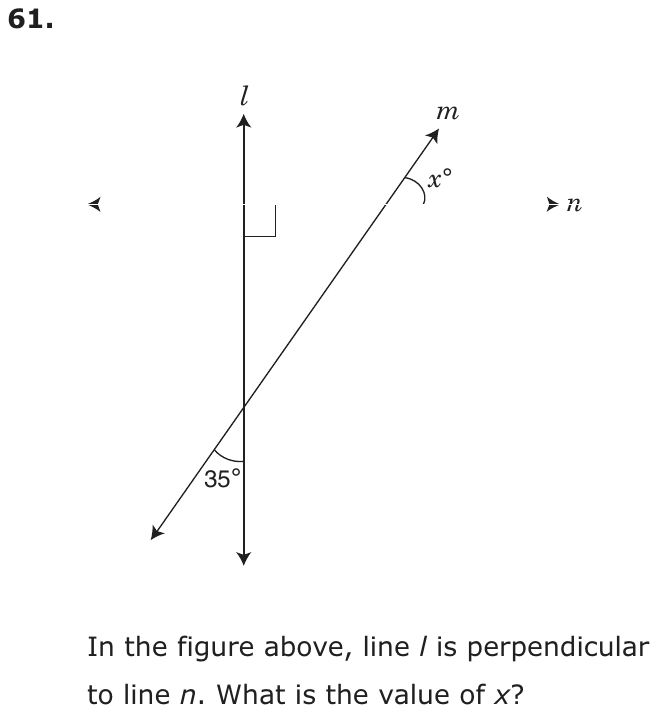
Question 28 of 49
2023 Test A Math, question 24Question
A student uses Spinner R and Spinner T to generate a list of two-digit numbers.
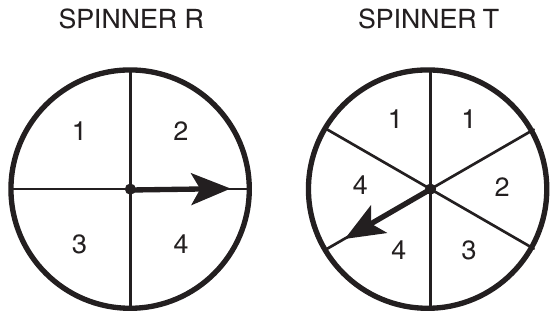
Spinner R determines the digit in the tens place, and Spinner T determines the digit in the ones place. What is the probability that the two-digit number determined by spinning each spinner one time is a prime number?
- A
- B
- C
- D
Show the answer
Correct answer: A
Spinner R has 4 equal sections and Spinner T has 6 equal sections, so the number of possible two-digit numbers that can be created is found by multiplying 4 and 6, which is 24. List the possible outcomes:
| 11 | 11 | 12 | 13 | 14 | 14 |
| 21 | 21 | 22 | 23 | 24 | 24 |
| 31 | 31 | 32 | 33 | 34 | 34 |
| 41 | 41 | 42 | 43 | 44 | 44 |
There are 9 prime numbers out of 24 possible outcomes: 11, 11, 13, 23, 31, 31, 41, 41, and 43.
So the probability that the two-digit number created is a prime number is , which is equivalent to .
Question analysis
Spinner R, with four equal sections, gives the tens digit and Spinner T, with six equal sections and some labels repeated, gives the ones digit of a two-digit number. Students find the probability that the number is prime. Building the full table of outcomes, counting repeated sections separately, and checking whether each number is prime all take care.
- NYS standards
- Grade level
- Grade 7 content, by NYS standard
- Compared with grade 7
- Above grade 7 Listing a sample space for two spinners is grade 7 work, usually with distinct labels and a simple event. Here one spinner repeats two numbers, the space has 24 outcomes, and each two-digit result must be tested for being prime.
- Estimated difficulty
- Hard: combines ideas, needs a plan, and has more than one tempting wrong answer.
- Thinking it demands
- Depth of knowledge 2, skills and concepts · mainly apply
- What makes it hard
- Reading a figure, table or graph moderate
- Much to keep track of moderate
- Something you must already know minor
- Solution
- 4 steps
- Reading level
- Question and choices: about grade 7, 57 words.
- Students, last 30 days
- Not enough answers yet to show (it takes 10).
Why it is hard, traps and wrong answers (shows the answer)
Why it is hard
The question combines a compound sample space with a test for primes, and its figure adds a twist: two labels repeat on Spinner T. Counting the 24 section pairs rather than the 16 different numbers is the careful route, though here both happen to give the same fraction. The points are lost in the prime test, where 33 is easy to count as prime, and in writing the count as a share of all 24 outcomes.
Reading a figure, table or graph moderate Understanding the question
Spinner T has six equal sections but only four labels, with 1 and 4 each appearing twice, so the 24 equally likely outcomes include repeats such as 11 and 11. (Lesh, Post & Behr, 1987; Kirsch & Mosenthal, 1990)
Much to keep track of moderate Working it out
Twenty-four two-digit numbers have to be built and each tested for primality while the repeated sections are kept track of; a 4-by-6 table is the reliable way to hold them. (Sweller, 1988; Carpenter, Just & Shell, 1990)
Something you must already know minor Working it out
Which two-digit numbers are prime is not given; students must test 21, 33, 43 and the rest themselves, and 21 = 3 × 7 and 33 = 3 × 11 look prime at a glance. (Anderson & Krathwohl, 2001)
Strategy: Make a 4-by-6 table with Spinner R's digits as tens and Spinner T's six sections as ones, mark each prime, and count every section, including repeated labels.
Traps
- An arithmetic slip: The right method with a plausible arithmetic error: a digit, a place value or a times-table fact.
- Misunderstands the concept: A wrong belief about a concept: that percents can be added, that area grows like length, that averages can be averaged, that a bigger denominator means a bigger fraction.
- Answers a different question: A choice is right for another quantity: the other unknown, the rest instead of the part, the part instead of the whole.
The wrong answers, classified
B An arithmetic slip (Junker & Sijtsma, 2001)
Counts 33 as prime, missing that 33 = 3 × 11, so 10 of the 24 outcomes look prime and 10/24 reduces to 5/12.
C Misunderstands the concept (Smith, diSessa & Roschelle, 1993; De Bock et al., 1998; Ni & Zhou, 2005)
Finds the 9 prime outcomes but compares them with the 15 that are not prime, a part-to-part ratio, 9/15 = 3/5, instead of dividing by all 24.
D Answers a different question (King et al., 2004; Hegarty, Mayer & Monk, 1995)
Counts the 15 outcomes that are not prime and gives 15/24 = 5/8, the probability of the opposite event.
Worked solution, step by step
Formulas used
- Counting outcomes
- a is the number of equal sections on the first spinner, and b is the number on the second. Each section of the first can go with each section of the second. So the number of pairs is a times b.
- Probability
- P is the probability, the chance that something happens. Possible results are all the results that are equally likely. Wanted results are the ones you are looking for. The chance is the fraction of all the results that you want.
Sort out the question
Spinner R gives the tens digit. Spinner T gives the ones digit. Together they make a two-digit number, like 23. You need the chance that the number is prime. A prime number has exactly two factors, 1 and itself. For example, 13 is prime, but 21 = 3 × 7 is not.
Count all the outcomes
Spinner R has 4 equal sections. Spinner T has 6 equal sections. Look closely: T has two 1s and two 4s. Each section counts as its own outcome.
There are 24 outcomes, all equally likely.
Make a table of the numbers
Each row is a tens digit from R. Each column is a section of T. Prime numbers are in bold.
R 1 1 2 3 4 4 1 11 11 12 13 14 14 2 21 21 22 23 24 24 3 31 31 32 33 34 34 4 41 41 42 43 44 44 Count the prime numbers
Numbers ending in 2 or 4 are even, so 2 divides them. They are not prime. Check the rest. 11, 13, 23, 31, 41 and 43 are prime. But 21 = 3 × 7 and 33 = 3 × 11 are not. Count every section, so 11, 31 and 41 each count twice. That makes 3 + 1 + 2 + 3 = 9 primes. Watch out: counting 33 as prime gives , choice B.
Find the probability
Watch out: divide by all 24 outcomes. Comparing the 9 primes with the 15 others gives , choice C. So the answer is A, .
Check your answer
There are numbers that are not prime. Their chance is . And , as it should be. Notice that , choice D, is the chance of not prime.
More questions like this
The original DOE question
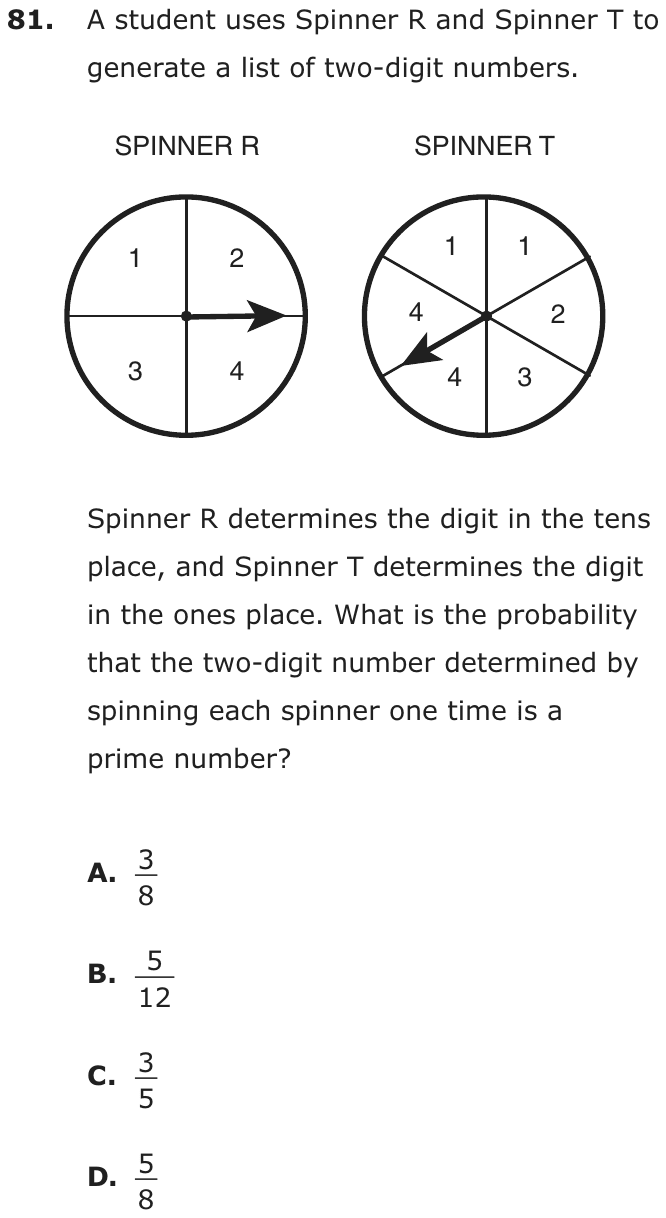
Question 29 of 49
2023 Test A Math, question 25Question
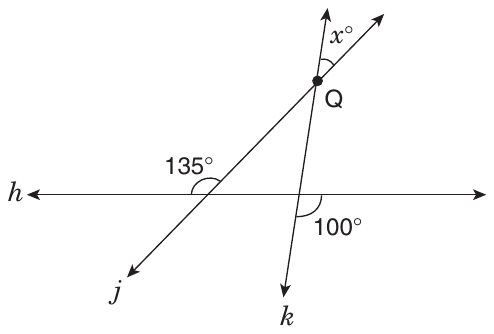
Lines j and k intersect at point Q, and h is a straight line. What is the value of x?
- A55
- B45
- C35
- D30
Show the answer
Correct answer: C
First, find the measures of the three angles inside the triangle. The lower left angle is supplementary to the one marked 135°, so the measure of that angle is . The angle on top is a vertical angle with the one marked x°, so the measure of that angle is also x°. The angle on the lower right is a vertical angle with the one marked 100°, so the measure of that angle is also 100°. Since the measures of the three interior angles of a triangle sum to 180°, set up an equation and solve for x:
Question analysis
Lines j and k cross at point Q above a straight line h, forming a triangle, with a 135° angle marked where j meets h and a 100° angle where k meets h. Students find the angle x at Q. Each marked angle lies outside the triangle, so it has to be turned into an inside angle before the triangle's angle sum can be used.
- NYS standards
- Grade level
- Grade 8 content, by NYS standard
- Compared with grade 7
- Above grade 7 Grade 7 students use supplementary and vertical angles to find unknown angles. This figure needs both, applied at three different vertices, plus the angle sum of a triangle, which New York teaches in grade 8.
- Estimated difficulty
- Hard: combines ideas, needs a plan, and has more than one tempting wrong answer.
- Thinking it demands
- Depth of knowledge 2, skills and concepts · mainly apply
- What makes it hard
- Reading a figure, table or graph major
- Combines ideas moderate
- Something you must already know minor
- Solution
- 4 steps
- Reading level
- Question and choices: about grade 2, 20 words.
- Students, last 30 days
- Not enough answers yet to show (it takes 10).
Why it is hard, traps and wrong answers (shows the answer)
Why it is hard
Every angle the solution needs has to be carried into the triangle from outside, and the two marked angles need different treatment. The 135° is supplementary to the triangle's angle, but the 100° is vertical to it, so subtracting both from 180° out of habit builds the wrong triangle. Checking which side of each line a marked angle sits on, not just how near the triangle it is, separates the two cases.
Reading a figure, table or graph major Understanding the question
None of the three marked angles is inside the triangle formed by h, j and k: the 135° is outside on the left, the 100° is below line h, and x is above Q. (Lesh, Post & Behr, 1987; Kirsch & Mosenthal, 1990)
Combines ideas moderate Working it out
Two different angle facts are needed: the 135° gives a supplementary interior angle of 45°, while the 100° and x carry into the triangle unchanged as vertical angles. (Embretson, 1998; Daniel & Embretson, 2010)
Something you must already know minor Working it out
Supplementary angles, vertical angles and the triangle's 180° sum are all assumed, and the question names none of them. (Anderson & Krathwohl, 2001)
Strategy: Mark the three angles of the triangle formed by lines h, j and k: one is supplementary to 135°, one is vertical to 100°, and the one at Q is vertical to x°.
Traps
- Misreads the figure: Reads a value, label or tick spacing in a figure, table or graph wrongly.
- Stops one step early: A choice is a number from partway through the solution.
The wrong answers, classified
A Misreads the figure (Lesh, Post & Behr, 1987; Kirsch & Mosenthal, 1990)
Takes the triangle's angle at line k as 180 − 100 = 80, the supplement of the marked angle instead of its vertical angle, so x = 180 − 45 − 80 = 55.
B Stops one step early (King et al., 2004; Gierl et al., 2017)
Finds the triangle's angle where line j meets h, 180 − 135 = 45, and gives it instead of going on to the angle at Q.
D Little reason to choose it (Haladyna & Downing, 1993; Rodriguez, 2005)
No angle fact in the figure gives 30, and the angle at Q is drawn close to its true size, so this choice mostly catches guesses.
Worked solution, step by step
Formulas used
- Angles on a straight line
- a and b are two angles side by side on a straight line. Together they make a half turn, a straight angle. So they add up to 180°. Angles like this are called supplementary.
- Vertical angles
- When two lines cross, they make an X. The angles straight across from each other in the X are called vertical angles. a and b are one such pair. They are always equal, because each one plus the angle between them makes a straight line.
- Angles of a triangle
- A, B and C are the three angles inside any triangle, in degrees. They always add up to 180°. Use it when you know two of the angles and need the third.
Sort out the figure
Lines h, j and k make a triangle. Its corners are where j crosses h, where k crosses h, and point Q. The figure marks two angles outside the triangle, 135° and 100°. You need x, the angle marked above Q.
Find the angle where j crosses h
The 135° angle is above h and to the left of j. The triangle’s angle is right next to it, on the other side of j. Together they make the straight line h. Call the triangle’s angle a.
So that corner of the triangle is 45°. Watch out: this is only one corner, not x. Stopping here gives 45, choice B.
Find the angle where k crosses h
The 100° angle is below h and to the right of k. The triangle’s angle is above h and to the left of k. Lines h and k make an X there, and these two angles are straight across from each other. They are vertical angles, so the triangle’s angle is 100°. Watch out: it is not 180 − 100 = 80. That angle is beside the 100°, not across from it. Using 80 gives 55, choice A.
Find the angle at Q
The x° angle is above Q, between the top parts of lines j and k. The triangle’s angle at Q is between the parts of j and k below Q. These two angles are straight across from each other. So they are vertical angles, and the triangle’s angle at Q is also x°.
Use the triangle’s angle sum
The three angles of the triangle must add up to 180°. Only x is unknown. So the answer is C, 35.
Check your answer
Add the triangle’s three angles: . Also, the angle at Q looks narrow in the figure, much less than a right angle of 90°. 35° fits that.
More questions like this
The original DOE question
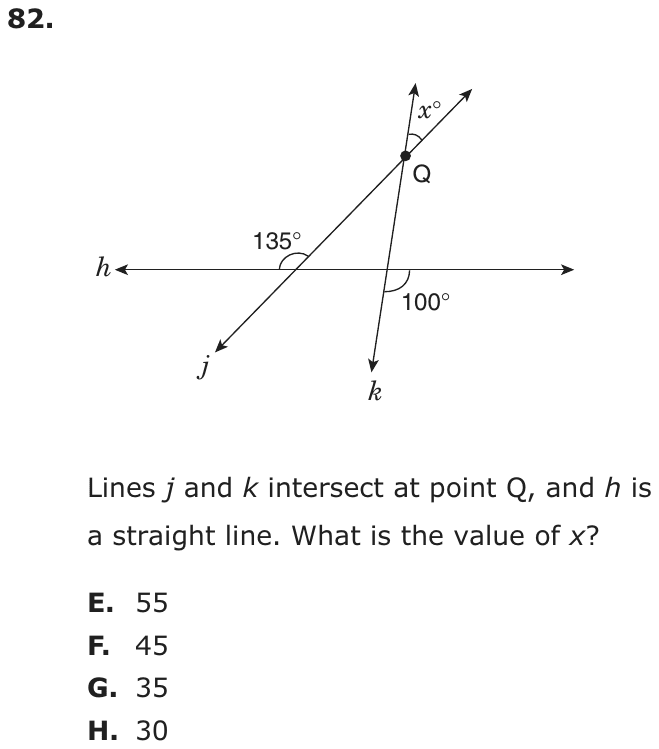
Question 30 of 49
2023 Test A Math, question 31Question
The arrow starts on Space P and moves clockwise around the circle. It moves through one space each minute. What space will the arrow point to in 100 minutes?
- AR
- BS
- CT
- DU
Show the answer
Correct answer: C
There are 6 spaces, so first divide 100 by 6: , remainder 4. So, the arrow goes around 16 full times and then 4 more spaces. Four spaces from Space P is Space T.
Question analysis
This patterns question shows a circle split into six lettered spaces, with an arrow that starts on P and moves one space clockwise each minute, and asks where it points after 100 minutes. Students use division with a remainder to skip the full trips around. Counting the leftover moves without including the starting space, and in the right direction, is the tricky part.
- NYS standards
- 6.NS.2 multi-digit division
- Grade level
- Grade 6 content, by NYS standard
- Compared with grade 7
- At grade 7 Division with a remainder is grade 6 arithmetic, but using that remainder to step around a six-part circle is a pattern task that grade 7 classes seldom practice. It needs careful counting rather than new content.
- Estimated difficulty
- Straightforward: two steps or one careful reading.
- Thinking it demands
- Depth of knowledge 2, skills and concepts · mainly apply
- What makes it hard
- Solution
- 2 steps
- Reading level
- Question and choices: about grade 1, 32 words.
- Students, last 30 days
- Not enough answers yet to show (it takes 10).
Why it is hard, traps and wrong answers (shows the answer)
Why it is hard
The division is short; the points are lost in turning the remainder into a space. The arrow starts on P, so the 4 leftover moves land on Q, R, S and T, and counting P itself as a move stops one space short. Going around the wrong way, or one move too far, gives the other two choices. Checking a small case first, such as 7 minutes landing on Q, fixes the rule before it is used.
No obvious method minor Working it out
The stem never mentions division; the step that unlocks it is seeing that every 6 minutes brings the arrow back to P, so only the remainder of 100 ÷ 6 matters. (Schoenfeld, 1985)
Reading a figure, table or graph minor Understanding the question
The six spaces and their clockwise order, P, Q, R, S, T, U, appear only in the circle diagram, so the cycle length and the direction of counting both come from the figure. (Lesh, Post & Behr, 1987; Kirsch & Mosenthal, 1990)
Strategy: Divide 100 by 6: every full trip around the circle brings the arrow back to P, so only the remainder matters; count that many moves clockwise, starting with the space after P.
Traps
- Counting the ends: Inclusive or exclusive ends, fence posts, consecutive numbers: an answer that is one too many or too few, or an endpoint drawn open where it belongs closed (or the reverse).
- Negatives and direction: Arithmetic with negative numbers, the order of a subtraction, or direction on a number line. (Moving a term across the equals sign without changing its sign is a faulty procedure.)
The wrong answers, classified
A Negatives and direction (Brown & Burton, 1978)
Counts the 4 leftover moves counterclockwise from P, through U, T and S to R, instead of clockwise as the stem says the arrow moves.
B Counting the ends (Brown & Burton, 1978)
Counts Space P itself as the first of the 4 leftover moves, P, Q, R, S, so the arrow stops one space short of where it really points.
D Counting the ends (Brown & Burton, 1978)
Makes 5 moves past P instead of the 4 left after 16 full turns, overshooting by one space, the fence-post slip in the other direction.
Worked solution, step by step
Formulas used
- Division with a remainder
- a is the number you divide, here the minutes. b is the number you divide by, here the spaces in one trip around. q is how many whole groups of b fit into a. r is the remainder, the amount left over. The remainder is always less than b.
Sort out the question
The circle has 6 spaces. Going clockwise, the way a clock’s hands turn, they are P, Q, R, S, T and U. The arrow starts on P and moves one space each minute. You need the space it points to after 100 minutes.
Notice that the pattern repeats
After 6 minutes, the arrow has gone all the way around and points to P again. After 12 minutes it is back on P again, and so on. So full trips of 6 minutes don’t change where it points. Only the leftover minutes matter.
Divide 100 by 6
The arrow makes 16 full trips. That takes minutes, and it is back on P. There are 4 minutes left over.
Count the last 4 moves
From P, move one space each minute: Q (minute 97), R (minute 98), S (minute 99), T (minute 100).
Watch out: don’t count P itself as the first move. That stops on S, choice B. Also count clockwise. Counting the other way lands on R, choice A.
So the answer is C, T.
Check your answer
Use a smaller number with the same remainder. 100 − 96 = 4, and 96 minutes is a whole number of trips. So after 100 minutes the arrow points where it does after 4 minutes. Four moves from P are Q, R, S, T. That is T again.
More questions like this
The original DOE question
Question 31 of 49
2023 Test A Math, question 34Question
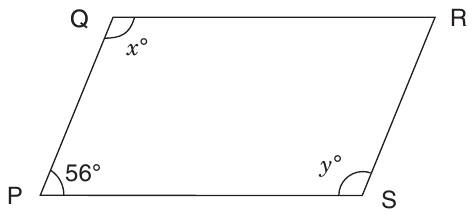
In the parallelogram above, what is the value of ?
- A112
- B124
- C148
- D248
Show the answer
Correct answer: D
In a parallelogram, opposite angles are congruent, so the measure of the unmarked angle is 56°. The sum of the interior angles of a parallelogram is equal to 360°. Use that information to solve the problem:
Question analysis
This geometry question shows parallelogram PQRS with a 56° angle at P and unknown angles x and y at Q and S, and asks for the sum x + y. Students need angle facts about parallelograms: opposite angles match, and the four angles total 360°. Stopping after finding only one angle, or adding the wrong pair, are the common mistakes.
- NYS standards
- Grade level
- Grade 8 content, by NYS standard
- Compared with grade 7
- At grade 7 The parallelogram facts needed, equal opposite angles and a 360° angle sum, rest on grade 8 reasoning about parallel lines and triangles. Once they are known, the arithmetic is short, about the size of a typical grade 7 angle problem.
- Estimated difficulty
- Straightforward: two steps or one careful reading.
- Thinking it demands
- Depth of knowledge 2, skills and concepts · mainly apply
- What makes it hard
- Solution
- 2 steps
- Reading level
- Question and choices: about grade 10, 10 words.
- Students, last 30 days
- Not enough answers yet to show (it takes 10).
Why it is hard, traps and wrong answers (shows the answer)
Why it is hard
Two short angle facts finish the question, but the figure marks three of the four corners, and the unmarked one at R is easy to forget. Students who find one obtuse angle stop with half the total, and those who add the two 56° angles give the part already known. Checking that the four angles, 56, 124, 56 and 124, add to 360 confirms the sum.
Something you must already know moderate Working it out
The figure gives one angle and no rules: students must bring both that opposite angles of a parallelogram are equal and that a quadrilateral's angles total 360°, or that neighboring angles add to 180°. (Anderson & Krathwohl, 2001)
Reading a figure, table or graph minor Understanding the question
The labels x and y sit at Q and S, opposite corners, while the corner R across from the 56° angle at P carries no label at all. (Lesh, Post & Behr, 1987; Kirsch & Mosenthal, 1990)
Strategy: Mark the angle at R equal to the angle at P, since opposite angles of a parallelogram are equal, then take both away from the total of a quadrilateral's four angles.
Traps
- Stops one step early: A choice is a number from partway through the solution.
- Answers a different question: A choice is right for another quantity: the other unknown, the rest instead of the part, the part instead of the whole.
The wrong answers, classified
A Answers a different question (King et al., 2004; Hegarty, Mayer & Monk, 1995)
Adds the two 56° angles at P and R, 56 + 56 = 112, giving the part of the 360° already known instead of the two angles that remain.
B Stops one step early (King et al., 2004; Gierl et al., 2017)
Finds one unmarked angle, 180 − 56 = 124, and stops before adding the equal angle at the opposite corner.
C Little reason to choose it (Haladyna & Downing, 1993; Rodriguez, 2005)
No angle fact in the parallelogram gives 148, which is exactly 100 less than the right total, so it mostly catches guesses or a stray subtraction slip.
Worked solution, step by step
Formulas used
- Opposite angles of a parallelogram
- A parallelogram is a four-sided shape whose opposite sides are parallel. P and R are opposite corners: they don’t share a side. Opposite angles of a parallelogram are always equal.
- Angles of a four-sided shape
- P, Q, R and S are the four corners. Their angles always add up to 360 degrees. A line from one corner to the opposite corner cuts the shape into two triangles, and each triangle’s angles add up to 180 degrees.
- Neighboring angles of a parallelogram
- P and Q are corners next to each other, joined by one side. In a parallelogram, their angles add up to 180 degrees. The same is true of any two neighboring corners.
Sort out the figure
PQRS is a parallelogram. The angle at corner P is 56°. The angle at Q is x°, and the angle at S is y°. The angle at R has no label. You need x + y, the angles at Q and S added together.
Find the angle at R
R is across from P, so they are opposite corners.
So the angle at R is 56°, the same as at P.
Use the 360° total
Watch out: 112 is the two angles you already know, not x + y. Answering 112 is choice A.
Find x and y one at a time
Q is next to P, so use the neighbor rule.
S is also next to P, so y = 124 too. Then , the same total. Watch out: stopping at one angle, 124, gives choice B. The question asks for both added together.
So the answer is D, 248.
Check your answer
Add all four angles: . That is the right total for a four-sided shape. Also, the angles at Q and S look wider than a right angle in the figure, and 124° is wider than 90°.
More questions like this
The original DOE question
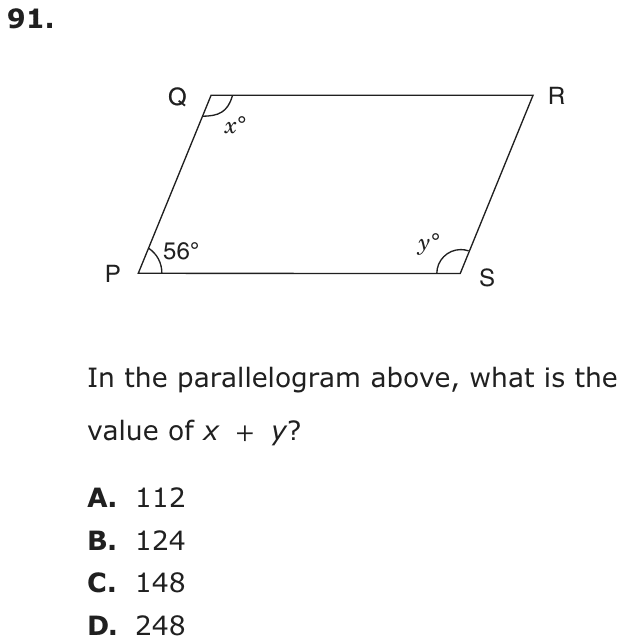
Question 32 of 49
2023 Test A Math, question 37Question
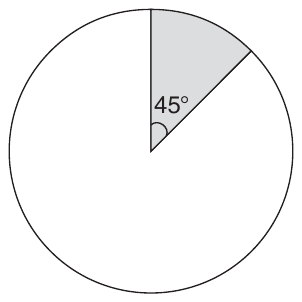
The shaded sector of the circle shown above has an area of square feet. What is the circumference of the circle?
- A ft
- B ft
- C ft
- D ft
Show the answer
Correct answer: B
The area of the entire circle is .
The fraction of the circle that is shaded is . So, the area of the sector is . Use that information to find r:
Use r to calculate the circumference of the circle:
The circumference is feet.
Question analysis
This circle question shows a shaded 45° sector with an area of 18π square feet and asks for the circumference of the whole circle. Students work backward: from the sector to the full area, from the area to the radius, and from the radius to the circumference. Mixing up area and circumference, or stopping partway, gives wrong choices.
- Grade level
- Grade 7 content, by NYS standard
- Compared with grade 7
- Above grade 7 Grade 7 circle problems usually give the radius and ask for area or circumference. This one runs backward from the area of a 45° sector, needing the sector's share of the circle, a square root and a switch to circumference: four linked steps.
- Estimated difficulty
- Hard: combines ideas, needs a plan, and has more than one tempting wrong answer.
- Thinking it demands
- Depth of knowledge 2, skills and concepts · mainly apply
- What makes it hard
- Combines ideas moderate
- Something you must already know moderate
- Reading a figure, table or graph minor
- Solution
- 4 steps
- Reading level
- Question and choices: about grade 5, 30 words.
- Students, last 30 days
- Not enough answers yet to show (it takes 10).
Why it is hard, traps and wrong answers (shows the answer)
Why it is hard
The question moves from a part of the circle's area to the whole circle's length, so area and circumference both appear and are easy to swap. Many students scale the sector up to 144π and stop, giving an area when a length was asked. Solving r² = 144 also needs a square root, after which 2πr is routine. Asking at the end whether the result is a length, measured in feet rather than square feet, catches the main trap.
Combines ideas moderate Working it out
Three ideas chain together: the 45° sector is 1/8 of the circle, so the whole area is 8 × 18π = 144π, then the radius comes from the area, and the circumference from the radius. (Embretson, 1998; Daniel & Embretson, 2010)
Something you must already know moderate Working it out
Neither πr² nor 2πr is given, nor that a full turn is 360°, so every link of the chain rests on formulas students must already know. (Anderson & Krathwohl, 2001)
Reading a figure, table or graph minor Understanding the question
The stem says only “shaded sector”; its 45° angle is marked at the center in the figure, the one place the fraction of the circle comes from. (Lesh, Post & Behr, 1987; Kirsch & Mosenthal, 1990)
Strategy: Work out what fraction of the circle a 45° sector is, scale its area up to the whole circle, solve for the radius, and only then use the circumference formula.
Traps
- Answers a different question: A choice is right for another quantity: the other unknown, the rest instead of the part, the part instead of the whole.
- A formula you must know: Needs a formula the test does not give: area, circumference, volume, probability rules.
- Numbers taken from the question: Combines the numbers in the question without a model of the situation, or is simply a number that appears in the question.
The wrong answers, classified
A Answers a different question (King et al., 2004; Hegarty, Mayer & Monk, 1995)
Scales the sector up to the whole circle, 8 × 18π = 144π, and gives that area, though the question asks for the circumference.
C Numbers taken from the question (Hegarty, Mayer & Monk, 1995)
Repeats the sector's area from the stem, 18π, as if the shaded part's area were the circle's circumference.
D Little reason to choose it (Haladyna & Downing, 1993; Rodriguez, 2005)
No step with the 45° angle or the circle formulas gives 9π, which is half the sector's area, so it mostly attracts guesses.
Worked solution, step by step
Formulas used
- Fraction of a circle in a sector
- A sector is a slice of a circle, like a slice of pizza. Its angle is the angle at the center, in degrees. A full turn around the center is 360 degrees. So the slice is that fraction of the whole circle.
- Area of a circle
- A is the area, the space inside the circle. r is the radius, the distance from the center to the edge. π, called pi, is a number a little more than 3. r² means r times r.
- Circumference of a circle
- C is the circumference, the distance around the circle. r is the radius and π is pi. Two radii make the diameter, the distance across, so this is the same as π times the diameter.
Sort out the question
The shaded slice has a 45° angle at the center. Its area is square feet. You need the circumference, the distance around the whole circle. For that you need the radius, so work back to it.
Find what fraction is shaded
The shaded slice is one eighth of the circle. Eight slices like it would fill the circle.
Find the area of the whole circle
The whole circle has an area of square feet. Watch out: this is an area, not the circumference. Stopping here gives choice A.
Find the radius
Divide both sides by π. Then ask what number times itself makes 144. It is 12, so the radius is 12 feet.
Find the circumference
Leave π as it is, because the choices are written with π. The circumference is feet. So the answer is B, ft.
Check your answer
Work forward. A radius of 12 feet gives an area of square feet. One eighth of that is square feet, the shaded area in the question.
More questions like this
The original DOE question
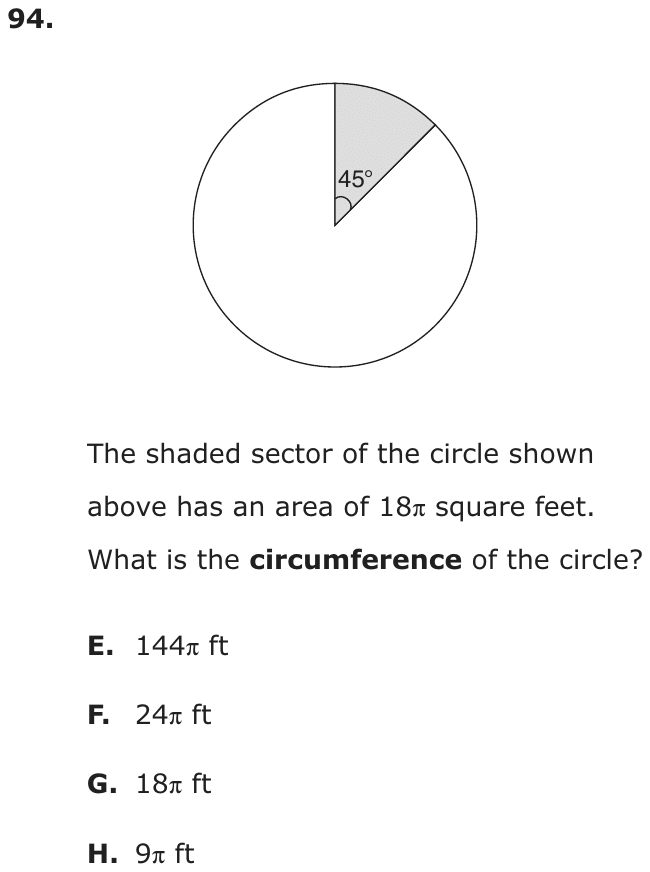
Question 33 of 49
2023 Test A Math, question 45Question
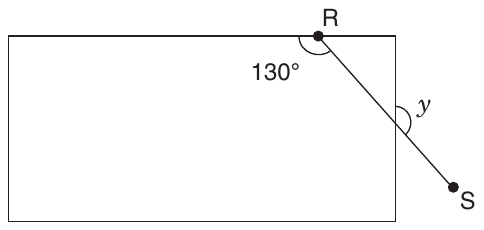
The diagram above shows line segment RS intersecting a rectangle. What is the measure of angle y?
- A140°
- B130°
- C50°
- D40°
Show the answer
Correct answer: A
First, find the measures of the interior angles of the triangle formed by the line segment and the rectangle. The top angle on the right is a vertex of the rectangle, so the measure of that angle is 90°. The top angle on the left is supplementary to the given angle of 130°. So, the measure of that angle is . The measure of the lower angle is 40°, since . Angle y is supplementary to the lower angle of 40°, so the measure of angle y is .
Question analysis
This geometry question shows line segment RS cutting across a corner of a rectangle, with a 130° angle marked where RS meets the top side, and asks for angle y where it crosses the right side. Students combine supplementary angles, the right angle of a rectangle and the angle sum of a triangle. Stopping at an angle inside the triangle is the main trap.
- NYS standards
- Grade level
- Grade 8 content, by NYS standard
- Compared with grade 7
- Above grade 7 Grade 7 angle problems use supplementary, vertical and adjacent angles. This one adds the angle sum of a triangle, which New York places in grade 8, and chains three facts around a small triangle that students must first spot in the figure.
- Estimated difficulty
- Moderate: several steps, or a close reading with one strong distractor.
- Thinking it demands
- Depth of knowledge 2, skills and concepts · mainly apply
- What makes it hard
- Reading a figure, table or graph moderate
- Many steps minor
- Something you must already know minor
- Solution
- 3 steps
- Reading level
- Question and choices: about grade 7, 17 words.
- Students, last 30 days
- Not enough answers yet to show (it takes 10).
Why it is hard, traps and wrong answers (shows the answer)
Why it is hard
The angle facts are basic, but the route runs through a triangle the figure does not point out, and the answer lies outside it. Students who stop inside the triangle give its 40° angle or its 50° angle, and those who assume y matches the marked 130° skip the work entirely. Checking that y and the triangle's angle beside it form a straight line, 140 + 40 = 180, confirms the result.
Reading a figure, table or graph moderate Understanding the question
The small triangle cut off at the rectangle's top right corner is never outlined or labeled, its 90° corner is unmarked, and y sits outside it, between RS and the rectangle's right side. (Lesh, Post & Behr, 1987; Kirsch & Mosenthal, 1990)
Many steps minor Working it out
Three steps follow in order, a straight angle at R, the triangle's angle sum, and a straight angle at the right side, and the first two results are both listed choices. (Daniel & Embretson, 2010; Enright, Morley & Sheehan, 2002)
Something you must already know minor Working it out
The rectangle's corner must be taken as 90° although no right-angle mark is drawn, and the 180° totals for a straight line and a triangle are assumed. (Anderson & Krathwohl, 2001)
Strategy: Look at the small triangle cut off at the rectangle's corner: get its angle at R from the straight top side, use the 90° corner and the triangle's angle sum, then use the straight right side.
Traps
- Stops one step early: A choice is a number from partway through the solution.
- Misunderstands the concept: A wrong belief about a concept: that percents can be added, that area grows like length, that averages can be averaged, that a bigger denominator means a bigger fraction.
The wrong answers, classified
B Misunderstands the concept (Smith, diSessa & Roschelle, 1993; De Bock et al., 1998; Ni & Zhou, 2005)
Takes y to equal the marked 130° angle, as if RS crossed two parallel sides, though the rectangle's top and right sides meet at a right angle.
C Stops one step early (King et al., 2004; Gierl et al., 2017)
Finds the triangle's angle at R, 180 − 130 = 50, and stops after the first of the three steps.
D Stops one step early (King et al., 2004; Gierl et al., 2017)
Finds the triangle's third angle, 180 − 90 − 50 = 40, but y lies outside the triangle, beside that angle on the straight right side.
Worked solution, step by step
Formulas used
- Angles on a straight line
- a and b are two angles side by side that together make a straight line. A straight line makes an angle of 180 degrees. So if you know one of them, subtract it from 180 to get the other.
- Angles in a triangle
- a, b and c are the three angles inside any triangle. They always add up to 180 degrees. If you know two of them, subtract both from 180 to find the third.
- Outside angle of a triangle
- An outside angle sits next to a triangle’s angle, along a straight line. a and b are the two inside angles at the other corners. The outside angle equals their sum.
Sort out the figure
Segment RS starts at R on the top side of the rectangle. It goes down to the right, crosses the right side, and ends at S. Call the rectangle’s top right corner P. Call the point where RS crosses the right side Q. Then R, P and Q make a small triangle. Angle y is at Q, outside the rectangle.
Find the triangle’s angle at R
The 130° angle and the triangle’s angle at R sit side by side along the top side, a straight line.
Watch out: 50° is only the first step. Stopping here gives choice C.
Find the triangle’s angle at Q
P is a corner of the rectangle, so its angle is 90°.
Watch out: y is outside the triangle, so this 40° angle, choice D, is not y.
Find angle y
Angle y and the triangle’s 40° angle at Q sit side by side along RS, a straight line.
So the answer is A, 140°.
Check your answer
Use the outside angle rule. Angle y is outside the triangle at Q. The two inside angles at the other corners are 50° and 90°, so . Also, y looks wider than a right angle in the figure, so it must be more than 90°.
More questions like this
The original DOE question
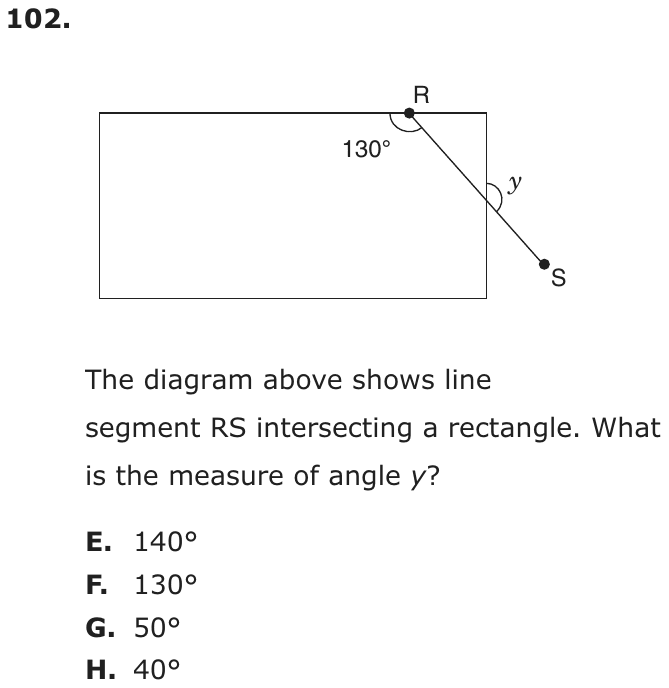
Question 34 of 49
2023 Test A Math, question 49Question
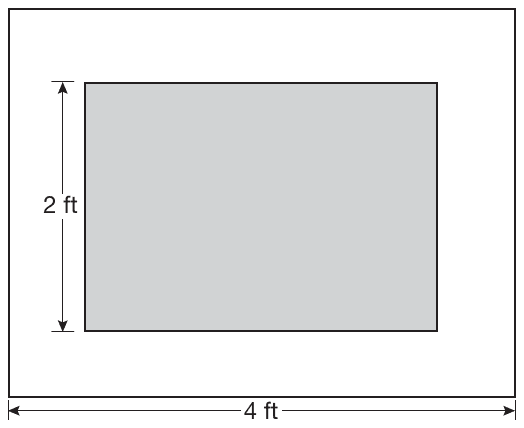
In the figure above, the shaded rectangle is similar to the outer rectangle. The length of the outer rectangle is 4 feet, and the perimeter of the outer rectangle is 14 feet. If the width of the shaded rectangle is 2 feet, what is the area of the shaded rectangle?
- A sq ft
- B6 sq ft
- C sq ft
- D12 sq ft
Show the answer
Correct answer: A
For the outer rectangle, the length is 4 feet and the perimeter is 14 feet. Write and solve an equation to find the width:
| Apply the additive inverse property; subtract 8 from both sides of the equation. | |
| Apply the multiplicative inverse property; divide both sides of the equation by 2. | |
Use that information in a proportion to find the length of the shaded rectangle:
| Cross multiply. | |
| Apply the multiplicative inverse property; divide both sides of the equation by 3. | |
Now find the area of the shaded rectangle:
Question analysis
This geometry question shows a shaded rectangle similar to an outer rectangle that is 4 feet long with a perimeter of 14 feet; the shaded rectangle is 2 feet wide. Students find the shaded area. They must find a missing side, match corresponding sides, and scale by a factor rather than a fixed amount, which makes it a multistep similar-figures problem.
- Grade level
- Grade 8 content, by NYS standard
- Compared with grade 7
- Above grade 7 Similar figures are grade 8 geometry, though grade 7 scale drawings use the same proportions. Students must first find a missing side from the perimeter, match corresponding sides, solve a proportion with a fractional result, and then find an area.
- Estimated difficulty
- Hard: combines ideas, needs a plan, and has more than one tempting wrong answer.
- Thinking it demands
- Depth of knowledge 2, skills and concepts · mainly apply
- What makes it hard
- Combines ideas moderate
- Reading a figure, table or graph minor
- Error-prone arithmetic minor
- Solution
- 4 steps
- Reading level
- Question and choices: about grade 5, 57 words.
- Students, last 30 days
- Not enough answers yet to show (it takes 10).
Why it is hard, traps and wrong answers (shows the answer)
Why it is hard
Each step is familiar, but the three together, perimeter to width, width to scale factor, and sides to area, demand a plan. The strongest pull is scaling by subtraction, shrinking each side by 1 foot because the width drops from 3 to 2, which gives a neat whole-number area. Others stop at the outer rectangle or add the sides instead of multiplying. Checking that 8/3 to 2 matches 4 to 3 confirms the shape is similar.
Combines ideas moderate Working it out
Perimeter, similarity and area are chained: 14 feet gives the outer width of 3 feet, the 2-foot side sets a scale factor of 2/3, and only then can the area be found. (Embretson, 1998; Daniel & Embretson, 2010)
Reading a figure, table or graph minor Understanding the question
The figure marks the shaded rectangle's 2-foot side running up and down and the outer 4-foot length along the bottom, so the 2 feet must be paired with the outer 3-foot side, which is not labeled. (Lesh, Post & Behr, 1987; Kirsch & Mosenthal, 1990)
Error-prone arithmetic minor Working it out
The scale factor 2/3 makes the shaded length 8/3 feet, and the area 2 × 8/3 = 16/3 has to be written as the mixed number 5 1/3. (Brown & Burton, 1978; Junker & Sijtsma, 2001)
Strategy: Use the perimeter to find the outer rectangle's width, match the shaded width of 2 feet to it, scale the 4-foot length by the same factor, then multiply length by width.
Traps
- Misunderstands the concept: A wrong belief about a concept: that percents can be added, that area grows like length, that averages can be averaged, that a bigger denominator means a bigger fraction.
- Wrong formula: Uses a related but wrong formula: perimeter for area, diameter for radius, area for volume, or a misremembered one.
- Answers a different question: A choice is right for another quantity: the other unknown, the rest instead of the part, the part instead of the whole.
The wrong answers, classified
B Misunderstands the concept (Smith, diSessa & Roschelle, 1993; De Bock et al., 1998; Ni & Zhou, 2005)
Shrinks each side by the same amount instead of the same factor: the width drops by 1 foot, from 3 to 2, so the length drops from 4 to 3, giving 6.
C Wrong formula (King et al., 2004)
Finds the shaded sides, 2 and 8/3 feet, correctly but computes the perimeter, 2 × (2 + 8/3) = 28/3 = 9 1/3, instead of the area.
D Answers a different question (King et al., 2004; Hegarty, Mayer & Monk, 1995)
Finds the outer width of 3 feet and gives the outer rectangle's area, 4 × 3 = 12, instead of the smaller shaded one.
Worked solution, step by step
Formulas used
- Perimeter of a rectangle
- P is the perimeter, the distance all the way around. l is the length and w is the width. A rectangle has two lengths and two widths, so you add each one twice.
- Scale factor of similar shapes
- Similar shapes have the same shape but different sizes. Each side of the small shape equals its matching side on the large shape times one number, the scale factor. So one pair of matching sides tells you the scale factor.
- Area of a rectangle
- A is the area, the space inside. l is the length and w is the width. You multiply because the rectangle is made of rows of unit squares: w rows with l squares in each.
Sort out the question
The outer rectangle is 4 feet long, and its perimeter is 14 feet. The shaded rectangle is similar to it, so it has the same shape. The shaded rectangle’s width, its left side, is 2 feet. You need the shaded area, so you also need the shaded length.
Find the outer rectangle’s width
The outer rectangle is 3 feet wide. That is its up-and-down side.
Find the scale factor
The shaded width, 2 feet, matches the outer width, 3 feet.
Every shaded side is of the matching outer side. Watch out: similar shapes shrink by the same factor, not by the same number of feet. Taking 1 foot off each side gives 2 by 3, an area of 6, choice B.
Find the shaded length
Multiply the outer length, 4 feet, by the scale factor.
The shaded rectangle is feet long.
Find the shaded area
Watch out: 4 × 3 = 12 is the outer area, choice D. So the answer is A, sq ft.
Check your answer
Check the shape. For the outer rectangle, length ÷ width is . For the shaded one, it is . They match, so the shapes are similar. Also, square feet is less than the outer 12, as it should be.
More questions like this
The original DOE question
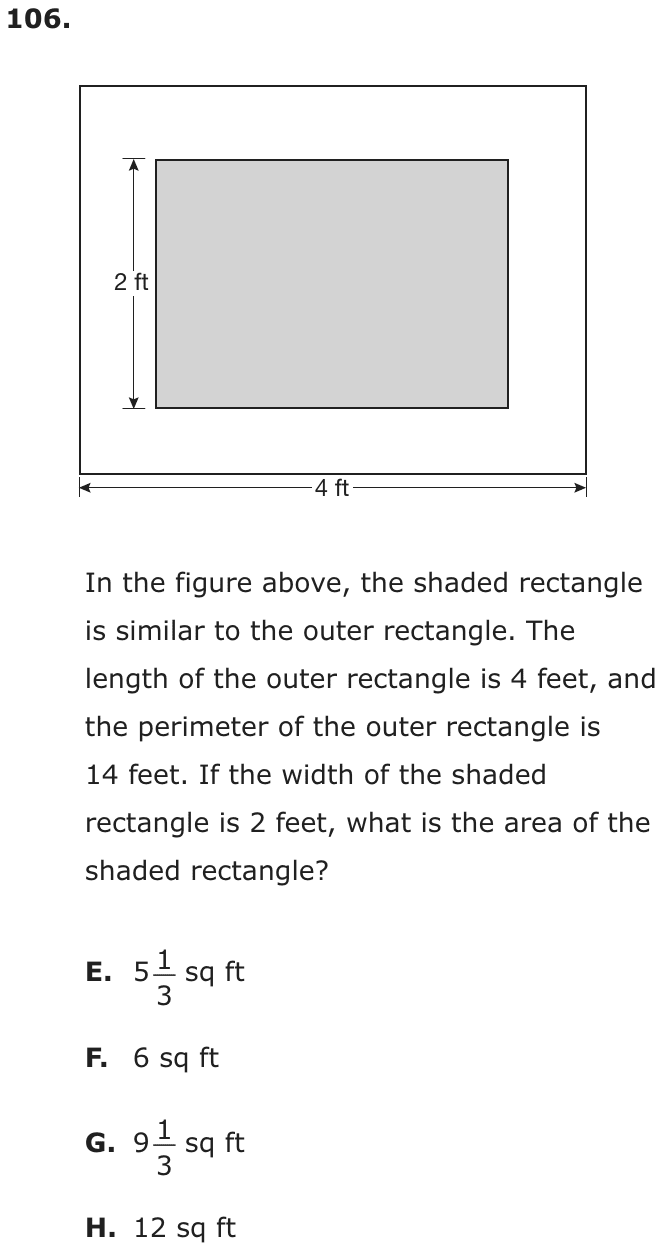
Question 35 of 49
2023 Test B Math, question 16Question
This wheel has 15 spokes, equally spaced. What is the measure of the angle between adjacent spokes?
- A30°
- B24°
- C15°
- D12°
Show the answer
Correct answer: B
The total number of degrees in a circle is 360. The measure of the angle between adjacent spokes is .
Question analysis
A wheel has 15 spokes, equally spaced around its hub, as the figure shows. Students find the measure of the angle between two neighboring spokes. The question tests knowing how many degrees make a full turn around a point and sharing them equally among the spokes.
- NYS standards
- 7.G.5 angle relationships and equations
- Grade level
- Grade 7 content, by NYS standard
- Compared with grade 7
- Below grade 7 Finding an angle by dividing a full turn into equal parts is early angle measurement. It takes one division, and the only fact needed is the number of degrees in a circle, so it sits below grade 7.
- Estimated difficulty
- Routine: one familiar step, little to misread.
- Thinking it demands
- Depth of knowledge 1, recall and reproduction · mainly apply
- What makes it hard
- Solution
- 1 step
- Reading level
- Question and choices: about grade 5, 16 words.
- Students, last 30 days
- Not enough answers yet to show (it takes 10).
Why it is hard, traps and wrong answers (shows the answer)
Why it is hard
One fact and one division answer this question, so it is among the easiest on the test. The wrong choices catch students who use a straight angle’s 180° for the full turn, who take the number of spokes as the angle, or who guess a familiar angle. Multiplying the answer by 15 to get back to 360° is a quick check.
Something you must already know minor Working it out
The question never says that a full turn is 360°; knowing it, and that the 15 spokes split it into 15 equal angles, is the whole method. (Anderson & Krathwohl, 2001)
Strategy: The spokes split the full turn around the hub into 15 equal angles, so divide the number of degrees in a circle by 15.
Traps
- Wrong formula: Uses a related but wrong formula: perimeter for area, diameter for radius, area for volume, or a misremembered one.
- Numbers taken from the question: Combines the numbers in the question without a model of the situation, or is simply a number that appears in the question.
The wrong answers, classified
A Little reason to choose it (Haladyna & Downing, 1993; Rodriguez, 2005)
No working with 15 spokes gives 30°, which is 360 ÷ 12, the angle between hours on a clock, so it mostly draws guesses at a familiar angle.
C Numbers taken from the question (Hegarty, Mayer & Monk, 1995)
Takes the number of spokes, 15, as the angle in degrees, matching a number in the question without any calculation.
D Wrong formula (King et al., 2004)
Divides 180 by 15, using a straight angle’s 180° as the full turn around the hub instead of 360°.
Worked solution, step by step
Formulas used
- Equal angles around a point
- One full turn around a point is 360 degrees. If lines from the point split that turn into equal angles, each angle gets the same share. So divide 360 by how many angles there are.
Sort out the question
The wheel has 15 spokes. They all start at the hub, the center of the wheel, and they are equally spaced. Adjacent spokes are spokes right next to each other. You need the angle between two adjacent spokes.
Count the angles around the hub
Go once around the hub. Between each spoke and the next is one angle. So 15 spokes make 15 angles, all the same size. Together they make one full turn, which is 360 degrees.
Watch out: a full turn is 360 degrees, not 180. Using 180 gives 12 degrees, choice D.
Share the full turn
Use the formula for equal angles.
Each angle is 24 degrees. Watch out: 15 is the number of spokes, not the size of the angle, so choice C is wrong. So the answer is B, 24°.
Check your answer
Multiply back: 15 angles of 24 degrees make degrees, a full turn. Also, a clock’s 12 hour marks are 30 degrees apart. This wheel has more spokes than that, so each angle must be smaller than 30 degrees.
More questions like this
The original DOE question
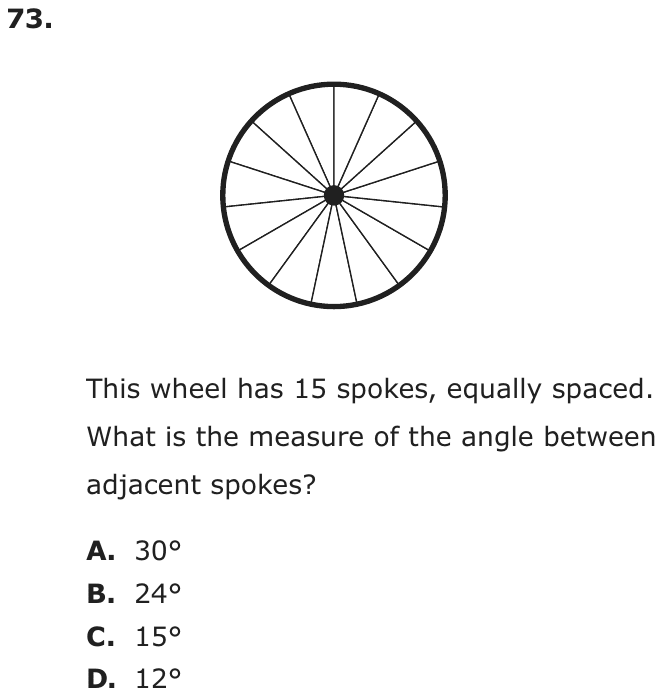
Question 36 of 49
2023 Test B Math, question 18Question
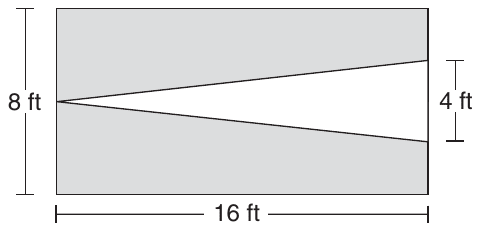
The diagram above shows a rectangle with an inscribed triangle. The triangle’s vertex and base touch the sides of the rectangle as shown. What is the total area of the shaded portion?
- A32 sq ft
- B64 sq ft
- C96 sq ft
- D128 sq ft
Show the answer
Correct answer: C
First, find the area of the rectangle, in square feet:
Then, find the area of the triangle:
To find the area of the shaded region, subtract the area of the triangle from the area of the rectangle:
Question analysis
A 16-foot by 8-foot rectangle has a white triangle inside it, with one vertex at the middle of the left side and a 4-foot base along the right side. Students find the total area of the shaded part. They subtract the triangle's area, whose height is not labeled and must be read from the figure.
- NYS standards
- 6.G.1 area of polygons
- Grade level
- Grade 6 content, by NYS standard
- Compared with grade 7
- At grade 7 Composite areas built from rectangles and triangles appear in grades 6 and 7. This one is typical, but the triangle lies on its side, so students must see which length is its height rather than read it from a label.
- Estimated difficulty
- Moderate: several steps, or a close reading with one strong distractor.
- Thinking it demands
- Depth of knowledge 2, skills and concepts · mainly apply
- What makes it hard
- Reading a figure, table or graph moderate
- Many steps minor
- Solution
- 3 steps
- Reading level
- Question and choices: about grade 2, 40 words.
- Students, last 30 days
- Not enough answers yet to show (it takes 10).
Why it is hard, traps and wrong answers (shows the answer)
Why it is hard
The shaded region is a rectangle with a triangle cut out, so the plan is standard, but the triangle is turned so that its height runs across the figure. Students who see that the height is the 16-foot side have two short areas to find and one subtraction. The listed wrong answers stop at either area or leave out the one half.
Reading a figure, table or graph moderate Understanding the question
The triangle lies on its side: its 4-foot base runs along the right edge, so its height is the rectangle’s full 16-foot length, which the figure labels only as the bottom side. (Lesh, Post & Behr, 1987; Kirsch & Mosenthal, 1990)
Many steps minor Working it out
The rectangle’s area, the triangle’s area and their difference are three separate results, and the first two, 128 and 32, are themselves listed choices. (Daniel & Embretson, 2010; Enright, Morley & Sheehan, 2002)
Strategy: Find the rectangle's area, find the triangle's area from its base on the right side and its height across the rectangle, then subtract.
Traps
- Stops one step early: A choice is a number from partway through the solution.
- Answers a different question: A choice is right for another quantity: the other unknown, the rest instead of the part, the part instead of the whole.
- Wrong formula: Uses a related but wrong formula: perimeter for area, diameter for radius, area for volume, or a misremembered one.
The wrong answers, classified
A Answers a different question (King et al., 2004; Hegarty, Mayer & Monk, 1995)
Finds the triangle’s area, ½ × 4 × 16 = 32, and gives the white region instead of the shaded part around it.
B Wrong formula (King et al., 2004)
Leaves out the ½ in the triangle’s area, 4 × 16 = 64, and subtracts that from 128, which leaves 64.
D Stops one step early (King et al., 2004; Gierl et al., 2017)
Finds the rectangle’s area, 16 × 8 = 128, and stops without subtracting the white triangle.
Worked solution, step by step
Formulas used
- Area of a rectangle
- A is the area, the space inside a flat shape, in square units. l is the length and w is the width. It works because the rectangle is filled by w rows of unit squares, with l squares in each row.
- Area of a triangle
- A is the area. b is the base, the side you measure from. h is the height, the distance from the base to the opposite corner, at a right angle to the base. You take half, because a triangle is half of a rectangle with the same base and height.
Sort out the figure
The figure is a rectangle 16 feet long and 8 feet tall. Inside it is a white triangle. Its tip touches the middle of the left side. Its base lies along the right side and is 4 feet long. The shaded part is the gray area around the triangle. You need its area.
Plan: find the rectangle’s area, then take away the triangle’s area.
Find the area of the rectangle
The rectangle’s area is 128 square feet. Watch out: this includes the white triangle. Stopping here gives choice D.
Find the triangle’s height
The triangle lies on its side. Its base is the 4-foot piece on the right side, which runs up and down. The height must meet the base at a right angle, a square corner. So the height runs straight across, from the base to the tip on the left side. That is the full length of the rectangle, 16 feet.
Find the area of the triangle
The triangle’s area is 32 square feet. Watch out: don’t forget the . Using leaves 64 for the shaded part, choice B.
Subtract to find the shaded area
The shaded part is 96 square feet. Watch out: 32 is the white triangle, not the shaded part, so choice A is wrong. So the answer is C, 96 sq ft.
Check your answer
The triangle’s base, 4 feet, is half the rectangle’s height of 8 feet. Its height is the full 16 feet. So the triangle is half of half the rectangle, or one fourth of it. One fourth of 128 is 32, and .
More questions like this
The original DOE question
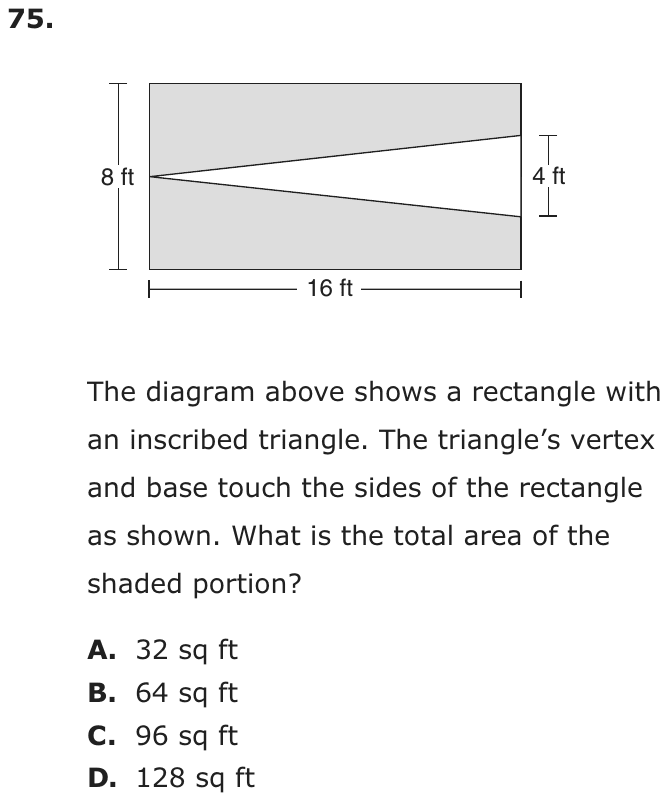
Question 37 of 49
2023 Test B Math, question 33Question

The distance from W to X is 70% of the distance from W to Y. If the distance from X to Y is 15 miles, what is the distance, in miles, from W to X?
- A10.5
- B35
- C45
- D50
Show the answer
Correct answer: B
Since the distance from W to X is 70% of the distance from W to Y, the distance from X to Y is 30% of the distance from W to Y. Let d represent the distance from W to Y. Then 15 miles is 30% of d.
So, the distance from W to X, in miles, is .
Question analysis
A percent question with a line segment: point X lies between W and Y, the distance from W to X is 70% of the whole, and the distance from X to Y is 15 miles. Students find the distance from W to X. Matching the 15 miles to the right percent before finding the whole is the step students most often skip.
- Grade level
- Grade 7 content, by NYS standard
- Compared with grade 7
- At grade 7 Grade 7 percent problems often give a part and its percent and ask for the whole. This one gives the distance for the part the percent does not describe and asks for the other part, so the whole has to be found on the way.
- Estimated difficulty
- Moderate: several steps, or a close reading with one strong distractor.
- Thinking it demands
- Depth of knowledge 2, skills and concepts · mainly apply
- What makes it hard
- Turning words into math moderate
- Many steps minor
- Solution
- 3 steps
- Reading level
- Question and choices: about grade 5, 33 words.
- Students, last 30 days
- Not enough answers yet to show (it takes 10).
Why it is hard, traps and wrong answers (shows the answer)
Why it is hard
The percent and the given distance describe different pieces of the road, which is the whole difficulty. Students who apply the 70% straight to the 15 miles get a small number fast, and students who solve correctly for the whole of WY must still remember to take XY away. Checking that 35 is 70% of 50 confirms the answer and catches both slips.
Turning words into math moderate Understanding the question
The 70% describes WX, but the 15 miles given is XY, so the sentence has to be recast as “XY is 30% of WY” before the 15 miles can be used. (Hegarty, Mayer & Monk, 1995; Koedinger & Nathan, 2004)
Many steps minor Working it out
Finding the complement, 30%, then the whole, 15 ÷ 0.30 = 50, then the part, 50 − 15, gives three results, and the middle one is itself a choice. (Daniel & Embretson, 2010; Enright, Morley & Sheehan, 2002)
Strategy: Work out what percent of WY the 15-mile stretch from X to Y must be, use it to find the whole of WY, then find the part from W to X.
Traps
- Stops one step early: A choice is a number from partway through the solution.
- Percent of the wrong amount: Finding the whole from a part, or a percent change measured from the wrong starting amount.
The wrong answers, classified
A Percent of the wrong amount (Parker & Leinhardt, 1995)
Takes 70% of the 15 miles, 0.7 × 15 = 10.5, applying the percent to XY instead of to the whole distance from W to Y.
C Little reason to choose it (Haladyna & Downing, 1993; Rodriguez, 2005)
No common working gives 45; it would make XY a quarter of WY instead of 30%, so it mostly draws guesses.
D Stops one step early (King et al., 2004; Gierl et al., 2017)
Finds the whole distance from W to Y, 15 ÷ 0.30 = 50 miles, and stops before subtracting the 15 miles from X to Y.
Worked solution, step by step
Formulas used
- Percent of a number
- The whole is the full amount. The part is a piece of it. The percent tells how many hundredths of the whole the part is. For example, 30% means 30 out of every 100, or 0.30. Use it whenever a percent describes a piece of a whole.
Sort out the distances
Point X sits between W and Y. So the trip from W to Y has two pieces: W to X, then X to Y.
W to X is 70% of the whole distance from W to Y. X to Y is 15 miles. You need the distance from W to X, in miles.
Find the percent for X to Y
The whole distance from W to Y is 100%. W to X uses 70% of it. The rest is X to Y.
So the 15 miles from X to Y is 30% of the whole distance.
Find the whole distance
Let d be the distance from W to Y. Use the percent formula. The part is 15, and the percent is 30.
Divide both sides by 0.30 to get d by itself.
The distance from W to Y is 50 miles.
Find the distance from W to X
Take the 15 miles from X to Y away from the whole.
W to X is 35 miles.
Watch out: 50 miles is the whole distance from W to Y, choice D. You still have to subtract. Also, the 70% is of the whole distance, not of the 15 miles. Taking 70% of 15 gives 10.5, choice A.
So the answer is B, 35 miles.
Check your answer
Is 35 really 70% of 50? . Yes. And 35 + 15 = 50, the whole distance. The figure also shows X closer to Y. So W to X should be longer than 15 miles, and it is.
More questions like this
The original DOE question
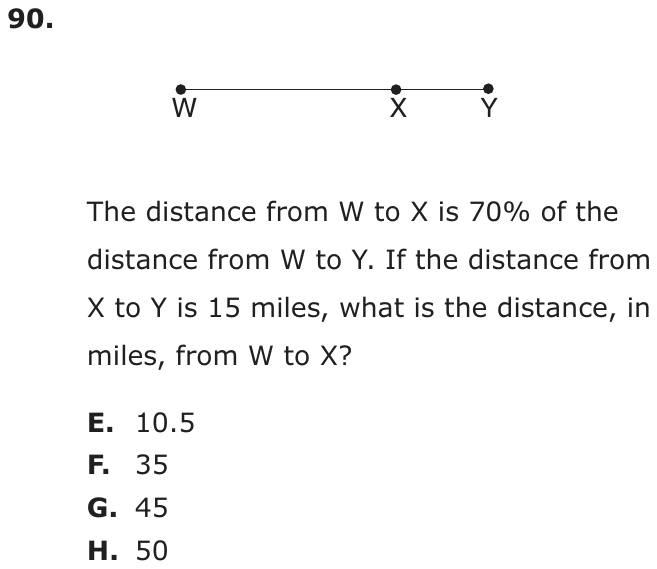
Question 38 of 49
2023 Test B Math, question 47Question
Four slips of paper numbered 1, 2, 3, and 4 were placed in a bag:
- One slip was selected from the bag, and the number recorded.
- Without replacement, a second slip was chosen.
- This process continued until no more slips remained in the bag.
- One part of a tree diagram representing the sample space is shown.
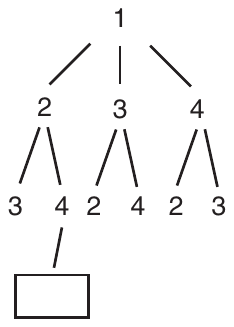
Which number should be placed in the box to complete this part of the tree diagram?
- A1
- B2
- C3
- D4
Show the answer
Correct answer: C
The “without replacement” statement means that the bag contained four slips for the first draw, three slips for the second draw, two slips for the third draw, and one slip for the last draw. Following the branch from the top and navigating down to the box, the 1 was chosen first, the 2 was chosen second, and the 4 was chosen third. The only remaining number is 3. The element would be 1243.
Question analysis
Four slips numbered 1 to 4 are drawn from a bag one at a time without replacement, and part of a tree diagram of the outcomes is shown. Students decide which number belongs in the empty box at the end of one branch. It tests reading a tree diagram and understanding what drawing without replacement means.
- NYS standards
- 7.SP.8b sample spaces for compound events
- Grade level
- Grade 7 content, by NYS standard
- Compared with grade 7
- Below grade 7 Tree diagrams for compound events are a grade 7 topic, but here the tree is already drawn and only one box is empty. Following a single branch to that box is shorter than typical grade 7 work with sample spaces.
- Estimated difficulty
- Routine: one familiar step, little to misread.
- Thinking it demands
- Depth of knowledge 2, skills and concepts · mainly understand
- What makes it hard
- Solution
- 2 steps
- Reading level
- Question and choices: about grade 5, 68 words.
- Students, last 30 days
- Not enough answers yet to show (it takes 10).
Why it is hard, traps and wrong answers (shows the answer)
Why it is hard
Only one branch matters, and once it is read as the slips drawn so far, 1, 2 and 4, the last slip left in the bag is the only one missing. Errors come from not counting the top 1 as a draw, from forgetting that a drawn slip stays out, or from copying a nearby number in the diagram instead of following the path.
Reading a figure, table or graph minor Understanding the question
The box hangs below the branch 1, then 2, then 4, and students must read that path from the top as the order of the first three draws. (Lesh, Post & Behr, 1987; Kirsch & Mosenthal, 1990)
Strategy: Follow the branch from the top down to the box, list the slips already drawn on that path, and name the one still left in the bag.
Traps
- Without replacement: In a second pick there is one fewer item, which changes the probability.
- Misreads the figure: Reads a value, label or tick spacing in a figure, table or graph wrongly.
The wrong answers, classified
A Misreads the figure (Lesh, Post & Behr, 1987; Kirsch & Mosenthal, 1990)
Treats the 1 at the top as the start of the diagram rather than the first slip drawn, so 1 seems still to be in the bag.
B Without replacement (Fischbein & Schnarch, 1997)
Lets slip 2, already drawn second on this branch, come up again, missing that a slip drawn without replacement stays out of the bag.
D Numbers taken from the question (Hegarty, Mayer & Monk, 1995)
Copies 4, the number directly above the box, reading the diagram as a pattern of numbers rather than as the order of the draws.
Worked solution, step by step
Sort out the question
The bag holds four slips: 1, 2, 3 and 4. Slips are drawn one at a time. “Without replacement” means a drawn slip does not go back in the bag. So each number can be drawn only once.
Read the tree diagram
A tree diagram shows the orders the draws can happen in. Each row going down is one draw. The 1 at the top is the first slip drawn. The numbers below it are the choices for the second draw, and so on.
Follow the path to the box
Start at the top and go down the lines to the box.
- First draw: 1
- Second draw: 2
- Third draw: 4
- Fourth draw: the box
Slips 1, 2 and 4 are already out of the bag.
Find the slip that is left
The bag started with 1, 2, 3 and 4. Only slip 3 has not been drawn. So it must be the fourth draw.
Watch out: The 1 at the top counts as a draw, so 1 is not left. That trap is choice A. Slip 2 was already drawn, so choice B can’t be right. And 4 is just the number above the box, choice D.
So the answer is C, 3.
Check your answer
Read the whole path: 1, 2, 4, 3. Each number from 1 to 4 shows up exactly once. That is just what should happen when no slip goes back in the bag.
More questions like this
The original DOE question
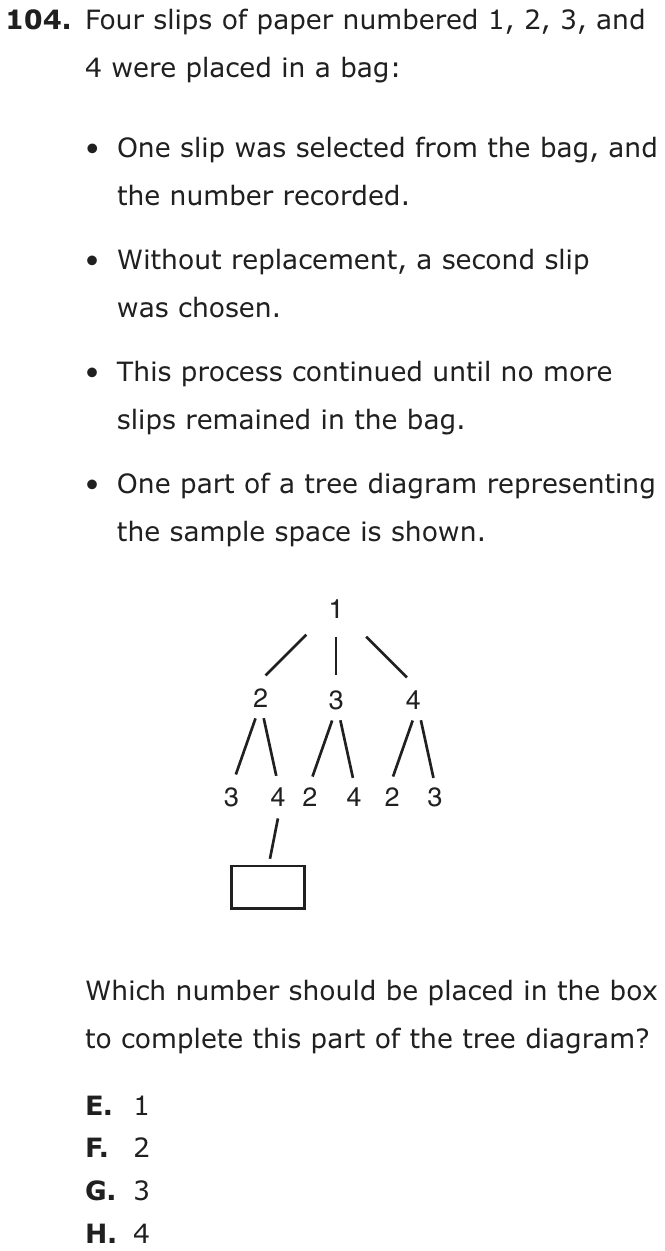
Question 39 of 49
2023 Test B Math, question 52Question
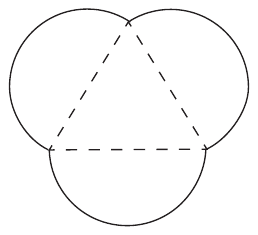
The garden design shown above is created in the shape of three semicircles whose diameters lie on the sides of an equilateral triangle. If each diameter is 2 meters long, what is the perimeter of the garden, in meters?
- A6
- B12
- C
- D
Show the answer
Correct answer: C
The perimeter (or circumference) of one of the three semicircles is . Since there are 3 semicircles that make up the perimeter, the perimeter is .
Question analysis
A garden is outlined by three semicircles whose diameters, each 2 meters long, are the sides of an equilateral triangle. Students find the perimeter of the garden in meters. It tests the circumference of a circle applied to half circles, and the figure mixes straight dashed sides with curved ones, so deciding what counts as the outline matters.
- NYS standards
- 7.G.4 circle area and circumference
- Grade level
- Grade 7 content, by NYS standard
- Compared with grade 7
- At grade 7 Applying the circumference formula is a grade 7 standard. Here it is used for a semicircle and repeated three times, a short extension of routine classwork, with a dashed triangle inside the figure to look past.
- Estimated difficulty
- Straightforward: two steps or one careful reading.
- Thinking it demands
- Depth of knowledge 2, skills and concepts · mainly apply
- What makes it hard
- Solution
- 3 steps
- Reading level
- Question and choices: about grade 8, 40 words.
- Students, last 30 days
- Not enough answers yet to show (it takes 10).
Why it is hard, traps and wrong answers (shows the answer)
Why it is hard
The perimeter is just three half-circles, and each is half of π × 2. The figure’s dashed triangle invites measuring straight sides instead, and remembering the whole circle’s circumference without halving it gives a choice twice too large. Tracing the garden’s outer edge with a finger before computing shows that only the curves count.
Reading a figure, table or graph minor Understanding the question
The dashed triangle lies inside the garden, so its three 2-meter sides are not part of the perimeter; only the three curved arcs bound the garden. (Lesh, Post & Behr, 1987; Kirsch & Mosenthal, 1990)
Something you must already know minor Working it out
The circumference formula is not given, and each arc is half of a circle with a 2-meter diameter, so students must take half of π × 2. (Anderson & Krathwohl, 2001)
Strategy: Find the circumference of a full circle with a 2-meter diameter, take half of it for one semicircle, and multiply by the number of semicircles in the outline.
Traps
- Wrong formula: Uses a related but wrong formula: perimeter for area, diameter for radius, area for volume, or a misremembered one.
- Answers a different question: A choice is right for another quantity: the other unknown, the rest instead of the part, the part instead of the whole.
- A formula you must know: Needs a formula the test does not give: area, circumference, volume, probability rules.
The wrong answers, classified
A Answers a different question (King et al., 2004; Hegarty, Mayer & Monk, 1995)
Adds the three dashed sides of the triangle, 3 × 2 = 6, measuring the triangle inside the garden instead of its curved outline.
B Little reason to choose it (Haladyna & Downing, 1993; Rodriguez, 2005)
No common working gives 12, which is twice the triangle’s perimeter and matches no arc length, so it mostly draws guesses.
D Wrong formula (King et al., 2004)
Uses a whole circumference, π × 2, for each of the three arcs, forgetting that each one is only half a circle, which doubles the perimeter.
Worked solution, step by step
Formulas used
- Circumference of a circle
- C is the circumference, the distance around a circle. d is the diameter, the straight line across the circle through its center. π is a number a little more than 3.14. The distance around any circle is π times as long as the distance across it.
- Arc of a semicircle
- A semicircle is half of a circle. Its arc is the curved part. d is the diameter, the straight side. The arc is half of the full circle’s circumference, so take half of π times d.
Sort out the figure
The garden’s edge is made of three semicircles, or half circles. Each one sits on a side of the dashed triangle. Each side is a diameter, 2 meters long. The perimeter is the distance around the outside. Here that is only the three arcs, the curved parts. The dashed triangle is inside, so it does not count.
Find a full circle’s circumference
Picture the whole circle that one semicircle comes from. Its diameter is 2 meters. Use the circumference formula.
The full circle would measure meters around.
Find the length of one arc
Each semicircle’s arc is half of that circle. Use the arc formula.
One arc is meters long.
Watch out: Using the full circle’s for each arc doubles the answer. That gives , choice D.
Add the three arcs
The garden’s edge is three equal arcs.
The perimeter is meters.
Watch out: The dashed sides add to 2 + 2 + 2 = 6 meters, choice A. That is the triangle, not the curved edge.
So the answer is C, meters.
Check your answer
Estimate. is about 3 × 3.14 = 9.42 meters. A curved path is longer than the straight line across it. So the edge should be longer than the triangle’s 6 meters, and 9.42 is.
More questions like this
The original DOE question
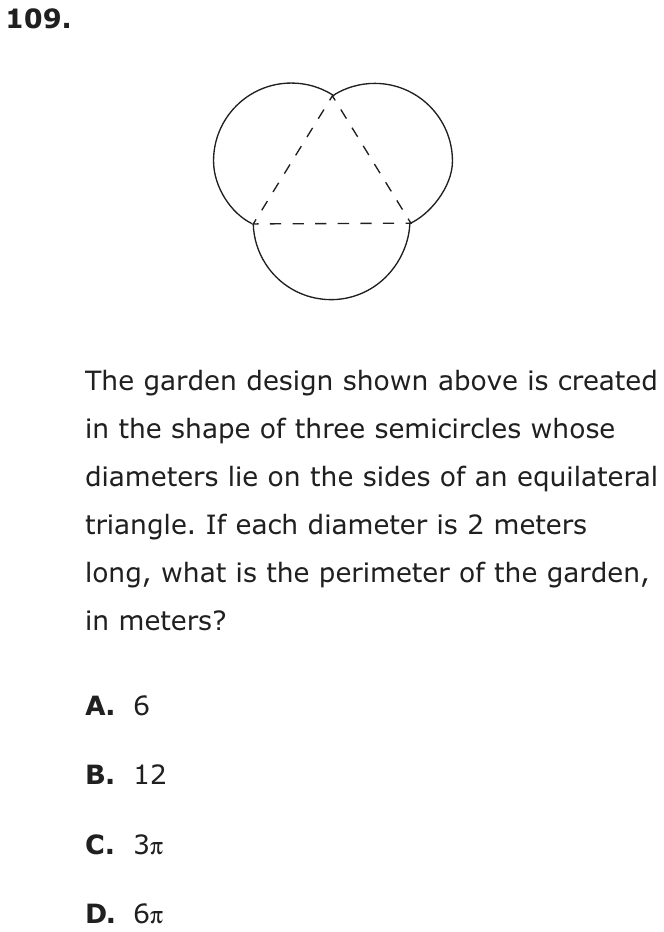
Question 40 of 49
2023 Test B Math, question 56Question
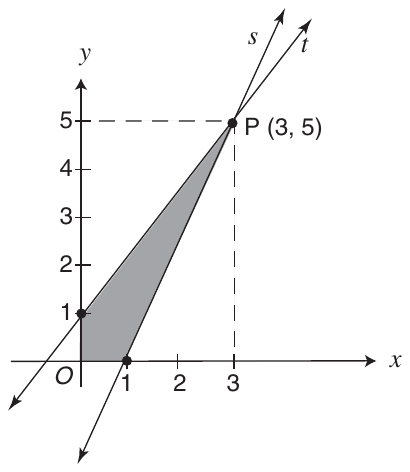
Lines s and t intersect at point P (3, 5). What is the area, in square units, of the shaded region in the graph above?
- A2
- B3
- C4
- D7
Show the answer
Correct answer: C
First, find the area of the rectangle in the graph:
Then, find the areas of the two right triangles that are not shaded:
Upper triangle:
Lower triangle:
The area of the shaded region, in square units, is calculated by subtracting the total area of the two right triangles from the area of the rectangle:
Question analysis
Two lines meet at the point (3, 5) on a coordinate grid, and the shaded region between them and the axes is a four-sided shape. Students find its area in square units. The shape is not a standard figure, so no single area formula applies to it directly.
- Grade level
- Grade 6 content, by NYS standard
- Compared with grade 7
- At grade 7 Areas of triangles and rectangles are grade 6 content, and grade 7 students often find composite areas. This region is an irregular four-sided shape with two slanted sides, so students need a plan, and the lengths come from coordinates rather than labels.
- Estimated difficulty
- Moderate: several steps, or a close reading with one strong distractor.
- Thinking it demands
- Depth of knowledge 2, skills and concepts · mainly apply
- What makes it hard
- No obvious method moderate
- Reading a figure, table or graph moderate
- Many steps minor
- Solution
- 4 steps
- Reading level
- Question and choices: about grade 4, 23 words.
- Students, last 30 days
- Not enough answers yet to show (it takes 10).
Why it is hard, traps and wrong answers (shows the answer)
Why it is hard
The question rewards a plan more than computation: the region has no name, so students must see it inside the dashed rectangle from O to P, with two right triangles cut away. Reading each triangle’s legs from the axes is the second hurdle, since the 1-unit intercepts shorten one leg of each, to 4 instead of 5 and to 2 instead of 3. Only one wrong choice, from using one coordinate as both heights, has a clear working behind it, so most errors here are guesses after a failed plan.
No obvious method moderate Working it out
The shaded shape has four sides, two of them slanted, and no formula of its own; it must be boxed in the 3-by-5 rectangle with two triangles removed, or cut along OP. (Schoenfeld, 1985)
Reading a figure, table or graph moderate Understanding the question
No lengths are labeled; every one comes from the coordinates of P (3, 5), the y-intercept 1 of line s and the x-intercept 1 of line t. (Lesh, Post & Behr, 1987; Kirsch & Mosenthal, 1990)
Many steps minor Working it out
The rectangle, two triangle areas and a subtraction make four computations, 15, 6 and 5, then 15 − 11, each built from different coordinates. (Daniel & Embretson, 2010; Enright, Morley & Sheehan, 2002)
Strategy: Draw the rectangle from O to P, find the areas of the two unshaded right triangles inside it from the coordinates, and subtract both from the rectangle's area.
Traps
- Misreads the figure: Reads a value, label or tick spacing in a figure, table or graph wrongly.
The wrong answers, classified
A Little reason to choose it (Haladyna & Downing, 1993; Rodriguez, 2005)
No common working gives 2; no rectangle or triangle built from the coordinates leaves that area, so it mostly draws students who judge the narrow region by eye.
B Misreads the figure (Lesh, Post & Behr, 1987; Kirsch & Mosenthal, 1990)
Cuts the region along OP into two triangles with bases of 1 but uses 3, the x-coordinate of P, as the height of both: 1.5 + 1.5 = 3.
D Little reason to choose it (Haladyna & Downing, 1993; Rodriguez, 2005)
No common working gives 7; half of the 3-by-5 rectangle, 7.5, comes closest, so it mostly draws students who guess the region fills about half.
Worked solution, step by step
Formulas used
- Area of a rectangle
- A is the area, in square units. l is the length and w is the width. Multiplying them counts the unit squares that fill the rectangle.
- Area of a triangle
- A is the area. b is the base, one side. h is the height: the distance from the base straight up to the far corner. A right triangle has a square corner, and the two sides that meet there are the base and height. A triangle is half of a rectangle with the same base and height.
Sort out the shaded region
The shaded region has four corners: O at (0, 0), (0, 1) on the y-axis, P at (3, 5), and (1, 0) on the x-axis. Line t meets the y-axis at (0, 1), and line s meets the x-axis at (1, 0). There is no easy formula for this shape. But the dashed lines make a rectangle around it. So find the rectangle’s area and take away the white parts.
Find the rectangle’s area
The rectangle has corners O, (3, 0), P and (0, 5). It is 3 units wide and 5 units tall.
The rectangle’s area is 15 square units.
Find the upper triangle’s area
The white triangle at the top left has corners (0, 1), (0, 5) and P. Its square corner, or right angle, is at (0, 5). One side runs up the y-axis from 1 to 5, so it is 4 units. The other runs across from 0 to 3, so it is 3 units.
Its area is 6 square units.
Find the lower triangle’s area
The white triangle at the bottom right has corners (1, 0), (3, 0) and P. Its square corner is at (3, 0). One side runs along the x-axis from 1 to 3, so it is 2 units. The other goes up from 0 to 5, so it is 5 units.
Its area is 5 square units.
Watch out: The lines cross the axes at 1, not at O. So these sides are 4 and 2, not 5 and 3.
Subtract the white triangles
Take both triangles away from the rectangle.
The shaded area is 4 square units.
So the answer is C, 4.
Check your answer
Cut the shaded region along a line from O to P. One piece has a base of 1 on the x-axis and a height of 5, since P is 5 units up. Its area is 2.5. The other has a base of 1 on the y-axis and a height of 3, since P is 3 units across. Its area is 1.5. Then 2.5 + 1.5 = 4. Using 3 for both heights gives 3, choice B.
More questions like this
The original DOE question
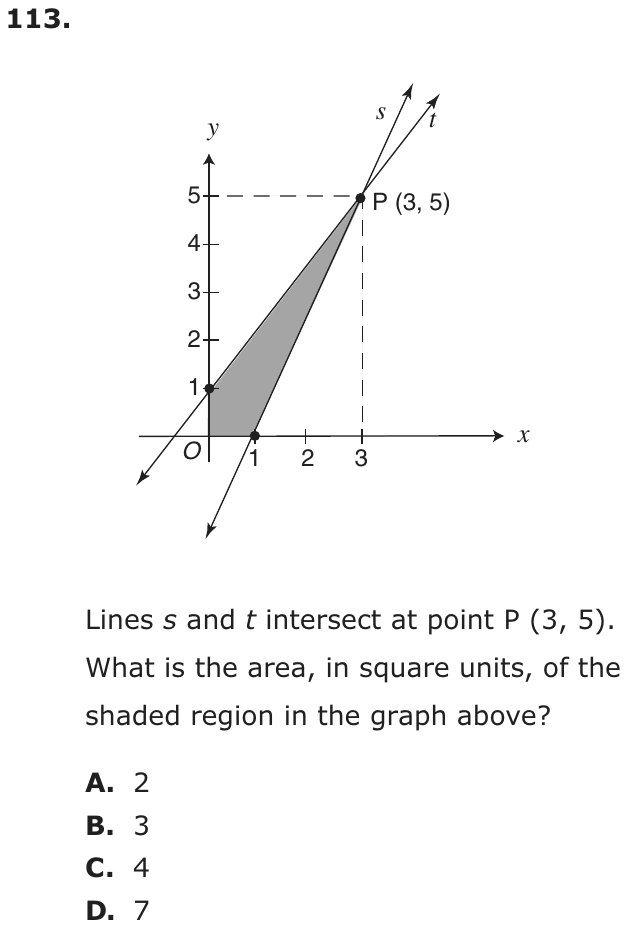
Question 41 of 49
2018 Test A Math, question 1Question
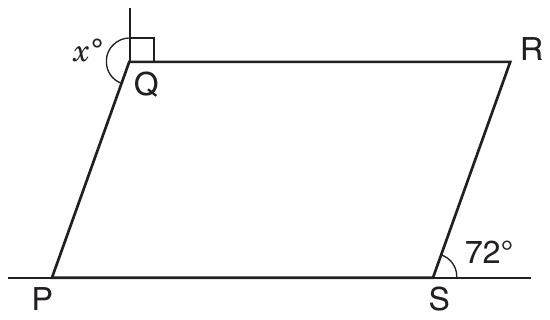
In the figure above, PQRS is a parallelogram. What is the value of ?
Grid-in question: work out the answer and enter it as a number.
Show the answer
Correct answer: 162
First, find the measure of angle PQR. The measure of angle PQR is equal to the measure of angle PSR.
m∠PSR = 180 − 72 = 108.
So, the measure of angle PQR is also 108.
108 + 90 + x = 360
198 + x = 360
x = 162
Question analysis
A grid-in geometry question about angles around a parallelogram PQRS. A 72° angle sits outside corner S on the extended base, and at corner Q a right angle and the unknown angle x complete the turn around the point. Students chain three angle facts, and the angle asked for lies outside the shape, not inside it.
- NYS standards
- Grade level
- Grade 8 content, by NYS standard
- Compared with grade 7
- Above grade 7 Grade 7 angle work usually applies one or two facts, such as supplementary or vertical angles, to find an angle. This chains three, and needs the equal opposite angles of a parallelogram, which rest on grade 8 parallel-line facts.
- Estimated difficulty
- Hard: combines ideas, needs a plan, and has more than one tempting wrong answer.
- Thinking it demands
- Depth of knowledge 2, skills and concepts · mainly apply
- What makes it hard
- Reading a figure, table or graph major
- Combines ideas moderate
- An answer in an unexpected form minor
- Solution
- 3 steps
- Reading level
- Question and choices: about grade 7, 14 words.
- Students, last 30 days
- Not enough answers yet to show (it takes 10).
Why it is hard, traps and wrong answers (shows the answer)
Why it is hard
The arithmetic is two subtractions; the difficulty is seeing which angles the marks refer to. Students lose points by treating the 72° as the parallelogram's own angle at S, or by stopping at angle PQR, the most natural number to grid. The question rewards tracing a route from S to Q before computing anything, and checking at the end that x is the angle outside the shape that the arc marks.
Reading a figure, table or graph major Understanding the question
The 72° is marked outside the parallelogram, between side SR and the base extended past S, and x sits outside corner Q, between QP and a vertical ray that meets QR at a right-angle mark. (Lesh, Post & Behr, 1987; Kirsch & Mosenthal, 1990)
Combines ideas moderate Working it out
Three angle facts have to be chained: a straight line gives the angle inside S, opposite angles of a parallelogram carry it to Q, and the angles around Q make a full 360° turn. (Embretson, 1998; Daniel & Embretson, 2010)
An answer in an unexpected form minor Choosing the answer
As a grid-in there are no choices to check against, so a student who stops at angle PQR, inside the parallelogram, gets no signal that the job is unfinished. (Enright, Morley & Sheehan, 2002)
Strategy: Use the straight line at S to find the parallelogram's angle there, carry it to the opposite corner Q, then take that angle and the right angle away from 360.
Traps
- Stops one step early: A choice is a number from partway through the solution.
The wrong answers, classified
108 Stops one step early (King et al., 2004; Gierl et al., 2017)
Finds angle PSR = 180 − 72 = 108 and carries it to angle PQR, then grids that interior angle instead of the angle x outside it.
198 Misreads the figure (Lesh, Post & Behr, 1987; Kirsch & Mosenthal, 1990)
Reads the 72° as the parallelogram's interior angle at S, so takes angle PQR as 72 and grids 360 − 90 − 72 = 198.
252 Misreads the figure (Lesh, Post & Behr, 1987; Kirsch & Mosenthal, 1990)
Overlooks the right-angle mark at Q and subtracts only the 108° angle PQR from 360, giving 252.
Worked solution, step by step
Formulas used
- Angles on a straight line
- a and b are two angles side by side on a straight line. Together they make a half turn, so they always add up to 180 degrees. Use it when an angle you need shares a straight line with an angle you know.
- Opposite angles of a parallelogram
- The symbol ∠ means angle. ∠PQR is the angle at corner Q, between sides QP and QR. ∠PSR is the angle at the opposite corner, S. In a parallelogram, opposite corners always have equal angles, because the shape leans the same way at both.
- Angles around a point
- a, b and c are angles that fit around one point with no gaps and no overlaps. Going all the way around is a full turn, which is 360 degrees. So the angles add up to 360.
Sort out what the figure shows
PQRS is a parallelogram. That is a four-sided shape whose opposite sides are parallel, which means they never meet. You need the value of x, in degrees.
Look closely at the marks. The 72° angle is outside the shape, at S. It sits between side SR and the base line, which keeps going past S. At Q, a vertical line meets side QR. The small square means a right angle, 90°. The angle x is outside the shape too. It runs from that vertical line around to side QP.
Find the angle inside corner S
Angle PSR is the shape’s own angle at S. It sits right next to the 72° angle, on the same straight base line. So the two angles add up to 180°.
So angle PSR is 108°. Watch out: 72° is not the inside angle at S. Using 72 as the inside angle leads to the wrong answer 198.
Carry the angle over to Q
Corners Q and S are opposite each other. In a parallelogram, opposite angles are equal. So angle PQR matches angle PSR.
So angle PQR is 108°. Watch out: this is not x. Angle PQR is inside the shape, and x is outside it. Stopping here and gridding 108 is the most common mistake.
Add the angles around Q
Three angles fill the space all the way around point Q. They are the right angle (90°), angle PQR (108°) and x. Together they make a full turn.
Watch out: don’t skip the right angle at Q. Leaving out the 90 gives 252.
Solve for x
Subtract 198 from 360 to find what is left for x.
So x is 162°. So you would grid 162.
Check your answer
Add the three angles at Q: . That is a full turn. Also, the arc for x is wider than a right angle but not as wide as a straight line. So x should be between 90° and 180°, and 162° is.
More questions like this
The original DOE question
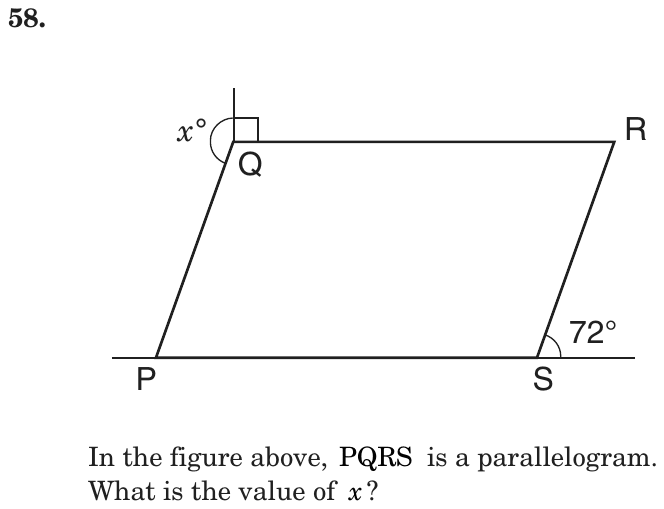
Question 42 of 49
2018 Test A Math, question 12Question
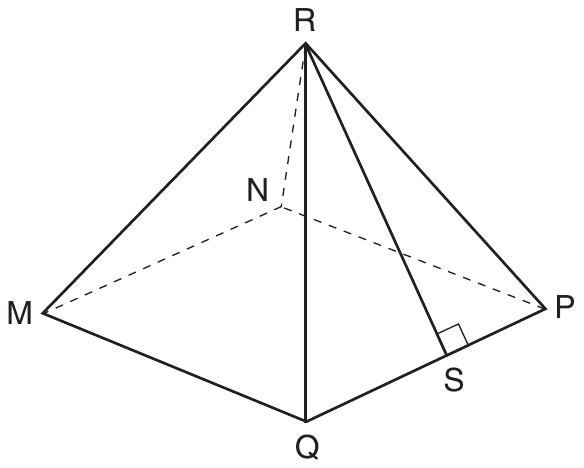
In the pyramid above, each triangular face has the same area, and the base MNPQ is a square that measures 8 centimeters on each side. If the length of = 6 centimeters, what is the surface area of the pyramid excluding the base?
- A48 sq cm
- B96 sq cm
- C128 sq cm
- D160 sq cm
Show the answer
Correct answer: B
Line segment is the altitude, or height, of triangle QRP. The length of is 8 cm. Use that information to find the area of triangle QRP:
sq cm.
There are 4 congruent triangles in the pyramid, so the surface area is
4 × 24 = 96 sq cm
Question analysis
A geometry question about the surface area of a square pyramid, leaving out its base. The base edges are 8 cm and segment RS, the height of one triangular face drawn from the top to a base edge, is 6 cm. Students find one face's area and multiply by the number of faces, reading excluding the base carefully.
- Grade level
- Grade 7 content, by NYS standard
- Compared with grade 7
- At grade 7 Surface area of a right pyramid from its faces is named in the grade 7 standards, and this is a direct two-step case. It matches typical grade 7 work, though the drawing's slant height must be read correctly.
- Estimated difficulty
- Moderate: several steps, or a close reading with one strong distractor.
- Thinking it demands
- Depth of knowledge 2, skills and concepts · mainly apply
- What makes it hard
- Solution
- 2 steps
- Reading level
- Question and choices: about grade 5, 49 words.
- Students, last 30 days
- Not enough answers yet to show (it takes 10).
Why it is hard, traps and wrong answers (shows the answer)
Why it is hard
Once RS is read as the height of a face, the computation is short: one triangle, then four of them. Points go to the figure and to one word. Students who count only the faces drawn in front, or who include the square base, reach listed choices, and the bold "excluding" is all that separates the lateral area from the total. The statement that every face has the same area is what makes multiplying by four valid.
Reading a figure, table or graph moderate Understanding the question
The drawing shows two lateral faces in front and two behind dashed edges, and RS, with its right-angle mark at S, is the height of face QRP, not of the pyramid. (Lesh, Post & Behr, 1987; Kirsch & Mosenthal, 1990)
Something you must already know minor Working it out
The triangle area formula, one half times base times height, and the fact that a square pyramid has four lateral faces are both assumed, not given. (Anderson & Krathwohl, 2001)
Strategy: Find the area of one triangular face with one half times base times height, using RS as the height, then multiply by the four congruent faces.
Traps
- Misreads the question: Misses or misreads a condition or a word in the question: "at least", "each", "remaining", "not".
- A formula you must know: Needs a formula the test does not give: area, circumference, volume, probability rules.
The wrong answers, classified
A Misreads the figure (Lesh, Post & Behr, 1987; Kirsch & Mosenthal, 1990)
Finds one face as ½ × 8 × 6 = 24 but counts only the two faces drawn in front, 2 × 24 = 48, missing the two hidden ones.
C Numbers taken from the question (Hegarty, Mayer & Monk, 1995)
Uses only the 8 cm edge, as both base and height of each face, 4 × ½ × 8 × 8 = 128, and never uses RS.
D Misreads the question (Hegarty, Mayer & Monk, 1995)
Finds the four faces, 96 sq cm, then adds the 8 × 8 = 64 sq cm base that the question says to exclude.
Worked solution, step by step
Formulas used
- Area of a triangle
- A is the area. b is the base, the side the triangle sits on. h is the height: the straight-up distance from the base to the top corner, at a right angle to the base. You take half because a triangle is half of a rectangle with the same base and height.
Sort out the pyramid
The pyramid sits on a square base, MNPQ. Each side of the square is 8 cm. Four triangle faces rise from the base and meet at the top point, R. Every face has the same area. Segment RS is 6 cm. You need the area of the four faces, “excluding the base”. Excluding means leaving it out.
See what RS measures
RS runs from R down face QRP to point S on edge QP. The small square at S marks a right angle. So RS is the height of triangle QRP. The base of that triangle is QP, one side of the square, so it is 8 cm.
Find the area of one face
Use the triangle formula with base 8 cm and height 6 cm.
One face has an area of 24 sq cm.
Add the four faces
All four faces are the same, so multiply by 4.
Watch out: only two faces are drawn in front. The other two hide behind the dashed lines. Counting just two faces gives 48, choice A. Watch out: don’t add the base, . That gives 160, choice D. So the answer is B, 96 sq cm.
Check your answer
Each face fits inside an 8 by 6 rectangle, with an area of 48 sq cm. The triangle is half of that, 24 sq cm, and four faces make 96 sq cm. That is less than 160, which would include the base.
More questions like this
The original DOE question
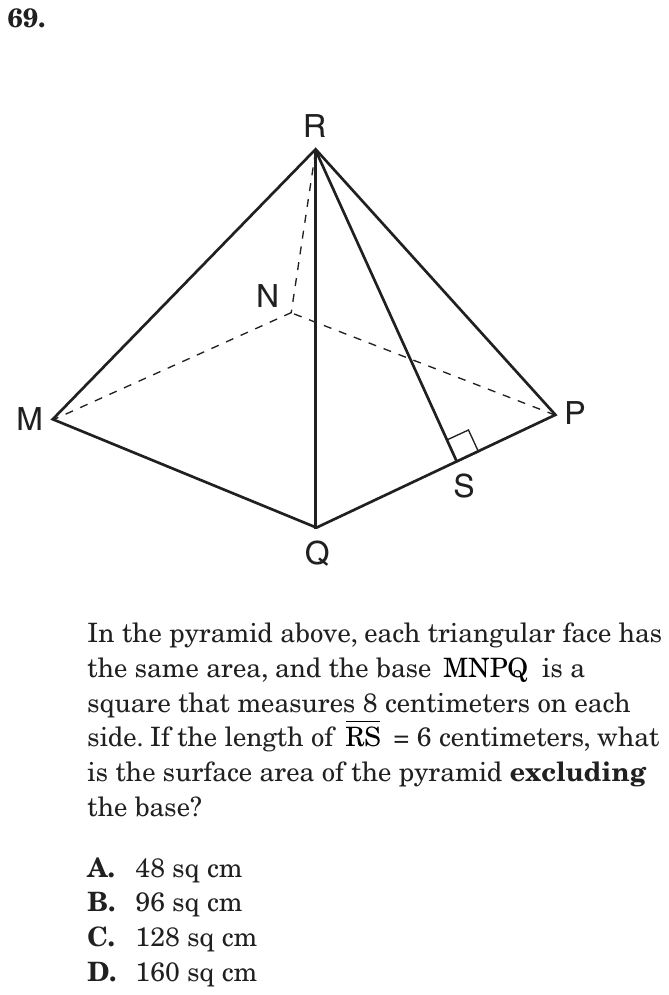
Question 43 of 49
2018 Test A Math, question 18Question
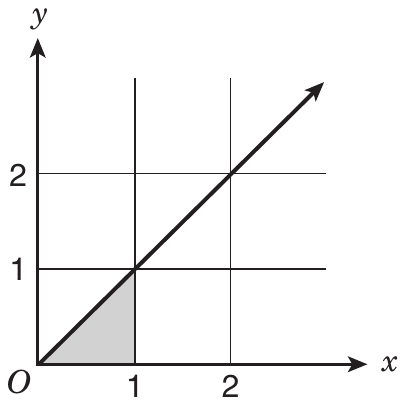
What is the area of the shaded region in the graph above?
- A0.25 square unit
- B0.5 square unit
- C1 square unit
- D1.5 square units
Show the answer
Correct answer: B
The shaded region is a right triangle. Each leg is 1 unit in length.
So the area is
or 0.5 sq unit
Question analysis
A coordinate grid question: find the area of a shaded right triangle with corners at the origin, (1, 0) and (1, 1), under a diagonal line. Students read the base and height from the grid and apply the triangle area formula. The figure does most of the work; the task is recalling the formula correctly.
- Grade level
- Grade 6 content, by NYS standard
- Compared with grade 7
- Below grade 7 Finding a triangle's area from a grid is grade 6 work, and this takes one step with whole-unit legs. It is easier than typical grade 7 area problems, which use composite figures or scale drawings.
- Estimated difficulty
- Routine: one familiar step, little to misread.
- Thinking it demands
- Depth of knowledge 1, recall and reproduction · mainly apply
- What makes it hard
- Solution
- 1 step
- Reading level
- Question and choices: about grade 2, 20 words.
- Students, last 30 days
- Not enough answers yet to show (it takes 10).
Why it is hard, traps and wrong answers (shows the answer)
Why it is hard
This is a quick formula question with legs of 1. The main risk is the one-half in the triangle formula: leaving it out gives the area of the whole grid square, which is a listed choice. Seeing that the diagonal cuts the unit square exactly in half gives a check that needs no formula at all.
Reading a figure, table or graph minor Understanding the question
The legs of the shaded triangle, from O to (1, 0) and up to (1, 1), are read off the grid lines; the line running on to (2, 2) is not part of the region. (Lesh, Post & Behr, 1987; Kirsch & Mosenthal, 1990)
Something you must already know minor Working it out
The triangle area formula, one half times base times height, is needed and not given; the shaded triangle is half of one grid square. (Anderson & Krathwohl, 2001)
Strategy: Read the two legs straight off the grid, then apply the triangle area formula, base times height divided by two.
Traps
- A formula you must know: Needs a formula the test does not give: area, circumference, volume, probability rules.
The wrong answers, classified
A Misreads the figure (Lesh, Post & Behr, 1987; Kirsch & Mosenthal, 1990)
Judges the shaded triangle by eye as a quarter of the 1-by-1 grid square instead of the half that the diagonal from O to (1, 1) cuts off.
C Wrong formula (King et al., 2004)
Multiplies base by height, 1 × 1 = 1, and leaves out the one-half, giving the whole unit square instead of the triangle.
D Little reason to choose it (Haladyna & Downing, 1993; Rodriguez, 2005)
No common working gives 1.5, which is more than the whole grid square around the shaded triangle; it mostly draws guesses.
Worked solution, step by step
Formulas used
- Area of a triangle
- A is the area. b is the base, the side the triangle sits on. h is the height: the straight-up distance from the base to the top corner, at a right angle to the base. You take half because a triangle is half of a rectangle with the same base and height.
Sort out the shaded region
The shaded region is a triangle. Its corners are O, the point (1, 0) and the point (1, 1). O is the origin, the point (0, 0) where the axes meet. The line keeps going up to (2, 2), but only the small triangle is shaded. You need its area in square units.
Read the base and height
The base lies along the x-axis, from O to 1. So the base is 1 unit. The height goes straight up from (1, 0) to (1, 1). So the height is 1 unit too. The base and height meet at a right angle, as the grid lines show.
Use the triangle formula
The area is 0.5 square unit. Watch out: don’t forget the one half. is the whole grid square, choice C. So the answer is B, 0.5 square unit.
Check your answer
The grid square from 0 to 1 has an area of 1 square unit. The slanted line cuts it corner to corner into two equal triangles. The shaded one is half the square, so 0.5 square unit.
More questions like this
The original DOE question
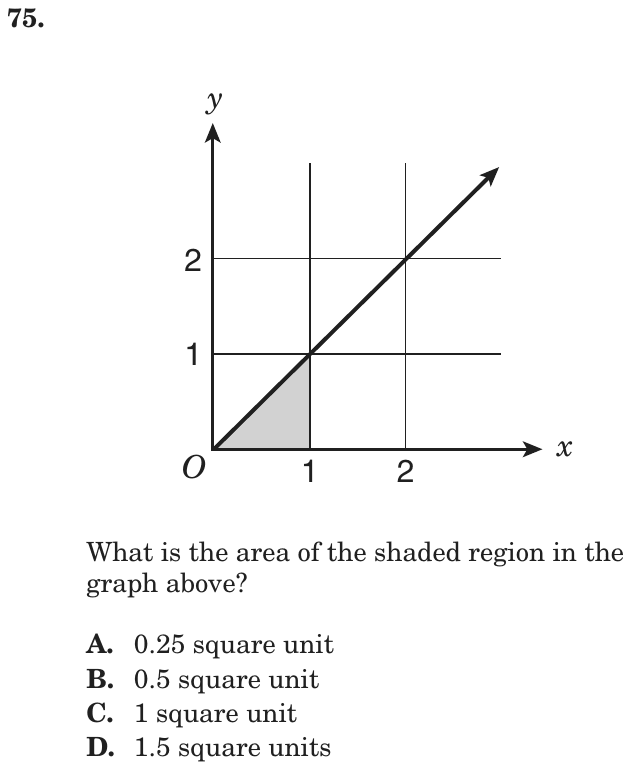
Question 44 of 49
2018 Test B English, question 55Passage Invention of the Telegraph
Samuel Morse, an American inventor, is credited with creating the electronic telegraph, a communication device that allows users to send messages using a system of short and long pulses that represent letters, numbers, and punctuation. In 1843 the United States Congress passed the Telegraph Bill, which provided Morse with the funds to build an electric telegraph system.
Invention of the Telegraph
Earlier Signal Systems
Long before Samuel F. B. Morse electrically transmitted his famous message “What hath God wrought?” from Washington to Baltimore on May 24, 1844, there were signaling systems that enabled people to communicate over distances. Most were visual or “semaphore” systems using flags or lights. In the eighteenth century, such systems used an observer who would decipher a signal from a high tower on a distant hill and then send it on to the next station. The young American republic wanted just such a system along its entire Atlantic coast and offered a prize of $30,000 for a workable proposal. The framers of this legislation had no way of knowing that when they used the word “telegraph” to refer to this visual semaphore system, they would be offered an entirely new and revolutionary means of communication—electricity.
The Growth of an Idea
The idea of using electricity to communicate over distance is said to have occurred to Morse during a conversation aboard ship when he was returning from Europe in 1832. Michael Faraday’s recently invented electromagnet was much discussed by the ship’s passengers, and when Morse came to understand how it worked, he speculated that it might be possible to send a coded message over a wire. While a student at Yale College years before, he had written his parents a letter about how interesting he found the lectures on electricity. Despite what he had learned at Yale, Morse found when he began to develop his idea that he had little real understanding of the nature of electricity, and after sporadic attempts to work with batteries, magnets, and wires, he finally turned for help to a colleague at the University of the City of New York, Leonard D. Gale.
Gale was a professor of chemistry and familiar with the electrical work of Princeton’s Joseph Henry, a true pioneer in the new field. Well before Morse had his shipboard idea about a telegraph, Henry rang a bell at a distance by opening and closing an electric circuit. In 1831, he had published an article, of which Morse was unaware, that contained details suggesting the idea of an electric telegraph. Gale’s help and his knowledge of this article proved crucial to Morse’s telegraph system because Gale not only pointed out flaws in the system but showed Morse how he could regularly boost the strength of a signal and overcome the distance problems he had encountered by using a relay system Henry had invented. Henry’s experiments, Gale’s assistance, and, soon after, hiring the young technician Alfred Vail were keys to Morse’s success.
Obstacles and Opportunities
By December 1837, Morse had enough confidence in his new system to apply for the federal government’s appropriation, and during the next year he conducted demonstrations of his telegraph both in New York and Washington.
However, when the economic disaster known as the Panic of 1837 took hold of the nation and caused a long depression, Morse was forced to wait for better times. It was during this period that Morse visited Europe again and tried not only to secure patent protection overseas but to examine competing telegraph systems in England. . . .
By 1843, the country was beginning to recover economically, and Morse again asked Congress for the $30,000 that would allow him to build a telegraph line from Washington to Baltimore, forty miles away. The House of Representatives eventually passed the bill containing the Morse appropriation, and the Senate approved it in the final hours of that Congress’s last session. With President Tyler’s signature, Morse received the cash he needed and began to carry out plans for an underground telegraph line.
Realizing a Great Invention
Morse had hired the ingenious construction engineer Ezra Cornell to lay the pipe carrying the wire, and although Cornell did his job superbly, one of Morse’s partners, Congressman F. O. J. Smith, had purchased wire with defective insulation. Too much time had been wasted laying bad wire, and with the project on a rigid deadline, something had to be done quickly. Cornell suggested that the fastest and cheapest way of connecting Washington and Baltimore was to string wires overhead on trees and poles. The desperate Morse gave the go-ahead, and the line was completed in time for the dramatic and spectacularly successful link between the Supreme Court chamber of the Capitol building and the railroad station in Baltimore.
Soon, as overhead wires connected cities up and down the Atlantic coast, the dots-and-dashes method that recorded messages on a long moving strip of paper was replaced by the operator’s ability to interpret the code in real time. . . . Telegraph lines soon extended westward, and within Morse’s own lifetime they connected the continents of Europe and America.
“Invention of the Telegraph”—Public Domain/Library of Congress
legislation: Telegraph Bill
dots-and-dashes method: the short and long pulses of Morse code that are sent and received by telegraph operators
The first transatlantic electric telegraph message was sent in 1858, and by 1902 the British All-Red Line connected most of the world.
Source: U.S. Bureau of the Census. Historical Statistics of the United States, Colonial Times to 1970, Bicentennial Edition, Part 2. Washington, D.C., 1975.
Question
How does the map provide additional support for a central idea of the passage?
- Aby demonstrating that Morse’s telegraph system greatly exceeded the limitations of previous long-distance communication systems
- Bby indicating that Morse was lacking foresight by seeking a patent only in North America
- Cby proving that Gale’s advice helped Morse extend the telegraph’s range much farther than first thought possible
- Dby providing a graphic that shows the surprisingly immense influence Morse’s telegraph had across the world
Show the answer
Correct answer: A
The question asks how the map provides additional support for a central idea of the passage. The map shows the telegraph line crossing continents in 1902, just forty-four years after the first transatlantic message was sent in 1858. This is a much greater distance than the first line Morse built between “the Supreme Court chamber of the Capitol building and the railroad station in Baltimore” (paragraph 7), making Option A correct.
Option B is incorrect because the map shows the distance the line covers; it does not indicate Morse’s lack of foresight in seeking patents only in North America.
Option C is incorrect because, while Gale’s advice was crucial to Morse’s success, the map shows the physical line stretching across continents many years later, after their initial work.
Option D is incorrect because, while it can be inferred that the telegraph had influence across the world, the amount of influence cannot be determined.
Question analysis
This question asks how a map that accompanies “Invention of the Telegraph” supports a central idea of the passage about Samuel Morse’s invention. Students must link the information in a map to the passage’s main point, and choices that sound alike differ in how much they claim, so careful reading of each one decides it.
- Grade level
- Grade 8 reading and task
- Compared with grade 7
- Above grade 7 Connecting a map to a central idea is grade 7 work, but this one requires tying a visual to the whole passage and weighing choices that differ by a single word or claim, which pushes it above typical demand.
- Estimated difficulty
- Hard: combines ideas, needs a plan, and has more than one tempting wrong answer.
- Thinking it demands
- Depth of knowledge 3, strategic thinking · mainly analyze
- What makes it hard
- A very close wrong answer major
- Evidence in several places moderate
- Reading a figure, table or graph moderate
- Evidence
- Answered from the whole text
- Reading level
- Passage: about grade 11, 910 words; question and choices: about grade 11, 77 words.
- Corrected from the DOE handbook
- An inaccurate detail in the explanation was corrected.
- Students, last 30 days
- Not enough answers yet to show (it takes 10).
Why it is hard, traps and wrong answers (shows the answer)
Why it is hard
Two choices describe the map’s reach in nearly the same terms, and the difference is in what each claims the map proves. A map of lines can show distance covered, which outruns the hilltop towers of paragraph 1, but it cannot measure influence or reveal surprise. Students lose time because the right choice depends on a paragraph read many minutes earlier.
A very close wrong answer major Choosing the answer
The choice about the telegraph’s “surprisingly immense influence” sounds like a fair reading of a map spanning five continents and differs from the key mainly in claiming influence rather than reach. (Embretson & Wetzel, 1987; Gorin & Embretson, 2006; Ascalon et al., 2007)
Evidence in several places moderate Working it out
The previous systems are in paragraph 1, towers on hills relaying flag and light signals, far from the map at the end of the passage, and the two must be compared. (Kirsch & Mosenthal, 1990; Gorin & Embretson, 2006)
Reading a figure, table or graph moderate Understanding the question
The map shows a 1902 British line from London across the Atlantic to Canada, south to Bermuda, Barbados and Cape Town, and on to India, Australia and New Zealand, with Washington left off it. (Lesh, Post & Behr, 1987; Kirsch & Mosenthal, 1990)
Strategy: First state the passage’s central idea in a sentence, then ask which choice describes something a map of telegraph lines could actually show that also fits that idea.
Traps
- Too broad or too strong: A choice overstates, generalizes, or uses absolute words the text does not support.
- Reads too much in: A reasonable-sounding conclusion that goes further than the text allows.
The wrong answers, classified
B Twists what the text says (King et al., 2004)
Seizes on the unconnected Washington dot as a failure of Morse’s, though paragraph 5 says he sought patent protection overseas and a map of lines shows nothing about patents.
C Reads too much in (Graesser, Singer & Trabasso, 1994)
Recalls that Gale’s relay advice solved Morse’s “distance problems,” but a map of lines built decades later cannot prove what Gale’s advice made possible.
D Too broad or too strong (King et al., 2004)
Overstates what the map shows: the lines prove how far the telegraph reached by 1902, not how much it changed the world or that the change was surprising.
What was corrected from the DOE handbook, and why
- Explanation: The handbook says the 1902 line came “forty-four years after the first message was sent in 1858.” The first telegraph message was Morse’s in 1844 (paragraph 1); 1858 is the year of the first transatlantic message, as the map’s caption says. The site now says “the first transatlantic message.”
Working it out, step by step
Figure out what the question asks
This asks how the map supports a central idea, or main message, of the passage. You need two things: what the map actually shows, and which big idea of the passage it backs up.
Read the map and its caption
The map shows the British All-Red Telegraph Line in 1902. A thick black line stands for telegraph wire. It runs from London across the Atlantic Ocean to Canada and on to Vancouver. It also goes to Bermuda, Barbados and Cape Town. Then it crosses the Indian Ocean to India, Australia and New Zealand. The caption says that by 1902 the line “connected most of the world.”
Compare it with earlier systems
Now look back at paragraph 1. Earlier systems used flags or lights. An observer had to “decipher a signal from a high tower on a distant hill and then send it on to the next station.” Decipher means figure out. Those signals only worked if you could see the next tower. The line on the map crosses whole oceans. That shows how far the new system went past the old limits.
Check each choice
- A fits. Lines across oceans go far past towers on hills.
- B is wrong. A map of wires shows nothing about patents. Paragraph 5 even says Morse tried to get patents overseas.
- C is wrong. The map is from 1902, long after Gale helped. It can’t prove what his advice did.
- D is wrong. The map shows how far the lines reached, not how much they changed lives. It also can’t show that anything was surprising.
Choose the answer
The map shows wires circling the globe, far beyond hilltop flags and lights. So the answer is A, “by demonstrating that Morse’s telegraph system greatly exceeded the limitations of previous long-distance communication systems.”
Why this answer and not the closest wrong one
D is the closest trap, because the map does cover the world. But a map of lines shows reach, meaning how far something goes. Influence means how much it changed people’s lives, and a map can’t measure that. A claims only what the map can show: distance far past the old towers.
More questions like this
The original DOE question
The passage “Invention of the Telegraph” as printed (pages 146–148)
Question 45 of 49
2018 Test B Math, question 5Question
Four straight lines intersect at point P as shown above. What is the value of ?
Grid-in question: work out the answer and enter it as a number.
Show the answer
Correct answer: 65
Call the missing angle in the top half of the figure .
The sum of the four angles on the top of the figure is equal to 180°.
Since is a vertical angle with the 25° angle, then is also 25°. Use that to solve for .
Question analysis
This grid-in angle question shows four straight lines crossing at a single point P and asks for the size of an unknown angle y. Students combine vertical angles with the fact that angles along a straight line add to 180 degrees. One angle they need is unlabeled and must be found from its vertical partner.
- NYS standards
- 7.G.5 angle relationships and equations
- Grade level
- Grade 7 content, by NYS standard
- Compared with grade 7
- At grade 7 Using vertical angles and straight angles to write an equation for an unknown angle is a core grade 7 geometry task. Four lines create more angles than usual, but the reasoning stays at grade 7.
- Estimated difficulty
- Moderate: several steps, or a close reading with one strong distractor.
- Thinking it demands
- Depth of knowledge 2, skills and concepts · mainly apply
- What makes it hard
- Reading a figure, table or graph major
- Combines ideas moderate
- An answer in an unexpected form minor
- Solution
- 3 steps
- Reading level
- Question and choices: about grade 4, 16 words.
- Students, last 30 days
- Not enough answers yet to show (it takes 10).
Why it is hard, traps and wrong answers (shows the answer)
Why it is hard
The arithmetic is one subtraction; the work is in seeing the figure correctly. Students have to notice that a fourth angle sits between the 30° angle and y, recognize it as the vertical partner of the 25° angle, and then use the straight line. The drawing is not to scale: y is drawn close to the 60° angle across the vertical line, which rewards anyone who computes rather than eyeballs.
Reading a figure, table or graph major Understanding the question
Four lines make eight angles around P but only three are labeled; above the horizontal line sit 60°, 30°, an unlabeled angle and y°, and that unlabeled angle is easy to overlook. (Lesh, Post & Behr, 1987; Kirsch & Mosenthal, 1990)
Combines ideas moderate Working it out
The solution joins two facts: the unlabeled angle is vertical to the 25° angle below P, and the four angles above the horizontal line make a straight angle of 180°. (Embretson, 1998; Daniel & Embretson, 2010)
An answer in an unexpected form minor Choosing the answer
As a grid-in, nothing confirms the result, and the drawing shows y at about 60°, so a reading of the picture produces a number that looks right. (Enright, Morley & Sheehan, 2002)
Strategy: Pick a straight line through P and list the angles on one side of it; replace the unlabeled one with the labeled angle vertical to it, then subtract from 180.
Traps
- Misreads the figure: Reads a value, label or tick spacing in a figure, table or graph wrongly.
- Stops one step early: A choice is a number from partway through the solution.
- Trusting the picture: The figure suggests something it does not state; work from the given facts.
The wrong answers, classified
90 Misreads the figure (Lesh, Post & Behr, 1987; Kirsch & Mosenthal, 1990)
Misses the unlabeled angle between the 30° angle and y, so subtracts only 30 and 60 from 180.
115 Stops one step early (King et al., 2004; Gierl et al., 2017)
Adds the three known angles beside y, 25 + 30 + 60, and grids that sum without subtracting it from 180.
60 Trusting the picture (Lesh, Post & Behr, 1987)
Judges from the drawing, where y looks like a mirror image of the 60° angle across the vertical line, instead of computing it.
Worked solution, step by step
Formulas used
- Angles on a straight line
- a, b, c and d are angles that sit side by side along one side of a straight line, all meeting at one point. Together they make a half turn, which is 180 degrees. This works for any number of angles, not just four.
- Vertical angles
- When two lines cross, they make an X. Angle 1 and angle 2 are opposite each other across the crossing point. Angles like these are called vertical angles. They are always equal.
Look closely at the figure
Four lines cross at point P. Look above the flat, or horizontal, line. From right to left there are four angles: 60°, 30°, an angle with no label, and y°.
Below the horizontal line there is a 25° angle. You need to find y.
Find the unlabeled angle
The unlabeled angle sits between the up-and-down, or vertical, line and the slanted line rising to the left.
That slanted line keeps going through P and down to the right. The 25° angle sits between that same line and the vertical line, below P.
So the two angles are opposite each other across P. They are vertical angles, so they are equal. The unlabeled angle is 25°.
Add the angles above the line
The four angles above the horizontal line fill one side of a straight line. So they add up to 180°.
Solve for y
Take 115 away from 180 to get y alone.
Watch out: Do not skip the unlabeled angle. Using only 30 and 60 gives 90. Do not stop at the sum, 115, either. And do not guess from the picture. Angle y looks like 60°, but the drawing is not exact.
So you would grid 65.
Check your answer
Add all four angles above the horizontal line: . They fill a straight line exactly, so 65 fits.
More questions like this
The original DOE question
Question 46 of 49
2018 Test B Math, question 7Question
In the figure above, PQRS is a parallelogram. The measure of ∠PQT is 50°, and the measure of ∠PTQ is 70°. What is the measure of ∠QRS?
- A60°
- B70°
- C80°
- D120°
Show the answer
Correct answer: A
Find the missing angle, angle QPT, of triangle PQT:
180° − 70° − 50° = 60°
In parallelogram PQRS, angle QPT is congruent to angle QRS, so the measure of angle QRS is also 60°.
Question analysis
This geometry question uses parallelogram PQRS and a triangle PQT inside it, giving two of the triangle's angles and asking for angle QRS. Students need the triangle angle sum and the fact that opposite angles of a parallelogram are equal. The challenge is connecting the angles found in the triangle to the angles of the parallelogram.
- NYS standards
- Grade level
- Grade 8 content, by NYS standard
- Compared with grade 7
- Above grade 7 Grade 7 angle work uses vertical, adjacent and supplementary angles. This also needs the triangle angle sum and the opposite angles of a parallelogram, ideas New York places in grade 8, though the arithmetic is short.
- Estimated difficulty
- Moderate: several steps, or a close reading with one strong distractor.
- Thinking it demands
- Depth of knowledge 2, skills and concepts · mainly apply
- What makes it hard
- Reading a figure, table or graph major
- Combines ideas moderate
- A very close wrong answer moderate
- Something you must already know minor
- Solution
- 2 steps
- Reading level
- Question and choices: about grade 4, 25 words.
- Students, last 30 days
- Not enough answers yet to show (it takes 10).
Why it is hard, traps and wrong answers (shows the answer)
Why it is hard
Few steps are needed, but the figure misleads. It draws triangle PQT as isosceles, so the angle at P looks the same as the marked 70°, and the angle at R looks the same again; a student who trusts the drawing never computes. Those who do compute the angle at P must still choose the opposite angle of the parallelogram, not the angle next to it, which is where 120° comes from.
Reading a figure, table or graph major Understanding the question
The figure carries facts the stem leaves out: T lies on side PS, the 50° is only part of the angle at Q, and the 70° is at T, not at a corner of the parallelogram. (Lesh, Post & Behr, 1987; Kirsch & Mosenthal, 1990)
Combines ideas moderate Working it out
Two separate facts link up: the angles of triangle PQT sum to 180°, and the angle at P, once known, equals the opposite angle at R of parallelogram PQRS. (Embretson, 1998; Daniel & Embretson, 2010)
A very close wrong answer moderate Choosing the answer
60° and 70° are close enough that judging the angle at R by eye cannot separate them, and the drawing even favors 70°; only computing the triangle's third angle does. (Embretson & Wetzel, 1987; Gorin & Embretson, 2006; Ascalon et al., 2007)
Something you must already know minor Working it out
Neither the triangle angle sum nor the rule that opposite angles of a parallelogram are equal is given; students must bring both to the figure. (Anderson & Krathwohl, 2001)
Strategy: Find the third angle of triangle PQT from the angle sum, work out which angle of the parallelogram it matches, then use the parallelogram's angle facts to reach angle QRS.
Traps
- Trusting the picture: The figure suggests something it does not state; work from the given facts.
- Answers a different question: A choice is right for another quantity: the other unknown, the rest instead of the part, the part instead of the whole.
The wrong answers, classified
B Trusting the picture (Lesh, Post & Behr, 1987)
Trusts the drawing, where triangle PQT looks isosceles, so takes the angle at P, and its opposite angle at R, to be 70° like the angle at T.
C Little reason to choose it (Haladyna & Downing, 1993; Rodriguez, 2005)
No standard step gives 80°; at most a student treats the triangle as having two 50° angles and computes 180 − 100, which nothing in the figure supports.
D Answers a different question (King et al., 2004; Hegarty, Mayer & Monk, 1995)
Finds the 60° angle at P but answers with the angle at Q, 180 − 60 or 50 + 70 = 120, the consecutive angle instead of the opposite one.
Worked solution, step by step
Formulas used
- Angles in a triangle
- a, b and c are the three angles inside any triangle. They always add up to 180 degrees. If you know two of the angles, subtract them from 180 to find the third.
- Opposite angles of a parallelogram
- A parallelogram is a four-sided shape whose opposite sides are parallel, meaning they never meet. In parallelogram PQRS, the corners at P and R are opposite each other. Opposite angles of a parallelogram are always equal.
Sort out the figure
PQRS is a parallelogram. That is a four-sided shape whose opposite sides are parallel, meaning they never meet.
Point T is on the bottom side PS. Segment QT cuts off triangle PQT on the left. In that triangle, angle PQT is 50° and angle PTQ is 70°.
You need angle QRS, the corner at R.
Find the third angle of the triangle
Triangle PQT has angles at Q, T and P. You know two of them. The angle at P is angle QPT. All three must add to 180°.
So angle QPT is 60°.
Match angle P to angle R
T lies on side PS. So angle QPT is also the corner of the parallelogram at P. Angle P and angle R are opposite corners. Opposite angles are equal, so angle QRS is also 60°.
Watch out: Angle Q is next to angle P, not opposite it. Angle Q is 120°, choice D, but the question asks about angle R. Also, do not trust the drawing. Angle R may look like 70°, choice B.
So the answer is A, 60°.
Check your answer
The four corners of the parallelogram are 60°, 120°, 60° and 120°. They add to 360°, as the angles of any four-sided shape must. Also, the 50° angle at Q fits inside the 120° corner at Q.
More questions like this
The original DOE question
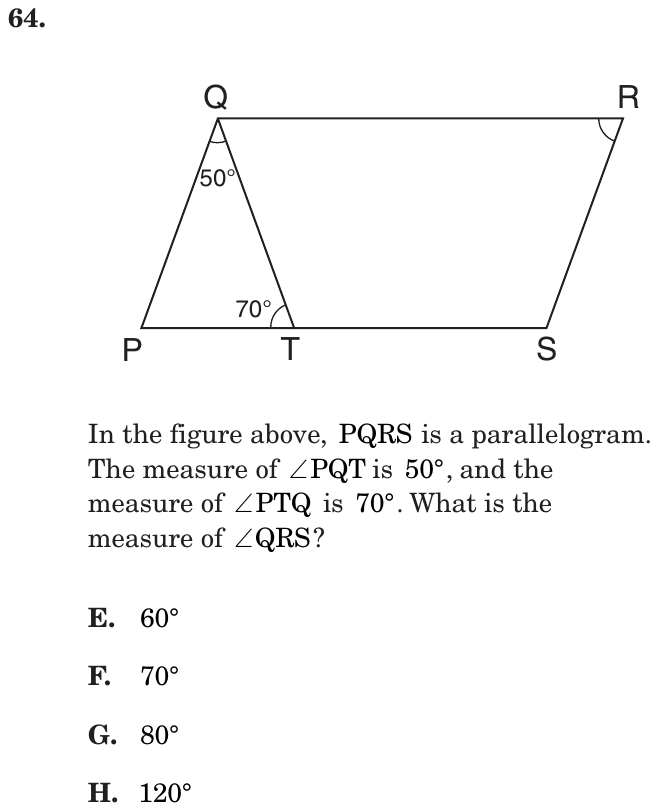
Question 47 of 49
2018 Test B Math, question 35Question
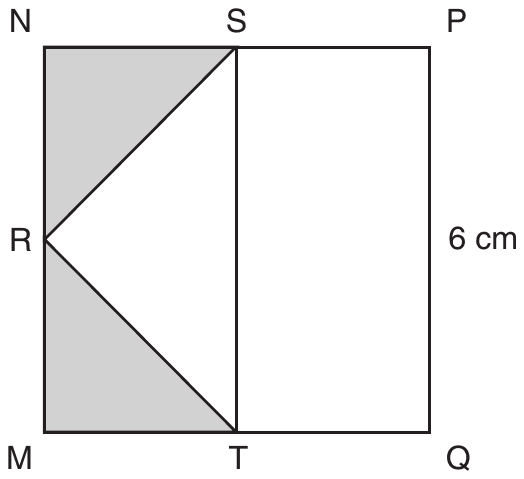
R, S, and T are midpoints of the sides of square MNPQ, as shown above. What is the sum of the areas of the shaded triangles?
- A9 sq cm
- B12 sq cm
- C18 sq cm
- D36 sq cm
Show the answer
Correct answer: A
The length of one side of the square is 6 cm. Since , , and are midpoints, then , , , and are all equal to 3 cm. Triangles and are both right triangles, so the area of one of the triangles is
The triangles are congruent, so the sum of the areas is
Question analysis
Points R, S and T are midpoints of the sides of square MNPQ, whose sides are 6 cm long, and students find the total area of the two shaded triangles in its corners. It tests the area of a triangle. The common slips are forgetting the one-half or measuring the wrong region.
- NYS standards
- 6.G.1 area of polygons
- Grade level
- Grade 6 content, by NYS standard
- Compared with grade 7
- Below grade 7 Triangle area is grade 6 content, and the corner triangles here are right triangles with easy legs. Typical grade 7 area problems are similar or harder; the only extra step is using midpoints to get the lengths.
- Estimated difficulty
- Straightforward: two steps or one careful reading.
- Thinking it demands
- Depth of knowledge 2, skills and concepts · mainly apply
- What makes it hard
- Solution
- 3 steps
- Reading level
- Question and choices: about grade 1, 34 words.
- Students, last 30 days
- Not enough answers yet to show (it takes 10).
Why it is hard, traps and wrong answers (shows the answer)
Why it is hard
The shaded triangles are right triangles tucked into the corners, so their legs lie along the square's sides and are easy to measure once the midpoints are used. Most lost points come from the one half in the area formula, or from reporting a larger region of the figure, such as the left half or the whole square. Labeling each 3 cm leg on the figure before computing pays off here.
Reading a figure, table or graph moderate Understanding the question
Only one length is labeled, the 6 cm side PQ; the legs NR, NS, MR and MT must each be read as half a side, 3 cm, from the word midpoints. (Lesh, Post & Behr, 1987; Kirsch & Mosenthal, 1990)
Something you must already know minor Working it out
The area of a triangle, one half times base times height, is not given, and leaving out the one half doubles each 4.5 sq cm triangle. (Anderson & Krathwohl, 2001)
Strategy: Use the midpoints to get each triangle's legs as half the square's side, apply one-half base times height, and remember there are two shaded triangles.
Traps
- A formula you must know: Needs a formula the test does not give: area, circumference, volume, probability rules.
- Answers a different question: A choice is right for another quantity: the other unknown, the rest instead of the part, the part instead of the whole.
The wrong answers, classified
B Wrong formula (King et al., 2004)
Adds the four 3 cm legs of the two shaded triangles, 3 + 3 + 3 + 3 = 12, treating a total length as an area.
C Wrong formula (King et al., 2004)
Multiplies 3 by 3 for each triangle without the one half, 9 + 9 = 18, which also equals the area of the left half, rectangle NSTM.
D Answers a different question (King et al., 2004; Hegarty, Mayer & Monk, 1995)
Squares the only labeled length, 6 × 6 = 36, giving the area of the whole square instead of the two shaded corners.
Worked solution, step by step
Formulas used
- Area of a triangle
- A is the area. b is the base, the side the triangle sits on. h is the height, the straight-up distance from the base to the top corner. You take half because a triangle is half of a rectangle with the same base and height.
Read the figure
MNPQ is a square, and side PQ is 6 cm. All sides of a square are equal, so every side is 6 cm. A midpoint is the point exactly halfway along a side. R is the midpoint of side NM. S is the midpoint of NP, and T is the midpoint of MQ.
The shaded triangles are RNS at the top and RMT at the bottom.
Find the short sides
Each midpoint cuts a 6 cm side into two equal parts.
So NR, NS, RM and MT are each 3 cm long.
Find the area of one triangle
Triangle RNS has a square corner at N. A square corner is a right angle. So NS can be the base and NR the height.
One triangle is 4.5 sq cm. Triangle RMT has the same sides, so it is also 4.5 sq cm.
Watch out: do not forget the one half. Without it, each triangle is 9 sq cm and the total is 18. That is choice C.
Add the two triangles
There are two shaded triangles, so add their areas to get the total.
So the answer is A, 9 sq cm.
Check your answer
The left half of the square is rectangle NSTM, 3 cm by 6 cm. Its area is sq cm. The white triangle RST fills half of it. So the shaded part is the other half, 9 sq cm. Choice D, 36, is the whole square.
More questions like this
The original DOE question
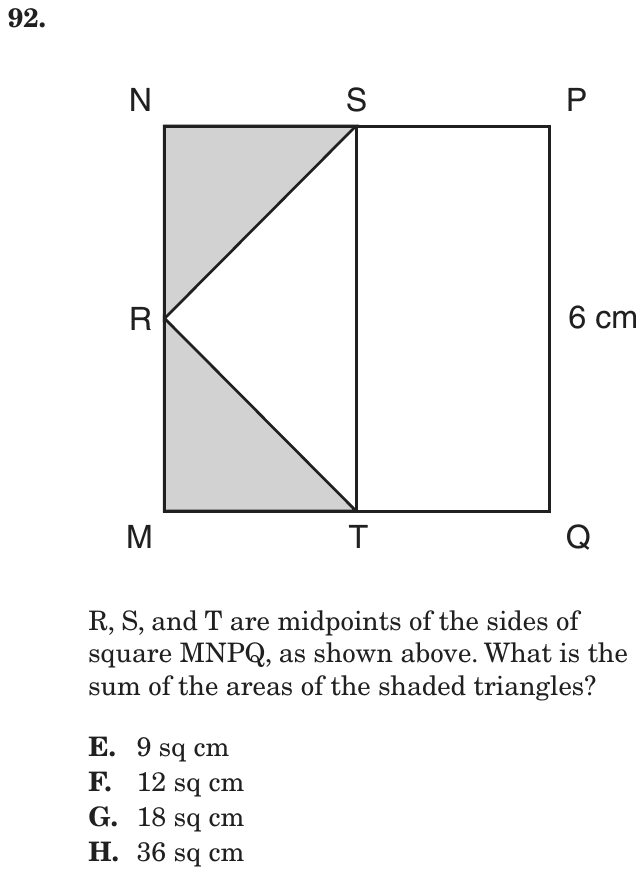
Question 48 of 49
2018 Test B Math, question 43Question
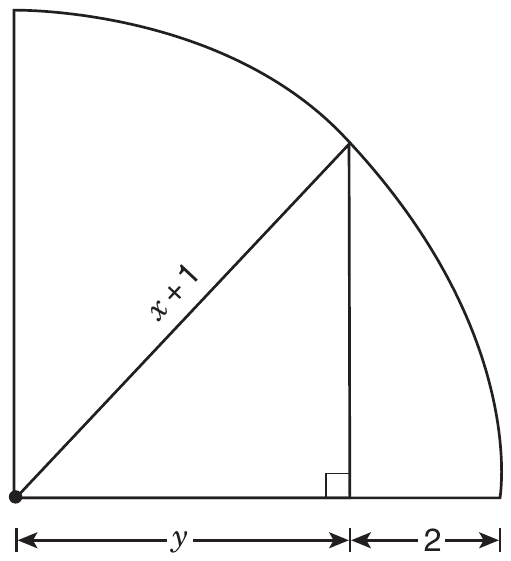
In the quarter circle above, what is in terms of ?
- A
- B
- C
- D
Show the answer
Correct answer: A
Both and are radii.
So, set them equal to each other and solve for .
Question analysis
In a quarter circle, one segment is labeled x + 1 and the bottom edge is split into lengths y and 2, and students must write y in terms of x. It tests basic circle facts together with solving a simple equation. The challenge is seeing which marked lengths must be equal.
- Grade level
- Grade 7 content, by NYS standard
- Compared with grade 7
- At grade 7 Grade 7 circle work centers on area and circumference formulas. This needs only the definition of a radius and a one-step equation, but spotting the relationship in a figure is less routine than plugging into a formula.
- Estimated difficulty
- Moderate: several steps, or a close reading with one strong distractor.
- Thinking it demands
- Depth of knowledge 2, skills and concepts · mainly analyze
- What makes it hard
- Solution
- 2 steps
- Reading level
- Question and choices: about grade 9, 16 words.
- Students, last 30 days
- Not enough answers yet to show (it takes 10).
Why it is hard, traps and wrong answers (shows the answer)
Why it is hard
The figure looks like a right-triangle problem, and that is the trap: the right angle and the slanted radius pull students toward the Pythagorean theorem, which cannot work without the vertical leg. The solution needs only the fact that all radii of a circle are equal, applied to the bottom edge. Students who mark every segment that starts at the center see it at once.
Reading a figure, table or graph major Understanding the question
The labels sit on two different radii: x + 1 on the slanted one, and y + 2 along the bottom edge, which runs from the center all the way to the arc. (Lesh, Post & Behr, 1987; Kirsch & Mosenthal, 1990)
Variables instead of numbers minor Understanding the question
The answer is an expression in x, so there is no number to check; trying x = 5, which makes the radius 6 and y = 4, is the fallback. (Koedinger & Nathan, 2004; Enright, Morley & Sheehan, 2002)
A very close wrong answer minor Choosing the answer
x + 1 differs from the right x − 1 by a single sign; only seeing that y plus the 2-unit piece makes a radius, so the 2 is subtracted, separates them. (Embretson & Wetzel, 1987; Gorin & Embretson, 2006; Ascalon et al., 2007)
Strategy: Look for two lengths in the figure that are both radii of the quarter circle, set their expressions equal, and solve for y.
Traps
- Trusting the picture: The figure suggests something it does not state; work from the given facts.
- Answers a different question: A choice is right for another quantity: the other unknown, the rest instead of the part, the part instead of the whole.
The wrong answers, classified
B Answers a different question (King et al., 2004; Hegarty, Mayer & Monk, 1995)
Sets y equal to the whole radius x + 1, ignoring the 2-unit piece that completes the bottom radius beyond y.
C Wrong operation (Hegarty, Mayer & Monk, 1995; King et al., 2004)
Treats y and the 2 as factors, y × 2 = x + 1, and divides by 2 where it should subtract 2.
D Trusting the picture (Lesh, Post & Behr, 1987)
Trusts the drawing's nearly 45° radius, assumes the triangle's two legs are equal, and solves y² + y² = (x + 1)² for y.
Worked solution, step by step
Formulas used
- Radii of a circle are equal
- A radius is a segment from the center of a circle to its curved edge. r₁ and r₂ stand for any two radii of the same circle. They are always equal, because every point on the curve is the same distance from the center.
Read the figure
The shape is a quarter circle, one fourth of a whole circle. Its center is the corner with the dot. A radius is a segment from the center to the curved edge. The slanted segment, labeled , goes from the center to the curve. The bottom edge is split into two parts, and 2.
Spot the two radii
The slanted segment is a radius, so the radius is . The whole bottom edge also runs from the center to the curve. Its length is , so it is a radius too.
Watch out: the slanted radius only looks like it is at 45 degrees. Do not assume the triangle’s two short sides are equal. That idea leads to choice D.
Set the radii equal
Use the rule that all radii of a circle are equal.
Now you have one equation with and .
Solve for y
Get alone by taking 2 from both sides.
Watch out: is only part of the bottom radius. Setting equal to gives choice B. Dividing by 2 instead of subtracting 2 gives choice C.
Give the answer
is 2 less than the radius, and the radius is . So the answer is A, .
Check your answer
Pick a number. If , the radius is 6. Then , and , which matches the radius. Also, is a short side of the right triangle. It should be shorter than the slanted side, and 4 is less than 6.
More questions like this
The original DOE question
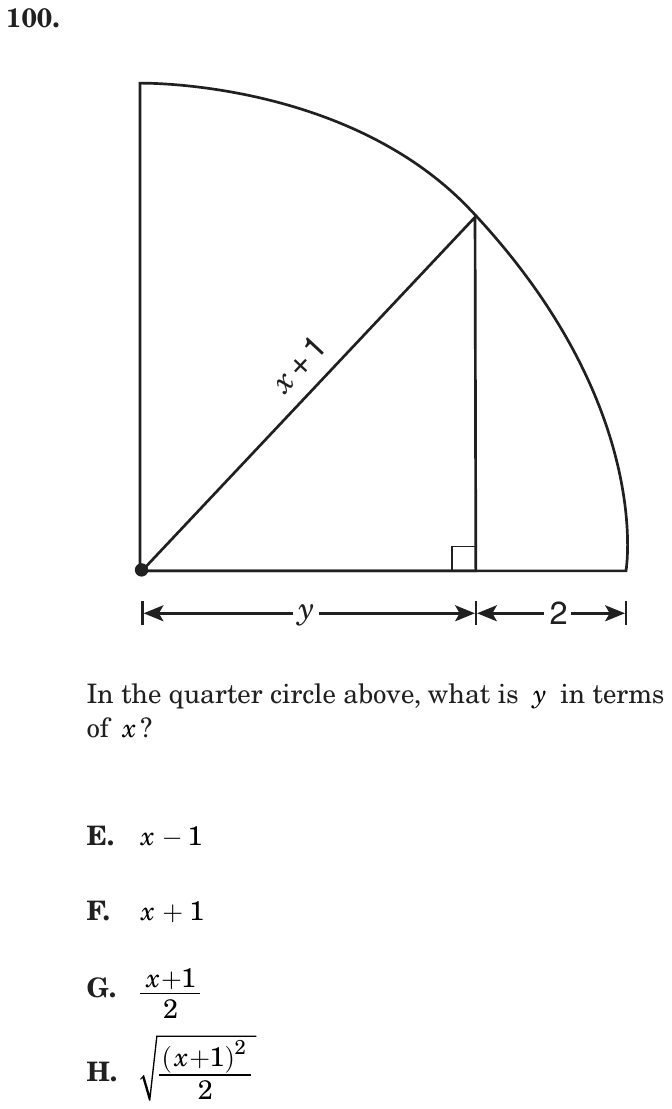
Question 49 of 49
2018 Test B Math, question 48Question
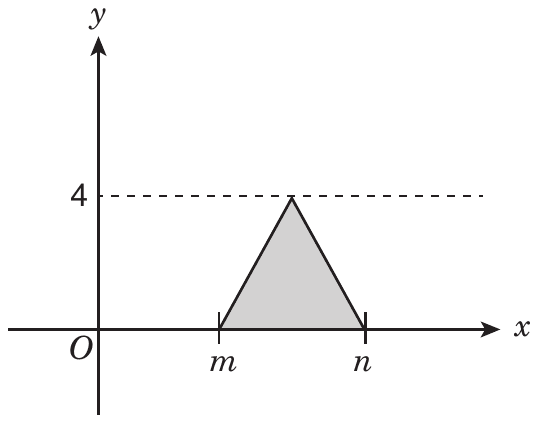
What is the area of the shaded triangle shown above?
- A
- B
- C
- D
Show the answer
Correct answer: C
The height of the triangle is 4 units. The length of the base is . So the area is
Question analysis
Students find the area of a shaded triangle drawn on coordinate axes, with its base between the points m and n on the x-axis and its top vertex at a height of 4. It tests the triangle area formula with an algebraic side length. Writing the base as an expression in m and n is the step that needs care.
- Grade level
- Grade 6 content, by NYS standard
- Compared with grade 7
- At grade 7 Triangle area is grade 6 content, but a base written with two variables is less familiar. With only two steps, the demand matches typical grade 7 work that mixes geometry with algebraic expressions.
- Estimated difficulty
- Moderate: several steps, or a close reading with one strong distractor.
- Thinking it demands
- Depth of knowledge 2, skills and concepts · mainly apply
- What makes it hard
- Variables instead of numbers moderate
- Reading a figure, table or graph moderate
- A very close wrong answer moderate
- Solution
- 2 steps
- Reading level
- Question and choices: about grade 7, 14 words.
- Students, last 30 days
- Not enough answers yet to show (it takes 10).
Why it is hard, traps and wrong answers (shows the answer)
Why it is hard
The arithmetic is trivial, but students must treat a length as a difference of coordinates and keep a formula's one half when the answer is a letter expression. Those who forget the half, or who stop at the base length, find their result among the choices. Trying m = 1 and n = 4 gives a triangle of area 6 that checks the expressions quickly.
Variables instead of numbers moderate Understanding the question
The base runs from m to n on the x-axis, so its length is the expression n − m, and the area stays in letters with no number to check. (Koedinger & Nathan, 2004; Enright, Morley & Sheehan, 2002)
Reading a figure, table or graph moderate Understanding the question
The height, 4, is read from the dashed line through the apex rather than labeled on the triangle, and the base endpoints appear only as tick labels. (Lesh, Post & Behr, 1987; Kirsch & Mosenthal, 1990)
A very close wrong answer moderate Choosing the answer
4(n − m) is the right 2(n − m) doubled, written the same way except for the coefficient; only remembering the one half in a triangle's area separates them. (Embretson & Wetzel, 1987; Gorin & Embretson, 2006; Ascalon et al., 2007)
Strategy: Write the base as the difference between its endpoint values, read the height from the figure, and apply one-half times base times height.
Traps
- A formula you must know: Needs a formula the test does not give: area, circumference, volume, probability rules.
- Wrong formula: Uses a related but wrong formula: perimeter for area, diameter for radius, area for volume, or a misremembered one.
- Stops one step early: A choice is a number from partway through the solution.
The wrong answers, classified
A Numbers taken from the question (Hegarty, Mayer & Monk, 1995)
Adds the two labels, m + n, as if the base were the sum of the endpoints, and goes no further with the height.
B Stops one step early (King et al., 2004; Gierl et al., 2017)
Finds the base length n − m correctly and gives it as the area, never multiplying by the height or taking one half.
D Wrong formula (King et al., 2004)
Multiplies the base n − m by the height 4 but forgets the one half in the triangle area formula.
Worked solution, step by step
Formulas used
- Area of a triangle
- A is the area. b is the base, the side the triangle sits on. h is the height, the straight-up distance from the base to the top corner. You take half because a triangle is half of a rectangle with the same base and height.
- Length along the x-axis
- The right end and the left end are the numbers where a segment starts and stops on the x-axis. Subtracting the smaller from the larger tells how long the segment is.
Read the figure
The shaded triangle sits on the x-axis, the flat number line. Its base runs from to . Its top corner touches the dashed line at height 4. You need the area, written with the letters and .
Find the length of the base
The base starts at and ends at . Use the length rule: right end minus left end.
Watch out: adding the ends, , does not give a length. That is choice A.
Find the height
The height is the straight-up distance from the base to the top corner. The top corner is on the dashed line, which is at 4 on the y-axis. So the height is 4.
Find the area
Use the triangle area formula.
Half of 4 is 2, so the area is .
Watch out: forgetting the one half gives , choice D. Stopping at the base gives , choice B.
Give the answer
The area is 2 times the length of the base. So the answer is C, .
Check your answer
Try numbers. Say and . The base is 3 and the height is 4, so the area is . Choice C gives . It matches. Choice D would give 12.
More questions like this
The original DOE question