Question
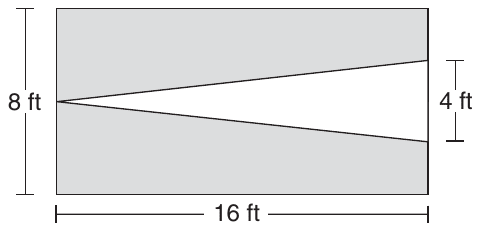
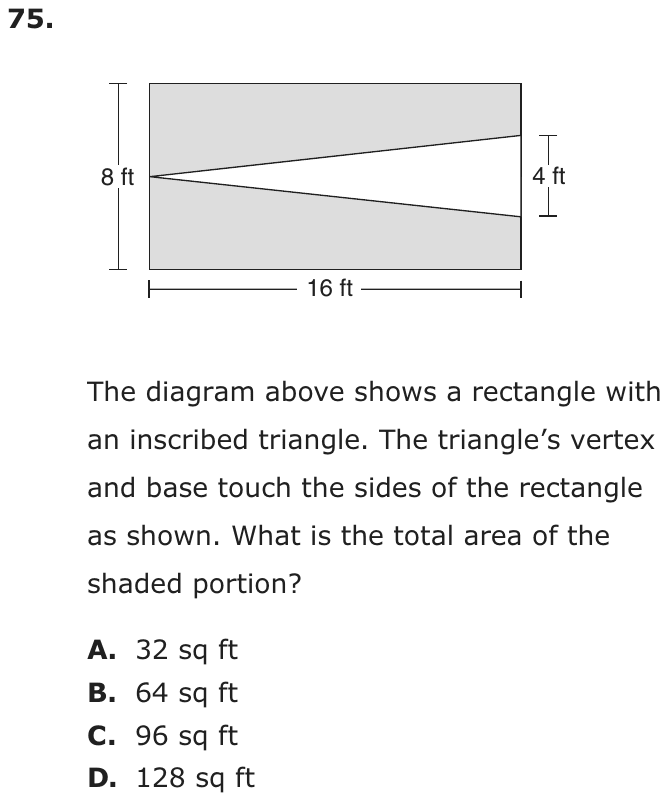
The diagram above shows a rectangle with an inscribed triangle. The triangle’s vertex and base touch the sides of the rectangle as shown. What is the total area of the shaded portion?
- A32 sq ft
- B64 sq ft
- C96 sq ft
- D128 sq ft
Show the answer
Correct answer: C
First, find the area of the rectangle, in square feet:
Then, find the area of the triangle:
To find the area of the shaded region, subtract the area of the triangle from the area of the rectangle:
Question analysis
A 16-foot by 8-foot rectangle has a white triangle inside it, with one vertex at the middle of the left side and a 4-foot base along the right side. Students find the total area of the shaded part. They subtract the triangle's area, whose height is not labeled and must be read from the figure.
- NYS standards
- 6.G.1 area of polygons
- Grade level
- Grade 6 content, by NYS standard
- Compared with grade 7
- At grade 7 Composite areas built from rectangles and triangles appear in grades 6 and 7. This one is typical, but the triangle lies on its side, so students must see which length is its height rather than read it from a label.
- Estimated difficulty
- Moderate: several steps, or a close reading with one strong distractor.
- Thinking it demands
- Depth of knowledge 2, skills and concepts · mainly apply
- What makes it hard
- Reading a figure, table or graph moderate
- Many steps minor
- Solution
- 3 steps
- Reading level
- Question and choices: about grade 2, 40 words.
- Students, last 30 days
- Not enough answers yet to show (it takes 10).
Why it is hard, traps and wrong answers (shows the answer)
Why it is hard
The shaded region is a rectangle with a triangle cut out, so the plan is standard, but the triangle is turned so that its height runs across the figure. Students who see that the height is the 16-foot side have two short areas to find and one subtraction. The listed wrong answers stop at either area or leave out the one half.
Reading a figure, table or graph moderate Understanding the question
The triangle lies on its side: its 4-foot base runs along the right edge, so its height is the rectangle’s full 16-foot length, which the figure labels only as the bottom side. (Lesh, Post & Behr, 1987; Kirsch & Mosenthal, 1990)
Many steps minor Working it out
The rectangle’s area, the triangle’s area and their difference are three separate results, and the first two, 128 and 32, are themselves listed choices. (Daniel & Embretson, 2010; Enright, Morley & Sheehan, 2002)
Strategy: Find the rectangle's area, find the triangle's area from its base on the right side and its height across the rectangle, then subtract.
Traps
- Stops one step early: A choice is a number from partway through the solution.
- Answers a different question: A choice is right for another quantity: the other unknown, the rest instead of the part, the part instead of the whole.
- Wrong formula: Uses a related but wrong formula: perimeter for area, diameter for radius, area for volume, or a misremembered one.
The wrong answers, classified
A Answers a different question (King et al., 2004; Hegarty, Mayer & Monk, 1995)
Finds the triangle’s area, ½ × 4 × 16 = 32, and gives the white region instead of the shaded part around it.
B Wrong formula (King et al., 2004)
Leaves out the ½ in the triangle’s area, 4 × 16 = 64, and subtracts that from 128, which leaves 64.
D Stops one step early (King et al., 2004; Gierl et al., 2017)
Finds the rectangle’s area, 16 × 8 = 128, and stops without subtracting the white triangle.
Worked solution, step by step
Formulas used
- Area of a rectangle
- A is the area, the space inside a flat shape, in square units. l is the length and w is the width. It works because the rectangle is filled by w rows of unit squares, with l squares in each row.
- Area of a triangle
- A is the area. b is the base, the side you measure from. h is the height, the distance from the base to the opposite corner, at a right angle to the base. You take half, because a triangle is half of a rectangle with the same base and height.
Sort out the figure
The figure is a rectangle 16 feet long and 8 feet tall. Inside it is a white triangle. Its tip touches the middle of the left side. Its base lies along the right side and is 4 feet long. The shaded part is the gray area around the triangle. You need its area.
Plan: find the rectangle’s area, then take away the triangle’s area.
Find the area of the rectangle
The rectangle’s area is 128 square feet. Watch out: this includes the white triangle. Stopping here gives choice D.
Find the triangle’s height
The triangle lies on its side. Its base is the 4-foot piece on the right side, which runs up and down. The height must meet the base at a right angle, a square corner. So the height runs straight across, from the base to the tip on the left side. That is the full length of the rectangle, 16 feet.
Find the area of the triangle
The triangle’s area is 32 square feet. Watch out: don’t forget the . Using leaves 64 for the shaded part, choice B.
Subtract to find the shaded area
The shaded part is 96 square feet. Watch out: 32 is the white triangle, not the shaded part, so choice A is wrong. So the answer is C, 96 sq ft.
Check your answer
The triangle’s base, 4 feet, is half the rectangle’s height of 8 feet. Its height is the full 16 feet. So the triangle is half of half the rectangle, or one fourth of it. One fourth of 128 is 32, and .
More questions like this
The original DOE question