Question
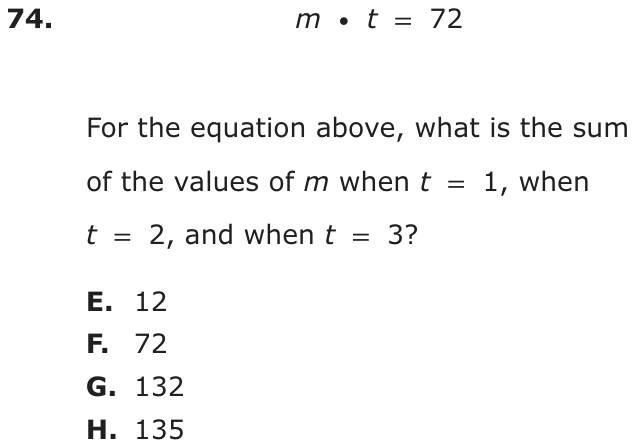
For the equation above, what is the sum of the values of m when , when , and when ?
- A12
- B72
- C132
- D135
Show the answer
Correct answer: C
First, find the value of m for each value of t:
For :
For :
For :
Then, add those three values together:
Question analysis
The equation m • t = 72 links two variables, and the raised dot means multiplication. Students find m when t is 1, 2 and 3, and then add those three values of m. Each value is a one-step division, and the trap is combining the t values before dividing.
- Grade level
- Grade 6 content, by NYS standard
- Compared with grade 7
- Below grade 7 Solving equations like 3m = 72 is grade 6 work. This item repeats that step three times and adds the results, more bookkeeping than difficulty, so it is below typical grade 7 demand.
- Estimated difficulty
- Straightforward: two steps or one careful reading.
- Thinking it demands
- Depth of knowledge 1, recall and reproduction · mainly apply
- What makes it hard
- Turning words into math minor
- Many steps minor
- Solution
- 4 steps
- Reading level
- Question and choices: about grade 7, 21 words.
- Students, last 30 days
- Not enough answers yet to show (it takes 10).
Why it is hard, traps and wrong answers (shows the answer)
Why it is hard
Each value of m comes from one division, so the work is bookkeeping rather than algebra. The trap is structural: adding 1, 2 and 3 first and dividing once feels efficient but answers a different question, since m does not change in step with t. Writing the three values of m in a row before adding them keeps the steps separate.
Turning words into math minor Understanding the question
“The sum of the values of m when t = 1, when t = 2, and when t = 3” asks for three separate solutions added together, not one solution at a combined t. (Hegarty, Mayer & Monk, 1995; Koedinger & Nathan, 2004)
Many steps minor Working it out
Three divisions, 72 ÷ 1, 72 ÷ 2 and 72 ÷ 3, and an addition make four small steps, each easy but each a chance to drop a value. (Daniel & Embretson, 2010; Enright, Morley & Sheehan, 2002)
Strategy: Divide 72 by each value of t in turn to get three separate values of m, then add the three quotients.
Traps
- Misunderstands the concept: A wrong belief about a concept: that percents can be added, that area grows like length, that averages can be averaged, that a bigger denominator means a bigger fraction.
- Numbers taken from the question: Combines the numbers in the question without a model of the situation, or is simply a number that appears in the question.
The wrong answers, classified
A Misunderstands the concept (Smith, diSessa & Roschelle, 1993; De Bock et al., 1998; Ni & Zhou, 2005)
Adds the three t values to get 6 and divides 72 by 6, as if the sum of the m values were m at the sum of the t values.
B Numbers taken from the question (Hegarty, Mayer & Monk, 1995)
Gives back 72, the constant in the equation and the value of m only when t = 1, without the values for t = 2 and t = 3.
D Little reason to choose it (Haladyna & Downing, 1993; Rodriguez, 2005)
No common working gives 135, which is 3 more than the right sum; it would need a slip such as 72 ÷ 3 = 27, so it mostly draws guesses.
Worked solution, step by step
Formulas used
- Division undoes multiplication
- a, b and c are numbers, and b is not 0. If you know a product and one of the numbers that made it, divide to find the other one. For example, 4 × 5 = 20, so 4 = 20 ÷ 5.
Sort out the question
The equation is . The dot means times. You need m three times: when t is 1, when t is 2 and when t is 3. Then add the three values of m.
Get m by itself
Since m times t is 72, m is 72 divided by t.
Now put in each value of t, one at a time.
Find m for each value of t
Each time, divide 72 by the value of t. A table keeps the three answers in order.
Value of t Value of m 1 2 3 Add the three values
Watch out: don’t add the t values first. is choice A, and it is not the same thing. Also, 72 alone is only the first value, choice B. So the answer is C, 132.
Check your answer
Check each pair by multiplying: , and . All three pairs make 72. Then add again: 72 + 36 = 108, and 108 + 24 = 132.
More questions like this
The original DOE question