Also in 2026 Practice Test B Math, question 6; 2025 Practice Test B Math, question 7.
Question
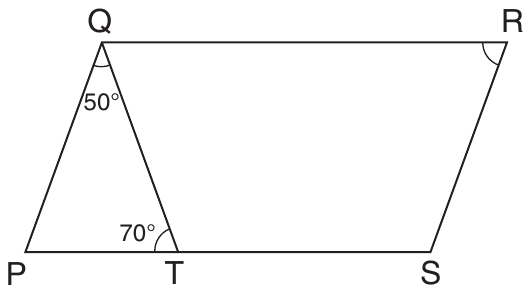
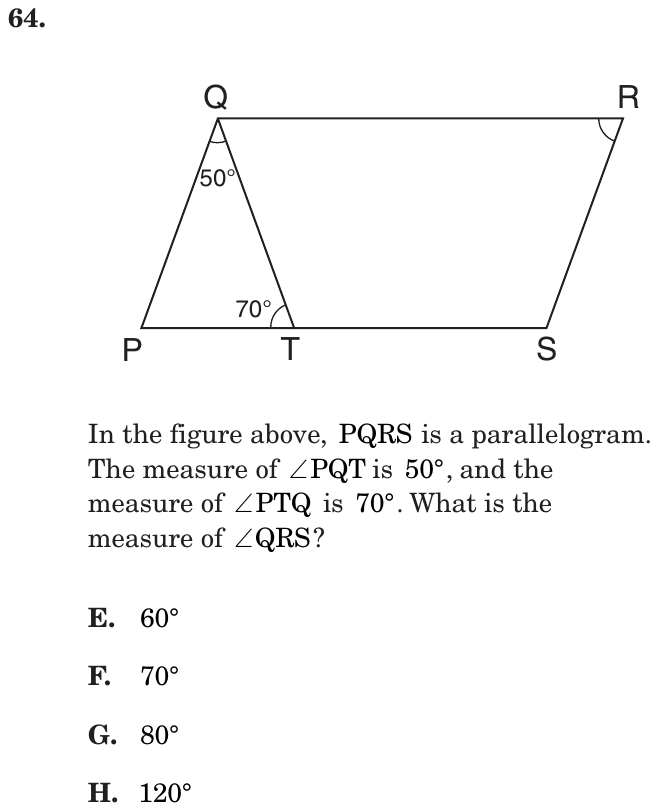
In the figure above, PQRS is a parallelogram. The measure of ∠PQT is 50°, and the measure of ∠PTQ is 70°. What is the measure of ∠QRS?
- A60°
- B70°
- C80°
- D120°
Show the answer
Correct answer: A
Find the missing angle, angle QPT, of triangle PQT:
180° − 70° − 50° = 60°
In parallelogram PQRS, angle QPT is congruent to angle QRS, so the measure of angle QRS is also 60°.
Question analysis
This geometry question uses parallelogram PQRS and a triangle PQT inside it, giving two of the triangle's angles and asking for angle QRS. Students need the triangle angle sum and the fact that opposite angles of a parallelogram are equal. The challenge is connecting the angles found in the triangle to the angles of the parallelogram.
- NYS standards
- Grade level
- Grade 8 content, by NYS standard
- Compared with grade 7
- Above grade 7 Grade 7 angle work uses vertical, adjacent and supplementary angles. This also needs the triangle angle sum and the opposite angles of a parallelogram, ideas New York places in grade 8, though the arithmetic is short.
- Estimated difficulty
- Moderate: several steps, or a close reading with one strong distractor.
- Thinking it demands
- Depth of knowledge 2, skills and concepts · mainly apply
- What makes it hard
- Reading a figure, table or graph major
- Combines ideas moderate
- A very close wrong answer moderate
- Something you must already know minor
- Solution
- 2 steps
- Reading level
- Question and choices: about grade 4, 25 words.
- Students, last 30 days
- Not enough answers yet to show (it takes 10).
Why it is hard, traps and wrong answers (shows the answer)
Why it is hard
Few steps are needed, but the figure misleads. It draws triangle PQT as isosceles, so the angle at P looks the same as the marked 70°, and the angle at R looks the same again; a student who trusts the drawing never computes. Those who do compute the angle at P must still choose the opposite angle of the parallelogram, not the angle next to it, which is where 120° comes from.
Reading a figure, table or graph major Understanding the question
The figure carries facts the stem leaves out: T lies on side PS, the 50° is only part of the angle at Q, and the 70° is at T, not at a corner of the parallelogram. (Lesh, Post & Behr, 1987; Kirsch & Mosenthal, 1990)
Combines ideas moderate Working it out
Two separate facts link up: the angles of triangle PQT sum to 180°, and the angle at P, once known, equals the opposite angle at R of parallelogram PQRS. (Embretson, 1998; Daniel & Embretson, 2010)
A very close wrong answer moderate Choosing the answer
60° and 70° are close enough that judging the angle at R by eye cannot separate them, and the drawing even favors 70°; only computing the triangle's third angle does. (Embretson & Wetzel, 1987; Gorin & Embretson, 2006; Ascalon et al., 2007)
Something you must already know minor Working it out
Neither the triangle angle sum nor the rule that opposite angles of a parallelogram are equal is given; students must bring both to the figure. (Anderson & Krathwohl, 2001)
Strategy: Find the third angle of triangle PQT from the angle sum, work out which angle of the parallelogram it matches, then use the parallelogram's angle facts to reach angle QRS.
Traps
- Trusting the picture: The figure suggests something it does not state; work from the given facts.
- Answers a different question: A choice is right for another quantity: the other unknown, the rest instead of the part, the part instead of the whole.
The wrong answers, classified
B Trusting the picture (Lesh, Post & Behr, 1987)
Trusts the drawing, where triangle PQT looks isosceles, so takes the angle at P, and its opposite angle at R, to be 70° like the angle at T.
C Little reason to choose it (Haladyna & Downing, 1993; Rodriguez, 2005)
No standard step gives 80°; at most a student treats the triangle as having two 50° angles and computes 180 − 100, which nothing in the figure supports.
D Answers a different question (King et al., 2004; Hegarty, Mayer & Monk, 1995)
Finds the 60° angle at P but answers with the angle at Q, 180 − 60 or 50 + 70 = 120, the consecutive angle instead of the opposite one.
Worked solution, step by step
Formulas used
- Angles in a triangle
- a, b and c are the three angles inside any triangle. They always add up to 180 degrees. If you know two of the angles, subtract them from 180 to find the third.
- Opposite angles of a parallelogram
- A parallelogram is a four-sided shape whose opposite sides are parallel, meaning they never meet. In parallelogram PQRS, the corners at P and R are opposite each other. Opposite angles of a parallelogram are always equal.
Sort out the figure
PQRS is a parallelogram. That is a four-sided shape whose opposite sides are parallel, meaning they never meet.
Point T is on the bottom side PS. Segment QT cuts off triangle PQT on the left. In that triangle, angle PQT is 50° and angle PTQ is 70°.
You need angle QRS, the corner at R.
Find the third angle of the triangle
Triangle PQT has angles at Q, T and P. You know two of them. The angle at P is angle QPT. All three must add to 180°.
So angle QPT is 60°.
Match angle P to angle R
T lies on side PS. So angle QPT is also the corner of the parallelogram at P. Angle P and angle R are opposite corners. Opposite angles are equal, so angle QRS is also 60°.
Watch out: Angle Q is next to angle P, not opposite it. Angle Q is 120°, choice D, but the question asks about angle R. Also, do not trust the drawing. Angle R may look like 70°, choice B.
So the answer is A, 60°.
Check your answer
The four corners of the parallelogram are 60°, 120°, 60° and 120°. They add to 360°, as the angles of any four-sided shape must. Also, the 50° angle at Q fits inside the 120° corner at Q.
More questions like this
The original DOE question