Also in 2025 Practice Test B Math, question 1.
Question
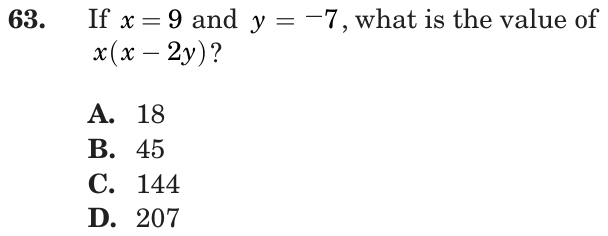
If and , what is the value of ?
- A18
- B45
- C144
- D207
Show the answer
Correct answer: D
Question analysis
This algebra question asks students to evaluate the expression x(x − 2y) when x is 9 and y is negative 7. It practices substitution and the order of operations with integers. The risk is the sign, since subtracting twice a negative number turns into addition, and dropping that sign or the factor of 2 is easy.
- NYS standards
- Grade level
- Grade 7 content, by NYS standard
- Compared with grade 7
- At grade 7 Substituting values, including a negative one, into an expression is everyday grade 7 work with integers. This has three short steps and one sign decision, matching a typical classroom exercise.
- Estimated difficulty
- Straightforward: two steps or one careful reading.
- Thinking it demands
- Depth of knowledge 1, recall and reproduction · mainly apply
- What makes it hard
- Error-prone arithmetic moderate
- Solution
- 3 steps
- Reading level
- Question and choices: about grade 8, 10 words.
- Students, last 30 days
- Not enough answers yet to show (it takes 10).
Why it is hard, traps and wrong answers (shows the answer)
Why it is hard
Substitution itself is routine, so the question tests one thing: subtracting a negative inside the parentheses. A student who turns 9 − 2(−7) into 9 − 14 gets −45 and may then choose 45, since it is the only choice that looks close. Working the parentheses first and writing −(−14) as +14 before multiplying by 9 avoids every wrong choice.
Error-prone arithmetic moderate Working it out
The middle step is 9 − 2(−7): the product 2(−7) is −14, and subtracting it means adding 14, so two negatives must be handled in one short move. (Brown & Burton, 1978; Junker & Sijtsma, 2001)
Strategy: Work inside the parentheses first: find 2y, subtract it from x by rewriting minus a negative as plus, and multiply that result by x last.
Traps
- Negatives and direction: Arithmetic with negative numbers, the order of a subtraction, or direction on a number line. (Moving a term across the equals sign without changing its sign is a faulty procedure.)
The wrong answers, classified
A Negatives and direction (Brown & Burton, 1978)
Drops the factor 2 and adds y instead of subtracting it, working out 9(9 + (−7)) = 9 × 2 = 18.
B Negatives and direction (Brown & Burton, 1978)
Writes 9 − 2(−7) as 9 − 14 = −5, gets 9 × (−5) = −45, and picks 45 as the nearest choice.
C Misreads the question (Hegarty, Mayer & Monk, 1995)
Handles the negative correctly but drops the coefficient 2, computing 9 − (−7) = 16 and then 9 × 16 = 144.
Worked solution, step by step
Formulas used
- Subtracting a negative
- a and b are numbers. Taking away a negative number is the same as adding the positive number. For example, 9 − (−14) = 9 + 14. Think of taking away a debt: you end up richer.
- Multiplying by a negative
- When one number is positive and the other is negative, their product is negative. The product is the answer to a multiplication. So 2 × (−7) = −14.
Write down what you know
You know x = 9 and y = −7. You need the value of .
A number written right next to parentheses means multiply. So this is x times the amount inside the parentheses.
Put in the numbers
Replace each letter with its value. Put −7 in parentheses so you do not lose its minus sign.
Work inside the parentheses
Always work inside parentheses first. Multiply before you subtract. A positive times a negative is negative, so .
Taking away a negative is the same as adding.
Watch out: If you write 9 − 14 = −5, you end with −45. Then choice B, 45, looks close, but it is wrong.
Multiply by x last
Now multiply 9 by the 23 you found inside the parentheses.
Watch out: Do not drop the 2. Using 9 − (−7) = 16 gives 144, choice C.
So the answer is D, 207.
Check your answer
Check the inside another way. means start at 9 and move 14 to the right on the number line. You land on 23. Then .
More questions like this
The original DOE question