2026 Practice Test C English
Question 1 of 50
2026 Practice Test C English, question 1Passage Invention of the Telegraph
Samuel Morse, an American inventor, is credited with creating the electronic telegraph, a communication device that allows users to send messages using a system of short and long pulses that represent letters, numbers, and punctuation. In 1843 the United States Congress passed the Telegraph Bill, which provided Morse with the funds to build an electric telegraph system.
Invention of the Telegraph
Earlier Signal Systems
Long before Samuel F. B. Morse electrically transmitted his famous message “What hath God wrought?” from Washington to Baltimore on May 24, 1844, there were signaling systems that enabled people to communicate over distances. Most were visual or “semaphore” systems using flags or lights. In the eighteenth century, such systems used an observer who would decipher a signal from a high tower on a distant hill and then send it on to the next station. The young American republic wanted just such a system along its entire Atlantic coast and offered a prize of $30,000 for a workable proposal. The framers of this legislation had no way of knowing that when they used the word “telegraph” to refer to this visual semaphore system, they would be offered an entirely new and revolutionary means of communication—electricity.
The Growth of an Idea
The idea of using electricity to communicate over distance is said to have occurred to Morse during a conversation aboard ship when he was returning from Europe in 1832. Michael Faraday’s recently invented electromagnet was much discussed by the ship’s passengers, and when Morse came to understand how it worked, he speculated that it might be possible to send a coded message over a wire. While a student at Yale College years before, he had written his parents a letter about how interesting he found the lectures on electricity. Despite what he had learned at Yale, Morse found when he began to develop his idea that he had little real understanding of the nature of electricity, and after sporadic attempts to work with batteries, magnets, and wires, he finally turned for help to a colleague at the University of the City of New York, Leonard D. Gale.
Gale was a professor of chemistry and familiar with the electrical work of Princeton’s Joseph Henry, a true pioneer in the new field. Well before Morse had his shipboard idea about a telegraph, Henry rang a bell at a distance by opening and closing an electric circuit. In 1831, he had published an article, of which Morse was unaware, that contained details suggesting the idea of an electric telegraph. Gale’s help and his knowledge of this article proved crucial to Morse’s telegraph system because Gale not only pointed out flaws in the system but showed Morse how he could regularly boost the strength of a signal and overcome the distance problems he had encountered by using a relay system Henry had invented. Henry’s experiments, Gale’s assistance, and, soon after, hiring the young technician Alfred Vail were keys to Morse’s success.
Obstacles and Opportunities
By December 1837, Morse had enough confidence in his new system to apply for the federal government’s appropriation, and during the next year he conducted demonstrations of his telegraph both in New York and Washington.
However, when the economic disaster known as the Panic of 1837 took hold of the nation and caused a long depression, Morse was forced to wait for better times. It was during this period that Morse visited Europe again and tried not only to secure patent protection overseas but to examine competing telegraph systems in England. . . .
By 1843, the country was beginning to recover economically, and Morse again asked Congress for the $30,000 that would allow him to build a telegraph line from Washington to Baltimore, forty miles away. The House of Representatives eventually passed the bill containing the Morse appropriation, and the Senate approved it in the final hours of that Congress’s last session. With President Tyler’s signature, Morse received the cash he needed and began to carry out plans for an underground telegraph line.
Realizing a Great Invention
Morse had hired the ingenious construction engineer Ezra Cornell to lay the pipe carrying the wire, and although Cornell did his job superbly, one of Morse’s partners, Congressman F. O. J. Smith, had purchased wire with defective insulation. Too much time had been wasted laying bad wire, and with the project on a rigid deadline, something had to be done quickly. Cornell suggested that the fastest and cheapest way of connecting Washington and Baltimore was to string wires overhead on trees and poles. The desperate Morse gave the go-ahead, and the line was completed in time for the dramatic and spectacularly successful link between the Supreme Court chamber of the Capitol building and the railroad station in Baltimore.
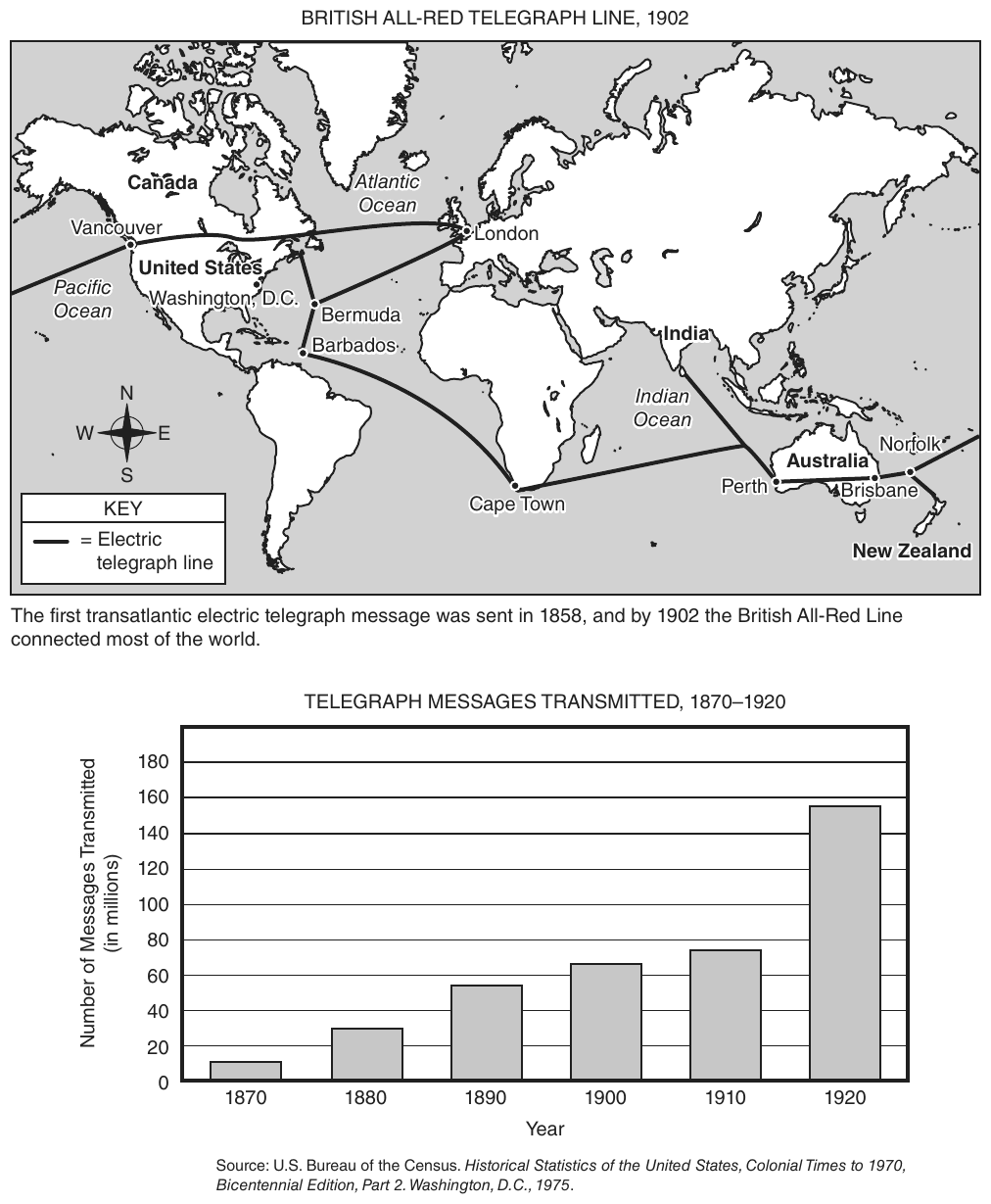
Soon, as overhead wires connected cities up and down the Atlantic coast, the dots-and-dashes method that recorded messages on a long moving strip of paper was replaced by the operator’s ability to interpret the code in real time. . . . Telegraph lines soon extended westward, and within Morse’s own lifetime they connected the continents of Europe and America.
“Invention of the Telegraph”—Public Domain/Library of Congress
legislation: Telegraph Bill
dots-and-dashes method: the short and long pulses of Morse code that are sent and received by telegraph operators
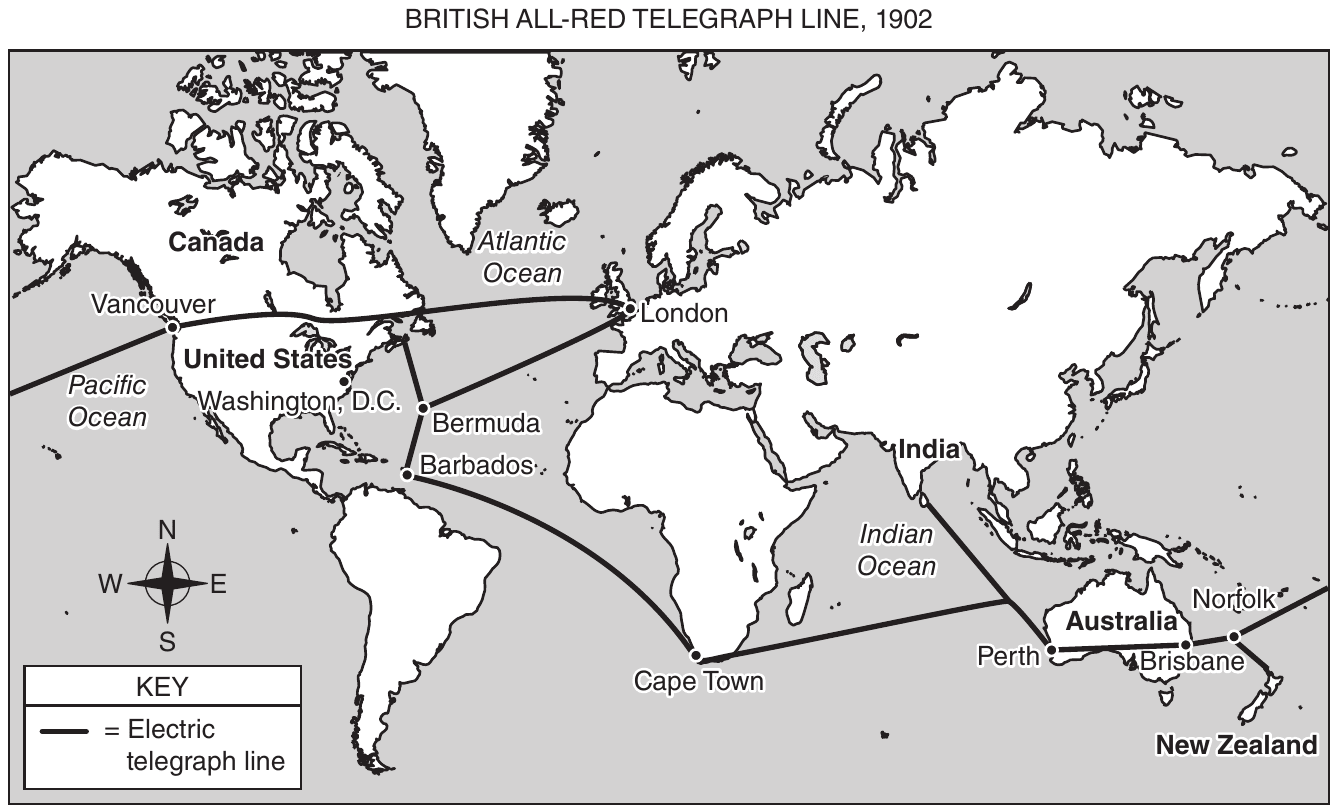
The first transatlantic electric telegraph message was sent in 1858, and by 1902 the British All-Red Line connected most of the world.
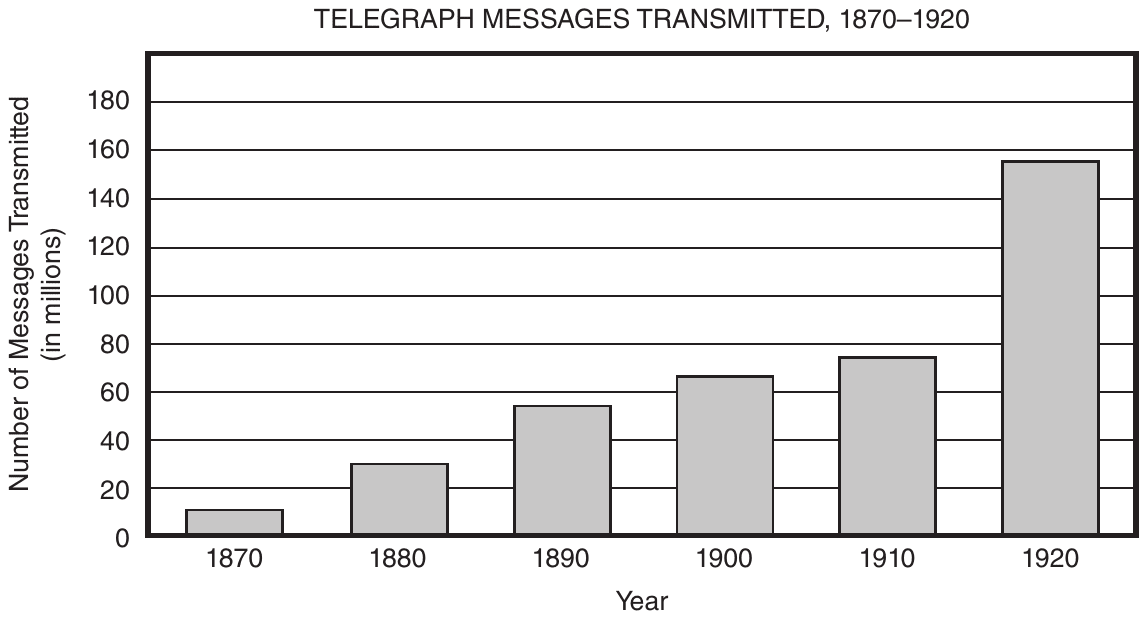
Source: U.S. Bureau of the Census. Historical Statistics of the United States, Colonial Times to 1970, Bicentennial Edition, Part 2. Washington, D.C., 1975.
Question
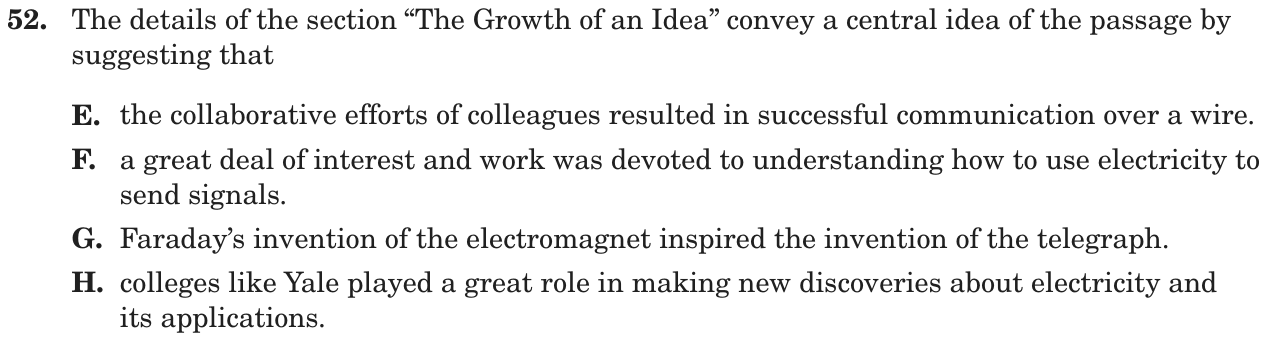
The details of the section “The Growth of an Idea” convey a central idea of the passage by suggesting that
- Athe collaborative efforts of colleagues resulted in successful communication over a wire.
- Ba great deal of interest and work was devoted to understanding how to use electricity to send signals.
- CFaraday’s invention of the electromagnet inspired the invention of the telegraph.
- Dcolleges like Yale played a great role in making new discoveries about electricity and its applications.
Show the answer
Correct answer: B
The question asks how a passage section helps convey a central idea of the passage. Paragraph 3 states that “Henry’s experiments, Gale’s assistance, and, soon after, hiring the young technician Alfred Vail were keys to Morse’s success.” The level of interest inspired Morse and others to work together to find a way to use electricity to send long-distance messages.
Option B is correct; the section helps convey a central idea because, overall, the section focuses on what fascinated Morse enough to begin his work and how others were just as interested and willing to work to achieve this goal.
Option A is incorrect because, although the word collaborative suggests that multiple people contributed to the telegraph’s success, the option does not clarify the research and effort needed in order to understand how to use electricity to send signals.
Option C is incorrect because when Morse came to understand how Faraday’s electromagnet worked, Morse wondered if it might be possible to send a coded message over a wire, but that thought later evolved into the telegraph only after more research and experimentation.
Option D is incorrect because the influence of what Morse learned at Yale was only a minor factor in his development of the telegraph.
Question analysis
This central idea question asks what the details in the section “The Growth of an Idea” suggest about the passage “Invention of the Telegraph.” The section covers Faraday’s electromagnet, Morse’s Yale lectures, and help from Gale, Henry and Vail, so students must judge which statement those details support as a group, and more than one choice sounds right.
- Grade level
- Grade 8 reading and task
- Compared with grade 7
- Above grade 7 Grade 7 central-idea questions usually have one clearly best summary. Here two paragraphs of names and events must be weighed, and several choices restate true details, so judging which fits the whole section is unusually demanding.
- Estimated difficulty
- Among the hardest on the SHSAT: a non-obvious approach, heavy reading, or a well-hidden trap.
- Thinking it demands
- Depth of knowledge 3, strategic thinking · mainly understand
- What makes it hard
- A very close wrong answer major
- Evidence in several places moderate
- The right answer is reworded moderate
- Evidence
- Answered from several paragraphs or stanzas
- Reading level
- Passage: about grade 11, 910 words; question and choices: about grade 12, 77 words.
- Students, last 30 days
- Not enough answers yet to show (it takes 10).
Why it is hard, traps and wrong answers (shows the answer)
Why it is hard
This is among the hardest questions in the set because the most tempting wrong choice reads like a paraphrase of the section’s final sentence. Rejecting it means noticing that the section never shows a message getting through and never shows Henry working with Morse, who had not even read his article. The right choice is vague by design, and only a summary of both paragraphs together shows that it fits better.
A very close wrong answer major Choosing the answer
The colleagues choice and the interest-and-work choice both describe effort spent on sending signals by wire; they part on one claim, that the effort “resulted in successful communication,” which the section never shows, the working line arriving in paragraph 7. (Embretson & Wetzel, 1987; Gorin & Embretson, 2006; Ascalon et al., 2007)
Evidence in several places moderate Working it out
The idea emerges only from details across two paragraphs, passengers discussing the electromagnet, Morse’s Yale letter, his failed attempts, Henry’s bell and article, Gale’s relay advice, taken together. (Kirsch & Mosenthal, 1990; Gorin & Embretson, 2006)
The right answer is reworded moderate Choosing the answer
The key names none of the section’s people, while the wrong choices echo its “colleague,” “over a wire,” Faraday’s electromagnet and Yale, and so look more firmly rooted in the text. (Freedle & Kostin, 1993; Kirsch & Mosenthal, 1990)
Strategy: Summarize paragraphs 2 and 3 together in one sentence of your own before reading the choices, then choose the statement closest to your summary, checking that every part of it is true of this section.
Traps
- Half right: One half of a two-part choice is right and the other is not.
- Too narrow: A single detail offered as the central idea or a summary, or a summary that keeps minor details and leaves out an essential part.
- Too broad or too strong: A choice overstates, generalizes, or uses absolute words the text does not support.
The wrong answers, classified
A Half right (King et al., 2004; Thissen, Steinberg & Fitzpatrick, 1989)
Rightly sees teamwork in the section’s close, but successful communication over Morse’s wire comes later, under “Realizing a Great Invention,” and the passage never shows Henry working with Morse.
C Too narrow (King et al., 2004)
Treats the spark as the whole story: Faraday’s electromagnet gave Morse the idea, but the section goes on to years of failed attempts and help from others.
D Too broad or too strong (King et al., 2004)
Inflates a passing mention: Morse’s Yale lectures appear once, and the section notes that despite them he had “little real understanding of the nature of electricity.”
Working it out, step by step
Figure out what the question asks
This asks what the section “The Growth of an Idea” says about a central idea, or main message. The section is paragraphs 2 and 3. Sum up both paragraphs together before you look at the choices.
List the section’s details
On the ship, Faraday’s electromagnet “was much discussed by the ship’s passengers.” Morse had found the electricity lectures at Yale interesting. He made “sporadic attempts” on his own. In paragraph 3, Henry “rang a bell at a distance by opening and closing an electric circuit.” Gale showed Morse how to use Henry’s relay system.
Find what the details share
Look at what links these details. Passengers talked about electricity. Morse was curious and kept trying. Henry ran tests and wrote an article. Gale gave advice. All of it is people taking an interest in electricity and working to send signals with it. That is the section’s main point. A working telegraph line does not appear until paragraph 7.
Check each choice
- A is close but wrong. Morse’s telegraph does not send a message until paragraph 7. Also, Henry never worked with Morse. At first, Morse did not even know about Henry’s article.
- B fits. It covers the interest and the work in both paragraphs.
- C is wrong. The electromagnet gave Morse the idea, but that is only the start of the section.
- D is wrong. Yale is only a small part of paragraph 2. And “Despite what he had learned at Yale,” Morse still knew little.
Choose the answer
The section shows lots of interest and effort aimed at sending signals with electricity. So the answer is B, “a great deal of interest and work was devoted to understanding how to use electricity to send signals.”
Why this answer and not the closest wrong one
A sounds like a summary of the section’s last sentence, which is why it tempts. But it claims the teamwork “resulted in successful communication,” and that only happens in a later section. B claims less, so every detail in paragraphs 2 and 3 fits it.
More questions like this
The original DOE question
The passage “Invention of the Telegraph” as printed (pages 146–148)
Question 2 of 50
2026 Practice Test C English, question 2Uses the passage above: “Invention of the Telegraph”.
Question
Which sentence is the best summary of how Morse obtained the funding necessary to build his telegraph system?
- AMorse’s application for a federal grant was delayed until 1843, so he spent time traveling in Europe, where he concentrated on obtaining a patent for his system.
- BMorse applied for a government grant that required both houses of Congress and the president to pass a bill awarding him $30,000 for his telegraph project.
- CMorse applied for a government appropriation and conducted telegraph demonstrations to show that his system could work, and after a delay caused by a financial depression, Congress approved the $30,000 appropriation in 1843.
- DWorking with Gale and Vail allowed Morse to find flaws in Henry’s work and to develop his own ideas before applying for the federal government appropriation.
Show the answer
Correct answer: C
The question asks for the best summary of how Morse obtained the funding necessary to build his telegraph system.
A. Incorrect. This summary focuses mostly on what Morse did while his application for funding was delayed in the United States rather than on how Morse acquired the funding, because during this period, Morse tried “not only to secure patent protection overseas but to examine competing telegraph systems in England” (paragraph 5). Therefore, it is not the best summary of how Morse obtained the funding necessary to build his telegraph system.
B. Incorrect. Although this summary mentions how Morse applied for the “federal government’s appropriation” (paragraph 4), it primarily focuses on the actions of the House of Representatives and the Senate, not on Morse’s efforts to obtain funding. Therefore, it is not the best summary of how Morse obtained the funding necessary to build his telegraph system.
C. CORRECT. This summary best describes how Morse obtained the funding that he needed for his telegraph system, because it explains that Morse applied “for the federal government’s appropriation, and during the next year he conducted demonstrations of his telegraph” (paragraph 4). In paragraph 5, the author explains the impact that the Panic of 1837 had on Morse’s request. In paragraph 6, the author describes how by 1843, economic times had improved, so Morse again “asked Congress for the $30,000” and was awarded the funds after “the Senate approved it.”
D. Incorrect. This summary is not the best summary of how Morse obtained the funding necessary to build his telegraph system, because it relates how Morse worked with others to develop his ideas about the telegraph and how Gale and Vail were the “keys to Morse’s success” (paragraph 3) before he applied for funding.
Question analysis
Students read “Invention of the Telegraph” and pick the best one-sentence summary of how Samuel Morse secured federal funding for his telegraph line. The money story is spread over several paragraphs alongside other events in Morse’s life, and the four long choices each blend true details, so students must decide what a good summary of this one process includes.
- Grade level
- Grade 7 reading and task
- Compared with grade 7
- At grade 7 Summarizing a short chain of events is everyday grade 7 work, and every fact needed is stated plainly. The main demand is patience with long choices rather than any hard inference.
- Estimated difficulty
- Moderate: several steps, or a close reading with one strong distractor.
- Thinking it demands
- Depth of knowledge 2, skills and concepts · mainly understand
- What makes it hard
- A very close wrong answer moderate
- Evidence in several places moderate
- A lot to read minor
- Evidence
- Answered from several paragraphs or stanzas
- Reading level
- Passage: about grade 11, 910 words; question and choices: about grade 13, 126 words.
- Corrected from the DOE handbook
- A date in the passage introduction was corrected.
- A wrong word in the explanation was corrected.
- Students, last 30 days
- Not enough answers yet to show (it takes 10).
Why it is hard, traps and wrong answers (shows the answer)
Why it is hard
Every choice is built from real events, so the question is less about spotting a false statement than about judging what a summary of the funding must contain. Students who accept the first accurate sentence they meet stop at the account of Congress and the president, which skips the years between application and approval. Listing the stages first, application, demonstrations, delay and vote, turns the long choices into a quick checklist.
A very close wrong answer moderate Choosing the answer
The summary about both houses and the president is accurate and ends where the key does, with the $30,000 approved; what separates them is the middle stretch, the demonstrations and the depression’s delay, which only the key covers. (Embretson & Wetzel, 1987; Gorin & Embretson, 2006; Ascalon et al., 2007)
Evidence in several places moderate Working it out
The funding story is split over paragraphs 4 to 6: the December 1837 application, demonstrations in New York and Washington, the Panic of 1837 with a trip to Europe, and the 1843 request and vote. (Kirsch & Mosenthal, 1990; Gorin & Embretson, 2006)
A lot to read minor Understanding the question
Each choice is a single sentence of 26 to 33 words carrying dates, a dollar amount, Congress and several people, and every piece has to be checked against the passage. (Kintsch, 1998; Gorin & Embretson, 2006; Freedle & Kostin, 1993)
Strategy: Find the part of the passage about paying for the telegraph and jot down each step in order; then pick the summary that matches your list from start to finish without wandering off it.
Traps
- Too narrow: A single detail offered as the central idea or a summary, or a summary that keeps minor details and leaves out an essential part.
- Wrong part of the text: A choice is true of another paragraph, stanza or speaker than the one asked about.
The wrong answers, classified
A Too narrow (King et al., 2004)
Builds the summary on Morse’s European patent trip, something he did while the money stalled, and drops the demonstrations and the 1843 vote that actually produced the funds.
B Too narrow (King et al., 2004)
Gives only the final step, a bill passed by the House and Senate and signed by the president, and omits the demonstrations and the depression that held the money up for years.
D Wrong part of the text (Kirsch & Mosenthal, 1990)
Pulls in paragraph 3, where Gale and Vail help Morse build the system, which concerns the invention, not the money, and puts the flaws in Henry’s work, though Gale found them in Morse’s system.
What was corrected from the DOE handbook, and why
- Passage: The 2024–2025 handbook’s introduction says “In 1844, the United States Congress passed the Telegraph Bill.” Congress passed the $30,000 appropriation in March 1843; 1844 is the year of Morse’s first message. Paragraph 6 describes the 1843 approval, and Option C, the correct answer, says 1843, so the introduction reads “In 1843.” The site shares this passage with 2018 Test B English, where the same correction is recorded.
- Explanation: The handbook says Option A focuses on what Morse did while his application was delayed “rather than on how Morse acquired the patent.” The question asks how Morse obtained his funding, and the patent is what Option A does focus on, so the site now says “rather than on how Morse acquired the funding.”
Working it out, step by step
Figure out what the question asks
This question wants a summary. A summary is a short retelling that keeps only the main points, in the order they happen. The topic is narrow: how Morse got the money for his telegraph. So the best choice must be true, stay on the money, and tell that story from beginning to end.
Find where the money story is told
The funding story runs through paragraphs 4, 5 and 6. By December 1837, Morse felt ready “to apply for the federal government’s appropriation” (paragraph 4). The next year, “he conducted demonstrations of his telegraph both in New York and Washington” (paragraph 4). Then a money crisis “caused a long depression,” and Morse “was forced to wait for better times” (paragraph 5). In 1843 he “again asked Congress for the $30,000,” and this time he got it (paragraph 6).
Explain the words and list the steps
Some words may be new. An appropriation is money that lawmakers agree to pay out for a planned project. Demonstrations are public shows that prove a machine works. A depression is a long period when businesses struggle and cash is scarce. Now put the story in order:
- Morse asked for the money.
- He showed people his telegraph working.
- Hard times made him wait.
- In 1843 Congress said yes to the $30,000.
Check each choice
- A does not fit. It is mostly about a trip to Europe for a patent (a legal right that stops others from copying an invention). Morse made that trip while he waited. A leaves out the demonstrations and the vote.
- B does not fit. It is true, but it gives only the final step, when the House, the Senate and the president approved the bill. It skips the demonstrations and the years of waiting.
- C fits. It covers the request, the demonstrations, the delay from the depression and the 1843 approval, in that order.
- D does not fit. Gale and Vail helped Morse build the telegraph, not pay for it. And the flaws Gale pointed out were in Morse’s system, while D puts them in Henry’s work.
Choose the answer
Only one choice tells the whole funding story, from the first request to the final yes, without drifting to other topics. So the answer is C.
Why this answer and not the closest wrong one
B is the hardest choice to rule out, because nothing in it is false. But it starts at the very end of the story. It drops the demonstrations Morse gave and the long wait during the depression. A summary must hold all the main steps, and C is the only choice that does.
More questions like this
The original DOE question
Question 3 of 50
2026 Practice Test C English, question 3Uses the passage above: “Invention of the Telegraph”.
Question
Read this sentence from paragraph 7.
The desperate Morse gave the go-ahead, and the line was completed in time for the dramatic and spectacularly successful link between the Supreme Court chamber of the Capitol building and the railroad station in Baltimore.
The words “dramatic” and “spectacularly” in the sentence convey a
- Asense of relief and fulfillment that the line was finished.
- Bsense of wonder and celebration that the telegraph line was accomplished.
- Cfeeling of excitement about the future possibilities of the telegraph.
- Dfeeling of confidence about being able to continue the work.
Show the answer
Correct answer: B
The question asks what the words “dramatic” and “spectacularly” convey in the sentence from paragraph 7.
A. Incorrect. While there may have been some feelings of relief and fulfillment when the lines were finished, the passage instead focuses on the wonder and joy that Morse and Cornell felt after overcoming setbacks and completing the construction of the telegraph system.
B. CORRECT. Morse and Cornell rushed to post the wires overhead, and the “rigid deadline” (paragraph 7) was successfully met. The words have a positive and victorious tone that is consistent with the feeling of wonder that it worked and of celebration that the construction was completed.
C. Incorrect. The passage does not share whether Morse or Cornell considered the future possibilities of the telegraph; it shares only that the finished product was “dramatic,” implying it was amazing to see.
D. Incorrect. While the passage later discusses the expansion of overhead wires “up and down the Atlantic coast” and how they “connected the continents of Europe and America” (paragraph 8), there is no evidence shared in the passage that Morse planned to continue his work with electricity.
Question analysis
Students judge the connotation of two words, “dramatic” and “spectacularly,” in the sentence from “Invention of the Telegraph” that describes the completion of Samuel Morse’s first telegraph link from Washington to Baltimore. Because the same sentence calls Morse “desperate” and says the line was finished just in time, several feelings seem to fit the moment, and the choices name four of them.
- Grade level
- Grade 7 reading and task
- Compared with grade 7
- At grade 7 Judging what two adjectives convey is standard grade 7 word-choice work, and the sentence is printed with the question. The challenge is that all four choices name believable feelings, so students must separate the words’ own connotations from the situation around them.
- Estimated difficulty
- Moderate: several steps, or a close reading with one strong distractor.
- Thinking it demands
- Depth of knowledge 2, skills and concepts · mainly understand
- What makes it hard
- A very close wrong answer moderate
- Reading between the lines moderate
- Every choice must be checked minor
- Evidence
- Answered from one sentence or line
- Reading level
- Passage: about grade 11, 910 words; question and choices: about grade 10, 91 words.
- Students, last 30 days
- Not enough answers yet to show (it takes 10).
Why it is hard, traps and wrong answers (shows the answer)
Why it is hard
The quoted sentence offers two tempting sources for the answer besides the two words the stem names: Morse is “desperate,” and the line is finished “in time.” Students who read the situation rather than the words choose relief, and those who think ahead to paragraph 8’s spreading wires choose excitement about the future. The question rewards asking what “dramatic” and “spectacularly” say about the link itself, an event that impressed and was celebrated.
A very close wrong answer moderate Choosing the answer
The relief choice is built like the key, a pair of feelings about the finished line; only the feelings differ, and “dramatic” and “spectacularly” point to wonder at a public success, not release from worry. (Embretson & Wetzel, 1987; Gorin & Embretson, 2006; Ascalon et al., 2007)
Reading between the lines moderate Working it out
Neither word names an emotion: “dramatic” and “spectacularly” describe the link itself, so the feeling they carry has to be inferred from their sense of an impressive public show. (Graesser, Singer & Trabasso, 1994; Kintsch, 1998)
Every choice must be checked minor Choosing the answer
All four choices name a positive feeling that suits a race against a “rigid deadline,” so tone alone rules none of them out. (Embretson & Wetzel, 1987)
Strategy: Before reading the choices, picture something you would call dramatic and spectacularly successful, and name the feeling those words give it; then find the choice closest to that feeling.
Traps
- Wrong tone or attitude: Misjudges the tone, attitude or point of view, such as reading admiration as criticism, or taking a character's or subject's feelings for the author's.
- Wrong part of the text: A choice is true of another paragraph, stanza or speaker than the one asked about.
The wrong answers, classified
A Wrong tone or attitude (Graesser, Singer & Trabasso, 1994)
Takes what Morse probably felt, relief after a “desperate” scramble to beat the deadline, for what the author’s two words convey, which is admiration for a striking success.
C Wrong part of the text (Kirsch & Mosenthal, 1990)
Brings in paragraph 8, where wires spread along the coast and across the ocean, but this sentence is about the first finished link and says nothing of what might follow.
D Reads too much in (Graesser, Singer & Trabasso, 1994)
Assumes success would leave Morse confident about pressing on, but the sentence never looks past the finished line, and the two words describe the event, not his plans.
Working it out, step by step
Figure out what the question asks
This question is about connotation, the feeling a word carries beyond its dictionary meaning. It names two words, “dramatic” and “spectacularly.” Your job is to name the feeling those two words give the sentence. Other words in the sentence should not decide your answer.
See what is happening in paragraph 7
Just before this sentence, Morse’s team lost time laying wire that turned out to be faulty. The job was also “on a rigid deadline” with no time to spare. Cornell had a quick fix: to “string wires overhead on trees and poles” instead. Morse agreed, and the line was done in time. The sentence describes the moment the first link worked, from the Capitol in Washington to the train station in Baltimore.
Work out what the two words suggest
A dramatic event grabs your attention, the way the high point of a movie does. Spectacularly comes from spectacle, a grand sight that makes people stop and stare. So the author is saying the link was more than finished. It was a thrilling public success. Words like these make a reader marvel at what was done and want to cheer.
Check each choice
- A does not fit. Morse was “desperate,” so he may have felt relief. But that feeling comes from the word “desperate,” not from the two words the question asks about.
- B fits. Wonder matches an amazing sight, and celebration matches a great success.
- C does not fit. This sentence is only about the finished link. Wires spreading to other places come later, in paragraph 8.
- D does not fit. The two words describe the event itself. They tell nothing about Morse’s plans for more work.
Choose the answer
The words “dramatic” and “spectacularly” make the first telegraph link sound like a thrilling show. So the answer is B, a “sense of wonder and celebration that the telegraph line was accomplished.”
Why this answer and not the closest wrong one
A is the closest trap, since it also names two good feelings about the finished line. But relief is the quiet feeling you get when worry ends. The words “dramatic” and “spectacularly” are loud and showy. They make the link sound like something to gasp at and cheer for, and that is wonder and celebration.
More questions like this
The original DOE question
Question 4 of 50
2026 Practice Test C English, question 4Uses the passage above: “Invention of the Telegraph”.
Question
How does the graph support the ideas in paragraph 8?
- AIt indicates how welcome the improvement of long-distance communication was in the United States.
- BIt provides evidence of the dramatic increase in the number of telegraph messages as Morse’s system expanded across the United States.
- CIt reveals that by the twentieth century millions of people had used the telegraph despite earlier hesitations about the system.
- DIt shows how improvements that allowed Morse code to be read in real time made relaying telegraph messages faster and increased the system’s usage.
Show the answer
Correct answer: B
The question asks how the graph supports the ideas in paragraph 8. The graph shows the number of messages transmitted from 1870 to 1920. In 1920 almost 160 million messages were transmitted, showing a “dramatic”—more than double—increase from 1910, which makes Option B the correct answer.
Option A is incorrect because, while it can be implied from the expansion shown on the graph that people possibly welcomed the improvement in long-distance communication, the graph does not state this explicitly.
Option C is incorrect because the graph does not show how many people used the telegraph, but rather it shows the number of messages sent. Additionally, paragraph 8 provides no details about hesitation on the part of individuals.
Option D is incorrect because, while improvements in recording and interpreting code were made, the graph does not show the effect of this advancement on the speed or number of messages being transmitted.
Question analysis
This question asks how a graph that accompanies “Invention of the Telegraph” supports the ideas in paragraph 8, the passage’s closing account of what followed the first telegraph line. Students must connect a data display to a paragraph of text, and the choices differ in how much they claim a graph of this kind could prove.
- Grade level
- Grade 7 reading and task
- Compared with grade 7
- At grade 7 Connecting a graph to a paragraph is standard grade 7 work with mixed formats. The demand is typical: read the paragraph, read the data, and check that a claim about the graph does not go beyond it.
- Estimated difficulty
- Moderate: several steps, or a close reading with one strong distractor.
- Thinking it demands
- Depth of knowledge 2, skills and concepts · mainly analyze
- What makes it hard
- Reading a figure, table or graph moderate
- A very close wrong answer moderate
- Combines ideas minor
- Evidence
- Answered from one paragraph or stanza
- Reading level
- Passage: about grade 11, 910 words; question and choices: about grade 11, 88 words.
- Corrected from the DOE handbook
- A misreading of the graph in the explanation was corrected.
- Students, last 30 days
- Not enough answers yet to show (it takes 10).
Why it is hard, traps and wrong answers (shows the answer)
Why it is hard
The graph is simple to read; the challenge is deciding how much a count of messages can prove. Wrong choices claim the graph shows public feeling, numbers of people, or the effect of one improvement, and the last of these is tempting because paragraph 8 mentions that improvement. Students who ask what the vertical axis measures can reject all three quickly.
Reading a figure, table or graph moderate Understanding the question
The bar graph counts messages in millions, rising from about 10 in 1870 to about 155 in 1920; it measures neither people, nor speed, nor causes, which is what rules out three choices. (Lesh, Post & Behr, 1987; Kirsch & Mosenthal, 1990)
A very close wrong answer moderate Choosing the answer
The key and the real-time-reading choice both tie the rise in messages to a change described in paragraph 8; they part on one detail, the claim that relaying became “faster,” which a count of messages cannot show. (Embretson & Wetzel, 1987; Gorin & Embretson, 2006; Ascalon et al., 2007)
Combines ideas minor Working it out
Students must join the graph’s fifty years of growth to paragraph 8’s spread of overhead wires along the coast, westward and across the ocean. (Embretson, 1998; Daniel & Embretson, 2010)
Strategy: Reread paragraph 8 and look at what the graph measures, then for each choice ask whether both the paragraph and the graph back it up.
Traps
- Reads too much in: A reasonable-sounding conclusion that goes further than the text allows.
- Twists what the text says: Uses the text's topic and ideas but changes what it says: who did it, how much, when, or why.
The wrong answers, classified
A Reads too much in (Graesser, Singer & Trabasso, 1994)
Infers from the growth that people welcomed the telegraph, which may be true, but a count of messages cannot show how anyone felt about the change.
C Twists what the text says (King et al., 2004)
Treats messages as people, reading “in millions” as millions of users, and adds “earlier hesitations” that neither the graph nor paragraph 8 mentions.
D Reads too much in (Graesser, Singer & Trabasso, 1994)
Takes real-time reading of code from paragraph 8 and credits it with the rise in messages, but the graph shows only totals, not what caused them or how fast messages moved.
What was corrected from the DOE handbook, and why
- Explanation: The handbook says 1920 showed an “almost double” increase from 1910. The graph shows about 75 million messages in 1910 and about 155 million in 1920, so the number more than doubled. The site now says “more than double.”
Working it out, step by step
Figure out what the question asks
This asks how the bar graph supports paragraph 8. To answer, you need to know two things. What does paragraph 8 say? And what does the graph actually measure?
Read paragraph 8
Paragraph 8 says that “overhead wires connected cities up and down the Atlantic coast.” Then “Telegraph lines soon extended westward, and within Morse’s own lifetime they connected the continents of Europe and America.” So the main idea is growth. The telegraph spread farther and farther.
Read the bar graph
The graph’s title is Telegraph Messages Transmitted, 1870–1920. Its side axis counts messages, in millions. The bars rise every ten years. There were about 10 million messages in 1870 and about 75 million in 1910. In 1920 there were about 155 million. That last jump is more than double. The graph counts messages. It does not count people, speed or feelings.
Check each choice
- A is wrong. A count of messages can’t show how welcome something was. That is a feeling.
- B fits. The bars show a huge rise in messages as the lines spread.
- C is wrong. The graph counts messages, not people. Nothing mentions “earlier hesitations” either.
- D is wrong. Paragraph 8 does mention reading code “in real time,” or right away. But the graph shows totals only. It can’t show what caused the rise or how fast messages moved.
Choose the answer
The graph shows messages rising from about 10 million to about 155 million as the wires spread. So the answer is B, “It provides evidence of the dramatic increase in the number of telegraph messages as Morse’s system expanded across the United States.”
Why this answer and not the closest wrong one
D is the closest trap, since paragraph 8 really does mention reading code in real time. But ask what the side of the graph measures. It counts messages, nothing else. A count can show that use grew, as B says. It can’t show that messages got faster, or why.
More questions like this
The original DOE question
Question 5 of 50
2026 Practice Test C English, question 5Uses the passage above: “Invention of the Telegraph”.
Question
The idea that, in the mid-nineteenth century, the United States was mostly unaware of the possibilities of electricity is illustrated in the passage mainly through the
- Adescription of the government’s initial desire to expand a semaphore signaling system that used either flags or lights along the Atlantic Coast.
- Bdelay by the House of Representatives to pass the bill funding Morse’s telegraph line six years after he first applied for the appropriation.
- Cdiscussions of the newly invented electromagnet that sparked the idea of sending codes through wires.
- Ddescription of how an electric circuit could be closed to ring a bell at a distance.
Show the answer
Correct answer: A
The question asks for information that conveys the idea that the United States was mostly unaware of the possibilities of electricity in the mid-nineteenth century. The passage states that most signaling systems at the time were “visual or ‘semaphore’ systems using flags or lights” (paragraph 1) and that the United States was looking for “just such a system along its entire Atlantic coast” (paragraph 1).
Option A is correct because waving lights and flags reveals how limiting and simple the system of the time was, and Option A states that the United States wanted to expand this system, not improve upon it.
Option B is incorrect because the delay in funding had to do with the Panic of 1837 and the “long depression” (paragraph 5), not because the House of Representatives was not aware or ready for innovation in the use of electricity.
Option C is incorrect because it focuses on what prompted Morse to consider an electronic wire-based communications system.
Option D is incorrect because it describes a basic aspect of an early electrical discovery that demonstrated the interest of scientists in the possibilities of electricity, not the United States as a whole.
Question analysis
Students identify how “Invention of the Telegraph” mainly illustrates the idea that, in the mid-1800s, the United States was largely unaware of what electricity could do. The idea is implied rather than stated, so students must decide which detail truly reveals the nation’s thinking at the time.
- Grade level
- Grade 8 reading and task
- Compared with grade 7
- Above grade 7 Grade 7 evidence questions often match a stated idea to a sentence. This idea is only implied, so students must infer what a historical detail reveals about a whole nation’s understanding, closer to grade 8 inference.
- Estimated difficulty
- Hard: combines ideas, needs a plan, and has more than one tempting wrong answer.
- Thinking it demands
- Depth of knowledge 3, strategic thinking · mainly evaluate
- What makes it hard
- Reading between the lines moderate
- Evidence in several places moderate
- Hard words minor
- Evidence
- Answered from one paragraph or stanza
- Reading level
- Passage: about grade 11, 910 words; question and choices: about grade 12, 102 words.
- Students, last 30 days
- Not enough answers yet to show (it takes 10).
Why it is hard, traps and wrong answers (shows the answer)
Why it is hard
The stem asks about a whole nation’s understanding, so details about individuals with electrical interests, the ship’s passengers and Henry, show the opposite of what is needed. The real trap is the funding delay, which looks like official indifference but has an economic cause the passage states. Students who remember that the semaphore plan came with a remark about not knowing electricity was coming find the answer.
Reading between the lines moderate Working it out
The idea is implied: wanting a semaphore system shows unawareness only alongside paragraph 1’s comment that its framers “had no way of knowing” they would be offered electricity. (Graesser, Singer & Trabasso, 1994; Kintsch, 1998)
Evidence in several places moderate Working it out
The choices point to four separate places, paragraph 1’s semaphore plan, the funding delay of paragraphs 4 to 6, the shipboard talk in paragraph 2 and Henry’s bell in paragraph 3, and each must be checked there. (Kirsch & Mosenthal, 1990; Gorin & Embretson, 2006)
Hard words minor Understanding the question
“Semaphore” and “appropriation” are uncommon words, and the passage defines “semaphore” only in passing, as systems “using flags or lights.” (Perfetti, 2007; Freedle & Kostin, 1993)
Strategy: For each choice, find the detail in the passage and ask whether the author uses it to show what the country did or did not understand about electricity.
Traps
- Twists what the text says: Uses the text's topic and ideas but changes what it says: who did it, how much, when, or why.
- Supports only part of the claim: In a question about evidence: a line that backs one half of the claim but not the other, or a related point rather than the claim itself.
The wrong answers, classified
B Twists what the text says (King et al., 2004)
Reads the long wait for funding as doubt about electricity, but the passage gives a different cause, the Panic of 1837 and the “long depression” that followed.
C Supports only part of the claim (King et al., 2004; Thissen, Steinberg & Fitzpatrick, 1989)
The ship’s passengers did discuss the new electromagnet, but that shows a few people interested in electricity, not a country unaware of what it could do.
D Supports only part of the claim (King et al., 2004; Thissen, Steinberg & Fitzpatrick, 1989)
Henry’s bell rung at a distance is a real detail, but it shows a scientist exploring electricity’s uses, the opposite of unawareness, and says nothing about the nation.
Working it out, step by step
Figure out what the question asks
This asks which part of the passage best shows an idea. The idea is that in the mid-1800s, the United States mostly did not know what electricity could do. Look for a detail about the country as a whole, not about one scientist.
Find the detail in paragraph 1
Paragraph 1 says most early systems were visual, or semaphore, “systems using flags or lights.” Then it says, “The young American republic wanted just such a system along its entire Atlantic coast.” The next sentence explains that its lawmakers “had no way of knowing” they would be offered “an entirely new and revolutionary means of communication—electricity.”
Explain what the detail shows
A semaphore system sends signals people can see, like waving flags. The country asked for that old kind of system. It did not ask for an electric one, because it did not know one was possible. “Revolutionary” means bringing a huge change. So the government’s plan shows how unaware the nation was of what electricity could do.
Check each choice
- A fits. The government wanted to spread flags and lights, not electric signals.
- B is wrong. The delay had a money cause. The Panic of 1837 “caused a long depression.” It was not about electricity.
- C is wrong. Passengers talking about the electromagnet shows interest in electricity, the opposite of not knowing about it.
- D is wrong. Henry ringing a bell shows one scientist exploring electricity. It says nothing about the whole country.
Choose the answer
The country’s wish for a flags-and-lights system shows it did not yet see what electricity could do. So the answer is A, the description of the government’s plan for a semaphore system along the Atlantic Coast.
Why this answer and not the closest wrong one
B is the closest trap, because a long wait for money can look like doubt about electricity. But paragraph 5 gives the real cause, the Panic of 1837 and the hard times after it. A is backed by the passage’s own words: the lawmakers “had no way of knowing” electricity was coming.
More questions like this
The original DOE question
Question 6 of 50
2026 Practice Test C English, question 6Uses the passage above: “Invention of the Telegraph”.
Question
With which statement would the author most likely agree?
- AMorse’s telegraph was successful because the wires were strung aboveground rather than underground as originally planned.
- BUnderstanding the importance of Morse’s telegraph requires detailed knowledge of electrical systems.
- CThe implementation of Morse’s telegraph system was overly influenced by economic factors.
- DMorse’s invention of the telegraph made a great stride toward better connecting people across the United States and across the world.
Show the answer
Correct answer: D
The question asks which statement best represents a viewpoint held by the author of the passage. Paragraph 8 states that “Telegraph lines soon extended westward, and within Morse’s own lifetime they connected the continents of Europe and America.”
Therefore, Option D is correct because the author presents Morse’s telegraph as a great leap in the ability to quickly communicate messages over distances never before imagined.
Option A is incorrect because the author explains that the aboveground wiring was used only because “Cornell suggested that [it was] the fastest and cheapest way” (paragraph 7), not because it would be more successful.
Option B is incorrect because the author conveys the importance of this advancement in communication without providing detailed information about electrical systems.
Option C is incorrect because, while the Panic of 1837 caused a delay in Morse’s funding, the author shows that Morse received the appropriation in 1843 and was able to overcome the financial setback he faced.
Question analysis
This question asks which statement the author of “Invention of the Telegraph” would most likely agree with, based on the passage’s account of Samuel Morse’s work. Students must infer the author’s view from the passage as a whole, and every choice takes up a real topic from the story, so each must be checked for how strongly it is supported.
- Grade level
- Grade 7 reading and task
- Compared with grade 7
- At grade 7 Inferring an author’s position from an informational text is typical grade 7 work. The author’s attitude is fairly clear in the passage’s word choice, so this matches a routine state-test question in demand.
- Estimated difficulty
- Straightforward: two steps or one careful reading.
- Thinking it demands
- Depth of knowledge 3, strategic thinking · mainly analyze
- What makes it hard
- Reading between the lines moderate
- Evidence in several places minor
- Evidence
- Answered from the whole text
- Reading level
- Passage: about grade 11, 910 words; question and choices: about grade 12, 70 words.
- Students, last 30 days
- Not enough answers yet to show (it takes 10).
Why it is hard, traps and wrong answers (shows the answer)
Why it is hard
The passage’s admiration for Morse’s achievement is steady from the first paragraph to the map, so most students recognize the author’s view. The wrong choices each take a real episode, the overhead wires, Morse’s struggle with electricity, the depression, and turn it into a judgment the author never makes. Watching for evaluative words such as “overly” and “because” separates them.
Reading between the lines moderate Working it out
The author never states an opinion outright; it shows in word choice such as “revolutionary,” “ingenious,” “spectacularly successful” and the heading “Realizing a Great Invention.” (Graesser, Singer & Trabasso, 1994; Kintsch, 1998)
Evidence in several places minor Working it out
Support for the key is spread from paragraph 1’s “revolutionary means of communication” to paragraph 8’s lines that “connected the continents” and the map caption’s line that “connected most of the world.” (Kirsch & Mosenthal, 1990; Gorin & Embretson, 2006)
Strategy: Look for the author’s own judgments, the words that show approval or criticism, then choose the statement those words support most directly.
Traps
- Too broad or too strong: A choice overstates, generalizes, or uses absolute words the text does not support.
- Reads too much in: A reasonable-sounding conclusion that goes further than the text allows.
The wrong answers, classified
A Reads too much in (Graesser, Singer & Trabasso, 1994)
Turns a deadline fix into the reason for success: Cornell proposed overhead wires as “the fastest and cheapest way” after bad wire wasted time, not as a better design.
B Twists what the text says (King et al., 2004)
Shifts Morse’s own need to understand electricity onto the reader, though the author conveys the invention’s importance with almost no technical detail about how it works.
C Too broad or too strong (King et al., 2004)
Economic factors did matter, the Panic of 1837 delayed funding and cost drove the overhead wires, but “overly” adds a criticism the author never makes.
Working it out, step by step
Figure out what the question asks
This asks which statement the author would most likely agree with. The author never states an opinion directly. So look for word choice that shows approval or criticism. Then pick the statement those words support.
Find the author’s judging words
Start with paragraph 1. There the author calls electricity “an entirely new and revolutionary means of communication,” which is strong praise. The last section has the heading “Realizing a Great Invention,” more praise. In paragraph 8, the lines spread until “they connected the continents of Europe and America” in Morse’s lifetime. The map caption adds that by 1902 the line “connected most of the world” as well.
Put the author’s view in plain words
“Revolutionary” means bringing a huge change. “Great Invention” is plain praise. The author also shows the lines spreading from city to city, then across oceans. So the author admires the telegraph as a big step forward in linking people. That is what “a great stride” means: a big step forward.
Check each choice
- A is wrong. Overhead wires were used because they were “the fastest and cheapest way” after bad wire wasted time. That doesn’t make them the reason for success.
- B is wrong. The author shows the telegraph’s importance with almost no technical detail.
- C is wrong. Money problems did delay Morse. But “overly” means too much, and the author never makes that complaint.
- D fits. The author praises how the telegraph connected the country and the world.
Choose the answer
The author’s words praise the telegraph for linking people far apart. So the answer is D, “Morse’s invention of the telegraph made a great stride toward better connecting people across the United States and across the world.”
Why this answer and not the closest wrong one
C is the closest trap, because money troubles really did matter. The Panic of 1837 delayed the funding. But the word “overly” turns a fact into a complaint, and the author never complains. D matches the praise the author gives from the first paragraph to the map.
More questions like this
The original DOE question
Question 7 of 50
2026 Practice Test C English, question 7Passage Excerpt from “Niagara Falls”
Excerpt from “Niagara Falls”
by Rupert Brooke
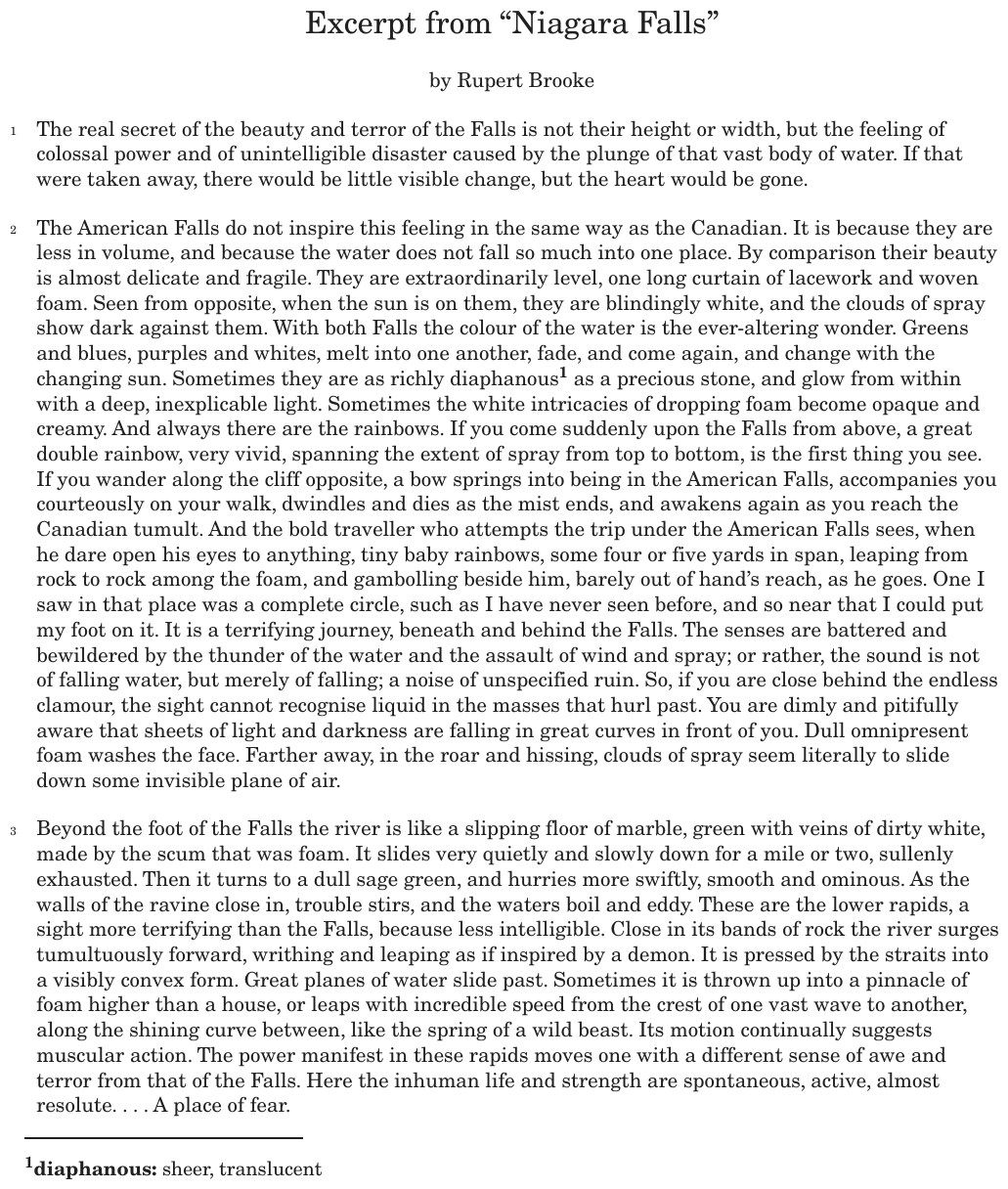
The real secret of the beauty and terror of the Falls is not their height or width, but the feeling of colossal power and of unintelligible disaster caused by the plunge of that vast body of water. If that were taken away, there would be little visible change, but the heart would be gone.
The American Falls do not inspire this feeling in the same way as the Canadian. It is because they are less in volume, and because the water does not fall so much into one place. By comparison their beauty is almost delicate and fragile. They are extraordinarily level, one long curtain of lacework and woven foam. Seen from opposite, when the sun is on them, they are blindingly white, and the clouds of spray show dark against them. With both Falls the colour of the water is the ever-altering wonder. Greens and blues, purples and whites, melt into one another, fade, and come again, and change with the changing sun. Sometimes they are as richly diaphanous as a precious stone, and glow from within with a deep, inexplicable light. Sometimes the white intricacies of dropping foam become opaque and creamy. And always there are the rainbows. If you come suddenly upon the Falls from above, a great double rainbow, very vivid, spanning the extent of spray from top to bottom, is the first thing you see. If you wander along the cliff opposite, a bow springs into being in the American Falls, accompanies you courteously on your walk, dwindles and dies as the mist ends, and awakens again as you reach the Canadian tumult. And the bold traveller who attempts the trip under the American Falls sees, when he dare open his eyes to anything, tiny baby rainbows, some four or five yards in span, leaping from rock to rock among the foam, and gambolling beside him, barely out of hand’s reach, as he goes. One I saw in that place was a complete circle, such as I have never seen before, and so near that I could put my foot on it. It is a terrifying journey, beneath and behind the Falls. The senses are battered and bewildered by the thunder of the water and the assault of wind and spray; or rather, the sound is not of falling water, but merely of falling; a noise of unspecified ruin. So, if you are close behind the endless clamour, the sight cannot recognise liquid in the masses that hurl past. You are dimly and pitifully aware that sheets of light and darkness are falling in great curves in front of you. Dull omnipresent foam washes the face. Farther away, in the roar and hissing, clouds of spray seem literally to slide down some invisible plane of air.
Beyond the foot of the Falls the river is like a slipping floor of marble, green with veins of dirty white, made by the scum that was foam. It slides very quietly and slowly down for a mile or two, sullenly exhausted. Then it turns to a dull sage green, and hurries more swiftly, smooth and ominous. As the walls of the ravine close in, trouble stirs, and the waters boil and eddy. These are the lower rapids, a sight more terrifying than the Falls, because less intelligible. Close in its bands of rock the river surges tumultuously forward, writhing and leaping as if inspired by a demon. It is pressed by the straits into a visibly convex form. Great planes of water slide past. Sometimes it is thrown up into a pinnacle of foam higher than a house, or leaps with incredible speed from the crest of one vast wave to another, along the shining curve between, like the spring of a wild beast. Its motion continually suggests muscular action. The power manifest in these rapids moves one with a different sense of awe and terror from that of the Falls. Here the inhuman life and strength are spontaneous, active, almost resolute. . . . A place of fear.
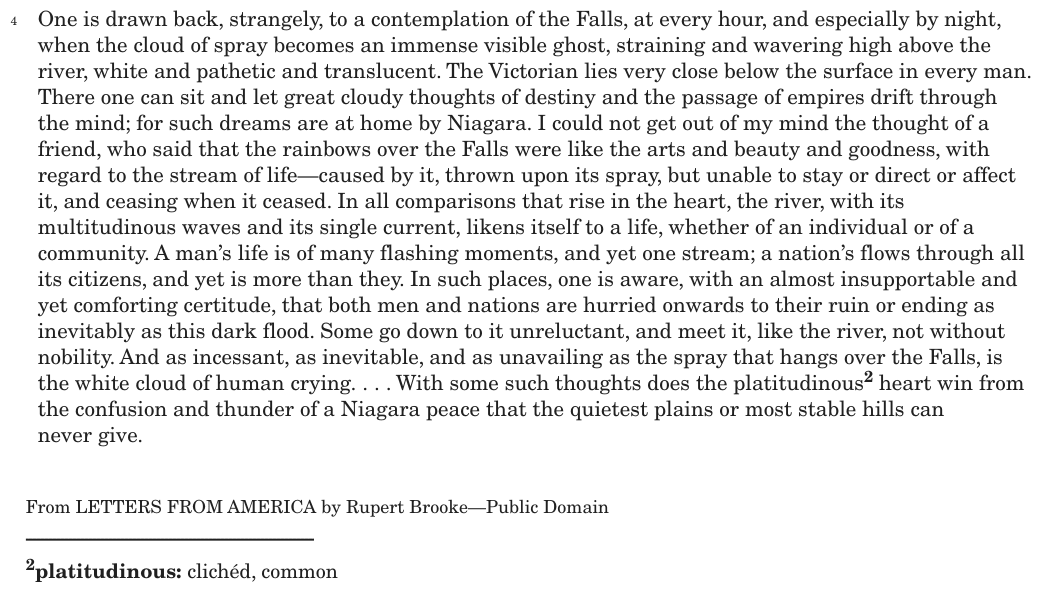
One is drawn back, strangely, to a contemplation of the Falls, at every hour, and especially by night, when the cloud of spray becomes an immense visible ghost, straining and wavering high above the river, white and pathetic and translucent. The Victorian lies very close below the surface in every man. There one can sit and let great cloudy thoughts of destiny and the passage of empires drift through the mind; for such dreams are at home by Niagara. I could not get out of my mind the thought of a friend, who said that the rainbows over the Falls were like the arts and beauty and goodness, with regard to the stream of life—caused by it, thrown upon its spray, but unable to stay or direct or affect it, and ceasing when it ceased. In all comparisons that rise in the heart, the river, with its multitudinous waves and its single current, likens itself to a life, whether of an individual or of a community. A man’s life is of many flashing moments, and yet one stream; a nation’s flows through all its citizens, and yet is more than they. In such places, one is aware, with an almost insupportable and yet comforting certitude, that both men and nations are hurried onwards to their ruin or ending as inevitably as this dark flood. Some go down to it unreluctant, and meet it, like the river, not without nobility. And as incessant, as inevitable, and as unavailing as the spray that hangs over the Falls, is the white cloud of human crying. . . . With some such thoughts does the platitudinous heart win from the confusion and thunder of a Niagara peace that the quietest plains or most stable hills can never give.
From LETTERS FROM AMERICA by Rupert Brooke—Public Domain
diaphanous: sheer, translucent
platitudinous: clichéd, common
Question
Read this sentence from paragraph 2.
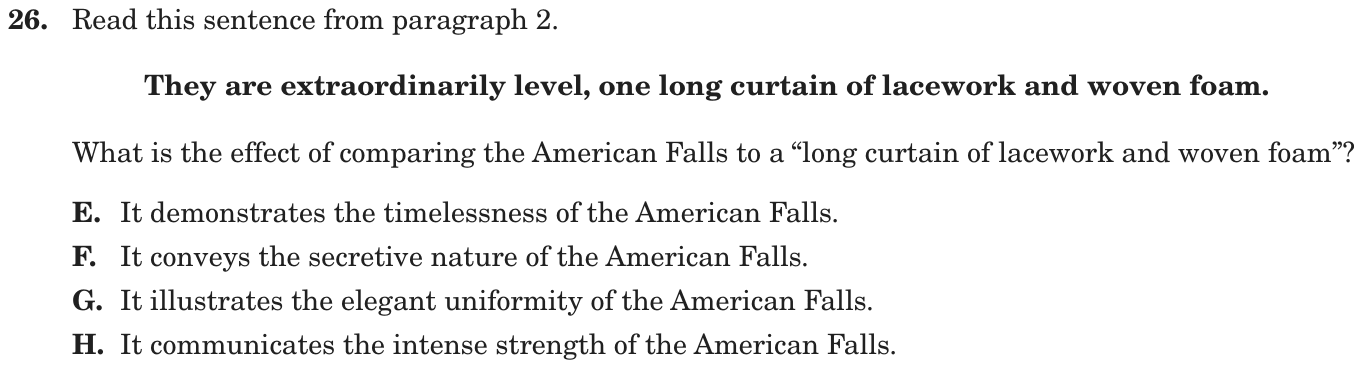
They are extraordinarily level, one long curtain of lacework and woven foam.
What is the effect of comparing the American Falls to a “long curtain of lacework and woven foam”?
- AIt demonstrates the timelessness of the American Falls.
- BIt conveys the secretive nature of the American Falls.
- CIt illustrates the elegant uniformity of the American Falls.
- DIt communicates the intense strength of the American Falls.
Show the answer
Correct answer: C
The question asks for the effect of the comparison being made in the sentence in paragraph 2. The word “lacework” in the sentence suggests an elegant piece of craftsmanship, and the “one long curtain” and “extraordinarily level” aspects of the Falls mean that the Falls are uniform or consistent; therefore, Option C is correct.
Option A is incorrect because neither “lacework and woven foam,” nor the quality of being extremely level, are related to timelessness.
Option B is incorrect because, while a curtain may suggest the idea of something being hidden or secret, the description of a delicate “lacework” curtain does not suggest this purpose.
Option D is incorrect because “lacework” is generally fragile and does not suggest great strength.
Question analysis
In this figurative language question, students explain the effect of a comparison in Rupert Brooke’s “Niagara Falls”: the American Falls as “one long curtain of lacework and woven foam.” They need to picture the image and read the sentences around it, since a curtain, lace and foam can each call up quite different qualities.
- Grade level
- Grade 7 reading and task
- Compared with grade 7
- At grade 7 Explaining the effect of a metaphor in a quoted sentence is routine grade 7 work. The older prose is harder than most grade 7 texts, but the sentences around this one give direct context clues.
- Estimated difficulty
- Straightforward: two steps or one careful reading.
- Thinking it demands
- Depth of knowledge 2, skills and concepts · mainly analyze
- What makes it hard
- Figurative or literary language moderate
- Hard words minor
- Evidence
- Answered from one sentence or line
- Reading level
- Passage: about grade 9, 987 words; question and choices: about grade 10, 70 words.
- Students, last 30 days
- Not enough answers yet to show (it takes 10).
Why it is hard, traps and wrong answers (shows the answer)
Why it is hard
The image is clear once pictured, and the sentences around it, about the American Falls being “delicate and fragile” and “extraordinarily level,” confirm what it means. Students go wrong by bringing in what they associate with curtains or with Niagara in general, hiding or power, instead of what this curtain is made of. The right choice also uses an abstract word that has to be connected back to “level.”
Figurative or literary language moderate Understanding the question
Students must translate “one long curtain of lacework and woven foam” into qualities: lace is delicate and finely made, and one long level curtain is even from end to end. (Graesser, Singer & Trabasso, 1994; Kintsch, 1998)
Hard words minor Understanding the question
The right choice uses “uniformity,” which students must link to “extraordinarily level” and “one long curtain,” just as “elegant” must be linked to the lacework. (Perfetti, 2007; Freedle & Kostin, 1993)
Strategy: Picture the image first, then reread the few sentences around it about the American Falls and keep only the choice that both the image and those sentences support.
Traps
- Wrong part of the text: A choice is true of another paragraph, stanza or speaker than the one asked about.
- Dictionary meaning, not meaning here: A common meaning of the word that does not fit its use in this text.
The wrong answers, classified
A Little reason to choose it (Haladyna & Downing, 1993; Rodriguez, 2005)
Nothing in lace, foam or a level edge suggests lasting through time, so this attracts mainly students guessing that a natural wonder must seem timeless.
B Dictionary meaning, not meaning here (Perfetti, 2007)
Uses the common sense of a curtain as something that hides, but this curtain is lacework, open and decorative, and nothing behind it is concealed.
D Wrong part of the text (Kirsch & Mosenthal, 1990)
Carries over the “colossal power” of paragraph 1, though paragraph 2 says the American Falls do not inspire that feeling as the Canadian do and calls their beauty fragile.
Working it out, step by step
Figure out what the question asks
This asks about the effect of a comparison. The author compares the American Falls to “one long curtain of lacework and woven foam.” What quality does that picture give them?
Read the sentence and its neighbor
The full sentence is “They are extraordinarily level, one long curtain of lacework and woven foam.” The sentence just before it says, “By comparison their beauty is almost delicate and fragile.”
Picture the comparison
Lacework is fancy cloth with fine, delicate patterns. It looks elegant, which means graceful and beautiful. “Extraordinarily level” and “one long curtain” mean the Falls are even all the way across, with no breaks. That evenness is uniformity: being the same all the way through. So the picture shows elegant uniformity.
Check each choice
- A is wrong. Nothing about lace or foam suggests lasting forever.
- B is wrong. A curtain can hide things, but lace is open and see-through. Nothing is hidden.
- C is right. Lace is elegant, and a level curtain is uniform.
- D is wrong. Lace is fragile, not strong.
Watch out: Paragraph 1 talks about “colossal power,” so D can seem right. But paragraph 2 says the American Falls “do not inspire this feeling” the way the Canadian Falls do.
Choose the answer
The lace curtain makes the American Falls look graceful and even. So the answer is C.
Why this answer and not the closest wrong one
D is the closest wrong answer, because the Falls seem powerful in other parts of the essay. But this sentence is about the American Falls, whose beauty is “delicate and fragile.” Lace is delicate, not strong. A smooth, level curtain of lace shows grace and evenness, as C says.
More questions like this
The original DOE question
The passage “Excerpt from “Niagara Falls”” as printed (pages 134–135)
Question 8 of 50
2026 Practice Test C English, question 8Uses the passage above: “Excerpt from “Niagara Falls””.
Question
Read this sentence from paragraph 3.
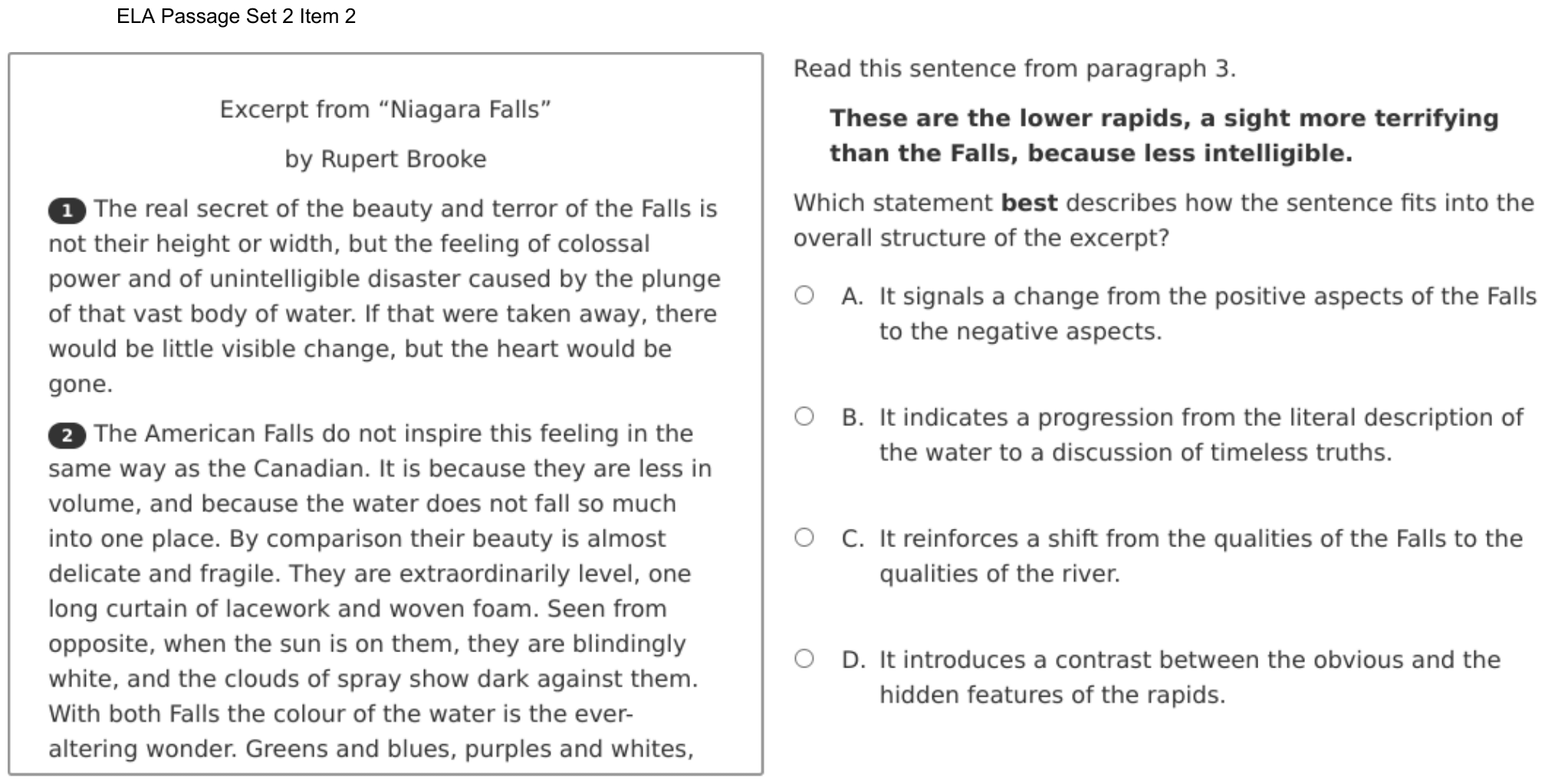
These are the lower rapids, a sight more terrifying than the Falls, because less intelligible.
Which statement best describes how the sentence fits into the overall structure of the excerpt?
- AIt signals a change from the positive aspects of the Falls to the negative aspects.
- BIt indicates a progression from the literal description of the water to a discussion of timeless truths.
- CIt reinforces a shift from the qualities of the Falls to the qualities of the river.
- DIt introduces a contrast between the obvious and the hidden features of the rapids.
Show the answer
Correct answer: C
The question asks for the statement that best describes how the sentence from paragraph 3 fits into the overall structure of the excerpt.
A. Incorrect. Although in paragraph 2 the author describes the beauty of the Falls as both an “ever-altering wonder” and an “assault of wind and spray,” in paragraph 3 the author does not signal a change from the positive aspects of the Falls to the negative aspects. Instead, the author provides a description of the river and the rapids below the Falls.
B. Incorrect. While the author compares the water of the river to “a slipping floor of marble, green with veins of dirty white, made by the scum that was foam” in paragraph 3, the statement that the lower rapids are “more terrifying than the Falls, because less intelligible” does not indicate a progression from the literal description of the water to a discussion of timeless truths. Instead, the author is merely describing all aspects of the rapids, both literally and figuratively.
C. CORRECT. The first sentence of paragraph 3 moves the description “beyond the foot of the Falls” to “the river” and then the paragraph begins to describe this location in further detail (“a dull sage green,” “hurries more swiftly,” “smooth and ominous,” “waters boil and eddy”) before reinforcing this shift by confirming it again with the words “These are the lower rapids, a sight more terrifying than the Falls.”
D. Incorrect. Although the author states that the waters of the rapids “boil and eddy” and suggests that the rapids are “less intelligible,” these statements do not introduce a contrast between the obvious and the hidden features of the rapids. They merely describe a feature and the sight of the lower rapids.
Question analysis
This text structure question quotes a sentence from paragraph 3 of Rupert Brooke’s “Niagara Falls,” in which the lower rapids are called “more terrifying than the Falls,” and asks how it fits the excerpt’s overall organization. It rewords a question from the 2018 handbook’s Test B. Every choice describes a turn the essay could plausibly take, so students need a clear picture of what each paragraph covers.
- NYS standards
- 7R5 structure and genre features
- Grade level
- Grade 8 reading and task
- Compared with grade 7
- Above grade 7 A typical grade 7 structure question asks what one paragraph adds. This one asks where a sentence from the middle of paragraph 3 fits in the whole essay, which means summing up four long paragraphs of century-old prose.
- Estimated difficulty
- Hard: combines ideas, needs a plan, and has more than one tempting wrong answer.
- Thinking it demands
- Depth of knowledge 3, strategic thinking · mainly analyze
- What makes it hard
- How, not what major
- Much to keep track of moderate
- Hard words moderate
- Evidence
- Answered from several paragraphs or stanzas
- Reading level
- Passage: about grade 9, 987 words; question and choices: about grade 8, 97 words.
- Students, last 30 days
- Not enough answers yet to show (it takes 10).
Why it is hard, traps and wrong answers (shows the answer)
Why it is hard
A sentence that compares the rapids with the Falls is easy to misplace, because both of its subjects appear elsewhere in the excerpt. The strongest pull is a real turn in the essay, from describing water to musing on destiny, that comes a paragraph later, while “more terrifying” draws students who forget that terror runs through the excerpt from its first sentence. The 2026 verb “reinforces” rewards those who saw that paragraph 3 had already left the Falls with “Beyond the foot of the Falls the river.”
How, not what major Working it out
The task is to place one sentence in the essay’s plan, and the sentence pulls the wrong way: it mentions “the Falls” and “more terrifying,” though its job is to confirm that paragraph 3 has already moved downstream to the rapids. (Anderson & Krathwohl, 2001)
Much to keep track of moderate Working it out
Placing the sentence takes a summary of all four long paragraphs at once: the Falls’ power, the two Falls’ beauty and the trip behind them, the river below, and the night thoughts on destiny. (Sweller, 1988; Carpenter, Just & Shell, 1990)
Hard words moderate Understanding the question
“Less intelligible” means harder to make sense of; a student who takes it as harder to see is led toward a contrast between obvious and hidden features of the rapids. (Perfetti, 2007; Freedle & Kostin, 1993)
Strategy: Sum up each of the four paragraphs in a few words, find where this sentence sits in that outline, and choose the description of the essay’s movement at exactly that point.
Traps
- Wrong part of the text: A choice is true of another paragraph, stanza or speaker than the one asked about.
The wrong answers, classified
A Twists what the text says (King et al., 2004)
Takes “more terrifying” as the essay’s first turn from the Falls’ beauty to their dangers, but this sentence is about the rapids, and paragraph 1 already speaks of “unintelligible disaster.”
B Wrong part of the text (Kirsch & Mosenthal, 1990)
Names a turn the excerpt really makes, from describing the water to “thoughts of destiny and the passage of empires,” but that turn comes in paragraph 4, not at the rapids.
D Wrong purpose or structure (Anderson & Krathwohl, 2001)
Reads “less intelligible” as less visible and finds a contrast between obvious and hidden features, though rapids that “boil and eddy” and leap like “a wild beast” are in plain view.
Working it out, step by step
Figure out what the question asks
This is a text structure question. Structure is the plan of a piece of writing: what each part does and how the parts connect. You get one sentence from paragraph 3. You must decide what job it does in the plan of the whole excerpt. So first sum up what each of the four paragraphs is about.
Sum up the four paragraphs
- Paragraph 1: the real secret of the Falls is “the feeling of colossal power.” Colossal means huge.
- Paragraph 2: the two Falls, their colors, the rainbows, and the scary trip behind the water.
- Paragraph 3: the river below the Falls and its wild rapids.
- Paragraph 4: the author goes back to the Falls at night and thinks about life and destiny, or what happens in the end.
See where paragraph 3 begins
Paragraph 3 opens with “Beyond the foot of the Falls the river is like a slipping floor of marble.” Beyond the foot means past the bottom. So the author has already left the Falls. He follows the river as it “hurries more swiftly” and the waters “boil and eddy,” or swirl. Then comes the sentence: “These are the lower rapids, a sight more terrifying than the Falls, because less intelligible.” Rapids are a stretch of fast, rough water. Less intelligible means harder to make sense of.
Decide what the sentence does
The sentence names the new place: the lower rapids. It also sets the rapids against the Falls. That tells you again that the essay has moved from the Falls to the river below them. To reinforce something is to make it stronger. The sentence reinforces a shift, or change of subject, that the paragraph’s first sentence began.
Check each choice
- A does not fit. Terror is not new here. Paragraph 1 already speaks of “unintelligible disaster,” and paragraph 2 calls the trip behind the Falls “a terrifying journey.”
- B does not fit. The essay does turn to big, timeless ideas, but in paragraph 4, not here.
- C fits. The sentence confirms the move from the Falls to the river.
- D does not fit. The rapids are in plain sight. “Less intelligible” means harder to understand, not hidden.
Watch out: B names a real turn in the essay. But it comes one paragraph later, with “thoughts of destiny and the passage of empires.”
Choose the answer
The sentence names the rapids and compares them with the Falls. That confirms the essay has moved downstream. So the answer is C, “It reinforces a shift from the qualities of the Falls to the qualities of the river.”
Why this answer and not the closest wrong one
B is the closest wrong choice, because the essay really does move from describing water to big ideas about life. But that move comes in paragraph 4, at night. The sentence in paragraph 3 is still describing water. Its job is to name the rapids and confirm that the essay has left the Falls for the river.
More questions like this
The original DOE question
Question 9 of 50
2026 Practice Test C English, question 9Uses the passage above: “Excerpt from “Niagara Falls””.
Question
Which sentence from the excerpt best supports the idea that the essence of the Falls lies in their emotional impact?
- A“If that were taken away, there would be little visible change, but the heart would be gone.” (paragraph 1)
- B“By comparison their beauty is almost delicate and fragile.” (paragraph 2)
- C“One is drawn back, strangely, to a contemplation of the Falls, at every hour, and especially by night, when the cloud of spray becomes an immense visible ghost, straining and wavering high above the river, white and pathetic and translucent.” (paragraph 4)
- D“A man’s life is of many flashing moments, and yet one stream; a nation’s flows through all its citizens, and yet is more than they.” (paragraph 4)
Show the answer
Correct answer: A
The question asks for the sentence from the excerpt that best supports the idea that the essence of the Falls lies in their emotional impact. The first sentence in the excerpt establishes that the “real secret of the beauty and terror of the Falls” is “the feeling of colossal power and of unintelligible disaster.” Option A is correct because the sentence in Option A best supports this notion by identifying these qualities as “the heart,” or essence, of the Falls.
While “delicate” and “fragile” are words that can be connected with certain kinds of emotions, in the sentence in Option B, they are connected with physical beauty, so Option B is incorrect.
Option C is incorrect because, while the sentence in Option C describes the power of the Falls to engage one in thought, it does not best support the idea that the essence of the Falls lies in their emotional impact.
Option D is incorrect because the sentence in Option D describes thoughts one may have while watching the Falls and is not focused on the Falls’ emotional impact.
Question analysis
In this textual evidence question, students choose the quotation from Rupert Brooke’s “Niagara Falls” that best supports the idea that the essence of the Falls lies in their emotional impact. Every choice is a vivid sentence from the excerpt, so the challenge is matching that precise idea instead of settling for a line that only sounds emotional.
- Grade level
- Grade 8 reading and task
- Compared with grade 7
- At grade 7 Grade 7 evidence questions usually offer one sentence that clearly matches the claim. Here all four quotations are long or figurative lines of older prose, and the claim itself, about an essence, is abstract.
- Estimated difficulty
- Moderate: several steps, or a close reading with one strong distractor.
- Thinking it demands
- Depth of knowledge 2, skills and concepts · mainly evaluate
- What makes it hard
- Reading between the lines moderate
- Hard words minor
- Evidence
- Answered from one paragraph or stanza
- Reading level
- Passage: about grade 9, 987 words; question and choices: about grade 11, 115 words.
- Corrected from the DOE handbook
- A misquotation of the passage in the explanation was corrected.
- A stray apostrophe in the explanation was removed.
- Students, last 30 days
- Not enough answers yet to show (it takes 10).
Why it is hard, traps and wrong answers (shows the answer)
Why it is hard
Every quotation carries feeling, so the test is whether a sentence says what the Falls’ essence is, not merely whether it is emotional. The right one is short and plain and depends on the sentence before it, which defines “that” as the feeling of power and disaster. Students who choose by the intensity of the language pass over it for the ghostly night scene or the reflections on life.
Reading between the lines moderate Working it out
The right sentence never says “emotion” or “essence”: students must see that “that” points back to “the feeling of colossal power,” and that “the heart” means the essence. (Graesser, Singer & Trabasso, 1994; Kintsch, 1998)
Hard words minor Understanding the question
The claim’s key word, “essence,” has to be matched to the text’s “real secret” and “heart,” two everyday words used here in an abstract sense. (Perfetti, 2007; Freedle & Kostin, 1993)
Strategy: Restate the idea in your own words, that the Falls matter because of how they make people feel, and test each quotation: does it say what the Falls’ essence is, or something else?
Traps
- Supports only part of the claim: In a question about evidence: a line that backs one half of the claim but not the other, or a related point rather than the claim itself.
The wrong answers, classified
B Supports only part of the claim (King et al., 2004; Thissen, Steinberg & Fitzpatrick, 1989)
Treats “delicate and fragile” as emotional words, but the sentence describes how the American Falls look beside the Canadian, not where the essence of the Falls lies.
C Supports only part of the claim (King et al., 2004; Thissen, Steinberg & Fitzpatrick, 1989)
Backs the emotional half, the spray as an “immense visible ghost” that draws people back, but describes the Falls’ pull without saying that their essence lies there.
D Supports only part of the claim (King et al., 2004; Thissen, Steinberg & Fitzpatrick, 1989)
Chooses a moving reflection the Falls inspire, but this sentence is about how a river resembles human lives and nations, not about the Falls’ emotional impact.
What was corrected from the DOE handbook, and why
- Explanation: The handbook quotes the first sentence as saying the “real secret of the beauty and terror of the Falls . . . lies in the feeling of colossal power and unintelligible disaster.” The passage says the real secret “is not their height or width, but the feeling of colossal power and of unintelligible disaster.” The site now quotes it exactly.
- Explanation: The handbook writes “the power of the Falls’ to engage one in thought”; the site drops the stray possessive apostrophe: “the power of the Falls to engage one in thought.”
Working it out, step by step
Figure out what the question asks
This asks for evidence for an idea: the essence of the Falls lies in their emotional impact. “Essence” means the most important part, what makes something what it is. “Emotional impact” means the way it makes people feel.
Read the opening of paragraph 1
The essay begins: “The real secret of the beauty and terror of the Falls is not their height or width, but the feeling of colossal power and of unintelligible disaster.” So the real secret of the Falls is a feeling.
Read the sentence that comes next
Next comes: “If that were taken away, there would be little visible change, but the heart would be gone.” “That” means the feeling. Take the feeling away, and the Falls would look the same. But “the heart” would be gone. Here, the heart means the most important part, the essence. So the essence is the feeling.
Check each choice
- A is right. It says the Falls would lose their heart without the feeling they create.
- B is wrong. It compares how the two Falls look, not what their essence is.
- C is wrong. It shows the Falls pull people back, but it never says the feeling is their essence.
- D is wrong. It compares a river to human lives and nations.
Watch out: C is full of feeling, with the spray like a ghost. But it describes a view, not what the Falls truly are.
Choose the answer
Only A says that the feeling is the heart of the Falls. So the answer is A.
Why this answer and not the closest wrong one
C is the closest wrong answer, because it is an emotional description. But it does not say where the essence of the Falls lies. A does. Without the feeling, almost nothing you can see would change, yet “the heart would be gone.”
More questions like this
The original DOE question
Question 10 of 50
2026 Practice Test C English, question 10Uses the passage above: “Excerpt from “Niagara Falls””.
Question
Read this sentence from paragraph 4.
There one can sit and let great cloudy thoughts of destiny and the passage of empires drift through the mind; for such dreams are at home by Niagara.
The sentence most contributes to the development of ideas in the excerpt by
- Asuggesting that viewing the Falls can be a life-changing experience.
- Bshowing that the cliffs of the Falls are a good place for self-examination.
- Cemphasizing that the grandeur of the Falls seems impossible to grasp.
- Dhighlighting the type of reflection that is inspired by a visit to the Falls.
Show the answer
Correct answer: D
The question asks how the sentence from paragraph 4 contributes to the development of ideas in the excerpt.
The description of “cloudy thoughts of destiny and the passage of empires” in the sentence refers to the types of thoughts a person might have while observing the Falls, as stated in Option D.
Option A is incorrect because the sentence focuses on the idea that the Falls are a place of great contemplation but does not clarify that these thoughts are life-changing.
Option B is incorrect because the sentence does not describe focused thoughts of a personal nature; the grand, sweeping nature of the Falls inspires thoughts of the same caliber as “the passage of empires.”
Option C is incorrect because the sentence is about how the Falls inspire great thoughts but is not about how difficult it is to grasp the grandeur of the Falls.
Question analysis
This question asks how a sentence near the end of Rupert Brooke’s “Niagara Falls” contributes to the development of ideas in the excerpt. Students must make sense of abstract phrases such as “cloudy thoughts of destiny” and “the passage of empires” and then decide exactly what the sentence adds, since several choices sound close.
- Grade level
- Grade 8 reading and task
- Compared with grade 7
- At grade 7 Explaining how a sentence develops ideas is a grade 7 skill, and this sentence is quoted in full. The challenge is its abstract, old-fashioned wording, which a grade 7 reader must translate before comparing the choices.
- Estimated difficulty
- Moderate: several steps, or a close reading with one strong distractor.
- Thinking it demands
- Depth of knowledge 2, skills and concepts · mainly analyze
- What makes it hard
- A very close wrong answer moderate
- Figurative or literary language moderate
- Hard words minor
- Evidence
- Answered from one paragraph or stanza
- Reading level
- Passage: about grade 9, 987 words; question and choices: about grade 7, 94 words.
- Corrected from the DOE handbook
- A grammar slip in the explanation was corrected.
- Students, last 30 days
- Not enough answers yet to show (it takes 10).
Why it is hard, traps and wrong answers (shows the answer)
Why it is hard
The sentence is about thinking, and most of the choices describe thinking too, so the difference lies in what kind of thought and how much the sentence claims. Students lose the point by inflating daydreams into a life-changing experience or by turning thoughts about empires into self-examination. Paraphrasing the sentence before reading the choices, people sit by the Falls and think about destiny and history, keeps the right one in view.
A very close wrong answer moderate Choosing the answer
The self-examination choice and the right one both say the Falls prompt reflection; they differ in one detail, what the thoughts are about, and the sentence’s “destiny and the passage of empires” is not the self. (Embretson & Wetzel, 1987; Gorin & Embretson, 2006; Ascalon et al., 2007)
Figurative or literary language moderate Understanding the question
“Great cloudy thoughts” drifting through the mind borrow the image of the Falls’ spray, and “such dreams are at home by Niagara” treats the Falls as the natural home of this kind of daydream. (Graesser, Singer & Trabasso, 1994; Kintsch, 1998)
Hard words minor Understanding the question
“The passage of empires” and “destiny” are abstract, and students who cannot pin them down may not see that the thoughts concern history, not the thinker. (Perfetti, 2007; Freedle & Kostin, 1993)
Strategy: Paraphrase the sentence in plain words first, then test each choice against your paraphrase, rejecting any that adds a claim the sentence does not make.
Traps
- Too broad or too strong: A choice overstates, generalizes, or uses absolute words the text does not support.
- Wrong part of the text: A choice is true of another paragraph, stanza or speaker than the one asked about.
The wrong answers, classified
A Too broad or too strong (King et al., 2004)
Inflates the sentence’s daydreaming into a life-changing experience, though the author says only that great thoughts drift through the mind, not that they change anyone.
B Twists what the text says (King et al., 2004)
Turns the reflection inward, but the thoughts named are of “destiny and the passage of empires,” history on a grand scale, and the sentence says nothing about cliffs.
C Wrong part of the text (Kirsch & Mosenthal, 1990)
Borrows the earlier idea that the Falls and rapids are hard to understand, from paragraphs 1 and 3, but this sentence is about the thoughts they inspire.
What was corrected from the DOE handbook, and why
- Explanation: The handbook writes “the grand, sweeping nature of the falls inspire thoughts.” The subject “nature” takes “inspires,” and the passage always capitalizes “the Falls,” so the site now reads “the grand, sweeping nature of the Falls inspires thoughts.”
Working it out, step by step
Figure out what the question asks
This asks what one sentence adds to the essay’s ideas. Put the sentence in plain words first, then test each choice against it.
Read the sentence closely
The sentence says: “There one can sit and let great cloudy thoughts of destiny and the passage of empires drift through the mind; for such dreams are at home by Niagara.”
Put it in plain words
“Destiny” means what is meant to happen in the future. “The passage of empires” means great nations rising and falling over time. “At home by Niagara” means these dreams fit naturally at the Falls. So sitting by the Falls makes you think big thoughts about fate and history. The sentence names the kind of reflection, or deep thinking, the Falls bring on.
Check each choice
- A is wrong. Thoughts drift by, but nothing says they change a person’s life.
- B is wrong. The thoughts are about history and fate, not about yourself. The sentence doesn’t mention cliffs.
- C is wrong. This sentence is about the thoughts the Falls inspire, not about how hard they are to grasp.
- D is right. It names the type of thinking a visit to the Falls brings on.
Watch out: B is close, since both B and D are about reflection. Check what the thoughts are about: empires, not yourself.
Choose the answer
The sentence shows what kind of thoughts the Falls inspire. So the answer is D.
Why this answer and not the closest wrong one
B is the closest wrong answer, because both B and D say the Falls make people reflect. The difference is the topic. Self-examination means thinking about yourself. The sentence names “thoughts of destiny and the passage of empires.” Those are big ideas about history, not about the self.
More questions like this
The original DOE question
Question 11 of 50
2026 Practice Test C English, question 11Uses the passage above: “Excerpt from “Niagara Falls””.
Question
In paragraph 4, the idea that human life and history ultimately end in the same way is illustrated mainly through
- Athe discussion of how the rainbows visible in the Falls are like the art and beauty created by humankind.
- Bthe comparison between the movement of water in the Falls and the human experience.
- Cthe inclusion of details that show that every observer’s experience with the Falls is different.
- Dthe acknowledgment that contemplating the Falls at night sparks an awareness of humankind’s destiny.
Show the answer
Correct answer: B
The question asks how paragraph 4 of the excerpt mainly illustrates the idea that human life and history ultimately end in the same way.
A. Incorrect. In paragraph 4, the author compares the rainbows visible in the Falls to “the arts and beauty,” which share the rainbows’ dependence on “the stream of life”—that is, they are “caused by it, thrown upon its spray, but unable to stay or direct or affect it, and ceasing when it ceased.” This comparison does not illustrate the idea that human life and history ultimately end in the same way but rather that art and beauty, like human beings, are unable to “stay or direct or affect” their ultimate fate.
B. CORRECT. The author concludes in paragraph 4 that the movement of the Falls can be compared to people and history when he writes, “both men and nations are hurried onwards to their ruin or ending as inevitably as this dark flood.” This comparison illustrates the idea that human life and history ultimately end in the same way.
C. Incorrect. Although in paragraph 4 the author states that “One is drawn back, strangely, to a contemplation of the Falls” and provides an account of “a friend, who said that the rainbows over the Falls were like the arts and beauty and goodness, with regard to the stream of life,” the author does not provide details to show that every observer’s experience with the Falls is different. Rather, the author explains that “the Victorian lies very close below the surface in every man” (paragraph 4).
D. Incorrect. While the setting at night does provide a place of contemplation, the author notes the “dark flood” as the overall illustration of the human experience.
Question analysis
In this question on the closing paragraph of Rupert Brooke’s “Niagara Falls,” students identify the main way the author illustrates the idea that human life and history ultimately end in the same way. It is a lightly reworded version of a 2018 Test B question. The paragraph is long and reflective, mixing several images with abstract thoughts, so students must decide which of them actually illustrates this particular idea.
- Grade level
- Grade 8 reading and task
- Compared with grade 7
- Above grade 7 Most grade 7 work asks how an idea is shown in plain modern prose. This paragraph is a century-old reflection in long sentences with words like “certitude” and “unavailing,” and several of its images could each seem to carry the idea.
- Estimated difficulty
- Hard: combines ideas, needs a plan, and has more than one tempting wrong answer.
- Thinking it demands
- Depth of knowledge 2, skills and concepts · mainly analyze
- What makes it hard
- Complex sentences major
- The right answer is reworded moderate
- Hard words minor
- Evidence
- Answered from one paragraph or stanza
- Reading level
- Passage: about grade 9, 987 words; question and choices: about grade 11, 81 words.
- Students, last 30 days
- Not enough answers yet to show (it takes 10).
Why it is hard, traps and wrong answers (shows the answer)
Why it is hard
Paragraph 4 offers three pictures, the spray as a night ghost, the friend’s rainbows and the river as a life, and only one of them shows people and nations meeting an end. The 2026 stem’s “ultimately end” makes the rainbows’ “ceasing when it ceased” more tempting, and the night-time “thoughts of destiny” sound like the idea itself. Students who ask what the paragraph uses to show the idea, rather than where it mentions endings or destiny, land on the dark flood.
Complex sentences major Understanding the question
The idea sits inside a hedged sentence, “one is aware, with an almost insupportable and yet comforting certitude, that both men and nations are hurried onwards to their ruin or ending,” and the comparison comes last: “as inevitably as this dark flood.” (Abedi & Lord, 2001; Freedle & Kostin, 1993; Messick, 1989)
The right answer is reworded moderate Choosing the answer
The key sums up the paragraph’s river-and-life likeness in its own words, “movement of water” and “human experience,” while the other choices borrow the paragraph’s vocabulary: “rainbows,” “art and beauty,” “night” and “destiny.” (Freedle & Kostin, 1993; Kirsch & Mosenthal, 1990)
Hard words minor Understanding the question
“Multitudinous,” “certitude,” “insupportable” and “unavailing” all sit in the lines that carry the idea, and the footnoted “platitudinous” closes the paragraph, so the comparison has to be read through them. (Perfetti, 2007; Freedle & Kostin, 1993)
Strategy: Find the sentence in paragraph 4 that actually states the idea about life and history ending, then ask how that very sentence makes its point and match a choice to it.
Traps
- Supports only part of the claim: In a question about evidence: a line that backs one half of the claim but not the other, or a related point rather than the claim itself.
- Outside knowledge: A choice is plausible in the real world but not supported by this text.
The wrong answers, classified
A Supports only part of the claim (King et al., 2004; Thissen, Steinberg & Fitzpatrick, 1989)
Settles on the friend’s rainbows because they end “ceasing when it ceased,” which echoes the stem’s ending, but the likeness is about art and beauty, not the lives of men and nations.
C Outside knowledge (King et al., 2004; Recht & Leslie, 1988)
Relies on the common idea that every visitor sees the Falls in a personal way, but the paragraph speaks of “one” and “every man” in general and records no differences.
D Supports only part of the claim (King et al., 2004; Thissen, Steinberg & Fitzpatrick, 1989)
Joins the night view to “thoughts of destiny,” both real in paragraph 4, but they tell when and where the reflecting happens, not which picture shows lives and nations sharing an end.
Working it out, step by step
Figure out what the question asks
This asks how an idea is shown in paragraph 4. The idea is that people’s lives and whole nations end in the same way: they all come to an end. You need the picture the author mainly uses to show that idea. Paragraph 4 has several pictures, so find the one tied to this idea.
Find the sentence with the idea
Paragraph 4 says “both men and nations are hurried onwards to their ruin or ending as inevitably as this dark flood.” Men means people. Nations means countries and their history. Inevitably means in a way that can’t be stopped. The “dark flood” is the river’s dark water rushing over the Falls.
See how the comparison works
Just before, the author says “the river, with its multitudinous waves and its single current, likens itself to a life.” Multitudinous means very many. A current is water flowing one way. Likens itself to means seems like. A life has many moments but moves one way, like the river. And just as the water must rush on, people and nations rush toward their end. So the idea is shown by comparing moving water with human life.
Check each choice
- A does not fit. A friend compares the rainbows to “the arts and beauty and goodness.” That picture is about art, not about lives and nations ending.
- B fits. The river’s movement stands for human lives and history.
- C does not fit. The paragraph never says that each visitor sees the Falls differently.
- D does not fit. The night view and the “thoughts of destiny” tell when and where the author thinks. They do not show how lives end.
Watch out: D is tempting because destiny, or what happens in the end, sounds like the idea itself. But the question asks what illustrates the idea, and that is the river.
Choose the answer
The author pictures people and nations rushing to their end like the river’s water. So the answer is B, “the comparison between the movement of water in the Falls and the human experience.”
Why this answer and not the closest wrong one
D is the closest wrong choice. Paragraph 4 really does say the Falls at night stir “great cloudy thoughts of destiny.” But that only tells you the author was thinking about such things. The picture that shows lives and nations ending is the river. They are “hurried onwards to their ruin or ending as inevitably as this dark flood.”
More questions like this
The original DOE question
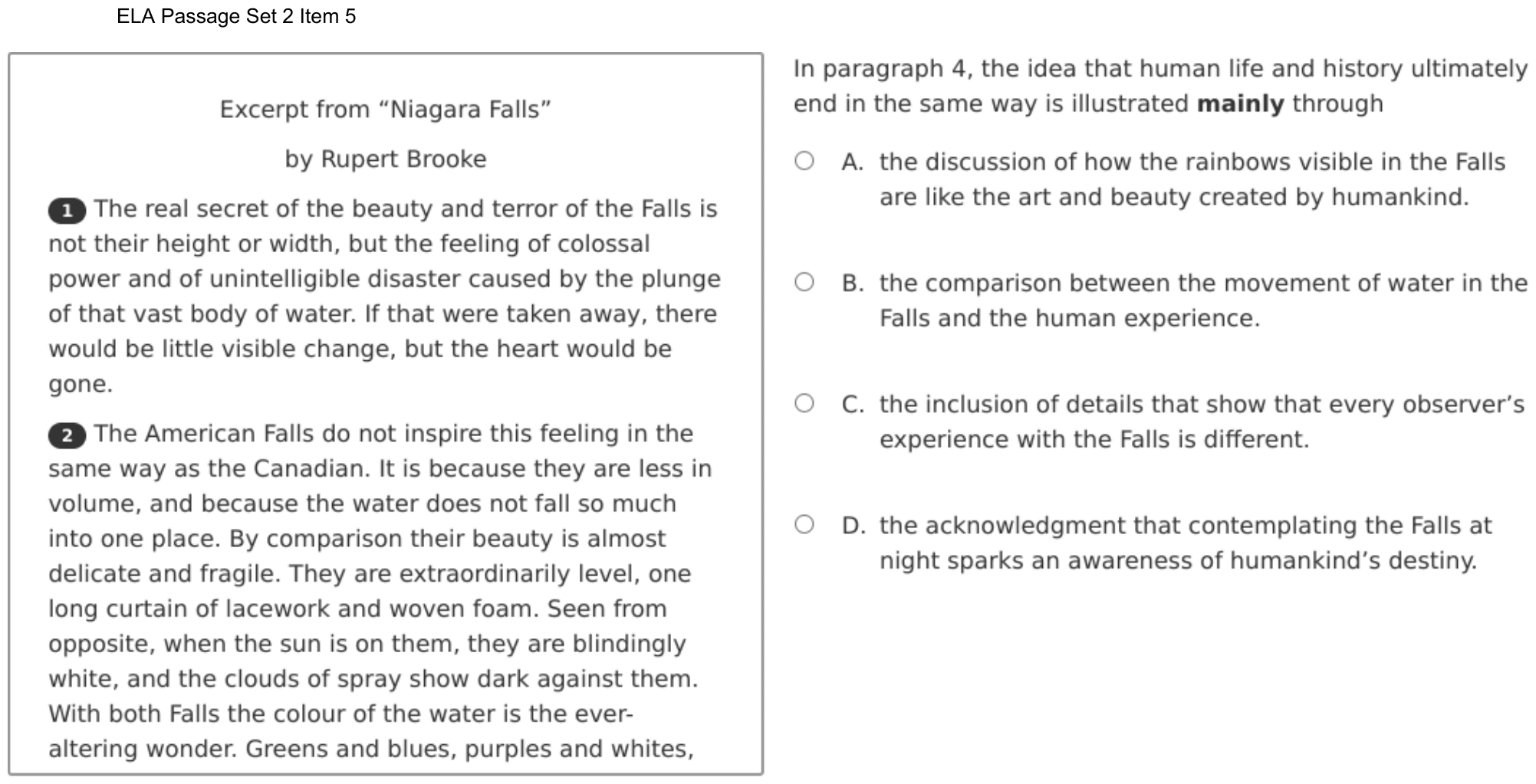
Question 12 of 50
2026 Practice Test C English, question 12Uses the passage above: “Excerpt from “Niagara Falls””.
Question
With which statement would the author of this excerpt most likely agree?
- AA sense of ease and assurance comes with accepting one’s fate.
- BNo matter where one’s path goes in life, one will always have regrets.
- CThe best way to overcome fear is to recognize it and then defy it.
- DReason will die out with humanity, but art will remain immortal.
Show the answer
Correct answer: A
The question asks for the statement the author would agree with most. In paragraph 4, the author states that the Falls make a person feel “with an almost insupportable and yet comforting certitude, that both men and nations are hurried onwards to their ruin or ending.” Later, the final sentence says, “With some such thoughts does the platitudinous heart win from the confusion and thunder of a Niagara peace.” This sentence supports the author’s belief that a person can find peace in accepting the certainty of his or her own ending, as expressed in Option A.
Option B is incorrect because the author does not discuss regrets in the excerpt.
Option C is incorrect because, while the excerpt discusses fear when looking at the power of the Falls, the excerpt does not support the idea that one should defy fear.
Option D is incorrect because the excerpt states in paragraph 4 that art and beauty are “caused by” the stream of life and end with it, “ceasing when it ceased.”
Question analysis
This question asks students to infer which statement about life the author of “Niagara Falls” would most likely agree with, based on the reflections that close his essay. It is hard because the evidence sits in long, abstract sentences of century-old prose and must be pieced together from more than one place in the final paragraph.
- Grade level
- Grade 9 reading and task
- Compared with grade 7
- Above grade 7 Grade 7 point-of-view questions usually rest on a clearly stated opinion. Here the author’s view must be pieced together from abstract reflection on lives, nations and the river, with words like “insupportable” and “platitudinous,” which is closer to high school reading.
- Estimated difficulty
- Among the hardest on the SHSAT: a non-obvious approach, heavy reading, or a well-hidden trap.
- Thinking it demands
- Depth of knowledge 3, strategic thinking · mainly analyze
- What makes it hard
- Reading between the lines major
- Complex sentences major
- The right answer is reworded moderate
- Hard words moderate
- Evidence
- Answered from one paragraph or stanza
- Reading level
- Passage: about grade 9, 987 words; question and choices: about grade 6, 61 words.
- Corrected from the DOE handbook
- A misreading of a word in the passage was corrected in the explanation.
- Students, last 30 days
- Not enough answers yet to show (it takes 10).
Why it is hard, traps and wrong answers (shows the answer)
Why it is hard
This question asks for the author’s outlook, which he reaches only in the closing sentences of a long, abstract paragraph. The mood there is gloomy, with ruin, a dark flood and human crying, so students who read the mood but not the argument choose regret. The comfort and peace he finds in that certainty are easy to miss in the inverted final sentence, and they are exactly what the answer rests on.
Reading between the lines major Working it out
The author never states a belief; students must combine “comforting certitude,” people who meet their end “unreluctant” and “not without nobility,” and the closing “peace” into an attitude of accepting fate. (Graesser, Singer & Trabasso, 1994; Kintsch, 1998)
Complex sentences major Understanding the question
The last sentence inverts normal order, “With some such thoughts does the platitudinous heart win from the confusion and thunder of a Niagara peace,” so its subject and object are hard to find. (Abedi & Lord, 2001; Freedle & Kostin, 1993; Messick, 1989)
The right answer is reworded moderate Choosing the answer
The right statement uses none of the passage’s words, turning “certitude” into “assurance” and “peace” into “ease,” while wrong choices pick up “fear” and “art.” (Freedle & Kostin, 1993; Kirsch & Mosenthal, 1990)
Hard words moderate Understanding the question
“Certitude,” “unreluctant,” “unavailing” and “platitudinous” carry the author’s attitude, and the glossary defines only the last of them. (Perfetti, 2007; Freedle & Kostin, 1993)
Strategy: Reread the second half of paragraph 4 slowly, translating each long sentence into plain words, then choose the statement those lines support without adding ideas the author never mentions.
Traps
- Outside knowledge: A choice is plausible in the real world but not supported by this text.
- Reads too much in: A reasonable-sounding conclusion that goes further than the text allows.
The wrong answers, classified
B Reads too much in (Graesser, Singer & Trabasso, 1994)
Reads “the white cloud of human crying” and the dark flood as a claim about lifelong regret, though the author never mentions regret and finds comfort in the end.
C Outside knowledge (King et al., 2004; Recht & Leslie, 1988)
Falls back on familiar advice about facing fears, prompted by the excerpt’s talk of terror, but the author recommends accepting what is inevitable, not defying it.
D Twists what the text says (King et al., 2004)
Reverses the friend’s rainbow comparison: art and beauty are “caused by” the stream of life and end with it, “ceasing when it ceased,” so art is not immortal.
What was corrected from the DOE handbook, and why
- Explanation: The handbook rejects Option D because paragraph 4 says art is “unable to stay.” In the passage, art and beauty are “unable to stay or direct or affect” the stream of life: “stay” means to stop or hold back the stream, not to last. What shows that art is not immortal is that it is “caused by” the stream of life and ends with it, “ceasing when it ceased,” which the site now quotes.
Working it out, step by step
Figure out what the question asks
This asks which statement the author would most likely agree with. He never states his belief outright, so you must infer it from his words, especially at the end of paragraph 4.
Find what he says about endings
In paragraph 4, he says that at Niagara one feels “with an almost insupportable and yet comforting certitude” that people and nations reach an end. He adds: “Some go down to it unreluctant, and meet it, like the river, not without nobility.” His last sentence says the heart can “win from the confusion and thunder of a Niagara peace.”
Put his words in plain English
“Certitude” means being sure. “Insupportable” means too hard to bear. So knowing that everything ends is hard, yet it is also comforting. “Unreluctant” means willing. Some people meet their end willingly, with dignity. And the Falls give the heart peace. Put together: accepting what must happen brings calm.
Check each choice
- A is right. He finds comfort and peace in accepting fate. That is “ease and assurance.”
- B is wrong. He never mentions regrets.
- C is wrong. He talks about accepting what must happen, not about fighting fear.
- D is wrong. Art and beauty are “caused by” life and end with it, “ceasing when it ceased.” So art does not last forever.
Watch out: “The white cloud of human crying” sounds sad, so B may tempt you. But sadness is not regret, and the author ends on peace.
Choose the answer
The author finds calm and comfort in accepting what must come. So the answer is A.
Why this answer and not the closest wrong one
B is the closest wrong answer, because paragraph 4 mentions human crying and ruin. But the author never talks about regret. He calls the certainty of an ending “comforting,” and the essay closes on the word “peace.” Feeling calm by accepting fate is what A says.
More questions like this
The original DOE question
Question 13 of 50
2026 Practice Test C English, question 13Passage Excerpt from “Impressions of an Indian Childhood”
Excerpt from “Impressions of an Indian Childhood”
by Zitkala-Sa
Zitkala-Sa (Gertrude Simmons Bonnin) was a Native American writer, musician, teacher, and political activist who was raised on the Yankton Sioux Reservation in South Dakota. In 1900 she published “Impressions of an Indian Childhood” (the term Indian was commonly used at the time to refer to Native American people) to expose readers to what life is like on a reservation.
Soon after breakfast Mother sometimes began her beadwork. On a bright, clear day, she pulled out the wooden pegs that pinned the skirt of our wigwam1 to the ground, and rolled the canvas part way up on its frame of slender poles. Then the cool morning breezes swept freely through our dwelling, now and then wafting the perfume of sweet grasses from newly burnt prairie.
Untying the long tasseled strings that bound a small brown buckskin2 bag, my mother spread upon a mat beside her bunches of colored beads, just as an artist arranges the paints upon his palette. On a lapboard she smoothed out a double sheet of soft white buckskin; and drawing from a beaded case that hung on the left of her wide belt a long, narrow blade, she trimmed the buckskin into shape. Often she worked upon small moccasins for her small daughter. Then I became intensely interested in her designing. With a proud, beaming face, I watched her work. In [my] imagination, I saw myself walking in a new pair of snugly fitting moccasins. I felt the envious eyes of my playmates upon the pretty red beads decorating my feet.
Close beside my mother I sat on a rug, with a scrap of buckskin in one hand and an awl in the other. This was the beginning of my practical observation lessons in the art of beadwork. From a skein3 of finely twisted threads of silvery sinews my mother pulled out a single one. With an awl she pierced the buckskin, and skillfully threaded it with the white sinew. Picking up the tiny beads one by one, she strung them with the point of her thread, always twisting it carefully after every stitch.
It took many trials before I learned how to knot my sinew thread on the point of my finger, as I saw her do. Then the next difficulty was in keeping my thread stiffly twisted, so that I could easily string my beads upon it. My mother required of me original designs for my lessons in beading. At first I frequently ensnared many a sunny hour into working a long design. Soon I learned from self-inflicted punishment to refrain from drawing complex patterns, for I had to finish whatever I began.
After some experience I usually drew easy and simple crosses and squares. These were some of the set forms. My original designs were not always symmetrical nor sufficiently characteristic, two faults with which my mother had little patience. The quietness of her oversight made me feel strongly responsible and dependent upon my own judgment. She treated me as a dignified little individual as long as I was on my good behavior; and how humiliated I was when some boldness of mine drew forth a rebuke from her!
In the choice of colors she left me to my own taste. I was pleased with an outline of yellow upon a background of dark blue, or a combination of red and myrtle-green. There was another of red with a bluish-gray that was more conventionally used. When I became a little familiar with designing and the various pleasing combinations of color, a harder lesson was given me. It was the sewing on, instead of beads, some tinted porcupine quills, moistened and flattened between the nails of the thumb and forefinger. My mother cut off the prickly ends and burned them at once in the centre fire. These sharp points were poisonous, and worked into the flesh wherever they lodged. For this reason, my mother said, I should not do much alone in quills until I was as tall as my cousin Warca-Ziwin.
Always after these confining lessons I was wild with surplus spirits, and found joyous relief in running loose in the open again. Many a summer afternoon a party of four or five of my playmates roamed over the hills with me. We each carried a light sharpened rod about four feet long, with which we pried up certain sweet roots. When we had eaten all the choice roots we chanced upon, we shouldered our rods and strayed off into patches of a stalky plant under whose yellow blossoms we found little crystal drops of gum. Drop by drop we gathered this nature’s rock-candy, until each of us could boast of a lump the size of a small bird’s egg. Soon satiated with its woody flavor, we tossed away our gum, to return again to the sweet roots.
From “Impressions of an Indian Childhood” by Zitkala-Sa—Public Domain
A BRIEF HISTORY OF BEADWORK IN SOUTH DAKOTA
| Date | Event |
|---|---|
| 1500s | The Dakota use beads made from bones, shells, stones, and animal teeth. European traders bring glass beads to North America. |
| Late 1600s | The Dakota begin trading with the French in Minnesota. |
| 1830s | The Dakota begin using glass beads in clothing, artwork, and decorations in place of Native-made beads. |
| 1862–1865 | The Dakota are expelled from their homelands in Minnesota as a result of the U.S.-Dakota War. |
| 1900s–1920s | The Dakota create items to sell outside their community. |
Source: MNopedia
1wigwam: hut with an arched framework of poles covered with bark, mats, or animal hides
2buckskin: leather made from the skin of a male deer
3skein: coiled length of yarn or other thread loosely wound on a reel
Question
In paragraph 1, the phrases “cool morning breezes swept freely” and “wafting the perfume of sweet grasses” affect the tone of the excerpt by suggesting
- Athe sadness that the author feels reflecting upon her former way of life.
- Bthe enthusiasm with which the author approached her work indoors.
- Cthe fond feelings that the author has toward her childhood experiences.
- Dthe mix of emotions that the author feels toward her work and her mother.
Show the answer
Correct answer: C
The question asks how the phrases “cool morning breezes swept freely” and “wafting the perfume of sweet grasses” affect the tone of the excerpt.
A. Incorrect. Although the author describes in paragraph 1 the setting of her childhood experiences, the positive wording of the phrases the author uses in the paragraph (“swept freely” and “perfume of sweet grasses”) does not suggest a tone of sadness the author feels when she reflects on her former way of life.
B. Incorrect. Although the phrases “cool morning breezes swept freely” and “wafting the perfume of sweet grasses” used in paragraph 1 create a positive tone, the phrases do not suggest an enthusiasm for the author’s work but rather suggest an appreciation of the peaceful beauty of her childhood.
C. CORRECT. In paragraph 1, the phrases “cool morning breezes swept freely” and “wafting the perfume of sweet grasses” are used to describe where the author’s childhood experiences took place. The phrases create a tone of fondness and evoke a feeling of happiness through their lyrical sensory detail: “swept freely” suggests a sense of joyful possibility, while “perfume,” “sweet,” and “cool” convey delight.
D. Incorrect. Although the author describes her mother’s beadwork lessons as “confining” in paragraph 7, the phrases in paragraph 1 do not suggest that the author feels conflicting or mixed emotions toward her work and her mother. Instead, the phrases convey a positive tone by affectionately describing the author’s childhood home.
Question analysis
This reading question asks how two sensory phrases about cool morning breezes and the scent of sweet grasses shape the tone of Zitkala-Sa's 1900 memoir of life on a Sioux reservation. Students must read the feeling behind descriptive language and decide what that feeling is directed at, since the choices pair different emotions with different subjects.
- Grade level
- Grade 7 reading and task
- Compared with grade 7
- At grade 7 Judging how sensory words shape tone is grade 7 reading work. Both phrases are quoted in the question, so little searching is needed, but the 1900 prose keeps the demand at a typical grade 7 level.
- Estimated difficulty
- Straightforward: two steps or one careful reading.
- Thinking it demands
- Depth of knowledge 2, skills and concepts · mainly analyze
- What makes it hard
- Figurative or literary language moderate
- Reading between the lines minor
- Hard words minor
- Evidence
- Answered from one paragraph or stanza
- Reading level
- Passage: about grade 8, 946 words; question and choices: about grade 7, 72 words.
- Corrected from the DOE handbook
- A misstatement of the question in the explanation was corrected.
- Students, last 30 days
- Not enough answers yet to show (it takes 10).
Why it is hard, traps and wrong answers (shows the answer)
Why it is hard
The phrases are so clearly pleasant that the real decision is what the pleasant feeling is about. They describe the wigwam on a clear morning, so the warmth belongs to the author's memory of her childhood, not to the beadwork the rest of the excerpt follows. Students who know the excerpt is about lessons tend to attach the mood to the work, and a few read sadness into any memoir.
Figurative or literary language moderate Understanding the question
The tone comes from sensory images, breezes that “swept freely” and “the perfume of sweet grasses,” which describe air and scent and leave the author's feeling to be read from them. (Graesser, Singer & Trabasso, 1994; Kintsch, 1998)
Reading between the lines minor Working it out
The phrases describe the dwelling, not the author, so her fondness for her childhood has to be inferred from how lovingly she remembers the setting. (Graesser, Singer & Trabasso, 1994; Kintsch, 1998)
Hard words minor Understanding the question
“Wafting” and “perfume,” used for the smell of grasses from newly burnt prairie, are unusual words that must be understood before the tone they create can be judged. (Perfetti, 2007; Freedle & Kostin, 1993)
Strategy: Decide what feeling the quoted words create on their own, then check what they describe: the right choice must match both the feeling and what it is about.
Traps
- Wrong tone or attitude: Misjudges the tone, attitude or point of view, such as reading admiration as criticism, or taking a character's or subject's feelings for the author's.
- Wrong part of the text: A choice is true of another paragraph, stanza or speaker than the one asked about.
The wrong answers, classified
A Wrong tone or attitude (Graesser, Singer & Trabasso, 1994)
Assumes an adult remembering a lost way of life must sound sad, but breezes that sweep freely and the perfume of sweet grasses carry delight, not grief.
B Wrong part of the text (Kirsch & Mosenthal, 1990)
Senses the positive mood but ties it to the beadwork, borrowing the interest the girl shows in paragraph 2, though these phrases describe breezes and scent, not work.
D Wrong part of the text (Kirsch & Mosenthal, 1990)
Brings in the “confining” lessons of paragraph 7 and the rebuke of paragraph 5, feelings that the two morning images of paragraph 1 do not touch.
What was corrected from the DOE handbook, and why
- Explanation: The handbook’s explanation begins by saying the question asks how the two phrases “affect the tone of paragraph 1 in the excerpt.” The phrases are in paragraph 1, but the question asks how they affect the tone of the excerpt, and the answer is about the author’s feelings toward her childhood as a whole. The explanation now reads “affect the tone of the excerpt.”
Working it out, step by step
Figure out what the question asks
This asks about tone. Tone is the feeling or attitude that a writer’s words show. You need the feeling that two phrases from paragraph 1 give the whole excerpt. An excerpt is a part taken from a longer piece.
Find the phrases in paragraph 1
Paragraph 1 describes a clear morning at home. The mother rolls up the side of the wigwam (a hut made of poles and covers). “Then the cool morning breezes swept freely through our dwelling.” A dwelling is a home. The breezes were “now and then wafting the perfume of sweet grasses.”
Work out the feeling
“Wafting” means gently carrying through the air. “Perfume” is a sweet smell. Cool air, sweet smells and breezes moving freely are all pleasant. The author is remembering her childhood home with love. That feeling is fondness, a warm liking for something.
Check each choice
- A is wrong. Nothing in these words is sad. They are bright and pleasant.
- B is wrong. The phrases describe air and smells, not her work.
- C is right. The loving details show warm feelings about her childhood.
- D is wrong. Mixed feelings, like the “confining” lessons, come later, in paragraph 7. These phrases have nothing negative in them.
Watch out: B is tempting, since the excerpt is mostly about beadwork lessons. But these two phrases describe the morning, not the work.
Choose the answer
The phrases make her childhood home feel cool, sweet and free. So the answer is C.
Why this answer and not the closest wrong one
B is the closest wrong answer, because the phrases do sound happy. But a choice must match both the feeling and what the feeling is about. These phrases describe breezes and the smell of grass at her home. That shows fond memories of her childhood, not eagerness to work.
More questions like this
The original DOE question
The passage “Excerpt from “Impressions of an Indian Childhood”” as printed (pages 42–43)
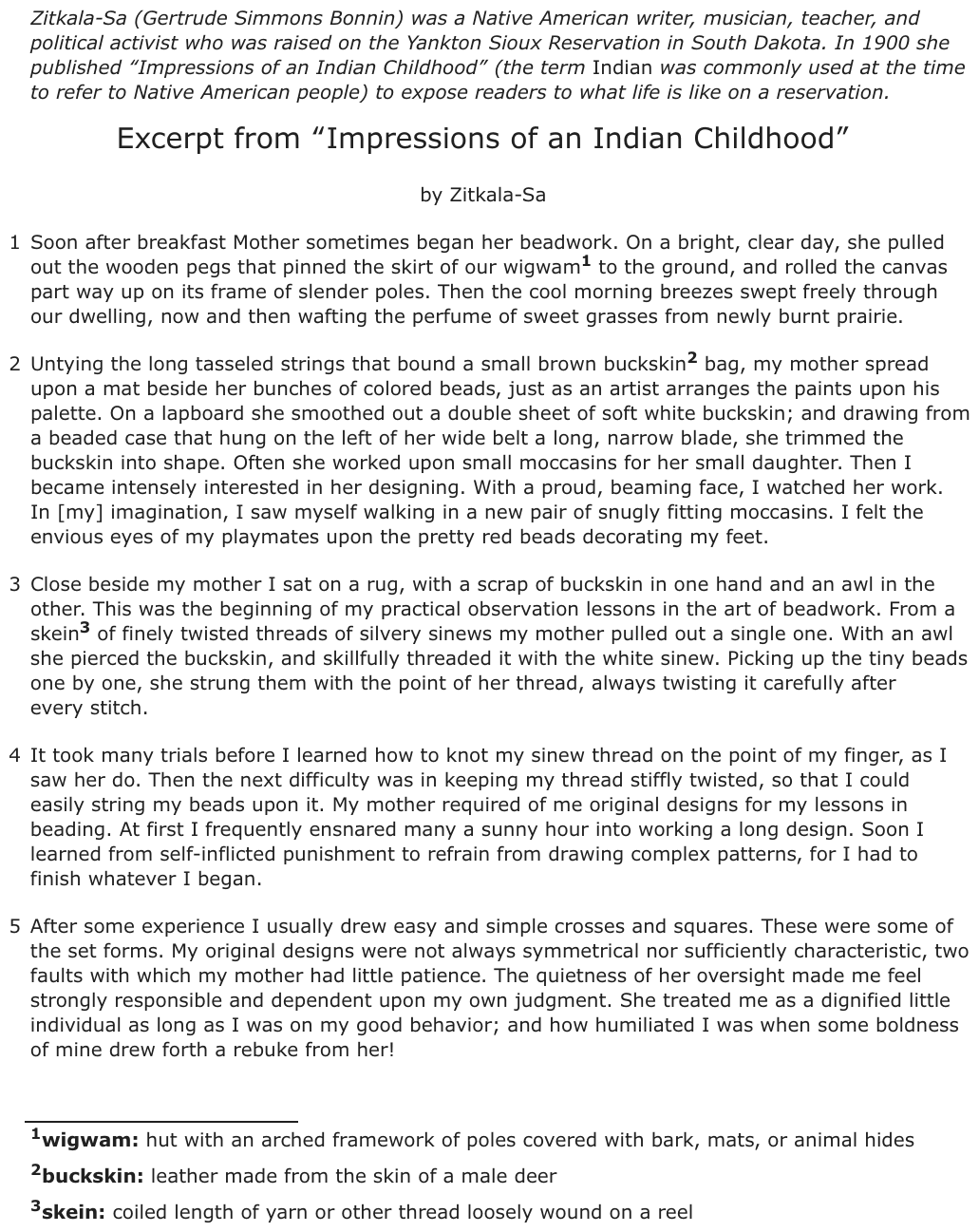
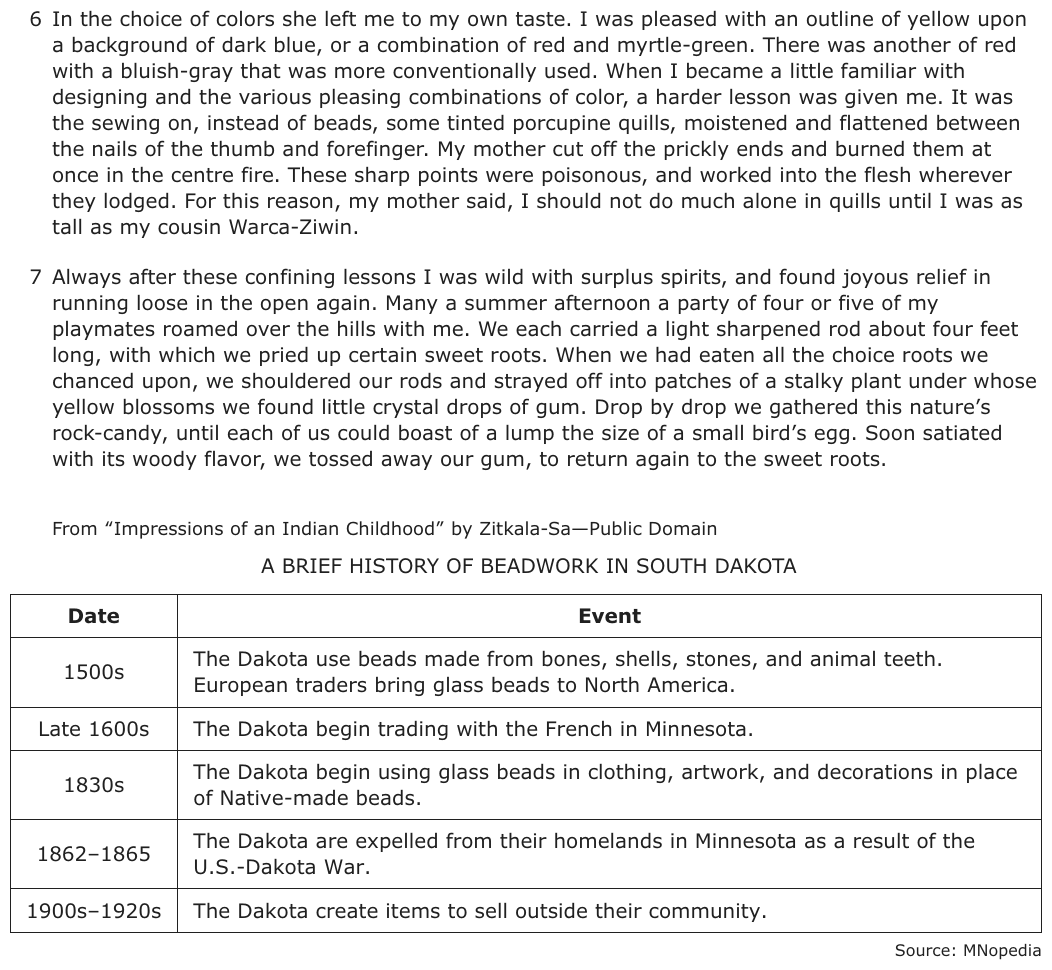
Question 14 of 50
2026 Practice Test C English, question 14Uses the passage above: “Excerpt from “Impressions of an Indian Childhood””.
Question
The phrase “just as an artist arranges the paints upon his palette” in paragraph 2 suggests that
- Abeadwork is a true form of art.
- Bcolor is a source of artistic inspiration.
- Call artistic activities begin with a series of steps.
- Dthe beadworker tries to imitate art.
Show the answer
Correct answer: A
The question asks what the phrase “just as an artist arranges the paints upon his palette” in paragraph 2 suggests in the excerpt.
A. CORRECT. In paragraph 2, by comparing the way her mother arranges the beads to the way a painter “arranges the paints upon his palette,” the author emphasizes that her mother approaches her craft just as a painter does, thus suggesting that beadwork is a true form of art.
B. Incorrect. Although the author mentions “bunches of colored beads” in paragraph 2, this detail does not provide enough evidence for the idea that color inspires beadworkers. The phrase “just as an artist arranges the paints upon his palette” indicates the connection of beadwork to other forms of art in general, not necessarily to the specifics of color as a source of inspiration.
C. Incorrect. In paragraph 2, the author describes her mother “untying the long tasseled strings” and then spreading “upon a mat beside her bunches of colored beads.” However, the phrase “just as an artist arranges the paints upon his palette” does not suggest that all artistic activities begin with a series of steps. There is no mention in the passage of any other artistic activities involving multiple initial steps.
D. Incorrect. In paragraph 2, the author describes how her mother “spread upon a mat beside her bunches of colored beads” as the first step in the artistic process described in the passage. Therefore, the comparison between the mother’s process and a painter arranging paints on a palette suggests that the mother is creating art, not imitating it. There is no indication that the mother is copying a technique she has seen in other art forms.
Question analysis
This reading question asks what the comparison between Zitkala-Sa's mother laying out her colored beads and an artist arranging paints on a palette suggests. It tests reading a simile in context, and the choices include readings that fix on a single word or go further than the comparison itself.
- Grade level
- Grade 6 reading and task
- Compared with grade 7
- Below grade 7 Interpreting a simile is taught by grade 6. The phrase is short and quoted in the question, and one step of interpretation is enough, so this asks less than typical grade 7 work on figurative language.
- Estimated difficulty
- Routine: one familiar step, little to misread.
- Thinking it demands
- Depth of knowledge 2, skills and concepts · mainly understand
- What makes it hard
- Evidence
- Answered from one sentence or line
- Reading level
- Passage: about grade 8, 946 words; question and choices: about grade 6, 45 words.
- Students, last 30 days
- Not enough answers yet to show (it takes 10).
Why it is hard, traps and wrong answers (shows the answer)
Why it is hard
The comparison is quoted in the stem and makes one point: the mother lays out her beads the way a painter lays out paints, so her craft counts as art. Wrong answers fix on the word “paints,” stretch one comparison into a rule about all art, or read the comparison as copying. Asking what the two things being compared have in common settles it.
Figurative or literary language minor Understanding the question
The simile sets the mother laying out bunches of colored beads beside a painter arranging paints, and students must see what that comparison says about beadwork itself. (Graesser, Singer & Trabasso, 1994; Kintsch, 1998)
Strategy: Name the two things being compared and what they share, then choose the idea that comparison supports without adding anything the sentence does not say.
Traps
- Word match: Repeats striking words or phrases from the text, so it looks supported, but its meaning does not fit the question.
- Too broad or too strong: A choice overstates, generalizes, or uses absolute words the text does not support.
- Twists what the text says: Uses the text's topic and ideas but changes what it says: who did it, how much, when, or why.
The wrong answers, classified
B Word match (Freedle & Kostin, 1993)
Links “paints” with the “bunches of colored beads” and decides color is the point, though the simile compares how materials are arranged, not what inspires the artist.
C Too broad or too strong (King et al., 2004)
Turns one comparison about laying out beads into a rule about all artistic activities, a generalization the sentence does not make.
D Twists what the text says (King et al., 2004)
Sees that the simile links beadwork with painting but twists its point, reading it as the mother imitating art rather than practicing it.
Working it out, step by step
Figure out what the question asks
The phrase is a simile. A simile compares two things using “like” or “as.” You need to know what this comparison suggests about the mother’s beadwork.
Read the phrase in paragraph 2
The mother “spread upon a mat beside her bunches of colored beads, just as an artist arranges the paints upon his palette.” The word order is old-fashioned. It means she spread her bunches of colored beads on a mat beside her. A palette is the board a painter uses to hold and mix paints.
Work out what the comparison means
The two things being compared are the mother and a painter. Both lay out their colors before they start to make something. So the author treats her mother like a painter. That means beadwork is real art, just like painting.
Check each choice
- A is right. Comparing the mother to a painter shows that beadwork is a true art.
- B is wrong. The simile is about laying out materials, not about what gives an artist ideas.
- C is wrong. One comparison can’t prove a rule about all art.
- D is wrong. The mother is not copying art. She works the way an artist does, so she is making art.
Watch out: B is tempting because paints and colored beads both bring color to mind. But the simile is about how she arranges them.
Choose the answer
The simile puts the beadworker side by side with a painter. So the answer is A.
Why this answer and not the closest wrong one
B is the closest wrong answer. Paints and colored beads do share color. But the simile compares what the two people do: both arrange their materials before they create. Nothing is said about inspiration, which means where ideas come from. A matches the point that the mother works as an artist does.
More questions like this
The original DOE question

Question 15 of 50
2026 Practice Test C English, question 15Uses the passage above: “Excerpt from “Impressions of an Indian Childhood””.
Question
The author’s use of sequence in paragraphs 1 and 2 contributes to the development of ideas in the excerpt by
- Alisting the many steps that are involved in the process of beading in order to explain its difficulty and complexity.
- Bconveying the importance of following the steps of the beading process in a precise order to work most efficiently.
- Cemphasizing the time required to fully prepare for and execute the many large and small tasks in the activity of beading.
- Ddetailing each step in preparation for beading in order to highlight the author’s enthusiasm for the work.
Show the answer
Correct answer: D
The question asks how the author’s use of sequence in paragraphs 1 and 2 contributes to the development of ideas in the excerpt.
A. Incorrect. In paragraph 2, the author does list the steps her mother takes in preparation to do beadwork, such as “untying the long tasseled strings” of the bag of beads, spreading the beads beside her on a mat, and using “a long, narrow blade” to trim the buckskin into shape. However, the language used to describe this sequence does not indicate that preparing to work with beads is difficult or complex.
B. Incorrect. Although the author’s description of untying the bag of beads, spreading the beads upon a mat, smoothing out a sheet of buckskin, and trimming the buckskin into shape in paragraph 2 indicates that the mother follows a certain routine, it does not place any emphasis on working most efficiently by following the steps of the beading process in a precise order.
C. Incorrect. In paragraph 2, the author describes her mother “untying the long tasseled strings that bound a small brown buckskin bag,” “spread[ing] upon a mat beside her bunches of colored beads,” “smooth[ing] out a double sheet of soft white buckskin; and drawing from a beaded case that hung on the left of her wide belt a long, narrow blade” to trim the buckskin. Although these descriptions do outline the steps in her process for creating beadwork, they do not emphasize the time required to do so, since the author does not mention in the excerpt how long it took her mother to fully prepare for and complete the large and small tasks in the activity of beading.
D. CORRECT. In paragraph 1, the author describes how the morning begins with her mother rolling up the canvas of the wigwam and allowing the breeze to come in. In paragraph 2, the author uses sensory language and precise sequencing to describe the way her mother prepares the beading materials by untying “the long tasseled strings that bound a small brown buckskin bag,” spreading the “bunches of colored beads” beside her, and smoothing out “a double sheet of soft white buckskin.” This combination of sequence and sensory language highlights the author’s enthusiasm for beadwork by emphasizing that the author pays close attention to her mother’s preparations.
Question analysis
This reading question asks how the step-by-step description of a mother preparing her beadwork, in the opening paragraphs of Zitkala-Sa's memoir, contributes to the excerpt's ideas. Every choice agrees that steps are listed, so students must judge which purpose the text actually supports and resist reasons that only sound likely for a craft.
- Grade level
- Grade 8 reading and task
- Compared with grade 7
- Above grade 7 Grade 7 structure questions usually ask what a paragraph adds to a topic. This one asks what an ordered description achieves, in dense 1900 prose where the purpose is never stated outright, which goes beyond typical grade 7 work.
- Estimated difficulty
- Hard: combines ideas, needs a plan, and has more than one tempting wrong answer.
- Thinking it demands
- Depth of knowledge 3, strategic thinking · mainly analyze
- What makes it hard
- How, not what major
- A very close wrong answer moderate
- Reading between the lines moderate
- Complex sentences minor
- Evidence
- Answered from several paragraphs or stanzas
- Reading level
- Passage: about grade 8, 946 words; question and choices: about grade 11, 95 words.
- Corrected from the DOE handbook
- A misquotation of the excerpt in the explanation was corrected.
- Students, last 30 days
- Not enough answers yet to show (it takes 10).
Why it is hard, traps and wrong answers (shows the answer)
Why it is hard
All four choices agree that the paragraphs lay out steps, so the question turns entirely on purpose, and three of the purposes sound like natural reasons to describe a craft. Nothing in paragraphs 1 and 2 calls the work hard, slow or a matter of efficiency; what they do show is a child following every move and becoming intensely interested. Students who look for the narrator's own reaction find the purpose, while those who reason from the steps alone drift to difficulty or time.
How, not what major Working it out
The stem asks what the ordered account of untying the bag, spreading the beads, and smoothing and trimming the buckskin does for the excerpt, a purpose the author never states. (Anderson & Krathwohl, 2001)
A very close wrong answer moderate Choosing the answer
The difficulty choice shares the right one's frame, steps laid out in order to show something, and differs only in what they show: how hard beading is, or how eagerly the girl watched. (Embretson & Wetzel, 1987; Gorin & Embretson, 2006; Ascalon et al., 2007)
Reading between the lines moderate Working it out
The enthusiasm has to be pieced together from the close attention to each step and from “intensely interested” and “a proud, beaming face” in paragraph 2. (Graesser, Singer & Trabasso, 1994; Kintsch, 1998)
Complex sentences minor Understanding the question
Paragraph 2 uses literary word order, as in “my mother spread upon a mat beside her bunches of colored beads,” which slows the reading of the very steps in question. (Abedi & Lord, 2001; Freedle & Kostin, 1993; Messick, 1989)
Strategy: For each choice, look in paragraphs 1 and 2 for words that would prove its purpose; a purpose that no sentence states or shows can be ruled out.
Traps
- Half right: One half of a two-part choice is right and the other is not.
- Wrong purpose or structure: Names a purpose, structure or effect that the part does not serve, or describes what a part says when the question asks what it does.
- Reads too much in: A reasonable-sounding conclusion that goes further than the text allows.
The wrong answers, classified
A Half right (King et al., 2004; Thissen, Steinberg & Fitzpatrick, 1989)
Rightly sees that paragraph 2 lists many preparation steps, then decides the list must show that beading is difficult and complex, which nothing in these paragraphs says.
B Wrong purpose or structure (Anderson & Krathwohl, 2001)
Reads the sequence as instructions about doing the steps in a precise order for efficiency, a purpose a watching child's memories never suggest.
C Reads too much in (Graesser, Singer & Trabasso, 1994)
Reasons that so many steps must take a long time, perhaps recalling the “many a sunny hour” of paragraph 4, but paragraphs 1 and 2 never mention time.
What was corrected from the DOE handbook, and why
- Explanation: In rejecting choice C, the handbook quotes paragraph 2 as “spread[ing them] upon a mat beside her bunches of colored beads.” In the excerpt, the bunches of colored beads are what the mother spreads (“my mother spread upon a mat beside her bunches of colored beads”). The inserted “them” refers to nothing and turns the beads into a place. The quotation now reads “spread[ing] upon a mat beside her bunches of colored beads,” which is how the handbook itself reads the sentence in its reason for rejecting choice A (“spreading the beads beside her on a mat”).
Working it out, step by step
Figure out what the question asks
Sequence means the order in which things happen. Paragraphs 1 and 2 tell the steps of a morning in order. The question asks why the author tells them step by step. What does that careful order help show?
List the steps
In paragraphs 1 and 2, the mother:
- rolls up the side of the wigwam to let in the breeze,
- unties a bag made of buckskin (soft deer leather),
- spreads her beads on a mat,
- smooths out a sheet of buckskin, and
- trims it into shape with a blade.
Find the author’s reaction
Right after the steps, the author tells how she felt. “Then I became intensely interested in her designing. With a proud, beaming face, I watched her work.” Intensely means very strongly. A beaming face has a big, happy smile. She noticed every little step because she was so excited. The details show her enthusiasm, or eager interest.
Check each choice
- A is wrong. The steps are listed, but nothing says beading is hard or complex.
- B is wrong. Nothing says the steps must go in a set order to save effort.
- C is wrong. Paragraphs 1 and 2 never say how long anything takes.
- D is right. The careful details show how closely the girl watched, with eager interest.
Watch out: A is tempting because there are many steps. But many steps don’t prove a task is hard. The author never calls it difficult.
Choose the answer
The step-by-step order shows a child following every move her mother makes. So the answer is D.
Why this answer and not the closest wrong one
A is the closest wrong answer. Like D, it says the steps are listed to show something. But no word in paragraphs 1 and 2 calls beading hard. The author does say she was “intensely interested” and had “a proud, beaming face.” That shows enthusiasm, so D fits better.
More questions like this
The original DOE question
Question 16 of 50
2026 Practice Test C English, question 16Uses the passage above: “Excerpt from “Impressions of an Indian Childhood””.
Question
Which sentence best summarizes the process of beading that is described in the excerpt?
- ATake a buckskin bag full of beads and spread them out on a mat in different colors like a paint palette; take a double sheet of buckskin and smooth it out on a table; take a sinew and awl and thread the beads onto the buckskin in a desired pattern.
- BCut the double sheet of buckskin into a shape; take a skein of sinew and pierce the buckskin with an awl; thread the sinew with beads of many different colors in a simple or complex pattern; twist the sinew to keep it tight after every stitch into the buckskin.
- CArrange the beads into groups of colors on a mat; smooth out a double sheet of buckskin and cut it to shape; take a single thread of sinew; pierce the buckskin with an awl; thread the buckskin with the sinew and string it with beads, carefully twisting after every stitch.
- DGather beads, buckskin, sinew, and awl and place them on a mat; cut the buckskin into the desired shape; decide on a pattern for the beads and create it using the sinews and the awl; thread the beads onto the sinew in the desired pattern and twist it tight.
Show the answer
Correct answer: C
The question asks which sentence best summarizes the process of beading that is described in the excerpt.
A. Incorrect. In paragraphs 2 and 3, the author describes how at the beginning of the process her mother “smoothed out a double sheet of soft white buckskin” on a lapboard (paragraph 2) and how she strings the beads into a pattern. However, this sentence does not describe the steps that take place between the preparation and the stringing of the beads. Thus, this sentence does not best summarize the beading process.
B. Incorrect. In paragraphs 2 and 3, the author describes the process her mother uses to string the beads with “the point of her thread, always twisting it carefully after every stitch” (paragraph 3). While this sentence includes some of the steps in the beading process, it does not describe the necessary preparation, namely spreading the beads out on a mat and smoothing out the buckskin on a lapboard. Thus, this sentence does not best summarize the beading process.
C. CORRECT. This sentence best summarizes the process of beading that is described in the excerpt because it includes details about each step in the process. In paragraph 2, the author explains how her mother “spread upon a mat beside her bunches of colored beads” and how “on a lapboard she smoothed out a double sheet of soft white buckskin; and drawing from a beaded case that hung on the left of her wide belt a long, narrow blade, she trimmed the buckskin into shape.” The author continues her description in paragraph 3, stating, “From a skein of finely twisted threads of silvery sinews my mother pulled out a single one. With an awl she pierced the buckskin, and skillfully threaded it with the white sinew. Picking up the tiny beads one by one, she strung them with the point of her thread, always twisting it carefully after every stitch.”
D. Incorrect. In paragraphs 2 and 3, the author describes the process her mother uses as she “smoothed out a double sheet of soft white buckskin” (paragraph 2) on a lapboard before stringing the beads. While this sentence includes most of the steps in the beading process, it excludes the step of piercing the buckskin. This sentence also provides few details about the process of beading and uses vague wording to describe each step. Therefore, the sentence does not best summarize the beading process.
Question analysis
This reading question asks which sentence best summarizes the beadwork process Zitkala-Sa watches her mother carry out, from laying out the materials to stringing the beads. Each choice is a long list of steps, so students must compare them detail by detail with the excerpt and notice what each one adds, leaves out or misplaces.
- Grade level
- Grade 8 reading and task
- Compared with grade 7
- Above grade 7 Summarizing a process is grade 7 reading, but the four summaries are long and nearly alike, and checking them against two paragraphs of 1900 prose with words like awl, sinew and skein is heavier than usual.
- Estimated difficulty
- Hard: combines ideas, needs a plan, and has more than one tempting wrong answer.
- Thinking it demands
- Depth of knowledge 2, skills and concepts · mainly understand
- What makes it hard
- Every choice must be checked major
- A lot to read moderate
- Hard words minor
- Evidence
- Answered from several paragraphs or stanzas
- Reading level
- Passage: about grade 8, 946 words; question and choices: about grade 16+, 212 words.
- Corrected from the DOE handbook
- An inaccurate detail about the excerpt in the explanation was corrected.
- Students, last 30 days
- Not enough answers yet to show (it takes 10).
Why it is hard, traps and wrong answers (shows the answer)
Why it is hard
This question is won by bookkeeping, not insight: list the mother's steps from the two paragraphs, then hold each long summary against the list. The most tempting wrong summary reads like a sensible craft routine in a sensible order, yet it never has the buckskin pierced and puts every tool on the mat. Others open with a familiar image or close with precise stitching while skipping steps, so students who check only the beginning or only the end are caught.
Every choice must be checked major Choosing the answer
Each summary is a chain of four to six steps, so all four must be checked step by step against paragraphs 2 and 3 for steps missing, added or out of order. (Embretson & Wetzel, 1987)
A lot to read moderate Understanding the question
The four choices together run to about 200 words of semicolon-linked steps, and the text they summarize is two paragraphs of dense 1900 prose. (Kintsch, 1998; Gorin & Embretson, 2006; Freedle & Kostin, 1993)
Hard words minor Understanding the question
Words like awl, sinew, skein and lapboard name the tools and materials, and a student unsure of them cannot tell which steps a summary has dropped. (Perfetti, 2007; Freedle & Kostin, 1993)
Strategy: List the mother's steps from paragraphs 2 and 3 in order, then check each choice against your list for a missing step, an invented detail or a step out of place.
Traps
- Too narrow: A single detail offered as the central idea or a summary, or a summary that keeps minor details and leaves out an essential part.
The wrong answers, classified
A Too narrow (King et al., 2004)
Keeps the familiar palette image but leaves out trimming the buckskin, piercing it with the awl and twisting the thread, and even moves the smoothing onto a table.
B Too narrow (King et al., 2004)
Matches paragraph 3's piercing and twisting closely but leaves out the preparation, laying out the beads and smoothing the buckskin, and starts the process with cutting.
D Too narrow (King et al., 2004)
Accepts a tidy, well-ordered outline that keeps most steps but leaves out smoothing the buckskin and piercing it with the awl, and piles every tool onto the mat.
What was corrected from the DOE handbook, and why
- Explanation: In rejecting choice B, the handbook says the choice leaves out the preparation, “namely spreading the beads and the buckskin out on a table.” The excerpt mentions no table: in paragraph 2 the mother spreads the beads on a mat and smooths out the buckskin on a lapboard. The explanation now says so. (Choice A’s “on a table” is part of a wrong answer and is left as printed.)
Working it out, step by step
Figure out what the question asks
You need the summary that best matches the beading steps in the excerpt. A summary is a short retelling of the main points. The best one keeps every main step, in order, and adds nothing new.
List the steps from paragraphs 2 and 3
Paragraphs 2 and 3 give the mother’s steps in order. The last one ends with her “always twisting it carefully after every stitch.”
- Spread the beads on a mat.
- Smooth out a double sheet of buckskin on a lapboard (a board held on the lap).
- Trim the buckskin into shape with a blade.
- Pull out a single sinew, a strong thread.
- Pierce (poke a hole in) the buckskin with an awl, a pointed tool.
- Thread the sinew through the buckskin.
- String the beads, twisting the thread after every stitch.
Check each choice against the list
- A is wrong. It skips trimming, piercing and twisting. It also says “on a table,” but she used a lapboard.
- B is wrong. It starts with cutting. It skips spreading the beads and smoothing the buckskin.
- C is right. It has every step, in the same order.
- D is wrong. It never says to smooth the buckskin or pierce it. It also puts every tool on the mat, but only the beads went there.
Watch out: D sounds like a sensible plan in a sensible order. But a summary must match the excerpt, not just sound right. Check it step by step.
Choose the answer
Only C follows the mother’s steps from start to finish. So the answer is C.
Why this answer and not the closest wrong one
D is the closest wrong answer. It is neat and keeps most of the steps. But it skips smoothing the buckskin and never says to pierce it with the awl. It also piles every tool onto the mat. C matches the excerpt step for step, so it is the best summary.
More questions like this
The original DOE question
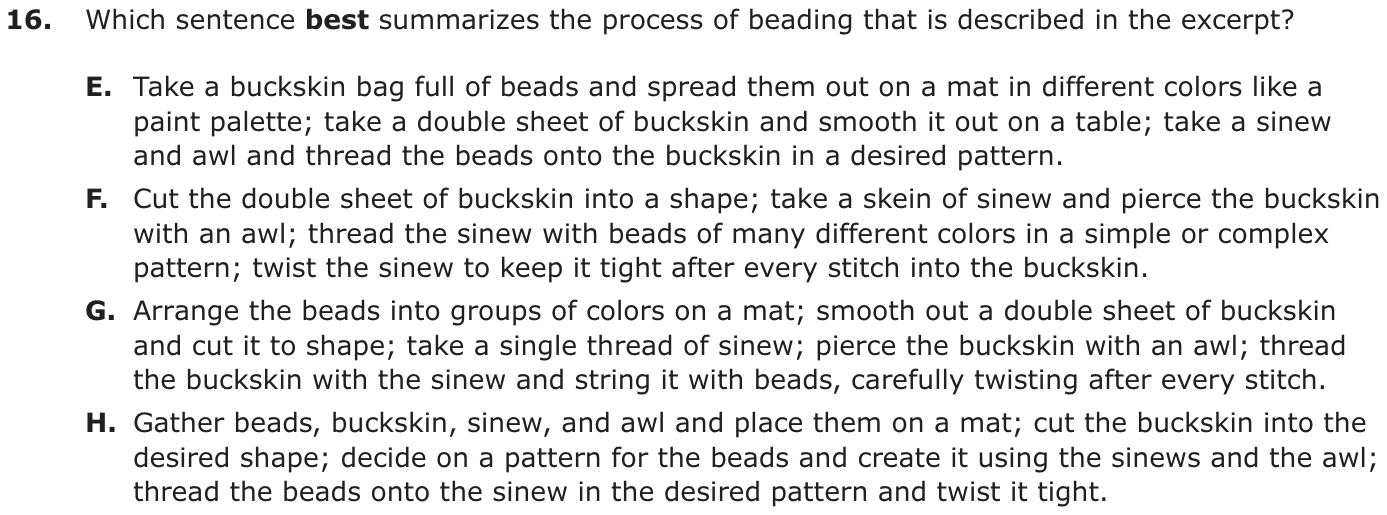
Question 17 of 50
2026 Practice Test C English, question 17Uses the passage above: “Excerpt from “Impressions of an Indian Childhood””.
Question
The idea that mastering moccasin design and creation requires experience is best illustrated in the excerpt through
- Athe information about the advanced technique of incorporating porcupine quills into a design.
- Bthe descriptions of the special materials that must be used to make decorated moccasins.
- Cthe descriptions of the various color combinations that make an attractive moccasin design.
- Dthe example of the author successfully and independently using a sharpened rod.
Show the answer
Correct answer: A
The question asks how the idea that mastering moccasin design and creation requires experience is best illustrated in the excerpt.
A. CORRECT. In paragraph 6, the author states that when she became more familiar with elements of design, “a harder lesson was given me.” According to the author, sewing on porcupine quills is a much more difficult task to master because it requires experience in handling the poisonous porcupine quills, which is why her mother told her not to “do much alone in quills” until she was older (paragraph 6). This information best illustrates the idea that mastering moccasin design and creation requires experience.
B. Incorrect. Although the author provides detailed descriptions of the materials used to make decorated moccasins (“colored beads” [paragraph 2]; “a skein of finely twisted threads of silvery sinews” [paragraph 3]; “tinted porcupine quills, moistened and flattened between the nails of the thumb and forefinger” [paragraph 6]), these descriptions do not illustrate the experience that is needed to gain mastery of moccasin design and creation.
C. Incorrect. Although the author describes the color combinations she used in making moccasins (“I was pleased with an outline of yellow upon a background of dark blue, or a combination of red and myrtle-green. There was another of red with a bluish-gray that was more conventionally used” [paragraph 6]), this information mainly illustrates the author’s satisfaction with her moccasin design, not the importance of experience in mastering the creation and design of moccasins.
D. Incorrect. In paragraph 7, the author tells of using a sharpened rod to dig for roots. She explains that she and her playmates used the rods to “[pry] up certain sweet roots,” which they ate before going off to gather gum from a stalky plant. The detail of the sharpened rod is from a recollection about the playtime that followed the “confining lessons” of moccasin making. However, the sharpened rod was not used to create moccasins.
Question analysis
This reading question asks which part of Zitkala-Sa's account of learning to bead moccasins best illustrates the idea that mastering the craft takes experience. The choices point to materials, color combinations, a technique and outdoor play, so students must find the detail that ties skill to practice rather than one that simply describes the craft.
- NYS standards
- 7R1 textual evidence and inferences
- Grade level
- Grade 7 reading and task
- Compared with grade 7
- At grade 7 Choosing the detail that best illustrates an idea is grade 7 evidence work. The idea is stated plainly in the question and each paragraph of the excerpt keeps to one topic, so the demand matches typical grade 7 tasks.
- Estimated difficulty
- Straightforward: two steps or one careful reading.
- Thinking it demands
- Depth of knowledge 2, skills and concepts · mainly evaluate
- What makes it hard
- Evidence
- Answered from one paragraph or stanza
- Reading level
- Passage: about grade 8, 946 words; question and choices: about grade 12, 69 words.
- Corrected from the DOE handbook
- An inaccurate account of the excerpt in the explanation was corrected.
- Students, last 30 days
- Not enough answers yet to show (it takes 10).
Why it is hard, traps and wrong answers (shows the answer)
Why it is hard
The idea of experience is spelled out in paragraph 6, where quillwork is a harder lesson given only after some practice and kept from the girl until she is older. The wrong choices describe things the excerpt really contains, materials, colors and a tool, so they look supported until each is asked whether it shows a learner needing practice. Students who put that one question to every choice find this a quick item.
Evidence in several places minor Working it out
The stem names no paragraph, so students must find where each choice's detail sits, from the beads and sinew of paragraphs 2 and 3 to the rods of paragraph 7. (Kirsch & Mosenthal, 1990; Gorin & Embretson, 2006)
Reading between the lines minor Working it out
The link to experience is implied in paragraph 6: quills come as “a harder lesson” once she is “a little familiar with designing,” and she must wait until she is “as tall as my cousin.” (Graesser, Singer & Trabasso, 1994; Kintsch, 1998)
Strategy: For each choice, find the part of the excerpt it refers to and ask whether it shows a learner needing practice before doing something, not just what the craft involves.
Traps
- Supports only part of the claim: In a question about evidence: a line that backs one half of the claim but not the other, or a related point rather than the claim itself.
- Wrong part of the text: A choice is true of another paragraph, stanza or speaker than the one asked about.
The wrong answers, classified
B Supports only part of the claim (King et al., 2004; Thissen, Steinberg & Fitzpatrick, 1989)
Picks the descriptions of beads, sinew and buckskin, which show what moccasins are made from but say nothing about the experience needed to master making them.
C Supports only part of the claim (King et al., 2004; Thissen, Steinberg & Fitzpatrick, 1989)
Points to the color combinations of paragraph 6, which come just before the quill lesson but show the girl's own taste and freedom to choose, not a skill that takes practice.
D Wrong part of the text (Kirsch & Mosenthal, 1990)
Seizes on the girl using a sharpened rod on her own, but the rods belong to her play in paragraph 7, digging sweet roots, and have nothing to do with moccasins.
What was corrected from the DOE handbook, and why
- Explanation: In rejecting choice D, the handbook says the author used a sharpened rod “to spear gum from trees” and that the children pried up sweet roots “to find the gum.” In paragraph 7 the rods are used to pry up sweet roots, which the children eat; afterwards they stray off to a stalky plant and find drops of gum under its yellow blossoms. Nothing is speared and no trees are mentioned. The explanation now says the rods were used to dig for roots, sweet roots the children ate before going off to gather gum from a stalky plant. The reason for rejecting D, that the rod was not used to make moccasins, is unchanged.
Working it out, step by step
Figure out what the question asks
You need the part of the excerpt that best shows one idea. The idea is that you need experience to master making moccasins. Experience means practice over time. Look for a learner who must practice before doing something harder.
Find the evidence in paragraph 6
Paragraph 6 says: “When I became a little familiar with designing and the various pleasing combinations of color, a harder lesson was given me.” The harder lesson was sewing on porcupine quills. Then her mother said “I should not do much alone in quills until I was as tall as my cousin Warca-Ziwin.”
Work out what it means
Quills are the sharp spines of a porcupine. Their points were “poisonous,” so they were dangerous. The girl got this lesson only after she knew the basics. Even then, she could not do much alone with quills until she was as tall as her cousin. That shows skill grows with experience.
Check each choice
- A is right. Quillwork is a harder skill she must earn through practice.
- B is wrong. The materials show what moccasins are made of, not how skill is gained.
- C is wrong. The colors show her own taste. Her mother “left me to my own taste.”
- D is wrong. The rods were for digging up sweet roots during play. They had nothing to do with moccasins.
Watch out: C comes right before the quills in paragraph 6, so it is easy to pick. But the colors show what she liked, not a skill she had to build up.
Choose the answer
The quill lesson comes only after practice, and working alone comes only once she has grown. So the answer is A.
Why this answer and not the closest wrong one
C is the closest wrong answer, since the colors come just before the quill lesson. But the girl was free to pick the colors she liked. That shows her taste, not a need for experience. The quills are called “a harder lesson,” given only once she knew the basics. That fits A.
More questions like this
The original DOE question
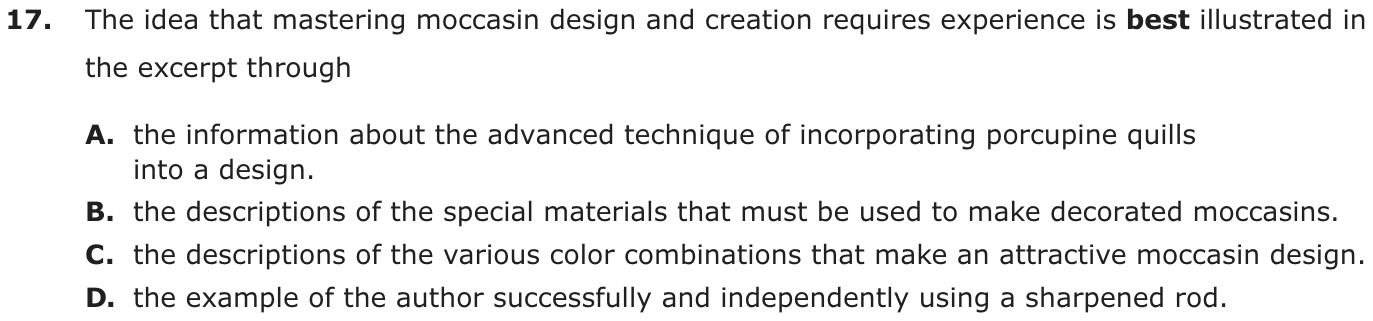
Question 18 of 50
2026 Practice Test C English, question 18Uses the passage above: “Excerpt from “Impressions of an Indian Childhood””.
Question
How does the author distinguish her point of view from that of her mother?
- Aby describing their techniques for knotting sinew thread (paragraph 4)
- Bby describing their approaches to beadwork design (paragraph 5)
- Cby stating her mother’s instructions on working with quills (paragraph 6)
- Dby stating her mother’s ideas about activities after lessons (paragraph 7)
Show the answer
Correct answer: B
The question asks how the author distinguishes her point of view from that of her mother.
A. Incorrect. In paragraph 4, the author explains that “it took many trials before I learned how to knot my sinew thread on the point of my finger, as I saw her do” and that the “difficulty was in keeping my thread stiffly twisted, so that I could easily string my beads upon it.” Although this explanation describes the author’s difficulty in performing the same task as her mother, it does not distinguish her point of view from that of her mother. In fact, they seem to share the same point of view regarding the importance of the technique the author is attempting to learn.
B. CORRECT. In paragraph 5, the author distinguishes her point of view from that of her mother by describing their approaches to beadwork design. In the paragraph, the author states, “I usually drew easy and simple crosses and squares” and “My original designs were not always symmetrical nor sufficiently characteristic, two faults with which my mother had little patience.” The author also distinguishes her point of view from that of her mother by stating that “the quietness of [my mother’s] oversight made me feel strongly responsible and dependent upon my own judgment.”
C. Incorrect. In paragraph 6, the author states, “My mother cut off the prickly ends and burned them at once in the centre fire. These sharp points were poisonous, and worked into the flesh wherever they lodged. For this reason, my mother said, I should not do much alone in quills until I was as tall as my cousin Warca-Ziwin.” Although these instructions explain the importance of having experience and skill when working with quills, they do not distinguish the author’s point of view from that of her mother.
D. Incorrect. In paragraph 7, the author describes her beadwork lessons as “confining” and states that she liked to roam “over the hills” with her playmates after the lessons. However, she makes no mention of her mother in paragraph 7; the activities and ideas stated there belong to the author, not the mother.
Question analysis
This reading question asks how Zitkala-Sa separates her own point of view from her mother's in an excerpt about learning beadwork as a girl. Each choice points to a different paragraph, so students must revisit all four and find where the two perspectives actually differ, not just where one person speaks or acts.
- Grade level
- Grade 7 reading and task
- Compared with grade 7
- At grade 7 Analyzing how an author sets her view apart from another person's is a grade 7 standard. The memoir's sentences are long and old-fashioned, but its paragraphs are short and concrete, so the demand is typical of grade 7 reading.
- Estimated difficulty
- Moderate: several steps, or a close reading with one strong distractor.
- Thinking it demands
- Depth of knowledge 2, skills and concepts · mainly analyze
- What makes it hard
- Every choice must be checked moderate
- How, not what moderate
- Hard words minor
- Evidence
- Answered from several paragraphs or stanzas
- Reading level
- Passage: about grade 8, 946 words; question and choices: about grade 9, 51 words.
- Corrected from the DOE handbook
- A word-order slip in the explanation was corrected.
- Students, last 30 days
- Not enough answers yet to show (it takes 10).
Why it is hard, traps and wrong answers (shows the answer)
Why it is hard
Every paragraph named shows mother and daughter together, or the daughter alone, so each looks like a candidate until it is tested for an actual difference in outlook. The struggle to knot sinew is a difference in skill, not in view, and the warning about quills gives only the mother's side. Paragraph 5 is the one place where the girl's own designs and her mother's impatience with their faults are set side by side.
Every choice must be checked moderate Choosing the answer
Each choice points to a different paragraph, 4 through 7, so all four have to be reread and tested for two outlooks that actually differ, not just one person's action or advice. (Embretson & Wetzel, 1987)
How, not what moderate Working it out
The question asks how the author sets her view apart, so students must find where two outlooks meet and clash: her simple, imperfect designs against the faults her mother “had little patience” with. (Anderson & Krathwohl, 2001)
Hard words minor Understanding the question
The key sentence turns on “not always symmetrical nor sufficiently characteristic,” formal words that must be understood to see the mother's standards behind them. (Perfetti, 2007; Freedle & Kostin, 1993)
Strategy: For each paragraph named, ask whether it shows both the mother's view and the narrator's and sets them against each other; a paragraph with one perspective cannot be the answer.
Traps
- True but not the answer: A choice says something accurate about the text that does not answer this question.
- Wrong part of the text: A choice is true of another paragraph, stanza or speaker than the one asked about.
The wrong answers, classified
A True but not the answer (King et al., 2004; Embretson & Wetzel, 1987)
Sees the girl struggle to knot sinew the way her mother does, a real contrast in skill, but she learns the same method “as I saw her do,” so their views do not differ.
C True but not the answer (King et al., 2004; Embretson & Wetzel, 1987)
Picks the mother's warning about poisonous quills because it states her view, but the narrator reports it without setting any opinion of her own against it.
D Wrong part of the text (Kirsch & Mosenthal, 1990)
Credits the mother with ideas about play after lessons, though paragraph 7 gives only the narrator's own “joyous relief,” and the mother does not appear in it.
What was corrected from the DOE handbook, and why
- Explanation: The handbook reads “The author also distinguishes her point of view from that her of mother.” It now reads “from that of her mother,” as earlier in the same explanation.
Working it out, step by step
Figure out what the question asks
A point of view is how a person sees or judges something. You need a place where the author shows that she and her mother see things differently. Each choice names a different paragraph. Check each one for two views that don’t match.
Find two views in paragraph 5
The girl “usually drew easy and simple crosses and squares.” Then she says: “My original designs were not always symmetrical nor sufficiently characteristic, two faults with which my mother had little patience.”
Work out what it means
Symmetrical means the same on both sides. “Sufficiently characteristic” means typical enough of the usual style. The girl kept her designs easy and simple. Her mother cared about something else. She saw “faults,” or mistakes, in them. Having “little patience” means being quickly annoyed. So the two judge the designs differently.
Check each choice
- A is wrong. In paragraph 4 the girl learns to knot thread “as I saw her do.” She learns her mother’s way, so their views match.
- B is right. Paragraph 5 sets the girl’s designs against her mother’s standards.
- C is wrong. Paragraph 6 gives only the mother’s warning about quills. The girl does not disagree.
- D is wrong. The mother doesn’t appear in paragraph 7 at all.
Watch out: A is tempting because the girl struggles with something her mother can do. But that is a difference in skill, not in point of view.
Choose the answer
Paragraph 5 is the one place where the two views are set side by side. So the answer is B.
Why this answer and not the closest wrong one
A is the closest wrong answer. The girl does struggle to knot thread the way her mother does. But they agree on how it should be done. In paragraph 5, the girl’s simple designs meet her mother’s impatience with their “faults.” That is a real difference in how they see the work.
More questions like this
The original DOE question
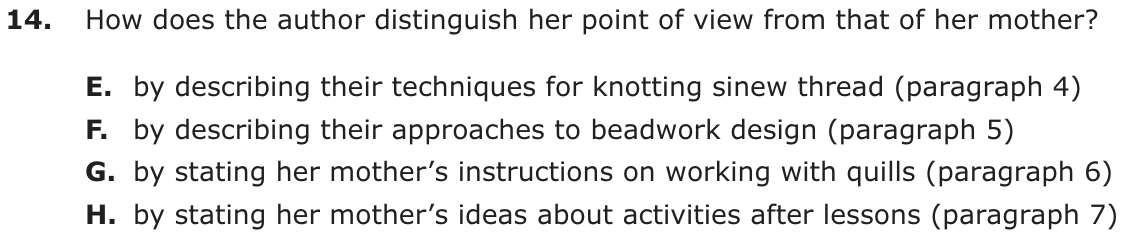
Question 19 of 50
2026 Practice Test C English, question 19Uses the passage above: “Excerpt from “Impressions of an Indian Childhood””.
Question
Read this sentence from paragraph 7.
Always after these confining lessons I was wild with surplus spirits, and found joyous relief in running loose in the open again.
Which sentence best describes how this sentence fits into the overall structure of the excerpt?
- AIt introduces a shift from the author’s demanding relationship with her mother to her more relaxed relationships with friends.
- BIt signals a change from the challenging aspects of life on the reservation to the advantages of living on the prairie.
- CIt highlights a contrast between the focus and control required while working and the freedom of having fun outside.
- DIt concludes the progression of events in the narrative by describing the sequence of events at the end of the author’s day.
Show the answer
Correct answer: C
The question asks which sentence best describes how the sentence from paragraph 7 fits into the overall structure of the excerpt.
A. Incorrect. Though the author feels humiliated “when some boldness of mine drew forth a rebuke from” her mother (paragraph 5) and characterizes her lessons with her mother as “confining” (paragraph 7), the overall passage does not portray a demanding relationship between the author and the mother. The shift introduced in the sentence from paragraph 7 is not from one of the author’s relationships to another; it is from work to play.
B. Incorrect. In paragraph 6, the author explains how working with porcupine quills is difficult because the “sharp points were poisonous, and worked into the flesh wherever they lodged.” Although this sentence suggests that working with porcupine quills was challenging, the sentence from paragraph 7 does not signal a change from the challenging aspects of life on the reservation to the advantages of living on the prairie. Most of paragraph 6 describes the author’s pleasure in creating designs in different colors.
C. CORRECT. In the sentence from paragraph 7, the author refers to her beadwork lessons as “confining” and states that after the lessons, she “was wild with surplus spirits” and “found joyous relief” in being outside and running around. The phrases “surplus spirits” and “joyous relief” highlight a sense of freedom that stands in strong contrast to the “confining” nature of the author’s beadwork lessons, which required intense focus and control.
D. Incorrect. In paragraph 7, the author describes how “many a summer afternoon” after her beadwork lessons, she and her friends used “a light sharpened rod” to gather “sweet roots” and “little crystal drops of gum.” She then explains that they later “tossed away our gum, to return again to the sweet roots.” However, the sentence from paragraph 7 does not conclude the progression of events in the narrative by describing the sequence of events at the end of the author’s day; the sentence appears at the beginning of paragraph 7 and provides a contrast with events from the previous paragraph.
Question analysis
This reading question quotes the sentence that opens the last paragraph of Zitkala-Sa's excerpt, where she tells how she felt after her beadwork lessons, and asks how it fits the overall structure. Several choices describe a turn or a contrast, so students must pin down exactly what is being set against what.
- Grade level
- Grade 7 reading and task
- Compared with grade 7
- At grade 7 Explaining how one sentence fits a text's structure is grade 7 reading. The sentence is quoted and its wording is vivid, but the student must connect it to the paragraphs on both sides of it, a typical grade 7 demand.
- Estimated difficulty
- Moderate: several steps, or a close reading with one strong distractor.
- Thinking it demands
- Depth of knowledge 2, skills and concepts · mainly analyze
- What makes it hard
- How, not what moderate
- A very close wrong answer moderate
- Hard words minor
- Evidence
- Answered from several paragraphs or stanzas
- Reading level
- Passage: about grade 8, 946 words; question and choices: about grade 10, 123 words.
- Students, last 30 days
- Not enough answers yet to show (it takes 10).
Why it is hard, traps and wrong answers (shows the answer)
Why it is hard
The sentence clearly marks a change, and every choice names some change, so the work lies in saying exactly what is set against what. The excerpt contrasts careful, controlled work with free play, and the word “confining” carries that contrast. Students lose the point by making the turn about people, reading one rebuke as a hard relationship, or about the day's timeline, when the sentence describes what always happened after lessons.
How, not what moderate Working it out
The stem asks how the sentence works in the excerpt's structure, so students must name the turn it marks, from the “confining” lessons of paragraphs 3–6 to running loose outdoors. (Anderson & Krathwohl, 2001)
A very close wrong answer moderate Choosing the answer
The relationships choice also describes a move from lessons with her mother to play with friends, and differs from the right one only in calling the bond with her mother demanding. (Embretson & Wetzel, 1987; Gorin & Embretson, 2006; Ascalon et al., 2007)
Hard words minor Understanding the question
Old-fashioned phrasing such as “wild with surplus spirits” and “joyous relief” has to be decoded as a burst of energy after hours of holding still. (Perfetti, 2007; Freedle & Kostin, 1993)
Strategy: Compare paragraph 6 with paragraph 7 and name what changes between them in a few words, then pick the choice whose two halves match both sides of that change.
Traps
- Half right: One half of a two-part choice is right and the other is not.
- Twists what the text says: Uses the text's topic and ideas but changes what it says: who did it, how much, when, or why.
- Wrong purpose or structure: Names a purpose, structure or effect that the part does not serve, or describes what a part says when the question asks what it does.
The wrong answers, classified
A Half right (King et al., 2004; Thissen, Steinberg & Fitzpatrick, 1989)
Notices the move from lessons with her mother to play with friends, but the excerpt shows a quiet, respectful teacher, not a demanding relationship; the turn is from work to play.
B Twists what the text says (King et al., 2004)
Inflates the move outdoors into a contrast between hardships of reservation life and the prairie's advantages, a far broader claim than one sentence about lessons supports.
D Wrong purpose or structure (Anderson & Krathwohl, 2001)
Takes the sentence as closing a day's events, since the excerpt begins after breakfast and paragraph 7 turns to afternoons, though it opens its paragraph with a contrast.
Working it out, step by step
Figure out what the question asks
This asks how one sentence fits the structure of the excerpt. Structure means how the parts are put together. You need to know what change this sentence marks.
Read the sentence closely
The sentence opens paragraph 7: “Always after these confining lessons I was wild with surplus spirits, and found joyous relief in running loose in the open again.” Confining means keeping you shut in or held still. “Surplus spirits” means extra energy. “Joyous relief” is a happy feeling of being free at last.
Compare what comes before and after
Paragraphs 3 to 6 show the lessons. The girl sits still and works with care. She learns to knot thread, plan designs and handle sharp quills. The rest of paragraph 7 shows her roaming the hills with friends. So this sentence turns from careful work to free play.
Check each choice
- A is wrong. The mother is a quiet, respectful teacher, not a demanding one. The shift is from work to play.
- B is wrong. The sentence sets lessons against play. It says nothing about reservation life being hard or the prairie being better.
- C is right. “Confining” lessons are set against “running loose in the open.”
- D is wrong. The sentence starts paragraph 7 and tells what always happened after lessons. It doesn’t end the story.
Watch out: A is tempting because the girl goes from her mother to her friends. But the sentence contrasts how she felt during lessons and after them.
Choose the answer
The sentence contrasts the focus that work needs with the freedom of playing outside. So the answer is C.
Why this answer and not the closest wrong one
A is the closest wrong answer. It also sees a move from lessons with her mother to play with friends. But A calls the relationship demanding. The mother teaches quietly and treats her daughter “as a dignified little individual” (paragraph 5). The real contrast is in the word “confining,” which sets held-still work against free play. That is C.
More questions like this
The original DOE question
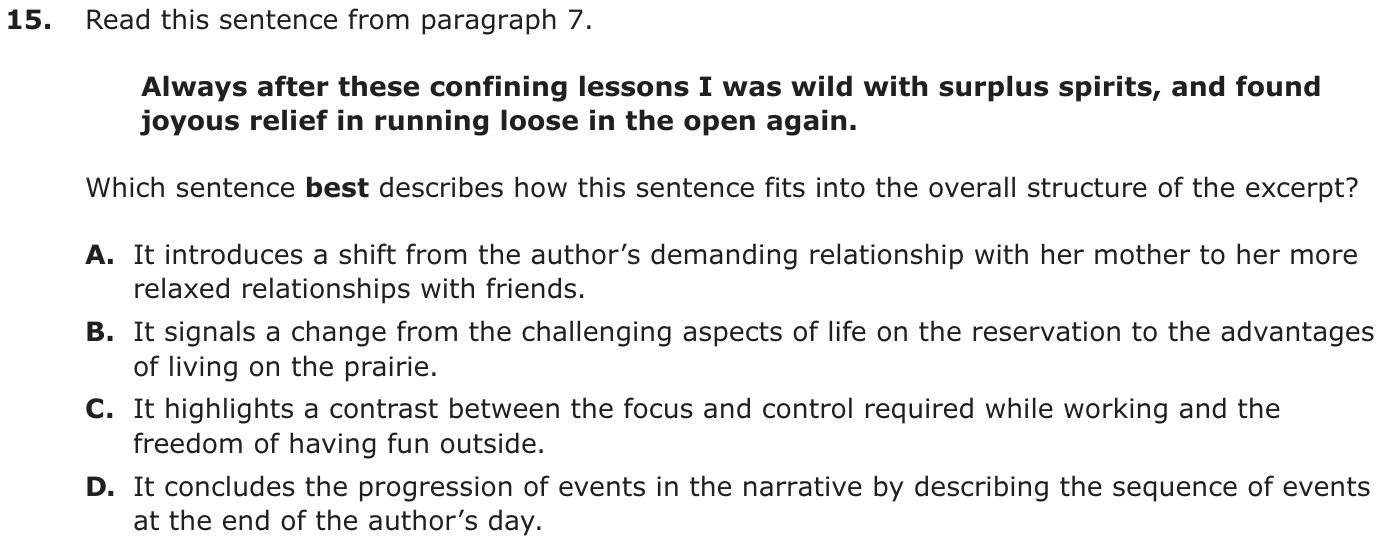
Question 20 of 50
2026 Practice Test C English, question 20Passage Bird Talk
Bird Talk
by Carl Sandburg
And now when the branches were beginning to be heavy,
It was the time when they once had said, “This is the
beginning of summer.”
The shrilling of the frogs was not so shrill as in the
first weeks after the broken winter;
The birds took their hops and zigzags a little more
anxious; a home is a home; worms are worms.
The yellow spreads of the dandelions and buttercups
reached across the green pastures.
Tee whee and tee whee came on the breezes, and the grackles
chuzzled their syllables.
And it was the leaves with a strong soft wind over them
that talked most of all and said more than any others
though speaking the fewest words.
It was the green leaves trickling out the gaunt nowhere
of winter, out on the gray hungry branches—
It was the leaves on the branches, beginning to be heavy,
who said as they said one time before, “This is the be-
ginning of summer.”
We shall never blame the birds who come
where the river and the road make the Grand Crossing
and talk there, sitting in circles talking bird talk.
If they ask in their circles as to who is here
and as to who is not here and who used to be here,
Or if instead of counting up last year as against
this year, they count up this year as against next
year, and have their bird chatter about who is here
this year who won’t be here next year,
We shall never blame the birds.
If I have put your face among leaf faces, child,
Or if I have put your voice among bird voices,
Blame me no more than the bluejays.
“Bird Talk” by Carl Sandburg—Public domain.
Question
Read lines 6–7 from the poem.
The birds took their hops and zigzags a little more
anxious; a home is a home; worms are worms.
What idea from the second stanza do the lines help develop?
- AThe birds are eager for the return of warmer months.
- BThe birds are most likely to thrive during the spring.
- CThe birds naturally adjust to the seasonal changes.
- DThe birds instinctively prepare for the future.
Show the answer
Correct answer: C
The question asks how lines 6–7 from the poem develop an idea from the second stanza.
A. Incorrect. In lines 2–3, the tree branches exclaim that “ ‘This is the / beginning of summer,’ ” and the birds respond by taking “their hops and zigzags a little more / anxious” (lines 6–7); however, the birds’ eager reaction to the return of warmer weather is not referenced in the second stanza of the poem, which is more about the nature of birds generally than the changing of the seasons.
B. Incorrect. Birds are more likely to thrive in warmer weather as evidenced by some birds’ migration to a warmer climate during winter, and the creatures in the first stanza are responding to the “ ‘beginning of summer’ ” (line 3) in their own way, such as the birds who are taking “their hops and zigzags a little more / anxious” (lines 6–7). However, the thriving of birds during a particular season is not the focus of the second stanza; rather, it is focused on the general nature of birds.
C. CORRECT. The birds are taking “their hops and zigzags a little more / anxious” (lines 6–7) in light of warmer weather, but they are not making a big to-do of the change because “a home is a home; worms are worms” (line 7) any time of the year. Such a natural adjustment to seasonal changes is reflected in the second stanza, where the birds “count up this year as against next / year” (lines 26–27) because they are well accustomed to the cyclical nature of things.
D. Incorrect. Although the birds’ actions of “hops and zigzags” (line 6) may indicate some sort of preparation, these actions are not preparation but rather the internalized cognizance of the change that has occurred with little conscious thought. As revealed in the second stanza, birds do not ponder much about past or future but rather adapt naturally as things change.
Question analysis
This question on Carl Sandburg’s poem “Bird Talk” quotes lines 6–7, where the birds hop and zigzag “a little more anxious,” and asks which idea from the second stanza they help develop. Students must link two compressed lines in the first stanza to a later stanza about birds gathered at the Grand Crossing, and every choice sounds like a fair claim about birds.
- Grade level
- Grade 8 reading and task
- Compared with grade 7
- Above grade 7 Typical grade 7 poetry questions ask what one line or stanza shows on its own. Here two compressed lines from the first stanza must be tied to an idea the second stanza never states, in Sandburg’s loose, unusual phrasing.
- Estimated difficulty
- Among the hardest on the SHSAT: a non-obvious approach, heavy reading, or a well-hidden trap.
- Thinking it demands
- Depth of knowledge 3, strategic thinking · mainly analyze
- What makes it hard
- Reading between the lines major
- A very close wrong answer moderate
- Evidence in several places moderate
- Figurative or literary language moderate
- Evidence
- Answered from several paragraphs or stanzas
- Reading level
- Passage: 296 words (a poem; reading level not measured); question and choices: about grade 5, 70 words.
- Students, last 30 days
- Not enough answers yet to show (it takes 10).
Why it is hard, traps and wrong answers (shows the answer)
Why it is hard
The stem runs in an unusual direction: two lines from the first stanza must help develop an idea that only the second stanza holds, and the poem never states it. Students who read “next year” as planning are drawn to preparation, a choice built on the key’s own frame, while others answer from the first stanza’s summer or from what they know about birds. The question rewards hearing the birds’ roll call of who is gone as the same matter-of-fact acceptance as “worms are worms.”
Reading between the lines major Working it out
Neither stanza states the shared idea: students must hear calm acceptance in “a home is a home; worms are worms” and in birds tallying “who won’t be here next year,” then call it adjusting to change. (Graesser, Singer & Trabasso, 1994; Kintsch, 1998)
A very close wrong answer moderate Choosing the answer
The choice about instinctive preparation shares the key’s shape, birds acting by nature as time passes; it differs only in what the birds do, prepare for the future rather than adjust to the seasons. (Embretson & Wetzel, 1987; Gorin & Embretson, 2006; Ascalon et al., 2007)
Evidence in several places moderate Working it out
Lines 6–7 sit in the first stanza and the idea lives in the second, lines 20–29, so students must carry two lines across the poem and match them to the gathering at the Grand Crossing. (Kirsch & Mosenthal, 1990; Gorin & Embretson, 2006)
Figurative or literary language moderate Understanding the question
“A home is a home; worms are worms” says nothing on its surface; its meaning, a shrug that life goes on as it always has, has to be read from the repetition. (Graesser, Singer & Trabasso, 1994; Kintsch, 1998)
Strategy: Paraphrase the second stanza first: what are the birds doing and saying at the Grand Crossing? Then reread lines 6–7 and ask which idea about birds both passages share.
Traps
- Reads too much in: A reasonable-sounding conclusion that goes further than the text allows.
- Wrong part of the text: A choice is true of another paragraph, stanza or speaker than the one asked about.
- Outside knowledge: A choice is plausible in the real world but not supported by this text.
The wrong answers, classified
A Wrong part of the text (Kirsch & Mosenthal, 1990)
Hears “a little more anxious” as eagerness for the summer announced in lines 2–3, an idea of the first stanza, while the second stanza never mentions weather or warmth.
B Outside knowledge (King et al., 2004; Recht & Leslie, 1988)
Brings in the real fact that birds do well in warm weather, which neither lines 6–7 nor the birds’ talk of who is gone says, and the poem’s season is summer, not spring.
D Reads too much in (Graesser, Singer & Trabasso, 1994)
Sees nest-building in “a home is a home” and planning in counting “this year as against next / year,” but the birds only note who will be missing and make no preparations.
Working it out, step by step
Figure out what the question asks
This question points in an unusual direction. Lines 6–7 are in the first stanza. A stanza is a group of lines set apart by a blank line. But the idea you need is in the second stanza, lines 20–29. The question asks which idea in stanza 2 these earlier lines also help build. So find the idea in stanza 2 first. Then see how lines 6–7 support it.
Find the idea in stanza 2
In stanza 2, birds sit “in circles talking bird talk.” They ask “who is here / and as to who is not here and who used to be here.” They also talk about “who is here / this year who won’t be here next year.” The birds simply count the changes. They are not upset by them. The speaker says, “We shall never blame the birds.” The idea: birds take the changes that time brings as a normal part of life.
Read lines 6–7 closely
Lines 6–7 say “The birds took their hops and zigzags a little more / anxious; a home is a home; worms are worms.” As summer comes, the birds hop about a little more nervously and busily. That is a small change. Then the speaker shrugs: “a home is a home; worms are worms.” Life goes on as it always does. The birds change a little and carry on, with no fuss.
See what the two parts share
Both parts show birds meeting change calmly. In lines 6–7, the season turns, and the birds adjust a little. To adjust is to change a little to fit something new. In stanza 2, the birds note who has come and gone, and life goes on. So lines 6–7 help build stanza 2’s idea: birds naturally adjust to the changing seasons.
Check each choice
- A does not fit. Stanza 2 never mentions warm weather or being eager for it.
- B does not fit. Nothing in the poem says birds do best in spring. The poem’s season is the start of summer.
- C fits. Both parts show birds taking seasonal change calmly, as a matter of course.
- D does not fit. The birds talk about next year, but they make no plans for it.
Watch out: D is tempting because “a home is a home” can sound like nest building. But the birds only count who will be missing. They do not get ready for anything.
Choose the answer
Lines 6–7 and stanza 2 both show birds accepting change as natural. So the answer is C, “The birds naturally adjust to the seasonal changes.”
Why this answer and not the closest wrong one
D is the closest wrong choice. Like C, it says birds act by nature as time passes. But D says they prepare, or get ready. In stanza 2, the birds talk about next year only to count who “won’t be here next year.” In lines 6–7, they hop about and carry on. They adjust to change. They do not plan for it.
More questions like this
The original DOE question
The passage “Bird Talk” as printed (page 32)
Question 21 of 50
2026 Practice Test C English, question 21Uses the passage above: “Bird Talk”.
Question
Read lines 12–14 from the poem.
And it was the leaves with a strong soft wind over them
that talked most of all and said more than any others
though speaking the fewest words.
What does the phrase “talked most of all” in line 13 convey?
- AIt establishes that the speaker thinks the sound of wind in the leaves is the best indication that the season is changing.
- BIt introduces the idea that the sound of the wind in the leaves remains constant throughout the seasons.
- CIt suggests that the speaker is overwhelmed by the sounds of nature that emerge as the season changes.
- DIt emphasizes that the sounds of nature enable the speaker to appreciate each season of the year.
Show the answer
Correct answer: A
This question asks for what a phrase reveals about the speaker’s perspective on the change in seasons.
A. CORRECT. The first stanza of the poem establishes the way different parts of the natural world, including both plants and animals, respond to the change in season. These lines reflect the way the wind in the leaves is the best indication of the seasonal change because it is the wind in the leaves that “talked most of all and said more than any others / though speaking the fewest words” (lines 13–14).
B. Incorrect. Although the sound of the wind is the most obvious sign of the seasonal change per the speaker, it is in response to the “ ‘beginning of summer’ ” (line 3) that the wind speaks through the leaves. The poem does not reveal that this figurative speech occurs throughout the seasons, only that it occurs during the transition to summer.
C. Incorrect. While the language used by the speaker indicates a deep appreciation for the natural phenomenon being witnessed, the language used does not indicate a feeling of being overwhelmed but rather a feeling of awareness.
D. Incorrect. Using the personification of the wind “speaking” (line 14) indicates an appreciation by the speaker for the power and volume of the wind’s voice, but only one instance of the wind’s speech, that which occurs at the “ ‘beginning of summer’ ” (line 3), is chronicled by the speaker in the poem.
Question analysis
Students interpret the personification in lines 12–14 of “Bird Talk,” where the leaves under a strong soft wind “talked most of all,” and decide what that phrase conveys. Because the leaves also speak “the fewest words,” the line seems to contradict itself, and its meaning depends on how it fits Sandburg’s first stanza about the start of summer.
- Grade level
- Grade 7 reading and task
- Compared with grade 7
- At grade 7 Explaining what a figurative phrase conveys about a speaker’s view is standard grade 7 work. The three lines are printed with the question, though the phrase still has to be read against the rest of the first stanza.
- Estimated difficulty
- Moderate: several steps, or a close reading with one strong distractor.
- Thinking it demands
- Depth of knowledge 2, skills and concepts · mainly understand
- What makes it hard
- Figurative or literary language moderate
- Reading between the lines moderate
- Evidence
- Answered from one paragraph or stanza
- Reading level
- Passage: 296 words (a poem; reading level not measured); question and choices: about grade 6, 119 words.
- Students, last 30 days
- Not enough answers yet to show (it takes 10).
Why it is hard, traps and wrong answers (shows the answer)
Why it is hard
The phrase ranks the leaves above the shrilling frogs and chattering birds as voices of the season, but it never says what they are best at, so students must supply the idea of a sign. The tempting wrong readings take the speaker’s pleasure in nature and stretch it to every season, or hear “talked most of all” as noise. The quiet words around the phrase, “strong soft wind” and “fewest words,” point to a calm sound that tells the most.
Figurative or literary language moderate Understanding the question
The leaves are personified, and the line seems to contradict itself: they “talked most of all and said more than any others / though speaking the fewest words.” (Graesser, Singer & Trabasso, 1994; Kintsch, 1998)
Reading between the lines moderate Working it out
Students must turn “said more than any others” into a judgment, that the leaves are the surest sign of summer, which lines 17–19 confirm when the leaves themselves announce “the beginning of summer.” (Graesser, Singer & Trabasso, 1994; Kintsch, 1998)
Strategy: Restate lines 12–14 in plain words, especially the contrast between saying more and speaking fewer words, then test each choice against the whole first stanza.
Traps
- Too broad or too strong: A choice overstates, generalizes, or uses absolute words the text does not support.
- Wrong tone or attitude: Misjudges the tone, attitude or point of view, such as reading admiration as criticism, or taking a character's or subject's feelings for the author's.
- Twists what the text says: Uses the text's topic and ideas but changes what it says: who did it, how much, when, or why.
The wrong answers, classified
B Twists what the text says (King et al., 2004)
Stretches “as they said one time before” into a sound heard all year, though the leaves have only just come out of “the gaunt nowhere / of winter.”
C Wrong tone or attitude (Graesser, Singer & Trabasso, 1994)
Hears “talked most of all” as a din that swamps the speaker, though the “strong soft wind” and “fewest words” describe a quiet sound noted calmly, with no sign of strain.
D Too broad or too strong (King et al., 2004)
Rightly senses the speaker’s pleasure in nature’s voices but widens it to “each season of the year,” though the poem watches only the turn to summer and singles out the leaves.
Working it out, step by step
Figure out what the question asks
This asks what a phrase conveys, or gets across. The phrase is “talked most of all” in line 13. Leaves can’t really talk. Giving a thing human actions, like talking, is called personification. You need to work out what the speaker means by saying the leaves talked the most.
Read lines 12–14
Lines 12–14 say “And it was the leaves with a strong soft wind over them / that talked most of all and said more than any others / though speaking the fewest words.” The others are the frogs and birds from earlier lines. The leaves “said more than any others,” yet they used “the fewest words.” So the quiet rustle of the leaves tells you more than all the frog and bird calls.
Find what the leaves say
The stanza ends with the leaves speaking. Lines 17–19 say it was “the leaves on the branches, beginning to be heavy,” who said “This is the beginning of summer.” So the leaves’ message is that the season has changed. The new leaves, rustling in the wind, are the clearest sign that summer has come.
Check each choice
- A fits. The leaves say the most about the season, so they are the best sign that it is changing.
- B does not fit. The leaves have just come out of “the gaunt nowhere / of winter.” Gaunt means thin and bare. The leaves do not rustle the same way all year.
- C does not fit. A “strong soft wind” and “the fewest words” describe a quiet sound. Nothing shows the speaker is overwhelmed, or swamped.
- D does not fit. The poem watches only one change, the start of summer, not each season.
Watch out: D is tempting because the speaker clearly enjoys nature’s sounds. But it stretches that to “each season of the year,” which the poem never covers.
Choose the answer
“Talked most of all” shows that the leaves tell the most about the change of season. So the answer is A, “It establishes that the speaker thinks the sound of wind in the leaves is the best indication that the season is changing.”
Why this answer and not the closest wrong one
D is the closest wrong choice. The speaker does seem to enjoy the sounds of nature. But the poem covers just one change, the turn to summer. And the phrase does more than show enjoyment. It ranks the leaves above the frogs and birds. They say the most about the change, so they are the best sign of it.
More questions like this
The original DOE question
Question 22 of 50
2026 Practice Test C English, question 22Uses the passage above: “Bird Talk”.
Question
How does the repetition of “ ‘This is the beginning of summer’ ” in lines 2–3 and lines 18–19 contribute to the meaning of the poem?
- AIt suggests that the shift to summer occurs in the same way each year.
- BIt emphasizes the idea that living things are prepared for the change of season.
- CIt highlights the idea that the first signs of summer are surprising each year.
- DIt builds expectations about what the natural world looks like during a change of season.
Show the answer
Correct answer: A
The question asks how the repetition of a phrase contributes to the meaning of the poem in terms of conveying information about a cyclical event.
A. CORRECT. This phrase is used twice verbatim, in both cases to show the figurative words spoken by the branches (lines 2–3) and the leaves on the branches (lines 18–19). Repetition of this phrase conveys the idea that the transition to summer occurs in the same manner each subsequent year and thus evokes the same response from nature.
B. Incorrect. While living things—branches and leaves—both make identical figurative utterances, they do so not because they have prepared for such an event. Rather, these living things take the change in stride because of the sameness and expectedness of the seasonal shifts, which occur in the same way each time.
C. Incorrect. Even though the branches and leaves have been imbued by the speaker with some degree of consciousness in their figurative ability to speak, they are not surprised by the change in seasons. They say the same thing each year because the same thing occurs each year in the same way.
D. Incorrect. Certain lines of the poem do describe the natural world during the change of seasons, such as lines 8–9: “The yellow spreads of the dandelions and buttercups / reached across the green pastures.” However, this repeated phrase serves to evoke a sense of sameness and inevitability; it is not a phrase related to the physical appearance of the natural world, only the way the natural world responds to the seasonal change with simple acceptance for its sameness. The repeated lines do not hold any sort of expectation or anticipation for the coming of summer; they help relay observations made about the state of the season.
Question analysis
This poetry question asks how the repetition of “This is the beginning of summer,” said by the branches in lines 2–3 and by the leaves in lines 18–19 of Sandburg’s “Bird Talk,” contributes to the poem’s meaning. Students must judge what the repetition does, not only what the words say, and the four choices read the repeated line in quite different ways.
- Grade level
- Grade 7 reading and task
- Compared with grade 7
- At grade 7 Explaining what a repeated phrase adds to a poem is familiar grade 7 work. Both passages are pointed out by line number, so the task is to judge the effect of the repetition rather than to find it.
- Estimated difficulty
- Straightforward: two steps or one careful reading.
- Thinking it demands
- Depth of knowledge 2, skills and concepts · mainly analyze
- What makes it hard
- How, not what moderate
- Reading between the lines minor
- Evidence
- Answered from one paragraph or stanza
- Reading level
- Passage: 296 words (a poem; reading level not measured); question and choices: about grade 7, 79 words.
- Students, last 30 days
- Not enough answers yet to show (it takes 10).
Why it is hard, traps and wrong answers (shows the answer)
Why it is hard
Both quotations are pointed out, so the work is deciding what the echo adds. Students who know that repetition emphasizes may grab a choice that begins “emphasizes,” and those who hear the quoted words as a cry of discovery may pick surprise, even though that choice shares the key’s “each year.” Reading the lead-ins, “once had said” and “one time before,” settles it: the line is an old, expected announcement.
How, not what moderate Working it out
The question asks what repeating the line does for the poem, not what the line says, so students must judge an effect of structure: the same words open the first stanza and close it. (Anderson & Krathwohl, 2001)
Reading between the lines minor Working it out
The clue is in the lead-ins, “they once had said” in line 2 and “as they said one time before” in line 18, which present the announcement as words said at this point in earlier years. (Graesser, Singer & Trabasso, 1994; Kintsch, 1998)
Strategy: Reread each quoted passage together with the line that leads into it, then decide what the poet gains by having the branches and the leaves say the same words.
Traps
- Reads too much in: A reasonable-sounding conclusion that goes further than the text allows.
- Wrong tone or attitude: Misjudges the tone, attitude or point of view, such as reading admiration as criticism, or taking a character's or subject's feelings for the author's.
- Wrong purpose or structure: Names a purpose, structure or effect that the part does not serve, or describes what a part says when the question asks what it does.
The wrong answers, classified
B Reads too much in (Graesser, Singer & Trabasso, 1994)
Moves from the calm, repeated announcement to the claim that branches and leaves were ready for summer, but saying the same words again shows recurrence, not preparation.
C Wrong tone or attitude (Graesser, Singer & Trabasso, 1994)
Keeps the idea of “each year” but hears the quoted words as a cry of surprise, though “once had said” and “one time before” make them a familiar, expected announcement.
D Wrong purpose or structure (Anderson & Krathwohl, 2001)
Gives the repeated line the job of the stanza’s pictures, the dandelions and green pastures, though it names when summer begins and says nothing about how the land looks.
Working it out, step by step
Figure out what the question asks
This asks about repetition, which means using the same words more than once. The words “This is the beginning of summer” appear in lines 2–3. They come back in lines 18–19. You need to work out what saying them twice adds to the poem’s meaning.
Read the words that lead in
Look at the words just before each quotation. Line 2 says “It was the time when they once had said.” Line 18 says the leaves “said as they said one time before.” Both lead-ins point to the past. The branches and leaves have said these words before, at this same time in other years.
Work out what the repetition shows
The same words come back, just as summer itself comes back. Each year the branches get heavy, the leaves come out, and it is summer again. The change happens the same way every time. So the repeated line works like a yearly announcement that nobody finds strange. It shows that the shift to summer follows a familiar pattern.
Check each choice
- A fits. The repeated words show summer arriving the same way each year.
- B does not fit. Saying the words again shows that summer returns. It does not show that living things got ready for it.
- C does not fit. Something said “one time before” is familiar, not surprising.
- D does not fit. The line only names a time. Pictures like the yellow dandelions show how the land looks.
Watch out: C also says “each year,” so it can look right. But the quoted words are calm, like an old saying, not a cry of surprise.
Choose the answer
The repeated line is an old announcement, made again because summer comes again. So the answer is A, “It suggests that the shift to summer occurs in the same way each year.”
Why this answer and not the closest wrong one
C is the closest wrong choice, because it also points to something that happens each year. But C says the first signs of summer are a surprise. The lead-ins say the opposite. The branches “once had said” these words, and the leaves said them “one time before.” Words said many times before are expected. They show a pattern, not a surprise.
More questions like this
The original DOE question
Question 23 of 50
2026 Practice Test C English, question 23Uses the passage above: “Bird Talk”.
Question
Which lines from the poem best contrast with the idea of winter’s scarcity and bleakness?
- A“The shrilling of the frogs was not so shrill as in the / first weeks after the broken winter;” (lines 4–5)
- B“The yellow spreads of the dandelions and buttercups / reached across the green pastures.” (lines 8–9)
- C“Tee whee and tee whee came on the breezes, and the grackles / chuzzled their syllables.” (lines 10–11)
- D“Or if instead of counting up last year as against / this year, they count up this year as against next” (lines 25–26)
Show the answer
Correct answer: B
The question asks for the identification of a description that contrasts with the scarcity and bleakness of winter.
A. Incorrect. These lines indicate that the frogs are first very excited about the shift from winter to spring, which causes them to make a loud “shrilling,” yet their sounds lessen after a time and grow weaker. As such, these lines contrast two periods of spring (early vs. later) and the response of the frogs to these two periods; the lines do not contrast the bleakness of winter with the abundance of spring or summer.
B. CORRECT. During winter, there is scarcity of plant life and a bleak landscape: trees lose their leaves, snow covers the ground, and nature appears dark and shuttered. In contrast, these lines reveal the bright “yellow spreads” of flowers and the verdant “green pastures” that are signs that winter has abated.
C. Incorrect. This description contrasts the sounds of “the breezes” of warmer air and the sounds made by grackles—a type of bird—rather than the bleakness and scarcity of winter and the abundance of the “ ‘beginning of summer’ ” (line 3).
D. Incorrect. These lines show the contrast between the two ways of looking at things in terms of past vs. present or present vs. future; in this instance, the lines reveal the way birds naturally expect and adapt to the passing of time and the change of seasons. The lines do not present a contrast between winter and spring.
Question analysis
This textual evidence question on Carl Sandburg’s poem “Bird Talk” asks which lines best contrast with the idea of winter’s scarcity and bleakness. Students compare four quotations about frogs, flowers, birdsong and the birds’ yearly counting, and the challenge is finding the one whose images most fully show the opposite of a bare, bleak season.
- Grade level
- Grade 7 reading and task
- Compared with grade 7
- At grade 7 Choosing lines that fit an idea is routine grade 7 evidence work. The twist is that students look for the opposite of an idea, winter’s scarcity and bleakness, rather than support for it, though the quoted images are concrete.
- Estimated difficulty
- Straightforward: two steps or one careful reading.
- Thinking it demands
- Depth of knowledge 2, skills and concepts · mainly evaluate
- What makes it hard
- Every choice must be checked minor
- Hard words minor
- Evidence
- Answered from one sentence or line
- Reading level
- Passage: 296 words (a poem; reading level not measured); question and choices: about grade 6, 85 words.
- Students, last 30 days
- Not enough answers yet to show (it takes 10).
Why it is hard, traps and wrong answers (shows the answer)
Why it is hard
The question turns the usual evidence task around: students picture a scarce, bleak winter and then look for its opposite. The line that names winter outright is a trap, since it only compares the frogs’ noise in two stretches of spring, and the grackles’ calls show life without plenty. The flowers spreading “across the green pastures” are the one image of abundance and color.
Every choice must be checked minor Choosing the answer
Every quotation carries some sign of the season, frogs, flowers, birdsong and the birds’ yearly count, so each must be tested for images of plenty and color set against a bare winter. (Embretson & Wetzel, 1987)
Hard words minor Understanding the question
The stem’s “scarcity” and “bleakness” define what to look for; a student unsure of them cannot tell that yellow and green spreading across pastures is their opposite. (Perfetti, 2007; Freedle & Kostin, 1993)
Strategy: First picture what a scarce, bleak winter looks like, then read each quotation for images that show the plain opposite of that picture.
Traps
- Word match: Repeats striking words or phrases from the text, so it looks supported, but its meaning does not fit the question.
- Supports only part of the claim: In a question about evidence: a line that backs one half of the claim but not the other, or a related point rather than the claim itself.
The wrong answers, classified
A Word match (Freedle & Kostin, 1993)
Is drawn by “the broken winter,” the only mention of winter among the choices, but the lines compare the frogs’ shrilling early and later in spring, not winter’s bareness with plenty.
C Supports only part of the claim (King et al., 2004; Thissen, Steinberg & Fitzpatrick, 1989)
Picks the birdsong, which does show life returning after a silent season, but the calls say nothing about scarcity giving way to plenty, as the spreading flowers in lines 8–9 do.
D Word match (Freedle & Kostin, 1993)
Takes “as against” for the contrast the question asks about, though these lines set one year against another in the birds’ talk and hold no image of winter or of growth.
Working it out, step by step
Figure out what the question asks
This asks you to find lines that show the opposite of winter. Scarcity means not having enough of something. Bleakness means looking bare, cold and gloomy. So picture winter: bare branches, no flowers, gray and brown fields. Then look for the lines that show plenty and bright color instead.
Read lines 8–9
Lines 8–9 say “The yellow spreads of the dandelions and buttercups / reached across the green pastures.” Dandelions and buttercups are small yellow flowers. Pastures are grassy fields. A spread is a wide area covered with something. Here, yellow flowers stretch across green fields. That is a picture of color everywhere and plenty of growth. It is the exact opposite of a bare, gray winter.
Check each choice
- A does not fit. It mentions “the broken winter,” but it only compares how shrill, or sharp and high, the frogs sounded at two times. Nothing in it shows plenty.
- B fits. Yellow flowers spread over green fields, full of color and life.
- C does not fit. The birdsong shows that life is back. But it gives no picture of plenty or color to set against a bare winter.
- D does not fit. These lines compare one year with another in the birds’ talk. There is no winter and no growth in them.
Watch out: A is the only choice that names winter, so it can seem to fit. But mentioning winter is not the same as contrasting with it.
Choose the answer
Only lines 8–9 show plenty and bright color, the opposite of a scarce, bleak winter. So the answer is B, lines 8–9: “The yellow spreads of the dandelions and buttercups / reached across the green pastures.”
Why this answer and not the closest wrong one
C is a close wrong choice, since birdsong is a sign that life is back. But the question asks for a contrast with scarcity, or not having enough. Sounds alone do not show plenty. Lines 8–9 show flowers spreading wide across green fields. That picture of color and plenty is the clearest opposite of a bare, gray winter.
More questions like this
The original DOE question
Question 24 of 50
2026 Practice Test C English, question 24Uses the passage above: “Bird Talk”.
Question
Throughout the poem, the poet conveys the speaker’s point of view by
- Agradually moving the speaker’s attention from one element of nature to another.
- Bproviding the speaker’s motivation for describing the landscape in great detail.
- Chighlighting the speaker’s emotional response as each season passes.
- Dshifting the speaker’s focus from external observations to personal reflection.
Show the answer
Correct answer: D
This question asks for an explanation of how the poet conveys the speaker’s point of view on the natural world and the change of seasons as presented in the poem.
A. Incorrect. Though in the first stanza the speaker describes various elements of nature such as branches, frogs, birds, flowers, and leaves, these elemental shifts are not precisely gradual and occur only in the first stanza. Further, the first stanza, though appreciative of the natural world, is primarily descriptive and does not develop the speaker’s perspective to the degree that other parts of the poem do.
B. Incorrect. While it may be inferred that the speaker describes the landscape to such a degree because it has revealed a seasonal shift, that this is indeed the speaker’s motivation is never explicitly conveyed by the poet.
C. Incorrect. Multiple seasons do not pass in the poem; only the shift to the “ ‘beginning of summer’ ” (line 3) occurs in an endless cycle. Further, the speaker does not reveal an emotional response; it is the responses of nature that the speaker describes.
D. CORRECT. The first stanza is the speaker’s observations of the natural world embracing a new season. In the second stanza, the speaker begins to reflect on how the natural world, as embodied by the birds, calmly accepts seasonal change in its perpetual sameness. The reflection continues in the third stanza, where it is revealed that the speaker has been addressing these observations to a child.
Question analysis
This point-of-view question asks how the poet of “Bird Talk” conveys the speaker’s point of view throughout the poem. Students must keep in mind the long opening description of early summer and the two shorter stanzas after it, and decide which description of the poet’s method holds from the first line to the last.
- Grade level
- Grade 8 reading and task
- Compared with grade 7
- Above grade 7 Grade 7 point-of-view questions often ask what a speaker thinks. This one asks how the poet conveys that view across all three stanzas of a long free-verse poem, and the choices name methods in general terms, closer to grade 8 work.
- Estimated difficulty
- Hard: combines ideas, needs a plan, and has more than one tempting wrong answer.
- Thinking it demands
- Depth of knowledge 3, strategic thinking · mainly analyze
- What makes it hard
- Evidence in several places moderate
- A very close wrong answer moderate
- How, not what moderate
- Figurative or literary language minor
- Evidence
- Answered from the whole text
- Reading level
- Passage: 296 words (a poem; reading level not measured); question and choices: about grade 10, 54 words.
- Students, last 30 days
- Not enough answers yet to show (it takes 10).
Why it is hard, traps and wrong answers (shows the answer)
Why it is hard
The first stanza takes up 19 of the poem’s 32 lines and moves steadily from branches to frogs, birds, flowers and leaves, so a choice that describes it alone feels right. The point of view shows only when the poem turns to “We” and then to “I” addressing a child, and that third stanza is three hard lines. Students must keep the whole poem’s course in mind and choose the method that holds from first line to last.
Evidence in several places moderate Working it out
The answer depends on all three stanzas at once: the long catalog of the season in lines 1–19, the shift to “We shall never blame the birds,” and the closing “If I have put your face … child.” (Kirsch & Mosenthal, 1990; Gorin & Embretson, 2006)
A very close wrong answer moderate Choosing the answer
The choice about moving from one element of nature to another and the key both describe a shift in the speaker’s attention; they differ in what shifts, nature to nature or the outside world to the speaker’s own thoughts. (Embretson & Wetzel, 1987; Gorin & Embretson, 2006; Ascalon et al., 2007)
How, not what moderate Working it out
The stem asks how the poet conveys a point of view, a method, so a choice must describe what the speaker does across the poem, not what the speaker sees. (Anderson & Krathwohl, 2001)
Figurative or literary language minor Understanding the question
The last stanza is cryptic, “Blame me no more than the bluejays,” and students who miss that the speaker is now talking about putting a child into the poem lose the move to reflection. (Graesser, Singer & Trabasso, 1994; Kintsch, 1998)
Strategy: Write one phrase for what the speaker attends to in each stanza, then keep only a choice that describes the whole sequence, not one stanza.
Traps
- Too narrow: A single detail offered as the central idea or a summary, or a summary that keeps minor details and leaves out an essential part.
- Reads too much in: A reasonable-sounding conclusion that goes further than the text allows.
- Twists what the text says: Uses the text's topic and ideas but changes what it says: who did it, how much, when, or why.
The wrong answers, classified
A Too narrow (King et al., 2004)
Describes the first stanza well, its walk from branches to frogs, birds, flowers and leaves, but misses the later turn to “We” and to the speaker’s own “I.”
B Reads too much in (Graesser, Singer & Trabasso, 1994)
Supplies a reason for all the description, perhaps from the closing words to a child, but the speaker never says why the landscape is described, and the reflection is not a motive.
C Twists what the text says (King et al., 2004)
Sees that the poem follows nature through a change of season but makes it many seasons and hands the creatures’ reactions, such as the birds’ anxious hops, to the speaker as feelings.
Working it out, step by step
Figure out what the question asks
This asks about point of view: how the speaker, the voice talking in the poem, sees things. It also asks how the poet shows that view across the whole poem. So look at what the speaker pays attention to in each of the three stanzas. A stanza is a group of lines set apart by a blank line.
Follow the speaker through the stanzas
- Stanza 1, lines 1–19: the speaker describes the world outside. There are branches, frogs, birds, flowers and leaves at the start of summer.
- Stanza 2, lines 20–29: the speaker starts to judge and think. “We shall never blame the birds.”
- Stanza 3, lines 30–32: the speaker says “I” and talks to a child: “If I have put your face among leaf faces, child.”
Name the change in focus
The poem starts with external observations, or things the speaker sees and hears outside. It ends with personal reflection, or the speaker’s own thoughts. In the last stanza, the speaker admits to putting a child’s face and voice into the poem. The speaker asks to be blamed “no more than the bluejays.” Since “We shall never blame the birds,” that means not at all. This move from looking outward to looking inward is how the speaker’s view comes through.
Check each choice
- A does not fit. Moving from branches to frogs to birds happens only in stanza 1. It misses the turn to “We” and “I.”
- B does not fit. The speaker never says why the landscape is described.
- C does not fit. Only one change of season happens, the start of summer. The anxious feelings belong to the birds, not the speaker.
- D fits. The speaker moves from describing nature to thinking about it.
Watch out: A describes stanza 1 very well. But the question says “Throughout the poem,” so the answer must cover all three stanzas.
Choose the answer
The speaker starts by watching nature and ends by thinking aloud to a child. So the answer is D, “shifting the speaker’s focus from external observations to personal reflection.”
Why this answer and not the closest wrong one
A is the closest wrong choice. Stanza 1 really does move from one part of nature to another. But that is only 19 of the 32 lines. In stanzas 2 and 3, the speaker turns to “We” and then “I,” and shares personal thoughts. Only D describes the speaker’s path from the first line to the last.
More questions like this
The original DOE question
Question 25 of 50
2026 Practice Test C English, question 25Uses the passage above: “Bird Talk”.
Question
Over the course of the poem, a central idea is developed mainly through the speaker’s
- Asense of eager anticipation as winter ends.
- Bdescription of the changes in nature as the seasons transition.
- Cobservation of the birds’ behavior as summer begins.
- Dprediction of future alterations in the physical landscape.
Show the answer
Correct answer: B
The question asks how the central idea about the natural acceptance of change by nature is developed by the speaker of the poem.
A. Incorrect. The speaker is an observer of the changes in nature as propelled by the seasons and shows no personal eagerness for the end of winter. Further, even though nature rejoices at the end of winter as exemplified by “the shrilling of the frogs” (line 4), the speaker merely records this and does not share in this display.
B. CORRECT. The response of nature to the “beginning of summer” (line 3) is the primary focus of the poem as revealed by the speaker through vivid descriptions of the sights, sounds, movements, and attitudes of the natural world.
C. Incorrect. The second stanza of the poem begins a reflection on birds “sitting in circles talking bird talk” (line 22) and taking a sort of attendance of who is present, but this behavioral description is largely figurative and meant to illustrate a point about the way the birds adapt quickly to change, not to develop a central idea of the poem in terms of how nature responds generally.
D. Incorrect. Seasonal changes are inevitable and cyclical per the speaker, but the speaker does not predict future changes to the landscape as a method of developing the central idea. Rather, the speaker describes nature’s response to changes that have already occurred.
Question analysis
Students decide how the speaker of Carl Sandburg’s “Bird Talk” mainly develops a central idea of the poem. The question does not name the idea, so students must work it out across the poem’s three stanzas and then weigh four accounts of what the speaker does, each tied to a different part or feature of the poem.
- Grade level
- Grade 7 reading and task
- Compared with grade 7
- At grade 7 Tracing how a central idea develops is core grade 7 work. Here the idea is never stated, so students must first infer it from 32 lines of free verse and then judge what the speaker mainly does to build it.
- Estimated difficulty
- Moderate: several steps, or a close reading with one strong distractor.
- Thinking it demands
- Depth of knowledge 3, strategic thinking · mainly analyze
- What makes it hard
- A very close wrong answer moderate
- Reading between the lines moderate
- Evidence in several places minor
- Evidence
- Answered from the whole text
- Reading level
- Passage: 296 words (a poem; reading level not measured); question and choices: about grade 9, 48 words.
- Students, last 30 days
- Not enough answers yet to show (it takes 10).
Why it is hard, traps and wrong answers (shows the answer)
Why it is hard
The title “Bird Talk” and the whole second stanza push students toward the birds, and the key differs from that choice only in taking in all of nature. Two other choices credit the speaker with something the poem gives elsewhere: the eagerness belongs to the frogs and birds, and the only look ahead is the birds’ talk of next year. Weighing what the speaker does across all 32 lines points to the description of nature changing.
A very close wrong answer moderate Choosing the answer
The choice about the birds’ behavior as summer begins matches the key’s frame, the speaker watching nature at the turn of the season; it differs only in narrowing nature to birds. (Embretson & Wetzel, 1987; Gorin & Embretson, 2006; Ascalon et al., 2007)
Reading between the lines moderate Working it out
The central idea is never stated, so students must first work out that the poem is about nature meeting the year’s turn calmly, then judge which of the speaker’s acts builds it most. (Graesser, Singer & Trabasso, 1994; Kintsch, 1998)
Evidence in several places minor Working it out
Birds appear in lines 6–7, 10–11, 20–29 and 31–32, so the title and the second stanza make them look central until the branches, frogs, flowers and leaves are counted too. (Kirsch & Mosenthal, 1990; Gorin & Embretson, 2006)
Strategy: Put the poem’s central idea into a sentence of your own, then ask which choice describes something the speaker really does and does the most to build that idea.
Traps
- Too narrow: A single detail offered as the central idea or a summary, or a summary that keeps minor details and leaves out an essential part.
- Wrong tone or attitude: Misjudges the tone, attitude or point of view, such as reading admiration as criticism, or taking a character's or subject's feelings for the author's.
- Reads too much in: A reasonable-sounding conclusion that goes further than the text allows.
The wrong answers, classified
A Wrong tone or attitude (Graesser, Singer & Trabasso, 1994)
Gives the speaker the stir of the shrilling frogs and anxious birds, but the speaker records it calmly, and the poem opens after winter, at “the beginning of summer.”
C Too narrow (King et al., 2004)
Follows the title and the birds’ circles at the Grand Crossing, but birds are one thread in a poem that also tracks branches, frogs, dandelions and leaves into summer.
D Reads too much in (Graesser, Singer & Trabasso, 1994)
Builds a forecast from the birds counting “this year as against next / year,” but that talk concerns who will be gone, not the land, and the speaker predicts nothing.
Working it out, step by step
Figure out what the question asks
This asks how a central idea is mainly built. A central idea is a big point the whole poem makes. First, put that idea in your own words. Then ask what the speaker does most, across the whole poem, to build it.
Find the central idea
The poem shows nature at “the beginning of summer.” The branches grow heavy, the frogs quiet down, the flowers spread and the leaves come out. In stanza 2, the birds calmly count who has come and gone. A central idea is that nature moves through the seasons, and living things accept the change as natural.
See how the speaker builds it
Most of the poem is description. Stanza 1 fills 19 of the 32 lines with changes in nature. It shows “The yellow spreads of the dandelions and buttercups” and “the green leaves trickling out the gaunt nowhere / of winter.” Trickling out means coming out slowly, a little at a time. Gaunt means thin and bare. Detail by detail, the speaker shows the season turning. That description is the main way the idea is built.
Check each choice
- A does not fit. The frogs and birds are stirred up, but the speaker describes them calmly. The poem also starts after winter is over.
- B fits. The speaker describes nature changing as the seasons turn.
- C does not fit. Birds are only one part. The poem also covers branches, frogs, flowers and leaves.
- D does not fit. The speaker predicts nothing about the land. The birds’ talk of next year is about who will be gone.
Watch out: C is tempting because the poem is called “Bird Talk” and stanza 2 is all about birds. But the central idea is about all of nature.
Choose the answer
The speaker builds the idea mostly through details of nature changing as summer begins. So the answer is B, “description of the changes in nature as the seasons transition.”
Why this answer and not the closest wrong one
C is the closest wrong choice. It also has the speaker watching nature as summer begins. But it narrows nature to birds. The poem’s changes come from many living things: branches, frogs, dandelions, buttercups and leaves. Only B takes in all of them, so only B describes how the whole poem builds its idea.
More questions like this
The original DOE question
Question 26 of 50
2026 Practice Test C English, question 26Passage Serpent Mound
Serpent Mound
The Great Serpent Mound, located in Adams County, Ohio, is a human-made mound of earth that researchers believe was created between 300 B.C. and A.D. 1100 by an indigenous culture.
Ohio, 1846
Brush Creek stood low when the museum men came
with their measuring tapes and sketchbooks.
It was winter. Fringed with ice,
the creek doubled back on itself
as if it had forgotten something.
Pa was in Cincinnati, or else on his way home,
so Ma told me to lead the men
into the marshy low grounds. It being winter,
there was little underbrush to speak of—
in the summer there would have been
briars, poison ivy, biting flies. I listened
for the swish of a beaver’s heavy tail,
the chitter of a chickadee, or the cry of a hawk,
but the winter silence of the creek pressed
down on all of us like a weight.
The humps in the ground were all but
invisible until you were right up on them. The figure
was even less obvious: the sinuous body,
the tail coiled three times around,
and at the other end, the mouth wide open.
In the summer the creek bottom was crowded
with so much life that you could trip over
the ridges of earth before you saw
anything at all. In winter you could climb
a tree and get some idea of the whole thing:
the serpent’s body undulating, slithering
silently across the ancient
earth. At the mouth end, there was an oval mound
as if the snake were about to swallow an egg—
as snakes sometimes did in our rickety
henhouse—my Pa always said, or
as if swallowing the sun, one of the museum
men suggested, taking notes with his quill pen,
an old-style inkhorn slung at his side.
I liked that: swallowing the sun,
just the sort of thing a snake might do,
might want to do. When, later, I told my sister Ruth,
she disagreed. It is singing to the sun,
she insisted. That is why its mouth
is wide open. She said, “Sometimes I think
I hear it on summer nights. Not swallowing, singing.”
Question
How does the poem’s form contribute to the poem’s meaning?
- AThe use of one continuous stanza and the pattern of the lines mimic the long and winding shape of the mound.
- BThe uneven line lengths emphasize the variety of ways people interpret the meaning of the mound.
- CThe dashes throughout the poem highlight the speaker’s changing thoughts about the significance of the mound.
- DThe lack of a regular rhyme scheme and meter convey that the speaker struggles to comprehend the vastness of the mound.
Show the answer
Correct answer: A
The question asks how the poem’s form contributes to the poem’s meaning.
A. CORRECT. The poem is structured as one long stanza. The line lengths throughout the poem and the line indents (such as those in lines 7–10) create a visual effect so that the poem itself mimics the shape of the Serpent Mound.
B. Incorrect. The uneven line lengths in the poem do not indicate the different interpretations of the mound; separate stanzas or other stopping points would more effectively point to contrasting ideas.
C. Incorrect. The dashes in the poem lead to further explanation of a thought, not a change of thought.
D. Incorrect. The lack of regular rhyme and meter is intended to create a conversational tone rather than show the speaker’s struggle to grasp how large the mound is.
Question analysis
This question about poetic form asks how the form of “Serpent Mound,” a poem set in 1846 at the ancient earthwork in Adams County, Ohio, contributes to its meaning. Students must consider features such as the single stanza, the uneven lines, the dashes and the lack of rhyme, and decide which feature the poem actually puts to work, and how.
- NYS standards
- 7R5 structure and genre features
- Grade level
- Grade 7 reading and task
- Compared with grade 7
- At grade 7 Asking how a poem’s form adds to its meaning is a grade 7 standard. Each choice names a feature that is easy to check on the page and pairs it with a meaning that must also be tested, a typical demand.
- Estimated difficulty
- Hard: combines ideas, needs a plan, and has more than one tempting wrong answer.
- Thinking it demands
- Depth of knowledge 3, strategic thinking · mainly analyze
- What makes it hard
- How, not what major
- A very close wrong answer moderate
- Something you must already know minor
- Evidence
- Answered from the whole text
- Reading level
- Passage: 354 words (a poem; reading level not measured); question and choices: about grade 8, 84 words.
- Students, last 30 days
- Not enough answers yet to show (it takes 10).
Why it is hard, traps and wrong answers (shows the answer)
Why it is hard
Every choice names something really on the page, so the work is in the meaning each attaches. The strongest pull pairs the uneven lines with the poem’s real ending, three readings of the oval mound, and the free-verse choice can lean on line 25’s “some idea of the whole thing.” Seeing the key takes a step back from the words to the poem’s outline, which on the test means scrolling through all 41 lines.
How, not what major Working it out
This is a form question: students must see that the single stanza and the indents stepping right and back, as in lines 6–12, draw a winding body on the page, an effect of layout, not of words. (Anderson & Krathwohl, 2001)
A very close wrong answer moderate Choosing the answer
The choice about uneven line lengths names nearly the same feature as the key, the shape of the lines, but gives it another meaning: the mound’s many interpretations instead of its long, winding form. (Embretson & Wetzel, 1987; Gorin & Embretson, 2006; Ascalon et al., 2007)
Something you must already know minor Working it out
The choices assume “stanza,” “rhyme scheme” and “meter,” and the idea that a poem’s outline can picture its subject, which the poem never explains. (Anderson & Krathwohl, 2001)
Strategy: Test each choice in two steps: confirm that the feature it names is really in the poem, then ask whether the poem supports the meaning the choice attaches to it.
Traps
- Wrong purpose or structure: Names a purpose, structure or effect that the part does not serve, or describes what a part says when the question asks what it does.
- Reads too much in: A reasonable-sounding conclusion that goes further than the text allows.
The wrong answers, classified
B Wrong purpose or structure (Anderson & Krathwohl, 2001)
Pairs two real things, the uneven lines and the different readings of the mound at the end, but nothing ties the line lengths to those readings, which come only in lines 29–41.
C Wrong purpose or structure (Anderson & Krathwohl, 2001)
Spots the dashes in lines 9, 29 and 31, but each one leads into more detail on the thought before it, not into a change in what the speaker thinks of the mound.
D Reads too much in (Graesser, Singer & Trabasso, 1994)
Links free verse to line 25, where a climbed tree gives only “some idea of the whole thing,” but that is about seeing the shape, and the speaker never seems overwhelmed by it.
Working it out, step by step
Figure out what the question asks
This asks about form. Form is how a poem is built and how it looks on the page. It includes stanzas, which are groups of lines set apart by blank lines. It also includes line lengths, indents, rhyme and rhythm. An indent is space at the start of a line that pushes it to the right. You need the choice that ties a real feature of form to the poem’s meaning.
Look at the shape on the page
Don’t read the words yet. Just look. The poem is one long block of 41 lines with no blank lines. So it is one continuous stanza. Its lines do not all start at the left edge. Some are pushed in one step, some two, and some three. The steps go in and come back out, again and again.
Follow the lines in and out
Take lines 6–12. Line 6 starts one step in. Lines 7 and 8 start two steps in. Lines 9 and 10 start three steps in. Line 11 comes back to two steps, and line 12 is back at the left edge. The same swing out and back happens again in lines 19–27 and in lines 33–41. Look down the whole poem. Its left edge curves out and back like a snake winding down the page.
Connect the shape to the mound
The poem is about a giant earth mound shaped like a snake. Line 18 calls it “the sinuous body.” Sinuous means full of curves. Line 26 shows “the serpent’s body undulating, slithering.” Undulating means moving in waves. The one long stanza is like the snake’s long body. The lines curving in and out are like its winding shape. The poem looks like what it describes.
Check each choice
- A fits. The single stanza and the winding lines copy the mound’s long, curving shape.
- B does not fit. The lines are uneven. But the different ideas about the mound come only at the end, in lines 29–41. The line lengths are not tied to them.
- C does not fit. The dashes in lines 9, 29 and 31 lead into more detail. They do not show the speaker’s thoughts changing.
- D does not fit. The poem has no rhyme scheme, or pattern of rhymes, and no meter, or steady beat. But the speaker never struggles to grasp how big the mound is.
Watch out: B is tempting because both of its parts are true. But nothing links the line lengths to the different ideas about the mound.
Choose the answer
The poem’s one long stanza and its in-and-out lines draw a winding snake on the page. So the answer is A, “The use of one continuous stanza and the pattern of the lines mimic the long and winding shape of the mound.”
Why this answer and not the closest wrong one
B is the closest wrong choice. It also points to how the lines look, and the poem does give different ideas about the mound. But the uneven lines run through the whole poem, while those ideas come only at the end. The in-and-out pattern draws a shape, not a set of opinions. That shape is the mound’s long, winding body.
More questions like this
The original DOE question
The passage “Serpent Mound” as printed (page 40)
Question 27 of 50
2026 Practice Test C English, question 27Uses the passage above: “Serpent Mound”.
Question
Which lines reveal how the setting affects the speaker and the men from the museum?
- A“It being winter, / there was little underbrush to speak of—” (lines 8–9)
- B“but the winter silence of the creek pressed / down on all of us like a weight.” (lines 14–15)
- C“The humps in the ground were all but / invisible until you were right up on them.” (lines 16–17)
- D“In the summer the creek bottom was crowded / with so much life that you could trip” (lines 21–22)
Show the answer
Correct answer: B
The question asks which lines reveal how the setting affects the speaker and the men from the museum.
A. Incorrect. The words “being winter” (line 8) work to establish the setting, but lines 8 and 9 do not describe the effect the winter setting has on the speaker and the men.
B. CORRECT. The imagery in lines 14 and 15 describes how the winter silence makes the speaker and the men feel emotional heaviness: it “pressed / down on all of us like a weight.”
C. Incorrect. Although the words “the humps in the ground were all but / invisible” describe how the setting appears to the speaker and the men, lines 16 and 17 do not describe how the setting affects them.
D. Incorrect. Although lines 21 and 22 do describe the setting, the lines do not describe how the setting affects the speaker and the men. The lines describe the setting in the summer, which is before the men from the museum show up.
Question analysis
This evidence question on the poem “Serpent Mound” asks which lines reveal how the setting, a creek in the Ohio winter of 1846, affects the young speaker and the museum men. All four quotations come from the poem’s description of the creek and the land around the mound, in winter and in summer, so the four choices look much alike at first glance.
- Grade level
- Grade 7 reading and task
- Compared with grade 7
- At grade 7 A routine grade 7 evidence task: the four quotations are short, numbered and in plain modern language. What takes care is that all of them describe the setting, while the question asks about its effect on particular people.
- Estimated difficulty
- Straightforward: two steps or one careful reading.
- Thinking it demands
- Depth of knowledge 2, skills and concepts · mainly evaluate
- What makes it hard
- Every choice must be checked moderate
- Figurative or literary language minor
- Evidence
- Answered from one sentence or line
- Reading level
- Passage: 354 words (a poem; reading level not measured); question and choices: about grade 5, 77 words.
- Students, last 30 days
- Not enough answers yet to show (it takes 10).
Why it is hard, traps and wrong answers (shows the answer)
Why it is hard
Every quotation describes the setting, so a student who checks only for setting can defend almost any of them. The question turns on the people: only one quotation says what the place does to them, in the words “on all of us.” The summer lines tempt with someone tripping over the ridges, but they describe another season, not the winter day of the visit.
Every choice must be checked moderate Choosing the answer
All four quotations describe the creek and the land, so each must be asked whether it shows the place acting on the speaker and the men or only tells what the place is like. (Embretson & Wetzel, 1987)
Figurative or literary language minor Understanding the question
The answer is a simile, silence that “pressed / down on all of us like a weight,” and students must read the weight as a mood the winter quiet puts on the group. (Graesser, Singer & Trabasso, 1994; Kintsch, 1998)
Strategy: Paraphrase each quotation, then ask whether it shows the setting acting on the speaker and the museum men or only tells what the place is like.
Traps
- Supports only part of the claim: In a question about evidence: a line that backs one half of the claim but not the other, or a related point rather than the claim itself.
- True but not the answer: A choice says something accurate about the text that does not answer this question.
The wrong answers, classified
A Supports only part of the claim (King et al., 2004; Thissen, Steinberg & Fitzpatrick, 1989)
Treats the thin winter underbrush as an effect because it would make the walk easier, but lines 8–9 only describe the ground and say nothing of how anyone feels or acts.
C Supports only part of the claim (King et al., 2004; Thissen, Steinberg & Fitzpatrick, 1989)
Sees that the humps are hard to spot until “you were right up on them,” which involves a viewer, but the lines report how the land looks, not what it does to the group.
D True but not the answer (King et al., 2004; Embretson & Wetzel, 1987)
Matches “you could trip” to the word “affects,” but the lines describe the creek bottom in summer, not the winter day when the speaker leads the museum men.
Working it out, step by step
Figure out what the question asks
This asks for evidence about setting. Setting is where and when a story or poem takes place. Here it is a creek in Ohio, in winter. You need the lines that show how this place affects the speaker and the museum men. In other words, what does the place do to them or make them feel?
Read the lines that mention people
Lines 14–15 say “but the winter silence of the creek pressed / down on all of us like a weight.” The words “all of us” mean the speaker and the museum men together. This is a simile, a comparison using “like.” The quiet felt like something heavy pressing down on them. So the silent winter creek made the whole group feel heavy and gloomy.
Check each choice
- A does not fit. Lines 8–9 say there was little underbrush, or low bushes. That describes the ground, not how anyone felt.
- B fits. The silence “pressed / down on all of us,” so the place acts on the whole group.
- C does not fit. Lines 16–17 tell how hard the humps are to see. They describe the land, not its effect on the group.
- D does not fit. Lines 21–22 describe the creek in summer. The museum men came in winter.
Watch out: D says “you could trip,” which sounds like an effect on people. But it describes another season, not the day of the visit.
Choose the answer
Only lines 14–15 show the winter creek acting on the speaker and the men. So the answer is B, lines 14–15: “but the winter silence of the creek pressed / down on all of us like a weight.”
Why this answer and not the closest wrong one
C is a close wrong choice, because it has a person in it: the humps stay hidden “until you were right up on them.” But it only reports what the land looks like. B is different. The silence “pressed / down on all of us like a weight.” Only B shows the place changing how the speaker and the men feel.
More questions like this
The original DOE question
Question 28 of 50
2026 Practice Test C English, question 28Uses the passage above: “Serpent Mound”.
Question
Lines 1–2 contribute to the development of ideas in the poem by
- Asuggesting that the men are too busy with their work to talk to the speaker.
- Bhelping establish the reason for the men’s visit and purposeful behavior.
- Chinting that the men have hidden motives for studying the mound.
- Dindicating why the speaker is fascinated by the men and wants to help them.
Show the answer
Correct answer: B
The question asks how lines 1–2 contribute to the development of ideas in the poem.
A. Incorrect. The idea that the men are too busy with their work to talk to the speaker is not conveyed in the poem, and, in fact, one of the museum men discusses the oval mound with the speaker (“as if swallowing the sun, one of the museum / men suggested” [lines 32–33]).
B. CORRECT. The lines, with their mention of measuring tapes and sketchbooks, indicate that the reasons the museum men came were to measure the mound and to draw sketches of it.
C. Incorrect. There is little indication in the poem that the museum men have a hidden motive for studying the mound. Lines 1–2 present a straightforward description of the men and their equipment, which emphasizes the men’s academic interest in studying the mound.
D. Incorrect. While the speaker displays some curiosity about the work the museum men are doing (“one of the museum / men suggested, taking notes with his quill pen, / an old-style inkhorn slung at his side. / I liked that” [lines 32–35]), lines 1–2 focus on introducing the idea that the mound is a formation that is worth formal study and examination by experts.
Question analysis
This question asks how the opening lines of “Serpent Mound,” in which museum men arrive at a low winter creek with measuring tapes and sketchbooks, contribute to the development of ideas in the poem. The lines are short and plain, but the choices credit the men or the speaker with motives and feelings, and students must check each against the rest of the poem.
- Grade level
- Grade 6 reading and task
- Compared with grade 7
- Below grade 7 Below typical grade 7 demand: the two opening lines are short and concrete, and checking the choices takes one reading of the poem, much like grade 6 questions on how a single sentence fits into a text.
- Estimated difficulty
- Straightforward: two steps or one careful reading.
- Thinking it demands
- Depth of knowledge 2, skills and concepts · mainly analyze
- What makes it hard
- How, not what minor
- Evidence in several places minor
- Evidence
- Answered from one sentence or line
- Reading level
- Passage: 354 words (a poem; reading level not measured); question and choices: about grade 7, 62 words.
- Students, last 30 days
- Not enough answers yet to show (it takes 10).
Why it is hard, traps and wrong answers (shows the answer)
Why it is hard
The opening lines are short and concrete, and their tools, measuring tapes and sketchbooks, plainly say why the men came. The wrong choices each add something: men too busy to talk, a hidden motive, or a fascinated speaker, and the last borrows the speaker’s later delight in “swallowing the sun.” Checking each against the rest of the poem, rather than against first impressions of strangers arriving, is what the question rewards.
How, not what minor Working it out
The stem asks what lines 1–2 do in the poem, so students must see the measuring tapes and sketchbooks as setting up the visit’s purpose, not only as a description of the men. (Anderson & Krathwohl, 2001)
Evidence in several places minor Working it out
Ruling out two wrong choices takes later lines: a museum man offers the speaker an idea in lines 32–33, and the speaker leads the men in line 7 because Ma says to. (Kirsch & Mosenthal, 1990; Gorin & Embretson, 2006)
Strategy: Say in your own words what lines 1–2 tell you about the men, then reject any choice that depends on something the poem never shows.
Traps
- Reads too much in: A reasonable-sounding conclusion that goes further than the text allows.
- Wrong part of the text: A choice is true of another paragraph, stanza or speaker than the one asked about.
The wrong answers, classified
A Reads too much in (Graesser, Singer & Trabasso, 1994)
Pictures men absorbed in measuring who ignore the child, though nothing says so and one of them later suggests the mound looks “as if swallowing the sun.”
C Reads too much in (Graesser, Singer & Trabasso, 1994)
Reads a secret aim into the visit, but lines 1–2 show the men carrying measuring tools in the open, and the poem never hints at any other purpose.
D Wrong part of the text (Kirsch & Mosenthal, 1990)
Jumps to line 35, where the speaker likes a museum man’s phrase; in lines 1–2 the men have only arrived, and the speaker guides them because Ma says to.
Working it out, step by step
Figure out what the question asks
This asks what lines 1–2 do for the poem’s ideas. They are the poem’s first lines, so they set things up. You need to decide what they tell you about the museum men, and why that matters.
Read lines 1–2
Lines 1–2 say “Brush Creek stood low when the museum men came / with their measuring tapes and sketchbooks.” A measuring tape is for measuring lengths. A sketchbook is for drawing. So the men came to measure the mound and draw it. They have a job to do. Purposeful means acting with a clear goal. Their tools show that goal from the very start.
Check each choice
- A does not fit. Nothing says the men were too busy to talk. Later, one of them shares an idea: “as if swallowing the sun.”
- B fits. The tools show why the men came and that they came to work.
- C does not fit. The men carry their tools in plain view. The poem never hints at a hidden motive, or secret reason.
- D does not fit. The speaker leads the men because “Ma told me to lead the men.” The speaker’s liking for a man’s idea comes much later, in line 35.
Watch out: D borrows a feeling from later in the poem, “I liked that.” In lines 1–2, the men have only just arrived.
Choose the answer
Lines 1–2 use the men’s tools to show why they came and what they plan to do. So the answer is B, “helping establish the reason for the men’s visit and purposeful behavior.”
Why this answer and not the closest wrong one
D is the closest wrong choice. The speaker does later like a museum man’s phrase, “swallowing the sun.” But that comes in line 35. Lines 1–2 say nothing about the speaker’s feelings. They name only the men’s tools. Tapes and sketchbooks tell you why the men came: to measure and draw the mound.
More questions like this
The original DOE question
Question 29 of 50
2026 Practice Test C English, question 29Uses the passage above: “Serpent Mound”.
Question
Read line 28 from the poem.
At the mouth end, there was an oval mound
How does the line contribute to the development of ideas in the poem?
- AIt describes a feature of the mound that the men from the museum need to document.
- BIt introduces a comparison of the body of the mound with the head of the mound.
- CIt introduces a feature of the mound that has a different meaning to different people.
- DIt describes a part of the mound that is difficult to see from far away.
Show the answer
Correct answer: C
The question asks how line 28 contributes to the development of ideas in the poem.
A. Incorrect. Although the museum men are documenting the shape of the mound in line 33, lines 29–32 and 35–41 focus on what the oval mound represents as interpreted by the museum men, the speaker, and the speaker’s sister.
B. Incorrect. While the lines preceding line 28 describe the body of the snake in detail (“you could climb / a tree and get some idea of the whole thing: / the serpent’s body undulating, slithering / silently across the ancient / earth” [lines 24–28]), the purpose of line 28 is to begin the development of the ideas about the oval shape at the end of the mound: the serpent’s mouth.
C. CORRECT. Line 28 introduces the presence of the oval mound at the mouth of the snake. The meaning of this oval is of great interest to the museum men and the speaker. Line 28 leads to the idea that there is speculation about the oval mound (“as if the snake were about to swallow an egg” [line 29], “as if swallowing the sun” [line 32], and “It is singing to the sun” [line 38]).
D. Incorrect. The speaker does not say that the oval shape near the end of the mound is difficult to see. Earlier, the speaker says that the ridges of earth are difficult to see unless you are near them, but the speaker does not say this about the oval shape.
Question analysis
Students explain how line 28 of “Serpent Mound,” which introduces an oval mound at the serpent’s mouth end, contributes to the development of ideas in the poem. The line is a plain piece of description in a poem about museum men surveying the mound, so students must work out what part it plays in the poem as a whole.
- Grade level
- Grade 7 reading and task
- Compared with grade 7
- At grade 7 Explaining how one line contributes to a poem is standard grade 7 structure work. The line is a plain description, but its role depends on how it connects to the lines around it.
- Estimated difficulty
- Moderate: several steps, or a close reading with one strong distractor.
- Thinking it demands
- Depth of knowledge 2, skills and concepts · mainly analyze
- What makes it hard
- A very close wrong answer moderate
- How, not what moderate
- Evidence in several places minor
- Evidence
- Answered from one paragraph or stanza
- Reading level
- Passage: 354 words (a poem; reading level not measured); question and choices: about grade 5, 89 words.
- Students, last 30 days
- Not enough answers yet to show (it takes 10).
Why it is hard, traps and wrong answers (shows the answer)
Why it is hard
Because the museum men came to measure and sketch, a line naming a new feature looks like a note for their records, and that reading is the strong pull. Others see a comparison with the serpent’s body described just before, or carry over the earlier point about humps that are hard to see. The line’s job shows in what follows it: the oval is where Pa, a museum man and Ruth each see something different.
A very close wrong answer moderate Choosing the answer
The documenting choice and the key both say line 28 presents a feature of the mound; they differ in what follows, the men’s records or the egg, sun and singing readings in lines 29–41. (Embretson & Wetzel, 1987; Gorin & Embretson, 2006; Ascalon et al., 2007)
How, not what moderate Working it out
The line is plain description, so its role shows only in what it sets up: the oval becomes the egg, the swallowed sun and the open singing mouth that the rest of the poem weighs. (Anderson & Krathwohl, 2001)
Evidence in several places minor Working it out
The readings are spread over thirteen lines and three people, Pa in lines 29–31, a museum man in lines 32–33 and Ruth in lines 37–41, so students must gather them. (Kirsch & Mosenthal, 1990; Gorin & Embretson, 2006)
Strategy: Read line 28 together with the lines on either side of it, then test each choice against what those lines actually show.
Traps
- True but not the answer: A choice says something accurate about the text that does not answer this question.
- Wrong part of the text: A choice is true of another paragraph, stanza or speaker than the one asked about.
- Wrong purpose or structure: Names a purpose, structure or effect that the part does not serve, or describes what a part says when the question asks what it does.
The wrong answers, classified
A True but not the answer (King et al., 2004; Embretson & Wetzel, 1987)
Knows the men came “with their measuring tapes and sketchbooks,” so any new feature seems one to record, but the lines after 28 dwell on what the oval means, not on recording it.
B Wrong purpose or structure (Anderson & Krathwohl, 2001)
Notices that lines 24–28 describe the serpent’s body just before the oval appears, but line 28 moves on to the mouth end and never sets head and body side by side.
D Wrong part of the text (Kirsch & Mosenthal, 1990)
Carries over lines 16–17, where the humps are “all but / invisible” until you are close, to the oval mound, which the poem never calls hard to see.
Working it out, step by step
Figure out what the question asks
This asks how one line helps build the poem’s ideas. Line 28 is a plain description: “At the mouth end, there was an oval mound.” Oval means egg-shaped. To see the line’s job, look at what comes right after it.
Read what follows line 28
The next lines give three ideas about the oval mound.
- Pa always said it was “as if the snake were about to swallow an egg,” as snakes did in the family’s henhouse (lines 29–31).
- A museum man says “as if swallowing the sun” (line 32).
- Ruth says “It is singing to the sun” (line 38).
Name the line’s job
Line 28 brings in the oval mound. Then each person sees something different in it: an egg, the sun being swallowed, or a song. Each idea comes from that person’s own life. Pa thinks of his henhouse. Ruth thinks of what she seems to hear on summer nights. So the line sets up a feature that means different things to different people.
Check each choice
- A does not fit. The men did come to measure and sketch. But the lines after 28 are about what the oval means, not about recording it.
- B does not fit. Line 28 moves on from the body to the mouth. It never compares the two.
- C fits. The oval gets three different meanings from three people.
- D does not fit. Lines 16–17 say the humps are hard to see. The poem never says that about the oval.
Watch out: A is tempting because the men came “with their measuring tapes and sketchbooks.” But the poem spends its last 13 lines on meanings, not measurements.
Choose the answer
Line 28 brings in the oval mound that Pa, a museum man and Ruth each see in their own way. So the answer is C, “It introduces a feature of the mound that has a different meaning to different people.”
Why this answer and not the closest wrong one
A is the closest wrong choice. The museum men are there to document, or record, the mound, and one is taking notes. But the lines after 28 are not about notes. They give an egg, a swallowed sun and a singing snake. That is a feature with a different meaning to different people, just as C says.
More questions like this
The original DOE question
Question 30 of 50
2026 Practice Test C English, question 30Uses the passage above: “Serpent Mound”.
Question
What impact do the phrases “all but / invisible” and “even less obvious” in lines 16–18 have on the meaning of the poem?
- AThey indicate that viewing the full size and shape of the mound is difficult.
- BThey suggest that the location of the mound is unknown to most people.
- CThey imply that the speaker wants the location of the mound to remain a secret.
- DThey reveal that the speaker is unfamiliar with the significance of the mound.
Show the answer
Correct answer: A
The question asks what impact the phrases “all but / invisible” and “even less obvious” in lines 16–18 have on the meaning of the poem.
A. CORRECT. The words “all but / invisible” indicate that a person must be close to see the humps in the ground, while the phrase “even less obvious” indicates that a person must be far away to see the overall snake shape of the mound.
B. Incorrect. While the speaker has to lead the museum men to the mound because they did not know the exact location, the words in lines 16–18 are related to the difficulty in viewing the mound from the immediate surrounding area.
C. Incorrect. The speaker is willing to take the museum men out to study the mound, so there is no indication in the poem that the speaker wants the location of the mound to remain a secret. The words in lines 16–18 convey the idea that the mound is difficult to see.
D. Incorrect. While the speaker contemplates the significance of certain elements of the mound, the phrases in lines 16–18 relate to a viewer’s ability to see the physical shape of the mound, not its deeper meaning.
Question analysis
This word-meaning question asks what impact the phrases “all but / invisible” and “even less obvious” in lines 16–18 of “Serpent Mound” have on the poem’s meaning. Students must understand the idiom “all but” and then judge which of four claims about the mound and the speaker the two phrases actually support.
- Grade level
- Grade 6 reading and task
- Compared with grade 7
- Below grade 7 Below typical grade 7 demand: both phrases are quoted with their line numbers, in plain modern language, and one careful reading settles the question. The one hurdle is the idiom “all but,” which some readers take literally.
- Estimated difficulty
- Straightforward: two steps or one careful reading.
- Thinking it demands
- Depth of knowledge 2, skills and concepts · mainly understand
- What makes it hard
- Hard words moderate
- Reading between the lines minor
- Evidence
- Answered from one paragraph or stanza
- Reading level
- Passage: 354 words (a poem; reading level not measured); question and choices: about grade 7, 76 words.
- Students, last 30 days
- Not enough answers yet to show (it takes 10).
Why it is hard, traps and wrong answers (shows the answer)
Why it is hard
Both phrases are quoted with their lines, and the sentence that holds them goes on to list the body, the coiled tail and the open mouth, so its subject is what can be seen. The wrong choices slide from seeing to knowing: who knows where the mound is, who wants it hidden, and what it means. “Less obvious” is the slippery phrase, since obvious can also mean easy to understand.
Hard words moderate Understanding the question
“All but” is an idiom meaning almost, so “all but / invisible” means nearly unseen; a student who takes it as the opposite, plainly visible, loses the sense that the humps are hard to see. (Perfetti, 2007; Freedle & Kostin, 1993)
Reading between the lines minor Working it out
Students must keep both phrases about sight and connect them to lines 24–25, where only climbing a tree gives “some idea of the whole thing.” (Graesser, Singer & Trabasso, 1994; Kintsch, 1998)
Strategy: Put both phrases into plain words, starting with the idiom “all but,” then test each choice against what lines 16–25 actually describe.
Traps
- Twists what the text says: Uses the text's topic and ideas but changes what it says: who did it, how much, when, or why.
- Reads too much in: A reasonable-sounding conclusion that goes further than the text allows.
- Dictionary meaning, not meaning here: A common meaning of the word that does not fit its use in this text.
The wrong answers, classified
B Twists what the text says (King et al., 2004)
Turns “invisible” into “unknown,” helped by Ma sending the speaker to guide the men, but the phrases say how hard the mound is to see, not who knows where it is.
C Reads too much in (Graesser, Singer & Trabasso, 1994)
Finds a wish for secrecy in the hidden humps, though the speaker leads the museum men straight to the mound and never tries to keep it from anyone.
D Dictionary meaning, not meaning here (Perfetti, 2007)
Takes “less obvious” in its sense of harder to understand, but the sentence goes straight on to list the body, the coiled tail and the open mouth, so the word is about sight.
Working it out, step by step
Figure out what the question asks
This asks what two phrases add to the poem’s meaning. They are “all but / invisible” and “even less obvious,” in lines 16–18. Put each phrase in plain words first. Then see what they tell you about the mound.
Read lines 16–18
Lines 16–18 say “The humps in the ground were all but / invisible until you were right up on them. The figure / was even less obvious.” “All but” means almost. So the humps were almost invisible until you got very close. The figure is the whole snake shape. It was even harder to see than the humps. Here, obvious means easy to see.
Connect the phrases to later lines
The same sentence goes on to list what you would see: “the sinuous body, / the tail coiled three times around, / and at the other end, the mouth wide open.” So the phrases are about seeing the shape. Later, lines 24–25 say “In winter you could climb / a tree and get some idea of the whole thing.” Only from up high could you begin to see it. The mound is huge, low and hard to take in all at once.
Check each choice
- A fits. Both phrases show that seeing the whole mound is hard.
- B does not fit. The phrases are about how hard the mound is to see, not about who knows where it is.
- C does not fit. The speaker leads the museum men right to the mound. There is no wish to keep it secret.
- D does not fit. Here “less obvious” is about sight, not about understanding what the mound means.
Watch out: Obvious can also mean easy to understand. That reading leads to D. But the sentence goes straight on to list parts of the snake you can see.
Choose the answer
The phrases show how hard it is to see the mound’s full size and shape. So the answer is A, “They indicate that viewing the full size and shape of the mound is difficult.”
Why this answer and not the closest wrong one
B is a close wrong choice, because “invisible” can make you think nobody knows the mound is there. But the phrases describe looking, not knowing. The speaker knows exactly where the mound is. The problem is seeing it. The humps vanish until “you were right up on them,” and the whole shape shows only from a tree.
More questions like this
The original DOE question
Question 31 of 50
2026 Practice Test C English, question 31Uses the passage above: “Serpent Mound”.
Question
What impact do the words “swish,” “chitter,” and “cry” in lines 12–13 have in the poem?
- AThey illustrate how lively the mound’s surroundings are during the summer.
- BThey show how the mound disrupts natural life in the marsh.
- CThey indicate the variety of wildlife found in the area around the mound.
- DThey suggest that the speaker prefers the mound’s appearance in winter.
Show the answer
Correct answer: A
The question asks what impact the words “swish,” “chitter,” and “cry” in lines 12–13 have in the poem.
A. CORRECT. The words highlight the sounds of the animals that visit the mound in the summer: the “swish of a beaver’s heavy tail” (line 12), the “chitter of a chickadee” (line 13), and the “cry of a hawk” (line 13). These words help contrast the quiet stillness of the setting around the mound in the winter.
B. Incorrect. While the words in lines 12–13 convey the sounds certain animals make in the summer, the sounds of the animals that live near the mound are a natural part of life in the area, not a disruption.
C. Incorrect. The speaker is contrasting the sounds of the animals around the mound during the rest of the year with the silence of the winter months, not merely indicating the variety of wildlife.
D. Incorrect. The speaker expresses the idea that the mound is more visible in the winter because of the lack of brush (“It being winter, / there was little underbrush to speak of” [lines 8–9]). Then lines 12–13 describe sounds, not the appearance of the mound in winter.
Question analysis
This question about word choice asks what impact the sound words “swish,” “chitter” and “cry” in lines 12–13 of “Serpent Mound” have in the poem. They belong to a beaver, a chickadee and a hawk near the creek, and more than one choice sounds like a fair account of them, so students must read the surrounding lines closely.
- Grade level
- Grade 8 reading and task
- Compared with grade 7
- Above grade 7 Grade 7 students often explain what sensory words add to a description. These three words sit inside a long sentence that runs across several lines, so their effect has to be worked out from the lines around them, beyond typical grade 7 work.
- Estimated difficulty
- Hard: combines ideas, needs a plan, and has more than one tempting wrong answer.
- Thinking it demands
- Depth of knowledge 2, skills and concepts · mainly analyze
- What makes it hard
- A very close wrong answer major
- Reading between the lines moderate
- Complex sentences minor
- Evidence
- Answered from one paragraph or stanza
- Reading level
- Passage: 354 words (a poem; reading level not measured); question and choices: about grade 6, 61 words.
- Students, last 30 days
- Not enough answers yet to show (it takes 10).
Why it is hard, traps and wrong answers (shows the answer)
Why it is hard
Three vivid animal sounds invite the easy reading that the poem is showing off the creek’s wildlife, and that choice is true as far as it goes. The words matter because they are missing: the speaker listens for them, and “the winter silence” answers. Students must also accept that the key’s “during the summer” comes from the poem’s later picture of a crowded summer creek, not from lines 12–13 themselves.
A very close wrong answer major Choosing the answer
The variety choice is literally true, since a beaver, a chickadee and a hawk are three kinds of animal; it differs from the key in missing why the sounds are named, as a contrast with winter. (Embretson & Wetzel, 1987; Gorin & Embretson, 2006; Ascalon et al., 2007)
Reading between the lines moderate Working it out
The speaker listens for these sounds and does not hear them, so students must infer that they stand for the creek’s life in warmer months, which lines 21–22 call “crowded / with so much life.” (Graesser, Singer & Trabasso, 1994; Kintsch, 1998)
Complex sentences minor Understanding the question
The three words sit in one sentence that runs from “I listened” in line 11 to “like a weight” in line 15 and turns on “but,” so their point arrives only at its end. (Abedi & Lord, 2001; Freedle & Kostin, 1993; Messick, 1989)
Strategy: Read the full sentence that holds these words, from “I listened” in line 11 to the end of line 15, then decide what the three sound words add to the scene.
Traps
- True but not the answer: A choice says something accurate about the text that does not answer this question.
- Wrong part of the text: A choice is true of another paragraph, stanza or speaker than the one asked about.
The wrong answers, classified
B Twists what the text says (King et al., 2004)
Notices that the beaver, chickadee and hawk go unheard but blames the mound for the hush, though line 14 calls it “the winter silence of the creek.”
C True but not the answer (King et al., 2004; Embretson & Wetzel, 1987)
Rightly counts three different animals in lines 12–13, but the speaker listens for them in vain, so the point is their absence in winter, not the range of species.
D Wrong part of the text (Kirsch & Mosenthal, 1990)
Remembers from lines 8–9 and 24–25 that winter makes the mound easier to see, but lines 12–13 are about sounds and state no preference for either season.
Working it out, step by step
Figure out what the question asks
This asks what three sound words do in the poem. They are “swish,” “chitter” and “cry,” in lines 12–13. Read the whole sentence they sit in. It starts at “I listened” in line 11 and ends with “like a weight” in line 15.
Read the full sentence
Lines 11–15 say “I listened / for the swish of a beaver’s heavy tail, / the chitter of a chickadee, or the cry of a hawk, / but the winter silence of the creek pressed / down on all of us like a weight.” A chickadee is a small bird, and a chitter is its quick, chirping sound. The speaker listens for these sounds. But the word “but” tells you they never come. Only silence answers.
Work out why the sounds are named
A beaver, a chickadee and a hawk are signs of a creek full of life. The speaker hears none of them in winter. Later lines tell you when the creek is lively. Lines 21–22 say “In the summer the creek bottom was crowded / with so much life.” So the missing sounds remind you how lively the place is in summer. They also make the winter silence feel even emptier.
Check each choice
- A fits. The sounds stand for the busy life around the mound in the warm months.
- B does not fit. The quiet comes from the season: “the winter silence of the creek.” The mound does not cause it.
- C does not fit. There are three kinds of animals, but the point is that their sounds are missing.
- D does not fit. These lines are about sounds. The speaker says nothing about liking how the mound looks in winter.
Watch out: C is true as far as it goes. But it misses why the speaker names the sounds at all: to set them against the silence.
Choose the answer
The sounds the speaker listens for, and doesn’t hear, show how lively the creek is in summer. So the answer is A, “They illustrate how lively the mound’s surroundings are during the summer.”
Why this answer and not the closest wrong one
C is the closest wrong choice, because a beaver, a chickadee and a hawk really are three kinds of wildlife. But the speaker listens for them and hears nothing. The word “but” turns the sentence to “the winter silence.” The sounds matter because they are missing. They show the creek in its lively season, which line 21 names as summer.
More questions like this
The original DOE question
Question 32 of 50
2026 Practice Test C English, question 32Uses the passage above: “Serpent Mound”.
Question
How does the speaker’s interaction with Ruth in lines 37–41 convey a central idea of the poem?
- AIt suggests that the most accurate interpretations of the mound come from knowing the purpose of the mound.
- BIt emphasizes that there are multiple interpretations of the mound based on feelings and experiences.
- CIt reveals the benefit of considering different interpretations of the mound’s significance.
- DIt implies that scientific study of the mound’s purpose will affect what the mound symbolizes to people.
Show the answer
Correct answer: B
The question asks how the interaction between the speaker and Ruth in lines 37–41 conveys a central idea of the poem.
A. Incorrect. While there are many different interpretations of the mound’s meaning, there is no way to determine which of the interpretations is most accurate, and there is no way to know the mound’s true purpose.
B. CORRECT. The interaction references Ruth’s interpretation of the open-mouth shape as a serpent singing to the sun. This interpretation creates a joyful mood. The speaker contrasts this perspective with the idea that the mound is swallowing the sun, which creates a more aggressive feeling. These various interpretations of a physical shape arise out of what the individuals feel when they look at the mound.
C. Incorrect. The speaker does not describe any benefit to considering what different people imagine when they see the mound. Instead, the speaker is simply describing different interpretations.
D. Incorrect. Ruth’s interpretation of the mound’s shape is fanciful and symbolic. It is unlikely that scientific study would change the minds of people such as Ruth about the meaning of the mound.
Question analysis
This central idea question asks how the speaker’s conversation with a sister, Ruth, in lines 37–41 of “Serpent Mound” conveys a central idea of the poem. Ruth explains the serpent’s open mouth in her own way, and students must connect this short exchange to the rest of the poem before choosing among four claims about what it shows.
- Grade level
- Grade 7 reading and task
- Compared with grade 7
- At grade 7 Linking a short exchange between two characters to a poem’s central idea is standard grade 7 work. The language is plain, though the choices differ in what they claim the exchange shows, so each must be checked closely.
- Estimated difficulty
- Moderate: several steps, or a close reading with one strong distractor.
- Thinking it demands
- Depth of knowledge 2, skills and concepts · mainly analyze
- What makes it hard
- A very close wrong answer moderate
- Reading between the lines moderate
- Evidence in several places minor
- Evidence
- Answered from one paragraph or stanza
- Reading level
- Passage: 354 words (a poem; reading level not measured); question and choices: about grade 10, 78 words.
- Students, last 30 days
- Not enough answers yet to show (it takes 10).
Why it is hard, traps and wrong answers (shows the answer)
Why it is hard
Ruth’s “Not swallowing, singing” makes the disagreement plain, so most students see that the mound is read in more than one way. The difficulty is in what the choices add to that: a lesson about the benefit of differing views, a ranking of readings by the mound’s purpose, or a role for science. The poem only sets the readings side by side, each rooted in what its speaker has lived or felt.
A very close wrong answer moderate Choosing the answer
The choice about the benefit of considering different interpretations shares the key’s subject, several readings of the mound, and differs only in adding a lesson, that weighing them is worthwhile. (Embretson & Wetzel, 1987; Gorin & Embretson, 2006; Ascalon et al., 2007)
Reading between the lines moderate Working it out
The exchange is a plain disagreement, swallowing against singing, and students must infer the central idea it serves, that people see the mound through their own feelings and experiences. (Graesser, Singer & Trabasso, 1994; Kintsch, 1998)
Evidence in several places minor Working it out
Ruth’s reading answers earlier ones, Pa’s egg from the henhouse in lines 29–31 and the museum man’s sun in line 32, so her lines must be read against them. (Kirsch & Mosenthal, 1990; Gorin & Embretson, 2006)
Strategy: Sum up what Ruth says and how the speaker reacts, compare it with the earlier ideas about the oval mound, and pick the claim the poem shows rather than one it might only suggest.
Traps
- Reads too much in: A reasonable-sounding conclusion that goes further than the text allows.
- Outside knowledge: A choice is plausible in the real world but not supported by this text.
The wrong answers, classified
A Outside knowledge (King et al., 2004; Recht & Leslie, 1988)
Applies the sensible idea that knowing why something was built settles what it means, but the poem never ranks the readings or says anyone knows the mound’s purpose.
C Reads too much in (Graesser, Singer & Trabasso, 1994)
Rightly sees several readings of the mound, then adds a moral, that weighing them is helpful, which the poem never states; Ruth and the speaker simply disagree.
D Reads too much in (Graesser, Singer & Trabasso, 1994)
Connects the museum men’s measuring with the family’s readings at the end, but nobody suggests that study will change what the mound means to Ruth or anyone else.
Working it out, step by step
Figure out what the question asks
This asks how the talk between the speaker and Ruth, in lines 37–41, shows a central idea. A central idea is a big point the whole poem makes. Compare Ruth’s idea about the mound with the speaker’s, and with the ideas that come before.
Read the talk with Ruth
The speaker liked a museum man’s idea that the snake was “swallowing the sun.” But when the speaker told Ruth, “she disagreed. It is singing to the sun, / she insisted.” Ruth explains, “That is why its mouth / is wide open.” Then she says, “Sometimes I think / I hear it on summer nights. Not swallowing, singing.”
See where each idea comes from
Each person sees the same oval mound in a different way. Pa always said it was like a snake about to swallow an egg, as snakes did in the family’s henhouse. A museum man saw it swallowing the sun. Ruth hears it singing on summer nights. Each idea grows out of that person’s own feelings and experiences, or what they have lived through. That is a central idea: people see the mound in many ways.
Check each choice
- A does not fit. No one in the poem knows the mound’s purpose, and no idea is called the most accurate.
- B fits. Ruth and the speaker see the mound differently, each from what they feel and have lived.
- C does not fit. The poem never says that thinking about other ideas helps anyone. Ruth and the speaker just disagree.
- D does not fit. Nobody says the men’s study will change what the mound means to people.
Watch out: C starts out right, since there are different ideas. But it adds a lesson, a “benefit,” that the poem never gives.
Choose the answer
The disagreement shows more than one way to see the mound, each rooted in a person’s own feelings and experiences. So the answer is B, “It emphasizes that there are multiple interpretations of the mound based on feelings and experiences.”
Why this answer and not the closest wrong one
C is the closest wrong choice. It also says there are different ideas about the mound. But it claims there is a benefit, or gain, in thinking them over. The poem shows no one gaining anything. Ruth keeps her own idea, and the poem never says who is right. It simply sets the ideas side by side, each from a person’s own life.
More questions like this
The original DOE question
Question 33 of 50
2026 Practice Test C English, question 33Uses the passage above: “Serpent Mound”.
Question
The poet contrasts the speaker’s and Ruth’s points of view regarding the mound by using dialogue to
- Aimply that Ruth is worried that her interpretation of the mound will be seen as too abstract.
- Bindicate that Ruth hopes her interpretation of the mound will be shared by the men from the museum.
- Csuggest that Ruth wants the speaker to agree with her interpretation of the mound.
- Dshow that Ruth has already decided on her interpretation of the mound.
Show the answer
Correct answer: D
The question asks how the poet uses dialogue to contrast the points of view of the speaker and Ruth regarding the mound.
A. Incorrect. The interpretation Ruth offers of the mound as a snake singing is abstract, but Ruth does not seem concerned that it is an overly metaphorical or figurative interpretation. The dialogue serves to highlight that Ruth is firm in her belief.
B. Incorrect. There is no indication that the museum men are considering Ruth’s interpretation of the mound or that Ruth wants them to share her interpretation. Ruth’s interpretation is meant to convey an abstract idea, while the museum men would be looking for a firm academic explanation of the mound. Ruth is persistent in her belief, and the dialogue does not suggest that she is concerned with the museum men’s interpretation or findings.
C. Incorrect. Ruth merely states her interpretation and says that she thinks she hears the Serpent Mound singing sometimes. She does not seek to make the speaker agree with her.
D. CORRECT. Beginning in line 37, after the speaker suggests the mound is swallowing the sun, Ruth disagrees. The poet uses the word “insisted” in line 39 to show that Ruth firmly believes in her own interpretation of the mound.
Question analysis
This point-of-view question asks how the poet of “Serpent Mound” uses dialogue to contrast the speaker’s and Ruth’s views of the mound in the poem’s closing lines. Students must read Ruth’s few words closely, since each choice credits her with a different attitude toward her own interpretation.
- Grade level
- Grade 7 reading and task
- Compared with grade 7
- At grade 7 Analyzing how a writer contrasts two characters’ points of view is exactly what the grade 7 standard describes. The dialogue is only a few lines long, but each choice describes Ruth’s attitude in a different way.
- Estimated difficulty
- Moderate: several steps, or a close reading with one strong distractor.
- Thinking it demands
- Depth of knowledge 2, skills and concepts · mainly analyze
- What makes it hard
- A very close wrong answer moderate
- Reading between the lines moderate
- Evidence
- Answered from one paragraph or stanza
- Reading level
- Passage: 354 words (a poem; reading level not measured); question and choices: about grade 8, 78 words.
- Students, last 30 days
- Not enough answers yet to show (it takes 10).
Why it is hard, traps and wrong answers (shows the answer)
Why it is hard
The dialogue is only a few lines, and every choice is about Ruth’s attitude toward her own reading. “Insisted” is the hinge: it can sound like pressing someone to agree, but nothing follows that asks the speaker anything. The hedge “Sometimes I think” can also be misread as worry, though it introduces what she hears, not doubt about her view.
A very close wrong answer moderate Choosing the answer
The choice about Ruth wanting agreement and the key both rest on “she insisted”; they differ in whether insisting aims to win the speaker over or shows her mind is already made up. (Embretson & Wetzel, 1987; Gorin & Embretson, 2006; Ascalon et al., 2007)
Reading between the lines moderate Working it out
Ruth’s attitude is never named, so students must read it from “she disagreed,” “she insisted” and the clipped “Not swallowing, singing,” and from what she does not do: ask for agreement. (Graesser, Singer & Trabasso, 1994; Kintsch, 1998)
Strategy: Reread lines 37–41 and describe Ruth’s attitude in a few words of your own before looking at the choices, then pick the one the lines themselves show.
Traps
- Reads too much in: A reasonable-sounding conclusion that goes further than the text allows.
- Wrong tone or attitude: Misjudges the tone, attitude or point of view, such as reading admiration as criticism, or taking a character's or subject's feelings for the author's.
The wrong answers, classified
A Wrong tone or attitude (Graesser, Singer & Trabasso, 1994)
Hears doubt in “Sometimes I think / I hear it,” but that hedge is about a sound on summer nights, and “insisted” shows confidence, not worry about seeming too fanciful.
B Reads too much in (Graesser, Singer & Trabasso, 1994)
Brings the museum men into a talk they are not part of; Ruth speaks only to the speaker, later, and never mentions the men or their findings.
C Reads too much in (Graesser, Singer & Trabasso, 1994)
Reads “insisted” as an effort to win the speaker over, but Ruth only states her view and what she hears, and asks for no agreement.
Working it out, step by step
Figure out what the question asks
This asks what the poet shows by using dialogue, the words people say to each other. The speaker and Ruth have different points of view about the mound. You need to decide what Ruth’s words show about her attitude, or how she feels about her own idea.
Read the dialogue in lines 37–41
The speaker tells Ruth the idea of “swallowing the sun.” The poem says “she disagreed. It is singing to the sun, / she insisted. That is why its mouth / is wide open.” Then she says, “Sometimes I think / I hear it on summer nights. Not swallowing, singing.”
Look closely at the word insisted
To insist is to say something firmly and refuse to back down. Ruth doesn’t say “maybe.” She doesn’t ask what the speaker thinks. She ends with three short words: “Not swallowing, singing.” That sounds final. She has her own reason, too: what she hears on summer nights. Her mind was made up before this talk began.
Check each choice
- A does not fit. “Sometimes I think” is about a sound she hears. It is not worry that her idea is too abstract, or too far from real things.
- B does not fit. Ruth talks only to the speaker, later. She never mentions the museum men.
- C does not fit. Ruth states her view, but she never asks the speaker to agree.
- D fits. “Insisted” and her firm last words show that her mind is made up.
Watch out: “Insisted” can sound like pushing someone to agree, which leads to C. But nothing in her words asks for agreement.
Choose the answer
Ruth’s firm words show she is sure of her own idea. So the answer is D, “show that Ruth has already decided on her interpretation of the mound.”
Why this answer and not the closest wrong one
C is the closest wrong choice. Both C and D rest on the word “insisted.” But insisting can show that you are sure without trying to win anyone over. Ruth never asks whether the speaker agrees. She just states her view and what she hears. That shows her mind is already made up, which is what D says.
More questions like this
The original DOE question
Question 34 of 50
2026 Practice Test C English, question 34Passage Excerpt from “Growing Peppers on the ISS Is Just the Start of Space Farming”
Excerpt from “Growing Peppers on the ISS Is Just the Start of Space Farming”
by Melanie Canales
The author, Melanie Canales, is a first-generation Peruvian American farmer and beekeeper based in Virginia’s Shenandoah Valley, on lands of the indigenous Monacan and Manahoac tribes. Her work focuses on creating healthy relationships between people and their surrounding ecosystems.
Unburdened by the constraints of gravity, red and green peppers jut out at 45-degree angles inside the Advanced Plant Habitat (APH), a sort of space terrarium not much larger than a microwave. Four chile pepper plants stand effortlessly upright, despite the dozens of glossy fruits weighing them down. These plants have lived entirely in space; their leaves have never been chewed on by insects or rustled by a summer breeze, [and] their stems are unfamiliar with bending toward the sun’s arc across the sky. Scissors glint under the tank’s white and blue lights as astronaut Mark Vande Hei and his team snip the stems of those that are ready for harvest. The peppers whirl around their heads until the astronauts catch them and tape them against a board to photograph.
Back on Earth, the Plant Habitat-04 team of engineers and plant scientists are observing and conferring with the astronauts. Of the 26 peppers in this batch, only the 14 finest will stay on the International Space Station [ISS] for consumption. The rest will be wrapped in foil, sealed in a Ziploc bag, then frozen at a brisk −80 degrees, until they can come roaring back to Earth in the next cargo capsule to be studied later. Now, after a 137-day growth cycle, the astronauts remove the plants from the module and trash them. Project Plant Habitat-04 is complete. It’s taco night on the ISS.
Since 2014, NASA1 has experimented with growing lettuces, brassicas,2 and zinnias3 in space, an endeavor that relies on highly specialized technology over 50 years in the making. [Fall 2021’s] two successful pepper harvests . . . will provide data on the nutritional and psychological benefits of growing vegetables on-craft, as well as a crop’s ability to reliably produce long-term in microgravity. While controlled environmental agriculture is not new, the APH experiment represents an evolution in specialized growth habitats. It doesn’t aim to re-create Earth’s conditions, but to perfect each isolated variable of plant growth in the clinical environment of a spaceship.
“The Advanced Plant Habitat is the most complex plant growth system on orbit today,” says Lashelle Spencer, a plant scientist at NASA’s Kennedy Space Center. Its more than 180 sensors control and monitor temperature, humidity, and carbon dioxide. The astronauts can adjust the color and intensity of the light, and how much moisture the plants’ roots are getting. It waters itself.
It’s the day after Thanksgiving, and Spencer has been at Kennedy since 5 a.m. to facilitate the peppers’ final harvest. As part of the project team, she played a crucial role in preparing the seeds that were sent hurtling into space in June and guiding the astronauts through maintaining the plants in orbit. . . . Though astronauts can spend upwards of 100 days in space, their on-mission meals come dehydrated and pre-packaged; their vitamins and minerals are isolated in supplements, which lose nutritional value the longer they’re stored. Spencer’s goal is to create the conditions necessary for cultivating healthy plants in space, so those plants can sustain healthy astronauts on long-term missions. Astronaut food is great, she says—“especially the shrimp cocktail. But you’re missing that crunch. You’re missing that fresh pop of flavor, the green flavor that’s not there in that packaged food.”
The sensory experience of growing productive crops can also help mitigate4 the psychological effects of long-term space travel. . . . Spencer says the team cracked open the door of the APH every day to observe their vegetable companions with all the tenderness of home gardeners. When harvest day came, they batted their bounty around the ISS, taking selfies and delighting in watching the fruits pirouetting around the spacecraft. . . .
“We were thinking no heat, so that [the peppers] wouldn’t be dangerous, but maybe the astronauts need a little spice in their life,” says Paul Bosland, who along with his colleagues at the Chile Pepper Institute genetically engineered5 the NuMex Española Improved chile pepper seeds grown in Plant Habitat-04. . . .
Working with NASA, Bosland cultivated a variety that could accommodate both the nutritional needs of astronauts as well as the logistics of growing a plant in space. . . .
. . . The experiment is helping gather the data necessary to determine the nutritional content of crops grown in space, and therefore how many people they can feed, and for how long. Though much is still unknown, Spencer is certain of one thing that future astronauts will need to do: “I think in an optimal world, a scientist like me would say that they would be growing plants from day one. From the day they left to the day they came back, they would be growing them.”
From “Growing Peppers on the ISS Is Just the Start of Space Farming” by Melanie Canales from WIRED, December 21, 2021. Copyright © 2021 Condé Nast. All rights reserved.
1NASA: National Aeronautics and Space Administration
2brassicas: a large genus of herbs, such as broccoli and cabbage
3zinnias: a genus of herbs and low shrubs that have flowers at their heads
4mitigate: to make something less severe or harmful
5genetically engineered: combined parts of DNA from different plants to produce a new plant
Question
What is the best summary of the astronauts’ process for Project Plant Habitat-04?
- AAfter a 137-day growth cycle, the astronauts harvest the peppers while being observed and advised by plant scientists. The astronauts remove the peppers from the APH and photograph them before eating the most nutritious ones.
- BThe astronauts confer with plant scientists and engineers before selecting the 14 finest peppers to keep aboard the ISS for consumption. The remaining peppers are wrapped in foil and sent back to Kennedy Space Center to be studied.
- CWith the help of plant scientists, the astronauts carefully control and monitor the growing conditions in the APH, ultimately harvesting the peppers after a 137-day growth cycle. The astronauts choose 14 of the peppers for consumption and send the rest back to be studied.
- DAstronauts use specialized tools to plant and maintain genetically modified peppers aboard the ISS. After harvesting the fruit, the astronauts tape the peppers to a board to prevent them from floating around the module.
Show the answer
Correct answer: C
The question asks for the best summary of the astronauts’ process for Project Plant Habitat-04.
A. Incorrect. Although this summary mentions the pepper harvest and photographing and eating the peppers, it leaves out an important part of the process: the team’s preparation for growing the peppers and the return to Earth of some harvested peppers for study.
B. Incorrect. This summary includes the selection of some peppers for consumption and the return of some peppers for research; however, it omits important information about the previous steps required to develop the process for growing peppers.
C. CORRECT. This summary accurately and completely summarizes the astronauts’ process for Project Plant Habitat-04: collaborating with plant scientists, controlling the APH conditions, completing the 137-day growth cycle, harvesting the peppers, choosing 14 peppers to eat, and sending the remaining peppers back for study.
D. Incorrect. This summary focuses on information incidental to the process of growing peppers for Project Plant Habitat-04, mentioning the use of genetically modified peppers and the taping of harvested peppers to a board to keep them from floating, while omitting important steps such as the monitoring of growth and the selection of peppers for consumption and study.
Question analysis
This summary question asks which of four two-sentence summaries best captures the astronauts’ process for Project Plant Habitat-04, the chile pepper experiment aboard the International Space Station described in a WIRED article on space farming. Every choice repeats real details from the excerpt, so students must check each one for accuracy and for completeness instead of stopping at the first familiar fact.
- Grade level
- Grade 7 reading and task
- Compared with grade 7
- At grade 7 Summarizing a process is regular grade 7 work. These choices are long and two-part, and the steps are spread over several paragraphs of a technical article, but the excerpt tells the process in order, so the overall demand stays typical.
- Estimated difficulty
- Moderate: several steps, or a close reading with one strong distractor.
- Thinking it demands
- Depth of knowledge 2, skills and concepts · mainly understand
- What makes it hard
- Evidence in several places moderate
- A very close wrong answer moderate
- A lot to read minor
- Evidence
- Answered from several paragraphs or stanzas
- Reading level
- Passage: about grade 10, 890 words; question and choices: about grade 11, 162 words.
- Students, last 30 days
- Not enough answers yet to show (it takes 10).
Why it is hard, traps and wrong answers (shows the answer)
Why it is hard
Every summary is built from real details of the experiment, so the decision rests on completeness and accuracy rather than on recognition. Students who remember paragraph 2 best are drawn to the version that reports only the selection and the frozen peppers, while those who trust vivid details accept a meal of “the most nutritious” peppers or tape that stops them floating. The question rewards listing the stages, tending, harvesting, choosing and returning, before reading the choices.
Evidence in several places moderate Working it out
The process has to be pieced together out of order: the harvest opens paragraph 1, the 14 kept and the rest frozen come in paragraph 2, and the adjustable light and moisture only in paragraph 4. (Kirsch & Mosenthal, 1990; Gorin & Embretson, 2006)
A very close wrong answer moderate Choosing the answer
The summary about the 14 finest peppers and the frozen remainder is the key’s second sentence on its own; only the key adds the controlled growing conditions and the 137-day cycle before the harvest. (Embretson & Wetzel, 1987; Gorin & Embretson, 2006; Ascalon et al., 2007)
A lot to read minor Understanding the question
Each choice is two sentences of 34 to 44 words, so four summaries that mix accurate and inaccurate details must be read and compared one step at a time. (Kintsch, 1998; Gorin & Embretson, 2006; Freedle & Kostin, 1993)
Strategy: Before reading the choices, list in order what happens to the pepper plants across the opening paragraphs, then test each summary for details the excerpt does not support and for stages it leaves out.
Traps
- Too narrow: A single detail offered as the central idea or a summary, or a summary that keeps minor details and leaves out an essential part.
- Twists what the text says: Uses the text's topic and ideas but changes what it says: who did it, how much, when, or why.
The wrong answers, classified
A Too narrow (King et al., 2004)
Keeps the harvest, the photographs and the meal but drops the months of tending and the peppers sent back for study, and turns the “14 finest” into the most nutritious.
B Too narrow (King et al., 2004)
Reports paragraph 2 faithfully, the 14 finest kept for meals and the rest frozen for study, but covers only harvest day and leaves out the 137 days of growing before it.
D Twists what the text says (King et al., 2004)
Strings together side details, the engineered seeds and the board, and says the peppers were taped to stop them floating, though paragraph 1 says they were taped up to be photographed.
Working it out, step by step
Figure out what the question asks
This question asks for the best summary. A summary retells the main steps in order, in a few words. It leaves out small details. It must also be accurate, with no facts the article doesn’t give. Here you sum up what the astronauts did in Project Plant Habitat-04, from start to finish.
Find the steps in the article
The steps are spread over several paragraphs, and not in order.
- Growing: Spencer guided “the astronauts through maintaining the plants in orbit” (paragraph 5). The astronauts “can adjust the color and intensity of the light” (paragraph 4).
- Harvest: the crew snips the ripe peppers (paragraph 1) “after a 137-day growth cycle” (paragraph 2).
- Choosing: “only the 14 finest will stay” on the station “for consumption” (paragraph 2). Consumption means eating.
- Sending back: the rest are frozen and sent “back to Earth in the next cargo capsule to be studied later” (paragraph 2).
Put the process in plain words
So the whole process has four parts. First, the astronauts tend the plants for months, with help from scientists on Earth. Second, they harvest the peppers after 137 days. Third, they keep the 14 best peppers to eat. Fourth, they send the rest back to Earth to be studied. A good summary needs all four parts.
Check each choice
- A is wrong. It skips the months of growing and the peppers sent back. It also says they ate “the most nutritious ones,” but the article says “the 14 finest.”
- B is wrong. It covers only harvest day and leaves out the 137 days of growing. The article also never says the peppers go to Kennedy Space Center.
- C is right. It has all four parts: tending the plants with the scientists’ help, harvesting after 137 days, keeping 14, and sending the rest back.
- D is wrong. It strings together side details. The peppers were taped to a board “to photograph,” not to stop them floating.
Watch out: B closely repeats paragraph 2, so it feels right. But a summary of the process must include the growing, too.
Choose the answer
Only one summary covers the whole process, from tending the plants to sending peppers home. So the answer is C, “With the help of plant scientists, the astronauts carefully control and monitor the growing conditions in the APH, ultimately harvesting the peppers after a 137-day growth cycle. The astronauts choose 14 of the peppers for consumption and send the rest back to be studied.”
Why this answer and not the closest wrong one
B is the closest wrong answer. Its facts come from paragraph 2. But it starts on harvest day, so a reader would never learn that the astronauts tended the plants for 137 days. C keeps B’s ending and adds that growing stage. That makes C complete.
More questions like this
The original DOE question
The passage “Excerpt from “Growing Peppers on the ISS Is Just the Start of Space Farming”” as printed (pages 50–51)
Question 35 of 50
2026 Practice Test C English, question 35Uses the passage above: “Excerpt from “Growing Peppers on the ISS Is Just the Start of Space Farming””.
Question
Read this sentence from paragraph 5.
Though astronauts can spend upwards of 100 days in space, their on-mission meals come dehydrated and pre-packaged; their vitamins and minerals are isolated in supplements, which lose nutritional value the longer they’re stored.
The sentence contributes to the overall meaning of the excerpt by
- Aindicating that the attempt to grow crops aboard the ISS is an important endeavor.
- Bdescribing the health effects of spending a significant length of time in space.
- Crevealing why certain kinds of foods are more appealing in space than on Earth.
- Demphasizing the difficulty of preserving the nutrients in the crops grown in space.
Show the answer
Correct answer: A
The question asks how a sentence from paragraph 5 contributes to the overall meaning of the excerpt.
A. CORRECT. The sentence explains that astronauts’ current food supply consists of dehydrated foods along with vitamin and mineral supplements that lose nutritional value over time. These details support the idea that growing fresh crops in space, as described in the excerpt, is important for astronauts’ nutrition during long missions.
B. Incorrect. While the sentence mentions food and nutrients and astronauts spending “upwards of 100 days in space,” it does not describe the overall health effects of being in space for this long. Instead, the sentence focuses on the limitations of the food available to astronauts.
C. Incorrect. While the sentence does mention that astronauts eat packaged and dehydrated food while in space and that the food and supplements provided are limited in nutritional value, it does not mention the appeal of foods eaten in space compared with foods eaten on Earth.
D. Incorrect. The sentence explains that supplements can lose their nutritional value over time, but it does not mention whether crops grown in space might also lose nutrients.
Question analysis
This question quotes a sentence from paragraph 5 of the space-farming excerpt about the dehydrated, pre-packaged meals astronauts eat on missions of 100 days or more and the vitamin supplements that lose value in storage. Students explain how the sentence contributes to the overall meaning of the excerpt, which means looking past what it says to the job it does in the article.
- Grade level
- Grade 7 reading and task
- Compared with grade 7
- At grade 7 Explaining how one sentence adds to a text’s overall meaning is a core grade 7 skill. The quoted sentence is long but plainly worded, and the paragraph around it is easy to follow, so the task matches typical grade 7 reading.
- Estimated difficulty
- Straightforward: two steps or one careful reading.
- Thinking it demands
- Depth of knowledge 2, skills and concepts · mainly analyze
- What makes it hard
- How, not what moderate
- The right answer is reworded minor
- Reading between the lines minor
- Evidence
- Answered from one paragraph or stanza
- Reading level
- Passage: about grade 10, 890 words; question and choices: about grade 9, 102 words.
- Students, last 30 days
- Not enough answers yet to show (it takes 10).
Why it is hard, traps and wrong answers (shows the answer)
Why it is hard
The sentence is easy to understand but easy to misuse: its last clause about supplements losing value invites a choice about nutrients fading, and its “100 days” invites one about health. Students who ask what problem the sentence sets up, and notice that the next sentence answers it with Spencer’s goal, see that it explains why growing food in orbit matters.
How, not what moderate Working it out
The stem asks what the sentence does for the whole excerpt, so its facts about dehydrated meals and fading supplements matter only as the problem that crops grown aboard the ISS would solve. (Anderson & Krathwohl, 2001)
The right answer is reworded minor Choosing the answer
The key names none of the sentence’s facts, while the nutrient choice echoes “lose nutritional value the longer they’re stored” and so looks better supported by the quoted words. (Freedle & Kostin, 1993; Kirsch & Mosenthal, 1990)
Reading between the lines minor Working it out
The sentence never says why its facts matter; the reason appears only in the next one, Spencer’s goal of plants that “sustain healthy astronauts on long-term missions.” (Graesser, Singer & Trabasso, 1994; Kintsch, 1998)
Strategy: Put the sentence into your own words, note exactly what it says loses value, and then decide what role that fact plays in the excerpt as a whole, not just within the sentence.
Traps
- Twists what the text says: Uses the text's topic and ideas but changes what it says: who did it, how much, when, or why.
- Reads too much in: A reasonable-sounding conclusion that goes further than the text allows.
The wrong answers, classified
B Reads too much in (Graesser, Singer & Trabasso, 1994)
Reads “upwards of 100 days in space” and the talk of vitamins as a warning about astronauts’ health, though the sentence describes their food, not what a long mission does to the body.
C Twists what the text says (King et al., 2004)
Links “dehydrated and pre-packaged” to Spencer’s later longing for crunch and turns it into a comparison of how appealing food is in space and on Earth, which the sentence never makes.
D Twists what the text says (King et al., 2004)
Sees nutritional value fading in storage but moves the problem from the stored supplements, which the sentence names, to crops grown in space, which it never mentions.
Working it out, step by step
Figure out what the question asks
This question asks about the job one sentence does in the whole article. Don’t just restate the sentence. Ask why the author put it here. What bigger idea does it help explain?
Read the sentence closely
The sentence is in paragraph 5. It says astronauts can spend “upwards of 100 days in space.” Upwards of means more than. Their meals “come dehydrated and pre-packaged.” Dehydrated means dried out. Their vitamins and minerals come in pills called supplements. And those pills “lose nutritional value the longer they’re stored.” So they get less healthy the longer they sit.
See what comes right after it
The next sentence shows why this matters: “Spencer’s goal is to create the conditions necessary for cultivating healthy plants in space, so those plants can sustain healthy astronauts on long-term missions.” To sustain means to keep going. So the sentence sets up a problem. Food on long trips is dried, packaged and weak. Fresh crops grown in space would solve it. That makes the pepper project worth doing.
Check each choice
- A is right. The sentence shows the problem that fresh crops would fix. So it shows that growing crops on the ISS is important.
- B is wrong. It mentions “100 days,” but it tells about food, not what space does to the body.
- C is wrong. It never compares how food tastes in space and on Earth.
- D is wrong. The things that lose value are the stored supplements, not crops grown in space.
Watch out: D uses words close to the sentence’s own. But it moves the problem to the wrong thing.
Choose the answer
The sentence explains why fresh food grown in space matters. So the answer is A, “indicating that the attempt to grow crops aboard the ISS is an important endeavor.” An endeavor is a serious effort.
Why this answer and not the closest wrong one
D is the closest wrong answer, because the sentence does say that something loses value over time. But it is the supplements in storage that “lose nutritional value.” The sentence never says crops grown in space lose nutrients. Fresh crops are the fix, not the problem. That is why A fits.
More questions like this
The original DOE question
Question 36 of 50
2026 Practice Test C English, question 36Uses the passage above: “Excerpt from “Growing Peppers on the ISS Is Just the Start of Space Farming””.
Question
Which statement best explains why Lashelle Spencer is a relevant source of information for the excerpt?
- AShe works at NASA’s Kennedy Space Center.
- BShe is part of the APH project team.
- CShe is sensitive to the astronauts’ need for healthy food in space.
- DShe witnessed how astronauts aboard the APH responded when harvesting their food.
Show the answer
Correct answer: B
The question asks which statement best explains why Lashelle Spencer is a relevant source of information for the excerpt.
A. Incorrect. While paragraphs 4 and 5 do mention that Lashelle Spencer works at NASA’s Kennedy Space Center, that fact does not explain her direct expertise on growing plants in space.
B. CORRECT. In paragraph 4, Spencer is identified as a “plant scientist” at NASA, and paragraph 5 states that she is directly involved with the Advanced Plant Habitat as “part of the project team,” making her a relevant source of information for the excerpt’s discussion of growing plants in space.
C. Incorrect. Although the details in paragraph 5 do indicate that Spencer is interested in providing better food choices to astronauts, her empathy toward the astronauts’ needs does not make her a relevant source of information for the excerpt.
D. Incorrect. Paragraph 5 does mention that Spencer helped facilitate the harvest from the Kennedy Space Center, so she likely did witness the astronauts’ reactions as they harvested the peppers; however, this inference does not explain Spencer’s relevance as a source of information for the excerpt.
Question analysis
Why is Lashelle Spencer, the NASA plant scientist quoted throughout the article on growing peppers in space, a relevant source of information? This question asks students to judge what qualifies a person quoted in an informational text to speak on its subject. Several choices state facts about her, so students must decide which one actually explains her value as a source.
- Grade level
- Grade 7 reading and task
- Compared with grade 7
- At grade 7 Grade 7 readers often judge whether evidence is relevant, though asking why a quoted expert deserves trust is a less common form of the task. The facts about Spencer sit in two neighboring paragraphs, so the reading demand itself is typical.
- Estimated difficulty
- Moderate: several steps, or a close reading with one strong distractor.
- Thinking it demands
- Depth of knowledge 2, skills and concepts · mainly evaluate
- What makes it hard
- Every choice must be checked moderate
- Reading between the lines minor
- Evidence in several places minor
- Evidence
- Answered from several paragraphs or stanzas
- Reading level
- Passage: about grade 10, 890 words; question and choices: about grade 7, 55 words.
- Corrected from the DOE handbook
- A wrong paragraph number in the explanation was corrected.
- Students, last 30 days
- Not enough answers yet to show (it takes 10).
Why it is hard, traps and wrong answers (shows the answer)
Why it is hard
The pull of this question is that the first thing the excerpt says about Spencer, her job at NASA’s Kennedy Space Center, sounds like a credential. Paragraph 5 gives the stronger one: she helped prepare the seeds and guided the crew, so she knows this experiment firsthand. Students lose the point by stopping at the job title, or by treating her sympathy for the astronauts or a harvest she supposedly watched as expertise.
Every choice must be checked moderate Choosing the answer
Her Kennedy workplace, her concern for well-fed astronauts and her role on the project all come from paragraphs 4 and 5, so truth rules out little; each must be weighed as a qualification. (Embretson & Wetzel, 1987)
Reading between the lines minor Working it out
The excerpt never says why Spencer is quoted; a reader must connect “part of the project team” and “guiding the astronauts” to her firsthand knowledge of this particular experiment. (Graesser, Singer & Trabasso, 1994; Kintsch, 1998)
Evidence in several places minor Working it out
Spencer is introduced in paragraph 4 as a NASA plant scientist, but her place on the pepper project appears only in paragraph 5, after a sentence about Thanksgiving. (Kirsch & Mosenthal, 1990; Gorin & Embretson, 2006)
Strategy: Find every detail paragraphs 4 and 5 give about Spencer, then ask of each choice whether it explains why her statements about this experiment deserve a reader’s trust.
Traps
- True but not the answer: A choice says something accurate about the text that does not answer this question.
- Reads too much in: A reasonable-sounding conclusion that goes further than the text allows.
The wrong answers, classified
A True but not the answer (King et al., 2004; Embretson & Wetzel, 1987)
Takes her workplace, named when paragraph 4 introduces her, as the credential, though many people work at Kennedy; her role on the pepper project is what gives her firsthand knowledge.
C True but not the answer (King et al., 2004; Embretson & Wetzel, 1987)
Notices her goal of plants that “sustain healthy astronauts” and treats that caring attitude as expertise, though concern for the crew says nothing about what she knows of growing plants.
D Reads too much in (Graesser, Singer & Trabasso, 1994)
Assumes that facilitating the harvest from Kennedy, on Earth, means she watched the crew’s reactions, which the excerpt never says, and watching would not make her an expert anyway.
What was corrected from the DOE handbook, and why
- Explanation: The handbook’s explanation of Option A says “paragraphs 5 and 8 do mention that Lashelle Spencer works at NASA’s Kennedy Space Center.” Spencer is introduced in paragraph 4 as “a plant scientist at NASA’s Kennedy Space Center,” and paragraph 5 says she “has been at Kennedy since 5 a.m.” Paragraph 8 is about Paul Bosland and does not mention her. The site now says “paragraphs 4 and 5.”
Working it out, step by step
Figure out what the question asks
A source is a person whose words an article uses. A relevant source is one who really knows the topic. This question asks why Lashelle Spencer is worth quoting in an article about growing peppers in space. Several choices are true facts about her. You need the one that shows why she knows this subject.
Find what the article says about her
Paragraph 4 introduces her as “a plant scientist at NASA’s Kennedy Space Center.” Paragraph 5 says she “has been at Kennedy since 5 a.m. to facilitate the peppers’ final harvest.” To facilitate means to help make something happen. Then comes the key sentence: “As part of the project team, she played a crucial role in preparing the seeds that were sent hurtling into space in June and guiding the astronauts through maintaining the plants in orbit.”
Explain what that tells you
Spencer didn’t just watch this project from far away. She helped run it. She got the seeds ready. She coached the astronauts as they cared for the plants. So she has firsthand knowledge, meaning she learned it by doing it herself. That is what makes her a good source for this article.
Check each choice
- A is wrong. It is true, and paragraphs 4 and 5 both say it. But many people work at Kennedy. A job there doesn’t make someone an expert on growing plants in space.
- B is right. Being on the project team means she helped plan and guide this exact experiment.
- C is wrong. She does care about healthy food for astronauts. But caring is not the same as knowing.
- D is wrong. The article never says she watched how the crew reacted. Even if she did, watching a harvest wouldn’t make her an expert.
Watch out: A is the first fact you learn about her, so it feels like her main qualification. Paragraph 5 gives a stronger one.
Choose the answer
Spencer helped prepare and guide the pepper experiment herself. So the answer is B, “She is part of the APH project team.”
Why this answer and not the closest wrong one
A is the closest wrong answer. Working at NASA’s Kennedy Space Center sounds impressive, and it is true. But a job at a big space center doesn’t prove she knows this experiment. B does. Being on the project team means she prepared the seeds and guided the crew.
More questions like this
The original DOE question
Question 37 of 50
2026 Practice Test C English, question 37Uses the passage above: “Excerpt from “Growing Peppers on the ISS Is Just the Start of Space Farming””.
Question
How does the author support the claim in paragraph 4 that the APH is a complex plant growth system?
- Aby indicating how many sensors help control the variables of plant growth
- Bby detailing how the method of growing plants has been adapted to the conditions of space
- Cby explaining the steps required to package and return the plants to Earth
- Dby describing how NASA has spent years experimenting with plants grown in a controlled environment
Show the answer
Correct answer: A
The question asks how the author supports the claim in paragraph 4 that the APH is a complex plant growth system.
A. CORRECT. The author supports the claim that the APH is a complex plant growth system by stating that it has “more than 180 sensors” that control and monitor temperature, humidity, and carbon dioxide (paragraph 4). These details, along with the description of how astronauts can adjust light and moisture via these sensors, directly illustrate the system’s complexity.
B. Incorrect. Although paragraph 4 describes some of the APH’s features, such as monitoring “temperature, humidity, and carbon dioxide,” it does not focus on how the key elements of plant growing are adapted to space conditions. The details instead emphasize the number of sensors and the variety of variables they control.
C. Incorrect. Although paragraph 2 mentions packaging and returning plants to Earth, the process does not directly contribute to the complexity of the APH system of growing plants in space.
D. Incorrect. While paragraph 3 references NASA’s experimentation “with growing lettuces, brassicas, and zinnias in space” since 2014 and how it relied “on highly specialized technology,” there is no indication in the paragraph that the APH system existed during the same time period or that the experiments relied on the complexity of a similar system.
Question analysis
Paragraph 4 of the excerpt quotes a NASA scientist calling the Advanced Plant Habitat “the most complex plant growth system on orbit today.” This evidence question asks how the author supports that claim. Students must trace a claim to the evidence offered for it and tell that evidence apart from other true facts the article gives about the pepper project.
- Grade level
- Grade 7 reading and task
- Compared with grade 7
- At grade 7 Tracing how an author supports a stated claim is standard grade 7 work, and the stem names the paragraph where the claim appears. The technical vocabulary of the article adds some load, but the task itself is routine.
- Estimated difficulty
- Straightforward: two steps or one careful reading.
- Thinking it demands
- Depth of knowledge 2, skills and concepts · mainly analyze
- What makes it hard
- How, not what minor
- An unfamiliar subject minor
- Evidence
- Answered from one paragraph or stanza
- Reading level
- Passage: about grade 10, 890 words; question and choices: about grade 8, 74 words.
- Corrected from the DOE handbook
- A misquotation of the excerpt in the explanation was corrected.
- Students, last 30 days
- Not enough answers yet to show (it takes 10).
Why it is hard, traps and wrong answers (shows the answer)
Why it is hard
The claim and its support sit side by side in paragraph 4, so a student who rereads it finds the sensors at once. The wrong choices come from neighboring paragraphs: the habitat that does not copy Earth’s conditions, the frozen peppers and NASA’s work since 2014. Each is true of the article, so the question rewards matching the support to the claim’s own paragraph rather than to the article’s general themes.
How, not what minor Working it out
The stem asks how the claim is supported, so the answer is the evidence in the sentences right after the quotation, the “more than 180 sensors” and the controls they run. (Anderson & Krathwohl, 2001)
An unfamiliar subject minor Understanding the question
Paragraph 4 describes a growth chamber in technical terms, sensors for temperature, humidity and carbon dioxide, and adjustable light and moisture, which students must picture without having seen anything like it. (Recht & Leslie, 1988; Kintsch, 1998)
Strategy: Find the sentence in paragraph 4 that makes the claim, read the sentences right after it, and choose the description that matches what those sentences actually offer as support.
Traps
- Wrong part of the text: A choice is true of another paragraph, stanza or speaker than the one asked about.
- True but not the answer: A choice says something accurate about the text that does not answer this question.
The wrong answers, classified
B Wrong part of the text (Kirsch & Mosenthal, 1990)
Draws on paragraph 3’s point that the habitat perfects each variable instead of re-creating Earth’s conditions, but paragraph 4 supports its claim by counting sensors and controls, not by describing adaptation.
C Wrong part of the text (Kirsch & Mosenthal, 1990)
Recalls the foil, the sealed bag and the freezing at −80 degrees in paragraph 2, a procedure after the harvest that says nothing about how the habitat works.
D True but not the answer (King et al., 2004; Embretson & Wetzel, 1987)
Remembers that NASA’s work since 2014 relies on “highly specialized technology,” which sounds like complexity, but it is paragraph 3’s history of the program, not evidence about this habitat.
What was corrected from the DOE handbook, and why
- Explanation: The handbook’s explanation of Option D says NASA’s experimentation relied “on specialized technology.” Paragraph 3 says the endeavor “relies on highly specialized technology over 50 years in the making,” so the site now quotes “on highly specialized technology.”
Working it out, step by step
Figure out what the question asks
A claim is an idea the writer wants you to believe. Support is the proof given for it. Paragraph 4 claims the Advanced Plant Habitat (APH) is complex. Complex means it has many parts that work together. You need to find how the author backs that up.
Find the claim and what follows
Paragraph 4 opens with Spencer’s words: “The Advanced Plant Habitat is the most complex plant growth system on orbit today.” On orbit means circling Earth in space. The very next sentence gives the proof: “Its more than 180 sensors control and monitor temperature, humidity, and carbon dioxide.” Then the paragraph adds that the astronauts can change the light and the water.
Explain what the proof means
A sensor is a small device that measures something, like a thermometer. Humidity is how much water is in the air. To monitor means to keep checking. So the habitat has more than 180 measuring tools. They watch and control each condition the plants need. These conditions are called variables, things that can change, like heat and light. That big number of sensors shows how complex the habitat is.
Check each choice
- A is right. The author gives a number, “more than 180 sensors,” and says what they control.
- B is wrong. Paragraph 4 doesn’t explain how growing methods were changed for space. It counts sensors and lists what they control.
- C is wrong. Packing the peppers to send home is in paragraph 2. It says nothing about how the habitat works.
- D is wrong. Paragraph 3 says NASA’s work since 2014 relies “on highly specialized technology.” But that is the program’s history, not proof about this habitat.
Watch out: B sounds like it could describe a complex machine. But the proof sits right after the claim, and it is about sensors.
Choose the answer
The author shows the habitat is complex by counting its sensors and naming what they control. So the answer is A, “by indicating how many sensors help control the variables of plant growth.”
Why this answer and not the closest wrong one
B is the closest wrong answer. Paragraph 3 does say the habitat “doesn’t aim to re-create Earth’s conditions.” But the question asks how paragraph 4 supports its own claim. Paragraph 4 does it with a count of sensors and a list of what they control. That matches A.
More questions like this
The original DOE question
Question 38 of 50
2026 Practice Test C English, question 38Uses the passage above: “Excerpt from “Growing Peppers on the ISS Is Just the Start of Space Farming””.
Question
Which two sentences in paragraphs 5–9 best support the idea that the astronauts working in space enjoyed participating in the food-growing experiment?
Select the two correct answers.
On the test you click the words in the text; here, choose them below. The DOE has not published how answers with several parts are scored; this site counts one right only when every part is right.
- ABut you’re missing that crunch. You’re missing that fresh pop of flavor, the green flavor that’s not there in that packaged food.”
- BSpencer says the team cracked open the door of the APH every day to observe their vegetable companions with all the tenderness of home gardeners.
- CWhen harvest day came, they batted their bounty around the ISS, taking selfies and delighting in watching the fruits pirouetting around the spacecraft.
- D“We were thinking no heat, so that [the peppers] wouldn’t be dangerous, but maybe the astronauts need a little spice in their life,” says Paul Bosland
- E“I think in an optimal world, a scientist like me would say that they would be growing plants from day one.
Show the answer
Correct answer: B and C
The question asks which two sentences in paragraphs 5–9 best support the idea that the astronauts working in space enjoyed participating in the food-growing experiment.
Incorrect. Choice 1. “But you’re missing that crunch. You’re missing that fresh pop of flavor, the green flavor that’s not there in that packaged food” is incorrect because it illustrates an opinion on fresh foods of Lashelle Spencer, a plant scientist at NASA’s Kennedy Space Center. Although astronauts are likely to enjoy fresh food, the statement does not describe the enjoyment of the astronauts participating in the experiment.
CORRECT. Choice 2. “Spencer says the team cracked open the door of the APH every day to observe their vegetable companions with all the tenderness of home gardeners” is a correct response. The details about the attitude of the astronauts toward the plants and their desire to observe them every day support the idea that they enjoyed participating in the experiment.
CORRECT. Choice 3. “When harvest day came, they batted their bounty around the ISS, taking selfies and delighting in watching the fruits pirouetting around the spacecraft” is a correct response. That the astronauts were taking selfies with the peppers and “delighting in watching the fruits pirouetting around the spacecraft” suggests that the astronauts enjoyed being part of the experiment.
Incorrect. Choice 4. “ ‘We were thinking no heat, so that [the peppers] wouldn’t be dangerous, but maybe the astronauts need a little spice in their life,’ says Paul Bosland” is incorrect because the quotation only gives information about the variables taken into account in the selection of peppers by a scientist at the Chile Pepper Institute. Although the observation suggests that the spicy heat of peppers might be enjoyed by astronauts in space, the sentence does not address the attitude of the astronauts toward the experiment.
Incorrect. Choice 5. “ ‘I think in an optimal world, a scientist like me would say that they would be growing plants from day one’ ” is incorrect because it emphasizes the opinion of Lashelle Spencer, a plant scientist at NASA’s Kennedy Space Center, regarding the growth of plants in space. Although she suggests growing plants is a good idea, the quotation does not support the idea that the astronauts enjoyed participating in the experiment.
Question analysis
This select-two evidence question asks which two sentences in paragraphs 5–9 of the space-farming excerpt best show that the astronauts enjoyed taking part in the pepper-growing experiment. On the test students click two of five sentences highlighted in the passage, and credit comes only when both picks are right. Each sentence mentions food, peppers or plants, so each must be checked against the idea itself.
- NYS standards
- 7R1 textual evidence and inferences
- Grade level
- Grade 7 reading and task
- Compared with grade 7
- At grade 7 Choosing evidence for an idea is everyday grade 7 work. This item asks for two sentences out of five and gives credit only for a fully right pair, but the sentences come from a few neighboring paragraphs and the idea to support is concrete.
- Estimated difficulty
- Straightforward: two steps or one careful reading.
- Thinking it demands
- Depth of knowledge 2, skills and concepts · mainly evaluate
- What makes it hard
- Reading between the lines moderate
- Every choice must be checked minor
- Figurative or literary language minor
- Evidence
- Answered from several paragraphs or stanzas
- Reading level
- Passage: about grade 10, 890 words; question and choices: about grade 9, 143 words.
- Students, last 30 days
- Not enough answers yet to show (it takes 10).
Why it is hard, traps and wrong answers (shows the answer)
Why it is hard
The harvest-day sentence, with its selfies and delight, is the easy pick. The second takes more care, because “the team” that opened the habitat every day seems at first to be Spencer’s team on Earth, and both picks must be right for credit. Students who look for the word “astronauts” or a cheerful phrase are pulled to Bosland’s “a little spice in their life” or to Spencer’s longing for crunch, which report the views of the scientists.
Reading between the lines moderate Working it out
The second right sentence says “the team” opened the habitat’s door, right after paragraph 5 called Spencer “part of the project team,” so students must see that only the crew aboard could do it. (Graesser, Singer & Trabasso, 1994; Kintsch, 1998)
Every choice must be checked minor Choosing the answer
All five sentences mention food, peppers or plants, and credit needs both picks, so each must be traced to its speaker: Spencer, the crew or Bosland. (Embretson & Wetzel, 1987)
Figurative or literary language minor Understanding the question
The enjoyment is shown in images rather than stated: “vegetable companions,” “the tenderness of home gardeners” and fruits “pirouetting around the spacecraft.” (Graesser, Singer & Trabasso, 1994; Kintsch, 1998)
Strategy: Read each of the five sentences in its paragraph and work out whose actions or opinions it reports, then keep the two that show both parts of the idea: astronauts in space, and their enjoyment.
Traps
- Supports only part of the claim: In a question about evidence: a line that backs one half of the claim but not the other, or a related point rather than the claim itself.
- Word match: Repeats striking words or phrases from the text, so it looks supported, but its meaning does not fit the question.
- Reads too much in: A reasonable-sounding conclusion that goes further than the text allows.
The wrong answers, classified
A Supports only part of the claim (King et al., 2004; Thissen, Steinberg & Fitzpatrick, 1989)
Hears a love of fresh food in “missing that crunch,” but these are Spencer’s words about packaged meals, a related point rather than a sign the crew enjoyed the experiment.
D Word match (Freedle & Kostin, 1993)
Is drawn by “a little spice in their life,” which sounds like fun and names the astronauts, though it is Bosland explaining a choice about the peppers’ heat.
E Reads too much in (Graesser, Singer & Trabasso, 1994)
Reasons that Spencer would not urge growing plants “from day one” unless crews loved it, though she gives her own view as a scientist and says nothing about their feelings.
B Twists what the text says (King et al., 2004)
Left out by students who take “the team” to be Spencer’s project team on Earth, though only the crew aboard the station could open the habitat’s door every day.
Working it out, step by step
Figure out what the question asks
You need two sentences from paragraphs 5–9 that show the astronauts enjoyed the experiment. Each one must do two things. It must be about the astronauts in space, not the scientists on Earth. And it must show they liked the work. On the test you click two sentences in the passage. Here, you choose two of the five choices. Both must be right.
Find who each sentence is about
- A is Spencer, a scientist on Earth, talking about packaged food.
- B says “the team” opened the habitat every day.
- C says “they” played with the peppers on harvest day.
- D is Paul Bosland, the scientist who made the seeds, talking about spice.
- E is Spencer again, giving her own opinion.
So only B and C could be about the astronauts. But who is “the team” in B?
Work out who the team is
Paragraph 5 calls Spencer “part of the project team,” and she works on Earth. So the team in paragraph 6 might seem to be the scientists. But look at what the team did. They “cracked open the door of the APH every day.” The APH is a plant box on the space station, so only the crew could open it. The next sentence says they batted the peppers “around the ISS,” so they were on board. Paragraph 1 also calls the crew Mark Vande Hei’s “team.” “Spencer says” only means she is telling us what they did.
See how they show enjoyment
In B, the team checked on “their vegetable companions with all the tenderness of home gardeners.” Companions are friends. Tenderness is gentle, loving care. They treated the plants almost like pets. In C, the same team “batted their bounty around the ISS, taking selfies.” Bounty means a big harvest. They were “delighting,” or taking great joy, in watching the peppers spin like dancers.
Rule out the other three
- A is wrong. Spencer is saying packaged food lacks crunch. That is her view of the food, not the crew enjoying the work.
- D is wrong. “A little spice in their life” sounds fun. But it is Bosland explaining why the peppers have some heat.
- E is wrong. Spencer says crews should grow plants “from day one.” That is a scientist’s advice, not the crew’s feelings.
Watch out: D names the astronauts and sounds cheerful. But the speaker is a scientist on Earth.
Choose the answers
Both sentences show the crew in space caring for and playing with their plants. So the answers are B and C: B, “Spencer says the team cracked open the door of the APH every day to observe their vegetable companions with all the tenderness of home gardeners.” And C, “When harvest day came, they batted their bounty around the ISS, taking selfies and delighting in watching the fruits pirouetting around the spacecraft.”
Why this answer and not the closest wrong one
The hard part is B. It says “the team,” and Spencer was on a team too. But only the crew on the station could open the habitat every day, so B is about the astronauts. D sounds fun, but Bosland is a scientist explaining spice. It says nothing about how the crew felt.
More questions like this
The original DOE question
Question 39 of 50
2026 Practice Test C English, question 39Uses the passage above: “Excerpt from “Growing Peppers on the ISS Is Just the Start of Space Farming””.
Question
The description in paragraph 5 of Lashelle Spencer’s goal develops a central idea of the excerpt by
- Aillustrating that certain types of packaged foods available in space lack particular flavors.
- Bsupporting the notion that spending more than 100 days in space is detrimental to astronauts’ health.
- Coffering an example of how the limited selection of on-mission meals becomes less appealing over time.
- Dmaking an important point about the astronauts’ current reliance on supplements for vitamins and minerals.
Show the answer
Correct answer: D
The question asks how the description of Lashelle Spencer’s goal in paragraph 5 develops a central idea of the excerpt.
A. Incorrect. Although Spencer mentions how astronauts miss certain eating experiences like the “fresh pop” and “green flavor” not found in packaged and dehydrated food, a central idea of the excerpt is that there is a need to provide fresh, healthy foods for long missions, not that food flavor should be improved.
B. Incorrect. While the excerpt focuses on how spending more than 100 days in space affects nutrition, it does not discuss specific ways in which spending long periods of time in space is detrimental to the health of astronauts.
C. Incorrect. Although paragraph 5 states that astronauts “can spend upwards of 100 days in space,” the excerpt does not develop a central idea that existing meals in space become less appealing over time.
D. CORRECT. The paragraph explains that astronauts currently rely on supplements for vitamins and minerals, which lose their nutritional value over time. Spencer’s goal for growing plants in space is to “sustain healthy astronauts,” supporting a central idea that astronauts need more nutritionally valuable food to sustain them while in space for long periods of time.
Question analysis
Lashelle Spencer’s goal for growing plants in space is described in paragraph 5 of the WIRED excerpt, and this central-idea question asks how that description develops a central idea of the whole excerpt. Students must connect a single sentence about a scientist’s aim to the article’s larger point, and every choice draws on details from that same paragraph.
- Grade level
- Grade 8 reading and task
- Compared with grade 7
- Above grade 7 Grade 7 students trace how a central idea develops, usually through a plainly stated example. Here the goal’s connection to the central idea runs through the sentences around it, and the choices are abstract restatements, which asks more than typical grade 7 work.
- Estimated difficulty
- Hard: combines ideas, needs a plan, and has more than one tempting wrong answer.
- Thinking it demands
- Depth of knowledge 3, strategic thinking · mainly analyze
- What makes it hard
- Reading between the lines moderate
- Every choice must be checked moderate
- How, not what minor
- Evidence in several places minor
- Evidence
- Answered from several paragraphs or stanzas
- Reading level
- Passage: about grade 10, 890 words; question and choices: about grade 12, 75 words.
- Students, last 30 days
- Not enough answers yet to show (it takes 10).
Why it is hard, traps and wrong answers (shows the answer)
Why it is hard
Every choice draws on paragraph 5, and none mentions growing plants, which leaves students looking for the goal without finding it. The flavor quotation that follows the goal is the most memorable detail and the easiest wrong pick. The key works only through context: the goal answers the problem the previous sentence sets out, crews depending on supplements that weaken in storage, which is why it serves the article’s case for fresh food on long missions.
Reading between the lines moderate Working it out
Spencer’s goal names healthy plants and healthy astronauts but no supplements; its link to the key runs through the sentence before it, where vitamins sit in supplements that “lose nutritional value the longer they’re stored.” (Graesser, Singer & Trabasso, 1994; Kintsch, 1998)
Every choice must be checked moderate Choosing the answer
No choice restates the goal of growing plants itself, so none can be matched at a glance; each must be tested for whether it ties the goal to the excerpt’s concern with nutrition on long missions. (Embretson & Wetzel, 1987)
How, not what minor Working it out
The question asks how the description develops a central idea, its role in the article, so knowing what Spencer wants is only the first step toward the answer. (Anderson & Krathwohl, 2001)
Evidence in several places minor Working it out
The central idea must come from the whole excerpt: paragraph 3’s “nutritional and psychological benefits,” paragraph 8’s “nutritional needs of astronauts” and paragraph 9’s “nutritional content of crops.” (Kirsch & Mosenthal, 1990; Gorin & Embretson, 2006)
Strategy: State a central idea of the whole excerpt in your own words, reread Spencer’s goal with the sentences around it in paragraph 5, and pick the option that connects the goal to that central idea.
Traps
- Too narrow: A single detail offered as the central idea or a summary, or a summary that keeps minor details and leaves out an essential part.
- Twists what the text says: Uses the text's topic and ideas but changes what it says: who did it, how much, when, or why.
- Reads too much in: A reasonable-sounding conclusion that goes further than the text allows.
The wrong answers, classified
A Too narrow (King et al., 2004)
Settles on the most quotable detail nearby, the “fresh pop of flavor” missing from packaged food, a side remark about taste rather than the nutritional need behind her goal.
B Reads too much in (Graesser, Singer & Trabasso, 1994)
Stretches “upwards of 100 days in space” and “healthy astronauts” into a claim that long missions damage health, though the excerpt describes only food and supplements that lose value.
C Twists what the text says (King et al., 2004)
Blends supplements that lose value “the longer they’re stored” with the missing crunch into meals that grow less appealing over time, an idea paragraph 5 never states.
Working it out, step by step
Figure out what the question asks
A central idea is a main point the whole article keeps coming back to. This question asks how Spencer’s goal, in paragraph 5, helps build one of those main points. So first, find the goal. Then connect it to the big idea.
Find the goal and the sentence before
Paragraph 5 says: “Spencer’s goal is to create the conditions necessary for cultivating healthy plants in space, so those plants can sustain healthy astronauts on long-term missions.” Cultivating means growing. The sentence just before it shows why she has this goal. Astronauts’ “vitamins and minerals are isolated in supplements, which lose nutritional value the longer they’re stored.”
Connect the goal to the big idea
Today astronauts get vitamins from pills, called supplements. Those pills lose their health value as they sit. Spencer wants fresh plants grown in space to keep astronauts healthy instead. So her goal points to a problem: relying on weak pills. The article returns to food and health again and again. Paragraph 8 mentions “the nutritional needs of astronauts.” Nutritional means having to do with healthy food.
Check each choice
- A is wrong. The “fresh pop of flavor” line comes after the goal. It is about taste, a side point.
- B is wrong. The article never says long trips in space harm astronauts’ health.
- C is wrong. It is the stored supplements that lose value over time, not meals that get less tasty.
- D is right. The goal answers a problem: astronauts depend on supplements that weaken in storage. That ties to the article’s idea that astronauts need healthy fresh food on long trips.
Watch out: Spencer’s flavor quote is the most memorable line nearby, so A pulls hard. But her goal is about health, not taste.
Choose the answer
Spencer wants healthy plants because pills are not enough. So the answer is D, “making an important point about the astronauts’ current reliance on supplements for vitamins and minerals.” Reliance means depending on something.
Why this answer and not the closest wrong one
A is the closest wrong answer. Spencer really does miss the crunch and flavor of fresh food. But her goal is to “sustain healthy astronauts,” which is about health. Health is the big idea the article keeps returning to. D connects the goal to that idea through the supplements that lose value.
More questions like this
The original DOE question
Question 40 of 50
2026 Practice Test C English, question 40Uses the passage above: “Excerpt from “Growing Peppers on the ISS Is Just the Start of Space Farming””.
Question
What is the relationship between the scientists and the astronauts in carrying out the plant-growing experiments?
Move the correct answer to each box.
Scientists on earth are primarily responsible for for conducting plant experiments in space, while the astronauts aboard the International Space Station are responsible for for the experiment.
On the test you drag tiles into the boxes; here, choose each box’s tile from its menu. Each tile can be used once. The DOE has not published how answers with several parts are scored; this site counts one right only when every part is right.
Show the answer
Correct answer: blank 1: developing the materials and systems; blank 2: growing the plants to harvest
The question asks for the two phrases that should be added to the sentence to explain the relationship between the scientists and the astronauts in carrying out the plant-growing experiments.
CORRECT. The phrase “growing the plants to harvest” should be added to the second box in the sentence. Paragraphs 1 and 2 of the excerpt show that astronauts aboard the ISS are responsible for tending to the plants in the system and harvesting them after the growth cycle is complete.
Incorrect. The phrase “documenting the nutritional goals” should not be added to either box in the sentence. While the excerpt does mention that the experiment is helping gather data about the nutritional value of the peppers, there is no evidence that either the scientists on Earth or the astronauts aboard the ISS are tasked with documenting specific nutritional goals.
Incorrect. The phrase “analyzing the environment” should not be added to either box in the sentence. Although the experiment requires control of environmental factors like light and moisture, the excerpt does not describe or primarily focus on describing how either the scientists on Earth or the astronauts aboard the ISS are responsible for formally analyzing the environment of the habitat as part of the experiment.
CORRECT. The phrase “developing the materials and systems” should be added to the first box in the sentence. The excerpt explains that the scientists on Earth create and prepare the systems, seeds, and equipment needed for the plant-growing experiments in space.
Incorrect. The phrase “determining the most nutritional plants” should not be added to either box in the sentence. Although growing nutritious plants is important, the excerpt does not focus on the scientists on Earth or the astronauts aboard the ISS evaluating or selecting plants based on their nutritional value.
Question analysis
This question asks students to complete a sentence describing how scientists on Earth and astronauts aboard the International Space Station divided the work of the pepper-growing experiment. On the test students drag phrase tiles into two boxes, choosing from five. Each group’s role must be pieced together from details spread across the excerpt, and each tile names a task in general words that must be matched to the text.
- Grade level
- Grade 7 reading and task
- Compared with grade 7
- At grade 7 Explaining how the people in an informational text relate to one another is grade 7 work. Filling two boxes from five tiles with all-or-nothing credit adds some demand, but the excerpt shows the two groups doing clearly different jobs.
- Estimated difficulty
- Moderate: several steps, or a close reading with one strong distractor.
- Thinking it demands
- Depth of knowledge 2, skills and concepts · mainly analyze
- What makes it hard
- The right answer is reworded moderate
- Evidence in several places moderate
- Much to keep track of minor
- Evidence
- Answered from several paragraphs or stanzas
- Reading level
- Passage: about grade 10, 890 words; question and choices: about grade 13, 50 words.
- Students, last 30 days
- Not enough answers yet to show (it takes 10).
Why it is hard, traps and wrong answers (shows the answer)
Why it is hard
The astronauts’ box is the easy half, since the excerpt opens with the crew snipping and catching ripe peppers. The scientists’ box is where points are lost: the right tile is abstract, while the tempting ones name nutrition and the environment, both prominent in the article. Students who match a tile to a phrase they remember, rather than to everything the people on Earth are shown doing, fill the first box wrongly.
The right answer is reworded moderate Choosing the answer
The scientists’ tile, “developing the materials and systems,” sums up preparing seeds, engineering a variety and building the habitat in words the excerpt never uses, while the nutrition tile echoes paragraph 9. (Freedle & Kostin, 1993; Kirsch & Mosenthal, 1990)
Evidence in several places moderate Working it out
The scientists’ work is scattered: the habitat’s technology in paragraphs 3 and 4, Spencer preparing seeds in paragraph 5, Bosland’s engineered variety in paragraphs 7 and 8; the crew’s tending and harvest fill paragraphs 1 and 2. (Kirsch & Mosenthal, 1990; Gorin & Embretson, 2006)
Much to keep track of minor Working it out
Two boxes must both be right from five tiles that cannot be reused, so each group’s whole role must be held in mind while three plausible-sounding tiles are rejected. (Sweller, 1988; Carpenter, Just & Shell, 1990)
Strategy: List what the people on Earth did and what the crew in orbit did, then fill each box with the tile that sums up its list, not one that echoes a single word of the excerpt.
Traps
- Word match: Repeats striking words or phrases from the text, so it looks supported, but its meaning does not fit the question.
- Twists what the text says: Uses the text's topic and ideas but changes what it says: who did it, how much, when, or why.
The wrong answers, classified
EA Word match (Freedle & Kostin, 1993)
Matches “determining the most nutritional plants” to paragraph 9’s “determine the nutritional content of crops,” though the scientists engineered one variety rather than picking the most nutritious among many.
CA Twists what the text says (King et al., 2004)
Gives the scientists “analyzing the environment” because paragraph 2 shows them “observing and conferring,” though the excerpt shows them preparing seeds and systems while the habitat’s sensors monitor conditions.
DC Twists what the text says (King et al., 2004)
Fills the scientists’ box correctly but gives the crew “analyzing the environment,” since they can adjust the light and moisture, though their job is tending the plants through to harvest.
Working it out, step by step
Figure out what the question asks
You need to finish a sentence about who did what. The first box tells what the scientists on Earth did. The second box tells what the astronauts in space did. On the test you drag a tile into each box. Here, you pick each box’s tile from a menu. Each tile can be used only once, and three tiles are left over.
List what the scientists did
- Spencer played “a crucial role in preparing the seeds that were sent hurtling into space” (paragraph 5).
- Bosland and his colleagues “genetically engineered” the pepper seeds (paragraph 7). The footnote says they “combined parts of DNA from different plants to produce a new plant.”
- Growing plants in space “relies on highly specialized technology over 50 years in the making” (paragraph 3).
So the scientists made and got ready what the experiment needed: seeds and machines.
List what the astronauts did
- They “can adjust the color and intensity of the light” for the plants (paragraph 4).
- “The team cracked open the door of the APH every day” to check on the plants (paragraph 6).
- They “snip the stems of those that are ready for harvest” (paragraph 1).
- They finish “after a 137-day growth cycle” (paragraph 2).
So the astronauts cared for the plants until the peppers were ripe, then picked them.
Match a tile to each list
The scientists’ list is about making things: seeds, a new pepper and a high-tech habitat. The tile developing the materials and systems sums that up. Materials are the things you use, like seeds. Systems are machines with many parts, like the habitat. The astronauts’ list is about care and picking. The tile growing the plants to harvest sums that up.
Rule out the other tiles
- documenting the nutritional goals: no one in the article writes down nutrition goals.
- analyzing the environment: the habitat’s sensors “control and monitor” conditions. The crew adjusts light and water, but that is caring for plants, not studying them.
- determining the most nutritional plants: paragraph 9 says the data will “determine the nutritional content of crops.” But no one picks the healthiest plants. Bosland made one special kind.
Watch out: The last tile repeats words from paragraph 9, so it is tempting for the first box. Matching a word is not the same as matching the job.
Fill in both boxes
Scientists on Earth develop the materials and systems for the experiment. Astronauts grow the plants to harvest. So the first box gets developing the materials and systems, and the second box gets growing the plants to harvest.
Why this answer and not the closest wrong one
The most tempting wrong tile for the first box is determining the most nutritional plants, because it echoes paragraph 9. But the scientists in the article prepared seeds, engineered a new pepper and built the habitat. That is developing materials and systems. Nobody compares plants to find the most nutritious one.
More questions like this
The original DOE question
Question 41 of 50
2026 Practice Test C English, question 41Uses the passage above: “Excerpt from “Growing Peppers on the ISS Is Just the Start of Space Farming””.
Question
How is the quotation from Lashelle Spencer at the end of paragraph 9 relevant to the discussion of the peppers referred to in paragraph 2?
- AThe quotation indicates that larger batches of peppers need to be grown during future missions and suggests a slight criticism of the astronauts discussed in paragraph 2 for not dedicating more of their time to growing peppers during their mission.
- BThe quotation explains why the 137-day growth cycle mentioned in paragraph 2 is necessary and provides a suggestion on how to grow more peppers during the same growth cycle in future missions.
- CThe quotation helps explain why some of the peppers discussed in paragraph 2 needed to be sent back to Earth and that increasing the overall number of peppers grown in space will be important in future missions.
- DThe quotation provides context for understanding why the peppers discussed in paragraph 2 must be sealed and frozen prior to their return to Earth and suggests how this method might be improved in upcoming missions.
Show the answer
Correct answer: C
The question asks how the quotation from Lashelle Spencer at the end of paragraph 9 is relevant to the discussion of the peppers referred to in paragraph 2.
A. Incorrect. The quotation from Spencer in paragraph 9 suggests that astronauts should spend more time on growing larger and more continuous batches of peppers during long missions, but it does not criticize astronauts for discarding plants and ending the experiment after the 137-day growth cycle.
B. Incorrect. While the quotation from Spencer in paragraph 9 stresses the value of spending more time growing plants in space, it does not provide specific details about the 137-day growth cycle or offer specific methods for producing more peppers within the same time frame.
C. CORRECT. The quotation from Spencer in paragraph 9 is relevant to the discussion of the peppers on the ISS in paragraph 2 because it emphasizes the importance of expanding plant-growing efforts on future space missions. Spencer suggests that rather than ending the experiment after the 137-day growth cycle, astronauts could continually replant and replenish their food supply from the beginning to the end of a long mission.
D. Incorrect. Although the quotation from Spencer in paragraph 9 conveys the importance of dedicating more time to growing plants in space, it does not explain why the peppers were sealed and frozen, nor does it suggest how this method for preserving them might be improved.
Question analysis
This question asks how Lashelle Spencer’s quotation at the end of the space-farming excerpt, her view of what future astronauts will need to do, relates to the account in paragraph 2 of how the pepper harvest was handled. Students must connect the article’s ending to its opening, and every choice is a long two-part statement whose halves have to be checked separately.
- Grade level
- Grade 8 reading and task
- Compared with grade 7
- Above grade 7 Grade 7 readers explain how parts of a text relate, usually neighboring ones. This item links the last paragraph to the second, and its four choices run about forty words each in two parts, so it asks more than typical grade 7 work.
- Estimated difficulty
- Hard: combines ideas, needs a plan, and has more than one tempting wrong answer.
- Thinking it demands
- Depth of knowledge 3, strategic thinking · mainly analyze
- What makes it hard
- Reading between the lines moderate
- A very close wrong answer moderate
- A lot to read moderate
- Evidence in several places minor
- Evidence
- Answered from several paragraphs or stanzas
- Reading level
- Passage: about grade 10, 890 words; question and choices: about grade 16, 163 words.
- Students, last 30 days
- Not enough answers yet to show (it takes 10).
Why it is hard, traps and wrong answers (shows the answer)
Why it is hard
Each choice has one half that sounds connected to the quotation, so students must test both halves of all four. The criticism choice is the hardest to reject, since it correctly hears a call for more growing and only then misreads Spencer’s tone. The key itself is not airtight: its first half leans on the sentence before the quotation, about gathering nutrition data, so the answer is best confirmed by ruling out the others.
Reading between the lines moderate Working it out
Spencer’s quotation never mentions paragraph 2; the link is that plants grown “from day one” to “the day they came back” contrast with one 137-day batch harvested and thrown away. (Graesser, Singer & Trabasso, 1994; Kintsch, 1998)
A very close wrong answer moderate Choosing the answer
The criticism choice shares the key’s call for more growing on future missions and differs in its other half, a slight criticism of the crew that Spencer’s hopeful “in an optimal world” never makes. (Embretson & Wetzel, 1987; Gorin & Embretson, 2006; Ascalon et al., 2007)
A lot to read moderate Understanding the question
The four choices run 32 to 40 words, and each joins two claims with “and,” so eight separate statements must be checked against the quotation and paragraph 2. (Kintsch, 1998; Gorin & Embretson, 2006; Freedle & Kostin, 1993)
Evidence in several places minor Working it out
The two parts to connect are the excerpt’s second paragraph and its last sentence, with six paragraphs on the habitat, Spencer and Bosland in between. (Kirsch & Mosenthal, 1990; Gorin & Embretson, 2006)
Strategy: Put Spencer’s closing quotation into your own words and recall how the pepper project ended in paragraph 2, then weigh both halves of every choice and keep the one the quotation and its paragraph best support.
Traps
- Half right: One half of a two-part choice is right and the other is not.
- Twists what the text says: Uses the text's topic and ideas but changes what it says: who did it, how much, when, or why.
The wrong answers, classified
A Half right (King et al., 2004; Thissen, Steinberg & Fitzpatrick, 1989)
Rightly hears a call for larger, continuous harvests in “from day one,” then adds a criticism of the crew, though Spencer describes an ideal and blames no one.
B Twists what the text says (King et al., 2004)
Connects the quotation to the 137-day cycle because both concern time, but Spencer neither explains why the cycle lasted that long nor suggests packing more peppers into it.
D Twists what the text says (King et al., 2004)
Ties the quotation to the foil, sealing and freezing in paragraph 2 and to improving that method, though Spencer’s improvement is growing plants all mission long, not storing peppers.
Working it out, step by step
Figure out what the question asks
This question links the end of the article to its beginning. Spencer speaks at the end of paragraph 9. Paragraph 2 tells what happened to the peppers. You need the choice that best explains how her words connect to those peppers. Each choice has two parts, and both must be true.
Recall the peppers in paragraph 2
Paragraph 2 says only “the 14 finest” peppers stay on the ISS to eat. The rest are frozen and sent “back to Earth in the next cargo capsule to be studied later.” Then, “after a 137-day growth cycle, the astronauts remove the plants from the module and trash them.” So the crew grew one batch, ate some, sent some home and threw the plants away.
Read the end of paragraph 9
Just before Spencer speaks, paragraph 9 says: “The experiment is helping gather the data necessary to determine the nutritional content of crops grown in space, and therefore how many people they can feed, and for how long.” Then Spencer says that in “an optimal world,” meaning the best possible world, astronauts “would be growing plants from day one.” She adds: “From the day they left to the day they came back, they would be growing them.”
Connect the two parts
The peppers sent home are studied. That gives the data paragraph 9 describes: how healthy space crops are and how many people they can feed. Spencer’s plan needs that data. You must know what a crop can feed before you plan meals for a whole trip. Her words also point to the future. Instead of one batch that ends in the trash, crews would grow plants all trip long. That means many more peppers.
Check each choice
- A is wrong. Spencer wants more growing, but she doesn’t criticize the crew. “In an optimal world” describes a hope, not a complaint.
- B is wrong. She never says why the cycle took 137 days. She doesn’t suggest squeezing more peppers into it, either.
- C is right. The returned peppers give the data, and growing “from day one” means more peppers in the future.
- D is wrong. She says nothing about freezing the peppers or a better way to store them.
Watch out: A gets the first half right. The criticism in its second half is what makes it wrong.
Choose the answer
Her words explain why some peppers went home to be studied and why more growing matters next time. So the answer is C, “The quotation helps explain why some of the peppers discussed in paragraph 2 needed to be sent back to Earth and that increasing the overall number of peppers grown in space will be important in future missions.”
Why this answer and not the closest wrong one
A is the closest wrong answer. Like C, it hears Spencer calling for more plants on future trips. But A also says she criticizes the astronauts. She doesn’t. She calmly describes a perfect world. C keeps the right half and adds a link the paragraph supports: the peppers sent home give the data.
More questions like this
The original DOE question
Question 42 of 50
2026 Practice Test C English, question 42Uses the passage above: “Excerpt from “Growing Peppers on the ISS Is Just the Start of Space Farming””.
Question
How is the discussion of the genetic engineering of the peppers consumed on the ISS (paragraphs 7–8) important to the excerpt as a whole?
- AIt provides a detail that helps the reader identify a particular variety of pepper consumed on the ISS.
- BIt indicates that the peppers eaten on the ISS resulted from a collaboration between scientists and astronauts.
- CIt allows the reader to understand how the peppers consumed on the ISS differ from most peppers grown on Earth.
- DIt suggests that the peppers consumed on the ISS are of a type that could be grown in natural conditions.
Show the answer
Correct answer: C
The question asks how the discussion of the genetic engineering of the peppers consumed on the ISS (paragraphs 7–8) is important to the excerpt as a whole.
A. Incorrect. Although paragraph 7 names the NuMex Española Improved chile pepper as the variety grown on the ISS, this detail is not further developed and does not play a significant role in the overall focus of the excerpt. The passage emphasizes the process and purpose of developing the pepper rather than the pepper itself.
B. Incorrect. While paragraph 7 notes that Paul Bosland collaborated with colleagues to develop the seeds for the experiment, this fact alone is not the reason why the discussion of genetic engineering is important to the excerpt. The key point is that the pepper variety in the experiment was specifically modified to meet the needs of both astronauts and space cultivation. Who participated in the development of the peppers is secondary.
C. CORRECT. Paragraph 7 explains how specialists selected a pepper variety and genetically engineered the seeds for the experiment, while paragraph 8 adds that the variety developed also needed to provide astronauts with proper nutrition and be capable of growing in space. These details are important to the excerpt as a whole because they illustrate how the peppers grown on the ISS differ from most peppers cultivated on Earth in both purpose and design.
D. Incorrect. The details about the genetic engineering of the pepper seeds highlight that the variety was modified to suit specific space-related requirements. However, the excerpt does not discuss whether this type of pepper could be grown in natural conditions on Earth or if doing so is even a goal. Instead, these paragraphs are important because they explain how the pepper was adapted to address astronauts’ nutritional needs and the constraints of space farming.
Question analysis
Paragraphs 7–8 of the ISS pepper excerpt explain that a scientist at the Chile Pepper Institute genetically engineered the seeds grown aboard the space station. This text-structure question asks why that discussion matters to the excerpt as a whole. Students must look past what the two paragraphs say to what they add to the article’s larger account of farming in space.
- Grade level
- Grade 7 reading and task
- Compared with grade 7
- At grade 7 Explaining how a section contributes to a whole text is standard grade 7 reading. The two paragraphs in question are short and the four choices are brief single sentences, so the demand matches ordinary grade 7 structure questions.
- Estimated difficulty
- Moderate: several steps, or a close reading with one strong distractor.
- Thinking it demands
- Depth of knowledge 2, skills and concepts · mainly analyze
- What makes it hard
- How, not what moderate
- Reading between the lines moderate
- Hard words minor
- Evidence
- Answered from several paragraphs or stanzas
- Reading level
- Passage: about grade 10, 890 words; question and choices: about grade 11, 98 words.
- Students, last 30 days
- Not enough answers yet to show (it takes 10).
Why it is hard, traps and wrong answers (shows the answer)
Why it is hard
The paragraphs are short, but the question asks what they add, not what they say, and the key states something the article leaves implicit. The trap is the collaboration choice: “Working with NASA” and Bosland’s colleagues suggest teamwork, and the excerpt as a whole does pair scientists with astronauts, but the peppers were developed on the ground. Students who instead pick the named variety have found a true detail without a purpose.
How, not what moderate Working it out
The stem asks why paragraphs 7–8 matter to the excerpt as a whole, so naming what they say, a variety bred at Bosland’s institute, is not enough; their contribution to the account must be stated. (Anderson & Krathwohl, 2001)
Reading between the lines moderate Working it out
The excerpt never says the space peppers differ from Earth peppers; that follows from a variety bred for “the nutritional needs of astronauts” and “the logistics of growing a plant in space.” (Graesser, Singer & Trabasso, 1994; Kintsch, 1998)
Hard words minor Understanding the question
Paragraph 8 turns on “cultivated,” “accommodate” and “logistics,” and paragraph 7 needs its footnote for “genetically engineered,” words a reader must decode to see why the variety is special. (Perfetti, 2007; Freedle & Kostin, 1993)
Strategy: Restate what paragraphs 7 and 8 say about how the pepper was developed and why, then ask what that information adds to the excerpt’s account of farming in space as a whole.
Traps
- True but not the answer: A choice says something accurate about the text that does not answer this question.
- Twists what the text says: Uses the text's topic and ideas but changes what it says: who did it, how much, when, or why.
- Outside knowledge: A choice is plausible in the real world but not supported by this text.
The wrong answers, classified
A True but not the answer (King et al., 2004; Embretson & Wetzel, 1987)
Notices that paragraph 7 names the NuMex Española Improved variety, a true detail, but naming it is not why the discussion of genetic engineering matters to the excerpt.
B Twists what the text says (King et al., 2004)
Reads “Working with NASA” as teamwork with the crew, though Bosland worked with his Chile Pepper Institute colleagues and the space agency; the astronauts only grew what he developed.
D Outside knowledge (King et al., 2004; Recht & Leslie, 1988)
Knows that chile peppers grow in ordinary fields and assumes this one could too, though paragraphs 7–8 present a variety designed for space and say nothing about natural conditions.
Working it out, step by step
Figure out what the question asks
This question asks why paragraphs 7 and 8 matter to the whole article. Those paragraphs tell how the peppers’ seeds were made. Don’t just repeat what they say. Ask what they add to the article’s story of farming in space.
Find what paragraphs 7 and 8 say
Paragraph 7 says Paul Bosland and his colleagues “genetically engineered the NuMex Española Improved chile pepper seeds grown in Plant Habitat-04.” The footnote explains that they “combined parts of DNA from different plants to produce a new plant.” Paragraph 8 says Bosland developed “a variety that could accommodate both the nutritional needs of astronauts as well as the logistics of growing a plant in space.”
Put it in plain words
A variety is one special kind of a plant. To accommodate means to meet the needs of. Logistics are the practical details of getting a job done. So this pepper was made for space. It had to feed astronauts well. It also had to grow in a small box in orbit. The scientists even chose how hot it would be: “maybe the astronauts need a little spice in their life.”
Check each choice
- A is wrong. The pepper’s name is a true detail. But knowing its name is not why these paragraphs matter.
- B is wrong. Bosland worked “with NASA” and his colleagues, not with the astronauts. The crew only grew the seeds he made.
- C is right. The paragraphs show that this pepper was designed for space. Most peppers on Earth were never made to meet astronauts’ needs or to grow in orbit.
- D is wrong. The paragraphs never say this pepper could grow in a normal field. They show it was made for space.
Watch out: “Working with NASA” can sound like teamwork with the crew. That is the trap in B.
Choose the answer
These paragraphs show that the space peppers were specially made, unlike ordinary peppers. So the answer is C, “It allows the reader to understand how the peppers consumed on the ISS differ from most peppers grown on Earth.”
Why this answer and not the closest wrong one
B is the closest wrong answer, since the article does show scientists and astronauts working together. But paragraphs 7 and 8 are about seeds made on the ground by Bosland’s team. What they add is that the pepper was designed for astronauts’ needs and for space. That is how it differs from most peppers, as C says.
More questions like this
The original DOE question
Question 43 of 50
2026 Practice Test C English, question 43Uses the passage above: “Excerpt from “Growing Peppers on the ISS Is Just the Start of Space Farming””.
Question
With which statement would the author most likely agree?
- ASome plants are better adapted for growing in space than on Earth, and focus should be placed on them.
- BAttempting to grow plants in space the same way they are grown on Earth would not result in success.
- CPlants grown in space provide better nutritional value than plants grown on Earth.
- DSuccessfully growing plants in space is a challenge, so more research must first be completed on plants grown on Earth.
Show the answer
Correct answer: B
The question asks which statement the author would most likely agree with.
A. Incorrect. Although paragraphs 7 and 8 discuss plants that have been genetically engineered to “accommodate . . . the logistics of growing a plant in space,” the passage does not indicate that the plants are better adapted for growing in space rather than on Earth. Thus, the author is not likely to agree with this statement.
B. CORRECT. In paragraph 3, the author points out that growing plants in space “relies on highly specialized technology over 50 years in the making,” and in paragraph 4, the author explains that the Advanced Plant Habitat requires specialized controls and adaptations for light, moisture, and temperature. The author’s acknowledgment of the special conditions required to grow plants in space indicates that she would agree that growing methods used on Earth are unlikely to succeed in space.
C. Incorrect. Although paragraph 8 mentions that pepper plants were genetically engineered to meet “the nutritional needs of astronauts,” the passage gives no indication that astronauts have greater nutritional needs in space than they do on Earth or that plants grown in space are engineered to provide better nutrition than their counterparts on Earth. Thus, the author would not be likely to agree with this sentence.
D. Incorrect. Although the discussion in paragraph 4 of the rigorously controlled conditions indicates that growing plants in space is, indeed, challenging, the article indicates in paragraph 3 that NASA has been experimenting with growing plants in space “since 2014.” Because plant-growing experiments have already been under way in space for a number of years, it is unlikely that NASA or the author would agree that additional experiments on earth are necessary.
Question analysis
This inference question asks which statement the author of the space-farming excerpt, a Virginia farmer writing for WIRED about NASA’s pepper experiment, would most likely agree with. The author never states her view outright, so students must infer it from the way she reports the experiment, and every choice touches on a topic the article raises.
- Grade level
- Grade 8 reading and task
- Compared with grade 7
- Above grade 7 Inferring which statement an author would accept is regular grade 7 work, but this author mostly reports facts and quotes scientists, so her own view has to be pieced together from several paragraphs of technical description, more than grade 7 usually asks.
- Estimated difficulty
- Hard: combines ideas, needs a plan, and has more than one tempting wrong answer.
- Thinking it demands
- Depth of knowledge 3, strategic thinking · mainly analyze
- What makes it hard
- Reading between the lines major
- Evidence in several places moderate
- The right answer is reworded minor
- Evidence
- Answered from several paragraphs or stanzas
- Reading level
- Passage: about grade 10, 890 words; question and choices: about grade 6, 80 words.
- Corrected from the DOE handbook
- A misquotation of the excerpt in the explanation was corrected.
- A grammatical error in the explanation was corrected.
- Students, last 30 days
- Not enough answers yet to show (it takes 10).
Why it is hard, traps and wrong answers (shows the answer)
Why it is hard
Because the article reports facts and quotes scientists, students must build the author’s view from her descriptions, and the key is a prediction she never makes outright. The half-right choice is the main trap: it begins with a view she does hold, that space farming is hard, then adds a demand for research on Earth that ignores NASA’s work in orbit since 2014. The other two turn the engineered variety and the nutrition theme into comparisons the article never draws.
Reading between the lines major Working it out
The author never states an opinion; her view must be drawn from how she describes the work, a habitat that “doesn’t aim to re-create Earth’s conditions” and technology “over 50 years in the making.” (Graesser, Singer & Trabasso, 1994; Kintsch, 1998)
Evidence in several places moderate Working it out
The support is in paragraph 3’s description of the habitat and paragraph 4’s sensors and controls, while the wrong choices draw on paragraph 8’s engineered variety and paragraph 5’s supplements. (Kirsch & Mosenthal, 1990; Gorin & Embretson, 2006)
The right answer is reworded minor Choosing the answer
The key’s “the same way they are grown on Earth would not result in success” restates paragraph 3 in new words, while wrong choices reuse “nutritional” and growing “in space.” (Freedle & Kostin, 1993; Kirsch & Mosenthal, 1990)
Strategy: Find the sentences where the author speaks in her own voice rather than quoting a scientist, then choose the statement those sentences support most directly, without adding claims the article never makes.
Traps
- Reads too much in: A reasonable-sounding conclusion that goes further than the text allows.
- Half right: One half of a two-part choice is right and the other is not.
- Twists what the text says: Uses the text's topic and ideas but changes what it says: who did it, how much, when, or why.
The wrong answers, classified
A Reads too much in (Graesser, Singer & Trabasso, 1994)
Takes paragraph 8’s variety, bred to suit the logistics of growing in space, and paragraph 1’s upright plants as proof that some plants grow better in space than on Earth.
C Twists what the text says (King et al., 2004)
Turns the contrast between fresh crops and supplements that lose value into a claim that space-grown plants beat Earth-grown ones, though the excerpt never compares the two.
D Half right (King et al., 2004; Thissen, Steinberg & Fitzpatrick, 1989)
Agrees that the complex habitat shows space farming is hard, then adds a need for more research on Earth first, though NASA has grown plants in space since 2014.
What was corrected from the DOE handbook, and why
- Explanation: The handbook’s explanation of Option A says the plants were genetically engineered “to accommodate the logistics of growing a plant in space.” Paragraph 8 says Bosland “cultivated a variety that could accommodate both the nutritional needs of astronauts as well as the logistics of growing a plant in space”: “to” is not in the excerpt, and eight words are left out without an ellipsis. The site now says genetically engineered to “accommodate . . . the logistics of growing a plant in space.”
- Explanation: The handbook’s explanation of Option B says “The author’s acknowledgment of the special conditions required to grow plants in space indicate that she would agree.” The subject is “acknowledgment,” so the site now says “indicates.”
Working it out, step by step
Figure out what the question asks
You need to figure out the author’s view. She never states it outright. She mostly reports facts and quotes scientists. So look at how she describes the work. Then pick the statement her own words support best, without adding ideas she never gives.
Find the author’s own words
In paragraph 3, the author says growing plants in space “relies on highly specialized technology over 50 years in the making.” She also says the habitat “doesn’t aim to re-create Earth’s conditions, but to perfect each isolated variable of plant growth in the clinical environment of a spaceship.” In paragraph 4, she adds that its “more than 180 sensors control and monitor temperature, humidity, and carbon dioxide.”
Explain what she means
Specialized means made for one special job. To re-create means to copy. A variable is one thing that can change, like light or heat. Clinical means very clean and controlled, like a hospital. So she is saying that space is not like a garden on Earth. Plants there need special tools that control every condition, one by one. Simply copying Earth’s way of growing would not be enough.
Check each choice
- A is wrong. Paragraphs 7 and 8 show a pepper bred to “accommodate” growing in space. But nothing says some plants grow better in space than on Earth.
- B is right. She stresses special technology and says the habitat doesn’t copy Earth. So Earth’s usual methods alone would fail.
- C is wrong. She never says space plants are healthier than Earth plants.
- D is wrong. She does show that growing in space is hard. But NASA has grown plants in space “since 2014.” Nothing says Earth research must come first.
Watch out: D starts with an idea she holds, that space farming is hard. Then it adds a demand she never makes.
Choose the answer
The author shows that space farming needs special tools, not Earth’s usual ways. So the answer is B, “Attempting to grow plants in space the same way they are grown on Earth would not result in success.”
Why this answer and not the closest wrong one
D is the closest wrong answer. Its first half fits the author: growing plants in space takes complex tools. But its second half says more research on Earth must come first. The article shows the opposite: NASA has grown plants in space for years. B sticks to what her words show.
More questions like this
The original DOE question
Question 44 of 50
2026 Practice Test C English, question 44Passage New York City and the Hudson Valley Brickmaking Industry
New York City and the Hudson Valley Brickmaking Industry
(1) Residents of New York City cannot help but notice that the buildings they are surrounded by are predominantly made of brick. (2) Indeed, one author described the bricks that make up some of New York City’s most recognizable landmarks, including the Empire State Building and the arches of the Brooklyn Bridge, as “an inescapable presence.” (3) Nearly 65 million people visit New York City every year to see these and other attractions. (4) Why was so much brick used in buildings constructed during the century before World War II? (5) The answer involves an explosion in New York City’s population that caused an increase in demand for bricks starting in the mid-1800s and lasting into the 1940s that affected the area more than 100 miles up the Hudson River Valley toward Albany. (6) When demand later declined, the industry would entirely disappear.
(7) New York City’s appetite for brick was fueled by surging population and demand for safer building materials. (8) The city’s population ballooned from about 313,000 people in 1840 to more than 7 million a century later. (9) Following large, destructive fires in the 1830s, the city had enacted laws requiring the use of fire-resistant materials. (10) Bricks turned out to be an inexpensive way for builders to quickly throw together a lot of structures while keeping building owners and safety inspectors happy.
(11) The brickmaking industry in the Hudson Valley skyrocketed. (12) At the industry’s peak, approximately 130 brick factories crammed themselves into a 120-mile stretch along the Hudson River. (13) These factories employed much of the region’s population. (14) Population growth in the Hudson River Valley after the mid-1800s was substantial, though percentage increases were smaller than those in New York City. (15) Even though the factories operated only during the summers, their production was immense. (16) Hudson Valley factories shipped over a billion bricks on barges down the river to New York City annually. (17) In fact, The New York Times declared, “It’s fairly safe to assume that any brick building constructed between 1800 and 1950 includes some form of sediment from the banks of the Hudson River.”
(18) History has proven, however, that boom times eventually end. (19) Shifting architectural trends halted not only the Hudson Valley’s brickmaking boom, but its entire industry. (20) Starting early in the twentieth century, architects and builders increasingly favored steel, glass, and concrete instead of brick. (21) By 1979, reduced demand for brick had driven every Hudson Valley brick factory out of business.
(22) The Hudson Valley’s brickmaking legacy lives on in the architecture of New York City. (23) Throughout the city, famous and ordinary buildings stand as evidence of the remarkable productivity achieved by the Valley’s brickmakers. (24) The brick buildings surrounding New Yorkers today serve as a reminder that, as one amateur brick historian put it, “The skyline of New York City used to be the landscape of the Hudson River Valley.”
Question
Which revision of sentence 10 would best maintain the style established in the passage?
- ABuilders turned to brick, which was an affordable material that met safety standards while satisfying the city’s large demand for buildings.
- BFiguring out that bricks were inexpensive, builders used tons of them to satisfy inspectors and the city’s desperate construction needs.
- CBuilders favored brick as a pleasingly economical way to meet significant construction demand while following municipal regulations.
- DOnce builders realized that low-cost brick was a law-abiding way to meet the city’s building needs, they hardly ever used any other materials.
Show the answer
Correct answer: A
The question asks for the revision of sentence 10 that would best maintain the style established in the passage.
A. CORRECT. This sentence maintains the style established in the passage because it uses clear, precise, and formal language. The phrases “affordable material” and “met safety standards” are accurate and appropriate to the historical and technical context. The word “satisfying” is a precise replacement for “keeping building owners . . . happy” from the original sentence, preserving both the meaning and the formal tone of the passage.
B. Incorrect. Although the sentence conveys the same basic ideas as the passage, the phrases “Figuring out” and “tons of them” are informal and inconsistent with the passage’s formal style. In addition, the word “desperate” introduces a subjective and emotional tone, whereas the passage maintains an objective, fact-based style.
C. Incorrect. Although this sentence incorporates some formal vocabulary, the phrase “pleasingly economical” introduces an opinion that is inconsistent with formal historical writing. The passage’s style avoids subjective language and focuses on precise, factual descriptions of events and conditions. The phrase “municipal regulations” is also more technical and at the same time less clear and precise than the style established in the passage.
D. Incorrect. This sentence does not maintain the passage’s formal style because the phrase “law-abiding way” is awkward and informal for a historical description, and the expression “hardly ever” is conversational. The passage uses precise, objective language when describing building practices and material choices, avoiding casual or conversational phrasing.
Question analysis
This style question asks which revision of sentence 10 of the passage “New York City and the Hudson Valley Brickmaking Industry” best keeps the passage’s style. The original says bricks let builders “quickly throw together a lot of structures” while keeping owners and inspectors “happy.” Students compare four rewrites for wording that sounds casual, emotional or out of place.
- Grade level
- Grade 7 reading and task
- Compared with grade 7
- At grade 7 Choosing wording that fits a passage’s formal style is regular grade 7 writing work. The four rewrites are single sentences on a familiar subject, but they differ in small word choices that must each be weighed, a typical grade 7 demand.
- Estimated difficulty
- Moderate: several steps, or a close reading with one strong distractor.
- Thinking it demands
- Depth of knowledge 2, skills and concepts · mainly evaluate
- What makes it hard
- A very close wrong answer moderate
- Every choice must be checked minor
- Something you must already know minor
- Evidence
- Answered from one sentence or line
- Reading level
- Passage: about grade 12, 465 words; question and choices: about grade 13, 94 words.
- Corrected from the DOE handbook
- A misquotation of the passage in the explanation was corrected.
- Students, last 30 days
- Not enough answers yet to show (it takes 10).
Why it is hard, traps and wrong answers (shows the answer)
Why it is hard
Sentence 10 is the passage’s most casual sentence, so the task is to raise its register without overshooting. Students who equate formality with long words fall for the rewrite with “pleasingly economical” and “municipal regulations,” which sounds official but adds an opinion. Others overlook the chatty “tons of them,” or miss that “hardly ever used any other materials” claims more than the original does. The plain, accurate key can look too ordinary to be best.
A very close wrong answer moderate Choosing the answer
The “pleasingly economical” rewrite carries the same three ideas as the key, low cost, heavy demand and the rules, in grander words; only its opinion word and the stiffer “municipal regulations” set it apart. (Embretson & Wetzel, 1987; Gorin & Embretson, 2006; Ascalon et al., 2007)
Every choice must be checked minor Choosing the answer
Each rewrite hides its off-key words among neutral ones, “tons of them” and “desperate,” “pleasingly,” “hardly ever,” so every phrase must be checked, not the overall sound. (Embretson & Wetzel, 1987)
Something you must already know minor Working it out
Students must already know what counts as formal written English, and the passage’s own lively verbs, “ballooned,” “skyrocketed” and “crammed themselves,” make its style harder to pin down. (Anderson & Krathwohl, 2001)
Strategy: Spot what makes sentence 10 sound casual, then check every phrase of each rewrite, not just its overall sound, for chatty, emotional or opinionated wording, and make sure the facts stay the same.
Traps
- Wordy, vague or informal: A revision is grammatical but wordy, imprecise or too casual for the passage.
- Changes the meaning: A revision is correct English but no longer says what the writer meant.
The wrong answers, classified
B Wordy, vague or informal (Connors & Lunsford, 1988)
Keeps the meaning but slips into casual talk, “Figuring out” and “tons of them,” and adds the emotional “desperate,” none of which fits the passage’s factual voice.
C Wordy, vague or informal (Connors & Lunsford, 1988)
Mistakes elevated words for good style: “municipal regulations” sounds official, but “pleasingly economical” injects an opinion and the wording is less clear than the passage’s plain statements.
D Changes the meaning (Connors & Lunsford, 1988)
Overlooks the conversational “hardly ever” and claims builders almost never used other materials, far more than sentence 10, which says only that brick was cheap, quick and acceptable to inspectors.
What was corrected from the DOE handbook, and why
- Explanation: The handbook’s explanation of Option A calls “satisfying” a replacement for “keeping owners happy” from the original sentence. Sentence 10 ends “while keeping building owners and safety inspectors happy,” so the site now quotes “keeping building owners . . . happy.”
Working it out, step by step
Figure out what the question asks
This question is about style, the way a passage sounds. You need a new version of sentence 10 that sounds like the rest of the passage. The passage is an informational article. It uses clear, serious, factual language. It has no slang or chatty phrases, and the writer doesn’t share feelings.
Spot the casual words in sentence 10
Sentence 10 says: “Bricks turned out to be an inexpensive way for builders to quickly throw together a lot of structures while keeping building owners and safety inspectors happy.” Three phrases sound like everyday talk: “throw together,” “a lot of,” and “keeping … happy.” Here is the rule with a made-up example. Casual: The kids threw together a ton of posters. Formal: The students quickly made many posters.
See how A keeps the meaning
Choice A says the same things in formal words. “Inexpensive” becomes “affordable material.” Keeping the safety inspectors happy becomes “met safety standards.” The word “satisfying” takes the place of keeping the building owners happy. And the many buildings become the city’s “large demand for buildings.” Nothing is added, and no feelings slip in.
Check each choice
- A is right. It is clear, exact and serious, like the rest of the passage.
- B is wrong. “Figuring out” and “tons of them” are chatty. “Desperate” adds strong feeling.
- C is wrong. “Pleasingly” gives the writer’s opinion. “Municipal regulations” is stiff and less clear than plain words like city rules.
- D is wrong. “Hardly ever” is chatty, and “law-abiding way” is awkward. It also claims builders almost never used other materials. Sentence 10 never says that.
Watch out: C uses long, official-sounding words, so it can seem the most formal. But formal writing still avoids opinions.
Choose the answer
Only one version sounds like the rest of the passage and keeps the meaning. So the answer is A, “Builders turned to brick, which was an affordable material that met safety standards while satisfying the city’s large demand for buildings.”
Why this answer and not the closest wrong one
C is the closest wrong answer. It carries the same three ideas as A: low cost, high demand and the rules. But “pleasingly economical” tells you how the writer feels about brick. The passage reports facts and doesn’t judge. A says the same things plainly and without an opinion.
More questions like this
The original DOE question
The passage “New York City and the Hudson Valley Brickmaking Industry” as printed (page 64)
Question 45 of 50
2026 Practice Test C English, question 45Uses the passage above: “New York City and the Hudson Valley Brickmaking Industry”.
Question
Which two sentences present information irrelevant to the ideas in the passage and should be deleted?
Move the two correct answers to the box.
Should Be Deleted
On the test you drag tiles into the box; here, choose them below. The DOE has not published how answers with several parts are scored; this site counts one right only when every part is right.
- A“Nearly 65 million people visit New York City every year to see these and other attractions.” (sentence 3)
- B“The city’s population ballooned from about 313,000 people in 1840 to more than 7 million a century later.” (sentence 8)
- C“Population growth in the Hudson River Valley after the mid-1800s was substantial, though percentage increases were smaller than those in New York City.” (sentence 14)
- D“History has proven, however, that boom times eventually end.” (sentence 18)
- E“Throughout the city, famous and ordinary buildings stand as evidence of the remarkable productivity achieved by the Valley’s brickmakers.” (sentence 23)
Show the answer
Correct answer: A and C
The question asks which two sentences present information irrelevant to the ideas of the passage and should be deleted.
CORRECT. “Nearly 65 million people visit New York City every year to see these and other attractions” (sentence 3) presents irrelevant information and should be deleted. While the statistic is interesting, it focuses on tourism, which is not relevant to either the topic of the passage—the growth and decline of the brickmaking industry—or to the ideas in the first paragraph (sentences 1–6), which focus on the prominence of brick in New York City’s buildings.
Incorrect. “The city’s population ballooned from about 313,000 people in 1840 to more than 7 million a century later” (sentence 8) is relevant to the ideas of the passage and should not be deleted. The numerical details in sentence 8 about the rapid growth in New York City provide relevant evidence that supports a central idea of the passage: that the brickmaking industry of the Hudson River Valley expanded quickly to supply the demands of builders who were, in turn, meeting the demands of a booming population.
CORRECT. “Population growth in the Hudson River Valley after the mid-1800s was substantial, though percentage increases were smaller than those in New York City” (sentence 14) presents irrelevant details and should be deleted. The information in sentence 14 comparing population growth rates between the region and New York City is not needed to develop the passage’s central focus on the rise and decline of the Hudson River Valley’s brickmaking industry. The sentence also does not support ideas in the third paragraph (sentences 11–17). Although it mentions that brick factories employed much of the Hudson River Valley population, the productivity of the factories, rather than the Valley’s population, is the topic of the paragraph.
Incorrect. “History has proven, however, that boom times eventually end” (sentence 18) is relevant to the ideas of the passage and should not be deleted. Sentence 18 effectively introduces the central idea of the passage: the decline of the Hudson River Valley brickmaking industry. The sentence also serves as a clear transition from the third paragraph (sentences 11–17), which provides evidence of the industry’s boom, to the fourth paragraph (sentences 18–21), which provides details about how the industry came to an end.
Incorrect. “Throughout the city, famous and ordinary buildings stand as evidence of the remarkable productivity achieved by the Valley’s brickmakers” (sentence 23) is relevant to the ideas of the passage and should not be deleted. The mention of famous and ordinary buildings provides an effective link to introductory sentences 1 and 2, strengthening the passage’s conclusion, while also emphasizing the productivity of the Hudson Valley brickmaking industry detailed in the third paragraph (sentences 11–17).
Question analysis
This revising question asks which two of five sentences from the passage on the Hudson Valley brickmaking industry present irrelevant information and should be deleted. On the test students move two sentence tiles into a box labeled Should Be Deleted, and both must be right. The five sentences come one from each paragraph, so each must be judged against its own paragraph and the whole passage.
- NYS standards
- 7W2b developing a topic
- Grade level
- Grade 7 reading and task
- Compared with grade 7
- Above grade 7 Grade 7 revision usually asks for one off-topic sentence within one paragraph. Here students check five sentences spread over the whole passage, must find two, and get credit only if both are right, a broader demand than typical grade 7 work.
- Estimated difficulty
- Hard: combines ideas, needs a plan, and has more than one tempting wrong answer.
- Thinking it demands
- Depth of knowledge 2, skills and concepts · mainly analyze
- What makes it hard
- A very close wrong answer moderate
- How sentences fit together moderate
- Much to keep track of minor
- Evidence
- Answered from the whole text
- Reading level
- Passage: about grade 12, 465 words; question and choices: about grade 10, 114 words.
- Corrected from the DOE handbook
- A missing hyphen in a quotation in the explanation was restored.
- A grammatical error in the explanation was corrected.
- Students, last 30 days
- Not enough answers yet to show (it takes 10).
Why it is hard, traps and wrong answers (shows the answer)
Why it is hard
Sentence 3 announces itself: tourism has nothing to do with brick. The second deletion is the trap, because sentence 14 sits after a sentence about factories employing the region’s population and looks like a continuation. Students who reject population as a topic often delete sentence 8 instead, which measures a cause the passage names, and students who judge by sound cut the general “boom times eventually end,” which turns the passage toward the industry’s decline.
A very close wrong answer moderate Choosing the answer
Sentences 8 and 14 are both population statistics; what separates them is that sentence 8 measures the “surging population” sentence 7 names as a cause, while the Valley’s growth in sentence 14 explains nothing. (Embretson & Wetzel, 1987; Gorin & Embretson, 2006; Ascalon et al., 2007)
How sentences fit together moderate Working it out
Each kept sentence earns its place by its links: sentence 18 turns from boom to decline, sentence 23 echoes the landmarks of sentences 1–2, and sentence 14 merely follows sentence 13’s “region’s population.” (Halliday & Hasan, 1976)
Much to keep track of minor Working it out
Five tiles, one from each paragraph, are judged against both their paragraph and the whole passage, and both picks must be right, so two relevance tests run side by side. (Sweller, 1988; Carpenter, Just & Shell, 1990)
Strategy: Sum up the passage’s topic in one phrase, then read each of the five sentences in its paragraph and ask whether removing it would leave a gap in the ideas around it; delete only sentences that leave none.
Traps
- Fixes what isn't broken: Changes a part of the sentence that was already correct, while the real error stays; or, where the question asks which sentence has an error or should go, picks one that is correct and belongs.
- Off the point: Adds or keeps something that does not support the paragraph's or the passage's focus, or an introduction or conclusion that misses the main point.
The wrong answers, classified
B Fixes what isn't broken (Connors & Lunsford, 1988)
Sees a population figure in a passage about bricks and cuts it, missing that sentence 7 names “surging population” as a cause of demand and sentence 8 measures it.
D Fixes what isn't broken (Connors & Lunsford, 1988)
Hears “boom times eventually end” as a cliché that adds nothing, though sentence 18 opens the fourth paragraph and turns the passage from the industry’s growth to its decline.
E Fixes what isn't broken (Connors & Lunsford, 1988)
Thinks sentence 23 only repeats the conclusion around it, though it ties the brickmakers’ output back to the famous buildings of sentences 1–2.
C Off the point (Halliday & Hasan, 1976)
Left unchosen by students who link it to factories that “employed much of the region’s population,” though the paragraph is about the factories’ output, not the Valley’s growth.
What was corrected from the DOE handbook, and why
- Explanation: The handbook’s explanation quotes sentence 14 as “Population growth in the Hudson River Valley after the mid 1800s was substantial.” The passage and the tile say “mid-1800s,” so the site now quotes it that way.
- Explanation: The handbook’s explanation says “The information in sentence 14 comparing population growth rates between the region and New York City are not needed.” The subject is “information,” so the site now says “is not needed.”
Working it out, step by step
Figure out what the question asks
You need to find two sentences that don’t belong. A sentence is irrelevant when it has nothing to do with the main ideas. You can delete it without leaving a gap. On the test you drag two tiles into the Should Be Deleted box. Here, you choose two of the five. Both must be right.
Name the topic of the passage
The passage explains why New York City has so many brick buildings. It tells how the Hudson Valley brick industry grew to meet that demand, then died out. Each paragraph has its own job. Paragraph 1 asks why so much brick was used. Paragraph 2 gives the causes. Paragraph 3 shows how much the factories made. Paragraph 4 tells how the industry ended. Paragraph 5 sums up.
Test sentences 3 and 14
Sentence 3 says: “Nearly 65 million people visit New York City every year to see these and other attractions.” That is about tourists, not bricks. Sentence 14 says: “Population growth in the Hudson River Valley after the mid-1800s was substantial, though percentage increases were smaller than those in New York City.” Paragraph 3 is about how much the factories made, “over a billion bricks” a year. How fast the Valley grew explains nothing about bricks.
Test the other three sentences
- Sentence 8 stays. Sentence 7 says the hunger for brick was “fueled by surging population.” Sentence 8 gives the numbers that show it.
- Sentence 18 stays. It turns the passage from the boom to the decline. A boom is a time of fast growth.
- Sentence 23 stays. It links back to the famous buildings in sentences 1 and 2 and praises the brickmakers.
Watch out: Sentence 14 comes right after one about factories that “employed much of the region’s population.” So it seems to fit. But it changes the topic from factories to population.
Choose the answers
Sentences 3 and 14 add facts that don’t help explain the brick industry. So the answers are A and C. Move these two tiles into the Should Be Deleted box. A is “Nearly 65 million people visit New York City every year to see these and other attractions.” (sentence 3). C is “Population growth in the Hudson River Valley after the mid-1800s was substantial, though percentage increases were smaller than those in New York City.” (sentence 14).
Why this answer and not the closest wrong one
B is the closest wrong answer, since sentences 8 and 14 are both about population. But sentence 8 measures the “surging population” that sentence 7 names as a cause of the demand for brick. Sentence 14 explains nothing about bricks. So delete 14 and keep 8.
More questions like this
The original DOE question
Question 46 of 50
2026 Practice Test C English, question 46Uses the passage above: “New York City and the Hudson Valley Brickmaking Industry”.
Question
Which phrase should be added to the beginning of sentence 11 to provide the best transition from the ideas in sentence 10?
- AWhile adapting to new uses for brick,
- BBecause the building boom preferred brick,
- CAs a result of New York City’s building boom,
- DAlthough reliance on brick became the norm,
Show the answer
Correct answer: C
The question asks which phrase should be added to the beginning of sentence 11 to provide the best transition from the ideas in sentence 10.
A. Incorrect. The phrase “While adapting to new uses for brick” is not the best transition to place at the beginning of sentence 11 because it does not accurately describe the content of sentence 10. Although sentence 10 conveys that brick was a low-cost way for builders to adapt to two new demands—New York City’s need for a lot of new buildings and its recently changed fire-safety laws—neither sentence 10 nor any of the preceding sentences in the second paragraph (sentences 7–10) indicate that builders found any new ways to use bricks. The focus is on the amount of bricks used, rather than any changes in how the builders used them.
B. Incorrect. Although the phrase “Because the building boom preferred brick” accurately indicates a cause-and-effect relationship between builders using a lot of bricks and the skyrocketing brick production mentioned in sentence 11, it overstates the position of builders described in sentence 10. While sentence 10 says that builders found bricks to be a low-cost way of meeting several needs, it does not say that builders actually preferred to use bricks. In addition, the phrase is awkward and imprecise because a “building boom” cannot literally “prefer” something. Thus, this is not the best transition phrase to add to sentence 11.
C. CORRECT. The transition phrase “As a result of New York City’s building boom” clearly conveys the cause-and-effect relationship between sentence 10, which describes a trend among New York City’s builders to use a lot of bricks to “quickly throw together a lot of structures while keeping building owners and safety inspectors happy,” and sentence 11, which points out a result of the building trend: brickmaking skyrocketed in the nearby Hudson River Valley.
D. Incorrect. The word “although” in the transition phrase “Although reliance on brick became the norm,” incorrectly indicates an opposing relationship that does not exist between the ideas in sentences 10 and 11. Sentence 10 explains how using a lot of bricks helped New York City’s builders meet the demands of a building boom and new safety regulations. As sentence 16 details, many of the bricks made in the Hudson River Valley were shipped “down the river to New York City.” Thus, it is not logical that the skyrocketing growth of the brickmaking industry in the Hudson River Valley described in sentence 11 happened “although” or despite New York City builders using a lot of brick. Therefore, this transition is not the best one to place at the beginning of sentence 11.
Question analysis
This transition question asks which phrase should open sentence 11 of the brickmaking passage, where the third paragraph begins with the Hudson Valley industry that “skyrocketed,” to connect it with sentence 10 about how New York City’s builders used brick. Students must name the relationship between the two paragraphs, and more than one phrase sounds reasonable on a first reading.
- NYS standards
- 7W2d transitions in informative writing
- Grade level
- Grade 7 reading and task
- Compared with grade 7
- At grade 7 Choosing a transition that shows how ideas relate is standard grade 7 writing work. Here the link crosses from one paragraph to the next, and each phrase must be checked for the relationship it signals and for accurate wording, a typical grade 7 demand.
- Estimated difficulty
- Moderate: several steps, or a close reading with one strong distractor.
- Thinking it demands
- Depth of knowledge 2, skills and concepts · mainly evaluate
- What makes it hard
- How sentences fit together moderate
- A very close wrong answer moderate
- Evidence
- Answered from several paragraphs or stanzas
- Reading level
- Passage: about grade 12, 465 words; question and choices: about grade 5, 49 words.
- Students, last 30 days
- Not enough answers yet to show (it takes 10).
Why it is hard, traps and wrong answers (shows the answer)
Why it is hard
Most students sense that the Hudson Valley boom follows from New York City’s appetite for brick, which rules out the contrast of “Although” quickly. The real decision is between two phrases that both signal a cause: one names the building boom accurately, the other gives the boom a preference it cannot have and that sentence 10 never states. The question rewards checking a transition’s own words as well as the relationship it signals.
How sentences fit together moderate Working it out
The phrase must bridge two paragraphs: sentence 10 ends the account of New York City’s builders turning to brick, and sentence 11 opens with the Hudson Valley industry that “skyrocketed,” its result. (Halliday & Hasan, 1976)
A very close wrong answer moderate Choosing the answer
The “Because the building boom preferred brick” phrase signals the same cause and effect as the key; only its wording, a boom that “preferred” something, separates the two. (Embretson & Wetzel, 1987; Gorin & Embretson, 2006; Ascalon et al., 2007)
Strategy: Before reading the phrases, name how sentence 11 relates to sentences 7–10, then pick the phrase that signals that relationship and is also accurate and logical in its own words.
Traps
- Wrong transition: A connecting word or phrase that signals the wrong relationship, such as contrast where the idea continues.
- Changes the meaning: A revision is correct English but no longer says what the writer meant.
- Wordy, vague or informal: A revision is grammatical but wordy, imprecise or too casual for the passage.
The wrong answers, classified
A Changes the meaning (Connors & Lunsford, 1988)
Accepts an opener about “adapting to new uses for brick,” though sentence 10 describes builders using more brick, not new uses, and “While” hides the cause and effect.
B Wordy, vague or informal (Connors & Lunsford, 1988)
Sees the cause and effect correctly but accepts a phrase in which a building boom “preferred” brick, which is illogical and claims a preference sentence 10 never states.
D Wrong transition (Halliday & Hasan, 1976)
Likes “reliance on brick became the norm” as a summary of sentence 10, but “Although” signals a contrast where the Valley’s growth follows from that reliance.
Working it out, step by step
Figure out what the question asks
A transition is a word or phrase that shows how two ideas connect. You need one to start sentence 11. It must show how sentence 11 follows from sentence 10. It must also make sense in its own words.
Read sentences 10 and 11
Sentence 10 says bricks were a cheap way for builders “to quickly throw together a lot of structures.” That ends a paragraph about New York City’s huge demand for brick. Sentence 11 starts a new paragraph: “The brickmaking industry in the Hudson Valley skyrocketed.” Skyrocketed means it grew very fast.
Name the link between them
Why did the brick industry grow so fast? Because New York City was building so much with brick. So sentence 10 is the cause, and sentence 11 is the effect. Here is a made-up example: It rained all week. As a result, the river rose. You need a phrase that shows cause and effect, in accurate words.
Check each phrase
- A is wrong. The passage never mentions “new uses for brick.” Builders used more brick, not new kinds. “While” also hides the cause.
- B is wrong. It shows cause and effect, but a building boom can’t “prefer” anything. Only people can. And sentence 10 says brick was cheap, not that builders liked it best.
- C is right. “As a result of” shows cause and effect. A building boom, a time of very fast building, matches sentences 7–10.
- D is wrong. “Although” signals a contrast, a turn against the idea before. There is no contrast here.
Watch out: B gets the link right. Its words are what make it wrong.
Choose the answer
With the phrase in place, sentence 11 reads: As a result of New York City’s building boom, the brickmaking industry in the Hudson Valley skyrocketed. So the answer is C, “As a result of New York City’s building boom,”
Why this answer and not the closest wrong one
B is the closest wrong answer. Like C, it shows that the Valley’s growth was caused by the building boom. But it says the boom “preferred” brick, as if a boom could have opinions. Sentence 10 also never says brick was preferred. C names the cause in clear, accurate words.
More questions like this
The original DOE question
Question 47 of 50
2026 Practice Test C English, question 47Uses the passage above: “New York City and the Hudson Valley Brickmaking Industry”.
Question
Which sentence would best follow sentence 20 to support ideas in the fourth paragraph (sentences 18–21)?
- AAt first many people thought the new materials did not look as strong as brick, but eventually the public embraced the trend.
- BIncreasingly expensive shipping and labor costs also drove up the costs for brickmaking factories.
- CThe Flatiron building, completed in 1902, is a notable example of an early steel-framed building.
- DThe more that New York City builders chose to use these materials, the fewer bricks they bought.
Show the answer
Correct answer: D
The question asks which sentence would best follow sentence 20 to support ideas in the fourth paragraph (sentences 18–21).
A. Incorrect. Although the information in the sentence that consumers eventually “embraced the trend” of building with steel, glass, and concrete suggests that demand for those building materials likely increased, this detail does not clearly link increased use of steel, glass, and concrete to lower demand for brick. Therefore, this sentence would not be the best choice to follow sentence 20 to support the ideas in the fourth paragraph.
B. Incorrect. This sentence introduces a different cause of the decline of brickmaking—economic costs—rather than providing support or explanation for the idea that the shift to steel, glass, and concrete caused lower demand for brick. Thus, this sentence is not the best one to follow sentence 20.
C. Incorrect. Although this sentence adds detail related to sentence 20 by giving an example of steel use, it shifts focus toward a specific building rather than the overall trend in material preference. It does not help explain the link between a growing preference for steel, glass, and concrete and declining demand for brick. Therefore, this sentence would not best follow sentence 20 to support the ideas in the fourth paragraph.
D. CORRECT. This sentence supports the ideas in the fourth paragraph. It would best follow sentence 20 because it directly states the cause-and-effect relationship between builders’ preference for steel, glass, and concrete described in sentence 20 and the resulting decline in brick use detailed in sentence 21. It also supports the idea in sentence 19 that shifting architectural trends ended the entire Hudson Valley brickmaking industry.
Question analysis
This supporting-details question asks which sentence would best follow sentence 20 of the brickmaking passage. Sentence 20 sits in the fourth paragraph, which tells how a turn toward steel, glass and concrete ended the Hudson Valley brick industry. Each option is plausible and about building, so students must judge which one best supports the paragraph’s point at that spot.
- NYS standards
- 7W2b developing a topic
- Grade level
- Grade 7 reading and task
- Compared with grade 7
- At grade 7 Choosing a sentence that supports a paragraph’s point is regular grade 7 writing work. The paragraph is only four sentences long and the options are short, but each one relates to the topic, so the choice rests on a close judgment of relevance.
- Estimated difficulty
- Moderate: several steps, or a close reading with one strong distractor.
- Thinking it demands
- Depth of knowledge 2, skills and concepts · mainly evaluate
- What makes it hard
- How sentences fit together moderate
- Every choice must be checked minor
- Evidence
- Answered from one paragraph or stanza
- Reading level
- Passage: about grade 12, 465 words; question and choices: about grade 9, 81 words.
- Corrected from the DOE handbook
- An inaccurate statement in the explanation was corrected.
- Students, last 30 days
- Not enough answers yet to show (it takes 10).
Why it is hard, traps and wrong answers (shows the answer)
Why it is hard
The paragraph’s logic has a gap between a change in taste and the closing of the factories, and only one option fills it. The Flatiron example is the strongest lure because it follows naturally from steel in sentence 20, and the shipping-costs option tempts students who see that the paragraph explains a decline. Both are reasonable sentences; they fail because they do not link the new materials to fewer bricks.
How sentences fit together moderate Working it out
Sentence 20 says builders favored steel, glass and concrete; sentence 21 says reduced demand closed every factory. The missing step, that the new materials cut brick purchases, is what the added sentence must supply. (Halliday & Hasan, 1976)
Every choice must be checked minor Choosing the answer
All four options concern building materials or brickmaking, and three would be true and on topic somewhere in the passage, so each must be judged at this exact spot. (Embretson & Wetzel, 1987)
Strategy: Restate the point of sentences 18–21 in one sentence, then ask of each option whether it would help a reader see how that point follows from sentence 20, not just whether it is true and related.
Traps
- Off the point: Adds or keeps something that does not support the paragraph's or the passage's focus, or an introduction or conclusion that misses the main point.
The wrong answers, classified
A Off the point (Halliday & Hasan, 1976)
Follows the new materials into public taste, whether they looked as strong as brick, but never connects that shift to fewer bricks, the link the paragraph needs.
B Off the point (Halliday & Hasan, 1976)
Offers a believable second reason for the decline, rising shipping and labor costs, but the paragraph blames shifting architectural trends, and this sentence does nothing to explain them.
C Off the point (Halliday & Hasan, 1976)
Gives the Flatiron Building as an early steel-framed example, which suits sentence 20 alone, but turns to one landmark instead of showing how the new materials cut demand for brick.
What was corrected from the DOE handbook, and why
- Explanation: The handbook’s explanation of Option D ends “It also supports, with a detail about the closing of the last factory, the idea in sentence 18 that the entire Hudson Valley brickmaking industry was ended.” Option D (“The more that New York City builders chose to use these materials, the fewer bricks they bought.”) contains no detail about a factory closing; the closing of every factory is sentence 21, already in the passage. The idea that the entire industry ended is in sentence 19 (“Shifting architectural trends halted not only the Hudson Valley’s brickmaking boom, but its entire industry”); sentence 18 says only that “boom times eventually end.” The site now says “It also supports the idea in sentence 19 that shifting architectural trends ended the entire Hudson Valley brickmaking industry.” Option D is still the answer.
Working it out, step by step
Figure out what the question asks
You need a sentence to add right after sentence 20. It must support the main idea of the fourth paragraph, sentences 18–21. To support means to help explain or prove. So first find that main idea. Then find the gap after sentence 20.
Read sentences 19 to 21
Sentence 19 gives the main idea: “Shifting architectural trends halted not only the Hudson Valley’s brickmaking boom, but its entire industry.” Architectural trends are changes in how buildings are designed. Sentence 20 says builders “increasingly favored steel, glass, and concrete instead of brick.” Sentence 21 says “reduced demand for brick had driven every Hudson Valley brick factory out of business.”
Find the missing step
Sentence 20 is about builders liking new materials. Sentence 21 is about factories closing. A step is missing in between. Builders who used new materials bought fewer bricks. That is the link from sentence 20 to sentence 21. The new sentence should spell it out.
Check each choice
- A is wrong. It is about what people thought of the new materials. It never says fewer bricks were bought.
- B is wrong. It adds a different cause, rising costs. The paragraph blames changing building styles.
- C is wrong. The Flatiron Building is one example of steel. It doesn’t show how steel cut the demand for brick.
- D is right. “These materials” points back to steel, glass and concrete in sentence 20. It says that more of them meant fewer bricks, which leads straight into sentence 21.
Watch out: C fits sentence 20 nicely, since both are about steel. But one building doesn’t explain why the factories closed.
Choose the answer
D links the new building styles to fewer bricks, which explains why every factory closed. It also supports the idea in sentence 19 that changing trends ended the whole industry. So the answer is D, “The more that New York City builders chose to use these materials, the fewer bricks they bought.”
Why this answer and not the closest wrong one
C is the closest wrong answer. It follows sentence 20 smoothly, because the Flatiron Building is a steel building. But the paragraph needs to explain why the brick factories closed. Only D says that using more steel, glass and concrete meant buying fewer bricks. That is the missing link.
More questions like this
The original DOE question
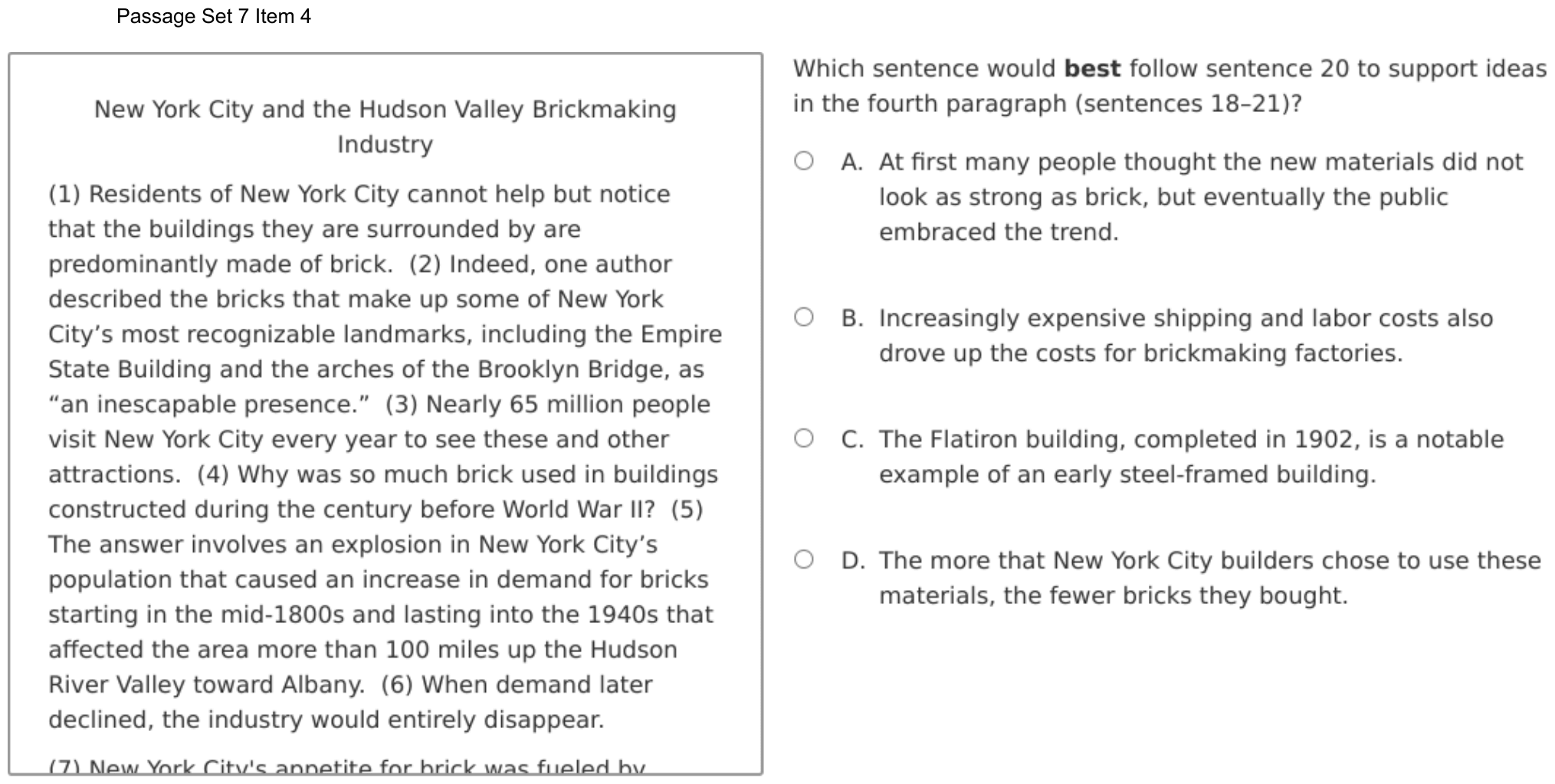
Question 48 of 50
2026 Practice Test C English, question 48Question
Which sentence contains an error in its construction and should be revised?
(1) In 1976, the National Basketball Association (NBA) absorbed several teams of the American Basketball Association (ABA), including the New York Nets, who played in the Long Island area at the time. (2) The owner of the Nets decided to take the team to New Jersey after the team had financial troubles, where the team played for thirty-five seasons. (3) The New Jersey Nets had sixteen playoff appearances, including two appearances in the NBA finals. (4) In 2012, the team changed ownership and returned to New York, where the team now plays under the name the Brooklyn Nets.
- Asentence 1
- Bsentence 2
- Csentence 3
- Dsentence 4
Show the answer
Correct answer: B
The question asks for the identification of the sentence that has an error in its construction and should be revised.
A. Incorrect. There are no errors in the structure of sentence 1. The clause “who played in the Long Island area at the time” correctly modifies the noun “New York Nets.” “Who” is the correct relative pronoun to serve as the subject of the modifying clause because it refers to people rather than objects or things.
B. CORRECT. Sentence 2 contains a structural error. The current placement of the clause “where the team played for thirty-five seasons” suggests that the clause is modifying the term “financial troubles,” which is illogical. The clause “where the team played for thirty-five seasons” should immediately follow the location, “New Jersey.” A revised version of the sentence might read, “After the team had financial troubles, the owner of the Nets decided to take the team to New Jersey, where the team played for thirty-five seasons.”
C. Incorrect. There are no errors in the structure of sentence 3. The phrase “including two appearances in the NBA finals” is a nonrestrictive phrase that provides further detail about the team’s “sixteen playoff appearances.” The phrase is set off by a comma because it is not essential to understanding the meaning of the sentence.
D. Incorrect. There are no errors in the structure of sentence 4. The clause “where the team now plays under the name the Brooklyn Nets” is a nonrestrictive clause that provides further detail about the team after its move back to New York in 2012. The clause is set off by a comma because it is not essential to understanding the meaning of the sentence.
Question analysis
This editing question gives a four-sentence paragraph tracing the Nets basketball team from Long Island to New Jersey and back to Brooklyn, and asks which sentence is built incorrectly. The sentences are long, with commas, parentheses and describing clauses, so students must check what each clause actually describes instead of trusting how smoothly it reads.
- NYS standards
- 7L1 grammar and usage conventions
- Grade level
- Grade 7 reading and task
- Compared with grade 7
- At grade 7 Placing clauses so they describe the right word is a grade 7 grammar standard. The paragraph is short and plain, but the correct sentences also carry commas and describing clauses, which matches a careful grade 7 editing task.
- Estimated difficulty
- Moderate: several steps, or a close reading with one strong distractor.
- Thinking it demands
- Depth of knowledge 2, skills and concepts · mainly analyze
- What makes it hard
- A rule that doesn't sound wrong moderate
- Every choice must be checked minor
- Complex sentences minor
- Evidence
- Answered from one paragraph or stanza
- Reading level
- Question and choices: about grade 7, 108 words.
- Students, last 30 days
- Not enough answers yet to show (it takes 10).
Why it is hard, traps and wrong answers (shows the answer)
Why it is hard
The faulty sentence is easy to understand, because the reader supplies the link between New Jersey and the thirty-five seasons without noticing the clause is in the wrong place. Students who go by sound skip it and suspect a busier sentence instead, most often the first, with its parentheses and a “who” that refers to a team. The question rewards asking, for each describing clause, which word it actually sits beside.
A rule that doesn't sound wrong moderate Working it out
Sentence 2’s “where the team played for thirty-five seasons” follows “financial troubles,” not “New Jersey,” but readers silently attach it to the state, so the misplaced clause does not sound wrong. (Connors & Lunsford, 1988)
Every choice must be checked minor Choosing the answer
The stem names no kind of error, and every sentence carries a describing clause or phrase, from “who played” to “including two appearances” to a second “where” clause, so all four must be tested. (Embretson & Wetzel, 1987)
Complex sentences minor Understanding the question
Sentence 1 runs 31 words with two abbreviations in parentheses and a “who” clause, which makes a correct sentence look like the likeliest home for an error. (Abedi & Lord, 2001; Freedle & Kostin, 1993; Messick, 1989)
Strategy: In each sentence, find every describing clause or phrase and the word just before it. Ask whether the clause can logically describe that word; a mismatch marks the sentence to revise.
Traps
- Fixes what isn't broken: Changes a part of the sentence that was already correct, while the real error stays; or, where the question asks which sentence has an error or should go, picks one that is correct and belongs.
The wrong answers, classified
A Fixes what isn't broken (Connors & Lunsford, 1988)
Believes “who” cannot refer to a team, or distrusts the long sentence with two abbreviations, though “who played in the Long Island area” correctly describes the New York Nets.
C Fixes what isn't broken (Connors & Lunsford, 1988)
Takes “including two appearances in the NBA finals” for a fragment tacked on with a comma, though the phrase correctly adds detail to “sixteen playoff appearances.”
D Fixes what isn't broken (Connors & Lunsford, 1988)
Hears the shift from “returned” to “now plays” as a tense error, though “now” marks the present, and this “where” clause sits right after New York, the place it describes.
Working it out, step by step
Figure out what the question asks
This asks which sentence is built wrong. The facts may all be true. The problem is how the parts of a sentence fit together. The question doesn’t say what kind of error to look for. So you need to test all four sentences.
Learn the rule about describing clauses
A clause is a group of words with a subject and a verb. Some clauses describe a word. They often start with who or where. A describing clause must sit right next to the word it describes. If it lands next to the wrong word, the sentence says something silly. Example: We went to the beach after the storm, where we swam all day. That says we swam in the storm! Fix: After the storm, we went to the beach, where we swam all day.
Test sentence 2
Sentence 2 ends “after the team had financial troubles, where the team played for thirty-five seasons.” The clause starting with “where” sits right after “financial troubles.” So the sentence says the team played inside its money problems. The clause should describe New Jersey, the place. Fix: After the team had financial troubles, the owner of the Nets decided to take the team to New Jersey, where the team played for thirty-five seasons.
Test sentences 1, 3 and 4
- Sentence 1: “who played in the Long Island area at the time” comes right after “the New York Nets.” A team is a group of people, so who works.
- Sentence 3: “including two appearances in the NBA finals” comes right after “sixteen playoff appearances.” It adds a detail about them, so it fits.
- Sentence 4: “where the team now plays” comes right after “New York,” a place. The word “now” makes the present tense right.
Watch out: Sentence 1 looks busy, with two names in parentheses. That makes choice A tempting. But long is not the same as wrong.
Pick the answer
Only sentence 2 puts a describing clause next to the wrong words. So the answer is B, sentence 2.
Why this answer and not the closest wrong one
Sentence 1 is the closest wrong answer, because it is long and uses who for a team. But its clause sits right next to the Nets, the team it describes. In sentence 2, the “where” clause sits next to “financial troubles,” not New Jersey. That is why B is right.
More questions like this
The original DOE question
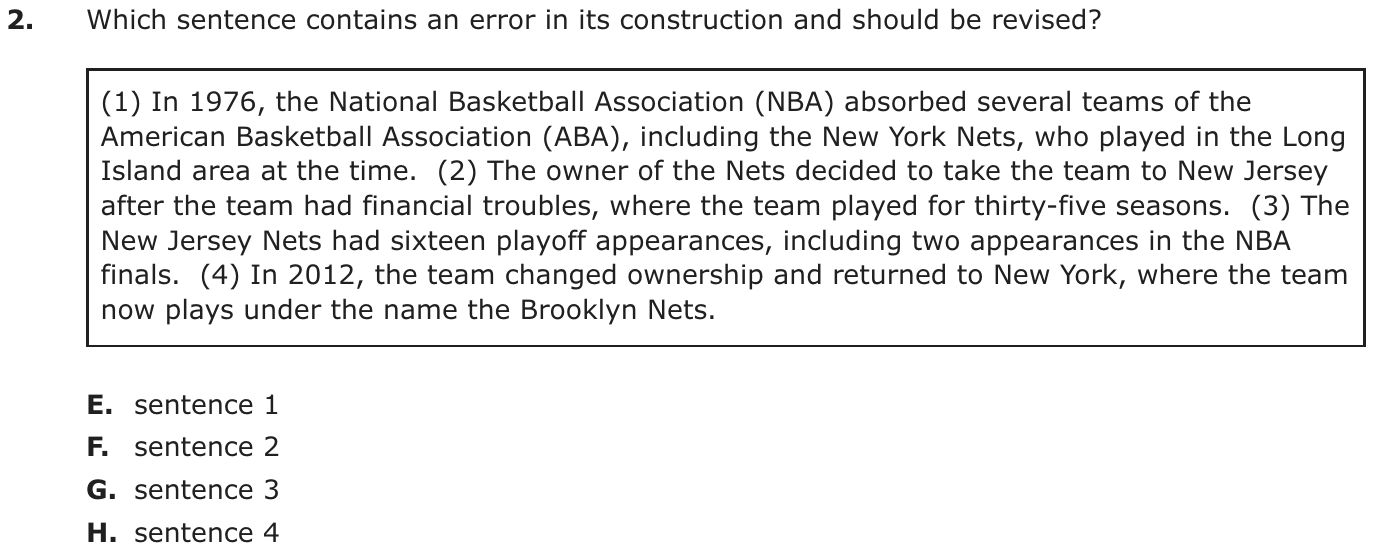
Question 49 of 50
2026 Practice Test C English, question 49Question
Read these sentences.
(1) Jordan rehearsed his role for weeks.
(2) He delivered his lines with ease.
(3) His performance was met with a burst of applause from the audience.
What is the best way to combine the sentences to clarify the relationship between ideas?
- AThough Jordan had rehearsed his role for weeks, when he delivered his lines with ease, his performance was met with a burst of applause from the audience.
- BJordan had rehearsed his role for weeks, yet he delivered his lines with ease, so his performance was met with a burst of applause from the audience.
- CBecause Jordan had rehearsed his role for weeks, he delivered his lines with ease, and his performance was met with a burst of applause from the audience.
- DJordan had rehearsed his role for weeks, so he delivered his lines with ease, but his performance was met with a burst of applause from the audience.
Show the answer
Correct answer: C
The question asks for the best way to combine the sentences to clarify the relationship between ideas.
A. Incorrect. The conjunction “though” does not make sense with the rest of the sentence since Jordan likely received applause for his performance because he rehearsed, not in spite of rehearsing.
B. Incorrect. The conjunction “yet” is incongruous with the rest of the sentence because Jordan was successful at delivering his lines likely because he rehearsed, not in spite of rehearsing.
C. CORRECT. This combination of sentences clarifies the relationship among the ideas in a way that is logical. Jordan was able to deliver his lines with ease and receive applause from the audience because he had rehearsed. “Because” is the best choice for conveying the cause-and-effect relationship between rehearsing and a successful performance.
D. Incorrect. This combination of sentences correctly expresses the relationship between rehearsing and delivering lines with ease by linking the ideas with the word “so”; however, the word “but” incorrectly links the delivery of lines with applause, suggesting that the burst of applause from the audience was unexpected.
Question analysis
This sentence-combining question gives three short sentences about Jordan, who rehearsed his role for weeks, delivered his lines with ease and drew a burst of applause, and asks for the best way to join them. Every version keeps the same facts, so students must judge which connecting words show how rehearsing, performing and the audience’s response relate.
- Grade level
- Grade 7 reading and task
- Compared with grade 7
- At grade 7 Combining sentences with connecting words that show how ideas relate is a grade 7 language skill. The three sentences are short and describe an everyday event, and the versions differ only in their connecting words, so the demand is typical.
- Estimated difficulty
- Straightforward: two steps or one careful reading.
- Thinking it demands
- Depth of knowledge 2, skills and concepts · mainly evaluate
- What makes it hard
- Every choice must be checked moderate
- How sentences fit together minor
- Evidence
- Answered from one sentence or line
- Reading level
- Question and choices: about grade 7, 150 words.
- Students, last 30 days
- Not enough answers yet to show (it takes 10).
Why it is hard, traps and wrong answers (shows the answer)
Why it is hard
The three facts form a simple chain of causes, and most students see that rehearsal explains the easy delivery. Points are lost by checking only the first connector: one version starts with a correct “so” and then joins the applause with “but,” as if it were a surprise. Versions opening with “Though” or using “yet” fail on the first link, so they are easier to rule out.
Every choice must be checked moderate Choosing the answer
Every version runs 27 words and keeps the same three facts, differing only in its two connecting words, so a wrong one can hide at the end, as “but” does after a correct “so.” (Embretson & Wetzel, 1987)
How sentences fit together minor Working it out
Students must first see the chain the sentences imply, weeks of rehearsal causing an easy delivery and the easy delivery earning applause, before any connector can be judged. (Halliday & Hasan, 1976)
Strategy: Before reading the choices, decide how each sentence leads to the next, then check every connecting word in each version, since one wrong word anywhere makes the whole combined sentence wrong.
Traps
- Wrong transition: A connecting word or phrase that signals the wrong relationship, such as contrast where the idea continues.
The wrong answers, classified
A Wrong transition (Halliday & Hasan, 1976)
Opens with “Though,” which treats weeks of rehearsal as something that should have worked against Jordan, when practice is the reason his lines came easily.
B Wrong transition (Halliday & Hasan, 1976)
Gets the second link right with “so” but joins rehearsing and easy delivery with “yet,” as if delivering lines smoothly were surprising after weeks of practice.
D Wrong transition (Halliday & Hasan, 1976)
Joins rehearsal and easy delivery correctly with “so,” then adds the applause with “but,” as if a burst of applause after a smooth performance were unexpected.
Working it out, step by step
Figure out what the question asks
You need the best way to join three short sentences into one. The joined sentence must show how the ideas connect. All four choices keep the same facts. They differ only in their connecting words. So check every connecting word in each choice.
See how the three ideas connect
Sentence 1: “Jordan rehearsed his role for weeks.” To rehearse means to practice. Sentence 2: “He delivered his lines with ease.” With ease means easily. Sentence 3: the audience burst into applause. These ideas form a chain. Practice made his lines easy. A strong performance then earned the applause. Nothing here is surprising.
Learn what each connecting word signals
- Because and so show cause and effect: I studied, so I passed.
- Though, yet and but show a contrast, something surprising: I studied, but I still failed.
- And simply adds the next idea: I studied, and I passed.
Check each choice
- A is wrong. “Though” makes the practice sound like it should have hurt him.
- B is wrong. “Yet” makes his easy delivery sound surprising after weeks of practice.
- C is right. “Because” shows that practice caused his easy delivery. “And” adds the applause that followed.
- D is wrong. “So” is right, but “but” makes the applause sound unexpected.
Watch out: D starts well with “so.” The mistake hides in its second connecting word.
Choose the answer
Only one version shows that practice led to success, with no false surprise. So the answer is C, “Because Jordan had rehearsed his role for weeks, he delivered his lines with ease, and his performance was met with a burst of applause from the audience.”
Why this answer and not the closest wrong one
D is the closest wrong answer, since its first half uses “so” correctly. But “but” tells the reader the applause was a surprise. A smooth performance after weeks of practice should earn applause. C uses “because” and “and,” which show the real chain of events.
More questions like this
The original DOE question
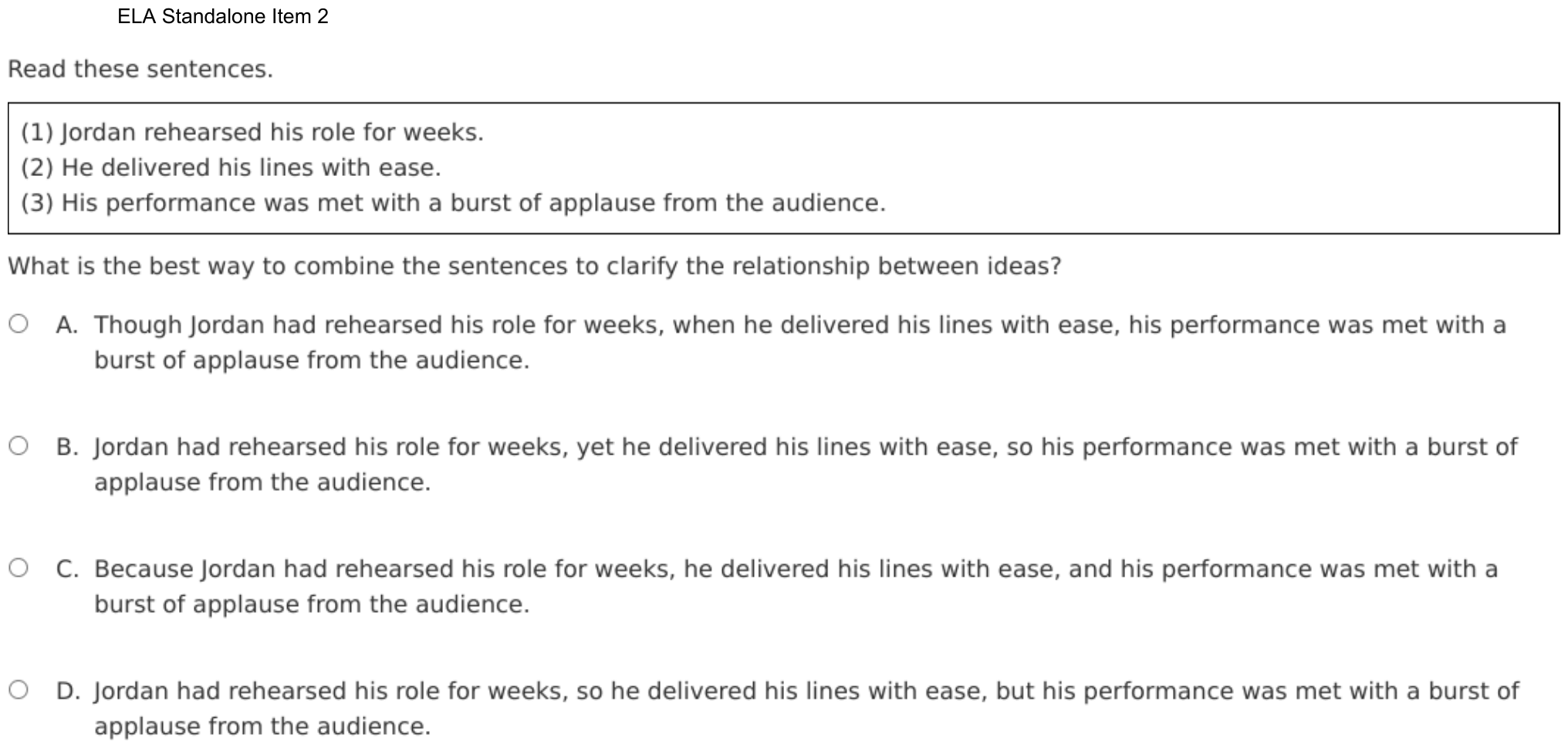
Question 50 of 50
2026 Practice Test C English, question 50Question
Which pair of revisions need to be made in this paragraph?
(1) Both Italian gelato and American ice cream are delightful treats to have on a hot summer day, but many people wonder: what is the difference between the two? (2) To start with, the butterfat content is much higher in ice cream than it is in gelato, making the Italian treat a wiser decision for people looking to make healthier choices. (3) Additionally, the mixing process, which adds less air to the frozen treat, makes gelato denser than ice cream. (4) Finally, gelato is served 10 to 15 degrees warmer than ice cream, which enhances the texture and flavor of the gelato, and allow it to melt more quickly.
- ASentence 1: Delete the colon after wonder AND change is to are.
- BSentence 2: Delete the comma after with AND change it is to they are.
- CSentence 3: Delete the comma after process AND change makes to make.
- DSentence 4: Delete the comma after gelato AND change allow to allows.
Show the answer
Correct answer: D
The question asks for the revisions that are needed to correct errors in the paragraph.
A. Incorrect. The revisions introduce new errors. The colon after “wonder” is needed to set off the question “what is the difference between the two?” from the rest of the sentence. In addition, changing the verb “is” to “are” would be incorrect with the use of the singular noun “difference,” which is the subject of the question.
B. Incorrect. The revisions introduce new errors. The comma following the introductory phrase “To start with” helps with clarity and is needed to separate the phrase from the rest of the sentence. Changing “it is” to “they are” would be incorrect with the use of the singular noun “butterfat content,” which is what the words “it is” refer to in the sentence.
C. Incorrect. The revisions introduce new errors. The comma following “process” is necessary to set off the nonrestrictive clause “which adds less air to the frozen treat” from the rest of the sentence. This clause is considered a nonrestrictive clause because it provides additional, but not essential, information about the mixing process. Changing the verb “makes” to “make” would be incorrect with the use of the singular noun “mixing process,” which is the subject of the sentence.
D. CORRECT. Deleting the comma after “gelato” would include the clause “and allow it to melt more quickly” with the first part of the clause “which enhances the texture and flavor of the gelato.” The word “and” between the two verb phrases (“enhances the texture and flavor of the gelato” and “allow it to melt more quickly”) indicates that the two verb phrases share a subject, “which” (referring to the act of serving gelato 10 to 15 degrees warmer than ice cream). The two ideas should not be separated by a comma within the clause. The entire clause “which enhances the texture and flavor of the gelato and allow it to melt more quickly” should be separated from the main clause only by the comma after “cream” because the entire clause is a nonrestrictive clause. This clause provides additional, but not essential, information about the purpose of serving gelato at a warmer temperature than ice cream. Changing the verb “allow” to “allows” is also necessary to match the use of the singular pronoun “which.”
Question analysis
This editing question gives a four-sentence paragraph comparing Italian gelato with American ice cream and asks which pair of revisions it needs. Students must check subject-verb agreement, what a pronoun refers to and whether each comma or colon belongs, and since every choice bundles two edits in one sentence, a single right-sounding change is not enough.
- Grade level
- Grade 7 reading and task
- Compared with grade 7
- At grade 7 Subject-verb agreement and commas around added clauses are grade 7 conventions. Eight marked spots across four long sentences make this a fuller check than a one-sentence item, but the demand is still typical of grade 7 editing.
- Estimated difficulty
- Moderate: several steps, or a close reading with one strong distractor.
- Thinking it demands
- Depth of knowledge 2, skills and concepts · mainly apply
- What makes it hard
- A rule that doesn't sound wrong moderate
- Every choice must be checked moderate
- Complex sentences minor
- Evidence
- Answered from one paragraph or stanza
- Reading level
- Question and choices: about grade 9, 160 words.
- Students, last 30 days
- Not enough answers yet to show (it takes 10).
Why it is hard, traps and wrong answers (shows the answer)
Why it is hard
The paragraph's only real errors sit at the end of its longest sentence, where a plural noun pair just before the faulty verb hides the mismatch. Students who do not hear “allow” as wrong start doubting correct marks instead, such as the colon before an embedded question or the comma after “To start with.” Every wrong pair also changes a verb or pronoun that already agrees, so reading each edit back into its sentence rules those pairs out.
A rule that doesn't sound wrong moderate Working it out
In sentence 4 the plural pair “texture and flavor” sits just before “and allow,” so the verb sounds right, but it belongs to “which,” the warmer serving, and must match “enhances.” (Connors & Lunsford, 1988)
Every choice must be checked moderate Choosing the answer
Each pair proposes two edits in one sentence, eight in all, and a pair is right only if both of its edits fix real errors, so every edit has to be tried in place. (Embretson & Wetzel, 1987)
Complex sentences minor Understanding the question
Sentence 4 hangs a which-clause with two verbs onto the main clause, and the comma before “and allow” splits that clause's compound predicate in a way few students hear as wrong. (Abedi & Lord, 2001; Freedle & Kostin, 1993; Messick, 1989)
Strategy: Before reading the choices, find each verb's true subject and test every marked comma yourself; then look for the choice whose two edits both fix errors you found.
Traps
- Fixes what isn't broken: Changes a part of the sentence that was already correct, while the real error stays; or, where the question asks which sentence has an error or should go, picks one that is correct and belongs.
- Agreement: A verb that does not agree with its subject, or a pronoun that does not agree with the word it stands for.
- Punctuation: A comma, semicolon, colon, dash or apostrophe used where it does not belong, or missing where it does.
The wrong answers, classified
A Agreement (Connors & Lunsford, 1988)
Hears “the two” as the subject and wants “are,” and distrusts a colon before a question, though “the difference” is singular and the colon is correct.
B Punctuation (Connors & Lunsford, 1988)
Believes a short opener like “To start with” needs no comma and accepts “they are,” though the pronoun stands for the singular “butterfat content.”
C Fixes what isn't broken (Connors & Lunsford, 1988)
Picks edits to a sentence that is already correct, unbalancing the commas around the which-clause and giving the singular “mixing process” a plural verb.
Working it out, step by step
Figure out what the question asks
Each choice offers two changes to one sentence. Both changes must fix real mistakes. If even one change breaks something that was right, the choice is wrong. So test every change in its own sentence.
Learn the rule for two verbs
A verb (an action word) must match its subject (who or what does the action). One thing takes allows. Two or more things take allow.
When one subject does two actions joined by “and,” no comma goes before “and.” Example: The sun warms the air and dries the grass. Both verbs end in s, because one sun does both.
Find the mistakes in sentence 4
Sentence 4 says gelato is served warmer than ice cream, “which enhances the texture and flavor of the gelato, and allow it to melt more quickly.”
“Which” stands for one thing: serving gelato warmer. That one thing does two actions. It “enhances” (improves) the texture and flavor. It also lets the gelato melt faster. So “allow” should be “allows,” to match “enhances.” And the comma before “and” must go.
Check each choice
- A is wrong. The colon (:) after “wonder” correctly leads into the question. And “is” matches “the difference,” which is one thing.
- B is wrong. The comma after “To start with” sets off an opening phrase. And “it is” stands for “the butterfat content,” which is one thing.
- C is wrong. The commas around “which adds less air to the frozen treat” come in a pair. And “makes” matches “the mixing process,” one thing.
- D is right. Both changes fix real mistakes.
Watch out: “The texture and flavor” comes right before “allow.” Those two things make “allow” sound right. But the subject is “which,” not “texture and flavor.”
Choose the answer
The fixed sentence ends: which enhances the texture and flavor of the gelato and allows it to melt more quickly. So the answer is D.
Why this answer and not the closest wrong one
A is the closest wrong answer. “The two” sits near “is,” so “are” can sound right. But the question asks what “the difference” is. A difference is one thing, so “is” is correct. A would add a mistake. In D, both changes fix mistakes that are really there.
More questions like this
The original DOE question