2021 Test A English
Question 1 of 57
2021 Test A English, question 1Question
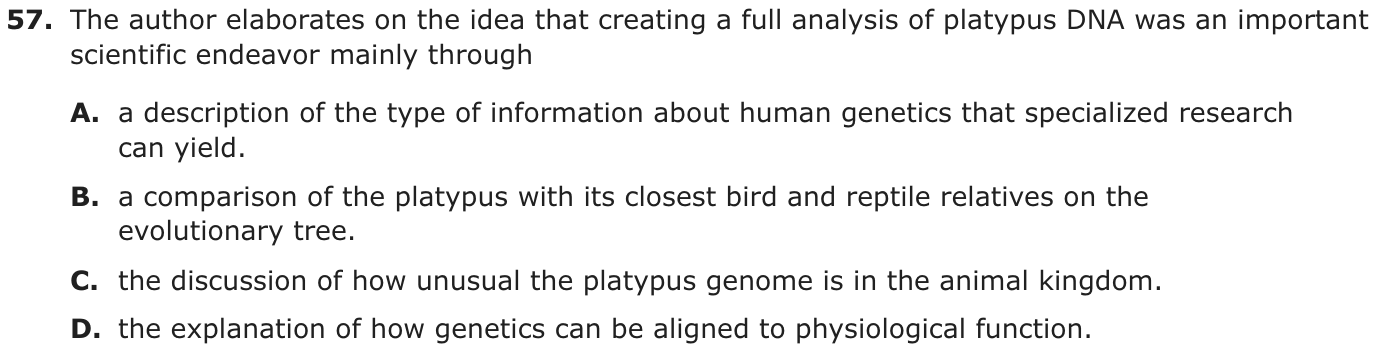
Which edit should be made to correct this sentence?
In 1962 the agile athletic Wilt Chamberlain became the first and only professional basketball player in the United States to score 100 points in a single game.
- AInsert a comma after agile.
- BInsert a comma after first.
- CInsert a comma after only.
- DInsert a comma after States.
Show the answer
Correct answer: A
The question asks which edit should be made to correct the sentence.
A. CORRECT. The sentence in the box needs a comma to separate the coordinate adjectives. Coordinate adjectives describe characteristics of the same noun or subject and are connected with a comma or “and.” This option is the only one that places a comma where it is needed, between the coordinate adjectives “agile” and “athletic.”
B. Incorrect. The option incorrectly adds a comma in the middle of the phrase “first and only,” which modifies, or gives additional information about, “professional basketball player.”
C. Incorrect. The option incorrectly adds a comma between two adjectives that are not coordinate adjectives. “Only” is part of the phrase “first and only” and is modifying “professional basketball player.”
D. Incorrect. The option is incorrect because a comma is not needed to set off the phrase “to score 100 points in a single game.”
Question analysis
This punctuation question gives one sentence about Wilt Chamberlain, the basketball player who scored 100 points in a single professional game in 1962, and asks which comma edit corrects it. All four choices add a comma, three after describing words and one after the country’s name, so students must decide which spot a comma rule truly requires.
- NYS standards
- 7L2 capitalization, punctuation, and spelling
- Grade level
- Grade 7 reading and task
- Compared with grade 7
- At grade 7 Deciding where a comma belongs in one sentence is typical grade 7 editing, and the rule tested here is part of the grade 7 language standards. The sentence sounds natural as printed, so the needed comma must be found by rule, not by ear.
- Estimated difficulty
- Straightforward: two steps or one careful reading.
- Thinking it demands
- Depth of knowledge 1, recall and reproduction · mainly apply
- What makes it hard
- A rule that doesn't sound wrong moderate
- Every choice must be checked minor
- Evidence
- Answered from one sentence or line
- Reading level
- Question and choices: about grade 7, 54 words.
- Students, last 30 days
- Not enough answers yet to show (it takes 10).
Why it is hard, traps and wrong answers (shows the answer)
Why it is hard
The sentence sounds natural as printed, so a student listening for pauses could put a comma in almost any of the four places. The question rewards knowing the test for coordinate adjectives: when “and” fits between two describing words and their order can be swapped, a comma belongs there. “Agile and athletic” passes that test, while “only and professional” fails, because “first and only” works as one unit that limits the whole phrase “professional basketball player.”
A rule that doesn't sound wrong moderate Working it out
The missing comma falls between “agile” and “athletic,” two adjectives that each describe Chamberlain, and the phrase reads smoothly without it, so the error has to be found by rule rather than by ear. (Connors & Lunsford, 1988)
Every choice must be checked minor Choosing the answer
All four edits add a comma, and two of the spots come between describing words, after “agile” and after “only,” so each pair must be tested with “and” before one is chosen. (Embretson & Wetzel, 1987)
Strategy: Take the four marked words one at a time, say what the words on either side of each are doing, and add a comma only where a rule calls for one, not wherever you would pause.
Traps
- Punctuation: A comma, semicolon, colon, dash or apostrophe used where it does not belong, or missing where it does.
The wrong answers, classified
B Punctuation (Connors & Lunsford, 1988)
Hears an emphatic pause in “the first and only,” as if writing “the first, and only,” though a single comma there splits a pair that works as one unit.
C Punctuation (Connors & Lunsford, 1988)
Believes any two describing words in a row need a comma and spots “only professional,” though “only” cannot be swapped with “professional” or joined to it by “and.”
D Punctuation (Connors & Lunsford, 1988)
Puts a comma before “to score 100 points in a single game” because the sentence is long, though that phrase tells what made him the first player and takes no comma.
Working it out, step by step
Figure out what the question asks
This is a punctuation question. Punctuation means marks like commas and periods. Each choice adds one comma to the sentence about Wilt Chamberlain. Only one of those commas is needed. Find the spot where a comma rule calls for one. Don’t just go by where you would pause when you read it aloud.
Learn the rule for describing words
An adjective is a describing word. Sometimes two adjectives in a row each describe the same noun (a naming word). They are equal partners, so a comma goes between them.
Two quick tests tell you. Can you put “and” between them? Can you swap their order? If both work, use a comma. Example: a long, boring movie. You could also say a long and boring movie or a boring, long movie.
Test agile and athletic
The sentence begins “In 1962 the agile athletic Wilt Chamberlain.” Agile means quick and light on your feet. Athletic means strong and good at sports. Both words describe Chamberlain. Now try the tests. The agile and athletic Wilt Chamberlain makes sense. So does the athletic, agile Wilt Chamberlain. Both tests pass, so a comma belongs after “agile.”
Check each choice
- A fits. “Agile” and “athletic” are equal describing words, so they need a comma.
- B does not fit. “First and only” is a pair already joined by “and.” One comma does not go inside a pair like that. You write salt and pepper, not salt, and pepper.
- C does not fit. Try the “and” test: only and professional makes no sense. “Only” goes with “first,” not with “professional.”
- D does not fit. The words after “States” tell what he was the first to do. They finish the idea, so no comma goes before them.
Choose the answer
Watch out: C is tempting because “only professional” is also two describing words in a row. But that pair fails the “and” test. The fixed sentence begins In 1962 the agile, athletic Wilt Chamberlain. So the answer is A: insert a comma after agile.
Why this answer and not the closest wrong one
C is the closest wrong answer. Like A, it puts a comma between two describing words. But only A’s pair passes the tests. You can say agile and athletic, but you can’t say only and professional. “Only” belongs with “first.” Together, “first and only” describe the whole phrase “professional basketball player.”
More questions like this
The original DOE question
Question 2 of 57
2021 Test A English, question 2Question
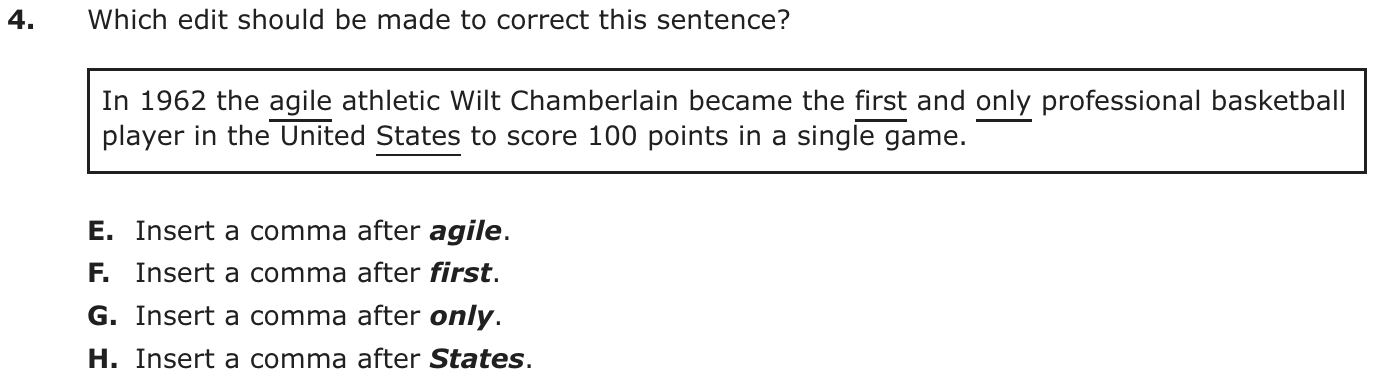
Read this sentence.
The engineers tried some other things in the hope of finding a more effective insulation for the compartment.
What is the most precise revision for the words The engineers tried some other things?
- AThe engineers did experiments with several new materials
- BThe engineers tested foam and fiberglass
- CThe engineers examined two new materials
- DThe engineers worked with foam and fiberglass
Show the answer
Correct answer: B
The question asks for the most precise revision for the words “The engineers tried some other things.”
A. Incorrect. This revision uses the word “materials” rather than precisely identifying what the engineers used.
B. CORRECT. This option revises the words to be more precise by using the specific words “tested” for the verb and “foam and fiberglass” for the materials.
C. Incorrect. This revision uses the word “examined” rather than a word indicating a process of experimental trial and error. The sentence also uses the word “materials” rather than precisely identifying what the engineers used.
D. Incorrect. This revision identifies the materials, but the imprecise verb “worked with” does not specify what the engineers were doing.
Question analysis
This revising question gives one sentence about engineers looking for better insulation for a compartment and asks which rewrite of its vague opening words is the most precise. The tricky part is that some choices sharpen one half of the phrase while leaving the other half as loose as the original.
- NYS standards
- 7L3a precise and concise language
- Grade level
- Grade 7 reading and task
- Compared with grade 7
- Below grade 7 Choosing precise wording is a grade 7 language standard, but this item is a single sentence about an engineering test with everyday words. Typical grade 7 revision asks for the same judgment across a paragraph or a full draft.
- Estimated difficulty
- Straightforward: two steps or one careful reading.
- Thinking it demands
- Depth of knowledge 1, recall and reproduction · mainly evaluate
- What makes it hard
- A very close wrong answer moderate
- Every choice must be checked minor
- Evidence
- Answered from one sentence or line
- Reading level
- Question and choices: about grade 7, 63 words.
- Students, last 30 days
- Not enough answers yet to show (it takes 10).
Why it is hard, traps and wrong answers (shows the answer)
Why it is hard
Precision here has two halves: a verb that names the actual activity and an object that names the actual materials. Most students who miss it stop at the first concrete detail they see, the named materials or the count of two, and never test the verb. Only one rewrite names both an exact action and the exact materials; each of the others leaves one half, or both, nearly as loose as the original.
A very close wrong answer moderate Choosing the answer
The rewrite with “worked with foam and fiberglass” matches the right one word for word except the verb, so only asking whether “worked with” says what the engineers did separates them. (Embretson & Wetzel, 1987; Gorin & Embretson, 2006; Ascalon et al., 2007)
Every choice must be checked minor Choosing the answer
The vague words have two parts, the action “tried” and the object “some other things,” and each rewrite sharpens a different part, so every one must be tested for both. (Embretson & Wetzel, 1987)
Strategy: Split the underlined words into the action and the things acted on, then ask of each revision whether a reader would know exactly what the engineers did and with what.
Traps
- Half right: One half of a two-part choice is right and the other is not.
- Wordy, vague or informal: A revision is grammatical but wordy, imprecise or too casual for the passage.
The wrong answers, classified
A Wordy, vague or informal (Connors & Lunsford, 1988)
Takes “did experiments with” as an exact verb, but the wordier phrase still ends in “several new materials,” which leaves the reader guessing what was tried.
C Wordy, vague or informal (Connors & Lunsford, 1988)
Treats the count “two” as precise detail, though the materials stay unnamed and “examined” suggests looking them over rather than trying them as insulation.
D Half right (King et al., 2004; Thissen, Steinberg & Fitzpatrick, 1989)
Sees that naming foam and fiberglass makes the object exact and stops there, missing that “worked with” is as vague as the original “tried.”
Working it out, step by step
Figure out what the question asks
This question is about precise language. Precise means exact and clear. The words “The engineers tried some other things” are vague. You can’t tell what the engineers did. You also can’t tell what they used. You need the rewrite that tells both.
Learn what makes words precise
Precise writing names the exact action and the exact thing. Vague: She did stuff with food. Precise: She baked bread.
The underlined words have two vague parts. The verb (the action word) is “tried.” The things are “some other things.” A good rewrite must fix both parts.
Think about what the sentence needs
The engineers want “a more effective insulation.” Insulation is material that keeps heat or cold from getting through. To find the best one, they would try out real materials and see how well each works. So the best verb says they tested. The best object names the materials.
Check each choice
- A is wrong. “Did experiments with” is wordy, and “several new materials” still doesn’t say which ones.
- B is right. “Tested” names the exact action. “Foam and fiberglass” names the exact materials.
- C is wrong. “Two new materials” gives a number but no names. “Examined” means looked over, not tried out.
- D is wrong. It names foam and fiberglass. But “worked with” is as vague as “tried.”
Watch out: D is tempting because it names the materials. Always check the verb too.
Choose the answer
Only B fixes both vague parts. The reader learns what the engineers did and what they used. So the answer is B: The engineers tested foam and fiberglass.
Why this answer and not the closest wrong one
D is the closest wrong answer. It matches B word for word except for the verb. “Worked with” could mean cut, built or studied. “Tested” tells you the engineers tried each material to see how well it insulates. That is what the sentence is about, so B is more precise.
More questions like this
The original DOE question
Question 3 of 57
2021 Test A English, question 3Question
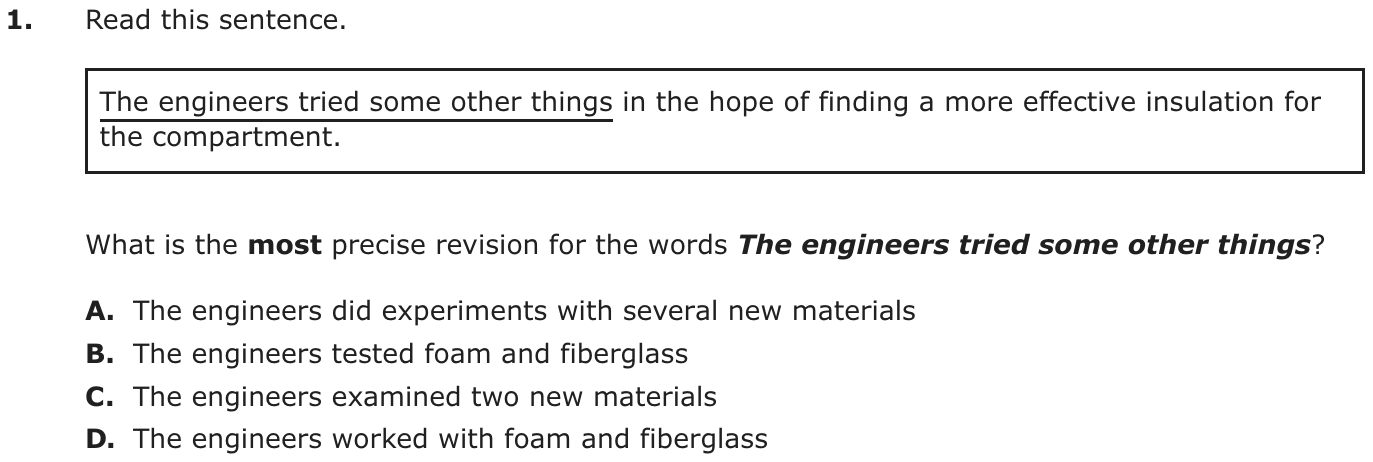
Which revision corrects the error in sentence structure in the paragraph?
In 1967 Kathrine Switzer signed up for the Boston Marathon using her first and middle initials instead of her full name, at that time, only men were permitted to officially register and receive a number for the legendary race. Once officials realized a woman was attempting to run in the race, they made efforts to remove her from the competition. Switzer prevailed and finished in just over four hours, paving the way for the official rule change that allowed for the inclusion of women. In 2017, to mark the fiftieth anniversary of this pioneering event, a seventy-year-old Switzer repeated her run, wearing the number 261, the same number she had worn in that first run in 1967.
- Aname. At
- Brace. They
- Chours. Paving
- D261. The
Show the answer
Correct answer: A
The question asks for the revision that corrects the error in sentence structure in the paragraph.
A. CORRECT. As written, the first sentence (“In 1967 Kathrine Switzer . . . legendary race.”) is a run-on sentence because a comma is used to combine two independent clauses. Independent clauses are complete sentences with a subject and a verb. The clauses—“In 1967 Kathrine Switzer signed up for the Boston Marathon using her first and middle initials instead of her full name” and “at that time, only men were permitted to officially register and receive a number for the legendary race”—should be separated with a period instead. This revision correctly places a period after the word “name” and capitalizes the word “At” to separate the two independent clauses into two sentences.
B. Incorrect. The revision introduces an error into the paragraph and does not revise the run-on in the first sentence. The clause “Once officials realized a woman was attempting to run in the race” is a dependent clause functioning as an adverb of the independent clause that follows it. Changing the comma after the word “race” to a period would incorrectly separate the adverbial dependent clause from the independent clause.
C. Incorrect. The revision introduces an error into the paragraph and does not revise the run-on in the first sentence. The sentence “Switzer prevailed and finished in just over four hours, paving the way for the official rule change that allowed for the inclusion of women” combines an independent clause (“Switzer prevailed and finished in just over four hours”) and a participial phrase (“paving the way for the official rule change that allowed for the inclusion of women”). The phrase “paving the way for the official rule change that allowed for the inclusion of women” is not a complete sentence and must stay connected to the first part of the sentence. Changing the comma after “hours” to a period would incorrectly separate the participial phrase from the independent clause.
D. Incorrect. The revision introduces an error into the paragraph and does not revise the run-on in the first sentence. Changing the comma after “261” to a period would incorrectly separate the appositive phrase “the same number she had worn in that first run in 1967” from the words it describes (“number 261”). Additionally, the phrase “the same number she had worn in that first run in 1967” is not a complete sentence.
Question analysis
This sentence-structure question gives a four-sentence paragraph about Kathrine Switzer, who entered the 1967 Boston Marathon under her initials when only men could register and ran it again at seventy. Students pick the revision that corrects its error in sentence structure, and because every choice turns an underlined comma into a period, each spot needs its own check.
- Grade level
- Grade 6 reading and task
- Compared with grade 7
- Below grade 7 Run-ons and fragments are taught before grade 7, and this item checks that skill at four underlined spots in one short paragraph. The clauses and phrases around the correct commas take some grammar sense, but the core skill is basic.
- Estimated difficulty
- Straightforward: two steps or one careful reading.
- Thinking it demands
- Depth of knowledge 2, skills and concepts · mainly apply
- What makes it hard
- A rule that doesn't sound wrong moderate
- Every choice must be checked minor
- Complex sentences minor
- Evidence
- Answered from one paragraph or stanza
- Reading level
- Question and choices: about grade 7, 131 words.
- Corrected from the DOE handbook
- A misspelled name in the paragraph and its explanation was corrected.
- Grammar terms in the explanations of two wrong options were corrected.
- Students, last 30 days
- Not enough answers yet to show (it takes 10).
Why it is hard, traps and wrong answers (shows the answer)
Why it is hard
Every choice makes the same kind of change, so the question comes down to telling one real comma splice from three commas doing legitimate work. The most dangerous spot is after “race,” where a subject and verb sit on both sides of the comma, just as at the real error, and only the word “Once” marks the first part as dependent. Students who test each side for a complete thought, not just for a subject and a verb, find the splice in the opening sentence quickly.
A rule that doesn't sound wrong moderate Working it out
The run-on hides behind the short phrase “at that time,” which makes the comma after “name” sound like an ordinary pause; only checking that each side can stand alone exposes the comma splice. (Connors & Lunsford, 1988)
Every choice must be checked minor Choosing the answer
All four revisions swap a comma for a period, so every underlined spot needs the same test: could the words before it and the words after it each stand as a sentence? (Embretson & Wetzel, 1987)
Complex sentences minor Understanding the question
The three correct commas guard three different structures, an opening “Once” clause, a participial phrase beginning with “paving” and an appositive after “261,” and each has to be recognized as unable to stand alone. (Abedi & Lord, 2001; Freedle & Kostin, 1993; Messick, 1989)
Strategy: At each underlined comma, read the words before it and the words after it as separate pieces and ask whether each could stand alone as a sentence; that shows where a period belongs.
Traps
- Fragment or run-on: Creates or keeps a sentence fragment, a run-on sentence or a comma splice.
The wrong answers, classified
B Fragment or run-on (Connors & Lunsford, 1988)
Finds a subject and verb on both sides of the comma after “race” and calls it a splice, missing that “Once” makes the first part a dependent clause that cannot stand alone.
C Fragment or run-on (Connors & Lunsford, 1988)
Treats the long third sentence as a run-on and ends it after “hours,” leaving “Paving the way for the official rule change” as a fragment with no subject or main verb.
D Fragment or run-on (Connors & Lunsford, 1988)
Spots the subject and verb “she had worn” after the comma following “261,” but they sit inside a phrase that renames the number, so the new sentence would be a fragment.
What was corrected from the DOE handbook, and why
- Stem and explanation: The handbook spells the runner’s name “Katherine Switzer” in the paragraph and twice in the explanation. She is Kathrine Switzer, who entered the 1967 Boston Marathon as “K. V. Switzer,” so the site now spells her name that way, in the question’s title too. No answer depends on the spelling.
- Explanation: The DOE’s explanation of Option C calls “paving the way for the official rule change that allowed for the inclusion of women” a dependent clause, and on that basis calls the sentence a complex sentence. The words have no subject or finite verb of their own: they are a participial phrase, which the site now calls them, and the site no longer calls the sentence complex for that reason. Its explanation of Option D calls “the same number she had worn in that first run in 1967” a modifying clause; it is an appositive phrase, a noun phrase that renames “number 261,” and the site now says so. Neither phrase can stand alone as a sentence, so Options C and D are still wrong, and the answer, Option A, is unchanged.
Working it out, step by step
Figure out what the question asks
This is a sentence structure question. In one spot, two full sentences are joined by only a comma. That mistake is called a run-on. Every choice turns one underlined comma into a period. Only one of those changes fixes a run-on. The other three would break off a piece that can’t stand alone.
Learn the rule for run-ons
An independent clause is a group of words that makes sense alone. It has a subject and a verb. The subject is who or what the sentence is about. The verb tells what the subject does or is. A comma alone can’t join two independent clauses. Use a period instead.
Example: It rained, we stayed inside. Fix: It rained. We stayed inside.
Test the comma after name
Read the words before that comma: “In 1967 Kathrine Switzer signed up for the Boston Marathon using her first and middle initials instead of her full name.” That makes sense alone. Now read the words after it: “at that time, only men were permitted to officially register.” That makes sense alone too. Its subject is “only men,” and its verb is “were permitted.” So two full sentences are joined by a comma. That is the run-on.
Test the other three commas
- B (after “race”): The first part is “Once officials realized a woman was attempting to run in the race.” The word “Once” makes it a dependent clause. That is a group of words with a subject and verb that can’t stand alone.
- C (after “hours”): The words starting “paving the way for the official rule change” are a participial phrase. The phrase starts with an -ing verb form and adds information. It has no subject of its own.
- D (after “261”): “the same number she had worn in that first run in 1967” is an appositive phrase. It renames the noun right before it, the number 261. It can’t stand alone either.
Choose the answer
Watch out: B is the trickiest. It has a subject and a verb on each side of its comma, “officials realized” and “they made.” But “Once” keeps the first part from standing alone. Only the comma after “name” joins two full sentences. A period goes there, and “At” gets a capital letter. So the answer is A: name. At.
Why this answer and not the closest wrong one
B is the closest wrong answer. Like the comma after “name,” its comma has a subject and a verb on each side. But “Once” means the first part needs the words after the comma to finish its thought. At the comma after “name,” both sides already stand alone. So that comma is the real run-on.
More questions like this
The original DOE question
Question 4 of 57
2021 Test A English, question 4Question
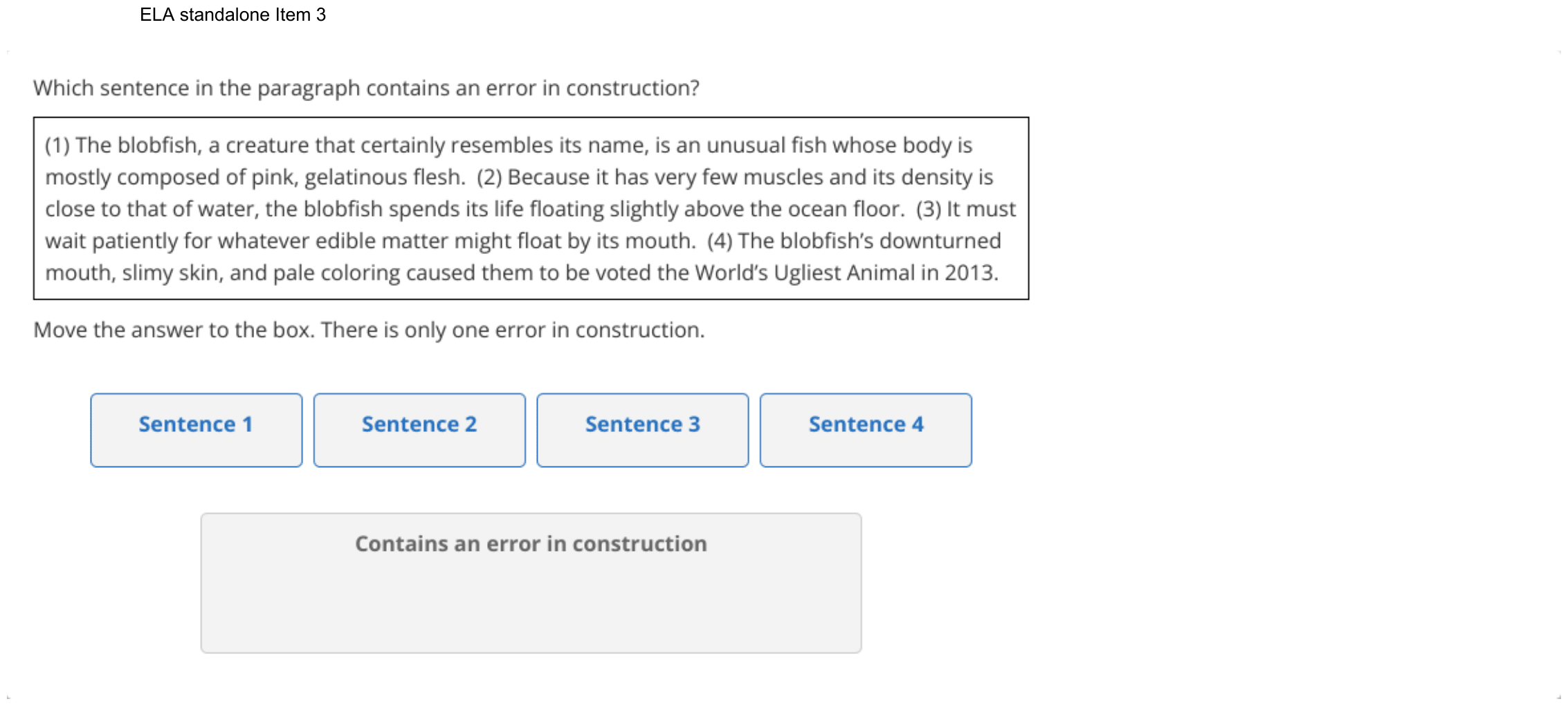
Which sentence in the paragraph contains an error in construction?
(1) The blobfish, a creature that certainly resembles its name, is an unusual fish whose body is mostly composed of pink, gelatinous flesh. (2) Because it has very few muscles and its density is close to that of water, the blobfish spends its life floating slightly above the ocean floor. (3) It must wait patiently for whatever edible matter might float by its mouth. (4) The blobfish’s downturned mouth, slimy skin, and pale coloring caused them to be voted the World’s Ugliest Animal in 2013.
Move the answer to the box. There is only one error in construction.
Contains an error in construction
On the test you drag one of the tiles into the box; here, choose it.
- ASentence 1
- BSentence 2
- CSentence 3
- DSentence 4
Show the answer
Correct answer: D
The question asks for identification of the one sentence in the paragraph that contains an error in construction.
Sentence 1: Construction is correct. The singular pronoun “its” matches the number of the word it refers to, the singular noun “blobfish.” Additionally, the appositive phrase “a creature that certainly resembles its name” is correctly set off by commas to provide an extra, but not essential, detail about the blobfish. The comma separating “pink” and “gelatinous” is correct because these are coordinate adjectives. There are no errors in sentence 1.
Sentence 2: Construction is correct. The singular pronouns “it” and “its” match the number of the word they refer to, the singular noun “blobfish.” Additionally, the structure of the sentence correctly shows that the clause “Because it has very few muscles and its density is close to that of water” explains why “the blobfish” spends its life floating. There are no errors in sentence 2.
Sentence 3: Construction is correct. The “it” and “its” in the sentence refer to “the blobfish” mentioned in the previous sentence. The use of singular pronouns in sentence 3 is consistent with the rest of the paragraph. There are no errors in sentence 3.
Sentence 4: Contains an error in construction. Sentence 4 erroneously uses the plural pronoun “them” to refer to the blobfish, when the singular “it” should have been used. Although sentence 4 starts by correctly referring to the blobfish in the singular (“the blobfish’s”), it erroneously switches to plural usage midway through: “caused them to be voted.” This is an error because the rest of the paragraph refers to the blobfish in the singular. The singular construction of the paragraph starts with “a creature” and “an unusual fish” in sentence 1 and continues throughout sentence 2 (“it has,” “its density,” “the blobfish,” and “its life”), sentence 3 (“It must” and “its mouth”), and the first half of sentence 4 (“the blobfish’s”). Proper construction requires sentence 4 to maintain the paragraph’s consistent use of singular references. To fix the construction error in sentence 4, the plural pronoun “them” should be changed to the singular pronoun “it” (i.e., “The blobfish’s downturned mouth, slimy skin, and pale coloring caused it to be voted the World’s Ugliest Animal in 2013.”).
Question analysis
This editing question gives a four-sentence paragraph describing the blobfish, a pink, jelly-like fish that floats just above the ocean floor, and asks which sentence contains an error in construction. On the test students move a sentence tile into a box; the kind of error is not named, so every sentence, with its commas, describing phrases and pronouns, must be checked.
- NYS standards
- 7L1 grammar and usage conventions
- Grade level
- Grade 7 reading and task
- Compared with grade 7
- At grade 7 The grammar here is taught by grade 6, but the question does not say what kind of error to look for, and the correct sentences carry commas, describing phrases and pronouns of their own, which is typical of grade 7 editing.
- Estimated difficulty
- Moderate: several steps, or a close reading with one strong distractor.
- Thinking it demands
- Depth of knowledge 2, skills and concepts · mainly analyze
- What makes it hard
- A rule that doesn't sound wrong moderate
- Every choice must be checked moderate
- Evidence
- Answered from one paragraph or stanza
- Reading level
- Question and choices: about grade 6, 112 words.
- Corrected from the DOE handbook
- Two grammar terms in the explanation were wrong; both sentences were corrected.
- Students, last 30 days
- Not enough answers yet to show (it takes 10).
Why it is hard, traps and wrong answers (shows the answer)
Why it is hard
The faulty pronoun is camouflaged by the list right before it, which makes a plural sound natural, so students who read by ear pass the last sentence and flag a correct one. The likeliest victim is sentence 2, where “it” comes before the noun it stands for, which some students wrongly believe is not allowed. The question rewards asking, for each pronoun, what noun it stands for and whether the number matches.
A rule that doesn't sound wrong moderate Working it out
“Them” in sentence 4 follows the plural list “downturned mouth, slimy skin, and pale coloring,” so it sounds right, though what was voted ugliest is the singular blobfish. (Connors & Lunsford, 1988)
Every choice must be checked moderate Choosing the answer
The stem names no kind of error, and every sentence has a pronoun or a set-off phrase that could be suspect, from the opening appositive to the “Because it has” clause, so all four must be checked. (Embretson & Wetzel, 1987)
Strategy: Check each sentence in turn: the subject and verb, what every pronoun refers to, and what each describing phrase attaches to, without trusting how smoothly the sentence sounds.
Traps
- Fixes what isn't broken: Changes a part of the sentence that was already correct, while the real error stays; or, where the question asks which sentence has an error or should go, picks one that is correct and belongs.
The wrong answers, classified
A Fixes what isn't broken (Connors & Lunsford, 1988)
Suspects the long interruption “a creature that certainly resembles its name” or the comma in “pink, gelatinous,” though both are correct and the sentence is complete.
B Fixes what isn't broken (Connors & Lunsford, 1988)
Believes a pronoun cannot come before its noun, so flags “Because it has very few muscles,” though “it” correctly looks ahead to “the blobfish” in the main clause.
C Fixes what isn't broken (Connors & Lunsford, 1988)
Assumes “It” must point to the nearest noun, “the ocean floor,” and calls it unclear, though only the blobfish could wait for food to float by.
What was corrected from the DOE handbook, and why
- Explanation: The handbook's explanation of sentence 1 calls “a creature that certainly resembles its name” a clause; it is an appositive phrase, a noun phrase that renames “the blobfish”, and now says so. Its explanation of sentence 2 says the “Because…” clause “modifies the words ‘the blobfish’”; an introductory “because” clause tells why something happens, so it modifies the verb, and the sentence now says it explains why the blobfish spends its life floating. The answer, sentence 4, is unchanged.
Working it out, step by step
Figure out what the question asks
You need the one sentence with an error in construction, a mistake in how the sentence is built. The question doesn’t say what kind of error. So check each sentence’s commas, phrases and pronouns. A pronoun is a word like it or them that stands in for a noun.
Check sentence 1
“A creature that certainly resembles its name” is an extra phrase that renames the blobfish. Commas around an extra phrase are correct: Max, my brother, plays drums. In “pink, gelatinous,” a comma sits between two describing words of equal weight. Gelatinous means jelly-like. You could say pink and gelatinous, so the comma is right.
Check sentences 2 and 3
Sentence 2 starts, “Because it has very few muscles.” This part tells why the blobfish floats. Here “it” comes before “the blobfish.” That is allowed when the noun follows soon after: Because she was tired, Maya went to bed. In sentence 3, “It” can only mean the blobfish. Only the fish could wait for food to float by its mouth. Both sentences are correct.
Watch out: Some students think a pronoun can never come before its noun. That makes sentence 2 look wrong, which leads to B.
Find the error in sentence 4
Sentence 4 says the fish’s features “caused them to be voted the World’s Ugliest Animal in 2013.” What was voted the ugliest animal? The blobfish, one animal. A pronoun must match its noun in number. So it should be it, not them. The rest of the paragraph calls the blobfish it every time.
Watch out: The list just before, “downturned mouth, slimy skin, and pale coloring,” is plural. That makes them sound right. But a mouth, skin and coloring can’t be voted an animal.
Show the fix
Fixed, the sentence reads: The blobfish’s downturned mouth, slimy skin, and pale coloring caused it to be voted the World’s Ugliest Animal in 2013. Now the pronoun matches the one blobfish.
Choose the answer
Sentences 1, 2 and 3 are built correctly. Only sentence 4 has a pronoun that doesn’t match its noun. So the answer is D: move the tile “Sentence 4” into the box labeled “Contains an error in construction.”
Why this answer and not the closest wrong one
Sentence 2 is the closest wrong answer, because “it” comes before the word “blobfish.” That is allowed, since the noun follows right away. In sentence 4, though, “them” is plural but stands for one blobfish. That mismatch is the real error.
More questions like this
The original DOE question
Question 5 of 57
2021 Test A English, question 5Passage Cracking the Code
Cracking the Code
(1) Computer code is part of every electronic interaction, from video games to home thermostats to vehicle GPS systems. (2) Code is a language that computers can interpret, and programmers use it to instruct computers to perform different tasks, such as finding, sorting, or calculating data. (3) People who code have to learn this language. (4) They can construct programs that will perform detailed tasks. (5) The programs can also perform complex tasks.
(6) A coding language uses letters, numbers, and symbols that are arranged in a way that makes sense to a computer. (7) The code that makes up a program tells a computer how to process information. (8) Studying a coding language involves learning the rules for combining phrases and instructions so that they are recognizable to the computer. (9) Once a person understands coding rules, the possibilities for applying them are infinite.
(10) Coding skills are becoming important in many occupational fields. (11) For example, code can be used to create programs to track, analyze, and predict changes in the stock market. (12) Code can also be designed to help doctors track and monitor a patient’s health. (13) Jobs that require coding skills are typically higher paying, offering salaries that are up to as much as $22,000 a year more than jobs that do not require coding knowledge.
(14) People have a variety of opportunities to learn how to code. (15) In some schools, young people can study computer science and coding just as they study foreign languages. (16) Computer science teachers can use websites and apps that employ games designed to help everyone understand how code works. (17) Even high school students who do not take computer science can learn coding by attending coding workshops and online classes or by watching tutorials online. (18) After studying the basics of coding, some students may become interested in learning how to create programs, such as games and apps.
(19) The late Steve Jobs, a pioneer in computer technology, once said, “Everybody in this country should learn how to program a computer . . . because it teaches you how to think.” (20) Learning to code can seem challenging, but one does not need to become an expert programmer to reap the benefits of understanding this language.
Question
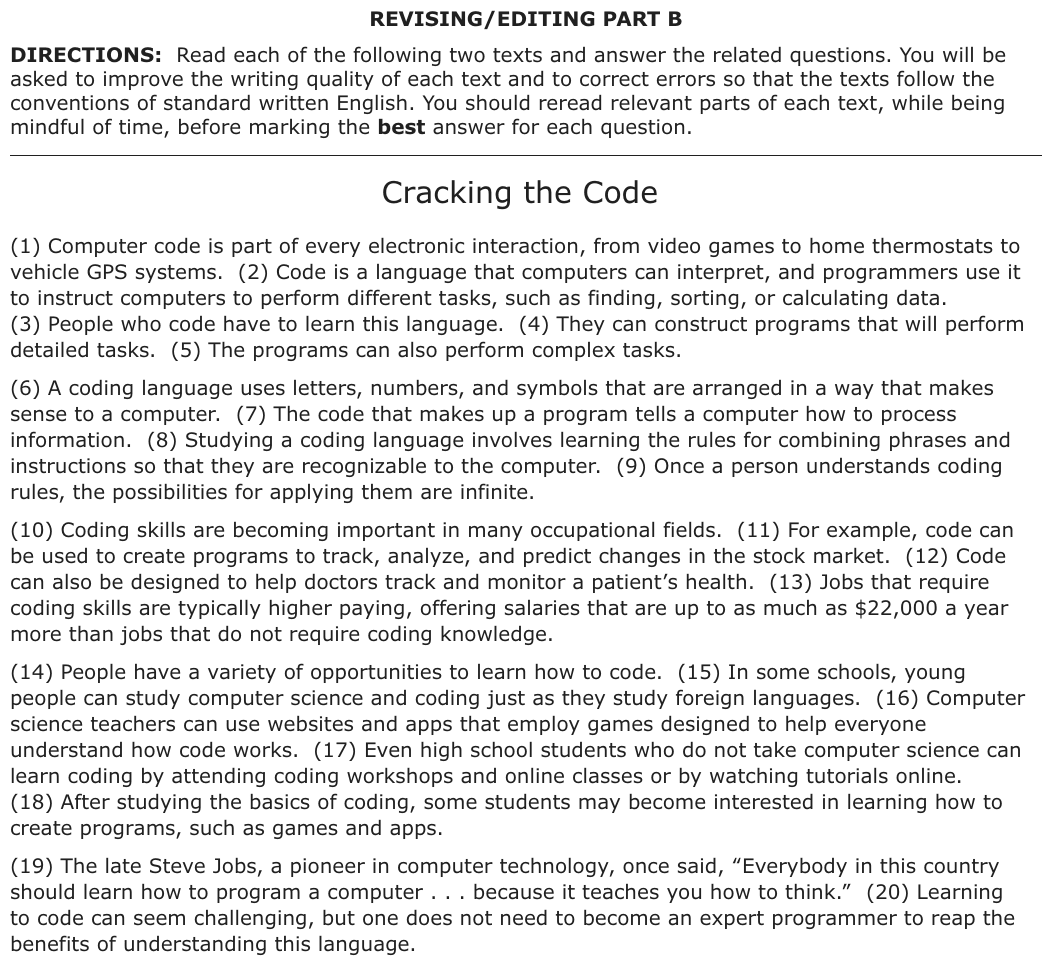
What is the best way to combine sentences 3 through 5 to clarify the relationship between ideas?
- APeople who code have to learn this language because they can construct programs that will perform detailed and complex tasks.
- BPeople who code have to learn this language so they can construct programs that will perform detailed or complex tasks.
- CWhen people who code have to learn this language, it is so they can construct programs that will perform detailed and complex tasks.
- DIf people who code have to learn this language, then they can construct programs that will perform detailed as well as complex tasks.
Show the answer
Correct answer: B
The question asks for the best way to combine sentences 3 through 5 to clarify the relationship between ideas.
A. Incorrect. While this sentence shows a relationship between the ideas, it does not clarify the relationship accurately. Learning the language of code does not depend on people’s previous ability to construct programs that will perform detailed and complex tasks. The word “because” incorrectly indicates that people can already construct complex programs prior to learning the coding language that would allow them to do so.
B. CORRECT. This sentence accurately shows the relationship between the ideas of the sentences. Before people can construct programs that will perform detailed and complex tasks, they have to learn a coding language. Knowing that language will, in turn, allow them to build programs that can perform detailed and complex tasks.
C. Incorrect. This sentence does not accurately express the relationship between ideas because the sentence implies that some people who code do not have to learn the language to perform their job functions. The passage clearly states that “computer code is part of every electronic interaction” (sentence 1) and that “programmers use it to instruct computers to perform different tasks” (sentence 2).
D. Incorrect. The conditional (If . . . then) construction of the sentence in Option D does not convey the intended relationship of the ideas in the sentences. The “then” statement (“they can construct programs that will perform detailed as well as complex tasks”) does not follow the condition of the “if” statement (“people who code have to learn this language”).
Question analysis
This sentence-combining question uses the first paragraph of “Cracking the Code,” a passage about computer coding, and asks for the best way to join sentences 3 through 5: coders must learn the language, they can build programs for detailed tasks, and those programs can also handle complex ones. Each version links the ideas with a different word, so students must judge which states the relationship accurately.
- Grade level
- Grade 7 reading and task
- Compared with grade 7
- At grade 7 Joining short sentences with a word that shows how their ideas relate is typical grade 7 work. Here three sentences become one and every version is grammatical, so the choice rests on whether the joining words state the logic accurately.
- Estimated difficulty
- Moderate: several steps, or a close reading with one strong distractor.
- Thinking it demands
- Depth of knowledge 2, skills and concepts · mainly evaluate
- What makes it hard
- A very close wrong answer moderate
- How sentences fit together moderate
- Every choice must be checked minor
- Evidence
- Answered from one paragraph or stanza
- Reading level
- Passage: about grade 10, 357 words; question and choices: about grade 9, 101 words.
- Students, last 30 days
- Not enough answers yet to show (it takes 10).
Why it is hard, traps and wrong answers (shows the answer)
Why it is hard
Every version is a correct sentence carrying the same facts, so the question tests logic rather than grammar: what does learning the language make possible? The look-alike joined by “because” is the main danger, since it seems to give a reason for learning. Careful readers may also pause over the key’s “detailed or complex tasks,” looser than sentence 5’s “also,” but the joining word, not that slip, is what separates the best sentence from the rest.
A very close wrong answer moderate Choosing the answer
The version joined by “because” matches the key word for word except for its linking word and “and” in place of “or,” so the decision rests on which way the link between learning and building runs. (Embretson & Wetzel, 1987; Gorin & Embretson, 2006; Ascalon et al., 2007)
How sentences fit together moderate Working it out
Sentence 3 states a requirement and sentences 4 and 5 state what meeting it allows, so the combined sentence must present learning the language as the means and building programs as the purpose. (Halliday & Hasan, 1976)
Every choice must be checked minor Choosing the answer
All four versions are grammatical and keep the same facts; only the opening or joining words change, “because,” “so,” “When … it is so” and “If … then,” and each must be weighed. (Embretson & Wetzel, 1987)
Strategy: Before reading the choices, decide in your own words how sentence 3 relates to sentences 4 and 5, then check whether each version’s opening or joining word signals that same relationship.
Traps
- Wrong transition: A connecting word or phrase that signals the wrong relationship, such as contrast where the idea continues.
- Wordy, vague or informal: A revision is grammatical but wordy, imprecise or too casual for the passage.
The wrong answers, classified
A Wrong transition (Halliday & Hasan, 1976)
Hears “because” as giving the reason to learn the language, but it treats the ability to build detailed and complex programs as already there, when that ability comes from learning.
C Wordy, vague or informal (Connors & Lunsford, 1988)
Is drawn by the formal ring of “When … it is so,” which buries the purpose in a clumsy frame and suggests coders must learn the language only on some occasions.
D Wrong transition (Halliday & Hasan, 1976)
Keeps learning before building but frames it with “If … then,” turning a stated requirement into a mere possibility, though having to learn a language does not by itself let anyone build programs.
Working it out, step by step
Figure out what the question asks
This asks you to join three short sentences into one. The new sentence must show how the ideas connect. All four choices are correct sentences with the same facts. What changes is the joining word. So first decide how the ideas connect. Then find the joining word that says so.
Read sentences 3 through 5
Sentence 3 says “People who code have to learn this language.” Sentence 4 says “They can construct programs that will perform detailed tasks.” Sentence 5 adds “The programs can also perform complex tasks.” To construct is to build. Detailed tasks have many small parts. Complex tasks are complicated and hard to do.
Name the link between the ideas
Why do coders have to learn the language? So that they can build programs. Learning comes first. Building programs is the goal it makes possible. A word that shows a goal, or purpose, is “so” (short for “so that”). Example: I practice piano so I can play in the concert. The practice comes first, and the concert is the goal.
Check each choice
- A does not fit. “Because” gives a reason that is already true. It says coders learn the language because they can already build programs. That gets the order backward.
- B fits. “So” shows that building programs is the goal of learning the language. It says “detailed or complex tasks” where sentence 5 means both, a small slip. But its joining word is right.
- C does not fit. “When” suggests coders only sometimes have to learn the language. And “it is so” is wordy.
- D does not fit. “If” makes learning sound like a maybe. The passage says coders “have to learn” it. That is a must.
Choose the answer
Watch out: A is the most tempting. It matches B almost word for word, and “because” sounds like a reason to learn. But it points the wrong way. B shows that learning leads to building. So the answer is B.
Why this answer and not the closest wrong one
A is the closest wrong answer. It uses the same words as B except for the joining word. “Because” makes building programs the reason coders learn the language, as if they could already do it. “So” makes building programs the goal that learning leads to. Learning comes first, so B shows the link correctly.
More questions like this
The original DOE question
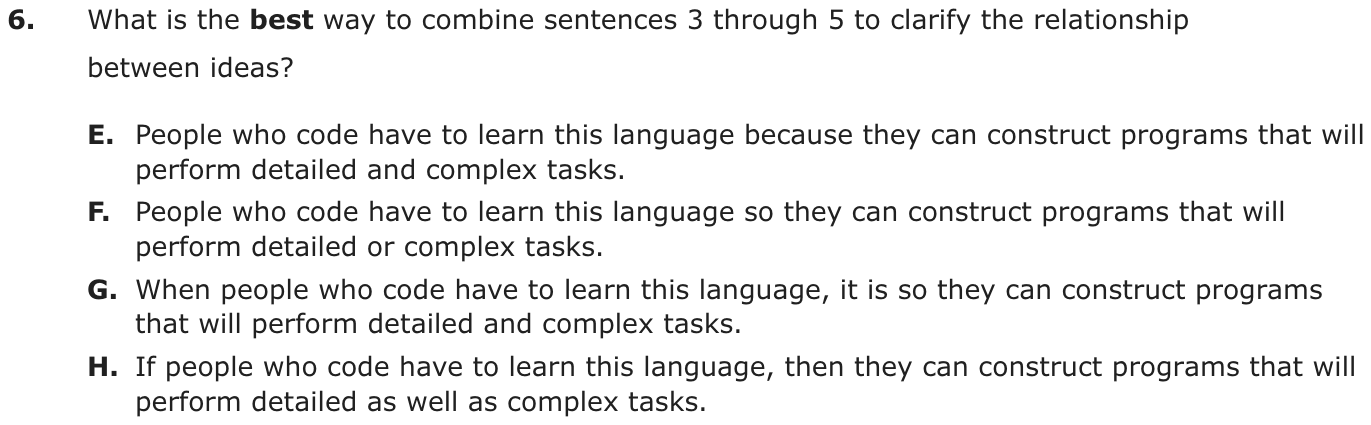
The passage “Cracking the Code” as printed (page 40)
Question 6 of 57
2021 Test A English, question 6Uses the passage above: “Cracking the Code”.
Question
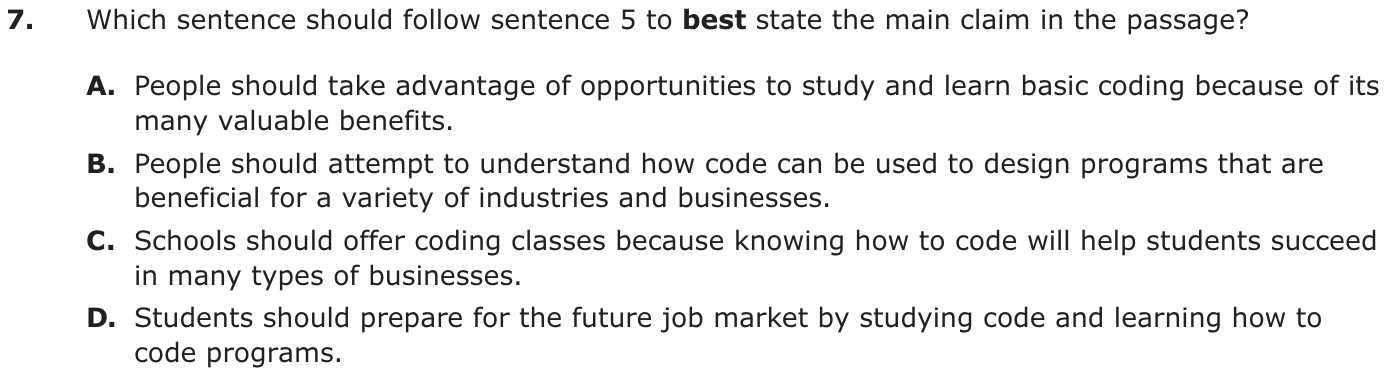
Which sentence should follow sentence 5 to best state the main claim in the passage?
- APeople should take advantage of opportunities to study and learn basic coding because of its many valuable benefits.
- BPeople should attempt to understand how code can be used to design programs that are beneficial for a variety of industries and businesses.
- CSchools should offer coding classes because knowing how to code will help students succeed in many types of businesses.
- DStudents should prepare for the future job market by studying code and learning how to code programs.
Show the answer
Correct answer: A
The question asks for the sentence that should follow sentence 5 to best state the main claim in the passage.
A. CORRECT. This sentence logically follows sentence 5 and introduces the main idea of the passage: that due to the high demand for coding skills across a wide range of industries and disciplines, learning basic coding skills can provide a range of opportunities for personal growth.
B. Incorrect. While this sentence incorporates a point made in the passage about how coding can benefit many occupational fields (sentence 10), this idea alone does not address the entire argument in the passage. This sentence does not capture the passage’s emphasis on the variety of ways people can learn how to code (sentence 14).
C. Incorrect. While this sentence incorporates ideas about opportunities to learn coding skills in school (fourth paragraph), the larger claim presented in the passage is not about opportunities schools should offer in order to help students learn to code. The passage primarily focuses on the opportunities offered to people who take on the challenge of learning to code.
D. Incorrect. Although the passage discusses the opportunities that are available to some students to learn coding skills in school (sentences 15–16), this point is a supporting detail of the passage, not the main claim of the passage.
Question analysis
This introduction question asks which sentence, added after sentence 5 of “Cracking the Code,” would best state the main claim of the passage. Students must work out what the whole argument is driving at, across paragraphs on what code is, how it is used at work and where people can learn it, and then choose among four sentences that each sound like a claim.
- NYS standards
- 7W1a introducing claims and counterclaims
- Grade level
- Grade 7 reading and task
- Compared with grade 7
- At grade 7 Introducing a precise claim is a core grade 7 argument skill. Students must find the claim behind all five paragraphs, since the first paragraph only explains what code is, and compare four sentences that each tell someone what to do.
- Estimated difficulty
- Straightforward: two steps or one careful reading.
- Thinking it demands
- Depth of knowledge 2, skills and concepts · mainly evaluate
- What makes it hard
- Evidence in several places moderate
- Every choice must be checked minor
- Evidence
- Answered from the whole text
- Reading level
- Passage: about grade 10, 357 words; question and choices: about grade 10, 91 words.
- Students, last 30 days
- Not enough answers yet to show (it takes 10).
Why it is hard, traps and wrong answers (shows the answer)
Why it is hard
The claim is clearest at the very end, where sentence 20 says anyone can benefit from understanding code without becoming an expert. Each wrong option grows out of one paragraph, the industries of paragraph 3 or the students and schools of paragraph 4, so it sounds supported but speaks to too few people or asks for the wrong action. The question rewards naming the whole argument before reading the options.
Evidence in several places moderate Working it out
The first paragraph only explains what code is, so the claim must be pieced together from later parts: coding’s value at work in paragraph 3, the ways to learn in paragraph 4 and sentence 20’s benefits for non-experts. (Kirsch & Mosenthal, 1990; Gorin & Embretson, 2006)
Every choice must be checked minor Choosing the answer
All four options are “should” statements built from real material in the passage, so each has to be checked for whom it addresses and what it asks them to do. (Embretson & Wetzel, 1987)
Strategy: Before reading the choices, note in a phrase what each paragraph adds, then say in one sentence what the whole passage wants its readers to do, and pick the option that matches all of it.
Traps
- Too narrow: A single detail offered as the central idea or a summary, or a summary that keeps minor details and leaves out an essential part.
- Off the point: Adds or keeps something that does not support the paragraph's or the passage's focus, or an introduction or conclusion that misses the main point.
The wrong answers, classified
B Too narrow (King et al., 2004)
Builds on the stock-market and medical programs of paragraph 3, but asks people only to understand how code serves industries, never to learn it, and leaves out the ways to learn.
C Off the point (Halliday & Hasan, 1976)
Takes the schools of sentence 15 as the heart of the argument and turns the claim into a duty for schools, a demand the passage never makes of them.
D Too narrow (King et al., 2004)
Joins the higher-paying jobs of sentence 13 to the students of paragraph 4, but limits the claim to students preparing for jobs, while the passage addresses everyone and promises benefits beyond pay.
Working it out, step by step
Figure out what the question asks
This asks for the main claim of the whole passage. A claim is the main point a writer argues for. The new sentence goes after sentence 5, at the end of the first paragraph. So it should tell the reader what the whole passage will argue. Each choice tells someone what they “should” do. Find the one that fits all five paragraphs.
Sum up each paragraph
- Paragraph 1 (sentences 1–5): code is everywhere, and coders must learn its language.
- Paragraph 2 (sentences 6–9): how a coding language works.
- Paragraph 3 (sentences 10–13): coding skills matter in many jobs and can mean higher pay.
- Paragraph 4 (sentences 14–18): “People have a variety of opportunities to learn how to code.”
- Paragraph 5 (sentences 19–20): everybody should learn, and you don’t have to be an expert.
Find the claim in the ending
The end of a passage often makes its point clearest. Sentence 19 quotes Steve Jobs: “Everybody in this country should learn how to program a computer.” Sentence 20 says “one does not need to become an expert programmer to reap the benefits of understanding this language.” To reap benefits is to get good things from something. So the claim is this: everyone should learn at least basic coding, because it helps in many ways.
Check each choice
- A fits. It speaks to all people. “Basic coding” matches sentence 20. “Opportunities” matches paragraph 4. “Many valuable benefits” covers jobs, pay and more.
- B does not fit. It asks people only to understand how businesses use code, the idea of paragraph 3. It never says to learn coding.
- C does not fit. The passage never tells schools what to do. Schools are just one place to learn, in sentence 15.
- D does not fit. It speaks only to students, and only about jobs. The passage speaks to everybody.
Choose the answer
Watch out: D sounds right because the passage does talk about students and jobs. But those are only parts of paragraphs 3 and 4. Only A covers who the passage speaks to and why they should learn. So the answer is A.
Why this answer and not the closest wrong one
D is a close wrong answer, because studying code for good jobs is part of the passage. But D limits the claim to students and to jobs. Sentence 19 says “Everybody” should learn. The reason Steve Jobs gives is that it “teaches you how to think,” which is not about jobs at all. A speaks to all people and all the benefits.
More questions like this
The original DOE question
Question 7 of 57
2021 Test A English, question 7Uses the passage above: “Cracking the Code”.
Question
Which revision of sentence 10 provides the best transition to the argument in the third paragraph (sentences 10–13)?
- ALearning a coding language may be difficult, but coding skills are becoming important in many occupational fields.
- BLearning a coding language is useful because coding skills are becoming important in many occupational fields.
- CEmployers in most industries realize that people with coding skills can demand higher salaries in many occupational fields.
- DEven though programming is its own unique field, coding skills are becoming important in many occupational fields.
Show the answer
Correct answer: B
The question asks for the best revision of sentence 10 to provide a transition to the argument in the third paragraph.
A. Incorrect. Some readers may choose this option because the second paragraph does discuss the complexities of coding; however, it does not discuss the difficulties of learning coding. The third paragraph demonstrates some of the complex ways coding is used in specific fields but does not illustrate how difficult learning coding may be.
B. CORRECT. This sentence provides the best revision of the transition sentence. The second paragraph ends with “the possibilities for applying them are infinite” (sentence 9), which supports the idea that people in “many occupational fields” (sentence 10) can benefit from having coding skills. The third paragraph illustrates this idea by providing specific examples of occupations that benefit from coding (stock market traders and doctors).
C. Incorrect. While sentence 13 suggests that employers recognize the value of coding skills, sentences 11 and 12 give examples of different industries that employ people who know how to code. The transition sentence should introduce the idea that coding skills are valuable to potential employees.
D. Incorrect. Some readers may choose this option because the second paragraph provides a brief definition of coding—“A coding language uses letters, numbers, and symbols that are arranged in a way that makes sense to a computer” (sentence 6)—which shows how this element of programming works, but the second paragraph does not specifically discuss what makes the field of computer programming unique. The third paragraph discusses how coding can be used in a variety of occupational fields (sentence 10).
Question analysis
This transitions question asks which revision of sentence 10, the opening sentence of the third paragraph of “Cracking the Code,” would best lead into that paragraph’s argument. Students must link the second paragraph, on how coding languages work, to the third, on coding in fields such as stock trading and medicine, and judge four versions that each begin differently.
- NYS standards
- 7W1d transitions in arguments
- Grade level
- Grade 7 reading and task
- Compared with grade 7
- At grade 7 Grade 7 transition questions often ask for one connecting word. This one asks for a whole topic sentence, so students must sum up two paragraphs and see how they connect, though the passage’s plain language keeps it within typical grade 7 work.
- Estimated difficulty
- Moderate: several steps, or a close reading with one strong distractor.
- Thinking it demands
- Depth of knowledge 2, skills and concepts · mainly evaluate
- What makes it hard
- How sentences fit together moderate
- A very close wrong answer moderate
- Evidence
- Answered from several paragraphs or stanzas
- Reading level
- Passage: about grade 10, 357 words; question and choices: about grade 13, 84 words.
- Students, last 30 days
- Not enough answers yet to show (it takes 10).
Why it is hard, traps and wrong answers (shows the answer)
Why it is hard
Three of the four versions end with the original sentence 10, so the choice lies entirely in the opening words and the link they claim. A concession about difficulty sounds like a natural essay move, and sentence 20 even calls coding challenging, but nothing in paragraphs 2 or 3 sets difficulty against importance. Students who first name the real link between the paragraphs, that coding knowledge is worth having because many fields need it, can test each opening against that.
How sentences fit together moderate Working it out
The new opening must look back to paragraph 2, which ends on the “infinite” possibilities of knowing coding rules, and ahead to the stock-market and medical examples, so two paragraphs have to be tracked at once. (Halliday & Hasan, 1976)
A very close wrong answer moderate Choosing the answer
The concession version shares the key’s first words, “Learning a coding language,” and its whole closing clause; only the middle differs, “may be difficult, but” against “is useful because.” (Embretson & Wetzel, 1987; Gorin & Embretson, 2006; Ascalon et al., 2007)
Strategy: Sum up paragraph 2 and paragraph 3 in a few words each, then test every version of sentence 10 against both summaries, paying close attention to what its opening words claim.
Traps
- Wrong transition: A connecting word or phrase that signals the wrong relationship, such as contrast where the idea continues.
- Off the point: Adds or keeps something that does not support the paragraph's or the passage's focus, or an introduction or conclusion that misses the main point.
The wrong answers, classified
A Wrong transition (Halliday & Hasan, 1976)
Borrows sentence 20’s point that coding “can seem challenging” and sets it against importance with “but,” though neither paragraph 2 nor paragraph 3 raises difficulty, so the contrast connects nothing.
C Too narrow (King et al., 2004)
Picks up sentence 13’s higher salaries and speaks for employers, so the opening covers only the paragraph’s last point and gives no link back to paragraph 2 on coding languages.
D Off the point (Halliday & Hasan, 1976)
Takes paragraph 2’s technical account of code as proof that programming is “its own unique field,” an idea the passage never develops, and sets it against wider use with “Even though.”
Working it out, step by step
Figure out what the question asks
This asks for the best transition. A transition links one part of a piece of writing to the next, like a bridge. Sentence 10 opens the third paragraph. A good opening looks back at paragraph 2 and points ahead to paragraph 3. So first sum up both paragraphs.
Sum up paragraphs 2 and 3
Paragraph 2 explains that learning a coding language means learning its rules. It ends with sentence 9: “Once a person understands coding rules, the possibilities for applying them are infinite.” Infinite means without end. Paragraph 3 then gives examples of uses: tracking the stock market and helping doctors watch a patient’s health. Sentence 13 adds that coding jobs usually pay more.
Name the link between them
Paragraph 2 is about learning the language. Paragraph 3 shows why that learning pays off: many kinds of jobs use it. So the bridge should say that learning a coding language is worth it, because so many jobs need coding. “Occupational fields” are types of jobs.
Check each choice
- A does not fit. “May be difficult, but” sets up a contrast about how hard coding is. Neither paragraph talks about that.
- B fits. “Learning a coding language” looks back at paragraph 2. “Because” gives the reason it is useful, and paragraph 3 then shows that reason with examples.
- C does not fit. It is only about higher salaries, the last point in paragraph 3. It doesn’t link back to paragraph 2.
- D does not fit. The passage never says programming is “its own unique field.” That contrast connects to nothing.
Choose the answer
Watch out: A starts with the same words as B. Admitting that something is hard also sounds like a good essay move. Sentence 20 even says coding “can seem challenging.” But that comes at the very end, and paragraphs 2 and 3 never mention it. So the answer is B.
Why this answer and not the closest wrong one
A is the closest wrong answer. It shares B’s first words and its whole ending. Only the middle is different. A sets difficulty against importance, but neither paragraph is about difficulty. B tells why learning the language from paragraph 2 matters. Then paragraph 3 backs that up with examples of jobs.
More questions like this
The original DOE question
Question 8 of 57
2021 Test A English, question 8Uses the passage above: “Cracking the Code”.
Question
Which sentence would best follow sentence 13 and support the ideas in the third paragraph (sentences 10–13)?
- AExperienced programmers, software engineers, and system administrators at large companies can earn well over $100,000 a year.
- BHospitals, physicians’ offices, and pharmaceutical companies are frequently looking to hire people who code to help with a variety of tasks.
- CMany companies are eager to hire employees who have experience in a specific industry as well as knowledge of basic coding.
- DAccording to a report from a job market analytics firm, almost half of today’s jobs paying more than $58,000 a year call for some level of coding ability.
Show the answer
Correct answer: D
The question asks which sentence would best follow sentence 13 and support the ideas in the third paragraph.
A. Incorrect. While this sentence provides an example of a high salary, which is mentioned in the paragraph (sentence 13), the reference to “Experienced programmers, software engineers, and system administrators at large companies” focuses on specific occupations that may use coding, as opposed to the range of diverse occupations discussed in the third paragraph.
B. Incorrect. While sentence 12 does mention coding skills in the medical field as an example, the information provided in this answer supports only that idea and not the other ideas expressed in the third paragraph.
C. Incorrect. This sentence generally discusses employers looking for two things: “experience in a specific industry” and “knowledge of basic coding.” The third paragraph, however, discusses the possibilities of using coding skills in a variety of occupations. The words “experience in a specific industry” do not connect to the idea the paragraph develops.
D. CORRECT. This sentence provides specific evidence of the job market favoring potential employees who have coding ability. It supports what is stated in sentence 13, that “jobs that require coding skills are typically higher paying.”
Question analysis
This supporting-details question asks which sentence would best follow sentence 13 of “Cracking the Code,” which says jobs requiring coding skills tend to pay more, and support the ideas of the third paragraph. All four options are plausible facts about coding and work, from salaries to hiring, so students must judge which one backs up the paragraph as a whole.
- NYS standards
- 7W1b supporting claims with evidence
- Grade level
- Grade 7 reading and task
- Compared with grade 7
- Above grade 7 Choosing relevant evidence for a claim is grade 7 argument work. Here all four options are believable facts about coding and jobs, and the best one must fit both sentence 13 and the paragraph’s larger point, a finer judgment than usual.
- Estimated difficulty
- Hard: combines ideas, needs a plan, and has more than one tempting wrong answer.
- Thinking it demands
- Depth of knowledge 2, skills and concepts · mainly evaluate
- What makes it hard
- Every choice must be checked moderate
- How sentences fit together moderate
- Reading between the lines minor
- Evidence
- Answered from one paragraph or stanza
- Reading level
- Passage: about grade 10, 357 words; question and choices: about grade 12, 100 words.
- Students, last 30 days
- Not enough answers yet to show (it takes 10).
Why it is hard, traps and wrong answers (shows the answer)
Why it is hard
The paragraph makes two claims, that coding matters in many fields and that coding jobs pay more, and the best addition must serve both while following the sentence about pay. The $100,000 figure is the main trap, since it seems to back the pay claim but turns attention to computing careers, the opposite of the paragraph’s point. The hospital and industry-experience options each touch one idea of the paragraph and drift away from the rest.
Every choice must be checked moderate Choosing the answer
All four options are believable facts about coding and work, two of them with salary figures, so each must be tested against sentence 13’s pay comparison and sentence 10’s claim about many fields. (Embretson & Wetzel, 1987)
How sentences fit together moderate Working it out
The added sentence comes right after sentence 13, so it should carry on the point that coding jobs pay more while still serving the paragraph’s opening claim that coding matters in many occupations. (Halliday & Hasan, 1976)
Reading between the lines minor Working it out
Seeing why the job-market statistic fits takes a step of reasoning: if almost half of jobs paying over $58,000 call for coding, coding is both widespread and tied to better pay. (Graesser, Singer & Trabasso, 1994; Kintsch, 1998)
Strategy: Restate sentence 10 and sentence 13 in your own words, then ask of each option whether it is evidence for what those two sentences claim, not just a fact on the same topic.
Traps
- Off the point: Adds or keeps something that does not support the paragraph's or the passage's focus, or an introduction or conclusion that misses the main point.
The wrong answers, classified
A Off the point (Halliday & Hasan, 1976)
Matches sentence 13’s talk of pay with a striking salary, but it turns to computing careers such as software engineering instead of the many fields the paragraph describes, and compares nothing.
B Supports only part of the claim (King et al., 2004; Thissen, Steinberg & Fitzpatrick, 1989)
Extends sentence 12’s point about doctors to hospitals and drug companies, but it backs only the medical example and says nothing about pay, so it does not build on sentence 13.
C Off the point (Halliday & Hasan, 1976)
Sees support for coding’s value in companies wanting “knowledge of basic coding,” but the sentence adds a second demand, experience in one industry, which the paragraph never discusses.
Working it out, step by step
Figure out what the question asks
You need a sentence to add after sentence 13. It must support the third paragraph. To support means to give evidence: facts that back up a point. So first find the paragraph’s points. Then test each choice against them.
Find the paragraph’s two points
Sentence 10 says “Coding skills are becoming important in many occupational fields.” That means many kinds of jobs. Sentences 11 and 12 give examples: the stock market and doctors. Sentence 13 says “Jobs that require coding skills are typically higher paying.” So the paragraph makes two points. Coding matters in many kinds of jobs. And jobs that need coding tend to pay more.
Test each choice against both points
- A gives a big salary. But it names only computer jobs, like programmers and software engineers. The paragraph is about coding in many other fields.
- B is only about hospitals and drug companies. It repeats the doctor example and says nothing about pay.
- C brings in a new idea: “experience in a specific industry.” The paragraph never talks about that, and C says nothing about pay.
- D says “almost half of today’s jobs paying more than $58,000 a year call for some level of coding ability.”
See why D supports both points
D is about jobs that pay well, so it backs up sentence 13 on pay. It also says almost half of those jobs need some coding. Half of all well-paying jobs covers many kinds of work, not just computer jobs. That backs up sentence 10. D also names where its facts come from, a report, which makes it stronger evidence.
Choose the answer
Watch out: A is the most tempting. Its $100,000 salary seems to match sentence 13. But of course computer experts need coding. That doesn’t show that coding matters in other fields. So the answer is D.
Why this answer and not the closest wrong one
A is the closest wrong answer, since it talks about high pay. But it is about programmers and other computer jobs. The paragraph’s point is that coding helps in many fields beyond computers. D shows that almost half of all well-paying jobs call for some coding. It supports both the pay and the many fields.
More questions like this
The original DOE question
Question 9 of 57
2021 Test A English, question 9Uses the passage above: “Cracking the Code”.
Question
Which concluding sentence would best follow sentence 20 and support the argument presented in the passage?
- APeople should understand that knowing how to code is becoming an essential requirement for most high-paying jobs.
- BBy understanding basic coding concepts, people can participate in an increasingly digital job market.
- CStudents who want to secure a high-paying job in the technology industry should become proficient in coding.
- DSince coding is a valuable marketplace skill, today’s students should begin to write their own computer programs.
Show the answer
Correct answer: B
The question asks which concluding sentence would best follow sentence 20 and support the argument presented in the passage.
A. Incorrect. While the passage does state that “jobs that require coding skills are typically higher paying” (sentence 13), it does not say or imply that coding skills are needed for most high-paying jobs.
B. CORRECT. The sentence successfully summarizes the main argument of the passage, which is that coding is involved in all electronic interaction (sentence 1) and is a useful skill to master, especially in many occupational fields (sentence 10).
C. Incorrect. In the fourth paragraph, the passage does promote students taking advantage of opportunities to learn coding; however, this information is a supporting detail and would not serve as a strong conclusion to the argument presented in the passage.
D. Incorrect. Some readers may choose this sentence because the fourth paragraph discusses how “some students may become interested in learning how to create programs, such as games and apps” (sentence 18), but this detail is only one part of the overall argument in the passage.
Question analysis
This conclusion question asks which sentence should come after sentence 20, the last line of “Cracking the Code,” to close the passage and support its argument. The options mention high-paying jobs, students, the technology industry and the job market, so students must decide which ending fits the whole passage rather than one of its details.
- NYS standards
- 7W1e concluding an argument
- Grade level
- Grade 7 reading and task
- Compared with grade 7
- At grade 7 A closing statement that explains why an argument matters is part of the grade 7 writing standards. Here the ending must follow sentence 20 and reflect all five paragraphs, a typical grade 7 revising task with several reasonable-sounding options.
- Estimated difficulty
- Moderate: several steps, or a close reading with one strong distractor.
- Thinking it demands
- Depth of knowledge 2, skills and concepts · mainly evaluate
- What makes it hard
- Evidence in several places moderate
- The right answer is reworded minor
- How sentences fit together minor
- Evidence
- Answered from the whole text
- Reading level
- Passage: about grade 10, 357 words; question and choices: about grade 11, 80 words.
- Students, last 30 days
- Not enough answers yet to show (it takes 10).
Why it is hard, traps and wrong answers (shows the answer)
Why it is hard
Each wrong ending grows from something the passage does say, about high pay, students or creating programs, which makes it feel supported. The trap is in how far each one goes: one inflates better pay into a requirement for most good jobs, and two shrink the argument to students and programming. Keeping sentence 20’s point about non-experts in mind rules out most of them at once.
Evidence in several places moderate Working it out
A closing sentence must gather the whole argument: code is everywhere (sentence 1), it matters in many jobs (paragraph 3), anyone can learn it (paragraph 4) and even a basic grasp pays off (sentence 20). (Kirsch & Mosenthal, 1990; Gorin & Embretson, 2006)
The right answer is reworded minor Choosing the answer
The best ending uses words the passage never does, “basic coding concepts” and “increasingly digital job market,” while the others echo the “higher paying” jobs of sentence 13 or the programs of sentence 18. (Freedle & Kostin, 1993; Kirsch & Mosenthal, 1990)
How sentences fit together minor Working it out
The ending follows sentence 20, which says one need not become an expert programmer, so options that call for proficiency or for writing programs clash with the line just before them. (Halliday & Hasan, 1976)
Strategy: Reread sentence 20 and list the passage’s main points in a phrase each, then choose the ending that follows sentence 20 and covers those points without claiming more than they show.
Traps
- Too narrow: A single detail offered as the central idea or a summary, or a summary that keeps minor details and leaves out an essential part.
- Too broad or too strong: A choice overstates, generalizes, or uses absolute words the text does not support.
The wrong answers, classified
A Too broad or too strong (King et al., 2004)
Builds on sentence 13’s point that coding jobs pay more but inflates it into coding being “an essential requirement for most high-paying jobs,” a claim the passage never makes.
C Too narrow (King et al., 2004)
Is drawn by “high-paying job,” but it addresses only students aiming at the technology industry and asks for proficiency, though sentence 20 says no one needs to become an expert.
D Too narrow (King et al., 2004)
Builds on sentence 18’s students who may go on to create games and apps, so it ends on one detail of paragraph 4 instead of the passage’s case for everyone.
Working it out, step by step
Figure out what the question asks
This asks for the best concluding sentence, the last line of the passage. A good conclusion follows from the sentence before it and sums up the whole argument. It shouldn’t claim more than the passage shows. It also shouldn’t shrink the point down to one detail.
Reread sentence 20
Sentence 20 says “Learning to code can seem challenging, but one does not need to become an expert programmer to reap the benefits of understanding this language.” An expert is someone with great skill. So you don’t need great skill to gain from coding. Even a basic grasp helps. The last sentence should build on that idea.
List the passage’s main points
- Code is everywhere. It is “part of every electronic interaction” (sentence 1).
- Coding skills matter “in many occupational fields” (sentence 10).
- Anyone can find ways to learn (paragraph 4).
- Even a basic understanding pays off (sentence 20).
Check each choice
- A does not fit. Sentence 13 says coding jobs usually pay more. It never says coding is needed for “most high-paying jobs.” That claims too much.
- B fits. “Basic coding concepts” matches sentence 20: you don’t need to be an expert. “People” means everyone. Digital means done with computers. So an “increasingly digital job market” ties together code being everywhere and its use in many jobs.
- C does not fit. It speaks only to students who want tech jobs. Proficient means highly skilled, which sentence 20 says you don’t need to be.
- D does not fit. Writing programs is one detail from sentence 18. It is not the whole argument.
Choose the answer
Watch out: A sounds like a strong ending, and it builds on sentence 13. But it turns “typically higher paying” into a requirement for most good jobs. Only B follows sentence 20 and fits the whole passage. So the answer is B.
Why this answer and not the closest wrong one
A is the closest wrong answer. It grows out of sentence 13, which says coding jobs “are typically higher paying.” But paying more is not the same as being required. A claims more than the passage shows. B stays inside the passage: a basic understanding of coding helps people take part in a world of work full of computers.
More questions like this
The original DOE question
Question 10 of 57
2021 Test A English, question 10Passage The Best Laid Plans of Ravens
The Best Laid Plans of Ravens
In Edgar Allan Poe’s poem “The Raven,” a raven visits a lonely man’s home and responds to the man’s pleading questions with only the word “nevermore.” The poem’s narrator interprets the word as a prediction of doom for his future. A talking, prophetic raven may seem to be the wild imaginings of the poet, but a new study published in the journal Science hints that one particular idea behind the poem might not be as far-fetched as it seems. For most of human history, people assumed that animals do not understand the passage of time in the same way people do. Some people believed that animals might remember events from the past and that instinct might drive them to make preparations in order to guarantee survival, but most people did not think that animals had the ability to plan. At Lund University in Sweden, researchers argue that ravens may be able to think ahead and even plan for the future.
It can be difficult to test an animal’s ability to plan because human observers must be certain they are not mistaking instinctual behavior for intentional planning. For example, many animals hoard food so that they will not run out later, but scientists who study animals would not call hoarding a decision to plan for the future. This action is merely instinctual. Cognitive scientists argue that in order for an animal’s behavior to qualify as preparing for the future, the animal must use specific decision-making skills to solve a problem.
To avoid mistaking instinctual behavior for evidence of decision-making, the Lund University researchers designed two experiments to test ravens’ ability to plan. Ravens belong to the corvid family, a group of birds known for their intelligence. A study in 2007 showed that corvids have the tendency to save only certain types of food, which suggests that they are planning for the future rather than acting on instinct. In order to investigate that theory, the researchers had to design experiments that would achieve results that could not be explained by an instinctual behavior of food hoarding. Therefore, the ravens were taught two behaviors that they do not normally perform in the wild.
For the first experiment, the researchers showed the birds how to use a small stone to open a box and get treats. Once the ravens learned the behavior, the researchers presented the birds with four stones. Only one stone was the right size to open the box. The birds learned to select that stone and set it aside until the researchers presented the box. The second experiment involved bartering. A researcher would trade the ravens a large treat for a bottle cap. Later, the researchers presented the ravens with a group of items, including small treats and the bottle cap. The ravens chose the bottle cap over the treats and waited for the original researcher to trade with them again so that they could get more treats. In both experiments, the ravens waited patiently for up to seventeen hours for the researcher to return.
The results of these experiments are exciting, but more evidence needs to be gathered before scientists can fully conclude that ravens can plan for the future. Some scientists argue that the ravens might be choosing the stone and bottle cap because the ravens have been trained to do so, not necessarily because the ravens are thinking ahead. Regardless, like other recent advances in animal science, these experiments show that ravens could be much smarter than first believed, and scientists now believe that ravens do actually think about their own future.
Question
How does paragraph 1 introduce the ideas that ravens may perceive time and plan for the future?
- AIt mentions a poem that considers whether a raven can see the future and then discusses why people have traditionally doubted that ravens have the ability to plan.
- BIt references a poem about a raven that seems to have insight into the future and then mentions new information that suggests ravens have the ability to plan.
- CIt mentions a poem that led people to believe that ravens are aware of the future and then explains that this belief prompted scientists to study ravens’ ability to plan.
- DIt references a poem about a raven that predicts the future and then describes the importance of differentiating ravens’ instincts from their ability to plan.
Show the answer
Correct answer: B
The question asks how paragraph 1 introduces the ideas that ravens may perceive time and plan for the future.
A. Incorrect. In the poem referenced in paragraph 1, the narrator does not consider whether a raven can see the future but believes it is actually happening. Additionally, the discussion in paragraph 1 is about how people have historically doubted animals’ ability to plan, not about why people have doubted this ability in ravens specifically.
B. CORRECT. Edgar Allan Poe’s poem features a raven that speaks in a prophetic way. Since prophecies are a prediction of the future, the statement suggests that the raven has a sense of time. This reference is then tied to a modern study where “researchers argue that ravens may be able to think ahead and even plan for the future” (paragraph 1).
C. Incorrect. Although the idea of a raven being aware of the future in the poem is tied to a study that “hints that one particular idea behind the poem might not be as far-fetched as it seems” (paragraph 1), this connection does not prove that the poem is what prompted scientists to conduct such a study.
D. Incorrect. Paragraph 1 introduces the idea “that ravens may be able to think ahead and even plan for the future” but does not explain in detail the importance of differentiating between whether ravens act on instinct or have the ability to plan.
Question analysis
This text-structure question on “The Best Laid Plans of Ravens” asks how the article’s first paragraph introduces the ideas that ravens may sense time and plan for the future. The paragraph opens with Edgar Allan Poe’s poem “The Raven,” and every choice pairs a description of the poem with a claim about what the paragraph does next, so each half has to be checked on its own.
- Grade level
- Grade 7 reading and task
- Compared with grade 7
- At grade 7 Explaining how an opening paragraph introduces a text’s ideas is regular grade 7 structure work. Each choice here makes two claims, one about the poem and one about what follows it, so both must be checked against a single dense paragraph.
- Estimated difficulty
- Moderate: several steps, or a close reading with one strong distractor.
- Thinking it demands
- Depth of knowledge 2, skills and concepts · mainly analyze
- What makes it hard
- How, not what moderate
- Every choice must be checked moderate
- A lot to read minor
- Evidence
- Answered from one paragraph or stanza
- Reading level
- Passage: about grade 11, 599 words; question and choices: about grade 13, 127 words.
- Students, last 30 days
- Not enough answers yet to show (it takes 10).
Why it is hard, traps and wrong answers (shows the answer)
Why it is hard
Every choice describes the paragraph as a poem followed by something else, so the question turns on what comes after Poe. The middle of the paragraph, about what people long believed of animals, is the part students most often promote to the main move, though it says what people assumed, not why, and concerns animals in general. The paragraph joins the poem to the study only by saying the study “hints” that Poe’s idea is not far-fetched, and reading that as cause and effect is the other way to lose the point.
How, not what moderate Working it out
The stem asks how paragraph 1 is built, not what it says, so students must trace the move from Poe’s prophetic raven to the Lund study, with the sentences about old beliefs in between. (Anderson & Krathwohl, 2001)
Every choice must be checked moderate Choosing the answer
All four choices open with Poe’s poem and then name a second move, so the poem half barely separates them and the second half of each must be tested against the paragraph. (Embretson & Wetzel, 1987)
A lot to read minor Understanding the question
The choices run 25 to 30 words each, and paragraph 1 packs a poem, a new study, centuries of human assumptions and a Swedish university into six sentences. (Kintsch, 1998; Gorin & Embretson, 2006; Freedle & Kostin, 1993)
Strategy: Label what each sentence of paragraph 1 does, then test both halves of every choice against those labels, and reject a choice if either half describes something the paragraph does not do.
Traps
- Wrong part of the text: A choice is true of another paragraph, stanza or speaker than the one asked about.
- Twists what the text says: Uses the text's topic and ideas but changes what it says: who did it, how much, when, or why.
- Reads too much in: A reasonable-sounding conclusion that goes further than the text allows.
The wrong answers, classified
A Twists what the text says (King et al., 2004)
Builds on the paragraph’s middle, where people long assumed animals could not plan, but the paragraph never says why, speaks of animals in general, and Poe’s narrator takes the word as prophecy.
C Reads too much in (Graesser, Singer & Trabasso, 1994)
Turns the link between Poe and the study into cause and effect, though people had long assumed animals do not grasp the passage of time, and nothing says the poem sent scientists to study ravens.
D Wrong part of the text (Kirsch & Mosenthal, 1990)
Notices that paragraph 1 mentions instinct in passing and credits it with paragraph 2’s point, that observers must be sure they are not mistaking instinct for planning.
Working it out, step by step
Figure out what the question asks
This is a structure question. It asks how paragraph 1 is built, not just what it says. Every choice starts with the poem. So the second half of each choice is the part to check. Ask what the paragraph does right after the poem.
Find what the paragraph says about the poem
Paragraph 1 begins with a poem called “The Raven.” In it, a raven answers a lonely man with one word. The man hears that word “as a prediction of doom for his future.” Doom means something terrible that is going to happen. The paragraph then calls the bird a “talking, prophetic raven.” Prophetic means able to tell the future. So the raven seems to know what is coming.
Find what comes after the poem
Next the paragraph says that “a new study published in the journal Science hints that one particular idea behind the poem might not be as far-fetched as it seems.” Far-fetched means hard to believe. The last sentence names that idea: “researchers argue that ravens may be able to think ahead and even plan for the future.” So the paragraph moves from an old poem to new research about planning.
Check each choice
- A does not fit. The man does not wonder if the raven sees the future. He takes its word as a prediction.
- B fits. The raven in the poem seems to see the future. Then the paragraph reports a new study that says ravens may plan.
- C does not fit. The paragraph never says the poem made scientists start the study.
- D does not fit. Telling instinct apart from planning is the topic of paragraph 2. Instinct is behavior an animal is born with.
Watch out: A is tempting because the paragraph does say people doubted that animals could plan. But it never says why. It also talks about animals in general, not ravens.
Choose the answer
The paragraph starts with a raven that seems to know the future. Then it brings in new research that says ravens may plan. So the answer is B.
Why this answer and not the closest wrong one
A is the closest wrong choice. Both A and B begin with the poem. But A says the paragraph explains why people doubted that ravens could plan. The paragraph only says what people “assumed” about animals in general. Its real turn is to the new study and what the researchers argue. That is the second half of B.
More questions like this
The original DOE question
The passage “The Best Laid Plans of Ravens” as printed (page 12)
Question 11 of 57
2021 Test A English, question 11Uses the passage above: “The Best Laid Plans of Ravens”.
Question
Read this sentence from paragraph 1.
At Lund University in Sweden, researchers argue that ravens may be able to think ahead and even plan for the future.
Which sentence from paragraph 4 provides support for this argument?
- A“Once the ravens learned the behavior, the researchers presented the birds with four stones.”
- B“A researcher would trade the ravens a large treat for a bottle cap.”
- C“Later, the researchers presented the ravens with a group of items, including small treats and the bottle cap.”
- D“The ravens chose the bottle cap over the treats and waited for the original researcher to trade with them again so that they could get more treats.”
Show the answer
Correct answer: D
The question asks which sentence from paragraph 4 supports the argument presented in the sentence from paragraph 1.
A. Incorrect. This sentence from paragraph 4 refers to the ravens’ ability to adapt and learn but not to plan and think ahead.
B. Incorrect. This sentence from paragraph 4 relates the actions of the researcher rather than the actions of the ravens and does not provide evidence in support of the argument that ravens have the ability to think and plan ahead.
C. Incorrect. This sentence from paragraph 4 does not describe a behavior of the ravens that would support the argument in the sentence from paragraph 1; instead it relates the actions of the researchers without giving any information about the ravens’ responses.
D. CORRECT. This sentence from paragraph 4 shows that the ravens seem to make a decision, which involves a thought process. The ravens chose to wait for the researcher rather than take the treats, suggesting that the ravens understood that the researcher would trade a larger treat for the bottle cap.
Question analysis
This evidence question on the science article “The Best Laid Plans of Ravens” quotes the claim from paragraph 1 that ravens may be able to think ahead and plan for the future. Students choose the sentence from paragraph 4, where two experiments are described, that supports it. Every choice comes from the same experiments, so each must be weighed against the claim.
- Grade level
- Grade 7 reading and task
- Compared with grade 7
- At grade 7 Choosing the sentence that backs a quoted claim is standard grade 7 evidence work. The claim is printed in the question and all four choices come from one paragraph, so the search is short, though each sentence must be tested against the claim.
- Estimated difficulty
- Straightforward: two steps or one careful reading.
- Thinking it demands
- Depth of knowledge 2, skills and concepts · mainly evaluate
- What makes it hard
- Evidence
- Answered from one paragraph or stanza
- Reading level
- Passage: about grade 11, 599 words; question and choices: about grade 8, 107 words.
- Students, last 30 days
- Not enough answers yet to show (it takes 10).
Why it is hard, traps and wrong answers (shows the answer)
Why it is hard
The claim is about what ravens can do, and only one of the four sentences shows the birds deciding anything. Students who read quickly accept any sentence about the experiments, especially the one where the ravens have just learned a skill, because learning sounds like intelligence. Asking who acts in each sentence, the birds or the researchers, settles the question in seconds.
Reading between the lines minor Working it out
The right sentence never says “plan”; students must see that choosing the cap over the treats and waiting “so that they could get more treats” is acting now for a later reward. (Graesser, Singer & Trabasso, 1994; Kintsch, 1998)
Every choice must be checked minor Choosing the answer
All four sentences come from paragraph 4’s experiments, and three of them report what the researchers did, so each must be checked for a decision made by the ravens. (Embretson & Wetzel, 1987)
Strategy: Underline “think ahead” and “plan” in the quoted claim, then ask of each sentence whether it, on its own, would convince a doubter that ravens can do that.
Traps
- Supports only part of the claim: In a question about evidence: a line that backs one half of the claim but not the other, or a related point rather than the claim itself.
- True but not the answer: A choice says something accurate about the text that does not answer this question.
The wrong answers, classified
A Supports only part of the claim (King et al., 2004; Thissen, Steinberg & Fitzpatrick, 1989)
Takes “Once the ravens learned the behavior” as proof of planning, but learning to open a box shows only that the birds can be taught, and the rest is the researchers’ act.
B True but not the answer (King et al., 2004; Embretson & Wetzel, 1987)
Picks the opening of the bartering test because it mentions the trade, yet the sentence reports only what a researcher offered, not anything the ravens decided.
C True but not the answer (King et al., 2004; Embretson & Wetzel, 1987)
Knows the bottle-cap test holds the evidence and picks its setup, the researchers laying out treats and the cap, one sentence before the ravens make their choice.
Working it out, step by step
Figure out what the question asks
This asks for evidence: the sentence that best supports a claim. The claim is that ravens “may be able to think ahead and even plan for the future.” To plan is to decide now what you will do later, so you get something you want. You need a sentence from paragraph 4 that shows ravens doing that.
Ask who acts in each sentence
Only something the ravens do can prove what ravens can do. So check each choice for its doer. In A, B and C, the researchers do most of the acting. They hand out stones, offer a trade and set out items. Only one sentence shows the ravens making a choice of their own.
Find the ravens’ choice
Paragraph 4 says “The ravens chose the bottle cap over the treats and waited for the original researcher to trade with them again so that they could get more treats.” The ravens could have eaten a small treat right away. Instead they took a bottle cap, which is worthless by itself. They kept it because the researcher would trade a large treat for it later.
Explain why this shows planning
The words “so that” give the reason for the choice. The ravens gave up something now to get something better later. That is exactly what planning ahead means. You do the same thing when you save your allowance for a bigger toy next month.
Check each choice
- A does not fit. The ravens have only learned a skill. The rest of the sentence tells what the researchers did next.
- B does not fit. It tells what a researcher offered, not what the ravens decided.
- C does not fit. It is the setup of the test, before the ravens choose anything.
- D fits. The ravens choose now and wait for a later reward.
Watch out: A sounds smart because the ravens “learned the behavior.” But being taught a skill is not the same as thinking ahead.
Choose the answer
Only one sentence shows the ravens making a choice now for a reward later. So the answer is D.
Why this answer and not the closest wrong one
A is the closest wrong choice, because learning a skill sounds clever. But learning to open a box shows only that the birds can be taught. It says nothing about the future. In D, the ravens pass up treats today to get more treats later. That is planning.
More questions like this
The original DOE question
Question 12 of 57
2021 Test A English, question 12Uses the passage above: “The Best Laid Plans of Ravens”.
Question
Read these sentences from paragraph 2.
For example, many animals hoard food so that they will not run out later, but scientists who study animals would not call hoarding a decision to plan for the future. This action is merely instinctual.
Which statement describes the effect of the phrase “merely instinctual” in the passage?
- AIt implies that animals are skilled at finding and saving food for later consumption.
- BIt conveys that many animals will usually prioritize gathering food over other activities.
- CIt suggests that animals often store more food than they will be able to consume.
- DIt emphasizes that many animals collect food automatically rather than with true intention.
Show the answer
Correct answer: D
The question asks which statement describes the effect in the passage of the phrase “merely instinctual” from paragraph 2.
A. Incorrect. The passage does not question animals’ ability to find and save food but rather whether this or other behavior involves thought and planning for the future.
B. Incorrect. While the sentence states that “many animals hoard food,” the passage does not suggest that they give priority of thought to this activity; they hoard food out of instinct.
C. Incorrect. Although the passage discusses animals’ tendency to store a great deal of food, it does not suggest that their hoarding goes beyond their needs.
D. CORRECT. The passage suggests that in order for an animal’s actions to qualify as planning for the future, “the animal must use specific decision-making skills to solve a problem” (paragraph 2). The behavior of hoarding food is based on instinct and done automatically without real thought.
Question analysis
This word-in-context question from “The Best Laid Plans of Ravens” asks about the effect of the phrase “merely instinctual,” which the article applies to food hoarding in paragraph 2. Students read two quoted sentences and decide what the phrase emphasizes about how animals behave. The choices all sound like reasonable facts about animals, so the answer has to come from how the article uses the phrase.
- Grade level
- Grade 7 reading and task
- Compared with grade 7
- Below grade 7 Grade 7 word-meaning questions often need clues gathered from a whole paragraph. Here the phrase is short and familiar, and the sentence just before it supplies a direct contrast, so one careful reading of the two quoted sentences is enough.
- Estimated difficulty
- Routine: one familiar step, little to misread.
- Thinking it demands
- Depth of knowledge 2, skills and concepts · mainly understand
- What makes it hard
- Hard words minor
- The right answer is reworded minor
- Evidence
- Answered from one paragraph or stanza
- Reading level
- Passage: about grade 11, 599 words; question and choices: about grade 10, 108 words.
- Students, last 30 days
- Not enough answers yet to show (it takes 10).
Why it is hard, traps and wrong answers (shows the answer)
Why it is hard
Most students know that an instinct is something an animal does without thinking, and the sentence just before the phrase says hoarding is not “a decision to plan.” The only real pitfall is “merely”: a student who skips it can hear praise of a natural talent, and one who thinks only about hoarding may pick a choice about storing too much. Reading the phrase with its contrast makes the answer plain.
Hard words minor Understanding the question
The phrase pairs “merely,” which shrinks what follows, with “instinctual,” and the sentence before it uses “hoard”; a student unsure of any of the three has little to go on. (Perfetti, 2007; Freedle & Kostin, 1993)
The right answer is reworded minor Choosing the answer
The right choice restates the idea as acting “automatically rather than with true intention,” while the wrong ones stay with the sentence’s own subject, finding, gathering and storing food. (Freedle & Kostin, 1993; Kirsch & Mosenthal, 1990)
Strategy: Ask what the word “merely” adds to “instinctual,” then reread the sentence before the phrase and use its contrast to decide what the author is saying about hoarding.
Traps
- Dictionary meaning, not meaning here: A common meaning of the word that does not fit its use in this text.
- Outside knowledge: A choice is plausible in the real world but not supported by this text.
The wrong answers, classified
A Wrong tone or attitude (Graesser, Singer & Trabasso, 1994)
Hears “instinctual” as a natural gift, as in an instinctive athlete, and turns the phrase into praise of animals’ skill, missing that “merely” makes it a put-down.
B Outside knowledge (King et al., 2004; Recht & Leslie, 1988)
Brings in the idea of instinct as an urge that overrides everything else, but the passage never ranks food gathering above an animal’s other activities.
C Dictionary meaning, not meaning here (Perfetti, 2007)
Gives “hoard” its everyday sense of piling up too much, though the passage says animals store food so they “will not run out later,” not beyond their needs.
Working it out, step by step
Figure out what the question asks
This asks about the effect of a phrase. What do the words “merely instinctual” add to what the passage says about animals and food? Read the phrase together with the sentence before it.
Read the sentences around the phrase
Paragraph 2 says “many animals hoard food so that they will not run out later, but scientists who study animals would not call hoarding a decision to plan for the future. This action is merely instinctual.” To hoard is to collect and store a lot of something.
Work out what the phrase means
An instinct is a natural urge an animal is born with. It acts on it without thinking it through. So instinctual behavior is automatic. Merely means “only” or “just.” Put together, the phrase says hoarding is just automatic. It is not a real decision. The next sentence agrees: to count as planning, “the animal must use specific decision-making skills to solve a problem.”
Check each choice
- A does not fit. The phrase does not praise animals’ skill. “Merely” makes the behavior sound smaller.
- B does not fit. The passage never says animals put food ahead of other activities.
- C does not fit. The passage never says animals store too much. They store food “so that they will not run out later.”
- D fits. “Automatically rather than with true intention” means by instinct, not on purpose. An intention is a plan you have in mind.
Choose the answer
The phrase stresses that animals hoard food without real thought or purpose. So the answer is D.
Why this answer and not the closest wrong one
A is the closest wrong choice, because an instinct can sound like a natural talent. But “merely” turns the phrase into a put-down. The author is saying hoarding is only instinct, not a real choice. D says the same thing: animals collect food automatically, not with true intention.
More questions like this
The original DOE question
Question 13 of 57
2021 Test A English, question 13Uses the passage above: “The Best Laid Plans of Ravens”.
Question
In the first experiment described in paragraph 4, which of the ravens’ behaviors provides the strongest evidence for the claim that the birds are capable of planning?
- AThey accepted treats from the box.
- BThey set aside the stone that would open the box.
- CThey learned which stone could open the box.
- DThey waited for researchers to bring the box.
Show the answer
Correct answer: B
The question asks which of the ravens’ behaviors in the first experiment described in paragraph 4 most strongly supports the claim that the birds are capable of planning.
A. Incorrect. While “the researchers showed the birds how to use a small stone to open a box and get treats” (paragraph 4), the acceptance of the treats does not demonstrate planning.
B. CORRECT. Once the ravens learned which stone would open the box, they consistently selected only that stone.
C. Incorrect. Although the birds learned which stone opened the box, this behavior demonstrates not their ability to plan but rather their intelligence.
D. Incorrect. The birds’ patience shows their anticipation for and understanding of the future gain of a treat but does not provide the strongest evidence of their ability to plan.
Question analysis
This evidence question on “The Best Laid Plans of Ravens” asks which of the ravens’ behaviors in the first experiment, the one with a stone and a box of treats, gives the strongest evidence that the birds can plan. Several behaviors seem to fit, so students must weigh them against the passage’s own idea of what planning is.
- Grade level
- Grade 8 reading and task
- Compared with grade 7
- Above grade 7 Grade 7 evidence questions usually ask which detail supports a claim. This one asks which of the ravens’ behaviors gives the strongest support, and several seem to fit, so students must apply paragraph 2’s test for planning to paragraph 4.
- Estimated difficulty
- Hard: combines ideas, needs a plan, and has more than one tempting wrong answer.
- Thinking it demands
- Depth of knowledge 3, strategic thinking · mainly evaluate
- What makes it hard
- A very close wrong answer major
- Reading between the lines moderate
- Evidence in several places minor
- Evidence
- Answered from several paragraphs or stanzas
- Reading level
- Passage: about grade 11, 599 words; question and choices: about grade 5, 58 words.
- Students, last 30 days
- Not enough answers yet to show (it takes 10).
Why it is hard, traps and wrong answers (shows the answer)
Why it is hard
Every choice describes something the ravens really did, so the work is ranking, not finding. The passage’s dramatic detail, birds waiting up to seventeen hours, draws attention away from the quieter act of keeping the right stone ready, which is the behavior that most clearly prepares for the future. Students who weigh each behavior against paragraph 2’s idea of decision-making, rather than against how impressive it sounds, separate the two.
A very close wrong answer major Choosing the answer
Setting the stone aside and waiting for the box both come from one sentence, “set it aside until the researchers presented the box”; only the first is an action taken now for a later need. (Embretson & Wetzel, 1987; Gorin & Embretson, 2006; Ascalon et al., 2007)
Reading between the lines moderate Working it out
The passage never says which behavior counts as planning, so students must apply paragraph 2’s test, that the animal “must use specific decision-making skills to solve a problem,” to each one. (Graesser, Singer & Trabasso, 1994; Kintsch, 1998)
Evidence in several places minor Working it out
The waiting that tempts students is stressed at the end of paragraph 4, “up to seventeen hours,” well after the stone sentence, and paragraph 2 holds the standard for judging both. (Kirsch & Mosenthal, 1990; Gorin & Embretson, 2006)
Strategy: Use paragraph 2’s description of what counts as planning as a yardstick, then rank the four behaviors by how well each meets it instead of taking the first that seems clever.
Traps
- Supports only part of the claim: In a question about evidence: a line that backs one half of the claim but not the other, or a related point rather than the claim itself.
- True but not the answer: A choice says something accurate about the text that does not answer this question.
The wrong answers, classified
A True but not the answer (King et al., 2004; Embretson & Wetzel, 1987)
Picks the payoff of the experiment, taking treats from the box, which any trained animal does and which shows nothing about thinking ahead.
C Supports only part of the claim (King et al., 2004; Thissen, Steinberg & Fitzpatrick, 1989)
Sees intelligence in learning which of the four stones fits, but knowing the right tool is not the same as keeping it ready for a box that comes later.
D Supports only part of the claim (King et al., 2004; Thissen, Steinberg & Fitzpatrick, 1989)
Is drawn by the stress on waiting “up to seventeen hours,” which shows the birds expect the box, but waiting is passive; holding the right stone ready is the planning act.
Working it out, step by step
Figure out what the question asks
This asks which thing the ravens did in the first experiment, the one with the stone and the box, is the strongest evidence that they can plan. More than one choice really happened. You must rank them and pick the best one.
Decide what counts as planning
Paragraph 2 gives a test. To count as preparing for the future, “the animal must use specific decision-making skills to solve a problem.” In plain words, planning means doing something now to get ready for something later. Use that as your measuring stick.
Find the key sentence
Paragraph 4 says “The birds learned to select that stone and set it aside until the researchers presented the box.” To set something aside is to put it away to use later. When the birds did this, the box was not there yet.
Explain why this is planning
The ravens had nothing to open at that moment. Still, they picked the one stone that would work and saved it. They did this because they expected to need it later. It is like packing an umbrella in the morning because rain is coming in the afternoon. That is a choice made now to solve a future problem.
Check each choice
- A does not fit. Taking treats is the reward. Any trained animal does that.
- B fits. Saving the right stone gets the bird ready for a box that comes later.
- C does not fit. Learning which stone works shows the birds can be taught. Knowing the right tool is not the same as keeping it ready.
- D does not fit as well. Waiting shows the birds expected the box. But waiting is doing nothing, so it is weaker proof.
Watch out: D is tempting because the passage stresses waiting “up to seventeen hours.” Long waiting is impressive, but it is not an action.
Choose the answer
Setting the stone aside is the clearest act of getting ready for the future. So the answer is B.
Why this answer and not the closest wrong one
D is the closest wrong choice. Waiting and setting the stone aside come from the same sentence. But while a bird waits, it does nothing. Setting the stone aside is a choice. The bird keeps the right tool ready for a box that is not there yet. That act of getting ready makes B stronger evidence.
More questions like this
The original DOE question
Question 14 of 57
2021 Test A English, question 14Uses the passage above: “The Best Laid Plans of Ravens”.
Question
Read this sentence from paragraph 4.
In both experiments, the ravens waited patiently for up to seventeen hours for the researcher to return.
How does this sentence fit into the overall structure of the passage and contribute to the development of ideas?
- AIt concludes the description of the experiments, supporting the idea that ravens can make decisions for the future.
- BIt establishes the timeline required in experiments designed to determine learned behaviors in ravens.
- CIt reveals how the ravens solved the problems posed in the experiments, proving that ravens have the ability to plan ahead.
- DIt indicates that hoarding food is both an instinctual and a learned behavior among ravens.
Show the answer
Correct answer: A
The question asks how the sentence from paragraph 4 fits into the overall structure of the passage and contributes to the development of ideas.
A. CORRECT. The patience the ravens demonstrated in the sentence from paragraph 4 while waiting for the return of the researcher in both experiments shows their understanding that the researcher’s return holds a benefit for them.
B. Incorrect. The passage does not state that there was a set timeline for the researcher’s return; the seventeen hours, mentioned in the sentence from paragraph 4, was just the longest time measured.
C. Incorrect. The experiment did involve the ravens solving a problem. The ravens’ patience demonstrated an understanding that there would be future gain for them by waiting for the researcher, but the sentence from paragraph 4 does not demonstrate the ravens’ ability to plan.
D. Incorrect. The way the ravens obtained the food from the researcher required far more than instinct; in order to get the maximum amount of food, a number of learned skills, such as selecting a stone that would open the box and choosing the bottle cap over the immediate treat, were necessary. The ravens’ ability to wait, as demonstrated in the sentence from paragraph 4, does not influence or affect a learned behavior or a possible instinct to hoard food.
Question analysis
This text-structure question quotes a sentence from paragraph 4 of “The Best Laid Plans of Ravens” reporting that the ravens waited up to seventeen hours for a researcher to return. Students explain how the sentence fits the article’s structure and develops its ideas about whether ravens can plan. Each choice gives it a different role and draws a different conclusion from it, so careful wording matters.
- Grade level
- Grade 7 reading and task
- Compared with grade 7
- At grade 7 Saying how one sentence fits a passage’s structure is common grade 7 work, and this sentence is short and plain. Students must still relate it to both experiments and to what the article as a whole claims about ravens.
- Estimated difficulty
- Moderate: several steps, or a close reading with one strong distractor.
- Thinking it demands
- Depth of knowledge 2, skills and concepts · mainly analyze
- What makes it hard
- A very close wrong answer moderate
- How, not what moderate
- Evidence in several places minor
- Evidence
- Answered from several paragraphs or stanzas
- Reading level
- Passage: about grade 11, 599 words; question and choices: about grade 10, 109 words.
- Students, last 30 days
- Not enough answers yet to show (it takes 10).
Why it is hard, traps and wrong answers (shows the answer)
Why it is hard
The sentence is short and plain, so the difficulty lies in how strong a claim it can carry. A wait of up to seventeen hours looks like powerful evidence, and students impressed by it accept a choice that calls it proof, missing that the birds solved each task by choosing an object, not by waiting. The question rewards matching the claim to the article’s own caution: the wait supports the idea of planning, and paragraph 5 says the case is not yet closed.
A very close wrong answer moderate Choosing the answer
The choice about how the ravens solved the problems shares the key’s link between the wait and planning; it differs in calling the sentence proof and in making waiting the solution to the tasks. (Embretson & Wetzel, 1987; Gorin & Embretson, 2006; Ascalon et al., 2007)
How, not what moderate Working it out
The sentence is the last of paragraph 4 and opens with “In both experiments,” so its job is to round off the account of the stone and bottle-cap tests before paragraph 5 weighs the results. (Anderson & Krathwohl, 2001)
Evidence in several places minor Working it out
Ruling out proof takes paragraph 5, where “more evidence needs to be gathered before scientists can fully conclude” that ravens plan, one paragraph after the quoted sentence. (Kirsch & Mosenthal, 1990; Gorin & Embretson, 2006)
Strategy: Ask what waiting for hours suggests about the ravens, then check both the role and the claim in each choice against what paragraphs 4 and 5 actually say.
Traps
- Too broad or too strong: A choice overstates, generalizes, or uses absolute words the text does not support.
- Twists what the text says: Uses the text's topic and ideas but changes what it says: who did it, how much, when, or why.
- Wrong part of the text: A choice is true of another paragraph, stanza or speaker than the one asked about.
The wrong answers, classified
B Twists what the text says (King et al., 2004)
Treats “up to seventeen hours,” the longest wait, as a schedule the experiments required, and calls them tests of learned behavior, though they were designed to test the ability to plan.
C Too broad or too strong (King et al., 2004)
Takes the patient wait as proof that ravens plan, but the birds solved the tasks by picking the right stone and the bottle cap, and paragraph 5 says the case is not yet proven.
D Wrong part of the text (Kirsch & Mosenthal, 1990)
Draws on hoarding, which paragraph 2 calls instinct and paragraph 3 links to corvids saving only certain foods, though the quoted sentence is about waiting for a researcher, not storing food.
Working it out, step by step
Figure out what the question asks
This asks about one sentence from paragraph 4. It wants two things: the sentence’s job in the article, and the idea it helps build. The right choice must get both parts right.
Find where the sentence sits
The sentence is the last one in paragraph 4. That paragraph describes two tests. In one, the birds saved the right stone to open a box later. In the other, they chose a bottle cap to trade for more treats later. The sentence begins “In both experiments.” So it wraps up the account of both tests.
Work out what the waiting shows
The ravens “waited patiently for up to seventeen hours for the researcher to return.” Patiently means calmly, without giving up. The birds kept the stone or the cap until the researcher came back. They seemed to expect a reward later. That supports the article’s big idea, that ravens may make choices for the future.
Check each choice
- A fits. The sentence ends the account of the tests. The long wait supports the idea that ravens can plan ahead.
- B does not fit. “Up to seventeen hours” was the longest wait, not a set schedule. The tests were about planning, not learned behaviors.
- C does not fit. The birds solved the tasks by choosing the stone and the cap, not by waiting. Also, paragraph 5 says nothing is proven yet.
- D does not fit. Hoarding means storing up food. This sentence is about waiting for a person, not storing food.
Watch out: C is tempting because a wait of seventeen hours sounds like strong proof. But paragraph 5 says “more evidence needs to be gathered.”
Choose the answer
The sentence closes the description of both tests. It also adds support for the idea that ravens think about the future. So the answer is A.
Why this answer and not the closest wrong one
C is the closest wrong choice. Both A and C link the waiting to planning. But C says the sentence proves that ravens can plan. The article is more careful. Paragraph 5 says “more evidence needs to be gathered before scientists can fully conclude” that ravens plan. A says the sentence supports the idea, which is just right.
More questions like this
The original DOE question
Question 15 of 57
2021 Test A English, question 15Uses the passage above: “The Best Laid Plans of Ravens”.
Question
How does paragraph 5 fit into the overall structure of the passage and contribute to the development of ideas?
- AIt introduces a problem with the results of the study at Lund University, suggesting that some scientists believe that further research will not lead to a clear answer.
- BIt summarizes the final steps of the study at Lund University, emphasizing the difficulties researchers had in differentiating between true planning and practiced actions.
- CIt provides a conclusion to the information about the Lund University study, indicating that some scientists think further research is needed in order to prove the idea.
- DIt lists the effects of the study at Lund University, implying that researchers should have designed experiments that better differentiated between planning and instinct.
Show the answer
Correct answer: C
The question asks how paragraph 5 fits into the overall structure of the passage and contributes to the development of ideas.
A. Incorrect. While paragraph 5 states that “more evidence needs to be gathered before scientists can fully conclude that ravens can plan for the future,” this statement suggests that more research is needed, not that the results of the Lund University study are problematic.
B. Incorrect. Paragraph 5 does not discuss steps of the study or emphasize difficulties in determining whether the behaviors shown in the study were planned or practiced; instead it simply suggests that more study is required to make such a determination.
C. CORRECT. Paragraph 5 notes that some doubt remains (“Some scientists argue that the ravens might be choosing the stone and bottle cap because the ravens have been trained to do so, not necessarily because the ravens are thinking ahead”) and that more experimentation is needed; the author concludes that there is reason to believe the originally stated theory that ravens are quite smart and can give thought to how future events may affect them.
D. Incorrect. Paragraph 5 does not list the effects of the study or criticize the experiment for not differentiating between planning and instinct. The paragraph explains why the results of the experiments are not conclusive and emphasizes that more research is needed.
Question analysis
This text-structure question asks how the last paragraph of the article “The Best Laid Plans of Ravens” fits into the passage and develops its ideas. Students must see what that paragraph does once the experiments have been described. Each long choice names a role and then adds a claim, so a choice can begin well and end wrong.
- Grade level
- Grade 7 reading and task
- Compared with grade 7
- At grade 7 Explaining the role of a final paragraph is regular grade 7 structure work. The choices are long, though, and each pairs a role with a claim about scientists’ views, so both halves must be checked against a paragraph that mixes doubt with enthusiasm.
- Estimated difficulty
- Moderate: several steps, or a close reading with one strong distractor.
- Thinking it demands
- Depth of knowledge 2, skills and concepts · mainly analyze
- What makes it hard
- A very close wrong answer moderate
- How, not what moderate
- A lot to read minor
- Evidence
- Answered from several paragraphs or stanzas
- Reading level
- Passage: about grade 11, 599 words; question and choices: about grade 15, 121 words.
- Students, last 30 days
- Not enough answers yet to show (it takes 10).
Why it is hard, traps and wrong answers (shows the answer)
Why it is hard
Paragraph 5 makes three moves, excitement, doubt and a hopeful conclusion, and each wrong choice builds on one of them and then goes too far. Students who notice the doubt but read past “before scientists can fully conclude” pick the claim that research will never settle the question. Summing up the paragraph before reading the choices, and then checking the second half of each, is what earns the point.
A very close wrong answer moderate Choosing the answer
The choice about a problem with the results matches the right one in its first half, a doubt raised in paragraph 5, and differs only in claiming that more research will not give a clear answer. (Embretson & Wetzel, 1987; Gorin & Embretson, 2006; Ascalon et al., 2007)
How, not what moderate Working it out
The question asks what paragraph 5 does in the article, closing the account of the Lund study, so students must name its role rather than repeat its caution about training. (Anderson & Krathwohl, 2001)
A lot to read minor Understanding the question
The choices run 24 to 28 words, and each pairs a role with a second claim about what scientists or researchers think or did, so both halves of every choice have to be checked. (Kintsch, 1998; Gorin & Embretson, 2006; Freedle & Kostin, 1993)
Strategy: Sum up paragraph 5 in one sentence of your own, then check both parts of each choice, the job it names and the idea it attributes to scientists, against that summary.
Traps
- Half right: One half of a two-part choice is right and the other is not.
- Twists what the text says: Uses the text's topic and ideas but changes what it says: who did it, how much, when, or why.
- Reads too much in: A reasonable-sounding conclusion that goes further than the text allows.
The wrong answers, classified
A Half right (King et al., 2004; Thissen, Steinberg & Fitzpatrick, 1989)
Rightly sees that paragraph 5 raises a doubt about the results, but adds that more research will not settle it, when the paragraph says more evidence is needed to reach a conclusion.
B Twists what the text says (King et al., 2004)
Turns the objection some scientists raise, that the birds may simply be trained, into the Lund researchers’ own struggle, though the paragraph describes no steps of the study.
D Reads too much in (Graesser, Singer & Trabasso, 1994)
Reads the call for more evidence as a verdict that the experiments were badly designed, though the author calls the results “exciting” and faults no one.
Working it out, step by step
Figure out what the question asks
This asks about structure: what job paragraph 5 does in the article. Each choice has two parts, a job and an idea about scientists. Both parts must be right.
See where paragraph 5 sits
Paragraphs 3 and 4 describe the Lund University experiments. Paragraph 5 is the last paragraph. It comes after the whole study has been described. So it is the place where the author sums up what the study means.
Read what paragraph 5 says
It opens: “The results of these experiments are exciting, but more evidence needs to be gathered before scientists can fully conclude that ravens can plan for the future.” Next, it says some scientists think the ravens may just be trained. Then it says “Regardless,” the experiments show ravens “could be much smarter than first believed.” Regardless means “even so.”
Put the paragraph in your words
Paragraph 5 wraps up the study. The results are exciting but not proven yet. More research is needed to be sure. A conclusion is the ending part that sums things up. So paragraph 5 is the conclusion to the study, and it says more evidence is needed.
Check each choice
- A does not fit. Paragraph 5 does raise a doubt. But it never says more research will fail to give a clear answer.
- B does not fit. Paragraph 5 describes no steps of the study.
- C fits. It wraps up the study and says more research is needed.
- D does not fit. It lists no effects and blames no one. The author calls the results “exciting.”
Choose the answer
Paragraph 5 ends the story of the study and calls for more evidence. So the answer is C.
Why this answer and not the closest wrong one
A is the closest wrong choice, because its first half is right: paragraph 5 raises a doubt. But A says more research will not lead to a clear answer. The paragraph says more evidence is needed “before scientists can fully conclude,” so research is the way to an answer. C says this.
More questions like this
The original DOE question
Question 16 of 57
2021 Test A English, question 16Uses the passage above: “The Best Laid Plans of Ravens”.
Question
The author conveys a point of view on the study of animal intelligence mainly by
- Asharing details about experiments that tested the ability of an animal to plan for the future.
- Bcomparing the results of different experiments that were designed to test animal intelligence.
- Ccritiquing experiments that aimed to demonstrate that certain animals are capable of planning for the future.
- Dexplaining how modern experiments show that previously held beliefs about animal intelligence are inaccurate.
Show the answer
Correct answer: A
The question asks how the author conveys a point of view on the study of animal intelligence.
A. CORRECT. Paragraphs 3 and 4 focus on the process and details of the experiments that scientists conducted. This detailed information from the author provides a sense of how the ravens demonstrated planning abilities beyond natural instinct. The author supports the claims from the experiments, calling the findings “exciting” and stating in the conclusion that “these experiments show that ravens could be much smarter than first believed” (paragraph 5).
B. Incorrect. Although two experiments are described in the passage, the description presents the experiments as building on each other and does not compare their results. The passage states that “these experiments show that ravens could be much smarter than first believed, and scientists now believe that ravens do actually think about their own future” (paragraph 5).
C. Incorrect. The author presents information from the experiments and the results that were gathered from them; while there is an admission that “more evidence needs to be gathered before scientists can fully conclude that ravens can plan for the future” (paragraph 5), the author does not criticize the experiments that are presented.
D. Incorrect. While the author does discuss some previously held beliefs about animal intelligence in paragraph 1, the focus of the passage is that experiments indicate that there is reason to question these beliefs, since “these experiments show that ravens could be much smarter than first believed” (paragraph 5). The previously held beliefs are not considered inaccurate by the discussion in the passage because only one example—the raven—is provided. The passage does not state that beliefs about animal intelligence as a whole are inaccurate.
Question analysis
This author’s point-of-view question asks how the writer of “The Best Laid Plans of Ravens” mainly conveys a view of research into animal intelligence. Students must look at the article as a whole and decide how it presents that view. The choices describe ways of writing in abstract terms, which makes them easy to blur together.
- Grade level
- Grade 8 reading and task
- Compared with grade 7
- Above grade 7 Grade 7 point-of-view questions usually ask what an author thinks. This one asks how the author mainly conveys a view across the whole article, and the choices name methods that sound alike, closer to grade 8 work on how authors handle differing views.
- Estimated difficulty
- Hard: combines ideas, needs a plan, and has more than one tempting wrong answer.
- Thinking it demands
- Depth of knowledge 3, strategic thinking · mainly analyze
- What makes it hard
- How, not what major
- Reading between the lines moderate
- Every choice must be checked minor
- Evidence
- Answered from the whole text
- Reading level
- Passage: about grade 11, 599 words; question and choices: about grade 13, 74 words.
- Students, last 30 days
- Not enough answers yet to show (it takes 10).
Why it is hard, traps and wrong answers (shows the answer)
Why it is hard
The right choice sounds too plain to carry a point of view, which is exactly what makes this question hard. Students expect a view to be argued, so they reach for the choice that says the experiments prove old beliefs wrong, an overstatement of the author’s hedged “could be,” or for criticism, which belongs to other scientists. The article persuades by reporting the experiments in detail and calling them exciting.
How, not what major Working it out
The question asks how the view comes across, not what it is, and the answer is a method: the author lets the detailed account of the experiments in paragraphs 3–4 carry a favorable view. (Anderson & Krathwohl, 2001)
Reading between the lines moderate Working it out
The author never states an opinion outright; the view must be pieced together from words such as “exciting” and “could be much smarter than first believed” in paragraph 5. (Graesser, Singer & Trabasso, 1994; Kintsch, 1998)
Every choice must be checked minor Choosing the answer
The choices name ways of writing in abstract terms, sharing, comparing, critiquing and explaining, so each must be held against what the whole article actually does. (Embretson & Wetzel, 1987)
Strategy: Settle first on how the author regards the raven research, then check each choice against what the article actually does from beginning to end, not against a single paragraph.
Traps
- Too broad or too strong: A choice overstates, generalizes, or uses absolute words the text does not support.
- Wrong tone or attitude: Misjudges the tone, attitude or point of view, such as reading admiration as criticism, or taking a character's or subject's feelings for the author's.
- Twists what the text says: Uses the text's topic and ideas but changes what it says: who did it, how much, when, or why.
The wrong answers, classified
B Twists what the text says (King et al., 2004)
Notices that two experiments are described and assumes they are set side by side, but the article reports the stone test and the bartering test in turn without comparing results.
C Wrong tone or attitude (Graesser, Singer & Trabasso, 1994)
Takes the doubt that “some scientists” raise about training for the author’s own criticism, though the author calls the results “exciting” and moves past the objection.
D Too broad or too strong (King et al., 2004)
Builds on the point that ravens may be smarter than believed but overstates it: the author hedges with “could be,” discusses only ravens, and never calls older beliefs wrong.
Working it out, step by step
Figure out what the question asks
This asks about the author’s point of view, what the author thinks about studying animal intelligence. It also asks how the author mainly shows that view. Think about the whole article, not one paragraph.
Find the author’s view
In paragraph 5, the author says the results “are exciting.” The author also says the experiments “show that ravens could be much smarter than first believed.” So the author is interested in this research and hopeful about it.
See how the article is built
Most of the article explains the experiments. Paragraph 3 tells why the researchers planned two of them. Paragraph 4 gives the details step by step: the stone, the box, the bottle cap, the trades and the long wait. The author lets these details show why the research matters. Then the author calls the results exciting.
Check each choice
- A fits. The author shares details of experiments that tested whether an animal can plan.
- B does not fit. The two experiments are told one after the other. Their results are never compared.
- C does not fit. The doubt comes from “some scientists,” not the author. The author answers it with “Regardless.”
- D does not fit. It goes too far. The author says ravens “could be” smarter, which means maybe. The article never calls old beliefs wrong.
Watch out: D is tempting because paragraph 1 describes old beliefs. But “could be” is not the same as “are.”
Choose the answer
The author shows a view mostly through details of the experiments. So the answer is A.
Why this answer and not the closest wrong one
D is the closest wrong choice. The author does think ravens may be smarter than people believed. But the author is careful and says they “could be.” D says experiments prove old beliefs wrong, which is too strong. What the author mostly does is share the experiments’ details. That is A.
More questions like this
The original DOE question
Question 17 of 57
2021 Test A English, question 17Uses the passage above: “The Best Laid Plans of Ravens”.
Question
With which statement would the author of the passage most likely agree?
- AScientists are unlikely to be able to conduct an experiment that can genuinely distinguish between instinctual and learned behaviors in animals.
- BScientists should continue researching to determine whether or not animals can demonstrate advanced intelligence.
- CScientists should be careful about making conclusions about animal intelligence based on experiments that rely on training animals.
- DScientists can confirm data on whether animals have the ability to plan by performing experiments on additional species known for their intelligence.
Show the answer
Correct answer: B
The question asks the reader to choose the statement with which the author of the passage would most likely agree.
A. Incorrect. It is very likely that additional experiments or changes to the experiments presented can help scientists tell the difference between the types of behavior that the animals are showing. The current research supports “other recent advances in animal science” and also shows that ravens are “much smarter” (paragraph 5) than previously believed, making them excellent candidates for further research.
B. CORRECT. As paragraph 5 notes, “more evidence needs to be gathered before scientists can fully conclude that ravens can plan for the future.” The evidence is not yet considered definitive because “some scientists argue that the ravens might be choosing the stone and bottle cap because the ravens have been trained to do so, not necessarily because the ravens are thinking ahead” (paragraph 5). Therefore, more research is needed in order to draw a complete conclusion as to whether or not the animals are demonstrating advanced intelligence or simply the results of training.
C. Incorrect. The passage shows that the scientists did not draw conclusions based on one experiment alone. The passage also states in paragraph 5 that additional research and experiments are necessary in order to obtain conclusive evidence of ravens’ abilities to think and plan ahead.
D. Incorrect. The passage claims that more evidence must be gathered in order to make a claim that animals can definitely plan for the future. The evidence presented helps scientists “believe that ravens do actually think about their own future” (paragraph 5), but more confirmation is needed. The passage does not discuss performing experiments on additional species.
Question analysis
This inference question asks which statement the author of “The Best Laid Plans of Ravens” would most likely agree with. Students must work out the author’s own view of the raven experiments and of research into animal thinking. The article reports more than one viewpoint, so students have to keep track of which ideas belong to the author.
- Grade level
- Grade 7 reading and task
- Compared with grade 7
- At grade 7 Inferring which statement an author would accept is common grade 7 work. The author’s view is stated fairly plainly in the last paragraph, but that paragraph also reports what other scientists argue, so students must separate the author’s position from theirs.
- Estimated difficulty
- Moderate: several steps, or a close reading with one strong distractor.
- Thinking it demands
- Depth of knowledge 3, strategic thinking · mainly analyze
- What makes it hard
- Reading between the lines moderate
- A very close wrong answer moderate
- Much to keep track of minor
- Evidence
- Answered from one paragraph or stanza
- Reading level
- Passage: about grade 11, 599 words; question and choices: about grade 15, 87 words.
- Students, last 30 days
- Not enough answers yet to show (it takes 10).
Why it is hard, traps and wrong answers (shows the answer)
Why it is hard
The passage reports several opinions, and the hard part is telling which one is the author’s. Students who notice the training objection in paragraph 5 often adopt it as the author’s warning, but “Regardless” shows the author weighing it and moving on to a hopeful view that still calls for more evidence. The other wrong choices either turn “difficult” into “unlikely” or bring in research the article never mentions.
Reading between the lines moderate Working it out
The author’s view is never stated as advice; it has to be read from paragraph 5, where “more evidence needs to be gathered” is followed by “Regardless” and a hopeful conclusion. (Graesser, Singer & Trabasso, 1994; Kintsch, 1998)
A very close wrong answer moderate Choosing the answer
The choice about caution with experiments that train animals shares the right one’s careful stance and differs in one detail, training, the objection the author raises only to set aside. (Embretson & Wetzel, 1987; Gorin & Embretson, 2006; Ascalon et al., 2007)
Much to keep track of minor Working it out
The article mixes four voices, what people long assumed, the Lund researchers, “some scientists” who doubt them and the author, and each statement must be traced to the right one. (Sweller, 1988; Carpenter, Just & Shell, 1990)
Strategy: Find the sentences where the author speaks in their own voice, especially in paragraph 5, and pick the statement that follows from them without adding claims the article never makes.
Traps
- Wrong tone or attitude: Misjudges the tone, attitude or point of view, such as reading admiration as criticism, or taking a character's or subject's feelings for the author's.
- Too broad or too strong: A choice overstates, generalizes, or uses absolute words the text does not support.
- Outside knowledge: A choice is plausible in the real world but not supported by this text.
The wrong answers, classified
A Too broad or too strong (King et al., 2004)
Builds on paragraph 2’s point that planning is “difficult” to test and hardens it into “unlikely,” a pessimism the author, who finds the results “exciting,” never expresses.
C Wrong tone or attitude (Graesser, Singer & Trabasso, 1994)
Takes the objection that the ravens may only have been trained, which “some scientists” raise, as the author’s own view, though the author answers it with “Regardless.”
D Outside knowledge (King et al., 2004; Recht & Leslie, 1988)
Offers a sensible research idea, testing other clever species, that the article never suggests; the author’s call for more evidence concerns ravens alone.
Working it out, step by step
Figure out what the question asks
This asks which statement the author would most likely agree with. You must find the author’s own view. The article also reports what other people think, so keep those ideas apart.
Sort out the voices in paragraph 5
Paragraph 5 says “Some scientists argue that the ravens might be choosing the stone and bottle cap because the ravens have been trained to do so.” That is what other scientists think. The author’s own words are “The results of these experiments are exciting, but more evidence needs to be gathered.”
Put the author’s view in plain words
The author thinks the research is promising but not finished. After the doubt, the author says “Regardless,” which means “even so,” and stays hopeful. So the author wants scientists to keep studying until they can be sure.
Check each choice
- A does not fit. The author never says a good test is unlikely. The author finds the results exciting.
- B fits. The author says more evidence must be gathered.
- C does not fit. The worry about training belongs to “some scientists.” The author sets it aside with “Regardless.”
- D does not fit. The article never mentions testing other kinds of animals.
Watch out: C sounds careful, like a scientist. But it repeats the other scientists’ view, not the author’s.
Choose the answer
The author wants scientists to keep gathering evidence before anyone decides. So the answer is B.
Why this answer and not the closest wrong one
C is the closest wrong choice. It sounds careful, and the author is careful too. But the warning about training comes from “some scientists.” The author answers it with “Regardless” and stays hopeful. The author’s own point is that “more evidence needs to be gathered.” That matches B.
More questions like this
The original DOE question
Question 18 of 57
2021 Test A English, question 18Passage Excerpt from Winter Wheat
Excerpt from Winter Wheat
by Mildred Walker
Ellen, the narrator, is preparing to leave her parents and the family farm for college the next day.
I love Dad’s way of talking that makes him seem different from other ranchers. He’s lived here twenty-three years, but he still says “back East where I come from.” He’s the one who gets excited when I do about spring coming or a serial running in the magazine we’re both reading, but it’s what Mom says that I depend on. When Mom used to say “Don’t worry” about my pet chicken or dog or new calf, it always got well. Dad is always talking of going some place, not now, but next year, maybe. Mom seems to think of nothing farther away than today or perhaps yesterday or tomorrow morning.
Mom folded the ironing board and put it inside their bedroom that was just off the kitchen. She carried in the freshly ironed clothes. Dad went back to his paper. When Mom came back she took beans from the cupboard to soak for tomorrow. Dad always said Mom could make all the dishes he’d had back in Vermont as well as though she were a New Englander herself, instead of a Russian. All of a sudden, I realized that tomorrow when those beans would be ready to eat I’d be going away. It gave me a funny feeling.
“I’ll be taking the train tomorrow night,” I said aloud, more to hear it myself.
“We can drive you into town in the afternoon,” Dad said, dropping his paper on the floor.
“There’s no need to go to town; she can catch the train at Gotham just as well. We haven’t nothing to take us into town for,” Mom said.
“Well, we don’t have to decide tonight,” Dad said, but I knew he wanted to go into Clark City. It wouldn’t be so flat as just seeing me go off on the train from Gotham. My going away was hard on both of them; they were so different—and I was part of them both. It made me uncomfortable to think of leaving them.
While I was getting ready for bed in my room that’s off the front room, I saw how it would be if I left from town. We’d go in right after dinner and go around to the stores, Dad going one way and Mom and I another. Dad would probably have his hair cut at the barbershop and stop in the bank and meet someone he knew to talk to. Then we’d meet at the big store on the corner and go to the cafeteria for supper. The train stops ten minutes or so at the station in town and there are other people and excitement and you have time to wave from the platform and then again from your window by your seat. We went to the station in Clark City to see the Goodals off when they went back to Iowa.
If I left from Gotham, we’d just drive down in the truck and wait till the train came. It only stops long enough for you to get on and you hardly have time to taste the flavor of going away.
I sat on the bed in my pyjamas with my arms around my knees. I couldn’t keep from thinking of that time Dad went back East. I tried to, and then I just sat still and looked straight at it. Sometimes that’s better than working so hard to keep from looking at what’s in your mind.
Dad went all the way back to Vermont. . . . It was in November and it was already dark when the train came through Gotham. Even now, I could feel how cold and dark it was. I held Mom’s hand. Dad was so dressed-up he seemed strange. . . . We stood there without saying anything until Dad told Mom to remember to call Mr. Bardich, our neighbor, if the cow didn’t calve tomorrow.
“I’ll manage,” Mom snapped back.
“I wish you could go, Anna,” Dad said to Mom, “and we could take Ellen.” . . .
“Good-by, Anna Petrovna,” he said, looking at Mom. I had never heard him call her by two names before.
“Good-by,” Mom said, standing still, without smiling.
Then he was gone and the crossroads were darker than ever. The train light shone on the high window in the top of the grain elevator for a moment and then that too was dark. We got into our old Ford and Mom drove back to the house. My throat ached all the way. The name Dad had called Mom kept saying itself in my ears: “Anna Petrovna, Anna Petrovna.” . . .
Our house seemed lonely when we came back to it. It seemed to be hiding under the coulee. I went with Mom to put the truck in the barn that was bigger than the house. I think Mom was prouder of our barn than the house, anyway. We walked back to look at the cow that was going to calve. She was just a big light blob in the dark, waiting. I had thought she was exciting this morning, but now she seemed sad, too.
The wind blew when we walked across the open space to the house and I couldn’t help shivering with the cold. Inside the house it was warm, but empty.
“Bring your nightgown in here and I heat you some milk,” Mom said.
I drank the milk sitting on a stool in front of the stove. It tasted good, but the lonely ache in my throat was still there. I picked up my clothes and hung them neatly behind the stove and put my cup on the sink board. Mom was fixing oatmeal for tomorrow morning.
“Good night, Mom,” I said almost timidly, standing beside her. She seemed wrapped around in a kind of strangeness. Then she turned around and drew me to her. The front of her dress was warm from the stove. I felt the comfortable heat through my gown. She laid her hand against my face and it felt rough and hard but firm. I dared ask her something I wanted to know.
“Mom, was that really your name—what Dad called you?”
Her voice sounded surprised. “Why, Yeléna, you know that; Anna Petrovna. You know I am born in Russia, in Seletskoe.”
“Yes, but I didn’t know your other name,” I said.
“Anna Petrovna Webb.” She pronounced it slowly. “Once I think what a funny name Ben Webb is!” She laughed. Her laugh was warm and low like our kitchen, and comfortable. The house seemed natural and right again. . . .
But now that I am grown, I feel the wall of strangeness between them, more than when I was a child. I wondered how they would get along without me.
From WINTER WHEAT by Mildred Walker, published by University of Nebraska Press. Copyright © 1944 by Harcourt, Brace and Company, Inc. Copyright renewed 1971 by Mildred Walker. All rights reserved.
serial: story published in short segments at regular intervals
coulee: small gulch or ravine
Question
Read these sentences from paragraph 2.
Dad always said Mom could make all the dishes he’d had back in Vermont as well as though she were a New Englander herself, instead of a Russian. All of a sudden, I realized that tomorrow when those beans would be ready to eat I’d be going away. It gave me a funny feeling.
The sentences help develop a theme of the excerpt by
- Asuggesting that life presents people with many challenges.
- Bimplying that the stress of major life events can cause confusion.
- Cdemonstrating that moving on from the familiar is a common human experience.
- Demphasizing the idea that people can easily learn the routines of being part of a new culture.
Show the answer
Correct answer: C
The question asks how the sentences in paragraph 2 help develop a theme of the excerpt.
A. Incorrect. Although the sentences from paragraph 2 describe Ellen’s “funny feeling” upon realizing that she will no longer be home when the beans that her mother is making are ready to eat, the details do not show that life presents many challenges. Additionally, the theme that life presents people with many challenges is not a theme found in the excerpt.
B. Incorrect. The sentences from paragraph 2 state that Ellen has “a funny feeling” while awaiting a major life event, but they do not indicate that she is confused or stressed. The details in the sentences convey a sense of wistfulness, but the theme that the stress of major life events causes confusion is not found in the excerpt.
C. CORRECT. The sentences from paragraph 2 show that Ellen’s mother has moved on from the familiar and left her childhood home behind, just as Ellen is about to do. This information links the experiences of parent and child and helps develop the theme that moving beyond the familiar is a common human experience.
D. Incorrect. Although the sentences from paragraph 2 show that Ellen’s mother has learned to cook New England food very well (“as though she were a New Englander herself”), they do not provide information about how easy or difficult it was for Ellen’s mother to learn a new way of cooking. The theme that people can easily learn the routines of a new culture is not a theme found in the excerpt.
Question analysis
This theme question quotes three sentences from paragraph 2 of the Winter Wheat excerpt, about Mom’s cooking and Ellen’s sudden realization that she is leaving, and asks how they help develop a theme. Students must connect a small kitchen moment to an idea that runs through the whole excerpt, choosing among theme statements that range from narrow to very general.
- Grade level
- Grade 8 reading and task
- Compared with grade 7
- Above grade 7 Explaining how details develop a theme is a grade 7 standard. These sentences never state the idea, so students must infer it from a remark about Mom’s cooking and Ellen’s passing feeling, then link it to the whole excerpt, more than typical grade 7 work.
- Estimated difficulty
- Hard: combines ideas, needs a plan, and has more than one tempting wrong answer.
- Thinking it demands
- Depth of knowledge 3, strategic thinking · mainly analyze
- What makes it hard
- Reading between the lines major
- Evidence in several places moderate
- How, not what minor
- Evidence
- Answered from the whole text
- Reading level
- Passage: about grade 4, 1179 words; question and choices: about grade 7, 117 words.
- Students, last 30 days
- Not enough answers yet to show (it takes 10).
Why it is hard, traps and wrong answers (shows the answer)
Why it is hard
The quoted sentences seem to be about cooking and a passing mood, and the link to a theme hides in where the parents come from. Students who miss that Dad and Mom both left homes far away read the passage as being about Mom’s skill or Ellen’s nerves, and pick a theme built on one of those. The vague choice about life’s challenges catches students who sense that leaving is hard but cannot pin the theme to these details.
Reading between the lines major Working it out
The theme is never stated: students must notice that “back in Vermont” and “instead of a Russian” mean both parents left their first homes, just as Ellen realizes she will be “going away.” (Graesser, Singer & Trabasso, 1994; Kintsch, 1998)
Evidence in several places moderate Working it out
A theme of the excerpt must hold beyond paragraph 2, so the choice has to be checked against Dad’s trip back East in the flashback and Mom’s Russian name in paragraph 22. (Kirsch & Mosenthal, 1990; Gorin & Embretson, 2006)
How, not what minor Working it out
The stem asks how the sentences develop a theme, so a remark about cooking has to be read for what it reveals about the parents’ pasts, not for its subject. (Anderson & Krathwohl, 2001)
Strategy: Note what each quoted sentence tells you about the person in it, then pick the theme that these details and the rest of the excerpt both support.
Traps
- Reads too much in: A reasonable-sounding conclusion that goes further than the text allows.
- Too broad or too strong: A choice overstates, generalizes, or uses absolute words the text does not support.
- Wrong tone or attitude: Misjudges the tone, attitude or point of view, such as reading admiration as criticism, or taking a character's or subject's feelings for the author's.
The wrong answers, classified
A Too broad or too strong (King et al., 2004)
Chooses a theme loose enough to fit almost any story; the sentences show the parents’ pasts and a sudden realization, not a series of challenges.
B Wrong tone or attitude (Graesser, Singer & Trabasso, 1994)
Hears stress and confusion in Ellen’s “funny feeling,” though the sentences suggest a quiet, wistful realization, and nothing in the excerpt shows her confused about leaving.
D Reads too much in (Graesser, Singer & Trabasso, 1994)
Seizes on Mom cooking “as though she were a New Englander herself” and adds that adapting was easy, which the sentence never says; it praises her skill, not the ease of learning.
Working it out, step by step
Figure out what the question asks
This asks how three sentences from paragraph 2 help build a theme. A theme is a big idea about life that a story keeps showing. Look at what each sentence tells you about the people in it, not just at its subject, cooking.
Read the sentence about Mom and Dad
The first sentence says “Dad always said Mom could make all the dishes he’d had back in Vermont as well as though she were a New Englander herself, instead of a Russian.” Vermont is a state far to the east, in New England. Dad grew up there. Mom came from Russia. So both parents left the places where they grew up.
Read the sentences about Ellen
The next sentences say “All of a sudden, I realized that tomorrow when those beans would be ready to eat I’d be going away. It gave me a funny feeling.” The beans are soaking for tomorrow’s meal. Ellen sees that she won’t be home to eat them. She is about to leave her own home, just as her parents once left theirs.
Find the theme
Put the two parts together. Dad left Vermont, Mom left Russia, and now Ellen is leaving the farm. Each of them moves on from a familiar place. So the sentences show that leaving what you know is something many people go through. Ellen’s “funny feeling” is wistful, a quiet sadness, like missing home before you go.
Check each choice
- A does not fit. It is so broad it could fit almost any story. These sentences show leaving home, not many challenges.
- B does not fit. Ellen’s feeling is quiet and wistful. Nothing shows her stressed or confused.
- C fits. Parents and daughter all move on from a familiar home.
- D does not fit. Dad praises Mom’s cooking, but the sentence never says learning it was easy.
Choose the answer
The sentences link Ellen’s leaving to her parents’ own leaving long ago. So the answer is C.
Why this answer and not the closest wrong one
B is the closest wrong choice, because a “funny feeling” before a big change could sound like stress. But Ellen is not mixed up or panicked. She simply realizes she will be gone tomorrow. The sentences tie that moment to her parents’ moves from Vermont and Russia. That shared experience of leaving is C.
More questions like this
The original DOE question
The passage “Excerpt from Winter Wheat” as shown on the test
Question 19 of 57
2021 Test A English, question 19Uses the passage above: “Excerpt from Winter Wheat”.
Question
Read this sentence from paragraph 3.
“I’ll be taking the train tomorrow night,” I said aloud, more to hear it myself.
This remark contributes to the conflict in the excerpt by
- Arevealing Dad’s reasons for wanting to drive to the city.
- Bcausing tension between Mom and Dad.
- Cleading Ellen to distance herself from both Mom and Dad.
- Dshowing Mom’s reluctance to plan that far in advance.
Show the answer
Correct answer: B
The question asks how the sentence from paragraph 3 contributes to the conflict in the excerpt.
A. Incorrect. Although Ellen’s father does want to drive to the city, this sentence does not reveal his reasons for wanting to do so. Ellen’s father’s wish to drive to the city is important to the conflict of the excerpt not because of his underlying reasons but because his wish differs from Ellen’s mother’s wish to take Ellen to the train at Gotham—a difference of opinion that introduces tension between the parents.
B. CORRECT. The sentence causes Ellen’s parents to propose competing options for taking her to the train, and the resulting conversation recalls fraught memories of an earlier leave-taking in the family. The disagreement between Ellen’s mother and father over where to take Ellen to catch the train heightens the tension between them. Because the primary conflict of the excerpt is Ellen’s anxiety about the effect her leaving will have on the relationship between her parents, this remark contributes to the conflict by bringing her parents’ disagreement into view.
C. Incorrect. Although Ellen will put physical distance between herself and her parents on the following day, the remark she makes does not lead her to emotionally distance herself from her parents. Moreover, the emotional distance between Ellen and her parents is not the primary source of conflict in the excerpt.
D. Incorrect. While paragraph 1 states that Ellen’s mother “seems to think of nothing farther away than today or perhaps yesterday or tomorrow morning,” the sentence in paragraph 3 does not show any reluctance to plan far in advance. Moreover, planning for the future is not a source of conflict in the excerpt.
Question analysis
This plot question quotes Ellen’s remark in paragraph 3 of the Winter Wheat excerpt, said aloud mostly so she can hear it herself, and asks how it contributes to the excerpt’s conflict. Students must first work out what the conflict is, since the story has no fight or villain, and then follow what the remark leads to.
- Grade level
- Grade 8 reading and task
- Compared with grade 7
- At grade 7 Analyzing how a line of dialogue drives a plot matches the grade 8 wording of the standard. The remark is short and plain, though, and what it sets off plays out in the next few paragraphs, which keeps the demand typical.
- Estimated difficulty
- Moderate: several steps, or a close reading with one strong distractor.
- Thinking it demands
- Depth of knowledge 2, skills and concepts · mainly analyze
- What makes it hard
- Reading between the lines moderate
- Evidence in several places moderate
- How, not what minor
- Evidence
- Answered from several paragraphs or stanzas
- Reading level
- Passage: about grade 4, 1179 words; question and choices: about grade 5, 65 words.
- Students, last 30 days
- Not enough answers yet to show (it takes 10).
Why it is hard, traps and wrong answers (shows the answer)
Why it is hard
The remark itself is plain, and neither parent raises a voice in reply, so the tension it causes is easy to miss. Students who do not see that the excerpt’s real problem is Ellen’s worry about her parents look for a more visible effect, such as Dad’s wish to drive her or Mom’s habit of thinking no farther than tomorrow. The question rewards reading the remark together with the quiet exchange it starts in paragraphs 4 to 6.
Reading between the lines moderate Working it out
The excerpt never names its conflict; students must infer from paragraph 6 and the closing paragraph that Ellen worries about her very different parents getting along once she leaves. (Graesser, Singer & Trabasso, 1994; Kintsch, 1998)
Evidence in several places moderate Working it out
The remark’s effect unfolds over the next three paragraphs: Dad offers to drive into town, Mom says the Gotham train will do, and Dad puts off the decision. (Kirsch & Mosenthal, 1990; Gorin & Embretson, 2006)
How, not what minor Working it out
The question asks what the remark does for the plot, not what it says; a plain statement of travel plans matters only for the disagreement it sets off. (Anderson & Krathwohl, 2001)
Strategy: Name the excerpt’s central problem in your own words first, then reread the remark with the paragraphs right after it and pick the choice that shows how the remark feeds that problem.
Traps
- Twists what the text says: Uses the text's topic and ideas but changes what it says: who did it, how much, when, or why.
- Wrong part of the text: A choice is true of another paragraph, stanza or speaker than the one asked about.
- Reads too much in: A reasonable-sounding conclusion that goes further than the text allows.
The wrong answers, classified
A Twists what the text says (King et al., 2004)
Sees that the remark prompts Dad’s offer to drive Ellen into town but credits it with revealing his reasons, which neither the remark nor his offer gives; Ellen guesses one later.
C Reads too much in (Graesser, Singer & Trabasso, 1994)
Turns Ellen’s coming departure into an emotional withdrawal, though after speaking she grows no more distant; she worries about her parents and, in the flashback, clings to Mom.
D Wrong part of the text (Kirsch & Mosenthal, 1990)
Recalls paragraph 1’s comment that Mom thinks no farther ahead than tomorrow morning, but the remark shows nothing of the kind: Mom answers it at once with a plan of her own.
Working it out, step by step
Figure out what the question asks
This asks how Ellen’s remark adds to the conflict, the main problem in the story. The remark itself is plain. It just says when she will leave. So look at what happens right after she says it.
Name the story’s conflict
In paragraph 6, Ellen says her going away was hard on both parents. They were very different, and she was part of them both. In paragraph 25, she says she feels a distance between them. She wonders how they will get along without her. So the conflict is Ellen’s worry about her two very different parents once she is gone.
See what the remark sets off
Right after Ellen speaks, her parents disagree. In paragraph 4, Dad offers to drive her into town. In paragraph 5, Mom says there is no need, because Ellen can catch the train at Gotham. In paragraph 6, Dad puts off the choice, though Ellen knows he wants to go to town. Neither parent shouts, but they want different things.
Connect the remark to the conflict
Ellen’s simple remark brings her parents’ differences into the open. Their quiet disagreement shows the tension between them. Tension is a tight, uneasy feeling between people. That tension is just what worries Ellen about leaving. So the remark feeds the conflict by causing tension between Mom and Dad.
Check each choice
- A does not fit. Dad offers to drive, but no one explains why he wants to.
- B fits. The remark leads straight to the parents’ disagreement.
- C does not fit. Ellen doesn’t pull away from her parents. She worries about them.
- D does not fit. Paragraph 1 says Mom doesn’t think far ahead. But here Mom answers at once with a plan of her own.
Watch out: D borrows a detail from paragraph 1. The remark itself shows nothing of the kind.
Choose the answer
The remark starts a quiet disagreement about how Ellen will leave. So the answer is B.
Why this answer and not the closest wrong one
A is the closest wrong choice, because the remark does lead to Dad’s offer to drive. But Dad never gives his reasons. What matters is that Mom wants something else. Their different wishes show the tension between them, and that tension is what Ellen worries about. That is B.
More questions like this
The original DOE question
Question 20 of 57
2021 Test A English, question 20Uses the passage above: “Excerpt from Winter Wheat”.
Question
Read this sentence from paragraph 9.
I tried to, and then I just sat still and looked straight at it.
How does the phrase “looked straight at it” contribute to the meaning of the excerpt?
- AIt shows that Ellen is willing to deal with a problem directly instead of ignoring it.
- BIt suggests that Ellen studies all parts of an issue and not just its surface.
- CIt illustrates that Ellen examines both sides of an argument.
- DIt implies that Ellen is eager to seek wisdom from past experiences.
Show the answer
Correct answer: A
The question asks how the phrase “looked straight at it” in paragraph 9 contributes to the meaning of the excerpt.
A. CORRECT. The phrase shows Ellen deciding to directly confront the memory even though she initially wanted to ignore it (“I couldn’t keep from thinking of that time Dad went back East. I tried to” [paragraph 9]). Though the memory is emotionally fraught for Ellen, the phrase “looked straight at it” shows that she is willing to face problems—such as a painful family memory—head-on.
B. Incorrect. The phrase in paragraph 9 does not show Ellen studying all parts of an issue but rather forcing herself to focus on something she would have preferred not to think about.
C. Incorrect. In looking “straight at” the memory, Ellen is not considering both sides of an argument. Instead, she is making herself think about an uncomfortable memory that she had been trying to avoid revisiting. The phrase indicates that she is finally willing to directly confront an unsettling recollection.
D. Incorrect. Given the detail in paragraph 9 that Ellen initially attempted to keep from thinking about her father’s trip to Vermont, the phrase “looked straight at it” indicates a willingness, but not an eagerness, to seek wisdom from reflecting on past experiences.
Question analysis
This word-meaning question quotes a sentence from paragraph 9 of the Winter Wheat excerpt, where Ellen sits on her bed the night before she leaves home, and asks how the phrase “looked straight at it” contributes to the excerpt’s meaning. Students must work out what “it” refers to and read the phrase figuratively, using the sentences around it.
- Grade level
- Grade 7 reading and task
- Compared with grade 7
- At grade 7 Interpreting a figurative phrase in context is routine grade 7 work. The phrase is short and quoted with its sentence, but its meaning depends on the sentence before it, so students cannot judge it from the quotation alone.
- Estimated difficulty
- Straightforward: two steps or one careful reading.
- Thinking it demands
- Depth of knowledge 2, skills and concepts · mainly understand
- What makes it hard
- Figurative or literary language moderate
- Reading between the lines minor
- Evidence
- Answered from one paragraph or stanza
- Reading level
- Passage: about grade 4, 1179 words; question and choices: about grade 6, 87 words.
- Students, last 30 days
- Not enough answers yet to show (it takes 10).
Why it is hard, traps and wrong answers (shows the answer)
Why it is hard
Once “it” is traced to the memory of Dad’s leaving, the phrase reads naturally as facing something hard, and the sentence that follows it in paragraph 9 says as much. The wrong choices make the act more intellectual than it is, studying every part or weighing two sides, or make Ellen eager when she has just tried not to think about it. Students who read the phrase only by itself are likeliest to slip.
Figurative or literary language moderate Understanding the question
Nothing is literally looked at: “it” is a memory, so “looked straight at it” means facing the painful thought of Dad’s trip back East instead of pushing it away. (Graesser, Singer & Trabasso, 1994; Kintsch, 1998)
Reading between the lines minor Working it out
What “it” refers to, and what “I tried to” leaves out, both sit in the sentence before, “I couldn’t keep from thinking of that time Dad went back East.” (Graesser, Singer & Trabasso, 1994; Kintsch, 1998)
Strategy: Reread the sentence before the quoted one to find what “it” is, picture what looking straight at that would mean, and test each choice against the whole of paragraph 9.
Traps
- Reads too much in: A reasonable-sounding conclusion that goes further than the text allows.
- Half right: One half of a two-part choice is right and the other is not.
- Twists what the text says: Uses the text's topic and ideas but changes what it says: who did it, how much, when, or why.
The wrong answers, classified
B Reads too much in (Graesser, Singer & Trabasso, 1994)
Reads “looked straight at it” as close study of an issue from every angle, but Ellen is making herself face a memory she tried to avoid, not analyzing its parts.
C Twists what the text says (King et al., 2004)
Keeps the idea of looking at something carefully but turns it into weighing both sides of an argument, though Ellen sits alone with a memory and no one is arguing.
D Half right (King et al., 2004; Thissen, Steinberg & Fitzpatrick, 1989)
Rightly sees Ellen turning back to a past experience but calls her eager to learn from it, though paragraph 9 shows she first tried hard not to think of it.
Working it out, step by step
Figure out what the question asks
This asks what the phrase “looked straight at it” adds to the meaning of the excerpt. First you need to know what “it” is. Then picture what looking straight at that thing would mean.
Find what “it” means
Paragraph 9 says “I couldn’t keep from thinking of that time Dad went back East. I tried to.” So “it” is a memory of the night Dad left on a trip. “I tried to” means Ellen tried not to think about it. The memory is painful, so she tried to push it away.
Picture the phrase
Ellen can’t look at a memory with her eyes. So “looked straight at it” is a figure of speech, words that mean more than they literally say. It means she stopped running from the memory and faced it. The next sentence in paragraph 9 agrees. It says facing a thought is sometimes better than working hard to avoid it.
Check each choice
- A fits. Ellen faces a hard memory instead of ignoring it.
- B does not fit. She is not studying every part of an issue. She is making herself think about one painful memory.
- C does not fit. No one is arguing, so there are no two sides to weigh.
- D does not fit. Ellen first tried hard not to think about the memory, so she isn’t eager.
Watch out: D is half right, since Ellen does turn to the past. But eager means wanting to do something, and at first she didn’t want to.
Choose the answer
The phrase shows Ellen choosing to face a painful memory head-on. So the answer is A.
Why this answer and not the closest wrong one
D is the closest wrong choice, because Ellen does think about a past experience. But paragraph 9 says she first tried to keep from thinking about it. Only then did she sit still and face it. She is willing, not eager. That makes A the better fit: she deals with the problem directly.
More questions like this
The original DOE question
Question 21 of 57
2021 Test A English, question 21Uses the passage above: “Excerpt from Winter Wheat”.
Question
The words “cold” and “dark” affect the tone in paragraph 10 by
- Ahighlighting the feeling of unpredictability among the family members.
- Bshowing the feelings of anger and resentment Ellen directs toward her parents.
- Cexaggerating the feeling of regret Dad experiences when leaving his family.
- Demphasizing the feelings of separation and loss that Ellen feels.
Show the answer
Correct answer: D
The question asks how the words “cold” and “dark” affect the tone in paragraph 10.
A. Incorrect. The mood of paragraph 10 is primarily one of sadness as Ellen says goodbye to her father at the train station. The words “cold” and “dark” do not convey unpredictability but rather emphasize Ellen’s feeling of loss over the departure of her father.
B. Incorrect. Although the father’s departure causes tension with his wife (“ ‘I’ll manage,’ Mom snapped back” [paragraph 11]), Ellen does not display anger or resentment toward her parents.
C. Incorrect. Although Ellen’s father states that he wishes his family could come with him on the trip to Vermont (“ ‘I wish you could go, Anna,’ Dad said to Mom, ‘and we could take Ellen’ ” [paragraph 12]), the words “cold” and “dark” describe Ellen’s perspective on her father’s departure. They create a tone of sadness from Ellen at being left behind rather than a tone of regret from her father because he has to leave.
D. CORRECT. In paragraph 10, Ellen states, “I could feel how cold and dark it was.” The words “cold” and “dark” highlight her emotional response to the departure of her father, emphasizing the almost physical sense of grief she feels at being separated from someone so precious to her.
Question analysis
This tone question asks how the words “cold” and “dark” affect the tone of paragraph 10 of the Winter Wheat excerpt, where Ellen remembers waiting for the train one November night as her father set off for Vermont. Students must decide what the two words add beyond describing the night itself.
- Grade level
- Grade 7 reading and task
- Compared with grade 7
- At grade 7 Explaining how word choice shapes tone is regular grade 7 work. The two words are named in the question and sit in one short paragraph, so the main step is seeing that they carry feeling as well as describing a November night.
- Estimated difficulty
- Straightforward: two steps or one careful reading.
- Thinking it demands
- Depth of knowledge 2, skills and concepts · mainly analyze
- What makes it hard
- Figurative or literary language moderate
- Reading between the lines minor
- Evidence
- Answered from one paragraph or stanza
- Reading level
- Passage: about grade 4, 1179 words; question and choices: about grade 10, 53 words.
- Students, last 30 days
- Not enough answers yet to show (it takes 10).
Why it is hard, traps and wrong answers (shows the answer)
Why it is hard
The two words are named in the stem and appear together in a single sentence of paragraph 10, so the main step is seeing that they describe a feeling as well as the weather. The wrong choices shift the feeling to someone else or swap it for another, borrowing Mom’s sharp reply and Dad’s wish from the paragraphs just after. Students who keep their attention on Ellen waiting for the train in paragraph 10 have little trouble.
Figurative or literary language moderate Understanding the question
“Cold” and “dark” describe a November night, yet the grown narrator says she “could feel how cold and dark it was,” so the weather words carry her sense of loss as Dad leaves. (Graesser, Singer & Trabasso, 1994; Kintsch, 1998)
Reading between the lines minor Working it out
Paragraph 10 never names a feeling; the sadness comes from details such as Ellen holding Mom’s hand and Dad seeming strange in his good clothes. (Graesser, Singer & Trabasso, 1994; Kintsch, 1998)
Strategy: Reread paragraph 10 and ask what Ellen is going through at that moment, then choose the option that names the feeling the two words strengthen and the person who has it.
Traps
- Wrong tone or attitude: Misjudges the tone, attitude or point of view, such as reading admiration as criticism, or taking a character's or subject's feelings for the author's.
- Wrong part of the text: A choice is true of another paragraph, stanza or speaker than the one asked about.
The wrong answers, classified
A Wrong tone or attitude (Graesser, Singer & Trabasso, 1994)
Links darkness with not knowing what comes next, but nothing in paragraph 10 is uncertain: Dad’s trip is settled, and the words deepen Ellen’s sadness, not suspense.
B Wrong tone or attitude (Graesser, Singer & Trabasso, 1994)
Carries the sharpness of Mom’s “I’ll manage” into Ellen’s feelings and calls it anger at her parents, though Ellen holds her mother’s hand and blames no one.
C Wrong part of the text (Kirsch & Mosenthal, 1990)
Gives the feeling to Dad because in paragraph 12 he wishes his wife and daughter could come, though the cold and dark are what Ellen feels as she waits to see him off.
Working it out, step by step
Figure out what the question asks
This asks how two words, “cold” and “dark,” affect the tone of paragraph 10. Tone is the feeling the writing gives off. Ask whose feeling it is and what that feeling is.
Find the words in paragraph 10
Paragraph 10 begins Ellen’s memory of the night Dad left for Vermont. It was November, and dark when the train came. Ellen says that even now, years later, “I could feel how cold and dark it was.” She held Mom’s hand. Dad looked strange in his good clothes. They stood there without talking.
Work out the feeling
Cold and dark describe a November night. But Ellen can still feel them years later, so the words carry her feelings too. Cold and dark are lonely, sad words. Her father is leaving, and she feels cut off from him. The words stress her sense of separation and loss.
Check each choice
- A does not fit. Nothing is uncertain. Dad’s trip is planned, and the words make the scene sad, not unpredictable.
- B does not fit. Ellen holds Mom’s hand. She blames no one, so there is no anger.
- C does not fit. Dad says in paragraph 12 that he wishes they could come. But the cold and dark are what Ellen feels, not Dad.
- D fits. The words deepen Ellen’s sadness at being separated from her father.
Watch out: C borrows Dad’s wish from a later paragraph and gives him the feeling.
Choose the answer
“Cold” and “dark” show how lonely and sad Ellen felt as her father left. So the answer is D.
Why this answer and not the closest wrong one
C is the closest wrong choice, because Dad does wish his family could come with him. But that wish is in paragraph 12. In paragraph 10, Ellen says “I could feel how cold and dark it was.” The feeling belongs to her. The words stress her sense of being separated from her father, which is D.
More questions like this
The original DOE question
Question 22 of 57
2021 Test A English, question 22Uses the passage above: “Excerpt from Winter Wheat”.
Question
Which sentence from the excerpt provides evidence that Ellen has a lot in common with her father?
- A“He’s the one who gets excited when I do about spring coming or a serial running in the magazine we’re both reading. . . .” (paragraph 1)
- B“ ‘We can drive you into town in the afternoon,’ Dad said, dropping his paper on the floor.” (paragraph 4)
- C“ ‘Well, we don’t have to decide tonight,’ Dad said, but I knew he wanted to go into Clark City.” (paragraph 6)
- D“I wondered how they would get along without me.” (paragraph 25)
Show the answer
Correct answer: A
The question asks which sentence from the excerpt provides evidence that Ellen has a lot in common with her father.
A. CORRECT. This sentence from paragraph 1 shows that Ellen and her father both get excited about the coming of spring and share an interest in reading magazine serials (stories published in serial installments). The sentence implies that Ellen and her father have shared likes and interests, and therefore, it provides clear evidence that they have a lot in common.
B. Incorrect. While this sentence from paragraph 4 highlights the warm relationship between Ellen and her father and shows that he would like to take her to the train station in town, it does not provide clear evidence that they share a lot in common.
C. Incorrect. Although this sentence from paragraph 6 implies that Ellen understands her father well enough to intuit his preference to go to the train station in town (“but I knew he wanted to go into Clark City”), their closeness is not clear evidence that Ellen and her father have a lot in common.
D. Incorrect. While this sentence from paragraph 25 shows Ellen’s concern about the effect that her leaving the farm will have on her parents, it does not provide clear evidence that Ellen and her father have a lot in common.
Question analysis
This evidence question on an excerpt from Mildred Walker’s novel Winter Wheat, in which Ellen gets ready to leave her parents’ farm for college, asks which sentence shows that Ellen has a lot in common with her father. The four quotations, from paragraphs 1, 4, 6 and 25, all involve Ellen and her family, so each must be checked for what it really shows.
- Grade level
- Grade 7 reading and task
- Compared with grade 7
- At grade 7 Finding the sentence that supports an idea about a character is standard grade 7 evidence work. The novel’s language is plain and the idea concrete, but every quotation involves Ellen’s family, so each must be read in its paragraph before it is judged.
- Estimated difficulty
- Straightforward: two steps or one careful reading.
- Thinking it demands
- Depth of knowledge 2, skills and concepts · mainly evaluate
- What makes it hard
- Evidence
- Answered from several paragraphs or stanzas
- Reading level
- Passage: about grade 6, 80 words; question and choices: about grade 7, 88 words.
- Students, last 30 days
- Not enough answers yet to show (it takes 10).
Why it is hard, traps and wrong answers (shows the answer)
Why it is hard
The question asks for likeness, not affection, and three of the quotations show Ellen’s ties to her family in other ways: her father offers to drive her into town, she knows a wish he does not voice, and she wonders how her parents will manage once she is gone. Only one sentence shows father and daughter reacting the same way to the same things, the coming of spring and a magazine story. Students who read “a lot in common” as “close” are drawn to the line where Ellen reads his mind.
Every choice must be checked minor Choosing the answer
Every quotation involves Ellen and her parents, and three show a bond of another kind, an offer of a ride, a guessed wish, a worry about leaving, so each must be tested for shared tastes rather than care. (Embretson & Wetzel, 1987)
Reading between the lines minor Working it out
The right sentence neither names Dad nor says “in common”: students must trace “He’s” back to Dad earlier in paragraph 1 and hear shared interests in “when I do” and “we’re both reading.” (Graesser, Singer & Trabasso, 1994; Kintsch, 1998)
Strategy: Decide what having a lot in common would mean for two people, then reread each quotation in its paragraph and ask whether it shows that or some other side of how Ellen and her father relate.
Traps
- Reads too much in: A reasonable-sounding conclusion that goes further than the text allows.
- Supports only part of the claim: In a question about evidence: a line that backs one half of the claim but not the other, or a related point rather than the claim itself.
- True but not the answer: A choice says something accurate about the text that does not answer this question.
The wrong answers, classified
B Reads too much in (Graesser, Singer & Trabasso, 1994)
Takes Dad’s quick offer to drive Ellen into town, made as he drops his paper, as a sign that the two are alike, but it shows his care for her, not tastes they share.
C Supports only part of the claim (King et al., 2004; Thissen, Steinberg & Fitzpatrick, 1989)
Sees Ellen reading Dad’s unspoken wish to go into Clark City, a send-off she also prefers, but one shared preference shows that she understands him, not that they have a lot in common.
D True but not the answer (King et al., 2004; Embretson & Wetzel, 1987)
Picks Ellen’s closing worry about how her parents will manage without her, a true picture of her concern, but it covers both parents and shows nothing she shares with Dad.
Working it out, step by step
Figure out what the question asks
This is an evidence question. You need the sentence that shows Ellen has “a lot in common” with her father. Two people have a lot in common when they like the same things and share the same interests. Being close, or caring about each other, is not the same thing. Keep that difference in mind.
Look at the sentence in paragraph 1
In paragraph 1, Ellen is telling about her dad, so “He’s” means Dad. She says he “gets excited when I do about spring coming or a serial running in the magazine we’re both reading.” A serial is a story printed in parts, with a new part in each issue of a magazine.
Work out what it means
The words “when I do” mean Dad gets excited at the same times Ellen does. They both look forward to spring. They both read the same magazine story and enjoy it. Those are two interests they share. In the same paragraph, Ellen compares her parents. Dad is the one who shares her excitement. Mom is the one whose words she counts on.
Check each choice
- A is right. It names two things that excite both of them: spring and a magazine story.
- B is wrong. In paragraph 4, Dad quickly offers to drive Ellen into town for her train. That shows he cares, not that they like the same things.
- C is wrong. In paragraph 6, Ellen says, “but I knew he wanted to go into Clark City.” She understands him well. But knowing what someone wants is not sharing his interests.
- D is wrong. In paragraph 25, “they” means Mom and Dad. Ellen worries about both. That is not something she shares with Dad.
Watch out: C is tempting because it shows Ellen and Dad are close. But being close is not having a lot in common.
Choose the answer
Only A shows Ellen and her dad getting excited about the same things: spring and a story they both read. So the answer is A.
Why this answer and not the closest wrong one
C is the closest wrong answer. It shows that Ellen can tell what her dad wants without his saying it. That proves they are close. But the question asks what they have in common. A names two shared interests: spring coming and a serial “we’re both reading.”
More questions like this
The original DOE question
Question 23 of 57
2021 Test A English, question 23Uses the passage above: “Excerpt from Winter Wheat”.
Question
Read these sentences from the excerpt.
Mom seems to think of nothing farther away than today or perhaps yesterday or tomorrow morning. (paragraph 1)
Mom was fixing oatmeal for tomorrow morning. (paragraph 19)
The sentences help develop a central idea of the excerpt by
- Asuggesting that practical people focus on current needs rather than worrying about the future.
- Bshowing that parents tend to consider the needs of their children before thinking of themselves.
- Crevealing that it is sometimes important to plan ahead.
- Dillustrating that dreaming about the future is a waste of time.
Show the answer
Correct answer: A
The question asks how the sentences from paragraph 1 and paragraph 19 help develop a central idea of the excerpt.
A. CORRECT. The sentences illustrate a practical aspect of Ellen’s mother’s personality and show that she is concerned with an immediate task that needs to be completed. The details in these sentences help develop the central idea that practical people focus on current needs—such as preparing food for the following day—rather than worrying about the future.
B. Incorrect. These sentences do not show Ellen’s mother focusing on her daughter’s needs before her own, and the idea that parents consider their own needs only after considering those of their children is not a central idea of the excerpt.
C. Incorrect. Although the sentence from paragraph 19 shows Ellen’s mother planning a few hours ahead by preparing the next morning’s breakfast, the idea that it is sometimes important to plan ahead is not a central idea of the excerpt, nor is it supported by the sentence from paragraph 1.
D. Incorrect. The details in the sentences do not show that it is a waste of time to dream about the future. The sentences highlight the tendency of Ellen’s mother to focus her attention on the practical necessities of the moment, but the idea that dreaming about the future is a waste of time is not a central idea of the excerpt.
Question analysis
This central-idea question quotes two sentences about Ellen’s mother from paragraphs 1 and 19 of the Winter Wheat excerpt, far apart in the story, and asks how they help develop a central idea. Students must see what the two sentences have in common and decide which general statement about people they actually support.
- Grade level
- Grade 7 reading and task
- Compared with grade 7
- At grade 7 Connecting repeated details about a character to a central idea is typical grade 7 work. Both sentences are short and plain, but they sit eighteen paragraphs apart, and the choices are broad statements that must be checked for overreach.
- Estimated difficulty
- Moderate: several steps, or a close reading with one strong distractor.
- Thinking it demands
- Depth of knowledge 2, skills and concepts · mainly analyze
- What makes it hard
- Reading between the lines moderate
- Evidence in several places minor
- Every choice must be checked minor
- Evidence
- Answered from several paragraphs or stanzas
- Reading level
- Passage: about grade 4, 1179 words; question and choices: about grade 7, 91 words.
- Students, last 30 days
- Not enough answers yet to show (it takes 10).
Why it is hard, traps and wrong answers (shows the answer)
Why it is hard
Read alone, the oatmeal sentence looks like a lesson in getting ready for tomorrow, which is why the planning choice tempts. Paired with paragraph 1’s description of Mom, though, it shows a mind fixed on the next practical task, the opposite of thinking far ahead. The other wrong choices go past the sentences, into parents’ sacrifices or a verdict on daydreaming, and students who keep both sentences in view can set them aside.
Reading between the lines moderate Working it out
Neither sentence states an idea; students must see what they share, Mom’s attention stopping at today and tomorrow morning, and then decide what general statement that habit supports. (Graesser, Singer & Trabasso, 1994; Kintsch, 1998)
Evidence in several places minor Working it out
The sentences come from paragraphs 1 and 19, and paragraph 1 sets Mom’s present-minded talk against Dad’s plans for next year, a contrast that frames the idea. (Kirsch & Mosenthal, 1990; Gorin & Embretson, 2006)
Every choice must be checked minor Choosing the answer
Three choices speak of the future, planning or dreaming, so each must be tested against both sentences, not just the oatmeal for tomorrow morning. (Embretson & Wetzel, 1987)
Strategy: Say in your own words what both sentences show about how Mom thinks and acts, then choose the statement that follows from that without going further than the sentences do.
Traps
- Too broad or too strong: A choice overstates, generalizes, or uses absolute words the text does not support.
- Too narrow: A single detail offered as the central idea or a summary, or a summary that keeps minor details and leaves out an essential part.
- Outside knowledge: A choice is plausible in the real world but not supported by this text.
The wrong answers, classified
B Outside knowledge (King et al., 2004; Recht & Leslie, 1988)
Brings in the common belief that parents put children first, treating breakfast-making as self-sacrifice, though neither sentence sets Mom’s needs against Ellen’s or says whom the oatmeal is for.
C Too narrow (King et al., 2004)
Builds a lesson about planning on the oatmeal prepared for the next morning alone, a single detail that paragraph 1’s picture of Mom’s short horizon works against.
D Too broad or too strong (King et al., 2004)
Hardens Mom’s focus on the present into a verdict that dreaming is “a waste of time,” a judgment the excerpt never passes on Dad’s talk of travel or anyone’s.
Working it out, step by step
Figure out what the question asks
This asks how two sentences about Mom help build a central idea, a main idea the story develops. Find what the two sentences have in common. Then pick the idea that follows from both, without going further.
Read the first sentence
Paragraph 1 says “Mom seems to think of nothing farther away than today or perhaps yesterday or tomorrow morning.” Just before this, Ellen says Dad is always talking about going places next year. So Mom is different. Her mind stays on the here and now.
Read the second sentence
Paragraph 19 says “Mom was fixing oatmeal for tomorrow morning.” This is the night Dad left on his trip, and Ellen is sad. But Mom does the next useful job, making breakfast. Again her mind goes no farther than tomorrow morning.
Find the shared idea
Both sentences show Mom as practical. Practical means focused on real, useful tasks. She deals with what needs doing now and next, not with far-off plans or dreams. So the sentences develop the idea that practical people focus on current needs instead of worrying about the future.
Check each choice
- A fits. Both sentences show Mom focused on today’s needs.
- B does not fit. Neither sentence weighs Mom’s needs against Ellen’s.
- C does not fit. Oatmeal for the next morning is a small step, not planning ahead. Paragraph 1 says Mom doesn’t think far ahead at all.
- D does not fit. The story never says dreaming is a waste of time. It doesn’t judge Dad’s talk of travel.
Watch out: Read alone, the oatmeal sentence looks like planning ahead. Read it together with paragraph 1.
Choose the answer
Both sentences show Mom paying attention to what is needed now, not to the far future. So the answer is A.
Why this answer and not the closest wrong one
C is the closest wrong choice, because making oatmeal for tomorrow does look like planning. But paragraph 1 says Mom thinks no farther ahead than tomorrow morning. The oatmeal is just the next job, not a long-range plan. Together the sentences show a practical mind fixed on present needs, which is A.
More questions like this
The original DOE question
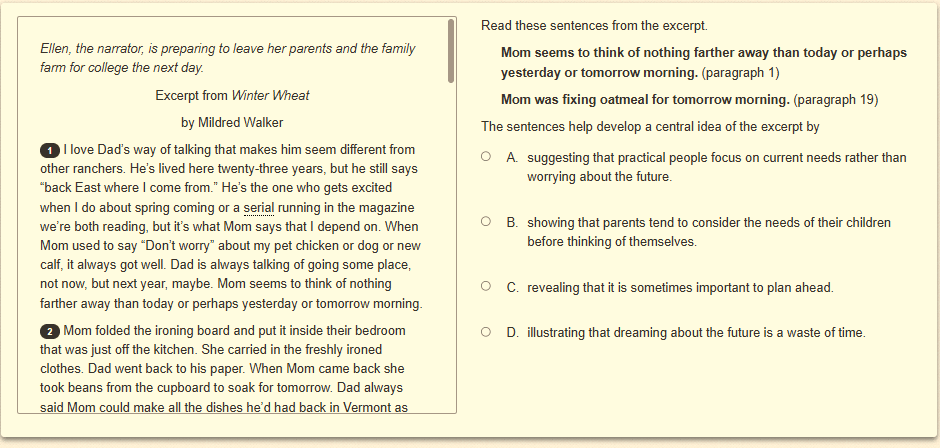
Question 24 of 57
2021 Test A English, question 24Uses the passage above: “Excerpt from Winter Wheat”.
Question
The flashback in paragraphs 10–24 affects the plot by
- Ashowing that the departure of one member of the family makes extra work for those left on the farm.
- Bshowing that the bond within the family persists even when its members are apart.
- Cexplaining why Ellen fears that leaving her parents will be too difficult.
- Dillustrating the close connection Ellen has with both of her parents.
Show the answer
Correct answer: D
The question asks how the flashback in paragraphs 10–24 affects the plot of the excerpt.
A. Incorrect. The flashback does not show that Ellen and her mother faced extra work as a result of the father’s trip to Vermont. Although paragraph 19 describes Ellen’s mother making oatmeal for the next day’s breakfast, this task was not extra work.
B. Incorrect. Although the flashback highlights Ellen’s fondness for each of her parents, it describes her father’s initial departure only and does not show what happened to the familial bond while he is away.
C. Incorrect. Although Ellen describes the memory of her father’s departure as something she wanted to avoid thinking about, she does not fear that it will be too difficult to leave her parents. Instead, she is concerned about what will happen to her parents’ relationship when she is no longer there.
D. CORRECT. The flashback illustrates the close connection that Ellen has with her parents by describing her sadness over the departure of her father (“My throat ached all the way” [paragraph 15]) and presenting a moment of comfort and reassurance between Ellen and her mother (“She laid her hand against my face and it felt rough and hard but firm” [paragraph 20]).
Question analysis
This text-structure question asks how the long flashback in paragraphs 10–24 of the Winter Wheat excerpt, Ellen’s memory of the night her father left by train for Vermont, affects the plot. Students must hold fifteen paragraphs in mind, see why the narrator recalls that night just before her own departure, and choose among several believable effects.
- Grade level
- Grade 8 reading and task
- Compared with grade 7
- Above grade 7 Grade 7 students study how a flashback shapes a story. This one runs through most of the excerpt, so students must sum up a long stretch of narrative and then tell apart choices that are close in meaning, more than typical grade 7 work.
- Estimated difficulty
- Among the hardest on the SHSAT: a non-obvious approach, heavy reading, or a well-hidden trap.
- Thinking it demands
- Depth of knowledge 3, strategic thinking · mainly analyze
- What makes it hard
- Evidence in several places major
- A very close wrong answer moderate
- How, not what moderate
- Evidence
- Answered from the whole text
- Reading level
- Passage: about grade 4, 1179 words; question and choices: about grade 7, 64 words.
- Students, last 30 days
- Not enough answers yet to show (it takes 10).
Why it is hard, traps and wrong answers (shows the answer)
Why it is hard
The flashback is most of the excerpt, and it carries several things at once: grief at Dad’s leaving, the parents’ stiffness with each other, Mom’s comfort, the mystery of her Russian name. The two strongest wrong choices sound like plot effects, a bond lasting through absence or a fear of leaving, while the key describes a relationship, so students looking for an event to point to may pass it by. Students must sum up the whole memory and test each choice against what it actually shows.
Evidence in several places major Working it out
The support for “both of her parents” lies in two separate stretches of a fifteen-paragraph flashback: Ellen’s aching throat after Dad’s train leaves in paragraph 15, and Mom’s hand on her face in paragraph 20. (Kirsch & Mosenthal, 1990; Gorin & Embretson, 2006)
A very close wrong answer moderate Choosing the answer
The choice about the family bond persisting while members are apart shares the right one’s subject, family closeness, and differs in one claim, that the bond lasts through a separation the flashback never follows. (Embretson & Wetzel, 1987; Gorin & Embretson, 2006; Ascalon et al., 2007)
How, not what moderate Working it out
The stem asks how the flashback affects the plot, yet the keyed effect is about character, so students must accept that the memory works by showing Ellen’s ties to each parent before she leaves. (Anderson & Krathwohl, 2001)
Strategy: Summarize what happens in the flashback and how Ellen feels at each stage, then compare it with the present-day scenes before and after it and decide what the memory adds.
Traps
- Twists what the text says: Uses the text's topic and ideas but changes what it says: who did it, how much, when, or why.
- Reads too much in: A reasonable-sounding conclusion that goes further than the text allows.
- Outside knowledge: A choice is plausible in the real world but not supported by this text.
The wrong answers, classified
A Outside knowledge (King et al., 2004; Recht & Leslie, 1988)
Assumes a farmer’s absence must mean more chores, perhaps from Dad’s reminder about the cow and Mom’s “I’ll manage,” though the flashback never shows Ellen and Mom burdened with extra work.
B Reads too much in (Graesser, Singer & Trabasso, 1994)
Sees the warmth between Ellen and her parents and stretches it into a bond that lasts through a long separation, though the memory ends the night Dad leaves.
C Twists what the text says (King et al., 2004)
Ties the flashback to Ellen’s unease about leaving but misplaces the worry: what troubles her is how her parents will manage without her, not whether leaving will be too hard.
Working it out, step by step
Figure out what the question asks
This asks how the flashback in paragraphs 10–24 affects the story. A flashback is a scene from the past that interrupts the present. Here Ellen, about to leave for college, remembers the night Dad left for Vermont years ago. Sum up what the memory shows, then test each choice.
Sum up the flashback
Ellen and Mom see Dad off at the train in the cold dark. On the drive home, Ellen says “My throat ached all the way.” At home, Mom comforts her: “She laid her hand against my face and it felt rough and hard but firm.” Later, Mom laughs warmly about her name, and the house feels right again.
See what the memory shows
An aching throat is the tight, sore feeling you get when you hold back tears. That shows how much Ellen loves her father. Mom’s firm hand and warm laugh show how close Ellen is to her mother. So the flashback shows Ellen’s strong tie to both parents.
Check each choice
- A does not fit. The flashback never shows Ellen and Mom with extra farm work.
- B does not fit. The memory ends the night Dad leaves. It never shows the family while he is away.
- C does not fit. Ellen’s worry is about how her parents will get along without her, not about whether leaving will be too hard.
- D fits. It shows Ellen’s love for Dad and her closeness to Mom.
Watch out: B also talks about family closeness. But it says the bond lasts through time apart, which the flashback never shows.
Choose the answer
The flashback shows how close Ellen is to her father and to her mother. So the answer is D.
Why this answer and not the closest wrong one
B is the closest wrong choice, because it also describes a strong family bond. But B says the bond lasts while family members are apart. The flashback stops on the night Dad leaves, so it never shows that. It does show Ellen grieving for Dad and comforted by Mom. That is D.
More questions like this
The original DOE question
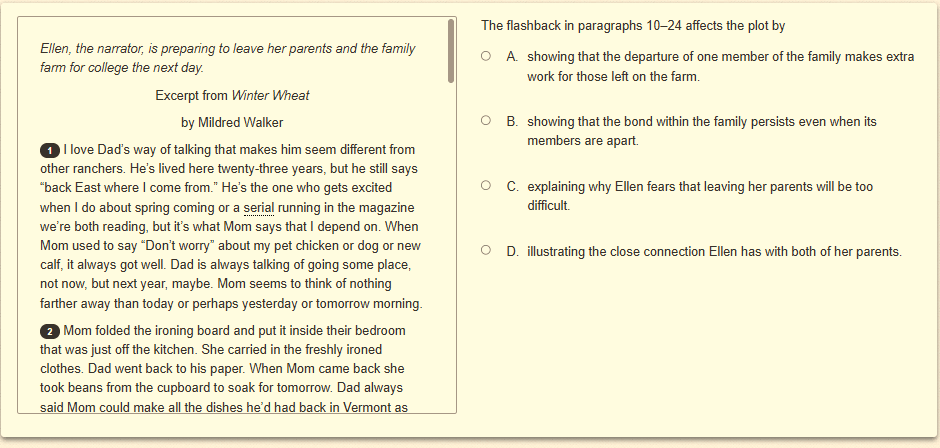
Question 25 of 57
2021 Test A English, question 25Uses the passage above: “Excerpt from Winter Wheat”.
Question
Which sentence from the excerpt provides evidence that Mom wants Ellen to understand the family’s heritage?
- A“Mom folded the ironing board and put it inside their bedroom that was just off the kitchen.” (paragraph 2)
- B“ ‘There’s no need to go to town; she can catch the train at Gotham just as well.’ ” (paragraph 5)
- C“We’d go in right after dinner and go around to the stores, Dad going one way and Mom and I another.” (paragraph 7)
- D“ ‘Why, Yeléna, you know that; Anna Petrovna.’ ” (paragraph 22)
Show the answer
Correct answer: D
The question asks which sentence from the excerpt provides evidence that Mom wants Ellen to understand the family’s heritage.
A. Incorrect. Although this sentence from paragraph 2 describes a domestic moment that takes place within the family home, it does not relate to the heritage of either parent and therefore does not provide evidence that her mother wants Ellen to understand the family’s heritage.
B. Incorrect. Although this sentence from paragraph 5 provides the name of the train station closest to Ellen’s family’s farm, the train stop at Gotham is not related to the family’s heritage. Therefore, this sentence does not provide clear evidence that her mother wants Ellen to understand the family’s heritage.
C. Incorrect. Although this sentence from paragraph 7 describes an aspect of the family dynamic (Ellen predicts that while browsing in stores in town, “Dad [would go] one way and Mom and I another”), their shopping habits do not provide clear evidence that her mother wants Ellen to understand the family’s heritage.
D. CORRECT. In this sentence from paragraph 22, Ellen’s mother addresses her by the Russian version of her name (Yeléna) and repeats her own Russian name (Anna Petrovna). The choice to call her daughter Yeléna instead of Ellen follows immediately after Ellen asks, “Mom, was that really your name—what Dad called you?” (paragraph 21), and the mother’s surprised response provides evidence that she both wants and expects Ellen to understand the family’s Russian heritage.
Question analysis
This evidence question asks which quoted sentence from the Winter Wheat excerpt shows that Mom wants Ellen to understand the family’s heritage. The four sentences, from paragraphs 2, 5, 7 and 22, all involve Mom, so students must reread each one in its paragraph to see what it really shows about her.
- Grade level
- Grade 6 reading and task
- Compared with grade 7
- Below grade 7 Finding the sentence that supports a stated idea is everyday grade 7 work. The quotations are short and plainly worded and the idea is concrete, so one careful rereading of each in context is enough, a lighter task than usual.
- Estimated difficulty
- Routine: one familiar step, little to misread.
- Thinking it demands
- Depth of knowledge 2, skills and concepts · mainly evaluate
- What makes it hard
- Evidence
- Answered from several paragraphs or stanzas
- Reading level
- Passage: about grade 4, 1179 words; question and choices: about grade 8, 83 words.
- Students, last 30 days
- Not enough answers yet to show (it takes 10).
Why it is hard, traps and wrong answers (shows the answer)
Why it is hard
Only one of the four sentences touches the family’s origins at all, so a student who knows what heritage means can rule out the others at a glance. The small risk lies with students who match “Mom wants” to any line where Mom states a preference, or who do not recognize the Russian names, since the quotation stops before Mom mentions Russia.
Reading between the lines minor Working it out
The quoted line never mentions heritage; students must see that Mom calling Ellen “Yeléna” and repeating “Anna Petrovna,” as things Ellen should already know, shows her wish to pass on their Russian roots. (Graesser, Singer & Trabasso, 1994; Kintsch, 1998)
Evidence in several places minor Working it out
The names’ Russian origin is clearest outside the quotation, in the rest of paragraph 22, where Mom names her birthplace, and in paragraph 2’s “instead of a Russian.” (Kirsch & Mosenthal, 1990; Gorin & Embretson, 2006)
Strategy: Define heritage in your own words, then reread each quoted sentence in its paragraph and ask whether it shows Mom handing something about the family on to Ellen.
Traps
- True but not the answer: A choice says something accurate about the text that does not answer this question.
- Supports only part of the claim: In a question about evidence: a line that backs one half of the claim but not the other, or a related point rather than the claim itself.
The wrong answers, classified
A True but not the answer (King et al., 2004; Embretson & Wetzel, 1987)
Picks an everyday moment of Mom putting away the ironing board, perhaps remembering that paragraph 2 also mentions her Russian roots, though this sentence shows only housework.
B Supports only part of the claim (King et al., 2004; Thissen, Steinberg & Fitzpatrick, 1989)
Matches “Mom wants” to Mom’s spoken preference that Ellen catch the train at Gotham, which backs half the idea, a wish of Mom’s, but concerns travel, not heritage.
C True but not the answer (King et al., 2004; Embretson & Wetzel, 1987)
Notices Mom and Ellen shopping together in Ellen’s imagined trip to town, a sign of closeness, but going around the stores says nothing about where the family comes from.
Working it out, step by step
Figure out what the question asks
This asks which sentence shows that Mom wants Ellen to understand the family’s heritage. Heritage is the history and traditions a family passes down, such as where it came from. Look for a sentence where Mom shares something about the family’s roots.
Look at the conversation
At the train, Dad called Mom Anna Petrovna, a name Ellen had never heard him use. In paragraph 21, Ellen asks, “Mom, was that really your name—what Dad called you?” In paragraph 22, Mom answers, “Why, Yeléna, you know that; Anna Petrovna.” Then she reminds Ellen that she was born in Russia.
Work out what Mom’s answer shows
Mom calls her daughter Yeléna, the Russian form of Ellen. She repeats her own Russian name. She also says “you know that,” as if Ellen should already know. Mom is surprised that Ellen doesn’t. That shows Mom wants and expects Ellen to know where the family comes from.
Check each choice
- A does not fit. Folding the ironing board is housework. It says nothing about the family’s past.
- B does not fit. Mom does want something here, the train at Gotham. But that is about travel, not heritage.
- C does not fit. Shopping in town shows family habits, not family roots.
- D fits. Mom uses Russian names and expects Ellen to know them.
Watch out: B tempts because it shows what Mom wants. But the question asks what she wants Ellen to understand about the family.
Choose the answer
Only one sentence has Mom passing on the family’s Russian roots. So the answer is D.
Why this answer and not the closest wrong one
B is the closest wrong choice, because Mom states a wish in it: Ellen can catch the train at Gotham. But that wish is about the trip, not the family’s past. In D, Mom uses the Russian names Yeléna and Anna Petrovna. She is surprised that Ellen doesn’t know them. That shows she wants Ellen to understand her heritage.
More questions like this
The original DOE question
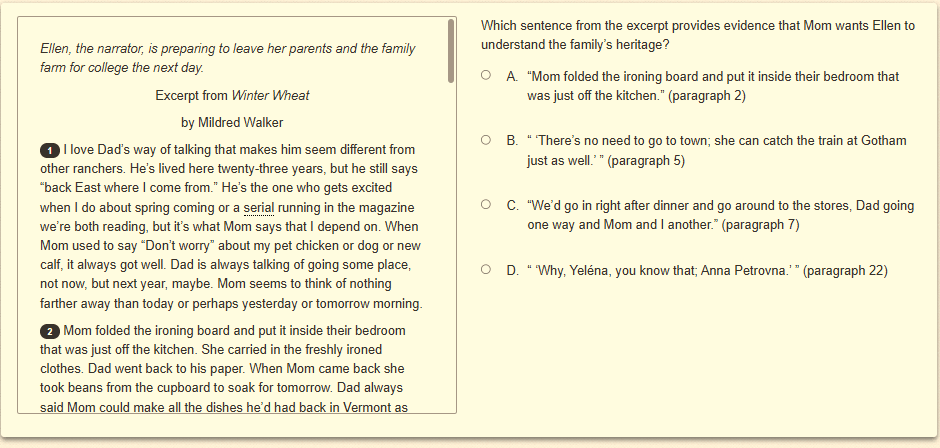
Question 26 of 57
2021 Test A English, question 26Passage Massachusetts: Lowell National Historical Park
Massachusetts: Lowell National Historical Park
During the first half of the 19th century, Lowell, Massachusetts, quickly transformed itself from a farm town to a bustling industrial city. In time, Lowell became a model of industry, gaining global recognition for its state-of-the-art technology, innovative canal and dam system, mill architecture, boardinghouses, churches, and ethnic neighborhoods. Young Yankee women, immigrant families, and European tourists all flocked to Lowell to find work at one of the many textile mills, or visit the industrious city that was becoming a popular tourist destination. As one Scottish traveler observed during his visit to America, “Niagara and Lowell are the two objects I will longest remember in my American journey, the one the glory of American scenery, the other of American industry.” Today, Lowell National Historical Park welcomes visitors to enjoy the sights of Lowell and learn about the history of one of America’s most significant industrial cities.
The Boston merchants who founded Lowell in 1821 and named it after Francis Cabot Lowell chose to locate the town along Massachusetts’s Merrimack River to take advantage of the kinetic energy offered by the Pawtucket waterfalls. Over six miles of canals powered the waterwheels of Lowell’s mills, whose massive five- and six-story brick buildings dominated the city’s landscape. . . . The most recognized of these buildings are the Lowell Manufacturing Company chartered in 1821, the Suffolk or Wannalancit Mill completed around the 1880s, the Boott Mill Company established in 1835, and the Boott Mill Boardinghouse that opened in 1838. By the 1850s, 40 textile mills employing over 10,000 workers stretched for about a mile along the river. . . .
The city’s female workforce was significant in the history of Lowell. From the early to mid-1800s, women left the constricted lifestyle of small rural towns and rural areas for independent industrial city life. Most were young single Yankee girls, who were tired of the limited opportunities offered by their domestic work. Women found that Lowell’s mills offered monthly wages for their services and provided them room and board. Although these women gained economic independence in Lowell, the mill boardinghouse keepers constantly supervised their social activities, for which they hardly had any time, considering their daily 12- to 14-hour work schedules. At the end of the day, the factory bell signaled the “mill girls” to return to their boardinghouses. They were expected to adhere to the strict code of conduct respecting curfew and attending church.
Yankee “mill girls” continued to dominate the Lowell workforce until the 1840s, when the city began to find it difficult to compete with the growing industrial development in other New England communities. As profits fell, the mill industry cut wages. These wage cuts, deteriorating working conditions, and long workdays led the “mill girls” to protest and organize strikes. When their demands went unheard, the women left Lowell, and immigrant groups replaced them in the workforce. Despite the low wages and unhealthy work conditions, immigrants were eager to find work.
The immigrants replacing the Yankee “mill girls” during the 1840s were predominantly Irish Catholics, who traveled to America during the Great Potato Famine. Although Lowell received an influx of Irish families during this time, the Irish were a part of the city’s history from its birth, and before the “mill girls” arrived, they built Lowell’s historic canals, mills, and boardinghouses. Initially, Lowell’s Protestant community was slow to welcome Irish immigrants, but the hostility between Yankee Protestants and Irish Catholics eventually disappeared. Irish immigrants dominated the industrial scene until the Civil War, when other immigrant groups began to work in the city mills.
Like the Irish, the French-Canadians, Greeks, Poles, Portuguese, Russian Jews, and Armenians who came to work in Lowell’s mills faced long work hours, low wages, and poor living conditions in the city’s crowded tenements. By the time Lowell’s industry declined, the city had become an ethnic melting pot, where each group claimed its own distinct neighborhood, like the Irish immigrants’ “New Dublin” or “Acre,” and the French-Canadians’ “Little Canada.” The city officially began to close down its mills in the 1920s and ’30s after Lowell’s outdated mills could no longer compete against the state-of-the-art cotton mills in other communities and working conditions continued to decline as Lowell’s companies stopped reinvesting in their mills. . . . Despite a brief resurgence during World War II, the city shut down its last surviving mill by the mid-1950s.
From “Massachusetts: Lowell National Historical Park”—Public Domain/National Park Service
Yankee: native to New England
Niagara: a town in northwestern New York State well known as the location of Niagara Falls, a series of waterfalls on the Canadian border
domestic work: household duties like cooking and cleaning
Question
Read this sentence from paragraph 1.
As one Scottish traveler observed during his visit to America, “Niagara and Lowell are the two objects I will longest remember in my American journey, the one the glory of American scenery, the other of American industry.”
The author most likely includes the quotation from the Scottish traveler in order to
- Asuggest that people around the world saw the direct contribution of nature and industry to the United States.
- Bcompare the natural and industrial attractions in the United States at that time.
- Cconvey the idea that the United States offered both natural and industrial attractions.
- Dimply that the natural resources in the United States contributed to the development of industry.
Show the answer
Correct answer: C
The question asks why the author most likely includes the quotation from the Scottish traveler in paragraph 1 of the passage.
A. Incorrect. While it is likely that people outside the United States recognized that both the natural landscape and the bustling industry were significant, the quotation from the Scottish traveler is meant to convey the variety of the types of attractions in the U.S., not to make a general statement about their contribution.
B. Incorrect. The Scottish traveler mentions both “American scenery” and “American industry” in the quotation, but the intent is to highlight that they are each points of interest. The quotation does not provide a comparison of the two attractions.
C. CORRECT. The quotation emphasizes the idea that the United States offers different attractions. The Scottish traveler highlights the two places in the United States that he will most remember: first, the beautiful natural formation of Niagara Falls (“ ‘the glory of American scenery’ ”) and second, the industrial city of Lowell (“ ‘the glory . . . of American industry’ ”).
D. Incorrect. The Scottish traveler mentions both “American scenery” and “American industry” in the quotation but does not imply that the natural resources contributed to the development of industry.
Question analysis
This reading question asks why the author of a National Park Service article about Lowell, Massachusetts, quotes a Scottish traveler who named Niagara and Lowell as the sights he would remember longest from his American journey. Students must work out the job a quotation does in an opening paragraph, and the traveler's compressed, old-fashioned wording has to be untangled first.
- NYS standards
- 7R5 structure and genre features
- Grade level
- Grade 7 reading and task
- Compared with grade 7
- At grade 7 Grade 7 readers regularly explain why an author includes a quotation. This one adds a sentence in older English built on a compressed “the one…, the other…” pattern, but it is a single sentence in a plainly organized opening paragraph, so the demand stays typical.
- Estimated difficulty
- Moderate: several steps, or a close reading with one strong distractor.
- Thinking it demands
- Depth of knowledge 2, skills and concepts · mainly analyze
- What makes it hard
- A very close wrong answer moderate
- How, not what moderate
- Complex sentences minor
- Evidence
- Answered from one sentence or line
- Reading level
- Passage: about grade 15, 764 words; question and choices: about grade 11, 115 words.
- Students, last 30 days
- Not enough answers yet to show (it takes 10).
Why it is hard, traps and wrong answers (shows the answer)
Why it is hard
Most of the work is translating the traveler's compressed remark into plain words: Niagara stands for American scenery, Lowell for American industry, and both are high points of his trip. Students who see the two placed side by side often take the pairing for a comparison, while others read more into it, a worldwide verdict or a link between waterfalls and mills. The question rewards stating only what the remark does in the paragraph, which is to set Lowell beside Niagara as a sight worth the journey.
A very close wrong answer moderate Choosing the answer
The comparison choice names the same pair as the key, Niagara's scenery and Lowell's industry; it differs only in the verb, “compare” instead of conveying that the country offered both kinds of attraction. (Embretson & Wetzel, 1987; Gorin & Embretson, 2006; Ascalon et al., 2007)
How, not what moderate Working it out
The stem asks why the author placed the traveler's remark in paragraph 1, so its job, backing the sentence before it about tourists visiting the industrious city, matters more than its content. (Anderson & Krathwohl, 2001)
Complex sentences minor Understanding the question
The 37-word sentence ends in the compressed, old-fashioned “the one the glory of American scenery, the other of American industry,” where the verb and the second “glory” are left out. (Abedi & Lord, 2001; Freedle & Kostin, 1993; Messick, 1989)
Strategy: Put the traveler's remark into plain modern words, reread the sentence before it about who came to Lowell, and pick the purpose that fits both without reading more into the remark than it says.
Traps
- Wrong purpose or structure: Names a purpose, structure or effect that the part does not serve, or describes what a part says when the question asks what it does.
- Reads too much in: A reasonable-sounding conclusion that goes further than the text allows.
- Too broad or too strong: A choice overstates, generalizes, or uses absolute words the text does not support.
The wrong answers, classified
A Too broad or too strong (King et al., 2004)
Stretches one Scottish visitor's memory into what “people around the world” saw, perhaps from the paragraph's “global recognition,” and adds a “direct contribution” that the remark never claims.
B Wrong purpose or structure (Anderson & Krathwohl, 2001)
Takes the remark's side-by-side pattern, “the one … the other,” for a comparison, though the traveler weighs neither against the other and simply names each as a highlight.
D Reads too much in (Graesser, Singer & Trabasso, 1994)
Connects Niagara's waterfalls to the Pawtucket falls that powered Lowell's mills in paragraph 2, a link between nature and industry that the traveler's remark never draws.
Working it out, step by step
Figure out what the question asks
This question asks about the author’s purpose. You need to say why the author put the Scottish traveler’s words into paragraph 1. Don’t just restate what he says. Ask what job his words do in the paragraph.
Find the quotation and its neighbor
The traveler’s words are in paragraph 1: “Niagara and Lowell are the two objects I will longest remember in my American journey.” He ends with “the one the glory of American scenery, the other of American industry.” Now look at the sentence just before it. It says European tourists came to “visit the industrious city that was becoming a popular tourist destination.”
Put his words in plain English
The old-fashioned ending leaves words out. “The one” means the first place he named, Niagara. “The other” means the second place, Lowell. Glory means the finest thing, the pride. Industry means factories and the work done in them. So he is saying: Niagara Falls is the best of America’s natural beauty, and Lowell is the best of its industry. Both are the sights he will remember longest.
Check each choice
- A is wrong. One visitor is not “people around the world.” He also never says nature or industry made a “direct contribution” to the country.
- B is wrong. He names the two places side by side, but he never weighs one against the other.
- C is right. He names a natural wonder and an industrial wonder as the two highlights of his trip. So America offered both kinds of attraction.
- D is wrong. He never says nature helped industry grow. The waterfalls that powered the mills come up in paragraph 2, not in his words.
Watch out: “The one” and “the other” set the two places side by side. That can feel like a comparison, which leads to B. But he praises both. He does not compare them.
Choose the answer
The author uses the quotation to show that America had two kinds of sights worth the trip: natural ones like Niagara and industrial ones like Lowell. So the answer is C.
Why this answer and not the closest wrong one
B is the closest wrong answer. It names the same pair, nature and industry. But to compare is to show how two things are alike or different. The traveler doesn’t do that. He simply names Niagara and Lowell as two highlights. C says just that: the country offered both kinds of attraction.
More questions like this
The original DOE question
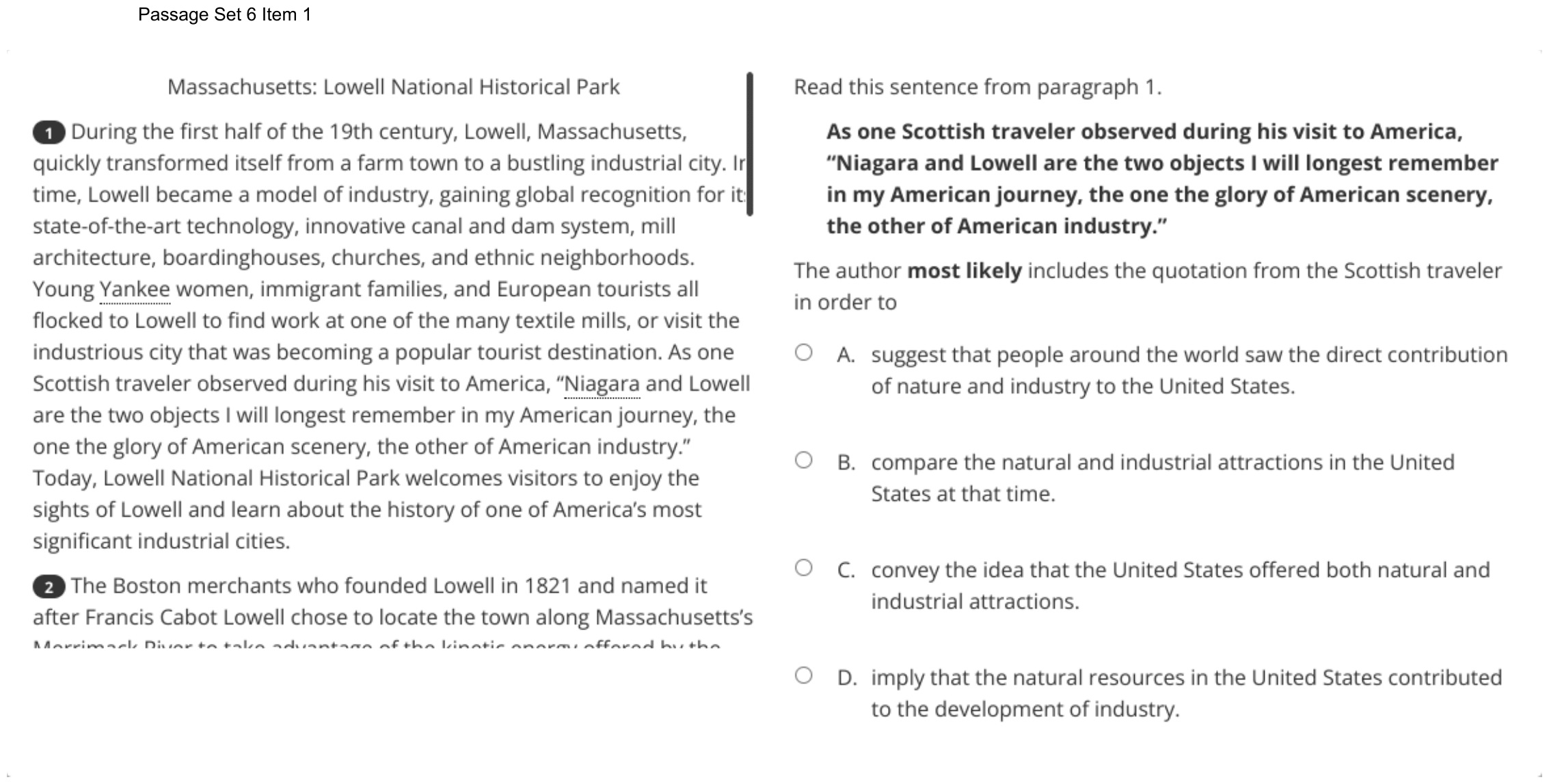
The passage “Massachusetts: Lowell National Historical Park” as printed (page 50)
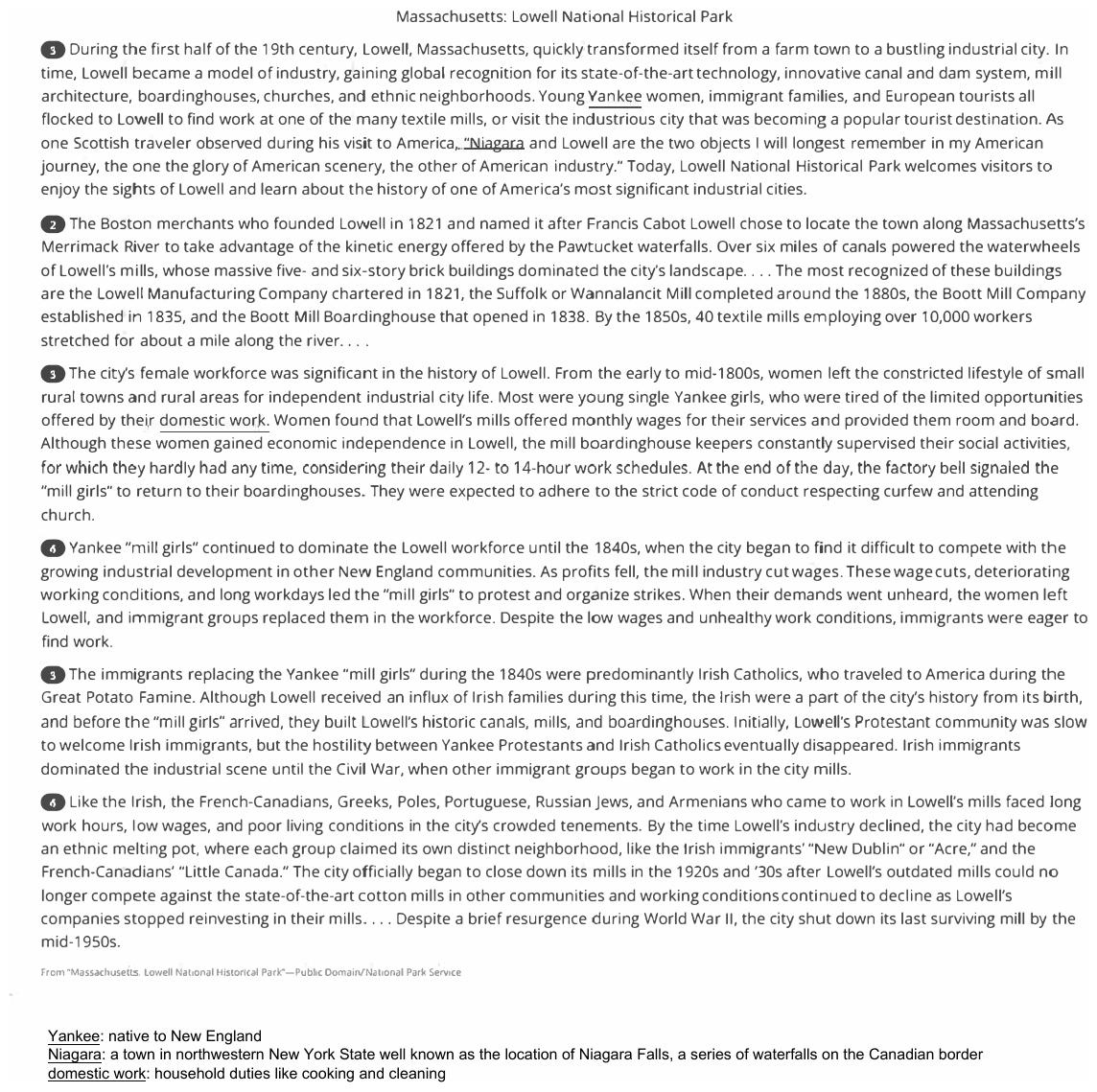
Question 27 of 57
2021 Test A English, question 27Uses the passage above: “Massachusetts: Lowell National Historical Park”.
Question
A central idea that Lowell was “one of America’s most significant industrial cities” (paragraph 1) is conveyed in the passage primarily through a description of the
- Acanals, mills, and boardinghouses that were built by immigrants.
- Bmill girls and immigrants who comprised Lowell’s workforce.
- Cdevelopment of the mills and the workforce established to support them.
- Dcultural diversity of the people who lived in the area.
Show the answer
Correct answer: C
The question asks which description conveys the central idea that Lowell was “one of America’s most significant industrial cities” (paragraph 1).
A. Incorrect. While the passage does state that the city’s canals, mills, and boardinghouses were built by early immigrants from Ireland, these details do not contribute to the development of the overall idea that Lowell was a significant industrial city.
B. Incorrect. The details about the women and immigrants who worked in the mills are important to the passage, but these details alone do not show that Lowell was a significant industrial city.
C. CORRECT. The details throughout the passage about the development of the mills and the people who worked in them convey the significance of Lowell in early American industry. Paragraph 2 shares details about the businesses that started in the 1800s and contributed to the development of industry in the region (“The most recognized of these buildings are the Lowell Manufacturing Company chartered in 1821, the Suffolk or Wannalancit Mill completed around the 1880s, the Boott Mill Company established in 1835, and the Boott Mill Boardinghouse that opened in 1838”). Then paragraphs 3–6 provide specific details about the people who worked in the mills at different points in time.
D. Incorrect. Although the passage references Lowell’s culturally diverse community (“Young Yankee women, immigrant families, and European tourists all flocked to Lowell to find work at one of the many textile mills” [paragraph 1]), these groups alone are not what marked Lowell as a significant industrial city.
Question analysis
This central idea question asks which kind of description in an article about the Massachusetts mill city of Lowell does most to show that it was one of America's most significant industrial cities. Students need a map of all six paragraphs, because every choice names something the passage really describes, and the question turns on which description does the main work.
- Grade level
- Grade 8 reading and task
- Compared with grade 7
- Above grade 7 Grade 7 students trace how a central idea is developed, usually through a few supporting details. Here the strands to weigh run through six dense paragraphs of dates, mills and worker groups, and the stem is long and passive, so it asks more than typical.
- Estimated difficulty
- Hard: combines ideas, needs a plan, and has more than one tempting wrong answer.
- Thinking it demands
- Depth of knowledge 3, strategic thinking · mainly analyze
- What makes it hard
- A very close wrong answer major
- Evidence in several places moderate
- A lot to read minor
- Complex sentences minor
- Evidence
- Answered from the whole text
- Reading level
- Passage: about grade 15, 764 words; question and choices: about grade 10, 63 words.
- Corrected from the DOE handbook
- A grammatical error in the explanation was corrected.
- An inaccurate detail in the explanation was corrected.
- Students, last 30 days
- Not enough answers yet to show (it takes 10).
Why it is hard, traps and wrong answers (shows the answer)
Why it is hard
Every choice names something the passage really describes, so truth rules nothing out; the question turns on which description carries the claim that Lowell mattered as an industrial city. Because four of the six paragraphs follow the workers, the workforce alone looks like the passage's main thread, and students who forget paragraph 2's mills take the half for the whole. Diversity and the immigrant builders are real themes too, but neither says anything about Lowell's industrial standing.
A very close wrong answer major Choosing the answer
The workforce choice is the key with one half removed: both describe the people who worked the mills, but only the key also names the development of the mills, which paragraph 2 builds with dates and numbers. (Embretson & Wetzel, 1987; Gorin & Embretson, 2006; Ascalon et al., 2007)
Evidence in several places moderate Working it out
The industrial picture is built in two stages, the canals and mills of paragraph 2 and the successive workforces of paragraphs 3 to 6, so each choice must be measured against the whole passage. (Kirsch & Mosenthal, 1990; Gorin & Embretson, 2006)
A lot to read minor Understanding the question
Six paragraphs pack in mill names, dates from 1821 to the 1950s and a string of worker groups, from Yankee mill girls to Irish, French-Canadian and Greek immigrants. (Kintsch, 1998; Gorin & Embretson, 2006; Freedle & Kostin, 1993)
Complex sentences minor Understanding the question
The stem is a long passive sentence that quotes paragraph 1 inside it and holds the real question, “primarily through a description of the,” until its last words. (Abedi & Lord, 2001; Freedle & Kostin, 1993; Messick, 1989)
Strategy: Note in a phrase what each of the six paragraphs is about, then test each choice against the stem's claim: would that description make a reader see Lowell as a major industrial city?
Traps
- Too narrow: A single detail offered as the central idea or a summary, or a summary that keeps minor details and leaves out an essential part.
- True but not the answer: A choice says something accurate about the text that does not answer this question.
The wrong answers, classified
A Too narrow (King et al., 2004)
Seizes on paragraph 5's clause that Irish workers built the canals, mills and boardinghouses, one fact about construction rather than the account of mills and workers that shows Lowell's importance.
B Too narrow (King et al., 2004)
Sees that paragraphs 3 to 6 follow the mill girls and the immigrants who replaced them, but leaves out the mills themselves, the heart of paragraph 2's industrial picture.
D True but not the answer (King et al., 2004; Embretson & Wetzel, 1987)
Recalls paragraph 6's “ethnic melting pot” and paragraph 1's “ethnic neighborhoods,” which are real, but the city's diversity says nothing about its standing as an industrial city.
What was corrected from the DOE handbook, and why
- Explanation: The handbook’s explanation of Option B says “The details about the women and immigrants who worked in the mills is important to the passage.” The subject is “details,” so the site now says “are important.”
- Explanation: The handbook’s explanation of Option C says paragraph 2 describes “the businesses that started in the early 1800s,” but the sentence it then quotes includes “the Suffolk or Wannalancit Mill completed around the 1880s,” late in the century. The site now says “the businesses that started in the 1800s.”
Working it out, step by step
Figure out what the question asks
This is a central idea question. A central idea is a main point that the whole passage builds. The point here is that Lowell was “one of America’s most significant industrial cities.” Significant means important. You need the description that does the most to show this.
Map the six paragraphs
- Paragraph 1: Lowell grows from a farm town into a famous industrial city.
- Paragraph 2: The mills: canals, huge brick buildings, mills started across the 1800s, and by the 1850s, “40 textile mills employing over 10,000 workers.”
- Paragraphs 3 and 4: The Yankee “mill girls” who worked in the mills.
- Paragraphs 5 and 6: The Irish and other immigrants who took their place.
See how the picture is built
The passage shows Lowell’s importance in two parts. First it describes the mills: how they were built and how big they grew. Then it follows the workers who ran them, group after group. Together, the mills and the workforce show a major industrial city. Workforce means all the people who do the work. Either part alone tells only half the story.
Check each choice
- A is wrong. Paragraph 5 does say the Irish built the canals, mills and boardinghouses. But that is one fact in one sentence, not the main description.
- B is wrong. The mill girls and immigrants fill paragraphs 3 to 6. But this choice leaves out the mills themselves, the heart of paragraph 2.
- C is right. It covers both parts: how the mills grew and the workers who kept them running.
- D is wrong. Lowell did become an “ethnic melting pot.” But a mix of cultures doesn’t show that a city was an industrial leader.
Watch out: Four of the six paragraphs are about workers, so B looks like the main thread. It is only half of it.
Choose the answer
The central idea is carried by the growth of the mills plus the workforce gathered to run them. So the answer is C.
Why this answer and not the closest wrong one
B is the closest wrong answer. It matches the second half of C, the people who worked in the mills. But it drops the mills, with their six miles of canals and, by the 1850s, 40 mills. Workers alone don’t make a city an industrial giant. C keeps both halves, so it fits the whole passage.
More questions like this
The original DOE question
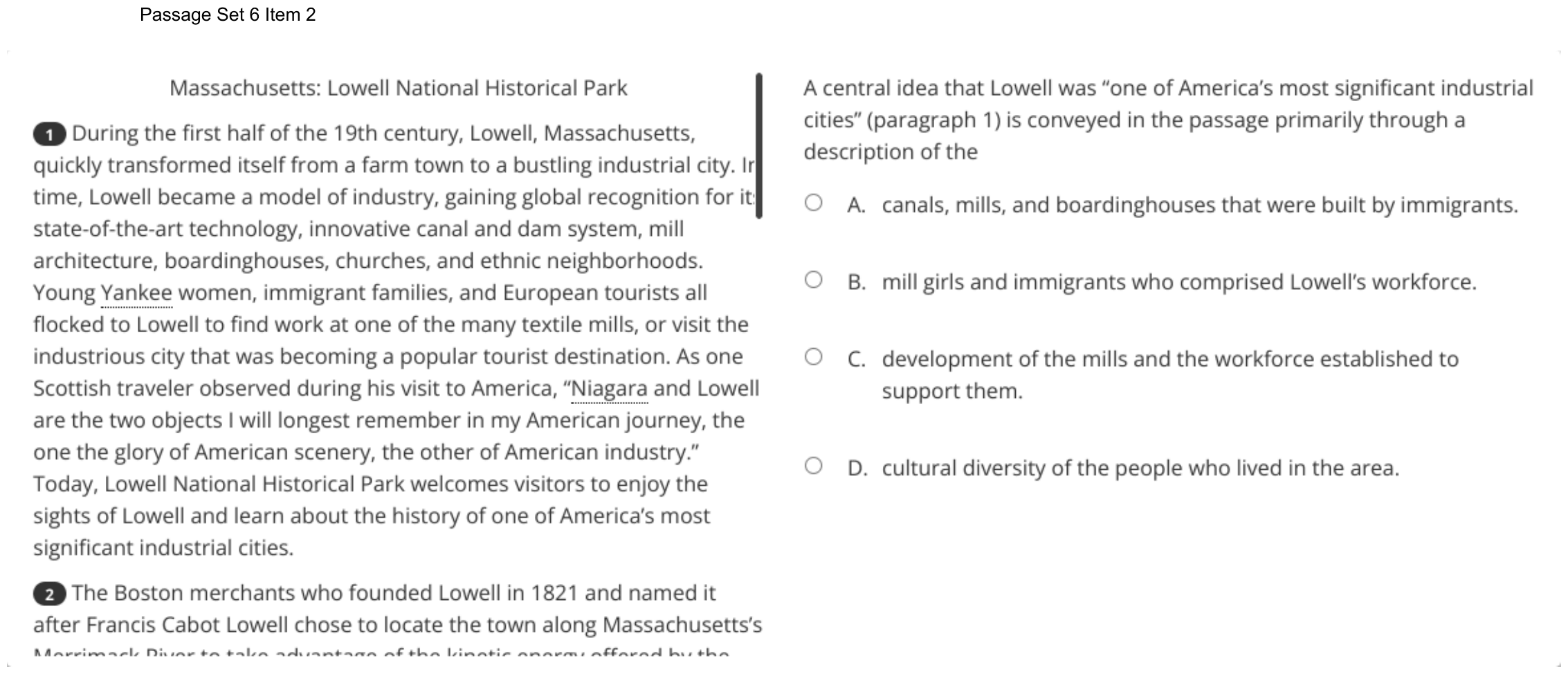
Question 28 of 57
2021 Test A English, question 28Uses the passage above: “Massachusetts: Lowell National Historical Park”.
Question
Which sentence from paragraph 2 best supports the idea that Lowell became “a bustling industrial city” (paragraph 1) in a short period of time?
- A“The Boston merchants who founded Lowell in 1821 and named it after Francis Cabot Lowell chose to locate the town along Massachusetts’s Merrimack River to take advantage of the kinetic energy offered by the Pawtucket waterfalls.”
- B“Over six miles of canals powered the waterwheels of Lowell’s mills, whose massive five- and six-story brick buildings dominated the city’s landscape.”
- C“The most recognized of these buildings are the Lowell Manufacturing Company chartered in 1821, the Suffolk or Wannalancit Mill completed around the 1880s, the Boott Mill Company established in 1835, and the Boott Mill Boardinghouse that opened in 1838.”
- D“By the 1850s, 40 textile mills employing over 10,000 workers stretched for about a mile along the river.”
Show the answer
Correct answer: D
The question asks for the sentence in paragraph 2 that best supports the idea that Lowell became “a bustling industrial city” (paragraph 1) in a short period of time.
A. Incorrect. While the sentence provides details on when the town of Lowell was founded and the natural features of the area, it does not support the idea that the city became “a bustling industrial city” in a short period of time.
B. Incorrect. Although this sentence indicates that the mill buildings were a noticeable feature of the city and provides details on how the mills worked, it does not specifically show that Lowell had become “a bustling industrial city” in a short period of time.
C. Incorrect. While this sentence lists some recognizable mill buildings along the river and notes when their associated businesses were established, it does not support the idea that Lowell had become “a bustling industrial city” in a short period of time.
D. CORRECT. This sentence indicates that within only a few decades of the city’s founding, it experienced massive industrial growth, with “40 textile mills employing over 10,000 workers,” supporting the idea that Lowell became “a bustling industrial city” in a short period of time.
Question analysis
Here students choose which sentence from the second paragraph of an article about Lowell, Massachusetts, best supports the claim that the town became a bustling industrial city in a short period of time. All four sentences describe Lowell's founding, mills or canals, and several carry dates, so students must weigh what each one actually shows about how fast the city grew.
- NYS standards
- 7R1 textual evidence and inferences
- Grade level
- Grade 7 reading and task
- Compared with grade 7
- At grade 7 Picking the sentence that best supports a claim is standard grade 7 evidence work. The claim carries a time condition as well as a description, and all four choices come from one short paragraph, so the demand is typical of grade 7.
- Estimated difficulty
- Moderate: several steps, or a close reading with one strong distractor.
- Thinking it demands
- Depth of knowledge 2, skills and concepts · mainly evaluate
- What makes it hard
- Reading between the lines moderate
- Every choice must be checked minor
- Evidence
- Answered from one paragraph or stanza
- Reading level
- Passage: about grade 15, 764 words; question and choices: about grade 14, 131 words.
- Students, last 30 days
- Not enough answers yet to show (it takes 10).
Why it is hard, traps and wrong answers (shows the answer)
Why it is hard
The claim has two parts, a bustling industrial city and a short time to get there, and most sentences in paragraph 2 meet only one. The list of mills with their founding dates is the strongest pull, because its dates seem to answer the time half, yet they run into the 1880s and show four buildings, not a busy city. The question rewards pairing the 1850s figures with the 1821 founding.
Reading between the lines moderate Working it out
The 1850s sentence shows speed only beside the founding date in the paragraph's first sentence: getting from 1821 to 40 mills and 10,000 workers took about thirty years, a span students must work out. (Graesser, Singer & Trabasso, 1994; Kintsch, 1998)
Every choice must be checked minor Choosing the answer
All four sentences come from paragraph 2 and describe Lowell's mills or canals, and three carry dates, so each must be tested for both the scale and the speed of growth. (Embretson & Wetzel, 1987)
Strategy: Split the claim into its two parts, a busy industrial city and a short span of time, and check each sentence for evidence of both rather than accepting one that fits only half.
Traps
- Supports only part of the claim: In a question about evidence: a line that backs one half of the claim but not the other, or a related point rather than the claim itself.
- True but not the answer: A choice says something accurate about the text that does not answer this question.
The wrong answers, classified
A True but not the answer (King et al., 2004; Embretson & Wetzel, 1987)
Takes the founding year, 1821, as evidence about time, but the sentence only explains why the merchants built beside the Pawtucket falls and says nothing about how the city grew.
B Supports only part of the claim (King et al., 2004; Thissen, Steinberg & Fitzpatrick, 1989)
Sees six miles of canals and “massive five- and six-story brick buildings” as proof of a bustling city, but the sentence gives no date, so it cannot show speed.
C Supports only part of the claim (King et al., 2004; Thissen, Steinberg & Fitzpatrick, 1989)
Treats the list of charters and openings as proof of fast growth, but it names only four buildings, and the Wannalancit Mill's 1880s date stretches the list over some sixty years.
Working it out, step by step
Split the claim into two parts
This is an evidence question. You need the sentence that best supports a claim, and the claim has two parts. First, Lowell became “a bustling industrial city,” a busy factory town. Second, it happened “in a short period of time.” The best sentence must support both parts, not just one.
Find the starting date
Paragraph 2 opens with the town’s start. The Boston merchants “founded Lowell in 1821.” That gives you a starting point. Now look for a sentence that shows how big Lowell got, and by when.
Work out how long it took
The last sentence of paragraph 2 says: “By the 1850s, 40 textile mills employing over 10,000 workers stretched for about a mile along the river.” From 1821 to the 1850s is only about 30 years. In that time, Lowell went from a new town to 40 mills and over 10,000 workers. That is fast growth, and it is clearly bustling.
Check each choice
- A is wrong. It tells why the town was built by the waterfalls. It says nothing about how the city grew.
- B is wrong. Six miles of canals and “massive five- and six-story brick buildings” do sound busy. But there is no date, so it can’t show speed.
- C is wrong. It has dates, but they run from 1821 to the 1880s, about 60 years. And it names just four buildings, not a whole busy city.
- D is right. It shows a big city of mills and workers only about 30 years after Lowell began.
Watch out: C is tempting because it is full of dates. But dates alone don’t prove speed, and these are spread over decades.
Choose the answer
Only one sentence shows both a busy industrial city and a short time to get there. So the answer is D.
Why this answer and not the closest wrong one
C is the closest wrong answer, since its dates seem to answer the time part. But they stretch from 1821 to the 1880s, and they cover only four buildings. D gives the size of the whole mill city, 40 mills and over 10,000 workers, about 30 years after the founding.
More questions like this
The original DOE question
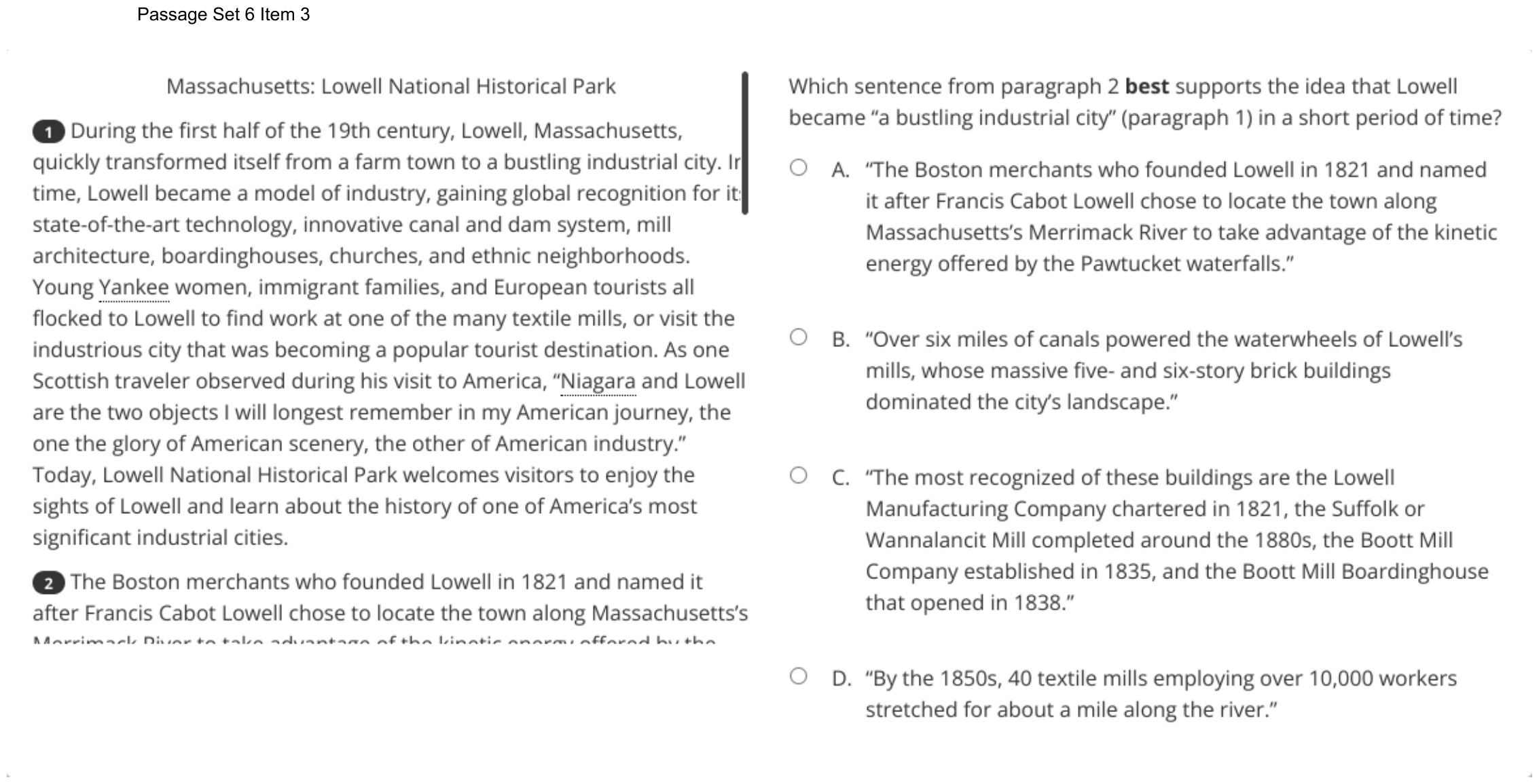
Question 29 of 57
2021 Test A English, question 29Uses the passage above: “Massachusetts: Lowell National Historical Park”.
Question
Read this sentence from paragraph 3.
From the early to mid-1800s, women left the constricted lifestyle of small rural towns and rural areas for independent industrial city life.
Which statement best describes how the sentence fits into the overall structure of the passage?
- AIt provides a transition from a description of the mills to a description of the workforce in those mills.
- BIt indicates a shift in tone from positive and hopeful to negative and dissatisfied with working conditions at the mill.
- CIt summarizes a challenge that led many women to leave their hometown and seek work in urban areas.
- DIt begins a comparison of the mill workforce between the mid-1800s and the late 1800s.
Show the answer
Correct answer: A
The question asks which statement best describes how the sentence in paragraph 3 fits into the overall structure of the passage.
A. CORRECT. The sentence in paragraph 3 provides a transition from the overall description of the city and the mills to a description of the women who made up the workforce in the mills. The idea that women left domestic life in favor of working in the mills is important in the passage, and the sentence serves to connect that idea to the previous discussion about the mills.
B. Incorrect. While the mill girls’ dissatisfaction with their working conditions is addressed later in the passage (“These wage cuts, deteriorating working conditions, and long workdays led the ‘mill girls’ to protest and organize strikes” [paragraph 4]), the sentence in paragraph 3 does not indicate a shift in tone from positive to negative. The sentence provides a transition to the discussion of the women who worked in the mills.
C. Incorrect. Although the sentence in paragraph 3 mentions that women became interested in working in the mills because of the “constricted lifestyle of small rural towns,” structurally the sentence does not function as a summary because, instead of expanding on the idea of the difficulties or challenges of life in small rural towns and rural areas, the paragraph goes on to describe the advantages and disadvantages of life in the city for these women.
D. Incorrect. The sentence in paragraph 3 focuses on the choices women made to leave rural towns to work in the city in the early to mid-1800s, not the mid-1800s to the late 1800s. The sentence does not create a comparison between the workforce in the mid-1800s and that in the late 1800s.
Question analysis
A sentence from the start of paragraph 3 of the Lowell article, about women leaving the limited life of rural towns for the city, is the focus of this text-structure question. Students decide how it fits into the structure of the passage as a whole, so they must place it within the order of all six paragraphs instead of judging it by itself.
- NYS standards
- 7R5 structure and genre features
- Grade level
- Grade 8 reading and task
- Compared with grade 7
- Above grade 7 Grade 7 structure questions often ask what a paragraph does. This one asks how a single sentence serves a six-paragraph history and offers four abstract roles, so the student must hold the passage's whole plan in mind, more than typical grade 7 work.
- Estimated difficulty
- Hard: combines ideas, needs a plan, and has more than one tempting wrong answer.
- Thinking it demands
- Depth of knowledge 3, strategic thinking · mainly analyze
- What makes it hard
- How, not what moderate
- Evidence in several places moderate
- Reading between the lines minor
- Evidence
- Answered from the whole text
- Reading level
- Passage: about grade 15, 764 words; question and choices: about grade 9, 116 words.
- Students, last 30 days
- Not enough answers yet to show (it takes 10).
Why it is hard, traps and wrong answers (shows the answer)
Why it is hard
The answer depends on seeing the passage's plan, mills first and then the people who ran them, and placing this sentence at the seam. Its wording invites a content answer instead, since it really does describe a hardship that drove women to the city, and the later strikes tempt students to see a darker tone beginning here. The fit of the key is also imperfect, because the paragraph's opening sentence starts the turn, so students must choose the best description rather than an exact one.
How, not what moderate Working it out
The question asks what the sentence does in the passage, and its content, women escaping a “constricted lifestyle,” is easy to restate, which makes a summary of that content feel like an answer. (Anderson & Krathwohl, 2001)
Evidence in several places moderate Working it out
The sentence's role shows only from its neighbors: paragraph 2 ends with 40 mills and 10,000 workers, and paragraph 3 then follows the women who left rural towns to work in them. (Kirsch & Mosenthal, 1990; Gorin & Embretson, 2006)
Reading between the lines minor Working it out
Paragraph 3's first sentence, “The city's female workforce was significant,” already names the new subject, so students must see this second sentence as part of the turn rather than a fresh point. (Graesser, Singer & Trabasso, 1994; Kintsch, 1998)
Strategy: Sum up each paragraph in a few words, then look at what comes just before and just after this sentence and decide what role it plays at that point in the passage.
Traps
- Wrong purpose or structure: Names a purpose, structure or effect that the part does not serve, or describes what a part says when the question asks what it does.
- Wrong tone or attitude: Misjudges the tone, attitude or point of view, such as reading admiration as criticism, or taking a character's or subject's feelings for the author's.
The wrong answers, classified
B Wrong tone or attitude (Graesser, Singer & Trabasso, 1994)
Expects a turn toward complaint because the mill girls later strike, but this sentence is hopeful about “independent industrial city life,” and the protests wait until paragraph 4.
C Wrong purpose or structure (Anderson & Krathwohl, 2001)
Restates what the sentence says, women escaping a “constricted lifestyle,” instead of what it does, and the paragraph goes on to life in Lowell rather than rural hardship.
D Wrong purpose or structure (Anderson & Krathwohl, 2001)
Sees the dates “early to mid-1800s” and expects a then-and-later contrast, though the sentence opens the mill girls' story and the passage sets up no such comparison.
Working it out, step by step
Figure out what the question asks
This is a structure question. Structure is how a passage is put together. You need to say what job this sentence does in the whole passage. Don’t just restate what it says. Ask what comes before it and what comes after it.
Look at what comes before
Paragraph 2 is all about the mills. It ends with “40 textile mills employing over 10,000 workers.” Then paragraph 3 begins: “The city’s female workforce was significant in the history of Lowell.” Workforce means the people who do the work. The sentence in the question comes right after that: “From the early to mid-1800s, women left the constricted lifestyle of small rural towns and rural areas for independent industrial city life.”
Look at what comes after
Constricted means tight and limited. So women left small, limited farm towns to live on their own in the city. After this, the passage stays with the workers. Paragraphs 3 and 4 tell about the mill girls’ wages, rules, strikes and leaving. Paragraphs 5 and 6 tell about the immigrants who replaced them. So the passage turns here, from the mills to the people who worked in them.
Check each choice
- A is right. The sentence helps carry the reader from the mills to the workforce in those mills.
- B is wrong. The tone isn’t negative here. “Independent industrial city life” sounds hopeful. The protests and strikes don’t come until paragraph 4.
- C is wrong. It tells what the sentence says, not what it does. And the paragraph goes on to life in Lowell, not to more about hard times back home.
- D is wrong. The passage never compares workers of the mid-1800s with workers of the late 1800s.
Watch out: C sounds right because the sentence really does describe a limited life that women wanted to leave. But the question asks about its role, not its content.
Choose the answer
Paragraph 3’s first sentence names the new subject. This sentence carries it forward by telling where the workers came from. Together they move the passage from mills to people. So the answer is A.
Why this answer and not the closest wrong one
C is the closest wrong answer. It is true that women wanted to escape a “constricted lifestyle.” But C describes what the sentence says, not the job it does. The paragraph then moves on to life in Lowell. A names the job: the sentence links the story of the mills to the story of the mill workers.
More questions like this
The original DOE question
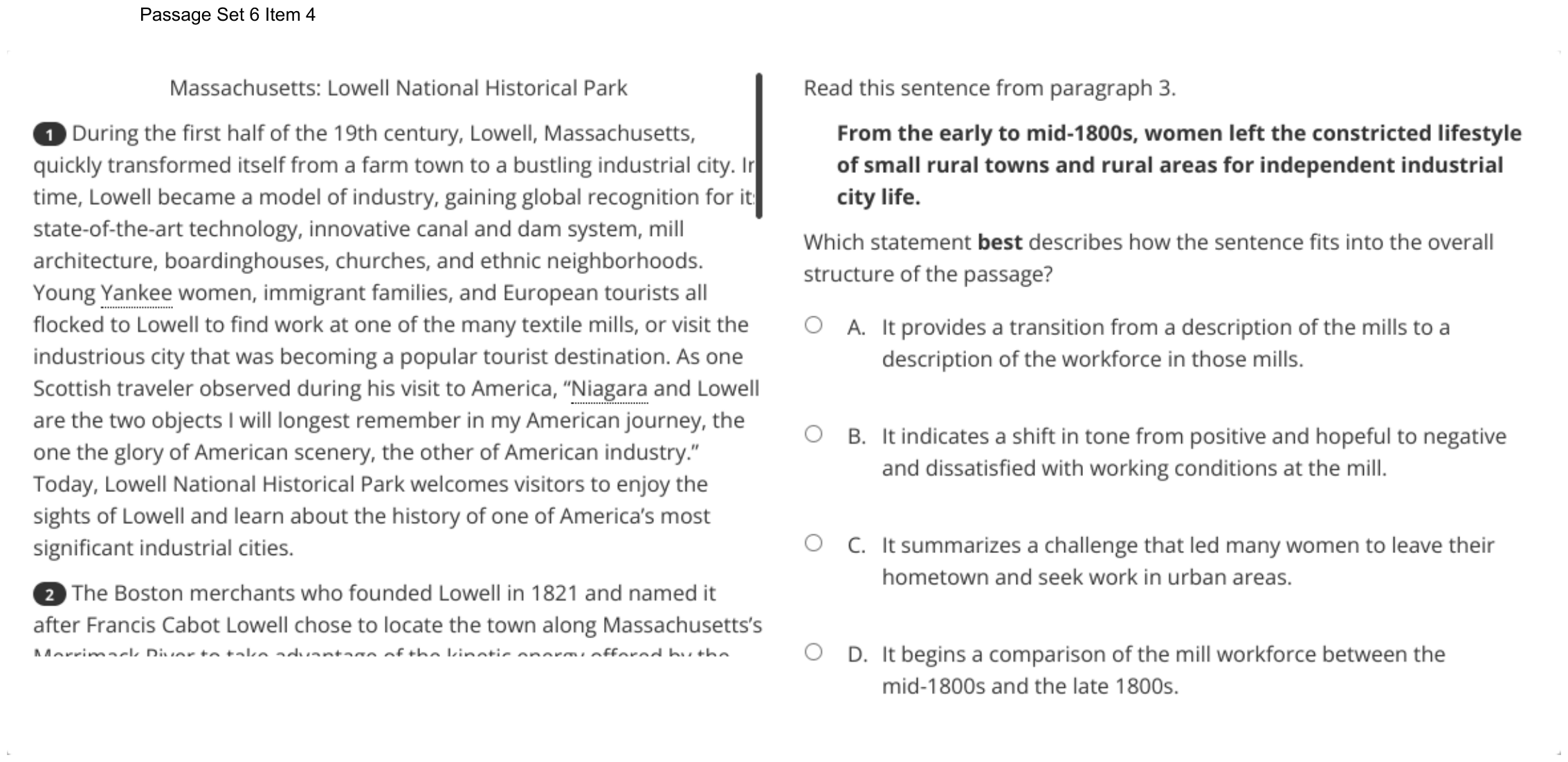
Question 30 of 57
2021 Test A English, question 30Uses the passage above: “Massachusetts: Lowell National Historical Park”.
Question
Read this sentence from paragraph 5.
Although Lowell received an influx of Irish families during this time, the Irish were a part of the city’s history from its birth, and before the “mill girls” arrived, they built Lowell’s historic canals, mills, and boardinghouses.
How does this sentence contribute to the development of ideas in the passage?
- AIt implies that Lowell was founded by early Irish immigrants.
- BIt emphasizes the important role Irish immigrants played in Lowell’s history.
- CIt suggests that the new Irish immigrants were readily accepted into the community.
- DIt highlights the working relationship between the mill girls and the new Irish immigrants.
Show the answer
Correct answer: B
The question asks how the sentence in paragraph 5 contributes to the development of ideas in the passage.
A. Incorrect. The sentence from paragraph 5 does not imply that Lowell was founded by early Irish immigrants. The sentence explains how Irish immigrants had been settling in Lowell since the city was established and that they contributed to the construction of the city, which allowed it to become an industrial center several decades later.
B. CORRECT. The sentence from paragraph 5 shows that early Irish immigrants were critical to the success of Lowell as an industrial city. This information supports the development of the idea that the work of Irish immigrants and immigrants from other places is an important element in the historical significance of industry in Lowell.
C. Incorrect. The sentence from paragraph 5 does not suggest that new Irish immigrants were readily accepted into the community. Paragraph 5 states that “initially, Lowell’s Protestant community was slow to welcome Irish immigrants, but the hostility between Yankee Protestants and Irish Catholics eventually disappeared.”
D. Incorrect. The sentence from paragraph 5 does not highlight the relationship between the mill girls and the new Irish immigrants. Paragraph 4 explains how the mill girls left Lowell, and paragraph 5 states that the mill girls were replaced by “predominantly Irish Catholics, who traveled to America during the Great Potato Famine” but does not discuss a relationship between them.
Question analysis
This question quotes a sentence from paragraph 5 of the Lowell article about Irish families, who arrived in large numbers in the 1840s but had been part of the city since its birth. Students explain how the sentence contributes to the development of the passage's ideas, and because it packs several groups and periods into one line, they must keep straight who did what and when.
- Grade level
- Grade 7 reading and task
- Compared with grade 7
- At grade 7 Explaining how one sentence develops a passage's ideas is a core grade 7 skill. The sentence is long but its meaning is direct, and the text around it settles most of the choices, so the demand is typical.
- Estimated difficulty
- Straightforward: two steps or one careful reading.
- Thinking it demands
- Depth of knowledge 2, skills and concepts · mainly analyze
- What makes it hard
- Complex sentences minor
- Evidence in several places minor
- Evidence
- Answered from one paragraph or stanza
- Reading level
- Passage: about grade 15, 764 words; question and choices: about grade 10, 103 words.
- Students, last 30 days
- Not enough answers yet to show (it takes 10).
Why it is hard, traps and wrong answers (shows the answer)
Why it is hard
Once the long sentence is untangled, its point is plain: the Irish were in Lowell from the start and built its canals, mills and boardinghouses. The likeliest slip is reading “from its birth” as founding the city, which paragraph 2 credits to Boston merchants. The other wrong choices invent a welcome or a partnership that the surrounding sentences contradict or never mention, so a quick check of paragraph 5 settles them.
Complex sentences minor Understanding the question
The 37-word sentence moves through three times at once, the influx “during this time,” the city's birth and the years before the mill girls arrived, so who did what and when must be sorted out. (Abedi & Lord, 2001; Freedle & Kostin, 1993; Messick, 1989)
Evidence in several places minor Working it out
Ruling out the founding choice needs paragraph 2's “Boston merchants who founded Lowell,” and ruling out a warm welcome needs the next sentence's “slow to welcome Irish immigrants.” (Kirsch & Mosenthal, 1990; Gorin & Embretson, 2006)
Strategy: Put the quoted sentence into your own words, then check each choice against the sentences around it in paragraph 5 and against what earlier paragraphs say about the city's beginnings.
Traps
- Twists what the text says: Uses the text's topic and ideas but changes what it says: who did it, how much, when, or why.
- Reads too much in: A reasonable-sounding conclusion that goes further than the text allows.
The wrong answers, classified
A Twists what the text says (King et al., 2004)
Reads “part of the city's history from its birth” and building the canals as founding the city, though paragraph 2 says Boston merchants founded Lowell in 1821.
C Twists what the text says (King et al., 2004)
Remembers that the hostility toward Irish Catholics “eventually disappeared” and overlooks “Initially, … slow to welcome,” turning a gradual change into a ready acceptance.
D Reads too much in (Graesser, Singer & Trabasso, 1994)
Sees the Irish and the mill girls named in one sentence and assumes they worked side by side, a relationship the passage never describes; the Irish later replaced them.
Working it out, step by step
Figure out what the question asks
This structure question asks what one sentence adds to the passage’s ideas. First you need to understand the sentence. It is long and jumps between three times, so take it apart piece by piece.
Break the sentence into parts
The sentence is in paragraph 5. Here are its three parts:
- “Although Lowell received an influx of Irish families during this time”: an influx is a big wave of people arriving, and “this time” means the 1840s.
- “the Irish were a part of the city’s history from its birth”: its birth means the city’s very beginning.
- “they built Lowell’s historic canals, mills, and boardinghouses”: this happened before the mill girls came.
Say it in your own words
Put together, the sentence says: Many Irish families came in the 1840s, but the Irish had been in Lowell from the start. They built its canals, mills and boardinghouses. Without those canals and mills, there would be no industrial city. So the sentence shows how much the Irish mattered to Lowell’s story.
Check each choice
- A is wrong. Being there “from its birth” is not the same as founding the city. Paragraph 2 names the founders: “The Boston merchants who founded Lowell in 1821.”
- B is right. The Irish were there from the start and built the city’s mills and canals. That is an important role.
- C is wrong. The very next sentence says “Lowell’s Protestant community was slow to welcome Irish immigrants.” So they were not readily, or easily, accepted.
- D is wrong. The passage never says the Irish and the mill girls worked together. Later, the Irish replaced them.
Watch out: “From its birth” can sound like they started the city, which leads to A. Check paragraph 2 to see who founded Lowell.
Choose the answer
The sentence makes clear that the Irish helped build Lowell from its first days. So the answer is B.
Why this answer and not the closest wrong one
A is the closest wrong answer, because the sentence links the Irish to the city’s “birth.” But being part of a city from the start is different from founding it. Boston merchants founded Lowell. The Irish built its canals and mills. B fits, because it names that important role without stretching it.
More questions like this
The original DOE question
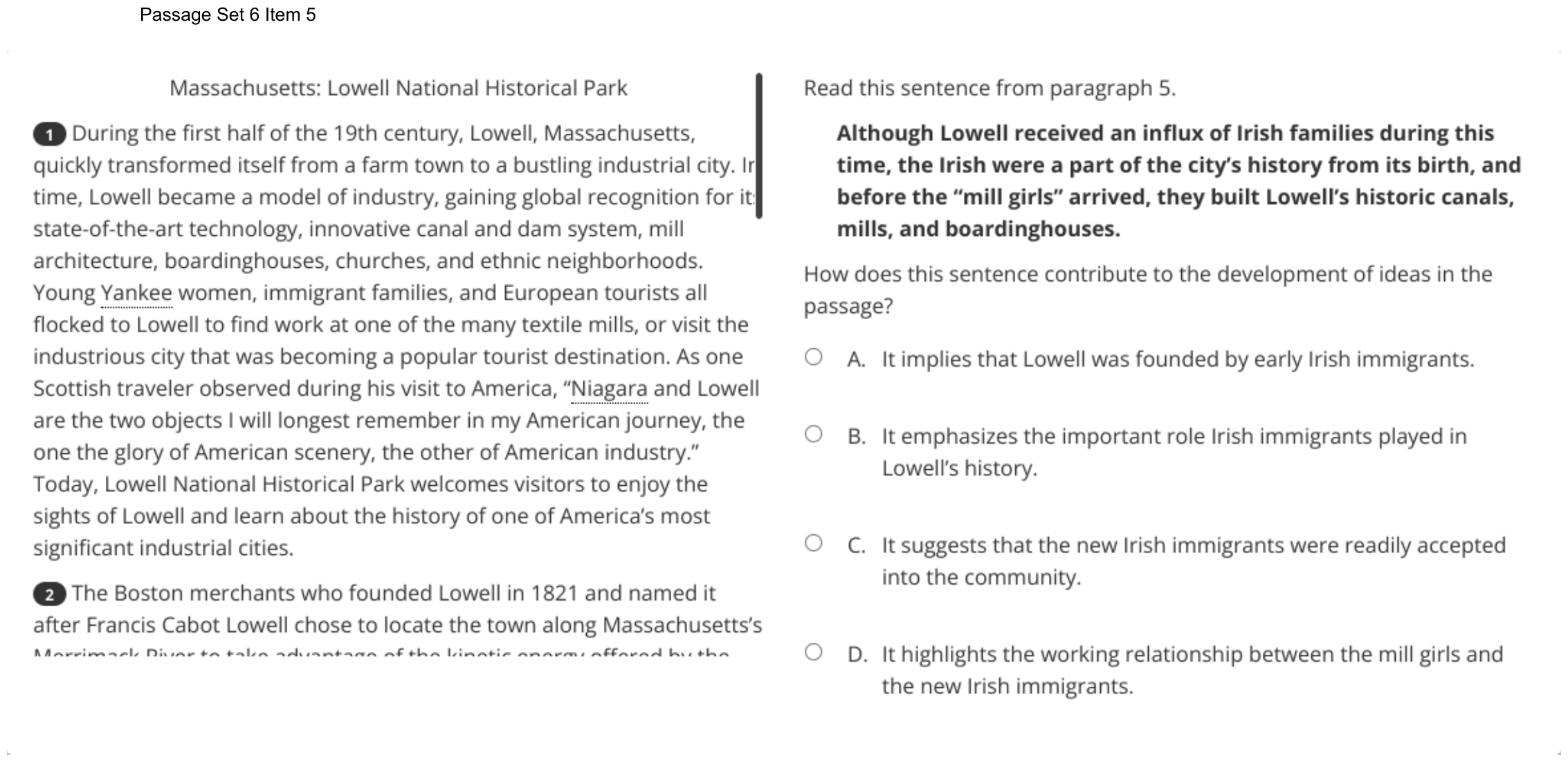
Question 31 of 57
2021 Test A English, question 31Uses the passage above: “Massachusetts: Lowell National Historical Park”.
Question
Which sentence best summarizes the mill girls’ experience as the dominant workforce in Lowell?
- AThe mill girls were eager to leave their domestic duties and small towns behind, so they went to work in the mills of Lowell.
- BOriginally, the mill girls were satisfied to work in Lowell, but as they left their jobs at the Lowell mills, immigrants arrived to fill the empty positions.
- CYoung women left home to work in the Lowell mills, but the mill girls soon became dissatisfied with the working conditions and rigid boardinghouse rules.
- DThe mill girls embraced city life when they came to work in Lowell’s mills, but when their protests about unfavorable working conditions went unanswered, they left.
Show the answer
Correct answer: D
The question asks for the sentence that best summarizes the mill girls’ time as the dominant workforce in Lowell.
A. Incorrect. While the passage explains that mill girls were initially eager to leave the domestic duties of life in rural areas, the summary sentence does not address the details about the mill girls’ time working in the mills or the changes that led the mill girls to leave the industry.
B. Incorrect. Mill girls initially found satisfaction in the mill work and lifestyle, and when they did leave, immigrants filled the empty jobs. This summary sentence, however, does not address the details about the mill girls’ time as the primary workforce in Lowell or the circumstances that led them to leave their jobs in the mid-1800s.
C. Incorrect. Mill girls did leave home to work in the Lowell mills, and they did grow dissatisfied over time, but this summary sentence does not include details about the mill girls’ actions to improve the working conditions.
D. CORRECT. This sentence summary best captures the mill girls’ experience as outlined in paragraphs 3 and 4. The sentence concisely summarizes both the women’s initial excitement about the opportunity to live independently (“Women found that Lowell’s mills offered monthly wages for their services and provided them room and board” [paragraph 3]) and their eventual inability to secure better working conditions (“When their demands went unheard, the women left Lowell, and immigrant groups replaced them in the workforce” [paragraph 4]).
Question analysis
This summary question asks which sentence best sums up the experience of the Yankee mill girls during the years they were Lowell's main workforce. Students must pull together the account spread over paragraphs 3 and 4, and every choice is a two-part sentence that sounds accurate, so each must be checked for what it includes, what it leaves out and what it gets slightly wrong.
- Grade level
- Grade 8 reading and task
- Compared with grade 7
- Above grade 7 Summarizing part of a text is a grade 7 standard, usually tested with one clearly complete choice. Here all four summaries are long, two-part and largely accurate, so ranking them by completeness and precision asks more than typical grade 7 work.
- Estimated difficulty
- Hard: combines ideas, needs a plan, and has more than one tempting wrong answer.
- Thinking it demands
- Depth of knowledge 2, skills and concepts · mainly understand
- What makes it hard
- Every choice must be checked moderate
- A very close wrong answer moderate
- Evidence in several places minor
- Evidence
- Answered from several paragraphs or stanzas
- Reading level
- Passage: about grade 15, 764 words; question and choices: about grade 11, 116 words.
- Students, last 30 days
- Not enough answers yet to show (it takes 10).
Why it is hard, traps and wrong answers (shows the answer)
Why it is hard
This is a completeness question: every summary is built from true pieces of paragraphs 3 and 4, and the right one is the only one that runs from arrival to departure with the cause in between. Students who stop at dissatisfaction feel they have the whole arc, because the turn against working conditions is the story's middle. Writing a one-line summary first, with a beginning, a turning point and an end, makes the gaps in the others easy to see.
Every choice must be checked moderate Choosing the answer
All four summaries are two-part sentences of 24 to 27 words that sound accurate, so each has to be checked for what it leaves out: the arrival, the wage cuts and protests, or the departure. (Embretson & Wetzel, 1987)
A very close wrong answer moderate Choosing the answer
The dissatisfaction summary shares the key's shape, women coming to the mills and then turning against their working conditions; it differs only in the ending, where the key has unanswered protests and the women leaving. (Embretson & Wetzel, 1987; Gorin & Embretson, 2006; Ascalon et al., 2007)
Evidence in several places minor Working it out
The mill girls' story runs from paragraph 3, on why they came and how they lived, to paragraph 4, on wage cuts, strikes and their departure in the 1840s. (Kirsch & Mosenthal, 1990; Gorin & Embretson, 2006)
Strategy: Write your own one-sentence summary of paragraphs 3 and 4 before reading the choices, then compare each choice with it claim by claim, including its words about timing and cause.
Traps
- Too narrow: A single detail offered as the central idea or a summary, or a summary that keeps minor details and leaves out an essential part.
The wrong answers, classified
A Too narrow (King et al., 2004)
Covers only why the women came, leaving domestic work and small towns behind, and stops before their years as the workforce, the wage cuts and their leaving.
B Too narrow (King et al., 2004)
Gets the start and the replacement by immigrants right but drops the wage cuts, protests and strikes that paragraph 4 gives as the reason the women left.
C Too narrow (King et al., 2004)
Keeps the arrival and the growing discontent, adding the minor boardinghouse rules, but leaves out the protests and the women leaving, and “soon” skips the years before the 1840s wage cuts.
Working it out, step by step
Figure out what the question asks
This question asks for the best summary. A summary retells the main events in a few words. It covers the beginning, the middle and the end. Here you sum up the mill girls’ time as Lowell’s main workforce. Their story is in paragraphs 3 and 4.
Find the beginning of their story
Paragraph 3 says the women came for “independent industrial city life.” They found that the mills “offered monthly wages for their services and provided them room and board.” Room and board means a place to live and meals. So at first, they were glad to come. Their days were long, though, and the rules were strict.
Find the middle and the end
Paragraph 4 gives the turning point. In the 1840s, profits fell and the mills cut wages. “These wage cuts, deteriorating working conditions, and long workdays” led the women to protest and strike. Deteriorating means getting worse. Then comes the end: “When their demands went unheard, the women left Lowell.”
Check each choice
- A is wrong. It tells only why they came. It stops before their years at work and their leaving.
- B is wrong. It has the start and the end. But it skips the middle: the wage cuts and protests that made them leave.
- C is wrong. It has the start and the unhappy middle, but no protests and no leaving. Also, “soon” is off, since the trouble came years later, in the 1840s.
- D is right. It covers all three parts: they embraced city life, protested bad conditions, and left when no one listened. Embraced means happily welcomed.
Watch out: C feels complete because it ends with the women unhappy. But their story doesn’t end there. They protested, and then they left.
Choose the answer
Only one summary runs from the mill girls’ arrival to their leaving, with the cause in between. So the answer is D.
Why this answer and not the closest wrong one
C is the closest wrong answer. Like D, it starts with the women coming to the mills and then growing unhappy. But it stops there. It leaves out the protests and the women leaving Lowell, which is how their time as the main workforce ended. D tells the whole story.
More questions like this
The original DOE question
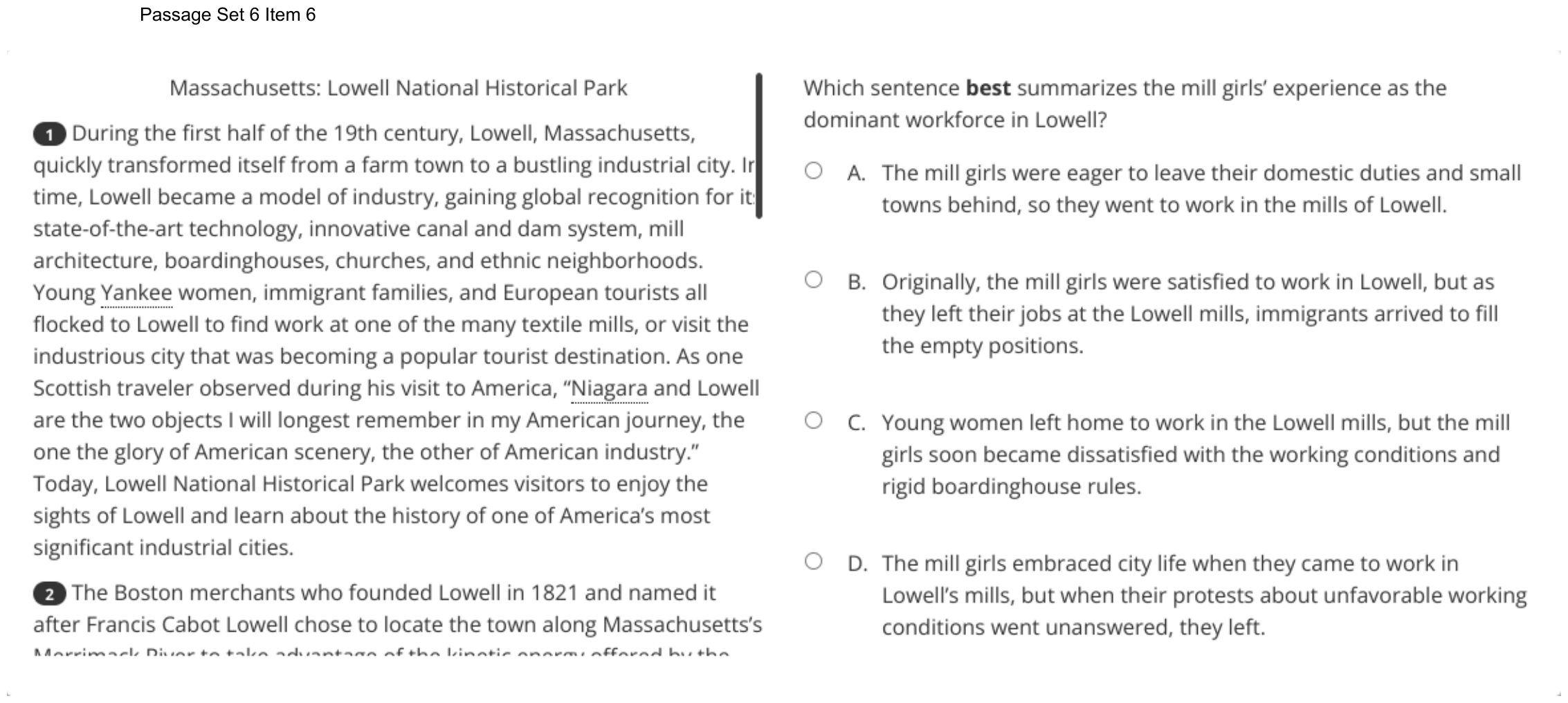
Question 32 of 57
2021 Test A English, question 32Uses the passage above: “Massachusetts: Lowell National Historical Park”.
Question
The reason Lowell lost its status as an industrial leader is best illustrated through the
- Adescription of poor living and working conditions.
- Bexplanation for why some immigrant groups struggled to live together.
- Ccomparison with other mills that used modern methods.
- Dinformation about the mills opening temporarily during World War II.
Show the answer
Correct answer: C
The question asks for the reason that best illustrates why Lowell lost its status as an industrial leader.
A. Incorrect. While the passage discusses the “long work hours, low wages, and poor living conditions in the city’s crowded tenements” (paragraph 6) in Lowell, these details highlight the living and working conditions of immigrant groups. The author does not state that poor living and working conditions are the reason Lowell lost its status as a “model of industry.”
B. Incorrect. Paragraph 5 in the passage acknowledges that there was some tension between the different ethnic and religious groups in Lowell, but this idea is not what led to Lowell’s decline as a “model of industry.”
C. CORRECT. When Lowell was initially established, the mills in the city thrived because of their advanced manufacturing methods (“gaining global recognition for its state-of-the-art technology, innovative canal and dam system, [and] mill architecture” [paragraph 1]). However, manufacturing technology changed and improved over time, and many mill owners chose to close the mills rather than modernize them, resulting in Lowell’s loss of status as a “model of industry” (“The city officially began to close down its mills in the 1920s and ’30s after Lowell’s outdated mills could no longer compete against the state-of-the-art cotton mills in other communities” [paragraph 6]).
D. Incorrect. The details about the temporary revival of the mills during World War II do not show why Lowell is no longer considered a “model of industry.” The mills were used briefly during wartime because of an increased need for supplies, but this use of the mills was short-lived.
Question analysis
Why did Lowell lose its place as an industrial leader, a decline that ended with its last mill closing by the mid-1950s? This evidence question asks which part of the article best illustrates the reason, so students must find where the passage explains the cause and match it to a choice worded in general terms, while other late details compete for attention.
- Grade level
- Grade 7 reading and task
- Compared with grade 7
- At grade 7 Using a text to explain a cause is typical grade 7 work. The reason is stated directly near the end of the passage, but the choices name it in abstract terms, so a careful match is needed, as in ordinary grade 7 reading.
- Estimated difficulty
- Moderate: several steps, or a close reading with one strong distractor.
- Thinking it demands
- Depth of knowledge 2, skills and concepts · mainly evaluate
- What makes it hard
- The right answer is reworded moderate
- Complex sentences minor
- Evidence in several places minor
- Evidence
- Answered from one paragraph or stanza
- Reading level
- Passage: about grade 15, 764 words; question and choices: about grade 9, 50 words.
- Students, last 30 days
- Not enough answers yet to show (it takes 10).
Why it is hard, traps and wrong answers (shows the answer)
Why it is hard
The reason is stated, but in a sentence that pairs it with worsening working conditions, and conditions get far more space in the passage, from paragraph 4's wage cuts to paragraph 6's crowded tenements. Students who match the choices to familiar words land on the conditions, which the passage presents as a result of companies not reinvesting. The key has to be recognized in new wording, as a comparison with modern mills elsewhere.
The right answer is reworded moderate Choosing the answer
The key's “comparison with other mills that used modern methods” rewords “could no longer compete against the state-of-the-art cotton mills,” while wrong choices repeat the text's “poor living conditions,” “working conditions” and “World War II.” (Freedle & Kostin, 1993; Kirsch & Mosenthal, 1990)
Complex sentences minor Understanding the question
The 47-word sentence that gives the reason joins two clauses under one “after,” outdated mills that “could no longer compete” and working conditions that “continued to decline,” so both can look like causes. (Abedi & Lord, 2001; Freedle & Kostin, 1993; Messick, 1989)
Evidence in several places minor Working it out
The cause echoes earlier hints, paragraph 1's “state-of-the-art technology” and paragraph 4's trouble competing with “other New England communities,” which confirm that competition is the passage's explanation. (Kirsch & Mosenthal, 1990; Gorin & Embretson, 2006)
Strategy: Find the sentence that tells why Lowell's mills shut down, restate the cause in your own words, then choose the description that matches that cause rather than a detail that merely appears nearby.
Traps
- Supports only part of the claim: In a question about evidence: a line that backs one half of the claim but not the other, or a related point rather than the claim itself.
- True but not the answer: A choice says something accurate about the text that does not answer this question.
- Twists what the text says: Uses the text's topic and ideas but changes what it says: who did it, how much, when, or why.
The wrong answers, classified
A Supports only part of the claim (King et al., 2004; Thissen, Steinberg & Fitzpatrick, 1989)
Finds the sentence about the closings but takes its declining working conditions as the reason, though they follow from companies no longer reinvesting, the same neglect that left the mills outdated.
B Twists what the text says (King et al., 2004)
Recasts paragraph 5's hostility between Yankee Protestants and Irish Catholics, which “eventually disappeared,” as a struggle among immigrant groups, though the passage never ties it to the decline.
D True but not the answer (King et al., 2004; Embretson & Wetzel, 1987)
Picks the World War II detail because it belongs to the mills' last years, but a “brief resurgence” describes a short revival, not why Lowell fell behind.
Working it out, step by step
Figure out what the question asks
This evidence question asks why Lowell lost its place as an industrial leader. First find where the passage gives the reason. Then pick the choice that matches it, even if it uses different words.
Find the reason in paragraph 6
Look near the end of the passage, where the mills close. Paragraph 6 says the city began to close its mills “after Lowell’s outdated mills could no longer compete against the state-of-the-art cotton mills in other communities.” This is the reason the passage gives.
Put the reason in plain words
Outdated means old-fashioned. State-of-the-art means the newest and best. To compete is to keep up with rivals. So mills in other places had newer machines, and Lowell’s old mills couldn’t keep up. That is a comparison: Lowell’s mills next to more modern mills elsewhere. It is a big change, too. In paragraph 1, Lowell was famous for its own “state-of-the-art technology.”
Rule out the working conditions
Choice A is the hard one to rule out. The same sentence says working conditions got worse “as Lowell’s companies stopped reinvesting in their mills.” Reinvesting means putting money back in, for repairs and new machines. Mills that get no new money also fall out of date. So the worse conditions came along with the decline. Falling behind modern mills elsewhere is what cost Lowell its lead. The passage’s longer descriptions of poor conditions, in paragraphs 4 and 6, tell how hard life was for workers. They don’t explain why the mills closed.
Check the other choices
- B is wrong. The passage tells of tension between Yankee Protestants and Irish Catholics, which “eventually disappeared.” It never links this to the mills closing.
- C is right. It matches the reason: Lowell’s mills fell behind more modern mills.
- D is wrong. The World War II “brief resurgence” was a short comeback. It doesn’t explain why Lowell fell behind.
Watch out: A repeats words from the passage, so it feels safe. But matching the words is not the same as matching the reason.
Choose the answer
The passage says Lowell’s outdated mills could not keep up with modern mills in other places. Choice C names that comparison. So the answer is C.
Why this answer and not the closest wrong one
A is the closest wrong answer, because the closing sentence also says “working conditions continued to decline.” But the passage ties that to the companies no longer spending on their mills. A leader loses its place when others get ahead. C names that: other mills used modern methods, and Lowell’s did not.
More questions like this
The original DOE question
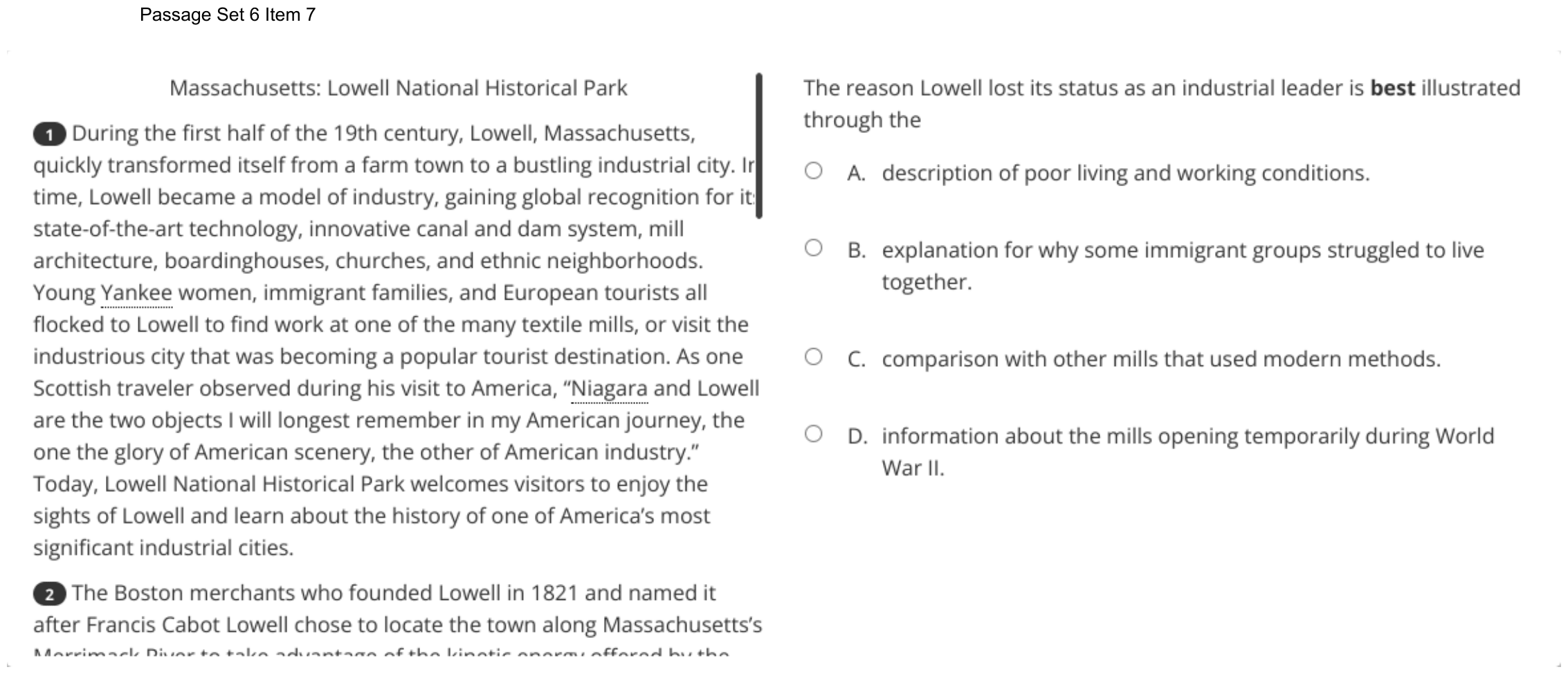
Question 33 of 57
2021 Test A English, question 33Passage Ode to Fireworks
Ode to Fireworks
In autumn my mother drove us to the edge of the field
where the fair was set up year after year:
the carousel, the bumper cars, the long, low sheds
filled with prizewinning animals.
We—my sister, my cousin, and I—were ready for bed,
already in our pajamas. This was a treat we waited
all year for. We waited in the darkness
for the first low, dull thwumps, like someone
beating an old, filthy rug hung on a wash line.
Then we counted the seconds between the lightning
and thunder, as we also used to do, until the sky
lit up: red, blue, green, gold. In my mind’s eye
I can still see the straggly, ancient oak whose branches
reached up past the exhibition halls, silhouetted
against the spectrum of stars that cascaded behind it.
It was one thing to look up into the sky
and imagine yourself in it or to make out pictures
among the clouds, which my sister liked to do.
No, I would tell her, that cloud
does not look like an elephant, a hat, an umbrella.
But it was another thing to see
the sky at night written upon
with those jewels. (We lived in the country:
night was night.) All around us, crickets
stridulated in the stubble of what had been
somebody’s cornfield, their song rising and falling.
You could smell winter on the air’s edge.
Now, in the city, when the sky dips into shadow
at New Year’s or on the Fourth of July, I find myself
craning my neck upward at odd moments.
The city sky is always lit up. This is where we live now,
and it is how we live now, awash in light
of every hue. Everything is a constant celebration:
picking up washing at the cleaner’s or stopping by
the corner market for a loaf of heavy bread.
And the music around me is the music of people,
their voices rising and falling in a hundred languages.
But beneath the yellowish glow deep in the sky
of all our city lights pelting out into the universe,
I remember the feel of the pickup truck bumping
across the ridged field, as I kept waiting for those
childhood bursts, watching as they escorted us home.
Question
The comparison in lines 8–9 of the poem is used to convey
- Athe muffled pounding of explosions in the distance.
- Bthe way lightning streaks through the clouds.
- Cthe echoes of thunder on an autumn night.
- Dthe glow of sparks falling from the sky.
Show the answer
Correct answer: A
The question asks what the comparison in lines 8–9 of the poem is used to convey.
A. CORRECT. In lines 8–9 the speaker compares the deep thumping noises at the start of a fireworks show to the muffled thumping sound made when beating a rug to clean it. The imagery of “low, dull thwumps” (line 8) (onomatopoeia) describes a sound that is not clear or powerful. To the speaker, these low, distant explosions are the signal that the fireworks display is starting and that the loud, cracking sound of fireworks will be heard soon (“Then we counted the seconds between the lightning / and thunder” [lines 10–11]).
B. Incorrect. The comparison in lines 8–9 deals with the low sound of the first fireworks shooting off rather than the streaks of light they emit. To the speaker, the low thwumps (onomatopoeia) are the signal that fireworks are about to explode overhead, much like the way a streak of lightning during a storm indicates that a crash of thunder will follow in a few seconds.
C. Incorrect. The thwump (onomatopoeia) sounds are the start of the fireworks show, not thunder. As a comparison, the speaker says the initial thwumps of the fireworks signal anticipation for the full explosion that will come, much like the way the speaker would watch for lightning and count the seconds before an impending thunderclap (lines 10–11).
D. Incorrect. The muffled thwump (onomatopoeia) sounds occur before the dazzling explosion of lights and before sparks start to fall from the sky. The comparison focuses on the sounds of the experience, not the sight of the experience.
Question analysis
This figurative language question asks what the comparison in lines 8–9 of “Ode to Fireworks” conveys. In the poem an adult speaker remembers waiting with family, already in pajamas, for the fireworks at a country fair. Students must interpret an old-fashioned household image and decide what part of the show it describes, since the nearby lines mention sights as well as sounds.
- Grade level
- Grade 6 reading and task
- Compared with grade 7
- Below grade 7 Interpreting a simile is taught from grade 6, and this one takes up two lines of concrete words. The household chore it pictures may be unfamiliar, but the task is a single step, lighter than typical grade 7 poetry work.
- Estimated difficulty
- Straightforward: two steps or one careful reading.
- Thinking it demands
- Depth of knowledge 2, skills and concepts · mainly understand
- What makes it hard
- Evidence
- Answered from one sentence or line
- Reading level
- Passage: 379 words (a poem; reading level not measured); question and choices: about grade 3, 42 words.
- Students, last 30 days
- Not enough answers yet to show (it takes 10).
Why it is hard, traps and wrong answers (shows the answer)
Why it is hard
The comparison is about sound, and once students notice that, the sight-based choices about lightning and sparks fall away. The pull comes from the next lines, where the children count “the seconds between the lightning / and thunder,” a storm game that makes thunder seem like the thing being described. The question rewards staying inside lines 8–9, where “low, dull” and the beaten rug describe the first faint booms of the show.
Figurative or literary language moderate Understanding the question
Lines 8–9 pair the made-up sound word “thwumps” with a simile, someone beating an old rug on a wash line, so students must hear a dull, distant thud in an image about housework. (Graesser, Singer & Trabasso, 1994; Kintsch, 1998)
Something you must already know minor Working it out
The simile works only for readers who can imagine the flat whack of a rug being beaten clean on a line, a chore many students have never seen or heard. (Anderson & Krathwohl, 2001)
Strategy: Reread lines 8–9 slowly and ask which sense the comparison appeals to, sight, sound or touch, then pick the choice that describes that same experience.
Traps
- Taking figurative language literally: A choice reads a figure of speech or image at face value.
- Wrong part of the text: A choice is true of another paragraph, stanza or speaker than the one asked about.
The wrong answers, classified
B Wrong part of the text (Kirsch & Mosenthal, 1990)
Jumps to the “lightning” of line 10, but lines 8–9 come before the sky lights up and describe something heard in the darkness, not a streak of light.
C Taking figurative language literally (Graesser, Singer & Trabasso, 1994)
Takes the “lightning / and thunder” of lines 10–11 as a real storm and hears the thwumps as thunder, though the counting game only likens the fireworks to one.
D Wrong part of the text (Kirsch & Mosenthal, 1990)
Pictures the colors of lines 12–15, “red, blue, green, gold,” but the rug-beating image describes a dull sound heard before any sparks appear in the sky.
Working it out, step by step
Figure out what the question asks
This asks what a comparison helps you picture. Lines 8–9 compare one thing to another using “like.” That kind of comparison is called a simile. First ask which sense it describes: sight, sound or touch.
Find the comparison
The family waits in the dark. Lines 8–9 say they wait “for the first low, dull thwumps, like someone / beating an old, filthy rug hung on a wash line.” Thwumps is a made-up word that sounds like the noise it names. So the comparison is about a sound. It comes before the sky lights up.
Picture the rug
People used to hang a dusty rug on a line and hit it with a stick. Each hit makes a flat, soft thud, not a sharp bang. The words “low” and “dull” say the same thing. So the first fireworks sound like soft booms far away. Muffled means soft, as if wrapped in cloth.
Check each choice
- A is right. Dull thuds heard in the dark are the muffled pounding of explosions far off.
- B is wrong. Lightning is something you see. Lines 8–9 describe a sound heard before anything lights up.
- C is wrong. The thunder in lines 10–11 is part of a counting game. It compares the show to a storm. The rug image is about the fireworks.
- D is wrong. Sparks are something you see. The colors don’t come until line 12.
Watch out: Lines 10–11 mention “lightning” and “thunder.” That can make C look right. But the rug comparison comes first and is about the fireworks.
Choose the answer
The rug-beating simile makes the first fireworks sound like soft, faraway thuds. So the answer is A, “the muffled pounding of explosions in the distance.”
Why this answer and not the closest wrong one
C is the closest wrong answer, because thunder is a low boom too. But lines 10–11 only compare the show to a storm in a counting game. The rug image in lines 8–9 describes the fireworks themselves: dull, muffled thuds from far away. That is A.
More questions like this
The original DOE question
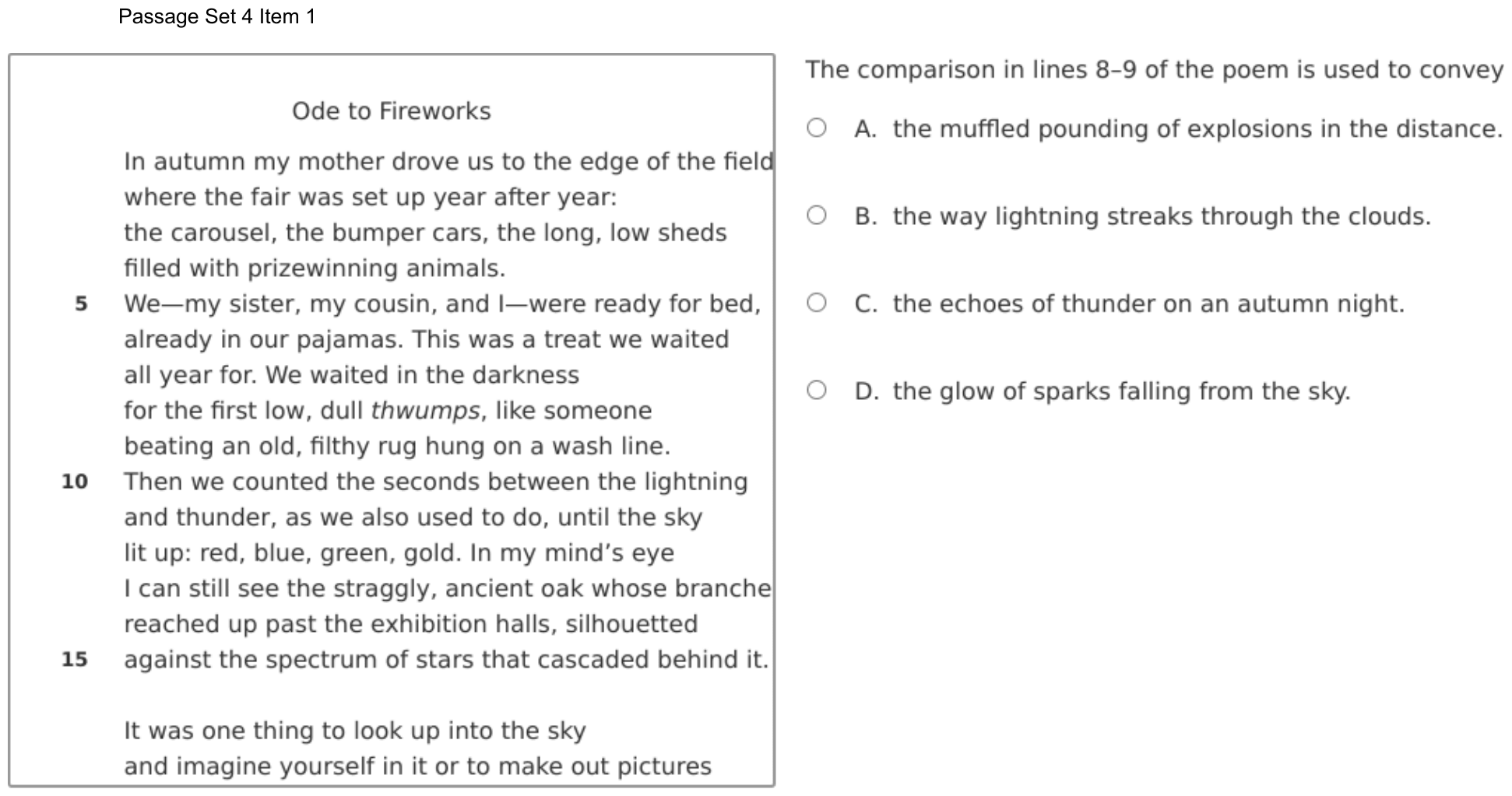
The passage “Ode to Fireworks” as printed (page 32)
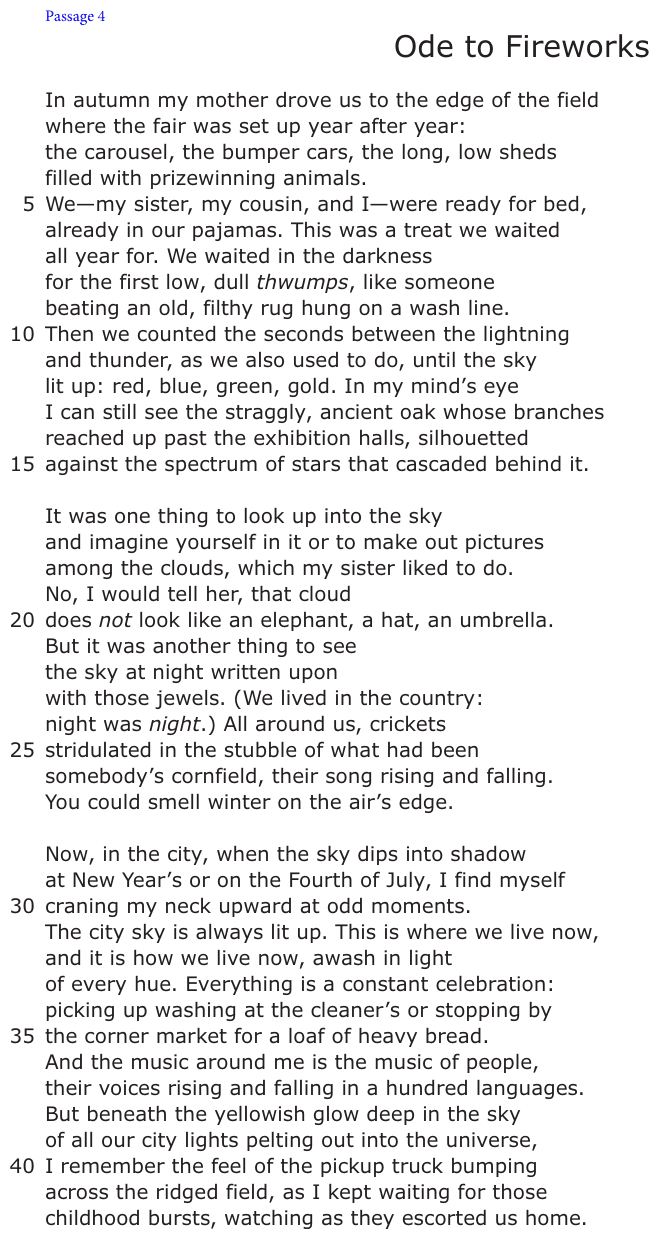
Question 34 of 57
2021 Test A English, question 34Uses the passage above: “Ode to Fireworks”.
Question
Read lines 22–23 from the poem.
the sky at night written upon
with those jewels.
What does the word choice in these lines convey about the speaker?
- AThe speaker values material possessions.
- BThe speaker imagines that the fireworks are magical.
- CThe speaker believes that the country setting is distinctive.
- DThe speaker cherishes the memory of seeing fireworks as a child.
Show the answer
Correct answer: D
The question asks what the word choice in lines 22–23 of the poem conveys about the speaker.
A. Incorrect. The word “jewels” is used figuratively to indicate the sentimental value that the experience of watching the fireworks holds for the speaker. There is no indication in the poem that the speaker values material possessions.
B. Incorrect. The use of the word “jewels” highlights the importance of the memory in the speaker’s mind. The imagery in the words “written upon” expresses the way the bright streaks of light curve and fly across the night sky, not that the speaker views the fireworks display as magical.
C. Incorrect. The speaker describes the elements of the fireworks display that stand out most clearly. The view of the bright, colorful fireworks streaking across the sky is distinct, but it is not unique to the country setting.
D. CORRECT. The word “jewels” creates a picture of watching shining and sparkling explosions in the night sky and suggests that this experience holds sentimental and emotional value for the speaker. The speaker cherishes the memory of the experience.
Question analysis
This question quotes lines 22–23 of “Ode to Fireworks,” in which the night sky is “written upon / with those jewels,” and asks what this word choice conveys about the speaker. Students must move from a striking metaphor for fireworks to what it reveals about the person describing them, and every choice names a different value or belief.
- Grade level
- Grade 7 reading and task
- Compared with grade 7
- At grade 7 Reading a speaker’s feelings through connotation is standard grade 7 work. The two lines are short and quoted, but the metaphor is compressed and the choices name abstract attitudes, so one careful inference is needed, as in typical grade 7 poetry.
- Estimated difficulty
- Moderate: several steps, or a close reading with one strong distractor.
- Thinking it demands
- Depth of knowledge 2, skills and concepts · mainly analyze
- What makes it hard
- Figurative or literary language moderate
- Reading between the lines moderate
- Evidence
- Answered from several paragraphs or stanzas
- Reading level
- Passage: 379 words (a poem; reading level not measured); question and choices: about grade 6, 59 words.
- Students, last 30 days
- Not enough answers yet to show (it takes 10).
Why it is hard, traps and wrong answers (shows the answer)
Why it is hard
The quoted lines are short, but the answer depends on what “jewels” suggests about the speaker, so students must move from an image to an attitude. The strongest pull comes from the words right after, where the speaker stresses that night in the country was truly dark, a real point but one about the setting, not about the jewel image. Students who take the gems literally or as magic stop at the surface of the metaphor instead of asking why someone would call a memory precious.
Figurative or literary language moderate Understanding the question
Lines 22–23 turn fireworks into “jewels” and the sky into a page “written upon,” a metaphor whose meaning lies in what jewels are worth to a person, not in what they are. (Graesser, Singer & Trabasso, 1994; Kintsch, 1998)
Reading between the lines moderate Working it out
The lines name no feeling; that the speaker cherishes the memory must be inferred from calling the fireworks “jewels” and from the speaker still craning upward for them years later in the city. (Graesser, Singer & Trabasso, 1994; Kintsch, 1998)
Strategy: Ask what “jewels” suggests beyond its literal meaning, picture the sky “written upon,” and then pick the attitude that fits both these lines and the poem as a whole.
Traps
- Wrong part of the text: A choice is true of another paragraph, stanza or speaker than the one asked about.
- Reads too much in: A reasonable-sounding conclusion that goes further than the text allows.
- Taking figurative language literally: A choice reads a figure of speech or image at face value.
The wrong answers, classified
A Taking figurative language literally (Graesser, Singer & Trabasso, 1994)
Takes “jewels” at face value, as valuable possessions, though the word describes fireworks in the sky and nothing in the poem is about owning things.
B Reads too much in (Graesser, Singer & Trabasso, 1994)
Sees the sky being “written upon” with gems as a fantasy and calls it magic, though the speaker describes real fireworks watched from a field with family.
C Wrong part of the text (Kirsch & Mosenthal, 1990)
Is drawn by the parenthesis that follows, “We lived in the country,” which does stress the setting, but the jewel image itself says nothing about the country.
Working it out, step by step
Figure out what the question asks
This asks what a word choice shows about the speaker. The speaker is the “I” who tells the poem. Look past what the words say. Ask what feeling they show.
Find the lines
In stanza 2, the speaker says “it was another thing to see / the sky at night written upon / with those jewels.” A stanza is a group of lines in a poem, like a paragraph. The jewels are the fireworks. The sky is like a page they write on.
Think about what jewels mean
Calling fireworks jewels is a metaphor: a comparison without “like” or “as.” Jewels are rare, bright and precious. People keep them safe and treasure them. So the word shows how much the sight meant to the speaker. Even now, in the city, the speaker says “I find myself / craning my neck upward at odd moments.” Craning means stretching your neck to look.
Check each choice
- A is wrong. The jewels are fireworks, not things the speaker owns.
- B is wrong. The speaker watched real fireworks from a field with family. Nothing calls them magic.
- C is wrong. The next words, “We lived in the country,” do stress the setting. But the jewel image itself is about how precious the sight was.
- D is right. To cherish is to treasure and hold dear. Jewels are treasures.
Watch out: C is tempting because the country comes up right after the jewels. Keep your eyes on lines 22–23 themselves.
Choose the answer
Calling the fireworks jewels shows a treasured childhood memory. So the answer is D, “The speaker cherishes the memory of seeing fireworks as a child.”
Why this answer and not the closest wrong one
C is the closest wrong answer. The poem does say they lived in the country, where night was truly dark. But that is the next thought, not the jewel image. Jewels are treasures. They show how much the speaker valued the sight. D says just that: the speaker treasures the memory.
More questions like this
The original DOE question
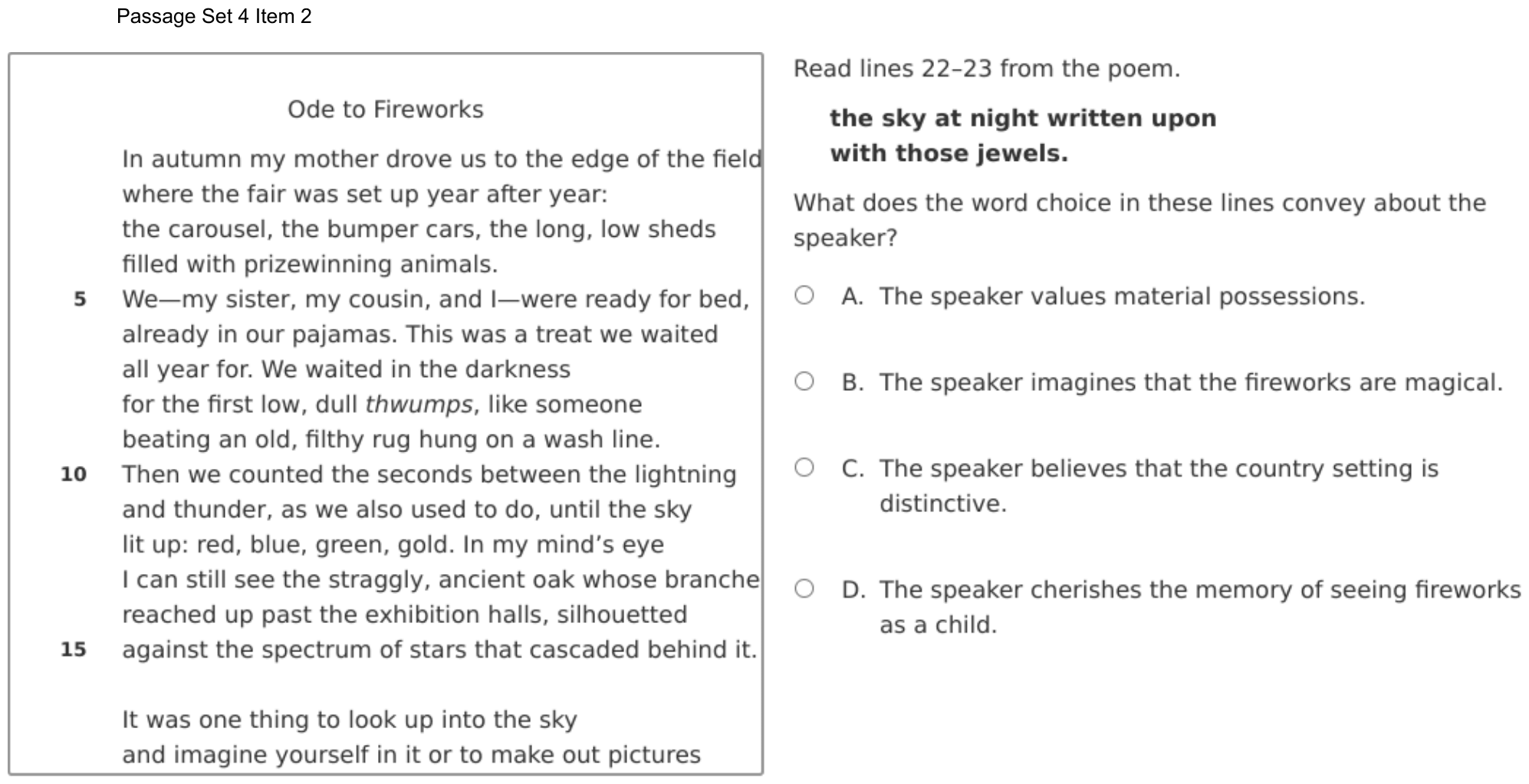
Question 35 of 57
2021 Test A English, question 35Uses the passage above: “Ode to Fireworks”.
Question
The use of italics on the word “night” in line 24 is most likely intended to emphasize the
- Asense of mystery in the darkness.
- Bsense of absolute darkness.
- Cspeaker’s fear of night.
- Dspeaker’s certainty about that night.
Show the answer
Correct answer: B
The question asks what the use of italics on the word “night” in line 24 is most likely intended to emphasize.
A. Incorrect. The purpose of italicizing the word “night” is not to convey mystery. While the speaker refers to not knowing the exact location where the firework viewing took place (“in the stubble of what had been / somebody’s cornfield” [lines 25–26]), the emphasis on “night” is meant to highlight the darkness and contrast the bright light from the fireworks soaring across the sky.
B. CORRECT. The italics are intended to place emphasis on one key aspect of nighttime—total darkness. The speaker is making a point that night in the country was truly dark, unlike the night the speaker currently experiences in a city, where light emitted from buildings and vehicles prevents complete darkness.
C. Incorrect. The tone in the second stanza is positive, showing admiration for the beauty visible in true darkness rather than fear: “But it was another thing to see / the sky at night written upon / with those jewels” (lines 21–23).
D. Incorrect. The speaker is talking about the general experience of watching fireworks on several occasions, not focusing on the events of a specific night. The use of italics on the word “night” emphasizes the speaker’s memory of the persistent darkness.
Question analysis
In “Ode to Fireworks,” the word “night” is printed in italics in line 24, inside the speaker’s aside about living in the country. This craft question asks what the italics are most likely meant to emphasize, so students must think about what stressing one ordinary word does and choose among moods and meanings the word could carry.
- Grade level
- Grade 7 reading and task
- Compared with grade 7
- At grade 7 Grade 7 students explain how word choice shapes meaning; here the device is italics on one everyday word, which is studied less often. The surrounding lines are plain, so a single careful inference settles it, a typical grade 7 demand.
- Estimated difficulty
- Moderate: several steps, or a close reading with one strong distractor.
- Thinking it demands
- Depth of knowledge 2, skills and concepts · mainly analyze
- What makes it hard
- How, not what moderate
- A very close wrong answer moderate
- Evidence in several places minor
- Evidence
- Answered from one paragraph or stanza
- Reading level
- Passage: 379 words (a poem; reading level not measured); question and choices: about grade 5, 36 words.
- Students, last 30 days
- Not enough answers yet to show (it takes 10).
Why it is hard, traps and wrong answers (shows the answer)
Why it is hard
One plain word in a parenthesis carries the question, and its meaning comes from the stress, not the dictionary. Darkness is easy to see; the harder step is choosing what the italics add to it, and mystery is a familiar partner for darkness that the stanza never develops. Students who read on to the brightly lit city of the third stanza see that the speaker is insisting on how complete the country dark was.
How, not what moderate Working it out
The stem asks what italics do, not what a word means, so students must hear the stress in “night was night” as insisting that the country night was fully dark, as night should be. (Anderson & Krathwohl, 2001)
A very close wrong answer moderate Choosing the answer
The mystery choice and the key both tie the italics to darkness; they differ only in what the darkness carries, a sense of mystery or its sheer completeness. (Embretson & Wetzel, 1987; Gorin & Embretson, 2006; Ascalon et al., 2007)
Evidence in several places minor Working it out
The point of the stress becomes clear from the third stanza, where “The city sky is always lit up” and the speaker now lives “awash in light / of every hue.” (Kirsch & Mosenthal, 1990; Gorin & Embretson, 2006)
Strategy: Read line 24 aloud, stressing “night” as the italics do, and ask what the speaker insists on about nights in the country; then check whether the rest of the poem backs that reading.
Traps
- Reads too much in: A reasonable-sounding conclusion that goes further than the text allows.
- Wrong tone or attitude: Misjudges the tone, attitude or point of view, such as reading admiration as criticism, or taking a character's or subject's feelings for the author's.
- Wrong purpose or structure: Names a purpose, structure or effect that the part does not serve, or describes what a part says when the question asks what it does.
The wrong answers, classified
A Reads too much in (Graesser, Singer & Trabasso, 1994)
Links darkness with mystery, a common pairing, but nothing in the stanza is hidden or puzzling; the stress falls on how dark the country night was.
C Wrong tone or attitude (Graesser, Singer & Trabasso, 1994)
Assumes a child out in the dark must be afraid, but the stanza is full of wonder, with “jewels” in the sky and crickets singing, and shows no fear.
D Wrong purpose or structure (Anderson & Krathwohl, 2001)
Knows italics can mark insistence but reads “night” as one particular evening, though the speaker means country nights in general, at a fair held “year after year.”
Working it out, step by step
Figure out what the question asks
This asks why one word is in italics. Italics are slanted letters. Writers use them to stress a word, the way you would say it louder. So ask what the speaker insists on.
Read the line aloud
Lines 23–24 say “(We lived in the country: / night was night.)” Read it aloud and lean on the second “night.” It means night was really night. It was as dark as night should be, with no city lights.
Use the rest of the poem
Stanza 3 shows the opposite. “The city sky is always lit up.” The speaker now lives “awash in light / of every hue.” Awash means flooded. A hue is a color. So the italics stress how completely dark the country night was. That darkness made the fireworks stand out.
Check each choice
- A is wrong. Darkness can feel mysterious. But nothing in the stanza is hidden or puzzling.
- B is right. Absolute means total. The italics stress that the dark was total.
- C is wrong. The speaker shows wonder, not fear. The sky is full of “jewels.”
- D is wrong. “That night” would mean one evening. The speaker means country nights in general, at a fair held “year after year.”
Watch out: A pairs darkness with mystery, which feels natural. But the speaker stresses how dark it was, not that it felt strange.
Choose the answer
The italics insist that country nights were fully dark. So the answer is B, “sense of absolute darkness.”
Why this answer and not the closest wrong one
A is the closest wrong answer, since both A and B link the italics to darkness. But the stanza never treats the night as strange or secret. The bright city sky in stanza 3 shows what the stress is for: country nights were completely dark. That is B.
More questions like this
The original DOE question
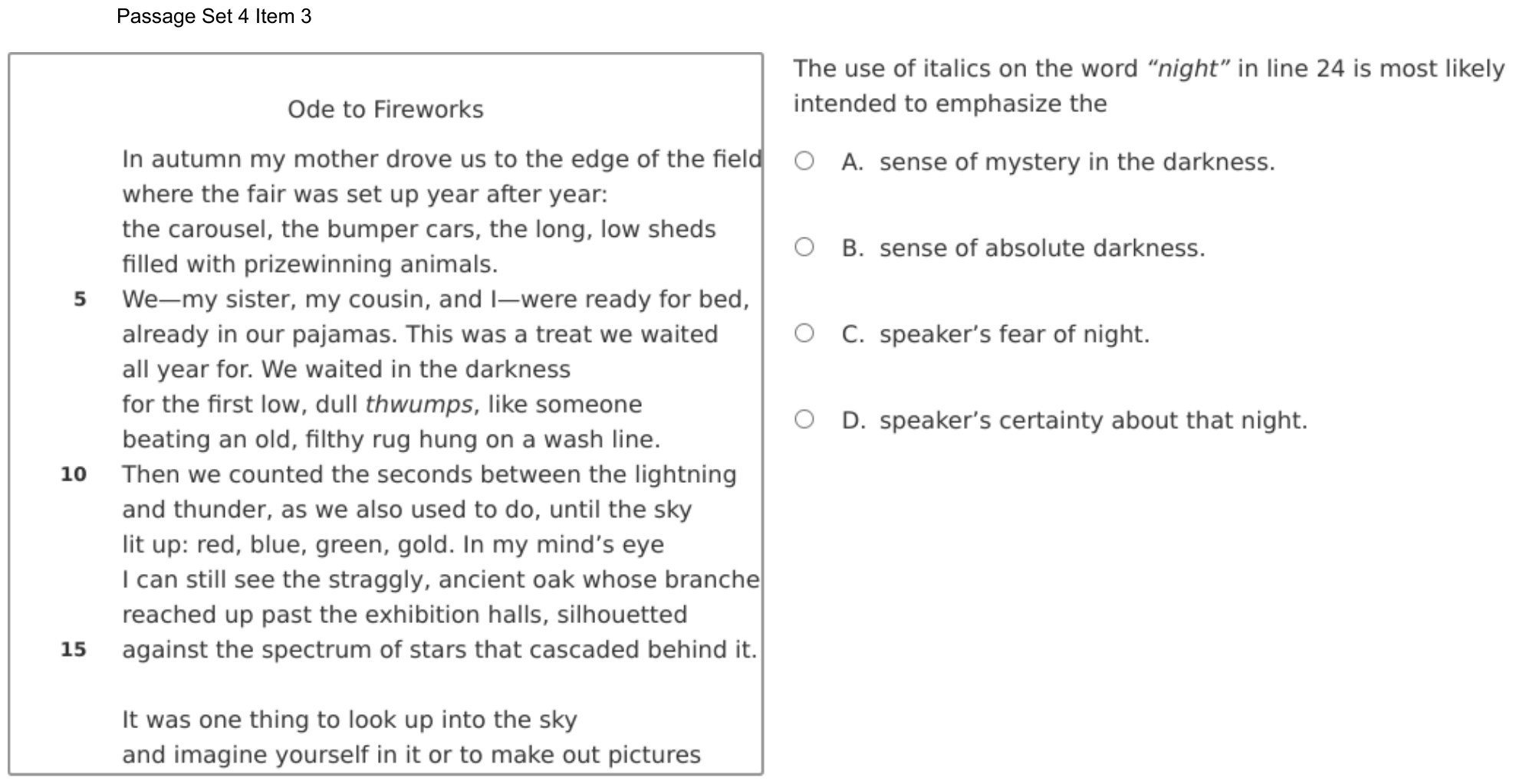
Question 36 of 57
2021 Test A English, question 36Uses the passage above: “Ode to Fireworks”.
Question
What is the purpose of the repeated words “rising and falling” in lines 26 and 37?
- Ato create a distinction between solitude and meaningful interaction
- Bto demonstrate a connection between the speaker’s past and present
- Cto emphasize the speaker’s attention to the surrounding sounds
- Dto compare the fireworks to common sights and sounds
Show the answer
Correct answer: B
The question asks what the purpose is of the repeated words “rising and falling” in lines 26 and 37.
A. Incorrect. These lines do not provide insight into the speaker’s interactions or feelings of solitude. The speaker mentions the emptiness of the country and the crowds in the city, but these repeated words are meant to draw a connection between the locations rather than show differences between them.
B. CORRECT. The first mention of these words occurs during a recollection of the speaker’s past, and the second takes place during a description of the speaker’s present. The speaker looks to the connections between the country setting (“All around us, crickets / stridulated in the stubble of what had been / somebody’s cornfield, their song rising and falling” [lines 24–26]) and the city setting (“And the music around me is the music of people, / their voices rising and falling in a hundred languages” [lines 36–37]) as a source of comfort.
C. Incorrect. Even though the lines call out specific sounds, the purpose of the repetition of the words in the two parts of the poem is to show how the speaker connects the two settings. The “rising and falling” of the sounds is one detail the speaker highlights.
D. Incorrect. The repetition of the words “rising and falling” is used to compare the different locations in the speaker’s life, not to compare fireworks to the sounds of crickets in the country or to the sounds of people moving and talking in the city.
Question analysis
The phrase “rising and falling” appears twice in “Ode to Fireworks,” in line 26 for the crickets’ song and in line 37 for people’s voices. This question asks for the purpose of repeating it, so students must compare the two places where it appears and decide what the echo does for the poem as a whole.
- Grade level
- Grade 7 reading and task
- Compared with grade 7
- At grade 7 Grade 7 students analyze how a poem’s structure develops its meaning. The repeated words are easy to spot, but they sit eleven lines apart in different stanzas, and the four purposes offered each sound possible, a typical grade 7 structure task.
- Estimated difficulty
- Moderate: several steps, or a close reading with one strong distractor.
- Thinking it demands
- Depth of knowledge 2, skills and concepts · mainly analyze
- What makes it hard
- How, not what moderate
- Evidence in several places moderate
- Evidence
- Answered from several paragraphs or stanzas
- Reading level
- Passage: 379 words (a poem; reading level not measured); question and choices: about grade 8, 51 words.
- Corrected from the DOE handbook
- The DOE printed this question’s explanation after a different question; the site matches the question with its own explanation.
- Students, last 30 days
- Not enough answers yet to show (it takes 10).
Why it is hard, traps and wrong answers (shows the answer)
Why it is hard
The repeated words are easy to find; the work is seeing that they sit on either side of the poem’s turn from childhood memory to city life. The strongest pull is the accurate observation that both lines describe sounds, which tells what the lines say rather than why the poet repeats them. The country and city are contrasted elsewhere in the poem, so a choice built on a contrast also tempts, though repeating the same words joins the two scenes instead of separating them.
How, not what moderate Working it out
The stem asks for the purpose of a repetition, so it is not enough to see that both lines describe sounds; students must say what echoing “rising and falling” does for the poem. (Anderson & Krathwohl, 2001)
Evidence in several places moderate Working it out
The two uses sit eleven lines apart in different stanzas, the crickets’ song in the remembered country field and city voices “in a hundred languages” in the present, and must be read together. (Kirsch & Mosenthal, 1990; Gorin & Embretson, 2006)
Strategy: Reread the lines around each use of “rising and falling,” describe each scene in a phrase, and ask what echoing the same words in both scenes accomplishes for the poem.
Traps
- Wrong purpose or structure: Names a purpose, structure or effect that the part does not serve, or describes what a part says when the question asks what it does.
- Reads too much in: A reasonable-sounding conclusion that goes further than the text allows.
- Twists what the text says: Uses the text's topic and ideas but changes what it says: who did it, how much, when, or why.
The wrong answers, classified
A Reads too much in (Graesser, Singer & Trabasso, 1994)
Reads solitude into the country scene and company into the city, though the speaker watched with a mother, sister and cousin, and the repeated words link the scenes.
C Wrong purpose or structure (Anderson & Krathwohl, 2001)
Notices that both lines describe sounds, the crickets’ song and people’s voices, which is true, but that is what the lines say, not why the words are repeated.
D Twists what the text says (King et al., 2004)
Assumes the repetition must refer to the fireworks of the title, though “rising and falling” describes crickets and voices and compares neither one to fireworks.
What was corrected from the DOE handbook, and why
- Explanation: In the DOE’s explanations appendix, the explanation printed after this question belongs to question 25 (“how the memory in lines 41–42 affects the speaker”) and marks D correct, and this question’s explanation (“what the purpose is of the repeated words ‘rising and falling’ in lines 26 and 37”) is printed after question 25, marking B correct. Read page by page, the appendix gives this question the answer D. The site gives the question the explanation that restates it, and the answer follows that explanation: B, because the words join the crickets’ song of the speaker’s country childhood (line 26) to the voices of the city in the present (line 37).
Working it out, step by step
Figure out what the question asks
This asks about purpose: why the poet repeats the words “rising and falling.” Don’t just say what the lines describe. Ask what repeating the same words does for the poem.
Find both uses
The first is in line 26, in the country of the speaker’s childhood. Crickets “stridulated in the stubble of what had been / somebody’s cornfield, their song rising and falling.” To stridulate is to chirp by rubbing body parts together. The second is in line 37, in the city today: “their voices rising and falling in a hundred languages.”
See what the repeat does
The two uses sit on either side of the poem’s big turn. Stanza 2 is the past in the country. Stanza 3 is the present in the city. The crickets’ song then and people’s voices now rise and fall alike. Using the same words in both places links the two times. So the repeat ties the speaker’s past to the present.
Check each choice
- A is wrong. Solitude means being alone. But the speaker was with family in the country. And the repeat joins the scenes. It does not set them apart.
- B is right. The same words join a childhood scene to a scene from now.
- C is wrong. Both lines do describe sounds. But that is what the lines say, not why the words repeat.
- D is wrong. The words describe crickets and voices. Neither is compared to fireworks.
Watch out: C is true, which makes it tempting. But a purpose question asks why, not what.
Choose the answer
The repeated words link the country past to the city present. So the answer is B, “to demonstrate a connection between the speaker’s past and present.”
Why this answer and not the closest wrong one
C is the closest wrong answer. It is true that both lines describe sounds the speaker hears. But the question asks for the purpose. The crickets belong to the speaker’s past, and the voices to the present. Repeating “rising and falling” joins the two times. That connection is B.
More questions like this
The original DOE question
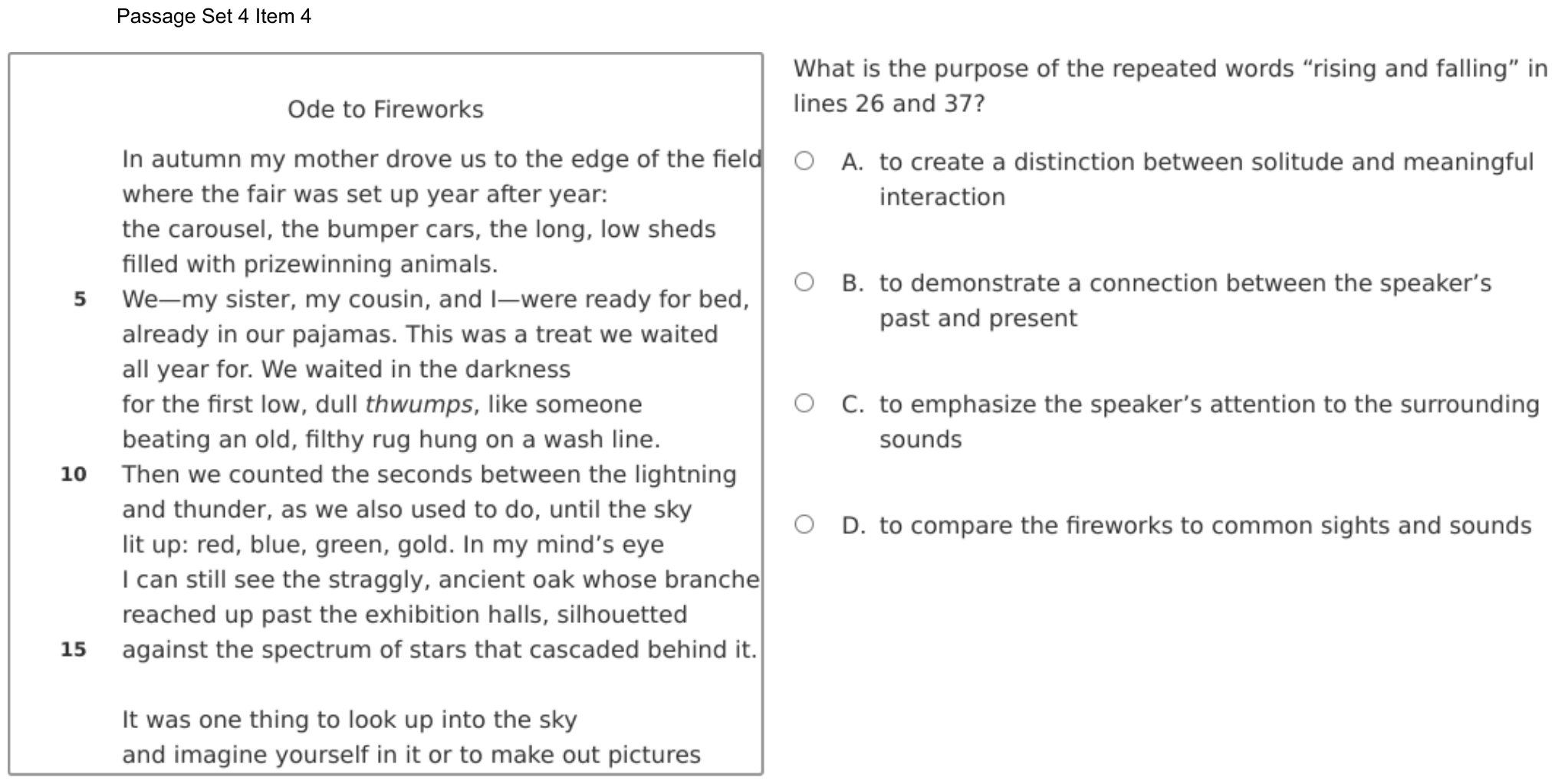
Question 37 of 57
2021 Test A English, question 37Uses the passage above: “Ode to Fireworks”.
Question
What impact does the phrase “Everything is a constant celebration” (line 33) have in the poem?
- AIt reveals that the speaker finds the city more pleasurable than the country.
- BIt suggests that the persistent brightness of the city can be overwhelming to the speaker.
- CIt implies that what is normal in the city was unusual in the country.
- DIt emphasizes the hectic pace of daily life in the city.
Show the answer
Correct answer: C
The question asks what impact the phrase “Everything is a constant celebration” (line 33) has in the poem.
A. Incorrect. The speaker describes a sense of happiness and contentment in both the city and the country and does not indicate that one setting is more pleasurable than the other.
B. Incorrect. The word “celebration” has a positive association and does not imply that the speaker is overwhelmed in the city. Throughout the third stanza (lines 28–42), the speaker conveys appreciation for the elements of the city that make it different from the country (“And the music around me is the music of people, / their voices rising and falling in a hundred languages” [lines 36–37]).
C. CORRECT. From the speaker’s perspective, the constant light (“awash in light” [line 32]) contributes to the speaker’s feeling that, in the city, celebratory fireworks are ever present. In comparison, fireworks lit up the country sky only for celebratory occasions or annual events (“In autumn my mother drove us to the edge of the field / where the fair was set up year after year” [lines 1–2]).
D. Incorrect. While the speaker observes many things going on in the city at a given moment, the “constant celebration” in line 33 is intended to convey a comparison to the speaker’s previous experience in the country rather than emphasize the hectic pace of life in the city. The continual light and sounds in the city remind the speaker of lights and sounds experienced only on occasion in the country.
Question analysis
This question about word choice in a poem asks what impact the phrase “Everything is a constant celebration,” from line 33, has in “Ode to Fireworks.” The speaker, grown up and living in a city, looks back on watching fireworks at a fair in the countryside. Students must interpret a sweeping statement about city life whose tone can be heard in more than one way.
- Grade level
- Grade 8 reading and task
- Compared with grade 7
- Above grade 7 Grade 7 students analyze how a phrase shapes a poem’s meaning, often from the nearby lines alone. This one sits in a 42-line poem, and the choices read its tone in sharply different ways, so it must be weighed against the whole poem.
- Estimated difficulty
- Hard: combines ideas, needs a plan, and has more than one tempting wrong answer.
- Thinking it demands
- Depth of knowledge 3, strategic thinking · mainly analyze
- What makes it hard
- Reading between the lines major
- Figurative or literary language moderate
- Evidence in several places moderate
- Evidence
- Answered from several paragraphs or stanzas
- Reading level
- Passage: 379 words (a poem; reading level not measured); question and choices: about grade 8, 68 words.
- Students, last 30 days
- Not enough answers yet to show (it takes 10).
Why it is hard, traps and wrong answers (shows the answer)
Why it is hard
The line can be heard in several moods, and three choices each take one: delight in the city over the country, strain from too much light, or a hurried pace. None of them needs the earlier stanzas, which is why they tempt; the line’s impact comes from the contrast with a childhood in which the sky lit up once a year. Students who ask what a celebration meant to the child at the fair, rather than how a city feels to them, reach the reading the poem supports.
Reading between the lines major Working it out
Line 33 never mentions the country; that city life feels like a nonstop version of something once rare must be inferred by setting it against the fair the family “waited / all year for” in stanza 1. (Graesser, Singer & Trabasso, 1994; Kintsch, 1998)
Figurative or literary language moderate Understanding the question
“Constant celebration” is a metaphor: errands at the cleaner’s and the corner market become a festival because the city sky is “always lit up,” as the country sky was only on fireworks nights. (Graesser, Singer & Trabasso, 1994; Kintsch, 1998)
Evidence in several places moderate Working it out
The contrast spans the poem, the yearly fair and “night was night” in the first two stanzas against the city “awash in light / of every hue” in lines 32–33. (Kirsch & Mosenthal, 1990; Gorin & Embretson, 2006)
Strategy: Reread lines 31–35 aloud, decide how the speaker feels about the city at this point, and keep only a choice that fits both that feeling and the rest of the poem.
Traps
- Wrong tone or attitude: Misjudges the tone, attitude or point of view, such as reading admiration as criticism, or taking a character's or subject's feelings for the author's.
- Reads too much in: A reasonable-sounding conclusion that goes further than the text allows.
- Twists what the text says: Uses the text's topic and ideas but changes what it says: who did it, how much, when, or why.
The wrong answers, classified
A Reads too much in (Graesser, Singer & Trabasso, 1994)
Hears “celebration” as praise of the city and ranks it above the country, though the speaker never compares the two for pleasure and ends the poem lingering fondly on the country drive home.
B Wrong tone or attitude (Graesser, Singer & Trabasso, 1994)
Reads “always lit up” and “awash in light” as too much brightness, but “celebration” is a happy word, and the stanza enjoys the city’s light and its voices in a hundred languages.
D Twists what the text says (King et al., 2004)
Links “constant” to the errands that follow and pictures a rushed city, but the line turns picking up washing and buying bread into festive moments, not hurried ones.
Working it out, step by step
Figure out what the question asks
This asks about the impact of one phrase in the poem. Impact means the effect it has on the poem’s meaning. To see it, compare the city in stanza 3 with the speaker’s childhood in the country. A stanza is a group of lines in a poem, like a paragraph.
Read the phrase in its lines
Lines 31–33 say “The city sky is always lit up. This is where we live now, / and it is how we live now, awash in light / of every hue. Everything is a constant celebration.” Awash means covered all over. Hue means color. Constant means all the time. The next lines name plain errands, like “picking up washing at the cleaner’s.”
Compare it with the country
In the country, the fireworks were rare. Lines 6–7 say “This was a treat we waited / all year for.” Lines 23–24 add “(We lived in the country: / night was night.)” That means the night sky was dark. A celebration is a special event that happens once in a while. In the city, the sky is always bright. So everyday city life feels like a fireworks night, which used to come once a year.
Check each choice
- A does not fit. The speaker never says the city is better. The poem ends with a fond memory of the country.
- B does not fit. “Celebration” is a happy word. The speaker enjoys the light and “the music of people.”
- C fits. A bright sky is normal in the city. In the country, it came only on fireworks night.
- D does not fit. Hectic means busy and rushed. Buying bread sounds calm, and the phrase makes it feel festive, not rushed.
Watch out: B is tempting because “always lit up” and “awash in light” can sound like too much. But the speaker’s words are warm, not tired or upset.
Choose the answer
The phrase makes city life sound like a fireworks night that never ends. What the city has every day was rare in the country. So the answer is C.
Why this answer and not the closest wrong one
B is the closest wrong choice. Both B and C notice that the city is full of light. But B says the light is too much for the speaker. The word “celebration” shows joy, not stress. The phrase gets its meaning from the contrast with the country, where “night was night.” That contrast is C.
More questions like this
The original DOE question

Question 38 of 57
2021 Test A English, question 38Uses the passage above: “Ode to Fireworks”.
Question
Read lines 41–42 from the poem.
I kept waiting for those
childhood bursts, watching as they escorted us home.
How does this memory affect the speaker?
- AThe speaker believes it is impossible to ever return to a place in the past.
- BThe speaker is still amused by the impatience felt during fireworks displays.
- CThe speaker now regrets abandoning the rural way of life.
- DThe speaker feels a sense of comfort when reflecting on the past.
Show the answer
Correct answer: D
The question asks how the memory in lines 41–42 affects the speaker.
A. Incorrect. The speaker does not express concern in these lines about the impossibility of returning to childhood or the past. For the speaker, the past and the memories associated with it are a source of comfort and a way to remember simpler times (“I remember the feel of the pickup truck bumping / across the ridged field” [lines 40–41]).
B. Incorrect. While the speaker recalls anticipation before the start of a fireworks display, there is no hint that the speaker is impatient. Particularly in lines 41–42, the speaker is reminded of the expectation of hearing and seeing fireworks and the sense of simple contentment felt in the experience (“I find myself / craning my neck upward at odd moments” [lines 29–30]).
C. Incorrect. The speaker is reflecting on past experiences and pointing out the elements of the city that remind the speaker of these past experiences. The speaker acknowledges the differences between the country and city settings but does not convey regret for leaving the rural area (“This is where we live now, / and it is how we live now, awash in light / of every hue” [lines 31–33]).
D. CORRECT. The memory of watching the fireworks on the way home creates a sense of comfort that stays with the speaker (“escorted us home”). The speaker looks forward to moments when the youthful experience (“childhood bursts”) of being excited by something like a fireworks display can be a source of happiness.
Question analysis
This question quotes the last lines of “Ode to Fireworks,” where the adult speaker, now living in the city, recalls waiting for the “childhood bursts” that “escorted us home,” and asks how this memory affects the speaker. Students must read the feeling in a brief closing image and check each choice against the whole final stanza about city life.
- Grade level
- Grade 7 reading and task
- Compared with grade 7
- At grade 7 Inferring how an experience affects a speaker is regular grade 7 work. The two quoted lines are plain, but the feeling behind them is implied rather than named, and the choices offer four believable reactions to a memory.
- Estimated difficulty
- Moderate: several steps, or a close reading with one strong distractor.
- Thinking it demands
- Depth of knowledge 2, skills and concepts · mainly understand
- What makes it hard
- Reading between the lines moderate
- Evidence in several places minor
- Figurative or literary language minor
- Evidence
- Answered from one paragraph or stanza
- Reading level
- Passage: 379 words (a poem; reading level not measured); question and choices: about grade 6, 74 words.
- Corrected from the DOE handbook
- The DOE printed this question’s explanation after a different question; the site matches the question with its own explanation.
- Students, last 30 days
- Not enough answers yet to show (it takes 10).
Why it is hard, traps and wrong answers (shows the answer)
Why it is hard
The memory is warm, but warm memories of a lost place are easy to read as sadness, and the choice about regretting the move to the city draws students who hear nostalgia as complaint. The other wrong choices turn the anticipation of “kept waiting” into impatience or make the past impossible to reach, both stronger than anything the lines say. Students who read the whole sentence from “But beneath the yellowish glow” see a speaker carried home by the memory, not mourning it.
Reading between the lines moderate Working it out
Lines 41–42 name no feeling, so the comfort must be read from fireworks that “escorted us home” and from the grown speaker still waiting for “those / childhood bursts” in the city. (Graesser, Singer & Trabasso, 1994; Kintsch, 1998)
Evidence in several places minor Working it out
Ruling out regret takes the rest of the third stanza, where city life is “a constant celebration” and “This is where we live now” is said without complaint. (Kirsch & Mosenthal, 1990; Gorin & Embretson, 2006)
Figurative or literary language minor Understanding the question
“Escorted us home” makes the fireworks companions guarding the family’s drive across the field, a personification that carries the sense of safety the question asks about. (Graesser, Singer & Trabasso, 1994; Kintsch, 1998)
Strategy: Read lines 38–42 as one sentence, starting from “But beneath the yellowish glow,” and ask how the speaker feels about the city and about the memory, using the whole third stanza, before choosing.
Traps
- Wrong tone or attitude: Misjudges the tone, attitude or point of view, such as reading admiration as criticism, or taking a character's or subject's feelings for the author's.
- Too broad or too strong: A choice overstates, generalizes, or uses absolute words the text does not support.
- Twists what the text says: Uses the text's topic and ideas but changes what it says: who did it, how much, when, or why.
The wrong answers, classified
A Too broad or too strong (King et al., 2004)
Turns a speaker who looks back into one mourning a place for good, with the absolute “impossible to ever return,” though the poem never says so and keeps the memory alive.
B Twists what the text says (King et al., 2004)
Turns the eager waiting of “kept waiting for those / childhood bursts” into impatience and adds amusement, though nothing in the lines is treated as funny.
C Wrong tone or attitude (Graesser, Singer & Trabasso, 1994)
Reads the speaker’s longing for the country as regret for leaving it, though the third stanza calls city life “a constant celebration” and never wishes the move undone.
What was corrected from the DOE handbook, and why
- Explanation: In the DOE’s explanations appendix, the explanation printed after this question belongs to question 24 (“what the purpose is of the repeated words ‘rising and falling’ in lines 26 and 37”) and marks B correct, and this question’s explanation (“how the memory in lines 41–42 affects the speaker”) is printed after question 24, marking D correct. Read page by page, the appendix gives this question the answer B. The site gives the question the explanation that restates it, and the answer follows that explanation: D, because the memory of the fireworks that “escorted us home” is a source of comfort to the speaker.
Working it out, step by step
Figure out what the question asks
This asks how a memory makes the speaker feel. The lines don’t name a feeling. So you have to infer it, which means figure it out from clues.
Read the whole sentence
The sentence starts in line 38: “But beneath the yellowish glow deep in the sky / of all our city lights pelting out into the universe, / I remember the feel of the pickup truck bumping / across the ridged field, as I kept waiting for those / childhood bursts, watching as they escorted us home.” The bursts are the fireworks.
Work out the feeling
To escort is to go along with someone to guide or protect them. So the speaker pictures the fireworks keeping the family company on the way home. That is a safe, warm picture. The memory comes back even under the bright city sky. It works like a favorite old song that still makes you feel good.
Check each choice
- A is wrong. The speaker never says it is “impossible to ever return.” The memory is still alive.
- B is wrong. The waiting was eager, not impatient. Nothing is treated as funny.
- C is wrong. Regret means wishing you had done something else. The speaker never wishes the move undone. The city is “a constant celebration.”
- D is right. The fireworks that “escorted us home” give the speaker a sense of comfort.
Watch out: Missing the past is not the same as regret. C reads a complaint into the poem that is not there.
Choose the answer
The memory of the fireworks bringing the family home warms the speaker. So the answer is D, “The speaker feels a sense of comfort when reflecting on the past.”
Why this answer and not the closest wrong one
C is the closest wrong answer, because the speaker clearly misses the country. But stanza 3 says “This is where we live now” with no complaint. It even calls city life “a constant celebration.” The memory warms the speaker. It does not make the speaker wish to undo the move. That is comfort, choice D.
More questions like this
The original DOE question
Question 39 of 57
2021 Test A English, question 39Uses the passage above: “Ode to Fireworks”.
Question
The fireworks in the poem represent the speaker’s
- Awish to return to a simpler way of living.
- Bbittersweet feelings about leaving the past behind.
- Chigh expectations for everyday life.
- Dreflections on past interactions with relatives.
Show the answer
Correct answer: B
The question asks what the fireworks in the poem represent about the speaker.
A. Incorrect. While the speaker misses elements of the past, the speaker is also positive about the present, with comparisons to a “constant celebration” (line 33) and descriptions of “the music of people” (line 36). The speaker does not indicate a desire to return to a simpler way of living.
B. CORRECT. The speaker misses the experience of watching the fireworks display with family and friends but understands that time has progressed and that life is now different. The lines “This was a treat we waited / all year for” (lines 6–7) highlight the significance of the memory of waiting for and watching the fireworks. In the speaker’s present, the lines “I remember the feel of the pickup truck bumping / across the ridged field” (lines 40–41) emphasize the key details from the experience that stand out in the speaker’s mind when something in the current environment reminds the speaker of the past.
C. Incorrect. While the speaker does share details about the present and the tone is generally positive, the fireworks do not suggest that the speaker has high expectations for how everyday life should be. The third stanza (lines 28–42) describes the speaker’s daily life in the city, but the speaker does not form expectations from these everyday moments.
D. Incorrect. While the speaker does mention discussing cloud shapes with a family member in lines 19–20, the fireworks serve as a more general reminder of the speaker’s past life. Viewing the bright lights of the city makes the speaker recall memories of the speaker’s past and the feelings of anticipation before the fireworks show.
Question analysis
This question about symbolism asks what the fireworks represent in “Ode to Fireworks,” a 42-line poem in which an adult speaker remembers watching fireworks at a country fair as a child. Students must weigh all three stanzas to decide what the central image stands for, and the choices name abstract feelings and wishes that are close to one another.
- Grade level
- Grade 8 reading and task
- Compared with grade 7
- Above grade 7 Grade 7 students interpret symbols, usually where the text makes their meaning fairly clear. Here they must hold a 42-line poem in mind and choose among four abstract feelings, two of them very close, which goes beyond typical grade 7 work.
- Estimated difficulty
- Hard: combines ideas, needs a plan, and has more than one tempting wrong answer.
- Thinking it demands
- Depth of knowledge 3, strategic thinking · mainly analyze
- What makes it hard
- Figurative or literary language moderate
- A very close wrong answer moderate
- Evidence in several places moderate
- Evidence
- Answered from the whole text
- Reading level
- Passage: 379 words (a poem; reading level not measured); question and choices: about grade 8, 35 words.
- Corrected from the DOE handbook
- The explanation of C misdescribed the third stanza; one sentence was corrected.
- Students, last 30 days
- Not enough answers yet to show (it takes 10).
Why it is hard, traps and wrong answers (shows the answer)
Why it is hard
This symbol question asks students to hold the whole 42-line poem in mind and weigh two feelings at once: the speaker misses the fireworks of childhood but speaks warmly of city life. Readers who notice only the longing choose a wish to go back, and readers who fix on one detail choose the relatives or the city’s “constant celebration.” The key’s “bittersweet” is the one word that holds both halves, which is why it is easy to pass over for a choice that states only one.
Figurative or literary language moderate Understanding the question
The fireworks are never explained; they are “jewels” in stanza 2 and the “childhood bursts” that “escorted us home” in stanza 3, so their meaning as a symbol must be built from images. (Graesser, Singer & Trabasso, 1994; Kintsch, 1998)
A very close wrong answer moderate Choosing the answer
The wish-to-return choice and the key both read the fireworks as feelings about the past; they differ in whether the speaker wants that past back or has accepted leaving it. (Embretson & Wetzel, 1987; Gorin & Embretson, 2006; Ascalon et al., 2007)
Evidence in several places moderate Working it out
The answer needs all three stanzas: the treat “we waited / all year for,” the dark country night, and the city stanza’s “This is where we live now,” which shows acceptance beside longing. (Kirsch & Mosenthal, 1990; Gorin & Embretson, 2006)
Strategy: Note how the speaker describes the fireworks in each stanza and how the speaker feels about the present in the last one, then choose the feeling that fits all three stanzas, not only the first.
Traps
- Reads too much in: A reasonable-sounding conclusion that goes further than the text allows.
- Word match: Repeats striking words or phrases from the text, so it looks supported, but its meaning does not fit the question.
- Too narrow: A single detail offered as the central idea or a summary, or a summary that keeps minor details and leaves out an essential part.
The wrong answers, classified
A Reads too much in (Graesser, Singer & Trabasso, 1994)
Takes the poem’s fond memories of the country as a wish to go back, though the speaker accepts “where we live now” and never asks to return.
C Word match (Freedle & Kostin, 1993)
Links the fireworks to line 33’s “Everything is a constant celebration,” then turns that into high expectations for daily life, which the poem never mentions.
D Too narrow (King et al., 2004)
Fixes on the mother, sister and cousin of the first stanza, real details, but the fireworks stand for a whole period of the speaker’s life, not time with relatives.
What was corrected from the DOE handbook, and why
- Explanation: Rejecting C, the handbook's explanation calls the third stanza (lines 28–42) “the speaker’s imaginings” and “fantasies”. The stanza describes the speaker's real life in the city now: “This is where we live now”, picking up washing at the cleaner's, stopping by the corner market. It now says the stanza describes the speaker's daily life in the city. The answer, B, is unchanged.
Working it out, step by step
Figure out what the question asks
This asks what the fireworks represent, or stand for. A thing in a poem that stands for a bigger idea is called a symbol. Look at the fireworks in all three stanzas. Then see how the speaker feels about the past and the present.
Look at the past
Stanza 1 shows how special the fireworks were: “This was a treat we waited / all year for.” Stanza 2 calls them “jewels.” In stanza 3 the speaker still remembers them: “I remember the feel of the pickup truck bumping / across the ridged field.” So the speaker misses that time.
Look at the present
The speaker also accepts city life: “This is where we live now, / and it is how we live now.” The city is “a constant celebration,” full of “the music of people.” So the speaker is not unhappy now. The speaker misses the past but has moved on. That feeling is bittersweet: happy and sad at the same time.
Check each choice
- A is wrong. The speaker never says they want to go back to the country.
- B is right. The fireworks stand for a loved past the speaker has left behind. The feeling is both warm and sad.
- C is wrong. The “constant celebration” describes city life. Nothing shows high expectations.
- D is wrong. Relatives appear in stanza 1. But the fireworks stand for a whole time of life, not just time with family.
Watch out: A notices only the longing. It misses that the speaker accepts “where we live now.”
Choose the answer
The fireworks hold both the joy of the past and the sadness of leaving it. So the answer is B, “bittersweet feelings about leaving the past behind.”
Why this answer and not the closest wrong one
A is the closest wrong answer. Both A and B are about feelings for the past. But A says the speaker wants to return, and the poem never says that. The speaker calls the city “a constant celebration” and accepts “where we live now.” Missing the past while accepting the present is bittersweet. That is B.
More questions like this
The original DOE question
Question 40 of 57
2021 Test A English, question 40Passage Excerpt from In Search of the Unknown
Excerpt from In Search of the Unknown
by Robert W. Chambers
It was at that time the policy of the trustees and officers of the Zoological Gardens neither to employ collectors nor to send out expeditions in search of specimens. The society decided to depend upon voluntary contributions, and I was always busy, part of the day, in dictating answers to correspondents who wrote offering their services as hunters of big game, collectors of all sorts of fauna, trappers, snarers, and also to those who offered specimens for sale, usually at exorbitant rates.
To the proprietors of . . . mangy lynxes, moth-eaten coyotes, and dancing bears I returned courteous but uncompromising refusals—of course, first submitting all such letters, together with my replies, to Professor Farrago.
One day towards the end of May, however, just as I was leaving Bronx Park to return to town, Professor Lesard, of the reptilian department, called out to me that Professor Farrago wanted to see me a moment; so I . . . retraced my steps to the temporary, wooden building occupied by Professor Farrago, general superintendent of the Zoological Gardens. The professor, who was sitting at his desk before a pile of letters and replies submitted for approval by me, pushed his glasses down and looked over them at me with a whimsical smile that suggested amusement, impatience, annoyance, and perhaps a faint trace of apology.
“Now, here’s a letter,” he said, with a deliberate gesture towards a sheet of paper impaled on a file—“a letter that I suppose you remember.” He disengaged the sheet of paper and handed it to me.
“Oh yes,” I replied, with a shrug; “of course the man is mistaken—or—”
“Or what?” demanded Professor Farrago, tranquilly, wiping his glasses.
“—Or a liar,” I replied.
After a silence he leaned back in his chair and bade me read the letter to him again, and I did so with a contemptuous tolerance for the writer, who must have been either a very innocent victim or a very stupid swindler. I said as much to Professor Farrago, but, to my surprise, he appeared to waver.
“I suppose,” he said, with his near-sighted, embarrassed smile, “that nine hundred and ninety-nine men in a thousand would throw that letter aside and condemn the writer as a liar or a fool?”
“In my opinion,” said I, “he’s one or the other.”
“He isn’t—in mine,” said the professor, placidly.
“What!” I exclaimed. “Here is a man living all alone on a strip of rock and sand between the wilderness and the sea, who wants you to send somebody to take charge of a bird that doesn’t exist!”
“How do you know,” asked Professor Farrago, “that the bird in question does not exist?”
“It is generally accepted,” I replied, sarcastically, “that the great auk has been extinct for years. Therefore I may be pardoned for doubting that our correspondent possesses a pair of them alive.”
“Oh, you young fellows,” said the professor, smiling wearily, “you embark on a theory for destinations that don’t exist.”
He leaned back in his chair, his amused eyes searching space for the imagery that made him smile.
“Like swimming squirrels, you navigate with the help of Heaven and a stiff breeze, but you never land where you hope to—do you?”
Rather red in the face, I said: “Don’t you believe the great auk to be extinct?”
“Audubon saw the great auk.”
“Who has seen a single specimen since?”
“Nobody—except our correspondent here,” he replied, laughing.
I laughed, too, considering the interview at an end, but the professor went on, coolly:
“Whatever it is that our correspondent has—and I am daring to believe that it is the great auk itself—I want you to secure it for the society.”
When my astonishment subsided my first conscious sentiment was one of pity. Clearly, Professor Farrago was on the verge of dotage—ah, what a loss to the world!
I believe now that Professor Farrago perfectly interpreted my thoughts, but he betrayed neither resentment nor impatience. I drew a chair up beside his desk—there was nothing to do but to obey, and this fool’s errand was none of my conceiving.
Together we made out a list of articles necessary for me and itemized the expenses I might incur, and I set a date for my return, allowing no margin for a successful termination to the expedition.
“Never mind that,” said the professor. “What I want you to do is to get those birds here safely. Now, how many men will you take?”
“None,” I replied, bluntly; “it’s a useless expense, unless there is something to bring back. If there is I’ll wire you, you may be sure.”
“Very well,” said Professor Farrago, good-humoredly, “you shall have all the assistance you may require. Can you leave to-night?”
The old gentleman was certainly prompt. I nodded, half-sulkily, aware of his amusement.
“So,” I said, picking up my hat, “I am to start north to find a place called Black Harbor, where there is a man named Halyard who possesses, among other household utensils, two extinct great auks—”
We were both laughing by this time. I asked him why on earth he credited the assertion of a man he had never before heard of.
“I suppose,” he replied, with the same half-apologetic, half-humorous smile, “it is instinct. I feel, somehow, that this man Halyard has got an auk—perhaps two. I can’t get away from the idea that we are on the eve of acquiring the rarest of living creatures. It’s odd for a scientist to talk as I do; doubtless you’re shocked—admit it, now!”
But I was not shocked; on the contrary, I was conscious that the same strange hope that Professor Farrago cherished was beginning, in spite of me, to stir my pulses, too.
“If he has—” I began, then stopped.
The professor and I looked hard at each other in silence.
“Go on,” he said, encouragingly.
But I had nothing more to say, for the prospect of beholding with my own eyes a living specimen of the great auk produced a series of conflicting emotions within me which rendered speech profanely superfluous.
From IN SEARCH OF THE UNKNOWN by Robert W. Chambers—Public Domain
Audubon: John James Audubon, an ornithologist and artist who created scientific illustrations of birds
dotage: a loss of reasoning brought about by old age
Question
Read paragraph 2 from the excerpt.
To the proprietors of . . . mangy lynxes, moth-eaten coyotes, and dancing bears I returned courteous but uncompromising refusals—of course, first submitting all such letters, together with my replies, to Professor Farrago.
This paragraph helps develop the plot by establishing that the narrator
- Adislikes writing refusal letters for the animals offered to the zoological society.
- Battempts to predict what the professor would say in the refusal letters.
- Cbelieves that many of the animals offered are not acceptable for the zoological society.
- Dresents the professor’s insistence on reviewing the refusal letters.
Show the answer
Correct answer: C
The question asks how paragraph 2 helps develop the plot.
A. Incorrect. As paragraph 1 indicates, writing such letters is one of the main parts of the narrator’s job (“and I was always busy, part of the day, in dictating answers to correspondents”), and he shows no indication of disliking this work. The letters are to inform people whether the zoo will accept their animals.
B. Incorrect. Paragraph 2 indicates that the narrator offers his letters to the professor merely for official approval. At the start of the excerpt, the narrator is confident in his reply and does not anticipate that his response will differ from that of the professor, so he has no need to “predict what the professor would say.”
C. CORRECT. The phrase “uncompromising refusals” in paragraph 2 indicates the confidence that the narrator initially has in his belief that the animals described in the letters are not of value to the society. This confidence is badly shaken as the plot unfolds, as when Professor Farrago states that “ ‘I am daring to believe that it is the great auk itself’ ” (paragraph 23). The narrator’s transition from an attitude of dismissive doubt to one of budding hopefulness is a major part of the plot (“But I was not shocked; on the contrary, I was conscious that the same strange hope that Professor Farrago cherished was beginning, in spite of me, to stir my pulses, too” [paragraph 34]).
D. Incorrect. The narrator does not resent the professor’s review of the letters; instead, the phrase “of course” in paragraph 2 shows that he expects to submit the letters to the professor as part of his job.
Question analysis
In this plot question on an excerpt from Robert W. Chambers’s novel In Search of the Unknown, students read paragraph 2, in which a zoo employee describes answering people who offer animals for sale. The question asks what the paragraph establishes about the narrator. Its old-fashioned vocabulary and its long, dash-broken sentence make the narrator’s attitude harder to pin down.
- Grade level
- Grade 7 reading and task
- Compared with grade 7
- At grade 7 Explaining how one paragraph develops a plot is regular grade 7 work, and this one is quoted in full. Its early-1900s wording, with words such as “proprietors” and “uncompromising,” adds some load but no unusual reasoning.
- Estimated difficulty
- Straightforward: two steps or one careful reading.
- Thinking it demands
- Depth of knowledge 2, skills and concepts · mainly analyze
- What makes it hard
- Hard words moderate
- Complex sentences minor
- The right answer is reworded minor
- Evidence
- Answered from one paragraph or stanza
- Reading level
- Passage: about grade 9, 1066 words; question and choices: about grade 11, 94 words.
- Students, last 30 days
- Not enough answers yet to show (it takes 10).
Why it is hard, traps and wrong answers (shows the answer)
Why it is hard
The paragraph’s attitude sits in its adjectives: lynxes that are “mangy,” coyotes that are “moth-eaten” and refusals that are “uncompromising.” Students who read that scorn as the narrator’s mood about his job, or who hear grumbling in “of course,” choose a feeling about the work instead of a judgment of the animals. The plot point is that the narrator starts out sure the offers are worthless, the confidence the great auk letter is about to test.
Hard words moderate Understanding the question
“Proprietors,” “uncompromising,” “mangy” and “moth-eaten” carry the meaning: the owners of shabby animals get firm refusals, and a student who misses these words cannot tell what the narrator thinks of the offers. (Perfetti, 2007; Freedle & Kostin, 1993)
Complex sentences minor Understanding the question
The paragraph is one inverted sentence that opens with “To the proprietors of,” reaches “I returned” only midway and ends with a dash clause about the professor’s review. (Abedi & Lord, 2001; Freedle & Kostin, 1993; Messick, 1989)
The right answer is reworded minor Choosing the answer
Three wrong choices repeat the paragraph’s “refusals” and “letters,” while the right one restates the scorn for the animals as a judgment that they do not suit the society. (Freedle & Kostin, 1993; Kirsch & Mosenthal, 1990)
Strategy: Paraphrase paragraph 2 in plain modern words, noting what each descriptive word reveals about the narrator, then keep only a choice those words actually support.
Traps
- Twists what the text says: Uses the text's topic and ideas but changes what it says: who did it, how much, when, or why.
- Wrong tone or attitude: Misjudges the tone, attitude or point of view, such as reading admiration as criticism, or taking a character's or subject's feelings for the author's.
- Reads too much in: A reasonable-sounding conclusion that goes further than the text allows.
The wrong answers, classified
A Twists what the text says (King et al., 2004)
Moves the scorn of “mangy” and “moth-eaten” from the animals to the task, though the refusals are “courteous” and paragraph 1 presents answering letters as routine daily work.
B Reads too much in (Graesser, Singer & Trabasso, 1994)
Builds a guessing game from his sending each reply to Professor Farrago, though he expects his refusals simply to be approved and nothing shows him second-guessing the professor.
D Wrong tone or attitude (Graesser, Singer & Trabasso, 1994)
Hears irritation in the dash and “of course,” but the phrase marks the review as routine, and his clash with the professor begins only with the great auk letter.
Working it out, step by step
Figure out what the question asks
This asks what paragraph 2 tells you about the narrator, the person telling the story. It also asks how that sets up the plot, the chain of events in a story. The paragraph is one long, old-fashioned sentence. So put it in plain words first.
Put paragraph 2 in plain words
Proprietors are owners. People wrote offering animals to the zoo. The narrator lists some: “mangy lynxes, moth-eaten coyotes, and dancing bears.” Mangy means with patchy, sick-looking fur. Moth-eaten means old and worn out. He sent the owners “courteous but uncompromising refusals.” Courteous means polite. Uncompromising means firm, with no chance of changing his mind.
Decide what it shows about him
The words “mangy” and “moth-eaten” show what he thinks of the animals. To him, they are shabby and not good enough for the zoo. He turns them all down. This sets up the plot. When the letter about the great auk comes, he is ready to reject it too. That is where the story’s conflict begins.
Check each choice
- A does not fit. His refusals are polite, and paragraph 1 shows that answering letters is his everyday job. Nothing says he dislikes it.
- B does not fit. He sends his replies to the professor to be approved. He is not guessing what the professor would say.
- C fits. He judges that the animals offered are not good enough.
- D does not fit. “Of course” shows that the review is normal. He does not resent it, or feel bitter about it.
Watch out: A is tempting because the narrator sounds scornful. But his scorn is for the animals, not for the job.
Choose the answer
Paragraph 2 shows the narrator turning down animals he thinks are unfit. So the answer is C, “believes that many of the animals offered are not acceptable for the zoological society.”
Why this answer and not the closest wrong one
A is the closest wrong choice. The narrator’s words do sound scornful. But the scorn is aimed at the animals, “mangy” and “moth-eaten,” not at the job of writing letters. His refusals are even “courteous.” C names his real judgment: these animals are not right for the zoo.
More questions like this
The original DOE question
The passage “Excerpt from In Search of the Unknown” as printed (page 21)
Question 41 of 57
2021 Test A English, question 41Uses the passage above: “Excerpt from In Search of the Unknown”.
Question
Read this sentence from paragraph 3.
The professor, who was sitting at his desk before a pile of letters and replies submitted for approval by me, pushed his glasses down and looked over them at me with a whimsical smile that suggested amusement, impatience, annoyance, and perhaps a faint trace of apology.
What does the phrase “a faint trace of apology” convey about the professor?
- AIt indicates that the professor feels bad that he has to call the narrator to his office after work.
- BIt shows that the professor is hesitant to share his opinions with the narrator.
- CIt implies that the professor is uncomfortable criticizing the narrator’s work.
- DIt suggests that the professor knows that the conversation will be frustrating for the narrator.
Show the answer
Correct answer: D
The question asks what the phrase “a faint trace of apology” in paragraph 3 conveys about the professor.
A. Incorrect. The fact that the narrator had intended to leave the office for the day is not the source of the professor’s faintly apologetic manner, which is instead caused by the professor’s understanding that their conversation about the letter and the expedition is likely to cause an argument (“with a whimsical smile that suggested amusement, impatience, annoyance” [paragraph 3]). In paragraph 29, the professor asks the narrator if he can leave on an expedition that same evening, which indicates that the professor does not feel bad about taking up the narrator’s time after work.
B. Incorrect. The paragraphs that follow the sentence from paragraph 3 show the professor sharing his opinions without pause, even when his opinion of the narrator is unflattering (“ ‘Like swimming squirrels, you navigate with the help of Heaven and a stiff breeze, but you never land where you hope to—do you?’ ” [paragraph 17]).
C. Incorrect. The professor knows that the narrator will push back regarding the letter, but the professor is not uncomfortable challenging the narrator. Professor Farrago seems perfectly at ease and comfortable as he begins the discussion with the narrator.
D. CORRECT. The professor is both amused and annoyed by the narrator’s dismissal of the possibility that great auks still exist, and the professor knows that the narrator is likely to react negatively to being sent on what the narrator considers a “fool’s errand” (paragraph 25).
Question analysis
This question focuses on a single phrase in the excerpt from Robert W. Chambers’s In Search of the Unknown: as the professor looks up from a pile of letters, his whimsical smile shows “a faint trace of apology.” Students must work out what that hint of apology says about him. The phrase is brief and old-fashioned, and several explanations for it seem natural.
- Grade level
- Grade 8 reading and task
- Compared with grade 7
- Above grade 7 Grade 7 students often infer a character’s feelings from a description. Here the phrase ends a 46-word sentence of early-1900s prose, follows three other moods, and has to be interpreted from the scene as a whole, beyond typical grade 7 work.
- Estimated difficulty
- Among the hardest on the SHSAT: a non-obvious approach, heavy reading, or a well-hidden trap.
- Thinking it demands
- Depth of knowledge 3, strategic thinking · mainly analyze
- What makes it hard
- Reading between the lines major
- A very close wrong answer moderate
- Evidence in several places moderate
- Complex sentences minor
- Evidence
- Answered from several paragraphs or stanzas
- Reading level
- Passage: about grade 9, 1066 words; question and choices: about grade 10, 123 words.
- Students, last 30 days
- Not enough answers yet to show (it takes 10).
Why it is hard, traps and wrong answers (shows the answer)
Why it is hard
The phrase comes before a word of the conversation is spoken, so the reason for the apology lies ahead in the text. Two natural guesses compete with it: the professor has called the narrator back just as he was leaving, and he is about to question one of the narrator’s replies. Only a reader who follows the scene to the narrator’s scorn for the letter and the errand sees that the professor, at ease throughout, is sorry for what he is about to put the narrator through.
Reading between the lines major Working it out
Nothing explains the apology; students must reason from the talk that follows, in which the professor sends the narrator after birds the narrator believes extinct, that the professor expects resistance. (Graesser, Singer & Trabasso, 1994; Kintsch, 1998)
A very close wrong answer moderate Choosing the answer
The choice about criticizing the narrator’s work and the right one both tie the apology to the coming talk about a letter; one places discomfort in the professor, the other frustration in the narrator. (Embretson & Wetzel, 1987; Gorin & Embretson, 2006; Ascalon et al., 2007)
Evidence in several places moderate Working it out
What the professor anticipates appears only later: the narrator’s scorn for the letter in paragraphs 5–14 and his view of the trip as a “fool’s errand” in paragraph 25. (Kirsch & Mosenthal, 1990; Gorin & Embretson, 2006)
Complex sentences minor Understanding the question
The phrase closes a 46-word sentence, after a clause about the pile of letters and a run of three other moods, “amusement, impatience, annoyance.” (Abedi & Lord, 2001; Freedle & Kostin, 1993; Messick, 1989)
Strategy: Read the full sentence and then the conversation it opens, and test each choice against how the professor actually speaks and acts in that conversation.
Traps
- Reads too much in: A reasonable-sounding conclusion that goes further than the text allows.
- Half right: One half of a two-part choice is right and the other is not.
- Twists what the text says: Uses the text's topic and ideas but changes what it says: who did it, how much, when, or why.
The wrong answers, classified
A Reads too much in (Graesser, Singer & Trabasso, 1994)
Ties the apology to the timing, since Professor Lesard stopped the narrator as he was leaving Bronx Park, but the professor later asks him to leave on the trip that same night.
B Twists what the text says (King et al., 2004)
Reads the apology, and the “embarrassed smile” of paragraph 9, as reluctance to speak, though the professor states his belief in the letter plainly and even teases the narrator.
C Half right (King et al., 2004; Thissen, Steinberg & Fitzpatrick, 1989)
Rightly senses that the professor is about to challenge the narrator’s reply to a letter, but he does it “placidly” and “coolly,” with no sign of discomfort.
Working it out, step by step
Figure out what the question asks
This asks what one phrase shows about the professor: “a faint trace of apology.” Faint means slight, and a trace is a small sign. So his smile looks a little bit sorry. Why would he feel sorry? You find out from the talk that follows.
Read the whole sentence
Paragraph 3 says the professor looked at the narrator “with a whimsical smile that suggested amusement, impatience, annoyance, and perhaps a faint trace of apology.” Whimsical means playful. He is amused by the narrator and a bit annoyed with him. Then he picks up a letter the narrator has already turned down.
See what the professor is about to do
The professor is about to defend that letter. Then he sends the narrator after the birds in it. The narrator thinks the birds are extinct, or all dead. In paragraph 25 he calls the trip “this fool’s errand,” a pointless job. The professor seems to know the narrator will hate this. That is why his smile looks a little sorry.
Check each choice
- A does not fit. He later asks, “Can you leave to-night?” (paragraph 29). He is not sorry about taking the narrator’s time.
- B does not fit. He shares his opinion plainly: “He isn’t—in mine” (paragraph 11).
- C does not fit. He does challenge the narrator, but calmly. He speaks “placidly” and “coolly,” with no sign of being uneasy.
- D fits. He knows the talk will annoy the narrator.
Watch out: C is tempting because the professor is about to disagree with the narrator. But nothing shows that he is uncomfortable about it.
Choose the answer
The slight apology shows that the professor expects the narrator to be frustrated. So the answer is D, “It suggests that the professor knows that the conversation will be frustrating for the narrator.”
Why this answer and not the closest wrong one
C is the closest wrong choice. Both C and D link the apology to the talk about the letter. But C puts the bad feeling in the professor, as if he were nervous. He is not. He speaks “placidly,” which means calmly. D puts the bad feeling in the narrator, and the narrator does get upset.
More questions like this
The original DOE question
Question 42 of 57
2021 Test A English, question 42Uses the passage above: “Excerpt from In Search of the Unknown”.
Question
How does the exchange between the professor and the narrator in paragraphs 8–11 contribute to the development of the characters?
- AIt establishes the conflict between the professor and the narrator concerning the validity of the letter.
- BIt suggests a theme of collaboration because the narrator and the professor regularly work together.
- CIt reveals the characters’ traits by contrasting the narrator’s distrust with how easily the professor is deceived by what he reads.
- DIt hints that the resolution will involve the narrator accepting the professor’s opinion about the content of the letter.
Show the answer
Correct answer: A
The question asks how the exchange between the professor and the narrator in paragraphs 8–11 contributes to the development of the characters.
A. CORRECT. Paragraphs 8–11 help develop the characters by revealing the difference between the opinions of the narrator and the professor. The narrator believes without any doubts that Halyard, the man who wrote the letter about the auks, is either “ ‘a liar or a fool’ ” (paragraph 9), while the professor believes in the possibility that the writer of the letter could actually be telling the truth (“I said as much to Professor Farrago, but, to my surprise, he appeared to waver” [paragraph 8]).
B. Incorrect. In paragraph 8, the narrator reacts to the letter writer with “a contemptuous tolerance,” and he is shocked to learn that the professor actually agrees with the man (paragraph 11) whom the narrator has bluntly condemned as a liar or a fool (“ ‘In my opinion,’ said I, ‘he’s one or the other.’ ” [paragraph 10]). The exchange presents an emphatic disagreement between the narrator and the professor, and it does not show them working together in a collaborative manner.
C. Incorrect. Although the narrator initially distrusts the contents of the letter and shows “contemptuous tolerance for the writer” (paragraph 8), the excerpt portrays the professor as experienced and intelligent, not as one who is easily deceived.
D. Incorrect. While the narrator does begin to consider the professor’s perspective at the end of the excerpt, paragraphs 8–11 primarily serve to establish the difference of opinion between the narrator and the professor about the writer of the letter.
Question analysis
This question on the excerpt from In Search of the Unknown asks how a short exchange in paragraphs 8–11, in which the narrator and Professor Farrago discuss a letter about a bird, contributes to the development of the two characters. Students must read what each man says and decide what the exchange adds. Some choices describe the pair accurately in part only.
- Grade level
- Grade 8 reading and task
- Compared with grade 7
- At grade 7 The task matches the grade 8 standard on how lines of dialogue reveal character, but the four paragraphs are short and the two speakers’ positions are stated outright, so the demand stays at a typical grade 7 level.
- Estimated difficulty
- Moderate: several steps, or a close reading with one strong distractor.
- Thinking it demands
- Depth of knowledge 2, skills and concepts · mainly analyze
- What makes it hard
- A very close wrong answer moderate
- How, not what minor
- Reading between the lines minor
- Evidence
- Answered from several paragraphs or stanzas
- Reading level
- Passage: about grade 9, 1066 words; question and choices: about grade 13, 90 words.
- Students, last 30 days
- Not enough answers yet to show (it takes 10).
Why it is hard, traps and wrong answers (shows the answer)
Why it is hard
The four paragraphs are short and the disagreement is plain, so most students see that the men differ about the letter. The difficulty lies in the wording of the choices. One describes the contrast in terms of character, which suits the stem, but calls the professor easily deceived, a judgment only the narrator holds. The right choice speaks of a conflict, which sounds like plot rather than character, so students must trust that the conflict is what reveals the two men.
A very close wrong answer moderate Choosing the answer
The choice that contrasts the narrator’s distrust with an easily deceived professor and the right one both set the men’s views of the letter against each other; they part on whether the professor is fooled. (Embretson & Wetzel, 1987; Gorin & Embretson, 2006; Ascalon et al., 2007)
How, not what minor Working it out
The stem asks about the characters, while the right choice names a conflict over the letter, so students must see that the disagreement itself is what reveals each man. (Anderson & Krathwohl, 2001)
Reading between the lines minor Working it out
The professor’s side is four words, “He isn’t—in mine,” and students must read them as openness to the letter’s truth, set against the narrator’s flat “one or the other.” (Graesser, Singer & Trabasso, 1994; Kintsch, 1998)
Strategy: Sum up in a phrase what each man says and does in paragraphs 8–11, then check every part of each choice against those four paragraphs, since a choice can describe one character correctly and the other not.
Traps
- Half right: One half of a two-part choice is right and the other is not.
- Wrong part of the text: A choice is true of another paragraph, stanza or speaker than the one asked about.
- True but not the answer: A choice says something accurate about the text that does not answer this question.
The wrong answers, classified
B True but not the answer (King et al., 2004; Embretson & Wetzel, 1987)
Rests on a true fact, that the narrator submits his work to the professor, but in paragraphs 8–11 the two disagree sharply and nothing shows them cooperating.
C Half right (King et al., 2004; Thissen, Steinberg & Fitzpatrick, 1989)
Gets the narrator’s distrust right but adopts his view that the professor is gullible, though the professor only declines to call the writer a liar or a fool and stays calm.
D Wrong part of the text (Kirsch & Mosenthal, 1990)
Knows that the narrator later comes to share the professor’s hope, in paragraph 34, but in paragraphs 8–11 he still insists the writer is “one or the other.”
Working it out, step by step
Figure out what the question asks
This asks what paragraphs 8–11 show about the two characters. Look at what each man says about the letter. Then compare their views.
Find the narrator’s view
In paragraph 8, the narrator reads the letter with “a contemptuous tolerance for the writer.” Contemptuous means full of scorn. He thinks the writer is “either a very innocent victim or a very stupid swindler.” A swindler is a cheat. In paragraph 10, he says the writer is a liar or a fool: “he’s one or the other.”
Find the professor’s view
The professor does not agree. In paragraph 8, the narrator notices that “to my surprise, he appeared to waver.” To waver means to be unsure. In paragraph 11, the professor answers, “He isn’t—in mine.” He means that in his opinion the writer is not a liar or a fool. So the two men clash over whether the letter is true. A clash like this is a conflict.
Check each choice
- A fits. The two men disagree about whether the letter can be trusted. Validity means whether something is true.
- B does not fit. They do work together, but here they disagree.
- C does not fit. The narrator’s distrust is right, but the professor is not fooled. He calmly refuses to call the writer a liar.
- D does not fit. The narrator starts to hope later, in paragraph 34. In paragraphs 8–11 he does not budge.
Watch out: C is tempting because half of it is true. The narrator does distrust the letter. But the idea that the professor has been fooled is only the narrator’s view.
Choose the answer
Paragraphs 8–11 set the narrator’s scorn against the professor’s open mind. So the answer is A, “It establishes the conflict between the professor and the narrator concerning the validity of the letter.”
Why this answer and not the closest wrong one
C is the closest wrong choice. It is right about the narrator’s distrust. But it speaks of “how easily the professor is deceived.” Deceived means tricked. The story never shows that. He stays calm and thinks for himself. A describes both men correctly: they disagree about the letter.
More questions like this
The original DOE question
Question 43 of 57
2021 Test A English, question 43Uses the passage above: “Excerpt from In Search of the Unknown”.
Question
The professor’s observations in paragraphs 15–17 create tension in the excerpt by causing the narrator to feel
- Aflustered by the professor’s criticism of his logic.
- Bannoyed by the professor’s sarcasm about his inexperience.
- Cconfused by the professor’s lack of respect for his opinion.
- Dfrustrated by the professor’s lack of interest in his theory.
Show the answer
Correct answer: A
The question asks how the professor’s observations in paragraphs 15–17 create tension in the excerpt.
A. CORRECT. The professor criticizes “ ‘you young fellows’ ” (paragraph 15), suggesting that the ideas of young scientists like the narrator are unsupported (“ ‘like swimming squirrels’ ” [paragraph 17]) and inaccurate (“ ‘but you never land where you hope to—do you?’ ” [paragraph 17] and “ ‘you embark on a theory for destinations that don’t exist’ ” [paragraph 15]). The narrator then becomes “red in the face” (paragraph 18), indicating that the narrator is upset by the professor’s criticism, and asks the professor about the great auk in an attempt to defend himself.
B. Incorrect. While the narrator does experience a negative reaction to the professor’s words, the professor is being genuine, not sarcastic. In fact, the sarcasm comes from the narrator in paragraph 14 (“ ‘It is generally accepted,’ I replied, sarcastically, ‘that the great auk has been extinct for years. Therefore I may be pardoned for doubting that our correspondent possesses a pair of them alive’ ”), not from the professor.
C. Incorrect. The professor’s observations cause the narrator to blush with embarrassment (“rather red in the face” [paragraph 18]), but the narrator understands the point that the professor is making about the narrator’s acceptance of the idea that great auks do not exist. The narrator recognizes that the professor is criticizing his youthful ideas, not his opinion.
D. Incorrect. The professor shows amusement with the narrator’s perspective. The narrator is embarrassed and upset by the professor’s words, but the narrator does not display frustration with the professor’s lack of interest in a commonly held view of the existence of a certain species of bird.
Question analysis
In this question on In Search of the Unknown, Professor Farrago makes remarks about “you young fellows,” comparing them to swimming squirrels that never land where they hope. Students must decide how these remarks in paragraphs 15–17 make the narrator feel and so create tension. The comparison is odd and old-fashioned, and the four choices name similar negative feelings with different causes.
- Grade level
- Grade 8 reading and task
- Compared with grade 7
- Above grade 7 Grade 7 students infer feelings from a character’s reactions, usually from plainly stated emotions. Here the cause is a puzzling figurative jab about “swimming squirrels,” the reaction is shown only through a physical sign, and the choices offer four close negative feelings.
- Estimated difficulty
- Hard: combines ideas, needs a plan, and has more than one tempting wrong answer.
- Thinking it demands
- Depth of knowledge 2, skills and concepts · mainly analyze
- What makes it hard
- Figurative or literary language major
- A very close wrong answer moderate
- Reading between the lines moderate
- Evidence
- Answered from several paragraphs or stanzas
- Reading level
- Passage: about grade 9, 1066 words; question and choices: about grade 9, 52 words.
- Students, last 30 days
- Not enough answers yet to show (it takes 10).
Why it is hard, traps and wrong answers (shows the answer)
Why it is hard
The professor’s two images are odd, and students must decode them as a comment on how the narrator reasons before they can say why he blushes. Every choice names an unpleasant feeling, so the decision rests on its cause. “You young fellows” makes sarcasm about inexperience the natural guess, but the sarcasm in this scene is the narrator’s own, and the professor smiles “wearily” and speaks in earnest. The narrator’s pointed reply shows he followed the criticism, not that it confused him.
Figurative or literary language major Understanding the question
The criticism comes in images: young men who “embark on a theory for destinations that don’t exist” and who, like swimming squirrels, “never land where you hope to,” a picture of reasoning that goes astray. (Graesser, Singer & Trabasso, 1994; Kintsch, 1998)
A very close wrong answer moderate Choosing the answer
The choice about annoyance at sarcasm and the right one both name a bad reaction to the professor’s remarks; they part on the cause, sincere criticism of his logic or mockery of his youth. (Embretson & Wetzel, 1987; Gorin & Embretson, 2006; Ascalon et al., 2007)
Reading between the lines moderate Working it out
The narrator never names his feeling; it shows only in “Rather red in the face” and in the defensive question that follows about whether the great auk is extinct. (Graesser, Singer & Trabasso, 1994; Kintsch, 1998)
Strategy: Paraphrase what the professor says about “you young fellows” in paragraphs 15–17, find how the narrator reacts in paragraph 18, and choose the feeling and the cause that both fit.
Traps
- Wrong tone or attitude: Misjudges the tone, attitude or point of view, such as reading admiration as criticism, or taking a character's or subject's feelings for the author's.
- Twists what the text says: Uses the text's topic and ideas but changes what it says: who did it, how much, when, or why.
- Word match: Repeats striking words or phrases from the text, so it looks supported, but its meaning does not fit the question.
The wrong answers, classified
B Wrong tone or attitude (Graesser, Singer & Trabasso, 1994)
Hears mockery in “Oh, you young fellows,” but the professor is sincere; the sarcasm belongs to the narrator, who “sarcastically” insists in paragraph 14 that the great auk is extinct.
C Twists what the text says (King et al., 2004)
Takes the blush in paragraph 18 as confusion, though the narrator answers at once with a pointed question, which shows he understood the professor’s point well enough to push back.
D Word match (Freedle & Kostin, 1993)
Is drawn by “theory” in paragraph 15 and calls the professor uninterested, though he engages the narrator’s view closely enough to answer it with two vivid images.
Working it out, step by step
Figure out what the question asks
This asks how the professor’s words in paragraphs 15–17 make the narrator feel. Tension is a feeling of strain between characters. Each choice names a feeling and a cause. Both parts must be right.
Read what the professor says
In paragraph 15 he says, “Oh, you young fellows,” and “you embark on a theory for destinations that don’t exist.” To embark means to set out on a trip. He means young men set out with an idea toward places that are not there. Their reasoning leads them to wrong answers. In paragraph 17 he adds, “Like swimming squirrels, you navigate with the help of Heaven and a stiff breeze, but you never land where you hope to—do you?”
Understand the picture
A swimming squirrel can’t really steer. It drifts with luck and the wind. The professor is saying the narrator’s thinking drifts the same way and misses the truth. That is a criticism of his logic, or reasoning. In paragraph 18, the narrator is “Rather red in the face.” He is flustered, which means embarrassed and upset.
Check each choice
- A fits. He turns red after the professor criticizes his reasoning.
- B does not fit. Sarcasm is saying the opposite of what you mean in order to mock. The professor means what he says. The sarcastic one is the narrator, in paragraph 14.
- C does not fit. He is not confused. He fires back a sharp question right away.
- D does not fit. The professor answers the narrator’s idea closely, so he is interested in it.
Watch out: B is tempting because “you young fellows” points to the narrator’s youth. But the professor is sincere, not sarcastic.
Choose the answer
The professor says the narrator’s reasoning goes astray, and the narrator turns red. So the answer is A, “flustered by the professor’s criticism of his logic.”
Why this answer and not the closest wrong one
B is the closest wrong choice. Both A and B say the narrator feels bad. But B blames sarcasm. Paragraph 14 says the narrator “replied, sarcastically,” so the sarcasm is his own. The professor means his words seriously. A names the real cause: criticism of the narrator’s thinking.
More questions like this
The original DOE question
Question 44 of 57
2021 Test A English, question 44Uses the passage above: “Excerpt from In Search of the Unknown”.
Question
How does the interaction between the narrator and the professor in paragraphs 26–28 contribute to the development of the theme?
- AIt illustrates the professor’s patience as the narrator argues against making the expedition.
- BIt reveals the narrator’s frustration with his limited role in making decisions for the zoological society.
- CIt emphasizes the professor’s desire to acquire new specimens for the zoological society at any cost.
- DIt shows the narrator’s acceptance of his assignment despite his personal objections.
Show the answer
Correct answer: D
The question asks how the interaction between the narrator and the professor in paragraphs 26–28 contributes to the development of the theme.
A. Incorrect. Paragraphs 26–28 do not show the narrator arguing against making the expedition. He instead argues that it is unnecessary for the professor to pay to send extra men on the expedition. The narrator points out that he can ask for assistance if he does, in fact, find great auks (“ ‘None,’ I replied, bluntly; ‘it’s a useless expense, unless there is something to bring back. If there is I’ll wire you, you may be sure’ ” [paragraph 28]).
B. Incorrect. When the professor criticizes the narrator’s blind acceptance of the theory about the existence of the auks, the narrator is frustrated and embarrassed. This frustration does not stem from his inability to make decisions for the zoological society.
C. Incorrect. The professor states that “ ‘what I want you to do is to get those birds here safely’ ” (paragraph 27), which indicates that his main priority is the birds’ safety rather than acquiring specimens regardless of the consequences (i.e., at any cost).
D. CORRECT. Paragraph 26 describes the professor and the narrator making practical plans for the expedition (“we made out a list of articles necessary for me and itemized the expenses I might incur”), indicating the narrator’s acceptance of his assignment while also revealing that he does not anticipate a “successful termination to the expedition.” Paragraph 28 further describes the personal objections of the narrator, who believes that adding extra men to the expedition is pointless (“ ‘a useless expense’ ”), since he does not expect to find any great auks to bring back.
Question analysis
This theme question on In Search of the Unknown asks how paragraphs 26–28, in which the narrator and Professor Farrago talk over supplies, expenses and how many men to bring, contribute to the development of the theme. Students must decode formal, old-fashioned phrasing, then judge what the interaction shows. Every choice sounds like something the excerpt might say.
- Grade level
- Grade 8 reading and task
- Compared with grade 7
- Above grade 7 Grade 7 theme questions trace an idea through clear events. Paragraphs 26–28 are dense with formal phrasing such as “allowing no margin for a successful termination,” and each choice pairs a real detail with a claim, which pushes the task above grade 7.
- Estimated difficulty
- Hard: combines ideas, needs a plan, and has more than one tempting wrong answer.
- Thinking it demands
- Depth of knowledge 2, skills and concepts · mainly analyze
- What makes it hard
- Complex sentences moderate
- Reading between the lines moderate
- How, not what minor
- Evidence
- Answered from several paragraphs or stanzas
- Reading level
- Passage: about grade 9, 1066 words; question and choices: about grade 13, 76 words.
- Students, last 30 days
- Not enough answers yet to show (it takes 10).
Why it is hard, traps and wrong answers (shows the answer)
Why it is hard
Each choice pairs a real feature of the scene with a claim, and the claims must be checked against three short paragraphs of formal prose. The narrator does object, bluntly, so the choice that has him arguing against the trip draws strongly; what he rejects is the cost of extra men, while he plans the trip itself. Students who decode “allowing no margin for a successful termination” see the whole picture: he is going, and he expects to fail.
Complex sentences moderate Understanding the question
Paragraph 26 is a 36-word sentence that ends “allowing no margin for a successful termination to the expedition,” formal wording for planning as if the search will fail. (Abedi & Lord, 2001; Freedle & Kostin, 1993; Messick, 1989)
Reading between the lines moderate Working it out
The narrator never says he accepts the trip; his acceptance shows in the planning, and his objection in the blunt “None” and “a useless expense” of paragraph 28. (Graesser, Singer & Trabasso, 1994; Kintsch, 1998)
How, not what minor Working it out
The stem asks about the theme, yet every choice describes a character’s attitude, so students must judge which attitude these paragraphs show rather than look for a stated theme. (Anderson & Krathwohl, 2001)
Strategy: Translate each of paragraphs 26–28 into plain modern words, then check each choice’s claim about the narrator or the professor against exactly what those three paragraphs show.
Traps
- Half right: One half of a two-part choice is right and the other is not.
- Too broad or too strong: A choice overstates, generalizes, or uses absolute words the text does not support.
- Wrong part of the text: A choice is true of another paragraph, stanza or speaker than the one asked about.
The wrong answers, classified
A Half right (King et al., 2004; Thissen, Steinberg & Fitzpatrick, 1989)
Gets the professor’s patience right, since he answers “Never mind that,” but the narrator never argues against going; he refuses only to take men along.
B Wrong part of the text (Kirsch & Mosenthal, 1990)
Carries over the grudging obedience of paragraph 25, “nothing to do but to obey,” though in paragraphs 26–28 the narrator sets his own return date and decides how many men to take.
C Too broad or too strong (King et al., 2004)
Inflates the professor’s wish for the birds into a desire for specimens “at any cost,” though the two men itemize expenses and he asks for the birds to arrive safely.
Working it out, step by step
Figure out what the question asks
This asks how paragraphs 26–28 build the theme. A theme is a big message of a story. Read the three paragraphs. Decide what the narrator does and what he thinks.
Read paragraph 26
Paragraph 26 says “Together we made out a list of articles necessary for me and itemized the expenses I might incur.” Articles are supplies, and itemized means listed one by one. So the narrator is planning the trip. But he sets a return date “allowing no margin for a successful termination to the expedition.” A margin is extra room. He leaves no extra time in case he finds the birds. He plans as if he will find nothing.
Read paragraphs 27 and 28
The professor asks how many men he will take. The narrator answers bluntly, which means in a short, plain way. He takes none. Extra men would be “a useless expense, unless there is something to bring back.” He still thinks the birds are not real. Yet he does not refuse to go. He accepts the job while doubting it.
Check each choice
- A does not fit. The professor is patient, but the narrator never argues against going. He only refuses to take men.
- B does not fit. Here the narrator makes decisions himself, like his return date and how many men to take.
- C does not fit. They count the costs, and the professor wants the birds safe. That is not “at any cost.”
- D fits. He plans the trip but shows he thinks it is pointless.
Watch out: A is tempting because the professor does stay calm. But the narrator is planning the trip, not fighting it.
Choose the answer
The narrator does the job while making his doubts clear. So the answer is D, “It shows the narrator’s acceptance of his assignment despite his personal objections.”
Why this answer and not the closest wrong one
A is the closest wrong choice. The professor does answer calmly, “Never mind that.” But A says the narrator argues against making the trip. He does not. He helps plan it and only objects to taking men. D captures both parts: he goes, and he still doubts.
More questions like this
The original DOE question
Question 45 of 57
2021 Test A English, question 45Uses the passage above: “Excerpt from In Search of the Unknown”.
Question
Which sentence from the excerpt best explains why the professor is eager to send the narrator on an expedition?
- A“I believe now that Professor Farrago perfectly interpreted my thoughts, but he betrayed neither resentment nor impatience.” (paragraph 25)
- B“Together we made out a list of articles necessary for me and itemized the expenses I might incur, and I set a date for my return, allowing no margin for a successful termination to the expedition.” (paragraph 26)
- C“ ‘What I want you to do is to get those birds here safely.’ ” (paragraph 27)
- D“ ‘I can’t get away from the idea that we are on the eve of acquiring the rarest of living creatures.’ ” (paragraph 33)
Show the answer
Correct answer: D
The question asks which sentence from the excerpt best explains why the professor is eager to send the narrator on an expedition.
A. Incorrect. The sentence from paragraph 25 says that the professor “perfectly interpreted” the narrator’s thoughts: in paragraph 24, the narrator suspects the professor is losing his ability to reason because his request (to secure the great auk for the society) seems impossible. The professor is excited about the discovery, but the narrator doubts whether the discovery is real. The sentence does not explain why the professor is excited, however.
B. Incorrect. Paragraph 26 shows the professor and the narrator planning the logistics of the trip, but it does not explain why the professor is eager to send the narrator on the expedition.
C. Incorrect. Although the sentence from paragraph 27 expresses the professor’s interest in having the narrator bring the birds back safely, it does not show the underlying reason why the safety of the birds is so crucial, which is that the great auk is extremely rare.
D. CORRECT. The sentence from paragraph 33 reveals the professor’s excitement to get “ ‘the rarest of living creatures,’ ” the great auk. In paragraph 14, the narrator states that “it is generally accepted . . . that the great auk has been extinct for years,” which would make a living auk incredibly rare and explains the professor’s eagerness for the narrator to go on the expedition.
Question analysis
This textual evidence question asks which sentence from In Search of the Unknown best explains why Professor Farrago is eager to send the narrator to collect a pair of great auks from a man who wrote to the zoo. Students must find the sentence that gives the professor’s reason, and the four quotations, from paragraphs 25 to 33, all concern the expedition in some way.
- Grade level
- Grade 7 reading and task
- Compared with grade 7
- At grade 7 Choosing the sentence that best explains a character’s motive is standard grade 7 evidence work. The four quotations are short and labeled, but students must tell a reason for the professor’s eagerness apart from sentences that merely relate to the trip.
- Estimated difficulty
- Moderate: several steps, or a close reading with one strong distractor.
- Thinking it demands
- Depth of knowledge 2, skills and concepts · mainly evaluate
- What makes it hard
- A very close wrong answer moderate
- Reading between the lines minor
- Hard words minor
- Evidence
- Answered from several paragraphs or stanzas
- Reading level
- Passage: about grade 9, 1066 words; question and choices: about grade 12, 109 words.
- Corrected from the DOE handbook
- A detail in the explanation was attributed to the wrong paragraph; it was corrected.
- Students, last 30 days
- Not enough answers yet to show (it takes 10).
Why it is hard, traps and wrong answers (shows the answer)
Why it is hard
Every quotation concerns the expedition, so the question rests on the difference between a sentence that relates to the trip and one that gives the professor’s reason for wanting it. The order to bring the birds back safely shows his eagerness plainly and draws students who stop there. Only the sentence about “the rarest of living creatures” supplies a motive, and it gains its weight from the narrator’s earlier claim that the great auk is extinct.
A very close wrong answer moderate Choosing the answer
The professor’s order to “get those birds here safely” and the right sentence are both his words about the birds; one says what he wants, the other why he wants it. (Embretson & Wetzel, 1987; Gorin & Embretson, 2006; Ascalon et al., 2007)
Reading between the lines minor Working it out
The right sentence never mentions the expedition, and its force depends on paragraph 14, where the narrator says the great auk “has been extinct for years.” (Graesser, Singer & Trabasso, 1994; Kintsch, 1998)
Hard words minor Understanding the question
“On the eve of acquiring” is an idiom for being about to obtain, and a student who takes “eve” as evening misses that the professor feels the prize is near. (Perfetti, 2007; Freedle & Kostin, 1993)
Strategy: Restate the question as “Why does the professor want the narrator to go?” and ask of each quotation whether it gives a reason or only describes part of the plan.
Traps
- Supports only part of the claim: In a question about evidence: a line that backs one half of the claim but not the other, or a related point rather than the claim itself.
- Word match: Repeats striking words or phrases from the text, so it looks supported, but its meaning does not fit the question.
- True but not the answer: A choice says something accurate about the text that does not answer this question.
The wrong answers, classified
A True but not the answer (King et al., 2004; Embretson & Wetzel, 1987)
Picks the professor reading the narrator’s doubts with “neither resentment nor impatience,” a true picture of his calm that says nothing about why he wants the birds.
B Word match (Freedle & Kostin, 1993)
Is drawn by “the expedition” at the end of the sentence, but the list of supplies, costs and a return date is planning, not the professor’s motive.
C Supports only part of the claim (King et al., 2004; Thissen, Steinberg & Fitzpatrick, 1989)
Takes the professor’s instruction to bring the birds safely as his reason, but it states what he wants done; why the birds matter appears only in paragraph 33.
What was corrected from the DOE handbook, and why
- Explanation: The DOE’s explanation of Option A says “In the sentence from paragraph 25, the narrator suspects the professor is losing his ability to reason.” That suspicion is in paragraph 24 (“Clearly, Professor Farrago was on the verge of dotage,” where dotage is “a loss of reasoning brought about by old age”). The sentence from paragraph 25, which is Option A, says that the professor “perfectly interpreted my thoughts” and showed “neither resentment nor impatience.” The site now says: “The sentence from paragraph 25 says that the professor ‘perfectly interpreted’ the narrator’s thoughts: in paragraph 24, the narrator suspects the professor is losing his ability to reason.” The rest of the explanation is unchanged: Option A is still wrong because the sentence does not explain why the professor is eager to send the narrator.
Working it out, step by step
Figure out what the question asks
This asks for evidence: the sentence that best explains why the professor is eager to send the narrator. So look for a reason, not a plan or an order.
Recall what the narrator believes
In paragraph 14, the narrator says “that the great auk has been extinct for years.” Extinct means no longer alive anywhere on Earth. So a living great auk would be amazingly rare. The letter writer claims to have two of them.
Find the professor’s reason
In paragraph 33, the professor says, “I can’t get away from the idea that we are on the eve of acquiring the rarest of living creatures.” On the eve of means just about to. Acquiring means getting. He thinks the zoo is close to getting the rarest animal alive. That is why he is eager to send the narrator.
Check each choice
- A does not fit. It is from paragraph 25. It says the professor understood the narrator’s thoughts. Those thoughts are in paragraph 24: the professor was “on the verge of dotage,” or losing his reason in old age. A shows the professor’s calm, not his reason.
- B does not fit. It describes planning the trip, not why.
- C does not fit. It says what the professor wants done, but not why the birds matter.
- D fits. It gives his reason: a chance at the rarest of creatures.
Watch out: C is tempting because the professor is talking about the birds. But it is an order, not a reason.
Choose the answer
Only D explains what makes the trip so exciting to the professor. So the answer is D, “I can’t get away from the idea that we are on the eve of acquiring the rarest of living creatures.”
Why this answer and not the closest wrong one
C is the closest wrong choice. In C, the professor says “What I want you to do is to get those birds here safely.” That tells what he wants. D tells why he wants it: the birds may be “the rarest of living creatures.” The question asks for the reason, so D fits better.
More questions like this
The original DOE question
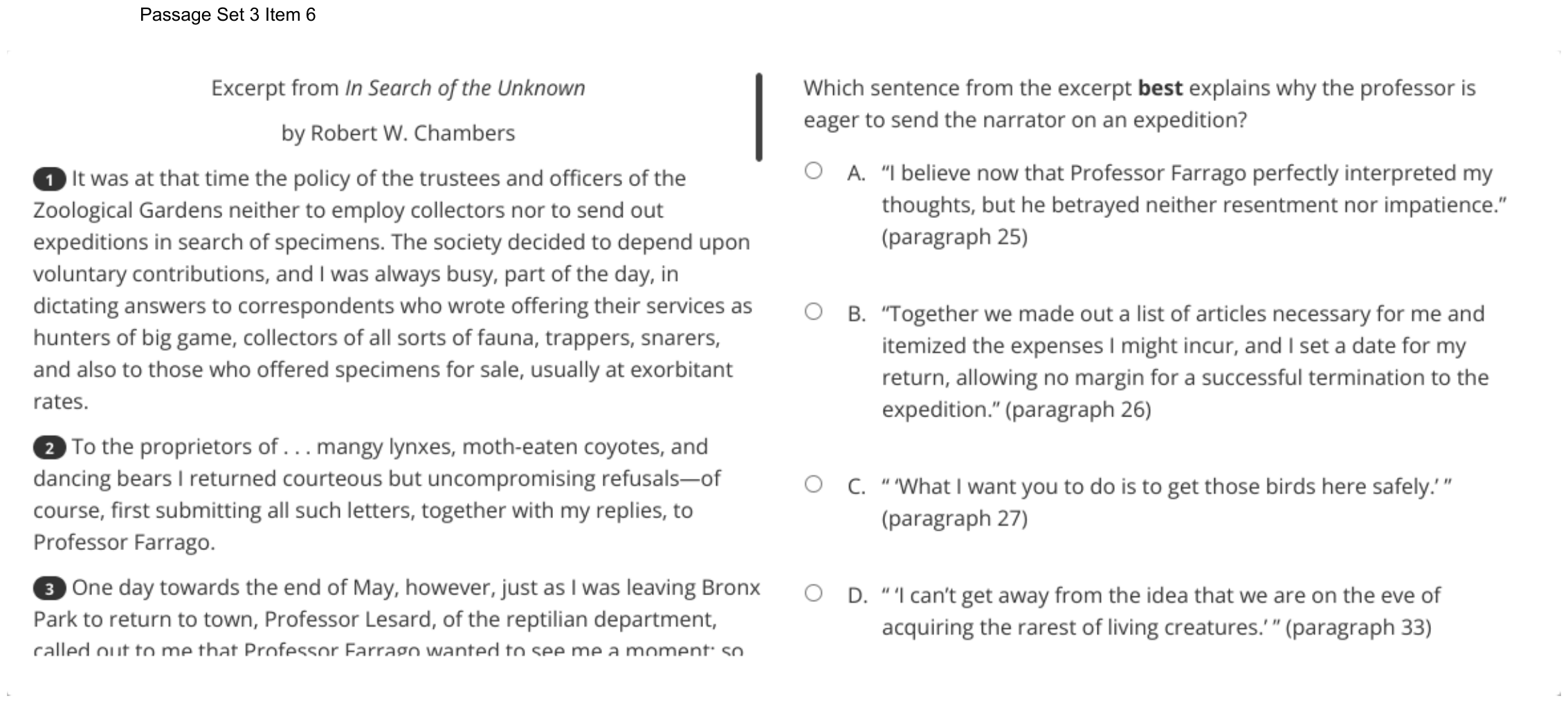
Question 46 of 57
2021 Test A English, question 46Uses the passage above: “Excerpt from In Search of the Unknown”.
Question
How does paragraph 34 help develop the plot of the excerpt?
- AIt shows that the narrator is beginning to consider the possibility of finding the great auks.
- BIt demonstrates that the narrator is struggling to understand why the professor thinks the great auks exist.
- CIt establishes that the narrator is willing to let the professor overrule him about the great auks.
- DIt emphasizes that the narrator feels a sense of urgency to complete the expedition to locate the great auks.
Show the answer
Correct answer: A
The question asks how paragraph 34 helps develop the plot of the excerpt.
A. CORRECT. Despite his initial disbelief, the narrator admits in paragraph 34 that he is starting to feel the “same strange hope” the professor feels, which is to find the great auks (paragraph 33).
B. Incorrect. While the narrator does make an effort in paragraphs 11–22 to understand the professor’s thinking, paragraph 34 reveals that the narrator has been affected by the professor’s “strange hope” for the auks and is beginning to share this hope “in spite of” himself.
C. Incorrect. The narrator describes a feeling of hope in paragraph 34 that would not be present if he had simply been overruled by the professor and did not share any of the professor’s belief in the possibility that the auks exist. In addition, it was established before paragraph 34 that the narrator was willing to be overruled (“I drew a chair up beside his desk—there was nothing to do but to obey, and this fool’s errand was none of my conceiving” [paragraph 25]).
D. Incorrect. The narrator does not express a sense of urgency in paragraph 34 to complete the expedition. Instead, he expresses hope that the great auks might really exist.
Question analysis
This plot question on In Search of the Unknown asks how paragraph 34, a single long sentence near the end of the excerpt, helps develop the story of the narrator’s assignment to bring back two great auks. Students must put its formal phrasing into plain words and connect it to the conversation that comes before it.
- Grade level
- Grade 7 reading and task
- Compared with grade 7
- At grade 7 Explaining how a paragraph moves a plot forward is regular grade 7 work, and paragraph 34 is a single sentence. Its formal wording, such as “in spite of me” and “stir my pulses,” has to be put into plain words first.
- Estimated difficulty
- Straightforward: two steps or one careful reading.
- Thinking it demands
- Depth of knowledge 2, skills and concepts · mainly analyze
- What makes it hard
- Complex sentences minor
- Figurative or literary language minor
- Evidence
- Answered from one paragraph or stanza
- Reading level
- Passage: about grade 9, 1066 words; question and choices: about grade 10, 79 words.
- Students, last 30 days
- Not enough answers yet to show (it takes 10).
Why it is hard, traps and wrong answers (shows the answer)
Why it is hard
Put into plain words, the paragraph has the narrator admitting that the professor’s hope is starting to take hold of him, which is the turn the question asks about. The losses come from reading it through earlier scenes: his obedience in paragraph 25 makes giving way to the professor look like the point, and the word “strange” makes puzzlement look likely. The paragraph records a change in what he believes, not in what he does.
Complex sentences minor Understanding the question
Paragraph 34 is one 31-word sentence that turns on “on the contrary” and breaks its main clause with “in spite of me,” so its point, a hope beginning to stir, arrives late. (Abedi & Lord, 2001; Freedle & Kostin, 1993; Messick, 1989)
Figurative or literary language minor Understanding the question
“To stir my pulses” means to excite, and a student who reads it as a racing heart may take it for haste to leave rather than hope that the birds exist. (Graesser, Singer & Trabasso, 1994; Kintsch, 1998)
Strategy: Restate paragraph 34 in plain modern words, then test each choice against what this paragraph itself says about the narrator.
Traps
- Wrong part of the text: A choice is true of another paragraph, stanza or speaker than the one asked about.
- Reads too much in: A reasonable-sounding conclusion that goes further than the text allows.
- Twists what the text says: Uses the text's topic and ideas but changes what it says: who did it, how much, when, or why.
The wrong answers, classified
B Twists what the text says (King et al., 2004)
Takes “the same strange hope” as the narrator puzzling over the professor’s belief, though the sentence says that hope is now stirring in the narrator himself.
C Wrong part of the text (Kirsch & Mosenthal, 1990)
Brings in paragraph 25, where the narrator draws up a chair because he must obey, but paragraph 34 shows him starting to share the hope, not yielding to an order.
D Reads too much in (Graesser, Singer & Trabasso, 1994)
Reads stirring pulses as eagerness to finish the trip quickly, though the excitement is about the chance that the birds exist, and the paragraph says nothing of speed.
Working it out, step by step
Figure out what the question asks
This asks how paragraph 34 moves the story forward. Read that paragraph closely. Then decide what has changed for the narrator.
Read paragraph 34 closely
Paragraph 34 says “But I was not shocked; on the contrary, I was conscious that the same strange hope that Professor Farrago cherished was beginning, in spite of me, to stir my pulses, too.” On the contrary means the opposite is true. Cherished means held dear. To stir his pulses means to make his heart beat faster with excitement.
Put it in your own words
The professor hopes the great auks are real. Now the narrator feels that same hope starting in himself. “In spite of me” means he did not want to feel it, but he does. Before, he called the letter writer a liar or a fool. Now he is starting to think the birds might really be found.
Check each choice
- A fits. He begins to hope that the birds could be found.
- B does not fit. He is not puzzling over the professor’s belief. He is starting to share it.
- C does not fit. Giving in to the professor came earlier, in paragraph 25: “there was nothing to do but to obey.” Paragraph 34 is about hope, not obeying.
- D does not fit. Nothing in the paragraph is about hurrying.
Watch out: D is tempting because a racing pulse can sound like rushing. But the excitement is about the birds, not about speed.
Choose the answer
Paragraph 34 shows the narrator’s doubt starting to turn into hope. So the answer is A, “It shows that the narrator is beginning to consider the possibility of finding the great auks.”
Why this answer and not the closest wrong one
C is the closest wrong choice. The narrator did agree to obey the professor. But that happened in paragraph 25, and he was not happy about it. In paragraph 34, something new happens. He feels “the same strange hope” as the professor. A names that change.
More questions like this
The original DOE question
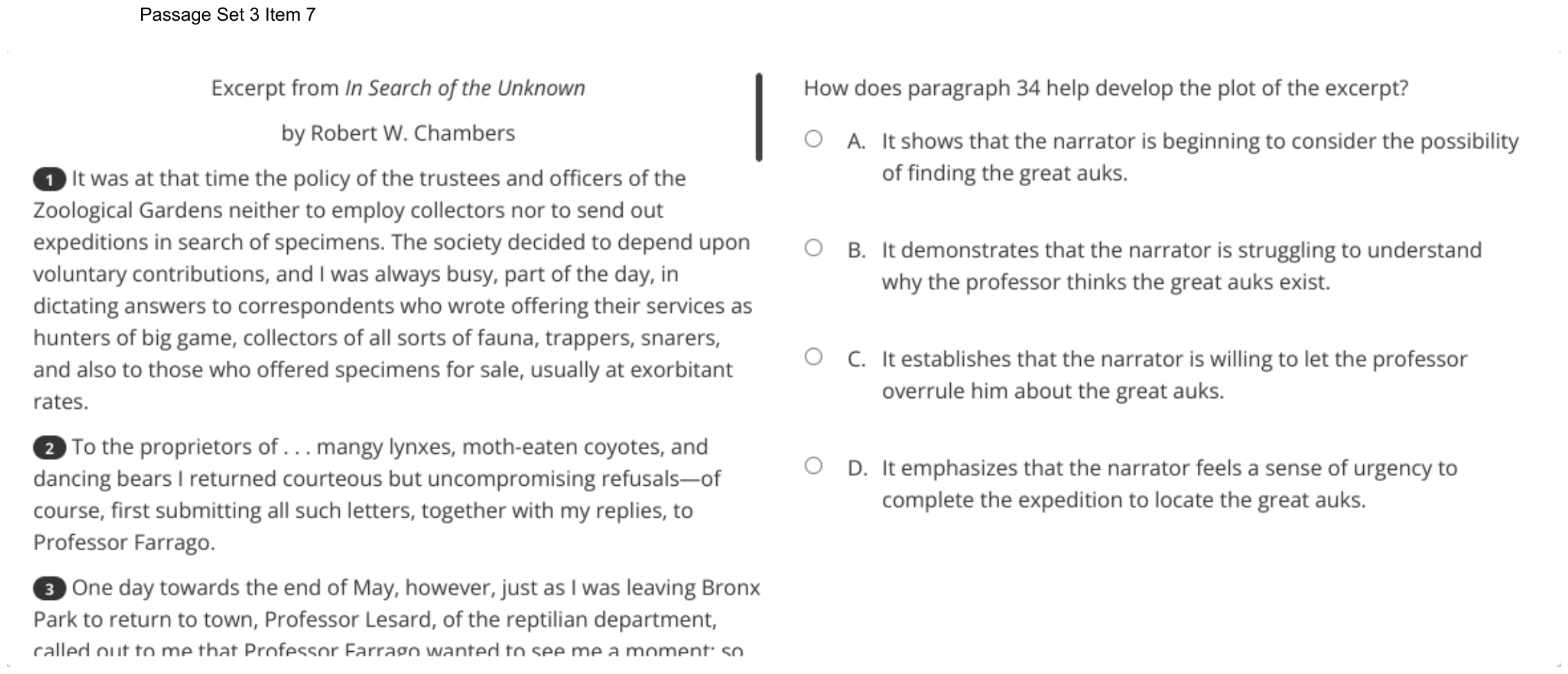
Question 47 of 57
2021 Test A English, question 47Uses the passage above: “Excerpt from In Search of the Unknown”.
Question
Which sentence best demonstrates the professional relationship between the narrator and the professor?
- A“He disengaged the sheet of paper and handed it to me.” (paragraph 4)
- B“Clearly, Professor Farrago was on the verge of dotage—ah, what a loss to the world!” (paragraph 24)
- C“I drew a chair up beside his desk—there was nothing to do but to obey, and this fool’s errand was none of my conceiving.” (paragraph 25)
- D“ ‘Very well,’ said Professor Farrago, good-humoredly, ‘you shall have all the assistance you may require.’ ” (paragraph 29)
Show the answer
Correct answer: C
The question asks which sentence best demonstrates the professional relationship between the narrator and the professor.
A. Incorrect. Although the professor’s handing of the paper to the narrator indicates that they are beginning to discuss the letter about the great auk, the sentence from paragraph 4 does not convey the relationship between a subordinate employee (the narrator) and a superior (the professor).
B. Incorrect. The sentence from paragraph 24 presents the narrator’s immediate internal reaction to the professor’s words. The sentence emphasizes that the professor’s belief in the great auk’s existence is so outrageous that the narrator initially thinks the professor is starting to lose touch with reality. This is a momentary reaction to the professor’s words, not a demonstration of the professional relationship between the two.
C. CORRECT. The sentence from paragraph 25 reveals that while the narrator disagrees with the professor (“this fool’s errand was none of my conceiving”), he obeys because he works for the professor (“there was nothing to do but to obey”).
D. Incorrect. The professor’s good-humored offer of assistance in the sentence from paragraph 29 does not best demonstrate the underlying employer-employee relationship between the professor and the narrator. The narrator has to go on the expedition because the professor, his boss, told him to.
Question analysis
This textual evidence question on In Search of the Unknown asks which sentence best demonstrates the professional relationship between the narrator, who answers letters for a zoological society, and Professor Farrago. The four quotations come from different points in their conversation about a letter. Several show the two men dealing with each other, so students must weigh which one shows the relationship most clearly.
- Grade level
- Grade 7 reading and task
- Compared with grade 7
- At grade 7 Picking the sentence that best shows a relationship between characters is typical grade 7 evidence work. The four quotations are short and labeled, and the main step is deciding what a professional relationship would look like in this scene.
- Estimated difficulty
- Moderate: several steps, or a close reading with one strong distractor.
- Thinking it demands
- Depth of knowledge 2, skills and concepts · mainly evaluate
- What makes it hard
- Reading between the lines moderate
- Every choice must be checked minor
- Hard words minor
- Evidence
- Answered from several paragraphs or stanzas
- Reading level
- Passage: about grade 9, 1066 words; question and choices: about grade 10, 84 words.
- Students, last 30 days
- Not enough answers yet to show (it takes 10).
Why it is hard, traps and wrong answers (shows the answer)
Why it is hard
Several quotations show the two men interacting, and the professor’s offer of “all the assistance you may require” even shows him controlling the society’s resources. The best evidence is the sentence in which the employee’s position is plain: he disagrees, yet he must obey. Students who read “professional” loosely as anything that happens at work pick the handing over of the letter, and those who look only at the professor’s authority stop at his offer of help.
Reading between the lines moderate Working it out
Students must first decide what a professional relationship looks like here, a superior and an employee bound to carry out his orders, before they can see it in “nothing to do but to obey.” (Graesser, Singer & Trabasso, 1994; Kintsch, 1998)
Every choice must be checked minor Choosing the answer
All four sentences show the two men dealing with each other, from handing over a letter to granting help, so each must be weighed for what it shows about rank. (Embretson & Wetzel, 1987)
Hard words minor Understanding the question
The right sentence ends “this fool’s errand was none of my conceiving,” old-fashioned wording for saying the pointless trip was not his idea, which shows the disagreement that makes his obedience telling. (Perfetti, 2007; Freedle & Kostin, 1993)
Strategy: Decide first what a professional relationship between these two men involves, then ask of each quotation whether it shows that relationship or only a passing moment between them.
Traps
- Supports only part of the claim: In a question about evidence: a line that backs one half of the claim but not the other, or a related point rather than the claim itself.
- True but not the answer: A choice says something accurate about the text that does not answer this question.
- Reads too much in: A reasonable-sounding conclusion that goes further than the text allows.
The wrong answers, classified
A Reads too much in (Graesser, Singer & Trabasso, 1994)
Treats the handing over of a letter as a boss giving an order, though the gesture only opens their discussion and shows nothing about who must answer to whom.
B True but not the answer (King et al., 2004; Embretson & Wetzel, 1987)
Chooses the narrator’s private verdict that the professor is near “dotage,” an accurate view of his thoughts in paragraph 24 but a passing reaction, not a sign of their working roles.
D Supports only part of the claim (King et al., 2004; Thissen, Steinberg & Fitzpatrick, 1989)
Sees the professor granting help as a superior’s power, which is partly right, but the sentence shows his good humor more than the narrator’s duty to follow orders.
Working it out, step by step
Figure out what the question asks
This asks for the sentence that best shows their professional relationship. That means how they relate at work: who is the boss, and who must follow orders. Paragraph 3 calls Professor Farrago the “general superintendent of the Zoological Gardens.” He is the man in charge. The narrator sends him letters for approval.
Look for a sign of boss and worker
Paragraph 25 says “I drew a chair up beside his desk—there was nothing to do but to obey, and this fool’s errand was none of my conceiving.” To obey means to do what you are told. A fool’s errand is a pointless task. “None of my conceiving” means it was not his idea.
Put it in your own words
The narrator thinks the trip is silly. Still, he must do it, because the professor is his boss. A worker who disagrees but follows orders anyway shows a work relationship clearly. That is what this sentence does.
Check each choice
- A does not fit. Handing over a letter starts their talk. It shows nothing about who is in charge.
- B does not fit. It is the narrator’s private thought that the professor is losing his reason in old age. It is a passing reaction.
- C fits. The narrator must obey even though he disagrees.
- D does not fit. It shows the professor in a good mood. It does not show the narrator’s duty to follow orders.
Watch out: D is tempting because a boss is the one who offers help. But the sentence mostly shows his good humor.
Choose the answer
Only C shows the narrator following an order he does not agree with. So the answer is C, “I drew a chair up beside his desk—there was nothing to do but to obey, and this fool’s errand was none of my conceiving.”
Why this answer and not the closest wrong one
D is the closest wrong choice. The professor does have the power to offer “all the assistance you may require.” But that sentence mainly shows him being friendly. C shows the heart of the work relationship. The narrator thinks the job is foolish, yet he has “nothing to do but to obey.”
More questions like this
The original DOE question
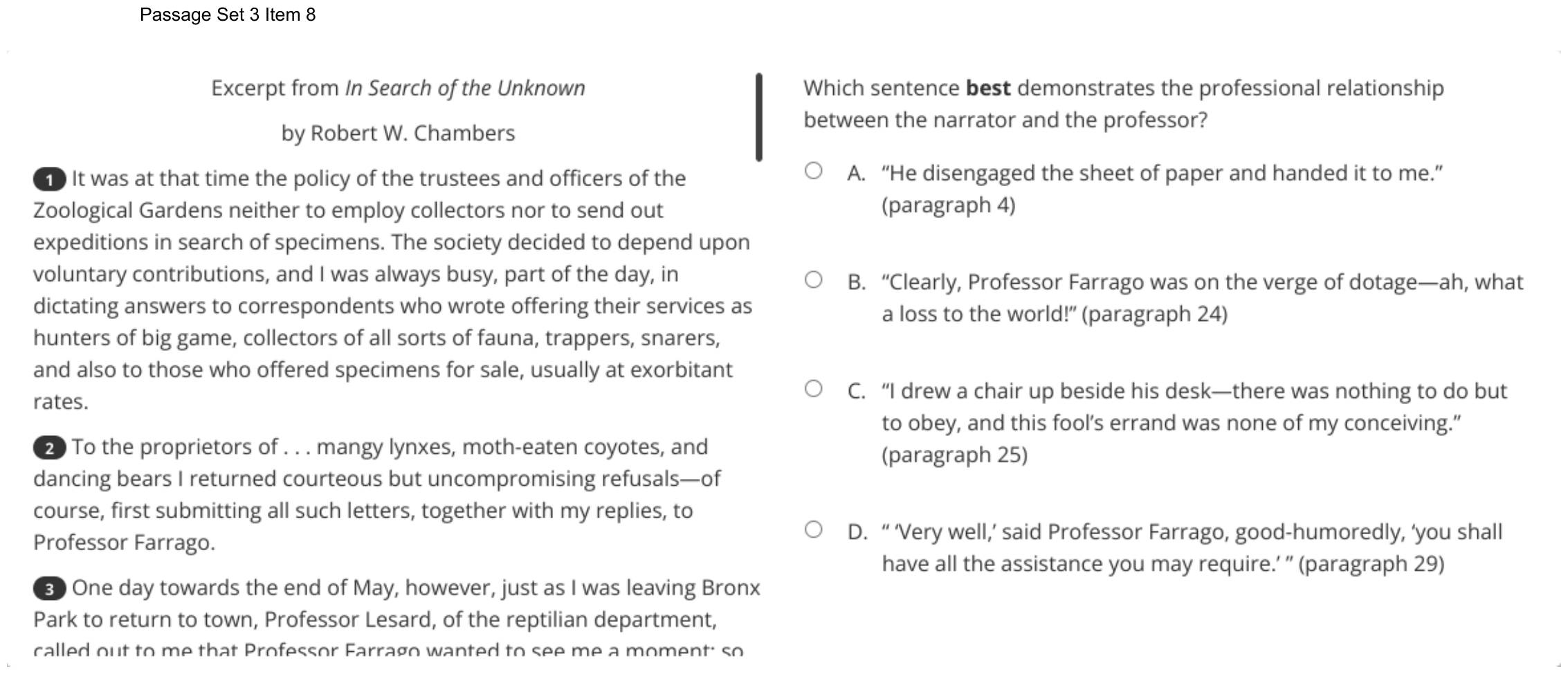
Question 48 of 57
2021 Test A English, question 48Uses the passage above: “Excerpt from In Search of the Unknown”.
Question
How does the author develop the contrast between the narrator’s point of view and the professor’s point of view?
- Aby providing both the narrator’s and professor’s thoughts on how age and experience influence each other’s reasoning
- Bby using the conversation between the narrator and the professor to emphasize their reactions to the letter
- Cby describing the professor’s persistent efforts to change the narrator’s mind about the letter
- Dby including dialogue that explains why the professor is the supervisor and the narrator is his subordinate
Show the answer
Correct answer: B
The question asks how the author develops the contrast between the narrator’s point of view and the professor’s point of view.
A. Incorrect. The excerpt does not describe the narrator’s thoughts about how age and experience influence the professor’s reasoning in enough detail to fully contrast them against the thoughts about the narrator that the professor expresses in paragraphs 15–17. The narrator’s idea that the professor might be “on the verge of dotage” (paragraph 24) is meant in a humorous way.
B. CORRECT. The primary conflict of the excerpt revolves around the narrator’s disagreement with the professor about whether the letter about the great auks could be true. As the two men converse, their contrasting attitudes toward the letter become clear: the narrator dismisses the possibility of great auks out of hand (“ ‘of course the man is mistaken’ ” [paragraph 5]; “ ‘here is a man . . . who wants you to send somebody to take charge of a bird that doesn’t exist!’ ” [paragraph 12]), while the professor calmly admits that although “ ‘nine hundred and ninety-nine men in a thousand would throw that letter aside and condemn the writer’ ” (paragraph 9), he himself believes that the writer could be telling the truth (“ ‘How do you know,’ asked Professor Farrago, ‘that the bird in question does not exist?’ ” [paragraph 13]).
C. Incorrect. The professor explains why he disagrees with the narrator (paragraphs 19–21), but he does not make persistent efforts to convince the narrator to change his mind about the letter. Instead he states that the narrator will go on an expedition to retrieve “ ‘whatever it is that our correspondent has’ ” (paragraph 23), thereby requiring the narrator to go collect the great auks whether the narrator believes in them or not.
D. Incorrect. The point of the dialogue is not to explain the subordinate-supervisor relationship between the narrator and the professor but rather to contrast what each character believes about the contents of the letter.
Question analysis
This point-of-view question asks how Robert W. Chambers develops the contrast between the narrator’s outlook and Professor Farrago’s in the excerpt from In Search of the Unknown. Students must step back from single lines and judge the author’s method across the whole excerpt. The choices describe techniques in general terms, and several connect to real moments in the story.
- Grade level
- Grade 8 reading and task
- Compared with grade 7
- Above grade 7 Analyzing how an author contrasts two characters’ points of view is the grade 7 standard itself, but here students must judge the main method across the whole excerpt, and each choice names an abstract method that touches something in the text.
- Estimated difficulty
- Hard: combines ideas, needs a plan, and has more than one tempting wrong answer.
- Thinking it demands
- Depth of knowledge 3, strategic thinking · mainly analyze
- What makes it hard
- How, not what major
- A very close wrong answer moderate
- Evidence in several places moderate
- Evidence
- Answered from the whole text
- Reading level
- Passage: about grade 9, 1066 words; question and choices: about grade 11, 84 words.
- Students, last 30 days
- Not enough answers yet to show (it takes 10).
Why it is hard, traps and wrong answers (shows the answer)
Why it is hard
The right choice is plain enough to seem too obvious, so students look for something more specific. The excerpt offers a candidate: the professor teases “you young fellows,” and the narrator decides the old man is near “dotage,” which makes age look like the method. Those remarks are passing jokes, while the men’s opposite reactions to Halyard’s letter run through the whole conversation. The question rewards judging what carries the contrast from start to end rather than what is most striking.
How, not what major Working it out
The question asks for the author’s method across the whole excerpt, and every choice names an abstract technique, so students must step back from single lines to see that the dialogue carries the contrast. (Anderson & Krathwohl, 2001)
A very close wrong answer moderate Choosing the answer
The choice about age and experience and the right one both describe the two men’s opposed views as they come out in the excerpt; they part on the subject, their ages or the letter. (Embretson & Wetzel, 1987; Gorin & Embretson, 2006; Ascalon et al., 2007)
Evidence in several places moderate Working it out
The contrast builds from the narrator’s “of course the man is mistaken” in paragraph 5 to the professor’s appeal to “instinct” in paragraph 33, so no single passage shows the method. (Kirsch & Mosenthal, 1990; Gorin & Embretson, 2006)
Strategy: For each choice, find where the excerpt does what the choice describes, and ask whether that method carries the contrast through the whole excerpt or appears only once or twice.
Traps
- Too narrow: A single detail offered as the central idea or a summary, or a summary that keeps minor details and leaves out an essential part.
- Twists what the text says: Uses the text's topic and ideas but changes what it says: who did it, how much, when, or why.
- Wrong purpose or structure: Names a purpose, structure or effect that the part does not serve, or describes what a part says when the question asks what it does.
The wrong answers, classified
A Too narrow (King et al., 2004)
Notices the jab at “you young fellows” and the narrator’s thought of “dotage,” but two passing remarks about age are not how the author builds the contrast across the excerpt.
C Twists what the text says (King et al., 2004)
Overstates the professor’s role, since he asks a few calm questions and then simply assigns the trip, never working to win the narrator over.
D Wrong purpose or structure (Anderson & Krathwohl, 2001)
Knows that the professor is the superior, but no line of dialogue explains how either man got his position; the talk is about the letter, not their ranks.
Working it out, step by step
Figure out what the question asks
This asks about the author’s method. How does the author show that the two men see things differently? Look at how the whole excerpt is built, not just one line.
Notice how the excerpt is told
Most of the excerpt is a conversation. The two men talk back and forth about the letter. Each answer shows how one man reacts to it. So their reactions to the letter are where the contrast shows up. A contrast is a clear difference between two things.
Find the two reactions
The narrator says “of course the man is mistaken” (paragraph 5). He laughs at the idea of “a bird that doesn’t exist!” (paragraph 12). The professor stays open. In paragraph 13 he asks how the narrator can be sure “that the bird in question does not exist.” In paragraph 23, he is “daring to believe” it is the great auk.
Check each choice
- A does not fit. Age comes up only twice: “you young fellows” and the narrator’s thought about “dotage.” Two short remarks do not build the contrast.
- B fits. The talk about the letter shows their opposite reactions.
- C does not fit. The professor asks a few calm questions and then simply sends the narrator. He does not keep trying to change his mind.
- D does not fit. No line explains how either man got his job.
Watch out: A is tempting because those remarks about age are real. But they are passing moments, not the author’s main method.
Choose the answer
The author builds the contrast through the two men’s talk about the letter. So the answer is B, “by using the conversation between the narrator and the professor to emphasize their reactions to the letter.”
Why this answer and not the closest wrong one
A is the closest wrong choice. The professor does tease “you young fellows,” and the narrator does think of “dotage.” But those are two quick remarks. From paragraph 5 to paragraph 33, the two men keep reacting to the letter in opposite ways. That steady back-and-forth builds the contrast, so B fits.
More questions like this
The original DOE question
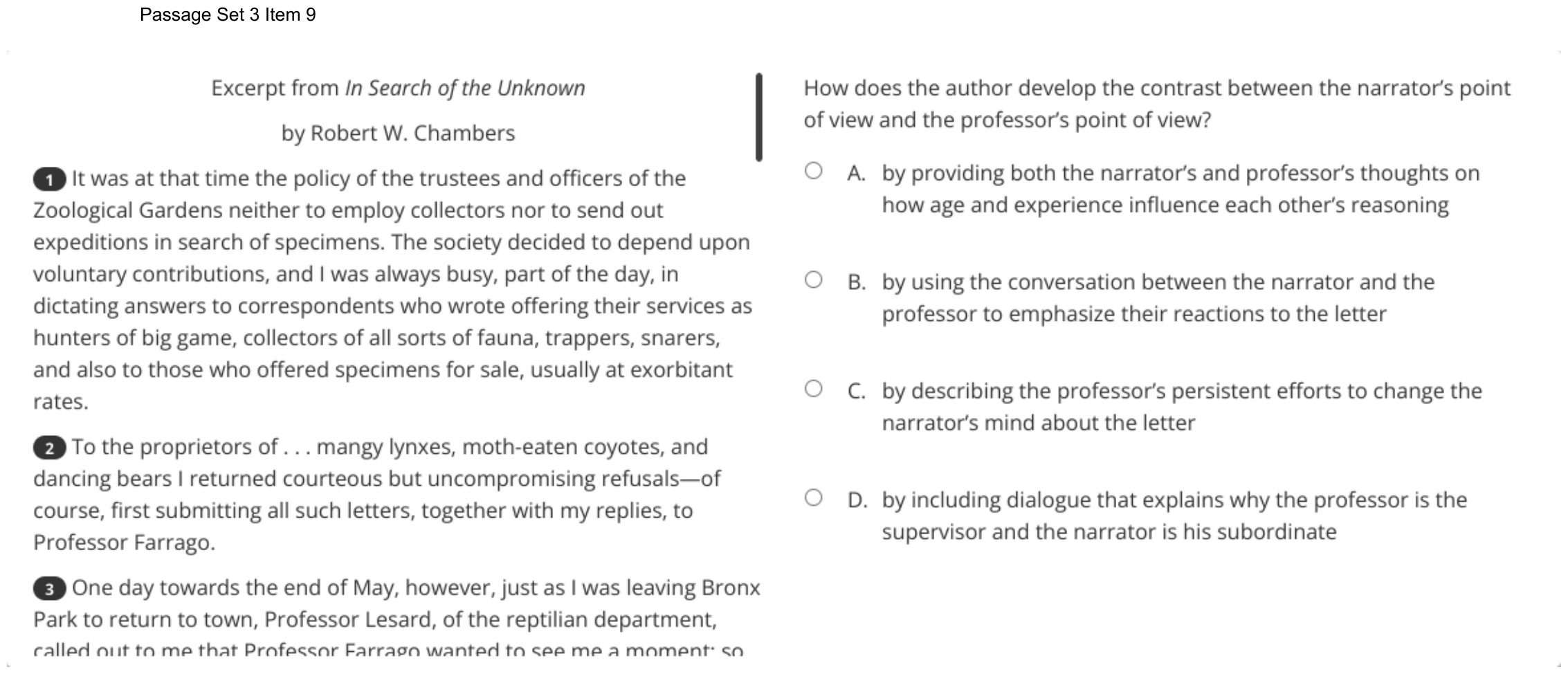
Question 49 of 57
2021 Test A English, question 49Passage Excerpt from “Research Riddle Resolved”
Excerpt from “Research Riddle Resolved”
For centuries, scientists were confounded by an animal that seemed to look and act like a combination of a bird, a reptile, and a mammal. It has a bill like a duck and lays eggs but produces milk for its young. It lives in a burrow, has fur, and can make venom. We now know that this animal is called a duck-billed platypus. A platypus is a monotreme, a type of egg-laying mammal.
Hundreds of years after the first sightings of the platypus, the animal still captures our imagination anew and irresistibly attracts the attention of science writers everywhere. The May 2008 Nature report detailing the DNA insides of the duck-billed platypus invited colorful tales from just about every mainstream media outlet.
But cuteness and weirdness aside, the platypus research results are a gold mine for medical researchers. The findings cement what may have seemed totally obvious but turned out to be a bit of a scientific surprise: platypus DNA is a patchwork of genes from reptiles, birds, and mammals.
Evolution Fusion
In other words, the platypus heritage is laid out in an evolutionary DNA tapestry that marks the time, hundreds of millions of years ago, when reptiles and mammals branched off the evolutionary tree.
So what? The platypus is nothing like a human, so what can its DNA tell us about people and the diseases we get?
Plenty, says an international team of scientists who did this work.
The platypus genome results are far more than confirmation of a scientific oddity. They provide researchers a window into a time in history when mammals became unique—gaining the ability to bear live young, produce milk for them, and grow a warm, furry coat.
That’s important because our own, modern-day genomes are still a big mystery and researchers need much more information to be able to translate our genetic language into useful health knowledge.
One of the ways scientists can decipher meaning from within our 3 billion DNA “letters,” or nucleotides, is to compare human genes with those from animals, to see what has been kept the same and what has evolved to be different. . . .
Same and Different
In an approach called comparative genomics, scientists compare the genome sequences of several species: human, mouse, and a wide variety of other organisms from single-celled fungi to elephants and, now, the platypus.
The goal of this research is to find regions of similarity and difference in order to better understand the structure and function of human genes.
Comparative genomics is directly related to evolution because all living things share a common ancestor. By using computer tools to examine genes that have been kept the same in many organisms over millions of years, researchers can locate signals that control how genes work. This information may translate into ways to understand, treat, and prevent human diseases. . . .
Chicken or Egg?
When researchers analyzed platypus DNA and compared it to that of chickens, snakes, and lizards, the findings traced the evolutionary path from birds and reptiles to mammals. They learned that the platypus lost most of its genetic ability to produce egg yolk—as compared to chicken genes. This suggests its departure from “chicken-ness.”
But, through evolutionary change, the platypus gained the ability to make milk that is rich in nutrients. Platypuses have genes that make the milk protein casein: just like we do.
A male platypus can, like its ancestral snake and lizard cousins, produce venom. The platypus ejects this venom through special glands in its back legs. The evolutionary reason for maintaining such molecular weaponry isn’t yet clear, but what is fascinating is that it appears nature mixed and matched together DNA pieces separately to create the venom genes in reptiles and monotremes like the platypus.
The scientific value of pinning genetics to physiological function—like milk production—is high. Such investigations may help medical researchers understand health issues related to reproduction and lactation. Although lactation is an ancient reproductive trait, mammals—including the platypus—are unique in their ability to produce milk that is extraordinarily nutritious, containing a rich blend of sugars, fats, and proteins.
More generally, though, studying how nature cuts and pastes gene modules gives scientists an inside scoop on how genetic changes relate to health and disease risk.
One thing is clear—the stunning blend of reptile, bird, and mammal puts the platypus in a class of its own, and it gives researchers much more: information about how mammals like us came about.
[Scientists’] genetic sleuthing of platypuses, chimps, fish, sunflowers—you name it—continues to teach scientists how millions of years of evolution progressed. This provides vital information to understanding the role of genes in the health and disease of mammals like us and our pets, and can also help preserve our rich and diverse planet.
From “Research Riddle Resolved”—Public Domain/National Institutes of Health
Question
Read this sentence from paragraph 2.
But cuteness and weirdness aside, the platypus research results are a gold mine for medical researchers.
The sentence contributes to the overall structure of the excerpt by
- Ashifting the focus of the excerpt from the platypus’s unique appearance to its physiology.
- Bhighlighting how the platypus’s unusual appearance has attracted scientists’ attention.
- Crevealing current ideas about the genetic background of the platypus.
- Dintroducing the platypus’s scientific significance that the rest of the excerpt develops.
Show the answer
Correct answer: D
The question asks how the sentence from paragraph 2 contributes to the overall structure of the excerpt.
A. Incorrect. While the sentence from paragraph 2 does mention the platypus’s unique appearance, the remainder of the excerpt does not focus on the physiology of the platypus but instead focuses on the significance of scientists’ platypus research and what it can “tell us about people” (paragraph 4).
B. Incorrect. Paragraph 1 discusses the platypus as the “duck-billed” animal that “still captures our imagination anew and irresistibly attracts the attention of science writers everywhere,” but highlighting the idea that the platypus’s unusual appearance has attracted scientists’ attention is not how the sentence from paragraph 2 fits into the overall structure of the excerpt.
C. Incorrect. Paragraph 1 states that “the May 2008 Nature report detailing the DNA insides of the duck-billed platypus invited colorful tales from just about every mainstream media outlet,” but it does not discuss current ideas in the field. Paragraph 2 focuses on the “scientific surprise” of the platypus.
D. CORRECT. The sentence from paragraph 2 serves as a transition from the introductory idea that “the animal still captures our imagination anew and irresistibly attracts the attention of science writers everywhere” (paragraph 1) to the central idea that the platypus has great scientific significance.
Question analysis
This text-structure question on “Research Riddle Resolved,” a National Institutes of Health article about what the platypus’s DNA reveals, quotes the sentence that calls the research results “a gold mine for medical researchers.” Students decide how the sentence contributes to the excerpt’s overall structure, and the choices offer roles that sound alike, so a clear picture of how the article unfolds is needed.
- Grade level
- Grade 8 reading and task
- Compared with grade 7
- At grade 7 Explaining how a sentence fits a text’s structure is regular grade 7 work. This sentence opens paragraph 2 of a science article full of terms such as “genome” and “comparative genomics,” and its role has to be judged against the excerpt as a whole.
- Estimated difficulty
- Moderate: several steps, or a close reading with one strong distractor.
- Thinking it demands
- Depth of knowledge 2, skills and concepts · mainly analyze
- What makes it hard
- How, not what moderate
- Hard words moderate
- Evidence in several places minor
- Evidence
- Answered from the whole text
- Reading level
- Passage: about grade 11, 809 words; question and choices: about grade 11, 78 words.
- Corrected from the DOE handbook
- A missing hyphen in a quotation in the explanation was restored.
- Students, last 30 days
- Not enough answers yet to show (it takes 10).
Why it is hard, traps and wrong answers (shows the answer)
Why it is hard
The sentence announces its own turn with “But … aside,” so most students sense that it moves away from the platypus’s oddness. Points are lost on where it moves to: one choice gets the turn right but names the wrong destination, and two others credit the sentence with what paragraphs 1 and 2 say around it. The question rewards reading the sentence as a signpost for the rest of the article rather than as one more fact about the animal.
How, not what moderate Working it out
The stem asks what the sentence does for the whole excerpt, so students must see “But … aside” turning from the animal’s public appeal in paragraph 1 to its value for science, the subject of every later section. (Anderson & Krathwohl, 2001)
Hard words moderate Understanding the question
One choice turns on “physiology,” how a body works, and a student who takes it to mean the animal’s biology in general cannot tell that the excerpt goes on to its DNA instead. (Perfetti, 2007; Freedle & Kostin, 1993)
Evidence in several places minor Working it out
Confirming that the sentence opens the excerpt’s main subject means checking what follows, from paragraph 4’s question “what can its DNA tell us about people” to the health payoffs of paragraphs 15–18. (Kirsch & Mosenthal, 1990; Gorin & Embretson, 2006)
Strategy: Sum up paragraph 1 in a phrase and the main subject of the paragraphs after the sentence in another, then test each choice’s description of the sentence against both.
Traps
- Half right: One half of a two-part choice is right and the other is not.
- Wrong part of the text: A choice is true of another paragraph, stanza or speaker than the one asked about.
- Word match: Repeats striking words or phrases from the text, so it looks supported, but its meaning does not fit the question.
The wrong answers, classified
A Half right (King et al., 2004; Thissen, Steinberg & Fitzpatrick, 1989)
Rightly sees the turn away from the animal’s cuteness and weirdness, but the excerpt goes on to its DNA and what it can teach about human health, not to how its body works.
B Word match (Freedle & Kostin, 1993)
Echoes paragraph 1’s platypus that “irresistibly attracts the attention of science writers,” but those are writers, not scientists, and the quoted sentence sets the animal’s looks aside rather than highlighting them.
C Wrong part of the text (Kirsch & Mosenthal, 1990)
Credits the sentence with the finding reported right after it, that platypus DNA is “a patchwork of genes,” though this sentence only says the results are valuable to medical researchers.
What was corrected from the DOE handbook, and why
- Explanation: The handbook’s explanation of Option C quotes paragraph 1 as “the May 2008 Nature report detailing the DNA insides of the duckbilled platypus.” The passage says “duck-billed,” as its introduction and the explanation of Option B do, so the site now quotes it that way.
Working it out, step by step
Figure out what the question asks
This is a structure question. It asks what job one sentence does for the whole excerpt. So look at what comes before the sentence and at what comes after it.
Look before the sentence
Paragraph 1 is about how people react to the platypus. It says the animal “still captures our imagination anew and irresistibly attracts the attention of science writers everywhere.” News outlets told “colorful tales” about it. So paragraph 1 is about how fun and strange the animal seems.
Read the sentence closely
The sentence begins “But cuteness and weirdness aside.” Aside means set to one side. So the writer stops talking about how odd the platypus is. Then the sentence calls the research results “a gold mine for medical researchers.” A gold mine is a source of great value. So the sentence says the platypus matters to science.
Look after the sentence
The rest of the excerpt explains that value. Paragraph 4 asks “what can its DNA tell us about people and the diseases we get?” Paragraph 11 says comparing genes may help “understand, treat, and prevent human diseases.” So the sentence opens the main topic of the excerpt.
Check each choice
- A does not fit. It is right that the sentence turns away from looks. But the excerpt moves on to the animal’s DNA and human health. It is not mainly about physiology, which means how a body works.
- B does not fit. Paragraph 1 says the platypus attracts “science writers,” not scientists. And this sentence sets the looks aside.
- C does not fit. The genes come up in the next sentence. This sentence only says the results are valuable.
- D fits. The sentence names the platypus’s value to science, and the rest of the excerpt builds on it.
Watch out: A gets the turn right but names the wrong place it turns to.
Choose the answer
The sentence turns from the animal’s oddness to its value for science. The rest of the excerpt develops that value. So the answer is D.
Why this answer and not the closest wrong one
A is the closest wrong choice. A and D both see the turn away from “cuteness and weirdness.” But A says the excerpt turns to physiology, how the platypus’s body works. In fact, it turns to what the platypus’s DNA can teach about people and disease. D names that: the animal’s value to science.
More questions like this
The original DOE question
The passage “Excerpt from “Research Riddle Resolved”” as printed (pages 66–67)
Question 50 of 57
2021 Test A English, question 50Uses the passage above: “Excerpt from “Research Riddle Resolved””.
Question
The phrase “evolutionary DNA tapestry” in paragraph 3 conveys the idea that the platypus
- Ahas a rich and diverse genetic history linked to reptiles, birds, and other mammals.
- Bwas able to develop its mammalian and reptilian traits at different points in time.
- Ccontinues to be the best resource for studying the evolution of animal genomes.
- Dis especially useful to researchers because its genes have never been altered.
Show the answer
Correct answer: A
The question asks what the phrase “evolutionary DNA tapestry” in paragraph 3 conveys about the platypus.
A. CORRECT. In the excerpt, the term “tapestry” conveys the sense of a rich history; the “platypus heritage” described in paragraph 3 is woven together with “threads” from mammals, birds, and reptiles in its genetic background.
B. Incorrect. While paragraph 3 does mention mammals and reptiles, it does not discuss when the platypus developed traits from those classifications. Rather, it refers in general to “hundreds of millions of years ago, when reptiles and mammals branched off the evolutionary tree.”
C. Incorrect. The excerpt never claims that, compared with other animals, the platypus is the best resource for studying the evolution of animal genomes. The excerpt indicates that the platypus’s status as a “scientific oddity” provides “a window into a time in history when mammals became unique—gaining the ability to bear live young, produce milk for them, and grow a warm, furry coat” (paragraph 6).
D. Incorrect. The excerpt states that the platypus genome is a “scientific oddity” (paragraph 6) that is useful to researchers, but the reason it is useful is because of DNA evidence that shows “a window into a time in history when mammals became unique” (paragraph 6), not because its genes have never been altered. Because the platypus genome, like that of all animals, has evolved over time, the statement that platypus genes have never been altered is inaccurate (“They learned that the platypus lost most of its genetic ability to produce egg yolk—as compared to chicken genes. This suggests its departure from ‘chicken-ness’ ” [paragraph 12]).
Question analysis
This figurative-language question asks what the phrase “evolutionary DNA tapestry” in paragraph 3 of “Research Riddle Resolved” conveys about the platypus. Students must work out what calling the animal’s heritage a tapestry suggests in an article about its genes, and the choices make different claims about its genetic history and its value to science.
- Grade level
- Grade 7 reading and task
- Compared with grade 7
- At grade 7 Interpreting a metaphor from context is regular grade 7 work. The word “tapestry” may be unfamiliar and sits in a long, technical sentence, but the sentences around it give enough clues for one careful reading to settle it.
- Estimated difficulty
- Straightforward: two steps or one careful reading.
- Thinking it demands
- Depth of knowledge 2, skills and concepts · mainly understand
- What makes it hard
- Figurative or literary language moderate
- Complex sentences minor
- Hard words minor
- Evidence
- Answered from several paragraphs or stanzas
- Reading level
- Passage: about grade 11, 809 words; question and choices: about grade 11, 66 words.
- Students, last 30 days
- Not enough answers yet to show (it takes 10).
Why it is hard, traps and wrong answers (shows the answer)
Why it is hard
The phrase is a restatement, so the sentence before it nearly settles the question for students who notice “In other words.” The risk lies in the rest of paragraph 3’s sentence, whose talk of time and branching invites a choice about traits arriving at different dates. The other wrong choices praise the platypus as a research subject, which the article does elsewhere, but the tapestry image says nothing about its rank or about genes that never changed.
Figurative or literary language moderate Understanding the question
A tapestry is a picture woven from many threads, and paragraph 3 opens “In other words,” so the image restates paragraph 2’s “patchwork of genes from reptiles, birds, and mammals.” (Graesser, Singer & Trabasso, 1994; Kintsch, 1998)
Complex sentences minor Understanding the question
The 33-word sentence hangs a long clause on the image, “that marks the time, hundreds of millions of years ago, when reptiles and mammals branched off,” which pulls attention toward dates. (Abedi & Lord, 2001; Freedle & Kostin, 1993; Messick, 1989)
Hard words minor Understanding the question
“Tapestry” and “heritage” are uncommon words for many students, and a reader who does not know what a tapestry is has only the “In other words” link to go on. (Perfetti, 2007; Freedle & Kostin, 1993)
Strategy: Paragraph 3 begins “In other words,” so reread the sentence just before it and ask what the tapestry image restates; then choose the option that fits both sentences.
Traps
- Twists what the text says: Uses the text's topic and ideas but changes what it says: who did it, how much, when, or why.
- Too broad or too strong: A choice overstates, generalizes, or uses absolute words the text does not support.
- Outside knowledge: A choice is plausible in the real world but not supported by this text.
The wrong answers, classified
B Twists what the text says (King et al., 2004)
Seizes on “marks the time … when reptiles and mammals branched off” and turns it into a timeline of the platypus’s own traits, which the paragraph never gives.
C Too broad or too strong (King et al., 2004)
Stretches the article’s interest in the platypus into the best resource for all genome research, a ranking the excerpt never makes among the many species scientists compare.
D Outside knowledge (King et al., 2004; Recht & Leslie, 1988)
Draws on the popular idea of the platypus as an unchanged living fossil, though paragraph 12 says it lost most of its genetic ability to make egg yolk.
Working it out, step by step
Figure out what the question asks
This asks what a figure of speech means. A figure of speech is words used in a special way, not just for their plain meaning. Here the phrase is “evolutionary DNA tapestry.” You need to decide what it says about the platypus.
Learn what a tapestry is
A tapestry is a large cloth picture. It is woven from many threads of different colors. Each thread is small, but together they make one rich picture. Evolutionary means having to do with how living things change over a very long time.
Use the clue before the phrase
Paragraph 3 starts with “In other words.” That phrase means the writer is saying the same thing again in a new way. So look at the last sentence of paragraph 2. It says “platypus DNA is a patchwork of genes from reptiles, birds, and mammals.” A patchwork is also made of many pieces. So the tapestry is the platypus’s DNA, woven from reptile, bird and mammal parts.
Check each choice
- A fits. Like threads in a tapestry, the platypus’s genes come from reptiles, birds and mammals. That history is rich and mixed.
- B does not fit. Paragraph 3 mentions the time “when reptiles and mammals branched off the evolutionary tree.” But it never says when the platypus got each trait.
- C does not fit. The excerpt never calls the platypus the best animal to study.
- D does not fit. Paragraph 12 says the platypus “lost most of its genetic ability to produce egg yolk.” So its genes did change.
Watch out: B is tempting because the same sentence talks about time and branching. That part tells when two groups split apart. It is not a timeline of the platypus’s traits.
Choose the answer
The tapestry stands for the platypus’s DNA. It is woven from the genes of several kinds of animals. So the answer is A.
Why this answer and not the closest wrong one
B is the closest wrong choice. Its talk of time comes from the same sentence. But a tapestry is about many threads woven together, not about dates. The phrase restates the “patchwork of genes from reptiles, birds, and mammals.” That mixed history is A.
More questions like this
The original DOE question

Question 51 of 57
2021 Test A English, question 51Uses the passage above: “Excerpt from “Research Riddle Resolved””.
Question
How do paragraphs 4–6 contribute to the development of ideas in the excerpt?
- AThey summarize the evidence that the platypus genome is an evolutionary peculiarity.
- BThey provide a transition from the discussion about the study of the platypus to a discussion about the study of the human genome.
- CThey highlight the idea that mammals share several significant similarities even though the group is diverse.
- DThey explain why the platypus’s genetic material is interesting to researchers who are trying to understand humans and other mammals.
Show the answer
Correct answer: D
The question asks how paragraphs 4–6 contribute to the development of ideas in the excerpt.
A. Incorrect. Although paragraph 6 states that the “platypus genome results are far more than confirmation of a scientific oddity,” the paragraphs do not summarize the evidence that the platypus is an evolutionary peculiarity, an idea which is primarily described in paragraphs 12–14. Rather, paragraphs 4–6 indicate why researchers are interested in platypus genetics as a way to deepen their understanding of humans and other mammals.
B. Incorrect. Although the paragraphs suggest that research on platypus DNA can provide useful information about humans (“what can its DNA tell us about people and the diseases we get?” [paragraph 4]; “Plenty, says an international team of scientists who did this work” [paragraph 5]), they do not provide a transition to the study of the human genome. Instead, they explain that researchers are interested in the genetic material of the platypus because it helps them understand the evolutionary development of mammals (“The platypus genome results . . . provide researchers a window into a time in history when mammals became unique” [paragraph 6]). Mammals are a group that includes humans and many other species, and the researchers are interested in learning more about the evolutionary development of the larger group (mammals), not a single species of mammal (humans).
C. Incorrect. Although paragraph 6 refers to unique features of mammal species (“the ability to bear live young, produce milk for them, and grow a warm, furry coat”), the paragraphs primarily focus on the scientific relevance of the platypus genome results and do not highlight the idea that mammals are a diverse group with some similarities.
D. CORRECT. The paragraphs explain why the genetic material of the platypus (or their “genome results” [paragraph 6]) is interesting to scientists who study mammals, a group that includes human beings. Paragraph 4 asks “what can [platypus] DNA tell us about people and the diseases we get?” Paragraphs 5 and 6 answer the question posed in paragraph 4, stating that scientists believe we can learn “plenty” from platypus DNA because it provides researchers “a window into a time in history when mammals became unique—gaining the ability to bear live young, produce milk for them, and grow a warm, furry coat.”
Question analysis
This question asks how paragraphs 4–6 of “Research Riddle Resolved” contribute to the development of ideas in the excerpt. The three short paragraphs come right after the opening’s account of the platypus’s patchwork DNA, and each long choice assigns them a different job, so students must see what they add to the article as a group.
- Grade level
- Grade 8 reading and task
- Compared with grade 7
- Above grade 7 Explaining how a group of paragraphs develops a text’s ideas is grade 7 structure work. These three are brief but abstract, and the long choices differ in fine points, which makes this harder than typical grade 7 work.
- Estimated difficulty
- Hard: combines ideas, needs a plan, and has more than one tempting wrong answer.
- Thinking it demands
- Depth of knowledge 3, strategic thinking · mainly analyze
- What makes it hard
- A very close wrong answer moderate
- Reading between the lines moderate
- How, not what moderate
- Evidence in several places minor
- Evidence
- Answered from several paragraphs or stanzas
- Reading level
- Passage: about grade 11, 809 words; question and choices: about grade 13, 83 words.
- Corrected from the DOE handbook
- A grammatical error in the explanation was corrected.
- Students, last 30 days
- Not enough answers yet to show (it takes 10).
Why it is hard, traps and wrong answers (shows the answer)
Why it is hard
Paragraphs 4–6 are short, but they work through a rhetorical question and a one-word answer, so their role has to be inferred. The strongest pull comes from the human angle of paragraph 4: a student who sees people mentioned calls the section a bridge to the human genome, a job paragraphs 7 and 8 actually do. The question rewards reading the three paragraphs as one move, a doubt about the research and the scientists’ reply, before matching it to a choice.
A very close wrong answer moderate Choosing the answer
The bridge-to-the-human-genome choice and the key both tie the platypus to people; they differ on the job, a transition to a new topic or an explanation of why platypus DNA matters. (Embretson & Wetzel, 1987; Gorin & Embretson, 2006; Ascalon et al., 2007)
Reading between the lines moderate Working it out
Paragraph 6 speaks only of mammals becoming unique, so students must join it to paragraph 4’s question about “people and the diseases we get” to see that humans are among the mammals in view. (Graesser, Singer & Trabasso, 1994; Kintsch, 1998)
How, not what moderate Working it out
The three paragraphs work as a challenge and a reply, “So what?” then “Plenty,” then the reason, and students must name that job rather than repeat a phrase from one of them. (Anderson & Krathwohl, 2001)
Evidence in several places minor Working it out
Rejecting the transition choice needs what comes next: human genomes first appear in paragraph 7’s “our own, modern-day genomes,” and paragraph 8 turns to comparing human and animal genes. (Kirsch & Mosenthal, 1990; Gorin & Embretson, 2006)
Strategy: Put paragraphs 4, 5 and 6 each into a few words of your own, see how the three connect, and pick the choice that describes the group rather than one phrase from it.
Traps
- Wrong part of the text: A choice is true of another paragraph, stanza or speaker than the one asked about.
- Word match: Repeats striking words or phrases from the text, so it looks supported, but its meaning does not fit the question.
- Too narrow: A single detail offered as the central idea or a summary, or a summary that keeps minor details and leaves out an essential part.
The wrong answers, classified
A Word match (Freedle & Kostin, 1993)
Picks up “confirmation of a scientific oddity” in paragraph 6 but misses “far more than,” which sets the oddity aside; the evidence of the genome’s mixed makeup comes later, in paragraphs 12–14.
B Wrong part of the text (Kirsch & Mosenthal, 1990)
Sees paragraph 4 turn to people and calls the section a bridge to the human genome, though that move belongs to paragraphs 7 and 8, where “our own, modern-day genomes” first appear.
C Too narrow (King et al., 2004)
Builds on paragraph 6’s list of traits, live young, milk and fur, and makes mammals’ shared features the point, though the list marks when mammals became unique and nothing calls them diverse.
What was corrected from the DOE handbook, and why
- Explanation: The handbook’s explanation of Option D says “The paragraphs explain why the genetic material of the platypus (or their ‘genome results’ [paragraph 6]) are interesting to scientists who study mammals.” The subject is “the genetic material,” and the words in parentheses do not change the verb, so the site now says “is interesting.”
Working it out, step by step
Figure out what the question asks
This asks how three short paragraphs work together. You need the job of the whole group, not one phrase from it. So sum up each paragraph first. Then see how they connect.
Sum up paragraph 4
Paragraph 4 asks a question: “The platypus is nothing like a human, so what can its DNA tell us about people and the diseases we get?” The writer is voicing a doubt a reader might have. Why should we care about platypus DNA?
Sum up paragraphs 5 and 6
Paragraph 5 answers in one word: “Plenty.” Paragraph 6 explains why. The results give “a window into a time in history when mammals became unique.” Mammals are animals that make milk for their young. Humans are mammals too. So platypus DNA can show how animals like us came to be.
Put the three together
Together, the paragraphs raise a doubt and then answer it. Platypus DNA matters because it helps scientists understand mammals, and so it helps them understand people. That is why researchers who study humans care about it.
Check each choice
- A does not fit. Paragraph 6 says the results are “far more than confirmation of a scientific oddity.” It moves past the oddness. The evidence that the genome is odd comes later, in paragraphs 12–14.
- B does not fit. These paragraphs stay on platypus DNA. The turn to “our own, modern-day genomes” comes in paragraph 7. A genome is all the genes of a living thing.
- C does not fit. Paragraph 6 lists traits mammals gained. It never says mammals are a diverse, or very varied, group.
- D fits. The paragraphs explain why platypus DNA interests people who study humans and other mammals.
Watch out: B is tempting because paragraph 4 mentions people. But it asks what platypus DNA can teach us. It does not start a new topic.
Choose the answer
Paragraphs 4–6 explain why the platypus’s genetic material is interesting to scientists who study humans and other mammals. So the answer is D.
Why this answer and not the closest wrong one
B is the closest wrong choice. Both B and D connect the platypus to people. But B says the paragraphs move on to a new topic, the human genome. That move happens in paragraphs 7 and 8. Paragraphs 4–6 explain why platypus DNA matters to people. That is D.
More questions like this
The original DOE question
Question 52 of 57
2021 Test A English, question 52Uses the passage above: “Excerpt from “Research Riddle Resolved””.
Question
How does paragraph 8 fit into the overall structure of the excerpt?
- AIt provides a transition from the discussion of the platypus genome to a discussion on comparative genomics.
- BIt introduces the way that scientists study the evolution of genetic material within a particular species of animal.
- CIt contrasts the efforts made to study the different parts of the human genome with the efforts made to study certain animal genomes.
- DIt elaborates on the idea that deciphering genetic signals is a rigorous research challenge.
Show the answer
Correct answer: A
The question asks how paragraph 8 fits into the overall structure of the excerpt.
A. CORRECT. Paragraph 8 acts as a transition from the discussion of how “our own, modern-day genomes are still a big mystery” (paragraph 7) to the discussion of how scientists use comparative genomics to compare “human genes with those from animals” (paragraph 8).
B. Incorrect. Paragraph 8 describes scientists’ primary interest in understanding the genetic evolution of humans, not animals, by comparing “human genes with those from animals.” The paragraph does not clarify or provide details about how scientists study gradual changes in the genetic material of a given animal species.
C. Incorrect. Rather than contrasting the effort of the study of the human genome with the effort of a separate study of animal genomes, paragraph 8 discusses a study that is comparing human and animal genomes “to see what has been kept the same and what has evolved to be different.”
D. Incorrect. While the mention in paragraph 8 of “3 billion DNA ‘letters’ ” certainly highlights the enormous challenge of fully analyzing the human genome, the point of paragraph 8 is to transition the excerpt to the topic of how comparative genomics can shed light on the human genome.
Question analysis
This text-structure question asks how paragraph 8 of “Research Riddle Resolved,” a one-sentence paragraph about decoding the 3 billion DNA “letters” in human genes, fits into the overall structure of the excerpt. Students must judge what the paragraph does for the article rather than only what it says, and the choices name roles as different as introducing a method and stressing a challenge.
- Grade level
- Grade 8 reading and task
- Compared with grade 7
- At grade 7 Saying how a paragraph fits a text’s structure is everyday grade 7 work. This paragraph is a single sentence, but terms such as “decipher” and “nucleotides” and the abstract wording of the choices make its job harder to pin down.
- Estimated difficulty
- Moderate: several steps, or a close reading with one strong distractor.
- Thinking it demands
- Depth of knowledge 2, skills and concepts · mainly analyze
- What makes it hard
- How, not what moderate
- Evidence in several places moderate
- Hard words minor
- Evidence
- Answered from several paragraphs or stanzas
- Reading level
- Passage: about grade 11, 809 words; question and choices: about grade 12, 83 words.
- Students, last 30 days
- Not enough answers yet to show (it takes 10).
Why it is hard, traps and wrong answers (shows the answer)
Why it is hard
The paragraph sits between a statement of the problem and a section that names the solution, and its 3 billion DNA “letters” make the problem loom larger than the solution. That is why the strongest wrong choice says the paragraph dwells on how hard the research is. Students who ask what the paragraph hands to the next section, a way of comparing genes across species, see it as the article’s turn toward the method.
How, not what moderate Working it out
Paragraph 8 is one sentence that proposes a method, comparing human genes with animal genes, before paragraph 9 names it “comparative genomics,” so its job is a handoff rather than a point of its own. (Anderson & Krathwohl, 2001)
Evidence in several places moderate Working it out
The role shows only from the neighbors: paragraph 7 calls our genomes “still a big mystery,” and the heading “Same and Different” and paragraph 9 take up the comparison paragraph 8 proposes. (Kirsch & Mosenthal, 1990; Gorin & Embretson, 2006)
Hard words minor Understanding the question
“Decipher,” “nucleotides” and “comparative genomics,” a term not used until paragraph 9, all stand between the student and the plain idea of comparing genes across species. (Perfetti, 2007; Freedle & Kostin, 1993)
Strategy: Read paragraph 7, paragraph 8 and the first paragraph under “Same and Different,” then describe in your own words the job paragraph 8 does before comparing the choices.
Traps
- Wrong purpose or structure: Names a purpose, structure or effect that the part does not serve, or describes what a part says when the question asks what it does.
- Twists what the text says: Uses the text's topic and ideas but changes what it says: who did it, how much, when, or why.
The wrong answers, classified
B Twists what the text says (King et al., 2004)
Sees that the paragraph introduces a way of studying how genes evolved but confines it to one species, though the method compares human genes with those of other animals.
C Twists what the text says (King et al., 2004)
Turns the comparison of human and animal genes, what was kept the same and what changed, into a contrast between research efforts, which the paragraph never measures or weighs.
D Wrong purpose or structure (Anderson & Krathwohl, 2001)
Is struck by the 3 billion DNA “letters” and paragraph 7’s “big mystery,” but paragraph 8 offers a way to meet that challenge, comparing genes, rather than elaborating on how hard it is.
Working it out, step by step
Figure out what the question asks
This asks how paragraph 8 fits the structure of the excerpt. Structure is the way the parts are put in order. Ask what job paragraph 8 does between the paragraph before it and the section after it.
Look at paragraph 7
Paragraphs 1–7 are about the platypus genome and why it matters. A genome is all the genes of a living thing. Paragraph 7 ends that part with a problem. It says “our own, modern-day genomes are still a big mystery.”
Read paragraph 8
Paragraph 8 is one sentence. It calls our DNA a code of 3 billion “letters.” To decipher means to figure out what a code means. The sentence gives one way to do it: “compare human genes with those from animals, to see what has been kept the same and what has evolved to be different.”
Look at the next section
The next section is headed “Same and Different.” Paragraph 9 gives the comparing a name: “comparative genomics.” Comparative means comparing. So paragraph 8 is a bridge. It leads from the platypus genome to the method the next section explains.
Check each choice
- A fits. Paragraph 8 links the talk about the platypus genome to the section on comparative genomics.
- B does not fit. The method compares humans with other animals. It does not study one species alone.
- C does not fit. The paragraph compares genes, not the efforts of different research teams.
- D does not fit. The 3 billion “letters” show the task is big. But the paragraph’s job is to offer a way to do it.
Watch out: D is tempting because 3 billion sounds huge. But paragraph 8 does not dwell on how hard the work is. It points to a solution.
Choose the answer
Paragraph 8 is a bridge. It moves the excerpt from the platypus genome to the section on comparative genomics. So the answer is A.
Why this answer and not the closest wrong one
D is the closest wrong choice. The big number in paragraph 8 makes the work sound hard. But the sentence offers a way to do it: “compare human genes with those from animals.” The next section names and explains that method. So the paragraph’s job is to lead into it, as A says.
More questions like this
The original DOE question
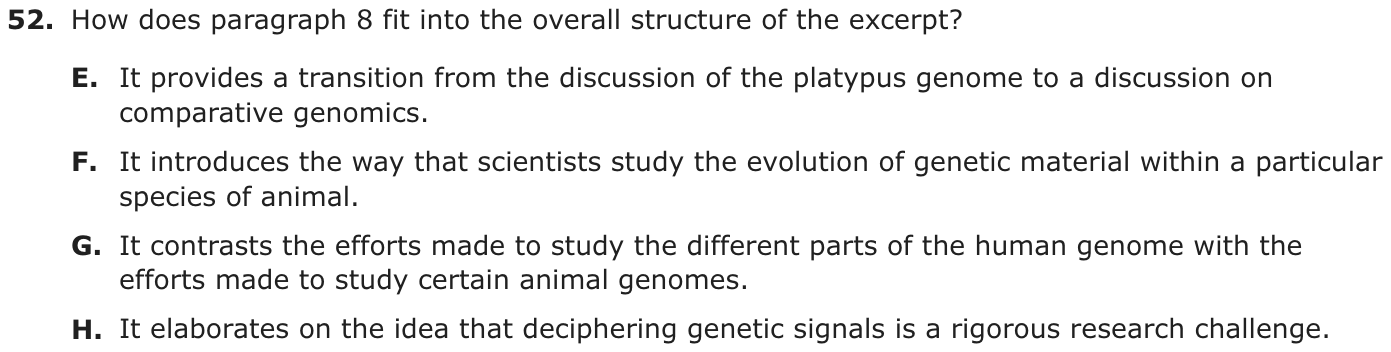
Question 53 of 57
2021 Test A English, question 53Uses the passage above: “Excerpt from “Research Riddle Resolved””.
Question
Which sentence gives the best summary of the section “Same and Different” (paragraphs 9–11)?
- AThe platypus is the most recent of several species whose genomes have been compared with the human genome.
- BComparative genomics is an effective way to examine a variety of different species, from single-celled organisms to large mammals.
- CComparing human and animal genes and studying which genes are the same across species may lead to a greater understanding of human diseases.
- DScientists are able to use computers in order to compare and examine evolutionary changes in genes across a number of species, including humans.
Show the answer
Correct answer: C
The question asks for the best summary of the section “Same and Different” (paragraphs 9–11).
A. Incorrect. The fact that the platypus is the latest species whose genome is being compared with the human genome is just a detail of this section. Paragraph 9 reveals this when it states that “scientists compare the genome sequences of several species: human, mouse, and a wide variety of other organisms from single-celled fungi to elephants and, now, the platypus.” The focus of the section is on the fact that comparing genomes can teach us about human diseases.
B. Incorrect. While comparative genomics is a way to examine many different species, this detail is not the main point of this section. Paragraph 10 notes that the “goal of this research” focuses on the fact that comparing genomes can teach us about human diseases.
C. CORRECT. This sentence describes the most important idea of the section: the discovery of genes that humans have in common with other species that can yield information about human diseases. As stated in paragraph 10, “The goal of this research is to find regions of similarity and difference in order to better understand the structure and function of human genes.”
D. Incorrect. While this section does mention the use of computers in comparative genomics, this information is a detail about how the research is carried out; the computers are a tool in discovering whether “this information may translate into ways to understand, treat, and prevent human diseases” (paragraph 11).
Question analysis
This summary question asks which sentence best sums up the section of “Research Riddle Resolved” headed “Same and Different,” paragraphs 9–11, which explains the approach scientists call comparative genomics. Each choice draws on something in the section, so students must tell its main point from the details that support it.
- Grade level
- Grade 8 reading and task
- Compared with grade 7
- At grade 7 Summarizing a short section is core grade 7 work. This one is written in technical terms such as “genome sequences” and “signals that control how genes work,” and several choices are accurate, so students must judge which is most complete.
- Estimated difficulty
- Moderate: several steps, or a close reading with one strong distractor.
- Thinking it demands
- Depth of knowledge 2, skills and concepts · mainly understand
- What makes it hard
- A very close wrong answer moderate
- An unfamiliar subject moderate
- Evidence
- Answered from several paragraphs or stanzas
- Reading level
- Passage: about grade 11, 809 words; question and choices: about grade 12, 96 words.
- Corrected from the DOE handbook
- In the explanation of a wrong choice, a sentence that cites paragraph 9 was attached to the wrong point; the sentences were put back in order.
- Students, last 30 days
- Not enough answers yet to show (it takes 10).
Why it is hard, traps and wrong answers (shows the answer)
Why it is hard
All four summaries are built from real details of the section, so the choice is about completeness. The section moves from method in paragraph 9 to goal in paragraph 10 to payoff in paragraph 11, and the tempting summaries stop at the method, the list of species or the platypus’s place at the end of that list. Students who look for the purpose, what the comparing is for, reach the summary that keeps human disease in view.
A very close wrong answer moderate Choosing the answer
The computer-tools summary and the key both describe comparing genes across species, humans included; only the key carries the section’s purpose, understanding human genes and diseases, stated in paragraphs 10 and 11. (Embretson & Wetzel, 1987; Gorin & Embretson, 2006; Ascalon et al., 2007)
An unfamiliar subject moderate Understanding the question
Comparative genomics is new to most students, and the section explains it in technical terms, “genome sequences,” “regions of similarity and difference,” “signals that control how genes work,” with no example to anchor them. (Recht & Leslie, 1988; Kintsch, 1998)
Strategy: Read paragraphs 9–11 straight through and write a one-sentence summary of your own before looking at the choices, then pick the one that covers the whole section, not a single sentence of it.
Traps
- Too narrow: A single detail offered as the central idea or a summary, or a summary that keeps minor details and leaves out an essential part.
- Word match: Repeats striking words or phrases from the text, so it looks supported, but its meaning does not fit the question.
The wrong answers, classified
A Too narrow (King et al., 2004)
Takes “and, now, the platypus,” the last item in paragraph 9’s list, as the section’s point, though it is one detail and says nothing about what the comparing is for.
B Word match (Freedle & Kostin, 1993)
Echoes paragraph 9’s range “from single-celled fungi to elephants” and calls the method effective, but the section compares those species to understand human genes, a goal this summary leaves out.
D Too narrow (King et al., 2004)
Gives an accurate account of the method, paragraph 11’s computer tools comparing genes across species, but leaves out its payoff, ways to “understand, treat, and prevent human diseases.”
What was corrected from the DOE handbook, and why
- Explanation: The handbook’s explanation of Option A says that the platypus being the latest species whose genome is compared with ours is just a detail, then that the section’s focus is on what comparing genomes can teach us about human diseases, and then “Paragraph 9 reveals this when it states that ‘scientists compare the genome sequences of several species: human, mouse, and a wide variety of other organisms from single-celled fungi to elephants and, now, the platypus.’” Paragraph 9 says nothing about diseases: the quotation shows the platypus as the latest of the species compared, the point the explanation began with. The site moves the paragraph 9 sentence up to follow that point and ends with the section’s focus; no words were changed. The answer, C, is unchanged.
Working it out, step by step
Figure out what the question asks
This asks for the best summary of a section. A summary is a short statement of the main points. It should cover the whole section, not just one detail. The section “Same and Different” is paragraphs 9–11.
Sum up each paragraph
A species is one kind of living thing.
- Paragraph 9 names the method, comparative genomics. Scientists compare the genes of many species, “and, now, the platypus.”
- Paragraph 10 gives the goal: to “better understand the structure and function of human genes.”
- Paragraph 11 gives the payoff. Studying genes kept the same in many living things “may translate into ways to understand, treat, and prevent human diseases.”
Find the main point
The section moves from a method, to a goal, to a payoff. The payoff is the point. Comparing genes across species, and finding the ones that stayed the same, may help us understand human diseases.
Check each choice
- A does not fit. The platypus is just the last item in a list in paragraph 9. It is a detail.
- B does not fit. The range “from single-celled fungi to elephants” is a detail too. B leaves out why scientists compare, which is to understand human genes.
- C fits. It covers the comparing, the genes that stay the same, and the goal of understanding disease.
- D does not fit. Computer tools are how the work is done. D leaves out what the work is for.
Watch out: D is tempting because everything in it is true. But a summary needs the main point, and D stops before it.
Choose the answer
The best summary keeps the section’s purpose: comparing genes to understand human disease. So the answer is C.
Why this answer and not the closest wrong one
D is the closest wrong choice. D and C both describe comparing genes across species, humans included. But D stops at the computer tools, which are only the method. C also gives the reason for the work. Paragraph 11 says it “may translate into ways to understand, treat, and prevent human diseases.”
More questions like this
The original DOE question
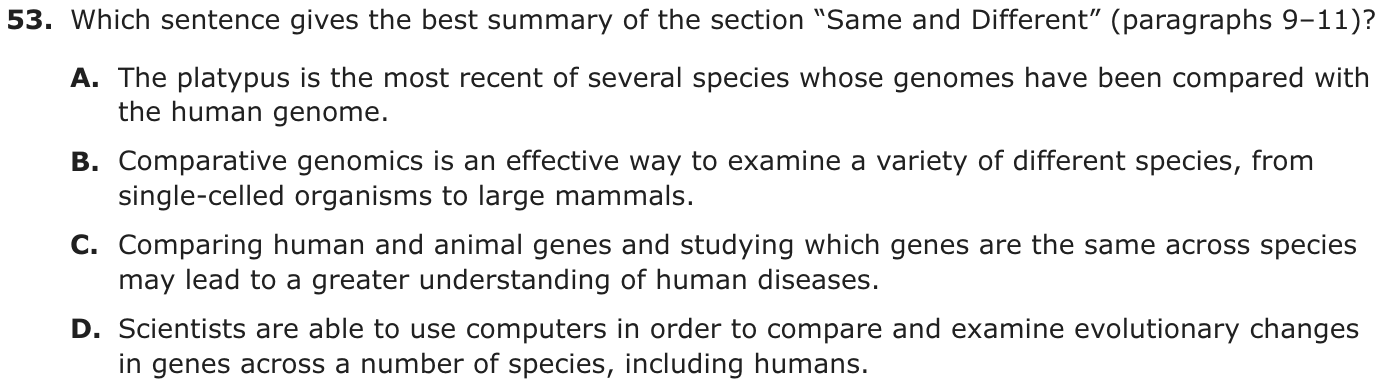
Question 54 of 57
2021 Test A English, question 54Uses the passage above: “Excerpt from “Research Riddle Resolved””.
Question
The details in paragraphs 12–14 about the platypus’s different abilities convey a central idea of the excerpt by
- Ashowing that the platypus has a gene that allows it to produce milk that is rich in nutrients, as humans do.
- Bproving that the platypus, whose DNA is made up of DNA from several other species, has developed venom to defend itself.
- Csuggesting that the platypus, while gaining traits in common with mammals and reptiles, has lost some bird-like traits.
- Ddemonstrating that the platypus has a rare evolutionary background that includes bird, reptile, and mammal DNA.
Show the answer
Correct answer: D
The question asks how the details in paragraphs 12–14 about the platypus’s different abilities convey a central idea of the excerpt.
A. Incorrect. The fact that “platypuses have genes that make the milk protein casein” (paragraph 13) just like humans do is an important supporting detail, but it is not a central idea of the excerpt.
B. Incorrect. While paragraph 14 explains that the platypus produces venom “like its ancestral snake and lizard cousins,” which suggests the platypus has the ability to defend itself, this information is a supporting detail and not a central idea of the excerpt.
C. Incorrect. Paragraphs 12–14 do state that the platypus has lost some of its “chicken-ness” (paragraph 12) while gaining traits in common with mammals and reptiles, but this information is a supporting detail and not a central idea of the excerpt.
D. CORRECT. In describing the platypus’s different abilities, paragraph 12 states that “the findings traced the evolutionary path from birds and reptiles to mammals.” Paragraphs 12–14 elaborate on the findings to support a central idea of the excerpt, which is that the platypus is rare in having bird, reptile, and mammal DNA.
Question analysis
This central-idea question on “Research Riddle Resolved” asks how the details in paragraphs 12–14, about the platypus’s egg yolk genes, its milk and its venom, convey a central idea of the excerpt. Students must move from specific genetic findings about the animal to the larger point they serve in the whole article.
- Grade level
- Grade 8 reading and task
- Compared with grade 7
- At grade 7 Grade 7 students regularly connect supporting details to a central idea. These three paragraphs pack findings about egg yolk, a milk protein and venom into dense sentences, and students must first settle on the central idea of a technical article.
- Estimated difficulty
- Moderate: several steps, or a close reading with one strong distractor.
- Thinking it demands
- Depth of knowledge 2, skills and concepts · mainly analyze
- What makes it hard
- A very close wrong answer moderate
- Evidence in several places moderate
- Hard words minor
- Evidence
- Answered from several paragraphs or stanzas
- Reading level
- Passage: about grade 11, 809 words; question and choices: about grade 11, 93 words.
- Students, last 30 days
- Not enough answers yet to show (it takes 10).
Why it is hard, traps and wrong answers (shows the answer)
Why it is hard
Each wrong choice is drawn from paragraphs 12–14, so students who check the choices only against those paragraphs find support for most of them. The question asks how the details serve a central idea, which means stepping back to the article’s repeated point about the platypus’s mixed ancestry. The accurate summary of gains and losses is the hardest to reject, because it describes the same mixture one level down, as its parts rather than the idea they add up to.
A very close wrong answer moderate Choosing the answer
The gains-and-losses choice and the key both describe the platypus’s bird, reptile and mammal heritage; the first lists what paragraphs 12–14 report, while the key names the rare blend the excerpt is built around. (Embretson & Wetzel, 1987; Gorin & Embretson, 2006; Ascalon et al., 2007)
Evidence in several places moderate Working it out
The central idea is stated far from these paragraphs, as a “patchwork of genes” in paragraph 2 and a “stunning blend of reptile, bird, and mammal” in paragraph 17, and must be linked back to them. (Kirsch & Mosenthal, 1990; Gorin & Embretson, 2006)
Hard words minor Understanding the question
The three paragraphs lean on “casein,” “monotremes,” “molecular weaponry” and the coined “chicken-ness,” and each finding must be decoded before the student can see what the three share. (Perfetti, 2007; Freedle & Kostin, 1993)
Strategy: Before reading the choices, state the excerpt’s central idea in your own words, then reread paragraphs 12–14 and ask which choice explains how their details serve that idea.
Traps
- Too narrow: A single detail offered as the central idea or a summary, or a summary that keeps minor details and leaves out an essential part.
- Outside knowledge: A choice is plausible in the real world but not supported by this text.
The wrong answers, classified
A Too narrow (King et al., 2004)
Picks the milk protein casein that platypuses share with humans, an accurate detail from paragraph 13, but one finding alone does not convey the idea all three paragraphs build.
B Outside knowledge (King et al., 2004; Recht & Leslie, 1988)
Assumes venom must be for self-defense, as it is in many animals, though paragraph 14 says the reason for maintaining such “molecular weaponry isn’t yet clear.”
C Too narrow (King et al., 2004)
Accurately sums up the findings, yolk genes lost and milk and venom genes present, but stays at the level of details and never reaches the rare mixed ancestry they point to.
Working it out, step by step
Figure out what the question asks
This asks how the details in paragraphs 12–14 support a central idea. A central idea is a main point that the whole excerpt keeps making. So first find that idea. Then see how the details point to it.
Find the central idea
Paragraph 2 says “platypus DNA is a patchwork of genes from reptiles, birds, and mammals.” Near the end, paragraph 17 says “the stunning blend of reptile, bird, and mammal puts the platypus in a class of its own.” So a central idea is the platypus’s rare mix of bird, reptile and mammal genes.
Sort the details in paragraphs 12–14
- Birds: paragraph 12 compares the platypus with chickens. It “lost most of its genetic ability to produce egg yolk.”
- Mammals: paragraph 13 says it has genes for the milk protein casein, “just like we do.”
- Reptiles: paragraph 14 says it makes venom “like its ancestral snake and lizard cousins.”
Each detail ties the platypus to a different group of animals.
Check each choice
- A does not fit. Milk is one detail from paragraph 13. One detail alone is not the central idea.
- B does not fit. Paragraph 14 says the reason for the venom “isn’t yet clear.” Nothing proves it is for defense.
- C does not fit as well. It lists the gains and losses, but it stops at the details. It never names the idea they add up to.
- D fits. Together, the details show the platypus’s rare mix of bird, reptile and mammal DNA.
Watch out: C is true to paragraphs 12–14, so it is tempting. But the question asks for the central idea the details convey, and C just retells them.
Choose the answer
The details about egg yolk, milk and venom show a blend of bird, mammal and reptile. So the answer is D.
Why this answer and not the closest wrong one
C is the closest wrong choice. C and D describe the same mix of traits. But C only lists what the platypus gained and lost. D names what those details add up to: a rare background that mixes bird, reptile and mammal DNA. That is the idea the excerpt keeps coming back to, in paragraphs 2 and 17.
More questions like this
The original DOE question
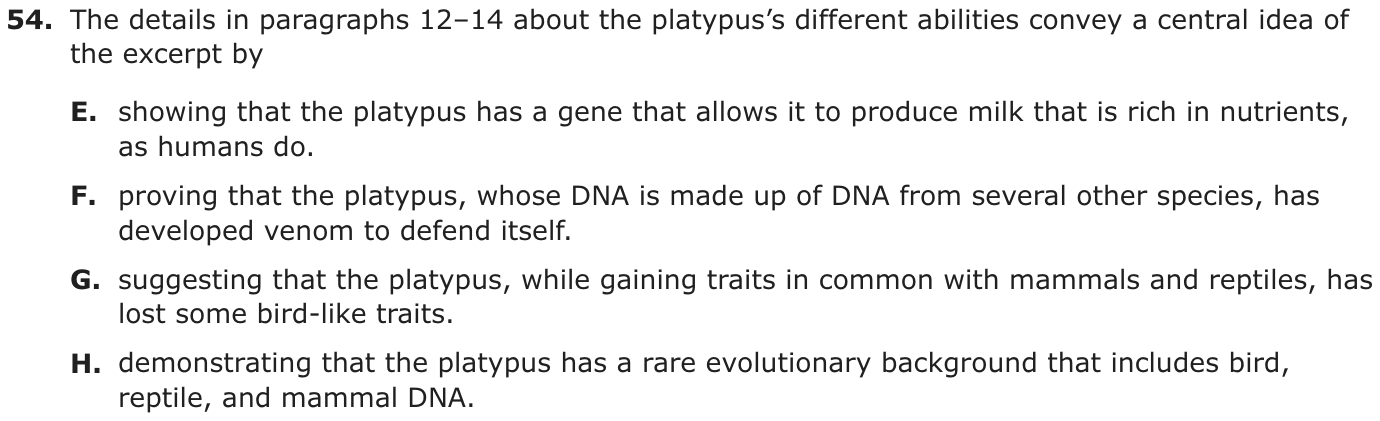
Question 55 of 57
2021 Test A English, question 55Uses the passage above: “Excerpt from “Research Riddle Resolved””.
Question
Which sentence from the excerpt best supports the idea that the same DNA material results in the same traits even in different classes of animals?
- A“The findings cement what may have seemed totally obvious but turned out to be a bit of a scientific surprise: platypus DNA is a patchwork of genes from reptiles, birds, and mammals.” (paragraph 2)
- B“In other words, the platypus heritage is laid out in an evolutionary DNA tapestry that marks the time, hundreds of millions of years ago, when reptiles and mammals branched off the evolutionary tree.” (paragraph 3)
- C“The platypus is nothing like a human, so what can its DNA tell us about people and the diseases we get?” (paragraph 4)
- D“The evolutionary reason for maintaining such molecular weaponry isn’t yet clear, but what is fascinating is that it appears nature mixed and matched together DNA pieces separately to create the venom genes in reptiles and monotremes like the platypus.” (paragraph 14)
Show the answer
Correct answer: D
The question asks which sentence from the excerpt best supports the idea that the same DNA material results in the same traits even in different classes of animals.
A. Incorrect. The sentence from paragraph 2 describes the combination of DNA material from several classes of animals that makes up platypus DNA; however, the sentence does not address whether any of those different animals share traits or whether they share some of the same DNA.
B. Incorrect. The sentence from paragraph 3 emphasizes the relationship between two different classes of animals—reptiles and mammals—by discussing when they branched off the same evolutionary tree. However, the sentence does not address whether those classes of animals share any traits.
C. Incorrect. The sentence from paragraph 4 questions whether platypus DNA can teach people something about humans and human disease, which implies that there must be something in common between these two animals. However, it does not state that these two animals actually share traits or DNA.
D. CORRECT. The sentence from paragraph 14 describes two different classes of animals—reptiles and monotremes—that have the ability to create venom, a trait that resulted from the same DNA material “mixed and matched together.”
Question analysis
This textual evidence question on “Research Riddle Resolved” asks which quoted sentence best supports the idea that the same DNA material produces the same traits even in different classes of animals. The four long quotations come from paragraphs 2, 3, 4 and 14 and all touch on platypus DNA, so a careful reading of what each one actually claims decides it.
- Grade level
- Grade 8 reading and task
- Compared with grade 7
- Above grade 7 Choosing the sentence that supports an idea is everyday grade 7 evidence work. Here the idea is abstract, and the four long quotations come from different parts of a technical article and must be decoded before they can be weighed.
- Estimated difficulty
- Among the hardest on the SHSAT: a non-obvious approach, heavy reading, or a well-hidden trap.
- Thinking it demands
- Depth of knowledge 3, strategic thinking · mainly evaluate
- What makes it hard
- A very close wrong answer major
- Reading between the lines moderate
- Hard words moderate
- Complex sentences minor
- Evidence
- Answered from several paragraphs or stanzas
- Reading level
- Passage: about grade 11, 809 words; question and choices: about grade 15, 154 words.
- Students, last 30 days
- Not enough answers yet to show (it takes 10).
Why it is hard, traps and wrong answers (shows the answer)
Why it is hard
The right sentence hides its support in unfamiliar words, while a wrong one says something close in plain language. A student must break the idea into three parts, shared DNA, a shared trait and two classes, and then translate “monotremes” and “molecular weaponry” to find all three in paragraph 14. The plain-spoken “patchwork” sentence covers two of the parts and draws students who never check for a trait, and the other two quotations attract by naming DNA and kinds of animals.
A very close wrong answer major Choosing the answer
The paragraph 2 quotation, platypus DNA as “a patchwork of genes from reptiles, birds, and mammals,” sounds like paragraph 14’s DNA pieces “mixed and matched”; only paragraph 14 names a trait two classes share, venom. (Embretson & Wetzel, 1987; Gorin & Embretson, 2006; Ascalon et al., 2007)
Reading between the lines moderate Working it out
No quotation states the idea; students must read “mixed and matched together DNA pieces” as the same material and venom as the same trait, while “separately” seems at first to point the other way. (Graesser, Singer & Trabasso, 1994; Kintsch, 1998)
Hard words moderate Understanding the question
“Monotremes” is defined only in the italic note before the article, as egg-laying mammals, and “molecular weaponry” points back to venom, so the right sentence names its two classes and its trait in words few students know. (Perfetti, 2007; Freedle & Kostin, 1993)
Complex sentences minor Understanding the question
The right quotation runs 39 words and delays its point behind a concession, “isn’t yet clear, but what is fascinating is that it appears nature mixed and matched.” (Abedi & Lord, 2001; Freedle & Kostin, 1993; Messick, 1989)
Strategy: Break the idea into its parts, the same DNA, the same trait and different classes of animals, and check each quotation for all three before choosing.
Traps
- Supports only part of the claim: In a question about evidence: a line that backs one half of the claim but not the other, or a related point rather than the claim itself.
- True but not the answer: A choice says something accurate about the text that does not answer this question.
The wrong answers, classified
A Supports only part of the claim (King et al., 2004; Thissen, Steinberg & Fitzpatrick, 1989)
Reads “a patchwork of genes from reptiles, birds, and mammals” as DNA shared across classes, which it nearly is, but the sentence names no trait that results from it.
B True but not the answer (King et al., 2004; Embretson & Wetzel, 1987)
Matches the idea’s DNA and two classes, reptiles and mammals, in the tapestry sentence, but it marks when the classes branched apart and says nothing about shared material or a shared trait.
C True but not the answer (King et al., 2004; Embretson & Wetzel, 1987)
Senses a link between species in paragraph 4’s question, but a question asserts nothing, and humans and platypuses are both mammals, not different classes.
Working it out, step by step
Figure out what the question asks
This asks which quotation best supports an idea. Break the idea into three parts: the same DNA material, the same trait, and different classes of animals. A trait is a feature, like fur or venom. A class is a big group of animals, such as mammals, birds or reptiles. The best quotation touches all three parts.
Decode the hard words in D
The quotation in D comes from paragraph 14. That paragraph says a male platypus can make venom, a kind of poison. So “molecular weaponry” means the venom. The note in italics at the start says “A platypus is a monotreme, a type of egg-laying mammal.” So monotremes are mammals. Reptiles, like snakes and lizards, are a different class.
Find the three parts in D
D says nature “mixed and matched together DNA pieces separately to create the venom genes in reptiles and monotremes like the platypus.” The trait is venom. The two classes are reptiles and mammals. In both, DNA pieces were put together to build venom genes. “Separately” does not say the DNA was different. It means the building happened on its own in each group.
Check each choice
- A does not fit. It says platypus DNA mixes genes from three classes. But it names no trait that those classes share.
- B does not fit. It tells when reptiles and mammals split apart. It says nothing about a shared trait.
- C does not fit. It is a question, so it states no fact. Also, humans and platypuses are both mammals, the same class.
- D fits. It names one trait, venom, built from DNA pieces in two classes.
Watch out: A is tempting because “a patchwork of genes” sounds like shared DNA. But look for a trait, and A has none.
Choose the answer
No quotation states the idea word for word. D comes closest, because it links DNA pieces to venom in two different classes. So the answer is D.
Why this answer and not the closest wrong one
A is the closest wrong choice. It shows that platypus DNA has genes from reptiles, birds and mammals. That covers the DNA and the classes. But A names no trait. D adds the missing part. Venom shows up in both reptiles and monotremes, and DNA pieces build the venom genes in each.
More questions like this
The original DOE question
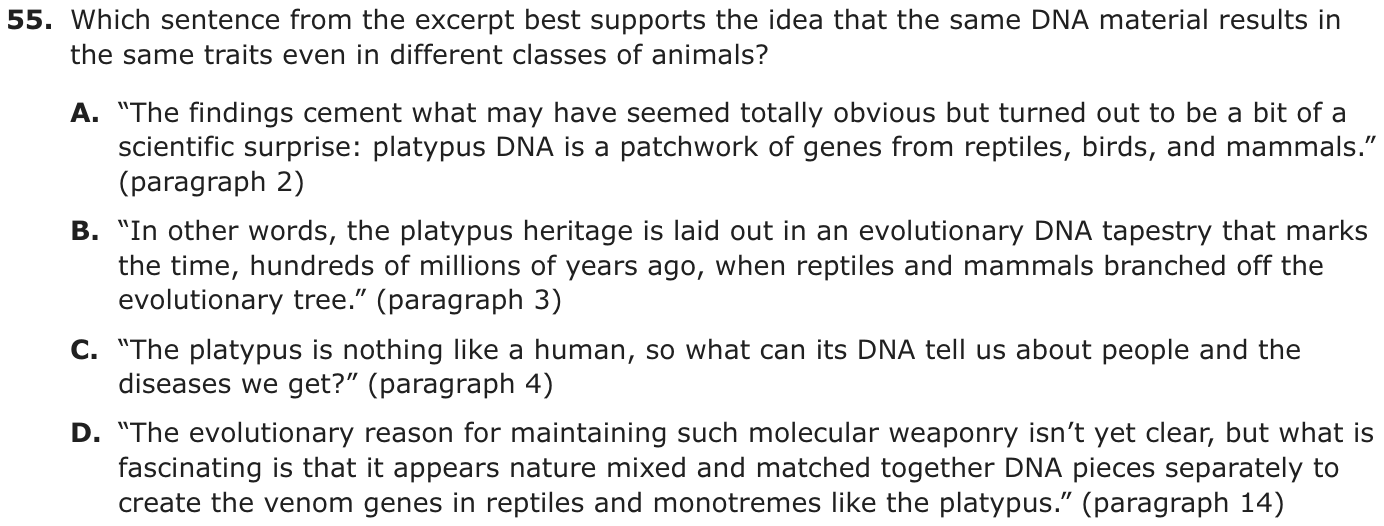
Question 56 of 57
2021 Test A English, question 56Uses the passage above: “Excerpt from “Research Riddle Resolved””.
Question
How can researching the genomes of other animals inform scientists’ understanding of human health and disease?
- ATracking how other animals evolved over millions of years helps researchers preserve and sustain nature.
- BFinding ways that animal genomes are similar to the human genome helps researchers find signals that control genes.
- CObserving that all living things evolved from a common ancestor helps researchers pinpoint certain genetic traits.
- DUnderstanding how other animals are similar to one another helps researchers understand how humans evolved.
Show the answer
Correct answer: B
The question asks how researching the genomes of other animals can inform scientists’ understanding of human health and disease.
A. Incorrect. Although tracking how other animals evolved helps researchers better understand our “rich and diverse planet” (paragraph 18) through understanding genes, the potential benefits to human health will not necessarily preserve or sustain nature.
B. CORRECT. Paragraph 11 explains that finding ways that animal genomes are similar to the human genome helps researchers “locate signals that control how genes work.”
C. Incorrect. While paragraph 11 does point out that all living things share an ancestor, the idea that they, therefore, share genetic traits is only implied. This idea does not contribute to the main focus of the research.
D. Incorrect. The statement that “understanding how other animals are similar to one another helps researchers understand how humans evolved” is too general to provide support for the main focus of the genetic research described in the excerpt. To learn more about human health and disease, scientists need to understand the similarities between the genetic material of different animal species. These scientists are interested in learning more about issues that currently affect humans, not only understanding their evolutionary history.
Question analysis
This key-details question on “Research Riddle Resolved” asks how studying the genomes of other animals can help scientists understand human health and disease. The question names no paragraph, so students must find where the article explains this link and recognize that explanation in a choice, while every option sounds scientific and must be checked against the text.
- Grade level
- Grade 7 reading and task
- Compared with grade 7
- At grade 7 Finding an explained detail in an informational text is routine grade 7 work. The demand comes mostly from the article’s technical wording and from locating the right paragraph without a reference, not from any inference.
- Estimated difficulty
- Straightforward: two steps or one careful reading.
- Thinking it demands
- Depth of knowledge 2, skills and concepts · mainly understand
- What makes it hard
- Evidence in several places minor
- An unfamiliar subject minor
- Evidence
- Answered from one paragraph or stanza
- Reading level
- Passage: about grade 11, 809 words; question and choices: about grade 12, 80 words.
- Corrected from the DOE handbook
- An overstatement in the explanation was corrected.
- Students, last 30 days
- Not enough answers yet to show (it takes 10).
Why it is hard, traps and wrong answers (shows the answer)
Why it is hard
The answer is stated in one sentence of paragraph 11, so the work is finding it and recognizing it reworded. Two wrong choices also come from the article, the common ancestor in the same paragraph and the closing hope of preserving the planet, and they tempt students who stop at familiar words. Checking which choice names the step that comes just before “This information may translate into ways to understand, treat, and prevent human diseases” settles it.
Evidence in several places minor Working it out
Health and disease come up in paragraphs 4, 7, 11, 15, 16 and 18, but only paragraph 11 explains how comparing genomes leads there, through “signals that control how genes work.” (Kirsch & Mosenthal, 1990; Gorin & Embretson, 2006)
An unfamiliar subject minor Understanding the question
Paragraph 11 explains the link in technical terms, genes “kept the same in many organisms” and signals that control genes, which students must follow without knowing what such signals are. (Recht & Leslie, 1988; Kintsch, 1998)
Strategy: Scan the excerpt for the places that tie gene research to human disease, reread them closely, and choose the option that restates the step they describe rather than just reusing their words.
Traps
- Word match: Repeats striking words or phrases from the text, so it looks supported, but its meaning does not fit the question.
- Twists what the text says: Uses the text's topic and ideas but changes what it says: who did it, how much, when, or why.
- True but not the answer: A choice says something accurate about the text that does not answer this question.
The wrong answers, classified
A True but not the answer (King et al., 2004; Embretson & Wetzel, 1987)
Borrows paragraph 18’s closing remark that gene research can help preserve the planet, which the article does say, but it concerns nature, not human health or disease.
C Word match (Freedle & Kostin, 1993)
Picks up paragraph 11’s “all living things share a common ancestor,” the reason comparing genes works, and makes that observation the tool, though the paragraph credits examining genes kept the same.
D Twists what the text says (King et al., 2004)
Swaps comparisons with human genes for animals compared with each other, and health for how humans evolved, a theme paragraphs 17 and 18 touch but not the question’s link to disease.
What was corrected from the DOE handbook, and why
- Explanation: The handbook’s explanation of Option D says the scientists “are interested in learning more about issues that currently affect humans, not understanding their evolutionary history.” The excerpt says the platypus results give researchers “a window into a time in history when mammals became unique” (paragraph 6) and “information about how mammals like us came about” (paragraph 17), so the site now says “not only understanding their evolutionary history.” Option D is still wrong: it is about how animals are similar to one another and how humans evolved, not about human health and disease.
Working it out, step by step
Figure out what the question asks
This asks how studying the genomes of other animals helps scientists understand human health and disease. A genome is all the genes of a living thing. No paragraph is named, so you must find where the excerpt explains this link.
Find the paragraph that explains it
Paragraph 11 explains it: “By using computer tools to examine genes that have been kept the same in many organisms over millions of years, researchers can locate signals that control how genes work. This information may translate into ways to understand, treat, and prevent human diseases.” An organism is any living thing.
Put it in plain words
Some genes have stayed the same in many living things for millions of years. Scientists compare genomes to find those genes. The genes that match help them find the signals that control how genes work. Knowing those signals may lead to ways to treat disease.
Check each choice
- A does not fit. Paragraph 18 does mention helping “preserve our rich and diverse planet.” But that is about nature, not human health.
- B fits. Finding genes that animals share with humans helps researchers find the signals that control genes.
- C does not fit. Paragraph 11 says “all living things share a common ancestor,” a relative from long ago. That is why comparing works. It is not the step that leads to health.
- D does not fit. It compares animals with one another, not with humans. It is also about how humans evolved, not about disease.
Watch out: C reuses words from paragraph 11, so it looks right. But it skips the key step, finding the signals.
Choose the answer
Shared genes lead to the signals, and the signals may lead to ways to treat disease. So the answer is B.
Why this answer and not the closest wrong one
C is the closest wrong choice. It uses a true fact from paragraph 11, the common ancestor. But that fact only explains why comparing genes makes sense. The step that helps health is finding “signals that control how genes work.” B names that step.
More questions like this
The original DOE question
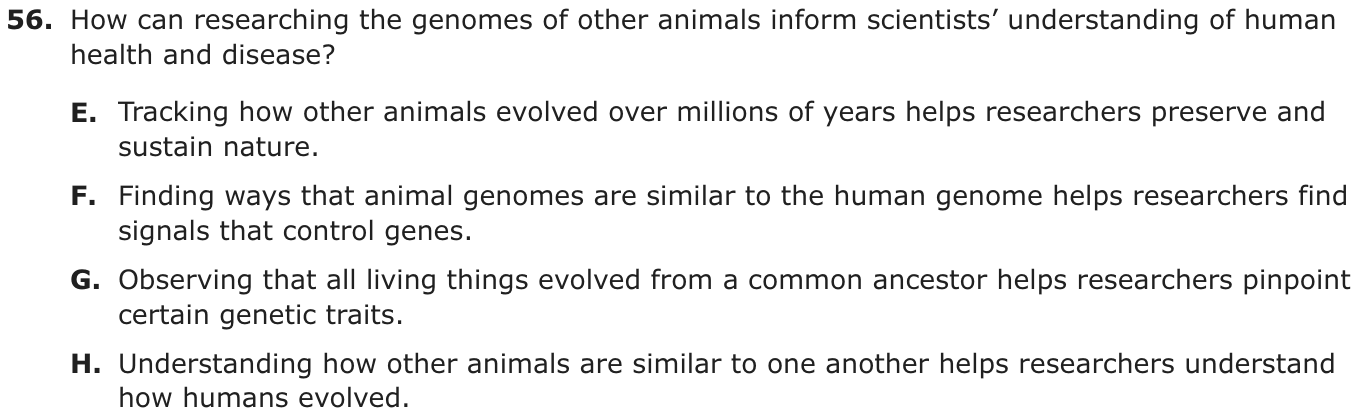
Question 57 of 57
2021 Test A English, question 57Uses the passage above: “Excerpt from “Research Riddle Resolved””.
Question
The author elaborates on the idea that creating a full analysis of platypus DNA was an important scientific endeavor mainly through
- Aa description of the type of information about human genetics that specialized research can yield.
- Ba comparison of the platypus with its closest bird and reptile relatives on the evolutionary tree.
- Cthe discussion of how unusual the platypus genome is in the animal kingdom.
- Dthe explanation of how genetics can be aligned to physiological function.
Show the answer
Correct answer: A
The question asks how the author elaborates on the idea that creating a full analysis of platypus DNA was an important scientific endeavor.
A. CORRECT. The importance of the research into platypus DNA is explained in the excerpt through descriptions of what this research can teach us about human genetics and disease. The question is raised directly in paragraph 4 and begins to be answered in paragraph 6 (“The platypus genome results . . . provide researchers a window into a time in history when mammals became unique—gaining the ability to bear live young, produce milk for them, and grow a warm, furry coat”). This importance is also addressed in the “Same and Different” section (paragraphs 9–11) and in paragraphs 15 and 16.
B. Incorrect. The comparison of the platypus with its bird and reptile relatives in paragraphs 12–15 is important to locating the platypus on its evolutionary family tree and in showing the connection between DNA and functionality. This comparison does not, however, explain the excerpt’s main reason for asserting that the analysis of platypus DNA was an important scientific endeavor.
C. Incorrect. Although the excerpt mentions that part of the platypus’s appeal is its “cuteness and weirdness” (paragraph 2) and describes it as having a “patchwork of genes” (paragraph 2), the scientific importance of analyzing the platypus genome is not derived from its unusualness but rather from its ability to shed light on the human genome through comparative genomics (“One thing is clear—the stunning blend of reptile, bird, and mammal puts the platypus in a class of its own, and it gives researchers much more: information about how mammals like us came about” [paragraph 17]).
D. Incorrect. The excerpt briefly explains the connection between genes and some of the platypus’s physiological functions, such as producing milk and venom (paragraphs 13 and 14). Although paragraph 15 mentions the scientific value of understanding these genetic connections (“Such investigations may help medical researchers understand health issues related to reproduction and lactation”), paragraph 16 indicates that there is even greater value in studying the platypus genome through comparative genomics (“More generally, though, studying how nature cuts and pastes gene modules gives scientists an inside scoop on how genetic changes relate to health and disease risk”). The full analysis of the platypus DNA was an important scientific endeavor primarily because it furthers the ability of scientists to understand “millions of years of evolution” and offers “vital information to understanding the role of genes in the health and disease of mammals like us” (paragraph 18). The discussion of physiological function itself is not the real importance of the scientific endeavor.
Question analysis
This question asks how the author of “Research Riddle Resolved” mainly elaborates on the idea that a full analysis of platypus DNA was an important scientific undertaking. Students must look across the whole 18-paragraph excerpt and decide which kind of content does most to show the work’s value, since the article mixes several kinds of detail about the platypus and its genes.
- Grade level
- Grade 8 reading and task
- Compared with grade 7
- Above grade 7 Grade 7 students trace how an author supports an idea, usually within a few paragraphs. This question spans an 18-paragraph technical excerpt, and the choices name kinds of content that all appear in it, so students must judge which one carries the most weight.
- Estimated difficulty
- Hard: combines ideas, needs a plan, and has more than one tempting wrong answer.
- Thinking it demands
- Depth of knowledge 3, strategic thinking · mainly evaluate
- What makes it hard
- A very close wrong answer moderate
- Evidence in several places moderate
- The right answer is reworded moderate
- Evidence
- Answered from the whole text
- Reading level
- Passage: about grade 11, 809 words; question and choices: about grade 12, 76 words.
- Students, last 30 days
- Not enough answers yet to show (it takes 10).
Why it is hard, traps and wrong answers (shows the answer)
Why it is hard
Every choice names something the excerpt really contains, so the question is one of weight: which kind of content carries the case that the platypus work mattered. The physiological-function choice is hardest to reject because paragraph 15 says outright that its “scientific value … is high,” yet paragraph 16 widens the point with “More generally, though.” Students who list each place the article explains the research’s value find most of them pointing to what it teaches about human genes and health.
A very close wrong answer moderate Choosing the answer
The physiological-function choice is a real case of the key’s idea, paragraph 15’s milk production and “health issues related to reproduction and lactation”; the key names the broader kind of knowledge the excerpt keeps returning to. (Embretson & Wetzel, 1987; Gorin & Embretson, 2006; Ascalon et al., 2007)
Evidence in several places moderate Working it out
The value of the work is argued in pieces, the question of paragraph 4, human genes in paragraphs 7–11 and the health payoffs of paragraphs 15–18, and must be gathered before “mainly” can be judged. (Kirsch & Mosenthal, 1990; Gorin & Embretson, 2006)
The right answer is reworded moderate Choosing the answer
The key’s “type of information about human genetics” uses none of the article’s phrases, while a wrong choice repeats paragraph 15’s “genetics to physiological function” almost word for word. (Freedle & Kostin, 1993; Kirsch & Mosenthal, 1990)
Strategy: Find each place where the article says why the platypus research matters, note what kind of reason each one gives, and choose the option that fits most of them rather than a single paragraph.
Traps
- Supports only part of the claim: In a question about evidence: a line that backs one half of the claim but not the other, or a related point rather than the claim itself.
- Wrong purpose or structure: Names a purpose, structure or effect that the part does not serve, or describes what a part says when the question asks what it does.
- True but not the answer: A choice says something accurate about the text that does not answer this question.
The wrong answers, classified
B True but not the answer (King et al., 2004; Embretson & Wetzel, 1987)
Recalls the yolk, milk and venom comparisons of paragraphs 12–14, which open the “Chicken or Egg?” section, but they trace where the platypus came from rather than why decoding its DNA mattered.
C Wrong purpose or structure (Anderson & Krathwohl, 2001)
Takes the platypus’s oddness, the hook of the opening, as the reason the work mattered, though paragraph 6 calls the results “far more than confirmation of a scientific oddity.”
D Supports only part of the claim (King et al., 2004; Thissen, Steinberg & Fitzpatrick, 1989)
Is drawn by paragraph 15’s “scientific value … is high,” but linking genes to milk production is one example, and paragraph 16 widens the point to “health and disease risk.”
Working it out, step by step
Figure out what the question asks
This asks how the author mainly shows that studying platypus DNA was important. An endeavor is a serious effort or project. Every choice names something that is really in the excerpt. So you must decide which one the author uses most.
List where the author explains the value
- Paragraph 4 asks what platypus DNA can “tell us about people and the diseases we get.”
- Paragraph 11 says comparing genes may lead to “ways to understand, treat, and prevent human diseases.”
- Paragraph 16 says the work shows “how genetic changes relate to health and disease risk.”
- Paragraph 18 says it gives “vital information to understanding the role of genes in the health and disease of mammals like us.”
Find the pattern
Again and again, the author says the research teaches us about human genes and health. That is the kind of information this research can yield, or give. So that is the author’s main support.
Check each choice
- A fits. The author keeps describing what the research can teach about human genes and disease.
- B does not fit. The comparisons with chickens, snakes and lizards in paragraphs 12–14 show where the platypus came from. They do not explain why the study mattered.
- C does not fit. Paragraph 6 says the results are “far more than confirmation of a scientific oddity.” The oddness is not the main reason.
- D does not fit. Physiological function means how a body works, like making milk. Paragraph 15 gives this as one example. Then paragraph 16 widens the point.
Watch out: D is tempting because paragraph 15 says the “scientific value of pinning genetics to physiological function” is high. But that is one case of the bigger idea.
Choose the answer
The author mainly shows the value of the research by describing what it can teach about human genes and health. So the answer is A.
Why this answer and not the closest wrong one
D is the closest wrong choice. Linking genes to making milk is a real example of the research’s value. But paragraph 16 begins “More generally, though,” and widens the point to “health and disease risk.” Most of the excerpt’s reasons are about human genes and health. That broader kind of information is A.
More questions like this
The original DOE question