Passage Excerpt from “Research Riddle Resolved”
Excerpt from “Research Riddle Resolved”
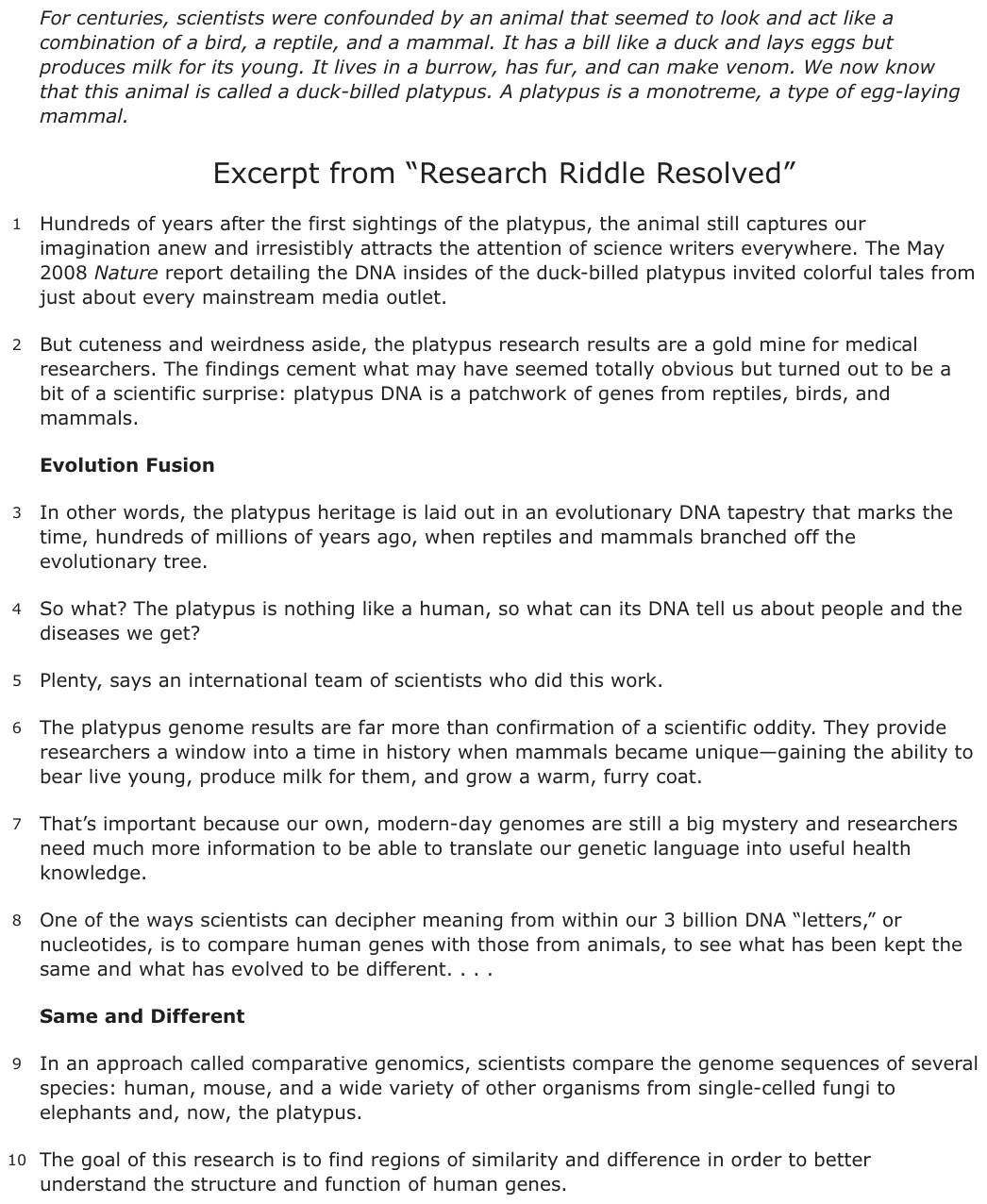
For centuries, scientists were confounded by an animal that seemed to look and act like a combination of a bird, a reptile, and a mammal. It has a bill like a duck and lays eggs but produces milk for its young. It lives in a burrow, has fur, and can make venom. We now know that this animal is called a duck-billed platypus. A platypus is a monotreme, a type of egg-laying mammal.
Hundreds of years after the first sightings of the platypus, the animal still captures our imagination anew and irresistibly attracts the attention of science writers everywhere. The May 2008 Nature report detailing the DNA insides of the duck-billed platypus invited colorful tales from just about every mainstream media outlet.
But cuteness and weirdness aside, the platypus research results are a gold mine for medical researchers. The findings cement what may have seemed totally obvious but turned out to be a bit of a scientific surprise: platypus DNA is a patchwork of genes from reptiles, birds, and mammals.
Evolution Fusion
In other words, the platypus heritage is laid out in an evolutionary DNA tapestry that marks the time, hundreds of millions of years ago, when reptiles and mammals branched off the evolutionary tree.
So what? The platypus is nothing like a human, so what can its DNA tell us about people and the diseases we get?
Plenty, says an international team of scientists who did this work.
The platypus genome results are far more than confirmation of a scientific oddity. They provide researchers a window into a time in history when mammals became unique—gaining the ability to bear live young, produce milk for them, and grow a warm, furry coat.
That’s important because our own, modern-day genomes are still a big mystery and researchers need much more information to be able to translate our genetic language into useful health knowledge.
One of the ways scientists can decipher meaning from within our 3 billion DNA “letters,” or nucleotides, is to compare human genes with those from animals, to see what has been kept the same and what has evolved to be different. . . .
Same and Different
In an approach called comparative genomics, scientists compare the genome sequences of several species: human, mouse, and a wide variety of other organisms from single-celled fungi to elephants and, now, the platypus.
The goal of this research is to find regions of similarity and difference in order to better understand the structure and function of human genes.
Comparative genomics is directly related to evolution because all living things share a common ancestor. By using computer tools to examine genes that have been kept the same in many organisms over millions of years, researchers can locate signals that control how genes work. This information may translate into ways to understand, treat, and prevent human diseases. . . .
Chicken or Egg?
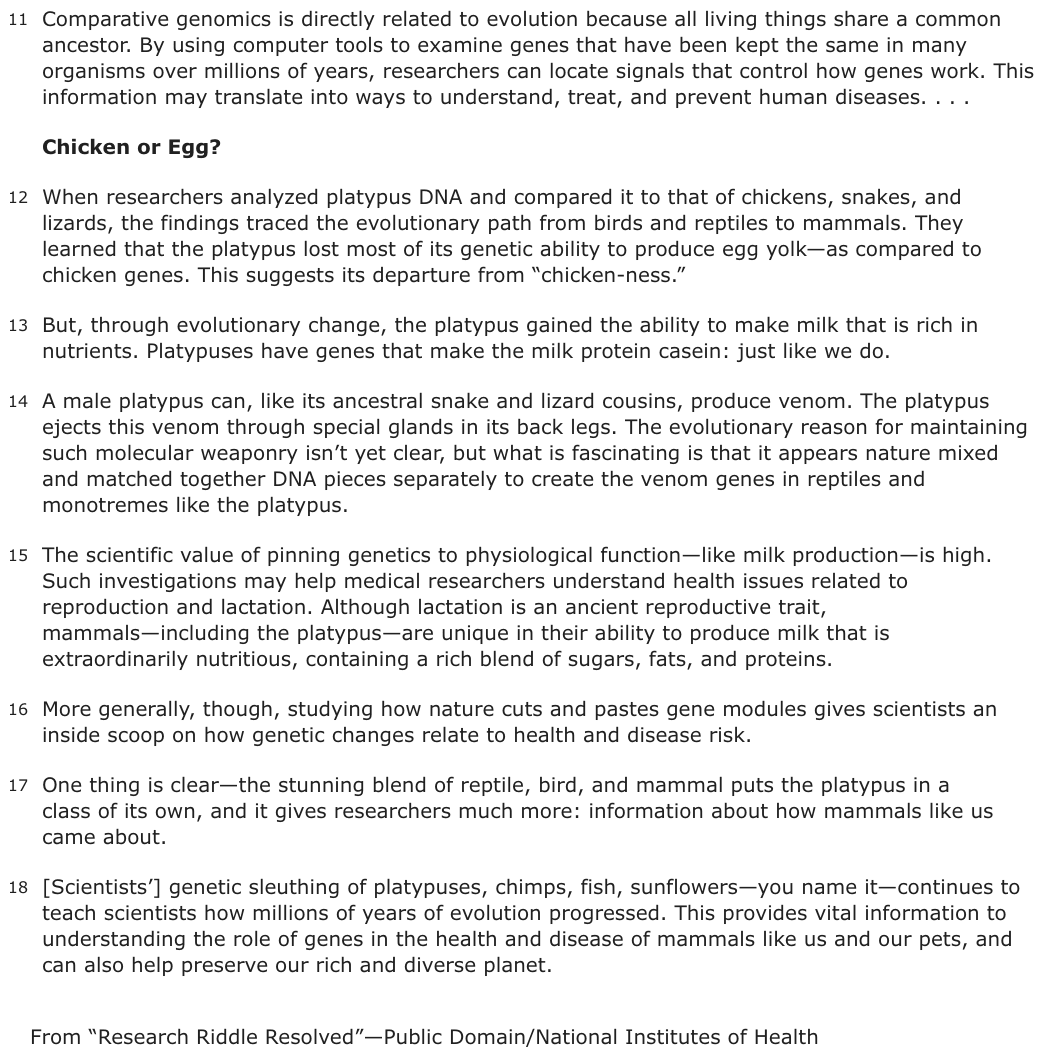
When researchers analyzed platypus DNA and compared it to that of chickens, snakes, and lizards, the findings traced the evolutionary path from birds and reptiles to mammals. They learned that the platypus lost most of its genetic ability to produce egg yolk—as compared to chicken genes. This suggests its departure from “chicken-ness.”
But, through evolutionary change, the platypus gained the ability to make milk that is rich in nutrients. Platypuses have genes that make the milk protein casein: just like we do.
A male platypus can, like its ancestral snake and lizard cousins, produce venom. The platypus ejects this venom through special glands in its back legs. The evolutionary reason for maintaining such molecular weaponry isn’t yet clear, but what is fascinating is that it appears nature mixed and matched together DNA pieces separately to create the venom genes in reptiles and monotremes like the platypus.
The scientific value of pinning genetics to physiological function—like milk production—is high. Such investigations may help medical researchers understand health issues related to reproduction and lactation. Although lactation is an ancient reproductive trait, mammals—including the platypus—are unique in their ability to produce milk that is extraordinarily nutritious, containing a rich blend of sugars, fats, and proteins.
More generally, though, studying how nature cuts and pastes gene modules gives scientists an inside scoop on how genetic changes relate to health and disease risk.
One thing is clear—the stunning blend of reptile, bird, and mammal puts the platypus in a class of its own, and it gives researchers much more: information about how mammals like us came about.
[Scientists’] genetic sleuthing of platypuses, chimps, fish, sunflowers—you name it—continues to teach scientists how millions of years of evolution progressed. This provides vital information to understanding the role of genes in the health and disease of mammals like us and our pets, and can also help preserve our rich and diverse planet.
From “Research Riddle Resolved”—Public Domain/National Institutes of Health
Question
The phrase “evolutionary DNA tapestry” in paragraph 3 conveys the idea that the platypus
- Ahas a rich and diverse genetic history linked to reptiles, birds, and other mammals.
- Bwas able to develop its mammalian and reptilian traits at different points in time.
- Ccontinues to be the best resource for studying the evolution of animal genomes.
- Dis especially useful to researchers because its genes have never been altered.
Show the answer
Correct answer: A
The question asks what the phrase “evolutionary DNA tapestry” in paragraph 3 conveys about the platypus.
A. CORRECT. In the excerpt, the term “tapestry” conveys the sense of a rich history; the “platypus heritage” described in paragraph 3 is woven together with “threads” from mammals, birds, and reptiles in its genetic background.
B. Incorrect. While paragraph 3 does mention mammals and reptiles, it does not discuss when the platypus developed traits from those classifications. Rather, it refers in general to “hundreds of millions of years ago, when reptiles and mammals branched off the evolutionary tree.”
C. Incorrect. The excerpt never claims that, compared with other animals, the platypus is the best resource for studying the evolution of animal genomes. The excerpt indicates that the platypus’s status as a “scientific oddity” provides “a window into a time in history when mammals became unique—gaining the ability to bear live young, produce milk for them, and grow a warm, furry coat” (paragraph 6).
D. Incorrect. The excerpt states that the platypus genome is a “scientific oddity” (paragraph 6) that is useful to researchers, but the reason it is useful is because of DNA evidence that shows “a window into a time in history when mammals became unique” (paragraph 6), not because its genes have never been altered. Because the platypus genome, like that of all animals, has evolved over time, the statement that platypus genes have never been altered is inaccurate (“They learned that the platypus lost most of its genetic ability to produce egg yolk—as compared to chicken genes. This suggests its departure from ‘chicken-ness’ ” [paragraph 12]).
Question analysis
This figurative-language question asks what the phrase “evolutionary DNA tapestry” in paragraph 3 of “Research Riddle Resolved” conveys about the platypus. Students must work out what calling the animal’s heritage a tapestry suggests in an article about its genes, and the choices make different claims about its genetic history and its value to science.
- Grade level
- Grade 7 reading and task
- Compared with grade 7
- At grade 7 Interpreting a metaphor from context is regular grade 7 work. The word “tapestry” may be unfamiliar and sits in a long, technical sentence, but the sentences around it give enough clues for one careful reading to settle it.
- Estimated difficulty
- Straightforward: two steps or one careful reading.
- Thinking it demands
- Depth of knowledge 2, skills and concepts · mainly understand
- What makes it hard
- Figurative or literary language moderate
- Complex sentences minor
- Hard words minor
- Evidence
- Answered from several paragraphs or stanzas
- Reading level
- Passage: about grade 11, 809 words; question and choices: about grade 11, 66 words.
- Students, last 30 days
- Not enough answers yet to show (it takes 10).
Why it is hard, traps and wrong answers (shows the answer)
Why it is hard
The phrase is a restatement, so the sentence before it nearly settles the question for students who notice “In other words.” The risk lies in the rest of paragraph 3’s sentence, whose talk of time and branching invites a choice about traits arriving at different dates. The other wrong choices praise the platypus as a research subject, which the article does elsewhere, but the tapestry image says nothing about its rank or about genes that never changed.
Figurative or literary language moderate Understanding the question
A tapestry is a picture woven from many threads, and paragraph 3 opens “In other words,” so the image restates paragraph 2’s “patchwork of genes from reptiles, birds, and mammals.” (Graesser, Singer & Trabasso, 1994; Kintsch, 1998)
Complex sentences minor Understanding the question
The 33-word sentence hangs a long clause on the image, “that marks the time, hundreds of millions of years ago, when reptiles and mammals branched off,” which pulls attention toward dates. (Abedi & Lord, 2001; Freedle & Kostin, 1993; Messick, 1989)
Hard words minor Understanding the question
“Tapestry” and “heritage” are uncommon words for many students, and a reader who does not know what a tapestry is has only the “In other words” link to go on. (Perfetti, 2007; Freedle & Kostin, 1993)
Strategy: Paragraph 3 begins “In other words,” so reread the sentence just before it and ask what the tapestry image restates; then choose the option that fits both sentences.
Traps
- Twists what the text says: Uses the text's topic and ideas but changes what it says: who did it, how much, when, or why.
- Too broad or too strong: A choice overstates, generalizes, or uses absolute words the text does not support.
- Outside knowledge: A choice is plausible in the real world but not supported by this text.
The wrong answers, classified
B Twists what the text says (King et al., 2004)
Seizes on “marks the time … when reptiles and mammals branched off” and turns it into a timeline of the platypus’s own traits, which the paragraph never gives.
C Too broad or too strong (King et al., 2004)
Stretches the article’s interest in the platypus into the best resource for all genome research, a ranking the excerpt never makes among the many species scientists compare.
D Outside knowledge (King et al., 2004; Recht & Leslie, 1988)
Draws on the popular idea of the platypus as an unchanged living fossil, though paragraph 12 says it lost most of its genetic ability to make egg yolk.
Working it out, step by step
Figure out what the question asks
This asks what a figure of speech means. A figure of speech is words used in a special way, not just for their plain meaning. Here the phrase is “evolutionary DNA tapestry.” You need to decide what it says about the platypus.
Learn what a tapestry is
A tapestry is a large cloth picture. It is woven from many threads of different colors. Each thread is small, but together they make one rich picture. Evolutionary means having to do with how living things change over a very long time.
Use the clue before the phrase
Paragraph 3 starts with “In other words.” That phrase means the writer is saying the same thing again in a new way. So look at the last sentence of paragraph 2. It says “platypus DNA is a patchwork of genes from reptiles, birds, and mammals.” A patchwork is also made of many pieces. So the tapestry is the platypus’s DNA, woven from reptile, bird and mammal parts.
Check each choice
- A fits. Like threads in a tapestry, the platypus’s genes come from reptiles, birds and mammals. That history is rich and mixed.
- B does not fit. Paragraph 3 mentions the time “when reptiles and mammals branched off the evolutionary tree.” But it never says when the platypus got each trait.
- C does not fit. The excerpt never calls the platypus the best animal to study.
- D does not fit. Paragraph 12 says the platypus “lost most of its genetic ability to produce egg yolk.” So its genes did change.
Watch out: B is tempting because the same sentence talks about time and branching. That part tells when two groups split apart. It is not a timeline of the platypus’s traits.
Choose the answer
The tapestry stands for the platypus’s DNA. It is woven from the genes of several kinds of animals. So the answer is A.
Why this answer and not the closest wrong one
B is the closest wrong choice. Its talk of time comes from the same sentence. But a tapestry is about many threads woven together, not about dates. The phrase restates the “patchwork of genes from reptiles, birds, and mammals.” That mixed history is A.
More questions like this
The original DOE question

The passage “Excerpt from “Research Riddle Resolved”” as printed (pages 66–67)