Passage Excerpt from “Research Riddle Resolved”
Excerpt from “Research Riddle Resolved”
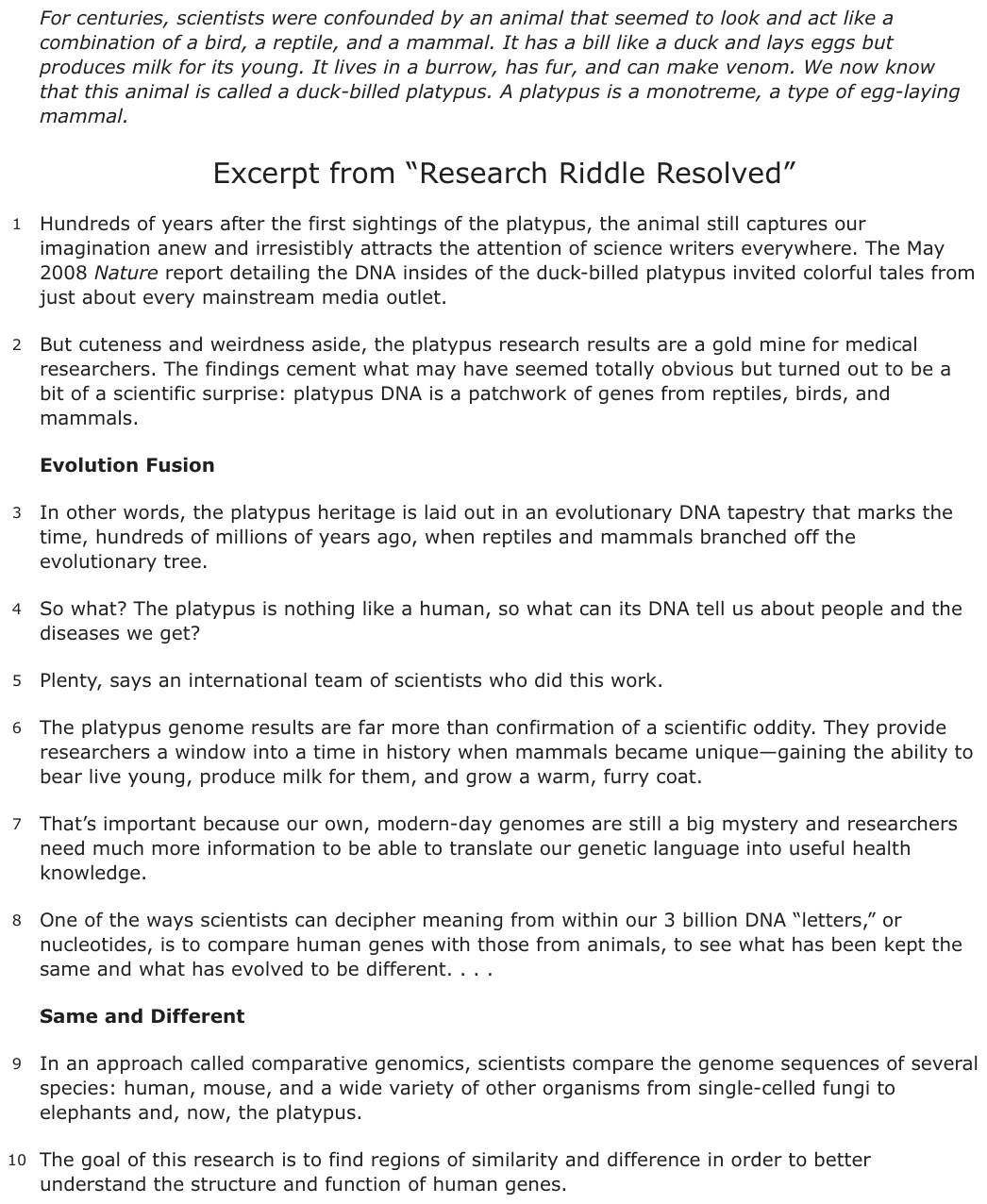
For centuries, scientists were confounded by an animal that seemed to look and act like a combination of a bird, a reptile, and a mammal. It has a bill like a duck and lays eggs but produces milk for its young. It lives in a burrow, has fur, and can make venom. We now know that this animal is called a duck-billed platypus. A platypus is a monotreme, a type of egg-laying mammal.
Hundreds of years after the first sightings of the platypus, the animal still captures our imagination anew and irresistibly attracts the attention of science writers everywhere. The May 2008 Nature report detailing the DNA insides of the duck-billed platypus invited colorful tales from just about every mainstream media outlet.
But cuteness and weirdness aside, the platypus research results are a gold mine for medical researchers. The findings cement what may have seemed totally obvious but turned out to be a bit of a scientific surprise: platypus DNA is a patchwork of genes from reptiles, birds, and mammals.
Evolution Fusion
In other words, the platypus heritage is laid out in an evolutionary DNA tapestry that marks the time, hundreds of millions of years ago, when reptiles and mammals branched off the evolutionary tree.
So what? The platypus is nothing like a human, so what can its DNA tell us about people and the diseases we get?
Plenty, says an international team of scientists who did this work.
The platypus genome results are far more than confirmation of a scientific oddity. They provide researchers a window into a time in history when mammals became unique—gaining the ability to bear live young, produce milk for them, and grow a warm, furry coat.
That’s important because our own, modern-day genomes are still a big mystery and researchers need much more information to be able to translate our genetic language into useful health knowledge.
One of the ways scientists can decipher meaning from within our 3 billion DNA “letters,” or nucleotides, is to compare human genes with those from animals, to see what has been kept the same and what has evolved to be different. . . .
Same and Different
In an approach called comparative genomics, scientists compare the genome sequences of several species: human, mouse, and a wide variety of other organisms from single-celled fungi to elephants and, now, the platypus.
The goal of this research is to find regions of similarity and difference in order to better understand the structure and function of human genes.
Comparative genomics is directly related to evolution because all living things share a common ancestor. By using computer tools to examine genes that have been kept the same in many organisms over millions of years, researchers can locate signals that control how genes work. This information may translate into ways to understand, treat, and prevent human diseases. . . .
Chicken or Egg?
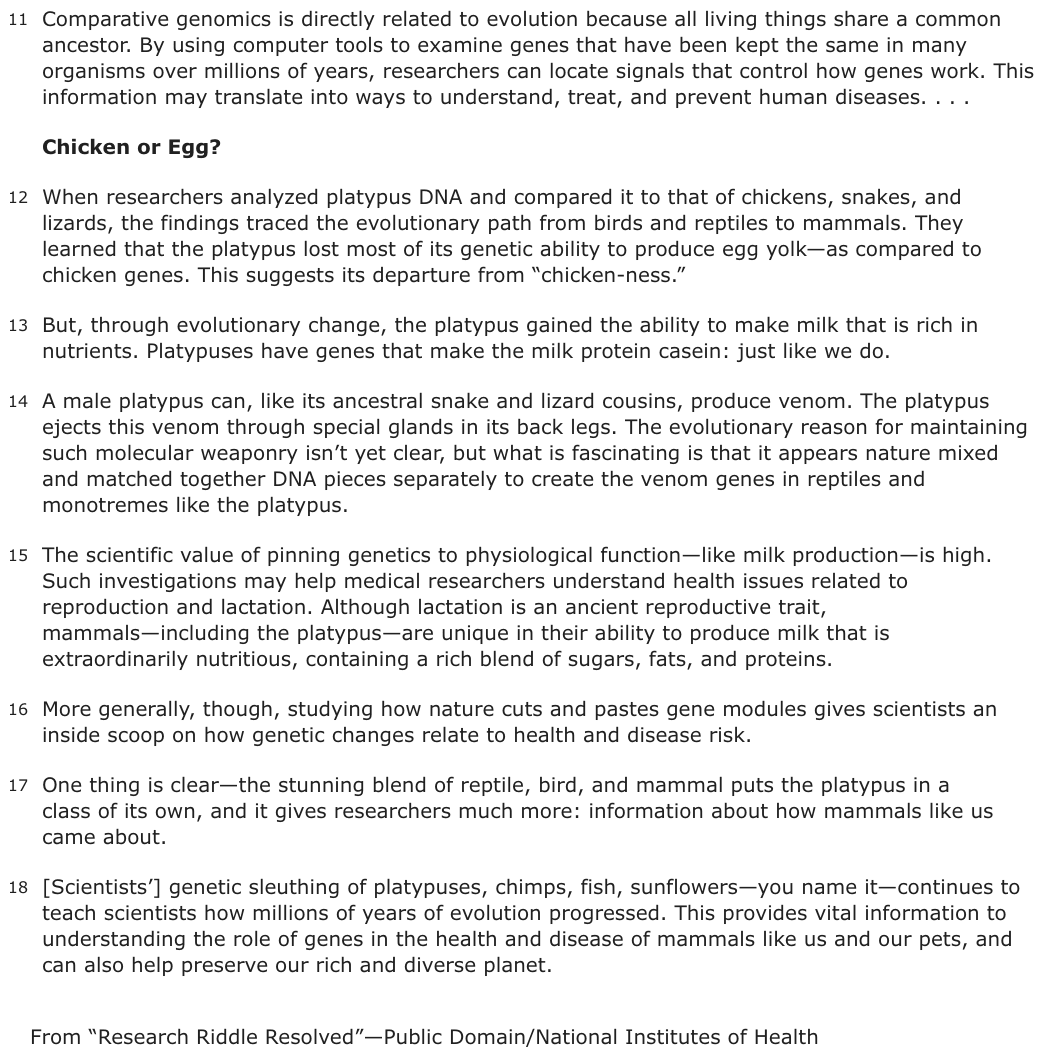
When researchers analyzed platypus DNA and compared it to that of chickens, snakes, and lizards, the findings traced the evolutionary path from birds and reptiles to mammals. They learned that the platypus lost most of its genetic ability to produce egg yolk—as compared to chicken genes. This suggests its departure from “chicken-ness.”
But, through evolutionary change, the platypus gained the ability to make milk that is rich in nutrients. Platypuses have genes that make the milk protein casein: just like we do.
A male platypus can, like its ancestral snake and lizard cousins, produce venom. The platypus ejects this venom through special glands in its back legs. The evolutionary reason for maintaining such molecular weaponry isn’t yet clear, but what is fascinating is that it appears nature mixed and matched together DNA pieces separately to create the venom genes in reptiles and monotremes like the platypus.
The scientific value of pinning genetics to physiological function—like milk production—is high. Such investigations may help medical researchers understand health issues related to reproduction and lactation. Although lactation is an ancient reproductive trait, mammals—including the platypus—are unique in their ability to produce milk that is extraordinarily nutritious, containing a rich blend of sugars, fats, and proteins.
More generally, though, studying how nature cuts and pastes gene modules gives scientists an inside scoop on how genetic changes relate to health and disease risk.
One thing is clear—the stunning blend of reptile, bird, and mammal puts the platypus in a class of its own, and it gives researchers much more: information about how mammals like us came about.
[Scientists’] genetic sleuthing of platypuses, chimps, fish, sunflowers—you name it—continues to teach scientists how millions of years of evolution progressed. This provides vital information to understanding the role of genes in the health and disease of mammals like us and our pets, and can also help preserve our rich and diverse planet.
From “Research Riddle Resolved”—Public Domain/National Institutes of Health
Question
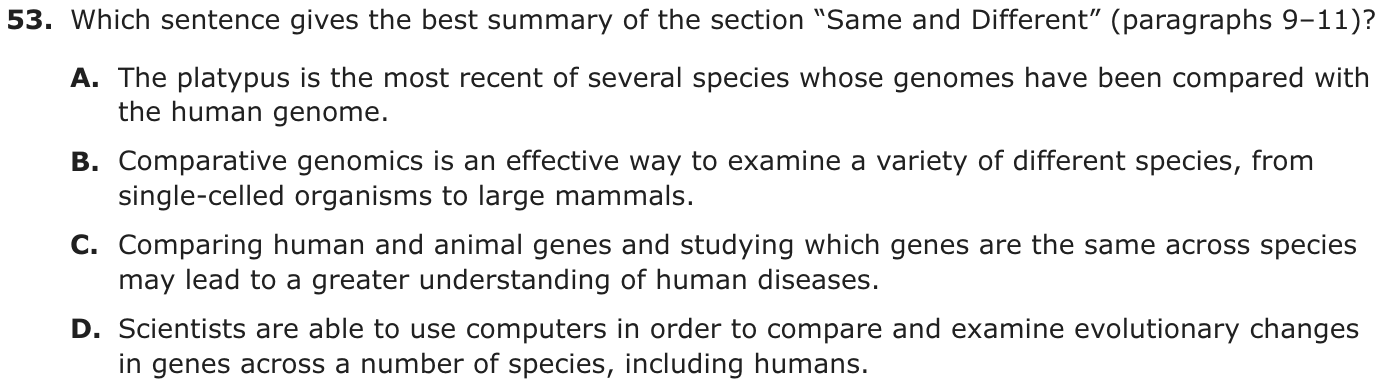
Which sentence gives the best summary of the section “Same and Different” (paragraphs 9–11)?
- AThe platypus is the most recent of several species whose genomes have been compared with the human genome.
- BComparative genomics is an effective way to examine a variety of different species, from single-celled organisms to large mammals.
- CComparing human and animal genes and studying which genes are the same across species may lead to a greater understanding of human diseases.
- DScientists are able to use computers in order to compare and examine evolutionary changes in genes across a number of species, including humans.
Show the answer
Correct answer: C
The question asks for the best summary of the section “Same and Different” (paragraphs 9–11).
A. Incorrect. The fact that the platypus is the latest species whose genome is being compared with the human genome is just a detail of this section. Paragraph 9 reveals this when it states that “scientists compare the genome sequences of several species: human, mouse, and a wide variety of other organisms from single-celled fungi to elephants and, now, the platypus.” The focus of the section is on the fact that comparing genomes can teach us about human diseases.
B. Incorrect. While comparative genomics is a way to examine many different species, this detail is not the main point of this section. Paragraph 10 notes that the “goal of this research” focuses on the fact that comparing genomes can teach us about human diseases.
C. CORRECT. This sentence describes the most important idea of the section: the discovery of genes that humans have in common with other species that can yield information about human diseases. As stated in paragraph 10, “The goal of this research is to find regions of similarity and difference in order to better understand the structure and function of human genes.”
D. Incorrect. While this section does mention the use of computers in comparative genomics, this information is a detail about how the research is carried out; the computers are a tool in discovering whether “this information may translate into ways to understand, treat, and prevent human diseases” (paragraph 11).
Question analysis
This summary question asks which sentence best sums up the section of “Research Riddle Resolved” headed “Same and Different,” paragraphs 9–11, which explains the approach scientists call comparative genomics. Each choice draws on something in the section, so students must tell its main point from the details that support it.
- Grade level
- Grade 8 reading and task
- Compared with grade 7
- At grade 7 Summarizing a short section is core grade 7 work. This one is written in technical terms such as “genome sequences” and “signals that control how genes work,” and several choices are accurate, so students must judge which is most complete.
- Estimated difficulty
- Moderate: several steps, or a close reading with one strong distractor.
- Thinking it demands
- Depth of knowledge 2, skills and concepts · mainly understand
- What makes it hard
- A very close wrong answer moderate
- An unfamiliar subject moderate
- Evidence
- Answered from several paragraphs or stanzas
- Reading level
- Passage: about grade 11, 809 words; question and choices: about grade 12, 96 words.
- Corrected from the DOE handbook
- In the explanation of a wrong choice, a sentence that cites paragraph 9 was attached to the wrong point; the sentences were put back in order.
- Students, last 30 days
- Not enough answers yet to show (it takes 10).
Why it is hard, traps and wrong answers (shows the answer)
Why it is hard
All four summaries are built from real details of the section, so the choice is about completeness. The section moves from method in paragraph 9 to goal in paragraph 10 to payoff in paragraph 11, and the tempting summaries stop at the method, the list of species or the platypus’s place at the end of that list. Students who look for the purpose, what the comparing is for, reach the summary that keeps human disease in view.
A very close wrong answer moderate Choosing the answer
The computer-tools summary and the key both describe comparing genes across species, humans included; only the key carries the section’s purpose, understanding human genes and diseases, stated in paragraphs 10 and 11. (Embretson & Wetzel, 1987; Gorin & Embretson, 2006; Ascalon et al., 2007)
An unfamiliar subject moderate Understanding the question
Comparative genomics is new to most students, and the section explains it in technical terms, “genome sequences,” “regions of similarity and difference,” “signals that control how genes work,” with no example to anchor them. (Recht & Leslie, 1988; Kintsch, 1998)
Strategy: Read paragraphs 9–11 straight through and write a one-sentence summary of your own before looking at the choices, then pick the one that covers the whole section, not a single sentence of it.
Traps
- Too narrow: A single detail offered as the central idea or a summary, or a summary that keeps minor details and leaves out an essential part.
- Word match: Repeats striking words or phrases from the text, so it looks supported, but its meaning does not fit the question.
The wrong answers, classified
A Too narrow (King et al., 2004)
Takes “and, now, the platypus,” the last item in paragraph 9’s list, as the section’s point, though it is one detail and says nothing about what the comparing is for.
B Word match (Freedle & Kostin, 1993)
Echoes paragraph 9’s range “from single-celled fungi to elephants” and calls the method effective, but the section compares those species to understand human genes, a goal this summary leaves out.
D Too narrow (King et al., 2004)
Gives an accurate account of the method, paragraph 11’s computer tools comparing genes across species, but leaves out its payoff, ways to “understand, treat, and prevent human diseases.”
What was corrected from the DOE handbook, and why
- Explanation: The handbook’s explanation of Option A says that the platypus being the latest species whose genome is compared with ours is just a detail, then that the section’s focus is on what comparing genomes can teach us about human diseases, and then “Paragraph 9 reveals this when it states that ‘scientists compare the genome sequences of several species: human, mouse, and a wide variety of other organisms from single-celled fungi to elephants and, now, the platypus.’” Paragraph 9 says nothing about diseases: the quotation shows the platypus as the latest of the species compared, the point the explanation began with. The site moves the paragraph 9 sentence up to follow that point and ends with the section’s focus; no words were changed. The answer, C, is unchanged.
Working it out, step by step
Figure out what the question asks
This asks for the best summary of a section. A summary is a short statement of the main points. It should cover the whole section, not just one detail. The section “Same and Different” is paragraphs 9–11.
Sum up each paragraph
A species is one kind of living thing.
- Paragraph 9 names the method, comparative genomics. Scientists compare the genes of many species, “and, now, the platypus.”
- Paragraph 10 gives the goal: to “better understand the structure and function of human genes.”
- Paragraph 11 gives the payoff. Studying genes kept the same in many living things “may translate into ways to understand, treat, and prevent human diseases.”
Find the main point
The section moves from a method, to a goal, to a payoff. The payoff is the point. Comparing genes across species, and finding the ones that stayed the same, may help us understand human diseases.
Check each choice
- A does not fit. The platypus is just the last item in a list in paragraph 9. It is a detail.
- B does not fit. The range “from single-celled fungi to elephants” is a detail too. B leaves out why scientists compare, which is to understand human genes.
- C fits. It covers the comparing, the genes that stay the same, and the goal of understanding disease.
- D does not fit. Computer tools are how the work is done. D leaves out what the work is for.
Watch out: D is tempting because everything in it is true. But a summary needs the main point, and D stops before it.
Choose the answer
The best summary keeps the section’s purpose: comparing genes to understand human disease. So the answer is C.
Why this answer and not the closest wrong one
D is the closest wrong choice. D and C both describe comparing genes across species, humans included. But D stops at the computer tools, which are only the method. C also gives the reason for the work. Paragraph 11 says it “may translate into ways to understand, treat, and prevent human diseases.”
More questions like this
The original DOE question
The passage “Excerpt from “Research Riddle Resolved”” as printed (pages 66–67)