2023 Test A English
Question 1 of 57
2023 Test A English, question 1Question
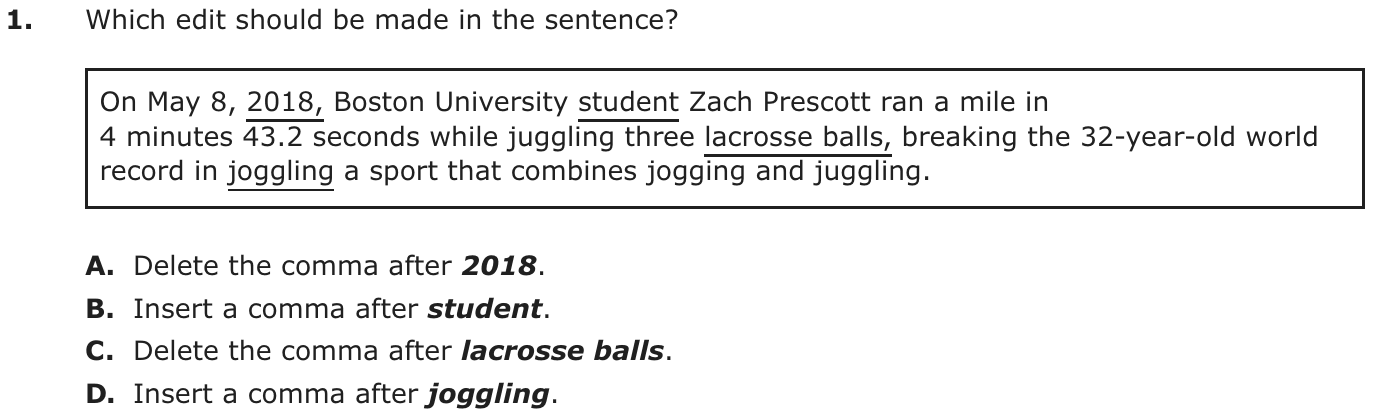
Which edit should be made in the sentence?
On May 8, 2018, Boston University student Zach Prescott ran a mile in 4 minutes 43.2 seconds while juggling three lacrosse balls, breaking the 32-year-old world record in joggling a sport that combines jogging and juggling.
- ADelete the comma after 2018.
- BInsert a comma after student.
- CDelete the comma after lacrosse balls.
- DInsert a comma after joggling.
Show the answer
Correct answer: D
The question asks which edit should be made to correct the sentence.
A. Incorrect. This edit incorrectly deletes the comma that is necessary to set off the year in a date from the remainder of the sentence.
B. Incorrect. This edit introduces an unnecessary comma into the sentence by needlessly separating the adjective phrase “Boston University student” from the noun it modifies, “Zach Prescott.”
C. Incorrect. This edit would delete the comma needed to separate the participle phrase “breaking the 32-year-old world record in joggling” and its companion appositive “a sport that combines jogging and juggling” from the rest of the sentence. This complete element is nonessential, which means it requires separation from the rest of the sentence with a comma because its removal would not fundamentally change the meaning of the sentence.
D. CORRECT. The appositive “a sport that combines jogging and juggling” further describes the word “joggling.” An appositive requires separation with a comma because it is nonessential, meaning that its removal would not change the overall meaning of the sentence.
Question analysis
This punctuation question gives one long sentence about a Boston University student who ran a mile while juggling and broke a world record, and asks which comma edit it needs. Students weigh four marked spots, at a date, between a title and a name, and at two places near the end, deciding at each whether a comma belongs.
- NYS standards
- 7L2 capitalization, punctuation, and spelling
- Grade level
- Grade 6 reading and task
- Compared with grade 7
- Below grade 7 Commas with dates and with extra information added to a sentence are grade 6 punctuation rules. This item tests them in a single 36-word sentence with one edit to choose, lighter than grade 7 work on phrases, clauses and modifiers.
- Estimated difficulty
- Straightforward: two steps or one careful reading.
- Thinking it demands
- Depth of knowledge 1, recall and reproduction · mainly apply
- What makes it hard
- A rule that doesn't sound wrong moderate
- Hard words minor
- Complex sentences minor
- Evidence
- Answered from one sentence or line
- Reading level
- Question and choices: about grade 7, 60 words.
- Students, last 30 days
- Not enough answers yet to show (it takes 10).
Why it is hard, traps and wrong answers (shows the answer)
Why it is hard
The one missing comma sits at the end of a long sentence, right after an unfamiliar word, and the sentence still sounds acceptable without it. The strongest pull applies the appositive rule one spot too early, between a descriptive title and the name it introduces, while the other two wrong edits remove commas that the date and the added phrase about the record both need. Bracketing each piece of added information, from where it starts to where it ends, exposes the gap after the sport’s name.
A rule that doesn't sound wrong moderate Working it out
Two quiet rules decide the question: the closing appositive “a sport that combines jogging and juggling” must be set off from “joggling,” while a title placed straight before a name, as in “Boston University student Zach Prescott,” takes no comma. (Connors & Lunsford, 1988)
Hard words minor Understanding the question
“Joggling” is a word few students have met, and without the comma “in joggling a sport” can read like a verb and its object rather than the name of a sport followed by its definition. (Perfetti, 2007; Freedle & Kostin, 1993)
Complex sentences minor Understanding the question
The 36-word sentence strings together a date, a title and name, a “while” phrase, the phrase “breaking the 32-year-old world record” and a closing appositive, so every comma has to be judged against where these parts begin and end. (Abedi & Lord, 2001; Freedle & Kostin, 1993; Messick, 1989)
Strategy: Find the main subject and verb, then take the four underlined spots in order and ask what the words on each side are doing and whether a comma belongs between them.
Traps
- Punctuation: A comma, semicolon, colon, dash or apostrophe used where it does not belong, or missing where it does.
The wrong answers, classified
A Punctuation (Connors & Lunsford, 1988)
Treats the comma after “2018” as extra, not knowing that a full date takes a comma after the year as well as between the day and the year.
B Punctuation (Connors & Lunsford, 1988)
Applies the appositive rule to “student Zach Prescott,” but a title placed directly before a name is not set off, and a lone comma there would cut the title off from the name.
C Punctuation (Connors & Lunsford, 1988)
Deletes the comma before “breaking the 32-year-old world record” as if the phrase belonged to the juggling, though without it the lacrosse balls seem to break the record instead of Prescott.
Working it out, step by step
Figure out what the question asks
This is a punctuation question. Punctuation means marks like commas and periods. The sentence has four underlined spots. Each choice adds or takes away one comma. Only one edit fixes the sentence. To find it, ask what each group of words is doing.
Learn the rule for renaming words
Sometimes a sentence names a thing and then tells you what it is. The words that rename it are called an appositive. An appositive gets a comma to set it off from the rest of the sentence.
Example: My uncle plays the tuba, a big brass horn. The words a big brass horn tell you what a tuba is, so a comma comes before them.
Find where a comma is missing
Look at the end of the sentence: “breaking the 32-year-old world record in joggling a sport that combines jogging and juggling.” Joggling is the name of a sport. The words “a sport that combines jogging and juggling” tell you what joggling is. So they are an appositive. But nothing sets them off from “joggling.” A comma belongs right after “joggling.”
Check each choice
- A is wrong. When more of the sentence follows a full date, the year needs a comma after it too. Example: On June 2, 2020, we moved.
- B is wrong. A title that comes right before a name takes no comma. You write Coach Rivera with no comma. In the same way, “Boston University student” is a title for Zach Prescott.
- C is wrong. The comma before “breaking” sets off the part about the record. Without it, the lacrosse balls seem to break the record, not Zach.
- D is right. It adds the comma that sets off the appositive.
Watch out: B is tempting, because “student” does describe Zach. But a title placed right before a name stays joined to it.
Choose the answer
With the new comma, the end reads: breaking the 32-year-old world record in joggling, a sport that combines jogging and juggling. So the answer is D: insert a comma after joggling.
Why this answer and not the closest wrong one
B is the closest wrong answer. It puts one comma between a title and a name. That comma would cut “Boston University student” off from “Zach Prescott.” D fixes a real gap. It puts a comma before “a sport that combines jogging and juggling,” the words that tell what joggling is.
More questions like this
The original DOE question
Question 2 of 57
2023 Test A English, question 2Question
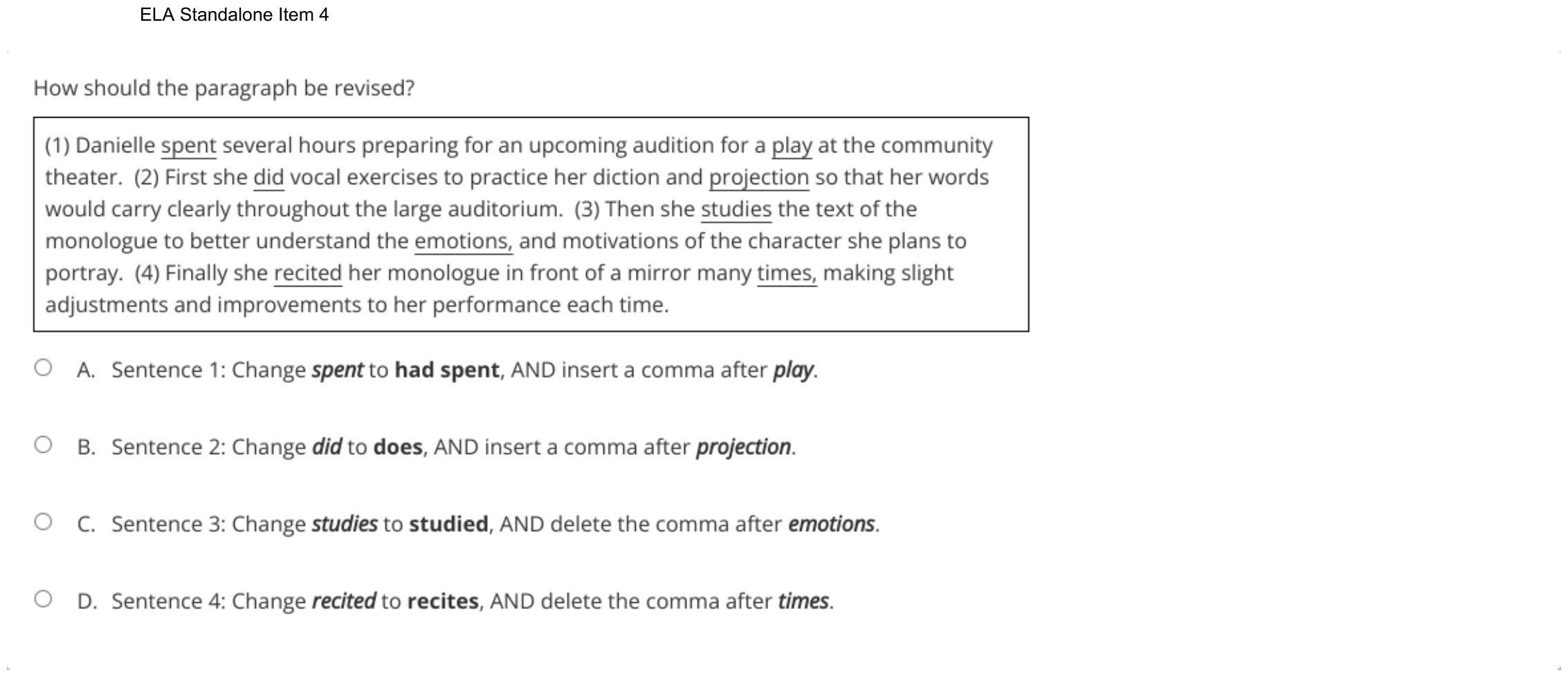
How should the paragraph be revised?
(1) Danielle spent several hours preparing for an upcoming audition for a play at the community theater. (2) First she did vocal exercises to practice her diction and projection so that her words would carry clearly throughout the large auditorium. (3) Then she studies the text of the monologue to better understand the emotions, and motivations of the character she plans to portray. (4) Finally she recited her monologue in front of a mirror many times, making slight adjustments and improvements to her performance each time.
- ASentence 1: Change spent to had spent, AND insert a comma after play.
- BSentence 2: Change did to does, AND insert a comma after projection.
- CSentence 3: Change studies to studied, AND delete the comma after emotions.
- DSentence 4: Change recited to recites, AND delete the comma after times.
Show the answer
Correct answer: C
The question asks how the paragraph should be revised.
A. Incorrect. The revisions in this option introduce new errors. The word “spent” is correct in the simple past tense because it encompasses the actions described throughout the rest of the paragraph, all of which happened during those “several hours.” Additionally, adding a comma after the word “play” would be incorrect because it would unnecessarily separate the prepositional phrase “at the community theater” from the rest of the sentence.
B. Incorrect. The revisions in this option introduce new errors. The word “did” is correct as written in the past tense because the past tense is used throughout the paragraph. There is no comma needed after the word “projection” because “so” is functioning not as a conjunction but rather as part of the conjunction phrase “so that,” which does not take a comma.
C. CORRECT. Changing the word “studies” from the present tense to the past tense “studied” is necessary to match the past tense established in the paragraph (“spent,” “recited”). Additionally, the comma after the word “emotions” needs to be removed because the words “emotions and motivations” are part of a group (series) of two elements, and when there are only two elements in a series, a comma is not used.
D. Incorrect. The revisions in this option introduce new errors. The word “recited” is correct as written in the past tense because the past tense is used throughout the paragraph. Also, removing the comma after “times” is incorrect because the comma is needed in order to separate the modifying phrase “making slight adjustments and improvements to her performance each time” from the main clause.
Question analysis
This grammar and punctuation question gives a four-sentence paragraph about Danielle preparing for an audition at the community theater, with eight spots underlined. Each answer choice pairs a verb change with a comma change in a single sentence, so students must judge verb tense and comma use together and accept a choice only if both of its edits are needed.
- Grade level
- Grade 6 reading and task
- Compared with grade 7
- Below grade 7 Keeping verb tense consistent and using commas correctly are taught before grade 7, and this paragraph is short and plain. Each choice bundles two edits, so a student who spots one real error can confirm the answer with the other.
- Estimated difficulty
- Routine: one familiar step, little to misread.
- Thinking it demands
- Depth of knowledge 1, recall and reproduction · mainly apply
- What makes it hard
- Evidence
- Answered from one paragraph or stanza
- Reading level
- Question and choices: about grade 10, 133 words.
- Students, last 30 days
- Not enough answers yet to show (it takes 10).
Why it is hard, traps and wrong answers (shows the answer)
Why it is hard
The shift to “Then she studies” stands out in a story told in the past tense with “spent,” “did” and “recited,” and finding either half of the right option is enough to choose it. That makes this one of the easiest editing questions. Students who miss it usually trust a half-remembered comma rule, such as a comma before “so,” and stop checking the verb in the same option.
A rule that doesn't sound wrong minor Working it out
Only two nouns, “emotions” and “motivations,” follow “the,” so the comma between them has no job, yet a habit of putting commas before “and” in lists hides it. (Connors & Lunsford, 1988)
Every choice must be checked minor Choosing the answer
The four options each pair a tense change with a comma change, one option per sentence, and an option is right only when both of its edits repair real errors. (Embretson & Wetzel, 1987)
Strategy: Find the tense of the paragraph's first verb, check every underlined verb against it, and then confirm that the comma change in the same choice is needed too.
The wrong answers, classified
A Verb tense or form (Connors & Lunsford, 1988)
Thinks “had spent” is needed because the preparing came before the audition, and accepts a comma after “play” that would cut off “at the community theater.”
B Punctuation (Connors & Lunsford, 1988)
Applies the rule of a comma before “so” joining two clauses, missing that “so that” opens a purpose clause with no comma, and accepts the present-tense “does.”
D Verb tense or form (Connors & Lunsford, 1988)
Notices that the tenses clash but takes the present-tense “studies” as the standard, shifts “recited” to match, and drops the comma that sets off “making slight adjustments.”
Working it out, step by step
Figure out what the question asks
This question asks how to fix the paragraph. Each choice makes two changes in one sentence: a verb change and a comma change. A choice is right only if both changes fix real errors. So check both halves.
Rule 1: keep one tense
Tense is when an action happens: past, present or future. A story should stay in one tense. Example: I woke up and eat breakfast mixes tenses. It should be I woke up and ate breakfast. This paragraph is in the past: “spent,” “did,” “recited.” But sentence 3 says “Then she studies.” That is present tense. It should be “studied.”
Rule 2: no comma between two
When only two things are joined by and, don’t put a comma between them. Example: I like apples and pears. Sentence 3 says “the emotions, and motivations.” There are only two things, so the comma should go. Fixed: the emotions and motivations of the character.
Check each choice
- A is wrong. “Spent” is already correct past tense. A comma after “play” would cut off “at the community theater.”
- B is wrong. “Does” is present tense, so it would create an error. And no comma goes before “so that.”
- C is right. “Studied” fixes the tense, and dropping the comma fixes the pair.
- D is wrong. “Recites” would create an error. The comma after “times” is needed to set off “making slight adjustments and improvements to her performance each time.”
Watch out: B tempts students who remember a comma before “so.” But “so that” tells a purpose, why she practiced, and takes no comma.
Choose the answer
So the answer is C: “Sentence 3: Change studies to studied, AND delete the comma after emotions.”
Why this answer and not the closest wrong one
B is the closest wrong answer, because many students put a comma before “so.” But “so that” explains a purpose, and it takes no comma. Also, B’s change to “does” would break the past tense. Both of C’s changes fix real errors.
More questions like this
The original DOE question
Question 3 of 57
2023 Test A English, question 3Question
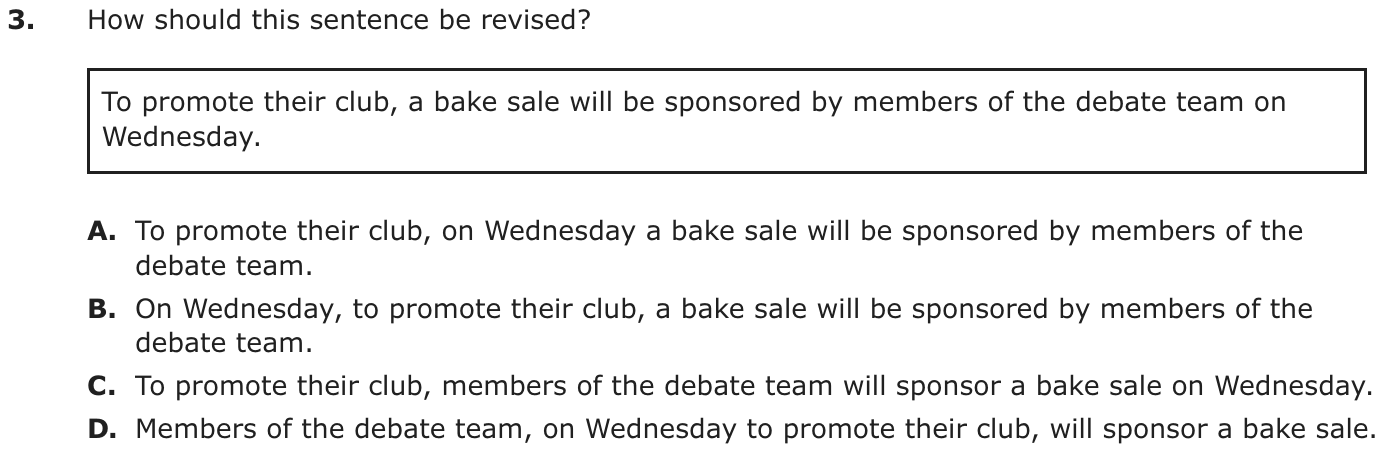
How should this sentence be revised?
To promote their club, a bake sale will be sponsored by members of the debate team on Wednesday.
- ATo promote their club, on Wednesday a bake sale will be sponsored by members of the debate team.
- BOn Wednesday, to promote their club, a bake sale will be sponsored by members of the debate team.
- CTo promote their club, members of the debate team will sponsor a bake sale on Wednesday.
- DMembers of the debate team, on Wednesday to promote their club, will sponsor a bake sale.
Show the answer
Correct answer: C
The question asks for the correct revision of the sentence in the box.
A. Incorrect. The revisions do not fix the error that “to promote their club” modifies “a bake sale.”
B. Incorrect. The revisions do not fix the error that “to promote their club” modifies “a bake sale.”
C. CORRECT. The revision is correct because it includes the phrase “to promote their club” clearly modifying “members of the debate team.”
D. Incorrect. While the revision clarifies that “to promote their club” relates to the “members of the debate team,” the rest of the sentence is poorly written because the insertion of “on Wednesday to promote their club” in the middle of the sentence interrupts the main clause, “Members of the debate team will sponsor a bake sale.”
Question analysis
This sentence-structure question gives one sentence about a debate team’s bake sale, planned for Wednesday to promote their club, and asks how it should be revised. The four rewrites shuffle the same three phrases into different orders, so students must check which word each phrase modifies and whether the whole sentence still reads naturally.
- NYS standards
- 7L1 grammar and usage conventions
- Grade level
- Grade 7 reading and task
- Compared with grade 7
- At grade 7 Placing a phrase so that it describes the right word is part of the grade 7 language standards, and this one-sentence item is a classic case. Choosing the rewrite that is both logical and smooth is typical grade 7 editing.
- Estimated difficulty
- Straightforward: two steps or one careful reading.
- Thinking it demands
- Depth of knowledge 2, skills and concepts · mainly evaluate
- What makes it hard
- A rule that doesn't sound wrong moderate
- Complex sentences minor
- Every choice must be checked minor
- A very close wrong answer minor
- Evidence
- Answered from one sentence or line
- Reading level
- Question and choices: about grade 7, 92 words.
- Students, last 30 days
- Not enough answers yet to show (it takes 10).
Why it is hard, traps and wrong answers (shows the answer)
Why it is hard
The sentence makes sense on a first reading, which is exactly why its error slips past students who edit by ear. Asking who is promoting the club exposes it and removes both rewrites that keep the bake sale as the subject, however neatly they are punctuated. What is left is a judgment of style, and the smoother rewrite keeps the subject and verb together instead of interrupting them with two phrases.
A rule that doesn't sound wrong moderate Working it out
“To promote their club” has to describe whatever comes right after its comma, and that is “a bake sale”; the meaning is so plain that few students notice the sale doing the promoting. (Connors & Lunsford, 1988)
Complex sentences minor Understanding the question
The original is passive, “a bake sale will be sponsored by members of the debate team,” which places the people who act after the verb, far from the phrase that should describe them. (Abedi & Lord, 2001; Freedle & Kostin, 1993; Messick, 1989)
Every choice must be checked minor Choosing the answer
Each rewrite rearranges the opening phrase, the time phrase and the main clause, so each has to be read through to see what follows “To promote their club” and whether anything splits a subject from its verb. (Embretson & Wetzel, 1987)
A very close wrong answer minor Choosing the answer
Two rewrites make the team members the subject of “will sponsor” with identical words; they part only on where the two phrases go, at the edges of the sentence or wedged between subject and verb. (Embretson & Wetzel, 1987; Gorin & Embretson, 2006; Ascalon et al., 2007)
Strategy: Ask who is really doing the promoting, then read each rewrite aloud in full, checking which words follow the opening phrase and whether the sentence reads smoothly from start to finish.
Traps
- Misplaced modifier: A describing word or phrase that attaches to the wrong word, or to nothing in the sentence.
The wrong answers, classified
A Misplaced modifier (Connors & Lunsford, 1988)
Moves “on Wednesday” ahead of the bake sale as if the time phrase were the misplaced part, but the sentence stays passive and the sale is still what “To promote their club” describes.
B Misplaced modifier (Connors & Lunsford, 1988)
Is drawn by the tidy commas around both fronted phrases, yet “a bake sale” still comes straight after them, so the sale remains the thing promoting the club.
D Misplaced modifier (Connors & Lunsford, 1988)
Rightly makes “Members of the debate team” the subject but parks “on Wednesday to promote their club” between it and “will sponsor,” a clumsy break the smoother rewrite avoids.
Working it out, step by step
Figure out what the question asks
You need the best way to rewrite the sentence. This is about a modifier. A modifier is a group of words that describes something else in the sentence. Here the opening words, “To promote their club,” are the modifier. Your job is to check what they describe.
Learn the rule for opening phrases
A sentence may start with a describing phrase and a comma. Then the phrase describes whatever comes right after the comma. So the one doing the action should come next.
Wrong: To get good seats, the line was joined early by Ana. A line can’t want good seats.
Right: To get good seats, Ana joined the line early.Find the problem in the sentence
To promote a club means to get people interested in it. In the sentence, the words right after the comma are “a bake sale.” So the sentence seems to say the bake sale is promoting the club. But a bake sale doesn’t have a club. The club belongs to the “members of the debate team.” They should come right after the comma, and they should do the action: they “will sponsor a bake sale.”
Check each choice
- A is wrong. It moves “on Wednesday” forward. But the bake sale is still what the opening phrase describes.
- B is wrong. It puts “On Wednesday,” at the front. The commas look neat, but “a bake sale” still follows “to promote their club.”
- C is right. “Members of the debate team” comes right after the comma. They are the ones promoting their club.
- D is wrong. The members come first. But “on Wednesday to promote their club” is stuck between the subject (who does the action) and the verb (the action word).
Watch out: D is tempting, since the members do the promoting. But its long middle part breaks up the main idea.
Choose the answer
C fixes the modifier and reads smoothly: To promote their club, members of the debate team will sponsor a bake sale on Wednesday. So the answer is C.
Why this answer and not the closest wrong one
D is the closest wrong answer. Like C, it makes the members the ones who promote the club. But D pushes a long phrase between “Members of the debate team” and “will sponsor.” C keeps the subject and the verb side by side, so it is easier to read.
More questions like this
The original DOE question
Question 4 of 57
2023 Test A English, question 4Question
Read this paragraph.
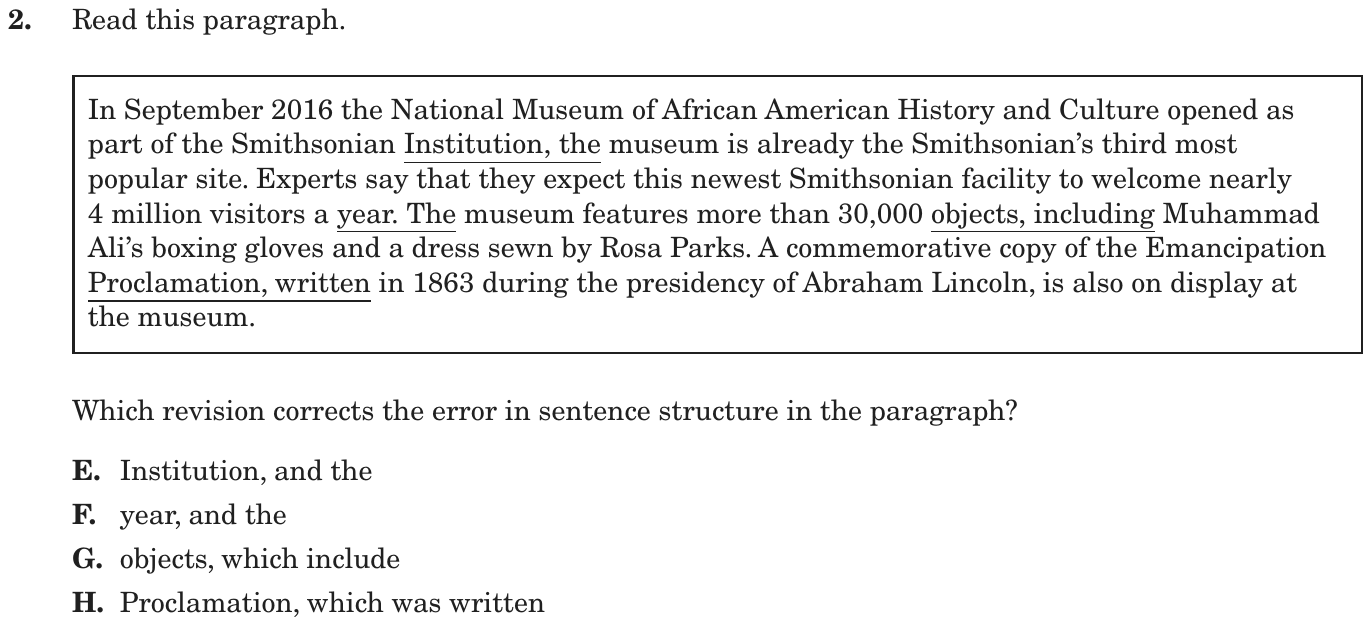
In September 2016 the National Museum of African American History and Culture opened as part of the Smithsonian Institution, the museum is already the Smithsonian’s third most popular site. Experts say that they expect this newest Smithsonian facility to welcome nearly 4 million visitors a year. The museum features more than 30,000 objects, including Muhammad Ali’s boxing gloves and a dress sewn by Rosa Parks. A commemorative copy of the Emancipation Proclamation, written in 1863 during the presidency of Abraham Lincoln, is also on display at the museum.
Which revision corrects the error in sentence structure in the paragraph?
- AInstitution, and the
- Byear, and the
- Cobjects, which include
- DProclamation, which was written
Show the answer
Correct answer: A
The question asks for the correction of an error in sentence structure in the paragraph.
The first sentence is a run-on sentence because both clauses—“In September 2016 the National Museum of African American History and Culture opened as part of the Smithsonian Institution” and “the museum is already the Smithsonian’s third most popular site”—are independent clauses, and independent clauses should not be combined without the use of a conjunction and a comma. The revision in Option A adds the word “and” after the comma, which corrects the run-on.
Option B, Option C, Option D are incorrect responses because the corresponding underlined portions in the paragraph are not structural errors. No edits are needed to correct those portions of the text.
Question analysis
This sentence-structure question gives a short paragraph about the opening of the National Museum of African American History and Culture. Students must find which of four spots holds a real error, such as a run-on, a fragment or a misplaced phrase, and pick the revision that fixes it. Long names stretch the sentences, and the spots that need no change can look just as suspicious.
- Grade level
- Grade 6 reading and task
- Compared with grade 7
- Below grade 7 Fixing run-ons and fragments is taught before grade 7, and here students check four short spots in one paragraph for a single structural error. Long institution names add reading load but no extra grammar.
- Estimated difficulty
- Straightforward: two steps or one careful reading.
- Thinking it demands
- Depth of knowledge 2, skills and concepts · mainly apply
- What makes it hard
- A rule that doesn't sound wrong moderate
- Complex sentences minor
- Every choice must be checked minor
- Evidence
- Answered from one paragraph or stanza
- Reading level
- Question and choices: about grade 10, 111 words.
- Corrected from the DOE handbook
- A misdescribed detail in the explanation was corrected.
- Students, last 30 days
- Not enough answers yet to show (it takes 10).
Why it is hard, traps and wrong answers (shows the answer)
Why it is hard
Students who miss this one usually look for the error in the wrong place: the phrases “including Muhammad Ali’s boxing gloves” and “written in 1863” look suspicious, while the real splice hides behind the long museum name. The question rewards checking each spot for a subject and verb on both sides of its punctuation. Two choices offer the same “, and the” fix, so knowing the fix is not enough without finding where it belongs.
A rule that doesn't sound wrong moderate Working it out
The error is a comma splice after “Institution,” where a comma alone joins two complete clauses, and a comma sounds like a natural pause when the sentence is read aloud. (Connors & Lunsford, 1988)
Complex sentences minor Understanding the question
The eight-word museum name stretches the first clause, so by the time “the museum is already” arrives, it reads like a continuation rather than a new subject and verb. (Abedi & Lord, 2001; Freedle & Kostin, 1993; Messick, 1989)
Every choice must be checked minor Choosing the answer
The four underlined spots fall in four different sentences, and each has to be tested for whether a complete sentence sits on both sides of its punctuation. (Embretson & Wetzel, 1987)
Strategy: Check each sentence for a subject and main verb and count its complete thoughts, then decide whether the spot each choice changes actually breaks a rule before picking a fix.
The wrong answers, classified
B Fixes what isn't broken (Connors & Lunsford, 1988)
Recognizes “, and the” as the usual run-on fix but applies it where a period already separates two complete, correctly punctuated sentences.
C Fixes what isn't broken (Connors & Lunsford, 1988)
Believes a phrase opening with “including” after a comma is a fragment, so turns it into a which-clause, though the phrase already attaches correctly to “objects.”
D Fixes what isn't broken (Connors & Lunsford, 1988)
Thinks “written in 1863” cannot describe the copy without “which was,” though the sentence already has its verb “is” and the phrase is correctly set off.
What was corrected from the DOE handbook, and why
- Explanation: The handbook says the correct revision “adds the word ‘and’ before the comma.” In “Institution, and the,” the word “and” comes after the comma, so the site now says “after the comma.”
Working it out, step by step
Figure out what the question asks
This question is about sentence structure, or how a sentence is built. One of the four underlined spots has a mistake. You need the change that fixes it.
Learn the run-on rule
A complete sentence has a subject (who or what it is about) and a verb (the action). It can stand alone. You cannot join two complete sentences with only a comma. That mistake is called a run-on.
Wrong: I was hungry, I ate an apple.
Fixed: I was hungry, and I ate an apple.
A period would also work: I was hungry. I ate an apple.Find the run-on
Look at the first sentence. The words before the comma can stand alone: “In September 2016 the National Museum of African American History and Culture opened as part of the Smithsonian Institution.” So can the words after it: “the museum is already the Smithsonian’s third most popular site.” Only a comma joins them. That is a run-on.
Check each choice
- A is right. “Institution, and the” adds the joining word “and” after the comma. That fixes the run-on.
- B is wrong. A period already splits those two sentences correctly.
- C is wrong. “Including Muhammad Ali’s boxing gloves” already describes the objects. It needs no change.
- D is wrong. “Written in 1863” already describes the copy. The sentence already has its verb, “is.”
Watch out: C and D are not bad sentences. But they change spots that were already correct, and the run-on stays.
Choose the answer
Now the first sentence says the museum opened, and it is already very popular. Those are two complete ideas, joined the right way. So the answer is A: Institution, and the.
Why this answer and not the closest wrong one
D is a tempting choice, because “which was written” also sounds fine. But a change that sounds fine is not a fix. The question asks you to correct the error. Only A changes the first sentence, where the run-on is.
More questions like this
The original DOE question
Question 5 of 57
2023 Test A English, question 5Passage The Benefits of Indoor Plants
The Benefits of Indoor Plants
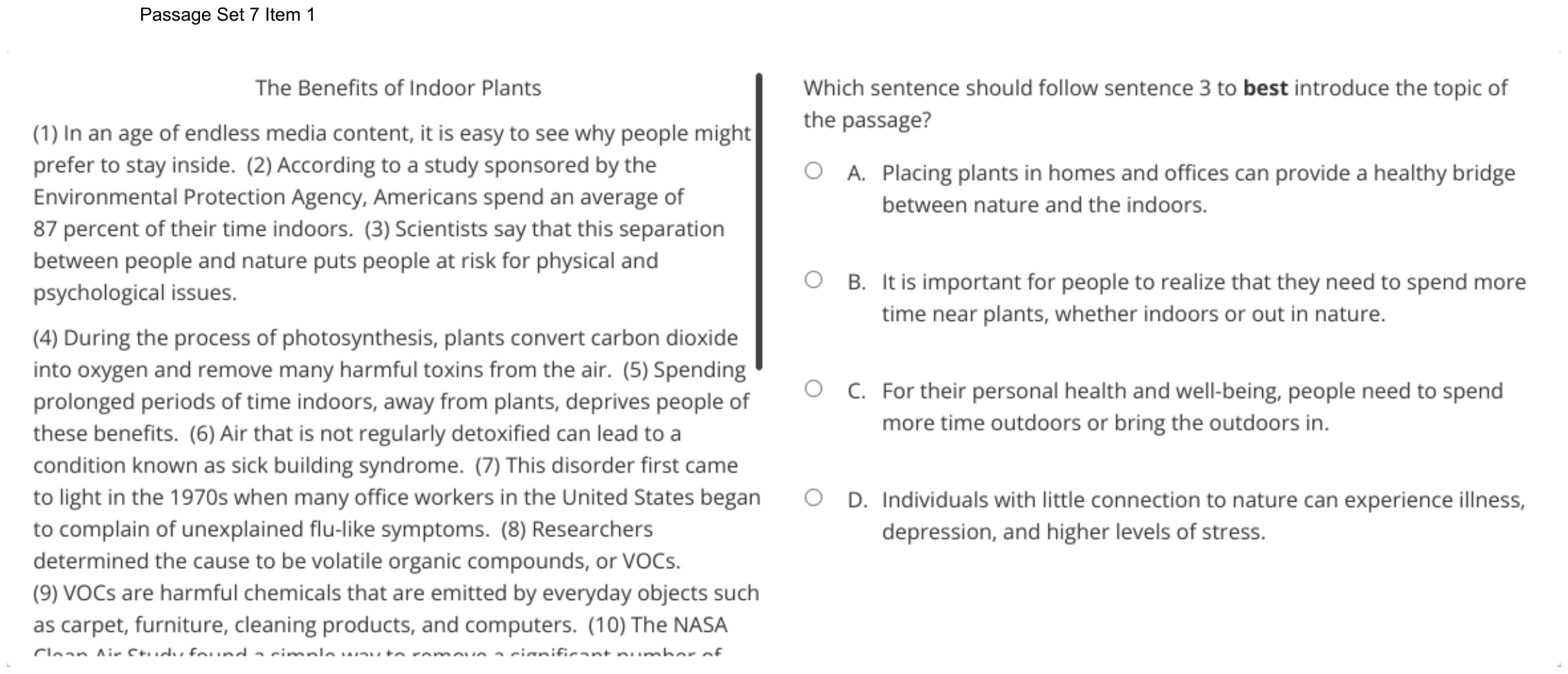
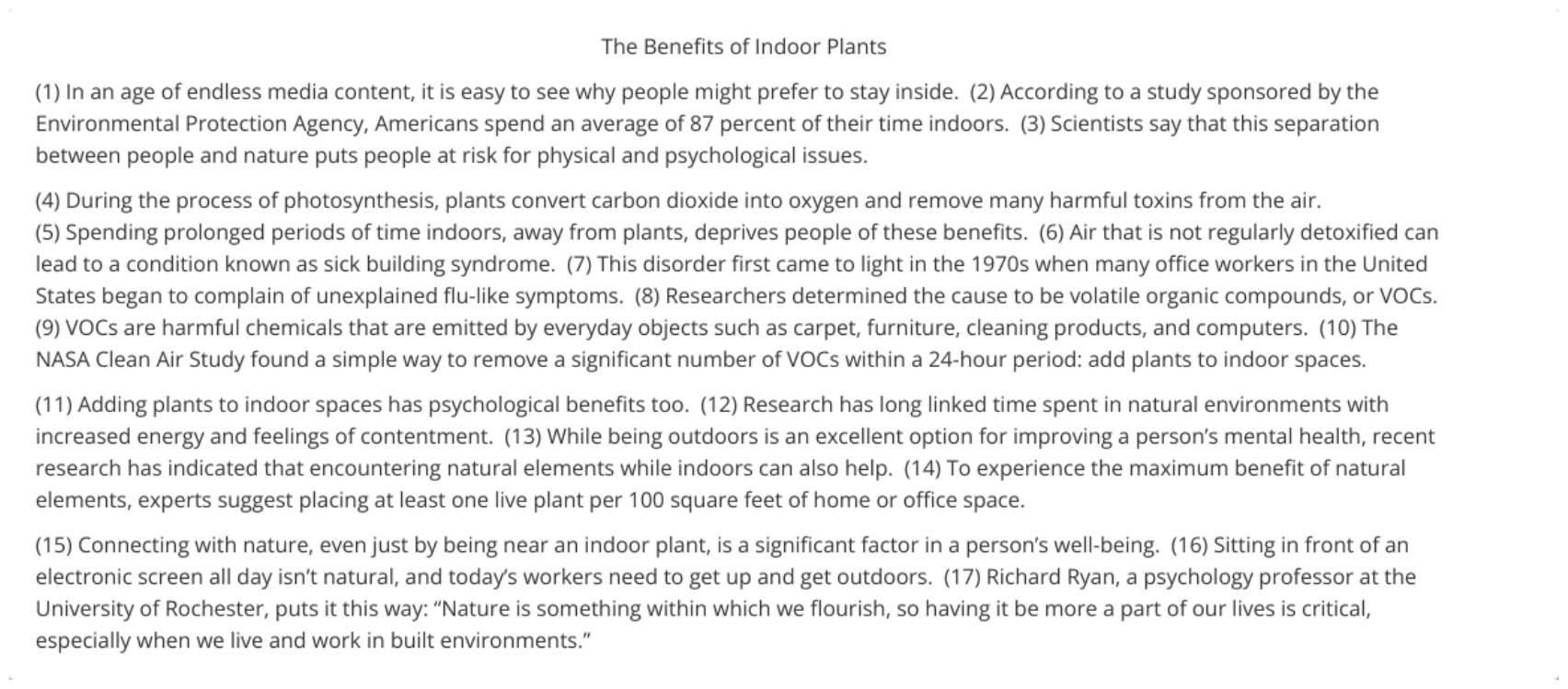
(1) In an age of endless media content, it is easy to see why people might prefer to stay inside. (2) According to a study sponsored by the Environmental Protection Agency, Americans spend an average of 87 percent of their time indoors. (3) Scientists say that this separation between people and nature puts people at risk for physical and psychological issues.
(4) During the process of photosynthesis, plants convert carbon dioxide into oxygen and remove many harmful toxins from the air. (5) Spending prolonged periods of time indoors, away from plants, deprives people of these benefits. (6) Air that is not regularly detoxified can lead to a condition known as sick building syndrome. (7) This disorder first came to light in the 1970s when many office workers in the United States began to complain of unexplained flu-like symptoms. (8) Researchers determined the cause to be volatile organic compounds, or VOCs. (9) VOCs are harmful chemicals that are emitted by everyday objects such as carpet, furniture, cleaning products, and computers. (10) The NASA Clean Air Study found a simple way to remove a significant number of VOCs within a 24-hour period: add plants to indoor spaces.
(11) Adding plants to indoor spaces has psychological benefits too. (12) Research has long linked time spent in natural environments with increased energy and feelings of contentment. (13) While being outdoors is an excellent option for improving a person’s mental health, recent research has indicated that encountering natural elements while indoors can also help. (14) To experience the maximum benefit of natural elements, experts suggest placing at least one live plant per 100 square feet of home or office space.
(15) Connecting with nature, even just by being near an indoor plant, is a significant factor in a person’s well-being. (16) Sitting in front of an electronic screen all day isn’t natural, and today’s workers need to get up and get outdoors. (17) Richard Ryan, a psychology professor at the University of Rochester, puts it this way: “Nature is something within which we flourish, so having it be more a part of our lives is critical, especially when we live and work in built environments.”
Question
Which sentence should follow sentence 3 to best introduce the topic of the passage?
- APlacing plants in homes and offices can provide a healthy bridge between nature and the indoors.
- BIt is important for people to realize that they need to spend more time near plants, whether indoors or out in nature.
- CFor their personal health and well-being, people need to spend more time outdoors or bring the outdoors in.
- DIndividuals with little connection to nature can experience illness, depression, and higher levels of stress.
Show the answer
Correct answer: A
The question asks which sentence should follow sentence 3 to best introduce the topic of the passage.
A. CORRECT. The sentence introduces the overall topic by previewing the main ideas in the passage. It introduces the connection between natural elements and well-being (“a healthy bridge”) and sets up the main argument of the passage (“Placing plants in homes and offices” can increase people’s well-being).
B. Incorrect. Although sentence 3 mentions the connection between “people and nature,” this sentence references the importance of spending time near plants while both indoors and outdoors. However, the passage focuses specifically on the benefits of having indoor plants.
C. Incorrect: Though the sentence describes a reason why indoor plants are important (“For [people’s] personal health and well-being”), the topic of the passage is related to the need for indoor plants, not the need for people to spend more time outdoors.
D. Incorrect. While the sentence refers to how time away from nature can affect health and well-being, the vague wording (“little connection to nature”) makes this sentence too broad to introduce the topic of the passage, and thus, it should not follow sentence 3.
Question analysis
This revising question works with the four-paragraph passage “The Benefits of Indoor Plants” and asks which sentence should follow sentence 3 to introduce the passage's topic. The opening paragraph ends on the health risks of time spent away from nature, and every choice continues that thought in some way, so students must judge which one prepares a reader for what the passage goes on to cover.
- NYS standards
- 7W2a introducing and organizing a topic
- Grade level
- Grade 7 reading and task
- Compared with grade 7
- At grade 7 Introducing a topic so that it previews what follows is a grade 7 writing standard, practised often in class. The passage is short and plainly worded, and the choices differ in focus rather than in grammar, typical grade 7 revision.
- Estimated difficulty
- Moderate: several steps, or a close reading with one strong distractor.
- Thinking it demands
- Depth of knowledge 2, skills and concepts · mainly evaluate
- What makes it hard
- A very close wrong answer moderate
- Evidence in several places moderate
- How sentences fit together minor
- Evidence
- Answered from the whole text
- Reading level
- Passage: about grade 12, 346 words; question and choices: about grade 9, 84 words.
- Students, last 30 days
- Not enough answers yet to show (it takes 10).
Why it is hard, traps and wrong answers (shows the answer)
Why it is hard
The first paragraph ends on a problem, and all four choices continue it plausibly, so the decision is about scope. The passage is about plants indoors, and the near miss offers outdoor time as an equal remedy, while another widens the subject to plants anywhere and a third simply restates the danger. Students who skim the topic sentences of the later paragraphs before choosing see that only an indoor solution introduces what follows.
A very close wrong answer moderate Choosing the answer
The choice ending “or bring the outdoors in” sounds like the key's “bridge between nature and the indoors,” but it adds spending more time outdoors, a remedy the passage does not develop. (Embretson & Wetzel, 1987; Gorin & Embretson, 2006; Ascalon et al., 2007)
Evidence in several places moderate Working it out
The topic only emerges from the later paragraphs: plants cleaning indoor air in sentences 4–10, their psychological benefits in 11–14, and nature brought indoors in 15–17. (Kirsch & Mosenthal, 1990; Gorin & Embretson, 2006)
How sentences fit together minor Working it out
The new sentence must follow sentence 3's warning about “separation between people and nature” and lead into sentence 4's photosynthesis, so it has to name plants as the remedy. (Halliday & Hasan, 1976)
Strategy: Skim the first sentence of each later paragraph to see what the passage actually covers, then test each choice: would it set up those paragraphs without promising something they never discuss?
Traps
- Half right: One half of a two-part choice is right and the other is not.
- Too broad or too strong: A choice overstates, generalizes, or uses absolute words the text does not support.
- Says it twice: Repeats an idea that the sentence or passage already states.
The wrong answers, classified
B Too broad or too strong (King et al., 2004)
Accepts a sentence about needing plants, but “whether indoors or out in nature” widens the subject to plants anywhere, while the passage discusses only plants inside.
C Half right (King et al., 2004; Thissen, Steinberg & Fitzpatrick, 1989)
Is drawn by “bring the outdoors in” and “health and well-being,” but the other half, spending more time outdoors, is a remedy the passage never goes on to develop.
D Says it twice (Connors & Lunsford, 1988)
Follows sentence 3 smoothly by naming illness, depression and stress, but that only restates its “physical and psychological issues” and never introduces plants, the passage's subject.
Working it out, step by step
Figure out what the question asks
This revising question asks you to add a sentence that introduces the topic. Such a sentence tells the reader what the passage will be about. For example, an essay about why dogs make good pets might start: Dogs make loyal, loving pets. The new sentence goes after sentence 3, so it must also follow from it.
Find the passage’s topic
Skim the rest of the passage. Sentences 4–10 tell how plants clean indoor air. Sentences 11–14 say plants indoors help the mind. Sentences 15–17 say even an indoor plant connects you with nature. So the topic is plants inside homes and offices. The title says it too: “The Benefits of Indoor Plants.”
Connect it to sentence 3
Sentence 3 names a problem: “this separation between people and nature puts people at risk for physical and psychological issues.” Psychological means having to do with the mind and feelings. The best next sentence should name the fix the passage talks about: bringing plants indoors.
Check each choice
- A is right. It names plants “in homes and offices” as “a healthy bridge between nature and the indoors.” A bridge connects two things, so plants bring nature inside. That sets up every later paragraph.
- B is wrong. “Whether indoors or out in nature” widens the topic to plants anywhere. The passage only discusses plants inside.
- C is wrong. It offers two fixes: more time outdoors, or bringing the outdoors in. The passage develops only the second. C never even mentions plants.
- D is wrong. It just repeats sentence 3’s problem in new words. It never brings up plants, the subject of the passage.
Look closely at choice C
Watch out: C sounds close because of “bring the outdoors in.” But the passage gives no tips for spending more time outside. Sentence 13 mentions being outdoors only on its way to the indoor point. So half of C promises something the passage never delivers.
Choose the answer
Only one choice moves from sentence 3’s problem to the passage’s answer, plants inside. So the answer is A.
Why this answer and not the closest wrong one
C is the closest wrong answer, because “bring the outdoors in” sounds like A. But C gives equal weight to spending more time outdoors, and the passage never develops that idea. A points only to plants indoors, which is exactly what the rest of the passage is about.
More questions like this
The original DOE question
The passage “The Benefits of Indoor Plants” as printed (page 60)
Question 6 of 57
2023 Test A English, question 6Uses the passage above: “The Benefits of Indoor Plants”.
Question
Which transition word or phrase should be added to the beginning of sentence 5?
- AAs a result,
- BPrimarily,
- CIn contrast,
- DUnfortunately,
Show the answer
Correct answer: D
The question asks for the transition word or phrase that should be added to the beginning of sentence 5.
A. Incorrect. The transition phrase “As a result” conveys a cause-and-effect relationship that does not exist between the ideas in sentence 4 and sentence 5. Although the plants’ conversion of carbon dioxide into oxygen removes harmful toxins from the air, the process of photosynthesis (sentence 4) does not deprive people of the plants’ benefits (sentence 5).
B. Incorrect. Although the passage describes why people should spend time in close proximity to plants, the idea in sentence 5 shifts from the benefits described in sentence 4 to what people lose without them, rather than elaborating on sentence 4. The transition word “Primarily” incorrectly suggests that the sentences describe the same idea.
C. Incorrect. Although sentence 4 describes a positive idea (plants are beneficial) and sentence 5 describes a negative idea (deprivation), the transition phrase “In contrast” conveys an inaccurate relationship between the ideas in the sentences. Sentence 5 is not arguing against the beneficial effect of plants and should not begin with a transition that implies opposition.
D. CORRECT. The relationship between the ideas in the sentences is correctly conveyed with the transition word “Unfortunately,” which signals the shift from the positive effect described in sentence 4 (plants are helpful) to the emphasis in sentence 5 that the positive effect is dependent on proximity to plants.
Question analysis
This transitions question on “The Benefits of Indoor Plants,” a short informational passage, asks which word or phrase should be added to the start of sentence 5. Students must reread sentence 4, on how plants clean indoor air, and sentence 5, on spending long periods indoors, and name the link between them, since all four options are familiar transitions.
- NYS standards
- 7W2d transitions in informative writing
- Grade level
- Grade 7 reading and task
- Compared with grade 7
- At grade 7 Choosing a transition that matches how two sentences relate is everyday grade 7 writing work. Here sentence 5 is not reprinted with the question, so students must find it in the passage first, and more than one option seems to fit.
- Estimated difficulty
- Moderate: several steps, or a close reading with one strong distractor.
- Thinking it demands
- Depth of knowledge 2, skills and concepts · mainly evaluate
- What makes it hard
- How sentences fit together moderate
- Reading between the lines minor
- Evidence
- Answered from one paragraph or stanza
- Reading level
- Passage: about grade 12, 346 words; question and choices: about grade 7, 20 words.
- Corrected from the DOE handbook
- The explanation contradicted itself about how sentences 4 and 5 relate; one sentence was corrected.
- Students, last 30 days
- Not enough answers yet to show (it takes 10).
Why it is hard, traps and wrong answers (shows the answer)
Why it is hard
The question does not print sentence 5, so students first have to find it in the second paragraph and read it beside sentence 4. Two options then sound right: sentence 5 seems to follow from sentence 4, and it moves from good news to bad. Neither fits exactly, because photosynthesis does not cause people to stay inside and missing a benefit does not dispute it, so the point goes to students who hear a writer regretting a loss.
How sentences fit together moderate Working it out
Sentence 5’s “these benefits” points back to the oxygen and cleaner air of sentence 4, and the link it needs is a drawback of that good news, people kept away from plants, rather than a cause or an opposition. (Halliday & Hasan, 1976)
Reading between the lines minor Working it out
“Unfortunately” states no logical relation; it voices the writer’s regret, so students who scan the options for a cause, contrast or emphasis word must infer that sentence 5 turns toward a loss. (Graesser, Singer & Trabasso, 1994; Kintsch, 1998)
Strategy: Read sentences 4 and 5 back to back and say in a few words how the second relates to the first, then try each option at the start of sentence 5 and keep the one that matches.
Traps
- Wrong transition: A connecting word or phrase that signals the wrong relationship, such as contrast where the idea continues.
The wrong answers, classified
A Wrong transition (Halliday & Hasan, 1976)
Treats sentence 5 as an effect of photosynthesis, but plants cleaning the air does not make anyone stay indoors; the loss comes from being away from the plants.
B Wrong transition (Halliday & Hasan, 1976)
Uses “Primarily” as if sentence 5 elaborated on sentence 4’s main point, but sentence 5 moves from what plants give to what people lose without them.
C Wrong transition (Halliday & Hasan, 1976)
Hears the move from the benefits of plants to people missing them as a contrast, but sentence 5 builds on sentence 4 through “these benefits” instead of arguing against it.
What was corrected from the DOE handbook, and why
- Explanation: The DOE’s explanation of Option B (“Primarily”) says “the idea in sentence 5 is actually in opposition to the idea in sentence 4 rather than an elaboration of it.” Its explanation of Option C (“In contrast”) says the opposite: “Sentence 5 is not arguing against the beneficial effect of plants and should not begin with a transition that implies opposition,” and it explains the answer as a shift from the positive effect in sentence 4 to the point that the effect depends on being near plants. The site now says that the idea in sentence 5 shifts from the benefits described in sentence 4 to what people lose without them, rather than elaborating on sentence 4. The site made the same correction to this item as printed in the 2026 practice test (2026 Test A English, question 44). Option B is still wrong, and the answer, D (“Unfortunately”), is unchanged.
Working it out, step by step
Figure out what the question asks
You need a transition to start sentence 5. A transition is a word or phrase that shows how two ideas connect. For example, as a result shows a cause and its effect. To pick one, see how sentence 5 connects to sentence 4, the sentence just before it.
Find sentences 4 and 5
Both are in the second paragraph. Sentence 4 says: “During the process of photosynthesis, plants convert carbon dioxide into oxygen and remove many harmful toxins from the air.”
Sentence 5 says: “Spending prolonged periods of time indoors, away from plants, deprives people of these benefits.”
Work out how they connect
Photosynthesis is the way plants use sunlight to make their food. While they do it, they give off oxygen and clean the air. That is good news. In sentence 5, “prolonged” means long, and “deprives” means keeps from having. The words “these benefits” point back to the oxygen and clean air. So people who stay inside, far from plants, miss out. The paragraph turns from good news to bad news.
Check each choice
- A is wrong. “As a result” means sentence 4 causes sentence 5. But plants cleaning the air does not make people stay indoors.
- B is wrong. “Primarily” means mainly. It suggests sentence 5 says more about the same idea. But sentence 5 moves from what plants give to what people lose without them.
- C is wrong. “In contrast” sets up an opposite idea. But sentence 5 does not argue against sentence 4. It builds on it with “these benefits.”
- D is right. “Unfortunately” means sadly. It warns that bad news comes after good news.
Watch out: C is tempting, because the mood changes from good to bad. But a change in mood is not an opposite. Sentence 4 is still true.
Choose the answer
Sentence 5 would read: Unfortunately, spending prolonged periods of time indoors, away from plants, deprives people of these benefits. So the answer is D.
Why this answer and not the closest wrong one
C is the closest wrong answer, since the paragraph turns from good news to bad. But “In contrast” would mean sentence 5 argues against sentence 4. It doesn’t. Plants still clean the air. Sentence 5 only says that people miss this help when they stay inside. “Unfortunately” shows that sad turn without setting up an opposite.
More questions like this
The original DOE question

Question 7 of 57
2023 Test A English, question 7Uses the passage above: “The Benefits of Indoor Plants”.
Question
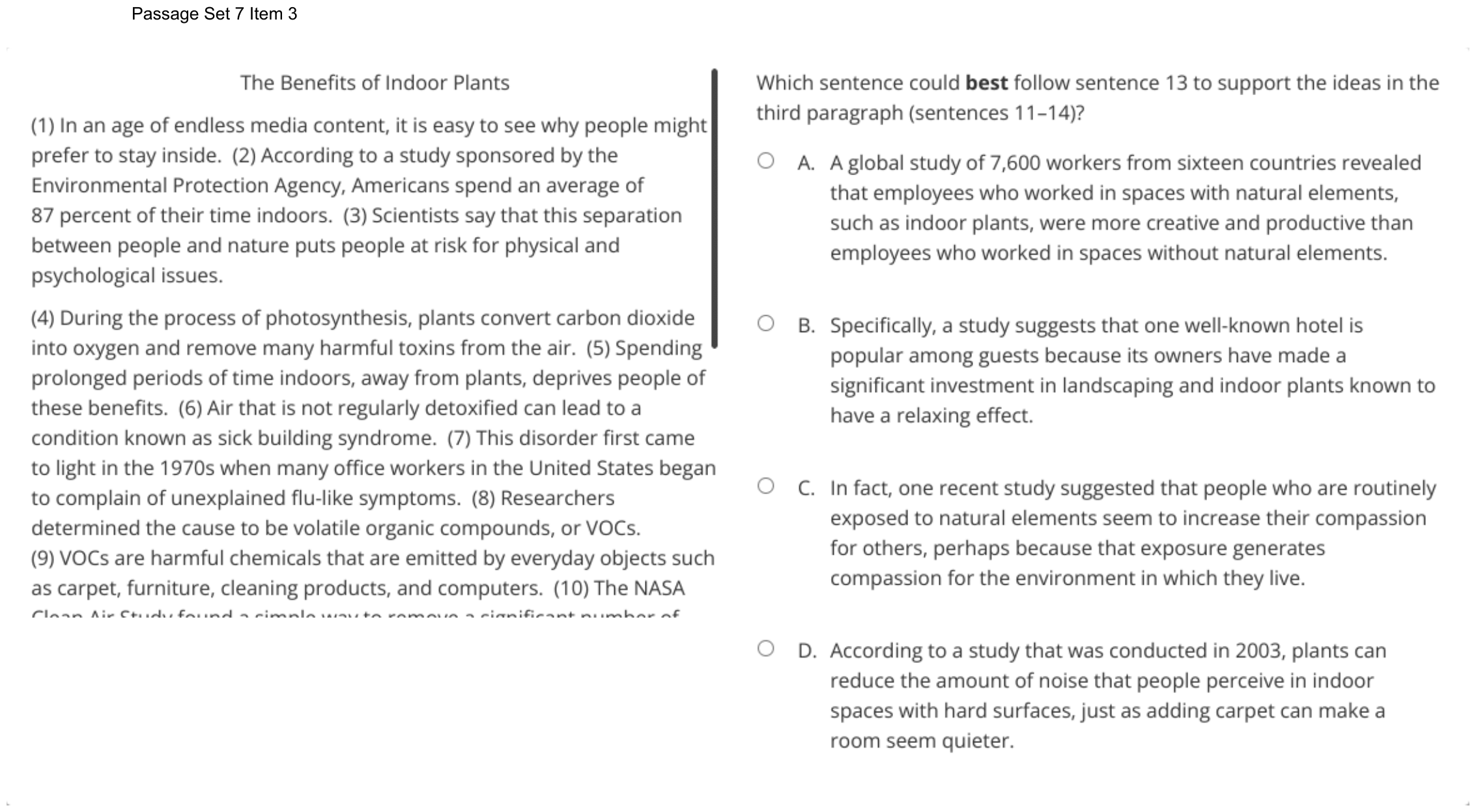
Which sentence could best follow sentence 13 to support the ideas in the third paragraph (sentences 11–14)?
- AA global study of 7,600 workers from sixteen countries revealed that employees who worked in spaces with natural elements, such as indoor plants, were more creative and productive than employees who worked in spaces without natural elements.
- BSpecifically, a study suggests that one well-known hotel is popular among guests because its owners have made a significant investment in landscaping and indoor plants known to have a relaxing effect.
- CIn fact, one recent study suggested that people who are routinely exposed to natural elements seem to increase their compassion for others, perhaps because that exposure generates compassion for the environment in which they live.
- DAccording to a study that was conducted in 2003, plants can reduce the amount of noise that people perceive in indoor spaces with hard surfaces, just as adding carpet can make a room seem quieter.
Show the answer
Correct answer: A
The question asks for the sentence that could best follow sentence 13 to support the ideas in the third paragraph (sentences 11–14).
A. CORRECT. The sentence could best follow sentence 13 because it directly supports the main idea of the third paragraph that indoor plants provide “psychological benefits” (sentence 11) by presenting the findings of a relevant research study. The details about the study provide a concrete example of the mental benefits of indoor plants: the employees in the study who worked near plants “were more creative” and accomplished more than those who worked in spaces without plants.
B. Incorrect. Although the sentence describes a study in which indoor plants were found to have a positive effect, it does not clearly support the ideas in sentences 11–14, because the sentence focuses on the popularity of the hotel rather than psychological benefits. Therefore, this sentence does not best follow sentence 13 to support the ideas in the third paragraph.
C. Incorrect. Although the sentence suggests that being “routinely exposed to natural elements” can increase the positive emotion of compassion, it could not best follow sentence 13, because the reference to “natural elements” is too vague to sufficiently support the ideas in the third paragraph. The sentence does not logically follow the idea from sentence 13, which refers specifically to “encountering natural elements while indoors.”
D. Incorrect. The sentence develops the idea that indoor plants are helpful by comparing them to carpeting and stating that they can reduce the amount of noise that people perceive. Noise cancellation, though convenient, is irrelevant to the topic of the third paragraph, which is specific to the psychological benefits of indoor plants. Therefore, this sentence does not best follow sentence 13 to support the ideas in the third paragraph.
Question analysis
This supporting-details question asks which sentence could best follow sentence 13 to back up the third paragraph (sentences 11–14) of the indoor-plants passage. All four options report a study or finding about plants or nature, so students must check each against what the paragraph is about and where sentence 13 leaves off.
- NYS standards
- 7W2b developing a topic
- Grade level
- Grade 8 reading and task
- Compared with grade 7
- Above grade 7 Grade 7 writers choose relevant evidence for a point. Here each option is a long sentence describing a plausible study, and the best fit depends on matching the paragraph's exact point, a finer judgment than typical grade 7 work.
- Estimated difficulty
- Hard: combines ideas, needs a plan, and has more than one tempting wrong answer.
- Thinking it demands
- Depth of knowledge 2, skills and concepts · mainly evaluate
- What makes it hard
- A very close wrong answer moderate
- How sentences fit together moderate
- A lot to read minor
- Evidence
- Answered from one paragraph or stanza
- Reading level
- Passage: about grade 12, 346 words; question and choices: about grade 15, 151 words.
- Students, last 30 days
- Not enough answers yet to show (it takes 10).
Why it is hard, traps and wrong answers (shows the answer)
Why it is hard
Every option cites a study about plants or nature, and two name feelings, a relaxing effect and compassion, which sound more psychological than the key's creativity and productivity. The decision rests on two conditions from the paragraph: the benefit must be psychological, and the nature must be indoors. Students who test only one condition end up with the compassion study, which is not about indoor spaces, or the hotel, whose finding is about popularity.
A very close wrong answer moderate Choosing the answer
The compassion choice and the key both report a study tying natural elements to a mental effect; the compassion study drops the indoor setting that sentence 13 specifies and turns to caring for others. (Embretson & Wetzel, 1987; Gorin & Embretson, 2006; Ascalon et al., 2007)
How sentences fit together moderate Working it out
The added sentence sits between sentence 13's research on “encountering natural elements while indoors” and sentence 14's one plant per 100 square feet, so it must give evidence about nature indoors. (Halliday & Hasan, 1976)
A lot to read minor Understanding the question
The options run 31 to 37 words, each describing a different study, so four separate findings must be read and held against the paragraph's point. (Kintsch, 1998; Gorin & Embretson, 2006; Freedle & Kostin, 1993)
Strategy: Restate sentences 11 and 13 in your own words, then ask of each option whether it gives evidence for that exact point or for a related benefit the paragraph does not discuss.
Traps
- Off the point: Adds or keeps something that does not support the paragraph's or the passage's focus, or an introduction or conclusion that misses the main point.
- Too broad or too strong: A choice overstates, generalizes, or uses absolute words the text does not support.
The wrong answers, classified
B Off the point (Halliday & Hasan, 1976)
Spots indoor plants and a “relaxing effect,” but the finding is that a hotel is popular with guests, a business result rather than evidence about people's well-being.
C Too broad or too strong (King et al., 2004)
Sees compassion as a psychological benefit, but the study covers exposure to “natural elements” in general, not the indoor encounters of sentence 13, and its benefit is caring for others.
D Off the point (Halliday & Hasan, 1976)
Accepts any benefit of indoor plants, but rooms that seem quieter are an acoustic advantage, not the psychological effects that sentence 11 names as the paragraph's subject.
Working it out, step by step
Figure out what the question asks
This revising question asks for a supporting detail. A supporting detail is a fact or example that backs up a paragraph’s point. The new sentence goes after sentence 13, in the third paragraph. So first pin down that paragraph’s exact point.
Find the paragraph’s point
Sentence 11 states it: “Adding plants to indoor spaces has psychological benefits too.” Psychological benefits are good effects on the mind and feelings. Sentence 13 adds that “encountering natural elements while indoors can also help.” Natural elements are bits of nature, like plants.
Set two tests
So the new sentence must pass two tests. First, it must show a benefit for the mind. Second, it must be about nature indoors. Think of a paragraph about how bedtime reading helps kids sleep. A study about bedtime reading would fit. A study about reading on the bus would not.
Check each choice
- A is right. Workers near “natural elements, such as indoor plants,” were “more creative and productive.” Creative means good at new ideas. Productive means getting more done. Both are benefits for the mind, and the plants are indoors.
- B is wrong. The finding is that a hotel is popular with guests. That is about business, not people’s minds.
- C is wrong. It is about being “routinely exposed to natural elements” anywhere, not indoors. Its benefit is caring for others.
- D is wrong. Making a room seem quieter is about sound, not the mind.
Watch out: C names a feeling, compassion, so it sounds like a benefit for the mind. But it drops the indoor setting that sentence 13 is about.
Choose the answer
Only one choice shows a benefit for the mind from nature indoors. So the answer is A.
Why this answer and not the closest wrong one
C is the closest wrong answer, because compassion is a feeling. But its study is about natural elements in general, not inside a building. Sentence 13 is about nature indoors, and sentence 14 tells how many plants to put in a room. A fits right between them.
More questions like this
The original DOE question
Question 8 of 57
2023 Test A English, question 8Uses the passage above: “The Benefits of Indoor Plants”.
Question
Which sentence presents ideas irrelevant to the topic of the passage and should be deleted?
- Asentence 11
- Bsentence 14
- Csentence 15
- Dsentence 16
Show the answer
Correct answer: D
The question asks for the sentence that presents ideas irrelevant to the topic of the passage and should be deleted.
A. Incorrect. Sentence 11 presents one of the key reasons why plants are so important in indoor spaces: they have a positive effect on mental health. The idea that plants provide psychological benefits is relevant to the topic of the passage, and the sentence should not be deleted.
B. Incorrect. Sentence 14 is relevant to the topic because it explains how many plants a person should add to a space in order to experience “the maximum benefit of natural elements.” This idea addresses the main topic of the passage, and the sentence should not be deleted.
C. Incorrect. Although “connecting with nature” is somewhat broader than the topic of the passage, sentence 15 is relevant and belongs in the passage because it specifically refers to using indoor plants as one way to connect with nature (“even just by being near an indoor plant”). Therefore, the sentence should not be deleted.
D. CORRECT. While the topic of the passage is the harm caused by the “separation between people and nature” (sentence 3), the reference in sentence 16 to “an electronic screen” is irrelevant to the topic of the passage. The idea that “today’s workers need to get up and get outdoors” (sentence 16) is, in fact, the opposite of what the passage argues, and the sentence should be deleted.
Question analysis
Which sentence in the last two paragraphs of the indoor-plants passage presents ideas irrelevant to its topic and should be deleted? Each of the four listed sentences mentions nature, plants or well-being in some way, so students must pin down exactly what the passage argues before deciding which one does not serve it.
- NYS standards
- 7W2b developing a topic
- Grade level
- Grade 7 reading and task
- Compared with grade 7
- At grade 7 Spotting a sentence that strays from a passage's topic is regular grade 7 revision work. The passage is short and plainly worded, and its topic is named in its title, so this is a typical grade 7 demand.
- Estimated difficulty
- Straightforward: two steps or one careful reading.
- Thinking it demands
- Depth of knowledge 2, skills and concepts · mainly analyze
- What makes it hard
- How sentences fit together moderate
- Every choice must be checked minor
- Evidence
- Answered from the whole text
- Reading level
- Passage: about grade 12, 346 words; question and choices: about grade 6, 19 words.
- Students, last 30 days
- Not enough answers yet to show (it takes 10).
Why it is hard, traps and wrong answers (shows the answer)
Why it is hard
The stray sentence is camouflaged by its links to the opening: screens recall the media of sentence 1, and “isn't natural” sounds like the passage's theme. What gives it away is its advice, to leave the building, when the passage argues for bringing nature into it, along with its chatty tone. Students who cut a sentence for being general or practical have judged by style rather than by the passage's claim.
How sentences fit together moderate Working it out
Sentence 16 echoes sentence 1's “endless media content” with its “electronic screen,” so it seems connected, yet its call to “get outdoors” pulls against a passage about bringing plants inside. (Halliday & Hasan, 1976)
Every choice must be checked minor Choosing the answer
The four listed sentences span paragraphs 3 and 4, and each mentions nature, plants or well-being, so each must be read in place and tested against the passage's point. (Embretson & Wetzel, 1987)
Strategy: Say in one phrase what the whole passage argues, then read each listed sentence in place and ask whether it supports that argument or steers the reader toward a different idea.
Traps
- Fixes what isn't broken: Changes a part of the sentence that was already correct, while the real error stays; or, where the question asks which sentence has an error or should go, picks one that is correct and belongs.
The wrong answers, classified
A Fixes what isn't broken (Connors & Lunsford, 1988)
Cuts sentence 11 because it turns from air quality to the mind, though it is the topic sentence of the paragraph on psychological benefits.
B Fixes what isn't broken (Connors & Lunsford, 1988)
Sees the advice of one live plant per 100 square feet as a practical aside, though it tells readers how to get the benefit the passage describes.
C Fixes what isn't broken (Connors & Lunsford, 1988)
Thinks sentence 15's “connecting with nature” strays beyond indoor plants, missing that “even just by being near an indoor plant” ties it directly to the passage's topic.
Working it out, step by step
Figure out what the question asks
You need to find the sentence that is off topic. Every sentence in a passage should support its main point. For example, in a paragraph about why dogs make good pets, My cousin has a red bike doesn’t belong. You would cut a sentence like that.
Name the passage’s topic
The title is “The Benefits of Indoor Plants.” The passage says plants inside clean the air and help the mind. Its fix for too much time indoors is to bring nature inside, with plants in homes and offices.
Read sentence 16 in place
Sentence 16 says, “Sitting in front of an electronic screen all day isn’t natural, and today’s workers need to get up and get outdoors.” It switches to screens. It tells workers to go outside. It never mentions plants. The passage doesn’t object to going outdoors. Sentence 13 even calls it “an excellent option.” But sentence 16 steers away from the topic, plants indoors, to a different fix.
Check each choice
- A is wrong. Sentence 11 is the third paragraph’s topic sentence: plants indoors help the mind.
- B is wrong. Sentence 14 tells how many plants to use, one per 100 square feet. That helps readers get the benefit.
- C is wrong. “Connecting with nature” sounds broad. But it adds “even just by being near an indoor plant,” which ties it to the topic.
- D is right. Sentence 16 is about screens and going outside, not indoor plants.
Watch out: Sentence 15 is tempting because it starts with a big idea. Read the whole sentence before you cut it.
Choose the answer
Without sentence 16, sentence 15 leads straight into the professor’s words about nature in our lives. Nothing is lost. So the answer is D, sentence 16.
Why this answer and not the closest wrong one
Sentence 15 is the closest wrong answer, because “connecting with nature” sounds wider than the topic. But it names an indoor plant, so it supports the passage. Sentence 16 names no plant at all. It sends workers outdoors, a different idea from bringing nature inside.
More questions like this
The original DOE question
Question 9 of 57
2023 Test A English, question 9Uses the passage above: “The Benefits of Indoor Plants”.
Question
Which concluding sentence should follow sentence 17 to best support the information presented in the passage?
- ABecause indoor plants absorb the carbon dioxide in our air and release the oxygen we need to breathe, they are vital to our wholeness and wellness.
- BExperts say that adding a Boston fern, a spider plant, or an aloe vera plant is a good place to start if you want to begin to incorporate nature into your home or office.
- CMore people should consider bringing natural elements inside to improve general wellness and reverse some of the negative effects of an indoor-centered society.
- DAs one study has confirmed, houseplants are a wise investment because they can remove almost 90 percent of the toxins in the air within the span of 24 hours.
Show the answer
Correct answer: C
The question asks for the concluding sentence that should follow sentence 17 to best support the information presented in the passage.
A. Incorrect. Although the sentence describes plants as “vital to our wholeness and wellness,” the detail about the absorption of carbon dioxide from the air is overly specific and does not capture the broader argument presented in the passage (that placing plants indoors “is a significant factor in a person’s well-being” [sentence 15]).
B. Incorrect. The sentence’s reference to particular types of plants suitable for indoor spaces supports the idea of incorporating nature into a home or office, but the sentence does not address the benefits people can experience for doing so and thus does not present a logical conclusion for the information in the passage.
C. CORRECT. The sentence directly presents the argument of the passage (“More people should consider bringing natural elements inside”) and supports the central ideas in the second and third paragraphs relating to the health and psychological benefits of having indoor plants.
D. Incorrect. Although the sentence notes the positive impact that houseplants can have on air quality, the sentence does not logically follow the preceding information about the overall benefits to a person’s health and well-being.
Question analysis
This conclusion question asks which sentence should follow the last line of the indoor-plants passage, a quotation from a psychology professor about nature and people who live and work in built environments. Students must choose an ending that fits the passage as a whole, not only its last paragraph, and every option sounds like a reasonable closing line when read on its own.
- NYS standards
- 7W2e concluding informative writing
- Grade level
- Grade 7 reading and task
- Compared with grade 7
- At grade 7 Choosing a concluding sentence that reflects a whole passage is standard grade 7 writing work. The passage is seventeen plain sentences, so keeping its main points in view is manageable, and the task matches typical grade 7 revision.
- Estimated difficulty
- Straightforward: two steps or one careful reading.
- Thinking it demands
- Depth of knowledge 2, skills and concepts · mainly evaluate
- What makes it hard
- Evidence in several places moderate
- The right answer is reworded minor
- Evidence
- Answered from the whole text
- Reading level
- Passage: about grade 12, 346 words; question and choices: about grade 13, 125 words.
- Students, last 30 days
- Not enough answers yet to show (it takes 10).
Why it is hard, traps and wrong answers (shows the answer)
Why it is hard
Three of the endings sound like conclusions: one praises plants as “vital,” one offers practical first steps, and one cites a striking statistic. Only one, though, restates the passage's whole argument, that people should bring nature indoors for their health. Students lose the point when an ending repeats a single fact, such as photosynthesis or toxin removal, or adds new specifics, and the question rewards weighing each ending against all four paragraphs.
Evidence in several places moderate Working it out
A fitting ending must gather the air-cleaning benefits of sentences 4–10, the psychological benefits of 11–14 and the closing case for keeping nature near, ideas that lie across three paragraphs. (Kirsch & Mosenthal, 1990; Gorin & Embretson, 2006)
The right answer is reworded minor Choosing the answer
The key speaks of “natural elements” and “an indoor-centered society,” new wording for the passage's argument, while two wrong endings repeat its carbon dioxide, oxygen and toxins. (Freedle & Kostin, 1993; Kirsch & Mosenthal, 1990)
Strategy: List what each paragraph contributes, then choose the ending that sums up the passage's message rather than repeating a single fact or adding a new one.
Traps
- Too narrow: A single detail offered as the central idea or a summary, or a summary that keeps minor details and leaves out an essential part.
- Off the point: Adds or keeps something that does not support the paragraph's or the passage's focus, or an introduction or conclusion that misses the main point.
The wrong answers, classified
A Too narrow (King et al., 2004)
Likes the conclusive “vital to our wholeness and wellness,” but the ending rests on one air-quality fact from sentence 4 and leaves out the psychological benefits.
B Off the point (Halliday & Hasan, 1976)
Likes ending on a practical first step, but naming a Boston fern, a spider plant and aloe vera adds new details and says nothing about why plants help.
D Too narrow (King et al., 2004)
Returns to the toxin-removal finding of paragraph 2 with a new figure, “almost 90 percent,” narrowing the ending to air quality and dropping the mental-health benefits.
Working it out, step by step
Figure out what the question asks
You need a concluding sentence, the last line of the passage. A good conclusion sums up the main point of the whole passage. It doesn’t add new facts. For example, an essay about recess might end: Recess helps kids’ bodies and minds, so schools should keep it.
Sum up the passage
- Sentences 1–3: People spend most of their time indoors, away from nature, and that puts their health at risk.
- Sentences 4–10: Indoor plants clean the air.
- Sentences 11–14: Indoor plants help the mind.
- Sentences 15–17: Being near nature, even one plant, matters for well-being.
So the main point is: bring nature indoors to help both body and mind.
Check each choice
- A is wrong. It rests on one fact from sentence 4, about carbon dioxide and oxygen. It leaves out the benefits for the mind.
- B is wrong. It adds new details, three kinds of plants. It doesn’t say why plants help.
- C is right. “Bringing natural elements inside” is the passage’s fix. Wellness means good health, of body and mind. “An indoor-centered society” recalls sentences 1 and 2, about people staying inside.
- D is wrong. It brings back only the toxins, with a new number, “almost 90 percent.” It drops the benefits for the mind.
Watch out: A sounds like an ending because it calls plants “vital to our wholeness and wellness.” But its reason covers only the air we breathe.
Choose the answer
Only one ending sums up the whole passage: people should bring nature inside for their health. So the answer is C.
Why this answer and not the closest wrong one
A is the closest wrong answer, because it sounds like a strong ending. But it repeats one fact, that plants turn carbon dioxide into oxygen. The passage also argues that plants help the mind. C covers the whole argument: bring nature inside to improve wellness.
More questions like this
The original DOE question
Question 10 of 57
2023 Test A English, question 10Passage A Memory Revolution
A Memory Revolution
A high school senior logs on to a computer at the library to double-check the application due date listed on a college admissions website. Nearby, a librarian helps a group of biology students use a database to search for recent studies about mammals. In the past few decades, the Internet has become an integral component of daily life for many people. The seemingly limitless power of search engines made the Internet search extremely common, and today people increasingly rely on the Internet’s vast accumulation of sources to access all types of information. Scientists are beginning to examine how this reliance is modifying the strategies people use to store and prioritize information in their mind.
A Dependable and Valuable Asset
Psychologist Benjamin Storm from the University of California, Santa Cruz, and researchers Sean Stone and Aaron Benjamin devised an experiment to study students’ tendency to depend on the Internet for facts. To begin, the scientists divided sixty participants into multiple groups, including an “Internet” group and a “memory” group, and placed them in front of computers. The Internet group was required to use the search engine Google to answer eight challenging trivia questions. In contrast, participants in the memory group were permitted to use only their personal knowledge to answer the questions. In the second round, the researchers administered notably easier questions. This time, they allowed each group the option of using Google as they answered. Their results showed that 83 percent of the Internet group continued to consult Google in the second round, while only 63 percent of the memory group chose to do so.
People’s growing inclination to rely on the Internet in order to retrieve information, particularly facts and figures, is called cognitive offloading. Canadian researcher Evan F. Risko and British researcher Sam Gilbert, who have written extensively about the topic, say a similar process has been taking place for centuries. In the past, people used resources like encyclopedias to assist their memories; however, today the Internet, serving as a vast extended memory, allows people to digitally access and retrieve much larger volumes of information. Consequently, people’s minds are free for other cognitive feats, such as connecting data, learning new information, or solving problems.
Filing Information Away
The use of the Internet also appears to be modifying the strategies people use to store information in their mind. Researchers Betsy Sparrow from Columbia University, Jenny Liu from the University of Wisconsin-Madison, and Daniel Wegner from Harvard University conducted several studies to discover how people efficiently manage their information intake.
To begin, the researchers examined how people evaluate which information deserves their effort to remember. For this experiment, participants read forty trivia facts, such as “An ostrich’s eye is bigger than its brain,” and typed the statements into a computer file. Half the participants had been previously told the file would be saved, while half believed it would be erased. Next, the participants wrote down every fact they could recall. Those who believed the information would be erased and no longer available could recall 40 percent more facts than those who thought the information would be saved.
In another experiment, the same researchers tested the ability of study participants to remember where to access information. For this trial, participants read and typed trivia statements, which they saved in folders with generic names such as “Facts” and “Items.” After spending ten minutes writing down all the facts they could recall from memory, participants were asked which folder contained a particular fact based on a keyword. For example, “Which folder has the fact about ostriches?” Overall, participants recalled the information’s location more often than the content itself, correctly identifying 49 percent of the folders for specific facts while remembering only 23 percent of the actual trivia. The researchers concluded that our memory is adapting to the Internet age by prioritizing where to locate information even when the specific details are forgotten. According to Sparrow, the Internet has become an important form of transactive memory, an external source of the recollections and associative networks that constitute memory.
As the Internet’s resources continue to expand our “external” memory, some question whether the process may cause people to depend too heavily on technology. However, Steven Pinker, a professor of psychology at Harvard University, says, “Knowledge is increasing exponentially; human brainpower and waking hours are not. Fortunately, the Internet and information technologies are helping us manage, search and retrieve our collective intellectual output at different scales, from Twitter and previews to e-books and online encyclopedias. Far from making us stupid, these technologies are the only things that will keep us smart.”
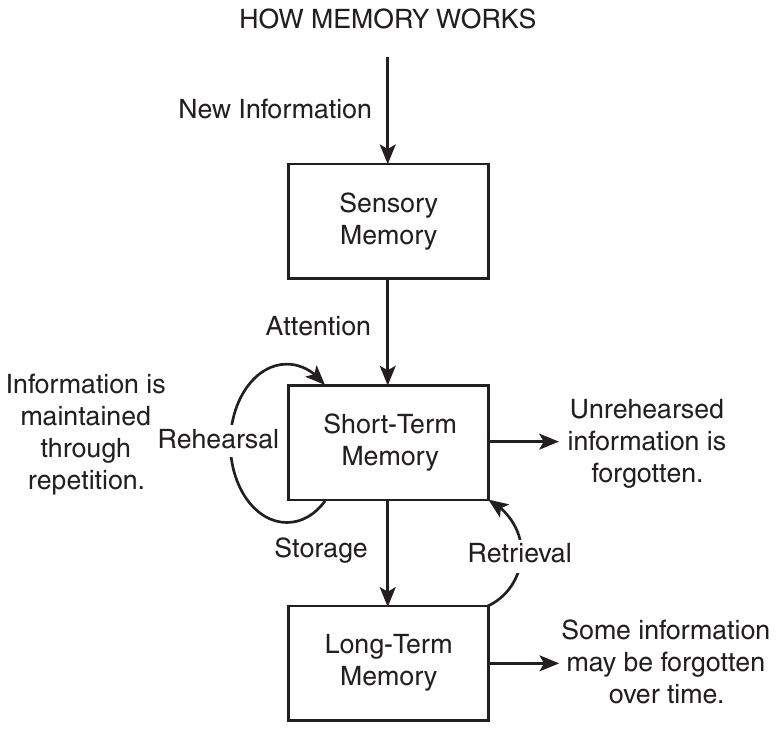
Question
The details in paragraph 3 about cognitive offloading convey a central idea of the passage by
- Asuggesting that reliance on the Internet for information is inevitable.
- Bdemonstrating how the methods used to store and find information have changed over time.
- Cexplaining how encyclopedias and the Internet are similar sources of information.
- Dimplying that more information can be understood now than ever before.
Show the answer
Correct answer: B
The question asks how the details in paragraph 3 about cognitive offloading convey a central idea of the passage.
A. Incorrect. Although paragraph 3 describes the Internet as “a vast extended memory,” it does not present reliance on the Internet for information as inevitable. The paragraph states that the Internet “allows people to digitally access and retrieve much larger volumes of information” and indicates that this benefit leaves people free to focus on “connecting data, learning new information, or solving problems.” However, these details about the benefits of the Internet do not express an opinion about the inevitability of Internet reliance.
B. CORRECT. A central idea of the passage is that the Internet is changing how people retain information. Paragraph 3 supports this idea by stating that “a similar process has been taking place for centuries” and that “in the past,” resources such as encyclopedias were used to store and find information. The details provided in paragraph 3 about encyclopedias and the Internet show that people have always used resources to remember information and that these resources change over time as people develop new ways to “assist their memories.”
C. Incorrect. While paragraph 3 does compare the use of encyclopedias to obtain information in the past with the use of today’s Internet, this comparison fails to convey the central idea of the passage that the Internet is changing how people remember information.
D. Incorrect. Although paragraph 3 states that “much larger volumes of information” are available on the Internet than what has been available in previous methods of information storage, such as encyclopedias, this fact does not relate to an increase in the ability to understand that information and is not a central idea of the passage.
Question analysis
This central-idea question on “A Memory Revolution,” an article about how relying on the Internet affects the way people remember, asks how the details about cognitive offloading in paragraph 3 convey a central idea of the passage. The paragraph mentions encyclopedias, the Internet and freed-up minds, and the choices each build on a different detail, so students must see what the paragraph adds to the article as a whole.
- Grade level
- Grade 8 reading and task
- Compared with grade 7
- At grade 7 Tying one paragraph’s details to a central idea is regular grade 7 work. Paragraph 3 is short, but terms such as “cognitive offloading” and “extended memory” are abstract, and students must settle on the article’s central idea before judging the paragraph.
- Estimated difficulty
- Moderate: several steps, or a close reading with one strong distractor.
- Thinking it demands
- Depth of knowledge 2, skills and concepts · mainly understand
- What makes it hard
- The right answer is reworded moderate
- A very close wrong answer minor
- Hard words minor
- Evidence
- Answered from one paragraph or stanza
- Reading level
- Passage: about grade 14, 763 words; question and choices: about grade 11, 61 words.
- Corrected from the DOE handbook
- An inaccurate statement about paragraph 3 in the explanation was corrected.
- Students, last 30 days
- Not enough answers yet to show (it takes 10).
Why it is hard, traps and wrong answers (shows the answer)
Why it is hard
Paragraph 3 is built on a then-and-now contrast: encyclopedias once helped people remember, and today the Internet does the same job on a far larger scale. Students who notice only the pairing take it for a likeness, while those who stop at the opening “growing inclination to rely on the Internet” are tempted to call the reliance unstoppable. The point goes to students who first name the article’s central idea, that the Internet is changing how people remember, and then read the paragraph as one stage in a long history.
The right answer is reworded moderate Choosing the answer
The key’s “methods used to store and find information have changed over time” appears nowhere in paragraph 3, while the wrong choices stay near its own wording: reliance on the Internet, encyclopedias beside the Internet, and more information. (Freedle & Kostin, 1993; Kirsch & Mosenthal, 1990)
A very close wrong answer minor Choosing the answer
The choice calling encyclopedias and the Internet similar sources sets up the same old-and-new pairing as the key; it parts only on likeness versus change, which the paragraph’s “however, today” decides. (Embretson & Wetzel, 1987; Gorin & Embretson, 2006; Ascalon et al., 2007)
Hard words minor Understanding the question
The paragraph explains its idea in abstract terms, “cognitive offloading,” “a vast extended memory” and “other cognitive feats,” which must be decoded before its then-and-now structure shows. (Perfetti, 2007; Freedle & Kostin, 1993)
Strategy: Put the article’s central idea about the Internet and memory into your own words first, then test each choice against what paragraph 3’s sentences actually say, not against a word it shares with them.
Traps
- True but not the answer: A choice says something accurate about the text that does not answer this question.
- Twists what the text says: Uses the text's topic and ideas but changes what it says: who did it, how much, when, or why.
- Too broad or too strong: A choice overstates, generalizes, or uses absolute words the text does not support.
The wrong answers, classified
A Too broad or too strong (King et al., 2004)
Builds on the “growing inclination to rely on the Internet” and a process “taking place for centuries,” then hardens them into “inevitable,” a claim the paragraph never makes.
C True but not the answer (King et al., 2004; Embretson & Wetzel, 1987)
Sees, accurately, that paragraph 3 sets encyclopedias beside the Internet as aids to memory, but stops at the likeness and misses the “however” that turns the comparison into a change.
D Twists what the text says (King et al., 2004)
Matches “much larger volumes of information” to more information and swaps the paragraph’s “access and retrieve” for “understood,” though reaching more facts is not grasping them better.
What was corrected from the DOE handbook, and why
- Explanation: The DOE’s explanation of Option A says that paragraph 3 “does not discuss reliance on the Internet for information.” It does: the paragraph opens “People’s growing inclination to rely on the Internet in order to retrieve information, particularly facts and figures, is called cognitive offloading.” What the paragraph does not do is present that reliance as inevitable, which is why Option A is wrong, as the explanation’s last sentence says. The site now reads “it does not present reliance on the Internet for information as inevitable.”
Working it out, step by step
Figure out what the question asks
This is a central idea question. A central idea is a main point the whole article makes. Here the main point is that the Internet is changing how people remember. The question asks how paragraph 3 adds to that point. Paragraph 3 is about “cognitive offloading,” so first work out what that term means.
Read paragraph 3 closely
Paragraph 3 begins: “People’s growing inclination to rely on the Internet in order to retrieve information, particularly facts and figures, is called cognitive offloading.” Then it says “a similar process has been taking place for centuries.” Next comes the key sentence: “In the past, people used resources like encyclopedias to assist their memories; however, today the Internet, serving as a vast extended memory, allows people to digitally access and retrieve much larger volumes of information.”
Put the paragraph in plain words
An inclination is a habit of leaning toward something. Cognitive means having to do with thinking. To offload is to hand a load to someone else. So cognitive offloading means letting an outside tool do some of your remembering. People have done this for a long time. Long ago they used encyclopedias, books full of facts. Today they use the Internet. The word “however” marks the change from then to now. So the paragraph shows the tools for storing and finding facts changing over time.
Check each choice
- A does not fit. The paragraph does talk about people relying on the Internet. But it never says that reliance is inevitable, which means it cannot be avoided.
- B fits. The paragraph moves from encyclopedias “in the past” to the Internet “today.” That is a change in how people store and find information.
- C does not fit. The paragraph does set the two side by side. But it uses them to show a change, not to say they are alike.
- D does not fit. People can “access and retrieve” more information. That means find it and pull it up, not understand it.
Watch out: C is tempting because encyclopedias and the Internet both help memory. Read past the likeness to the word “however.”
Choose the answer
Paragraph 3 shows people moving from encyclopedias to the Internet to help them remember. That supports the article’s point that the Internet is changing memory. So the answer is B, “demonstrating how the methods used to store and find information have changed over time.”
Why this answer and not the closest wrong one
C is the closest wrong choice. Paragraph 3 does compare encyclopedias and the Internet. But the comparison makes a point about change: the Internet now holds “much larger volumes of information.” B names that change. C stops at the likeness, so it misses what the paragraph adds to the article.
More questions like this
The original DOE question
The passage “A Memory Revolution” as printed (pages 3–4)
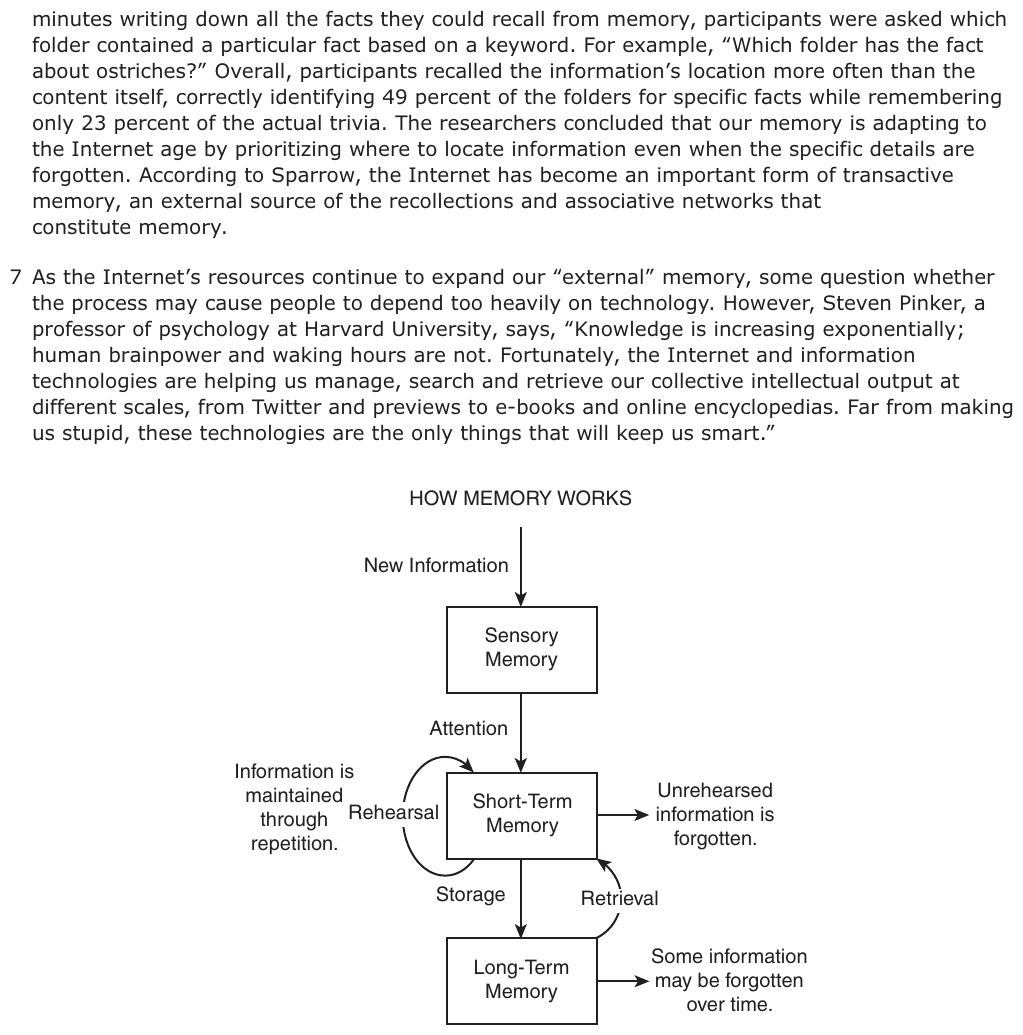
Question 11 of 57
2023 Test A English, question 11Uses the passage above: “A Memory Revolution”.
Question
How do the details about the experiment described in paragraph 5 convey a central idea of the passage?
- AThey suggest that the act of repeating information by typing it on a keyboard may improve a person’s memory.
- BThey explain that a person will forget information faster if the information is considered unimportant.
- CThey indicate that a person may start to forget details when the amount of information becomes overwhelming.
- DThey suggest that memory is affected by whether a person expects to have access to the information in the future.
Show the answer
Correct answer: D
The question asks how the details of the experiment described in paragraph 5 convey a central idea of the passage.
A. Incorrect. Although paragraph 5 states that participants read the trivia facts and then “typed the statements into a computer file,” it does not explain the impact of repetition on memory, nor does this convey a central idea of the passage.
B. Incorrect. Paragraph 5 acknowledges that people evaluate which information is important enough to remember, but it does not describe the rate at which people forget unimportant information. According to the paragraph, information is considered less important to remember if a person believes that he or she will be able to retrieve that information easily in the future. This does not mean the information is unimportant but rather that it is readily available for future access.
C. Incorrect. Paragraph 5 specifies the number of trivia facts that study participants were given to read (forty), but it does not describe the amount of information as a factor in the participants’ memory performance. According to the paragraph, it was not the amount of information but rather the expectation of future availability that affected how much information participants were able to recall.
D. CORRECT. A central idea of the passage is that the way the human memory stores information is changing because of the Internet. The details of the experiment support this idea by indicating that study participants remembered different amounts of information based on whether they “thought the information would be saved” (paragraph 5). Those who “believed the information would be erased and no longer available” (paragraph 5) remembered 40 percent more than those who expected to be able to access the information again in a saved computer file. Therefore, paragraph 5 conveys the central idea that the expectation of future access to information is a key element in “how people evaluate which information deserves their effort to remember.”
Question analysis
Paragraph 5 of “A Memory Revolution” describes an experiment in which people typed forty trivia facts, such as one about an ostrich’s eye, into a computer file and then wrote down all they could recall. This central-idea question asks how the experiment’s details convey a central idea of the passage. Each choice offers a different lesson about memory, so the experiment’s actual result must decide.
- Grade level
- Grade 7 reading and task
- Compared with grade 7
- At grade 7 Explaining what an experiment’s results show is common grade 7 reading. The experiment in paragraph 5 is told in plain words and its result is a single comparison, so the main demand is restating that result as an idea.
- Estimated difficulty
- Straightforward: two steps or one careful reading.
- Thinking it demands
- Depth of knowledge 2, skills and concepts · mainly understand
- What makes it hard
- Evidence
- Answered from one paragraph or stanza
- Reading level
- Passage: about grade 14, 763 words; question and choices: about grade 12, 88 words.
- Students, last 30 days
- Not enough answers yet to show (it takes 10).
Why it is hard, traps and wrong answers (shows the answer)
Why it is hard
The experiment is short and its result fits in one sentence, so most students find the idea once they ask what differed between the two groups. The trap is the paragraph’s framing, “which information deserves their effort to remember,” which invites talk of important and unimportant facts and leads to the choice about forgetting. Others reach for what they know about studying, such as writing things down, instead of the one condition the researchers changed.
Reading between the lines minor Working it out
Paragraph 5 never names the cause; students must see that both groups read and typed the same forty facts, so only what they were told about the file can explain the 40 percent gap. (Graesser, Singer & Trabasso, 1994; Kintsch, 1998)
A very close wrong answer minor Choosing the answer
The choice about forgetting unimportant information shares the key’s idea that how people regard information affects memory; it differs in the reason, importance rather than expected access, and adds a speed nobody measured. (Embretson & Wetzel, 1987; Gorin & Embretson, 2006; Ascalon et al., 2007)
Strategy: Restate the experiment in paragraph 5 and its result in one sentence of your own, then reject any choice that rests on something the experiment did not set up or measure.
Traps
- Twists what the text says: Uses the text's topic and ideas but changes what it says: who did it, how much, when, or why.
- Outside knowledge: A choice is plausible in the real world but not supported by this text.
- Reads too much in: A reasonable-sounding conclusion that goes further than the text allows.
The wrong answers, classified
A Outside knowledge (King et al., 2004; Recht & Leslie, 1988)
Brings in the study tip that writing facts down helps memory, but both groups typed the same statements, so typing cannot explain why one group recalled 40 percent more.
B Twists what the text says (King et al., 2004)
Starts from “which information deserves their effort to remember” and calls the saved facts unimportant, though they were only expected to stay available, and no speed of forgetting was measured.
C Reads too much in (Graesser, Singer & Trabasso, 1994)
Takes forty trivia facts for an overload that made people forget, though both groups read the same forty, so the amount cannot explain the difference between them.
Working it out, step by step
Figure out what the question asks
This is a central idea question. It asks what the experiment in paragraph 5 shows. It also asks how that result supports a main point of the article. The article’s main point is that the Internet is changing how people remember.
Find the experiment in paragraph 5
In paragraph 5, participants, the people in the study, “read forty trivia facts” and “typed the statements into a computer file.” Then: “Half the participants had been previously told the file would be saved, while half believed it would be erased.” The result: “Those who believed the information would be erased and no longer available could recall 40 percent more facts than those who thought the information would be saved.”
Work out what the result means
Both groups read the same forty facts. Both typed them the same way. Only one thing was different: what each group expected to happen to the file. People who thought the facts would be gone remembered more. People who thought the facts would be saved remembered less. So your memory depends on whether you expect to look the facts up later. This fits the article’s point. When people know they can find facts again, they work less to remember them.
Check each choice
- A does not fit. Both groups typed the facts, so typing cannot explain why one group remembered more.
- B does not fit. Nobody called the saved facts unimportant. They were just expected to stay available. The study also never measured how fast people forget.
- C does not fit. Both groups read forty facts, so the amount was the same for everyone.
- D fits. What people expected about later access changed how much they remembered.
Watch out: B is tempting because the paragraph talks about “which information deserves their effort to remember.” But the saved facts were not judged unimportant. They were judged easy to find later.
Choose the answer
The only difference between the groups was whether they expected the file to be saved. So the answer is D, “They suggest that memory is affected by whether a person expects to have access to the information in the future.”
Why this answer and not the closest wrong one
B is the closest wrong choice. Like D, it says that how people see information affects memory. But B gives the wrong reason and adds a speed of forgetting. The study never tested importance or speed. The one thing it changed was whether people expected to see the facts again. That is exactly what D says.
More questions like this
The original DOE question
Question 12 of 57
2023 Test A English, question 12Uses the passage above: “A Memory Revolution”.
Question
Read this sentence from paragraph 7.
As the Internet’s resources continue to expand our “external” memory, some question whether the process may cause people to depend too heavily on technology.
How does the sentence contribute to the structure and development of ideas in the passage?
- AIt presents a claim about the risks of relying on the Internet that prompted the research described in paragraphs 2 and 6.
- BIt contrasts a disadvantage of relying on the Internet with the benefits of Internet use that are described in paragraphs 2 and 6.
- CIt signals a shift from a neutral viewpoint in paragraphs 2 and 6 to a presentation of an argument and a counterargument.
- DIt introduces a counterargument and marks a transition from an optimistic tone in paragraphs 2 and 6 to a cautious tone as the counterargument is developed.
Show the answer
Correct answer: C
The question asks how the sentence from paragraph 7 contributes to the structure and development of ideas in the passage.
A. Incorrect. Although the studies showed, in part, that reliance on the Internet is increasing (“participants recalled the information’s location more often than the content itself” [paragraph 6]), the studies were not conducted in order to determine the risks of Internet use. The claim in the sentence did not prompt the research described in paragraphs 2 and 6.
B. Incorrect. While the sentence in paragraph 7 poses a question about the disadvantages of relying on the Internet, paragraphs 2 and 6 present the study data on Internet use and memory in a neutral tone (“correctly identifying 49 percent of the folders for specific facts while remembering only 23 percent of the actual trivia” [paragraph 6]). Neither study describes the availability of information on the Internet as an advantage or a disadvantage.
C. CORRECT. Paragraphs 2 and 6 describe the results of experiments related to the Internet’s effect on memory without commenting on the advantages or disadvantages of relying on that technology, and the sentence in paragraph 7 presents a questioning viewpoint that moves away from the neutral perspective of the broader passage. The opinion in the sentence is directly argued against in the three sentences that follow it, which present an extended quote from Steven Pinker, a psychology professor at Harvard University. Pinker refutes the idea expressed by the sentence, stating that “knowledge is increasing exponentially; human brainpower and waking hours are not.” He adds that technologies such as the Internet “are the only things that will keep us smart.”
D. Incorrect. Although the sentence in paragraph 7 expresses caution about the possible effects of the Internet on memory, the passage does not shift from an optimistic tone to a cautious tone. Actually, paragraph 6 provides the data on Internet use and memory in a neutral tone. The argument expressed by the sentence is also not elaborated on in the sentences that follow, but is immediately argued against by Steven Pinker, a professor of psychology. The last sentence of paragraph 7 in fact refutes the culled sentence: “ ‘Far from making us stupid, these technologies are the only things that will keep us smart.’ ”
Question analysis
This text-structure question quotes the sentence that opens the last paragraph of “A Memory Revolution,” where some people question whether the Internet may make us depend too heavily on technology. Students decide how it contributes to the structure and development of ideas in the article. Every choice also describes the experiments in paragraphs 2 and 6, so students must judge how the article presents them and what follows.
- Grade level
- Grade 8 reading and task
- Compared with grade 7
- Above grade 7 Grade 7 structure questions often ask what one sentence does in its paragraph. This one asks how a sentence turns the whole article, and every choice also characterizes paragraphs 2 and 6, closer to grade 8 work on opposing viewpoints.
- Estimated difficulty
- Hard: combines ideas, needs a plan, and has more than one tempting wrong answer.
- Thinking it demands
- Depth of knowledge 3, strategic thinking · mainly analyze
- What makes it hard
- How, not what moderate
- A very close wrong answer moderate
- Evidence in several places moderate
- Hard words minor
- Evidence
- Answered from several paragraphs or stanzas
- Reading level
- Passage: about grade 14, 763 words; question and choices: about grade 12, 129 words.
- Students, last 30 days
- Not enough answers yet to show (it takes 10).
Why it is hard, traps and wrong answers (shows the answer)
Why it is hard
The quoted sentence is the article’s only worried note, and the question asks what it does there. Students must judge two things at once: how the earlier studies sound, plain numbers such as 49 and 23 percent with no verdict, and what follows, Pinker’s “However” and a confident rebuttal. The near miss rightly calls the sentence an opposing view but hears the studies as cheerful and expects caution to follow, so only students who read on to the end of paragraph 7 can rule it out.
How, not what moderate Working it out
The stem asks what the sentence does in the article, and its job is a turn: from studies reported without judgment to a worry that Pinker’s quotation rebuts in the same paragraph. (Anderson & Krathwohl, 2001)
A very close wrong answer moderate Choosing the answer
The choice about a counterargument and a cautious tone shares the key’s frame, a shift away from paragraphs 2 and 6 toward opposing views; it differs in calling those paragraphs optimistic and the ending cautious. (Embretson & Wetzel, 1987; Gorin & Embretson, 2006; Ascalon et al., 2007)
Evidence in several places moderate Working it out
Every choice also characterizes paragraphs 2 and 6, so students must recall how the Google study and the folder study were reported, as percentages with no praise or blame, before judging the sentence. (Kirsch & Mosenthal, 1990; Gorin & Embretson, 2006)
Hard words minor Understanding the question
The choices judge structure in abstract words, “neutral viewpoint,” “counterargument,” “optimistic tone” and “cautious tone,” which students must match to how the article actually sounds. (Perfetti, 2007; Freedle & Kostin, 1993)
Strategy: Describe in a word or two how paragraphs 2 and 6 present their studies and what the rest of paragraph 7 does with the quoted sentence’s idea, then test both halves of every choice.
Traps
- Wrong tone or attitude: Misjudges the tone, attitude or point of view, such as reading admiration as criticism, or taking a character's or subject's feelings for the author's.
- Wrong part of the text: A choice is true of another paragraph, stanza or speaker than the one asked about.
- Reads too much in: A reasonable-sounding conclusion that goes further than the text allows.
The wrong answers, classified
A Reads too much in (Graesser, Singer & Trabasso, 1994)
Assumes the worry about depending on technology launched the research, though it appears only after the studies, and paragraph 2 says its experiment set out to study a “tendency to depend on the Internet.”
B Wrong part of the text (Kirsch & Mosenthal, 1990)
Credits paragraphs 2 and 6 with benefits found elsewhere, the freed-up minds of paragraph 3 under the heading “A Dependable and Valuable Asset,” though the two studies report results without calling them good.
D Wrong tone or attitude (Graesser, Singer & Trabasso, 1994)
Rightly sees an opposing view raised but hears the studies as optimistic and the ending as cautious, when Pinker’s quotation answers the worry at once and closes on “keep us smart.”
Working it out, step by step
Figure out what the question asks
This is a structure question. Structure is how the parts of an article fit together. The question asks what the sentence does at the start of paragraph 7. Each choice also describes paragraphs 2 and 6. So you must check two things: how those paragraphs sound, and what comes after the sentence.
Look at paragraphs 2 and 6
Paragraph 2 reports that “83 percent of the Internet group continued to consult Google in the second round, while only 63 percent of the memory group chose to do so.” Paragraph 6 reports “correctly identifying 49 percent of the folders for specific facts while remembering only 23 percent of the actual trivia.” These paragraphs give numbers. They do not say the results are good or bad. Writing that takes no side like this is called neutral.
Read the sentence and what follows
The sentence says “some question whether the process may cause people to depend too heavily on technology.” That is a worry, an argument against relying on the Internet. The very next word is “However.” Then Steven Pinker answers the worry. He ends, “Far from making us stupid, these technologies are the only things that will keep us smart.” An answer to an argument is called a counterargument. So the article moves from neutral reports to an argument and a counterargument.
Check each choice
- A does not fit. The worry comes after the studies. Nothing says it caused the research.
- B does not fit. Paragraphs 2 and 6 do not describe benefits. They only report numbers.
- C fits. The sentence shifts from neutral reports to an argument, and Pinker’s answer follows.
- D does not fit. Paragraphs 2 and 6 are not optimistic, or hopeful. And the end is not cautious. Pinker answers the worry with confidence.
Watch out: D is tempting because the sentence does raise an opposing view. But D gets both tones wrong.
Choose the answer
The sentence turns the article from plain reports to a debate. So the answer is C, “It signals a shift from a neutral viewpoint in paragraphs 2 and 6 to a presentation of an argument and a counterargument.”
Why this answer and not the closest wrong one
D is the closest wrong choice. Both C and D see the sentence bringing in an opposing view. But D calls paragraphs 2 and 6 optimistic, when they only give percentages. D also says a cautious tone follows. Instead, Pinker rejects the worry and ends with “keep us smart.” Only C describes both sides of the turn correctly.
More questions like this
The original DOE question
Question 13 of 57
2023 Test A English, question 13Uses the passage above: “A Memory Revolution”.
Question
The study described in paragraph 6 influenced researchers’ ideas about memory in the digital age by
- Ahighlighting instances when organizing detailed information made it easier to remember.
- Bconfirming that keywords can be remembered more easily than large amounts of information.
- Cidentifying a shift in focus from remembering specific information to knowing where to find it.
- Demphasizing that remembering a basic idea is more important than storing detailed information.
Show the answer
Correct answer: C
The question asks how the study described in paragraph 6 influenced researchers’ ideas about memory in the digital age.
A. Incorrect. The study required participants to organize information into folders, but the results suggest that organizing the information did not make the information easier to remember; instead, participants remembered the folder in which to find the information but forgot the information itself.
B. Incorrect. Although the participants in the study were given a keyword, such as “ostrich,” when asked to remember “which folder contained a particular fact,” the study was significant for researchers because it demonstrated that “our memory is adapting to the Internet age by prioritizing where to locate information even when the specific details are forgotten” (paragraph 6). The study confirmed that participants were remembering where the information was stored, because they were able to provide the name of the folder where the information was stored.
C. CORRECT. The study in paragraph 6 demonstrated that participants were better able to recall where to find certain information than to recall the information itself. This influenced researchers’ ideas about memory in the digital age: “Overall, participants recalled the information’s location more often than the content itself, correctly identifying 49 percent of the folders for specific facts while remembering only 23 percent of the actual trivia” (paragraph 6).
D. Incorrect. The study did not examine the relative importance of remembering basic information or storing detailed information. It examined the effect of the Internet on the information that people remember and concluded that human memory “is adapting to the Internet age by prioritizing where to locate information” (paragraph 6).
Question analysis
This development-of-ideas question on “A Memory Revolution” asks how the folder experiment in paragraph 6, where participants saved trivia statements in folders named “Facts” and “Items” and were later quizzed, influenced researchers’ ideas about memory in the digital age. Students must understand what the experiment measured and what the researchers made of it, while the choices echo its keywords, folders and details.
- Grade level
- Grade 7 reading and task
- Compared with grade 7
- At grade 7 Explaining how a study shaped researchers’ thinking is typical grade 7 work with informational texts. The researchers state their conclusion in paragraph 6, which shortens the search, though the paragraph’s percentages and terms such as “transactive memory” need care.
- Estimated difficulty
- Straightforward: two steps or one careful reading.
- Thinking it demands
- Depth of knowledge 2, skills and concepts · mainly understand
- What makes it hard
- A very close wrong answer minor
- Much to keep track of minor
- Evidence
- Answered from one paragraph or stanza
- Reading level
- Passage: about grade 14, 763 words; question and choices: about grade 13, 67 words.
- Corrected from the DOE handbook
- A mislabeled term in the explanation was corrected.
- Students, last 30 days
- Not enough answers yet to show (it takes 10).
Why it is hard, traps and wrong answers (shows the answer)
Why it is hard
The researchers state their conclusion in paragraph 6, that memory is “prioritizing where to locate information even when the specific details are forgotten,” so the question mostly rewards recognizing it in new words. The risk lies in the experiment’s moving parts: a student who mixes up the folder, the fact and the keyword can believe that filing helped recall or that keywords were the finding. The closest wrong choice keeps the downgrading of detail and swaps a basic idea in for location.
A very close wrong answer minor Choosing the answer
The choice about a basic idea mirrors the key’s first half, detailed information losing out; it differs only in what wins, a basic idea instead of knowing where the information is kept. (Embretson & Wetzel, 1987; Gorin & Embretson, 2006; Ascalon et al., 2007)
Much to keep track of minor Working it out
Paragraph 6 juggles three things a participant might recall, the fact, its folder and the keyword cue, plus two percentages, so students must keep straight that 49 percent is folders and 23 percent is trivia. (Sweller, 1988; Carpenter, Just & Shell, 1990)
Strategy: Locate the researchers’ own conclusion in paragraph 6, restate it in plain words, and choose the option that matches it, not one that borrows a word from the description of the experiment.
Traps
- Reads too much in: A reasonable-sounding conclusion that goes further than the text allows.
- Word match: Repeats striking words or phrases from the text, so it looks supported, but its meaning does not fit the question.
- Twists what the text says: Uses the text's topic and ideas but changes what it says: who did it, how much, when, or why.
The wrong answers, classified
A Reads too much in (Graesser, Singer & Trabasso, 1994)
Assumes filing the facts in folders must have helped people remember them, though participants recalled only 23 percent of the trivia while naming the right folder 49 percent of the time.
B Word match (Freedle & Kostin, 1993)
Seizes on “keyword” in paragraph 6, but the keyword was only the cue in the question put to participants; what they remembered best was a folder with a generic name such as “Facts.”
D Twists what the text says (King et al., 2004)
Reads “prioritizing” as a ranking of what matters and turns knowing where a fact is kept into remembering a basic idea, though participants recalled locations, not the gist of the facts.
What was corrected from the DOE handbook, and why
- Explanation: The DOE’s explanation of Option B ends by saying that participants “were able to provide the name of the folder (keyword) where the information was stored.” In paragraph 6 the keyword is the cue the participants were given (the same explanation begins “the participants in the study were given a keyword, such as ‘ostrich’”); the folders had generic names such as “Facts” and “Items.” Calling the folder name a keyword makes the sentence seem to support Option B (“keywords can be remembered more easily”), the option it is rejecting. The site drops “(keyword).”
Working it out, step by step
Figure out what the question asks
This asks what the study in paragraph 6 taught the researchers about memory today. The researchers state their own conclusion in the paragraph. Find it, put it in plain words, and match it to a choice.
Follow the steps of the study
Participants typed trivia facts and saved them in folders. The folders had plain names, such as “Facts” and “Items.” Later each person got a keyword, a hint word, in a question like “Which folder has the fact about ostriches?” The result: “participants recalled the information’s location more often than the content itself, correctly identifying 49 percent of the folders for specific facts while remembering only 23 percent of the actual trivia.”
Read the researchers’ conclusion
Paragraph 6 says “our memory is adapting to the Internet age by prioritizing where to locate information even when the specific details are forgotten.” To prioritize is to put first. So people now put first knowing where a fact is kept. They may forget the fact itself. That is a shift in focus, a change in what memory pays attention to.
Check each choice
- A does not fit. Filing the facts in folders did not help people remember them. They recalled only 23 percent of the facts.
- B does not fit. The keyword, like “ostriches,” was only the hint in the question. What people remembered was the folder, such as “Facts.”
- C fits. Memory shifted from the facts themselves to where to find them.
- D does not fit. People remembered locations, not a basic idea of each fact.
Watch out: D is tempting because “prioritizing” sounds like deciding what matters most. But the study ranked nothing. It found that people recalled where facts were, not what they said.
Choose the answer
The study showed people remembering where facts were kept better than the facts. So the answer is C, “identifying a shift in focus from remembering specific information to knowing where to find it.”
Why this answer and not the closest wrong one
D is the closest wrong choice. Like C, it says detailed facts lose out. But it says a basic idea wins instead. In the study, what won was location: 49 percent of the folders against 23 percent of the facts. C names location, so C matches the researchers’ own conclusion.
More questions like this
The original DOE question
Question 14 of 57
2023 Test A English, question 14Uses the passage above: “A Memory Revolution”.
Question
Which evidence from the passage is most relevant to the claim in paragraph 7 that “ ‘far from making us stupid, these technologies are the only things that will keep us smart’ ”?
- Athe revelation that most people opted to use the Internet to answer relatively easy trivia questions rather than relying on their own brainpower (paragraph 2)
- Bthe assertion that the storage of information on the Internet frees people to focus on higher-order tasks such as problem solving (paragraph 3)
- Cthe connection between how people organize information in their mind and their ability to recall that information (paragraph 5)
- Dthe description of transactive memory as an expansive external source that people can use to store information (paragraph 6)
Show the answer
Correct answer: B
The question asks for the evidence from the passage that is most relevant to the claim in paragraph 7 that “ ‘far from making us stupid, these technologies are the only things that will keep us smart.’ ”
A. Incorrect. Whether the participants decided to use the Internet to answer easy trivia questions varied based on the options that the participants were given during the first part of the experiment and, therefore, cannot be relevant to the claim in paragraph 7. Even when given the option of using the Internet, some participants chose to recall information from memory instead.
B. CORRECT. The assertion made in paragraph 3 that states that cognitive offloading allows for “people’s minds [to be] free for other cognitive feats, such as connecting data, learning new information, or solving problems” is relevant to the claim in paragraph 7 because it indicates that the ability to store large amounts of information within the brain does not necessarily make someone smart. It also suggests that if people did not have to use so much effort simply organizing and storing information, their brain would be free to conduct higher-order tasks: “the Internet, serving as a vast extended memory, allows people to digitally access and retrieve much larger volumes of information. Consequently, people’s minds are free for other cognitive feats, such as connecting data, learning new information, or solving problems” (paragraph 3).
C. Incorrect. The discussion in the passage connecting how people organize information in their mind and their ability to recall that information focuses on the process of organizing information within human memory rather than on how technology helps keep people’s minds available for complex thoughts.
D. Incorrect. Although the passage provides an accurate description of transactive memory, it provides no indication of how using such memory would advance a person’s ability to maintain or improve intelligent thought.
Question analysis
This evidence question on “A Memory Revolution” quotes the claim, made by Harvard psychologist Steven Pinker at the end of the article, that technologies such as the Internet are the only things that will keep us smart. Students choose the finding from earlier in the passage that is most relevant to it. Each choice summarizes a point about technology or memory, so relevance, not accuracy, decides.
- Grade level
- Grade 7 reading and task
- Compared with grade 7
- At grade 7 Judging which evidence is most relevant to a claim is standard grade 7 argument work. The claim is short and quoted in the question, and each choice names its paragraph, but students must recall what each paragraph actually showed.
- Estimated difficulty
- Moderate: several steps, or a close reading with one strong distractor.
- Thinking it demands
- Depth of knowledge 2, skills and concepts · mainly evaluate
- What makes it hard
- A very close wrong answer moderate
- Reading between the lines minor
- Evidence in several places minor
- Evidence
- Answered from several paragraphs or stanzas
- Reading level
- Passage: about grade 14, 763 words; question and choices: about grade 14, 112 words.
- Students, last 30 days
- Not enough answers yet to show (it takes 10).
Why it is hard, traps and wrong answers (shows the answer)
Why it is hard
Every choice reports something the article really says, so the question turns on relevance: which finding would persuade a reader that technology keeps us smart. The transactive-memory finding is the trap, because Pinker himself speaks of retrieving “our collective intellectual output,” and an outside store of facts sounds like his point. That finding shows only that technology holds information; paragraph 3 adds what people do with the freed space, and that step is the claim.
A very close wrong answer moderate Choosing the answer
The transactive-memory choice and the key both describe the Internet storing information for people; only the key adds the result, minds free for “connecting data, learning new information, or solving problems,” which is what keeps us smart. (Embretson & Wetzel, 1987; Gorin & Embretson, 2006; Ascalon et al., 2007)
Reading between the lines minor Working it out
The key never says smart; students must see that freeing minds for “other cognitive feats” is exactly what Pinker means by technology that keeps us smart rather than stupid. (Graesser, Singer & Trabasso, 1994; Kintsch, 1998)
Evidence in several places minor Working it out
The four findings come from paragraphs 2, 3, 5 and 6, and each choice’s summary has to be matched back to what its paragraph actually showed before its relevance can be judged. (Kirsch & Mosenthal, 1990; Gorin & Embretson, 2006)
Strategy: Restate Pinker’s claim in your own words, then ask of each finding whether it would persuade a doubter of that claim itself or only of something related to it.
Traps
- Supports only part of the claim: In a question about evidence: a line that backs one half of the claim but not the other, or a related point rather than the claim itself.
- True but not the answer: A choice says something accurate about the text that does not answer this question.
The wrong answers, classified
A True but not the answer (King et al., 2004; Embretson & Wetzel, 1987)
Pairs paragraph 2’s Google users with the “brainpower” in Pinker’s quotation, but people choosing a search engine for easy questions fits the worry he answers, not his claim that technology keeps us smart.
C True but not the answer (King et al., 2004; Embretson & Wetzel, 1987)
Hears smartness in organizing and recalling information, but paragraph 5 found people recalled fewer facts when a computer would save them, which hardly shows technology keeping anyone smart.
D Supports only part of the claim (King et al., 2004; Thissen, Steinberg & Fitzpatrick, 1989)
Matches transactive memory to paragraph 7’s “external” memory and Pinker’s “retrieve,” but an outside store shows only that technology holds facts, not that it frees minds for harder thinking.
Working it out, step by step
Figure out what the question asks
This asks for evidence: the detail that best supports a claim. The claim comes from Steven Pinker in paragraph 7: “Far from making us stupid, these technologies are the only things that will keep us smart.” Put it in your own words first. Pinker says the Internet does not make us dumb. It helps us think better.
Ask what would prove the claim
To support this claim, a detail must show technology helping people think. A detail that only shows people using the Internet is not enough. Neither is one that only shows the Internet storing facts. Look for a result: something people can do better because of the Internet.
Find that result in paragraph 3
Paragraph 3 says the Internet, “serving as a vast extended memory, allows people to digitally access and retrieve much larger volumes of information.” The next sentence gives the result: “Consequently, people’s minds are free for other cognitive feats, such as connecting data, learning new information, or solving problems.” Consequently means “as a result.” Cognitive feats are hard thinking tasks. Since the Internet holds the facts, your mind has room for harder work.
Check each choice
- A does not fit. People choosing Google for easy questions sounds more like the worry Pinker answers. It does not show anyone getting smarter.
- B fits. Higher-order tasks are harder kinds of thinking. Freeing minds for them is how technology could keep us smart.
- C does not fit. It is about how well people recall facts. In paragraph 5, people even recalled fewer facts when a computer would save them.
- D does not fit. It shows only that the Internet can store information. It does not say what people gain from that.
Watch out: D is tempting because transactive memory sounds like the “external” memory in paragraph 7. But storing facts outside your head is only half the idea. B adds the payoff: room for harder thinking.
Choose the answer
Only paragraph 3 shows the Internet freeing people for harder thinking. So the answer is B, “the assertion that the storage of information on the Internet frees people to focus on higher-order tasks such as problem solving” (paragraph 3).
Why this answer and not the closest wrong one
D is the closest wrong choice. It is true that the Internet works as an outside store of facts. But that alone does not show anyone getting smarter. B goes one step further. Because the Internet holds the facts, minds are free for “connecting data, learning new information, or solving problems.” That step is what Pinker’s claim needs.
More questions like this
The original DOE question
Question 15 of 57
2023 Test A English, question 15Uses the passage above: “A Memory Revolution”.
Question
Which sentence from the passage suggests that using Internet search engines may lead people to rely less on their own ability to recall information?
- A“In the past few decades, the Internet has become an integral component of daily life for many people.” (paragraph 1)
- B“The Internet group was required to use the search engine Google to answer eight challenging trivia questions.” (paragraph 2)
- C“Their results showed that 83 percent of the Internet group continued to consult Google in the second round, while only 63 percent of the memory group chose to do so.” (paragraph 2)
- D“For this experiment, participants read forty trivia facts, such as ‘An ostrich’s eye is bigger than its brain,’ and typed the statements into a computer file.” (paragraph 5)
Show the answer
Correct answer: C
The question asks which sentence from the passage suggests that using Internet search engines may lead people to rely less on their own ability to recall information.
A. Incorrect. While the sentence in paragraph 1 refers to the increase in use that has made the Internet “an integral component” of everyday life for many people, it does not address memory or explain the effect of Internet use on a person’s ability to recall information.
B. Incorrect. Although the sentence in paragraph 2 refers to research that was conducted to determine how the use of the Internet affects a person’s memory, the sentence simply explains one guideline of the study. The fact that the study required one group of participants to use Google does not indicate whether using a search engine affects the degree to which people rely on their own ability to recall information.
C. CORRECT. The sentence in paragraph 2 states that “83 percent of the Internet group continued to consult Google in the second round” and that “only 63 percent of the memory group chose to do so.” These statistics suggest that using Google in the first round resulted in participants in the Internet group relying more heavily on the Internet search engine to recall information in the second round, whereas participants who had not used Google in the first round were more likely to rely on their own ability to recall information.
D. Incorrect. The sentence in paragraph 5 describes a task presented to participants in a research study. Although the study was designed to examine “how people evaluate which information deserves their effort to remember” (paragraph 5), the sentence does not indicate that use of Internet search engines prompted people to rely less on their own ability to recall information.
Question analysis
This evidence question on “A Memory Revolution,” an article about how search engines are changing the ways people store and find information, asks which sentence suggests that searching online may lead people to depend less on their own recall. The four quotations come from paragraphs 1, 2 and 5, and each touches on the Internet, a study or memory, so students must test what each one actually shows.
- Grade level
- Grade 7 reading and task
- Compared with grade 7
- At grade 7 Choosing the sentence that supports an idea is routine grade 7 evidence work. Here the idea appears in the question but in none of the quotations, so students must infer which one implies it from what the passage says around each.
- Estimated difficulty
- Moderate: several steps, or a close reading with one strong distractor.
- Thinking it demands
- Depth of knowledge 2, skills and concepts · mainly evaluate
- What makes it hard
- Reading between the lines moderate
- A very close wrong answer minor
- Much to keep track of minor
- Evidence
- Answered from several paragraphs or stanzas
- Reading level
- Passage: about grade 14, 763 words; question and choices: about grade 13, 117 words.
- Students, last 30 days
- Not enough answers yet to show (it takes 10).
Why it is hard, traps and wrong answers (shows the answer)
Why it is hard
None of the four quotations states the idea in the question, so each has to be judged by what it implies. Paragraph 2’s experiment supplies both the most tempting wrong sentence and the right one, and they differ as a study’s setup differs from its findings. Students who settle for the sentence that names a search engine, or for any line about remembering trivia, overlook that only a measured result can show an effect on how people recall.
Reading between the lines moderate Working it out
The right sentence gives only two percentages and never mentions memory; students must infer that reaching for Google on “notably easier questions” shows less trust in one’s own recall, and that first-round searching set the Internet group apart. (Graesser, Singer & Trabasso, 1994; Kintsch, 1998)
A very close wrong answer minor Choosing the answer
Two quotations come from paragraph 2’s Google study and both name the Internet group; one states the rule for the first round, the other what the group chose once Google was optional. (Embretson & Wetzel, 1987; Gorin & Embretson, 2006; Ascalon et al., 2007)
Much to keep track of minor Working it out
Reading 83 and 63 percent correctly means holding two groups and two rounds in mind: which group had to search at first, and that in round two both could choose Google. (Sweller, 1988; Carpenter, Just & Shell, 1990)
Strategy: Put the idea in your own words, then reread each quoted sentence in its paragraph and ask whether it shows people relying more on a search engine and less on their own memory.
Traps
- Supports only part of the claim: In a question about evidence: a line that backs one half of the claim but not the other, or a related point rather than the claim itself.
- True but not the answer: A choice says something accurate about the text that does not answer this question.
The wrong answers, classified
A True but not the answer (King et al., 2004; Embretson & Wetzel, 1987)
Takes the opening claim that the Internet is “an integral component of daily life” as a sign of dependence, but the sentence only sets the scene and says nothing about recall.
B Supports only part of the claim (King et al., 2004; Thissen, Steinberg & Fitzpatrick, 1989)
Finds the right study and the words “search engine Google,” but this sentence states only what the Internet group had to do in round one, not how it behaved afterward.
D Supports only part of the claim (King et al., 2004; Thissen, Steinberg & Fitzpatrick, 1989)
Recalls that the ostrich-fact experiment found people remembered less when they expected a file to be saved, but this sentence only describes the typing task, and no search engine is involved.
Working it out, step by step
Figure out what the question asks
This is an evidence question. You need the sentence that best supports an idea. The idea is that using search engines may make people lean less on their own memory. To recall means to bring back to mind. A search engine is a website, like Google, that finds information for you. Look for a sentence that shows people trusting Google more than their own memory.
Find the study in paragraph 2
Paragraph 2 tells about an experiment with two groups. “The Internet group was required to use the search engine Google to answer eight challenging trivia questions.” The memory group could use only what they already knew. Then came a second round of “notably easier questions.” This time, each group could choose whether to use Google.
Read the results
Group Round 1 Round 2: chose Google Internet group had to use Google 83 percent Memory group memory only 63 percent The round 2 questions were easier. People had a better chance of knowing the answers on their own. Yet the Internet group still turned to Google more often. That is 20 more people out of every 100. Using Google first seems to have made them lean on it instead of their own memory.
Check each choice
- A is wrong. It says the Internet is “an integral component,” or a key part, of daily life. It says nothing about memory.
- B is wrong. It gives a rule of the study: what the Internet group had to do in round 1. A rule is not a result, so it can’t show an effect.
- C is right. It gives the result. The group that had used Google kept choosing it, even when the questions got easier.
- D is wrong. It tells about the typing task in a different study. That study tested memory, but no search engine was used.
Watch out: B is tempting because it names Google and the same study. But it only tells what people were told to do, not what they chose.
Choose the answer
Only C shows what people did once they were free to choose. The Internet group leaned on Google more than the memory group did. So the answer is C.
Why this answer and not the closest wrong one
B is the closest wrong answer, since it comes from the same study. But B only tells what the Internet group had to do at the start. C shows what happened next. Given a choice, 83 percent of that group still used Google, but only 63 percent of the memory group did. That gap is the evidence.
More questions like this
The original DOE question
Question 16 of 57
2023 Test A English, question 16Uses the passage above: “A Memory Revolution”.
Question
The effect of the Internet on a person’s memory is illustrated in the passage through the presentation of studies that
- Aexamine how the use of search engines changes the way people evaluate and store information for future access.
- Bhighlight the difference between the capacity of the Internet and the ability of the human brain to locate information.
- Ccompare the type of information that can be obtained from the Internet with the type of information that is stored in the human brain.
- Demphasize the ease of obtaining information through search engines rather than remembering it without assistance.
Show the answer
Correct answer: A
The question asks how the studies presented in the passage are used to illustrate the effect of the Internet on a person’s memory.
A. CORRECT. The study described in paragraph 5 examined the effect of computer use on the way people evaluate information, specifically “which information deserves their effort to remember,” and determined that “those who believed the information would be erased and no longer available could recall 40 percent more facts than those who thought the information would be saved.” The study described in paragraph 2 established that the use of Internet search engines increases the “inclination to rely on the Internet in order to retrieve information” (paragraph 3), and the study in paragraph 6 examined how this reliance on technology affects the way people store information: “Overall, participants recalled the information’s location more often than the content itself.”
B. Incorrect. Although a difference in the ability of the human brain and the capacity of the Internet to locate information might seem evident, the studies cited in the passage did not examine the ability or the capacity of either. The studies did not measure what the human brain is capable of but rather how memory is affected by the use of the Internet.
C. Incorrect. While the studies explored the Internet’s effect on the way information is stored in human memory, the type of information was not described or compared. Instead, the studies indicated that location is the main difference between the information stored in the Internet and the information stored in human memory, noting that the Internet has become “an external source of the recollections and associative networks that constitute memory” (paragraph 6).
D. Incorrect. Although it is increasingly common to use the Internet to obtain information (paragraph 2) rather than try to memorize information (paragraph 5), the studies did not examine the difficulty or ease of obtaining/recalling information using either method.
Question analysis
This evidence question asks how the studies described in “A Memory Revolution” illustrate the Internet’s effect on a person’s memory. Students must recall three experiments, one with trivia questions and Google, one with trivia typed into a computer file, and one with named folders, and decide what they examine together. Each choice sounds like a fair claim about the Internet and the brain.
- Grade level
- Grade 8 reading and task
- Compared with grade 7
- At grade 7 Summing up what a text’s evidence shows is everyday grade 7 work. Here the evidence is three studies spread over paragraphs 2, 5 and 6, which adds recall, but each one is described in plain terms.
- Estimated difficulty
- Moderate: several steps, or a close reading with one strong distractor.
- Thinking it demands
- Depth of knowledge 2, skills and concepts · mainly understand
- What makes it hard
- Evidence in several places moderate
- Reading between the lines minor
- Every choice must be checked minor
- Evidence
- Answered from several paragraphs or stanzas
- Reading level
- Passage: about grade 14, 763 words; question and choices: about grade 12, 96 words.
- Students, last 30 days
- Not enough answers yet to show (it takes 10).
Why it is hard, traps and wrong answers (shows the answer)
Why it is hard
The question asks what the article’s studies show together, so a student needs a one-line summary of three experiments before reading the choices. The key is slightly loose, since only the first study uses a search engine, which can make a careful reader hesitate. The strongest pull comes from paragraph 2, where most people turned to Google even for easy questions; it sounds like proof that searching is easier, but no study weighed the effort of looking up against remembering.
Evidence in several places moderate Working it out
The three studies sit in paragraphs 2, 5 and 6, and the key gathers them: turning to Google even for easy questions, recalling less from a saved file, and remembering folders better than facts. (Kirsch & Mosenthal, 1990; Gorin & Embretson, 2006)
Reading between the lines minor Working it out
No sentence says what the studies share; students must abstract it, that expecting later access changes what people bother to store, from experiments built on Google, a computer file and named folders. (Graesser, Singer & Trabasso, 1994; Kintsch, 1998)
Every choice must be checked minor Choosing the answer
Each wrong choice names something the studies might plausibly have measured, the Internet’s capacity, kinds of information or ease of searching, and only a check of the three experiments shows that none did. (Embretson & Wetzel, 1987)
Strategy: Sum up in a phrase what the studies in paragraphs 2, 5 and 6 each tested, then pick the option that describes what they examined rather than a point made elsewhere in the article.
Traps
- Reads too much in: A reasonable-sounding conclusion that goes further than the text allows.
- Twists what the text says: Uses the text's topic and ideas but changes what it says: who did it, how much, when, or why.
- Wrong part of the text: A choice is true of another paragraph, stanza or speaker than the one asked about.
The wrong answers, classified
B Wrong part of the text (Kirsch & Mosenthal, 1990)
Borrows paragraph 3’s “much larger volumes of information” and Pinker’s remark about “human brainpower,” points made outside the studies, which never measured what the Internet or the brain can hold.
C Twists what the text says (King et al., 2004)
Turns paragraph 6’s gap between recalling where a fact was kept and recalling the fact itself into a comparison of kinds of information, though no study sorted facts by type.
D Reads too much in (Graesser, Singer & Trabasso, 1994)
Reads paragraph 2’s finding that 83 percent of the Internet group kept using Google as proof that searching is easier, though no study compared the effort of searching with remembering.
Working it out, step by step
Figure out what the question asks
This asks what the studies in the article have in common. How do they show the Internet’s effect on memory? There are three studies, in paragraphs 2, 5 and 6. Sum up each one in a few words. Then find the choice that fits all three.
Sum up the three studies
- Paragraph 2: People who had used Google kept using it, even for easy questions. In fact, “83 percent of the Internet group continued to consult Google in the second round.”
- Paragraph 5: People who thought a file of facts would be erased remembered more. They decided which facts deserved “their effort to remember.”
- Paragraph 6: People remembered where facts were kept better than the facts themselves.
Find what the studies share
Each study looks at how people treat information when a computer or search engine can hold it for them. People decide what is worth the effort to remember. Judging the value of something like this is called evaluating. People also change what they store in their minds, such as where a fact is instead of the fact. That is the effect on memory.
Check each choice
- A fits. The studies show people judging what to remember and storing where to find it.
- B does not fit. No study measured how much the Internet can hold or what the brain can do.
- C does not fit. No study sorted information into types.
- D does not fit. No study compared how easy it is to search and to remember.
Watch out: D is tempting because most people in paragraph 2 kept using Google. That might seem to show searching is easier. But the study never measured ease. It only counted who used Google.
Choose the answer
Only one choice describes what the studies actually tested. So the answer is A, “examine how the use of search engines changes the way people evaluate and store information for future access.”
Why this answer and not the closest wrong one
D is the closest wrong choice. It sounds like a fair reason people use Google. But none of the studies timed or rated the effort of searching or remembering. They tested what people chose to remember and what they stored. A describes that. Only the first study used a search engine, but the other two show the same pattern with a computer file and folders.
More questions like this
The original DOE question
Question 17 of 57
2023 Test A English, question 17Uses the passage above: “A Memory Revolution”.
Question
How does the diagram provide additional support for the topic presented in the passage?
- AIt reveals why human brains must adapt to obtaining information from the Internet as opposed to other sources.
- BIt indicates how people can use the Internet to help improve their long-term recollection of information.
- CIt shows how study participants’ brains distinguished between important and unimportant details.
- DIt depicts the idea that repetition and rehearsal are necessary to recall information when tools such as search engines are unavailable.
Show the answer
Correct answer: D
The question asks how the diagram provides additional support for the topic presented in the passage.
A. Incorrect. While the diagram indicates that the human brain has the ability to maintain different types of memory, the diagram does not show the need for the brain to adapt to obtaining information from the Internet rather than from other sources.
B. Incorrect. The diagram enhances the reader’s understanding of how long-term memories are formed, but it does not provide details about how the Internet can be used to improve long-term recollection of information.
C. Incorrect. The diagram provides an understanding of how details that are important to people can become stored because of an effort made to recall them. However, the diagram does not show how people decide which information is important and which is not.
D. CORRECT. The diagram depicts the connections that the human brain maintains between the different forms of memory. It also illustrates the idea that repetition and rehearsal are important steps in creating memories, as unrehearsed information will be forgotten. This supports the passage by highlighting the idea that access to search engines and other tools leads people to skip rehearsal and repetition steps that create memories, because people know that the information is readily accessible.
Question analysis
This question pairs “A Memory Revolution” with its flow diagram, “How Memory Works,” which follows new information from sensory memory through short-term and long-term memory, and asks how the diagram supports the topic of the passage. Students must read the diagram’s boxes, arrows and notes and relate them to an article about the Internet that never refers to the diagram, so the connection has to be worked out.
- Grade level
- Grade 8 reading and task
- Compared with grade 7
- Above grade 7 Grade 7 students regularly connect a diagram to a text. This flow diagram of memory never mentions the Internet, so students must build the bridge to the article’s studies themselves, and every choice claims something the diagram alone cannot show.
- Estimated difficulty
- Hard: combines ideas, needs a plan, and has more than one tempting wrong answer.
- Thinking it demands
- Depth of knowledge 3, strategic thinking · mainly analyze
- What makes it hard
- Combines ideas moderate
- Reading a figure, table or graph moderate
- Every choice must be checked minor
- Evidence
- Answered from the whole text
- Reading level
- Passage: about grade 14, 763 words; question and choices: about grade 12, 81 words.
- Students, last 30 days
- Not enough answers yet to show (it takes 10).
Why it is hard, traps and wrong answers (shows the answer)
Why it is hard
The diagram is a general model of memory, and every choice, even the right one, goes beyond it by bringing in the Internet, search engines or the study participants. The way through is to ask which choice rests on something the diagram really shows, and only one names its rehearsal loop and the forgetting of unrehearsed information. The strongest pull uses the diagram’s long-term memory and retrieval but claims the Internet improves recollection, the opposite of what paragraph 5’s experiment found.
Combines ideas moderate Working it out
The diagram never mentions the Internet and the article never mentions the diagram, so students must join its rehearsal loop to paragraph 5’s finding that people who expected the facts to be saved remembered fewer. (Embretson, 1998; Daniel & Embretson, 2010)
Reading a figure, table or graph moderate Understanding the question
Students must follow the arrows from “Attention” into short-term memory and find the “Rehearsal” loop beside “Information is maintained through repetition,” with “Unrehearsed information is forgotten” on the other side. (Lesh, Post & Behr, 1987; Kirsch & Mosenthal, 1990)
Every choice must be checked minor Choosing the answer
Three choices tie the diagram to the Internet, adaptation or the study participants, and even the key mentions search engines, so each claim must be held against the boxes and arrows actually drawn. (Embretson & Wetzel, 1987)
Strategy: Trace the diagram’s arrows from new information to long-term memory and say what each label shows, then ask which choice links that process to the studies without crediting the diagram with ideas it never shows.
Traps
- Reads too much in: A reasonable-sounding conclusion that goes further than the text allows.
- Wrong part of the text: A choice is true of another paragraph, stanza or speaker than the one asked about.
- Twists what the text says: Uses the text's topic and ideas but changes what it says: who did it, how much, when, or why.
The wrong answers, classified
A Reads too much in (Graesser, Singer & Trabasso, 1994)
Credits the diagram with the article’s claim that memory is “adapting to the Internet age” and adds a “must,” though its boxes and arrows show memory in general and never mention the Internet.
B Twists what the text says (King et al., 2004)
Joins the diagram’s long-term memory and retrieval arrow to the Internet as outside memory, though paragraph 5 found that people who expected the facts to be saved recalled fewer of them.
C Wrong part of the text (Kirsch & Mosenthal, 1990)
Reads the “Attention” arrow and the forgotten unrehearsed information as a picture of paragraph 5’s experiment, though the diagram shows no participants and nothing about judging what is important.
Working it out, step by step
Figure out what the question asks
This asks how the diagram supports the article. The diagram is the flow chart called “HOW MEMORY WORKS” at the end of the passage. It never mentions the Internet. So you must find what it shows, then link that to the article.
Follow the arrows in the diagram
Start at the top. An arrow labeled “New Information” goes into the box “Sensory Memory.” The “Attention” arrow leads to “Short-Term Memory.” From there, two things can happen. On the left, a loop labeled “Rehearsal” sits beside the note “Information is maintained through repetition.” On the right, a note says “Unrehearsed information is forgotten.” A “Storage” arrow leads down to “Long-Term Memory,” and a “Retrieval” arrow leads back up.
Explain what the diagram means
To rehearse information is to repeat it, the way you practice lines for a play. To maintain something is to keep it. So the diagram says that information you repeat stays with you. Information you don’t repeat is lost. Repeating takes effort.
Link the diagram to the passage
Paragraph 5 describes people who typed forty facts. Some thought the file would be saved. Others thought it would be erased. Those who thought it would be erased “could recall 40 percent more facts.” They knew they could not look the facts up later. So they made the effort to remember. The diagram shows that effort: rehearsal. When search engines are at hand, people may skip it.
Check each choice
- A does not fit. The diagram never mentions the Internet. It does not say brains must adapt.
- B does not fit. The diagram shows nothing about using the Internet. Paragraph 5 even found that people remembered less when they expected the facts to be saved.
- C does not fit. The diagram shows memory in general. It shows no study participants and no sorting of important facts.
- D fits. The “Rehearsal” loop shows that repeating information keeps it. Without a tool to look things up, that repeating is what lets you recall.
Watch out: B is tempting because the diagram has “Long-Term Memory” and “Retrieval,” and the article calls the Internet an outside memory. But the diagram is about the brain, not the Internet.
Choose the answer
The diagram shows rehearsal keeping information and unrehearsed information being forgotten. That explains why people who can’t look facts up must work to remember them. So the answer is D, “It depicts the idea that repetition and rehearsal are necessary to recall information when tools such as search engines are unavailable.”
Why this answer and not the closest wrong one
B is the closest wrong choice. It uses the diagram’s “Long-Term Memory” and “Retrieval” labels. But the diagram never shows the Internet improving recall. The passage says the opposite: expecting the facts to be saved made people remember fewer. D rests on what the diagram really shows, the “Rehearsal” loop and the note “Unrehearsed information is forgotten.”
More questions like this
The original DOE question
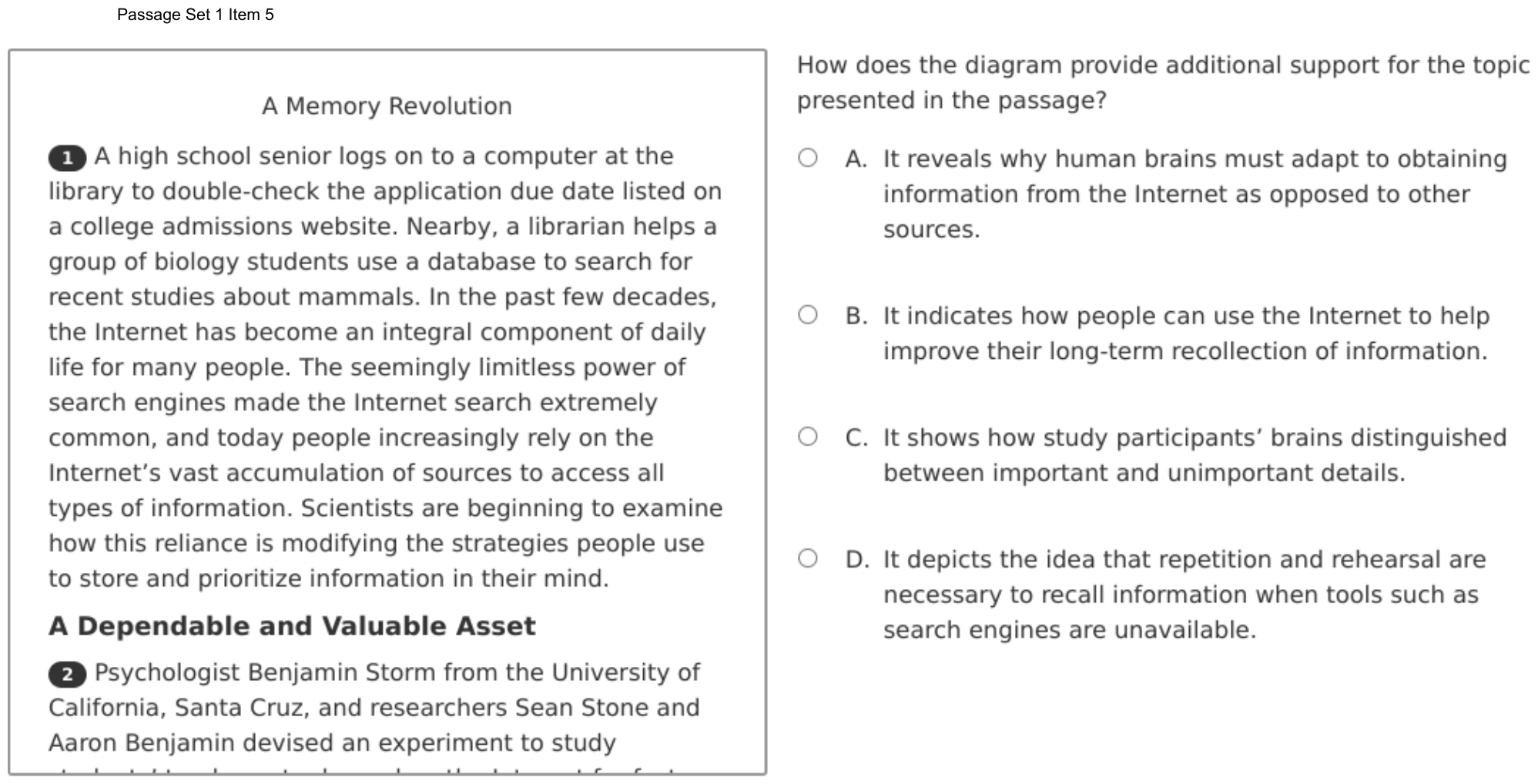
Question 18 of 57
2023 Test A English, question 18Passage Letter from Brooklyn
Letter from Brooklyn
by Jacob Scheier
I can already see how this will end.
How I will grow tired of the bridge’s
steep incline, and the absent-minded tourists
wandering into the bicycle path.
The weather will turn cold.
But that all happens later.
For now it is the early edge of fall,
leaves green still while the air narrows,
is slightly crisp, almost grazing
the hair of my arm like a passing stranger,
as though the air has been forced into intimacy
by the brevity of daylight.
But when it starts darkening at 4,
this closeness, I know, will be a felt distance,
like someone drawing your attention
to their lack of intimacy.
These days I am still walking at a cathedral pace
beneath the branches bending across avenues,
brownstones like rows of lived-in chapels,
like a pop-up picture book I could have had as a child,
but didn’t. How Brooklyn makes me nostalgic
for the moment I am walking inside of.
These late afternoons filled
with a loneliness that makes me feel
distinctly myself, and an awareness
of how rare that is.
“Letter from Brooklyn” from LETTER FROM BROOKLYN: POEMS by Jacob Scheier, published by ECW Press. Copyright © 2013 by Jacob Scheier All rights reserved.
brevity: briefness
cathedral: meditative
chapels: private places of prayer or worship
nostalgic: yearning for the past
Question
How does the structure of the poem affect the poem’s meaning?
- AThe lack of a rhyming pattern suggests that the beauty of each passing day is unique.
- BThe lengths of the sentences represent the complexity of the thoughts being represented.
- CThe use of complete sentences implies the speaker’s appreciation for the clear beginning and ending of each season.
- DThe single long stanza reflects the continuous flow of the speaker’s thoughts.
Show the answer
Correct answer: D
The question asks how the structure of the poem affects its meaning.
A. Incorrect. Though the poem lacks a rhyming pattern, such a structure is not related to the uniqueness of the passing days. The speaker is savoring “the early edge of fall” (line 7) and describes walks taken on “these days” (line 17), but the beauty the speaker appreciates is attributed to the fall season rather than to a unique day. Further, the poem is primarily concerned with broad seasonal shifts, not the passing of each day, and the absence of rhyme does not suggest that each day is unique in its beauty.
B. Incorrect. The poem includes both long sentences (such as the one in lines 7–12) and short sentences (such as those in lines 5 and 6). However, the sentence lengths are not connected with the complexity of the ideas expressed.
C. Incorrect. A complete sentence serves to present the beginning and the end of a single thought, but the poem is not primarily concerned with the speaker’s thoughts on the “clear beginning and ending of each season.” Though it contrasts the speaker’s feelings and experiences during different seasons, the poem does not present descriptions focused specifically on the beginnings or ends of these seasons.
D. CORRECT. Unlike poems that are broken into stanzas reflecting unified groups of thoughts, this poem is one long stanza. This structure serves to emphasize the uninterrupted flow of the speaker’s thoughts from time to time and experience to experience without a clear break between any specific thoughts.
Question analysis
This poetry question asks how the structure of Jacob Scheier's “Letter from Brooklyn,” a poem about walking through the city in early fall, affects its meaning. Students must look at how the poem is built, its sentences, line breaks, stanzas and lack of rhyme, and decide which feature really shapes what the poem says.
- NYS standards
- 7R5 structure and genre features
- Grade level
- Grade 7 reading and task
- Compared with grade 7
- At grade 7 Grade 7 standards ask how a poem's form shapes its meaning. Here each choice names a feature of form that students must first confirm in the poem and then link to its meaning, a typical grade 7 poetry task on a short poem.
- Estimated difficulty
- Moderate: several steps, or a close reading with one strong distractor.
- Thinking it demands
- Depth of knowledge 2, skills and concepts · mainly analyze
- What makes it hard
- How, not what moderate
- Every choice must be checked moderate
- Something you must already know minor
- Evidence
- Answered from the whole text
- Reading level
- Passage: 217 words (a poem; reading level not measured); question and choices: about grade 8, 70 words.
- Students, last 30 days
- Not enough answers yet to show (it takes 10).
Why it is hard, traps and wrong answers (shows the answer)
Why it is hard
Checking whether a feature exists rules out little here, since the poem is unrhymed, its sentences vary widely and it has one stanza. The decision rests on which feature matches what the speaker does: thoughts move from future to present to memory without a break. The strongest pull ties the lack of rhyme to the uniqueness of each day, which sounds like the poem’s theme of rare moments but is not something rhyme or its absence can show.
How, not what moderate Working it out
The question is about form, so students must ask what the single unbroken stanza does: it carries the speaker from the coming cold back to the present walk without a pause. (Anderson & Krathwohl, 2001)
Every choice must be checked moderate Choosing the answer
Three choices name features the poem really has, no rhyme, sentences from five words to six lines, and one stanza, so the meaning each feature is given is what separates them. (Embretson & Wetzel, 1987)
Something you must already know minor Working it out
Students must know what a stanza and a rhyming pattern are, and that a poem without stanza breaks has no white space marking separate groups of thought. (Anderson & Krathwohl, 2001)
Strategy: For each choice, first check that the poem really has the feature named, then ask whether that feature fits what the speaker is doing throughout the poem, not just in one line.
Traps
- Wrong purpose or structure: Names a purpose, structure or effect that the part does not serve, or describes what a part says when the question asks what it does.
- Reads too much in: A reasonable-sounding conclusion that goes further than the text allows.
The wrong answers, classified
A Reads too much in (Graesser, Singer & Trabasso, 1994)
Applies the habit of finding meaning in free verse, linking the missing rhyme to each day’s unique beauty, which echoes “how rare that is” but follows from nothing in the form.
B Wrong purpose or structure (Anderson & Krathwohl, 2001)
Rightly sees sentences ranging from five words to six lines, but gives their length a job, matching complex thoughts, that the poem never connects to it.
C Wrong purpose or structure (Anderson & Krathwohl, 2001)
Assumes complete sentences marking each season’s clear start and end, though the last four lines are a fragment and the poem follows fall’s gradual early turn.
Working it out, step by step
Figure out what the question asks
This question asks how the poem’s structure shapes its meaning. Structure means how the poem is built: its stanzas, its sentences and its rhyme. A stanza is a group of lines set apart by a blank line. It is like a paragraph in a poem.
Look at how the poem is built
The poem has 26 lines and no blank lines, so it is one long stanza. The lines don’t rhyme. The sentences have many lengths. Line 5, “The weather will turn cold,” is short. The sentence in lines 7–12 runs six lines.
Follow the speaker’s thoughts
The speaker is the voice talking in the poem. Line 1 jumps ahead: “I can already see how this will end.” Line 6 comes back: “But that all happens later.” Then the speaker describes the fall air, then the walk, then a lonely feeling. One thought slides into the next with no stop. One unbroken stanza matches that steady flow.
Check each choice
- A is wrong. The poem has no rhyme. But missing rhyme can’t show that each day’s beauty is unique, or one of a kind.
- B is wrong. The sentences do vary in length. But the poem doesn’t link long sentences to hard thoughts.
- C is wrong. The poem isn’t about each season’s clear start and end. It describes fall just starting to turn.
- D is right. The single stanza matches thoughts that flow on with no breaks.
Watch out: Three choices name real features of the poem. So don’t stop at Is this true? Ask whether that feature really creates the meaning the choice gives it.
Choose the answer
Continuous means going on without stopping. So the answer is D: “The single long stanza reflects the continuous flow of the speaker’s thoughts.”
Why this answer and not the closest wrong one
A is the closest wrong answer, because the poem does praise a rare moment. But rhyme, or no rhyme, can’t show that each day is unique. One long stanza can show thoughts flowing without a stop. That is how the speaker thinks, from line 1 to line 26.
More questions like this
The original DOE question
The passage “Letter from Brooklyn” as printed (page 50)
Question 19 of 57
2023 Test A English, question 19Uses the passage above: “Letter from Brooklyn”.
Question
Which lines support the idea that a change in the weather will lessen the speaker’s appreciation for the city?
- A“as though the air has been forced into intimacy / by the brevity of daylight.” (lines 11–12)
- B“But when it starts darkening at 4, / this closeness, I know, will be a felt distance,” (lines 13–14)
- C“like someone drawing your attention / to their lack of intimacy.” (lines 15–16)
- D“These days I am still walking . . . / beneath the branches bending across avenues,” (lines 17–18)
Show the answer
Correct answer: B
The question asks which lines from the poem support the idea that a change in the weather will lessen the speaker’s appreciation for the city.
A. Incorrect. These lines focus on the positive way the air feels to the speaker during “the early edge of fall” (line 7). They suggest that the speaker appreciates this experience currently, while being aware that the feeling might not last.
B. CORRECT. In these lines, the speaker describes the shift in the “closeness” of the air as the weather changes and “it starts darkening at 4.” The speaker clearly indicates that the positive emotions surrounding this closeness, with “leaves green still” and the air “slightly crisp” (lines 8–9), will soon be “a felt distance,” suggesting that the turn in the weather will make the city less appealing.
C. Incorrect. Although these lines compare the darkening, changing weather to a person revealing a “lack of intimacy,” that specific comparison does not focus on a diminishing appreciation for the city.
D. Incorrect. These lines describe the “cathedral pace” (line 17) at which the speaker walks, emphasizing a meditative or thoughtful experience. Such a description suggests the speaker still appreciates the city, not that the speaker’s appreciation will lessen.
Question analysis
This evidence question asks which lines from “Letter from Brooklyn” support the idea that a change in the weather will lessen the speaker's appreciation for the city. All four choices come from the middle of the poem, where the speaker describes the feel of the early-fall air through figurative comparisons, so students must read each pair of lines closely for both parts of the idea.
- Grade level
- Grade 8 reading and task
- Compared with grade 7
- Above grade 7 Choosing lines that support an idea is standard grade 7 evidence work. Here the idea is carried by figurative comparisons about the air, and the four choices sit within a few lines of one another, so separating them takes closer reading than is typical.
- Estimated difficulty
- Hard: combines ideas, needs a plan, and has more than one tempting wrong answer.
- Thinking it demands
- Depth of knowledge 2, skills and concepts · mainly evaluate
- What makes it hard
- A very close wrong answer moderate
- Figurative or literary language moderate
- Reading between the lines minor
- Evidence
- Answered from one sentence or line
- Reading level
- Passage: 217 words (a poem; reading level not measured); question and choices: about grade 6, 74 words.
- Students, last 30 days
- Not enough answers yet to show (it takes 10).
Why it is hard, traps and wrong answers (shows the answer)
Why it is hard
All four choices come from lines 11–18, and three speak of closeness, distance or intimacy, so the vocabulary of the claim is everywhere. The idea has two parts, a change in the weather and a weaker feeling for the city, and only one pair of lines holds both. The strongest pull is the second half of the same sentence, which puts the loss of intimacy most vividly but leaves the darkening behind in the lines before.
A very close wrong answer moderate Choosing the answer
Lines 13–14 and 15–16 are one sentence split in two: the first half names the darkening at 4 and the coming distance, the second only describes what that distance feels like. (Embretson & Wetzel, 1987; Gorin & Embretson, 2006; Ascalon et al., 2007)
Figurative or literary language moderate Understanding the question
The weaker feeling for the city is never stated; it comes through images, the air’s “closeness” turning into “a felt distance,” like a person pointing out their “lack of intimacy.” (Graesser, Singer & Trabasso, 1994; Kintsch, 1998)
Reading between the lines minor Working it out
Students must accept “when it starts darkening at 4” as the change in the weather the stem names, since the lines speak of daylight, not of cold or rain. (Graesser, Singer & Trabasso, 1994; Kintsch, 1998)
Strategy: Split the idea into its two parts, a change in the weather and a weaker feeling for the city, and choose the lines that hold both on their own, without help from the lines around them.
Traps
- Supports only part of the claim: In a question about evidence: a line that backs one half of the claim but not the other, or a related point rather than the claim itself.
The wrong answers, classified
A Supports only part of the claim (King et al., 2004; Thissen, Steinberg & Fitzpatrick, 1989)
Takes “the brevity of daylight” as the coming change, but these lines say the short days force the air “into intimacy,” a closeness the speaker enjoys now.
C Supports only part of the claim (King et al., 2004; Thissen, Steinberg & Fitzpatrick, 1989)
Chooses the vivid “lack of intimacy,” which does show the feeling weakening, but these lines only finish the simile and never mention the darkening that causes it.
D Supports only part of the claim (King et al., 2004; Thissen, Steinberg & Fitzpatrick, 1989)
Hears a coming change in “still walking,” but the lines show the speaker enjoying a slow walk under the branches now and say nothing of the weather turning.
Working it out, step by step
Figure out what the question asks
This is an evidence question. The idea has two parts. First, the weather will change. Second, the speaker will enjoy the city less. You need the lines that hold both parts by themselves.
Read the lines around the choices
Lines 9–12 describe the early-fall air now. It is “almost grazing / the hair of my arm like a passing stranger.” Grazing here means lightly touching. The speaker says the air feels close, like “intimacy.” Intimacy means a warm, close feeling between people. Lines 13–16 then look ahead to shorter days.
Find both parts in lines 13–14
Lines 13–14 say: “But when it starts darkening at 4, / this closeness, I know, will be a felt distance”. Darkening at 4 means the sun setting at 4 o’clock, as days get shorter. That is the change in the weather. “This closeness” is the warm feeling the speaker has now. It will turn into distance. So the good feeling will fade.
Check each choice
- A is wrong. Lines 11–12 describe the closeness the speaker enjoys now. Nothing has faded yet.
- B is right. It names the change, the early dark, and the loss, closeness turning into “a felt distance.”
- C is wrong. Lines 15–16 finish the comparison: the distance feels like a person pointing out their “lack of intimacy.” But these lines never mention the weather.
- D is wrong. Lines 17–18 show the speaker enjoying a slow walk now. They say nothing about the weather turning.
Watch out: C is tempting because “lack of intimacy” sounds like a lost feeling. But the change in weather is back in lines 13–14.
Choose the answer
Only one pair of lines holds both the change and the fading feeling. So the answer is B, lines 13–14, which begin “But when it starts darkening at 4”.
Why this answer and not the closest wrong one
C is the closest wrong answer, because it shows the good feeling slipping away. But lines 15–16 only describe what that distance feels like. They don’t say what causes it. Lines 13–14 give both parts: the early dark and the fading closeness.
More questions like this
The original DOE question
Question 20 of 57
2023 Test A English, question 20Uses the passage above: “Letter from Brooklyn”.
Question
Read lines 5–6 from the poem.
The weather will turn cold.
But that all happens later.
How do the lines develop a central theme of the poem?
- AThey highlight a contrast between the different seasons.
- BThey show the sequence of the changes that are expected to occur.
- CThey warn about a problem that requires thoughtful preparation.
- DThey emphasize the importance of valuing the present.
Show the answer
Correct answer: D
The question asks how lines 5–6 develop a central theme of the poem.
A. Incorrect. In this poem, the speaker describes the impressions of one day in one season: “For now it is the early edge of fall, / leaves green still while the air narrows, / is slightly crisp” (lines 7–9). Despite the reference in line 5 to the eventual arrival of cold weather, lines 5–6 primarily emphasize the speaker’s wish to stay focused on the present moment. A contrast between seasons is not a central theme of the poem.
B. Incorrect. The words “The weather will turn cold” in line 5 refer to one change that is expected to occur, but lines 5–6 do not show a sequence of changes. The line that follows returns to the present: “For now . . .” (line 7).
C. Incorrect. Although the statement that the weather “will turn cold” in line 5 could be construed as a warning, there is no support in lines 5–6 for the idea that some problems require thoughtful preparation. The speaker is reflecting on a fleeting experience, not preparing to solve a problem.
D. CORRECT. Immediately after the line “The weather will turn cold” (line 5), the speaker returns to the current moment: “But that all happens later” (line 6). These lines help develop a central theme by emphasizing the speaker’s choice to value and focus on the present moment. The “But” at the start of line 6 shows the speaker pulling back from the future and refocusing on the present, thus emphasizing the importance of savoring “the moment I am walking inside of” (line 22).
Question analysis
This theme question quotes two short lines from early in “Letter from Brooklyn,” where the speaker says the weather will turn cold, and asks how they develop a central theme of the poem. Students must work out what the pair of lines does at that point and connect it to the whole poem, since each choice describes something two lines about the future could plausibly do.
- Grade level
- Grade 7 reading and task
- Compared with grade 7
- At grade 7 Explaining how particular lines develop a poem's theme is core grade 7 work. These two lines are short and plainly worded, so the demand lies in relating them to the theme of the whole poem, which is typical.
- Estimated difficulty
- Moderate: several steps, or a close reading with one strong distractor.
- Thinking it demands
- Depth of knowledge 2, skills and concepts · mainly analyze
- What makes it hard
- Reading between the lines moderate
- How, not what moderate
- Evidence
- Answered from one paragraph or stanza
- Reading level
- Passage: 217 words (a poem; reading level not measured); question and choices: about grade 5, 63 words.
- Students, last 30 days
- Not enough answers yet to show (it takes 10).
Why it is hard, traps and wrong answers (shows the answer)
Why it is hard
Two short, plain lines carry a theme only when read with their neighbors: the speaker forecasts cold, then dismisses it with “But that all happens later” and returns to “For now.” Students who read line 5 alone take the pair as a forecast and look for contrast, sequence or warning. The tempting contrast choice has some truth, since “But” does mark a turn, yet the turn is from future to present, not from one season to another.
Reading between the lines moderate Working it out
Line 6 never says the present matters; students infer it from “But” pulling back from the forecast and from “For now” in line 7 turning to the early fall around the speaker. (Graesser, Singer & Trabasso, 1994; Kintsch, 1998)
How, not what moderate Working it out
The stem asks how two lines develop a theme, so students must see their job, setting the future aside, rather than their content, a prediction of cold weather. (Anderson & Krathwohl, 2001)
Strategy: Read the lines just before and after lines 5–6, decide what the speaker does with the thought of cold weather, and connect that to what the poem as a whole keeps returning to.
Traps
- Wrong purpose or structure: Names a purpose, structure or effect that the part does not serve, or describes what a part says when the question asks what it does.
- Wrong part of the text: A choice is true of another paragraph, stanza or speaker than the one asked about.
- Reads too much in: A reasonable-sounding conclusion that goes further than the text allows.
The wrong answers, classified
A Wrong purpose or structure (Anderson & Krathwohl, 2001)
Sees cold weather set against early fall and hears contrast in “But,” yet the turn in line 6 is from later to now, and the poem never weighs one season against another.
B Wrong part of the text (Kirsch & Mosenthal, 1990)
Takes the opening forecast, tiring of the bridge and the tourists and then the cold, as a sequence, though lines 5–6 name one change and then set it aside.
C Reads too much in (Graesser, Singer & Trabasso, 1994)
Treats the coming cold as a problem to plan for, though the speaker makes no preparations and simply dismisses the future with “But that all happens later.”
Working it out, step by step
Figure out what the question asks
This question asks how lines 5–6 help build a theme. A theme is a big message about life that a poem keeps coming back to. So ask what these two lines do in the poem. Then link that to the whole poem.
Read the lines in place
Lines 1–5 look ahead. The speaker will grow tired of the bridge and the tourists, and “The weather will turn cold.” Then line 6 says, “But that all happens later.” Line 7 begins “For now it is the early edge of fall.” So the speaker thinks of the future, then pushes it aside.
Put it in your own words
“But” marks a turn. The speaker turns from later back to now. It is like saying, Sure, winter is coming, but it isn’t here yet. Then the poem spends many lines enjoying the fall walk. Line 22 speaks of “the moment I am walking inside of.” So lines 5–6 help show a big idea: enjoy the present while you have it.
Check each choice
- A is wrong. The turn is from later to now, not from one season to another. The poem doesn’t compare seasons.
- B is wrong. Lines 5–6 name one change, cold weather, and then set it aside. That is not a sequence, or series of steps.
- C is wrong. The speaker doesn’t get ready for the cold. The speaker simply says it “happens later.”
- D is right. The lines push the future aside so the speaker can enjoy the present.
Watch out: A is tempting because “But” signals a contrast. Ask what is being contrasted. It is later and now, not two seasons.
Choose the answer
Valuing means treating something as precious. So the answer is D: “They emphasize the importance of valuing the present.”
Why this answer and not the closest wrong one
A is the closest wrong answer, because line 6 does turn with “But.” Yet the turn moves from the future back to “For now.” The poem never weighs one season against another. It keeps coming back to the present moment, which is what D says.
More questions like this
The original DOE question
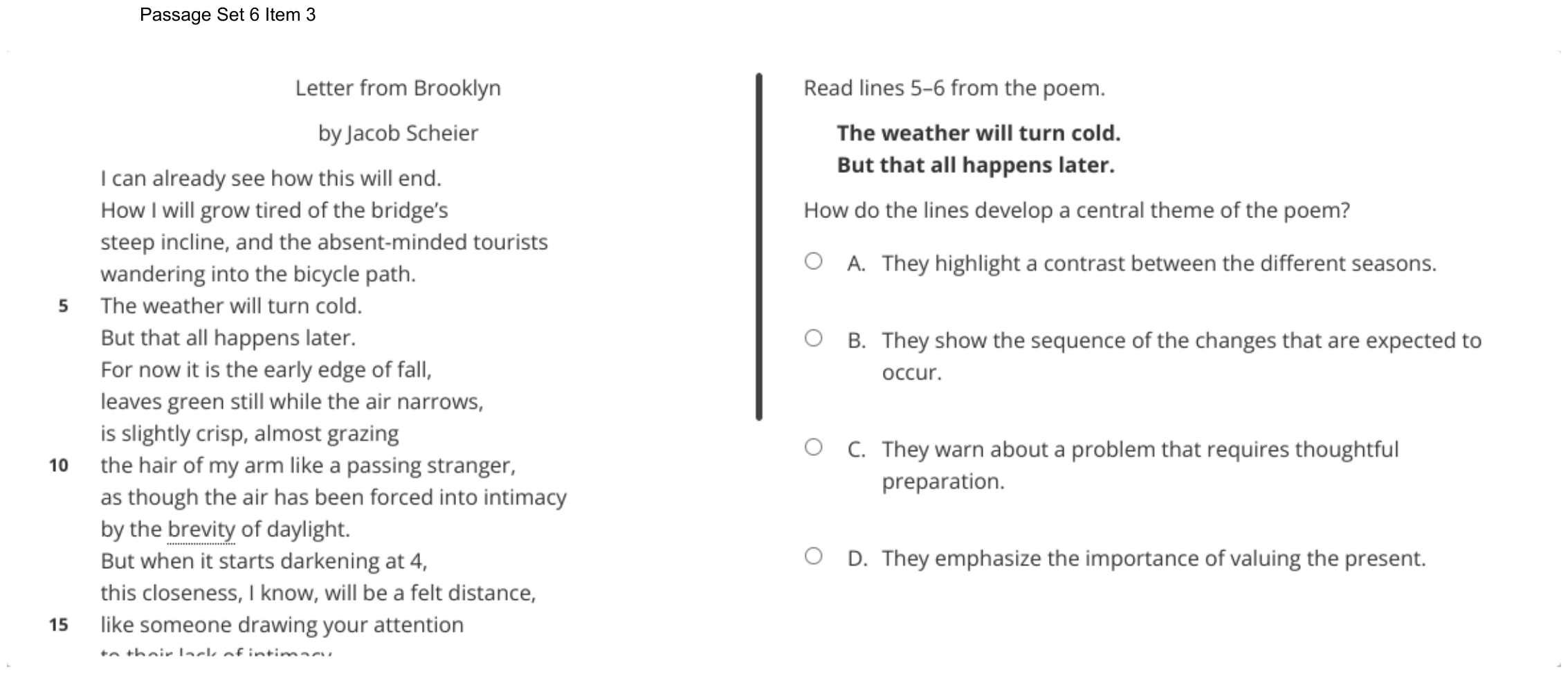
Question 21 of 57
2023 Test A English, question 21Uses the passage above: “Letter from Brooklyn”.
Question
Read lines 7–9 from the poem.
For now it is the early edge of fall,
leaves green still while the air narrows,
is slightly crisp,
The word choice in the lines helps convey the speaker’s belief that
- Athe beauty of the current season should still be appreciated.
- Bthe changes in the weather signify the end of the most pleasant season.
- Cthe transition from one season to another happens swiftly and without warning.
- Dthe change in the weather is so subtle that people rarely observe or feel it.
Show the answer
Correct answer: A
The question asks what belief of the speaker is conveyed by the word choice in lines 7–9 of the poem.
A. CORRECT. Words and phrases in these lines, such as “leaves green still” and “slightly crisp,” have a positive connotation, indicating that the speaker believes in appreciating this season while it still lasts.
B. Incorrect. Although imagery such as “leaves green still” and “slightly crisp” in these lines suggests that the speaker enjoys the season, the speaker never indicates that the present season is the most pleasant of all seasons.
C. Incorrect. The phrases “the early edge of fall” and “the air narrows” in these lines imply that the season is just beginning to change, but there is no indication from these phrases that the changes will be swift and without warning. In fact, the narrowing of the air could be a warning of a greater, more gradual change in weather.
D. Incorrect. The speaker experiences the change in weather as subtle: “the air narrows, / is slightly crisp.” However, the speaker does not refer to the viewpoints of others. The entire viewpoint in the poem is personal and introspective, as represented by the use of the pronoun “I” throughout.
Question analysis
This word-choice question quotes three lines from “Letter from Brooklyn” describing the early edge of fall, when the leaves are still green and the air is slightly crisp. Students must work out what the connotations of these words reveal about the speaker's belief, and several choices mix an accurate reading of the lines with a claim they do not support.
- Grade level
- Grade 7 reading and task
- Compared with grade 7
- At grade 7 Explaining how word choice conveys a speaker's feelings is everyday grade 7 work. These three lines are short and concrete, but their meaning rests on the connotations of a few small words, which matches a typical grade 7 task.
- Estimated difficulty
- Moderate: several steps, or a close reading with one strong distractor.
- Thinking it demands
- Depth of knowledge 2, skills and concepts · mainly understand
- What makes it hard
- Figurative or literary language moderate
- Reading between the lines minor
- Evidence
- Answered from one sentence or line
- Reading level
- Passage: 217 words (a poem; reading level not measured); question and choices: about grade 5, 86 words.
- Students, last 30 days
- Not enough answers yet to show (it takes 10).
Why it is hard, traps and wrong answers (shows the answer)
Why it is hard
The three lines are short, and every choice builds on something real in them: a change in the weather, a season ending, subtlety. What separates the answer is the time words, “For now,” “early edge” and “still,” which say that something good is present and passing. Students lose the point by stretching a reasonable sense of loss into a claim about the best season, or by turning the speaker’s private notice into what other people miss.
Figurative or literary language moderate Understanding the question
The belief lies in connotation: “early edge of fall” and “leaves green still” mark a season only starting to turn, and “the air narrows” describes the change through an image. (Graesser, Singer & Trabasso, 1994; Kintsch, 1998)
Reading between the lines minor Working it out
“For now” at the start of line 7 signals that the moment will pass, and students must infer that the speaker values it for that reason, since no line states the belief. (Graesser, Singer & Trabasso, 1994; Kintsch, 1998)
Strategy: Mark the words in lines 7–9 that describe time and the feel of the air, decide whether each sounds positive, negative or neutral, then choose the belief that fits those connotations and nothing more.
Traps
- Half right: One half of a two-part choice is right and the other is not.
- Reads too much in: A reasonable-sounding conclusion that goes further than the text allows.
- Twists what the text says: Uses the text's topic and ideas but changes what it says: who did it, how much, when, or why.
The wrong answers, classified
B Reads too much in (Graesser, Singer & Trabasso, 1994)
Senses loss in a turning season, which the poem does suggest, but claims the speaker sees this as ending “the most pleasant season,” a ranking the lines never make.
C Twists what the text says (King et al., 2004)
Reads “the air narrows” as a sudden shift, though “early edge” and “slightly crisp” describe a season only beginning to turn, gradually and with clear signs.
D Half right (King et al., 2004; Thissen, Steinberg & Fitzpatrick, 1989)
Rightly hears the change as subtle in “slightly crisp,” but adds that people rarely notice it, though the lines record the speaker feeling it on the hair of an arm.
Working it out, step by step
Figure out what the question asks
This question is about word choice. The exact words a poet picks can show feelings. You need the belief that lines 7–9 show. So look at what each word suggests, not only what it means.
Mark the time words
The lines say “For now it is the early edge of fall, / leaves green still while the air narrows, / is slightly crisp.” Notice the time words. “For now” means this won’t last. “Early edge” means fall has just begun. “Still” means the leaves have not changed color yet.
Hear what the words suggest
“Slightly crisp” means a little cool and fresh. It sounds pleasant, not harsh. When the air “narrows,” it seems to tighten and grow cooler. So the speaker enjoys this moment. The time words show the speaker knows it will pass. Put together, they say: this lovely early fall is still here, so enjoy it now.
Check each choice
- A is right. “Still” and “For now” show the season is still here to enjoy.
- B is wrong. The speaker never calls this the most pleasant season. Nothing ranks the seasons.
- C is wrong. “Early edge” and “slightly” describe a slow, gentle change, not a sudden one.
- D is wrong. The change is subtle, or hard to notice. But the speaker feels it on “the hair of my arm.” The lines say nothing about other people.
Watch out: D starts out right, because the change is gentle. But it adds a claim about other people that the lines never make.
Choose the answer
The words show a pleasant season that is still here, for now. So the answer is A: “the beauty of the current season should still be appreciated.”
Why this answer and not the closest wrong one
B is the closest wrong answer, because the poem does hint that something good is ending. But the lines never call fall the best season. They say only that this pleasant time is here “for now.” That fits A: enjoy the season while it lasts.
More questions like this
The original DOE question
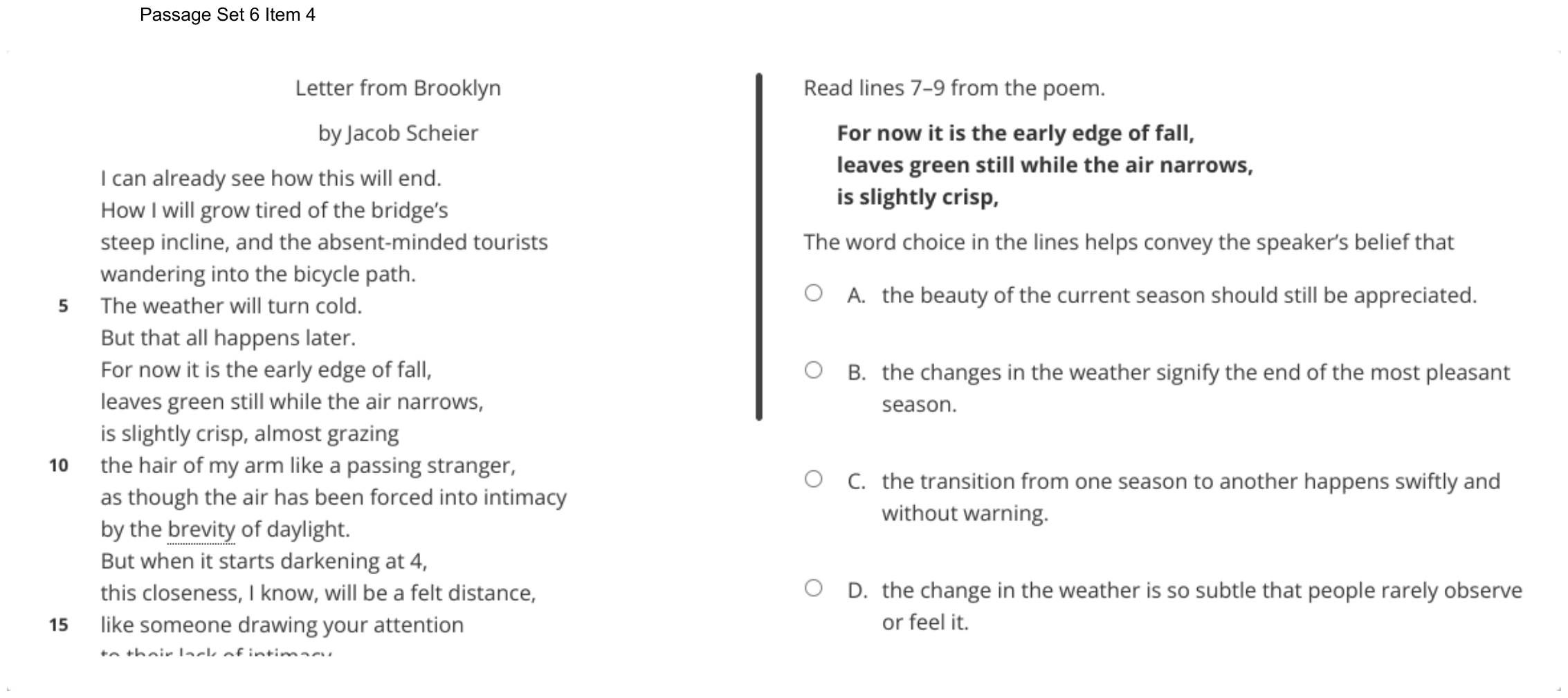
Question 22 of 57
2023 Test A English, question 22Uses the passage above: “Letter from Brooklyn”.
Question
The details in lines 9–12 convey a central idea of the poem by
- Ashowing that the cool weather makes the speaker reflect more deeply on life.
- Bsuggesting that the speaker feels uncomfortable with what the coming weather signifies.
- Cimplying that the sensations the speaker experiences during the fall season are fleeting.
- Dsuggesting that the thought of fall approaching increases the loneliness the speaker feels.
Show the answer
Correct answer: C
The question asks how lines 9–12 convey a central idea of the poem.
A. Incorrect. Although the speaker discusses the very beginning of cool weather in these lines, the speaker does not reflect on life in these lines.
B. Incorrect. Although the description in these lines likens the movement of crisp air to “a passing stranger,” that comparison does not have a negative connotation in this context; it does not suggest that the speaker is uncomfortable. Rather, it is used to describe the subtle physical sensation of cool air on the speaker’s arm.
C. CORRECT. By using a description of the crisp air as “a passing stranger” and the daylight as being brief, these lines express the poem’s central idea that the joy of early fall is temporary or fleeting.
D. Incorrect. Although the speaker acknowledges the coming fall in these lines, there is no mention of loneliness. The speaker reveals a loneliness in lines 23–26 but gives no hint of that feeling in lines 9–12. Further, this loneliness is not a central idea of the poem.
Question analysis
This central-idea question on Jacob Scheier’s poem “Letter from Brooklyn” asks how lines 9–12, where the crisp early-fall air grazes the speaker’s arm, convey a central idea of the poem. Students must interpret a simile and a personification packed into four short lines and connect what they suggest to the poem as a whole, while each choice names a different feeling or idea.
- Grade level
- Grade 8 reading and task
- Compared with grade 7
- Above grade 7 Grade 7 students explain how particular lines develop a central idea. These four lines make their point only through a simile and a personification about air and daylight, and linking them to the whole poem takes more interpretation than typical grade 7 work.
- Estimated difficulty
- Hard: combines ideas, needs a plan, and has more than one tempting wrong answer.
- Thinking it demands
- Depth of knowledge 2, skills and concepts · mainly analyze
- What makes it hard
- Figurative or literary language major
- Reading between the lines moderate
- The right answer is reworded minor
- Evidence
- Answered from one paragraph or stanza
- Reading level
- Passage: 217 words (a poem; reading level not measured); question and choices: about grade 8, 63 words.
- Students, last 30 days
- Not enough answers yet to show (it takes 10).
Why it is hard, traps and wrong answers (shows the answer)
Why it is hard
The four lines describe a sensation, cool air almost grazing an arm, and the central idea sits in two small words, “passing” and “brevity.” The strongest pull hears the stranger and the air “forced into intimacy” as unwelcome, borrowing the unease the poem saves for the darkening of lines 13–16. Other choices bring in moods from elsewhere, the meditative walk and the loneliness of the last lines, so students must judge only what lines 9–12 themselves suggest.
Figurative or literary language major Understanding the question
The lines never say the moment is short: the air almost grazes the speaker’s arm “like a passing stranger” and is “forced into intimacy / by the brevity of daylight,” so “passing” and “brevity” carry the idea. (Graesser, Singer & Trabasso, 1994; Kintsch, 1998)
Reading between the lines moderate Working it out
Students must tie the brief touch and the short days to a central idea the poem never states, that early fall is slipping away, framed by “For now” in line 7 and “But when it starts darkening” in line 13. (Graesser, Singer & Trabasso, 1994; Kintsch, 1998)
The right answer is reworded minor Choosing the answer
The right choice says “fleeting” where the lines say “passing” and “brevity,” while a wrong choice borrows the poem’s own word “loneliness” from line 24, which makes it look supported. (Freedle & Kostin, 1993; Kirsch & Mosenthal, 1990)
Strategy: Paraphrase lines 9–12 in plain words, checking the glossary for unfamiliar words, then decide what the comparison suggests about the speaker’s experience and test each choice against these four lines.
Traps
- Wrong part of the text: A choice is true of another paragraph, stanza or speaker than the one asked about.
- Wrong tone or attitude: Misjudges the tone, attitude or point of view, such as reading admiration as criticism, or taking a character's or subject's feelings for the author's.
- Reads too much in: A reasonable-sounding conclusion that goes further than the text allows.
The wrong answers, classified
A Reads too much in (Graesser, Singer & Trabasso, 1994)
Senses that the poem is meditative and credits the cool air with prompting deep thought, though lines 9–12 record a light, passing touch on the arm, not reflections on life.
B Wrong tone or attitude (Graesser, Singer & Trabasso, 1994)
Hears something unwelcome in “a passing stranger” and in air “forced into intimacy,” though the touch is light and the closeness enjoyed; unease arrives only with the darkening of lines 13–16.
D Wrong part of the text (Kirsch & Mosenthal, 1990)
Brings the “loneliness” of lines 23–26 into lines that never mention it, and even there it makes the speaker feel “distinctly myself,” not lonelier as fall approaches.
Working it out, step by step
Figure out what the question asks
This asks how lines 9–12 help build a central idea. A central idea is a main point the poem keeps coming back to. First work out what the four lines say. Then see how they connect to the rest of the poem. Test each choice against these four lines.
Read lines 9–12
The sentence is about the air, named in line 8. Lines 9–12 say it “is slightly crisp, almost grazing / the hair of my arm like a passing stranger, / as though the air has been forced into intimacy / by the brevity of daylight.” Crisp means cool and fresh. Grazing here means lightly touching. Intimacy means closeness. The glossary says brevity means “briefness.”
Work out the comparisons
“Like a passing stranger” is a simile, a comparison that uses like or as. A stranger who passes you on the street is there for a moment, then gone. So the cool air touches the speaker lightly and briefly. The next lines treat the air like a person pushed into closeness by the short daylight. Giving human feelings to something that isn’t human is called personification. Both “passing” and “brevity” point to the same thing: this feeling won’t last.
Connect the lines to the poem
The rest of the poem agrees. Line 7 begins “For now it is the early edge of fall.” Lines 13–14 look ahead: “But when it starts darkening at 4,” this closeness “will be a felt distance.” Lines 21–22 say Brooklyn makes the speaker “nostalgic / for the moment I am walking inside of.” So a central idea is that this early-fall moment is precious and passes quickly. Fleeting means lasting only a short time.
Check each choice
- A does not fit. These lines describe a touch on the skin, not thoughts about life.
- B does not fit. The touch is light, and the speaker enjoys the closeness now. The worry comes later, in lines 13–16.
- C fits. “Passing” and “brevity” show that the feelings of early fall won’t last.
- D does not fit. Lines 9–12 never mention loneliness, which comes in line 24. And line 7 says fall has already begun.
Watch out: B is tempting because “stranger” and “forced into intimacy” can sound unpleasant. But the stranger only passes by, and the touch is light.
Choose the answer
The brief touch and the short daylight show that this early-fall moment slips away fast. Sensations are feelings you get through your senses, like touch. So the answer is C, “implying that the sensations the speaker experiences during the fall season are fleeting.”
Why this answer and not the closest wrong one
B is the closest wrong choice, because “forced” and “stranger” can sound unpleasant. But line 14 calls this feeling “this closeness,” and losing it is what will feel bad. So the closeness is welcome now. What lines 9–12 stress is how brief it is, which is C.
More questions like this
The original DOE question
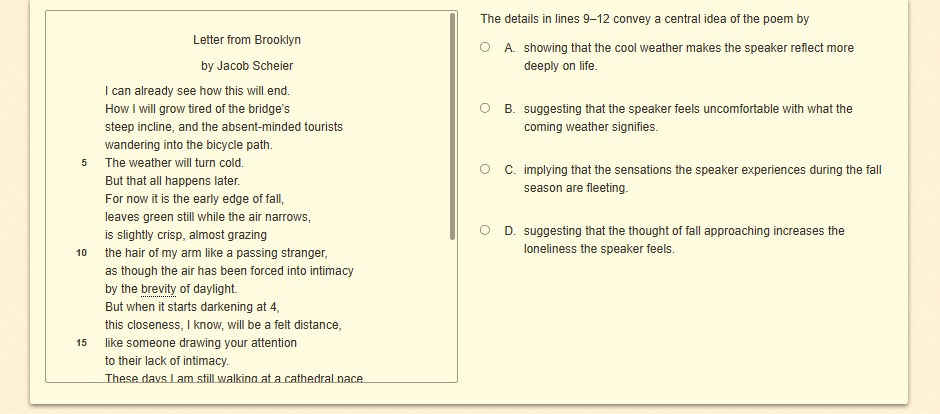
Question 23 of 57
2023 Test A English, question 23Uses the passage above: “Letter from Brooklyn”.
Question
Which idea does the comparison of the brownstone houses to “a pop-up picture book I could have had as a child, / but didn’t” in lines 20–21 convey?
- AIt reveals that some people are still influenced by powerful images from childhood.
- BIt indicates that the neighborhood the speaker is walking through is charming and appealing.
- CIt suggests that the speaker has wanted to live in the neighborhood since childhood.
- DIt suggests that people often experience lingering regret from their past.
Show the answer
Correct answer: B
The question asks what the comparison of the brownstone houses to “a pop-up picture book I could have had as a child, / but didn’t” (lines 20–21) conveys.
A. Incorrect. While the lines explain that the neighborhood reminds the speaker of images from childhood pop-up books, those images are not described as very powerful or influential.
B. CORRECT. Pop-up picture books are likely to delight a child with their unique, often beautiful representations of buildings that pop up out of the page. The comparison in these lines helps explain how the speaker views these brownstones with a childlike wonder and appreciation.
C. Incorrect. Though in these lines the speaker compares this neighborhood to scenes in children’s pop-up picture books, there is no clear evidence that the speaker wants to live there, only that the speaker appreciates its appeal.
D. Incorrect. The lines state that the speaker did not have a “pop-up picture book” of the neighborhood’s brownstones as a child, but not in a way that emphasizes regret. Rather, the speaker compares the neighborhood to images from pop-up books in general to suggest that the neighborhood looks beautiful and delightful.
Question analysis
This figurative-language question asks what idea the poem conveys by comparing Brooklyn's brownstone houses to “a pop-up picture book I could have had as a child, / but didn't.” Students must interpret a simile in context, deciding how the closing words “but didn't” fit with the rest of the comparison and with the speaker's mood during the walk.
- Grade level
- Grade 7 reading and task
- Compared with grade 7
- At grade 7 Interpreting a simile in a poem is routine grade 7 work. This comparison uses a familiar childhood object, and the only complication is the added “but didn't,” which invites a reading that the rest of the lines must confirm or rule out.
- Estimated difficulty
- Straightforward: two steps or one careful reading.
- Thinking it demands
- Depth of knowledge 2, skills and concepts · mainly understand
- What makes it hard
- Figurative or literary language moderate
- Reading between the lines minor
- Evidence
- Answered from one sentence or line
- Reading level
- Passage: 217 words (a poem; reading level not measured); question and choices: about grade 8, 78 words.
- Students, last 30 days
- Not enough answers yet to show (it takes 10).
Why it is hard, traps and wrong answers (shows the answer)
Why it is hard
The core of the simile is easy: a row of brownstones looks like a pop-up picture book, something charming. The difficulty is the closing “but didn’t,” which tempts students toward regret or toward a story about the speaker’s childhood. Students who ask what the comparison says about the houses, rather than about the speaker’s past, see that the lines praise the neighborhood.
Figurative or literary language moderate Understanding the question
The simile likens brownstones to a pop-up picture book, and its point, that the street looks as delightful as a child’s book, has to be drawn from what such books are like. (Graesser, Singer & Trabasso, 1994; Kintsch, 1998)
Reading between the lines minor Working it out
The tag “but didn’t” invites a reading of regret, so students must decide from the walk at a “cathedral pace” around it that the comparison is about delight, not loss. (Graesser, Singer & Trabasso, 1994; Kintsch, 1998)
Strategy: Work out what the brownstones and a pop-up picture book have in common, decide what part “but didn't” plays in the comparison, and test each choice against what the lines actually say.
Traps
- Wrong tone or attitude: Misjudges the tone, attitude or point of view, such as reading admiration as criticism, or taking a character's or subject's feelings for the author's.
- Taking figurative language literally: A choice reads a figure of speech or image at face value.
- Too broad or too strong: A choice overstates, generalizes, or uses absolute words the text does not support.
The wrong answers, classified
A Too broad or too strong (King et al., 2004)
Generalizes from one speaker’s comparison to what “some people” feel and calls the images “powerful,” though the lines describe how the brownstones look, not lasting childhood influences.
C Taking figurative language literally (Graesser, Singer & Trabasso, 1994)
Reads “could have had as a child” as a fact about the speaker’s childhood wishes, though the simile only compares the houses to pages in a book.
D Wrong tone or attitude (Graesser, Singer & Trabasso, 1994)
Hears regret in “but didn’t” and widens it to people in general, though the speaker mentions the missing book only in passing while enjoying the walk.
Working it out, step by step
Figure out what the question asks
This question asks about a simile. A simile compares two things using like or as. Here the speaker compares brownstones to a pop-up picture book. Brownstones are old row houses built of reddish-brown stone. You need the idea this comparison gives.
Read the comparison
Lines 19–21 say “brownstones like rows of lived-in chapels, / like a pop-up picture book I could have had as a child, / but didn’t.” A pop-up book has pictures that stand up off the page when you open it. These books often show houses and streets. Children love them.
Put it in your own words
So the street looks charming and magical, like a page in a child’s favorite book. The words “but didn’t” just mean the speaker never owned such a book. Around these lines the speaker walks at a “cathedral pace.” The glossary says cathedral means “meditative,” or calm and thoughtful. The mood is peaceful and happy, not sad.
Check each choice
- A is wrong. The lines describe how the houses look. They don’t claim childhood pictures stay powerful for people.
- B is right. Comparing the houses to a pop-up book shows they look charming, or delightful.
- C is wrong. The speaker never says they wanted to live there as a child.
- D is wrong. “But didn’t” is said in passing. The speaker is enjoying the walk, not full of regret, or sorrow over the past.
Watch out: “But didn’t” can sound sad, so D is tempting. Ask what the comparison says about the houses, not about the speaker’s past.
Choose the answer
The comparison praises how the houses look. So the answer is B: “It indicates that the neighborhood the speaker is walking through is charming and appealing.”
Why this answer and not the closest wrong one
D is the closest wrong answer, because “but didn’t” hints at something missed. But the speaker is enjoying a slow walk under the branches. The simile’s job is to show how lovely the brownstones look. That points to B, not to regret.
More questions like this
The original DOE question
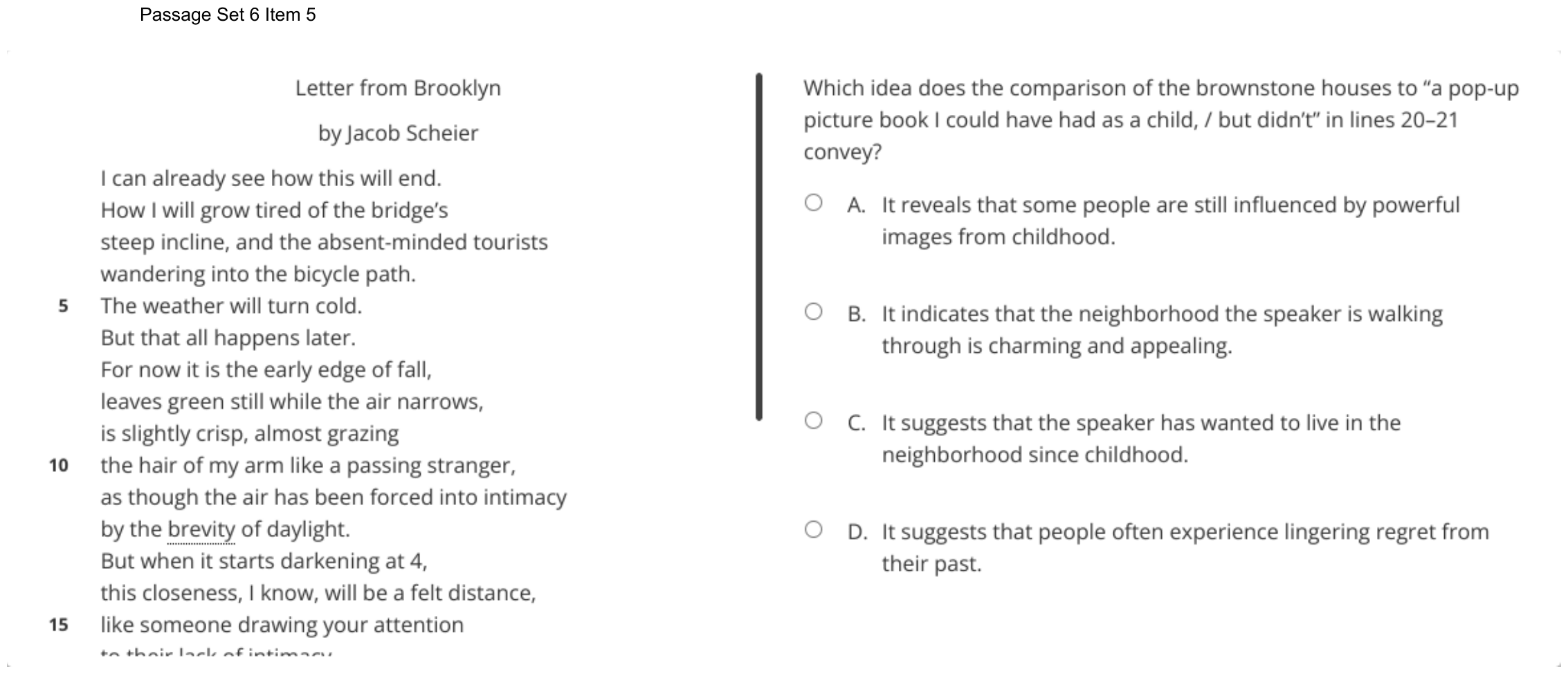
Question 24 of 57
2023 Test A English, question 24Uses the passage above: “Letter from Brooklyn”.
Question
Read these lines from the poem.
I can already see how this will end. (line 1)
How Brooklyn makes me nostalgic
for the moment I am walking inside of. (lines 21–22)
The lines develop a central idea of the poem by
- Asuggesting the speaker’s desire to find a way to break free from the repetitive pattern of daily life.
- Brevealing the speaker’s feelings of disappointment over the predictable change in season.
- Cemphasizing the speaker’s awareness of the future significance of the present moment in the setting.
- Dshowing the speaker’s anticipation of specific emotions caused by an intimate knowledge of the setting.
Show the answer
Correct answer: C
The question asks how line 1 and lines 21–22 develop a central idea of the poem.
A. Incorrect. Although these lines suggest that life is governed by repetitive patterns, such as the change of seasons, they do not suggest that the speaker wishes to break free from these natural cycles of change, and a desire for freedom is not a central idea of the poem.
B. Incorrect. Although the speaker acknowledges that colder weather will inevitably bring disappointment, the speaker does not suggest in these lines that the predictability of changing weather is itself disappointing. Rather, the speaker recognizes the value of enjoying the present moment.
C. CORRECT. These lines connect the present warmer weather with the future colder weather and develop the central idea that the present “moment I am walking inside of” must be embraced because the speaker will be “nostalgic” for it in the future.
D. Incorrect. In these lines, the speaker is aware that specific emotions will occur in the future, during cold weather, but this awareness is only part of the more complex central idea of the poem, which is that current emotions and feelings must be recognized, experienced, and appreciated.
Question analysis
This central-idea question pairs the first line of “Letter from Brooklyn” with lines 21–22, where Brooklyn makes the speaker nostalgic “for the moment I am walking inside of,” and asks how they develop a central idea of the poem. Students must link excerpts from opposite ends of the poem, untangle a paradoxical image and choose among four abstract statements.
- Grade level
- Grade 8 reading and task
- Compared with grade 7
- Above grade 7 Grade 7 students analyze how lines develop a central idea. Here two excerpts twenty lines apart must be read together, one of them built on a paradox, and the four choices are long and abstract, well beyond typical grade 7 work.
- Estimated difficulty
- Among the hardest on the SHSAT: a non-obvious approach, heavy reading, or a well-hidden trap.
- Thinking it demands
- Depth of knowledge 3, strategic thinking · mainly analyze
- What makes it hard
- Figurative or literary language major
- A very close wrong answer moderate
- Evidence in several places moderate
- Evidence
- Answered from several paragraphs or stanzas
- Reading level
- Passage: 217 words (a poem; reading level not measured); question and choices: about grade 7, 99 words.
- Students, last 30 days
- Not enough answers yet to show (it takes 10).
Why it is hard, traps and wrong answers (shows the answer)
Why it is hard
This is among the hardest questions in the set because the two excerpts must be joined through a paradox and then matched to four long, abstract statements. Line 1 foresees an ending; lines 21–22 miss a moment while it is still happening, so both look at now from the future. Students who see only the foresight pick the choice about anticipated emotions, while those who hear gloom in “how this will end” settle on disappointment or a wish to escape.
Figurative or literary language major Understanding the question
Lines 21–22 are a paradox: “nostalgic,” glossed as yearning for the past, is aimed at “the moment I am walking inside of,” so the speaker already feels the present as a future memory. (Graesser, Singer & Trabasso, 1994; Kintsch, 1998)
A very close wrong answer moderate Choosing the answer
The choice about anticipating “specific emotions” shares the key’s link between future and present; it differs by tracing those feelings to knowing the setting well, which neither excerpt says. (Embretson & Wetzel, 1987; Gorin & Embretson, 2006; Ascalon et al., 2007)
Evidence in several places moderate Working it out
The excerpts are the poem’s first line and lines 21–22, twenty lines apart, and what joins them, the speaker looking ahead at the present, shows only when they are read side by side. (Kirsch & Mosenthal, 1990; Gorin & Embretson, 2006)
Strategy: Paraphrase each excerpt on its own, using the glossary's meaning of “nostalgic,” then decide what the first line and the last two share and match that to a choice.
Traps
- Half right: One half of a two-part choice is right and the other is not.
- Wrong tone or attitude: Misjudges the tone, attitude or point of view, such as reading admiration as criticism, or taking a character's or subject's feelings for the author's.
- Reads too much in: A reasonable-sounding conclusion that goes further than the text allows.
The wrong answers, classified
A Reads too much in (Graesser, Singer & Trabasso, 1994)
Links “how this will end” and growing tired of the bridge to a dull routine and imagines a wish to escape it, which the poem never expresses.
B Wrong tone or attitude (Graesser, Singer & Trabasso, 1994)
Hears resignation in “I can already see how this will end” and reads it as disappointment with the seasons, missing that the speaker treasures the present walk.
D Half right (King et al., 2004; Thissen, Steinberg & Fitzpatrick, 1989)
Rightly sees the speaker foreseeing feelings in line 1, but traces them to an “intimate knowledge of the setting,” while lines 21–22 long for the present moment itself.
Working it out, step by step
Figure out what the question asks
This question gives two pieces of the poem: line 1 and lines 21–22. You need the central idea they build together. A central idea is the main point the poem keeps working toward. Read each piece alone first, then join them.
Read line 1
Line 1 says “I can already see how this will end.” The speaker looks ahead. Lines 2–5 then list what will come: growing tired of the bridge, and the cold. So the speaker already pictures the future while living in the present.
Read lines 21–22
The lines say “How Brooklyn makes me nostalgic / for the moment I am walking inside of.” The glossary says nostalgic means “yearning for the past.” Yearning means longing. But the speaker longs for now, a moment still happening. That is a paradox, an idea that seems impossible but makes sense. The speaker knows this walk will be a precious memory.
Join the two pieces
Both pieces look at the present from the future. In line 1, the speaker sees the end coming. In lines 21–22, the speaker already misses the walk. So the speaker knows this present moment will matter later. Significance means importance.
Check each choice
- A is wrong. The speaker never wants to break free from daily routine.
- B is wrong. Line 1 can sound gloomy. But the speaker isn’t upset with the seasons. The speaker treasures the walk.
- C is right. The speaker sees that this moment in Brooklyn will be precious later.
- D is wrong. The speaker does foresee feelings. But neither piece says they come from knowing the place well.
Watch out: D gets the looking-ahead part of line 1 right. But lines 21–22 long for the moment itself, not for feelings caused by knowing the city.
Choose the answer
So the answer is C: “emphasizing the speaker’s awareness of the future significance of the present moment in the setting.”
Why this answer and not the closest wrong one
D is the closest wrong answer, because line 1 does show the speaker foreseeing feelings. But D says they come from an “intimate knowledge of the setting.” Neither piece says that. Lines 21–22 miss the moment while it is still happening. C captures that: the present will matter in the future.
More questions like this
The original DOE question
Question 25 of 57
2023 Test A English, question 25Uses the passage above: “Letter from Brooklyn”.
Question
The speaker’s thoughts throughout the poem develop a theme by showing that
- Aalthough people may hold expectations for the future, some people long for present experiences while they are still happening.
- Bthough people come from different places, most people feel drawn to the special charm a city holds.
- Calthough people can make decisions about their life, there will always be some things beyond their control.
- Dthough general expectations exist, people have no way of knowing what a given day will actually bring.
Show the answer
Correct answer: A
The question asks how the speaker’s thoughts throughout the poem develop a theme.
A. CORRECT. The speaker’s thoughts develop some tension because seasonal change will inevitably come: “The weather will turn cold” (line 5). However, the speaker is still able to enjoy the present experience because “that all happens later” (line 6). In lines 21–22, the speaker begins to describe experiences that create a longing for the present, even while it is still happening (“How Brooklyn makes me nostalgic / for the moment I am walking inside of”), developing a theme of the poem.
B. Incorrect. The speaker’s thoughts reveal an appreciation for the city, but this appreciation is highly personal and individual. These thoughts do not indicate that most people will feel drawn to cities.
C. Incorrect. Some things, such as seasons, are beyond human control, as the speaker concedes: “I can already see how this will end” (line 1). However, the theme of the poem is not that certain things are inevitable, but that one can live in the present moment and enjoy that experience before change occurs.
D. Incorrect. The speaker’s thoughts are not showing that people are surprised by what the days bring; the thoughts of the speaker suggest that people experience many seasons in Brooklyn and have reasonable expectations about what these days will bring.
Question analysis
This theme question asks what theme the speaker's thoughts develop across all of “Letter from Brooklyn,” from the opening line about how things will end to the closing lines about loneliness on late afternoons. Each choice is a broad statement about people in two parts, so students must check both halves against the speaker's reflections.
- NYS standards
- 7R2 theme or central idea
- Grade level
- Grade 8 reading and task
- Compared with grade 7
- Above grade 7 Stating a theme is a grade 7 standard, often tested with one clearly fitting choice. Here every choice is a two-part general statement about people, and students must test both halves of each against a whole poem of abstract reflection, more than typical.
- Estimated difficulty
- Hard: combines ideas, needs a plan, and has more than one tempting wrong answer.
- Thinking it demands
- Depth of knowledge 3, strategic thinking · mainly analyze
- What makes it hard
- Reading between the lines moderate
- Every choice must be checked moderate
- Evidence in several places minor
- Evidence
- Answered from the whole text
- Reading level
- Passage: 217 words (a poem; reading level not measured); question and choices: about grade 9, 82 words.
- Students, last 30 days
- Not enough answers yet to show (it takes 10).
Why it is hard, traps and wrong answers (shows the answer)
Why it is hard
The four themes are broad statements about people, each in two halves, and every one can borrow something from the poem: the seasons are beyond control, the city has charm, the future brings surprises. The right one matches the speaker’s double vision, knowing what is coming and longing for the present while it lasts. The strongest pull is the theme about things beyond control, whose second half fits the turning seasons and whose first half the poem never raises.
Reading between the lines moderate Working it out
The poem never states its theme; it must be built from the speaker’s forecasts in lines 1–6 and the paradox of being “nostalgic / for the moment I am walking inside of.” (Graesser, Singer & Trabasso, 1994; Kintsch, 1998)
Every choice must be checked moderate Choosing the answer
Every choice is a two-part “although” or “though” statement about people, and three have one plausible half, so each half must be checked against the poem on its own. (Embretson & Wetzel, 1987)
Evidence in several places minor Working it out
The theme draws on the whole poem, from the opening “I can already see how this will end” to the lonely late afternoons of lines 23–26. (Kirsch & Mosenthal, 1990; Gorin & Embretson, 2006)
Strategy: Sum up in a sentence what the speaker keeps thinking about from the first line to the last, then test both halves of each choice against the poem and reject any half it does not support.
Traps
- Half right: One half of a two-part choice is right and the other is not.
- Too broad or too strong: A choice overstates, generalizes, or uses absolute words the text does not support.
- Twists what the text says: Uses the text's topic and ideas but changes what it says: who did it, how much, when, or why.
The wrong answers, classified
B Too broad or too strong (King et al., 2004)
Turns one speaker’s love of Brooklyn into a claim that “most people” feel drawn to a city’s charm, though no other person’s view appears in the poem.
C Half right (King et al., 2004; Thissen, Steinberg & Fitzpatrick, 1989)
Accepts the half about things beyond control, since the weather will turn cold regardless, but the poem says nothing about people making decisions about their lives.
D Twists what the text says (King et al., 2004)
Turns the coming season into an unknown, though the speaker opens with “I can already see how this will end” and knows exactly what the weather will bring.
Working it out, step by step
Figure out what the question asks
This question asks for the theme of the whole poem. A theme is a big message about life. Each choice has two halves, joined by although or though. Both halves must fit the poem. If one half doesn’t, the choice is wrong.
Trace the speaker’s thoughts
The poem opens by looking ahead: “I can already see how this will end.” The speaker expects to tire of the bridge, and “The weather will turn cold.” Then the speaker turns to now: “But that all happens later.” Most of the poem enjoys the fall walk. Lines 21–22 sum it up: “How Brooklyn makes me nostalgic / for the moment I am walking inside of.”
Put it in your own words
Nostalgic means longing for the past. Yet the speaker longs for the present, while it is still going on. So the speaker does two things at once. The speaker expects what the future will bring. And the speaker treasures, or deeply values, the present. That is the theme.
Check each choice
- A is right. First half: the speaker expects cold weather and boredom. Second half: the speaker longs for the walk while it is still going on.
- B is wrong. Only one person speaks in the poem. Nothing says most people feel drawn to cities.
- C is wrong. The weather is beyond anyone’s control, so its second half fits. But the poem never talks about people making decisions about their lives.
- D is wrong. The speaker knows what is coming. The future isn’t a mystery here.
Watch out: C is tempting because the speaker can’t stop the cold. But test both halves. Its first half, about making decisions, isn’t in the poem.
Choose the answer
So the answer is A: “although people may hold expectations for the future, some people long for present experiences while they are still happening.”
Why this answer and not the closest wrong one
C is the closest wrong answer, because the seasons are beyond the speaker’s control. But the poem never mentions people making decisions about their lives. A matches both halves: the speaker expects what is coming, and longs for the present while it lasts.
More questions like this
The original DOE question
Question 26 of 57
2023 Test A English, question 26Uses the passage above: “Letter from Brooklyn”.
Question
The poet develops the speaker’s point of view by
- Aproviding details about the speaker’s longing to be in a different place.
- Bshowing the speaker’s sense of unease about the passing seasons.
- Cincluding details about the speaker’s hope that life will remain unchanged.
- Dshowing the speaker’s desire to treasure and appreciate the changes taking place.
Show the answer
Correct answer: D
The question asks how the poet develops the speaker’s point of view.
A. Incorrect. The speaker concedes that at some point, Brooklyn will become tiresome (lines 2–4). However, the bulk of the poem reveals the speaker’s appreciation for experiencing Brooklyn, not a desire to be in some other place.
B. Incorrect. Cold weather is inevitable, and the speaker is well aware of this future shift as well as the change in attitude it will bring. Nevertheless, the speaker does not focus on this future but rather embraces the current season, describing it in vivid detail.
C. Incorrect. The speaker is not hopeful that life will remain unchanged. Rather, the speaker accepts and appreciates the seasonal changes that occur.
D. CORRECT. The speaker’s point of view is largely positive and appreciative of the shift in seasons. This point of view is developed by language that shows a close connection between the speaker and the setting. For example, the speaker uses words such as “intimacy” (line 11) and “closeness” (line 14) and the description of the “pop-up picture book” (line 20). Finally, the conclusion emphasizes the point of view: “These late afternoons filled / with a loneliness that makes me feel / distinctly myself, and an awareness / of how rare that is” (lines 23–26).
Question analysis
This point-of-view question asks how the poet develops the speaker’s point of view in “Letter from Brooklyn,” in which the speaker walks through the city at the start of fall knowing that colder, darker days lie ahead. The speaker’s thoughts move between the present and the future, so students must weigh the whole poem, and each choice names a different attitude.
- Grade level
- Grade 8 reading and task
- Compared with grade 7
- Above grade 7 Typical grade 7 point-of-view questions focus on one passage or stanza. This one asks for the speaker’s attitude across a whole poem of shifting moods, and several choices rest on real lines, so judging the overall view takes more than typical grade 7 work.
- Estimated difficulty
- Hard: combines ideas, needs a plan, and has more than one tempting wrong answer.
- Thinking it demands
- Depth of knowledge 3, strategic thinking · mainly analyze
- What makes it hard
- Evidence in several places moderate
- Reading between the lines moderate
- Every choice must be checked minor
- Evidence
- Answered from the whole text
- Reading level
- Passage: 217 words (a poem; reading level not measured); question and choices: about grade 7, 54 words.
- Students, last 30 days
- Not enough answers yet to show (it takes 10).
Why it is hard, traps and wrong answers (shows the answer)
Why it is hard
The poem opens by predicting its own end and returns to the coming dark in lines 13–16, so a reader who weighs those lines heavily finds unease, and the speaker does feel some. But the speaker turns back to the present each time, with “But that all happens later” and “These days I am still walking,” and the closing lines call the moment rare. The point of view is a wish to savor what is passing, and only a choice that fits the whole poem, not its most anxious lines, matches it.
Evidence in several places moderate Working it out
The point of view has to hold from line 1 to line 26 while the poem swings between the future, tiring of the bridge and darkening at 4, and the present walk under the branches. (Kirsch & Mosenthal, 1990; Gorin & Embretson, 2006)
Reading between the lines moderate Working it out
No line names the speaker’s attitude; it has to be drawn from “For now,” the walk “at a cathedral pace,” the nostalgia “for the moment I am walking inside of” and “how rare that is.” (Graesser, Singer & Trabasso, 1994; Kintsch, 1998)
Every choice must be checked minor Choosing the answer
Three wrong choices rest on real lines, tiring of the bridge’s “steep incline,” the “felt distance” of line 14 and the nostalgia of lines 21–22, so each must be weighed against the whole poem. (Embretson & Wetzel, 1987)
Strategy: Sum up in one sentence how the speaker feels about the present walk and about the season ahead, then pick the choice that holds true from the first line to the last.
Traps
- Wrong tone or attitude: Misjudges the tone, attitude or point of view, such as reading admiration as criticism, or taking a character's or subject's feelings for the author's.
- Reads too much in: A reasonable-sounding conclusion that goes further than the text allows.
- Twists what the text says: Uses the text's topic and ideas but changes what it says: who did it, how much, when, or why.
The wrong answers, classified
A Twists what the text says (King et al., 2004)
Turns the forecast that the speaker “will grow tired” of the bridge and the tourists into a present longing to be elsewhere, though the rest of the poem savors Brooklyn’s streets.
B Wrong tone or attitude (Graesser, Singer & Trabasso, 1994)
Fixes on the coming cold and the “felt distance” of lines 13–16, real notes of unease, and takes them for the whole view, though “But that all happens later” sets the future aside.
C Reads too much in (Graesser, Singer & Trabasso, 1994)
Reads nostalgia “for the moment I am walking inside of” as a wish that nothing change, though the speaker opens by accepting “how this will end” and treasures the moment because it passes.
Working it out, step by step
Figure out what the question asks
This asks about point of view: how the speaker, the voice talking in the poem, feels about what is happening. The question is about the whole poem, not a few lines. So follow the speaker’s feelings from line 1 to line 26. The right choice must fit all of it.
Follow the speaker’s thoughts
The poem moves back and forth in time. Lines 1–5 look ahead: “I can already see how this will end.” The speaker will tire of the bridge, and “The weather will turn cold.” Line 6 turns back: “But that all happens later.” Lines 7–12 describe the cool air of early fall. Lines 13–16 look ahead again, to days that get dark at 4 o’clock. Line 17 returns to now: “These days I am still walking at a cathedral pace.”
See how the speaker treats now
The glossary says cathedral means “meditative,” or calm and thoughtful. The speaker walks slowly to take everything in. Brownstones look “like a pop-up picture book.” Lines 21–22 say “How Brooklyn makes me nostalgic / for the moment I am walking inside of.” Nostalgic means “yearning for the past.” Yet the speaker longs for right now. In the last lines, even the loneliness of late afternoon is welcome. It makes the speaker feel “distinctly myself,” and aware “of how rare that is.”
Put the point of view in words
The speaker knows this season will end. That is why each moment matters. The speaker notices the first signs of fall, like the crisp air, and savors them. To treasure something is to value it highly. So the speaker wants to treasure and appreciate the changes happening now.
Check each choice
- A does not fit. Lines 2–4 say the speaker will tire of the bridge someday. But the speaker enjoys Brooklyn now and never wishes to be elsewhere.
- B does not fit. Lines 13–16 show some unease about the dark days ahead. But each time, the speaker turns back to the present.
- C does not fit. The speaker knows from line 1 that this will end, and treasures the moment because it will pass.
- D fits. The speaker savors the early-fall walk while it lasts.
Watch out: B rests on real lines: the closeness the speaker feels now “will be a felt distance” (line 14). But that is one part of the poem, not the whole view.
Choose the answer
The speaker knows the season will change and holds on to each moment of it. So the answer is D, “showing the speaker’s desire to treasure and appreciate the changes taking place.”
Why this answer and not the closest wrong one
B is the closest wrong choice, because lines 13–16 do show unease. But each time the poem looks ahead, the speaker turns back to now: “But that all happens later” and “These days I am still walking.” The poem ends by calling the moment rare. The main feeling is a wish to treasure the present, which is D.
More questions like this
The original DOE question
Question 27 of 57
2023 Test A English, question 27Passage Excerpt from Do Them No Harm!
Excerpt from Do Them No Harm!
by Zoa L. Swayne
This narrative is about the Nez Perce, an American Indian tribe, in what is now northern Idaho. The tribe is preparing for a gathering before the coming winter.
In the moon of Ta-Yum, the hottest days of summer, when salmon spawn in the little streams and huckleberries ripen in the high mountains, people from many villages of the Chopunnish Nation gathered in the Oyaip Prairie for the work and festivities of their annual camas1 harvest.
From far and near The People came. . . .
Should a stranger enter their homeland and ask, “Where are you from?” the reply was always, “We are Nee-mee-poo, The People who live here in this place.”
It was a time of Lawtiwa-mah-ton—a time of being friends together—when The People came for this last chance to enjoy being together before the Cold Moons kept them close to their fires. The visiting and trading, the foot racing and horse racing, and the gambling and stick games would be remembered and talked about long after they had forgotten the drudgery of digging and roasting camas, picking berries, or drying meat and fish. Lawtiwa-mah-ton! It was good to be friends together.
As was their custom since wahk-kee-ma, a time far back beyond the memory of man, they set up their camps in the same locations their parents and grandparents had occupied before them. Red Bear’s people, from Kamiah, made their camp near the trail that came out of the mountains. Their neighbors in Kamiah Valley, The People from Tee-e-lap-a-lo, had their camp close by. Across the wide meadow, by the great roasting pits, the camps of the Te-wap-poo and Ask-kah-poo were located. The tepees and ish-nash, brush shelters, of other groups nestled in their accustomed areas in and among the pines in such numbers that they encircled the entire meadow land.
Red Bear’s people had traveled all summer with neighboring bands, gathering and preparing roots, picking and drying berries, drying and smoking meat and fish for their winter food supply. Now they were at the Oyaip camp. The women worked hard to dig and cure as many bags of roots as they could during the warm, sunny days, for the sharp night air brought warnings that WARM was going and COLD was coming.
Everyone helped in some way. Most of the men fished or hunted for meat. While many of the women dug and roasted camas, other women and older children picked and dried berries.
And the younger children played. They played at hunting. They played with the babies. They played with their horses and puppies. They learned how to live through their play.
This sun, happiness, peace, and quiet blessed the Red Bear camp. All were busy with their daily tasks, until sudden cries came from the children playing by the trail.
“People coming! People coming! People coming on the trail from the high mountains!” they called as they ran to their elders, who looked sharply at the figures of approaching horsemen.
Were they friends or enemies? Did they bring good news or bad?
“Who can it be? What brings them here?” were the questions in every mind.
“Could they be the four hunters who had gone to Buffalo Country two summers past? Would they have news of the families who had gone long ago to Buffalo Country and never returned?”
It was customary for a hunting party to be gone for more than one season.
“Looks like hunters,” the older men agreed. “Looks like they had good hunting. Maybe our four hunters. [They have] been gone many moons.”
“Looks like five people—not four,” others observed.
Excitement grew as the riders came close enough to be recognized.
“A-a-a-a-a, they are our four hunters! But who is the fifth person?” they asked.
“Looks like a woman. Who is she?”
The hunters rode up to the welcoming crowd, proud to show off the loads of meat, hides, and other trophies of their hunt. They paraded around the encampment for all to see how strong their Hunting Power had been—what great hunters they, themselves, were.
Red Bear’s people rejoiced at their hunters’ success. Good hunters brought good to everybody. The meat meant plenty of food and the hides meant soft-tanned robes to give comfort through the Cold Moons. But it was the sight of the frail figure of the woman that aroused their curiosity. Who was she? Where had she come from? . . .
“Belongs to Red Bear people. Gone then come back,” the hunters said, as they dismounted and unloaded their packs. . . .
Now they could see! She was the daughter of the family gone so long ago! The girl-child who had left came back now—a grown woman.
“Wat-ku-ese!” the women cried. “Gone-from-Home-then-Come-Back. Wat-ku-ese!” And Wat-ku-ese was her name from that time on.
Gentle arms lifted Wat-ku-ese from her horse. The women brought her food and made a place for her to rest. For many suns they cared for her until she became stronger.
One evening Wat-ku-ese told her story for all to hear.
From DO THEM NO HARM!: Lewis and Clark Among the Nez Perce by Zoa L. Swayne. Published by Caxton Press. Copyright © 1990 by Zoa L. Swayne. Orofino, Idaho and Legacy House, Inc. Orofino, Idaho. All rights reserved.
1camas: a wild, edible plant
Question
Paragraph 1 contributes to the setting of the excerpt by establishing that
- Athe story’s location is a plentiful place that allows The People to enjoy a comfortable gathering.
- Bthe events in the story occurred in the past and are being remembered by The People.
- Cthe camp in the story is changing and that the changes are causing problems for The People.
- Dthe story’s plot begins as The People are observing their land and what it offers them.
Show the answer
Correct answer: A
The question asks how paragraph 1 contributes to the setting of the excerpt.
A. CORRECT. Paragraph 1 describes summer “when salmon spawn,” “huckleberries ripen,” and The People gather for “their annual camas harvest.” These descriptions show the abundance of food in the place where the excerpt occurs.
B. Incorrect. Although the setting refers to past events, the narration is not by The People. In addition, the voice narrating the excerpt is not an element of the setting.
C. Incorrect. Nothing in paragraph 1 suggests that the camp is changing in any way. The People gather annually in this place. In addition, the language used to describe the setting does not suggest any problems.
D. Incorrect. The People are not making observations about the setting in paragraph 1. They are described as performing actions, such as gathering “for the work and festivities of their annual . . . harvest.”
Question analysis
This setting question asks what the opening paragraph of Zoa L. Swayne’s narrative Do Them No Harm! establishes about the time and place of the Nez Perce camas harvest. The paragraph is one long sentence crowded with unfamiliar names, so students must look past them to the details and decide what kind of place and season they describe.
- Grade level
- Grade 6 reading and task
- Compared with grade 7
- Below grade 7 Seeing how an opening paragraph sets the scene matches the grade 6 standard, which names setting directly. The paragraph is one long sentence with unfamiliar Nez Perce names, but its details are concrete and the task is a single inference.
- Estimated difficulty
- Straightforward: two steps or one careful reading.
- Thinking it demands
- Depth of knowledge 2, skills and concepts · mainly analyze
- What makes it hard
- Reading between the lines moderate
- Complex sentences minor
- Evidence
- Answered from one paragraph or stanza
- Reading level
- Passage: about grade 5, 885 words; question and choices: about grade 8, 76 words.
- Students, last 30 days
- Not enough answers yet to show (it takes 10).
Why it is hard, traps and wrong answers (shows the answer)
Why it is hard
The paragraph is crowded with names, but its details are concrete: fish, berries, a harvest, festivities. Students who add them up see abundance and a happy gathering; those who look past them reach for ideas about who tells the story or about changes to come. The choice about The People observing their land is the subtle one, because the land’s gifts are there but no one in the paragraph is watching them.
Reading between the lines moderate Working it out
Paragraph 1 never calls the place plentiful; that has to be inferred from salmon that “spawn in the little streams,” huckleberries that “ripen,” and many villages gathering for the camas harvest. (Graesser, Singer & Trabasso, 1994; Kintsch, 1998)
Complex sentences minor Understanding the question
Paragraph 1 is a single sentence that opens with “In the moon of Ta-Yum,” a second time phrase and a “when” clause, so its subject, “people from many villages,” arrives only halfway through. (Abedi & Lord, 2001; Freedle & Kostin, 1993; Messick, 1989)
Strategy: Underline every detail in paragraph 1 about time, place and activity, then decide what overall impression of the setting they create before reading the choices.
Traps
- Half right: One half of a two-part choice is right and the other is not.
- Twists what the text says: Uses the text's topic and ideas but changes what it says: who did it, how much, when, or why.
- Reads too much in: A reasonable-sounding conclusion that goes further than the text allows.
The wrong answers, classified
B Half right (King et al., 2004; Thissen, Steinberg & Fitzpatrick, 1989)
Rightly notes that the story is set in the past, then adds that The People are remembering it, though an outside narrator tells the story.
C Reads too much in (Graesser, Singer & Trabasso, 1994)
Senses change in the coming cold of later paragraphs and reads trouble into the opening, though paragraph 1 describes a yearly gathering with no hint of problems.
D Twists what the text says (King et al., 2004)
Sees what the land offers, salmon, berries and camas, but has The People surveying it, when paragraph 1 shows them gathering to work and celebrate, not observing.
Working it out, step by step
Figure out what the question asks
The setting of a story is where and when it takes place. This asks what paragraph 1 tells you about the setting. The paragraph is one long sentence with many new names. Look past the names to the details.
Find the details
Paragraph 1 says it is “the hottest days of summer.” It is a time “when salmon spawn in the little streams and huckleberries ripen in the high mountains.” To spawn means to lay eggs. To ripen means to get ready to eat. People from many villages come to the Oyaip Prairie “for the work and festivities” of their yearly harvest. Festivities are celebrations.
Decide what the details show
Fish, berries and a harvest all mean food. So this is a place with plenty to eat. Many villages come together to work and to celebrate. So it is a happy gathering, too. The paragraph shows a rich, friendly place.
Check each choice
- A fits: a plentiful place where The People gather in comfort. Plentiful means having a lot.
- B: the story does happen in the past. But a narrator tells it. A narrator is the voice telling the story. The People are not remembering it.
- C: nothing in paragraph 1 is changing or causing problems. The gathering happens every year.
- D: The People are not studying the land. They have come to work and celebrate.
Watch out: D mentions what the land offers, which is in paragraph 1. But no one in the paragraph is watching the land.
Pick the answer
Paragraph 1 sets up a place full of food and good company. So the answer is A.
Why this answer and not the closest wrong one
D is a close wrong answer, because the land’s gifts, fish, berries and camas, are all in paragraph 1. But D says The People are observing the land. They are not. They have come “for the work and festivities” of the harvest. A sums up what the details show: plenty of food and a happy gathering.
More questions like this
The original DOE question
The passage “Excerpt from Do Them No Harm!” as printed (pages 177–178)
Question 28 of 57
2023 Test A English, question 28Uses the passage above: “Excerpt from Do Them No Harm!”.
Question
In paragraphs 4 and 6, the beginning of the change in seasons affects the characters mainly by
- Acausing them to collect their bounty and feel eager to celebrate before it becomes cold.
- Bmaking them want to rest and relax before the challenging work of the harvest begins.
- Cforcing them to give up leisure time to prepare their camp for the coming winter.
- Dallowing them to trade the goods they have prepared during the warm months.
Show the answer
Correct answer: A
The question asks how the beginning of the change of seasons mainly affects the characters.
A. CORRECT. Paragraph 4 describes the time as the last chance for The People to be together “before the Cold Moons kept them close to their fires.” Paragraph 6 tells about how the women were working hard to dig and cure roots, because “WARM was going and COLD was coming.” These paragraphs describe both celebration and preparation before the winter comes.
B. Incorrect. Paragraphs 4 and 6 describe the characters working hard, but there is no discussion of them wanting to rest and relax.
C. Incorrect. While both paragraphs describe some of the work involved in the harvest, paragraph 4 also lists a number of leisure activities, such as visiting, foot racing, horse racing, gambling, and stick games. The characters are still taking the time to relax.
D. Incorrect. While paragraph 4 mentions trading in a list of activities that the characters are doing, this is just one of many activities. Allowing the characters to trade goods is not the way the change in seasons mainly affects them.
Question analysis
This question on how setting shapes characters asks how the first signs of winter mainly affect The People in paragraphs 4 and 6 of Do Them No Harm!, a narrative about a Nez Perce harvest gathering. Students must draw on two separate paragraphs and pick the effect both support, among choices that each borrow real activities from the story.
- Grade level
- Grade 7 reading and task
- Compared with grade 7
- At grade 7 Explaining how setting shapes what characters do is typical grade 7 work on story elements. Students combine details from two separate paragraphs, a step beyond reading one, but the language is plain and the details concrete.
- Estimated difficulty
- Moderate: several steps, or a close reading with one strong distractor.
- Thinking it demands
- Depth of knowledge 2, skills and concepts · mainly analyze
- What makes it hard
- A very close wrong answer moderate
- Evidence in several places minor
- Evidence
- Answered from several paragraphs or stanzas
- Reading level
- Passage: about grade 5, 885 words; question and choices: about grade 7, 73 words.
- Students, last 30 days
- Not enough answers yet to show (it takes 10).
Why it is hard, traps and wrong answers (shows the answer)
Why it is hard
Each paragraph shows a different response to the coming winter, play in paragraph 4 and hard work in paragraph 6, and only one choice keeps both. Students who read paragraph 6 alone see work under pressure and decide the cold costs The People their free time, though paragraph 4 lists races and games. The question rewards checking each choice against both paragraphs, not just the one read last.
A very close wrong answer moderate Choosing the answer
The right choice and the one about giving up leisure both have The People preparing before the cold; they differ only in whether the season brings celebration or takes it away. (Embretson & Wetzel, 1987; Gorin & Embretson, 2006; Ascalon et al., 2007)
Evidence in several places minor Working it out
The answer must fit both paragraphs: paragraph 4’s racing, gambling and stick games before “the Cold Moons” and paragraph 6’s women digging roots because “COLD was coming.” (Kirsch & Mosenthal, 1990; Gorin & Embretson, 2006)
Strategy: Find what paragraphs 4 and 6 each say about the approaching cold, then note what The People do because of it, and choose the effect that fits both paragraphs.
Traps
- Half right: One half of a two-part choice is right and the other is not.
- Too narrow: A single detail offered as the central idea or a summary, or a summary that keeps minor details and leaves out an essential part.
- Reversed relationship: Cause and effect, or the order of events, turned around.
The wrong answers, classified
B Reversed relationship (King et al., 2004)
Puts rest before work, though the harvest is already under way at the Oyaip camp, and nothing shows The People wanting to relax before it begins.
C Half right (King et al., 2004; Thissen, Steinberg & Fitzpatrick, 1989)
Sees the hard work of digging and curing roots before winter but misses paragraph 4’s racing, games and visiting, so the loss of leisure is invented.
D Too narrow (King et al., 2004)
Seizes on trading, one item in paragraph 4’s list of activities, and treats that single detail as the main effect of the coming cold.
Working it out, step by step
Figure out what the question asks
Summer is ending and winter is coming. This asks how that change mainly affects the characters in paragraphs 4 and 6. Your answer has to fit both paragraphs, not just one.
Read paragraph 4
Paragraph 4 calls this time “this last chance to enjoy being together before the Cold Moons kept them close to their fires.” The Cold Moons are the winter months. The People enjoy “the foot racing and horse racing, and the gambling and stick games.” So, before winter, they celebrate together.
Read paragraph 6
Paragraph 6 says “The women worked hard to dig and cure as many bags of roots as they could during the warm, sunny days.” To cure food means to dry it so it keeps. Why rush? Because “the sharp night air brought warnings that WARM was going and COLD was coming.” So, before winter, they also gather and store food.
Check each choice
- A fits both: they collect their bounty and celebrate before the cold. Bounty means a large supply of good things, like food.
- B: no one wants to rest before the work. The harvest work is already going on.
- C: they don’t give up leisure, which is free time for fun. Paragraph 4 is full of races and games.
- D: trading is only one item in paragraph 4’s list. It is not the main effect.
Pick the answer
Watch out: C is tempting if you read only paragraph 6, which is all hard work. But paragraph 4 shows play. Only one choice fits both paragraphs. So the answer is A.
Why this answer and not the closest wrong one
C is the closest wrong answer. Like A, it has The People getting ready for winter. But C says they give up their free time. Paragraph 4 says the opposite: races, games and visiting fill this “last chance to enjoy being together.” A keeps both the work and the fun.
More questions like this
The original DOE question

Question 29 of 57
2023 Test A English, question 29Uses the passage above: “Excerpt from Do Them No Harm!”.
Question
How do paragraphs 7 and 9 convey a central idea of the excerpt?
- Aby explaining that The People often explore different areas, which shows the value of trying new things
- Bby revealing that The People must complete many tasks, which shows the necessity of being organized
- Cby suggesting that The People are influenced by the weather, which shows their close relationship with nature
- Dby demonstrating that The People work together, which shows the importance of contributing to the community
Show the answer
Correct answer: D
The question asks how paragraphs 7 and 9 convey a central idea of the excerpt.
A. Incorrect. Paragraphs 7 and 9 describe activities that The People do at the Red Bear camp. They do not describe The People exploring new areas.
B. Incorrect. While paragraph 7 lists some of the activities that The People did to help, neither paragraph emphasizes that The People need to be organized.
C. Incorrect. Paragraph 9 mentions how the sun blessed the Red Bear camp. However, these paragraphs do not otherwise mention weather.
D. CORRECT. Paragraph 7 lists activities that The People do with one another. Paragraph 9 states that “all were busy with their daily tasks.” Everyone is contributing to the community in their preparation for winter.
Question analysis
This central idea question asks how two short paragraphs, one listing the camp’s chores and one describing a peaceful day, convey a central idea of the Nez Perce narrative. Each choice joins a statement about The People with a broader lesson, so students must check that both parts are supported by those two paragraphs.
- Grade level
- Grade 7 reading and task
- Compared with grade 7
- At grade 7 Linking paragraphs to a central idea is standard grade 7 work. Both paragraphs are short and plainly worded, but each choice pairs a claim about The People with a broader lesson, and both halves must hold.
- Estimated difficulty
- Straightforward: two steps or one careful reading.
- Thinking it demands
- Depth of knowledge 2, skills and concepts · mainly analyze
- What makes it hard
- Evidence
- Answered from several paragraphs or stanzas
- Reading level
- Passage: about grade 5, 885 words; question and choices: about grade 10, 77 words.
- Students, last 30 days
- Not enough answers yet to show (it takes 10).
Why it is hard, traps and wrong answers (shows the answer)
Why it is hard
Both paragraphs are short and plainly worded, and paragraph 7’s first sentence nearly states the idea. The wrong choices each pair something near the text with a lesson it does not teach: the division of jobs read as a call for organization, the blessing of the sun read as dependence on weather. Checking that each half of a choice appears in paragraphs 7 and 9 avoids them.
A very close wrong answer minor Choosing the answer
The right choice and the one about many tasks both start from paragraph 7’s list of jobs; they part on the lesson drawn, contributing to the community or being organized. (Embretson & Wetzel, 1987; Gorin & Embretson, 2006; Ascalon et al., 2007)
Reading between the lines minor Working it out
The lesson is never stated: “Everyone helped in some way” and “All were busy with their daily tasks” have to be read as a picture of a community where each person contributes. (Graesser, Singer & Trabasso, 1994; Kintsch, 1998)
Strategy: Note what paragraphs 7 and 9 actually describe, then check both halves of each choice: the detail must appear there and the lesson must follow from it.
Traps
- Half right: One half of a two-part choice is right and the other is not.
- Wrong part of the text: A choice is true of another paragraph, stanza or speaker than the one asked about.
- Twists what the text says: Uses the text's topic and ideas but changes what it says: who did it, how much, when, or why.
The wrong answers, classified
A Twists what the text says (King et al., 2004)
Turns the summer of travel and gathering in paragraph 6 into exploring new places, though paragraph 5 says each group camps where its parents and grandparents camped.
B Half right (King et al., 2004; Thissen, Steinberg & Fitzpatrick, 1989)
Rightly sees the many tasks of paragraph 7, but the stress falls on everyone helping, and neither paragraph draws a lesson about being organized.
C Wrong part of the text (Kirsch & Mosenthal, 1990)
Links the sun that “blessed” the camp in paragraph 9 with the coming cold of paragraphs 4 and 6, but paragraphs 7 and 9 dwell on daily work, not weather.
Working it out, step by step
Figure out what the question asks
A central idea is a big point the story keeps showing. This asks how paragraphs 7 and 9 show one. Each choice has two parts: something The People do, and a lesson. Both parts must come from these paragraphs.
Read paragraphs 7 and 9
Paragraph 7 begins “Everyone helped in some way.” Then it lists jobs. Men fished and hunted. Women dug and roasted camas. Other women and older children picked and dried berries. Paragraph 9 says “All were busy with their daily tasks.”
Decide what the paragraphs show
Every person has a job, and every job helps the whole group. The food they gather will feed everyone through the winter. So the paragraphs show people working together. The lesson is that each person’s part matters to the community. A community is a group of people who live and work together.
Check each choice
- D fits. The People work together, which shows that helping the community matters.
- A: no one explores new places. Paragraph 5 says they camp where their parents and grandparents camped.
- B: there are many tasks, but nothing says being organized is the point. The point is that everyone helps.
- C: paragraph 9 mentions the sun once. The paragraphs are about work, not weather.
Watch out: B starts out right, with many tasks. But its lesson doesn’t come from the text.
Pick the answer
Both paragraphs stress that everyone takes part in the work. That shows how much each person gives to the group. So the answer is D.
Why this answer and not the closest wrong one
B is the closest wrong answer, because paragraph 7 does list many jobs. But the paragraph stresses who does them: “Everyone helped in some way.” Nothing says the jobs need careful planning. D draws the lesson the paragraphs really show: each person pitches in for the group.
More questions like this
The original DOE question
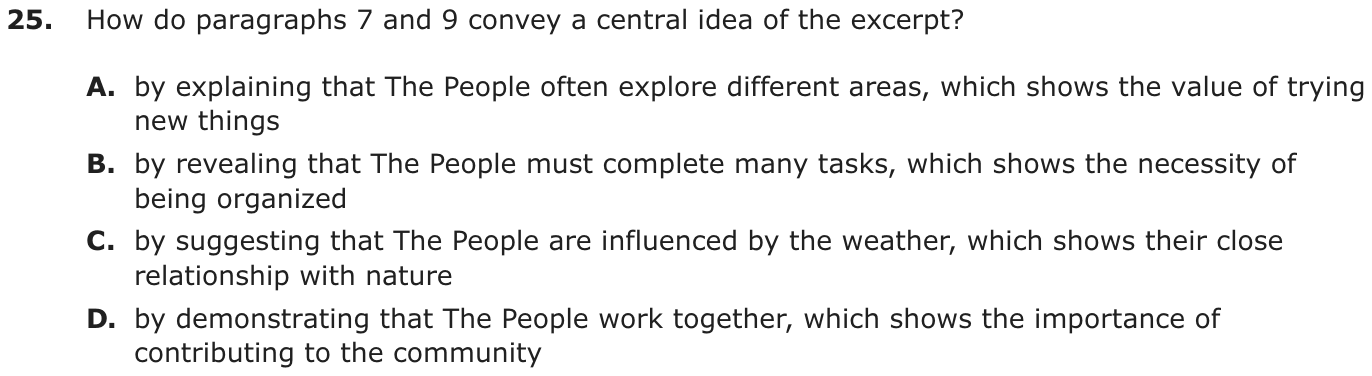
Question 30 of 57
2023 Test A English, question 30Uses the passage above: “Excerpt from Do Them No Harm!”.
Question
In paragraph 8, the author repeats the word “played” most likely to
- Aemphasize how much the adults enjoy observing the children.
- Bshow how everyone finds a way to enjoy being at the gathering.
- Cindicate the variety of activities available at the gathering.
- Dcharacterize the manner in which the children master the work of adults.
Show the answer
Correct answer: D
The question asks what is the most likely reason that the author repeats the word “played” in paragraph 8.
A. Incorrect. Paragraph 7 describes the different tasks that the adults were doing at this time. They were not watching the children play, because they were busy working.
B. Incorrect. While everyone enjoys being at the gathering, the word “played” does not describe the activities of the adults. As described in paragraph 7, the adults are working together at various tasks.
C. Incorrect. The word “played” is used before phrases describing what the children did. It is not used to list activities available for all at the gathering.
D. CORRECT. The word “played” appears before different activities that the children did, such as pretending to hunt, take care of the babies, and take care of the animals. They played by pretending to do adult activities. The last sentence states that the children “learned how to live through their play.”
Question analysis
This word-choice question asks why the author repeats the word “played” in a short paragraph about the younger children at the Nez Perce camp. Students must see what the repetition builds toward and match it to answer choices written in more abstract, formal wording than the simple paragraph itself.
- Grade level
- Grade 7 reading and task
- Compared with grade 7
- At grade 7 Explaining why an author repeats a word is common grade 7 work on word choice. The paragraph is five short sentences, but the choices are worded abstractly, so students must translate the paragraph’s point into the test’s more formal language.
- Estimated difficulty
- Moderate: several steps, or a close reading with one strong distractor.
- Thinking it demands
- Depth of knowledge 2, skills and concepts · mainly analyze
- What makes it hard
- How, not what moderate
- Reading between the lines moderate
- The right answer is reworded minor
- Evidence
- Answered from one paragraph or stanza
- Reading level
- Passage: about grade 5, 885 words; question and choices: about grade 9, 53 words.
- Students, last 30 days
- Not enough answers yet to show (it takes 10).
Why it is hard, traps and wrong answers (shows the answer)
Why it is hard
The paragraph is five short sentences, and the repetition is obvious; the challenge is saying what it adds up to. Students who stop at the repeated word see a list of games and settle on variety, while those who read to the final sentence find that the play is practice for adult life. The abstract wording of the right choice has to be matched to that plain final sentence.
How, not what moderate Working it out
The stem asks why “played” is repeated four times, so students must name the effect of the pattern, which the closing sentence, “They learned how to live through their play,” spells out. (Anderson & Krathwohl, 2001)
Reading between the lines moderate Working it out
Playing at hunting, with babies and with horses copies grown-up work, as the hunters of paragraph 7 show, and students must see that likeness to connect the play with learning adult tasks. (Graesser, Singer & Trabasso, 1994; Kintsch, 1998)
The right answer is reworded minor Choosing the answer
The right choice uses none of paragraph 8’s words, while one wrong choice borrows “enjoy being” together from paragraph 4 and another names the “gathering.” (Freedle & Kostin, 1993; Kirsch & Mosenthal, 1990)
Strategy: Read paragraph 8 to the end and ask what the string of “played” sentences adds up to, then match that idea to a choice even if the wording differs.
Traps
- Wrong purpose or structure: Names a purpose, structure or effect that the part does not serve, or describes what a part says when the question asks what it does.
- Too broad or too strong: A choice overstates, generalizes, or uses absolute words the text does not support.
- Reads too much in: A reasonable-sounding conclusion that goes further than the text allows.
The wrong answers, classified
A Reads too much in (Graesser, Singer & Trabasso, 1994)
Imagines adults happily watching the children, though paragraph 7 shows the adults busy fishing, hunting, digging and drying food.
B Too broad or too strong (King et al., 2004)
Stretches the children’s play to everyone at the gathering, though the adults in paragraph 7 are working, so the repetition describes only the children.
C Wrong purpose or structure (Anderson & Krathwohl, 2001)
Notices that each “played” introduces a different activity and takes the point to be variety, missing the last sentence about learning to live through play.
Working it out, step by step
Figure out what the question asks
The author uses the word “played” over and over in paragraph 8. Repeating a word is a way to make a point. You need to figure out what point the repetition makes.
Read paragraph 8
Paragraph 8 says: “And the younger children played. They played at hunting. They played with the babies. They played with their horses and puppies. They learned how to live through their play.” The last sentence tells you where the list was going.
See what the play has in common
The children “played at hunting,” which means they pretended to hunt. Caring for babies and horses is grown-up work, too. In paragraph 7, the adults hunt, fish and gather food. So the children copy adult work when they play. The last line says “They learned how to live through their play.” Their games are practice for grown-up life.
Check each choice
- D fits. The repeated word shows how the children learn adult work by playing. To master something means to learn to do it well.
- A: the adults aren’t watching. Paragraph 7 shows them busy working.
- B: only the children play. The adults are working.
- C: the play does vary, but variety isn’t the point. The last sentence is.
Pick the answer
Watch out: C is tempting because each “played” leads to a new activity. But the paragraph builds to learning, not to variety. So the answer is D.
Why this answer and not the closest wrong one
C is the closest wrong answer, because hunting, babies and horses are different kinds of play. But the paragraph doesn’t stop at the list. It ends with “They learned how to live through their play.” Each kind of play copies adult work, so D explains why the word is repeated.
More questions like this
The original DOE question
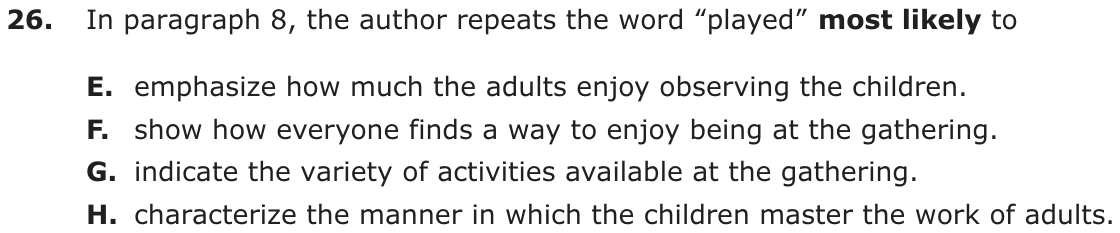
Question 31 of 57
2023 Test A English, question 31Uses the passage above: “Excerpt from Do Them No Harm!”.
Question
How do paragraphs 11–13 affect the plot of the excerpt?
- AThey establish a feeling of mystery by presenting different points of view about the arriving people.
- BThey contribute to the rising action by developing the idea that the arriving people could present a problem.
- CThey lead to a turning point by describing the moment that the crowd realizes why the strangers have come.
- DThey explain the cause of the main conflict by providing background information about the strangers.
Show the answer
Correct answer: B
The question asks how paragraphs 11–13 affect the plot of the excerpt.
A. Incorrect. The paragraphs contain questions about the arriving people. They do not present differing points of view.
B. CORRECT. The paragraphs ask questions in which the characters wonder whether the arriving people are friends or enemies, or whether they might be bringing good news or bad news. By suggesting that the arriving people could present problems such as these, the paragraphs contribute to the rising action.
C. Incorrect. The paragraphs do not lead to a turning point. Instead, they lead to the climax—the moment the characters discover who the visitors are. This means the paragraphs contribute to the rising action.
D. Incorrect. Paragraphs 11–13 ask questions. They do not provide background information about the strangers; instead, they ask for it.
Question analysis
This plot question asks how paragraphs 11–13, a series of questions the villagers ask as riders approach their camp, affect the plot of the Nez Perce narrative. Students must know terms such as rising action and turning point and apply them precisely, since several choices describe these paragraphs in ways that sound right but place them wrongly in the story.
- Grade level
- Grade 8 reading and task
- Compared with grade 7
- Above grade 7 Grade 7 plot questions usually ask what one event causes. Here students apply terms such as rising action and turning point to three short paragraphs of questions, which matches the grade 8 focus on how parts of a story propel the action.
- Estimated difficulty
- Hard: combines ideas, needs a plan, and has more than one tempting wrong answer.
- Thinking it demands
- Depth of knowledge 3, strategic thinking · mainly analyze
- What makes it hard
- A very close wrong answer major
- How, not what moderate
- Something you must already know minor
- Evidence
- Answered from several paragraphs or stanzas
- Reading level
- Passage: about grade 5, 885 words; question and choices: about grade 9, 77 words.
- Students, last 30 days
- Not enough answers yet to show (it takes 10).
Why it is hard, traps and wrong answers (shows the answer)
Why it is hard
Paragraphs 11–13 contain nothing but questions, so the answer depends on what questions do in a plot. Friends or enemies, good news or bad, they raise the chance of trouble and build toward the arrival. The trap is that they also create mystery, and the choice that says so fails only on one phrase about differing viewpoints. A second risk is jumping ahead: at this point no one even knows who the riders are, let alone why they came.
A very close wrong answer major Choosing the answer
The right choice and the one about mystery both see the questions building uncertainty about the riders; only the claim of “different points of view,” when the questions are “in every mind,” separates them. (Embretson & Wetzel, 1987; Gorin & Embretson, 2006; Ascalon et al., 2007)
How, not what moderate Working it out
The stem asks what paragraphs 11–13 do for the plot, so students must place a run of unanswered questions in the story’s shape rather than retell them. (Anderson & Krathwohl, 2001)
Something you must already know minor Working it out
The choices rely on plot terms the excerpt never explains, rising action, turning point and main conflict, and judging them means knowing what each one names. (Anderson & Krathwohl, 2001)
Strategy: Note what the villagers know and do not yet know in paragraphs 11–13, then compare that with what happens later in the excerpt to place these paragraphs in the plot.
Traps
- Half right: One half of a two-part choice is right and the other is not.
- Wrong part of the text: A choice is true of another paragraph, stanza or speaker than the one asked about.
- Wrong purpose or structure: Names a purpose, structure or effect that the part does not serve, or describes what a part says when the question asks what it does.
The wrong answers, classified
A Half right (King et al., 2004; Thissen, Steinberg & Fitzpatrick, 1989)
Rightly feels the mystery in the villagers’ questions but adds “different points of view,” though the whole camp shares the same questions.
C Wrong part of the text (Kirsch & Mosenthal, 1990)
Jumps ahead to the recognition in paragraphs 17–23; in paragraphs 11–13 the crowd does not yet know who the riders are, let alone why they came.
D Wrong purpose or structure (Anderson & Krathwohl, 2001)
Notices the hunters gone two summers and the families who never returned, but those details arrive as questions, and the excerpt has no conflict they explain.
Working it out, step by step
Figure out what the question asks
This asks how paragraphs 11–13 move the story along. You need some plot words. The plot is the order of events in a story. The rising action is the part where tension builds. Tension is the feeling that something big may happen. A turning point is the moment when things change.
Read paragraphs 11 to 13
These paragraphs are all questions. Paragraph 11 asks: “Were they friends or enemies? Did they bring good news or bad?” In paragraph 12, “Who can it be?” is one of “the questions in every mind.” Paragraph 13 asks if the riders are the hunters who left “two summers past.”
Decide what the questions do
The words “enemies” and “bad” news show the camp is worried. The riders might bring trouble. No one knows yet. So the questions build tension as the riders get closer. That is rising action. The answers come later. The crowd knows the hunters in paragraph 18. They learn who the woman is in paragraphs 22 and 23.
Check each choice
- B fits. The questions raise the chance of a problem and build tension.
- A: there is mystery, but not “different points of view.” Everyone asks the same questions.
- C: in these paragraphs, no one knows who the riders are yet, let alone why they came. So nothing here is the moment the crowd realizes anything.
- D: the paragraphs ask about the strangers. They give no background facts about them.
Pick the answer
Watch out: A is very close. The questions do create mystery. But one wrong phrase, “different points of view,” rules it out. So the answer is B.
Why this answer and not the closest wrong one
A is the closest wrong answer, because the questions do make the scene mysterious. But the questions are “in every mind,” so there are no different points of view. B names what the questions do for the plot: they hint that the riders could bring trouble, and they build tension.
More questions like this
The original DOE question
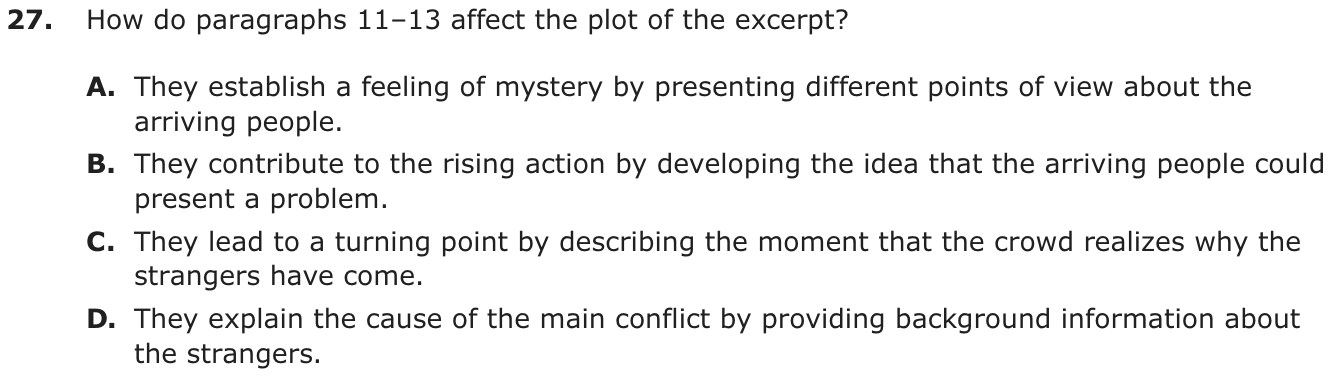
Question 32 of 57
2023 Test A English, question 32Uses the passage above: “Excerpt from Do Them No Harm!”.
Question
In paragraph 20, the phrases “trophies of their hunt” and “paraded around” affect the paragraph by
- Asuggesting that the hunters are rewarded for their leadership.
- Bemphasizing that The People are dependent on the hunters for food.
- Crevealing that the hunters are pleased with their success.
- Dindicating that The People have gathered specifically to welcome the hunters.
Show the answer
Correct answer: C
The question asks how the phrases “trophies of their hunt” and “paraded around” affect paragraph 20.
A. Incorrect. The phrase “trophies of their hunt” describes the animals that the hunters have successfully found. They have already received their rewards (the animals) and are showing them to The People.
B. Incorrect. The excerpt describes many ways that The People find and prepare their own food. While they appreciate the extra food, they are not dependent on the hunters.
C. CORRECT. The hunters “paraded around” because they were proud of the animals they had been able to get while hunting. Since a trophy is a recognition of success, they consider these animals their trophies.
D. Incorrect. The phrases show the pride the hunters feel. As paragraph 20 says, the hunters want “all to see how strong their Hunting Power had been.” The phrases are focused on the hunters rather than on those who have gathered around them.
Question analysis
This word-meaning question looks at the phrases “trophies of their hunt” and “paraded around” in the scene where four Nez Perce hunters ride back into camp, and asks what the phrases add to the paragraph. Students must work out what the words suggest in this context, not just their dictionary meanings, and weigh four plausible effects on the paragraph.
- Grade level
- Grade 6 reading and task
- Compared with grade 7
- Below grade 7 Grade 7 students analyze the connotations of words in context. These two phrases are familiar and sit in one short paragraph with helpful context nearby, so this is lighter than typical grade 7 word-choice work.
- Estimated difficulty
- Straightforward: two steps or one careful reading.
- Thinking it demands
- Depth of knowledge 2, skills and concepts · mainly analyze
- What makes it hard
- Evidence
- Answered from one paragraph or stanza
- Reading level
- Passage: about grade 5, 885 words; question and choices: about grade 8, 55 words.
- Corrected from the DOE handbook
- A quotation in the explanation was corrected to match the passage.
- Students, last 30 days
- Not enough answers yet to show (it takes 10).
Why it is hard, traps and wrong answers (shows the answer)
Why it is hard
Paragraph 20 nearly states the answer: the hunters are “proud to show off” their loads and parade “for all to see how strong their Hunting Power had been.” Errors come from neighboring details instead: the welcoming crowd in the same paragraph, the food for everyone in the next, or the everyday sense of a trophy as an award. Reading the phrases inside their own sentences settles it.
Figurative or literary language minor Understanding the question
“Trophies of their hunt” turns meat and hides into prizes and “paraded around” suggests a show, and students must read both as signs of pride rather than of awards or ceremony. (Graesser, Singer & Trabasso, 1994; Kintsch, 1998)
The right answer is reworded minor Choosing the answer
The right choice recasts “proud to show off” in new words, while one wrong choice echoes the “welcoming crowd” and another the “plenty of food” of paragraph 21. (Freedle & Kostin, 1993; Kirsch & Mosenthal, 1990)
Strategy: Think about what each phrase usually suggests, then reread the whole of paragraph 20 to check that meaning against the context before looking at the choices.
Traps
- Dictionary meaning, not meaning here: A common meaning of the word that does not fit its use in this text.
- Too broad or too strong: A choice overstates, generalizes, or uses absolute words the text does not support.
- Twists what the text says: Uses the text's topic and ideas but changes what it says: who did it, how much, when, or why.
The wrong answers, classified
A Dictionary meaning, not meaning here (Perfetti, 2007)
Reads “trophies” as prizes handed out for an achievement and adds leadership, but the trophies are the meat and hides, and nothing mentions leading.
B Too broad or too strong (King et al., 2004)
Borrows paragraph 21’s point that good hunters bring food for all and inflates it into dependence, though The People gather much of their own food.
D Twists what the text says (King et al., 2004)
Is drawn by the “welcoming crowd” in the same paragraph, but The People came to Oyaip for the camas harvest and simply greet the hunters who arrive.
What was corrected from the DOE handbook, and why
- Explanation: The handbook’s explanation of Option C says the hunters “parade around.” Paragraph 20, and the question itself, say they “paraded around the encampment,” so the site now quotes “paraded around” and puts the rest of that sentence in the past tense to match.
Working it out, step by step
Figure out what the question asks
This asks what two phrases add to paragraph 20: “trophies of their hunt” and “paraded around.” Think about what each phrase suggests. Then check it against the whole paragraph.
Think about each phrase
A trophy is something you show off to prove you won, like a cup for a winning team. Here the trophies are the meat and hides from the hunt. To parade is to march around so people can watch, like in a parade. Both phrases suggest showing off something you are proud of.
Check the whole paragraph
Paragraph 20 says the hunters were “proud to show off the loads of meat, hides, and other trophies of their hunt.” Then “They paraded around the encampment for all to see how strong their Hunting Power had been.” An encampment is a camp. The paragraph ends “what great hunters they, themselves, were.” So the hunters are proud of how well they did.
Check each choice
- C fits. The hunters are pleased with their success.
- A: no one gives the hunters a prize. The trophies are what they caught, and nothing mentions leading.
- B: The People get much of their own food. They dig roots, pick berries and fish. They don’t depend on the hunters to eat.
- D: The People came for the camas harvest. They greet the hunters when they arrive. They did not gather just for them.
Watch out: D is tempting because the paragraph mentions a “welcoming crowd.” But the two phrases describe the hunters, not the crowd.
Pick the answer
Both phrases show the hunters proudly showing off the results of a good hunt. So the answer is C: the hunters are pleased with their success.
Why this answer and not the closest wrong one
D and B are the closest wrong answers, because they use nearby details: the “welcoming crowd” and the food the hunters bring. But the two phrases are about the hunters themselves. They are “proud to show off” what they caught. That pride is C.
More questions like this
The original DOE question
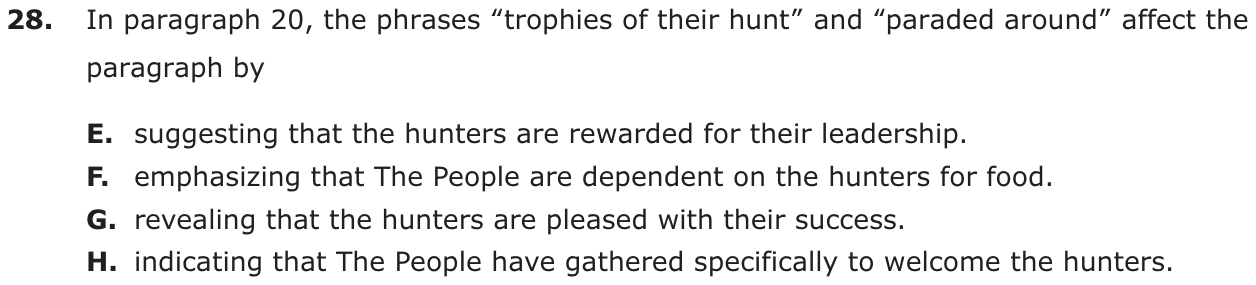
Question 33 of 57
2023 Test A English, question 33Uses the passage above: “Excerpt from Do Them No Harm!”.
Question
Which quotation from the excerpt best supports the idea that The People feel a connection to members of their group in spite of distance?
- A“As was their custom since wahk-kee-ma, a time far back beyond the memory of man, they set up their camps in the same locations their parents and grandparents had occupied before them.” (paragraph 5)
- B“ ‘Would they have news of the families who had gone long ago to Buffalo Country and never returned?’ ” (paragraph 13)
- C“ ‘Looks like hunters,’ the older men agreed. ‘Looks like they had good hunting.’ ” (paragraph 15)
- D“But it was the sight of the frail figure of the woman that aroused their curiosity.” (paragraph 21)
Show the answer
Correct answer: B
The question asks which quotation from the excerpt best supports the idea that The People feel a connection to members of their group in spite of distance.
A. Incorrect. This quotation describes the fact that The People always set up their camps in the same places their parents and grandparents used before them. This quotation highlights the customs The People continue from their ancestors, but it does not focus on their present personal connections.
B. CORRECT. This quotation alludes to The People’s eagerness to hear about the families who had traveled away from their group. This eagerness shows that they still feel a connection to these families, even though they are far apart.
C. Incorrect. This quotation describes The People’s analysis of the visitors—that they may be hunters. It does not show a connection to the visitors.
D. Incorrect. This quotation shows that The People are curious about a stranger who has come into their camp. It does not show closeness to distant members of the group.
Question analysis
This textual evidence question asks which quotation from the Nez Perce narrative best supports the idea that The People feel connected to members of their group even when those members are far away. The quotations come from across the excerpt, so students must make sure the one they choose fits both parts of that idea.
- Grade level
- Grade 7 reading and task
- Compared with grade 7
- At grade 7 Choosing the quotation that supports an idea is everyday grade 7 work. Here the idea joins two conditions, connection and distance, and the quotations come from across the excerpt, which keeps the demand at a solid grade 7 level.
- Estimated difficulty
- Moderate: several steps, or a close reading with one strong distractor.
- Thinking it demands
- Depth of knowledge 2, skills and concepts · mainly evaluate
- What makes it hard
- Reading between the lines moderate
- Every choice must be checked minor
- Evidence
- Answered from several paragraphs or stanzas
- Reading level
- Passage: about grade 5, 885 words; question and choices: about grade 9, 107 words.
- Corrected from the DOE handbook
- The explanation described one wrong choice's quotation inaccurately; that sentence was corrected.
- Students, last 30 days
- Not enough answers yet to show (it takes 10).
Why it is hard, traps and wrong answers (shows the answer)
Why it is hard
The idea joins two conditions, connection and distance, and the quotations satisfy them unevenly. The camp-location line shows a strong tie, but to ancestors across time rather than to members far away, and the line about the woman involves a returning member before anyone knows she is one. The right line is easy to pass over because it is a question, yet asking after families long gone shows they still matter.
Reading between the lines moderate Working it out
The right quotation is a question, not a statement of feeling; students must infer that asking for news of families “gone long ago” shows a bond that distance has not broken. (Graesser, Singer & Trabasso, 1994; Kintsch, 1998)
Every choice must be checked minor Choosing the answer
Each quotation has to pass two tests, a bond with group members and members who are far away, and the camp-location line passes only the first. (Embretson & Wetzel, 1987)
Strategy: Test each quotation against both parts of the idea: does it show a bond with group members, and does that bond reach people who are far away?
Traps
- Supports only part of the claim: In a question about evidence: a line that backs one half of the claim but not the other, or a related point rather than the claim itself.
- Reads too much in: A reasonable-sounding conclusion that goes further than the text allows.
The wrong answers, classified
A Supports only part of the claim (King et al., 2004; Thissen, Steinberg & Fitzpatrick, 1989)
Sees a bond in camping where parents and grandparents camped, but that ties The People to ancestors across time, not to members far away.
C Supports only part of the claim (King et al., 2004; Thissen, Steinberg & Fitzpatrick, 1989)
Remembers that the older men go on to say “Maybe our four hunters,” but the quoted words only judge the hunt and show no feeling for absent members.
D Reads too much in (Graesser, Singer & Trabasso, 1994)
Knows the woman turns out to be a lost member, but at this point no one knows who she is, so the curiosity is about a stranger, not a bond.
What was corrected from the DOE handbook, and why
- Explanation: Choice A quotes paragraph 5: The People “set up their camps in the same locations their parents and grandparents had occupied before them.” The handbook's explanation says the quotation describes them returning “to perform the same traditional tasks and enjoy the same festivities as their ancestors,” which the sentence doesn't say. The explanation now describes the quotation as it is. The reason A is wrong is unchanged: it shows a custom kept from their ancestors, not a connection to members who are far away. The answer, B, is unchanged.
Working it out, step by step
Figure out what the question asks
You need the quotation that best shows The People feel close to group members who are far away. The idea has two parts: a connection, and distance. The right quotation must show both.
Test each quotation on both parts
- A (paragraph 5): they camp where “their parents and grandparents” camped. That is a connection, but to people from the past, not to people far away.
- B (paragraph 13): “Would they have news of the families who had gone long ago to Buffalo Country and never returned?” These families are far away and long gone. The People still want news of them.
- C (paragraph 15): the men only guess that the riders are hunters who had a good hunt. They show no feeling for anyone.
- D (paragraph 21): The People are curious about the woman. They don’t know yet that she is one of them.
See why B shows a connection
You only ask for news about people you care about. The families left “long ago.” They went to Buffalo Country, far from the camp. Yet The People still wonder about them. So time and distance have not broken the bond.
Pick the answer
Watch out: A shows a strong bond too, so it is tempting. But it ties The People to their parents and grandparents, across time. It is not about members who are far away. So the answer is B.
Why this answer and not the closest wrong one
A is the closest wrong answer, because camping where parents and grandparents camped shows a strong tie. But that tie stretches across years, not across distance. B is about families who went far away “long ago,” and The People still want news of them. Only B passes both tests.
More questions like this
The original DOE question
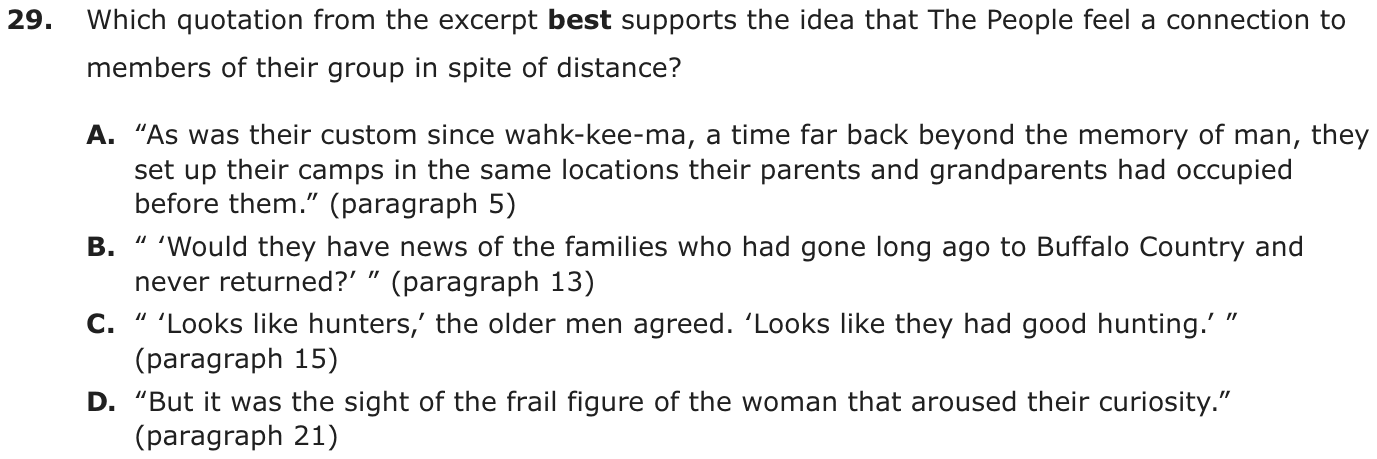
Question 34 of 57
2023 Test A English, question 34Uses the passage above: “Excerpt from Do Them No Harm!”.
Question
Read these sentences from paragraph 22.
“Belongs to Red Bear people. Gone then come back.”
How does this statement affect the villagers in the excerpt?
- AIt increases their concern about why the woman is in their camp.
- BIt makes them hopeful that more lost members will return before the winter.
- CIt causes shock, leading them to grieve for the loss of the woman and her family.
- DIt inspires amazement, making them want to reconnect with their returned family member.
Show the answer
Correct answer: D
The question asks how the statement from paragraph 22 affects the villagers in the excerpt.
A. Incorrect. In paragraph 21, the villagers question who the woman is and from where she has come, but they are merely curious about her and not necessarily concerned, as there is no indication in paragraph 22 that she might be a threat.
B. Incorrect. This statement reveals that the woman is a member of the Red Bear people who has returned, and in paragraph 15 there is a reference to four hunters who have been gone a long time. However, this statement serves only to satisfy the villagers’ curiosity about who this woman is; it does not make the villagers hopeful that other people will also return.
C. Incorrect. Though paragraph 23 reveals that the villagers are somewhat surprised because the girl has grown into a woman, paragraph 24 suggests they are excited to receive her. There is no reason given in paragraph 22 for them to grieve for her loss, since she has returned.
D. CORRECT. The hunters’ words from paragraph 22 amaze the villagers, who do not at first recognize the woman. Once they know she is one of their own, they are eager to interact with her, as revealed in paragraphs 24 and 25, where they give her a new name and care for her.
Question analysis
This question quotes the hunters’ brief words about the frail woman who rides into camp with them, “Belongs to Red Bear people. Gone then come back,” and asks how the statement affects the villagers. Students must follow the scene that comes next and judge the villagers’ feelings from what they shout and do, since the excerpt never names those feelings directly.
- Grade level
- Grade 7 reading and task
- Compared with grade 7
- At grade 7 Explaining how a line of dialogue affects characters is grade 7 story analysis. The hunters’ words are short and the response follows at once, so the main demand is inferring the villagers’ state of mind, a routine grade 7 step.
- Estimated difficulty
- Straightforward: two steps or one careful reading.
- Thinking it demands
- Depth of knowledge 2, skills and concepts · mainly analyze
- What makes it hard
- Reading between the lines moderate
- Evidence
- Answered from several paragraphs or stanzas
- Reading level
- Passage: about grade 5, 885 words; question and choices: about grade 6, 78 words.
- Students, last 30 days
- Not enough answers yet to show (it takes 10).
Why it is hard, traps and wrong answers (shows the answer)
Why it is hard
The hunters’ words answer the question the crowd has been asking, who the woman is, and what follows is recognition and welcome. Students who carry over an earlier mood, worry about strangers or sadness at a long absence, misread the moment. The hopeful-sounding choice about more members returning goes one step past the text, which shows joy over this return and nothing about others.
Reading between the lines moderate Working it out
The villagers’ reaction is never named; it is shown in paragraphs 23–25, where “Now they could see!”, the women cry out her new name and gentle arms lift her from her horse. (Graesser, Singer & Trabasso, 1994; Kintsch, 1998)
Strategy: Read the paragraphs right after the hunters speak and note what the villagers say and do. Then choose the reaction those words and actions show.
Traps
- Wrong tone or attitude: Misjudges the tone, attitude or point of view, such as reading admiration as criticism, or taking a character's or subject's feelings for the author's.
- Reads too much in: A reasonable-sounding conclusion that goes further than the text allows.
The wrong answers, classified
A Wrong tone or attitude (Graesser, Singer & Trabasso, 1994)
Carries over the worry of paragraph 11, friends or enemies, though by now the hunters vouch for the woman and the statement removes any reason for concern.
B Reads too much in (Graesser, Singer & Trabasso, 1994)
Connects the return to paragraph 13’s wish for news of families who never came back, then assumes hope that others will follow, which the excerpt never shows.
C Wrong tone or attitude (Graesser, Singer & Trabasso, 1994)
Rightly senses surprise but reads it as grief, prompted by the woman’s frail figure and long absence, though the women cry out her new name and care for her.
Working it out, step by step
Figure out what the question asks
The hunters say: “Belongs to Red Bear people. Gone then come back.” This asks how those words affect the villagers. The story doesn’t name their feelings. So look at what they say and do next.
See what happens next
- Paragraph 23: “Now they could see! She was the daughter of the family gone so long ago!”
- Paragraph 24: the women cry out “Wat-ku-ese!” This becomes her new name.
- Paragraph 25: “Gentle arms lifted Wat-ku-ese from her horse.” The women bring her food and care for her.
Name the feelings
The exclamation points in paragraph 23 show surprise and wonder. A little girl has come back as a grown woman, and they can hardly believe it. That is amazement. Then they give her a name, feed her and care for her. They want to bring her back into the family. That is reconnecting, or becoming close again.
Check each choice
- D fits: amazement, then wanting to reconnect.
- A: the hunters say she belongs to the Red Bear people. That ends any worry.
- B: nothing says they hope others will return before winter.
- C: they are surprised, but they don’t grieve, or feel deep sadness. They cheer and care for her.
Watch out: C is tempting because she is frail and was gone a long time. But the women’s actions are happy and gentle.
Pick the answer
The villagers are amazed, and they rush to welcome her back home. So the answer is D.
Why this answer and not the closest wrong one
C is the closest wrong answer, because the news is a shock and the woman is frail. But nobody mourns. The women shout her new name, and “Gentle arms lifted Wat-ku-ese from her horse.” Those are signs of joy and care. That matches D, amazement and a wish to reconnect.
More questions like this
The original DOE question
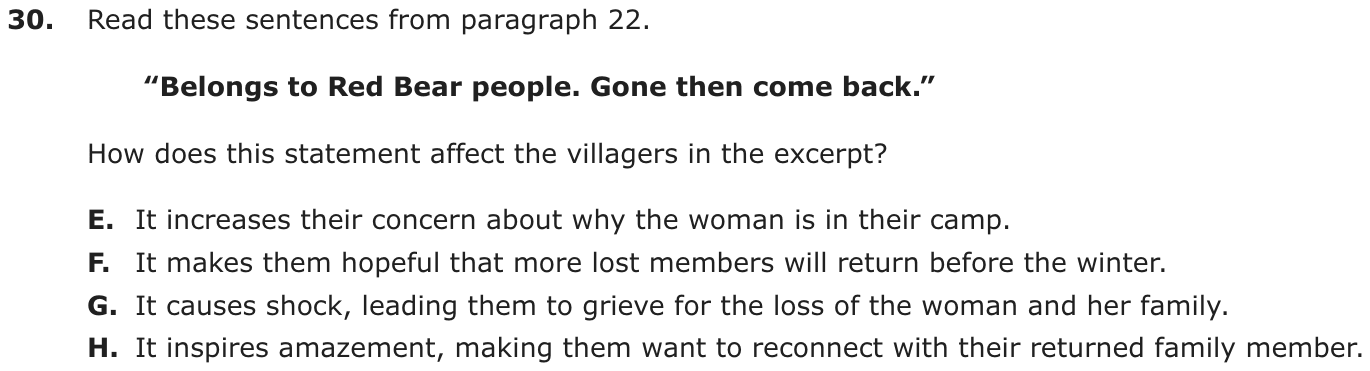
Question 35 of 57
2023 Test A English, question 35Uses the passage above: “Excerpt from Do Them No Harm!”.
Question
The details in paragraph 5 about the locations of the camps and the details in paragraphs 23–24 about the reaction to the woman convey a theme of the excerpt by
- Arevealing the difficulties posed by moving often each year.
- Bshowing the connectedness among The People through the years.
- Cindicating the value to The People of retelling stories about the past.
- Ddemonstrating the importance of choosing appropriate names.
Show the answer
Correct answer: B
The question asks how the details in paragraph 5 about the locations of the camps and the details in paragraphs 23–24 about the reaction to the woman convey a theme of the excerpt.
A. Incorrect. Paragraph 5 does not reveal that The People move often, only that they come together near each other at this particular time of year. Paragraphs 23–24 reveal a resolution to the difficulty of people who are absent for some time, but they do not relate to the difficulty of moving often each year.
B. CORRECT. The details in paragraph 5 show that each year The People set up their camps beside the same neighbors, in the places their parents and grandparents used before them, demonstrating their connectedness. Similarly, the details in paragraphs 23–24 reveal that The People quickly embrace a member of their group who had gone away but has since returned. Taken together, these sections reveal just how much The People rely on their connectedness, a theme of the excerpt.
C. Incorrect. Although paragraph 5 suggests that The People keep the customs of their ancestors alive, it does not reference storytelling. Further, though paragraphs 23–24 suggest that The People had knowledge of this woman’s absence, they do not indicate that this knowledge came from stories in particular.
D. Incorrect. In paragraph 24, an appropriate new name, meaning “Gone-from-Home-then-Come-Back,” is bestowed on the returned woman. However, the importance of appropriate names is not a theme of the excerpt. Rather, the theme that is emphasized is the importance of the connection among The People, exemplified by the annual gathering and the warm welcome extended to the woman who has returned after a long absence.
Question analysis
This theme question asks how two sets of details in the Nez Perce narrative, where each group pitches its camp and how the camp reacts to a woman who has come back after many years, together convey a theme. Students must connect two parts of the excerpt that are far apart and find the one idea that both of them express.
- Grade level
- Grade 7 reading and task
- Compared with grade 7
- At grade 7 Tracing a theme across a text is the grade 7 central idea standard. Students must join two passages far apart in the excerpt, but each is concrete, and the theme they share is the kind grade 7 readers routinely name.
- Estimated difficulty
- Moderate: several steps, or a close reading with one strong distractor.
- Thinking it demands
- Depth of knowledge 3, strategic thinking · mainly analyze
- What makes it hard
- Evidence in several places moderate
- Reading between the lines minor
- Evidence
- Answered from several paragraphs or stanzas
- Reading level
- Passage: about grade 5, 885 words; question and choices: about grade 9, 65 words.
- Corrected from the DOE handbook
- The explanation described the wrong paragraph's details; that sentence was corrected.
- Students, last 30 days
- Not enough answers yet to show (it takes 10).
Why it is hard, traps and wrong answers (shows the answer)
Why it is hard
Each set of details on its own suggests several ideas, tradition, travel, naming, but the theme has to explain both at once. Students who focus on paragraph 24’s new name or on storytelling elsewhere in the excerpt choose an idea that fits only one passage. Naming what the old campsites and the warm welcome have in common, ties that last across years and distance, leads straight to the key.
Evidence in several places moderate Working it out
The two sets of details sit eighteen paragraphs apart, the camps in the places “their parents and grandparents had occupied” and the welcome given Wat-ku-ese, and the theme must fit both. (Kirsch & Mosenthal, 1990; Gorin & Embretson, 2006)
Reading between the lines minor Working it out
Neither passage names the theme; students must see that returning to ancestral campsites and embracing a lost daughter both show bonds that last across years. (Graesser, Singer & Trabasso, 1994; Kintsch, 1998)
Strategy: Sum up each set of details in a phrase, the camp locations and the reaction to the woman, then name the one idea both sets share before reading the choices.
Traps
- Too narrow: A single detail offered as the central idea or a summary, or a summary that keeps minor details and leaves out an essential part.
- Wrong part of the text: A choice is true of another paragraph, stanza or speaker than the one asked about.
- Twists what the text says: Uses the text's topic and ideas but changes what it says: who did it, how much, when, or why.
The wrong answers, classified
A Twists what the text says (King et al., 2004)
Assumes the yearly trek means constant moving, but paragraph 5 stresses returning to the same sites, and paragraphs 23–24 say nothing about travel.
C Wrong part of the text (Kirsch & Mosenthal, 1990)
Links customs kept “beyond the memory of man” to storytelling, likely recalling Wat-ku-ese telling her story at the end, but neither cited section is about retelling.
D Too narrow (King et al., 2004)
Fixes on the naming of Wat-ku-ese in paragraph 24, one vivid detail, and ignores the camp locations in paragraph 5 that the theme must also explain.
What was corrected from the DOE handbook, and why
- Explanation: The handbook's explanation of B says paragraph 5 shows The People coming together “to share in recreational activities.” The races and games are in paragraph 4; paragraph 5, the one the question names, is about camping each year in the same places as their parents and grandparents, beside the same neighbors. The sentence now describes paragraph 5. The answer, B, is unchanged.
Working it out, step by step
Figure out what the question asks
A theme is a big idea a story shows about life. This asks for the theme shared by two parts of the story. One is paragraph 5, about where the camps go. The other is paragraphs 23–24, about the woman who comes back. The theme has to fit both.
Sum up paragraph 5
Paragraph 5 says they set up camp “in the same locations their parents and grandparents had occupied before them.” The same neighbors camp side by side each year. Red Bear’s neighbors “had their camp close by.” So the families stay tied to each other and to the past, year after year.
Sum up paragraphs 23 and 24
In paragraph 23 the camp learns “She was the daughter of the family gone so long ago!” She left as a little girl and came back grown. Yet they know her as one of their own. In paragraph 24 the women joyfully give her a new name. She is welcomed home after many years.
Find the shared idea
Both parts show bonds that last a long time. The People keep the same camps and neighbors through the years. They also welcome back a member who was gone for years. So the theme is how connected The People stay over time.
Check each choice
- B fits both parts: connectedness through the years.
- A: paragraph 5 is about going back to the same places, not moving often. Paragraphs 23–24 don’t mention moving at all.
- C: neither part is about retelling old stories.
- D: the new name is only in paragraph 24. It says nothing about the camps in paragraph 5.
Watch out: The naming of Wat-ku-ese is easy to remember, so D is tempting. But a theme must fit both parts.
Pick the answer
The camp locations and the warm welcome both show bonds that last through the years. So the answer is B.
Why this answer and not the closest wrong one
D is the closest wrong answer, because the naming in paragraph 24 stands out. But a name says nothing about where the camps go in paragraph 5. B explains both parts: The People camp beside the same neighbors year after year, and they welcome back a daughter gone for years.
More questions like this
The original DOE question
Question 36 of 57
2023 Test A English, question 36Passage Using Fire to Keep a Prairie Healthy
Using Fire to Keep a Prairie Healthy
Inside the 40,000-acre Joseph H. Williams Tallgrass Prairie Preserve in northern Oklahoma, herds of bison roam on the scenic land that is home to hundreds of different species of plants and animals. While one of the greatest threats to the prairie is wildfire, the use of controlled fires is actually an effective way to protect this idyllic landscape.
Fires that are started by lightning or other natural circumstances are inevitable, and the results can be disastrous. However, hundreds of years ago the American Indian people who inhabited the Great Plains area between Minnesota and Texas realized that these fires could also be helpful. The bison in the area seemed to prefer grazing on tender new grass on the recently burned land rather than on grass in the unburned areas. The American Indian people began to deliberately burn areas of land for bison to graze on, which enticed the herds away from the people’s crops.
Today conservationists at the Tallgrass Prairie Preserve and farmers in the Great Plains continue to use controlled burns for land management. Intentionally burning a portion of land can dramatically improve the quality of the vegetation that regrows there. The fires burn away weedy undergrowth and help limit the overcrowding of shrubs and trees in the burn area, creating less competition for water and nutrients. Additionally, the process of burning excess plant matter adds nitrogen, an essential element for plant growth, to the soil.
One common target of controlled burns at the preserve and the surrounding area is the invasive red cedar tree. A single red cedar tree can consume up to 40 gallons of water per day, taking this vital resource away from other plant life. These tall trees also cast shade that prevents sunlight from reaching the plants beneath them. The fast-growing red cedar trees tend to crowd out prairie grasses, the primary food source for wild and domestic animals that make the prairie their home. An imbalance in one component of the prairie’s ecosystem affects the entire web of life. Controlled burns help maintain this ecosystem’s delicate balance.
Of course, these controlled fires are intended to burn only a portion of an area. A total burn, which is a risk with an uncontrolled wildfire, would destroy all wildlife as well as the crops farmers plant for income. The key to using controlled fires is knowing which areas of land to burn and when. Conservation experts at the preserve employ the “patch-burn” approach, meaning they rotate which portion of land is burned each year. They study the land to find out which areas would most benefit from being burned, and then they arrange about a dozen burns over one-third of the land. This patch burning contains the fire within a specific area and allows animals in the burn area to safely relocate. The following year, conservationists will burn a different section of the preserve, while the land burned the previous year regrows healthier than before.
Researchers have tracked and studied the variety of plant species and animals that live on the preserve, and their studies show that the patch-burn approach has restored biodiversity to the area by promoting the growth of species that were at risk of being crowded out. The patch-burn system is so successful that the conservationists at the preserve provide training to prairie farmers about conducting controlled burns on their own land. Burning land to make it healthy may seem counterintuitive, but strategic controlled fires have helped the prairie sustain life for hundreds of years and, with careful management, will continue to do so.
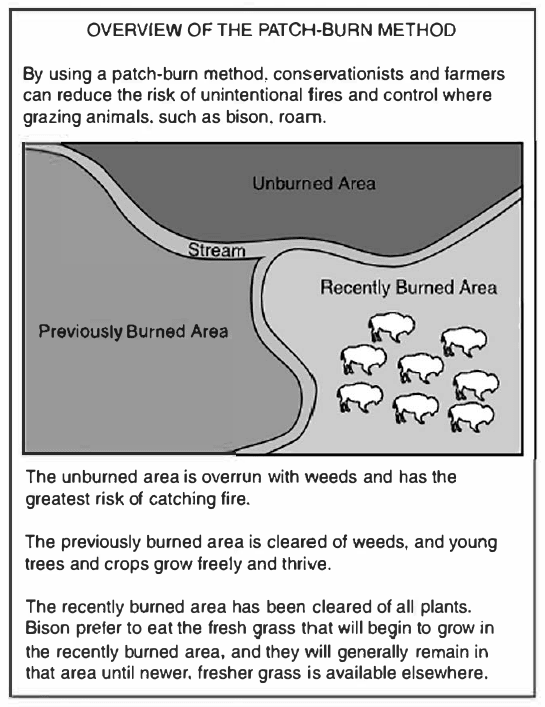
Question
According to the passage, how did fires started by natural causes prompt American Indians to begin practicing controlled burns?
- Aby drawing animals in to the area to feed on the new growth sprouting from the burned land
- Bby destroying tall trees and reducing the shade that had hindered the growth of planted crops
- Cby burning off excess vegetation and increasing the availability of nutrients for the remaining plants
- Dby causing changes to the bison’s migration habits as bison herds fled from the wildfires on the prairie
Show the answer
Correct answer: A
The question asks how observing the effects of the fires started by natural causes prompted American Indians to begin practicing controlled burns.
A. CORRECT. In paragraph 2, the author states that American Indians observed bison “grazing on tender new grass on the recently burned land rather than on grass in the unburned areas.” These observations prompted the practice of controlled burns as a means of enticing “the herds away from the people’s crops.”
B. Incorrect. Although the author mentions in paragraph 4 that the primary targets of a controlled burn are red cedar trees and that “these tall trees also cast shade that prevents sunlight from reaching the plants beneath them,” this detail supports why conservationists use controlled burns today, not what initially prompted the use of controlled burns.
C. Incorrect. While the author states in paragraph 3 that “the process of burning excess plant matter adds nitrogen, an essential element for plant growth, to the soil” and that “intentionally burning a portion of land can dramatically improve the quality of the vegetation that regrows there,” these details do not explain the initial observations that prompted American Indians to practice controlled burning.
D. Incorrect. While paragraph 2 mentions that bison moved to a new area to graze because they preferred the “tender new grass on the recently burned land,” there is no indication in the passage that bison changed their migration habits in order to flee wildfires.
Question analysis
This key-details question about an article on controlled burns at an Oklahoma tallgrass prairie preserve asks how fires started by lightning or other natural causes led American Indians to begin burning land on purpose. Students must find the passage's account of that early practice, and since the article describes several effects of fire, each choice has to be checked against what those first observers actually saw.
- Grade level
- Grade 7 reading and task
- Compared with grade 7
- At grade 7 Finding a stated cause in an informational text is regular grade 7 reading. The answer sits in one short paragraph, but the article describes several effects of fire, old and new, and the choices draw on them, which keeps the demand typical.
- Estimated difficulty
- Straightforward: two steps or one careful reading.
- Thinking it demands
- Depth of knowledge 2, skills and concepts · mainly understand
- What makes it hard
- Evidence
- Answered from one paragraph or stanza
- Reading level
- Passage: about grade 11, 598 words; question and choices: about grade 9, 86 words.
- Students, last 30 days
- Not enough answers yet to show (it takes 10).
Why it is hard, traps and wrong answers (shows the answer)
Why it is hard
The stem points to one short paragraph, but the article goes on to list many more benefits of fire, and two wrong choices borrow them: shade cleared from under red cedars and nutrients returned to the soil. Both are true of controlled burns today, not of what the Great Plains peoples first noticed. Students who return to paragraph 2 and restate the bison’s taste for freshly burned grass find the answer quickly.
Every choice must be checked minor Choosing the answer
Two wrong choices name real benefits of burning from later paragraphs, cedar shade removed in paragraph 4 and nutrients freed in paragraph 3, so each must be tested against what the early peoples saw. (Embretson & Wetzel, 1987)
Reading between the lines minor Working it out
Paragraph 2 never says the bison’s grazing caused the practice; students connect “realized that these fires could also be helpful” to the preference for burned land and the deliberate burns that follow. (Graesser, Singer & Trabasso, 1994; Kintsch, 1998)
Strategy: Go to the paragraph about the Great Plains peoples of hundreds of years ago, restate in your own words what they noticed after natural fires, and test each choice against that observation.
Traps
- Wrong part of the text: A choice is true of another paragraph, stanza or speaker than the one asked about.
- True but not the answer: A choice says something accurate about the text that does not answer this question.
- Twists what the text says: Uses the text's topic and ideas but changes what it says: who did it, how much, when, or why.
The wrong answers, classified
B Wrong part of the text (Kirsch & Mosenthal, 1990)
Borrows paragraph 4’s red cedars, whose shade blocks sunlight from the plants beneath them, and adds “planted crops,” though that shade explains modern burns, not the first deliberate ones.
C True but not the answer (King et al., 2004; Embretson & Wetzel, 1987)
States paragraph 3’s real benefits, weedy undergrowth burned away and nitrogen added to the soil, but the article gives them as reasons for burning today, not as what the early peoples observed.
D Twists what the text says (King et al., 2004)
Remembers that bison moved onto burned land but turns their preference for “tender new grass” into herds fleeing wildfire, a change in migration the passage never describes.
Working it out, step by step
Figure out what the question asks
This question asks about a cause. Long ago, fires started by lightning gave American Indians an idea. They began to burn land on purpose. You need to find what they saw that led them to do it. A controlled burn is a fire that people set and keep inside a planned area.
Find the right paragraph
Paragraph 2 tells this part of the story. It says the people “realized that these fires could also be helpful.” Then it says what they noticed: “The bison in the area seemed to prefer grazing on tender new grass on the recently burned land rather than on grass in the unburned areas.”
Put it in your own words
Grazing means eating grass. After a fire, soft new grass grew, and the bison liked it best. So the people began to burn land on purpose. The new grass pulled the herds to that land. That kept the bison away from the crops. The paragraph says the burning “enticed the herds away from the people’s crops.” Enticed means tempted or drew.
Check each choice
- A is right. The burned land drew animals, the bison, to eat the new grass.
- B is wrong. The shade of tall trees comes from paragraph 4. It explains why people burn red cedars today, not how burning began.
- C is wrong. Burning off weeds and adding nutrients come from paragraph 3. Nutrients are what plants need to grow. These are reasons for burning today.
- D is wrong. The bison moved toward the fresh grass. The passage never says herds fled from fires.
Watch out: C is true about controlled burns. But the question asks what first gave the people the idea. Paragraph 2 says it was the bison.
Choose the answer
The early people saw bison come to burned land to eat the new grass. So the answer is A: “by drawing animals in to the area to feed on the new growth sprouting from the burned land.”
Why this answer and not the closest wrong one
C is the closest wrong answer, because it names real good effects of fire. But paragraph 3 gives those as reasons people burn land “today.” The question asks how burning began hundreds of years ago. Paragraph 2 says it began when people watched bison feed on burned land.
More questions like this
The original DOE question
The passage “Using Fire to Keep a Prairie Healthy” as printed (page 41)
Question 37 of 57
2023 Test A English, question 37Uses the passage above: “Using Fire to Keep a Prairie Healthy”.
Question
Targeting red cedar trees in controlled burns affects the animals that live on the prairie mostly by
- Aensuring that the animals’ main food source has the conditions needed for it to thrive.
- Bendangering the animals that live near the trees scheduled for removal.
- Cmaking sure that the water supply for the animals is sufficient.
- Dreducing the animals’ natural source of shade and protection from the elements.
Show the answer
Correct answer: A
The question asks how targeting red cedar trees in controlled burns affects the animals that live on the prairie.
A. CORRECT. According to information in paragraph 4, targeting invasive red cedar trees with controlled burns affects animals that live on the prairie by ensuring that these trees do not “crowd out prairie grasses, the primary food source for wild and domestic animals that make the prairie their home.” The paragraph also states that each red cedar tree consumes “up to 40 gallons of water per day, taking this vital resource away from other plant life.” Removing red cedars thus increases the amount of water available to the prairie grasses and helps maintain favorable conditions for the animals’ main source of food.
B. Incorrect. Although the author mentions the potential danger to wildlife from an uncontrolled burn in paragraph 5, the author emphasizes that patch burning “allows animals in the burn area to safely relocate.” Therefore, the animals that live near trees scheduled for removal are not endangered by the controlled burns.
C. Incorrect. In paragraph 4, the author states that “a single red cedar tree can consume up to 40 gallons of water per day, taking this vital resource away from other plant life.” However, the author does not suggest that reducing the number of red cedar trees through controlled burns ensures a sufficient water supply for animals that live on the prairie.
D. Incorrect. In paragraph 4, the author states that “these tall trees also cast shade that prevents sunlight from reaching the plants beneath them.” However, the author does not suggest that using controlled burns to eliminate red cedar trees reduces a natural source of shade for prairie animals. The red cedar trees are invasive; therefore, the author does not consider them a “natural” part of the prairie ecosystem.
Question analysis
This question asks how burning invasive red cedar trees on purpose mostly affects the wild and domestic animals that live on the Oklahoma prairie. Students follow a chain of cause and effect through the paragraph on red cedars, which describes the trees' heavy water use, their shade and their spread, and must pick out the effect that matters most to the animals.
- Grade level
- Grade 7 reading and task
- Compared with grade 7
- At grade 7 Grade 7 readers routinely trace how one change leads to another in an informational text. This chain stays within one paragraph, but the paragraph names several things the cedars take from the prairie, and the stem's “mostly” asks for the main effect.
- Estimated difficulty
- Moderate: several steps, or a close reading with one strong distractor.
- Thinking it demands
- Depth of knowledge 2, skills and concepts · mainly analyze
- What makes it hard
- Reading between the lines moderate
- Much to keep track of minor
- The right answer is reworded minor
- Evidence
- Answered from one paragraph or stanza
- Reading level
- Passage: about grade 11, 598 words; question and choices: about grade 9, 66 words.
- Students, last 30 days
- Not enough answers yet to show (it takes 10).
Why it is hard, traps and wrong answers (shows the answer)
Why it is hard
Paragraph 4 lists three harms the red cedar does, drinking water, casting shade and crowding out grasses, and the wrong choices hand the water and the shade straight to the animals. In the text, all three harms fall on plants, and animals feel them only through the grasses they eat. Students who ask who suffers each harm see that protecting the food supply is the main effect the stem’s “mostly” asks for.
Reading between the lines moderate Working it out
Paragraph 4 never names an effect on animals; students must chain the cedars crowding out “prairie grasses,” the grasses being “the primary food source,” and the burns that remove the cedars. (Graesser, Singer & Trabasso, 1994; Kintsch, 1998)
Much to keep track of minor Working it out
The paragraph names three harms at once, 40 gallons of water a day, shade over the plants below and crowding, and students must track which living things each harm reaches. (Sweller, 1988; Carpenter, Just & Shell, 1990)
The right answer is reworded minor Choosing the answer
The right choice speaks of “conditions needed for it to thrive” without naming grass or cedars, while the wrong ones repeat the paragraph’s vivid details of water and shade. (Freedle & Kostin, 1993; Kirsch & Mosenthal, 1990)
Strategy: Reread the paragraph about red cedars and list each way the trees harm the prairie, then ask which of those harms reaches the animals and which would matter to them most.
Traps
- Twists what the text says: Uses the text's topic and ideas but changes what it says: who did it, how much, when, or why.
- Outside knowledge: A choice is plausible in the real world but not supported by this text.
The wrong answers, classified
B Outside knowledge (King et al., 2004; Recht & Leslie, 1988)
Assumes that fire near animals must endanger them, a common belief, though paragraph 5 says patch burning “allows animals in the burn area to safely relocate.”
C Twists what the text says (King et al., 2004)
Seizes on the 40 gallons a red cedar drinks each day, but the passage says that water is taken from “other plant life,” not from the animals’ supply.
D Twists what the text says (King et al., 2004)
Turns the cedars’ shade, which blocks sunlight from “the plants beneath them,” into shelter for animals, though the passage treats the invasive trees as a harm, never a natural refuge.
Working it out, step by step
Figure out what the question asks
This question asks about cause and effect. People burn red cedar trees on purpose. You need to find how that mostly helps the animals. The word “mostly” means you want the biggest effect, not just any effect.
Find what the red cedars do
Paragraph 4 is about red cedars. It names three harms. First, one tree can drink “up to 40 gallons of water per day, taking this vital resource away from other plant life.” Second, the trees “cast shade that prevents sunlight from reaching the plants beneath them.” Third, they “tend to crowd out prairie grasses, the primary food source for wild and domestic animals.”
Ask who each harm hurts
Look at who loses each time. The water is taken from “other plant life.” The shade blocks light from “the plants beneath them.” The crowding pushes out prairie grasses. So every harm falls on plants. The animals feel it through the grass, because grass is their main food. Primary means main. So burning the cedars mostly helps the animals by protecting their food.
Check each choice
- A is right. The animals’ main food source is prairie grass. With the cedars gone, the grass gets water, sunlight and room to grow.
- B is wrong. Paragraph 5 says patch burning “allows animals in the burn area to safely relocate.” Relocate means move somewhere else.
- C is wrong. The cedars take water from plants. The passage never says the animals run short of water.
- D is wrong. The shade blocks light from plants. The passage never calls it shelter for animals.
Watch out: The 40 gallons of water is a striking fact, so C is tempting. But that water is taken from “other plant life.”
Choose the answer
Burning the cedars keeps the grass healthy, and the grass feeds the animals. Thrive means grow well. So the answer is A: “ensuring that the animals’ main food source has the conditions needed for it to thrive.”
Why this answer and not the closest wrong one
C is the closest wrong answer, because paragraph 4 does talk about water. But it says the cedars take water from plants, not from animals. The grass, the animals’ main food, is what suffers from all three harms. So A fits better.
More questions like this
The original DOE question
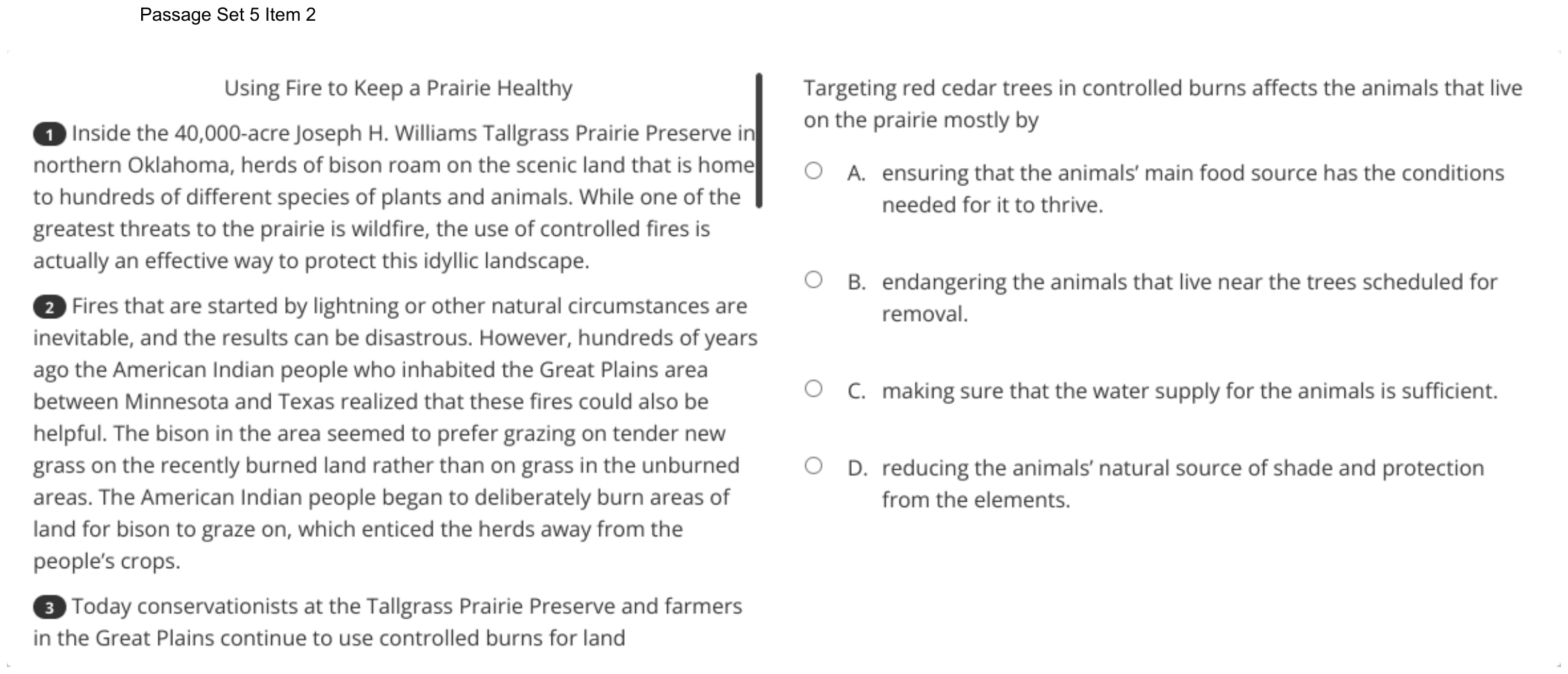
Question 38 of 57
2023 Test A English, question 38Uses the passage above: “Using Fire to Keep a Prairie Healthy”.
Question
Read this sentence from paragraph 6.
The patch-burn system is so successful that the conservationists at the preserve provide training to prairie farmers about conducting controlled burns on their own land.
The author includes this sentence to show that
- Athe conservationists are better qualified to lead preservation efforts than farmers are.
- Bthe conservationists are eager to involve others in the preservation of the prairie.
- Cthe conservationists’ efforts will restore the original beauty and biodiversity of the region.
- Dthe conservationists’ training program should serve as a model for other conservation organizations.
Show the answer
Correct answer: B
The question asks what the author intends to show by using the second sentence in paragraph 6 in the passage.
A. Incorrect. Although the author refers to the conservationists as “experts” in paragraph 5 and states that conservationists “provide training to prairie farmers” (paragraph 6), the second sentence in paragraph 6 does not imply that the conservationists are better qualified to lead preservation efforts than farmers are. Instead, the sentence shows that conservationists believe that prairie farmers are capable of performing the controlled burns that contribute to overall conservation efforts.
B. CORRECT. The conservationists are eager to involve others in the preservation of the prairie, because “studies show that the patch-burn approach has restored biodiversity to the area by promoting the growth of species that were at risk of being crowded out” and that the process has “helped the prairie sustain life for hundreds of years” (paragraph 6). The second sentence in paragraph 6 describes how conservationists are sharing their knowledge about preservation techniques with people who live on the prairie.
C. Incorrect. Although the author points out in paragraph 6 that “studies show that the patch-burn approach has restored biodiversity to the area by promoting the growth of species that were at risk of being crowded out,” the idea that controlled burns may help restore the original biodiversity of the prairie is not the focus of the second sentence in paragraph 6, which notes only that conservationists are providing training to farmers about controlled burns.
D. Incorrect. The author mentions in paragraph 6 that the patch-burn system has been “successful” and suggests in the last sentence of the paragraph that the use of controlled burns will continue to benefit the prairie ecosystem. These details imply that this system will continue to be used and may even become more widespread. However, the second sentence in paragraph 6 merely describes a patch-burn training program that already exists and does not suggest that this program should serve as a model for other organizations.
Question analysis
This question quotes a sentence from the last paragraph of the prairie article, about the preserve's conservationists training farmers to run controlled burns on their own land, and asks why the author includes it. Students must work out what this one sentence contributes, and because every choice sounds like something a successful program might show, the test is whether the sentence itself supports it.
- NYS standards
- 7R5 structure and genre features
- Grade level
- Grade 7 reading and task
- Compared with grade 7
- At grade 7 Explaining why an author includes a sentence is everyday grade 7 work. The sentence is short and plainly worded, and the choices stay close to the passage's ideas, so each must be measured against what the sentence itself says.
- Estimated difficulty
- Moderate: several steps, or a close reading with one strong distractor.
- Thinking it demands
- Depth of knowledge 2, skills and concepts · mainly analyze
- What makes it hard
- How, not what moderate
- Reading between the lines moderate
- Evidence
- Answered from one sentence or line
- Reading level
- Passage: about grade 11, 598 words; question and choices: about grade 11, 89 words.
- Students, last 30 days
- Not enough answers yet to show (it takes 10).
Why it is hard, traps and wrong answers (shows the answer)
Why it is hard
Every choice reads something into one plain sentence, so the decision is how far the sentence lets a reader go. Teaching farmers to burn their own land shows a wish to spread the work, which the right choice calls eagerness to involve others. The wrong choices go further: to a ranking of experts over farmers, to restoring the region’s original beauty, or to a model for other organizations, none of which the sentence states.
How, not what moderate Working it out
The stem asks why the author includes the training sentence, so students must say what it adds after the studies of restored biodiversity, not merely restate that farmers are trained. (Anderson & Krathwohl, 2001)
Reading between the lines moderate Working it out
Nothing in the sentence calls the conservationists “eager”; that has to be read from their choosing to teach their method to farmers so that it spreads beyond the preserve. (Graesser, Singer & Trabasso, 1994; Kintsch, 1998)
Strategy: Restate the sentence in your own words, then ask what it adds to the paragraph's account of the patch-burn system's success, rejecting any choice that claims more than the sentence says.
Traps
- Reads too much in: A reasonable-sounding conclusion that goes further than the text allows.
- Wrong part of the text: A choice is true of another paragraph, stanza or speaker than the one asked about.
- Too broad or too strong: A choice overstates, generalizes, or uses absolute words the text does not support.
The wrong answers, classified
A Reads too much in (Graesser, Singer & Trabasso, 1994)
Reads experts training farmers as a ranking of who should lead, though the sentence shows trust that farmers can run burns themselves, not a claim of superior qualifications.
C Wrong part of the text (Kirsch & Mosenthal, 1990)
Draws on the sentence before, where studies show “the patch-burn approach has restored biodiversity,” and adds “original beauty,” though the training sentence itself is about sharing the method.
D Too broad or too strong (King et al., 2004)
Takes “so successful” as an endorsement and stretches one preserve’s training of local farmers into a model that other conservation organizations should follow, a recommendation the author never makes.
Working it out, step by step
Figure out what the question asks
This question asks why the author put one sentence in the passage. The sentence says the patch-burn system works so well that the preserve’s experts train farmers. You need to decide what that sentence shows, and no more.
Read the sentence closely
The sentence says “the conservationists at the preserve provide training to prairie farmers about conducting controlled burns on their own land.” Conservationists are people who work to protect nature. Conducting means carrying out. So the experts teach farmers to do the burns themselves.
Decide what it shows
Why would experts teach their method to others? Because they want more people to help. Their method works, so they share it. Then the burns can happen on farms too, not only at the preserve. That shows they want others to join in protecting the prairie. Preservation means keeping something safe and healthy.
Check each choice
- A is wrong. Teaching farmers shows trust that farmers can do it. It doesn’t say experts should lead instead of farmers.
- B is right. Training farmers brings more people into caring for the prairie.
- C is wrong. Restored biodiversity comes from the sentence before. Biodiversity means many kinds of living things. This sentence is about sharing the method.
- D is wrong. The author never says other groups should copy this program.
Watch out: The words “so successful” make D sound right. But the sentence only says the preserve trains local farmers. It doesn’t call the program a model for others.
Choose the answer
The experts share their method so farmers can help too. So the answer is B: “the conservationists are eager to involve others in the preservation of the prairie.”
Why this answer and not the closest wrong one
D is the closest wrong answer, because “so successful” sounds like high praise. But D adds an idea the sentence never states: that other groups should copy the program. B stays with what the sentence shows, experts teaching farmers so they can help.
More questions like this
The original DOE question
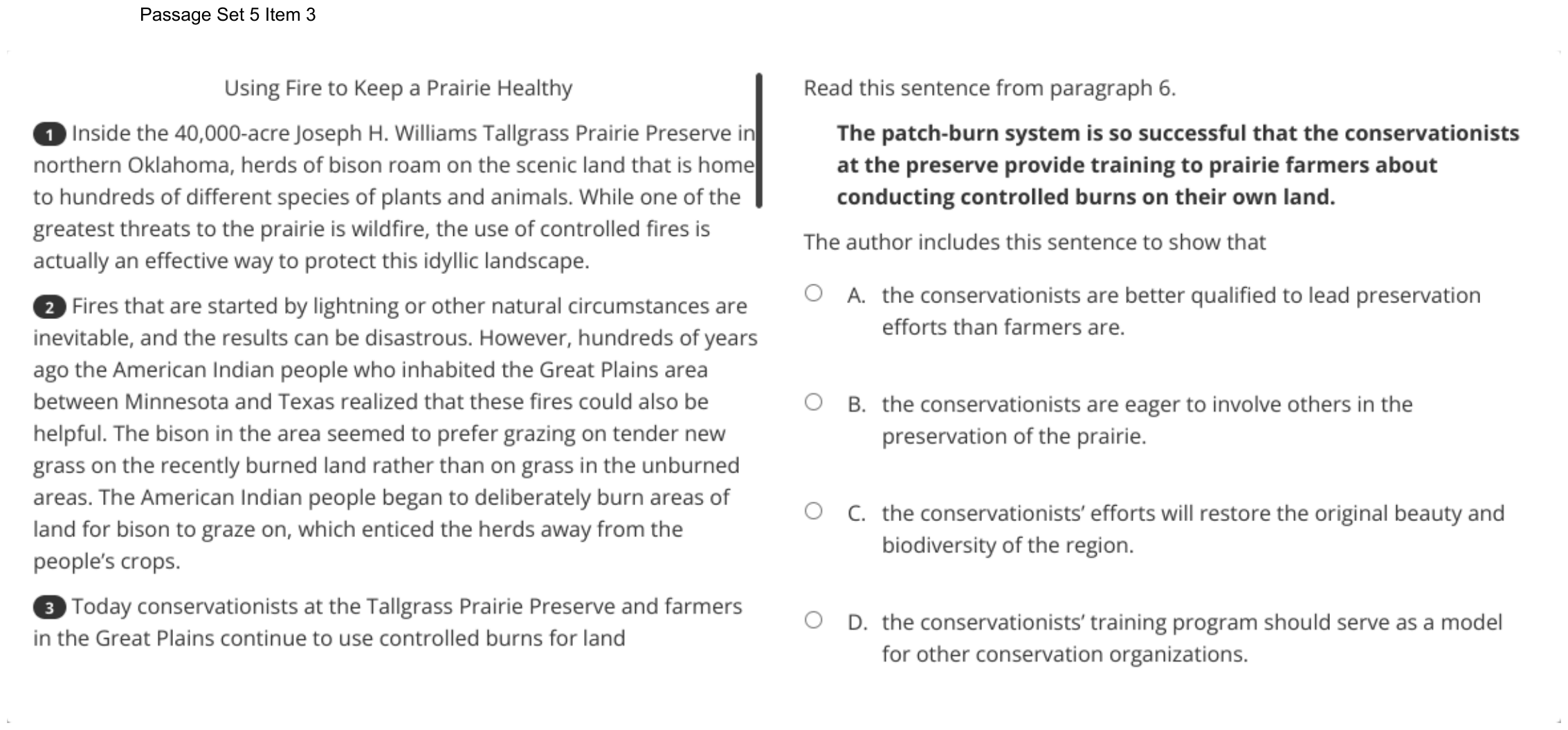
Question 39 of 57
2023 Test A English, question 39Uses the passage above: “Using Fire to Keep a Prairie Healthy”.
Question
Which details from the passage best convey the central idea that using the patch-burn method is an effective way to protect and manage prairie land?
- Athe explanation that conservationists use the alternating burn pattern of the patch-burn method in order to allow the animals in the area to avoid the fire
- Bthe information that conservationists evaluate which land would most benefit from a controlled burn before applying the patch-burn method
- Cthe information that conservationists have determined that the patch-burn method has promoted the growth of species that were at risk of being crowded out
- Dthe explanation that conservationists are able to control the fire in the patch-burn method by arranging separate burns across the designated portion of land
Show the answer
Correct answer: C
The question asks which details from the passage best convey the central idea that using the patch-burn method is an effective way to protect and manage prairie land.
A. Incorrect. The author explains in paragraph 5 that “patch burning contains the fire within a specific area and allows animals in the burn area to safely relocate.” This explanation conveys two supporting ideas: the patch-burn method is controllable, and patch-burn fires do not pose a threat to animals. However, this explanation does not address the broader central idea that the patch-burn method is an effective way to protect and manage prairie land.
B. Incorrect. In paragraph 5, the author states that “the key to using controlled fires is knowing which areas of land to burn and when.” The author then provides information about how conservation experts “study the land to find out which areas would most benefit from being burned.” However, these details convey supporting ideas rather than the central idea that using the patch-burn method is an effective way to protect and manage prairie land.
C. CORRECT. In paragraph 3, the author states that “fires burn away weedy undergrowth and help limit the overcrowding of shrubs and trees in the burn area, creating less competition for water and nutrients.” Also, in paragraph 6, the author states that patch burning “has restored biodiversity to the area by promoting the growth of species that were at risk of being crowded out.” These details directly convey the central idea that using the patch-burn method is an effective way to protect and manage prairie land.
D. Incorrect. The author explains in paragraph 5 how conservationists “arrange about a dozen burns over one-third of the land,” which helps show how the patch-burn method is applied by conservationists. However, this is a supporting detail that conveys the idea that the burns are deliberately set and carefully controlled. This detail does not convey the central idea that using the patch-burn method is an effective way to manage and protect prairie land.
Question analysis
This evidence question on the article about controlled burns at an Oklahoma tallgrass prairie preserve asks which details best convey the central idea that the patch-burn method is an effective way to protect and manage prairie land. Every choice reports something the article really says about the method, so students must decide which details speak most directly to the central idea as stated.
- Grade level
- Grade 7 reading and task
- Compared with grade 7
- At grade 7 Matching details to a stated central idea is regular grade 7 work, and the article is short and clearly written. Each choice is a long, accurate description, so the work lies in judging relevance rather than truth, which is typical.
- Estimated difficulty
- Moderate: several steps, or a close reading with one strong distractor.
- Thinking it demands
- Depth of knowledge 2, skills and concepts · mainly evaluate
- What makes it hard
- Every choice must be checked moderate
- Evidence in several places minor
- A lot to read minor
- Evidence
- Answered from several paragraphs or stanzas
- Reading level
- Passage: about grade 11, 598 words; question and choices: about grade 13, 118 words.
- Students, last 30 days
- Not enough answers yet to show (it takes 10).
Why it is hard, traps and wrong answers (shows the answer)
Why it is hard
The central idea joins three words, protect, manage and effective, and each wrong choice speaks to protect or manage with a step in carrying out the method: keeping animals safe, choosing the land, controlling the fire. Only a result shows that the method is effective, and the one result offered is the return of species once at risk of being crowded out. Students who ask what each detail proves, not what it is about, separate how the method works from whether it works.
Every choice must be checked moderate Choosing the answer
All four choices report the patch-burn method accurately, the animals’ safe relocation, the study of the land, the dozen burns and the restored species, so truth rules none out; each must be tested for proof the method works. (Embretson & Wetzel, 1987)
Evidence in several places minor Working it out
Three choices come from paragraph 5, where the method is explained, while the result that shows it works, restored biodiversity, sits in paragraph 6, after the description ends. (Kirsch & Mosenthal, 1990; Gorin & Embretson, 2006)
A lot to read minor Understanding the question
Each choice is a noun phrase of 19 to 26 words opening “the explanation that” or “the information that,” so four long details must be unpacked before they can be compared. (Kintsch, 1998; Gorin & Embretson, 2006; Freedle & Kostin, 1993)
Strategy: Restate the central idea in your own words, noting what “effective” requires, then ask of each choice whether that detail would persuade a doubtful reader of the whole idea.
Traps
- Supports only part of the claim: In a question about evidence: a line that backs one half of the claim but not the other, or a related point rather than the claim itself.
The wrong answers, classified
A Supports only part of the claim (King et al., 2004; Thissen, Steinberg & Fitzpatrick, 1989)
Links “protect” in the central idea to the animals’ chance to “safely relocate” in paragraph 5, a true detail of how patch burns are run, not proof they improve the prairie.
B Supports only part of the claim (King et al., 2004; Thissen, Steinberg & Fitzpatrick, 1989)
Hears effectiveness in “would most benefit,” but experts studying the land before a burn shows how they plan where to burn, not that the burns have worked.
D Supports only part of the claim (King et al., 2004; Thissen, Steinberg & Fitzpatrick, 1989)
Connects “manage” and “protect” to fire kept under control by arranging “about a dozen burns over one-third of the land,” which shows how the method is applied, not what it achieves.
Working it out, step by step
Figure out what the question asks
This asks which details best support a central idea. A central idea is a main point the whole passage develops. Here the idea is given: the patch-burn method is an effective way to protect and manage prairie land. Effective means it works and gets good results. So look for details that show results, not just how the method is done.
Find how the method works
Paragraph 5 explains the patch-burn method. The experts “rotate which portion of land is burned each year.” Rotate means take turns. First, “They study the land to find out which areas would most benefit from being burned.” Then “they arrange about a dozen burns over one-third of the land.” This “contains the fire within a specific area and allows animals in the burn area to safely relocate.” These details tell how the method is done.
Find what the method achieves
Paragraph 6 gives the results. Researchers studied the plants and animals on the preserve. Their studies show “that the patch-burn approach has restored biodiversity to the area by promoting the growth of species that were at risk of being crowded out.” Biodiversity means many kinds of living things. A species is one kind of plant or animal. Crowded out means pushed aside, the way red cedars crowd out prairie grasses in paragraph 4. So the method helped species that were losing ground. That shows it works.
Check each choice
- A does not fit. Animals escaping safely shows the burns are done with care. It does not show the land gets healthier.
- B does not fit. Studying the land is a planning step before a burn. It shows how the experts choose, not whether the burns work.
- C fits. It reports a result: the method helped species that were at risk.
- D does not fit. Arranging a dozen burns shows how the fire is kept under control. It does not show what the burns achieve.
Watch out: D sounds like “manage,” since the experts control the fire. But controlling a fire is part of doing the method. Only a result proves the method is effective.
Choose the answer
Only one choice shows the patch-burn method getting good results. So the answer is C, “the information that conservationists have determined that the patch-burn method has promoted the growth of species that were at risk of being crowded out.”
Why this answer and not the closest wrong one
D is the closest wrong choice. Careful control sounds like good management. But D only describes how the burns are set up. A method can be done carefully and still fail. C gives the proof that it works: studies show the burns “restored biodiversity.” Paragraph 6 even calls the system “so successful.”
More questions like this
The original DOE question
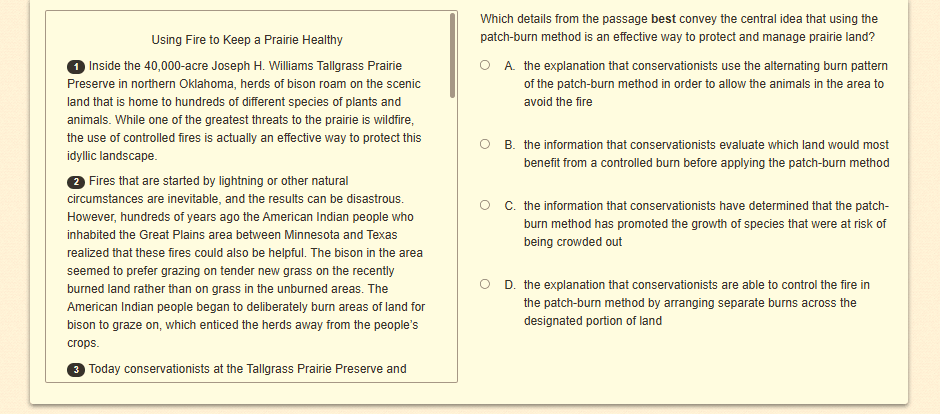
Question 40 of 57
2023 Test A English, question 40Uses the passage above: “Using Fire to Keep a Prairie Healthy”.
Question
Which sentence supports the idea that farmers and people who manage land may be concerned about using fire as a way to benefit the land?
- A“While one of the greatest threats to the prairie is wildfire, the use of controlled fires is actually an effective way to protect this idyllic landscape.” (paragraph 1)
- B“The American Indian people began to deliberately burn areas of land for bison to graze on, which enticed the herds away from the people’s crops.” (paragraph 2)
- C“This patch burning contains the fire within a specific area and allows animals in the burn area to safely relocate.” (paragraph 5)
- D“The following year, conservationists will burn a different section of the preserve, while the land burned the previous year regrows healthier than before.” (paragraph 5)
Show the answer
Correct answer: A
The question asks which sentence supports the idea that farmers and people who manage land may be concerned about using fire as a way to benefit the land.
A. CORRECT. The sentence from paragraph 1 supports the idea that farmers and people who manage land may be concerned about using fire as a way to benefit the land because it acknowledges that “one of the greatest threats to the prairie is wildfire.”
B. Incorrect. Although the sentence from paragraph 2 relates how American Indians “began to deliberately burn areas of land for bison to graze on” and to protect people’s crops, the sentence does not support the idea that farmers and people who manage land may be concerned about using fire as a way to benefit the land. Instead, it focuses on the cause-and-effect relationship between bison and newly burned areas.
C. Incorrect. The sentence from paragraph 5 provides details about how “patch burning contains the fire” and “allows animals in the burn area to safely relocate,” but it does not adequately support the idea that farmers and people who manage land may be concerned about using fire as a way to benefit the land, because it does not mention that wildfires can be a threat to the prairie.
D. Incorrect. While the sentence from paragraph 5 does explain how “conservationists will burn a different section of the preserve” in order to rotate the process year after year so that the burned land has time to regrow, the sentence does not support the idea that farmers and people who manage land may be concerned about using fire as a way to benefit the land because it does not mention the potential for total burns.
Question analysis
This evidence question asks which sentence from the article on controlled prairie burns supports the idea that farmers and others who manage land may be concerned about using fire to benefit it. The passage never states that concern directly, so students must infer it, and all four quoted sentences, taken from across the article, talk about burning land in some way.
- Grade level
- Grade 8 reading and task
- Compared with grade 7
- Above grade 7 Grade 7 evidence questions usually ask for support of an idea the text states. This idea, that people who manage land may worry about using fire, is never stated outright, so students must infer which sentence implies it, more than typical.
- Estimated difficulty
- Hard: combines ideas, needs a plan, and has more than one tempting wrong answer.
- Thinking it demands
- Depth of knowledge 3, strategic thinking · mainly evaluate
- What makes it hard
- Reading between the lines major
- A very close wrong answer moderate
- Every choice must be checked minor
- Evidence
- Answered from one sentence or line
- Reading level
- Passage: about grade 11, 598 words; question and choices: about grade 13, 123 words.
- Students, last 30 days
- Not enough answers yet to show (it takes 10).
Why it is hard, traps and wrong answers (shows the answer)
Why it is hard
The idea to support is about people’s feelings, yet none of the four sentences mentions farmers worrying, so students have to decide what would justify such worry. The opening sentence does it by naming wildfire as a great threat before praising controlled fire, a concession many students read past as background. The strongest pull is the sentence on containing the fire, which implies caution but presents patch burning as the answer, not the concern.
Reading between the lines major Working it out
No sentence mentions worry; students must see that calling wildfire “one of the greatest threats to the prairie” gives landowners a reason to fear fire, and that “actually” answers that fear. (Graesser, Singer & Trabasso, 1994; Kintsch, 1998)
A very close wrong answer moderate Choosing the answer
The patch-burn sentence about containing the fire “within a specific area” also hints at fire’s danger; it differs from the right one by describing the safeguard without ever naming a threat. (Embretson & Wetzel, 1987; Gorin & Embretson, 2006; Ascalon et al., 2007)
Every choice must be checked minor Choosing the answer
The four sentences come from paragraphs 1, 2 and 5, and each is about burning land, so each must be tested for a hint of risk rather than for its topic. (Embretson & Wetzel, 1987)
Strategy: Before rereading the choices, decide what a sentence would need to say to show that landowners have reason to be wary of fire, then test each quoted sentence for exactly that.
Traps
- Supports only part of the claim: In a question about evidence: a line that backs one half of the claim but not the other, or a related point rather than the claim itself.
- True but not the answer: A choice says something accurate about the text that does not answer this question.
The wrong answers, classified
B True but not the answer (King et al., 2004; Embretson & Wetzel, 1987)
Links “the people’s crops” to farmers, but the sentence tells how early burns drew bison away from the crops and shows no worry about fire itself.
C Supports only part of the claim (King et al., 2004; Thissen, Steinberg & Fitzpatrick, 1989)
Sees caution in containing the fire “within a specific area,” but the sentence explains how patch burning keeps animals safe and never says fire threatens the land.
D Supports only part of the claim (King et al., 2004; Thissen, Steinberg & Fitzpatrick, 1989)
Takes the yearly rotation as a careful precaution, but the sentence describes the schedule and land that “regrows healthier than before,” which backs the benefit, not the worry.
Working it out, step by step
Figure out what the question asks
This is an evidence question. Evidence is the words in a text that back up an idea. The idea here is that farmers might worry about using fire to help land. No sentence says farmers are worried. So look for a sentence that gives them a reason to fear fire.
Decide what the evidence needs
A sentence that supports this idea must show that fire can be dangerous. If fire can harm land, people have a reason to be careful with it. So test each sentence with one question: does it say fire is a threat?
Look closely at paragraph 1
Choice A quotes paragraph 1. Its first half says “one of the greatest threats to the prairie is wildfire.” That is a reason to fear fire. Its second half says controlled fires are “actually” helpful. The word “actually” pushes back against that fear. It means: you might expect fire to hurt the land, but here it helps.
Check each choice
- A is right. It names wildfire as a great threat. That gives farmers a reason to worry about fire.
- B is wrong. It tells how early burns drew bison away from crops. It shows no danger from fire.
- C is wrong. It tells how patch burning keeps the fire in one area. It describes a safety step but never names a threat.
- D is wrong. It describes burning a new section each year. It shows a benefit: land that “regrows healthier than before.”
Watch out: C hints that fire must be contained, or kept in, so it sounds careful. But it describes the solution, not the danger.
Choose the answer
Only one sentence names fire as a danger. So the answer is A, the sentence from paragraph 1: “While one of the greatest threats to the prairie is wildfire, the use of controlled fires is actually an effective way to protect this idyllic landscape.” Idyllic means peaceful and lovely.
Why this answer and not the closest wrong one
C is the closest wrong answer, because keeping fire “within a specific area” suggests caution. But C only explains how patch burning works. It never says fire can harm the prairie. A does, by calling wildfire one of the greatest threats.
More questions like this
The original DOE question
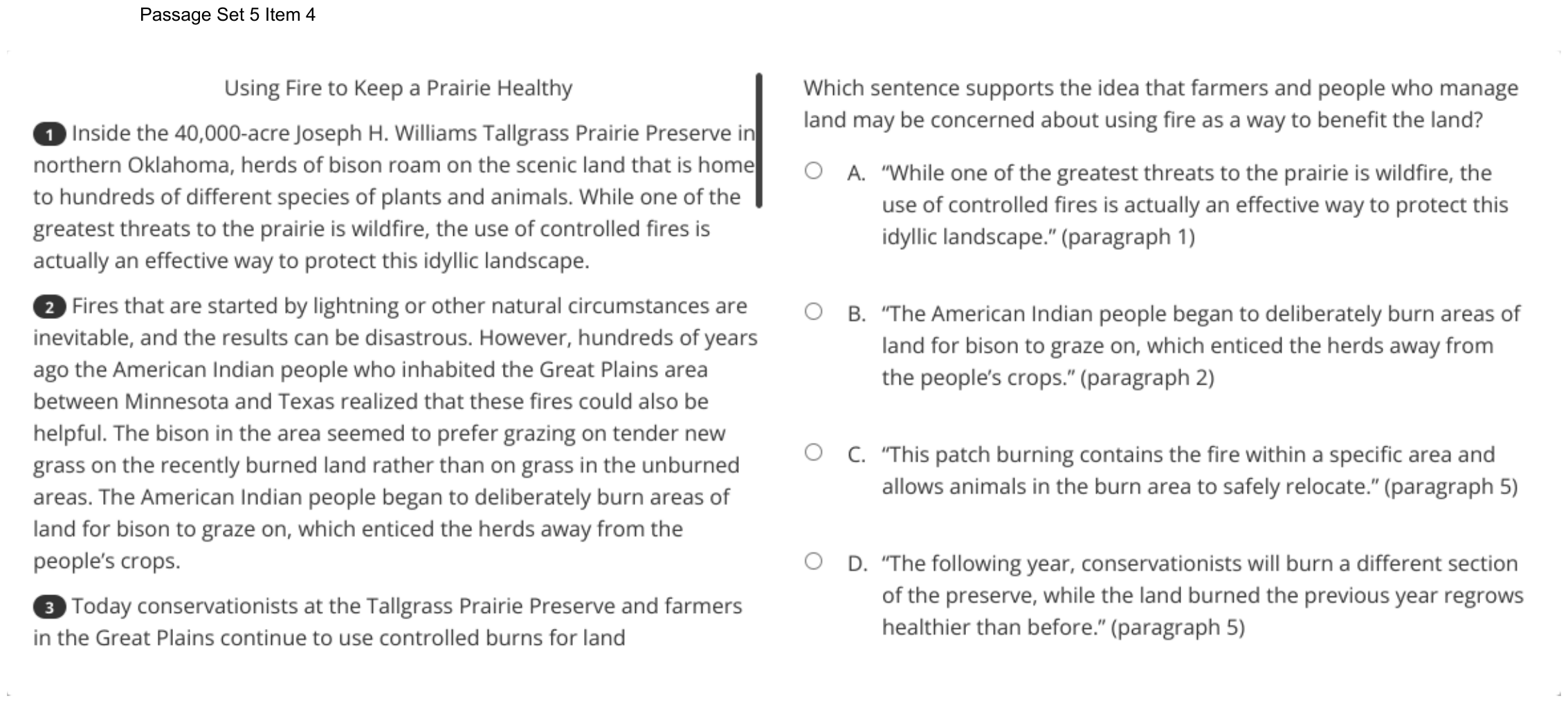
Question 41 of 57
2023 Test A English, question 41Uses the passage above: “Using Fire to Keep a Prairie Healthy”.
Question
Read this sentence from paragraph 6.
Burning land to make it healthy may seem counterintuitive, but strategic controlled fires have helped the prairie sustain life for hundreds of years and, with careful management, will continue to do so.
The words “counterintuitive” and “strategic” in the sentence convey the idea that
- Athe safest methods are sometimes the least effective at solving complex challenges.
- Bthorough investigation of uncommon methodologies can lead to beneficial results.
- Cdetailed planning can ensure that a potentially destructive action has a positive impact.
- Dplans that entail a certain amount of risk almost always result in success.
Show the answer
Correct answer: C
The question asks which idea the words “counterintuitive” and “strategic” convey in the last sentence in paragraph 6 in the passage.
A. Incorrect. Though the author states in paragraph 6 that conservationists have used safe and “strategic” methods, those methods have not been ineffective, since “the patch-burn system is so successful that the conservationists at the preserve provide training to prairie farmers about conducting controlled burns on their own land” (paragraph 6). Therefore, the words “counterintuitive” and “strategic” in the last sentence of paragraph 6 do not convey the idea that the safest methods are sometimes the least effective at solving complex challenges.
B. Incorrect. Although the author points out in paragraph 6 that researchers’ studies have shown “that the patch-burn approach has restored biodiversity to the area by promoting the growth of species that were at risk of being crowded out,” the author does not suggest that the methodologies conservationists used to conduct the patch burns are uncommon, since the methods were used by “the American Indian people [who] began to deliberately burn areas of land for bison to graze on” (paragraph 2). Therefore, the words “counterintuitive” and “strategic” in the last sentence of paragraph 6 do not convey the idea that thorough investigation of uncommon methodologies can lead to beneficial results.
C. CORRECT. In paragraph 1, the author states that “one of the greatest threats to the prairie is wildfire,” so the idea of conducting controlled burns suggests risk and runs “counter,” or contrary, to people’s common expectations, or “intuition,” about the dangers of fires. Thus, the words “counterintuitive” and “strategic” in the last sentence of paragraph 6 convey the idea that detailed planning can ensure that a potentially destructive action has a positive impact.
D. Incorrect. The author states in paragraph 6 that “the patch-burn system is so successful that the conservationists at the preserve provide training to prairie farmers.” This statement supports the idea of the action being “strategic” in order to achieve success. However, the statement does not suggest that because the process is “counterintuitive,” or unexpected, it involves a certain amount of risk to achieve that success. Therefore, the words “counterintuitive” and “strategic” in the last sentence of paragraph 6 do not convey the idea that plans that entail a certain amount of risk almost always result in success.
Question analysis
This vocabulary question takes the last sentence of the prairie article, which says burning land to make it healthy may seem counterintuitive, and asks what the words “counterintuitive” and “strategic” convey together. Students need the meaning of a hard word built from a prefix, then must match the pair to a general statement, and the choices are worded abstractly.
- Grade level
- Grade 8 reading and task
- Compared with grade 7
- Above grade 7 A typical grade 7 vocabulary question asks what one word means in context. This one pairs a hard word, “counterintuitive,” with “strategic” and asks for the idea they express together, with four abstract general statements to weigh.
- Estimated difficulty
- Hard: combines ideas, needs a plan, and has more than one tempting wrong answer.
- Thinking it demands
- Depth of knowledge 2, skills and concepts · mainly understand
- What makes it hard
- A very close wrong answer moderate
- Hard words moderate
- Combines ideas minor
- Evidence
- Answered from one sentence or line
- Reading level
- Passage: about grade 11, 598 words; question and choices: about grade 11, 97 words.
- Students, last 30 days
- Not enough answers yet to show (it takes 10).
Why it is hard, traps and wrong answers (shows the answer)
Why it is hard
Students first need the meaning of “counterintuitive,” then must see what it says here: that burning land to heal it seems backward because fire destroys. “Strategic” supplies the other half, careful planning. The most tempting wrong answer gets the planning right but misreads the first word as “uncommon,” and others turn the pair into a rule about risk or a warning about safe methods. The question rewards translating each word before reading the abstract choices.
A very close wrong answer moderate Choosing the answer
The choice about “thorough investigation of uncommon methodologies” follows the key’s pattern, planning that leads to a good result, and differs only in calling the method uncommon instead of potentially destructive. (Embretson & Wetzel, 1987; Gorin & Embretson, 2006; Ascalon et al., 2007)
Hard words moderate Understanding the question
“Counterintuitive,” contrary to what one would expect, is an uncommon word, and the choices add “methodologies” and “entail,” so the options are as hard to read as the sentence. (Perfetti, 2007; Freedle & Kostin, 1993)
Combines ideas minor Working it out
The two words point different ways, one to burning that seems harmful and one to careful planning, and the answer must join both into a single general statement. (Embretson, 1998; Daniel & Embretson, 2010)
Strategy: Break “counterintuitive” into its parts, counter and intuitive, decide what each of the two words says about burning land, then find the statement that joins both meanings without adding claims of its own.
Traps
- Half right: One half of a two-part choice is right and the other is not.
- Too broad or too strong: A choice overstates, generalizes, or uses absolute words the text does not support.
- Twists what the text says: Uses the text's topic and ideas but changes what it says: who did it, how much, when, or why.
The wrong answers, classified
A Twists what the text says (King et al., 2004)
Reads “counterintuitive” as a hint that the safe choice fails, but the sentence praises carefully managed fire and never says safer methods are less effective.
B Half right (King et al., 2004; Thissen, Steinberg & Fitzpatrick, 1989)
Matches “strategic” to thorough investigation, since the experts “study the land,” but takes “counterintuitive” to mean uncommon, though the passage traces burning back hundreds of years.
D Too broad or too strong (King et al., 2004)
Hears risk in “counterintuitive” and success in “strategic” but turns them into a rule that risky plans “almost always” succeed, far more than one sentence about the prairie claims.
Working it out, step by step
Figure out what the question asks
This question asks about two words in the last sentence: “counterintuitive” and “strategic.” You need the idea the two words give together. So first figure out what each word means here.
Break down “counterintuitive”
Counter means against. Intuitive means what you would naturally expect. So counterintuitive means the opposite of what you would expect. The sentence says “Burning land to make it healthy may seem counterintuitive.” Fire usually destroys things. So burning land to help it seems backward. Paragraph 1 even calls wildfire “one of the greatest threats to the prairie.”
Figure out “strategic”
Strategic means carefully planned to reach a goal. Paragraph 5 shows that planning. The experts “study the land to find out which areas would most benefit from being burned.” Then they burn only part of the land each year. Put the two words together. Fire seems harmful, but careful planning makes it helpful.
Check each choice
- A is wrong. The sentence doesn’t say safe methods fail. It praises a method that works.
- B is wrong. It treats counterintuitive as if it meant uncommon. But burning isn’t new. Paragraph 2 says people did it “hundreds of years ago.”
- C is right. Strategic matches detailed planning. Counterintuitive matches an action that could destroy, fire, which turns out to help.
- D is wrong. “Almost always” is far too strong. The sentence is about prairie fires, not all risky plans.
Watch out: B gets strategic right, since the experts study the land. But counterintuitive doesn’t mean uncommon. It means against what you would expect.
Choose the answer
Fire seems destructive, but a careful plan makes it helpful. So the answer is C: “detailed planning can ensure that a potentially destructive action has a positive impact.”
Why this answer and not the closest wrong one
B is the closest wrong answer, because its first part, careful study, fits strategic. But its second part calls the method uncommon, and people have burned the prairie for hundreds of years. C fits both words: careful planning, and an action that seems harmful but helps.
More questions like this
The original DOE question
Question 42 of 57
2023 Test A English, question 42Uses the passage above: “Using Fire to Keep a Prairie Healthy”.
Question
With which statement would the author most likely agree?
- AIt is important to explain the purposes and the risks of controlled burns to the people living near a proposed burn area.
- BIt is necessary to thoroughly examine a particular region in order to plan and execute a successful controlled burn.
- CMonitoring animals’ reactions after a controlled burn on the prairie is a minor part of scientists’ research.
- DConservationists should consider the helpful aspects of invasive species before executing a controlled burn.
Show the answer
Correct answer: B
The question asks with which statement the author of the passage would most likely agree.
A. Incorrect. In paragraph 5, the author states that “patch burning contains the fire within a specific area and allows animals in the burn area to safely relocate,” and paragraph 6 states that conservationists “provide [important] training to prairie farmers about conducting controlled burns on their own land.” However, the author does not explicitly take a position about the importance of explaining the purposes and the risks of controlled burns to the people living near a proposed burn area. Therefore, the evidence in the passage does not strongly suggest that the author would agree with this statement.
B. CORRECT. In paragraph 5, the author points out that conservationists “study the land to find out which areas would most benefit from being burned, and then they arrange about a dozen burns over one-third of the land” and “rotate which portion of land is burned each year” so that animals, such as bison, can “safely relocate.” Therefore, the author would most likely agree that it is necessary to thoroughly examine a particular region in order to plan and execute a successful controlled burn.
C. Incorrect. The author of the passage would be unlikely to agree that monitoring animals’ reactions after a controlled burn on the prairie is a minor part of scientists’ research. In paragraph 5, the author explains that patch burning “allows animals in the burn area to safely relocate” and that conservationists “burn a different section of the preserve” each year to ensure that animals have an abundant area to graze while other areas are being burned.
D. Incorrect. According to the information in paragraph 4, conservationists commonly target invasive red cedar trees because they are tall trees that “crowd out prairie grasses, the primary food source for wild and domestic animals that make the prairie their home.” Since the focus is on the harm that the invasive red cedar can cause, the author would be unlikely to agree that conservationists should consider the helpful aspects of invasive species before executing a controlled burn.
Question analysis
This point-of-view question asks which statement the author of the prairie-burning article would most likely agree with. Students infer the author's position from details spread through the passage, and since some choices sound like sensible advice in general, each must be traced back to what the article actually supports.
- Grade level
- Grade 7 reading and task
- Compared with grade 7
- At grade 7 Inferring what an author would agree with is typical grade 7 work on point of view. The choices draw on different paragraphs, and the author's views are stated fairly plainly, so careful checking settles it without a long chain of inference.
- Estimated difficulty
- Straightforward: two steps or one careful reading.
- Thinking it demands
- Depth of knowledge 2, skills and concepts · mainly analyze
- What makes it hard
- Every choice must be checked moderate
- Reading between the lines minor
- Evidence
- Answered from several paragraphs or stanzas
- Reading level
- Passage: about grade 11, 598 words; question and choices: about grade 11, 81 words.
- Students, last 30 days
- Not enough answers yet to show (it takes 10).
Why it is hard, traps and wrong answers (shows the answer)
Why it is hard
The right statement is close to a paraphrase of paragraph 5, where the experts study the land before choosing where to burn, so careful readers settle this quickly. The risk is a statement that sounds wise in general: explaining a burn’s purposes and risks to its neighbors is good practice, but the article never raises it. The other two contradict the text, which values research on animals and treats red cedars only as a harm.
Every choice must be checked moderate Choosing the answer
The statements touch different parts of the article, research in paragraph 6, invasive species in paragraph 4 and safety in general, so each must be traced to what the author says, if anything. (Embretson & Wetzel, 1987)
Reading between the lines minor Working it out
The author never gives an opinion on planning burns; agreement must be inferred from the report that experts “study the land” before arranging about a dozen burns. (Graesser, Singer & Trabasso, 1994; Kintsch, 1998)
Strategy: For each statement, find the paragraph it relates to and ask whether the author says something close to it, says the opposite, or says nothing; choose only a statement the text backs.
Traps
- Outside knowledge: A choice is plausible in the real world but not supported by this text.
- Twists what the text says: Uses the text's topic and ideas but changes what it says: who did it, how much, when, or why.
The wrong answers, classified
A Outside knowledge (King et al., 2004; Recht & Leslie, 1988)
Agrees with a sensible safety practice, telling neighbors about a burn’s purposes and risks, but the article discusses training farmers, never informing people who live near a burn.
C Twists what the text says (King et al., 2004)
Notices that the article says more about land than about animals and calls watching them minor, though paragraph 6 reports researchers tracking the preserve’s animals and finding biodiversity restored.
D Outside knowledge (King et al., 2004; Recht & Leslie, 1988)
Imagines a balanced view in which invasive species have helpful sides, though paragraph 4 presents the red cedar only as a threat that drinks water, blocks sunlight and crowds out grasses.
Working it out, step by step
Figure out what the question asks
This question asks which statement the author would most likely agree with. The author doesn’t state an opinion on these ideas outright. So check each statement against what the passage says. Pick the one the passage backs up.
Find what the author stresses
Paragraph 5 says “The key to using controlled fires is knowing which areas of land to burn and when.” Next it says the experts “study the land to find out which areas would most benefit from being burned.” Only after that do they plan “about a dozen burns over one-third of the land.” A dozen means 12.
Put it in your own words
The author calls knowing where and when to burn “the key.” A key is the most important part. The experts study the land before they plan a single burn. So the author thinks careful study comes first. A burn works only when people know the land well.
Check each choice
- A is wrong. This sounds like good advice. But the passage never talks about warning neighbors before a burn.
- B is right. It matches paragraph 5. The experts study the land, then plan the burns.
- C is wrong. Paragraph 6 says researchers “tracked and studied” the animals. The author treats that research as important, not minor.
- D is wrong. Paragraph 4 shows the invasive red cedar only as harmful. Invasive means spreading where it doesn’t belong.
Watch out: A is tempting because it is wise in real life. But you must pick what this author would agree with, based on the passage.
Choose the answer
The author shows the experts studying the land before they plan. Execute here means carry out. So the answer is B: “It is necessary to thoroughly examine a particular region in order to plan and execute a successful controlled burn.”
Why this answer and not the closest wrong one
A is the closest wrong answer, because explaining a burn to the neighbors is sensible. But the passage never raises it. B matches what paragraph 5 actually says: the experts “study the land” before they plan the burns.
More questions like this
The original DOE question
Question 43 of 57
2023 Test A English, question 43Uses the passage above: “Using Fire to Keep a Prairie Healthy”.
Question
How do the diagram and its text provide additional support for the topic presented in the passage?
- Aby depicting how the landscape in a given area changes as the patch-burn method is applied
- Bby indicating that patch-burn fires are best suited for use in areas with certain features
- Cby revealing that the patch-burn method is used primarily on uninhabited areas of land
- Dby comparing the size of the area burned by the patch-burn method with that of unburned areas
Show the answer
Correct answer: A
The question asks how the diagram and its text provide additional support for the topic presented in the passage.
A. CORRECT. The text of the diagram states that “by using a patch-burn method, conservationists and farmers can reduce the risk of unintentional fires and control where grazing animals, such as bison, roam.” By showing the pattern of controlled burns and the resulting bison migration in a given area, the diagram depicts how the landscape changes as the patch-burn method is applied.
B. Incorrect. Although the text mentions areas “where grazing animals, such as bison, roam,” the diagram does not depict distinctive features of the land such as trees or brush and therefore does not indicate that patch-burn fires are best suited for use in areas with certain features.
C. Incorrect. While the text mentions “grazing animals, such as bison” and the diagram shows the bison grazing in only one area, the diagram and its text do not indicate that the patch-burn method is used on uninhabited land.
D. Incorrect. While the areas of land depicted in the diagram do indicate that the sizes of the areas differ, the text provided does not compare the sizes of the areas burned by the patch-burn method with those of unburned areas or indicate that this factor is important in reducing the risk of uncontrolled fires or controlling “where grazing animals, such as bison, roam.”
Question analysis
This question asks how a diagram titled “Overview of the Patch-Burn Method,” printed with the article on controlled burns at an Oklahoma prairie preserve, supports the passage's topic. The diagram shows a stretch of land divided into three areas, each with a caption, so students must take in what the picture and its text show together and tie that to the article.
- Grade level
- Grade 7 reading and task
- Compared with grade 7
- At grade 7 Explaining how a graphic adds to a text is a grade 7 skill. This diagram is simple and clearly labeled, but students must take in its three areas and captions together and match them to an abstract description, a typical demand.
- Estimated difficulty
- Moderate: several steps, or a close reading with one strong distractor.
- Thinking it demands
- Depth of knowledge 2, skills and concepts · mainly analyze
- What makes it hard
- Reading a figure, table or graph moderate
- Reading between the lines moderate
- How, not what minor
- Evidence
- Answered from the whole text
- Reading level
- Passage: about grade 11, 598 words; question and choices: about grade 9, 79 words.
- Students, last 30 days
- Not enough answers yet to show (it takes 10).
Why it is hard, traps and wrong answers (shows the answer)
Why it is hard
The diagram shows three areas side by side, and the key insight is that they are one piece of land at three moments in the patch-burn cycle. Students who read it only as a map look for spatial claims instead, about land features, people or the sizes of the areas. The caption calling the unburned area “overrun with weeds” is the likeliest snare, since it sounds like advice on which land to burn.
Reading a figure, table or graph moderate Understanding the question
The diagram’s meaning is split among a map of three shaded areas, an introduction and three captions, which must be read together to see what the picture adds to the passage. (Lesh, Post & Behr, 1987; Kirsch & Mosenthal, 1990)
Reading between the lines moderate Working it out
Nothing in the diagram mentions the passing of time; students must infer that the unburned, recently burned and previously burned areas are stages the same land passes through as the burns rotate. (Graesser, Singer & Trabasso, 1994; Kintsch, 1998)
How, not what minor Working it out
The stem asks how the diagram supports the passage, a question of function, so describing what is drawn is not enough; it must be tied to the yearly rotation of paragraph 5. (Anderson & Krathwohl, 2001)
Strategy: Read the diagram's title, introduction and three captions before the choices, sum up in one sentence what the diagram shows, and check each choice against something you can actually point to in it.
Traps
- Reads too much in: A reasonable-sounding conclusion that goes further than the text allows.
- True but not the answer: A choice says something accurate about the text that does not answer this question.
The wrong answers, classified
B Reads too much in (Graesser, Singer & Trabasso, 1994)
Reads the caption calling the unburned area “overrun with weeds” as advice on which land suits a burn, though the captions describe each stage, not features that make land suitable.
C Reads too much in (Graesser, Singer & Trabasso, 1994)
Sees no houses or people on the map and decides patch burns are kept to empty land, though bison graze there and a caption mentions crops growing.
D True but not the answer (King et al., 2004; Embretson & Wetzel, 1987)
Notices that the three shaded areas differ in size, which is true of the drawing, but no caption compares them, and size is not what the diagram explains.
Working it out, step by step
Figure out what the question asks
This question asks how the diagram helps the passage. A diagram is a drawing that explains how something works. You need to say what it adds, not just what it shows. So read its title, its short introduction and its three captions. Captions are the short notes under a picture.
Read the diagram
The title, printed in capital letters, is “Overview of the Patch-Burn Method.” The drawing shows one stretch of land. A stream splits it into three areas, labeled “Unburned Area,” “Recently Burned Area” and “Previously Burned Area.” A herd of bison stands in the recently burned area.
Read the three captions
- The unburned area “is overrun with weeds and has the greatest risk of catching fire.”
- The recently burned area “has been cleared of all plants.” Bison come to eat the fresh grass that grows there.
- The previously burned area “is cleared of weeds, and young trees and crops grow freely and thrive.”
These are three stages the same land goes through: weedy, burned, then healthy. Paragraph 5 says the experts burn a different section each year, while “the land burned the previous year regrows healthier than before.”
Check each choice
- A is right. The diagram shows land changing from weedy, to burned, to healthy as the method is used.
- B is wrong. The captions describe each stage. They don’t say some kinds of land suit burning best.
- C is wrong. Bison live in the drawing, and a caption mentions crops. Uninhabited means with no one living there, and nothing says that.
- D is wrong. The areas are different sizes in the drawing. But no caption compares sizes.
Watch out: B is tempting because “overrun with weeds” sounds like a reason to burn. But that caption describes the first stage. It is not a rule for choosing land.
Choose the answer
Depicting means showing in a picture. So the answer is A: “by depicting how the landscape in a given area changes as the patch-burn method is applied.”
Why this answer and not the closest wrong one
B is the closest wrong answer, because the weedy unburned area does sound like land that needs a fire. But the diagram gives no rules for picking land. It shows one piece of land changing, stage by stage, as the burns rotate. That is what A says.
More questions like this
The original DOE question
Question 44 of 57
2023 Test A English, question 44Passage Excerpt from Winter Wheat
Excerpt from Winter Wheat
by Mildred Walker
Ellen, the narrator, is preparing to leave her parents and the family farm for college the next day.
I love Dad’s way of talking that makes him seem different from other ranchers. He’s lived here twenty-three years, but he still says “back East where I come from.” He’s the one who gets excited when I do about spring coming or a serial running in the magazine we’re both reading, but it’s what Mom says that I depend on. When Mom used to say “Don’t worry” about my pet chicken or dog or new calf, it always got well. Dad is always talking of going some place, not now, but next year, maybe. Mom seems to think of nothing farther away than today or perhaps yesterday or tomorrow morning.
Mom folded the ironing board and put it inside their bedroom that was just off the kitchen. She carried in the freshly ironed clothes. Dad went back to his paper. When Mom came back she took beans from the cupboard to soak for tomorrow. Dad always said Mom could make all the dishes he’d had back in Vermont as well as though she were a New Englander herself, instead of a Russian. All of a sudden, I realized that tomorrow when those beans would be ready to eat I’d be going away. It gave me a funny feeling.
“I’ll be taking the train tomorrow night,” I said aloud, more to hear it myself.
“We can drive you into town in the afternoon,” Dad said, dropping his paper on the floor.
“There’s no need to go to town; she can catch the train at Gotham just as well. We haven’t nothing to take us into town for,” Mom said.
“Well, we don’t have to decide tonight,” Dad said, but I knew he wanted to go into Clark City. It wouldn’t be so flat as just seeing me go off on the train from Gotham. My going away was hard on both of them; they were so different—and I was part of them both. It made me uncomfortable to think of leaving them.
While I was getting ready for bed in my room that’s off the front room, I saw how it would be if I left from town. We’d go in right after dinner and go around to the stores, Dad going one way and Mom and I another. Dad would probably have his hair cut at the barbershop and stop in the bank and meet someone he knew to talk to. Then we’d meet at the big store on the corner and go to the cafeteria for supper. The train stops ten minutes or so at the station in town and there are other people and excitement and you have time to wave from the platform and then again from your window by your seat. We went to the station in Clark City to see the Goodals off when they went back to Iowa.
If I left from Gotham, we’d just drive down in the truck and wait till the train came. It only stops long enough for you to get on and you hardly have time to taste the flavor of going away.
I sat on the bed in my pyjamas with my arms around my knees. I couldn’t keep from thinking of that time Dad went back East. I tried to, and then I just sat still and looked straight at it. Sometimes that’s better than working so hard to keep from looking at what’s in your mind.
Dad went all the way back to Vermont. . . . It was in November and it was already dark when the train came through Gotham. Even now, I could feel how cold and dark it was. I held Mom’s hand. Dad was so dressed-up he seemed strange. . . . We stood there without saying anything until Dad told Mom to remember to call Mr. Bardich, our neighbor, if the cow didn’t calve tomorrow.
“I’ll manage,” Mom snapped back.
“I wish you could go, Anna,” Dad said to Mom, “and we could take Ellen.” . . .
“Good-by, Anna Petrovna,” he said, looking at Mom. I had never heard him call her by two names before.
“Good-by,” Mom said, standing still, without smiling.
Then he was gone and the crossroads were darker than ever. The train light shone on the high window in the top of the grain elevator for a moment and then that too was dark. We got into our old Ford and Mom drove back to the house. My throat ached all the way. The name Dad had called Mom kept saying itself in my ears: “Anna Petrovna, Anna Petrovna.” . . .
Our house seemed lonely when we came back to it. It seemed to be hiding under the coulee. I went with Mom to put the truck in the barn that was bigger than the house. I think Mom was prouder of our barn than the house, anyway. We walked back to look at the cow that was going to calve. She was just a big light blob in the dark, waiting. I had thought she was exciting this morning, but now she seemed sad, too.
The wind blew when we walked across the open space to the house and I couldn’t help shivering with the cold. Inside the house it was warm, but empty.
“Bring your nightgown in here and I heat you some milk,” Mom said.
I drank the milk sitting on a stool in front of the stove. It tasted good, but the lonely ache in my throat was still there. I picked up my clothes and hung them neatly behind the stove and put my cup on the sink board. Mom was fixing oatmeal for tomorrow morning.
“Good night, Mom,” I said almost timidly, standing beside her. She seemed wrapped around in a kind of strangeness. Then she turned around and drew me to her. The front of her dress was warm from the stove. I felt the comfortable heat through my gown. She laid her hand against my face and it felt rough and hard but firm. I dared ask her something I wanted to know.
“Mom, was that really your name—what Dad called you?”
Her voice sounded surprised. “Why, Yeléna, you know that; Anna Petrovna. You know I am born in Russia, in Seletskoe.”
“Yes, but I didn’t know your other name,” I said.
“Anna Petrovna Webb.” She pronounced it slowly. “Once I think what a funny name Ben Webb is!” She laughed. Her laugh was warm and low like our kitchen, and comfortable. The house seemed natural and right again. . . .
But now that I am grown, I feel the wall of strangeness between them, more than when I was a child. I wondered how they would get along without me.
From WINTER WHEAT by Mildred Walker, published by University of Nebraska Press. Copyright © 1944 by Harcourt, Brace and Company, Inc. Copyright renewed 1971 by Mildred Walker. All rights reserved.
serial: story published in short segments at regular intervals
coulee: small gulch or ravine
Question
Read these sentences from paragraph 2.
Dad always said Mom could make all the dishes he’d had back in Vermont as well as though she were a New Englander herself, instead of a Russian. All of a sudden, I realized that tomorrow when those beans would be ready to eat I’d be going away. It gave me a funny feeling.
The sentences help develop a theme of the excerpt by
- Asuggesting that life presents people with many challenges.
- Bimplying that the stress of major life events can cause confusion.
- Cdemonstrating that moving on from the familiar is a common human experience.
- Demphasizing the idea that people can easily learn the routines of being part of a new culture.
Show the answer
Correct answer: C
The question asks how the sentences in paragraph 2 help develop a theme of the excerpt.
A. Incorrect. Although the sentences from paragraph 2 describe Ellen’s “funny feeling” upon realizing that she will no longer be home when the beans that her mother is making are ready to eat, the details do not show that life presents many challenges. Additionally, the theme that life presents people with many challenges is not a theme found in the excerpt.
B. Incorrect. The sentences from paragraph 2 state that Ellen has “a funny feeling” while awaiting a major life event, but they do not indicate that she is confused or stressed. The details in the sentences convey a sense of wistfulness, but the theme that the stress of major life events causes confusion is not found in the excerpt.
C. CORRECT. The sentences from paragraph 2 show that Ellen’s mother has moved on from the familiar and left her childhood home behind, just as Ellen is about to do. This information links the experiences of parent and child and helps develop the theme that moving beyond the familiar is a common human experience.
D. Incorrect. Although the sentences from paragraph 2 show that Ellen’s mother has learned to cook New England food very well (“as though she were a New Englander herself”), they do not provide information about how easy or difficult it was for Ellen’s mother to learn a new way of cooking. The theme that people can easily learn the routines of a new culture is not a theme found in the excerpt.
Question analysis
This theme question quotes three sentences from paragraph 2 of the Winter Wheat excerpt, about Mom’s cooking and Ellen’s sudden realization that she is leaving, and asks how they help develop a theme. Students must connect a small kitchen moment to an idea that runs through the whole excerpt, choosing among theme statements that range from narrow to very general.
- Grade level
- Grade 8 reading and task
- Compared with grade 7
- Above grade 7 Explaining how details develop a theme is a grade 7 standard. These sentences never state the idea, so students must infer it from a remark about Mom’s cooking and Ellen’s passing feeling, then link it to the whole excerpt, more than typical grade 7 work.
- Estimated difficulty
- Hard: combines ideas, needs a plan, and has more than one tempting wrong answer.
- Thinking it demands
- Depth of knowledge 3, strategic thinking · mainly analyze
- What makes it hard
- Reading between the lines major
- Evidence in several places moderate
- How, not what minor
- Evidence
- Answered from the whole text
- Reading level
- Passage: about grade 4, 1179 words; question and choices: about grade 7, 117 words.
- Students, last 30 days
- Not enough answers yet to show (it takes 10).
Why it is hard, traps and wrong answers (shows the answer)
Why it is hard
The quoted sentences seem to be about cooking and a passing mood, and the link to a theme hides in where the parents come from. Students who miss that Dad and Mom both left homes far away read the passage as being about Mom’s skill or Ellen’s nerves, and pick a theme built on one of those. The vague choice about life’s challenges catches students who sense that leaving is hard but cannot pin the theme to these details.
Reading between the lines major Working it out
The theme is never stated: students must notice that “back in Vermont” and “instead of a Russian” mean both parents left their first homes, just as Ellen realizes she will be “going away.” (Graesser, Singer & Trabasso, 1994; Kintsch, 1998)
Evidence in several places moderate Working it out
A theme of the excerpt must hold beyond paragraph 2, so the choice has to be checked against Dad’s trip back East in the flashback and Mom’s Russian name in paragraph 22. (Kirsch & Mosenthal, 1990; Gorin & Embretson, 2006)
How, not what minor Working it out
The stem asks how the sentences develop a theme, so a remark about cooking has to be read for what it reveals about the parents’ pasts, not for its subject. (Anderson & Krathwohl, 2001)
Strategy: Note what each quoted sentence tells you about the person in it, then pick the theme that these details and the rest of the excerpt both support.
Traps
- Reads too much in: A reasonable-sounding conclusion that goes further than the text allows.
- Too broad or too strong: A choice overstates, generalizes, or uses absolute words the text does not support.
- Wrong tone or attitude: Misjudges the tone, attitude or point of view, such as reading admiration as criticism, or taking a character's or subject's feelings for the author's.
The wrong answers, classified
A Too broad or too strong (King et al., 2004)
Chooses a theme loose enough to fit almost any story; the sentences show the parents’ pasts and a sudden realization, not a series of challenges.
B Wrong tone or attitude (Graesser, Singer & Trabasso, 1994)
Hears stress and confusion in Ellen’s “funny feeling,” though the sentences suggest a quiet, wistful realization, and nothing in the excerpt shows her confused about leaving.
D Reads too much in (Graesser, Singer & Trabasso, 1994)
Seizes on Mom cooking “as though she were a New Englander herself” and adds that adapting was easy, which the sentence never says; it praises her skill, not the ease of learning.
Working it out, step by step
Figure out what the question asks
This asks how three sentences from paragraph 2 help build a theme. A theme is a big idea about life that a story keeps showing. Look at what each sentence tells you about the people in it, not just at its subject, cooking.
Read the sentence about Mom and Dad
The first sentence says “Dad always said Mom could make all the dishes he’d had back in Vermont as well as though she were a New Englander herself, instead of a Russian.” Vermont is a state far to the east, in New England. Dad grew up there. Mom came from Russia. So both parents left the places where they grew up.
Read the sentences about Ellen
The next sentences say “All of a sudden, I realized that tomorrow when those beans would be ready to eat I’d be going away. It gave me a funny feeling.” The beans are soaking for tomorrow’s meal. Ellen sees that she won’t be home to eat them. She is about to leave her own home, just as her parents once left theirs.
Find the theme
Put the two parts together. Dad left Vermont, Mom left Russia, and now Ellen is leaving the farm. Each of them moves on from a familiar place. So the sentences show that leaving what you know is something many people go through. Ellen’s “funny feeling” is wistful, a quiet sadness, like missing home before you go.
Check each choice
- A does not fit. It is so broad it could fit almost any story. These sentences show leaving home, not many challenges.
- B does not fit. Ellen’s feeling is quiet and wistful. Nothing shows her stressed or confused.
- C fits. Parents and daughter all move on from a familiar home.
- D does not fit. Dad praises Mom’s cooking, but the sentence never says learning it was easy.
Choose the answer
The sentences link Ellen’s leaving to her parents’ own leaving long ago. So the answer is C.
Why this answer and not the closest wrong one
B is the closest wrong choice, because a “funny feeling” before a big change could sound like stress. But Ellen is not mixed up or panicked. She simply realizes she will be gone tomorrow. The sentences tie that moment to her parents’ moves from Vermont and Russia. That shared experience of leaving is C.
More questions like this
The original DOE question
The passage “Excerpt from Winter Wheat” as shown on the test
Question 45 of 57
2023 Test A English, question 45Uses the passage above: “Excerpt from Winter Wheat”.
Question
Read this sentence from paragraph 3.
“I’ll be taking the train tomorrow night,” I said aloud, more to hear it myself.
This remark contributes to the conflict in the excerpt by
- Arevealing Dad’s reasons for wanting to drive to the city.
- Bcausing tension between Mom and Dad.
- Cleading Ellen to distance herself from both Mom and Dad.
- Dshowing Mom’s reluctance to plan that far in advance.
Show the answer
Correct answer: B
The question asks how the sentence from paragraph 3 contributes to the conflict in the excerpt.
A. Incorrect. Although Ellen’s father does want to drive to the city, this sentence does not reveal his reasons for wanting to do so. Ellen’s father’s wish to drive to the city is important to the conflict of the excerpt not because of his underlying reasons but because his wish differs from Ellen’s mother’s wish to take Ellen to the train at Gotham—a difference of opinion that introduces tension between the parents.
B. CORRECT. The sentence causes Ellen’s parents to propose competing options for taking her to the train, and the resulting conversation recalls fraught memories of an earlier leave-taking in the family. The disagreement between Ellen’s mother and father over where to take Ellen to catch the train heightens the tension between them. Because the primary conflict of the excerpt is Ellen’s anxiety about the effect her leaving will have on the relationship between her parents, this remark contributes to the conflict by bringing her parents’ disagreement into view.
C. Incorrect. Although Ellen will put physical distance between herself and her parents on the following day, the remark she makes does not lead her to emotionally distance herself from her parents. Moreover, the emotional distance between Ellen and her parents is not the primary source of conflict in the excerpt.
D. Incorrect. While paragraph 1 states that Ellen’s mother “seems to think of nothing farther away than today or perhaps yesterday or tomorrow morning,” the sentence in paragraph 3 does not show any reluctance to plan far in advance. Moreover, planning for the future is not a source of conflict in the excerpt.
Question analysis
This plot question quotes Ellen’s remark in paragraph 3 of the Winter Wheat excerpt, said aloud mostly so she can hear it herself, and asks how it contributes to the excerpt’s conflict. Students must first work out what the conflict is, since the story has no fight or villain, and then follow what the remark leads to.
- Grade level
- Grade 8 reading and task
- Compared with grade 7
- At grade 7 Analyzing how a line of dialogue drives a plot matches the grade 8 wording of the standard. The remark is short and plain, though, and what it sets off plays out in the next few paragraphs, which keeps the demand typical.
- Estimated difficulty
- Moderate: several steps, or a close reading with one strong distractor.
- Thinking it demands
- Depth of knowledge 2, skills and concepts · mainly analyze
- What makes it hard
- Reading between the lines moderate
- Evidence in several places moderate
- How, not what minor
- Evidence
- Answered from several paragraphs or stanzas
- Reading level
- Passage: about grade 4, 1179 words; question and choices: about grade 5, 65 words.
- Students, last 30 days
- Not enough answers yet to show (it takes 10).
Why it is hard, traps and wrong answers (shows the answer)
Why it is hard
The remark itself is plain, and neither parent raises a voice in reply, so the tension it causes is easy to miss. Students who do not see that the excerpt’s real problem is Ellen’s worry about her parents look for a more visible effect, such as Dad’s wish to drive her or Mom’s habit of thinking no farther than tomorrow. The question rewards reading the remark together with the quiet exchange it starts in paragraphs 4 to 6.
Reading between the lines moderate Working it out
The excerpt never names its conflict; students must infer from paragraph 6 and the closing paragraph that Ellen worries about her very different parents getting along once she leaves. (Graesser, Singer & Trabasso, 1994; Kintsch, 1998)
Evidence in several places moderate Working it out
The remark’s effect unfolds over the next three paragraphs: Dad offers to drive into town, Mom says the Gotham train will do, and Dad puts off the decision. (Kirsch & Mosenthal, 1990; Gorin & Embretson, 2006)
How, not what minor Working it out
The question asks what the remark does for the plot, not what it says; a plain statement of travel plans matters only for the disagreement it sets off. (Anderson & Krathwohl, 2001)
Strategy: Name the excerpt’s central problem in your own words first, then reread the remark with the paragraphs right after it and pick the choice that shows how the remark feeds that problem.
Traps
- Twists what the text says: Uses the text's topic and ideas but changes what it says: who did it, how much, when, or why.
- Wrong part of the text: A choice is true of another paragraph, stanza or speaker than the one asked about.
- Reads too much in: A reasonable-sounding conclusion that goes further than the text allows.
The wrong answers, classified
A Twists what the text says (King et al., 2004)
Sees that the remark prompts Dad’s offer to drive Ellen into town but credits it with revealing his reasons, which neither the remark nor his offer gives; Ellen guesses one later.
C Reads too much in (Graesser, Singer & Trabasso, 1994)
Turns Ellen’s coming departure into an emotional withdrawal, though after speaking she grows no more distant; she worries about her parents and, in the flashback, clings to Mom.
D Wrong part of the text (Kirsch & Mosenthal, 1990)
Recalls paragraph 1’s comment that Mom thinks no farther ahead than tomorrow morning, but the remark shows nothing of the kind: Mom answers it at once with a plan of her own.
Working it out, step by step
Figure out what the question asks
This asks how Ellen’s remark adds to the conflict, the main problem in the story. The remark itself is plain. It just says when she will leave. So look at what happens right after she says it.
Name the story’s conflict
In paragraph 6, Ellen says her going away was hard on both parents. They were very different, and she was part of them both. In paragraph 25, she says she feels a distance between them. She wonders how they will get along without her. So the conflict is Ellen’s worry about her two very different parents once she is gone.
See what the remark sets off
Right after Ellen speaks, her parents disagree. In paragraph 4, Dad offers to drive her into town. In paragraph 5, Mom says there is no need, because Ellen can catch the train at Gotham. In paragraph 6, Dad puts off the choice, though Ellen knows he wants to go to town. Neither parent shouts, but they want different things.
Connect the remark to the conflict
Ellen’s simple remark brings her parents’ differences into the open. Their quiet disagreement shows the tension between them. Tension is a tight, uneasy feeling between people. That tension is just what worries Ellen about leaving. So the remark feeds the conflict by causing tension between Mom and Dad.
Check each choice
- A does not fit. Dad offers to drive, but no one explains why he wants to.
- B fits. The remark leads straight to the parents’ disagreement.
- C does not fit. Ellen doesn’t pull away from her parents. She worries about them.
- D does not fit. Paragraph 1 says Mom doesn’t think far ahead. But here Mom answers at once with a plan of her own.
Watch out: D borrows a detail from paragraph 1. The remark itself shows nothing of the kind.
Choose the answer
The remark starts a quiet disagreement about how Ellen will leave. So the answer is B.
Why this answer and not the closest wrong one
A is the closest wrong choice, because the remark does lead to Dad’s offer to drive. But Dad never gives his reasons. What matters is that Mom wants something else. Their different wishes show the tension between them, and that tension is what Ellen worries about. That is B.
More questions like this
The original DOE question
Question 46 of 57
2023 Test A English, question 46Uses the passage above: “Excerpt from Winter Wheat”.
Question
Read this sentence from paragraph 9.
I tried to, and then I just sat still and looked straight at it.
How does the phrase “looked straight at it” contribute to the meaning of the excerpt?
- AIt shows that Ellen is willing to deal with a problem directly instead of ignoring it.
- BIt suggests that Ellen studies all parts of an issue and not just its surface.
- CIt illustrates that Ellen examines both sides of an argument.
- DIt implies that Ellen is eager to seek wisdom from past experiences.
Show the answer
Correct answer: A
The question asks how the phrase “looked straight at it” in paragraph 9 contributes to the meaning of the excerpt.
A. CORRECT. The phrase shows Ellen deciding to directly confront the memory even though she initially wanted to ignore it (“I couldn’t keep from thinking of that time Dad went back East. I tried to” [paragraph 9]). Though the memory is emotionally fraught for Ellen, the phrase “looked straight at it” shows that she is willing to face problems—such as a painful family memory—head-on.
B. Incorrect. The phrase in paragraph 9 does not show Ellen studying all parts of an issue but rather forcing herself to focus on something she would have preferred not to think about.
C. Incorrect. In looking “straight at” the memory, Ellen is not considering both sides of an argument. Instead, she is making herself think about an uncomfortable memory that she had been trying to avoid revisiting. The phrase indicates that she is finally willing to directly confront an unsettling recollection.
D. Incorrect. Given the detail in paragraph 9 that Ellen initially attempted to keep from thinking about her father’s trip to Vermont, the phrase “looked straight at it” indicates a willingness, but not an eagerness, to seek wisdom from reflecting on past experiences.
Question analysis
This word-meaning question quotes a sentence from paragraph 9 of the Winter Wheat excerpt, where Ellen sits on her bed the night before she leaves home, and asks how the phrase “looked straight at it” contributes to the excerpt’s meaning. Students must work out what “it” refers to and read the phrase figuratively, using the sentences around it.
- Grade level
- Grade 7 reading and task
- Compared with grade 7
- At grade 7 Interpreting a figurative phrase in context is routine grade 7 work. The phrase is short and quoted with its sentence, but its meaning depends on the sentence before it, so students cannot judge it from the quotation alone.
- Estimated difficulty
- Straightforward: two steps or one careful reading.
- Thinking it demands
- Depth of knowledge 2, skills and concepts · mainly understand
- What makes it hard
- Figurative or literary language moderate
- Reading between the lines minor
- Evidence
- Answered from one paragraph or stanza
- Reading level
- Passage: about grade 4, 1179 words; question and choices: about grade 6, 87 words.
- Students, last 30 days
- Not enough answers yet to show (it takes 10).
Why it is hard, traps and wrong answers (shows the answer)
Why it is hard
Once “it” is traced to the memory of Dad’s leaving, the phrase reads naturally as facing something hard, and the sentence that follows it in paragraph 9 says as much. The wrong choices make the act more intellectual than it is, studying every part or weighing two sides, or make Ellen eager when she has just tried not to think about it. Students who read the phrase only by itself are likeliest to slip.
Figurative or literary language moderate Understanding the question
Nothing is literally looked at: “it” is a memory, so “looked straight at it” means facing the painful thought of Dad’s trip back East instead of pushing it away. (Graesser, Singer & Trabasso, 1994; Kintsch, 1998)
Reading between the lines minor Working it out
What “it” refers to, and what “I tried to” leaves out, both sit in the sentence before, “I couldn’t keep from thinking of that time Dad went back East.” (Graesser, Singer & Trabasso, 1994; Kintsch, 1998)
Strategy: Reread the sentence before the quoted one to find what “it” is, picture what looking straight at that would mean, and test each choice against the whole of paragraph 9.
Traps
- Reads too much in: A reasonable-sounding conclusion that goes further than the text allows.
- Half right: One half of a two-part choice is right and the other is not.
- Twists what the text says: Uses the text's topic and ideas but changes what it says: who did it, how much, when, or why.
The wrong answers, classified
B Reads too much in (Graesser, Singer & Trabasso, 1994)
Reads “looked straight at it” as close study of an issue from every angle, but Ellen is making herself face a memory she tried to avoid, not analyzing its parts.
C Twists what the text says (King et al., 2004)
Keeps the idea of looking at something carefully but turns it into weighing both sides of an argument, though Ellen sits alone with a memory and no one is arguing.
D Half right (King et al., 2004; Thissen, Steinberg & Fitzpatrick, 1989)
Rightly sees Ellen turning back to a past experience but calls her eager to learn from it, though paragraph 9 shows she first tried hard not to think of it.
Working it out, step by step
Figure out what the question asks
This asks what the phrase “looked straight at it” adds to the meaning of the excerpt. First you need to know what “it” is. Then picture what looking straight at that thing would mean.
Find what “it” means
Paragraph 9 says “I couldn’t keep from thinking of that time Dad went back East. I tried to.” So “it” is a memory of the night Dad left on a trip. “I tried to” means Ellen tried not to think about it. The memory is painful, so she tried to push it away.
Picture the phrase
Ellen can’t look at a memory with her eyes. So “looked straight at it” is a figure of speech, words that mean more than they literally say. It means she stopped running from the memory and faced it. The next sentence in paragraph 9 agrees. It says facing a thought is sometimes better than working hard to avoid it.
Check each choice
- A fits. Ellen faces a hard memory instead of ignoring it.
- B does not fit. She is not studying every part of an issue. She is making herself think about one painful memory.
- C does not fit. No one is arguing, so there are no two sides to weigh.
- D does not fit. Ellen first tried hard not to think about the memory, so she isn’t eager.
Watch out: D is half right, since Ellen does turn to the past. But eager means wanting to do something, and at first she didn’t want to.
Choose the answer
The phrase shows Ellen choosing to face a painful memory head-on. So the answer is A.
Why this answer and not the closest wrong one
D is the closest wrong choice, because Ellen does think about a past experience. But paragraph 9 says she first tried to keep from thinking about it. Only then did she sit still and face it. She is willing, not eager. That makes A the better fit: she deals with the problem directly.
More questions like this
The original DOE question
Question 47 of 57
2023 Test A English, question 47Uses the passage above: “Excerpt from Winter Wheat”.
Question
The words “cold” and “dark” affect the tone in paragraph 10 by
- Ahighlighting the feeling of unpredictability among the family members.
- Bshowing the feelings of anger and resentment Ellen directs toward her parents.
- Cexaggerating the feeling of regret Dad experiences when leaving his family.
- Demphasizing the feelings of separation and loss that Ellen feels.
Show the answer
Correct answer: D
The question asks how the words “cold” and “dark” affect the tone in paragraph 10.
A. Incorrect. The mood of paragraph 10 is primarily one of sadness as Ellen says goodbye to her father at the train station. The words “cold” and “dark” do not convey unpredictability but rather emphasize Ellen’s feeling of loss over the departure of her father.
B. Incorrect. Although the father’s departure causes tension with his wife (“ ‘I’ll manage,’ Mom snapped back” [paragraph 11]), Ellen does not display anger or resentment toward her parents.
C. Incorrect. Although Ellen’s father states that he wishes his family could come with him on the trip to Vermont (“ ‘I wish you could go, Anna,’ Dad said to Mom, ‘and we could take Ellen’ ” [paragraph 12]), the words “cold” and “dark” describe Ellen’s perspective on her father’s departure. They create a tone of sadness from Ellen at being left behind rather than a tone of regret from her father because he has to leave.
D. CORRECT. In paragraph 10, Ellen states, “I could feel how cold and dark it was.” The words “cold” and “dark” highlight her emotional response to the departure of her father, emphasizing the almost physical sense of grief she feels at being separated from someone so precious to her.
Question analysis
This tone question asks how the words “cold” and “dark” affect the tone of paragraph 10 of the Winter Wheat excerpt, where Ellen remembers waiting for the train one November night as her father set off for Vermont. Students must decide what the two words add beyond describing the night itself.
- Grade level
- Grade 7 reading and task
- Compared with grade 7
- At grade 7 Explaining how word choice shapes tone is regular grade 7 work. The two words are named in the question and sit in one short paragraph, so the main step is seeing that they carry feeling as well as describing a November night.
- Estimated difficulty
- Straightforward: two steps or one careful reading.
- Thinking it demands
- Depth of knowledge 2, skills and concepts · mainly analyze
- What makes it hard
- Figurative or literary language moderate
- Reading between the lines minor
- Evidence
- Answered from one paragraph or stanza
- Reading level
- Passage: about grade 4, 1179 words; question and choices: about grade 10, 53 words.
- Students, last 30 days
- Not enough answers yet to show (it takes 10).
Why it is hard, traps and wrong answers (shows the answer)
Why it is hard
The two words are named in the stem and appear together in a single sentence of paragraph 10, so the main step is seeing that they describe a feeling as well as the weather. The wrong choices shift the feeling to someone else or swap it for another, borrowing Mom’s sharp reply and Dad’s wish from the paragraphs just after. Students who keep their attention on Ellen waiting for the train in paragraph 10 have little trouble.
Figurative or literary language moderate Understanding the question
“Cold” and “dark” describe a November night, yet the grown narrator says she “could feel how cold and dark it was,” so the weather words carry her sense of loss as Dad leaves. (Graesser, Singer & Trabasso, 1994; Kintsch, 1998)
Reading between the lines minor Working it out
Paragraph 10 never names a feeling; the sadness comes from details such as Ellen holding Mom’s hand and Dad seeming strange in his good clothes. (Graesser, Singer & Trabasso, 1994; Kintsch, 1998)
Strategy: Reread paragraph 10 and ask what Ellen is going through at that moment, then choose the option that names the feeling the two words strengthen and the person who has it.
Traps
- Wrong tone or attitude: Misjudges the tone, attitude or point of view, such as reading admiration as criticism, or taking a character's or subject's feelings for the author's.
- Wrong part of the text: A choice is true of another paragraph, stanza or speaker than the one asked about.
The wrong answers, classified
A Wrong tone or attitude (Graesser, Singer & Trabasso, 1994)
Links darkness with not knowing what comes next, but nothing in paragraph 10 is uncertain: Dad’s trip is settled, and the words deepen Ellen’s sadness, not suspense.
B Wrong tone or attitude (Graesser, Singer & Trabasso, 1994)
Carries the sharpness of Mom’s “I’ll manage” into Ellen’s feelings and calls it anger at her parents, though Ellen holds her mother’s hand and blames no one.
C Wrong part of the text (Kirsch & Mosenthal, 1990)
Gives the feeling to Dad because in paragraph 12 he wishes his wife and daughter could come, though the cold and dark are what Ellen feels as she waits to see him off.
Working it out, step by step
Figure out what the question asks
This asks how two words, “cold” and “dark,” affect the tone of paragraph 10. Tone is the feeling the writing gives off. Ask whose feeling it is and what that feeling is.
Find the words in paragraph 10
Paragraph 10 begins Ellen’s memory of the night Dad left for Vermont. It was November, and dark when the train came. Ellen says that even now, years later, “I could feel how cold and dark it was.” She held Mom’s hand. Dad looked strange in his good clothes. They stood there without talking.
Work out the feeling
Cold and dark describe a November night. But Ellen can still feel them years later, so the words carry her feelings too. Cold and dark are lonely, sad words. Her father is leaving, and she feels cut off from him. The words stress her sense of separation and loss.
Check each choice
- A does not fit. Nothing is uncertain. Dad’s trip is planned, and the words make the scene sad, not unpredictable.
- B does not fit. Ellen holds Mom’s hand. She blames no one, so there is no anger.
- C does not fit. Dad says in paragraph 12 that he wishes they could come. But the cold and dark are what Ellen feels, not Dad.
- D fits. The words deepen Ellen’s sadness at being separated from her father.
Watch out: C borrows Dad’s wish from a later paragraph and gives him the feeling.
Choose the answer
“Cold” and “dark” show how lonely and sad Ellen felt as her father left. So the answer is D.
Why this answer and not the closest wrong one
C is the closest wrong choice, because Dad does wish his family could come with him. But that wish is in paragraph 12. In paragraph 10, Ellen says “I could feel how cold and dark it was.” The feeling belongs to her. The words stress her sense of being separated from her father, which is D.
More questions like this
The original DOE question
Question 48 of 57
2023 Test A English, question 48Uses the passage above: “Excerpt from Winter Wheat”.
Question
Which sentence from the excerpt provides evidence that Ellen has a lot in common with her father?
- A“He’s the one who gets excited when I do about spring coming or a serial running in the magazine we’re both reading. . . .” (paragraph 1)
- B“ ‘We can drive you into town in the afternoon,’ Dad said, dropping his paper on the floor.” (paragraph 4)
- C“ ‘Well, we don’t have to decide tonight,’ Dad said, but I knew he wanted to go into Clark City.” (paragraph 6)
- D“I wondered how they would get along without me.” (paragraph 25)
Show the answer
Correct answer: A
The question asks which sentence from the excerpt provides evidence that Ellen has a lot in common with her father.
A. CORRECT. This sentence from paragraph 1 shows that Ellen and her father both get excited about the coming of spring and share an interest in reading magazine serials (stories published in serial installments). The sentence implies that Ellen and her father have shared likes and interests, and therefore, it provides clear evidence that they have a lot in common.
B. Incorrect. While this sentence from paragraph 4 highlights the warm relationship between Ellen and her father and shows that he would like to take her to the train station in town, it does not provide clear evidence that they share a lot in common.
C. Incorrect. Although this sentence from paragraph 6 implies that Ellen understands her father well enough to intuit his preference to go to the train station in town (“but I knew he wanted to go into Clark City”), their closeness is not clear evidence that Ellen and her father have a lot in common.
D. Incorrect. While this sentence from paragraph 25 shows Ellen’s concern about the effect that her leaving the farm will have on her parents, it does not provide clear evidence that Ellen and her father have a lot in common.
Question analysis
This evidence question on an excerpt from Mildred Walker’s novel Winter Wheat, in which Ellen gets ready to leave her parents’ farm for college, asks which sentence shows that Ellen has a lot in common with her father. The four quotations, from paragraphs 1, 4, 6 and 25, all involve Ellen and her family, so each must be checked for what it really shows.
- Grade level
- Grade 7 reading and task
- Compared with grade 7
- At grade 7 Finding the sentence that supports an idea about a character is standard grade 7 evidence work. The novel’s language is plain and the idea concrete, but every quotation involves Ellen’s family, so each must be read in its paragraph before it is judged.
- Estimated difficulty
- Straightforward: two steps or one careful reading.
- Thinking it demands
- Depth of knowledge 2, skills and concepts · mainly evaluate
- What makes it hard
- Evidence
- Answered from several paragraphs or stanzas
- Reading level
- Passage: about grade 6, 80 words; question and choices: about grade 7, 88 words.
- Students, last 30 days
- Not enough answers yet to show (it takes 10).
Why it is hard, traps and wrong answers (shows the answer)
Why it is hard
The question asks for likeness, not affection, and three of the quotations show Ellen’s ties to her family in other ways: her father offers to drive her into town, she knows a wish he does not voice, and she wonders how her parents will manage once she is gone. Only one sentence shows father and daughter reacting the same way to the same things, the coming of spring and a magazine story. Students who read “a lot in common” as “close” are drawn to the line where Ellen reads his mind.
Every choice must be checked minor Choosing the answer
Every quotation involves Ellen and her parents, and three show a bond of another kind, an offer of a ride, a guessed wish, a worry about leaving, so each must be tested for shared tastes rather than care. (Embretson & Wetzel, 1987)
Reading between the lines minor Working it out
The right sentence neither names Dad nor says “in common”: students must trace “He’s” back to Dad earlier in paragraph 1 and hear shared interests in “when I do” and “we’re both reading.” (Graesser, Singer & Trabasso, 1994; Kintsch, 1998)
Strategy: Decide what having a lot in common would mean for two people, then reread each quotation in its paragraph and ask whether it shows that or some other side of how Ellen and her father relate.
Traps
- Reads too much in: A reasonable-sounding conclusion that goes further than the text allows.
- Supports only part of the claim: In a question about evidence: a line that backs one half of the claim but not the other, or a related point rather than the claim itself.
- True but not the answer: A choice says something accurate about the text that does not answer this question.
The wrong answers, classified
B Reads too much in (Graesser, Singer & Trabasso, 1994)
Takes Dad’s quick offer to drive Ellen into town, made as he drops his paper, as a sign that the two are alike, but it shows his care for her, not tastes they share.
C Supports only part of the claim (King et al., 2004; Thissen, Steinberg & Fitzpatrick, 1989)
Sees Ellen reading Dad’s unspoken wish to go into Clark City, a send-off she also prefers, but one shared preference shows that she understands him, not that they have a lot in common.
D True but not the answer (King et al., 2004; Embretson & Wetzel, 1987)
Picks Ellen’s closing worry about how her parents will manage without her, a true picture of her concern, but it covers both parents and shows nothing she shares with Dad.
Working it out, step by step
Figure out what the question asks
This is an evidence question. You need the sentence that shows Ellen has “a lot in common” with her father. Two people have a lot in common when they like the same things and share the same interests. Being close, or caring about each other, is not the same thing. Keep that difference in mind.
Look at the sentence in paragraph 1
In paragraph 1, Ellen is telling about her dad, so “He’s” means Dad. She says he “gets excited when I do about spring coming or a serial running in the magazine we’re both reading.” A serial is a story printed in parts, with a new part in each issue of a magazine.
Work out what it means
The words “when I do” mean Dad gets excited at the same times Ellen does. They both look forward to spring. They both read the same magazine story and enjoy it. Those are two interests they share. In the same paragraph, Ellen compares her parents. Dad is the one who shares her excitement. Mom is the one whose words she counts on.
Check each choice
- A is right. It names two things that excite both of them: spring and a magazine story.
- B is wrong. In paragraph 4, Dad quickly offers to drive Ellen into town for her train. That shows he cares, not that they like the same things.
- C is wrong. In paragraph 6, Ellen says, “but I knew he wanted to go into Clark City.” She understands him well. But knowing what someone wants is not sharing his interests.
- D is wrong. In paragraph 25, “they” means Mom and Dad. Ellen worries about both. That is not something she shares with Dad.
Watch out: C is tempting because it shows Ellen and Dad are close. But being close is not having a lot in common.
Choose the answer
Only A shows Ellen and her dad getting excited about the same things: spring and a story they both read. So the answer is A.
Why this answer and not the closest wrong one
C is the closest wrong answer. It shows that Ellen can tell what her dad wants without his saying it. That proves they are close. But the question asks what they have in common. A names two shared interests: spring coming and a serial “we’re both reading.”
More questions like this
The original DOE question
Question 49 of 57
2023 Test A English, question 49Uses the passage above: “Excerpt from Winter Wheat”.
Question
Read these sentences from the excerpt.
Mom seems to think of nothing farther away than today or perhaps yesterday or tomorrow morning. (paragraph 1)
Mom was fixing oatmeal for tomorrow morning. (paragraph 19)
The sentences help develop a central idea of the excerpt by
- Asuggesting that practical people focus on current needs rather than worrying about the future.
- Bshowing that parents tend to consider the needs of their children before thinking of themselves.
- Crevealing that it is sometimes important to plan ahead.
- Dillustrating that dreaming about the future is a waste of time.
Show the answer
Correct answer: A
The question asks how the sentences from paragraph 1 and paragraph 19 help develop a central idea of the excerpt.
A. CORRECT. The sentences illustrate a practical aspect of Ellen’s mother’s personality and show that she is concerned with an immediate task that needs to be completed. The details in these sentences help develop the central idea that practical people focus on current needs—such as preparing food for the following day—rather than worrying about the future.
B. Incorrect. These sentences do not show Ellen’s mother focusing on her daughter’s needs before her own, and the idea that parents consider their own needs only after considering those of their children is not a central idea of the excerpt.
C. Incorrect. Although the sentence from paragraph 19 shows Ellen’s mother planning a few hours ahead by preparing the next morning’s breakfast, the idea that it is sometimes important to plan ahead is not a central idea of the excerpt, nor is it supported by the sentence from paragraph 1.
D. Incorrect. The details in the sentences do not show that it is a waste of time to dream about the future. The sentences highlight the tendency of Ellen’s mother to focus her attention on the practical necessities of the moment, but the idea that dreaming about the future is a waste of time is not a central idea of the excerpt.
Question analysis
This central-idea question quotes two sentences about Ellen’s mother from paragraphs 1 and 19 of the Winter Wheat excerpt, far apart in the story, and asks how they help develop a central idea. Students must see what the two sentences have in common and decide which general statement about people they actually support.
- Grade level
- Grade 7 reading and task
- Compared with grade 7
- At grade 7 Connecting repeated details about a character to a central idea is typical grade 7 work. Both sentences are short and plain, but they sit eighteen paragraphs apart, and the choices are broad statements that must be checked for overreach.
- Estimated difficulty
- Moderate: several steps, or a close reading with one strong distractor.
- Thinking it demands
- Depth of knowledge 2, skills and concepts · mainly analyze
- What makes it hard
- Reading between the lines moderate
- Evidence in several places minor
- Every choice must be checked minor
- Evidence
- Answered from several paragraphs or stanzas
- Reading level
- Passage: about grade 4, 1179 words; question and choices: about grade 7, 91 words.
- Students, last 30 days
- Not enough answers yet to show (it takes 10).
Why it is hard, traps and wrong answers (shows the answer)
Why it is hard
Read alone, the oatmeal sentence looks like a lesson in getting ready for tomorrow, which is why the planning choice tempts. Paired with paragraph 1’s description of Mom, though, it shows a mind fixed on the next practical task, the opposite of thinking far ahead. The other wrong choices go past the sentences, into parents’ sacrifices or a verdict on daydreaming, and students who keep both sentences in view can set them aside.
Reading between the lines moderate Working it out
Neither sentence states an idea; students must see what they share, Mom’s attention stopping at today and tomorrow morning, and then decide what general statement that habit supports. (Graesser, Singer & Trabasso, 1994; Kintsch, 1998)
Evidence in several places minor Working it out
The sentences come from paragraphs 1 and 19, and paragraph 1 sets Mom’s present-minded talk against Dad’s plans for next year, a contrast that frames the idea. (Kirsch & Mosenthal, 1990; Gorin & Embretson, 2006)
Every choice must be checked minor Choosing the answer
Three choices speak of the future, planning or dreaming, so each must be tested against both sentences, not just the oatmeal for tomorrow morning. (Embretson & Wetzel, 1987)
Strategy: Say in your own words what both sentences show about how Mom thinks and acts, then choose the statement that follows from that without going further than the sentences do.
Traps
- Too broad or too strong: A choice overstates, generalizes, or uses absolute words the text does not support.
- Too narrow: A single detail offered as the central idea or a summary, or a summary that keeps minor details and leaves out an essential part.
- Outside knowledge: A choice is plausible in the real world but not supported by this text.
The wrong answers, classified
B Outside knowledge (King et al., 2004; Recht & Leslie, 1988)
Brings in the common belief that parents put children first, treating breakfast-making as self-sacrifice, though neither sentence sets Mom’s needs against Ellen’s or says whom the oatmeal is for.
C Too narrow (King et al., 2004)
Builds a lesson about planning on the oatmeal prepared for the next morning alone, a single detail that paragraph 1’s picture of Mom’s short horizon works against.
D Too broad or too strong (King et al., 2004)
Hardens Mom’s focus on the present into a verdict that dreaming is “a waste of time,” a judgment the excerpt never passes on Dad’s talk of travel or anyone’s.
Working it out, step by step
Figure out what the question asks
This asks how two sentences about Mom help build a central idea, a main idea the story develops. Find what the two sentences have in common. Then pick the idea that follows from both, without going further.
Read the first sentence
Paragraph 1 says “Mom seems to think of nothing farther away than today or perhaps yesterday or tomorrow morning.” Just before this, Ellen says Dad is always talking about going places next year. So Mom is different. Her mind stays on the here and now.
Read the second sentence
Paragraph 19 says “Mom was fixing oatmeal for tomorrow morning.” This is the night Dad left on his trip, and Ellen is sad. But Mom does the next useful job, making breakfast. Again her mind goes no farther than tomorrow morning.
Find the shared idea
Both sentences show Mom as practical. Practical means focused on real, useful tasks. She deals with what needs doing now and next, not with far-off plans or dreams. So the sentences develop the idea that practical people focus on current needs instead of worrying about the future.
Check each choice
- A fits. Both sentences show Mom focused on today’s needs.
- B does not fit. Neither sentence weighs Mom’s needs against Ellen’s.
- C does not fit. Oatmeal for the next morning is a small step, not planning ahead. Paragraph 1 says Mom doesn’t think far ahead at all.
- D does not fit. The story never says dreaming is a waste of time. It doesn’t judge Dad’s talk of travel.
Watch out: Read alone, the oatmeal sentence looks like planning ahead. Read it together with paragraph 1.
Choose the answer
Both sentences show Mom paying attention to what is needed now, not to the far future. So the answer is A.
Why this answer and not the closest wrong one
C is the closest wrong choice, because making oatmeal for tomorrow does look like planning. But paragraph 1 says Mom thinks no farther ahead than tomorrow morning. The oatmeal is just the next job, not a long-range plan. Together the sentences show a practical mind fixed on present needs, which is A.
More questions like this
The original DOE question
Question 50 of 57
2023 Test A English, question 50Uses the passage above: “Excerpt from Winter Wheat”.
Question
The flashback in paragraphs 10–24 affects the plot by
- Ashowing that the departure of one member of the family makes extra work for those left on the farm.
- Bshowing that the bond within the family persists even when its members are apart.
- Cexplaining why Ellen fears that leaving her parents will be too difficult.
- Dillustrating the close connection Ellen has with both of her parents.
Show the answer
Correct answer: D
The question asks how the flashback in paragraphs 10–24 affects the plot of the excerpt.
A. Incorrect. The flashback does not show that Ellen and her mother faced extra work as a result of the father’s trip to Vermont. Although paragraph 19 describes Ellen’s mother making oatmeal for the next day’s breakfast, this task was not extra work.
B. Incorrect. Although the flashback highlights Ellen’s fondness for each of her parents, it describes her father’s initial departure only and does not show what happened to the familial bond while he is away.
C. Incorrect. Although Ellen describes the memory of her father’s departure as something she wanted to avoid thinking about, she does not fear that it will be too difficult to leave her parents. Instead, she is concerned about what will happen to her parents’ relationship when she is no longer there.
D. CORRECT. The flashback illustrates the close connection that Ellen has with her parents by describing her sadness over the departure of her father (“My throat ached all the way” [paragraph 15]) and presenting a moment of comfort and reassurance between Ellen and her mother (“She laid her hand against my face and it felt rough and hard but firm” [paragraph 20]).
Question analysis
This text-structure question asks how the long flashback in paragraphs 10–24 of the Winter Wheat excerpt, Ellen’s memory of the night her father left by train for Vermont, affects the plot. Students must hold fifteen paragraphs in mind, see why the narrator recalls that night just before her own departure, and choose among several believable effects.
- Grade level
- Grade 8 reading and task
- Compared with grade 7
- Above grade 7 Grade 7 students study how a flashback shapes a story. This one runs through most of the excerpt, so students must sum up a long stretch of narrative and then tell apart choices that are close in meaning, more than typical grade 7 work.
- Estimated difficulty
- Among the hardest on the SHSAT: a non-obvious approach, heavy reading, or a well-hidden trap.
- Thinking it demands
- Depth of knowledge 3, strategic thinking · mainly analyze
- What makes it hard
- Evidence in several places major
- A very close wrong answer moderate
- How, not what moderate
- Evidence
- Answered from the whole text
- Reading level
- Passage: about grade 4, 1179 words; question and choices: about grade 7, 64 words.
- Students, last 30 days
- Not enough answers yet to show (it takes 10).
Why it is hard, traps and wrong answers (shows the answer)
Why it is hard
The flashback is most of the excerpt, and it carries several things at once: grief at Dad’s leaving, the parents’ stiffness with each other, Mom’s comfort, the mystery of her Russian name. The two strongest wrong choices sound like plot effects, a bond lasting through absence or a fear of leaving, while the key describes a relationship, so students looking for an event to point to may pass it by. Students must sum up the whole memory and test each choice against what it actually shows.
Evidence in several places major Working it out
The support for “both of her parents” lies in two separate stretches of a fifteen-paragraph flashback: Ellen’s aching throat after Dad’s train leaves in paragraph 15, and Mom’s hand on her face in paragraph 20. (Kirsch & Mosenthal, 1990; Gorin & Embretson, 2006)
A very close wrong answer moderate Choosing the answer
The choice about the family bond persisting while members are apart shares the right one’s subject, family closeness, and differs in one claim, that the bond lasts through a separation the flashback never follows. (Embretson & Wetzel, 1987; Gorin & Embretson, 2006; Ascalon et al., 2007)
How, not what moderate Working it out
The stem asks how the flashback affects the plot, yet the keyed effect is about character, so students must accept that the memory works by showing Ellen’s ties to each parent before she leaves. (Anderson & Krathwohl, 2001)
Strategy: Summarize what happens in the flashback and how Ellen feels at each stage, then compare it with the present-day scenes before and after it and decide what the memory adds.
Traps
- Twists what the text says: Uses the text's topic and ideas but changes what it says: who did it, how much, when, or why.
- Reads too much in: A reasonable-sounding conclusion that goes further than the text allows.
- Outside knowledge: A choice is plausible in the real world but not supported by this text.
The wrong answers, classified
A Outside knowledge (King et al., 2004; Recht & Leslie, 1988)
Assumes a farmer’s absence must mean more chores, perhaps from Dad’s reminder about the cow and Mom’s “I’ll manage,” though the flashback never shows Ellen and Mom burdened with extra work.
B Reads too much in (Graesser, Singer & Trabasso, 1994)
Sees the warmth between Ellen and her parents and stretches it into a bond that lasts through a long separation, though the memory ends the night Dad leaves.
C Twists what the text says (King et al., 2004)
Ties the flashback to Ellen’s unease about leaving but misplaces the worry: what troubles her is how her parents will manage without her, not whether leaving will be too hard.
Working it out, step by step
Figure out what the question asks
This asks how the flashback in paragraphs 10–24 affects the story. A flashback is a scene from the past that interrupts the present. Here Ellen, about to leave for college, remembers the night Dad left for Vermont years ago. Sum up what the memory shows, then test each choice.
Sum up the flashback
Ellen and Mom see Dad off at the train in the cold dark. On the drive home, Ellen says “My throat ached all the way.” At home, Mom comforts her: “She laid her hand against my face and it felt rough and hard but firm.” Later, Mom laughs warmly about her name, and the house feels right again.
See what the memory shows
An aching throat is the tight, sore feeling you get when you hold back tears. That shows how much Ellen loves her father. Mom’s firm hand and warm laugh show how close Ellen is to her mother. So the flashback shows Ellen’s strong tie to both parents.
Check each choice
- A does not fit. The flashback never shows Ellen and Mom with extra farm work.
- B does not fit. The memory ends the night Dad leaves. It never shows the family while he is away.
- C does not fit. Ellen’s worry is about how her parents will get along without her, not about whether leaving will be too hard.
- D fits. It shows Ellen’s love for Dad and her closeness to Mom.
Watch out: B also talks about family closeness. But it says the bond lasts through time apart, which the flashback never shows.
Choose the answer
The flashback shows how close Ellen is to her father and to her mother. So the answer is D.
Why this answer and not the closest wrong one
B is the closest wrong choice, because it also describes a strong family bond. But B says the bond lasts while family members are apart. The flashback stops on the night Dad leaves, so it never shows that. It does show Ellen grieving for Dad and comforted by Mom. That is D.
More questions like this
The original DOE question
Question 51 of 57
2023 Test A English, question 51Uses the passage above: “Excerpt from Winter Wheat”.
Question
Which sentence from the excerpt provides evidence that Mom wants Ellen to understand the family’s heritage?
- A“Mom folded the ironing board and put it inside their bedroom that was just off the kitchen.” (paragraph 2)
- B“ ‘There’s no need to go to town; she can catch the train at Gotham just as well.’ ” (paragraph 5)
- C“We’d go in right after dinner and go around to the stores, Dad going one way and Mom and I another.” (paragraph 7)
- D“ ‘Why, Yeléna, you know that; Anna Petrovna.’ ” (paragraph 22)
Show the answer
Correct answer: D
The question asks which sentence from the excerpt provides evidence that Mom wants Ellen to understand the family’s heritage.
A. Incorrect. Although this sentence from paragraph 2 describes a domestic moment that takes place within the family home, it does not relate to the heritage of either parent and therefore does not provide evidence that her mother wants Ellen to understand the family’s heritage.
B. Incorrect. Although this sentence from paragraph 5 provides the name of the train station closest to Ellen’s family’s farm, the train stop at Gotham is not related to the family’s heritage. Therefore, this sentence does not provide clear evidence that her mother wants Ellen to understand the family’s heritage.
C. Incorrect. Although this sentence from paragraph 7 describes an aspect of the family dynamic (Ellen predicts that while browsing in stores in town, “Dad [would go] one way and Mom and I another”), their shopping habits do not provide clear evidence that her mother wants Ellen to understand the family’s heritage.
D. CORRECT. In this sentence from paragraph 22, Ellen’s mother addresses her by the Russian version of her name (Yeléna) and repeats her own Russian name (Anna Petrovna). The choice to call her daughter Yeléna instead of Ellen follows immediately after Ellen asks, “Mom, was that really your name—what Dad called you?” (paragraph 21), and the mother’s surprised response provides evidence that she both wants and expects Ellen to understand the family’s Russian heritage.
Question analysis
This evidence question asks which quoted sentence from the Winter Wheat excerpt shows that Mom wants Ellen to understand the family’s heritage. The four sentences, from paragraphs 2, 5, 7 and 22, all involve Mom, so students must reread each one in its paragraph to see what it really shows about her.
- Grade level
- Grade 6 reading and task
- Compared with grade 7
- Below grade 7 Finding the sentence that supports a stated idea is everyday grade 7 work. The quotations are short and plainly worded and the idea is concrete, so one careful rereading of each in context is enough, a lighter task than usual.
- Estimated difficulty
- Routine: one familiar step, little to misread.
- Thinking it demands
- Depth of knowledge 2, skills and concepts · mainly evaluate
- What makes it hard
- Evidence
- Answered from several paragraphs or stanzas
- Reading level
- Passage: about grade 4, 1179 words; question and choices: about grade 8, 83 words.
- Students, last 30 days
- Not enough answers yet to show (it takes 10).
Why it is hard, traps and wrong answers (shows the answer)
Why it is hard
Only one of the four sentences touches the family’s origins at all, so a student who knows what heritage means can rule out the others at a glance. The small risk lies with students who match “Mom wants” to any line where Mom states a preference, or who do not recognize the Russian names, since the quotation stops before Mom mentions Russia.
Reading between the lines minor Working it out
The quoted line never mentions heritage; students must see that Mom calling Ellen “Yeléna” and repeating “Anna Petrovna,” as things Ellen should already know, shows her wish to pass on their Russian roots. (Graesser, Singer & Trabasso, 1994; Kintsch, 1998)
Evidence in several places minor Working it out
The names’ Russian origin is clearest outside the quotation, in the rest of paragraph 22, where Mom names her birthplace, and in paragraph 2’s “instead of a Russian.” (Kirsch & Mosenthal, 1990; Gorin & Embretson, 2006)
Strategy: Define heritage in your own words, then reread each quoted sentence in its paragraph and ask whether it shows Mom handing something about the family on to Ellen.
Traps
- True but not the answer: A choice says something accurate about the text that does not answer this question.
- Supports only part of the claim: In a question about evidence: a line that backs one half of the claim but not the other, or a related point rather than the claim itself.
The wrong answers, classified
A True but not the answer (King et al., 2004; Embretson & Wetzel, 1987)
Picks an everyday moment of Mom putting away the ironing board, perhaps remembering that paragraph 2 also mentions her Russian roots, though this sentence shows only housework.
B Supports only part of the claim (King et al., 2004; Thissen, Steinberg & Fitzpatrick, 1989)
Matches “Mom wants” to Mom’s spoken preference that Ellen catch the train at Gotham, which backs half the idea, a wish of Mom’s, but concerns travel, not heritage.
C True but not the answer (King et al., 2004; Embretson & Wetzel, 1987)
Notices Mom and Ellen shopping together in Ellen’s imagined trip to town, a sign of closeness, but going around the stores says nothing about where the family comes from.
Working it out, step by step
Figure out what the question asks
This asks which sentence shows that Mom wants Ellen to understand the family’s heritage. Heritage is the history and traditions a family passes down, such as where it came from. Look for a sentence where Mom shares something about the family’s roots.
Look at the conversation
At the train, Dad called Mom Anna Petrovna, a name Ellen had never heard him use. In paragraph 21, Ellen asks, “Mom, was that really your name—what Dad called you?” In paragraph 22, Mom answers, “Why, Yeléna, you know that; Anna Petrovna.” Then she reminds Ellen that she was born in Russia.
Work out what Mom’s answer shows
Mom calls her daughter Yeléna, the Russian form of Ellen. She repeats her own Russian name. She also says “you know that,” as if Ellen should already know. Mom is surprised that Ellen doesn’t. That shows Mom wants and expects Ellen to know where the family comes from.
Check each choice
- A does not fit. Folding the ironing board is housework. It says nothing about the family’s past.
- B does not fit. Mom does want something here, the train at Gotham. But that is about travel, not heritage.
- C does not fit. Shopping in town shows family habits, not family roots.
- D fits. Mom uses Russian names and expects Ellen to know them.
Watch out: B tempts because it shows what Mom wants. But the question asks what she wants Ellen to understand about the family.
Choose the answer
Only one sentence has Mom passing on the family’s Russian roots. So the answer is D.
Why this answer and not the closest wrong one
B is the closest wrong choice, because Mom states a wish in it: Ellen can catch the train at Gotham. But that wish is about the trip, not the family’s past. In D, Mom uses the Russian names Yeléna and Anna Petrovna. She is surprised that Ellen doesn’t know them. That shows she wants Ellen to understand her heritage.
More questions like this
The original DOE question
Question 52 of 57
2023 Test A English, question 52Passage Wolves of the Sea
Wolves of the Sea
The cool and misty landscape of the Great Bear Rainforest can be found along the coast of British Columbia, Canada, and its nearby islands, from Vancouver Island to the Alaskan border. Within this protected area, wolves roam the forests, islands, and beaches. When biologist Chris Darimont began to study these wolves, he wanted to confer with local First Nations groups, as aboriginal Canadians are known, in order to learn what they knew about these wolves. He spoke with Chester Starr, an elder of the Heiltsuk Nation that has occupied the Great Bear Rainforest for thousands of years. What Starr had to say about the wolves changed Darimont’s perception of the animals.
Starr asked Darimont which wolves he and his team were going to study—the timber wolves (mainland wolves) or the coastal wolves on the islands. The question took Darimont by surprise. Biologists had always believed that the wolves that are sometimes spotted swimming between islands and eating salmon are the same wolves that live on the mainland. Darimont was intrigued by Starr’s classification of the wolves as two different groups. At first, he was hesitant to accept the idea. The distances between the mainland and the islands are small, less than a mile. Why would the wolves on the islands be any different from the wolves on the mainland? To find out, Darimont and his research team studied the wolves on the islands and in the densely forested territory of the Great Bear Rainforest for ten years.
Throughout the study, Darimont recorded several significant, observable differences between the “sea wolves,” as they are nicknamed, and the mainland wolves. Compared with the mainland wolves, the sea wolves are smaller in size and are strong swimmers. In 1996 sea wolves were spotted on an island nearly eight miles from any other land formation. While mainland wolves almost exclusively eat meat, such as deer and elk, and teach their young to hunt for land animals, sea wolves get as much as 90 percent of their nutrition from the sea and teach their young to dig for clams and to catch fish. Sea wolves regularly swim between islands and have been known to sneak up on a seal sunning itself on a rock and make a leaping attack from the water. Some salmon-eating mainland wolves come and go from the islands with the fish-spawning season, but the sea wolves are full-time island residents. Darimont suspects that some sea wolves live their entire life on the islands.
The sea wolves displayed not only physical and behavioral differences but also genetic variations from the mainland wolves. After collecting and analyzing the DNA in 800 samples of gray fur and wolf waste, researchers could produce hard biological evidence that sea wolves had genetic markers that made them distinct from the mainland wolves. A genetic marker is a variation in a DNA sequence that can be used to identify individuals or a species because it is passed down to offspring. Darimont hypothesizes that a change in habitat led to the eventual genetic differences between sea wolves and mainland wolves. Many years ago, loss of habitat and food sources forced some mainland wolves out to the islands. They learned to eat everything from kelp and fish eggs to the remains of sea creatures that washed up on the beach. Wolves living on the islands and mainland wolves became more isolated and rarely mated with each other. Over time the two types of wolves became more distinct.
It turned out that Chester Starr was right all along. “It sounded totally bizarre at first,” admits Darimont, “that there could be two versions of the species.” But he now realizes that this skepticism “definitely reflected my ignorance of indigenous knowledge at the time.” Learning to trust the wisdom of the Heiltsuk people opened Darimont up to knowledge accumulated over millennia and positioned him so that he could gather new scientific evidence about one of British Columbia’s most elusive species, the sea wolf.
Question
The details in paragraph 1 contribute to a central idea of the passage by showing that Darimont
- Abelieved the Great Bear Rainforest was an ideal location to study wolves in their natural habitat because it is a protected area.
- Bvalues different perspectives, because the information that Starr provided influenced the focus of Darimont’s research.
- Cthought the Great Bear Rainforest would provide opportunities to study different groups of wolves because the area includes forests and islands.
- Dunderstands the importance of respecting local community members, because Darimont sought permission from an elder of the Heiltsuk Nation before starting his research.
Show the answer
Correct answer: B
The question asks how the details about Darimont in paragraph 1 contribute to a central idea of the passage.
A. Incorrect. Although paragraph 1 includes the detail that the Great Bear Rainforest is a protected area, finding an ideal location to study wolves is not a central idea of the passage. Additionally, the paragraph does not describe Darimont’s beliefs about the Great Bear Rainforest.
B. CORRECT. Paragraph 1 explains why Darimont wanted to consult with Chester Starr, an elder of the Heiltsuk Nation: “When biologist Chris Darimont began to study these wolves, he wanted to confer with local First Nations groups, as aboriginal Canadians are known, in order to learn what they knew about these wolves.” The details in paragraph 1 show that Darimont valued Starr’s perspective (“What Starr had to say about the wolves changed Darimont’s perception of the animals”), even though it was different from Darimont’s own perspective at that time.
C. Incorrect. Paragraphs 1 and 2 show that Darimont did not initially believe that the mainland wolves and the coastal wolves were different groups. Therefore, the details in paragraph 1 do not provide evidence that Darimont chose the Great Bear Rainforest because of an expectation that there were separate groups of island wolves and timber wolves. Instead, he chose the Great Bear Rainforest for the opportunity to study what he had presumed to be one group of wolves.
D. Incorrect. Although Darimont sought out Chester Starr, an elder of the Heiltsuk Nation, before beginning his research, Darimont’s purpose in doing so was not to request Starr’s permission to study the wolves but to learn from Starr’s expert knowledge of the area and its wolves (“When biologist Chris Darimont began to study these wolves, he wanted to confer with local First Nations groups, as aboriginal Canadians are known, in order to learn what they knew about these wolves” [paragraph 1]).
Question analysis
This central idea question on “Wolves of the Sea,” an article about the coastal wolves of British Columbia’s Great Bear Rainforest, asks what the details in paragraph 1 show about the biologist Chris Darimont. Students must connect an introductory paragraph to the idea the whole passage develops, and each choice pairs a claim about Darimont with a reason that has to be checked.
- Grade level
- Grade 7 reading and task
- Compared with grade 7
- At grade 7 Linking an opening paragraph’s details to a central idea is standard grade 7 work. Paragraph 1 is plainly written, but each choice is a two-part claim about Darimont with a reason attached, so both halves must be checked against the text.
- Estimated difficulty
- Moderate: several steps, or a close reading with one strong distractor.
- Thinking it demands
- Depth of knowledge 2, skills and concepts · mainly analyze
- What makes it hard
- Reading between the lines moderate
- A very close wrong answer moderate
- Evidence in several places minor
- Evidence
- Answered from several paragraphs or stanzas
- Reading level
- Passage: about grade 10, 662 words; question and choices: about grade 13, 97 words.
- Corrected from the DOE handbook
- A missing word in the explanation was restored.
- Students, last 30 days
- Not enough answers yet to show (it takes 10).
Why it is hard, traps and wrong answers (shows the answer)
Why it is hard
Every choice pairs a claim about Darimont with a reason, so students who check only the first half can talk themselves into the respect choice, whose motive, asking permission, is a real-world custom the paragraph never mentions. The paragraph’s setting details, a protected area of forests and islands, invite readers to build beliefs about the study site that Darimont never states. The question rewards reading paragraph 1 as the opening of the passage’s larger story: a scientist learning from local knowledge.
Reading between the lines moderate Working it out
Paragraph 1 never says Darimont values other views; that has to be drawn from his wish “to learn what they knew” and from Starr changing “Darimont’s perception of the animals.” (Graesser, Singer & Trabasso, 1994; Kintsch, 1998)
A very close wrong answer moderate Choosing the answer
The respect choice shares the key’s picture of Darimont turning to the Heiltsuk and differs only in its reason: asking an elder’s permission instead of learning what the Heiltsuk knew about the wolves. (Embretson & Wetzel, 1987; Gorin & Embretson, 2006; Ascalon et al., 2007)
Evidence in several places minor Working it out
The central idea the paragraph serves is stated only in paragraph 5, where trusting “the wisdom of the Heiltsuk people” opens Darimont to knowledge “accumulated over millennia.” (Kirsch & Mosenthal, 1990; Gorin & Embretson, 2006)
Strategy: Sum up what paragraph 1 says Darimont did and why, recall what the passage as a whole is about, and test both parts of each choice, the claim and its reason, against the paragraph’s own words.
Traps
- Outside knowledge: A choice is plausible in the real world but not supported by this text.
- Twists what the text says: Uses the text's topic and ideas but changes what it says: who did it, how much, when, or why.
- Word match: Repeats striking words or phrases from the text, so it looks supported, but its meaning does not fit the question.
The wrong answers, classified
A Word match (Freedle & Kostin, 1993)
Picks up “protected area” from paragraph 1 and turns it into Darimont’s reason for choosing the site, though the paragraph never says what he thought of the rainforest.
C Twists what the text says (King et al., 2004)
Credits Darimont with expecting different groups of wolves, though it was Starr who drew that line; paragraph 2 says the question “took Darimont by surprise.”
D Outside knowledge (King et al., 2004; Recht & Leslie, 1988)
Supplies a familiar custom, asking an elder’s permission before research begins, though paragraph 1 says Darimont went to the First Nations “to learn what they knew about these wolves.”
What was corrected from the DOE handbook, and why
- Explanation: The DOE’s explanation of Option C says Darimont “chose Great Bear Rainforest.” The passage, and the next sentence of the same explanation, say “the Great Bear Rainforest,” so the site adds “the.”
Working it out, step by step
Figure out what the question asks
This is a central idea question. A central idea is a main point the whole passage builds. You need to see how paragraph 1 helps build that point. Each choice has two parts: something about Darimont, and a reason. Both parts must match the paragraph.
Find the passage’s central idea
The last paragraph spells it out. Starr “was right all along.” Then it says, “Learning to trust the wisdom of the Heiltsuk people opened Darimont up to knowledge accumulated over millennia.” Millennia means thousands of years. So a central idea is that a scientist learned from the long knowledge of the local people.
Read what paragraph 1 shows
Paragraph 1 says Darimont “wanted to confer with local First Nations groups, as aboriginal Canadians are known, in order to learn what they knew about these wolves.” To confer is to talk and share ideas. The paragraph ends, “What Starr had to say about the wolves changed Darimont’s perception of the animals.” His perception is the way he saw and understood them. So Darimont listened to a different point of view, and it changed how he saw the wolves.
Check each choice
- A is wrong. The paragraph calls the area protected. But it never says what Darimont thought of it as a place to study.
- B is right. A perspective is a point of view. Darimont wanted to hear what the First Nations knew. Starr’s words changed how he saw the wolves and what he set out to study.
- C is wrong. Darimont did not expect two groups of wolves. In paragraph 2, Starr’s question “took Darimont by surprise.”
- D is wrong. Darimont never asks for permission. He went “to learn what they knew about these wolves.”
Watch out: D sounds kind and respectful, so it pulls hard. But asking an elder’s permission is a custom you may know from real life. The paragraph never mentions it.
Choose the answer
Paragraph 1 shows Darimont seeking out what Starr knew and letting it change his view. That fits the passage’s central idea about trusting local knowledge. So the answer is B, “values different perspectives, because the information that Starr provided influenced the focus of Darimont’s research.”
Why this answer and not the closest wrong one
D is the closest wrong answer. Like B, it shows Darimont turning to a Heiltsuk elder. But its reason is wrong. Paragraph 1 says he wanted “to learn what they knew about these wolves,” not to get permission. B gives the reason the passage gives: what Starr knew changed Darimont’s view.
More questions like this
The original DOE question
The passage “Wolves of the Sea” as printed (pages 23–24)

Question 53 of 57
2023 Test A English, question 53Uses the passage above: “Wolves of the Sea”.
Question
Why does the author include details about the conversation between Starr and Darimont in paragraph 2?
- Ato explain why Starr had closely observed the relationship between the two groups of wolves Darimont wanted to study
- Bto show that Darimont was hoping to work with Starr and to study both groups of wolves in the area
- Cto highlight that Darimont was unfamiliar with the area and expected Starr to help him find wolves to study
- Dto emphasize that the question asked by Starr caused Darimont to review his initial assumption about the wolves
Show the answer
Correct answer: D
The question asks why the author includes details about the conversation between Starr and Darimont in paragraph 2.
A. Incorrect. The details in paragraph 2 do not explain why Starr had closely observed the two groups of wolves. Instead, they convey that Starr believed the wolves to be separate groups (“Starr asked Darimont which wolves he and his team were going to study—the timber wolves (mainland wolves) or the coastal wolves on the islands”), a supposition that intrigued Darimont and ultimately changed the course of his research study.
B. Incorrect. Although paragraph 1 indicates that Darimont did hope to work with Starr (“he wanted to confer with local First Nations groups, as aboriginal Canadians are known, in order to learn what they knew about these wolves”), Darimont did not initially plan to study both groups of wolves in the area because, as the conversation in paragraph 2 indicates, he did not initially know they were two distinct groups of wolves.
C. Incorrect. The details about the conversation in paragraph 2 highlight that Darimont was eager to learn from Starr’s knowledge of the wolves (“Darimont was intrigued by Starr’s classification of the wolves as two different groups”), but they do not indicate that Darimont expected Starr’s help to find the wolves.
D. CORRECT. According to paragraph 2, Starr wanted to know which group of wolves Darimont planned to study—“the timber wolves (mainland wolves) or the coastal wolves on the islands.” The author states that the question “took Darimont by surprise,” adding that “Darimont was intrigued by Starr’s classification of the wolves as two different groups.” The author adds that Darimont was initially “hesitant to accept the idea” that the wolves were separate groups but ultimately spent years studying the two groups of wolves. These details indicate that the question Starr posed to Darimont forced Darimont to reevaluate his initial assumption “that the wolves that are sometimes spotted swimming between islands and eating salmon are the same wolves that live on the mainland” and investigate Starr’s observation that the wolves had separated into two distinct groups.
Question analysis
In paragraph 2 of “Wolves of the Sea,” the Heiltsuk elder Chester Starr asks Darimont whether his team will study the timber wolves or the coastal wolves on the islands. This question asks why the author includes the details of that conversation, so students must explain what a short exchange does for the passage, not just what was said.
- Grade level
- Grade 7 reading and task
- Compared with grade 7
- At grade 7 Explaining why an author includes a detail is everyday grade 7 structure work. The paragraph in question is short and plainly written, and each choice can be checked against it directly, so the demand is typical of grade 7.
- Estimated difficulty
- Straightforward: two steps or one careful reading.
- Thinking it demands
- Depth of knowledge 2, skills and concepts · mainly analyze
- What makes it hard
- How, not what moderate
- Reading between the lines minor
- Evidence
- Answered from one paragraph or stanza
- Reading level
- Passage: about grade 10, 662 words; question and choices: about grade 10, 91 words.
- Students, last 30 days
- Not enough answers yet to show (it takes 10).
Why it is hard, traps and wrong answers (shows the answer)
Why it is hard
The paragraph is short and the turn in it is clear: a question surprises Darimont, he doubts it, and he sets out to test it. The main risk is the choice that mixes a true fact from paragraph 1, that Darimont wanted to learn from Starr, with a plan to study two groups he did not yet know existed. Students who keep the order of events straight, what Darimont believed before and after Starr spoke, rule it out.
How, not what moderate Working it out
The stem asks why the conversation is there, so students must say what Starr’s question about “the timber wolves … or the coastal wolves” does to Darimont’s research, not just repeat it. (Anderson & Krathwohl, 2001)
Reading between the lines minor Working it out
Paragraph 2 never says Darimont rethought anything; the review of his assumption is pieced together from “took Darimont by surprise,” “hesitant to accept” and the ten-year study that followed. (Graesser, Singer & Trabasso, 1994; Kintsch, 1998)
Strategy: Read all of paragraph 2, not just Starr’s question, and say in your own words why the conversation matters to the research; then reject choices that add facts the paragraph never gives.
Traps
- Half right: One half of a two-part choice is right and the other is not.
- Twists what the text says: Uses the text's topic and ideas but changes what it says: who did it, how much, when, or why.
- Wrong purpose or structure: Names a purpose, structure or effect that the part does not serve, or describes what a part says when the question asks what it does.
The wrong answers, classified
A Wrong purpose or structure (Anderson & Krathwohl, 2001)
Assumes the conversation is there to show how Starr came to know the two groups, but paragraph 2 reports only his question, never how or why he watched the wolves.
B Half right (King et al., 2004; Thissen, Steinberg & Fitzpatrick, 1989)
Rightly recalls that Darimont hoped to learn from Starr, but he could not have planned to study “both groups” before Starr’s question told him there were two.
C Twists what the text says (King et al., 2004)
Turns Darimont’s wish to learn what the Heiltsuk knew into a newcomer asking a local guide to find wolves for him, a reason the passage never gives.
Working it out, step by step
Figure out what the question asks
This asks about the author’s purpose. Why did the author put the talk between Starr and Darimont into paragraph 2? Don’t just retell the talk. Ask what it does to Darimont and his research.
Find the conversation
Paragraph 2 opens with Starr’s question. He asked which wolves the team would study, “the timber wolves (mainland wolves) or the coastal wolves on the islands.” Next, “The question took Darimont by surprise.” Why? “Biologists had always believed” that the island wolves were “the same wolves that live on the mainland.”
Follow what happens next
Darimont “was intrigued,” which means curious. Still, “At first, he was hesitant to accept the idea.” Hesitant means unsure and slow to agree. Then, “To find out,” his team studied the wolves for ten years. So Starr’s question made Darimont rethink his first belief. He had assumed, or believed without checking, that all the wolves were one group.
Check each choice
- A is wrong. The paragraph gives Starr’s question. It never says how or why Starr watched the wolves.
- B is wrong. Darimont did hope to learn from Starr. But he could not plan to study both groups before he knew there were two.
- C is wrong. Nothing says Darimont needed Starr to help him find wolves.
- D is right. The question surprised Darimont and sent him to test his first idea. His initial assumption means that first idea.
Watch out: B mixes a true fact from paragraph 1 with a plan Darimont did not have yet. Keep the order of events straight.
Choose the answer
The talk shows Starr’s question changing how Darimont thought about the wolves. So the answer is D, “to emphasize that the question asked by Starr caused Darimont to review his initial assumption about the wolves.”
Why this answer and not the closest wrong one
B is the closest wrong answer. It is true that Darimont wanted to work with Starr. But before Starr spoke, Darimont thought all the wolves were one group. So he had no plan to study two groups. D fits the order of events: Starr asks, Darimont is surprised, and then he tests his old idea.
More questions like this
The original DOE question
Question 54 of 57
2023 Test A English, question 54Uses the passage above: “Wolves of the Sea”.
Question
Read this sentence from paragraph 4.
After collecting and analyzing the DNA in 800 samples of gray fur and wolf waste, researchers could produce hard biological evidence that sea wolves had genetic markers that made them distinct from the mainland wolves.
The phrase “hard biological evidence” conveys that the goal of the research team was to
- Adevelop a procedure in order to ensure their study yielded plentiful data about the wolves.
- Bseek definitive scientific proof of the number of wolf species present in the area of the study.
- Cconduct a study to evaluate multiple theories about the diets of different wolf species.
- Ddiscover if the new data would provide information different from that of previous studies.
Show the answer
Correct answer: B
The question asks what the phrase “hard biological evidence” in the sentence from paragraph 4 conveys about the goal of the research team.
A. Incorrect. Although the research team followed a labor-intensive procedure, the phrase “hard biological evidence” refers to the product of their scientific research (the genetic markers revealed within the DNA samples), not the process by which they collected it. Their goal was not to develop a procedure for data collection but to determine precisely how many species of wolf were present in the area.
B. CORRECT. The research team wanted to prove or disprove the theory that two separate groups of wolves were present in the area, an idea that was already supported by the observations of scientists and local indigenous people. The phrase “hard biological evidence” conveys that the scientists wanted to bolster their observations of the wolves with concrete scientific data about the wolves’ biological makeup. The goal of the researchers was to use the data to prove how many species of wolf were present in the area of the study.
C. Incorrect. The research team gathered extensive data during their study (“After collecting and analyzing the DNA in 800 samples of gray fur and wolf waste” [paragraph 4]), and their goal in doing so was to evaluate a single theory about the wolves: that the wolves had evolved into two separate and genetically distinct species. The research team did not conduct the study in order to evaluate multiple theories about the diets of the wolves.
D. Incorrect. The phrase “hard biological evidence” does not suggest that the research team was hoping to discover if the new data would provide information that was different from previous studies. In fact, the goal of the research team was to use the genetic data to supplement their initial sources of information about the wolves and their own observations from the field.
Question analysis
This word-in-context question quotes a sentence from paragraph 4 of “Wolves of the Sea” about DNA taken from 800 samples of gray fur and wolf waste, and asks what the phrase “hard biological evidence” shows about the research team’s goal. Students must work out what the phrase says about the evidence and then turn that into a statement of purpose, choosing among four plausible aims for a study.
- Grade level
- Grade 8 reading and task
- Compared with grade 7
- Above grade 7 Grade 7 students regularly interpret a phrase in context. Here the phrase must be turned into a claim about the team’s purpose, which the passage never states outright, and the four choices are abstract research goals that each sound reasonable.
- Estimated difficulty
- Hard: combines ideas, needs a plan, and has more than one tempting wrong answer.
- Thinking it demands
- Depth of knowledge 2, skills and concepts · mainly understand
- What makes it hard
- Reading between the lines moderate
- Hard words moderate
- Evidence in several places minor
- Evidence
- Answered from several paragraphs or stanzas
- Reading level
- Passage: about grade 10, 662 words; question and choices: about grade 10, 114 words.
- Students, last 30 days
- Not enough answers yet to show (it takes 10).
Why it is hard, traps and wrong answers (shows the answer)
Why it is hard
The question asks for a purpose, but the phrase it quotes describes a result, so students have to reason from the kind of evidence produced to what the team wanted it for. Readers who take “hard” as difficult drift toward a goal about procedure, and those who remember that biologists had long thought the wolves were one group are drawn to a goal of overturning earlier studies. The key’s “number of wolf species” is looser than the passage’s “two versions of the species,” which can make careful readers hesitate.
Reading between the lines moderate Working it out
The passage never states the team’s goal, so students must work back from “hard biological evidence” to the question paragraph 2 set up: whether island and mainland wolves are really two groups. (Graesser, Singer & Trabasso, 1994; Kintsch, 1998)
Hard words moderate Understanding the question
“Hard” here means solid and conclusive, as in hard evidence, not difficult; students who know only the everyday sense connect it to the labor of analyzing 800 samples of fur and waste. (Perfetti, 2007; Freedle & Kostin, 1993)
Evidence in several places minor Working it out
The goal the phrase points to lies two paragraphs back, in Starr’s two-group question and Darimont’s ten-year study “to find out,” not in the sentence the stem quotes. (Kirsch & Mosenthal, 1990; Gorin & Embretson, 2006)
Strategy: Replace “hard” with a word that fits evidence produced by DNA analysis, then ask what the team wanted that kind of evidence for, recalling the question Darimont set out to answer.
Traps
- Dictionary meaning, not meaning here: A common meaning of the word that does not fit its use in this text.
- Reads too much in: A reasonable-sounding conclusion that goes further than the text allows.
- Wrong part of the text: A choice is true of another paragraph, stanza or speaker than the one asked about.
The wrong answers, classified
A Dictionary meaning, not meaning here (Perfetti, 2007)
Reads “hard” as difficult and ties it to the labor of analyzing 800 samples, so takes the goal to be a thorough procedure rather than conclusive proof.
C Wrong part of the text (Kirsch & Mosenthal, 1990)
Brings in the diet differences of paragraph 3, clams, fish and seals, as theories under test, though the DNA work in paragraph 4 asked whether two groups exist.
D Reads too much in (Graesser, Singer & Trabasso, 1994)
Knows that biologists “had always believed” the wolves were one group and assumes the team set out to contradict earlier studies, which the phrase about solid proof does not suggest.
Working it out, step by step
Figure out what the question asks
This asks what a phrase shows about the team’s goal. A goal is what you are trying to get. The phrase names the kind of evidence the team got. Work back from that to what they wanted it for.
Read the sentence with the phrase
In paragraph 4, the team studied “800 samples of gray fur and wolf waste.” Then they “could produce hard biological evidence that sea wolves had genetic markers that made them distinct from the mainland wolves.” A genetic marker is a small difference in the DNA that parents pass to their young. Distinct means clearly different.
Work out what “hard” means
Here “hard” does not mean difficult. Hard evidence is solid proof that is tough to argue with. Biological means it comes from living things and their bodies. So the team wanted firm proof from the wolves’ own bodies.
Connect the proof to the question
What did they want to prove? Go back to paragraph 2. Starr said there were two groups of wolves. Darimont was unsure. “To find out,” his team studied the wolves. The DNA gave a firm answer: the sea wolves really are a separate group. So the goal was solid proof of how many groups of wolves live there.
Check each choice
- A is wrong. It reads “hard” as hard work. The phrase is about how firm the proof is, not about a procedure.
- B is right. Definitive means final and settled. The team wanted settled proof of how many groups of wolves live there. B says “species,” which goes further than the passage. Darimont speaks only of “two versions of the species.”
- C is wrong. Diets come up in paragraph 3. The DNA work tested whether there were two groups.
- D is wrong. The phrase says nothing about earlier studies.
Watch out: D is tempting because biologists “had always believed” the wolves were one group. But “hard” evidence is about firm proof, not about beating old studies.
Choose the answer
“Hard biological evidence” shows the team wanted firm, scientific proof. So the answer is B, “seek definitive scientific proof of the number of wolf species present in the area of the study.”
Why this answer and not the closest wrong one
D is the closest wrong answer. Biologists had thought the wolves were one group, so D can seem to fit. But the phrase “hard biological evidence” is about how firm the proof is. It says nothing about earlier studies. B matches that: the team wanted settled proof of how many groups there were.
More questions like this
The original DOE question
Question 55 of 57
2023 Test A English, question 55Uses the passage above: “Wolves of the Sea”.
Question
The author uses the word “admits” in paragraph 5 most likely to
- Anote that Darimont’s genetic research verified a theory based solely on field observations.
- Bimply that Darimont’s study was disappointing because the conclusion that he reached was not original.
- Cemphasize that Darimont’s study ultimately confirmed an idea that he had initially doubted.
- Dhighlight that Darimont’s results led him to draw a conclusion from his research that his team did not agree with.
Show the answer
Correct answer: C
The question asks for the most likely reason why the author uses the word “admits” in paragraph 5.
A. Incorrect. The word “admits” highlights the surprising difference between Darimont’s initial idea and the conclusion he ultimately drew from the results of the study. Though Darimont’s genetic research did, in fact, verify the field observations of the wolves, this does not explain the author’s use of the word “admits” in paragraph 5.
B. Incorrect. The conclusion that Darimont reached was actually quite original, since biologists widely believed the two separate groups of wolves to be one (“Biologists had always believed that the wolves that are sometimes spotted swimming between islands and eating salmon are the same wolves that live on the mainland” [paragraph 2]). The author uses the word “admits” in paragraph 5 to emphasize how unexpected Darimont found the conclusion to be (“The distances between the mainland and the islands are small, less than a mile. Why would the wolves on the islands be any different from the wolves on the mainland?” [paragraph 2]), not to indicate that the study was a disappointment.
C. CORRECT. The use of “admits” emphasizes that Darimont found the idea of two species of wolves “ ‘totally bizarre at first’ ” (paragraph 5) but ultimately proved it to be correct. Paragraph 2 suggests that Darimont, like other scientists, “had always believed that the wolves that are sometimes spotted swimming between islands and eating salmon are the same wolves that live on the mainland.” Therefore, the results of the study were likely to strike biologists as bizarre, and the use of the word “admits” in paragraph 5 highlights Darimont’s shift from doubt to confirmation.
D. Incorrect. Darimont’s team conducted the research that helped him confirm Starr’s idea and draw the conclusion that the wolves were separate species (“After collecting and analyzing the DNA in 800 samples of gray fur and wolf waste, researchers could produce hard biological evidence that sea wolves had genetic markers that made them distinct from the mainland wolves” [paragraph 4]). However, the opinions of Darimont’s research team are not described in the passage, and the word “admits” does not indicate that they disagreed with his conclusion.
Question analysis
This word-choice question asks why the author of “Wolves of the Sea” uses the verb “admits” to introduce Darimont’s own comment in paragraph 5, the passage’s last paragraph. Students must weigh what this one verb adds to the quotation, beyond simply reporting speech, and test four explanations that each make a claim about Darimont’s study.
- Grade level
- Grade 7 reading and task
- Compared with grade 7
- At grade 7 Explaining why an author picked one word is typical grade 7 work. “Admits” is a familiar verb and the quotation it introduces is short, though students must look beyond that one sentence to judge what the verb conveys.
- Estimated difficulty
- Moderate: several steps, or a close reading with one strong distractor.
- Thinking it demands
- Depth of knowledge 2, skills and concepts · mainly analyze
- What makes it hard
- How, not what moderate
- A very close wrong answer moderate
- Evidence
- Answered from several paragraphs or stanzas
- Reading level
- Passage: about grade 10, 662 words; question and choices: about grade 11, 72 words.
- Corrected from the DOE handbook
- A stray comma in the explanation was removed.
- Students, last 30 days
- Not enough answers yet to show (it takes 10).
Why it is hard, traps and wrong answers (shows the answer)
Why it is hard
Two choices describe what the study did, and both are accurate, so truth alone does not settle the question; the stem asks what one verb adds. Students who remember that the DNA backed up what had been observed can stop there without asking why Darimont would need to admit anything. The other two choices read the concession in “admits” as disappointment or as a dispute with the team, neither of which the passage describes.
How, not what moderate Working it out
The stem asks why the author chose “admits” over a neutral verb like “says,” so students must hear the verb’s sense of conceding an earlier mistake and link it to Darimont’s “totally bizarre” first reaction. (Anderson & Krathwohl, 2001)
A very close wrong answer moderate Choosing the answer
The verification choice and the key both say the study confirmed an earlier idea; only the key adds that Darimont had doubted it, which is the part “admits” actually conveys. (Embretson & Wetzel, 1987; Gorin & Embretson, 2006; Ascalon et al., 2007)
Strategy: Compare “admits” with a neutral verb such as “says,” decide what extra meaning it carries, and then check which choice that meaning explains, rather than which choice is simply true of the study.
Traps
- True but not the answer: A choice says something accurate about the text that does not answer this question.
- Wrong tone or attitude: Misjudges the tone, attitude or point of view, such as reading admiration as criticism, or taking a character's or subject's feelings for the author's.
- Reads too much in: A reasonable-sounding conclusion that goes further than the text allows.
The wrong answers, classified
A True but not the answer (King et al., 2004; Embretson & Wetzel, 1987)
Chooses a fact the passage supports, that the DNA work backed up what had been observed, but that says nothing about why Darimont “admits” his first reaction.
B Wrong tone or attitude (Graesser, Singer & Trabasso, 1994)
Hears “admits” as a reluctant confession that the study let him down, perhaps because Starr knew first, though the finding was new to biologists and Darimont sounds grateful.
D Reads too much in (Graesser, Singer & Trabasso, 1994)
Takes “admits” as giving way in an argument and imagines a team that rejected the conclusion, though the passage never reports what Darimont’s team thought.
What was corrected from the DOE handbook, and why
- Explanation: In its explanation of Option B, the DOE ends the quotation from paragraph 2 with a comma before the citation: “…the same wolves that live on the mainland,” [paragraph 2]. Nothing follows in the sentence, and the passage has a period there, so the site drops the comma.
Working it out, step by step
Figure out what the question asks
This asks why the author chose one word, “admits.” The author could have written says. So ask what extra meaning “admits” adds.
Find the word in paragraph 5
Paragraph 5 opens, “It turned out that Chester Starr was right all along.” Next comes “It sounded totally bizarre at first,” admits Darimont, “that there could be two versions of the species.” Bizarre means very strange. He now sees that this “skepticism” showed his “ignorance of indigenous knowledge at the time.” Skepticism means doubt. Indigenous means belonging to the people who first lived in a place.
Work out what “admits” means
To admit something is to say it is true, even if you would rather not. People often admit a mistake. So “admits” tells you Darimont first doubted Starr’s idea and now owns up to it. Back in paragraph 2, he “was hesitant to accept the idea.” Then his study proved that same idea right.
Check each choice
- A is wrong. The DNA work did back up what people had seen. But that fact does not explain why Darimont has to admit anything.
- B is wrong. Nothing says Darimont was let down. He sounds thankful for what he learned.
- C is right. “Admits” shows a change from doubt to agreement. His study confirmed, or proved true, an idea he once found strange.
- D is wrong. The passage never says what his team thought. No one argues with him.
Watch out: A is true about the study, so it is tempting. But the question asks what the word “admits” does, not what the study found.
Choose the answer
“Admits” stresses that Darimont once doubted Starr’s idea but came to see it was right. So the answer is C, “emphasize that Darimont’s study ultimately confirmed an idea that he had initially doubted.”
Why this answer and not the closest wrong one
A is the closest wrong answer. Like C, it says the study confirmed an earlier idea. But A leaves out the doubt. You only admit something you once got wrong or pushed away. C includes that change, from finding the idea “totally bizarre” to accepting it. That change is what “admits” adds.
More questions like this
The original DOE question
Question 56 of 57
2023 Test A English, question 56Uses the passage above: “Wolves of the Sea”.
Question
Which sentence from the passage best supports the idea that sea wolves had successfully adapted to living on the islands?
- A“While mainland wolves almost exclusively eat meat, such as deer and elk, and teach their young to hunt for land animals, sea wolves get as much as 90 percent of their nutrition from the sea and teach their young to dig for clams and to catch fish.” (paragraph 3)
- B“Sea wolves regularly swim between islands and have been known to sneak up on a seal sunning itself on a rock and make a leaping attack from the water.” (paragraph 3)
- C“Darimont suspects that some sea wolves live their entire life on the islands.” (paragraph 3)
- D“Darimont hypothesizes that a change in habitat led to the eventual genetic differences between sea wolves and mainland wolves.” (paragraph 4)
Show the answer
Correct answer: A
The question asks for the sentence from the passage that best supports the idea that sea wolves had successfully adapted to living on the islands.
A. CORRECT. This sentence from paragraph 3 describes a significant difference in the diets of the mainland and sea wolves: the mainland wolves “almost exclusively eat meat, such as deer and elk, and teach their young to hunt for land animals,” whereas the sea wolves had adapted to the point where they derive “as much as 90 percent of their nutrition from the sea and teach their young to dig for clams and to catch fish.” This sentence emphasizes the dietary difference between the two groups of wolves and best supports the idea that sea wolves had successfully adapted to living on the islands.
B. Incorrect. Although this sentence from paragraph 3 describes one technique that the sea wolves used to hunt, it does not offer evidence as strong as that provided by the preceding sentence, which explains that sea wolves were able to derive “as much as 90 percent” (paragraph 3) of their sustenance from the sea alone (versus the mainland wolves, which “almost exclusively eat meat” from land animals [paragraph 3]).
C. Incorrect. Although this sentence from paragraph 3 states that “some sea wolves live their entire life on the islands,” it does not provide strong evidence of the necessary adaptations—namely, how these wolves were able to successfully live their whole lives on the islands. Living on the islands was not necessarily an adaptation in and of itself; the adaptation was the sea-based diet that enabled the sea wolves to live on the islands without access to land animals.
D. Incorrect. Although this sentence from paragraph 4 presents Darimont’s hypothesis that “a change in habitat led to the eventual genetic differences” between the wolves, the sentence does not describe any of the sea wolves’ adaptations nor best support the idea that the sea wolves successfully adapted to living on the islands.
Question analysis
This evidence question on “Wolves of the Sea” asks which sentence best supports the idea that sea wolves had successfully adapted to living on the islands. Three choices come from paragraph 3’s list of differences between sea wolves and mainland wolves and one from paragraph 4, so students must rank closely related sentences by how directly each shows the wolves thriving there.
- NYS standards
- 7R1 textual evidence and inferences
- Grade level
- Grade 8 reading and task
- Compared with grade 7
- Above grade 7 Grade 7 evidence questions often have one clearly relevant sentence. Here three neighboring sentences all describe the sea wolves’ island life, so students must decide what counts as successful adaptation and rank strong evidence against nearly as strong.
- Estimated difficulty
- Hard: combines ideas, needs a plan, and has more than one tempting wrong answer.
- Thinking it demands
- Depth of knowledge 3, strategic thinking · mainly evaluate
- What makes it hard
- A very close wrong answer moderate
- Reading between the lines moderate
- Every choice must be checked minor
- Evidence
- Answered from several paragraphs or stanzas
- Reading level
- Passage: about grade 10, 662 words; question and choices: about grade 12, 131 words.
- Students, last 30 days
- Not enough answers yet to show (it takes 10).
Why it is hard, traps and wrong answers (shows the answer)
Why it is hard
All four sentences are about sea wolves, and three describe their island lives, so the question turns on ranking evidence rather than spotting it. The seal attack is one of the passage’s most vivid images and shows a real island skill, which makes it hard to give up for a sentence about diet. The key wins because it shows a whole way of life changing, most food from the sea and the young taught to fish, while the other sentences offer one habit, a hedged guess or a cause.
A very close wrong answer moderate Choosing the answer
The seal-hunting sentence sits right after the key in paragraph 3 and also shows sea wolves living off the sea; it differs in showing one hunting trick instead of up to 90 percent of their food. (Embretson & Wetzel, 1987; Gorin & Embretson, 2006; Ascalon et al., 2007)
Reading between the lines moderate Working it out
No sentence uses the word “adapted,” so students must first decide what would prove an animal thrives in a new place, such as getting its food there and teaching that skill to its young. (Graesser, Singer & Trabasso, 1994; Kintsch, 1998)
Every choice must be checked minor Choosing the answer
Three of the four sentences come from paragraph 3’s list of island habits, and all four mention sea wolves or their habitat, so none can be dismissed at a glance. (Embretson & Wetzel, 1987)
Strategy: Before reading the choices, decide what would prove that an animal has adapted well to a new place, then rank the four sentences by how fully each one shows that, not merely whether it fits.
Traps
- Supports only part of the claim: In a question about evidence: a line that backs one half of the claim but not the other, or a related point rather than the claim itself.
- True but not the answer: A choice says something accurate about the text that does not answer this question.
The wrong answers, classified
B Supports only part of the claim (King et al., 2004; Thissen, Steinberg & Fitzpatrick, 1989)
Is impressed by the leaping attack on a seal, a real island skill, but one hunting technique shows less than wolves getting up to 90 percent of their food from the sea.
C Supports only part of the claim (King et al., 2004; Thissen, Steinberg & Fitzpatrick, 1989)
Matches “live their entire life on the islands” to the claim’s “living on the islands,” but it is Darimont’s guess about where the wolves stay, not how they manage there.
D True but not the answer (King et al., 2004; Embretson & Wetzel, 1987)
Sees “change in habitat” and thinks of adaptation, but the sentence gives Darimont’s theory of what caused the genetic differences, not evidence that the wolves thrive.
Working it out, step by step
Figure out what the question asks
This asks for evidence: the sentence that best supports a claim. The claim is that sea wolves “had successfully adapted to living on the islands.” To adapt is to change so you can live well in a new place.
Decide what strong proof looks like
Before you read the choices, ask what would prove an animal is doing well somewhere new. It can find its food there. It can also teach its young to live there. One clever trick is weaker proof. A guess is weaker still. So look for a sentence that shows a whole way of life built around the new home.
Test the diet sentence
Choice A comes from paragraph 3. It says “sea wolves get as much as 90 percent of their nutrition from the sea and teach their young to dig for clams and to catch fish.” Nutrition is the food a body needs. So almost all their food comes from the sea. They also pass those skills on to their pups. Mainland wolves, by contrast, “almost exclusively eat meat, such as deer and elk.” Exclusively means only.
Check the other choices
- B shows one hunting trick, a leap at a seal. It is a real island skill. But it shows less than a diet that is up to 90 percent from the sea.
- C uses the word “suspects,” so it is only Darimont’s guess. It also tells where some wolves live, not how they manage there.
- D gives Darimont’s idea about what caused the genetic differences. It does not show the wolves doing well.
Watch out: The seal attack in B is the most exciting picture. But one exciting hunt is weaker proof than a whole new diet.
Choose the answer
Sentence A shows sea wolves getting most of their food from the sea and training their young to do the same. So the answer is A, the sentence “While mainland wolves almost exclusively eat meat, such as deer and elk, and teach their young to hunt for land animals, sea wolves get as much as 90 percent of their nutrition from the sea and teach their young to dig for clams and to catch fish.”
Why this answer and not the closest wrong one
B is the closest wrong answer. It comes right after A in paragraph 3 and also shows sea wolves living off the sea. But B shows one way of hunting. A shows where nearly all their food comes from, and that they teach it to their young. That is stronger proof that they adapted well.
More questions like this
The original DOE question
Question 57 of 57
2023 Test A English, question 57Uses the passage above: “Wolves of the Sea”.
Question
How did a change in habitat most affect the wolf population of the Great Bear Rainforest over time?
- AIt caused some of the wolves to learn new hunting techniques in order to catch increasingly scarce prey.
- BIt caused the wolves to form smaller packs and eventually separate, establishing distinct territories.
- CIt caused some of the wolves to gradually become a new, genetically distinct species as they adapted behaviorally.
- DIt caused the wolves to adapt their diet as different food sources became available in the area.
Show the answer
Correct answer: C
The question asks how a change in habitat most affected the wolf population of the Great Bear Rainforest over time.
A. Incorrect. Although the island wolves learned new hunting techniques (“dig for clams and to catch fish,” “sneak up on a seal sunning itself on a rock and make a leaping attack from the water” [paragraph 3]), there is no evidence in the passage that these hunting techniques were developed in response to scarcity of prey. The most significant effect of the change in habitat was not an influence on hunting techniques but the behavior differences that evolved because of the isolation of the groups of wolves from each other.
B. Incorrect. The change in habitat did not cause the wolves to form smaller packs but rather served to create distinctive behaviors because of the isolation of one pack from another, eventually causing the groups of wolves to become distinct species.
C. CORRECT. The change in habitat caused the wolves to gradually become two distinct species. Though the “sea wolves regularly swim between islands” and “some salmon-eating mainland wolves come and go from the islands,” the “sea wolves are full-time island residents” (paragraph 3). This behavioral adaptation to their environment caused the sea wolves to become “more isolated” from the mainland wolves; as a result, the two groups “rarely mated with each other,” and “over time the two types of wolves became more distinct” (paragraph 4).
D. Incorrect. Only the sea wolves adapted their diet. They did this not because different food sources became available in the area but because they were in an entirely different area from the mainland wolves.
Question analysis
This cause-and-effect question asks how a change in habitat most affected the wolf population of the Great Bear Rainforest over time, in the article “Wolves of the Sea.” Students must follow the account in paragraphs 3 and 4 of how some wolves came to live on the islands and pick the result the passage treats as the main one, among several that sound possible.
- Grade level
- Grade 7 reading and task
- Compared with grade 7
- At grade 7 Tracing how one event leads to another is core grade 7 informational reading. The effects here are spread over two paragraphs of science writing, and several choices mix real details with causes the passage never gives, which keeps the demand typical.
- Estimated difficulty
- Moderate: several steps, or a close reading with one strong distractor.
- Thinking it demands
- Depth of knowledge 2, skills and concepts · mainly analyze
- What makes it hard
- Evidence in several places moderate
- Reading between the lines minor
- Evidence
- Answered from several paragraphs or stanzas
- Reading level
- Passage: about grade 10, 662 words; question and choices: about grade 10, 85 words.
- Corrected from the DOE handbook
- Two grammar slips in the explanation were corrected.
- Students, last 30 days
- Not enough answers yet to show (it takes 10).
Why it is hard, traps and wrong answers (shows the answer)
Why it is hard
Several effects of the move are real, and the strongest wrong answer names one of them, a change of diet, but gives it the wrong cause by having food appear nearby instead of wolves being forced out to the islands. Students who stop at the first effect they recognize miss that the question asks what happened over time. The key’s “new, genetically distinct species” overstates the passage, which calls the wolves “two versions of the species,” though it is still the only choice that follows the chain to its end.
Evidence in several places moderate Working it out
The chain of effects runs across two paragraphs: the island habits of paragraph 3, then paragraph 4’s loss of habitat, isolation, rare mating and the two types becoming “more distinct” over time. (Kirsch & Mosenthal, 1990; Gorin & Embretson, 2006)
Reading between the lines minor Working it out
The word “most” and the phrase “over time” point past the first changes, a new diet and new skills, to the end of the chain, genetic difference, which students must rank as the main effect. (Graesser, Singer & Trabasso, 1994; Kintsch, 1998)
Strategy: Trace the chain of events in paragraphs 3 and 4 from the wolves’ move to the islands onward, then test each choice for who changed, why, and with what result.
Traps
- Twists what the text says: Uses the text's topic and ideas but changes what it says: who did it, how much, when, or why.
- Half right: One half of a two-part choice is right and the other is not.
- Outside knowledge: A choice is plausible in the real world but not supported by this text.
The wrong answers, classified
A Twists what the text says (King et al., 2004)
Joins paragraph 4’s lost food sources to paragraph 3’s new skills, but the scarcity drove wolves to the islands and a new diet, not to new ways of catching scarce prey.
B Outside knowledge (King et al., 2004; Recht & Leslie, 1988)
Supplies familiar facts about wolf packs and territories that the passage never mentions; the groups grew apart because island wolves stayed put and rarely mated with mainland wolves.
D Half right (King et al., 2004; Thissen, Steinberg & Fitzpatrick, 1989)
Rightly sees that diet changed, but only the island wolves changed it, after lost food forced them out, not because new food appeared in the area.
What was corrected from the DOE handbook, and why
- Explanation: The DOE’s explanation of Option B says “eventually causing the groups of wolves to became distinct species”; the site says “to become.” Its explanation of Option C says the change “caused the sea wolves to ‘became more isolated’ from the mainland wolves,” putting paragraph 4’s past-tense “became” after “to”; the site now reads “caused the sea wolves to become ‘more isolated’ from the mainland wolves.”
Working it out, step by step
Figure out what the question asks
This is a cause-and-effect question. The cause is a change in habitat. A habitat is the place where an animal lives and finds food. You need the biggest effect it had “over time.” So follow the whole chain of events to its end.
Find the cause in paragraph 4
Paragraph 4 says, “Many years ago, loss of habitat and food sources forced some mainland wolves out to the islands.” There, “They learned to eat everything from kelp and fish eggs to the remains of sea creatures that washed up on the beach.” Kelp is a kind of seaweed.
Follow the chain to its end
Next, the two groups “became more isolated and rarely mated with each other.” Isolated means cut off. Then, “Over time the two types of wolves became more distinct.” Distinct means clearly different. Darimont thinks the change in habitat “led to the eventual genetic differences.” Genetic means in the DNA, passed from parents to young. So the chain ends with the two groups becoming different in their DNA.
Check each choice
- A is wrong. Lost food sent wolves to the islands. The passage never says they learned tricks to catch scarce, or hard-to-find, prey.
- B is wrong. The passage never mentions packs or territories.
- C is right. Some wolves changed how they live, then grew apart in their DNA. One caution: C says “species.” The passage is more careful. It speaks of “two versions of the species.”
- D is wrong. Only the island wolves changed their diet. They did not find new food nearby. Lost food forced them to move.
Watch out: D names a real effect, a new diet. But that is only an early step, and D gives the wrong reason for it.
Choose the answer
The biggest effect over time was that the island wolves grew different in their DNA from the mainland wolves. So the answer is C, “It caused some of the wolves to gradually become a new, genetically distinct species as they adapted behaviorally.”
Why this answer and not the closest wrong one
D is the closest wrong answer, because the diet really did change. But D says new food “became available in the area.” The passage says the opposite: lost food forced some wolves out to the islands. A new diet is also only an early step. C follows the chain all the way to the change in their DNA.
More questions like this
The original DOE question