Supports only part of the claim
Question 1 of 59
2026 Practice Test A English, question 7Passage Snowy Mountains
Snowy Mountains
by John Gould Fletcher
Higher and still more high,
Palaces made for cloud,
Above the dingy city-roofs
Blue-white like angels with broad wings,
Pillars of the sky at rest
The mountains from the great plateau
Uprise.
But the world heeds them not;
They have been here now for too long a time.
The world makes war on them,
Tunnels their granite cliffs,
Splits down their shining sides,
Plasters their cliffs with soap-advertisements,
Destroys the lonely fragments of their peace.
Vaster and still more vast,
Peak after peak, pile after pile,
Wilderness still untamed,
To which the future is as was the past,
Barrier spread by Gods,
Sunning their shining foreheads,
Barrier broken down by those who do not need
The joy of time-resisting storm-worn stone,
The mountains swing along
The south horizon of the sky;
Welcoming with wide floors of blue-green ice
The mists that dance and drive before the sun.
“Snowy Mountains” by John Gould Fletcher—Public Domain
Question
Which quotations from the poem support the theme that nature’s unspoiled beauty is splendid, and which quotations support the theme that human creations detract from natural wonder?
Move each answer to the correct box.
Choose one answer in each row, then check. The DOE has not published how answers with several parts are scored; this site counts one right only when every part is right.
| Nature’s Unspoiled Beauty is Splendid | Human Creations Detract from Natural Wonder | |
|---|---|---|
| “Above the dingy city-roofs / Blue-white like angels with broad wings,” (lines 3–4) | ||
| “Pillars of the sky at rest / The mountains from the great plateau / Uprise.” (lines 5–7) | ||
| “Tunnels their granite cliffs, / Splits down their shining sides,” (lines 11–12) | ||
| “Wilderness still untamed, / To which the future is as was the past,” (lines 17–18) | ||
| “The south horizon of the sky; / Welcoming with wide floors of blue-green ice” (lines 24–25) |
Show the answer
Correct answer: “Above the dingy city-roofs / Blue-white like angels with broad wings,” (lines 3–4): Human Creations Detract from Natural Wonder; “Pillars of the sky at rest / The mountains from the great plateau / Uprise.” (lines 5–7): Nature’s Unspoiled Beauty is Splendid; “Tunnels their granite cliffs, / Splits down their shining sides,” (lines 11–12): Human Creations Detract from Natural Wonder; “Wilderness still untamed, / To which the future is as was the past,” (lines 17–18): Nature’s Unspoiled Beauty is Splendid; “The south horizon of the sky; / Welcoming with wide floors of blue-green ice” (lines 24–25): Nature’s Unspoiled Beauty is Splendid
The question identifies two themes and asks which quotations from the poem support each theme. Each quotation should be moved to one of the two boxes: “Nature’s Unspoiled Beauty is Splendid” or “Human Creations Detract from Natural Wonder.”
“Above the dingy city-roofs / Blue-white like angels with broad wings,” (lines 3–4)
This quotation supports the theme that human creations detract from natural wonder. The lines describe the city-roofs as “dingy,” suggesting that they mar the lovely background of the blue-white mountains, which are compared to angels, a simile that vividly conveys the wonder of nature. The description in the lines primarily serves to create a contrast between the city’s unsightly appearance and the beauty of the mountains, thereby providing support for the theme that human creations (i.e. the city) detract from natural wonder.
“Pillars of the sky at rest / The mountains from the great plateau / Uprise.” (lines 5–7)
This quotation supports the theme that nature’s unspoiled beauty is splendid. By describing the mountains as “pillars of the sky” that “uprise” dramatically from a large plateau, the lines primarily convey a sense of the mountains’ dramatic and impressive size. The description suggests that the mountains are holding up the sky, a powerful image of an unspoiled, natural landscape.
“Tunnels their granite cliffs, / Splits down their shining sides,” (lines 11–12)
The quotation supports the theme that human creations detract from natural wonder. The words “tunnels” and “splits” emphasize that human intervention in nature is destructive, breaking apart the “shining sides” of the mountain. These lines suggest that human creations—such as building a tunnel through a mountain—detract from natural wonder, diminishing its beauty and serenity.
“Wilderness still untamed, / To which the future is as was the past,” (lines 17–18)
The quotation supports the theme that nature’s unspoiled beauty is splendid by indicating that the natural mountainous landscape is both splendid and unspoiled (“wilderness still untamed”). The phrase “to which the future is as was the past” suggests that nature in its unspoiled state is timeless or eternal, further supporting the theme.
“The south horizon of the sky; / Welcoming with wide floors of blue-green ice” (lines 24–25)
The quotation supports the theme that nature’s unspoiled beauty is splendid. The reference to the “wide floors of blue-green ice” emphasizes that the landscape is beautiful, and the description in the lines conveys the grandiose splendor of nature, conveying an image of the “south horizon of the sky” majestically “welcoming” one’s eye, inviting appreciation of its unspoiled beauty.
Question analysis
This sorting question on the poem “Snowy Mountains” gives two themes, the splendor of unspoiled nature and the way human creations detract from natural wonder, and asks students to place five quotations under them. The quotations come from all three stanzas. Students make five separate judgments, and a line’s most vivid image is not always the best guide to where it belongs.
- Grade level
- Grade 7 reading and task
- Compared with grade 7
- At grade 7 Matching quotations to a stated theme is routine grade 7 evidence work, and both themes are given. The added demand is volume: five separate judgments on lines from all three stanzas of old-fashioned verse, each of which must land in the right box.
- Estimated difficulty
- Moderate: several steps, or a close reading with one strong distractor.
- Thinking it demands
- Depth of knowledge 2, skills and concepts · mainly analyze
- What makes it hard
- Much to keep track of moderate
- Reading between the lines moderate
- Figurative or literary language minor
- Evidence
- Answered from several paragraphs or stanzas
- Reading level
- Passage: 161 words (a poem; reading level not measured); question and choices: about grade 9, 34 words.
- Students, last 30 days
- Not enough answers yet to show (it takes 10).
Why it is hard, traps and wrong answers (shows the answer)
Why it is hard
Most tiles sort quickly once a student asks whether people appear in the lines. The first tile is the hard one: its angel simile is pure splendor, yet the “dingy city-roofs” beneath it set the city against the peaks, and only that contrast fits the second theme. The tunneling lines hide their human actor outside the tile. With five placements that must all be right, one hasty tile loses the question.
Much to keep track of moderate Working it out
Five tiles from all three stanzas go into two boxes and every placement must be right, so a student holds both themes in mind while judging each quotation on its own. (Sweller, 1988; Carpenter, Just & Shell, 1990)
Reading between the lines moderate Working it out
Two tiles name no person: in lines 3–4 the human presence is only the “dingy city-roofs,” and in lines 11–12 the subject, “The world,” sits back in line 10, outside the tile. (Graesser, Singer & Trabasso, 1994; Kintsch, 1998)
Figurative or literary language minor Understanding the question
The splendor is carried by images rather than statements, the mountains as “angels,” “Pillars of the sky” and “wide floors of blue-green ice,” which students must read as praise of untouched nature. (Graesser, Singer & Trabasso, 1994; Kintsch, 1998)
Strategy: Read each quotation to the end and ask whether it shows something people have made or done; then sort it by what the lines as a whole are about, not by one word.
Traps
- Supports only part of the claim: In a question about evidence: a line that backs one half of the claim but not the other, or a related point rather than the claim itself.
- Taking figurative language literally: A choice reads a figure of speech or image at face value.
- Word match: Repeats striking words or phrases from the text, so it looks supported, but its meaning does not fit the question.
The wrong answers, classified
1:A Supports only part of the claim (King et al., 2004; Thissen, Steinberg & Fitzpatrick, 1989)
Files the lines under splendor for the angel simile, which shows beauty but not beauty unspoiled; the “dingy city-roofs” put a human creation right beneath it.
2:B Taking figurative language literally (Graesser, Singer & Trabasso, 1994)
Takes “Pillars” as something people build, a human structure, when the metaphor makes the mountains themselves the columns that hold up the sky.
3:A Word match (Freedle & Kostin, 1993)
Is drawn by “granite cliffs” and “shining sides,” words of admiration, and misses that “Tunnels” and “Splits” are what “The world” of line 10 does to the mountains.
4:B Reads too much in (Graesser, Singer & Trabasso, 1994)
Reads “still untamed” as a sign that people are trying to tame the land, though the lines praise a wilderness that people have not changed and that time leaves as it was.
5:B Wrong part of the text (Kirsch & Mosenthal, 1990)
Remembers that the last stanza blames those who broke down the “Barrier” in lines 21–22 and carries that charge to lines 24–25, which only picture ice and sky.
Working it out, step by step
Figure out what the question asks
This is a sorting question. You get two themes. A theme is a big idea a poem keeps coming back to. The first theme says nature that people have not spoiled is splendid, which means grand and beautiful. The second says things people make detract from nature, which means they take away from its wonder. For each quotation, ask: does it show something people made or did?
Sort the lines about the city
Lines 3 and 4 say “Above the dingy city-roofs / Blue-white like angels with broad wings.” The angel picture is beautiful. But right under the mountains are “dingy city-roofs.” Dingy means dirty and dull. City roofs are something people built. The lines set the dirty city against the shining mountains. So this quotation shows a human creation taking away from nature’s wonder.
Sort the lines about the pillars
Lines 5 to 7 say “Pillars of the sky at rest / The mountains from the great plateau / Uprise.” Pillars are tall posts that hold something up. A plateau is a high, flat stretch of land. The mountains rise up like giant posts holding up the sky. No people appear here. This quotation shows how splendid untouched nature is.
Sort the lines about tunnels
Lines 11 and 12 say “Tunnels their granite cliffs, / Splits down their shining sides.” These lines do not say who does this. Look back at line 10: “The world makes war on them.” So “the world,” meaning people, cuts tunnels and splits the mountains. The cliffs shine, but people are breaking them. This quotation shows human creations hurting nature.
Sort the last two quotations
Lines 17 and 18 say “Wilderness still untamed, / To which the future is as was the past.” Untamed means not controlled or changed by people. The second line means the mountains will stay as they always were. Lines 24 and 25 say “The south horizon of the sky; / Welcoming with wide floors of blue-green ice.” That is a picture of sky and ice, with no people in it. Both praise unspoiled nature.
Place each quotation in its box
- Lines 3–4 (the city roofs): Human Creations Detract from Natural Wonder
- Lines 5–7 (the pillars): Nature’s Unspoiled Beauty is Splendid
- Lines 11–12 (the tunnels): Human Creations Detract from Natural Wonder
- Lines 17–18 (the wilderness): Nature’s Unspoiled Beauty is Splendid
- Lines 24–25 (the ice): Nature’s Unspoiled Beauty is Splendid
Drag each tile into its box. All five must be right to get the point.
Why this answer and not the closest wrong one
Lines 3 and 4 are the hardest tile. The angel image alone would fit the first box. But that box is about beauty that is unspoiled. These lines put the dingy city right under the shining peaks. The dirty roofs spoil the view, so the tile belongs in the second box.
More questions like this
The original DOE question
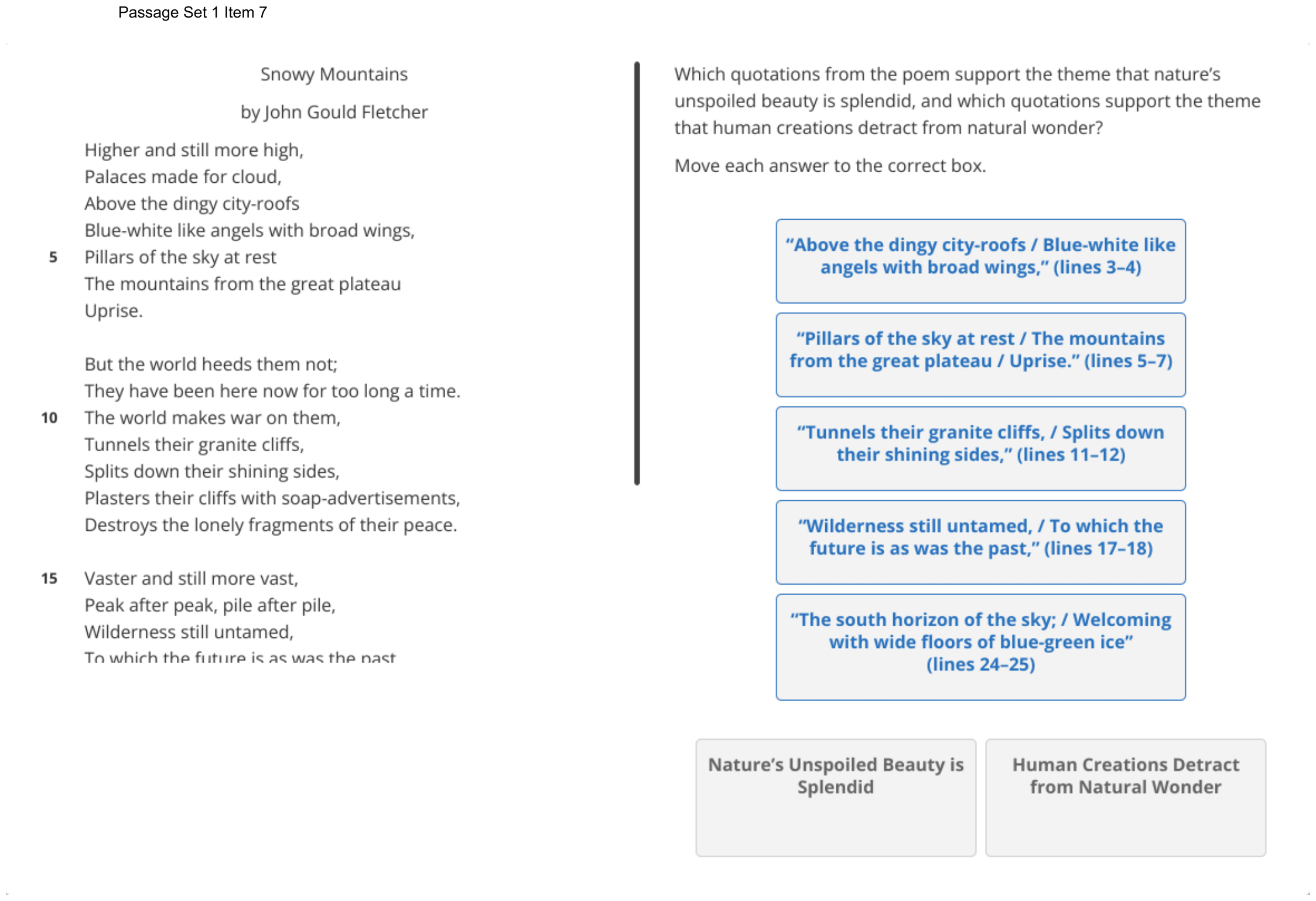
The passage “Snowy Mountains” as printed (page 142)
Question 2 of 59
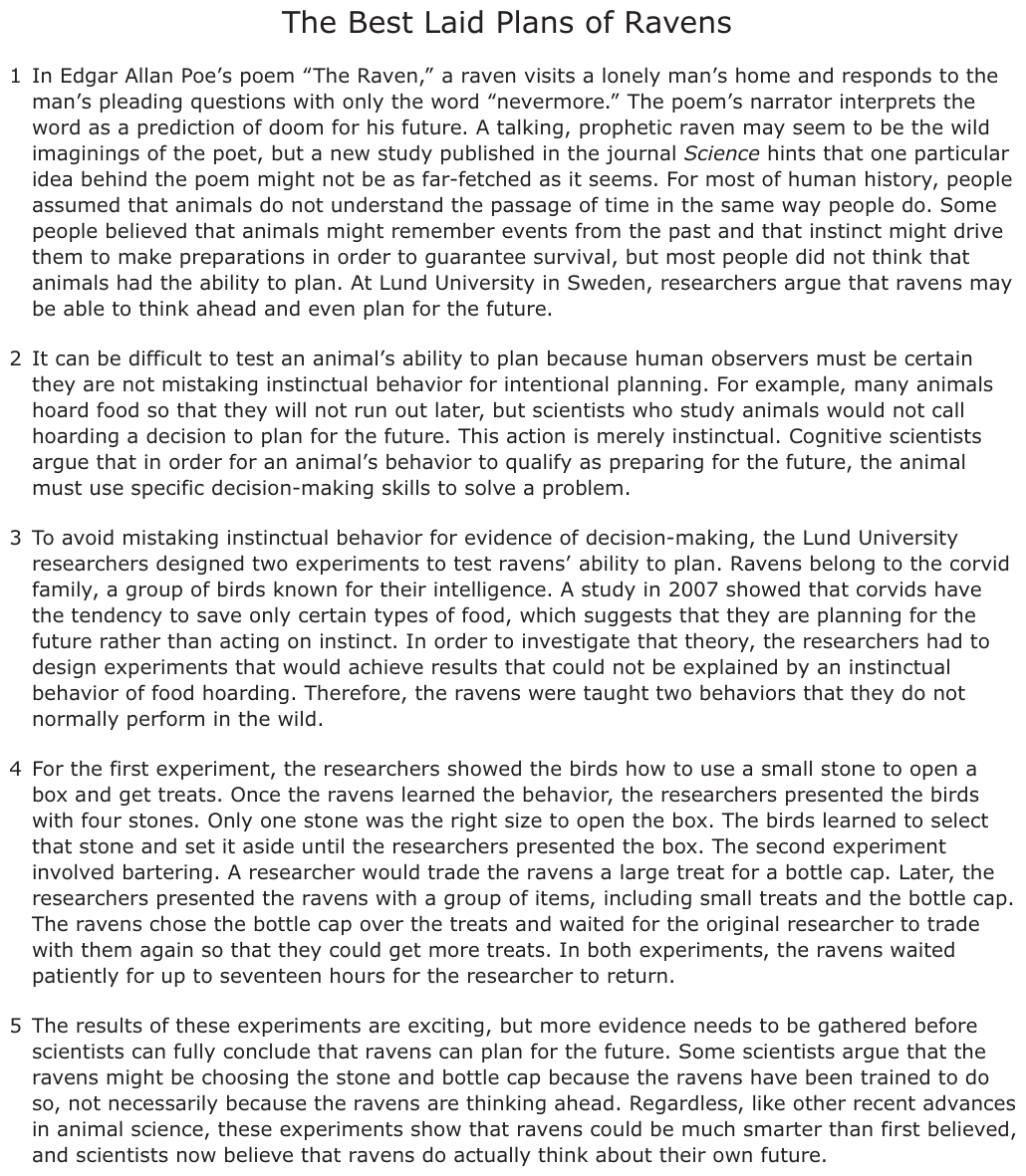
2026 Practice Test A English, question 8Passage The Best Laid Plans of Ravens
The Best Laid Plans of Ravens
In Edgar Allan Poe’s poem “The Raven,” a raven visits a lonely man’s home and responds to the man’s pleading questions with only the word “nevermore.” The poem’s narrator interprets the word as a prediction of doom for his future. A talking, prophetic raven may seem to be the wild imaginings of the poet, but a new study published in the journal Science hints that one particular idea behind the poem might not be as far-fetched as it seems. For most of human history, people assumed that animals do not understand the passage of time in the same way people do. Some people believed that animals might remember events from the past and that instinct might drive them to make preparations in order to guarantee survival, but most people did not think that animals had the ability to plan. At Lund University in Sweden, researchers argue that ravens may be able to think ahead and even plan for the future.
It can be difficult to test an animal’s ability to plan because human observers must be certain they are not mistaking instinctual behavior for intentional planning. For example, many animals hoard food so that they will not run out later, but scientists who study animals would not call hoarding a decision to plan for the future. This action is merely instinctual. Cognitive scientists argue that in order for an animal’s behavior to qualify as preparing for the future, the animal must use specific decision-making skills to solve a problem.
To avoid mistaking instinctual behavior for evidence of decision-making, the Lund University researchers designed two experiments to test ravens’ ability to plan. Ravens belong to the corvid family, a group of birds known for their intelligence. A study in 2007 showed that corvids have the tendency to save only certain types of food, which suggests that they are planning for the future rather than acting on instinct. In order to investigate that theory, the researchers had to design experiments that would achieve results that could not be explained by an instinctual behavior of food hoarding. Therefore, the ravens were taught two behaviors that they do not normally perform in the wild.
For the first experiment, the researchers showed the birds how to use a small stone to open a box and get treats. Once the ravens learned the behavior, the researchers presented the birds with four stones. Only one stone was the right size to open the box. The birds learned to select that stone and set it aside until the researchers presented the box. The second experiment involved bartering. A researcher would trade the ravens a large treat for a bottle cap. Later, the researchers presented the ravens with a group of items, including small treats and the bottle cap. The ravens chose the bottle cap over the treats and waited for the original researcher to trade with them again so that they could get more treats. In both experiments, the ravens waited patiently for up to seventeen hours for the researcher to return.
The results of these experiments are exciting, but more evidence needs to be gathered before scientists can fully conclude that ravens can plan for the future. Some scientists argue that the ravens might be choosing the stone and bottle cap because the ravens have been trained to do so, not necessarily because the ravens are thinking ahead. Regardless, like other recent advances in animal science, these experiments show that ravens could be much smarter than first believed, and scientists now believe that ravens do actually think about their own future.
Question
Read this sentence from paragraph 1.
At Lund University in Sweden, researchers argue that ravens may be able to think ahead and even plan for the future.
Which sentence from paragraph 4 provides support for this argument?
- A“Once the ravens learned the behavior, the researchers presented the birds with four stones.”
- B“A researcher would trade the ravens a large treat for a bottle cap.”
- C“Later, the researchers presented the ravens with a group of items, including small treats and the bottle cap.”
- D“The ravens chose the bottle cap over the treats and waited for the original researcher to trade with them again so that they could get more treats.”
Show the answer
Correct answer: D
The question asks which sentence from paragraph 4 supports the argument presented in the sentence from paragraph 1.
A. Incorrect. This sentence from paragraph 4 refers to the ravens’ ability to adapt and learn but not to plan and think ahead.
B. Incorrect. This sentence from paragraph 4 relates the actions of the researcher rather than the actions of the ravens and does not provide evidence in support of the argument that ravens have the ability to think and plan ahead.
C. Incorrect. This sentence from paragraph 4 does not describe a behavior of the ravens that would support the argument in the sentence from paragraph 1; instead it relates the actions of the researchers without giving any information about the ravens’ responses.
D. CORRECT. This sentence from paragraph 4 shows that the ravens seem to make a decision, which involves a thought process. The ravens chose to wait for the researcher rather than take the treats, suggesting that the ravens understood that the researcher would trade a larger treat for the bottle cap.
Question analysis
This evidence question on the science article “The Best Laid Plans of Ravens” quotes the claim from paragraph 1 that ravens may be able to think ahead and plan for the future. Students choose the sentence from paragraph 4, where two experiments are described, that supports it. Every choice comes from the same experiments, so each must be weighed against the claim.
- Grade level
- Grade 7 reading and task
- Compared with grade 7
- At grade 7 Choosing the sentence that backs a quoted claim is standard grade 7 evidence work. The claim is printed in the question and all four choices come from one paragraph, so the search is short, though each sentence must be tested against the claim.
- Estimated difficulty
- Straightforward: two steps or one careful reading.
- Thinking it demands
- Depth of knowledge 2, skills and concepts · mainly evaluate
- What makes it hard
- Evidence
- Answered from one paragraph or stanza
- Reading level
- Passage: about grade 11, 599 words; question and choices: about grade 8, 107 words.
- Students, last 30 days
- Not enough answers yet to show (it takes 10).
Why it is hard, traps and wrong answers (shows the answer)
Why it is hard
The claim is about what ravens can do, and only one of the four sentences shows the birds deciding anything. Students who read quickly accept any sentence about the experiments, especially the one where the ravens have just learned a skill, because learning sounds like intelligence. Asking who acts in each sentence, the birds or the researchers, settles the question in seconds.
Reading between the lines minor Working it out
The right sentence never says “plan”; students must see that choosing the cap over the treats and waiting “so that they could get more treats” is acting now for a later reward. (Graesser, Singer & Trabasso, 1994; Kintsch, 1998)
Every choice must be checked minor Choosing the answer
All four sentences come from paragraph 4’s experiments, and three of them report what the researchers did, so each must be checked for a decision made by the ravens. (Embretson & Wetzel, 1987)
Strategy: Underline “think ahead” and “plan” in the quoted claim, then ask of each sentence whether it, on its own, would convince a doubter that ravens can do that.
Traps
- Supports only part of the claim: In a question about evidence: a line that backs one half of the claim but not the other, or a related point rather than the claim itself.
- True but not the answer: A choice says something accurate about the text that does not answer this question.
The wrong answers, classified
A Supports only part of the claim (King et al., 2004; Thissen, Steinberg & Fitzpatrick, 1989)
Takes “Once the ravens learned the behavior” as proof of planning, but learning to open a box shows only that the birds can be taught, and the rest is the researchers’ act.
B True but not the answer (King et al., 2004; Embretson & Wetzel, 1987)
Picks the opening of the bartering test because it mentions the trade, yet the sentence reports only what a researcher offered, not anything the ravens decided.
C True but not the answer (King et al., 2004; Embretson & Wetzel, 1987)
Knows the bottle-cap test holds the evidence and picks its setup, the researchers laying out treats and the cap, one sentence before the ravens make their choice.
Working it out, step by step
Figure out what the question asks
This asks for evidence: the sentence that best supports a claim. The claim is that ravens “may be able to think ahead and even plan for the future.” To plan is to decide now what you will do later, so you get something you want. You need a sentence from paragraph 4 that shows ravens doing that.
Ask who acts in each sentence
Only something the ravens do can prove what ravens can do. So check each choice for its doer. In A, B and C, the researchers do most of the acting. They hand out stones, offer a trade and set out items. Only one sentence shows the ravens making a choice of their own.
Find the ravens’ choice
Paragraph 4 says “The ravens chose the bottle cap over the treats and waited for the original researcher to trade with them again so that they could get more treats.” The ravens could have eaten a small treat right away. Instead they took a bottle cap, which is worthless by itself. They kept it because the researcher would trade a large treat for it later.
Explain why this shows planning
The words “so that” give the reason for the choice. The ravens gave up something now to get something better later. That is exactly what planning ahead means. You do the same thing when you save your allowance for a bigger toy next month.
Check each choice
- A does not fit. The ravens have only learned a skill. The rest of the sentence tells what the researchers did next.
- B does not fit. It tells what a researcher offered, not what the ravens decided.
- C does not fit. It is the setup of the test, before the ravens choose anything.
- D fits. The ravens choose now and wait for a later reward.
Watch out: A sounds smart because the ravens “learned the behavior.” But being taught a skill is not the same as thinking ahead.
Choose the answer
Only one sentence shows the ravens making a choice now for a reward later. So the answer is D.
Why this answer and not the closest wrong one
A is the closest wrong choice, because learning a skill sounds clever. But learning to open a box shows only that the birds can be taught. It says nothing about the future. In D, the ravens pass up treats today to get more treats later. That is planning.
More questions like this
The original DOE question
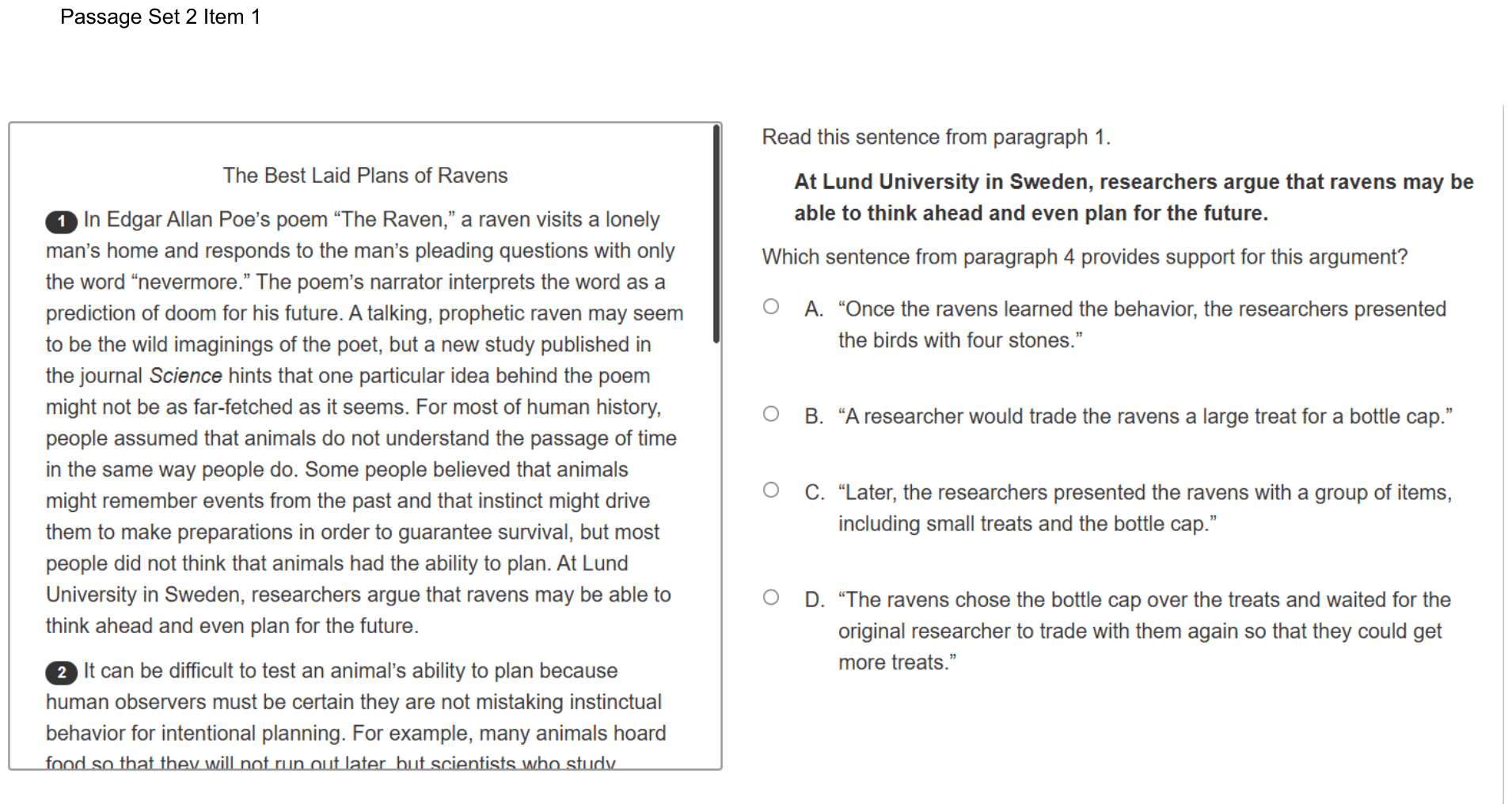
The passage “The Best Laid Plans of Ravens” as printed (page 12)
Question 3 of 59
2026 Practice Test A English, question 10Uses the passage above: “The Best Laid Plans of Ravens”.
Question
In the first experiment described in paragraph 4, which of the ravens’ behaviors provides the strongest evidence for the claim that the birds are capable of planning?
- AThey accepted treats from the box.
- BThey set aside the stone that would open the box.
- CThey learned which stone could open the box.
- DThey waited for researchers to bring the box.
Show the answer
Correct answer: B
The question asks which of the ravens’ behaviors in the first experiment described in paragraph 4 most strongly supports the claim that the birds are capable of planning.
A. Incorrect. While “the researchers showed the birds how to use a small stone to open a box and get treats” (paragraph 4), the acceptance of the treats does not demonstrate planning.
B. CORRECT. Once the ravens learned which stone would open the box, they consistently selected only that stone.
C. Incorrect. Although the birds learned which stone opened the box, this behavior demonstrates not their ability to plan but rather their intelligence.
D. Incorrect. The birds’ patience shows their anticipation for and understanding of the future gain of a treat but does not provide the strongest evidence of their ability to plan.
Question analysis
This evidence question on “The Best Laid Plans of Ravens” asks which of the ravens’ behaviors in the first experiment, the one with a stone and a box of treats, gives the strongest evidence that the birds can plan. Several behaviors seem to fit, so students must weigh them against the passage’s own idea of what planning is.
- Grade level
- Grade 8 reading and task
- Compared with grade 7
- Above grade 7 Grade 7 evidence questions usually ask which detail supports a claim. This one asks which of the ravens’ behaviors gives the strongest support, and several seem to fit, so students must apply paragraph 2’s test for planning to paragraph 4.
- Estimated difficulty
- Hard: combines ideas, needs a plan, and has more than one tempting wrong answer.
- Thinking it demands
- Depth of knowledge 3, strategic thinking · mainly evaluate
- What makes it hard
- A very close wrong answer major
- Reading between the lines moderate
- Evidence in several places minor
- Evidence
- Answered from several paragraphs or stanzas
- Reading level
- Passage: about grade 11, 599 words; question and choices: about grade 5, 58 words.
- Students, last 30 days
- Not enough answers yet to show (it takes 10).
Why it is hard, traps and wrong answers (shows the answer)
Why it is hard
Every choice describes something the ravens really did, so the work is ranking, not finding. The passage’s dramatic detail, birds waiting up to seventeen hours, draws attention away from the quieter act of keeping the right stone ready, which is the behavior that most clearly prepares for the future. Students who weigh each behavior against paragraph 2’s idea of decision-making, rather than against how impressive it sounds, separate the two.
A very close wrong answer major Choosing the answer
Setting the stone aside and waiting for the box both come from one sentence, “set it aside until the researchers presented the box”; only the first is an action taken now for a later need. (Embretson & Wetzel, 1987; Gorin & Embretson, 2006; Ascalon et al., 2007)
Reading between the lines moderate Working it out
The passage never says which behavior counts as planning, so students must apply paragraph 2’s test, that the animal “must use specific decision-making skills to solve a problem,” to each one. (Graesser, Singer & Trabasso, 1994; Kintsch, 1998)
Evidence in several places minor Working it out
The waiting that tempts students is stressed at the end of paragraph 4, “up to seventeen hours,” well after the stone sentence, and paragraph 2 holds the standard for judging both. (Kirsch & Mosenthal, 1990; Gorin & Embretson, 2006)
Strategy: Use paragraph 2’s description of what counts as planning as a yardstick, then rank the four behaviors by how well each meets it instead of taking the first that seems clever.
Traps
- Supports only part of the claim: In a question about evidence: a line that backs one half of the claim but not the other, or a related point rather than the claim itself.
- True but not the answer: A choice says something accurate about the text that does not answer this question.
The wrong answers, classified
A True but not the answer (King et al., 2004; Embretson & Wetzel, 1987)
Picks the payoff of the experiment, taking treats from the box, which any trained animal does and which shows nothing about thinking ahead.
C Supports only part of the claim (King et al., 2004; Thissen, Steinberg & Fitzpatrick, 1989)
Sees intelligence in learning which of the four stones fits, but knowing the right tool is not the same as keeping it ready for a box that comes later.
D Supports only part of the claim (King et al., 2004; Thissen, Steinberg & Fitzpatrick, 1989)
Is drawn by the stress on waiting “up to seventeen hours,” which shows the birds expect the box, but waiting is passive; holding the right stone ready is the planning act.
Working it out, step by step
Figure out what the question asks
This asks which thing the ravens did in the first experiment, the one with the stone and the box, is the strongest evidence that they can plan. More than one choice really happened. You must rank them and pick the best one.
Decide what counts as planning
Paragraph 2 gives a test. To count as preparing for the future, “the animal must use specific decision-making skills to solve a problem.” In plain words, planning means doing something now to get ready for something later. Use that as your measuring stick.
Find the key sentence
Paragraph 4 says “The birds learned to select that stone and set it aside until the researchers presented the box.” To set something aside is to put it away to use later. When the birds did this, the box was not there yet.
Explain why this is planning
The ravens had nothing to open at that moment. Still, they picked the one stone that would work and saved it. They did this because they expected to need it later. It is like packing an umbrella in the morning because rain is coming in the afternoon. That is a choice made now to solve a future problem.
Check each choice
- A does not fit. Taking treats is the reward. Any trained animal does that.
- B fits. Saving the right stone gets the bird ready for a box that comes later.
- C does not fit. Learning which stone works shows the birds can be taught. Knowing the right tool is not the same as keeping it ready.
- D does not fit as well. Waiting shows the birds expected the box. But waiting is doing nothing, so it is weaker proof.
Watch out: D is tempting because the passage stresses waiting “up to seventeen hours.” Long waiting is impressive, but it is not an action.
Choose the answer
Setting the stone aside is the clearest act of getting ready for the future. So the answer is B.
Why this answer and not the closest wrong one
D is the closest wrong choice. Waiting and setting the stone aside come from the same sentence. But while a bird waits, it does nothing. Setting the stone aside is a choice. The bird keeps the right tool ready for a box that is not there yet. That act of getting ready makes B stronger evidence.
More questions like this
The original DOE question
Question 4 of 59
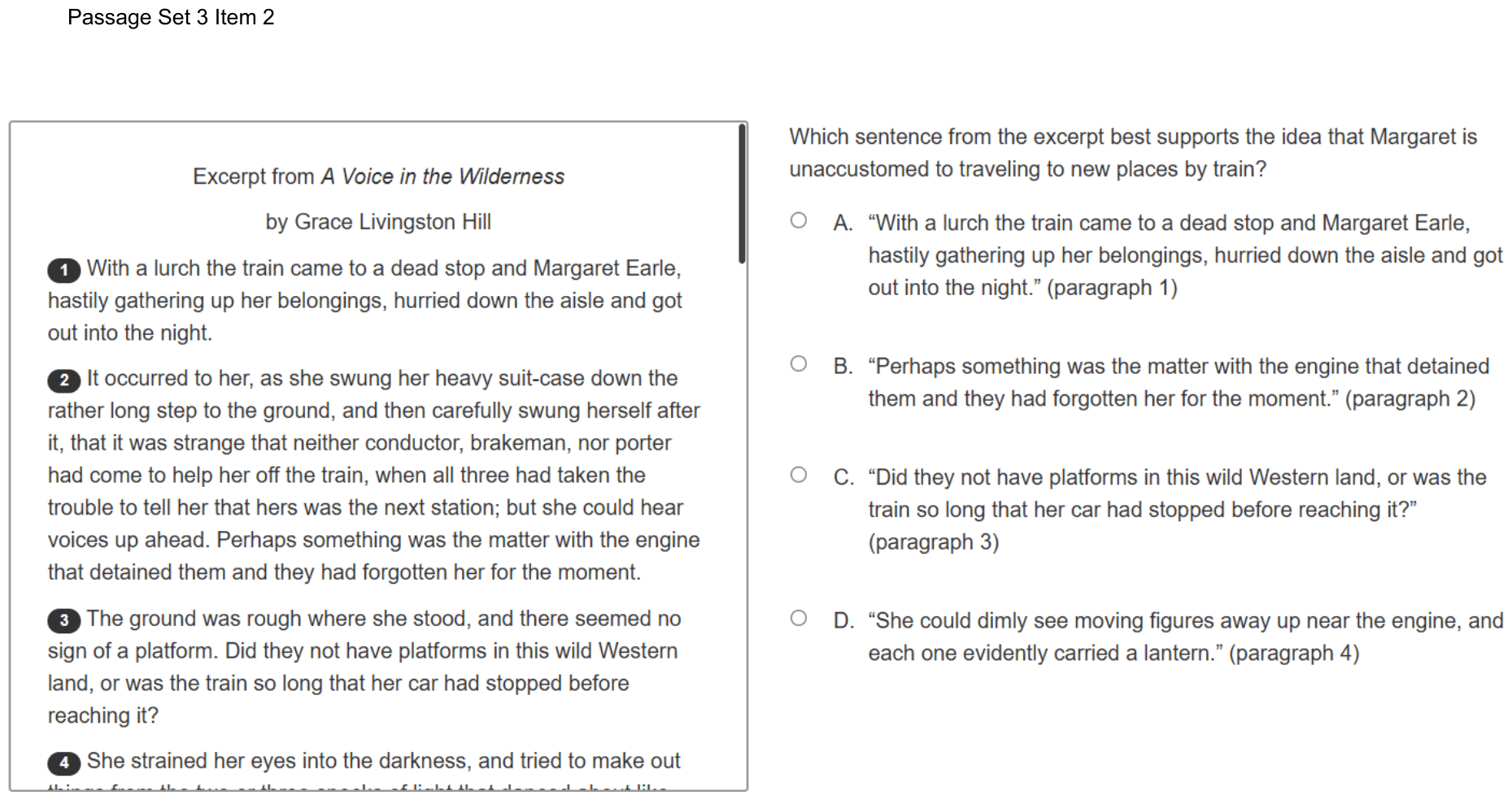
2026 Practice Test A English, question 15Passage Excerpt from A Voice in the Wilderness
Excerpt from A Voice in the Wilderness
by Grace Livingston Hill
With a lurch the train came to a dead stop and Margaret Earle, hastily gathering up her belongings, hurried down the aisle and got out into the night.
It occurred to her, as she swung her heavy suit-case down the rather long step to the ground, and then carefully swung herself after it, that it was strange that neither conductor, brakeman, nor porter had come to help her off the train, when all three had taken the trouble to tell her that hers was the next station; but she could hear voices up ahead. Perhaps something was the matter with the engine that detained them and they had forgotten her for the moment.
The ground was rough where she stood, and there seemed no sign of a platform. Did they not have platforms in this wild Western land, or was the train so long that her car had stopped before reaching it?
She strained her eyes into the darkness, and tried to make out things from the two or three specks of light that danced about like fireflies in the distance. She could dimly see moving figures away up near the engine, and each one evidently carried a lantern. The train was tremendously long. A sudden feeling of isolation took possession of her. Perhaps she ought not to have got out until some one came to help her. Perhaps the train had not pulled into the station yet and she ought to get back on it and wait. Yet if the train started before she found the conductor she might be carried on somewhere and he justly blame her for a fool.
There did not seem to be any building on that side of the track. It was probably on the other, but she was standing too near the cars to see over. She tried to move back to look, but the ground sloped and she slipped and fell in the cinders, bruising her knee and cutting her wrist.
In sudden panic she arose. She would get back into the train, no matter what the consequences. They had no right to put her out here, away off from the station, at night, in a strange country. If the train started before she could find the conductor she would tell him that he must back it up again and let her off. He certainly could not expect her to get out like this.
She lifted the heavy suit-case up the high step that was even farther from the ground than it had been when she came down, because her fall had loosened some of the earth and caused it to slide away from the track. Then, reaching to the rail of the step, she tried to pull herself up, but as she did so the engine gave a long snort and the whole train, as if it were in league against her, lurched forward crazily, shaking off her hold. She slipped to her knees again, the suit-case, toppled from the lower step, descending upon her, and together they slid and rolled down the short bank, while the train . . . ran giddily off into the night.
The horror of being deserted helped the girl to rise in spite of bruises and shock. She lifted imploring hands to the unresponsive cars as they hurried by her—one, two, three, with bright windows, each showing a passenger, comfortable and safe inside, unconscious of her need.
A moment of useless screaming, running, trying to attract some one’s attention, a sickening sense of terror and failure, and the last car slatted itself past with a mocking clatter, as if it enjoyed her discomfort.
Margaret stood dazed, reaching out helpless hands, then dropped them at her sides and gazed after the fast-retreating train, the light on its last car swinging tauntingly, blinking now and then with a leer in its eye, rapidly vanishing from her sight into the depth of the night.
She gasped and looked about her for the station that but a short moment before had been so real to her mind; and, lo! on this side and on that there was none!
The night was wide like a great floor shut in by a low, vast dome of curving blue set with the largest, most wonderful stars she had ever seen. Heavy shadows of purple-green, smoke-like, hovered over earth darker and more intense than the unfathomable blue of the night sky. It seemed like the secret nesting-place of mysteries wherein no human foot might dare intrude. It was incredible that such could be but common sage-brush, sand, and greasewood wrapped about with the beauty of the lonely night.
No building broke the inky outlines of the plain, nor friendly light streamed out to cheer her heart. Not even a tree was in sight, except on the far horizon, where a heavy line of deeper darkness might mean a forest. Nothing, absolutely nothing, in the blue, deep, starry dome above and the bluer darkness of the earth below save one sharp shaft ahead like a black mast throwing out a dark arm across the track.
As soon as she sighted it she picked up her baggage and made her painful way toward it, for her knees and wrist were bruised and her baggage was heavy.
A soft drip, drip greeted her as she drew nearer; something plashing down among the cinders by the track. Then she saw the tall column with its arm outstretched, and looming darker among the sage-brush the outlines of a water-tank. It was so she recognized the engine’s drinking-tank, and knew that she had mistaken a pause to water the engine for a regular stop at a station.
cinders: track bed made from the residue of burnt coal
From A VOICE IN THE WILDERNESS by Grace Livingston Hill—Public Domain
Question
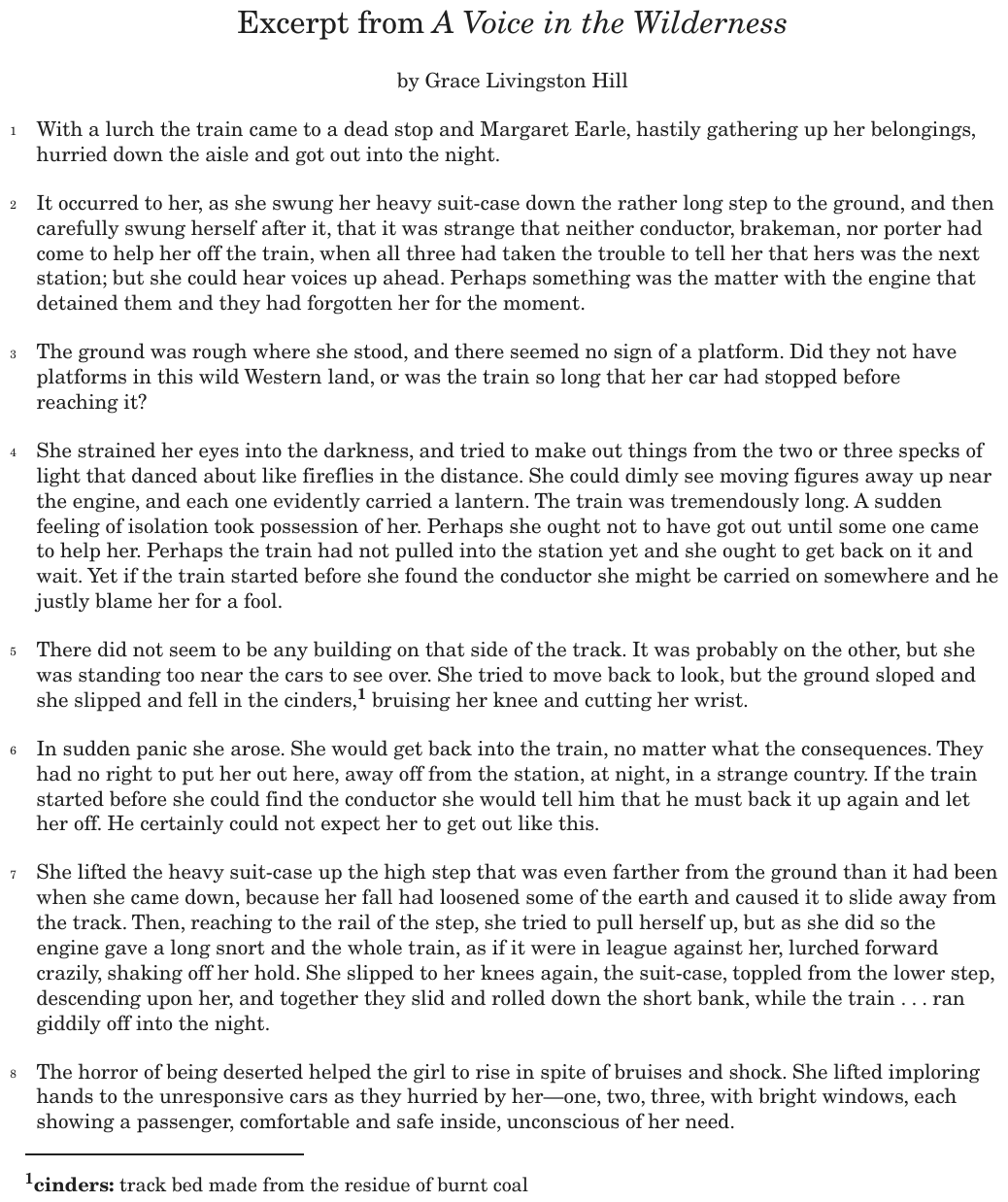
Which sentence from the excerpt best supports the idea that Margaret is unaccustomed to traveling to new places by train?
- A“With a lurch the train came to a dead stop and Margaret Earle, hastily gathering up her belongings, hurried down the aisle and got out into the night.” (paragraph 1)
- B“Perhaps something was the matter with the engine that detained them and they had forgotten her for the moment.” (paragraph 2)
- C“Did they not have platforms in this wild Western land, or was the train so long that her car had stopped before reaching it?” (paragraph 3)
- D“She could dimly see moving figures away up near the engine, and each one evidently carried a lantern.” (paragraph 4)
Show the answer
Correct answer: C
The question asks for evidence from the excerpt that best supports the idea that Margaret is unfamiliar with traveling to new places by train.
A. Incorrect. Margaret’s actions in the sentence from paragraph 1 are decisive as she gathers her belongings to exit the train; she is familiar with rail travel.
B. Incorrect. In the sentence from paragraph 2, Margaret is using her knowledge about trains to attempt to interpret the actions of others; she is familiar with trains, even if a particular destination has not been mentioned.
C. CORRECT. If Margaret has never traveled to this region by train before, she must guess or attempt to interpret what she sees. This idea is best represented in the sentence in paragraph 3 where she questions whether the stations in the West have platforms.
D. Incorrect. While the sentence from paragraph 4 shows that Margaret is trying to better understand her situation in the darkness, her ability to identify the train’s engine and the figures carrying lanterns indicates some familiarity with her mode of travel.
Question analysis
Students choose the sentence from Grace Livingston Hill’s A Voice in the Wilderness that best supports the idea that Margaret is unaccustomed to traveling to new places by train. The four choices come from paragraphs 1–4, as she steps down from the train into the dark. Each reveals something about her, so students must test them against this one idea.
- NYS standards
- 7R1 textual evidence and inferences
- Grade level
- Grade 7 reading and task
- Compared with grade 7
- At grade 7 A typical grade 7 evidence task: the four quotations come from the opening paragraphs and carry paragraph numbers. The challenge is that several show Margaret unsure of herself, so students must match the specific idea in the claim, not any sign of doubt.
- Estimated difficulty
- Moderate: several steps, or a close reading with one strong distractor.
- Thinking it demands
- Depth of knowledge 2, skills and concepts · mainly evaluate
- What makes it hard
- Every choice must be checked moderate
- Reading between the lines minor
- Evidence
- Answered from several paragraphs or stanzas
- Reading level
- Passage: about grade 8, 981 words; question and choices: about grade 11, 113 words.
- Students, last 30 days
- Not enough answers yet to show (it takes 10).
Why it is hard, traps and wrong answers (shows the answer)
Why it is hard
Uncertainty runs through all four quotations, so the general mood of the opening cannot pick the answer. The claim is specific, a traveler new to such places, and only one sentence ties her confusion to the region itself rather than to a delay, the darkness or her haste. Students who match feelings instead of the claim usually settle on her guess about engine trouble.
Every choice must be checked moderate Choosing the answer
All four quotations, from paragraphs 1 to 4, show Margaret unsure in the dark, so each has to be tested against the narrower idea of someone new to this kind of journey. (Embretson & Wetzel, 1987)
Reading between the lines minor Working it out
No sentence says Margaret is new to the West; students must infer it from her puzzled question whether stations in “this wild Western land” lack platforms. (Graesser, Singer & Trabasso, 1994; Kintsch, 1998)
Strategy: Restate the claim in your own words, then ask of each quotation whether it proves that idea specifically or only shows some other feeling Margaret has at that moment.
Traps
- Supports only part of the claim: In a question about evidence: a line that backs one half of the claim but not the other, or a related point rather than the claim itself.
The wrong answers, classified
A Supports only part of the claim (King et al., 2004; Thissen, Steinberg & Fitzpatrick, 1989)
Reads her hurried exit as a nervous newcomer’s, though “hastily gathering up her belongings” shows someone who knows what to do when her stop is called.
B Supports only part of the claim (King et al., 2004; Thissen, Steinberg & Fitzpatrick, 1989)
Hears doubt in “Perhaps something was the matter with the engine,” but guessing at the cause of a delay is how an experienced rider reasons, not a newcomer puzzling over a place.
D Supports only part of the claim (King et al., 2004; Thissen, Steinberg & Fitzpatrick, 1989)
Notices the guesswork in “dimly” and “evidently,” but the darkness causes it, and she still picks out the engine and the crew’s lanterns, which shows she knows trains.
Working it out, step by step
Figure out what the question asks
This asks for evidence: the sentence that best supports an idea. The idea is that Margaret is unaccustomed to traveling to new places by train. Unaccustomed means not used to something. So look for a sentence where a new place puzzles her.
Notice what the choices share
All four sentences come from paragraphs 1 to 4, just after Margaret steps off the train at night. In most of them she is unsure. So feeling unsure is not enough. The right sentence must tie her confusion to the strange place itself.
Look closely at paragraph 3
Paragraph 3 asks “Did they not have platforms in this wild Western land, or was the train so long that her car had stopped before reaching it?” A platform is the raised floor beside the tracks where people get on and off. Margaret wonders if stations out West even have them. She does not know how things work in this region. That shows she is not used to traveling here.
Check each choice
- A does not fit. She is “hastily gathering up her belongings,” which means in a hurry. She knows what to do when her stop comes.
- B does not fit. Guessing about engine trouble is how someone who knows trains would think.
- C fits. She does not know what stations are like in this new land.
- D does not fit. The dark makes it hard to see. Yet she still picks out the engine and the lanterns.
Watch out: B begins with “Perhaps,” so it sounds unsure. But her doubt is about the train, not the place.
Choose the answer
Only the question about platforms shows that this place is unfamiliar to her. So the answer is C.
Why this answer and not the closest wrong one
B is the closest wrong choice, since Margaret is unsure in it too. But there she reasons like an experienced rider: maybe the engine broke down. In C, she wonders what stations are like in “this wild Western land.” Only C shows a traveler who is not used to new places.
More questions like this
The original DOE question
The passage “Excerpt from A Voice in the Wilderness” as printed (pages 128–129)
Question 5 of 59
2026 Practice Test A English, question 29Passage Excerpt from “The Spirit of the Herd”
Excerpt from “The Spirit of the Herd”
by Dallas Lore Sharp
In this excerpt, published in 1914, author and professor Dallas Lore Sharp describes a summer cattle roundup in Oregon. The heat and dust had been relentless for three days. The cowboys were exhausted, and the cattle were restless. The ranch boss, Wade, had led the drive to a watering place, only to find it empty.
Along with the wagon had come the fresh horses—one of them being Peroxide Jim, a supple, powerful, clean-limbed buckskin, a horse, I think, that had as fine and intelligent an animal-face as any creature I ever saw. Wade had been saving this horse for emergency work. And why should he not have been saved fresh for just such a need as this? Are there not superior horses as well as superior men—a Peroxide Jim to complement a Wade?
The horse knew the cattle business and knew his rider perfectly; and though there was nothing like sentiment about the boss of the P Ranch riders, his faith in Peroxide Jim was complete. . . .
The desert, where the herd was camped, was one of the highest of a series of tablelands, or benches; it lay as level as a floor, rimmed by sheer rock, from which there was a drop to the bench of sage below. The herd when overtaken by the dusk had been headed for a pass descending to the next lower bench, but was now halted within a mile of the rim rock on the east, where there was a perpendicular fall of about three hundred feet. . . .
In the taut silence of the stirless desert night, with the tension of the herd at the snapping-point, any quick, unwonted sight or sound would stampede them. The sneezing of a horse, the flare of a match, would be enough to send the whole four thousand headlong—blind, frenzied, trampling—till spent and scattered over the plain.
And so, as he rode, Wade began to sing. The rider ahead of him took up the air and passed it on until, above the stepping stir of the hoofs rose the faint voices of the men, and all the herd was bound about by the slow plaintive measures of some old song. It was not to soothe their savage breasts that the riders sang to the cattle, but rather to preempt the dreaded silence, to relieve the tension, and so to prevent the shock of any sudden startling noise.
So they sang and rode and the night wore on to one o’clock, when Wade, coming up on the rim-rock side, felt a cool breeze fan his face, and caught a breath of fresh, moist wind with the taste of water in it.
He checked his horse instantly, listening as the wind swept past him over the cattle. But they must already have smelled it, for they had ceased their milling, the whole herd standing motionless, the indistinct forms close to him in the dark showing their bald faces lifted to drink the sweet wet breath that came over the rim. Then they started on again, but faster, and with a rumbling now from their hoarse throats that tightened Wade’s grip on the reins.
The sound seemed to come out of the earth, a low, rumbling mumble, as dark as the night and as wide as the plain, a thick, inarticulate bellow that stood every rider stiff in his stirrups. . . .
Then the breeze caught the dust and carried it back from the gray-coated, ghostly shapes, and Wade saw that the animals were still moving in a circle. He must keep them going. He touched his horse to ride on with them, when across the black sky flashed a vivid streak of lightning.
There was a snort from the steers, a quick clap of horns and hoofs from far within the herd, a tremor of the plain, a roar, a surging mass—and Wade was riding the flank of a wild stampede. Before him, behind him, beside him, pressing hard upon his horse, galloped the frenzied steers, and beyond them a multitude borne on, and bearing him on, by the heave of the galloping herd.
Wade was riding for his life. He knew it. His horse knew it. He was riding to turn the herd, too, back from the rim, as the horse also knew. The cattle were after water—water-mad—ready to go over the precipice to get it, carrying horse and rider with them. Wade was the only rider between the herd and the rim. It was black as death. He could see nothing in the sage, could scarcely discern the pounding, panting shadows at his side. He knew that he was being borne toward the rim, how fast he could not tell, but he knew by the swish of the brush against his tapaderos and the plunging of the horse that the ground was growing stonier, that they were nearing the rocks.
To outrun the herd was his only chance for life. If he could come up with the leaders he might not only escape, but even stand a chance of heading them off upon the plain and saving the herd. There were cattle still ahead of him; how many, what part of them all, he could not make out in the dark. But the horse knew. The reins hung on his straight neck, where his rider had dropped them, as, yelling and firing over the wild herd, he had given this horse the race to win, to lose.
They were riding the rim. Close on their left bore down the flank of the herd, and on their right, under their very feet, was a precipice, so close that they felt its blackness—its three hundred feet of fall! . . .
. . . Then Wade found himself racing neck and neck with a big white steer, which the horse, with marvelous instinct, seemed to pick out from a bunch, and to cling to, forcing him gradually ahead, till, cutting him free from the bunch entirely, he bore him off into the swishing sage.
The steers coming on close behind followed their leader, and in, after them, swung others. The tide was turning from the rim. More and more were veering, and within a short time the whole herd, bearing off from the cliffs, was pounding over the open plains.
Whose race was it? It was Peroxide Jim’s, according to Wade, for not by word or by touch of hand or knee had the horse been directed in the run. From the flash of the lightning the horse had taken the bit, had covered an indescribably perilous path at top speed, had outrun the herd and turned it from the edge of the rim rock, without a false step or a tremor of fear.
From “The Spirit of the Herd” by Dallas Lore Sharp—Public Domain
tablelands: plateaus, flat areas of land sharply elevated from the surrounding area
tapaderos: leather covers for stirrups
Question
Which sentence from the excerpt best explains why Wade reserved Peroxide Jim for “emergency work” (paragraph 1)?
- A“Are there not superior horses as well as superior men—a Peroxide Jim to complement a Wade?” (paragraph 1)
- B“Before him, behind him, beside him, pressing hard upon his horse, galloped the frenzied steers, and beyond them a multitude borne on, and bearing him on, by the heave of the galloping herd.” (paragraph 10)
- C“He knew that he was being borne toward the rim, how fast he could not tell, but he knew by the swish of the brush against his tapaderos and the plunging of the horse that the ground was growing stonier, that they were nearing the rocks.” (paragraph 11)
- D“From the flash of the lightning the horse had taken the bit, had covered an indescribably perilous path at top speed, had outrun the herd and turned it from the edge of the rim rock, without a false step or a tremor of fear.” (paragraph 16)
Show the answer
Correct answer: D
The question asks which sentence from the excerpt best explains why Wade reserved Peroxide Jim for “emergency work” (paragraph 1).
A. Incorrect. While the sentence from paragraph 1 refers to Peroxide Jim as being a superior horse, it does not tell why he would be useful in an emergency. The mention of Peroxide Jim’s superiority does not describe the attributes that would make him an appealing choice for use in an emergency.
B. Incorrect. The sentence from paragraph 10 does not describe the actions of Peroxide Jim. The sentence describes what Wade and the horse were experiencing, but it does not include any reference to how Peroxide Jim was responding to the situation.
C. Incorrect. The sentence from paragraph 11 describes Wade’s experiences and does not focus on the actions of Peroxide Jim. It reveals Wade’s awareness of the danger he was in, but the only reference to Peroxide Jim in this sentence is the description of the horse having to work harder to run on the stonier ground as they neared the edge: from “the plunging of the horse,” Wade knew “that the ground was growing stonier, that they were nearing the rocks.” This quotation does not show that Peroxide Jim was the right horse to use for emergency work because it does not indicate, at this point in the text, that he was responding in a way that saved the herd or Wade.
D. CORRECT. The sentence from paragraph 16 describes Peroxide Jim’s high level of skill and ability to perform in a life-and-death situation. Not only did Peroxide Jim recognize the emergency immediately (“From the flash of the lightning the horse had taken the bit”), but the horse also proved to have the physical capability (“had covered an indescribably perilous path at top speed, had outrun the herd and turned it from the edge of the rim rock”) and the mental toughness (“without a false step or a tremor of fear”) required to respond appropriately to the dangerous situation.
Question analysis
This evidence question on Dallas Lore Sharp’s “The Spirit of the Herd,” a 1914 account of a night stampede on an Oregon cattle drive, asks which sentence best explains why the ranch boss Wade kept his horse Peroxide Jim for “emergency work.” The four quoted sentences come from different parts of the excerpt and are long, so the choice takes careful reading.
- Grade level
- Grade 8 reading and task
- Compared with grade 7
- At grade 7 Finding the sentence that best explains a detail is regular grade 7 evidence work. The four quotations, though, are long sentences from across a dense excerpt written in 1914, so the reading load is heavier than usual.
- Estimated difficulty
- Moderate: several steps, or a close reading with one strong distractor.
- Thinking it demands
- Depth of knowledge 2, skills and concepts · mainly evaluate
- What makes it hard
- Evidence in several places moderate
- A lot to read minor
- Reading between the lines minor
- Evidence
- Answered from the whole text
- Reading level
- Passage: about grade 8, 1160 words; question and choices: about grade 13, 160 words.
- Students, last 30 days
- Not enough answers yet to show (it takes 10).
Why it is hard, traps and wrong answers (shows the answer)
Why it is hard
The question links the start of the excerpt to its end, and the nearest quotation is the most tempting: the narrator’s rhetorical question about “superior horses” sits beside the phrase and seems to explain it. It praises the horse without showing what he can do. The two stampede sentences show the emergency itself, so the point goes to students who look for the horse acting on his own and find it in the final paragraph.
Evidence in several places moderate Working it out
The phrase “emergency work” is in paragraph 1, but the proof of the horse’s worth comes only at the very end, in paragraph 16, after the stampede has been turned. (Kirsch & Mosenthal, 1990; Gorin & Embretson, 2006)
A lot to read minor Understanding the question
Three of the quotations run 33 to 46 words, and two of them describe the stampede in vivid detail without saying what the horse does, so sorting them takes time. (Kintsch, 1998; Gorin & Embretson, 2006; Freedle & Kostin, 1993)
Reading between the lines minor Working it out
Students must decide what an emergency horse needs, speed, nerve and judgment without a rider’s guidance, before the last sentence reads as an answer to paragraph 1. (Graesser, Singer & Trabasso, 1994; Kintsch, 1998)
Strategy: Decide what a horse saved for emergencies would need to be able to do, then pick the quotation that gives the clearest proof that Peroxide Jim can do it.
Traps
- Supports only part of the claim: In a question about evidence: a line that backs one half of the claim but not the other, or a related point rather than the claim itself.
- True but not the answer: A choice says something accurate about the text that does not answer this question.
The wrong answers, classified
A Supports only part of the claim (King et al., 2004; Thissen, Steinberg & Fitzpatrick, 1989)
Stays beside the phrase in paragraph 1 and accepts the claim that Peroxide Jim is “superior,” which praises him but gives no sign of what makes him useful in a crisis.
B True but not the answer (King et al., 2004; Embretson & Wetzel, 1987)
Picks the most vivid picture of the stampede, which shows the emergency itself but says nothing about how Peroxide Jim handles it.
C Supports only part of the claim (King et al., 2004; Thissen, Steinberg & Fitzpatrick, 1989)
Notices “the plunging of the horse” at a tense moment, but the sentence is about Wade sensing the rocks ahead, not about the horse meeting the danger.
Working it out, step by step
Figure out what the question asks
This asks for evidence. In paragraph 1, Wade was saving Peroxide Jim for “emergency work.” Which sentence best explains why? You need a sentence that shows what this horse can do when something goes wrong.
Decide what to look for
An emergency is a sudden, dangerous event. A horse saved for one should be fast, steady and smart. It should act quickly when things go wrong. So look for the sentence that shows the horse himself doing that.
Read the last sentence of the excerpt
Paragraph 16 says “From the flash of the lightning the horse had taken the bit, had covered an indescribably perilous path at top speed, had outrun the herd and turned it from the edge of the rim rock, without a false step or a tremor of fear.”
Put the sentence in plain words
The bit is the metal bar in a horse’s mouth that the reins attach to. A horse that “had taken the bit” runs on its own. Perilous means dangerous. A tremor is a small shake. So the moment the stampede began, the horse took charge. He raced along a dangerous path, got ahead of the herd and turned it from the cliff. He never stumbled or showed fear.
Check each choice
- A does not fit. It calls him “superior,” but it shows no skill.
- B does not fit. It shows the stampede, but not how the horse handles it.
- C does not fit. It is about Wade sensing the rocks ahead.
- D fits. It shows the horse saving the herd in a real emergency.
Watch out: A sits right next to “emergency work” in paragraph 1, so it seems to explain it. But praise is not proof.
Choose the answer
The last sentence shows exactly why the horse was worth saving for emergencies. So the answer is D.
Why this answer and not the closest wrong one
A is the closest wrong choice. It sits beside the words “emergency work” and praises the horse. But calling a horse “superior” does not say what it can do. D shows the horse in action: fast, sure-footed and fearless in a real emergency. That explains why Wade saved him.
More questions like this
The original DOE question
The passage “Excerpt from “The Spirit of the Herd”” as printed (page 41)
Question 6 of 59
2026 Practice Test A English, question 35Uses the passage above: “Excerpt from “The Spirit of the Herd””.
Question
Which sentence from the excerpt best reveals the mood on the drive before the lightning struck?
- A“The herd when overtaken by the dusk had been headed for a pass descending to the next lower bench, but was now halted within a mile of the rim rock on the east, where there was a perpendicular fall of about three hundred feet.” (paragraph 3)
- B“It was not to soothe their savage breasts that the riders sang to the cattle, but rather to preempt the dreaded silence, to relieve the tension, and so to prevent the shock of any sudden startling noise.” (paragraph 5)
- C“He checked his horse instantly, listening as the wind swept past him over the cattle.” (paragraph 7)
- D“Then the breeze caught the dust and carried it back from the gray-coated, ghostly shapes, and Wade saw that the animals were still moving in a circle.” (paragraph 9)
Show the answer
Correct answer: B
The question asks which sentence from the excerpt best reveals the mood on the drive before the lightning struck.
A. Incorrect. The sentence from paragraph 3 describes the setting but does not contain words that create a strong mood. In fact, this sentence shows that while there were dangerous surroundings, the riders and the herd were “now halted.”
B. CORRECT. The sentence from paragraph 5 describes the riders singing “to preempt the dreaded silence, to relieve the tension” and to prevent “shock” from any sudden noise. These words provide a strong sense of the tense, heavy mood in which a terrible event such as a stampede could quickly happen.
C. Incorrect. In the sentence from paragraph 7, Wade has become aware of a change in the weather (“caught a breath of fresh, moist wind with the taste of water” [paragraph 6]) and is seeking to verify it. Even though a rainstorm was one concern the riders had, the words describing Wade’s immediate reaction to his discovery do not best convey the mood of dread and foreboding that the men and horses feel just before the lightning strike.
D. Incorrect. While the words “ghostly” and “still moving in a circle” in the sentence from paragraph 9 create a strange and mysterious image, the mood before the lightning struck was not one of mystery or suspense. Instead, these descriptive words are used to indicate Wade’s faint ability to see the herd moving in the dark.
Question analysis
This mood question on “The Spirit of the Herd” asks which sentence best reveals the mood on the cattle drive before the lightning struck and set off the stampede. Students compare four long quotations from paragraphs 3, 5, 7 and 9. All four describe the night leading up to it, so students must weigh which one’s wording does the most to set a mood.
- Grade level
- Grade 7 reading and task
- Compared with grade 7
- At grade 7 Picking the sentence that best reveals a mood is ordinary grade 7 work on word choice. The four quotations are long, come from four different paragraphs and are written in 1914 English, so the main demand is reading them closely.
- Estimated difficulty
- Straightforward: two steps or one careful reading.
- Thinking it demands
- Depth of knowledge 2, skills and concepts · mainly evaluate
- What makes it hard
- Hard words minor
- A lot to read minor
- Evidence
- Answered from several paragraphs or stanzas
- Reading level
- Passage: about grade 8, 1160 words; question and choices: about grade 11, 143 words.
- Students, last 30 days
- Not enough answers yet to show (it takes 10).
Why it is hard, traps and wrong answers (shows the answer)
Why it is hard
Only one quotation names a feeling outright, and once students notice “dreaded silence” and “tension,” the question is easy. The losses come from mood-sounding words elsewhere: the “ghostly shapes” of paragraph 9 suggest an eerie mystery, and Wade’s sudden stop in paragraph 7 suggests alarm. Neither captures the strained waiting that hangs over the whole drive.
Hard words minor Understanding the question
The right sentence is the hardest to read: “preempt” and the old saying about soothing “savage breasts” surround the plain mood words “dreaded” and “tension.” (Perfetti, 2007; Freedle & Kostin, 1993)
A lot to read minor Understanding the question
The quotations from paragraphs 3 and 5 run 44 and 37 words, and all four describe the night before the stampede, so each must be read for words that carry feeling. (Kintsch, 1998; Gorin & Embretson, 2006; Freedle & Kostin, 1993)
Strategy: Underline the words in each quotation that carry feeling, then pick the one whose wording most directly captures the mood of the drive before the lightning.
Traps
- Supports only part of the claim: In a question about evidence: a line that backs one half of the claim but not the other, or a related point rather than the claim itself.
- Wrong tone or attitude: Misjudges the tone, attitude or point of view, such as reading admiration as criticism, or taking a character's or subject's feelings for the author's.
The wrong answers, classified
A Supports only part of the claim (King et al., 2004; Thissen, Steinberg & Fitzpatrick, 1989)
Senses danger in the “perpendicular fall of about three hundred feet,” but the sentence states facts about the land and contains no word of feeling.
C Supports only part of the claim (King et al., 2004; Thissen, Steinberg & Fitzpatrick, 1989)
Sees alertness in Wade checking his horse “instantly,” but the sentence reports one quick reaction to the wind, not the feeling that hangs over the drive.
D Wrong tone or attitude (Graesser, Singer & Trabasso, 1994)
Is drawn to “ghostly shapes,” a phrase with a mood of its own, but it describes how dimly Wade saw the cattle through the dust, not the riders’ tension.
Working it out, step by step
Figure out what the question asks
This asks about mood, the feeling a piece of writing gives you. Which sentence best shows the feeling on the drive before the lightning struck? Look for words that name or carry a feeling.
Read the sentence from paragraph 5
Paragraph 5 says “It was not to soothe their savage breasts that the riders sang to the cattle, but rather to preempt the dreaded silence, to relieve the tension, and so to prevent the shock of any sudden startling noise.”
Work out what it means
“Soothe their savage breasts” is an old saying about calming wild feelings with music. To preempt something is to act early to stop it. So the singing was not meant as soothing music. The riders sang to fill a silence they dreaded, or feared, and to ease the tension. They also wanted to keep any sudden noise from scaring the herd. The mood is tense and nervous.
Check each choice
- A does not fit. It tells where the herd stopped and how far the drop was. It gives facts, not feelings.
- B fits. Words like “dreaded” and “tension” name the feeling.
- C does not fit. Wade stops to listen. That is one quick action, not the mood of the night.
- D does not fit. “Ghostly shapes” sounds spooky, but it describes cattle seen dimly through dust.
Choose the answer
Only one sentence names the tense feeling of the night. So the answer is B.
Why this answer and not the closest wrong one
D is the closest wrong choice, because “ghostly” sounds eerie. But that word only describes how the cattle looked in the dark and the dust. B names the feeling outright: a “dreaded silence” and “tension.” That is the mood on the drive before the lightning struck.
More questions like this
The original DOE question
Question 7 of 59
2026 Practice Test A English, question 38Passage Massachusetts: Lowell National Historical Park
Massachusetts: Lowell National Historical Park
During the first half of the 19th century, Lowell, Massachusetts, quickly transformed itself from a farm town to a bustling industrial city. In time, Lowell became a model of industry, gaining global recognition for its state-of-the-art technology, innovative canal and dam system, mill architecture, boardinghouses, churches, and ethnic neighborhoods. Young Yankee women, immigrant families, and European tourists all flocked to Lowell to find work at one of the many textile mills, or visit the industrious city that was becoming a popular tourist destination. As one Scottish traveler observed during his visit to America, “Niagara and Lowell are the two objects I will longest remember in my American journey, the one the glory of American scenery, the other of American industry.” Today, Lowell National Historical Park welcomes visitors to enjoy the sights of Lowell and learn about the history of one of America’s most significant industrial cities.
The Boston merchants who founded Lowell in 1821 and named it after Francis Cabot Lowell chose to locate the town along Massachusetts’s Merrimack River to take advantage of the kinetic energy offered by the Pawtucket waterfalls. Over six miles of canals powered the waterwheels of Lowell’s mills, whose massive five- and six-story brick buildings dominated the city’s landscape. . . . The most recognized of these buildings are the Lowell Manufacturing Company chartered in 1821, the Suffolk or Wannalancit Mill completed around the 1880s, the Boott Mill Company established in 1835, and the Boott Mill Boardinghouse that opened in 1838. By the 1850s, 40 textile mills employing over 10,000 workers stretched for about a mile along the river. . . .
The city’s female workforce was significant in the history of Lowell. From the early to mid-1800s, women left the constricted lifestyle of small rural towns and rural areas for independent industrial city life. Most were young single Yankee girls, who were tired of the limited opportunities offered by their domestic work. Women found that Lowell’s mills offered monthly wages for their services and provided them room and board. Although these women gained economic independence in Lowell, the mill boardinghouse keepers constantly supervised their social activities, for which they hardly had any time, considering their daily 12- to 14-hour work schedules. At the end of the day, the factory bell signaled the “mill girls” to return to their boardinghouses. They were expected to adhere to the strict code of conduct respecting curfew and attending church.
Yankee “mill girls” continued to dominate the Lowell workforce until the 1840s, when the city began to find it difficult to compete with the growing industrial development in other New England communities. As profits fell, the mill industry cut wages. These wage cuts, deteriorating working conditions, and long workdays led the “mill girls” to protest and organize strikes. When their demands went unheard, the women left Lowell, and immigrant groups replaced them in the workforce. Despite the low wages and unhealthy work conditions, immigrants were eager to find work.
The immigrants replacing the Yankee “mill girls” during the 1840s were predominantly Irish Catholics, who traveled to America during the Great Potato Famine. Although Lowell received an influx of Irish families during this time, the Irish were a part of the city’s history from its birth, and before the “mill girls” arrived, they built Lowell’s historic canals, mills, and boardinghouses. Initially, Lowell’s Protestant community was slow to welcome Irish immigrants, but the hostility between Yankee Protestants and Irish Catholics eventually disappeared. Irish immigrants dominated the industrial scene until the Civil War, when other immigrant groups began to work in the city mills.
Like the Irish, the French-Canadians, Greeks, Poles, Portuguese, Russian Jews, and Armenians who came to work in Lowell’s mills faced long work hours, low wages, and poor living conditions in the city’s crowded tenements. By the time Lowell’s industry declined, the city had become an ethnic melting pot, where each group claimed its own distinct neighborhood, like the Irish immigrants’ “New Dublin” or “Acre,” and the French-Canadians’ “Little Canada.” The city officially began to close down its mills in the 1920s and ’30s after Lowell’s outdated mills could no longer compete against the state-of-the-art cotton mills in other communities and working conditions continued to decline as Lowell’s companies stopped reinvesting in their mills. . . . Despite a brief resurgence during World War II, the city shut down its last surviving mill by the mid-1950s.
From “Massachusetts: Lowell National Historical Park”—Public Domain/National Park Service
Yankee: native to New England
Niagara: a town in northwestern New York State well known as the location of Niagara Falls, a series of waterfalls on the Canadian border
domestic work: household duties like cooking and cleaning
Question
Which sentence from paragraph 2 best supports the idea that Lowell became “a bustling industrial city” (paragraph 1) in a short period of time?
- A“The Boston merchants who founded Lowell in 1821 and named it after Francis Cabot Lowell chose to locate the town along Massachusetts’s Merrimack River to take advantage of the kinetic energy offered by the Pawtucket waterfalls.”
- B“Over six miles of canals powered the waterwheels of Lowell’s mills, whose massive five- and six-story brick buildings dominated the city’s landscape.”
- C“The most recognized of these buildings are the Lowell Manufacturing Company chartered in 1821, the Suffolk or Wannalancit Mill completed around the 1880s, the Boott Mill Company established in 1835, and the Boott Mill Boardinghouse that opened in 1838.”
- D“By the 1850s, 40 textile mills employing over 10,000 workers stretched for about a mile along the river.”
Show the answer
Correct answer: D
The question asks for the sentence in paragraph 2 that best supports the idea that Lowell became “a bustling industrial city” (paragraph 1) in a short period of time.
A. Incorrect. While the sentence provides details on when the town of Lowell was founded and the natural features of the area, it does not support the idea that the city became “a bustling industrial city” in a short period of time.
B. Incorrect. Although this sentence indicates that the mill buildings were a noticeable feature of the city and provides details on how the mills worked, it does not specifically show that Lowell had become “a bustling industrial city” in a short period of time.
C. Incorrect. While this sentence lists some recognizable mill buildings along the river and notes when their associated businesses were established, it does not support the idea that Lowell had become “a bustling industrial city” in a short period of time.
D. CORRECT. This sentence indicates that within only a few decades of the city’s founding, it experienced massive industrial growth, with “40 textile mills employing over 10,000 workers,” supporting the idea that Lowell became “a bustling industrial city” in a short period of time.
Question analysis
Here students choose which sentence from the second paragraph of an article about Lowell, Massachusetts, best supports the claim that the town became a bustling industrial city in a short period of time. All four sentences describe Lowell's founding, mills or canals, and several carry dates, so students must weigh what each one actually shows about how fast the city grew.
- NYS standards
- 7R1 textual evidence and inferences
- Grade level
- Grade 7 reading and task
- Compared with grade 7
- At grade 7 Picking the sentence that best supports a claim is standard grade 7 evidence work. The claim carries a time condition as well as a description, and all four choices come from one short paragraph, so the demand is typical of grade 7.
- Estimated difficulty
- Moderate: several steps, or a close reading with one strong distractor.
- Thinking it demands
- Depth of knowledge 2, skills and concepts · mainly evaluate
- What makes it hard
- Reading between the lines moderate
- Every choice must be checked minor
- Evidence
- Answered from one paragraph or stanza
- Reading level
- Passage: about grade 15, 764 words; question and choices: about grade 14, 131 words.
- Students, last 30 days
- Not enough answers yet to show (it takes 10).
Why it is hard, traps and wrong answers (shows the answer)
Why it is hard
The claim has two parts, a bustling industrial city and a short time to get there, and most sentences in paragraph 2 meet only one. The list of mills with their founding dates is the strongest pull, because its dates seem to answer the time half, yet they run into the 1880s and show four buildings, not a busy city. The question rewards pairing the 1850s figures with the 1821 founding.
Reading between the lines moderate Working it out
The 1850s sentence shows speed only beside the founding date in the paragraph's first sentence: getting from 1821 to 40 mills and 10,000 workers took about thirty years, a span students must work out. (Graesser, Singer & Trabasso, 1994; Kintsch, 1998)
Every choice must be checked minor Choosing the answer
All four sentences come from paragraph 2 and describe Lowell's mills or canals, and three carry dates, so each must be tested for both the scale and the speed of growth. (Embretson & Wetzel, 1987)
Strategy: Split the claim into its two parts, a busy industrial city and a short span of time, and check each sentence for evidence of both rather than accepting one that fits only half.
Traps
- Supports only part of the claim: In a question about evidence: a line that backs one half of the claim but not the other, or a related point rather than the claim itself.
- True but not the answer: A choice says something accurate about the text that does not answer this question.
The wrong answers, classified
A True but not the answer (King et al., 2004; Embretson & Wetzel, 1987)
Takes the founding year, 1821, as evidence about time, but the sentence only explains why the merchants built beside the Pawtucket falls and says nothing about how the city grew.
B Supports only part of the claim (King et al., 2004; Thissen, Steinberg & Fitzpatrick, 1989)
Sees six miles of canals and “massive five- and six-story brick buildings” as proof of a bustling city, but the sentence gives no date, so it cannot show speed.
C Supports only part of the claim (King et al., 2004; Thissen, Steinberg & Fitzpatrick, 1989)
Treats the list of charters and openings as proof of fast growth, but it names only four buildings, and the Wannalancit Mill's 1880s date stretches the list over some sixty years.
Working it out, step by step
Split the claim into two parts
This is an evidence question. You need the sentence that best supports a claim, and the claim has two parts. First, Lowell became “a bustling industrial city,” a busy factory town. Second, it happened “in a short period of time.” The best sentence must support both parts, not just one.
Find the starting date
Paragraph 2 opens with the town’s start. The Boston merchants “founded Lowell in 1821.” That gives you a starting point. Now look for a sentence that shows how big Lowell got, and by when.
Work out how long it took
The last sentence of paragraph 2 says: “By the 1850s, 40 textile mills employing over 10,000 workers stretched for about a mile along the river.” From 1821 to the 1850s is only about 30 years. In that time, Lowell went from a new town to 40 mills and over 10,000 workers. That is fast growth, and it is clearly bustling.
Check each choice
- A is wrong. It tells why the town was built by the waterfalls. It says nothing about how the city grew.
- B is wrong. Six miles of canals and “massive five- and six-story brick buildings” do sound busy. But there is no date, so it can’t show speed.
- C is wrong. It has dates, but they run from 1821 to the 1880s, about 60 years. And it names just four buildings, not a whole busy city.
- D is right. It shows a big city of mills and workers only about 30 years after Lowell began.
Watch out: C is tempting because it is full of dates. But dates alone don’t prove speed, and these are spread over decades.
Choose the answer
Only one sentence shows both a busy industrial city and a short time to get there. So the answer is D.
Why this answer and not the closest wrong one
C is the closest wrong answer, since its dates seem to answer the time part. But they stretch from 1821 to the 1880s, and they cover only four buildings. D gives the size of the whole mill city, 40 mills and over 10,000 workers, about 30 years after the founding.
More questions like this
The original DOE question
The passage “Massachusetts: Lowell National Historical Park” as printed (page 50)
Question 8 of 59
2026 Practice Test A English, question 42Uses the passage above: “Massachusetts: Lowell National Historical Park”.
Question
The reason Lowell lost its status as an industrial leader is best illustrated through the
- Adescription of poor living and working conditions.
- Bexplanation for why some immigrant groups struggled to live together.
- Ccomparison with other mills that used modern methods.
- Dinformation about the mills opening temporarily during World War II.
Show the answer
Correct answer: C
The question asks for the reason that best illustrates why Lowell lost its status as an industrial leader.
A. Incorrect. While the passage discusses the “long work hours, low wages, and poor living conditions in the city’s crowded tenements” (paragraph 6) in Lowell, these details highlight the living and working conditions of immigrant groups. The author does not state that poor living and working conditions are the reason Lowell lost its status as a “model of industry.”
B. Incorrect. Paragraph 5 in the passage acknowledges that there was some tension between the different ethnic and religious groups in Lowell, but this idea is not what led to Lowell’s decline as a “model of industry.”
C. CORRECT. When Lowell was initially established, the mills in the city thrived because of their advanced manufacturing methods (“gaining global recognition for its state-of-the-art technology, innovative canal and dam system, [and] mill architecture” [paragraph 1]). However, manufacturing technology changed and improved over time, and many mill owners chose to close the mills rather than modernize them, resulting in Lowell’s loss of status as a “model of industry” (“The city officially began to close down its mills in the 1920s and ’30s after Lowell’s outdated mills could no longer compete against the state-of-the-art cotton mills in other communities” [paragraph 6]).
D. Incorrect. The details about the temporary revival of the mills during World War II do not show why Lowell is no longer considered a “model of industry.” The mills were used briefly during wartime because of an increased need for supplies, but this use of the mills was short-lived.
Question analysis
Why did Lowell lose its place as an industrial leader, a decline that ended with its last mill closing by the mid-1950s? This evidence question asks which part of the article best illustrates the reason, so students must find where the passage explains the cause and match it to a choice worded in general terms, while other late details compete for attention.
- Grade level
- Grade 7 reading and task
- Compared with grade 7
- At grade 7 Using a text to explain a cause is typical grade 7 work. The reason is stated directly near the end of the passage, but the choices name it in abstract terms, so a careful match is needed, as in ordinary grade 7 reading.
- Estimated difficulty
- Moderate: several steps, or a close reading with one strong distractor.
- Thinking it demands
- Depth of knowledge 2, skills and concepts · mainly evaluate
- What makes it hard
- The right answer is reworded moderate
- Complex sentences minor
- Evidence in several places minor
- Evidence
- Answered from one paragraph or stanza
- Reading level
- Passage: about grade 15, 764 words; question and choices: about grade 9, 50 words.
- Students, last 30 days
- Not enough answers yet to show (it takes 10).
Why it is hard, traps and wrong answers (shows the answer)
Why it is hard
The reason is stated, but in a sentence that pairs it with worsening working conditions, and conditions get far more space in the passage, from paragraph 4's wage cuts to paragraph 6's crowded tenements. Students who match the choices to familiar words land on the conditions, which the passage presents as a result of companies not reinvesting. The key has to be recognized in new wording, as a comparison with modern mills elsewhere.
The right answer is reworded moderate Choosing the answer
The key's “comparison with other mills that used modern methods” rewords “could no longer compete against the state-of-the-art cotton mills,” while wrong choices repeat the text's “poor living conditions,” “working conditions” and “World War II.” (Freedle & Kostin, 1993; Kirsch & Mosenthal, 1990)
Complex sentences minor Understanding the question
The 47-word sentence that gives the reason joins two clauses under one “after,” outdated mills that “could no longer compete” and working conditions that “continued to decline,” so both can look like causes. (Abedi & Lord, 2001; Freedle & Kostin, 1993; Messick, 1989)
Evidence in several places minor Working it out
The cause echoes earlier hints, paragraph 1's “state-of-the-art technology” and paragraph 4's trouble competing with “other New England communities,” which confirm that competition is the passage's explanation. (Kirsch & Mosenthal, 1990; Gorin & Embretson, 2006)
Strategy: Find the sentence that tells why Lowell's mills shut down, restate the cause in your own words, then choose the description that matches that cause rather than a detail that merely appears nearby.
Traps
- Supports only part of the claim: In a question about evidence: a line that backs one half of the claim but not the other, or a related point rather than the claim itself.
- True but not the answer: A choice says something accurate about the text that does not answer this question.
- Twists what the text says: Uses the text's topic and ideas but changes what it says: who did it, how much, when, or why.
The wrong answers, classified
A Supports only part of the claim (King et al., 2004; Thissen, Steinberg & Fitzpatrick, 1989)
Finds the sentence about the closings but takes its declining working conditions as the reason, though they follow from companies no longer reinvesting, the same neglect that left the mills outdated.
B Twists what the text says (King et al., 2004)
Recasts paragraph 5's hostility between Yankee Protestants and Irish Catholics, which “eventually disappeared,” as a struggle among immigrant groups, though the passage never ties it to the decline.
D True but not the answer (King et al., 2004; Embretson & Wetzel, 1987)
Picks the World War II detail because it belongs to the mills' last years, but a “brief resurgence” describes a short revival, not why Lowell fell behind.
Working it out, step by step
Figure out what the question asks
This evidence question asks why Lowell lost its place as an industrial leader. First find where the passage gives the reason. Then pick the choice that matches it, even if it uses different words.
Find the reason in paragraph 6
Look near the end of the passage, where the mills close. Paragraph 6 says the city began to close its mills “after Lowell’s outdated mills could no longer compete against the state-of-the-art cotton mills in other communities.” This is the reason the passage gives.
Put the reason in plain words
Outdated means old-fashioned. State-of-the-art means the newest and best. To compete is to keep up with rivals. So mills in other places had newer machines, and Lowell’s old mills couldn’t keep up. That is a comparison: Lowell’s mills next to more modern mills elsewhere. It is a big change, too. In paragraph 1, Lowell was famous for its own “state-of-the-art technology.”
Rule out the working conditions
Choice A is the hard one to rule out. The same sentence says working conditions got worse “as Lowell’s companies stopped reinvesting in their mills.” Reinvesting means putting money back in, for repairs and new machines. Mills that get no new money also fall out of date. So the worse conditions came along with the decline. Falling behind modern mills elsewhere is what cost Lowell its lead. The passage’s longer descriptions of poor conditions, in paragraphs 4 and 6, tell how hard life was for workers. They don’t explain why the mills closed.
Check the other choices
- B is wrong. The passage tells of tension between Yankee Protestants and Irish Catholics, which “eventually disappeared.” It never links this to the mills closing.
- C is right. It matches the reason: Lowell’s mills fell behind more modern mills.
- D is wrong. The World War II “brief resurgence” was a short comeback. It doesn’t explain why Lowell fell behind.
Watch out: A repeats words from the passage, so it feels safe. But matching the words is not the same as matching the reason.
Choose the answer
The passage says Lowell’s outdated mills could not keep up with modern mills in other places. Choice C names that comparison. So the answer is C.
Why this answer and not the closest wrong one
A is the closest wrong answer, because the closing sentence also says “working conditions continued to decline.” But the passage ties that to the companies no longer spending on their mills. A leader loses its place when others get ahead. C names that: other mills used modern methods, and Lowell’s did not.
More questions like this
The original DOE question
Question 9 of 59
2026 Practice Test B English, question 10Passage A Miracle Mile
A Miracle Mile
In the 1950s people compared running one mile in four minutes to scaling Mount Everest and nicknamed the feat a “dream mile.” Although such an accomplishment was considered humanly impossible, several elite runners aimed to break that supposedly impenetrable barrier. One of them was a twenty-five-year-old medical student named Roger Bannister.
Roger Bannister had tasted failure during the 1952 Olympics. There, he was favored to win the 1,500-meter competition, a distance slightly shorter than a mile, but he finished in a dismal fourth place instead. Bannister’s performance was a disappointment for him and his country, Great Britain. Determined to redeem himself, Bannister postponed his plans to retire from racing and focused on the ultimate prize—breaking the four-minute-mile barrier.
Bannister attacked the elusive milestone with a positive attitude and logical planning. The amateur athlete decided to use intensive interval training to develop endurance and speed. For these workouts, Bannister ran an interval of ten consecutive laps on a quarter-mile track, aiming for sixty seconds each lap. In between intervals, he let his body recover for two minutes.
By early 1954, Bannister had succeeded in lowering his quarter-mile pace to sixty-one seconds, but he had to shave off at least one more second in order to reach his target. Frustrated by the plateau he had reached, Bannister took a break from training and went mountain climbing for three days. The rest from running permitted his muscles to recuperate and left him feeling refreshed. When Bannister returned to the track, he completed ten quarter-mile-long intervals at fifty-nine seconds each. He finally felt prepared to attempt to break the world record.
As a member of the Amateur Athletic Association (AAA), Bannister joined the AAA team for a track meet against Oxford University. The event took place on a cinder track in Oxford on May 6, 1954. Bannister and his two AAA teammates, Chris Chataway and Chris Brasher, were close friends and frequent running partners. Chataway and Brasher agreed to help Bannister accomplish his goal by being his “rabbits.”
In track and field, rabbits are runners who enter the race solely to pace a teammate for a segment of the course. Typically, a runner settles in behind the rabbit and allows the rabbit to set an appropriate tempo. Additionally, by running behind the rabbit, the runner conserves about 15 percent of his or her effort. When the starting pistol fired, Brasher pounced into the lead, and Bannister followed behind his first rabbit.
Propelled by the excitement, Bannister lost his instinctive feel for his pace and shouted “Faster!” at Brasher. Brasher, however, remained composed and maintained his current steady but grueling pace, completing the first two laps in a desirable one minute and fifty-eight seconds. Then Chataway surged forward, leading Bannister at this same punishing rate for another lap and a half. At the beginning of the back straightaway of the track, Bannister bolted past Chataway. Bannister said, “I felt that the moment of a lifetime had come. There was no pain, only a great unity of movement and aim.” Bannister crossed the finish line in 3 minutes 59.4 seconds. The ecstatic crowd erupted the moment the timekeeper announced the word “three.”
Soon after Bannister’s achievement, four other athletes matched his performance. A new mindset had taken root among runners. Over the years, the record continued to fall. However, the current record, 3 minutes 43.13 seconds, has stood unbroken since 1999. Some question whether this record represents the limits of human ability. But perhaps there is another Bannister, an athlete who, with willpower and dedication, will accomplish the miraculous.
Question
Which sentence best supports the idea that Bannister needed an alternative to “logical planning” (paragraph 3) in order to accomplish his goal?
- A“Bannister’s performance was a disappointment for him and his country, Great Britain.” (paragraph 2)
- B“The amateur athlete decided to use intensive interval training to develop endurance and speed.” (paragraph 3)
- C“For these workouts, Bannister ran an interval of ten consecutive laps on a quarter-mile track, aiming for sixty seconds each lap.” (paragraph 3)
- D“Frustrated by the plateau he had reached, Bannister took a break from training and went mountain climbing for three days.” (paragraph 4)
Show the answer
Correct answer: D
The question asks which sentence best supports the idea that Bannister needed an alternative to “logical planning” (paragraph 3) in order to accomplish his goal.
A. Incorrect. The outcome of the 1952 Olympics, referenced in the sentence from paragraph 2, is what prompted Bannister to seek a new goal: “Determined to redeem himself, Bannister . . . focused on the ultimate prize—breaking the four-minute-mile barrier” (paragraph 2).
B. Incorrect. The sentence from paragraph 3 does not show an alternative to Bannister’s training plan to “develop endurance and speed” (paragraph 3) and his focus on using logical planning in order to accomplish his goal.
C. Incorrect. The sentence from paragraph 3 focuses on details of his training plan, explaining the “intensive interval training” (paragraph 3) that Bannister used to build his endurance and speed, not an alternative form of preparation.
D. CORRECT. The sentence from paragraph 4 explains that Bannister reached a point where he could not improve his time despite the strict training plan he had created. Taking a break from his training to spend time mountain climbing “permitted his muscles to recuperate and left him feeling refreshed” (paragraph 4).
Question analysis
This textual evidence question on “A Miracle Mile” asks which sentence best supports the idea that Roger Bannister needed an alternative to the “logical planning” described in paragraph 3. Students must understand what his plan was before they can recognize a departure from it. The four sentences come from paragraphs 2 to 4, which cover his Olympic loss and his training.
- Grade level
- Grade 7 reading and task
- Compared with grade 7
- At grade 7 Matching a sentence to an idea is standard grade 7 evidence work, and the four sentences come from three short, plain paragraphs. The idea itself is worded abstractly, so students must first decide what an alternative to “logical planning” would look like.
- Estimated difficulty
- Straightforward: two steps or one careful reading.
- Thinking it demands
- Depth of knowledge 2, skills and concepts · mainly evaluate
- What makes it hard
- Evidence
- Answered from several paragraphs or stanzas
- Reading level
- Passage: about grade 10, 587 words; question and choices: about grade 12, 92 words.
- Corrected from the DOE handbook
- A wrong paragraph number in the explanation was corrected.
- Students, last 30 days
- Not enough answers yet to show (it takes 10).
Why it is hard, traps and wrong answers (shows the answer)
Why it is hard
The question turns on one decision: the interval training is the logical plan, so a sentence describing it cannot show an alternative to it. Once that is settled, three days of mountain climbing stand out as the only break from the plan. Students lose the point when they read “alternative” loosely and pick the sentence that introduces the training, or when they treat the Olympic disappointment as the moment his methods had to change.
Reading between the lines minor Working it out
The stem never says what the “logical planning” was; students must see that it is the interval training of paragraph 3, so the alternative has to be a step away from that training. (Graesser, Singer & Trabasso, 1994; Kintsch, 1998)
Evidence in several places minor Working it out
The stem points to paragraph 3, where two of the four sentences sit, but the departure from the plan comes in paragraph 4, after Bannister stalls at sixty-one seconds a lap. (Kirsch & Mosenthal, 1990; Gorin & Embretson, 2006)
Strategy: First reread paragraph 3 to see what Bannister’s “logical planning” was, then ask of each sentence whether it shows that plan or something different from it.
Traps
- Supports only part of the claim: In a question about evidence: a line that backs one half of the claim but not the other, or a related point rather than the claim itself.
- True but not the answer: A choice says something accurate about the text that does not answer this question.
The wrong answers, classified
A True but not the answer (King et al., 2004; Embretson & Wetzel, 1987)
Picks the 1952 disappointment, an accurate sentence that explains why Bannister took up the goal, but it comes before the plan and shows no step away from it.
B Supports only part of the claim (King et al., 2004; Thissen, Steinberg & Fitzpatrick, 1989)
Takes the decision to use intensive interval training as the alternative, missing that this training is the logical plan itself, so the sentence shows the plan, not a departure from it.
C Supports only part of the claim (King et al., 2004; Thissen, Steinberg & Fitzpatrick, 1989)
Chooses the workout details, ten laps aimed at sixty seconds each, which spell out the plan’s routine rather than any change to it.
What was corrected from the DOE handbook, and why
- Explanation: The DOE’s explanation of Option C begins “The sentence from paragraph 4 focuses on details of his training plan.” Option C quotes a sentence from paragraph 3 (“For these workouts, Bannister ran an interval of ten consecutive laps on a quarter-mile track, aiming for sixty seconds each lap”) and labels it “(paragraph 3),” and the explanation goes on to describe the “intensive interval training” of paragraph 3. The site now says “The sentence from paragraph 3.” The DOE’s 2021–2022 guide, where this question first appeared, has the same slip.
Working it out, step by step
Figure out what the question asks
This asks for evidence: the sentence that best supports an idea. The idea is that Bannister needed an alternative to his “logical planning.” An alternative is a different way of doing something. So first find out what his plan was. Then look for a sentence where he steps away from it.
Find the logical plan in paragraph 3
Paragraph 3 says “Bannister attacked the elusive milestone with a positive attitude and logical planning.” The next sentence tells what the plan was: “The amateur athlete decided to use intensive interval training to develop endurance and speed.” Interval training means running hard for a set stretch, resting, then running hard again.
Find where the plan stopped working
Paragraph 4 says he got down to sixty-one seconds a lap, but he needed sixty. Then “Frustrated by the plateau he had reached, Bannister took a break from training and went mountain climbing for three days.” A plateau is a point where you stop getting better. Climbing was not part of his plan. Afterward, he ran each lap in fifty-nine seconds.
Check each choice
- A does not fit. It is from paragraph 2. It tells why he chose the goal, before he had any plan.
- B does not fit. Interval training is the logical plan, not an alternative to it.
- C does not fit. It is from paragraph 3. It gives details of the same plan: ten laps, sixty seconds each.
- D fits. He stops training, does something else, and it works.
Watch out: B is tempting because it describes a choice Bannister made. But that choice was the plan itself.
Choose the answer
Only D shows Bannister trying something outside his plan. So the answer is D, “Frustrated by the plateau he had reached, Bannister took a break from training and went mountain climbing for three days.”
Why this answer and not the closest wrong one
B is the closest wrong choice. It names a decision Bannister made. But that decision, interval training, was his logical plan. The question asks for a step away from the plan. Only D shows him leaving training behind. The rest “permitted his muscles to recuperate,” which means recover.
More questions like this
The original DOE question
The passage “A Miracle Mile” as printed (page 13)
Question 10 of 59
2026 Practice Test B English, question 11Uses the passage above: “A Miracle Mile”.
Question
Which sentence from the passage indicates that Bannister nearly made a mistake that would have cost him the world record?
- A“By early 1954, Bannister had succeeded in lowering his quarter-mile pace to sixty-one seconds, but he had to shave off at least one more second in order to reach his target.” (paragraph 4)
- B“When the starting pistol fired, Brasher pounced into the lead, and Bannister followed behind his first rabbit.” (paragraph 6)
- C“Propelled by the excitement, Bannister lost his instinctive feel for his pace and shouted ‘Faster!’ at Brasher.” (paragraph 7)
- D“At the beginning of the back straightaway of the track, Bannister bolted past Chataway.” (paragraph 7)
Show the answer
Correct answer: C
The question asks which sentence indicates that Bannister nearly made a mistake that would have cost him the world record.
A. Incorrect. The sentence from paragraph 4 describes a challenge Bannister faced during his training period, when he used “intensive interval training to develop endurance and speed” (paragraph 3). Bannister ran laps on a “quarter-mile track” (paragraph 3) and was able to control his pace at this time—unlike during the actual race to break the record.
B. Incorrect. The sentence from paragraph 6 describes the start of the race and Brasher’s role as “first rabbit” for Bannister. Bannister was behind Brasher, following their plan for breaking the record.
C. CORRECT. If Bannister had begun running faster than the “steady but grueling pace” (paragraph 7) set by his “rabbit,” he would likely not have had enough energy to finish the race. As paragraph 6 notes, “the runner conserves about 15 percent of his or her effort” by allowing the rabbit to set the pace. Bannister had “lost his instinctive feel for his pace” (paragraph 7) in the excitement of the race. If he had given in to his impulse to run faster and bypassed the rabbit at that point in the race, it would have cost him energy, and, in turn, the record.
D. Incorrect. The sentence from paragraph 7 describes how Bannister leaped ahead of Chataway, his second “rabbit,” at the appropriate time in the effort to break the record. Chataway had “surged forward, leading Bannister at this same punishing rate for another lap and a half” (paragraph 7) before Bannister moved past him.
Question analysis
This textual evidence question asks which sentence from “A Miracle Mile” shows that Roger Bannister nearly made a mistake that could have cost him the world record. The passage never says outright that he slipped, so students must use what it explains about running a race to judge which moment was a real danger. The four choices span both his training and the race itself.
- Grade level
- Grade 7 reading and task
- Compared with grade 7
- At grade 7 Grade 7 evidence questions usually match a sentence to an idea the text states. This mistake is never named as one, so students must infer which moment put the record at risk, a typical grade 7 inference within a short, clear passage.
- Estimated difficulty
- Moderate: several steps, or a close reading with one strong distractor.
- Thinking it demands
- Depth of knowledge 2, skills and concepts · mainly evaluate
- What makes it hard
- Reading between the lines moderate
- Evidence in several places minor
- Every choice must be checked minor
- Evidence
- Answered from several paragraphs or stanzas
- Reading level
- Passage: about grade 10, 587 words; question and choices: about grade 11, 102 words.
- Students, last 30 days
- Not enough answers yet to show (it takes 10).
Why it is hard, traps and wrong answers (shows the answer)
Why it is hard
The near mistake is easy to miss because it never happens: Brasher ignores the shout, and the race goes on at the planned pace. Students must see that losing his feel for the pace put the record at risk, using what paragraph 6 explains about rabbits. The sudden surge past Chataway sounds rash and the training plateau sounds like a near failure, so students who look for drama or for falling short land on the wrong moment.
Reading between the lines moderate Working it out
The passage never calls the shout of “Faster!” a mistake; students must infer it from “lost his instinctive feel for his pace” and from Brasher’s refusal to change his steady pace. (Graesser, Singer & Trabasso, 1994; Kintsch, 1998)
Evidence in several places minor Working it out
Why running faster would have cost the record is explained a paragraph earlier, in paragraph 6, where following a rabbit saves a runner about 15 percent of his or her effort. (Kirsch & Mosenthal, 1990; Gorin & Embretson, 2006)
Every choice must be checked minor Choosing the answer
Each sentence shows a setback or a bold move, from the training plateau to the final surge, so each has to be judged against the idea of a near mistake. (Embretson & Wetzel, 1987)
Strategy: For each quoted sentence, ask whether it shows Bannister doing something that could have hurt his chances, and use what the passage explains about racing to judge how serious it was.
Traps
- Reads too much in: A reasonable-sounding conclusion that goes further than the text allows.
- Supports only part of the claim: In a question about evidence: a line that backs one half of the claim but not the other, or a related point rather than the claim itself.
- Outside knowledge: A choice is plausible in the real world but not supported by this text.
The wrong answers, classified
A Supports only part of the claim (King et al., 2004; Thissen, Steinberg & Fitzpatrick, 1989)
Takes the 1954 plateau, one second short of the target pace, as the near miss, but it was a setback in training that rest overcame, not a mistake.
B Outside knowledge (King et al., 2004; Recht & Leslie, 1988)
Assumes that trailing at the start is a racing error, but paragraph 6 explains that a runner behind a rabbit saves about 15 percent of his or her effort.
D Reads too much in (Graesser, Singer & Trabasso, 1994)
Reads “bolted” as a reckless burst, but Bannister passed Chataway only after his rabbits had paced him for three and a half laps, and the move won him the record.
Working it out, step by step
Figure out what the question asks
This asks for a sentence that shows a near mistake. That is something that almost went wrong. It would have cost Bannister the record. So look for a moment when he did something that could have ruined the race.
Learn how a rabbit helps
Paragraph 6 explains rabbits. They are teammates who run in front to set the speed. It says “Typically, a runner settles in behind the rabbit and allows the rabbit to set an appropriate tempo.” Tempo means speed. Also, “by running behind the rabbit, the runner conserves about 15 percent of his or her effort.” Conserves means saves.
Find the moment that went wrong
Paragraph 7 begins “Propelled by the excitement, Bannister lost his instinctive feel for his pace and shouted” at Brasher to go faster. He lost his natural sense of how fast to run. If Brasher had sped up, Bannister could have used up his energy too soon. But Brasher “remained composed,” which means calm. He kept the steady pace, and that saved the race.
Check each choice
- A does not fit. The training plateau was a setback, not a mistake. A rest fixed it.
- B does not fit. Following a rabbit was the plan. Paragraph 6 shows that it saves effort.
- C fits. Bannister wanted to go faster too early, which could have worn him out.
- D does not fit. Passing Chataway near the end was the right move. It won him the record.
Watch out: D is tempting because “bolted” sounds wild. But he waited until his rabbits had paced him for three and a half laps.
Choose the answer
Only C shows Bannister almost doing something that could have cost him the record. So the answer is C, “Propelled by the excitement, Bannister lost his instinctive feel for his pace and shouted ‘Faster!’ at Brasher.”
Why this answer and not the closest wrong one
D is the closest wrong choice, since bolting past Chataway was a bold, sudden move. But it came at the right time, and it led to the record. In C, Bannister lost his sense of pace and wanted to speed up too early. Only his rabbit’s calm saved him. That is a near mistake.
More questions like this
The original DOE question
Question 11 of 59
2026 Practice Test B English, question 19Passage Excerpt from In Search of the Unknown
Excerpt from In Search of the Unknown
by Robert W. Chambers
It was at that time the policy of the trustees and officers of the Zoological Gardens neither to employ collectors nor to send out expeditions in search of specimens. The society decided to depend upon voluntary contributions, and I was always busy, part of the day, in dictating answers to correspondents who wrote offering their services as hunters of big game, collectors of all sorts of fauna, trappers, snarers, and also to those who offered specimens for sale, usually at exorbitant rates.
To the proprietors of . . . mangy lynxes, moth-eaten coyotes, and dancing bears I returned courteous but uncompromising refusals—of course, first submitting all such letters, together with my replies, to Professor Farrago.
One day towards the end of May, however, just as I was leaving Bronx Park to return to town, Professor Lesard, of the reptilian department, called out to me that Professor Farrago wanted to see me a moment; so I . . . retraced my steps to the temporary, wooden building occupied by Professor Farrago, general superintendent of the Zoological Gardens. The professor, who was sitting at his desk before a pile of letters and replies submitted for approval by me, pushed his glasses down and looked over them at me with a whimsical smile that suggested amusement, impatience, annoyance, and perhaps a faint trace of apology.
“Now, here’s a letter,” he said, with a deliberate gesture towards a sheet of paper impaled on a file—“a letter that I suppose you remember.” He disengaged the sheet of paper and handed it to me.
“Oh yes,” I replied, with a shrug; “of course the man is mistaken—or—”
“Or what?” demanded Professor Farrago, tranquilly, wiping his glasses.
“—Or a liar,” I replied.
After a silence he leaned back in his chair and bade me read the letter to him again, and I did so with a contemptuous tolerance for the writer, who must have been either a very innocent victim or a very stupid swindler. I said as much to Professor Farrago, but, to my surprise, he appeared to waver.
“I suppose,” he said, with his near-sighted, embarrassed smile, “that nine hundred and ninety-nine men in a thousand would throw that letter aside and condemn the writer as a liar or a fool?”
“In my opinion,” said I, “he’s one or the other.”
“He isn’t—in mine,” said the professor, placidly.
“What!” I exclaimed. “Here is a man living all alone on a strip of rock and sand between the wilderness and the sea, who wants you to send somebody to take charge of a bird that doesn’t exist!”
“How do you know,” asked Professor Farrago, “that the bird in question does not exist?”
“It is generally accepted,” I replied, sarcastically, “that the great auk has been extinct for years. Therefore I may be pardoned for doubting that our correspondent possesses a pair of them alive.”
“Oh, you young fellows,” said the professor, smiling wearily, “you embark on a theory for destinations that don’t exist.”
He leaned back in his chair, his amused eyes searching space for the imagery that made him smile.
“Like swimming squirrels, you navigate with the help of Heaven and a stiff breeze, but you never land where you hope to—do you?”
Rather red in the face, I said: “Don’t you believe the great auk to be extinct?”
“Audubon saw the great auk.”
“Who has seen a single specimen since?”
“Nobody—except our correspondent here,” he replied, laughing.
I laughed, too, considering the interview at an end, but the professor went on, coolly:
“Whatever it is that our correspondent has—and I am daring to believe that it is the great auk itself—I want you to secure it for the society.”
When my astonishment subsided my first conscious sentiment was one of pity. Clearly, Professor Farrago was on the verge of dotage—ah, what a loss to the world!
I believe now that Professor Farrago perfectly interpreted my thoughts, but he betrayed neither resentment nor impatience. I drew a chair up beside his desk—there was nothing to do but to obey, and this fool’s errand was none of my conceiving.
Together we made out a list of articles necessary for me and itemized the expenses I might incur, and I set a date for my return, allowing no margin for a successful termination to the expedition.
“Never mind that,” said the professor. “What I want you to do is to get those birds here safely. Now, how many men will you take?”
“None,” I replied, bluntly; “it’s a useless expense, unless there is something to bring back. If there is I’ll wire you, you may be sure.”
“Very well,” said Professor Farrago, good-humoredly, “you shall have all the assistance you may require. Can you leave to-night?”
The old gentleman was certainly prompt. I nodded, half-sulkily, aware of his amusement.
“So,” I said, picking up my hat, “I am to start north to find a place called Black Harbor, where there is a man named Halyard who possesses, among other household utensils, two extinct great auks—”
We were both laughing by this time. I asked him why on earth he credited the assertion of a man he had never before heard of.
“I suppose,” he replied, with the same half-apologetic, half-humorous smile, “it is instinct. I feel, somehow, that this man Halyard has got an auk—perhaps two. I can’t get away from the idea that we are on the eve of acquiring the rarest of living creatures. It’s odd for a scientist to talk as I do; doubtless you’re shocked—admit it, now!”
But I was not shocked; on the contrary, I was conscious that the same strange hope that Professor Farrago cherished was beginning, in spite of me, to stir my pulses, too.
“If he has—” I began, then stopped.
The professor and I looked hard at each other in silence.
“Go on,” he said, encouragingly.
But I had nothing more to say, for the prospect of beholding with my own eyes a living specimen of the great auk produced a series of conflicting emotions within me which rendered speech profanely superfluous.
From IN SEARCH OF THE UNKNOWN by Robert W. Chambers—Public Domain
Audubon: John James Audubon, an ornithologist and artist who created scientific illustrations of birds
dotage: a loss of reasoning brought about by old age
Question
Which sentence from the excerpt best explains why the professor is eager to send the narrator on an expedition?
- A“I believe now that Professor Farrago perfectly interpreted my thoughts, but he betrayed neither resentment nor impatience.” (paragraph 25)
- B“Together we made out a list of articles necessary for me and itemized the expenses I might incur, and I set a date for my return, allowing no margin for a successful termination to the expedition.” (paragraph 26)
- C“ ‘What I want you to do is to get those birds here safely.’ ” (paragraph 27)
- D“ ‘I can’t get away from the idea that we are on the eve of acquiring the rarest of living creatures.’ ” (paragraph 33)
Show the answer
Correct answer: D
The question asks which sentence from the excerpt best explains why the professor is eager to send the narrator on an expedition.
A. Incorrect. The sentence from paragraph 25 says that the professor “perfectly interpreted” the narrator’s thoughts: in paragraph 24, the narrator suspects the professor is losing his ability to reason because his request (to secure the great auk for the society) seems impossible. The professor is excited about the discovery, but the narrator doubts whether the discovery is real. The sentence does not explain why the professor is excited, however.
B. Incorrect. Paragraph 26 shows the professor and the narrator planning the logistics of the trip, but it does not explain why the professor is eager to send the narrator on the expedition.
C. Incorrect. Although the sentence from paragraph 27 expresses the professor’s interest in having the narrator bring the birds back safely, it does not show the underlying reason why the safety of the birds is so crucial, which is that the great auk is extremely rare.
D. CORRECT. The sentence from paragraph 33 reveals the professor’s excitement to get “ ‘the rarest of living creatures,’ ” the great auk. In paragraph 14, the narrator states that “it is generally accepted . . . that the great auk has been extinct for years,” which would make a living auk incredibly rare and explains the professor’s eagerness for the narrator to go on the expedition.
Question analysis
This textual evidence question asks which sentence from In Search of the Unknown best explains why Professor Farrago is eager to send the narrator to collect a pair of great auks from a man who wrote to the zoo. Students must find the sentence that gives the professor’s reason, and the four quotations, from paragraphs 25 to 33, all concern the expedition in some way.
- Grade level
- Grade 7 reading and task
- Compared with grade 7
- At grade 7 Choosing the sentence that best explains a character’s motive is standard grade 7 evidence work. The four quotations are short and labeled, but students must tell a reason for the professor’s eagerness apart from sentences that merely relate to the trip.
- Estimated difficulty
- Moderate: several steps, or a close reading with one strong distractor.
- Thinking it demands
- Depth of knowledge 2, skills and concepts · mainly evaluate
- What makes it hard
- A very close wrong answer moderate
- Reading between the lines minor
- Hard words minor
- Evidence
- Answered from several paragraphs or stanzas
- Reading level
- Passage: about grade 9, 1066 words; question and choices: about grade 12, 109 words.
- Corrected from the DOE handbook
- A detail in the explanation was attributed to the wrong paragraph; it was corrected.
- Students, last 30 days
- Not enough answers yet to show (it takes 10).
Why it is hard, traps and wrong answers (shows the answer)
Why it is hard
Every quotation concerns the expedition, so the question rests on the difference between a sentence that relates to the trip and one that gives the professor’s reason for wanting it. The order to bring the birds back safely shows his eagerness plainly and draws students who stop there. Only the sentence about “the rarest of living creatures” supplies a motive, and it gains its weight from the narrator’s earlier claim that the great auk is extinct.
A very close wrong answer moderate Choosing the answer
The professor’s order to “get those birds here safely” and the right sentence are both his words about the birds; one says what he wants, the other why he wants it. (Embretson & Wetzel, 1987; Gorin & Embretson, 2006; Ascalon et al., 2007)
Reading between the lines minor Working it out
The right sentence never mentions the expedition, and its force depends on paragraph 14, where the narrator says the great auk “has been extinct for years.” (Graesser, Singer & Trabasso, 1994; Kintsch, 1998)
Hard words minor Understanding the question
“On the eve of acquiring” is an idiom for being about to obtain, and a student who takes “eve” as evening misses that the professor feels the prize is near. (Perfetti, 2007; Freedle & Kostin, 1993)
Strategy: Restate the question as “Why does the professor want the narrator to go?” and ask of each quotation whether it gives a reason or only describes part of the plan.
Traps
- Supports only part of the claim: In a question about evidence: a line that backs one half of the claim but not the other, or a related point rather than the claim itself.
- Word match: Repeats striking words or phrases from the text, so it looks supported, but its meaning does not fit the question.
- True but not the answer: A choice says something accurate about the text that does not answer this question.
The wrong answers, classified
A True but not the answer (King et al., 2004; Embretson & Wetzel, 1987)
Picks the professor reading the narrator’s doubts with “neither resentment nor impatience,” a true picture of his calm that says nothing about why he wants the birds.
B Word match (Freedle & Kostin, 1993)
Is drawn by “the expedition” at the end of the sentence, but the list of supplies, costs and a return date is planning, not the professor’s motive.
C Supports only part of the claim (King et al., 2004; Thissen, Steinberg & Fitzpatrick, 1989)
Takes the professor’s instruction to bring the birds safely as his reason, but it states what he wants done; why the birds matter appears only in paragraph 33.
What was corrected from the DOE handbook, and why
- Explanation: The DOE’s explanation of Option A says “In the sentence from paragraph 25, the narrator suspects the professor is losing his ability to reason.” That suspicion is in paragraph 24 (“Clearly, Professor Farrago was on the verge of dotage,” where dotage is “a loss of reasoning brought about by old age”). The sentence from paragraph 25, which is Option A, says that the professor “perfectly interpreted my thoughts” and showed “neither resentment nor impatience.” The site now says: “The sentence from paragraph 25 says that the professor ‘perfectly interpreted’ the narrator’s thoughts: in paragraph 24, the narrator suspects the professor is losing his ability to reason.” The rest of the explanation is unchanged: Option A is still wrong because the sentence does not explain why the professor is eager to send the narrator.
Working it out, step by step
Figure out what the question asks
This asks for evidence: the sentence that best explains why the professor is eager to send the narrator. So look for a reason, not a plan or an order.
Recall what the narrator believes
In paragraph 14, the narrator says “that the great auk has been extinct for years.” Extinct means no longer alive anywhere on Earth. So a living great auk would be amazingly rare. The letter writer claims to have two of them.
Find the professor’s reason
In paragraph 33, the professor says, “I can’t get away from the idea that we are on the eve of acquiring the rarest of living creatures.” On the eve of means just about to. Acquiring means getting. He thinks the zoo is close to getting the rarest animal alive. That is why he is eager to send the narrator.
Check each choice
- A does not fit. It is from paragraph 25. It says the professor understood the narrator’s thoughts. Those thoughts are in paragraph 24: the professor was “on the verge of dotage,” or losing his reason in old age. A shows the professor’s calm, not his reason.
- B does not fit. It describes planning the trip, not why.
- C does not fit. It says what the professor wants done, but not why the birds matter.
- D fits. It gives his reason: a chance at the rarest of creatures.
Watch out: C is tempting because the professor is talking about the birds. But it is an order, not a reason.
Choose the answer
Only D explains what makes the trip so exciting to the professor. So the answer is D, “I can’t get away from the idea that we are on the eve of acquiring the rarest of living creatures.”
Why this answer and not the closest wrong one
C is the closest wrong choice. In C, the professor says “What I want you to do is to get those birds here safely.” That tells what he wants. D tells why he wants it: the birds may be “the rarest of living creatures.” The question asks for the reason, so D fits better.
More questions like this
The original DOE question
The passage “Excerpt from In Search of the Unknown” as printed (page 21)
Question 12 of 59
2026 Practice Test B English, question 21Uses the passage above: “Excerpt from In Search of the Unknown”.
Question
Which sentence best demonstrates the professional relationship between the narrator and the professor?
- A“He disengaged the sheet of paper and handed it to me.” (paragraph 4)
- B“Clearly, Professor Farrago was on the verge of dotage—ah, what a loss to the world!” (paragraph 24)
- C“I drew a chair up beside his desk—there was nothing to do but to obey, and this fool’s errand was none of my conceiving.” (paragraph 25)
- D“ ‘Very well,’ said Professor Farrago, good-humoredly, ‘you shall have all the assistance you may require.’ ” (paragraph 29)
Show the answer
Correct answer: C
The question asks which sentence best demonstrates the professional relationship between the narrator and the professor.
A. Incorrect. Although the professor’s handing of the paper to the narrator indicates that they are beginning to discuss the letter about the great auk, the sentence from paragraph 4 does not convey the relationship between a subordinate employee (the narrator) and a superior (the professor).
B. Incorrect. The sentence from paragraph 24 presents the narrator’s immediate internal reaction to the professor’s words. The sentence emphasizes that the professor’s belief in the great auk’s existence is so outrageous that the narrator initially thinks the professor is starting to lose touch with reality. This is a momentary reaction to the professor’s words, not a demonstration of the professional relationship between the two.
C. CORRECT. The sentence from paragraph 25 reveals that while the narrator disagrees with the professor (“this fool’s errand was none of my conceiving”), he obeys because he works for the professor (“there was nothing to do but to obey”).
D. Incorrect. The professor’s good-humored offer of assistance in the sentence from paragraph 29 does not best demonstrate the underlying employer-employee relationship between the professor and the narrator. The narrator has to go on the expedition because the professor, his boss, told him to.
Question analysis
This textual evidence question on In Search of the Unknown asks which sentence best demonstrates the professional relationship between the narrator, who answers letters for a zoological society, and Professor Farrago. The four quotations come from different points in their conversation about a letter. Several show the two men dealing with each other, so students must weigh which one shows the relationship most clearly.
- Grade level
- Grade 7 reading and task
- Compared with grade 7
- At grade 7 Picking the sentence that best shows a relationship between characters is typical grade 7 evidence work. The four quotations are short and labeled, and the main step is deciding what a professional relationship would look like in this scene.
- Estimated difficulty
- Moderate: several steps, or a close reading with one strong distractor.
- Thinking it demands
- Depth of knowledge 2, skills and concepts · mainly evaluate
- What makes it hard
- Reading between the lines moderate
- Every choice must be checked minor
- Hard words minor
- Evidence
- Answered from several paragraphs or stanzas
- Reading level
- Passage: about grade 9, 1066 words; question and choices: about grade 10, 84 words.
- Students, last 30 days
- Not enough answers yet to show (it takes 10).
Why it is hard, traps and wrong answers (shows the answer)
Why it is hard
Several quotations show the two men interacting, and the professor’s offer of “all the assistance you may require” even shows him controlling the society’s resources. The best evidence is the sentence in which the employee’s position is plain: he disagrees, yet he must obey. Students who read “professional” loosely as anything that happens at work pick the handing over of the letter, and those who look only at the professor’s authority stop at his offer of help.
Reading between the lines moderate Working it out
Students must first decide what a professional relationship looks like here, a superior and an employee bound to carry out his orders, before they can see it in “nothing to do but to obey.” (Graesser, Singer & Trabasso, 1994; Kintsch, 1998)
Every choice must be checked minor Choosing the answer
All four sentences show the two men dealing with each other, from handing over a letter to granting help, so each must be weighed for what it shows about rank. (Embretson & Wetzel, 1987)
Hard words minor Understanding the question
The right sentence ends “this fool’s errand was none of my conceiving,” old-fashioned wording for saying the pointless trip was not his idea, which shows the disagreement that makes his obedience telling. (Perfetti, 2007; Freedle & Kostin, 1993)
Strategy: Decide first what a professional relationship between these two men involves, then ask of each quotation whether it shows that relationship or only a passing moment between them.
Traps
- Supports only part of the claim: In a question about evidence: a line that backs one half of the claim but not the other, or a related point rather than the claim itself.
- True but not the answer: A choice says something accurate about the text that does not answer this question.
- Reads too much in: A reasonable-sounding conclusion that goes further than the text allows.
The wrong answers, classified
A Reads too much in (Graesser, Singer & Trabasso, 1994)
Treats the handing over of a letter as a boss giving an order, though the gesture only opens their discussion and shows nothing about who must answer to whom.
B True but not the answer (King et al., 2004; Embretson & Wetzel, 1987)
Chooses the narrator’s private verdict that the professor is near “dotage,” an accurate view of his thoughts in paragraph 24 but a passing reaction, not a sign of their working roles.
D Supports only part of the claim (King et al., 2004; Thissen, Steinberg & Fitzpatrick, 1989)
Sees the professor granting help as a superior’s power, which is partly right, but the sentence shows his good humor more than the narrator’s duty to follow orders.
Working it out, step by step
Figure out what the question asks
This asks for the sentence that best shows their professional relationship. That means how they relate at work: who is the boss, and who must follow orders. Paragraph 3 calls Professor Farrago the “general superintendent of the Zoological Gardens.” He is the man in charge. The narrator sends him letters for approval.
Look for a sign of boss and worker
Paragraph 25 says “I drew a chair up beside his desk—there was nothing to do but to obey, and this fool’s errand was none of my conceiving.” To obey means to do what you are told. A fool’s errand is a pointless task. “None of my conceiving” means it was not his idea.
Put it in your own words
The narrator thinks the trip is silly. Still, he must do it, because the professor is his boss. A worker who disagrees but follows orders anyway shows a work relationship clearly. That is what this sentence does.
Check each choice
- A does not fit. Handing over a letter starts their talk. It shows nothing about who is in charge.
- B does not fit. It is the narrator’s private thought that the professor is losing his reason in old age. It is a passing reaction.
- C fits. The narrator must obey even though he disagrees.
- D does not fit. It shows the professor in a good mood. It does not show the narrator’s duty to follow orders.
Watch out: D is tempting because a boss is the one who offers help. But the sentence mostly shows his good humor.
Choose the answer
Only C shows the narrator following an order he does not agree with. So the answer is C, “I drew a chair up beside his desk—there was nothing to do but to obey, and this fool’s errand was none of my conceiving.”
Why this answer and not the closest wrong one
D is the closest wrong choice. The professor does have the power to offer “all the assistance you may require.” But that sentence mainly shows him being friendly. C shows the heart of the work relationship. The narrator thinks the job is foolish, yet he has “nothing to do but to obey.”
More questions like this
The original DOE question
Question 13 of 59
2026 Practice Test B English, question 32Passage Using Fire to Keep a Prairie Healthy
Using Fire to Keep a Prairie Healthy
Inside the 40,000-acre Joseph H. Williams Tallgrass Prairie Preserve in northern Oklahoma, herds of bison roam on the scenic land that is home to hundreds of different species of plants and animals. While one of the greatest threats to the prairie is wildfire, the use of controlled fires is actually an effective way to protect this idyllic landscape.
Fires that are started by lightning or other natural circumstances are inevitable, and the results can be disastrous. However, hundreds of years ago the American Indian people who inhabited the Great Plains area between Minnesota and Texas realized that these fires could also be helpful. The bison in the area seemed to prefer grazing on tender new grass on the recently burned land rather than on grass in the unburned areas. The American Indian people began to deliberately burn areas of land for bison to graze on, which enticed the herds away from the people’s crops.
Today conservationists at the Tallgrass Prairie Preserve and farmers in the Great Plains continue to use controlled burns for land management. Intentionally burning a portion of land can dramatically improve the quality of the vegetation that regrows there. The fires burn away weedy undergrowth and help limit the overcrowding of shrubs and trees in the burn area, creating less competition for water and nutrients. Additionally, the process of burning excess plant matter adds nitrogen, an essential element for plant growth, to the soil.
One common target of controlled burns at the preserve and the surrounding area is the invasive red cedar tree. A single red cedar tree can consume up to 40 gallons of water per day, taking this vital resource away from other plant life. These tall trees also cast shade that prevents sunlight from reaching the plants beneath them. The fast-growing red cedar trees tend to crowd out prairie grasses, the primary food source for wild and domestic animals that make the prairie their home. An imbalance in one component of the prairie’s ecosystem affects the entire web of life. Controlled burns help maintain this ecosystem’s delicate balance.
Of course, these controlled fires are intended to burn only a portion of an area. A total burn, which is a risk with an uncontrolled wildfire, would destroy all wildlife as well as the crops farmers plant for income. The key to using controlled fires is knowing which areas of land to burn and when. Conservation experts at the preserve employ the “patch-burn” approach, meaning they rotate which portion of land is burned each year. They study the land to find out which areas would most benefit from being burned, and then they arrange about a dozen burns over one-third of the land. This patch burning contains the fire within a specific area and allows animals in the burn area to safely relocate. The following year, conservationists will burn a different section of the preserve, while the land burned the previous year regrows healthier than before.
Researchers have tracked and studied the variety of plant species and animals that live on the preserve, and their studies show that the patch-burn approach has restored biodiversity to the area by promoting the growth of species that were at risk of being crowded out. The patch-burn system is so successful that the conservationists at the preserve provide training to prairie farmers about conducting controlled burns on their own land. Burning land to make it healthy may seem counterintuitive, but strategic controlled fires have helped the prairie sustain life for hundreds of years and, with careful management, will continue to do so.
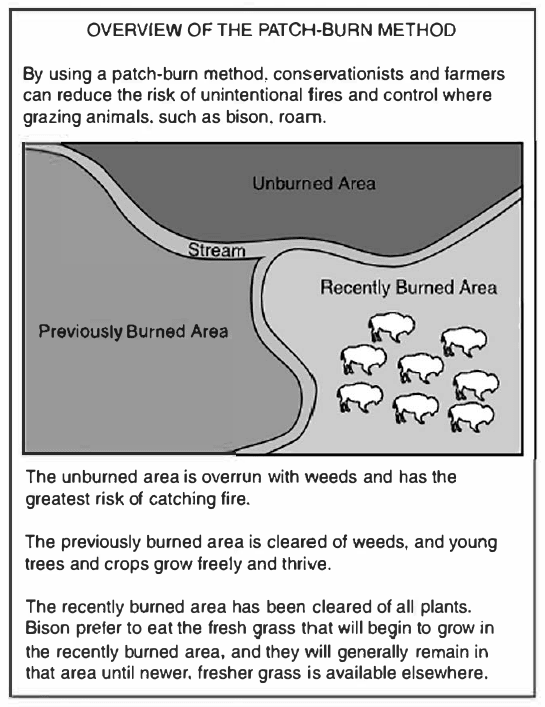
Question
Which sentence supports the idea that farmers and people who manage land may be concerned about using fire as a way to benefit the land?
- A“While one of the greatest threats to the prairie is wildfire, the use of controlled fires is actually an effective way to protect this idyllic landscape.” (paragraph 1)
- B“The American Indian people began to deliberately burn areas of land for bison to graze on, which enticed the herds away from the people’s crops.” (paragraph 2)
- C“This patch burning contains the fire within a specific area and allows animals in the burn area to safely relocate.” (paragraph 5)
- D“The following year, conservationists will burn a different section of the preserve, while the land burned the previous year regrows healthier than before.” (paragraph 5)
Show the answer
Correct answer: A
The question asks which sentence supports the idea that farmers and people who manage land may be concerned about using fire as a way to benefit the land.
A. CORRECT. The sentence from paragraph 1 supports the idea that farmers and people who manage land may be concerned about using fire as a way to benefit the land because it acknowledges that “one of the greatest threats to the prairie is wildfire.”
B. Incorrect. Although the sentence from paragraph 2 relates how American Indians “began to deliberately burn areas of land for bison to graze on” and to protect people’s crops, the sentence does not support the idea that farmers and people who manage land may be concerned about using fire as a way to benefit the land. Instead, it focuses on the cause-and-effect relationship between bison and newly burned areas.
C. Incorrect. The sentence from paragraph 5 provides details about how “patch burning contains the fire” and “allows animals in the burn area to safely relocate,” but it does not adequately support the idea that farmers and people who manage land may be concerned about using fire as a way to benefit the land, because it does not mention that wildfires can be a threat to the prairie.
D. Incorrect. While the sentence from paragraph 5 does explain how “conservationists will burn a different section of the preserve” in order to rotate the process year after year so that the burned land has time to regrow, the sentence does not support the idea that farmers and people who manage land may be concerned about using fire as a way to benefit the land because it does not mention the potential for total burns.
Question analysis
This evidence question asks which sentence from the article on controlled prairie burns supports the idea that farmers and others who manage land may be concerned about using fire to benefit it. The passage never states that concern directly, so students must infer it, and all four quoted sentences, taken from across the article, talk about burning land in some way.
- Grade level
- Grade 8 reading and task
- Compared with grade 7
- Above grade 7 Grade 7 evidence questions usually ask for support of an idea the text states. This idea, that people who manage land may worry about using fire, is never stated outright, so students must infer which sentence implies it, more than typical.
- Estimated difficulty
- Hard: combines ideas, needs a plan, and has more than one tempting wrong answer.
- Thinking it demands
- Depth of knowledge 3, strategic thinking · mainly evaluate
- What makes it hard
- Reading between the lines major
- A very close wrong answer moderate
- Every choice must be checked minor
- Evidence
- Answered from one sentence or line
- Reading level
- Passage: about grade 11, 598 words; question and choices: about grade 13, 123 words.
- Students, last 30 days
- Not enough answers yet to show (it takes 10).
Why it is hard, traps and wrong answers (shows the answer)
Why it is hard
The idea to support is about people’s feelings, yet none of the four sentences mentions farmers worrying, so students have to decide what would justify such worry. The opening sentence does it by naming wildfire as a great threat before praising controlled fire, a concession many students read past as background. The strongest pull is the sentence on containing the fire, which implies caution but presents patch burning as the answer, not the concern.
Reading between the lines major Working it out
No sentence mentions worry; students must see that calling wildfire “one of the greatest threats to the prairie” gives landowners a reason to fear fire, and that “actually” answers that fear. (Graesser, Singer & Trabasso, 1994; Kintsch, 1998)
A very close wrong answer moderate Choosing the answer
The patch-burn sentence about containing the fire “within a specific area” also hints at fire’s danger; it differs from the right one by describing the safeguard without ever naming a threat. (Embretson & Wetzel, 1987; Gorin & Embretson, 2006; Ascalon et al., 2007)
Every choice must be checked minor Choosing the answer
The four sentences come from paragraphs 1, 2 and 5, and each is about burning land, so each must be tested for a hint of risk rather than for its topic. (Embretson & Wetzel, 1987)
Strategy: Before rereading the choices, decide what a sentence would need to say to show that landowners have reason to be wary of fire, then test each quoted sentence for exactly that.
Traps
- Supports only part of the claim: In a question about evidence: a line that backs one half of the claim but not the other, or a related point rather than the claim itself.
- True but not the answer: A choice says something accurate about the text that does not answer this question.
The wrong answers, classified
B True but not the answer (King et al., 2004; Embretson & Wetzel, 1987)
Links “the people’s crops” to farmers, but the sentence tells how early burns drew bison away from the crops and shows no worry about fire itself.
C Supports only part of the claim (King et al., 2004; Thissen, Steinberg & Fitzpatrick, 1989)
Sees caution in containing the fire “within a specific area,” but the sentence explains how patch burning keeps animals safe and never says fire threatens the land.
D Supports only part of the claim (King et al., 2004; Thissen, Steinberg & Fitzpatrick, 1989)
Takes the yearly rotation as a careful precaution, but the sentence describes the schedule and land that “regrows healthier than before,” which backs the benefit, not the worry.
Working it out, step by step
Figure out what the question asks
This is an evidence question. Evidence is the words in a text that back up an idea. The idea here is that farmers might worry about using fire to help land. No sentence says farmers are worried. So look for a sentence that gives them a reason to fear fire.
Decide what the evidence needs
A sentence that supports this idea must show that fire can be dangerous. If fire can harm land, people have a reason to be careful with it. So test each sentence with one question: does it say fire is a threat?
Look closely at paragraph 1
Choice A quotes paragraph 1. Its first half says “one of the greatest threats to the prairie is wildfire.” That is a reason to fear fire. Its second half says controlled fires are “actually” helpful. The word “actually” pushes back against that fear. It means: you might expect fire to hurt the land, but here it helps.
Check each choice
- A is right. It names wildfire as a great threat. That gives farmers a reason to worry about fire.
- B is wrong. It tells how early burns drew bison away from crops. It shows no danger from fire.
- C is wrong. It tells how patch burning keeps the fire in one area. It describes a safety step but never names a threat.
- D is wrong. It describes burning a new section each year. It shows a benefit: land that “regrows healthier than before.”
Watch out: C hints that fire must be contained, or kept in, so it sounds careful. But it describes the solution, not the danger.
Choose the answer
Only one sentence names fire as a danger. So the answer is A, the sentence from paragraph 1: “While one of the greatest threats to the prairie is wildfire, the use of controlled fires is actually an effective way to protect this idyllic landscape.” Idyllic means peaceful and lovely.
Why this answer and not the closest wrong one
C is the closest wrong answer, because keeping fire “within a specific area” suggests caution. But C only explains how patch burning works. It never says fire can harm the prairie. A does, by calling wildfire one of the greatest threats.
More questions like this
The original DOE question
The passage “Using Fire to Keep a Prairie Healthy” as printed (page 41)
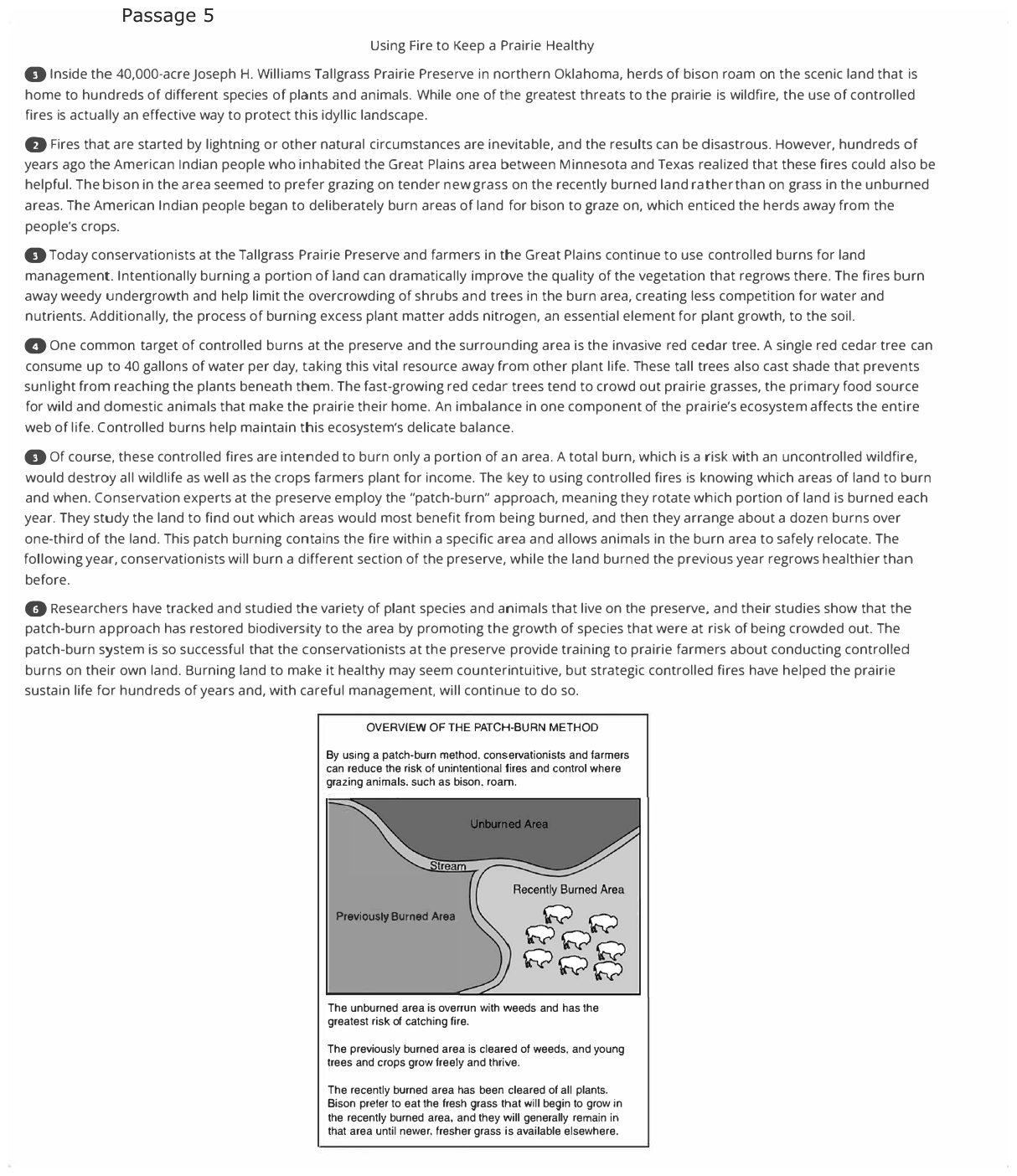
Question 14 of 59
2026 Practice Test B English, question 37Passage Letter from Brooklyn
Letter from Brooklyn
by Jacob Scheier
I can already see how this will end.
How I will grow tired of the bridge’s
steep incline, and the absent-minded tourists
wandering into the bicycle path.
The weather will turn cold.
But that all happens later.
For now it is the early edge of fall,
leaves green still while the air narrows,
is slightly crisp, almost grazing
the hair of my arm like a passing stranger,
as though the air has been forced into intimacy
by the brevity of daylight.
But when it starts darkening at 4,
this closeness, I know, will be a felt distance,
like someone drawing your attention
to their lack of intimacy.
These days I am still walking at a cathedral pace
beneath the branches bending across avenues,
brownstones like rows of lived-in chapels,
like a pop-up picture book I could have had as a child,
but didn’t. How Brooklyn makes me nostalgic
for the moment I am walking inside of.
These late afternoons filled
with a loneliness that makes me feel
distinctly myself, and an awareness
of how rare that is.
“Letter from Brooklyn” from LETTER FROM BROOKLYN: POEMS by Jacob Scheier, published by ECW Press. Copyright © 2013 by Jacob Scheier All rights reserved.
brevity: briefness
cathedral: meditative
chapels: private places of prayer or worship
nostalgic: yearning for the past
Question
Which lines support the idea that a change in the weather will lessen the speaker’s appreciation for the city?
- A“as though the air has been forced into intimacy / by the brevity of daylight.” (lines 11–12)
- B“But when it starts darkening at 4, / this closeness, I know, will be a felt distance,” (lines 13–14)
- C“like someone drawing your attention / to their lack of intimacy.” (lines 15–16)
- D“These days I am still walking . . . / beneath the branches bending across avenues,” (lines 17–18)
Show the answer
Correct answer: B
The question asks which lines from the poem support the idea that a change in the weather will lessen the speaker’s appreciation for the city.
A. Incorrect. These lines focus on the positive way the air feels to the speaker during “the early edge of fall” (line 7). They suggest that the speaker appreciates this experience currently, while being aware that the feeling might not last.
B. CORRECT. In these lines, the speaker describes the shift in the “closeness” of the air as the weather changes and “it starts darkening at 4.” The speaker clearly indicates that the positive emotions surrounding this closeness, with “leaves green still” and the air “slightly crisp” (lines 8–9), will soon be “a felt distance,” suggesting that the turn in the weather will make the city less appealing.
C. Incorrect. Although these lines compare the darkening, changing weather to a person revealing a “lack of intimacy,” that specific comparison does not focus on a diminishing appreciation for the city.
D. Incorrect. These lines describe the “cathedral pace” (line 17) at which the speaker walks, emphasizing a meditative or thoughtful experience. Such a description suggests the speaker still appreciates the city, not that the speaker’s appreciation will lessen.
Question analysis
This evidence question asks which lines from “Letter from Brooklyn” support the idea that a change in the weather will lessen the speaker's appreciation for the city. All four choices come from the middle of the poem, where the speaker describes the feel of the early-fall air through figurative comparisons, so students must read each pair of lines closely for both parts of the idea.
- Grade level
- Grade 8 reading and task
- Compared with grade 7
- Above grade 7 Choosing lines that support an idea is standard grade 7 evidence work. Here the idea is carried by figurative comparisons about the air, and the four choices sit within a few lines of one another, so separating them takes closer reading than is typical.
- Estimated difficulty
- Hard: combines ideas, needs a plan, and has more than one tempting wrong answer.
- Thinking it demands
- Depth of knowledge 2, skills and concepts · mainly evaluate
- What makes it hard
- A very close wrong answer moderate
- Figurative or literary language moderate
- Reading between the lines minor
- Evidence
- Answered from one sentence or line
- Reading level
- Passage: 217 words (a poem; reading level not measured); question and choices: about grade 6, 74 words.
- Students, last 30 days
- Not enough answers yet to show (it takes 10).
Why it is hard, traps and wrong answers (shows the answer)
Why it is hard
All four choices come from lines 11–18, and three speak of closeness, distance or intimacy, so the vocabulary of the claim is everywhere. The idea has two parts, a change in the weather and a weaker feeling for the city, and only one pair of lines holds both. The strongest pull is the second half of the same sentence, which puts the loss of intimacy most vividly but leaves the darkening behind in the lines before.
A very close wrong answer moderate Choosing the answer
Lines 13–14 and 15–16 are one sentence split in two: the first half names the darkening at 4 and the coming distance, the second only describes what that distance feels like. (Embretson & Wetzel, 1987; Gorin & Embretson, 2006; Ascalon et al., 2007)
Figurative or literary language moderate Understanding the question
The weaker feeling for the city is never stated; it comes through images, the air’s “closeness” turning into “a felt distance,” like a person pointing out their “lack of intimacy.” (Graesser, Singer & Trabasso, 1994; Kintsch, 1998)
Reading between the lines minor Working it out
Students must accept “when it starts darkening at 4” as the change in the weather the stem names, since the lines speak of daylight, not of cold or rain. (Graesser, Singer & Trabasso, 1994; Kintsch, 1998)
Strategy: Split the idea into its two parts, a change in the weather and a weaker feeling for the city, and choose the lines that hold both on their own, without help from the lines around them.
Traps
- Supports only part of the claim: In a question about evidence: a line that backs one half of the claim but not the other, or a related point rather than the claim itself.
The wrong answers, classified
A Supports only part of the claim (King et al., 2004; Thissen, Steinberg & Fitzpatrick, 1989)
Takes “the brevity of daylight” as the coming change, but these lines say the short days force the air “into intimacy,” a closeness the speaker enjoys now.
C Supports only part of the claim (King et al., 2004; Thissen, Steinberg & Fitzpatrick, 1989)
Chooses the vivid “lack of intimacy,” which does show the feeling weakening, but these lines only finish the simile and never mention the darkening that causes it.
D Supports only part of the claim (King et al., 2004; Thissen, Steinberg & Fitzpatrick, 1989)
Hears a coming change in “still walking,” but the lines show the speaker enjoying a slow walk under the branches now and say nothing of the weather turning.
Working it out, step by step
Figure out what the question asks
This is an evidence question. The idea has two parts. First, the weather will change. Second, the speaker will enjoy the city less. You need the lines that hold both parts by themselves.
Read the lines around the choices
Lines 9–12 describe the early-fall air now. It is “almost grazing / the hair of my arm like a passing stranger.” Grazing here means lightly touching. The speaker says the air feels close, like “intimacy.” Intimacy means a warm, close feeling between people. Lines 13–16 then look ahead to shorter days.
Find both parts in lines 13–14
Lines 13–14 say: “But when it starts darkening at 4, / this closeness, I know, will be a felt distance”. Darkening at 4 means the sun setting at 4 o’clock, as days get shorter. That is the change in the weather. “This closeness” is the warm feeling the speaker has now. It will turn into distance. So the good feeling will fade.
Check each choice
- A is wrong. Lines 11–12 describe the closeness the speaker enjoys now. Nothing has faded yet.
- B is right. It names the change, the early dark, and the loss, closeness turning into “a felt distance.”
- C is wrong. Lines 15–16 finish the comparison: the distance feels like a person pointing out their “lack of intimacy.” But these lines never mention the weather.
- D is wrong. Lines 17–18 show the speaker enjoying a slow walk now. They say nothing about the weather turning.
Watch out: C is tempting because “lack of intimacy” sounds like a lost feeling. But the change in weather is back in lines 13–14.
Choose the answer
Only one pair of lines holds both the change and the fading feeling. So the answer is B, lines 13–14, which begin “But when it starts darkening at 4”.
Why this answer and not the closest wrong one
C is the closest wrong answer, because it shows the good feeling slipping away. But lines 15–16 only describe what that distance feels like. They don’t say what causes it. Lines 13–14 give both parts: the early dark and the fading closeness.
More questions like this
The original DOE question
The passage “Letter from Brooklyn” as printed (page 50)
Question 15 of 59
2026 Practice Test C English, question 11Passage Excerpt from “Niagara Falls”
Excerpt from “Niagara Falls”
by Rupert Brooke
The real secret of the beauty and terror of the Falls is not their height or width, but the feeling of colossal power and of unintelligible disaster caused by the plunge of that vast body of water. If that were taken away, there would be little visible change, but the heart would be gone.
The American Falls do not inspire this feeling in the same way as the Canadian. It is because they are less in volume, and because the water does not fall so much into one place. By comparison their beauty is almost delicate and fragile. They are extraordinarily level, one long curtain of lacework and woven foam. Seen from opposite, when the sun is on them, they are blindingly white, and the clouds of spray show dark against them. With both Falls the colour of the water is the ever-altering wonder. Greens and blues, purples and whites, melt into one another, fade, and come again, and change with the changing sun. Sometimes they are as richly diaphanous as a precious stone, and glow from within with a deep, inexplicable light. Sometimes the white intricacies of dropping foam become opaque and creamy. And always there are the rainbows. If you come suddenly upon the Falls from above, a great double rainbow, very vivid, spanning the extent of spray from top to bottom, is the first thing you see. If you wander along the cliff opposite, a bow springs into being in the American Falls, accompanies you courteously on your walk, dwindles and dies as the mist ends, and awakens again as you reach the Canadian tumult. And the bold traveller who attempts the trip under the American Falls sees, when he dare open his eyes to anything, tiny baby rainbows, some four or five yards in span, leaping from rock to rock among the foam, and gambolling beside him, barely out of hand’s reach, as he goes. One I saw in that place was a complete circle, such as I have never seen before, and so near that I could put my foot on it. It is a terrifying journey, beneath and behind the Falls. The senses are battered and bewildered by the thunder of the water and the assault of wind and spray; or rather, the sound is not of falling water, but merely of falling; a noise of unspecified ruin. So, if you are close behind the endless clamour, the sight cannot recognise liquid in the masses that hurl past. You are dimly and pitifully aware that sheets of light and darkness are falling in great curves in front of you. Dull omnipresent foam washes the face. Farther away, in the roar and hissing, clouds of spray seem literally to slide down some invisible plane of air.
Beyond the foot of the Falls the river is like a slipping floor of marble, green with veins of dirty white, made by the scum that was foam. It slides very quietly and slowly down for a mile or two, sullenly exhausted. Then it turns to a dull sage green, and hurries more swiftly, smooth and ominous. As the walls of the ravine close in, trouble stirs, and the waters boil and eddy. These are the lower rapids, a sight more terrifying than the Falls, because less intelligible. Close in its bands of rock the river surges tumultuously forward, writhing and leaping as if inspired by a demon. It is pressed by the straits into a visibly convex form. Great planes of water slide past. Sometimes it is thrown up into a pinnacle of foam higher than a house, or leaps with incredible speed from the crest of one vast wave to another, along the shining curve between, like the spring of a wild beast. Its motion continually suggests muscular action. The power manifest in these rapids moves one with a different sense of awe and terror from that of the Falls. Here the inhuman life and strength are spontaneous, active, almost resolute. . . . A place of fear.
One is drawn back, strangely, to a contemplation of the Falls, at every hour, and especially by night, when the cloud of spray becomes an immense visible ghost, straining and wavering high above the river, white and pathetic and translucent. The Victorian lies very close below the surface in every man. There one can sit and let great cloudy thoughts of destiny and the passage of empires drift through the mind; for such dreams are at home by Niagara. I could not get out of my mind the thought of a friend, who said that the rainbows over the Falls were like the arts and beauty and goodness, with regard to the stream of life—caused by it, thrown upon its spray, but unable to stay or direct or affect it, and ceasing when it ceased. In all comparisons that rise in the heart, the river, with its multitudinous waves and its single current, likens itself to a life, whether of an individual or of a community. A man’s life is of many flashing moments, and yet one stream; a nation’s flows through all its citizens, and yet is more than they. In such places, one is aware, with an almost insupportable and yet comforting certitude, that both men and nations are hurried onwards to their ruin or ending as inevitably as this dark flood. Some go down to it unreluctant, and meet it, like the river, not without nobility. And as incessant, as inevitable, and as unavailing as the spray that hangs over the Falls, is the white cloud of human crying. . . . With some such thoughts does the platitudinous heart win from the confusion and thunder of a Niagara peace that the quietest plains or most stable hills can never give.
From LETTERS FROM AMERICA by Rupert Brooke—Public Domain
diaphanous: sheer, translucent
platitudinous: clichéd, common
Question
In paragraph 4, the idea that human life and history ultimately end in the same way is illustrated mainly through
- Athe discussion of how the rainbows visible in the Falls are like the art and beauty created by humankind.
- Bthe comparison between the movement of water in the Falls and the human experience.
- Cthe inclusion of details that show that every observer’s experience with the Falls is different.
- Dthe acknowledgment that contemplating the Falls at night sparks an awareness of humankind’s destiny.
Show the answer
Correct answer: B
The question asks how paragraph 4 of the excerpt mainly illustrates the idea that human life and history ultimately end in the same way.
A. Incorrect. In paragraph 4, the author compares the rainbows visible in the Falls to “the arts and beauty,” which share the rainbows’ dependence on “the stream of life”—that is, they are “caused by it, thrown upon its spray, but unable to stay or direct or affect it, and ceasing when it ceased.” This comparison does not illustrate the idea that human life and history ultimately end in the same way but rather that art and beauty, like human beings, are unable to “stay or direct or affect” their ultimate fate.
B. CORRECT. The author concludes in paragraph 4 that the movement of the Falls can be compared to people and history when he writes, “both men and nations are hurried onwards to their ruin or ending as inevitably as this dark flood.” This comparison illustrates the idea that human life and history ultimately end in the same way.
C. Incorrect. Although in paragraph 4 the author states that “One is drawn back, strangely, to a contemplation of the Falls” and provides an account of “a friend, who said that the rainbows over the Falls were like the arts and beauty and goodness, with regard to the stream of life,” the author does not provide details to show that every observer’s experience with the Falls is different. Rather, the author explains that “the Victorian lies very close below the surface in every man” (paragraph 4).
D. Incorrect. While the setting at night does provide a place of contemplation, the author notes the “dark flood” as the overall illustration of the human experience.
Question analysis
In this question on the closing paragraph of Rupert Brooke’s “Niagara Falls,” students identify the main way the author illustrates the idea that human life and history ultimately end in the same way. It is a lightly reworded version of a 2018 Test B question. The paragraph is long and reflective, mixing several images with abstract thoughts, so students must decide which of them actually illustrates this particular idea.
- Grade level
- Grade 8 reading and task
- Compared with grade 7
- Above grade 7 Most grade 7 work asks how an idea is shown in plain modern prose. This paragraph is a century-old reflection in long sentences with words like “certitude” and “unavailing,” and several of its images could each seem to carry the idea.
- Estimated difficulty
- Hard: combines ideas, needs a plan, and has more than one tempting wrong answer.
- Thinking it demands
- Depth of knowledge 2, skills and concepts · mainly analyze
- What makes it hard
- Complex sentences major
- The right answer is reworded moderate
- Hard words minor
- Evidence
- Answered from one paragraph or stanza
- Reading level
- Passage: about grade 9, 987 words; question and choices: about grade 11, 81 words.
- Students, last 30 days
- Not enough answers yet to show (it takes 10).
Why it is hard, traps and wrong answers (shows the answer)
Why it is hard
Paragraph 4 offers three pictures, the spray as a night ghost, the friend’s rainbows and the river as a life, and only one of them shows people and nations meeting an end. The 2026 stem’s “ultimately end” makes the rainbows’ “ceasing when it ceased” more tempting, and the night-time “thoughts of destiny” sound like the idea itself. Students who ask what the paragraph uses to show the idea, rather than where it mentions endings or destiny, land on the dark flood.
Complex sentences major Understanding the question
The idea sits inside a hedged sentence, “one is aware, with an almost insupportable and yet comforting certitude, that both men and nations are hurried onwards to their ruin or ending,” and the comparison comes last: “as inevitably as this dark flood.” (Abedi & Lord, 2001; Freedle & Kostin, 1993; Messick, 1989)
The right answer is reworded moderate Choosing the answer
The key sums up the paragraph’s river-and-life likeness in its own words, “movement of water” and “human experience,” while the other choices borrow the paragraph’s vocabulary: “rainbows,” “art and beauty,” “night” and “destiny.” (Freedle & Kostin, 1993; Kirsch & Mosenthal, 1990)
Hard words minor Understanding the question
“Multitudinous,” “certitude,” “insupportable” and “unavailing” all sit in the lines that carry the idea, and the footnoted “platitudinous” closes the paragraph, so the comparison has to be read through them. (Perfetti, 2007; Freedle & Kostin, 1993)
Strategy: Find the sentence in paragraph 4 that actually states the idea about life and history ending, then ask how that very sentence makes its point and match a choice to it.
Traps
- Supports only part of the claim: In a question about evidence: a line that backs one half of the claim but not the other, or a related point rather than the claim itself.
- Outside knowledge: A choice is plausible in the real world but not supported by this text.
The wrong answers, classified
A Supports only part of the claim (King et al., 2004; Thissen, Steinberg & Fitzpatrick, 1989)
Settles on the friend’s rainbows because they end “ceasing when it ceased,” which echoes the stem’s ending, but the likeness is about art and beauty, not the lives of men and nations.
C Outside knowledge (King et al., 2004; Recht & Leslie, 1988)
Relies on the common idea that every visitor sees the Falls in a personal way, but the paragraph speaks of “one” and “every man” in general and records no differences.
D Supports only part of the claim (King et al., 2004; Thissen, Steinberg & Fitzpatrick, 1989)
Joins the night view to “thoughts of destiny,” both real in paragraph 4, but they tell when and where the reflecting happens, not which picture shows lives and nations sharing an end.
Working it out, step by step
Figure out what the question asks
This asks how an idea is shown in paragraph 4. The idea is that people’s lives and whole nations end in the same way: they all come to an end. You need the picture the author mainly uses to show that idea. Paragraph 4 has several pictures, so find the one tied to this idea.
Find the sentence with the idea
Paragraph 4 says “both men and nations are hurried onwards to their ruin or ending as inevitably as this dark flood.” Men means people. Nations means countries and their history. Inevitably means in a way that can’t be stopped. The “dark flood” is the river’s dark water rushing over the Falls.
See how the comparison works
Just before, the author says “the river, with its multitudinous waves and its single current, likens itself to a life.” Multitudinous means very many. A current is water flowing one way. Likens itself to means seems like. A life has many moments but moves one way, like the river. And just as the water must rush on, people and nations rush toward their end. So the idea is shown by comparing moving water with human life.
Check each choice
- A does not fit. A friend compares the rainbows to “the arts and beauty and goodness.” That picture is about art, not about lives and nations ending.
- B fits. The river’s movement stands for human lives and history.
- C does not fit. The paragraph never says that each visitor sees the Falls differently.
- D does not fit. The night view and the “thoughts of destiny” tell when and where the author thinks. They do not show how lives end.
Watch out: D is tempting because destiny, or what happens in the end, sounds like the idea itself. But the question asks what illustrates the idea, and that is the river.
Choose the answer
The author pictures people and nations rushing to their end like the river’s water. So the answer is B, “the comparison between the movement of water in the Falls and the human experience.”
Why this answer and not the closest wrong one
D is the closest wrong choice. Paragraph 4 really does say the Falls at night stir “great cloudy thoughts of destiny.” But that only tells you the author was thinking about such things. The picture that shows lives and nations ending is the river. They are “hurried onwards to their ruin or ending as inevitably as this dark flood.”
More questions like this
The original DOE question
The passage “Excerpt from “Niagara Falls”” as printed (pages 134–135)
Question 16 of 59
2026 Practice Test C English, question 23Passage Bird Talk
Bird Talk
by Carl Sandburg
And now when the branches were beginning to be heavy,
It was the time when they once had said, “This is the
beginning of summer.”
The shrilling of the frogs was not so shrill as in the
first weeks after the broken winter;
The birds took their hops and zigzags a little more
anxious; a home is a home; worms are worms.
The yellow spreads of the dandelions and buttercups
reached across the green pastures.
Tee whee and tee whee came on the breezes, and the grackles
chuzzled their syllables.
And it was the leaves with a strong soft wind over them
that talked most of all and said more than any others
though speaking the fewest words.
It was the green leaves trickling out the gaunt nowhere
of winter, out on the gray hungry branches—
It was the leaves on the branches, beginning to be heavy,
who said as they said one time before, “This is the be-
ginning of summer.”
We shall never blame the birds who come
where the river and the road make the Grand Crossing
and talk there, sitting in circles talking bird talk.
If they ask in their circles as to who is here
and as to who is not here and who used to be here,
Or if instead of counting up last year as against
this year, they count up this year as against next
year, and have their bird chatter about who is here
this year who won’t be here next year,
We shall never blame the birds.
If I have put your face among leaf faces, child,
Or if I have put your voice among bird voices,
Blame me no more than the bluejays.
“Bird Talk” by Carl Sandburg—Public domain.
Question
Which lines from the poem best contrast with the idea of winter’s scarcity and bleakness?
- A“The shrilling of the frogs was not so shrill as in the / first weeks after the broken winter;” (lines 4–5)
- B“The yellow spreads of the dandelions and buttercups / reached across the green pastures.” (lines 8–9)
- C“Tee whee and tee whee came on the breezes, and the grackles / chuzzled their syllables.” (lines 10–11)
- D“Or if instead of counting up last year as against / this year, they count up this year as against next” (lines 25–26)
Show the answer
Correct answer: B
The question asks for the identification of a description that contrasts with the scarcity and bleakness of winter.
A. Incorrect. These lines indicate that the frogs are first very excited about the shift from winter to spring, which causes them to make a loud “shrilling,” yet their sounds lessen after a time and grow weaker. As such, these lines contrast two periods of spring (early vs. later) and the response of the frogs to these two periods; the lines do not contrast the bleakness of winter with the abundance of spring or summer.
B. CORRECT. During winter, there is scarcity of plant life and a bleak landscape: trees lose their leaves, snow covers the ground, and nature appears dark and shuttered. In contrast, these lines reveal the bright “yellow spreads” of flowers and the verdant “green pastures” that are signs that winter has abated.
C. Incorrect. This description contrasts the sounds of “the breezes” of warmer air and the sounds made by grackles—a type of bird—rather than the bleakness and scarcity of winter and the abundance of the “ ‘beginning of summer’ ” (line 3).
D. Incorrect. These lines show the contrast between the two ways of looking at things in terms of past vs. present or present vs. future; in this instance, the lines reveal the way birds naturally expect and adapt to the passing of time and the change of seasons. The lines do not present a contrast between winter and spring.
Question analysis
This textual evidence question on Carl Sandburg’s poem “Bird Talk” asks which lines best contrast with the idea of winter’s scarcity and bleakness. Students compare four quotations about frogs, flowers, birdsong and the birds’ yearly counting, and the challenge is finding the one whose images most fully show the opposite of a bare, bleak season.
- Grade level
- Grade 7 reading and task
- Compared with grade 7
- At grade 7 Choosing lines that fit an idea is routine grade 7 evidence work. The twist is that students look for the opposite of an idea, winter’s scarcity and bleakness, rather than support for it, though the quoted images are concrete.
- Estimated difficulty
- Straightforward: two steps or one careful reading.
- Thinking it demands
- Depth of knowledge 2, skills and concepts · mainly evaluate
- What makes it hard
- Every choice must be checked minor
- Hard words minor
- Evidence
- Answered from one sentence or line
- Reading level
- Passage: 296 words (a poem; reading level not measured); question and choices: about grade 6, 85 words.
- Students, last 30 days
- Not enough answers yet to show (it takes 10).
Why it is hard, traps and wrong answers (shows the answer)
Why it is hard
The question turns the usual evidence task around: students picture a scarce, bleak winter and then look for its opposite. The line that names winter outright is a trap, since it only compares the frogs’ noise in two stretches of spring, and the grackles’ calls show life without plenty. The flowers spreading “across the green pastures” are the one image of abundance and color.
Every choice must be checked minor Choosing the answer
Every quotation carries some sign of the season, frogs, flowers, birdsong and the birds’ yearly count, so each must be tested for images of plenty and color set against a bare winter. (Embretson & Wetzel, 1987)
Hard words minor Understanding the question
The stem’s “scarcity” and “bleakness” define what to look for; a student unsure of them cannot tell that yellow and green spreading across pastures is their opposite. (Perfetti, 2007; Freedle & Kostin, 1993)
Strategy: First picture what a scarce, bleak winter looks like, then read each quotation for images that show the plain opposite of that picture.
Traps
- Word match: Repeats striking words or phrases from the text, so it looks supported, but its meaning does not fit the question.
- Supports only part of the claim: In a question about evidence: a line that backs one half of the claim but not the other, or a related point rather than the claim itself.
The wrong answers, classified
A Word match (Freedle & Kostin, 1993)
Is drawn by “the broken winter,” the only mention of winter among the choices, but the lines compare the frogs’ shrilling early and later in spring, not winter’s bareness with plenty.
C Supports only part of the claim (King et al., 2004; Thissen, Steinberg & Fitzpatrick, 1989)
Picks the birdsong, which does show life returning after a silent season, but the calls say nothing about scarcity giving way to plenty, as the spreading flowers in lines 8–9 do.
D Word match (Freedle & Kostin, 1993)
Takes “as against” for the contrast the question asks about, though these lines set one year against another in the birds’ talk and hold no image of winter or of growth.
Working it out, step by step
Figure out what the question asks
This asks you to find lines that show the opposite of winter. Scarcity means not having enough of something. Bleakness means looking bare, cold and gloomy. So picture winter: bare branches, no flowers, gray and brown fields. Then look for the lines that show plenty and bright color instead.
Read lines 8–9
Lines 8–9 say “The yellow spreads of the dandelions and buttercups / reached across the green pastures.” Dandelions and buttercups are small yellow flowers. Pastures are grassy fields. A spread is a wide area covered with something. Here, yellow flowers stretch across green fields. That is a picture of color everywhere and plenty of growth. It is the exact opposite of a bare, gray winter.
Check each choice
- A does not fit. It mentions “the broken winter,” but it only compares how shrill, or sharp and high, the frogs sounded at two times. Nothing in it shows plenty.
- B fits. Yellow flowers spread over green fields, full of color and life.
- C does not fit. The birdsong shows that life is back. But it gives no picture of plenty or color to set against a bare winter.
- D does not fit. These lines compare one year with another in the birds’ talk. There is no winter and no growth in them.
Watch out: A is the only choice that names winter, so it can seem to fit. But mentioning winter is not the same as contrasting with it.
Choose the answer
Only lines 8–9 show plenty and bright color, the opposite of a scarce, bleak winter. So the answer is B, lines 8–9: “The yellow spreads of the dandelions and buttercups / reached across the green pastures.”
Why this answer and not the closest wrong one
C is a close wrong choice, since birdsong is a sign that life is back. But the question asks for a contrast with scarcity, or not having enough. Sounds alone do not show plenty. Lines 8–9 show flowers spreading wide across green fields. That picture of color and plenty is the clearest opposite of a bare, gray winter.
More questions like this
The original DOE question
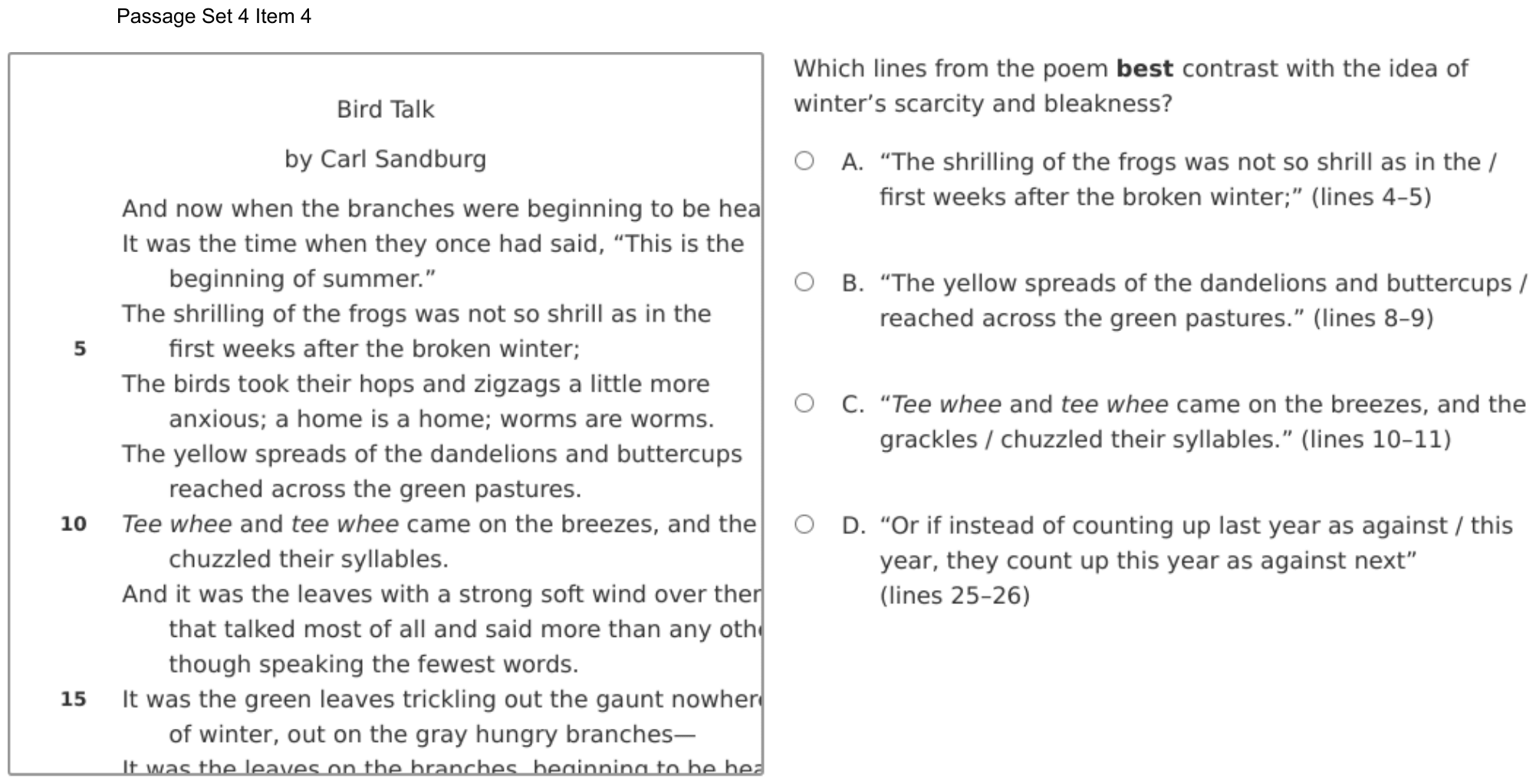
The passage “Bird Talk” as printed (page 32)
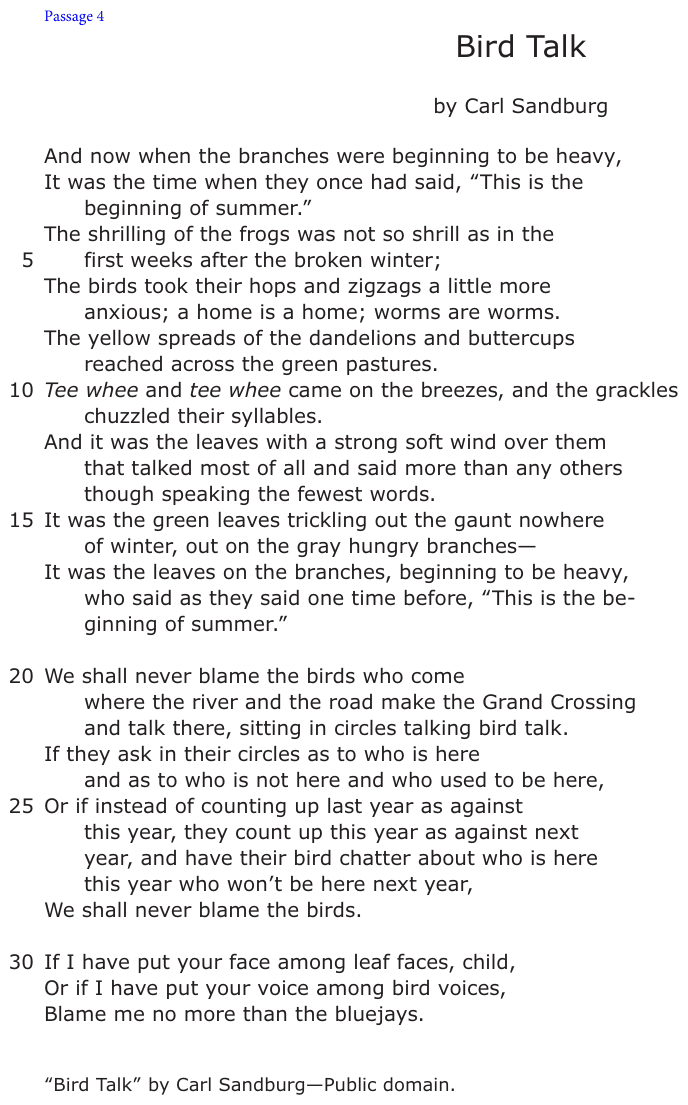
Question 17 of 59
2026 Practice Test C English, question 27Passage Serpent Mound
Serpent Mound
The Great Serpent Mound, located in Adams County, Ohio, is a human-made mound of earth that researchers believe was created between 300 B.C. and A.D. 1100 by an indigenous culture.
Ohio, 1846
Brush Creek stood low when the museum men came
with their measuring tapes and sketchbooks.
It was winter. Fringed with ice,
the creek doubled back on itself
as if it had forgotten something.
Pa was in Cincinnati, or else on his way home,
so Ma told me to lead the men
into the marshy low grounds. It being winter,
there was little underbrush to speak of—
in the summer there would have been
briars, poison ivy, biting flies. I listened
for the swish of a beaver’s heavy tail,
the chitter of a chickadee, or the cry of a hawk,
but the winter silence of the creek pressed
down on all of us like a weight.
The humps in the ground were all but
invisible until you were right up on them. The figure
was even less obvious: the sinuous body,
the tail coiled three times around,
and at the other end, the mouth wide open.
In the summer the creek bottom was crowded
with so much life that you could trip over
the ridges of earth before you saw
anything at all. In winter you could climb
a tree and get some idea of the whole thing:
the serpent’s body undulating, slithering
silently across the ancient
earth. At the mouth end, there was an oval mound
as if the snake were about to swallow an egg—
as snakes sometimes did in our rickety
henhouse—my Pa always said, or
as if swallowing the sun, one of the museum
men suggested, taking notes with his quill pen,
an old-style inkhorn slung at his side.
I liked that: swallowing the sun,
just the sort of thing a snake might do,
might want to do. When, later, I told my sister Ruth,
she disagreed. It is singing to the sun,
she insisted. That is why its mouth
is wide open. She said, “Sometimes I think
I hear it on summer nights. Not swallowing, singing.”
Question
Which lines reveal how the setting affects the speaker and the men from the museum?
- A“It being winter, / there was little underbrush to speak of—” (lines 8–9)
- B“but the winter silence of the creek pressed / down on all of us like a weight.” (lines 14–15)
- C“The humps in the ground were all but / invisible until you were right up on them.” (lines 16–17)
- D“In the summer the creek bottom was crowded / with so much life that you could trip” (lines 21–22)
Show the answer
Correct answer: B
The question asks which lines reveal how the setting affects the speaker and the men from the museum.
A. Incorrect. The words “being winter” (line 8) work to establish the setting, but lines 8 and 9 do not describe the effect the winter setting has on the speaker and the men.
B. CORRECT. The imagery in lines 14 and 15 describes how the winter silence makes the speaker and the men feel emotional heaviness: it “pressed / down on all of us like a weight.”
C. Incorrect. Although the words “the humps in the ground were all but / invisible” describe how the setting appears to the speaker and the men, lines 16 and 17 do not describe how the setting affects them.
D. Incorrect. Although lines 21 and 22 do describe the setting, the lines do not describe how the setting affects the speaker and the men. The lines describe the setting in the summer, which is before the men from the museum show up.
Question analysis
This evidence question on the poem “Serpent Mound” asks which lines reveal how the setting, a creek in the Ohio winter of 1846, affects the young speaker and the museum men. All four quotations come from the poem’s description of the creek and the land around the mound, in winter and in summer, so the four choices look much alike at first glance.
- Grade level
- Grade 7 reading and task
- Compared with grade 7
- At grade 7 A routine grade 7 evidence task: the four quotations are short, numbered and in plain modern language. What takes care is that all of them describe the setting, while the question asks about its effect on particular people.
- Estimated difficulty
- Straightforward: two steps or one careful reading.
- Thinking it demands
- Depth of knowledge 2, skills and concepts · mainly evaluate
- What makes it hard
- Every choice must be checked moderate
- Figurative or literary language minor
- Evidence
- Answered from one sentence or line
- Reading level
- Passage: 354 words (a poem; reading level not measured); question and choices: about grade 5, 77 words.
- Students, last 30 days
- Not enough answers yet to show (it takes 10).
Why it is hard, traps and wrong answers (shows the answer)
Why it is hard
Every quotation describes the setting, so a student who checks only for setting can defend almost any of them. The question turns on the people: only one quotation says what the place does to them, in the words “on all of us.” The summer lines tempt with someone tripping over the ridges, but they describe another season, not the winter day of the visit.
Every choice must be checked moderate Choosing the answer
All four quotations describe the creek and the land, so each must be asked whether it shows the place acting on the speaker and the men or only tells what the place is like. (Embretson & Wetzel, 1987)
Figurative or literary language minor Understanding the question
The answer is a simile, silence that “pressed / down on all of us like a weight,” and students must read the weight as a mood the winter quiet puts on the group. (Graesser, Singer & Trabasso, 1994; Kintsch, 1998)
Strategy: Paraphrase each quotation, then ask whether it shows the setting acting on the speaker and the museum men or only tells what the place is like.
Traps
- Supports only part of the claim: In a question about evidence: a line that backs one half of the claim but not the other, or a related point rather than the claim itself.
- True but not the answer: A choice says something accurate about the text that does not answer this question.
The wrong answers, classified
A Supports only part of the claim (King et al., 2004; Thissen, Steinberg & Fitzpatrick, 1989)
Treats the thin winter underbrush as an effect because it would make the walk easier, but lines 8–9 only describe the ground and say nothing of how anyone feels or acts.
C Supports only part of the claim (King et al., 2004; Thissen, Steinberg & Fitzpatrick, 1989)
Sees that the humps are hard to spot until “you were right up on them,” which involves a viewer, but the lines report how the land looks, not what it does to the group.
D True but not the answer (King et al., 2004; Embretson & Wetzel, 1987)
Matches “you could trip” to the word “affects,” but the lines describe the creek bottom in summer, not the winter day when the speaker leads the museum men.
Working it out, step by step
Figure out what the question asks
This asks for evidence about setting. Setting is where and when a story or poem takes place. Here it is a creek in Ohio, in winter. You need the lines that show how this place affects the speaker and the museum men. In other words, what does the place do to them or make them feel?
Read the lines that mention people
Lines 14–15 say “but the winter silence of the creek pressed / down on all of us like a weight.” The words “all of us” mean the speaker and the museum men together. This is a simile, a comparison using “like.” The quiet felt like something heavy pressing down on them. So the silent winter creek made the whole group feel heavy and gloomy.
Check each choice
- A does not fit. Lines 8–9 say there was little underbrush, or low bushes. That describes the ground, not how anyone felt.
- B fits. The silence “pressed / down on all of us,” so the place acts on the whole group.
- C does not fit. Lines 16–17 tell how hard the humps are to see. They describe the land, not its effect on the group.
- D does not fit. Lines 21–22 describe the creek in summer. The museum men came in winter.
Watch out: D says “you could trip,” which sounds like an effect on people. But it describes another season, not the day of the visit.
Choose the answer
Only lines 14–15 show the winter creek acting on the speaker and the men. So the answer is B, lines 14–15: “but the winter silence of the creek pressed / down on all of us like a weight.”
Why this answer and not the closest wrong one
C is a close wrong choice, because it has a person in it: the humps stay hidden “until you were right up on them.” But it only reports what the land looks like. B is different. The silence “pressed / down on all of us like a weight.” Only B shows the place changing how the speaker and the men feel.
More questions like this
The original DOE question
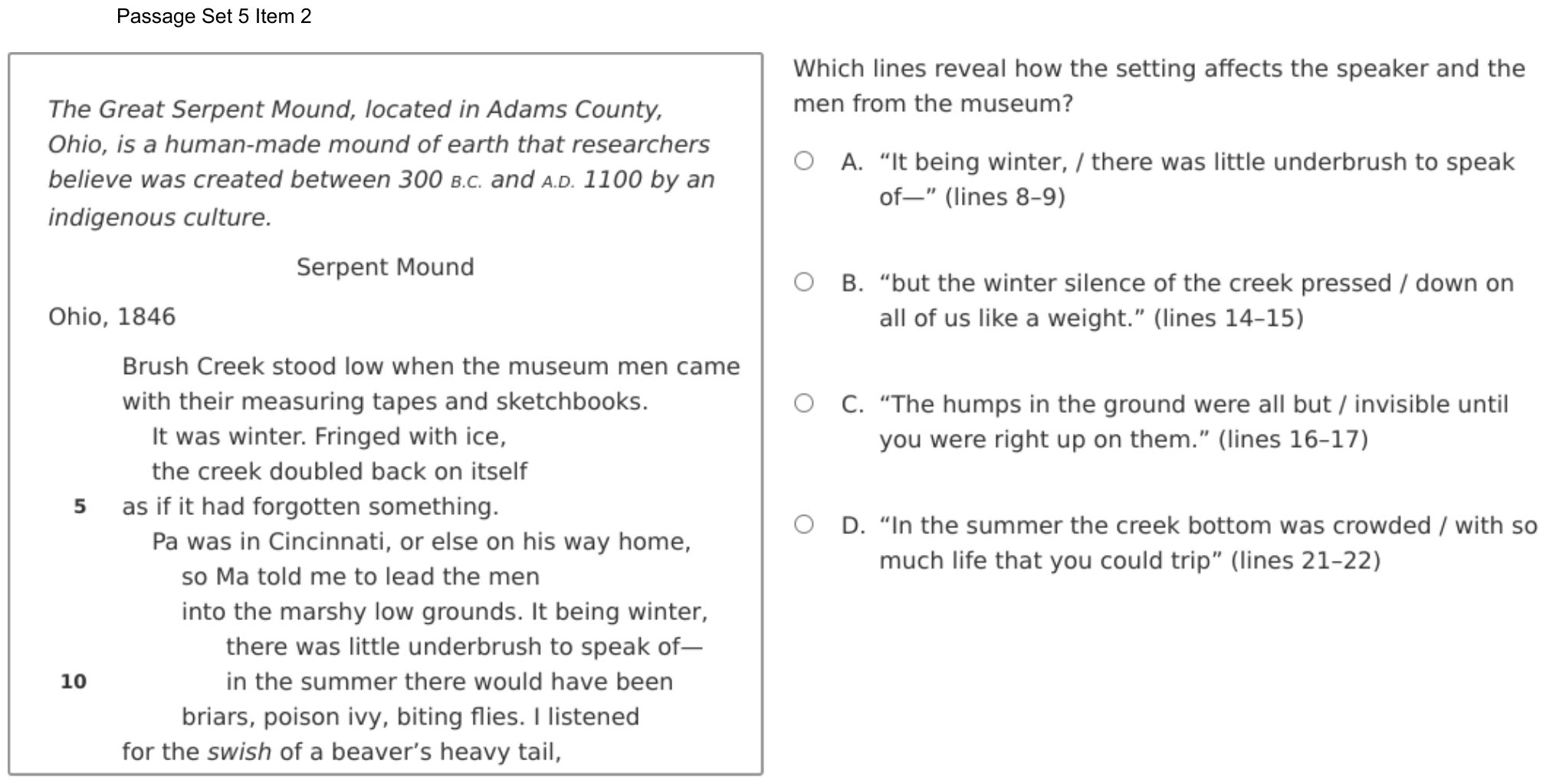
The passage “Serpent Mound” as printed (page 40)
Question 18 of 59
2026 Practice Test C English, question 38Passage Excerpt from “Growing Peppers on the ISS Is Just the Start of Space Farming”
Excerpt from “Growing Peppers on the ISS Is Just the Start of Space Farming”
by Melanie Canales
The author, Melanie Canales, is a first-generation Peruvian American farmer and beekeeper based in Virginia’s Shenandoah Valley, on lands of the indigenous Monacan and Manahoac tribes. Her work focuses on creating healthy relationships between people and their surrounding ecosystems.
Unburdened by the constraints of gravity, red and green peppers jut out at 45-degree angles inside the Advanced Plant Habitat (APH), a sort of space terrarium not much larger than a microwave. Four chile pepper plants stand effortlessly upright, despite the dozens of glossy fruits weighing them down. These plants have lived entirely in space; their leaves have never been chewed on by insects or rustled by a summer breeze, [and] their stems are unfamiliar with bending toward the sun’s arc across the sky. Scissors glint under the tank’s white and blue lights as astronaut Mark Vande Hei and his team snip the stems of those that are ready for harvest. The peppers whirl around their heads until the astronauts catch them and tape them against a board to photograph.
Back on Earth, the Plant Habitat-04 team of engineers and plant scientists are observing and conferring with the astronauts. Of the 26 peppers in this batch, only the 14 finest will stay on the International Space Station [ISS] for consumption. The rest will be wrapped in foil, sealed in a Ziploc bag, then frozen at a brisk −80 degrees, until they can come roaring back to Earth in the next cargo capsule to be studied later. Now, after a 137-day growth cycle, the astronauts remove the plants from the module and trash them. Project Plant Habitat-04 is complete. It’s taco night on the ISS.
Since 2014, NASA1 has experimented with growing lettuces, brassicas,2 and zinnias3 in space, an endeavor that relies on highly specialized technology over 50 years in the making. [Fall 2021’s] two successful pepper harvests . . . will provide data on the nutritional and psychological benefits of growing vegetables on-craft, as well as a crop’s ability to reliably produce long-term in microgravity. While controlled environmental agriculture is not new, the APH experiment represents an evolution in specialized growth habitats. It doesn’t aim to re-create Earth’s conditions, but to perfect each isolated variable of plant growth in the clinical environment of a spaceship.
“The Advanced Plant Habitat is the most complex plant growth system on orbit today,” says Lashelle Spencer, a plant scientist at NASA’s Kennedy Space Center. Its more than 180 sensors control and monitor temperature, humidity, and carbon dioxide. The astronauts can adjust the color and intensity of the light, and how much moisture the plants’ roots are getting. It waters itself.
It’s the day after Thanksgiving, and Spencer has been at Kennedy since 5 a.m. to facilitate the peppers’ final harvest. As part of the project team, she played a crucial role in preparing the seeds that were sent hurtling into space in June and guiding the astronauts through maintaining the plants in orbit. . . . Though astronauts can spend upwards of 100 days in space, their on-mission meals come dehydrated and pre-packaged; their vitamins and minerals are isolated in supplements, which lose nutritional value the longer they’re stored. Spencer’s goal is to create the conditions necessary for cultivating healthy plants in space, so those plants can sustain healthy astronauts on long-term missions. Astronaut food is great, she says—“especially the shrimp cocktail. But you’re missing that crunch. You’re missing that fresh pop of flavor, the green flavor that’s not there in that packaged food.”
The sensory experience of growing productive crops can also help mitigate4 the psychological effects of long-term space travel. . . . Spencer says the team cracked open the door of the APH every day to observe their vegetable companions with all the tenderness of home gardeners. When harvest day came, they batted their bounty around the ISS, taking selfies and delighting in watching the fruits pirouetting around the spacecraft. . . .
“We were thinking no heat, so that [the peppers] wouldn’t be dangerous, but maybe the astronauts need a little spice in their life,” says Paul Bosland, who along with his colleagues at the Chile Pepper Institute genetically engineered5 the NuMex Española Improved chile pepper seeds grown in Plant Habitat-04. . . .
Working with NASA, Bosland cultivated a variety that could accommodate both the nutritional needs of astronauts as well as the logistics of growing a plant in space. . . .
. . . The experiment is helping gather the data necessary to determine the nutritional content of crops grown in space, and therefore how many people they can feed, and for how long. Though much is still unknown, Spencer is certain of one thing that future astronauts will need to do: “I think in an optimal world, a scientist like me would say that they would be growing plants from day one. From the day they left to the day they came back, they would be growing them.”
From “Growing Peppers on the ISS Is Just the Start of Space Farming” by Melanie Canales from WIRED, December 21, 2021. Copyright © 2021 Condé Nast. All rights reserved.
1NASA: National Aeronautics and Space Administration
2brassicas: a large genus of herbs, such as broccoli and cabbage
3zinnias: a genus of herbs and low shrubs that have flowers at their heads
4mitigate: to make something less severe or harmful
5genetically engineered: combined parts of DNA from different plants to produce a new plant
Question
Which two sentences in paragraphs 5–9 best support the idea that the astronauts working in space enjoyed participating in the food-growing experiment?
Select the two correct answers.
On the test you click the words in the text; here, choose them below. The DOE has not published how answers with several parts are scored; this site counts one right only when every part is right.
- ABut you’re missing that crunch. You’re missing that fresh pop of flavor, the green flavor that’s not there in that packaged food.”
- BSpencer says the team cracked open the door of the APH every day to observe their vegetable companions with all the tenderness of home gardeners.
- CWhen harvest day came, they batted their bounty around the ISS, taking selfies and delighting in watching the fruits pirouetting around the spacecraft.
- D“We were thinking no heat, so that [the peppers] wouldn’t be dangerous, but maybe the astronauts need a little spice in their life,” says Paul Bosland
- E“I think in an optimal world, a scientist like me would say that they would be growing plants from day one.
Show the answer
Correct answer: B and C
The question asks which two sentences in paragraphs 5–9 best support the idea that the astronauts working in space enjoyed participating in the food-growing experiment.
Incorrect. Choice 1. “But you’re missing that crunch. You’re missing that fresh pop of flavor, the green flavor that’s not there in that packaged food” is incorrect because it illustrates an opinion on fresh foods of Lashelle Spencer, a plant scientist at NASA’s Kennedy Space Center. Although astronauts are likely to enjoy fresh food, the statement does not describe the enjoyment of the astronauts participating in the experiment.
CORRECT. Choice 2. “Spencer says the team cracked open the door of the APH every day to observe their vegetable companions with all the tenderness of home gardeners” is a correct response. The details about the attitude of the astronauts toward the plants and their desire to observe them every day support the idea that they enjoyed participating in the experiment.
CORRECT. Choice 3. “When harvest day came, they batted their bounty around the ISS, taking selfies and delighting in watching the fruits pirouetting around the spacecraft” is a correct response. That the astronauts were taking selfies with the peppers and “delighting in watching the fruits pirouetting around the spacecraft” suggests that the astronauts enjoyed being part of the experiment.
Incorrect. Choice 4. “ ‘We were thinking no heat, so that [the peppers] wouldn’t be dangerous, but maybe the astronauts need a little spice in their life,’ says Paul Bosland” is incorrect because the quotation only gives information about the variables taken into account in the selection of peppers by a scientist at the Chile Pepper Institute. Although the observation suggests that the spicy heat of peppers might be enjoyed by astronauts in space, the sentence does not address the attitude of the astronauts toward the experiment.
Incorrect. Choice 5. “ ‘I think in an optimal world, a scientist like me would say that they would be growing plants from day one’ ” is incorrect because it emphasizes the opinion of Lashelle Spencer, a plant scientist at NASA’s Kennedy Space Center, regarding the growth of plants in space. Although she suggests growing plants is a good idea, the quotation does not support the idea that the astronauts enjoyed participating in the experiment.
Question analysis
This select-two evidence question asks which two sentences in paragraphs 5–9 of the space-farming excerpt best show that the astronauts enjoyed taking part in the pepper-growing experiment. On the test students click two of five sentences highlighted in the passage, and credit comes only when both picks are right. Each sentence mentions food, peppers or plants, so each must be checked against the idea itself.
- NYS standards
- 7R1 textual evidence and inferences
- Grade level
- Grade 7 reading and task
- Compared with grade 7
- At grade 7 Choosing evidence for an idea is everyday grade 7 work. This item asks for two sentences out of five and gives credit only for a fully right pair, but the sentences come from a few neighboring paragraphs and the idea to support is concrete.
- Estimated difficulty
- Straightforward: two steps or one careful reading.
- Thinking it demands
- Depth of knowledge 2, skills and concepts · mainly evaluate
- What makes it hard
- Reading between the lines moderate
- Every choice must be checked minor
- Figurative or literary language minor
- Evidence
- Answered from several paragraphs or stanzas
- Reading level
- Passage: about grade 10, 890 words; question and choices: about grade 9, 143 words.
- Students, last 30 days
- Not enough answers yet to show (it takes 10).
Why it is hard, traps and wrong answers (shows the answer)
Why it is hard
The harvest-day sentence, with its selfies and delight, is the easy pick. The second takes more care, because “the team” that opened the habitat every day seems at first to be Spencer’s team on Earth, and both picks must be right for credit. Students who look for the word “astronauts” or a cheerful phrase are pulled to Bosland’s “a little spice in their life” or to Spencer’s longing for crunch, which report the views of the scientists.
Reading between the lines moderate Working it out
The second right sentence says “the team” opened the habitat’s door, right after paragraph 5 called Spencer “part of the project team,” so students must see that only the crew aboard could do it. (Graesser, Singer & Trabasso, 1994; Kintsch, 1998)
Every choice must be checked minor Choosing the answer
All five sentences mention food, peppers or plants, and credit needs both picks, so each must be traced to its speaker: Spencer, the crew or Bosland. (Embretson & Wetzel, 1987)
Figurative or literary language minor Understanding the question
The enjoyment is shown in images rather than stated: “vegetable companions,” “the tenderness of home gardeners” and fruits “pirouetting around the spacecraft.” (Graesser, Singer & Trabasso, 1994; Kintsch, 1998)
Strategy: Read each of the five sentences in its paragraph and work out whose actions or opinions it reports, then keep the two that show both parts of the idea: astronauts in space, and their enjoyment.
Traps
- Supports only part of the claim: In a question about evidence: a line that backs one half of the claim but not the other, or a related point rather than the claim itself.
- Word match: Repeats striking words or phrases from the text, so it looks supported, but its meaning does not fit the question.
- Reads too much in: A reasonable-sounding conclusion that goes further than the text allows.
The wrong answers, classified
A Supports only part of the claim (King et al., 2004; Thissen, Steinberg & Fitzpatrick, 1989)
Hears a love of fresh food in “missing that crunch,” but these are Spencer’s words about packaged meals, a related point rather than a sign the crew enjoyed the experiment.
D Word match (Freedle & Kostin, 1993)
Is drawn by “a little spice in their life,” which sounds like fun and names the astronauts, though it is Bosland explaining a choice about the peppers’ heat.
E Reads too much in (Graesser, Singer & Trabasso, 1994)
Reasons that Spencer would not urge growing plants “from day one” unless crews loved it, though she gives her own view as a scientist and says nothing about their feelings.
B Twists what the text says (King et al., 2004)
Left out by students who take “the team” to be Spencer’s project team on Earth, though only the crew aboard the station could open the habitat’s door every day.
Working it out, step by step
Figure out what the question asks
You need two sentences from paragraphs 5–9 that show the astronauts enjoyed the experiment. Each one must do two things. It must be about the astronauts in space, not the scientists on Earth. And it must show they liked the work. On the test you click two sentences in the passage. Here, you choose two of the five choices. Both must be right.
Find who each sentence is about
- A is Spencer, a scientist on Earth, talking about packaged food.
- B says “the team” opened the habitat every day.
- C says “they” played with the peppers on harvest day.
- D is Paul Bosland, the scientist who made the seeds, talking about spice.
- E is Spencer again, giving her own opinion.
So only B and C could be about the astronauts. But who is “the team” in B?
Work out who the team is
Paragraph 5 calls Spencer “part of the project team,” and she works on Earth. So the team in paragraph 6 might seem to be the scientists. But look at what the team did. They “cracked open the door of the APH every day.” The APH is a plant box on the space station, so only the crew could open it. The next sentence says they batted the peppers “around the ISS,” so they were on board. Paragraph 1 also calls the crew Mark Vande Hei’s “team.” “Spencer says” only means she is telling us what they did.
See how they show enjoyment
In B, the team checked on “their vegetable companions with all the tenderness of home gardeners.” Companions are friends. Tenderness is gentle, loving care. They treated the plants almost like pets. In C, the same team “batted their bounty around the ISS, taking selfies.” Bounty means a big harvest. They were “delighting,” or taking great joy, in watching the peppers spin like dancers.
Rule out the other three
- A is wrong. Spencer is saying packaged food lacks crunch. That is her view of the food, not the crew enjoying the work.
- D is wrong. “A little spice in their life” sounds fun. But it is Bosland explaining why the peppers have some heat.
- E is wrong. Spencer says crews should grow plants “from day one.” That is a scientist’s advice, not the crew’s feelings.
Watch out: D names the astronauts and sounds cheerful. But the speaker is a scientist on Earth.
Choose the answers
Both sentences show the crew in space caring for and playing with their plants. So the answers are B and C: B, “Spencer says the team cracked open the door of the APH every day to observe their vegetable companions with all the tenderness of home gardeners.” And C, “When harvest day came, they batted their bounty around the ISS, taking selfies and delighting in watching the fruits pirouetting around the spacecraft.”
Why this answer and not the closest wrong one
The hard part is B. It says “the team,” and Spencer was on a team too. But only the crew on the station could open the habitat every day, so B is about the astronauts. D sounds fun, but Bosland is a scientist explaining spice. It says nothing about how the crew felt.
More questions like this
The original DOE question
The passage “Excerpt from “Growing Peppers on the ISS Is Just the Start of Space Farming”” as printed (pages 50–51)
Question 19 of 59
2026 Practice Test D English, question 6Passage A Memory Revolution
A Memory Revolution
A high school senior logs on to a computer at the library to double-check the application due date listed on a college admissions website. Nearby, a librarian helps a group of biology students use a database to search for recent studies about mammals. In the past few decades, the Internet has become an integral component of daily life for many people. The seemingly limitless power of search engines made the Internet search extremely common, and today people increasingly rely on the Internet’s vast accumulation of sources to access all types of information. Scientists are beginning to examine how this reliance is modifying the strategies people use to store and prioritize information in their mind.
A Dependable and Valuable Asset
Psychologist Benjamin Storm from the University of California, Santa Cruz, and researchers Sean Stone and Aaron Benjamin devised an experiment to study students’ tendency to depend on the Internet for facts. To begin, the scientists divided sixty participants into multiple groups, including an “Internet” group and a “memory” group, and placed them in front of computers. The Internet group was required to use the search engine Google to answer eight challenging trivia questions. In contrast, participants in the memory group were permitted to use only their personal knowledge to answer the questions. In the second round, the researchers administered notably easier questions. This time, they allowed each group the option of using Google as they answered. Their results showed that 83 percent of the Internet group continued to consult Google in the second round, while only 63 percent of the memory group chose to do so.
People’s growing inclination to rely on the Internet in order to retrieve information, particularly facts and figures, is called cognitive offloading. Canadian researcher Evan F. Risko and British researcher Sam Gilbert, who have written extensively about the topic, say a similar process has been taking place for centuries. In the past, people used resources like encyclopedias to assist their memories; however, today the Internet, serving as a vast extended memory, allows people to digitally access and retrieve much larger volumes of information. Consequently, people’s minds are free for other cognitive feats, such as connecting data, learning new information, or solving problems.
Filing Information Away
The use of the Internet also appears to be modifying the strategies people use to store information in their mind. Researchers Betsy Sparrow from Columbia University, Jenny Liu from the University of Wisconsin-Madison, and Daniel Wegner from Harvard University conducted several studies to discover how people efficiently manage their information intake.
To begin, the researchers examined how people evaluate which information deserves their effort to remember. For this experiment, participants read forty trivia facts, such as “An ostrich’s eye is bigger than its brain,” and typed the statements into a computer file. Half the participants had been previously told the file would be saved, while half believed it would be erased. Next, the participants wrote down every fact they could recall. Those who believed the information would be erased and no longer available could recall 40 percent more facts than those who thought the information would be saved.
In another experiment, the same researchers tested the ability of study participants to remember where to access information. For this trial, participants read and typed trivia statements, which they saved in folders with generic names such as “Facts” and “Items.” After spending ten minutes writing down all the facts they could recall from memory, participants were asked which folder contained a particular fact based on a keyword. For example, “Which folder has the fact about ostriches?” Overall, participants recalled the information’s location more often than the content itself, correctly identifying 49 percent of the folders for specific facts while remembering only 23 percent of the actual trivia. The researchers concluded that our memory is adapting to the Internet age by prioritizing where to locate information even when the specific details are forgotten. According to Sparrow, the Internet has become an important form of transactive memory, an external source of the recollections and associative networks that constitute memory.
As the Internet’s resources continue to expand our “external” memory, some question whether the process may cause people to depend too heavily on technology. However, Steven Pinker, a professor of psychology at Harvard University, says, “Knowledge is increasing exponentially; human brainpower and waking hours are not. Fortunately, the Internet and information technologies are helping us manage, search and retrieve our collective intellectual output at different scales, from Twitter and previews to e-books and online encyclopedias. Far from making us stupid, these technologies are the only things that will keep us smart.”
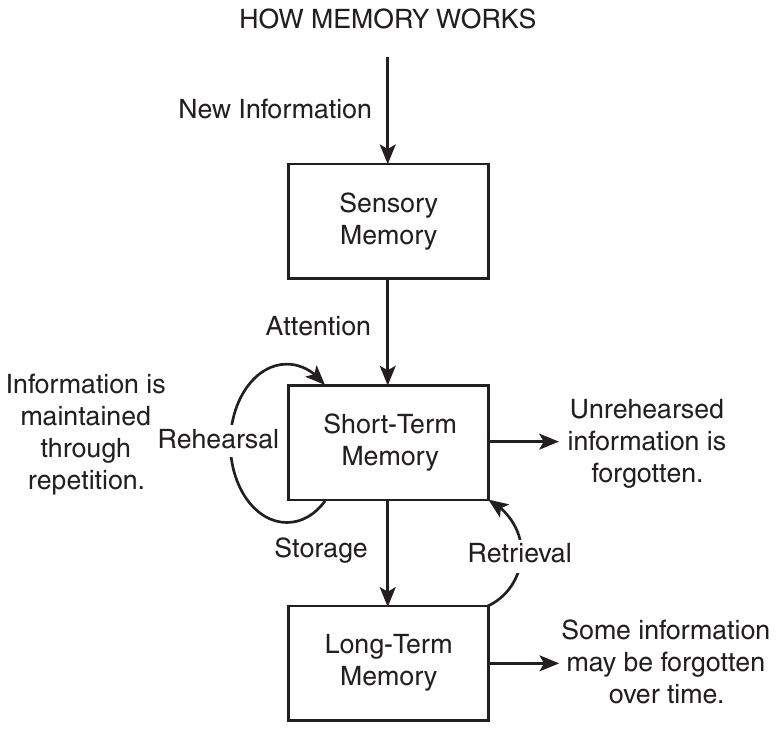
Question
Which evidence from the passage is most relevant to the claim in paragraph 7 that “ ‘far from making us stupid, these technologies are the only things that will keep us smart’ ”?
- Athe revelation that most people opted to use the Internet to answer relatively easy trivia questions rather than relying on their own brainpower (paragraph 2)
- Bthe assertion that the storage of information on the Internet frees people to focus on higher-order tasks such as problem solving (paragraph 3)
- Cthe connection between how people organize information in their mind and their ability to recall that information (paragraph 5)
- Dthe description of transactive memory as an expansive external source that people can use to store information (paragraph 6)
Show the answer
Correct answer: B
The question asks for the evidence from the passage that is most relevant to the claim in paragraph 7 that “ ‘far from making us stupid, these technologies are the only things that will keep us smart.’ ”
A. Incorrect. Whether the participants decided to use the Internet to answer easy trivia questions varied based on the options that the participants were given during the first part of the experiment and, therefore, cannot be relevant to the claim in paragraph 7. Even when given the option of using the Internet, some participants chose to recall information from memory instead.
B. CORRECT. The assertion made in paragraph 3 that states that cognitive offloading allows for “people’s minds [to be] free for other cognitive feats, such as connecting data, learning new information, or solving problems” is relevant to the claim in paragraph 7 because it indicates that the ability to store large amounts of information within the brain does not necessarily make someone smart. It also suggests that if people did not have to use so much effort simply organizing and storing information, their brain would be free to conduct higher-order tasks: “the Internet, serving as a vast extended memory, allows people to digitally access and retrieve much larger volumes of information. Consequently, people’s minds are free for other cognitive feats, such as connecting data, learning new information, or solving problems” (paragraph 3).
C. Incorrect. The discussion in the passage connecting how people organize information in their mind and their ability to recall that information focuses on the process of organizing information within human memory rather than on how technology helps keep people’s minds available for complex thoughts.
D. Incorrect. Although the passage provides an accurate description of transactive memory, it provides no indication of how using such memory would advance a person’s ability to maintain or improve intelligent thought.
Question analysis
This evidence question on “A Memory Revolution” quotes the claim, made by Harvard psychologist Steven Pinker at the end of the article, that technologies such as the Internet are the only things that will keep us smart. Students choose the finding from earlier in the passage that is most relevant to it. Each choice summarizes a point about technology or memory, so relevance, not accuracy, decides.
- Grade level
- Grade 7 reading and task
- Compared with grade 7
- At grade 7 Judging which evidence is most relevant to a claim is standard grade 7 argument work. The claim is short and quoted in the question, and each choice names its paragraph, but students must recall what each paragraph actually showed.
- Estimated difficulty
- Moderate: several steps, or a close reading with one strong distractor.
- Thinking it demands
- Depth of knowledge 2, skills and concepts · mainly evaluate
- What makes it hard
- A very close wrong answer moderate
- Reading between the lines minor
- Evidence in several places minor
- Evidence
- Answered from several paragraphs or stanzas
- Reading level
- Passage: about grade 14, 763 words; question and choices: about grade 14, 112 words.
- Students, last 30 days
- Not enough answers yet to show (it takes 10).
Why it is hard, traps and wrong answers (shows the answer)
Why it is hard
Every choice reports something the article really says, so the question turns on relevance: which finding would persuade a reader that technology keeps us smart. The transactive-memory finding is the trap, because Pinker himself speaks of retrieving “our collective intellectual output,” and an outside store of facts sounds like his point. That finding shows only that technology holds information; paragraph 3 adds what people do with the freed space, and that step is the claim.
A very close wrong answer moderate Choosing the answer
The transactive-memory choice and the key both describe the Internet storing information for people; only the key adds the result, minds free for “connecting data, learning new information, or solving problems,” which is what keeps us smart. (Embretson & Wetzel, 1987; Gorin & Embretson, 2006; Ascalon et al., 2007)
Reading between the lines minor Working it out
The key never says smart; students must see that freeing minds for “other cognitive feats” is exactly what Pinker means by technology that keeps us smart rather than stupid. (Graesser, Singer & Trabasso, 1994; Kintsch, 1998)
Evidence in several places minor Working it out
The four findings come from paragraphs 2, 3, 5 and 6, and each choice’s summary has to be matched back to what its paragraph actually showed before its relevance can be judged. (Kirsch & Mosenthal, 1990; Gorin & Embretson, 2006)
Strategy: Restate Pinker’s claim in your own words, then ask of each finding whether it would persuade a doubter of that claim itself or only of something related to it.
Traps
- Supports only part of the claim: In a question about evidence: a line that backs one half of the claim but not the other, or a related point rather than the claim itself.
- True but not the answer: A choice says something accurate about the text that does not answer this question.
The wrong answers, classified
A True but not the answer (King et al., 2004; Embretson & Wetzel, 1987)
Pairs paragraph 2’s Google users with the “brainpower” in Pinker’s quotation, but people choosing a search engine for easy questions fits the worry he answers, not his claim that technology keeps us smart.
C True but not the answer (King et al., 2004; Embretson & Wetzel, 1987)
Hears smartness in organizing and recalling information, but paragraph 5 found people recalled fewer facts when a computer would save them, which hardly shows technology keeping anyone smart.
D Supports only part of the claim (King et al., 2004; Thissen, Steinberg & Fitzpatrick, 1989)
Matches transactive memory to paragraph 7’s “external” memory and Pinker’s “retrieve,” but an outside store shows only that technology holds facts, not that it frees minds for harder thinking.
Working it out, step by step
Figure out what the question asks
This asks for evidence: the detail that best supports a claim. The claim comes from Steven Pinker in paragraph 7: “Far from making us stupid, these technologies are the only things that will keep us smart.” Put it in your own words first. Pinker says the Internet does not make us dumb. It helps us think better.
Ask what would prove the claim
To support this claim, a detail must show technology helping people think. A detail that only shows people using the Internet is not enough. Neither is one that only shows the Internet storing facts. Look for a result: something people can do better because of the Internet.
Find that result in paragraph 3
Paragraph 3 says the Internet, “serving as a vast extended memory, allows people to digitally access and retrieve much larger volumes of information.” The next sentence gives the result: “Consequently, people’s minds are free for other cognitive feats, such as connecting data, learning new information, or solving problems.” Consequently means “as a result.” Cognitive feats are hard thinking tasks. Since the Internet holds the facts, your mind has room for harder work.
Check each choice
- A does not fit. People choosing Google for easy questions sounds more like the worry Pinker answers. It does not show anyone getting smarter.
- B fits. Higher-order tasks are harder kinds of thinking. Freeing minds for them is how technology could keep us smart.
- C does not fit. It is about how well people recall facts. In paragraph 5, people even recalled fewer facts when a computer would save them.
- D does not fit. It shows only that the Internet can store information. It does not say what people gain from that.
Watch out: D is tempting because transactive memory sounds like the “external” memory in paragraph 7. But storing facts outside your head is only half the idea. B adds the payoff: room for harder thinking.
Choose the answer
Only paragraph 3 shows the Internet freeing people for harder thinking. So the answer is B, “the assertion that the storage of information on the Internet frees people to focus on higher-order tasks such as problem solving” (paragraph 3).
Why this answer and not the closest wrong one
D is the closest wrong choice. It is true that the Internet works as an outside store of facts. But that alone does not show anyone getting smarter. B goes one step further. Because the Internet holds the facts, minds are free for “connecting data, learning new information, or solving problems.” That step is what Pinker’s claim needs.
More questions like this
The original DOE question
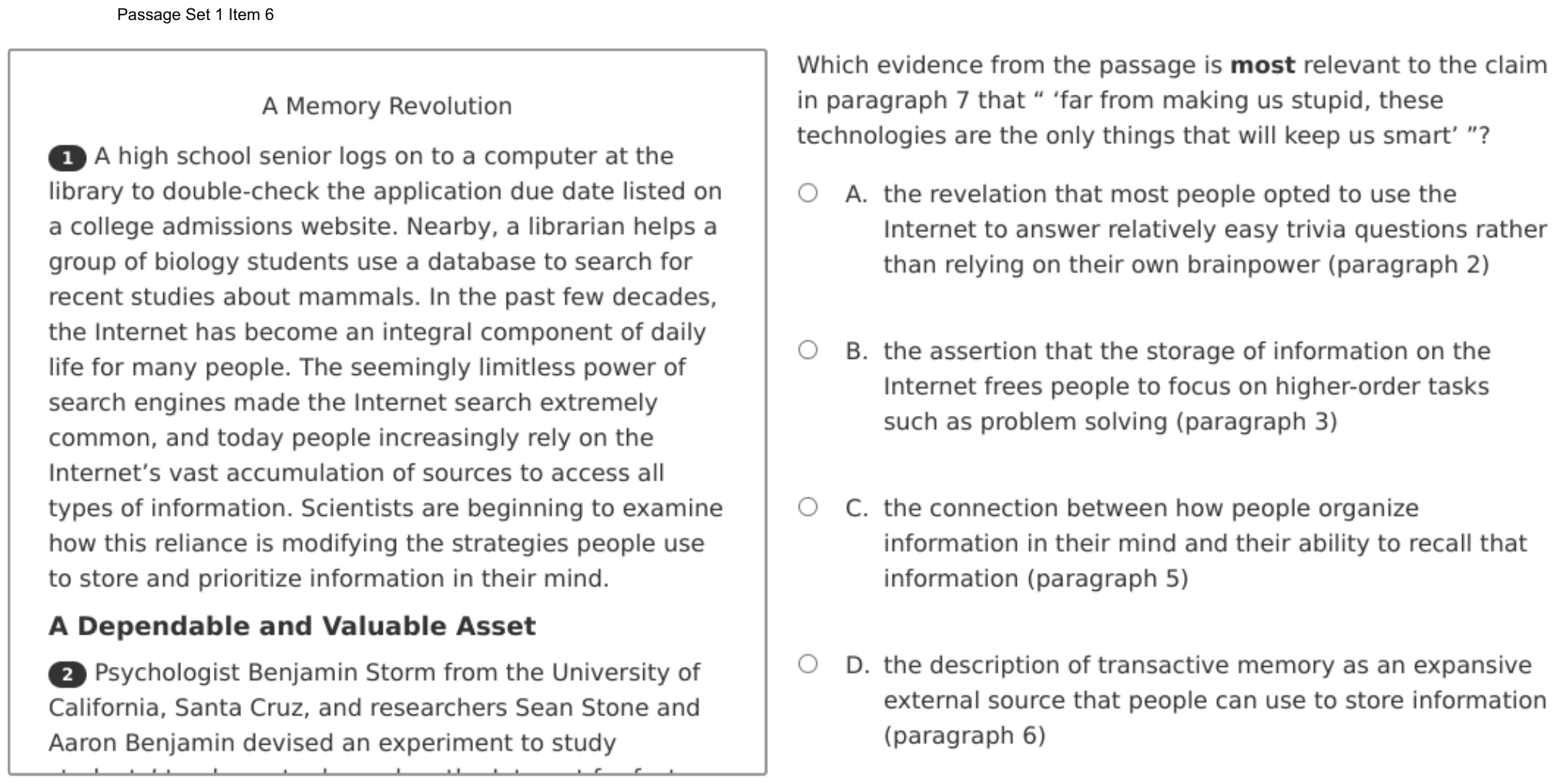
The passage “A Memory Revolution” as printed (pages 3–4)
Question 20 of 59
2026 Practice Test D English, question 8Passage Excerpt from “How We Made the First Flight”
Excerpt from “How We Made the First Flight”
by Orville Wright
In 1903 brothers Wilbur and Orville Wright conducted experiments related to flying machines. These experiments would eventually lead to air travel becoming a reliable form of transportation.
During the night of December 16, 1903, a strong cold wind blew from the north. When we arose on the morning of the 17th, the puddles of water, which had been standing about camp since the recent rains, were covered with ice. The wind had a velocity of 10 to 12 meters per second (22 to 27 miles an hour). We thought it would die down before long, and so remained indoors the early part of the morning. But when ten o’clock arrived, and the wind was as brisk as ever, we decided that we had better get the machine out and attempt a flight. We hung out the signal for the men of the Life Saving Station.1 We thought that by facing the flyer into a strong wind, there ought to be no trouble in launching it from the level ground about camp. We realized the difficulties of flying in so high a wind, but estimated that the added dangers in flight would be partly compensated for by the slower speed in landing.
Final Preparations
We laid the track on a smooth stretch of ground about one hundred feet north of the new building. The biting cold wind made work difficult, and we had to warm up frequently in our living room, where we had a good fire in an improvised stove made of a large carbide2 can. By the time all was ready, J. T. Daniels, W. S. Dough and A. D. Etheridge, members of the Kill Devil3 Life Saving Station; W. C. Brinkley of Manteo, and Johnny Moore, a boy from Nags Head,4 had arrived.
We had a “Richard” hand anemometer with which we measured the velocity of the wind. Measurements made just before starting the first flight showed velocities of 11 to 12 meters per second, or 24 to 27 miles per hour. . . .
Audacity—and Calculation
Wilbur having used his turn in the unsuccessful attempt on the 14th, the right to the first trial now belonged to me. After running the motor a few minutes to heat it up, I released the wire that held the machine to the track, and the machine started forward in the wind. Wilbur ran at the side of the machine, holding the wing to balance it on the track. Unlike the start on the 14th, made in a calm, the machine, facing a 27-mile wind, started very slowly. Wilbur was able to stay with it till it lifted from the track after a forty-foot run. One of the Life Saving men snapped the camera for us, taking a picture just as the machine had reached the end of the track and had risen to a height of about two feet. The slow forward speed of the machine over the ground is clearly shown in the picture by Wilbur’s attitude. He stayed along beside the machine without any effort.
Flight
The course of the flight up and down was exceedingly erratic, partly due to the irregularity of the air, and partly to lack of experience in handling this machine. The control of the front rudder was difficult on account of its being balanced too near the center. This gave it a tendency to turn itself when started; so that it turned too far on one side and then too far on the other. As a result the machine would rise suddenly to about ten feet, and then as suddenly dart for the ground. A sudden dart when a little over a hundred feet from the end of the track, or a little over 120 feet from the point at which it rose into the air, ended the flight. As the velocity of the wind was over 35 feet per second and the speed of the machine over the ground against this wind ten feet per second, the speed of the machine relative to the air was over 45 feet per second, and the length of the flight was equivalent to a flight of 540 feet made in calm air. This flight lasted only 12 seconds, but it was nevertheless the first in the history of the world in which a machine carrying a man had raised itself by its own power into the air in full flight, had sailed forward without reduction of speed and had finally landed at a point as high as that from which it started.
From “How We Made the First Flight” by Orville Wright—Public Domain/Federal Aviation Administration
1Life Saving Station: one of the rescue stations along the Atlantic coastline that provided assistance to mariners in distress
2carbide: a very hard material composed of carbon and other heavy metals
3Kill Devil: the town of Kill Devil Hills in eastern North Carolina
4Nags Head: a town in eastern North Carolina
Question
How does paragraph 1 introduce the idea that the Wright brothers knew that their flight attempt was risky?
- Athrough the mention of a signal to notify lifesaving experts that the flight attempt was about to begin
- Bby providing specific details about the speed of the wind and the Wright brothers’ response to the windy conditions
- Cby suggesting that a slower landing would be necessary at the end of the flight in order to maintain safety
- Dthrough the indication that the Wright brothers waited indoors for most of the morning because of the poor weather
Show the answer
Correct answer: A
The question asks how paragraph 1 introduces the idea that the Wright brothers knew that their flight attempt was risky.
A. CORRECT. Paragraph 1 describes the Wright brothers hanging out “the signal” to notify the lifesaving crew to stand by as they attempted flight; the need for lifesaving experts to be available in case of an accident introduces the idea that the attempted flight might crash.
B. Incorrect. The specifics on the speed of the wind by themselves do not emphasize the danger of the flight. While the brothers admitted that the strong wind posed certain risks, they also noted that the windy conditions might make landing safer (“estimated that the added dangers in flight would be partly compensated for by the slower speed in landing” [paragraph 1]).
C. Incorrect. A slower landing was expected as a result of the windy conditions, but it was not part of a plan to increase the safety of the flight.
D. Incorrect. While the Wright brothers’ initial decision to wait to see whether the wind would die down does suggest they were concerned about the safety of the flight, the explanation of their decision to proceed with the flight shows that they expected one benefit from the poor weather: “the slower speed in landing” (paragraph 1).
Question analysis
This question on Orville Wright’s account “How We Made the First Flight” asks how the opening paragraph, which describes a cold, windy December morning at the brothers’ camp, introduces the idea that the Wright brothers knew their flight attempt was risky. Students must judge which of four details from the paragraph does that work, and the paragraph mentions both dangers and reasons for confidence.
- Grade level
- Grade 8 reading and task
- Compared with grade 7
- Above grade 7 Finding how a paragraph introduces an idea is grade 7 work, but this paragraph is long and old-fashioned, every choice points to something it mentions, and students must decide which detail most clearly signals that the brothers saw a risk.
- Estimated difficulty
- Hard: combines ideas, needs a plan, and has more than one tempting wrong answer.
- Thinking it demands
- Depth of knowledge 3, strategic thinking · mainly evaluate
- What makes it hard
- Reading between the lines moderate
- Every choice must be checked moderate
- Complex sentences minor
- Evidence
- Answered from one paragraph or stanza
- Reading level
- Passage: about grade 7, 816 words; question and choices: about grade 10, 93 words.
- Students, last 30 days
- Not enough answers yet to show (it takes 10).
Why it is hard, traps and wrong answers (shows the answer)
Why it is hard
Paragraph 1 states the danger outright only in its last sentence, and that sentence then weighs it against a gentler landing, so the choice built on the brothers’ response to the wind is the strongest pull. The key rests on a quieter detail whose meaning comes from a footnote: men from a rescue station were signaled before the attempt. Students must decide which detail shows the brothers preparing for trouble, not just noticing the weather, and that test is narrower than most expect.
Reading between the lines moderate Working it out
The key never says danger: students must connect “the signal for the men of the Life Saving Station” to footnote 1, rescue stations for “mariners in distress,” and see that summoning rescuers means expecting trouble. (Graesser, Singer & Trabasso, 1994; Kintsch, 1998)
Every choice must be checked moderate Choosing the answer
All four details come from paragraph 1, and its plainest admission of danger, “We realized the difficulties of flying in so high a wind,” sits inside a wrong choice, so each detail must be weighed for what it shows. (Embretson & Wetzel, 1987)
Complex sentences minor Understanding the question
The paragraph’s last sentence sets danger against benefit, “the added dangers in flight would be partly compensated for by the slower speed in landing,” and students must untangle it to see the brothers playing the risk down. (Abedi & Lord, 2001; Freedle & Kostin, 1993; Messick, 1989)
Strategy: Locate each of the four details in paragraph 1, reread the sentence it sits in, and ask what that detail on its own reveals about what the brothers feared could go wrong.
Traps
- Supports only part of the claim: In a question about evidence: a line that backs one half of the claim but not the other, or a related point rather than the claim itself.
- Twists what the text says: Uses the text's topic and ideas but changes what it says: who did it, how much, when, or why.
The wrong answers, classified
B Supports only part of the claim (King et al., 2004; Thissen, Steinberg & Fitzpatrick, 1989)
Seizes on the wind speeds and “We realized the difficulties of flying in so high a wind,” but the response the paragraph describes is a calculation that a slower landing would offset the danger.
C Twists what the text says (King et al., 2004)
Turns the slower landing, a side effect of facing a strong wind, into a safety step the brothers needed, when the paragraph counts it as a partial offset to the added danger.
D Reads too much in (Graesser, Singer & Trabasso, 1994)
Reads the wait for calmer air as fear and stretches “the early part of the morning” into most of it, though at ten o’clock they decided to fly in the same brisk wind.
Working it out, step by step
Figure out what the question asks
This asks how paragraph 1 first shows that the Wright brothers knew their flight was risky. Risky means it could end badly. All four choices name details from paragraph 1. Your job is to find the detail that shows them getting ready for trouble.
Find the signal in paragraph 1
Paragraph 1 says “We hung out the signal for the men of the Life Saving Station.” The small number 1 after “Station” points to footnote 1 at the end of the excerpt. Read it. A Life Saving Station was “one of the rescue stations along the Atlantic coastline that provided assistance to mariners in distress.” Mariners are sailors. Distress means danger or trouble.
Work out what the signal means
The brothers called rescue workers before they tried to fly. People call rescuers only when someone might get hurt. So the signal shows the brothers knew the flight could go wrong. They wanted help close by in case of a crash.
Check each choice
- A fits. Signaling rescuers shows the brothers planned for trouble.
- B does not fit. The wind speeds are only numbers. The brothers’ response was to fly anyway, thinking “there ought to be no trouble in launching.”
- C does not fit. The slower landing was a side effect of the wind. They counted it as a plus, not as a safety step they needed.
- D does not fit. They stayed inside only “the early part of the morning,” hoping the wind would die down. Then they went out in the same wind.
Watch out: B is tempting because the paragraph says “We realized the difficulties of flying in so high a wind.” But that same sentence weighs those dangers against a slower landing. It plays the risk down.
Choose the answer
The call to the rescue station is the detail that shows the brothers preparing for danger. So the answer is A, “through the mention of a signal to notify lifesaving experts that the flight attempt was about to begin.”
Why this answer and not the closest wrong one
B is the closest wrong choice. The paragraph does admit the wind made flying harder. But the brothers then argue the danger down: a slower landing would partly make up for it. A shows them acting on the risk. They called in rescuers before they flew. You only do that if you think something could go wrong.
More questions like this
The original DOE question
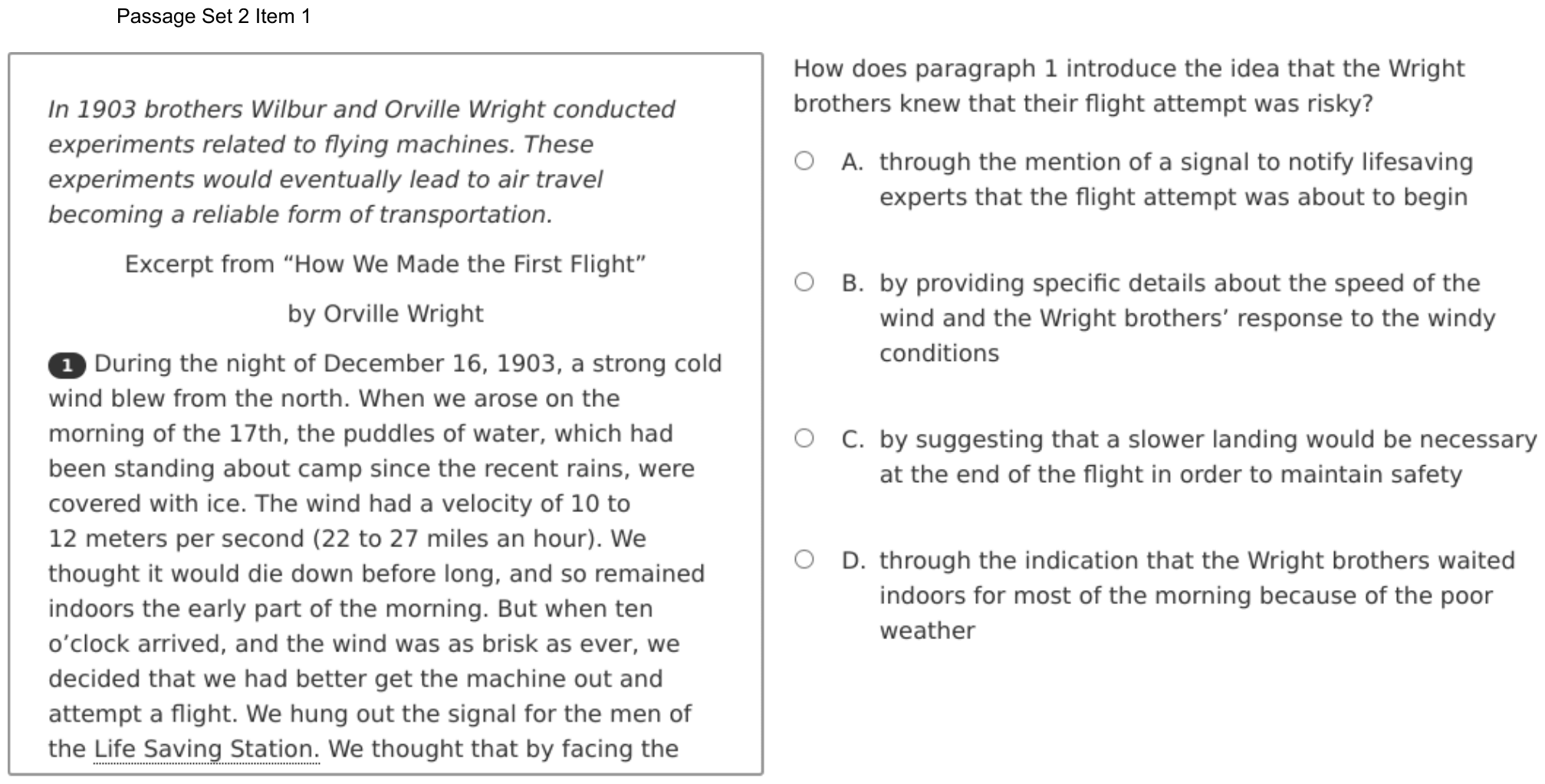
The passage “Excerpt from “How We Made the First Flight”” as printed (pages 13–14)
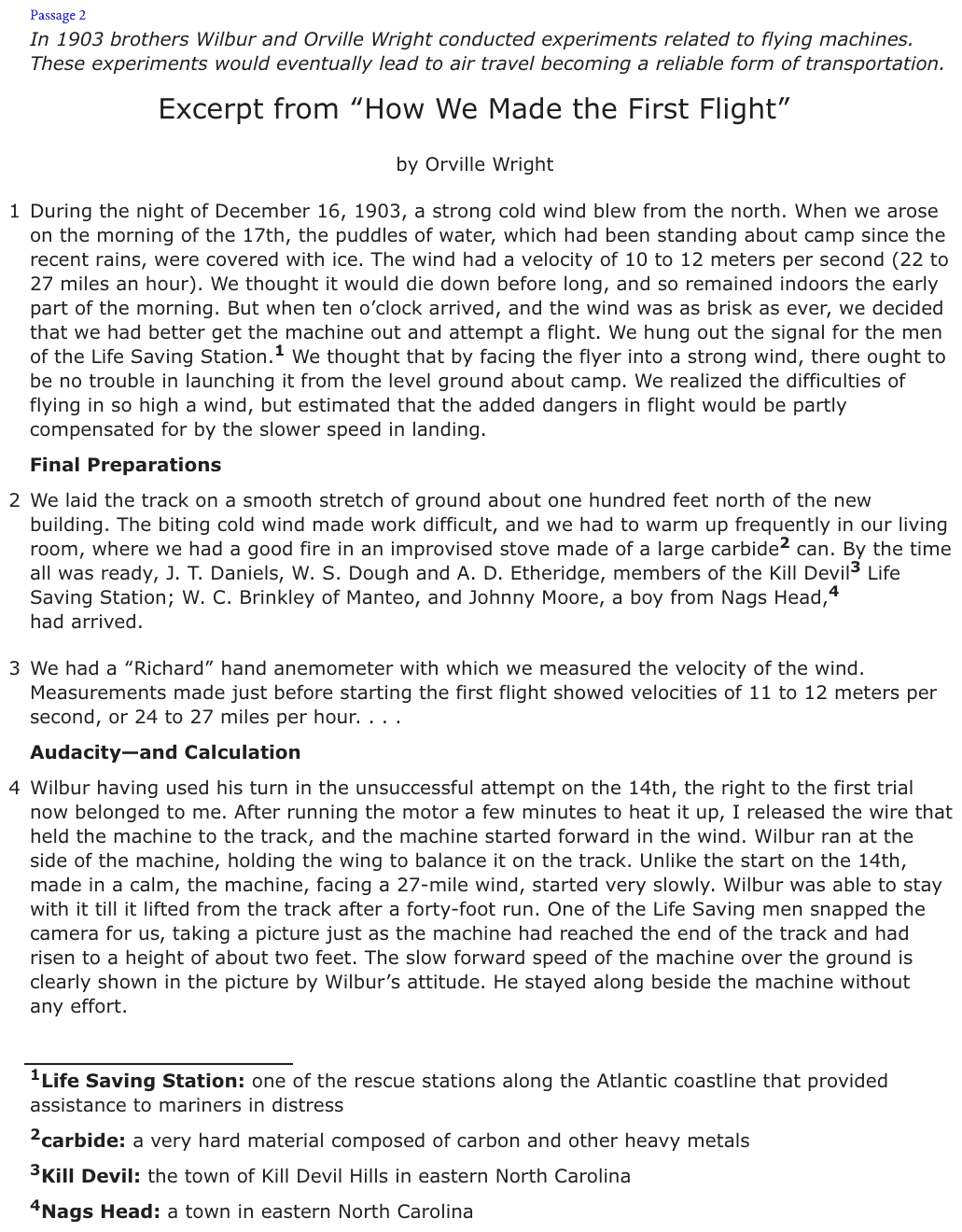
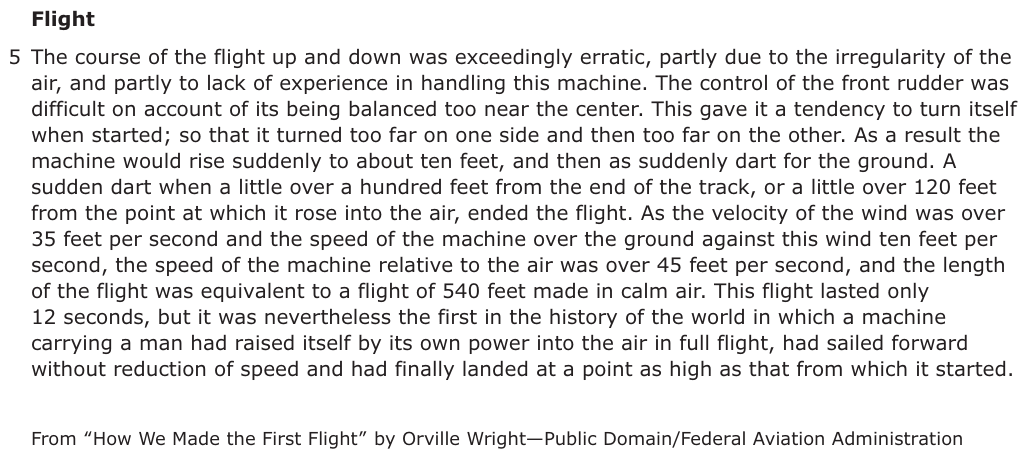
Question 21 of 59
2026 Practice Test D English, question 13Uses the passage above: “Excerpt from “How We Made the First Flight””.
Question
Which sentence from the excerpt best supports the idea that the Wright brothers had to adapt their plans for the flight in order to accommodate the weather conditions?
- A“When we arose on the morning of the 17th, the puddles of water, which had been standing about camp since the recent rains, were covered with ice.” (paragraph 1)
- B“We realized the difficulties of flying in so high a wind, but estimated that the added dangers in flight would be partly compensated for by the slower speed in landing.” (paragraph 1)
- C“After running the motor a few minutes to heat it up, I released the wire that held the machine to the track, and the machine started forward in the wind.” (paragraph 4)
- D“The course of the flight up and down was exceedingly erratic, partly due to the irregularity of the air, and partly to lack of experience in handling this machine.” (paragraph 5)
Show the answer
Correct answer: B
The question asks which sentence from the excerpt best supports the idea that the Wright brothers had to adapt their plans for the flight in order to accommodate weather conditions.
A. Incorrect. Although the sentence from paragraph 1 mentions the rainy weather and frozen puddles, it does not specifically explain how these weather conditions forced the brothers to adapt their plans for the flight.
B. CORRECT. The sentence from paragraph 1 reveals that the Wright brothers adapted by making a risk calculation, based on the wind speed, before the flight. The high speed of the wind could cause difficulties in flight while simultaneously allowing for a slower, more controlled landing.
C. Incorrect. The sentence from paragraph 4 does mention wind, but it describes what Orville was doing during the attempted flight, not the factors he considered before the flight in order to adapt the plan.
D. Incorrect. Although the sentence from paragraph 5 mentions the “irregularity of the air” during the flight, the sentence does not describe how the brothers adapted their plans for the flight based on the weather.
Question analysis
This evidence question on Orville Wright’s account of the first flight asks which sentence best supports the idea that the Wright brothers had to adapt their plans for the flight to the weather conditions. The four quotations come from paragraphs 1, 4 and 5 and all mention ice, wind or air, so students must look past the weather words to what each sentence shows the brothers doing.
- NYS standards
- 7R1 textual evidence and inferences
- Grade level
- Grade 7 reading and task
- Compared with grade 7
- At grade 7 Choosing the sentence that best supports an idea is core grade 7 evidence work. The four quotations are printed in full with their paragraph numbers, and the idea has two parts, weather and a change of plans, so the check is careful but typical.
- Estimated difficulty
- Straightforward: two steps or one careful reading.
- Thinking it demands
- Depth of knowledge 2, skills and concepts · mainly evaluate
- What makes it hard
- Evidence
- Answered from several paragraphs or stanzas
- Reading level
- Passage: about grade 7, 816 words; question and choices: about grade 13, 148 words.
- Students, last 30 days
- Not enough answers yet to show (it takes 10).
Why it is hard, traps and wrong answers (shows the answer)
Why it is hard
The idea has two parts, the weather and a change in the brothers’ plans, and every quotation carries the first. Students who look only for weather words can be drawn to the erratic flight or the launch into the wind. Only one sentence shows the brothers thinking about the wind before they flew and deciding how to proceed, and once the second half of the idea is in view the choice is quick.
Every choice must be checked minor Choosing the answer
All four quotations mention ice, wind or air, so the weather half of the idea rules nothing out; each must be checked for the other half, a decision the brothers made because of it. (Embretson & Wetzel, 1987)
Reading between the lines minor Working it out
The key never says plan or adapt; students must see that weighing “the added dangers in flight” against “the slower speed in landing” is the brothers fitting their decision to the wind. (Graesser, Singer & Trabasso, 1994; Kintsch, 1998)
Strategy: Split the idea into its two parts, the weather and a change in the brothers’ plans, and keep only a quotation that shows both, not one that shows the weather alone.
Traps
- Supports only part of the claim: In a question about evidence: a line that backs one half of the claim but not the other, or a related point rather than the claim itself.
- True but not the answer: A choice says something accurate about the text that does not answer this question.
The wrong answers, classified
A True but not the answer (King et al., 2004; Embretson & Wetzel, 1987)
Picks the frozen puddles as proof of harsh weather, which they are, but the sentence only sets the scene and shows nothing the brothers did or decided because of it.
C Supports only part of the claim (King et al., 2004; Thissen, Steinberg & Fitzpatrick, 1989)
Takes running the motor “to heat it up” and starting “in the wind” as adjustments to the cold, but the sentence narrates the launch and never says a plan changed.
D Supports only part of the claim (King et al., 2004; Thissen, Steinberg & Fitzpatrick, 1989)
Notices “the irregularity of the air” linking the weather to the flight, but this sentence explains why the course was erratic once the machine was up, not how the brothers prepared.
Working it out, step by step
Figure out what the question asks
This asks for the sentence that best supports an idea. The idea has two parts. First, there was bad weather. Second, the brothers had to adapt, or change, their plans because of it. All four choices mention ice, wind or air. So look for the one that also shows a decision.
Check each sentence for both parts
- A shows the weather: icy puddles. But no one decides anything.
- B shows the wind and the brothers’ thinking about it before the flight.
- C describes the launch. It tells what Orville did, not a change of plans.
- D explains why the flight was bumpy once it was in the air. It shows no plan.
Read the sentence that fits
Paragraph 1 says “We realized the difficulties of flying in so high a wind, but estimated that the added dangers in flight would be partly compensated for by the slower speed in landing.” To estimate is to make a careful guess. Compensated for means “made up for.” The brothers knew the strong wind made flying harder. They weighed that against a good effect: a slower landing. Then they decided to fly anyway.
Explain how this shows adapting
The brothers did not just notice the wind. They thought about how it would change the flight, the bad and the good. They also planned on “facing the flyer into a strong wind.” Making plans that fit the weather is what adapting means.
Watch out: D is tempting because it links “the irregularity of the air” to the flight. But it tells what happened during the flight, not how the brothers planned for it.
Choose the answer
Only one sentence shows the brothers fitting their decision to the wind before they flew. So the answer is B, “We realized the difficulties of flying in so high a wind, but estimated that the added dangers in flight would be partly compensated for by the slower speed in landing.”
Why this answer and not the closest wrong one
D is the closest wrong choice. It does connect the weather to the flight. But it describes what happened in the air, after the plans were made. The idea needs the brothers changing plans because of the weather. Only B shows them thinking through the wind’s dangers and benefits before they decided to fly.
More questions like this
The original DOE question
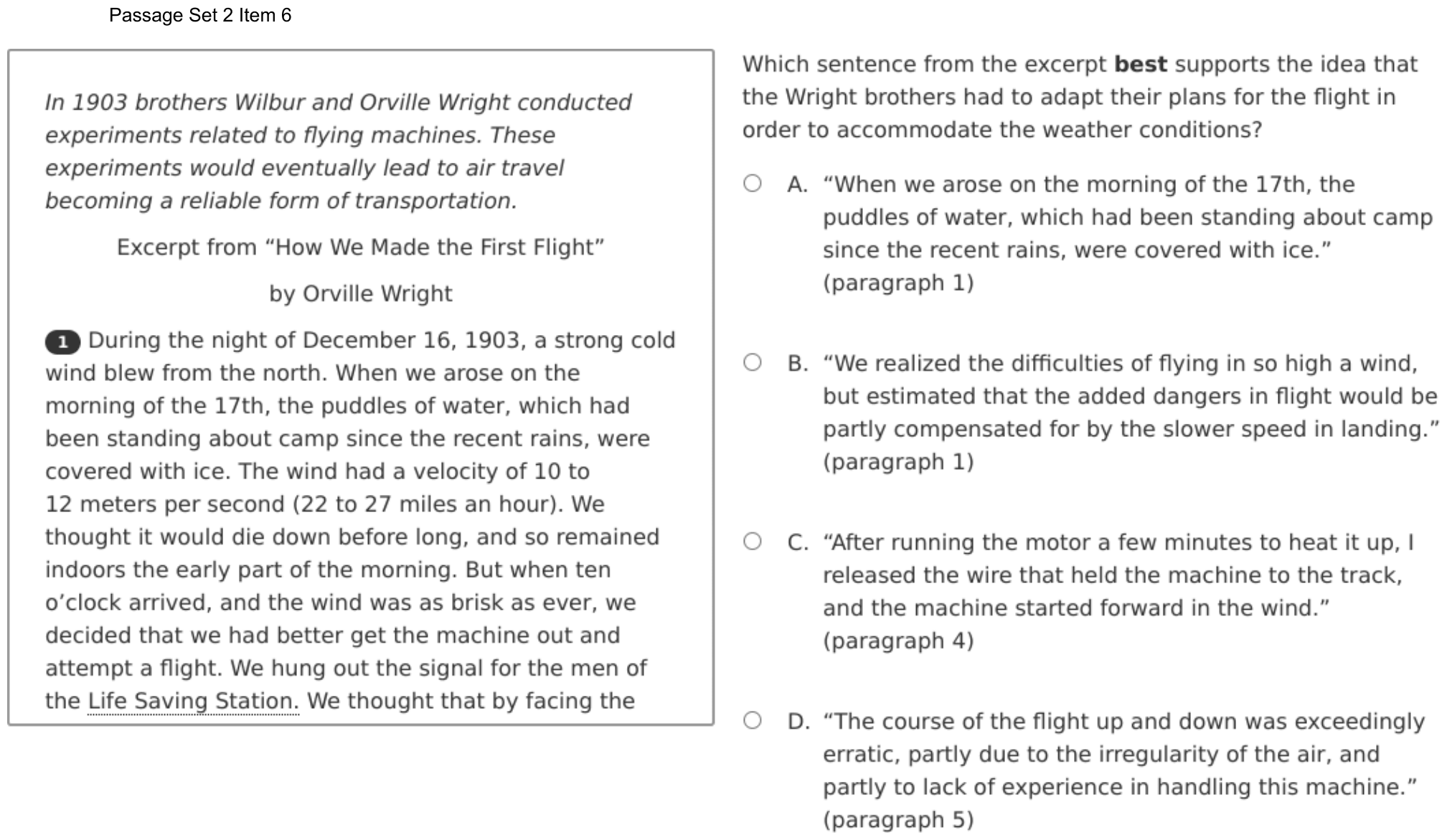
Question 22 of 59
2026 Practice Test D English, question 19Passage Wolves of the Sea
Wolves of the Sea
The cool and misty landscape of the Great Bear Rainforest can be found along the coast of British Columbia, Canada, and its nearby islands, from Vancouver Island to the Alaskan border. Within this protected area, wolves roam the forests, islands, and beaches. When biologist Chris Darimont began to study these wolves, he wanted to confer with local First Nations groups, as aboriginal Canadians are known, in order to learn what they knew about these wolves. He spoke with Chester Starr, an elder of the Heiltsuk Nation that has occupied the Great Bear Rainforest for thousands of years. What Starr had to say about the wolves changed Darimont’s perception of the animals.
Starr asked Darimont which wolves he and his team were going to study—the timber wolves (mainland wolves) or the coastal wolves on the islands. The question took Darimont by surprise. Biologists had always believed that the wolves that are sometimes spotted swimming between islands and eating salmon are the same wolves that live on the mainland. Darimont was intrigued by Starr’s classification of the wolves as two different groups. At first, he was hesitant to accept the idea. The distances between the mainland and the islands are small, less than a mile. Why would the wolves on the islands be any different from the wolves on the mainland? To find out, Darimont and his research team studied the wolves on the islands and in the densely forested territory of the Great Bear Rainforest for ten years.
Throughout the study, Darimont recorded several significant, observable differences between the “sea wolves,” as they are nicknamed, and the mainland wolves. Compared with the mainland wolves, the sea wolves are smaller in size and are strong swimmers. In 1996 sea wolves were spotted on an island nearly eight miles from any other land formation. While mainland wolves almost exclusively eat meat, such as deer and elk, and teach their young to hunt for land animals, sea wolves get as much as 90 percent of their nutrition from the sea and teach their young to dig for clams and to catch fish. Sea wolves regularly swim between islands and have been known to sneak up on a seal sunning itself on a rock and make a leaping attack from the water. Some salmon-eating mainland wolves come and go from the islands with the fish-spawning season, but the sea wolves are full-time island residents. Darimont suspects that some sea wolves live their entire life on the islands.
The sea wolves displayed not only physical and behavioral differences but also genetic variations from the mainland wolves. After collecting and analyzing the DNA in 800 samples of gray fur and wolf waste, researchers could produce hard biological evidence that sea wolves had genetic markers that made them distinct from the mainland wolves. A genetic marker is a variation in a DNA sequence that can be used to identify individuals or a species because it is passed down to offspring. Darimont hypothesizes that a change in habitat led to the eventual genetic differences between sea wolves and mainland wolves. Many years ago, loss of habitat and food sources forced some mainland wolves out to the islands. They learned to eat everything from kelp and fish eggs to the remains of sea creatures that washed up on the beach. Wolves living on the islands and mainland wolves became more isolated and rarely mated with each other. Over time the two types of wolves became more distinct.
It turned out that Chester Starr was right all along. “It sounded totally bizarre at first,” admits Darimont, “that there could be two versions of the species.” But he now realizes that this skepticism “definitely reflected my ignorance of indigenous knowledge at the time.” Learning to trust the wisdom of the Heiltsuk people opened Darimont up to knowledge accumulated over millennia and positioned him so that he could gather new scientific evidence about one of British Columbia’s most elusive species, the sea wolf.
Question
Which sentence from the passage best supports the idea that sea wolves had successfully adapted to living on the islands?
- A“While mainland wolves almost exclusively eat meat, such as deer and elk, and teach their young to hunt for land animals, sea wolves get as much as 90 percent of their nutrition from the sea and teach their young to dig for clams and to catch fish.” (paragraph 3)
- B“Sea wolves regularly swim between islands and have been known to sneak up on a seal sunning itself on a rock and make a leaping attack from the water.” (paragraph 3)
- C“Darimont suspects that some sea wolves live their entire life on the islands.” (paragraph 3)
- D“Darimont hypothesizes that a change in habitat led to the eventual genetic differences between sea wolves and mainland wolves.” (paragraph 4)
Show the answer
Correct answer: A
The question asks for the sentence from the passage that best supports the idea that sea wolves had successfully adapted to living on the islands.
A. CORRECT. This sentence from paragraph 3 describes a significant difference in the diets of the mainland and sea wolves: the mainland wolves “almost exclusively eat meat, such as deer and elk, and teach their young to hunt for land animals,” whereas the sea wolves had adapted to the point where they derive “as much as 90 percent of their nutrition from the sea and teach their young to dig for clams and to catch fish.” This sentence emphasizes the dietary difference between the two groups of wolves and best supports the idea that sea wolves had successfully adapted to living on the islands.
B. Incorrect. Although this sentence from paragraph 3 describes one technique that the sea wolves used to hunt, it does not offer evidence as strong as that provided by the preceding sentence, which explains that sea wolves were able to derive “as much as 90 percent” (paragraph 3) of their sustenance from the sea alone (versus the mainland wolves, which “almost exclusively eat meat” from land animals [paragraph 3]).
C. Incorrect. Although this sentence from paragraph 3 states that “some sea wolves live their entire life on the islands,” it does not provide strong evidence of the necessary adaptations—namely, how these wolves were able to successfully live their whole lives on the islands. Living on the islands was not necessarily an adaptation in and of itself; the adaptation was the sea-based diet that enabled the sea wolves to live on the islands without access to land animals.
D. Incorrect. Although this sentence from paragraph 4 presents Darimont’s hypothesis that “a change in habitat led to the eventual genetic differences” between the wolves, the sentence does not describe any of the sea wolves’ adaptations nor best support the idea that the sea wolves successfully adapted to living on the islands.
Question analysis
This evidence question on “Wolves of the Sea” asks which sentence best supports the idea that sea wolves had successfully adapted to living on the islands. Three choices come from paragraph 3’s list of differences between sea wolves and mainland wolves and one from paragraph 4, so students must rank closely related sentences by how directly each shows the wolves thriving there.
- NYS standards
- 7R1 textual evidence and inferences
- Grade level
- Grade 8 reading and task
- Compared with grade 7
- Above grade 7 Grade 7 evidence questions often have one clearly relevant sentence. Here three neighboring sentences all describe the sea wolves’ island life, so students must decide what counts as successful adaptation and rank strong evidence against nearly as strong.
- Estimated difficulty
- Hard: combines ideas, needs a plan, and has more than one tempting wrong answer.
- Thinking it demands
- Depth of knowledge 3, strategic thinking · mainly evaluate
- What makes it hard
- A very close wrong answer moderate
- Reading between the lines moderate
- Every choice must be checked minor
- Evidence
- Answered from several paragraphs or stanzas
- Reading level
- Passage: about grade 10, 662 words; question and choices: about grade 12, 131 words.
- Students, last 30 days
- Not enough answers yet to show (it takes 10).
Why it is hard, traps and wrong answers (shows the answer)
Why it is hard
All four sentences are about sea wolves, and three describe their island lives, so the question turns on ranking evidence rather than spotting it. The seal attack is one of the passage’s most vivid images and shows a real island skill, which makes it hard to give up for a sentence about diet. The key wins because it shows a whole way of life changing, most food from the sea and the young taught to fish, while the other sentences offer one habit, a hedged guess or a cause.
A very close wrong answer moderate Choosing the answer
The seal-hunting sentence sits right after the key in paragraph 3 and also shows sea wolves living off the sea; it differs in showing one hunting trick instead of up to 90 percent of their food. (Embretson & Wetzel, 1987; Gorin & Embretson, 2006; Ascalon et al., 2007)
Reading between the lines moderate Working it out
No sentence uses the word “adapted,” so students must first decide what would prove an animal thrives in a new place, such as getting its food there and teaching that skill to its young. (Graesser, Singer & Trabasso, 1994; Kintsch, 1998)
Every choice must be checked minor Choosing the answer
Three of the four sentences come from paragraph 3’s list of island habits, and all four mention sea wolves or their habitat, so none can be dismissed at a glance. (Embretson & Wetzel, 1987)
Strategy: Before reading the choices, decide what would prove that an animal has adapted well to a new place, then rank the four sentences by how fully each one shows that, not merely whether it fits.
Traps
- Supports only part of the claim: In a question about evidence: a line that backs one half of the claim but not the other, or a related point rather than the claim itself.
- True but not the answer: A choice says something accurate about the text that does not answer this question.
The wrong answers, classified
B Supports only part of the claim (King et al., 2004; Thissen, Steinberg & Fitzpatrick, 1989)
Is impressed by the leaping attack on a seal, a real island skill, but one hunting technique shows less than wolves getting up to 90 percent of their food from the sea.
C Supports only part of the claim (King et al., 2004; Thissen, Steinberg & Fitzpatrick, 1989)
Matches “live their entire life on the islands” to the claim’s “living on the islands,” but it is Darimont’s guess about where the wolves stay, not how they manage there.
D True but not the answer (King et al., 2004; Embretson & Wetzel, 1987)
Sees “change in habitat” and thinks of adaptation, but the sentence gives Darimont’s theory of what caused the genetic differences, not evidence that the wolves thrive.
Working it out, step by step
Figure out what the question asks
This asks for evidence: the sentence that best supports a claim. The claim is that sea wolves “had successfully adapted to living on the islands.” To adapt is to change so you can live well in a new place.
Decide what strong proof looks like
Before you read the choices, ask what would prove an animal is doing well somewhere new. It can find its food there. It can also teach its young to live there. One clever trick is weaker proof. A guess is weaker still. So look for a sentence that shows a whole way of life built around the new home.
Test the diet sentence
Choice A comes from paragraph 3. It says “sea wolves get as much as 90 percent of their nutrition from the sea and teach their young to dig for clams and to catch fish.” Nutrition is the food a body needs. So almost all their food comes from the sea. They also pass those skills on to their pups. Mainland wolves, by contrast, “almost exclusively eat meat, such as deer and elk.” Exclusively means only.
Check the other choices
- B shows one hunting trick, a leap at a seal. It is a real island skill. But it shows less than a diet that is up to 90 percent from the sea.
- C uses the word “suspects,” so it is only Darimont’s guess. It also tells where some wolves live, not how they manage there.
- D gives Darimont’s idea about what caused the genetic differences. It does not show the wolves doing well.
Watch out: The seal attack in B is the most exciting picture. But one exciting hunt is weaker proof than a whole new diet.
Choose the answer
Sentence A shows sea wolves getting most of their food from the sea and training their young to do the same. So the answer is A, the sentence “While mainland wolves almost exclusively eat meat, such as deer and elk, and teach their young to hunt for land animals, sea wolves get as much as 90 percent of their nutrition from the sea and teach their young to dig for clams and to catch fish.”
Why this answer and not the closest wrong one
B is the closest wrong answer. It comes right after A in paragraph 3 and also shows sea wolves living off the sea. But B shows one way of hunting. A shows where nearly all their food comes from, and that they teach it to their young. That is stronger proof that they adapted well.
More questions like this
The original DOE question
The passage “Wolves of the Sea” as printed (pages 23–24)

Question 23 of 59
2025 Practice Test A English, question 9Passage Excerpt from “Scribe Like an Egyptian”
Excerpt from “Scribe Like an Egyptian”
by Hilary Wilson
In ancient Egypt, literacy was the key to success. However, contrary to popular belief, not all Egyptian scribes understood hieroglyphs. Many relied instead on the simpler hieratic script for the multitude of everyday documents generated by the Egyptian bureaucracy.
Hieroglyphs—“the Words of God”—compose a writing system with more than 1,000 distinct characters, the meanings of which were lost for 1,500 years before they were deciphered by Jean-François Champollion in 1822. Including both ideograms (which convey a whole word or idea, either concrete or abstract, in a single sign) and phonograms (representing either an alphabetic sound or a group of consonants), [the writing system] was used in formal inscriptions on tomb and temple walls as well as on elaborate funerary papyri. For everyday purposes, however, scribes used a shorthand version of the hieroglyphic script known as hieratic, which was quicker to write and more economical of space. The two writings existed side by side for at least 2,500 years.
Scraps of ancient hieratic writing, mostly penned by student scribes on limestone flakes called ostraca, suggest that no matter how humble his origins, an educated Egyptian could achieve almost anything. Horemheb (d.1292 B.C.) is a good example. Born of middle-ranking parents, his scribal training led to an army career. From Scribe of Recruits, during the reign of Akhenaten (1353–1336 B.C.), Horemheb rose through the military ranks and, by the rule of Tutankhamun (1332–1323 B.C.), he was commander in chief of the Egyptian forces. As a close adviser of the young Pharaoh, Horemheb was appointed “Deputy of the King throughout the Two Lands,” and might have expected to succeed to the throne should the king die childless. He had to wait a few years, but eventually Horemheb achieved the pinnacle of his career by becoming the last king of the 18th Dynasty, making his mark by instituting dramatic reforms to the organisation of the army, the judiciary and administration in general. The lasting success of these changes owed much to his scribal background. . . .
But education was not available to all. Government departments and major temples supported schools, where boys commenced their training at six or seven, sometimes earlier. To these boarding establishments . . . family or household servants delivered the students’ food and drink rations daily for several years, during which time the student was not contributing to the family’s income. Boys from poorer families could only hope to be educated with support from a wealthier relative or patron, or through apprenticeship to an older scribe, perhaps the local clerk or land agent, who would teach them the basics of the scribe’s craft. This limited the scope for employment but such “on the job” training allowed apprentices to help out at home while learning. . . .
Scribal education began with the elementary principles of the hieratic script. The lowliest scribes, who trained for just five or six years, probably learned only the rudiments of the hieroglyphic script. Students were set exemplar documents and extracts from popular texts to copy, to practice their hieratic handwriting on basic-format letters, reports and contracts, while absorbing the good advice contained in the texts. Surviving examples of copy-work sometimes include tutors’ corrections added in red. Some significant Egyptian literary works survive almost exclusively from student copies.
A schoolboy “dictionary” of hieroglyphs with their hieratic equivalents shows that a knowledge of more than 450 signs was required for everyday writing purposes. Lessons in record-keeping and filing and labelling enabled any half-competent scribe to perform that most essential of all scribal functions: the making and updating of lists. For professions such as those of government official, priest or lawyer, a scribe would train for several more years, increasing his vocabulary to perhaps a thousand or more signs. Those with the best handwriting or drawing skills might follow the craft of creating beautifully illustrated copies of funerary texts, commonly called Books of the Dead. Others could become draughtsmen, artists or architects. Doctors compiled their own collections of medication recipes, treatments and associated incantations, many copied from texts found in the House of Life, the temple library. Lawyers had to be familiar with the corpus of civil and religious laws and precedents found in the official records, which were administered by archivists. Egypt’s bureaucratic society depended on the skills of an army of scribes of all ranks from filing clerk to tax assessor. For young Egyptians, “be a scribe” was the best of career advice.
From “Scribe Like an Egyptian” by Hilary Wilson from HISTORY TODAY, August 8, 2019. Copyright © 2019 by History Today Ltd. Company.
bureaucracy: an administrative staff of government officials
funerary papyri: a sheet or scroll of papyrus containing religious images and hieroglyphs meant to help the deceased be reborn in the afterlife
rudiments: basics
schoolboy: slang that refers to materials used during the course of receiving an education
draughtsmen: people who draw plans of machinery or structures
corpus: a collection of writings
Question
Which sentence from the excerpt best supports the idea that there were different levels of education for a scribe?
- A“However, contrary to popular belief, not all Egyptian scribes understood hieroglyphs.” (paragraph 1)
- B“For everyday purposes, however, scribes used a shorthand version of the hieroglyphic script known as hieratic, which was quicker to write and more economical of space.” (paragraph 2)
- C“This limited the scope for employment but such ‘on the job’ training allowed apprentices to help out at home while learning.” (paragraph 4)
- D“For professions such as those of government official, priest or lawyer, a scribe would train for several more years, increasing his vocabulary to perhaps a thousand or more signs.” (paragraph 6)
Show the answer
Correct answer: D
The question asks for a sentence from the excerpt that best supports the idea that different levels of education were available to scribes.
A. Incorrect. The sentence from paragraph 1 provides evidence that Egyptian scribes used two different forms of writing, but it does not address the topic of education or the different levels of education that were available to scribes.
B. Incorrect. The advantages and purposes of hieratic script are described in this sentence from paragraph 2, but this explanation of the advantages and purposes does not suggest that there were different levels of education for scribes.
C. Incorrect. The fact that scribes could learn their trade through apprenticeships as discussed in this sentence from paragraph 4 does provide evidence that another method of learning to be a scribe was possible, but this process was for a limited entry into becoming a scribe, not the continued education scribes would need in order to work in specific areas.
D. CORRECT. By explaining that certain professions required additional years of training, this sentence from paragraph 6 supports the idea that different levels of education existed for scribes.
Question analysis
This evidence question on Hilary Wilson’s “Scribe Like an Egyptian,” a magazine article about how ancient Egyptian scribes learned their trade, asks which quoted sentence best supports the idea that scribes received different levels of education. The four sentences come from paragraphs 1, 2, 4 and 6, and more than one seems to touch on the idea, so close reading of each decides it.
- Grade level
- Grade 8 reading and task
- Compared with grade 7
- Above grade 7 Choosing the sentence that best supports an idea is routine grade 7 evidence work. Here several quotations touch on ways scribes differed, and the article’s dense, technical wording makes those differences harder to sort than usual.
- Estimated difficulty
- Hard: combines ideas, needs a plan, and has more than one tempting wrong answer.
- Thinking it demands
- Depth of knowledge 3, strategic thinking · mainly evaluate
- What makes it hard
- Reading between the lines moderate
- Every choice must be checked moderate
- Hard words minor
- Evidence
- Answered from several paragraphs or stanzas
- Reading level
- Passage: about grade 12, 810 words; question and choices: about grade 13, 110 words.
- Students, last 30 days
- Not enough answers yet to show (it takes 10).
Why it is hard, traps and wrong answers (shows the answer)
Why it is hard
Two of the wrong sentences are not off topic: one says not all scribes understood hieroglyphs, the other that apprenticeship narrowed a scribe’s job prospects, and both imply that scribes differed. The question rewards asking what the idea actually claims, that schooling itself came in stages, and only the sentence about professions that required more years of training says so outright. Students who stop at the first sentence suggesting a difference lose the point.
Reading between the lines moderate Working it out
The right sentence never says “levels”; students must see that training “for several more years” for official, priest or lawyer posts means a higher tier of schooling than the basic course. (Graesser, Singer & Trabasso, 1994; Kintsch, 1998)
Every choice must be checked moderate Choosing the answer
Two other quotations also hint at differences among scribes, paragraph 1’s “not all Egyptian scribes understood hieroglyphs” and paragraph 4’s “limited the scope for employment,” so each must be weighed, not just scanned. (Embretson & Wetzel, 1987)
Hard words minor Understanding the question
Terms such as “hieratic,” “economical of space” and “scope for employment” slow the reading of the quotations, and the shorthand sentence is hard to dismiss until hieratic is understood as a script. (Perfetti, 2007; Freedle & Kostin, 1993)
Strategy: Ask what a sentence would have to say to prove that scribal education came in levels, then test each quotation against that and prefer a direct statement over a hint.
Traps
- Supports only part of the claim: In a question about evidence: a line that backs one half of the claim but not the other, or a related point rather than the claim itself.
- True but not the answer: A choice says something accurate about the text that does not answer this question.
The wrong answers, classified
A Supports only part of the claim (King et al., 2004; Thissen, Steinberg & Fitzpatrick, 1989)
Reads “not all Egyptian scribes understood hieroglyphs” as proof of different levels of schooling, but it reports a difference in knowledge without saying anything about how scribes were taught.
B True but not the answer (King et al., 2004; Embretson & Wetzel, 1987)
Picks the sentence on hieratic as a faster everyday shorthand, which describes how scribes wrote, not how long or how far any of them studied.
C Supports only part of the claim (King et al., 2004; Thissen, Steinberg & Fitzpatrick, 1989)
Sees that on-the-job training “limited the scope for employment” and takes it for a lower level of education, though the sentence contrasts two routes into the trade, not stages of study.
Working it out, step by step
Figure out what the question asks
This asks for the sentence that best supports one idea: scribes could get “different levels of education.” A level is a stage. Some scribes studied for a short time, and others went on to study more. You need a sentence that shows a difference in schooling, not just any difference between scribes.
Find what each level looked like
Paragraphs 5 and 6 describe the training. Paragraph 5 says the lowest scribes studied for only five or six years. They learned just the basics of hieroglyphs. Paragraph 6 says that more than 450 signs were needed for everyday writing. Then choice D adds a higher level: “For professions such as those of government official, priest or lawyer, a scribe would train for several more years, increasing his vocabulary to perhaps a thousand or more signs.”
Work out what choice D means
A profession is a job that needs special training. Choice D says some jobs needed more years of study and more signs, perhaps over a thousand. A basic scribe stopped sooner and knew fewer signs. So schooling came in stages: a basic course, and then more years for the top jobs. That is what the question means by levels of education.
Check each choice
- A does not fit. It says not all scribes understood hieroglyphs. That is a difference in what scribes knew. It says nothing about how they were taught.
- B does not fit. It explains hieratic, a faster shorthand way of writing. That is about writing, not schooling.
- C does not fit. It is about apprentices, who learned on the job from an older scribe. That is a different way into the work, not a higher or lower stage of study.
- D fits. Some jobs needed several more years of training.
Watch out: A is tempting because it shows that scribes were not all alike. But it never mentions school.
Choose the answer
Only one sentence shows some scribes studying for years after the basic course. So the answer is D.
Why this answer and not the closest wrong one
A is the closest wrong choice. It shows that some scribes knew hieroglyphs and others did not. But it doesn’t say why, or how long anyone studied. D says plainly that some jobs needed several more years of training. That is a level of education above the basic one.
More questions like this
The original DOE question
The passage “Excerpt from “Scribe Like an Egyptian”” as shown on the test
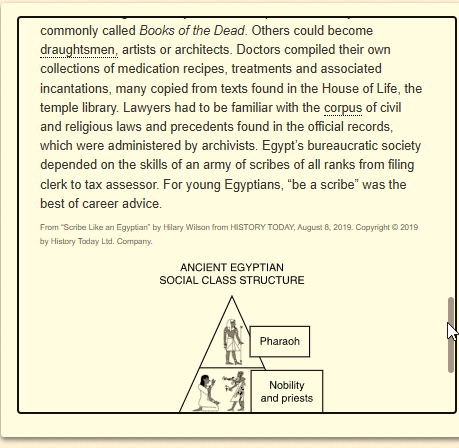
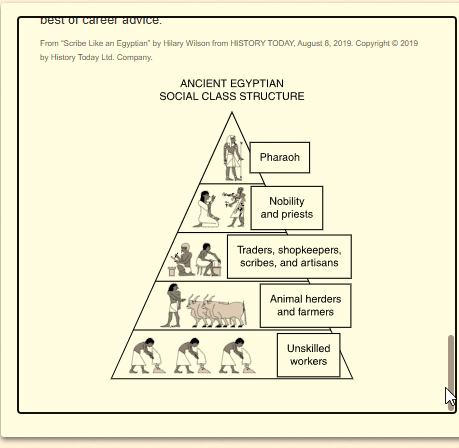
Question 24 of 59
2025 Practice Test A English, question 16Passage Excerpt from Winter Wheat
Excerpt from Winter Wheat
by Mildred Walker
Ellen, the narrator, is preparing to leave her parents and the family farm for college the next day.
The text of this excerpt is not reproduced here for copyright reasons. Read it as printed on the test under “The original DOE question” on each question’s page.
From WINTER WHEAT by Mildred Walker, published by University of Nebraska Press. Copyright © 1944 by Harcourt, Brace and Company, Inc. Copyright renewed 1971 by Mildred Walker. All rights reserved.
Question
Which sentence from the excerpt supports the idea that Ellen understands what her father is really thinking, and which sentence supports the idea that Ellen and her father share similar interests?
Move the correct answer to each box.
Supports the idea that Ellen understands what her father is really thinking
Supports the idea that Ellen and her father share similar interests
On the test you drag tiles into the boxes; here, choose each box’s tile from its menu. Each tile can be used once. The DOE has not published how answers with several parts are scored; this site counts one right only when every part is right.
Show the answer
Correct answer: blank 1: “Well, we don’t have to decide tonight,” Dad said, but I knew he wanted to go into Clark City.” (paragraph 6); blank 2: “He’s the one who gets excited when I do about spring coming or a serial running in the magazine we’re both reading” (paragraph 1)
The question asks for the identification of one sentence that supports the idea that Ellen understands what her father is really thinking, and one sentence that supports the idea that Ellen and her father share similar interests.
A. Incorrect. (“I love Dad’s way of talking that makes him seem different from other ranchers.” [paragraph 1]) This sentence from paragraph 1 presents a unique quality that Ellen loves about her father, but it does not provide evidence for the idea that Ellen and her father share similar interests or that Ellen understands what her father is really thinking.
B. CORRECT. (“He’s the one who gets excited when I do about spring coming or a serial running in the magazine we’re both reading” [paragraph 1]) This sentence from paragraph 1 shows that Ellen and her father both get excited about the coming of spring and share an enthusiasm for reading magazine serials (stories published in serial installments). Thus, it provides clear evidence for the idea that Ellen and her father share similar interests.
C. CORRECT. (“ ‘Well, we don’t have to decide tonight,’ Dad said, but I knew he wanted to go into Clark City.” [paragraph 6]) This sentence from paragraph 6 provides evidence that Ellen and her father share the same unspoken wish to go to Clark City rather than for Ellen to catch the train at Gotham, as suggested in paragraph 5 by Ellen’s mother. This quotation reveals that Ellen understands the true preference that her father is not expressing aloud, thereby providing evidence for the idea that Ellen understands what her father is really thinking.
D. Incorrect. (“We’d go in right after dinner and go around to the stores, Dad going one way and Mom and I another.” [paragraph 7]) Although this sentence from paragraph 7 indicates that Ellen can predict how her father would behave in a particular scenario, it does not show that Ellen understands what her father is really thinking, nor does it provide evidence for the idea that Ellen and her father share similar interests.
Question analysis
This evidence question on an excerpt from Mildred Walker’s 1944 novel Winter Wheat asks for one quotation showing that Ellen understands what her father is really thinking and another showing that the two share interests. On the test students drag two of four sentence tiles into labeled boxes, so each quotation’s exact wording decides where it belongs, if anywhere.
- Grade level
- Grade 7 reading and task
- Compared with grade 7
- At grade 7 Matching quotations to ideas about a character is grade 7 evidence work, and the novel’s language is plain. Placing two of four tiles, with credit only when both are right, adds a step, and every tile mentions Ellen’s father.
- Estimated difficulty
- Moderate: several steps, or a close reading with one strong distractor.
- Thinking it demands
- Depth of knowledge 2, skills and concepts · mainly evaluate
- What makes it hard
- Much to keep track of moderate
- Reading between the lines minor
- Evidence
- Answered from several paragraphs or stanzas
- Reading level
- Passage: about grade 6, 80 words; question and choices: about grade 9, 61 words.
- Corrected from the DOE handbook
- A repeated word in the explanation was corrected.
- Students, last 30 days
- Not enough answers yet to show (it takes 10).
Why it is hard, traps and wrong answers (shows the answer)
Why it is hard
Each box has a tile that matches it closely, so the question is less about finding evidence than about not being drawn by the near misses. Ellen’s detailed picture of the town trip in paragraph 7 shows she knows her father’s habits, which can pass for knowing his mind, and the tiles about shared excitement and a shared wish can each seem to fit the other box. Because credit needs both placements, one doubtful tile costs the whole question.
Much to keep track of moderate Working it out
Two boxes must both be right, and all four tiles mention Dad, so each tile has to be held against two different ideas before the two that fit neither can be set aside. (Sweller, 1988; Carpenter, Just & Shell, 1990)
Reading between the lines minor Working it out
The first box turns on the gap between what Dad says and what Ellen knows: “Dad said, but I knew he wanted” marks a wish he does not speak aloud. (Graesser, Singer & Trabasso, 1994; Kintsch, 1998)
Strategy: Treat the boxes as two separate evidence questions: restate each idea in your own words, then test all four tiles against it before placing one, since two tiles fit neither box.
Traps
- Supports only part of the claim: In a question about evidence: a line that backs one half of the claim but not the other, or a related point rather than the claim itself.
- Reads too much in: A reasonable-sounding conclusion that goes further than the text allows.
The wrong answers, classified
DB Reads too much in (Graesser, Singer & Trabasso, 1994)
Puts the town-trip tile in the first box because Ellen can foresee how Dad will spend the afternoon in town, though foreseeing his errands is not knowing an unspoken wish.
BC Supports only part of the claim (King et al., 2004; Thissen, Steinberg & Fitzpatrick, 1989)
Swaps the right tiles, reading Dad’s excitement, which he shows openly, as a hidden thought Ellen grasps, and their one shared wish for Clark City as a shared interest.
CA True but not the answer (King et al., 2004; Embretson & Wetzel, 1987)
Fills the first box correctly but puts Ellen’s love of Dad’s way of talking in the second, though admiring how he speaks is her feeling, not an interest they share.
What was corrected from the DOE handbook, and why
- Explanation: The DOE’s explanation of Option D says the sentence does not “provide evidence for the idea that that Ellen and her father share similar interests,” with “that” printed twice. The site prints it once.
Working it out, step by step
Figure out what the question asks
This question has two boxes, and each needs a different idea. Box 1: Ellen knows what Dad is really thinking, even when he doesn’t say it. Box 2: Ellen and Dad like the same things. On the test you drag a tile into each box. On this site you pick each box’s tile from a menu. Two tiles are left over.
Find a hidden thought for box 1
In paragraph 5, Mom says Ellen can catch the train at Gotham, the nearby stop. Then paragraph 6 says “ ‘Well, we don’t have to decide tonight,’ Dad said, but I knew he wanted to go into Clark City.” Dad’s words put off the choice. But Ellen knows his real wish, the trip into town. The word “but” marks the gap between what he says and what she knows.
Find a shared interest for box 2
Paragraph 1 says Dad is “the one who gets excited when I do about spring coming or a serial running in the magazine we’re both reading.” A serial is a story printed in parts, one part in each issue of a magazine. Ellen and Dad look forward to spring together, and they read the same story. Those are shared interests.
Rule out the other two tiles
- “I love Dad’s way of talking that makes him seem different from other ranchers.” (paragraph 1) This is Ellen’s feeling about how Dad talks. It is not a hidden thought, and it is not an interest they share.
- “We’d go in right after dinner and go around to the stores, Dad going one way and Mom and I another.” (paragraph 7) Ellen pictures how a trip to town would go. Knowing Dad’s habits is not knowing his unspoken wish. And here they split up.
Watch out: Don’t swap the two right tiles. Dad shows his excitement openly, so it is not a hidden thought.
Fill in both boxes
- Box 1, Ellen understands what her father is really thinking: “Well, we don’t have to decide tonight,” Dad said, but I knew he wanted to go into Clark City.” (paragraph 6)
- Box 2, Ellen and her father share similar interests: “He’s the one who gets excited when I do about spring coming or a serial running in the magazine we’re both reading” (paragraph 1)
Both boxes must be right to get the point.
Why this answer and not the closest wrong one
The town-trip tile is the closest wrong choice for box 1. In paragraph 7, Ellen can picture just what Dad would do in town. But that shows she knows his habits. In paragraph 6, Dad says one thing, and Ellen knows he wants another. That is knowing what he is really thinking.
More questions like this
The original DOE question
The passage “Excerpt from Winter Wheat” as shown on the test
Question 25 of 59
2025 Practice Test A English, question 23Uses the passage above: “Excerpt from Winter Wheat”.
Question
Which sentence from the excerpt provides evidence that Mom wants Ellen to understand the family’s heritage?
- A“Mom folded the ironing board and put it inside their bedroom that was just off the kitchen.” (paragraph 2)
- B“ ‘There’s no need to go to town; she can catch the train at Gotham just as well.’ ” (paragraph 5)
- C“We’d go in right after dinner and go around to the stores, Dad going one way and Mom and I another.” (paragraph 7)
- D“ ‘Why, Yeléna, you know that; Anna Petrovna.’ ” (paragraph 22)
Show the answer
Correct answer: D
The question asks which sentence from the excerpt provides evidence that Mom wants Ellen to understand the family’s heritage.
A. Incorrect. Although this sentence from paragraph 2 describes a domestic moment that takes place within the family home, it does not relate to the heritage of either parent and therefore does not provide evidence that her mother wants Ellen to understand the family’s heritage.
B. Incorrect. Although this sentence from paragraph 5 provides the name of the train station closest to Ellen’s family’s farm, the train stop at Gotham is not related to the family’s heritage. Therefore, this sentence does not provide clear evidence that her mother wants Ellen to understand the family’s heritage.
C. Incorrect. Although this sentence from paragraph 7 describes an aspect of the family dynamic (Ellen predicts that while browsing in stores in town, “Dad [would go] one way and Mom and I another”), their shopping habits do not provide clear evidence that her mother wants Ellen to understand the family’s heritage.
D. CORRECT. In this sentence from paragraph 22, Ellen’s mother addresses her by the Russian version of her name (Yeléna) and repeats her own Russian name (Anna Petrovna). The choice to call her daughter Yeléna instead of Ellen follows immediately after Ellen asks, “Mom, was that really your name—what Dad called you?” (paragraph 21), and the mother’s surprised response provides evidence that she both wants and expects Ellen to understand the family’s Russian heritage.
Question analysis
This evidence question asks which quoted sentence from the Winter Wheat excerpt shows that Mom wants Ellen to understand the family’s heritage. The four sentences, from paragraphs 2, 5, 7 and 22, all involve Mom, so students must reread each one in its paragraph to see what it really shows about her.
- Grade level
- Grade 6 reading and task
- Compared with grade 7
- Below grade 7 Finding the sentence that supports a stated idea is everyday grade 7 work. The quotations are short and plainly worded and the idea is concrete, so one careful rereading of each in context is enough, a lighter task than usual.
- Estimated difficulty
- Routine: one familiar step, little to misread.
- Thinking it demands
- Depth of knowledge 2, skills and concepts · mainly evaluate
- What makes it hard
- Evidence
- Answered from several paragraphs or stanzas
- Reading level
- Passage: about grade 6, 80 words; question and choices: about grade 8, 83 words.
- Students, last 30 days
- Not enough answers yet to show (it takes 10).
Why it is hard, traps and wrong answers (shows the answer)
Why it is hard
Only one of the four sentences touches the family’s origins at all, so a student who knows what heritage means can rule out the others at a glance. The small risk lies with students who match “Mom wants” to any line where Mom states a preference, or who do not recognize the Russian names, since the quotation stops before Mom mentions Russia.
Reading between the lines minor Working it out
The quoted line never mentions heritage; students must see that Mom calling Ellen “Yeléna” and repeating “Anna Petrovna,” as things Ellen should already know, shows her wish to pass on their Russian roots. (Graesser, Singer & Trabasso, 1994; Kintsch, 1998)
Evidence in several places minor Working it out
The names’ Russian origin is clearest outside the quotation, in the rest of paragraph 22, where Mom names her birthplace, and in paragraph 2’s “instead of a Russian.” (Kirsch & Mosenthal, 1990; Gorin & Embretson, 2006)
Strategy: Define heritage in your own words, then reread each quoted sentence in its paragraph and ask whether it shows Mom handing something about the family on to Ellen.
Traps
- True but not the answer: A choice says something accurate about the text that does not answer this question.
- Supports only part of the claim: In a question about evidence: a line that backs one half of the claim but not the other, or a related point rather than the claim itself.
The wrong answers, classified
A True but not the answer (King et al., 2004; Embretson & Wetzel, 1987)
Picks an everyday moment of Mom putting away the ironing board, perhaps remembering that paragraph 2 also mentions her Russian roots, though this sentence shows only housework.
B Supports only part of the claim (King et al., 2004; Thissen, Steinberg & Fitzpatrick, 1989)
Matches “Mom wants” to Mom’s spoken preference that Ellen catch the train at Gotham, which backs half the idea, a wish of Mom’s, but concerns travel, not heritage.
C True but not the answer (King et al., 2004; Embretson & Wetzel, 1987)
Notices Mom and Ellen shopping together in Ellen’s imagined trip to town, a sign of closeness, but going around the stores says nothing about where the family comes from.
Working it out, step by step
Figure out what the question asks
This asks which sentence shows that Mom wants Ellen to understand the family’s heritage. Heritage is the history and traditions a family passes down, such as where it came from. Look for a sentence where Mom shares something about the family’s roots.
Look at the conversation
At the train, Dad called Mom Anna Petrovna, a name Ellen had never heard him use. In paragraph 21, Ellen asks, “Mom, was that really your name—what Dad called you?” In paragraph 22, Mom answers, “Why, Yeléna, you know that; Anna Petrovna.” Then she reminds Ellen that she was born in Russia.
Work out what Mom’s answer shows
Mom calls her daughter Yeléna, the Russian form of Ellen. She repeats her own Russian name. She also says “you know that,” as if Ellen should already know. Mom is surprised that Ellen doesn’t. That shows Mom wants and expects Ellen to know where the family comes from.
Check each choice
- A does not fit. Folding the ironing board is housework. It says nothing about the family’s past.
- B does not fit. Mom does want something here, the train at Gotham. But that is about travel, not heritage.
- C does not fit. Shopping in town shows family habits, not family roots.
- D fits. Mom uses Russian names and expects Ellen to know them.
Watch out: B tempts because it shows what Mom wants. But the question asks what she wants Ellen to understand about the family.
Choose the answer
Only one sentence has Mom passing on the family’s Russian roots. So the answer is D.
Why this answer and not the closest wrong one
B is the closest wrong choice, because Mom states a wish in it: Ellen can catch the train at Gotham. But that wish is about the trip, not the family’s past. In D, Mom uses the Russian names Yeléna and Anna Petrovna. She is surprised that Ellen doesn’t know them. That shows she wants Ellen to understand her heritage.
More questions like this
The original DOE question
Question 26 of 59
2025 Practice Test B English, question 35Passage Using Fire to Keep a Prairie Healthy
Using Fire to Keep a Prairie Healthy
Inside the 40,000-acre Joseph H. Williams Tallgrass Prairie Preserve in northern Oklahoma, herds of bison roam on the scenic land that is home to hundreds of different species of plants and animals. While one of the greatest threats to the prairie is wildfire, the use of controlled fires is actually an effective way to protect this idyllic landscape.
Fires that are started by lightning or other natural circumstances are inevitable, and the results can be disastrous. However, hundreds of years ago the American Indian people who inhabited the Great Plains area between Minnesota and Texas realized that these fires could also be helpful. The bison in the area seemed to prefer grazing on tender new grass on the recently burned land rather than on grass in the unburned areas. The American Indian people began to deliberately burn areas of land for bison to graze on, which enticed the herds away from the people’s crops.
Today conservationists at the Tallgrass Prairie Preserve and farmers in the Great Plains continue to use controlled burns for land management. Intentionally burning a portion of land can dramatically improve the quality of the vegetation that regrows there. The fires burn away weedy undergrowth and help limit the overcrowding of shrubs and trees in the burn area, creating less competition for water and nutrients. Additionally, the process of burning excess plant matter adds nitrogen, an essential element for plant growth, to the soil.
One common target of controlled burns at the preserve and the surrounding area is the invasive red cedar tree. A single red cedar tree can consume up to 40 gallons of water per day, taking this vital resource away from other plant life. These tall trees also cast shade that prevents sunlight from reaching the plants beneath them. The fast-growing red cedar trees tend to crowd out prairie grasses, the primary food source for wild and domestic animals that make the prairie their home. An imbalance in one component of the prairie’s ecosystem affects the entire web of life. Controlled burns help maintain this ecosystem’s delicate balance.
Of course, these controlled fires are intended to burn only a portion of an area. A total burn, which is a risk with an uncontrolled wildfire, would destroy all wildlife as well as the crops farmers plant for income. The key to using controlled fires is knowing which areas of land to burn and when. Conservation experts at the preserve employ the “patch-burn” approach, meaning they rotate which portion of land is burned each year. They study the land to find out which areas would most benefit from being burned, and then they arrange about a dozen burns over one-third of the land. This patch burning contains the fire within a specific area and allows animals in the burn area to safely relocate. The following year, conservationists will burn a different section of the preserve, while the land burned the previous year regrows healthier than before.
Researchers have tracked and studied the variety of plant species and animals that live on the preserve, and their studies show that the patch-burn approach has restored biodiversity to the area by promoting the growth of species that were at risk of being crowded out. The patch-burn system is so successful that the conservationists at the preserve provide training to prairie farmers about conducting controlled burns on their own land. Burning land to make it healthy may seem counterintuitive, but strategic controlled fires have helped the prairie sustain life for hundreds of years and, with careful management, will continue to do so.
Question
Which details from the passage best convey the central idea that using the patch-burn method is an effective way to protect and manage prairie land?
- Athe explanation that conservationists use the alternating burn pattern of the patch-burn method in order to allow the animals in the area to avoid the fire
- Bthe information that conservationists evaluate which land would most benefit from a controlled burn before applying the patch-burn method
- Cthe information that conservationists have determined that the patch-burn method has promoted the growth of species that were at risk of being crowded out
- Dthe explanation that conservationists are able to control the fire in the patch-burn method by arranging separate burns across the designated portion of land
Show the answer
Correct answer: C
The question asks which details from the passage best convey the central idea that using the patch-burn method is an effective way to protect and manage prairie land.
A. Incorrect. The author explains in paragraph 5 that “patch burning contains the fire within a specific area and allows animals in the burn area to safely relocate.” This explanation conveys two supporting ideas: the patch-burn method is controllable, and patch-burn fires do not pose a threat to animals. However, this explanation does not address the broader central idea that the patch-burn method is an effective way to protect and manage prairie land.
B. Incorrect. In paragraph 5, the author states that “the key to using controlled fires is knowing which areas of land to burn and when.” The author then provides information about how conservation experts “study the land to find out which areas would most benefit from being burned.” However, these details convey supporting ideas rather than the central idea that using the patch-burn method is an effective way to protect and manage prairie land.
C. CORRECT. In paragraph 3, the author states that “fires burn away weedy undergrowth and help limit the overcrowding of shrubs and trees in the burn area, creating less competition for water and nutrients.” Also, in paragraph 6, the author states that patch burning “has restored biodiversity to the area by promoting the growth of species that were at risk of being crowded out.” These details directly convey the central idea that using the patch-burn method is an effective way to protect and manage prairie land.
D. Incorrect. The author explains in paragraph 5 how conservationists “arrange about a dozen burns over one-third of the land,” which helps show how the patch-burn method is applied by conservationists. However, this is a supporting detail that conveys the idea that the burns are deliberately set and carefully controlled. This detail does not convey the central idea that using the patch-burn method is an effective way to manage and protect prairie land.
Question analysis
This evidence question on the article about controlled burns at an Oklahoma tallgrass prairie preserve asks which details best convey the central idea that the patch-burn method is an effective way to protect and manage prairie land. Every choice reports something the article really says about the method, so students must decide which details speak most directly to the central idea as stated.
- Grade level
- Grade 7 reading and task
- Compared with grade 7
- At grade 7 Matching details to a stated central idea is regular grade 7 work, and the article is short and clearly written. Each choice is a long, accurate description, so the work lies in judging relevance rather than truth, which is typical.
- Estimated difficulty
- Moderate: several steps, or a close reading with one strong distractor.
- Thinking it demands
- Depth of knowledge 2, skills and concepts · mainly evaluate
- What makes it hard
- Every choice must be checked moderate
- Evidence in several places minor
- A lot to read minor
- Evidence
- Answered from several paragraphs or stanzas
- Reading level
- Passage: about grade 11, 598 words; question and choices: about grade 13, 118 words.
- Students, last 30 days
- Not enough answers yet to show (it takes 10).
Why it is hard, traps and wrong answers (shows the answer)
Why it is hard
The central idea joins three words, protect, manage and effective, and each wrong choice speaks to protect or manage with a step in carrying out the method: keeping animals safe, choosing the land, controlling the fire. Only a result shows that the method is effective, and the one result offered is the return of species once at risk of being crowded out. Students who ask what each detail proves, not what it is about, separate how the method works from whether it works.
Every choice must be checked moderate Choosing the answer
All four choices report the patch-burn method accurately, the animals’ safe relocation, the study of the land, the dozen burns and the restored species, so truth rules none out; each must be tested for proof the method works. (Embretson & Wetzel, 1987)
Evidence in several places minor Working it out
Three choices come from paragraph 5, where the method is explained, while the result that shows it works, restored biodiversity, sits in paragraph 6, after the description ends. (Kirsch & Mosenthal, 1990; Gorin & Embretson, 2006)
A lot to read minor Understanding the question
Each choice is a noun phrase of 19 to 26 words opening “the explanation that” or “the information that,” so four long details must be unpacked before they can be compared. (Kintsch, 1998; Gorin & Embretson, 2006; Freedle & Kostin, 1993)
Strategy: Restate the central idea in your own words, noting what “effective” requires, then ask of each choice whether that detail would persuade a doubtful reader of the whole idea.
Traps
- Supports only part of the claim: In a question about evidence: a line that backs one half of the claim but not the other, or a related point rather than the claim itself.
The wrong answers, classified
A Supports only part of the claim (King et al., 2004; Thissen, Steinberg & Fitzpatrick, 1989)
Links “protect” in the central idea to the animals’ chance to “safely relocate” in paragraph 5, a true detail of how patch burns are run, not proof they improve the prairie.
B Supports only part of the claim (King et al., 2004; Thissen, Steinberg & Fitzpatrick, 1989)
Hears effectiveness in “would most benefit,” but experts studying the land before a burn shows how they plan where to burn, not that the burns have worked.
D Supports only part of the claim (King et al., 2004; Thissen, Steinberg & Fitzpatrick, 1989)
Connects “manage” and “protect” to fire kept under control by arranging “about a dozen burns over one-third of the land,” which shows how the method is applied, not what it achieves.
Working it out, step by step
Figure out what the question asks
This asks which details best support a central idea. A central idea is a main point the whole passage develops. Here the idea is given: the patch-burn method is an effective way to protect and manage prairie land. Effective means it works and gets good results. So look for details that show results, not just how the method is done.
Find how the method works
Paragraph 5 explains the patch-burn method. The experts “rotate which portion of land is burned each year.” Rotate means take turns. First, “They study the land to find out which areas would most benefit from being burned.” Then “they arrange about a dozen burns over one-third of the land.” This “contains the fire within a specific area and allows animals in the burn area to safely relocate.” These details tell how the method is done.
Find what the method achieves
Paragraph 6 gives the results. Researchers studied the plants and animals on the preserve. Their studies show “that the patch-burn approach has restored biodiversity to the area by promoting the growth of species that were at risk of being crowded out.” Biodiversity means many kinds of living things. A species is one kind of plant or animal. Crowded out means pushed aside, the way red cedars crowd out prairie grasses in paragraph 4. So the method helped species that were losing ground. That shows it works.
Check each choice
- A does not fit. Animals escaping safely shows the burns are done with care. It does not show the land gets healthier.
- B does not fit. Studying the land is a planning step before a burn. It shows how the experts choose, not whether the burns work.
- C fits. It reports a result: the method helped species that were at risk.
- D does not fit. Arranging a dozen burns shows how the fire is kept under control. It does not show what the burns achieve.
Watch out: D sounds like “manage,” since the experts control the fire. But controlling a fire is part of doing the method. Only a result proves the method is effective.
Choose the answer
Only one choice shows the patch-burn method getting good results. So the answer is C, “the information that conservationists have determined that the patch-burn method has promoted the growth of species that were at risk of being crowded out.”
Why this answer and not the closest wrong one
D is the closest wrong choice. Careful control sounds like good management. But D only describes how the burns are set up. A method can be done carefully and still fail. C gives the proof that it works: studies show the burns “restored biodiversity.” Paragraph 6 even calls the system “so successful.”
More questions like this
The original DOE question
The passage “Using Fire to Keep a Prairie Healthy” as printed (page 41)
Question 27 of 59
2024 Test A English, question 17Passage Excerpt from “Impressions of an Indian Childhood”
Excerpt from “Impressions of an Indian Childhood”
by Zitkala-Sa
Zitkala-Sa (Gertrude Simmons Bonnin) was a Native American writer, musician, teacher, and political activist who was raised on the Yankton Sioux Reservation in South Dakota. In 1900 she published “Impressions of an Indian Childhood” (the term Indian was commonly used at the time to refer to Native American people) to expose readers to what life is like on a reservation.
Soon after breakfast Mother sometimes began her beadwork. On a bright, clear day, she pulled out the wooden pegs that pinned the skirt of our wigwam1 to the ground, and rolled the canvas part way up on its frame of slender poles. Then the cool morning breezes swept freely through our dwelling, now and then wafting the perfume of sweet grasses from newly burnt prairie.
Untying the long tasseled strings that bound a small brown buckskin2 bag, my mother spread upon a mat beside her bunches of colored beads, just as an artist arranges the paints upon his palette. On a lapboard she smoothed out a double sheet of soft white buckskin; and drawing from a beaded case that hung on the left of her wide belt a long, narrow blade, she trimmed the buckskin into shape. Often she worked upon small moccasins for her small daughter. Then I became intensely interested in her designing. With a proud, beaming face, I watched her work. In [my] imagination, I saw myself walking in a new pair of snugly fitting moccasins. I felt the envious eyes of my playmates upon the pretty red beads decorating my feet.
Close beside my mother I sat on a rug, with a scrap of buckskin in one hand and an awl in the other. This was the beginning of my practical observation lessons in the art of beadwork. From a skein3 of finely twisted threads of silvery sinews my mother pulled out a single one. With an awl she pierced the buckskin, and skillfully threaded it with the white sinew. Picking up the tiny beads one by one, she strung them with the point of her thread, always twisting it carefully after every stitch.
It took many trials before I learned how to knot my sinew thread on the point of my finger, as I saw her do. Then the next difficulty was in keeping my thread stiffly twisted, so that I could easily string my beads upon it. My mother required of me original designs for my lessons in beading. At first I frequently ensnared many a sunny hour into working a long design. Soon I learned from self-inflicted punishment to refrain from drawing complex patterns, for I had to finish whatever I began.
After some experience I usually drew easy and simple crosses and squares. These were some of the set forms. My original designs were not always symmetrical nor sufficiently characteristic, two faults with which my mother had little patience. The quietness of her oversight made me feel strongly responsible and dependent upon my own judgment. She treated me as a dignified little individual as long as I was on my good behavior; and how humiliated I was when some boldness of mine drew forth a rebuke from her!
In the choice of colors she left me to my own taste. I was pleased with an outline of yellow upon a background of dark blue, or a combination of red and myrtle-green. There was another of red with a bluish-gray that was more conventionally used. When I became a little familiar with designing and the various pleasing combinations of color, a harder lesson was given me. It was the sewing on, instead of beads, some tinted porcupine quills, moistened and flattened between the nails of the thumb and forefinger. My mother cut off the prickly ends and burned them at once in the centre fire. These sharp points were poisonous, and worked into the flesh wherever they lodged. For this reason, my mother said, I should not do much alone in quills until I was as tall as my cousin Warca-Ziwin.
Always after these confining lessons I was wild with surplus spirits, and found joyous relief in running loose in the open again. Many a summer afternoon a party of four or five of my playmates roamed over the hills with me. We each carried a light sharpened rod about four feet long, with which we pried up certain sweet roots. When we had eaten all the choice roots we chanced upon, we shouldered our rods and strayed off into patches of a stalky plant under whose yellow blossoms we found little crystal drops of gum. Drop by drop we gathered this nature’s rock-candy, until each of us could boast of a lump the size of a small bird’s egg. Soon satiated with its woody flavor, we tossed away our gum, to return again to the sweet roots.
From “Impressions of an Indian Childhood” by Zitkala-Sa—Public Domain
A BRIEF HISTORY OF BEADWORK IN SOUTH DAKOTA
| Date | Event |
|---|---|
| 1500s | The Dakota use beads made from bones, shells, stones, and animal teeth. European traders bring glass beads to North America. |
| Late 1600s | The Dakota begin trading with the French in Minnesota. |
| 1830s | The Dakota begin using glass beads in clothing, artwork, and decorations in place of Native-made beads. |
| 1862–1865 | The Dakota are expelled from their homelands in Minnesota as a result of the U.S.-Dakota War. |
| 1900s–1920s | The Dakota create items to sell outside their community. |
Source: MNopedia
1wigwam: hut with an arched framework of poles covered with bark, mats, or animal hides
2buckskin: leather made from the skin of a male deer
3skein: coiled length of yarn or other thread loosely wound on a reel
Question
The idea that mastering moccasin design and creation requires experience is best illustrated in the excerpt through
- Athe information about the advanced technique of incorporating porcupine quills into a design.
- Bthe descriptions of the special materials that must be used to make decorated moccasins.
- Cthe descriptions of the various color combinations that make an attractive moccasin design.
- Dthe example of the author successfully and independently using a sharpened rod.
Show the answer
Correct answer: A
The question asks how the idea that mastering moccasin design and creation requires experience is best illustrated in the excerpt.
A. CORRECT. In paragraph 6, the author states that when she became more familiar with elements of design, “a harder lesson was given me.” According to the author, sewing on porcupine quills is a much more difficult task to master because it requires experience in handling the poisonous porcupine quills, which is why her mother told her not to “do much alone in quills” until she was older (paragraph 6). This information best illustrates the idea that mastering moccasin design and creation requires experience.
B. Incorrect. Although the author provides detailed descriptions of the materials used to make decorated moccasins (“colored beads” [paragraph 2]; “a skein of finely twisted threads of silvery sinews” [paragraph 3]; “tinted porcupine quills, moistened and flattened between the nails of the thumb and forefinger” [paragraph 6]), these descriptions do not illustrate the experience that is needed to gain mastery of moccasin design and creation.
C. Incorrect. Although the author describes the color combinations she used in making moccasins (“I was pleased with an outline of yellow upon a background of dark blue, or a combination of red and myrtle-green. There was another of red with a bluish-gray that was more conventionally used” [paragraph 6]), this information mainly illustrates the author’s satisfaction with her moccasin design, not the importance of experience in mastering the creation and design of moccasins.
D. Incorrect. In paragraph 7, the author tells of using a sharpened rod to dig for roots. She explains that she and her playmates used the rods to “[pry] up certain sweet roots,” which they ate before going off to gather gum from a stalky plant. The detail of the sharpened rod is from a recollection about the playtime that followed the “confining lessons” of moccasin making. However, the sharpened rod was not used to create moccasins.
Question analysis
This reading question asks which part of Zitkala-Sa's account of learning to bead moccasins best illustrates the idea that mastering the craft takes experience. The choices point to materials, color combinations, a technique and outdoor play, so students must find the detail that ties skill to practice rather than one that simply describes the craft.
- NYS standards
- 7R1 textual evidence and inferences
- Grade level
- Grade 7 reading and task
- Compared with grade 7
- At grade 7 Choosing the detail that best illustrates an idea is grade 7 evidence work. The idea is stated plainly in the question and each paragraph of the excerpt keeps to one topic, so the demand matches typical grade 7 tasks.
- Estimated difficulty
- Straightforward: two steps or one careful reading.
- Thinking it demands
- Depth of knowledge 2, skills and concepts · mainly evaluate
- What makes it hard
- Evidence
- Answered from one paragraph or stanza
- Reading level
- Passage: about grade 8, 946 words; question and choices: about grade 12, 69 words.
- Corrected from the DOE handbook
- An inaccurate account of the excerpt in the explanation was corrected.
- Students, last 30 days
- Not enough answers yet to show (it takes 10).
Why it is hard, traps and wrong answers (shows the answer)
Why it is hard
The idea of experience is spelled out in paragraph 6, where quillwork is a harder lesson given only after some practice and kept from the girl until she is older. The wrong choices describe things the excerpt really contains, materials, colors and a tool, so they look supported until each is asked whether it shows a learner needing practice. Students who put that one question to every choice find this a quick item.
Evidence in several places minor Working it out
The stem names no paragraph, so students must find where each choice's detail sits, from the beads and sinew of paragraphs 2 and 3 to the rods of paragraph 7. (Kirsch & Mosenthal, 1990; Gorin & Embretson, 2006)
Reading between the lines minor Working it out
The link to experience is implied in paragraph 6: quills come as “a harder lesson” once she is “a little familiar with designing,” and she must wait until she is “as tall as my cousin.” (Graesser, Singer & Trabasso, 1994; Kintsch, 1998)
Strategy: For each choice, find the part of the excerpt it refers to and ask whether it shows a learner needing practice before doing something, not just what the craft involves.
Traps
- Supports only part of the claim: In a question about evidence: a line that backs one half of the claim but not the other, or a related point rather than the claim itself.
- Wrong part of the text: A choice is true of another paragraph, stanza or speaker than the one asked about.
The wrong answers, classified
B Supports only part of the claim (King et al., 2004; Thissen, Steinberg & Fitzpatrick, 1989)
Picks the descriptions of beads, sinew and buckskin, which show what moccasins are made from but say nothing about the experience needed to master making them.
C Supports only part of the claim (King et al., 2004; Thissen, Steinberg & Fitzpatrick, 1989)
Points to the color combinations of paragraph 6, which come just before the quill lesson but show the girl's own taste and freedom to choose, not a skill that takes practice.
D Wrong part of the text (Kirsch & Mosenthal, 1990)
Seizes on the girl using a sharpened rod on her own, but the rods belong to her play in paragraph 7, digging sweet roots, and have nothing to do with moccasins.
What was corrected from the DOE handbook, and why
- Explanation: In rejecting choice D, the handbook says the author used a sharpened rod “to spear gum from trees” and that the children pried up sweet roots “to find the gum.” In paragraph 7 the rods are used to pry up sweet roots, which the children eat; afterwards they stray off to a stalky plant and find drops of gum under its yellow blossoms. Nothing is speared and no trees are mentioned. The explanation now says the rods were used to dig for roots, sweet roots the children ate before going off to gather gum from a stalky plant. The reason for rejecting D, that the rod was not used to make moccasins, is unchanged.
Working it out, step by step
Figure out what the question asks
You need the part of the excerpt that best shows one idea. The idea is that you need experience to master making moccasins. Experience means practice over time. Look for a learner who must practice before doing something harder.
Find the evidence in paragraph 6
Paragraph 6 says: “When I became a little familiar with designing and the various pleasing combinations of color, a harder lesson was given me.” The harder lesson was sewing on porcupine quills. Then her mother said “I should not do much alone in quills until I was as tall as my cousin Warca-Ziwin.”
Work out what it means
Quills are the sharp spines of a porcupine. Their points were “poisonous,” so they were dangerous. The girl got this lesson only after she knew the basics. Even then, she could not do much alone with quills until she was as tall as her cousin. That shows skill grows with experience.
Check each choice
- A is right. Quillwork is a harder skill she must earn through practice.
- B is wrong. The materials show what moccasins are made of, not how skill is gained.
- C is wrong. The colors show her own taste. Her mother “left me to my own taste.”
- D is wrong. The rods were for digging up sweet roots during play. They had nothing to do with moccasins.
Watch out: C comes right before the quills in paragraph 6, so it is easy to pick. But the colors show what she liked, not a skill she had to build up.
Choose the answer
The quill lesson comes only after practice, and working alone comes only once she has grown. So the answer is A.
Why this answer and not the closest wrong one
C is the closest wrong answer, since the colors come just before the quill lesson. But the girl was free to pick the colors she liked. That shows her taste, not a need for experience. The quills are called “a harder lesson,” given only once she knew the basics. That fits A.
More questions like this
The original DOE question
The passage “Excerpt from “Impressions of an Indian Childhood”” as printed (pages 42–43)
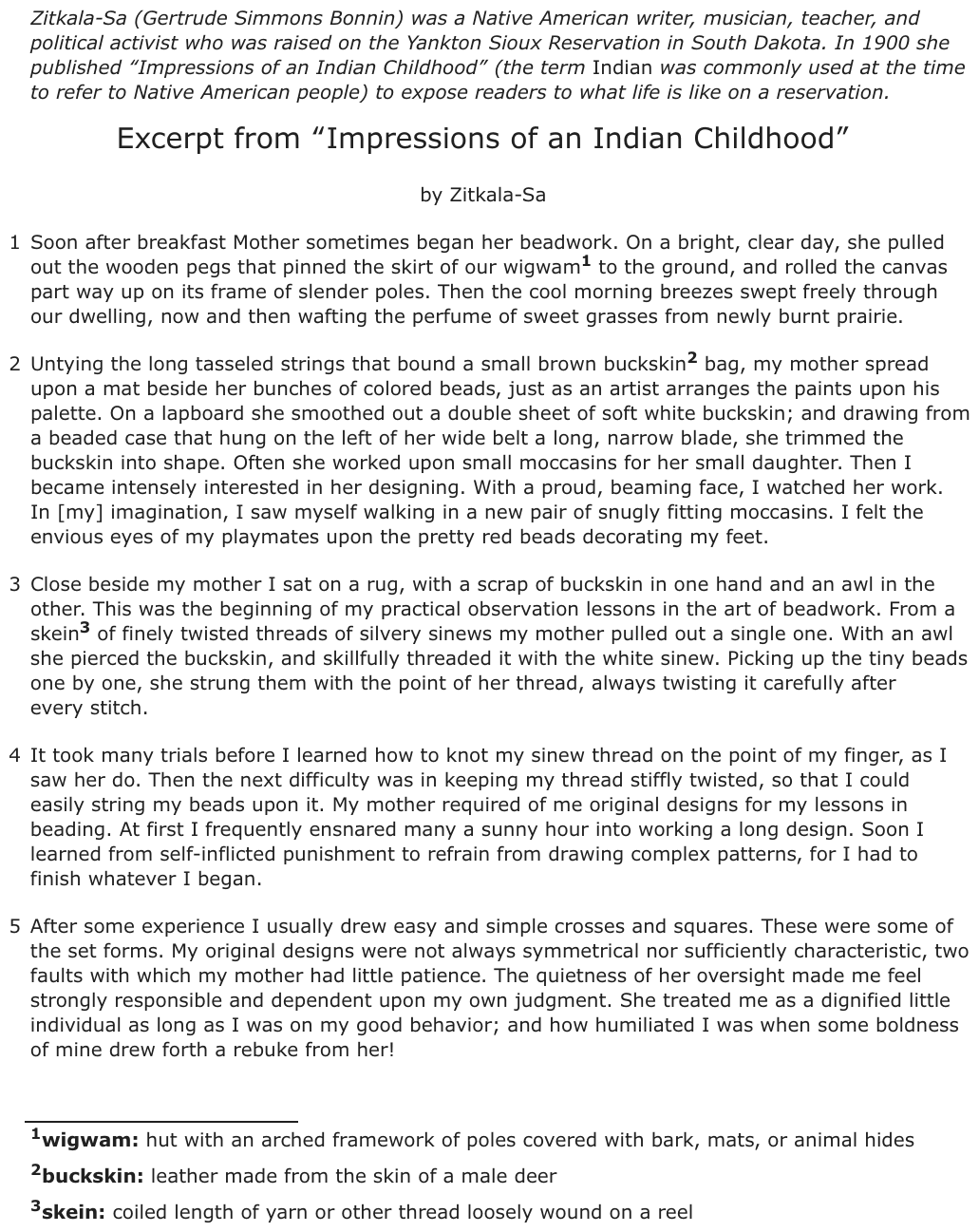
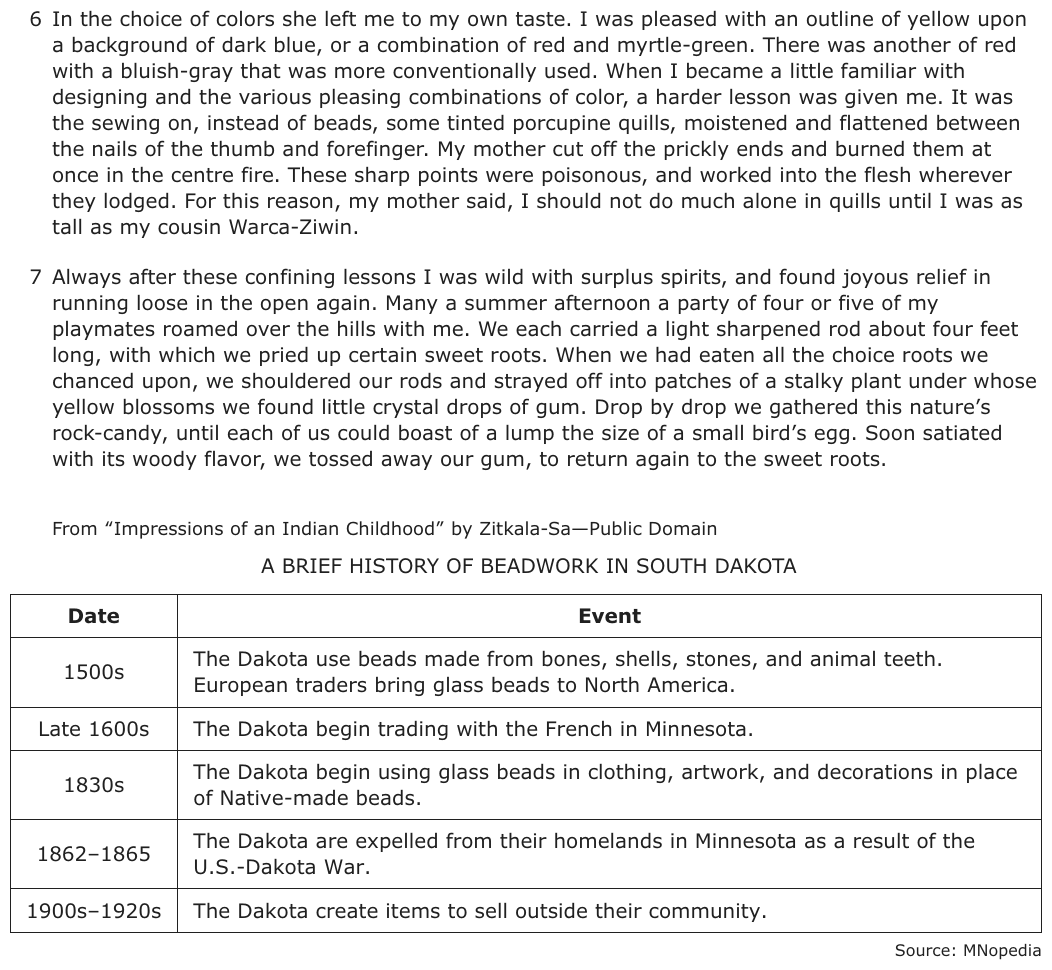
Question 28 of 59
2024 Test A English, question 19Passage At Dusk
At Dusk
by Natasha Trethewey
At first I think she is calling a child,
my neighbor, leaning through her doorway
at dusk, street lamps just starting to hum
the backdrop of evening. Then I hear
the high-pitched wheedling1 we send out
to animals who know only sound, not
the meanings of our words—here here—
nor how they sometimes fall short.
In another yard, beyond my neighbor’s
sight, the cat lifts her ears, turns first
toward the voice, then back
to the constellation of fireflies flickering
near her head. It’s as if she can’t decide
whether to leap over the low hedge,
the neat row of flowers, and bound
onto the porch, into the steady circle
of light, or stay where she is: luminous
possibility—all that would keep her
away from home—flitting before her.
I listen as my neighbor’s voice trails off.
She’s given up calling for now, left me
to imagine her inside the house waiting,
perhaps in a chair in front of the TV,
or walking around, doing small tasks;
left me to wonder that I too might lift
my voice, sure of someone out there,
send it over the lines stitching here
to there, certain the sounds I make
are enough to call someone home.
“At Dusk” from NATIVE GUARD by Natasha Trethewey, published by Houghton Mifflin Company. Copyright © 2006 by Natasha Trethewey. All rights reserved.
1wheedling: speaking in a flattering manner
Question
Which lines from the poem best support the idea that the neighbor’s efforts to call the cat home directly affect the speaker?
- A“At first I think she is calling a child, / my neighbor” (lines 1–2)
- B“the high-pitched wheedling we send out / to animals who know only sound” (lines 5–6)
- C“I listen as my neighbor’s voice trails off. / She’s given up calling for now” (lines 20–21)
- D“left me to wonder that I too might lift / my voice, sure of someone out there” (lines 25–26)
Show the answer
Correct answer: D
The question asks for the best textual support for the idea that the neighbor’s actions in calling the cat directly affect the speaker of the poem.
A. Incorrect. Lines 1–2 show that the speaker has noticed the neighbor’s calling and guessed the reason for it. The speaker at first believes that the neighbor is “calling a child,” but then the speaker notices a sound associated with the time of day—the “street lamps just starting to hum / the backdrop of evening” (lines 3–4). However, the poem does not describe any direct effects on the speaker’s own opinions or behavior caused by these aspects of the surroundings.
B. Incorrect. The “high-pitched wheedling” sound the speaker mentions in line 5 might be assumed to have an annoying effect. However, the poem includes no indication that the sound has any direct effect on the speaker or that the speaker has any personal reaction to the sound. Instead, in lines 6–7, the speaker concentrates on explaining the reason people make the sound: to communicate with “animals who know only sound, not / the meanings of our words.”
C. Incorrect. In lines 20–21, the speaker actively listens “as my neighbor’s voice trails off,” which could be interpreted as an effect of the neighbor’s call. However, the speaker’s listening soon comes to an end because the neighbor has “given up calling for now,” and the poem does not describe any direct effects on the speaker’s own opinions or behavior caused by listening. Therefore, lines 20–21 do not best support the idea that the neighbor’s actions directly affect the speaker of the poem.
D. CORRECT. In lines 25–26, after observing the neighbor calling the cat, the speaker begins to reflect on the speaker’s own behavior and motivations, wondering if, like the neighbor, the speaker “might lift” the speaker’s voice to call someone who is surely “out there.” The speaker’s description of being left “to wonder” indicates that the speaker’s thoughts are a direct effect of observing the neighbor’s efforts to call the cat.
Question analysis
This reading question asks which lines from Natasha Trethewey's poem At Dusk best support the idea that a neighbor's efforts to call her cat home directly affect the speaker. Every option quotes lines connected to the calling, so students must tell lines that merely describe the scene from lines that show its effect on the person watching.
- NYS standards
- 7R1 textual evidence and inferences
- Grade level
- Grade 7 reading and task
- Compared with grade 7
- At grade 7 Choosing lines that support an idea is grade 7 evidence work. The quotations are short and the poem's language is plain, but each must be checked against a specific claim, a typical grade 7 task.
- Estimated difficulty
- Moderate: several steps, or a close reading with one strong distractor.
- Thinking it demands
- Depth of knowledge 2, skills and concepts · mainly evaluate
- What makes it hard
- Reading between the lines moderate
- Every choice must be checked moderate
- Evidence
- Answered from one sentence or line
- Reading level
- Passage: 236 words (a poem; reading level not measured); question and choices: about grade 5, 79 words.
- Students, last 30 days
- Not enough answers yet to show (it takes 10).
Why it is hard, traps and wrong answers (shows the answer)
Why it is hard
Every quotation shows the speaker noticing the call in some way, so the question is how strong a connection “directly affect” requires. The listening lines are the trap: they stop one line short of “left me,” where the effect begins. Students who ask what the calling makes the speaker think or want find the lines in which the speaker imagines calling out too.
Reading between the lines moderate Working it out
Students must decide what counts as an effect on the speaker: hearing and listening are reactions, but only lines 25–26 show the calling changing what the speaker thinks or wants. (Graesser, Singer & Trabasso, 1994; Kintsch, 1998)
Every choice must be checked moderate Choosing the answer
All four quotations involve the speaker and the calling, from “I think” to “we send out” to “I listen,” so each has to be tested for an effect, not just a connection. (Embretson & Wetzel, 1987)
Strategy: For each quotation, ask what the speaker does, thinks or feels because of the calling; lines that only report a sound or an event show no effect.
Traps
- Supports only part of the claim: In a question about evidence: a line that backs one half of the claim but not the other, or a related point rather than the claim itself.
- True but not the answer: A choice says something accurate about the text that does not answer this question.
The wrong answers, classified
A Supports only part of the claim (King et al., 2004; Thissen, Steinberg & Fitzpatrick, 1989)
Takes the speaker's first guess, that a child is being called, as an effect, but the lines only record how the speaker interpreted the sound, not any change it caused.
B True but not the answer (King et al., 2004; Embretson & Wetzel, 1987)
Chooses the lines on the “high-pitched wheedling,” which explain how people call animals in general and show no personal reaction from the speaker.
C Supports only part of the claim (King et al., 2004; Thissen, Steinberg & Fitzpatrick, 1989)
Treats “I listen” as the effect, but these lines report the voice fading and the neighbor stopping, and the speaker's response begins only with “left me” after them.
Working it out, step by step
Figure out what the question asks
You need the lines that best show the neighbor’s calling has a direct effect on the speaker. The speaker is the “I” who tells the poem. An effect here is a change in what the speaker thinks, feels or does.
Find where the effect begins
In line 20 the neighbor’s voice “trails off.” She has given up calling, and that “left me” with new thoughts. First it “left me / to imagine her inside the house waiting” (lines 21–22). Then it “left me to wonder that I too might lift / my voice, sure of someone out there” (lines 25–26).
Work out what the lines mean
“I too” means the speaker now thinks of doing what the neighbor did. The speaker imagines calling out to someone, the way the neighbor called the cat. Watching her call has changed the speaker’s own thoughts and wishes. That is a direct effect.
Check each choice
- A is wrong. Lines 1–2 show only the speaker’s first guess about the sound. Nothing changes for the speaker.
- B is wrong. Lines 5–6 explain how people in general call animals. They show no reaction from the speaker.
- C is wrong. Lines 20–21 show the speaker listening as the calling stops. The effect starts after them, with “left me.”
- D is right. The speaker wonders about lifting “my voice” too.
Watch out: C is tempting because “I listen” is a reaction. But hearing a sound is not the same as being changed by it.
Choose the answer
Lines 25–26 show the calling making the speaker want to call out too. So the answer is D.
Why this answer and not the closest wrong one
C is the closest wrong answer. In it the speaker does listen to the neighbor. But the lines only report her voice fading and the calling ending. The speaker’s own response begins with “left me to wonder,” in line 25. There the speaker thinks of calling someone too. That is the direct effect.
More questions like this
The original DOE question
The passage “At Dusk” as printed (page 48)
Question 29 of 59
2024 Test A English, question 29Passage Champion of the Channel
Champion of the Channel
In 1926 an editor at the London Daily News predicted that Gertrude Ederle, an American swimmer with eighteen world records and three Olympic medals, would fail in her attempt to swim across the English Channel. He claimed that “even the most uncompromising champion of the rights and capacities of women must admit that in contests of physical skill, speed and endurance they must remain forever the weaker sex.” Yet, at only nineteen years old, Ederle not only became the first woman to accomplish this feat, she also broke the men’s record by two hours. Gertrude Ederle’s triumphant swim across the English Channel was a testimony to her determination, innovative spirit, and passion for swimming.
Crossing the English Channel is a daunting task for any swimmer. At its narrowest point, the channel measures twenty-one miles across. Its icy waters hover around sixty degrees Fahrenheit, and its unruly tides and currents toss swimmers about like bobbing corks. Stinging jellyfish, seaweed, and floating debris from shipwrecks and lost cargoes present added hazards.
For decades the channel’s perils have defeated countless swimmers. Ederle, too, failed in her first attempt to cross the channel in 1925. Just six miles short of finishing, she became ill, and her coach had to haul her out of the water. Undeterred, Ederle decided to try again. Ederle knew that if she did not complete the challenge this time, she might never get the opportunity to set this record, because a rival female swimmer was preparing to make her second attempt at the crossing as well.
To prepare for the marathon swim, Ederle found ways to improve her equipment. She and her sister Meg discovered that melted candle wax perfectly sealed goggle edges, effectively waterproofing Ederle’s goggles against hammering waves. The sisters also designed a two-piece silk swimsuit for Ederle. During her first channel-crossing attempt she had worn a standard one-piece swimsuit that, after the lengthy hours of swimming across the channel, had stretched out, filling with water and creating drag, making an already challenging task almost insurmountable. Unlike the cumbersome typical bathing suit, this silk invention weighed little and allowed for easy movement.
On August 6, 1926, Ederle waded into the channel near Cape Gris-Nez, France. At first she shivered in the bone-chilling water even though she had covered her body in eight layers of grease for insulation. Her limbs felt stiff. Her strokes were irregular. Driving forward, she fought to clear her mind and find what she called her “sphere,” a place where the sea became her only companion and the shrieks of gulls and the humming of boat engines faded away. Using a new overhand stroke called the American crawl, Ederle eventually settled into a steady pace, briskly breaking through waves.
Throughout Ederle’s swim, two tugboats accompanied her. One carried newspaper reporters who wired dispatches of her progress to shore. The other, displaying a sign that read “This way, ole kid!” with an arrow pointing forward, transported her coach, family, and friends. Her coach played songs, such as “Yes, We Have No Bananas,” on a phonograph so that Ederle could time her strokes to the rhythm. Using a net, her coach also passed her baby bottles of broth for nourishment.
For hours Ederle swam, dodging debris with an amused smile. However, as she neared the English shore, a sudden fierce storm erupted. The tides and waves forced Ederle backward, and she fought the stubborn swells for several hours. The salty water caused her tongue to swell and inflamed her ears. Yet Ederle felt indescribably happy as she churned through the sea. Finally, as she neared the English shore, the storm abated, and the tide turned. No longer fighting against her, the sea pushed her toward the shore and victory.
After fourteen hours and thirty-one minutes, Ederle, on wobbly legs, stepped onto the English shore. The waiting crowd roared, honked their automobile horns, blasted their tugboat whistles, and set off flares that flashed in the sky. Ederle had swum into history.
When Ederle returned to New York, she received a parade, where thousands of people shouted “Trudy!” Not only were everyday American citizens proud of Ederle, but she also inspired them to be more active. Over the next few years, more than 60,000 people credited her with motivating them to earn their American Red Cross swimming certificates. Gertrude Ederle’s accomplishment proved to the world that with determination and passion, it was possible for a person to achieve his or her goals.
SOLO SWIMS ACROSS THE ENGLISH CHANNEL
|
Earliest Speed Records |
||
| Year | Swimmer | Time |
| 1875 | Matthew Webb (M) | 21 hours, 45 minutes |
| 1923 | Enrico Tiraboschi (M) | 16 hours, 33 minutes |
| 1926 | Gertrude Ederle (F) | 14 hours, 31 minutes |
| 1926 | Arnst Vierkotter (M) | 12 hours, 38 minutes |
| Current Speed Records | ||
| Year | Swimmer | Time |
| 2012 | Trent Grimsey (M) | 6 hours, 55 minutes |
| 2006 | Yvetta Hlavacova (F) | 7 hours, 25 minutes |
Question
Which sentence best supports the idea that Ederle succeeded in swimming across the channel because of her innovative approach to the challenge?
- A“Yet, at only nineteen years old, Ederle not only became the first woman to accomplish this feat, she also broke the men’s record by two hours.” (paragraph 1)
- B“At first she shivered in the bone-chilling water even though she had covered her body in eight layers of grease for insulation.” (paragraph 5)
- C“Using a new overhand stroke called the American crawl, Ederle eventually settled into a steady pace, briskly breaking through waves.” (paragraph 5)
- D“The other [tugboat], displaying a sign that read ‘This way, ole kid!’ with an arrow pointing forward, transported her coach, family, and friends.” (paragraph 6)
Show the answer
Correct answer: C
The question asks for the best support for the idea that Ederle’s swim across the channel was successful because of her innovative approach to the challenge.
A. Incorrect. The sentence from paragraph 1 shows that Ederle’s performance was groundbreaking but not necessarily innovative.
B. Incorrect. The layers of grease mentioned in the sentence from paragraph 5 primarily served to insulate Ederle (keep her warm) by helping her maintain her body temperature in the cold water; neither the sentence in paragraph 5 nor the surrounding text evidence establishes that this was an innovative practice. Furthermore, the sentence does not show that she succeeded as a result of this approach.
C. CORRECT. The sentence from paragraph 5 explains that Ederle employed a newly developed, or innovative, type of stroke that allowed her to maintain her pace through the rough water.
D. Incorrect. The tugboat carrying Ederle’s supporters referenced in the sentence from paragraph 6 likely provided encouragement during Ederle’s swim, but the sentence does not show that this approach was innovative or that it enabled Ederle’s success.
Question analysis
In this textual-evidence question, students look for the sentence that best backs up a claim about Gertrude Ederle's English Channel swim: that an innovative approach is what made her succeed. The quotations come from four different moments in her story, so each must be checked for something genuinely new and for a real effect on the outcome.
- NYS standards
- 7R1 textual evidence and inferences
- Grade level
- Grade 7 reading and task
- Compared with grade 7
- At grade 7 Finding the sentence that backs a claim is the standard grade 7 evidence task, set here at a typical level: four short quotations labeled by paragraph and a claim with two parts, what was new and what it achieved.
- Estimated difficulty
- Straightforward: two steps or one careful reading.
- Thinking it demands
- Depth of knowledge 2, skills and concepts · mainly evaluate
- What makes it hard
- Evidence
- Answered from several paragraphs or stanzas
- Reading level
- Passage: about grade 9, 790 words; question and choices: about grade 12, 117 words.
- Students, last 30 days
- Not enough answers yet to show (it takes 10).
Why it is hard, traps and wrong answers (shows the answer)
Why it is hard
The claim joins two ideas, an innovative approach and the success it produced, and only one quotation carries both. The record-breaking sentence proves success with no method, the grease is a technique the passage never calls new and that did not stop her shivering, and the tugboat sign shows her supporters, not her approach. The adjective “new” before the American crawl is the clue that settles it.
Every choice must be checked minor Choosing the answer
Each quotation describes a real moment of the crossing, so each has to clear two tests: a method that was new, and a method that moved her toward the English shore. (Embretson & Wetzel, 1987)
Reading between the lines minor Working it out
Even the right sentence never says the crawl won the swim; the student must take “settled into a steady pace, briskly breaking through waves” as what carried her across. (Graesser, Singer & Trabasso, 1994; Kintsch, 1998)
Strategy: Test each quotation twice: does it describe a method that was new or original, and does it show that method helping her finish? Keep only a sentence that passes both tests.
Traps
- Reads too much in: A reasonable-sounding conclusion that goes further than the text allows.
- Supports only part of the claim: In a question about evidence: a line that backs one half of the claim but not the other, or a related point rather than the claim itself.
The wrong answers, classified
A Supports only part of the claim (King et al., 2004; Thissen, Steinberg & Fitzpatrick, 1989)
Chooses the passage's headline result, first woman across and two hours under the men's record, which proves the success half of the claim but shows no new method behind it.
B Reads too much in (Graesser, Singer & Trabasso, 1994)
Treats eight layers of grease as an innovation, though the passage never calls it new and the sentence says she shivered anyway, so it shows neither originality nor success.
D Reads too much in (Graesser, Singer & Trabasso, 1994)
Reads the cheerful “This way, ole kid!” sign as a clever new idea, but the sentence only says who rode in the second tugboat and links nothing to how she swam.
Working it out, step by step
Break the idea into two parts
This asks you to find evidence. Innovative means new and original, a fresh way to do something. The idea has two parts. Ederle used a new approach, and that approach helped her succeed. The best sentence must show both.
Look for something new
Only one choice uses the word “new.” Choice C says she used “a new overhand stroke called the American crawl” (paragraph 5). A stroke is the way you move your arms to pull through the water. So this is a new method.
See whether it helped her
The same sentence says she “settled into a steady pace, briskly breaking through waves.” Briskly means quickly and with energy. A steady, quick pace moved her forward through the rough water. So the new stroke helped her succeed.
Check each choice
- C fits: it shows a new stroke and the steady pace it gave her.
- A is wrong because it proves she succeeded but shows no new method.
- B is wrong because the passage never calls the grease new, and she still “shivered in the bone-chilling water.”
- D is wrong because the sign on the tugboat cheered her on but was not a new way of swimming.
Watch out: B may sound clever, since the grease was meant to keep her warm. But it shows neither something new nor a reason she won.
Choose the answer
Only C shows a new method that helped Ederle get across. So the answer is C.
Why this answer and not the closest wrong one
B is the strongest pull, since grease to keep warm sounds like a smart trick. Yet the passage never presents the grease as new, and it did not stop her shivering. C names a method the passage calls “new” and shows it paying off in a steady, quick pace.
More questions like this
The original DOE question
The passage “Champion of the Channel” as printed (pages 56–57)
Question 30 of 59
2024 Test A English, question 33Uses the passage above: “Champion of the Channel”.
Question
The idea that many people were interested in Ederle’s attempt to swim the channel is illustrated in the passage mainly through the
- Ainformation about Ederle’s competition with another female swimmer who was also attempting to cross the channel.
- Bdetails about the reports of Ederle’s progress during the swim and the celebration of her successful completion of the swim.
- Cdetails about how Ederle’s historic swim contributed to an increase in the number of people learning how to swim.
- Dinformation about the resources Ederle used throughout her swim to maintain her motivation and stamina.
Show the answer
Correct answer: B
The question asks how the idea that many people were interested in Ederle’s attempt to swim the channel is mainly illustrated in the passage.
A. Incorrect. While paragraph 3 states that “a rival female swimmer was preparing to make her second attempt at the crossing as well,” which suggests that Ederle’s competitor was interested in Ederle’s attempt to swim the channel, this information does not establish that many people were interested in Ederle’s attempt.
B. CORRECT. Paragraph 6 includes the detail that newspaper reporters followed Ederle on a tugboat and “wired dispatches of her progress to shore,” which suggests that an audience was waiting for news about Ederle’s progress. Paragraph 8 states that when Ederle reached the shore, “the waiting crowd roared, honked their automobile horns, blasted their tugboat whistles, and set off flares that flashed in the sky.” Further, paragraph 9 states that when Ederle returned to New York, “thousands of people” attended a parade in her honor. These details describing the celebration of Ederle’s feat further illustrate the idea that many people were interested in what she had accomplished.
C. Incorrect. While paragraph 9 states that “more than 60,000 people credited [Ederle] with motivating them to earn their American Red Cross swimming certificates,” this detail describes how Ederle’s historic swim influenced people after the fact but does not illustrate the level of public interest during the attempt itself.
D. Incorrect. Paragraph 6 provides details about how Ederle’s “coach, family, and friends” displayed signs, played songs, and “passed her baby bottles of broth” to help her maintain her motivation and stamina. However, these resources do not suggest the idea that people beyond Ederle’s immediate support team were interested in her attempt to swim the channel.
Question analysis
Public interest in Gertrude Ederle's 1926 English Channel swim is the focus of this reading question, which asks which details in the passage mainly illustrate that many people cared about her attempt. Students must gather signs of attention from several paragraphs, and every choice points to real details that involve other people in her story.
- Grade level
- Grade 7 reading and task
- Compared with grade 7
- At grade 7 Matching an idea to the details that develop it is standard grade 7 work. The supporting details are spread across several late paragraphs and must be gathered before the choices can be judged, a typical grade 7 demand.
- Estimated difficulty
- Moderate: several steps, or a close reading with one strong distractor.
- Thinking it demands
- Depth of knowledge 2, skills and concepts · mainly evaluate
- What makes it hard
- Evidence in several places moderate
- Reading between the lines minor
- Evidence
- Answered from several paragraphs or stanzas
- Reading level
- Passage: about grade 9, 790 words; question and choices: about grade 13, 92 words.
- Students, last 30 days
- Not enough answers yet to show (it takes 10).
Why it is hard, traps and wrong answers (shows the answer)
Why it is hard
The idea has two parts, many people and interest in the attempt itself, and each wrong choice satisfies one at most. The strongest pull is the 60,000 swimming certificates, a huge number tied to Ederle but describing what people did in the years afterward. Students who hold both parts in mind, and who remember that paragraph 6 carries reporters as well as family, find the details that answer it.
Evidence in several places moderate Working it out
The right details sit in three places: reporters wiring dispatches from a tugboat in paragraph 6, the roaring crowd and flares in paragraph 8, and the New York parade in paragraph 9. (Kirsch & Mosenthal, 1990; Gorin & Embretson, 2006)
Reading between the lines minor Working it out
No sentence says people were interested; the student must infer an eager audience from reporters sending news to shore and a crowd already “waiting” when she landed. (Graesser, Singer & Trabasso, 1994; Kintsch, 1998)
Strategy: Hold each choice to both parts of the idea in the stem: the details must involve many people, and they must show interest in the attempt itself, not some other link to Ederle.
Traps
- Supports only part of the claim: In a question about evidence: a line that backs one half of the claim but not the other, or a related point rather than the claim itself.
The wrong answers, classified
A Supports only part of the claim (King et al., 2004; Thissen, Steinberg & Fitzpatrick, 1989)
Matches “attempting to cross the channel” to the stem's attempt, but the rival preparing her own crossing in paragraph 3 is one swimmer, not many people following Ederle.
C Supports only part of the claim (King et al., 2004; Thissen, Steinberg & Fitzpatrick, 1989)
Counts the 60,000 people who earned swimming certificates, which shows many people moved by Ederle but describes her influence after the swim, not interest in the attempt itself.
D Supports only part of the claim (King et al., 2004; Thissen, Steinberg & Fitzpatrick, 1989)
Points to the coach, family and friends who played songs and passed broth from the tugboat, people who cared about the attempt but a small circle, not a wide public.
Working it out, step by step
Find the two parts of the idea
This asks you to find the details that best show an idea. The idea has two parts. Many people, not just a few, cared about Ederle. And they were interested in the attempt itself, the swim as it happened. The right choice must show both.
Look for news and crowds
Paragraph 6 says reporters on a tugboat “wired dispatches of her progress to shore.” Dispatches are news reports. In paragraph 8, “The waiting crowd roared” as she stepped onto the English shore. In paragraph 9, “thousands of people shouted” her name at a parade in New York.
See what these details show
Reporters send news only when readers want it. So people on land were following the swim as it happened. The crowd was “waiting” before she even arrived. Then thousands cheered her at home. These details show that a great many people cared about her swim.
Check each choice
- B fits: the reports of her progress and the celebration show many people following the swim.
- A is wrong because the rival swimmer in paragraph 3 is one person, not many people.
- C is wrong because the swimming certificates came in later years, after the swim.
- D is wrong because her coach, family and friends were a small group, not the wider public.
Watch out: C has the biggest number, more than 60,000 people. But it tells what people did after the swim was over.
Choose the answer
Only B shows many people paying attention while Ederle swam and when she finished. So the answer is B.
Why this answer and not the closest wrong one
C is the closest wrong answer, since 60,000 is a huge number of people. But they earned their certificates “over the next few years,” long after the swim. That shows her influence, not interest in the attempt. B shows people following the swim as it happened and cheering when she finished.
More questions like this
The original DOE question
Question 31 of 59
2024 Test A English, question 36Passage 5 Reasons Physical Books Might Be Better Than E-Books
5 Reasons Physical Books Might Be Better Than E-Books
by Shaunacy Ferro
Though e-book1 readers have become a more common sight around town, traditional books still have their evangelists.2 According to The New York Times, e-book sales have been falling in 2015. Print definitely isn’t dead. In fact, according to some research, it may actually be a better choice for some readers. While scientists are still trying to tease out exactly how digital reading affects us differently, here are five ways e-books might be inferior to their dead-tree cousins.
E-books can reduce reading comprehension.
In a study of middle schoolers, West Chester University researchers found that students who read on iPads3 had lower reading comprehension than when they read traditional printed books. They discovered that the kids sometimes skipped text in favor of interactive features in the e-books, suggesting that certain multimedia in children’s e-books can be detrimental to the practice of reading itself. However, the researchers noted that some interactive features in e-books are designed to enhance comprehension, and that those might be more helpful than game-type interactive graphics.
Young kids can get distracted by e-books.
Similar results were found by a small study by the Joan Ganz Cooney Center that consisted of 32 kids reading e-books and print books with their parents. It found that “enhanced” e-books might be distracting. Kids who read enhanced e-books—ones with interactive, multimedia experiences—were more engaged with them physically, but in the end they remembered fewer narrative details than those who read print books or basic e-books.
You remember less about a book’s timeline.
Another study of adults also found that e-books can be hard to absorb. The researchers asked 25 people to read a 28-page story on a Kindle4 and 25 to read the story in paperback, then asked the readers to put 14 events from the story in chronological order. Those who read the story on a Kindle performed worse on the chronology test than the book readers, though they performed about the same as print readers in other tests. Earlier research by the same scholars, from Stavanger University in Norway, found that Norwegian 10th graders also remembered more about texts if they read them in print rather than on a computer screen.
They’re not great as textbooks.
While e-book textbooks are often cheaper (and easier to carry) than traditional door-stop5 textbooks, college students often don’t prefer them. In some surveys of college kids, the majority of students have reported preferring print books. However, a 2012 study from the UK’s National Literacy Trust of kids ages 8 to 16 found that more than 50 percent of children reported preferring screen reading.
They’re tiring.
Staring at a lit screen can be tiring for the eyes and the brain. A 2005 study from Sweden found that reading digitally required a higher cognitive workload than reading on paper. Furthermore, staring at LED6 screens at night can disrupt sleep patterns. A 2014 Harvard study found that people who used e-readers with LED screens at night slept worse and were more tired the next day. So, if you’re going to go for an e-book, go for one without the backlight.
The take-away message? If you’re really trying to absorb material, you might want to go for a physical book. And if you’re going to be up all night studying, turn off the backlight.
However, all this may not mean that reading on a Kindle is really going to melt your brain. For instance, reading an e-book on a computer is a much different experience than reading on a Kindle, which is specifically designed for consuming books. So, too, is playing with an interactive e-book on an iPad, compared to using a simpler e-book device that only presents the text, with no opportunities to click away into digital distractions.
And some studies have found that part of the difference between the way people absorb information from e-books versus paper might be due to approaching e-books differently—in one test, participants didn’t regulate their study time with digital books like they did with paper texts, leading to worse performances. It’s possible that our expectations of e-book reading—as well as the different designs of the digital reading experience on a computer or iPad or Kindle—might affect how we approach the text and how much effort we put into studying them. As generations of e-book readers evolve, and people become more accustomed to the idea of sitting down with a digital textbook, these factors could change—for better or for worse.
“5 Reasons Physical Books Might Be Better Than E-Books” by Shaunacy Ferro from MENTAL FLOSS, October 2, 2015. Copyright © 2015 Mental Floss, Inc.
1e-book: an electronic book, a publication made available digitally for reading on a computer or other device
2evangelists: advocates or supporters
3iPads: tablet computers
4Kindle: device for reading e-books
5door-stop: a reference to the idea that some textbooks are large and heavy enough to hold a door open
6LED: Light-emitting diode; LEDs are often used as a backlight for electronic devices such as smart phones and tablets.
Question
Which evidence from the passage best supports the claim that “print definitely isn’t dead” (paragraph 1)?
- AMost college students prefer using paper books to using e-books.
- BScientists are still studying the effects of reading on a screen.
- CPaper books are less disruptive to sleep patterns than e-books are.
- DReading on a screen can affect both the eyes and the brain.
Show the answer
Correct answer: A
The question asks which evidence from the passage best supports the claim in paragraph 1 that “print definitely isn’t dead.”
A. CORRECT. In paragraph 5, the author points out that “while e-book textbooks are often cheaper (and easier to carry) than traditional door-stop textbooks, college students often don’t prefer them.” The author adds that “in some surveys of college kids, the majority of students have reported preferring print books.” As a result, this evidence from the passage supports the claim in paragraph 1 that “print definitely isn’t dead.”
B. Incorrect. In paragraph 1, the author notes that “scientists are still trying to tease out exactly how digital reading affects us differently.” This detail shows that research on reading on a screen is still going on, but it says nothing about whether people still choose print, so it does not support the claim in paragraph 1 that “print definitely isn’t dead.”
C. Incorrect. Although the main idea of paragraph 6 is supported by the 2014 study that showed that “people who used e-readers with LED screens at night slept worse and were more tired the next day,” this detail does not support the claim in paragraph 1 that “print definitely isn’t dead.”
D. Incorrect. The author states in paragraph 6 that “staring at a lit screen can be tiring for the eyes and the brain” and that “reading digitally required a higher cognitive workload.” Although these details illustrate how using e-readers can have negative physical and mental effects, they do not support the claim in paragraph 1 that “print definitely isn’t dead.”
Question analysis
This evidence question takes the claim “print definitely isn't dead” from the opening of an article comparing printed books and e-books and asks which evidence from the passage best supports it. Students must pin down exactly what the claim says before judging the evidence, since all four choices come from the article and sound related.
- Grade level
- Grade 7 reading and task
- Compared with grade 7
- Above grade 7 Grade 7 students judge whether evidence is relevant to a claim, but this claim is a short idiom whose precise meaning must be settled first, and every choice paraphrases a real finding, which makes the comparison finer than typical.
- Estimated difficulty
- Hard: combines ideas, needs a plan, and has more than one tempting wrong answer.
- Thinking it demands
- Depth of knowledge 3, strategic thinking · mainly evaluate
- What makes it hard
- Reading between the lines major
- Figurative or literary language moderate
- The right answer is reworded minor
- Evidence
- Answered from several paragraphs or stanzas
- Reading level
- Passage: about grade 10, 829 words; question and choices: about grade 6, 59 words.
- Corrected from the DOE handbook
- The explanation of one wrong choice discussed a different detail; it now explains that choice.
- Students, last 30 days
- Not enough answers yet to show (it takes 10).
Why it is hard, traps and wrong answers (shows the answer)
Why it is hard
The sentence right after the claim says print “may actually be a better choice”, and the two wrong choices about sleep and tired eyes support exactly that, which makes them feel like the answer. The claim itself is narrower: print is still alive, still chosen by readers. Only one choice reports people choosing print, and its wording overstates the surveys, so students must accept an imperfect paraphrase over accurate findings that prove a different point.
Reading between the lines major Working it out
The article never ties any evidence to “Print definitely isn't dead”; the student must read it as print still being chosen and find that in paragraph 5's surveys, four paragraphs away. (Graesser, Singer & Trabasso, 1994; Kintsch, 1998)
Figurative or literary language moderate Understanding the question
“Isn't dead” is an idiom, and its exact sense, still bought and read rather than still worthwhile, decides between the survey of college students and the findings about sleep and tired eyes. (Graesser, Singer & Trabasso, 1994; Kintsch, 1998)
The right answer is reworded minor Choosing the answer
The right choice turns “in some surveys of college kids, the majority” into “Most college students prefer”, a looser paraphrase careful readers may distrust, while another choice echoes “the eyes and the brain”. (Freedle & Kostin, 1993; Kirsch & Mosenthal, 1990)
Strategy: Put the claim “print definitely isn't dead” into your own words first, then ask whether each choice proves that exact point or a different one made nearby in paragraph 1.
Traps
- Supports only part of the claim: In a question about evidence: a line that backs one half of the claim but not the other, or a related point rather than the claim itself.
- True but not the answer: A choice says something accurate about the text that does not answer this question.
The wrong answers, classified
B True but not the answer (King et al., 2004; Embretson & Wetzel, 1987)
Picks the sentence nearest the claim, that scientists are still working out how digital reading differs, a true remark about unfinished research that says nothing about print surviving.
C Supports only part of the claim (King et al., 2004; Thissen, Steinberg & Fitzpatrick, 1989)
Uses the 2014 Harvard sleep finding, a real advantage of paper that backs the next sentence's “better choice” but not the claim that people still buy and read print.
D Supports only part of the claim (King et al., 2004; Thissen, Steinberg & Fitzpatrick, 1989)
Chooses the finding that a lit screen tires “the eyes and the brain”, a drawback of e-books that argues print is better, not that print remains in use.
What was corrected from the DOE handbook, and why
- Explanation: Choice B is “Scientists are still studying the effects of reading on a screen,” from paragraph 1 (“scientists are still trying to tease out exactly how digital reading affects us differently”). The handbook's explanation of B instead discusses the iPad reading-comprehension study of paragraph 2, apparently left over from an earlier version of the choice. The explanation now addresses B: ongoing research says nothing about whether people still choose print. The answer, A, is unchanged.
Working it out, step by step
Pin down the claim
This asks you to find evidence for a claim. “Print definitely isn’t dead” is an idiom, a saying that doesn’t mean exactly what its words say. Books can’t really die. The claim means printed books are still being bought and read. People still choose them.
Watch for the nearby claim
The very next sentence makes a different claim. It says print “may actually be a better choice for some readers.” Being better is not the same as being alive. So you need evidence that people still choose print, not evidence that print is good for you.
Find people choosing print
Paragraph 5 says that “in some surveys of college kids, the majority of students have reported preferring print books.” A majority means more than half. They pick paper even though e-books are “often cheaper (and easier to carry).” So many readers still choose print, which shows it is still alive.
Check each choice
- A fits: most college students in those surveys prefer paper books.
- B is wrong because research still going on says nothing about whether people still choose print.
- C is wrong because better sleep is a reason print may be better, not proof that people still use it.
- D is wrong because tired eyes and brains are also a reason print may be better.
Watch out: C and D support the “better choice” sentence, not “isn’t dead.”
Choose the answer
Only A shows that many readers still choose paper books today. So the answer is A.
Why this answer and not the closest wrong one
C is the most tempting wrong answer. The finding that lit screens hurt sleep is real, and it favors paper. But it shows print may be better, not that it is still alive. A shows readers still choosing print. It says “Most college students” when the passage reports only “some surveys,” but it is still the best fit.
More questions like this
The original DOE question
The passage “5 Reasons Physical Books Might Be Better Than E-Books” as printed (pages 58–59)
Question 32 of 59
2024 Test A English, question 37Uses the passage above: “5 Reasons Physical Books Might Be Better Than E-Books”.
Question
Which sentence from the passage suggests that people in the future will likely choose e-books over print books?
- A“They discovered that the kids sometimes skipped text in favor of interactive features in the e-books, suggesting that certain multimedia in children’s e-books can be detrimental to the practice of reading itself.” (paragraph 2)
- B“However, the researchers noted that some interactive features in e-books are designed to enhance comprehension, and that those might be more helpful than game-type interactive graphics.” (paragraph 2)
- C“Kids who read enhanced e-books—ones with interactive, multimedia experiences—were more engaged with them physically, but in the end they remembered fewer narrative details than those who read print books or basic e-books.” (paragraph 3)
- D“However, a 2012 study from the UK’s National Literacy Trust of kids ages 8 to 16 found that more than 50 percent of children reported preferring screen reading.” (paragraph 5)
Show the answer
Correct answer: D
The question asks which sentence from the passage suggests that people in the future will likely choose e-books over print books.
A. Incorrect. While this sentence from paragraph 2 implies high engagement with the interactive features of e-books, it does not provide explicit evidence indicating that engagement with e-books is a reason for choosing them over print books.
B. Incorrect. While this sentence from paragraph 2 highlights some of the benefits of e-books, such as the potential to “enhance comprehension,” those benefits are not explicitly linked to readers choosing e-books over print books.
C. Incorrect. This sentence from paragraph 3 provides evidence that shows both benefits and drawbacks of reading e-books, including higher engagement but a decreased ability to recall details. Therefore, the sentence does not clarify why readers would choose e-books over print books.
D. CORRECT. In this sentence from paragraph 5, the author cites a 2012 study that found that over 50 percent of 8- to 16-year-olds “reported preferring screen reading.” Since this specific age group will one day influence the future of reading and the results of the study point to a significant percentage preferring screen reading, this sentence provides compelling evidence for what readers will prefer in the future.
Question analysis
Based on a magazine article about e-books and printed books, this question asks which quoted sentence suggests that people in the future will likely choose e-books over print. Students must reason from a present-day research finding to a likely future, while each quoted sentence reports research on children and e-books.
- NYS standards
- 7R1 textual evidence and inferences
- Grade level
- Grade 7 reading and task
- Compared with grade 7
- At grade 7 Drawing a logical inference from a quoted finding is typical grade 7 evidence work. The sentences are printed in the choices, so the reading load is light, but the student must still reason from a study's results to readers' future choices.
- Estimated difficulty
- Straightforward: two steps or one careful reading.
- Thinking it demands
- Depth of knowledge 2, skills and concepts · mainly evaluate
- What makes it hard
- Reading between the lines moderate
- A lot to read minor
- Evidence
- Answered from one sentence or line
- Reading level
- Passage: about grade 10, 829 words; question and choices: about grade 15, 138 words.
- Students, last 30 days
- Not enough answers yet to show (it takes 10).
Why it is hard, traps and wrong answers (shows the answer)
Why it is hard
The question asks for a prediction, but the article only reports studies of the present, so the student has to decide what kind of finding could point to the future. Preference is the link: what children choose now hints at what readers will choose later. Sentences about engagement and well-designed features sound favorable to e-books, yet they describe how e-books work, not whether anyone prefers them.
Reading between the lines moderate Working it out
No sentence mentions the future; the student must see that children of 8 to 16 who prefer screens today are tomorrow's readers, a step the article leaves unstated. (Graesser, Singer & Trabasso, 1994; Kintsch, 1998)
A lot to read minor Understanding the question
Each choice is a full quoted sentence of 26 to 34 words, three of them packed with study details, so comparing the four takes more reading than the short stem suggests. (Kintsch, 1998; Gorin & Embretson, 2006; Freedle & Kostin, 1993)
Strategy: Decide what kind of evidence could predict what people will choose later, then check each sentence for that kind of evidence instead of general praise or criticism of e-books.
Traps
- Reads too much in: A reasonable-sounding conclusion that goes further than the text allows.
- Supports only part of the claim: In a question about evidence: a line that backs one half of the claim but not the other, or a related point rather than the claim itself.
The wrong answers, classified
A Reads too much in (Graesser, Singer & Trabasso, 1994)
Reads kids skipping text “in favor of interactive features” as a liking that will win readers, though the sentence presents the habit as “detrimental” to reading.
B Supports only part of the claim (King et al., 2004; Thissen, Steinberg & Fitzpatrick, 1989)
Takes features “designed to enhance comprehension” as a sign e-books will win out, but the sentence is about what some features might do, not what readers choose.
C Reads too much in (Graesser, Singer & Trabasso, 1994)
Treats children being “more engaged with them physically” as a lasting preference, ignoring that they remembered fewer details and that the study measured engagement and recall, not preference.
Working it out, step by step
Understand the prediction
This asks for evidence that points to the future. But the article reports only studies of the past and present. So you need a clue about today that hints at what readers will choose later.
Think about what predicts a choice
What people will choose later depends on what they like now. So look for a sentence about preference, which means the thing a person likes better. It helps if those people are young, because young readers are the readers of the future.
Find the preference sentence
Choice D quotes a 2012 study of “kids ages 8 to 16.” It found that “more than 50 percent of children reported preferring screen reading.” So more than half of these young readers already like screens better. As they grow up, many of them may keep choosing e-books.
Check each choice
- D fits: young readers already prefer screens, which hints at the future.
- A is wrong because skipping text is called “detrimental,” or harmful, and it shows no one choosing e-books.
- B is wrong because it tells what some features might do, not what readers like.
- C is wrong because the study measured how much kids remembered, not which books they liked.
Watch out: B and C sound good for e-books. But neither one says what readers choose.
Choose the answer
Only D tells what young readers prefer, which points to later choices. So the answer is D.
Why this answer and not the closest wrong one
B comes closest, since features “designed to enhance comprehension” sound like a reason e-books might win. But the sentence only says what some features are meant to do. It says nothing about what readers choose. D reports what more than half of young readers already prefer, and that hints at the future.
More questions like this
The original DOE question
Question 33 of 59
2024 Test A English, question 41Uses the passage above: “5 Reasons Physical Books Might Be Better Than E-Books”.
Question
Which evidence in the passage is most relevant to the author’s claim that “our expectations of e-book reading . . . might affect how we approach the text” (paragraph 9)?
- AStudies found that students used their study time less productively with e-books than with print books.
- BA study found that e-books enhanced with multimedia engaged children to interact physically with the e-books.
- CAdult readers recalled more details from a story read in a print book than in an e-book.
- DOne study found that people who read e-books had poor recall of chronological events.
Show the answer
Correct answer: A
The question asks which evidence in the passage is most relevant to the author’s claim that “our expectations of e-book reading . . . might affect how we approach the text” (paragraph 9).
A. CORRECT. According to information in the passage, “kids sometimes skipped text in favor of interactive features” (paragraph 2) and they “remembered fewer narrative details” (paragraph 3). Additionally, a study found that “participants didn’t regulate their study time with digital books like they did with paper texts, leading to worse performances” (paragraph 9). This information directly demonstrates the author’s claim that expectations of e-book reading might affect how people approach the text.
B. Incorrect. In paragraph 3, the author states that e-books may be physically engaging, but they are also “distracting,” and readers who used them “remembered fewer narrative details.” While this evidence is important in helping readers understand why children who read e-books may comprehend less information than children who read print text, the evidence does not as strongly relate to the author’s claim as the idea in the correct answer does.
C. Incorrect. The author states that one “study of adults also found that e-books can be hard to absorb” (paragraph 4) and that “if you’re really trying to absorb material, you might want to go for a physical book” (paragraph 7). Although the evidence presented here provides support for the idea that retaining information from an e-book is more difficult than from a print book, it does not as strongly relate to the author’s claim as the idea in the correct answer does.
D. Incorrect. The author points out in paragraph 4 that adults “who read the story on a Kindle performed worse on the chronology test than the book readers.” Although this evidence shows how well adults can recall a series of events read in an e-book versus how well adults can recall a series of events read in a print book, the evidence does not as strongly relate to the author’s claim as the idea in the correct answer does.
Question analysis
Near the end of an article about e-books, the author claims that readers' expectations might affect how they approach a text, and this evidence question asks which finding is most relevant to that claim. Students must see exactly what the claim is about, since all four choices report research from the article.
- Grade level
- Grade 7 reading and task
- Compared with grade 7
- At grade 7 Matching evidence to a specific claim is typical grade 7 argument work. The claim sits in the article's densest sentence, cut by an ellipsis, so students must reread it in full, but the evidence itself is short and plainly stated.
- Estimated difficulty
- Moderate: several steps, or a close reading with one strong distractor.
- Thinking it demands
- Depth of knowledge 2, skills and concepts · mainly evaluate
- What makes it hard
- The right answer is reworded moderate
- Reading between the lines minor
- Evidence
- Answered from several paragraphs or stanzas
- Reading level
- Passage: about grade 10, 829 words; question and choices: about grade 9, 89 words.
- Corrected from the DOE handbook
- A reversed statement of the author’s claim in the explanation was corrected.
- Students, last 30 days
- Not enough answers yet to show (it takes 10).
Why it is hard, traps and wrong answers (shows the answer)
Why it is hard
The claim is about cause, what readers expect shaping how they read, so evidence about results, such as weaker recall, does not reach it. The key evidence sits in the same paragraph as the claim, just before it, but the right choice rewords it and generalizes it to “studies” and “students”. The most tempting wrong answer describes children interacting with e-books, a behavior, but one driven by the e-books' features rather than by readers' expectations.
The right answer is reworded moderate Choosing the answer
The right choice turns paragraph 9's “didn't regulate their study time with digital books like they did with paper texts” into “used their study time less productively”, while another choice echoes paragraph 4's chronology test. (Freedle & Kostin, 1993; Kirsch & Mosenthal, 1990)
Reading between the lines minor Working it out
The student must see that how readers manage their study time is a way of approaching a text, and that it reflects what they expect from a screen. (Graesser, Singer & Trabasso, 1994; Kintsch, 1998)
Strategy: Put the quoted claim into your own words, naming what does the affecting and what is affected, then ask which choice is evidence of exactly that relationship.
Traps
- Supports only part of the claim: In a question about evidence: a line that backs one half of the claim but not the other, or a related point rather than the claim itself.
- Twists what the text says: Uses the text's topic and ideas but changes what it says: who did it, how much, when, or why.
The wrong answers, classified
B Supports only part of the claim (King et al., 2004; Thissen, Steinberg & Fitzpatrick, 1989)
Sees children interacting physically with enhanced e-books as a way of approaching the text, but paragraph 3 credits the e-books' features for that, not what readers expected.
C Twists what the text says (King et al., 2004)
Misstates the adult Kindle study, where readers did worse only at putting events in order and about the same on other tests, and reports a result rather than an approach.
D Supports only part of the claim (King et al., 2004; Thissen, Steinberg & Fitzpatrick, 1989)
Accurately recalls the Kindle readers' weaker chronology scores, but a result of e-reading says nothing about the habits or expectations that the claim says shape it.
What was corrected from the DOE handbook, and why
- Explanation: The handbook ends its explanation of choice A by saying the evidence demonstrates “the author’s claim that expectations of e-book reading might be affected by how people approach the text.” The claim in paragraph 9, quoted in the question, runs the other way: “our expectations of e-book reading . . . might affect how we approach the text.” The sentence now reads “might affect how people approach the text.”
Working it out, step by step
Put the claim in plain words
Expectations are what you think something will be like. How you approach a text is the way you go about reading it. So the claim says that what we expect from e-books may change how we read them. The cause is our expectations. The effect is how we read.
Find evidence about how people read
Look just before the claim, in paragraph 9. In one test, “participants didn’t regulate their study time with digital books like they did with paper texts, leading to worse performances.” To regulate means to control or plan. So people handled their study time differently with e-books, and they did worse.
Connect the evidence to the claim
Planning your study time is part of how you approach a text. People planned differently on a screen, perhaps because they expected screen reading to be different. That is the very link the claim describes: what you expect shapes how you read.
Check each choice
- A fits: using study time “less productively,” or less well, is a way of approaching the text.
- B is wrong because the kids played with the e-books because of the books’ features, not their own expectations.
- C is wrong because it misstates the adult study, where e-book readers did worse only at putting events in order.
- D is wrong because poor memory of events is a result, not a way of approaching the text.
Watch out: B and D tell what happened with e-books. But the claim is about readers’ habits and where they come from.
Choose the answer
Only A shows readers going about their reading differently with e-books. So the answer is A.
Why this answer and not the closest wrong one
B comes closest, because touching and playing with an e-book is a kind of behavior. But paragraph 3 credits the books’ interactive features for that, not what readers expected. A shows readers managing their study time differently with screens, which is how they approached the text.
More questions like this
The original DOE question
Question 34 of 59
2024 Test A English, question 47Passage Excerpt from The Highest Tide
Excerpt from The Highest Tide
by Jim Lynch
The narrator’s summer job is collecting marine specimens in Puget Sound, Washington. In this excerpt, he is looking for specimens in the mudflats before daybreak. Mudflats, or flats, are coastal landforms created when sediment and silt from tides are deposited as the tides recede.
I rounded the oyster beds, to the far side. . . . It was low tide by then, and I saw the water hesitating at its apex, neither leaving nor returning, patiently waiting for the gravitational gears to shift. Dozens of anxious clams started squirting in unison like they did whenever vibrating grains of sand warned them predators were approaching. I stopped and waited with them, to actually see the moment when the tide started returning with its invisible buffet of plankton for the clams, oysters, mussels and other filter feeders. It was right then, ankle deep in the Sound, feet numbing, eyes relaxed, that I saw the nudibranch.1
In all my time on the flats I’d never seen one before. I’d read about them, sure. I’d handled them at aquariums but never in the wild, and I’d never even seen a photo of one this stunning. It was just three inches long but with dozens of fluorescent, orange-tipped hornlike plumes jutting from the back of its see-through body that appeared to be lit from within.
Nudibranchs are often called the butterflies of the sea, but even that understates their dazzle. Almost everything else in the northern Pacific is dressed to blend with pale surroundings. Nudibranchs don’t bother, in part because they taste so lousy they don’t need camouflage to survive. But also, I decided right then, because their beauty is so startling it earns them a free pass, the same way everyday life brakes for peacocks, parade floats. . . .
The dark mudflats loomed like wet, flattened dunes stretching deep into Skookumchuck Bay in front of our house. From a distance, they looked too barren to support sea life. Up close, they still did, unless you knew where to find the hearty clams, worms and tiny creatures that flourish in mud. . . . I’m not sure why I decided to take a look. It was still an hour before sunrise, and I knew exactly what the bars2 looked like in the moonlight, but for some reason, I couldn’t resist.
I heard it long before I saw it. It was an exhale, a release of sorts, and I instantly wondered if a whale was stranded again. We had a young minke3 stuck out there two summers prior, and it made similar noises until the tide rose high enough for rescuers to help free it. . . . I looked for a hulking silhouette but couldn’t find one. I waited, but there were no more sounds. Still, I went toward what I thought I’d heard, avoiding stepping into the mud until I had to. I knew the flats well enough to know I could get stuck just about anywhere. The general rule was you didn’t venture out past the shells and gravel with an incoming tide. I sank up to my knees twice, and numbing water filled my boots.
. . . I kept stepping toward the one sound I’d heard, a growing part of me hoping I’d find nothing at all. When I stopped to rest and yank up my socks, my headlamp crossed it. My first thought? A giant octopus.
Puget Sound has some of the biggest octopi in the world. They often balloon to a hundred pounds. Even the great Jacques Cousteau4 himself came to study them. But when I saw the long tubular shape of its upper body and the tangle of tentacles below it, I knew it was more than an octopus. I came closer, within fifty feet, close enough to see its large cylindrical siphon5 quiver. I couldn’t tell if it was making any sounds at that point, because it was impossible to hear anything over the blood in my ears. . . .
The creature’s body came to a triangular point above narrow fins that lay flat on the mud like wings, but it was hard to be sure exactly where it all began or ended, or how long its tentacles truly were, because I was afraid to pry my eyes off its jumble of arms for more than half a second. I didn’t know whether I was within reach, and its arms were as big around as my ankle and lined with suckers the size of half-dollars. If they even twitched I would have run. So, I was looking at it and not looking at it while my heart spangled my vision. I saw fragments, pieces, and tried to fuse them in my mind but couldn’t be certain of the whole. I knew what it had to be, but I wouldn’t allow myself to even think the two words. Then I gradually realized the dark shiny disc in the middle of the rubbery mass was too perfectly round to be mud or a reflection.
It was too late to smother my scream. Its eye was the size of a hubcap.6
From THE HIGHEST TIDE by Jim Lynch. Copyright © 2005 by Jim Lynch. Used by permission of Bloomsbury USA. All rights reserved.
1nudibranch: type of sea slug
2bars: sandbars
3minke: species of small whale
4Jacques Cousteau: renowned French oceanographer
5siphon: tube-like organ that is used for drawing in or removing fluids
6hubcap: removable cap over the end of a wheel axle
Question
Which sentence from paragraph 5 supports the idea that the narrator is taking a risk?
- A“It was an exhale, a release of sorts, and I instantly wondered if a whale was stranded again.”
- B“I looked for a hulking silhouette but couldn’t find one.”
- C“I waited, but there were no more sounds.”
- D“I knew the flats well enough to know I could get stuck just about anywhere.”
Show the answer
Correct answer: D
The question asks which sentence from paragraph 5 supports the idea that the narrator is taking a risk.
A. Incorrect. In this sentence, the narrator is describing the exhale of a creature and his concern that the sound might be coming from a whale in danger. At no point does the narrator suggest that this is a dangerous situation.
B. Incorrect. This sentence describes a “hulking silhouette” because the narrator is searching for a whale that might be stranded. This expression refers to the size of the whale and not to any danger the narrator might face.
C. Incorrect. The narrator’s words “no more sounds” are used to illustrate his listening for what may be a whale. At this point, the narrator is still concerned about the possibility that a whale may be stranded, not the possibility of being in danger.
D. CORRECT. The idea that the narrator could become stuck in the mud of the flats means that the surroundings pose some danger or difficulty.
Question analysis
Students choose which sentence from one tense paragraph of The Highest Tide shows that the narrator is taking a risk as he follows a strange sound across the mudflats. In this evidence question, all four sentences come from the same scene, so students must tell real danger to the narrator apart from a mood of suspense.
- NYS standards
- 7R1 textual evidence and inferences
- Grade level
- Grade 6 reading and task
- Compared with grade 7
- Below grade 7 Choosing the sentence that supports an idea is a grade 6 and 7 skill. Here all four choices come from one paragraph and only the idea of danger needs matching, a lighter task than typical grade 7 evidence work.
- Estimated difficulty
- Routine: one familiar step, little to misread.
- Thinking it demands
- Depth of knowledge 2, skills and concepts · mainly evaluate
- What makes it hard
- Evidence
- Answered from one paragraph or stanza
- Reading level
- Passage: about grade 6, 902 words; question and choices: about grade 5, 65 words.
- Students, last 30 days
- Not enough answers yet to show (it takes 10).
Why it is hard, traps and wrong answers (shows the answer)
Why it is hard
Only one of the four sentences mentions anything that could happen to the narrator himself, so this is among the easiest questions on the test. The other three build suspense, a strange exhale, a missing silhouette, a silence, and a student who confuses suspense with danger may pick one. Asking who is at risk in each sentence settles it at once.
Reading between the lines minor Working it out
The right sentence states only what the narrator knows, that he could get stuck; it shows a risk because the sentences around it have him walking out onto the mud anyway. (Graesser, Singer & Trabasso, 1994; Kintsch, 1998)
Strategy: Decide what taking a risk would mean for the narrator in this place, then test each sentence for a danger to him rather than a feeling of suspense.
Traps
- Supports only part of the claim: In a question about evidence: a line that backs one half of the claim but not the other, or a related point rather than the claim itself.
- Word match: Repeats striking words or phrases from the text, so it looks supported, but its meaning does not fit the question.
The wrong answers, classified
A Supports only part of the claim (King et al., 2004; Thissen, Steinberg & Fitzpatrick, 1989)
Senses danger in a possibly stranded whale, but the danger would be the whale's, and the sentence shows the narrator only wondering, not exposing himself to anything.
B Word match (Freedle & Kostin, 1993)
Hears menace in “hulking silhouette”, but the phrase describes the size of the whale he expected, and failing to find one puts him in no danger.
C Reads too much in (Graesser, Singer & Trabasso, 1994)
Reads the silence after the sound as ominous, but waiting and listening is a pause in his search, not something that puts him at risk.
Working it out, step by step
Know what the question asks
This asks you to find evidence. Taking a risk means doing something that could hurt you. So look for a sentence that shows a danger to the narrator himself.
Think about the danger on the flats
Mudflats are soft and wet. A person can sink into the mud and get stuck as the water rises. Paragraph 5 even gives a rule: “The general rule was you didn’t venture out past the shells and gravel with an incoming tide.”
Find the sentence about danger
Choice D says, “I knew the flats well enough to know I could get stuck just about anywhere.” So the narrator knows he could get stuck. Yet he keeps walking out toward the sound. That means he is taking a risk.
Check each choice
- D fits: getting stuck is a danger to him, and he goes on anyway.
- A is wrong because a stranded whale would be in danger, not the narrator.
- B is wrong because “hulking silhouette,” a huge dark shape, describes the whale he expected, not a threat.
- C is wrong because waiting in silence builds suspense but puts him in no danger.
Watch out: A, B and C create a spooky mood. But a spooky mood is not the same as a risk.
Choose the answer
Only one sentence names something that could happen to the narrator himself. So the answer is D.
Why this answer and not the closest wrong one
A comes closest, because a stranded whale sounds serious. But the danger in that sentence belongs to the whale. Only D names something that could happen to the narrator: getting stuck in the mud.
More questions like this
The original DOE question
The passage “Excerpt from The Highest Tide” as printed (pages 64–65)
Question 35 of 59
2024 Test A English, question 51Passage Excerpt from “It’s Time to Stop Thinking That All Non-Native Species Are Evil”
Excerpt from “It’s Time to Stop Thinking That All Non-Native Species Are Evil”
by Emma Marris
The author of this opinion article attended a symposium, or conference, in Missoula, Montana, at which biologists and other scientists discussed species of plants and animals that are not native to the areas in which they live.
Invasive species are scary. It was ecologist Charles Elton, back in the 1950s, who introduced the militaristic “invasion” metaphor to describe exotic plants and animals—but there’s no question some can be extremely destructive.
The brown tree snake has eaten a dozen kinds of forest birds in Guam to extinction; zebra mussels clog pipes around the Great Lakes; the common house cat turns out to be, in Australia, a mercilessly effective killer of cute, fluffy marsupials like the bilby and the numbat.
As scientists have sounded the alarm about these pests, the public has gotten the message. Citizen groups rip out non-native plants. Native gardens have become increasingly popular, both as ways to celebrate the unique flora of each region and as tiny hot spots of diversity. Native trees provide food for native bugs, which feed native birds. Food chains developed over thousands of years of co-evolution unfold in our backyards. . . .
So we’ve learned, scientists and laypeople alike, that native species are good and non-natives are bad.
Julian Olden, a biologist at the University of Washington, Seattle, who co-organized the symposium, recently polled nearly 2,000 ecologists. Among his findings: a substantial number of them said they would immediately eradicate a hypothetical non-native forest plant, even if it were shown to have no effect on the forest. Olden calls this the “guilty even when proven innocent” approach.
That kind of approach is not very useful on a rapidly changing planet.
Exotics Are Everywhere
Climate change is making it harder even to decide who the invaders are.
How, scientists at the symposium wondered, do you define “native” on a warming planet, when plants and animals are already moving toward the poles or up mountainsides in search of climate conditions they can tolerate? Should we consider them “invasive” in their new homes? Regardless of what we label them, conservationists will be reluctant to remove them from their new environs—to do so would stymie1 their chances of adapting to the warmer future we’re creating.
And then there are the non-natives that we actually like. Most domestic crops are exotic in most of the places they’re grown, but there are even wild exotics that “do good,” forming useful relationships with native species.
Edwin Grosholz of the University of California, Davis, told the recent symposium about one such relationship. On beaches in his state, non-native spartina grass has become important habitat for the endangered California clapper rail, a plump shorebird with a downward curving bill more at home on land than in the air. A project to rip out and poison the spartina—which grows in dense swaths that exclude many other shorebirds—saw clapper rail numbers go tumbling downward.
There are other examples like that. The endangered southwestern willow flycatcher nests in “invasive” tamarisk shrubs. Many native (and beautiful) Hawaiian flowers are now pollinated by the Japanese white-eye bird—because the native pollinators have been driven extinct by other non-native species.
Should we impose further risk on already endangered natives by severing these relationships? Or should we admire the resilience of nature and let such “well-behaved” exotics stay? . . .
Leave them alone, more and more conservationists are arguing, and stop focusing obsessively on categorizing species as native or non-native. Mark Davis, an ecologist at Macalester College in St. Paul, Minnesota, once considered himself an “invasion biologist”—but not anymore. “I am actively trying to get the field to retire the invader narrative,” he said in Missoula.
A Good Thing, Not the Only Thing
After all, nativeness is just one environmental value, and arguably not as important as preventing extinctions and preserving biodiversity. In some cases we can best serve biodiversity by leaving the non-natives alone or even—brace yourself, now—introducing them on purpose.
This is the thinking behind, for example, installing the Aldabra tortoise on the islands of Mauritius. The islands lost their own large tortoises, and the fruiting plants that formerly had their seeds moved around by these fruit-loving reptiles have been on the decline. A tortoise that’s related to the island’s large tortoises—a non-native from the Seychelles in the Indian Ocean that was intentionally introduced in 2004—is now handling some of that work.
Most of the time, for the time being, conserving species still means focusing on supporting them in their historical habitats, planting natives and removing non-natives. We can and should do that in places where it is feasible and important to us.
From “It’s Time to Stop Thinking That All Non-Native Species Are Evil” by Emma Marris from NATIONAL GEOGRAPHIC MAGAZINE, July 24, 2014. Copyright © 2014 by National Geographic Society.
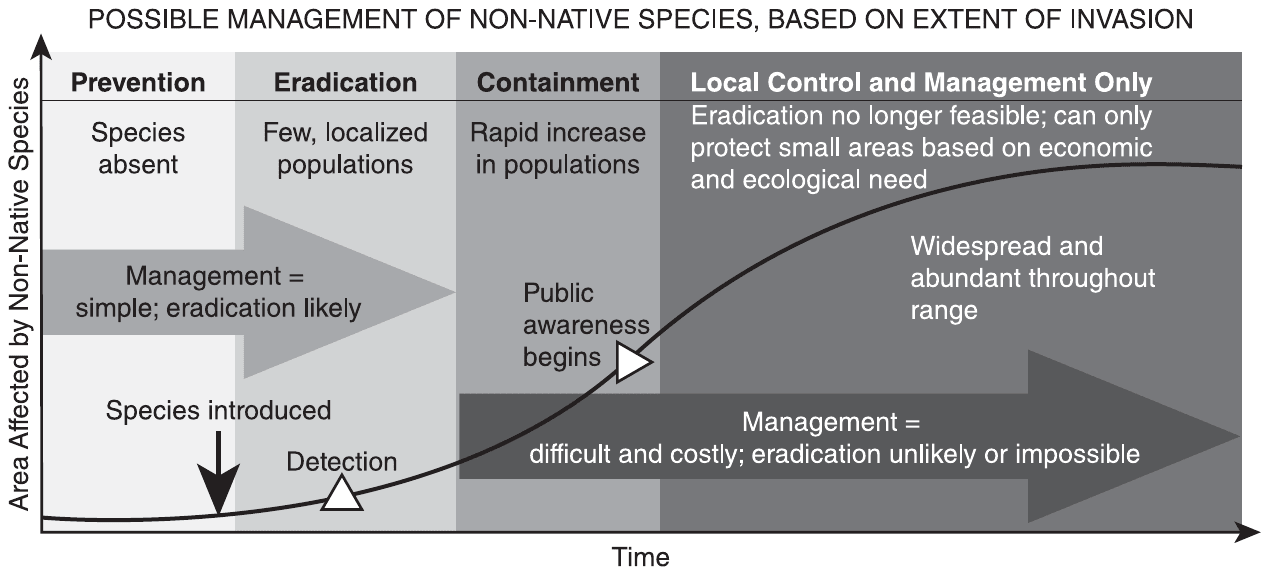
1stymie: hinder or interfere with
Question
Which sentence from the excerpt supports the conclusion that Elton’s “militaristic ‘invasion’ metaphor” (paragraph 1) has influenced scientific understanding of non-native species?
- A“Among [Olden’s] findings: a substantial number of them said they would immediately eradicate a hypothetical non-native forest plant, even if it were shown to have no effect on the forest.” (paragraph 5)
- B“Regardless of what we label them, conservationists will be reluctant to remove them from their new environs—to do so would stymie their chances of adapting to the warmer future we’re creating.” (paragraph 8)
- C“A project to rip out and poison the spartina—which grows in dense swaths that exclude many other shorebirds—saw clapper rail numbers go tumbling downward.” (paragraph 10)
- D“In some cases we can best serve biodiversity by leaving the non-natives alone or even—brace yourself, now—introducing them on purpose.” (paragraph 14)
Show the answer
Correct answer: A
The question asks which sentence from the excerpt supports the conclusion that Elton’s “militaristic ‘invasion’ metaphor” (paragraph 1) has influenced scientific understanding of non-native species.
A. CORRECT. This sentence shows that of the 2,000 ecologists Olden polled, many said they think it is right to “immediately eradicate” non-native plants even if they are demonstrably harmless in their new environment. The response of these ecologists supports that Elton’s metaphor discussed in paragraph 1 has influenced scientific understanding.
B. Incorrect. Rather than supporting the idea that the militaristic metaphor has influenced scientists, this sentence shows that conservationists, at any rate, are happy to let non-native species thrive wherever they can, given global warming.
C. Incorrect. While this sentence does refer to efforts to eradicate a non-native species, the main point of it is that these efforts ended up harming a native species (the clapper rail shorebird).
D. Incorrect. In contrast to supporting the idea that the militaristic invasion metaphor has influenced scientific understanding of non-native species, this sentence puts forth the bold idea of treating non-native species as something to be welcomed.
Question analysis
This evidence question asks which sentence from an opinion article about non-native species supports the conclusion that ecologist Charles Elton's war-like “invasion” metaphor has shaped how scientists think. Students must work out what attitude the metaphor implies and then judge which quotation shows that attitude at work in science.
- Grade level
- Grade 8 reading and task
- Compared with grade 7
- At grade 7 Finding evidence for a stated conclusion is grade 7 work. This conclusion is abstract, about a metaphor's influence on thinking, and the vocabulary, such as eradicate and environs, adds load, but the choices are fairly distinct.
- Estimated difficulty
- Moderate: several steps, or a close reading with one strong distractor.
- Thinking it demands
- Depth of knowledge 2, skills and concepts · mainly evaluate
- What makes it hard
- Reading between the lines moderate
- Hard words minor
- Evidence
- Answered from several paragraphs or stanzas
- Reading level
- Passage: about grade 11, 815 words; question and choices: about grade 16, 135 words.
- Corrected from the DOE handbook
- A wording slip in the explanation was corrected.
- Students, last 30 days
- Not enough answers yet to show (it takes 10).
Why it is hard, traps and wrong answers (shows the answer)
Why it is hard
The conclusion is abstract, that a figure of speech shaped how scientists think, so the student has to translate it into behavior: treating every non-native as an enemy to destroy. The spartina sentence describes exactly that kind of attack, which makes it tempting, but its point is the harm the attack did to a native bird. Two other sentences show conservationists and the author moving away from the invasion view, the opposite of what is asked.
Reading between the lines moderate Working it out
The right sentence never mentions Elton or war; eradicating a plant even when it is “shown to have no effect” must be recognized as the invasion mindset, which Olden calls “guilty even when proven innocent”. (Graesser, Singer & Trabasso, 1994; Kintsch, 1998)
Hard words minor Understanding the question
“Militaristic”, “eradicate”, “environs” and “stymie” all appear in the stem or the choices, and only “stymie” is footnoted. (Perfetti, 2007; Freedle & Kostin, 1993)
Strategy: Work out what attitude the invasion metaphor encourages toward non-native species, then test each sentence for evidence that scientists hold that attitude.
Traps
- Supports only part of the claim: In a question about evidence: a line that backs one half of the claim but not the other, or a related point rather than the claim itself.
The wrong answers, classified
B Supports only part of the claim (King et al., 2004; Thissen, Steinberg & Fitzpatrick, 1989)
Picks a sentence about labels and conservationists, but it says they would hesitate to remove species moving with the climate, the opposite of the war-like attitude in question.
C Supports only part of the claim (King et al., 2004; Thissen, Steinberg & Fitzpatrick, 1989)
Spots a war-like campaign, ripping out and poisoning spartina, but the sentence's point is that removal hurt the clapper rail, and it says nothing about how scientists think.
D Supports only part of the claim (King et al., 2004; Thissen, Steinberg & Fitzpatrick, 1989)
Chooses the author's case for leaving non-natives alone or even introducing them, which shows thinking turning against the invasion metaphor, not shaped by it.
What was corrected from the DOE handbook, and why
- Explanation: The handbook reads “many said they think it is right to “immediately eradicate” non-native species plants.” Paragraph 5 is about “a hypothetical non-native forest plant,” so the explanation now reads “non-native plants.”
Working it out, step by step
Unpack the conclusion
A metaphor describes one thing as if it were another. In paragraph 1, Elton called the spread of non-native species an “invasion,” as if they were an enemy army. Militaristic means having to do with war. So the conclusion says this war-like way of talking has shaped how scientists think about non-native species.
Picture that way of thinking
If you see a species as an invader, you treat it as an enemy. You want to get rid of it, whether or not it does any harm. So look for a sentence that shows scientists thinking this way.
Find the scientists’ answers
Paragraph 5 describes a poll of nearly 2,000 ecologists, scientists who study living things and where they live. Many said they would “immediately eradicate,” or wipe out, a non-native plant. They would do it “even if it were shown to have no effect on the forest.” The plant would do no harm, yet they would destroy it. Olden calls this “guilty even when proven innocent.”
Check each choice
- A fits: scientists would destroy a harmless plant just because it is non-native, which is the invasion way of thinking.
- B is wrong because conservationists being reluctant, or unwilling, to remove species is the opposite attitude.
- C is wrong because its point is that removing the grass hurt a native bird, not what scientists believe.
- D is wrong because the author argues for leaving non-natives alone, which goes against the invasion idea.
Watch out: C describes an attack on a plant, so it sounds war-like. But it tells what happened, not how scientists think.
Choose the answer
Only A shows scientists treating a non-native species as an enemy, even when it is harmless. So the answer is A.
Why this answer and not the closest wrong one
C comes closest, because ripping out and poisoning a plant looks like the war the metaphor describes. But the sentence reports that this harmed the clapper rail. It doesn’t show what scientists believe. A shows many ecologists ready to destroy even a harmless plant, which is the invasion way of thinking at work.
More questions like this
The original DOE question
The passage “Excerpt from “It’s Time to Stop Thinking That All Non-Native Species Are Evil”” as printed (pages 68–70)
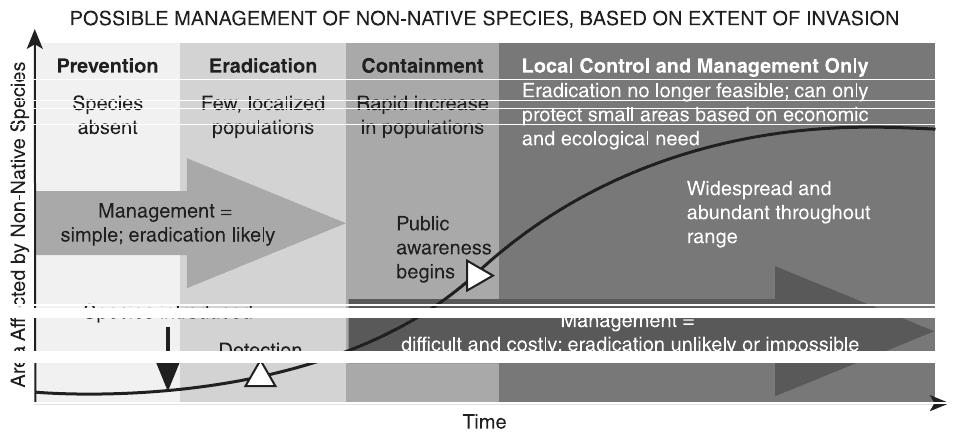
Question 36 of 59
2024 Test A English, question 52Uses the passage above: “Excerpt from “It’s Time to Stop Thinking That All Non-Native Species Are Evil””.
Question
Which detail provides the most relevant support for the claim that “climate change is making it harder even to decide who the invaders are” (paragraph 7)?
- Athe mention in paragraph 8 of non-native species that are forced to seek new habitats
- Bthe acknowledgment in paragraph 9 that non-native species include many domestic crops
- Cthe description in paragraph 11 of the interactions between native and non-native species
- Dthe account in paragraph 13 of an ecologist who changed his beliefs about non-native species
Show the answer
Correct answer: A
The question asks which detail provides the most relevant support for the claim that “climate change is making it harder even to decide who the invaders are” (paragraph 7).
A. CORRECT. The fact that many plants and animals have no choice but to seek out “climate conditions they can tolerate” (paragraph 8) makes it much harder to decide whether to call these species invaders.
B. Incorrect. The fact that many domestic crops are non-native species has nothing to do with climate change affecting our discernment of which species are invaders.
C. Incorrect. The description in paragraph 11 of native and non-native species interacting never suggests that climate change is a factor in these interactions and never suggests that climate change muddies our understanding of which species is native and which is non-native.
D. Incorrect. While the example of Mark Davis so thoroughly changing his beliefs about non-native species is a powerful one, the role that climate change might have played in this reversal is never discussed.
Question analysis
Here students choose the detail that gives the most relevant support to the claim that climate change is making it harder even to decide which species are invaders, in an article rethinking non-native species. Each choice names a paragraph, and the article gives several different reasons to question the label, so every detail must be checked against the whole claim.
- Grade level
- Grade 7 reading and task
- Compared with grade 7
- Below grade 7 Judging which detail supports a claim is grade 7 argument work, but here the choices name their paragraphs, the claim is short and specific, and only one key idea must be matched, so the task is lighter than typical.
- Estimated difficulty
- Straightforward: two steps or one careful reading.
- Thinking it demands
- Depth of knowledge 2, skills and concepts · mainly evaluate
- What makes it hard
- Evidence
- Answered from one paragraph or stanza
- Reading level
- Passage: about grade 11, 815 words; question and choices: about grade 11, 76 words.
- Students, last 30 days
- Not enough answers yet to show (it takes 10).
Why it is hard, traps and wrong answers (shows the answer)
Why it is hard
The claim has two parts, climate change as the cause and blurred labels as the effect, and every wrong detail muddies the word “invader” without any help from the climate. Crops, helpful partnerships and a converted invasion biologist all complicate the label, so a student who checks only the effect finds four plausible answers. Only paragraph 8 talks about a warming planet.
Every choice must be checked minor Choosing the answer
The choices describe paragraphs instead of quoting them, so each of paragraphs 8, 9, 11 and 13 must be reread for a link to climate. (Embretson & Wetzel, 1987)
The right answer is reworded minor Choosing the answer
The right choice says “forced to seek new habitats” where paragraph 8 says species are moving “toward the poles or up mountainsides in search of climate conditions they can tolerate”. (Freedle & Kostin, 1993; Kirsch & Mosenthal, 1990)
Strategy: Name the cause and the effect in the claim, then test each detail for both; a detail that fits only one part is not the most relevant support.
Traps
- Supports only part of the claim: In a question about evidence: a line that backs one half of the claim but not the other, or a related point rather than the claim itself.
The wrong answers, classified
B Supports only part of the claim (King et al., 2004; Thissen, Steinberg & Fitzpatrick, 1989)
Points to crops as non-natives people like, which complicates the label “invader”, but paragraph 9 never connects them to a changing climate.
C Supports only part of the claim (King et al., 2004; Thissen, Steinberg & Fitzpatrick, 1989)
Picks the helpful pairings of native and non-native species in paragraph 11, which blur good and bad but have nothing to do with a warming planet.
D Supports only part of the claim (King et al., 2004; Thissen, Steinberg & Fitzpatrick, 1989)
Chooses Mark Davis's turn away from invasion biology, a striking change of mind that nothing in paragraph 13 ties to climate change.
Working it out, step by step
Split the claim into two parts
This asks for the detail that best supports a claim. The claim has a cause and an effect. The cause is climate change. The effect is that it is harder to tell which species are invaders. The best support must connect both parts.
Find where climate comes up
Paragraph 8 comes right after the claim, and it talks about “a warming planet.” Plants and animals “are already moving toward the poles or up mountainsides in search of climate conditions they can tolerate.” To tolerate means to be able to live with. As places get hotter, many species move to cooler ones.
See why the labels get harder
When a species moves to a new place, it is not native there. But it didn’t really invade. Heat pushed it out of its old home. So scientists ask whether such species should be called invasive “in their new homes.” Climate change blurs the line between native and invader.
Check each choice
- A fits: species forced to move by the climate link the cause to the effect.
- B is wrong because crops are non-natives people like, but paragraph 9 never mentions climate.
- C is wrong because the helpful pairings in paragraph 11 have nothing to do with climate change.
- D is wrong because nothing ties Mark Davis’s change of mind to a warming planet.
Watch out: B, C and D all make the word invader less clear. But only A shows climate change doing it.
Choose the answer
Only A shows climate change making the word invader hard to apply. So the answer is A.
Why this answer and not the closest wrong one
B comes closest, since crops are non-natives we welcome, and that does complicate the word invader. But paragraph 9 says nothing about climate. A has both parts of the claim: a warming planet, and species that end up in new homes where the old labels don’t fit.
More questions like this
The original DOE question
Question 37 of 59
2024 Test A English, question 54Uses the passage above: “Excerpt from “It’s Time to Stop Thinking That All Non-Native Species Are Evil””.
Question
Which sentence from the excerpt supports the idea that some species are able to adjust to change?
- A“Native gardens have become increasingly popular, both as ways to celebrate the unique flora of each region and as tiny hot spots of diversity.” (paragraph 3)
- B“Many native (and beautiful) Hawaiian flowers are now pollinated by the Japanese white-eye bird—because the native pollinators have been driven extinct by other non-native species.” (paragraph 11)
- C“After all, nativeness is just one environmental value, and arguably not as important as preventing extinctions and preserving biodiversity.” (paragraph 14)
- D“The islands lost their own large tortoises, and the fruiting plants that formerly had their seeds moved around by these fruit-loving reptiles have been on the decline.” (paragraph 15)
Show the answer
Correct answer: B
The question asks which sentence from the excerpt supports the idea that some species are able to adjust to change.
A. Incorrect. This sentence discusses native gardens, featuring native species, which presumably have no need to adjust to change.
B. CORRECT. This sentence demonstrates that some species—in this case, Hawaiian flowers—have adapted well to change: the flowers thrive thanks to new pollinators.
C. Incorrect. This sentence focuses on the importance of “preventing extinctions and preserving biodiversity” but does not address the fact that being able to adjust to change is one thing that helps achieve those goals.
D. Incorrect. Far from demonstrating that some species can adjust to change, this sentence discusses species that were not adjusting to the loss of large tortoises and were therefore “on the decline.”
Question analysis
Using an article that argues not every non-native species is harmful, this evidence question asks students to pick the sentence showing that some species are able to adjust to change. Students must decide what adjusting to change would look like in nature, then find a quotation that actually shows a species doing it.
- NYS standards
- 7R1 textual evidence and inferences
- Grade level
- Grade 7 reading and task
- Compared with grade 7
- At grade 7 Selecting a sentence that supports an idea is typical grade 7 evidence work. The quotations are labeled, but the idea is stated generally and must be recognized inside a specific ecological example, a small inference that keeps the item at grade level.
- Estimated difficulty
- Moderate: several steps, or a close reading with one strong distractor.
- Thinking it demands
- Depth of knowledge 2, skills and concepts · mainly evaluate
- What makes it hard
- Reading between the lines moderate
- A very close wrong answer moderate
- Evidence
- Answered from one sentence or line
- Reading level
- Passage: about grade 11, 815 words; question and choices: about grade 14, 117 words.
- Students, last 30 days
- Not enough answers yet to show (it takes 10).
Why it is hard, traps and wrong answers (shows the answer)
Why it is hard
The idea is general and every choice is specific, so the student must recognize adjustment inside an ecological example. The Mauritius sentence is the trap: the paragraph it comes from ends with a new tortoise taking over, which is adjustment, but the quoted sentence stops at the decline. Judging only the words quoted, and asking whether a species carried on after a change, separates the two.
Reading between the lines moderate Working it out
The right sentence never says “adjust”; Hawaiian flowers now pollinated by a newcomer after their native pollinators died out must be recognized as species coping with a change. (Graesser, Singer & Trabasso, 1994; Kintsch, 1998)
A very close wrong answer moderate Choosing the answer
The Hawaiian sentence and the Mauritius sentence both describe plants losing the animals that served them; they part on the outcome, a new pollinator or a decline. (Embretson & Wetzel, 1987; Gorin & Embretson, 2006; Ascalon et al., 2007)
Strategy: For each quotation, ask whether a species faces a change and whether the sentence shows it carrying on successfully; judge only the words quoted.
Traps
- Supports only part of the claim: In a question about evidence: a line that backs one half of the claim but not the other, or a related point rather than the claim itself.
- True but not the answer: A choice says something accurate about the text that does not answer this question.
The wrong answers, classified
A True but not the answer (King et al., 2004; Embretson & Wetzel, 1987)
Picks the popularity of native gardens, which is about what people plant and celebrate, not about any species coping with a change in its world.
C True but not the answer (King et al., 2004; Embretson & Wetzel, 1987)
Chooses the author's ranking of nativeness below preventing extinctions, a statement of values that shows no species adapting to anything.
D Supports only part of the claim (King et al., 2004; Thissen, Steinberg & Fitzpatrick, 1989)
Remembers that a new tortoise later took over seed-spreading on Mauritius, but the quoted sentence shows only the change, plants declining after their tortoises vanished, not any adjustment.
Working it out, step by step
Know what the question asks
To adjust to change means to keep going when something important in your world changes. You need a sentence that shows a species facing a change and carrying on. Judge only the words in each quoted sentence.
Look for a change
Choice B says the native pollinators of some Hawaiian flowers “have been driven extinct.” Extinct means gone forever. Pollinators are animals that carry pollen between flowers so the plants can make seeds. Losing them is a huge change for the flowers.
Look for the adjustment
The same sentence says the flowers “are now pollinated by the Japanese white-eye bird.” A new bird does the job the old pollinators used to do. So the flowers carried on after the change. That is adjusting.
Check each choice
- B fits: the flowers lost their pollinators and gained a new one.
- A is wrong because native gardens are about what people like to plant, and no species adjusts to anything.
- C is wrong because it states the author’s values and shows no species at all.
- D is wrong because the plants “have been on the decline,” which means they are getting fewer, not adjusting.
Watch out: Later in paragraph 15, a new tortoise takes over some of the lost tortoises’ work. But the sentence in D stops at the decline.
Choose the answer
Only B shows a species carrying on after a big change. So the answer is B.
Why this answer and not the closest wrong one
D comes closest, because it also shows plants losing the animals that helped them. But D’s sentence ends with the plants in decline. B’s sentence goes further: a new bird now does the work, so the flowers carry on. That is a species adjusting to change.
More questions like this
The original DOE question
Question 38 of 59
2024 Test B English, question 20Passage Excerpt from “How Exercise Could Help You Learn a New Language”
Excerpt from “How Exercise Could Help You Learn a New Language”
by Gretchen Reynolds
Many scientists suspect that exercise alters the biology of the brain in ways that make it more malleable and receptive to new information, a process that scientists refer to as plasticity.
But many questions have remained unanswered about movement and learning, including whether exercise is most beneficial before, during or after instruction and how much and what types of exercise might be best.
So for a new study, which was published recently in PLOS One, researchers in China and Italy decided to home in on language learning and the adult brain.
Language learning is interesting. As young children, almost all of us picked up our first language easily. We didn’t have to be formally taught; we simply absorbed words and concepts.
But by early adulthood, the brain generally begins to lose some of its innate language capability. It displays less plasticity in areas of the brain related to language. As a result, for most of us, it becomes harder to learn a second language after childhood.
To see what effects exercise might have on this process, the researchers first recruited 40 college-age Chinese men and women who were trying to learn English. The students had some facility with this second language but were far from proficient.
The researchers then divided the students into two groups. Those in one group would continue to learn English as they had before, primarily while seated in rote vocabulary-memorization sessions.
The others would supplement these sessions with exercise.
Specifically, the students would ride exercise bikes at a gentle pace (about 60 percent of their maximum aerobic capacity) beginning 20 minutes before the start of the lessons and continuing throughout the 15 minutes or so of instruction.
Both groups learned their new vocabulary by watching words projected onto large screens, together with comparable pictures, such as “apple” and a Red Delicious. They were shown 40 words per session, with the sequence repeated several times.
Afterward, the students all rested briefly and then completed a vocabulary quiz, using computer keys to note as quickly as possible whether a word was with its correct picture. They also responded to sentences using the new words, marking whether the sentences were accurate or, in the case of “The apple is a dentist,” nonsensical. Most linguists1 feel that understanding sentences shows greater mastery of a new language than does simple vocabulary improvement.
The students completed eight vocabulary sessions over the course of two months.
And at the end of each lesson, the students who had ridden bikes performed better on the subsequent vocabulary tests than did the students who sat still.
They also became more proficient at recognizing proper sentences than the sedentary students, although that difference did not emerge until after several weeks of instruction.
Perhaps most interesting, the gains in vocabulary and comprehension lingered longest for the cyclists. When the researchers asked the students to return to the lab for a final round of testing a month after the lessons—without practicing in the meantime—the cyclists remembered words and understood them in sentences more accurately than did the students who had not moved.
“The results suggest that physical activity during learning improves that learning,” says Simone Sulpizio, a professor of psychology and linguistics at the University Vita-Salute San Raffaele in Milan, Italy, and a study co-author.
These improvements extend beyond simply aiding in memorization, she added. The exercise also deepened language learners’ grasp of how to use their newly acquired words.
This study involved college students performing relatively light exercise, though, and cannot tell us whether other people completing other types of exercise would achieve the same results.
It also offers no clues about what is occurring inside the brain that might be contributing to the benefits of the exercise. But many past studies have shown that exercise prompts the release of multiple neurochemicals in the brain that increase the number of new brain cells and the connections between neurons, Dr. Sulpizio says. These effects improve the brain’s plasticity and augment the ability to learn.
From a real-world standpoint, the study’s implications might seem at first to be impractical. Few classrooms are equipped with stationary bicycles. But specialized equipment is probably unnecessary, Dr. Sulpizio says.
“We are not suggesting that schools or teachers buy lots of bicycles,” she says. “A simpler take-home message may be that instruction should be flanked by physical activity.”
From “How Exercise Could Help You Learn a New Language” by Gretchen Reynolds from THE NEW YORK TIMES, August 16, 2017. Copyright © 2017 The New York Times Company.
1linguists: scientists who study language
Question
Read these sentences from paragraph 17.
These improvements extend beyond simply aiding in memorization, she added. The exercise also deepened language learners’ grasp of how to use their newly acquired words.
Which sentence from the excerpt best explains why Sulpizio feels confident in the conclusion stated in these sentences?
- A“They were shown 40 words per session, with the sequence repeated several times.” (paragraph 10)
- B“They also responded to sentences using the new words, marking whether the sentences were accurate or, in the case of ‘The apple is a dentist,’ nonsensical.” (paragraph 11)
- C“And at the end of each lesson, the students who had ridden bikes performed better on the subsequent vocabulary tests than did the students who sat still.” (paragraph 13)
- D“They also became more proficient at recognizing proper sentences than the sedentary students, although that difference did not emerge until after several weeks of instruction.” (paragraph 14)
Show the answer
Correct answer: D
The question asks which sentence from the excerpt best supports Sulpizio’s assertion in paragraph 17 that exercise went beyond helping with memorization to deepen the language learners’ ability to use new vocabulary.
A. Incorrect. This sentence merely describes what the language-learning sessions were like, without making any claims about how the exercise affected the subjects’ understanding of how to use new words.
B. Incorrect. While this sentence does address the fact that learners were required to think about how the new words should be used rather than just memorizing the words, it does not discuss results such as how the exercise affected their ability to do this.
C. Incorrect. This sentence establishes only that exercise helped with the memorization of new words, not that exercise deepened learners’ grasp of how to use the new words.
D. CORRECT. The fact that learners who exercised were better at identifying when the new words were used correctly in sentences directly supports Sulpizio’s assertion that the exercise deepened their grasp of how to use the new words.
Question analysis
This textual evidence question quotes Simone Sulpizio’s conclusion that exercise did more than help learners memorize new English words. Students choose the sentence from the article that best explains why she can be confident of it. All four choices come from the article’s account of the study, so students must match evidence to the exact claim rather than to its general topic.
- Grade level
- Grade 8 reading and task
- Compared with grade 7
- Above grade 7 Grade 7 evidence questions usually match a quotation to a stated claim. This claim has two parts, gains beyond memorizing and a better grasp of usage, and two quotations touch it closely, a sharper test than typical grade 7 work.
- Estimated difficulty
- Hard: combines ideas, needs a plan, and has more than one tempting wrong answer.
- Thinking it demands
- Depth of knowledge 3, strategic thinking · mainly evaluate
- What makes it hard
- A very close wrong answer major
- Reading between the lines moderate
- Evidence in several places minor
- Evidence
- Answered from several paragraphs or stanzas
- Reading level
- Passage: about grade 11, 764 words; question and choices: about grade 11, 142 words.
- Students, last 30 days
- Not enough answers yet to show (it takes 10).
Why it is hard, traps and wrong answers (shows the answer)
Why it is hard
Sulpizio’s claim has two parts, gains beyond memorizing and a better grasp of using words, and two of the quotations each touch one part. The vocabulary result is real evidence that exercise helped, but of the very memorizing she says the gains went beyond, and the sentence-task description mentions using words but reports no result. Only a result about sentences proves the claim, so the question rewards asking of each line what it shows, not what it is about.
A very close wrong answer major Choosing the answer
The vocabulary-test result in paragraph 13 and the sentence result in paragraph 14 are worded alike, cyclists outperforming students who sat still; only the skill measured, memorizing words or using them, separates them. (Embretson & Wetzel, 1987; Gorin & Embretson, 2006; Ascalon et al., 2007)
Reading between the lines moderate Working it out
Students must map the claim’s two halves onto the study’s two measures: vocabulary tests show memorization, and recognizing proper sentences shows the “grasp of how to use” new words. (Graesser, Singer & Trabasso, 1994; Kintsch, 1998)
Evidence in several places minor Working it out
The four quotations come from paragraphs 10, 11, 13 and 14, and each must be weighed against a claim made later, in paragraph 17. (Kirsch & Mosenthal, 1990; Gorin & Embretson, 2006)
Strategy: Pin down what the quoted claim says the exercise achieved, then test each sentence by asking whether it reports a result that proves that specific achievement.
Traps
- Supports only part of the claim: In a question about evidence: a line that backs one half of the claim but not the other, or a related point rather than the claim itself.
- True but not the answer: A choice says something accurate about the text that does not answer this question.
The wrong answers, classified
A True but not the answer (King et al., 2004; Embretson & Wetzel, 1987)
Picks a sentence about how the lessons were run, 40 words repeated several times, accurate but silent on what the exercise did for the learners.
B Supports only part of the claim (King et al., 2004; Thissen, Steinberg & Fitzpatrick, 1989)
Matches the claim’s focus on using words to the sentence-judging task, but this line only describes the task and reports no result showing that exercise helped.
C Supports only part of the claim (King et al., 2004; Thissen, Steinberg & Fitzpatrick, 1989)
Picks a real finding in favor of the cyclists, but better vocabulary-test scores show only the memorizing that Sulpizio says the gains went beyond.
Working it out, step by step
Figure out what the question asks
Sulpizio says the exercise did more than help students memorize words. It “deepened language learners’ grasp of how to use their newly acquired words.” A grasp is an understanding. You need the sentence that best proves this claim. Proof should be a result, not just a description.
Break the claim into two parts
- Part 1: the gains went “beyond simply aiding in memorization.” Memorization is learning words by heart.
- Part 2: the cyclists got better at using the words.
So the proof must show the bike riders did better with words in sentences. A test that only checks memory won’t prove it.
Check each choice
- A (paragraph 10) tells how many words were shown. It gives no result.
- B (paragraph 11) describes the sentence task. But it doesn’t say who did better.
- C (paragraph 13) is a result. But it is about “vocabulary tests,” which check memory. That is the part she says the gains went beyond.
- D (paragraph 14) says the cyclists “became more proficient at recognizing proper sentences than the sedentary students.” Proficient means skilled. Sedentary means sitting still. That is a result about using words.
Pick the answer
Watch out: C is very tempting. It shows that exercise helped. But it proves the wrong kind of help. Only one choice shows the cyclists did better at using words in sentences. So the answer is D.
Why this answer and not the closest wrong one
C is the closest wrong answer. Both C and D say the bike riders beat the students who sat still. The difference is the skill that was tested. C’s vocabulary tests show memory. D’s sentence test shows the learners knew how to use the words, which is exactly Sulpizio’s claim.
More questions like this
The original DOE question
The passage “Excerpt from “How Exercise Could Help You Learn a New Language”” as printed (pages 171–172)
Question 39 of 59
2024 Test B English, question 22Uses the passage above: “Excerpt from “How Exercise Could Help You Learn a New Language””.
Question
Which evidence from the excerpt is most relevant to the author’s claim that there are many unanswered questions about the relationship between movement and learning?
- Athe method of the study using one type of exercise and people from one age group
- Bthe statement from Sulpizio explaining past studies on neurochemicals in the brain
- Cthe finding of the study that exercise helps people recall information over a long period of time
- Dthe statement from Sulpizio describing how the results of the study can be applied
Show the answer
Correct answer: A
The question asks which evidence from the excerpt is most relevant to the author’s claim that there are many unanswered questions about the relationship between movement and learning.
A. CORRECT. While the study revealed that the college students who used exercise bikes did better in their language learning, paragraph 18 indicates that we cannot know “whether other people completing other types of exercise would achieve the same results,” suggesting that there are many unknowns about the relationship between movement and learning.
B. Incorrect. Rather than supporting the claim that there are many unanswered questions about the relationship between movement and learning, this statement offers a possible explanation as to why exercise might improve learning.
C. Incorrect. The finding that exercise helps people retain their language learning longer (paragraph 15) adds to our understanding of the relationship between movement and learning rather than supporting the claim that there are still many unanswered questions.
D. Incorrect. Sulpizio’s statement that the study suggests that “ ‘instruction should be flanked by physical activity’ ” (paragraph 21) does not in any way address the issue of unanswered questions about movement and learning.
Question analysis
This evidence question asks which part of the exercise and language-learning article is most relevant to the author’s early claim that many questions about movement and learning remain unanswered. The choices describe parts of the article in general terms rather than quoting them, so students must locate each one and judge how it bears on that claim.
- Grade level
- Grade 8 reading and task
- Compared with grade 7
- Above grade 7 Grade 7 students trace claims and judge whether evidence is relevant. Here the claim appears early, the evidence is described in summary rather than quoted, and students must see an indirect link across the article, which demands more than usual.
- Estimated difficulty
- Hard: combines ideas, needs a plan, and has more than one tempting wrong answer.
- Thinking it demands
- Depth of knowledge 3, strategic thinking · mainly evaluate
- What makes it hard
- Reading between the lines moderate
- Evidence in several places moderate
- Evidence
- Answered from several paragraphs or stanzas
- Reading level
- Passage: about grade 11, 764 words; question and choices: about grade 11, 84 words.
- Students, last 30 days
- Not enough answers yet to show (it takes 10).
Why it is hard, traps and wrong answers (shows the answer)
Why it is hard
The choices describe evidence instead of quoting it, so each must first be located and then weighed against a claim made near the start of the article. The trap is the neurochemical statement: its paragraph begins by admitting what the study cannot show, but the statement itself offers an answer from past research. The key is easy to undervalue because it sounds like a plain description of the method, until it is linked to paragraph 18’s account of what the study cannot tell us.
Reading between the lines moderate Working it out
The right choice names a method, not a question; students must see that one light exercise tried on college students leaves open paragraph 2’s “what types of exercise might be best,” as paragraph 18 says. (Graesser, Singer & Trabasso, 1994; Kintsch, 1998)
Evidence in several places moderate Working it out
The claim sits in paragraph 2, and the choices are short labels that must be traced to paragraphs 15, 18, 19 and 21 before any of them can be judged. (Kirsch & Mosenthal, 1990; Gorin & Embretson, 2006)
Strategy: Reread the claim in paragraph 2, then find where each choice’s material appears in the article and ask how directly it bears on that claim.
Traps
- True but not the answer: A choice says something accurate about the text that does not answer this question.
- Supports only part of the claim: In a question about evidence: a line that backs one half of the claim but not the other, or a related point rather than the claim itself.
The wrong answers, classified
B Supports only part of the claim (King et al., 2004; Thissen, Steinberg & Fitzpatrick, 1989)
Comes from paragraph 19, which opens with something the study cannot explain, but Sulpizio’s point about neurochemicals offers an answer from past research, not an open question.
C True but not the answer (King et al., 2004; Embretson & Wetzel, 1987)
Reads the claim as being about how movement and learning are related and picks a key finding, but lasting recall answers a question rather than showing one remains open.
D True but not the answer (King et al., 2004; Embretson & Wetzel, 1987)
Remembers Sulpizio’s practical advice to flank lessons with activity, a real statement that applies the findings and says nothing about what is still unknown.
Working it out, step by step
Figure out what the question asks
The author claims there are many unanswered questions about movement and learning. You need the evidence that best supports that claim. Evidence is the facts that back up a point. So look for something that shows a question is still open, not something that answers one.
Find the claim
Paragraph 2 says “many questions have remained unanswered about movement and learning.” It names some. One is whether exercise helps most “before, during or after instruction.” Another is “how much and what types of exercise might be best.” Instruction means teaching.
Find what the study left open
The study used one kind of exercise, light biking. It also used one age group, college students. Paragraph 18 says the study “cannot tell us whether other people completing other types of exercise would achieve the same results.” So the question of “what types of exercise” work best is still open. That is what choice A describes.
Check the other choices
- B: in paragraph 19, Sulpizio says past studies show exercise releases “neurochemicals,” or brain chemicals, that help learning. That offers an answer, not an open question.
- C: the finding in paragraph 15, that cyclists remembered words longer, answers a question.
- D: Sulpizio’s advice in paragraph 21 says how to use the results. It says nothing about what is still unknown.
Watch out: Paragraph 19 begins with something the study can’t explain, so B is tempting. But Sulpizio’s statement itself gives an explanation.
Pick the answer
Only the study’s narrow method shows that big questions remain. So the answer is A.
Why this answer and not the closest wrong one
B is the closest wrong answer, because its paragraph starts by admitting the study “offers no clues” about the brain. But Sulpizio then fills that gap with what past studies found. A points to what is truly still unknown: whether other people and other kinds of exercise would get the same results.
More questions like this
The original DOE question
Question 40 of 59
2024 Test B English, question 29Passage Excerpt from Do Them No Harm!
Excerpt from Do Them No Harm!
by Zoa L. Swayne
This narrative is about the Nez Perce, an American Indian tribe, in what is now northern Idaho. The tribe is preparing for a gathering before the coming winter.
In the moon of Ta-Yum, the hottest days of summer, when salmon spawn in the little streams and huckleberries ripen in the high mountains, people from many villages of the Chopunnish Nation gathered in the Oyaip Prairie for the work and festivities of their annual camas1 harvest.
From far and near The People came. . . .
Should a stranger enter their homeland and ask, “Where are you from?” the reply was always, “We are Nee-mee-poo, The People who live here in this place.”
It was a time of Lawtiwa-mah-ton—a time of being friends together—when The People came for this last chance to enjoy being together before the Cold Moons kept them close to their fires. The visiting and trading, the foot racing and horse racing, and the gambling and stick games would be remembered and talked about long after they had forgotten the drudgery of digging and roasting camas, picking berries, or drying meat and fish. Lawtiwa-mah-ton! It was good to be friends together.
As was their custom since wahk-kee-ma, a time far back beyond the memory of man, they set up their camps in the same locations their parents and grandparents had occupied before them. Red Bear’s people, from Kamiah, made their camp near the trail that came out of the mountains. Their neighbors in Kamiah Valley, The People from Tee-e-lap-a-lo, had their camp close by. Across the wide meadow, by the great roasting pits, the camps of the Te-wap-poo and Ask-kah-poo were located. The tepees and ish-nash, brush shelters, of other groups nestled in their accustomed areas in and among the pines in such numbers that they encircled the entire meadow land.
Red Bear’s people had traveled all summer with neighboring bands, gathering and preparing roots, picking and drying berries, drying and smoking meat and fish for their winter food supply. Now they were at the Oyaip camp. The women worked hard to dig and cure as many bags of roots as they could during the warm, sunny days, for the sharp night air brought warnings that WARM was going and COLD was coming.
Everyone helped in some way. Most of the men fished or hunted for meat. While many of the women dug and roasted camas, other women and older children picked and dried berries.
And the younger children played. They played at hunting. They played with the babies. They played with their horses and puppies. They learned how to live through their play.
This sun, happiness, peace, and quiet blessed the Red Bear camp. All were busy with their daily tasks, until sudden cries came from the children playing by the trail.
“People coming! People coming! People coming on the trail from the high mountains!” they called as they ran to their elders, who looked sharply at the figures of approaching horsemen.
Were they friends or enemies? Did they bring good news or bad?
“Who can it be? What brings them here?” were the questions in every mind.
“Could they be the four hunters who had gone to Buffalo Country two summers past? Would they have news of the families who had gone long ago to Buffalo Country and never returned?”
It was customary for a hunting party to be gone for more than one season.
“Looks like hunters,” the older men agreed. “Looks like they had good hunting. Maybe our four hunters. [They have] been gone many moons.”
“Looks like five people—not four,” others observed.
Excitement grew as the riders came close enough to be recognized.
“A-a-a-a-a, they are our four hunters! But who is the fifth person?” they asked.
“Looks like a woman. Who is she?”
The hunters rode up to the welcoming crowd, proud to show off the loads of meat, hides, and other trophies of their hunt. They paraded around the encampment for all to see how strong their Hunting Power had been—what great hunters they, themselves, were.
Red Bear’s people rejoiced at their hunters’ success. Good hunters brought good to everybody. The meat meant plenty of food and the hides meant soft-tanned robes to give comfort through the Cold Moons. But it was the sight of the frail figure of the woman that aroused their curiosity. Who was she? Where had she come from? . . .
“Belongs to Red Bear people. Gone then come back,” the hunters said, as they dismounted and unloaded their packs. . . .
Now they could see! She was the daughter of the family gone so long ago! The girl-child who had left came back now—a grown woman.
“Wat-ku-ese!” the women cried. “Gone-from-Home-then-Come-Back. Wat-ku-ese!” And Wat-ku-ese was her name from that time on.
Gentle arms lifted Wat-ku-ese from her horse. The women brought her food and made a place for her to rest. For many suns they cared for her until she became stronger.
One evening Wat-ku-ese told her story for all to hear.
From DO THEM NO HARM!: Lewis and Clark Among the Nez Perce by Zoa L. Swayne. Published by Caxton Press. Copyright © 1990 by Zoa L. Swayne. Orofino, Idaho and Legacy House, Inc. Orofino, Idaho. All rights reserved.
1camas: a wild, edible plant
Question
Which quotation from the excerpt best supports the idea that The People feel a connection to members of their group in spite of distance?
- A“As was their custom since wahk-kee-ma, a time far back beyond the memory of man, they set up their camps in the same locations their parents and grandparents had occupied before them.” (paragraph 5)
- B“ ‘Would they have news of the families who had gone long ago to Buffalo Country and never returned?’ ” (paragraph 13)
- C“ ‘Looks like hunters,’ the older men agreed. ‘Looks like they had good hunting.’ ” (paragraph 15)
- D“But it was the sight of the frail figure of the woman that aroused their curiosity.” (paragraph 21)
Show the answer
Correct answer: B
The question asks which quotation from the excerpt best supports the idea that The People feel a connection to members of their group in spite of distance.
A. Incorrect. This quotation describes the fact that The People always set up their camps in the same places their parents and grandparents used before them. This quotation highlights the customs The People continue from their ancestors, but it does not focus on their present personal connections.
B. CORRECT. This quotation alludes to The People’s eagerness to hear about the families who had traveled away from their group. This eagerness shows that they still feel a connection to these families, even though they are far apart.
C. Incorrect. This quotation describes The People’s analysis of the visitors—that they may be hunters. It does not show a connection to the visitors.
D. Incorrect. This quotation shows that The People are curious about a stranger who has come into their camp. It does not show closeness to distant members of the group.
Question analysis
This textual evidence question asks which quotation from the Nez Perce narrative best supports the idea that The People feel connected to members of their group even when those members are far away. The quotations come from across the excerpt, so students must make sure the one they choose fits both parts of that idea.
- Grade level
- Grade 7 reading and task
- Compared with grade 7
- At grade 7 Choosing the quotation that supports an idea is everyday grade 7 work. Here the idea joins two conditions, connection and distance, and the quotations come from across the excerpt, which keeps the demand at a solid grade 7 level.
- Estimated difficulty
- Moderate: several steps, or a close reading with one strong distractor.
- Thinking it demands
- Depth of knowledge 2, skills and concepts · mainly evaluate
- What makes it hard
- Reading between the lines moderate
- Every choice must be checked minor
- Evidence
- Answered from several paragraphs or stanzas
- Reading level
- Passage: about grade 5, 885 words; question and choices: about grade 9, 107 words.
- Corrected from the DOE handbook
- The explanation described one wrong choice's quotation inaccurately; that sentence was corrected.
- Students, last 30 days
- Not enough answers yet to show (it takes 10).
Why it is hard, traps and wrong answers (shows the answer)
Why it is hard
The idea joins two conditions, connection and distance, and the quotations satisfy them unevenly. The camp-location line shows a strong tie, but to ancestors across time rather than to members far away, and the line about the woman involves a returning member before anyone knows she is one. The right line is easy to pass over because it is a question, yet asking after families long gone shows they still matter.
Reading between the lines moderate Working it out
The right quotation is a question, not a statement of feeling; students must infer that asking for news of families “gone long ago” shows a bond that distance has not broken. (Graesser, Singer & Trabasso, 1994; Kintsch, 1998)
Every choice must be checked minor Choosing the answer
Each quotation has to pass two tests, a bond with group members and members who are far away, and the camp-location line passes only the first. (Embretson & Wetzel, 1987)
Strategy: Test each quotation against both parts of the idea: does it show a bond with group members, and does that bond reach people who are far away?
Traps
- Supports only part of the claim: In a question about evidence: a line that backs one half of the claim but not the other, or a related point rather than the claim itself.
- Reads too much in: A reasonable-sounding conclusion that goes further than the text allows.
The wrong answers, classified
A Supports only part of the claim (King et al., 2004; Thissen, Steinberg & Fitzpatrick, 1989)
Sees a bond in camping where parents and grandparents camped, but that ties The People to ancestors across time, not to members far away.
C Supports only part of the claim (King et al., 2004; Thissen, Steinberg & Fitzpatrick, 1989)
Remembers that the older men go on to say “Maybe our four hunters,” but the quoted words only judge the hunt and show no feeling for absent members.
D Reads too much in (Graesser, Singer & Trabasso, 1994)
Knows the woman turns out to be a lost member, but at this point no one knows who she is, so the curiosity is about a stranger, not a bond.
What was corrected from the DOE handbook, and why
- Explanation: Choice A quotes paragraph 5: The People “set up their camps in the same locations their parents and grandparents had occupied before them.” The handbook's explanation says the quotation describes them returning “to perform the same traditional tasks and enjoy the same festivities as their ancestors,” which the sentence doesn't say. The explanation now describes the quotation as it is. The reason A is wrong is unchanged: it shows a custom kept from their ancestors, not a connection to members who are far away. The answer, B, is unchanged.
Working it out, step by step
Figure out what the question asks
You need the quotation that best shows The People feel close to group members who are far away. The idea has two parts: a connection, and distance. The right quotation must show both.
Test each quotation on both parts
- A (paragraph 5): they camp where “their parents and grandparents” camped. That is a connection, but to people from the past, not to people far away.
- B (paragraph 13): “Would they have news of the families who had gone long ago to Buffalo Country and never returned?” These families are far away and long gone. The People still want news of them.
- C (paragraph 15): the men only guess that the riders are hunters who had a good hunt. They show no feeling for anyone.
- D (paragraph 21): The People are curious about the woman. They don’t know yet that she is one of them.
See why B shows a connection
You only ask for news about people you care about. The families left “long ago.” They went to Buffalo Country, far from the camp. Yet The People still wonder about them. So time and distance have not broken the bond.
Pick the answer
Watch out: A shows a strong bond too, so it is tempting. But it ties The People to their parents and grandparents, across time. It is not about members who are far away. So the answer is B.
Why this answer and not the closest wrong one
A is the closest wrong answer, because camping where parents and grandparents camped shows a strong tie. But that tie stretches across years, not across distance. B is about families who went far away “long ago,” and The People still want news of them. Only B passes both tests.
More questions like this
The original DOE question
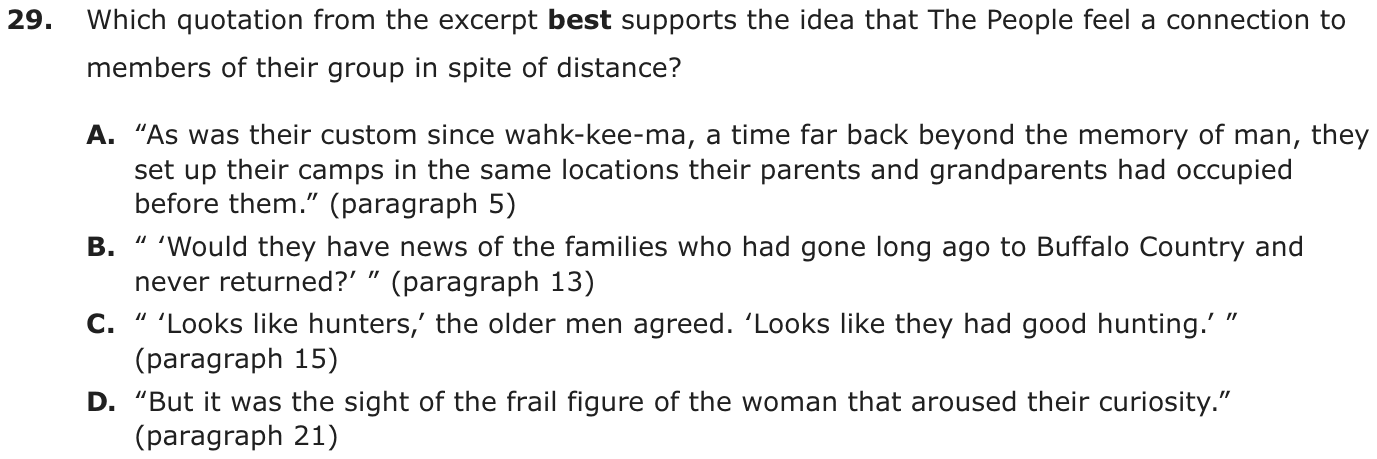
The passage “Excerpt from Do Them No Harm!” as printed (pages 177–178)
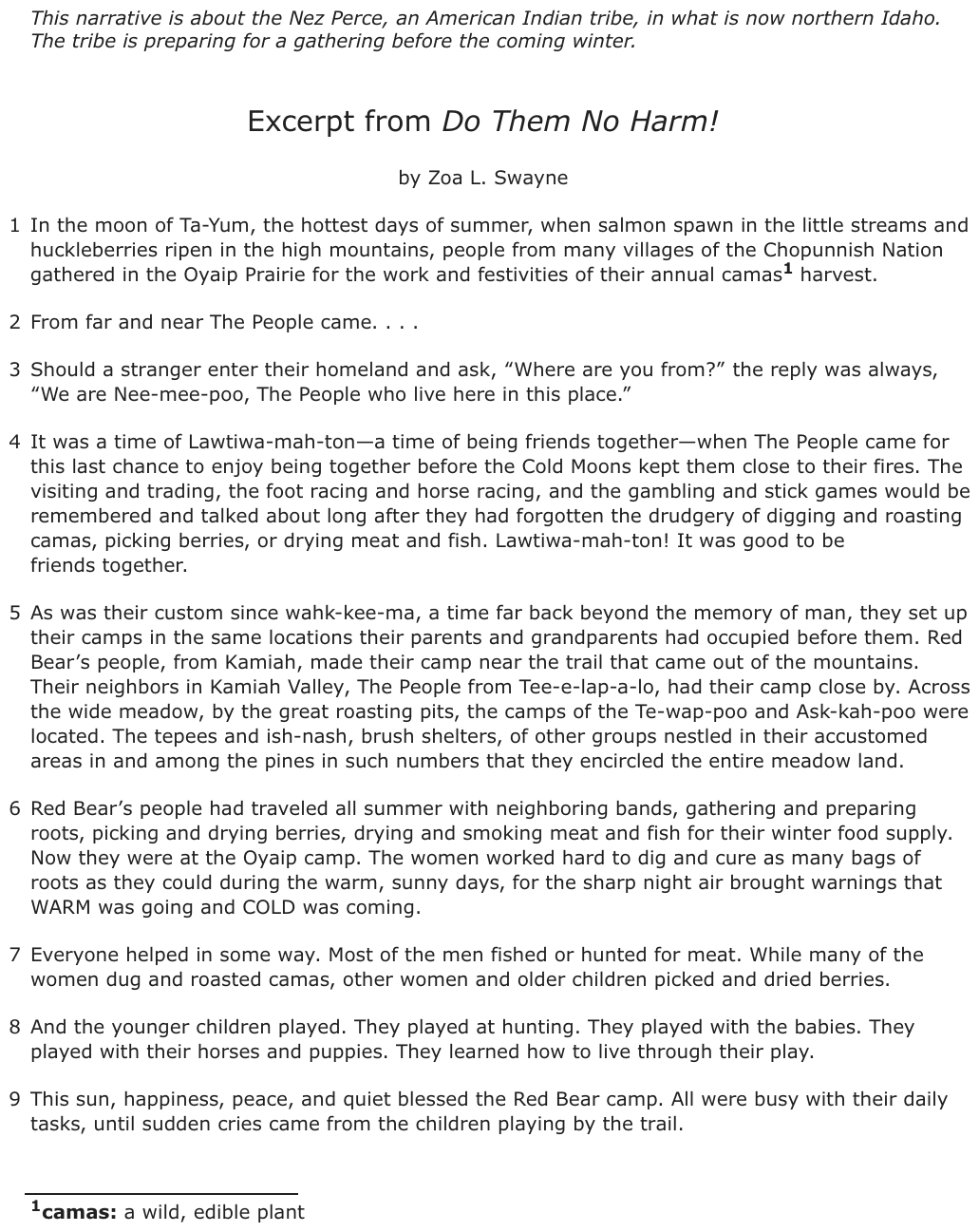
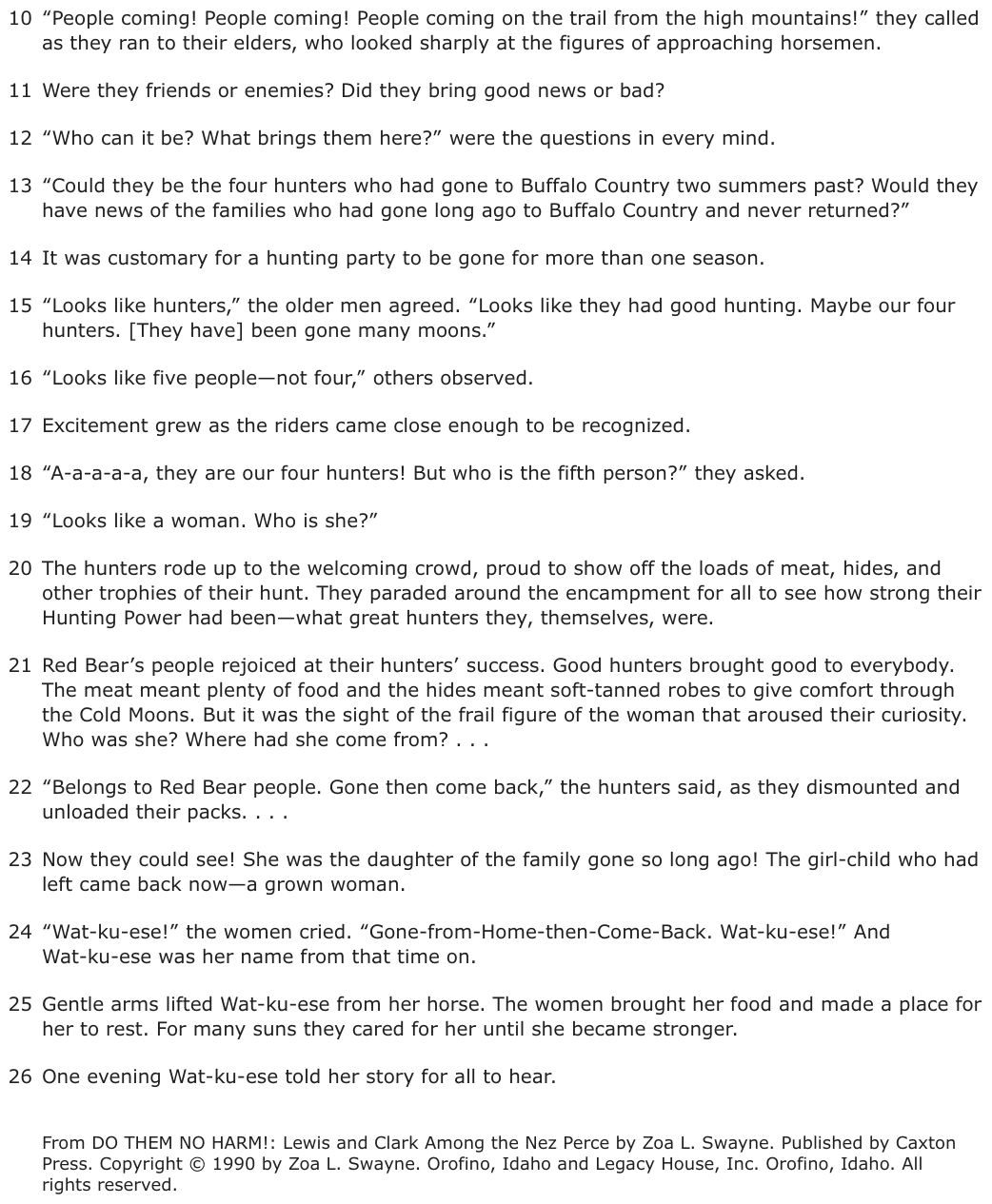
Question 41 of 59
2024 Test B English, question 44Passage Snowy Mountains
Snowy Mountains
by John Gould Fletcher
Higher and still more high,
Palaces made for cloud,
Above the dingy city-roofs
Blue-white like angels with broad wings,
Pillars of the sky at rest
The mountains from the great plateau
Uprise.
But the world heeds them not;
They have been here now for too long a time.
The world makes war on them,
Tunnels their granite cliffs,
Splits down their shining sides,
Plasters their cliffs with soap-advertisements,
Destroys the lonely fragments of their peace.
Vaster and still more vast,
Peak after peak, pile after pile,
Wilderness still untamed,
To which the future is as was the past,
Barrier spread by Gods,
Sunning their shining foreheads,
Barrier broken down by those who do not need
The joy of time-resisting storm-worn stone,
The mountains swing along
The south horizon of the sky;
Welcoming with wide floors of blue-green ice
The mists that dance and drive before the sun.
“Snowy Mountains” by John Gould Fletcher—Public Domain
Question
Which line from the poem best supports the idea that people have sacrificed priceless natural beauty in order to make a profit?
- A“Above the dingy city-roofs” (line 3)
- B“The world makes war on them,” (line 10)
- C“Tunnels their granite cliffs,” (line 11)
- D“Plasters their cliffs with soap-advertisements,” (line 13)
Show the answer
Correct answer: D
The question asks for the line from the poem that best supports the idea that people have sacrificed natural beauty for profit.
A. Incorrect. While city roofs may spoil the natural beauty, they do not directly symbolize financial gain or profit in line 3.
B. Incorrect. Although making a profit might have been the root cause of the damage that was done to the mountains, making war on the mountains is not a direct message about profit or financial gain in line 10.
C. Incorrect. Although tunneling through the mountains affects the natural beauty of the mountains, it does not directly symbolize financial gain or profit in line 11.
D. CORRECT. Advertisements are often used as a means to gain a profit, as implied by the soap advertisements in line 13. Additionally, the word “Plasters,” in line 13, communicates a negative connotation for the use of advertisements on the priceless natural beauty of the mountains.
Question analysis
In this textual evidence question on John Gould Fletcher’s poem “Snowy Mountains,” students pick the line that best backs the claim that people traded priceless natural beauty for profit. Most of the quoted lines show damage of some kind, so the deciding question is which one also shows why the damage was done.
- NYS standards
- 7R1 textual evidence and inferences
- Grade level
- Grade 7 reading and task
- Compared with grade 7
- At grade 7 Matching a claim to a quoted line is standard grade 7 evidence work, and these four lines are short and numbered. The images are concrete, so little inference is needed once the claim is read carefully.
- Estimated difficulty
- Straightforward: two steps or one careful reading.
- Thinking it demands
- Depth of knowledge 2, skills and concepts · mainly evaluate
- What makes it hard
- Every choice must be checked moderate
- Reading between the lines minor
- Evidence
- Answered from one sentence or line
- Reading level
- Passage: 161 words (a poem; reading level not measured); question and choices: about grade 6, 45 words.
- Students, last 30 days
- Not enough answers yet to show (it takes 10).
Why it is hard, traps and wrong answers (shows the answer)
Why it is hard
Three of the four quoted lines show damage to the mountains, which meets the first half of the claim and makes the question a test of the second half. Students who look only for harm tend to settle on the loudest image of attack, “makes war on them.” The one line that contains a product for sale is the only one showing beauty traded for money, and once that is seen the choice is quick.
Every choice must be checked moderate Choosing the answer
Lines 10, 11 and 13 all show people harming the mountains, so each must be held against the claim’s second half, making a profit, which only one of them carries. (Embretson & Wetzel, 1987)
Reading between the lines minor Working it out
No line names money; profit has to be read from “soap-advertisements,” which exist to sell a product, while “Plasters” supplies the spoiling of the cliffs’ beauty. (Graesser, Singer & Trabasso, 1994; Kintsch, 1998)
Strategy: Underline the two things the claim needs, harm to the mountains’ beauty and a money motive, then read each quoted line and cross out any that shows only one of them.
Traps
- Supports only part of the claim: In a question about evidence: a line that backs one half of the claim but not the other, or a related point rather than the claim itself.
- Outside knowledge: A choice is plausible in the real world but not supported by this text.
The wrong answers, classified
A Reads too much in (Graesser, Singer & Trabasso, 1994)
Connects “dingy city-roofs” with industry and money-making, but line 3 only places the city below the peaks and shows neither profit nor harm done to them.
B Supports only part of the claim (King et al., 2004; Thissen, Steinberg & Fitzpatrick, 1989)
Chooses the stanza’s fiercest line, but “makes war on them” shows attack in general with no motive, so it backs the lost beauty without the profit.
C Outside knowledge (King et al., 2004; Recht & Leslie, 1988)
Brings in a real-world reason, tunnels dug for railways or mines that earn money, though line 11 itself shows only the cliffs being cut, with no sign of gain.
Working it out, step by step
Figure out what the question asks
This asks for evidence: the line that best supports an idea. Notice that the idea makes two claims. People have spoiled the mountains’ beauty, and they did it to make money, or a profit. The best line must show both parts, not just one.
Read the four lines in the poem
Choice A, “Above the dingy city-roofs,” comes from the first stanza, where the poem praises the peaks. Dingy means grimy and gloomy. The other three choices come from the second stanza, where people attack the mountains. In order, they are “The world makes war on them” (line 10), “Tunnels their granite cliffs” (line 11) and “Plasters their cliffs with soap-advertisements” (line 13).
Test each line for harm and money
An advertisement is a sign that tries to get you to buy something. Soap ads are there to sell soap, so they are about profit. To plaster something is to cover it thickly and messily, like paste on a wall. Picture the bright cliffs smeared with ugly signs, all to sell a product.
Line Harms the mountains? Shows money? 3 No No 10 Yes No 11 Yes No 13 Yes Yes Check each choice
- A does not fit. Line 3 only places the dirty city below the peaks. It shows no harm to the mountains and no money.
- B does not fit. The words “makes war” show an attack, but not the reason for it.
- C does not fit. Tunnels do damage the cliffs. You may know that tunnels are dug for trains or mines, but the line itself never mentions money.
- D fits. It shows the beauty spoiled and a product being sold.
Choose the answer
Only line 13 shows both the harm and the money behind it. So the answer is D, line 13.
Why this answer and not the closest wrong one
B is the strongest trap, because “makes war” is the fiercest image of harm in the poem. But the idea also needs a reason: making a profit. War on the mountains could happen for any reason. Only the soap ads show something being sold, so only D backs up both parts of the idea.
More questions like this
The original DOE question
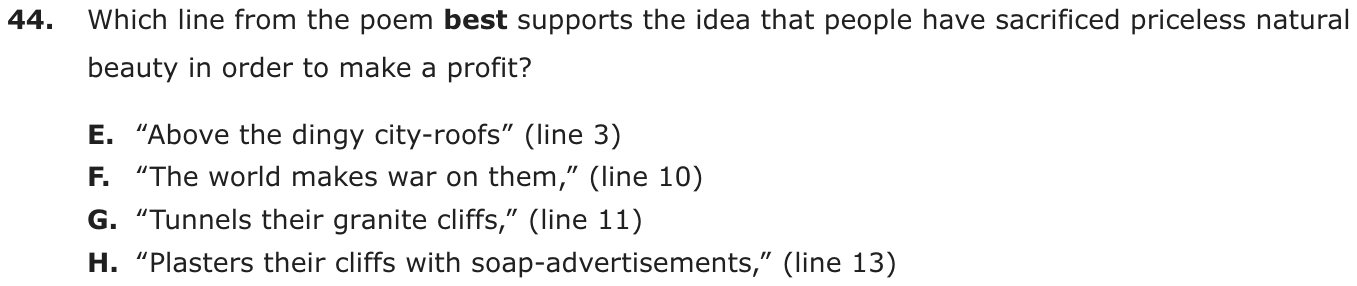
The passage “Snowy Mountains” as printed (page 142)
Question 42 of 59
2023 Test A English, question 15Passage A Memory Revolution
A Memory Revolution
A high school senior logs on to a computer at the library to double-check the application due date listed on a college admissions website. Nearby, a librarian helps a group of biology students use a database to search for recent studies about mammals. In the past few decades, the Internet has become an integral component of daily life for many people. The seemingly limitless power of search engines made the Internet search extremely common, and today people increasingly rely on the Internet’s vast accumulation of sources to access all types of information. Scientists are beginning to examine how this reliance is modifying the strategies people use to store and prioritize information in their mind.
A Dependable and Valuable Asset
Psychologist Benjamin Storm from the University of California, Santa Cruz, and researchers Sean Stone and Aaron Benjamin devised an experiment to study students’ tendency to depend on the Internet for facts. To begin, the scientists divided sixty participants into multiple groups, including an “Internet” group and a “memory” group, and placed them in front of computers. The Internet group was required to use the search engine Google to answer eight challenging trivia questions. In contrast, participants in the memory group were permitted to use only their personal knowledge to answer the questions. In the second round, the researchers administered notably easier questions. This time, they allowed each group the option of using Google as they answered. Their results showed that 83 percent of the Internet group continued to consult Google in the second round, while only 63 percent of the memory group chose to do so.
People’s growing inclination to rely on the Internet in order to retrieve information, particularly facts and figures, is called cognitive offloading. Canadian researcher Evan F. Risko and British researcher Sam Gilbert, who have written extensively about the topic, say a similar process has been taking place for centuries. In the past, people used resources like encyclopedias to assist their memories; however, today the Internet, serving as a vast extended memory, allows people to digitally access and retrieve much larger volumes of information. Consequently, people’s minds are free for other cognitive feats, such as connecting data, learning new information, or solving problems.
Filing Information Away
The use of the Internet also appears to be modifying the strategies people use to store information in their mind. Researchers Betsy Sparrow from Columbia University, Jenny Liu from the University of Wisconsin-Madison, and Daniel Wegner from Harvard University conducted several studies to discover how people efficiently manage their information intake.
To begin, the researchers examined how people evaluate which information deserves their effort to remember. For this experiment, participants read forty trivia facts, such as “An ostrich’s eye is bigger than its brain,” and typed the statements into a computer file. Half the participants had been previously told the file would be saved, while half believed it would be erased. Next, the participants wrote down every fact they could recall. Those who believed the information would be erased and no longer available could recall 40 percent more facts than those who thought the information would be saved.
In another experiment, the same researchers tested the ability of study participants to remember where to access information. For this trial, participants read and typed trivia statements, which they saved in folders with generic names such as “Facts” and “Items.” After spending ten minutes writing down all the facts they could recall from memory, participants were asked which folder contained a particular fact based on a keyword. For example, “Which folder has the fact about ostriches?” Overall, participants recalled the information’s location more often than the content itself, correctly identifying 49 percent of the folders for specific facts while remembering only 23 percent of the actual trivia. The researchers concluded that our memory is adapting to the Internet age by prioritizing where to locate information even when the specific details are forgotten. According to Sparrow, the Internet has become an important form of transactive memory, an external source of the recollections and associative networks that constitute memory.
As the Internet’s resources continue to expand our “external” memory, some question whether the process may cause people to depend too heavily on technology. However, Steven Pinker, a professor of psychology at Harvard University, says, “Knowledge is increasing exponentially; human brainpower and waking hours are not. Fortunately, the Internet and information technologies are helping us manage, search and retrieve our collective intellectual output at different scales, from Twitter and previews to e-books and online encyclopedias. Far from making us stupid, these technologies are the only things that will keep us smart.”
Question
Which sentence from the passage suggests that using Internet search engines may lead people to rely less on their own ability to recall information?
- A“In the past few decades, the Internet has become an integral component of daily life for many people.” (paragraph 1)
- B“The Internet group was required to use the search engine Google to answer eight challenging trivia questions.” (paragraph 2)
- C“Their results showed that 83 percent of the Internet group continued to consult Google in the second round, while only 63 percent of the memory group chose to do so.” (paragraph 2)
- D“For this experiment, participants read forty trivia facts, such as ‘An ostrich’s eye is bigger than its brain,’ and typed the statements into a computer file.” (paragraph 5)
Show the answer
Correct answer: C
The question asks which sentence from the passage suggests that using Internet search engines may lead people to rely less on their own ability to recall information.
A. Incorrect. While the sentence in paragraph 1 refers to the increase in use that has made the Internet “an integral component” of everyday life for many people, it does not address memory or explain the effect of Internet use on a person’s ability to recall information.
B. Incorrect. Although the sentence in paragraph 2 refers to research that was conducted to determine how the use of the Internet affects a person’s memory, the sentence simply explains one guideline of the study. The fact that the study required one group of participants to use Google does not indicate whether using a search engine affects the degree to which people rely on their own ability to recall information.
C. CORRECT. The sentence in paragraph 2 states that “83 percent of the Internet group continued to consult Google in the second round” and that “only 63 percent of the memory group chose to do so.” These statistics suggest that using Google in the first round resulted in participants in the Internet group relying more heavily on the Internet search engine to recall information in the second round, whereas participants who had not used Google in the first round were more likely to rely on their own ability to recall information.
D. Incorrect. The sentence in paragraph 5 describes a task presented to participants in a research study. Although the study was designed to examine “how people evaluate which information deserves their effort to remember” (paragraph 5), the sentence does not indicate that use of Internet search engines prompted people to rely less on their own ability to recall information.
Question analysis
This evidence question on “A Memory Revolution,” an article about how search engines are changing the ways people store and find information, asks which sentence suggests that searching online may lead people to depend less on their own recall. The four quotations come from paragraphs 1, 2 and 5, and each touches on the Internet, a study or memory, so students must test what each one actually shows.
- Grade level
- Grade 7 reading and task
- Compared with grade 7
- At grade 7 Choosing the sentence that supports an idea is routine grade 7 evidence work. Here the idea appears in the question but in none of the quotations, so students must infer which one implies it from what the passage says around each.
- Estimated difficulty
- Moderate: several steps, or a close reading with one strong distractor.
- Thinking it demands
- Depth of knowledge 2, skills and concepts · mainly evaluate
- What makes it hard
- Reading between the lines moderate
- A very close wrong answer minor
- Much to keep track of minor
- Evidence
- Answered from several paragraphs or stanzas
- Reading level
- Passage: about grade 14, 763 words; question and choices: about grade 13, 117 words.
- Students, last 30 days
- Not enough answers yet to show (it takes 10).
Why it is hard, traps and wrong answers (shows the answer)
Why it is hard
None of the four quotations states the idea in the question, so each has to be judged by what it implies. Paragraph 2’s experiment supplies both the most tempting wrong sentence and the right one, and they differ as a study’s setup differs from its findings. Students who settle for the sentence that names a search engine, or for any line about remembering trivia, overlook that only a measured result can show an effect on how people recall.
Reading between the lines moderate Working it out
The right sentence gives only two percentages and never mentions memory; students must infer that reaching for Google on “notably easier questions” shows less trust in one’s own recall, and that first-round searching set the Internet group apart. (Graesser, Singer & Trabasso, 1994; Kintsch, 1998)
A very close wrong answer minor Choosing the answer
Two quotations come from paragraph 2’s Google study and both name the Internet group; one states the rule for the first round, the other what the group chose once Google was optional. (Embretson & Wetzel, 1987; Gorin & Embretson, 2006; Ascalon et al., 2007)
Much to keep track of minor Working it out
Reading 83 and 63 percent correctly means holding two groups and two rounds in mind: which group had to search at first, and that in round two both could choose Google. (Sweller, 1988; Carpenter, Just & Shell, 1990)
Strategy: Put the idea in your own words, then reread each quoted sentence in its paragraph and ask whether it shows people relying more on a search engine and less on their own memory.
Traps
- Supports only part of the claim: In a question about evidence: a line that backs one half of the claim but not the other, or a related point rather than the claim itself.
- True but not the answer: A choice says something accurate about the text that does not answer this question.
The wrong answers, classified
A True but not the answer (King et al., 2004; Embretson & Wetzel, 1987)
Takes the opening claim that the Internet is “an integral component of daily life” as a sign of dependence, but the sentence only sets the scene and says nothing about recall.
B Supports only part of the claim (King et al., 2004; Thissen, Steinberg & Fitzpatrick, 1989)
Finds the right study and the words “search engine Google,” but this sentence states only what the Internet group had to do in round one, not how it behaved afterward.
D Supports only part of the claim (King et al., 2004; Thissen, Steinberg & Fitzpatrick, 1989)
Recalls that the ostrich-fact experiment found people remembered less when they expected a file to be saved, but this sentence only describes the typing task, and no search engine is involved.
Working it out, step by step
Figure out what the question asks
This is an evidence question. You need the sentence that best supports an idea. The idea is that using search engines may make people lean less on their own memory. To recall means to bring back to mind. A search engine is a website, like Google, that finds information for you. Look for a sentence that shows people trusting Google more than their own memory.
Find the study in paragraph 2
Paragraph 2 tells about an experiment with two groups. “The Internet group was required to use the search engine Google to answer eight challenging trivia questions.” The memory group could use only what they already knew. Then came a second round of “notably easier questions.” This time, each group could choose whether to use Google.
Read the results
Group Round 1 Round 2: chose Google Internet group had to use Google 83 percent Memory group memory only 63 percent The round 2 questions were easier. People had a better chance of knowing the answers on their own. Yet the Internet group still turned to Google more often. That is 20 more people out of every 100. Using Google first seems to have made them lean on it instead of their own memory.
Check each choice
- A is wrong. It says the Internet is “an integral component,” or a key part, of daily life. It says nothing about memory.
- B is wrong. It gives a rule of the study: what the Internet group had to do in round 1. A rule is not a result, so it can’t show an effect.
- C is right. It gives the result. The group that had used Google kept choosing it, even when the questions got easier.
- D is wrong. It tells about the typing task in a different study. That study tested memory, but no search engine was used.
Watch out: B is tempting because it names Google and the same study. But it only tells what people were told to do, not what they chose.
Choose the answer
Only C shows what people did once they were free to choose. The Internet group leaned on Google more than the memory group did. So the answer is C.
Why this answer and not the closest wrong one
B is the closest wrong answer, since it comes from the same study. But B only tells what the Internet group had to do at the start. C shows what happened next. Given a choice, 83 percent of that group still used Google, but only 63 percent of the memory group did. That gap is the evidence.
More questions like this
The original DOE question
The passage “A Memory Revolution” as printed (pages 3–4)
Question 43 of 59
2023 Test A English, question 48Passage Excerpt from Winter Wheat
Excerpt from Winter Wheat
by Mildred Walker
Ellen, the narrator, is preparing to leave her parents and the family farm for college the next day.
The text of this excerpt is not reproduced here for copyright reasons. Read it as printed on the test under “The original DOE question” on each question’s page.
From WINTER WHEAT by Mildred Walker, published by University of Nebraska Press. Copyright © 1944 by Harcourt, Brace and Company, Inc. Copyright renewed 1971 by Mildred Walker. All rights reserved.
Question
Which sentence from the excerpt provides evidence that Ellen has a lot in common with her father?
- A“He’s the one who gets excited when I do about spring coming or a serial running in the magazine we’re both reading. . . .” (paragraph 1)
- B“ ‘We can drive you into town in the afternoon,’ Dad said, dropping his paper on the floor.” (paragraph 4)
- C“ ‘Well, we don’t have to decide tonight,’ Dad said, but I knew he wanted to go into Clark City.” (paragraph 6)
- D“I wondered how they would get along without me.” (paragraph 25)
Show the answer
Correct answer: A
The question asks which sentence from the excerpt provides evidence that Ellen has a lot in common with her father.
A. CORRECT. This sentence from paragraph 1 shows that Ellen and her father both get excited about the coming of spring and share an interest in reading magazine serials (stories published in serial installments). The sentence implies that Ellen and her father have shared likes and interests, and therefore, it provides clear evidence that they have a lot in common.
B. Incorrect. While this sentence from paragraph 4 highlights the warm relationship between Ellen and her father and shows that he would like to take her to the train station in town, it does not provide clear evidence that they share a lot in common.
C. Incorrect. Although this sentence from paragraph 6 implies that Ellen understands her father well enough to intuit his preference to go to the train station in town (“but I knew he wanted to go into Clark City”), their closeness is not clear evidence that Ellen and her father have a lot in common.
D. Incorrect. While this sentence from paragraph 25 shows Ellen’s concern about the effect that her leaving the farm will have on her parents, it does not provide clear evidence that Ellen and her father have a lot in common.
Question analysis
This evidence question on an excerpt from Mildred Walker’s novel Winter Wheat, in which Ellen gets ready to leave her parents’ farm for college, asks which sentence shows that Ellen has a lot in common with her father. The four quotations, from paragraphs 1, 4, 6 and 25, all involve Ellen and her family, so each must be checked for what it really shows.
- Grade level
- Grade 7 reading and task
- Compared with grade 7
- At grade 7 Finding the sentence that supports an idea about a character is standard grade 7 evidence work. The novel’s language is plain and the idea concrete, but every quotation involves Ellen’s family, so each must be read in its paragraph before it is judged.
- Estimated difficulty
- Straightforward: two steps or one careful reading.
- Thinking it demands
- Depth of knowledge 2, skills and concepts · mainly evaluate
- What makes it hard
- Evidence
- Answered from several paragraphs or stanzas
- Reading level
- Passage: about grade 6, 80 words; question and choices: about grade 7, 88 words.
- Students, last 30 days
- Not enough answers yet to show (it takes 10).
Why it is hard, traps and wrong answers (shows the answer)
Why it is hard
The question asks for likeness, not affection, and three of the quotations show Ellen’s ties to her family in other ways: her father offers to drive her into town, she knows a wish he does not voice, and she wonders how her parents will manage once she is gone. Only one sentence shows father and daughter reacting the same way to the same things, the coming of spring and a magazine story. Students who read “a lot in common” as “close” are drawn to the line where Ellen reads his mind.
Every choice must be checked minor Choosing the answer
Every quotation involves Ellen and her parents, and three show a bond of another kind, an offer of a ride, a guessed wish, a worry about leaving, so each must be tested for shared tastes rather than care. (Embretson & Wetzel, 1987)
Reading between the lines minor Working it out
The right sentence neither names Dad nor says “in common”: students must trace “He’s” back to Dad earlier in paragraph 1 and hear shared interests in “when I do” and “we’re both reading.” (Graesser, Singer & Trabasso, 1994; Kintsch, 1998)
Strategy: Decide what having a lot in common would mean for two people, then reread each quotation in its paragraph and ask whether it shows that or some other side of how Ellen and her father relate.
Traps
- Reads too much in: A reasonable-sounding conclusion that goes further than the text allows.
- Supports only part of the claim: In a question about evidence: a line that backs one half of the claim but not the other, or a related point rather than the claim itself.
- True but not the answer: A choice says something accurate about the text that does not answer this question.
The wrong answers, classified
B Reads too much in (Graesser, Singer & Trabasso, 1994)
Takes Dad’s quick offer to drive Ellen into town, made as he drops his paper, as a sign that the two are alike, but it shows his care for her, not tastes they share.
C Supports only part of the claim (King et al., 2004; Thissen, Steinberg & Fitzpatrick, 1989)
Sees Ellen reading Dad’s unspoken wish to go into Clark City, a send-off she also prefers, but one shared preference shows that she understands him, not that they have a lot in common.
D True but not the answer (King et al., 2004; Embretson & Wetzel, 1987)
Picks Ellen’s closing worry about how her parents will manage without her, a true picture of her concern, but it covers both parents and shows nothing she shares with Dad.
Working it out, step by step
Figure out what the question asks
This is an evidence question. You need the sentence that shows Ellen has “a lot in common” with her father. Two people have a lot in common when they like the same things and share the same interests. Being close, or caring about each other, is not the same thing. Keep that difference in mind.
Look at the sentence in paragraph 1
In paragraph 1, Ellen is telling about her dad, so “He’s” means Dad. She says he “gets excited when I do about spring coming or a serial running in the magazine we’re both reading.” A serial is a story printed in parts, with a new part in each issue of a magazine.
Work out what it means
The words “when I do” mean Dad gets excited at the same times Ellen does. They both look forward to spring. They both read the same magazine story and enjoy it. Those are two interests they share. In the same paragraph, Ellen compares her parents. Dad is the one who shares her excitement. Mom is the one whose words she counts on.
Check each choice
- A is right. It names two things that excite both of them: spring and a magazine story.
- B is wrong. In paragraph 4, Dad quickly offers to drive Ellen into town for her train. That shows he cares, not that they like the same things.
- C is wrong. In paragraph 6, Ellen says, “but I knew he wanted to go into Clark City.” She understands him well. But knowing what someone wants is not sharing his interests.
- D is wrong. In paragraph 25, “they” means Mom and Dad. Ellen worries about both. That is not something she shares with Dad.
Watch out: C is tempting because it shows Ellen and Dad are close. But being close is not having a lot in common.
Choose the answer
Only A shows Ellen and her dad getting excited about the same things: spring and a story they both read. So the answer is A.
Why this answer and not the closest wrong one
C is the closest wrong answer. It shows that Ellen can tell what her dad wants without his saying it. That proves they are close. But the question asks what they have in common. A names two shared interests: spring coming and a serial “we’re both reading.”
More questions like this
The original DOE question
The passage “Excerpt from Winter Wheat” as shown on the test
Question 44 of 59
2023 Test B English, question 15Passage Excerpt from “The Food Business Incubator”
Excerpt from “The Food Business Incubator”
by Mandalit Del Barco
“La Cocina” means “the kitchen” in Spanish. It’s also the name of a business incubator1 based in San Francisco’s Mission District. Since it began in 2005, it’s been helping local food entrepreneurs, many of whom are low-income immigrant women, develop their small businesses.
Over the years, many of its alumni have found success: more than 50 chefs in its program have become self-sufficient business owners, and many of them have opened their own brick-and-mortar restaurants. Two alumnae of its culinary program . . . were even recognized as semi-finalists for prestigious James Beard awards.2
A new cookbook, We Are La Cocina: Recipes in Pursuit of the American Dream, tells some of their stories.
Executive director Caleb Zigas says the nonprofit La Cocina grew out of two grassroots economic development organizations3 who found many people cooking at their homes and selling food on the streets. The vendors needed an affordable commercial kitchen space and technical assistance in order for their businesses to be legally viable. La Cocina provided just such a space, in addition to helping them develop business plans, pull city permits and more.
Zigas says as many as eight businesses can work in the kitchen space at La Cocina at any one time. Some can prep for a farmers’ market sale, corporate catering gigs or weddings, while others might be making and packaging their food products.
“It’s just an incredible and exciting range of techniques, flavors, perspectives, age, language. And that’s a really beautiful thing,” he says. . . .
Twice a year, La Cocina hosts “F&B: Voices from the Kitchen,” a storytelling project where their chefs can tell their own stories, as they do in the new cookbook. Some of the chefs will be on tour to promote the book, whose proceeds will go to support La Cocina entrepreneurs.
NPR4 caught up with . . . La Cocina chefs, who shared their stories:
Mariko Grady, Aedan Fermented Foods
At La Cocina, you can often hear Mariko Grady singing or humming as she prepares miso, koji, and amasake. Her fermented products come in four different flavors, including mushroom and chicken, to be used in soups and sauces. She originally brought the fermenting rice and barley koji seeds from Japan, where she had a 30-year career as a singer and dancer with the prestigious modern theatrical dance group she founded, Pappa Tarahumara. They performed around the world, and 16 years ago, had a one-night show in San Francisco. The man who would become her husband was in the audience. She soon joined him in San Francisco, often returning to Tokyo to rehearse. But after the earthquake and tsunami hit Japan in 2011, her company disbanded. . . . Grady focused on nourishing her family and creating a line of fermented products that she sells online, at local Bay Area stores and at the Ferry Plaza Farmers Market. She began at La Cocina in 2012 and named her business after her son, Aedan. (Written in Kanji characters, the name means “wisdom” and “handed down from generation to generation.”) . . . Her fermented products are “also full of wisdom about how to relate to nature and how to create a healthy life,” she says. . . .
Shani Jones, Peaches Patties
Shani Jones is a native San Franciscan. Her father was born in New Orleans, her mother, in Jamaica. She says their home was always filled with a variety of spices and dishes like jerk chicken and Jamaican patties—savory pastries filled with beef or chicken. Jones says she learned to cook from her mother, whose nickname was Peaches. After returning from college in Atlanta, Jones worked on her doctorate in organizational leadership and management while driving a Lyft5 car. She often told passengers about her idea of opening a catering company with her mom’s recipes. They steered her to La Cocina, where she developed her own business, named after her mother. Five years later, she caters and runs a kiosk6 at a small food cooperative in Bernal Heights, where some of her handmade patties have an Ethiopian twist, “because my husband is Ethiopian.” Jones has big aspirations for Peaches Patties: “The ultimate goal,” she says, “is to be the patty kingpin7 of the West Coast.”
From “The Food Business Incubator That Helps Immigrant Women Pursue The American Dream” by Mandalit Del Barco from WEEKEND EDITION SUNDAY, June 19, 2019. Copyright © 2019 NPR.
QUALIFICATIONS FOR LA COCINA APPLICANTS
| Level of Income | La Cocina considers assets and access to opportunity when screening applicants. La Cocina’s mission is to support entrepreneurs who face barriers to becoming successful in the food industry. Applicants must be classified as low- or very-low-income earners according to the Housing and Urban Development (HUD) Guidelines for San Francisco. |
|---|---|
| Business Plan | Applicants must have a business plan that is ready to be put into action. La Cocina will help applicants refine an existing business plan. Applicants without a business plan should contact one of La Cocina’s partner organizations for guidance in developing one. |
| Viable Product | The applicant’s food must not only be delicious but also stand out. For a business to make a profit, there also has to be a market for the food. |
| Entrepreneurial Work Ethic | La Cocina is excited to work with entrepreneurs who are motivated and passionate about growing their business. Succeeding in the food industry requires a lot of heart and hard work. |
| Community Spirit | The 30+ entrepreneurs who share La Cocina’s kitchen are from many different backgrounds. La Cocina values the community it has created and expects each entrepreneur to be active in bringing the spirit of La Cocina to the wider world. In order to succeed in the La Cocina kitchen, accepted applicants must be flexible and willing to work closely with others. |
Source: La Cocina
1business incubator: company that helps new and startup companies develop by providing services such as management training and office space
2James Beard awards: an award named after American cook and author James Beard, considered one of the highest honors in the culinary industry
3economic development organizations: organizations whose mission is to promote economic improvement within a specific geographical area
4NPR: National Public Radio, a nonprofit media organization that produces and distributes news and cultural programming
5Lyft: ride-sharing company where people use their own cars to provide rides to customers
6kiosk: cart or small structure with one or more open sides that is used to vend merchandise or services
7kingpin: the leader in a group or undertaking
Question
Which piece of evidence from the excerpt is most relevant to the author’s claim that La Cocina provides an opportunity to become more established as a business owner?
- Athe description of how two alumni of the business incubator have won food awards
- Bthe reference to a storytelling project where chefs relate their own backgrounds and business experiences
- Cthe lists of necessities such as business plans and city permits that La Cocina assists with
- Dthe notations of the criteria that applicants must meet to be endorsed by La Cocina in order to develop a small business
Show the answer
Correct answer: C
The question asks for the piece of evidence most relevant to the author’s claim that La Cocina provides an opportunity to become more established as a business owner.
A. Incorrect. This evidence reveals that two former members of La Cocina have been recognized for their culinary skills and thus likely gained some business success, but it is not directly relevant to how La Cocina provides specific services and training to help prospective business owners in achieving their goals.
B. Incorrect. Paragraph 7 briefly describes this project, but the fact that chefs share their stories with others does not directly reveal that La Cocina provides resources to help current members become established in a business. It merely suggests that La Cocina wants to publicize its participants and its efforts.
C. CORRECT. This evidence reveals a direct connection between what La Cocina offers and the chefs’ ability to operate a successful business. Having a viable business plan and obtaining the correct operating permits are necessary for the chefs to move out of the La Cocina space and into their own facilities—thus becoming more established business owners.
D. Incorrect. Though the list of criteria that applicants to La Cocina must meet helps ensure that the chefs have a good chance of success in the program, these criteria reveal La Cocina’s selectivity and not necessarily its ability to aid chefs in becoming more established business owners.
Question analysis
This evidence question asks which part of the La Cocina article is most relevant to the author’s claim that the incubator gives people an opportunity to become more established as business owners. Each choice names a piece of evidence without quoting it, so students must first track down where it appears and then weigh how closely it speaks to owning and running a business.
- Grade level
- Grade 8 reading and task
- Compared with grade 7
- Above grade 7 Matching evidence to a claim is standard grade 7 work. Here the choices describe parts of the article and its table in general terms, the claim is paraphrased rather than quoted, and more than one choice seems related, so it demands more than usual.
- Estimated difficulty
- Hard: combines ideas, needs a plan, and has more than one tempting wrong answer.
- Thinking it demands
- Depth of knowledge 3, strategic thinking · mainly evaluate
- What makes it hard
- A very close wrong answer moderate
- Evidence in several places moderate
- Reading between the lines minor
- Evidence
- Answered from several paragraphs or stanzas
- Reading level
- Passage: about grade 10, 1057 words; question and choices: about grade 12, 95 words.
- Students, last 30 days
- Not enough answers yet to show (it takes 10).
Why it is hard, traps and wrong answers (shows the answer)
Why it is hard
Every choice points to something real in the excerpt, so the work is matching evidence to the exact claim: an opportunity La Cocina provides to become more established. Success stories show outcomes, the storytelling project shows publicity, and the table shows who may apply, but only the services in paragraph 4 show La Cocina giving that opportunity. The two choices about business plans are hardest to separate, because helping with a plan and requiring one look alike at a glance.
A very close wrong answer moderate Choosing the answer
The table’s criteria and the right choice both concern business plans, which appear in paragraph 4 and in the Business Plan row; one is help La Cocina gives, the other a requirement for getting in. (Embretson & Wetzel, 1987; Gorin & Embretson, 2006; Ascalon et al., 2007)
Evidence in several places moderate Working it out
The choices describe evidence without quoting it, from paragraph 2’s awards and paragraph 7’s storytelling project to paragraph 4’s services and the table, so each must be found before it can be weighed. (Kirsch & Mosenthal, 1990; Gorin & Embretson, 2006)
Reading between the lines minor Working it out
The claim speaks of becoming “more established,” and students must see that business plans and permits are what let a cook move from selling on the street to running a legal, independent business. (Graesser, Singer & Trabasso, 1994; Kintsch, 1998)
Strategy: Restate the claim in your own words, find where each described piece of evidence appears, and ask whether that evidence shows how someone becomes more established as a business owner.
Traps
- Supports only part of the claim: In a question about evidence: a line that backs one half of the claim but not the other, or a related point rather than the claim itself.
- True but not the answer: A choice says something accurate about the text that does not answer this question.
The wrong answers, classified
A Supports only part of the claim (King et al., 2004; Thissen, Steinberg & Fitzpatrick, 1989)
Treats award recognition as business success, but honors reflect cooking talent rather than help La Cocina gives, and paragraph 2 says the two were semi-finalists, not winners.
B True but not the answer (King et al., 2004; Embretson & Wetzel, 1987)
Is drawn by chefs telling their own stories, which paragraph 7 describes, but a storytelling project publicizes La Cocina and its members and shows nothing about becoming established in business.
D Supports only part of the claim (King et al., 2004; Thissen, Steinberg & Fitzpatrick, 1989)
Sees “develop a small business” and the table’s detailed criteria as support, but requirements for admission show whom La Cocina selects, not what it does to help members become established.
Working it out, step by step
Restate the claim
This is an evidence question. Evidence is a fact that backs up a claim. The claim here is that La Cocina gives cooks a chance to become “more established” business owners. More established means more firmly set up, with a business that can last.
Find what the cooks needed
Paragraph 4 tells what the street cooks were missing. “The vendors needed an affordable commercial kitchen space and technical assistance in order for their businesses to be legally viable.” Vendors are sellers. Legally viable means allowed by law and able to keep going. A food business needs official permission from the city to run.
Find what La Cocina gave them
La Cocina gave them a kitchen and helped them “develop business plans, pull city permits and more.” A business plan is a written plan for how a business will make money. To pull a permit means to get it from the city. With a plan and permits, a street cook can run a real, legal business. That is what becoming more established looks like.
Check each choice
- A is wrong. Paragraph 2 says the two chefs were semi-finalists, so they did not win. Also, a cooking honor doesn’t show help with running a business.
- B is wrong. The storytelling project in paragraph 7 lets chefs share their stories. That spreads the word, but it doesn’t set anyone up in business.
- C is right. Plans and permits are the tools that turn a cook into an established owner.
- D is wrong. The table lists what applicants need to get in. Rules for joining don’t show the help La Cocina gives once you are in.
Watch out: D is tempting because the table also mentions business plans. But there a plan is something you must already have. In paragraph 4, La Cocina helps you develop one.
Choose the answer
The help with plans and permits shows La Cocina giving cooks a real chance at a lasting business. So the answer is C.
Why this answer and not the closest wrong one
D is the hardest choice to rule out. Both D and C touch on business plans. But D points to entry rules, which tell who may join. C points to services La Cocina provides. The claim is about an opportunity La Cocina gives, so C is the better evidence.
More questions like this
The original DOE question
The passage “Excerpt from “The Food Business Incubator”” as printed (pages 158–160)
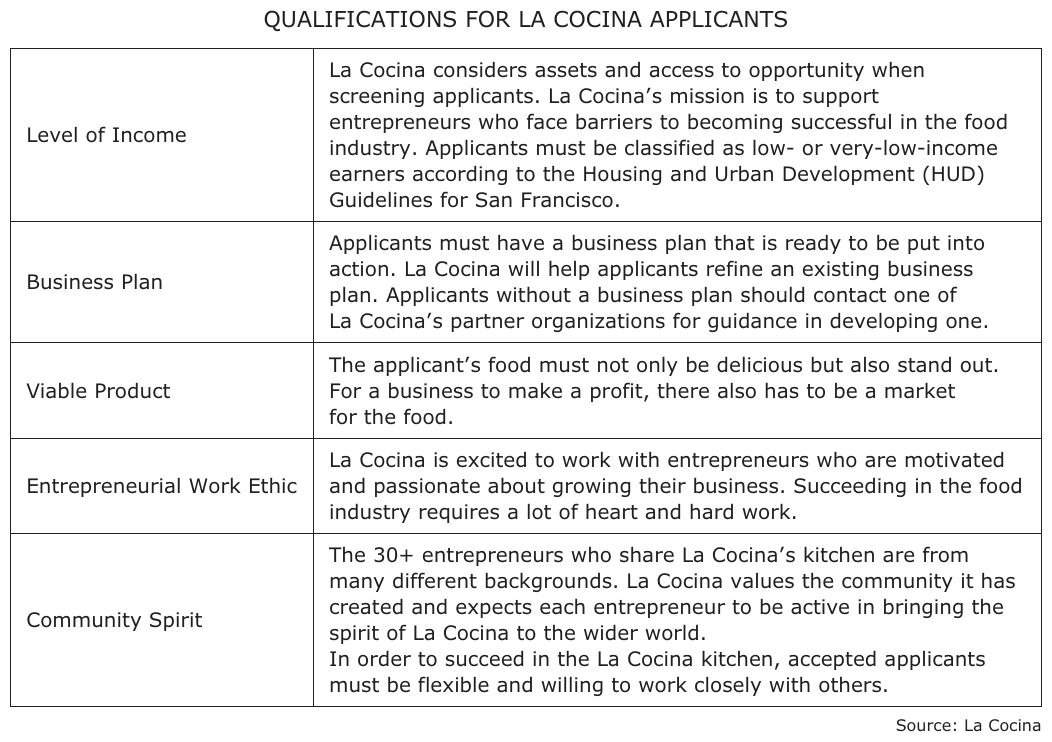
Question 45 of 59
2018 Test A English, question 13Passage An Early Warning
An Early Warning
One of the books that has done the most to alert the world to the dangers of environmental degradation is George Perkins Marsh’s Man and Nature. Its message—that Western society is in the process of causing irreparable harm to the environment—greatly influenced ecologists during the beginning of the modern environmentalist movement in the 1960s. Marsh was not, however, part of this movement. Surprisingly, Man and Nature was first published in 1864.
Marsh first observed the environmentally destructive effects of human activities while growing up in Vermont in the early nineteenth century. The heavy demand for firewood had depleted the forests, and extensive sheep grazing had stripped the land. The result was flooding and soil erosion. Furthermore, streams were fouled by wastes dumped from numerous mills and dye houses.
Much later in his life, after careers in law, business, farming, and politics, Marsh served as ambassador to Italy. There he noticed land abuse similar to what he had seen in Vermont. Overgrazing and forest mismanagement had rendered areas that had been productive farmland since the days of the Roman Empire desolate. Marsh attributed this to what he called “man’s ignorant disregard for the laws of nature.”
In Italy, Marsh began to organize his observations and theories. He wrote in a way intended to educate readers about the impact of industrial and agricultural practices on the environment. In Man and Nature, he evaluated the important relationships between animals and plants, discussed forestry practices in great detail, and analyzed the ways natural water supplies are affected by human use.
Man and Nature challenged the popular belief that nature can heal any damage that people inflict upon it. Marsh argued that people may use and enjoy, but not destroy, the riches of the earth.
Furthermore, he asserted that everything in nature is significant and that even the tiniest organism affects the fragile environmental balance. His belief that drastic alteration of this balance would be dangerous is now accepted as a fundamental principle of modern environmental science.
Although he pointed out environmental damage caused by irresponsible human activities, Marsh did not oppose every human alteration to the environment. To him, the goal was proper management, not a return to wilderness conditions. People should consider the consequences of their actions, he wrote, and become “co-worker[s] with nature.” Marsh praised the Suez Canal, the human-made waterway between the Mediterranean Sea and the Gulf of Aden, as “the greatest and most truly cosmopolite physical improvement ever undertaken by man.” He believed that the advantages of the canal— improved transportation and commerce—would outweigh any environmental damage. Yet he also warned of possible unintended consequences, such as destructive plants and animals spreading from one body of water to the other.
Marsh was considered a radical thinker during his lifetime. By the late nineteenth century, however, his writings, along with those of John Muir, Henry David Thoreau, and others, had inspired what became known as the conservation movement. The conservationists of that time sought to educate the public that wilderness areas were worth preserving and were responsible for creating the National Park Service and the National Forest Service.
Question
Which evidence supports the accuracy of Marsh’s theories about nature?
- Athe details about Marsh’s observations of environmental degradation
- Bthe details about how Marsh’s writing inspired a conservation movement
- Cthe details about how Marsh’s ideas are essential to modern environmental science
- Dthe details about Marsh’s opinions on human alterations to the environment
Show the answer
Correct answer: C
The answer is (C)
The question asks for evidence that supports Marsh’s theories about nature, based on the passage. The passage states that ideas from Marsh’s book are now considered basic knowledge in the field of environmental science (paragraph 6). This statement supports the idea that his theories about nature were accurate, making Option C correct.
Option A is incorrect because, while Marsh made observations of the harm that people were causing to the environment (paragraphs 2 and 3), the details about his observations do not provide evidence that his theories were accurate.
Option B is incorrect because, while Marsh’s writing did inspire a conservation movement (paragraph 8), these details do not call attention to the accuracy of his ideas.
Option D is incorrect because it refers to Marsh’s personal opinions (paragraph 7), not his theories.
Question analysis
This reading question asks which details in a passage about George Perkins Marsh and Man and Nature support the accuracy of his theories about nature. Every choice points to real content in the passage, so students must think carefully about what kind of evidence shows that ideas were correct.
- Grade level
- Grade 8 reading and task
- Compared with grade 7
- Above grade 7 Grade 7 students judge whether evidence supports a claim, but here the choices are abstract descriptions of passage content, and the student must decide which kind of detail could actually show a theory to be correct, a step beyond typical grade 7 work.
- Estimated difficulty
- Hard: combines ideas, needs a plan, and has more than one tempting wrong answer.
- Thinking it demands
- Depth of knowledge 3, strategic thinking · mainly evaluate
- What makes it hard
- A very close wrong answer moderate
- Reading between the lines moderate
- Evidence in several places moderate
- Evidence
- Answered from several paragraphs or stanzas
- Reading level
- Passage: about grade 12, 523 words; question and choices: about grade 12, 51 words.
- Students, last 30 days
- Not enough answers yet to show (it takes 10).
Why it is hard, traps and wrong answers (shows the answer)
Why it is hard
The choices are labels for kinds of detail, not quotations, so the student has to translate each one back into the passage and then ask a harder question: does it show the ideas were right? Influence and firsthand observation both feel like proof, and they separate students who confuse popularity or origin with confirmation from those who do not. Only acceptance by modern science judges the theories after the fact.
A very close wrong answer moderate Choosing the answer
The right choice and the one about inspiring a conservation movement are worded alike, details about how Marsh's ideas fared later, and differ only in whether they show acceptance by science or mere influence. (Embretson & Wetzel, 1987; Gorin & Embretson, 2006; Ascalon et al., 2007)
Reading between the lines moderate Working it out
The student must work out what kind of fact could show a theory accurate, later acceptance by a science, and then spot it in paragraph 6's “fundamental principle of modern environmental science”. (Graesser, Singer & Trabasso, 1994; Kintsch, 1998)
Evidence in several places moderate Working it out
The four kinds of detail sit in different paragraphs, observations in 2 and 3, science in 6, opinions in 7 and the movement in 8, and each must be found. (Kirsch & Mosenthal, 1990; Gorin & Embretson, 2006)
Strategy: Decide first what kind of fact would prove a theory accurate, then test each choice against that standard rather than against whether it is true of Marsh.
Traps
- Supports only part of the claim: In a question about evidence: a line that backs one half of the claim but not the other, or a related point rather than the claim itself.
- Reads too much in: A reasonable-sounding conclusion that goes further than the text allows.
- True but not the answer: A choice says something accurate about the text that does not answer this question.
The wrong answers, classified
A Supports only part of the claim (King et al., 2004; Thissen, Steinberg & Fitzpatrick, 1989)
Takes the degradation Marsh saw in Vermont and Italy as proof, but those observations are what his theories were built on, not a later test of them.
B Reads too much in (Graesser, Singer & Trabasso, 1994)
Reasons that ideas which inspired a conservation movement must be correct, mistaking influence for accuracy; many followers show that an idea spread, not that it was true.
D True but not the answer (King et al., 2004; Embretson & Wetzel, 1987)
Points to Marsh's views on canals and other changes to nature in paragraph 7, which are further opinions of his, not evidence that his theories held up.
Working it out, step by step
Figure out what the question asks
This asks what shows that Marsh’s theories were accurate, or correct. A theory is an idea that tries to explain how something works. So you need a detail that shows his ideas turned out to be true. A detail that is just true about Marsh is not enough.
Decide what counts as proof
How can you show an idea is correct? A strong way is when experts study it later and agree with it. Being popular does not make an idea correct. And the facts that gave someone an idea can’t also prove that idea.
Find that proof in the passage
Paragraph 6 says: “His belief that drastic alteration of this balance would be dangerous is now accepted as a fundamental principle of modern environmental science.” A drastic alteration is a big change. A fundamental principle is a basic rule. So scientists today treat Marsh’s idea as a basic truth. That supports its accuracy.
Check each choice
- C: Marsh’s ideas are “essential to modern environmental science.” This matches paragraph 6.
- A: his observations in Vermont and Italy are what he built his theories on. They don’t show the theories were right.
- B: inspiring a movement shows his ideas were popular. Popular is not the same as correct.
- D: his opinions about changing nature, such as praising a canal, are more of his views. They are not proof.
Watch out: A is tempting because the damage Marsh saw was real. But it came before his theories, so it can’t test them.
Pick the answer
Only C shows experts in a science accepting Marsh’s ideas as true. So the answer is C.
Why this answer and not the closest wrong one
B is close because it is also about how Marsh’s ideas did later. But many people can follow an idea that is wrong. C shows that scientists, who test ideas, now accept his belief as a basic rule. That is evidence of accuracy, not just of popularity.
More questions like this
The original DOE question

The passage “An Early Warning” as printed (page 52)
Question 46 of 59
2018 Test A English, question 14Uses the passage above: “An Early Warning”.
Question
Which detail about Marsh provides support for the author’s statement in paragraph 5?
- Ahis reputation as a radical thinker
- Bhis contribution to the conservation movement
- Chis experience working as an ambassador
- Dhis approval of beneficial human-made projects in nature
Show the answer
Correct answer: D
The answer is (D)
The question asks for a specific detail that supports the author’s statement in paragraph 5. In paragraph 5, the author states that “Marsh argued that people may use and enjoy, but not destroy, the riches of the earth.” Marsh’s approval of the Suez Canal shows that Marsh did not oppose certain human innovations, because the advantages—improved transportation and commerce—enriched human life and outweighed environmental damage (paragraph 7). Option D describes that idea.
Option A is incorrect because it is not relevant to the statement in question.
Option B is incorrect because, while it acknowledges Marsh’s contributions to the conservation movement, it does not relate to his attitudes about certain alterations to the environment.
Option C is incorrect because it relates to a time when Marsh observed environmental degradation in Italy.
Question analysis
This reading question asks which detail about George Perkins Marsh supports a statement the author makes in paragraph 5 of a passage about his book Man and Nature. Students must pin down the exact claim first, then find the detail elsewhere in the passage that illustrates it, since all four choices are true facts about Marsh.
- Grade level
- Grade 8 reading and task
- Compared with grade 7
- Above grade 7 Matching a supporting detail to a claim is grade 7 work, but here the student must first decide which statement in paragraph 5 is meant and then connect it to a detail elsewhere, with choices given as brief labels.
- Estimated difficulty
- Hard: combines ideas, needs a plan, and has more than one tempting wrong answer.
- Thinking it demands
- Depth of knowledge 3, strategic thinking · mainly evaluate
- What makes it hard
- Evidence in several places moderate
- Reading between the lines moderate
- Evidence
- Answered from several paragraphs or stanzas
- Reading level
- Passage: about grade 12, 523 words; question and choices: about grade 11, 38 words.
- Students, last 30 days
- Not enough answers yet to show (it takes 10).
Why it is hard, traps and wrong answers (shows the answer)
Why it is hard
Paragraph 5 contains two statements, and the question does not say which one it means, so a student must settle that first. Anchored to the first sentence, the radical-thinker detail looks like a fit; anchored to “use and enjoy, but not destroy”, only the approval of the Suez Canal works. The brief labels hide which paragraph each detail comes from, so every one has to be traced.
Evidence in several places moderate Working it out
The claim is in paragraph 5 but its support, Marsh's praise of the Suez Canal, is two paragraphs later, and the choices are brief labels that must be traced back. (Kirsch & Mosenthal, 1990; Gorin & Embretson, 2006)
Reading between the lines moderate Working it out
Praise for a canal does not mention the earth's riches; the student must see that approving a useful human-made change shows “use and enjoy” in practice. (Graesser, Singer & Trabasso, 1994; Kintsch, 1998)
Strategy: Restate paragraph 5's claim in your own words, then ask of each detail whether it shows Marsh holding that view, rather than simply being true about him.
Traps
- Supports only part of the claim: In a question about evidence: a line that backs one half of the claim but not the other, or a related point rather than the claim itself.
- True but not the answer: A choice says something accurate about the text that does not answer this question.
The wrong answers, classified
A Supports only part of the claim (King et al., 2004; Thissen, Steinberg & Fitzpatrick, 1989)
Links going against “the popular belief” with being a radical thinker, which is true of Marsh but says nothing about using nature without destroying it.
B Supports only part of the claim (King et al., 2004; Thissen, Steinberg & Fitzpatrick, 1989)
Equates “use and enjoy, but not destroy” with conservation, yet the movement Marsh inspired preserved wilderness, and his part in it does not show his view on use.
C True but not the answer (King et al., 2004; Embretson & Wetzel, 1987)
Picks his years as ambassador to Italy, which explain where he saw land abuse but say nothing about how he thought people should use the earth.
Working it out, step by step
Figure out what the question asks
First find the author’s statement in paragraph 5. Then find the detail about Marsh that backs it up, or shows it is true.
Find the statement in paragraph 5
Paragraph 5 says: “Marsh argued that people may use and enjoy, but not destroy, the riches of the earth.” The riches of the earth are nature’s gifts, like land, water, and forests. In plain words: it is fine to use nature, as long as you don’t wreck it.
Look for that view in action
Paragraph 7 says: “Marsh did not oppose every human alteration to the environment.” He praised the Suez Canal, a waterway people dug so ships could pass. He believed its benefits, “improved transportation and commerce,” would outweigh any harm. Commerce means trade, or buying and selling. So Marsh was fine with people using nature in a helpful way.
Check each choice
- D: his approval of helpful human-made projects shows “use and enjoy” in action.
- A: he was a radical thinker, but that says nothing about how people should use nature.
- B: he helped inspire the conservation movement, but that doesn’t show his view on using nature.
- C: his job in Italy explains where he saw land damage. It says nothing about how to use the earth.
Watch out: Paragraph 5 says Marsh’s book challenged a “popular belief,” which can make you think of “radical.” But A doesn’t show the use-but-don’t-destroy idea.
Pick the answer
Praising a useful canal shows Marsh believed people may use nature. So the answer is D.
Why this answer and not the closest wrong one
A is the closest wrong answer. Marsh was a radical thinker, and paragraph 5 does say his book challenged a popular belief. But being radical doesn’t show that people may use nature. Praising a useful canal does, so D gives real support.
More questions like this
The original DOE question

Question 47 of 59
2018 Test A English, question 19Passage Champion of the Channel
Champion of the Channel
In 1926 an editor at the London Daily News predicted that Gertrude Ederle, an American swimmer with eighteen world records and three Olympic medals, would fail in her attempt to swim across the English Channel. He claimed that “even the most uncompromising champion of the rights and capacities of women must admit that in contests of physical skill, speed and endurance they must remain forever the weaker sex.” Yet, at only nineteen years old, Ederle not only became the first woman to accomplish this feat, she also broke the men’s record by two hours. Gertrude Ederle’s triumphant swim across the English Channel was a testimony to her determination, innovative spirit, and passion for swimming.
Crossing the English Channel is a daunting task for any swimmer. At its narrowest point, the channel measures twenty-one miles across. Its icy waters hover around sixty degrees Fahrenheit, and its unruly tides and currents toss swimmers about like bobbing corks. Stinging jellyfish, seaweed, and floating debris from shipwrecks and lost cargoes present added hazards.
For decades the channel’s perils have defeated countless swimmers. Ederle, too, failed in her first attempt to cross the channel in 1925. Just six miles short of finishing, she became ill, and her coach had to haul her out of the water. Undeterred, Ederle decided to try again. Ederle knew that if she did not complete the challenge this time, she might never get the opportunity to set this record, because a rival female swimmer was preparing to make her second attempt at the crossing as well.
To prepare for the marathon swim, Ederle found ways to improve her equipment. She and her sister Meg discovered that melted candle wax perfectly sealed goggle edges, effectively waterproofing Ederle’s goggles against hammering waves. The sisters also designed a two-piece silk swimsuit for Ederle. During her first channel-crossing attempt she had worn a standard one-piece swimsuit that, after the lengthy hours of swimming across the channel, had stretched out, filling with water and creating drag, making an already challenging task almost insurmountable. Unlike the cumbersome typical bathing suit, this silk invention weighed little and allowed for easy movement.
On August 6, 1926, Ederle waded into the channel near Cape Gris-Nez, France. At first she shivered in the bone-chilling water even though she had covered her body in eight layers of grease for insulation. Her limbs felt stiff. Her strokes were irregular. Driving forward, she fought to clear her mind and find what she called her “sphere,” a place where the sea became her only companion and the shrieks of gulls and the humming of boat engines faded away. Using a new overhand stroke called the American crawl, Ederle eventually settled into a steady pace, briskly breaking through waves.
Throughout Ederle’s swim, two tugboats accompanied her. One carried newspaper reporters who wired dispatches of her progress to shore. The other, displaying a sign that read “This way, ole kid!” with an arrow pointing forward, transported her coach, family, and friends. Her coach played songs, such as “Yes, We Have No Bananas,” on a phonograph so that Ederle could time her strokes to the rhythm. Using a net, her coach also passed her baby bottles of broth for nourishment.
For hours Ederle swam, dodging debris with an amused smile. However, as she neared the English shore, a sudden fierce storm erupted. The tides and waves forced Ederle backward, and she fought the stubborn swells for several hours. The salty water caused her tongue to swell and inflamed her ears. Yet Ederle felt indescribably happy as she churned through the sea. Finally, as she neared the English shore, the storm abated, and the tide turned. No longer fighting against her, the sea pushed her toward the shore and victory.
After fourteen hours and thirty-one minutes, Ederle, on wobbly legs, stepped onto the English shore. The waiting crowd roared, honked their automobile horns, blasted their tugboat whistles, and set off flares that flashed in the sky. Ederle had swum into history.
When Ederle returned to New York, she received a parade, where thousands of people shouted “Trudy!” Not only were everyday American citizens proud of Ederle, but she also inspired them to be more active. Over the next few years, more than 60,000 people credited her with motivating them to earn their American Red Cross swimming certificates. Gertrude Ederle’s accomplishment proved to the world that with determination and passion, it was possible for a person to achieve his or her goals.
SOLO SWIMS ACROSS THE ENGLISH CHANNEL
|
Earliest Speed Records |
||
| Year | Swimmer | Time |
| 1875 | Matthew Webb (M) | 21 hours, 45 minutes |
| 1923 | Enrico Tiraboschi (M) | 16 hours, 33 minutes |
| 1926 | Gertrude Ederle (F) | 14 hours, 31 minutes |
| 1926 | Arnst Vierkotter (M) | 12 hours, 38 minutes |
| Current Speed Records | ||
| Year | Swimmer | Time |
| 2012 | Trent Grimsey (M) | 6 hours, 55 minutes |
| 2006 | Yvetta Hlavacova (F) | 7 hours, 25 minutes |
Question
Which sentence best supports the idea that Ederle succeeded in swimming across the channel because of her innovative approach to the challenge?
- A“Yet, at only nineteen years old, Ederle not only became the first woman to accomplish this feat, she also broke the men’s record by two hours.” (paragraph 1)
- B“At first she shivered in the bone-chilling water even though she had covered her body in eight layers of grease for insulation.” (paragraph 5)
- C“Using a new overhand stroke called the American crawl, Ederle eventually settled into a steady pace, briskly breaking through waves.” (paragraph 5)
- D“No longer fighting against her, the sea pushed her toward the shore and victory.” (paragraph 7)
Show the answer
Correct answer: C
The answer is (C)
The question asks for the best support for the idea that Ederle’s swim across the channel was successful because of her innovative approach to the challenge.
Option C is correct because the sentence from paragraph 5 explains that Ederle employed a newly developed type of stroke that allowed her to maintain her pace through the rough water.
Option A is incorrect because the sentence from paragraph 1 shows that her performance was groundbreaking but not necessarily creative.
Option B is incorrect because the layers of grease primarily served to help maintain Ederle’s body temperature in the water, and there is nothing in the passage to suggest that this was an innovative practice.
Option D is incorrect because the sentence from paragraph 7 simply states that Ederle fought against the waves and completed her swim, and it does not describe how Ederle employed innovative techniques.
Question analysis
This reading question asks which quoted sentence best supports the idea that Gertrude Ederle crossed the English Channel because of an innovative approach. Each quotation describes a real moment of her story, so students must test each one against what innovative actually means.
- NYS standards
- 7R1 textual evidence and inferences
- Grade level
- Grade 7 reading and task
- Compared with grade 7
- At grade 7 Choosing the sentence that best supports an idea is a core grade 7 reading task. The quotations come with paragraph numbers, so the demand is a careful check of each against the key word innovative, as in typical grade 7 practice.
- Estimated difficulty
- Straightforward: two steps or one careful reading.
- Thinking it demands
- Depth of knowledge 2, skills and concepts · mainly evaluate
- What makes it hard
- Evidence
- Answered from several paragraphs or stanzas
- Reading level
- Passage: about grade 9, 790 words; question and choices: about grade 12, 108 words.
- Corrected from the DOE handbook
- A wrong paragraph number in the explanation was corrected.
- Students, last 30 days
- Not enough answers yet to show (it takes 10).
Why it is hard, traps and wrong answers (shows the answer)
Why it is hard
The claim has two parts, success and an innovative cause, and only one quotation shows both. The record-breaking sentence proves the success but says nothing about method, while the grease is a technique the passage never calls new and that did not keep her from shivering. The word “new” in the crawl sentence is the signal careful readers use.
Every choice must be checked minor Choosing the answer
Each quotation shows a real part of the swim, so each must pass two tests: it shows something new that Ederle did, and that thing helped her finish. (Embretson & Wetzel, 1987)
Strategy: Pin down what innovative means in your own words, then ask of each quoted sentence whether it shows an innovative approach of Ederle's at work and helping her succeed.
Traps
- Reads too much in: A reasonable-sounding conclusion that goes further than the text allows.
- Supports only part of the claim: In a question about evidence: a line that backs one half of the claim but not the other, or a related point rather than the claim itself.
The wrong answers, classified
A Supports only part of the claim (King et al., 2004; Thissen, Steinberg & Fitzpatrick, 1989)
Picks the passage's headline result, first woman and two hours under the men's record, which proves she succeeded but shows no new method behind it.
B Reads too much in (Graesser, Singer & Trabasso, 1994)
Treats eight layers of grease as an innovation, though the passage never calls it new and says she shivered despite it, so it is not shown driving her success.
D Supports only part of the claim (King et al., 2004; Thissen, Steinberg & Fitzpatrick, 1989)
Chooses the turning tide that carried her to “victory”, which helped her finish but was a change in the sea, not an approach Ederle devised.
What was corrected from the DOE handbook, and why
- Explanation: The handbook says the sentence in choice D comes from paragraph 6. The choice itself and the passage place it in paragraph 7 (“No longer fighting against her, the sea pushed her toward the shore and victory.”), so the explanation now says paragraph 7.
Working it out, step by step
Figure out what the question asks
Innovative means new and creative, a fresh way of doing something. You need a sentence that shows two things. First, Ederle used something new. Second, that new thing helped her succeed.
Look for something new
- A says she was the first woman across and beat the men’s record. That shows she succeeded, but not how.
- B says she wore grease “for insulation,” a layer that keeps heat in. The passage never calls the grease new.
- C says she used “a new overhand stroke called the American crawl” (paragraph 5). Here is the word “new.”
- D says the sea pushed her to shore. That is the tide changing, not something Ederle did.
Check that it helped her
Choice C goes on: she “eventually settled into a steady pace, briskly breaking through waves.” A stroke is the way you move your arms to swim. Briskly means quickly and with energy. So the new stroke gave her a steady, quick pace. That helped her get across.
Rule out the grease
Watch out: B can seem clever, since the grease was meant to keep her warm. But the same sentence says she still “shivered in the bone-chilling water.” So the passage does not call it new, and it does not show it helping her win.
Pick the answer
Only C shows a new method that helped her succeed. So the answer is C.
Why this answer and not the closest wrong one
B is the closest wrong answer, because grease for warmth sounds smart. But the passage never says it was new, and she shivered anyway. C has both parts: the word “new” and a result, a “steady pace” through the waves.
More questions like this
The original DOE question
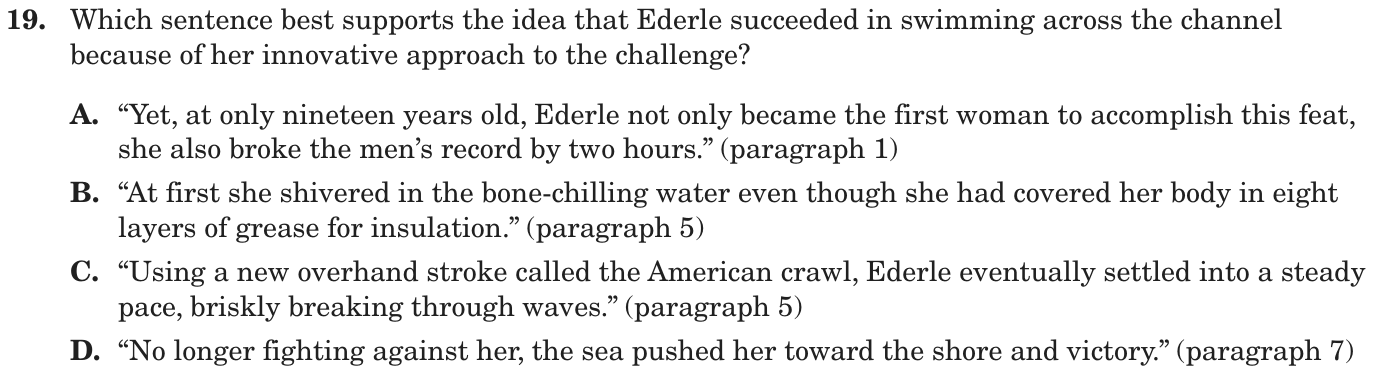
The passage “Champion of the Channel” as printed (pages 56–57)
Question 48 of 59
2018 Test A English, question 30Passage Excerpt from A Tramp Abroad
Excerpt from A Tramp Abroad
by Mark Twain
Now and then, while we rested, we watched the laborious ant at his work. I found nothing new in him—certainly nothing to change my opinion of him. It seems to me that in the matter of intellect the ant must be a strangely overrated bird. During many summers now I have watched him, when I ought to have been in better business, and I have not yet come across a living ant that seemed to have any more sense than a dead one. I refer to the ordinary ant, of course; I have had no experience of those wonderful Swiss and African ones which vote, keep drilled armies, . . . and dispute about religion. Those particular ants may be all that the naturalist paints them, but I am persuaded that the average ant is a sham.
I admit his industry, of course; he is the hardest working creature in the world—when anybody is looking—but his leather-headedness is the point I make against him. He goes out foraging, he makes a capture, and then what does he do? Go home? No; he goes anywhere but home. He doesn’t know where home is. His home may be only three feet away; no matter, he can’t find it. He makes his capture, as I have said; it is generally something which can be of no sort of use to himself or anybody else; it is usually seven times bigger than it ought to be; he hunts out the awkwardest place to take hold of it; he lifts it bodily up in the air by main force, and starts—not toward home, but in the opposite direction; not calmly and wisely, but with a frantic haste which is wasteful of his strength; he fetches up against a pebble, and, instead of going around it, he climbs over it backwards, dragging his booty after him, tumbles down on the other side, jumps up in a passion, kicks the dust off his clothes, moistens his hands, grabs his property viciously, yanks it this way, then that, shoves it ahead of him a moment, turns tail and lugs it after him another moment, gets madder and madder, then presently hoists it into the air and goes tearing away in an entirely new direction; comes to a weed; it never occurs to him to go around it. No; he must climb it, and he does climb it, dragging his worthless property to the top—which is as bright a thing to do as it would be for me to carry a sack of flour from Heidelberg to Paris by way of Strasburg steeple; when he gets up there he finds that that is not the place; takes a cursory glance at the scenery, and either climbs down again or tumbles down, and starts off once more—as usual, in a new direction. At the end of half an hour he fetches up within six inches of the place he started from, and lays his burden down. Meantime, he has been over all the ground for two yards around, and climbed all the weeds and pebbles he came across. Now he wipes the sweat from his brow, strokes his limbs, and then marches aimlessly off, in as violent a hurry as ever. He traverses a good deal of zig-zag country, and by and by stumbles on his same booty again. He does not remember to have ever seen it before; he looks around to see which is not the way home, grabs his bundle, and starts. He goes through the same adventures he had before; finally stops to rest, and a friend comes along.
Evidently the friend remarks that a last year’s grasshopper leg is a very noble acquisition, and inquires where he got it. Evidently the proprietor does not remember exactly where he did get it, but thinks he got it “around here somewhere.” Evidently the friend contracts to help him freight it home. Then, with a judgment peculiarly antic (pun not intentional), they take hold of opposite ends of that grasshopper leg and begin to tug with all their might in opposite directions. Presently they take a rest, and confer together. They decide that something is wrong, they can’t make out what. Then they go at it again, just as before. Same result. Mutual recriminations follow. Evidently each accuses the other of being an obstructionist. They warm up, and the dispute ends in a fight. They lock themselves together and chew each other’s jaws for a while; then they roll and tumble on the ground till one loses a horn or a leg and has to haul off for repairs. They make up and go to work again in the same old insane way, but the crippled ant is at a disadvantage; tug as he may, the other one drags off the booty and him at the end of it. Instead of giving up, he hangs on, and gets his shins bruised against every obstruction that comes in the way. By and by, when that grasshopper leg has been dragged all over the same old ground once more, it is finally dumped at about the spot where it originally lay. The two perspiring ants inspect it thoughtfully and decide that dried grasshopper legs are a poor sort of property after all, and then each starts off in a different direction to see if he can’t find an old nail or something else that is heavy enough to afford entertainment and at the same time valueless enough to make an ant want to own it. . . .
Science has recently discovered that the ant does not lay up anything for winter use. . . . He does not work, except when people are looking, and only then when the observer has a green, naturalistic look, and seems to be taking notes. This amounts to deception, and will injure him for the Sunday schools. He has not judgment enough to know what is good to eat from what isn’t. This amounts to ignorance, and will impair the world’s respect for him. . . . He cannot stroll around a stump and find his way home again. This amounts to idiocy, and once the damaging fact is established, thoughtful people will cease to look up to him. It is strange beyond comprehension that so manifest a humbug as the ant has been able to fool so many nations and keep it up so many ages without being found out.
we: the author and his fictional travel companion
From A TRAMP ABROAD by Mark Twain—Public Domain
Question
Which of the following best explains the author’s fascination with the ants?
- A“During many summers now I have watched him, when I ought to have been in better business, and I have not yet come across a living ant that seemed to have any more sense than a dead one.” (paragraph 1)
- B“I admit his industry, of course; he is the hardest working creature in the world—” (paragraph 2)
- C“Science has recently discovered that the ant does not lay up anything for winter use.” (paragraph 4)
- D“It is strange beyond comprehension that so manifest a humbug as the ant has been able to fool so many nations and keep it up so many ages without being found out.” (paragraph 4)
Show the answer
Correct answer: D
The answer is (D)
The question asks for the text from the passage that explains why the author finds the behavior of the ants fascinating. The author’s purpose in describing the excessively foolish actions of the ants is to prove his argument that in spite of what people have long believed, ants are completely lacking in intelligence.
Option D is correct because the quoted text in Option D shows the author’s interest in the difference between public opinion and observed truth.
Option A is incorrect because the quoted text in Option A provides details that reflect the author’s basic interest, but this observation does not extend to the level of fascination.
Option B is incorrect because the author’s main message in the excerpt is that the ant, however industrious, is foolish.
Option C is incorrect because the quoted text in Option C also provides details that would reflect a basic interest and observation but that do not extend to fascination.
Question analysis
This textual evidence question asks which of four quotations from Mark Twain's ant excerpt best explains why the narrator is so fascinated by ants. Nowhere does the excerpt say outright what draws him to them, so students must infer it and then weigh quotations that all show him paying attention to ants.
- Grade level
- Grade 8 reading and task
- Compared with grade 7
- Above grade 7 Grade 7 evidence questions usually match a quotation to a claim the text states. Here the claim, the narrator's fascination, is never named, so students must infer its cause from four quotations in a satirical, old-fashioned text.
- Estimated difficulty
- Among the hardest on the SHSAT: a non-obvious approach, heavy reading, or a well-hidden trap.
- Thinking it demands
- Depth of knowledge 3, strategic thinking · mainly evaluate
- What makes it hard
- Reading between the lines major
- Hard words moderate
- A lot to read minor
- Evidence
- Answered from the whole text
- Reading level
- Passage: about grade 9, 1099 words; question and choices: about grade 10, 116 words.
- Students, last 30 days
- Not enough answers yet to show (it takes 10).
Why it is hard, traps and wrong answers (shows the answer)
Why it is hard
The stem's word “fascination” clashes with a narrator who sneers at ants, and that clash is what makes the item hard. Students must recast fascination as puzzled interest and then look for the quotation that names its cause, the gap between the ant's reputation and its behavior. The quotation about years of watching is the trap: it shows interest without explaining it, and many careful readers settle on it.
Reading between the lines major Working it out
The excerpt never says the author is fascinated, and his tone is contempt, so students must infer that what holds his attention is the puzzle of how a “humbug” fooled whole nations. (Graesser, Singer & Trabasso, 1994; Kintsch, 1998)
Hard words moderate Understanding the question
The key turns on “so manifest a humbug,” meaning so obvious a fraud, and “strange beyond comprehension”; a student who skips those words cannot see that the line expresses wonder. (Perfetti, 2007; Freedle & Kostin, 1993)
A lot to read minor Understanding the question
Each choice is a full quotation, the longest 38 words, so the four together form a short passage of archaic prose to weigh. (Kintsch, 1998; Gorin & Embretson, 2006; Freedle & Kostin, 1993)
Strategy: Before reading the quotations, state in your own words what most seems to interest the narrator about ants; then pick the quotation that gives the reason behind his interest.
Traps
- Supports only part of the claim: In a question about evidence: a line that backs one half of the claim but not the other, or a related point rather than the claim itself.
- Wrong tone or attitude: Misjudges the tone, attitude or point of view, such as reading admiration as criticism, or taking a character's or subject's feelings for the author's.
The wrong answers, classified
A Supports only part of the claim (King et al., 2004; Thissen, Steinberg & Fitzpatrick, 1989)
Shows he has watched ants for many summers, real evidence of interest, but it describes his habit and verdict rather than what makes ants fascinating to him.
B Wrong tone or attitude (Graesser, Singer & Trabasso, 1994)
Treats the grudging “I admit his industry” as admiration, missing the dig “when anybody is looking” that follows and the attack on his “leather-headedness.”
C Supports only part of the claim (King et al., 2004; Thissen, Steinberg & Fitzpatrick, 1989)
Picks a scientific finding that the author uses as a charge against the ant; it belongs to his case, not to the reason the ant intrigues him.
Working it out, step by step
Figure out what the question asks
This question is about the author’s point of view. Twain sounds mostly annoyed with ants. So what keeps him so interested in them? You need the quote that gives the reason for his interest.
Think about the word fascination
Fascination means a strong interest, the kind that makes you keep watching. Twain mocks ants, so he does not admire them. What puzzles him is their good name. People all over the world think ants are wise. Twain thinks they are not.
Find the reason in paragraph 4
Look at the last sentence of paragraph 4: “It is strange beyond comprehension that so manifest a humbug as the ant has been able to fool so many nations.”
A humbug is a fake or a fraud. Manifest means plain to see. “Beyond comprehension” means too strange to understand. So Twain is amazed that such an obvious fake has fooled people for ages.
Check each choice
- A shows he has watched ants for years. It shows interest, but not the reason for it.
- B sounds like praise, but he adds “when anybody is looking.” It is really a dig at the ant.
- C is one fact he uses against the ant. It does not explain his interest.
- D fits. It names the puzzle: how a plain fake fooled so many people.
Choose the answer
Only choice D gives the reason Twain can’t stop thinking about ants. So the answer is D.
Why this answer and not the closest wrong one
A is the strongest trap, because watching ants for “many summers” shows real interest. But A only tells what he did. D tells why: he is amazed that the ant fooled “so many nations.” A question about fascination wants the cause.
More questions like this
The original DOE question
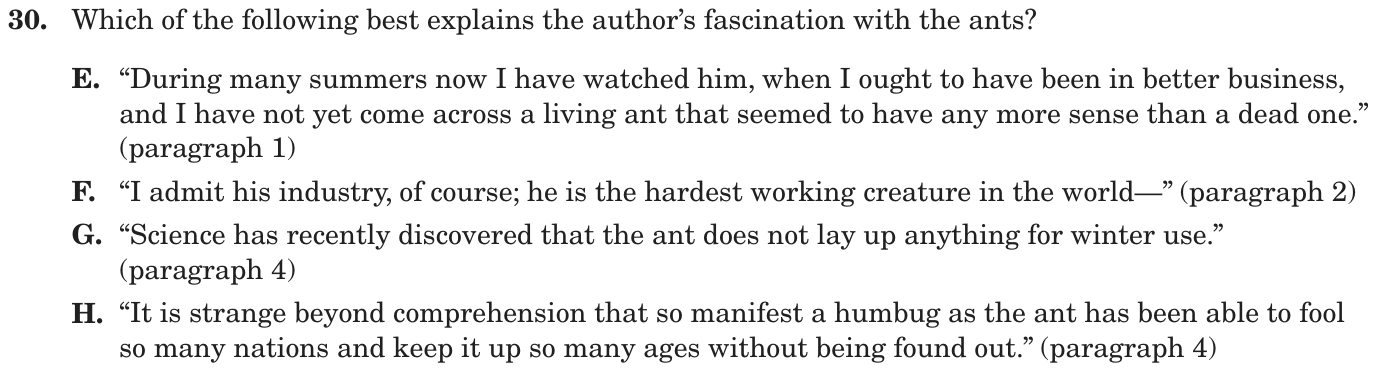
The passage “Excerpt from A Tramp Abroad” as printed (pages 62–63)
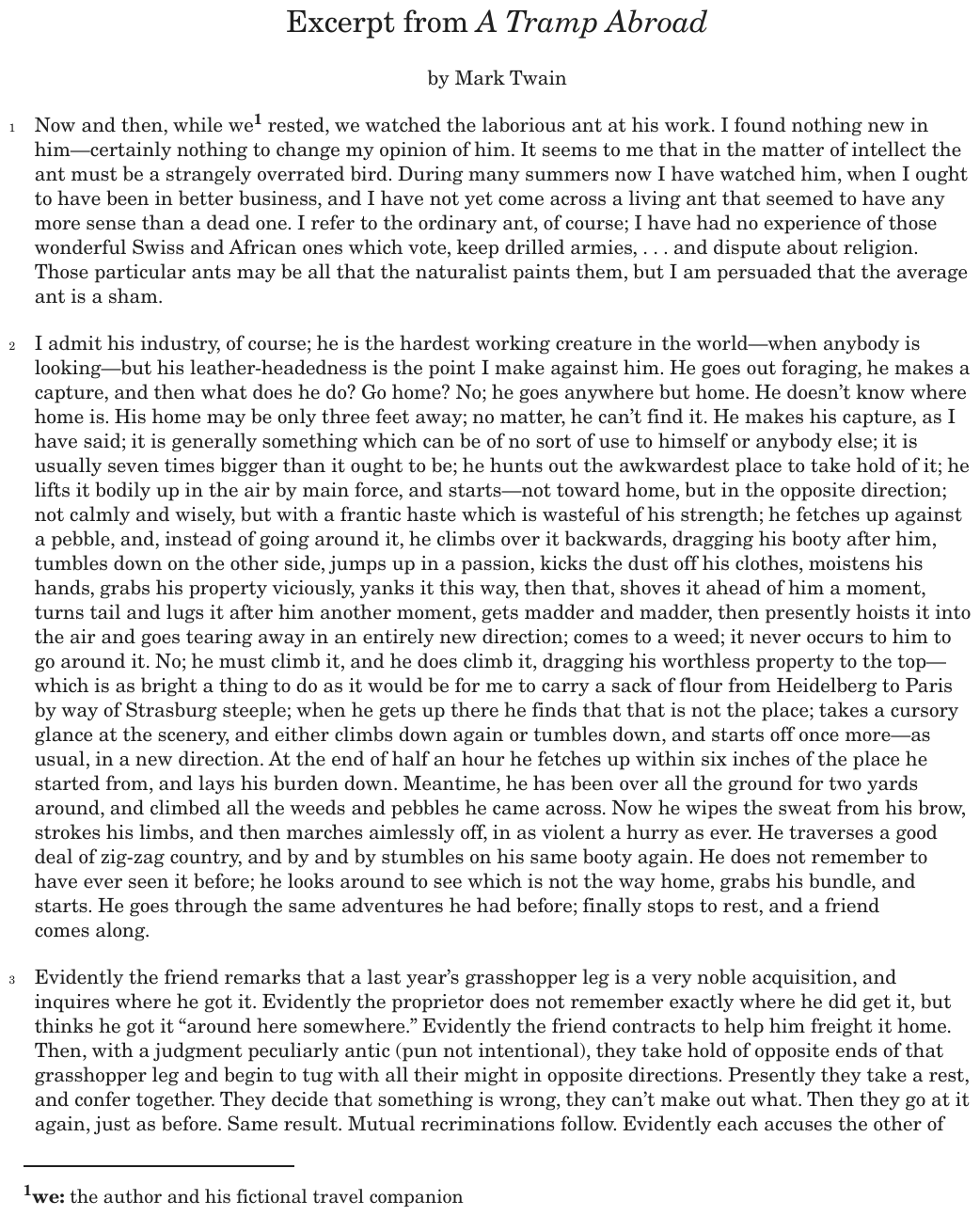
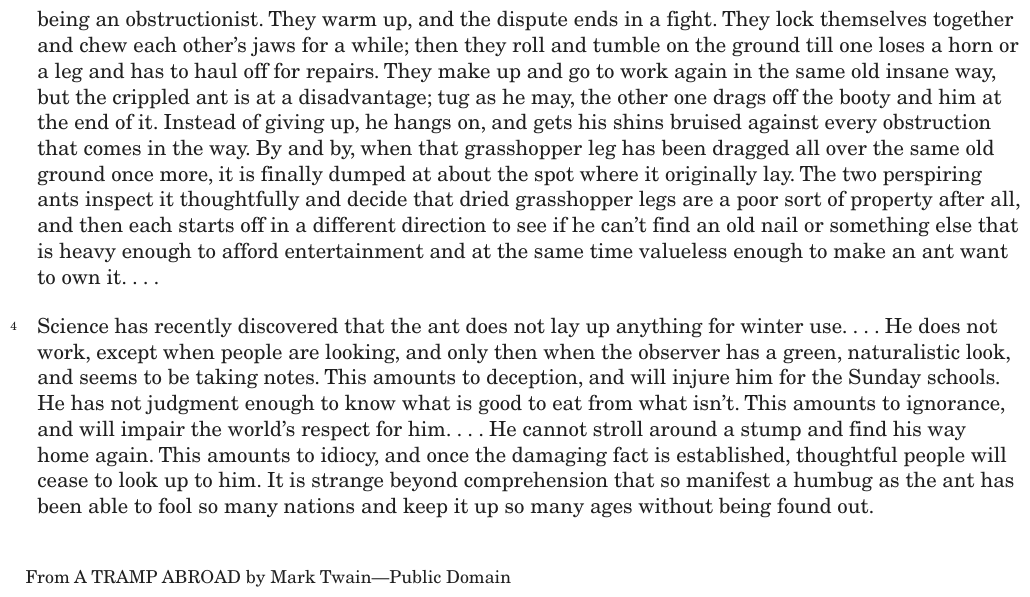
Question 49 of 59
2018 Test A English, question 32Uses the passage above: “Excerpt from A Tramp Abroad”.
Question
Which sentence from paragraph 2 best supports the idea that sheer “leather-headedness” (paragraph 2) amounts to “ignorance” and “idiocy” (paragraph 4)?
- A“He goes out foraging, he makes a capture, and then what does he do?”
- B“He lifts it bodily up in the air by main force,”
- C“When he gets up there he finds that that is not the place;”
- D“Now he wipes the sweat from his brow, strokes his limbs, and then marches aimlessly off, in as violent a hurry as ever.”
Show the answer
Correct answer: C
The answer is (C)
The question asks for a sentence in the excerpt that supports the idea that the ant’s “leather-headedness” (paragraph 2), or the ant’s stubborn determination to engage in foolish and worthless actions, amounts to ignorance and idiocy.
Option C is correct because, in the sentence in Option C, the ant realizes he is in the wrong place only after wasting effort and strength, which reveals his stupidity and lack of awareness.
Option A is incorrect because the sentence in Option A poses the question that the ant should ask himself and does not demonstrate the ant’s ignorance and idiocy.
Option B is incorrect because the sentence in Option B simply describes the ant’s action of lifting the grasshopper leg into a position to carry it.
Option D is incorrect because, while the sentence in Option D describes the ant’s exhaustion, which is caused by his stubborn determination, the sentence does not provide a connection to the ant’s leather-headedness.
Question analysis
This textual evidence question asks which sentence from paragraph 2 best shows that the ant's “leather-headedness” amounts to the “ignorance” and “idiocy” named later in Mark Twain's excerpt. Students must work out an old-fashioned insult and then choose among quotations that all describe the ant behaving oddly.
- Grade level
- Grade 8 reading and task
- Compared with grade 7
- Above grade 7 On a typical grade 7 test, an evidence question pairs a clear claim with one obviously fitting quotation. Here students must first decode an old-fashioned insult and connect it to judgments made two paragraphs later, which demands more interpretation.
- Estimated difficulty
- Hard: combines ideas, needs a plan, and has more than one tempting wrong answer.
- Thinking it demands
- Depth of knowledge 3, strategic thinking · mainly evaluate
- What makes it hard
- Hard words moderate
- Evidence in several places moderate
- Evidence
- Answered from several paragraphs or stanzas
- Reading level
- Passage: about grade 9, 1099 words; question and choices: about grade 7, 79 words.
- Corrected from the DOE handbook
- A wrong paragraph number in the explanation was corrected.
- Students, last 30 days
- Not enough answers yet to show (it takes 10).
Why it is hard, traps and wrong answers (shows the answer)
Why it is hard
Every quotation comes from the ant's absurd trip, so the question is which one shows a failure of sense on its own. Two are fragments cut just before the foolish part, and students who remember the full sentence credit them with more than they show. The marching-aimlessly line is the strongest rival; the key wins because it records a mistake the ant discovers only after great effort, matching paragraph 4's ant that cannot find his way.
Hard words moderate Understanding the question
“Leather-headedness” is an old insult meaning thick-headed stupidity; a student who reads it as toughness or stubbornness will look for force or persistence instead of foolishness. (Perfetti, 2007; Freedle & Kostin, 1993)
Evidence in several places moderate Working it out
The claim joins a word in paragraph 2 to “ignorance” and “idiocy” in paragraph 4, where idiocy is an ant that cannot “find his way home again.” (Kirsch & Mosenthal, 1990; Gorin & Embretson, 2006)
Strategy: Work out from context what “leather-headedness” means, then ask of each quotation whether it clearly shows that quality, and how it connects to the judgments in paragraph 4.
Traps
- Supports only part of the claim: In a question about evidence: a line that backs one half of the claim but not the other, or a related point rather than the claim itself.
- Wrong part of the text: A choice is true of another paragraph, stanza or speaker than the one asked about.
The wrong answers, classified
A Wrong part of the text (Kirsch & Mosenthal, 1990)
Remembers that this question leads into the ant going “anywhere but home,” but the quoted words only ask it; the foolish answer lies in the sentences after.
B Supports only part of the claim (King et al., 2004; Thissen, Steinberg & Fitzpatrick, 1989)
Picks the ant hoisting his prize “by main force,” which shows brute effort; the wrong-way start that would show poor sense comes after the quoted words.
D Supports only part of the claim (King et al., 2004; Thissen, Steinberg & Fitzpatrick, 1989)
Is drawn by “aimlessly,” but the sentence mostly shows the ant wiping sweat and hurrying off, not a misjudgment exposed the way the pointless climb is.
What was corrected from the DOE handbook, and why
- Explanation: The handbook places the ant’s “leather-headedness” in paragraph 4. The word is in paragraph 2, as the question itself says, so the explanation now reads “(paragraph 2)”.
Working it out, step by step
Figure out what the question asks
This is an evidence question. You need the sentence from paragraph 2 that best proves the ant is foolish. First you must know what the three insults mean.
Learn what the insults mean
In paragraph 2 Twain says, “his leather-headedness is the point I make against him.” Leather-headed is an old insult. It means thick-headed or dim. Watch out: it does not mean tough or strong.
In paragraph 4 he calls the ant’s acts “ignorance” (not knowing things) and “idiocy” (being very foolish). His example of idiocy is this: “He cannot stroll around a stump and find his way home again.”
Look for a foolish mistake
So look for a quote that, by itself, shows the ant making a foolish mistake. Choice C does. The ant drags his load to the top of a weed. Then “he finds that that is not the place.” He learns he is wrong only after all that work. That is a lot like an ant who can’t find his way home.
Check each choice
- A only asks a question. The foolish answer comes in later words.
- B shows the ant is strong, lifting his load “by main force.” Strength is not foolishness.
- C fits. It shows a mistake he finds only after wasting effort.
- D shows him sweaty and in a hurry. “Aimlessly” hints that he has no plan, but the quote shows no clear mistake.
Choose the answer
Choice C gives the clearest proof of a thick-headed ant. So the answer is C.
Why this answer and not the closest wrong one
D is the closest wrong choice, because “aimlessly” means without a goal. But D mostly shows the ant wiping sweat and rushing off. C shows a real error: he works hard to reach a spot, and it is the wrong spot. That matches “ignorance” and “idiocy” best.
More questions like this
The original DOE question
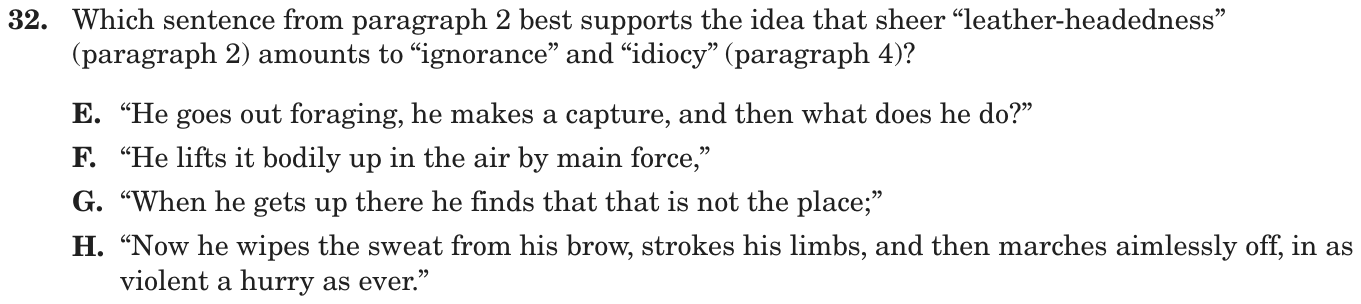
Question 50 of 59
2018 Test A English, question 48Passage Cross-Purposes
Cross-Purposes
What I am is built: concrete and steel.
I defy gravity. I am what every athlete
wants: to remain at the apex of the leap,
up in the air. And yet I am useful, too:
cars, trucks, people, even trains
make their way across my broad back.
Swallows and ospreys nest in my trusses.
What I am is motion. I am water, and I am older
than anything else you know. No human
built me. I am gravity’s best friend; I pool
and flow wherever gravity takes me.
I am the blood flowing in the runner’s chest,
and I catch everything: from the hills,
the mountains. It all washes down through me.
What you are is an accident,
what happens to rain when rain gives in
to Earth’s gravitational pull.
You are some tears dribbling from a mountain’s
eye, running down the pavements
of small towns, into the cities, to the sea.
You are the path of least resistance.
What I am is power. You, of course,
have none: you are a static lump, an artifact
slowly decaying. But my regal flow
nourishes grasses, permits empires to rise.
Those who made you will break you,
in time, replacing you with yet another
clumsy structure. I have seen. I know.
“Clumsy”? Being rebuilt makes me
a friend of time, does it not? And it means
that I have siblings—those “clumsy” structures,
my sisters and brothers.
We stitch across the rip you make.
We are steel thread to the human needle.
We bind you up. We sew you.
And I sow into you; in every cranny
of your superstructure my vapors cling.
They bring out your softness, your rust.
Boast your best, and boast better yet.
I am listening to the bright hum
of the wind in your wires. Because I am,
above all else, patient. I will wait for you.
ospreys: large birds
Question
Read lines 41–42 from the poem.
Because I am,
above all else, patient. I will wait for you.
Which of the following supports what is implied in these lines?
- A“I am older / than anything else you know.” (lines 8–9)
- B“No human / built me.” (lines 9–10)
- C“It all washes down through me.” (line 14)
- D“Those who made you will break you,” (line 26)
Show the answer
Correct answer: A
The answer is (A)
The question asks how the implication in lines 41–42 is supported by other lines in the poem. The words “patient” and “wait” in line 42 suggest that the speaker (the water) has the ability to outlast the other speaker because the water doesn’t weaken as it ages, making Option A (lines 8–9) the correct response.
Option B is incorrect because the promise made in line 42 is not affected by whether the water was built by humans (lines 9–10).
Option C is incorrect because, in line 14, the water’s ability to wait longer than the structure is not enhanced by what flows through the water.
Option D is incorrect because, in line 26, the water’s knowledge does not make its ability to wait any stronger—rather, its seemingly unending lifespan does.
Question analysis
This textual evidence question gives the water's closing words in “Cross-Purposes,” that it is patient and will wait, and asks which earlier line supports what they imply. Students must first state the implication in their own words, then choose among four lines spoken by the water that each say something true about it.
- NYS standards
- 7R1 textual evidence and inferences
- Grade level
- Grade 8 reading and task
- Compared with grade 7
- Above grade 7 Most grade 7 evidence items back up a claim the text states outright. Here the claim is only implied, and all four lines come from the same speaker, so students must reason about what patience would achieve, which goes beyond typical grade 7 work.
- Estimated difficulty
- Hard: combines ideas, needs a plan, and has more than one tempting wrong answer.
- Thinking it demands
- Depth of knowledge 3, strategic thinking · mainly evaluate
- What makes it hard
- Reading between the lines major
- Every choice must be checked moderate
- Evidence
- Answered from several paragraphs or stanzas
- Reading level
- Passage: 316 words (a poem; reading level not measured); question and choices: about grade 1, 57 words.
- Students, last 30 days
- Not enough answers yet to show (it takes 10).
Why it is hard, traps and wrong answers (shows the answer)
Why it is hard
The difficulty is in the first step: putting “I will wait for you” into words as a claim about time, that the water will still be there after the structure is gone. Students who read it as a prediction about the structure's end pick the line about humans breaking it, and those who read it as a contrast with built things pick the line about no human building the water. Only age directly supports a promise to outwait.
Reading between the lines major Working it out
Lines 41–42 never say the water will outlast the structure; students must state that implication of “patient” and “wait for you” before they can judge which earlier line supports it. (Graesser, Singer & Trabasso, 1994; Kintsch, 1998)
Every choice must be checked moderate Choosing the answer
All four lines are the water's own boasts from different stanzas, each true of it, so every one must be tested against the specific claim of lasting longer. (Embretson & Wetzel, 1987)
Strategy: Put the implied claim of the final two lines into your own words, then ask which earlier line gives a reason to believe that claim rather than just describing the water.
Traps
- Supports only part of the claim: In a question about evidence: a line that backs one half of the claim but not the other, or a related point rather than the claim itself.
- Reads too much in: A reasonable-sounding conclusion that goes further than the text allows.
The wrong answers, classified
B Supports only part of the claim (King et al., 2004; Thissen, Steinberg & Fitzpatrick, 1989)
Sees that being unbuilt sets the water apart from the structure, but having no human maker says nothing about its capacity to wait.
C Reads too much in (Graesser, Singer & Trabasso, 1994)
Reads “washes down through me” as slow erosion that will wear the structure away, though the line describes what the water carries, not how long it lasts.
D Supports only part of the claim (King et al., 2004; Thissen, Steinberg & Fitzpatrick, 1989)
Supports the structure's eventual end, but the implied claim is about the water outlasting it, which needs evidence of the water's long life.
Working it out, step by step
Figure out what the question asks
This is an evidence question. First, figure out what lines 41–42 hint at. Then find the earlier line that best supports that hint.
Work out the hint
The water says: “Because I am, / above all else, patient. I will wait for you.” Patient means able to wait calmly for a long time.
The water is telling the structure that it will still be here after the structure is gone. So the hidden claim is that the water will outlast the structure.
Find a line that supports it
To outlast something, you need a very long life. So look for a line about the water’s age. In lines 8–9 the water says: “I am older / than anything else you know.” It has already lasted longer than anything else. So it makes sense that it can outlast a bridge too.
Check each choice
- A fits. Great age backs up the claim that the water can wait the structure out.
- B “No human / built me” tells who made the water, not how long it lasts.
- C “It all washes down through me” tells what the water carries, not how long it lasts.
- D shows the structure will end, but not that the water will still be here.
Choose the answer
The water’s great age supports its promise to outwait the structure. So the answer is A.
Why this answer and not the closest wrong one
D is the closest trap, because “Those who made you will break you” also points to the structure’s end. But the hint in lines 41–42 is about the water lasting. D says nothing about the water. Only A gives proof of the water’s long life.
More questions like this
The original DOE question
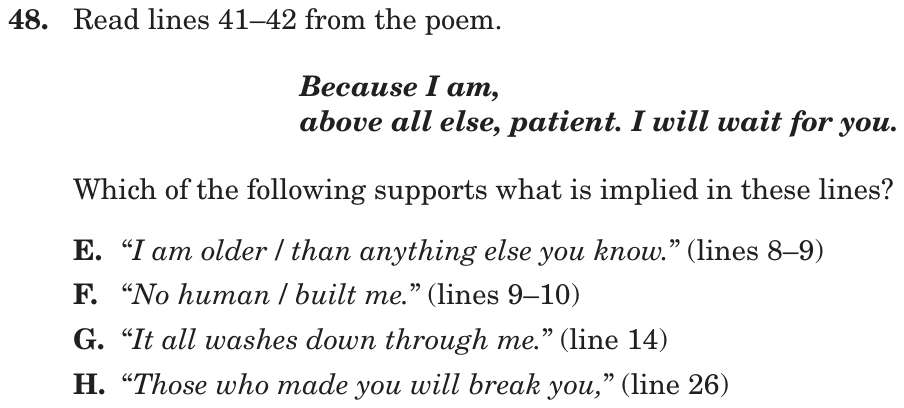
The passage “Cross-Purposes” as printed (pages 72–73)
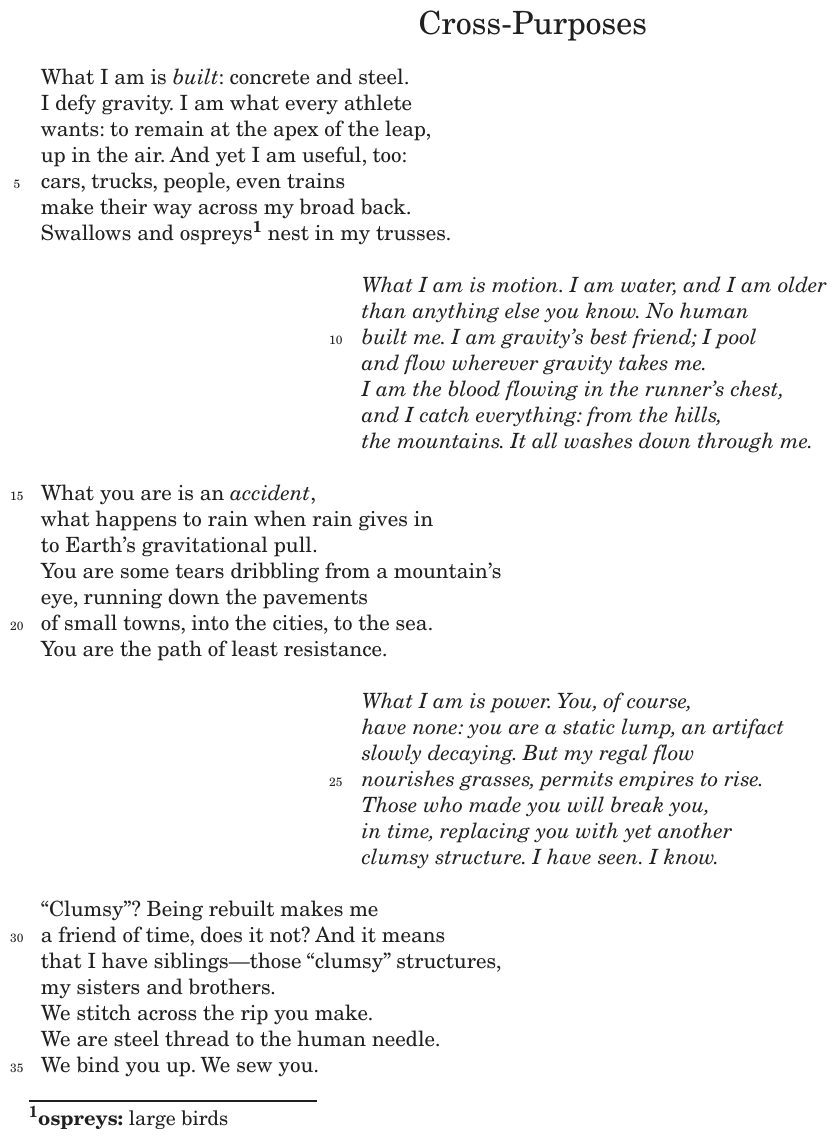
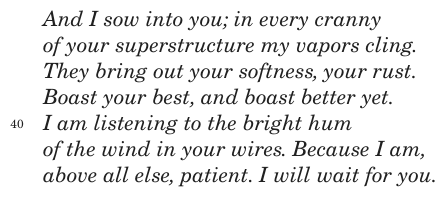
Question 51 of 59
2018 Test B English, question 10Passage The Tunguska Fireball
The Tunguska Fireball
On June 30, 1908, an enormous fireball shot across the sky and exploded high above the remote Tunguska River Valley in the Siberian region of Russia. Twenty miles away, huts were flattened and people were flung into the air. Villagers 40 miles away felt the heat and heard explosions, and tremors were recorded at a German seismic station more than 3,000 miles away.
What caused the intense light and the horrendous destruction of the Tunguska Fireball, as it came to be called? Scientists and laypeople have debated the question for over 100 years. Not until 1927 did a scientific expedition, led by Russian scientist Leonid Kulik, reach the remote site. Kulik discovered a vast region of scorched and downed trees, their trunks pointing away from the center of the blast. Convinced that a meteorite was responsible, Kulik searched for evidence—a crater, a buried meteorite, even fragments of the exploded mass. He never found it.
Other scientists, amateur astronomers, and the public suggested alternative theories of what had happened. Some thought it was an earthquake. Perhaps, others said, a black hole—a theoretical object in space where gravity is so strong that even light cannot get out—had collided with Earth or an alien spaceship carrying nuclear material had crashed.
For many years Russian scientists believed that the Tunguska Fireball was a comet—a cluster of dust and frozen gases—that had exploded a few hundred feet above the ground. They pointed to the lack of meteoric evidence and the June 30 date, a time of year when Earth was passing through cometary debris. Other scientists disagreed, arguing that a comet would have burned quickly in Earth’s atmosphere and could not have created such a blast.
Many Western scientists believed that a meteorite was responsible, despite the lack of evidence. The pattern of fallen trees suggested that they were knocked down by a blast about 4 miles above the ground with an energy of 15 megatons of TNT, consistent with a meteoric blast. Yet repeated searches of the surrounding forest and wetlands revealed no evidence of a meteorite.
During the 1990s an Italian physicist named Menotti Galli became interested. Galli had previously investigated whether particles from outer space can add carbon atoms to the cellulose in trees. Perhaps the trees at the Tunguska site hid evidence of such extraterrestrial material. Galli and his colleagues traveled to the site by helicopter to gather core samples from spruce trees that had lived through the blast. They analyzed the particles trapped in the trees’ resin, and the results were remarkable. Based on studying the trees’ rings during the time period when the Tunguska Fireball occurred, the researchers found that the resin contained high levels of high-proton elements, such as copper, gold, and nickel. In fact, it contained ten times more such particles than resin dating from either before or after that time period. Some previously discovered meteorites had also contained elevated levels of these elements, suggesting that the particles had an extra-earthly origin. But then where is the crater? Is it nearby Lake Cheko, as some claim? Or was the meteorite reduced to dust in the atmosphere? Can scientists rule out a comet carrying those elements? The mystery remains unsolved.
Question
What evidence best indicated the location of the blast?
- Aa lake formed from a crater
- Btremors recorded at a seismic station
- Cdamage caused to buildings
- Dthe position of the trunks of fallen trees
Show the answer
Correct answer: D
The question asks for evidence that best supports a detail in the passage. When scientists were able to travel to the site almost two decades after the blast, they found a circle of “scorched and downed trees” that marked the blast site (paragraph 2), making Option D the correct answer.
Option A is incorrect because, although the scientists searched for a crater, they never found one (paragraph 2).
Option B is also incorrect because the tremors recorded at a seismic station thousands of miles away detailed the magnitude of the event, not the location (paragraph 1).
Option C is incorrect because, although huts were flattened when the blast occurred, the destruction of the huts was not evident when the site was found almost two decades later (paragraph 1).
Question analysis
This evidence question uses a science article about the Tunguska Fireball, the mysterious 1908 explosion over Siberia. Students decide which piece of evidence best showed where the blast took place. The article piles up details about the explosion’s effects and the search that followed, so students must judge which detail really points to a place.
- NYS standards
- 7R1 textual evidence and inferences
- Grade level
- Grade 7 reading and task
- Compared with grade 7
- At grade 7 Finding the detail that answers a direct question is routine grade 7 reading, but this science article on a 1908 Siberian explosion uses dense, technical sentences. Students must also work out what a clue reveals, because the text never labels it.
- Estimated difficulty
- Straightforward: two steps or one careful reading.
- Thinking it demands
- Depth of knowledge 2, skills and concepts · mainly evaluate
- What makes it hard
- Reading between the lines moderate
- The right answer is reworded minor
- Evidence
- Answered from one paragraph or stanza
- Reading level
- Passage: about grade 10, 531 words; question and choices: about grade 5, 33 words.
- Corrected from the DOE handbook
- A misspelled place name in the passage was corrected.
- Students, last 30 days
- Not enough answers yet to show (it takes 10).
Why it is hard, traps and wrong answers (shows the answer)
Why it is hard
Every choice is connected to the blast, so the question turns on the word “location.” Students who remember the passage’s many effects, from tremors to flattened huts, have to ask which of them could point to a spot, and the crater that never turned up is the most natural guess. The direction the fallen trunks point is the only clue in the passage that does this.
Reading between the lines moderate Working it out
The passage never says the trees revealed where the blast happened; students must see that trunks “pointing away from the center of the blast” point back toward that center. (Graesser, Singer & Trabasso, 1994; Kintsch, 1998)
The right answer is reworded minor Choosing the answer
The seismic-station choice repeats the passage’s words almost exactly, while the right choice turns “their trunks pointing away” into the plainer “the position of the trunks of fallen trees.” (Freedle & Kostin, 1993; Kirsch & Mosenthal, 1990)
Strategy: For each clue in the choices, find what the passage says about it, then ask whether that clue could help someone pinpoint where the blast happened.
Traps
- Outside knowledge: A choice is plausible in the real world but not supported by this text.
- Supports only part of the claim: In a question about evidence: a line that backs one half of the claim but not the other, or a related point rather than the claim itself.
The wrong answers, classified
A Outside knowledge (King et al., 2004; Recht & Leslie, 1988)
Assumes an explosion from space must leave a crater, helped by the closing question about Lake Cheko, though Kulik searched for a crater and “never found it.”
B Supports only part of the claim (King et al., 2004; Thissen, Steinberg & Fitzpatrick, 1989)
Recalls the tremors recorded at a German station 3,000 miles away, real evidence about the blast, but the passage uses it to show the blast’s power, not where it happened.
C Supports only part of the claim (King et al., 2004; Thissen, Steinberg & Fitzpatrick, 1989)
Remembers that huts were flattened, real evidence of the blast, but they stood 20 miles away, so they show how far the damage reached rather than marking its center.
What was corrected from the DOE handbook, and why
- Passage: The handbook’s passage asks, “Is it nearby Lake Cheka, as some claim?” The lake near the Tunguska blast site that some scientists have proposed as the crater is Lake Cheko, so the site now spells it that way. No answer depends on the spelling.
Working it out, step by step
Figure out what the question asks
This asks which clue best showed where the blast happened. You need evidence about location, not about how strong the blast was.
Find the clue in paragraph 2
Paragraph 2 tells what Leonid Kulik found when he reached the site in 1927: “Kulik discovered a vast region of scorched and downed trees, their trunks pointing away from the center of the blast.”
Work out what the trees show
“Scorched” means burned. “Downed” means knocked over. The blast pushed the trees outward, so they fell pointing away from it, like spokes on a bike wheel. Follow the fallen trunks backward, and they all lead to the same spot. That spot is the center of the blast.
Check each choice
- A is wrong. Kulik looked for a crater, but “He never found it.” The lake comes up only as a question at the end.
- B is wrong. The tremors were recorded “more than 3,000 miles away.” They show how strong the blast was, not where it was.
- C is wrong. Huts were flattened 20 miles away. That shows how far the damage reached, not where the center was.
- D is right. The fallen trunks point away from the center, so they mark it.
Watch out: You might expect a blast from space to leave a crater. But the passage says no crater was found.
Choose the answer
The direction of the fallen trees points back to the center of the blast. So the answer is D.
Why this answer and not the closest wrong one
A is the closest wrong answer, because a crater would mark a spot. But no crater was ever found. The passage only asks whether Lake Cheko might be one. The trees are real evidence. Their trunks all point away from one center, so they show where the blast happened.
More questions like this
The original DOE question
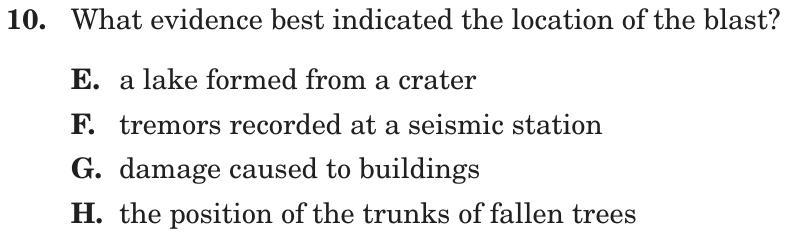
The passage “The Tunguska Fireball” as printed (page 124)
Question 52 of 59
2018 Test B English, question 17Passage Excerpt from A Voice in the Wilderness
Excerpt from A Voice in the Wilderness
by Grace Livingston Hill
With a lurch the train came to a dead stop and Margaret Earle, hastily gathering up her belongings, hurried down the aisle and got out into the night.
It occurred to her, as she swung her heavy suit-case down the rather long step to the ground, and then carefully swung herself after it, that it was strange that neither conductor, brakeman, nor porter had come to help her off the train, when all three had taken the trouble to tell her that hers was the next station; but she could hear voices up ahead. Perhaps something was the matter with the engine that detained them and they had forgotten her for the moment.
The ground was rough where she stood, and there seemed no sign of a platform. Did they not have platforms in this wild Western land, or was the train so long that her car had stopped before reaching it?
She strained her eyes into the darkness, and tried to make out things from the two or three specks of light that danced about like fireflies in the distance. She could dimly see moving figures away up near the engine, and each one evidently carried a lantern. The train was tremendously long. A sudden feeling of isolation took possession of her. Perhaps she ought not to have got out until some one came to help her. Perhaps the train had not pulled into the station yet and she ought to get back on it and wait. Yet if the train started before she found the conductor she might be carried on somewhere and he justly blame her for a fool.
There did not seem to be any building on that side of the track. It was probably on the other, but she was standing too near the cars to see over. She tried to move back to look, but the ground sloped and she slipped and fell in the cinders, bruising her knee and cutting her wrist.
In sudden panic she arose. She would get back into the train, no matter what the consequences. They had no right to put her out here, away off from the station, at night, in a strange country. If the train started before she could find the conductor she would tell him that he must back it up again and let her off. He certainly could not expect her to get out like this.
She lifted the heavy suit-case up the high step that was even farther from the ground than it had been when she came down, because her fall had loosened some of the earth and caused it to slide away from the track. Then, reaching to the rail of the step, she tried to pull herself up, but as she did so the engine gave a long snort and the whole train, as if it were in league against her, lurched forward crazily, shaking off her hold. She slipped to her knees again, the suit-case, toppled from the lower step, descending upon her, and together they slid and rolled down the short bank, while the train . . . ran giddily off into the night.
The horror of being deserted helped the girl to rise in spite of bruises and shock. She lifted imploring hands to the unresponsive cars as they hurried by her—one, two, three, with bright windows, each showing a passenger, comfortable and safe inside, unconscious of her need.
A moment of useless screaming, running, trying to attract some one’s attention, a sickening sense of terror and failure, and the last car slatted itself past with a mocking clatter, as if it enjoyed her discomfort.
Margaret stood dazed, reaching out helpless hands, then dropped them at her sides and gazed after the fast-retreating train, the light on its last car swinging tauntingly, blinking now and then with a leer in its eye, rapidly vanishing from her sight into the depth of the night.
She gasped and looked about her for the station that but a short moment before had been so real to her mind; and, lo! on this side and on that there was none!
The night was wide like a great floor shut in by a low, vast dome of curving blue set with the largest, most wonderful stars she had ever seen. Heavy shadows of purple-green, smoke-like, hovered over earth darker and more intense than the unfathomable blue of the night sky. It seemed like the secret nesting-place of mysteries wherein no human foot might dare intrude. It was incredible that such could be but common sage-brush, sand, and greasewood wrapped about with the beauty of the lonely night.
No building broke the inky outlines of the plain, nor friendly light streamed out to cheer her heart. Not even a tree was in sight, except on the far horizon, where a heavy line of deeper darkness might mean a forest. Nothing, absolutely nothing, in the blue, deep, starry dome above and the bluer darkness of the earth below save one sharp shaft ahead like a black mast throwing out a dark arm across the track.
As soon as she sighted it she picked up her baggage and made her painful way toward it, for her knees and wrist were bruised and her baggage was heavy.
A soft drip, drip greeted her as she drew nearer; something plashing down among the cinders by the track. Then she saw the tall column with its arm outstretched, and looming darker among the sage-brush the outlines of a water-tank. It was so she recognized the engine’s drinking-tank, and knew that she had mistaken a pause to water the engine for a regular stop at a station.
cinders: track bed made from the residue of burnt coal
From A VOICE IN THE WILDERNESS by Grace Livingston Hill—Public Domain
Question
Which sentence from the excerpt best supports the idea that traveling to new places by train is unfamiliar to Margaret?
- A“With a lurch the train came to a dead stop and Margaret Earle, hastily gathering up her belongings, hurried down the aisle and got out into the night.” (paragraph 1)
- B“Perhaps something was the matter with the engine that detained them and they had forgotten her for the moment.” (paragraph 2)
- C“Did they not have platforms in this wild Western land, or was the train so long that her car had stopped before reaching it?” (paragraph 3)
- D“She could dimly see moving figures away up near the engine, and each one evidently carried a lantern.” (paragraph 4)
Show the answer
Correct answer: C
The question asks for evidence from the passage that best supports the claim that Margaret is unfamiliar with traveling to new places. If Margaret has never traveled to this region by train before, she must guess or attempt to interpret what she sees. This idea is best represented in the sentence in paragraph 3 (Option C) where she questions whether the stations in the West have platforms.
The sentence in paragraph 1 (Option A) is an incorrect response because Margaret’s actions in the sentence are decisive as she gathers her belongings to disembark; she is familiar with rail travel.
The sentence in paragraph 2 (Option B) is an incorrect response because, in the sentence, Margaret is using her knowledge about trains to attempt to interpret the actions of others; she is familiar with trains, even if a particular destination has not been mentioned.
The sentence in paragraph 4 (Option D) is an incorrect response because, while the sentence shows that Margaret is trying to better understand her situation in the darkness, her ability to identify the train’s engine and the figures carrying lanterns indicates some familiarity with her mode of travel.
Question analysis
This textual-evidence question asks which sentence from the train scene in A Voice in the Wilderness best shows that traveling to new places is unfamiliar to Margaret. Students compare four quotations from the opening paragraphs of the excerpt. The pull comes from lines that reveal her state of mind but prove something other than the claim.
- NYS standards
- 7R1 textual evidence and inferences
- Grade level
- Grade 7 reading and task
- Compared with grade 7
- At grade 7 Choosing the quotation that best supports an idea is standard grade 7 evidence work. Here most of the quotations hint at Margaret’s unease, so students must match the claim precisely rather than settle for any sign of uncertainty.
- Estimated difficulty
- Moderate: several steps, or a close reading with one strong distractor.
- Thinking it demands
- Depth of knowledge 2, skills and concepts · mainly evaluate
- What makes it hard
- Every choice must be checked moderate
- Reading between the lines minor
- Evidence
- Answered from several paragraphs or stanzas
- Reading level
- Passage: about grade 8, 981 words; question and choices: about grade 11, 113 words.
- Students, last 30 days
- Not enough answers yet to show (it takes 10).
Why it is hard, traps and wrong answers (shows the answer)
Why it is hard
All four sentences show Margaret uncertain, so mood alone cannot decide this. The claim has two parts, travel by train and new places, and the right sentence is the only one where her uncertainty is about the region itself. Students lose the point when they settle for a sentence that shows doubt about the delay or the darkness instead.
Every choice must be checked moderate Choosing the answer
The four quotations come from the first four paragraphs and all show Margaret unsure in the dark, so each has to be tested against the claim’s specific idea of new places. (Embretson & Wetzel, 1987)
Reading between the lines minor Working it out
The right sentence is a question about “this wild Western land,” and students must infer that only a newcomer to the West would wonder whether its stations have platforms. (Graesser, Singer & Trabasso, 1994; Kintsch, 1998)
Strategy: Underline the key words of the claim, then test each quotation against every one of those words rather than against its general mood.
Traps
- Supports only part of the claim: In a question about evidence: a line that backs one half of the claim but not the other, or a related point rather than the claim itself.
The wrong answers, classified
A Supports only part of the claim (King et al., 2004; Thissen, Steinberg & Fitzpatrick, 1989)
Shows her on a train and reads the hurried exit as a nervous newcomer’s, but the sentence shows only haste and confidence, with no sign that the place is new to her.
B Supports only part of the claim (King et al., 2004; Thissen, Steinberg & Fitzpatrick, 1989)
Sees uncertainty in “Perhaps something was the matter with the engine,” but she is guessing about one delay like an experienced rider, not puzzling over a new place.
D Supports only part of the claim (King et al., 2004; Thissen, Steinberg & Fitzpatrick, 1989)
Notices the guesswork in “dimly” and “evidently,” but the sentence reflects darkness, and she still recognizes the engine and lanterns, which shows she knows trains.
Working it out, step by step
Figure out what the question asks
This asks for evidence: the sentence that best proves an idea. The idea is that traveling by train to new places is unfamiliar, or new, to Margaret.
Underline the key words
The idea has two parts: train travel and new places. All four sentences show Margaret unsure in the dark. But the right one must show that this place is new to her.
Look closely at paragraph 3
Paragraph 3 asks: “Did they not have platforms in this wild Western land, or was the train so long that her car had stopped before reaching it?” A platform is the raised floor where you get on and off a train. Margaret wonders whether stations out West even have platforms. She calls it “this wild Western land.” Only someone new to a place would wonder that.
Check each choice
- A is wrong. It shows her getting off quickly. Nothing shows the place is new to her.
- B is wrong. She guesses about engine trouble. That shows she knows how trains work.
- C is right. She does not know what stations are like in this new land.
- D is wrong. She can’t see well because it is dark. She still knows the engine and the lanterns.
Watch out: B starts with “Perhaps,” so it sounds unsure. But she is guessing about one train, not about a new place.
Choose the answer
Only the question about platforms shows that the place is strange to her. So the answer is C.
Why this answer and not the closest wrong one
B is the closest wrong answer, because Margaret is unsure in it too. But in B she guesses about the engine, like any rider who knows trains. In C, she wonders what stations in “this wild Western land” are like. That shows the place is new to her.
More questions like this
The original DOE question
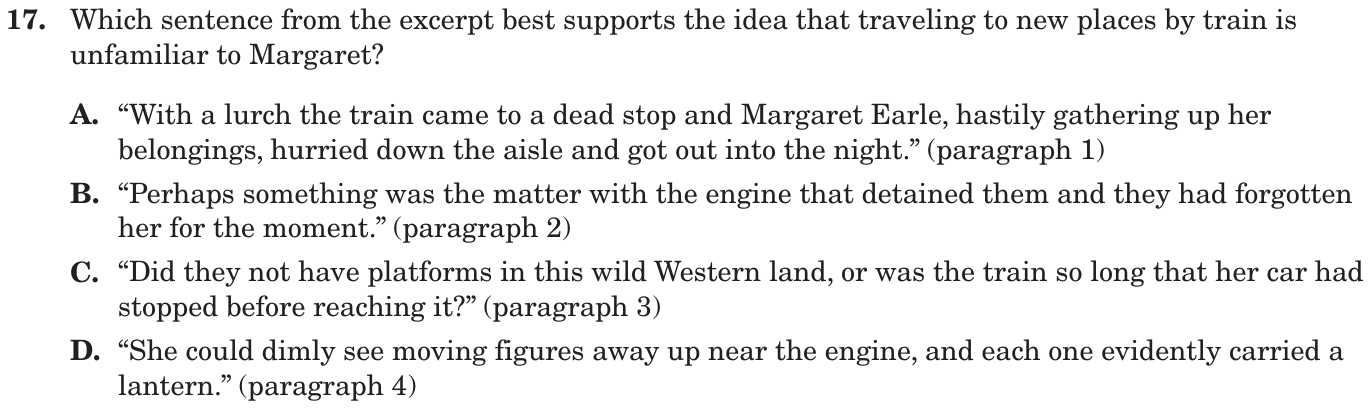
The passage “Excerpt from A Voice in the Wilderness” as printed (pages 128–129)
Question 53 of 59
2018 Test B English, question 25Passage Excerpt from “Niagara Falls”
Excerpt from “Niagara Falls”
by Rupert Brooke
The real secret of the beauty and terror of the Falls is not their height or width, but the feeling of colossal power and of unintelligible disaster caused by the plunge of that vast body of water. If that were taken away, there would be little visible change, but the heart would be gone.
The American Falls do not inspire this feeling in the same way as the Canadian. It is because they are less in volume, and because the water does not fall so much into one place. By comparison their beauty is almost delicate and fragile. They are extraordinarily level, one long curtain of lacework and woven foam. Seen from opposite, when the sun is on them, they are blindingly white, and the clouds of spray show dark against them. With both Falls the colour of the water is the ever-altering wonder. Greens and blues, purples and whites, melt into one another, fade, and come again, and change with the changing sun. Sometimes they are as richly diaphanous as a precious stone, and glow from within with a deep, inexplicable light. Sometimes the white intricacies of dropping foam become opaque and creamy. And always there are the rainbows. If you come suddenly upon the Falls from above, a great double rainbow, very vivid, spanning the extent of spray from top to bottom, is the first thing you see. If you wander along the cliff opposite, a bow springs into being in the American Falls, accompanies you courteously on your walk, dwindles and dies as the mist ends, and awakens again as you reach the Canadian tumult. And the bold traveller who attempts the trip under the American Falls sees, when he dare open his eyes to anything, tiny baby rainbows, some four or five yards in span, leaping from rock to rock among the foam, and gambolling beside him, barely out of hand’s reach, as he goes. One I saw in that place was a complete circle, such as I have never seen before, and so near that I could put my foot on it. It is a terrifying journey, beneath and behind the Falls. The senses are battered and bewildered by the thunder of the water and the assault of wind and spray; or rather, the sound is not of falling water, but merely of falling; a noise of unspecified ruin. So, if you are close behind the endless clamour, the sight cannot recognise liquid in the masses that hurl past. You are dimly and pitifully aware that sheets of light and darkness are falling in great curves in front of you. Dull omnipresent foam washes the face. Farther away, in the roar and hissing, clouds of spray seem literally to slide down some invisible plane of air.
Beyond the foot of the Falls the river is like a slipping floor of marble, green with veins of dirty white, made by the scum that was foam. It slides very quietly and slowly down for a mile or two, sullenly exhausted. Then it turns to a dull sage green, and hurries more swiftly, smooth and ominous. As the walls of the ravine close in, trouble stirs, and the waters boil and eddy. These are the lower rapids, a sight more terrifying than the Falls, because less intelligible. Close in its bands of rock the river surges tumultuously forward, writhing and leaping as if inspired by a demon. It is pressed by the straits into a visibly convex form. Great planes of water slide past. Sometimes it is thrown up into a pinnacle of foam higher than a house, or leaps with incredible speed from the crest of one vast wave to another, along the shining curve between, like the spring of a wild beast. Its motion continually suggests muscular action. The power manifest in these rapids moves one with a different sense of awe and terror from that of the Falls. Here the inhuman life and strength are spontaneous, active, almost resolute. . . . A place of fear.
One is drawn back, strangely, to a contemplation of the Falls, at every hour, and especially by night, when the cloud of spray becomes an immense visible ghost, straining and wavering high above the river, white and pathetic and translucent. The Victorian lies very close below the surface in every man. There one can sit and let great cloudy thoughts of destiny and the passage of empires drift through the mind; for such dreams are at home by Niagara. I could not get out of my mind the thought of a friend, who said that the rainbows over the Falls were like the arts and beauty and goodness, with regard to the stream of life—caused by it, thrown upon its spray, but unable to stay or direct or affect it, and ceasing when it ceased. In all comparisons that rise in the heart, the river, with its multitudinous waves and its single current, likens itself to a life, whether of an individual or of a community. A man’s life is of many flashing moments, and yet one stream; a nation’s flows through all its citizens, and yet is more than they. In such places, one is aware, with an almost insupportable and yet comforting certitude, that both men and nations are hurried onwards to their ruin or ending as inevitably as this dark flood. Some go down to it unreluctant, and meet it, like the river, not without nobility. And as incessant, as inevitable, and as unavailing as the spray that hangs over the Falls, is the white cloud of human crying. . . . With some such thoughts does the platitudinous heart win from the confusion and thunder of a Niagara peace that the quietest plains or most stable hills can never give.
From LETTERS FROM AMERICA by Rupert Brooke—Public Domain
diaphanous: sheer, translucent
platitudinous: clichéd, common
Question
The central idea that the Falls communicate a feeling of “unintelligible disaster” (paragraph 1) is conveyed in paragraph 2 through a description of
- Athe glow of the precious stones visible within the water.
- Bthe dynamic flow of the colors that are visible in the water.
- Cthe sudden appearance and disappearance of rainbows.
- Dthe sounds associated with a sense of falling.
Show the answer
Correct answer: D
The question asks for a specific detail from paragraph 2 that conveys the central idea that the Falls communicates a feeling of “unintelligible disaster” (paragraph 1). The sound of falling is described in paragraph 2 as “a noise of unspecified ruin,” so Option D is correct because it best connects with the idea of “unintelligible disaster” mentioned in paragraph 1.
Option A is incorrect because, although the water is described as “diaphanous as a precious stone” in paragraph 2 because of the “glow” coming from the interaction of the light, there are no stones within the water.
Option B is incorrect because the details in paragraph 2 about the flow of colors in the water are described as an “ever-altering wonder,” which conveys a sense of beauty and not a sense of disaster.
Option C is incorrect because the rainbows in paragraph 2 are described as “vivid” and accompanying someone “courteously” while he or she walks, which contributes to the idea that the appearance and disappearance of the rainbows are a pleasant experience and not disastrous.
Question analysis
This question on Rupert Brooke’s essay “Niagara Falls” asks which descriptive detail in paragraph 2 conveys the central idea that the Falls feel like an “unintelligible disaster.” Students must connect an idea from the opening paragraph to supporting evidence in a very long paragraph packed with vivid images, and judge the feeling each image creates.
- Grade level
- Grade 8 reading and task
- Compared with grade 7
- At grade 7 Linking a detail to a central idea is standard grade 7 work, but the evidence sits inside a paragraph of several hundred words of century-old prose, with words like “diaphanous” and “gambolling,” and must be matched by meaning rather than wording.
- Estimated difficulty
- Moderate: several steps, or a close reading with one strong distractor.
- Thinking it demands
- Depth of knowledge 2, skills and concepts · mainly analyze
- What makes it hard
- A lot to read moderate
- Figurative or literary language moderate
- Hard words minor
- Evidence
- Answered from one paragraph or stanza
- Reading level
- Passage: about grade 9, 987 words; question and choices: about grade 9, 58 words.
- Students, last 30 days
- Not enough answers yet to show (it takes 10).
Why it is hard, traps and wrong answers (shows the answer)
Why it is hard
The challenge is to find, in the essay’s longest paragraph, the one image that feels like disaster rather than beauty. Most of the paragraph is lovely, colors and rainbows that change and return, and the wrong choices draw on those passages. Students who keep the feeling of “unintelligible disaster” in mind, rather than just looking for things that appear and disappear, will find it in the sound of the water near the end.
A lot to read moderate Understanding the question
Paragraph 2 runs 407 words through colors, rainbows and a trip behind the water, and the sentence that matters, ending “a noise of unspecified ruin,” comes near its end. (Kintsch, 1998; Gorin & Embretson, 2006; Freedle & Kostin, 1993)
Figurative or literary language moderate Understanding the question
Students must judge the feeling each image creates, and only the sound “not of falling water, but merely of falling” carries a sense of disaster; the colors and rainbows are wonders. (Graesser, Singer & Trabasso, 1994; Kintsch, 1998)
Hard words minor Understanding the question
The key phrase “unintelligible disaster” must be matched to “unspecified ruin,” and words such as “diaphanous” and “intricacies” crowd the images around it. (Perfetti, 2007; Freedle & Kostin, 1993)
Strategy: Keep the words “unintelligible disaster” in mind, find each choice’s detail in paragraph 2, and ask what feeling the author’s words give that detail.
Traps
- Supports only part of the claim: In a question about evidence: a line that backs one half of the claim but not the other, or a related point rather than the claim itself.
- Taking figurative language literally: A choice reads a figure of speech or image at face value.
The wrong answers, classified
A Taking figurative language literally (Graesser, Singer & Trabasso, 1994)
Takes the simile “as richly diaphanous as a precious stone” to mean stones in the water, and links its “inexplicable light” to “unintelligible,” though the image is lovely.
B Supports only part of the claim (King et al., 2004; Thissen, Steinberg & Fitzpatrick, 1989)
Picks the shifting greens, blues and purples, hard to pin down like something unintelligible, but the author calls the color “the ever-altering wonder,” delight rather than disaster.
C Supports only part of the claim (King et al., 2004; Thissen, Steinberg & Fitzpatrick, 1989)
Notices that a rainbow “dwindles and dies” and “awakens again,” which sounds unsettling, but the bows are vivid and keep the walker company “courteously,” so nothing suggests disaster.
Working it out, step by step
Figure out what the question asks
Paragraph 1 says the Falls give a feeling of “unintelligible disaster.” “Unintelligible” means impossible to understand. You need the detail in paragraph 2 that feels like a disaster you can’t understand.
Find the matching words
Near the end of paragraph 2, the author goes behind the Falls. He says “the sound is not of falling water, but merely of falling; a noise of unspecified ruin.”
Work out what the words mean
“Merely” means just. The noise is not of water but of falling itself, as if everything were crashing down. “Ruin” means destruction, much like disaster. “Unspecified” means not named or not clear. So the sound is a crash of destruction you can’t explain. That matches “unintelligible disaster.”
Check each choice
- A is wrong. The water is only compared to a precious stone. There are no stones, and the image is lovely, not scary.
- B is wrong. The colors are called “the ever-altering wonder.” That is beauty, not disaster.
- C is wrong. The rainbows are “very vivid” and walk beside you “courteously,” which means politely. They are pleasant.
- D is right. The sound of falling is the “noise of unspecified ruin.”
Watch out: A rainbow that “dwindles and dies” sounds sad. But it “awakens again,” and the rainbows are a delight.
Choose the answer
Only the sound of falling carries the sense of a disaster. So the answer is D.
Why this answer and not the closest wrong one
C is the closest wrong answer, because a rainbow that “dwindles and dies” might seem gloomy. But the author makes the rainbows friendly and beautiful. “A noise of unspecified ruin” almost repeats the words “unintelligible disaster,” so D is the best match.
More questions like this
The original DOE question
The passage “Excerpt from “Niagara Falls”” as printed (pages 134–135)
Question 54 of 59
2018 Test B English, question 28Uses the passage above: “Excerpt from “Niagara Falls””.
Question
Which sentence from the excerpt best supports the idea that the essence of the Falls lies in their emotional impact?
- A“If that were taken away, there would be little visible change, but the heart would be gone.” (paragraph 1)
- B“By comparison their beauty is almost delicate and fragile.” (paragraph 2)
- C“One is drawn back, strangely, to a contemplation of the Falls, at every hour, and especially by night, when the cloud of spray becomes an immense visible ghost, straining and wavering high above the river, white and pathetic and translucent.” (paragraph 4)
- D“A man’s life is of many flashing moments, and yet one stream; a nation’s flows through all its citizens, and yet is more than they.” (paragraph 4)
Show the answer
Correct answer: A
The question asks for the sentence from the excerpt that best supports the idea that the essence of the Falls lies in their emotional impact. The first sentence in the excerpt establishes that the “real secret of the beauty and terror of the Falls” is “the feeling of colossal power and of unintelligible disaster.” Option A is correct because the sentence in Option A best supports this notion by identifying these qualities as “the heart,” or essence, of the Falls.
While “delicate” and “fragile” are words that can be connected with certain kinds of emotions, in the sentence in Option B, they are connected with physical beauty, so Option B is incorrect.
Option C is incorrect because, while the sentence in Option C describes the power of the Falls to engage one in thought, it does not best support the idea that the essence of the Falls lies in their emotional impact.
Option D is incorrect because the sentence in Option D describes thoughts one may have while watching the Falls and is not focused on the Falls’ emotional impact.
Question analysis
In this textual evidence question, students choose the quotation from Rupert Brooke’s “Niagara Falls” that best supports the idea that the essence of the Falls lies in their emotional impact. Every choice is a vivid sentence from the excerpt, so the challenge is matching that precise idea instead of settling for a line that only sounds emotional.
- Grade level
- Grade 8 reading and task
- Compared with grade 7
- At grade 7 Grade 7 evidence questions usually offer one sentence that clearly matches the claim. Here all four quotations are long or figurative lines of older prose, and the claim itself, about an essence, is abstract.
- Estimated difficulty
- Moderate: several steps, or a close reading with one strong distractor.
- Thinking it demands
- Depth of knowledge 2, skills and concepts · mainly evaluate
- What makes it hard
- Reading between the lines moderate
- Hard words minor
- Evidence
- Answered from one paragraph or stanza
- Reading level
- Passage: about grade 9, 987 words; question and choices: about grade 11, 115 words.
- Corrected from the DOE handbook
- A misquotation of the passage in the explanation was corrected.
- A stray apostrophe in the explanation was removed.
- Students, last 30 days
- Not enough answers yet to show (it takes 10).
Why it is hard, traps and wrong answers (shows the answer)
Why it is hard
Every quotation carries feeling, so the test is whether a sentence says what the Falls’ essence is, not merely whether it is emotional. The right one is short and plain and depends on the sentence before it, which defines “that” as the feeling of power and disaster. Students who choose by the intensity of the language pass over it for the ghostly night scene or the reflections on life.
Reading between the lines moderate Working it out
The right sentence never says “emotion” or “essence”: students must see that “that” points back to “the feeling of colossal power,” and that “the heart” means the essence. (Graesser, Singer & Trabasso, 1994; Kintsch, 1998)
Hard words minor Understanding the question
The claim’s key word, “essence,” has to be matched to the text’s “real secret” and “heart,” two everyday words used here in an abstract sense. (Perfetti, 2007; Freedle & Kostin, 1993)
Strategy: Restate the idea in your own words, that the Falls matter because of how they make people feel, and test each quotation: does it say what the Falls’ essence is, or something else?
Traps
- Supports only part of the claim: In a question about evidence: a line that backs one half of the claim but not the other, or a related point rather than the claim itself.
The wrong answers, classified
B Supports only part of the claim (King et al., 2004; Thissen, Steinberg & Fitzpatrick, 1989)
Treats “delicate and fragile” as emotional words, but the sentence describes how the American Falls look beside the Canadian, not where the essence of the Falls lies.
C Supports only part of the claim (King et al., 2004; Thissen, Steinberg & Fitzpatrick, 1989)
Backs the emotional half, the spray as an “immense visible ghost” that draws people back, but describes the Falls’ pull without saying that their essence lies there.
D Supports only part of the claim (King et al., 2004; Thissen, Steinberg & Fitzpatrick, 1989)
Chooses a moving reflection the Falls inspire, but this sentence is about how a river resembles human lives and nations, not about the Falls’ emotional impact.
What was corrected from the DOE handbook, and why
- Explanation: The handbook quotes the first sentence as saying the “real secret of the beauty and terror of the Falls . . . lies in the feeling of colossal power and unintelligible disaster.” The passage says the real secret “is not their height or width, but the feeling of colossal power and of unintelligible disaster.” The site now quotes it exactly.
- Explanation: The handbook writes “the power of the Falls’ to engage one in thought”; the site drops the stray possessive apostrophe: “the power of the Falls to engage one in thought.”
Working it out, step by step
Figure out what the question asks
This asks for evidence for an idea: the essence of the Falls lies in their emotional impact. “Essence” means the most important part, what makes something what it is. “Emotional impact” means the way it makes people feel.
Read the opening of paragraph 1
The essay begins: “The real secret of the beauty and terror of the Falls is not their height or width, but the feeling of colossal power and of unintelligible disaster.” So the real secret of the Falls is a feeling.
Read the sentence that comes next
Next comes: “If that were taken away, there would be little visible change, but the heart would be gone.” “That” means the feeling. Take the feeling away, and the Falls would look the same. But “the heart” would be gone. Here, the heart means the most important part, the essence. So the essence is the feeling.
Check each choice
- A is right. It says the Falls would lose their heart without the feeling they create.
- B is wrong. It compares how the two Falls look, not what their essence is.
- C is wrong. It shows the Falls pull people back, but it never says the feeling is their essence.
- D is wrong. It compares a river to human lives and nations.
Watch out: C is full of feeling, with the spray like a ghost. But it describes a view, not what the Falls truly are.
Choose the answer
Only A says that the feeling is the heart of the Falls. So the answer is A.
Why this answer and not the closest wrong one
C is the closest wrong answer, because it is an emotional description. But it does not say where the essence of the Falls lies. A does. Without the feeling, almost nothing you can see would change, yet “the heart would be gone.”
More questions like this
The original DOE question
Question 55 of 59
2018 Test B English, question 30Uses the passage above: “Excerpt from “Niagara Falls””.
Question
In paragraph 4, the idea that human life and history travel toward the same ending is illustrated mainly through
- Athe discussion of how the rainbows visible in the Falls are like the art and beauty created by humankind.
- Bthe comparison between the movement of water in the Falls and the human experience.
- Cthe inclusion of details that show that every observer’s experience with the Falls is different.
- Dthe acknowledgment that contemplating the Falls at night sparks an awareness of humankind’s destiny.
Show the answer
Correct answer: B
The question asks how the discussion of human life and history is illustrated in paragraph 4 of the excerpt. The author concludes in paragraph 4 that the Falls can be compared to people and history by writing, “both men and nations are hurried onwards to their ruin or ending as inevitably as this dark flood,” making Option B correct.
Option A is incorrect because the discussion of rainbows in paragraph 4 focuses on the fate of art and beauty, not of humanity (“I could not get out of my mind the thought of a friend, who said that the rainbows over the Falls were like the arts and beauty and goodness, with regard to the stream of life—caused by it, thrown upon its spray, but unable to stay or direct or affect it, and ceasing when it ceased”).
Option C is incorrect because, in paragraph 4, the author talks about people in general when discussing “men and nations” and provides no evidence of the differences in specific individuals’ experience of the Falls.
Option D is incorrect because, while the setting at night does provide a place of contemplation, the author notes the “dark flood” as the overall illustration of the human experience.
Question analysis
In this question about the closing paragraph of Brooke’s “Niagara Falls,” students identify the main way the author illustrates the idea that human lives and history move toward the same ending. The paragraph is dense and philosophical and holds several images and reflections, so students must find the one that carries this particular idea.
- Grade level
- Grade 8 reading and task
- Compared with grade 7
- Above grade 7 Grade 7 students often trace how an idea is illustrated in a modern text; this paragraph is abstract reflection in long, formal sentences, with words like “certitude” and “multitudinous,” and offers several competing images to sort through.
- Estimated difficulty
- Hard: combines ideas, needs a plan, and has more than one tempting wrong answer.
- Thinking it demands
- Depth of knowledge 2, skills and concepts · mainly analyze
- What makes it hard
- Complex sentences major
- The right answer is reworded moderate
- Hard words minor
- Evidence
- Answered from one paragraph or stanza
- Reading level
- Passage: about grade 9, 987 words; question and choices: about grade 10, 80 words.
- Students, last 30 days
- Not enough answers yet to show (it takes 10).
Why it is hard, traps and wrong answers (shows the answer)
Why it is hard
Paragraph 4 holds three images, the night spray as a ghost, the friend’s rainbows, and the river as a life, and the question asks which one carries the idea of a shared ending. Students who recognize the stem’s idea in the word “destiny” or in rainbows “ceasing when it ceased” can stop too soon. The test is the word “illustrated”: only the comparison of the dark flood to men and nations shows them traveling to an end.
Complex sentences major Understanding the question
The key sentence buries its point in qualifiers: “one is aware, with an almost insupportable and yet comforting certitude, that both men and nations are hurried onwards to their ruin or ending as inevitably as this dark flood.” (Abedi & Lord, 2001; Freedle & Kostin, 1993; Messick, 1989)
The right answer is reworded moderate Choosing the answer
The right choice sums up the river-as-life comparison in plain words, “movement of water” and “human experience,” while wrong choices reuse the paragraph’s own “rainbows,” “art and beauty,” “night” and “destiny.” (Freedle & Kostin, 1993; Kirsch & Mosenthal, 1990)
Hard words minor Understanding the question
“Multitudinous,” “certitude,” “insupportable” and “unavailing” all fall in the sentences that carry the idea, so students must read through them to reach the comparison. (Perfetti, 2007; Freedle & Kostin, 1993)
Strategy: Locate the sentences in paragraph 4 about what happens to people and nations, then decide which choice best describes how those sentences make their point.
Traps
- Supports only part of the claim: In a question about evidence: a line that backs one half of the claim but not the other, or a related point rather than the claim itself.
- Outside knowledge: A choice is plausible in the real world but not supported by this text.
The wrong answers, classified
A Supports only part of the claim (King et al., 2004; Thissen, Steinberg & Fitzpatrick, 1989)
Picks the friend’s rainbow comparison, which is in paragraph 4 and does end “ceasing when it ceased,” but the ending it shows belongs to art and beauty, not people and nations.
C Outside knowledge (King et al., 2004; Recht & Leslie, 1988)
Brings in the commonsense idea that every visitor sees the Falls differently, but the paragraph speaks of “one” and of men and nations in general, never of differences.
D Supports only part of the claim (King et al., 2004; Thissen, Steinberg & Fitzpatrick, 1989)
Combines the night view with “thoughts of destiny,” both in the paragraph, but those describe when reflection happens, not the image that shows lives and nations sharing an end.
Working it out, step by step
Figure out what the question asks
This asks how paragraph 4 shows one idea: that people and nations all move toward the same ending. You need the main way the author makes that point.
Find the sentences about people and nations
Paragraph 4 says the river, “with its multitudinous waves and its single current, likens itself to a life, whether of an individual or of a community.” Later it says “both men and nations are hurried onwards to their ruin or ending as inevitably as this dark flood.”
Put the comparison in plain words
“Multitudinous” means very many. The river has many waves but one current. In the same way, a life has many moments but one path. “Inevitably” means in a way that cannot be stopped. The water rushes over the Falls no matter what. Every person and every nation reaches an end, too. The author shows this by comparing the moving water to human life.
Check each choice
- A is wrong. The rainbows stand for art and beauty, not for people and nations.
- B is right. The river’s rush to its end is compared to human lives and history.
- C is wrong. The author speaks of people in general. He never shows observers seeing the Falls differently.
- D is wrong. Night is when the thinking happens. It is not the picture that shows the shared ending.
Watch out: D uses real details from paragraph 4, night and destiny. But they tell when the author thinks, not how he shows the idea.
Choose the answer
The idea is shown through the river and its comparison to people. So the answer is B.
Why this answer and not the closest wrong one
D is the closest wrong answer, because paragraph 4 does mention night and “thoughts of destiny.” But those details only set the scene for thinking. The shared ending is shown through the river: people and nations are hurried onward like the dark flood. That comparison is B.
More questions like this
The original DOE question
Question 56 of 59
2018 Test B English, question 43Passage Snowy Mountains
Snowy Mountains
by John Gould Fletcher
Higher and still more high,
Palaces made for cloud,
Above the dingy city-roofs
Blue-white like angels with broad wings,
Pillars of the sky at rest
The mountains from the great plateau
Uprise.
But the world heeds them not;
They have been here now for too long a time.
The world makes war on them,
Tunnels their granite cliffs,
Splits down their shining sides,
Plasters their cliffs with soap-advertisements,
Destroys the lonely fragments of their peace.
Vaster and still more vast,
Peak after peak, pile after pile,
Wilderness still untamed,
To which the future is as was the past,
Barrier spread by Gods,
Sunning their shining foreheads,
Barrier broken down by those who do not need
The joy of time-resisting storm-worn stone,
The mountains swing along
The south horizon of the sky;
Welcoming with wide floors of blue-green ice
The mists that dance and drive before the sun.
“Snowy Mountains” by John Gould Fletcher—Public Domain
Question
Which line from the poem best supports the idea that people have forfeited priceless natural beauty in order to make a profit?
- A“Above the dingy city-roofs” (line 3)
- B“The world makes war on them,” (line 10)
- C“Tunnels their granite cliffs,” (line 11)
- D“Plasters their cliffs with soap-advertisements,” (line 13)
Show the answer
Correct answer: D
The question asks for the line from the poem that best supports the idea that people have forfeited natural beauty for profit. Advertisements are often used as a means to gain a profit, as implied by the soap advertisement in line 13 (Option D). Additionally, the word “Plasters,” in line 13, communicates a negative connotation for the use of advertisements on the priceless natural beauty of the mountains, making Option D the correct response.
Option A is incorrect because, while city roofs may spoil the natural beauty, they do not directly symbolize financial gain or profit in line 3.
Option B is incorrect because, although making a profit might have been the root cause of the damage that was done to the mountains, making war on the mountains is not a direct message about profit or financial gain in line 10.
Option C is incorrect because, although tunneling through the mountains affects the natural beauty of the mountains, it does not directly symbolize financial gain or profit in line 11.
Question analysis
This textual evidence question asks which line of the poem “Snowy Mountains” best supports the idea that people have given up priceless natural beauty in order to make money. Several lines show people harming or crowding the mountains, so students must find the one detail that also points to profit.
- NYS standards
- 7R1 textual evidence and inferences
- Grade level
- Grade 7 reading and task
- Compared with grade 7
- At grade 7 A typical grade 7 evidence question: the lines are quoted with their numbers, and the task is matching a two-part claim to the right line, with one concrete clue separating it from the others.
- Estimated difficulty
- Straightforward: two steps or one careful reading.
- Thinking it demands
- Depth of knowledge 2, skills and concepts · mainly evaluate
- What makes it hard
- Every choice must be checked moderate
- Reading between the lines minor
- Hard words minor
- Evidence
- Answered from one sentence or line
- Reading level
- Passage: 161 words (a poem; reading level not measured); question and choices: about grade 6, 45 words.
- Students, last 30 days
- Not enough answers yet to show (it takes 10).
Why it is hard, traps and wrong answers (shows the answer)
Why it is hard
Most of the second stanza supports half of this claim, which is why the question is a test of the other half. Students who look only for harm to the mountains have three good candidates and often settle on the most forceful, “makes war on them.” The one line with a commercial product in it is the only one that shows beauty given up for money.
Every choice must be checked moderate Choosing the answer
Lines 10, 11 and 13 all show people harming the mountains, so each must be tested against the second half of the claim, making a profit, which only one line carries. (Embretson & Wetzel, 1987)
Reading between the lines minor Working it out
Profit is never named: it has to be inferred from “soap-advertisements,” which exist to sell a product, while “Plasters” supplies the defacing of natural beauty. (Graesser, Singer & Trabasso, 1994; Kintsch, 1998)
Hard words minor Understanding the question
The stem’s word “forfeited,” meaning gave up or lost, carries half the claim, and a student unsure of it may look only for damage instead of a trade of beauty for gain. (Perfetti, 2007; Freedle & Kostin, 1993)
Strategy: Split the claim into two parts, lost natural beauty and making a profit, and choose the line that clearly shows both rather than only the first.
Traps
- Supports only part of the claim: In a question about evidence: a line that backs one half of the claim but not the other, or a related point rather than the claim itself.
- Outside knowledge: A choice is plausible in the real world but not supported by this text.
The wrong answers, classified
A Reads too much in (Graesser, Singer & Trabasso, 1994)
Associates the “dingy city-roofs” with industry and money-making, but line 3 only sets the scene below the mountains and shows neither profit nor harm to them.
B Supports only part of the claim (King et al., 2004; Thissen, Steinberg & Fitzpatrick, 1989)
Picks the stanza’s most forceful image of attack, but making “war” on the mountains shows destruction in general, with no hint that money is the motive.
C Outside knowledge (King et al., 2004; Recht & Leslie, 1988)
Supplies a reason from the real world, tunnels dug for railroads or mines that earn money, though the line itself shows damage without any sign of profit.
Working it out, step by step
Figure out what the question asks
This asks for evidence, a line that proves an idea. The idea has two parts. First, people gave up natural beauty. To forfeit means to give up or lose something. Second, they did it to make a profit, which means to earn money. The right line must show both parts.
Test each line for harm
Lines 10, 11 and 13 all show people harming the mountains. Line 10 says “The world makes war on them.” Line 11 says the world “Tunnels their granite cliffs.” Line 13 says it “Plasters their cliffs with soap-advertisements.” Line 3, “Above the dingy city-roofs,” shows no harm to the mountains at all.
Test the lines for money
Now look for the money part. Advertisements are signs that try to get people to buy something. Soap ads exist to sell soap and make money. “Plasters” means covers thickly, like smearing paste on a wall. So line 13 shows beautiful cliffs covered with ads to earn money. War and tunnels show harm, but no money.
Check each choice
- A is wrong. City roofs set the scene. They show no profit and no harm to the mountains.
- B is wrong. “War” shows harm, but nothing in the line points to money.
- C is wrong. Tunnels harm the cliffs, but the line gives no reason. Guessing about mines or trains uses outside ideas.
- D fits. Ads mean money, and plastered cliffs mean lost beauty.
Choose the answer
Only line 13 shows beauty traded for money. So the answer is D, “Plasters their cliffs with soap-advertisements,” from line 13.
Why this answer and not the closest wrong one
Watch out: B feels strongest, because war is the harshest word in the stanza. But it only proves half the idea, the harm. The idea also needs a reason that involves money. A soap ad is the only thing in these lines that is about selling.
More questions like this
The original DOE question

The passage “Snowy Mountains” as printed (page 142)
Question 57 of 59
2018 Test B English, question 44Uses the passage above: “Snowy Mountains”.
Question
Which detail from the poem reflects the speaker’s view that people often fail to appreciate what is familiar?
- A“The mountains from the great plateau” (line 6)
- B“They have been here now for too long a time.” (line 9)
- C“Splits down their shining sides,” (line 12)
- D“To which the future is as was the past,” (line 18)
Show the answer
Correct answer: B
The question asks for the detail from the poem that reflects the speaker’s view that people often fail to appreciate that which is familiar.
Line 9 (Option B) most directly supports this idea by implying that the mountains have been here for so long that people are accustomed to seeing them and no longer appreciate their beauty and value, making Option B the correct response.
Option A is incorrect because line 6 describes the mountains’ location, rather than their longevity or familiarity.
Option C is incorrect because, in line 12, the mention of harm that has been done to the mountains does not connect to a sense of overfamiliarity.
Option D is incorrect because, although line 18 alludes to the longevity of the mountains, it does not connect the longevity with a sense of overfamiliarity or the failure of people to appreciate the mountains’ worth.
Question analysis
Students pick the detail from the poem “Snowy Mountains” that reflects the speaker’s view that people often fail to appreciate what is familiar. The idea is never stated outright, so students must read each quoted line in its context and decide which one implies both familiarity and a loss of appreciation.
- Grade level
- Grade 7 reading and task
- Compared with grade 7
- At grade 7 Evidence questions like this are typical grade 7 work, but the support here is implied rather than stated, which adds an inference step beyond simple matching of words.
- Estimated difficulty
- Moderate: several steps, or a close reading with one strong distractor.
- Thinking it demands
- Depth of knowledge 2, skills and concepts · mainly evaluate
- What makes it hard
- Reading between the lines moderate
- Every choice must be checked minor
- Evidence
- Answered from one sentence or line
- Reading level
- Passage: 161 words (a poem; reading level not measured); question and choices: about grade 3, 52 words.
- Students, last 30 days
- Not enough answers yet to show (it takes 10).
Why it is hard, traps and wrong answers (shows the answer)
Why it is hard
The claim joins two ideas, long familiarity and failing to appreciate, and the right line shows them only together with the line before it. Students who match the idea of time pick the line about the future and the past, and those who match neglect pick a line of damage. Reading line 9 as the explanation for line 8 is the key move.
Reading between the lines moderate Working it out
The line never says “familiar”; its meaning comes from its place right after “But the world heeds them not,” where being here “too long” reads as the reason for that neglect. (Graesser, Singer & Trabasso, 1994; Kintsch, 1998)
Every choice must be checked minor Choosing the answer
Each quoted line has to be read in its stanza, because out of context lines 9 and 18 both sound like statements about time. (Embretson & Wetzel, 1987)
Strategy: Restate the claim as “people stop valuing something because they are used to it,” then check each quoted line within its stanza for a reason people might stop noticing the mountains.
Traps
- Supports only part of the claim: In a question about evidence: a line that backs one half of the claim but not the other, or a related point rather than the claim itself.
The wrong answers, classified
A Little reason to choose it (Haladyna & Downing, 1993; Rodriguez, 2005)
Line 6 only places the mountains above “the great plateau” and touches neither familiarity nor appreciation, so it mainly draws students who are guessing.
C Supports only part of the claim (King et al., 2004; Thissen, Steinberg & Fitzpatrick, 1989)
Shows people harming the mountains, which fits the speaker’s complaint that they are not valued, but “Splits down their shining sides” gives no sign that familiarity is the cause.
D Supports only part of the claim (King et al., 2004; Thissen, Steinberg & Fitzpatrick, 1989)
Notices that line 18 stresses how long the mountains endure, but it describes their permanence, not people growing used to them and ceasing to value them.
Working it out, step by step
Figure out what the question asks
This asks for a line that shows one of the speaker’s views: people often fail to appreciate what is familiar. Familiar means something you know well and see all the time. To appreciate is to value something. So the line must show people no longer valuing the mountains because they are used to them.
Read each line in its place
Line 9 says, “They have been here now for too long a time.” Read it with line 8 just before it: “But the world heeds them not.” “Heeds” means pays attention to. So the world ignores the mountains. Line 9 gives the reason. They have been around so long that people are used to them.
Explain what line 9 means
The mountains have not done anything wrong by being old. The words “too long” show how people feel about them. Something you see every day starts to seem plain. You stop noticing it. That is exactly the idea in the question: people stop valuing what is familiar.
Check each choice
- A is wrong. Line 6 only tells where the mountains are, above “the great plateau.”
- B fits. It explains that people ignore the mountains because they have seen them for so long.
- C is wrong. Line 12 shows harm, but it does not say familiarity is the cause.
- D is wrong. Line 18 means the mountains do not change over time. It is about how long they last, not about people getting used to them.
Choose the answer
Line 9 explains why the world ignores the mountains: people are too used to them. So the answer is B, “They have been here now for too long a time.”
Why this answer and not the closest wrong one
D is the closest trap, since lines 9 and 18 both talk about time. But line 18 praises the mountains for lasting. Line 9 follows “the world heeds them not” and explains it. Only line 9 links long familiarity to people not caring.
More questions like this
The original DOE question
Question 58 of 59
2018 Test B English, question 51Passage Invention of the Telegraph
Samuel Morse, an American inventor, is credited with creating the electronic telegraph, a communication device that allows users to send messages using a system of short and long pulses that represent letters, numbers, and punctuation. In 1843 the United States Congress passed the Telegraph Bill, which provided Morse with the funds to build an electric telegraph system.
Invention of the Telegraph
Earlier Signal Systems
Long before Samuel F. B. Morse electrically transmitted his famous message “What hath God wrought?” from Washington to Baltimore on May 24, 1844, there were signaling systems that enabled people to communicate over distances. Most were visual or “semaphore” systems using flags or lights. In the eighteenth century, such systems used an observer who would decipher a signal from a high tower on a distant hill and then send it on to the next station. The young American republic wanted just such a system along its entire Atlantic coast and offered a prize of $30,000 for a workable proposal. The framers of this legislation had no way of knowing that when they used the word “telegraph” to refer to this visual semaphore system, they would be offered an entirely new and revolutionary means of communication—electricity.
The Growth of an Idea
The idea of using electricity to communicate over distance is said to have occurred to Morse during a conversation aboard ship when he was returning from Europe in 1832. Michael Faraday’s recently invented electromagnet was much discussed by the ship’s passengers, and when Morse came to understand how it worked, he speculated that it might be possible to send a coded message over a wire. While a student at Yale College years before, he had written his parents a letter about how interesting he found the lectures on electricity. Despite what he had learned at Yale, Morse found when he began to develop his idea that he had little real understanding of the nature of electricity, and after sporadic attempts to work with batteries, magnets, and wires, he finally turned for help to a colleague at the University of the City of New York, Leonard D. Gale.
Gale was a professor of chemistry and familiar with the electrical work of Princeton’s Joseph Henry, a true pioneer in the new field. Well before Morse had his shipboard idea about a telegraph, Henry rang a bell at a distance by opening and closing an electric circuit. In 1831, he had published an article, of which Morse was unaware, that contained details suggesting the idea of an electric telegraph. Gale’s help and his knowledge of this article proved crucial to Morse’s telegraph system because Gale not only pointed out flaws in the system but showed Morse how he could regularly boost the strength of a signal and overcome the distance problems he had encountered by using a relay system Henry had invented. Henry’s experiments, Gale’s assistance, and, soon after, hiring the young technician Alfred Vail were keys to Morse’s success.
Obstacles and Opportunities
By December 1837, Morse had enough confidence in his new system to apply for the federal government’s appropriation, and during the next year he conducted demonstrations of his telegraph both in New York and Washington.
However, when the economic disaster known as the Panic of 1837 took hold of the nation and caused a long depression, Morse was forced to wait for better times. It was during this period that Morse visited Europe again and tried not only to secure patent protection overseas but to examine competing telegraph systems in England. . . .
By 1843, the country was beginning to recover economically, and Morse again asked Congress for the $30,000 that would allow him to build a telegraph line from Washington to Baltimore, forty miles away. The House of Representatives eventually passed the bill containing the Morse appropriation, and the Senate approved it in the final hours of that Congress’s last session. With President Tyler’s signature, Morse received the cash he needed and began to carry out plans for an underground telegraph line.
Realizing a Great Invention
Morse had hired the ingenious construction engineer Ezra Cornell to lay the pipe carrying the wire, and although Cornell did his job superbly, one of Morse’s partners, Congressman F. O. J. Smith, had purchased wire with defective insulation. Too much time had been wasted laying bad wire, and with the project on a rigid deadline, something had to be done quickly. Cornell suggested that the fastest and cheapest way of connecting Washington and Baltimore was to string wires overhead on trees and poles. The desperate Morse gave the go-ahead, and the line was completed in time for the dramatic and spectacularly successful link between the Supreme Court chamber of the Capitol building and the railroad station in Baltimore.
Soon, as overhead wires connected cities up and down the Atlantic coast, the dots-and-dashes method that recorded messages on a long moving strip of paper was replaced by the operator’s ability to interpret the code in real time. . . . Telegraph lines soon extended westward, and within Morse’s own lifetime they connected the continents of Europe and America.
“Invention of the Telegraph”—Public Domain/Library of Congress
legislation: Telegraph Bill
dots-and-dashes method: the short and long pulses of Morse code that are sent and received by telegraph operators
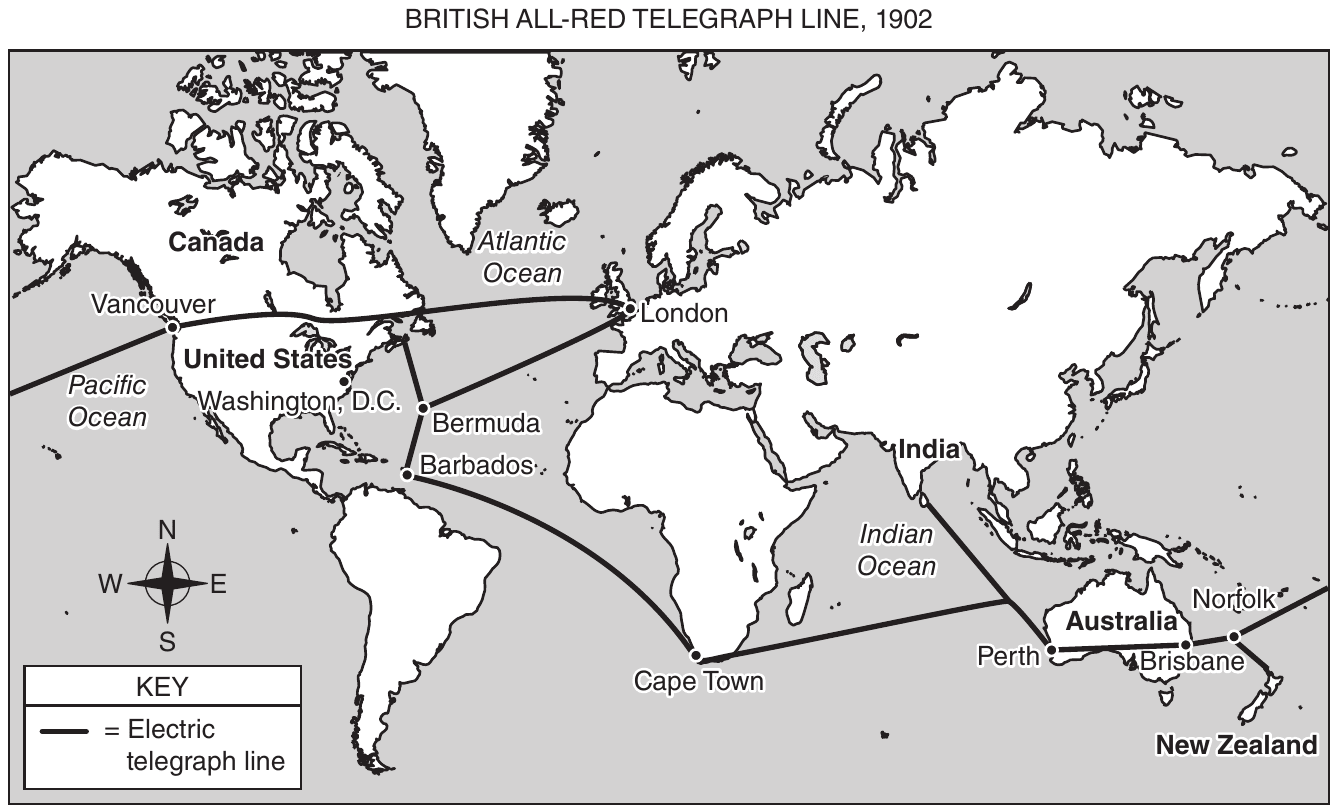
The first transatlantic electric telegraph message was sent in 1858, and by 1902 the British All-Red Line connected most of the world.
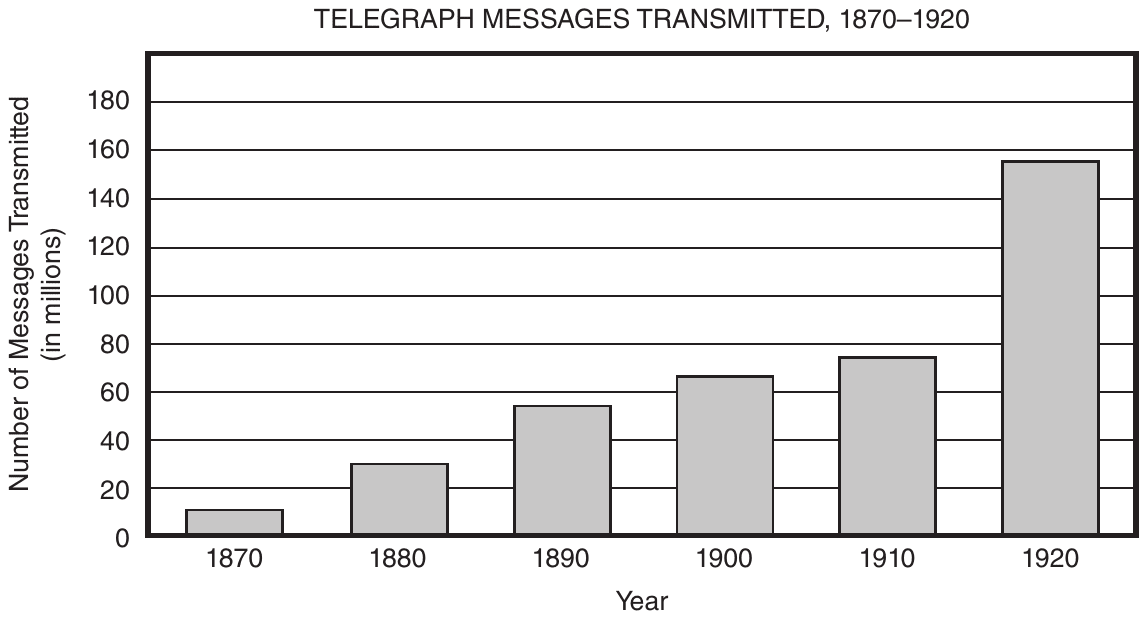
Source: U.S. Bureau of the Census. Historical Statistics of the United States, Colonial Times to 1970, Bicentennial Edition, Part 2. Washington, D.C., 1975.
Question
Which excerpt from the passage supports the idea that Morse was aware of his limitations?
- A“After sporadic attempts to work with batteries, magnets, and wires, he finally turned for help to a colleague.” (paragraph 2)
- B“Gale’s help and his knowledge of this article proved crucial to Morse’s telegraph system.” (paragraph 3)
- C“Henry’s experiments, Gale’s assistance, and, soon after, hiring the young technician Alfred Vail were keys to Morse’s success.” (paragraph 3)
- D“Morse had hired the ingenious construction engineer Ezra Cornell to lay the pipe carrying the wire.” (paragraph 7)
Show the answer
Correct answer: A
The question asks for support from the passage for the idea that Morse was aware of his limitations.
Option A is correct because the sentence from paragraph 2 details the materials with which Morse experimented unsuccessfully before turning to others for assistance.
Option B is incorrect because, although the sentence from paragraph 3 notes that Gale provided necessary assistance, it makes no reference to Morse admitting defeat and requesting his help.
Option C is incorrect because, although the sentence from paragraph 3 makes it clear that Henry, Gale, and Vail contributed to Morse’s success, the sentence does not specifically say that Morse realized that he needed assistance to succeed.
Option D is incorrect because the sentence from paragraph 7 refers to Morse seeking help from Ezra Cornell in constructing his system, not in developing a way to make it work.
Question analysis
Students choose the excerpt from “Invention of the Telegraph” that best supports the idea that Samuel Morse was aware of his own limitations. Several choices show other people helping Morse, so students must find the one that reveals Morse’s own awareness of his limits.
- NYS standards
- 7R1 textual evidence and inferences
- Grade level
- Grade 7 reading and task
- Compared with grade 7
- At grade 7 This is a standard grade 7 evidence question with a careful distinction: all four excerpts involve help from others, and only close reading shows which reveals Morse’s own awareness rather than other people’s contributions.
- Estimated difficulty
- Moderate: several steps, or a close reading with one strong distractor.
- Thinking it demands
- Depth of knowledge 2, skills and concepts · mainly evaluate
- What makes it hard
- Reading between the lines moderate
- Every choice must be checked moderate
- Evidence
- Answered from one sentence or line
- Reading level
- Passage: about grade 11, 910 words; question and choices: about grade 11, 85 words.
- Corrected from the DOE handbook
- A misspelled name in the explanation was corrected.
- Students, last 30 days
- Not enough answers yet to show (it takes 10).
Why it is hard, traps and wrong answers (shows the answer)
Why it is hard
The right excerpt is the only one in which Morse himself does something that shows he knew he was out of his depth: he tries, fails sporadically, and asks for help. The others show that help mattered, or that Morse hired people, which a hurried reader takes as the same thing. The question rewards separating evidence of what Morse knew about himself from the author’s account of his success.
Reading between the lines moderate Working it out
Awareness is a state of mind, and no excerpt states it; it has to be read from Morse’s own action, turning for help “after sporadic attempts” to do the work himself. (Graesser, Singer & Trabasso, 1994; Kintsch, 1998)
Every choice must be checked moderate Choosing the answer
All four excerpts involve help from others, so each must be tested for whose view it gives: Morse’s recognition of a gap or the author’s verdict on who mattered. (Embretson & Wetzel, 1987)
Strategy: For each excerpt, ask whose thinking it reveals: does it show Morse realizing something about himself, or only that others helped him succeed?
Traps
- Supports only part of the claim: In a question about evidence: a line that backs one half of the claim but not the other, or a related point rather than the claim itself.
The wrong answers, classified
B Supports only part of the claim (King et al., 2004; Thissen, Steinberg & Fitzpatrick, 1989)
Shows that Gale’s help “proved crucial,” the author’s judgment of its result, but says nothing about Morse realizing he lacked the knowledge to go on alone.
C Supports only part of the claim (King et al., 2004; Thissen, Steinberg & Fitzpatrick, 1989)
Lists Henry, Gale and Vail as “keys to Morse’s success,” an author’s summary of contributions rather than evidence of what Morse understood about his own limits.
D Reads too much in (Graesser, Singer & Trabasso, 1994)
Reads hiring Cornell as an admission of weakness, but hiring a construction engineer to lay pipe is ordinary delegation and shows nothing about Morse’s knowledge.
What was corrected from the DOE handbook, and why
- Explanation: The handbook lists “Henry, Gail, and Vail.” The passage spells the name “Gale,” as the site now does.
Working it out, step by step
Figure out what the question asks
This asks for evidence that Morse was aware of his limitations. Limitations are things a person can’t do or doesn’t know. Being aware of them means Morse himself knew he needed help. So look for an excerpt that shows Morse’s own thinking or action.
Find the excerpt about Morse’s action
Choice A comes from paragraph 2: “After sporadic attempts to work with batteries, magnets, and wires, he finally turned for help to a colleague.” Earlier in that same sentence, the passage says he “had little real understanding of the nature of electricity.”
Explain what the action shows
“Sporadic” means now and then, not steady. Morse tried on his own a few times and did not succeed. Then he “finally turned for help.” A person asks for help when he knows he can’t do a job alone. So this action shows that Morse knew his limits.
Check each choice
- A fits. Morse himself chose to ask for help after failing.
- B is wrong. It gives the author’s view that Gale’s help “proved crucial,” or very important. It does not show what Morse knew about himself.
- C is wrong. It lists who helped Morse succeed. That is the author’s summary, not Morse’s thinking.
- D is wrong. Hiring a builder to lay pipe is a normal part of a big job. It says nothing about Morse’s knowledge.
Choose the answer
Only one excerpt shows Morse realizing he needed help. So the answer is A, the sentence from paragraph 2 that says he “finally turned for help to a colleague.”
Why this answer and not the closest wrong one
B is the strongest trap, because Gale’s help really mattered. But ask whose view each excerpt shows. B is the author judging the result. A is Morse’s own choice after failing. Knowing your limits shows in what you do about them, and only A shows that.
More questions like this
The original DOE question
The passage “Invention of the Telegraph” as printed (pages 146–148)
Question 59 of 59
2018 Test B English, question 56Uses the passage above: “Invention of the Telegraph”.
Question
The idea that, in the mid-nineteenth century, the United States was mostly unaware of the possibilities of electricity is illustrated in the passage mainly through the
- Adescription of the government’s initial desire to expand a semaphore signaling system that used either flags or lights along the Atlantic Coast.
- Bdelay by the House of Representatives to pass the bill funding Morse’s telegraph line six years after he first applied for the appropriation.
- Cdiscussions of the newly invented electromagnet that sparked the idea of sending codes through wires.
- Ddescription of how an electric circuit could be closed to ring a bell at a distance.
Show the answer
Correct answer: A
The question asks for information that conveys the idea that the United States was mostly unaware of the possibilities of electricity in the mid-nineteenth century. The passage states that most signaling systems at the time were “visual or ‘semaphore’ systems using flags or lights” (paragraph 1) and that the United States was looking for “just such a system along its entire Atlantic coast” (paragraph 1).
Option A is correct because waving lights and flags reveals how limiting and simple the system of the time was, and Option A states that the United States wanted to expand this system, not improve upon it.
Option B is incorrect because the delay in funding had to do with the Panic of 1837 and the “long depression” (paragraph 5), not because the House of Representatives was not aware or ready for innovation in the use of electricity.
Option C is incorrect because it focuses on what prompted Morse to consider an electronic wire-based communications system.
Option D is incorrect because it describes a basic aspect of an early electrical discovery that demonstrated the interest of scientists in the possibilities of electricity, not the United States as a whole.
Question analysis
Students identify how “Invention of the Telegraph” mainly illustrates the idea that, in the mid-1800s, the United States was largely unaware of what electricity could do. The idea is implied rather than stated, so students must decide which detail truly reveals the nation’s thinking at the time.
- Grade level
- Grade 8 reading and task
- Compared with grade 7
- Above grade 7 Grade 7 evidence questions often match a stated idea to a sentence. This idea is only implied, so students must infer what a historical detail reveals about a whole nation’s understanding, closer to grade 8 inference.
- Estimated difficulty
- Hard: combines ideas, needs a plan, and has more than one tempting wrong answer.
- Thinking it demands
- Depth of knowledge 3, strategic thinking · mainly evaluate
- What makes it hard
- Reading between the lines moderate
- Evidence in several places moderate
- Hard words minor
- Evidence
- Answered from one paragraph or stanza
- Reading level
- Passage: about grade 11, 910 words; question and choices: about grade 12, 102 words.
- Students, last 30 days
- Not enough answers yet to show (it takes 10).
Why it is hard, traps and wrong answers (shows the answer)
Why it is hard
The stem asks about a whole nation’s understanding, so details about individuals with electrical interests, the ship’s passengers and Henry, show the opposite of what is needed. The real trap is the funding delay, which looks like official indifference but has an economic cause the passage states. Students who remember that the semaphore plan came with a remark about not knowing electricity was coming find the answer.
Reading between the lines moderate Working it out
The idea is implied: wanting a semaphore system shows unawareness only alongside paragraph 1’s comment that its framers “had no way of knowing” they would be offered electricity. (Graesser, Singer & Trabasso, 1994; Kintsch, 1998)
Evidence in several places moderate Working it out
The choices point to four separate places, paragraph 1’s semaphore plan, the funding delay of paragraphs 4 to 6, the shipboard talk in paragraph 2 and Henry’s bell in paragraph 3, and each must be checked there. (Kirsch & Mosenthal, 1990; Gorin & Embretson, 2006)
Hard words minor Understanding the question
“Semaphore” and “appropriation” are uncommon words, and the passage defines “semaphore” only in passing, as systems “using flags or lights.” (Perfetti, 2007; Freedle & Kostin, 1993)
Strategy: For each choice, find the detail in the passage and ask whether the author uses it to show what the country did or did not understand about electricity.
Traps
- Twists what the text says: Uses the text's topic and ideas but changes what it says: who did it, how much, when, or why.
- Supports only part of the claim: In a question about evidence: a line that backs one half of the claim but not the other, or a related point rather than the claim itself.
The wrong answers, classified
B Twists what the text says (King et al., 2004)
Reads the long wait for funding as doubt about electricity, but the passage gives a different cause, the Panic of 1837 and the “long depression” that followed.
C Supports only part of the claim (King et al., 2004; Thissen, Steinberg & Fitzpatrick, 1989)
The ship’s passengers did discuss the new electromagnet, but that shows a few people interested in electricity, not a country unaware of what it could do.
D Supports only part of the claim (King et al., 2004; Thissen, Steinberg & Fitzpatrick, 1989)
Henry’s bell rung at a distance is a real detail, but it shows a scientist exploring electricity’s uses, the opposite of unawareness, and says nothing about the nation.
Working it out, step by step
Figure out what the question asks
This asks which part of the passage best shows an idea. The idea is that in the mid-1800s, the United States mostly did not know what electricity could do. Look for a detail about the country as a whole, not about one scientist.
Find the detail in paragraph 1
Paragraph 1 says most early systems were visual, or semaphore, “systems using flags or lights.” Then it says, “The young American republic wanted just such a system along its entire Atlantic coast.” The next sentence explains that its lawmakers “had no way of knowing” they would be offered “an entirely new and revolutionary means of communication—electricity.”
Explain what the detail shows
A semaphore system sends signals people can see, like waving flags. The country asked for that old kind of system. It did not ask for an electric one, because it did not know one was possible. “Revolutionary” means bringing a huge change. So the government’s plan shows how unaware the nation was of what electricity could do.
Check each choice
- A fits. The government wanted to spread flags and lights, not electric signals.
- B is wrong. The delay had a money cause. The Panic of 1837 “caused a long depression.” It was not about electricity.
- C is wrong. Passengers talking about the electromagnet shows interest in electricity, the opposite of not knowing about it.
- D is wrong. Henry ringing a bell shows one scientist exploring electricity. It says nothing about the whole country.
Choose the answer
The country’s wish for a flags-and-lights system shows it did not yet see what electricity could do. So the answer is A, the description of the government’s plan for a semaphore system along the Atlantic Coast.
Why this answer and not the closest wrong one
B is the closest trap, because a long wait for money can look like doubt about electricity. But paragraph 5 gives the real cause, the Panic of 1837 and the hard times after it. A is backed by the passage’s own words: the lawmakers “had no way of knowing” electricity was coming.
More questions like this
The original DOE question