2019 Test A English
Question 1 of 57
2019 Test A English, question 1Question
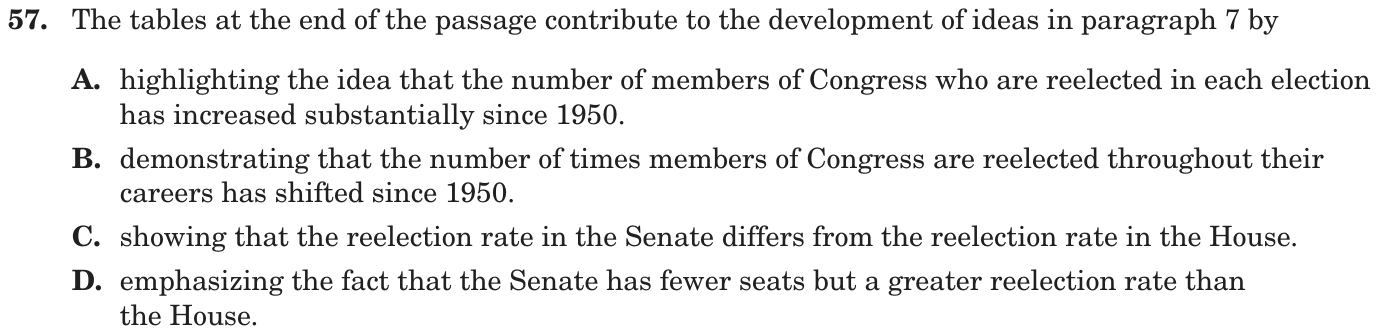
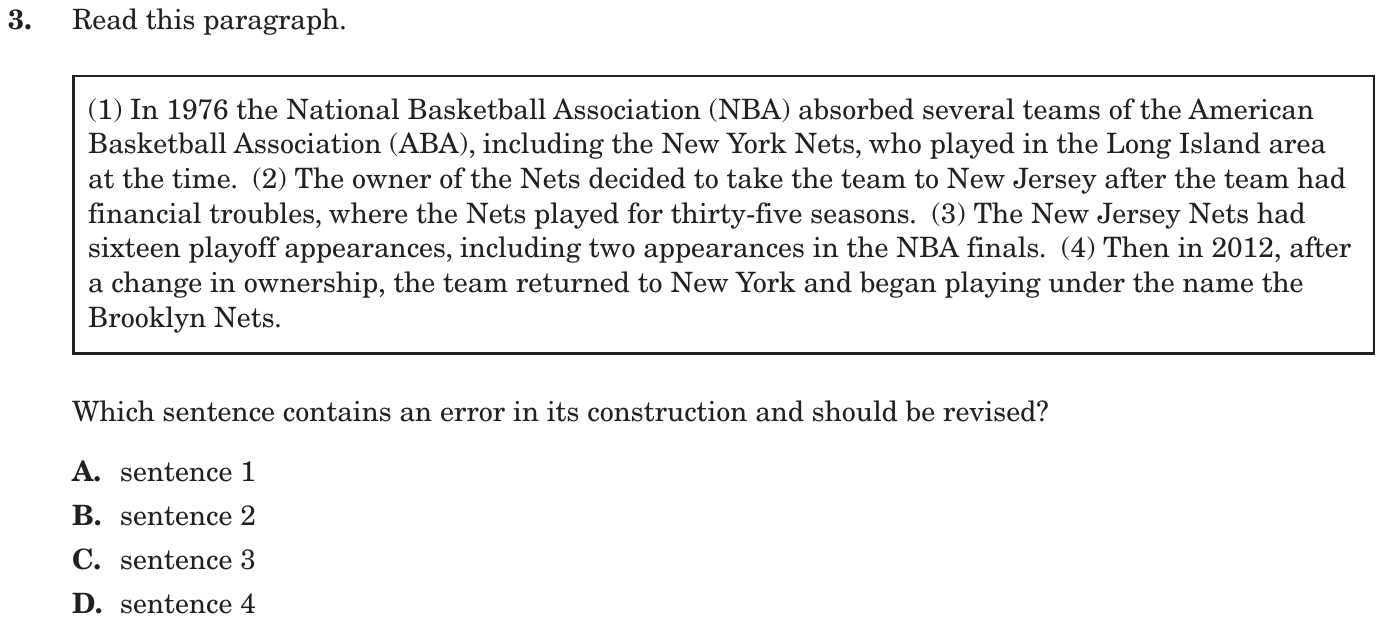
How should the paragraph be revised?
(1) Danielle spent several hours preparing for an upcoming audition for a play at the community theater. (2) First she did vocal exercises to practice her diction and projection so that her words would carry clearly throughout the large auditorium. (3) Then she studies the text of the monologue to better understand the emotions, and motivations of the character she plans to portray. (4) Finally she recited her monologue in front of a mirror many times, making slight adjustments and improvements to her performance each time.
- ASentence 1: Change spent to had spent, AND insert a comma after play.
- BSentence 2: Change did to does, AND insert a comma after projection.
- CSentence 3: Change studies to studied, AND delete the comma after emotions.
- DSentence 4: Change recited to recites, AND delete the comma after times.
Show the answer
Correct answer: C
The question asks how the paragraph should be revised.
A. Incorrect. The revisions in this option introduce new errors. The word “spent” is correct in the simple past tense because it encompasses the actions described throughout the rest of the paragraph, all of which happened during those “several hours.” Additionally, adding a comma after the word “play” would be incorrect because it would unnecessarily separate the prepositional phrase “at the community theater” from the rest of the sentence.
B. Incorrect. The revisions in this option introduce new errors. The word “did” is correct as written in the past tense because the past tense is used throughout the paragraph. There is no comma needed after the word “projection” because “so” is functioning not as a conjunction but rather as part of the conjunction phrase “so that,” which does not take a comma.
C. CORRECT. Changing the word “studies” from the present tense to the past tense “studied” is necessary to match the past tense established in the paragraph (“spent,” “recited”). Additionally, the comma after the word “emotions” needs to be removed because the words “emotions and motivations” are part of a group (series) of two elements, and when there are only two elements in a series, a comma is not used.
D. Incorrect. The revisions in this option introduce new errors. The word “recited” is correct as written in the past tense because the past tense is used throughout the paragraph. Also, removing the comma after “times” is incorrect because the comma is needed in order to separate the modifying phrase “making slight adjustments and improvements to her performance each time” from the main clause.
Question analysis
This grammar and punctuation question gives a four-sentence paragraph about Danielle preparing for an audition at the community theater, with eight spots underlined. Each answer choice pairs a verb change with a comma change in a single sentence, so students must judge verb tense and comma use together and accept a choice only if both of its edits are needed.
- Grade level
- Grade 6 reading and task
- Compared with grade 7
- Below grade 7 Keeping verb tense consistent and using commas correctly are taught before grade 7, and this paragraph is short and plain. Each choice bundles two edits, so a student who spots one real error can confirm the answer with the other.
- Estimated difficulty
- Routine: one familiar step, little to misread.
- Thinking it demands
- Depth of knowledge 1, recall and reproduction · mainly apply
- What makes it hard
- Evidence
- Answered from one paragraph or stanza
- Reading level
- Question and choices: about grade 10, 133 words.
- Students, last 30 days
- Not enough answers yet to show (it takes 10).
Why it is hard, traps and wrong answers (shows the answer)
Why it is hard
The shift to “Then she studies” stands out in a story told in the past tense with “spent,” “did” and “recited,” and finding either half of the right option is enough to choose it. That makes this one of the easiest editing questions. Students who miss it usually trust a half-remembered comma rule, such as a comma before “so,” and stop checking the verb in the same option.
A rule that doesn't sound wrong minor Working it out
Only two nouns, “emotions” and “motivations,” follow “the,” so the comma between them has no job, yet a habit of putting commas before “and” in lists hides it. (Connors & Lunsford, 1988)
Every choice must be checked minor Choosing the answer
The four options each pair a tense change with a comma change, one option per sentence, and an option is right only when both of its edits repair real errors. (Embretson & Wetzel, 1987)
Strategy: Find the tense of the paragraph's first verb, check every underlined verb against it, and then confirm that the comma change in the same choice is needed too.
The wrong answers, classified
A Verb tense or form (Connors & Lunsford, 1988)
Thinks “had spent” is needed because the preparing came before the audition, and accepts a comma after “play” that would cut off “at the community theater.”
B Punctuation (Connors & Lunsford, 1988)
Applies the rule of a comma before “so” joining two clauses, missing that “so that” opens a purpose clause with no comma, and accepts the present-tense “does.”
D Verb tense or form (Connors & Lunsford, 1988)
Notices that the tenses clash but takes the present-tense “studies” as the standard, shifts “recited” to match, and drops the comma that sets off “making slight adjustments.”
Working it out, step by step
Figure out what the question asks
This question asks how to fix the paragraph. Each choice makes two changes in one sentence: a verb change and a comma change. A choice is right only if both changes fix real errors. So check both halves.
Rule 1: keep one tense
Tense is when an action happens: past, present or future. A story should stay in one tense. Example: I woke up and eat breakfast mixes tenses. It should be I woke up and ate breakfast. This paragraph is in the past: “spent,” “did,” “recited.” But sentence 3 says “Then she studies.” That is present tense. It should be “studied.”
Rule 2: no comma between two
When only two things are joined by and, don’t put a comma between them. Example: I like apples and pears. Sentence 3 says “the emotions, and motivations.” There are only two things, so the comma should go. Fixed: the emotions and motivations of the character.
Check each choice
- A is wrong. “Spent” is already correct past tense. A comma after “play” would cut off “at the community theater.”
- B is wrong. “Does” is present tense, so it would create an error. And no comma goes before “so that.”
- C is right. “Studied” fixes the tense, and dropping the comma fixes the pair.
- D is wrong. “Recites” would create an error. The comma after “times” is needed to set off “making slight adjustments and improvements to her performance each time.”
Watch out: B tempts students who remember a comma before “so.” But “so that” tells a purpose, why she practiced, and takes no comma.
Choose the answer
So the answer is C: “Sentence 3: Change studies to studied, AND delete the comma after emotions.”
Why this answer and not the closest wrong one
B is the closest wrong answer, because many students put a comma before “so.” But “so that” explains a purpose, and it takes no comma. Also, B’s change to “does” would break the past tense. Both of C’s changes fix real errors.
More questions like this
The original DOE question
Question 2 of 57
2019 Test A English, question 2Question
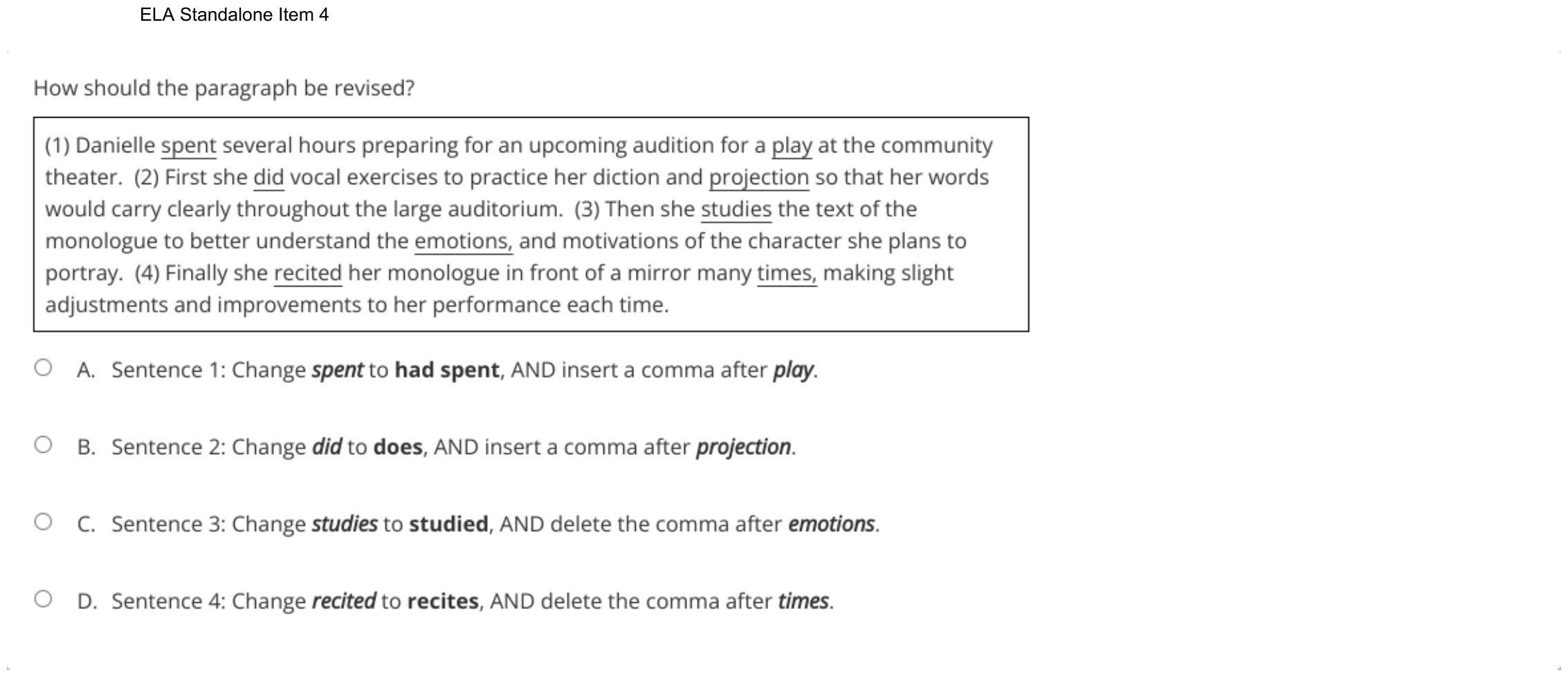
Which revision corrects the error in sentence structure in the paragraph?
The land on Earth has not always been separated into the seven continents, at one time a massive supercontinent, known as Pangaea, covered one-third of Earth’s surface. Additionally, the supercontinent was surrounded by ocean waters called Panthalassa, much of which were in Earth’s Southern Hemisphere. Geologists believe that the supercontinent split apart over millions of years because of the movement of the tectonic plates that form Earth’s crust. In fact, experts predict that over the next 250 million years the movement of the plates will cause the seven continents to merge into a supercontinent again.
- Acontinents. At
- Bsurface; additionally,
- CPanthalassa. Much
- Dcrust, in fact,
Show the answer
Correct answer: A
The question asks for the revision that corrects the error in sentence structure in the paragraph.
A. CORRECT. The first sentence of the paragraph is a run-on because both clauses—“The land on Earth has not always been separated into the seven continents” and “at one time a massive supercontinent, known as Pangaea, covered one-third of Earth’s surface”—are independent clauses. Independent clauses are complete sentences, and two complete sentences should not be combined with just a comma. The revision is correct because it separates the two sentences by placing a period where it is needed after “continents” and by capitalizing the word “At.”
B. Incorrect. While adding a semicolon after “surface” can be considered a correct way to separate the independent clauses “at one time a massive supercontinent, known as Pangaea, covered one-third of Earth’s surface” and “Additionally, the supercontinent was surrounded by ocean waters called Panthalassa, much of which were in Earth’s Southern Hemisphere,” this change does not address the sentence structure error in the paragraph (the run-on sentence). The use of a period separating the independent clauses (complete sentences) is correct as is.
C. Incorrect. Adding a period after “Panthalassa” would separate the dependent clause “much of which were in Earth’s Southern Hemisphere” from its antecedent: “ocean waters called Panthalassa.” The dependent clause cannot stand on its own, because it shares elements with the main clause. A dependent clause is not a complete sentence and must be joined with an independent clause. The clause beginning with “much of which” is an adjective clause that modifies “ocean waters.” Changing the comma to a period creates a new error (a sentence fragment) and does not address the existing sentence structure error at the beginning of the paragraph (the run-on sentence).
D. Incorrect. Removing the period after “crust” would create a run-on sentence because the period is needed to separate two complete sentences—“Geologists believe that the supercontinent split apart over millions of years because of the movement of the tectonic plates that form Earth’s crust” and “In fact, experts predict that over the next 250 million years the movement of the plates will cause the seven continents to merge into a supercontinent again.” A comma after “crust” would combine these sentences into a run-on, creating a new error in the sentence without fixing the existing sentence structure error (the run-on sentence) at the beginning of the paragraph.
Question analysis
This editing question shows a short paragraph about Pangaea, the supercontinent that once covered a third of Earth’s surface, and the ocean around it, with four underlined spots, and asks which revision corrects the error in sentence structure. Each revision changes only punctuation and capitals at one spot, so the decision rests on how the clauses around each spot fit together.
- Grade level
- Grade 6 reading and task
- Compared with grade 7
- Below grade 7 Fixing run-ons and fragments is taught well before grade 7, and this item tests that basic skill in one short paragraph. The sentences are long, with an appositive and a clause beginning “much of which,” but the grammar involved stays simple.
- Estimated difficulty
- Straightforward: two steps or one careful reading.
- Thinking it demands
- Depth of knowledge 2, skills and concepts · mainly apply
- What makes it hard
- A rule that doesn't sound wrong moderate
- Every choice must be checked minor
- Complex sentences minor
- Evidence
- Answered from one paragraph or stanza
- Reading level
- Question and choices: about grade 9, 114 words.
- Corrected from the DOE handbook
- Two grammar terms in the explanation were corrected.
- Students, last 30 days
- Not enough answers yet to show (it takes 10).
Why it is hard, traps and wrong answers (shows the answer)
Why it is hard
The error is in the first sentence, but it hides behind a comma that sounds like an ordinary pause, while the later spots carry features that look riskier: a transition word, a clause beginning “much of which,” the phrase “in fact.” Students who test each spot for a complete sentence on both sides find the splice at once. Those who look for a revision that merely sounds polished are drawn to the semicolon, which is correct but fixes nothing.
A rule that doesn't sound wrong moderate Working it out
The comma after “continents” joins two complete sentences, and because “at one time” sounds like an introductory phrase continuing the thought, the splice reads as a natural pause. (Connors & Lunsford, 1988)
Every choice must be checked minor Choosing the answer
Each revision changes only punctuation at one underlined spot, and the semicolon one is correct English, so students must ask whether each spot was wrong to begin with, not only whether the change looks right. (Embretson & Wetzel, 1987)
Complex sentences minor Understanding the question
The paragraph’s sentences are long, with the appositive “known as Pangaea” and the clause “much of which were,” whose odd-sounding verb draws suspicion to a spot that is correctly punctuated. (Abedi & Lord, 2001; Freedle & Kostin, 1993; Messick, 1989)
Strategy: At each underlined spot, read the words on both sides and ask whether each side could stand as a sentence, then pick the revision that leaves every sentence correctly joined or separated.
Traps
- Fixes what isn't broken: Changes a part of the sentence that was already correct, while the real error stays; or, where the question asks which sentence has an error or should go, picks one that is correct and belongs.
- Fragment or run-on: Creates or keeps a sentence fragment, a run-on sentence or a comma splice.
The wrong answers, classified
B Fixes what isn't broken (Connors & Lunsford, 1988)
Knows a semicolon can join two clauses before “additionally” and picks that tidy-looking change, though the period it replaces was already correct and the comma splice up front remains.
C Fragment or run-on (Connors & Lunsford, 1988)
Treats the long second sentence as a run-on and splits it after “Panthalassa,” leaving “Much of which were in Earth’s Southern Hemisphere” as a fragment with no main clause.
D Fragment or run-on (Connors & Lunsford, 1988)
Thinks “in fact” belongs inside the sentence before it, set off by commas, which joins two complete sentences with only a comma and creates the error the paragraph already has.
What was corrected from the DOE handbook, and why
- Explanation: The DOE’s explanation of Option C says a period after “Panthalassa” would separate the dependent clause “much of which were in Earth’s Southern Hemisphere” “from its subject: ‘ocean waters called Panthalassa.’” The clause has a subject of its own, “much”; “ocean waters called Panthalassa” is its antecedent, the noun phrase that “which” refers to. The explanation also calls the clause “an adjective for ‘ocean waters’”; a clause is not an adjective but an adjective (relative) clause, which modifies the noun. The site now says “from its antecedent” and “an adjective clause that modifies ‘ocean waters.’” The reasoning and the answer, A, are unchanged.
Working it out, step by step
Learn the rule for joining sentences
An independent clause is a group of words with a subject and a verb that can stand alone as a sentence. Two of them can’t be joined with only a comma. That mistake is a run-on sentence, also called a comma splice. For example: I love soccer, my brother loves chess. Fix it with a period: I love soccer. My brother loves chess.
Test each underlined spot
At each spot, read the words on both sides. Ask: could each side stand alone as a sentence?
- After “continents”: both sides are complete. A comma joins them, so this is an error.
- After “surface”: a period already separates two sentences. That is correct.
- After “Panthalassa”: the words after the comma can’t stand alone. The comma is correct.
- After “crust”: a period already separates two sentences. That is correct.
Look closely at the first sentence
The first part says “The land on Earth has not always been separated into the seven continents.” That is a full sentence. The second part says “at one time a massive supercontinent, known as Pangaea, covered one-third of Earth’s surface.” Its subject is “supercontinent,” and its verb is “covered.” So it is a full sentence too. The words “At one time” start a new sentence.
Show the fix
Change the comma to a period, and capitalize the next word: The land on Earth has not always been separated into the seven continents. At one time a massive supercontinent, known as Pangaea, covered one-third of Earth’s surface. Now each sentence stands on its own. That is the revision continents. At.
Check each choice
- A is right. It splits the run-on into two sentences.
- B is wrong. A semicolon could join those two sentences, but the period there was already correct. It fixes nothing.
- C is wrong. “Much of which were in Earth’s Southern Hemisphere” is a dependent clause, a group of words with a verb that can’t be a sentence by itself. “Which” points back to “ocean waters called Panthalassa,” its antecedent. So the clause must stay attached.
- D is wrong. A comma after “crust” would join two full sentences. That makes a new run-on.
Choose the answer
Only the comma after “continents” joins two complete sentences. So the answer is A, continents. At.
Why this answer and not the closest wrong one
B is the closest wrong choice, because a semicolon can correctly join two sentences. But the spot after “surface” already had a period, which was correct. Changing it does not fix the real error. The comma splice after “continents” would still be there. Only A fixes it.
More questions like this
The original DOE question
Question 3 of 57
2019 Test A English, question 3Question
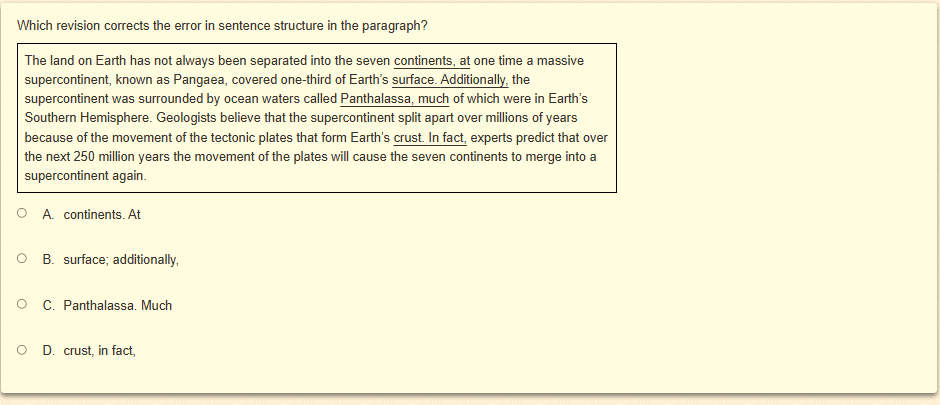
Read this paragraph.
(1) In 1976 the National Basketball Association (NBA) absorbed several teams of the American Basketball Association (ABA), including the New York Nets, who played in the Long Island area at the time. (2) The owner of the Nets decided to take the team to New Jersey after the team had financial troubles, where the Nets played for thirty-five seasons. (3) The New Jersey Nets had sixteen playoff appearances, including two appearances in the NBA finals. (4) Then in 2012, after a change in ownership, the team returned to New York and began playing under the name the Brooklyn Nets.
Which sentence contains an error in its construction and should be revised?
- Asentence 1
- Bsentence 2
- Csentence 3
- Dsentence 4
Show the answer
Correct answer: B
The question asks for the identification of the sentence that has an error in its construction and should be revised.
A. Incorrect. There are no errors in the structure of sentence 1. The modifying clause “who played in the Long Island area at the time” correctly modifies the noun “New York Nets.”
B. CORRECT. Sentence 2 contains a structural error. The current placement of the clause “where the Nets played for thirty-five seasons” suggests the clause is modifying the term “financial troubles,” which is illogical. The clause “where the Nets played for thirty-five seasons” should immediately follow the location, “New Jersey.” A revised version of the sentence might read: “After the team had financial troubles, the owner of the Nets decided to take the team to New Jersey, where the Nets played for thirty-five seasons.”
C. Incorrect. There are no errors in the structure of sentence 3. The phrase “including two appearances in the NBA finals” is a nonrestrictive phrase that provides further detail about the team’s “sixteen playoff appearances.” The phrase is set off by a comma because it is not essential to understanding the meaning of the sentence.
D. Incorrect. There are no errors in the structure of sentence 4. The phrase “after a change in ownership” is a nonrestrictive phrase that provides further detail about the team in 2012. The phrase is set off by commas because it is not essential to understanding the meaning of the sentence.
Question analysis
In this sentence-structure question, four sentences trace the Nets basketball team, which played on Long Island before moving to New Jersey and, decades later, to Brooklyn. Students must spot the sentence whose construction needs revising, and since each one includes phrases or clauses set off by commas, the test is whether each sits beside the word it should modify.
- NYS standards
- 7L1 grammar and usage conventions
- Grade level
- Grade 7 reading and task
- Compared with grade 7
- At grade 7 Grade 7 language standards cover placing phrases and clauses correctly within a sentence. The stem does not say what sort of mistake to look for, so all four sentences must be tested, which is what grade 7 editing practice usually involves.
- Estimated difficulty
- Moderate: several steps, or a close reading with one strong distractor.
- Thinking it demands
- Depth of knowledge 2, skills and concepts · mainly analyze
- What makes it hard
- A rule that doesn't sound wrong moderate
- Every choice must be checked minor
- Complex sentences minor
- Evidence
- Answered from one paragraph or stanza
- Reading level
- Question and choices: about grade 7, 112 words.
- Corrected from the DOE handbook
- Grammar terms in the explanation were corrected.
- Students, last 30 days
- Not enough answers yet to show (it takes 10).
Why it is hard, traps and wrong answers (shows the answer)
Why it is hard
The faulty sentence causes no confusion in reading, because the mind ties the thirty-five seasons to New Jersey rather than to the financial troubles the clause actually follows. Students who judge by sound pass over it and hunt through the busier sentences, above all the first, which in this printing also has no comma after “In 1976.” What the question rewards is asking, clause by clause, which word each describing clause sits beside.
A rule that doesn't sound wrong moderate Working it out
In sentence 2, “where the Nets played for thirty-five seasons” lands after “financial troubles,” yet the ear quietly joins it to New Jersey, so the misplaced clause reads as natural English. (Connors & Lunsford, 1988)
Every choice must be checked minor Choosing the answer
Nothing in the stem says what kind of error to look for, and every sentence sets off a phrase or clause with commas, from the “who” clause to the “including” phrase to “after a change in ownership.” (Embretson & Wetzel, 1987)
Complex sentences minor Understanding the question
Sentence 1 runs 31 words, with two abbreviations in parentheses, a “who” clause and no comma after the opening date, so a correct sentence looks like the likeliest place for a fault. (Abedi & Lord, 2001; Freedle & Kostin, 1993; Messick, 1989)
Strategy: Work through all four sentences; for each phrase or clause set off by a comma, decide which noun it should describe and check that the two are side by side.
Traps
- Fixes what isn't broken: Changes a part of the sentence that was already correct, while the real error stays; or, where the question asks which sentence has an error or should go, picks one that is correct and belongs.
The wrong answers, classified
A Fixes what isn't broken (Connors & Lunsford, 1988)
Believes “who” cannot stand for a team, or wants a comma after the date “In 1976,” though the short opening phrase and the clause describing the New York Nets are both correct.
C Fixes what isn't broken (Connors & Lunsford, 1988)
Takes the closing “including two appearances in the NBA finals” for a fragment tacked on with a comma, though the phrase correctly adds a detail about the sixteen playoff appearances.
D Fixes what isn't broken (Connors & Lunsford, 1988)
Is put off by the stacked opening “Then in 2012, after a change in ownership,” or by the unpunctuated team name at the end, though the sentence is built correctly as it stands.
What was corrected from the DOE handbook, and why
- Explanation: The handbook’s explanation calls two clauses phrases and two phrases clauses. It calls “where the Nets played for thirty-five seasons” a phrase three times (Option B) and “who played in the Long Island area at the time” a modifying phrase (Option A). Each has a subject and a verb of its own (“the Nets played,” “who played”), so each is a clause, and the site now calls them clauses. It calls “including two appearances in the NBA finals” (Option C) and “after a change in ownership” (Option D) nonrestrictive clauses. Neither has a subject or a verb of its own, so each is a phrase (the second a prepositional phrase), as the explanations’ own next sentences (“The phrase is set off…”) say, and the site now says “nonrestrictive phrase.” The DOE’s later printing of this question uses the same terms. The reasoning and the answer, sentence 2, are unchanged.
Working it out, step by step
Figure out what the question asks
This asks which sentence is built wrong. The facts are not the problem. The problem is how the parts of a sentence fit together. The question doesn’t say what kind of mistake to look for. So you need to test all four sentences.
Learn about clauses and phrases
A clause is a group of words with its own subject and verb, like where we swam. A phrase is a group of words without its own subject and verb, like after the storm. A describing clause often starts with who or where. It must sit right next to the word it describes. If it doesn’t, the sentence says something odd: We went to the beach after the storm, where we swam all day. That says we swam in the storm!
Test sentence 2
Sentence 2 ends “after the team had financial troubles, where the Nets played for thirty-five seasons.” The words “where the Nets played for thirty-five seasons” form a clause. They have a subject, the Nets, and a verb, played. The clause should describe New Jersey, a place. But it sits right after “financial troubles.” So the sentence seems to say the Nets played inside their money problems.
Fix: After the team had financial troubles, the owner of the Nets decided to take the team to New Jersey, where the Nets played for thirty-five seasons.
Test sentences 1, 3 and 4
- Sentence 1: the clause “who played in the Long Island area at the time” sits right after “the New York Nets.” A team is a group of people, so who works. A short opening like “In 1976” doesn’t need a comma.
- Sentence 3: the phrase “including two appearances in the NBA finals” sits right after “sixteen playoff appearances.” It adds a detail about them.
- Sentence 4: the phrase “after a change in ownership” tells when the team came back. Commas set it off correctly.
Watch out: Sentence 1 is long and busy, with two names in parentheses. That makes A tempting. But long is not the same as wrong.
Choose the answer
Only sentence 2 puts a describing clause next to the wrong words. So the answer is B, sentence 2.
Why this answer and not the closest wrong one
A is the closest wrong answer. Sentence 1 is long, uses who for a team and has no comma after its date. But each part is correct, and its clause sits right next to the Nets. In sentence 2, the “where” clause sits next to “financial troubles,” not New Jersey. So B is right.
More questions like this
The original DOE question
Question 4 of 57
2019 Test A English, question 4Question
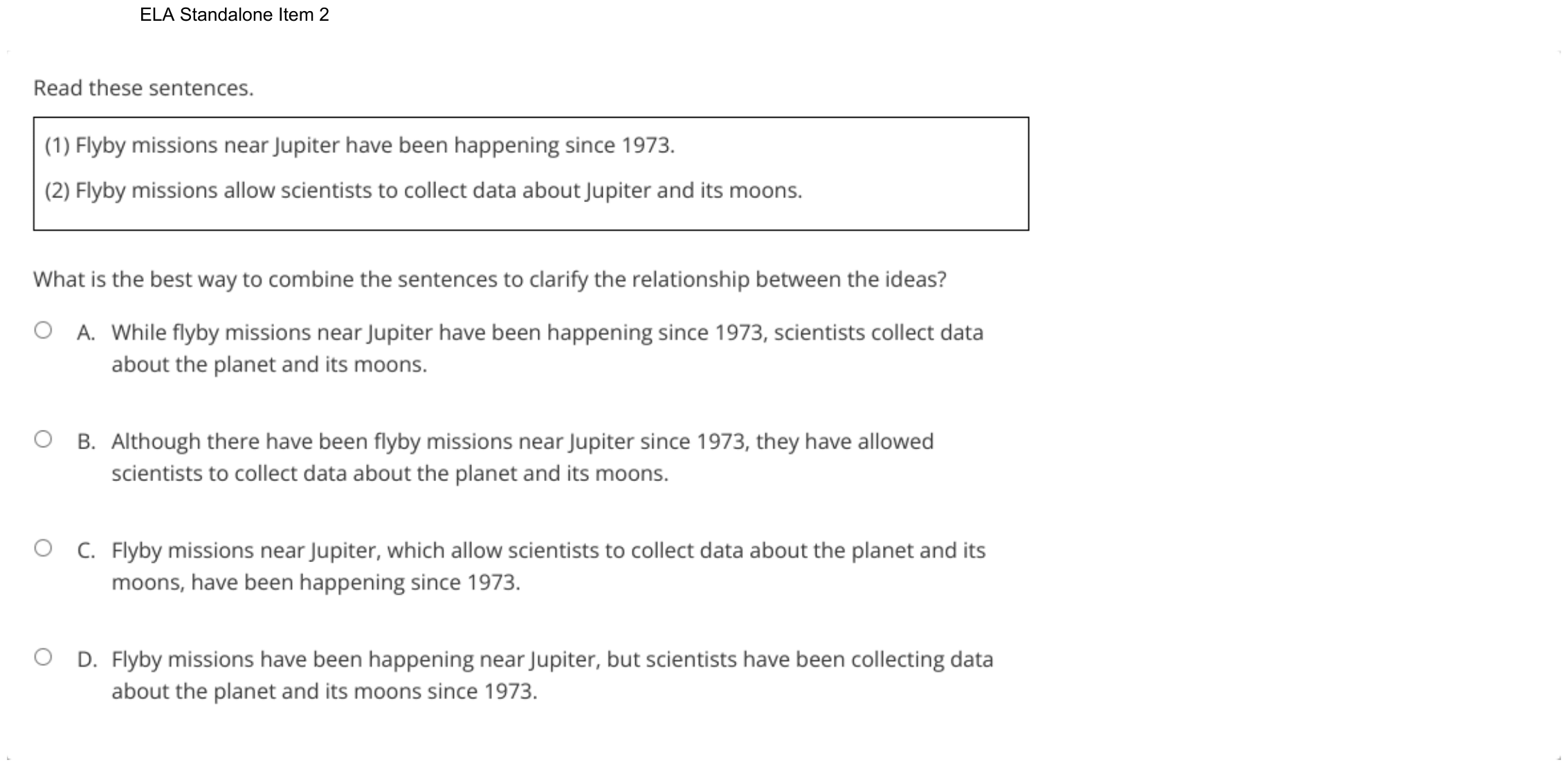
Read these sentences.
(1) Flyby missions near Jupiter have been happening since 1973.
(2) Flyby missions allow scientists to collect data about Jupiter and its moons.
What is the best way to combine the sentences to clarify the relationship between the ideas?
- AWhile flyby missions near Jupiter have been happening since 1973, scientists collect data about the planet and its moons.
- BAlthough there have been flyby missions near Jupiter since 1973, they have allowed scientists to collect data about the planet and its moons.
- CFlyby missions near Jupiter, which allow scientists to collect data about the planet and its moons, have been happening since 1973.
- DFlyby missions have been happening near Jupiter, but scientists have been collecting data about the planet and its moons since 1973.
Show the answer
Correct answer: C
The question asks for the best way to combine the sentences to clarify the relationship between the ideas.
A. Incorrect. Even though the two ideas from the original sentences are incorporated into the combined sentence, the use of the conjunction “while” in the first part of the sentence suggests that there is a simultaneous but unrelated relationship between the two ideas, which is incorrect.
B. Incorrect. The combined sentence incorporates the ideas from both sentences, but the conjunction “although” suggests that scientists were allowed to collect data even though there were flyby missions, which is an inaccurate way to express the relationship between the ideas.
C. CORRECT. This sentence is the best way to combine the sentences because it accurately reflects the relationship between the ideas by using the nonrestrictive clause “which allow scientists to collect data about the planet and its moons” to describe the purpose of the flyby missions. (Nonrestrictive clauses are adjective clauses that give additional information about a word or phrase. They sometimes begin with the relative pronoun “which” and are set off by commas.) The idea that the missions “have been happening since 1973” follows the nonrestrictive clause.
D. Incorrect. The combined sentence uses the conjunction “but” to connect the ideas in the two original sentences. This suggests a contrasting relationship between ideas, which is an inaccurate way to connect the ideas expressed in the original sentences.
Question analysis
This sentence-combining question gives two short sentences about flyby missions near Jupiter, one saying they have happened since 1973 and the other that they let scientists collect data about the planet and its moons. Students choose the combination that makes the relationship between the ideas clear, weighing what each connecting word or clause says about how the facts relate.
- NYS standards
- 7L1 grammar and usage conventions
- Grade level
- Grade 7 reading and task
- Compared with grade 7
- At grade 7 Combining two short sentences so their relationship is clear is regular grade 7 work. Both sentences here are brief and plainly related, and the versions differ mainly in their connecting words, so this is a typical, fairly quick task.
- Estimated difficulty
- Straightforward: two steps or one careful reading.
- Thinking it demands
- Depth of knowledge 2, skills and concepts · mainly evaluate
- What makes it hard
- How sentences fit together moderate
- Every choice must be checked minor
- Evidence
- Answered from one sentence or line
- Reading level
- Question and choices: about grade 9, 119 words.
- Corrected from the DOE handbook
- A wrong word in the explanation of D was corrected.
- Students, last 30 days
- Not enough answers yet to show (it takes 10).
Why it is hard, traps and wrong answers (shows the answer)
Why it is hard
The two sentences are short, and the work lies in naming how they relate before reading the versions. The most tempting one, beginning “While,” keeps both facts but drops the word “allow,” so the missions no longer explain the data. Students who test each connector against the relationship also catch the concession in “Although” and the contrast in “but,” which also moves the date onto the data collection.
How sentences fit together moderate Working it out
Students must first name the relationship, that the missions make the data possible, a link only the version with “which allow” keeps, since the others recast it as time, concession or contrast. (Halliday & Hasan, 1976)
Every choice must be checked minor Choosing the answer
All four versions keep both facts and read smoothly, so each joining word, “While,” “Although,” “which” and “but,” has to be tested for what it claims. (Embretson & Wetzel, 1987)
Strategy: Before reading the choices, decide in a few words how the two facts are connected, then reject any version whose joining word signals a different relationship or shifts what a detail describes.
Traps
- Wrong transition: A connecting word or phrase that signals the wrong relationship, such as contrast where the idea continues.
- Changes the meaning: A revision is correct English but no longer says what the writer meant.
The wrong answers, classified
A Wrong transition (Halliday & Hasan, 1976)
Keeps both facts and reads smoothly, but “While” presents the missions and the data collection as merely happening at the same time and drops “allow,” the link between them.
B Wrong transition (Halliday & Hasan, 1976)
Treats “Although” as a neutral joining word, but it makes the data collection happen in spite of the missions, when the missions are what make it possible.
D Changes the meaning (Connors & Lunsford, 1988)
Joins the facts with “but,” implying a contrast, and moves “since 1973” from the missions to the data collection, so the date now describes something else.
What was corrected from the DOE handbook, and why
- Explanation: Rejecting D, the handbook's explanation says “but” “suggests an adverse relationship between ideas”. “Adverse” means harmful; the point is that “but” signals a contrast, which the two sentences don't have. It now says “a contrasting relationship”. The answer, C, is unchanged.
Working it out, step by step
Figure out what the question asks
This question asks for the best way to join two sentences. The joined sentence must show how the ideas are related. So first decide how they connect. Then pick the version whose joining word shows that link.
Find the relationship
Sentence 1 says flyby missions near Jupiter “have been happening since 1973.” A flyby mission sends a spacecraft past a planet without landing. Sentence 2 says the missions “allow scientists to collect data about Jupiter and its moons.” Data means facts and measurements. So sentence 2 tells what the missions do for scientists. The ideas don’t contrast, or clash. They fit together.
Learn the tool: a which clause
A clause is a group of words with a subject and a verb. A which clause adds extra facts about a noun. Commas set it off. Example: My bike, which has red wheels, is new. The extra facts describe the bike. In C, “which allow scientists to collect data about the planet and its moons” describes the missions.
Check each choice
- A is wrong. “While” makes the two facts just happen at the same time. It drops “allow,” so the missions no longer explain the data.
- B is wrong. “Although” means in spite of the fact that. It suggests scientists got data even though there were missions. That is backward.
- C is right. The which clause tells what the missions do, and the date stays with the missions.
- D is wrong. “But” signals a contrast that isn’t there. It also moves “since 1973” onto the data collecting.
Watch out: A reads smoothly and keeps both facts. But “While” loses the link: the missions are what make the data possible.
Choose the answer
So the answer is C: “Flyby missions near Jupiter, which allow scientists to collect data about the planet and its moons, have been happening since 1973.”
Why this answer and not the closest wrong one
A is the closest wrong answer, because it keeps both facts and sounds fine. But “While” only says two things happen at once. It drops the word “allow,” which shows the missions make the data collection possible. C keeps that link with its which clause.
More questions like this
The original DOE question
Question 5 of 57
2019 Test A English, question 5Passage Cracking the Code
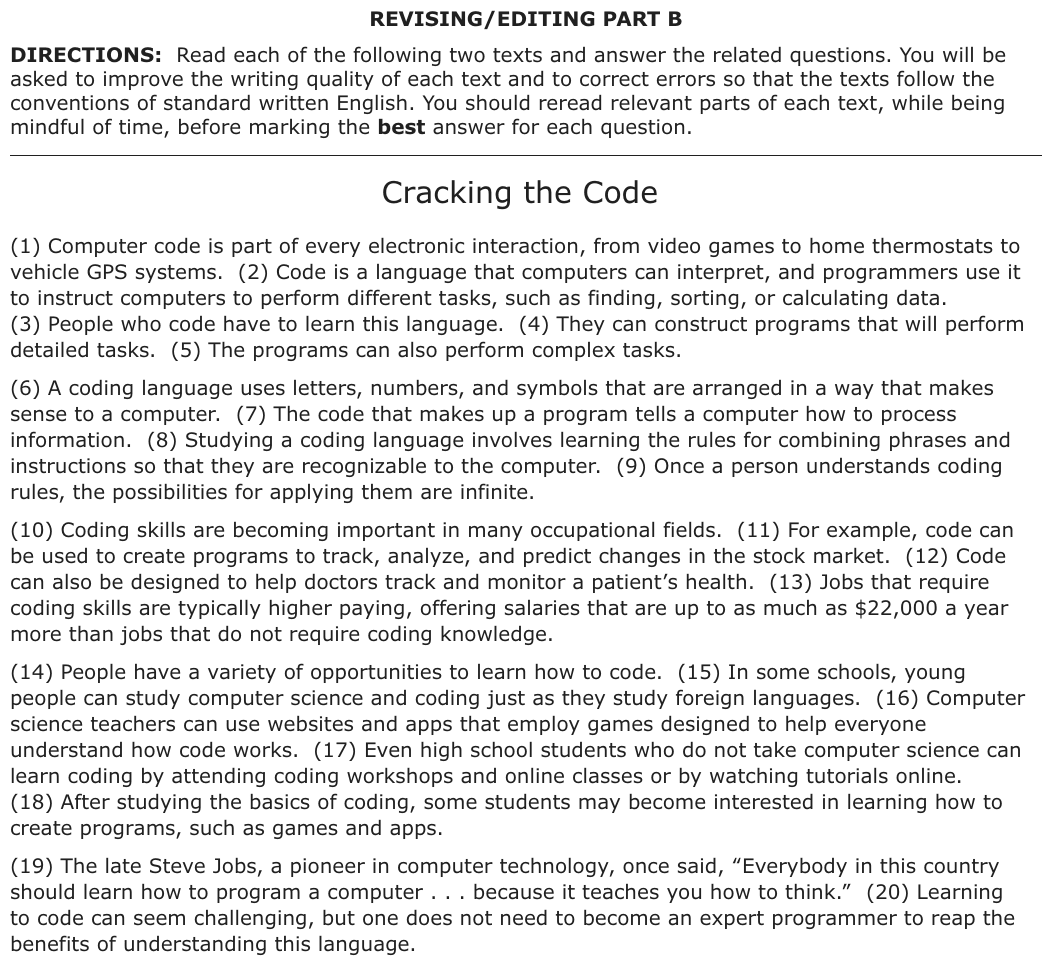
Cracking the Code
(1) Computer code is part of every electronic interaction, from video games to home thermostats to vehicle GPS systems. (2) Code is a language that computers can interpret, and programmers use it to instruct computers to perform different tasks, such as finding, sorting, or calculating data. (3) People who code have to learn this language. (4) They can construct programs that will perform detailed tasks. (5) The programs can also perform complex tasks.
(6) A coding language uses letters, numbers, and symbols that are arranged in a way that makes sense to a computer. (7) The code that makes up a program tells a computer how to process information. (8) Studying a coding language involves learning the rules for combining phrases and instructions so that they are recognizable to the computer. (9) Once a person understands coding rules, the possibilities for applying them are infinite.
(10) Coding skills are becoming important in many occupational fields. (11) For example, code can be used to create programs to track, analyze, and predict changes in the stock market. (12) Code can also be designed to help doctors track and monitor a patient’s health. (13) Jobs that require coding skills are typically higher paying, offering salaries that are up to as much as $22,000 a year more than jobs that do not require coding knowledge.
(14) People have a variety of opportunities to learn how to code. (15) In some schools, young people can study computer science and coding just as they study foreign languages. (16) Computer science teachers can use websites and apps that employ games designed to help everyone understand how code works. (17) Even high school students who do not take computer science can learn coding by attending coding workshops and online classes or by watching tutorials online. (18) After studying the basics of coding, some students may become interested in learning how to create programs, such as games and apps.
(19) The late Steve Jobs, a pioneer in computer technology, once said, “Everybody in this country should learn how to program a computer . . . because it teaches you how to think.” (20) Learning to code can seem challenging, but one does not need to become an expert programmer to reap the benefits of understanding this language.
Question
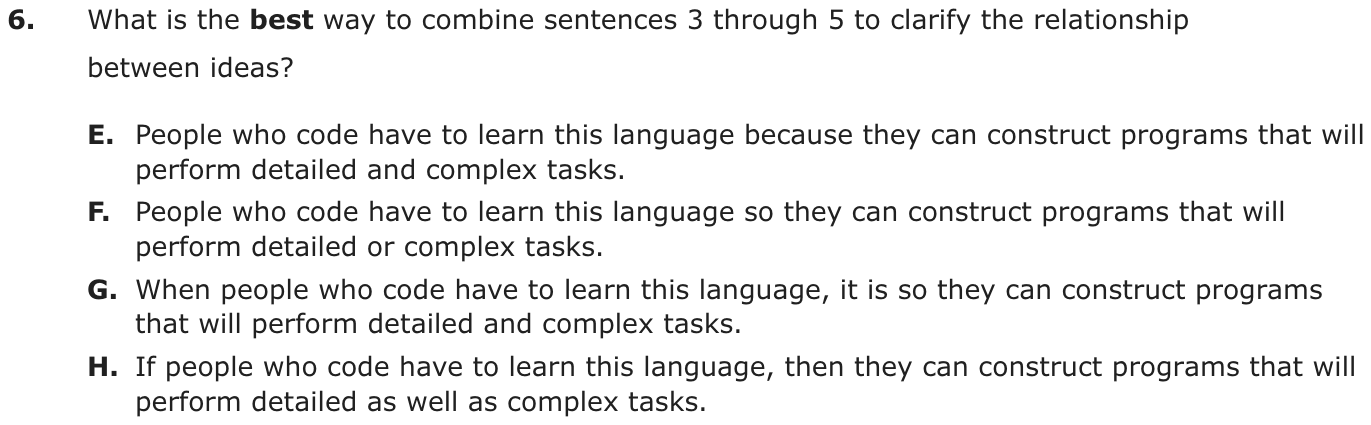
What is the best way to combine sentences 3 through 5 to clarify the relationship between ideas?
- APeople who code have to learn this language because they can construct programs that will perform detailed and complex tasks.
- BPeople who code have to learn this language so they can construct programs that will perform detailed or complex tasks.
- CWhen people who code have to learn this language, it is so they can construct programs that will perform detailed and complex tasks.
- DIf people who code have to learn this language, then they can construct programs that will perform detailed as well as complex tasks.
Show the answer
Correct answer: B
The question asks for the best way to combine sentences 3 through 5 to clarify the relationship between ideas.
A. Incorrect. While this sentence shows a relationship between the ideas, it does not clarify the relationship accurately. Learning the language of code does not depend on people’s previous ability to construct programs that will perform detailed and complex tasks. The word “because” incorrectly indicates that people can already construct complex programs prior to learning the coding language that would allow them to do so.
B. CORRECT. This sentence accurately shows the relationship between the ideas of the sentences. Before people can construct programs that will perform detailed and complex tasks, they have to learn a coding language. Knowing that language will, in turn, allow them to build programs that can perform detailed and complex tasks.
C. Incorrect. This sentence does not accurately express the relationship between ideas because the sentence implies that some people who code do not have to learn the language to perform their job functions. The passage clearly states that “computer code is part of every electronic interaction” (sentence 1) and that “programmers use it to instruct computers to perform different tasks” (sentence 2).
D. Incorrect. The conditional (If . . . then) construction of the sentence in Option D does not convey the intended relationship of the ideas in the sentences. The “then” statement (“they can construct programs that will perform detailed as well as complex tasks”) does not follow the condition of the “if” statement (“people who code have to learn this language”).
Question analysis
This sentence-combining question uses the first paragraph of “Cracking the Code,” a passage about computer coding, and asks for the best way to join sentences 3 through 5: coders must learn the language, they can build programs for detailed tasks, and those programs can also handle complex ones. Each version links the ideas with a different word, so students must judge which states the relationship accurately.
- Grade level
- Grade 7 reading and task
- Compared with grade 7
- At grade 7 Joining short sentences with a word that shows how their ideas relate is typical grade 7 work. Here three sentences become one and every version is grammatical, so the choice rests on whether the joining words state the logic accurately.
- Estimated difficulty
- Moderate: several steps, or a close reading with one strong distractor.
- Thinking it demands
- Depth of knowledge 2, skills and concepts · mainly evaluate
- What makes it hard
- A very close wrong answer moderate
- How sentences fit together moderate
- Every choice must be checked minor
- Evidence
- Answered from one paragraph or stanza
- Reading level
- Passage: about grade 10, 357 words; question and choices: about grade 9, 101 words.
- Students, last 30 days
- Not enough answers yet to show (it takes 10).
Why it is hard, traps and wrong answers (shows the answer)
Why it is hard
Every version is a correct sentence carrying the same facts, so the question tests logic rather than grammar: what does learning the language make possible? The look-alike joined by “because” is the main danger, since it seems to give a reason for learning. Careful readers may also pause over the key’s “detailed or complex tasks,” looser than sentence 5’s “also,” but the joining word, not that slip, is what separates the best sentence from the rest.
A very close wrong answer moderate Choosing the answer
The version joined by “because” matches the key word for word except for its linking word and “and” in place of “or,” so the decision rests on which way the link between learning and building runs. (Embretson & Wetzel, 1987; Gorin & Embretson, 2006; Ascalon et al., 2007)
How sentences fit together moderate Working it out
Sentence 3 states a requirement and sentences 4 and 5 state what meeting it allows, so the combined sentence must present learning the language as the means and building programs as the purpose. (Halliday & Hasan, 1976)
Every choice must be checked minor Choosing the answer
All four versions are grammatical and keep the same facts; only the opening or joining words change, “because,” “so,” “When … it is so” and “If … then,” and each must be weighed. (Embretson & Wetzel, 1987)
Strategy: Before reading the choices, decide in your own words how sentence 3 relates to sentences 4 and 5, then check whether each version’s opening or joining word signals that same relationship.
Traps
- Wrong transition: A connecting word or phrase that signals the wrong relationship, such as contrast where the idea continues.
- Wordy, vague or informal: A revision is grammatical but wordy, imprecise or too casual for the passage.
The wrong answers, classified
A Wrong transition (Halliday & Hasan, 1976)
Hears “because” as giving the reason to learn the language, but it treats the ability to build detailed and complex programs as already there, when that ability comes from learning.
C Wordy, vague or informal (Connors & Lunsford, 1988)
Is drawn by the formal ring of “When … it is so,” which buries the purpose in a clumsy frame and suggests coders must learn the language only on some occasions.
D Wrong transition (Halliday & Hasan, 1976)
Keeps learning before building but frames it with “If … then,” turning a stated requirement into a mere possibility, though having to learn a language does not by itself let anyone build programs.
Working it out, step by step
Figure out what the question asks
This asks you to join three short sentences into one. The new sentence must show how the ideas connect. All four choices are correct sentences with the same facts. What changes is the joining word. So first decide how the ideas connect. Then find the joining word that says so.
Read sentences 3 through 5
Sentence 3 says “People who code have to learn this language.” Sentence 4 says “They can construct programs that will perform detailed tasks.” Sentence 5 adds “The programs can also perform complex tasks.” To construct is to build. Detailed tasks have many small parts. Complex tasks are complicated and hard to do.
Name the link between the ideas
Why do coders have to learn the language? So that they can build programs. Learning comes first. Building programs is the goal it makes possible. A word that shows a goal, or purpose, is “so” (short for “so that”). Example: I practice piano so I can play in the concert. The practice comes first, and the concert is the goal.
Check each choice
- A does not fit. “Because” gives a reason that is already true. It says coders learn the language because they can already build programs. That gets the order backward.
- B fits. “So” shows that building programs is the goal of learning the language. It says “detailed or complex tasks” where sentence 5 means both, a small slip. But its joining word is right.
- C does not fit. “When” suggests coders only sometimes have to learn the language. And “it is so” is wordy.
- D does not fit. “If” makes learning sound like a maybe. The passage says coders “have to learn” it. That is a must.
Choose the answer
Watch out: A is the most tempting. It matches B almost word for word, and “because” sounds like a reason to learn. But it points the wrong way. B shows that learning leads to building. So the answer is B.
Why this answer and not the closest wrong one
A is the closest wrong answer. It uses the same words as B except for the joining word. “Because” makes building programs the reason coders learn the language, as if they could already do it. “So” makes building programs the goal that learning leads to. Learning comes first, so B shows the link correctly.
More questions like this
The original DOE question
The passage “Cracking the Code” as printed (page 40)
Question 6 of 57
2019 Test A English, question 6Uses the passage above: “Cracking the Code”.
Question
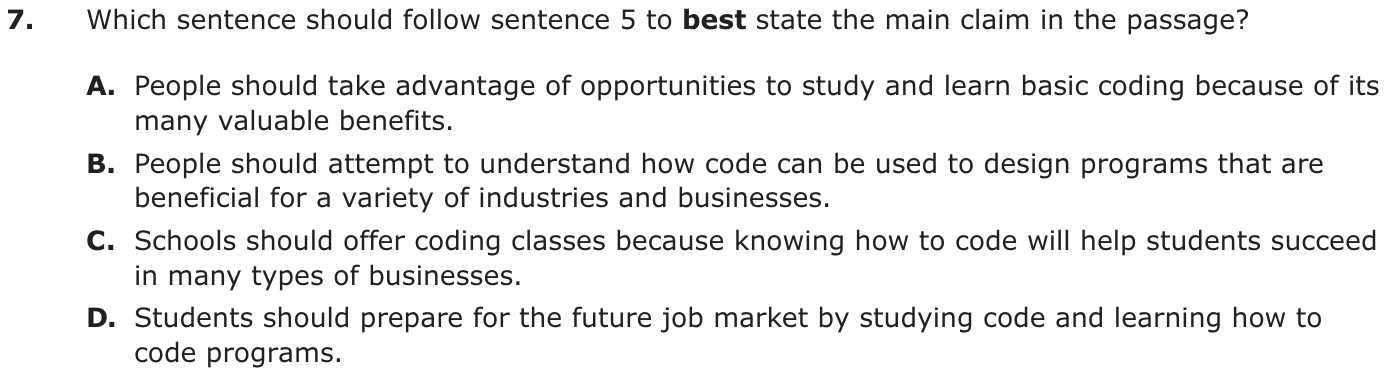
Which sentence should follow sentence 5 to best state the main claim in the passage?
- APeople should take advantage of opportunities to study and learn basic coding because of its many valuable benefits.
- BPeople should attempt to understand how code can be used to design programs that are beneficial for a variety of industries and businesses.
- CSchools should offer coding classes because knowing how to code will help students succeed in many types of businesses.
- DStudents should prepare for the future job market by studying code and learning how to code programs.
Show the answer
Correct answer: A
The question asks for the sentence that should follow sentence 5 to best state the main claim in the passage.
A. CORRECT. This sentence logically follows sentence 5 and introduces the main idea of the passage: that due to the high demand for coding skills across a wide range of industries and disciplines, learning basic coding skills can provide a range of opportunities for personal growth.
B. Incorrect. While this sentence incorporates a point made in the passage about how coding can benefit many occupational fields (sentence 10), this idea alone does not address the entire argument in the passage. This sentence does not capture the passage’s emphasis on the variety of ways people can learn how to code (sentence 14).
C. Incorrect. While this sentence incorporates ideas about opportunities to learn coding skills in school (fourth paragraph), the larger claim presented in the passage is not about opportunities schools should offer in order to help students learn to code. The passage primarily focuses on the opportunities offered to people who take on the challenge of learning to code.
D. Incorrect. Although the passage discusses the opportunities that are available to some students to learn coding skills in school (sentences 15–16), this point is a supporting detail of the passage, not the main claim of the passage.
Question analysis
This introduction question asks which sentence, added after sentence 5 of “Cracking the Code,” would best state the main claim of the passage. Students must work out what the whole argument is driving at, across paragraphs on what code is, how it is used at work and where people can learn it, and then choose among four sentences that each sound like a claim.
- NYS standards
- 7W1a introducing claims and counterclaims
- Grade level
- Grade 7 reading and task
- Compared with grade 7
- At grade 7 Introducing a precise claim is a core grade 7 argument skill. Students must find the claim behind all five paragraphs, since the first paragraph only explains what code is, and compare four sentences that each tell someone what to do.
- Estimated difficulty
- Straightforward: two steps or one careful reading.
- Thinking it demands
- Depth of knowledge 2, skills and concepts · mainly evaluate
- What makes it hard
- Evidence in several places moderate
- Every choice must be checked minor
- Evidence
- Answered from the whole text
- Reading level
- Passage: about grade 10, 357 words; question and choices: about grade 10, 91 words.
- Students, last 30 days
- Not enough answers yet to show (it takes 10).
Why it is hard, traps and wrong answers (shows the answer)
Why it is hard
The claim is clearest at the very end, where sentence 20 says anyone can benefit from understanding code without becoming an expert. Each wrong option grows out of one paragraph, the industries of paragraph 3 or the students and schools of paragraph 4, so it sounds supported but speaks to too few people or asks for the wrong action. The question rewards naming the whole argument before reading the options.
Evidence in several places moderate Working it out
The first paragraph only explains what code is, so the claim must be pieced together from later parts: coding’s value at work in paragraph 3, the ways to learn in paragraph 4 and sentence 20’s benefits for non-experts. (Kirsch & Mosenthal, 1990; Gorin & Embretson, 2006)
Every choice must be checked minor Choosing the answer
All four options are “should” statements built from real material in the passage, so each has to be checked for whom it addresses and what it asks them to do. (Embretson & Wetzel, 1987)
Strategy: Before reading the choices, note in a phrase what each paragraph adds, then say in one sentence what the whole passage wants its readers to do, and pick the option that matches all of it.
Traps
- Too narrow: A single detail offered as the central idea or a summary, or a summary that keeps minor details and leaves out an essential part.
- Off the point: Adds or keeps something that does not support the paragraph's or the passage's focus, or an introduction or conclusion that misses the main point.
The wrong answers, classified
B Too narrow (King et al., 2004)
Builds on the stock-market and medical programs of paragraph 3, but asks people only to understand how code serves industries, never to learn it, and leaves out the ways to learn.
C Off the point (Halliday & Hasan, 1976)
Takes the schools of sentence 15 as the heart of the argument and turns the claim into a duty for schools, a demand the passage never makes of them.
D Too narrow (King et al., 2004)
Joins the higher-paying jobs of sentence 13 to the students of paragraph 4, but limits the claim to students preparing for jobs, while the passage addresses everyone and promises benefits beyond pay.
Working it out, step by step
Figure out what the question asks
This asks for the main claim of the whole passage. A claim is the main point a writer argues for. The new sentence goes after sentence 5, at the end of the first paragraph. So it should tell the reader what the whole passage will argue. Each choice tells someone what they “should” do. Find the one that fits all five paragraphs.
Sum up each paragraph
- Paragraph 1 (sentences 1–5): code is everywhere, and coders must learn its language.
- Paragraph 2 (sentences 6–9): how a coding language works.
- Paragraph 3 (sentences 10–13): coding skills matter in many jobs and can mean higher pay.
- Paragraph 4 (sentences 14–18): “People have a variety of opportunities to learn how to code.”
- Paragraph 5 (sentences 19–20): everybody should learn, and you don’t have to be an expert.
Find the claim in the ending
The end of a passage often makes its point clearest. Sentence 19 quotes Steve Jobs: “Everybody in this country should learn how to program a computer.” Sentence 20 says “one does not need to become an expert programmer to reap the benefits of understanding this language.” To reap benefits is to get good things from something. So the claim is this: everyone should learn at least basic coding, because it helps in many ways.
Check each choice
- A fits. It speaks to all people. “Basic coding” matches sentence 20. “Opportunities” matches paragraph 4. “Many valuable benefits” covers jobs, pay and more.
- B does not fit. It asks people only to understand how businesses use code, the idea of paragraph 3. It never says to learn coding.
- C does not fit. The passage never tells schools what to do. Schools are just one place to learn, in sentence 15.
- D does not fit. It speaks only to students, and only about jobs. The passage speaks to everybody.
Choose the answer
Watch out: D sounds right because the passage does talk about students and jobs. But those are only parts of paragraphs 3 and 4. Only A covers who the passage speaks to and why they should learn. So the answer is A.
Why this answer and not the closest wrong one
D is a close wrong answer, because studying code for good jobs is part of the passage. But D limits the claim to students and to jobs. Sentence 19 says “Everybody” should learn. The reason Steve Jobs gives is that it “teaches you how to think,” which is not about jobs at all. A speaks to all people and all the benefits.
More questions like this
The original DOE question
Question 7 of 57
2019 Test A English, question 7Uses the passage above: “Cracking the Code”.
Question
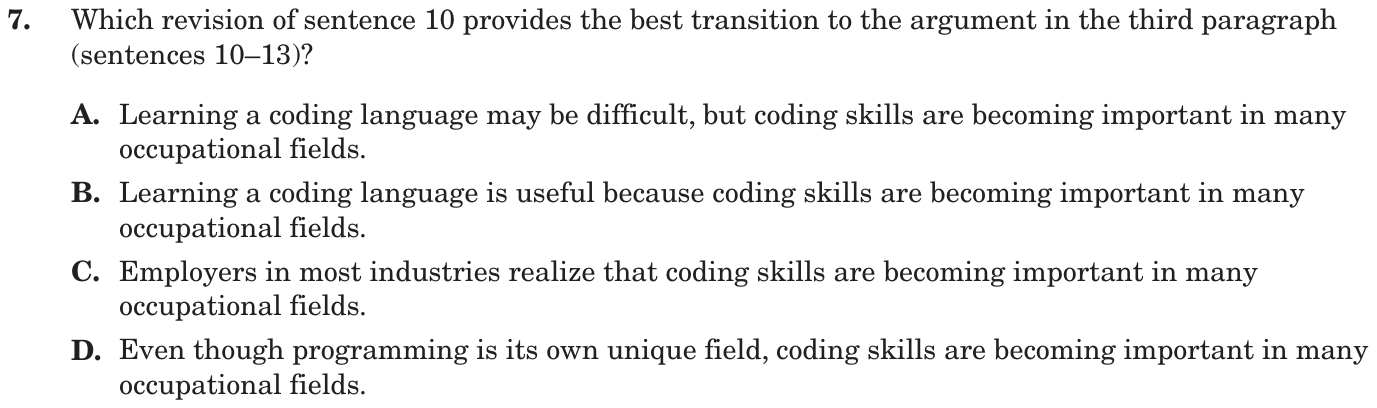
Which revision of sentence 10 provides the best transition to the argument in the third paragraph (sentences 10–13)?
- ALearning a coding language may be difficult, but coding skills are becoming important in many occupational fields.
- BLearning a coding language is useful because coding skills are becoming important in many occupational fields.
- CEmployers in most industries realize that coding skills are becoming important in many occupational fields.
- DEven though programming is its own unique field, coding skills are becoming important in many occupational fields.
Show the answer
Correct answer: B
The question asks for the best revision of sentence 10 to provide a transition to the third paragraph.
A. Incorrect. Some readers may choose this option because the second paragraph does discuss the complexities of coding; however, it does not discuss the difficulties of learning coding. The third paragraph demonstrates some of the complex ways coding is used in specific fields but does not illustrate how difficult learning coding may be.
B. CORRECT. This sentence provides the best revision of the transition sentence. The second paragraph ends with “the possibilities for applying them are infinite” (sentence 9), which supports the idea that people in “many occupational fields” (sentence 10) can benefit from having coding skills. The third paragraph illustrates this idea by providing specific examples of occupations that benefit from coding (stock market traders and doctors).
C. Incorrect. While it is suggested in the passage that employers in the health-care industry recognize the importance of coding skills (sentence 12), the third paragraph focuses on examples of coding within different occupations, not specific employers’ analyses of what makes coding skills important.
D. Incorrect. Some readers may choose this option because the second paragraph provides a brief definition of coding—“A coding language uses letters, numbers, and symbols that are arranged in a way that makes sense to a computer” (sentence 6)—which shows how this element of programming works, but the second paragraph does not specifically discuss what makes the field of computer programming unique. The third paragraph discusses how coding can be used in a variety of occupational fields (sentence 10).
Question analysis
In this transitions question on the passage “Cracking the Code,” students choose the revision of sentence 10 that best leads into the third paragraph’s argument about coding skills in the workplace. The task means understanding what the second paragraph explains and what the third sets out to show, then judging which connection between them is real.
- NYS standards
- 7W1d transitions in arguments
- Grade level
- Grade 7 reading and task
- Compared with grade 7
- At grade 7 Writing a sentence that links one paragraph to the next is a grade 7 writing standard. The passage is plain and its paragraphs short, so the task stays at the level of a typical grade 7 revising question.
- Estimated difficulty
- Moderate: several steps, or a close reading with one strong distractor.
- Thinking it demands
- Depth of knowledge 2, skills and concepts · mainly evaluate
- What makes it hard
- How sentences fit together moderate
- A very close wrong answer moderate
- Evidence
- Answered from several paragraphs or stanzas
- Reading level
- Passage: about grade 10, 357 words; question and choices: about grade 13, 81 words.
- Students, last 30 days
- Not enough answers yet to show (it takes 10).
Why it is hard, traps and wrong answers (shows the answer)
Why it is hard
Every version keeps the original sentence 10 as its ending, so the decision rests on a few opening words and the relationship they announce. A concession about difficulty is a familiar essay move, and sentence 20 does say coding “can seem challenging,” but neither paragraph 2 nor paragraph 3 weighs difficulty at all. Naming the actual connection first, that coding is worth learning because so many jobs now use it, makes each opening quick to test.
How sentences fit together moderate Working it out
The new opening has to reach back to sentence 9, where knowing coding rules makes the possibilities “infinite,” and forward to the stock-market and patient-monitoring examples of sentences 11 and 12. (Halliday & Hasan, 1976)
A very close wrong answer moderate Choosing the answer
The concession version matches the key word for word except in its middle, “may be difficult, but” in place of “is useful because,” so only the link each one claims sets them apart. (Embretson & Wetzel, 1987; Gorin & Embretson, 2006; Ascalon et al., 2007)
Strategy: Since all four versions end the same way, focus on their opening words, and ask which opening looks back to the second paragraph and ahead to the third.
Traps
- Wrong transition: A connecting word or phrase that signals the wrong relationship, such as contrast where the idea continues.
- Off the point: Adds or keeps something that does not support the paragraph's or the passage's focus, or an introduction or conclusion that misses the main point.
The wrong answers, classified
A Wrong transition (Halliday & Hasan, 1976)
Carries sentence 20’s “can seem challenging” back to sentence 10 and sets difficulty against importance with “but,” though the two paragraphs it joins never mention difficulty, so the contrast links nothing.
C Off the point (Halliday & Hasan, 1976)
Sees that paragraph 3 is about jobs and opens with what employers in “most industries” realize, a viewpoint the passage never develops, leaving no link back to paragraph 2’s coding rules.
D Off the point (Halliday & Hasan, 1976)
Reads paragraph 2’s account of letters, numbers and symbols as proof that programming is “its own unique field,” an idea the passage never takes up, and builds a contrast on it.
Working it out, step by step
Figure out what the question asks
This asks for the best transition. A transition is a bridge that links one part of a piece of writing to the next. Sentence 10 opens the third paragraph. So a good opening looks back at paragraph 2 and points ahead to paragraph 3. Here is a made-up example. After a paragraph on planting seeds, the next one might open: Planting with care pays off, because healthy plants give more food.
Sum up paragraph 2
Paragraph 2 explains what a coding language is. Learning one means learning its rules. The paragraph ends with sentence 9: “Once a person understands coding rules, the possibilities for applying them are infinite.” Infinite means without end. So paragraph 2 is about learning the language and how much you can do with it.
Sum up paragraph 3
Paragraph 3 shows coding at work. Code can track the stock market (sentence 11). It can help doctors watch a patient’s health (sentence 12). Jobs that need coding usually pay more (sentence 13). “Occupational fields” means kinds of jobs. So paragraph 3 shows why learning to code pays off.
Check each choice
All four choices end the same way. So compare how they begin.
- A does not fit. Its opening, “may be difficult, but,” sets up a contrast about how hard coding is. Neither paragraph talks about that.
- B fits. “Learning a coding language” looks back at paragraph 2. “Is useful because” leads into the jobs in paragraph 3.
- C does not fit. The passage never says what employers in “most industries” realize. C also has no link back to learning the language in paragraph 2.
- D does not fit. The passage never calls programming “its own unique field,” so that contrast connects to nothing.
Choose the answer
Watch out: A begins with the same words as B. Admitting that something is hard can sound like a smart move. Sentence 20 even says “Learning to code can seem challenging.” But that comes at the very end, not in paragraphs 2 or 3. So the answer is B.
Why this answer and not the closest wrong one
A is the closest wrong answer. It matches B except in the middle: “may be difficult, but” in place of “is useful because.” A sets difficulty against importance, yet neither paragraph is about difficulty. B gives a reason instead. Learning the language from paragraph 2 is useful, and the jobs in paragraph 3 show why.
More questions like this
The original DOE question
Question 8 of 57
2019 Test A English, question 8Uses the passage above: “Cracking the Code”.
Question
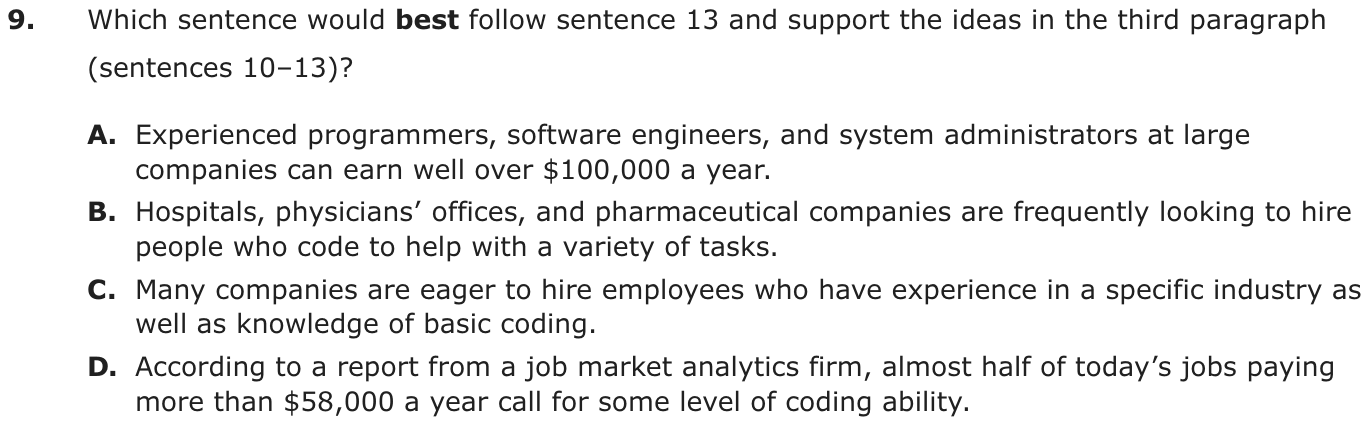
Which sentence would best follow sentence 13 and support the ideas in the third paragraph (sentences 10–13)?
- AExperienced programmers, software engineers, and system administrators at large companies can earn well over $100,000 a year.
- BHospitals, physicians’ offices, and pharmaceutical companies are frequently looking to hire people who code to help with a variety of tasks.
- CMany companies are eager to hire employees who have experience in a specific industry as well as knowledge of basic coding.
- DAccording to a report from a job market analytics firm, almost half of today’s jobs paying more than $58,000 a year call for some level of coding ability.
Show the answer
Correct answer: D
The question asks which sentence would best follow sentence 13 and support the ideas in the third paragraph.
A. Incorrect. While this sentence provides an example of a high salary, which is mentioned in the paragraph (sentence 13), the reference to “Experienced programmers, software engineers, and system administrators at large companies” focuses on specific occupations that may use coding, as opposed to the range of diverse occupations discussed in the third paragraph.
B. Incorrect. While sentence 12 does mention coding skills in the medical field as an example, the information provided in this answer supports only that idea and not the other ideas expressed in the third paragraph.
C. Incorrect. This sentence generally discusses employers looking for two things: “experience in a specific industry” and “knowledge of basic coding.” The third paragraph, however, discusses the possibilities of using coding skills in a variety of occupations. The words “experience in a specific industry” do not connect to the idea the paragraph develops.
D. CORRECT. This sentence provides specific evidence of the job market favoring potential employees who have coding ability. It supports what is stated in sentence 13, that “jobs that require coding skills are typically higher paying.”
Question analysis
This supporting-details question asks which sentence would best follow sentence 13 of “Cracking the Code,” which says jobs requiring coding skills tend to pay more, and support the ideas of the third paragraph. All four options are plausible facts about coding and work, from salaries to hiring, so students must judge which one backs up the paragraph as a whole.
- NYS standards
- 7W1b supporting claims with evidence
- Grade level
- Grade 7 reading and task
- Compared with grade 7
- Above grade 7 Choosing relevant evidence for a claim is grade 7 argument work. Here all four options are believable facts about coding and jobs, and the best one must fit both sentence 13 and the paragraph’s larger point, a finer judgment than usual.
- Estimated difficulty
- Hard: combines ideas, needs a plan, and has more than one tempting wrong answer.
- Thinking it demands
- Depth of knowledge 2, skills and concepts · mainly evaluate
- What makes it hard
- Every choice must be checked moderate
- How sentences fit together moderate
- Reading between the lines minor
- Evidence
- Answered from one paragraph or stanza
- Reading level
- Passage: about grade 10, 357 words; question and choices: about grade 12, 100 words.
- Students, last 30 days
- Not enough answers yet to show (it takes 10).
Why it is hard, traps and wrong answers (shows the answer)
Why it is hard
The paragraph makes two claims, that coding matters in many fields and that coding jobs pay more, and the best addition must serve both while following the sentence about pay. The $100,000 figure is the main trap, since it seems to back the pay claim but turns attention to computing careers, the opposite of the paragraph’s point. The hospital and industry-experience options each touch one idea of the paragraph and drift away from the rest.
Every choice must be checked moderate Choosing the answer
All four options are believable facts about coding and work, two of them with salary figures, so each must be tested against sentence 13’s pay comparison and sentence 10’s claim about many fields. (Embretson & Wetzel, 1987)
How sentences fit together moderate Working it out
The added sentence comes right after sentence 13, so it should carry on the point that coding jobs pay more while still serving the paragraph’s opening claim that coding matters in many occupations. (Halliday & Hasan, 1976)
Reading between the lines minor Working it out
Seeing why the job-market statistic fits takes a step of reasoning: if almost half of jobs paying over $58,000 call for coding, coding is both widespread and tied to better pay. (Graesser, Singer & Trabasso, 1994; Kintsch, 1998)
Strategy: Restate sentence 10 and sentence 13 in your own words, then ask of each option whether it is evidence for what those two sentences claim, not just a fact on the same topic.
Traps
- Off the point: Adds or keeps something that does not support the paragraph's or the passage's focus, or an introduction or conclusion that misses the main point.
The wrong answers, classified
A Off the point (Halliday & Hasan, 1976)
Matches sentence 13’s talk of pay with a striking salary, but it turns to computing careers such as software engineering instead of the many fields the paragraph describes, and compares nothing.
B Supports only part of the claim (King et al., 2004; Thissen, Steinberg & Fitzpatrick, 1989)
Extends sentence 12’s point about doctors to hospitals and drug companies, but it backs only the medical example and says nothing about pay, so it does not build on sentence 13.
C Off the point (Halliday & Hasan, 1976)
Sees support for coding’s value in companies wanting “knowledge of basic coding,” but the sentence adds a second demand, experience in one industry, which the paragraph never discusses.
Working it out, step by step
Figure out what the question asks
You need a sentence to add after sentence 13. It must support the third paragraph. To support means to give evidence: facts that back up a point. So first find the paragraph’s points. Then test each choice against them.
Find the paragraph’s two points
Sentence 10 says “Coding skills are becoming important in many occupational fields.” That means many kinds of jobs. Sentences 11 and 12 give examples: the stock market and doctors. Sentence 13 says “Jobs that require coding skills are typically higher paying.” So the paragraph makes two points. Coding matters in many kinds of jobs. And jobs that need coding tend to pay more.
Test each choice against both points
- A gives a big salary. But it names only computer jobs, like programmers and software engineers. The paragraph is about coding in many other fields.
- B is only about hospitals and drug companies. It repeats the doctor example and says nothing about pay.
- C brings in a new idea: “experience in a specific industry.” The paragraph never talks about that, and C says nothing about pay.
- D says “almost half of today’s jobs paying more than $58,000 a year call for some level of coding ability.”
See why D supports both points
D is about jobs that pay well, so it backs up sentence 13 on pay. It also says almost half of those jobs need some coding. Half of all well-paying jobs covers many kinds of work, not just computer jobs. That backs up sentence 10. D also names where its facts come from, a report, which makes it stronger evidence.
Choose the answer
Watch out: A is the most tempting. Its $100,000 salary seems to match sentence 13. But of course computer experts need coding. That doesn’t show that coding matters in other fields. So the answer is D.
Why this answer and not the closest wrong one
A is the closest wrong answer, since it talks about high pay. But it is about programmers and other computer jobs. The paragraph’s point is that coding helps in many fields beyond computers. D shows that almost half of all well-paying jobs call for some coding. It supports both the pay and the many fields.
More questions like this
The original DOE question
Question 9 of 57
2019 Test A English, question 9Uses the passage above: “Cracking the Code”.
Question
Which concluding sentence would best follow sentence 20 and support the argument presented in the passage?
- APeople should understand that knowing how to code is becoming an essential requirement for most high-paying jobs.
- BBy understanding basic coding concepts, people can participate in an increasingly digital marketplace.
- CStudents who want to secure a high-paying job in the technology industry should become proficient in coding.
- DSince coding is a valuable marketplace skill, today’s students should begin to write their own computer programs.
Show the answer
Correct answer: B
The question asks which concluding sentence would best follow sentence 20 and support the argument presented in the passage.
A. Incorrect. While the passage does state that “jobs that require coding skills are typically higher paying” (sentence 13), it does not say or imply that coding skills are needed for most high-paying jobs.
B. CORRECT. The sentence successfully summarizes the main argument of the passage, which is that coding is involved in all electronic interaction (sentence 1) and is a useful skill to master, especially in many occupational fields (sentence 10).
C. Incorrect. In the fourth paragraph, the passage does promote students taking advantage of opportunities to learn coding; however, this information is a supporting detail and would not serve as a strong conclusion to the argument presented in the passage.
D. Incorrect. Some readers may choose this sentence because the fourth paragraph discusses how “some students may become interested in learning how to create programs, such as games and apps” (sentence 18), but this detail is only one part of the overall argument in the passage.
Question analysis
To finish “Cracking the Code,” a short argument for learning to code, students must pick the concluding sentence that would best follow sentence 20. Several options grow from details the passage does mention, such as higher pay and students creating programs, so each ending must be weighed against the passage as a whole.
- NYS standards
- 7W1e concluding an argument
- Grade level
- Grade 7 reading and task
- Compared with grade 7
- At grade 7 Choosing an ending that sums up a whole argument is ordinary grade 7 revising work. The passage is short and clear; what takes care is that each option is linked to something real in the passage, so overreach must be spotted.
- Estimated difficulty
- Moderate: several steps, or a close reading with one strong distractor.
- Thinking it demands
- Depth of knowledge 2, skills and concepts · mainly evaluate
- What makes it hard
- Evidence in several places moderate
- The right answer is reworded minor
- How sentences fit together minor
- Evidence
- Answered from the whole text
- Reading level
- Passage: about grade 10, 357 words; question and choices: about grade 12, 79 words.
- Students, last 30 days
- Not enough answers yet to show (it takes 10).
Why it is hard, traps and wrong answers (shows the answer)
Why it is hard
Each tempting ending starts from something the passage really says, about better pay, students or making programs, so each feels grounded. What separates them is scale: one inflates better pay into a requirement for most good jobs, and two shrink a case made for everyone into advice for students. Holding on to sentence 20, that understanding the basics is enough, removes most of them at once.
Evidence in several places moderate Working it out
A closing line has to gather points made far apart: code runs everyday devices (sentence 1), many occupations need it (sentence 10), anyone can learn it (paragraph 4) and a basic grasp is enough (sentence 20). (Kirsch & Mosenthal, 1990; Gorin & Embretson, 2006)
The right answer is reworded minor Choosing the answer
The best ending speaks of “basic coding concepts” and an “increasingly digital marketplace,” words the passage never uses, while the others recycle sentence 13’s higher pay or sentence 18’s student-made programs. (Freedle & Kostin, 1993; Kirsch & Mosenthal, 1990)
How sentences fit together minor Working it out
The ending must follow sentence 20, which says no one has to become an expert programmer, so a call for proficiency or for writing programs clashes with the line just before it. (Halliday & Hasan, 1976)
Strategy: Note what sentence 20 says about becoming an expert, then test each ending twice: does it fit the passage as a whole, and does it stay within what the passage claims?
Traps
- Too narrow: A single detail offered as the central idea or a summary, or a summary that keeps minor details and leaves out an essential part.
- Too broad or too strong: A choice overstates, generalizes, or uses absolute words the text does not support.
The wrong answers, classified
A Too broad or too strong (King et al., 2004)
Starts from sentence 13’s higher salaries for coding jobs and inflates them into coding being “an essential requirement for most high-paying jobs,” a claim the passage never makes.
C Too narrow (King et al., 2004)
Is caught by “high-paying job,” but it speaks only to students aiming at the technology industry and demands proficiency, which sentence 20 says no one needs.
D Too narrow (King et al., 2004)
Builds on sentence 18’s students who go on to create games and apps, so it closes the passage on one detail of paragraph 4 instead of its case for everyone.
Working it out, step by step
Figure out what the question asks
This asks for the best concluding sentence, the one that would end the passage. It must follow sentence 20 smoothly. It must also sum up the argument, the passage’s main point. A good ending doesn’t claim more than the passage shows. It also doesn’t shrink to one small detail. For example, an essay on sleep might end: Getting enough sleep helps you think, grow and stay well.
Reread sentence 20
Sentence 20 says “one does not need to become an expert programmer to reap the benefits of understanding this language.” An expert is someone with great skill. To reap the benefits means to get the good things that come from something. So even a basic understanding of coding helps. The last sentence should build on that.
List the passage’s main points
- Code is part of everything electronic, from video games to GPS (sentence 1).
- Coding skills matter “in many occupational fields,” or kinds of jobs (sentence 10).
- Anyone can find ways to learn (paragraph 4).
- Even a basic grasp pays off (sentence 20).
Check each choice
- A does not fit. Sentence 13 says coding jobs are “typically higher paying.” It never says coding is required for “most high-paying jobs.” That claims too much.
- B fits. “Basic coding concepts” matches sentence 20. A marketplace is the world of buying, selling and jobs. Digital means run by computers. So B ties together code being everywhere and its use in many jobs.
- C does not fit. It speaks only to students who want tech jobs. Proficient means highly skilled, which sentence 20 says you don’t need to be.
- D does not fit. Writing your own programs is one detail from sentence 18. It is not the whole argument.
Choose the answer
Watch out: A sounds like a strong ending, and it grows out of sentence 13. But paying more is not the same as being required. Only B follows sentence 20 and fits the whole passage. So the answer is B.
Why this answer and not the closest wrong one
A is the closest wrong answer. It starts from a real fact: coding jobs usually pay more. But it stretches that into a rule for “most high-paying jobs,” which the passage never says. B stays within the passage. A basic grasp of coding helps people take part in a world of work that runs on computers.
More questions like this
The original DOE question
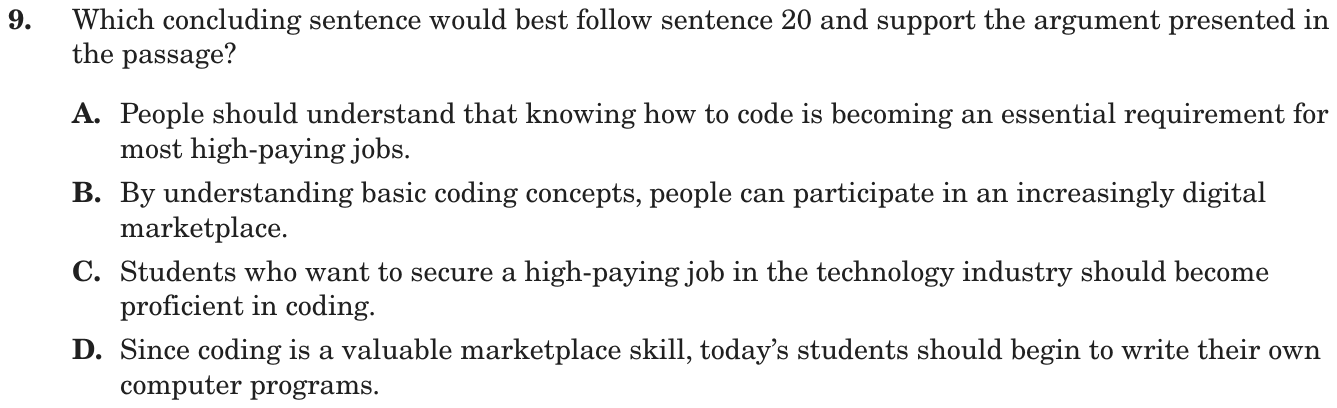
Question 10 of 57
2019 Test A English, question 10Passage A Miracle Mile
A Miracle Mile
In the 1950s people compared running one mile in four minutes to scaling Mount Everest and nicknamed the feat a “dream mile.” Although such an accomplishment was considered humanly impossible, several elite runners aimed to break that supposedly impenetrable barrier. One of them was a twenty-five-year-old medical student named Roger Bannister.
Roger Bannister had tasted failure during the 1952 Olympics. There, he was favored to win the 1,500-meter competition, a distance slightly shorter than a mile, but he finished in a dismal fourth place instead. Bannister’s performance was a disappointment for him and his country, Great Britain. Determined to redeem himself, Bannister postponed his plans to retire from racing and focused on the ultimate prize—breaking the four-minute-mile barrier.
Bannister attacked the elusive milestone with a positive attitude and logical planning. The amateur athlete decided to use intensive interval training to develop endurance and speed. For these workouts, Bannister ran an interval of ten consecutive laps on a quarter-mile track, aiming for sixty seconds each lap. In between intervals, he let his body recover for two minutes.
By early 1954, Bannister had succeeded in lowering his quarter-mile pace to sixty-one seconds, but he had to shave off at least one more second in order to reach his target. Frustrated by the plateau he had reached, Bannister took a break from training and went mountain climbing for three days. The rest from running permitted his muscles to recuperate and left him feeling refreshed. When Bannister returned to the track, he completed ten quarter-mile-long intervals at fifty-nine seconds each. He finally felt prepared to attempt to break the world record.
As a member of the Amateur Athletic Association (AAA), Bannister joined the AAA team for a track meet against Oxford University. The event took place on a cinder track in Oxford on May 6, 1954. Bannister and his two AAA teammates, Chris Chataway and Chris Brasher, were close friends and frequent running partners. Chataway and Brasher agreed to help Bannister accomplish his goal by being his “rabbits.”
In track and field, rabbits are runners who enter the race solely to pace a teammate for a segment of the course. Typically, a runner settles in behind the rabbit and allows the rabbit to set an appropriate tempo. Additionally, by running behind the rabbit, the runner conserves about 15 percent of his or her effort. When the starting pistol fired, Brasher pounced into the lead, and Bannister followed behind his first rabbit.
Propelled by the excitement, Bannister lost his instinctive feel for his pace and shouted “Faster!” at Brasher. Brasher, however, remained composed and maintained his current steady but grueling pace, completing the first two laps in a desirable one minute and fifty-eight seconds. Then Chataway surged forward, leading Bannister at this same punishing rate for another lap and a half. At the beginning of the back straightaway of the track, Bannister bolted past Chataway. Bannister said, “I felt that the moment of a lifetime had come. There was no pain, only a great unity of movement and aim.” Bannister crossed the finish line in 3 minutes 59.4 seconds. The ecstatic crowd erupted the moment the timekeeper announced the word “three.”
Soon after Bannister’s achievement, four other athletes matched his performance. A new mindset had taken root among runners. Over the years, the record continued to fall. However, the current record, 3 minutes 43.13 seconds, has stood unbroken since 1999. Some question whether this record represents the limits of human ability. But perhaps there is another Bannister, an athlete who, with willpower and dedication, will accomplish the miraculous.
Question
The words “feat,” “humanly impossible,” and “impenetrable barrier” in paragraph 1 affect the tone of the paragraph because they
- Ahighlight the idea that only the most skilled runners would be able to run a four-minute mile.
- Bemphasize the idea that running a mile in less than four minutes was a seemingly unattainable goal.
- Cconvey the competitiveness among elite runners to consistently set and break speed records.
- Dshow the intensity of the training programs athletes endure in order to achieve their goals.
Show the answer
Correct answer: B
The question asks how the words “feat,” “humanly impossible,” and “impenetrable barrier” in paragraph 1 affect the tone of the paragraph.
A. Incorrect. Although paragraph 1 states that “several elite runners aimed to break that supposedly impenetrable barrier,” the words “feat,” “humanly impossible,” and “impenetrable barrier” suggest that the goal was unattainable even for the most skilled runners.
B. CORRECT. No one had ever been able to run a mile in less than four minutes, and the words “feat,” “humanly impossible,” and “impenetrable barrier” imply that the goal seemed unattainable. These words also reinforce the comparison of running a four-minute mile to “scaling Mount Everest” (paragraph 1).
C. Incorrect. The words “feat,” “humanly impossible,” and “impenetrable barrier” describe how challenging and almost impossible running a four-minute mile seemed, and while other elite runners “aimed to break that supposedly impenetrable barrier” (paragraph 1), the paragraph focuses on Roger Bannister, not the competition among elite runners seeking to break the record.
D. Incorrect. Bannister’s training program is described in paragraphs 3 and 4, and the words “feat,” “humanly impossible,” and “impenetrable barrier” are used in paragraph 1 to describe the magnitude of Bannister’s goal to run a four-minute mile. Though his training program was intense, these words relate to the intensity of the goal itself, not to the intensity of his training.
Question analysis
This tone question on “A Miracle Mile,” an article about Roger Bannister and the four-minute mile, asks how three word choices in the opening paragraph, “feat,” “humanly impossible” and “impenetrable barrier,” affect its tone. Students must read the connotations of strong words in context and decide what they stress, while choices that echo other parts of the passage compete for attention.
- Grade level
- Grade 6 reading and task
- Compared with grade 7
- Below grade 7 Grade 7 tone questions often ask students to find the telling words themselves. Here the three words are quoted and sit in one short opening paragraph, and their shared meaning is strong and plain, so one careful reading is enough.
- Estimated difficulty
- Straightforward: two steps or one careful reading.
- Thinking it demands
- Depth of knowledge 2, skills and concepts · mainly analyze
- What makes it hard
- A very close wrong answer minor
- Hard words minor
- Evidence
- Answered from one paragraph or stanza
- Reading level
- Passage: about grade 10, 587 words; question and choices: about grade 11, 80 words.
- Students, last 30 days
- Not enough answers yet to show (it takes 10).
Why it is hard, traps and wrong answers (shows the answer)
Why it is hard
The three quoted words all make the same point, and the opening comparison with “scaling Mount Everest” makes it again, so the effect is easy to sense. Points are lost on degree: the sentence holding two of the three words also names “several elite runners,” which makes a choice about only the best runners look supported. Students who hold on to “humanly impossible” rule it out, and the choices about rivalry and training fall away once they check that the words describe the goal, not the runners or their preparation.
A very close wrong answer minor Choosing the answer
The choice about only the most skilled runners and the right one both stress how hard the four-minute mile was; they differ on degree, possible for the best runners or thought impossible for anyone. (Embretson & Wetzel, 1987; Gorin & Embretson, 2006; Ascalon et al., 2007)
Hard words minor Understanding the question
“Impenetrable” and “feat” carry the tone, and a student who does not know that impenetrable means impossible to break through may miss how absolute the barrier sounded. (Perfetti, 2007; Freedle & Kostin, 1993)
Strategy: Decide what feeling the three quoted words share, then reread paragraph 1 to see what they describe, and keep only a choice that fits both the feeling and the thing described.
Traps
- Twists what the text says: Uses the text's topic and ideas but changes what it says: who did it, how much, when, or why.
- Word match: Repeats striking words or phrases from the text, so it looks supported, but its meaning does not fit the question.
- Wrong part of the text: A choice is true of another paragraph, stanza or speaker than the one asked about.
The wrong answers, classified
A Twists what the text says (King et al., 2004)
Sees that the words stress difficulty but scales it down to a feat for the best runners only, though “humanly impossible” says no runner at all was thought able to do it.
C Word match (Freedle & Kostin, 1993)
Picks up “elite runners aimed to break” from the same sentence and turns it into a rivalry over records, though the three words describe the barrier, not the runners.
D Wrong part of the text (Kirsch & Mosenthal, 1990)
Carries the intensive interval training of paragraphs 3 and 4 back to paragraph 1, where the words measure the size of the goal, not the effort of preparing for it.
Working it out, step by step
Figure out what the question asks
This is a tone question. Tone is the feeling or attitude that a writer’s words give a passage. The question names three word choices from paragraph 1. You need to decide what feeling they share and what they describe.
Find the words in paragraph 1
Paragraph 1 says people “compared running one mile in four minutes to scaling Mount Everest.” Scaling means climbing. Mount Everest is the tallest mountain on Earth. The paragraph calls running that fast a “feat.” The next sentence says “Although such an accomplishment was considered humanly impossible, several elite runners aimed to break that supposedly impenetrable barrier.”
Work out what the words mean
A feat is an amazing deed that is very hard to do. Humanly impossible means no person could ever do it. Impenetrable means impossible to break through, and a barrier is a wall. All three say the same thing. A mile under four minutes seemed like a goal no one could reach. A word for that is unattainable.
Check each choice
- A does not fit. It says the best runners could do it. But “humanly impossible” means no one could.
- B fits. The words make the four-minute mile sound out of reach.
- C does not fit. The words describe the barrier, not a contest between runners.
- D does not fit. Training comes later, in paragraphs 3 and 4. These words describe the goal itself.
Watch out: A is tempting because the same sentence mentions “several elite runners.” Elite means the very best. But even they were not expected to succeed.
Choose the answer
The three words make the goal sound almost impossible for anyone. So the answer is B, “emphasize the idea that running a mile in less than four minutes was a seemingly unattainable goal.”
Why this answer and not the closest wrong one
A is the closest wrong choice. It also says the four-minute mile was hard. But A says that only the most skilled runners could do it. The passage says it was “considered humanly impossible.” People thought no runner at all could do it. That is why B fits better.
More questions like this
The original DOE question
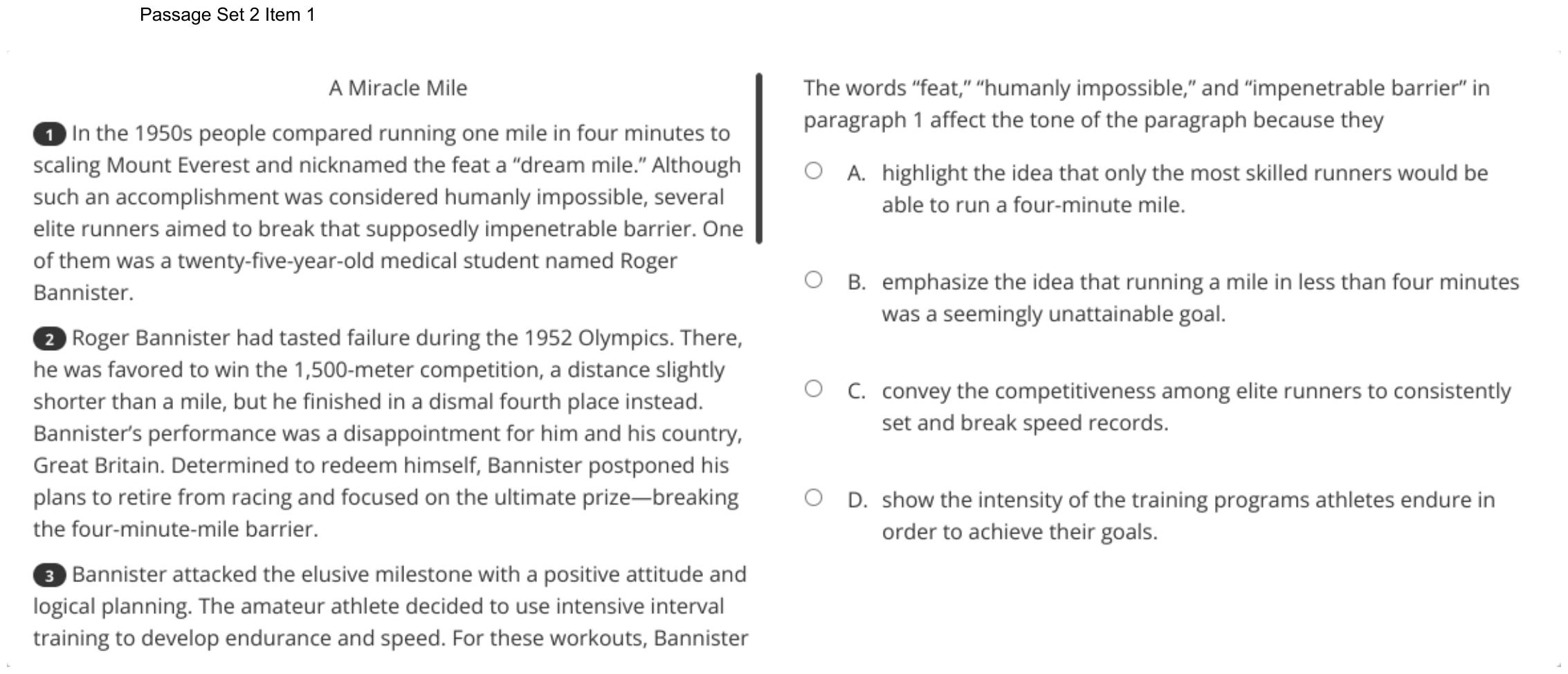
The passage “A Miracle Mile” as printed (page 13)
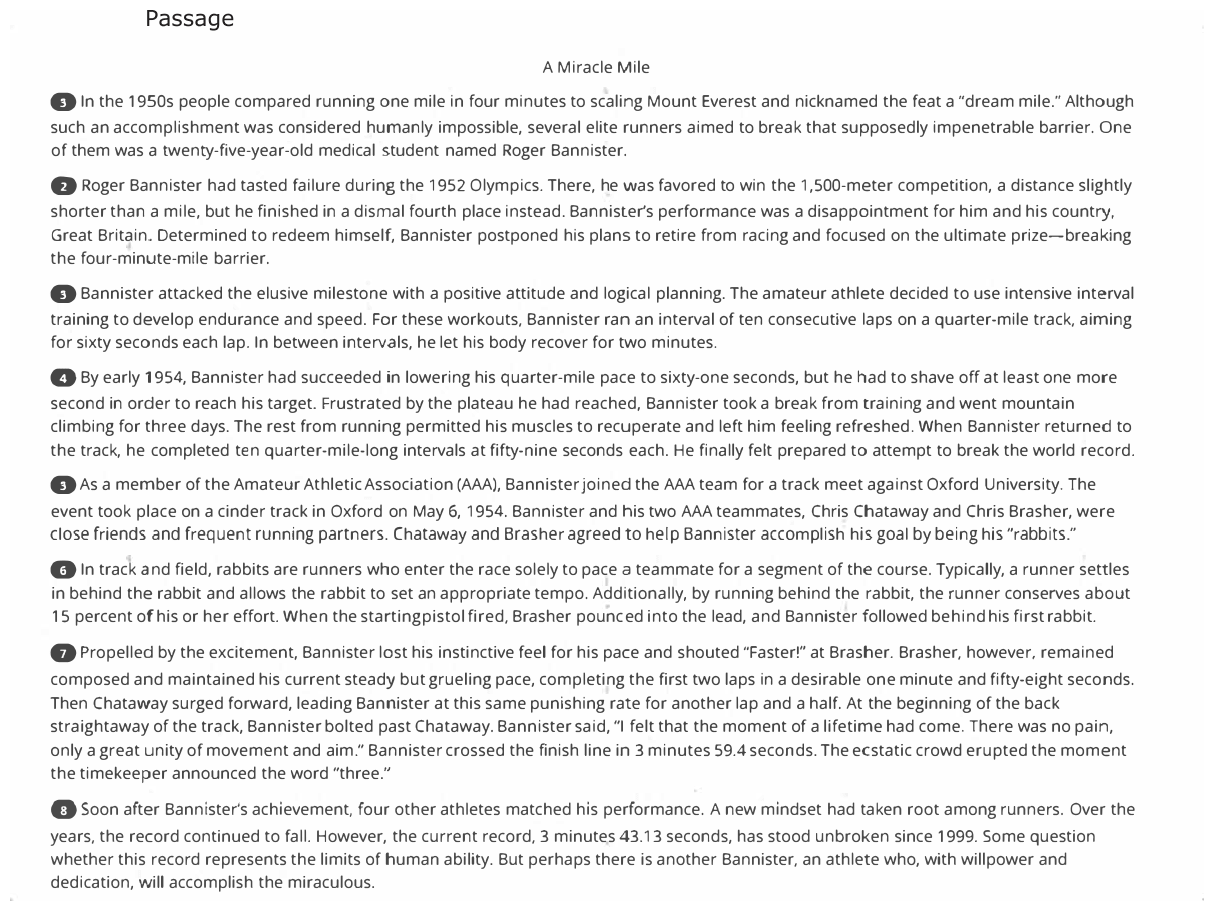
Question 11 of 57
2019 Test A English, question 11Uses the passage above: “A Miracle Mile”.
Question
How did interval training affect Bannister’s performance?
- AIt helped him learn how to moderate his pace while running.
- BIt helped him understand the importance of running with a team.
- CIt helped him improve his pace and stamina while running.
- DIt helped him decrease his recovery time after an intense run.
Show the answer
Correct answer: C
The question asks how interval training affected Bannister’s performance.
A. Incorrect. The moderation of his pace was achieved through the use of “rabbits,” described in paragraph 6, more than through his method of interval training.
B. Incorrect. Bannister worked individually during the interval training period and then paced himself with a two-person team of “rabbits,” which were introduced in paragraph 5 and explained in paragraph 6. It was the use of “rabbits” during the race that helped him conserve some of his effort, not the interval training.
C. CORRECT. As paragraph 3 states, the goal of Bannister’s training program was to “develop endurance and speed,” which are synonyms of the words “stamina” and “pace.”
D. Incorrect. During the interval-training process, Bannister “let his body recover for two minutes” (paragraph 3).
Question analysis
Using “A Miracle Mile,” the story of Roger Bannister’s quest to run a mile in under four minutes, this key-details question asks what effect interval training had on his running. The article also covers his rest days, his pacers and the 1954 race, so students must keep the training apart from those other parts of the story.
- Grade level
- Grade 6 reading and task
- Compared with grade 7
- Below grade 7 Grade 7 readers are expected to trace how ideas develop and connect across a text. This asks only for the effect of a training method, which the article states in one sentence, so it sits below that level.
- Estimated difficulty
- Straightforward: two steps or one careful reading.
- Thinking it demands
- Depth of knowledge 1, recall and reproduction · mainly understand
- What makes it hard
- Evidence
- Answered from one paragraph or stanza
- Reading level
- Passage: about grade 10, 587 words; question and choices: about grade 7, 50 words.
- Students, last 30 days
- Not enough answers yet to show (it takes 10).
Why it is hard, traps and wrong answers (shows the answer)
Why it is hard
Paragraph 3 names the purpose of the training outright, so the task is to match that sentence and keep the rest of the story out of it. Race day supplies the distractions: the rabbits who set Bannister’s tempo and the friends running beside him belong to the meet at Oxford, not to the workouts. The rest between intervals sits inside the training paragraph, which lets a skimmer mistake part of the method for its result.
A very close wrong answer minor Choosing the answer
The choice about learning to moderate his pace shares the key’s subject, pace; only the key matches what paragraph 3 says the workouts were for, to “develop endurance and speed.” (Embretson & Wetzel, 1987; Gorin & Embretson, 2006; Ascalon et al., 2007)
The right answer is reworded minor Choosing the answer
The key turns “endurance and speed” into stamina and pace, while wrong choices lean on the passage’s own material, the teammates of paragraphs 5 and 6 and the two minutes to “recover” in paragraph 3. (Freedle & Kostin, 1993; Kirsch & Mosenthal, 1990)
Strategy: Reread the paragraph on Bannister’s workouts and ask what the laps and rests were designed to build, then look for an option that says the same thing in other words.
Traps
- Wrong part of the text: A choice is true of another paragraph, stanza or speaker than the one asked about.
- Twists what the text says: Uses the text's topic and ideas but changes what it says: who did it, how much, when, or why.
- Word match: Repeats striking words or phrases from the text, so it looks supported, but its meaning does not fit the question.
The wrong answers, classified
A Twists what the text says (King et al., 2004)
Sees laps aimed at sixty seconds each as practice in holding a steady pace, but the training was meant to build speed and endurance, and on race day Brasher held the pace for him.
B Wrong part of the text (Kirsch & Mosenthal, 1990)
Brings in Chataway and Brasher, who paced him on race day in paragraphs 5 to 7, though the interval workouts of paragraph 3 mention no partner and teach nothing about teams.
D Word match (Freedle & Kostin, 1993)
Spots “recover” in paragraph 3 and picks the choice about recovery time, though the two-minute rest is part of the workout, and the article never says it got shorter.
Working it out, step by step
Figure out what the question asks
This asks what interval training did for Bannister’s running. It is a question about a key detail. So find the paragraph that describes the training. Then look for what the training was meant to build.
Find the training in paragraph 3
Paragraph 3 says “The amateur athlete decided to use intensive interval training to develop endurance and speed.” In each workout, he ran ten laps in a row, aiming for sixty seconds a lap. Then he rested for two minutes. An interval here is a hard stretch of running between rests.
Put the goal in plain words
Endurance means being able to keep going for a long time. Another word for it is stamina. Speed is how fast you go, and your pace is how fast you run each lap. Paragraph 4 shows the training worked. His lap time dropped to sixty-one seconds, then to fifty-nine. He got faster, and he could keep up that speed.
Check each choice
- A does not fit. To moderate your pace means to keep it steady. The training aimed to build speed, not to hold it back. In the race, he even “lost his instinctive feel for his pace,” and Brasher kept it steady.
- B does not fit. The workouts in paragraph 3 mention no teammates. Teammates come up only for the race, in paragraphs 5 to 7.
- C fits. Pace and stamina are other words for speed and endurance.
- D does not fit. He rested two minutes between runs. Nothing says that rest got shorter.
Choose the answer
Watch out: D is tempting because paragraph 3 says “he let his body recover for two minutes.” But that rest is part of the workout, not a result of it. The training built Bannister’s speed and endurance. So the answer is C.
Why this answer and not the closest wrong one
A is the closest wrong answer, because it is also about pace. But to moderate a pace is to keep it steady, and paragraph 3 says the goal was “to develop endurance and speed.” On race day, Bannister even wanted to go faster, and his rabbit held the pace. C matches what the training was for.
More questions like this
The original DOE question
Question 12 of 57
2019 Test A English, question 12Uses the passage above: “A Miracle Mile”.
Question
Which sentence best supports the idea that Bannister needed an alternative to “logical planning” (paragraph 3) in order to accomplish his goal?
- A“Bannister’s performance was a disappointment for him and his country, Great Britain.” (paragraph 2)
- B“The amateur athlete decided to use intensive interval training to develop endurance and speed.” (paragraph 3)
- C“For these workouts, Bannister ran an interval of ten consecutive laps on a quarter-mile track, aiming for sixty seconds each lap.” (paragraph 3)
- D“Frustrated by the plateau he had reached, Bannister took a break from training and went mountain climbing for three days.” (paragraph 4)
Show the answer
Correct answer: D
The question asks which sentence best supports the idea that Bannister needed an alternative to “logical planning” (paragraph 3) in order to accomplish his goal.
A. Incorrect. The outcome of the 1952 Olympics, referenced in the sentence from paragraph 2, is what prompted Bannister to seek a new goal: “Determined to redeem himself, Bannister . . . focused on the ultimate prize—breaking the four-minute-mile barrier” (paragraph 2).
B. Incorrect. The sentence from paragraph 3 does not show an alternative to Bannister’s training plan to “develop endurance and speed” (paragraph 3) and his focus on using logical planning in order to accomplish his goal.
C. Incorrect. The sentence from paragraph 3 focuses on details of his training plan, explaining the “intensive interval training” (paragraph 3) that Bannister used to build his endurance and speed, not an alternative form of preparation.
D. CORRECT. The sentence from paragraph 4 explains that Bannister reached a point where he could not improve his time despite the strict training plan he had created. Taking a break from his training to spend time mountain climbing “permitted his muscles to recuperate and left him feeling refreshed” (paragraph 4).
Question analysis
This textual evidence question on “A Miracle Mile” asks which sentence best supports the idea that Roger Bannister needed an alternative to the “logical planning” described in paragraph 3. Students must understand what his plan was before they can recognize a departure from it. The four sentences come from paragraphs 2 to 4, which cover his Olympic loss and his training.
- Grade level
- Grade 7 reading and task
- Compared with grade 7
- At grade 7 Matching a sentence to an idea is standard grade 7 evidence work, and the four sentences come from three short, plain paragraphs. The idea itself is worded abstractly, so students must first decide what an alternative to “logical planning” would look like.
- Estimated difficulty
- Straightforward: two steps or one careful reading.
- Thinking it demands
- Depth of knowledge 2, skills and concepts · mainly evaluate
- What makes it hard
- Evidence
- Answered from several paragraphs or stanzas
- Reading level
- Passage: about grade 10, 587 words; question and choices: about grade 12, 92 words.
- Corrected from the DOE handbook
- A wrong paragraph number in the explanation was corrected.
- Students, last 30 days
- Not enough answers yet to show (it takes 10).
Why it is hard, traps and wrong answers (shows the answer)
Why it is hard
The question turns on one decision: the interval training is the logical plan, so a sentence describing it cannot show an alternative to it. Once that is settled, three days of mountain climbing stand out as the only break from the plan. Students lose the point when they read “alternative” loosely and pick the sentence that introduces the training, or when they treat the Olympic disappointment as the moment his methods had to change.
Reading between the lines minor Working it out
The stem never says what the “logical planning” was; students must see that it is the interval training of paragraph 3, so the alternative has to be a step away from that training. (Graesser, Singer & Trabasso, 1994; Kintsch, 1998)
Evidence in several places minor Working it out
The stem points to paragraph 3, where two of the four sentences sit, but the departure from the plan comes in paragraph 4, after Bannister stalls at sixty-one seconds a lap. (Kirsch & Mosenthal, 1990; Gorin & Embretson, 2006)
Strategy: First reread paragraph 3 to see what Bannister’s “logical planning” was, then ask of each sentence whether it shows that plan or something different from it.
Traps
- Supports only part of the claim: In a question about evidence: a line that backs one half of the claim but not the other, or a related point rather than the claim itself.
- True but not the answer: A choice says something accurate about the text that does not answer this question.
The wrong answers, classified
A True but not the answer (King et al., 2004; Embretson & Wetzel, 1987)
Picks the 1952 disappointment, an accurate sentence that explains why Bannister took up the goal, but it comes before the plan and shows no step away from it.
B Supports only part of the claim (King et al., 2004; Thissen, Steinberg & Fitzpatrick, 1989)
Takes the decision to use intensive interval training as the alternative, missing that this training is the logical plan itself, so the sentence shows the plan, not a departure from it.
C Supports only part of the claim (King et al., 2004; Thissen, Steinberg & Fitzpatrick, 1989)
Chooses the workout details, ten laps aimed at sixty seconds each, which spell out the plan’s routine rather than any change to it.
What was corrected from the DOE handbook, and why
- Explanation: The DOE’s explanation of Option C begins “The sentence from paragraph 4 focuses on details of his training plan.” Option C quotes a sentence from paragraph 3 (“For these workouts, Bannister ran an interval of ten consecutive laps on a quarter-mile track, aiming for sixty seconds each lap”) and labels it “(paragraph 3),” and the explanation goes on to describe the “intensive interval training” of paragraph 3. The site now says “The sentence from paragraph 3.” The DOE’s 2021–2022 guide, where this question first appeared, has the same slip.
Working it out, step by step
Figure out what the question asks
This asks for evidence: the sentence that best supports an idea. The idea is that Bannister needed an alternative to his “logical planning.” An alternative is a different way of doing something. So first find out what his plan was. Then look for a sentence where he steps away from it.
Find the logical plan in paragraph 3
Paragraph 3 says “Bannister attacked the elusive milestone with a positive attitude and logical planning.” The next sentence tells what the plan was: “The amateur athlete decided to use intensive interval training to develop endurance and speed.” Interval training means running hard for a set stretch, resting, then running hard again.
Find where the plan stopped working
Paragraph 4 says he got down to sixty-one seconds a lap, but he needed sixty. Then “Frustrated by the plateau he had reached, Bannister took a break from training and went mountain climbing for three days.” A plateau is a point where you stop getting better. Climbing was not part of his plan. Afterward, he ran each lap in fifty-nine seconds.
Check each choice
- A does not fit. It is from paragraph 2. It tells why he chose the goal, before he had any plan.
- B does not fit. Interval training is the logical plan, not an alternative to it.
- C does not fit. It is from paragraph 3. It gives details of the same plan: ten laps, sixty seconds each.
- D fits. He stops training, does something else, and it works.
Watch out: B is tempting because it describes a choice Bannister made. But that choice was the plan itself.
Choose the answer
Only D shows Bannister trying something outside his plan. So the answer is D, “Frustrated by the plateau he had reached, Bannister took a break from training and went mountain climbing for three days.”
Why this answer and not the closest wrong one
B is the closest wrong choice. It names a decision Bannister made. But that decision, interval training, was his logical plan. The question asks for a step away from the plan. Only D shows him leaving training behind. The rest “permitted his muscles to recuperate,” which means recover.
More questions like this
The original DOE question
Question 13 of 57
2019 Test A English, question 13Uses the passage above: “A Miracle Mile”.
Question
Which sentence from the passage indicates that Bannister nearly made a mistake that would have cost him the world record?
- A“By early 1954, Bannister had succeeded in lowering his quarter-mile pace to sixty-one seconds, but he had to shave off at least one more second in order to reach his target.” (paragraph 4)
- B“When the starting pistol fired, Brasher pounced into the lead, and Bannister followed behind his first rabbit.” (paragraph 6)
- C“Propelled by the excitement, Bannister lost his instinctive feel for his pace and shouted ‘Faster!’ at Brasher.” (paragraph 7)
- D“At the beginning of the back straightaway of the track, Bannister bolted past Chataway.” (paragraph 7)
Show the answer
Correct answer: C
The question asks which sentence indicates that Bannister nearly made a mistake that would have cost him the world record.
A. Incorrect. The sentence from paragraph 4 describes a challenge Bannister faced during his training period, when he used “intensive interval training to develop endurance and speed” (paragraph 3). Bannister ran laps on a “quarter-mile track” (paragraph 3) and was able to control his pace at this time—unlike during the actual race to break the record.
B. Incorrect. The sentence from paragraph 6 describes the start of the race and Brasher’s role as “first rabbit” for Bannister. Bannister was behind Brasher, following their plan for breaking the record.
C. CORRECT. If Bannister had begun running faster than the “steady but grueling pace” (paragraph 7) set by his “rabbit,” he would likely not have had enough energy to finish the race. As paragraph 6 notes, “the runner conserves about 15 percent of his or her effort” by allowing the rabbit to set the pace. Bannister had “lost his instinctive feel for his pace” (paragraph 7) in the excitement of the race. If he had given in to his impulse to run faster and bypassed the rabbit at that point in the race, it would have cost him energy, and, in turn, the record.
D. Incorrect. The sentence from paragraph 7 describes how Bannister leaped ahead of Chataway, his second “rabbit,” at the appropriate time in the effort to break the record. Chataway had “surged forward, leading Bannister at this same punishing rate for another lap and a half” (paragraph 7) before Bannister moved past him.
Question analysis
This textual evidence question asks which sentence from “A Miracle Mile” shows that Roger Bannister nearly made a mistake that could have cost him the world record. The passage never says outright that he slipped, so students must use what it explains about running a race to judge which moment was a real danger. The four choices span both his training and the race itself.
- Grade level
- Grade 7 reading and task
- Compared with grade 7
- At grade 7 Grade 7 evidence questions usually match a sentence to an idea the text states. This mistake is never named as one, so students must infer which moment put the record at risk, a typical grade 7 inference within a short, clear passage.
- Estimated difficulty
- Moderate: several steps, or a close reading with one strong distractor.
- Thinking it demands
- Depth of knowledge 2, skills and concepts · mainly evaluate
- What makes it hard
- Reading between the lines moderate
- Evidence in several places minor
- Every choice must be checked minor
- Evidence
- Answered from several paragraphs or stanzas
- Reading level
- Passage: about grade 10, 587 words; question and choices: about grade 11, 102 words.
- Students, last 30 days
- Not enough answers yet to show (it takes 10).
Why it is hard, traps and wrong answers (shows the answer)
Why it is hard
The near mistake is easy to miss because it never happens: Brasher ignores the shout, and the race goes on at the planned pace. Students must see that losing his feel for the pace put the record at risk, using what paragraph 6 explains about rabbits. The sudden surge past Chataway sounds rash and the training plateau sounds like a near failure, so students who look for drama or for falling short land on the wrong moment.
Reading between the lines moderate Working it out
The passage never calls the shout of “Faster!” a mistake; students must infer it from “lost his instinctive feel for his pace” and from Brasher’s refusal to change his steady pace. (Graesser, Singer & Trabasso, 1994; Kintsch, 1998)
Evidence in several places minor Working it out
Why running faster would have cost the record is explained a paragraph earlier, in paragraph 6, where following a rabbit saves a runner about 15 percent of his or her effort. (Kirsch & Mosenthal, 1990; Gorin & Embretson, 2006)
Every choice must be checked minor Choosing the answer
Each sentence shows a setback or a bold move, from the training plateau to the final surge, so each has to be judged against the idea of a near mistake. (Embretson & Wetzel, 1987)
Strategy: For each quoted sentence, ask whether it shows Bannister doing something that could have hurt his chances, and use what the passage explains about racing to judge how serious it was.
Traps
- Reads too much in: A reasonable-sounding conclusion that goes further than the text allows.
- Supports only part of the claim: In a question about evidence: a line that backs one half of the claim but not the other, or a related point rather than the claim itself.
- Outside knowledge: A choice is plausible in the real world but not supported by this text.
The wrong answers, classified
A Supports only part of the claim (King et al., 2004; Thissen, Steinberg & Fitzpatrick, 1989)
Takes the 1954 plateau, one second short of the target pace, as the near miss, but it was a setback in training that rest overcame, not a mistake.
B Outside knowledge (King et al., 2004; Recht & Leslie, 1988)
Assumes that trailing at the start is a racing error, but paragraph 6 explains that a runner behind a rabbit saves about 15 percent of his or her effort.
D Reads too much in (Graesser, Singer & Trabasso, 1994)
Reads “bolted” as a reckless burst, but Bannister passed Chataway only after his rabbits had paced him for three and a half laps, and the move won him the record.
Working it out, step by step
Figure out what the question asks
This asks for a sentence that shows a near mistake. That is something that almost went wrong. It would have cost Bannister the record. So look for a moment when he did something that could have ruined the race.
Learn how a rabbit helps
Paragraph 6 explains rabbits. They are teammates who run in front to set the speed. It says “Typically, a runner settles in behind the rabbit and allows the rabbit to set an appropriate tempo.” Tempo means speed. Also, “by running behind the rabbit, the runner conserves about 15 percent of his or her effort.” Conserves means saves.
Find the moment that went wrong
Paragraph 7 begins “Propelled by the excitement, Bannister lost his instinctive feel for his pace and shouted” at Brasher to go faster. He lost his natural sense of how fast to run. If Brasher had sped up, Bannister could have used up his energy too soon. But Brasher “remained composed,” which means calm. He kept the steady pace, and that saved the race.
Check each choice
- A does not fit. The training plateau was a setback, not a mistake. A rest fixed it.
- B does not fit. Following a rabbit was the plan. Paragraph 6 shows that it saves effort.
- C fits. Bannister wanted to go faster too early, which could have worn him out.
- D does not fit. Passing Chataway near the end was the right move. It won him the record.
Watch out: D is tempting because “bolted” sounds wild. But he waited until his rabbits had paced him for three and a half laps.
Choose the answer
Only C shows Bannister almost doing something that could have cost him the record. So the answer is C, “Propelled by the excitement, Bannister lost his instinctive feel for his pace and shouted ‘Faster!’ at Brasher.”
Why this answer and not the closest wrong one
D is the closest wrong choice, since bolting past Chataway was a bold, sudden move. But it came at the right time, and it led to the record. In C, Bannister lost his sense of pace and wanted to speed up too early. Only his rabbit’s calm saved him. That is a near mistake.
More questions like this
The original DOE question
Question 14 of 57
2019 Test A English, question 14Uses the passage above: “A Miracle Mile”.
Question
The phrase “a new mindset had taken root” in paragraph 8 conveys the idea that
- Arunners recognized that running a mile in under four minutes was physically possible.
- Bbreaking the four-minute-mile barrier was no longer considered an impressive feat for elite runners.
- Crunners understood how hard they would have to train in order to run a mile in under four minutes.
- Dentering races in an attempt to break the four-minute-mile barrier became commonplace for elite runners.
Show the answer
Correct answer: A
The question asks what idea is conveyed by the phrase “a new mindset had taken root” in paragraph 8.
A. CORRECT. After Bannister ran the mile in under four minutes, it became clear to other runners that this goal was within the realm of human ability, and “soon after Bannister’s achievement, four other athletes matched his performance” (paragraph 8).
B. Incorrect. While the passage states that runners broke the four-minute-mile barrier after Bannister initially broke it (“Soon after Bannister’s achievement, four other athletes matched his performance” [paragraph 8]), running a four-minute mile is still impressive and a challenge for elite runners.
C. Incorrect. Although runners most likely knew that the training needed in order to break the four-minute-mile barrier was difficult and intensive, the phrase “a new mindset had taken root” focuses on their belief in the possibility of breaking the four-minute-mile barrier, which had been viewed as a “supposedly impenetrable barrier” (paragraph 1), not the idea that the training was difficult.
D. Incorrect. Even though “four other athletes matched his performance” and “the record continued to fall” (paragraph 8), the phrase “a new mindset had taken root” does not refer to the idea that there was an increase in the number of runners entering races just to try breaking the four-minute-mile barrier.
Question analysis
The final paragraph of “A Miracle Mile” says that after Roger Bannister ran his record mile, “a new mindset had taken root” among runners. This word-meaning question asks what that figurative phrase conveys, and since the article never spells out the new way of thinking, students must infer it from the events that follow Bannister’s run.
- Grade level
- Grade 7 reading and task
- Compared with grade 7
- At grade 7 Working out what a figure of speech means from nearby sentences is a core grade 7 skill. Here the phrase sits in a short final paragraph of simple sentences, and only one step of inference is needed, as in typical grade 7 work.
- Estimated difficulty
- Straightforward: two steps or one careful reading.
- Thinking it demands
- Depth of knowledge 2, skills and concepts · mainly understand
- What makes it hard
- Reading between the lines moderate
- Figurative or literary language minor
- Evidence in several places minor
- Evidence
- Answered from several paragraphs or stanzas
- Reading level
- Passage: about grade 10, 587 words; question and choices: about grade 10, 75 words.
- Students, last 30 days
- Not enough answers yet to show (it takes 10).
Why it is hard, traps and wrong answers (shows the answer)
Why it is hard
The paragraph is short and the phrase familiar, but the passage leaves the mindset unnamed, so the choices amount to four guesses about what changed after 1954. The tempting guesses describe what runners did or how they rated the feat: record attempts becoming routine, the mile no longer impressing, harder training. Students who tie the phrase back to a barrier everyone had thought unbreakable see that the change was in what runners believed a body could do.
Reading between the lines moderate Working it out
The article never says what the new mindset is; it has to be worked out from the four athletes who matched Bannister soon after, set against a feat that paragraph 1 says was “considered humanly impossible.” (Graesser, Singer & Trabasso, 1994; Kintsch, 1998)
Figurative or literary language minor Understanding the question
“Taken root” pictures an idea as a plant that has settled into the soil and will keep growing, so the phrase points to a lasting change in belief, not a single event or a new plan. (Graesser, Singer & Trabasso, 1994; Kintsch, 1998)
Evidence in several places minor Working it out
The old way of thinking appears seven paragraphs earlier, a “supposedly impenetrable barrier,” and the new mindset makes sense only when paragraph 8 is read against it. (Kirsch & Mosenthal, 1990; Gorin & Embretson, 2006)
Strategy: Think about what it means for a way of thinking to take hold, then test each option against the sentences near the phrase, keeping only a change in runners that the article actually supports.
Traps
- Reads too much in: A reasonable-sounding conclusion that goes further than the text allows.
- Wrong part of the text: A choice is true of another paragraph, stanza or speaker than the one asked about.
- Twists what the text says: Uses the text's topic and ideas but changes what it says: who did it, how much, when, or why.
The wrong answers, classified
B Reads too much in (Graesser, Singer & Trabasso, 1994)
Reads the four runners who soon matched Bannister as proof the feat had become ordinary, though the article never belittles it and ends by hoping for an athlete who will “accomplish the miraculous.”
C Wrong part of the text (Kirsch & Mosenthal, 1990)
Brings in the interval training and the mountain-climbing break of paragraphs 3 and 4, but the phrase follows the record run and concerns what runners believed, not how hard they knew to train.
D Twists what the text says (King et al., 2004)
Takes the new mindset to be a wave of record attempts, but paragraph 1 already has “several elite runners” aiming at the barrier, and the article counts no races after 1954.
Working it out, step by step
Figure out what the question asks
This asks what a phrase means in the article. The phrase is “a new mindset had taken root.” A mindset is a way of thinking. So you need to find out what new way of thinking runners had.
Picture the plant image
This is a figure of speech, words that paint a picture instead of saying something plainly. A plant takes root when its roots grow into the soil. Then it stays put and keeps growing. So an idea that has taken root has settled firmly in people’s minds.
Find the old way of thinking
Paragraph 1 shows what people thought before Bannister. Running a mile in four minutes “was considered humanly impossible.” It was a “supposedly impenetrable barrier.” Impenetrable means impossible to break through. So most people believed no one could do it.
See what changed in paragraph 8
Paragraph 8 says “Soon after Bannister’s achievement, four other athletes matched his performance. A new mindset had taken root among runners.” Bannister proved it could be done. Then four more runners did it too. So the new way of thinking is a belief: a mile in under four minutes is possible.
Check each choice
- A fits. Runners now saw that the feat was physically possible.
- B does not fit. Nothing says the feat stopped being impressive. The article ends by hoping for someone who will “accomplish the miraculous.”
- C does not fit. Training comes up in paragraphs 3 and 4. The phrase is about what runners believed after the record, not how hard they trained.
- D does not fit. Commonplace means ordinary. But a mindset is a way of thinking, not a habit of entering races.
Choose the answer
Watch out: D is tempting because the record “continued to fall.” But paragraph 1 says “several elite runners aimed to break” the barrier even before 1954. Trying was not new. Believing was. So the answer is A.
Why this answer and not the closest wrong one
D is the closest wrong answer. It describes something runners did: entering races to break the record. But runners were already trying before Bannister, so that was not the new part. A mindset is what people believe. After Bannister, runners believed the four-minute mile could be beaten. That is A.
More questions like this
The original DOE question
Question 15 of 57
2019 Test A English, question 15Uses the passage above: “A Miracle Mile”.
Question
Bannister’s loss in the 1952 Olympics influenced his decision to pursue breaking the four-minute-mile barrier by
- Aallowing him to recognize his weaknesses and improve his running ability.
- Bprompting him to take a different approach to his regular training.
- Cmotivating him to prove to himself that he could set and achieve a goal.
- Dgiving him the opportunity to reach a goal no runner had ever accomplished.
Show the answer
Correct answer: C
The question asks how Bannister’s loss in the 1952 Olympics influenced his decision to pursue breaking the four-minute-mile barrier.
A. Incorrect. While Bannister recognized the weaknesses that led to his poor performance in the Olympics and worked “to develop endurance and speed” (paragraph 3), the loss made him “determined to redeem himself” (paragraph 2). The desire for redemption influenced Bannister to focus specifically on running a mile in under four minutes, rather than on winning other races or training for other distances.
B. Incorrect. Although Bannister developed an “intensive interval training” plan to improve his “endurance and speed” (paragraph 3), he applied a different approach only after his progress toward a four-minute mile reached a “plateau” (paragraph 4) in 1954. It was his desire to “shave off at least one more second in order to reach his target” (paragraph 4) that prompted him to take a break from interval training and go mountain climbing for three days.
C. CORRECT. Bannister sought to redeem himself after “he finished in a dismal fourth place” at the Olympics (paragraph 2). He thought that his performance “was a disappointment for him and his country, Great Britain,” and he responded by setting a goal to successfully conquer the four-minute mile, which was considered the “ultimate prize” (paragraph 2).
D. Incorrect. Bannister’s loss at the 1952 Olympics motivated him to change his training focus to reaching the “ultimate prize” (paragraph 2) of breaking the four-minute-mile barrier, which no other runner had accomplished. His loss at the Olympics did not present him with a specific opportunity to reach this goal.
Question analysis
This cause-and-effect question on “A Miracle Mile” asks how Roger Bannister’s disappointing finish at the 1952 Olympics shaped his decision to chase the four-minute mile. Students trace how one event led to a choice. The passage gives the reason in a single phrase, and the choices restate it alongside effects that sound believable for any athlete after a loss.
- Grade level
- Grade 7 reading and task
- Compared with grade 7
- At grade 7 Explaining how one event influenced a person’s decision is standard grade 7 work, and the cause is set out in one short paragraph. The choices put the passage’s ideas in new words, so students must match meaning rather than phrases.
- Estimated difficulty
- Moderate: several steps, or a close reading with one strong distractor.
- Thinking it demands
- Depth of knowledge 2, skills and concepts · mainly understand
- What makes it hard
- The right answer is reworded moderate
- Hard words minor
- Evidence
- Answered from one paragraph or stanza
- Reading level
- Passage: about grade 10, 587 words; question and choices: about grade 10, 64 words.
- Students, last 30 days
- Not enough answers yet to show (it takes 10).
Why it is hard, traps and wrong answers (shows the answer)
Why it is hard
The answer sits in a single phrase, but the choices compete with stories that fit any athlete after a loss, such as learning from weaknesses or changing a routine. Both sound right because Bannister did train hard afterward, yet the passage ties the loss only to his wish to redeem himself, and the change of routine comes later, from the 1954 plateau. Students who keep to the question’s focus, the decision to chase the record, find a motive rather than a method.
The right answer is reworded moderate Choosing the answer
Paragraph 2 says the loss left Bannister “determined to redeem himself”; the right choice recasts this as proving to himself he could set and reach a goal, while a wrong one reuses the passage’s word “training.” (Freedle & Kostin, 1993; Kirsch & Mosenthal, 1990)
Hard words minor Understanding the question
“Redeem himself,” to make up for a failure, is the key phrase, and a student unsure of it may not see that the loss gave him a reason rather than a lesson. (Perfetti, 2007; Freedle & Kostin, 1993)
Strategy: Find the sentence in paragraph 2 that tells how Bannister responded to the 1952 loss, restate it in your own words, and compare each choice with your restatement.
Traps
- Half right: One half of a two-part choice is right and the other is not.
- Outside knowledge: A choice is plausible in the real world but not supported by this text.
- Wrong part of the text: A choice is true of another paragraph, stanza or speaker than the one asked about.
The wrong answers, classified
A Outside knowledge (King et al., 2004; Recht & Leslie, 1988)
Supplies a familiar sports lesson, that a loss shows an athlete what to fix, but paragraph 2 makes the loss a reason to redeem himself and names no weaknesses.
B Wrong part of the text (Kirsch & Mosenthal, 1990)
Borrows the change of routine from paragraph 4, where the 1954 plateau, not the Olympic loss, sent Bannister off to climb mountains for three days.
D Half right (King et al., 2004; Thissen, Steinberg & Fitzpatrick, 1989)
Gets right that no runner had yet broken four minutes, but the loss opened no door for him; finishing fourth gave him a motive, not a chance.
Working it out, step by step
Figure out what the question asks
This asks about cause and effect. The cause is Bannister’s loss at the 1952 Olympics. The effect is his decision to chase the four-minute mile. You need to find how the first led to the second.
Read paragraph 2
Paragraph 2 says he “finished in a dismal fourth place instead.” Dismal means very disappointing. Then it says “Bannister’s performance was a disappointment for him and his country, Great Britain. Determined to redeem himself, Bannister postponed his plans to retire from racing and focused on the ultimate prize.” The prize was breaking the four-minute mile.
Understand what redeem himself means
To redeem yourself means to make up for a failure. You show that you are better than your worst moment. Bannister had let himself down. So he set a huge new goal to prove what he could do. The loss gave him a reason to try, which is a motive.
Check each choice
- A does not fit. Paragraph 2 never names any weaknesses he found.
- B does not fit. He changed his routine in paragraph 4, in 1954. That was because of a plateau, not the Olympic loss.
- C fits. He wanted to make up for the loss by reaching a big goal.
- D does not fit. Losing did not give him a chance at the record. It gave him a reason.
Watch out: A sounds like a common sports lesson: losing shows you what to fix. But the passage does not say that.
Choose the answer
The loss made Bannister “determined to redeem himself” with a new goal. So the answer is C, “motivating him to prove to himself that he could set and achieve a goal.”
Why this answer and not the closest wrong one
A is the closest wrong choice. Athletes often learn from a loss, so it sounds right. But paragraph 2 never says what Bannister was bad at. It says the loss made him “determined to redeem himself.” That is about motivation, so C fits better.
More questions like this
The original DOE question
Question 16 of 57
2019 Test A English, question 16Uses the passage above: “A Miracle Mile”.
Question
How does the author’s use of chronological structure contribute to the development of ideas in the passage?
- AIt presents the increasing physical effects of Bannister’s intense training methods as he prepared to break the four-minute-mile barrier.
- BIt shows the increase in Bannister’s confidence in his ability to break the four-minute-mile barrier.
- CIt emphasizes the key events in Bannister’s life that inspired him to break the four-minute-mile barrier.
- DIt highlights the progression of Bannister’s training and details about his successful attempt to break the four-minute-mile barrier.
Show the answer
Correct answer: D
The question asks how the author’s use of chronological structure contributes to the development of ideas in the passage.
A. Incorrect. While paragraph 4 mentions the “plateau” Bannister dealt with and the break that “permitted his muscles to recuperate,” the chronological structure of the passage focuses mainly on the progression of Bannister’s process over time.
B. Incorrect. Even though the passage suggests that Bannister’s ability to break the four-minute-mile barrier improved and that he felt “prepared to attempt to break the world record” (paragraph 4), the chronological structure of the passage primarily serves to show how Bannister’s progress over time led to his success.
C. Incorrect. The chronological structure of the passage begins with an acknowledgement that Bannister was inspired to break the four-minute-mile barrier by his loss at the 1952 Olympics (paragraph 2); however, the overall organization of the passage highlights his dedicated efforts over time to break the four-minute-mile barrier.
D. CORRECT. The chronological structure of the passage follows the progression of Bannister’s training from his loss at the 1952 Olympics to the race where he ran the first sub–four-minute mile on May 6, 1954 (paragraph 5).
Question analysis
This text-structure question asks how chronological order helps develop the ideas of “A Miracle Mile,” which follows Roger Bannister’s pursuit of the four-minute mile and closes with the record as it stands today. Several options rest on real details, such as his Olympic loss and his tired muscles, so students must work out what the time order as a whole is built to show.
- Grade level
- Grade 7 reading and task
- Compared with grade 7
- Below grade 7 Grade 7 structure questions often leave students to discover how a text is organized, but this one names the structure for them, and the article moves in plain prose from one dated step to the next, so the demand is lighter.
- Estimated difficulty
- Straightforward: two steps or one careful reading.
- Thinking it demands
- Depth of knowledge 2, skills and concepts · mainly analyze
- What makes it hard
- How, not what minor
- Every choice must be checked minor
- Evidence in several places minor
- Evidence
- Answered from the whole text
- Reading level
- Passage: about grade 10, 587 words; question and choices: about grade 13, 85 words.
- Corrected from the DOE handbook
- A wrong paragraph number in the explanation was corrected.
- Students, last 30 days
- Not enough answers yet to show (it takes 10).
Why it is hard, traps and wrong answers (shows the answer)
Why it is hard
The article moves in plain order from a lost Olympic final to a record run, and the right description simply names what that order tracks: training that improves, then the race. Each wrong choice picks a thread the article touches but never traces, a physical strain mentioned once, a confidence present from the start, an inspiration that comes only from 1952. In this printing the word “intense” echoes paragraph 3 and gives the strain choice some extra pull.
How, not what minor Working it out
The stem names the structure and asks what it does, so the task is to say which thread the time order follows from the 1952 Olympics to May 6, 1954, not to retell the events. (Anderson & Krathwohl, 2001)
Every choice must be checked minor Choosing the answer
Each wrong thread has a foothold: “intensive interval training” and muscles that needed to “recuperate” for physical effects, “finally felt prepared” for confidence, and the 1952 loss for inspiration. (Embretson & Wetzel, 1987)
Evidence in several places minor Working it out
A thread counts only if it runs the whole way, so it must cover the workouts of paragraphs 3 and 4 as well as the race told in paragraphs 5 to 7. (Kirsch & Mosenthal, 1990; Gorin & Embretson, 2006)
Strategy: Skim the paragraphs in order and name the main thing that moves forward from one to the next; the best description fits most of the article, not just the opening or one middle paragraph.
Traps
- Twists what the text says: Uses the text's topic and ideas but changes what it says: who did it, how much, when, or why.
- Reads too much in: A reasonable-sounding conclusion that goes further than the text allows.
- Too narrow: A single detail offered as the central idea or a summary, or a summary that keeps minor details and leaves out an essential part.
The wrong answers, classified
A Twists what the text says (King et al., 2004)
Links “intense” to paragraph 3’s “intensive interval training” and the rest his muscles needed, but the article tracks lap times falling from sixty-one to fifty-nine seconds, not a growing physical toll.
B Reads too much in (Graesser, Singer & Trabasso, 1994)
Follows Bannister from “Frustrated by the plateau” to “finally felt prepared,” but he set out with “a positive attitude,” and the dated steps chart his training and race, not rising confidence.
C Too narrow (King et al., 2004)
Starts from the 1952 loss that left him “Determined to redeem himself,” but that single event belongs to paragraph 2, and later paragraphs follow workouts and a race, not new sources of inspiration.
What was corrected from the DOE handbook, and why
- Explanation: The handbook’s explanation of Option C says the passage begins by acknowledging that Bannister was inspired by his loss at the 1952 Olympics “(paragraph 1).” That loss is in paragraph 2 (“Roger Bannister had tasted failure during the 1952 Olympics”), so the site now cites paragraph 2, as the DOE’s later printing of this explanation does. The answer, D, is unchanged.
Working it out, step by step
Figure out what the question asks
This is a structure question. Chronological structure means telling events in time order, from first to last. The question asks what that order helps the passage show. So sum up the paragraphs in order. Then find the thread that runs through them.
Sum up the paragraphs in order
- Paragraph 1: A four-minute mile seems impossible.
- Paragraph 2: Bannister loses at the 1952 Olympics and sets his goal.
- Paragraph 3: He plans his interval training.
- Paragraph 4: By early 1954, his laps get faster, from sixty-one seconds to fifty-nine.
- Paragraphs 5–7: On May 6, 1954, two teammates set his pace, and he runs the mile in 3 minutes 59.4 seconds.
- Paragraph 8: Other runners match him.
Name the thread
Most paragraphs follow two things. First comes his training, step by step. Then come the details of the race where he broke the barrier. Progression means step-by-step progress. So the time order shows how his training moved forward and how the record run went.
Check each choice
- A does not fit. His body comes up only now and then, as when a rest “permitted his muscles to recuperate” (paragraph 4). Recuperate means recover. The passage never tracks effects that grow. A also leaves out the race.
- B does not fit. He had “a positive attitude” from the start (paragraph 3). The order follows what he did, not how sure he felt.
- C does not fit. One event inspired him: the 1952 loss in paragraph 2. After that come workouts and a race.
- D fits. It names both threads: the training and the race.
Choose the answer
Watch out: B is tempting because in paragraph 4 “He finally felt prepared to attempt to break the world record.” But that is one moment, not the thread of the whole passage. So the answer is D.
Why this answer and not the closest wrong one
B is the closest wrong answer. Bannister does end up ready to race. But he began with “a positive attitude,” so the passage never shows his confidence climbing from low to high. The paragraphs trace his workouts and then the record run itself. D names both parts of that thread.
More questions like this
The original DOE question
Question 17 of 57
2019 Test A English, question 17Uses the passage above: “A Miracle Mile”.
Question
Read these sentences from paragraph 7.
Bannister said, “I felt that the moment of a lifetime had come. There was no pain, only a great unity of movement and aim.”
The sentences contribute to the development of ideas in the passage by showing that Bannister
- Aknew that he was about to achieve the goal he had worked toward.
- Bwas no longer experiencing personal disappointment from his past failure in the Olympics.
- Cfelt grateful to his teammates for helping him take the lead.
- Dwas satisfied that his training had helped him perfect his running technique.
Show the answer
Correct answer: A
The question asks how the sentences from paragraph 7 contribute to the development of ideas in the passage.
A. CORRECT. The sentences from paragraph 7 show that toward the end of the race, Bannister knew that the goal of breaking the four-minute-mile barrier was within his grasp and that he had the focus necessary to achieve it. The sentence following Bannister’s quotation states that he did indeed meet his goal, crossing “the finish line in 3 minutes 59.4 seconds” (paragraph 7).
B. Incorrect. The feelings Bannister expressed in the sentences from paragraph 7 did not erase those feelings related to his loss at the 1952 Olympics, which were what drove him to the achievement he was about to make.
C. Incorrect. While the quotation states that Bannister felt “unity,” this pertains to his running, not to his work with the team. The sentences from paragraph 7 capture Bannister’s focus on his chance to break the barrier and what he was feeling at that moment.
D. Incorrect. The sentences from paragraph 7 express Bannister’s realization that he was on the verge of reaching a goal. The sentences show that in the seconds before crossing the finish line, Bannister was fully focused on the end goal and was not thinking about his training or his running technique.
Question analysis
This question quotes Roger Bannister’s own words from his famous race, “I felt that the moment of a lifetime had come,” and asks how they contribute to the development of ideas in “A Miracle Mile.” Students interpret an athlete’s description of a feeling and decide what it shows about him. Each choice links the quotation to a different part of his story.
- Grade level
- Grade 7 reading and task
- Compared with grade 7
- At grade 7 Explaining what a quoted sentence adds to a passage is everyday grade 7 work, and these two sentences are short. Their abstract phrase “a great unity of movement and aim” takes some interpreting, which keeps the demand typical rather than light.
- Estimated difficulty
- Moderate: several steps, or a close reading with one strong distractor.
- Thinking it demands
- Depth of knowledge 2, skills and concepts · mainly analyze
- What makes it hard
- Reading between the lines moderate
- Figurative or literary language minor
- Evidence
- Answered from one paragraph or stanza
- Reading level
- Passage: about grade 10, 587 words; question and choices: about grade 7, 93 words.
- Students, last 30 days
- Not enough answers yet to show (it takes 10).
Why it is hard, traps and wrong answers (shows the answer)
Why it is hard
Bannister’s words describe a feeling, and each choice explains it by a different part of his story. The right reading comes from where the quotation sits: on the back straight, seconds from the finish, so “the moment of a lifetime” is the record within reach. Students who take “unity of movement” as polished form, or “no pain” as the end of his Olympic hurt, tie the quotation to his training or his past instead of to this race.
Reading between the lines moderate Working it out
The quotation never names the record; students must link “the moment of a lifetime had come” to the four-minute goal and to the finish in 3 minutes 59.4 seconds reported right after it. (Graesser, Singer & Trabasso, 1994; Kintsch, 1998)
Figurative or literary language minor Understanding the question
“A great unity of movement and aim” is abstract, and “There was no pain” can be heard as emotional relief, so the words invite readings about technique, teamwork or old disappointment. (Graesser, Singer & Trabasso, 1994; Kintsch, 1998)
Strategy: Read the quotation together with the sentences around it in paragraph 7, put Bannister’s state of mind into your own words, and test each choice against what the quotation itself says.
Traps
- Wrong part of the text: A choice is true of another paragraph, stanza or speaker than the one asked about.
- Reads too much in: A reasonable-sounding conclusion that goes further than the text allows.
- Dictionary meaning, not meaning here: A common meaning of the word that does not fit its use in this text.
The wrong answers, classified
B Reads too much in (Graesser, Singer & Trabasso, 1994)
Hears “There was no pain” as the end of the hurt from his 1952 fourth place, but the pain meant is the strain of the race, and the quotation never looks back.
C Dictionary meaning, not meaning here (Perfetti, 2007)
Takes “unity” in its everyday sense of people pulling together and credits his rabbits, though the unity is of his own “movement and aim,” just after he passed Chataway to run alone.
D Wrong part of the text (Kirsch & Mosenthal, 1990)
Brings in the training of paragraphs 3 and 4 and reads “unity of movement” as perfected technique, but the quotation records a feeling during the race, not a verdict on his preparation.
Working it out, step by step
Figure out what the question asks
This asks what Bannister’s words show about him at that moment in the race. To answer, you need to know where the quotation comes. So read the sentences just before it and just after it.
Find where the quotation comes
Paragraph 7 tells the story of the race. Just before the quotation, “Bannister bolted past Chataway.” Bolted means ran off suddenly and fast. Chataway was his second rabbit, a teammate who set the pace. Now Bannister was in front, near the end. Just after the quotation, “Bannister crossed the finish line in 3 minutes 59.4 seconds.” That is under four minutes.
Put his words in your own words
He says “I felt that the moment of a lifetime had come.” The moment of a lifetime is the most important moment a person ever has. For Bannister, that was breaking the four-minute mile. “A great unity of movement and aim” means his body and his goal were working as one. He could feel that he was about to do it.
Check each choice
- A fits. He senses that his big goal is about to happen.
- B does not fit. “There was no pain” means he felt no strain in the race. He is not thinking back to 1952.
- C does not fit. The unity is of his own “movement and aim,” not of his team. He had just passed Chataway to run alone.
- D does not fit. The words describe a feeling during the race. They say nothing about his training or his technique, which means his way of running.
Watch out: D is tempting because “unity of movement” sounds like perfect running form. But Bannister is not judging his training here. He is feeling the big moment arrive.
Choose the answer
The quotation shows Bannister sensing that his goal was near, and the next sentence shows he reached it. So the answer is A, “knew that he was about to achieve the goal he had worked toward.”
Why this answer and not the closest wrong one
D is the closest wrong choice. His training did help him, and he was running well. But the quotation is about a feeling: “the moment of a lifetime had come.” It looks ahead to the finish, not back at his practice. A matches that feeling of a goal about to be reached.
More questions like this
The original DOE question
Question 18 of 57
2019 Test A English, question 18Passage Ode to Fireworks
Ode to Fireworks
In autumn my mother drove us to the edge of the field
where the fair was set up year after year:
the carousel, the bumper cars, the long, low sheds
filled with prizewinning animals.
We—my sister, my cousin, and I—were ready for bed,
already in our pajamas. This was a treat we waited
all year for. We waited in the darkness
for the first low, dull thwumps, like someone
beating an old, filthy rug hung on a wash line.
Then we counted the seconds between the lightning
and thunder, as we also used to do, until the sky
lit up: red, blue, green, gold. In my mind’s eye
I can still see the straggly, ancient oak whose branches
reached up past the exhibition halls, silhouetted
against the spectrum of stars that cascaded behind it.
It was one thing to look up into the sky
and imagine yourself in it or to make out pictures
among the clouds, which my sister liked to do.
No, I would tell her, that cloud
does not look like an elephant, a hat, an umbrella.
But it was another thing to see
the sky at night written upon
with those jewels. (We lived in the country:
night was night.) All around us, crickets
stridulated in the stubble of what had been
somebody’s cornfield, their song rising and falling.
You could smell winter on the air’s edge.
Now, in the city, when the sky dips into shadow
at New Year’s or on the Fourth of July, I find myself
craning my neck upward at odd moments.
The city sky is always lit up. This is where we live now,
and it is how we live now, awash in light
of every hue. Everything is a constant celebration:
picking up washing at the cleaner’s or stopping by
the corner market for a loaf of heavy bread.
And the music around me is the music of people,
their voices rising and falling in a hundred languages.
But beneath the yellowish glow deep in the sky
of all our city lights pelting out into the universe,
I remember the feel of the pickup truck bumping
across the ridged field, as I kept waiting for those
childhood bursts, watching as they escorted us home.
Question
The fireworks in the poem represent the speaker’s
- Awish to return to a simpler way of living.
- Bbittersweet feelings about leaving the past behind.
- Chigh expectations for everyday life.
- Dreflections on past interactions with relatives.
Show the answer
Correct answer: B
The question asks what the fireworks in the poem represent about the speaker.
A. Incorrect. While the speaker misses elements of the past, the speaker is also positive about the present, with comparisons to a “constant celebration” (line 33) and descriptions of “the music of people” (line 36). The speaker does not indicate a desire to return to a simpler way of living.
B. CORRECT. The speaker misses the experience of watching the fireworks display with family and friends but understands that time has progressed and that life is now different. The lines “This was a treat we waited / all year for” (lines 6–7) highlight the significance of the memory of waiting for and watching the fireworks. In the speaker’s present, the lines “I remember the feel of the pickup truck bumping / across the ridged field” (lines 40–41) emphasize the key details from the experience that stand out in the speaker’s mind when something in the current environment reminds the speaker of the past.
C. Incorrect. While the speaker does share details about the present and the tone is generally positive, the fireworks do not suggest that the speaker has high expectations for how everyday life should be. The third stanza (lines 28–42) describes the speaker’s daily life in the city, but the speaker does not form expectations from these everyday moments.
D. Incorrect. While the speaker does mention discussing cloud shapes with a family member in lines 19–20, the fireworks serve as a more general reminder of the speaker’s past life. Viewing the bright lights of the city makes the speaker recall memories of the speaker’s past and the feelings of anticipation before the fireworks show.
Question analysis
This question about symbolism asks what the fireworks represent in “Ode to Fireworks,” a 42-line poem in which an adult speaker remembers watching fireworks at a country fair as a child. Students must weigh all three stanzas to decide what the central image stands for, and the choices name abstract feelings and wishes that are close to one another.
- Grade level
- Grade 8 reading and task
- Compared with grade 7
- Above grade 7 Grade 7 students interpret symbols, usually where the text makes their meaning fairly clear. Here they must hold a 42-line poem in mind and choose among four abstract feelings, two of them very close, which goes beyond typical grade 7 work.
- Estimated difficulty
- Hard: combines ideas, needs a plan, and has more than one tempting wrong answer.
- Thinking it demands
- Depth of knowledge 3, strategic thinking · mainly analyze
- What makes it hard
- Figurative or literary language moderate
- A very close wrong answer moderate
- Evidence in several places moderate
- Evidence
- Answered from the whole text
- Reading level
- Passage: 379 words (a poem; reading level not measured); question and choices: about grade 8, 35 words.
- Corrected from the DOE handbook
- The explanation of C misdescribed the third stanza; one sentence was corrected.
- Students, last 30 days
- Not enough answers yet to show (it takes 10).
Why it is hard, traps and wrong answers (shows the answer)
Why it is hard
This symbol question asks students to hold the whole 42-line poem in mind and weigh two feelings at once: the speaker misses the fireworks of childhood but speaks warmly of city life. Readers who notice only the longing choose a wish to go back, and readers who fix on one detail choose the relatives or the city’s “constant celebration.” The key’s “bittersweet” is the one word that holds both halves, which is why it is easy to pass over for a choice that states only one.
Figurative or literary language moderate Understanding the question
The fireworks are never explained; they are “jewels” in stanza 2 and the “childhood bursts” that “escorted us home” in stanza 3, so their meaning as a symbol must be built from images. (Graesser, Singer & Trabasso, 1994; Kintsch, 1998)
A very close wrong answer moderate Choosing the answer
The wish-to-return choice and the key both read the fireworks as feelings about the past; they differ in whether the speaker wants that past back or has accepted leaving it. (Embretson & Wetzel, 1987; Gorin & Embretson, 2006; Ascalon et al., 2007)
Evidence in several places moderate Working it out
The answer needs all three stanzas: the treat “we waited / all year for,” the dark country night, and the city stanza’s “This is where we live now,” which shows acceptance beside longing. (Kirsch & Mosenthal, 1990; Gorin & Embretson, 2006)
Strategy: Note how the speaker describes the fireworks in each stanza and how the speaker feels about the present in the last one, then choose the feeling that fits all three stanzas, not only the first.
Traps
- Reads too much in: A reasonable-sounding conclusion that goes further than the text allows.
- Word match: Repeats striking words or phrases from the text, so it looks supported, but its meaning does not fit the question.
- Too narrow: A single detail offered as the central idea or a summary, or a summary that keeps minor details and leaves out an essential part.
The wrong answers, classified
A Reads too much in (Graesser, Singer & Trabasso, 1994)
Takes the poem’s fond memories of the country as a wish to go back, though the speaker accepts “where we live now” and never asks to return.
C Word match (Freedle & Kostin, 1993)
Links the fireworks to line 33’s “Everything is a constant celebration,” then turns that into high expectations for daily life, which the poem never mentions.
D Too narrow (King et al., 2004)
Fixes on the mother, sister and cousin of the first stanza, real details, but the fireworks stand for a whole period of the speaker’s life, not time with relatives.
What was corrected from the DOE handbook, and why
- Explanation: Rejecting C, the handbook's explanation calls the third stanza (lines 28–42) “the speaker’s imaginings” and “fantasies”. The stanza describes the speaker's real life in the city now: “This is where we live now”, picking up washing at the cleaner's, stopping by the corner market. It now says the stanza describes the speaker's daily life in the city. The answer, B, is unchanged.
Working it out, step by step
Figure out what the question asks
This asks what the fireworks represent, or stand for. A thing in a poem that stands for a bigger idea is called a symbol. Look at the fireworks in all three stanzas. Then see how the speaker feels about the past and the present.
Look at the past
Stanza 1 shows how special the fireworks were: “This was a treat we waited / all year for.” Stanza 2 calls them “jewels.” In stanza 3 the speaker still remembers them: “I remember the feel of the pickup truck bumping / across the ridged field.” So the speaker misses that time.
Look at the present
The speaker also accepts city life: “This is where we live now, / and it is how we live now.” The city is “a constant celebration,” full of “the music of people.” So the speaker is not unhappy now. The speaker misses the past but has moved on. That feeling is bittersweet: happy and sad at the same time.
Check each choice
- A is wrong. The speaker never says they want to go back to the country.
- B is right. The fireworks stand for a loved past the speaker has left behind. The feeling is both warm and sad.
- C is wrong. The “constant celebration” describes city life. Nothing shows high expectations.
- D is wrong. Relatives appear in stanza 1. But the fireworks stand for a whole time of life, not just time with family.
Watch out: A notices only the longing. It misses that the speaker accepts “where we live now.”
Choose the answer
The fireworks hold both the joy of the past and the sadness of leaving it. So the answer is B, “bittersweet feelings about leaving the past behind.”
Why this answer and not the closest wrong one
A is the closest wrong answer. Both A and B are about feelings for the past. But A says the speaker wants to return, and the poem never says that. The speaker calls the city “a constant celebration” and accepts “where we live now.” Missing the past while accepting the present is bittersweet. That is B.
More questions like this
The original DOE question
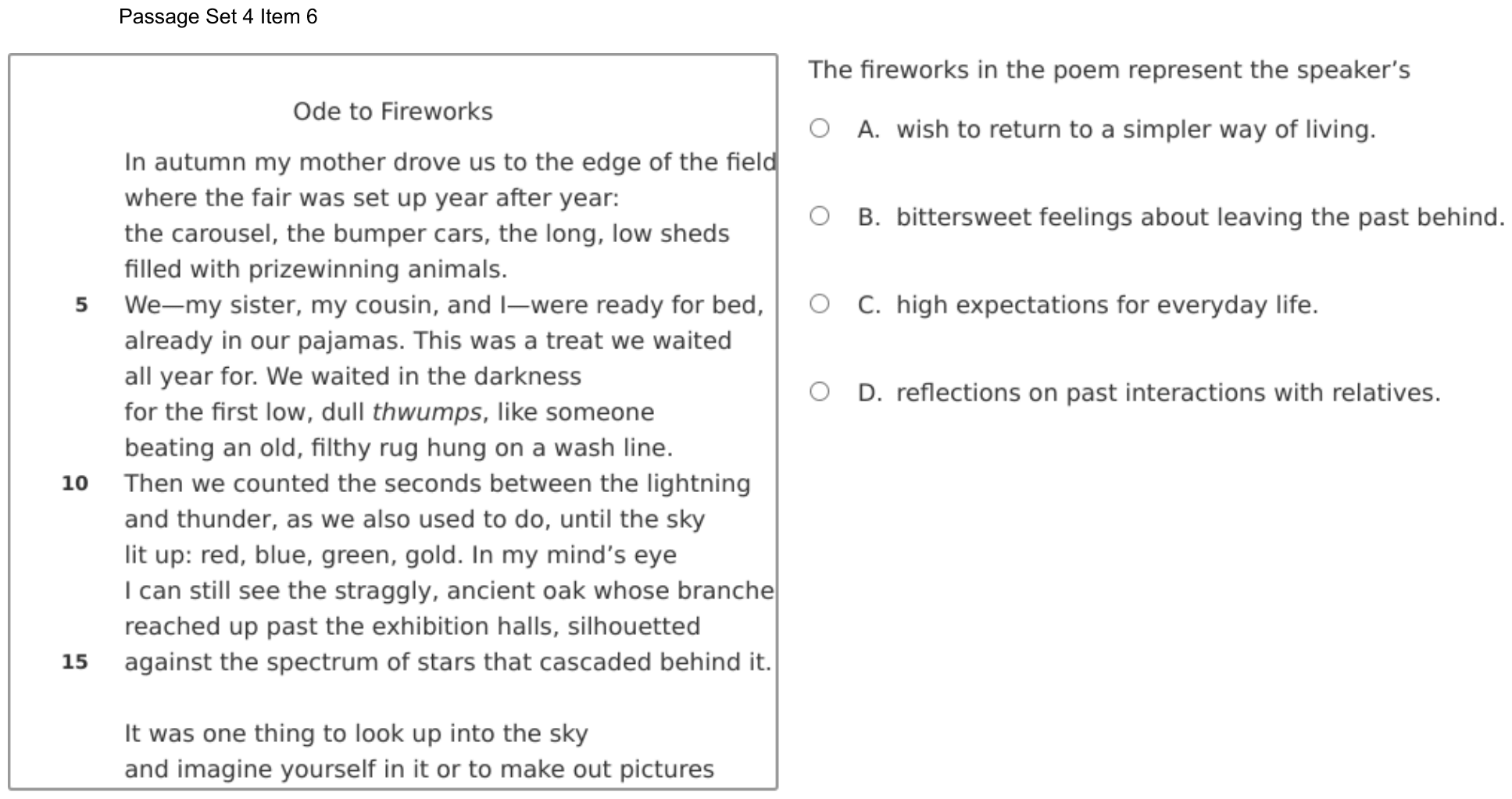
The passage “Ode to Fireworks” as printed (page 32)
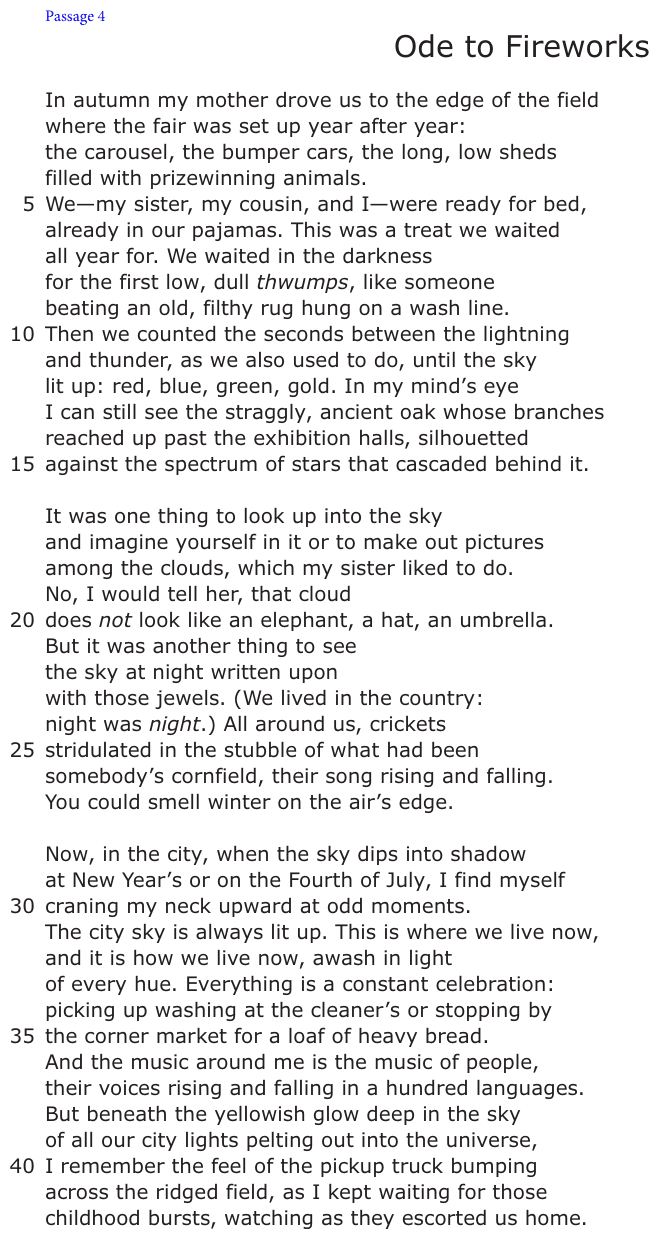
Question 19 of 57
2019 Test A English, question 19Uses the passage above: “Ode to Fireworks”.
Question
The comparison in lines 8–9 of the poem is used to convey
- Athe muffled pounding of explosions in the distance.
- Bthe way lightning streaks through the clouds.
- Cthe echoes of thunder on an autumn night.
- Dthe glow of sparks falling from the sky.
Show the answer
Correct answer: A
The question asks what the comparison in lines 8–9 of the poem is used to convey.
A. CORRECT. In lines 8–9 the speaker compares the deep thumping noises at the start of a fireworks show to the muffled thumping sound made when beating a rug to clean it. The imagery of “low, dull thwumps” (line 8) (onomatopoeia) describes a sound that is not clear or powerful. To the speaker, these low, distant explosions are the signal that the fireworks display is starting and that the loud, cracking sound of fireworks will be heard soon (“Then we counted the seconds between the lightning / and thunder” [lines 10–11]).
B. Incorrect. The comparison in lines 8–9 deals with the low sound of the first fireworks shooting off rather than the streaks of light they emit. To the speaker, the low thwumps (onomatopoeia) are the signal that fireworks are about to explode overhead, much like the way a streak of lightning during a storm indicates that a crash of thunder will follow in a few seconds.
C. Incorrect. The thwump (onomatopoeia) sounds are the start of the fireworks show, not thunder. As a comparison, the speaker says the initial thwumps of the fireworks signal anticipation for the full explosion that will come, much like the way the speaker would watch for lightning and count the seconds before an impending thunderclap (lines 10–11).
D. Incorrect. The muffled thwump (onomatopoeia) sounds occur before the dazzling explosion of lights and before sparks start to fall from the sky. The comparison focuses on the sounds of the experience, not the sight of the experience.
Question analysis
This figurative language question asks what the comparison in lines 8–9 of “Ode to Fireworks” conveys. In the poem an adult speaker remembers waiting with family, already in pajamas, for the fireworks at a country fair. Students must interpret an old-fashioned household image and decide what part of the show it describes, since the nearby lines mention sights as well as sounds.
- Grade level
- Grade 6 reading and task
- Compared with grade 7
- Below grade 7 Interpreting a simile is taught from grade 6, and this one takes up two lines of concrete words. The household chore it pictures may be unfamiliar, but the task is a single step, lighter than typical grade 7 poetry work.
- Estimated difficulty
- Straightforward: two steps or one careful reading.
- Thinking it demands
- Depth of knowledge 2, skills and concepts · mainly understand
- What makes it hard
- Evidence
- Answered from one sentence or line
- Reading level
- Passage: 379 words (a poem; reading level not measured); question and choices: about grade 3, 42 words.
- Students, last 30 days
- Not enough answers yet to show (it takes 10).
Why it is hard, traps and wrong answers (shows the answer)
Why it is hard
The comparison is about sound, and once students notice that, the sight-based choices about lightning and sparks fall away. The pull comes from the next lines, where the children count “the seconds between the lightning / and thunder,” a storm game that makes thunder seem like the thing being described. The question rewards staying inside lines 8–9, where “low, dull” and the beaten rug describe the first faint booms of the show.
Figurative or literary language moderate Understanding the question
Lines 8–9 pair the made-up sound word “thwumps” with a simile, someone beating an old rug on a wash line, so students must hear a dull, distant thud in an image about housework. (Graesser, Singer & Trabasso, 1994; Kintsch, 1998)
Something you must already know minor Working it out
The simile works only for readers who can imagine the flat whack of a rug being beaten clean on a line, a chore many students have never seen or heard. (Anderson & Krathwohl, 2001)
Strategy: Reread lines 8–9 slowly and ask which sense the comparison appeals to, sight, sound or touch, then pick the choice that describes that same experience.
Traps
- Taking figurative language literally: A choice reads a figure of speech or image at face value.
- Wrong part of the text: A choice is true of another paragraph, stanza or speaker than the one asked about.
The wrong answers, classified
B Wrong part of the text (Kirsch & Mosenthal, 1990)
Jumps to the “lightning” of line 10, but lines 8–9 come before the sky lights up and describe something heard in the darkness, not a streak of light.
C Taking figurative language literally (Graesser, Singer & Trabasso, 1994)
Takes the “lightning / and thunder” of lines 10–11 as a real storm and hears the thwumps as thunder, though the counting game only likens the fireworks to one.
D Wrong part of the text (Kirsch & Mosenthal, 1990)
Pictures the colors of lines 12–15, “red, blue, green, gold,” but the rug-beating image describes a dull sound heard before any sparks appear in the sky.
Working it out, step by step
Figure out what the question asks
This asks what a comparison helps you picture. Lines 8–9 compare one thing to another using “like.” That kind of comparison is called a simile. First ask which sense it describes: sight, sound or touch.
Find the comparison
The family waits in the dark. Lines 8–9 say they wait “for the first low, dull thwumps, like someone / beating an old, filthy rug hung on a wash line.” Thwumps is a made-up word that sounds like the noise it names. So the comparison is about a sound. It comes before the sky lights up.
Picture the rug
People used to hang a dusty rug on a line and hit it with a stick. Each hit makes a flat, soft thud, not a sharp bang. The words “low” and “dull” say the same thing. So the first fireworks sound like soft booms far away. Muffled means soft, as if wrapped in cloth.
Check each choice
- A is right. Dull thuds heard in the dark are the muffled pounding of explosions far off.
- B is wrong. Lightning is something you see. Lines 8–9 describe a sound heard before anything lights up.
- C is wrong. The thunder in lines 10–11 is part of a counting game. It compares the show to a storm. The rug image is about the fireworks.
- D is wrong. Sparks are something you see. The colors don’t come until line 12.
Watch out: Lines 10–11 mention “lightning” and “thunder.” That can make C look right. But the rug comparison comes first and is about the fireworks.
Choose the answer
The rug-beating simile makes the first fireworks sound like soft, faraway thuds. So the answer is A, “the muffled pounding of explosions in the distance.”
Why this answer and not the closest wrong one
C is the closest wrong answer, because thunder is a low boom too. But lines 10–11 only compare the show to a storm in a counting game. The rug image in lines 8–9 describes the fireworks themselves: dull, muffled thuds from far away. That is A.
More questions like this
The original DOE question
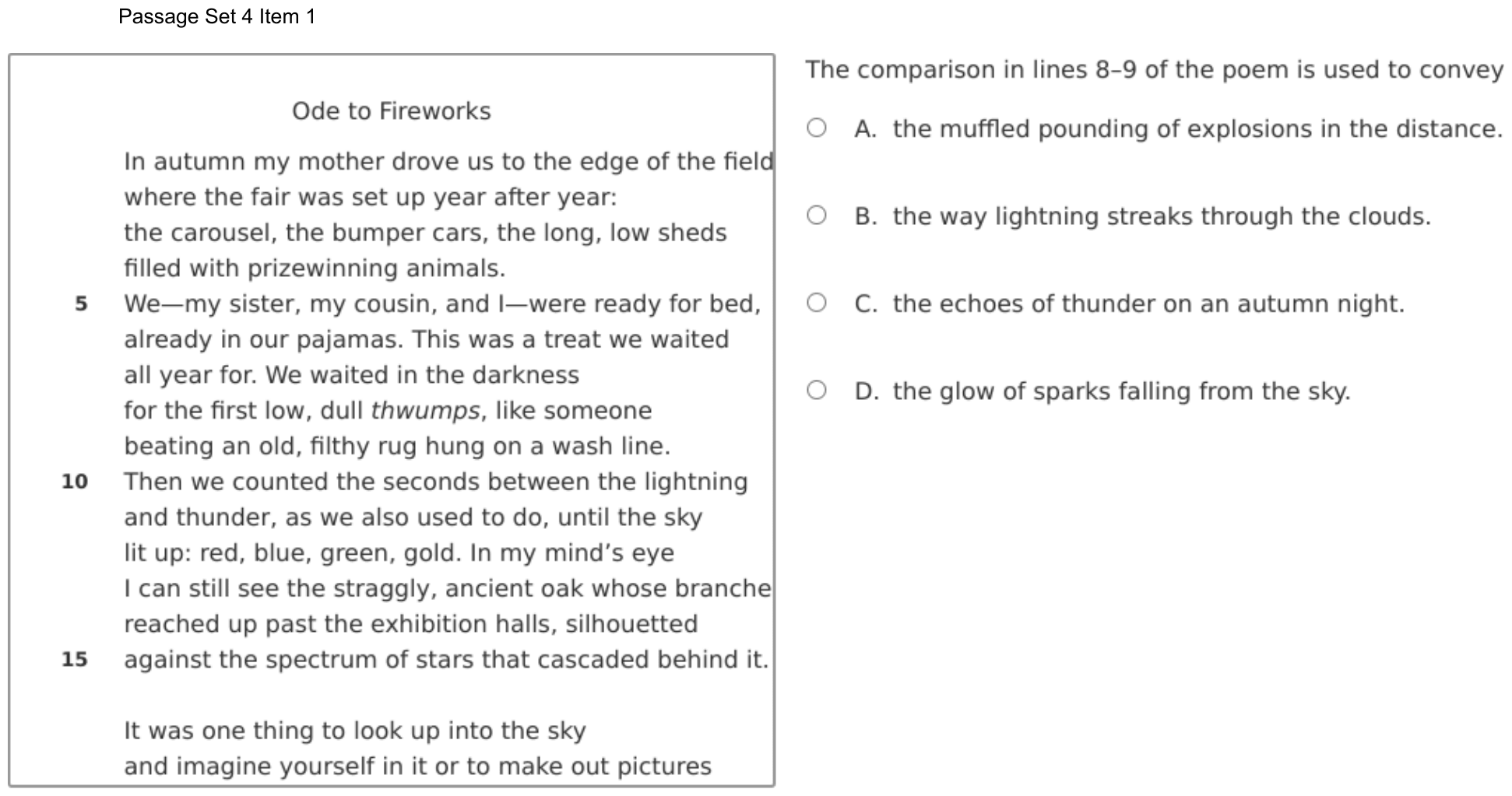
Question 20 of 57
2019 Test A English, question 20Uses the passage above: “Ode to Fireworks”.
Question
Read lines 22–23 from the poem.
the sky at night written upon
with those jewels.
What does the word choice in these lines convey about the speaker?
- AThe speaker values material possessions.
- BThe speaker imagines that the fireworks are magical.
- CThe speaker believes that the country setting is distinctive.
- DThe speaker cherishes the memory of seeing fireworks as a child.
Show the answer
Correct answer: D
The question asks what the word choice in lines 22–23 of the poem conveys about the speaker.
A. Incorrect. The word “jewels” is used figuratively to indicate the sentimental value that the experience of watching the fireworks holds for the speaker. There is no indication in the poem that the speaker values material possessions.
B. Incorrect. The use of the word “jewels” highlights the importance of the memory in the speaker’s mind. The imagery in the words “written upon” expresses the way the bright streaks of light curve and fly across the night sky, not that the speaker views the fireworks display as magical.
C. Incorrect. The speaker describes the elements of the fireworks display that stand out most clearly. The view of the bright, colorful fireworks streaking across the sky is distinct, but it is not unique to the country setting.
D. CORRECT. The word “jewels” creates a picture of watching shining and sparkling explosions in the night sky and suggests that this experience holds sentimental and emotional value for the speaker. The speaker cherishes the memory of the experience.
Question analysis
This question quotes lines 22–23 of “Ode to Fireworks,” in which the night sky is “written upon / with those jewels,” and asks what this word choice conveys about the speaker. Students must move from a striking metaphor for fireworks to what it reveals about the person describing them, and every choice names a different value or belief.
- Grade level
- Grade 7 reading and task
- Compared with grade 7
- At grade 7 Reading a speaker’s feelings through connotation is standard grade 7 work. The two lines are short and quoted, but the metaphor is compressed and the choices name abstract attitudes, so one careful inference is needed, as in typical grade 7 poetry.
- Estimated difficulty
- Moderate: several steps, or a close reading with one strong distractor.
- Thinking it demands
- Depth of knowledge 2, skills and concepts · mainly analyze
- What makes it hard
- Figurative or literary language moderate
- Reading between the lines moderate
- Evidence
- Answered from several paragraphs or stanzas
- Reading level
- Passage: 379 words (a poem; reading level not measured); question and choices: about grade 6, 59 words.
- Students, last 30 days
- Not enough answers yet to show (it takes 10).
Why it is hard, traps and wrong answers (shows the answer)
Why it is hard
The quoted lines are short, but the answer depends on what “jewels” suggests about the speaker, so students must move from an image to an attitude. The strongest pull comes from the words right after, where the speaker stresses that night in the country was truly dark, a real point but one about the setting, not about the jewel image. Students who take the gems literally or as magic stop at the surface of the metaphor instead of asking why someone would call a memory precious.
Figurative or literary language moderate Understanding the question
Lines 22–23 turn fireworks into “jewels” and the sky into a page “written upon,” a metaphor whose meaning lies in what jewels are worth to a person, not in what they are. (Graesser, Singer & Trabasso, 1994; Kintsch, 1998)
Reading between the lines moderate Working it out
The lines name no feeling; that the speaker cherishes the memory must be inferred from calling the fireworks “jewels” and from the speaker still craning upward for them years later in the city. (Graesser, Singer & Trabasso, 1994; Kintsch, 1998)
Strategy: Ask what “jewels” suggests beyond its literal meaning, picture the sky “written upon,” and then pick the attitude that fits both these lines and the poem as a whole.
Traps
- Wrong part of the text: A choice is true of another paragraph, stanza or speaker than the one asked about.
- Reads too much in: A reasonable-sounding conclusion that goes further than the text allows.
- Taking figurative language literally: A choice reads a figure of speech or image at face value.
The wrong answers, classified
A Taking figurative language literally (Graesser, Singer & Trabasso, 1994)
Takes “jewels” at face value, as valuable possessions, though the word describes fireworks in the sky and nothing in the poem is about owning things.
B Reads too much in (Graesser, Singer & Trabasso, 1994)
Sees the sky being “written upon” with gems as a fantasy and calls it magic, though the speaker describes real fireworks watched from a field with family.
C Wrong part of the text (Kirsch & Mosenthal, 1990)
Is drawn by the parenthesis that follows, “We lived in the country,” which does stress the setting, but the jewel image itself says nothing about the country.
Working it out, step by step
Figure out what the question asks
This asks what a word choice shows about the speaker. The speaker is the “I” who tells the poem. Look past what the words say. Ask what feeling they show.
Find the lines
In stanza 2, the speaker says “it was another thing to see / the sky at night written upon / with those jewels.” A stanza is a group of lines in a poem, like a paragraph. The jewels are the fireworks. The sky is like a page they write on.
Think about what jewels mean
Calling fireworks jewels is a metaphor: a comparison without “like” or “as.” Jewels are rare, bright and precious. People keep them safe and treasure them. So the word shows how much the sight meant to the speaker. Even now, in the city, the speaker says “I find myself / craning my neck upward at odd moments.” Craning means stretching your neck to look.
Check each choice
- A is wrong. The jewels are fireworks, not things the speaker owns.
- B is wrong. The speaker watched real fireworks from a field with family. Nothing calls them magic.
- C is wrong. The next words, “We lived in the country,” do stress the setting. But the jewel image itself is about how precious the sight was.
- D is right. To cherish is to treasure and hold dear. Jewels are treasures.
Watch out: C is tempting because the country comes up right after the jewels. Keep your eyes on lines 22–23 themselves.
Choose the answer
Calling the fireworks jewels shows a treasured childhood memory. So the answer is D, “The speaker cherishes the memory of seeing fireworks as a child.”
Why this answer and not the closest wrong one
C is the closest wrong answer. The poem does say they lived in the country, where night was truly dark. But that is the next thought, not the jewel image. Jewels are treasures. They show how much the speaker valued the sight. D says just that: the speaker treasures the memory.
More questions like this
The original DOE question
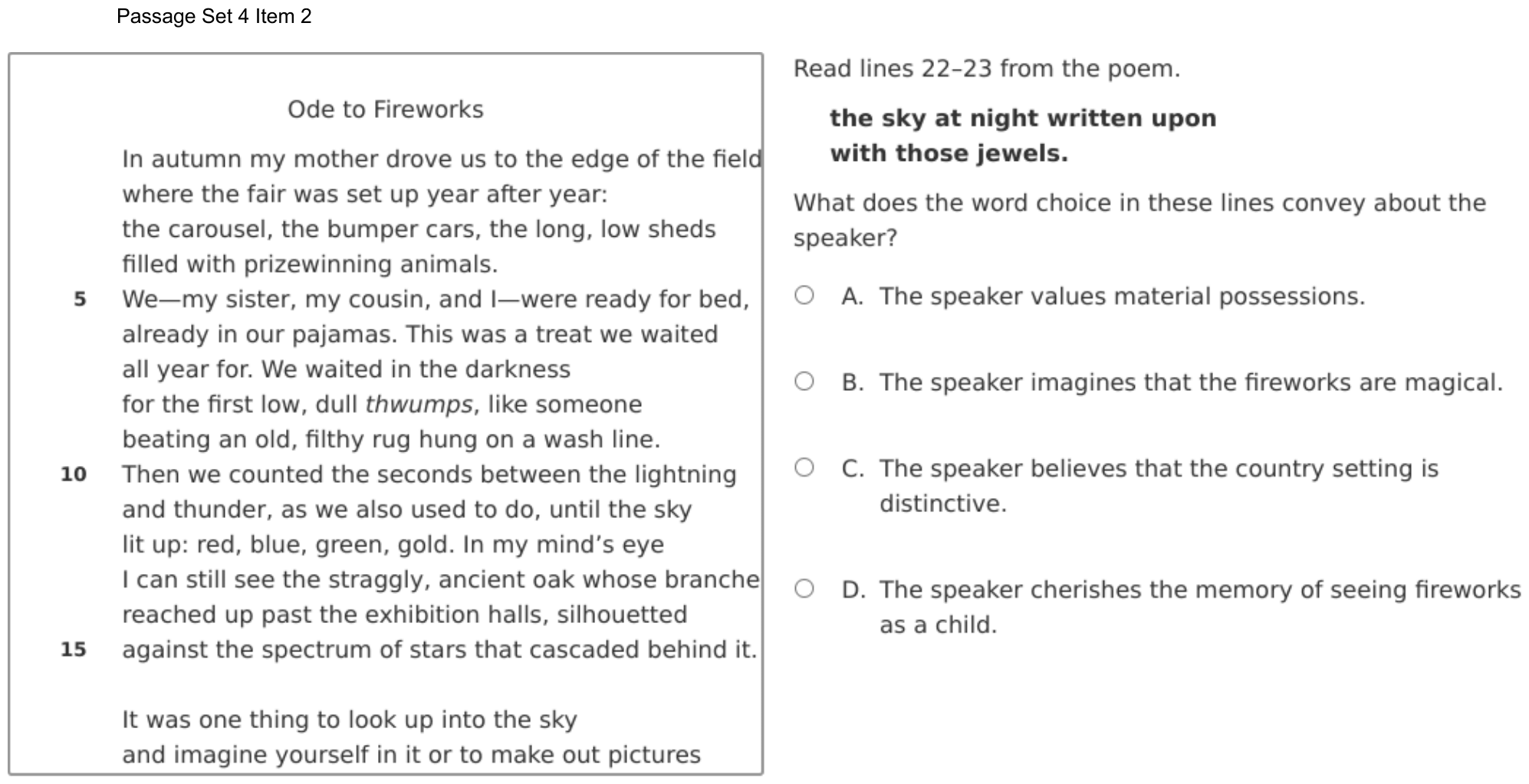
Question 21 of 57
2019 Test A English, question 21Uses the passage above: “Ode to Fireworks”.
Question
The use of italics on the word “night” in line 24 is most likely intended to emphasize the
- Asense of mystery in the darkness.
- Bsense of absolute darkness.
- Cspeaker’s fear of night.
- Dspeaker’s certainty about that night.
Show the answer
Correct answer: B
The question asks what the use of italics on the word “night” in line 24 is most likely intended to emphasize.
A. Incorrect. The purpose of italicizing the word “night” is not to convey mystery. While the speaker refers to not knowing the exact location where the firework viewing took place (“in the stubble of what had been / somebody’s cornfield” [lines 25–26]), the emphasis on “night” is meant to highlight the darkness and contrast the bright light from the fireworks soaring across the sky.
B. CORRECT. The italics are intended to place emphasis on one key aspect of nighttime—total darkness. The speaker is making a point that night in the country was truly dark, unlike the night the speaker currently experiences in a city, where light emitted from buildings and vehicles prevents complete darkness.
C. Incorrect. The tone in the second stanza is positive, showing admiration for the beauty visible in true darkness rather than fear: “But it was another thing to see / the sky at night written upon / with those jewels” (lines 21–23).
D. Incorrect. The speaker is talking about the general experience of watching fireworks on several occasions, not focusing on the events of a specific night. The use of italics on the word “night” emphasizes the speaker’s memory of the persistent darkness.
Question analysis
In “Ode to Fireworks,” the word “night” is printed in italics in line 24, inside the speaker’s aside about living in the country. This craft question asks what the italics are most likely meant to emphasize, so students must think about what stressing one ordinary word does and choose among moods and meanings the word could carry.
- Grade level
- Grade 7 reading and task
- Compared with grade 7
- At grade 7 Grade 7 students explain how word choice shapes meaning; here the device is italics on one everyday word, which is studied less often. The surrounding lines are plain, so a single careful inference settles it, a typical grade 7 demand.
- Estimated difficulty
- Moderate: several steps, or a close reading with one strong distractor.
- Thinking it demands
- Depth of knowledge 2, skills and concepts · mainly analyze
- What makes it hard
- How, not what moderate
- A very close wrong answer moderate
- Evidence in several places minor
- Evidence
- Answered from one paragraph or stanza
- Reading level
- Passage: 379 words (a poem; reading level not measured); question and choices: about grade 5, 36 words.
- Students, last 30 days
- Not enough answers yet to show (it takes 10).
Why it is hard, traps and wrong answers (shows the answer)
Why it is hard
One plain word in a parenthesis carries the question, and its meaning comes from the stress, not the dictionary. Darkness is easy to see; the harder step is choosing what the italics add to it, and mystery is a familiar partner for darkness that the stanza never develops. Students who read on to the brightly lit city of the third stanza see that the speaker is insisting on how complete the country dark was.
How, not what moderate Working it out
The stem asks what italics do, not what a word means, so students must hear the stress in “night was night” as insisting that the country night was fully dark, as night should be. (Anderson & Krathwohl, 2001)
A very close wrong answer moderate Choosing the answer
The mystery choice and the key both tie the italics to darkness; they differ only in what the darkness carries, a sense of mystery or its sheer completeness. (Embretson & Wetzel, 1987; Gorin & Embretson, 2006; Ascalon et al., 2007)
Evidence in several places minor Working it out
The point of the stress becomes clear from the third stanza, where “The city sky is always lit up” and the speaker now lives “awash in light / of every hue.” (Kirsch & Mosenthal, 1990; Gorin & Embretson, 2006)
Strategy: Read line 24 aloud, stressing “night” as the italics do, and ask what the speaker insists on about nights in the country; then check whether the rest of the poem backs that reading.
Traps
- Reads too much in: A reasonable-sounding conclusion that goes further than the text allows.
- Wrong tone or attitude: Misjudges the tone, attitude or point of view, such as reading admiration as criticism, or taking a character's or subject's feelings for the author's.
- Wrong purpose or structure: Names a purpose, structure or effect that the part does not serve, or describes what a part says when the question asks what it does.
The wrong answers, classified
A Reads too much in (Graesser, Singer & Trabasso, 1994)
Links darkness with mystery, a common pairing, but nothing in the stanza is hidden or puzzling; the stress falls on how dark the country night was.
C Wrong tone or attitude (Graesser, Singer & Trabasso, 1994)
Assumes a child out in the dark must be afraid, but the stanza is full of wonder, with “jewels” in the sky and crickets singing, and shows no fear.
D Wrong purpose or structure (Anderson & Krathwohl, 2001)
Knows italics can mark insistence but reads “night” as one particular evening, though the speaker means country nights in general, at a fair held “year after year.”
Working it out, step by step
Figure out what the question asks
This asks why one word is in italics. Italics are slanted letters. Writers use them to stress a word, the way you would say it louder. So ask what the speaker insists on.
Read the line aloud
Lines 23–24 say “(We lived in the country: / night was night.)” Read it aloud and lean on the second “night.” It means night was really night. It was as dark as night should be, with no city lights.
Use the rest of the poem
Stanza 3 shows the opposite. “The city sky is always lit up.” The speaker now lives “awash in light / of every hue.” Awash means flooded. A hue is a color. So the italics stress how completely dark the country night was. That darkness made the fireworks stand out.
Check each choice
- A is wrong. Darkness can feel mysterious. But nothing in the stanza is hidden or puzzling.
- B is right. Absolute means total. The italics stress that the dark was total.
- C is wrong. The speaker shows wonder, not fear. The sky is full of “jewels.”
- D is wrong. “That night” would mean one evening. The speaker means country nights in general, at a fair held “year after year.”
Watch out: A pairs darkness with mystery, which feels natural. But the speaker stresses how dark it was, not that it felt strange.
Choose the answer
The italics insist that country nights were fully dark. So the answer is B, “sense of absolute darkness.”
Why this answer and not the closest wrong one
A is the closest wrong answer, since both A and B link the italics to darkness. But the stanza never treats the night as strange or secret. The bright city sky in stanza 3 shows what the stress is for: country nights were completely dark. That is B.
More questions like this
The original DOE question
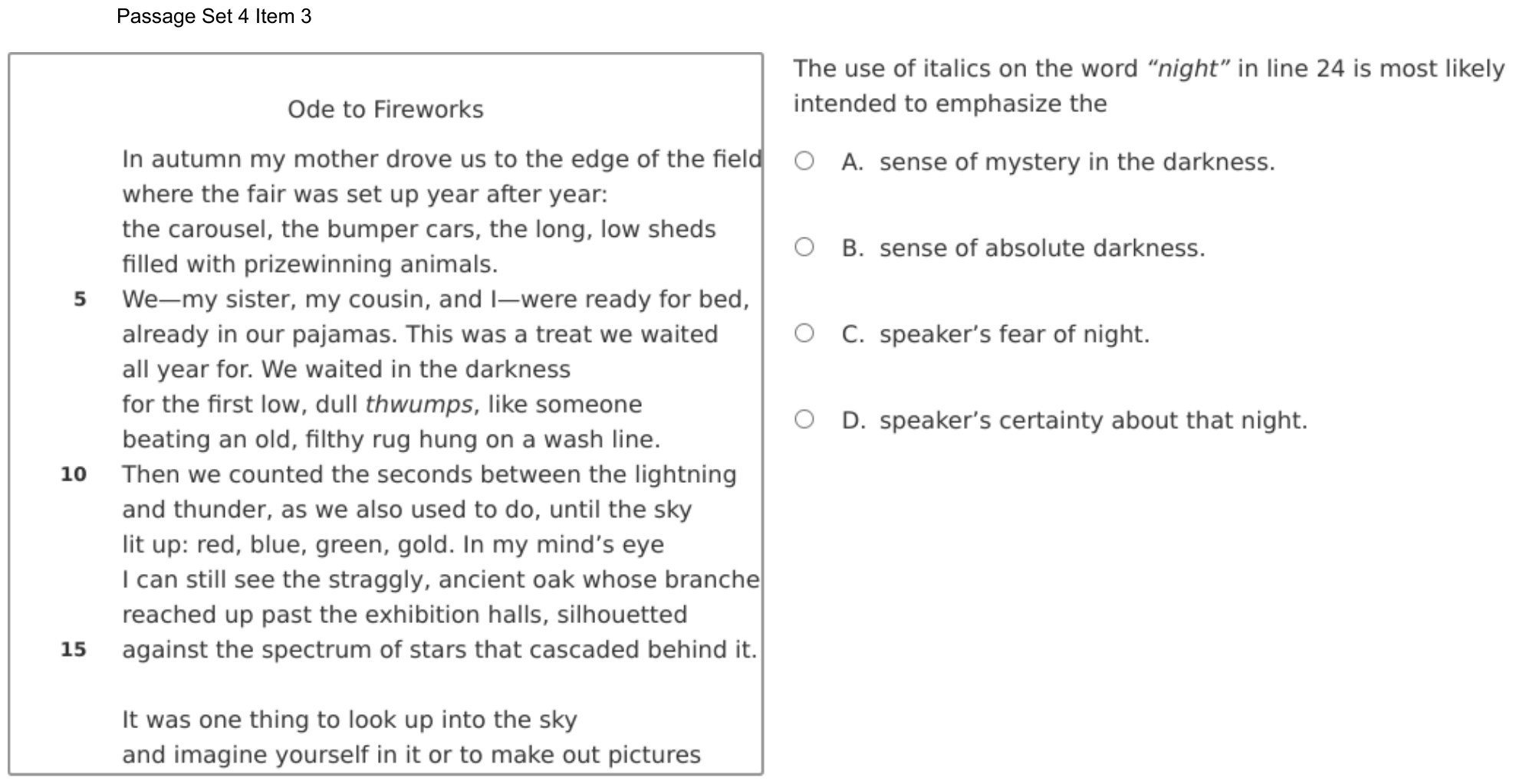
Question 22 of 57
2019 Test A English, question 22Uses the passage above: “Ode to Fireworks”.
Question
What is the purpose of the repeated words “rising and falling” in lines 26 and 37?
- Ato create a distinction between solitude and meaningful interaction
- Bto demonstrate a connection between the speaker’s past and present
- Cto emphasize the speaker’s attention to the surrounding sounds
- Dto compare the fireworks to common sights and sounds
Show the answer
Correct answer: B
The question asks what the purpose is of the repeated words “rising and falling” in lines 26 and 37.
A. Incorrect. These lines do not provide insight into the speaker’s interactions or feelings of solitude. The speaker mentions the emptiness of the country and the crowds in the city, but these repeated words are meant to draw a connection between the locations rather than show differences between them.
B. CORRECT. The first mention of these words occurs during a recollection of the speaker’s past, and the second takes place during a description of the speaker’s present. The speaker looks to the connections between the country setting (“All around us, crickets / stridulated in the stubble of what had been / somebody’s cornfield, their song rising and falling” [lines 24–26]) and the city setting (“And the music around me is the music of people, / their voices rising and falling in a hundred languages” [lines 36–37]) as a source of comfort.
C. Incorrect. Even though the lines call out specific sounds, the purpose of the repetition of the words in the two parts of the poem is to show how the speaker connects the two settings. The “rising and falling” of the sounds is one detail the speaker highlights.
D. Incorrect. The repetition of the words “rising and falling” is used to compare the different locations in the speaker’s life, not to compare fireworks to the sounds of crickets in the country or to the sounds of people moving and talking in the city.
Question analysis
The phrase “rising and falling” appears twice in “Ode to Fireworks,” in line 26 for the crickets’ song and in line 37 for people’s voices. This question asks for the purpose of repeating it, so students must compare the two places where it appears and decide what the echo does for the poem as a whole.
- Grade level
- Grade 7 reading and task
- Compared with grade 7
- At grade 7 Grade 7 students analyze how a poem’s structure develops its meaning. The repeated words are easy to spot, but they sit eleven lines apart in different stanzas, and the four purposes offered each sound possible, a typical grade 7 structure task.
- Estimated difficulty
- Moderate: several steps, or a close reading with one strong distractor.
- Thinking it demands
- Depth of knowledge 2, skills and concepts · mainly analyze
- What makes it hard
- How, not what moderate
- Evidence in several places moderate
- Evidence
- Answered from several paragraphs or stanzas
- Reading level
- Passage: 379 words (a poem; reading level not measured); question and choices: about grade 8, 51 words.
- Corrected from the DOE handbook
- The DOE printed this question’s explanation after a different question; the site matches the question with its own explanation.
- Students, last 30 days
- Not enough answers yet to show (it takes 10).
Why it is hard, traps and wrong answers (shows the answer)
Why it is hard
The repeated words are easy to find; the work is seeing that they sit on either side of the poem’s turn from childhood memory to city life. The strongest pull is the accurate observation that both lines describe sounds, which tells what the lines say rather than why the poet repeats them. The country and city are contrasted elsewhere in the poem, so a choice built on a contrast also tempts, though repeating the same words joins the two scenes instead of separating them.
How, not what moderate Working it out
The stem asks for the purpose of a repetition, so it is not enough to see that both lines describe sounds; students must say what echoing “rising and falling” does for the poem. (Anderson & Krathwohl, 2001)
Evidence in several places moderate Working it out
The two uses sit eleven lines apart in different stanzas, the crickets’ song in the remembered country field and city voices “in a hundred languages” in the present, and must be read together. (Kirsch & Mosenthal, 1990; Gorin & Embretson, 2006)
Strategy: Reread the lines around each use of “rising and falling,” describe each scene in a phrase, and ask what echoing the same words in both scenes accomplishes for the poem.
Traps
- Wrong purpose or structure: Names a purpose, structure or effect that the part does not serve, or describes what a part says when the question asks what it does.
- Reads too much in: A reasonable-sounding conclusion that goes further than the text allows.
- Twists what the text says: Uses the text's topic and ideas but changes what it says: who did it, how much, when, or why.
The wrong answers, classified
A Reads too much in (Graesser, Singer & Trabasso, 1994)
Reads solitude into the country scene and company into the city, though the speaker watched with a mother, sister and cousin, and the repeated words link the scenes.
C Wrong purpose or structure (Anderson & Krathwohl, 2001)
Notices that both lines describe sounds, the crickets’ song and people’s voices, which is true, but that is what the lines say, not why the words are repeated.
D Twists what the text says (King et al., 2004)
Assumes the repetition must refer to the fireworks of the title, though “rising and falling” describes crickets and voices and compares neither one to fireworks.
What was corrected from the DOE handbook, and why
- Explanation: In the DOE’s explanations appendix, the explanation printed after this question belongs to question 25 (“how the memory in lines 41–42 affects the speaker”) and marks D correct, and this question’s explanation (“what the purpose is of the repeated words ‘rising and falling’ in lines 26 and 37”) is printed after question 25, marking B correct. Read page by page, the appendix gives this question the answer D. The site gives the question the explanation that restates it, and the answer follows that explanation: B, because the words join the crickets’ song of the speaker’s country childhood (line 26) to the voices of the city in the present (line 37).
Working it out, step by step
Figure out what the question asks
This asks about purpose: why the poet repeats the words “rising and falling.” Don’t just say what the lines describe. Ask what repeating the same words does for the poem.
Find both uses
The first is in line 26, in the country of the speaker’s childhood. Crickets “stridulated in the stubble of what had been / somebody’s cornfield, their song rising and falling.” To stridulate is to chirp by rubbing body parts together. The second is in line 37, in the city today: “their voices rising and falling in a hundred languages.”
See what the repeat does
The two uses sit on either side of the poem’s big turn. Stanza 2 is the past in the country. Stanza 3 is the present in the city. The crickets’ song then and people’s voices now rise and fall alike. Using the same words in both places links the two times. So the repeat ties the speaker’s past to the present.
Check each choice
- A is wrong. Solitude means being alone. But the speaker was with family in the country. And the repeat joins the scenes. It does not set them apart.
- B is right. The same words join a childhood scene to a scene from now.
- C is wrong. Both lines do describe sounds. But that is what the lines say, not why the words repeat.
- D is wrong. The words describe crickets and voices. Neither is compared to fireworks.
Watch out: C is true, which makes it tempting. But a purpose question asks why, not what.
Choose the answer
The repeated words link the country past to the city present. So the answer is B, “to demonstrate a connection between the speaker’s past and present.”
Why this answer and not the closest wrong one
C is the closest wrong answer. It is true that both lines describe sounds the speaker hears. But the question asks for the purpose. The crickets belong to the speaker’s past, and the voices to the present. Repeating “rising and falling” joins the two times. That connection is B.
More questions like this
The original DOE question
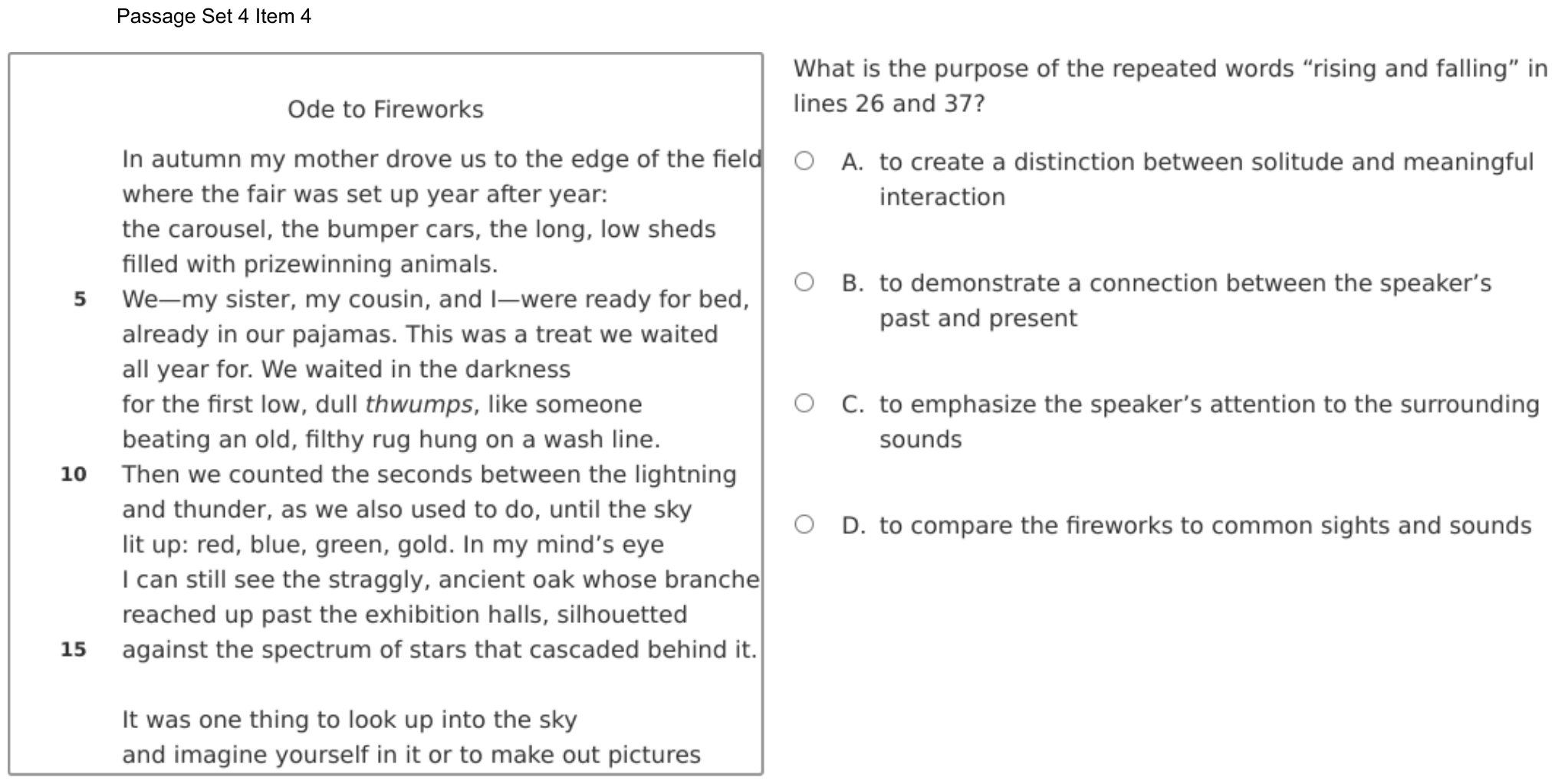
Question 23 of 57
2019 Test A English, question 23Uses the passage above: “Ode to Fireworks”.
Question
What impact does the phrase “Everything is a constant celebration” (line 33) have in the poem?
- AIt reveals that the speaker finds the city more pleasurable than the country.
- BIt suggests that the persistent brightness of the city can be overwhelming to the speaker.
- CIt implies that what is normal in the city was unusual in the country.
- DIt emphasizes the hectic pace of daily life in the city.
Show the answer
Correct answer: C
The question asks what impact the phrase “Everything is a constant celebration” (line 33) has in the poem.
A. Incorrect. The speaker describes a sense of happiness and contentment in both the city and the country and does not indicate that one setting is more pleasurable than the other.
B. Incorrect. The word “celebration” has a positive association and does not imply that the speaker is overwhelmed in the city. Throughout the third stanza (lines 28–42), the speaker conveys appreciation for the elements of the city that make it different from the country (“And the music around me is the music of people, / their voices rising and falling in a hundred languages” [lines 36–37]).
C. CORRECT. From the speaker’s perspective, the constant light (“awash in light” [line 32]) contributes to the speaker’s feeling that, in the city, celebratory fireworks are ever present. In comparison, fireworks lit up the country sky only for celebratory occasions or annual events (“In autumn my mother drove us to the edge of the field / where the fair was set up year after year” [lines 1–2]).
D. Incorrect. While the speaker observes many things going on in the city at a given moment, the “constant celebration” in line 33 is intended to convey a comparison to the speaker’s previous experience in the country rather than emphasize the hectic pace of life in the city. The continual light and sounds in the city remind the speaker of lights and sounds experienced only on occasion in the country.
Question analysis
This question about word choice in a poem asks what impact the phrase “Everything is a constant celebration,” from line 33, has in “Ode to Fireworks.” The speaker, grown up and living in a city, looks back on watching fireworks at a fair in the countryside. Students must interpret a sweeping statement about city life whose tone can be heard in more than one way.
- Grade level
- Grade 8 reading and task
- Compared with grade 7
- Above grade 7 Grade 7 students analyze how a phrase shapes a poem’s meaning, often from the nearby lines alone. This one sits in a 42-line poem, and the choices read its tone in sharply different ways, so it must be weighed against the whole poem.
- Estimated difficulty
- Hard: combines ideas, needs a plan, and has more than one tempting wrong answer.
- Thinking it demands
- Depth of knowledge 3, strategic thinking · mainly analyze
- What makes it hard
- Reading between the lines major
- Figurative or literary language moderate
- Evidence in several places moderate
- Evidence
- Answered from several paragraphs or stanzas
- Reading level
- Passage: 379 words (a poem; reading level not measured); question and choices: about grade 8, 68 words.
- Students, last 30 days
- Not enough answers yet to show (it takes 10).
Why it is hard, traps and wrong answers (shows the answer)
Why it is hard
The line can be heard in several moods, and three choices each take one: delight in the city over the country, strain from too much light, or a hurried pace. None of them needs the earlier stanzas, which is why they tempt; the line’s impact comes from the contrast with a childhood in which the sky lit up once a year. Students who ask what a celebration meant to the child at the fair, rather than how a city feels to them, reach the reading the poem supports.
Reading between the lines major Working it out
Line 33 never mentions the country; that city life feels like a nonstop version of something once rare must be inferred by setting it against the fair the family “waited / all year for” in stanza 1. (Graesser, Singer & Trabasso, 1994; Kintsch, 1998)
Figurative or literary language moderate Understanding the question
“Constant celebration” is a metaphor: errands at the cleaner’s and the corner market become a festival because the city sky is “always lit up,” as the country sky was only on fireworks nights. (Graesser, Singer & Trabasso, 1994; Kintsch, 1998)
Evidence in several places moderate Working it out
The contrast spans the poem, the yearly fair and “night was night” in the first two stanzas against the city “awash in light / of every hue” in lines 32–33. (Kirsch & Mosenthal, 1990; Gorin & Embretson, 2006)
Strategy: Reread lines 31–35 aloud, decide how the speaker feels about the city at this point, and keep only a choice that fits both that feeling and the rest of the poem.
Traps
- Wrong tone or attitude: Misjudges the tone, attitude or point of view, such as reading admiration as criticism, or taking a character's or subject's feelings for the author's.
- Reads too much in: A reasonable-sounding conclusion that goes further than the text allows.
- Twists what the text says: Uses the text's topic and ideas but changes what it says: who did it, how much, when, or why.
The wrong answers, classified
A Reads too much in (Graesser, Singer & Trabasso, 1994)
Hears “celebration” as praise of the city and ranks it above the country, though the speaker never compares the two for pleasure and ends the poem lingering fondly on the country drive home.
B Wrong tone or attitude (Graesser, Singer & Trabasso, 1994)
Reads “always lit up” and “awash in light” as too much brightness, but “celebration” is a happy word, and the stanza enjoys the city’s light and its voices in a hundred languages.
D Twists what the text says (King et al., 2004)
Links “constant” to the errands that follow and pictures a rushed city, but the line turns picking up washing and buying bread into festive moments, not hurried ones.
Working it out, step by step
Figure out what the question asks
This asks about the impact of one phrase in the poem. Impact means the effect it has on the poem’s meaning. To see it, compare the city in stanza 3 with the speaker’s childhood in the country. A stanza is a group of lines in a poem, like a paragraph.
Read the phrase in its lines
Lines 31–33 say “The city sky is always lit up. This is where we live now, / and it is how we live now, awash in light / of every hue. Everything is a constant celebration.” Awash means covered all over. Hue means color. Constant means all the time. The next lines name plain errands, like “picking up washing at the cleaner’s.”
Compare it with the country
In the country, the fireworks were rare. Lines 6–7 say “This was a treat we waited / all year for.” Lines 23–24 add “(We lived in the country: / night was night.)” That means the night sky was dark. A celebration is a special event that happens once in a while. In the city, the sky is always bright. So everyday city life feels like a fireworks night, which used to come once a year.
Check each choice
- A does not fit. The speaker never says the city is better. The poem ends with a fond memory of the country.
- B does not fit. “Celebration” is a happy word. The speaker enjoys the light and “the music of people.”
- C fits. A bright sky is normal in the city. In the country, it came only on fireworks night.
- D does not fit. Hectic means busy and rushed. Buying bread sounds calm, and the phrase makes it feel festive, not rushed.
Watch out: B is tempting because “always lit up” and “awash in light” can sound like too much. But the speaker’s words are warm, not tired or upset.
Choose the answer
The phrase makes city life sound like a fireworks night that never ends. What the city has every day was rare in the country. So the answer is C.
Why this answer and not the closest wrong one
B is the closest wrong choice. Both B and C notice that the city is full of light. But B says the light is too much for the speaker. The word “celebration” shows joy, not stress. The phrase gets its meaning from the contrast with the country, where “night was night.” That contrast is C.
More questions like this
The original DOE question

Question 24 of 57
2019 Test A English, question 24Uses the passage above: “Ode to Fireworks”.
Question
Read lines 41–42 from the poem.
I kept waiting for those
childhood bursts, watching as they escorted us home.
How does this memory affect the speaker?
- AThe speaker believes it is impossible to ever return to a place in the past.
- BThe speaker is still amused by the impatience felt during fireworks displays.
- CThe speaker now regrets abandoning the rural way of life.
- DThe speaker feels a sense of comfort when reflecting on the past.
Show the answer
Correct answer: D
The question asks how the memory in lines 41–42 affects the speaker.
A. Incorrect. The speaker does not express concern in these lines about the impossibility of returning to childhood or the past. For the speaker, the past and the memories associated with it are a source of comfort and a way to remember simpler times (“I remember the feel of the pickup truck bumping / across the ridged field” [lines 40–41]).
B. Incorrect. While the speaker recalls anticipation before the start of a fireworks display, there is no hint that the speaker is impatient. Particularly in lines 41–42, the speaker is reminded of the expectation of hearing and seeing fireworks and the sense of simple contentment felt in the experience (“I find myself / craning my neck upward at odd moments” [lines 29–30]).
C. Incorrect. The speaker is reflecting on past experiences and pointing out the elements of the city that remind the speaker of these past experiences. The speaker acknowledges the differences between the country and city settings but does not convey regret for leaving the rural area (“This is where we live now, / and it is how we live now, awash in light / of every hue” [lines 31–33]).
D. CORRECT. The memory of watching the fireworks on the way home creates a sense of comfort that stays with the speaker (“escorted us home”). The speaker looks forward to moments when the youthful experience (“childhood bursts”) of being excited by something like a fireworks display can be a source of happiness.
Question analysis
This question quotes the last lines of “Ode to Fireworks,” where the adult speaker, now living in the city, recalls waiting for the “childhood bursts” that “escorted us home,” and asks how this memory affects the speaker. Students must read the feeling in a brief closing image and check each choice against the whole final stanza about city life.
- Grade level
- Grade 7 reading and task
- Compared with grade 7
- At grade 7 Inferring how an experience affects a speaker is regular grade 7 work. The two quoted lines are plain, but the feeling behind them is implied rather than named, and the choices offer four believable reactions to a memory.
- Estimated difficulty
- Moderate: several steps, or a close reading with one strong distractor.
- Thinking it demands
- Depth of knowledge 2, skills and concepts · mainly understand
- What makes it hard
- Reading between the lines moderate
- Evidence in several places minor
- Figurative or literary language minor
- Evidence
- Answered from one paragraph or stanza
- Reading level
- Passage: 379 words (a poem; reading level not measured); question and choices: about grade 6, 74 words.
- Corrected from the DOE handbook
- The DOE printed this question’s explanation after a different question; the site matches the question with its own explanation.
- Students, last 30 days
- Not enough answers yet to show (it takes 10).
Why it is hard, traps and wrong answers (shows the answer)
Why it is hard
The memory is warm, but warm memories of a lost place are easy to read as sadness, and the choice about regretting the move to the city draws students who hear nostalgia as complaint. The other wrong choices turn the anticipation of “kept waiting” into impatience or make the past impossible to reach, both stronger than anything the lines say. Students who read the whole sentence from “But beneath the yellowish glow” see a speaker carried home by the memory, not mourning it.
Reading between the lines moderate Working it out
Lines 41–42 name no feeling, so the comfort must be read from fireworks that “escorted us home” and from the grown speaker still waiting for “those / childhood bursts” in the city. (Graesser, Singer & Trabasso, 1994; Kintsch, 1998)
Evidence in several places minor Working it out
Ruling out regret takes the rest of the third stanza, where city life is “a constant celebration” and “This is where we live now” is said without complaint. (Kirsch & Mosenthal, 1990; Gorin & Embretson, 2006)
Figurative or literary language minor Understanding the question
“Escorted us home” makes the fireworks companions guarding the family’s drive across the field, a personification that carries the sense of safety the question asks about. (Graesser, Singer & Trabasso, 1994; Kintsch, 1998)
Strategy: Read lines 38–42 as one sentence, starting from “But beneath the yellowish glow,” and ask how the speaker feels about the city and about the memory, using the whole third stanza, before choosing.
Traps
- Wrong tone or attitude: Misjudges the tone, attitude or point of view, such as reading admiration as criticism, or taking a character's or subject's feelings for the author's.
- Too broad or too strong: A choice overstates, generalizes, or uses absolute words the text does not support.
- Twists what the text says: Uses the text's topic and ideas but changes what it says: who did it, how much, when, or why.
The wrong answers, classified
A Too broad or too strong (King et al., 2004)
Turns a speaker who looks back into one mourning a place for good, with the absolute “impossible to ever return,” though the poem never says so and keeps the memory alive.
B Twists what the text says (King et al., 2004)
Turns the eager waiting of “kept waiting for those / childhood bursts” into impatience and adds amusement, though nothing in the lines is treated as funny.
C Wrong tone or attitude (Graesser, Singer & Trabasso, 1994)
Reads the speaker’s longing for the country as regret for leaving it, though the third stanza calls city life “a constant celebration” and never wishes the move undone.
What was corrected from the DOE handbook, and why
- Explanation: In the DOE’s explanations appendix, the explanation printed after this question belongs to question 24 (“what the purpose is of the repeated words ‘rising and falling’ in lines 26 and 37”) and marks B correct, and this question’s explanation (“how the memory in lines 41–42 affects the speaker”) is printed after question 24, marking D correct. Read page by page, the appendix gives this question the answer B. The site gives the question the explanation that restates it, and the answer follows that explanation: D, because the memory of the fireworks that “escorted us home” is a source of comfort to the speaker.
Working it out, step by step
Figure out what the question asks
This asks how a memory makes the speaker feel. The lines don’t name a feeling. So you have to infer it, which means figure it out from clues.
Read the whole sentence
The sentence starts in line 38: “But beneath the yellowish glow deep in the sky / of all our city lights pelting out into the universe, / I remember the feel of the pickup truck bumping / across the ridged field, as I kept waiting for those / childhood bursts, watching as they escorted us home.” The bursts are the fireworks.
Work out the feeling
To escort is to go along with someone to guide or protect them. So the speaker pictures the fireworks keeping the family company on the way home. That is a safe, warm picture. The memory comes back even under the bright city sky. It works like a favorite old song that still makes you feel good.
Check each choice
- A is wrong. The speaker never says it is “impossible to ever return.” The memory is still alive.
- B is wrong. The waiting was eager, not impatient. Nothing is treated as funny.
- C is wrong. Regret means wishing you had done something else. The speaker never wishes the move undone. The city is “a constant celebration.”
- D is right. The fireworks that “escorted us home” give the speaker a sense of comfort.
Watch out: Missing the past is not the same as regret. C reads a complaint into the poem that is not there.
Choose the answer
The memory of the fireworks bringing the family home warms the speaker. So the answer is D, “The speaker feels a sense of comfort when reflecting on the past.”
Why this answer and not the closest wrong one
C is the closest wrong answer, because the speaker clearly misses the country. But stanza 3 says “This is where we live now” with no complaint. It even calls city life “a constant celebration.” The memory warms the speaker. It does not make the speaker wish to undo the move. That is comfort, choice D.
More questions like this
The original DOE question
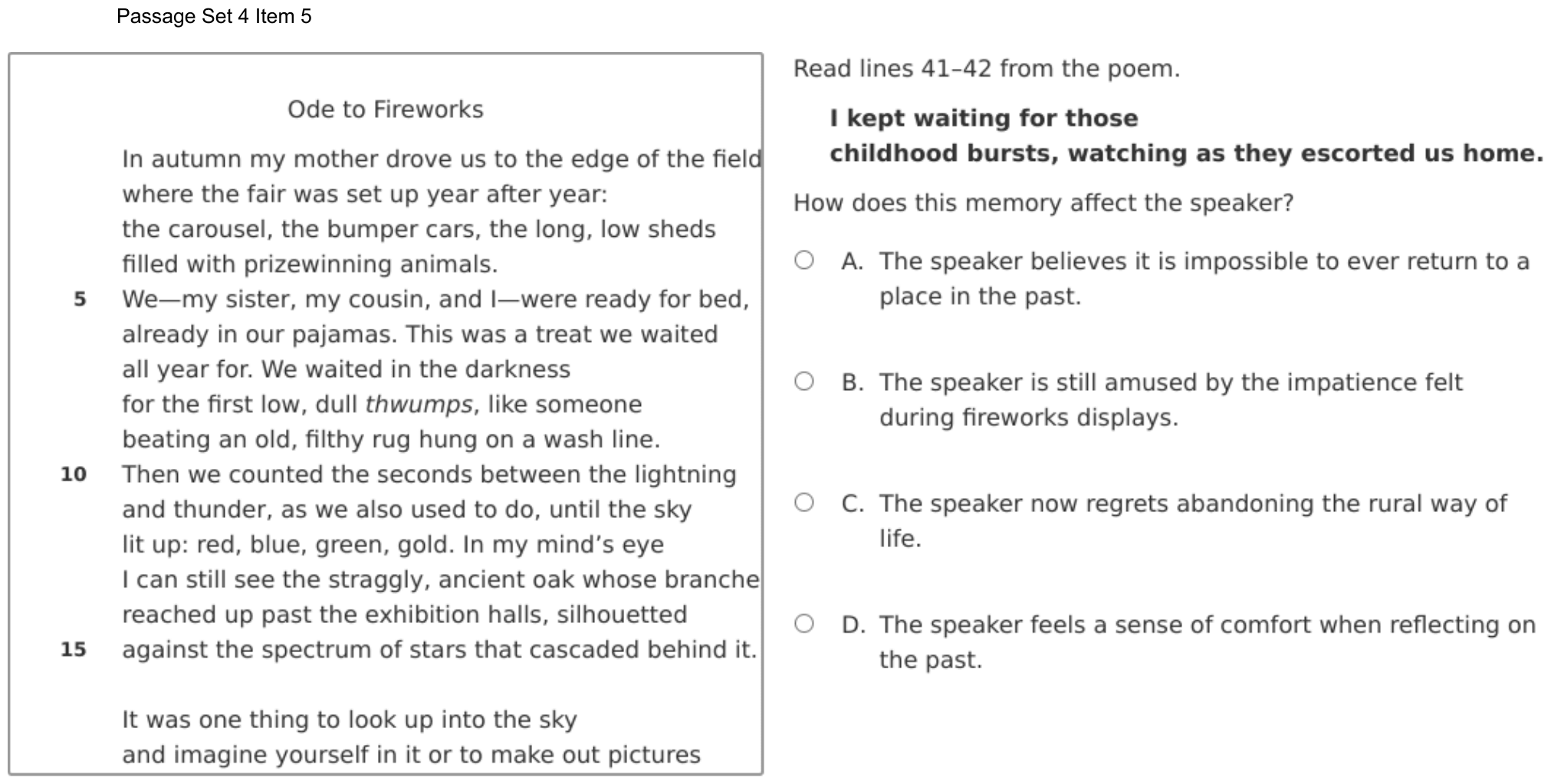
Question 25 of 57
2019 Test A English, question 25Passage Excerpt from “Research Riddle Resolved”
Excerpt from “Research Riddle Resolved”
For centuries, scientists were confounded by an animal that seemed to look and act like a combination of a bird, a reptile, and a mammal. It has a bill like a duck and lays eggs but produces milk for its young. It lives in a burrow, has fur, and can make venom. We now know that this animal is called a duck-billed platypus. A platypus is a monotreme, a type of egg-laying mammal.
Hundreds of years after the first sightings of the platypus, the animal still captures our imagination anew and irresistibly attracts the attention of science writers everywhere. The May 2008 Nature report detailing the DNA insides of the duck-billed platypus invited colorful tales from just about every mainstream media outlet.
But cuteness and weirdness aside, the platypus research results are a gold mine for medical researchers. The findings cement what may have seemed totally obvious but turned out to be a bit of a scientific surprise: platypus DNA is a patchwork of genes from reptiles, birds, and mammals.
Evolution Fusion
In other words, the platypus heritage is laid out in an evolutionary DNA tapestry that marks the time, hundreds of millions of years ago, when reptiles and mammals branched off the evolutionary tree.
So what? The platypus is nothing like a human, so what can its DNA tell us about people and the diseases we get?
Plenty, says an international team of scientists who did this work.
The platypus genome results are far more than confirmation of a scientific oddity. They provide researchers a window into a time in history when mammals became unique—gaining the ability to bear live young, produce milk for them, and grow a warm, furry coat.
That’s important because our own, modern-day genomes are still a big mystery and researchers need much more information to be able to translate our genetic language into useful health knowledge.
One of the ways scientists can decipher meaning from within our 3 billion DNA “letters,” or nucleotides, is to compare human genes with those from animals, to see what has been kept the same and what has evolved to be different. . . .
Same and Different
In an approach called comparative genomics, scientists compare the genome sequences of several species: human, mouse, and a wide variety of other organisms from single-celled fungi to elephants and, now, the platypus.
The goal of this research is to find regions of similarity and difference in order to better understand the structure and function of human genes.
Comparative genomics is directly related to evolution because all living things share a common ancestor. By using computer tools to examine genes that have been kept the same in many organisms over millions of years, researchers can locate signals that control how genes work. This information may translate into ways to understand, treat, and prevent human diseases. . . .
Chicken or Egg?
When researchers analyzed platypus DNA and compared it to that of chickens, snakes, and lizards, the findings traced the evolutionary path from birds and reptiles to mammals. They learned that the platypus lost most of its genetic ability to produce egg yolk—as compared to chicken genes. This suggests its departure from “chicken-ness.”
But, through evolutionary change, the platypus gained the ability to make milk that is rich in nutrients. Platypuses have genes that make the milk protein casein: just like we do.
A male platypus can, like its ancestral snake and lizard cousins, produce venom. The platypus ejects this venom through special glands in its back legs. The evolutionary reason for maintaining such molecular weaponry isn’t yet clear, but what is fascinating is that it appears nature mixed and matched together DNA pieces separately to create the venom genes in reptiles and monotremes like the platypus.
The scientific value of pinning genetics to physiological function—like milk production—is high. Such investigations may help medical researchers understand health issues related to reproduction and lactation. Although lactation is an ancient reproductive trait, mammals—including the platypus—are unique in their ability to produce milk that is extraordinarily nutritious, containing a rich blend of sugars, fats, and proteins.
More generally, though, studying how nature cuts and pastes gene modules gives scientists an inside scoop on how genetic changes relate to health and disease risk.
One thing is clear—the stunning blend of reptile, bird, and mammal puts the platypus in a class of its own, and it gives researchers much more: information about how mammals like us came about.
[Scientists’] genetic sleuthing of platypuses, chimps, fish, sunflowers—you name it—continues to teach scientists how millions of years of evolution progressed. This provides vital information to understanding the role of genes in the health and disease of mammals like us and our pets, and can also help preserve our rich and diverse planet.
From “Research Riddle Resolved”—Public Domain/National Institutes of Health
Question
Read this sentence from paragraph 2.
But cuteness and weirdness aside, the platypus research results are a gold mine for medical researchers.
The sentence contributes to the overall structure of the excerpt by
- Ashifting the focus of the excerpt from the platypus’s unique appearance to its physiology.
- Bhighlighting how the platypus’s unusual appearance has attracted scientists’ attention.
- Crevealing current ideas about the genetic background of the platypus.
- Dintroducing the platypus’s scientific significance that the rest of the excerpt develops.
Show the answer
Correct answer: D
The question asks how the sentence from paragraph 2 contributes to the overall structure of the excerpt.
A. Incorrect. While the sentence from paragraph 2 does mention the platypus’s unique appearance, the remainder of the excerpt does not focus on the physiology of the platypus but instead focuses on the significance of scientists’ platypus research and what it can “tell us about people” (paragraph 4).
B. Incorrect. Paragraph 1 discusses the platypus as the “duck-billed” animal that “still captures our imagination anew and irresistibly attracts the attention of science writers everywhere,” but highlighting the idea that the platypus’s unusual appearance has attracted scientists’ attention is not how the sentence from paragraph 2 fits into the overall structure of the excerpt.
C. Incorrect. Paragraph 1 states that “the May 2008 Nature report detailing the DNA insides of the duck-billed platypus invited colorful tales from just about every mainstream media outlet,” but it does not discuss current ideas in the field. Paragraph 2 focuses on the “scientific surprise” of the platypus.
D. CORRECT. The sentence from paragraph 2 serves as a transition from the introductory idea that “the animal still captures our imagination anew and irresistibly attracts the attention of science writers everywhere” (paragraph 1) to the central idea that the platypus has great scientific significance.
Question analysis
This text-structure question on “Research Riddle Resolved,” a National Institutes of Health article about what the platypus’s DNA reveals, quotes the sentence that calls the research results “a gold mine for medical researchers.” Students decide how the sentence contributes to the excerpt’s overall structure, and the choices offer roles that sound alike, so a clear picture of how the article unfolds is needed.
- Grade level
- Grade 8 reading and task
- Compared with grade 7
- At grade 7 Explaining how a sentence fits a text’s structure is regular grade 7 work. This sentence opens paragraph 2 of a science article full of terms such as “genome” and “comparative genomics,” and its role has to be judged against the excerpt as a whole.
- Estimated difficulty
- Moderate: several steps, or a close reading with one strong distractor.
- Thinking it demands
- Depth of knowledge 2, skills and concepts · mainly analyze
- What makes it hard
- How, not what moderate
- Hard words moderate
- Evidence in several places minor
- Evidence
- Answered from the whole text
- Reading level
- Passage: about grade 11, 809 words; question and choices: about grade 11, 78 words.
- Corrected from the DOE handbook
- A missing hyphen in a quotation in the explanation was restored.
- Students, last 30 days
- Not enough answers yet to show (it takes 10).
Why it is hard, traps and wrong answers (shows the answer)
Why it is hard
The sentence announces its own turn with “But … aside,” so most students sense that it moves away from the platypus’s oddness. Points are lost on where it moves to: one choice gets the turn right but names the wrong destination, and two others credit the sentence with what paragraphs 1 and 2 say around it. The question rewards reading the sentence as a signpost for the rest of the article rather than as one more fact about the animal.
How, not what moderate Working it out
The stem asks what the sentence does for the whole excerpt, so students must see “But … aside” turning from the animal’s public appeal in paragraph 1 to its value for science, the subject of every later section. (Anderson & Krathwohl, 2001)
Hard words moderate Understanding the question
One choice turns on “physiology,” how a body works, and a student who takes it to mean the animal’s biology in general cannot tell that the excerpt goes on to its DNA instead. (Perfetti, 2007; Freedle & Kostin, 1993)
Evidence in several places minor Working it out
Confirming that the sentence opens the excerpt’s main subject means checking what follows, from paragraph 4’s question “what can its DNA tell us about people” to the health payoffs of paragraphs 15–18. (Kirsch & Mosenthal, 1990; Gorin & Embretson, 2006)
Strategy: Sum up paragraph 1 in a phrase and the main subject of the paragraphs after the sentence in another, then test each choice’s description of the sentence against both.
Traps
- Half right: One half of a two-part choice is right and the other is not.
- Wrong part of the text: A choice is true of another paragraph, stanza or speaker than the one asked about.
- Word match: Repeats striking words or phrases from the text, so it looks supported, but its meaning does not fit the question.
The wrong answers, classified
A Half right (King et al., 2004; Thissen, Steinberg & Fitzpatrick, 1989)
Rightly sees the turn away from the animal’s cuteness and weirdness, but the excerpt goes on to its DNA and what it can teach about human health, not to how its body works.
B Word match (Freedle & Kostin, 1993)
Echoes paragraph 1’s platypus that “irresistibly attracts the attention of science writers,” but those are writers, not scientists, and the quoted sentence sets the animal’s looks aside rather than highlighting them.
C Wrong part of the text (Kirsch & Mosenthal, 1990)
Credits the sentence with the finding reported right after it, that platypus DNA is “a patchwork of genes,” though this sentence only says the results are valuable to medical researchers.
What was corrected from the DOE handbook, and why
- Explanation: The handbook’s explanation of Option C quotes paragraph 1 as “the May 2008 Nature report detailing the DNA insides of the duckbilled platypus.” The passage says “duck-billed,” as its introduction and the explanation of Option B do, so the site now quotes it that way.
Working it out, step by step
Figure out what the question asks
This is a structure question. It asks what job one sentence does for the whole excerpt. So look at what comes before the sentence and at what comes after it.
Look before the sentence
Paragraph 1 is about how people react to the platypus. It says the animal “still captures our imagination anew and irresistibly attracts the attention of science writers everywhere.” News outlets told “colorful tales” about it. So paragraph 1 is about how fun and strange the animal seems.
Read the sentence closely
The sentence begins “But cuteness and weirdness aside.” Aside means set to one side. So the writer stops talking about how odd the platypus is. Then the sentence calls the research results “a gold mine for medical researchers.” A gold mine is a source of great value. So the sentence says the platypus matters to science.
Look after the sentence
The rest of the excerpt explains that value. Paragraph 4 asks “what can its DNA tell us about people and the diseases we get?” Paragraph 11 says comparing genes may help “understand, treat, and prevent human diseases.” So the sentence opens the main topic of the excerpt.
Check each choice
- A does not fit. It is right that the sentence turns away from looks. But the excerpt moves on to the animal’s DNA and human health. It is not mainly about physiology, which means how a body works.
- B does not fit. Paragraph 1 says the platypus attracts “science writers,” not scientists. And this sentence sets the looks aside.
- C does not fit. The genes come up in the next sentence. This sentence only says the results are valuable.
- D fits. The sentence names the platypus’s value to science, and the rest of the excerpt builds on it.
Watch out: A gets the turn right but names the wrong place it turns to.
Choose the answer
The sentence turns from the animal’s oddness to its value for science. The rest of the excerpt develops that value. So the answer is D.
Why this answer and not the closest wrong one
A is the closest wrong choice. A and D both see the turn away from “cuteness and weirdness.” But A says the excerpt turns to physiology, how the platypus’s body works. In fact, it turns to what the platypus’s DNA can teach about people and disease. D names that: the animal’s value to science.
More questions like this
The original DOE question
The passage “Excerpt from “Research Riddle Resolved”” as printed (pages 66–67)
Question 26 of 57
2019 Test A English, question 26Uses the passage above: “Excerpt from “Research Riddle Resolved””.
Question
The phrase “evolutionary DNA tapestry” in paragraph 3 conveys the idea that the platypus
- Ahas a rich and diverse genetic history linked to reptiles, birds, and other mammals.
- Bwas able to develop its mammalian and reptilian traits at different points in time.
- Ccontinues to be the best resource for studying the evolution of animal genomes.
- Dis especially useful to researchers because its genes have never been altered.
Show the answer
Correct answer: A
The question asks what the phrase “evolutionary DNA tapestry” in paragraph 3 conveys about the platypus.
A. CORRECT. In the excerpt, the term “tapestry” conveys the sense of a rich history; the “platypus heritage” described in paragraph 3 is woven together with “threads” from mammals, birds, and reptiles in its genetic background.
B. Incorrect. While paragraph 3 does mention mammals and reptiles, it does not discuss when the platypus developed traits from those classifications. Rather, it refers in general to “hundreds of millions of years ago, when reptiles and mammals branched off the evolutionary tree.”
C. Incorrect. The excerpt never claims that, compared with other animals, the platypus is the best resource for studying the evolution of animal genomes. The excerpt indicates that the platypus’s status as a “scientific oddity” provides “a window into a time in history when mammals became unique—gaining the ability to bear live young, produce milk for them, and grow a warm, furry coat” (paragraph 6).
D. Incorrect. The excerpt states that the platypus genome is a “scientific oddity” (paragraph 6) that is useful to researchers, but the reason it is useful is because of DNA evidence that shows “a window into a time in history when mammals became unique” (paragraph 6), not because its genes have never been altered. Because the platypus genome, like that of all animals, has evolved over time, the statement that platypus genes have never been altered is inaccurate (“They learned that the platypus lost most of its genetic ability to produce egg yolk—as compared to chicken genes. This suggests its departure from ‘chicken-ness’ ” [paragraph 12]).
Question analysis
This figurative-language question asks what the phrase “evolutionary DNA tapestry” in paragraph 3 of “Research Riddle Resolved” conveys about the platypus. Students must work out what calling the animal’s heritage a tapestry suggests in an article about its genes, and the choices make different claims about its genetic history and its value to science.
- Grade level
- Grade 7 reading and task
- Compared with grade 7
- At grade 7 Interpreting a metaphor from context is regular grade 7 work. The word “tapestry” may be unfamiliar and sits in a long, technical sentence, but the sentences around it give enough clues for one careful reading to settle it.
- Estimated difficulty
- Straightforward: two steps or one careful reading.
- Thinking it demands
- Depth of knowledge 2, skills and concepts · mainly understand
- What makes it hard
- Figurative or literary language moderate
- Complex sentences minor
- Hard words minor
- Evidence
- Answered from several paragraphs or stanzas
- Reading level
- Passage: about grade 11, 809 words; question and choices: about grade 11, 66 words.
- Students, last 30 days
- Not enough answers yet to show (it takes 10).
Why it is hard, traps and wrong answers (shows the answer)
Why it is hard
The phrase is a restatement, so the sentence before it nearly settles the question for students who notice “In other words.” The risk lies in the rest of paragraph 3’s sentence, whose talk of time and branching invites a choice about traits arriving at different dates. The other wrong choices praise the platypus as a research subject, which the article does elsewhere, but the tapestry image says nothing about its rank or about genes that never changed.
Figurative or literary language moderate Understanding the question
A tapestry is a picture woven from many threads, and paragraph 3 opens “In other words,” so the image restates paragraph 2’s “patchwork of genes from reptiles, birds, and mammals.” (Graesser, Singer & Trabasso, 1994; Kintsch, 1998)
Complex sentences minor Understanding the question
The 33-word sentence hangs a long clause on the image, “that marks the time, hundreds of millions of years ago, when reptiles and mammals branched off,” which pulls attention toward dates. (Abedi & Lord, 2001; Freedle & Kostin, 1993; Messick, 1989)
Hard words minor Understanding the question
“Tapestry” and “heritage” are uncommon words for many students, and a reader who does not know what a tapestry is has only the “In other words” link to go on. (Perfetti, 2007; Freedle & Kostin, 1993)
Strategy: Paragraph 3 begins “In other words,” so reread the sentence just before it and ask what the tapestry image restates; then choose the option that fits both sentences.
Traps
- Twists what the text says: Uses the text's topic and ideas but changes what it says: who did it, how much, when, or why.
- Too broad or too strong: A choice overstates, generalizes, or uses absolute words the text does not support.
- Outside knowledge: A choice is plausible in the real world but not supported by this text.
The wrong answers, classified
B Twists what the text says (King et al., 2004)
Seizes on “marks the time … when reptiles and mammals branched off” and turns it into a timeline of the platypus’s own traits, which the paragraph never gives.
C Too broad or too strong (King et al., 2004)
Stretches the article’s interest in the platypus into the best resource for all genome research, a ranking the excerpt never makes among the many species scientists compare.
D Outside knowledge (King et al., 2004; Recht & Leslie, 1988)
Draws on the popular idea of the platypus as an unchanged living fossil, though paragraph 12 says it lost most of its genetic ability to make egg yolk.
Working it out, step by step
Figure out what the question asks
This asks what a figure of speech means. A figure of speech is words used in a special way, not just for their plain meaning. Here the phrase is “evolutionary DNA tapestry.” You need to decide what it says about the platypus.
Learn what a tapestry is
A tapestry is a large cloth picture. It is woven from many threads of different colors. Each thread is small, but together they make one rich picture. Evolutionary means having to do with how living things change over a very long time.
Use the clue before the phrase
Paragraph 3 starts with “In other words.” That phrase means the writer is saying the same thing again in a new way. So look at the last sentence of paragraph 2. It says “platypus DNA is a patchwork of genes from reptiles, birds, and mammals.” A patchwork is also made of many pieces. So the tapestry is the platypus’s DNA, woven from reptile, bird and mammal parts.
Check each choice
- A fits. Like threads in a tapestry, the platypus’s genes come from reptiles, birds and mammals. That history is rich and mixed.
- B does not fit. Paragraph 3 mentions the time “when reptiles and mammals branched off the evolutionary tree.” But it never says when the platypus got each trait.
- C does not fit. The excerpt never calls the platypus the best animal to study.
- D does not fit. Paragraph 12 says the platypus “lost most of its genetic ability to produce egg yolk.” So its genes did change.
Watch out: B is tempting because the same sentence talks about time and branching. That part tells when two groups split apart. It is not a timeline of the platypus’s traits.
Choose the answer
The tapestry stands for the platypus’s DNA. It is woven from the genes of several kinds of animals. So the answer is A.
Why this answer and not the closest wrong one
B is the closest wrong choice. Its talk of time comes from the same sentence. But a tapestry is about many threads woven together, not about dates. The phrase restates the “patchwork of genes from reptiles, birds, and mammals.” That mixed history is A.
More questions like this
The original DOE question

Question 27 of 57
2019 Test A English, question 27Uses the passage above: “Excerpt from “Research Riddle Resolved””.
Question
How does paragraph 8 fit into the overall structure of the excerpt?
- AIt provides a transition from the discussion of the platypus genome to a discussion on comparative genomics.
- BIt introduces the way that scientists solved the problem of how to study complex human genomes through comparative genomics.
- CIt contrasts the efforts made to study the different parts of the human genome with the efforts made to study certain animal genomes.
- DIt elaborates on the idea that deciphering genetic signals is a rigorous research challenge.
Show the answer
Correct answer: A
The question asks how paragraph 8 fits into the overall structure of the excerpt.
A. CORRECT. Paragraph 8 acts as a transition from the discussion of how “our own, modern-day genomes are still a big mystery” (paragraph 7) to the discussion of how scientists use comparative genomics to compare “human genes with those from animals” (paragraph 8).
B. Incorrect. Paragraph 8 introduces the practice of comparing “human genes with those from animals,” but it does not clarify or provide details about how scientists solved the problem of studying complex human genomes using comparative genomics.
C. Incorrect. Rather than contrasting the effort of the study of the human genome with the effort of a separate study of animal genomes, paragraph 8 discusses a study that is comparing human and animal genomes in order “to see what has been kept the same and what has evolved to be different.”
D. Incorrect. While the mention in paragraph 8 of “3 billion DNA ‘letters’ ” certainly highlights the enormous challenge of fully analyzing the human genome, the point of paragraph 8 is to transition the excerpt to the topic of how comparative genomics can shed light on the human genome.
Question analysis
Paragraph 8 of “Research Riddle Resolved” is a single sentence about comparing human DNA with the DNA of animals, and this text-structure question asks what part it plays in the excerpt as a whole. The options describe its role in the article’s own scientific terms, so each claim has to be checked closely against what the paragraph actually does.
- Grade level
- Grade 8 reading and task
- Compared with grade 7
- At grade 7 Grade 7 readers are routinely asked what job a paragraph does in an informational text, and this question asks no more than that; the dense science writing and options phrased in general terms add some load.
- Estimated difficulty
- Moderate: several steps, or a close reading with one strong distractor.
- Thinking it demands
- Depth of knowledge 2, skills and concepts · mainly analyze
- What makes it hard
- How, not what moderate
- Evidence in several places moderate
- A very close wrong answer moderate
- Hard words minor
- Evidence
- Answered from several paragraphs or stanzas
- Reading level
- Passage: about grade 11, 809 words; question and choices: about grade 12, 84 words.
- Students, last 30 days
- Not enough answers yet to show (it takes 10).
Why it is hard, traps and wrong answers (shows the answer)
Why it is hard
Paragraph 8 sits on a hinge between a problem and a section that names a method, and two wrong choices each seize one side of it. The 3 billion DNA “letters” make the problem loom large, which draws students toward a paragraph about how hard the research is, while this printing’s version about solving the problem matches the turn toward comparative genomics but overstates it. Asking what the paragraph hands to the next section shows a transition, not a solution or a complaint.
How, not what moderate Working it out
Paragraph 8 is a single sentence that offers a method, comparing human genes with animal genes, which paragraph 9 then names “comparative genomics,” so its job is a handoff rather than a point of its own. (Anderson & Krathwohl, 2001)
Evidence in several places moderate Working it out
The paragraph’s role shows only from its neighbors: paragraph 7 calls our genomes “still a big mystery,” and the heading “Same and Different” and paragraph 9 take up the comparison it proposes. (Kirsch & Mosenthal, 1990; Gorin & Embretson, 2006)
A very close wrong answer moderate Choosing the answer
The choice about how scientists “solved the problem” also has paragraph 8 introducing comparative genomics; it parts from the key on one claim, a solution where the paragraph offers only “One of the ways.” (Embretson & Wetzel, 1987; Gorin & Embretson, 2006; Ascalon et al., 2007)
Hard words minor Understanding the question
“Decipher,” “nucleotides” and “comparative genomics,” a term that appears only in paragraph 9, stand between the student and the plain idea of comparing genes across species. (Perfetti, 2007; Freedle & Kostin, 1993)
Strategy: Decide in your own words what job paragraph 8 does for the excerpt, using what comes just before and just after it, then test each option word by word against the paragraph itself.
Traps
- Too broad or too strong: A choice overstates, generalizes, or uses absolute words the text does not support.
- Wrong purpose or structure: Names a purpose, structure or effect that the part does not serve, or describes what a part says when the question asks what it does.
- Twists what the text says: Uses the text's topic and ideas but changes what it says: who did it, how much, when, or why.
The wrong answers, classified
B Too broad or too strong (King et al., 2004)
Rightly sees paragraph 8 turning to comparative genomics but accepts that scientists “solved the problem,” though it offers only “One of the ways” to study genomes that paragraph 7 calls “a big mystery.”
C Twists what the text says (King et al., 2004)
Turns the comparison of human and animal genes, what was kept the same and what changed, into a contrast between two research efforts, which the paragraph never measures or weighs.
D Wrong purpose or structure (Anderson & Krathwohl, 2001)
Is struck by the 3 billion DNA “letters” and reads the paragraph as stressing how hard the research is, though it offers a way to meet that challenge rather than dwelling on it.
Working it out, step by step
Figure out what the question asks
This asks how paragraph 8 fits the structure of the excerpt. Structure is the way the parts are put in order. So ask what job paragraph 8 does. Look at what comes right before it and right after it.
Look at what comes before
The excerpt starts with the platypus genome. A genome is all the genes of a living thing. Paragraph 7 then turns to people. It says “our own, modern-day genomes are still a big mystery.” Researchers need more facts to turn our genes into health knowledge.
Read paragraph 8
Paragraph 8 is one sentence. It says “One of the ways scientists can decipher meaning” from our DNA “is to compare human genes with those from animals.” To decipher means to figure out what a code means. So the paragraph names one way to study our genes: compare them with animal genes.
Look at what comes after
The next section is headed “Same and Different.” Paragraph 9 gives the method a name: “comparative genomics.” Comparative means comparing. So paragraph 8 is a bridge. It leads from the platypus genome to the method the next section explains.
Check each choice
- A fits. Paragraph 8 links the platypus genome to the section on comparative genomics.
- B does not fit. Paragraph 8 gives only “One of the ways” to study our genes. Nothing says scientists have solved the problem. Paragraph 7 still calls our genomes “a big mystery.”
- C does not fit. Paragraph 8 compares genes. It doesn’t contrast the efforts of different studies.
- D does not fit. The 3 billion letters show the task is big. But the paragraph’s job is to offer a way to do it.
Choose the answer
Watch out: B is tempting because paragraph 8 does lead into comparative genomics. But B says scientists “solved the problem.” The passage offers a method, not a solution. So the answer is A.
Why this answer and not the closest wrong one
B is the closest wrong answer. Like A, it ties paragraph 8 to comparative genomics. But B claims the problem of studying human genomes was solved. Paragraph 8 offers only “One of the ways” to study them, and paragraph 7 calls them “still a big mystery.” A describes the paragraph’s real job: a bridge to the next section.
More questions like this
The original DOE question
Question 28 of 57
2019 Test A English, question 28Uses the passage above: “Excerpt from “Research Riddle Resolved””.
Question
Which sentence gives the best summary of the section “Same and Different” (paragraphs 9–11)?
- AThe platypus is the most recent of several species whose genomes have been compared with the human genome.
- BComparative genomics is an effective way to examine a variety of different species, from single-celled organisms to large mammals.
- CComparing human genes with the genes of other animals and studying which genes are the same across species yield valuable information that may lead to a greater understanding of human disease.
- DScientists are able to use computers in order to compare and examine evolutionary changes in genes across a number of species, including humans.
Show the answer
Correct answer: C
The question asks for the best summary of the section “Same and Different” (paragraphs 9–11).
A. Incorrect. The fact that the platypus is the latest species whose genome is being compared with the human genome is just a detail of this section. Paragraph 9 reveals this when it states that “scientists compare the genome sequences of several species: human, mouse, and a wide variety of other organisms from single-celled fungi to elephants and, now, the platypus.” The focus of the section is on the fact that comparing genomes can teach us about human disease.
B. Incorrect. While comparative genomics is a way to examine many different species, this detail is not the main point of this section. Paragraph 10 notes that the “goal of this research” focuses on the fact that comparing genomes can teach us about human disease.
C. CORRECT. This sentence describes the most important idea of the section: the discovery of genes that humans have in common with other species that can yield information about human disease. As stated in paragraph 10, “The goal of this research is to find regions of similarity and difference in order to better understand the structure and function of human genes.”
D. Incorrect. While this section does mention the use of computers in comparative genomics, this information is a detail about how the research is carried out; the computers are a tool in discovering whether “this information may translate into ways to understand, treat, and prevent human diseases” (paragraph 11).
Question analysis
Students must choose the best summary of “Same and Different,” the three-paragraph section of “Research Riddle Resolved” that explains the method called comparative genomics. Most options are accurate as far as they go, drawing on the range of species studied or the computer tools used, so the challenge is finding the one that captures the section as a whole.
- Grade level
- Grade 8 reading and task
- Compared with grade 7
- At grade 7 A grade 7 reader is often asked to sum up a section. This one is three paragraphs of science writing, with terms like “comparative genomics” and “common ancestor,” but its point is stated plainly, keeping the demand ordinary.
- Estimated difficulty
- Moderate: several steps, or a close reading with one strong distractor.
- Thinking it demands
- Depth of knowledge 2, skills and concepts · mainly understand
- What makes it hard
- A very close wrong answer moderate
- An unfamiliar subject moderate
- Evidence
- Answered from several paragraphs or stanzas
- Reading level
- Passage: about grade 11, 809 words; question and choices: about grade 13, 104 words.
- Corrected from the DOE handbook
- In the explanation of a wrong choice, a sentence that cites paragraph 9 was attached to the wrong point; the sentences were put back in order.
- Students, last 30 days
- Not enough answers yet to show (it takes 10).
Why it is hard, traps and wrong answers (shows the answer)
Why it is hard
Every summary is assembled from accurate details of the section, which makes this a test of completeness rather than accuracy. The section moves from method in paragraph 9 to goal in paragraph 10 to payoff in paragraph 11, and the tempting summaries stop at the method, the range of species or the platypus at the end of a list. Students who ask what the comparing is for reach the only summary that keeps human disease in view.
A very close wrong answer moderate Choosing the answer
The computer-tools summary and the key both describe comparing genes across species with humans included; only the key adds what the comparing is for, a better grasp of human disease, from paragraphs 10 and 11. (Embretson & Wetzel, 1987; Gorin & Embretson, 2006; Ascalon et al., 2007)
An unfamiliar subject moderate Understanding the question
Few students have met comparative genomics, and the section defines it only in technical language, “genome sequences,” “regions of similarity and difference,” signals “that control how genes work,” without a concrete example. (Recht & Leslie, 1988; Kintsch, 1998)
Strategy: Read the three paragraphs as one unit and ask what the section is mainly telling the reader; then set aside any option that would fit just one of its paragraphs.
Traps
- Too narrow: A single detail offered as the central idea or a summary, or a summary that keeps minor details and leaves out an essential part.
- Word match: Repeats striking words or phrases from the text, so it looks supported, but its meaning does not fit the question.
The wrong answers, classified
A Too narrow (King et al., 2004)
Takes “and, now, the platypus,” the last item in paragraph 9’s list, as the section’s point, though it is one detail and says nothing about why the genes are compared.
B Word match (Freedle & Kostin, 1993)
Echoes paragraph 9’s range “from single-celled fungi to elephants” and calls the method effective, but the section compares those species to learn about human genes, which this summary leaves out.
D Too narrow (King et al., 2004)
Accurately describes the method, paragraph 11’s computer tools comparing genes across species, but drops its purpose, ways to “understand, treat, and prevent human diseases.”
What was corrected from the DOE handbook, and why
- Explanation: The handbook’s explanation of Option A says that the platypus being the latest species whose genome is compared with ours is just a detail, then that the section’s focus is on what comparing genomes can teach us about human disease, and then “Paragraph 9 reveals this when it states that ‘scientists compare the genome sequences of several species: human, mouse, and a wide variety of other organisms from single-celled fungi to elephants and, now, the platypus.’” Paragraph 9 says nothing about disease: the quotation shows the platypus as the latest of the species compared, the point the explanation began with. The site moves the paragraph 9 sentence up to follow that point and ends with the section’s focus; no words were changed. The answer, C, is unchanged.
Working it out, step by step
Figure out what the question asks
This asks for the best summary of a section. A summary is a short statement of the main points. It covers the whole section, not one detail. The section “Same and Different” is paragraphs 9–11.
Sum up each paragraph
A species is one kind of living thing.
- Paragraph 9 names the method, comparative genomics. Scientists compare the genes of many species, from fungi to elephants “and, now, the platypus.”
- Paragraph 10 gives the goal: “to better understand the structure and function of human genes.”
- Paragraph 11 gives the payoff. Genes kept the same over millions of years point to signals that control genes. This “may translate into ways to understand, treat, and prevent human diseases.”
Find the main point
The section moves from a method, to a goal, to a payoff. Put together, it says this. Comparing human genes with other animals’ genes, and finding which ones stayed the same, may help us understand human disease.
Check each choice
- A does not fit. The platypus is the last item in a list in paragraph 9. It is a detail.
- B does not fit. The range of species is a detail too. B leaves out why scientists compare: to learn about human genes.
- C fits. It names the comparing, the genes that stay the same, and the payoff for human disease.
- D does not fit. The computer tools are how the work is done. D leaves out what the work is for.
Choose the answer
Watch out: D is tempting because every part of it is true. But a summary needs the main point, and D stops before it. So the answer is C.
Why this answer and not the closest wrong one
D is the closest wrong answer. D and C both describe comparing genes across species, humans included. But D ends with the tools. C goes on to the reason for the work: “valuable information that may lead to a greater understanding of human disease.” That reason is the point of paragraphs 10 and 11.
More questions like this
The original DOE question
Question 29 of 57
2019 Test A English, question 29Uses the passage above: “Excerpt from “Research Riddle Resolved””.
Question
The details in paragraphs 12–14 about the platypus’s different abilities convey a central idea of the excerpt by
- Ashowing that the platypus has a gene that allows it to produce nutrient-rich milk, as humans do.
- Bproving that the platypus, whose DNA is made up of DNA from several other species, has developed venom to defend itself.
- Csuggesting that the platypus, while gaining traits in common with mammals and reptiles, has lost some bird-like traits.
- Ddemonstrating that the platypus has a rare evolutionary background that includes bird, reptile, and mammal DNA.
Show the answer
Correct answer: D
The question asks how the details in paragraphs 12–14 about the platypus’s different abilities convey a central idea of the excerpt.
A. Incorrect. The fact that “platypuses have genes that make the milk protein casein” (paragraph 13) just like humans do is an important supporting detail, but it is not a central idea of the excerpt.
B. Incorrect. While paragraph 14 explains that the platypus produces venom “like its ancestral snake and lizard cousins,” which suggests the platypus has the ability to defend itself, this information is a supporting detail and not a central idea of the excerpt.
C. Incorrect. Paragraphs 12–14 do state that the platypus has lost some of its “chicken-ness” (paragraph 12) while gaining traits in common with mammals and reptiles, but this information is a supporting detail and not a central idea of the excerpt.
D. CORRECT. In describing the platypus’s different abilities, paragraph 12 states that “the findings traced the evolutionary path from birds and reptiles to mammals.” Paragraphs 12–14 elaborate on the findings to support a central idea of the excerpt, which is that the platypus is rare in having bird, reptile, and mammal DNA.
Question analysis
In “Research Riddle Resolved,” three paragraphs report what platypus DNA reveals about the animal’s egg yolk, milk and venom. This central-idea question asks how those findings serve a central idea of the whole excerpt, so students must first decide what that idea is and then see how separate abilities point to it.
- Grade level
- Grade 8 reading and task
- Compared with grade 7
- At grade 7 The skill of tying details to a central idea is ordinary for grade 7, and the task stays at that level; what slows students is genetic vocabulary such as “casein” and “molecular weaponry” in a long science article.
- Estimated difficulty
- Moderate: several steps, or a close reading with one strong distractor.
- Thinking it demands
- Depth of knowledge 2, skills and concepts · mainly analyze
- What makes it hard
- A very close wrong answer moderate
- Evidence in several places moderate
- Hard words minor
- Evidence
- Answered from several paragraphs or stanzas
- Reading level
- Passage: about grade 11, 809 words; question and choices: about grade 11, 89 words.
- Corrected from the DOE handbook
- A stray colon in a quotation in the explanation was removed.
- Students, last 30 days
- Not enough answers yet to show (it takes 10).
Why it is hard, traps and wrong answers (shows the answer)
Why it is hard
Because each wrong choice is drawn from paragraphs 12–14, checking the choices against those paragraphs alone confirms nearly all of them. The question is about the level of the claim: the excerpt keeps returning to the platypus as a blend of bird, reptile and mammal, and the yolk, milk and venom findings are examples of it. The choice listing what was lost and gained is hardest to set aside, since it states the same mixture as separate findings rather than the idea behind them.
A very close wrong answer moderate Choosing the answer
The gains-and-losses choice and the key both describe the platypus’s bird, reptile and mammal heritage; one lists what paragraphs 12–14 report, the other names the rare blend the excerpt keeps returning to. (Embretson & Wetzel, 1987; Gorin & Embretson, 2006; Ascalon et al., 2007)
Evidence in several places moderate Working it out
The central idea is stated far from these paragraphs, as a “patchwork of genes” in paragraph 2 and a “stunning blend of reptile, bird, and mammal” in paragraph 17, and must be tied back to them. (Kirsch & Mosenthal, 1990; Gorin & Embretson, 2006)
Hard words minor Understanding the question
The three paragraphs rely on “casein,” “monotremes,” “molecular weaponry” and the coined “chicken-ness,” and each finding has to be decoded before students can see what the three share. (Perfetti, 2007; Freedle & Kostin, 1993)
Strategy: Ask what the yolk, milk and venom findings have in common, then check that the option you choose describes that shared point rather than any single finding.
Traps
- Too narrow: A single detail offered as the central idea or a summary, or a summary that keeps minor details and leaves out an essential part.
- Outside knowledge: A choice is plausible in the real world but not supported by this text.
The wrong answers, classified
A Too narrow (King et al., 2004)
Picks paragraph 13’s milk protein casein, which platypuses share with humans, an accurate detail, but one finding alone does not convey the idea that all three paragraphs build.
B Outside knowledge (King et al., 2004; Recht & Leslie, 1988)
Assumes venom must be for self-defense, as it is in many animals, though paragraph 14 says the reason for keeping such “molecular weaponry isn’t yet clear.”
C Too narrow (King et al., 2004)
Correctly sums up the findings, yolk genes lost and milk and venom genes present, but stays at the level of details and never reaches the rare mixed ancestry they point to.
What was corrected from the DOE handbook, and why
- Explanation: The handbook’s explanation of Option A quotes paragraph 13 as “platypuses have genes that make the milk protein casein: ”(paragraph 13), carrying into the quotation the colon that follows “casein” in the passage and setting the closing quotation mark apart from the word. The site now reads “platypuses have genes that make the milk protein casein” (paragraph 13), as the DOE’s later printing of this explanation does.
Working it out, step by step
Figure out what the question asks
This asks how the details in paragraphs 12–14 support a central idea. A central idea is a main point the whole excerpt keeps making. So first find that idea. Then see how the details point to it.
Find the central idea
Paragraph 2 says “platypus DNA is a patchwork of genes from reptiles, birds, and mammals.” A patchwork is something made of many different pieces. Near the end, paragraph 17 says “the stunning blend of reptile, bird, and mammal puts the platypus in a class of its own.” So a central idea is the platypus’s rare mix of bird, reptile and mammal genes.
Sort the details in paragraphs 12–14
- Birds: compared with chickens, the platypus “lost most of its genetic ability to produce egg yolk” (paragraph 12).
- Mammals: “Platypuses have genes that make the milk protein casein” (paragraph 13), as people do.
- Reptiles: a male can make venom, “like its ancestral snake and lizard cousins” (paragraph 14).
Each detail links the platypus to a different group of animals.
Check each choice
- A does not fit. The milk is one detail from paragraph 13. One detail is not the central idea.
- B does not fit. Paragraph 14 says the reason for the venom “isn’t yet clear.” Nothing proves it is for defense.
- C does not fit as well. It lists gains and losses, but it stays with the details. It never says what they add up to.
- D fits. Together, the details show a rare background that mixes bird, reptile and mammal DNA.
Choose the answer
Watch out: C is true to paragraphs 12–14, so it is tempting. But the question asks for the central idea the details show, and C only retells them. So the answer is D.
Why this answer and not the closest wrong one
C is the closest wrong answer. C and D describe the same traits. C lists them: bird traits lost, mammal and reptile traits gained. D names what they add up to, a rare mix of bird, reptile and mammal DNA. The excerpt makes that point in paragraphs 2 and 17, so D shows the central idea.
More questions like this
The original DOE question
Question 30 of 57
2019 Test A English, question 30Uses the passage above: “Excerpt from “Research Riddle Resolved””.
Question
The author elaborates on the idea that creating a full analysis of platypus DNA was an important scientific endeavor mainly through
- Aa description of the type of information about human genetics that specialized research can yield.
- Ba comparison of the platypus with its closest bird and reptile relatives on the evolutionary tree.
- Cthe discussion of how unusual the platypus genome is in the animal kingdom.
- Dthe explanation of how genetics can be aligned to physiological function.
Show the answer
Correct answer: A
The question asks how the author elaborates on the idea that creating a full analysis of platypus DNA was an important scientific endeavor.
A. CORRECT. The importance of the research into platypus DNA is explained in the excerpt through descriptions of what this research can teach us about human genetics and disease. The question is raised directly in paragraph 4 and begins to be answered in paragraph 6 (“The platypus genome results . . . provide researchers a window into a time in history when mammals became unique—gaining the ability to bear live young, produce milk for them, and grow a warm, furry coat”). This importance is also addressed in the “Same and Different” section (paragraphs 9–11) and in paragraphs 15 and 16.
B. Incorrect. The comparison of the platypus with its bird and reptile relatives in paragraphs 12–15 is important to locating the platypus on its evolutionary family tree and in showing the connection between DNA and functionality. This comparison does not, however, explain the excerpt’s main reason for asserting that the analysis of platypus DNA was an important scientific endeavor.
C. Incorrect. Although the excerpt mentions that part of the platypus’s appeal is its “cuteness and weirdness” (paragraph 2) and describes it as having a “patchwork of genes” (paragraph 2), the scientific importance of analyzing the platypus genome is not derived from its unusualness but rather from its ability to shed light on the human genome through comparative genomics (“One thing is clear—the stunning blend of reptile, bird, and mammal puts the platypus in a class of its own, and it gives researchers much more: information about how mammals like us came about” [paragraph 17]).
D. Incorrect. The excerpt briefly explains the connection between genes and some of the platypus’s physiological functions, such as producing milk and venom (paragraphs 13 and 14). Although paragraph 15 mentions the scientific value of understanding these genetic connections (“Such investigations may help medical researchers understand health issues related to reproduction and lactation”), paragraph 16 indicates that there is even greater value in studying the platypus genome through comparative genomics (“More generally, though, studying how nature cuts and pastes gene modules gives scientists an inside scoop on how genetic changes relate to health and disease risk”). The full analysis of the platypus DNA was an important scientific endeavor primarily because it furthers the ability of scientists to understand “millions of years of evolution” and offers “vital information to understanding the role of genes in the health and disease of mammals like us” (paragraph 18). The discussion of physiological function itself is not the real importance of the scientific endeavor.
Question analysis
This question asks how the author of “Research Riddle Resolved” mainly elaborates on the idea that a full analysis of platypus DNA was an important scientific undertaking. Students must look across the whole 18-paragraph excerpt and decide which kind of content does most to show the work’s value, since the article mixes several kinds of detail about the platypus and its genes.
- Grade level
- Grade 8 reading and task
- Compared with grade 7
- Above grade 7 Grade 7 students trace how an author supports an idea, usually within a few paragraphs. This question spans an 18-paragraph technical excerpt, and the choices name kinds of content that all appear in it, so students must judge which one carries the most weight.
- Estimated difficulty
- Hard: combines ideas, needs a plan, and has more than one tempting wrong answer.
- Thinking it demands
- Depth of knowledge 3, strategic thinking · mainly evaluate
- What makes it hard
- A very close wrong answer moderate
- Evidence in several places moderate
- The right answer is reworded moderate
- Evidence
- Answered from the whole text
- Reading level
- Passage: about grade 11, 809 words; question and choices: about grade 12, 76 words.
- Students, last 30 days
- Not enough answers yet to show (it takes 10).
Why it is hard, traps and wrong answers (shows the answer)
Why it is hard
Every choice names something the excerpt really contains, so the question is one of weight: which kind of content carries the case that the platypus work mattered. The physiological-function choice is hardest to reject because paragraph 15 says outright that its “scientific value … is high,” yet paragraph 16 widens the point with “More generally, though.” Students who list each place the article explains the research’s value find most of them pointing to what it teaches about human genes and health.
A very close wrong answer moderate Choosing the answer
The physiological-function choice is a real case of the key’s idea, paragraph 15’s milk production and “health issues related to reproduction and lactation”; the key names the broader kind of knowledge the excerpt keeps returning to. (Embretson & Wetzel, 1987; Gorin & Embretson, 2006; Ascalon et al., 2007)
Evidence in several places moderate Working it out
The value of the work is argued in pieces, the question of paragraph 4, human genes in paragraphs 7–11 and the health payoffs of paragraphs 15–18, and must be gathered before “mainly” can be judged. (Kirsch & Mosenthal, 1990; Gorin & Embretson, 2006)
The right answer is reworded moderate Choosing the answer
The key’s “type of information about human genetics” uses none of the article’s phrases, while a wrong choice repeats paragraph 15’s “genetics to physiological function” almost word for word. (Freedle & Kostin, 1993; Kirsch & Mosenthal, 1990)
Strategy: Find each place where the article says why the platypus research matters, note what kind of reason each one gives, and choose the option that fits most of them rather than a single paragraph.
Traps
- Supports only part of the claim: In a question about evidence: a line that backs one half of the claim but not the other, or a related point rather than the claim itself.
- Wrong purpose or structure: Names a purpose, structure or effect that the part does not serve, or describes what a part says when the question asks what it does.
- True but not the answer: A choice says something accurate about the text that does not answer this question.
The wrong answers, classified
B True but not the answer (King et al., 2004; Embretson & Wetzel, 1987)
Recalls the yolk, milk and venom comparisons of paragraphs 12–14, which open the “Chicken or Egg?” section, but they trace where the platypus came from rather than why decoding its DNA mattered.
C Wrong purpose or structure (Anderson & Krathwohl, 2001)
Takes the platypus’s oddness, the hook of the opening, as the reason the work mattered, though paragraph 6 calls the results “far more than confirmation of a scientific oddity.”
D Supports only part of the claim (King et al., 2004; Thissen, Steinberg & Fitzpatrick, 1989)
Is drawn by paragraph 15’s “scientific value … is high,” but linking genes to milk production is one example, and paragraph 16 widens the point to “health and disease risk.”
Working it out, step by step
Figure out what the question asks
This asks how the author mainly shows that studying platypus DNA was important. An endeavor is a serious effort or project. Every choice names something that is really in the excerpt. So you must decide which one the author uses most.
List where the author explains the value
- Paragraph 4 asks what platypus DNA can “tell us about people and the diseases we get.”
- Paragraph 11 says comparing genes may lead to “ways to understand, treat, and prevent human diseases.”
- Paragraph 16 says the work shows “how genetic changes relate to health and disease risk.”
- Paragraph 18 says it gives “vital information to understanding the role of genes in the health and disease of mammals like us.”
Find the pattern
Again and again, the author says the research teaches us about human genes and health. That is the kind of information this research can yield, or give. So that is the author’s main support.
Check each choice
- A fits. The author keeps describing what the research can teach about human genes and disease.
- B does not fit. The comparisons with chickens, snakes and lizards in paragraphs 12–14 show where the platypus came from. They do not explain why the study mattered.
- C does not fit. Paragraph 6 says the results are “far more than confirmation of a scientific oddity.” The oddness is not the main reason.
- D does not fit. Physiological function means how a body works, like making milk. Paragraph 15 gives this as one example. Then paragraph 16 widens the point.
Watch out: D is tempting because paragraph 15 says the “scientific value of pinning genetics to physiological function” is high. But that is one case of the bigger idea.
Choose the answer
The author mainly shows the value of the research by describing what it can teach about human genes and health. So the answer is A.
Why this answer and not the closest wrong one
D is the closest wrong choice. Linking genes to making milk is a real example of the research’s value. But paragraph 16 begins “More generally, though,” and widens the point to “health and disease risk.” Most of the excerpt’s reasons are about human genes and health. That broader kind of information is A.
More questions like this
The original DOE question
Question 31 of 57
2019 Test A English, question 31Uses the passage above: “Excerpt from “Research Riddle Resolved””.
Question
How can researching the genomes of other animals inform scientists’ understanding of human health and disease?
- ATracking how other animals evolved over millions of years helps researchers preserve and sustain nature.
- BFinding ways that animal genomes are similar to the human genome helps researchers find signals that control genes.
- CObserving that all living things evolved from a common ancestor helps researchers pinpoint certain genetic traits.
- DUnderstanding how other animals are similar to one another helps researchers find new ways to understand the human genome.
Show the answer
Correct answer: B
The question asks how researching the genomes of other animals can inform scientists’ understanding of human health and disease.
A. Incorrect. Although tracking how other animals evolved helps researchers better understand our “rich and diverse planet” (paragraph 18) through understanding genes, the potential benefits to human health will not necessarily preserve or sustain nature.
B. CORRECT. Paragraph 11 explains that finding ways that animal genomes are similar to the human genome helps researchers “locate signals that control how genes work.”
C. Incorrect. While paragraph 11 does point out that all living things share an ancestor, the idea that they, therefore, share genetic traits is only implied. This idea does not contribute to the main focus of the research.
D. Incorrect. The statement that “understanding how other animals are similar to one another helps researchers find new ways to understand the human genome” is too general to provide support for the main focus of the genetic research described in the excerpt. To learn more about human health and disease, scientists need to understand the similarities between the genetic material of animal species, not the similarities between the animals themselves.
Question analysis
Studying the DNA of other animals can teach scientists about human health and disease, and this key-details question asks how, according to “Research Riddle Resolved.” The article touches on evolution, nature and medicine in several places, so students must find the part that answers this exact question and match it to an option that may use different words.
- Grade level
- Grade 7 reading and task
- Compared with grade 7
- At grade 7 This is grade 7 key-detail work, since the link between gene research and health is stated rather than implied. Finding it without a paragraph number in a long science article is the main demand, which is typical for grade 7.
- Estimated difficulty
- Straightforward: two steps or one careful reading.
- Thinking it demands
- Depth of knowledge 2, skills and concepts · mainly understand
- What makes it hard
- A very close wrong answer moderate
- Evidence in several places minor
- An unfamiliar subject minor
- Evidence
- Answered from one paragraph or stanza
- Reading level
- Passage: about grade 11, 809 words; question and choices: about grade 12, 84 words.
- Students, last 30 days
- Not enough answers yet to show (it takes 10).
Why it is hard, traps and wrong answers (shows the answer)
Why it is hard
The answer is stated in one sentence of paragraph 11, so the work is finding it and recognizing it in the choice. In this printing the strongest rival ends on understanding the human genome, a goal the article really names, so a student who matches endings rather than routes is drawn to it. The common ancestor and the closing hope of preserving the planet also come from the article and tempt students who stop at familiar words.
A very close wrong answer moderate Choosing the answer
The choice about animals being similar “to one another” follows the key’s pattern, likeness leading to understanding, and ends on the human genome; it differs in who is compared, animals with each other rather than with humans. (Embretson & Wetzel, 1987; Gorin & Embretson, 2006; Ascalon et al., 2007)
Evidence in several places minor Working it out
Disease and health surface in paragraphs 4, 7, 11, 15, 16 and 18, yet only paragraph 11 traces the path from comparing genomes to that goal, by way of signals that control genes. (Kirsch & Mosenthal, 1990; Gorin & Embretson, 2006)
An unfamiliar subject minor Understanding the question
Paragraph 11 explains the link in technical terms, genes “kept the same in many organisms” and signals that control genes, which students must follow without knowing what such signals do. (Recht & Leslie, 1988; Kintsch, 1998)
Strategy: Find where the article connects gene research to human disease, then test both halves of each option: what researchers study, and what the article says that study gives them.
Traps
- Half right: One half of a two-part choice is right and the other is not.
- True but not the answer: A choice says something accurate about the text that does not answer this question.
- Word match: Repeats striking words or phrases from the text, so it looks supported, but its meaning does not fit the question.
The wrong answers, classified
A True but not the answer (King et al., 2004; Embretson & Wetzel, 1987)
Borrows paragraph 18’s closing remark that gene research can help preserve “our rich and diverse planet,” which the article does say, but it concerns nature, not human health.
C Word match (Freedle & Kostin, 1993)
Lifts “all living things share a common ancestor” from paragraph 11, which explains why comparison works, and treats it as the method, though the paragraph credits examining genes kept the same.
D Half right (King et al., 2004; Thissen, Steinberg & Fitzpatrick, 1989)
Ends on a real goal, understanding the human genome, but its route compares animals “to one another,” while paragraph 11 looks at genes kept the same across species, humans included.
Working it out, step by step
Figure out what the question asks
This asks how studying other animals’ genomes helps scientists understand human health and disease. A genome is all the genes of a living thing. No paragraph is named. So find the place where the excerpt explains this link.
Find the paragraph that explains it
Paragraph 11 explains it: “By using computer tools to examine genes that have been kept the same in many organisms over millions of years, researchers can locate signals that control how genes work. This information may translate into ways to understand, treat, and prevent human diseases.” An organism is any living thing.
Put it in plain words
Paragraph 9 says scientists compare the genes of humans and many other species. Some genes have stayed the same for millions of years. Those shared genes help scientists find the signals that control how genes work. Knowing those signals may lead to new ways to treat disease.
Check each choice
- A does not fit. Paragraph 18 says gene research can help “preserve our rich and diverse planet.” But that is about nature, not human health.
- B fits. Finding where animal genomes match ours helps scientists find the signals that control genes.
- C does not fit. Paragraph 11 says “all living things share a common ancestor,” a relative from long ago. That explains why comparing works. It is not the step that helps health.
- D does not fit. It compares animals “to one another,” leaving humans out. The research compares animal genes with human genes.
Choose the answer
Watch out: D is tempting because it ends with the human genome. But the research doesn’t study how animals are like one another. It looks for genes kept the same across species, ours included. So the answer is B.
Why this answer and not the closest wrong one
D is the closest wrong answer. Its ending, understanding the human genome, sounds right. But its method is wrong, because it compares animals with one another. The research looks at genes kept the same in many living things, humans among them. Those genes lead to “signals that control how genes work.” B names that step.
More questions like this
The original DOE question
Question 32 of 57
2019 Test A English, question 32Uses the passage above: “Excerpt from “Research Riddle Resolved””.
Question
Which sentence from the excerpt best supports the idea that the same DNA material results in the same traits even in different classes of animals?
- A“The findings cement what may have seemed totally obvious but turned out to be a bit of a scientific surprise: platypus DNA is a patchwork of genes from reptiles, birds, and mammals.” (paragraph 2)
- B“In other words, the platypus heritage is laid out in an evolutionary DNA tapestry that marks the time, hundreds of millions of years ago, when reptiles and mammals branched off the evolutionary tree.” (paragraph 3)
- C“The platypus is nothing like a human, so what can its DNA tell us about people and the diseases we get?” (paragraph 4)
- D“The evolutionary reason for maintaining such molecular weaponry isn’t yet clear, but what is fascinating is that it appears nature mixed and matched together DNA pieces separately to create the venom genes in reptiles and monotremes like the platypus.” (paragraph 14)
Show the answer
Correct answer: D
The question asks which sentence from the excerpt best supports the idea that the same DNA material results in the same traits even in different classes of animals.
A. Incorrect. The sentence from paragraph 2 describes the combination of DNA material from several classes of animals that makes up platypus DNA; however, the sentence does not address whether any of those different animals share traits or whether they share some of the same DNA.
B. Incorrect. The sentence from paragraph 3 emphasizes the relationship between two different classes of animals—reptiles and mammals—by discussing when they branched off the same evolutionary tree. However, the sentence does not address whether those classes of animals share any traits.
C. Incorrect. The sentence from paragraph 4 questions whether platypus DNA can teach people something about humans and human disease, which implies that there must be something in common between these two animals. However, it does not state that these two animals actually share traits or DNA.
D. CORRECT. The sentence from paragraph 14 describes two different classes of animals—reptiles and monotremes—that have the ability to create venom, a trait that resulted from the same DNA material “mixed and matched together.”
Question analysis
This textual evidence question on “Research Riddle Resolved” asks which quoted sentence best supports the idea that the same DNA material produces the same traits even in different classes of animals. The four long quotations come from paragraphs 2, 3, 4 and 14 and all touch on platypus DNA, so a careful reading of what each one actually claims decides it.
- Grade level
- Grade 8 reading and task
- Compared with grade 7
- Above grade 7 Choosing the sentence that supports an idea is everyday grade 7 evidence work. Here the idea is abstract, and the four long quotations come from different parts of a technical article and must be decoded before they can be weighed.
- Estimated difficulty
- Among the hardest on the SHSAT: a non-obvious approach, heavy reading, or a well-hidden trap.
- Thinking it demands
- Depth of knowledge 3, strategic thinking · mainly evaluate
- What makes it hard
- A very close wrong answer major
- Reading between the lines moderate
- Hard words moderate
- Complex sentences minor
- Evidence
- Answered from several paragraphs or stanzas
- Reading level
- Passage: about grade 11, 809 words; question and choices: about grade 15, 154 words.
- Students, last 30 days
- Not enough answers yet to show (it takes 10).
Why it is hard, traps and wrong answers (shows the answer)
Why it is hard
The right sentence hides its support in unfamiliar words, while a wrong one says something close in plain language. A student must break the idea into three parts, shared DNA, a shared trait and two classes, and then translate “monotremes” and “molecular weaponry” to find all three in paragraph 14. The plain-spoken “patchwork” sentence covers two of the parts and draws students who never check for a trait, and the other two quotations attract by naming DNA and kinds of animals.
A very close wrong answer major Choosing the answer
The paragraph 2 quotation, platypus DNA as “a patchwork of genes from reptiles, birds, and mammals,” sounds like paragraph 14’s DNA pieces “mixed and matched”; only paragraph 14 names a trait two classes share, venom. (Embretson & Wetzel, 1987; Gorin & Embretson, 2006; Ascalon et al., 2007)
Reading between the lines moderate Working it out
No quotation states the idea; students must read “mixed and matched together DNA pieces” as the same material and venom as the same trait, while “separately” seems at first to point the other way. (Graesser, Singer & Trabasso, 1994; Kintsch, 1998)
Hard words moderate Understanding the question
“Monotremes” is defined only in the italic note before the article, as egg-laying mammals, and “molecular weaponry” points back to venom, so the right sentence names its two classes and its trait in words few students know. (Perfetti, 2007; Freedle & Kostin, 1993)
Complex sentences minor Understanding the question
The right quotation runs 39 words and delays its point behind a concession, “isn’t yet clear, but what is fascinating is that it appears nature mixed and matched.” (Abedi & Lord, 2001; Freedle & Kostin, 1993; Messick, 1989)
Strategy: Break the idea into its parts, the same DNA, the same trait and different classes of animals, and check each quotation for all three before choosing.
Traps
- Supports only part of the claim: In a question about evidence: a line that backs one half of the claim but not the other, or a related point rather than the claim itself.
- True but not the answer: A choice says something accurate about the text that does not answer this question.
The wrong answers, classified
A Supports only part of the claim (King et al., 2004; Thissen, Steinberg & Fitzpatrick, 1989)
Reads “a patchwork of genes from reptiles, birds, and mammals” as DNA shared across classes, which it nearly is, but the sentence names no trait that results from it.
B True but not the answer (King et al., 2004; Embretson & Wetzel, 1987)
Matches the idea’s DNA and two classes, reptiles and mammals, in the tapestry sentence, but it marks when the classes branched apart and says nothing about shared material or a shared trait.
C True but not the answer (King et al., 2004; Embretson & Wetzel, 1987)
Senses a link between species in paragraph 4’s question, but a question asserts nothing, and humans and platypuses are both mammals, not different classes.
Working it out, step by step
Figure out what the question asks
This asks which quotation best supports an idea. Break the idea into three parts: the same DNA material, the same trait, and different classes of animals. A trait is a feature, like fur or venom. A class is a big group of animals, such as mammals, birds or reptiles. The best quotation touches all three parts.
Decode the hard words in D
The quotation in D comes from paragraph 14. That paragraph says a male platypus can make venom, a kind of poison. So “molecular weaponry” means the venom. The note in italics at the start says “A platypus is a monotreme, a type of egg-laying mammal.” So monotremes are mammals. Reptiles, like snakes and lizards, are a different class.
Find the three parts in D
D says nature “mixed and matched together DNA pieces separately to create the venom genes in reptiles and monotremes like the platypus.” The trait is venom. The two classes are reptiles and mammals. In both, DNA pieces were put together to build venom genes. “Separately” does not say the DNA was different. It means the building happened on its own in each group.
Check each choice
- A does not fit. It says platypus DNA mixes genes from three classes. But it names no trait that those classes share.
- B does not fit. It tells when reptiles and mammals split apart. It says nothing about a shared trait.
- C does not fit. It is a question, so it states no fact. Also, humans and platypuses are both mammals, the same class.
- D fits. It names one trait, venom, built from DNA pieces in two classes.
Watch out: A is tempting because “a patchwork of genes” sounds like shared DNA. But look for a trait, and A has none.
Choose the answer
No quotation states the idea word for word. D comes closest, because it links DNA pieces to venom in two different classes. So the answer is D.
Why this answer and not the closest wrong one
A is the closest wrong choice. It shows that platypus DNA has genes from reptiles, birds and mammals. That covers the DNA and the classes. But A names no trait. D adds the missing part. Venom shows up in both reptiles and monotremes, and DNA pieces build the venom genes in each.
More questions like this
The original DOE question
Question 33 of 57
2019 Test A English, question 33Passage Excerpt from “How We Made the First Flight”
Excerpt from “How We Made the First Flight”
by Orville Wright
In 1903 brothers Wilbur and Orville Wright conducted experiments related to flying machines. These experiments would eventually lead to air travel becoming a reliable form of transportation.
During the night of December 16, 1903, a strong cold wind blew from the north. When we arose on the morning of the 17th, the puddles of water, which had been standing about camp since the recent rains, were covered with ice. The wind had a velocity of 10 to 12 meters per second (22 to 27 miles an hour). We thought it would die down before long, and so remained indoors the early part of the morning. But when ten o’clock arrived, and the wind was as brisk as ever, we decided that we had better get the machine out and attempt a flight. We hung out the signal for the men of the Life Saving Station.1 We thought that by facing the flyer into a strong wind, there ought to be no trouble in launching it from the level ground about camp. We realized the difficulties of flying in so high a wind, but estimated that the added dangers in flight would be partly compensated for by the slower speed in landing.
Final Preparations
We laid the track on a smooth stretch of ground about one hundred feet north of the new building. The biting cold wind made work difficult, and we had to warm up frequently in our living room, where we had a good fire in an improvised stove made of a large carbide2 can. By the time all was ready, J. T. Daniels, W. S. Dough and A. D. Etheridge, members of the Kill Devil3 Life Saving Station; W. C. Brinkley of Manteo, and Johnny Moore, a boy from Nags Head,4 had arrived.
We had a “Richard” hand anemometer with which we measured the velocity of the wind. Measurements made just before starting the first flight showed velocities of 11 to 12 meters per second, or 24 to 27 miles per hour. . . .
Audacity—and Calculation
Wilbur having used his turn in the unsuccessful attempt on the 14th, the right to the first trial now belonged to me. After running the motor a few minutes to heat it up, I released the wire that held the machine to the track, and the machine started forward in the wind. Wilbur ran at the side of the machine, holding the wing to balance it on the track. Unlike the start on the 14th, made in a calm, the machine, facing a 27-mile wind, started very slowly. Wilbur was able to stay with it till it lifted from the track after a forty-foot run. One of the Life Saving men snapped the camera for us, taking a picture just as the machine had reached the end of the track and had risen to a height of about two feet. The slow forward speed of the machine over the ground is clearly shown in the picture by Wilbur’s attitude. He stayed along beside the machine without any effort.
Flight
The course of the flight up and down was exceedingly erratic, partly due to the irregularity of the air, and partly to lack of experience in handling this machine. The control of the front rudder was difficult on account of its being balanced too near the center. This gave it a tendency to turn itself when started; so that it turned too far on one side and then too far on the other. As a result the machine would rise suddenly to about ten feet, and then as suddenly dart for the ground. A sudden dart when a little over a hundred feet from the end of the track, or a little over 120 feet from the point at which it rose into the air, ended the flight. As the velocity of the wind was over 35 feet per second and the speed of the machine over the ground against this wind ten feet per second, the speed of the machine relative to the air was over 45 feet per second, and the length of the flight was equivalent to a flight of 540 feet made in calm air. This flight lasted only 12 seconds, but it was nevertheless the first in the history of the world in which a machine carrying a man had raised itself by its own power into the air in full flight, had sailed forward without reduction of speed and had finally landed at a point as high as that from which it started.
From “How We Made the First Flight” by Orville Wright—Public Domain/Federal Aviation Administration
1Life Saving Station: one of the rescue stations along the Atlantic coastline that provided assistance to mariners in distress
2carbide: a very hard material composed of carbon and other heavy metals
3Kill Devil: the town of Kill Devil Hills in eastern North Carolina
4Nags Head: a town in eastern North Carolina
Question
How does paragraph 1 introduce the idea that the Wright brothers knew that their flight attempt was risky?
- Athrough the mention of a signal to notify lifesaving experts that the flight attempt was about to begin
- Bby providing specific details about the speed of the wind and the Wright brothers’ response to the windy conditions
- Cby suggesting that a slower landing would be necessary at the end of the flight in order to maintain safety
- Dthrough the indication that the Wright brothers waited indoors for most of the morning because of the poor weather
Show the answer
Correct answer: A
The question asks how paragraph 1 introduces the idea that the Wright brothers knew that their flight attempt was risky.
A. CORRECT. Paragraph 1 describes the Wright brothers hanging out “the signal” to notify the lifesaving crew to stand by as they attempted flight; the need for lifesaving experts to be available in case of an accident introduces the idea that the attempted flight might crash.
B. Incorrect. The specifics on the speed of the wind by themselves do not emphasize the danger of the flight. While the brothers admitted that the strong wind posed certain risks, they also noted that the windy conditions might make landing safer (“estimated that the added dangers in flight would be partly compensated for by the slower speed in landing” [paragraph 1]).
C. Incorrect. A slower landing was expected as a result of the windy conditions, but it was not part of a plan to increase the safety of the flight.
D. Incorrect. While the Wright brothers’ initial decision to wait to see whether the wind would die down does suggest they were concerned about the safety of the flight, the explanation of their decision to proceed with the flight shows that they expected one benefit from the poor weather: “the slower speed in landing” (paragraph 1).
Question analysis
This question on Orville Wright’s account “How We Made the First Flight” asks how the opening paragraph, which describes a cold, windy December morning at the brothers’ camp, introduces the idea that the Wright brothers knew their flight attempt was risky. Students must judge which of four details from the paragraph does that work, and the paragraph mentions both dangers and reasons for confidence.
- Grade level
- Grade 8 reading and task
- Compared with grade 7
- Above grade 7 Finding how a paragraph introduces an idea is grade 7 work, but this paragraph is long and old-fashioned, every choice points to something it mentions, and students must decide which detail most clearly signals that the brothers saw a risk.
- Estimated difficulty
- Hard: combines ideas, needs a plan, and has more than one tempting wrong answer.
- Thinking it demands
- Depth of knowledge 3, strategic thinking · mainly evaluate
- What makes it hard
- Reading between the lines moderate
- Every choice must be checked moderate
- Complex sentences minor
- Evidence
- Answered from one paragraph or stanza
- Reading level
- Passage: about grade 7, 816 words; question and choices: about grade 10, 93 words.
- Students, last 30 days
- Not enough answers yet to show (it takes 10).
Why it is hard, traps and wrong answers (shows the answer)
Why it is hard
Paragraph 1 states the danger outright only in its last sentence, and that sentence then weighs it against a gentler landing, so the choice built on the brothers’ response to the wind is the strongest pull. The key rests on a quieter detail whose meaning comes from a footnote: men from a rescue station were signaled before the attempt. Students must decide which detail shows the brothers preparing for trouble, not just noticing the weather, and that test is narrower than most expect.
Reading between the lines moderate Working it out
The key never says danger: students must connect “the signal for the men of the Life Saving Station” to footnote 1, rescue stations for “mariners in distress,” and see that summoning rescuers means expecting trouble. (Graesser, Singer & Trabasso, 1994; Kintsch, 1998)
Every choice must be checked moderate Choosing the answer
All four details come from paragraph 1, and its plainest admission of danger, “We realized the difficulties of flying in so high a wind,” sits inside a wrong choice, so each detail must be weighed for what it shows. (Embretson & Wetzel, 1987)
Complex sentences minor Understanding the question
The paragraph’s last sentence sets danger against benefit, “the added dangers in flight would be partly compensated for by the slower speed in landing,” and students must untangle it to see the brothers playing the risk down. (Abedi & Lord, 2001; Freedle & Kostin, 1993; Messick, 1989)
Strategy: Locate each of the four details in paragraph 1, reread the sentence it sits in, and ask what that detail on its own reveals about what the brothers feared could go wrong.
Traps
- Supports only part of the claim: In a question about evidence: a line that backs one half of the claim but not the other, or a related point rather than the claim itself.
- Twists what the text says: Uses the text's topic and ideas but changes what it says: who did it, how much, when, or why.
The wrong answers, classified
B Supports only part of the claim (King et al., 2004; Thissen, Steinberg & Fitzpatrick, 1989)
Seizes on the wind speeds and “We realized the difficulties of flying in so high a wind,” but the response the paragraph describes is a calculation that a slower landing would offset the danger.
C Twists what the text says (King et al., 2004)
Turns the slower landing, a side effect of facing a strong wind, into a safety step the brothers needed, when the paragraph counts it as a partial offset to the added danger.
D Reads too much in (Graesser, Singer & Trabasso, 1994)
Reads the wait for calmer air as fear and stretches “the early part of the morning” into most of it, though at ten o’clock they decided to fly in the same brisk wind.
Working it out, step by step
Figure out what the question asks
This asks how paragraph 1 first shows that the Wright brothers knew their flight was risky. Risky means it could end badly. All four choices name details from paragraph 1. Your job is to find the detail that shows them getting ready for trouble.
Find the signal in paragraph 1
Paragraph 1 says “We hung out the signal for the men of the Life Saving Station.” The small number 1 after “Station” points to footnote 1 at the end of the excerpt. Read it. A Life Saving Station was “one of the rescue stations along the Atlantic coastline that provided assistance to mariners in distress.” Mariners are sailors. Distress means danger or trouble.
Work out what the signal means
The brothers called rescue workers before they tried to fly. People call rescuers only when someone might get hurt. So the signal shows the brothers knew the flight could go wrong. They wanted help close by in case of a crash.
Check each choice
- A fits. Signaling rescuers shows the brothers planned for trouble.
- B does not fit. The wind speeds are only numbers. The brothers’ response was to fly anyway, thinking “there ought to be no trouble in launching.”
- C does not fit. The slower landing was a side effect of the wind. They counted it as a plus, not as a safety step they needed.
- D does not fit. They stayed inside only “the early part of the morning,” hoping the wind would die down. Then they went out in the same wind.
Watch out: B is tempting because the paragraph says “We realized the difficulties of flying in so high a wind.” But that same sentence weighs those dangers against a slower landing. It plays the risk down.
Choose the answer
The call to the rescue station is the detail that shows the brothers preparing for danger. So the answer is A, “through the mention of a signal to notify lifesaving experts that the flight attempt was about to begin.”
Why this answer and not the closest wrong one
B is the closest wrong choice. The paragraph does admit the wind made flying harder. But the brothers then argue the danger down: a slower landing would partly make up for it. A shows them acting on the risk. They called in rescuers before they flew. You only do that if you think something could go wrong.
More questions like this
The original DOE question
The passage “Excerpt from “How We Made the First Flight”” as printed (pages 13–14)
Question 34 of 57
2019 Test A English, question 34Uses the passage above: “Excerpt from “How We Made the First Flight””.
Question
Read this sentence from paragraph 4.
Wilbur having used his turn in the unsuccessful attempt on the 14th, the right to the first trial now belonged to me.
The sentence contributes to the development of ideas in the excerpt by
- Ademonstrating the challenge of the extreme winter conditions during the flight.
- Brevealing how many tries it took for Wilbur Wright to finally get the machine to take flight.
- Cdemonstrating that both Orville and Wilbur Wright were eager to pilot what could potentially be the first flight.
- Dsuggesting a sense that both brothers felt confident they would soon succeed in completing the first flight.
Show the answer
Correct answer: C
The question asks how the sentence from paragraph 4 contributes to the development of ideas in the excerpt.
A. Incorrect. The sentence from paragraph 4 does not refer to the challenge of the winter conditions during the flight attempt.
B. Incorrect. While the sentence from paragraph 4 specifically references a previous flight several days earlier, it does not state how many attempts came before Wilbur’s attempt on December 14.
C. CORRECT. The sentence from paragraph 4 indicates that the Wright brothers had agreed to take turns attempting to achieve the first flight, which suggests their eagerness to each be the first to successfully fly the machine.
D. Incorrect. Orville’s trial came about simply because the brothers took turns, which would suggest that there was no greater likelihood of success or reason to be more confident at that moment than there had been for previous attempts.
Question analysis
This question quotes the sentence that opens the “Audacity—and Calculation” section of Orville Wright’s account, in which he explains that the first trial on December 17 was his because Wilbur had used his turn on the 14th. Students decide how the sentence contributes to the development of ideas in the excerpt. Several choices bring in other parts of the story, so students must stay with what this one sentence shows.
- Grade level
- Grade 8 reading and task
- Compared with grade 7
- At grade 7 Explaining what one quoted sentence adds is routine grade 7 work. This sentence is short but opens with an old-fashioned “Wilbur having used his turn” construction, and its point about the brothers is implied rather than stated.
- Estimated difficulty
- Moderate: several steps, or a close reading with one strong distractor.
- Thinking it demands
- Depth of knowledge 2, skills and concepts · mainly analyze
- What makes it hard
- A very close wrong answer moderate
- Reading between the lines moderate
- Complex sentences minor
- Evidence
- Answered from one sentence or line
- Reading level
- Passage: about grade 7, 816 words; question and choices: about grade 8, 102 words.
- Students, last 30 days
- Not enough answers yet to show (it takes 10).
Why it is hard, traps and wrong answers (shows the answer)
Why it is hard
The sentence is about whose turn it is, and the question asks what that arrangement says about the brothers. A quick reader may lose the subject in the opening phrase and think Wilbur is still trying, or may carry the cold of earlier paragraphs into a sentence that never mentions it. The harder call is between eagerness and confidence: the heading “Audacity—and Calculation” makes confidence sound right, but a failed attempt three days earlier gives no reason for it.
A very close wrong answer moderate Choosing the answer
The choice about confidence matches the key’s frame, both brothers feeling something about the first flight; it differs in one word, confident instead of eager, and only eagerness follows from taking turns. (Embretson & Wetzel, 1987; Gorin & Embretson, 2006; Ascalon et al., 2007)
Reading between the lines moderate Working it out
The sentence names no feeling; eagerness has to be read from the turn-taking itself, the brothers alternating for “the right to the first trial,” a chance each wanted to be his. (Graesser, Singer & Trabasso, 1994; Kintsch, 1998)
Complex sentences minor Understanding the question
The sentence opens with an absolute phrase, “Wilbur having used his turn in the unsuccessful attempt on the 14th,” whose subject is not the subject of the main clause, so a reader can lose track of who flies. (Abedi & Lord, 2001; Freedle & Kostin, 1993; Messick, 1989)
Strategy: Untangle the sentence first: say who used a turn, when, and who goes next. Then ask what the arrangement it describes suggests about the two brothers, and test each choice against that.
Traps
- Reads too much in: A reasonable-sounding conclusion that goes further than the text allows.
- Twists what the text says: Uses the text's topic and ideas but changes what it says: who did it, how much, when, or why.
- Wrong part of the text: A choice is true of another paragraph, stanza or speaker than the one asked about.
The wrong answers, classified
A Wrong part of the text (Kirsch & Mosenthal, 1990)
Carries the frozen puddles and “biting cold wind” of paragraphs 1 and 2 into this sentence, which says nothing about the weather and is only about whose turn it was.
B Twists what the text says (King et al., 2004)
Loses the subject of the opening phrase and has Wilbur keep trying until he flies, though the sentence mentions one failed attempt and gives this trial to Orville.
D Reads too much in (Graesser, Singer & Trabasso, 1994)
Reads “the right to the first trial” and the heading “Audacity—and Calculation” as confidence, but taking turns says nothing about their odds, and the attempt on the 14th had failed.
Working it out, step by step
Figure out what the question asks
This asks what one sentence adds to the excerpt. The sentence is short, but it starts in an old-fashioned way. First untangle who did what. Then ask what the sentence tells you about the two brothers.
Untangle the sentence
The sentence is “Wilbur having used his turn in the unsuccessful attempt on the 14th, the right to the first trial now belonged to me.” The first part gives a reason. In plain words: Wilbur already had his turn on the 14th. Unsuccessful means it failed. The second part says: so now it is my turn. The “me” is Orville, who wrote the excerpt. A trial here is a try.
Ask what taking turns shows
The brothers took turns trying to fly. Each one had a “right” to a turn. You take turns when both people want the same chance. Each brother wanted to be the pilot. This could be the first flight in history, so both were eager. Eager means they really wanted it.
Check each choice
- A does not fit. The sentence says nothing about the cold or the wind.
- B does not fit. It mentions only one failed try by Wilbur. And this trial was Orville’s, not Wilbur’s.
- C fits. Taking turns shows that each brother wanted to fly the machine.
- D does not fit. Nothing in the sentence shows confidence. The last try had failed, and it was simply Orville’s turn.
Watch out: D is tempting because the section heading is “Audacity—and Calculation.” Audacity means boldness. But taking turns shows eagerness, not a belief that they would succeed.
Choose the answer
The turn-taking shows that both brothers wanted to fly. So the answer is C, “demonstrating that both Orville and Wilbur Wright were eager to pilot what could potentially be the first flight.”
Why this answer and not the closest wrong one
D is the closest wrong choice. Both C and D describe how the brothers felt about the first flight. But the sentence gives no reason to feel sure of success. It even mentions “the unsuccessful attempt on the 14th.” What it does show is that each brother wanted his own turn. That is eagerness, so C fits better.
More questions like this
The original DOE question
Question 35 of 57
2019 Test A English, question 35Uses the passage above: “Excerpt from “How We Made the First Flight””.
Question
Read this sentence from paragraph 5.
This flight lasted only 12 seconds, but it was nevertheless the first in the history of the world in which a machine carrying a man had raised itself by its own power into the air in full flight, had sailed forward without reduction of speed and had finally landed at a point as high as that from which it started.
The words “only,” “nevertheless,” and “finally” most clearly convey the idea that
- Aeven a flight of such minor duration had taken a long time to achieve.
- Bthe short flight gave the Wright brothers hope for longer ones in the future.
- Cthe flight proved that the machine was, at last, capable of becoming airborne.
- Dalthough it was brief, the flight was a remarkable accomplishment.
Show the answer
Correct answer: D
The question asks what idea is most clearly conveyed by the words “only,” “nevertheless,” and “finally” in the sentence from paragraph 5.
A. Incorrect. Although the duration of the flight was short and a successful flight had taken a long time to achieve, the words in the sentence from paragraph 5 are used to emphasize the remarkable nature of the flight, not the length of time it had taken the Wright brothers to be successful.
B. Incorrect. While it is easy to imagine that the Wright brothers had hope for longer flights, the words in the sentence from paragraph 5 do not relate directly to this sentiment; instead, they describe the groundbreaking success of their flight.
C. Incorrect. While the capabilities of the aircraft were demonstrated during the flight, the words in the sentence from paragraph 5 apply not only to the machine but also to the efforts of the people who designed it, built it, and actually made it fly.
D. CORRECT. The words in the sentence from paragraph 5 suggest that, though the first flight may not have lasted very long or taken the pilot very far, the Wright brothers accomplished something no one had been able to do before: successfully pilot an airplane in flight.
Question analysis
This word-choice question quotes the 60-word closing sentence of Orville Wright’s account of the first airplane flight, the sentence that begins by saying the flight lasted only 12 seconds. Students must decide what idea the words “only,” “nevertheless” and “finally,” spread across the sentence, most clearly convey, and the choices offer four readings of the flight’s significance.
- Grade level
- Grade 8 reading and task
- Compared with grade 7
- At grade 7 Explaining how word choice shapes meaning is grade 7 work, and these three words are familiar. The demand comes from the 60-word, old-fashioned sentence around them and from reading each word as it is used here, a typical grade 7 challenge.
- Estimated difficulty
- Moderate: several steps, or a close reading with one strong distractor.
- Thinking it demands
- Depth of knowledge 2, skills and concepts · mainly analyze
- What makes it hard
- A very close wrong answer moderate
- Reading between the lines minor
- Complex sentences minor
- Evidence
- Answered from one sentence or line
- Reading level
- Passage: about grade 7, 816 words; question and choices: about grade 8, 127 words.
- Students, last 30 days
- Not enough answers yet to show (it takes 10).
Why it is hard, traps and wrong answers (shows the answer)
Why it is hard
“Only” and “nevertheless” work as a pair, a concession followed by a claim of importance, and seeing that pair is most of the question. The trap is “finally,” which most students know as “at last,” a sense that suggests years of trying or a machine that at last left the ground. Here it simply means the flight ended with a level landing, so the choices built on the everyday meaning fall away for students who read it in its place.
A very close wrong answer moderate Choosing the answer
The “minor duration” choice and the right one both open by granting that the flight was brief; they part on the second half, a long road to success or a remarkable accomplishment. (Embretson & Wetzel, 1987; Gorin & Embretson, 2006; Ascalon et al., 2007)
Reading between the lines minor Working it out
“Finally” here marks the last stage of the flight, the landing “at a point as high as that from which it started,” and students must infer that from its place after “raised itself” and “sailed forward.” (Graesser, Singer & Trabasso, 1994; Kintsch, 1998)
Complex sentences minor Understanding the question
The 60-word sentence places “only” fourth, “nevertheless” tenth and “finally” 48th, inside a chain of three “had” clauses, so the three words must be gathered from across it before their combined idea appears. (Abedi & Lord, 2001; Freedle & Kostin, 1993; Messick, 1989)
Strategy: Read the sentence with each of the three words left out in turn and notice what changes; then choose the idea the three create together, not one that a single word suggests alone.
Traps
- Dictionary meaning, not meaning here: A common meaning of the word that does not fit its use in this text.
- Outside knowledge: A choice is plausible in the real world but not supported by this text.
The wrong answers, classified
A Dictionary meaning, not meaning here (Perfetti, 2007)
Reads “only” correctly as stressing the short flight but takes “finally” as “after a long wait,” so it concludes that even 12 seconds in the air took a long time to achieve.
B Outside knowledge (King et al., 2004; Recht & Leslie, 1988)
Supplies a natural next chapter, the brothers hoping for longer flights, which is easy to imagine, but none of the three words looks beyond this flight to future ones.
C Dictionary meaning, not meaning here (Perfetti, 2007)
Matches “finally” with “at last” and fixes on the machine leaving the ground, ignoring how “only” and “nevertheless” set the flight’s brevity against its importance.
Working it out, step by step
Figure out what the question asks
Here the question is about the author’s word choice. Three words, “only,” “nevertheless” and “finally,” are spread across one long sentence. You need the idea they create together. Look at what each word means right where it sits.
Look at only and nevertheless
The sentence begins, “This flight lasted only 12 seconds.” The word “only” stresses how short that is. Next comes “but it was nevertheless the first in the history of the world.” Nevertheless means even so, or in spite of that. Together these two words say: yes, it was short, but it still mattered greatly.
Look at finally
The sentence lists three things the machine did. It “had raised itself by its own power into the air,” then “had sailed forward without reduction of speed.” Last, it “had finally landed at a point as high as that from which it started.” Here, finally means as the last step. It does not mean after a long wait. It shows the flight was complete from start to finish.
Check each choice
- A is wrong. It reads “finally” as meaning after years of trying. The sentence says nothing about how long the brothers worked.
- B is wrong. None of the three words looks ahead to future flights.
- C is wrong. It leans on one word, “finally.” It skips how “only” and “nevertheless” work as a pair.
- D is right. Brief matches “only.” Remarkable, or amazing, matches “nevertheless the first in the history of the world.”
Watch out: A is tempting because most people know finally as “at last.” Always check what a word means in its own sentence.
Choose the answer
Together the three words say the flight was short but still a historic first. So the answer is D.
Why this answer and not the closest wrong one
A is the closest wrong answer. Like D, it starts by saying the flight was brief. But A then claims the flight took a long time to achieve, which needs “finally” to mean “at last.” Here it marks the landing, the last step. D keeps the real idea: short, yet a world first.
More questions like this
The original DOE question
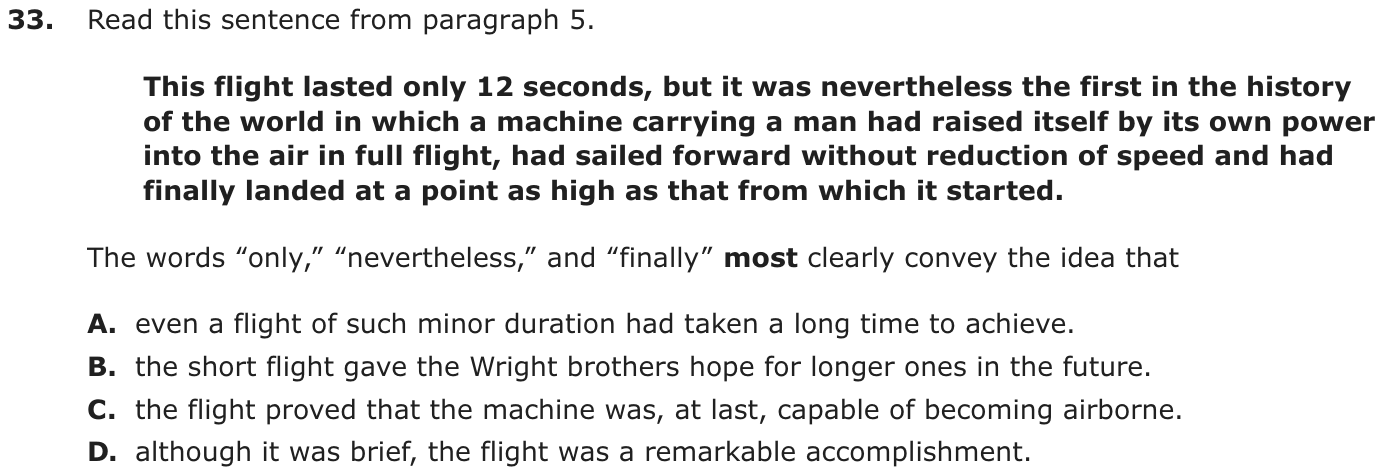
Question 36 of 57
2019 Test A English, question 36Uses the passage above: “Excerpt from “How We Made the First Flight””.
Question
Read this sentence from paragraph 5.
As the velocity of the wind was over 35 feet per second and the speed of the machine over the ground against this wind ten feet per second, the speed of the machine relative to the air was over 45 feet per second, and the length of the flight was equivalent to a flight of 540 feet made in calm air.
How does the sentence help convey Orville Wright’s perspective about this first flight?
- AIt provides evidence that he maintained a scientific approach when attempting flight.
- BIt emphasizes that he believed the flight was successful despite its short distance.
- CIt provides a comparison between flight distances under calm and high wind conditions.
- DIt highlights the importance of such calculations in the success of future flights.
Show the answer
Correct answer: B
The question asks how the sentence from paragraph 5 helps convey Orville Wright’s perspective about the first flight.
A. Incorrect. Since there is no indication in the sentence from paragraph 5 that Orville took these measurements while he was flying the plane, the idea that he maintained a scientific approach when attempting flight is an assumption rather than fact. It also does not account for the equivalent distance of the flight in calm air, which emphasizes the importance of the accomplishment.
B. CORRECT. In the sentence from paragraph 5, Orville uses the wind velocity and the machine speed to highlight the distance that the plane covered while in the air and to determine the distance that it would have flown on a day with calm winds, which emphasizes the magnitude of the accomplishment.
C. Incorrect. Since Orville does not suggest in the sentence from paragraph 5 how far the plane traveled under the actual conditions of high winds, the comparison is incomplete. Additionally, this statement does not address the reason that he would make such a comparison, which allowed him to describe the flight in more impressive terms (540 feet versus 120 feet).
D. Incorrect. Unlike the wind velocity calculations made in preparation for the flight, which along with pilot experience might help in determining the success of future flights, the calculations that Orville provides in the sentence from paragraph 5 interpret the results of the first flight and communicate its success.
Question analysis
In Orville Wright’s report on the first powered flight, a long sentence works through wind speeds, air speeds and distances, and this point-of-view question asks what that sentence shows about how he viewed the flight. Students must work out what purpose the numbers serve, and more than one option describes the sentence in a way that sounds accurate.
- Grade level
- Grade 8 reading and task
- Compared with grade 7
- Above grade 7 Inferring a writer’s attitude from a sentence of measurements, with no opinion words at all, goes beyond typical grade 7 point-of-view work, and 1903 technical terms such as “velocity” add to the reading load.
- Estimated difficulty
- Hard: combines ideas, needs a plan, and has more than one tempting wrong answer.
- Thinking it demands
- Depth of knowledge 3, strategic thinking · mainly analyze
- What makes it hard
- How, not what moderate
- Reading between the lines moderate
- Complex sentences minor
- Evidence
- Answered from one paragraph or stanza
- Reading level
- Passage: about grade 7, 816 words; question and choices: about grade 9, 127 words.
- Students, last 30 days
- Not enough answers yet to show (it takes 10).
Why it is hard, traps and wrong answers (shows the answer)
Why it is hard
A question about perspective usually turns on words of feeling, but this sentence offers nothing except speeds and a distance. Students have to ask why Orville bothers with the arithmetic, and the answer is that 540 feet in calm air turns a 12-second hop into the achievement he believed it was. In this printing the most tempting wrong choice credits him with a scientific approach, which fits the sentence’s manner exactly but describes his method rather than his judgment of the flight.
How, not what moderate Working it out
The stem asks what the calculation reveals, so students must see that converting a short hop into “a flight of 540 feet made in calm air” is Orville’s way of arguing that the flight counted. (Anderson & Krathwohl, 2001)
Reading between the lines moderate Working it out
No word in the sentence names a feeling or a verdict; his belief in the flight’s success has to be read from his decision to recast roughly 120 feet over the ground as 540 feet through still air. (Graesser, Singer & Trabasso, 1994; Kintsch, 1998)
Complex sentences minor Understanding the question
One 61-word sentence links four figures, a wind over 35 feet per second, a ground speed of ten, an airspeed over 45 and the 540-foot equivalent, through “As,” two “and”s and a run of commas. (Abedi & Lord, 2001; Freedle & Kostin, 1993; Messick, 1989)
Strategy: Put the sentence’s figures into plain words, such as how far the flight would have reached in still air, and then ask what Orville gains by giving readers that figure.
Traps
- True but not the answer: A choice says something accurate about the text that does not answer this question.
- Wrong purpose or structure: Names a purpose, structure or effect that the part does not serve, or describes what a part says when the question asks what it does.
- Outside knowledge: A choice is plausible in the real world but not supported by this text.
The wrong answers, classified
A True but not the answer (King et al., 2004; Embretson & Wetzel, 1987)
Rightly sees careful measurement in every clause, in keeping with the anemometer readings of paragraph 3, but a scientific habit shows how Orville worked, not what he concluded about this flight.
C Wrong purpose or structure (Anderson & Krathwohl, 2001)
Describes what the sentence contains, a flight set against one in calm air, without saying what that comparison shows about Orville’s view of the flight, which is what the question asks.
D Outside knowledge (King et al., 2004; Recht & Leslie, 1988)
Supposes such figures were recorded to plan later attempts, as one might expect of inventors, but the sentence sizes up the flight just ended and says nothing about the future.
Working it out, step by step
Figure out what the question asks
This asks about Orville Wright’s perspective, or point of view, on the first flight. In other words, what did he think of it? The quoted sentence is full of numbers, not feelings. So ask why Orville bothered to work out these numbers.
Sort out the numbers
The wind blew against the machine at over 35 feet per second. The machine moved over the ground at 10 feet per second. It flew into the wind, so the air rushed past it at both speeds added. That is more than 35 + 10 = 45 feet per second. The flight lasted 12 seconds. Over the ground, that is 10 × 12 = 120 feet. Through the air, it is 45 × 12 = 540 feet.
Ask why Orville does this math
Paragraph 5 says the flight ended “a little over 120 feet from the point at which it rose into the air.” That sounds short. So Orville shows that, in calm air, the same flight would have gone 540 feet. The next sentence says the flight “lasted only 12 seconds.” Yet it was still “the first in the history of the world” of its kind. So he sees the short flight as a real success.
Check each choice
- A is partly true. The careful numbers do show a scientific way of working. But that is about how Orville works, not what he thinks of this flight.
- B fits. The math turns a short hop into a 540-foot flight. It shows he believed the flight was a success.
- C does not fit. The sentence does compare windy air with calm air. But C only says what the sentence contains, not what Orville thinks.
- D does not fit. The math measures the flight that just ended. It says nothing about future flights.
Choose the answer
Watch out: A is tempting because the sentence really is careful and exact. But the question asks for his perspective about this first flight. Only B tells what he concluded about it. So the answer is B.
Why this answer and not the closest wrong one
A is the closest wrong answer, and it is partly true: the measurements are scientific. But A describes Orville’s method, not his view of the flight. The question asks what the sentence shows he thought. He turns about 120 feet into “a flight of 540 feet made in calm air” to show the flight counted. That is B.
More questions like this
The original DOE question
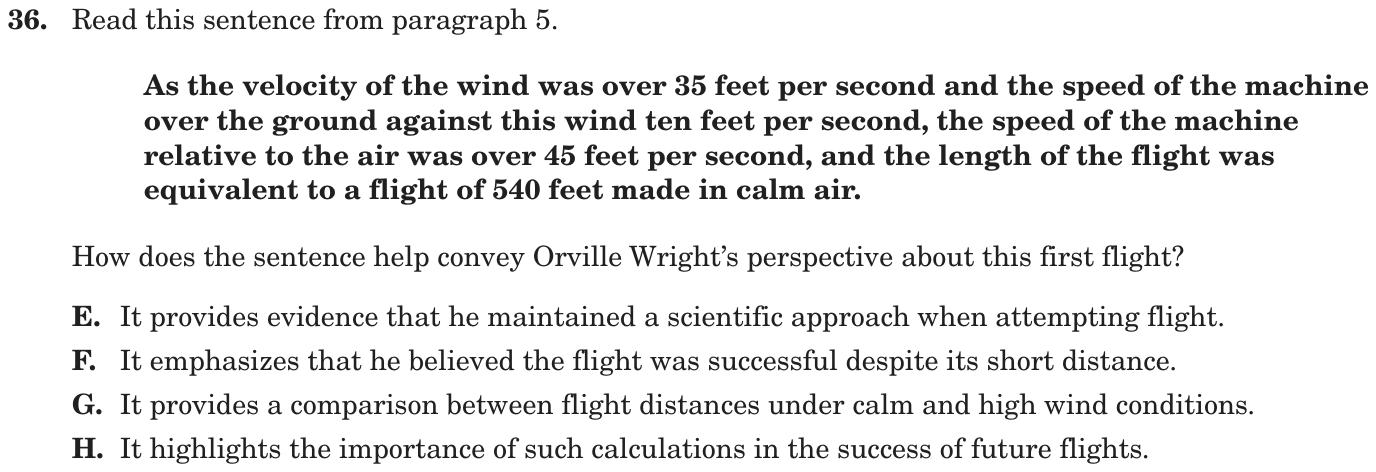
Question 37 of 57
2019 Test A English, question 37Uses the passage above: “Excerpt from “How We Made the First Flight””.
Question
How do the details in paragraph 5 about the uneven nature of the flight convey a central idea of the excerpt?
- Aby explaining how the flawed design of the machine caused it to turn unpredictably in the air and brought the first flight by a person to an abrupt end
- Bby indicating that the difficulty in controlling the flight was caused by the rudimentary instruments of the machine and the inexperience of the pilot
- Cby explaining how the pilot and the plane overcame adverse conditions in order to complete the first piloted flight
- Dby indicating that the gradual change in wind velocity created an extreme environment in which to maneuver the plane and maintain its flight
Show the answer
Correct answer: C
The question asks how the details in paragraph 5 about the uneven nature of the flight convey a central idea of the excerpt.
A. Incorrect. Paragraph 5 explains that the rudder was unbalanced and the effect that this issue had on the flight, but the rudder was only part of the reason for the short flight. The length of the flight is not a central idea of the excerpt.
B. Incorrect. Although paragraph 5 does explain that the equipment contributed to the difficulty of controlling the plane’s flight, the lack of control over the flight is not a central idea of the excerpt, which focuses instead on the Wright brothers’ achievement of a successful flight despite the challenges involved.
C. CORRECT. The details in paragraph 5 describe the difficulties that the weather conditions and mechanical issues presented and how Orville’s flight was successful despite those problems. The Wright brothers’ ability to overcome difficult circumstances and complete the first flight is a central idea of the excerpt.
D. Incorrect. While paragraph 5 does emphasize the difficulty caused by the wind, it does not describe a “gradual change” in the wind, only that it was irregular.
Question analysis
This central-idea question asks how the details in paragraph 5 of Orville Wright’s “How We Made the First Flight,” which describe the machine darting up and down because of uneven air, a hard-to-control front rudder and the pilot’s inexperience, convey a central idea of the excerpt. The paragraph also includes speeds and distances, and students must decide what its details mean for the account as a whole.
- Grade level
- Grade 8 reading and task
- Compared with grade 7
- At grade 7 Linking a paragraph’s details to a central idea is regular grade 7 work. This paragraph is long and technical, with a rudder problem and a calculation of speeds, and most choices restate its problems accurately, so students must decide what the details add up to.
- Estimated difficulty
- Moderate: several steps, or a close reading with one strong distractor.
- Thinking it demands
- Depth of knowledge 2, skills and concepts · mainly understand
- What makes it hard
- The right answer is reworded moderate
- A lot to read minor
- Reading between the lines minor
- Evidence
- Answered from one paragraph or stanza
- Reading level
- Passage: about grade 7, 816 words; question and choices: about grade 12, 115 words.
- Students, last 30 days
- Not enough answers yet to show (it takes 10).
Why it is hard, traps and wrong answers (shows the answer)
Why it is hard
Most of paragraph 5 is about trouble, the uneven air, a rudder balanced too near the center, an inexperienced pilot and a dart that ended the flight, and two wrong choices describe that trouble accurately. What turns the details into a central idea is the paragraph’s last sentence, which calls the 12-second flight the first of its kind in history. Students who stop before it, or who take the problems as the point, miss that the excerpt is a story of success.
The right answer is reworded moderate Choosing the answer
The key’s “overcame adverse conditions” sums up the paragraph in new words, while the wrong choices repeat its own: the rudder’s “tendency to turn itself,” the dart that “ended the flight,” the “lack of experience” and “the velocity of the wind.” (Freedle & Kostin, 1993; Kirsch & Mosenthal, 1990)
A lot to read minor Understanding the question
Paragraph 5 runs about 250 words, and its problems and a 61-word speed calculation all come before the closing sentence, the only one that presents the flight as a success. (Kintsch, 1998; Gorin & Embretson, 2006; Freedle & Kostin, 1993)
Reading between the lines minor Working it out
The paragraph never says anyone overcame anything; students must set its problems beside its last sentence, a machine that “sailed forward” and landed “as high as that from which it started,” to see success despite them. (Graesser, Singer & Trabasso, 1994; Kintsch, 1998)
Strategy: Note what each part of paragraph 5 describes, from its first sentence to its last, then decide what the excerpt as a whole is about and choose the option that ties the two together.
Traps
- Too narrow: A single detail offered as the central idea or a summary, or a summary that keeps minor details and leaves out an essential part.
- True but not the answer: A choice says something accurate about the text that does not answer this question.
- Twists what the text says: Uses the text's topic and ideas but changes what it says: who did it, how much, when, or why.
The wrong answers, classified
A Too narrow (King et al., 2004)
Gets the rudder and the dart that ended the flight right but builds on that one failure, dropping the paragraph’s closing point that the short flight was still history’s first.
B True but not the answer (King et al., 2004; Embretson & Wetzel, 1987)
Restates the paragraph’s own explanation of the erratic course, inexperience and a hard-to-control rudder, which is accurate, but treats the lack of control as the point when the excerpt builds toward success.
D Twists what the text says (King et al., 2004)
Picks up “the velocity of the wind” and the hard flying but invents a “gradual change” in the wind, when the paragraph speaks only of “the irregularity of the air.”
Working it out, step by step
Figure out what the question asks
This is a central idea question. A central idea is a main point of the whole excerpt. Paragraph 5 describes an uneven, bumpy flight. The question asks how those details support a main point. So read the whole paragraph, including its last sentence.
Find the problems in paragraph 5
Paragraph 5 begins “The course of the flight up and down was exceedingly erratic, partly due to the irregularity of the air, and partly to lack of experience in handling this machine.” Erratic means jumpy and hard to predict. The front rudder, a part that steers, was hard to control. The machine “would rise suddenly to about ten feet, and then as suddenly dart for the ground.”
Read the last sentence
Then the paragraph turns. It says “This flight lasted only 12 seconds, but it was nevertheless the first in the history of the world in which a machine carrying a man had raised itself by its own power into the air in full flight.” Nevertheless means “even so.” The wind, the hard steering and the pilot’s inexperience all worked against him. Even so, the flight worked. Conditions that work against you are called adverse.
Check each choice
- A does not fit. The rudder problem and the sudden end are real. But A stops there and misses that the flight was a first.
- B does not fit. Paragraph 5 does blame the rudder and the pilot’s inexperience. But the excerpt is about success, not about the lack of control.
- C fits. The problems show what Orville overcame to make the first flight.
- D does not fit. The paragraph never says the wind changed gradually, or slowly. It speaks of “the irregularity of the air.”
Watch out: B is tempting because it repeats the paragraph’s own reasons for the bumpy flight. But true details are not the same as the main point.
Choose the answer
The problems in paragraph 5 make the success at the end more impressive. So the answer is C, “by explaining how the pilot and the plane overcame adverse conditions in order to complete the first piloted flight.”
Why this answer and not the closest wrong one
B is the closest wrong choice. It is true that the rudder and the pilot’s “lack of experience” made the flight hard to control. But that is only the first part of paragraph 5. The last sentence calls the flight the first of its kind. The problems show what had to be overcome. C ties the details to that success.
More questions like this
The original DOE question
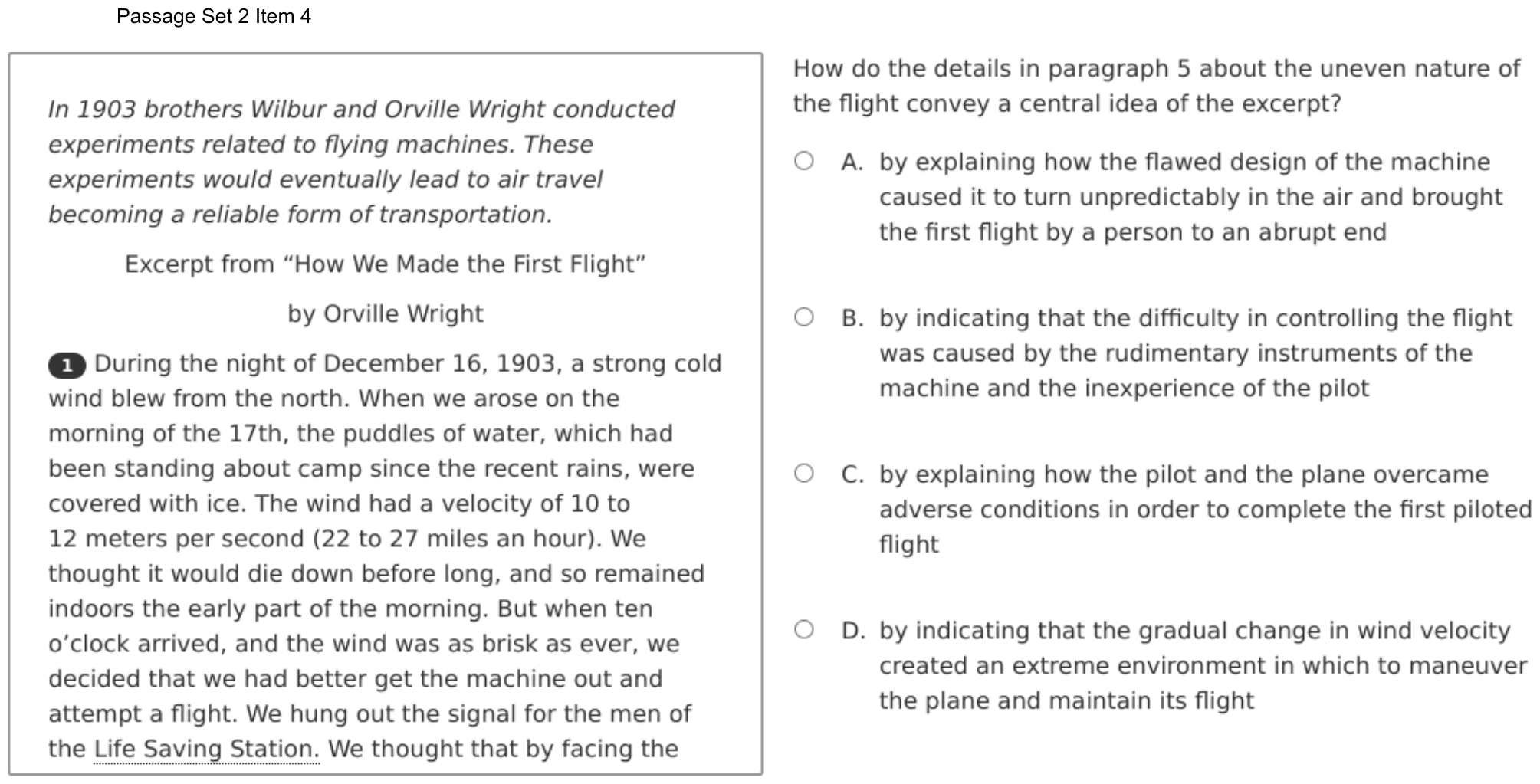
Question 38 of 57
2019 Test A English, question 38Uses the passage above: “Excerpt from “How We Made the First Flight””.
Question
Which sentence from the excerpt best supports the idea that the Wright brothers had to adapt their plans for the flight in order to accommodate the weather conditions?
- A“When we arose on the morning of the 17th, the puddles of water, which had been standing about camp since the recent rains, were covered with ice.” (paragraph 1)
- B“We realized the difficulties of flying in so high a wind, but estimated that the added dangers in flight would be partly compensated for by the slower speed in landing.” (paragraph 1)
- C“After running the motor a few minutes to heat it up, I released the wire that held the machine to the track, and the machine started forward in the wind.” (paragraph 4)
- D“The course of the flight up and down was exceedingly erratic, partly due to the irregularity of the air, and partly to lack of experience in handling this machine.” (paragraph 5)
Show the answer
Correct answer: B
The question asks which sentence from the excerpt best supports the idea that the Wright brothers had to adapt their plans for the flight in order to accommodate weather conditions.
A. Incorrect. Although the sentence from paragraph 1 mentions the rainy weather and frozen puddles, it does not specifically explain how these weather conditions forced the brothers to adapt their plans for the flight.
B. CORRECT. The sentence from paragraph 1 reveals that the Wright brothers adapted by making a risk calculation, based on the wind speed, before the flight. The high speed of the wind could cause difficulties in flight while simultaneously allowing for a slower, more controlled landing.
C. Incorrect. The sentence from paragraph 4 does mention wind, but it describes what Orville was doing during the attempted flight, not the factors he considered before the flight in order to adapt the plan.
D. Incorrect. Although the sentence from paragraph 5 mentions the “irregularity of the air” during the flight, the sentence does not describe how the brothers adapted their plans for the flight based on the weather.
Question analysis
This evidence question on Orville Wright’s account of the first flight asks which sentence best supports the idea that the Wright brothers had to adapt their plans for the flight to the weather conditions. The four quotations come from paragraphs 1, 4 and 5 and all mention ice, wind or air, so students must look past the weather words to what each sentence shows the brothers doing.
- NYS standards
- 7R1 textual evidence and inferences
- Grade level
- Grade 7 reading and task
- Compared with grade 7
- At grade 7 Choosing the sentence that best supports an idea is core grade 7 evidence work. The four quotations are printed in full with their paragraph numbers, and the idea has two parts, weather and a change of plans, so the check is careful but typical.
- Estimated difficulty
- Straightforward: two steps or one careful reading.
- Thinking it demands
- Depth of knowledge 2, skills and concepts · mainly evaluate
- What makes it hard
- Evidence
- Answered from several paragraphs or stanzas
- Reading level
- Passage: about grade 7, 816 words; question and choices: about grade 13, 148 words.
- Students, last 30 days
- Not enough answers yet to show (it takes 10).
Why it is hard, traps and wrong answers (shows the answer)
Why it is hard
The idea has two parts, the weather and a change in the brothers’ plans, and every quotation carries the first. Students who look only for weather words can be drawn to the erratic flight or the launch into the wind. Only one sentence shows the brothers thinking about the wind before they flew and deciding how to proceed, and once the second half of the idea is in view the choice is quick.
Every choice must be checked minor Choosing the answer
All four quotations mention ice, wind or air, so the weather half of the idea rules nothing out; each must be checked for the other half, a decision the brothers made because of it. (Embretson & Wetzel, 1987)
Reading between the lines minor Working it out
The key never says plan or adapt; students must see that weighing “the added dangers in flight” against “the slower speed in landing” is the brothers fitting their decision to the wind. (Graesser, Singer & Trabasso, 1994; Kintsch, 1998)
Strategy: Split the idea into its two parts, the weather and a change in the brothers’ plans, and keep only a quotation that shows both, not one that shows the weather alone.
Traps
- Supports only part of the claim: In a question about evidence: a line that backs one half of the claim but not the other, or a related point rather than the claim itself.
- True but not the answer: A choice says something accurate about the text that does not answer this question.
The wrong answers, classified
A True but not the answer (King et al., 2004; Embretson & Wetzel, 1987)
Picks the frozen puddles as proof of harsh weather, which they are, but the sentence only sets the scene and shows nothing the brothers did or decided because of it.
C Supports only part of the claim (King et al., 2004; Thissen, Steinberg & Fitzpatrick, 1989)
Takes running the motor “to heat it up” and starting “in the wind” as adjustments to the cold, but the sentence narrates the launch and never says a plan changed.
D Supports only part of the claim (King et al., 2004; Thissen, Steinberg & Fitzpatrick, 1989)
Notices “the irregularity of the air” linking the weather to the flight, but this sentence explains why the course was erratic once the machine was up, not how the brothers prepared.
Working it out, step by step
Figure out what the question asks
This asks for the sentence that best supports an idea. The idea has two parts. First, there was bad weather. Second, the brothers had to adapt, or change, their plans because of it. All four choices mention ice, wind or air. So look for the one that also shows a decision.
Check each sentence for both parts
- A shows the weather: icy puddles. But no one decides anything.
- B shows the wind and the brothers’ thinking about it before the flight.
- C describes the launch. It tells what Orville did, not a change of plans.
- D explains why the flight was bumpy once it was in the air. It shows no plan.
Read the sentence that fits
Paragraph 1 says “We realized the difficulties of flying in so high a wind, but estimated that the added dangers in flight would be partly compensated for by the slower speed in landing.” To estimate is to make a careful guess. Compensated for means “made up for.” The brothers knew the strong wind made flying harder. They weighed that against a good effect: a slower landing. Then they decided to fly anyway.
Explain how this shows adapting
The brothers did not just notice the wind. They thought about how it would change the flight, the bad and the good. They also planned on “facing the flyer into a strong wind.” Making plans that fit the weather is what adapting means.
Watch out: D is tempting because it links “the irregularity of the air” to the flight. But it tells what happened during the flight, not how the brothers planned for it.
Choose the answer
Only one sentence shows the brothers fitting their decision to the wind before they flew. So the answer is B, “We realized the difficulties of flying in so high a wind, but estimated that the added dangers in flight would be partly compensated for by the slower speed in landing.”
Why this answer and not the closest wrong one
D is the closest wrong choice. It does connect the weather to the flight. But it describes what happened in the air, after the plans were made. The idea needs the brothers changing plans because of the weather. Only B shows them thinking through the wind’s dangers and benefits before they decided to fly.
More questions like this
The original DOE question
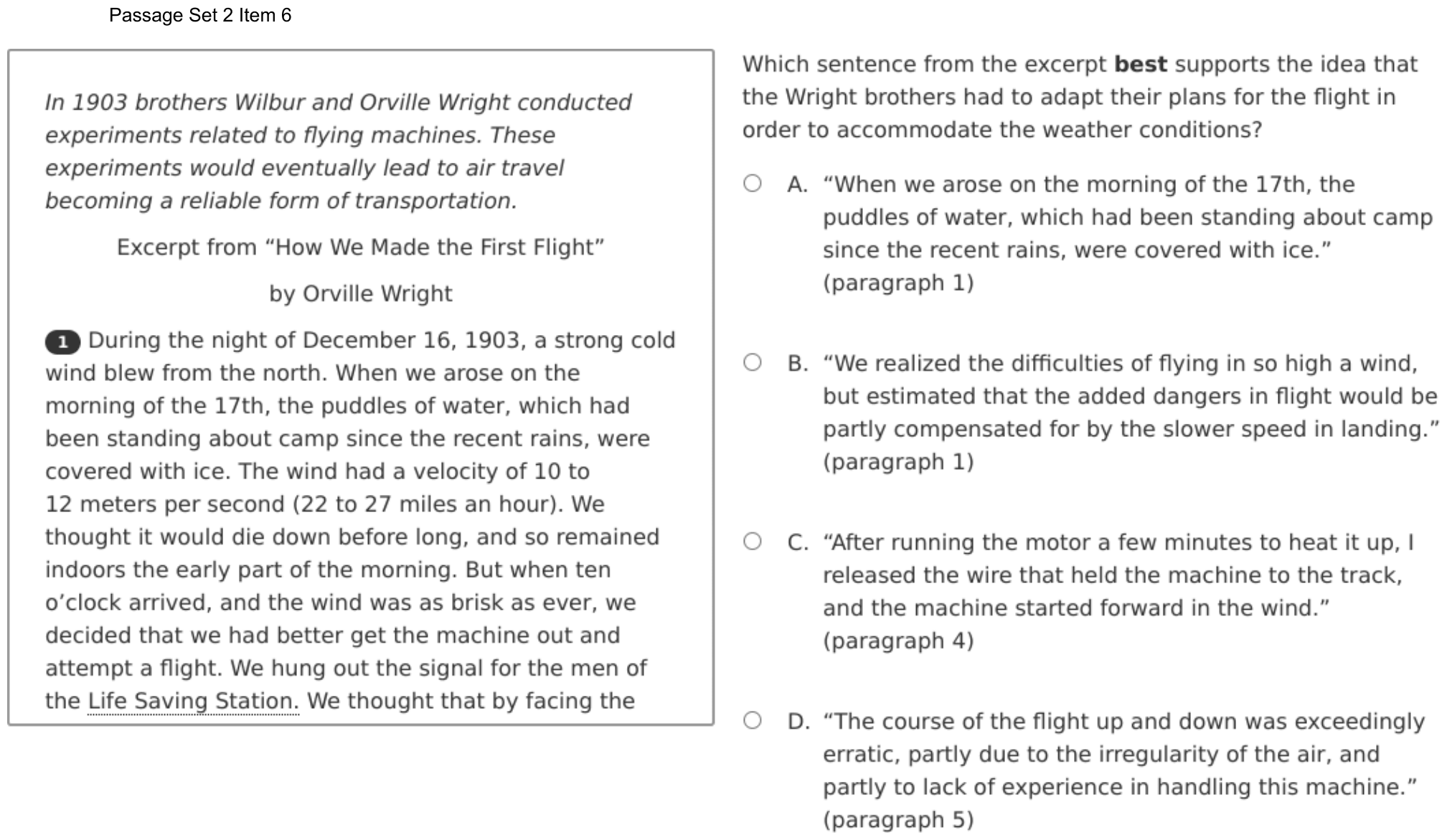
Question 39 of 57
2019 Test A English, question 39Uses the passage above: “Excerpt from “How We Made the First Flight””.
Question
The use of chronological structure contributes to the development of ideas in the excerpt by
- Aoutlining the actions that the Wright brothers took to prepare for and successfully complete the first flight.
- Bidentifying the primary factors that allowed the Wright brothers to overcome obstacles and achieve the first flight.
- Cshowing how the Wright brothers applied lessons learned from their previous flight attempts to accomplish the first flight.
- Ddemonstrating how the Wright brothers analyzed the impact of wind velocity to identify the ideal conditions for the first flight.
Show the answer
Correct answer: A
The question asks how the use of chronological structure contributes to the development of ideas in the excerpt.
A. CORRECT. Through the chronological structure, Orville addresses all stages of the flight in a way that builds from flight concerns and preparations for takeoff to his experiences during the flight and his successful landing.
B. Incorrect. While obstacles are presented within the excerpt, the chronological structure emphasizes the events that ended in the successful achievement of flight on that day rather than how the Wright brothers overcame obstacles.
C. Incorrect. The chronological structure of the excerpt does not show that the Wright brothers applied lessons learned from their previous attempts at flight; instead, the structure describes Orville’s December 17 attempt.
D. Incorrect. While Orville’s narrative certainly shows a strong need to analyze wind speed, this idea is not conveyed through the chronological structure of the excerpt. Additionally, the description of the first flight on December 17 indicates that it did not take place in ideal conditions (“We realized the difficulties of flying in so high a wind” [paragraph 1] and “The course of the flight up and down was exceedingly erratic, partly due to the irregularity of the air” [paragraph 5]).
Question analysis
This text-structure question asks how the chronological structure of Orville Wright’s “How We Made the First Flight,” an account that begins on the night of December 16, 1903, contributes to the development of ideas in the excerpt. Students must see what telling events in time order does for the account. Each choice names a purpose that could suit a story of the first airplane flight.
- Grade level
- Grade 7 reading and task
- Compared with grade 7
- Below grade 7 Grade 7 structure questions often ask how a less obvious pattern, such as problem and solution, shapes ideas. This excerpt is plainly told in time order, with dates and section headings, so recognizing what that order does is a lighter task.
- Estimated difficulty
- Straightforward: two steps or one careful reading.
- Thinking it demands
- Depth of knowledge 2, skills and concepts · mainly analyze
- What makes it hard
- How, not what minor
- A very close wrong answer minor
- Evidence
- Answered from the whole text
- Reading level
- Passage: about grade 7, 816 words; question and choices: about grade 11, 87 words.
- Students, last 30 days
- Not enough answers yet to show (it takes 10).
Why it is hard, traps and wrong answers (shows the answer)
Why it is hard
The excerpt is plainly chronological, with a date in its first sentence and headings that move from “Final Preparations” to “Flight,” so the structure is easy to recognize. The difficulty is in saying what that order does. The strongest pull sounds like the excerpt’s central idea, success over obstacles, but ranking the causes of success is analysis, not sequence, and the other choices invent lessons from the failed attempt on the 14th or a search for ideal winds.
How, not what minor Working it out
The question asks what telling events in time order does, and the excerpt moves from the night of December 16 through laying the track and the launch to the flight, so the structure’s job is to trace those steps. (Anderson & Krathwohl, 2001)
A very close wrong answer minor Choosing the answer
The choice about the primary factors shares the key’s ending, achieving the first flight; it differs in its first half, an analysis of what made success possible, which a time order does not set out. (Embretson & Wetzel, 1987; Gorin & Embretson, 2006; Ascalon et al., 2007)
Strategy: Skim the section headings and the first sentence of each paragraph to see how the excerpt moves through time, then test each choice against what a time order can do.
Traps
- Wrong purpose or structure: Names a purpose, structure or effect that the part does not serve, or describes what a part says when the question asks what it does.
- Twists what the text says: Uses the text's topic and ideas but changes what it says: who did it, how much, when, or why.
- Reads too much in: A reasonable-sounding conclusion that goes further than the text allows.
The wrong answers, classified
B Wrong purpose or structure (Anderson & Krathwohl, 2001)
Expects the structure to explain why the flight succeeded, a fair summary of the excerpt’s message, but time order tells events as they happened and never ranks which factors mattered most.
C Reads too much in (Graesser, Singer & Trabasso, 1994)
Builds on the failed attempt of the 14th and assumes the brothers learned from it, though the excerpt only contrasts that calm start with this windy one.
D Twists what the text says (King et al., 2004)
Recalls the anemometer readings and the risk estimate and turns them into a search for ideal conditions, though the brothers flew in a wind whose difficulties and added dangers they admitted.
Working it out, step by step
Figure out what the question asks
This is a structure question. Chronological structure means telling events in time order, from first to last. The question asks what that order does for the excerpt. So first check how the excerpt moves through time.
Trace the order of events
Look at the section headings and the start of each paragraph.
- Paragraph 1 starts “During the night of December 16, 1903.” The brothers decide to fly.
- Under “Final Preparations,” they lay the track and measure the wind.
- Under “Audacity—and Calculation,” Orville takes off.
- Under “Flight,” the machine flies and lands.
Say what the time order does
The story moves step by step. It goes from getting ready, to taking off, to flying, to landing. Each step leads to the next. By the end, you have followed everything the brothers did to make the first flight happen. The last sentence says the machine “had finally landed at a point as high as that from which it started.”
Check each choice
- A fits. Time order lays out what the brothers did to prepare and then to fly.
- B does not fit. Primary factors are the main causes. Time order tells events as they happen. It does not rank which causes mattered most.
- C does not fit. The excerpt mentions the failed try on the 14th. But it never says what they learned from it.
- D does not fit. They did not wait for ideal, or perfect, conditions. They flew in a strong wind and knew its dangers.
Watch out: B is tempting because the excerpt does show success over problems. But naming the main causes of success is a different job from telling events in order.
Choose the answer
The time order walks you through the preparations, the takeoff and the flight. So the answer is A, “outlining the actions that the Wright brothers took to prepare for and successfully complete the first flight.”
Why this answer and not the closest wrong one
B is the closest wrong choice. The excerpt does show the brothers succeeding despite problems. But time order cannot explain which factors mattered most. It just tells events in the order they happened. That is what A says: the time order outlines the actions, from getting ready to completing the flight.
More questions like this
The original DOE question
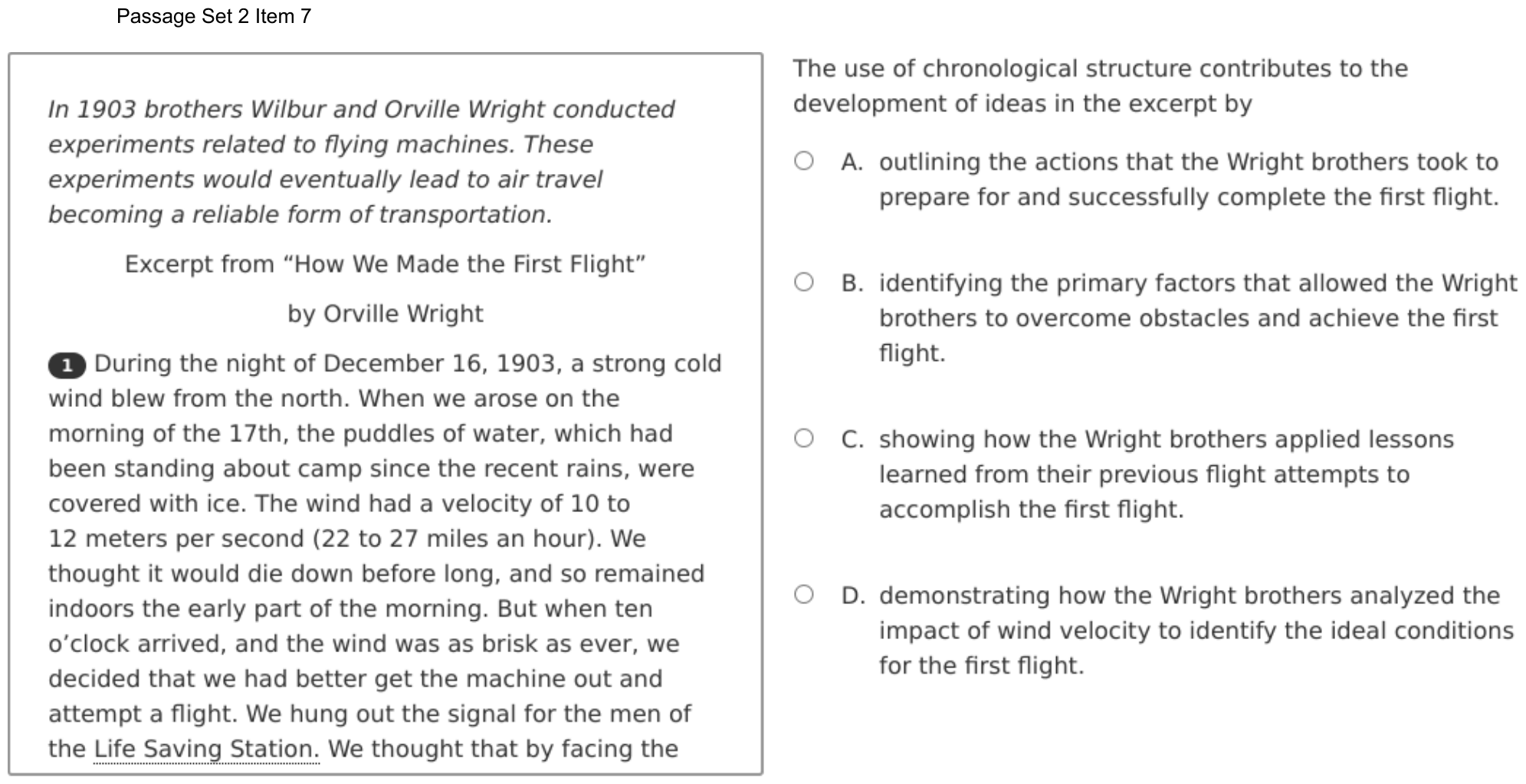
Question 40 of 57
2019 Test A English, question 40Passage Excerpt from In Search of the Unknown
Excerpt from In Search of the Unknown
by Robert W. Chambers
It was at that time the policy of the trustees and officers of the Zoological Gardens neither to employ collectors nor to send out expeditions in search of specimens. The society decided to depend upon voluntary contributions, and I was always busy, part of the day, in dictating answers to correspondents who wrote offering their services as hunters of big game, collectors of all sorts of fauna, trappers, snarers, and also to those who offered specimens for sale, usually at exorbitant rates.
To the proprietors of . . . mangy lynxes, moth-eaten coyotes, and dancing bears I returned courteous but uncompromising refusals—of course, first submitting all such letters, together with my replies, to Professor Farrago.
One day towards the end of May, however, just as I was leaving Bronx Park to return to town, Professor Lesard, of the reptilian department, called out to me that Professor Farrago wanted to see me a moment; so I . . . retraced my steps to the temporary, wooden building occupied by Professor Farrago, general superintendent of the Zoological Gardens. The professor, who was sitting at his desk before a pile of letters and replies submitted for approval by me, pushed his glasses down and looked over them at me with a whimsical smile that suggested amusement, impatience, annoyance, and perhaps a faint trace of apology.
“Now, here’s a letter,” he said, with a deliberate gesture towards a sheet of paper impaled on a file—“a letter that I suppose you remember.” He disengaged the sheet of paper and handed it to me.
“Oh yes,” I replied, with a shrug; “of course the man is mistaken—or—”
“Or what?” demanded Professor Farrago, tranquilly, wiping his glasses.
“—Or a liar,” I replied.
After a silence he leaned back in his chair and bade me read the letter to him again, and I did so with a contemptuous tolerance for the writer, who must have been either a very innocent victim or a very stupid swindler. I said as much to Professor Farrago, but, to my surprise, he appeared to waver.
“I suppose,” he said, with his near-sighted, embarrassed smile, “that nine hundred and ninety-nine men in a thousand would throw that letter aside and condemn the writer as a liar or a fool?”
“In my opinion,” said I, “he’s one or the other.”
“He isn’t—in mine,” said the professor, placidly.
“What!” I exclaimed. “Here is a man living all alone on a strip of rock and sand between the wilderness and the sea, who wants you to send somebody to take charge of a bird that doesn’t exist!”
“How do you know,” asked Professor Farrago, “that the bird in question does not exist?”
“It is generally accepted,” I replied, sarcastically, “that the great auk has been extinct for years. Therefore I may be pardoned for doubting that our correspondent possesses a pair of them alive.”
“Oh, you young fellows,” said the professor, smiling wearily, “you embark on a theory for destinations that don’t exist.”
He leaned back in his chair, his amused eyes searching space for the imagery that made him smile.
“Like swimming squirrels, you navigate with the help of Heaven and a stiff breeze, but you never land where you hope to—do you?”
Rather red in the face, I said: “Don’t you believe the great auk to be extinct?”
“Audubon saw the great auk.”
“Who has seen a single specimen since?”
“Nobody—except our correspondent here,” he replied, laughing.
I laughed, too, considering the interview at an end, but the professor went on, coolly:
“Whatever it is that our correspondent has—and I am daring to believe that it is the great auk itself—I want you to secure it for the society.”
When my astonishment subsided my first conscious sentiment was one of pity. Clearly, Professor Farrago was on the verge of dotage—ah, what a loss to the world!
I believe now that Professor Farrago perfectly interpreted my thoughts, but he betrayed neither resentment nor impatience. I drew a chair up beside his desk—there was nothing to do but to obey, and this fool’s errand was none of my conceiving.
Together we made out a list of articles necessary for me and itemized the expenses I might incur, and I set a date for my return, allowing no margin for a successful termination to the expedition.
“Never mind that,” said the professor. “What I want you to do is to get those birds here safely. Now, how many men will you take?”
“None,” I replied, bluntly; “it’s a useless expense, unless there is something to bring back. If there is I’ll wire you, you may be sure.”
“Very well,” said Professor Farrago, good-humoredly, “you shall have all the assistance you may require. Can you leave to-night?”
The old gentleman was certainly prompt. I nodded, half-sulkily, aware of his amusement.
“So,” I said, picking up my hat, “I am to start north to find a place called Black Harbor, where there is a man named Halyard who possesses, among other household utensils, two extinct great auks—”
We were both laughing by this time. I asked him why on earth he credited the assertion of a man he had never before heard of.
“I suppose,” he replied, with the same half-apologetic, half-humorous smile, “it is instinct. I feel, somehow, that this man Halyard has got an auk—perhaps two. I can’t get away from the idea that we are on the eve of acquiring the rarest of living creatures. It’s odd for a scientist to talk as I do; doubtless you’re shocked—admit it, now!”
But I was not shocked; on the contrary, I was conscious that the same strange hope that Professor Farrago cherished was beginning, in spite of me, to stir my pulses, too.
“If he has—” I began, then stopped.
The professor and I looked hard at each other in silence.
“Go on,” he said, encouragingly.
But I had nothing more to say, for the prospect of beholding with my own eyes a living specimen of the great auk produced a series of conflicting emotions within me which rendered speech profanely superfluous.
From IN SEARCH OF THE UNKNOWN by Robert W. Chambers—Public Domain
Audubon: John James Audubon, an ornithologist and artist who created scientific illustrations of birds
dotage: a loss of reasoning brought about by old age
Question
Read paragraph 2 from the excerpt.
To the proprietors of . . . mangy lynxes, moth-eaten coyotes, and dancing bears I returned courteous but uncompromising refusals—of course, first submitting all such letters, together with my replies, to Professor Farrago.
This paragraph helps develop the plot by establishing that the narrator
- Athinks that writing refusal letters for the animals offered to the zoological society is not necessary.
- Battempts to predict what the professor would say in the refusal letters.
- Cbelieves that many of the animals offered are not acceptable for the zoological society.
- Dresents the professor’s insistence on reviewing the refusal letters.
Show the answer
Correct answer: C
The question asks how paragraph 2 helps develop the plot.
A. Incorrect. As paragraph 1 indicates, writing such letters is one of the main parts of the narrator’s job (“and I was always busy, part of the day, in dictating answers to correspondents”), and he shows no indication that this work is unnecessary. The letters are to inform people whether the zoo will accept their animals.
B. Incorrect. Paragraph 2 indicates that the narrator offers his letters to the professor merely for official approval. At the start of the excerpt, the narrator is confident in his reply and does not anticipate that his response will differ from that of the professor, so he has no need to “predict what the professor would say.”
C. CORRECT. The phrase “uncompromising refusals” in paragraph 2 indicates the confidence that the narrator initially has in his belief that the animals described in the letters are not of value to the society. This confidence is badly shaken as the plot unfolds, as when Professor Farrago states that “ ‘I am daring to believe that it is the great auk itself’ ” (paragraph 23). The narrator’s transition from an attitude of dismissive doubt to one of budding hopefulness is a major part of the plot of the excerpt (“But I was not shocked; on the contrary, I was conscious that the same strange hope that Professor Farrago cherished was beginning, in spite of me, to stir my pulses, too” [paragraph 34]).
D. Incorrect. The narrator does not resent the professor’s review of the letters; instead, the phrase “of course” in paragraph 2 shows that he expects to submit the letters to the professor as part of his job.
Question analysis
Paragraph 2 of this excerpt from In Search of the Unknown, a novel by Robert W. Chambers, shows the narrator handling letters from people who offer animals to the zoological society where he works. Students must decide what the paragraph establishes about him that helps develop the plot, reading early-1900s phrasing in which tone carries much of the meaning.
- Grade level
- Grade 7 reading and task
- Compared with grade 7
- At grade 7 Grade 7 readers routinely say how a passage sets up a story. Here it is one quoted sentence, and only its formal, century-old phrasing takes extra effort, so the demand is ordinary.
- Estimated difficulty
- Straightforward: two steps or one careful reading.
- Thinking it demands
- Depth of knowledge 2, skills and concepts · mainly analyze
- What makes it hard
- Hard words moderate
- Complex sentences minor
- The right answer is reworded minor
- Evidence
- Answered from one paragraph or stanza
- Reading level
- Passage: about grade 9, 1066 words; question and choices: about grade 11, 98 words.
- Students, last 30 days
- Not enough answers yet to show (it takes 10).
Why it is hard, traps and wrong answers (shows the answer)
Why it is hard
The narrator’s attitude lives in the adjectives: the lynxes are “mangy,” the coyotes “moth-eaten” and the refusals “uncompromising.” Students who read that contempt as his feeling about the job, or who hear grumbling in “of course,” pick a feeling about the work instead of a judgment of the animals. The plot point is his early certainty that such offers are worthless, the certainty the great auk letter is about to shake.
Hard words moderate Understanding the question
“Proprietors,” “uncompromising,” “mangy” and “moth-eaten” carry the paragraph’s meaning, that owners of shabby animals get firm refusals, and a student who misses them cannot tell what the narrator thinks of the offers. (Perfetti, 2007; Freedle & Kostin, 1993)
Complex sentences minor Understanding the question
The paragraph is one inverted sentence that opens “To the proprietors of,” reaches its subject and verb, “I returned,” only partway through, and ends on a dash clause about the professor’s review. (Abedi & Lord, 2001; Freedle & Kostin, 1993; Messick, 1989)
The right answer is reworded minor Choosing the answer
Every wrong choice reuses the paragraph’s refusals and letters as “refusal letters,” while the right one restates the narrator’s scorn for the animals as a judgment that they do not suit the society. (Freedle & Kostin, 1993; Kirsch & Mosenthal, 1990)
Strategy: Read paragraph 2 together with paragraph 1, which explains the narrator’s job, and check each option against the words he actually uses; an option needs support in those words.
Traps
- Twists what the text says: Uses the text's topic and ideas but changes what it says: who did it, how much, when, or why.
- Reads too much in: A reasonable-sounding conclusion that goes further than the text allows.
- Wrong tone or attitude: Misjudges the tone, attitude or point of view, such as reading admiration as criticism, or taking a character's or subject's feelings for the author's.
The wrong answers, classified
A Twists what the text says (King et al., 2004)
Moves the scorn for “mangy” animals onto the replies themselves, as if answering were pointless, though paragraph 1 makes answering correspondents part of his daily work and he still writes courteously.
B Reads too much in (Graesser, Singer & Trabasso, 1994)
Turns the routine of showing every reply to Professor Farrago into an effort to guess the professor’s wording, though the narrator drafts the refusals himself and expects them to be approved.
D Wrong tone or attitude (Graesser, Singer & Trabasso, 1994)
Hears resentment in the dash and “of course,” but the phrase presents the review as an expected routine, and no friction with the professor appears until the great auk letter.
Working it out, step by step
Figure out what the question asks
This asks what paragraph 2 shows about the narrator, the person telling the story. It also asks how that sets up the plot, the chain of events in the story. The paragraph is one long, old-fashioned sentence. So put it in plain words first.
Put paragraph 2 in plain words
Proprietors are owners. People wrote to offer animals to the zoo, such as “mangy lynxes, moth-eaten coyotes, and dancing bears.” Mangy means with patchy, sick-looking fur. Moth-eaten means old and worn out. The narrator sent the owners “courteous but uncompromising refusals.” Courteous means polite. Uncompromising means firm, with no chance he would change his mind.
Decide what it shows about him
The words “mangy” and “moth-eaten” show what he thinks of the animals. To him, they are shabby and not worth having. So he turns them all down. This sets up the plot. So when a man writes that he has two great auks, the narrator brushes him off too. Then the professor disagrees, and the conflict begins.
Check each choice
- A does not fit. Paragraph 1 says he was “always busy, part of the day, in dictating answers to correspondents.” Writing replies is his job, and nothing says it is pointless.
- B does not fit. He writes the replies himself and then shows them to the professor. He isn’t guessing what the professor would say.
- C fits. He judges that many of the animals offered are not good enough.
- D does not fit. “Of course” shows that the review is normal. He doesn’t resent it, or feel bitter about it.
Choose the answer
Watch out: D is tempting because the dash and “of course” can sound annoyed. But “of course” here means as usual. So the answer is C.
Why this answer and not the closest wrong one
D is the closest wrong answer. The narrator does send every letter and reply to the professor. But “of course” marks this as a normal part of his job, and he shows no anger about it. The strong feeling in the paragraph is aimed at the “mangy” and “moth-eaten” animals. C names that judgment.
More questions like this
The original DOE question
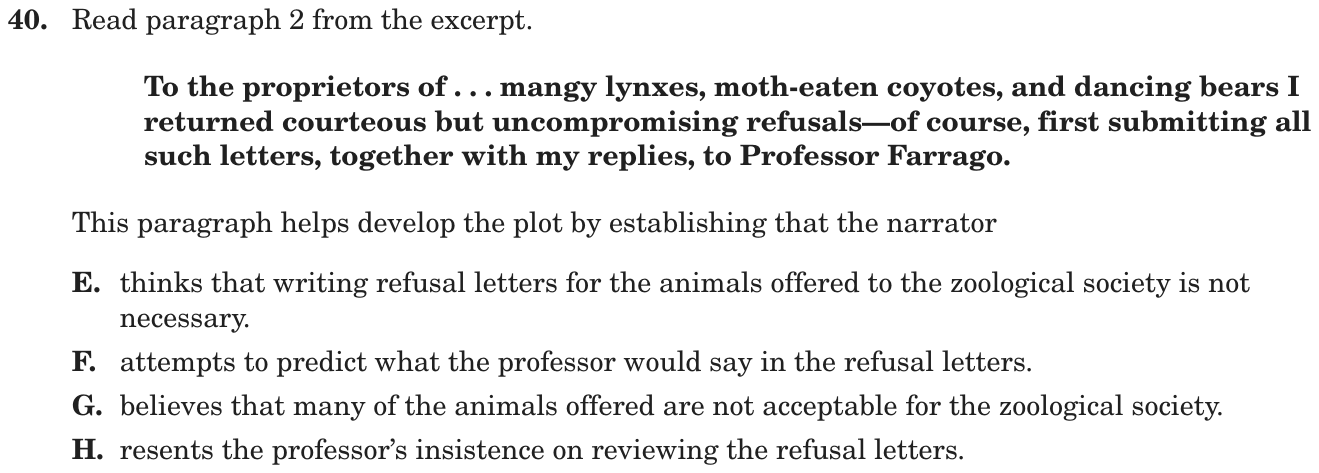
The passage “Excerpt from In Search of the Unknown” as printed (page 21)
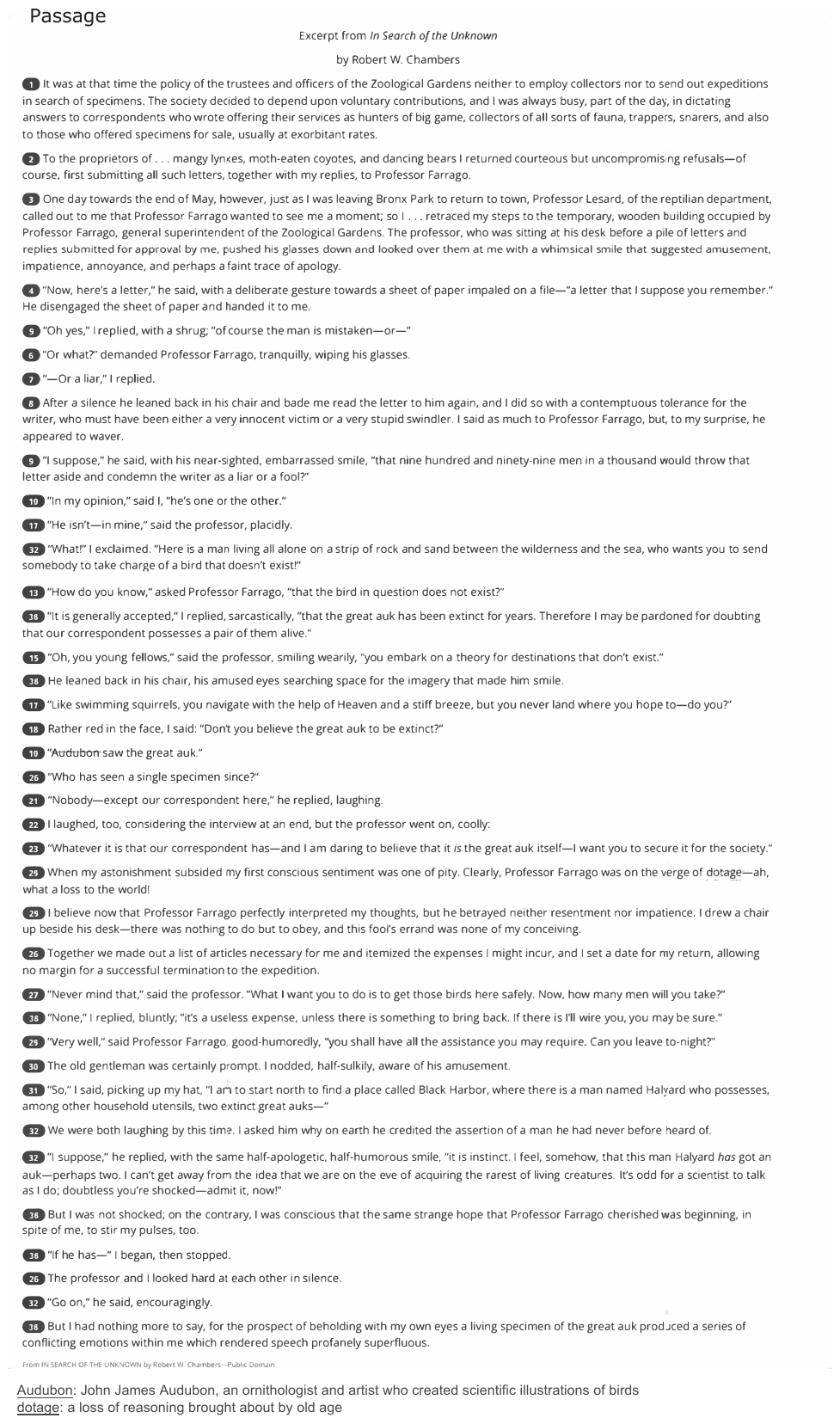
Question 41 of 57
2019 Test A English, question 41Uses the passage above: “Excerpt from In Search of the Unknown”.
Question
Read this sentence from paragraph 3.
The professor, who was sitting at his desk before a pile of letters and replies submitted for approval by me, pushed his glasses down and looked over them at me with a whimsical smile that suggested amusement, impatience, annoyance, and perhaps a faint trace of apology.
What does the phrase “a faint trace of apology” convey about the professor?
- AIt indicates that the professor feels bad that he has to call the narrator to his office after work.
- BIt shows that the professor is hesitant to share his opinions with the narrator.
- CIt implies that the professor is uncomfortable criticizing the narrator’s work.
- DIt suggests that the professor knows that the conversation will be frustrating for the narrator.
Show the answer
Correct answer: D
The question asks what the phrase “a faint trace of apology” in paragraph 3 conveys about the professor.
A. Incorrect. The fact that the narrator had intended to leave the office for the day is not the source of the professor’s faintly apologetic manner, which is instead caused by the professor’s understanding that their conversation about the letter and the expedition is likely to cause an argument (“with a whimsical smile that suggested amusement, impatience, annoyance” [paragraph 3]). In paragraph 29, the professor asks the narrator if he can leave on an expedition that same evening, which indicates that the professor does not feel bad about taking up the narrator’s time after work.
B. Incorrect. The paragraphs that follow the sentence from paragraph 3 show the professor sharing his opinions without pause, even when his opinion of the narrator is unflattering (“ ‘Like swimming squirrels, you navigate with the help of Heaven and a stiff breeze, but you never land where you hope to—do you?’ ” [paragraph 17]).
C. Incorrect. The professor knows that the narrator will push back regarding the letter, but the professor is not uncomfortable challenging the narrator. Professor Farrago seems perfectly at ease and comfortable as he begins the discussion with the narrator.
D. CORRECT. The professor is both amused and annoyed by the narrator’s dismissal of the possibility that great auks still exist, and the professor knows that the narrator is likely to react negatively to being sent on what the narrator considers a “fool’s errand” (paragraph 25).
Question analysis
This question focuses on a single phrase in the excerpt from Robert W. Chambers’s In Search of the Unknown: as the professor looks up from a pile of letters, his whimsical smile shows “a faint trace of apology.” Students must work out what that hint of apology says about him. The phrase is brief and old-fashioned, and several explanations for it seem natural.
- Grade level
- Grade 8 reading and task
- Compared with grade 7
- Above grade 7 Grade 7 students often infer a character’s feelings from a description. Here the phrase ends a 46-word sentence of early-1900s prose, follows three other moods, and has to be interpreted from the scene as a whole, beyond typical grade 7 work.
- Estimated difficulty
- Among the hardest on the SHSAT: a non-obvious approach, heavy reading, or a well-hidden trap.
- Thinking it demands
- Depth of knowledge 3, strategic thinking · mainly analyze
- What makes it hard
- Reading between the lines major
- A very close wrong answer moderate
- Evidence in several places moderate
- Complex sentences minor
- Evidence
- Answered from several paragraphs or stanzas
- Reading level
- Passage: about grade 9, 1066 words; question and choices: about grade 10, 123 words.
- Students, last 30 days
- Not enough answers yet to show (it takes 10).
Why it is hard, traps and wrong answers (shows the answer)
Why it is hard
The phrase comes before a word of the conversation is spoken, so the reason for the apology lies ahead in the text. Two natural guesses compete with it: the professor has called the narrator back just as he was leaving, and he is about to question one of the narrator’s replies. Only a reader who follows the scene to the narrator’s scorn for the letter and the errand sees that the professor, at ease throughout, is sorry for what he is about to put the narrator through.
Reading between the lines major Working it out
Nothing explains the apology; students must reason from the talk that follows, in which the professor sends the narrator after birds the narrator believes extinct, that the professor expects resistance. (Graesser, Singer & Trabasso, 1994; Kintsch, 1998)
A very close wrong answer moderate Choosing the answer
The choice about criticizing the narrator’s work and the right one both tie the apology to the coming talk about a letter; one places discomfort in the professor, the other frustration in the narrator. (Embretson & Wetzel, 1987; Gorin & Embretson, 2006; Ascalon et al., 2007)
Evidence in several places moderate Working it out
What the professor anticipates appears only later: the narrator’s scorn for the letter in paragraphs 5–14 and his view of the trip as a “fool’s errand” in paragraph 25. (Kirsch & Mosenthal, 1990; Gorin & Embretson, 2006)
Complex sentences minor Understanding the question
The phrase closes a 46-word sentence, after a clause about the pile of letters and a run of three other moods, “amusement, impatience, annoyance.” (Abedi & Lord, 2001; Freedle & Kostin, 1993; Messick, 1989)
Strategy: Read the full sentence and then the conversation it opens, and test each choice against how the professor actually speaks and acts in that conversation.
Traps
- Reads too much in: A reasonable-sounding conclusion that goes further than the text allows.
- Half right: One half of a two-part choice is right and the other is not.
- Twists what the text says: Uses the text's topic and ideas but changes what it says: who did it, how much, when, or why.
The wrong answers, classified
A Reads too much in (Graesser, Singer & Trabasso, 1994)
Ties the apology to the timing, since Professor Lesard stopped the narrator as he was leaving Bronx Park, but the professor later asks him to leave on the trip that same night.
B Twists what the text says (King et al., 2004)
Reads the apology, and the “embarrassed smile” of paragraph 9, as reluctance to speak, though the professor states his belief in the letter plainly and even teases the narrator.
C Half right (King et al., 2004; Thissen, Steinberg & Fitzpatrick, 1989)
Rightly senses that the professor is about to challenge the narrator’s reply to a letter, but he does it “placidly” and “coolly,” with no sign of discomfort.
Working it out, step by step
Figure out what the question asks
This asks what one phrase shows about the professor: “a faint trace of apology.” Faint means slight, and a trace is a small sign. So his smile looks a little bit sorry. Why would he feel sorry? You find out from the talk that follows.
Read the whole sentence
Paragraph 3 says the professor looked at the narrator “with a whimsical smile that suggested amusement, impatience, annoyance, and perhaps a faint trace of apology.” Whimsical means playful. He is amused by the narrator and a bit annoyed with him. Then he picks up a letter the narrator has already turned down.
See what the professor is about to do
The professor is about to defend that letter. Then he sends the narrator after the birds in it. The narrator thinks the birds are extinct, or all dead. In paragraph 25 he calls the trip “this fool’s errand,” a pointless job. The professor seems to know the narrator will hate this. That is why his smile looks a little sorry.
Check each choice
- A does not fit. He later asks, “Can you leave to-night?” (paragraph 29). He is not sorry about taking the narrator’s time.
- B does not fit. He shares his opinion plainly: “He isn’t—in mine” (paragraph 11).
- C does not fit. He does challenge the narrator, but calmly. He speaks “placidly” and “coolly,” with no sign of being uneasy.
- D fits. He knows the talk will annoy the narrator.
Watch out: C is tempting because the professor is about to disagree with the narrator. But nothing shows that he is uncomfortable about it.
Choose the answer
The slight apology shows that the professor expects the narrator to be frustrated. So the answer is D, “It suggests that the professor knows that the conversation will be frustrating for the narrator.”
Why this answer and not the closest wrong one
C is the closest wrong choice. Both C and D link the apology to the talk about the letter. But C puts the bad feeling in the professor, as if he were nervous. He is not. He speaks “placidly,” which means calmly. D puts the bad feeling in the narrator, and the narrator does get upset.
More questions like this
The original DOE question
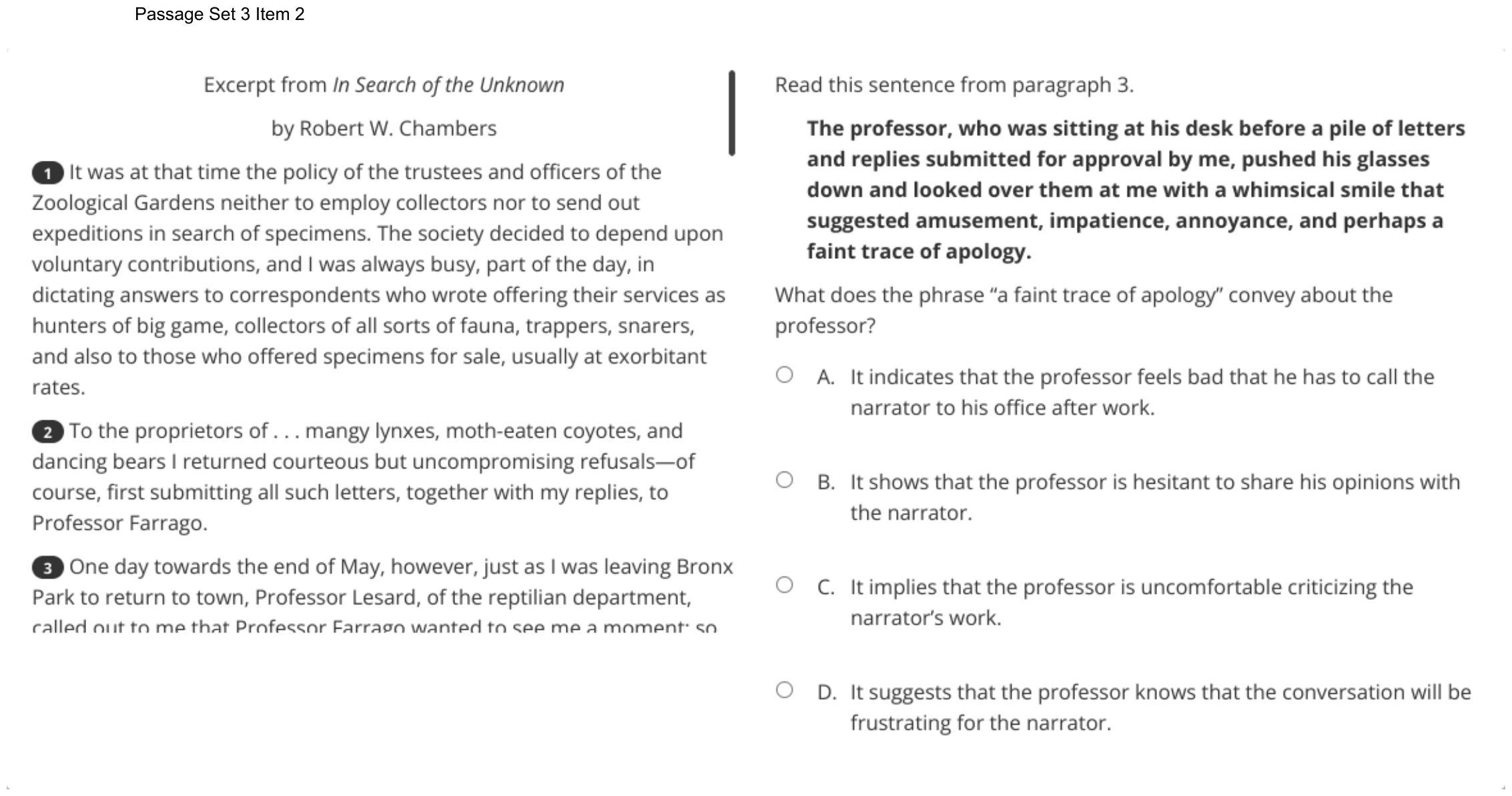
Question 42 of 57
2019 Test A English, question 42Uses the passage above: “Excerpt from In Search of the Unknown”.
Question
How does the exchange between the professor and the narrator in paragraphs 8–11 contribute to the development of the excerpt?
- AIt establishes the conflict between the professor and the narrator concerning the validity of the letter.
- BIt suggests a theme of collaboration because the narrator and the professor regularly work together.
- CIt reveals the characters’ traits by contrasting the narrator’s distrust of the content of the letter with how easily the professor is deceived by what he reads.
- DIt hints that the resolution will involve the narrator accepting the professor’s opinion about the content of the letter.
Show the answer
Correct answer: A
The question asks how the exchange between the professor and the narrator in paragraphs 8–11 contributes to the development of the excerpt.
A. CORRECT. Paragraphs 8–10 describe the narrator communicating his firm belief that the writer of the letter about the auks is either “ ‘a liar or a fool’ ” (paragraph 9). However, paragraph 11 reveals that the professor disagrees with the narrator’s assessment of Halyard, the man who wrote the letter (“ ‘He isn’t—in mine,’ said the professor, placidly”). This difference between the opinions of the narrator and the professor is the central conflict of the excerpt.
B. Incorrect. Paragraphs 8–11 reveal a disagreement between the narrator and the professor (“to my surprise, he appeared to waver” [paragraph 8]) and do not describe collaboration or show them working together.
C. Incorrect. Although the narrator initially distrusts the contents of the letter and shows “contemptuous tolerance for the writer” (paragraph 8), the excerpt portrays the professor as experienced and intelligent, not as one who is easily deceived. In fact, the professor ultimately convinces the narrator that the letter may in fact contain accurate information about the great auks.
D. Incorrect. While the narrator does begin to consider the professor’s perspective at the end of the excerpt, paragraphs 8–11 primarily serve to establish the disagreement between the narrator and the professor about the writer of the letter.
Question analysis
In paragraphs 8–11 of the excerpt from In Search of the Unknown, the narrator and Professor Farrago react to a letter from a man who claims to have two living great auks. This question asks how their exchange contributes to the development of the excerpt, so students must look at what each man says and what it sets up for the rest of the story.
- Grade level
- Grade 8 reading and task
- Compared with grade 7
- At grade 7 Grade 7 readers analyze how parts of a story shape what follows, and this asks just that of four short paragraphs, mostly dialogue. The narrator’s scornful, old-fashioned voice takes some care to read, but the reasoning is typical grade 7 work.
- Estimated difficulty
- Moderate: several steps, or a close reading with one strong distractor.
- Thinking it demands
- Depth of knowledge 2, skills and concepts · mainly analyze
- What makes it hard
- A very close wrong answer moderate
- How, not what minor
- Reading between the lines minor
- Evidence
- Answered from several paragraphs or stanzas
- Reading level
- Passage: about grade 9, 1066 words; question and choices: about grade 13, 96 words.
- Students, last 30 days
- Not enough answers yet to show (it takes 10).
Why it is hard, traps and wrong answers (shows the answer)
Why it is hard
The four paragraphs are short and the disagreement is plain, so most students see that the two men differ about the letter. The trouble lies in how the choices describe that difference. One adopts the narrator’s scorn and calls the professor easily deceived, a judgment only the narrator holds, and another jumps ahead to the hope he admits much later. Keeping to what each man says here, and to what it sets in motion, leaves the conflict itself.
A very close wrong answer moderate Choosing the answer
The choice that sets the narrator’s distrust against an easily deceived professor and the key both contrast the two men’s views of the letter; they part only on whether the professor is fooled. (Embretson & Wetzel, 1987; Gorin & Embretson, 2006; Ascalon et al., 2007)
How, not what minor Working it out
The stem asks how four paragraphs serve the whole excerpt, so students must see that this first open disagreement sets up the conflict the rest of the scene works through. (Anderson & Krathwohl, 2001)
Reading between the lines minor Working it out
The professor’s position fits in four words, “He isn’t—in mine,” which students must read as openness to the letter’s truth, set against the narrator’s flat “one or the other.” (Graesser, Singer & Trabasso, 1994; Kintsch, 1998)
Strategy: Write down in a few words where each man stands on the letter in paragraphs 8–11, then reject any option that misdescribes either man or depends on events after paragraph 11.
Traps
- Half right: One half of a two-part choice is right and the other is not.
- Wrong part of the text: A choice is true of another paragraph, stanza or speaker than the one asked about.
- True but not the answer: A choice says something accurate about the text that does not answer this question.
The wrong answers, classified
B True but not the answer (King et al., 2004; Embretson & Wetzel, 1987)
Rests on a true fact, that the narrator submits his replies to the professor, but in paragraphs 8–11 the two disagree openly and nothing shows them cooperating.
C Half right (King et al., 2004; Thissen, Steinberg & Fitzpatrick, 1989)
Gets the narrator’s distrust of the letter right but takes over his view that the professor is gullible, though the professor only declines to call the writer a liar or a fool.
D Wrong part of the text (Kirsch & Mosenthal, 1990)
Knows the narrator later begins to share the professor’s hope, in paragraph 34, but in paragraphs 8–11 he still insists the writer is “one or the other.”
Working it out, step by step
Figure out what the question asks
This asks what paragraphs 8–11 add as the story builds. Look at what each man says about the letter in these paragraphs. Then compare their views.
Find the narrator’s view
In paragraph 8, the narrator reads the letter “with a contemptuous tolerance for the writer.” Contemptuous means full of scorn. He thinks the writer is “either a very innocent victim or a very stupid swindler.” A swindler is a cheat. In paragraph 9, the professor asks if most men would call the writer “a liar or a fool.” The narrator answers in paragraph 10: “he’s one or the other.”
Find the professor’s view
Paragraph 8 ends “to my surprise, he appeared to waver.” To waver means to be unsure. In paragraph 11, the professor answers calmly, “He isn’t—in mine.” He means that in his opinion, the writer is neither a liar nor a fool. So the two men clash over whether the letter can be believed. A clash like this is a conflict.
Check each choice
- A fits. The men disagree about whether the letter is true. Validity means whether something is true or sound.
- B does not fit. They do work together, but in these paragraphs they argue.
- C does not fit. The narrator’s distrust is real. But nothing shows the professor is fooled. He calmly thinks for himself.
- D does not fit. The narrator starts to share the professor’s hope much later, in paragraph 34. Here he doesn’t budge.
Choose the answer
Watch out: C is tempting because its first half is right. But “how easily the professor is deceived” is only what the narrator assumes. The story never shows the professor being tricked. So the answer is A.
Why this answer and not the closest wrong one
C is the closest wrong answer. It gets the narrator right: he distrusts the letter. But it treats the professor as easily fooled, and the story never shows that. The professor simply disagrees: “He isn’t—in mine.” A describes both sides correctly. These paragraphs set up the conflict over whether the letter can be trusted.
More questions like this
The original DOE question
Question 43 of 57
2019 Test A English, question 43Uses the passage above: “Excerpt from In Search of the Unknown”.
Question
The professor’s observations in paragraphs 15–17 create tension in the excerpt by causing the narrator to feel
- Aflustered by the professor’s criticism of his logic.
- Bannoyed by the professor’s sarcasm about his inexperience.
- Cconfused by the professor’s lack of respect for his opinion.
- Dfrustrated by the professor’s lack of interest in his theory.
Show the answer
Correct answer: A
The question asks how the professor’s observations in paragraphs 15–17 create tension in the excerpt.
A. CORRECT. The professor criticizes “ ‘you young fellows’ ” (paragraph 15), suggesting that the ideas of young scientists like the narrator are unsupported (“ ‘like swimming squirrels’ ” [paragraph 17]) and inaccurate (“ ‘but you never land where you hope to—do you?’ ” [paragraph 17] and “ ‘you embark on a theory for destinations that don’t exist’ ” [paragraph 15]). The narrator then becomes “red in the face” (paragraph 18), indicating that the narrator is upset by the professor’s criticism, and asks the professor about the great auk in an attempt to defend himself.
B. Incorrect. While the narrator does experience a negative reaction to the professor’s words, the professor is being genuine, not sarcastic. In fact, the sarcasm comes from the narrator in paragraph 14 (“ ‘It is generally accepted,’ I replied, sarcastically, ‘that the great auk has been extinct for years. Therefore I may be pardoned for doubting that our correspondent possesses a pair of them alive’ ”), not from the professor.
C. Incorrect. The professor’s observations cause the narrator to blush with embarrassment (“rather red in the face” [paragraph 18]), but the narrator understands the point that the professor is making about the narrator’s acceptance of the idea that great auks do not exist. The narrator recognizes that the professor is criticizing his youthful ideas, not his opinion.
D. Incorrect. The professor shows amusement with the narrator’s perspective. The narrator is embarrassed and upset by the professor’s words, but the narrator does not display frustration with the professor’s lack of interest in a commonly held view of the existence of a certain species of bird.
Question analysis
In this question on In Search of the Unknown, Professor Farrago makes remarks about “you young fellows,” comparing them to swimming squirrels that never land where they hope. Students must decide how these remarks in paragraphs 15–17 make the narrator feel and so create tension. The comparison is odd and old-fashioned, and the four choices name similar negative feelings with different causes.
- Grade level
- Grade 8 reading and task
- Compared with grade 7
- Above grade 7 Grade 7 students infer feelings from a character’s reactions, usually from plainly stated emotions. Here the cause is a puzzling figurative jab about “swimming squirrels,” the reaction is shown only through a physical sign, and the choices offer four close negative feelings.
- Estimated difficulty
- Hard: combines ideas, needs a plan, and has more than one tempting wrong answer.
- Thinking it demands
- Depth of knowledge 2, skills and concepts · mainly analyze
- What makes it hard
- Figurative or literary language major
- A very close wrong answer moderate
- Reading between the lines moderate
- Evidence
- Answered from several paragraphs or stanzas
- Reading level
- Passage: about grade 9, 1066 words; question and choices: about grade 9, 52 words.
- Students, last 30 days
- Not enough answers yet to show (it takes 10).
Why it is hard, traps and wrong answers (shows the answer)
Why it is hard
The professor’s two images are odd, and students must decode them as a comment on how the narrator reasons before they can say why he blushes. Every choice names an unpleasant feeling, so the decision rests on its cause. “You young fellows” makes sarcasm about inexperience the natural guess, but the sarcasm in this scene is the narrator’s own, and the professor smiles “wearily” and speaks in earnest. The narrator’s pointed reply shows he followed the criticism, not that it confused him.
Figurative or literary language major Understanding the question
The criticism comes in images: young men who “embark on a theory for destinations that don’t exist” and who, like swimming squirrels, “never land where you hope to,” a picture of reasoning that goes astray. (Graesser, Singer & Trabasso, 1994; Kintsch, 1998)
A very close wrong answer moderate Choosing the answer
The choice about annoyance at sarcasm and the right one both name a bad reaction to the professor’s remarks; they part on the cause, sincere criticism of his logic or mockery of his youth. (Embretson & Wetzel, 1987; Gorin & Embretson, 2006; Ascalon et al., 2007)
Reading between the lines moderate Working it out
The narrator never names his feeling; it shows only in “Rather red in the face” and in the defensive question that follows about whether the great auk is extinct. (Graesser, Singer & Trabasso, 1994; Kintsch, 1998)
Strategy: Paraphrase what the professor says about “you young fellows” in paragraphs 15–17, find how the narrator reacts in paragraph 18, and choose the feeling and the cause that both fit.
Traps
- Wrong tone or attitude: Misjudges the tone, attitude or point of view, such as reading admiration as criticism, or taking a character's or subject's feelings for the author's.
- Twists what the text says: Uses the text's topic and ideas but changes what it says: who did it, how much, when, or why.
- Word match: Repeats striking words or phrases from the text, so it looks supported, but its meaning does not fit the question.
The wrong answers, classified
B Wrong tone or attitude (Graesser, Singer & Trabasso, 1994)
Hears mockery in “Oh, you young fellows,” but the professor is sincere; the sarcasm belongs to the narrator, who “sarcastically” insists in paragraph 14 that the great auk is extinct.
C Twists what the text says (King et al., 2004)
Takes the blush in paragraph 18 as confusion, though the narrator answers at once with a pointed question, which shows he understood the professor’s point well enough to push back.
D Word match (Freedle & Kostin, 1993)
Is drawn by “theory” in paragraph 15 and calls the professor uninterested, though he engages the narrator’s view closely enough to answer it with two vivid images.
Working it out, step by step
Figure out what the question asks
This asks how the professor’s words in paragraphs 15–17 make the narrator feel. Tension is a feeling of strain between characters. Each choice names a feeling and a cause. Both parts must be right.
Read what the professor says
In paragraph 15 he says, “Oh, you young fellows,” and “you embark on a theory for destinations that don’t exist.” To embark means to set out on a trip. He means young men set out with an idea toward places that are not there. Their reasoning leads them to wrong answers. In paragraph 17 he adds, “Like swimming squirrels, you navigate with the help of Heaven and a stiff breeze, but you never land where you hope to—do you?”
Understand the picture
A swimming squirrel can’t really steer. It drifts with luck and the wind. The professor is saying the narrator’s thinking drifts the same way and misses the truth. That is a criticism of his logic, or reasoning. In paragraph 18, the narrator is “Rather red in the face.” He is flustered, which means embarrassed and upset.
Check each choice
- A fits. He turns red after the professor criticizes his reasoning.
- B does not fit. Sarcasm is saying the opposite of what you mean in order to mock. The professor means what he says. The sarcastic one is the narrator, in paragraph 14.
- C does not fit. He is not confused. He fires back a sharp question right away.
- D does not fit. The professor answers the narrator’s idea closely, so he is interested in it.
Watch out: B is tempting because “you young fellows” points to the narrator’s youth. But the professor is sincere, not sarcastic.
Choose the answer
The professor says the narrator’s reasoning goes astray, and the narrator turns red. So the answer is A, “flustered by the professor’s criticism of his logic.”
Why this answer and not the closest wrong one
B is the closest wrong choice. Both A and B say the narrator feels bad. But B blames sarcasm. Paragraph 14 says the narrator “replied, sarcastically,” so the sarcasm is his own. The professor means his words seriously. A names the real cause: criticism of the narrator’s thinking.
More questions like this
The original DOE question
Question 44 of 57
2019 Test A English, question 44Uses the passage above: “Excerpt from In Search of the Unknown”.
Question
How does the interaction between the narrator and the professor in paragraphs 26–28 contribute to the development of the theme?
- AIt illustrates the professor’s patience as the narrator argues against making the expedition.
- BIt reveals the narrator’s frustration with his limited role in making decisions for the zoological society.
- CIt emphasizes the professor’s desire to acquire new specimens for the zoological society at any cost.
- DIt shows the narrator’s acceptance of his assignment despite his personal objections.
Show the answer
Correct answer: D
The question asks how the interaction between the narrator and the professor in paragraphs 26–28 contributes to the development of the theme.
A. Incorrect. Paragraphs 26–28 do not show the narrator arguing against making the expedition. He instead argues that it is unnecessary for the professor to pay to send extra men on the expedition. The narrator points out that he can ask for assistance if he does, in fact, find great auks (“ ‘None,’ I replied, bluntly; ‘it’s a useless expense, unless there is something to bring back. If there is I’ll wire you, you may be sure’ ” [paragraph 28]).
B. Incorrect. When the professor criticizes the narrator’s blind acceptance of the theory about the existence of the auks, the narrator is frustrated and embarrassed. This frustration does not stem from his inability to make decisions for the zoological society.
C. Incorrect. The professor states that “ ‘what I want you to do is to get those birds here safely’ ” (paragraph 27), which indicates that his main priority is the birds’ safety rather than acquiring specimens regardless of the consequences (i.e., at any cost).
D. CORRECT. Paragraph 26 describes the professor and the narrator making practical plans for the expedition (“we made out a list of articles necessary for me and itemized the expenses I might incur”), indicating the narrator’s acceptance of his assignment while also revealing that he does not anticipate a “successful termination to the expedition.” Paragraph 28 further describes the personal objections of the narrator, who believes that adding extra men to the expedition is pointless (“ ‘a useless expense’ ”), since he does not expect to find any great auks to bring back.
Question analysis
This theme question on In Search of the Unknown asks how paragraphs 26–28, in which the narrator and Professor Farrago talk over supplies, expenses and how many men to bring, contribute to the development of the theme. Students must decode formal, old-fashioned phrasing, then judge what the interaction shows. Every choice sounds like something the excerpt might say.
- Grade level
- Grade 8 reading and task
- Compared with grade 7
- Above grade 7 Grade 7 theme questions trace an idea through clear events. Paragraphs 26–28 are dense with formal phrasing such as “allowing no margin for a successful termination,” and each choice pairs a real detail with a claim, which pushes the task above grade 7.
- Estimated difficulty
- Hard: combines ideas, needs a plan, and has more than one tempting wrong answer.
- Thinking it demands
- Depth of knowledge 2, skills and concepts · mainly analyze
- What makes it hard
- Complex sentences moderate
- Reading between the lines moderate
- How, not what minor
- Evidence
- Answered from several paragraphs or stanzas
- Reading level
- Passage: about grade 9, 1066 words; question and choices: about grade 13, 76 words.
- Students, last 30 days
- Not enough answers yet to show (it takes 10).
Why it is hard, traps and wrong answers (shows the answer)
Why it is hard
Each choice pairs a real feature of the scene with a claim, and the claims must be checked against three short paragraphs of formal prose. The narrator does object, bluntly, so the choice that has him arguing against the trip draws strongly; what he rejects is the cost of extra men, while he plans the trip itself. Students who decode “allowing no margin for a successful termination” see the whole picture: he is going, and he expects to fail.
Complex sentences moderate Understanding the question
Paragraph 26 is a 36-word sentence that ends “allowing no margin for a successful termination to the expedition,” formal wording for planning as if the search will fail. (Abedi & Lord, 2001; Freedle & Kostin, 1993; Messick, 1989)
Reading between the lines moderate Working it out
The narrator never says he accepts the trip; his acceptance shows in the planning, and his objection in the blunt “None” and “a useless expense” of paragraph 28. (Graesser, Singer & Trabasso, 1994; Kintsch, 1998)
How, not what minor Working it out
The stem asks about the theme, yet every choice describes a character’s attitude, so students must judge which attitude these paragraphs show rather than look for a stated theme. (Anderson & Krathwohl, 2001)
Strategy: Translate each of paragraphs 26–28 into plain modern words, then check each choice’s claim about the narrator or the professor against exactly what those three paragraphs show.
Traps
- Half right: One half of a two-part choice is right and the other is not.
- Too broad or too strong: A choice overstates, generalizes, or uses absolute words the text does not support.
- Wrong part of the text: A choice is true of another paragraph, stanza or speaker than the one asked about.
The wrong answers, classified
A Half right (King et al., 2004; Thissen, Steinberg & Fitzpatrick, 1989)
Gets the professor’s patience right, since he answers “Never mind that,” but the narrator never argues against going; he refuses only to take men along.
B Wrong part of the text (Kirsch & Mosenthal, 1990)
Carries over the grudging obedience of paragraph 25, “nothing to do but to obey,” though in paragraphs 26–28 the narrator sets his own return date and decides how many men to take.
C Too broad or too strong (King et al., 2004)
Inflates the professor’s wish for the birds into a desire for specimens “at any cost,” though the two men itemize expenses and he asks for the birds to arrive safely.
Working it out, step by step
Figure out what the question asks
This asks how paragraphs 26–28 build the theme. A theme is a big message of a story. Read the three paragraphs. Decide what the narrator does and what he thinks.
Read paragraph 26
Paragraph 26 says “Together we made out a list of articles necessary for me and itemized the expenses I might incur.” Articles are supplies, and itemized means listed one by one. So the narrator is planning the trip. But he sets a return date “allowing no margin for a successful termination to the expedition.” A margin is extra room. He leaves no extra time in case he finds the birds. He plans as if he will find nothing.
Read paragraphs 27 and 28
The professor asks how many men he will take. The narrator answers bluntly, which means in a short, plain way. He takes none. Extra men would be “a useless expense, unless there is something to bring back.” He still thinks the birds are not real. Yet he does not refuse to go. He accepts the job while doubting it.
Check each choice
- A does not fit. The professor is patient, but the narrator never argues against going. He only refuses to take men.
- B does not fit. Here the narrator makes decisions himself, like his return date and how many men to take.
- C does not fit. They count the costs, and the professor wants the birds safe. That is not “at any cost.”
- D fits. He plans the trip but shows he thinks it is pointless.
Watch out: A is tempting because the professor does stay calm. But the narrator is planning the trip, not fighting it.
Choose the answer
The narrator does the job while making his doubts clear. So the answer is D, “It shows the narrator’s acceptance of his assignment despite his personal objections.”
Why this answer and not the closest wrong one
A is the closest wrong choice. The professor does answer calmly, “Never mind that.” But A says the narrator argues against making the trip. He does not. He helps plan it and only objects to taking men. D captures both parts: he goes, and he still doubts.
More questions like this
The original DOE question
Question 45 of 57
2019 Test A English, question 45Uses the passage above: “Excerpt from In Search of the Unknown”.
Question
How does the author develop the contrast between the narrator’s point of view and the professor’s point of view?
- Aby providing both the narrator’s and professor’s thoughts on how age and experience influence each other’s reasoning
- Bby using the conversation between the narrator and the professor to emphasize their reactions to the letter
- Cby describing the professor’s persistent efforts to change the narrator’s mind about the letter
- Dby including dialogue that explains why the professor is the supervisor and the narrator is his subordinate
Show the answer
Correct answer: B
The question asks how the author develops the contrast between the narrator’s point of view and the professor’s point of view.
A. Incorrect. The excerpt does not describe the narrator’s thoughts about how age and experience influence the professor’s reasoning in enough detail to fully contrast them against the thoughts about the narrator that the professor expresses in paragraphs 15–17. The narrator’s idea that the professor might be “on the verge of dotage” (paragraph 24) is meant in a humorous way.
B. CORRECT. The primary conflict of the excerpt revolves around the narrator’s disagreement with the professor about whether the letter about the great auks could be true. As the two men converse, their contrasting attitudes toward the letter become clear: the narrator dismisses the possibility of great auks out of hand (“ ‘of course the man is mistaken’ ” [paragraph 5]; “ ‘here is a man . . . who wants you to send somebody to take charge of a bird that doesn’t exist!’ ” [paragraph 12]), while the professor calmly admits that although “ ‘nine hundred and ninety-nine men in a thousand would throw that letter aside and condemn the writer’ ” (paragraph 9), he himself believes that the writer could be telling the truth (“ ‘How do you know,’ asked Professor Farrago, ‘that the bird in question does not exist?’ ” [paragraph 13]).
C. Incorrect. The professor explains why he disagrees with the narrator (paragraphs 19–21), but he does not make persistent efforts to convince the narrator to change his mind about the letter. Instead he states that the narrator will go on an expedition to retrieve “ ‘whatever it is that our correspondent has’ ” (paragraph 23), thereby requiring the narrator to go collect the great auks whether the narrator believes in them or not.
D. Incorrect. The point of the dialogue is not to explain the subordinate-supervisor relationship between the narrator and the professor but rather to contrast what each character believes about the contents of the letter.
Question analysis
This point-of-view question asks how Robert W. Chambers develops the contrast between the narrator’s outlook and Professor Farrago’s in the excerpt from In Search of the Unknown. Students must step back from single lines and judge the author’s method across the whole excerpt. The choices describe techniques in general terms, and several connect to real moments in the story.
- Grade level
- Grade 8 reading and task
- Compared with grade 7
- Above grade 7 Analyzing how an author contrasts two characters’ points of view is the grade 7 standard itself, but here students must judge the main method across the whole excerpt, and each choice names an abstract method that touches something in the text.
- Estimated difficulty
- Hard: combines ideas, needs a plan, and has more than one tempting wrong answer.
- Thinking it demands
- Depth of knowledge 3, strategic thinking · mainly analyze
- What makes it hard
- How, not what major
- A very close wrong answer moderate
- Evidence in several places moderate
- Evidence
- Answered from the whole text
- Reading level
- Passage: about grade 9, 1066 words; question and choices: about grade 11, 84 words.
- Students, last 30 days
- Not enough answers yet to show (it takes 10).
Why it is hard, traps and wrong answers (shows the answer)
Why it is hard
The right choice is plain enough to seem too obvious, so students look for something more specific. The excerpt offers a candidate: the professor teases “you young fellows,” and the narrator decides the old man is near “dotage,” which makes age look like the method. Those remarks are passing jokes, while the men’s opposite reactions to Halyard’s letter run through the whole conversation. The question rewards judging what carries the contrast from start to end rather than what is most striking.
How, not what major Working it out
The question asks for the author’s method across the whole excerpt, and every choice names an abstract technique, so students must step back from single lines to see that the dialogue carries the contrast. (Anderson & Krathwohl, 2001)
A very close wrong answer moderate Choosing the answer
The choice about age and experience and the right one both describe the two men’s opposed views as they come out in the excerpt; they part on the subject, their ages or the letter. (Embretson & Wetzel, 1987; Gorin & Embretson, 2006; Ascalon et al., 2007)
Evidence in several places moderate Working it out
The contrast builds from the narrator’s “of course the man is mistaken” in paragraph 5 to the professor’s appeal to “instinct” in paragraph 33, so no single passage shows the method. (Kirsch & Mosenthal, 1990; Gorin & Embretson, 2006)
Strategy: For each choice, find where the excerpt does what the choice describes, and ask whether that method carries the contrast through the whole excerpt or appears only once or twice.
Traps
- Too narrow: A single detail offered as the central idea or a summary, or a summary that keeps minor details and leaves out an essential part.
- Twists what the text says: Uses the text's topic and ideas but changes what it says: who did it, how much, when, or why.
- Wrong purpose or structure: Names a purpose, structure or effect that the part does not serve, or describes what a part says when the question asks what it does.
The wrong answers, classified
A Too narrow (King et al., 2004)
Notices the jab at “you young fellows” and the narrator’s thought of “dotage,” but two passing remarks about age are not how the author builds the contrast across the excerpt.
C Twists what the text says (King et al., 2004)
Overstates the professor’s role, since he asks a few calm questions and then simply assigns the trip, never working to win the narrator over.
D Wrong purpose or structure (Anderson & Krathwohl, 2001)
Knows that the professor is the superior, but no line of dialogue explains how either man got his position; the talk is about the letter, not their ranks.
Working it out, step by step
Figure out what the question asks
This asks about the author’s method. How does the author show that the two men see things differently? Look at how the whole excerpt is built, not just one line.
Notice how the excerpt is told
Most of the excerpt is a conversation. The two men talk back and forth about the letter. Each answer shows how one man reacts to it. So their reactions to the letter are where the contrast shows up. A contrast is a clear difference between two things.
Find the two reactions
The narrator says “of course the man is mistaken” (paragraph 5). He laughs at the idea of “a bird that doesn’t exist!” (paragraph 12). The professor stays open. In paragraph 13 he asks how the narrator can be sure “that the bird in question does not exist.” In paragraph 23, he is “daring to believe” it is the great auk.
Check each choice
- A does not fit. Age comes up only twice: “you young fellows” and the narrator’s thought about “dotage.” Two short remarks do not build the contrast.
- B fits. The talk about the letter shows their opposite reactions.
- C does not fit. The professor asks a few calm questions and then simply sends the narrator. He does not keep trying to change his mind.
- D does not fit. No line explains how either man got his job.
Watch out: A is tempting because those remarks about age are real. But they are passing moments, not the author’s main method.
Choose the answer
The author builds the contrast through the two men’s talk about the letter. So the answer is B, “by using the conversation between the narrator and the professor to emphasize their reactions to the letter.”
Why this answer and not the closest wrong one
A is the closest wrong choice. The professor does tease “you young fellows,” and the narrator does think of “dotage.” But those are two quick remarks. From paragraph 5 to paragraph 33, the two men keep reacting to the letter in opposite ways. That steady back-and-forth builds the contrast, so B fits.
More questions like this
The original DOE question
Question 46 of 57
2019 Test A English, question 46Uses the passage above: “Excerpt from In Search of the Unknown”.
Question
How does paragraph 34 help develop the plot of the excerpt?
- AIt shows that the narrator is beginning to consider the possibility of finding the great auks.
- BIt demonstrates that the narrator is struggling to understand why the professor thinks the great auks exist.
- CIt establishes that the narrator is willing to let the professor overrule him about the great auks.
- DIt emphasizes that the narrator feels a sense of urgency to begin an expedition to locate the great auks.
Show the answer
Correct answer: A
The question asks how paragraph 34 helps develop the plot of the excerpt.
A. CORRECT. Despite his initial disbelief, the narrator admits in paragraph 34 that he is starting to feel the “same strange hope” the professor feels, which is to find the great auks (paragraph 33).
B. Incorrect. While the narrator does make an effort in paragraphs 11–22 to understand the professor’s thinking, paragraph 34 reveals that the narrator has been affected by the professor’s “strange hope” for the auks and is beginning to share this hope “in spite of” himself.
C. Incorrect. The narrator describes a feeling of hope in paragraph 34 that would not be present if he had simply been overruled by the professor and did not share any of the professor’s belief in the possibility that the auks exist.
D. Incorrect. The narrator does not express a sense of urgency in paragraph 34 to begin the expedition. Instead, he expresses hope that the great auks might really exist.
Question analysis
This plot question centers on paragraph 34 of the excerpt from In Search of the Unknown, the narrator’s reply when Professor Farrago supposes he is shocked that a scientist would trust a hunch about the great auks. Students must work out what the paragraph reveals about the narrator and why that matters to the story.
- Grade level
- Grade 7 reading and task
- Compared with grade 7
- At grade 7 Grade 7 students often explain how a paragraph advances a story. This one is a single sentence and the options are plainly worded, so the main hurdle is the narrator’s elaborate style, with words like “cherished.”
- Estimated difficulty
- Straightforward: two steps or one careful reading.
- Thinking it demands
- Depth of knowledge 2, skills and concepts · mainly analyze
- What makes it hard
- Complex sentences minor
- Figurative or literary language minor
- Evidence
- Answered from one paragraph or stanza
- Reading level
- Passage: about grade 9, 1066 words; question and choices: about grade 10, 79 words.
- Students, last 30 days
- Not enough answers yet to show (it takes 10).
Why it is hard, traps and wrong answers (shows the answer)
Why it is hard
In plain words the paragraph has the narrator admitting that the professor’s hope is taking hold of him, the turn the question asks about. Points are lost by reading it through other scenes: his obedience in paragraph 25 makes giving way look like the point, the word “strange” suggests puzzlement, and the quickened pulse suggests haste. What changes here is what he believes, not what he does.
Complex sentences minor Understanding the question
Paragraph 34 is one 31-word sentence that turns on “on the contrary” and splits its main clause with “in spite of me,” so its point, a hope beginning to stir, comes late. (Abedi & Lord, 2001; Freedle & Kostin, 1993; Messick, 1989)
Figurative or literary language minor Understanding the question
“To stir my pulses” means to excite him, and a student who pictures a racing heart may take it for impatience to set off rather than hope that the birds are real. (Graesser, Singer & Trabasso, 1994; Kintsch, 1998)
Strategy: Put paragraph 34 into everyday words, then check each option against that paragraph alone, making sure the option describes the narrator’s feeling there rather than at an earlier or later moment.
Traps
- Wrong part of the text: A choice is true of another paragraph, stanza or speaker than the one asked about.
- Twists what the text says: Uses the text's topic and ideas but changes what it says: who did it, how much, when, or why.
- Reads too much in: A reasonable-sounding conclusion that goes further than the text allows.
The wrong answers, classified
B Twists what the text says (King et al., 2004)
Reads “the same strange hope” as something the narrator is trying to make sense of in the professor, though the sentence says that hope is beginning to stir in him.
C Wrong part of the text (Kirsch & Mosenthal, 1990)
Brings in paragraph 25, where the narrator pulls up a chair because he must obey, but paragraph 34 shows him starting to share the hope, not yielding to an order.
D Reads too much in (Graesser, Singer & Trabasso, 1994)
Reads the stirring pulses as eagerness to get the expedition started, though the trip is already set for that night in paragraph 29 and the excitement concerns the birds possibly being real.
Working it out, step by step
Figure out what the question asks
This asks how paragraph 34 moves the plot forward. The plot is the chain of events in a story. Read the paragraph closely. Then decide what has changed for the narrator.
Read paragraph 34 closely
Paragraph 34 says “But I was not shocked; on the contrary, I was conscious that the same strange hope that Professor Farrago cherished was beginning, in spite of me, to stir my pulses, too.” On the contrary means the opposite is true. Cherished means held dear. To stir his pulses means to make his heart beat faster with excitement.
Put it in your own words
The professor hopes the great auks are real. Now the narrator feels the same hope starting in himself. “In spite of me” means he didn’t want to feel it, but he does. Earlier, he called the letter writer a liar or a fool. Now he is starting to think the birds might really be found.
Check each choice
- A fits. He begins to think the great auks might be found.
- B does not fit. He asked the professor why he believed the letter (paragraph 32), and the professor answered. In paragraph 34, the narrator isn’t puzzling over that belief. He is starting to share it.
- C does not fit. Giving in came earlier, in paragraph 25: “there was nothing to do but to obey.” Paragraph 34 is about hope, not obeying.
- D does not fit. He had already agreed to leave that night (paragraphs 29 and 30). Paragraph 34 says nothing about hurrying.
Choose the answer
Watch out: C is tempting because the narrator does follow the professor’s orders. But that is not new in paragraph 34. What is new is his hope. So the answer is A.
Why this answer and not the closest wrong one
C is the closest wrong answer. The narrator did agree to obey the professor. But that happened in paragraph 25, and he called the trip a fool’s errand. In paragraph 34, something new happens. He feels “the same strange hope” as the professor. A names that change from doubt to hope.
More questions like this
The original DOE question
Question 47 of 57
2019 Test A English, question 47Uses the passage above: “Excerpt from In Search of the Unknown”.
Question
Which sentence best demonstrates the professional relationship between the narrator and the professor?
- A“I said as much to Professor Farrago, but, to my surprise, he appeared to waver.” (paragraph 8)
- B“Clearly, Professor Farrago was on the verge of dotage—ah, what a loss to the world!” (paragraph 24)
- C“I drew a chair up beside his desk—there was nothing to do but to obey, and this fool’s errand was none of my conceiving.” (paragraph 25)
- D“ ‘Very well,’ said Professor Farrago, good-humoredly, ‘you shall have all the assistance you may require.’ ” (paragraph 29)
Show the answer
Correct answer: C
The question asks which sentence best demonstrates the professional relationship between the narrator and the professor.
A. Incorrect. Although the professor’s asking for the narrator’s personal opinion about the letter shows that they have respect for each other’s views, the sentence from paragraph 8 does not convey the relationship between a subordinate employee (the narrator) and a superior (the professor).
B. Incorrect. The sentence from paragraph 24 presents the narrator’s immediate internal reaction to the professor’s words. The sentence emphasizes that the professor’s belief in the great auk’s existence is so outrageous that the narrator initially thinks the professor is starting to lose touch with reality. This is a momentary reaction to the professor’s words, not a demonstration of the professional relationship between the two.
C. CORRECT. The sentence from paragraph 25 reveals that while the narrator disagrees with the professor (“this fool’s errand was none of my conceiving”), he obeys because he works for the professor (“there was nothing to do but to obey”).
D. Incorrect. The professor’s good-humored offer of assistance in the sentence from paragraph 29 does not best demonstrate the underlying employer-employee relationship between the professor and the narrator. The narrator has to go on the expedition because the professor, his boss, told him to.
Question analysis
This question tests textual evidence: students pick the line from In Search of the Unknown that best shows the working relationship between the narrator and Professor Farrago. The lines are drawn from across the scene, from the first talk about a puzzling letter to the planning of a trip, and each shows a different side of the two men.
- Grade level
- Grade 7 reading and task
- Compared with grade 7
- At grade 7 This matches ordinary grade 7 work with textual evidence, since the quotations are brief and labeled by paragraph. The old-fashioned narration and the need to weigh four plausible lines keep it from being easy.
- Estimated difficulty
- Moderate: several steps, or a close reading with one strong distractor.
- Thinking it demands
- Depth of knowledge 2, skills and concepts · mainly evaluate
- What makes it hard
- Reading between the lines moderate
- Every choice must be checked minor
- Hard words minor
- Evidence
- Answered from several paragraphs or stanzas
- Reading level
- Passage: about grade 9, 1066 words; question and choices: about grade 10, 88 words.
- Students, last 30 days
- Not enough answers yet to show (it takes 10).
Why it is hard, traps and wrong answers (shows the answer)
Why it is hard
Every quotation shows the narrator and the professor together, and the promise of “all the assistance you may require” even displays the professor’s control over the society’s means. Only one line states the narrator’s side of the hierarchy: he thinks the trip foolish and goes anyway because he must. A student who treats any exchange about the letter as professional is drawn to the narrator reporting his opinion, while one who watches only the professor’s power settles on the offer of help.
Reading between the lines moderate Working it out
The stem never defines the relationship, so students must first picture it, a superintendent and a subordinate who carries out his orders, before they can recognize it in “there was nothing to do but to obey.” (Graesser, Singer & Trabasso, 1994; Kintsch, 1998)
Every choice must be checked minor Choosing the answer
Each quotation shows the two men interacting, from the narrator reporting his verdict on the letter to the professor promising help, so all four must be weighed for what they reveal about rank. (Embretson & Wetzel, 1987)
Hard words minor Understanding the question
The key line closes with “this fool’s errand was none of my conceiving,” an old-fashioned way of saying the trip was not his idea, which is what makes his obedience revealing. (Perfetti, 2007; Freedle & Kostin, 1993)
Strategy: Note what each quotation shows about how the two men deal with each other, then choose the one that tells most about their working relationship, not just their personalities.
Traps
- Supports only part of the claim: In a question about evidence: a line that backs one half of the claim but not the other, or a related point rather than the claim itself.
- True but not the answer: A choice says something accurate about the text that does not answer this question.
The wrong answers, classified
A True but not the answer (King et al., 2004; Embretson & Wetzel, 1987)
Treats the narrator telling the professor his opinion of the letter as a sign of their working roles, but the line shows only a disagreement and the professor wavering, not who answers to whom.
B True but not the answer (King et al., 2004; Embretson & Wetzel, 1987)
Picks the narrator’s silent judgment that the professor is near “dotage,” true to his thoughts in paragraph 24 but a fleeting reaction that shows nothing about their duties.
D Supports only part of the claim (King et al., 2004; Thissen, Steinberg & Fitzpatrick, 1989)
Reads the professor’s generous offer as a superior’s power, which is part of their relationship, but the line shows his good humor rather than the narrator’s duty to obey.
Working it out, step by step
Figure out what the question asks
This asks for the sentence that best shows their professional relationship. That means how they relate at work: who is the boss, and who must follow orders. Paragraph 3 calls Professor Farrago the “general superintendent of the Zoological Gardens.” He is in charge. The narrator even sends him his replies “for approval.”
Look for a sign of boss and worker
Choice C quotes paragraph 25: “I drew a chair up beside his desk—there was nothing to do but to obey, and this fool’s errand was none of my conceiving.” To obey means to do what you are told. A fool’s errand is a pointless task. “None of my conceiving” means it was not his idea.
Put it in your own words
The narrator thinks the trip is silly. Still, he must go, because the professor is his boss. A worker who disagrees but follows orders anyway shows a work relationship very clearly.
Check each choice
- A does not fit. The narrator tells the professor his opinion, and the professor seems unsure. It shows a disagreement, not who is in charge.
- B does not fit. It is the narrator’s private thought that the professor is losing his mind in old age. It is a passing reaction.
- C fits. The narrator must obey even though he disagrees.
- D does not fit. It shows the professor being friendly and generous. It doesn’t show the narrator’s duty to follow orders.
Choose the answer
Watch out: D is tempting because only a boss can offer “all the assistance you may require.” But the sentence mostly shows the professor’s good mood. So the answer is C.
Why this answer and not the closest wrong one
D is the closest wrong answer. The professor’s offer of help does hint at his power. But the sentence mainly shows him in good humor. C shows the heart of their work relationship. The narrator thinks the job is a fool’s errand, yet he has “nothing to do but to obey.”
More questions like this
The original DOE question
Question 48 of 57
2019 Test A English, question 48Uses the passage above: “Excerpt from In Search of the Unknown”.
Question
Which sentence from the excerpt best explains why the professor is eager to send the narrator on an expedition?
- A“ ‘Whatever it is that our correspondent has—and I am daring to believe that it is the great auk itself—I want you to secure it for the society.’ ” (paragraph 23)
- B“ ‘What I want you to do is to get those birds here safely.’ ” (paragraph 27)
- C“ ‘I suppose,’ he replied, with the same half-apologetic, half-humorous smile, ‘it is instinct.’ ” (paragraph 33)
- D“ ‘I can’t get away from the idea that we are on the eve of acquiring the rarest of living creatures.’ ” (paragraph 33)
Show the answer
Correct answer: D
The question asks which sentence from the excerpt best explains why the professor is eager to send the narrator on an expedition.
A. Incorrect. The sentence from paragraph 23 tells what animal the professor believes the narrator will find on the expedition (the great auk), but it does not explain why the professor is so excited to find this particular animal.
B. Incorrect. Although the sentence from paragraph 27 expresses the professor’s interest in having the narrator bring the birds back safely, it does not show the underlying reason why the safety of the birds is so crucial, which is that the great auk is extremely rare.
C. Incorrect. The sentence from paragraph 33 explains why the professor believes the letter writer—he feels a gut instinct—but it does not explain why he is so eager to find out whether his instinct is correct.
D. CORRECT. The sentence from paragraph 33 reveals the professor’s excitement to get “ ‘the rarest of living creatures,’ ” the great auk. The narrator states in paragraph 14 that “ ‘it is generally accepted . . . that the great auk has been extinct for years,’ ” which would make a living auk incredibly rare and explains the professor’s eagerness for the narrator to go on the expedition.
Question analysis
Professor Farrago wants the narrator to travel north and bring back two great auks from a stranger’s home at Black Harbor. In this textual evidence task, students choose the quotation from In Search of the Unknown that best explains his eagerness, and since the lines come from different moments in their talk, close reading is needed to find the one that answers the question’s “why.”
- Grade level
- Grade 7 reading and task
- Compared with grade 7
- At grade 7 Explaining why a character acts, with a quotation as support, is everyday grade 7 work. What calls for care here is that all four lines are the professor’s own words about the birds or the trip, two of them from paragraph 33.
- Estimated difficulty
- Moderate: several steps, or a close reading with one strong distractor.
- Thinking it demands
- Depth of knowledge 2, skills and concepts · mainly evaluate
- What makes it hard
- A very close wrong answer moderate
- Every choice must be checked minor
- Reading between the lines minor
- Hard words minor
- Evidence
- Answered from several paragraphs or stanzas
- Reading level
- Passage: about grade 9, 1066 words; question and choices: about grade 10, 98 words.
- Students, last 30 days
- Not enough answers yet to show (it takes 10).
Why it is hard, traps and wrong answers (shows the answer)
Why it is hard
Every quotation is the professor speaking about the birds or the trip, so the question turns on the difference between a line that shows his eagerness and one that gives its cause. His order to secure whatever the correspondent has comes closest, because it names “the great auk itself,” but it states a belief and a wish; the reason, rarity, appears only in paragraph 33. The instinct line beside it answers a different why, why he trusts the letter writer at all.
A very close wrong answer moderate Choosing the answer
The order to “secure it for the society” and the key are both the professor naming what he hopes to acquire; the first gives his belief and his wish, the second why it matters, “the rarest of living creatures.” (Embretson & Wetzel, 1987; Gorin & Embretson, 2006; Ascalon et al., 2007)
Every choice must be checked minor Choosing the answer
All four lines are the professor’s own words about the birds or the trip, and two come from paragraph 33, so each must be tested for whether it gives a reason rather than a wish or an order. (Embretson & Wetzel, 1987)
Reading between the lines minor Working it out
The key never mentions the expedition, and its force depends on paragraph 14, where the narrator says it is “generally accepted” that the great auk “has been extinct for years.” (Graesser, Singer & Trabasso, 1994; Kintsch, 1998)
Hard words minor Understanding the question
“On the eve of acquiring” means about to obtain, and a reader who hears “eve” only as evening loses the sense that the professor thinks the prize is close. (Perfetti, 2007; Freedle & Kostin, 1993)
Strategy: Restate the question in your own words, “What makes the professor so keen on this trip?”, and for each quotation decide whether it answers that question or a different one about the trip.
Traps
- Supports only part of the claim: In a question about evidence: a line that backs one half of the claim but not the other, or a related point rather than the claim itself.
- True but not the answer: A choice says something accurate about the text that does not answer this question.
The wrong answers, classified
A Supports only part of the claim (King et al., 2004; Thissen, Steinberg & Fitzpatrick, 1989)
Sees eagerness in “I want you to secure it for the society” and the bold guess about the great auk, but the line states his belief and wish, not why the bird matters so much.
B Supports only part of the claim (King et al., 2004; Thissen, Steinberg & Fitzpatrick, 1989)
Takes the instruction to “get those birds here safely” as the professor’s reason, but it says what he wants done; why the birds matter appears only in paragraph 33.
C True but not the answer (King et al., 2004; Embretson & Wetzel, 1987)
Finds a stated reason in “it is instinct,” but that answers the narrator’s question about why the professor believes Halyard, not why he is eager to send someone north.
Working it out, step by step
Figure out what the question asks
This asks for evidence: the sentence that best explains why the professor is eager to send the narrator on the trip. So look for a reason, not a wish, an order or a feeling.
Recall what the narrator says
In paragraph 14, the narrator says “that the great auk has been extinct for years.” Extinct means no longer alive anywhere. So a living great auk would be amazingly rare. The letter writer claims to have two of them.
Find the professor’s reason
In paragraph 33, the professor says, “I can’t get away from the idea that we are on the eve of acquiring the rarest of living creatures.” On the eve of means just about to. Acquiring means getting. He thinks the zoo is about to get the rarest animal alive. That is why he wants the narrator to go.
Check each choice
- A does not fit. It shows what the professor believes and wants: the great auk, secured for the society. It doesn’t say why that matters so much.
- B does not fit. It is an order to bring the birds back safely, not a reason.
- C does not fit. “It is instinct” explains why he believes the letter writer. It doesn’t explain why he is eager for the trip.
- D fits. It gives his reason: a chance at the rarest of living creatures.
Choose the answer
Watch out: A is tempting because it shows the professor’s excitement and his order to “secure it for the society.” But a wish is not a reason. So the answer is D.
Why this answer and not the closest wrong one
A is the closest wrong answer. In A, the professor dares to believe the bird is a great auk, and he wants it. That tells what he wants. D tells why: he believes the zoo is close to “acquiring the rarest of living creatures.” The question asks for the reason, so D fits better.
More questions like this
The original DOE question
Question 49 of 57
2019 Test A English, question 49Passage Is It Time for Term Limits?
Is It Time for Term Limits?
In 1799, when George Washington’s supporters asked him to consider serving a third term as president of the United States, he declared, “Prudence on my part must arrest any attempt at the well meant, but mistaken views of my friends, to introduce me again into the Chair of Government.” Even though some of his contemporaries advocated for a lifetime appointment for presidents, Washington thought that government officials should not seek to gain unfair power. Only one president has been elected to four terms: Franklin Delano Roosevelt. He was elected to a third term in 1940 and a fourth in 1944 due to the challenges of the Great Depression and World War II. This departure from the rule worried some, and on March 21, 1947, Congress passed the Twenty-Second Amendment to the Constitution, legally limiting the office of president to two four-year terms.
Presidential terms are clearly limited in the Constitution, but for people serving in Congress, this is not the case. Currently, members of the House of Representatives, who serve two-year terms, and Senators, who serve six-year terms, can run for reelection an unlimited number of times. Because of the possibility of unlimited reelections, many people are beginning to believe that limiting congressional terms would benefit our government. Modern surveys conducted by multiple firms consistently show that American citizens of a variety of backgrounds and political leanings approve of the idea of setting term limits for members of Congress.
American citizens are not the only supporters of term limits for Congress. Even some members of Congress themselves have spoken out in support of this change. Former Senator Joe Lieberman, upon his retirement, suggested that Congress “might be healthier and less partisan1 and less rigid if it turned over more often, and term limits are one way to do that.” Michael Olson and Jon Rogowski state in their article “Legislative Term Limits and Polarization” that “proponents of term limits argue that limiting the number of terms legislators can serve in office would reduce the level of partisan conflict, encourage compromise and cooperation, and improve the quality of representation.”
Experienced politicians certainly can build on years of knowledge, but term limit supporters point out that career politicians may base key decisions on their own personal long-term goals. In the article “Term Limitations and the Myth of the Citizen-Legislator,” author Elizabeth Garrett states that “under term limits, a careerist needs to move up the political opportunity structure to remain in elected office, but the probability of unimpeded upward movement decreases as the number of available positions that are perceived as advancements decline.”
While challenging the career politician’s path is seen as a benefit to term limit supporters, there is a possibility that a Congress mostly composed of newcomers could severely affect policy making. Experienced politicians have a deep knowledge of congressional processes, and in addition, politicians who have served together for extended periods have a chance to develop trusting relationships, even across party lines. Molly Reynolds, a congressional expert for the Brookings Institution, says that members who are restricted by term limits “have neither the time nor the incentive to develop the relevant expertise they need to be good at their jobs. If members don’t have that expertise themselves, they’re more likely to rely on outsiders, including lobbyists, to replace that expertise.”
In fact, first-time politicians’ susceptibilities to lobbyists, or groups seeking to influence legislators, have actually been put to the test on the state level. In 2006, the National Conference of State Legislatures Study revealed that term limits may increase the influence of lobbyists. In the 1990s, more than twenty states implemented term limits within their state governments. The inexperienced state lawmakers began depending on special-interest groups for their expertise on issues. In the end, many people believed that implementing term limits in the state legislature caused problems, and since then, six states have repealed the limits.
Additionally, those who oppose term limits maintain that the turnover rate in Congress is sufficient. Thomas E. Mann, Senior Fellow in governance studies at the Brookings Institution, notes that every decade, new members replace at least half the members of the House and the Senate, due to retirement or elections. Still, the average length of time in office has mushroomed. For example, the 65th Congress (1917–1919) had an average service time of 5.3 years for members of the House of Representatives and 5.7 years for Senate members. The 114th Congress (2015–2017) had an average of 8.8 years for members of the House and 9.7 years for senators.
Should Congress pass a constitutional amendment to institute congressional term limits? Perhaps one day people will have a chance to vote on the issue.
PERCENTAGE OF REPRESENTATIVES AND SENATORS REELECTED
| House of Representatives Total seats: 435 | Year | Percentage Reelected |
|---|---|---|
| 1950 | 83.2 | |
| 1978 | 82.3 | |
| 1998 | 90.8 | |
| 2016 | 87.4 |
| Senate Total seats: 100 | Year | Percentage Reelected |
|---|---|---|
| 1950 | 68.8 | |
| 1978 | 60.0 | |
| 1998 | 89.7 | |
| 2016 | 93.1 |
1partisan: showing a strong and sometimes blind adherence to a particular political party
Question
What is the best summary of the discussion of congressional term policy outlined in paragraph 2?
- AWhile all members of Congress can be reelected an unlimited number of times, members of the House of Representatives and of the Senate serve different term lengths; this inequity has become troubling to many American citizens in recent years.
- BThe discrepancy between the president having term limits and members of Congress having unlimited terms has come to seem like a governmental flaw to many American citizens, and this flaw could be remedied by imposing congressional term limits.
- CSupport for congressional term limits is increasing, as shown by recent surveys indicating that American citizens of different backgrounds and political beliefs are beginning to favor implementation of term limits for members of Congress.
- DWhile the Constitution sets a term limit for the office of president, no such limit exists for members of Congress; however, recent surveys show that many American citizens are now in favor of term limits for members of Congress.
Show the answer
Correct answer: D
The question asks for the best summary of the discussion of congressional term policy outlined in paragraph 2.
A. Incorrect. The summary focuses on term lengths that members of the House of Representatives and of the Senate serve rather than on term limits.
B. Incorrect. The summary incorrectly places an emphasis on the idea that some Americans are troubled by the discrepancy between the president having term limits and members of Congress not having term limits. However, it is not the discrepancy that troubles people; it is the fact that members of Congress can be reelected an unlimited number of times.
C. Incorrect. While the summary mentions increased support for term limits, it neglects to mention the contrast between the president having term limits and members of Congress not having term limits.
D. CORRECT. The summary of paragraph 2 accurately presents the idea that members of Congress, in contrast to the president, do not have term limits and calls out the idea that recent surveys show that some Americans think this should change.
Question analysis
In this summary question, students choose the version that best captures paragraph 2 of “Is It Time for Term Limits?”, a passage on whether members of Congress should face limits on how long they serve. The four options are long and reuse the paragraph’s own facts, so students must weigh each one against the paragraph sentence by sentence.
- Grade level
- Grade 8 reading and task
- Compared with grade 7
- Above grade 7 Summarizing one short paragraph is grade 7 work, but here each option runs more than 30 words, and the options mix accurate facts with subtle slips, demanding closer comparison than typical grade 7 items.
- Estimated difficulty
- Hard: combines ideas, needs a plan, and has more than one tempting wrong answer.
- Thinking it demands
- Depth of knowledge 2, skills and concepts · mainly understand
- What makes it hard
- A very close wrong answer moderate
- A lot to read moderate
- Hard words minor
- Evidence
- Answered from one paragraph or stanza
- Reading level
- Passage: about grade 14, 799 words; question and choices: about grade 16+, 165 words.
- Students, last 30 days
- Not enough answers yet to show (it takes 10).
Why it is hard, traps and wrong answers (shows the answer)
Why it is hard
Paragraph 2 is short, but each summary is long and mixes accurate facts with one quiet change. The decisive detail is the third sentence, which gives the reason people want limits, “the possibility of unlimited reelections,” and two wrong summaries swap in another reason: the gap between the president and Congress, or the unequal term lengths. A third is accurate but stops at the surveys, dropping the contrast with the presidency that opens the paragraph.
A very close wrong answer moderate Choosing the answer
The flaw summary covers the same ground as the key, limited presidential terms, unlimited congressional ones and public support for change; it differs in blaming the gap between them rather than the unlimited reelections themselves. (Embretson & Wetzel, 1987; Gorin & Embretson, 2006; Ascalon et al., 2007)
A lot to read moderate Understanding the question
Each choice runs 34 to 39 words and strings two or three claims together with “While,” “however,” “and” or a semicolon, so every clause has to be checked against the paragraph’s four sentences. (Kintsch, 1998; Gorin & Embretson, 2006; Freedle & Kostin, 1993)
Hard words minor Understanding the question
The choices use words the paragraph does not, “discrepancy,” “inequity,” “remedied” and “implementation,” and each must be translated back into the paragraph’s plain terms before it can be judged. (Perfetti, 2007; Freedle & Kostin, 1993)
Strategy: Write a one-sentence summary of paragraph 2 that covers each of its four sentences, then compare it with each option, looking for a part left out, a point added or a cause changed.
Traps
- Twists what the text says: Uses the text's topic and ideas but changes what it says: who did it, how much, when, or why.
- Too narrow: A single detail offered as the central idea or a summary, or a summary that keeps minor details and leaves out an essential part.
The wrong answers, classified
A Twists what the text says (King et al., 2004)
Builds on sentence 2’s two-year and six-year terms and calls the difference an inequity that troubles citizens, though the paragraph’s concern is unlimited reelection, not unequal term lengths.
B Twists what the text says (King et al., 2004)
Gets the contrast with the president right but makes that discrepancy the cause of public concern, while the paragraph says people favor limits “Because of the possibility of unlimited reelections.”
C Too narrow (King et al., 2004)
Captures the surveys and the growing support in the paragraph’s second half but leaves out its opening contrast between limited presidential terms and unlimited congressional ones.
Working it out, step by step
Figure out what the question asks
This asks for the best summary of paragraph 2. A summary is a short version that keeps every main point and adds nothing new. A term is a set time in office. A term limit caps how many terms a person can serve. So first find the main points of paragraph 2.
List the points in paragraph 2
- The Constitution limits the president’s terms, but not the terms of members of Congress.
- Members of Congress can run again “an unlimited number of times.”
- “Because of the possibility of unlimited reelections,” many people think term limits would help.
- Surveys show that Americans of many backgrounds like the idea of term limits for Congress.
Put the points together
The paragraph makes two moves. First, it sets up a contrast: the president has a limit, and Congress does not. Then it reports that many Americans now favor limits for Congress. A good summary needs both parts. It must not change the reason the paragraph gives, which is unlimited reelections.
Check each choice
- A does not fit. It is about how long House and Senate terms last. An inequity is an unfairness, and the paragraph never calls that difference unfair.
- B does not fit. A discrepancy is a mismatch. B says the mismatch with the president troubles people. But the paragraph says the worry comes from unlimited reelections.
- C does not fit. It gets the surveys right, but it leaves out the contrast with the president.
- D fits. It has the contrast with the president and the surveys.
Choose the answer
Watch out: B covers almost the same ground as D, so it is tempting. But it changes the cause of the worry. Only D sums up the paragraph without changing it. So the answer is D.
Why this answer and not the closest wrong one
B is the closest wrong answer. It has the same pieces as D: the president’s limit, Congress’s lack of one, and public support. But B says people are bothered by the mismatch itself. The paragraph says they are bothered by “the possibility of unlimited reelections.” D keeps the facts and the surveys without changing the cause.
More questions like this
The original DOE question
The passage “Is It Time for Term Limits?” as printed (pages 90–91)
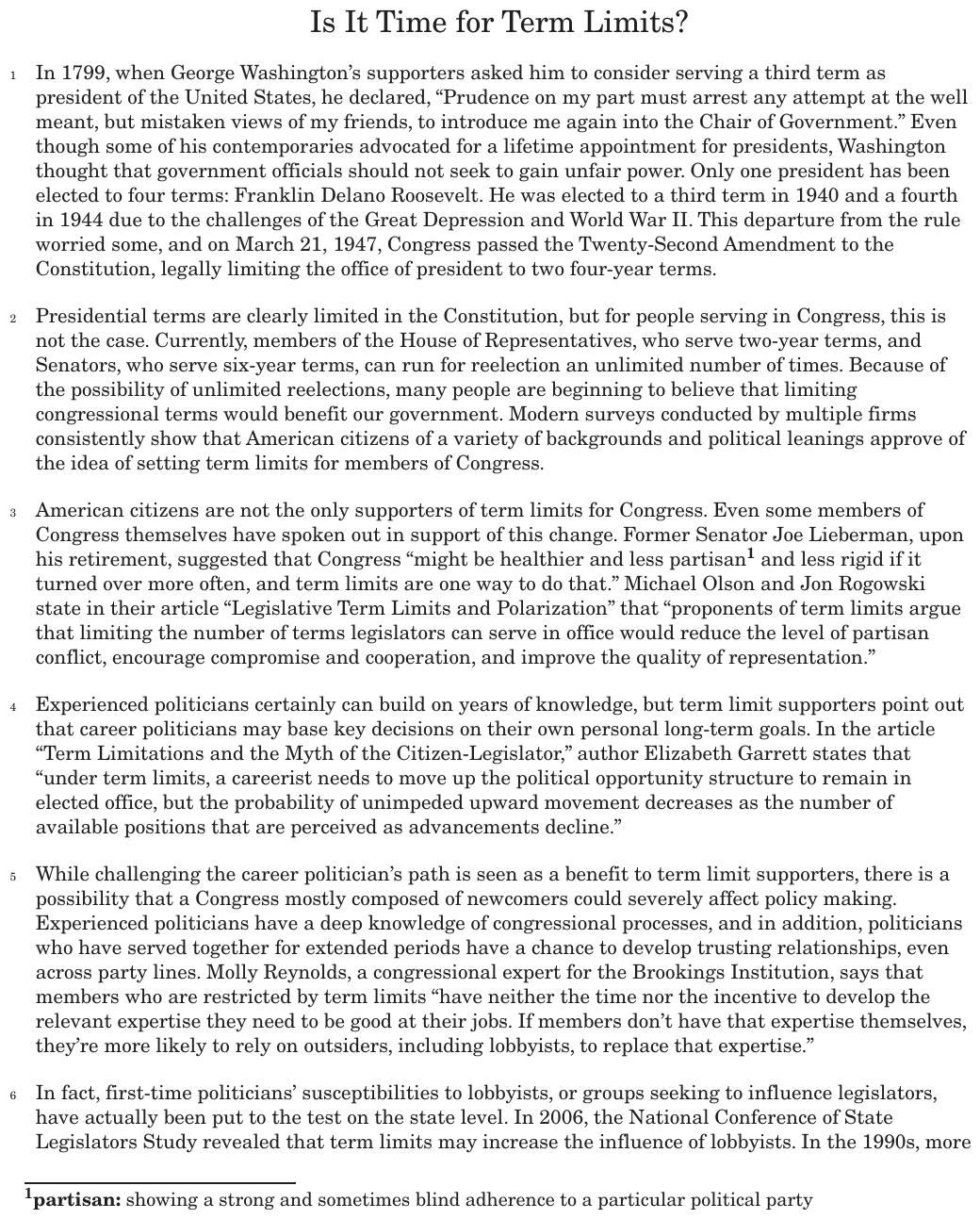
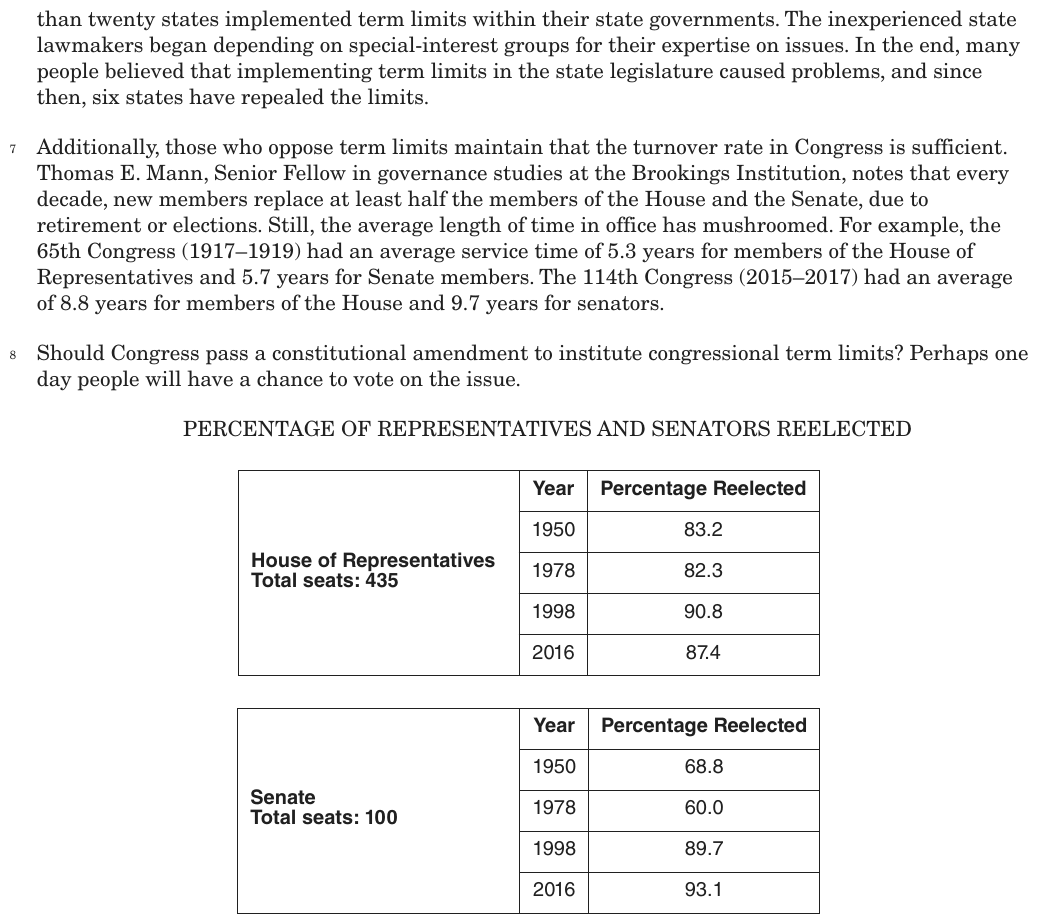
Question 50 of 57
2019 Test A English, question 50Uses the passage above: “Is It Time for Term Limits?”.
Question
Which sentence from the passage supports the idea that congressional term limits would “benefit our government” (paragraph 2)?
- A“Currently, members of the House of Representatives, who serve two-year terms, and Senators, who serve six-year terms, can run for reelection an unlimited number of times.” (paragraph 2)
- B“Modern surveys conducted by multiple firms consistently show that American citizens of a variety of backgrounds and political leanings approve of the idea of setting term limits for members of Congress.” (paragraph 2)
- C“Former Senator Joe Lieberman, upon his retirement, suggested that Congress ‘might be healthier and less partisan and less rigid if it turned over more often, and term limits are one way to do that.’ ” (paragraph 3)
- D“Thomas E. Mann, Senior Fellow in governance studies at the Brookings Institution, notes that every decade, new members replace at least half the members of the House and the Senate, due to retirement or elections.” (paragraph 7)
Show the answer
Correct answer: C
The question asks which sentence from the passage supports the idea that congressional term limits would “benefit our government” (paragraph 2).
A. Incorrect. The sentence from paragraph 2 states the fact that members of Congress can run for reelection an unlimited number of times; it does not suggest that this is unhealthy.
B. Incorrect. While the sentence from paragraph 2 shows that many Americans believe that term limits would be beneficial, it offers no actual evidence to support this idea.
C. CORRECT. Joe Lieberman’s comments in paragraph 3 strongly suggest that Congress is currently too partisan and rigid and that term limits would help correct this, thus benefiting our government.
D. Incorrect. The sentence from paragraph 7 offers a statistic regarding how frequently members of Congress are replaced. However, no suggestion is made as to whether the situation is good or bad or whether term limits would be healthy.
Question analysis
Paragraph 2 of “Is It Time for Term Limits?” reports that many people believe limiting congressional terms would “benefit our government.” In this textual evidence question, students look for the quoted sentence that supports that idea, and since the quotations come from three paragraphs and all concern Congress, each must be tested against the claim itself.
- Grade level
- Grade 8 reading and task
- Compared with grade 7
- At grade 7 Judging whether evidence is relevant to a claim is a grade 7 standard for reading arguments. The four quotations are long and all accurate, and two come from the same paragraph as the claim, so each must be read for what it actually shows.
- Estimated difficulty
- Moderate: several steps, or a close reading with one strong distractor.
- Thinking it demands
- Depth of knowledge 2, skills and concepts · mainly evaluate
- What makes it hard
- Reading between the lines moderate
- Every choice must be checked minor
- Hard words minor
- Evidence
- Answered from several paragraphs or stanzas
- Reading level
- Passage: about grade 14, 799 words; question and choices: about grade 14, 147 words.
- Students, last 30 days
- Not enough answers yet to show (it takes 10).
Why it is hard, traps and wrong answers (shows the answer)
Why it is hard
Two of the quotations sit in the same paragraph as the claim, and one of them, the surveys, sounds like strong support because it shows how many Americans want limits. But approval shows that people believe term limits would help, not that they would; the claim needs a reason. Lieberman’s remark is hedged with “might,” yet it is the only line that names a way government would improve, which is what “benefit” requires.
Reading between the lines moderate Working it out
The key offers no fact, only Lieberman’s guess that Congress “might be healthier and less partisan and less rigid,” and students must see those three words as the benefits to government the claim promises. (Graesser, Singer & Trabasso, 1994; Kintsch, 1998)
Every choice must be checked minor Choosing the answer
The four quotations are long, come from paragraphs 2, 3 and 7, and all concern Congress, so each must be tested for whether it gives a reason to expect improvement rather than a fact or an opinion poll. (Embretson & Wetzel, 1987)
Hard words minor Understanding the question
The key rests on “partisan,” explained only in a footnote, and on the idea of a Congress that “turned over more often,” which students must grasp before the sentence reads as a benefit. (Perfetti, 2007; Freedle & Kostin, 1993)
Strategy: Restate the claim plainly, that term limits would make government work better, and keep only a quotation that offers grounds for expecting that improvement.
Traps
- Supports only part of the claim: In a question about evidence: a line that backs one half of the claim but not the other, or a related point rather than the claim itself.
- True but not the answer: A choice says something accurate about the text that does not answer this question.
The wrong answers, classified
A True but not the answer (King et al., 2004; Embretson & Wetzel, 1987)
Follows the paragraph’s own link, “Because of the possibility of unlimited reelections,” and takes the rule itself as support, though stating the current system gives no reason to expect limits to help.
B Supports only part of the claim (King et al., 2004; Thissen, Steinberg & Fitzpatrick, 1989)
Treats wide public approval as proof that term limits would help, but the surveys back a related point, that many people favor limits, not the claim that government would benefit.
D True but not the answer (King et al., 2004; Embretson & Wetzel, 1987)
Picks the expert’s statistic as if data were the strongest support, but paragraph 7 offers Mann’s turnover figure for the opponents, who say change in Congress is already sufficient.
Working it out, step by step
Figure out what the question asks
This asks for evidence. The claim is that term limits would “benefit our government,” or make it work better. You need the sentence that gives a reason to expect that. A fact about the rules does not show that limits would help. Neither does how popular an idea is.
Read Lieberman’s words in paragraph 3
Former Senator Joe Lieberman said Congress “might be healthier and less partisan and less rigid if it turned over more often, and term limits are one way to do that.” The footnote says partisan means sticking to one political party, sometimes blindly. Rigid means stiff and slow to change. To turn over means to bring in new members.
See how it supports the claim
Lieberman names ways Congress would get better: healthier, less partisan and less rigid. He says new members would bring these changes. Then he says term limits are one way to bring in new members. So his words give reasons why limits would benefit the government.
Check each choice
- A does not fit. It states a rule: members can run again and again. It gives no reason to think limits would help.
- B does not fit. It shows that many people like the idea. But an idea can be popular without being good.
- C fits. Lieberman explains how term limits could make Congress work better.
- D does not fit. Paragraph 7 gives this fact for the other side. People who oppose limits use it to say there is already enough change in Congress.
Choose the answer
Watch out: B is tempting because surveys sound like proof. But they show that people approve of term limits, not that limits would work. So the answer is C.
Why this answer and not the closest wrong one
B is the closest wrong answer. The surveys show that citizens of many backgrounds “approve of the idea of setting term limits.” That tells you the idea is popular. It doesn’t tell you how limits would help. Lieberman gives reasons: a Congress that is “healthier and less partisan and less rigid.” That is C.
More questions like this
The original DOE question
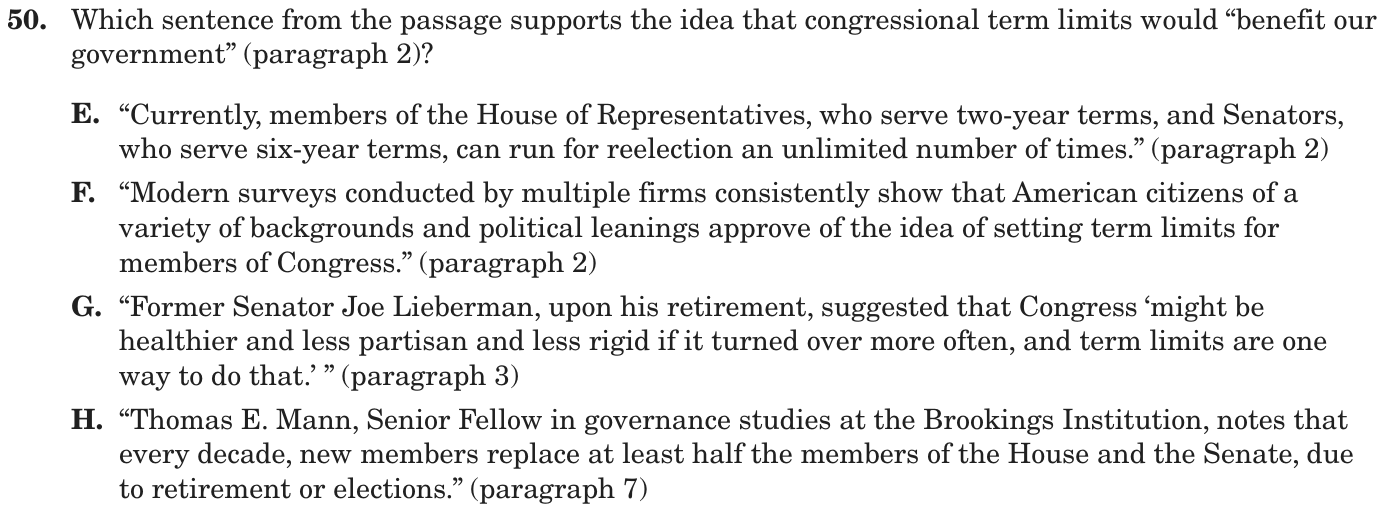
Question 51 of 57
2019 Test A English, question 51Uses the passage above: “Is It Time for Term Limits?”.
Question
The quotations in paragraph 3 convey a central idea of the passage by
- Aemphasizing some of the possible effects term limits would have on how Congress functions.
- Bshowing that both politicians and law experts have strong opinions about congressional term limits.
- Csuggesting that citizens defer to career politicians and law experts on issues such as congressional term limits.
- Dimplying that term limits would affect the ways that members of Congress campaign and vote.
Show the answer
Correct answer: A
The question asks how the quotations in paragraph 3 convey a central idea of the passage.
A. CORRECT. The quotations in paragraph 3 from former Senator Joe Lieberman and the writers Olson and Rogowski focus on how term limits might help members of Congress work together more cooperatively, even across party lines, “ ‘and improve the quality of representation.’ ”
B. Incorrect. The fact that politicians and law experts have opinions about term limits is not a central idea of the passage, though those opinions can be used to support arguments for or against term limits.
C. Incorrect. While paragraph 3 begins with the idea that “American citizens are not the only supporters of term limits for Congress,” the quotations do not suggest that citizens tend to agree with expert opinions on term limits; the expert opinions in paragraph 3 are simply offered as further support for term limits.
D. Incorrect. The implication that term limits could “ ‘encourage compromise’ ” by affecting how members of Congress campaign and vote is a supporting detail and not a central idea of the passage.
Question analysis
Paragraph 3 of “Is It Time for Term Limits?” quotes former Senator Joe Lieberman and the authors of an article titled “Legislative Term Limits and Polarization.” This question asks how those quotations convey a central idea of the whole passage, so students must decide what the passage is mainly about and what the two quotations add to it.
- Grade level
- Grade 8 reading and task
- Compared with grade 7
- At grade 7 Linking quotations to a passage’s central idea is standard grade 7 reading. The quotations use political terms such as “partisan” and “polarization,” and the options are abstract, which makes the reading harder without making the reasoning unusual.
- Estimated difficulty
- Moderate: several steps, or a close reading with one strong distractor.
- Thinking it demands
- Depth of knowledge 2, skills and concepts · mainly analyze
- What makes it hard
- How, not what moderate
- A very close wrong answer minor
- Hard words minor
- Evidence
- Answered from several paragraphs or stanzas
- Reading level
- Passage: about grade 14, 799 words; question and choices: about grade 10, 72 words.
- Students, last 30 days
- Not enough answers yet to show (it takes 10).
Why it is hard, traps and wrong answers (shows the answer)
Why it is hard
Paragraph 3 opens by saying that citizens are not the only supporters, which invites reading the quotations as a list of who else holds opinions. That is their surface job, and the strongest wrong choice describes it; but the question asks what idea they carry, and both name changes in how Congress would work, less partisan, less rigid, more cooperative. Choices that bring in citizens deferring to experts or members campaigning go beyond anything quoted.
How, not what moderate Working it out
The stem asks how the quotations serve a central idea, not what they say, so students must first name the passage’s concern, how term limits would change the way Congress works, and then see both quotations predicting such changes. (Anderson & Krathwohl, 2001)
A very close wrong answer minor Choosing the answer
The campaigning-and-voting choice, like the key, says the quotations point to effects on members of Congress; it narrows them to two activities and adds campaigns, which neither quotation mentions. (Embretson & Wetzel, 1987; Gorin & Embretson, 2006; Ascalon et al., 2007)
Hard words minor Understanding the question
“Partisan,” “polarization,” “proponents” and “legislators” fill the paragraph, and the effects the quotations name, less partisan conflict, more compromise, better representation, have to be decoded before they can be grouped. (Perfetti, 2007; Freedle & Kostin, 1993)
Strategy: Restate each quotation in paragraph 3 in plain words, then ask what both have in common and which option names that shared point as part of the passage’s larger discussion.
Traps
- True but not the answer: A choice says something accurate about the text that does not answer this question.
- Reads too much in: A reasonable-sounding conclusion that goes further than the text allows.
- Twists what the text says: Uses the text's topic and ideas but changes what it says: who did it, how much, when, or why.
The wrong answers, classified
B True but not the answer (King et al., 2004; Embretson & Wetzel, 1987)
Follows the paragraph’s opening, “American citizens are not the only supporters,” and notes who is quoted, a senator and two writers, but having opinions is not a central idea of the passage.
C Twists what the text says (King et al., 2004)
Turns the opening’s point that others besides citizens support limits into citizens deferring to experts, though nothing in the paragraph shows citizens following anyone’s lead.
D Reads too much in (Graesser, Singer & Trabasso, 1994)
Stretches “encourage compromise and cooperation” into claims about how members campaign and vote, though neither quotation mentions campaigns and voting habits would be one detail at most.
Working it out, step by step
Figure out what the question asks
This asks how the quotations in paragraph 3 support a central idea, a main point of the whole passage. So first name the passage’s main point. Then see what the quotations add to it.
Name the passage’s central idea
The passage asks whether Congress should have term limits. It weighs what limits would do to the way Congress works. Paragraphs 2–4 give reasons for them. Paragraphs 5–7 give reasons against. So a central idea is the possible effects of term limits on Congress.
Read the two quotations
Lieberman says Congress “might be healthier and less partisan and less rigid if it turned over more often.” Partisan means sticking to one party. Olson and Rogowski report that supporters say limits “would reduce the level of partisan conflict, encourage compromise and cooperation, and improve the quality of representation.” Compromise means each side gives a little to reach a deal.
Find what they share
Both quotations predict changes in how Congress would work: less fighting between parties, more working together, and better service to voters. These are effects of term limits. So the quotations add to the central idea by naming some of those effects.
Check each choice
- A fits. The quotations name possible effects on how Congress functions, or works.
- B does not fit. The paragraph does quote a senator and two writers. But the passage is about what limits would do, not about who has opinions.
- C does not fit. To defer means to go along with someone else’s view. Nothing says citizens follow politicians or experts.
- D does not fit. Neither quotation mentions campaigns, the work of running for office. Voting would be one small detail at most.
Choose the answer
Watch out: B is tempting because paragraph 3 opens with “American citizens are not the only supporters.” But that sentence only leads into the quotations. What they say matters more than who says them. So the answer is A.
Why this answer and not the closest wrong one
B is the closest wrong answer. It is true that a senator and two writers speak in paragraph 3. But having opinions is not a main point of the passage. The quotations matter for what they predict: less partisan conflict, more compromise and better representation. A names those effects on how Congress works.
More questions like this
The original DOE question
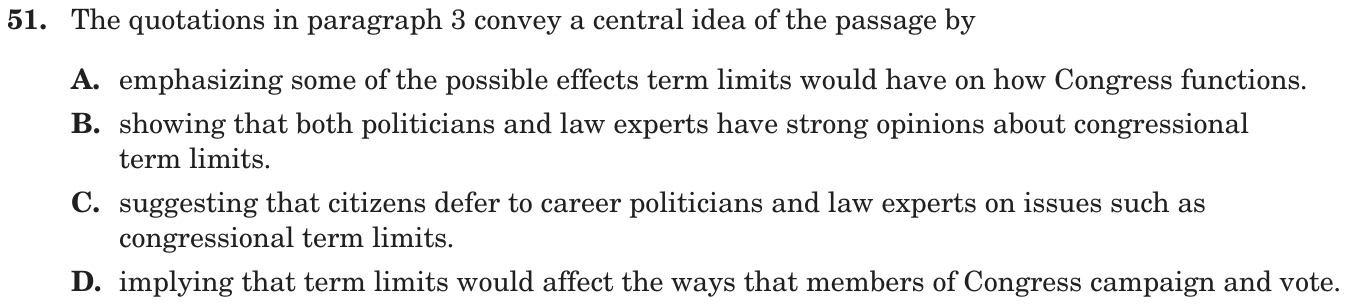
Question 52 of 57
2019 Test A English, question 52Uses the passage above: “Is It Time for Term Limits?”.
Question
Read this sentence from paragraph 5.
While challenging the career politician’s path is seen as a benefit to term limit supporters, there is a possibility that a Congress mostly composed of newcomers could severely affect policy making.
Which statement best describes how the sentence fits into the overall structure of the passage?
- AIt provides evidence for the idea that term limits are controversial.
- BIt summarizes the consequences of having term limits.
- CIt begins to explore the effects of instituting term limits.
- DIt shifts from the arguments for to the arguments against term limits.
Show the answer
Correct answer: D
The question asks which statement best describes how the sentence in paragraph 5 fits into the overall structure of the passage.
A. Incorrect. While the sentence in paragraph 5 does imply that term limits are controversial, it merely begins to suggest one of the reasons for the controversy without offering actual evidence.
B. Incorrect. The sentence in paragraph 5 does not offer ideas complete enough to constitute a summary of the consequences of term limits.
C. Incorrect. Before paragraph 5, the passage explores possible effects of term limits on the ability of Congress to function.
D. CORRECT. The author uses the sentence in paragraph 5 to demonstrate a transition from the benefits of term limits to the idea that newcomers could have a severe effect on policies.
Question analysis
This text-structure question quotes the opening sentence of paragraph 5 in “Is It Time for Term Limits?” and asks how it fits the overall structure of the passage. The options name four different jobs a sentence might do, from offering evidence to summing up, so students must judge the sentence by its position in the argument, not only by its words.
- Grade level
- Grade 8 reading and task
- Compared with grade 7
- At grade 7 Seeing how one sentence fits the plan of an informational text is regular grade 7 work. The sentence itself is clear, but placing it means keeping in mind the outline of an 800-word passage dense with political terms, still typical grade 7 demand.
- Estimated difficulty
- Moderate: several steps, or a close reading with one strong distractor.
- Thinking it demands
- Depth of knowledge 2, skills and concepts · mainly analyze
- What makes it hard
- How, not what moderate
- Evidence in several places minor
- Complex sentences minor
- Evidence
- Answered from the whole text
- Reading level
- Passage: about grade 14, 799 words; question and choices: about grade 10, 92 words.
- Students, last 30 days
- Not enough answers yet to show (it takes 10).
Why it is hard, traps and wrong answers (shows the answer)
Why it is hard
The sentence is easy to understand on its own, but its role shows only against the outline of the whole passage, which argues for term limits through paragraph 4 and against them from here on. Students who have lost that outline see a sentence that mentions an effect and decide the effects begin here, or see both sides named and call it evidence of controversy. Labeling each paragraph for or against before reading the choices makes the turn obvious.
How, not what moderate Working it out
The question asks what the sentence does at its place in the passage, and its “While” clause holds the answer: it closes the supporters’ case of paragraphs 2–4 and opens the risks of a Congress of newcomers. (Anderson & Krathwohl, 2001)
Evidence in several places minor Working it out
Rejecting the idea that effects are first raised here means recalling paragraphs 3 and 4, where Lieberman, Olson and Rogowski, and Garrett already describe what term limits would do. (Kirsch & Mosenthal, 1990; Gorin & Embretson, 2006)
Complex sentences minor Understanding the question
The 31-word sentence opens with a “While” clause whose subject is itself a phrase, “challenging the career politician’s path,” and saves its main point, a risk to policy making, for the second half. (Abedi & Lord, 2001; Freedle & Kostin, 1993; Messick, 1989)
Strategy: Label each paragraph in a word or two, then describe in your own words what this sentence does at its point in the passage before looking at the options.
Traps
- Wrong purpose or structure: Names a purpose, structure or effect that the part does not serve, or describes what a part says when the question asks what it does.
The wrong answers, classified
A Wrong purpose or structure (Anderson & Krathwohl, 2001)
Senses from “seen as a benefit” and “severely affect” that term limits are disputed, which is fair, but the sentence states two views without offering evidence for either.
B Wrong purpose or structure (Anderson & Krathwohl, 2001)
Takes the mention of a benefit and a danger as a wrap-up, though the sentence opens paragraph 5 in mid-passage and introduces new points instead of gathering earlier ones.
C Wrong purpose or structure (Anderson & Krathwohl, 2001)
Notices that the sentence raises a possible effect on policy making, but paragraphs 3 and 4 have already discussed effects such as less partisanship, so the exploration does not begin here.
Working it out, step by step
Figure out what the question asks
This asks how one sentence fits the structure of the passage. Structure is the way the parts are put in order. So first sort the passage into its parts. Then see where this sentence falls and what it does there.
Sort the passage into parts
- Paragraph 1: the history of the president’s two-term limit.
- Paragraphs 2–4: reasons for term limits in Congress. People support them, Lieberman backs them, and career politicians may chase their own goals.
- Paragraphs 5–7: reasons against. Newcomers lack know-how, state lawmakers leaned on special-interest groups, and there is already enough change.
- Paragraph 8: an open question.
Look closely at the sentence
The sentence opens paragraph 5. Its first half, “While challenging the career politician’s path is seen as a benefit to term limit supporters,” looks back at the case for limits. Its second half raises a danger: a Congress of newcomers “could severely affect policy making.” The word while joins the two halves. So the sentence turns from one side to the other.
Check each choice
- A does not fit. The sentence shows two views, but it gives no evidence. The evidence, such as Reynolds’s words, comes after it.
- B does not fit. A summary sums up what came before. This sentence opens new points in the middle of the passage.
- C does not fit. The passage has already looked at effects. Paragraph 3 says limits could make Congress “less partisan,” and paragraph 4 discusses career politicians.
- D fits. It moves from the case for limits to the case against them.
Choose the answer
Watch out: C is tempting because the sentence does name an effect on policy making. But it is not the first effect the passage mentions, so it doesn’t begin anything. So the answer is D.
Why this answer and not the closest wrong one
C is the closest wrong answer. The sentence does raise an effect of term limits. But effects came up before it, such as Lieberman’s healthier, “less partisan” Congress in paragraph 3. What is new here is the side. Before this sentence, the passage argues for limits. After it, the passage argues against them. That turn is D.
More questions like this
The original DOE question
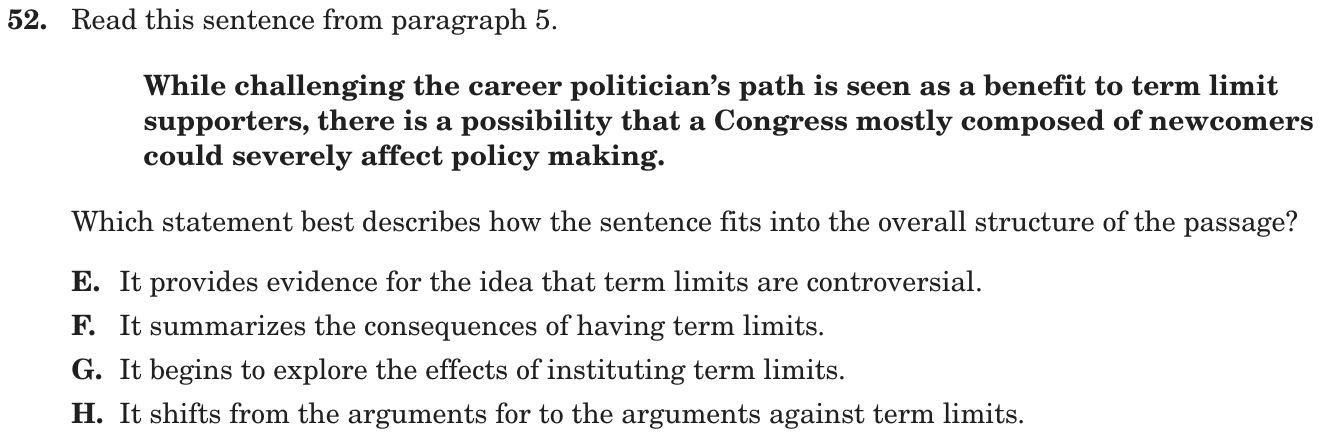
Question 53 of 57
2019 Test A English, question 53Uses the passage above: “Is It Time for Term Limits?”.
Question
According to paragraph 5, serving more terms improves politicians’ effectiveness by
- Amotivating them to learn the congressional processes necessary to create legislation.
- Bencouraging them to collaborate with politicians of the opposing party in order to pass legislation.
- Callowing them to gain expertise and develop strong political relationships.
- Denabling them to create new policies while fostering their own careers.
Show the answer
Correct answer: C
The question asks how, according to paragraph 5, serving more terms improves politicians’ effectiveness.
A. Incorrect. Paragraph 5 does not say that serving more terms motivates politicians to learn congressional processes, only that politicians restricted by term limits are not motivated to gain expertise.
B. Incorrect. While paragraph 5 states that serving more terms helps a politician “develop trusting relationships, even across party lines,” it does not explain how serving more terms improves politicians’ effectiveness.
C. CORRECT. Paragraph 5 makes it clear that “experienced politicians have a deep knowledge of congressional processes, and in addition, politicians who have served together for extended periods have a chance to develop trusting relationships, even across party lines.” Therefore, serving more terms helps experienced politicians gain expertise.
D. Incorrect. While paragraph 4 states that “term limit supporters point out that career politicians may base key decisions on their own personal long-term goals,” paragraph 5 does not mention this idea or state that creating new policies while fostering their own careers would improve their effectiveness.
Question analysis
Paragraph 5 of “Is It Time for Term Limits?” explains how serving more terms can make politicians more effective, and this key-details question asks what the paragraph says those benefits are. It sets out what experienced lawmakers bring and what newcomers lack, and the options echo its wording in different ways, so only careful matching will separate them.
- Grade level
- Grade 7 reading and task
- Compared with grade 7
- At grade 7 Finding what a paragraph states is routine grade 7 work, and the question names the paragraph. Its formal wording and an expert’s quotation phrased in the negative make the stated benefits a little harder to pick out.
- Estimated difficulty
- Moderate: several steps, or a close reading with one strong distractor.
- Thinking it demands
- Depth of knowledge 2, skills and concepts · mainly understand
- What makes it hard
- A very close wrong answer moderate
- The right answer is reworded minor
- Complex sentences minor
- Evidence
- Answered from one paragraph or stanza
- Reading level
- Passage: about grade 14, 799 words; question and choices: about grade 14, 57 words.
- Students, last 30 days
- Not enough answers yet to show (it takes 10).
Why it is hard, traps and wrong answers (shows the answer)
Why it is hard
Paragraph 5 states the two gains of long service in one sentence, deep knowledge and trusting relationships, and the answer simply restates both. The wrong choices each bend one part: the incentive Reynolds says term-limited members lack becomes a motive for learning, and the chance to build trust across party lines becomes collaboration to pass laws. Matching each choice against that one sentence, rather than against the expert’s negative wording, keeps students on track.
A very close wrong answer moderate Choosing the answer
The cross-party choice shares the key’s second benefit, relationships built over time, but turns paragraph 5’s “chance to develop trusting relationships” into deliberate teamwork to pass laws and drops the expertise. (Embretson & Wetzel, 1987; Gorin & Embretson, 2006; Ascalon et al., 2007)
The right answer is reworded minor Choosing the answer
The key turns “deep knowledge of congressional processes” and “trusting relationships” into expertise and strong political relationships, while wrong choices echo “congressional processes,” recast the cross-party trust as teamwork, or borrow paragraph 4’s careers. (Freedle & Kostin, 1993; Kirsch & Mosenthal, 1990)
Complex sentences minor Understanding the question
Reynolds’s quotation describes the opposite case, members who “have neither the time nor the incentive” to gain expertise, so the benefits of long service must be read by flipping a sentence about their absence. (Abedi & Lord, 2001; Freedle & Kostin, 1993; Messick, 1989)
Strategy: Reread paragraph 5 and note, in your own words, what it says long service gives politicians, then compare each option with your notes word by word.
Traps
- Twists what the text says: Uses the text's topic and ideas but changes what it says: who did it, how much, when, or why.
- Reads too much in: A reasonable-sounding conclusion that goes further than the text allows.
- Wrong part of the text: A choice is true of another paragraph, stanza or speaker than the one asked about.
The wrong answers, classified
A Reads too much in (Graesser, Singer & Trabasso, 1994)
Flips Reynolds’s point that term-limited members lack “the incentive” and concludes that long service motivates learning, but the paragraph names knowledge already gained, not a motive, and omits relationships.
B Twists what the text says (King et al., 2004)
Builds on “trusting relationships, even across party lines,” but turns a chance to build trust into working with the other party to pass legislation, and leaves out the expertise long service brings.
D Wrong part of the text (Kirsch & Mosenthal, 1990)
Recalls paragraph 4’s career politicians with “personal long-term goals,” a point term-limit supporters raise against them, and mistakes it for a benefit of long service in paragraph 5.
Working it out, step by step
Figure out what the question asks
This asks for a key detail. According to paragraph 5, how does serving more terms make politicians better at their jobs? Look only at paragraph 5, and find every benefit it names.
Find the benefits in paragraph 5
Paragraph 5 says “Experienced politicians have a deep knowledge of congressional processes, and in addition, politicians who have served together for extended periods have a chance to develop trusting relationships, even across party lines.” Congressional processes are the steps Congress follows to get work done. Extended periods means long stretches of time.
See the other side of it
Molly Reynolds adds that members held back by term limits have “neither the time nor the incentive” to build “the relevant expertise they need to be good at their jobs.” Expertise means special skill and knowledge. An incentive is a reason to try. Turn that around: members who serve longer have time to gain that expertise. So paragraph 5 names two benefits of long service, expertise and trust.
Check each choice
- A does not fit. The paragraph says experienced politicians already “have a deep knowledge of congressional processes.” It is about what they have gained, not what pushes them to learn. A also leaves out relationships.
- B does not fit. The paragraph says they have “a chance to develop trusting relationships.” It never says they team up to pass laws. B also leaves out expertise.
- C fits. It names both benefits: expertise and strong relationships.
- D does not fit. Building their own careers comes from paragraph 4. There, it is a worry about career politicians, not a benefit.
Choose the answer
Watch out: B is tempting because of the words “even across party lines.” But trust is not the same as working together to pass laws. So the answer is C.
Why this answer and not the closest wrong one
B is the closest wrong answer. It picks up the relationships “even across party lines.” But it turns a chance to build trust into teamwork to pass laws, which the paragraph never says. It also drops expertise, the first benefit. C names both things paragraph 5 says long service gives.
More questions like this
The original DOE question

Question 54 of 57
2019 Test A English, question 54Uses the passage above: “Is It Time for Term Limits?”.
Question
According to the passage, why would setting term limits for members of Congress potentially increase the influence of special-interest groups?
- ATerm limits would lead to a greater number of new representatives who rely on guidance and support from special-interest groups early in their terms.
- BTerm limits would create a situation in which special-interest groups have to work more closely with the new representatives who replace experienced representatives.
- CTerm limits would force experienced representatives out of their seats and bring in new representatives who focus on the agendas of special-interest groups.
- DTerm limits would result in both new and experienced representatives looking to special-interest groups in order to influence decisions made in legislature.
Show the answer
Correct answer: A
The question asks why setting term limits for members of Congress potentially increases the influence of special-interest groups.
A. CORRECT. The passage explains in paragraphs 5 and 6 that representatives who lack experience might end up relying on lobbyists’ expertise. Paragraph 6 uses information from the National Conference of State Legislatures Study, which indicated that state lawmakers were “depending on special-interest groups for their expertise on issues.” This example on a state level is used to show that “term limits may increase the influence of lobbyists” (paragraph 6).
B. Incorrect. While lobbyists can work with representatives, it is not required. The passage implies that some of the deep knowledge many politicians gain is from spending time in office and from developing “trusting relationships” (paragraph 5) with colleagues.
C. Incorrect. The passage does discuss the drawbacks of forcing experienced representatives from their seats, but it does not provide support for the idea that new representatives will focus on the agendas of special-interest groups.
D. Incorrect. The passage states that experienced representatives “have a deep knowledge of congressional processes, and in addition, politicians who have served together for extended periods have a chance to develop trusting relationships, even across party lines” (paragraph 5). The author states that the concern is only for new representatives who might seek help or guidance from lobbyists.
Question analysis
According to “Is It Time for Term Limits?”, limiting how long members of Congress can serve might increase the influence of special-interest groups, and this key-details question asks why. Each option connects lawmakers and interest groups in a different way, so the passage’s reasoning has to be followed step by step.
- Grade level
- Grade 8 reading and task
- Compared with grade 7
- At grade 7 Explaining a cause-and-effect link stated in an informational text is grade 7 work. Here the link runs across two paragraphs and an example from state governments, and the long options differ in small ways, which keeps the demand at the upper end of grade 7.
- Estimated difficulty
- Moderate: several steps, or a close reading with one strong distractor.
- Thinking it demands
- Depth of knowledge 2, skills and concepts · mainly understand
- What makes it hard
- A very close wrong answer moderate
- Evidence in several places minor
- Every choice must be checked minor
- Evidence
- Answered from several paragraphs or stanzas
- Reading level
- Passage: about grade 14, 799 words; question and choices: about grade 14, 112 words.
- Corrected from the DOE handbook
- The name of an organization in the passage and the explanation was corrected.
- Students, last 30 days
- Not enough answers yet to show (it takes 10).
Why it is hard, traps and wrong answers (shows the answer)
Why it is hard
The passage gives the reason in two steps: term limits fill a legislature with newcomers, and newcomers without expertise lean on lobbyists for it, as the state legislatures did. The wrong choices keep the same cast and change one link: the groups needing the lawmakers, newcomers pursuing the groups’ agendas, or veterans relying on them too. The half-right choice is hardest to reject because its first step, experienced members forced out, is exactly what the passage implies.
A very close wrong answer moderate Choosing the answer
The choice about newcomers who “focus on the agendas” of special-interest groups has the key’s new representatives and outside groups; it parts on why they turn to the groups, agendas rather than guidance on unfamiliar issues. (Embretson & Wetzel, 1987; Gorin & Embretson, 2006; Ascalon et al., 2007)
Evidence in several places minor Working it out
The chain runs across two paragraphs: Reynolds in paragraph 5 says members without expertise rely on lobbyists, and paragraph 6’s state study shows inexperienced lawmakers depending on special-interest groups. (Kirsch & Mosenthal, 1990; Gorin & Embretson, 2006)
Every choice must be checked minor Choosing the answer
All four choices open “Term limits would” and pair new representatives with special-interest groups, so each must be checked for who depends on whom, and why. (Embretson & Wetzel, 1987)
Strategy: Find where the passage connects term limits to lobbyists and special-interest groups, note who ends up depending on whom and why, and check each option’s wording against that chain.
Traps
- Half right: One half of a two-part choice is right and the other is not.
- Twists what the text says: Uses the text's topic and ideas but changes what it says: who did it, how much, when, or why.
- Too broad or too strong: A choice overstates, generalizes, or uses absolute words the text does not support.
The wrong answers, classified
B Twists what the text says (King et al., 2004)
Keeps the newcomers and the groups but makes the groups the ones who must adapt, when the passage has inexperienced lawmakers leaning on the groups for their expertise.
C Half right (King et al., 2004; Thissen, Steinberg & Fitzpatrick, 1989)
Starts correctly, since limits would push experienced members out, but then has the newcomers pursue the groups’ agendas, when the passage says they would borrow the groups’ expertise.
D Too broad or too strong (King et al., 2004)
Extends the reliance on outside groups to experienced representatives too, though paragraph 5 credits them with “a deep knowledge of congressional processes,” leaving only newcomers short of expertise.
What was corrected from the DOE handbook, and why
- Passage and explanation: Paragraph 6 of the passage, and the handbook’s explanation of this question, refer to “the National Conference of State Legislators Study.” The organization is the National Conference of State Legislatures (NCSL), so the site now says “National Conference of State Legislatures” in both places. No answer depends on the name.
Working it out, step by step
Figure out what the question asks
This asks why term limits might give special-interest groups more influence. A special-interest group pushes for one cause, like a business or an issue. Influence is the power to change what someone decides. So look for where the passage connects term limits to these groups.
Find the link in paragraph 5
Molly Reynolds says term-limited members may lack expertise, or special know-how. Then she adds, “If members don’t have that expertise themselves, they’re more likely to rely on outsiders, including lobbyists, to replace that expertise.” Paragraph 6 explains that lobbyists are “groups seeking to influence legislators.” Legislators are lawmakers.
See the example in paragraph 6
Paragraph 6 shows this happening in the states. After more than twenty states set term limits, “The inexperienced state lawmakers began depending on special-interest groups for their expertise on issues.” Inexperienced means new to the job. So the chain is this. Term limits bring in new lawmakers. New lawmakers lack know-how. So they lean on special-interest groups.
Check each choice
- A fits. More new members would rely on these groups for guidance.
- B does not fit. It makes the groups the ones who must adjust. In the passage, the new lawmakers depend on the groups.
- C does not fit. An agenda is a list of goals. The passage says new lawmakers borrow the groups’ know-how, not that they work for the groups’ goals.
- D does not fit. Paragraph 5 says experienced members “have a deep knowledge of congressional processes.” The worry is only about new members.
Choose the answer
Watch out: C starts out right, since limits would push out experienced members. But its second half changes why the newcomers turn to the groups. So the answer is A.
Why this answer and not the closest wrong one
C is the closest wrong answer. It is right that limits would replace experienced members with new ones. But it says the newcomers would “focus on the agendas” of the groups. The passage says they would lean on the groups “for their expertise on issues.” A gives that reason: new members relying on the groups for guidance.
More questions like this
The original DOE question
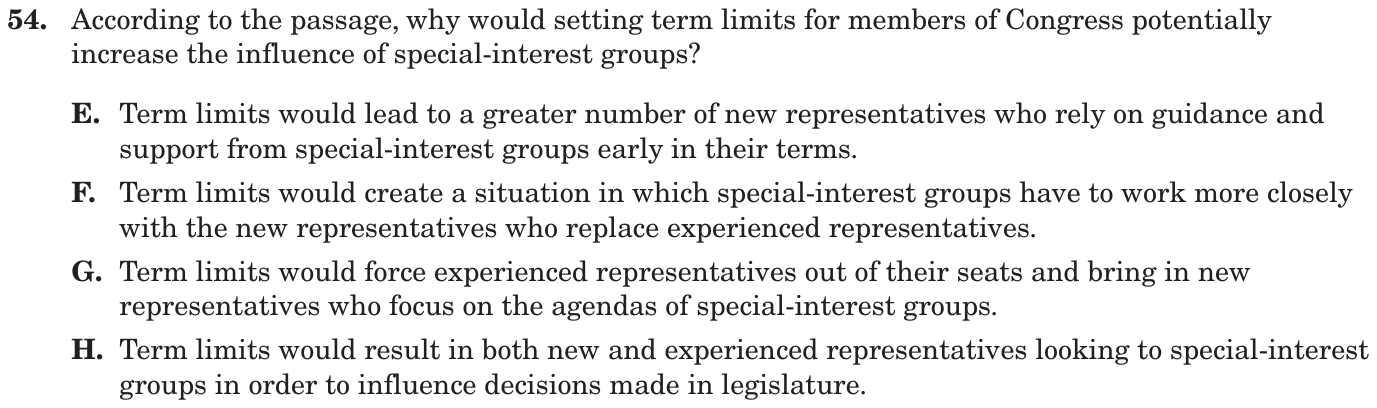
Question 55 of 57
2019 Test A English, question 55Uses the passage above: “Is It Time for Term Limits?”.
Question
The author of the passage develops the idea that congressional term limits might have negative effects mainly by
- Adescribing the amount of time it takes for new representatives to build connections with experienced representatives.
- Bexplaining why members of Congress need experience in order to govern well.
- Cillustrating the various ways lobbyists seek to influence the decisions of new members of Congress.
- Drevealing the statistics on the turnover rates for representatives.
Show the answer
Correct answer: B
The question asks how the author of the passage mainly develops the idea that congressional term limits might have negative effects.
A. Incorrect. While the author states that “politicians who have served together for extended periods have a chance to develop trusting relationships, even across party lines” (paragraph 5), it is never stated in the passage how long it takes politicians to build connections with one another.
B. CORRECT. In paragraphs 5 and 6, the author discusses the fact that members of Congress who lack experience might fail to develop good political relationships, fail to learn processes, and rely too much on lobbyists. For example, paragraph 6 uses information from the National Conference of State Legislatures Study, which reveals that “term limits may increase the influence of lobbyists.”
C. Incorrect. The author does introduce the idea that new politicians are “ ‘more likely to rely on outsiders, including lobbyists, to replace that expertise’ ” (paragraph 5), but the passage does not present the ways that lobbyists seek to influence the decisions of new representatives.
D. Incorrect. Paragraph 7 does give statistics on turnover rates: “Thomas E. Mann, Senior Fellow in governance studies at the Brookings Institution, notes that every decade, new members replace at least half the members of the House and the Senate, due to retirement or elections.” However, this information does not support the idea that term limits might have negative effects.
Question analysis
The author of “Is It Time for Term Limits?” raises the possibility that limiting congressional terms could have negative effects, and this question asks what the author mainly does to develop that idea. Several paragraphs bear on it, with an expert’s warning, a study of state legislatures and statistics on Congress, so students must judge which approach carries the most weight.
- Grade level
- Grade 8 reading and task
- Compared with grade 7
- At grade 7 Tracing how an author develops one claim is grade 7 work with arguments. The options are short, but the evidence spans several paragraphs of a dense argument, so the demand is typical of a careful grade 7 task.
- Estimated difficulty
- Moderate: several steps, or a close reading with one strong distractor.
- Thinking it demands
- Depth of knowledge 2, skills and concepts · mainly analyze
- What makes it hard
- How, not what moderate
- Evidence in several places minor
- The right answer is reworded minor
- Evidence
- Answered from several paragraphs or stanzas
- Reading level
- Passage: about grade 14, 799 words; question and choices: about grade 11, 70 words.
- Corrected from the DOE handbook
- The name of an organization in the passage and the explanation was corrected.
- Students, last 30 days
- Not enough answers yet to show (it takes 10).
Why it is hard, traps and wrong answers (shows the answer)
Why it is hard
The passage’s warning rests on one line of reasoning: newcomers lack the knowledge and relationships that long service builds, so they lean on lobbyists. Lobbyists are the vivid part, which makes a choice about their tactics attractive even though the passage never shows any. The statistics of paragraph 7 also come from the opponents’ side, but they argue that limits are unnecessary, not harmful, and the same paragraph then shows time in office growing.
How, not what moderate Working it out
The stem asks how the author mainly develops the warning, so students must name the reasoning paragraphs 5 and 6 share, that lawmakers without experience govern worse, rather than any one detail along the way. (Anderson & Krathwohl, 2001)
Evidence in several places minor Working it out
The case against limits runs from paragraph 5’s expert quotation through paragraph 6’s state study, while the turnover figures of paragraph 7 belong to a different argument, that limits are unnecessary. (Kirsch & Mosenthal, 1990; Gorin & Embretson, 2006)
The right answer is reworded minor Choosing the answer
The key’s “experience in order to govern well” paraphrases Reynolds’s “expertise they need to be good at their jobs,” while wrong choices repeat the text’s “lobbyists,” “influence” and “turnover.” (Freedle & Kostin, 1993; Kirsch & Mosenthal, 1990)
Strategy: Find the paragraphs that warn about what term limits could do, sum up in a phrase the reasoning they share, and pick the option that names that reasoning rather than one detail.
Traps
- Twists what the text says: Uses the text's topic and ideas but changes what it says: who did it, how much, when, or why.
- True but not the answer: A choice says something accurate about the text that does not answer this question.
- Reads too much in: A reasonable-sounding conclusion that goes further than the text allows.
The wrong answers, classified
A Reads too much in (Graesser, Singer & Trabasso, 1994)
Links “extended periods” in paragraph 5 to a wait newcomers must sit out, but the passage never says how long building connections takes, so the choice invents a measurement.
C Twists what the text says (King et al., 2004)
Rightly ties the danger to lobbyists, named in paragraphs 5 and 6, but the passage shows new lawmakers turning to them for expertise, not the various ways lobbyists work on lawmakers.
D True but not the answer (King et al., 2004; Embretson & Wetzel, 1987)
Recalls that paragraph 7’s turnover figures come from the opponents of limits, but they suggest limits are unnecessary rather than harmful, and the paragraph then shows time in office growing.
What was corrected from the DOE handbook, and why
- Passage and explanation: Paragraph 6 of the passage, and the handbook’s explanation of this question, refer to “the National Conference of State Legislators Study.” The organization is the National Conference of State Legislatures (NCSL), so the site now says “National Conference of State Legislatures” in both places. No answer depends on the name.
Working it out, step by step
Figure out what the question asks
This asks how the author mainly builds the idea that term limits could cause harm. Mainly means the main way, not one small detail. So find the paragraphs that warn about term limits. Then name the reasoning they share.
Find the warning paragraphs
Paragraph 5 says “Experienced politicians have a deep knowledge of congressional processes.” Reynolds adds that term-limited members lack “the relevant expertise they need to be good at their jobs.” Paragraph 6 gives a real example. In states with term limits, “The inexperienced state lawmakers began depending on special-interest groups for their expertise on issues.”
Name the shared reasoning
Both paragraphs make the same point. Lawmakers need experience to do the job well. Without it, they lean on outsiders, such as lobbyists. Term limits would mean fewer experienced lawmakers. So the author shows the harm by explaining why experience matters.
Check each choice
- A does not fit. The passage says politicians who serve together for “extended periods” build trust. It never says how long that takes.
- B fits. Paragraphs 5 and 6 explain why lawmakers need experience to govern well.
- C does not fit. Lobbyists come up, but the passage never shows the ways they try to sway lawmakers. It shows new lawmakers turning to them for help.
- D does not fit. The turnover numbers in paragraph 7 come from people who oppose limits. They suggest limits aren’t needed, not that limits would cause harm.
Choose the answer
Watch out: C is tempting because lobbyists are a big part of the danger. But the passage mentions them only as the help new lawmakers turn to. It never describes how lobbyists work. So the answer is B.
Why this answer and not the closest wrong one
C is the closest wrong answer. Lobbyists do appear in paragraphs 5 and 6. But the passage never lists the ways they try to win lawmakers over. Instead, it explains why lawmakers without experience lean on them. That reasoning, that members need experience to govern well, runs through both paragraphs. That is B.
More questions like this
The original DOE question
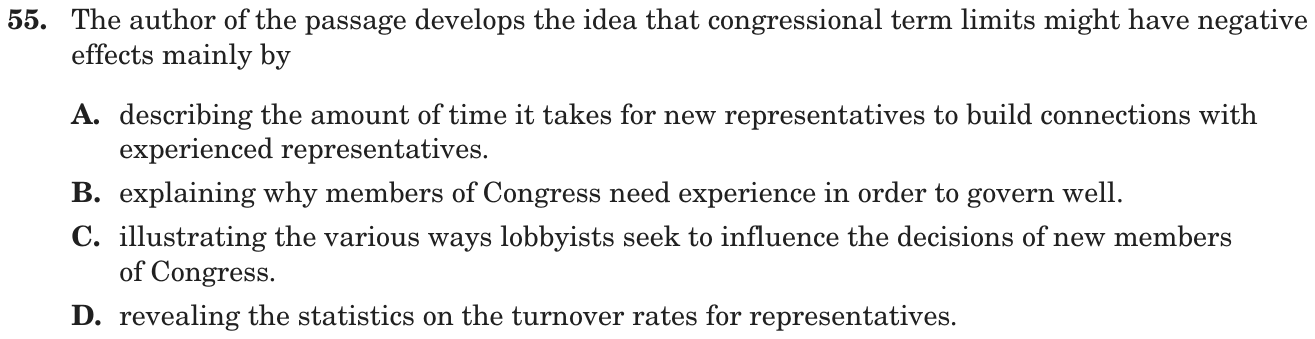
Question 56 of 57
2019 Test A English, question 56Uses the passage above: “Is It Time for Term Limits?”.
Question
With which statement would the author of the passage most likely agree?
- AThe expertise of lawmakers should outweigh other considerations when it comes to deciding about term limits.
- BThe decision to institute term limits for Congress is the most pressing issue facing American voters today.
- CThere are compelling reasons both for and against setting term limits for Congress.
- DSpecial-interest groups are likely to have a huge influence on whether term limits are set.
Show the answer
Correct answer: C
The question asks with which statement the author of the passage would most likely agree.
A. Incorrect. While the author presents a good description of why expertise is important for lawmakers, the author does not give this argument greater weight than other arguments in the passage.
B. Incorrect. While paragraph 2 does state that “modern surveys conducted by multiple firms consistently show that American citizens of a variety of backgrounds and political leanings approve of the idea of setting term limits for members of Congress,” the author never suggests that term limits are the most pressing issue facing voters today and never compares this issue to any other issues.
C. CORRECT. Given that the author presents strong arguments and supporting evidence both for and against setting term limits, the author would most likely agree that both sides have compelling reasons supporting their positions. The passage ends with the author’s suggestions that “perhaps one day people will have a chance to vote on the issue” (paragraph 8). The author never argues for a particular side of the argument.
D. Incorrect. While the author discusses in paragraphs 5 and 6 the dangers of special-interest groups having excessive influence on lawmakers, the author never suggests that special-interest groups may influence the issue of term limits itself.
Question analysis
Students must decide which statement the author of “Is It Time for Term Limits?” would most likely agree with, which means inferring the author’s point of view on congressional term limits. Each statement picks up a topic the passage discusses, from lawmakers’ expertise to special-interest groups, so students must judge how far the author’s own words go rather than how familiar the topic sounds.
- Grade level
- Grade 8 reading and task
- Compared with grade 7
- At grade 7 A grade 7 standard asks students to analyze where an author stands in an informational text. Here that position must be pieced together from the passage as a whole rather than read from one sentence, and the dense political vocabulary adds reading load.
- Estimated difficulty
- Straightforward: two steps or one careful reading.
- Thinking it demands
- Depth of knowledge 3, strategic thinking · mainly analyze
- What makes it hard
- Reading between the lines moderate
- Evidence in several places minor
- Evidence
- Answered from the whole text
- Reading level
- Passage: about grade 14, 799 words; question and choices: about grade 10, 73 words.
- Students, last 30 days
- Not enough answers yet to show (it takes 10).
Why it is hard, traps and wrong answers (shows the answer)
Why it is hard
Each statement picks up a topic the passage discusses, expertise, public opinion or special-interest groups, so each sounds connected to it. The question is how far the author goes, and the author goes no further than laying out both sides and leaving the decision to voters. Students who weigh the space given to expertise, or who remember lobbyists and influence without the direction of that influence, credit the author with a stance the passage never takes.
Reading between the lines moderate Working it out
The author never states a position; it has to be read from how the passage is built, arguments for limits in paragraphs 2–4, doubts about them in 5–7, and an open question at the end. (Graesser, Singer & Trabasso, 1994; Kintsch, 1998)
Evidence in several places minor Working it out
The evidence for the author’s balance is the whole passage, from the surveys and Lieberman on one side to Reynolds, the state study and Mann on the other, closing on a vote that may come “one day.” (Kirsch & Mosenthal, 1990; Gorin & Embretson, 2006)
Strategy: For each statement, find where the passage touches its idea and check whether the author actually commits to it; a statement the author would accept must fit the passage as a whole, not just one paragraph.
Traps
- Too broad or too strong: A choice overstates, generalizes, or uses absolute words the text does not support.
- Reversed relationship: Cause and effect, or the order of events, turned around.
The wrong answers, classified
A Too broad or too strong (King et al., 2004)
Notices how much space paragraphs 5 and 6 give to lawmakers’ expertise, but the author never ranks it above other concerns, such as partisanship or careerists’ goals, raised elsewhere.
B Too broad or too strong (King et al., 2004)
Turns broad public approval, shown by the surveys in paragraph 2, into the claim that term limits are the most pressing issue for voters, though the passage compares them with no other issue.
D Reversed relationship (King et al., 2004)
Turns the influence around: paragraph 6 says term limits could raise special-interest groups’ sway over new lawmakers, not that the groups would sway the decision to set limits.
Working it out, step by step
Figure out what the question asks
This asks what the author would most likely agree with. The author never says I think or picks a side out loud. So you have to read the author’s view from how the passage is built and how it ends.
Look at how the passage is built
- Paragraphs 2–4 give reasons for term limits: public support, Lieberman’s view, and worries about career politicians.
- Paragraphs 5–7 give reasons against: lawmakers need experience, a state study, and enough change already.
Each side gets experts and evidence. The author gives each side about the same space.
Look at how it ends
Paragraph 8 asks, “Should Congress pass a constitutional amendment to institute congressional term limits?” It answers only, “Perhaps one day people will have a chance to vote on the issue.” The author leaves the question open and never picks a side. That suggests the author sees strong reasons on both sides.
Check each choice
- A does not fit. The author explains why expertise matters, but never ranks it above other concerns.
- B does not fit. The passage never compares term limits with other issues voters face.
- C fits. Compelling means strong and convincing. The author gives such reasons for and against.
- D does not fit. It turns the passage around. The passage says limits might give special-interest groups more sway over new lawmakers. It never says the groups would sway whether limits are set.
Choose the answer
Watch out: A is tempting because paragraphs 5 and 6 spend a lot of time on expertise. But giving a point space is not the same as saying it matters most. So the answer is C.
Why this answer and not the closest wrong one
A is the closest wrong answer. The author does explain why experienced lawmakers matter. But the author gives just as much care to the other side, such as Lieberman’s hope for a “less partisan” Congress. The passage ends with an open question, not a ruling. That balance fits C, not A.
More questions like this
The original DOE question
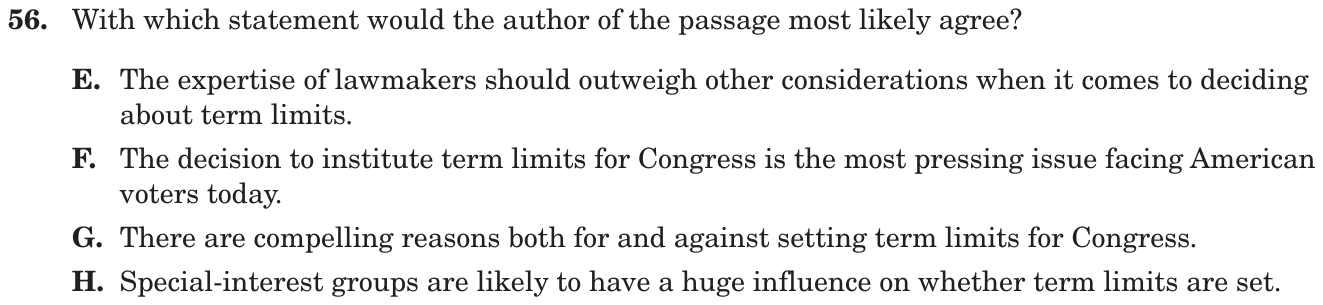
Question 57 of 57
2019 Test A English, question 57Uses the passage above: “Is It Time for Term Limits?”.
Question
The tables at the end of the passage contribute to the development of ideas in paragraph 7 by
- Ahighlighting the idea that the number of members of Congress who are reelected in each election has increased substantially since 1950.
- Bdemonstrating that the number of times members of Congress are reelected throughout their careers has shifted since 1950.
- Cshowing that the reelection rate in the Senate differs from the reelection rate in the House.
- Demphasizing the fact that the Senate has fewer seats but a greater reelection rate than the House.
Show the answer
Correct answer: A
The question asks how the tables at the end of the passage contribute to the development of ideas in paragraph 7.
A. CORRECT. The tables show that members of Congress have a greater chance of getting reelected today than they did in 1950, supporting the idea from paragraph 7 that the average length of time in office has increased: “Still, the average length of time in office has mushroomed. For example, the 65th Congress (1917–1919) had an average service time of 5.3 years for members of the House of Representatives and 5.7 years for Senate members. The 114th Congress (2015–2017) had an average of 8.8 years for members of the House and 9.7 years for senators.”
B. Incorrect. While the tables suggest that the reelection rate for members of Congress has shifted upward since 1950 as explained in paragraph 7, the tables do not provide details about the number of times congresspeople have been reelected throughout their careers.
C. Incorrect. While the tables indicate that the reelection rates between the House and the Senate differ somewhat, the distinction between reelection rates of the two parts of Congress is unrelated to the main idea of paragraph 7 that “the average length of time in office has mushroomed.”
D. Incorrect. The number of seats in the Senate is a minor detail that does not support an idea from paragraph 7, where the author focuses on current turnover “due to retirement or elections” and the fact that “the average length of time in office has mushroomed.”
Question analysis
Two tables at the end of “Is It Time for Term Limits?” give the percentage of House and Senate members reelected in 1950, 1978, 1998 and 2016, and this question asks how they contribute to the ideas in paragraph 7, which discusses turnover in Congress and time in office. Students must read the tables and weigh options that each describe the numbers in a different way.
- Grade level
- Grade 8 reading and task
- Compared with grade 7
- Above grade 7 Reading values from a table is within grade 7 skills, but here students must link two tables of percentages to one paragraph’s argument and choose among closely worded statements about the numbers, more than typical grade 7 table questions ask.
- Estimated difficulty
- Hard: combines ideas, needs a plan, and has more than one tempting wrong answer.
- Thinking it demands
- Depth of knowledge 3, strategic thinking · mainly analyze
- What makes it hard
- Reading a figure, table or graph moderate
- A very close wrong answer moderate
- Combines ideas minor
- Evidence
- Answered from several paragraphs or stanzas
- Reading level
- Passage: about grade 14, 799 words; question and choices: about grade 9, 87 words.
- Students, last 30 days
- Not enough answers yet to show (it takes 10).
Why it is hard, traps and wrong answers (shows the answer)
Why it is hard
The question joins two tables of percentages to a paragraph about time in office, and the link, that more members winning again means longer careers, is left to the student. The right choice says the share reelected rose substantially, which fits the Senate column, 68.8 in 1950 and 93.1 in 2016, better than the House column, 83.2 and 87.4, so the vaguer claim that reelections “shifted” over careers can look safer. Choices that set the chambers against each other answer a question paragraph 7 never asks.
Reading a figure, table or graph moderate Understanding the question
Each table gives four election years for one chamber, and the point appears only when each column is read down: both dip in 1978, then the House climbs to 90.8 before settling at 87.4 and the Senate climbs from 60.0 to 93.1. (Lesh, Post & Behr, 1987; Kirsch & Mosenthal, 1990)
A very close wrong answer moderate Choosing the answer
The career choice, like the key, says reelection has changed since 1950; it differs in counting reelections over a career, which the tables never show, and in the safer “shifted” for “increased substantially.” (Embretson & Wetzel, 1987; Gorin & Embretson, 2006; Ascalon et al., 2007)
Combines ideas minor Working it out
The tables must be joined to paragraph 7’s claim that time in office “has mushroomed,” from 5.3 and 5.7 years in 1917–1919 to 8.8 and 9.7 in 2015–2017, a link the passage never states. (Embretson, 1998; Daniel & Embretson, 2010)
Strategy: State each point paragraph 7 makes, then read the tables row by row and ask what they show; the right option must be both true of the tables and connected to paragraph 7.
Traps
- Twists what the text says: Uses the text's topic and ideas but changes what it says: who did it, how much, when, or why.
- Wrong purpose or structure: Names a purpose, structure or effect that the part does not serve, or describes what a part says when the question asks what it does.
The wrong answers, classified
B Twists what the text says (King et al., 2004)
Links the tables to paragraph 7’s longer careers and reads them as counting how many times members win, but each row gives the share reelected in a single election year.
C Wrong purpose or structure (Anderson & Krathwohl, 2001)
Reads the two tables against each other as a contrast between chambers, though paragraph 7 treats House and Senate together and each table is laid out to show change across the years.
D Wrong purpose or structure (Anderson & Krathwohl, 2001)
Seizes on the “Total seats” labels and the 2016 row and treats the tables as a contest between chambers, though seat counts and such a contest play no part in paragraph 7.
Working it out, step by step
Figure out what the question asks
This asks how the tables at the end help develop the ideas in paragraph 7. So first find the ideas in paragraph 7. Then read the tables and see which idea they back up.
Find the ideas in paragraph 7
Paragraph 7 gives the view of people who oppose limits: “the turnover rate in Congress is sufficient.” Turnover means old members being replaced by new ones. Sufficient means enough. Then it adds, “Still, the average length of time in office has mushroomed.” Mushroomed means grew fast. Average service went from 5.3 and 5.7 years in 1917–1919 to 8.8 and 9.7 years in 2015–2017.
Read each table on its own
Read each table from top to bottom. The House table goes 83.2, 82.3, 90.8, 87.4. The Senate table goes 68.8, 60.0, 89.7, 93.1. Each one dips in 1978. After that, each table stays above its 1950 number. So in each table, the percentage reelected is higher in 2016 than in 1950. Paragraph 7 never sets the House against the Senate. So read each table for its own change over time.
Connect the tables to paragraph 7
When more members win reelection, more of them stay in office. Members who stay longer push up the average time in office. So the tables back up paragraph 7’s point that time in office “has mushroomed,” even with all the turnover.
Check each choice
- A fits best. The tables give percentages, not counts. Still, A is the only choice about reelection rising since 1950, which both tables show.
- B does not fit. Each row covers one election year. Nothing shows how many times one person won over a career.
- C does not fit. Paragraph 7 gives numbers for both, but it never compares them. So a difference between the two doesn’t develop its ideas.
- D does not fit. The number of seats plays no part in paragraph 7.
Choose the answer
Watch out: B is tempting because paragraph 7 is about long careers. But the tables give one percentage per election year. They never count how many times anyone won. So the answer is A.
Why this answer and not the closest wrong one
B is the closest wrong answer. It links the tables to long careers, as paragraph 7 does. But each row shows the percentage reelected in one election year, not how often a member won over a career. A uses what the tables do show: reelection is higher in 2016 than in 1950. That supports the claim that time in office “has mushroomed.”
More questions like this
The original DOE question