Passage A Miracle Mile
A Miracle Mile
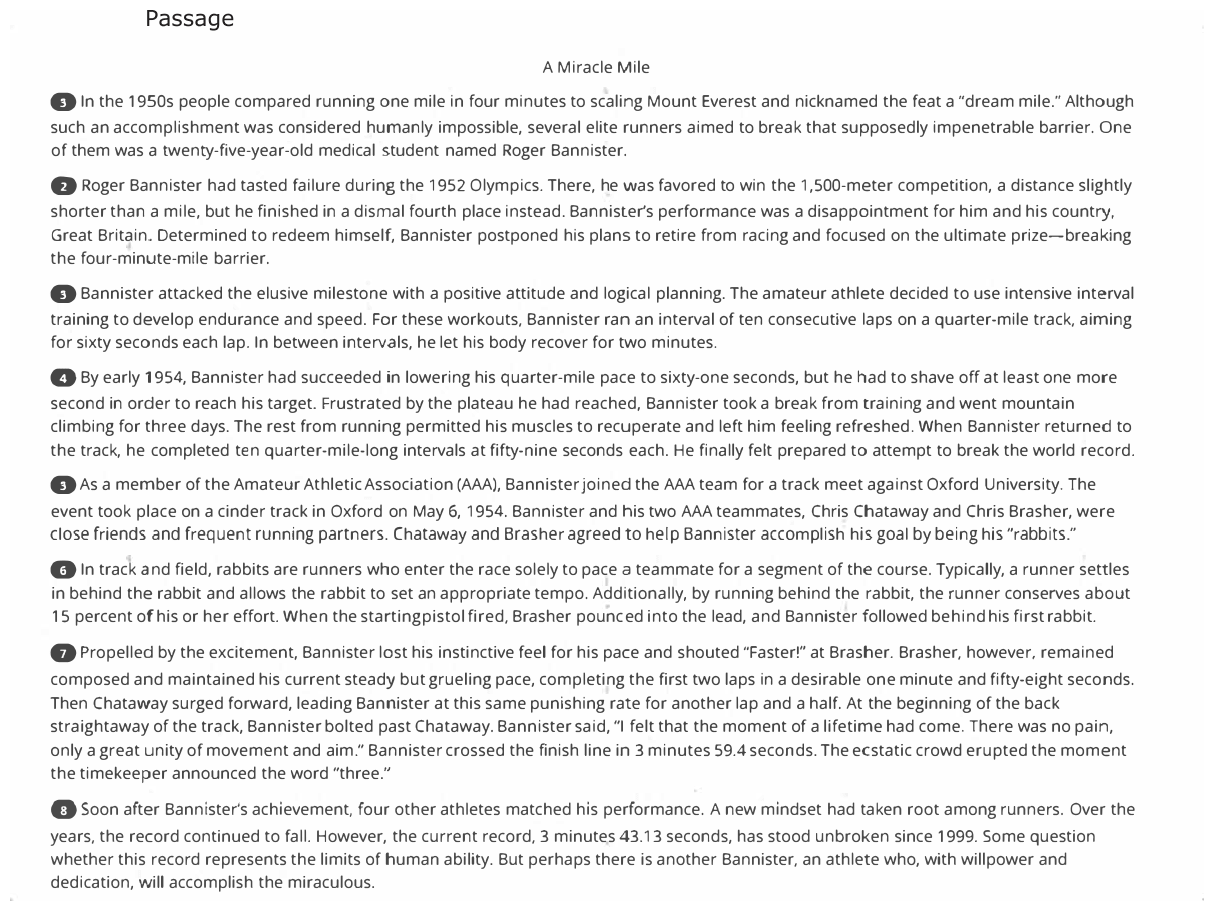
In the 1950s people compared running one mile in four minutes to scaling Mount Everest and nicknamed the feat a “dream mile.” Although such an accomplishment was considered humanly impossible, several elite runners aimed to break that supposedly impenetrable barrier. One of them was a twenty-five-year-old medical student named Roger Bannister.
Roger Bannister had tasted failure during the 1952 Olympics. There, he was favored to win the 1,500-meter competition, a distance slightly shorter than a mile, but he finished in a dismal fourth place instead. Bannister’s performance was a disappointment for him and his country, Great Britain. Determined to redeem himself, Bannister postponed his plans to retire from racing and focused on the ultimate prize—breaking the four-minute-mile barrier.
Bannister attacked the elusive milestone with a positive attitude and logical planning. The amateur athlete decided to use intensive interval training to develop endurance and speed. For these workouts, Bannister ran an interval of ten consecutive laps on a quarter-mile track, aiming for sixty seconds each lap. In between intervals, he let his body recover for two minutes.
By early 1954, Bannister had succeeded in lowering his quarter-mile pace to sixty-one seconds, but he had to shave off at least one more second in order to reach his target. Frustrated by the plateau he had reached, Bannister took a break from training and went mountain climbing for three days. The rest from running permitted his muscles to recuperate and left him feeling refreshed. When Bannister returned to the track, he completed ten quarter-mile-long intervals at fifty-nine seconds each. He finally felt prepared to attempt to break the world record.
As a member of the Amateur Athletic Association (AAA), Bannister joined the AAA team for a track meet against Oxford University. The event took place on a cinder track in Oxford on May 6, 1954. Bannister and his two AAA teammates, Chris Chataway and Chris Brasher, were close friends and frequent running partners. Chataway and Brasher agreed to help Bannister accomplish his goal by being his “rabbits.”
In track and field, rabbits are runners who enter the race solely to pace a teammate for a segment of the course. Typically, a runner settles in behind the rabbit and allows the rabbit to set an appropriate tempo. Additionally, by running behind the rabbit, the runner conserves about 15 percent of his or her effort. When the starting pistol fired, Brasher pounced into the lead, and Bannister followed behind his first rabbit.
Propelled by the excitement, Bannister lost his instinctive feel for his pace and shouted “Faster!” at Brasher. Brasher, however, remained composed and maintained his current steady but grueling pace, completing the first two laps in a desirable one minute and fifty-eight seconds. Then Chataway surged forward, leading Bannister at this same punishing rate for another lap and a half. At the beginning of the back straightaway of the track, Bannister bolted past Chataway. Bannister said, “I felt that the moment of a lifetime had come. There was no pain, only a great unity of movement and aim.” Bannister crossed the finish line in 3 minutes 59.4 seconds. The ecstatic crowd erupted the moment the timekeeper announced the word “three.”
Soon after Bannister’s achievement, four other athletes matched his performance. A new mindset had taken root among runners. Over the years, the record continued to fall. However, the current record, 3 minutes 43.13 seconds, has stood unbroken since 1999. Some question whether this record represents the limits of human ability. But perhaps there is another Bannister, an athlete who, with willpower and dedication, will accomplish the miraculous.
Question
How does the author’s use of chronological structure contribute to the development of ideas in the passage?
- AIt presents the increasing physical effects of Bannister’s intense training methods as he prepared to break the four-minute-mile barrier.
- BIt shows the increase in Bannister’s confidence in his ability to break the four-minute-mile barrier.
- CIt emphasizes the key events in Bannister’s life that inspired him to break the four-minute-mile barrier.
- DIt highlights the progression of Bannister’s training and details about his successful attempt to break the four-minute-mile barrier.
Show the answer
Correct answer: D
The question asks how the author’s use of chronological structure contributes to the development of ideas in the passage.
A. Incorrect. While paragraph 4 mentions the “plateau” Bannister dealt with and the break that “permitted his muscles to recuperate,” the chronological structure of the passage focuses mainly on the progression of Bannister’s process over time.
B. Incorrect. Even though the passage suggests that Bannister’s ability to break the four-minute-mile barrier improved and that he felt “prepared to attempt to break the world record” (paragraph 4), the chronological structure of the passage primarily serves to show how Bannister’s progress over time led to his success.
C. Incorrect. The chronological structure of the passage begins with an acknowledgement that Bannister was inspired to break the four-minute-mile barrier by his loss at the 1952 Olympics (paragraph 2); however, the overall organization of the passage highlights his dedicated efforts over time to break the four-minute-mile barrier.
D. CORRECT. The chronological structure of the passage follows the progression of Bannister’s training from his loss at the 1952 Olympics to the race where he ran the first sub–four-minute mile on May 6, 1954 (paragraph 5).
Question analysis
This text-structure question asks how chronological order helps develop the ideas of “A Miracle Mile,” which follows Roger Bannister’s pursuit of the four-minute mile and closes with the record as it stands today. Several options rest on real details, such as his Olympic loss and his tired muscles, so students must work out what the time order as a whole is built to show.
- Grade level
- Grade 7 reading and task
- Compared with grade 7
- Below grade 7 Grade 7 structure questions often leave students to discover how a text is organized, but this one names the structure for them, and the article moves in plain prose from one dated step to the next, so the demand is lighter.
- Estimated difficulty
- Straightforward: two steps or one careful reading.
- Thinking it demands
- Depth of knowledge 2, skills and concepts · mainly analyze
- What makes it hard
- How, not what minor
- Every choice must be checked minor
- Evidence in several places minor
- Evidence
- Answered from the whole text
- Reading level
- Passage: about grade 10, 587 words; question and choices: about grade 13, 85 words.
- Corrected from the DOE handbook
- A wrong paragraph number in the explanation was corrected.
- Students, last 30 days
- Not enough answers yet to show (it takes 10).
Why it is hard, traps and wrong answers (shows the answer)
Why it is hard
The article moves in plain order from a lost Olympic final to a record run, and the right description simply names what that order tracks: training that improves, then the race. Each wrong choice picks a thread the article touches but never traces, a physical strain mentioned once, a confidence present from the start, an inspiration that comes only from 1952. In this printing the word “intense” echoes paragraph 3 and gives the strain choice some extra pull.
How, not what minor Working it out
The stem names the structure and asks what it does, so the task is to say which thread the time order follows from the 1952 Olympics to May 6, 1954, not to retell the events. (Anderson & Krathwohl, 2001)
Every choice must be checked minor Choosing the answer
Each wrong thread has a foothold: “intensive interval training” and muscles that needed to “recuperate” for physical effects, “finally felt prepared” for confidence, and the 1952 loss for inspiration. (Embretson & Wetzel, 1987)
Evidence in several places minor Working it out
A thread counts only if it runs the whole way, so it must cover the workouts of paragraphs 3 and 4 as well as the race told in paragraphs 5 to 7. (Kirsch & Mosenthal, 1990; Gorin & Embretson, 2006)
Strategy: Skim the paragraphs in order and name the main thing that moves forward from one to the next; the best description fits most of the article, not just the opening or one middle paragraph.
Traps
- Twists what the text says: Uses the text's topic and ideas but changes what it says: who did it, how much, when, or why.
- Reads too much in: A reasonable-sounding conclusion that goes further than the text allows.
- Too narrow: A single detail offered as the central idea or a summary, or a summary that keeps minor details and leaves out an essential part.
The wrong answers, classified
A Twists what the text says (King et al., 2004)
Links “intense” to paragraph 3’s “intensive interval training” and the rest his muscles needed, but the article tracks lap times falling from sixty-one to fifty-nine seconds, not a growing physical toll.
B Reads too much in (Graesser, Singer & Trabasso, 1994)
Follows Bannister from “Frustrated by the plateau” to “finally felt prepared,” but he set out with “a positive attitude,” and the dated steps chart his training and race, not rising confidence.
C Too narrow (King et al., 2004)
Starts from the 1952 loss that left him “Determined to redeem himself,” but that single event belongs to paragraph 2, and later paragraphs follow workouts and a race, not new sources of inspiration.
What was corrected from the DOE handbook, and why
- Explanation: The handbook’s explanation of Option C says the passage begins by acknowledging that Bannister was inspired by his loss at the 1952 Olympics “(paragraph 1).” That loss is in paragraph 2 (“Roger Bannister had tasted failure during the 1952 Olympics”), so the site now cites paragraph 2, as the DOE’s later printing of this explanation does. The answer, D, is unchanged.
Working it out, step by step
Figure out what the question asks
This is a structure question. Chronological structure means telling events in time order, from first to last. The question asks what that order helps the passage show. So sum up the paragraphs in order. Then find the thread that runs through them.
Sum up the paragraphs in order
- Paragraph 1: A four-minute mile seems impossible.
- Paragraph 2: Bannister loses at the 1952 Olympics and sets his goal.
- Paragraph 3: He plans his interval training.
- Paragraph 4: By early 1954, his laps get faster, from sixty-one seconds to fifty-nine.
- Paragraphs 5–7: On May 6, 1954, two teammates set his pace, and he runs the mile in 3 minutes 59.4 seconds.
- Paragraph 8: Other runners match him.
Name the thread
Most paragraphs follow two things. First comes his training, step by step. Then come the details of the race where he broke the barrier. Progression means step-by-step progress. So the time order shows how his training moved forward and how the record run went.
Check each choice
- A does not fit. His body comes up only now and then, as when a rest “permitted his muscles to recuperate” (paragraph 4). Recuperate means recover. The passage never tracks effects that grow. A also leaves out the race.
- B does not fit. He had “a positive attitude” from the start (paragraph 3). The order follows what he did, not how sure he felt.
- C does not fit. One event inspired him: the 1952 loss in paragraph 2. After that come workouts and a race.
- D fits. It names both threads: the training and the race.
Choose the answer
Watch out: B is tempting because in paragraph 4 “He finally felt prepared to attempt to break the world record.” But that is one moment, not the thread of the whole passage. So the answer is D.
Why this answer and not the closest wrong one
B is the closest wrong answer. Bannister does end up ready to race. But he began with “a positive attitude,” so the passage never shows his confidence climbing from low to high. The paragraphs trace his workouts and then the record run itself. D names both parts of that thread.
More questions like this
The original DOE question
The passage “A Miracle Mile” as printed (page 13)