Passage Is It Time for Term Limits?
Is It Time for Term Limits?
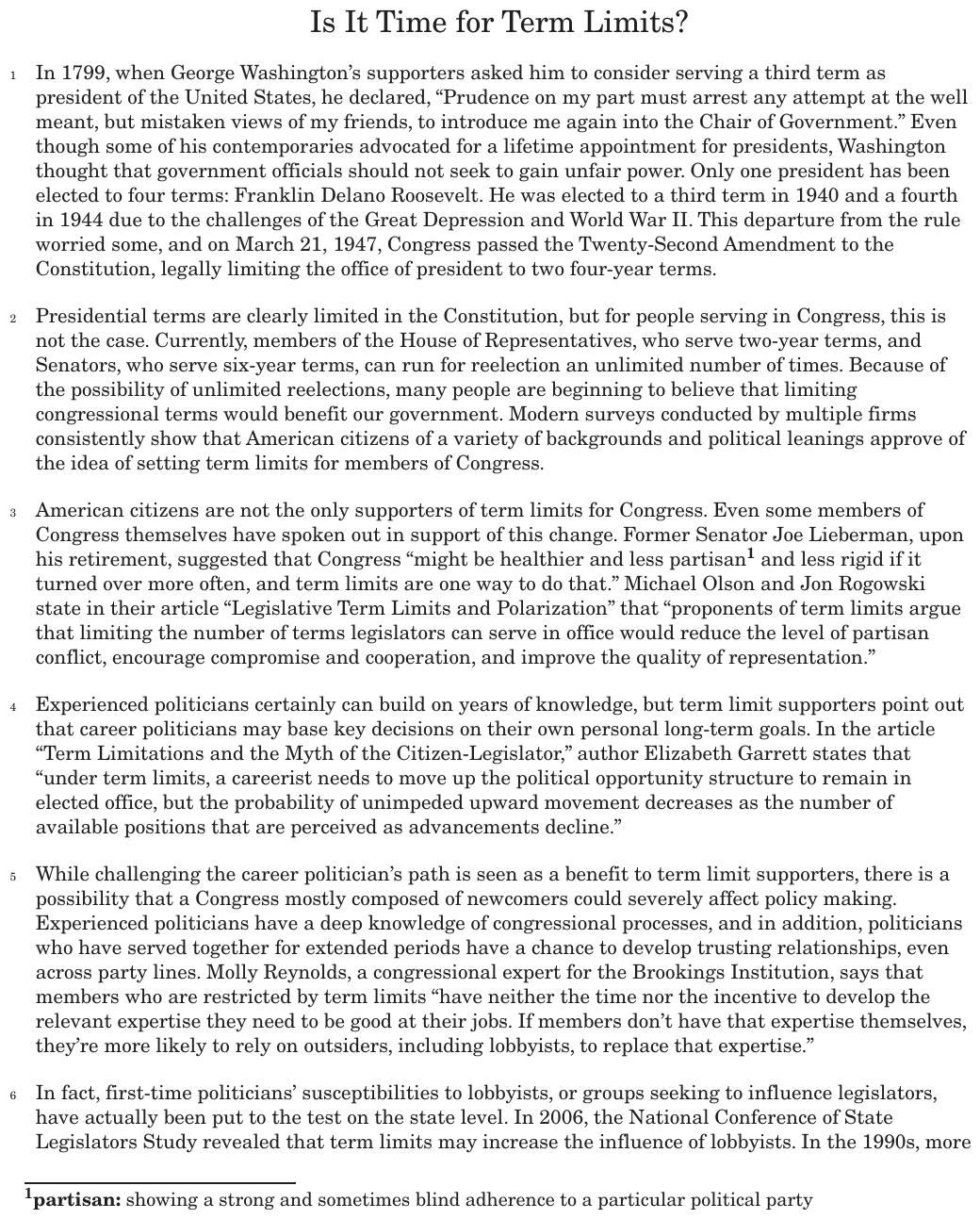
In 1799, when George Washington’s supporters asked him to consider serving a third term as president of the United States, he declared, “Prudence on my part must arrest any attempt at the well meant, but mistaken views of my friends, to introduce me again into the Chair of Government.” Even though some of his contemporaries advocated for a lifetime appointment for presidents, Washington thought that government officials should not seek to gain unfair power. Only one president has been elected to four terms: Franklin Delano Roosevelt. He was elected to a third term in 1940 and a fourth in 1944 due to the challenges of the Great Depression and World War II. This departure from the rule worried some, and on March 21, 1947, Congress passed the Twenty-Second Amendment to the Constitution, legally limiting the office of president to two four-year terms.
Presidential terms are clearly limited in the Constitution, but for people serving in Congress, this is not the case. Currently, members of the House of Representatives, who serve two-year terms, and Senators, who serve six-year terms, can run for reelection an unlimited number of times. Because of the possibility of unlimited reelections, many people are beginning to believe that limiting congressional terms would benefit our government. Modern surveys conducted by multiple firms consistently show that American citizens of a variety of backgrounds and political leanings approve of the idea of setting term limits for members of Congress.
American citizens are not the only supporters of term limits for Congress. Even some members of Congress themselves have spoken out in support of this change. Former Senator Joe Lieberman, upon his retirement, suggested that Congress “might be healthier and less partisan1 and less rigid if it turned over more often, and term limits are one way to do that.” Michael Olson and Jon Rogowski state in their article “Legislative Term Limits and Polarization” that “proponents of term limits argue that limiting the number of terms legislators can serve in office would reduce the level of partisan conflict, encourage compromise and cooperation, and improve the quality of representation.”
Experienced politicians certainly can build on years of knowledge, but term limit supporters point out that career politicians may base key decisions on their own personal long-term goals. In the article “Term Limitations and the Myth of the Citizen-Legislator,” author Elizabeth Garrett states that “under term limits, a careerist needs to move up the political opportunity structure to remain in elected office, but the probability of unimpeded upward movement decreases as the number of available positions that are perceived as advancements decline.”
While challenging the career politician’s path is seen as a benefit to term limit supporters, there is a possibility that a Congress mostly composed of newcomers could severely affect policy making. Experienced politicians have a deep knowledge of congressional processes, and in addition, politicians who have served together for extended periods have a chance to develop trusting relationships, even across party lines. Molly Reynolds, a congressional expert for the Brookings Institution, says that members who are restricted by term limits “have neither the time nor the incentive to develop the relevant expertise they need to be good at their jobs. If members don’t have that expertise themselves, they’re more likely to rely on outsiders, including lobbyists, to replace that expertise.”
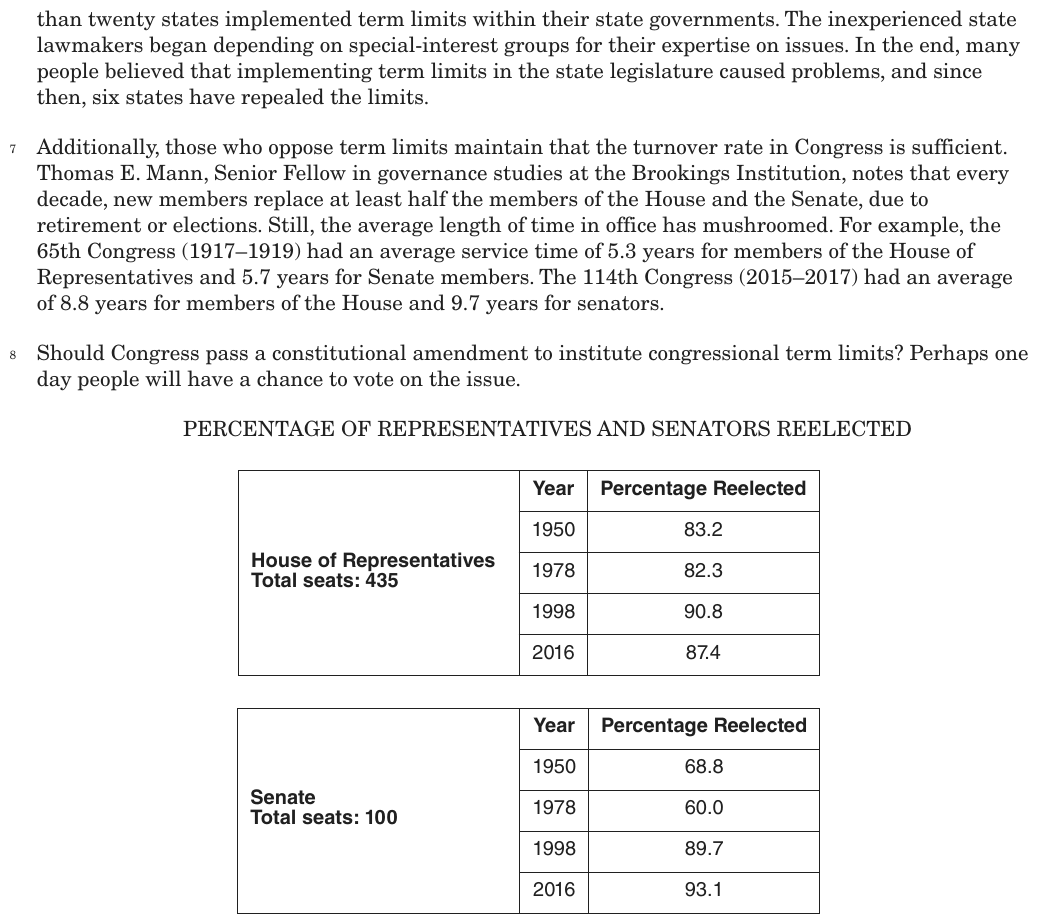
In fact, first-time politicians’ susceptibilities to lobbyists, or groups seeking to influence legislators, have actually been put to the test on the state level. In 2006, the National Conference of State Legislatures Study revealed that term limits may increase the influence of lobbyists. In the 1990s, more than twenty states implemented term limits within their state governments. The inexperienced state lawmakers began depending on special-interest groups for their expertise on issues. In the end, many people believed that implementing term limits in the state legislature caused problems, and since then, six states have repealed the limits.
Additionally, those who oppose term limits maintain that the turnover rate in Congress is sufficient. Thomas E. Mann, Senior Fellow in governance studies at the Brookings Institution, notes that every decade, new members replace at least half the members of the House and the Senate, due to retirement or elections. Still, the average length of time in office has mushroomed. For example, the 65th Congress (1917–1919) had an average service time of 5.3 years for members of the House of Representatives and 5.7 years for Senate members. The 114th Congress (2015–2017) had an average of 8.8 years for members of the House and 9.7 years for senators.
Should Congress pass a constitutional amendment to institute congressional term limits? Perhaps one day people will have a chance to vote on the issue.
PERCENTAGE OF REPRESENTATIVES AND SENATORS REELECTED
| House of Representatives Total seats: 435 | Year | Percentage Reelected |
|---|---|---|
| 1950 | 83.2 | |
| 1978 | 82.3 | |
| 1998 | 90.8 | |
| 2016 | 87.4 |
| Senate Total seats: 100 | Year | Percentage Reelected |
|---|---|---|
| 1950 | 68.8 | |
| 1978 | 60.0 | |
| 1998 | 89.7 | |
| 2016 | 93.1 |
1partisan: showing a strong and sometimes blind adherence to a particular political party
Question
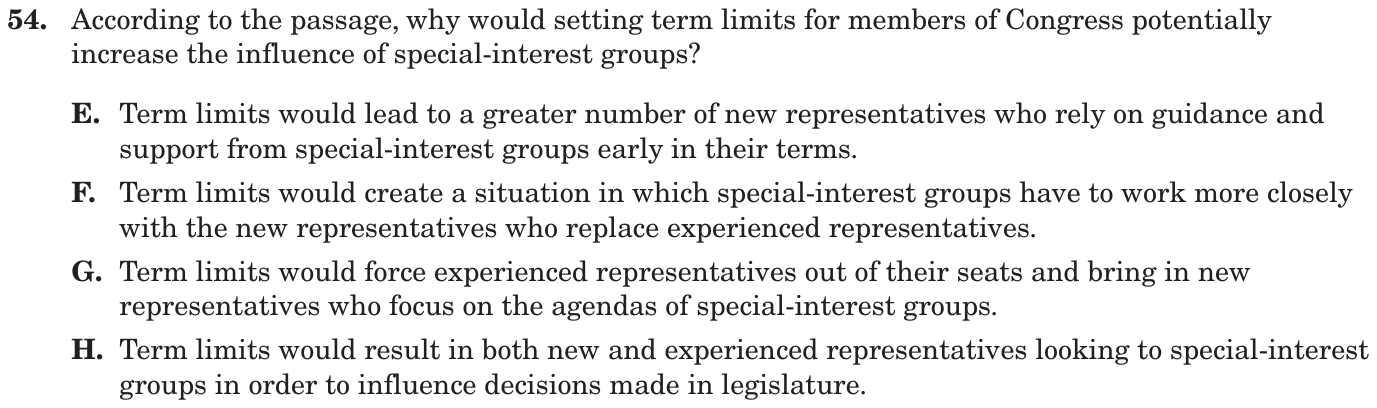
According to the passage, why would setting term limits for members of Congress potentially increase the influence of special-interest groups?
- ATerm limits would lead to a greater number of new representatives who rely on guidance and support from special-interest groups early in their terms.
- BTerm limits would create a situation in which special-interest groups have to work more closely with the new representatives who replace experienced representatives.
- CTerm limits would force experienced representatives out of their seats and bring in new representatives who focus on the agendas of special-interest groups.
- DTerm limits would result in both new and experienced representatives looking to special-interest groups in order to influence decisions made in legislature.
Show the answer
Correct answer: A
The question asks why setting term limits for members of Congress potentially increases the influence of special-interest groups.
A. CORRECT. The passage explains in paragraphs 5 and 6 that representatives who lack experience might end up relying on lobbyists’ expertise. Paragraph 6 uses information from the National Conference of State Legislatures Study, which indicated that state lawmakers were “depending on special-interest groups for their expertise on issues.” This example on a state level is used to show that “term limits may increase the influence of lobbyists” (paragraph 6).
B. Incorrect. While lobbyists can work with representatives, it is not required. The passage implies that some of the deep knowledge many politicians gain is from spending time in office and from developing “trusting relationships” (paragraph 5) with colleagues.
C. Incorrect. The passage does discuss the drawbacks of forcing experienced representatives from their seats, but it does not provide support for the idea that new representatives will focus on the agendas of special-interest groups.
D. Incorrect. The passage states that experienced representatives “have a deep knowledge of congressional processes, and in addition, politicians who have served together for extended periods have a chance to develop trusting relationships, even across party lines” (paragraph 5). The author states that the concern is only for new representatives who might seek help or guidance from lobbyists.
Question analysis
According to “Is It Time for Term Limits?”, limiting how long members of Congress can serve might increase the influence of special-interest groups, and this key-details question asks why. Each option connects lawmakers and interest groups in a different way, so the passage’s reasoning has to be followed step by step.
- Grade level
- Grade 8 reading and task
- Compared with grade 7
- At grade 7 Explaining a cause-and-effect link stated in an informational text is grade 7 work. Here the link runs across two paragraphs and an example from state governments, and the long options differ in small ways, which keeps the demand at the upper end of grade 7.
- Estimated difficulty
- Moderate: several steps, or a close reading with one strong distractor.
- Thinking it demands
- Depth of knowledge 2, skills and concepts · mainly understand
- What makes it hard
- A very close wrong answer moderate
- Evidence in several places minor
- Every choice must be checked minor
- Evidence
- Answered from several paragraphs or stanzas
- Reading level
- Passage: about grade 14, 799 words; question and choices: about grade 14, 112 words.
- Corrected from the DOE handbook
- The name of an organization in the passage and the explanation was corrected.
- Students, last 30 days
- Not enough answers yet to show (it takes 10).
Why it is hard, traps and wrong answers (shows the answer)
Why it is hard
The passage gives the reason in two steps: term limits fill a legislature with newcomers, and newcomers without expertise lean on lobbyists for it, as the state legislatures did. The wrong choices keep the same cast and change one link: the groups needing the lawmakers, newcomers pursuing the groups’ agendas, or veterans relying on them too. The half-right choice is hardest to reject because its first step, experienced members forced out, is exactly what the passage implies.
A very close wrong answer moderate Choosing the answer
The choice about newcomers who “focus on the agendas” of special-interest groups has the key’s new representatives and outside groups; it parts on why they turn to the groups, agendas rather than guidance on unfamiliar issues. (Embretson & Wetzel, 1987; Gorin & Embretson, 2006; Ascalon et al., 2007)
Evidence in several places minor Working it out
The chain runs across two paragraphs: Reynolds in paragraph 5 says members without expertise rely on lobbyists, and paragraph 6’s state study shows inexperienced lawmakers depending on special-interest groups. (Kirsch & Mosenthal, 1990; Gorin & Embretson, 2006)
Every choice must be checked minor Choosing the answer
All four choices open “Term limits would” and pair new representatives with special-interest groups, so each must be checked for who depends on whom, and why. (Embretson & Wetzel, 1987)
Strategy: Find where the passage connects term limits to lobbyists and special-interest groups, note who ends up depending on whom and why, and check each option’s wording against that chain.
Traps
- Half right: One half of a two-part choice is right and the other is not.
- Twists what the text says: Uses the text's topic and ideas but changes what it says: who did it, how much, when, or why.
- Too broad or too strong: A choice overstates, generalizes, or uses absolute words the text does not support.
The wrong answers, classified
B Twists what the text says (King et al., 2004)
Keeps the newcomers and the groups but makes the groups the ones who must adapt, when the passage has inexperienced lawmakers leaning on the groups for their expertise.
C Half right (King et al., 2004; Thissen, Steinberg & Fitzpatrick, 1989)
Starts correctly, since limits would push experienced members out, but then has the newcomers pursue the groups’ agendas, when the passage says they would borrow the groups’ expertise.
D Too broad or too strong (King et al., 2004)
Extends the reliance on outside groups to experienced representatives too, though paragraph 5 credits them with “a deep knowledge of congressional processes,” leaving only newcomers short of expertise.
What was corrected from the DOE handbook, and why
- Passage and explanation: Paragraph 6 of the passage, and the handbook’s explanation of this question, refer to “the National Conference of State Legislators Study.” The organization is the National Conference of State Legislatures (NCSL), so the site now says “National Conference of State Legislatures” in both places. No answer depends on the name.
Working it out, step by step
Figure out what the question asks
This asks why term limits might give special-interest groups more influence. A special-interest group pushes for one cause, like a business or an issue. Influence is the power to change what someone decides. So look for where the passage connects term limits to these groups.
Find the link in paragraph 5
Molly Reynolds says term-limited members may lack expertise, or special know-how. Then she adds, “If members don’t have that expertise themselves, they’re more likely to rely on outsiders, including lobbyists, to replace that expertise.” Paragraph 6 explains that lobbyists are “groups seeking to influence legislators.” Legislators are lawmakers.
See the example in paragraph 6
Paragraph 6 shows this happening in the states. After more than twenty states set term limits, “The inexperienced state lawmakers began depending on special-interest groups for their expertise on issues.” Inexperienced means new to the job. So the chain is this. Term limits bring in new lawmakers. New lawmakers lack know-how. So they lean on special-interest groups.
Check each choice
- A fits. More new members would rely on these groups for guidance.
- B does not fit. It makes the groups the ones who must adjust. In the passage, the new lawmakers depend on the groups.
- C does not fit. An agenda is a list of goals. The passage says new lawmakers borrow the groups’ know-how, not that they work for the groups’ goals.
- D does not fit. Paragraph 5 says experienced members “have a deep knowledge of congressional processes.” The worry is only about new members.
Choose the answer
Watch out: C starts out right, since limits would push out experienced members. But its second half changes why the newcomers turn to the groups. So the answer is A.
Why this answer and not the closest wrong one
C is the closest wrong answer. It is right that limits would replace experienced members with new ones. But it says the newcomers would “focus on the agendas” of the groups. The passage says they would lean on the groups “for their expertise on issues.” A gives that reason: new members relying on the groups for guidance.
More questions like this
The original DOE question
The passage “Is It Time for Term Limits?” as printed (pages 90–91)