Question
Read this paragraph.
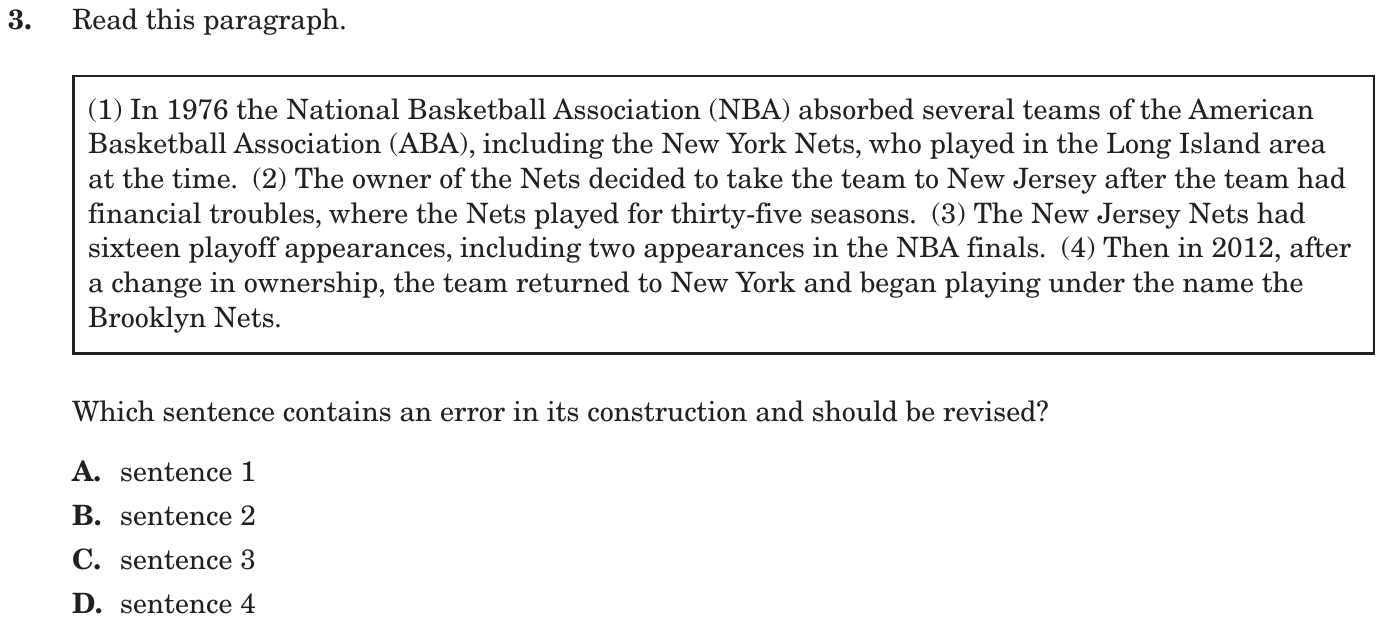
(1) In 1976 the National Basketball Association (NBA) absorbed several teams of the American Basketball Association (ABA), including the New York Nets, who played in the Long Island area at the time. (2) The owner of the Nets decided to take the team to New Jersey after the team had financial troubles, where the Nets played for thirty-five seasons. (3) The New Jersey Nets had sixteen playoff appearances, including two appearances in the NBA finals. (4) Then in 2012, after a change in ownership, the team returned to New York and began playing under the name the Brooklyn Nets.
Which sentence contains an error in its construction and should be revised?
- Asentence 1
- Bsentence 2
- Csentence 3
- Dsentence 4
Show the answer
Correct answer: B
The question asks for the identification of the sentence that has an error in its construction and should be revised.
A. Incorrect. There are no errors in the structure of sentence 1. The modifying clause “who played in the Long Island area at the time” correctly modifies the noun “New York Nets.”
B. CORRECT. Sentence 2 contains a structural error. The current placement of the clause “where the Nets played for thirty-five seasons” suggests the clause is modifying the term “financial troubles,” which is illogical. The clause “where the Nets played for thirty-five seasons” should immediately follow the location, “New Jersey.” A revised version of the sentence might read: “After the team had financial troubles, the owner of the Nets decided to take the team to New Jersey, where the Nets played for thirty-five seasons.”
C. Incorrect. There are no errors in the structure of sentence 3. The phrase “including two appearances in the NBA finals” is a nonrestrictive phrase that provides further detail about the team’s “sixteen playoff appearances.” The phrase is set off by a comma because it is not essential to understanding the meaning of the sentence.
D. Incorrect. There are no errors in the structure of sentence 4. The phrase “after a change in ownership” is a nonrestrictive phrase that provides further detail about the team in 2012. The phrase is set off by commas because it is not essential to understanding the meaning of the sentence.
Question analysis
In this sentence-structure question, four sentences trace the Nets basketball team, which played on Long Island before moving to New Jersey and, decades later, to Brooklyn. Students must spot the sentence whose construction needs revising, and since each one includes phrases or clauses set off by commas, the test is whether each sits beside the word it should modify.
- NYS standards
- 7L1 grammar and usage conventions
- Grade level
- Grade 7 reading and task
- Compared with grade 7
- At grade 7 Grade 7 language standards cover placing phrases and clauses correctly within a sentence. The stem does not say what sort of mistake to look for, so all four sentences must be tested, which is what grade 7 editing practice usually involves.
- Estimated difficulty
- Moderate: several steps, or a close reading with one strong distractor.
- Thinking it demands
- Depth of knowledge 2, skills and concepts · mainly analyze
- What makes it hard
- A rule that doesn't sound wrong moderate
- Every choice must be checked minor
- Complex sentences minor
- Evidence
- Answered from one paragraph or stanza
- Reading level
- Question and choices: about grade 7, 112 words.
- Corrected from the DOE handbook
- Grammar terms in the explanation were corrected.
- Students, last 30 days
- Not enough answers yet to show (it takes 10).
Why it is hard, traps and wrong answers (shows the answer)
Why it is hard
The faulty sentence causes no confusion in reading, because the mind ties the thirty-five seasons to New Jersey rather than to the financial troubles the clause actually follows. Students who judge by sound pass over it and hunt through the busier sentences, above all the first, which in this printing also has no comma after “In 1976.” What the question rewards is asking, clause by clause, which word each describing clause sits beside.
A rule that doesn't sound wrong moderate Working it out
In sentence 2, “where the Nets played for thirty-five seasons” lands after “financial troubles,” yet the ear quietly joins it to New Jersey, so the misplaced clause reads as natural English. (Connors & Lunsford, 1988)
Every choice must be checked minor Choosing the answer
Nothing in the stem says what kind of error to look for, and every sentence sets off a phrase or clause with commas, from the “who” clause to the “including” phrase to “after a change in ownership.” (Embretson & Wetzel, 1987)
Complex sentences minor Understanding the question
Sentence 1 runs 31 words, with two abbreviations in parentheses, a “who” clause and no comma after the opening date, so a correct sentence looks like the likeliest place for a fault. (Abedi & Lord, 2001; Freedle & Kostin, 1993; Messick, 1989)
Strategy: Work through all four sentences; for each phrase or clause set off by a comma, decide which noun it should describe and check that the two are side by side.
Traps
- Fixes what isn't broken: Changes a part of the sentence that was already correct, while the real error stays; or, where the question asks which sentence has an error or should go, picks one that is correct and belongs.
The wrong answers, classified
A Fixes what isn't broken (Connors & Lunsford, 1988)
Believes “who” cannot stand for a team, or wants a comma after the date “In 1976,” though the short opening phrase and the clause describing the New York Nets are both correct.
C Fixes what isn't broken (Connors & Lunsford, 1988)
Takes the closing “including two appearances in the NBA finals” for a fragment tacked on with a comma, though the phrase correctly adds a detail about the sixteen playoff appearances.
D Fixes what isn't broken (Connors & Lunsford, 1988)
Is put off by the stacked opening “Then in 2012, after a change in ownership,” or by the unpunctuated team name at the end, though the sentence is built correctly as it stands.
What was corrected from the DOE handbook, and why
- Explanation: The handbook’s explanation calls two clauses phrases and two phrases clauses. It calls “where the Nets played for thirty-five seasons” a phrase three times (Option B) and “who played in the Long Island area at the time” a modifying phrase (Option A). Each has a subject and a verb of its own (“the Nets played,” “who played”), so each is a clause, and the site now calls them clauses. It calls “including two appearances in the NBA finals” (Option C) and “after a change in ownership” (Option D) nonrestrictive clauses. Neither has a subject or a verb of its own, so each is a phrase (the second a prepositional phrase), as the explanations’ own next sentences (“The phrase is set off…”) say, and the site now says “nonrestrictive phrase.” The DOE’s later printing of this question uses the same terms. The reasoning and the answer, sentence 2, are unchanged.
Working it out, step by step
Figure out what the question asks
This asks which sentence is built wrong. The facts are not the problem. The problem is how the parts of a sentence fit together. The question doesn’t say what kind of mistake to look for. So you need to test all four sentences.
Learn about clauses and phrases
A clause is a group of words with its own subject and verb, like where we swam. A phrase is a group of words without its own subject and verb, like after the storm. A describing clause often starts with who or where. It must sit right next to the word it describes. If it doesn’t, the sentence says something odd: We went to the beach after the storm, where we swam all day. That says we swam in the storm!
Test sentence 2
Sentence 2 ends “after the team had financial troubles, where the Nets played for thirty-five seasons.” The words “where the Nets played for thirty-five seasons” form a clause. They have a subject, the Nets, and a verb, played. The clause should describe New Jersey, a place. But it sits right after “financial troubles.” So the sentence seems to say the Nets played inside their money problems.
Fix: After the team had financial troubles, the owner of the Nets decided to take the team to New Jersey, where the Nets played for thirty-five seasons.
Test sentences 1, 3 and 4
- Sentence 1: the clause “who played in the Long Island area at the time” sits right after “the New York Nets.” A team is a group of people, so who works. A short opening like “In 1976” doesn’t need a comma.
- Sentence 3: the phrase “including two appearances in the NBA finals” sits right after “sixteen playoff appearances.” It adds a detail about them.
- Sentence 4: the phrase “after a change in ownership” tells when the team came back. Commas set it off correctly.
Watch out: Sentence 1 is long and busy, with two names in parentheses. That makes A tempting. But long is not the same as wrong.
Choose the answer
Only sentence 2 puts a describing clause next to the wrong words. So the answer is B, sentence 2.
Why this answer and not the closest wrong one
A is the closest wrong answer. Sentence 1 is long, uses who for a team and has no comma after its date. But each part is correct, and its clause sits right next to the Nets. In sentence 2, the “where” clause sits next to “financial troubles,” not New Jersey. So B is right.
More questions like this
The original DOE question