6.NS.3 multi-digit decimal operations
Question 1 of 36
2026 Practice Test C Math, question 13Question
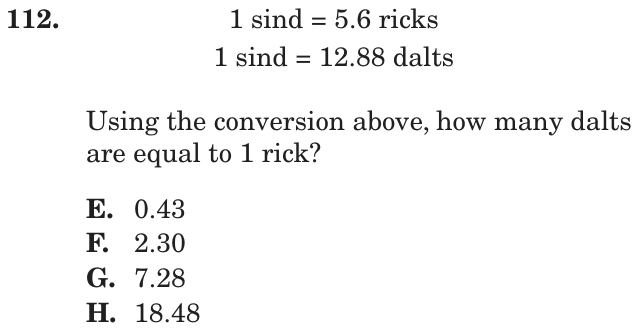
Start with the number 135.28 and perform the following steps in order:
- Step 1: Multiply by 10.
- Step 2: Add 0.5 to the result of Step 1.
- Step 3: Drop the digits after the decimal point.
- Step 4: Divide by 10.
What is the result?
- A13.5
- B135
- C135.2
- D135.3
Show the answer
Correct answer: D
Begin by multiplying 135.28 by 10:
Add 0.5:
Drop the digits after the decimal point, so becomes .
Divide by 10:
Question analysis
Students start with 135.28 and carry out four listed steps: multiply by 10, add 0.5, drop the digits after the decimal point, and divide by 10. It tests place value and operations with decimals. Skipping a step, or doing two of them in the wrong order, changes the result, and the choices are built from those slips.
- NYS standards
- 6.NS.3 multi-digit decimal operations
- Grade level
- Grade 6 content, by NYS standard
- Compared with grade 7
- Below grade 7 Multiplying and dividing a decimal by 10 and adding 0.5 are grade 5 and 6 skills. The four steps are spelled out, so the demand is following them exactly and in order, not choosing a method.
- Estimated difficulty
- Straightforward: two steps or one careful reading.
- Thinking it demands
- Depth of knowledge 1, recall and reproduction · mainly apply
- What makes it hard
- A very close wrong answer moderate
- Many steps minor
- Error-prone arithmetic minor
- Solution
- 4 steps
- Reading level
- Question and choices: about grade 3, 36 words.
- Students, last 30 days
- Not enough answers yet to show (it takes 10).
Why it is hard, traps and wrong answers (shows the answer)
Why it is hard
The steps spell out how to round 135.28 to the nearest tenth, but nothing says so, and they have to be followed exactly. The decisive moment is step 2, where adding 0.5 pushes 1,352.8 past 1,353; skip it and the digits are simply cut, not rounded. Students who recognize the routine can check the result directly, since 135.28 lies closer to 135.3 than to 135.2.
A very close wrong answer moderate Choosing the answer
135.3 and 135.2 differ only in the tenths digit, and 135 shares their whole-number part, so a rough sense of the result's size rules out nothing. (Embretson & Wetzel, 1987; Gorin & Embretson, 2006; Ascalon et al., 2007)
Many steps minor Working it out
Four listed steps move the decimal point twice, and doing them in another order, or skipping one, still produces a believable number near 135. (Daniel & Embretson, 2010; Enright, Morley & Sheehan, 2002)
Error-prone arithmetic minor Working it out
Adding 0.5 to 1,352.8 carries into the ones place, since 8 tenths and 5 tenths make 1.3, which turns 1,352 into 1,353 before the decimals are dropped. (Brown & Burton, 1978; Junker & Sijtsma, 2001)
Strategy: Write down the number after each step instead of doing them in your head, and carry out the steps exactly in the order listed.
Traps
- Misreads the question: Misses or misreads a condition or a word in the question: "at least", "each", "remaining", "not".
- Rounds too early: Rounds a value partway through, or rounds the wrong way, so the final answer drifts from the exact one.
The wrong answers, classified
A Misreads the question (Hegarty, Mayer & Monk, 1995)
Skips step 1, so adds 0.5 to 135.28, drops the decimals to get 135, and then divides by 10 to reach 13.5.
B Misreads the question (Hegarty, Mayer & Monk, 1995)
Divides by 10 before dropping the digits after the decimal point, so 1,353.3 becomes 135.33 and then 135, doing steps 3 and 4 in reverse order.
C Rounds too early (King et al., 2004)
Leaves out step 2, or adds 0.5 without carrying, so 1,352 is kept and 135.2 results: 135.28 cut down instead of rounded up.
Worked solution, step by step
Formulas used
- Multiplying and dividing by 10
- a is any decimal number. Multiplying by 10 moves its decimal point one place to the right, so each digit is worth ten times as much. Dividing by 10 moves the point one place to the left. The two steps undo each other.
Sort out the question
You start with 135.28 and do four steps, in order. Write down the number after each step. Doing them in your head, or in another order, leads to a wrong choice. You need the number at the end.
Multiply by 10
Step 1. Multiplying by 10 moves the decimal point one place to the right:
The digits stay the same. Only the decimal point moves.
Add 0.5
Step 2. Line up the decimal points. 8 tenths plus 5 tenths is 13 tenths. That is 1 whole and 3 tenths, so carry the 1 into the ones place:
Watch out: skipping this step, or forgetting to carry, keeps 1,352. That leads to choice C, 135.2.
Drop the digits after the point
Step 3. Cut off the digits after the decimal point. Do not round. So 1,353.3 becomes 1,353.
Watch out: do step 3 before step 4. Dividing first gives 135.33. Dropping its decimals then gives 135, choice B.
Divide by 10
Step 4. Dividing by 10 moves the decimal point one place to the left:
Skipping step 1 gives 13.5, choice A. So the answer is D, 135.3.
Check your answer
These four steps are a recipe for rounding to the nearest tenth. 135.28 is between 135.2 and 135.3. Its hundredths digit is 8, which is 5 or more, so it rounds up to 135.3. The recipe and the rounding agree.
More questions like this
The original DOE question
Question 2 of 36
2026 Practice Test C Math, question 29Question
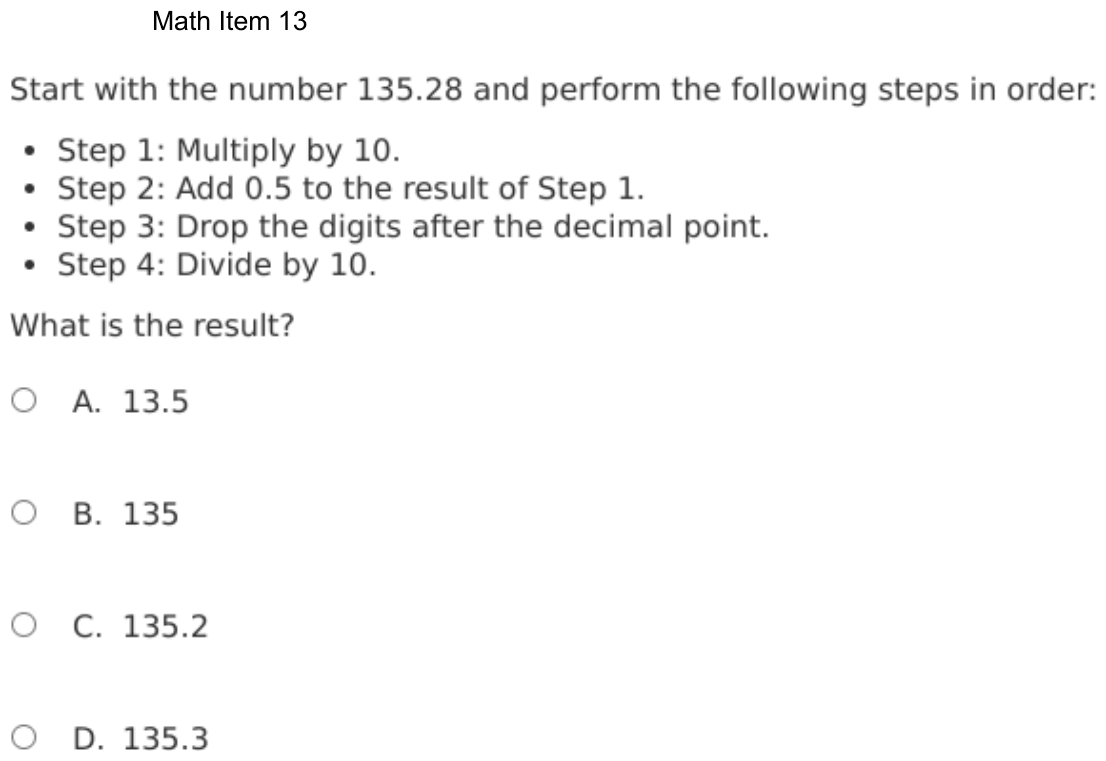
A smoothie shop uses a consistent ratio of fruit to yogurt in its recipes. The table shows the proportional relationship between the number of cups of fruit (x) and the number of cups of yogurt (y) in different smoothie batches.
SMOOTHIE RECIPE
| Cups of Fruit x | Cups of Yogurt y |
|---|---|
| 6 | 1.5 |
| 8 | 2.0 |
| 10 | 2.5 |
| 12 | 3.0 |
What is the constant of proportionality of the number of cups of yogurt to the number of cups of fruit?
Enter your answer in the space.
Fill-in question: work out the answer and type it as a number.
Show the answer
Correct answer: 0.25
To find p, the constant of proportionality of the number of cups of yogurt, y, to the number of cups of fruit, x, use the equation .
The table shows that there are 1.5 cups of yogurt for 6 cups of fruit.
The constant of proportionality is 0.25.
Question analysis
A smoothie shop's recipe table lists cups of fruit and cups of yogurt for four batches in a proportional relationship. Students type the constant of proportionality of yogurt to fruit. It tests finding a unit rate from a table, and since fruit is listed first while the question names yogurt first, the ratio is easy to take upside down.
- Grade level
- Grade 7 content, by NYS standard
- Compared with grade 7
- At grade 7 Finding the constant of proportionality in a table is a core grade 7 skill, and these values are friendly decimals. Typing the answer with no choices, and taking the ratio in the order the question gives, are the added demands.
- Estimated difficulty
- Straightforward: two steps or one careful reading.
- Thinking it demands
- Depth of knowledge 2, skills and concepts · mainly apply
- What makes it hard
- Turning words into math moderate
- An answer in an unexpected form minor
- Solution
- 1 step
- Reading level
- Question and choices: about grade 6, 75 words.
- Students, last 30 days
- Not enough answers yet to show (it takes 10).
Why it is hard, traps and wrong answers (shows the answer)
Why it is hard
Any row gives the answer with one division, and the values divide evenly, so the points are lost on direction. Fruit fills the first column and comes first in the stem’s own ratio, which invites dividing it by the yogurt. The table also climbs by a steady half cup of yogurt, a number that looks like a constant but ignores the 2 cups of fruit added each time. Checking that 0.25 times each fruit value gives its yogurt value settles it.
Turning words into math moderate Understanding the question
The opening sentence speaks of a ratio of fruit to yogurt, but the question asks for the constant of yogurt to fruit, so the division is y ÷ x, against the table’s column order. (Hegarty, Mayer & Monk, 1995; Koedinger & Nathan, 2004)
An answer in an unexpected form minor Choosing the answer
The constant is typed into a box with no choices, so 4, the ratio taken the other way round, is a believable entry that nothing on screen questions. (Enright, Morley & Sheehan, 2002)
Strategy: Check which quantity the question names first, divide that column by the other in any row, and confirm the quotient is the same in a second row.
Traps
- Wrong operation: Adds instead of multiplying, divides the wrong way round, turns a ratio or rate upside down, or undoes a step in the wrong direction (subtracts what should be added back).
- Misunderstands the concept: A wrong belief about a concept: that percents can be added, that area grows like length, that averages can be averaged, that a bigger denominator means a bigger fraction.
- Numbers taken from the question: Combines the numbers in the question without a model of the situation, or is simply a number that appears in the question.
The wrong answers, classified
4 Wrong operation (Hegarty, Mayer & Monk, 1995; King et al., 2004)
Divides cups of fruit by cups of yogurt, 6 ÷ 1.5 = 4, following the stem’s “ratio of fruit to yogurt” and turning the requested constant upside down.
0.5 Misunderstands the concept (Smith, diSessa & Roschelle, 1993; De Bock et al., 1998; Ni & Zhou, 2005)
Takes the steady rise of 0.5 cup of yogurt from row to row as the constant, ignoring that the fruit rises by 2 cups each time.
1.5 Numbers taken from the question (Hegarty, Mayer & Monk, 1995)
Gives 1.5, the first yogurt value in the table, as if the constant were an amount in one batch rather than a ratio of two amounts.
Worked solution, step by step
Formulas used
- Constant of proportionality
- k is the constant of proportionality. y and x are two matching amounts from the same row of the table. In a proportional relationship, y = kx, so y is always k times x. That is why dividing y by x gives the same k in every row.
Sort out the question
The table lists cups of fruit (x) and cups of yogurt (y) for four batches. You need the constant of proportionality of yogurt to fruit.
That is the number of cups of yogurt for each 1 cup of fruit. It is also the number you multiply x by to get y.
Divide yogurt by fruit
Use the first row: 6 cups of fruit and 1.5 cups of yogurt. Yogurt goes on top, because the question says yogurt to fruit:
So there is 0.25 cup, or one quarter of a cup, of yogurt for each cup of fruit.
Watch out: the first sentence says fruit to yogurt, but the question asks the other way. Dividing turns the answer upside down.
Check two more rows
The constant must be the same in every row. Test two more:
They match. Watch out: the yogurt goes up by 0.5 cup from row to row. That 0.5 is not the constant. The fruit goes up by 2 cups at the same time, and .
Enter the number
Type only the number in the box, with no units. You can type 0.25 or .25. On this site, 1/4 counts too.
So you would enter 0.25.
Check your answer
Multiply each amount of fruit by 0.25. , , and . Every result matches the yogurt column. Also, each batch has less yogurt than fruit, so the constant should be less than 1.
More questions like this
The original DOE question
Question 3 of 36
2026 Practice Test C Math, question 30Question
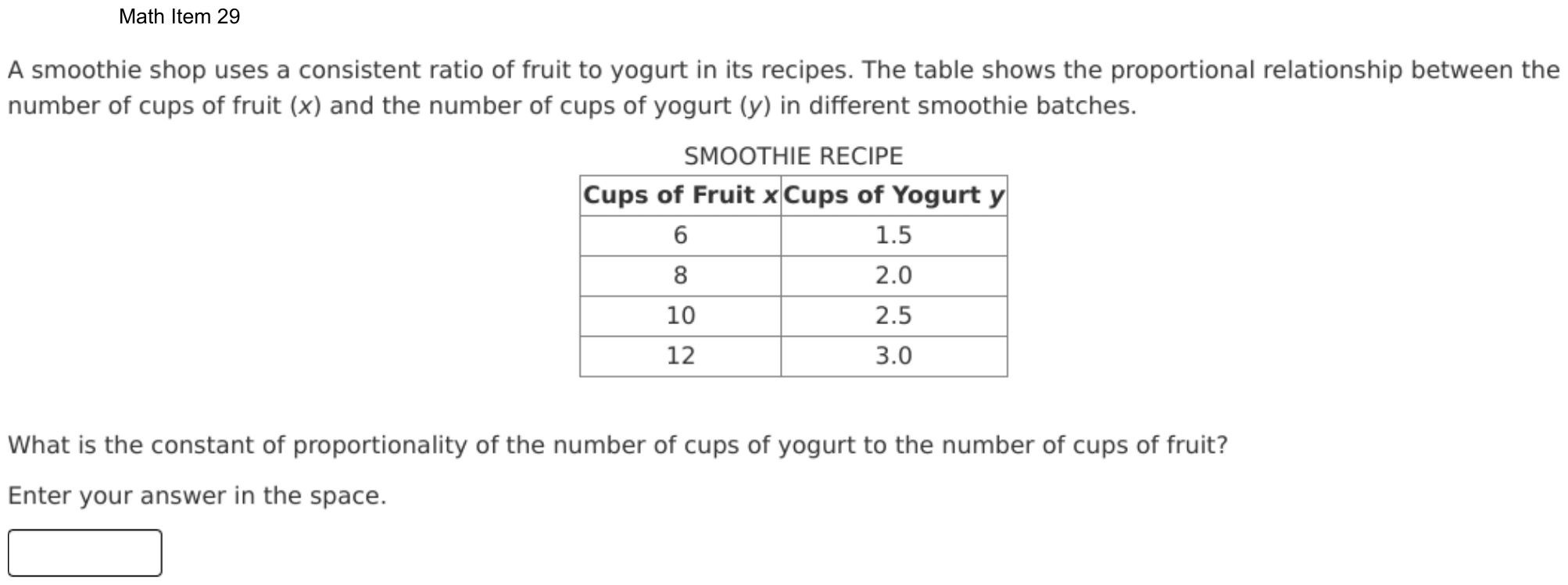
Out of 2,000 high school seniors, 191 were enrolled in the Honor Society. What percentage of the entire group of 2,000 seniors were in the Honor Society?
- A0.955%
- B1.91%
- C9.55%
- D19.1%
Show the answer
Correct answer: C
The fraction represents the 191 high school seniors out of 2,000 enrolled in the Honor Society.
To determine the percentage, convert the fraction to a decimal. Then, rewrite the decimal as a percentage.
Question analysis
Out of 2,000 high school seniors, 191 belong to the Honor Society, and students find what percent of the whole group that is. It tests writing a part of a whole as a percent. Several choices share the same digits, so the decimal point has to be placed with care when the fraction becomes a percent.
- Grade level
- Grade 6 content, by NYS standard
- Compared with grade 7
- Below grade 7 Writing a part of a whole as a percent is grade 6 work, done here with one division and one conversion. The awkward numbers, 191 out of 2,000, make placing the decimal point the only real demand.
- Estimated difficulty
- Straightforward: two steps or one careful reading.
- Thinking it demands
- Depth of knowledge 1, recall and reproduction · mainly apply
- What makes it hard
- Error-prone arithmetic moderate
- Solution
- 2 steps
- Reading level
- Question and choices: about grade 7, 24 words.
- Students, last 30 days
- Not enough answers yet to show (it takes 10).
Why it is hard, traps and wrong answers (shows the answer)
Why it is hard
The method is a single fraction, 191 over 2,000, so the question tests decimal places. The four choices share the digits 955 or 191 and differ only in where the point falls, which means a slip of one place still finds a choice waiting. A rough check settles it: 191 is a little under 200, and 200 is 10% of 2,000, so the share must be a little under 10%.
Error-prone arithmetic moderate Working it out
Dividing 191 by 2,000 gives 0.0955, with a zero right after the decimal point, and writing it as a percent moves the point two more places; each move is a chance to land one place off. (Brown & Burton, 1978; Junker & Sijtsma, 2001)
Strategy: Write the Honor Society members as a fraction of all 2,000 seniors, divide, and move the decimal point two places to the right to turn the decimal into a percent.
Traps
- An arithmetic slip: The right method with a plausible arithmetic error: a digit, a place value or a times-table fact.
- Misunderstands the concept: A wrong belief about a concept: that percents can be added, that area grows like length, that averages can be averaged, that a bigger denominator means a bigger fraction.
The wrong answers, classified
A An arithmetic slip (Junker & Sijtsma, 2001)
Finds 0.0955 but moves the decimal point only one place when writing the percent, giving 0.955%, ten times too small.
B Misunderstands the concept (Smith, diSessa & Roschelle, 1993; De Bock et al., 1998; Ni & Zhou, 2005)
Divides 191 by 100, as if a percent were always out of 100, and never uses the 2,000 seniors, so 191 ÷ 100 = 1.91 becomes 1.91%.
D An arithmetic slip (Junker & Sijtsma, 2001)
Divides 191 by 1,000 instead of 2,000, dropping the 2 while moving the decimal point, so 0.191 becomes 19.1%, twice the true share.
Worked solution, step by step
Formulas used
- Percent of a whole
- The part is the smaller group you care about. The whole is the entire group. The fraction tells what share of the whole the part is. Multiplying by 100 turns that share into a percent, which means out of 100.
Sort out the question
There are 2,000 seniors in all. Of them, 191 are in the Honor Society. You need the percent of all 2,000 seniors who are in it.
So 191 is the part, and 2,000 is the whole.
Write the share as a fraction
Put the part over the whole:
This fraction says 191 out of every 2,000 seniors. Next, turn it into a decimal by dividing.
Divide to get a decimal
Dividing by 2,000 is the same as dividing by 2 and then by 1,000:
Dividing by 1,000 moves the decimal point 3 places to the left. So the share is 0.0955.
Change the decimal to a percent
Multiply by 100. That moves the decimal point 2 places to the right:
So the share is 9.55%.
Watch out: moving the point only 1 place gives 0.955%, choice A. Dividing by 1,000 instead of 2,000 gives 19.1%, choice D. Dividing 191 by 100 gives 1.91%, choice B.
Give the answer
The 191 Honor Society members are 9.55% of all 2,000 seniors. That is a little less than one tenth of them.
So the answer is C, 9.55%.
Check your answer
Estimate. 191 is a little less than 200. And 200 out of 2,000 is one tenth, which is 10%. So the answer should be a little less than 10%. Only 9.55% fits.
More questions like this
The original DOE question
Question 4 of 36
2026 Practice Test D Math, question 21Question
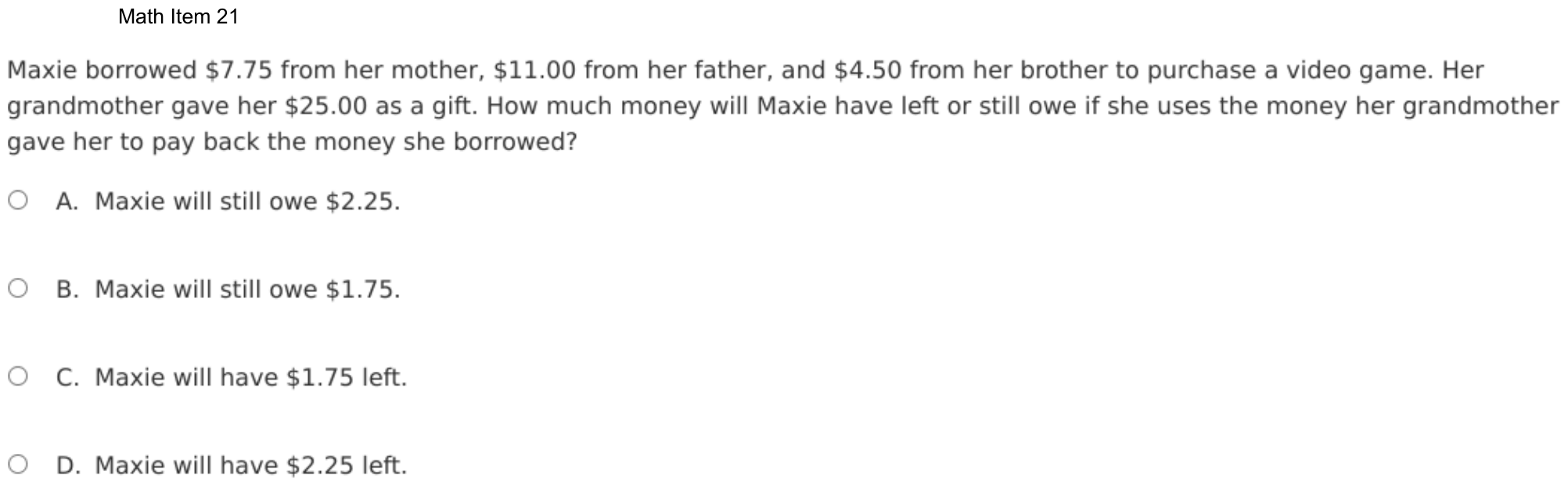
Maxie borrowed $7.75 from her mother, $11.00 from her father, and $4.50 from her brother to purchase a video game. Her grandmother gave her $25.00 as a gift. How much money will Maxie have left or still owe if she uses the money her grandmother gave her to pay back the money she borrowed?
- AMaxie will still owe $2.25.
- BMaxie will still owe $1.75.
- CMaxie will have $1.75 left.
- DMaxie will have $2.25 left.
Show the answer
Correct answer: C
First, determine the total amount Maxie borrowed, in dollars:
Then use subtraction to determine the difference between the amount her grandmother gave her and the amount she borrowed:
The difference is positive, which means that Maxie will still have $1.75 left from the amount her grandmother gave her.
Question analysis
Maxie borrowed money from her mother, father and brother to buy a video game, then received $25.00 from her grandmother to pay them back. Students decide how much money she will have left over or still owe. It tests adding and subtracting decimals with money, and the choices also test which way the difference goes.
- Grade level
- Grade 6 content, by NYS standard
- Compared with grade 7
- Below grade 7 Adding and subtracting money amounts is grade 6 decimal work. Here it takes one sum and one difference, and the only further demand is deciding whether the result is money left or money owed, well below typical grade 7 tasks.
- Estimated difficulty
- Routine: one familiar step, little to misread.
- Thinking it demands
- Depth of knowledge 2, skills and concepts · mainly apply
- What makes it hard
- Error-prone arithmetic minor
- Turning words into math minor
- Solution
- 2 steps
- Reading level
- Question and choices: about grade 4, 66 words.
- Students, last 30 days
- Not enough answers yet to show (it takes 10).
Why it is hard, traps and wrong answers (shows the answer)
Why it is hard
Few students miss this one, since it needs only one addition and one subtraction with money. The choices come in pairs, so the right amount must also be matched with the right outcome. Lining up the decimal points, and asking whether $25.00 is more or less than the $23.25 borrowed, settles both the amount and whether Maxie owes or keeps money.
Error-prone arithmetic minor Working it out
The loans add to $23.25, and subtracting that from $25.00 means borrowing across two zeros, a classic place for a digit to go wrong. (Brown & Burton, 1978; Junker & Sijtsma, 2001)
Turning words into math minor Understanding the question
Each amount appears twice among the choices, once as money left and once as money owed, so the result must also be read for direction by asking which is larger, the gift or the loans. (Hegarty, Mayer & Monk, 1995; Koedinger & Nathan, 2004)
Strategy: Add the three amounts borrowed, compare the total with the $25.00 gift, and decide from which is larger whether Maxie ends up with money left or still owes some.
Traps
- Negatives and direction: Arithmetic with negative numbers, the order of a subtraction, or direction on a number line. (Moving a term across the equals sign without changing its sign is a faulty procedure.)
- A faulty procedure: A systematic but wrong procedure: adding fractions straight across, applying an exponent to each term of a sum, dropping a sign when moving a term.
The wrong answers, classified
A Little reason to choose it (Haladyna & Downing, 1993; Rodriguez, 2005)
Needs two errors at once, a wrong difference such as $2.25 and the reversed outcome, so no single line of working reaches it and it mostly draws guesses.
B Negatives and direction (Brown & Burton, 1978)
Finds the $1.75 difference correctly but reverses its meaning, as if the $25.00 gift fell short of the $23.25 borrowed instead of covering it.
D A faulty procedure (Brown & Burton, 1978; Tatsuoka, 1983)
Subtracts $23.25 from $25.00 column by column, taking the smaller digit from the larger instead of borrowing, so 5 − 0 and 2 − 0 give $2.25.
Worked solution, step by step
Formulas used
- Money left over
- Money she has is the $25.00 gift. Money she owes is the total she borrowed. If the result is positive, she has that much left. If it were negative, she would still owe that much. Comparing the two amounts first tells you which.
Sort out the question
Maxie borrowed from three people: $7.75, $11.00 and $4.50. Her grandmother gave her $25.00. She uses the $25.00 to pay everyone back. You need to know if money is left over or if she still owes some, and how much.
Add up what she borrowed
Line up the decimal points and add:
She owes $23.25 in all. That is the amount she must pay back.
Compare the gift with the debt
The gift, $25.00, is more than the $23.25 she owes. So she can pay everyone back and still have money left. She will not owe anything.
Watch out: once you find $1.75, keep its meaning straight. Saying she still owes $1.75, choice B, gets the direction backwards.
Subtract to find what is left
Take the debt away from the gift:
You need to regroup (borrow) across the zeros. Think of $25.00 as 24 dollars and 100 cents. Then 100 − 25 = 75 cents, and 24 − 23 = 1 dollar.
Watch out: taking the smaller digit from the larger one in each column gives $2.25, choice D.
So the answer is C: Maxie will have $1.75 left.
Check your answer
Add back. The $23.25 she pays plus the $1.75 she keeps is 23.25 + 1.75 = 25.00. That is the whole gift, so the subtraction is right.
More questions like this
The original DOE question
Question 5 of 36
2026 Practice Test D Math, question 39Question
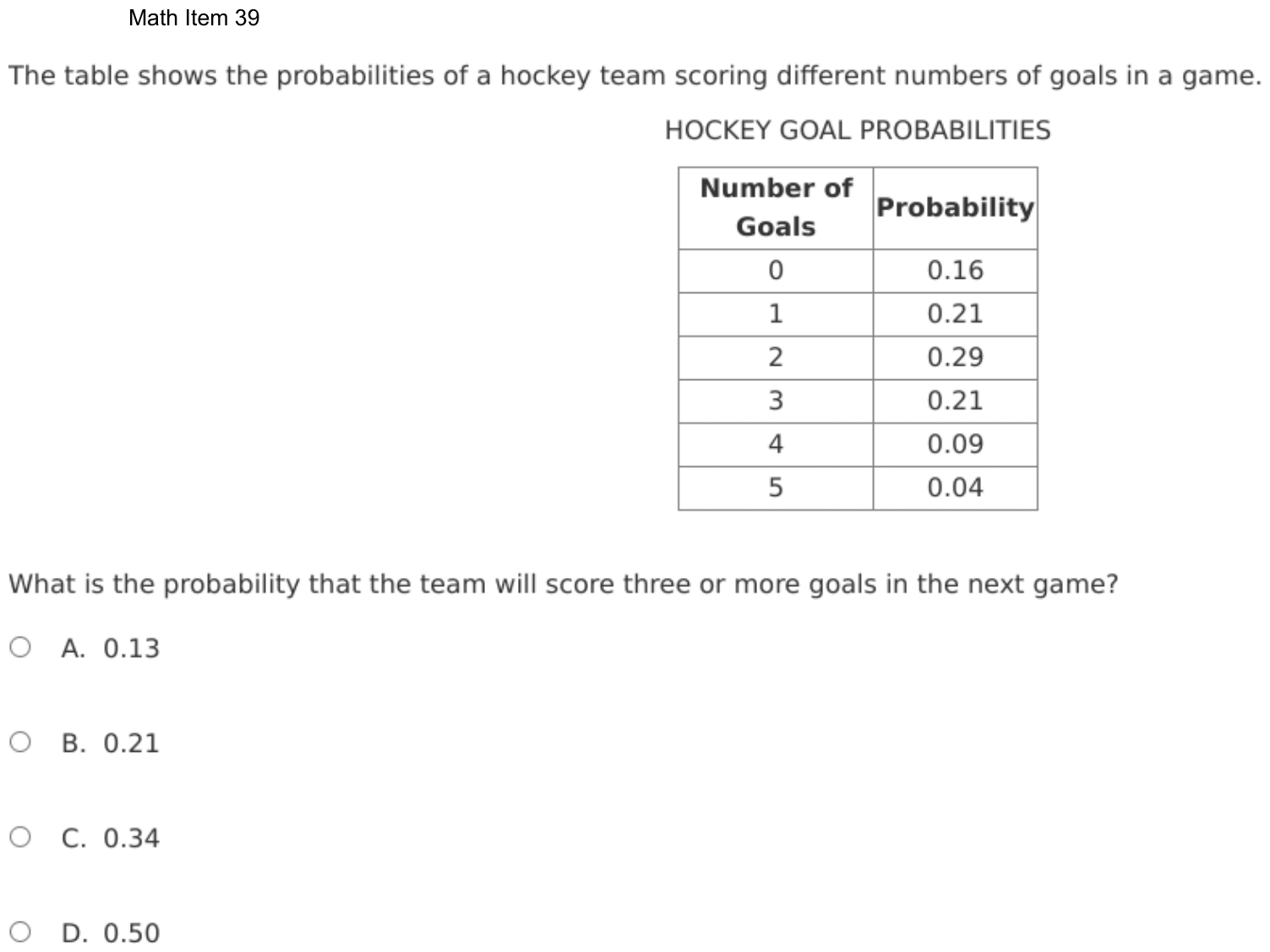
The table shows the probabilities of a hockey team scoring different numbers of goals in a game.
HOCKEY GOAL PROBABILITIES
| Number of Goals | Probability |
|---|---|
| 0 | 0.16 |
| 1 | 0.21 |
| 2 | 0.29 |
| 3 | 0.21 |
| 4 | 0.09 |
| 5 | 0.04 |
What is the probability that the team will score three or more goals in the next game?
- A0.13
- B0.21
- C0.34
- D0.50
Show the answer
Correct answer: C
To find the probability that any one of several mutually exclusive events occurs, use the addition rule, and add the probabilities of each event:
Using the data in the table, the probability that the team will score 3 or more goals in the next game is represented by
Question analysis
A table gives the probabilities of a hockey team scoring 0 to 5 goals in a game, and students find the chance that it scores three or more goals in the next one. This probability question tests adding the probabilities of separate outcomes. Reading exactly which rows the phrase covers is the main point of care.
- Grade level
- Grade 6 content, by NYS standard
- Compared with grade 7
- Below grade 7 Finding the probability of an event from a given probability model is grade 6 work in New York. Here the model is a table, and the task is choosing the right rows and adding decimals, shorter than typical grade 7 work.
- Estimated difficulty
- Routine: one familiar step, little to misread.
- Thinking it demands
- Depth of knowledge 1, recall and reproduction · mainly apply
- What makes it hard
- Solution
- 2 steps
- Reading level
- Question and choices: about grade 8, 40 words.
- Students, last 30 days
- Not enough answers yet to show (it takes 10).
Why it is hard, traps and wrong answers (shows the answer)
Why it is hard
Adding three decimals is easy, so the question turns on which rows the words cover. Including the 3-goal row, and not stopping at it, are the two decisions, and each misreading gives a listed choice. Checking the complement, 1 − (0.16 + 0.21 + 0.29), confirms both the sum and the choice of rows.
Turning words into math minor Understanding the question
The phrase “three or more goals” has to become the three rows for 3, 4 and 5 goals, starting at the 3-goal row itself. (Hegarty, Mayer & Monk, 1995; Koedinger & Nathan, 2004)
Reading a figure, table or graph minor Understanding the question
The table lists six probabilities, two of them both 0.21, so the rows for 3, 4 and 5 goals must be picked out by their goal counts, not by their values. (Lesh, Post & Behr, 1987; Kirsch & Mosenthal, 1990)
Strategy: Decide which rows the words "three or more" cover, add their probabilities, and check by subtracting the total of the other rows from 1.
Traps
- Counting the ends: Inclusive or exclusive ends, fence posts, consecutive numbers: an answer that is one too many or too few, or an endpoint drawn open where it belongs closed (or the reverse).
- Misreads the question: Misses or misreads a condition or a word in the question: "at least", "each", "remaining", "not".
- Misunderstands the concept: A wrong belief about a concept: that percents can be added, that area grows like length, that averages can be averaged, that a bigger denominator means a bigger fraction.
The wrong answers, classified
A Counting the ends (Brown & Burton, 1978)
Adds only the rows for 4 and 5 goals, 0.09 + 0.04 = 0.13, reading three or more as more than three and leaving out the end row.
B Misreads the question (Hegarty, Mayer & Monk, 1995)
Reads only the row for exactly 3 goals, 0.21, overlooking the words “or more” and the two rows below it.
D Misunderstands the concept (Smith, diSessa & Roschelle, 1993; De Bock et al., 1998; Ni & Zhou, 2005)
Counts 3 of the 6 rows, for 3, 4 and 5 goals, as half the outcomes, ignoring that the table gives them different probabilities.
Worked solution, step by step
Formulas used
- Adding probabilities
- A and B are two events that cannot both happen at once, like scoring exactly 3 goals and exactly 4 goals. The chance that one or the other happens is the sum of their chances.
- The chance it does not happen
- The chances of all possible outcomes add up to 1. So the chance an event does not happen is 1 minus the chance it does. Use it to check an answer from the other side.
Sort out the question
The table gives the chance of each number of goals, from 0 to 5. You need the chance the team scores three or more goals in the next game.
Pick the right rows
Three or more means 3 goals, 4 goals or 5 goals. The row for 3 counts too. Read those three rows:
- 3 goals: 0.21
- 4 goals: 0.09
- 5 goals: 0.04
Watch out: leaving out the 3-goal row gives 0.09 + 0.04 = 0.13, choice A. Using only the 3-goal row gives 0.21, choice B.
Add the chances
A game can end with only one number of goals. So add the three chances:
Watch out: three of the six rows is half the rows, but that does not make the chance 0.50, choice D. The rows have different chances.
So the answer is C, 0.34.
Check your answer
Find the chance of fewer than 3 goals, the other rows: . Then the chance of 3 or more is . Both ways give 0.34.
More questions like this
The original DOE question
Question 6 of 36
2026 Practice Test D Math, question 43Question
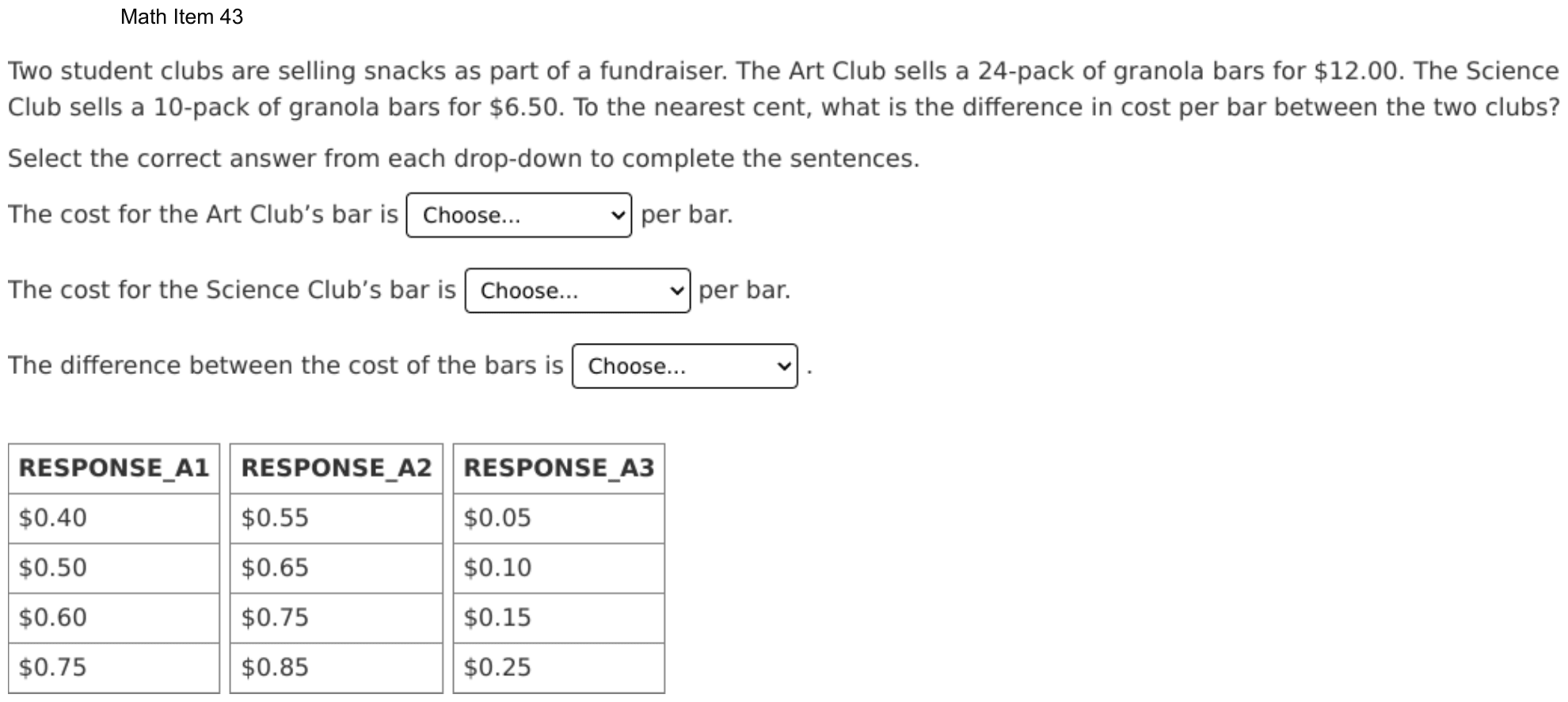
Two student clubs are selling snacks as part of a fundraiser. The Art Club sells a 24-pack of granola bars for $12.00. The Science Club sells a 10-pack of granola bars for $6.50. To the nearest cent, what is the difference in cost per bar between the two clubs?
Select the correct answer from each drop-down to complete the sentences.
The cost for the Art Club’s bar is per bar.
The cost for the Science Club’s bar is per bar.
The difference between the cost of the bars is .
Choose an answer from each menu, then check. The DOE has not published how answers with several parts are scored; this site counts one right only when every part is right.
Show the answer
Correct answer: blank 1: $0.50; blank 2: $0.65; blank 3: $0.15
To determine the cost per bar from the Art Club, divide the total cost by the total number of bars:
To determine the cost per bar from the Science Club, divide the total cost by the total number of bars:
To find the difference in price per bar, subtract the cost per bar for the Art Club from the cost per bar for the Science Club:
Question analysis
Two clubs sell granola bars for a fundraiser: the Art Club a 24-pack for $12.00 and the Science Club a 10-pack for $6.50. Students complete three sentences with drop-down menus, giving each club's cost per bar and the difference between them. It tests unit prices with money, and all three menus must be right.
- Grade level
- Grade 6 content, by NYS standard
- Compared with grade 7
- Below grade 7 Comparing unit prices is grade 6 rate work. The menus split it into three short steps, two divisions of money amounts and one subtraction, which is lighter than typical grade 7 work.
- Estimated difficulty
- Routine: one familiar step, little to misread.
- Thinking it demands
- Depth of knowledge 1, recall and reproduction · mainly apply
- What makes it hard
- Many steps minor
- Error-prone arithmetic minor
- Solution
- 3 steps
- Reading level
- Question and choices: about grade 3, 87 words.
- Corrected from the DOE handbook
- The order of the answers in the DOE’s key was corrected.
- Students, last 30 days
- Not enough answers yet to show (it takes 10).
Why it is hard, traps and wrong answers (shows the answer)
Why it is hard
The menus guide the work, one sentence per step, and every option is a reasonable price, so the question rewards accurate division more than planning. No common misconception leads to the wrong options; they catch slips, such as misreading a pack size or subtracting carelessly. Checking that 24 bars at the first price cost $12.00 and 10 bars at the second cost $6.50 confirms both menus before the subtraction.
Many steps minor Working it out
Three menus must all be right to score: two divisions for the costs per bar, then a subtraction that uses both, so a slip in either division spoils the third menu. (Daniel & Embretson, 2010; Enright, Morley & Sheehan, 2002)
Error-prone arithmetic minor Working it out
Each division is with money, $12.00 ÷ 24 and $6.50 ÷ 10, so the decimal point must be placed carefully, though the menus offer only sensible amounts. (Brown & Burton, 1978; Junker & Sijtsma, 2001)
Strategy: Divide each pack's price by the number of bars in it, then subtract the smaller cost per bar from the larger; checking that 24 bars at your first price make $12.00 catches slips.
Traps
- Misreads the question: Misses or misreads a condition or a word in the question: "at least", "each", "remaining", "not".
- An arithmetic slip: The right method with a plausible arithmetic error: a digit, a place value or a times-table fact.
The wrong answers, classified
CBA Misreads the question (Hegarty, Mayer & Monk, 1995)
Divides $12.00 by 20 instead of 24, misreading the size of the Art Club’s pack, so $0.60 a bar leaves a gap of only $0.05.
BBB An arithmetic slip (Junker & Sijtsma, 2001)
Finds both costs per bar correctly, then slips in the subtraction, taking $0.65 − $0.50 as $0.10, the option beside the right one.
What was corrected from the DOE handbook, and why
- Answer key: The DOE’s explanation opens with the key “($0.65; $0.50; $0.15)”, which puts $0.65 in the first drop-down and $0.50 in the second. Neither is possible: the first menu (the Art Club’s cost per bar) offers $0.40, $0.50, $0.60 and $0.75, and the second (the Science Club’s) offers $0.55, $0.65, $0.75 and $0.85. The explanation’s own working gives the Art Club $12.00 ÷ 24 = $0.50 and the Science Club $6.50 ÷ 10 = $0.65, so the key is $0.50, $0.65, $0.15. The site’s key was already in that order; the DOE’s key line is not shown on the site.
Worked solution, step by step
Formulas used
- Cost of one item
- The price of the pack is what you pay for all the bars together. Dividing shares that price equally among the bars. The result is the price of one bar, called the unit price.
Sort out the question
You know:
- The Art Club sells 24 bars for $12.00.
- The Science Club sells 10 bars for $6.50.
There are three menus. The first is the Art Club’s cost per bar. The second is the Science Club’s. The third is the difference, how much more one bar costs than the other.
Find the Art Club’s cost
Share $12.00 among 24 bars:
Each bar costs $0.50. That makes sense: 24 half-dollars make $12. Pick $0.50 in the first menu.
Watch out: dividing by 20 instead of 24 gives $0.60, which is also in the menu.
Find the Science Club’s cost
Share $6.50 among 10 bars. Dividing by 10 moves the decimal point one place to the left:
Each bar costs $0.65. Pick $0.65 in the second menu.
Find the difference
Subtract the smaller cost from the larger one:
The bars differ by $0.15. Pick $0.15 in the third menu.
Watch out: $0.10 sits right next to $0.15 in the menu. A slip in the subtraction lands there.
Fill in the three menus
On the test and on this site, you choose each answer from a drop-down menu.
So the menus read $0.50, $0.65 and $0.15.
Check your answer
Multiply back. and , so both costs per bar match the pack prices. And , so the difference fits too.
More questions like this
The original DOE question
Question 7 of 36
2024 Test A Math, question 19Question
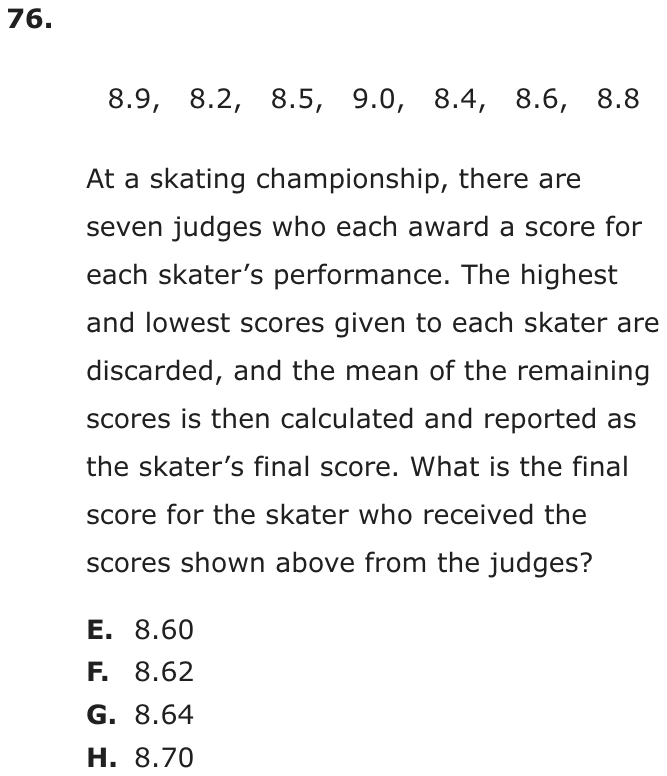
8.9, 8.2, 8.5, 9.0, 8.4, 8.6, 8.8
At a skating championship, there are seven judges who each award a score for each skater’s performance. The highest and lowest scores given to each skater are discarded, and the mean of the remaining scores is then calculated and reported as the skater’s final score. What is the final score for the skater who received the scores shown above from the judges?
- A8.60
- B8.62
- C8.64
- D8.70
Show the answer
Correct answer: C
The highest and lowest scores are discarded: 8.2 and 9.0.
To find the mean, add the remaining scores and then divide that sum by the total number of remaining scores.
Question analysis
A statistics question about a skating championship with seven judges: the highest and lowest of a skater's seven scores are dropped, and the rest are averaged. Students apply that rule to the listed scores, decimals close together. Following the dropping rule exactly and adding the decimals carefully both matter, since the choices are very close.
- Grade level
- Grade 6 content, by NYS standard
- Compared with grade 7
- Below grade 7 Finding a mean is grade 6 content, and this adds only a rule about which scores to drop. Grade 7 statistics usually compares whole data sets, so this is easier, though the close choices demand exact decimal arithmetic.
- Estimated difficulty
- Straightforward: two steps or one careful reading.
- Thinking it demands
- Depth of knowledge 2, skills and concepts · mainly apply
- What makes it hard
- A very close wrong answer moderate
- Error-prone arithmetic minor
- Turning words into math minor
- Solution
- 3 steps
- Reading level
- Question and choices: about grade 9, 62 words.
- Students, last 30 days
- Not enough answers yet to show (it takes 10).
Why it is hard, traps and wrong answers (shows the answer)
Why it is hard
The arithmetic is short, but the choices are spaced so closely that a small slip or a skipped rule lands on a neighbor. Averaging all seven scores, or picking the middle score, gives values within a few hundredths of the answer. The question rewards following the stated rule exactly and adding the five remaining scores with care.
A very close wrong answer moderate Choosing the answer
The choices 8.60, 8.62 and 8.64 lie within 0.04 of one another, so no estimate separates them; only the exact sum of the five kept scores, 43.2, does. (Embretson & Wetzel, 1987; Gorin & Embretson, 2006; Ascalon et al., 2007)
Error-prone arithmetic minor Working it out
Five one-decimal scores must be added and divided by 5; subtracting 8 from each first leaves 0.9, 0.5, 0.4, 0.6 and 0.8, which are easier to add. (Brown & Burton, 1978; Junker & Sijtsma, 2001)
Turning words into math minor Understanding the question
The scoring rule takes two sentences to state: discard the single highest and the single lowest score, then average the five that remain. (Hegarty, Mayer & Monk, 1995; Koedinger & Nathan, 2004)
Strategy: Cross out the single highest and the single lowest score, add the five that remain, and divide that sum by 5.
Traps
- Misreads the question: Misses or misreads a condition or a word in the question: "at least", "each", "remaining", "not".
- Answers a different question: A choice is right for another quantity: the other unknown, the rest instead of the part, the part instead of the whole.
The wrong answers, classified
A Answers a different question (King et al., 2004; Hegarty, Mayer & Monk, 1995)
Gives the median, the middle score 8.6, instead of the mean of the five scores left after the highest and lowest are dropped.
B Misreads the question (Hegarty, Mayer & Monk, 1995)
Averages all seven scores without discarding any, 60.4 ÷ 7 = 8.628…, and takes 8.62, the nearest choice to that mean.
D Misreads the question (Hegarty, Mayer & Monk, 1995)
Drops only the lowest score, 8.2, and averages the other six, (60.4 − 8.2) ÷ 6 = 8.7, keeping the top score of 9.0.
Worked solution, step by step
Formulas used
- Mean, or average
- The mean is the average. The sum is what you get when you add all the scores. Divide it by how many scores you added. It shares the total out evenly, as if every score were the same.
Sort out the rule
Seven judges gave the seven scores shown. The rule has two parts. First, throw out the highest score and the lowest score. Then find the mean of the scores that are left. The mean is the average. That is the final score you need.
Cross out the highest and lowest
The highest score is 9.0. The lowest is 8.2. Cross both out. Five scores are left: 8.9, 8.5, 8.4, 8.6 and 8.8. Watch out: drop both. Dropping only 8.2 gives 8.70, choice D. Keeping all seven gives about 8.63, which is closest to 8.62, choice B.
Add the five scores
A shortcut: each score is 8 plus a bit. The bits are 0.9, 0.5, 0.4, 0.6 and 0.8, and they add to 3.2. Five 8s make 40, and .
Divide by the number of scores
Watch out: do not just take the middle score, 8.6. That is the median, choice A. The question asks for the mean. So the answer is C, 8.64.
Check your answer
Multiply back: , the sum. Also, the mean should sit between the lowest kept score, 8.4, and the highest kept score, 8.9. 8.64 does.
More questions like this
The original DOE question
Question 8 of 36
2024 Test A Math, question 38Question
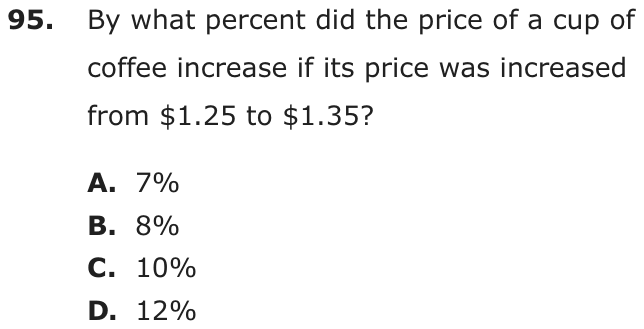
By what percent did the price of a cup of coffee increase if its price was increased from $1.25 to $1.35?
- A7%
- B8%
- C10%
- D12%
Show the answer
Correct answer: B
Subtract to determine the amount of the increase.
Divide the increase by the original price.
Multiply the quotient by 100 to express the decimal answer as a percent.
Question analysis
This percent increase question gives the price of a cup of coffee before and after a raise, from $1.25 to $1.35, and asks by what percent the price went up. Students find the change in price and compare it with a price. Deciding which price to compare the change with is the tricky part.
- Grade level
- Grade 7 content, by NYS standard
- Compared with grade 7
- At grade 7 Percent increase is grade 7 content, and this is a standard case with two prices. What makes it harder than routine is deciding which price the change is measured against and dividing small decimals accurately.
- Estimated difficulty
- Moderate: several steps, or a close reading with one strong distractor.
- Thinking it demands
- Depth of knowledge 2, skills and concepts · mainly apply
- What makes it hard
- A very close wrong answer moderate
- Error-prone arithmetic moderate
- Solution
- 3 steps
- Reading level
- Question and choices: about grade 6, 19 words.
- Students, last 30 days
- Not enough answers yet to show (it takes 10).
Why it is hard, traps and wrong answers (shows the answer)
Why it is hard
Most students see that the price rose by 10 cents; the question is what to compare that with. Percent change is measured from the original amount, and dividing by the new price gives a number close enough to the answer that rounding hides the mistake. Reading the 10 cents directly as 10 percent is the other quick trap, since 10 cents is only 10 percent of a dollar.
A very close wrong answer moderate Choosing the answer
Dividing the 10-cent rise by either price gives a single-digit percent, 8% from $1.25 and about 7.4% from $1.35, so only the choice of base separates the two listed answers. (Embretson & Wetzel, 1987; Gorin & Embretson, 2006; Ascalon et al., 2007)
Error-prone arithmetic moderate Working it out
Without a calculator, 0.10 ÷ 1.25 is a division by a decimal; rewriting it in cents as 10/125, which simplifies to 8/100, is the clean way through. (Brown & Burton, 1978; Junker & Sijtsma, 2001)
Strategy: Subtract to get the increase, then divide it by the price before the raise and multiply by 100; working in cents keeps the decimals out of the way.
Traps
- Percent of the wrong amount: Finding the whole from a part, or a percent change measured from the wrong starting amount.
- Misunderstands the concept: A wrong belief about a concept: that percents can be added, that area grows like length, that averages can be averaged, that a bigger denominator means a bigger fraction.
- Wrong operation: Adds instead of multiplying, divides the wrong way round, turns a ratio or rate upside down, or undoes a step in the wrong direction (subtracts what should be added back).
The wrong answers, classified
A Percent of the wrong amount (Parker & Leinhardt, 1995)
Divides the 10-cent increase by the new price, $1.35, measuring from the wrong amount; 0.10 ÷ 1.35 is about 7.4%, so 7%.
C Misunderstands the concept (Smith, diSessa & Roschelle, 1993; De Bock et al., 1998; Ni & Zhou, 2005)
Reads the 10-cent increase as 10 percent, as if every percent change were a percent of one dollar rather than of the $1.25 price.
D Wrong operation (Hegarty, Mayer & Monk, 1995; King et al., 2004)
Divides the wrong way round, $1.25 ÷ $0.10 = 12.5, and takes the nearest choice, 12%.
Worked solution, step by step
Formulas used
- Percent increase
- New is the price after the change, and original is the price before it. The top is the amount of the increase. Dividing by the original compares the increase with where you started. Multiplying by 100 turns that decimal into a percent.
Sort out the question
The coffee cost $1.25 before. That is the original price. Now it costs $1.35, the new price. You need the percent increase. That compares how much the price went up with the original price.
Find the amount of the increase
The price went up $0.10, or 10 cents. Watch out: 10 cents is not 10%. It would be 10% only if the price started at $1.00. That mistake gives choice C.
Divide by the original price
Dividing by a decimal is easier in cents: 10 cents out of 125 cents. Divide the top and bottom by 5. Then multiply both by 4 to get hundredths.
Change to a percent
The price went up 8%. Watch out: divide by the original price, $1.25, not the new one. Dividing by $1.35 gives about 7.4%, which rounds to choice A.
So the answer is B, 8%.
Check your answer
Work forward from the answer. 8% of $1.25 is , or 10 cents. Then . That is the new price, so 8% is right.
More questions like this
The original DOE question
Question 9 of 36
2024 Test A Math, question 40Question
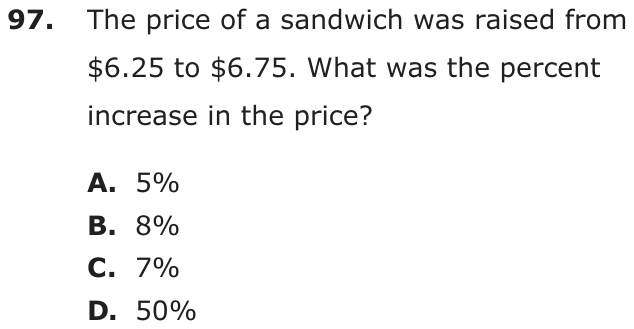
The price of a sandwich was raised from $6.25 to $6.75. What was the percent increase in the price?
- A5%
- B8%
- C7%
- D50%
Show the answer
Correct answer: B
Use the percent increase expression to find the answer:
Question analysis
A sandwich's price went up from $6.25 to $6.75, and this percent change question asks for the percent increase in the price. Students divide the 50-cent increase by one of the prices and write the result as a percent. Picking which price is the base, and doing the decimal division accurately, decide whether the answer comes out right.
- Grade level
- Grade 7 content, by NYS standard
- Compared with grade 7
- At grade 7 Finding a percent increase is a core grade 7 skill, and this is the plain version with no context beyond two prices. Its demand lies in measuring the change against the correct price and dividing by $6.25 without a calculator.
- Estimated difficulty
- Moderate: several steps, or a close reading with one strong distractor.
- Thinking it demands
- Depth of knowledge 2, skills and concepts · mainly apply
- What makes it hard
- A very close wrong answer moderate
- Error-prone arithmetic moderate
- Solution
- 3 steps
- Reading level
- Question and choices: about grade 2, 17 words.
- Students, last 30 days
- Not enough answers yet to show (it takes 10).
Why it is hard, traps and wrong answers (shows the answer)
Why it is hard
The 50-cent rise is easy to find; the percent depends on what it is compared with. Dividing by the new price, $6.75, gives a value that rounds to a listed choice one point below the answer, and reading 50 cents as 50 percent gives another. The choices are printed out of order, 8% before 7%, so students should read each one rather than scan the list.
A very close wrong answer moderate Choosing the answer
Measured against $6.75 the 50-cent rise is about 7.4%, and against $6.25 it is 8%; both are listed side by side, so only the right base separates them. (Embretson & Wetzel, 1987; Gorin & Embretson, 2006; Ascalon et al., 2007)
Error-prone arithmetic moderate Working it out
The division 0.50 ÷ 6.25 is easiest as 50/625, which reduces to 2/25 and then to 8/100; a three-digit decimal divisor invites a slip. (Brown & Burton, 1978; Junker & Sijtsma, 2001)
Strategy: Put the 50-cent change over the original price, 0.50 over 6.25, then scale the fraction to hundredths or divide to read off the percent.
Traps
- Percent of the wrong amount: Finding the whole from a part, or a percent change measured from the wrong starting amount.
- Misunderstands the concept: A wrong belief about a concept: that percents can be added, that area grows like length, that averages can be averaged, that a bigger denominator means a bigger fraction.
The wrong answers, classified
A Little reason to choose it (Haladyna & Downing, 1993; Rodriguez, 2005)
No common working gives 5%: dividing the 50-cent rise by either price does not come near it, so it mostly draws guesses.
C Percent of the wrong amount (Parker & Leinhardt, 1995)
Divides the 50-cent increase by the new price, $6.75, instead of the original, which gives about 7.4%, so 7%.
D Misunderstands the concept (Smith, diSessa & Roschelle, 1993; De Bock et al., 1998; Ni & Zhou, 2005)
Reads the 50-cent increase as 50 percent, treating cents as a percent of one dollar rather than of the $6.25 price.
Worked solution, step by step
Formulas used
- Percent increase
- New is the price after the change, and original is the price before it. The top is the amount of the increase. Dividing by the original compares the increase with where you started. Multiplying by 100 turns that decimal into a percent.
Sort out the question
The sandwich cost $6.25 before. That is the original price. Now it costs $6.75, the new price. You need the percent increase. That compares the increase with the original price. Note that the choices are not in order: C, 7%, comes after B, 8%.
Find the amount of the increase
The price went up $0.50, or 50 cents. Watch out: 50 cents is not 50%. It would be 50% only if the price started at $1.00. That mistake gives choice D.
Divide by the original price
In cents, this is 50 out of 625. Divide the top and bottom by 25. Then multiply both by 4 to get hundredths.
Change to a percent
The price went up 8%. Watch out: divide by the original price, $6.25, not the new one. Dividing by $6.75 gives about 7.4%, which is choice C.
So the answer is B, 8%.
Check your answer
Work forward from the answer. 8% of $6.25 is , or 50 cents. Then . That is the new price, so 8% is right.
More questions like this
The original DOE question
Question 10 of 36
2024 Test A Math, question 42Question
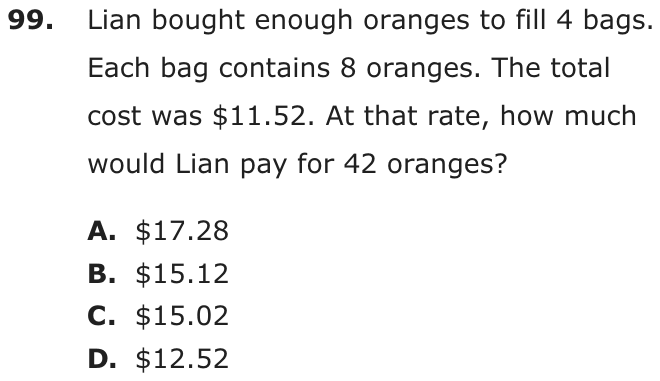
Lian bought enough oranges to fill 4 bags. Each bag contains 8 oranges. The total cost was $11.52. At that rate, how much would Lian pay for 42 oranges?
- A$17.28
- B$15.12
- C$15.02
- D$12.52
Show the answer
Correct answer: B
First, find the amount, in dollars, that Lian paid for each orange. There are 4 bags with 8 oranges each.
Divide the total cost by the total number of oranges to get the cost per orange:
Multiply to find the cost of 42 oranges:
Question analysis
This rate word problem says Lian paid $11.52 for 4 bags of 8 oranges each and asks how much 42 oranges would cost at the same rate. Students find the price of one orange and multiply. Since 42 oranges is not a whole number of bags, working by the bag instead of by the orange invites mistakes.
- Grade level
- Grade 6 content, by NYS standard
- Compared with grade 7
- Below grade 7 Finding a unit price and scaling it up is grade 6 rate work. The decimals are multi-digit, but the plan is routine, with less to manage than grade 7 problems built on percents or negative numbers.
- Estimated difficulty
- Straightforward: two steps or one careful reading.
- Thinking it demands
- Depth of knowledge 2, skills and concepts · mainly apply
- What makes it hard
- Error-prone arithmetic moderate
- A very close wrong answer minor
- Solution
- 3 steps
- Reading level
- Question and choices: about grade 2, 25 words.
- Students, last 30 days
- Not enough answers yet to show (it takes 10).
Why it is hard, traps and wrong answers (shows the answer)
Why it is hard
The plan is familiar, total oranges, price per orange, then the new cost, so the work lies in the decimals. Because 42 oranges is five bags and two oranges, students who price by the bag either round up to six bags or must handle the leftover. Estimating, since 42 is about a third more than 32, gives roughly $15 and rules out the far choices but not the near one.
Error-prone arithmetic moderate Working it out
Two decimal operations are done by hand: 11.52 ÷ 32 = 0.36 for one orange, then 0.36 × 42 = 15.12, where a dropped carry is easy. (Brown & Burton, 1978; Junker & Sijtsma, 2001)
A very close wrong answer minor Choosing the answer
The choices $15.12 and $15.02 differ by 10 cents, so a rough estimate of about $15 cannot choose between them; only the exact product can. (Embretson & Wetzel, 1987; Gorin & Embretson, 2006; Ascalon et al., 2007)
Strategy: Multiply to find how many oranges were bought, divide the total cost by that number to get the price of one orange, then multiply by 42.
Traps
- Misreads the question: Misses or misreads a condition or a word in the question: "at least", "each", "remaining", "not".
- An arithmetic slip: The right method with a plausible arithmetic error: a digit, a place value or a times-table fact.
The wrong answers, classified
A Misreads the question (Hegarty, Mayer & Monk, 1995)
Prices whole bags, rounding 42 oranges up to 6 bags of 8, and pays 6 × $2.88 = $17.28, missing that "at that rate" means per orange.
C An arithmetic slip (Junker & Sijtsma, 2001)
Uses the right method but slips one digit in multiplying 0.36 by 42, a tens-place error that lands 10 cents short of the total.
D Little reason to choose it (Haladyna & Downing, 1993; Rodriguez, 2005)
No common working gives $12.52, exactly one dollar more than $11.52; no price per orange or per bag leads there, so it mostly draws guesses.
Worked solution, step by step
Formulas used
- Unit price
- The unit price is what one item costs. Divide the total cost by how many items you got. It works because the total is shared equally among the items.
- Cost
- The unit price is the cost of one item, here one orange. Multiply it by how many items you buy to get the total cost. This works when every item costs the same.
Sort out the question
Lian bought 4 bags with 8 oranges in each bag. She paid $11.52 in all. You need the cost of 42 oranges. “At that rate” means each orange costs the same as before. So find the price of one orange first.
Count the oranges
Each of the 4 bags holds 8 oranges, so multiply to find how many she bought.
Lian bought 32 oranges for $11.52.
Find the price of one orange
This is easier in cents: . So one orange costs $0.36, or 36 cents.
Find the cost of 42 oranges
Break 42 into 40 and 2 to make it easier.
The 42 oranges cost $15.12.
Avoid the traps and answer
Watch out: $15.02, choice C, is only 10 cents away. Multiply and add with care. Watch out: Lian pays for each orange, not for full bags. Buying 6 whole bags would cost $17.28, choice A.So the answer is B, $15.12.
Check your answer
42 oranges is 10 more than 32. Those 10 oranges cost $3.60, since . Then . Same answer, so $15.12 is right.
More questions like this
The original DOE question
Question 11 of 36
2024 Test A Math, question 43Question
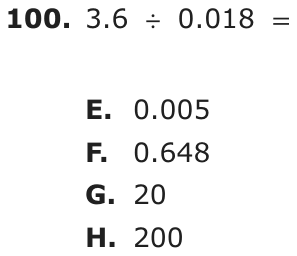
- A0.005
- B0.648
- C20
- D200
Show the answer
Correct answer: D
Question analysis
This decimal division question asks for 3.6 divided by 0.018, with no context. Students rewrite the division so the divisor is a whole number and then divide. Because the divisor has three decimal places, moving the decimal point the right number of places in both numbers is where students go wrong.
- NYS standards
- 6.NS.3 multi-digit decimal operations
- Grade level
- Grade 6 content, by NYS standard
- Compared with grade 7
- Below grade 7 Dividing multi-digit decimals is a grade 6 fluency standard, and this is a single division with no context. It is easier than typical grade 7 work, though shifting three decimal places invites a place-value slip.
- Estimated difficulty
- Straightforward: two steps or one careful reading.
- Thinking it demands
- Depth of knowledge 1, recall and reproduction · mainly apply
- What makes it hard
- Error-prone arithmetic moderate
- Solution
- 2 steps
- Reading level
- Question and choices: about grade 16+, 1 words.
- Students, last 30 days
- Not enough answers yet to show (it takes 10).
Why it is hard, traps and wrong answers (shows the answer)
Why it is hard
This is a single division, and the only real hazard is the decimal point. Shifting it three places in the divisor but only two in the dividend gives a listed answer ten times too small. An estimate settles it: 0.018 is about 0.02, and 3.6 ÷ 0.02 = 180, so the answer must be in the hundreds.
Error-prone arithmetic moderate Working it out
The divisor 0.018 has three decimal places, so both numbers must be multiplied by 1,000, turning 3.6 into 3,600, not 360, before dividing by 18. (Brown & Burton, 1978; Junker & Sijtsma, 2001)
Strategy: Multiply both numbers by 1,000 so the divisor becomes a whole number, then divide; estimate first by asking roughly how many 0.02s fit into 3.6.
Traps
- An arithmetic slip: The right method with a plausible arithmetic error: a digit, a place value or a times-table fact.
- Wrong operation: Adds instead of multiplying, divides the wrong way round, turns a ratio or rate upside down, or undoes a step in the wrong direction (subtracts what should be added back).
The wrong answers, classified
A Wrong operation (Hegarty, Mayer & Monk, 1995; King et al., 2004)
Divides the wrong way round, 0.018 ÷ 3.6 = 0.005, putting the smaller number on top as if division always shrinks.
B Wrong operation (Hegarty, Mayer & Monk, 1995; King et al., 2004)
Multiplies instead of dividing, 36 × 18 = 648, and misplaces the decimal point too, since 3.6 × 0.018 is really 0.0648.
C An arithmetic slip (Junker & Sijtsma, 2001)
Moves the decimal point two places instead of three, dividing 360 by 18 to get 20, a result ten times too small.
Worked solution, step by step
Formulas used
- Scaling a division
- a is the number being divided, and b is the number you divide by. n is any number except 0. Multiplying both numbers by the same n keeps the answer the same, just like an equal fraction. Use it to turn a decimal you divide by into a whole number.
Sort out the problem
You need . The number you divide by, 0.018, has three decimal places. That means three digits after the decimal point. Dividing by a decimal is hard, so first turn 0.018 into a whole number.
Multiply both numbers by 1,000
Multiplying by 1,000 moves the decimal point 3 places to the right. Do it to both numbers, so the answer does not change.
Watch out: 3.6 has only one decimal place, so fill in zeros: 3.6 becomes 3,600. Moving its point only two places gives , choice C.Divide the whole numbers
This works because , so . Watch out: divide 3.6 by 0.018, not the other way around. Dividing 0.018 by 3.6 gives 0.005, choice A.
So the answer is D, 200.
Check your answer
Multiply back: . Also estimate. 0.018 is close to 0.02, and . The answer should be near that, and 200 is. Dividing by a number less than 1 gives a bigger answer, so 200 makes sense.
More questions like this
The original DOE question
Question 12 of 36
2024 Test A Math, question 45Question
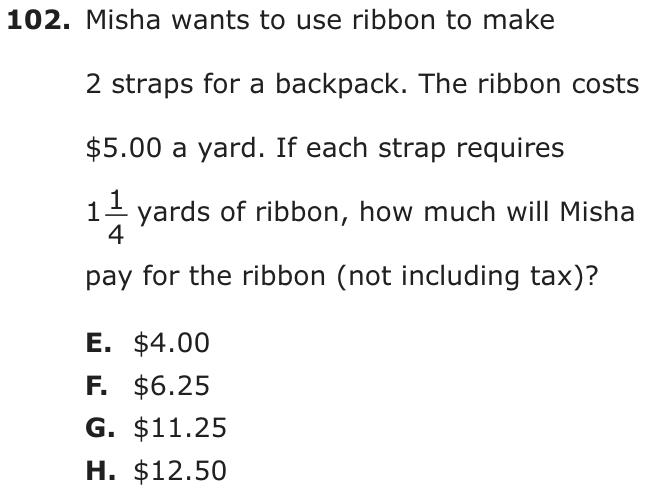
Misha wants to use ribbon to make 2 straps for a backpack. The ribbon costs $5.00 a yard. If each strap requires yards of ribbon, how much will Misha pay for the ribbon (not including tax)?
- A$4.00
- B$6.25
- C$11.25
- D$12.50
Show the answer
Correct answer: D
Each strap requires yards of ribbon, and ribbon costs $5.00 a yard.
, so the ribbon for each strap costs $6.25.
Misha wants to make 2 straps.
, so the cost of the ribbon for 2 straps is $12.50.
Question analysis
Misha needs ribbon for 2 backpack straps, each using 1 1/4 yards, and ribbon costs $5.00 a yard. This cost word problem asks how much she will pay for the ribbon before tax. Students multiply a mixed number by a price per yard and by the number of straps; it is short, but both the mixed number and the two straps need care.
- Grade level
- Grade 6 content, by NYS standard
- Compared with grade 7
- Below grade 7 Multiplying a mixed number by a whole number and finding a total cost are grade 5 and 6 skills. With two short steps and friendly numbers, this is easier than typical grade 7 problems with percents or negatives.
- Estimated difficulty
- Routine: one familiar step, little to misread.
- Thinking it demands
- Depth of knowledge 2, skills and concepts · mainly apply
- What makes it hard
- Error-prone arithmetic minor
- Much to keep track of minor
- Solution
- 2 steps
- Reading level
- Question and choices: about grade 5, 35 words.
- Students, last 30 days
- Not enough answers yet to show (it takes 10).
Why it is hard, traps and wrong answers (shows the answer)
Why it is hard
The question is short and the numbers are friendly; points are lost by stopping at one strap or by mishandling the mixed number. Pricing a single strap gives a listed choice, as does doubling only the whole-number part of 1 1/4. Finding the total ribbon first, 2 1/2 yards, before multiplying by the price keeps both errors away.
Error-prone arithmetic minor Working it out
The length per strap is a mixed number, 1 1/4 yards, so the arithmetic is easiest as 2 × 1.25 = 2.5 yards, then 2.5 × $5.00. (Brown & Burton, 1978; Junker & Sijtsma, 2001)
Much to keep track of minor Working it out
The number of straps comes in the first sentence and the length of each in the last, so the 2 has to be carried through to the cost. (Sweller, 1988; Carpenter, Just & Shell, 1990)
Strategy: Find the total ribbon first by doubling the length for one strap, then multiply the yards by $5.00; writing 1 1/4 as 1.25 keeps the arithmetic simple.
Traps
- Stops one step early: A choice is a number from partway through the solution.
- A faulty procedure: A systematic but wrong procedure: adding fractions straight across, applying an exponent to each term of a sum, dropping a sign when moving a term.
- Wrong operation: Adds instead of multiplying, divides the wrong way round, turns a ratio or rate upside down, or undoes a step in the wrong direction (subtracts what should be added back).
The wrong answers, classified
A Wrong operation (Hegarty, Mayer & Monk, 1995; King et al., 2004)
Divides the price by the length, $5.00 ÷ 1.25 = 4, instead of multiplying yards by dollars per yard.
B Stops one step early (King et al., 2004; Gierl et al., 2017)
Prices the ribbon for one strap, 1 1/4 × $5.00 = $6.25, and forgets that Misha is making 2 straps.
C A faulty procedure (Brown & Burton, 1978; Tatsuoka, 1983)
Doubles only the whole-number part of 1 1/4, getting 2 1/4 yards instead of 2 1/2, and pays 2.25 × $5.00 = $11.25.
Worked solution, step by step
Formulas used
- Cost
- Price per unit is the cost of one unit, here $5.00 for one yard. Number of units is how many you buy, here yards of ribbon. Multiply them to get the total before tax.
Sort out the question
Misha makes 2 straps. Each strap needs yards of ribbon. A yard is a length of 3 feet. Ribbon costs $5.00 a yard. You need the total cost for both straps, with no tax.
Find the total ribbon
First change the mixed number to a decimal. One quarter is 0.25, so is 1.25. Then double it for 2 straps.
Misha needs 2.5 yards of ribbon. Watch out: double the whole mixed number, the 1 and the quarter. Doubling only the 1 gives yards and $11.25, choice C.
Find the cost
The ribbon costs $12.50. Watch out: this is for both straps. One strap’s ribbon costs $6.25, choice B. Don’t stop there.
So the answer is D, $12.50.
Check your answer
Estimate. Each strap needs a bit more than 1 yard, so both need a bit more than 2 yards. Two yards cost $10, so the answer should be a bit more than $10. $12.50 fits. Also, 2 yards cost $10 and the extra half yard costs $2.50, which makes $12.50.
More questions like this
The original DOE question
Question 13 of 36
2024 Test A Math, question 51Question
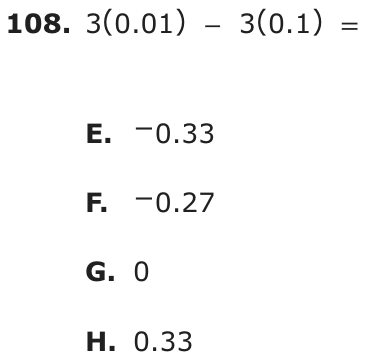
- A−0.33
- B−0.27
- C0
- D0.33
Show the answer
Correct answer: B
Question analysis
This decimal question asks for the value of 3 times 0.01 minus 3 times 0.1. Students multiply each decimal by 3 and subtract, keeping the order of the subtraction as written. The two decimals look alike, so place value and the sign of the result both need care.
- Grade level
- Grade 7 content, by NYS standard
- Compared with grade 7
- At grade 7 Grade 7 students subtract rational numbers and get negative results. This short computation adds place-value care, since 0.01 and 0.1 look alike, but it is a routine two-step grade 7 exercise.
- Estimated difficulty
- Straightforward: two steps or one careful reading.
- Thinking it demands
- Depth of knowledge 1, recall and reproduction · mainly apply
- What makes it hard
- Error-prone arithmetic moderate
- A very close wrong answer minor
- Solution
- 2 steps
- Reading level
- Question and choices: about grade 16+, 1 words.
- Students, last 30 days
- Not enough answers yet to show (it takes 10).
Why it is hard, traps and wrong answers (shows the answer)
Why it is hard
Two quick multiplications leave 0.03 − 0.3, a subtraction whose result is negative. The usual errors are adding the two products, with or without a minus sign, and treating 0.01 and 0.1 as the same number. Rewriting the subtraction as −(0.3 − 0.03) keeps the place values lined up and makes the sign plain.
Error-prone arithmetic moderate Working it out
The products 0.03 and 0.3 have their digits in different places, and taking the larger from the smaller crosses zero, so both alignment and sign need care. (Brown & Burton, 1978; Junker & Sijtsma, 2001)
A very close wrong answer minor Choosing the answer
The choice −0.33 has the right sign and is only 0.06 from the answer, so a sense that the result is a little below zero cannot separate them. (Embretson & Wetzel, 1987; Gorin & Embretson, 2006; Ascalon et al., 2007)
Strategy: Multiply each decimal by 3, then subtract with the place values lined up; or factor out the 3 and compute 3 times (0.01 − 0.1).
Traps
- Negatives and direction: Arithmetic with negative numbers, the order of a subtraction, or direction on a number line. (Moving a term across the equals sign without changing its sign is a faulty procedure.)
- Wrong operation: Adds instead of multiplying, divides the wrong way round, turns a ratio or rate upside down, or undoes a step in the wrong direction (subtracts what should be added back).
The wrong answers, classified
A Negatives and direction (Brown & Burton, 1978)
Sees the result must be negative but adds the sizes, −(0.03 + 0.3) = −0.33, instead of subtracting 0.03 from 0.3.
C Misunderstands the concept (Smith, diSessa & Roschelle, 1993; De Bock et al., 1998; Ni & Zhou, 2005)
Treats 0.01 and 0.1 as equal, since each shows a single 1 after the point, so the two products cancel to 0.
D Wrong operation (Hegarty, Mayer & Monk, 1995; King et al., 2004)
Adds the products, 0.03 + 0.3 = 0.33, instead of subtracting the second from the first.
Worked solution, step by step
Formulas used
- Subtracting a bigger number
- a and b are numbers, and b is the bigger one. When you take a bigger number away from a smaller one, the answer is negative. Its size is the gap between them, b minus a. So subtract the other way, then put a minus sign in front.
Sort out the problem
3(0.01) means 3 times 0.01. A number right next to parentheses means multiply. Then subtract 3 times 0.1. Note that 0.01 is one hundredth, and 0.1 is one tenth. They are not equal. Watch out: treating them as equal makes the two parts cancel to 0, choice C.
Multiply each part
So the problem is . Write 0.3 as 0.30 so both have two decimal places. Now you can see that 0.30 is bigger than 0.03.
Subtract the bigger number
You take a bigger number from a smaller one, so the answer is negative.
Watch out: find the gap between the numbers. Don’t add them. Adding gives 0.33, choice D, or −0.33, choice A.So the answer is B, −0.27.
Check your answer
Pull out the 3 first: . Same answer. Also think of a number line. Start at 0.03, just right of 0. Move 0.30 to the left. You land a little left of 0, at −0.27.
More questions like this
The original DOE question
Question 14 of 36
2024 Test B Math, question 3Question
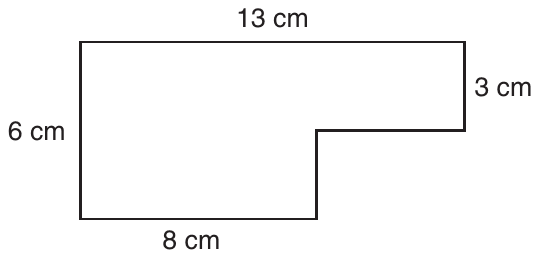
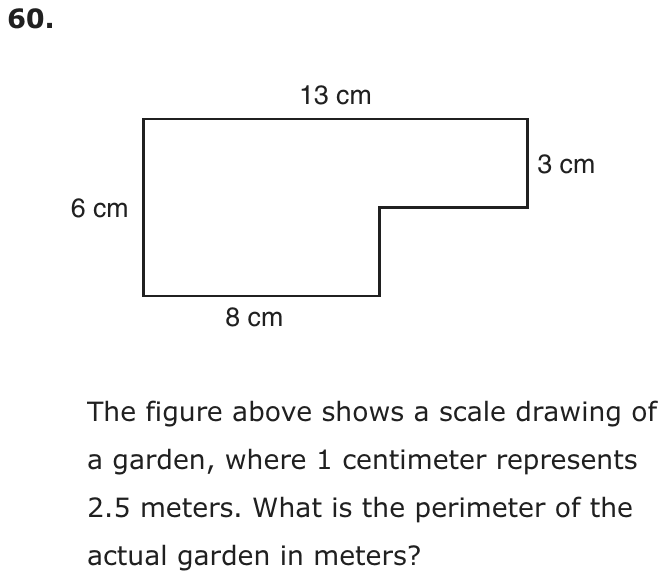
The figure above shows a scale drawing of a garden, where 1 centimeter represents 2.5 meters. What is the perimeter of the actual garden in meters?
Grid-in question: work out the answer and enter it as a number.
Show the answer
Correct answer: 95
First, find the perimeter of the figure.
Two sides do not have labels. The top of the figure measures 13 cm and the bottom shows a length measuring 8 cm, so the horizontal side without a label measures 5 cm .
The left side of the figure measures 6 cm and the right side shows a length measuring 3 cm, so the vertical side without a label measures 3 cm .
So the total perimeter of the scale drawing is
Use the scale to find the perimeter of the actual garden:
Question analysis
A grid-in on a scale drawing of an L-shaped garden, where each centimeter stands for 2.5 meters and two sides carry no labels. Students find the perimeter of the drawing, then convert it to the real garden's perimeter in meters. The unlabeled sides are easy to leave out.
- Grade level
- Grade 7 content, by NYS standard
- Compared with grade 7
- At grade 7 Scale drawings are grade 7 content, and a typical task converts one or two given lengths. Here two missing sides must be worked out and the perimeter assembled before the scale applies, more steps but nothing beyond grade 7.
- Estimated difficulty
- Moderate: several steps, or a close reading with one strong distractor.
- Thinking it demands
- Depth of knowledge 2, skills and concepts · mainly apply
- What makes it hard
- Reading a figure, table or graph moderate
- Combines ideas minor
- An answer in an unexpected form minor
- Solution
- 4 steps
- Reading level
- Question and choices: about grade 9, 24 words.
- Students, last 30 days
- Not enough answers yet to show (it takes 10).
Why it is hard, traps and wrong answers (shows the answer)
Why it is hard
The figure hides the work: it labels four of the six sides, and the missing two are short pieces of the notch that are easy to overlook. Once all six are found, the scale step is a single multiplication, but it must go the right way, since the real garden is larger than the drawing. Tracing the outline and counting six sides guards against the most common loss.
Reading a figure, table or graph moderate Understanding the question
Two sides of the notch carry no labels, so students must find them from the opposite sides: 13 − 8 = 5 cm across and 6 − 3 = 3 cm down. (Lesh, Post & Behr, 1987; Kirsch & Mosenthal, 1990)
Combines ideas minor Working it out
The perimeter of an L-shaped drawing has to be joined to a scale of 2.5 meters per centimeter, two separate skills in one answer. (Embretson, 1998; Daniel & Embretson, 2010)
An answer in an unexpected form minor Choosing the answer
With no choices, nothing flags a perimeter that is missing two sides or still in centimeters; the student must check the six-sided total alone. (Enright, Morley & Sheehan, 2002)
Strategy: Use the opposite sides to work out the two unlabeled lengths, add all six sides of the drawing, then multiply the total in centimeters by 2.5 meters per centimeter.
Traps
- Misreads the figure: Reads a value, label or tick spacing in a figure, table or graph wrongly.
- Stops one step early: A choice is a number from partway through the solution.
- Wrong operation: Adds instead of multiplying, divides the wrong way round, turns a ratio or rate upside down, or undoes a step in the wrong direction (subtracts what should be added back).
The wrong answers, classified
75 Misreads the figure (Lesh, Post & Behr, 1987; Kirsch & Mosenthal, 1990)
Adds only the four labeled sides, 13 + 3 + 8 + 6 = 30 cm, and scales that to 75 m, missing the two unlabeled sides of the notch.
38 Stops one step early (King et al., 2004; Gierl et al., 2017)
Finds the drawing's perimeter, 38 cm, correctly and grids it without applying the scale of 2.5 meters per centimeter.
15.2 Wrong operation (Hegarty, Mayer & Monk, 1995; King et al., 2004)
Divides the 38 cm perimeter by 2.5 instead of multiplying, shrinking the garden though each centimeter of the drawing stands for 2.5 meters.
Worked solution, step by step
Formulas used
- Perimeter
- P is the perimeter, the distance all the way around a shape. Add the length of every side, once each. It works for any shape with straight sides, even one with a corner cut out.
- Using a scale
- s is the scale, the number of meters that 1 centimeter on the drawing stands for. Here s is 2.5. Each centimeter on the drawing is 2.5 meters in real life, so you multiply.
Sort out what you know
The figure is a scale drawing, a small copy of the real garden. Each 1 cm on the drawing stands for 2.5 m in the real garden. You need the perimeter of the real garden in meters. The perimeter is the distance all the way around.
The shape has 6 sides. Four are labeled: 13 cm, 3 cm, 8 cm and 6 cm. The two sides around the cut-out corner have no labels.
Find the missing side across
Look at the top side, 13 cm. Below it, the bottom side (8 cm) and the short unlabeled side across the notch together reach just as far. So the missing side is the difference.
The missing side across is 5 cm.
Find the missing side going down
Now look at the left side, 6 cm. On the right, the 3 cm side and the unlabeled side going down together make the same height.
The missing side going down is 3 cm.
Add all six sides
The perimeter of the drawing is 38 cm. Watch out: adding only the four labeled sides gives 30 cm. That leads to the wrong answer 75.
Change to real meters
Each centimeter stands for 2.5 meters, so multiply by 2.5.
Here and . The real perimeter is 95 meters. Watch out: 38 is still in centimeters, so do not grid it. Dividing by 2.5 gives 15.2, which makes the garden smaller than its drawing.
So you would grid 95.
Check your answer
Slide the two notch sides out to the corner. The distance around stays the same, so it equals a 13 cm by 6 cm rectangle: . Also, 95 meters is more than 38, which fits, because each centimeter stands for more than 1 meter.
More questions like this
The original DOE question
Question 15 of 36
2024 Test B Math, question 26Question
If 1 sind = 0.75 plunk, how many sinds are equivalent to 8 plunks, rounded to the nearest hundredth?
- A1.33
- B6.00
- C7.25
- D10.67
Show the answer
Correct answer: D
Set up a proportion:
Question analysis
A unit conversion question with made-up units: 1 sind equals 0.75 plunk, and students find how many sinds equal 8 plunks, rounded to the nearest hundredth. With unfamiliar unit names there is no everyday sense to lean on, so deciding whether to multiply or divide by 0.75 is the hard part.
- Grade level
- Grade 6 content, by NYS standard
- Compared with grade 7
- At grade 7 Converting units with ratio reasoning is grade 6 content, and made-up unit names are a familiar SHSAT twist. Working with a decimal rate and rounding to hundredths put it at about the level of typical grade 7 work.
- Estimated difficulty
- Moderate: several steps, or a close reading with one strong distractor.
- Thinking it demands
- Depth of knowledge 2, skills and concepts · mainly apply
- What makes it hard
- Turning words into math moderate
- Error-prone arithmetic minor
- Solution
- 2 steps
- Reading level
- Question and choices: about grade 7, 15 words.
- Students, last 30 days
- Not enough answers yet to show (it takes 10).
Why it is hard, traps and wrong answers (shows the answer)
Why it is hard
Made-up units remove the everyday sense that usually tells students which way a conversion goes, so the relationship must be reasoned out. The most tempting error multiplies by 0.75 and goes the wrong way; another finds the rate for one plunk and stops. A size check settles it: each sind is less than a plunk, so the number of sinds must exceed 8.
Turning words into math moderate Understanding the question
“1 sind = 0.75 plunk” says a sind is smaller than a plunk, so 8 plunks hold more than 8 sinds; seeing that decides between dividing and multiplying by 0.75. (Hegarty, Mayer & Monk, 1995; Koedinger & Nathan, 2004)
Error-prone arithmetic minor Working it out
8 ÷ 0.75 is easiest as 8 × 4/3 = 32/3, and the repeating decimal 10.666… must then be rounded to the nearest hundredth. (Brown & Burton, 1978; Junker & Sijtsma, 2001)
Strategy: Set up a proportion with sinds over plunks on both sides, put the 8 plunks in the matching place, solve for the sinds, and round to the nearest hundredth.
Traps
- Wrong operation: Adds instead of multiplying, divides the wrong way round, turns a ratio or rate upside down, or undoes a step in the wrong direction (subtracts what should be added back).
- Stops one step early: A choice is a number from partway through the solution.
- Numbers taken from the question: Combines the numbers in the question without a model of the situation, or is simply a number that appears in the question.
The wrong answers, classified
A Stops one step early (King et al., 2004; Gierl et al., 2017)
Finds how many sinds make one plunk, 1 ÷ 0.75 ≈ 1.33, and stops before scaling up to 8 plunks.
B Wrong operation (Hegarty, Mayer & Monk, 1995; King et al., 2004)
Multiplies 8 by 0.75 instead of dividing, converting in the wrong direction and finding the plunks in 8 sinds.
C Numbers taken from the question (Hegarty, Mayer & Monk, 1995)
Subtracts 0.75 from 8, combining the two numbers in the question without setting up a conversion.
Worked solution, step by step
Formulas used
- Cross-multiplying
- a, b, c and d are numbers or letters, and b and d are not zero. When two fractions are equal, multiply each top by the other bottom. The two products are equal. It works because it is the same as multiplying both sides by b and by d.
- Dividing by a fraction
- a is any number, and b over c is the fraction you divide by. Dividing by a fraction is the same as multiplying by its reciprocal, the fraction flipped upside down. It asks how many of that fraction fit into a.
Sort out what you know
Sinds and plunks are made-up units, like inches and feet. One sind equals 0.75 plunk, so a sind is smaller than a plunk. You need how many sinds equal 8 plunks. Round to the nearest hundredth, two places after the decimal point.
Decide if the answer is more than 8
A sind is only 3/4 of a plunk. So it takes more than 8 sinds to make 8 plunks. The answer must be more than 8. Watch out: , choice B, goes the wrong way. That is the number of plunks in 8 sinds.
Set up a proportion
A proportion says that two ratios are equal. Put sinds on top and plunks on the bottom on both sides. Let x be the number of sinds.
So .
Divide by 0.75
0.75 is the same as . Divide both sides by it. To divide by a fraction, multiply by its reciprocal.
Watch out: 1.33, choice A, is the number of sinds in just 1 plunk. Keep going to 8 plunks.Round to the nearest hundredth
Look at the third digit after the point, the thousandths digit. It is 6, which is 5 or more. So round the hundredths digit up, from 6 to 7.
So the answer is D, 10.67.
Check your answer
Multiply back. Each sind is 0.75 plunk, so 10.67 sinds are plunks. That matches the 8 plunks. The answer is also more than 8, as it must be.
More questions like this
The original DOE question
Question 16 of 36
2024 Test B Math, question 38Question
Michael received a check for $213 for working 20 hours at his part-time job. The amount on the check was his total pay after $32 in taxes was deducted. What was Michael’s hourly pay rate before taxes were deducted?
- A$9.05
- B$10.65
- C$12.25
- D$21.35
Show the answer
Correct answer: C
Add the taxes to the amount of the check to find Michael’s total pay before taxes were deducted:
Divide the total pay by the number of hours to find the hourly pay rate:
Question analysis
Michael's paycheck shows what he earned for 20 hours after taxes were taken out, and the tax amount is given. Students find his hourly pay rate before taxes. It tests unit rates in a money word problem, where students must decide what to do with the tax that was deducted.
- Grade level
- Grade 6 content, by NYS standard
- Compared with grade 7
- Below grade 7 Unit rate problems are grade 6 content, and this one needs one addition and one division with a decimal result. It is easier than typical grade 7 work, apart from deciding which amount is the pay before taxes.
- Estimated difficulty
- Straightforward: two steps or one careful reading.
- Thinking it demands
- Depth of knowledge 2, skills and concepts · mainly apply
- What makes it hard
- Turning words into math minor
- Solution
- 2 steps
- Reading level
- Question and choices: about grade 5, 36 words.
- Students, last 30 days
- Not enough answers yet to show (it takes 10).
Why it is hard, traps and wrong answers (shows the answer)
Why it is hard
Two operations in the right order, adding the tax back and dividing by the hours, are all this takes. The danger is the word deducted, which pulls students toward subtracting the $32 a second time, and the phrase before taxes, which rules out the take-home rate from dividing the check alone. Checking that $12.25 × 20 − $32 gives back $213 confirms the answer.
Turning words into math minor Understanding the question
"The amount on the check was his total pay after $32 in taxes was deducted" makes $213 what remained, so the $32 is added back, not taken away. (Hegarty, Mayer & Monk, 1995; Koedinger & Nathan, 2004)
Strategy: Rebuild Michael's pay before taxes from the check and the tax that was taken out, then divide that total by the 20 hours worked.
Traps
- Follows a key word: Picks the operation from a single word rather than the situation: "removed" so subtract, "of" so multiply, "more" so add, when the situation needs something else.
- Answers a different question: A choice is right for another quantity: the other unknown, the rest instead of the part, the part instead of the whole.
The wrong answers, classified
A Follows a key word (Hegarty, Mayer & Monk, 1995)
Follows the word deducted and subtracts the $32 from the $213 check again, (213 − 32) ÷ 20 = 9.05, instead of adding it back.
B Answers a different question (King et al., 2004; Hegarty, Mayer & Monk, 1995)
Divides the $213 check by 20 hours, which gives Michael's hourly pay after taxes rather than before.
D Little reason to choose it (Haladyna & Downing, 1993; Rodriguez, 2005)
No standard working gives $21.35, which equals 32 − 10.65; dividing $213 by 10 hours instead of 20, $21.30, comes closest, so it mostly draws guesses.
Worked solution, step by step
Formulas used
- Hourly pay rate
- rate is the pay for one hour. total pay is the money earned for all the hours. hours is the time worked. Dividing shares the total pay equally among the hours. Use it when the pay for each hour is the same.
Sort out the question
Michael’s check was for $213. That is what was left after $32 in taxes was deducted, which means taken away. He worked 20 hours.
You need his hourly pay before taxes. So first find his full pay before the $32 was taken out.
Add the taxes back
The $32 was taken away from his full pay to leave $213. To undo taking away, add it back.
His pay before taxes was $245. Watch out: The word “deducted” tempts you to subtract again. That gives , choice A.
Divide by the hours
He earned $12.25 for each hour before taxes. Watch out: Dividing the $213 check by 20 gives $10.65, choice B. That is his pay for each hour after taxes.
So the answer is C, $12.25.
Check your answer
Work forward. , so 20 hours pay $245. Take away $32 in taxes: . That is the amount on the check.
More questions like this
The original DOE question
Question 17 of 36
2024 Test B Math, question 54Question
A rectangular kitchen floor is 12 feet long and 7.5 feet wide. It will be covered completely with new square tiles measuring 0.75 foot on each side. How many tiles will cover the floor?
- A68
- B78
- C120
- D160
Show the answer
Correct answer: D
First, determine the area of the kitchen floor in square feet by multiplying the length and width:
Next, determine the area of each square tile:
The number of tiles needed is found by dividing the area of the floor by the area of the tiles:
Question analysis
A rectangular kitchen floor measuring 12 feet by 7.5 feet will be covered with square tiles 0.75 foot on a side. Students find how many tiles are needed. It tests area and division with decimals, and working with a decimal side length while keeping lengths and areas apart is what makes it tricky.
- NYS standards
- Grade level
- Grade 6 content, by NYS standard
- Compared with grade 7
- At grade 7 Area of a rectangle is grade 6 content, but here it combines with dividing by a decimal tile area, or by the tile's side along each wall. Three decimal steps and a tempting shortcut make it typical grade 7 demand.
- Estimated difficulty
- Moderate: several steps, or a close reading with one strong distractor.
- Thinking it demands
- Depth of knowledge 2, skills and concepts · mainly apply
- What makes it hard
- Error-prone arithmetic moderate
- Turning words into math minor
- Solution
- 3 steps
- Reading level
- Question and choices: about grade 6, 31 words.
- Students, last 30 days
- Not enough answers yet to show (it takes 10).
Why it is hard, traps and wrong answers (shows the answer)
Why it is hard
The floor's 90 square feet comes quickly; the trap is what to divide it by. A tile is described by its side, and dividing by 0.75 instead of 0.5625 gives a listed answer that looks reasonable. Counting tiles along each wall, 16 along the length and 10 along the width, avoids both the decimal division and the side-versus-area mistake.
Error-prone arithmetic moderate Working it out
The tile's area, 0.75 × 0.75 = 0.5625 square foot, must divide 90, a decimal division that is easier as 90 × 16/9 or as 16 tiles by 10 tiles. (Brown & Burton, 1978; Junker & Sijtsma, 2001)
Turning words into math minor Understanding the question
The tiles are "square tiles measuring 0.75 foot on each side", a side length, which has to be squared before it can be compared with the floor's area in square feet. (Hegarty, Mayer & Monk, 1995; Koedinger & Nathan, 2004)
Strategy: Find how many tiles fit along the length and how many along the width by dividing each by 0.75, then multiply the two counts.
Traps
- Wrong formula: Uses a related but wrong formula: perimeter for area, diameter for radius, area for volume, or a misremembered one.
- Wrong operation: Adds instead of multiplying, divides the wrong way round, turns a ratio or rate upside down, or undoes a step in the wrong direction (subtracts what should be added back).
The wrong answers, classified
A Wrong operation (Hegarty, Mayer & Monk, 1995; King et al., 2004)
Multiplies the 90-square-foot area by the tile's 0.75-foot side instead of dividing, getting 67.5 and rounding to 68.
B Little reason to choose it (Haladyna & Downing, 1993; Rodriguez, 2005)
No standard working gives 78, which is twice the floor's 39-foot perimeter, 4 × (12 + 7.5), so it mostly draws guesses.
C Wrong formula (King et al., 2004)
Divides the 90 square feet by the tile's side, 0.75 foot, instead of its area, 0.5625 square foot, getting 120 tiles.
Worked solution, step by step
Formulas used
- Area of a rectangle
- A is the area, the flat space inside. l is the length and w is the width. Multiplying counts how many unit squares fit, row by row.
- Area of a square
- A is the area. s is the length of one side. s² means s × s. A square is a rectangle whose length and width are both s.
Sort out the question
The floor is a rectangle 12 feet long and 7.5 feet wide. Each tile is a square, 0.75 foot on each side. You need the number of tiles that cover the whole floor.
Find the floor’s area
Area tells how much flat space the tiles must cover. Use the rectangle formula.
The floor is 90 square feet.
Find one tile’s area
The tile’s side is a length. You need its area to compare it with the floor’s area. Use the square formula.
As a fraction, , so the area is square foot.
Divide the floor by one tile
The number of tiles is the floor’s area divided by one tile’s area. To divide by a fraction, multiply by its reciprocal, the fraction flipped upside down.
Watch out: Dividing 90 by 0.75, the side, gives 120, choice C. You must divide by the tile’s area. Multiplying 90 by 0.75 gives about 68, choice A.
So the answer is D, 160.
Check your answer
Count the tiles in rows. Along the 12-foot length, tiles fit. Along the 7.5-foot width, tiles fit. That makes tiles.
More questions like this
The original DOE question
Question 18 of 36
2023 Test A Math, question 5Question
The mean value of 8 numbers is 17. Three of these numbers (9, 11, and 20) are discarded. What is the mean of the 5 remaining numbers?
Grid-in question: work out the answer and enter it as a number.
Show the answer
Correct answer: 19.2
First, find the sum of the original 8 numbers. Let x equal the sum of those numbers and use the mean formula to solve for x:
Next, subtract the 3 discarded numbers from the sum:
Finally, calculate the mean of the remaining 5 numbers by dividing the new sum, 96, by 5:
Question analysis
Eight numbers have a mean of 17, and three of them, 9, 11 and 20, are removed. This statistics grid-in asks for the mean of the five numbers that are left. Students have to rebuild the total from the mean before removing anything, and then divide by the new count rather than the old one.
- Grade level
- Grade 6 content, by NYS standard
- Compared with grade 7
- At grade 7 Finding a mean is grade 6 content, but working back from a mean to a total, removing values and averaging again is a typical grade 7 multistep task. As a grid-in, it offers no choices to check a wrong total against.
- Estimated difficulty
- Moderate: several steps, or a close reading with one strong distractor.
- Thinking it demands
- Depth of knowledge 2, skills and concepts · mainly apply
- What makes it hard
- Many steps moderate
- Much to keep track of minor
- An answer in an unexpected form minor
- Solution
- 3 steps
- Reading level
- Question and choices: about grade 3, 21 words.
- Students, last 30 days
- Not enough answers yet to show (it takes 10).
Why it is hard, traps and wrong answers (shows the answer)
Why it is hard
A mean cannot be adjusted directly when numbers are removed, so the question rewards switching from the mean to the total and back. The removed numbers, 9, 11 and 20, average less than 17, so the new mean must rise above 17; that quick check rules out an answer such as 12. Points are lost by dividing by the wrong count or by stopping at the new total.
Many steps moderate Working it out
Three operations come in a fixed order: multiply the mean by 8 to get 136, subtract 9, 11 and 20 to leave 96, then divide by the numbers that remain. (Daniel & Embretson, 2010; Enright, Morley & Sheehan, 2002)
Much to keep track of minor Working it out
The count changes partway through, from 8 numbers to 5, and the divisor at the end must be the new count, not the 8 from the first sentence. (Sweller, 1988; Carpenter, Just & Shell, 1990)
An answer in an unexpected form minor Choosing the answer
The answer, 19.2, is a decimal that must be gridded with its point, and with no choices a total of 96 or a mean over 8 numbers looks complete. (Enright, Morley & Sheehan, 2002)
Strategy: Turn the mean into a total by multiplying by 8, subtract the three discarded numbers, and divide what is left by the count of numbers that remain.
Traps
- Misreads the question: Misses or misreads a condition or a word in the question: "at least", "each", "remaining", "not".
- Stops one step early: A choice is a number from partway through the solution.
The wrong answers, classified
12 Misreads the question (Hegarty, Mayer & Monk, 1995)
Finds the remaining total, 136 − 40 = 96, correctly but divides it by the original 8 numbers instead of the 5 that are left.
96 Stops one step early (King et al., 2004; Gierl et al., 2017)
Subtracts the three discarded numbers from the total of 136 and grids the new sum, 96, without dividing by the 5 numbers left.
27.2 Misreads the question (Hegarty, Mayer & Monk, 1995)
Turns the mean into the total, 136, and divides it by 5 without first subtracting the three discarded numbers, 9, 11 and 20.
Worked solution, step by step
Formulas used
- Mean, or average
- The mean is the average. The sum is what you get when you add all the numbers. Divide it by how many numbers there are. The mean is the value each number would have if the total were shared out equally.
- Sum from a mean
- This is the mean formula turned around. If you know the mean and how many numbers there are, multiply them to get the sum. It works even when you don’t know the numbers themselves.
Sort out the question
There are 8 numbers. Their mean, or average, is 17. You don’t know what the 8 numbers are. Three of them, 9, 11 and 20, are discarded, or thrown away. That leaves 5 numbers. You need the mean of those 5 numbers.
Find the sum of all 8 numbers
You can’t add the 8 numbers, because you don’t know them. But the mean tells you their sum.
The 8 numbers add up to 136.
Take away the three discarded numbers
Subtract the three numbers that were thrown away.
The 5 numbers left add up to 96. Watch out: 96 is a sum, not a mean, so gridding 96 is wrong. Also, dividing 136 by 5 without subtracting first gives 27.2, which is wrong.
Divide by the 5 numbers left
Now use the mean formula for the numbers that are left.
Watch out: divide by 5, not by 8. Only 5 numbers are left. Dividing by 8 gives 12. So you would grid 19.2, with the decimal point in its own column.
Check your answer
The three numbers thrown away add to 40, so their mean is about 13. That is less than 17. Removing small numbers should make the mean go up, and 19.2 is more than 17. Also, , the sum of the 5 numbers left.
More questions like this
The original DOE question
Question 19 of 36
2023 Test B Math, question 9Question
Bryan completed a 100-meter race in 11.74 seconds. Luis completed the same race in 11.69 seconds. What was the difference between their times, expressed as a fraction of a second?
- A
- B
- C
- D
Show the answer
Correct answer: A
First, subtract Luis’s time from Bryan’s time: .
Then, convert to a fraction:
.
Question analysis
Bryan ran a 100-meter race in 11.74 seconds and Luis ran the same race in 11.69 seconds. Students find the difference between their times and express it as a fraction of a second. It tests subtracting decimals and rewriting a decimal as a fraction in lowest terms.
- NYS standards
- 6.NS.3 multi-digit decimal operations
- Grade level
- Grade 6 content, by NYS standard
- Compared with grade 7
- Below grade 7 Subtracting decimals and writing a decimal as a fraction are skills from before grade 7. The two times are close, so the subtraction is quick, and the only care needed is with place value and simplifying.
- Estimated difficulty
- Routine: one familiar step, little to misread.
- Thinking it demands
- Depth of knowledge 2, skills and concepts · mainly apply
- What makes it hard
- Solution
- 2 steps
- Reading level
- Question and choices: about grade 5, 32 words.
- Students, last 30 days
- Not enough answers yet to show (it takes 10).
Why it is hard, traps and wrong answers (shows the answer)
Why it is hard
Two quick skills settle this question: lining up the decimals to subtract, and naming the result as a fraction in lowest terms. The two times differ only in their last two digits, so the subtraction is short, but it needs a borrow that some students skip. The fraction step is where a decimal’s digit gets mistaken for a denominator.
Error-prone arithmetic minor Working it out
Subtracting 11.69 from 11.74 needs a borrow in the hundredths, 14 − 9, after which the tenths cancel to 0, the step where place value goes wrong. (Brown & Burton, 1978; Junker & Sijtsma, 2001)
Something you must already know minor Working it out
The difference, 0.05, must be read as five hundredths and reduced as a fraction; the question gives no help with converting a decimal. (Anderson & Krathwohl, 2001)
Strategy: Line up the decimal points, subtract, write the difference as a number of hundredths over 100, and reduce the fraction.
Traps
- A faulty procedure: A systematic but wrong procedure: adding fractions straight across, applying an exponent to each term of a sum, dropping a sign when moving a term.
- Misunderstands the concept: A wrong belief about a concept: that percents can be added, that area grows like length, that averages can be averaged, that a bigger denominator means a bigger fraction.
The wrong answers, classified
B An arithmetic slip (Junker & Sijtsma, 2001)
Looks only at the tenths, 11.7 − 11.6 = 0.1, dropping the hundredths, a place-value slip that doubles the true gap.
C A faulty procedure (Brown & Burton, 1978; Tatsuoka, 1983)
Subtracts the smaller digit from the larger in each place, 9 − 4 = 5 and 7 − 6 = 1, getting 0.15, which is 3/20.
D Misunderstands the concept (Smith, diSessa & Roschelle, 1993; De Bock et al., 1998; Ni & Zhou, 2005)
Gets 0.05 but reads its digit 5 as a denominator, writing 1/5, instead of five hundredths, 5/100.
Worked solution, step by step
Formulas used
- Decimals as hundredths
- The second place after the decimal point is the hundredths place. So a decimal with two places counts hundredths, and you can write its digits over 100. For example, 0.37 is 37/100. Then simplify by dividing the top and bottom by the same number.
Sort out the question
Bryan ran the race in 11.74 seconds. Luis ran it in 11.69 seconds. The difference is how much longer one time is than the other. You need it as a fraction of a second.
Subtract the two times
Subtract the smaller time from the larger one. Line up the decimal points.
In the hundredths place, 4 is less than 9. So regroup: trade 1 tenth for 10 hundredths. Then 14 − 9 = 5 hundredths. The tenths are now 6 − 6 = 0.
Watch out: don’t just take the smaller digit from the larger one in each place. That gives 0.15, which is , choice C.
Write the difference as a fraction
The 5 is in the hundredths place, so 0.05 is 5 hundredths.
Now simplify. Divide the top and bottom by 5.
Give the answer
Watch out: 0.05 is not . One fifth is 0.2, which is four times as big. So the answer is A, .
Check your answer
Turn back into a decimal: . Then add it to Luis’s time: . That is Bryan’s time, so the difference is right.
More questions like this
The original DOE question
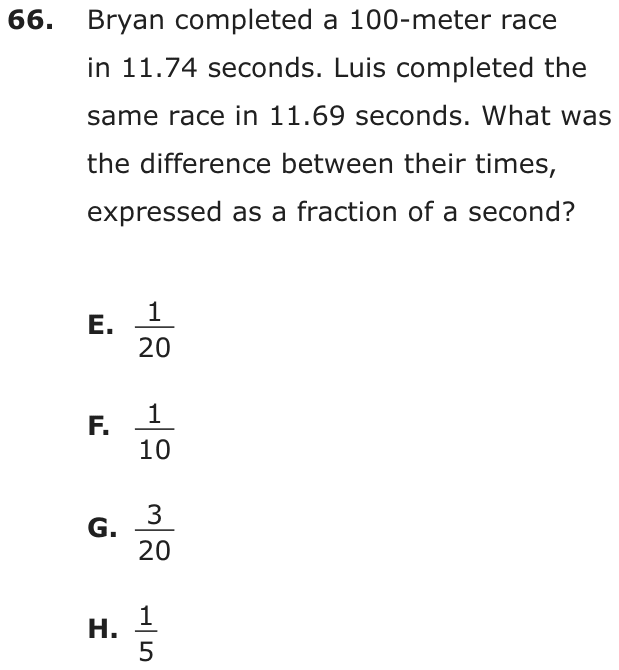
Question 20 of 36
2023 Test B Math, question 11Question
What is the value of n expressed as a fraction?
- A
- B
- C
- D
Show the answer
Correct answer: B
Question analysis
The number n equals 0.13 plus 207/100, and students must write n as a single fraction. This question mixes a decimal with a fraction in hundredths. Converting both to the same form, adding, and reducing to lowest terms are the steps, and the four fractions offered look quite different at first glance.
- NYS standards
- 6.NS.3 multi-digit decimal operations
- Grade level
- Grade 6 content, by NYS standard
- Compared with grade 7
- Below grade 7 Converting decimals to fractions and simplifying are skills taught before grade 7. Both numbers here are in hundredths, so the addition is immediate and only the final reduction takes thought.
- Estimated difficulty
- Routine: one familiar step, little to misread.
- Thinking it demands
- Depth of knowledge 1, recall and reproduction · mainly apply
- What makes it hard
- Solution
- 2 steps
- Reading level
- Question and choices: about grade 7, 15 words.
- Students, last 30 days
- Not enough answers yet to show (it takes 10).
Why it is hard, traps and wrong answers (shows the answer)
Why it is hard
Converting 0.13 to hundredths makes this a single addition, 13 + 207 = 220 hundredths, so the question tests little beyond reducing a fraction. Two of the wrong choices sit close to 2.2 but come from no common working, and the third only echoes the digits of 0.13. A student who checks each choice as a decimal finds only one equal to 2.2.
An answer in an unexpected form minor Choosing the answer
The sum comes out as 220/100 or 2.2, but the choices are in lowest terms, so it must be reduced, or each choice converted, before anything matches. (Enright, Morley & Sheehan, 2002)
Error-prone arithmetic minor Working it out
One term is a decimal and the other a fraction; writing 0.13 as 13/100 puts both in hundredths, and a misplaced digit there changes the sum. (Brown & Burton, 1978; Junker & Sijtsma, 2001)
Strategy: Write 0.13 as 13/100 so both terms are in hundredths, add the numerators, then divide the top and bottom by their greatest common factor.
Traps
- Answer in another form: The right answer is written differently from the way you worked it out.
- Numbers taken from the question: Combines the numbers in the question without a model of the situation, or is simply a number that appears in the question.
The wrong answers, classified
A Numbers taken from the question (Hegarty, Mayer & Monk, 1995)
Echoes the digits of 0.13, reading it as the fraction 1/3, and ignores the 207/100 altogether.
C Little reason to choose it (Haladyna & Downing, 1993; Rodriguez, 2005)
No common working gives 9/4, which is 2.25; adding 13 and 207 hundredths gives 2.2, so this mostly draws guesses near the sum.
D Little reason to choose it (Haladyna & Downing, 1993; Rodriguez, 2005)
Nothing leads to 23/10 except 13 + 207 coming out as 230, a slip with no reason behind it, so it mostly catches guesses.
Worked solution, step by step
Formulas used
- Decimals as hundredths
- The second place after the decimal point is the hundredths place. So a decimal with two places counts hundredths. Write its digits over 100. For example, 0.47 is 47/100.
- Adding fractions with the same bottom
- a and b are the tops. c is the shared bottom, the denominator. When the bottoms match, the pieces are the same size. So add the tops and keep the bottom.
Sort out the question
n equals 0.13 plus . One part is a decimal and one is a fraction. You need n as a fraction. The choices are in lowest terms, which means they can’t be simplified any more.
Write the decimal as a fraction
The 3 in 0.13 is in the hundredths place. So 0.13 is 13 hundredths.
Now both numbers are in hundredths. Watch out: 0.13 is not . That only copies the digits, choice A.
Add the hundredths
Use the rule for adding fractions. The bottoms match, so add the tops and keep the 100 on the bottom.
Simplify the fraction
is not a choice, so simplify it. Find the greatest number that divides both 220 and 100. That is 20.
So the answer is B, .
Check your answer
Change both to decimals. . And . They match. Choices C and D are close, but and .
More questions like this
The original DOE question
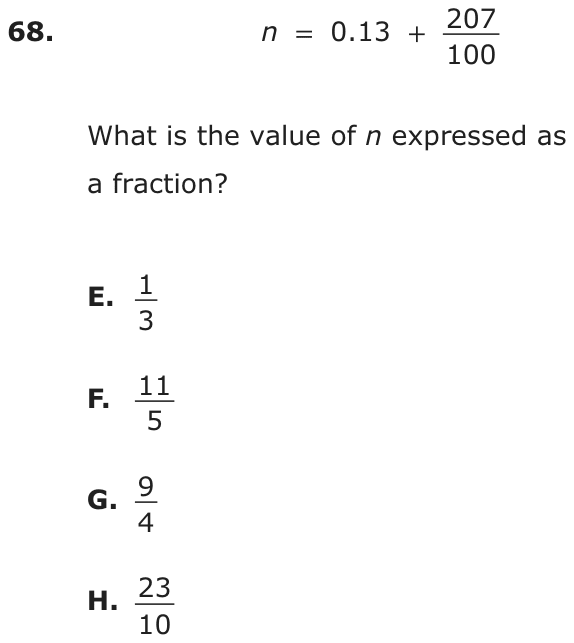
Question 21 of 36
2023 Test B Math, question 39Question
In a certain competition, 1 person finished in first place, 5 people tied for second place, 10 people tied for third place, and the other 4,984 people did not place. What percentage of the people in the competition placed first, second, or third altogether?
- A0.0032%
- B0.032%
- C0.32%
- D3.2%
Show the answer
Correct answer: C
The total number of people who participated in the competition was . The total number who placed first, second, or third was .
Question analysis
A percent question about a competition with 1 first-place finisher, 5 tied for second, 10 tied for third and 4,984 who did not place. Students find what percentage of everyone placed. All four choices use the same digits, so the challenge is placing the decimal point when a decimal becomes a percent.
- Grade level
- Grade 6 content, by NYS standard
- Compared with grade 7
- At grade 7 Writing part of a whole as a percent is grade 6 content. This one first totals four groups, then turns a fraction of a large total into a percent, where a slip of one place value is easy to make.
- Estimated difficulty
- Moderate: several steps, or a close reading with one strong distractor.
- Thinking it demands
- Depth of knowledge 2, skills and concepts · mainly apply
- What makes it hard
- Error-prone arithmetic moderate
- Many steps minor
- Solution
- 3 steps
- Reading level
- Question and choices: about grade 10, 40 words.
- Students, last 30 days
- Not enough answers yet to show (it takes 10).
Why it is hard, traps and wrong answers (shows the answer)
Why it is hard
The method is short, so the question tests decimal places. All four choices share the digits 32 and differ only in where the point falls, so a slip of one place, or forgetting to multiply by 100, still finds a choice waiting. A rough check helps: 16 is a bit more than 15, and 15 of 5,000 is 0.3%, so the answer must sit just above 0.3%.
Error-prone arithmetic moderate Working it out
16 ÷ 5,000 = 0.0032 has two zeros after the decimal point, and writing it as a percent moves the point two more places; each move can land one place off. (Brown & Burton, 1978; Junker & Sijtsma, 2001)
Many steps minor Working it out
The total of 5,000 is not given; it has to be built from 1 + 5 + 10 + 4,984 before the 16 people who placed can be compared with it. (Daniel & Embretson, 2010; Enright, Morley & Sheehan, 2002)
Strategy: Add the people who placed and the people who did not to get the total, write the placers as a fraction of it, then change that fraction to a decimal and multiply by 100.
Traps
- Misunderstands the concept: A wrong belief about a concept: that percents can be added, that area grows like length, that averages can be averaged, that a bigger denominator means a bigger fraction.
- An arithmetic slip: The right method with a plausible arithmetic error: a digit, a place value or a times-table fact.
The wrong answers, classified
A Misunderstands the concept (Smith, diSessa & Roschelle, 1993; De Bock et al., 1998; Ni & Zhou, 2005)
Finds 16 ÷ 5,000 = 0.0032 and adds a percent sign without multiplying by 100, as if a decimal were already a percent.
B An arithmetic slip (Junker & Sijtsma, 2001)
Finds 0.0032 but moves the decimal point only one place when writing the percent, giving 0.032%, ten times too small.
D An arithmetic slip (Junker & Sijtsma, 2001)
Divides 16 by 500 instead of 5,000, dropping a zero, or moves the point three places, giving 3.2%, ten times too large.
Worked solution, step by step
Formulas used
- Percent of a whole
- The part is the group you care about. The whole is everyone. The fraction tells what share of the whole the part is. Multiplying by 100 turns that share into a percent, which means out of 100.
Sort out the groups
Some people placed: 1 in first, 5 in second and 10 in third. The other 4,984 people did not place. You need the percent of all the people who placed.
Count the people who placed
These are the people who finished first, second or third. Add them.
So 16 people placed.
Count everyone
The whole is everyone in the competition: the people who placed plus the people who did not.
So 5,000 people took part. Notice that 4,984 is not the whole. It leaves out the 16 who placed.
Turn the share into a percent
Use the percent formula.
First divide: . Then multiply by 100. That moves the decimal point two places to the right.
So 0.32% of the people placed.
Avoid the decimal traps
Watch out: 0.0032 is not a percent yet. Putting a % sign on it gives choice A, which is 100 times too small. Moving the point only one place gives choice B. Moving it three places gives choice D.
So the answer is C, 0.32%.
Check your answer
Estimate. 1% of 5,000 is 50. The 16 people are about a third of 50. So the answer should be about a third of 1%, or about 0.3%. Choice C, 0.32%, fits.
More questions like this
The original DOE question
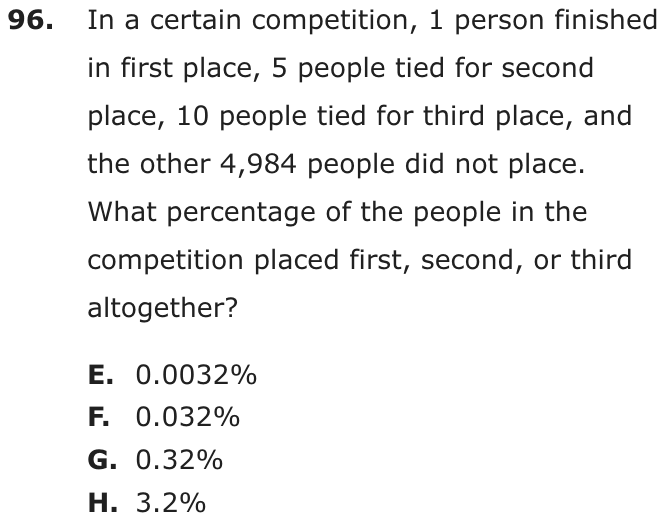
Question 22 of 36
2023 Test B Math, question 51Question
A number, n, is divided by 25. If the quotient is 10 with a remainder of 5, what is the quotient expressed as a decimal?
- A10.20
- B10.25
- C10.50
- D10.75
Show the answer
Correct answer: A
A quotient of 10 with a remainder of 5 means the quotient is
Question analysis
A number is divided by 25, giving a quotient of 10 with a remainder of 5, and students write the quotient as a decimal. It tests what a remainder means and how it becomes part of a decimal quotient. Connecting the remainder to the decimal part of the answer is the key idea.
- Grade level
- Grade 6 content, by NYS standard
- Compared with grade 7
- Below grade 7 Division with remainders and decimal quotients are grade 6 skills. This takes two short steps, with no word problem to translate, though students must know what a remainder means once a quotient is written as a decimal.
- Estimated difficulty
- Straightforward: two steps or one careful reading.
- Thinking it demands
- Depth of knowledge 1, recall and reproduction · mainly apply
- What makes it hard
- Something you must already know moderate
- Solution
- 2 steps
- Reading level
- Question and choices: about grade 5, 22 words.
- Students, last 30 days
- Not enough answers yet to show (it takes 10).
Why it is hard, traps and wrong answers (shows the answer)
Why it is hard
The question checks one idea: a remainder is a fraction of the divisor, not a string of digits to place after the point. Students who write the remainder 5 as tenths, or set the divisor 25 after the point, land on listed choices. Rebuilding n = 25 × 10 + 5 = 255 and dividing by 25 confirms the decimal.
Something you must already know moderate Working it out
A remainder of 5 means 5 out of the 25 needed for another whole, so it becomes 5/25 = 0.2, a link between remainders and decimals the question assumes. (Anderson & Krathwohl, 2001)
Strategy: Rebuild n from the quotient and the remainder, then divide it by 25 to a decimal; or write the remainder as a fraction of the divisor.
Traps
- Misunderstands the concept: A wrong belief about a concept: that percents can be added, that area grows like length, that averages can be averaged, that a bigger denominator means a bigger fraction.
- Numbers taken from the question: Combines the numbers in the question without a model of the situation, or is simply a number that appears in the question.
The wrong answers, classified
B Numbers taken from the question (Hegarty, Mayer & Monk, 1995)
Writes the divisor, 25, after the decimal point, setting the stem’s numbers 10 and 25 side by side instead of turning the remainder into a fraction.
C Misunderstands the concept (Smith, diSessa & Roschelle, 1993; De Bock et al., 1998; Ni & Zhou, 2005)
Writes the remainder 5 as the tenths digit, 10.5, believing a remainder becomes the digits after the decimal point.
D Little reason to choose it (Haladyna & Downing, 1993; Rodriguez, 2005)
No common working gives 10.75; it treats the remainder as three quarters of the divisor, which nothing in the stem suggests, so it mostly draws guesses.
Worked solution, step by step
Formulas used
- Quotient with a remainder
- d is the divisor, the number you divide by. q is the whole-number part of the quotient, the answer to the division. r is the remainder, what is left over. The leftover still has to be divided by d, so it becomes the fraction r over d.
Sort out the words
n is divided by 25. So 25 is the divisor, the number you divide by. The quotient is the answer to a division. Here it is 10 with a remainder of 5. The remainder is the amount left over. You need the exact quotient as a decimal.
Turn the remainder into a fraction
The 5 left over still has to be divided by 25. So it becomes the fraction . Use the formula.
Change the fraction to a decimal
Simplify first. Divide the top and bottom by 5. Then write the fraction in hundredths.
So the quotient is 10 + 0.20 = 10.20.
Give the answer
Watch out: A remainder is not the digits after the decimal point. Writing the 5 after the point gives 10.50, choice C. Writing the 25 after it gives 10.25, choice B.
So the answer is A, 10.20.
Check your answer
Rebuild n. Ten 25s plus the 5 left over is . Now divide: . That matches 10.20.
More questions like this
The original DOE question
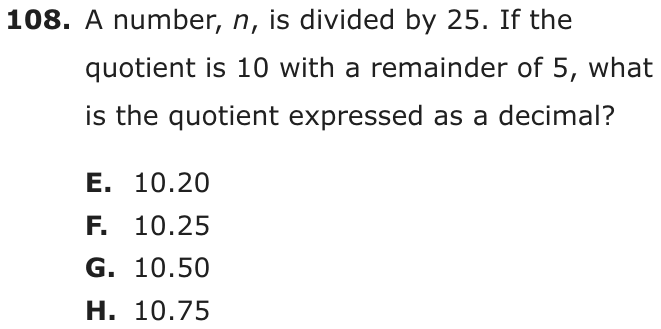
Question 23 of 36
2023 Test B Math, question 54Question
The speed 10 meters per second is equivalent to how many feet per hour? (Use the approximation 1 foot = 0.3 meter.)
- A10,800
- B12,000
- C36,000
- D120,000
Show the answer
Correct answer: D
Question analysis
This unit conversion question gives a speed of 10 meters per second and asks for the same speed in feet per hour, using 1 foot = 0.3 meter. Students convert both the distance unit and the time unit. Setting up each conversion factor so that the unwanted units cancel is what makes it tricky.
- Grade level
- Grade 6 content, by NYS standard
- Compared with grade 7
- Above grade 7 Grade 7 students usually convert one unit with a given factor. This converts both parts of a rate, seconds to hours and meters to feet, with a decimal conversion factor and large numbers to keep track of.
- Estimated difficulty
- Hard: combines ideas, needs a plan, and has more than one tempting wrong answer.
- Thinking it demands
- Depth of knowledge 2, skills and concepts · mainly apply
- What makes it hard
- Many steps moderate
- Error-prone arithmetic moderate
- Something you must already know minor
- Solution
- 3 steps
- Reading level
- Question and choices: about grade 7, 18 words.
- Students, last 30 days
- Not enough answers yet to show (it takes 10).
Why it is hard, traps and wrong answers (shows the answer)
Why it is hard
Every wrong choice is a conversion handled badly: multiplying by 0.3 when the fact 1 foot = 0.3 meter calls for dividing, dividing by 3 instead of 0.3, or stopping in meters per hour. Writing the units as fractions, so that seconds and meters cancel, shows which way each factor goes. A size check also helps: a foot is shorter than a meter, so the number of feet must be larger than the 36,000 meters.
Many steps moderate Working it out
Both parts of the rate change: seconds become hours by multiplying by 3,600, and meters become feet by dividing by 0.3, two conversions that each have a wrong direction. (Daniel & Embretson, 2010; Enright, Morley & Sheehan, 2002)
Error-prone arithmetic moderate Working it out
Dividing 36,000 by 0.3 means moving the decimal point in the divisor, and a slip of one place gives 12,000 instead of 120,000. (Brown & Burton, 1978; Junker & Sijtsma, 2001)
Something you must already know minor Working it out
The stem gives 1 foot = 0.3 meter but not the 3,600 seconds in an hour, which students must build from 60 × 60. (Anderson & Krathwohl, 2001)
Strategy: Write the speed as a fraction, multiply by 3,600 seconds per hour, then by 1 foot over 0.3 meter, checking that seconds and meters cancel.
Traps
- Units or scale: The answer is wanted in other units, or a rate or scale must be converted first.
- Wrong operation: Adds instead of multiplying, divides the wrong way round, turns a ratio or rate upside down, or undoes a step in the wrong direction (subtracts what should be added back).
- An arithmetic slip: The right method with a plausible arithmetic error: a digit, a place value or a times-table fact.
The wrong answers, classified
A Wrong operation (Hegarty, Mayer & Monk, 1995; King et al., 2004)
Multiplies 36,000 meters per hour by 0.3 instead of dividing, turning the fact 1 foot = 0.3 meter upside down and getting 10,800.
B An arithmetic slip (Junker & Sijtsma, 2001)
Divides 36,000 by 3 instead of 0.3, putting the decimal point in the wrong place and getting an answer ten times too small.
C Units or scale (King et al., 2004)
Converts seconds to hours, 10 × 3,600 = 36,000, and stops, leaving the speed in meters per hour rather than feet per hour.
Worked solution, step by step
Formulas used
- Seconds in an hour
- An hour has 60 minutes, and each minute has 60 seconds. So 1 hour holds 60 groups of 60 seconds. To change a speed per second into a speed per hour, multiply by 3,600, because an hour is 3,600 seconds long.
- Meters to feet
- The problem says 1 foot is about 0.3 meter. So each foot uses up 0.3 meter of the distance. To count the feet, divide the meters by 0.3. A foot is shorter than a meter, so you get more feet than meters.
Sort out the question
The speed is 10 meters per second. That means it moves 10 meters every second. You need the speed in feet per hour. Two units change: seconds become hours, and meters become feet. Change one at a time. Use 1 foot = 0.3 meter.
Find the seconds in an hour
An hour is much longer than a second. So in one hour, the object moves much farther. First find how many seconds are in an hour.
One hour is 3,600 seconds.
Find the meters per hour
Each second it moves 10 meters. In 3,600 seconds it moves 3,600 times as far.
The speed is 36,000 meters per hour.
Watch out: Stopping here gives 36,000, choice C. That number is still in meters, not feet.
Change meters to feet
Each foot is 0.3 meter. To find how many feet fit in 36,000 meters, divide by 0.3. Multiplying both numbers by 10 makes the division easier.
So 36,000 meters is 120,000 feet. The speed is 120,000 feet per hour.
Give the answer
Watch out: Multiplying by 0.3 instead of dividing gives 10,800, choice A. Dividing by 3 instead of 0.3 gives 12,000, choice B.
So the answer is D, 120,000 feet per hour.
Check your answer
A foot is shorter than a meter. So any distance is more feet than meters. The answer must be bigger than 36,000, and only choice D is. Also, 120,000 feet at 0.3 meter each is 120,000 × 0.3 = 36,000 meters. That matches.
More questions like this
The original DOE question
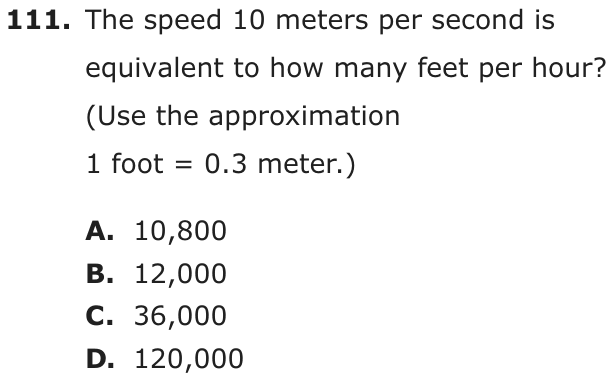
Question 24 of 36
2022 Test A Math, question 24Question
- A1.62
- B16.2
- C162
- D1,620
Show the answer
Correct answer: C
Since the greatest number of decimal places is 2 (hundredths), multiply both terms by 100, and then divide:
Question analysis
This question asks students to divide 12.96 by 0.08, a decimal division with no story around it. It tests dividing multi-digit decimals with the standard algorithm. The choices differ only in where the decimal point falls, so moving the point the same number of places in both numbers is the whole challenge.
- NYS standards
- 6.NS.3 multi-digit decimal operations
- Grade level
- Grade 6 content, by NYS standard
- Compared with grade 7
- Below grade 7 Dividing multi-digit decimals is grade 6 fluency that grade 7 work builds on rather than teaches. The division comes out exactly, so the real demand is placing the decimal point correctly, a single routine skill.
- Estimated difficulty
- Straightforward: two steps or one careful reading.
- Thinking it demands
- Depth of knowledge 1, recall and reproduction · mainly apply
- What makes it hard
- Error-prone arithmetic moderate
- Solution
- 2 steps
- Reading level
- Question and choices: about grade 16+, 1 words.
- Students, last 30 days
- Not enough answers yet to show (it takes 10).
Why it is hard, traps and wrong answers (shows the answer)
Why it is hard
Every choice uses the digits 1, 6 and 2, so the question tests only where the decimal point goes. Dividing by a number less than one gives a result larger than 12.96, which feels wrong to students who expect division to shrink a number. Estimating first, 12.96 ÷ 0.08 is about 13 × 12.5, puts the result in the low hundreds and rules out the other three at once.
Error-prone arithmetic moderate Working it out
The divisor 0.08 has two decimal places, so both numbers must be multiplied by 100, turning the problem into 1,296 ÷ 8, and the quotient comes out larger than 12.96. (Brown & Burton, 1978; Junker & Sijtsma, 2001)
Strategy: Multiply the dividend and the divisor by the same power of 10 so that the divisor becomes a whole number, then carry out the long division.
Traps
- An arithmetic slip: The right method with a plausible arithmetic error: a digit, a place value or a times-table fact.
The wrong answers, classified
A An arithmetic slip (Junker & Sijtsma, 2001)
Divides 12.96 by 8, leaving out the decimal point in the divisor 0.08, so the quotient, 1.62, is 100 times too small.
B An arithmetic slip (Junker & Sijtsma, 2001)
Moves the decimal point one place instead of two, in effect dividing 12.96 by 0.8, so the quotient, 16.2, is ten times too small.
D An arithmetic slip (Junker & Sijtsma, 2001)
Shifts the decimal point three places in 12.96 but only two in 0.08, dividing 12,960 by 8, so the quotient is ten times too big.
Worked solution, step by step
Formulas used
- Dividing by a decimal
- a is the number being divided. b is the divisor, the number you divide by. Multiplying both by the same number, like 100, does not change the answer. Use 100 when the divisor has two decimal places, so it becomes a whole number.
Sort out the question
You need . The divisor, the number you divide by, is 0.08. It has two decimal places. Dividing by a decimal is hard, so make the divisor a whole number first. All four choices use the digits 1, 6 and 2. So the real question is where the decimal point goes.
Make the divisor a whole number
Multiply both numbers by 100. This moves each decimal point two places to the right.
The new problem has the same answer. Watch out: move both points the same number of places. Moving the point three places in 12.96 but two in 0.08 gives 1,620, choice D.
Divide by 8
Split 1,296 into parts that 8 divides easily.
Watch out: ignoring the point in 0.08 means dividing 12.96 by 8. That gives 1.62, choice A. Moving the point only one place gives 16.2, choice B. So the answer is C, 162.
Check your answer
Multiply back: . That matches. Also, 0.08 is less than 1. Dividing by a number less than 1 makes the answer bigger. And , which is far too big.
More questions like this
The original DOE question
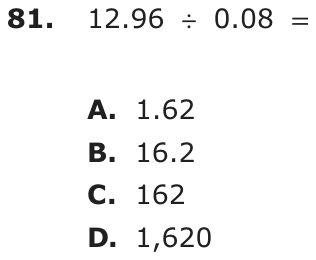
Question 25 of 36
2022 Test A Math, question 50Question
Nadia paid $1.00 to mail a letter. The cost to mail a letter is $0.55 for the first ounce of weight plus $0.15 for each additional ounce. What was the weight, in ounces, of the letter Nadia mailed?
- A1.4
- B1.5
- C3
- D4
Show the answer
Correct answer: D
Let x represent the number of ounces Nadia’s letter weighed. The first ounce costs $0.55, so represents the number of ounces that cost $0.15 each.
Given that the total cost is $1.00, the equation that describes the situation can be written and solved as shown.
So the letter Nadia mailed weighed 4 ounces.
Question analysis
Nadia pays $1.00 to mail a letter, and postage costs $0.55 for the first ounce plus $0.15 for each additional ounce. Students find the weight of the letter in ounces. It tests writing and solving a two-step equation from a pricing rule in which the two prices apply to different ounces.
- Grade level
- Grade 7 content, by NYS standard
- Compared with grade 7
- At grade 7 Grade 7 students solve word problems that lead to equations such as px + q = r. This one takes that form once each price is matched to the right ounces, a step that makes it a little more demanding than routine practice.
- Estimated difficulty
- Moderate: several steps, or a close reading with one strong distractor.
- Thinking it demands
- Depth of knowledge 2, skills and concepts · mainly apply
- What makes it hard
- Turning words into math moderate
- Error-prone arithmetic minor
- Solution
- 3 steps
- Reading level
- Question and choices: about grade 4, 35 words.
- Students, last 30 days
- Not enough answers yet to show (it takes 10).
Why it is hard, traps and wrong answers (shows the answer)
Why it is hard
Pricing the letter ounce by ounce, $0.55, $0.70, $0.85, $1.00, reaches the total at the fourth ounce without any algebra. The equation route works too, but the first ounce is easy to lose: dividing the $0.45 left by $0.15 counts only the ounces after the first. The two decimal choices come from merging the two prices or from treating dollars as ounces.
Turning words into math moderate Understanding the question
“$0.55 for the first ounce of weight plus $0.15 for each additional ounce” makes the cost 0.55 + 0.15(x − 1), so the $0.15 covers every ounce except the first. (Hegarty, Mayer & Monk, 1995; Koedinger & Nathan, 2004)
Error-prone arithmetic minor Working it out
The money is in decimals, $1.00 − $0.55 = $0.45 and then $0.45 ÷ $0.15 = 3, and dividing by a decimal invites a misplaced point. (Brown & Burton, 1978; Junker & Sijtsma, 2001)
Strategy: Write the cost of a letter weighing x ounces, $0.55 plus $0.15 for each ounce after the first, set it equal to $1.00 and solve, then check by pricing the letter ounce by ounce.
Traps
- Stops one step early: A choice is a number from partway through the solution.
- Numbers taken from the question: Combines the numbers in the question without a model of the situation, or is simply a number that appears in the question.
- Units or scale: The answer is wanted in other units, or a rate or scale must be converted first.
The wrong answers, classified
A Numbers taken from the question (Hegarty, Mayer & Monk, 1995)
Merges the two prices into $0.70 for every ounce and divides $1.00 by $0.70, about 1.43, which rounds to 1.4.
B Units or scale (King et al., 2004)
Counts the first ounce, then treats the $0.45 left over as 0.45 ounce, getting 1.45 ounces, which rounds to 1.5.
C Stops one step early (King et al., 2004; Gierl et al., 2017)
Finds the 3 additional ounces that the $0.45 left over pays for, 0.45 ÷ 0.15 = 3, and stops before adding the first ounce.
Worked solution, step by step
Formulas used
- Cost to mail a letter
- C is the cost in dollars. w is the weight in ounces. The first ounce costs $0.55. Each ounce after the first costs $0.15, and there are w − 1 of them. Subtracting 1 leaves out the first ounce, which is already paid for.
- Keeping an equation balanced
- a and b are the two equal sides. c is any number, but not 0 when you divide. Doing the same thing to both sides keeps them equal, like a balanced scale. Use it to get the unknown by itself.
Sort out the question
Nadia paid $1.00 to mail a letter. The first ounce costs $0.55. Each additional ounce, meaning each ounce after the first, costs $0.15. You need the weight of the letter in ounces.
Write the equation
Let w be the weight in ounces. The first ounce is 1 of the w ounces. So the extra ounces number w − 1. The cost is $1.00.
Take off the first ounce’s cost
Subtract 0.55 from both sides. This keeps the equation balanced.
So $0.45 pays for the extra ounces.
Find the extra ounces
Divide both sides by 0.15. Multiply both numbers by 100 to make them whole.
There are 3 extra ounces after the first one.
Add back the first ounce
The letter weighed 4 ounces. Watch out: 3 counts only the ounces after the first. It is choice C. Also, don’t join $0.55 and $0.15 into one price. is about 1.4, choice A. So the answer is D, 4 ounces.
Check your answer
Price the letter one ounce at a time. 1 ounce: $0.55. 2 ounces: $0.70. 3 ounces: $0.85. 4 ounces: $1.00. The cost reaches $1.00 at 4 ounces. That matches.
More questions like this
The original DOE question
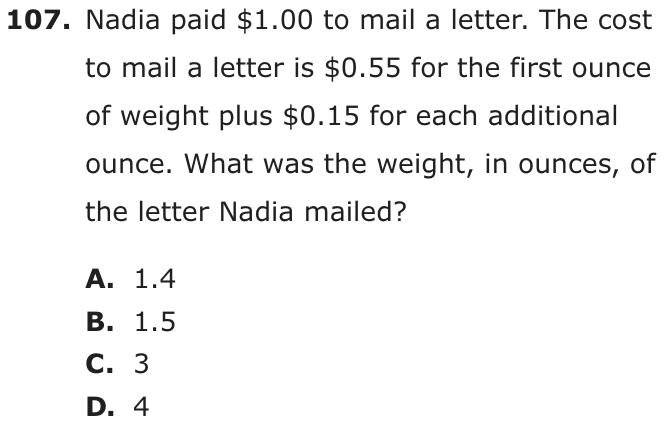
Question 26 of 36
2022 Test A Math, question 51Question
COST OF ORANGES
| Number of Oranges | Cost |
|---|---|
| 4 | $1.80 |
| 6 | $2.70 |
| 9 | $4.05 |
The table shows the cost of oranges. What is the unit rate for the cost per orange?
- A$0.45
- B$0.90
- C$1.35
- D$1.80
Show the answer
Correct answer: A
The unit rate (cost per orange) can be determined by dividing the cost of x oranges by x.
The unit rate is $0.45.
Question analysis
A table shows what 4, 6 and 9 oranges cost, in dollars and cents. Students find the unit rate, the cost of a single orange. It tests identifying a unit rate in a proportional table, and the tricky part is keeping straight which column holds the cost and which holds the number of oranges.
- Grade level
- Grade 7 content, by NYS standard
- Compared with grade 7
- Below grade 7 Finding a unit rate in a table belongs to grade 7 proportional relationships, but here it takes one division with money in a clearly proportional table, so the task is easier than typical grade 7 work.
- Estimated difficulty
- Routine: one familiar step, little to misread.
- Thinking it demands
- Depth of knowledge 1, recall and reproduction · mainly apply
- What makes it hard
- Solution
- 1 step
- Reading level
- Question and choices: about grade 3, 23 words.
- Students, last 30 days
- Not enough answers yet to show (it takes 10).
Why it is hard, traps and wrong answers (shows the answer)
Why it is hard
Any row gives the rate in one division, and the three rows agree, so the question is easy once unit rate is read as the cost of one orange. The traps are differences between rows, which look like a change per orange but cover two or three oranges, and the first cost in the table, which is for four. Dividing a second row confirms the result.
Reading a figure, table or graph minor Understanding the question
The table lists 4, 6 and 9 oranges but never a single orange, so the cost of one has to be computed from a row, such as $1.80 ÷ 4. (Lesh, Post & Behr, 1987; Kirsch & Mosenthal, 1990)
Something you must already know minor Working it out
The term unit rate is not defined; students must know it means the cost of one orange, a row's cost divided by its number of oranges. (Anderson & Krathwohl, 2001)
Strategy: Pick any row and divide its cost by its number of oranges; doing the same with a second row confirms that the rate stays the same.
Traps
- Answers a different question: A choice is right for another quantity: the other unknown, the rest instead of the part, the part instead of the whole.
- Numbers taken from the question: Combines the numbers in the question without a model of the situation, or is simply a number that appears in the question.
The wrong answers, classified
B Answers a different question (King et al., 2004; Hegarty, Mayer & Monk, 1995)
Subtracts the first two costs, $2.70 − $1.80 = $0.90, the price of 2 more oranges, without dividing by the 2 oranges it covers.
C Answers a different question (King et al., 2004; Hegarty, Mayer & Monk, 1995)
Subtracts the last two costs, $4.05 − $2.70 = $1.35, the price of 3 more oranges, rather than the price of one.
D Numbers taken from the question (Hegarty, Mayer & Monk, 1995)
Takes $1.80, the first cost in the table, which is what 4 oranges cost together, not one.
Worked solution, step by step
Formulas used
- Unit rate
- The unit rate is the cost of one item, here one orange. The cost is what a group of oranges costs together. Divide by the number of oranges in that group. Any row of the table gives the same rate, because each orange costs the same.
Sort out the question
The table gives the cost of 4, 6 and 9 oranges. It never shows the cost of one orange. A unit rate is the amount for one unit. Here that means the cost of one orange. You need to find it.
Divide one row
Use the first row: 4 oranges cost $1.80.
One orange costs $0.45. Watch out: $1.80 is the cost of 4 oranges, not one. Don’t pick choice D.
Check with the other rows
Every row gives $0.45, so the rate stays the same. Watch out: is the cost of 2 more oranges, choice B. is the cost of 3 more, choice C. Neither is for one orange. So the answer is A, $0.45.
Check your answer
Multiply back: and . Both match the table. Even a difference works once you divide: .
More questions like this
The original DOE question
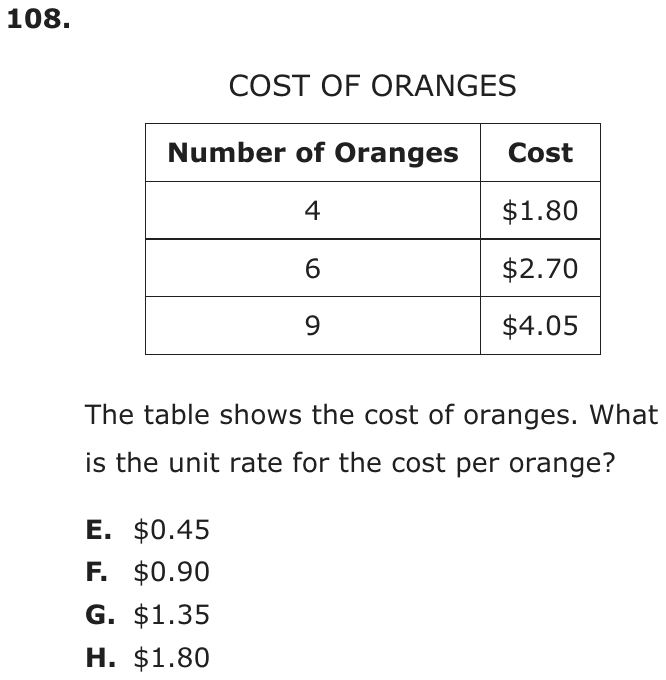
Question 27 of 36
2022 Test B Math, question 3Question
Kelly had 7.3 grams of sugar. She used 2.7 grams in her coffee. How many grams of sugar does she have left?
Grid-in question: work out the answer and enter it as a number.
Show the answer
Correct answer: 4.6
Subtract the number of grams of sugar Kelly used in her coffee from the original amount she had.
Question analysis
Kelly has 7.3 grams of sugar and uses 2.7 grams of it in her coffee. This short grid-in word problem asks how many grams she has left. It tests subtracting decimals, and because the tenths digit being taken away is the larger one, the subtraction needs regrouping.
- NYS standards
- 6.NS.3 multi-digit decimal operations
- Grade level
- Grade 6 content, by NYS standard
- Compared with grade 7
- Below grade 7 Subtracting decimals is grade 6 fluency work, and this needs one subtraction in a short, familiar setting. Grade 7 problems usually bring in negative numbers or several steps; the only care here is regrouping in the tenths.
- Estimated difficulty
- Routine: one familiar step, little to misread.
- Thinking it demands
- Depth of knowledge 2, skills and concepts · mainly apply
- What makes it hard
- Solution
- 1 step
- Reading level
- Question and choices: about grade 2, 20 words.
- Students, last 30 days
- Not enough answers yet to show (it takes 10).
Why it is hard, traps and wrong answers (shows the answer)
Why it is hard
One subtraction in a two-sentence story, so the only real risk is the regrouping in the tenths column. Students who skip the borrow, or who borrow and forget to reduce the ones, still produce a tidy decimal, and nothing on the page flags it. Adding the result back to the 2.7 grams used should return the 7.3 grams Kelly started with.
Error-prone arithmetic minor Working it out
The 7 tenths being taken away is more than the 3 tenths in 7.3, so one of the 7 wholes must be regrouped as ten tenths before 13 − 7 = 6. (Brown & Burton, 1978; Junker & Sijtsma, 2001)
An answer in an unexpected form minor Choosing the answer
The difference is gridded with no choices to compare, so a regrouping slip that gives 5.4 or 5.6 looks just as finished as the right amount. (Enright, Morley & Sheehan, 2002)
Strategy: Line up the decimal points and subtract the grams used from the grams Kelly started with, regrouping one whole as ten tenths when the tenths column needs it.
Traps
- A faulty procedure: A systematic but wrong procedure: adding fractions straight across, applying an exponent to each term of a sum, dropping a sign when moving a term.
- An arithmetic slip: The right method with a plausible arithmetic error: a digit, a place value or a times-table fact.
- Wrong operation: Adds instead of multiplying, divides the wrong way round, turns a ratio or rate upside down, or undoes a step in the wrong direction (subtracts what should be added back).
The wrong answers, classified
5.4 A faulty procedure (Brown & Burton, 1978; Tatsuoka, 1983)
Subtracts the smaller digit from the larger in each column, 7 − 3 = 4 tenths and 7 − 2 = 5 ones, instead of regrouping a whole as ten tenths.
5.6 An arithmetic slip (Junker & Sijtsma, 2001)
Regroups to get 13 − 7 = 6 tenths but forgets to reduce the ones after borrowing, so the ones digit stays 7 − 2 = 5.
10 Wrong operation (Hegarty, Mayer & Monk, 1995; King et al., 2004)
Adds the two amounts, 7.3 + 2.7 = 10, instead of taking the sugar used in the coffee away from the 7.3 grams Kelly had.
Worked solution, step by step
Formulas used
- Amount left
- Start is the amount you had at first. Used is the amount taken away. Left is what remains. Taking part of an amount away is subtraction, so you subtract the amount used from the start.
Sort out the question
Kelly started with 7.3 grams of sugar. She used 2.7 grams in her coffee. You need the grams she has left.
Left means what remains after some is taken away. So subtract the amount used from the amount she started with.
Regroup to subtract the tenths
Line up the decimal points, so tenths sit over tenths. A tenth is one of ten equal parts of a whole. Start with the tenths. You can’t take 7 tenths from 3 tenths. So break 1 of the 7 wholes into 10 tenths. Now you have 6 wholes and 13 tenths.
That leaves 6 tenths.
Watch out: taking the smaller digit from the bigger one, 7 − 3, skips the regrouping. It gives 5.4, which is wrong.
Subtract the whole grams
After regrouping, the wholes column has 6, not 7.
That leaves 4 wholes. Put the decimal point back: 4 wholes and 6 tenths is 4.6 grams.
Watch out: forgetting to change the 7 to a 6 gives 5.6. Adding instead of subtracting gives 10. So you would grid 4.6.
Check your answer
Add back the sugar she used: . That is the amount Kelly started with, so 4.6 grams is right. An estimate agrees too: about 7 − 3 = 4 grams.
More questions like this
The original DOE question
Question 28 of 36
2022 Test B Math, question 21Question
The decimal 0.4 can be written as the fraction . What is the value of x?
- A0.016
- B0.16
- C10
- D16
Show the answer
Correct answer: C
First, convert the decimal 0.4, which is read as four-tenths, to the fraction , and then set up a proportion to solve for x using cross products.
Or, reduce the fraction to before setting up the proportion and then use proportional reasoning.
Therefore, .
Question analysis
This question asks students to write the decimal 0.4 as an equivalent fraction whose denominator is 25 and to choose the missing numerator. It tests converting between decimals and fractions. Tenths do not turn into twenty-fifths in one obvious step, so the numerator has to be scaled with care, in the same way as the denominator.
- Grade level
- Grade 6 content, by NYS standard
- Compared with grade 7
- Below grade 7 Rewriting a decimal as an equivalent fraction is upper elementary and grade 6 work. It is one conversion with no context, and the friendly denominator keeps it well below the demand of typical grade 7 problems.
- Estimated difficulty
- Routine: one familiar step, little to misread.
- Thinking it demands
- Depth of knowledge 1, recall and reproduction · mainly apply
- What makes it hard
- Error-prone arithmetic minor
- Solution
- 2 steps
- Reading level
- Question and choices: about grade 5, 15 words.
- Students, last 30 days
- Not enough answers yet to show (it takes 10).
Why it is hard, traps and wrong answers (shows the answer)
Why it is hard
A single conversion: 0.4 is 4/10, or 2/5, and 2/5 renamed over 25 is 10/25. The only risk is the direction of the step, since x/25 = 0.4 means multiplying 0.4 by 25, and dividing instead leads to the small decimals among the choices. Any choice can be checked by dividing it by 25, and only one gives back 0.4.
Error-prone arithmetic minor Working it out
Four tenths has to be renamed in twenty-fifths, and 10 does not divide 25, so the numerator is reached through 2/5 = 10/25 or by multiplying 0.4 by 25. (Brown & Burton, 1978; Junker & Sijtsma, 2001)
Strategy: Write the decimal as a fraction in tenths, simplify it, then multiply the numerator and denominator by the same number until the denominator is 25.
Traps
- Wrong operation: Adds instead of multiplying, divides the wrong way round, turns a ratio or rate upside down, or undoes a step in the wrong direction (subtracts what should be added back).
The wrong answers, classified
A Wrong operation (Hegarty, Mayer & Monk, 1995; King et al., 2004)
Divides 0.4 by 25 instead of multiplying, undoing the division by 25 with another division, which gives 0.016.
B Wrong operation (Hegarty, Mayer & Monk, 1995; King et al., 2004)
Divides by 25 instead of multiplying and also drops the decimal point of 0.4, so 4 ÷ 25 = 0.16, ten times 0.016.
D Little reason to choose it (Haladyna & Downing, 1993; Rodriguez, 2005)
No single mistake gives 16; it is 4 ÷ 25 = 0.16 with the decimal point moved two places, a chain with no reason behind it, so it mostly draws guesses.
Worked solution, step by step
Formulas used
- Equal fractions
- a is the top number of the fraction, and b is the bottom number. n is any number except 0. Multiplying the top and the bottom by the same number gives an equal fraction. It is like cutting every piece into n smaller pieces.
Sort out the question
You need a fraction with 25 on the bottom that equals 0.4. Its top is x. So you need the x that makes the same amount as 0.4.
Write the decimal as a fraction
0.4 is read four tenths, so it is 4 over 10. Simplify it by dividing the top and the bottom by 2.
Rename the fraction over 25
To turn the bottom 5 into 25, multiply it by 5. Do the same to the top, so the fraction keeps its value.
So x = 10.
Give the answer
Another way: x/25 = 0.4 means x divided by 25 is 0.4. Undo the division by multiplying: .
Watch out: dividing 0.4 by 25 instead gives 0.016, choice A. Dropping the decimal point as well gives 0.16, choice B. So the answer is C, 10.
Check your answer
Divide the answer by 25 and see if you get 0.4. , because 25 × 0.4 = 10. It works. Choice D fails: 16 ÷ 25 = 0.64, not 0.4.
More questions like this
The original DOE question
Question 29 of 36
2022 Test B Math, question 49Question
A machine part is supposed to be 0.38 millimeters thick. The manufacturer allows a variation of −2.5% to +2.5%. Which interval shows the range of acceptable thicknesses, in millimeters, for the part?
- A0.285–0.475
- B0.355–0.405
- C0.3705–0.3895
- D0.3724–0.3876
Show the answer
Correct answer: C
A variation of −2.5% to +2.5% means that the thickness of the machine part can be from 2.5% less than the standard of 0.38 mm to 2.5% greater than 0.38 mm.
The least allowed measure is
The greatest allowed measure is
Therefore, the allowable range of thicknesses is 0.3705 mm to 0.3895 mm.
Question analysis
A machine part should be 0.38 millimeters thick, and the manufacturer accepts a variation from −2.5% to +2.5%. Students choose the interval of acceptable thicknesses. It tests finding a percent of a decimal and applying it as a decrease and an increase; the percent must be turned into millimeters first, and the four-decimal-place choices need exact work.
- NYS standards
- Grade level
- Grade 7 content, by NYS standard
- Compared with grade 7
- At grade 7 Taking a percent of a number and adding or subtracting it is grade 7 percent work. The decimal percent and results to four decimal places make the arithmetic fussier than usual, so careful work matters more than the idea.
- Estimated difficulty
- Moderate: several steps, or a close reading with one strong distractor.
- Thinking it demands
- Depth of knowledge 2, skills and concepts · mainly apply
- What makes it hard
- Error-prone arithmetic moderate
- Turning words into math minor
- A very close wrong answer minor
- Solution
- 3 steps
- Reading level
- Question and choices: about grade 9, 29 words.
- Students, last 30 days
- Not enough answers yet to show (it takes 10).
Why it is hard, traps and wrong answers (shows the answer)
Why it is hard
The question rewards turning the percent into millimeters before anything else. Students who take ±2.5% as ±0.025 mm find a tidy interval, 0.355 to 0.405, and the other listed intervals come from a misplaced decimal point or from 2% in place of 2.5%. Because the right interval and its near twin differ only from the third decimal place, the product 0.38 × 0.025 has to be exact; multiplying 0.38 by 0.975 and by 1.025 is a quick double-check.
Error-prone arithmetic moderate Working it out
Two and a half percent of 0.38 is 0.025 × 0.38 = 0.0095, a product of two decimals with four decimal places, and the limits 0.3705 and 0.3895 need the same care. (Brown & Burton, 1978; Junker & Sijtsma, 2001)
Turning words into math minor Understanding the question
“A variation of −2.5% to +2.5%” has to become 2.5% of 0.38 millimeters, a length, before it is subtracted for the least thickness and added for the greatest. (Hegarty, Mayer & Monk, 1995; Koedinger & Nathan, 2004)
A very close wrong answer minor Choosing the answer
The intervals 0.3705–0.3895 and 0.3724–0.3876 both sit about 0.01 mm either side of 0.38, so an estimate cannot separate them and only the exact 0.0095 decides. (Embretson & Wetzel, 1987; Gorin & Embretson, 2006; Ascalon et al., 2007)
Strategy: Write 2.5% as a decimal, multiply it by 0.38 to find the allowed change in millimeters, then subtract it for the least thickness and add it for the greatest.
Traps
- Misunderstands the concept: A wrong belief about a concept: that percents can be added, that area grows like length, that averages can be averaged, that a bigger denominator means a bigger fraction.
- An arithmetic slip: The right method with a plausible arithmetic error: a digit, a place value or a times-table fact.
- Misreads the question: Misses or misreads a condition or a word in the question: "at least", "each", "remaining", "not".
The wrong answers, classified
A An arithmetic slip (Junker & Sijtsma, 2001)
Writes 2.5% as 0.25 instead of 0.025, so the change is 0.38 × 0.25 = 0.095 mm and the interval, 0.285 to 0.475, is ten times too wide.
B Misunderstands the concept (Smith, diSessa & Roschelle, 1993; De Bock et al., 1998; Ni & Zhou, 2005)
Reads ±2.5% as ±0.025 mm, a fixed amount, adding it to and subtracting it from 0.38 instead of first taking 2.5% of 0.38.
D Misreads the question (Hegarty, Mayer & Monk, 1995)
Uses 2% instead of 2.5%, dropping the half percent, so the change is 0.38 × 0.02 = 0.0076 and the interval, 0.3724 to 0.3876, is too narrow.
Worked solution, step by step
Formulas used
- Percent of a number
- The whole is the amount the percent is taken of. The percent tells how many out of every 100. The part is the piece you get. Dividing the percent by 100 turns it into a decimal, so you can multiply.
Sort out the question
The part should be 0.38 millimeters thick. It may be off by up to 2.5%, thinner or thicker. You need the thinnest and thickest sizes allowed, in millimeters.
The 2.5% is a percent of 0.38 mm. So first find how many millimeters 2.5% is.
Write 2.5% as a decimal
Percent means out of 100. So divide by 100, which moves the decimal point two places left.
Watch out: 2.5% is 0.025, not 0.25. Using 0.25 makes the interval ten times too wide, choice A.
Find 2.5% of 0.38
First, 25 × 38 = 950. The two numbers have 3 + 2 = 5 decimal places in all. So the answer has 5 decimal places: 0.00950, or 0.0095. The size may change by 0.0095 millimeters.
Watch out: adding and subtracting 0.025 mm itself gives 0.355 to 0.405, choice B.
Find the two limits
Subtract the change for the thinnest size. Add it for the thickest.
The part may be from 0.3705 to 0.3895 millimeters thick.
Watch out: using 2% instead of 2.5% gives 0.3724 to 0.3876, choice D. So the answer is C, 0.3705–0.3895.
Check your answer
A part 2.5% thinner is 97.5% of 0.38: . A part 2.5% thicker is 102.5% of it: . Both match. Also, 0.38 sits exactly in the middle of the interval.
More questions like this
The original DOE question
Question 30 of 36
2018 Test A Math, question 10Question
In a scale diagram, inch represents feet. How many inches represent foot?
- A
- B
- C
- D
Show the answer
Correct answer: A
Let be the number of inches representing 1 foot. Set up a proportion and solve for :
in.
Question analysis
This scale drawing question uses decimals: on a diagram, 0.125 inch stands for 125 feet. Students find how many inches represent just 1 foot, which is the unit rate of the scale. Dividing a decimal by a large whole number makes the decimal point easy to misplace.
- Grade level
- Grade 7 content, by NYS standard
- Compared with grade 7
- At grade 7 Scale drawings and unit rates are core grade 7 topics, and this is a single division. The demand matches typical grade 7 work, with decimal place value as the only real hurdle.
- Estimated difficulty
- Straightforward: two steps or one careful reading.
- Thinking it demands
- Depth of knowledge 2, skills and concepts · mainly apply
- What makes it hard
- Error-prone arithmetic moderate
- A very close wrong answer moderate
- Solution
- 1 step
- Reading level
- Question and choices: about grade 11, 19 words.
- Students, last 30 days
- Not enough answers yet to show (it takes 10).
Why it is hard, traps and wrong answers (shows the answer)
Why it is hard
A single division settles this question, and the choices are built to punish a misplaced decimal point, since three of them are each a power of ten apart. Students who see that 0.125 is one-thousandth of 125 can answer at once; students who divide by hand often lose a zero. Multiplying the chosen answer back by 125 is a quick check.
Error-prone arithmetic moderate Working it out
The one step is 0.125 ÷ 125, a decimal divided by a large whole number, where the place of the decimal point decides between 0.001, 0.01 and 0.1. (Brown & Burton, 1978; Junker & Sijtsma, 2001)
A very close wrong answer moderate Choosing the answer
0.001 and 0.01 look almost the same, differing by one zero after the decimal point; only exact placement of the point in 0.125 ÷ 125 separates them. (Embretson & Wetzel, 1987; Gorin & Embretson, 2006; Ascalon et al., 2007)
Strategy: Divide the inches by the feet to get inches per foot, then check by multiplying your result by 125 to see whether you get back 0.125.
Traps
- Units or scale: The answer is wanted in other units, or a rate or scale must be converted first.
The wrong answers, classified
B An arithmetic slip (Junker & Sijtsma, 2001)
Divides 0.125 by 125 but loses one zero in placing the decimal point, giving 0.01, ten times too large.
C A faulty procedure (Brown & Burton, 1978; Tatsuoka, 1983)
Sees that 125 ÷ 125 = 1 and puts the 1 in the tenths place, where 0.125 begins, instead of the thousandths place.
D Units or scale (King et al., 2004)
Treats the 0.125 inch as if it already stood for 1 foot, never dividing by the 125 feet it represents, and picks the choice closest to it.
Worked solution, step by step
Formulas used
- Unit rate
- r is the unit rate, the amount that goes with just 1 unit. a is the first amount, here 0.125 inch. b is the matching second amount, here 125 feet. Dividing shares the inches out equally, one share for each foot.
Sort out the scale
A scale diagram is a drawing where small lengths stand for real lengths. Here 0.125 inch on the drawing stands for 125 real feet. You need how many inches stand for just 1 foot. That is a unit rate, an amount for 1 unit.
Set up the division
Divide the inches by the feet. That splits the 0.125 inch into 125 equal shares, one for each foot.
Divide carefully
Write 0.125 as a fraction. It is 125 thousandths.
Now divide by 125. Split 125 thousandths into 125 shares, and each share is 1 thousandth.
So 1 foot is shown by 0.001 inch.
Match the decimal places
0.001 has the 1 in the third place after the decimal point. That place is thousandths. Watch out: 0.01 and 0.1 put the decimal point in the wrong place. They are choices B and C, and each is too big. So the answer is A, 0.001.
Check your answer
Multiply back. inch, which matches the scale. Choice B would give inches. That is ten times too long.
More questions like this
The original DOE question
Question 31 of 36
2018 Test A Math, question 15Question
1 dollar = 7 lorgs
1 dollar = 0.5 dalt
Kevin has 140 lorgs and 16 dalts. If he exchanges the lorgs and dalts for dollars according to the rates above, how many dollars will he receive?
- A$28
- B$52
- C$182
- D$282
Show the answer
Correct answer: B
Use proportions to make the conversions:
Lorgs to dollars:
Dalts to dollars:
Total dollars = 20 + 32 = $52
Question analysis
A unit conversion word problem with made-up currencies, lorgs and dalts, each with an exchange rate to dollars. Students convert two amounts into dollars and add them. One rate is a decimal less than 1, which makes it easy to multiply where dividing is needed.
- Grade level
- Grade 6 content, by NYS standard
- Compared with grade 7
- At grade 7 Converting units with ratio reasoning is grade 6 content. Two conversions and a sum make it typical grade 7 work, with the decimal rate as the step most likely to trip students up.
- Estimated difficulty
- Moderate: several steps, or a close reading with one strong distractor.
- Thinking it demands
- Depth of knowledge 2, skills and concepts · mainly apply
- What makes it hard
- Turning words into math moderate
- Error-prone arithmetic minor
- Solution
- 3 steps
- Reading level
- Question and choices: about grade 4, 29 words.
- Students, last 30 days
- Not enough answers yet to show (it takes 10).
Why it is hard, traps and wrong answers (shows the answer)
Why it is hard
The two conversions look alike but run in different directions in students' minds: 140 lorgs at 7 per dollar is plainly a division, while 0.5 dalt per dollar looks like a price. Most wrong answers come from the dalts. The safest approach is to ask how many dollars one coin is worth, a seventh of a dollar for a lorg and 2 dollars for a dalt, before multiplying.
Turning words into math moderate Understanding the question
"1 dollar = 0.5 dalt" means a dalt is worth 2 dollars, but read word by word it suggests a dalt is half a dollar, inviting multiplication by 0.5. (Hegarty, Mayer & Monk, 1995; Koedinger & Nathan, 2004)
Error-prone arithmetic minor Working it out
Dividing 16 by 0.5 means dividing by a decimal less than 1, which makes the result larger, a step many students do the other way by habit. (Brown & Burton, 1978; Junker & Sijtsma, 2001)
Strategy: Read each rate as coins per dollar, divide each coin amount by its own rate, and only then add the two dollar amounts.
Traps
- Wrong operation: Adds instead of multiplying, divides the wrong way round, turns a ratio or rate upside down, or undoes a step in the wrong direction (subtracts what should be added back).
- Units or scale: The answer is wanted in other units, or a rate or scale must be converted first.
The wrong answers, classified
A Wrong operation (Hegarty, Mayer & Monk, 1995; King et al., 2004)
Converts the lorgs correctly, 140 ÷ 7 = 20, but multiplies the dalts by the rate, 16 × 0.5 = 8, and adds to get $28.
C Numbers taken from the question (Hegarty, Mayer & Monk, 1995)
Multiplies each coin amount by the other coin's rate, 140 × 0.5 + 16 × 7 = 70 + 112 = 182, combining the numbers without a model.
D Units or scale (King et al., 2004)
Divides each amount by the other coin's rate, 140 ÷ 0.5 = 280 and 16 ÷ 7 ≈ 2.3, and rounds the total to $282.
Worked solution, step by step
Formulas used
- Changing coins into dollars
- d is the number of dollars. c is how many coins you have. r is the rate: how many of those coins make 1 dollar. Each dollar uses up r coins, so dividing tells how many dollars the coins fill.
Sort out the rates
The rates tell how many coins make 1 dollar. 1 dollar = 7 lorgs. 1 dollar = 0.5 dalt, which is half a dalt. Kevin has 140 lorgs and 16 dalts. You need how many dollars he gets for all of them.
Change the lorgs to dollars
It takes 7 lorgs to make 1 dollar. So divide the lorgs by 7.
The lorgs are worth 20 dollars.
Think about what a dalt is worth
Half a dalt makes 1 dollar. So a whole dalt makes 2 dollars. A dalt is worth more than a dollar, not less. Watch out: don’t read the rate as a dalt being worth half a dollar. That leads to and a total of $28, choice A.
Change the dalts to dollars
Use the same formula, with a rate of 0.5 dalt for each dollar.
Dividing by one half is the same as multiplying by 2, so this is . The dalts are worth 32 dollars.
Add the two amounts
Add the dollars from the lorgs and the dollars from the dalts.
Kevin gets 52 dollars. So the answer is B, $52.
Check your answer
Work backward. 20 dollars trade for lorgs. 32 dollars trade for dalts. Both match what Kevin has, so $52 is right.
More questions like this
The original DOE question
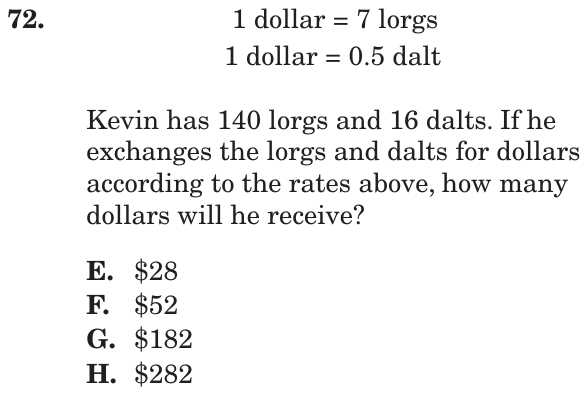
Question 32 of 36
2018 Test A Math, question 50Question
- A101
- B200
- C301
- D341
Show the answer
Correct answer: D
Question analysis
This order of operations question asks students to evaluate 100(2 + 0.1)² − 100, an expression with a decimal, a square and a subtraction. Students must add inside the parentheses first, square the result, multiply by 100, and then subtract. Squaring the two parts of the sum separately is the trap.
- Grade level
- Grade 6 content, by NYS standard
- Compared with grade 7
- Below grade 7 Evaluating an expression with an exponent and decimals in the correct order is grade 6 content. This is a short routine calculation, so it asks less than typical grade 7 work with negative numbers and multi-step equations.
- Estimated difficulty
- Straightforward: two steps or one careful reading.
- Thinking it demands
- Depth of knowledge 1, recall and reproduction · mainly apply
- What makes it hard
- A very close wrong answer moderate
- Error-prone arithmetic minor
- Solution
- 3 steps
- Reading level
- Question and choices: about grade 16+, 1 words.
- Students, last 30 days
- Not enough answers yet to show (it takes 10).
Why it is hard, traps and wrong answers (shows the answer)
Why it is hard
This is a direct order-of-operations calculation with no word problem around it, so the only real risk is the square of a sum. Students who apply the exponent to each part, or only to the 0.1, find a listed answer waiting. Adding inside the parentheses before squaring, and then squaring 2.1 exactly, is the whole task.
A very close wrong answer moderate Choosing the answer
The choices 301 and 341 differ by 40, and squaring 2.1 roughly as 4 lands nearer 301; only the exact square, 4.41, separates them. (Embretson & Wetzel, 1987; Gorin & Embretson, 2006; Ascalon et al., 2007)
Error-prone arithmetic minor Working it out
Squaring 2.1 by hand to get 4.41 puts two decimal places in the product, an easy place to misplace the point. (Brown & Burton, 1978; Junker & Sijtsma, 2001)
Strategy: Add inside the parentheses to get a single decimal, square it carefully, then multiply by 100 and subtract 100, following the order of operations.
Traps
- A faulty procedure: A systematic but wrong procedure: adding fractions straight across, applying an exponent to each term of a sum, dropping a sign when moving a term.
- Order of operations: Working left to right, or distributing a minus sign wrongly, gives a choice.
The wrong answers, classified
A Order of operations (Brown & Burton, 1978)
Squares only the 0.1, as if the parentheses were not there, so 100 × 2.01 − 100 gives 101.
B Little reason to choose it (Haladyna & Downing, 1993; Rodriguez, 2005)
No single slip gives 200; it requires (2 + 0.1)² to come out as 3, so it mostly catches guesses.
C A faulty procedure (Brown & Burton, 1978; Tatsuoka, 1983)
Squares each term of the sum separately, 4 + 0.01 = 4.01, instead of squaring 2.1, so 100 × 4.01 − 100 gives 301.
Worked solution, step by step
Formulas used
- Order of operations
- This is the agreed order for doing math steps. Work inside parentheses first, then exponents, then multiply and divide, then add and subtract. Everyone follows it, so a problem has only one answer.
- Squaring a number
- a is any number. The small 2, called an exponent, means multiply the number by itself. So 2.1 squared means 2.1 times 2.1.
Sort out the problem
You need to work out . The 100 right next to the parentheses means 100 times. Follow the order of operations, one step at a time.
Add inside the parentheses
Parentheses come first in the order of operations. So add the numbers inside them:
Now the problem is:
Square 2.1
Work out 21 × 21 = 441, then put in two decimal places, one for each 2.1.
Watch out: do not square the 2 and the 0.1 one at a time. That gives 4 + 0.01 = 4.01, which is wrong. It leads to 301, choice C.
Multiply, then subtract
The exponent is done, so multiply next. Multiplying by 100 moves the decimal point two places to the right. Subtracting comes last:
So the answer is D, 341.
Check your answer
Estimate. 2.1 is a bit more than 2, so its square is a bit more than 4. 100 times that is a bit more than 400. Take away 100 and you get a bit more than 300. 341 fits. Choices A and B are too small.
More questions like this
The original DOE question
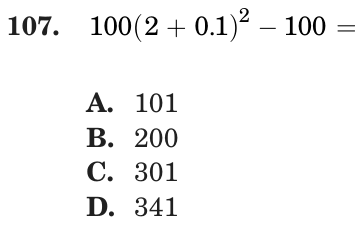
Question 33 of 36
2018 Test A Math, question 53Question
Using the approximation 2.54 centimeters = 1 inch, how many centimeters are in 4 feet 7 inches?
- A21.65
- B119.38
- C121.92
- D139.70
Show the answer
Correct answer: D
Convert 4 ft 7 in. to inches. Since 12 in. = 1 ft :
4(12) + 7 = 55 inches
Multiply that by the conversion
2.54 cm = 1 in.
55 × 2.54 = 139.70 cm
Question analysis
This unit conversion question uses 2.54 centimeters per inch and asks how many centimeters are in 4 feet 7 inches. Students must first turn feet and inches into inches alone, then multiply by the conversion factor. Mixing feet and inches into a single number is the easy slip.
- Grade level
- Grade 6 content, by NYS standard
- Compared with grade 7
- Below grade 7 Converting measurement units with a given factor is grade 6 content. This item takes two short steps and one decimal multiplication, so it asks a little less than typical grade 7 work, though the mixed units need care.
- Estimated difficulty
- Straightforward: two steps or one careful reading.
- Thinking it demands
- Depth of knowledge 1, recall and reproduction · mainly apply
- What makes it hard
- Solution
- 2 steps
- Reading level
- Question and choices: about grade 13, 12 words.
- Corrected from the DOE handbook
- A missing decimal point in the explanation was restored.
- Students, last 30 days
- Not enough answers yet to show (it takes 10).
Why it is hard, traps and wrong answers (shows the answer)
Why it is hard
The conversion factor is given and the multiplication is mechanical, so the question rests on the mixed measurement. Feet and inches are not a decimal system, and treating 4 feet 7 inches as 47, or dropping the 7, both lead to listed answers. A rough estimate, 55 inches × 2.5 ≈ 137, points straight to the right choice.
Something you must already know minor Working it out
The stem gives centimeters per inch but not inches per foot; students must supply 12 to turn 4 feet into 48 inches. (Anderson & Krathwohl, 2001)
Strategy: Change 4 feet to inches using 12 inches per foot, add the extra 7 inches, then multiply the total number of inches by 2.54.
Traps
- Units or scale: The answer is wanted in other units, or a rate or scale must be converted first.
- Answers a different question: A choice is right for another quantity: the other unknown, the rest instead of the part, the part instead of the whole.
The wrong answers, classified
A Wrong operation (Hegarty, Mayer & Monk, 1995; King et al., 2004)
Divides 55 inches by 2.54 instead of multiplying, converting in the wrong direction and getting fewer centimeters than inches.
B Units or scale (King et al., 2004)
Reads 4 feet 7 inches as 47 inches, as if feet were tens of inches, then multiplies 47 × 2.54 = 119.38.
C Answers a different question (King et al., 2004; Hegarty, Mayer & Monk, 1995)
Converts the 4 feet to 48 inches and multiplies by 2.54, getting 121.92, but leaves out the extra 7 inches.
What was corrected from the DOE handbook, and why
- Explanation: The handbook writes the conversion as “254 cm = 1 in.”, dropping the decimal point. The question gives 2.54 centimeters = 1 inch and the handbook’s next line multiplies by 2.54, so it now reads 2.54 cm = 1 in.
Worked solution, step by step
Formulas used
- Feet to inches
- i is the number of inches and f is the number of feet. Each foot has 12 inches, so you multiply the feet by 12.
- Inches to centimeters
- c is the number of centimeters and i is the number of inches. Each inch is about 2.54 centimeters, so you multiply. A centimeter is smaller than an inch, so you get a bigger number.
Sort out what you know
The length is 4 feet 7 inches. That means 4 feet plus 7 more inches. You know 1 inch is about 2.54 centimeters.
So change everything to inches first, then to centimeters. The question does not say that 1 foot is 12 inches. You have to know it.
Change the length to inches
4 feet is 48 inches. Now add the extra 7 inches:
The length is 55 inches. Watch out: 4 feet 7 inches is not 47 inches. Using 47 gives choice B. Leaving out the 7 inches gives 121.92, choice C.
Change inches to centimeters
To multiply in your head, split 55 into 50 and 5: 127 + 12.7 = 139.7.
Watch out: multiply, do not divide. Dividing 55 by 2.54 gives 21.65, choice A. So the answer is D, 139.70.
Check your answer
A centimeter is smaller than an inch. So the number of centimeters must be bigger than 55. About 2.5 × 55 is 137.5, close to 139.70. Choice A, 21.65, is smaller than 55, so it cannot be right.
More questions like this
The original DOE question
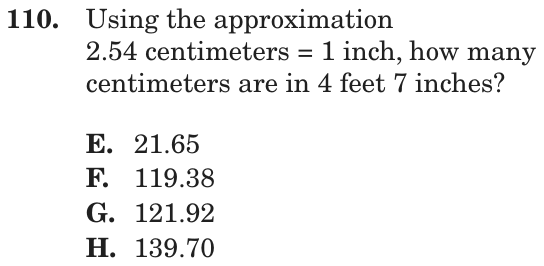
Question 34 of 36
2018 Test B Math, question 10Question
To make party invitations, Macie could buy a package of paper for $10.50, or she could buy x individual sheets of the same paper for $0.15 each. What is the largest value of x that would make buying the individual sheets less expensive than buying the package?
- A60
- B65
- C69
- D70
Show the answer
Correct answer: C
Set up an inequality to compare the costs:
0.15x < 10.50
x < 70
Therefore, 70 individual sheets of paper would cost $10.50, so 69 is the greatest number of individual sheets of paper that Macie can buy that would be less expensive than the package.
Question analysis
This inequality word problem compares buying a package of paper with buying single sheets at 15 cents each, and asks for the largest number of sheets for which the single sheets cost less. Students write and solve an inequality with decimals. The tricky part is interpreting the solution as a whole number of sheets.
- Grade level
- Grade 7 content, by NYS standard
- Compared with grade 7
- At grade 7 Writing and solving an inequality from a real-world situation is a grade 7 standard. This one is short, but it asks students to interpret a strict inequality as a count of sheets, the kind of interpretation grade 7 tests expect.
- Estimated difficulty
- Moderate: several steps, or a close reading with one strong distractor.
- Thinking it demands
- Depth of knowledge 2, skills and concepts · mainly apply
- What makes it hard
- A very close wrong answer moderate
- Turning words into math minor
- Error-prone arithmetic minor
- Solution
- 3 steps
- Reading level
- Question and choices: about grade 10, 45 words.
- Corrected from the DOE handbook
- An inequality sign in the explanation was corrected.
- Students, last 30 days
- Not enough answers yet to show (it takes 10).
Why it is hard, traps and wrong answers (shows the answer)
Why it is hard
The computation leads straight to 70, and the whole question is about what to do with that number. Students who treat the boundary as the answer forget that equal cost is not less cost, while the other choices only catch those who misdivide or ignore the word largest. The question rewards checking the boundary case in the story: 70 sheets cost exactly the package price.
A very close wrong answer moderate Choosing the answer
70 and 69 sheets differ by one, and 70 is exactly where the two costs meet at $10.50; only the strict “less expensive” separates them, ruling out 70. (Embretson & Wetzel, 1987; Gorin & Embretson, 2006; Ascalon et al., 2007)
Turning words into math minor Understanding the question
The words “less expensive than buying the package” must become a strict inequality, 0.15x < 10.50, and “largest value” must then pick the biggest whole number below the boundary. (Hegarty, Mayer & Monk, 1995; Koedinger & Nathan, 2004)
Error-prone arithmetic minor Working it out
Dividing 10.50 by 0.15 means shifting the decimal point in both numbers, a step where a misplaced digit gives a wrong boundary. (Brown & Burton, 1978; Junker & Sijtsma, 2001)
Strategy: Divide the package price by the price of one sheet to see where the two costs meet, then find the largest whole number of sheets that still costs less than $10.50.
Traps
- Counting the ends: Inclusive or exclusive ends, fence posts, consecutive numbers: an answer that is one too many or too few, or an endpoint drawn open where it belongs closed (or the reverse).
The wrong answers, classified
A Misreads the question (Hegarty, Mayer & Monk, 1995)
Checks a round number, 60 sheets for $9.00, sees it is cheaper than the package, and stops without seeking the largest such number.
B An arithmetic slip (Junker & Sijtsma, 2001)
Divides only the $10 by $0.15, about 66.7, ignoring the 50 cents, and settles on the nearest smaller choice.
D Counting the ends (Brown & Burton, 1978)
Solves 0.15x = 10.50 and keeps the boundary 70, but 70 sheets cost exactly $10.50, the same as the package, not less.
What was corrected from the DOE handbook, and why
- Explanation: The handbook sets up 0.15x ≤ 10.50 and x ≤ 70, which would allow 70 sheets, and then says that 70 sheets cost exactly $10.50. Buying the sheets has to be less expensive than the package, so the site uses strict inequalities, 0.15x < 10.50 and x < 70, which make 69 the largest number of sheets.
Worked solution, step by step
Formulas used
- Total cost
- Price of one is what a single sheet costs, here $0.15. Number bought is how many sheets, here x. Multiplying gives the total you pay, because you pay the same price for every sheet.
Sort out the question
The package costs $10.50. Single sheets cost $0.15 each. Macie buys x sheets.
You need the largest x that makes the sheets cost less than the package. Costing the same is not enough.
Write the inequality
An inequality is a math sentence that compares two amounts. The sign < means is less than.
The cost of x sheets is 0.15 times x. It must be less than 10.50.
Find where the costs are equal
First find how many sheets cost exactly $10.50. Divide the package price by the price of one sheet. Multiply both numbers by 100 to clear the decimals.
So 70 sheets cost exactly $10.50.
Pick the largest number below 70
x must be less than 70. You can only buy whole sheets. The largest whole number below 70 is 69.
Watch out: 70 sheets cost the same as the package, not less. That is why choice D is wrong. Choices A and B are cheaper too, but they are not the largest.
So the answer is C, 69.
Check your answer
Test both numbers. , and $10.35 is less than $10.50. But , which is not less. So 69 is the largest number that works.
More questions like this
The original DOE question
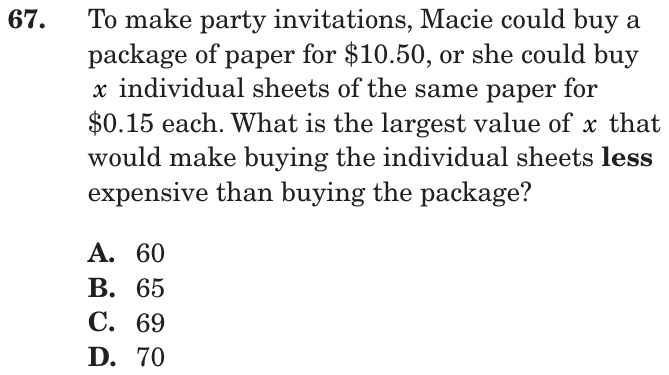
Question 35 of 36
2018 Test B Math, question 47Question
The decimal 0.06 can be written as the fraction . What is the value of ?
- A3
- B6
- C12
- D30
Show the answer
Correct answer: A
Simplify the fraction to find the answer:
Question analysis
This question asks students to rewrite the decimal 0.06 as an equivalent fraction with a denominator of 50 and give the missing numerator. It tests converting between decimals and fractions. The step that trips students up is moving from hundredths to fiftieths, which means scaling the numerator in the right direction.
- NYS standards
- 6.NS.3 multi-digit decimal operations
- Grade level
- Grade 6 content, by NYS standard
- Compared with grade 7
- Below grade 7 Converting a decimal to an equivalent fraction is upper elementary and grade 6 work. This is a single routine conversion with no context and no traps beyond a place-value slip, well below grade 7 demand.
- Estimated difficulty
- Routine: one familiar step, little to misread.
- Thinking it demands
- Depth of knowledge 1, recall and reproduction · mainly apply
- What makes it hard
- Error-prone arithmetic minor
- Solution
- 2 steps
- Reading level
- Question and choices: about grade 6, 15 words.
- Students, last 30 days
- Not enough answers yet to show (it takes 10).
Why it is hard, traps and wrong answers (shows the answer)
Why it is hard
A one-idea question: write 0.06 as a fraction and rename it with a denominator of 50. The only real risk is keeping the 6 when the denominator changes, or scaling the numerator in the wrong direction. Checking that 3 ÷ 50 really gives 0.06 settles it.
Error-prone arithmetic minor Working it out
The decimal is in hundredths but the target denominator is 50, so the numerator has to be halved along with the denominator rather than kept as 6. (Brown & Burton, 1978; Junker & Sijtsma, 2001)
Strategy: Write the decimal as a fraction over 100, then find the equivalent fraction over 50 by dividing numerator and denominator by the same number.
Traps
- Stops one step early: A choice is a number from partway through the solution.
The wrong answers, classified
B Stops one step early (King et al., 2004; Gierl et al., 2017)
Writes 0.06 as 6/100 and keeps 6 as the numerator even though the denominator has changed from 100 to 50.
C Wrong operation (Hegarty, Mayer & Monk, 1995; King et al., 2004)
Doubles the 6 instead of halving it, scaling the numerator up while the denominator goes down from 100 to 50.
D An arithmetic slip (Junker & Sijtsma, 2001)
Reads 0.06 as 0.6 and multiplies by 50, a decimal-place slip that makes the numerator ten times too large.
Worked solution, step by step
Formulas used
- Equivalent fractions
- a is the top number and b is the bottom number. k is any number that divides both. Dividing the top and bottom by the same number keeps the value the same. Use it to give a fraction a new bottom number.
Sort out the question
You need to write 0.06 as a fraction with 50 on the bottom. The top number of that fraction is . You need to find .
Write the decimal as a fraction
0.06 has two digits after the decimal point. That means it counts hundredths. So 0.06 is six hundredths.
Change the bottom to 50
To turn 100 into 50, divide by 2. The rule for equivalent fractions says to do the same to the top.
So .
Watch out: the 6 must change too. Keeping the 6 gives choice B. Doubling it to 12 gives choice C.
Give the answer
The fraction is the same amount as 0.06, and its top number is 3. So the answer is A, 3.
Check your answer
Divide to turn the fraction back into a decimal: . You can also multiply: . Both match. Choice D, 30, comes from reading 0.06 as 0.6.
More questions like this
The original DOE question
Question 36 of 36
2018 Test B Math, question 55Question
1 sind = 5.6 ricks
1 sind = 12.88 dalts
Using the conversion above, how many dalts are equal to 1 rick?
- A0.43
- B2.30
- C7.28
- D18.48
Show the answer
Correct answer: B
Since 5.6 ricks and 12.88 dalts are both equal to 1 sind, then 5.6 ricks = 12.88 dalts.
To calculate the number of dalts (d) in 1 rick, set up a proportion:
Question analysis
Two made-up conversion facts set 1 sind equal to 5.6 ricks and to 12.88 dalts, and students find how many dalts equal 1 rick. It tests unit conversion with invented units and decimal division. The risk is dividing in the wrong order, since both quotients look like reasonable answers.
- Grade level
- Grade 6 content, by NYS standard
- Compared with grade 7
- At grade 7 Converting units with a given rate is grade 6 ratio reasoning. Invented units remove any real-world sense check and the division involves decimals, which matches the care typical grade 7 problems require.
- Estimated difficulty
- Moderate: several steps, or a close reading with one strong distractor.
- Thinking it demands
- Depth of knowledge 2, skills and concepts · mainly apply
- What makes it hard
- Error-prone arithmetic moderate
- Solution
- 2 steps
- Reading level
- Question and choices: about grade 3, 15 words.
- Students, last 30 days
- Not enough answers yet to show (it takes 10).
Why it is hard, traps and wrong answers (shows the answer)
Why it is hard
Because both amounts equal one sind, the problem reduces to 5.6 ricks = 12.88 dalts, but the made-up units remove any feel for which way to divide. The inverted ratio is the strongest pull, while the sum and the difference of the given numbers catch students who combine them without a plan. Checking that 5.6 × 2.3 returns 12.88 confirms the direction.
Error-prone arithmetic moderate Working it out
Dividing 12.88 by 5.6 means dividing by a decimal, best done as 128.8 ÷ 56 = 2.3, where a misplaced decimal point is easy. (Brown & Burton, 1978; Junker & Sijtsma, 2001)
Strategy: Since both amounts equal 1 sind, set the ricks equal to the dalts, then divide both sides by whichever number leaves exactly one rick on its side.
Traps
- Wrong operation: Adds instead of multiplying, divides the wrong way round, turns a ratio or rate upside down, or undoes a step in the wrong direction (subtracts what should be added back).
- Numbers taken from the question: Combines the numbers in the question without a model of the situation, or is simply a number that appears in the question.
The wrong answers, classified
A Wrong operation (Hegarty, Mayer & Monk, 1995; King et al., 2004)
Divides 5.6 by 12.88, turning the rate upside down: 0.43 is the number of ricks in one dalt, not dalts in one rick.
C Numbers taken from the question (Hegarty, Mayer & Monk, 1995)
Subtracts the two given numbers, 12.88 − 5.6 = 7.28, as if the gap between them were the conversion rate.
D Numbers taken from the question (Hegarty, Mayer & Monk, 1995)
Adds the two given numbers, 12.88 + 5.6 = 18.48, combining the conversion figures without a model of what they mean.
Worked solution, step by step
Formulas used
- Unit rate
- The total amount is what you have for several units. The number of units is how many of them there are. Dividing shares the total equally, so you get the amount for just one unit.
Sort out what you know
Sinds, ricks and dalts are made-up units. 1 sind is 5.6 ricks. 1 sind is also 12.88 dalts. You need the number of dalts in 1 rick.
Link ricks and dalts
Both 5.6 ricks and 12.88 dalts equal 1 sind. Two things equal to the same thing are equal to each other. So 5.6 ricks are the same amount as 12.88 dalts.
Set up the division
You want 1 rick, not 5.6 ricks. So share the 12.88 dalts among the 5.6 ricks. Use the unit rate formula.
Watch out: do not divide the other way. is about 0.43. That is ricks in one dalt, choice A. Adding or subtracting the numbers gives D or C.
Do the division
Move the decimal point one place right in both numbers. This makes the number you divide by a whole number.
So 1 rick is 2.3 dalts.
Give the answer
One rick equals 2.3 dalts, written 2.30 in the choices. So the answer is B, 2.30.
Check your answer
Multiply back: . That matches the dalts in 1 sind. Also, a sind holds more dalts than ricks, so a rick is bigger than a dalt. One rick must be more than 1 dalt. That rules out 0.43.
More questions like this
The original DOE question