Question
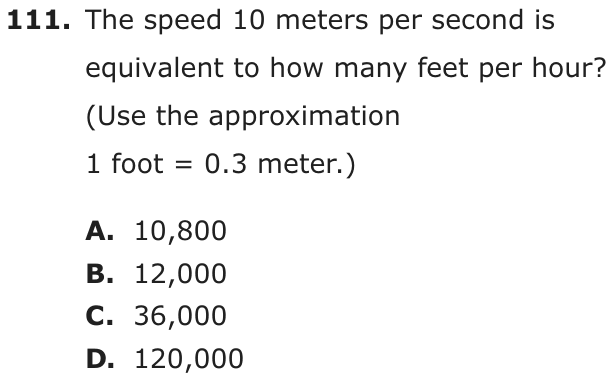
The speed 10 meters per second is equivalent to how many feet per hour? (Use the approximation 1 foot = 0.3 meter.)
- A10,800
- B12,000
- C36,000
- D120,000
Show the answer
Correct answer: D
Question analysis
This unit conversion question gives a speed of 10 meters per second and asks for the same speed in feet per hour, using 1 foot = 0.3 meter. Students convert both the distance unit and the time unit. Setting up each conversion factor so that the unwanted units cancel is what makes it tricky.
- Grade level
- Grade 6 content, by NYS standard
- Compared with grade 7
- Above grade 7 Grade 7 students usually convert one unit with a given factor. This converts both parts of a rate, seconds to hours and meters to feet, with a decimal conversion factor and large numbers to keep track of.
- Estimated difficulty
- Hard: combines ideas, needs a plan, and has more than one tempting wrong answer.
- Thinking it demands
- Depth of knowledge 2, skills and concepts · mainly apply
- What makes it hard
- Many steps moderate
- Error-prone arithmetic moderate
- Something you must already know minor
- Solution
- 3 steps
- Reading level
- Question and choices: about grade 7, 18 words.
- Students, last 30 days
- Not enough answers yet to show (it takes 10).
Why it is hard, traps and wrong answers (shows the answer)
Why it is hard
Every wrong choice is a conversion handled badly: multiplying by 0.3 when the fact 1 foot = 0.3 meter calls for dividing, dividing by 3 instead of 0.3, or stopping in meters per hour. Writing the units as fractions, so that seconds and meters cancel, shows which way each factor goes. A size check also helps: a foot is shorter than a meter, so the number of feet must be larger than the 36,000 meters.
Many steps moderate Working it out
Both parts of the rate change: seconds become hours by multiplying by 3,600, and meters become feet by dividing by 0.3, two conversions that each have a wrong direction. (Daniel & Embretson, 2010; Enright, Morley & Sheehan, 2002)
Error-prone arithmetic moderate Working it out
Dividing 36,000 by 0.3 means moving the decimal point in the divisor, and a slip of one place gives 12,000 instead of 120,000. (Brown & Burton, 1978; Junker & Sijtsma, 2001)
Something you must already know minor Working it out
The stem gives 1 foot = 0.3 meter but not the 3,600 seconds in an hour, which students must build from 60 × 60. (Anderson & Krathwohl, 2001)
Strategy: Write the speed as a fraction, multiply by 3,600 seconds per hour, then by 1 foot over 0.3 meter, checking that seconds and meters cancel.
Traps
- Units or scale: The answer is wanted in other units, or a rate or scale must be converted first.
- Wrong operation: Adds instead of multiplying, divides the wrong way round, turns a ratio or rate upside down, or undoes a step in the wrong direction (subtracts what should be added back).
- An arithmetic slip: The right method with a plausible arithmetic error: a digit, a place value or a times-table fact.
The wrong answers, classified
A Wrong operation (Hegarty, Mayer & Monk, 1995; King et al., 2004)
Multiplies 36,000 meters per hour by 0.3 instead of dividing, turning the fact 1 foot = 0.3 meter upside down and getting 10,800.
B An arithmetic slip (Junker & Sijtsma, 2001)
Divides 36,000 by 3 instead of 0.3, putting the decimal point in the wrong place and getting an answer ten times too small.
C Units or scale (King et al., 2004)
Converts seconds to hours, 10 × 3,600 = 36,000, and stops, leaving the speed in meters per hour rather than feet per hour.
Worked solution, step by step
Formulas used
- Seconds in an hour
- An hour has 60 minutes, and each minute has 60 seconds. So 1 hour holds 60 groups of 60 seconds. To change a speed per second into a speed per hour, multiply by 3,600, because an hour is 3,600 seconds long.
- Meters to feet
- The problem says 1 foot is about 0.3 meter. So each foot uses up 0.3 meter of the distance. To count the feet, divide the meters by 0.3. A foot is shorter than a meter, so you get more feet than meters.
Sort out the question
The speed is 10 meters per second. That means it moves 10 meters every second. You need the speed in feet per hour. Two units change: seconds become hours, and meters become feet. Change one at a time. Use 1 foot = 0.3 meter.
Find the seconds in an hour
An hour is much longer than a second. So in one hour, the object moves much farther. First find how many seconds are in an hour.
One hour is 3,600 seconds.
Find the meters per hour
Each second it moves 10 meters. In 3,600 seconds it moves 3,600 times as far.
The speed is 36,000 meters per hour.
Watch out: Stopping here gives 36,000, choice C. That number is still in meters, not feet.
Change meters to feet
Each foot is 0.3 meter. To find how many feet fit in 36,000 meters, divide by 0.3. Multiplying both numbers by 10 makes the division easier.
So 36,000 meters is 120,000 feet. The speed is 120,000 feet per hour.
Give the answer
Watch out: Multiplying by 0.3 instead of dividing gives 10,800, choice A. Dividing by 3 instead of 0.3 gives 12,000, choice B.
So the answer is D, 120,000 feet per hour.
Check your answer
A foot is shorter than a meter. So any distance is more feet than meters. The answer must be bigger than 36,000, and only choice D is. Also, 120,000 feet at 0.3 meter each is 120,000 × 0.3 = 36,000 meters. That matches.
More questions like this
The original DOE question