Question
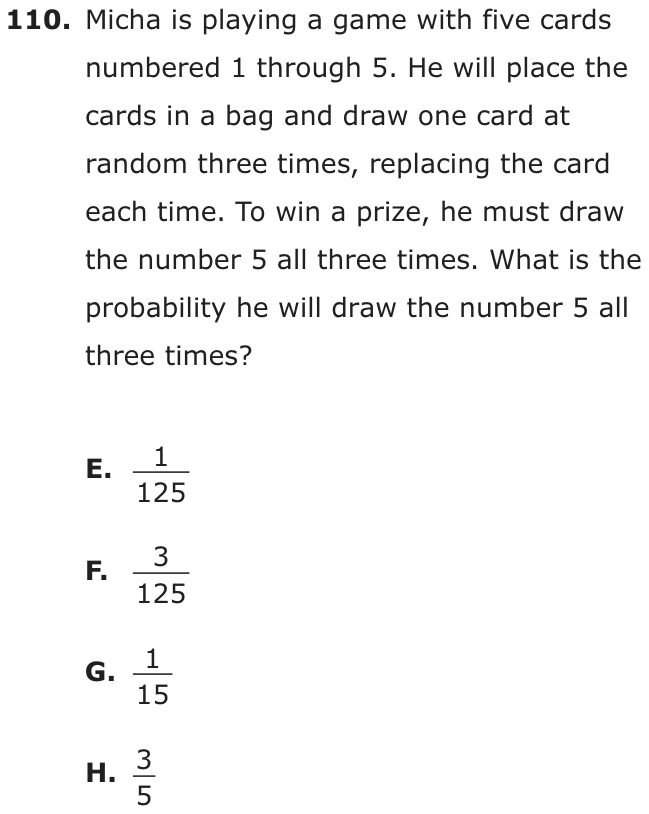
Micha is playing a game with five cards numbered 1 through 5. He will place the cards in a bag and draw one card at random three times, replacing the card each time. To win a prize, he must draw the number 5 all three times. What is the probability he will draw the number 5 all three times?
- A
- B
- C
- D
Show the answer
Correct answer: A
Each time Micha draws a card, the probability of drawing the number 5 is . To find the probability of drawing the number 5 three times, multiply:
Question analysis
Micha draws a card three times from five cards numbered 1 to 5, putting the card back each time, and wins only if he draws a 5 every time. Students find the probability that he wins. It tests the probability of independent events, where the chances for the separate draws have to be combined correctly.
- NYS standards
- Grade level
- Grade 7 content, by NYS standard
- Compared with grade 7
- At grade 7 Finding the probability of a compound event is a grade 7 standard, and repeated draws with replacement are a standard case. Three equal factors make this a short, typical grade 7 task.
- Estimated difficulty
- Straightforward: two steps or one careful reading.
- Thinking it demands
- Depth of knowledge 2, skills and concepts · mainly apply
- What makes it hard
- Solution
- 2 steps
- Reading level
- Question and choices: about grade 3, 59 words.
- Students, last 30 days
- Not enough answers yet to show (it takes 10).
Why it is hard, traps and wrong answers (shows the answer)
Why it is hard
With replacement each draw is the same 1 in 5, so the work is one product, 1/5 × 1/5 × 1/5. The wrong choices mark three ways to mishandle repetition: adding the chances, multiplying 5 by 3 instead of cubing it, and multiplying by 3 for the three draws. A quick sense check helps, since needing three 5s in a row must be far less likely than needing one.
Something you must already know minor Working it out
The rule that the chance of independent events all happening is the product of their chances is assumed, as is that replacing the card keeps each draw at 1/5. (Anderson & Krathwohl, 2001)
Strategy: Find the probability of drawing a 5 on one draw, then, because the card goes back each time, multiply that probability by itself once for each draw.
Traps
- Wrong operation: Adds instead of multiplying, divides the wrong way round, turns a ratio or rate upside down, or undoes a step in the wrong direction (subtracts what should be added back).
- A faulty procedure: A systematic but wrong procedure: adding fractions straight across, applying an exponent to each term of a sum, dropping a sign when moving a term.
- Overlapping groups: Things in two groups at once are counted twice, or not subtracted.
The wrong answers, classified
B Overlapping groups (King et al., 2004)
Finds 1/125 for three 5s, then multiplies by 3 for the three draws, counting the single outcome 5, 5, 5 as if it could happen in three orders.
C A faulty procedure (Brown & Burton, 1978; Tatsuoka, 1983)
Multiplies 5 by 3 instead of raising it to the third power, so the denominator becomes 15 rather than 5 × 5 × 5 = 125.
D Wrong operation (Hegarty, Mayer & Monk, 1995; King et al., 2004)
Adds the three probabilities, 1/5 + 1/5 + 1/5 = 3/5, as if drawing a 5 on any one draw were enough to win.
Worked solution, step by step
Formulas used
- Probability
- P is the probability, the chance something happens. It is a number from 0 to 1. The top counts the results you want. The bottom counts all the results that can happen. It works when every result is equally likely.
- Chance of events in a row
- A, B and C are events, things that might happen, like drawing a 5. When they do not change each other’s chances, the chance that all of them happen is the product of their chances. Putting each card back keeps the draws from changing each other.
Sort out the question
The bag has 5 cards, numbered 1 to 5. Micha draws a card three times. He puts it back each time, so every draw starts with all 5 cards. He wins only if he draws a 5 all three times. You need the probability, or chance, of that.
Find the chance for one draw
One card out of 5 is a 5. Use the probability formula.
Each draw has a 1 in 5 chance of being a 5.
Multiply for three draws
He needs a 5 on the first draw, and the second, and the third. The card goes back each time, so the draws don’t change each other. Use the rule for events in a row.
Give the answer
Watch out: Adding the chances gives , choice D. That would make winning likely, which makes no sense. Multiplying 5 × 3 instead of 5 × 5 × 5 gives , choice C.
So the answer is A, .
Check your answer
Count all the results. Each draw has 5 possible cards, so three draws have 5 × 5 × 5 = 125 possible orders. Only one of them is 5, 5, 5. That gives 1 out of 125. Needing three 5s should also be much less likely than needing one.
More questions like this
The original DOE question