Also in 2025 Practice Test B Math, question 55.
Question
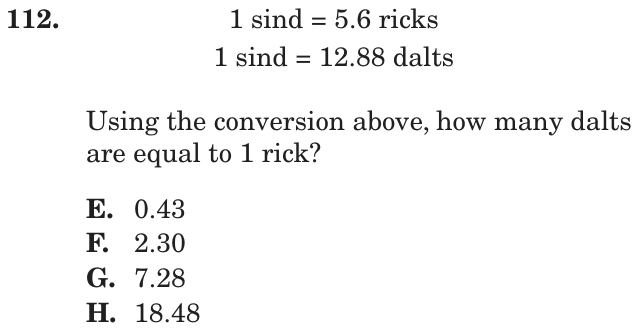
1 sind = 5.6 ricks
1 sind = 12.88 dalts
Using the conversion above, how many dalts are equal to 1 rick?
- A0.43
- B2.30
- C7.28
- D18.48
Show the answer
Correct answer: B
Since 5.6 ricks and 12.88 dalts are both equal to 1 sind, then 5.6 ricks = 12.88 dalts.
To calculate the number of dalts (d) in 1 rick, set up a proportion:
Question analysis
Two made-up conversion facts set 1 sind equal to 5.6 ricks and to 12.88 dalts, and students find how many dalts equal 1 rick. It tests unit conversion with invented units and decimal division. The risk is dividing in the wrong order, since both quotients look like reasonable answers.
- Grade level
- Grade 6 content, by NYS standard
- Compared with grade 7
- At grade 7 Converting units with a given rate is grade 6 ratio reasoning. Invented units remove any real-world sense check and the division involves decimals, which matches the care typical grade 7 problems require.
- Estimated difficulty
- Moderate: several steps, or a close reading with one strong distractor.
- Thinking it demands
- Depth of knowledge 2, skills and concepts · mainly apply
- What makes it hard
- Error-prone arithmetic moderate
- Solution
- 2 steps
- Reading level
- Question and choices: about grade 3, 15 words.
- Students, last 30 days
- Not enough answers yet to show (it takes 10).
Why it is hard, traps and wrong answers (shows the answer)
Why it is hard
Because both amounts equal one sind, the problem reduces to 5.6 ricks = 12.88 dalts, but the made-up units remove any feel for which way to divide. The inverted ratio is the strongest pull, while the sum and the difference of the given numbers catch students who combine them without a plan. Checking that 5.6 × 2.3 returns 12.88 confirms the direction.
Error-prone arithmetic moderate Working it out
Dividing 12.88 by 5.6 means dividing by a decimal, best done as 128.8 ÷ 56 = 2.3, where a misplaced decimal point is easy. (Brown & Burton, 1978; Junker & Sijtsma, 2001)
Strategy: Since both amounts equal 1 sind, set the ricks equal to the dalts, then divide both sides by whichever number leaves exactly one rick on its side.
Traps
- Wrong operation: Adds instead of multiplying, divides the wrong way round, turns a ratio or rate upside down, or undoes a step in the wrong direction (subtracts what should be added back).
- Numbers taken from the question: Combines the numbers in the question without a model of the situation, or is simply a number that appears in the question.
The wrong answers, classified
A Wrong operation (Hegarty, Mayer & Monk, 1995; King et al., 2004)
Divides 5.6 by 12.88, turning the rate upside down: 0.43 is the number of ricks in one dalt, not dalts in one rick.
C Numbers taken from the question (Hegarty, Mayer & Monk, 1995)
Subtracts the two given numbers, 12.88 − 5.6 = 7.28, as if the gap between them were the conversion rate.
D Numbers taken from the question (Hegarty, Mayer & Monk, 1995)
Adds the two given numbers, 12.88 + 5.6 = 18.48, combining the conversion figures without a model of what they mean.
Worked solution, step by step
Formulas used
- Unit rate
- The total amount is what you have for several units. The number of units is how many of them there are. Dividing shares the total equally, so you get the amount for just one unit.
Sort out what you know
Sinds, ricks and dalts are made-up units. 1 sind is 5.6 ricks. 1 sind is also 12.88 dalts. You need the number of dalts in 1 rick.
Link ricks and dalts
Both 5.6 ricks and 12.88 dalts equal 1 sind. Two things equal to the same thing are equal to each other. So 5.6 ricks are the same amount as 12.88 dalts.
Set up the division
You want 1 rick, not 5.6 ricks. So share the 12.88 dalts among the 5.6 ricks. Use the unit rate formula.
Watch out: do not divide the other way. is about 0.43. That is ricks in one dalt, choice A. Adding or subtracting the numbers gives D or C.
Do the division
Move the decimal point one place right in both numbers. This makes the number you divide by a whole number.
So 1 rick is 2.3 dalts.
Give the answer
One rick equals 2.3 dalts, written 2.30 in the choices. So the answer is B, 2.30.
Check your answer
Multiply back: . That matches the dalts in 1 sind. Also, a sind holds more dalts than ricks, so a rick is bigger than a dalt. One rick must be more than 1 dalt. That rules out 0.43.
More questions like this
The original DOE question