Question
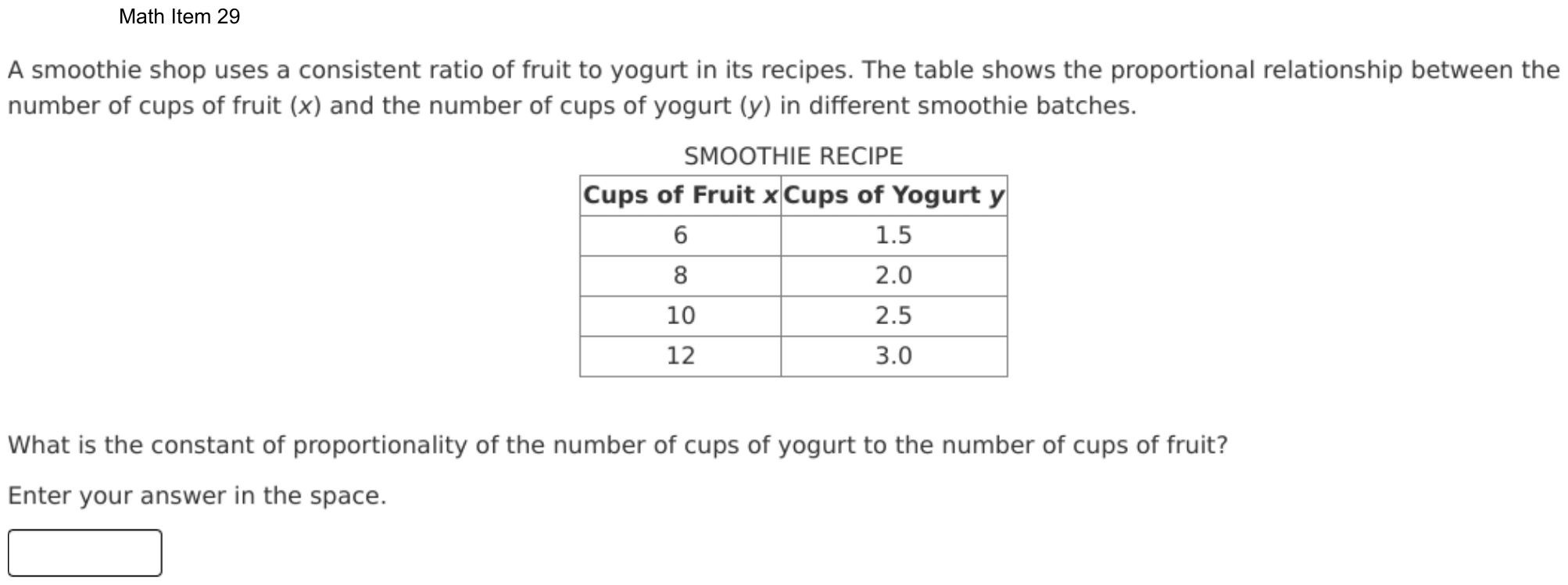
A smoothie shop uses a consistent ratio of fruit to yogurt in its recipes. The table shows the proportional relationship between the number of cups of fruit (x) and the number of cups of yogurt (y) in different smoothie batches.
SMOOTHIE RECIPE
| Cups of Fruit x | Cups of Yogurt y |
|---|---|
| 6 | 1.5 |
| 8 | 2.0 |
| 10 | 2.5 |
| 12 | 3.0 |
What is the constant of proportionality of the number of cups of yogurt to the number of cups of fruit?
Enter your answer in the space.
Fill-in question: work out the answer and type it as a number.
Show the answer
Correct answer: 0.25
To find p, the constant of proportionality of the number of cups of yogurt, y, to the number of cups of fruit, x, use the equation .
The table shows that there are 1.5 cups of yogurt for 6 cups of fruit.
The constant of proportionality is 0.25.
Question analysis
A smoothie shop's recipe table lists cups of fruit and cups of yogurt for four batches in a proportional relationship. Students type the constant of proportionality of yogurt to fruit. It tests finding a unit rate from a table, and since fruit is listed first while the question names yogurt first, the ratio is easy to take upside down.
- Grade level
- Grade 7 content, by NYS standard
- Compared with grade 7
- At grade 7 Finding the constant of proportionality in a table is a core grade 7 skill, and these values are friendly decimals. Typing the answer with no choices, and taking the ratio in the order the question gives, are the added demands.
- Estimated difficulty
- Straightforward: two steps or one careful reading.
- Thinking it demands
- Depth of knowledge 2, skills and concepts · mainly apply
- What makes it hard
- Turning words into math moderate
- An answer in an unexpected form minor
- Solution
- 1 step
- Reading level
- Question and choices: about grade 6, 75 words.
- Students, last 30 days
- Not enough answers yet to show (it takes 10).
Why it is hard, traps and wrong answers (shows the answer)
Why it is hard
Any row gives the answer with one division, and the values divide evenly, so the points are lost on direction. Fruit fills the first column and comes first in the stem’s own ratio, which invites dividing it by the yogurt. The table also climbs by a steady half cup of yogurt, a number that looks like a constant but ignores the 2 cups of fruit added each time. Checking that 0.25 times each fruit value gives its yogurt value settles it.
Turning words into math moderate Understanding the question
The opening sentence speaks of a ratio of fruit to yogurt, but the question asks for the constant of yogurt to fruit, so the division is y ÷ x, against the table’s column order. (Hegarty, Mayer & Monk, 1995; Koedinger & Nathan, 2004)
An answer in an unexpected form minor Choosing the answer
The constant is typed into a box with no choices, so 4, the ratio taken the other way round, is a believable entry that nothing on screen questions. (Enright, Morley & Sheehan, 2002)
Strategy: Check which quantity the question names first, divide that column by the other in any row, and confirm the quotient is the same in a second row.
Traps
- Wrong operation: Adds instead of multiplying, divides the wrong way round, turns a ratio or rate upside down, or undoes a step in the wrong direction (subtracts what should be added back).
- Misunderstands the concept: A wrong belief about a concept: that percents can be added, that area grows like length, that averages can be averaged, that a bigger denominator means a bigger fraction.
- Numbers taken from the question: Combines the numbers in the question without a model of the situation, or is simply a number that appears in the question.
The wrong answers, classified
4 Wrong operation (Hegarty, Mayer & Monk, 1995; King et al., 2004)
Divides cups of fruit by cups of yogurt, 6 ÷ 1.5 = 4, following the stem’s “ratio of fruit to yogurt” and turning the requested constant upside down.
0.5 Misunderstands the concept (Smith, diSessa & Roschelle, 1993; De Bock et al., 1998; Ni & Zhou, 2005)
Takes the steady rise of 0.5 cup of yogurt from row to row as the constant, ignoring that the fruit rises by 2 cups each time.
1.5 Numbers taken from the question (Hegarty, Mayer & Monk, 1995)
Gives 1.5, the first yogurt value in the table, as if the constant were an amount in one batch rather than a ratio of two amounts.
Worked solution, step by step
Formulas used
- Constant of proportionality
- k is the constant of proportionality. y and x are two matching amounts from the same row of the table. In a proportional relationship, y = kx, so y is always k times x. That is why dividing y by x gives the same k in every row.
Sort out the question
The table lists cups of fruit (x) and cups of yogurt (y) for four batches. You need the constant of proportionality of yogurt to fruit.
That is the number of cups of yogurt for each 1 cup of fruit. It is also the number you multiply x by to get y.
Divide yogurt by fruit
Use the first row: 6 cups of fruit and 1.5 cups of yogurt. Yogurt goes on top, because the question says yogurt to fruit:
So there is 0.25 cup, or one quarter of a cup, of yogurt for each cup of fruit.
Watch out: the first sentence says fruit to yogurt, but the question asks the other way. Dividing turns the answer upside down.
Check two more rows
The constant must be the same in every row. Test two more:
They match. Watch out: the yogurt goes up by 0.5 cup from row to row. That 0.5 is not the constant. The fruit goes up by 2 cups at the same time, and .
Enter the number
Type only the number in the box, with no units. You can type 0.25 or .25. On this site, 1/4 counts too.
So you would enter 0.25.
Check your answer
Multiply each amount of fruit by 0.25. , , and . Every result matches the yogurt column. Also, each batch has less yogurt than fruit, so the constant should be less than 1.
More questions like this
The original DOE question