2023 Test B English
Question 1 of 57
2023 Test B English, question 1Question
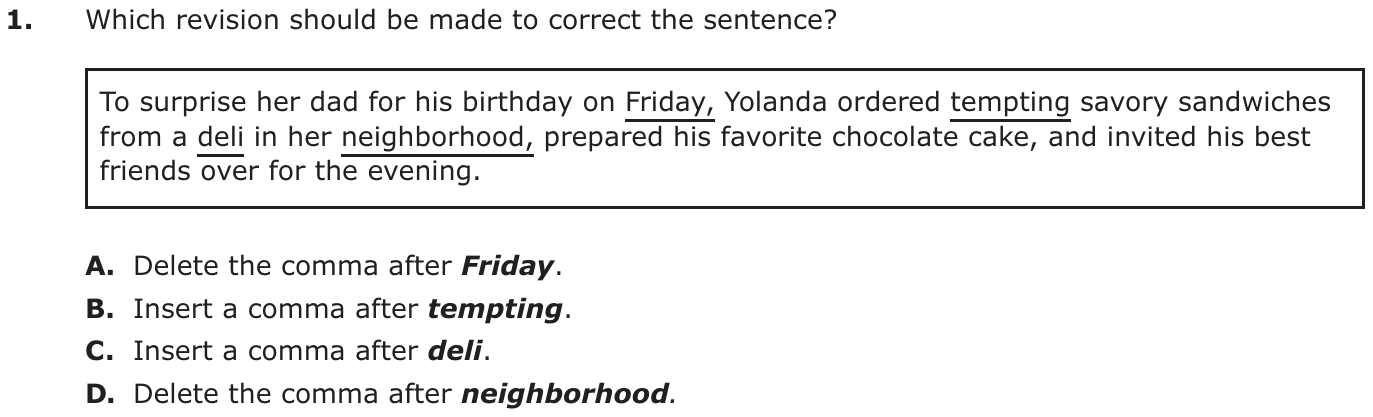
Which revision should be made to correct the sentence?
To surprise her dad for his birthday on Friday, Yolanda ordered tempting savory sandwiches from a deli in her neighborhood, prepared his favorite chocolate cake, and invited his best friends over for the evening.
- ADelete the comma after Friday.
- BInsert a comma after tempting.
- CInsert a comma after deli.
- DDelete the comma after neighborhood.
Show the answer
Correct answer: B
The question asks which edit should be made to correct the sentence.
A. Incorrect. A comma is needed to separate the introductory infinitive phrase “to surprise her dad for his birthday on Friday,” which modifies Yolanda’s action, from the remainder of the sentence.
B. CORRECT. A comma is needed between two adjectives of equal importance preceding a noun. In this case, the adjectives “tempting” and “savory” are of equal importance, modifying the noun “sandwiches.” Their equal importance can be determined by inserting the word “and” between them (“tempting and savory sandwiches”).
C. Incorrect. This edit would introduce an error into the sentence by needlessly breaking up the two prepositional phrases “from a deli” and “in her neighborhood” with a comma. No comma is needed when prepositional phrases are joined together in this way to indicate a singular idea. In this sentence, these two phrases work together to show where the sandwiches are from.
D. Incorrect. Deleting this comma would introduce an error into the sentence. A comma is needed to separate the first and second items in the series of three actions Yolanda undertook: “ordered tempting savory sandwiches from a deli in her neighborhood,” “prepared his favorite chocolate cake,” and “invited his best friends over for the evening.”
Question analysis
This punctuation question gives one long sentence about Yolanda’s birthday surprise for her dad, with sandwiches from a neighborhood deli, his favorite chocolate cake and his best friends invited over, and asks which comma revision corrects it. Two choices delete a comma and two insert one, so students must decide what each comma does, or would do, in the sentence.
- NYS standards
- 7L2 capitalization, punctuation, and spelling
- Grade level
- Grade 7 reading and task
- Compared with grade 7
- At grade 7 Comma rules are taught across grades 6 and 7, and one sentence with four marked spots is a typical grade 7 editing task. The sentence reads smoothly as printed, so the needed change has to be found by rule rather than by ear.
- Estimated difficulty
- Straightforward: two steps or one careful reading.
- Thinking it demands
- Depth of knowledge 1, recall and reproduction · mainly apply
- What makes it hard
- A rule that doesn't sound wrong moderate
- Complex sentences minor
- Evidence
- Answered from one sentence or line
- Reading level
- Question and choices: about grade 8, 63 words.
- Students, last 30 days
- Not enough answers yet to show (it takes 10).
Why it is hard, traps and wrong answers (shows the answer)
Why it is hard
Every marked spot but one already follows a rule, and the sentence reads smoothly as printed, so students who edit by ear go hunting for a pause to add or a comma to remove. The strongest pull inserts a comma between “from a deli” and “in her neighborhood,” two phrases that work as one, and another deletes the series comma because it sits right before a verb. Testing the two adjectives with “and” settles the question in seconds.
A rule that doesn't sound wrong moderate Working it out
“Tempting savory sandwiches” sounds complete without a comma, so the error is invisible to the ear; only putting “and” between the two adjectives, or swapping them, shows that they are coordinate and need one. (Connors & Lunsford, 1988)
Complex sentences minor Understanding the question
The 34-word sentence opens with a nine-word infinitive phrase and then lists three actions, the first running ten words to “neighborhood,” so each marked comma must be judged against where these parts begin and end. (Abedi & Lord, 2001; Freedle & Kostin, 1993; Messick, 1989)
Strategy: Take the four marked spots one at a time and name the comma rule that applies there; change only the spot where the sentence breaks a rule, not one that already follows it.
Traps
- Punctuation: A comma, semicolon, colon, dash or apostrophe used where it does not belong, or missing where it does.
The wrong answers, classified
A Punctuation (Connors & Lunsford, 1988)
Treats the comma after “Friday” as an interruption, though the nine-word opening phrase “To surprise her dad for his birthday on Friday” has to be set off from “Yolanda.”
C Punctuation (Connors & Lunsford, 1988)
Treats “in her neighborhood” as extra information to set off, but the phrase identifies the deli and works with “from a deli” as one unit, so no comma goes between them.
D Punctuation (Connors & Lunsford, 1988)
Stretches the rule against separating a subject from its verb to the comma before “prepared,” though that comma ends the first of Yolanda’s three actions in a series.
Working it out, step by step
Figure out what the question asks
This is a punctuation question. The sentence has four underlined spots. Two choices take a comma away, and two add one. Only one change fixes a real mistake. So go spot by spot. Ask what job a comma does there, or would do.
Learn the rule for paired describing words
An adjective is a describing word, like red or soft. Sometimes two adjectives describe the same noun (a naming word) equally. Then a comma goes between them. Here is a test: put and between the two words. If it still sounds right, use a comma.
Example: a long, boring movie. You could say a long and boring movie, so the comma belongs.
Find the spot that breaks the rule
Look at “tempting savory sandwiches.” Tempting means making you want it. Savory means salty or spicy, not sweet. Both words describe the sandwiches. Try the test: tempting and savory sandwiches. That sounds fine. You could even swap them: savory, tempting sandwiches. So a comma is missing. The sentence should say tempting, savory sandwiches.
Check each choice
- A is wrong. The sentence opens with a long phrase: “To surprise her dad for his birthday on Friday.” A comma must separate it from the main part, “Yolanda ordered.” So that comma stays.
- B is right. It adds the missing comma between the two adjectives.
- C is wrong. The words “in her neighborhood” tell which deli. They work as a team with “from a deli,” so no comma goes between them.
- D is wrong. Yolanda does three things: she ordered sandwiches, made a cake and invited friends. The comma after neighborhood ends the first item in that list. It must stay.
Watch out: C is tempting because a pause after deli may sound natural. But a pause is not a rule, and no rule puts a comma there.
Choose the answer
With the fix, Yolanda orders tempting, savory sandwiches, and every other comma stays as it is. So the answer is B: insert a comma after tempting.
Why this answer and not the closest wrong one
C is the closest wrong answer. It adds a comma too, but it splits two phrases that together tell where the deli is. B adds a comma where a rule needs one. The and test proves it: “tempting” and “savory” each describe the sandwiches in the same way.
More questions like this
The original DOE question
Question 2 of 57
2023 Test B English, question 2Question
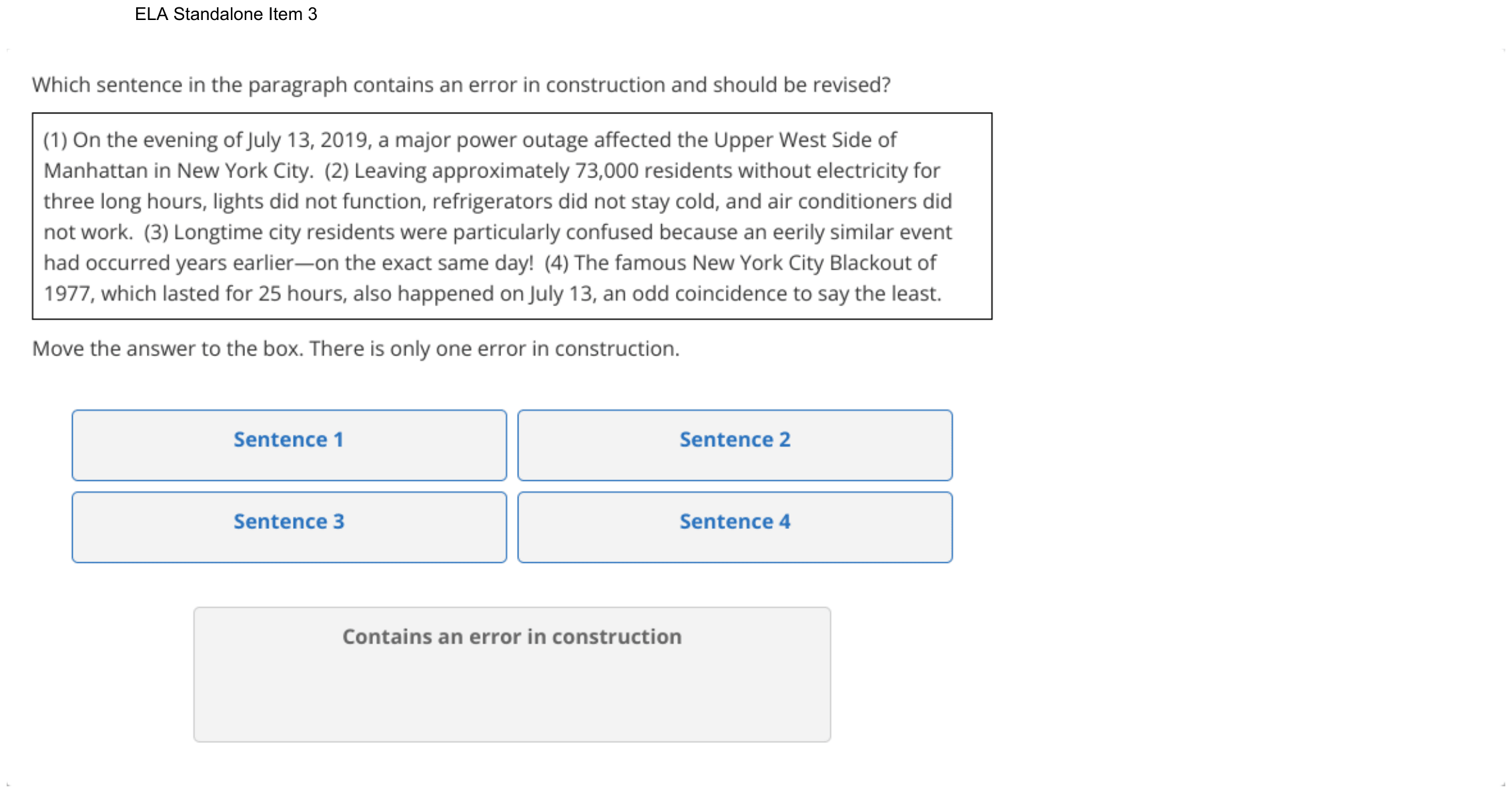
Which sentence in the paragraph contains an error in construction and should be revised?
(1) On the evening of July 13, 2019, a major power outage affected the Upper West Side of Manhattan in New York City. (2) Leaving approximately 73,000 residents without electricity for three long hours, lights did not function, refrigerators did not stay cold, and air conditioners did not work. (3) Longtime city residents were particularly confused because an eerily similar event had occurred years earlier—on the exact same day! (4) The famous New York City Blackout of 1977, which lasted for 25 hours, also happened on July 13, an odd coincidence to say the least.
Move the answer to the box. There is only one error in construction.
Contains an error in construction
On the test you drag one of the tiles into the box; here, choose it.
- ASentence 1
- BSentence 2
- CSentence 3
- DSentence 4
Show the answer
Correct answer: B
The question asks which sentence in the paragraph contains an error in construction.
Sentence 1: Construction is correct. An introductory prepositional phrase is correctly punctuated in sentence 1 and describes when the power outage occurred. Similarly, the direct object, “the Upper West Side of Manhattan in New York City,” is presented clearly in terms of what area was “affected” by the power outage.
Sentence 2: Contains an error in construction. In sentence 2, the phrase “Leaving approximately 73,000 residents without electricity for three long hours” is a dangling modifier because it is not clearly modifying any word or words in the sentence. It actually further describes the “power outage” in sentence 1. In clear and correct construction, all modifiers should be in the same sentence as and near the words they describe in order to avoid confusion.
Sentence 3: Construction is correct. A dash is used appropriately in sentence 3 to show a break in thought and to introduce the phrase “on the exact same day.”
Sentence 4: Construction is correct. Two commas are used correctly in sentence 4 to set off the nonessential clause “which lasted for 25 hours” from the rest of the sentence. Similarly, one comma is used to set off the nonessential appositive “an odd coincidence to say the least.” Both of these elements are nonessential to the sentence’s overall meaning and are thus correctly separated from the sentence by the use of commas.
Question analysis
This editing question gives a four-sentence paragraph about the July 13, 2019, blackout on Manhattan's Upper West Side, which fell on the same date as the famous 1977 New York City blackout. On the test students move one sentence tile into a box marked as containing an error in construction, and since the error is not named, every sentence must be checked.
- NYS standards
- 7L1 grammar and usage conventions
- Grade level
- Grade 7 reading and task
- Compared with grade 7
- At grade 7 Finding a sentence with a construction error in a short paragraph is typical grade 7 editing. The question does not name the kind of error, and the paragraph's dash, exclamation point and added phrases all give students something to second-guess.
- Estimated difficulty
- Moderate: several steps, or a close reading with one strong distractor.
- Thinking it demands
- Depth of knowledge 2, skills and concepts · mainly analyze
- What makes it hard
- A rule that doesn't sound wrong moderate
- Every choice must be checked moderate
- Evidence
- Answered from one paragraph or stanza
- Reading level
- Question and choices: about grade 8, 122 words.
- Students, last 30 days
- Not enough answers yet to show (it takes 10).
Why it is hard, traps and wrong answers (shows the answer)
Why it is hard
The dangling phrase is easy to accept because the reader already knows from sentence 1 what left the residents in the dark. Students who do not ask what the opening phrase describes look elsewhere, and sentence 4 is the likeliest victim, since its closing phrase about an odd coincidence seems to hang loose. The question rewards naming the subject of each sentence and checking that every added phrase belongs to it.
A rule that doesn't sound wrong moderate Working it out
The opening phrase of sentence 2, “Leaving approximately 73,000 residents without electricity,” has no word to modify; it sounds acceptable because sentence 1’s power outage supplies the missing subject. (Connors & Lunsford, 1988)
Every choice must be checked moderate Choosing the answer
The error is not named, and three sentences hold features that invite doubt: sentence 1’s date and place names, sentence 3’s dash and exclamation point, sentence 4’s two set-off phrases. (Embretson & Wetzel, 1987)
Strategy: Take the sentences one at a time: name the subject and main verb, ask what each opening or added phrase describes, and check whether each mark of punctuation has a job.
Traps
- Fixes what isn't broken: Changes a part of the sentence that was already correct, while the real error stays; or, where the question asks which sentence has an error or should go, picks one that is correct and belongs.
The wrong answers, classified
A Fixes what isn't broken (Connors & Lunsford, 1988)
Suspects the long opening date or the string of place names, though sentence 1 has a clear subject and verb and its introductory phrase is correctly punctuated.
C Fixes what isn't broken (Connors & Lunsford, 1988)
Treats the dash and the exclamation point as errors because they look informal, though the dash correctly sets off “on the exact same day” and the sentence is complete.
D Fixes what isn't broken (Connors & Lunsford, 1988)
Rightly checks what each phrase describes but decides “an odd coincidence to say the least” dangles, though it correctly sums up the whole clause before it.
Working it out, step by step
Figure out what the question asks
This question asks which sentence is built wrong. On the test, you move one sentence tile into the box. The question doesn’t name the kind of error. So check each sentence. Find its subject, who or what the sentence is about, and its verb.
Learn the rule: no dangling modifier
A modifier is a word or phrase that describes something. An opening phrase must describe the subject right after the comma. If it can’t, it is a dangling modifier. Example: Running to the bus, my backpack fell. The backpack wasn’t running! Fix: Running to the bus, I dropped my backpack.
Test sentence 2
Sentence 2 opens with “Leaving approximately 73,000 residents without electricity for three long hours.” What did the leaving? The power outage did, but the outage is back in sentence 1. After the comma, the subject is “lights.” Lights didn’t leave people without power. So the opening phrase dangles. One fix: The outage left about 73,000 residents without electricity for three long hours. Then a new sentence lists what stopped working.
Check the other sentences
- Sentence 1 is correct. Its opening phrase tells when, and a comma sets it off. Its subject is “a major power outage,” and its verb is “affected.”
- Sentence 3 is correct. The dash sets off “on the exact same day” for effect. The sentence is complete.
- Sentence 4 is correct. Commas set off “which lasted for 25 hours.” The ending, “an odd coincidence to say the least,” sums up the fact before it.
Watch out: Sentence 4 tempts many students, because its ending seems to hang loose. But it names the whole fact before it, the same date. That is allowed.
Choose the answer
Only sentence 2 has an opening phrase with nothing to describe. So the answer is B: move the tile “Sentence 2” into the box labeled “Contains an error in construction.”
Why this answer and not the closest wrong one
Sentence 4 is the closest wrong answer, because “an odd coincidence to say the least” seems loose. But it sums up the whole idea before it, which is correct. In sentence 2, the opening phrase should describe the outage. Yet the word after the comma is “lights.”
More questions like this
The original DOE question
Question 3 of 57
2023 Test B English, question 3Question
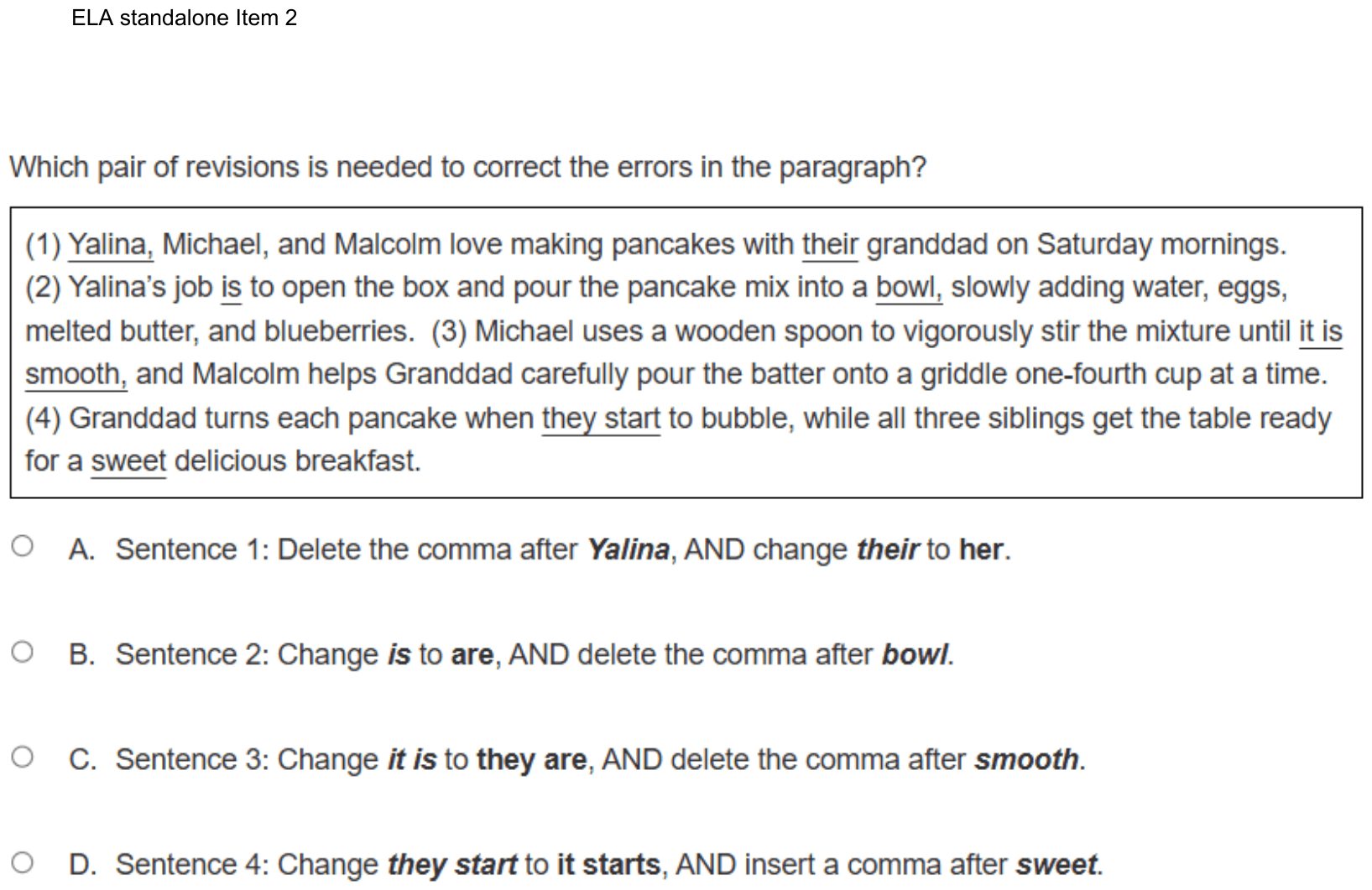
Which pair of revisions is needed to correct the errors in the paragraph?
(1) Yalina, Michael, and Malcolm love making pancakes with their granddad on Saturday mornings. (2) Yalina’s job is to open the box and pour the pancake mix into a bowl, slowly adding water, eggs, melted butter, and blueberries. (3) Michael uses a wooden spoon to vigorously stir the mixture until it is smooth, and Malcolm helps Granddad carefully pour the batter onto a griddle one-fourth cup at a time. (4) Granddad turns each pancake when they start to bubble, while all three siblings get the table ready for a sweet delicious breakfast.
- ASentence 1: Delete the comma after Yalina, AND change their to her.
- BSentence 2: Change is to are, AND delete the comma after bowl.
- CSentence 3: Change it is to they are, AND delete the comma after smooth.
- DSentence 4: Change they start to it starts, AND insert a comma after sweet.
Show the answer
Correct answer: D
The question asks which two revisions are needed to correct the paragraph.
A. Incorrect. The comma is needed after “Yalina” to separate the first and second names in the series of three names (Yalina, Michael, and Malcolm). The possessive determiner “their” is also correct as written because it refers back to “Yalina, Michael, and Malcolm,” a plural group of people.
B. Incorrect. Changing “is” to “are” would introduce an error in subject-verb agreement into the sentence; the singular subject “Yalina’s job” requires the singular verb “is.” The comma after “bowl” is required because it separates the phrase “slowly adding water, eggs, melted butter, and blueberries,” which modifies how Yalina prepares the batter, from the remainder of the sentence.
C. Incorrect. “It is” refers to the singular noun “mixture,” so this singular pronoun and verb form is correct. The comma after “smooth” is necessary because this is a compound sentence where two independent clauses (“Michael uses a wooden spoon to vigorously stir the mixture until it is smooth” and “Malcolm helps Granddad carefully pour the batter onto a griddle one-fourth cup at a time”) are joined using a coordinating conjunction, which requires a comma.
D. CORRECT. The plural pronoun “they” refers incorrectly to a singular antecedent, “each pancake.” The pronoun should be changed to a singular one to match its antecedent. A comma is needed between two adjectives of equal importance that modify the noun “breakfast.” Because “sweet” and “delicious” could be written as “sweet and delicious,” they are of equal importance, and a comma is needed.
Question analysis
This editing question gives a four-sentence paragraph about three siblings making blueberry pancakes with their granddad and asks which pair of revisions corrects its errors. Eight words or commas are underlined, and each choice bundles a pronoun or verb change with a comma change in one sentence, so a choice is right only if both of its edits are needed.
- Grade level
- Grade 7 reading and task
- Compared with grade 7
- At grade 7 Pronoun and verb agreement and comma use are grade 6 and 7 conventions. Checking eight underlined spots across four long sentences, and accepting a pair only when both edits are needed, matches typical grade 7 editing.
- Estimated difficulty
- Moderate: several steps, or a close reading with one strong distractor.
- Thinking it demands
- Depth of knowledge 2, skills and concepts · mainly apply
- What makes it hard
- A rule that doesn't sound wrong moderate
- Every choice must be checked moderate
- Evidence
- Answered from one paragraph or stanza
- Reading level
- Question and choices: about grade 8, 149 words.
- Students, last 30 days
- Not enough answers yet to show (it takes 10).
Why it is hard, traps and wrong answers (shows the answer)
Why it is hard
The errors sit together in the paragraph's last sentence, and neither is heard easily, so students who judge by ear look for problems elsewhere. The strongest pull applies two familiar but wrong rules, no comma before “and” and a plural pronoun for a mixture of several ingredients, to a sentence that is already correct. The question rewards testing each pronoun against its noun and each comma against a rule before reading the pairs.
A rule that doesn't sound wrong moderate Working it out
Both real errors sound natural: “each pancake … when they start to bubble” passes because several pancakes are cooking, and “sweet delicious breakfast” seldom sounds as if it needs a comma between its adjectives. (Connors & Lunsford, 1988)
Every choice must be checked moderate Choosing the answer
Eight underlined spots are paired into four proposed revisions, one pair per sentence, and a pair is right only if both of its edits fix real errors, so every edit has to be tried in place. (Embretson & Wetzel, 1987)
Strategy: Before reading the choices, test each underlined spot yourself: find what each pronoun and verb refers to, and decide whether each comma is needed. Then look for the pair whose two edits both fix real errors.
Traps
- Fixes what isn't broken: Changes a part of the sentence that was already correct, while the real error stays; or, where the question asks which sentence has an error or should go, picks one that is correct and belongs.
- Agreement: A verb that does not agree with its subject, or a pronoun that does not agree with the word it stands for.
- Punctuation: A comma, semicolon, colon, dash or apostrophe used where it does not belong, or missing where it does.
The wrong answers, classified
A Fixes what isn't broken (Connors & Lunsford, 1988)
Deletes the comma after the first of three names in a series and changes “their” to “her,” though the pronoun refers to all three siblings.
B Agreement (Connors & Lunsford, 1988)
Counts two tasks, opening the box and pouring, and wants the plural “are,” though the subject is the singular “job,” and drops the comma before “slowly adding.”
C Punctuation (Connors & Lunsford, 1988)
Applies the rule that a comma never comes before “and,” though this one joins two complete clauses, and makes “it” plural for the ingredients, though it means the mixture.
Working it out, step by step
Figure out what the question asks
Eight spots are underlined. Each choice offers two changes in one sentence. A choice is right only if both of its changes fix real errors. So test each underlined spot yourself first.
Test sentence 1
Commas go between the items in a list of three or more: ham, eggs, and toast. So the comma after “Yalina” is needed. “Their” is plural, and it means all three kids, so it is correct too. Nothing needs fixing here, so A is out.
Test sentence 2
A verb must match its subject, the word the sentence is about. Here the subject is “Yalina’s job,” one job, so “is” is right. Example: My chore is easy, not My chore are easy. The comma after “bowl” is needed too. It shows that “slowly adding water” tells what Yalina does. Without it, the bowl seems to be adding the water. So B is out.
Test sentence 3
“It” means “the mixture,” one thing, so “it is” is correct. The comma after “smooth” comes before “and.” When and joins two complete sentences, put a comma before it. Example: I made the salad, and Dad grilled the fish. Here both halves are complete: Michael stirs, and Malcolm pours. So C is out.
Watch out: Some students learn that a comma never goes before and. That is not true when and joins two complete sentences. Believing it leads to C.
Fix the pronoun in sentence 4
A pronoun must match its noun in number. One thing takes it, and more than one takes they. Here the noun is “each pancake,” one at a time. So “they start” should be “it starts.” Example: Each cookie is done when it turns brown.
Watch out: Many pancakes are on the griddle, so they sounds fine. But each means you are talking about one pancake at a time.
Fix the comma in sentence 4
Two describing words of equal weight need a comma between them. Test: can you put and between them, or swap them? Sweet and delicious breakfast and delicious, sweet breakfast both work. So write sweet, delicious breakfast. Compare three small dogs. You can’t say three and small dogs, so no comma there.
Choose the answer
Both changes in sentence 4 fix real errors. Fixed, it reads: Granddad turns each pancake when it starts to bubble, while all three siblings get the table ready for a sweet, delicious breakfast. So the answer is D.
Why this answer and not the closest wrong one
C is the closest wrong answer. It relies on two wrong ideas: that a comma never comes before and, and that a mix of many ingredients needs they. But the comma joins two complete sentences, and “it” means the one mixture. Only D’s two changes both fix real errors.
More questions like this
The original DOE question
Question 4 of 57
2023 Test B English, question 4Passage The End of an Era
The End of an Era
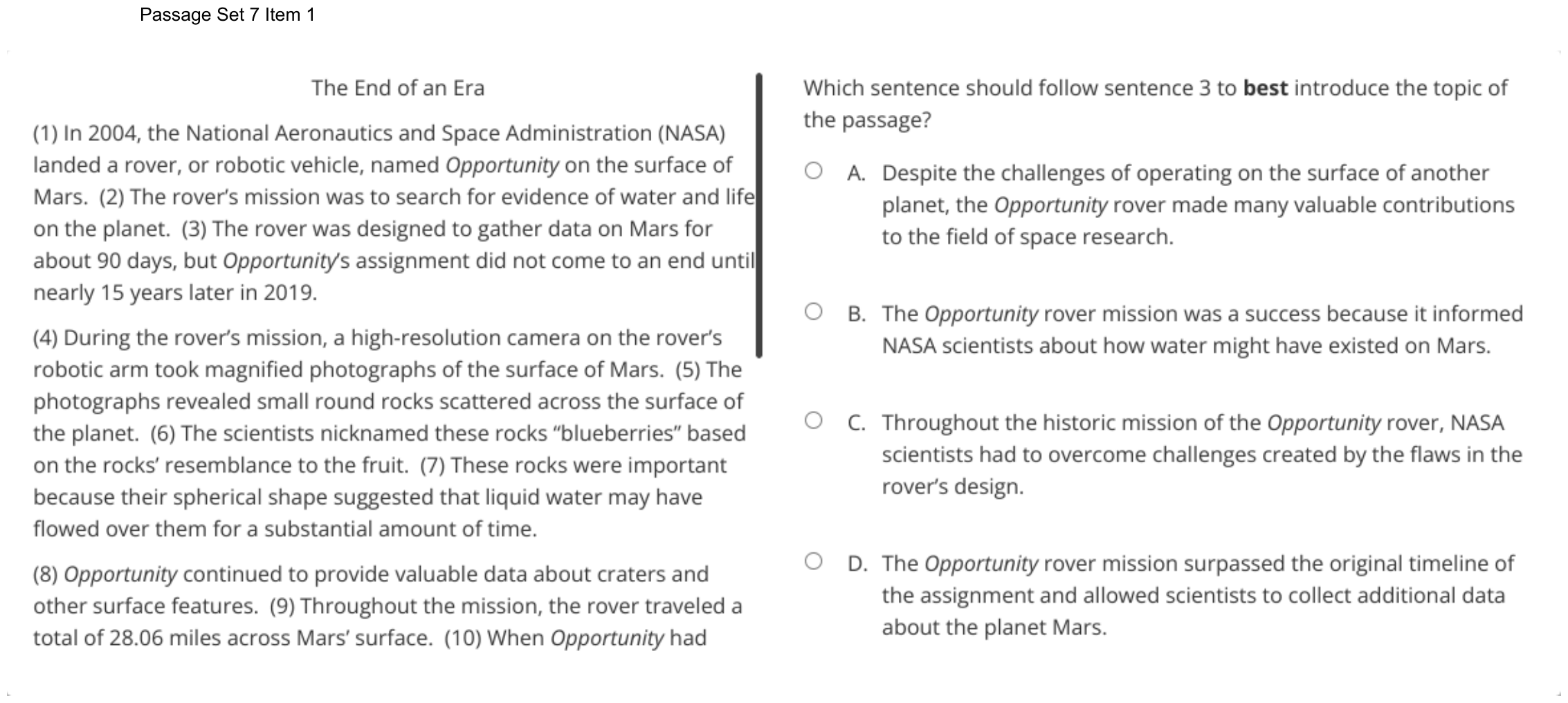
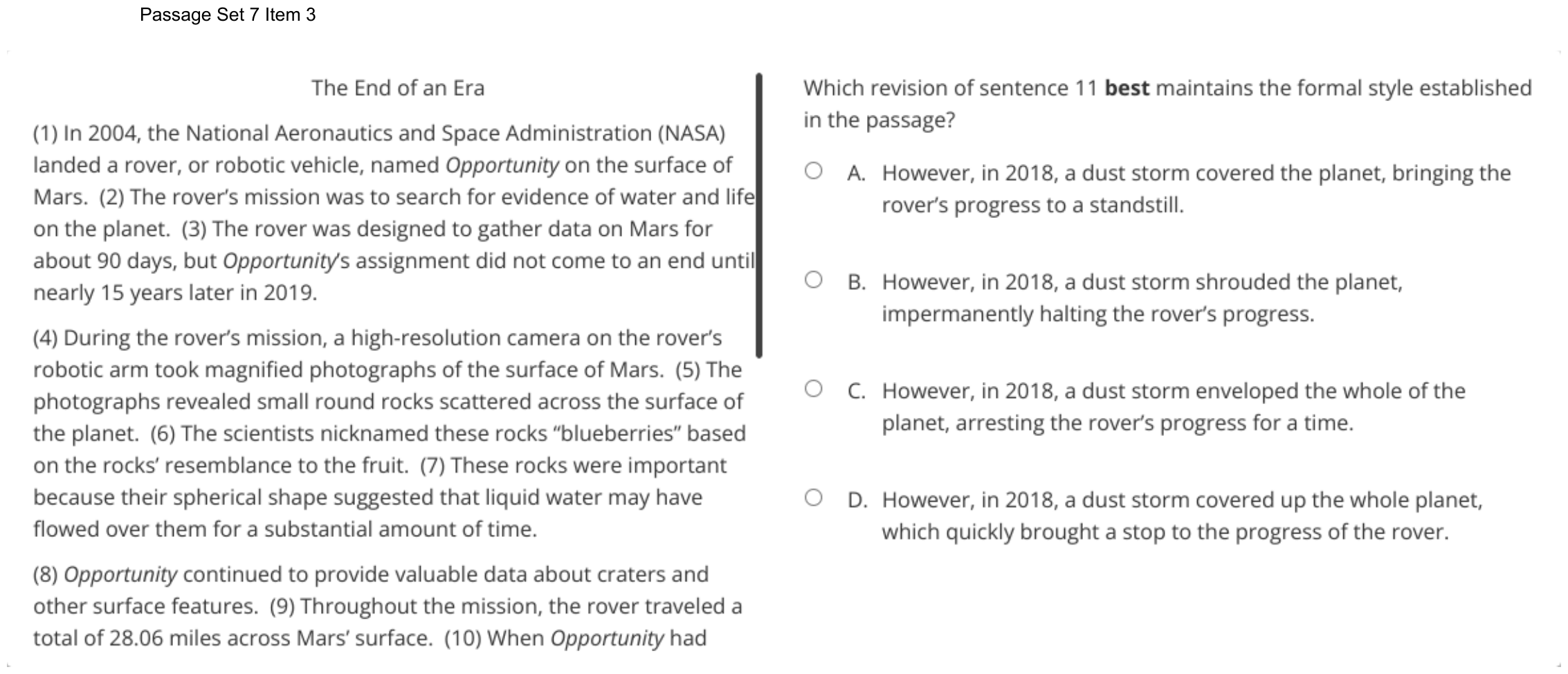
(1) In 2004, the National Aeronautics and Space Administration (NASA) landed a rover, or robotic vehicle, named Opportunity on the surface of Mars. (2) The rover’s mission was to search for evidence of water and life on the planet. (3) The rover was designed to gather data on Mars for about 90 days, but Opportunity’s assignment did not come to an end until nearly 15 years later in 2019.
(4) During the rover’s mission, a high-resolution camera on the rover’s robotic arm took magnified photographs of the surface of Mars. (5) The photographs revealed small round rocks scattered across the surface of the planet. (6) The scientists nicknamed these rocks “blueberries” based on the rocks’ resemblance to the fruit. (7) These rocks were important because their spherical shape suggested that liquid water may have flowed over them for a substantial amount of time.
(8) Opportunity continued to provide valuable data about craters and other surface features. (9) Throughout the mission, the rover traveled a total of 28.06 miles across Mars’ surface. (10) When Opportunity had traveled nearly the length of a marathon, scientists celebrated the accomplishment by naming the valley that the rover was in Marathon Valley. (11) However, in 2018, a dust storm spread all over the planet, putting the rover’s progress on hold.
(12) Prior to this planet-wide dust storm, minor dust storms had periodically deposited a layer of dust onto the solar panels of the rover. (13) These prevented it from charging its batteries. (14) Scientists then had to rely on the passing winds and dust devils to clean off the solar panels. (15) After the massive 2018 dust storm subsided, scientists expected to be able to reestablish communication with Opportunity. (16) They made repeated attempts but to no avail. (17) In 2019, NASA finally declared Opportunity’s mission complete.
(18) Opportunity was an important asset in scientists’ study of Mars; it returned valuable data about our neighbor planet and survived powerful dust storms. (19) NASA described the mission of Opportunity as “one of the most successful and enduring feats of interplanetary exploration.” (20) Even though this rover’s journey ended, other rovers still roam the surface of Mars.
Question
Which sentence should follow sentence 3 to best introduce the topic of the passage?
- ADespite the challenges of operating on the surface of another planet, the Opportunity rover made many valuable contributions to the field of space research.
- BThe Opportunity rover mission was a success because it informed NASA scientists about how water might have existed on Mars.
- CThroughout the historic mission of the Opportunity rover, NASA scientists had to overcome challenges created by the flaws in the rover’s design.
- DThe Opportunity rover mission surpassed the original timeline of the assignment and allowed scientists to collect additional data about the planet Mars.
Show the answer
Correct answer: A
The question asks for the sentence that should follow sentence 3 to best introduce the topic of the passage.
A. CORRECT. This sentence best introduces the passage’s topic: the Opportunity rover had many accomplishments on its mission, despite numerous challenges. Some of those accomplishments include providing high-resolution photographs (paragraph 2), traveling long distances (paragraph 3), and providing data about craters and other surface features (paragraph 3).
B. Incorrect. Although paragraph 2 discusses how photographs taken by the rover showed rocks that may have been shaped by water, this idea alone is not the topic of the entire passage.
C. Incorrect. While this sentence incorporates ideas about difficulties the scientists encountered because of the Opportunity rover’s design (paragraph 4), the main topic of the passage is not the design flaws and obstacles scientists encountered throughout the mission. The passage primarily focuses on the achievements of the mission.
D. Incorrect. While it is true that the Opportunity rover mission lasted much longer than planned (sentence 3), this fact is a supporting detail of the passage, not the main topic of the passage; surpassing the original timeline is only one of the rover’s many achievements mentioned in the passage.
Question analysis
This revising question works with “The End of an Era,” a passage about NASA's Opportunity rover on Mars, and asks which sentence should follow sentence 3 to best introduce the topic. Students must keep the whole passage in view, from the rover's photographs and travels to the dust storms that ended its mission, and judge which choice previews it best.
- NYS standards
- 7W2a introducing and organizing a topic
- Grade level
- Grade 7 reading and task
- Compared with grade 7
- At grade 7 Choosing a sentence that introduces a passage's topic is a standard grade 7 writing task. The passage is twenty plain sentences about one rover mission, and every choice draws on that mission, so it calls for a typical careful comparison.
- Estimated difficulty
- Moderate: several steps, or a close reading with one strong distractor.
- Thinking it demands
- Depth of knowledge 2, skills and concepts · mainly evaluate
- What makes it hard
- Evidence in several places moderate
- How sentences fit together minor
- Evidence
- Answered from the whole text
- Reading level
- Passage: about grade 11, 337 words; question and choices: about grade 14, 101 words.
- Students, last 30 days
- Not enough answers yet to show (it takes 10).
Why it is hard, traps and wrong answers (shows the answer)
Why it is hard
Sentence 3 already tells a striking story, a 90-day mission that lasted nearly fifteen years, and the most tempting continuation simply repeats it in new words. The other near misses each pick one part of the passage, the water evidence or the dust problems, and make it the whole. The question rewards skimming every paragraph first and choosing the sentence that covers both the achievements and the hardships, the pairing the final paragraph makes.
Evidence in several places moderate Working it out
The topic only emerges from the later paragraphs: the “blueberries” of sentences 4–7, the 28.06 miles of paragraph 3, the dust storms of paragraph 4 and NASA’s praise in sentence 19. (Kirsch & Mosenthal, 1990; Gorin & Embretson, 2006)
How sentences fit together minor Working it out
The new sentence follows sentence 3’s surprise that a 90-day mission lasted nearly 15 years, so it must turn from that fact to what the mission achieved. (Halliday & Hasan, 1976)
Strategy: Skim the opening sentence of each later paragraph to see what the passage covers, then ask which choice would prepare a reader for all of it.
Traps
- Too narrow: A single detail offered as the central idea or a summary, or a summary that keeps minor details and leaves out an essential part.
- Says it twice: Repeats an idea that the sentence or passage already states.
- Off the point: Adds or keeps something that does not support the paragraph's or the passage's focus, or an introduction or conclusion that misses the main point.
The wrong answers, classified
B Too narrow (King et al., 2004)
Picks the water finding of paragraph 2, a real result, but it covers one paragraph and leaves out the rover’s travels, its endurance and the dust storms.
C Off the point (Halliday & Hasan, 1976)
Builds on the dust that blocked the solar panels in paragraph 4, but the passage never blames flaws in the rover’s design and dwells on its achievements.
D Says it twice (Connors & Lunsford, 1988)
Follows sentence 3 smoothly, but saying the mission “surpassed the original timeline” only restates the 90 days that became 15 years instead of introducing what comes next.
Working it out, step by step
Figure out what the question asks
This revising question asks for a sentence to add after sentence 3. It should introduce the topic of the whole passage. A good introduction gives a preview, a quick look at everything coming. It doesn’t repeat one fact or zoom in on one part. For example, a report on a soccer season might begin: The team lost two stars but still won the title. That previews both the struggles and the wins.
Skim each paragraph
- Paragraph 2 (sentences 4–7): The rover’s camera found small round rocks that hinted at water.
- Paragraph 3 (sentences 8–11): It sent data and traveled 28.06 miles. Then a huge dust storm stopped it.
- Paragraph 4 (sentences 12–17): Dust had covered its solar panels before. After the 2018 storm, NASA could not reach it.
- Paragraph 5 (sentences 18–20): It “returned valuable data about our neighbor planet and survived powerful dust storms.”
Name the topic
So the passage covers two things. One is what the rover achieved: photos, data and miles. The other is its challenges, mainly the dust storms. Challenges are hard problems. Sentence 18 puts both together. The new sentence should preview both.
Check each choice
- A is right. It names the challenges and the “many valuable contributions.” That covers the whole passage.
- B is wrong. Water is only paragraph 2. It leaves out the travel and the dust storms.
- C is wrong. The passage never blames flaws in the rover’s design. It mostly praises the rover.
- D is wrong. Sentence 3 already says the mission lasted far past 90 days. D repeats it instead of looking ahead.
Watch out: D follows sentence 3 smoothly, so it sounds right. But it only restates sentence 3 in new words.
Choose the answer
So the answer is A: “Despite the challenges of operating on the surface of another planet, the Opportunity rover made many valuable contributions to the field of space research.”
Why this answer and not the closest wrong one
D is the closest wrong answer, because it flows right after sentence 3. But it only repeats that the mission lasted longer than planned. A previews both halves of the passage: the rover’s achievements and the challenges it survived. Sentence 18 sums up the same two ideas.
More questions like this
The original DOE question
The passage “The End of an Era” as printed (page 60)
Question 5 of 57
2023 Test B English, question 5Uses the passage above: “The End of an Era”.
Question
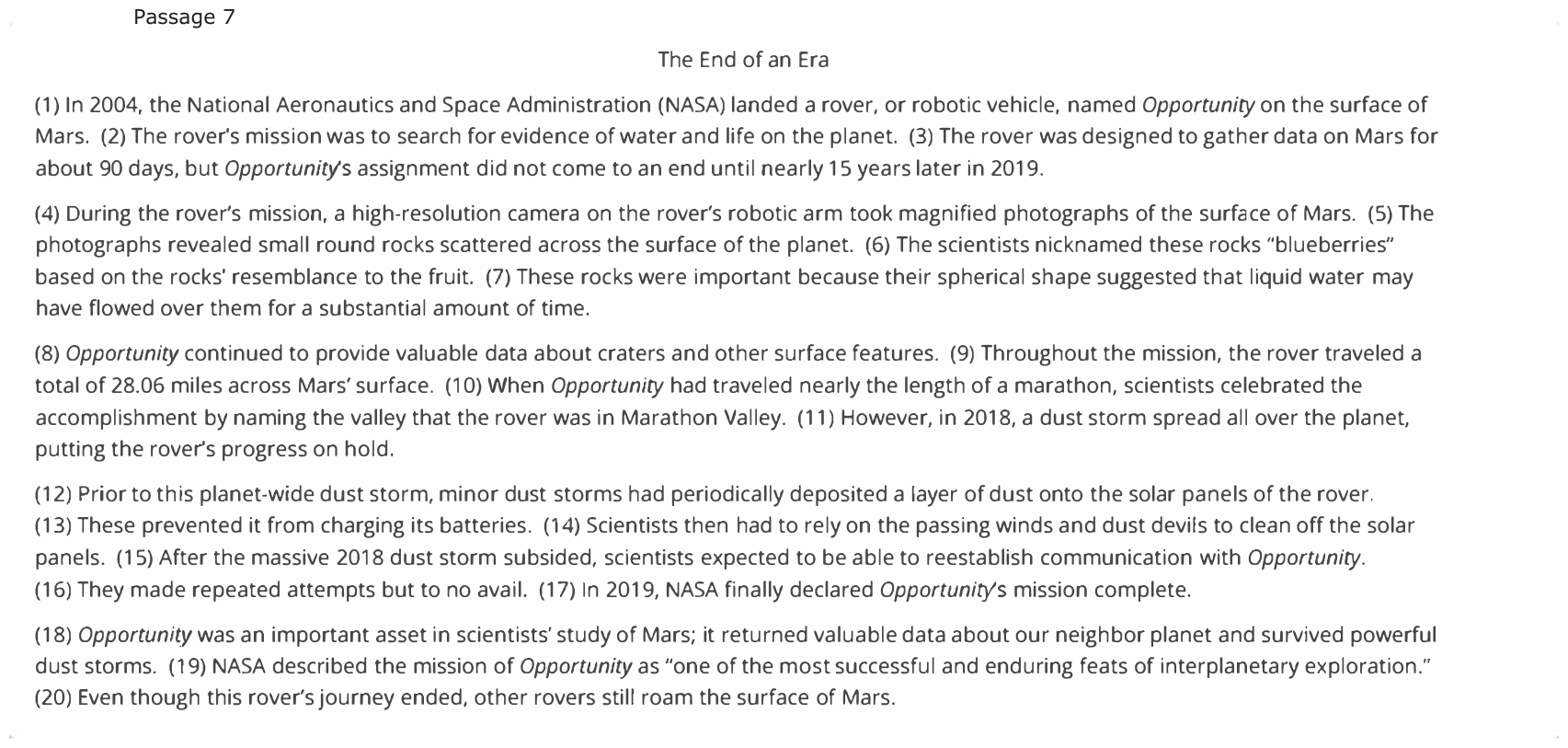
Which word should be added to the beginning of sentence 8 to provide a better transition to the third paragraph (sentences 8–11)?
Move the correct answer to the box.
(8) ____ Opportunity continued to provide valuable data about craters and other surface features.
On the test you drag one of the tiles into the box; here, choose it.
- AOverall,
- BFurthermore,
- CMeanwhile,
- DConsequently,
Show the answer
Correct answer: C
The question asks for the word that should be added to the beginning of sentence 8 to provide a better transition to the third paragraph (sentences 8–11).
“Overall,” is incorrect and should not be added. While sentence 8 is a more general statement than sentence 7, the word “Overall” would imply that all of the third paragraph features general information about the Opportunity rover. Instead, paragraphs 2 and 3 both describe specific accomplishments of the Opportunity rover (the discovery of possible water on Mars and the distance the rover traveled), so these paragraphs require a word between them that does not transition from the specific to the general.
“Furthermore,” is incorrect and should not be added. The word “Furthermore” would suggest that the author is making an argument in paragraph 2 that is further developed by the statement in sentence 8 and the rest of paragraph 3. Because this is not the case, the word “Furthermore” is not a suitable transition from one paragraph to the next.
“Meanwhile,” is correct and should be added. The word “Meanwhile” is an appropriate transition to add to the beginning of sentence 8, since the actions of the Opportunity rover in paragraph 2 (taking photographs) and in paragraph 3 (traveling long distances) happened at the same time and both served critical functions to the overall mission.
“Consequently,” is incorrect and should not be added. The word “Consequently” would create a cause-and-effect relationship that does not exist between the paragraphs. The passage gives no indication that the rover’s actions in the third paragraph (traveling a far distance) resulted from the actions in the second paragraph (taking photographs).
Question analysis
In this transition question, sentence 8 opens the third paragraph of the Opportunity rover passage with a blank, and on the test students move one of four word tiles into the box. The paragraph before ends with the “blueberries,” small round rocks that hinted at water, so students must decide how the rover's further work relates to that discovery.
- NYS standards
- 7W2d transitions in informative writing
- Grade level
- Grade 7 reading and task
- Compared with grade 7
- Above grade 7 Choosing a transition is regular grade 7 writing work, but this one links two paragraphs, and two of the four words fit the sentence's grammar and sound natural, so the choice turns on exactly how the paragraphs relate.
- Estimated difficulty
- Hard: combines ideas, needs a plan, and has more than one tempting wrong answer.
- Thinking it demands
- Depth of knowledge 2, skills and concepts · mainly evaluate
- What makes it hard
- A very close wrong answer moderate
- How sentences fit together moderate
- Reading between the lines minor
- Evidence
- Answered from several paragraphs or stanzas
- Reading level
- Passage: about grade 11, 337 words; question and choices: about grade 9, 43 words.
- Students, last 30 days
- Not enough answers yet to show (it takes 10).
Why it is hard, traps and wrong answers (shows the answer)
Why it is hard
Two tiles sound natural in the blank, and the one most students reach for first is an all-purpose adding word. The key goes a step further: it marks the rover’s work in paragraph 3 as happening alongside the photographs of paragraph 2, a relationship the word “continued” supports. Students who test each tile against how the paragraphs relate, rather than against the sound of the sentence, also rule out a summing-up word and a cause word.
A very close wrong answer moderate Choosing the answer
“Furthermore” and “Meanwhile” both let paragraph 3 add to paragraph 2; only “Meanwhile” also says the rover’s further work went on during the same mission, as “continued” implies. (Embretson & Wetzel, 1987; Gorin & Embretson, 2006; Ascalon et al., 2007)
How sentences fit together moderate Working it out
The tile must link the “blueberries” of paragraph 2 to the craters and miles of paragraph 3, so students must decide how two paragraphs relate, not just two sentences. (Halliday & Hasan, 1976)
Reading between the lines minor Working it out
The timing is never stated; it comes from “During the rover’s mission” in sentence 4 and “continued” in sentence 8, which place both kinds of work in the same years. (Graesser, Singer & Trabasso, 1994; Kintsch, 1998)
Strategy: State in your own words how what the rover did in paragraph 2 relates to what it did in paragraph 3, then test the relationship each tile signals against that.
Traps
- Wrong transition: A connecting word or phrase that signals the wrong relationship, such as contrast where the idea continues.
The wrong answers, classified
A Wrong transition (Halliday & Hasan, 1976)
Treats sentence 8 as a summing up because it is broader than sentence 7, though paragraph 3 goes on to give new specifics such as the 28.06 miles.
B Wrong transition (Halliday & Hasan, 1976)
Adds paragraph 3 as one more achievement, which sounds natural, but “Furthermore” signals a point being built up, not two kinds of work carried on during one mission.
D Wrong transition (Halliday & Hasan, 1976)
Hears “continued” as a result of the blueberry discovery and adds a cause-and-effect link, though nothing says the rover’s later work followed from its photographs.
Working it out, step by step
Figure out what the question asks
On the test, you move one word tile into the box at the start of sentence 8. The word is a transition, a word that shows how two ideas connect. Some transitions add an idea, some show a result, some sum up, and some show time. You need the one that links paragraph 2 to paragraph 3.
Compare the two paragraphs
Paragraph 2 begins “During the rover’s mission.” It tells how the camera found the round rocks called “blueberries.” Paragraph 3 begins “Opportunity continued to provide valuable data about craters and other surface features.” Craters are bowl-shaped holes in the ground. So paragraph 3 tells about other work the rover kept doing in those same years.
Test each transition
- Overall sums things up. But paragraph 3 gives new facts, like the 28.06 miles.
- Furthermore adds one more reason to an argument, as in Dogs are loyal. Furthermore, they are fun. But paragraph 2 isn’t arguing a point. It tells what the rover did.
- Meanwhile means during that same time. It links things that go on together.
- Consequently means as a result. But the photos didn’t cause the rover’s later work.
See why “Meanwhile” fits
While the camera was finding blueberries, the rover was also studying craters and driving many miles. The word “continued” in sentence 8 shows that the work kept going. “Meanwhile” tells the reader these jobs happened during the same mission.
Watch out: “Furthermore” sounds natural in the blank, so many students choose B. But it only says here is one more point. It doesn’t show two kinds of work going on at the same time.
Choose the answer
With the tile in place, sentence 8 reads: Meanwhile, Opportunity continued to provide valuable data about craters and other surface features. So the answer is C: move the tile “Meanwhile,” into the box.
Why this answer and not the closest wrong one
B, “Furthermore,” is the closest wrong answer, because it also adds information. But it treats paragraph 2 as one point in an argument. The passage just tells what the rover did. “Meanwhile” links the two paragraphs in time, and it matches the word “continued.”
More questions like this
The original DOE question
Question 6 of 57
2023 Test B English, question 6Uses the passage above: “The End of an Era”.
Question
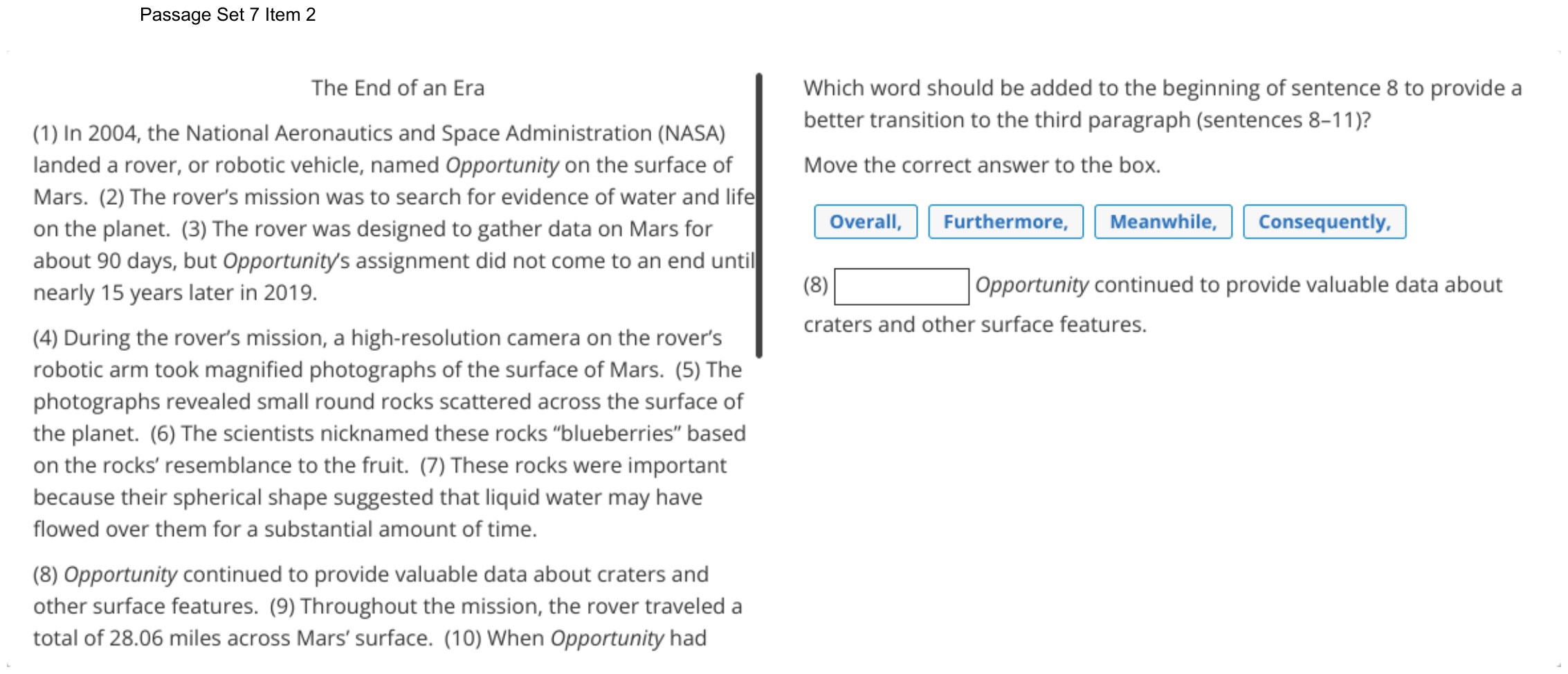
Which revision of sentence 11 best maintains the formal style established in the passage?
- AHowever, in 2018, a dust storm covered the planet, bringing the rover’s progress to a standstill.
- BHowever, in 2018, a dust storm shrouded the planet, impermanently halting the rover’s progress.
- CHowever, in 2018, a dust storm enveloped the whole of the planet, arresting the rover’s progress for a time.
- DHowever, in 2018, a dust storm covered up the whole planet, which quickly brought a stop to the progress of the rover.
Show the answer
Correct answer: A
The question asks for the revision of sentence 11 that best maintains the formal style established in the passage.
A. CORRECT. This sentence uses clear and formal writing throughout. The phrase “covered the planet” is accurate and formal without being overly poetic, and “standstill” is a precise word for putting something “on hold,” as expressed by the original sentence, while maintaining the formal style of the passage.
B. Incorrect. Although the sentence is formal in style, the word “shrouded” is overly poetic, and the phrase “impermanently halting” is too stilted and formal for the style and tone of the passage.
C. Incorrect. Although the sentence is formal in style, the words “enveloped” and “arresting” are overly poetic, especially when used in the same sentence, and the phrases “the whole of the planet” and “for a time” are needlessly wordy and imprecise, compared with the formal scientific language of the passage.
D. Incorrect. The phrases “covered up the whole planet” and “quickly brought a stop to the progress of the rover” are less formal and unnecessarily wordy, compared with the formal style established by the rest of the passage.
Question analysis
This style question asks which revision of sentence 11, about the 2018 dust storm that covered Mars and stopped the Opportunity rover, best maintains the formal style of the passage. All four versions say the same thing, so students must compare word choice and wordiness and decide which one reads like the rest of the passage.
- Grade level
- Grade 8 reading and task
- Compared with grade 7
- Above grade 7 Keeping a formal style is grade 7 writing work, usually tested by spotting slang or casual wording. Here all four revisions keep the meaning and differ in register by degrees, so students must judge the passage's own style closely, more than typical.
- Estimated difficulty
- Hard: combines ideas, needs a plan, and has more than one tempting wrong answer.
- Thinking it demands
- Depth of knowledge 2, skills and concepts · mainly evaluate
- What makes it hard
- Something you must already know moderate
- Every choice must be checked moderate
- Hard words minor
- Evidence
- Answered from one sentence or line
- Reading level
- Passage: about grade 11, 337 words; question and choices: about grade 9, 80 words.
- Students, last 30 days
- Not enough answers yet to show (it takes 10).
Why it is hard, traps and wrong answers (shows the answer)
Why it is hard
The question turns on what “formal” means. Many students equate it with impressive words and choose the revision with “enveloped” and “arresting,” or the one with “shrouded,” missing that both are more poetic than a passage that reports dates and distances. The casual revision is easy to reject, so the real test is preferring the plainest formal sentence to the grandest one.
Something you must already know moderate Working it out
Students must know that a formal informational style is plain and precise, so words such as “shrouded,” “enveloped” and “arresting” are too ornate for a passage that reports miles and dates. (Anderson & Krathwohl, 2001)
Every choice must be checked moderate Choosing the answer
All four revisions keep the meaning of sentence 11 and differ only in register and length, so each must be heard against the passage’s voice rather than checked for errors. (Embretson & Wetzel, 1987)
Hard words minor Understanding the question
“Impermanently,” “shrouded” and “arresting,” in its sense of stopping, are uncommon words, and students must judge how they sound in the passage, not only what they mean. (Perfetti, 2007; Freedle & Kostin, 1993)
Strategy: Reread a few sentences around sentence 11 to hear the passage's voice, then check each revision for casual phrasing, needless words and words that would sound out of place in that voice.
Traps
- Wordy, vague or informal: A revision is grammatical but wordy, imprecise or too casual for the passage.
The wrong answers, classified
B Wordy, vague or informal (Connors & Lunsford, 1988)
Equates formal with elevated, so “shrouded” and “impermanently halting” seem best, though both are stilted and poetic beside the passage’s plain reporting of facts.
C Wordy, vague or informal (Connors & Lunsford, 1988)
Avoids casual words, but “enveloped” and “arresting” are poetic, and “the whole of the planet” and “for a time” add words the plain version does without.
D Wordy, vague or informal (Connors & Lunsford, 1988)
Keeps the meaning, but the casual “covered up” and the roundabout “brought a stop to the progress of the rover” make it wordier and less formal.
Working it out, step by step
Figure out what the question asks
This question asks which version of sentence 11 keeps the passage’s formal style. Formal writing is serious and clear, like a textbook. It avoids slang and casual words. But formal doesn’t mean fancy. Formal writing about science uses plain, exact words. For example, The game got called off is casual. The contest was halted indefinitely is too fancy. The game was canceled is formal and plain.
Hear the passage’s voice
Sentence 9 says “the rover traveled a total of 28.06 miles across Mars’ surface.” Sentence 12 says minor storms “deposited a layer of dust onto the solar panels.” The words are exact and plain. The passage gives dates and numbers. It doesn’t paint poetic pictures.
Check each revision
- A is right. “Covered the planet” is plain and exact. A standstill is a complete stop, a clear way to say “on hold.”
- B is wrong. “Shrouded” is poetic. A shroud is a cloth wrapped around a body. “Impermanently halting” sounds stiff and odd.
- C is wrong. “Enveloped” and “arresting” are fancy words. Here arresting means stopping. “The whole of the planet” and “for a time” add extra words.
- D is wrong. “Covered up” is casual. “Brought a stop to the progress of the rover” is wordy, or longer than it needs to be.
Watch out: Many students think formal means big words, so they choose C. But a passage of dates and miles calls for plain words.
Choose the answer
Only A is both formal and plain, like the rest of the passage. So the answer is A: “However, in 2018, a dust storm covered the planet, bringing the rover’s progress to a standstill.”
Why this answer and not the closest wrong one
C is the closest wrong answer, because it has no slang and sounds serious. But “enveloped” and “arresting” are poetic, and “the whole of the planet” is wordy. The passage reports facts in plain words. A says the same thing in the plainest formal way.
More questions like this
The original DOE question
Question 7 of 57
2023 Test B English, question 7Uses the passage above: “The End of an Era”.
Question
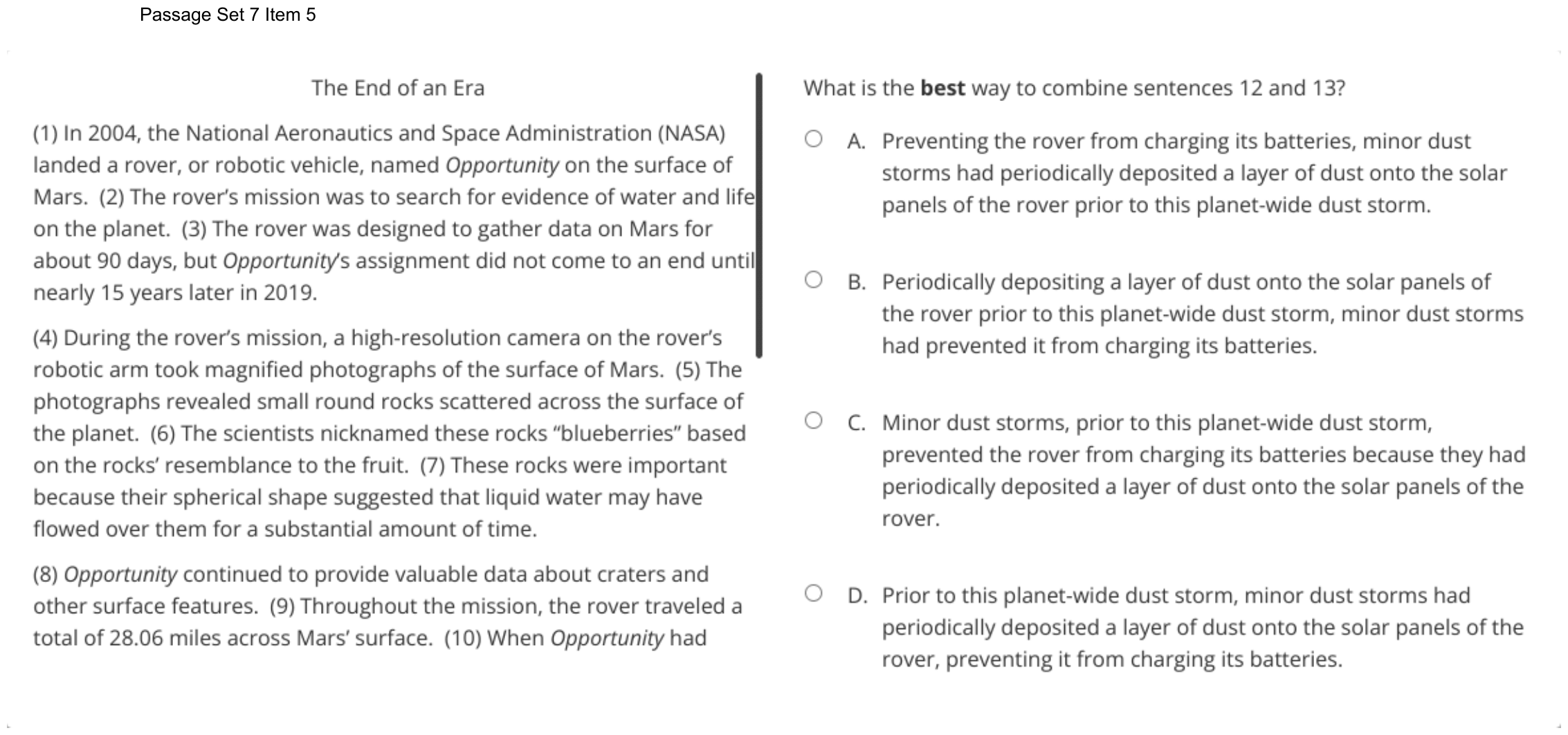
What is the best way to combine sentences 12 and 13?
- APreventing the rover from charging its batteries, minor dust storms had periodically deposited a layer of dust onto the solar panels of the rover prior to this planet-wide dust storm.
- BPeriodically depositing a layer of dust onto the solar panels of the rover prior to this planet-wide dust storm, minor dust storms had prevented it from charging its batteries.
- CMinor dust storms, prior to this planet-wide dust storm, prevented the rover from charging its batteries because they had periodically deposited a layer of dust onto the solar panels of the rover.
- DPrior to this planet-wide dust storm, minor dust storms had periodically deposited a layer of dust onto the solar panels of the rover, preventing it from charging its batteries.
Show the answer
Correct answer: D
The question asks for the best way to combine sentences 12 and 13.
A. Incorrect. The phrase “this planet-wide dust storm” in the original sentence 12 makes a direct reference to sentence 11 and therefore acts as a transition that should be kept at the beginning. In this sentence, the transition phrase is placed at the end of the sentence, making the phrase confusing. In addition, the sentence is unnecessarily repetitive and wordy.
B. Incorrect. This combination unnecessarily turns sentence 12 into an overly long participial phrase, making the connection between “it” and its antecedent, “the rover,” unclear and distracting from the subject of the sentence, “minor dust storms.”
C. Incorrect. Not only does this combination move the reference to “this planet-wide dust storm” farther from sentence 11, but it is also unnecessarily wordy, adding “because” and repeating “the rover.”
D. CORRECT. This sentence efficiently and accurately adds sentence 13 to sentence 12 as a participial phrase by changing “These prevented” to “preventing,” while also retaining the meanings of the original sentences 12 and 13.
Question analysis
This sentence-combining question asks for the best way to join two sentences from the rover passage: one saying minor dust storms had periodically coated the rover's solar panels, the other saying this kept it from charging its batteries. The four versions keep the same facts in different orders, so students must judge which is clearest and most concise in context.
- Grade level
- Grade 8 reading and task
- Compared with grade 7
- Above grade 7 Combining two sentences is grade 7 work, usually with one version clearly better. These four are long, keep the same facts and differ in order and wording, so students must weigh clarity and concision across nearly identical sentences, more than typical.
- Estimated difficulty
- Hard: combines ideas, needs a plan, and has more than one tempting wrong answer.
- Thinking it demands
- Depth of knowledge 2, skills and concepts · mainly evaluate
- What makes it hard
- How sentences fit together moderate
- Every choice must be checked moderate
- Complex sentences minor
- Evidence
- Answered from one sentence or line
- Reading level
- Passage: about grade 11, 337 words; question and choices: about grade 13, 129 words.
- Corrected from the DOE handbook
- Two grammar terms in the explanation were corrected.
- Students, last 30 days
- Not enough answers yet to show (it takes 10).
Why it is hard, traps and wrong answers (shows the answer)
Why it is hard
None of the versions is plainly ungrammatical, so the ear gives little help, and the version with “because” looks best to students who value a clearly stated cause. Its cost is wordiness and a weaker link: the result comes first and the reference back to sentence 11 is buried mid-sentence. The question rewards keeping the original order, cause then effect, and folding sentence 13 in as a short closing phrase.
How sentences fit together moderate Working it out
“Prior to this planet-wide dust storm” points back to sentence 11, so the best version keeps it first; three versions move it later, which loosens the link between the two sentences. (Halliday & Hasan, 1976)
Every choice must be checked moderate Choosing the answer
All four versions keep every fact of sentences 12 and 13 and run 29 to 32 words, so none can be ruled out by content; order, pronouns and repetition decide. (Embretson & Wetzel, 1987)
Complex sentences minor Understanding the question
Each version is one long sentence built around a participial phrase or a “because” clause, and at that length a stranded “it” or a doubled “the rover” is easy to miss. (Abedi & Lord, 2001; Freedle & Kostin, 1993; Messick, 1989)
Strategy: Read sentence 11 first, then compare the versions on how smoothly each connects to it, how many words it uses, and whether every pronoun has a clear antecedent.
Traps
- Wordy, vague or informal: A revision is grammatical but wordy, imprecise or too casual for the passage.
- Unclear pronoun: A pronoun whose reference is vague or ambiguous, or one in the wrong case.
The wrong answers, classified
A Wordy, vague or informal (Connors & Lunsford, 1988)
Opens with the effect as a participial phrase, which pushes “prior to this planet-wide dust storm,” the link to sentence 11, to the end and names “the rover” twice.
B Unclear pronoun (Connors & Lunsford, 1988)
Packs sentence 12 into a 19-word opening phrase, so “it” follows “this planet-wide dust storm” and no longer points clearly to the rover buried inside the phrase.
C Wordy, vague or informal (Connors & Lunsford, 1988)
Likes the clear cause word “because,” but the result now comes first, “the rover” appears twice, and “prior to this planet-wide dust storm” splits the subject from its verb.
What was corrected from the DOE handbook, and why
- Explanation: The DOE’s explanation of Option B says the combination turns sentence 12 into “an overly long dependent clause,” and its explanation of Option D says Option D adds sentence 13 to sentence 12 “as a dependent clause” by changing “These prevented” to “preventing.” Neither is a clause: “Periodically depositing a layer of dust onto the solar panels of the rover prior to this planet-wide dust storm” (Option B) and “preventing it from charging its batteries” (Option D) have no subject or finite verb of their own. Both are participial phrases, and the site now calls them that. The reasoning and the answer, Option D, are unchanged.
Working it out, step by step
Figure out what the question asks
This question asks for the best way to join sentences 12 and 13 into one sentence. The best version keeps the meaning, uses few words and is clear. It should also connect smoothly to sentence 11, the sentence before.
Read the sentences in order
Sentence 11 tells about the giant 2018 dust storm. Sentence 12 begins “Prior to this planet-wide dust storm.” Prior to means before. That phrase points back to sentence 11, so it works best at the start. Sentence 12 says small storms put dust on the solar panels. Sentence 13 gives the result: “These prevented it from charging its batteries.”
Learn the tool: a participial phrase
A participial phrase is a group of words built on a verb form, often an -ing word. It describes something, but it has no subject and can’t stand alone. Example: The dog ran to the door. It wagged its tail. becomes The dog ran to the door, wagging its tail. Choice D does this. It turns “These prevented” into “preventing.”
Check each choice
- A is wrong. It starts with the result. It moves “prior to this planet-wide dust storm” to the end, far from sentence 11. It also says “the rover” twice.
- B is wrong. Its long opening phrase hides the rover. Then “it” comes after “minor dust storms,” so it is hard to tell what “it” means.
- C is wrong. It adds “because,” puts the result first and says “the rover” twice. It is wordier than D.
- D is right. It keeps the link to sentence 11 first, gives the cause, then adds the result as a short participial phrase.
Watch out: C looks clear because “because” names the cause. But it is longer, and it puts an extra phrase between “Minor dust storms” and its verb.
Choose the answer
So the answer is D: “Prior to this planet-wide dust storm, minor dust storms had periodically deposited a layer of dust onto the solar panels of the rover, preventing it from charging its batteries.”
Why this answer and not the closest wrong one
C is the closest wrong answer, because “because” makes the cause very clear. But C puts the result first and repeats “the rover.” D keeps the original order, cause then result. It also keeps the link to sentence 11 up front, in fewer words.
More questions like this
The original DOE question
Question 8 of 57
2023 Test B English, question 8Uses the passage above: “The End of an Era”.
Question
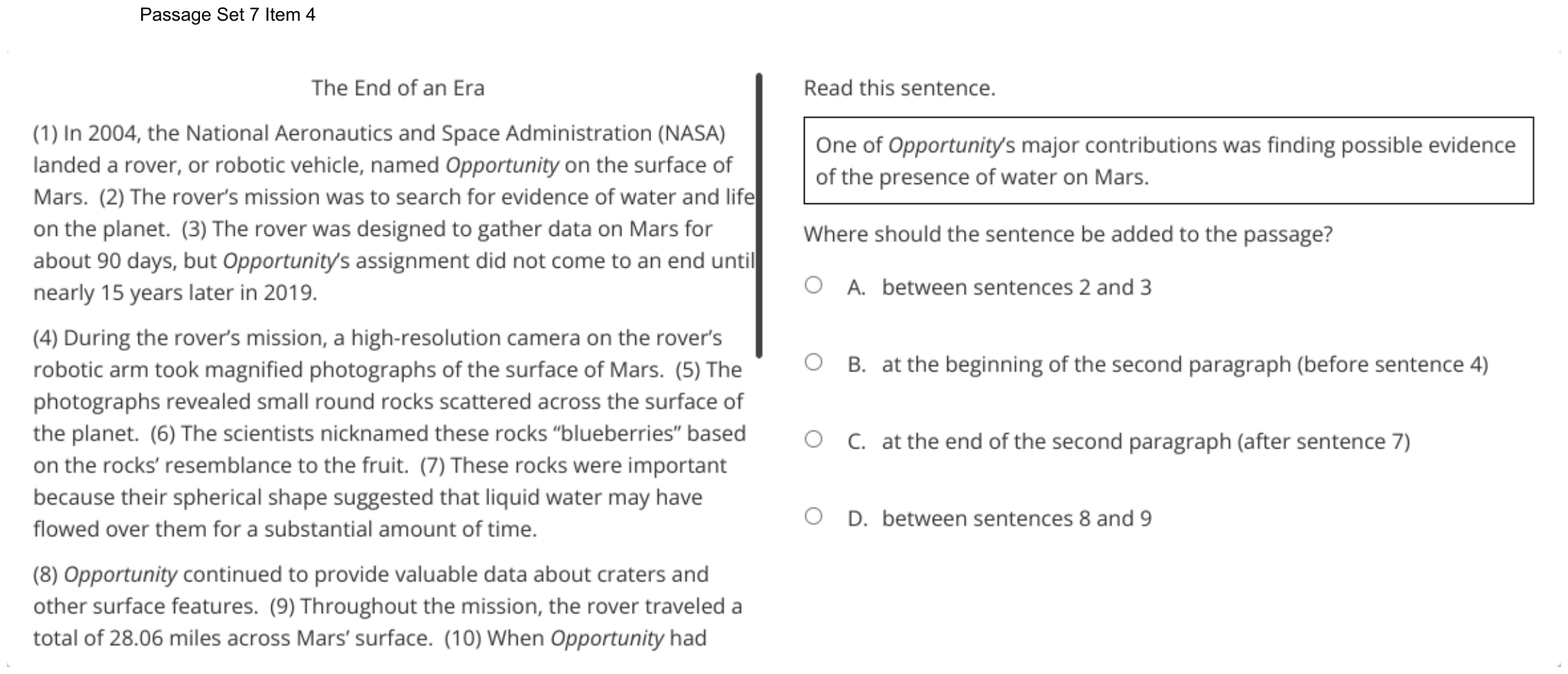
Read this sentence.
One of Opportunity’s major contributions was finding possible evidence of the presence of water on Mars.
Where should the sentence be added to the passage?
- Abetween sentences 2 and 3
- Bat the beginning of the second paragraph (before sentence 4)
- Cat the end of the second paragraph (after sentence 7)
- Dbetween sentences 8 and 9
Show the answer
Correct answer: B
The question asks where the sentence should be added to the passage.
A. Incorrect. While sentence 2 refers to Opportunity’s mission to search for evidence of water, sentence 3 mentions the rover lasting much longer than anticipated. Placing the sentence between these two ideas, rather than at the start of the second paragraph, where it introduces the topic of the paragraph, would create a disjointed and confusing experience for the reader.
B. CORRECT. The sentence introduces the idea of finding possible evidence of water on Mars, which is the main topic of the second paragraph.
C. Incorrect. The sentence sets up the main idea of paragraph 2, which is the possibility of water on Mars. As a concluding sentence, it would be repetitive and confusing.
D. Incorrect. The sentence introduces the possibility of water on Mars, while sentences 8 and 9 discuss other surface features and the distance traveled by the rover. Adding the sentence here would create a disorganized paragraph.
Question analysis
This organization question gives a new sentence about Opportunity's possible discovery of evidence of water on Mars and asks where it should be added to the rover passage. Students must follow the order of ideas across the first three paragraphs, because the sentence echoes ideas that appear in several places and could seem to fit more than one of them.
- NYS standards
- 7W2a introducing and organizing a topic
- Grade level
- Grade 7 reading and task
- Compared with grade 7
- At grade 7 Deciding where a sentence belongs is typical grade 7 revision work. The four positions span three paragraphs of a plain passage, and the sentence's wording connects to more than one of them, so the order of ideas must be checked.
- Estimated difficulty
- Moderate: several steps, or a close reading with one strong distractor.
- Thinking it demands
- Depth of knowledge 2, skills and concepts · mainly analyze
- What makes it hard
- How sentences fit together moderate
- A very close wrong answer moderate
- Evidence
- Answered from several paragraphs or stanzas
- Reading level
- Passage: about grade 11, 337 words; question and choices: about grade 7, 52 words.
- Students, last 30 days
- Not enough answers yet to show (it takes 10).
Why it is hard, traps and wrong answers (shows the answer)
Why it is hard
The new sentence reads well in more than one place, because water comes up in sentence 2, in sentence 7 and near the “valuable data” of sentence 8. Its wording settles the matter: “One of Opportunity’s major contributions” announces a topic, so it belongs ahead of the evidence. The strongest pull places it as a closing line after sentence 7, where it restates the point the blueberries have just made.
How sentences fit together moderate Working it out
The new sentence names a contribution in general terms, so it belongs before sentence 4, where the camera and the “blueberries” supply the details, not after them. (Halliday & Hasan, 1976)
A very close wrong answer moderate Choosing the answer
The two positions in paragraph 2, before sentence 4 and after sentence 7, both keep the sentence beside the water evidence; they differ only in whether it introduces the details or sums them up. (Embretson & Wetzel, 1987; Gorin & Embretson, 2006; Ascalon et al., 2007)
Strategy: Find what the new sentence is about and where the passage discusses that, then read the sentence in each offered position and check whether it introduces, interrupts or repeats the ideas around it.
Traps
- Sentence in the wrong place: Puts a sentence where it breaks the order of ideas or separates it from what it refers to.
- Says it twice: Repeats an idea that the sentence or passage already states.
The wrong answers, classified
A Sentence in the wrong place (Halliday & Hasan, 1976)
Matches the sentence to sentence 2’s search for water, but there it announces the finding before the photographs are described and cuts into the account of the mission’s length.
C Says it twice (Connors & Lunsford, 1988)
Uses it as a wrap-up after the blueberries, a common paragraph shape, but there it only repeats sentence 7’s point about water instead of introducing the paragraph’s topic.
D Sentence in the wrong place (Halliday & Hasan, 1976)
Links “major contributions” to the “valuable data” of sentence 8, though paragraph 3 covers craters, distance traveled and the dust storm, not water.
Working it out, step by step
Figure out what the question asks
This question asks where a new sentence belongs. First find what the sentence is about. Then find where the passage talks about that. Last, decide whether the sentence should start that part, interrupt it or end it.
Read the new sentence
It says that one of Opportunity’s major contributions was “finding possible evidence of the presence of water on Mars.” It names a big idea in general terms. A sentence like that is a topic sentence. A topic sentence tells what a paragraph will be about. It usually comes first. For example, Dogs help people in many ways. comes before the details about guiding, herding and comforting.
Find where water comes up
Paragraph 2 (sentences 4–7) gives the details. The camera took close-up photos. They showed small round rocks, nicknamed “blueberries.” Sentence 7 says the rocks’ round shape “suggested that liquid water may have flowed over them.” So the new sentence should come right before these details, at the start of paragraph 2.
Check each choice
- A is wrong. Between sentences 2 and 3, it would announce the finding before the photos are described. It would also break up the facts about the mission’s length.
- B is right. Before sentence 4, it introduces the paragraph about the round rocks and water.
- C is wrong. After sentence 7, it would only repeat the point sentence 7 just made.
- D is wrong. Paragraph 3 is about craters, miles and the dust storm, not water.
Watch out: C is tempting because some paragraphs end with a summary. But sentence 7 already makes the point about water.
Choose the answer
So the answer is B: “at the beginning of the second paragraph (before sentence 4).”
Why this answer and not the closest wrong one
C is the closest wrong answer, because it keeps the sentence in the paragraph about water. But the sentence names a topic, so it works best before the details. After sentence 7, it would repeat what the blueberries just showed. Before sentence 4, it tells readers what is coming.
More questions like this
The original DOE question
Question 9 of 57
2023 Test B English, question 9Uses the passage above: “The End of an Era”.
Question
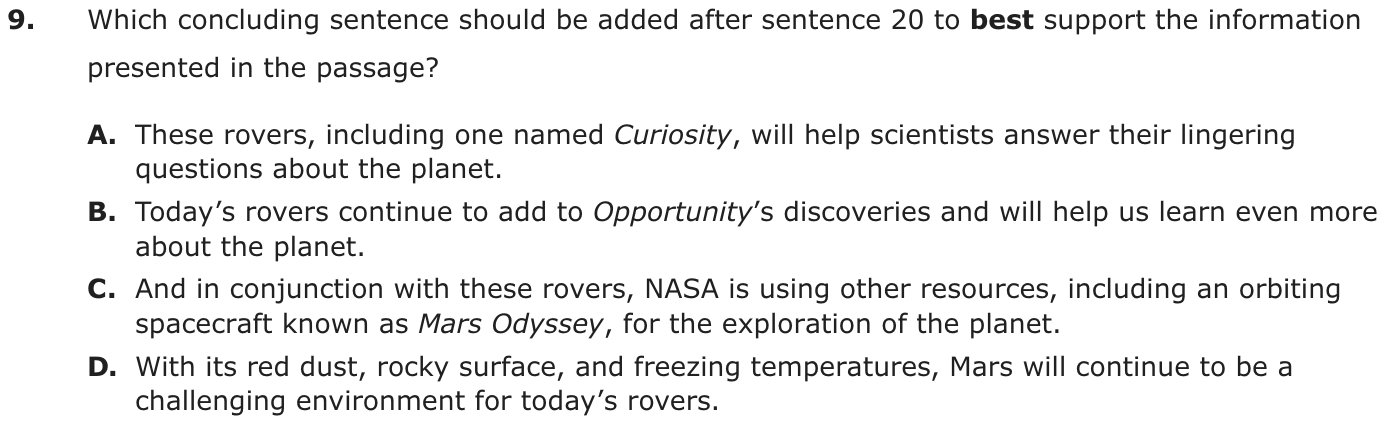
Which concluding sentence should be added after sentence 20 to best support the information presented in the passage?
- AThese rovers, including one named Curiosity, will help scientists answer their lingering questions about the planet.
- BToday’s rovers continue to add to Opportunity’s discoveries and will help us learn even more about the planet.
- CAnd in conjunction with these rovers, NASA is using other resources, including an orbiting spacecraft known as Mars Odyssey, for the exploration of the planet.
- DWith its red dust, rocky surface, and freezing temperatures, Mars will continue to be a challenging environment for today’s rovers.
Show the answer
Correct answer: B
The question asks for the concluding sentence that should be added after sentence 20 to best support the information presented in the passage.
A. Incorrect. The sentence does not summarize or make reference to the focus of the passage, which is the Opportunity rover.
B. CORRECT. This sentence summarizes the ideas about the Opportunity rover while also extending those ideas to future research, an effective combination for a sentence that concludes a piece about a scientific topic.
C. Incorrect. This sentence not only begins with the phrase “And in conjunction,” which is repetitive, but also introduces an entirely new idea (Mars Odyssey) instead of concluding on the main topic of the passage (the Opportunity rover).
D. Incorrect. This sentence puts emphasis on Mars’s characteristics and makes a conclusion about “today’s rovers,” instead of referring back to the Opportunity rover, the main focus of the passage.
Question analysis
This concluding-sentence question on “The End of an Era,” a passage about NASA’s Opportunity rover, which explored Mars from 2004 until NASA declared its mission complete in 2019, asks which sentence should follow sentence 20. That last sentence notes that other rovers still roam Mars, and every choice builds on it, so students must judge which ending best supports the passage as a whole.
- NYS standards
- 7W2e concluding informative writing
- Grade level
- Grade 7 reading and task
- Compared with grade 7
- At grade 7 Choosing a concluding sentence for an informational passage is standard grade 7 writing work. The rover passage is twenty plain sentences, and all four endings follow on from its last line, so the comparison is careful but typical.
- Estimated difficulty
- Moderate: several steps, or a close reading with one strong distractor.
- Thinking it demands
- Depth of knowledge 2, skills and concepts · mainly evaluate
- What makes it hard
- A very close wrong answer moderate
- Evidence in several places minor
- How sentences fit together minor
- Evidence
- Answered from the whole text
- Reading level
- Passage: about grade 11, 337 words; question and choices: about grade 13, 96 words.
- Students, last 30 days
- Not enough answers yet to show (it takes 10).
Why it is hard, traps and wrong answers (shows the answer)
Why it is hard
Sentence 20 hands every ending a ready link, the rovers still on Mars, so each choice sounds like a natural next line. The question is which one returns to the subject the passage built over twenty sentences, and only one connects today’s rovers to what Opportunity found. The near-twin that names Curiosity draws students who check smoothness rather than focus, while the other two drift to a spacecraft and to the planet’s harsh conditions.
A very close wrong answer moderate Choosing the answer
The ending that names Curiosity and the right one both say today’s rovers will help answer questions about Mars; they differ only in whether the sentence ties those rovers back to Opportunity’s discoveries. (Embretson & Wetzel, 1987; Gorin & Embretson, 2006; Ascalon et al., 2007)
Evidence in several places minor Working it out
The passage’s subject, Opportunity, runs through all five paragraphs, from its 2004 landing to the “blueberries,” the 28.06 miles and the dust storms, so judging an ending means holding that whole thread in mind. (Kirsch & Mosenthal, 1990; Gorin & Embretson, 2006)
How sentences fit together minor Working it out
Sentence 20 turns to “other rovers” that “still roam the surface of Mars,” and all four endings pick up from it, so fit with the last sentence alone rules none of them out. (Halliday & Hasan, 1976)
Strategy: Say in a few words what the whole passage is about, then read each ending after sentence 20 and ask whether it closes that subject or turns to something the passage never covered.
Traps
- Off the point: Adds or keeps something that does not support the paragraph's or the passage's focus, or an introduction or conclusion that misses the main point.
The wrong answers, classified
A Off the point (Halliday & Hasan, 1976)
Continues smoothly from “other rovers” in sentence 20 and looks ahead as a conclusion should, but it names Curiosity and never returns to Opportunity, the rover the passage is about.
C Off the point (Halliday & Hasan, 1976)
Is drawn by a specific new fact, the orbiting Mars Odyssey, which the passage never mentions; after the wordy “And in conjunction with,” the ending leaves Opportunity behind.
D Off the point (Halliday & Hasan, 1976)
Builds on the dust storms Opportunity survived and adds rocky ground and freezing cold, but it ends on the hardships facing today’s rovers rather than on what Opportunity achieved.
Working it out, step by step
Figure out what the question asks
You need a concluding sentence. That is the last sentence of a piece of writing. A good one wraps up the main topic and leaves the reader with a final thought. So first, decide what the whole passage is about.
Name the main topic
Every paragraph is about one rover, Opportunity. Paragraph 1 tells when it landed on Mars in 2004. Paragraph 2 tells about the “blueberries,” small round rocks it found. Paragraph 3 gives the 28.06 miles it traveled. Paragraph 4 tells how its mission ended in 2019. Paragraph 5 says it “returned valuable data about our neighbor planet.” A good ending should come back to this rover.
Read the last sentence
Sentence 20 says: “Even though this rover’s journey ended, other rovers still roam the surface of Mars.” Roam means travel around. All four choices pick up from these other rovers. So fitting with sentence 20 is not enough. The best choice must also tie back to Opportunity.
Check each choice
- A is wrong. It names a new rover, Curiosity, and never mentions Opportunity.
- B is right. It says today’s rovers add to Opportunity’s discoveries. That links them back to the topic. It also looks ahead: they “will help us learn even more about the planet.”
- C is wrong. It brings in a spacecraft, Mars Odyssey, that the passage never talks about. An ending should not start a new topic.
- D is wrong. It ends on how harsh Mars is for today’s rovers, not on what Opportunity did.
Watch out: A sounds like a strong ending because it looks to the future. But it leaves out the rover the passage is about.
Choose the answer
Only B ties today’s rovers back to Opportunity and also looks ahead to new learning about Mars. So the answer is B.
Why this answer and not the closest wrong one
A is the closest wrong answer. Like B, it says today’s rovers will help answer questions about Mars. But A talks about Curiosity instead. B is better because it connects those rovers to Opportunity’s discoveries, the subject of all five paragraphs.
More questions like this
The original DOE question
Question 10 of 57
2023 Test B English, question 10Passage Excerpt from “The Food Business Incubator”
Excerpt from “The Food Business Incubator”
by Mandalit Del Barco
“La Cocina” means “the kitchen” in Spanish. It’s also the name of a business incubator1 based in San Francisco’s Mission District. Since it began in 2005, it’s been helping local food entrepreneurs, many of whom are low-income immigrant women, develop their small businesses.
Over the years, many of its alumni have found success: more than 50 chefs in its program have become self-sufficient business owners, and many of them have opened their own brick-and-mortar restaurants. Two alumnae of its culinary program . . . were even recognized as semi-finalists for prestigious James Beard awards.2
A new cookbook, We Are La Cocina: Recipes in Pursuit of the American Dream, tells some of their stories.
Executive director Caleb Zigas says the nonprofit La Cocina grew out of two grassroots economic development organizations3 who found many people cooking at their homes and selling food on the streets. The vendors needed an affordable commercial kitchen space and technical assistance in order for their businesses to be legally viable. La Cocina provided just such a space, in addition to helping them develop business plans, pull city permits and more.
Zigas says as many as eight businesses can work in the kitchen space at La Cocina at any one time. Some can prep for a farmers’ market sale, corporate catering gigs or weddings, while others might be making and packaging their food products.
“It’s just an incredible and exciting range of techniques, flavors, perspectives, age, language. And that’s a really beautiful thing,” he says. . . .
Twice a year, La Cocina hosts “F&B: Voices from the Kitchen,” a storytelling project where their chefs can tell their own stories, as they do in the new cookbook. Some of the chefs will be on tour to promote the book, whose proceeds will go to support La Cocina entrepreneurs.
NPR4 caught up with . . . La Cocina chefs, who shared their stories:
Mariko Grady, Aedan Fermented Foods
At La Cocina, you can often hear Mariko Grady singing or humming as she prepares miso, koji, and amasake. Her fermented products come in four different flavors, including mushroom and chicken, to be used in soups and sauces. She originally brought the fermenting rice and barley koji seeds from Japan, where she had a 30-year career as a singer and dancer with the prestigious modern theatrical dance group she founded, Pappa Tarahumara. They performed around the world, and 16 years ago, had a one-night show in San Francisco. The man who would become her husband was in the audience. She soon joined him in San Francisco, often returning to Tokyo to rehearse. But after the earthquake and tsunami hit Japan in 2011, her company disbanded. . . . Grady focused on nourishing her family and creating a line of fermented products that she sells online, at local Bay Area stores and at the Ferry Plaza Farmers Market. She began at La Cocina in 2012 and named her business after her son, Aedan. (Written in Kanji characters, the name means “wisdom” and “handed down from generation to generation.”) . . . Her fermented products are “also full of wisdom about how to relate to nature and how to create a healthy life,” she says. . . .
Shani Jones, Peaches Patties
Shani Jones is a native San Franciscan. Her father was born in New Orleans, her mother, in Jamaica. She says their home was always filled with a variety of spices and dishes like jerk chicken and Jamaican patties—savory pastries filled with beef or chicken. Jones says she learned to cook from her mother, whose nickname was Peaches. After returning from college in Atlanta, Jones worked on her doctorate in organizational leadership and management while driving a Lyft5 car. She often told passengers about her idea of opening a catering company with her mom’s recipes. They steered her to La Cocina, where she developed her own business, named after her mother. Five years later, she caters and runs a kiosk6 at a small food cooperative in Bernal Heights, where some of her handmade patties have an Ethiopian twist, “because my husband is Ethiopian.” Jones has big aspirations for Peaches Patties: “The ultimate goal,” she says, “is to be the patty kingpin7 of the West Coast.”
From “The Food Business Incubator That Helps Immigrant Women Pursue The American Dream” by Mandalit Del Barco from WEEKEND EDITION SUNDAY, June 19, 2019. Copyright © 2019 NPR.
QUALIFICATIONS FOR LA COCINA APPLICANTS
| Level of Income | La Cocina considers assets and access to opportunity when screening applicants. La Cocina’s mission is to support entrepreneurs who face barriers to becoming successful in the food industry. Applicants must be classified as low- or very-low-income earners according to the Housing and Urban Development (HUD) Guidelines for San Francisco. |
|---|---|
| Business Plan | Applicants must have a business plan that is ready to be put into action. La Cocina will help applicants refine an existing business plan. Applicants without a business plan should contact one of La Cocina’s partner organizations for guidance in developing one. |
| Viable Product | The applicant’s food must not only be delicious but also stand out. For a business to make a profit, there also has to be a market for the food. |
| Entrepreneurial Work Ethic | La Cocina is excited to work with entrepreneurs who are motivated and passionate about growing their business. Succeeding in the food industry requires a lot of heart and hard work. |
| Community Spirit | The 30+ entrepreneurs who share La Cocina’s kitchen are from many different backgrounds. La Cocina values the community it has created and expects each entrepreneur to be active in bringing the spirit of La Cocina to the wider world. In order to succeed in the La Cocina kitchen, accepted applicants must be flexible and willing to work closely with others. |
Source: La Cocina
1business incubator: company that helps new and startup companies develop by providing services such as management training and office space
2James Beard awards: an award named after American cook and author James Beard, considered one of the highest honors in the culinary industry
3economic development organizations: organizations whose mission is to promote economic improvement within a specific geographical area
4NPR: National Public Radio, a nonprofit media organization that produces and distributes news and cultural programming
5Lyft: ride-sharing company where people use their own cars to provide rides to customers
6kiosk: cart or small structure with one or more open sides that is used to vend merchandise or services
7kingpin: the leader in a group or undertaking
Question
Read this sentence from paragraph 2.
Two alumnae of its culinary program . . . were even recognized as semi-finalists for prestigious James Beard awards.
The words “recognized” and “prestigious” in the sentence convey that La Cocina
- Amakes an effort to identify chefs who have a strong entrepreneurial work ethic.
- Bhas the ability to mentor chefs to reach the highest levels of achievement in their craft.
- Cis focused on establishing local food entrepreneurs as celebrated professionals in their industry.
- Dis dedicated to assisting chefs in developing new and innovative products.
Show the answer
Correct answer: B
The question asks what the words “recognized” and “prestigious” convey about La Cocina.
A. Incorrect. While later information indicates that La Cocina bases its choices on the work ethic of entrepreneurs as well as their financial needs, the use of the words “recognized” and “prestigious” in the context of the sentence is not related to the work ethic of the chefs.
B. CORRECT. The fact that alumni of the La Cocina program have received recognition as semi-finalists for prestigious awards shows that La Cocina has helped members of its program achieve at the highest level.
C. Incorrect. As paragraph 1 indicates, La Cocina focuses on helping local food entrepreneurs develop their small businesses. While some participants in the program have earned official recognition, La Cocina is not primarily focused on establishing entrepreneurs as celebrated professionals.
D. Incorrect. La Cocina assists chefs with the development of their small businesses, not necessarily with their development of specific products.
Question analysis
This word-choice question quotes a sentence from paragraph 2 of “The Food Business Incubator,” an NPR article about La Cocina, a San Francisco program for food entrepreneurs: two alumnae of its culinary program were recognized as semi-finalists for prestigious James Beard awards. Students decide what the words “recognized” and “prestigious” convey about La Cocina itself, and several choices sound like fair praise for any cooking program.
- Grade level
- Grade 7 reading and task
- Compared with grade 7
- Above grade 7 Judging the connotation of two words is regular grade 7 work, and the sentence is printed with the question. Here students must then turn the words’ praise of two chefs into a claim about the organization, choosing between close statements, which goes beyond typical demand.
- Estimated difficulty
- Hard: combines ideas, needs a plan, and has more than one tempting wrong answer.
- Thinking it demands
- Depth of knowledge 2, skills and concepts · mainly analyze
- What makes it hard
- Reading between the lines moderate
- A very close wrong answer moderate
- The right answer is reworded minor
- Evidence
- Answered from one paragraph or stanza
- Reading level
- Passage: about grade 10, 1057 words; question and choices: about grade 10, 86 words.
- Students, last 30 days
- Not enough answers yet to show (it takes 10).
Why it is hard, traps and wrong answers (shows the answer)
Why it is hard
The two words are plainly positive, so the challenge is not their tone but what they say about the organization rather than the two chefs. Students must decide whether an honor reached by alumnae shows a capability of La Cocina or a goal it pursues, and the excerpt’s own statement of its focus, helping entrepreneurs develop small businesses, rules out the goal. The other choices attach the words to the table’s work-ethic and product rows, which the sentence never touches.
Reading between the lines moderate Working it out
The sentence praises two alumnae, not La Cocina; students must reason that if former members became semi-finalists for “prestigious” awards, the program that trained them can bring chefs to the top of their field. (Graesser, Singer & Trabasso, 1994; Kintsch, 1998)
A very close wrong answer moderate Choosing the answer
The choice about celebrated professionals and the right one both read the awards as chefs reaching the top; they differ in whether that shows what La Cocina can do or what it is focused on. (Embretson & Wetzel, 1987; Gorin & Embretson, 2006; Ascalon et al., 2007)
The right answer is reworded minor Choosing the answer
The right choice uses words the excerpt never does, “mentor” and “highest levels of achievement,” while wrong ones borrow its own: the table’s “entrepreneurial work ethic,” paragraph 1’s “local food entrepreneurs,” paragraph 5’s “food products.” (Freedle & Kostin, 1993; Kirsch & Mosenthal, 1990)
Strategy: Say what the two words add to the plain fact that two former members reached an awards list, then test each choice against paragraph 1’s account of what La Cocina actually sets out to do.
Traps
- Reads too much in: A reasonable-sounding conclusion that goes further than the text allows.
- Dictionary meaning, not meaning here: A common meaning of the word that does not fit its use in this text.
- Twists what the text says: Uses the text's topic and ideas but changes what it says: who did it, how much, when, or why.
The wrong answers, classified
A Dictionary meaning, not meaning here (Perfetti, 2007)
Reads “recognized” in its everyday sense of “identified” and links it to the table’s work-ethic row, but here it means honored, and the James Beard awards did the honoring.
C Reads too much in (Graesser, Singer & Trabasso, 1994)
Sees the awards as fame and concludes that making chefs celebrated is La Cocina’s aim, but paragraph 1 says its focus is helping entrepreneurs develop their small businesses.
D Twists what the text says (King et al., 2004)
Keeps the idea that La Cocina assists chefs but shifts the help to inventing products, recalling the table’s food that must “stand out,” though the sentence is about honors, not products.
Working it out, step by step
Figure out what the question asks
This question is about word choice. Two words, “recognized” and “prestigious,” add meaning to a sentence. You must decide what they show about La Cocina, the program itself, not just about two of its chefs.
Look at the sentence in paragraph 2
Paragraph 2 says that two alumnae of the program “were even recognized as semi-finalists for prestigious James Beard awards.” Alumnae are women who once took part in a program. Here, recognized means honored. Prestigious means highly respected. Footnote 2 says these awards are “considered one of the highest honors in the culinary industry.” Culinary means having to do with cooking.
Work out what the words show
Two women trained by La Cocina came close to one of the top prizes in cooking. That says something about the program that taught them. It can bring its chefs near the very top of their field. The small word “even” adds pride. It tells you this honor is something special.
Check each choice
- A is wrong. Here “recognized” does not mean picked out by La Cocina. The award judges did the honoring. Work ethic never comes up.
- B is right. To mentor means to guide and teach. A craft is a skill, like cooking. The honors show La Cocina can guide chefs to great heights in their craft.
- C is wrong. Fame is not what La Cocina aims for. Paragraph 1 says it helps cooks “develop their small businesses.”
- D is wrong. The sentence is about honors for chefs. It says nothing about inventing new products.
Watch out: C is tempting, since awards do make chefs celebrated, or famous. But C claims fame is La Cocina’s focus, and the excerpt never says so.
Choose the answer
The two words show that La Cocina can help the chefs it trains rise near the top of their craft. So the answer is B.
Why this answer and not the closest wrong one
C comes nearest to being right. It reads the honor as La Cocina’s main goal. B reads it as proof of what La Cocina can do. Paragraph 1 names the real goal, building small businesses. So the award shows a strength of the program, not its purpose.
More questions like this
The original DOE question
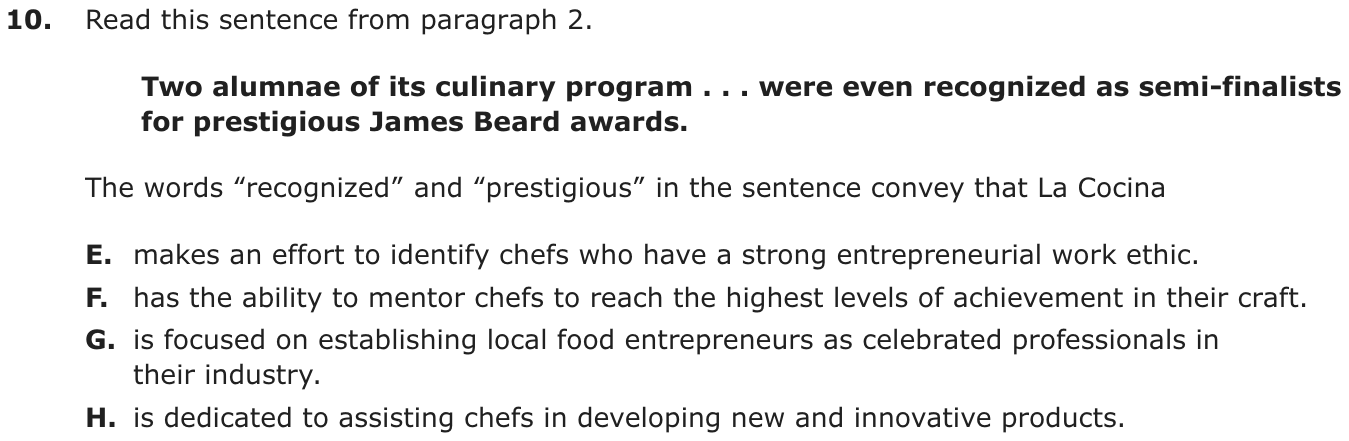
The passage “Excerpt from “The Food Business Incubator”” as printed (pages 158–160)
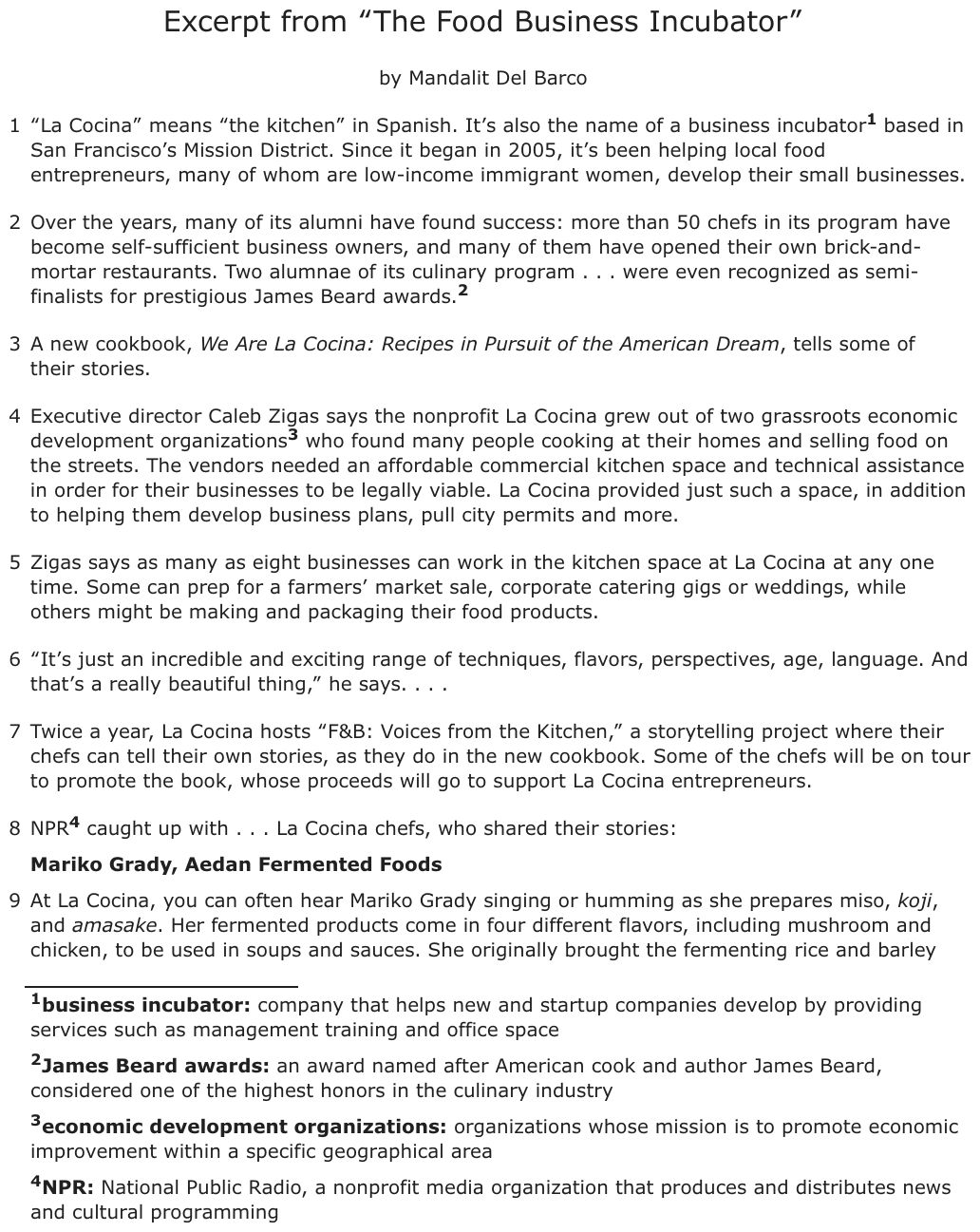
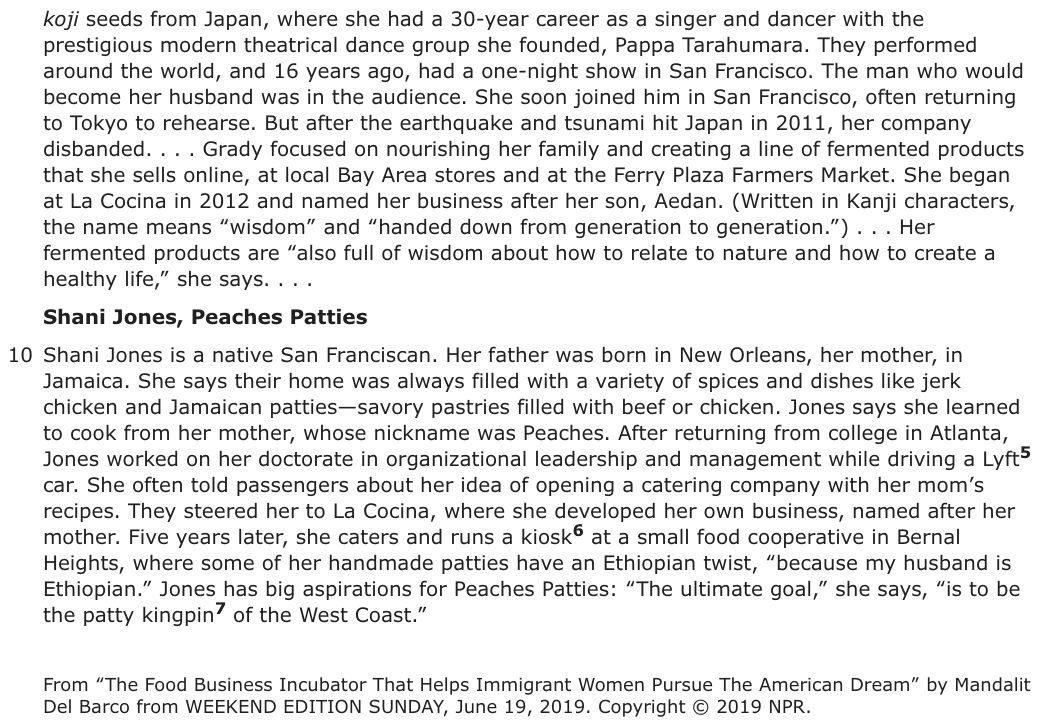
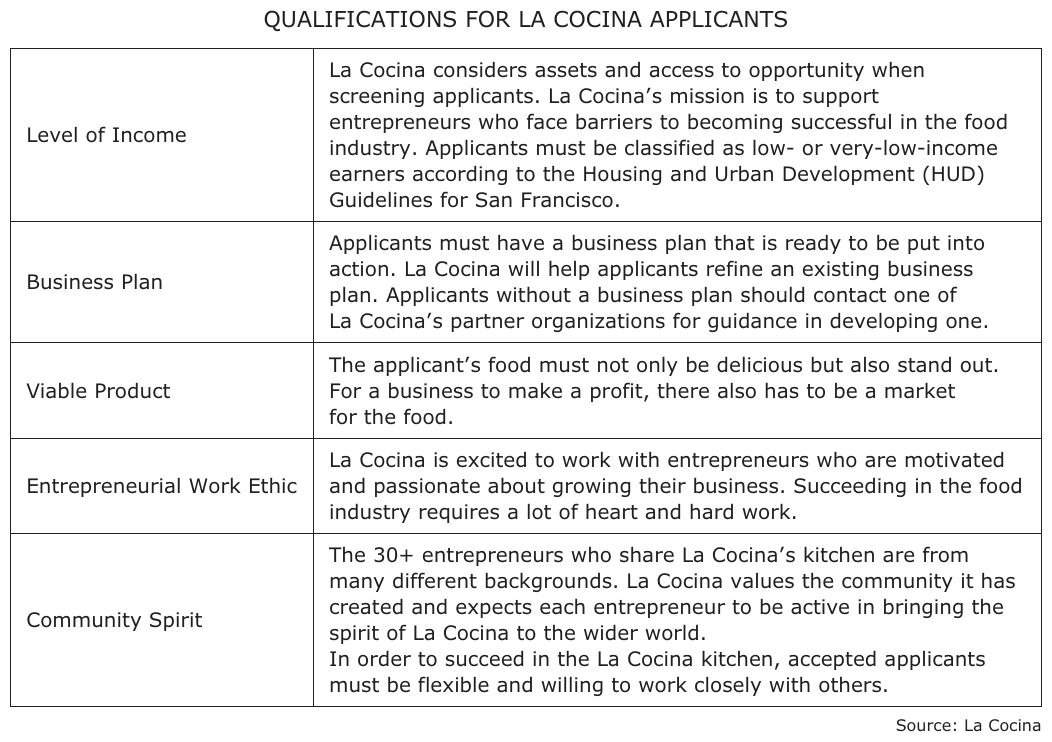
Question 11 of 57
2023 Test B English, question 11Uses the passage above: “Excerpt from “The Food Business Incubator””.
Question
Paragraph 4 contributes to the development of ideas about La Cocina in paragraph 1 by
- Aspecifying how La Cocina helps local food entrepreneurs become successful.
- Bexplaining what kind of goals La Cocina tries to set for local food entrepreneurs.
- Cproviding background information about local food entrepreneurs in San Francisco.
- Ddescribing how Caleb Zigas discovered the need to provide assistance to local food entrepreneurs.
Show the answer
Correct answer: A
The question asks how paragraph 4 contributes to the development of ideas about La Cocina in paragraph 1.
A. CORRECT. Paragraph 4 lists ways that La Cocina provides support to local food entrepreneurs. This supports the statement in paragraph 1 that La Cocina has been “helping local food entrepreneurs, many of whom are low-income immigrant women, develop their small businesses.”
B. Incorrect. Paragraph 1 simply states that La Cocina tries to help local food entrepreneurs develop their businesses, but neither paragraph describes or mentions any goals that La Cocina sets for local food entrepreneurs.
C. Incorrect. While paragraph 4 mentions some background information on where local food entrepreneurs were found, these details do not directly support any ideas in paragraph 1.
D. Incorrect. The description of the process by which Caleb Zigas realized there was a need for La Cocina provides background for the organization, but it does not directly support any ideas in paragraph 1.
Question analysis
This text-structure question asks how paragraph 4 of the La Cocina article contributes to the development of ideas about the nonprofit in paragraph 1. Paragraph 4 gives executive director Caleb Zigas’s account of how La Cocina started and whom it served, so students must set the two paragraphs side by side and decide what the later one adds.
- Grade level
- Grade 7 reading and task
- Compared with grade 7
- At grade 7 Explaining how one paragraph develops an idea from another is core grade 7 structure work. Both paragraphs are short and plain, but paragraph 4 holds several kinds of information and several choices echo its details, so close checking is needed.
- Estimated difficulty
- Moderate: several steps, or a close reading with one strong distractor.
- Thinking it demands
- Depth of knowledge 2, skills and concepts · mainly analyze
- What makes it hard
- How, not what moderate
- Every choice must be checked minor
- Evidence in several places minor
- Evidence
- Answered from several paragraphs or stanzas
- Reading level
- Passage: about grade 10, 1057 words; question and choices: about grade 12, 61 words.
- Students, last 30 days
- Not enough answers yet to show (it takes 10).
Why it is hard, traps and wrong answers (shows the answer)
Why it is hard
Paragraph 4 opens with background, the grassroots groups that found people cooking at home and selling on the streets, and only its last sentence says what La Cocina provided. Students who stop at the opening find the background choice accurate and the Zigas choice plausible, since his name leads the paragraph. The question rewards asking which part of paragraph 4 builds on paragraph 1’s claim about helping entrepreneurs develop businesses, and that part is the list of services.
How, not what moderate Working it out
The stem asks how paragraph 4 develops paragraph 1, so students must match paragraph 1’s general “helping local food entrepreneurs … develop their small businesses” to paragraph 4’s specifics: kitchen space, business plans, city permits. (Anderson & Krathwohl, 2001)
Every choice must be checked minor Choosing the answer
Paragraph 4 mixes an origin story told by Zigas, the vendors’ needs and La Cocina’s services, and the wrong choices draw on the first two, so each must be checked for who did what. (Embretson & Wetzel, 1987)
Evidence in several places minor Working it out
The two paragraphs are separated by the alumni successes and the cookbook, so paragraph 1’s statement of what La Cocina does must be carried across them and set beside paragraph 4. (Kirsch & Mosenthal, 1990; Gorin & Embretson, 2006)
Strategy: Write down what paragraph 1 says La Cocina does, then go through paragraph 4 sentence by sentence and ask which sentences expand on that statement; check who does what in each choice.
Traps
- Twists what the text says: Uses the text's topic and ideas but changes what it says: who did it, how much, when, or why.
- True but not the answer: A choice says something accurate about the text that does not answer this question.
- Wrong purpose or structure: Names a purpose, structure or effect that the part does not serve, or describes what a part says when the question asks what it does.
The wrong answers, classified
B Wrong purpose or structure (Anderson & Krathwohl, 2001)
Equates help with “business plans” with setting goals and so credits paragraph 4 with explaining La Cocina’s targets for entrepreneurs, a purpose neither paragraph serves.
C True but not the answer (King et al., 2004; Embretson & Wetzel, 1987)
Rightly notes that paragraph 4 describes people cooking at home and selling food on the streets, but that background is about the vendors and adds nothing to paragraph 1’s point about La Cocina.
D Twists what the text says (King et al., 2004)
Reads “Caleb Zigas says” as Zigas making the discovery, but in paragraph 4 two grassroots organizations found the home cooks, and Zigas only tells how La Cocina grew out of them.
Working it out, step by step
Understand the question
This is a question about how a text is put together. You need to see how paragraph 4 builds on an idea from paragraph 1. Find the idea in paragraph 1 first. Then ask what paragraph 4 adds to it.
Find the idea in paragraph 1
Paragraph 1 says that since 2005, La Cocina has been “helping local food entrepreneurs, many of whom are low-income immigrant women, develop their small businesses.” An entrepreneur is a person who starts a business. Notice that this statement is general. It tells you that La Cocina helps, but not how.
See what paragraph 4 adds
Paragraph 4 opens with a little history. Two grassroots groups “found many people cooking at their homes and selling food on the streets.” (Grassroots means started by ordinary people in a community.) Then the paragraph gets specific. La Cocina gave those cooks a kitchen, “in addition to helping them develop business plans, pull city permits and more.” Those are the actual ways it helps.
Check each choice
- A is right. Paragraph 4 names the help: a kitchen, business plans and city permits. That shows how La Cocina helps cooks succeed.
- B is wrong. Neither paragraph mentions goals that La Cocina sets for the cooks.
- C is wrong. Paragraph 4 does describe the cooks selling on the streets. But that is background about the cooks. It doesn’t build on paragraph 1’s idea about La Cocina.
- D is wrong. Zigas only tells the story. In paragraph 4, it is the two grassroots groups that found the cooks. Zigas discovers nothing there.
Watch out: C is tempting because its facts are true. A true detail is still wrong if it doesn’t answer the question.
Choose the answer
Paragraph 1 says that La Cocina helps. Paragraph 4 spells out exactly how it helps. So the answer is A.
Why this answer and not the closest wrong one
The strongest wrong choice is C. It describes the start of paragraph 4 correctly. But the question asks how paragraph 4 develops an idea about La Cocina. Only the list of services does that. It turns paragraph 1’s general word, helping, into real examples.
More questions like this
The original DOE question
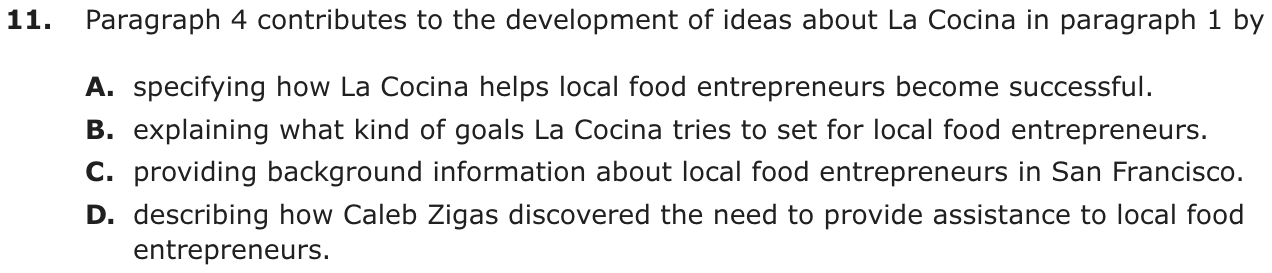
Question 12 of 57
2023 Test B English, question 12Uses the passage above: “Excerpt from “The Food Business Incubator””.
Question
The quotation from Caleb Zigas in paragraph 6 conveys a central idea of the excerpt by
- Ashowing appreciation for the vibrant diversity of La Cocina.
- Bcommunicating La Cocina’s goal of helping people of varying abilities.
- Cdescribing a typical scenario at La Cocina.
- Demphasizing La Cocina’s focus on creating products.
Show the answer
Correct answer: A
The question asks how the quotation from Caleb Zigas in paragraph 6 conveys a central idea of the excerpt.
A. CORRECT. A central idea of the excerpt is that La Cocina’s entrepreneurs are a group of people cooking a diverse range of cuisines. This quotation from the executive director of La Cocina conveys this idea by emphasizing the diversity of both the cooking methods and the chefs themselves.
B. Incorrect. While La Cocina’s goal is “helping local food entrepreneurs, many of whom are low-income immigrant women” (paragraph 1), the organization does not necessarily have a goal of helping people without solid cooking skills. Per the table that describes the “Qualifications for La Cocina Applicants,” the applicant’s food must be delicious, which speaks to the skill required for all participants.
C. Incorrect. The quotation describes the diversity of people and cooking techniques found at La Cocina, but it does not reference “a typical scenario.” Paragraphs 9 and 10 more closely describe examples of typical La Cocina chef entrepreneurs.
D. Incorrect. Applicants to La Cocina must have a food that is a “viable product,” but this quotation emphasizes the diversity of chefs and cuisines, not the requirements chefs must meet to enter the program.
Question analysis
This question looks at paragraph 6 of the La Cocina article, a two-sentence quotation in which executive director Caleb Zigas sums up what he sees at the nonprofit. Students must decide how the quotation conveys a central idea of the excerpt, which means restating Zigas’s words in their own and connecting them to the article as a whole.
- Grade level
- Grade 7 reading and task
- Compared with grade 7
- Below grade 7 Showing how a quotation supports a central idea is grade 6 and 7 work. This quotation is two sentences in everyday words, and its meaning sits close to the surface, so the demand is lighter than typical grade 7 reading.
- Estimated difficulty
- Straightforward: two steps or one careful reading.
- Thinking it demands
- Depth of knowledge 2, skills and concepts · mainly analyze
- What makes it hard
- Reading between the lines minor
- How, not what minor
- Evidence
- Answered from one paragraph or stanza
- Reading level
- Passage: about grade 10, 1057 words; question and choices: about grade 12, 48 words.
- Students, last 30 days
- Not enough answers yet to show (it takes 10).
Why it is hard, traps and wrong answers (shows the answer)
Why it is hard
The quotation is short and warm, and most students hear its enthusiasm for variety at once. The wrong choices come from reading it with paragraph 5 still in mind, a kitchen busy with market and catering prep and with food products being packaged, or from turning a range of cooking styles into a range of skill. Students who restate the quotation in their own words before reading the choices avoid all three.
Reading between the lines minor Working it out
Zigas never says “diversity”; students must see that his list, “techniques, flavors, perspectives, age, language,” describes variety among the cooks and their food, and that “a really beautiful thing” expresses appreciation. (Graesser, Singer & Trabasso, 1994; Kintsch, 1998)
How, not what minor Working it out
The stem asks how the quotation conveys a central idea, so students must name what Zigas’s words do for the excerpt, not just what they say, and link them to the mix of chefs profiled later. (Anderson & Krathwohl, 2001)
Strategy: Reread the quotation and say in your own words what Zigas finds exciting; then choose the option that matches your words and also fits the rest of the article.
Traps
- Wrong part of the text: A choice is true of another paragraph, stanza or speaker than the one asked about.
- Twists what the text says: Uses the text's topic and ideas but changes what it says: who did it, how much, when, or why.
The wrong answers, classified
B Twists what the text says (King et al., 2004)
Turns Zigas’s “range of techniques” and “age” into people of differing ability, though he celebrates variety in cooking styles and backgrounds, and the table requires every applicant’s food to be delicious.
C Wrong part of the text (Kirsch & Mosenthal, 1990)
Carries paragraph 5’s scene, eight businesses prepping for markets, catering and weddings, into the quotation, which describes no typical scenario but sums up the variety Zigas sees.
D Twists what the text says (King et al., 2004)
Links “flavors” and “techniques” to the packaged food products of paragraph 5 and makes products the point, though Zigas is praising the mix of people and cooking styles.
Working it out, step by step
Know what a central idea is
A central idea is an important idea that runs through a whole text. This question asks how one quotation from Caleb Zigas, the head of La Cocina, shows a central idea. Start by putting his words into your own.
Read the quotation in paragraph 6
Zigas says, “It’s just an incredible and exciting range of techniques, flavors, perspectives, age, language.” A range is a wide mix. Techniques are ways of cooking. Perspectives are ways of seeing the world. Then he adds, “And that’s a really beautiful thing.”
Say it in your own words
In plain words, Zigas loves how different everyone at La Cocina is. The cooks are young and old. They speak different languages. They cook in different ways and make food with different flavors. He calls this mix “beautiful,” so he is praising it. A word for this kind of mix is diversity. The chef stories show it too. Mariko Grady brought her koji seeds from Japan. Shani Jones gives some patties an Ethiopian twist.
Check each choice
- A is right. Vibrant means lively and full of energy. Zigas shows appreciation, or praise, for the lively mix of people and foods.
- B is wrong. A range of cooking styles is not a range of skill. The table says every applicant’s food “must not only be delicious but also stand out.”
- C is wrong. The busy kitchen scene is in paragraph 5. The quotation sums up a feeling. It doesn’t describe a usual day.
- D is wrong. Zigas is praising people and styles, not products for sale.
Choose the answer
The quotation praises the wide mix of people and cooking at La Cocina, an idea the chef stories also show. So the answer is A.
Why this answer and not the closest wrong one
B is the closest wrong answer, because Zigas does mention “age” and “techniques.” But he is talking about variety, not about how good the cooks are. A matches both halves of his quotation: the mix of people and food, and the word “beautiful.”
More questions like this
The original DOE question

Question 13 of 57
2023 Test B English, question 13Uses the passage above: “Excerpt from “The Food Business Incubator””.
Question
The description of Mariko Grady’s background in paragraph 9 contributes to a central idea in the excerpt by
- Ademonstrating what people are looking for when they come to La Cocina.
- Bexplaining why La Cocina is the best option for people starting out in the food business.
- Cshowing how La Cocina can help people find success in the food business even though they have a background in something different.
- Dconfirming that La Cocina was originally established for small business owners who are looking to expand their services.
Show the answer
Correct answer: C
The question asks how the description of Mariko Grady’s background in paragraph 9 contributes to a central idea in the excerpt.
A. Incorrect. The paragraph about Mariko Grady describes her earlier success in the field of theatrical dance and how she later started her own small cooking business. It does not describe what she was looking for when she came to La Cocina.
B. Incorrect. The excerpt does not argue that La Cocina is the best option for people starting out in the food business, and the description in paragraph 9 does not support that idea.
C. CORRECT. The detailed background story of Mariko Grady describes that Grady started a small food business after working as “a singer and dancer with the prestigious modern theatrical dance group she founded” and then, after that ended, created a fermented food product line. This information contributes to a central idea in the excerpt that many of the people working with La Cocina, like Grady, “needed an affordable commercial kitchen space and technical assistance in order for their businesses to be legally viable. La Cocina provided just such a space, in addition to helping them develop business plans, pull city permits and more” (paragraph 4).
D. Incorrect. While Mariko Grady is now a food business owner that La Cocina has helped since 2012, Grady’s story does more to illustrate how people from non-business backgrounds can receive special support from La Cocina in order to do more with their business.
Question analysis
This central-idea question turns to paragraph 9 of the La Cocina article, the profile of Mariko Grady, who makes miso, koji and other fermented foods for her company, Aedan Fermented Foods. It asks how the description of her background contributes to a central idea of the excerpt, so students must sum up a long life story and decide what it illustrates about the incubator.
- Grade level
- Grade 7 reading and task
- Compared with grade 7
- At grade 7 Connecting one person’s story to a central idea is regular grade 7 reading work. Paragraph 9 is long and packed with names, places and Japanese food words, but the four choices differ clearly once the story is summed up.
- Estimated difficulty
- Straightforward: two steps or one careful reading.
- Thinking it demands
- Depth of knowledge 2, skills and concepts · mainly analyze
- What makes it hard
- A lot to read moderate
- Reading between the lines minor
- Evidence
- Answered from one paragraph or stanza
- Reading level
- Passage: about grade 10, 1057 words; question and choices: about grade 11, 85 words.
- Students, last 30 days
- Not enough answers yet to show (it takes 10).
Why it is hard, traps and wrong answers (shows the answer)
Why it is hard
Grady’s profile is a life story, and the question asks what it shows about La Cocina, which the paragraph mentions only at its start and in one dated sentence. Students who sum it up as a dancer turned food maker find the answer quickly. Those who skim may pick a choice that sounds like a fair lesson about the program, such as what newcomers seek or why it was founded, without checking that the paragraph shows it.
A lot to read moderate Understanding the question
Paragraph 9 runs about 215 words and packs in miso, koji and amasake, a 30-year stage career, a husband met at a show, the 2011 tsunami and the meaning of “Aedan,” so its point must be sifted from many facts. (Kintsch, 1998; Gorin & Embretson, 2006; Freedle & Kostin, 1993)
Reading between the lines minor Working it out
The paragraph never says that La Cocina helped someone from another field succeed; students must set Grady’s career as “a singer and dancer” beside the business she built after joining in 2012 and draw that conclusion. (Graesser, Singer & Trabasso, 1994; Kintsch, 1998)
Strategy: Sum up paragraph 9 in a sentence of your own, then test each choice twice: does Grady’s story actually show it, and does the rest of the excerpt treat it as a central idea?
Traps
- Too broad or too strong: A choice overstates, generalizes, or uses absolute words the text does not support.
- Reads too much in: A reasonable-sounding conclusion that goes further than the text allows.
- Twists what the text says: Uses the text's topic and ideas but changes what it says: who did it, how much, when, or why.
The wrong answers, classified
A Reads too much in (Graesser, Singer & Trabasso, 1994)
Assumes that a profile of one member reveals what everyone hopes to find at La Cocina, but paragraph 9 tells Grady’s past and her products, never what she was seeking when she joined.
B Too broad or too strong (King et al., 2004)
Inflates one success story into a ranking, though the excerpt never compares La Cocina with any other path into the food business, so “the best option” goes beyond it.
D Twists what the text says (King et al., 2004)
Echoes paragraph 1’s help for small businesses but makes Grady’s story proof of La Cocina’s founding purpose, though paragraph 4 traces it to home cooks and street vendors who needed kitchen space.
Working it out, step by step
Decide what to look for
Paragraph 9 tells the life story of Mariko Grady. You need to decide what her story adds to a central idea, a big idea of the whole excerpt. First, sum up her story in one sentence. Then see what it shows about La Cocina.
Pick out the key facts
Paragraph 9 is long, so look for the main facts. In Japan, Grady had “a 30-year career as a singer and dancer.” After the 2011 earthquake and tsunami, her dance company broke up. Then she began making fermented foods, like miso. These foods are left to change slowly, with help from tiny living things. “She began at La Cocina in 2012.” Now she sells her products “online, at local Bay Area stores and at the Ferry Plaza Farmers Market.”
Sum up her story
Here is her story in one sentence: Grady was a singer and dancer for 30 years, then built a food business with La Cocina’s help. Food was not her first career. Yet she now sells a whole line of products. Her story is one example of a central idea: La Cocina helps people grow food businesses.
Check each choice
- A is wrong. The paragraph never says what Grady hoped to find when she joined.
- B is wrong. The excerpt never compares La Cocina with other programs, so it can’t call it “the best option.”
- C is right. Grady came from dance, a very different field, and she found success in food.
- D is wrong. Paragraph 4 explains how La Cocina began: groups found home cooks and street sellers who needed a kitchen. Grady’s story says nothing about that start.
Watch out: A sounds like a fair lesson. But check that the paragraph actually shows it, and this one does not.
Choose the answer
Grady’s story shows someone from a whole different career succeeding in food with La Cocina behind her. So the answer is C.
Why this answer and not the closest wrong one
A is the closest wrong answer, because one member’s story can seem to show what all members want. But paragraph 9 tells Grady’s past and her products, not her hopes. C matches what the paragraph does show: a dancer who built a food business.
More questions like this
The original DOE question
Question 14 of 57
2023 Test B English, question 14Uses the passage above: “Excerpt from “The Food Business Incubator””.
Question
Which statement would the author most likely agree with?
- AThe publicity efforts La Cocina engages in will help its business design spread to other cities.
- BThe variety of exciting food available in San Francisco is due to the work of La Cocina.
- CLa Cocina offers a method that will guarantee business ownership for qualified entrepreneurs.
- DLa Cocina does admirable work in supporting the efforts of ambitious cooks who may have few resources.
Show the answer
Correct answer: D
The question asks with which statement the author would most likely agree.
A. Incorrect. The author does not suggest at any point that La Cocina would like to expand its work and mission to other cities.
B. Incorrect. While the author describes some of the work of talented chefs from La Cocina, at no point does the author imply that the many food choices that exist in San Francisco are because of La Cocina.
C. Incorrect. While the author does describe how La Cocina can help entrepreneurs find success, at no point does the author suggest that La Cocina can guarantee success.
D. CORRECT. The descriptions of the income requirements as well as the information that some of the chefs are James Beard award semi-finalists and others have achieved success with their businesses all help show that the author admires the work of La Cocina in helping chefs who have few resources.
Question analysis
This point-of-view question asks which statement the author of the NPR article about La Cocina, a San Francisco nonprofit that helps food entrepreneurs, would most likely agree with. The author reports facts and profiles two chefs rather than giving opinions outright, so students must infer the author’s attitude from what the article chooses to report and test each statement against it.
- Grade level
- Grade 7 reading and task
- Compared with grade 7
- At grade 7 Inferring which statement an author would accept is typical grade 7 point-of-view work. This reporter lets facts and two chefs’ stories carry the view, but each statement can be checked directly against the article, which keeps the demand ordinary.
- Estimated difficulty
- Straightforward: two steps or one careful reading.
- Thinking it demands
- Depth of knowledge 3, strategic thinking · mainly analyze
- What makes it hard
- Reading between the lines moderate
- Evidence in several places minor
- The right answer is reworded minor
- Evidence
- Answered from the whole text
- Reading level
- Passage: about grade 10, 1057 words; question and choices: about grade 11, 72 words.
- Corrected from the DOE handbook
- An inaccurate detail in the explanation was corrected.
- Students, last 30 days
- Not enough answers yet to show (it takes 10).
Why it is hard, traps and wrong answers (shows the answer)
Why it is hard
Because the author reports rather than argues, students must build the author’s attitude from the facts chosen, then test four statements that all speak well of La Cocina. Three of them claim more than the article does: that it will spread to other cities, that it accounts for the city’s food, that it guarantees ownership. The right statement is the modest one, and students drawn to bigger praise lose the point.
Reading between the lines moderate Working it out
The reporter never states an opinion; admiration has to be read from what the article chooses to include: the income rule, the 50-plus self-sufficient owners, the James Beard semi-finalists and two chefs’ stories. (Graesser, Singer & Trabasso, 1994; Kintsch, 1998)
Evidence in several places minor Working it out
Support for the author’s view is scattered from paragraph 1’s low-income immigrant women through paragraph 2’s successes to the table’s Level of Income row, so no single passage settles it. (Kirsch & Mosenthal, 1990; Gorin & Embretson, 2006)
The right answer is reworded minor Choosing the answer
The right statement speaks of “ambitious cooks” with “few resources,” words the article never uses, while wrong ones echo its own “exciting” and “San Francisco” or the table’s talk of qualifications. (Freedle & Kostin, 1993; Kirsch & Mosenthal, 1990)
Strategy: Ask what the article’s choice of facts and stories shows about how the author regards La Cocina, then measure each statement against that view and against what the article actually reports.
Traps
- Too broad or too strong: A choice overstates, generalizes, or uses absolute words the text does not support.
- Reads too much in: A reasonable-sounding conclusion that goes further than the text allows.
- Twists what the text says: Uses the text's topic and ideas but changes what it says: who did it, how much, when, or why.
The wrong answers, classified
A Reads too much in (Graesser, Singer & Trabasso, 1994)
Takes the chefs’ book tour and the twice-yearly storytelling events as a growth plan, but the article reports promotion of a cookbook, not any intention to take La Cocina’s model to other cities.
B Twists what the text says (King et al., 2004)
Stretches the “exciting range” of flavors inside La Cocina’s kitchen into the cause of all the food variety in San Francisco, a link the author never makes.
C Too broad or too strong (King et al., 2004)
Builds on the more than 50 chefs who became self-sufficient owners and the table’s qualifications, but “guarantee” overstates, since the author reports successes, not a promise to every qualified applicant.
What was corrected from the DOE handbook, and why
- Explanation: The handbook’s explanation of Option D says that “some of the chefs are James Beard award recipients.” The excerpt never says any chef won the award: paragraph 2 says two alumnae “were even recognized as semi-finalists for prestigious James Beard awards.” The site now says “some of the chefs are James Beard award semi-finalists.” The answer is unchanged.
Working it out, step by step
Think about the author’s view
This asks about the author’s point of view, or how the author feels about the topic. The author is a reporter who mostly gives facts. So you have to read the author’s feelings from the facts the author chose to include.
Gather the clues
- Paragraph 1: La Cocina helps cooks, “many of whom are low-income immigrant women.” Low-income means earning little money.
- Paragraph 2: “more than 50 chefs in its program have become self-sufficient business owners.” Self-sufficient means able to support themselves.
- Paragraph 2 also says two alumnae “were even recognized as semi-finalists” for top cooking awards. Semi-finalists reach the round before the final. They did not win.
- Paragraph 10: Shani Jones hopes “to be the patty kingpin of the West Coast.” A kingpin is the leader of a group.
Work out the author’s opinion
Put the clues together. The cooks often start with little money. Many of them dream big, like Jones. La Cocina helps them, and many succeed. The word “even” shows the author is impressed. So the author admires La Cocina’s work. Admirable means deserving praise. Ambitious means wanting to achieve a lot.
Check each choice
- A is wrong. Some chefs will tour to promote a cookbook. That is not a plan to bring La Cocina to other cities.
- B is wrong. The author never says La Cocina is the reason San Francisco has so many kinds of food.
- C is wrong. To guarantee means to promise for sure. The author reports successes but promises nothing.
- D is right. It matches the clues: cooks with little money, big dreams and praise for the help they get.
Watch out: A is tempting because a book tour does spread the word. But spreading the word is not opening in new cities.
Choose the answer
The author would agree that La Cocina deserves praise for helping driven cooks who have little money. So the answer is D.
Why this answer and not the closest wrong one
A is the most tempting wrong choice. The chefs’ book tour and storytelling events do share La Cocina’s story. But the article never mentions taking its model to other cities. D claims only what the article supports, so it is the better choice.
More questions like this
The original DOE question
Question 15 of 57
2023 Test B English, question 15Uses the passage above: “Excerpt from “The Food Business Incubator””.
Question
Which piece of evidence from the excerpt is most relevant to the author’s claim that La Cocina provides an opportunity to become more established as a business owner?
- Athe description of how two alumni of the business incubator have won food awards
- Bthe reference to a storytelling project where chefs relate their own backgrounds and business experiences
- Cthe lists of necessities such as business plans and city permits that La Cocina assists with
- Dthe notations of the criteria that applicants must meet to be endorsed by La Cocina in order to develop a small business
Show the answer
Correct answer: C
The question asks for the piece of evidence most relevant to the author’s claim that La Cocina provides an opportunity to become more established as a business owner.
A. Incorrect. This evidence reveals that two former members of La Cocina have been recognized for their culinary skills and thus likely gained some business success, but it is not directly relevant to how La Cocina provides specific services and training to help prospective business owners in achieving their goals.
B. Incorrect. Paragraph 7 briefly describes this project, but the fact that chefs share their stories with others does not directly reveal that La Cocina provides resources to help current members become established in a business. It merely suggests that La Cocina wants to publicize its participants and its efforts.
C. CORRECT. This evidence reveals a direct connection between what La Cocina offers and the chefs’ ability to operate a successful business. Having a viable business plan and obtaining the correct operating permits are necessary for the chefs to move out of the La Cocina space and into their own facilities—thus becoming more established business owners.
D. Incorrect. Though the list of criteria that applicants to La Cocina must meet helps ensure that the chefs have a good chance of success in the program, these criteria reveal La Cocina’s selectivity and not necessarily its ability to aid chefs in becoming more established business owners.
Question analysis
This evidence question asks which part of the La Cocina article is most relevant to the author’s claim that the incubator gives people an opportunity to become more established as business owners. Each choice names a piece of evidence without quoting it, so students must first track down where it appears and then weigh how closely it speaks to owning and running a business.
- Grade level
- Grade 8 reading and task
- Compared with grade 7
- Above grade 7 Matching evidence to a claim is standard grade 7 work. Here the choices describe parts of the article and its table in general terms, the claim is paraphrased rather than quoted, and more than one choice seems related, so it demands more than usual.
- Estimated difficulty
- Hard: combines ideas, needs a plan, and has more than one tempting wrong answer.
- Thinking it demands
- Depth of knowledge 3, strategic thinking · mainly evaluate
- What makes it hard
- A very close wrong answer moderate
- Evidence in several places moderate
- Reading between the lines minor
- Evidence
- Answered from several paragraphs or stanzas
- Reading level
- Passage: about grade 10, 1057 words; question and choices: about grade 12, 95 words.
- Students, last 30 days
- Not enough answers yet to show (it takes 10).
Why it is hard, traps and wrong answers (shows the answer)
Why it is hard
Every choice points to something real in the excerpt, so the work is matching evidence to the exact claim: an opportunity La Cocina provides to become more established. Success stories show outcomes, the storytelling project shows publicity, and the table shows who may apply, but only the services in paragraph 4 show La Cocina giving that opportunity. The two choices about business plans are hardest to separate, because helping with a plan and requiring one look alike at a glance.
A very close wrong answer moderate Choosing the answer
The table’s criteria and the right choice both concern business plans, which appear in paragraph 4 and in the Business Plan row; one is help La Cocina gives, the other a requirement for getting in. (Embretson & Wetzel, 1987; Gorin & Embretson, 2006; Ascalon et al., 2007)
Evidence in several places moderate Working it out
The choices describe evidence without quoting it, from paragraph 2’s awards and paragraph 7’s storytelling project to paragraph 4’s services and the table, so each must be found before it can be weighed. (Kirsch & Mosenthal, 1990; Gorin & Embretson, 2006)
Reading between the lines minor Working it out
The claim speaks of becoming “more established,” and students must see that business plans and permits are what let a cook move from selling on the street to running a legal, independent business. (Graesser, Singer & Trabasso, 1994; Kintsch, 1998)
Strategy: Restate the claim in your own words, find where each described piece of evidence appears, and ask whether that evidence shows how someone becomes more established as a business owner.
Traps
- Supports only part of the claim: In a question about evidence: a line that backs one half of the claim but not the other, or a related point rather than the claim itself.
- True but not the answer: A choice says something accurate about the text that does not answer this question.
The wrong answers, classified
A Supports only part of the claim (King et al., 2004; Thissen, Steinberg & Fitzpatrick, 1989)
Treats award recognition as business success, but honors reflect cooking talent rather than help La Cocina gives, and paragraph 2 says the two were semi-finalists, not winners.
B True but not the answer (King et al., 2004; Embretson & Wetzel, 1987)
Is drawn by chefs telling their own stories, which paragraph 7 describes, but a storytelling project publicizes La Cocina and its members and shows nothing about becoming established in business.
D Supports only part of the claim (King et al., 2004; Thissen, Steinberg & Fitzpatrick, 1989)
Sees “develop a small business” and the table’s detailed criteria as support, but requirements for admission show whom La Cocina selects, not what it does to help members become established.
Working it out, step by step
Restate the claim
This is an evidence question. Evidence is a fact that backs up a claim. The claim here is that La Cocina gives cooks a chance to become “more established” business owners. More established means more firmly set up, with a business that can last.
Find what the cooks needed
Paragraph 4 tells what the street cooks were missing. “The vendors needed an affordable commercial kitchen space and technical assistance in order for their businesses to be legally viable.” Vendors are sellers. Legally viable means allowed by law and able to keep going. A food business needs official permission from the city to run.
Find what La Cocina gave them
La Cocina gave them a kitchen and helped them “develop business plans, pull city permits and more.” A business plan is a written plan for how a business will make money. To pull a permit means to get it from the city. With a plan and permits, a street cook can run a real, legal business. That is what becoming more established looks like.
Check each choice
- A is wrong. Paragraph 2 says the two chefs were semi-finalists, so they did not win. Also, a cooking honor doesn’t show help with running a business.
- B is wrong. The storytelling project in paragraph 7 lets chefs share their stories. That spreads the word, but it doesn’t set anyone up in business.
- C is right. Plans and permits are the tools that turn a cook into an established owner.
- D is wrong. The table lists what applicants need to get in. Rules for joining don’t show the help La Cocina gives once you are in.
Watch out: D is tempting because the table also mentions business plans. But there a plan is something you must already have. In paragraph 4, La Cocina helps you develop one.
Choose the answer
The help with plans and permits shows La Cocina giving cooks a real chance at a lasting business. So the answer is C.
Why this answer and not the closest wrong one
D is the hardest choice to rule out. Both D and C touch on business plans. But D points to entry rules, which tell who may join. C points to services La Cocina provides. The claim is about an opportunity La Cocina gives, so C is the better evidence.
More questions like this
The original DOE question
Question 16 of 57
2023 Test B English, question 16Uses the passage above: “Excerpt from “The Food Business Incubator””.
Question
Which detail would be most important to include in a summary of the excerpt?
- ALa Cocina produced a cookbook that includes some members’ stories.
- BLa Cocina provides legal and technical assistance to its members.
- CPotential vendors need a market for their food before considering La Cocina.
- DThere are different types of venues that food vendors from La Cocina use.
Show the answer
Correct answer: B
The question asks which detail would be most important to include in a summary of the excerpt.
A. Incorrect. The detail about the cookbook that includes members’ stories is mentioned briefly but not developed. It should not be included in a summary, because it does not most help support the central idea that La Cocina helps food entrepreneurs expand their businesses.
B. CORRECT. The fact that La Cocina provides legal and technical assistance is a key factor in the success of the chefs who participate. Paragraph 4 explains that La Cocina provides technical and legal assistance by helping businesses navigate city permits and meet other challenges. This detail supports the central idea by sharing how La Cocina helps food entrepreneurs expand their businesses.
C. Incorrect. The specific requirements for chefs to be accepted at La Cocina are lesser details and should not be included in a summary, because they do not strongly support the central idea that La Cocina helps its members expand their food businesses.
D. Incorrect. Paragraph 5 indicates that vendors from La Cocina sell their food at various venues, including farmers’ markets and corporate events. However, this is a detail that is not developed and should not be included in a summary since it does not support the central idea as clearly as does the detail that La Cocina provides members with legal and technical support for their businesses.
Question analysis
This summary question asks which detail would be most important to include in a summary of the La Cocina article, which runs from the nonprofit’s origins and services to profiles of two chefs and a table of qualifications for applicants. Each choice draws on the article, so students must first decide what the excerpt is mainly about and then separate central details from minor ones.
- NYS standards
- 7R2 theme or central idea
- Grade level
- Grade 7 reading and task
- Compared with grade 7
- At grade 7 Picking the detail a summary needs is grade 7 central-idea work. The choices are short and plainly worded, but each comes from somewhere in a long article, so students must hold its main idea in mind while weighing them.
- Estimated difficulty
- Straightforward: two steps or one careful reading.
- Thinking it demands
- Depth of knowledge 2, skills and concepts · mainly understand
- What makes it hard
- Evidence
- Answered from the whole text
- Reading level
- Passage: about grade 10, 1057 words; question and choices: about grade 9, 59 words.
- Students, last 30 days
- Not enough answers yet to show (it takes 10).
Why it is hard, traps and wrong answers (shows the answer)
Why it is hard
All four details are drawn from the excerpt, so accuracy eliminates little; the test is importance. The cookbook is the most tempting minor detail, because it has a paragraph of its own and returns in paragraph 7 with the book tour, yet both mentions are brief. Students who first state what the excerpt mainly shows, how La Cocina helps cooks build legal businesses, keep the detail that carries that idea.
Evidence in several places minor Working it out
The four details come from paragraphs 3, 4 and 5 and the table, and the cookbook returns in paragraph 7, so each must be judged against the whole excerpt, not the part it comes from. (Kirsch & Mosenthal, 1990; Gorin & Embretson, 2006)
Reading between the lines minor Working it out
The excerpt never states its main idea in one sentence; students must work out from paragraph 1, paragraph 4 and the two profiles that it is about how La Cocina helps cooks build businesses. (Graesser, Singer & Trabasso, 1994; Kintsch, 1998)
Strategy: Before reading the choices, state in one sentence what the excerpt is mainly about, then keep the detail that most directly develops that idea, not one the article mentions once and leaves.
Traps
- Too narrow: A single detail offered as the central idea or a summary, or a summary that keeps minor details and leaves out an essential part.
The wrong answers, classified
A Too narrow (King et al., 2004)
Remembers the cookbook because its italic title fills paragraph 3 and the book tour returns in paragraph 7, but each mention is brief and says nothing about how La Cocina helps cooks.
C Too narrow (King et al., 2004)
Picks a requirement from the table’s Viable Product row, that there has to be a market for the food, which is one screening rule rather than what the excerpt is about.
D Too narrow (King et al., 2004)
Recalls the farmers’ markets, catering gigs and weddings of paragraph 5 and the profiles’ online sales and kiosk, accurate details about where members sell but not about what La Cocina does.
Working it out, step by step
Learn what a summary needs
A summary is a short retelling of a text’s most important ideas. It leaves out small details. To pick the right detail, first decide what the whole excerpt is mainly about.
State the main idea
The excerpt opens with La Cocina’s purpose: helping cooks start and grow small food businesses. Paragraph 4 explains how that help works. Paragraphs 9 and 10 show two chefs who built businesses there. So the main idea is this: La Cocina helps cooks with few resources build real food businesses.
Find the detail that carries it
Paragraph 4 says the cooks needed “technical assistance in order for their businesses to be legally viable.” Technical assistance is expert help with the practical side of a job. La Cocina gave that help, including how to “pull city permits.” Permits keep a business within the law. So choice B, legal and technical help, describes the heart of what La Cocina does.
Check each choice
- A is wrong. The cookbook gets one short sentence in paragraph 3 and a brief return in paragraph 7. It is a side detail.
- B is right. It names the main kind of help La Cocina gives.
- C is wrong. The need for a market comes from one row of the table. It is one screening rule, not the main point.
- D is wrong. Paragraph 5 lists places members sell, like farmers’ markets and weddings. That tells where they sell, not what La Cocina does.
Watch out: A is tempting because the cookbook has its own paragraph and an italic title. But the excerpt mentions it and moves on.
Choose the answer
A summary needs the help at the center of the excerpt: legal and technical support for members. So the answer is B.
Why this answer and not the closest wrong one
The cookbook choice, A, is the nearest miss. It is easy to remember, and it does tell some members’ stories. But the excerpt never explains the book or builds on it. B names the support that explains how the cooks in the excerpt succeed, so it belongs in a summary.
More questions like this
The original DOE question
Question 17 of 57
2023 Test B English, question 17Uses the passage above: “Excerpt from “The Food Business Incubator””.
Question
The table provides additional support for a central idea of the excerpt by
- Ashowing how La Cocina works with partner organizations to further educate and advance successful applicants within the food industry.
- Bexplaining how applicants are prepared to develop their own businesses once they leave La Cocina.
- Cestablishing that La Cocina is dedicated to its mission to provide delicious food to different communities.
- Demphasizing that applicants must be willing to dedicate time to promoting and developing their business with La Cocina.
Show the answer
Correct answer: D
The question asks how the table provides additional support for a central idea of the excerpt.
A. Incorrect. The table describes the requirements that allow food entrepreneurs to qualify to participate in La Cocina. While the table does mention that applicants without a business plan should contact one of La Cocina’s partner organizations, it does not specifically explain how La Cocina works with these partner organizations to help educate successful applicants.
B. Incorrect. The table describes the ways entrepreneur chefs must qualify in order to be accepted into La Cocina, not how their businesses can be successful after they leave.
C. Incorrect. While the table mentions community spirit, this is in reference to the type of energy La Cocina wishes to establish within its group kitchen space. The excerpt and table do not discuss providing food to different communities within or outside San Francisco as specific goals of La Cocina.
D. CORRECT. A central idea of the excerpt is that La Cocina helps local food entrepreneurs develop their businesses. The table lists requirements for people who want to participate in La Cocina. They must be willing to work hard to promote their own businesses as they use the resources that La Cocina provides.
Question analysis
This question asks how the table “Qualifications for La Cocina Applicants,” printed after the NPR article, provides additional support for a central idea of the excerpt. The table’s five rows, from level of income to community spirit, are written in full sentences, so students must read it as closely as the article and decide how the two connect.
- Grade level
- Grade 8 reading and task
- Compared with grade 7
- Above grade 7 Grade 7 readers often connect a table to a text. This one holds five rows of requirements written as sentences, not numbers, and students must tie it to a central idea through long choices, more than typical grade 7 work.
- Estimated difficulty
- Hard: combines ideas, needs a plan, and has more than one tempting wrong answer.
- Thinking it demands
- Depth of knowledge 3, strategic thinking · mainly analyze
- What makes it hard
- Reading a figure, table or graph moderate
- The right answer is reworded moderate
- Combines ideas minor
- Evidence
- Answered from the whole text
- Reading level
- Passage: about grade 10, 1057 words; question and choices: about grade 13, 81 words.
- Corrected from the DOE handbook
- A detail of the table was restated accurately in the explanation.
- Students, last 30 days
- Not enough answers yet to show (it takes 10).
Why it is hard, traps and wrong answers (shows the answer)
Why it is hard
The table is easy to read row by row but hard to connect, because it lists entry requirements while the article describes help and success. Each wrong choice grabs a real phrase from the table or an idea from the article, partner organizations, delicious food, alumni starting their own businesses, and attaches it to a claim the table does not make. The right choice is the only one that sums up several rows at once, the work ethic and community spirit expected of applicants.
Reading a figure, table or graph moderate Understanding the question
The table holds five rows of full sentences, and the telling details sit in single phrases: “should contact one of La Cocina’s partner organizations,” “a lot of heart and hard work,” “active in bringing the spirit of La Cocina to the wider world.” (Lesh, Post & Behr, 1987; Kirsch & Mosenthal, 1990)
The right answer is reworded moderate Choosing the answer
The right choice speaks of dedicating time to “promoting and developing” a business, words the table never uses, while wrong choices lift its own “partner organizations,” “mission,” “delicious” and “community.” (Freedle & Kostin, 1993; Kirsch & Mosenthal, 1990)
Combines ideas minor Working it out
Students must join two sources, a central idea of the article, that La Cocina helps cooks develop businesses, and a table about who may apply, then say what the second adds to the first. (Embretson, 1998; Daniel & Embretson, 2010)
Strategy: Sum up each row of the table in a few words, state a central idea of the article in a sentence, and keep only a choice that the rows actually show and that fits that idea.
Traps
- Word match: Repeats striking words or phrases from the text, so it looks supported, but its meaning does not fit the question.
- Twists what the text says: Uses the text's topic and ideas but changes what it says: who did it, how much, when, or why.
- Wrong part of the text: A choice is true of another paragraph, stanza or speaker than the one asked about.
The wrong answers, classified
A Twists what the text says (King et al., 2004)
Finds the partner organizations in the Business Plan row, but the table sends only applicants without a plan to them for guidance and says nothing about further training for accepted chefs.
B Wrong part of the text (Kirsch & Mosenthal, 1990)
Carries over the article’s alumni who opened their own restaurants and its help with permits, but the table covers who may enter La Cocina, not how members are prepared to leave.
C Word match (Freedle & Kostin, 1993)
Strings the table’s words “mission,” “delicious” and “community” into a mission of feeding communities, though the table’s community is the one La Cocina has built among the entrepreneurs sharing its kitchen.
What was corrected from the DOE handbook, and why
- Explanation: The handbook’s explanation of Option A says the table states that applicants without a business plan “must contact” one of La Cocina’s partner organizations. The table’s Business Plan row says they “should contact” one: it is advice, while the row’s requirement is that applicants “must have a business plan that is ready to be put into action.” The site now says “should contact.” The answer is unchanged.
Working it out, step by step
See how the table connects
This question links the table to the article. The table, “Qualifications for La Cocina Applicants,” lists what people need to join. Qualifications are the skills or traits you must have. You must decide how the table supports a central idea of the article.
Sum up each row
Row What it asks of applicants Level of Income earn little money Business Plan have a plan ready to use Viable Product make food that tastes great, stands out and can sell Entrepreneurial Work Ethic be eager and work hard Community Spirit work well with others and spread La Cocina’s spirit Most rows describe people ready to put in real effort.
Connect the table to the article
A central idea of the article is that La Cocina helps cooks develop their businesses. The table shows what La Cocina expects in return. It wants people “motivated and passionate about growing their business.” It says success “requires a lot of heart and hard work.” It expects each cook to be “active in bringing the spirit of La Cocina to the wider world.” So the help goes to people who will give time to their business.
Check each choice
- A is wrong. The table says applicants without a plan “should contact” a partner group for advice. That happens before applying. It doesn’t show La Cocina working with partners to train accepted cooks.
- B is wrong. The table is about getting in, not about leaving La Cocina later.
- C is wrong. The table uses the words “delicious” and “community.” But its community is the cooks who share the kitchen, not neighborhoods La Cocina feeds.
- D is right. The work-ethic row calls for hard work at growing a business. The community row asks cooks to spread La Cocina’s spirit. Both take time and effort.
Choose the answer
The table shows that La Cocina wants cooks ready to work hard at building their businesses. So the answer is D.
Why this answer and not the closest wrong one
A is the closest wrong answer, because “partner organizations” really is in the table. But the table only suggests that people without a business plan get advice from one. It never shows La Cocina teaming up with partners to train its members. D sums up several rows at once.
More questions like this
The original DOE question
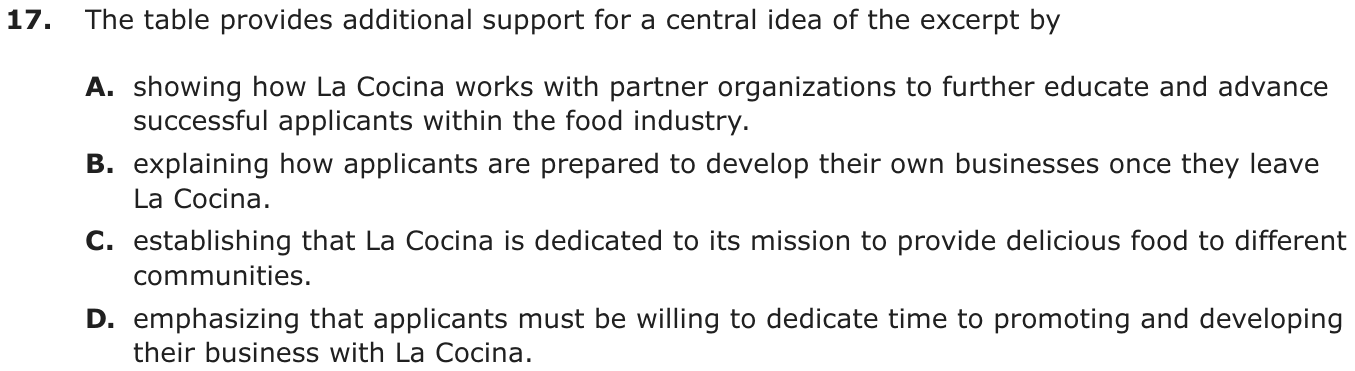
Question 18 of 57
2023 Test B English, question 18Passage Excerpt from In Search of the Unknown
Excerpt from In Search of the Unknown
by Robert W. Chambers
It was at that time the policy of the trustees and officers of the Zoological Gardens neither to employ collectors nor to send out expeditions in search of specimens. The society decided to depend upon voluntary contributions, and I was always busy, part of the day, in dictating answers to correspondents who wrote offering their services as hunters of big game, collectors of all sorts of fauna, trappers, snarers, and also to those who offered specimens for sale, usually at exorbitant rates.
To the proprietors of . . . mangy lynxes, moth-eaten coyotes, and dancing bears I returned courteous but uncompromising refusals—of course, first submitting all such letters, together with my replies, to Professor Farrago.
One day towards the end of May, however, just as I was leaving Bronx Park to return to town, Professor Lesard, of the reptilian department, called out to me that Professor Farrago wanted to see me a moment; so I . . . retraced my steps to the temporary, wooden building occupied by Professor Farrago, general superintendent of the Zoological Gardens. The professor, who was sitting at his desk before a pile of letters and replies submitted for approval by me, pushed his glasses down and looked over them at me with a whimsical smile that suggested amusement, impatience, annoyance, and perhaps a faint trace of apology.
“Now, here’s a letter,” he said, with a deliberate gesture towards a sheet of paper impaled on a file—“a letter that I suppose you remember.” He disengaged the sheet of paper and handed it to me.
“Oh yes,” I replied, with a shrug; “of course the man is mistaken—or—”
“Or what?” demanded Professor Farrago, tranquilly, wiping his glasses.
“—Or a liar,” I replied.
After a silence he leaned back in his chair and bade me read the letter to him again, and I did so with a contemptuous tolerance for the writer, who must have been either a very innocent victim or a very stupid swindler. I said as much to Professor Farrago, but, to my surprise, he appeared to waver.
“I suppose,” he said, with his near-sighted, embarrassed smile, “that nine hundred and ninety-nine men in a thousand would throw that letter aside and condemn the writer as a liar or a fool?”
“In my opinion,” said I, “he’s one or the other.”
“He isn’t—in mine,” said the professor, placidly.
“What!” I exclaimed. “Here is a man living all alone on a strip of rock and sand between the wilderness and the sea, who wants you to send somebody to take charge of a bird that doesn’t exist!”
“How do you know,” asked Professor Farrago, “that the bird in question does not exist?”
“It is generally accepted,” I replied, sarcastically, “that the great auk has been extinct for years. Therefore I may be pardoned for doubting that our correspondent possesses a pair of them alive.”
“Oh, you young fellows,” said the professor, smiling wearily, “you embark on a theory for destinations that don’t exist.”
He leaned back in his chair, his amused eyes searching space for the imagery that made him smile.
“Like swimming squirrels, you navigate with the help of Heaven and a stiff breeze, but you never land where you hope to—do you?”
Rather red in the face, I said: “Don’t you believe the great auk to be extinct?”
“Audubon saw the great auk.”
“Who has seen a single specimen since?”
“Nobody—except our correspondent here,” he replied, laughing.
I laughed, too, considering the interview at an end, but the professor went on, coolly:
“Whatever it is that our correspondent has—and I am daring to believe that it is the great auk itself—I want you to secure it for the society.”
When my astonishment subsided my first conscious sentiment was one of pity. Clearly, Professor Farrago was on the verge of dotage—ah, what a loss to the world!
I believe now that Professor Farrago perfectly interpreted my thoughts, but he betrayed neither resentment nor impatience. I drew a chair up beside his desk—there was nothing to do but to obey, and this fool’s errand was none of my conceiving.
Together we made out a list of articles necessary for me and itemized the expenses I might incur, and I set a date for my return, allowing no margin for a successful termination to the expedition.
“Never mind that,” said the professor. “What I want you to do is to get those birds here safely. Now, how many men will you take?”
“None,” I replied, bluntly; “it’s a useless expense, unless there is something to bring back. If there is I’ll wire you, you may be sure.”
“Very well,” said Professor Farrago, good-humoredly, “you shall have all the assistance you may require. Can you leave to-night?”
The old gentleman was certainly prompt. I nodded, half-sulkily, aware of his amusement.
“So,” I said, picking up my hat, “I am to start north to find a place called Black Harbor, where there is a man named Halyard who possesses, among other household utensils, two extinct great auks—”
We were both laughing by this time. I asked him why on earth he credited the assertion of a man he had never before heard of.
“I suppose,” he replied, with the same half-apologetic, half-humorous smile, “it is instinct. I feel, somehow, that this man Halyard has got an auk—perhaps two. I can’t get away from the idea that we are on the eve of acquiring the rarest of living creatures. It’s odd for a scientist to talk as I do; doubtless you’re shocked—admit it, now!”
But I was not shocked; on the contrary, I was conscious that the same strange hope that Professor Farrago cherished was beginning, in spite of me, to stir my pulses, too.
“If he has—” I began, then stopped.
The professor and I looked hard at each other in silence.
“Go on,” he said, encouragingly.
But I had nothing more to say, for the prospect of beholding with my own eyes a living specimen of the great auk produced a series of conflicting emotions within me which rendered speech profanely superfluous.
From IN SEARCH OF THE UNKNOWN by Robert W. Chambers—Public Domain
Audubon: John James Audubon, an ornithologist and artist who created scientific illustrations of birds
dotage: a loss of reasoning brought about by old age
Question
Read paragraph 2 from the excerpt.
To the proprietors of . . . mangy lynxes, moth-eaten coyotes, and dancing bears I returned courteous but uncompromising refusals—of course, first submitting all such letters, together with my replies, to Professor Farrago.
This paragraph helps develop the plot by establishing that the narrator
- Adislikes writing refusal letters for the animals offered to the zoological society.
- Battempts to predict what the professor would say in the refusal letters.
- Cbelieves that many of the animals offered are not acceptable for the zoological society.
- Dresents the professor’s insistence on reviewing the refusal letters.
Show the answer
Correct answer: C
The question asks how paragraph 2 helps develop the plot.
A. Incorrect. As paragraph 1 indicates, writing such letters is one of the main parts of the narrator’s job (“and I was always busy, part of the day, in dictating answers to correspondents”), and he shows no indication of disliking this work. The letters are to inform people whether the zoo will accept their animals.
B. Incorrect. Paragraph 2 indicates that the narrator offers his letters to the professor merely for official approval. At the start of the excerpt, the narrator is confident in his reply and does not anticipate that his response will differ from that of the professor, so he has no need to “predict what the professor would say.”
C. CORRECT. The phrase “uncompromising refusals” in paragraph 2 indicates the confidence that the narrator initially has in his belief that the animals described in the letters are not of value to the society. This confidence is badly shaken as the plot unfolds, as when Professor Farrago states that “ ‘I am daring to believe that it is the great auk itself’ ” (paragraph 23). The narrator’s transition from an attitude of dismissive doubt to one of budding hopefulness is a major part of the plot (“But I was not shocked; on the contrary, I was conscious that the same strange hope that Professor Farrago cherished was beginning, in spite of me, to stir my pulses, too” [paragraph 34]).
D. Incorrect. The narrator does not resent the professor’s review of the letters; instead, the phrase “of course” in paragraph 2 shows that he expects to submit the letters to the professor as part of his job.
Question analysis
In this plot question on an excerpt from Robert W. Chambers’s novel In Search of the Unknown, students read paragraph 2, in which a zoo employee describes answering people who offer animals for sale. The question asks what the paragraph establishes about the narrator. Its old-fashioned vocabulary and its long, dash-broken sentence make the narrator’s attitude harder to pin down.
- Grade level
- Grade 7 reading and task
- Compared with grade 7
- At grade 7 Explaining how one paragraph develops a plot is regular grade 7 work, and this one is quoted in full. Its early-1900s wording, with words such as “proprietors” and “uncompromising,” adds some load but no unusual reasoning.
- Estimated difficulty
- Straightforward: two steps or one careful reading.
- Thinking it demands
- Depth of knowledge 2, skills and concepts · mainly analyze
- What makes it hard
- Hard words moderate
- Complex sentences minor
- The right answer is reworded minor
- Evidence
- Answered from one paragraph or stanza
- Reading level
- Passage: about grade 9, 1066 words; question and choices: about grade 11, 94 words.
- Students, last 30 days
- Not enough answers yet to show (it takes 10).
Why it is hard, traps and wrong answers (shows the answer)
Why it is hard
The paragraph’s attitude sits in its adjectives: lynxes that are “mangy,” coyotes that are “moth-eaten” and refusals that are “uncompromising.” Students who read that scorn as the narrator’s mood about his job, or who hear grumbling in “of course,” choose a feeling about the work instead of a judgment of the animals. The plot point is that the narrator starts out sure the offers are worthless, the confidence the great auk letter is about to test.
Hard words moderate Understanding the question
“Proprietors,” “uncompromising,” “mangy” and “moth-eaten” carry the meaning: the owners of shabby animals get firm refusals, and a student who misses these words cannot tell what the narrator thinks of the offers. (Perfetti, 2007; Freedle & Kostin, 1993)
Complex sentences minor Understanding the question
The paragraph is one inverted sentence that opens with “To the proprietors of,” reaches “I returned” only midway and ends with a dash clause about the professor’s review. (Abedi & Lord, 2001; Freedle & Kostin, 1993; Messick, 1989)
The right answer is reworded minor Choosing the answer
Three wrong choices repeat the paragraph’s “refusals” and “letters,” while the right one restates the scorn for the animals as a judgment that they do not suit the society. (Freedle & Kostin, 1993; Kirsch & Mosenthal, 1990)
Strategy: Paraphrase paragraph 2 in plain modern words, noting what each descriptive word reveals about the narrator, then keep only a choice those words actually support.
Traps
- Twists what the text says: Uses the text's topic and ideas but changes what it says: who did it, how much, when, or why.
- Wrong tone or attitude: Misjudges the tone, attitude or point of view, such as reading admiration as criticism, or taking a character's or subject's feelings for the author's.
- Reads too much in: A reasonable-sounding conclusion that goes further than the text allows.
The wrong answers, classified
A Twists what the text says (King et al., 2004)
Moves the scorn of “mangy” and “moth-eaten” from the animals to the task, though the refusals are “courteous” and paragraph 1 presents answering letters as routine daily work.
B Reads too much in (Graesser, Singer & Trabasso, 1994)
Builds a guessing game from his sending each reply to Professor Farrago, though he expects his refusals simply to be approved and nothing shows him second-guessing the professor.
D Wrong tone or attitude (Graesser, Singer & Trabasso, 1994)
Hears irritation in the dash and “of course,” but the phrase marks the review as routine, and his clash with the professor begins only with the great auk letter.
Working it out, step by step
Figure out what the question asks
This asks what paragraph 2 tells you about the narrator, the person telling the story. It also asks how that sets up the plot, the chain of events in a story. The paragraph is one long, old-fashioned sentence. So put it in plain words first.
Put paragraph 2 in plain words
Proprietors are owners. People wrote offering animals to the zoo. The narrator lists some: “mangy lynxes, moth-eaten coyotes, and dancing bears.” Mangy means with patchy, sick-looking fur. Moth-eaten means old and worn out. He sent the owners “courteous but uncompromising refusals.” Courteous means polite. Uncompromising means firm, with no chance of changing his mind.
Decide what it shows about him
The words “mangy” and “moth-eaten” show what he thinks of the animals. To him, they are shabby and not good enough for the zoo. He turns them all down. This sets up the plot. When the letter about the great auk comes, he is ready to reject it too. That is where the story’s conflict begins.
Check each choice
- A does not fit. His refusals are polite, and paragraph 1 shows that answering letters is his everyday job. Nothing says he dislikes it.
- B does not fit. He sends his replies to the professor to be approved. He is not guessing what the professor would say.
- C fits. He judges that the animals offered are not good enough.
- D does not fit. “Of course” shows that the review is normal. He does not resent it, or feel bitter about it.
Watch out: A is tempting because the narrator sounds scornful. But his scorn is for the animals, not for the job.
Choose the answer
Paragraph 2 shows the narrator turning down animals he thinks are unfit. So the answer is C, “believes that many of the animals offered are not acceptable for the zoological society.”
Why this answer and not the closest wrong one
A is the closest wrong choice. The narrator’s words do sound scornful. But the scorn is aimed at the animals, “mangy” and “moth-eaten,” not at the job of writing letters. His refusals are even “courteous.” C names his real judgment: these animals are not right for the zoo.
More questions like this
The original DOE question
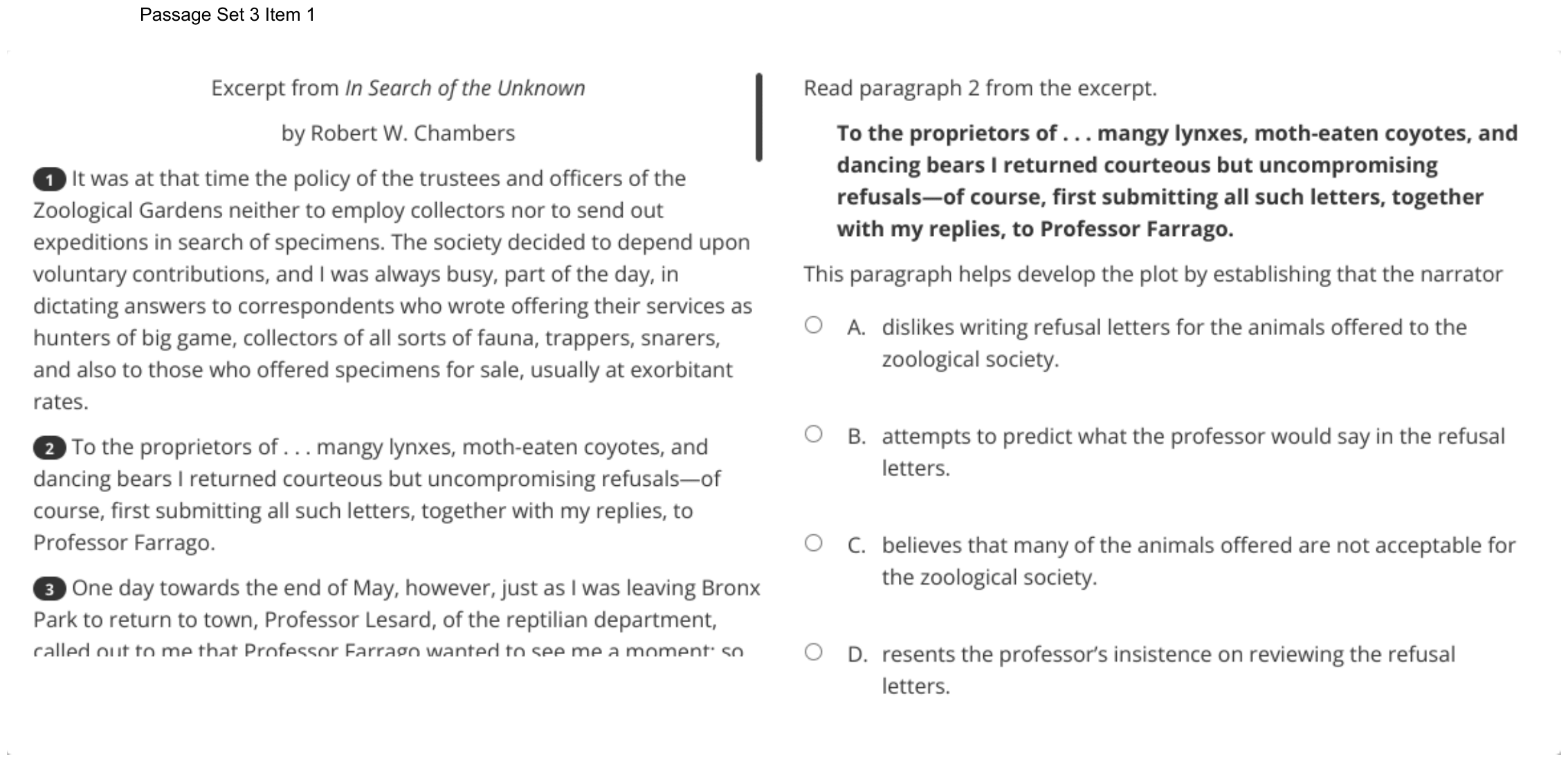
The passage “Excerpt from In Search of the Unknown” as printed (page 21)
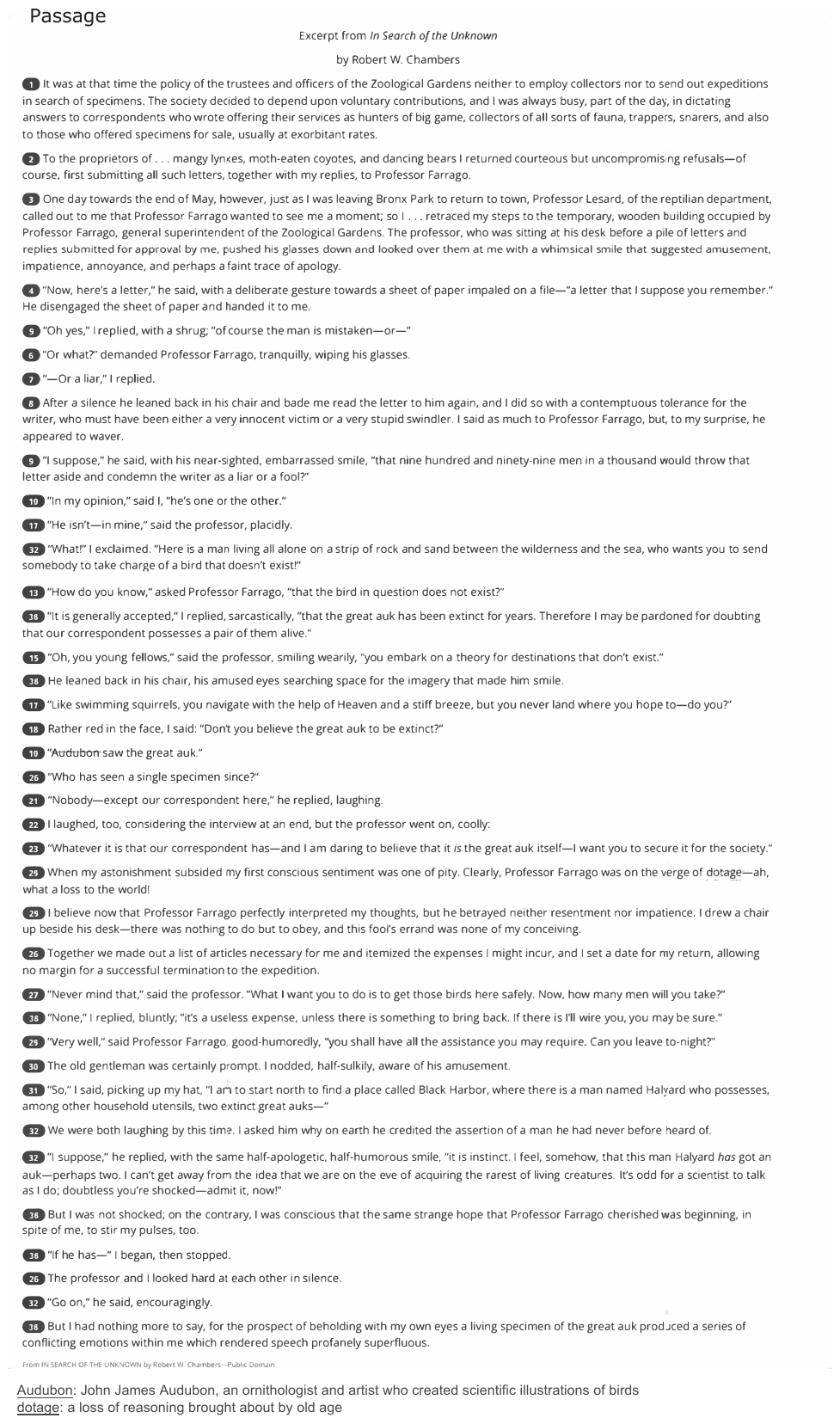
Question 19 of 57
2023 Test B English, question 19Uses the passage above: “Excerpt from In Search of the Unknown”.
Question
Read this sentence from paragraph 3.
The professor, who was sitting at his desk before a pile of letters and replies submitted for approval by me, pushed his glasses down and looked over them at me with a whimsical smile that suggested amusement, impatience, annoyance, and perhaps a faint trace of apology.
What does the phrase “a faint trace of apology” convey about the professor?
- AIt indicates that the professor feels bad that he has to call the narrator to his office after work.
- BIt shows that the professor is hesitant to share his opinions with the narrator.
- CIt implies that the professor is uncomfortable criticizing the narrator’s work.
- DIt suggests that the professor knows that the conversation will be frustrating for the narrator.
Show the answer
Correct answer: D
The question asks what the phrase “a faint trace of apology” in paragraph 3 conveys about the professor.
A. Incorrect. The fact that the narrator had intended to leave the office for the day is not the source of the professor’s faintly apologetic manner, which is instead caused by the professor’s understanding that their conversation about the letter and the expedition is likely to cause an argument (“with a whimsical smile that suggested amusement, impatience, annoyance” [paragraph 3]). In paragraph 29, the professor asks the narrator if he can leave on an expedition that same evening, which indicates that the professor does not feel bad about taking up the narrator’s time after work.
B. Incorrect. The paragraphs that follow the sentence from paragraph 3 show the professor sharing his opinions without pause, even when his opinion of the narrator is unflattering (“ ‘Like swimming squirrels, you navigate with the help of Heaven and a stiff breeze, but you never land where you hope to—do you?’ ” [paragraph 17]).
C. Incorrect. The professor knows that the narrator will push back regarding the letter, but the professor is not uncomfortable challenging the narrator. Professor Farrago seems perfectly at ease and comfortable as he begins the discussion with the narrator.
D. CORRECT. The professor is both amused and annoyed by the narrator’s dismissal of the possibility that great auks still exist, and the professor knows that the narrator is likely to react negatively to being sent on what the narrator considers a “fool’s errand” (paragraph 25).
Question analysis
This question focuses on a single phrase in the excerpt from Robert W. Chambers’s In Search of the Unknown: as the professor looks up from a pile of letters, his whimsical smile shows “a faint trace of apology.” Students must work out what that hint of apology says about him. The phrase is brief and old-fashioned, and several explanations for it seem natural.
- Grade level
- Grade 8 reading and task
- Compared with grade 7
- Above grade 7 Grade 7 students often infer a character’s feelings from a description. Here the phrase ends a 46-word sentence of early-1900s prose, follows three other moods, and has to be interpreted from the scene as a whole, beyond typical grade 7 work.
- Estimated difficulty
- Among the hardest on the SHSAT: a non-obvious approach, heavy reading, or a well-hidden trap.
- Thinking it demands
- Depth of knowledge 3, strategic thinking · mainly analyze
- What makes it hard
- Reading between the lines major
- A very close wrong answer moderate
- Evidence in several places moderate
- Complex sentences minor
- Evidence
- Answered from several paragraphs or stanzas
- Reading level
- Passage: about grade 9, 1066 words; question and choices: about grade 10, 123 words.
- Students, last 30 days
- Not enough answers yet to show (it takes 10).
Why it is hard, traps and wrong answers (shows the answer)
Why it is hard
The phrase comes before a word of the conversation is spoken, so the reason for the apology lies ahead in the text. Two natural guesses compete with it: the professor has called the narrator back just as he was leaving, and he is about to question one of the narrator’s replies. Only a reader who follows the scene to the narrator’s scorn for the letter and the errand sees that the professor, at ease throughout, is sorry for what he is about to put the narrator through.
Reading between the lines major Working it out
Nothing explains the apology; students must reason from the talk that follows, in which the professor sends the narrator after birds the narrator believes extinct, that the professor expects resistance. (Graesser, Singer & Trabasso, 1994; Kintsch, 1998)
A very close wrong answer moderate Choosing the answer
The choice about criticizing the narrator’s work and the right one both tie the apology to the coming talk about a letter; one places discomfort in the professor, the other frustration in the narrator. (Embretson & Wetzel, 1987; Gorin & Embretson, 2006; Ascalon et al., 2007)
Evidence in several places moderate Working it out
What the professor anticipates appears only later: the narrator’s scorn for the letter in paragraphs 5–14 and his view of the trip as a “fool’s errand” in paragraph 25. (Kirsch & Mosenthal, 1990; Gorin & Embretson, 2006)
Complex sentences minor Understanding the question
The phrase closes a 46-word sentence, after a clause about the pile of letters and a run of three other moods, “amusement, impatience, annoyance.” (Abedi & Lord, 2001; Freedle & Kostin, 1993; Messick, 1989)
Strategy: Read the full sentence and then the conversation it opens, and test each choice against how the professor actually speaks and acts in that conversation.
Traps
- Reads too much in: A reasonable-sounding conclusion that goes further than the text allows.
- Half right: One half of a two-part choice is right and the other is not.
- Twists what the text says: Uses the text's topic and ideas but changes what it says: who did it, how much, when, or why.
The wrong answers, classified
A Reads too much in (Graesser, Singer & Trabasso, 1994)
Ties the apology to the timing, since Professor Lesard stopped the narrator as he was leaving Bronx Park, but the professor later asks him to leave on the trip that same night.
B Twists what the text says (King et al., 2004)
Reads the apology, and the “embarrassed smile” of paragraph 9, as reluctance to speak, though the professor states his belief in the letter plainly and even teases the narrator.
C Half right (King et al., 2004; Thissen, Steinberg & Fitzpatrick, 1989)
Rightly senses that the professor is about to challenge the narrator’s reply to a letter, but he does it “placidly” and “coolly,” with no sign of discomfort.
Working it out, step by step
Figure out what the question asks
This asks what one phrase shows about the professor: “a faint trace of apology.” Faint means slight, and a trace is a small sign. So his smile looks a little bit sorry. Why would he feel sorry? You find out from the talk that follows.
Read the whole sentence
Paragraph 3 says the professor looked at the narrator “with a whimsical smile that suggested amusement, impatience, annoyance, and perhaps a faint trace of apology.” Whimsical means playful. He is amused by the narrator and a bit annoyed with him. Then he picks up a letter the narrator has already turned down.
See what the professor is about to do
The professor is about to defend that letter. Then he sends the narrator after the birds in it. The narrator thinks the birds are extinct, or all dead. In paragraph 25 he calls the trip “this fool’s errand,” a pointless job. The professor seems to know the narrator will hate this. That is why his smile looks a little sorry.
Check each choice
- A does not fit. He later asks, “Can you leave to-night?” (paragraph 29). He is not sorry about taking the narrator’s time.
- B does not fit. He shares his opinion plainly: “He isn’t—in mine” (paragraph 11).
- C does not fit. He does challenge the narrator, but calmly. He speaks “placidly” and “coolly,” with no sign of being uneasy.
- D fits. He knows the talk will annoy the narrator.
Watch out: C is tempting because the professor is about to disagree with the narrator. But nothing shows that he is uncomfortable about it.
Choose the answer
The slight apology shows that the professor expects the narrator to be frustrated. So the answer is D, “It suggests that the professor knows that the conversation will be frustrating for the narrator.”
Why this answer and not the closest wrong one
C is the closest wrong choice. Both C and D link the apology to the talk about the letter. But C puts the bad feeling in the professor, as if he were nervous. He is not. He speaks “placidly,” which means calmly. D puts the bad feeling in the narrator, and the narrator does get upset.
More questions like this
The original DOE question
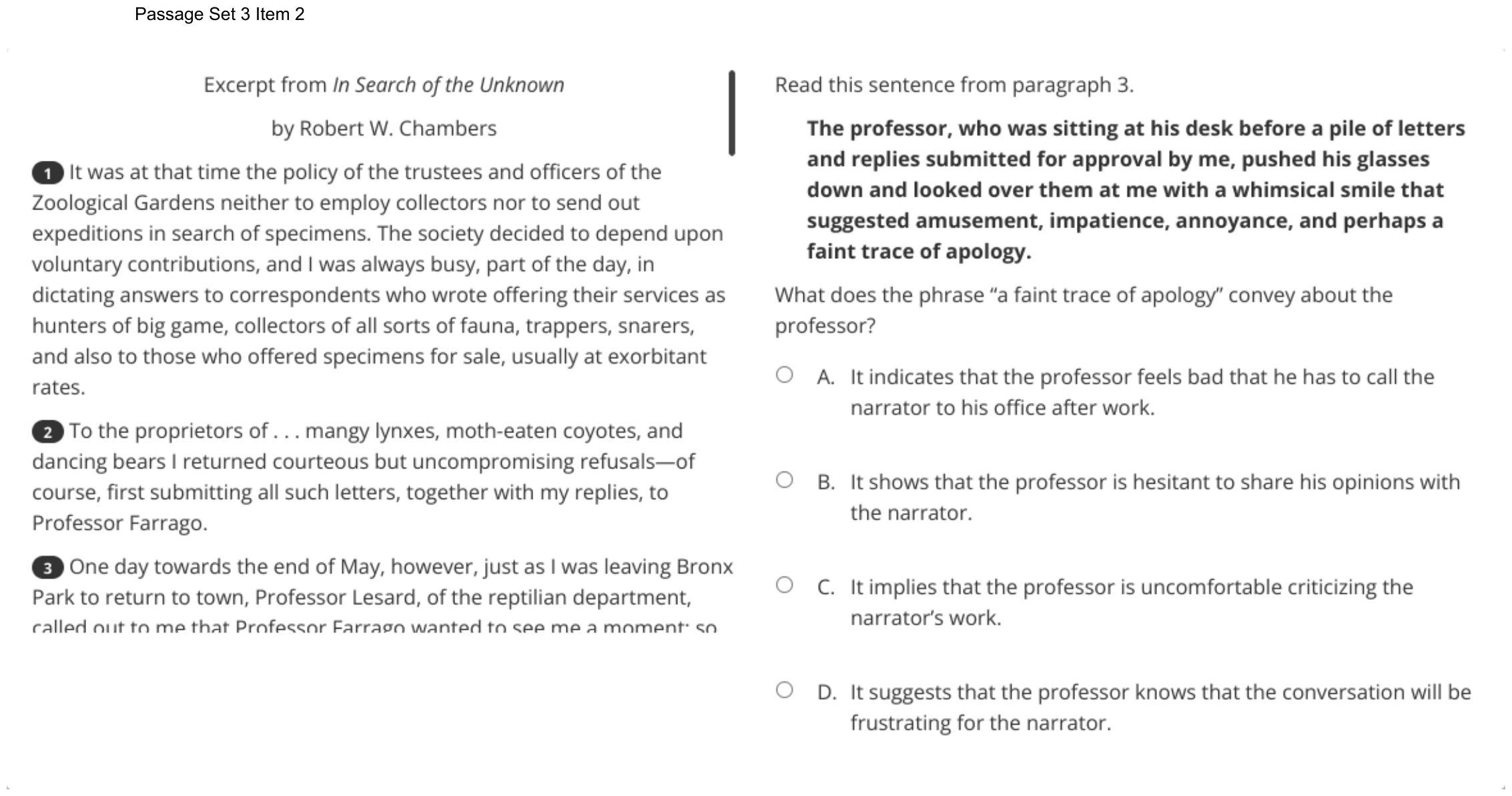
Question 20 of 57
2023 Test B English, question 20Uses the passage above: “Excerpt from In Search of the Unknown”.
Question
How does the exchange between the professor and the narrator in paragraphs 8–11 contribute to the development of the characters?
- AIt establishes the conflict between the professor and the narrator concerning the validity of the letter.
- BIt suggests a theme of collaboration because the narrator and the professor regularly work together.
- CIt reveals the characters’ traits by contrasting the narrator’s distrust with how easily the professor is deceived by what he reads.
- DIt hints that the resolution will involve the narrator accepting the professor’s opinion about the content of the letter.
Show the answer
Correct answer: A
The question asks how the exchange between the professor and the narrator in paragraphs 8–11 contributes to the development of the characters.
A. CORRECT. Paragraphs 8–11 help develop the characters by revealing the difference between the opinions of the narrator and the professor. The narrator believes without any doubts that Halyard, the man who wrote the letter about the auks, is either “ ‘a liar or a fool’ ” (paragraph 9), while the professor believes in the possibility that the writer of the letter could actually be telling the truth (“I said as much to Professor Farrago, but, to my surprise, he appeared to waver” [paragraph 8]).
B. Incorrect. In paragraph 8, the narrator reacts to the letter writer with “a contemptuous tolerance,” and he is shocked to learn that the professor actually agrees with the man (paragraph 11) whom the narrator has bluntly condemned as a liar or a fool (“ ‘In my opinion,’ said I, ‘he’s one or the other.’ ” [paragraph 10]). The exchange presents an emphatic disagreement between the narrator and the professor, and it does not show them working together in a collaborative manner.
C. Incorrect. Although the narrator initially distrusts the contents of the letter and shows “contemptuous tolerance for the writer” (paragraph 8), the excerpt portrays the professor as experienced and intelligent, not as one who is easily deceived.
D. Incorrect. While the narrator does begin to consider the professor’s perspective at the end of the excerpt, paragraphs 8–11 primarily serve to establish the difference of opinion between the narrator and the professor about the writer of the letter.
Question analysis
This question on the excerpt from In Search of the Unknown asks how a short exchange in paragraphs 8–11, in which the narrator and Professor Farrago discuss a letter about a bird, contributes to the development of the two characters. Students must read what each man says and decide what the exchange adds. Some choices describe the pair accurately in part only.
- Grade level
- Grade 8 reading and task
- Compared with grade 7
- At grade 7 The task matches the grade 8 standard on how lines of dialogue reveal character, but the four paragraphs are short and the two speakers’ positions are stated outright, so the demand stays at a typical grade 7 level.
- Estimated difficulty
- Moderate: several steps, or a close reading with one strong distractor.
- Thinking it demands
- Depth of knowledge 2, skills and concepts · mainly analyze
- What makes it hard
- A very close wrong answer moderate
- How, not what minor
- Reading between the lines minor
- Evidence
- Answered from several paragraphs or stanzas
- Reading level
- Passage: about grade 9, 1066 words; question and choices: about grade 13, 90 words.
- Students, last 30 days
- Not enough answers yet to show (it takes 10).
Why it is hard, traps and wrong answers (shows the answer)
Why it is hard
The four paragraphs are short and the disagreement is plain, so most students see that the men differ about the letter. The difficulty lies in the wording of the choices. One describes the contrast in terms of character, which suits the stem, but calls the professor easily deceived, a judgment only the narrator holds. The right choice speaks of a conflict, which sounds like plot rather than character, so students must trust that the conflict is what reveals the two men.
A very close wrong answer moderate Choosing the answer
The choice that contrasts the narrator’s distrust with an easily deceived professor and the right one both set the men’s views of the letter against each other; they part on whether the professor is fooled. (Embretson & Wetzel, 1987; Gorin & Embretson, 2006; Ascalon et al., 2007)
How, not what minor Working it out
The stem asks about the characters, while the right choice names a conflict over the letter, so students must see that the disagreement itself is what reveals each man. (Anderson & Krathwohl, 2001)
Reading between the lines minor Working it out
The professor’s side is four words, “He isn’t—in mine,” and students must read them as openness to the letter’s truth, set against the narrator’s flat “one or the other.” (Graesser, Singer & Trabasso, 1994; Kintsch, 1998)
Strategy: Sum up in a phrase what each man says and does in paragraphs 8–11, then check every part of each choice against those four paragraphs, since a choice can describe one character correctly and the other not.
Traps
- Half right: One half of a two-part choice is right and the other is not.
- Wrong part of the text: A choice is true of another paragraph, stanza or speaker than the one asked about.
- True but not the answer: A choice says something accurate about the text that does not answer this question.
The wrong answers, classified
B True but not the answer (King et al., 2004; Embretson & Wetzel, 1987)
Rests on a true fact, that the narrator submits his work to the professor, but in paragraphs 8–11 the two disagree sharply and nothing shows them cooperating.
C Half right (King et al., 2004; Thissen, Steinberg & Fitzpatrick, 1989)
Gets the narrator’s distrust right but adopts his view that the professor is gullible, though the professor only declines to call the writer a liar or a fool and stays calm.
D Wrong part of the text (Kirsch & Mosenthal, 1990)
Knows that the narrator later comes to share the professor’s hope, in paragraph 34, but in paragraphs 8–11 he still insists the writer is “one or the other.”
Working it out, step by step
Figure out what the question asks
This asks what paragraphs 8–11 show about the two characters. Look at what each man says about the letter. Then compare their views.
Find the narrator’s view
In paragraph 8, the narrator reads the letter with “a contemptuous tolerance for the writer.” Contemptuous means full of scorn. He thinks the writer is “either a very innocent victim or a very stupid swindler.” A swindler is a cheat. In paragraph 10, he says the writer is a liar or a fool: “he’s one or the other.”
Find the professor’s view
The professor does not agree. In paragraph 8, the narrator notices that “to my surprise, he appeared to waver.” To waver means to be unsure. In paragraph 11, the professor answers, “He isn’t—in mine.” He means that in his opinion the writer is not a liar or a fool. So the two men clash over whether the letter is true. A clash like this is a conflict.
Check each choice
- A fits. The two men disagree about whether the letter can be trusted. Validity means whether something is true.
- B does not fit. They do work together, but here they disagree.
- C does not fit. The narrator’s distrust is right, but the professor is not fooled. He calmly refuses to call the writer a liar.
- D does not fit. The narrator starts to hope later, in paragraph 34. In paragraphs 8–11 he does not budge.
Watch out: C is tempting because half of it is true. The narrator does distrust the letter. But the idea that the professor has been fooled is only the narrator’s view.
Choose the answer
Paragraphs 8–11 set the narrator’s scorn against the professor’s open mind. So the answer is A, “It establishes the conflict between the professor and the narrator concerning the validity of the letter.”
Why this answer and not the closest wrong one
C is the closest wrong choice. It is right about the narrator’s distrust. But it speaks of “how easily the professor is deceived.” Deceived means tricked. The story never shows that. He stays calm and thinks for himself. A describes both men correctly: they disagree about the letter.
More questions like this
The original DOE question
Question 21 of 57
2023 Test B English, question 21Uses the passage above: “Excerpt from In Search of the Unknown”.
Question
The professor’s observations in paragraphs 15–17 create tension in the excerpt by causing the narrator to feel
- Aflustered by the professor’s criticism of his logic.
- Bannoyed by the professor’s sarcasm about his inexperience.
- Cconfused by the professor’s lack of respect for his opinion.
- Dfrustrated by the professor’s lack of interest in his theory.
Show the answer
Correct answer: A
The question asks how the professor’s observations in paragraphs 15–17 create tension in the excerpt.
A. CORRECT. The professor criticizes “ ‘you young fellows’ ” (paragraph 15), suggesting that the ideas of young scientists like the narrator are unsupported (“ ‘like swimming squirrels’ ” [paragraph 17]) and inaccurate (“ ‘but you never land where you hope to—do you?’ ” [paragraph 17] and “ ‘you embark on a theory for destinations that don’t exist’ ” [paragraph 15]). The narrator then becomes “red in the face” (paragraph 18), indicating that the narrator is upset by the professor’s criticism, and asks the professor about the great auk in an attempt to defend himself.
B. Incorrect. While the narrator does experience a negative reaction to the professor’s words, the professor is being genuine, not sarcastic. In fact, the sarcasm comes from the narrator in paragraph 14 (“ ‘It is generally accepted,’ I replied, sarcastically, ‘that the great auk has been extinct for years. Therefore I may be pardoned for doubting that our correspondent possesses a pair of them alive’ ”), not from the professor.
C. Incorrect. The professor’s observations cause the narrator to blush with embarrassment (“rather red in the face” [paragraph 18]), but the narrator understands the point that the professor is making about the narrator’s acceptance of the idea that great auks do not exist. The narrator recognizes that the professor is criticizing his youthful ideas, not his opinion.
D. Incorrect. The professor shows amusement with the narrator’s perspective. The narrator is embarrassed and upset by the professor’s words, but the narrator does not display frustration with the professor’s lack of interest in a commonly held view of the existence of a certain species of bird.
Question analysis
In this question on In Search of the Unknown, Professor Farrago makes remarks about “you young fellows,” comparing them to swimming squirrels that never land where they hope. Students must decide how these remarks in paragraphs 15–17 make the narrator feel and so create tension. The comparison is odd and old-fashioned, and the four choices name similar negative feelings with different causes.
- Grade level
- Grade 8 reading and task
- Compared with grade 7
- Above grade 7 Grade 7 students infer feelings from a character’s reactions, usually from plainly stated emotions. Here the cause is a puzzling figurative jab about “swimming squirrels,” the reaction is shown only through a physical sign, and the choices offer four close negative feelings.
- Estimated difficulty
- Hard: combines ideas, needs a plan, and has more than one tempting wrong answer.
- Thinking it demands
- Depth of knowledge 2, skills and concepts · mainly analyze
- What makes it hard
- Figurative or literary language major
- A very close wrong answer moderate
- Reading between the lines moderate
- Evidence
- Answered from several paragraphs or stanzas
- Reading level
- Passage: about grade 9, 1066 words; question and choices: about grade 9, 52 words.
- Students, last 30 days
- Not enough answers yet to show (it takes 10).
Why it is hard, traps and wrong answers (shows the answer)
Why it is hard
The professor’s two images are odd, and students must decode them as a comment on how the narrator reasons before they can say why he blushes. Every choice names an unpleasant feeling, so the decision rests on its cause. “You young fellows” makes sarcasm about inexperience the natural guess, but the sarcasm in this scene is the narrator’s own, and the professor smiles “wearily” and speaks in earnest. The narrator’s pointed reply shows he followed the criticism, not that it confused him.
Figurative or literary language major Understanding the question
The criticism comes in images: young men who “embark on a theory for destinations that don’t exist” and who, like swimming squirrels, “never land where you hope to,” a picture of reasoning that goes astray. (Graesser, Singer & Trabasso, 1994; Kintsch, 1998)
A very close wrong answer moderate Choosing the answer
The choice about annoyance at sarcasm and the right one both name a bad reaction to the professor’s remarks; they part on the cause, sincere criticism of his logic or mockery of his youth. (Embretson & Wetzel, 1987; Gorin & Embretson, 2006; Ascalon et al., 2007)
Reading between the lines moderate Working it out
The narrator never names his feeling; it shows only in “Rather red in the face” and in the defensive question that follows about whether the great auk is extinct. (Graesser, Singer & Trabasso, 1994; Kintsch, 1998)
Strategy: Paraphrase what the professor says about “you young fellows” in paragraphs 15–17, find how the narrator reacts in paragraph 18, and choose the feeling and the cause that both fit.
Traps
- Wrong tone or attitude: Misjudges the tone, attitude or point of view, such as reading admiration as criticism, or taking a character's or subject's feelings for the author's.
- Twists what the text says: Uses the text's topic and ideas but changes what it says: who did it, how much, when, or why.
- Word match: Repeats striking words or phrases from the text, so it looks supported, but its meaning does not fit the question.
The wrong answers, classified
B Wrong tone or attitude (Graesser, Singer & Trabasso, 1994)
Hears mockery in “Oh, you young fellows,” but the professor is sincere; the sarcasm belongs to the narrator, who “sarcastically” insists in paragraph 14 that the great auk is extinct.
C Twists what the text says (King et al., 2004)
Takes the blush in paragraph 18 as confusion, though the narrator answers at once with a pointed question, which shows he understood the professor’s point well enough to push back.
D Word match (Freedle & Kostin, 1993)
Is drawn by “theory” in paragraph 15 and calls the professor uninterested, though he engages the narrator’s view closely enough to answer it with two vivid images.
Working it out, step by step
Figure out what the question asks
This asks how the professor’s words in paragraphs 15–17 make the narrator feel. Tension is a feeling of strain between characters. Each choice names a feeling and a cause. Both parts must be right.
Read what the professor says
In paragraph 15 he says, “Oh, you young fellows,” and “you embark on a theory for destinations that don’t exist.” To embark means to set out on a trip. He means young men set out with an idea toward places that are not there. Their reasoning leads them to wrong answers. In paragraph 17 he adds, “Like swimming squirrels, you navigate with the help of Heaven and a stiff breeze, but you never land where you hope to—do you?”
Understand the picture
A swimming squirrel can’t really steer. It drifts with luck and the wind. The professor is saying the narrator’s thinking drifts the same way and misses the truth. That is a criticism of his logic, or reasoning. In paragraph 18, the narrator is “Rather red in the face.” He is flustered, which means embarrassed and upset.
Check each choice
- A fits. He turns red after the professor criticizes his reasoning.
- B does not fit. Sarcasm is saying the opposite of what you mean in order to mock. The professor means what he says. The sarcastic one is the narrator, in paragraph 14.
- C does not fit. He is not confused. He fires back a sharp question right away.
- D does not fit. The professor answers the narrator’s idea closely, so he is interested in it.
Watch out: B is tempting because “you young fellows” points to the narrator’s youth. But the professor is sincere, not sarcastic.
Choose the answer
The professor says the narrator’s reasoning goes astray, and the narrator turns red. So the answer is A, “flustered by the professor’s criticism of his logic.”
Why this answer and not the closest wrong one
B is the closest wrong choice. Both A and B say the narrator feels bad. But B blames sarcasm. Paragraph 14 says the narrator “replied, sarcastically,” so the sarcasm is his own. The professor means his words seriously. A names the real cause: criticism of the narrator’s thinking.
More questions like this
The original DOE question
Question 22 of 57
2023 Test B English, question 22Uses the passage above: “Excerpt from In Search of the Unknown”.
Question
How does the interaction between the narrator and the professor in paragraphs 26–28 contribute to the development of the theme?
- AIt illustrates the professor’s patience as the narrator argues against making the expedition.
- BIt reveals the narrator’s frustration with his limited role in making decisions for the zoological society.
- CIt emphasizes the professor’s desire to acquire new specimens for the zoological society at any cost.
- DIt shows the narrator’s acceptance of his assignment despite his personal objections.
Show the answer
Correct answer: D
The question asks how the interaction between the narrator and the professor in paragraphs 26–28 contributes to the development of the theme.
A. Incorrect. Paragraphs 26–28 do not show the narrator arguing against making the expedition. He instead argues that it is unnecessary for the professor to pay to send extra men on the expedition. The narrator points out that he can ask for assistance if he does, in fact, find great auks (“ ‘None,’ I replied, bluntly; ‘it’s a useless expense, unless there is something to bring back. If there is I’ll wire you, you may be sure’ ” [paragraph 28]).
B. Incorrect. When the professor criticizes the narrator’s blind acceptance of the theory about the existence of the auks, the narrator is frustrated and embarrassed. This frustration does not stem from his inability to make decisions for the zoological society.
C. Incorrect. The professor states that “ ‘what I want you to do is to get those birds here safely’ ” (paragraph 27), which indicates that his main priority is the birds’ safety rather than acquiring specimens regardless of the consequences (i.e., at any cost).
D. CORRECT. Paragraph 26 describes the professor and the narrator making practical plans for the expedition (“we made out a list of articles necessary for me and itemized the expenses I might incur”), indicating the narrator’s acceptance of his assignment while also revealing that he does not anticipate a “successful termination to the expedition.” Paragraph 28 further describes the personal objections of the narrator, who believes that adding extra men to the expedition is pointless (“ ‘a useless expense’ ”), since he does not expect to find any great auks to bring back.
Question analysis
This theme question on In Search of the Unknown asks how paragraphs 26–28, in which the narrator and Professor Farrago talk over supplies, expenses and how many men to bring, contribute to the development of the theme. Students must decode formal, old-fashioned phrasing, then judge what the interaction shows. Every choice sounds like something the excerpt might say.
- Grade level
- Grade 8 reading and task
- Compared with grade 7
- Above grade 7 Grade 7 theme questions trace an idea through clear events. Paragraphs 26–28 are dense with formal phrasing such as “allowing no margin for a successful termination,” and each choice pairs a real detail with a claim, which pushes the task above grade 7.
- Estimated difficulty
- Hard: combines ideas, needs a plan, and has more than one tempting wrong answer.
- Thinking it demands
- Depth of knowledge 2, skills and concepts · mainly analyze
- What makes it hard
- Complex sentences moderate
- Reading between the lines moderate
- How, not what minor
- Evidence
- Answered from several paragraphs or stanzas
- Reading level
- Passage: about grade 9, 1066 words; question and choices: about grade 13, 76 words.
- Students, last 30 days
- Not enough answers yet to show (it takes 10).
Why it is hard, traps and wrong answers (shows the answer)
Why it is hard
Each choice pairs a real feature of the scene with a claim, and the claims must be checked against three short paragraphs of formal prose. The narrator does object, bluntly, so the choice that has him arguing against the trip draws strongly; what he rejects is the cost of extra men, while he plans the trip itself. Students who decode “allowing no margin for a successful termination” see the whole picture: he is going, and he expects to fail.
Complex sentences moderate Understanding the question
Paragraph 26 is a 36-word sentence that ends “allowing no margin for a successful termination to the expedition,” formal wording for planning as if the search will fail. (Abedi & Lord, 2001; Freedle & Kostin, 1993; Messick, 1989)
Reading between the lines moderate Working it out
The narrator never says he accepts the trip; his acceptance shows in the planning, and his objection in the blunt “None” and “a useless expense” of paragraph 28. (Graesser, Singer & Trabasso, 1994; Kintsch, 1998)
How, not what minor Working it out
The stem asks about the theme, yet every choice describes a character’s attitude, so students must judge which attitude these paragraphs show rather than look for a stated theme. (Anderson & Krathwohl, 2001)
Strategy: Translate each of paragraphs 26–28 into plain modern words, then check each choice’s claim about the narrator or the professor against exactly what those three paragraphs show.
Traps
- Half right: One half of a two-part choice is right and the other is not.
- Too broad or too strong: A choice overstates, generalizes, or uses absolute words the text does not support.
- Wrong part of the text: A choice is true of another paragraph, stanza or speaker than the one asked about.
The wrong answers, classified
A Half right (King et al., 2004; Thissen, Steinberg & Fitzpatrick, 1989)
Gets the professor’s patience right, since he answers “Never mind that,” but the narrator never argues against going; he refuses only to take men along.
B Wrong part of the text (Kirsch & Mosenthal, 1990)
Carries over the grudging obedience of paragraph 25, “nothing to do but to obey,” though in paragraphs 26–28 the narrator sets his own return date and decides how many men to take.
C Too broad or too strong (King et al., 2004)
Inflates the professor’s wish for the birds into a desire for specimens “at any cost,” though the two men itemize expenses and he asks for the birds to arrive safely.
Working it out, step by step
Figure out what the question asks
This asks how paragraphs 26–28 build the theme. A theme is a big message of a story. Read the three paragraphs. Decide what the narrator does and what he thinks.
Read paragraph 26
Paragraph 26 says “Together we made out a list of articles necessary for me and itemized the expenses I might incur.” Articles are supplies, and itemized means listed one by one. So the narrator is planning the trip. But he sets a return date “allowing no margin for a successful termination to the expedition.” A margin is extra room. He leaves no extra time in case he finds the birds. He plans as if he will find nothing.
Read paragraphs 27 and 28
The professor asks how many men he will take. The narrator answers bluntly, which means in a short, plain way. He takes none. Extra men would be “a useless expense, unless there is something to bring back.” He still thinks the birds are not real. Yet he does not refuse to go. He accepts the job while doubting it.
Check each choice
- A does not fit. The professor is patient, but the narrator never argues against going. He only refuses to take men.
- B does not fit. Here the narrator makes decisions himself, like his return date and how many men to take.
- C does not fit. They count the costs, and the professor wants the birds safe. That is not “at any cost.”
- D fits. He plans the trip but shows he thinks it is pointless.
Watch out: A is tempting because the professor does stay calm. But the narrator is planning the trip, not fighting it.
Choose the answer
The narrator does the job while making his doubts clear. So the answer is D, “It shows the narrator’s acceptance of his assignment despite his personal objections.”
Why this answer and not the closest wrong one
A is the closest wrong choice. The professor does answer calmly, “Never mind that.” But A says the narrator argues against making the trip. He does not. He helps plan it and only objects to taking men. D captures both parts: he goes, and he still doubts.
More questions like this
The original DOE question
Question 23 of 57
2023 Test B English, question 23Uses the passage above: “Excerpt from In Search of the Unknown”.
Question
Which sentence from the excerpt best explains why the professor is eager to send the narrator on an expedition?
- A“I believe now that Professor Farrago perfectly interpreted my thoughts, but he betrayed neither resentment nor impatience.” (paragraph 25)
- B“Together we made out a list of articles necessary for me and itemized the expenses I might incur, and I set a date for my return, allowing no margin for a successful termination to the expedition.” (paragraph 26)
- C“ ‘What I want you to do is to get those birds here safely.’ ” (paragraph 27)
- D“ ‘I can’t get away from the idea that we are on the eve of acquiring the rarest of living creatures.’ ” (paragraph 33)
Show the answer
Correct answer: D
The question asks which sentence from the excerpt best explains why the professor is eager to send the narrator on an expedition.
A. Incorrect. The sentence from paragraph 25 says that the professor “perfectly interpreted” the narrator’s thoughts: in paragraph 24, the narrator suspects the professor is losing his ability to reason because his request (to secure the great auk for the society) seems impossible. The professor is excited about the discovery, but the narrator doubts whether the discovery is real. The sentence does not explain why the professor is excited, however.
B. Incorrect. Paragraph 26 shows the professor and the narrator planning the logistics of the trip, but it does not explain why the professor is eager to send the narrator on the expedition.
C. Incorrect. Although the sentence from paragraph 27 expresses the professor’s interest in having the narrator bring the birds back safely, it does not show the underlying reason why the safety of the birds is so crucial, which is that the great auk is extremely rare.
D. CORRECT. The sentence from paragraph 33 reveals the professor’s excitement to get “ ‘the rarest of living creatures,’ ” the great auk. In paragraph 14, the narrator states that “it is generally accepted . . . that the great auk has been extinct for years,” which would make a living auk incredibly rare and explains the professor’s eagerness for the narrator to go on the expedition.
Question analysis
This textual evidence question asks which sentence from In Search of the Unknown best explains why Professor Farrago is eager to send the narrator to collect a pair of great auks from a man who wrote to the zoo. Students must find the sentence that gives the professor’s reason, and the four quotations, from paragraphs 25 to 33, all concern the expedition in some way.
- Grade level
- Grade 7 reading and task
- Compared with grade 7
- At grade 7 Choosing the sentence that best explains a character’s motive is standard grade 7 evidence work. The four quotations are short and labeled, but students must tell a reason for the professor’s eagerness apart from sentences that merely relate to the trip.
- Estimated difficulty
- Moderate: several steps, or a close reading with one strong distractor.
- Thinking it demands
- Depth of knowledge 2, skills and concepts · mainly evaluate
- What makes it hard
- A very close wrong answer moderate
- Reading between the lines minor
- Hard words minor
- Evidence
- Answered from several paragraphs or stanzas
- Reading level
- Passage: about grade 9, 1066 words; question and choices: about grade 12, 109 words.
- Corrected from the DOE handbook
- A detail in the explanation was attributed to the wrong paragraph; it was corrected.
- Students, last 30 days
- Not enough answers yet to show (it takes 10).
Why it is hard, traps and wrong answers (shows the answer)
Why it is hard
Every quotation concerns the expedition, so the question rests on the difference between a sentence that relates to the trip and one that gives the professor’s reason for wanting it. The order to bring the birds back safely shows his eagerness plainly and draws students who stop there. Only the sentence about “the rarest of living creatures” supplies a motive, and it gains its weight from the narrator’s earlier claim that the great auk is extinct.
A very close wrong answer moderate Choosing the answer
The professor’s order to “get those birds here safely” and the right sentence are both his words about the birds; one says what he wants, the other why he wants it. (Embretson & Wetzel, 1987; Gorin & Embretson, 2006; Ascalon et al., 2007)
Reading between the lines minor Working it out
The right sentence never mentions the expedition, and its force depends on paragraph 14, where the narrator says the great auk “has been extinct for years.” (Graesser, Singer & Trabasso, 1994; Kintsch, 1998)
Hard words minor Understanding the question
“On the eve of acquiring” is an idiom for being about to obtain, and a student who takes “eve” as evening misses that the professor feels the prize is near. (Perfetti, 2007; Freedle & Kostin, 1993)
Strategy: Restate the question as “Why does the professor want the narrator to go?” and ask of each quotation whether it gives a reason or only describes part of the plan.
Traps
- Supports only part of the claim: In a question about evidence: a line that backs one half of the claim but not the other, or a related point rather than the claim itself.
- Word match: Repeats striking words or phrases from the text, so it looks supported, but its meaning does not fit the question.
- True but not the answer: A choice says something accurate about the text that does not answer this question.
The wrong answers, classified
A True but not the answer (King et al., 2004; Embretson & Wetzel, 1987)
Picks the professor reading the narrator’s doubts with “neither resentment nor impatience,” a true picture of his calm that says nothing about why he wants the birds.
B Word match (Freedle & Kostin, 1993)
Is drawn by “the expedition” at the end of the sentence, but the list of supplies, costs and a return date is planning, not the professor’s motive.
C Supports only part of the claim (King et al., 2004; Thissen, Steinberg & Fitzpatrick, 1989)
Takes the professor’s instruction to bring the birds safely as his reason, but it states what he wants done; why the birds matter appears only in paragraph 33.
What was corrected from the DOE handbook, and why
- Explanation: The DOE’s explanation of Option A says “In the sentence from paragraph 25, the narrator suspects the professor is losing his ability to reason.” That suspicion is in paragraph 24 (“Clearly, Professor Farrago was on the verge of dotage,” where dotage is “a loss of reasoning brought about by old age”). The sentence from paragraph 25, which is Option A, says that the professor “perfectly interpreted my thoughts” and showed “neither resentment nor impatience.” The site now says: “The sentence from paragraph 25 says that the professor ‘perfectly interpreted’ the narrator’s thoughts: in paragraph 24, the narrator suspects the professor is losing his ability to reason.” The rest of the explanation is unchanged: Option A is still wrong because the sentence does not explain why the professor is eager to send the narrator.
Working it out, step by step
Figure out what the question asks
This asks for evidence: the sentence that best explains why the professor is eager to send the narrator. So look for a reason, not a plan or an order.
Recall what the narrator believes
In paragraph 14, the narrator says “that the great auk has been extinct for years.” Extinct means no longer alive anywhere on Earth. So a living great auk would be amazingly rare. The letter writer claims to have two of them.
Find the professor’s reason
In paragraph 33, the professor says, “I can’t get away from the idea that we are on the eve of acquiring the rarest of living creatures.” On the eve of means just about to. Acquiring means getting. He thinks the zoo is close to getting the rarest animal alive. That is why he is eager to send the narrator.
Check each choice
- A does not fit. It is from paragraph 25. It says the professor understood the narrator’s thoughts. Those thoughts are in paragraph 24: the professor was “on the verge of dotage,” or losing his reason in old age. A shows the professor’s calm, not his reason.
- B does not fit. It describes planning the trip, not why.
- C does not fit. It says what the professor wants done, but not why the birds matter.
- D fits. It gives his reason: a chance at the rarest of creatures.
Watch out: C is tempting because the professor is talking about the birds. But it is an order, not a reason.
Choose the answer
Only D explains what makes the trip so exciting to the professor. So the answer is D, “I can’t get away from the idea that we are on the eve of acquiring the rarest of living creatures.”
Why this answer and not the closest wrong one
C is the closest wrong choice. In C, the professor says “What I want you to do is to get those birds here safely.” That tells what he wants. D tells why he wants it: the birds may be “the rarest of living creatures.” The question asks for the reason, so D fits better.
More questions like this
The original DOE question
Question 24 of 57
2023 Test B English, question 24Uses the passage above: “Excerpt from In Search of the Unknown”.
Question
How does paragraph 34 help develop the plot of the excerpt?
- AIt shows that the narrator is beginning to consider the possibility of finding the great auks.
- BIt demonstrates that the narrator is struggling to understand why the professor thinks the great auks exist.
- CIt establishes that the narrator is willing to let the professor overrule him about the great auks.
- DIt emphasizes that the narrator feels a sense of urgency to complete the expedition to locate the great auks.
Show the answer
Correct answer: A
The question asks how paragraph 34 helps develop the plot of the excerpt.
A. CORRECT. Despite his initial disbelief, the narrator admits in paragraph 34 that he is starting to feel the “same strange hope” the professor feels, which is to find the great auks (paragraph 33).
B. Incorrect. While the narrator does make an effort in paragraphs 11–22 to understand the professor’s thinking, paragraph 34 reveals that the narrator has been affected by the professor’s “strange hope” for the auks and is beginning to share this hope “in spite of” himself.
C. Incorrect. The narrator describes a feeling of hope in paragraph 34 that would not be present if he had simply been overruled by the professor and did not share any of the professor’s belief in the possibility that the auks exist. In addition, it was established before paragraph 34 that the narrator was willing to be overruled (“I drew a chair up beside his desk—there was nothing to do but to obey, and this fool’s errand was none of my conceiving” [paragraph 25]).
D. Incorrect. The narrator does not express a sense of urgency in paragraph 34 to complete the expedition. Instead, he expresses hope that the great auks might really exist.
Question analysis
This plot question on In Search of the Unknown asks how paragraph 34, a single long sentence near the end of the excerpt, helps develop the story of the narrator’s assignment to bring back two great auks. Students must put its formal phrasing into plain words and connect it to the conversation that comes before it.
- Grade level
- Grade 7 reading and task
- Compared with grade 7
- At grade 7 Explaining how a paragraph moves a plot forward is regular grade 7 work, and paragraph 34 is a single sentence. Its formal wording, such as “in spite of me” and “stir my pulses,” has to be put into plain words first.
- Estimated difficulty
- Straightforward: two steps or one careful reading.
- Thinking it demands
- Depth of knowledge 2, skills and concepts · mainly analyze
- What makes it hard
- Complex sentences minor
- Figurative or literary language minor
- Evidence
- Answered from one paragraph or stanza
- Reading level
- Passage: about grade 9, 1066 words; question and choices: about grade 10, 79 words.
- Students, last 30 days
- Not enough answers yet to show (it takes 10).
Why it is hard, traps and wrong answers (shows the answer)
Why it is hard
Put into plain words, the paragraph has the narrator admitting that the professor’s hope is starting to take hold of him, which is the turn the question asks about. The losses come from reading it through earlier scenes: his obedience in paragraph 25 makes giving way to the professor look like the point, and the word “strange” makes puzzlement look likely. The paragraph records a change in what he believes, not in what he does.
Complex sentences minor Understanding the question
Paragraph 34 is one 31-word sentence that turns on “on the contrary” and breaks its main clause with “in spite of me,” so its point, a hope beginning to stir, arrives late. (Abedi & Lord, 2001; Freedle & Kostin, 1993; Messick, 1989)
Figurative or literary language minor Understanding the question
“To stir my pulses” means to excite, and a student who reads it as a racing heart may take it for haste to leave rather than hope that the birds exist. (Graesser, Singer & Trabasso, 1994; Kintsch, 1998)
Strategy: Restate paragraph 34 in plain modern words, then test each choice against what this paragraph itself says about the narrator.
Traps
- Wrong part of the text: A choice is true of another paragraph, stanza or speaker than the one asked about.
- Reads too much in: A reasonable-sounding conclusion that goes further than the text allows.
- Twists what the text says: Uses the text's topic and ideas but changes what it says: who did it, how much, when, or why.
The wrong answers, classified
B Twists what the text says (King et al., 2004)
Takes “the same strange hope” as the narrator puzzling over the professor’s belief, though the sentence says that hope is now stirring in the narrator himself.
C Wrong part of the text (Kirsch & Mosenthal, 1990)
Brings in paragraph 25, where the narrator draws up a chair because he must obey, but paragraph 34 shows him starting to share the hope, not yielding to an order.
D Reads too much in (Graesser, Singer & Trabasso, 1994)
Reads stirring pulses as eagerness to finish the trip quickly, though the excitement is about the chance that the birds exist, and the paragraph says nothing of speed.
Working it out, step by step
Figure out what the question asks
This asks how paragraph 34 moves the story forward. Read that paragraph closely. Then decide what has changed for the narrator.
Read paragraph 34 closely
Paragraph 34 says “But I was not shocked; on the contrary, I was conscious that the same strange hope that Professor Farrago cherished was beginning, in spite of me, to stir my pulses, too.” On the contrary means the opposite is true. Cherished means held dear. To stir his pulses means to make his heart beat faster with excitement.
Put it in your own words
The professor hopes the great auks are real. Now the narrator feels that same hope starting in himself. “In spite of me” means he did not want to feel it, but he does. Before, he called the letter writer a liar or a fool. Now he is starting to think the birds might really be found.
Check each choice
- A fits. He begins to hope that the birds could be found.
- B does not fit. He is not puzzling over the professor’s belief. He is starting to share it.
- C does not fit. Giving in to the professor came earlier, in paragraph 25: “there was nothing to do but to obey.” Paragraph 34 is about hope, not obeying.
- D does not fit. Nothing in the paragraph is about hurrying.
Watch out: D is tempting because a racing pulse can sound like rushing. But the excitement is about the birds, not about speed.
Choose the answer
Paragraph 34 shows the narrator’s doubt starting to turn into hope. So the answer is A, “It shows that the narrator is beginning to consider the possibility of finding the great auks.”
Why this answer and not the closest wrong one
C is the closest wrong choice. The narrator did agree to obey the professor. But that happened in paragraph 25, and he was not happy about it. In paragraph 34, something new happens. He feels “the same strange hope” as the professor. A names that change.
More questions like this
The original DOE question
Question 25 of 57
2023 Test B English, question 25Uses the passage above: “Excerpt from In Search of the Unknown”.
Question
Which sentence best demonstrates the professional relationship between the narrator and the professor?
- A“He disengaged the sheet of paper and handed it to me.” (paragraph 4)
- B“Clearly, Professor Farrago was on the verge of dotage—ah, what a loss to the world!” (paragraph 24)
- C“I drew a chair up beside his desk—there was nothing to do but to obey, and this fool’s errand was none of my conceiving.” (paragraph 25)
- D“ ‘Very well,’ said Professor Farrago, good-humoredly, ‘you shall have all the assistance you may require.’ ” (paragraph 29)
Show the answer
Correct answer: C
The question asks which sentence best demonstrates the professional relationship between the narrator and the professor.
A. Incorrect. Although the professor’s handing of the paper to the narrator indicates that they are beginning to discuss the letter about the great auk, the sentence from paragraph 4 does not convey the relationship between a subordinate employee (the narrator) and a superior (the professor).
B. Incorrect. The sentence from paragraph 24 presents the narrator’s immediate internal reaction to the professor’s words. The sentence emphasizes that the professor’s belief in the great auk’s existence is so outrageous that the narrator initially thinks the professor is starting to lose touch with reality. This is a momentary reaction to the professor’s words, not a demonstration of the professional relationship between the two.
C. CORRECT. The sentence from paragraph 25 reveals that while the narrator disagrees with the professor (“this fool’s errand was none of my conceiving”), he obeys because he works for the professor (“there was nothing to do but to obey”).
D. Incorrect. The professor’s good-humored offer of assistance in the sentence from paragraph 29 does not best demonstrate the underlying employer-employee relationship between the professor and the narrator. The narrator has to go on the expedition because the professor, his boss, told him to.
Question analysis
This textual evidence question on In Search of the Unknown asks which sentence best demonstrates the professional relationship between the narrator, who answers letters for a zoological society, and Professor Farrago. The four quotations come from different points in their conversation about a letter. Several show the two men dealing with each other, so students must weigh which one shows the relationship most clearly.
- Grade level
- Grade 7 reading and task
- Compared with grade 7
- At grade 7 Picking the sentence that best shows a relationship between characters is typical grade 7 evidence work. The four quotations are short and labeled, and the main step is deciding what a professional relationship would look like in this scene.
- Estimated difficulty
- Moderate: several steps, or a close reading with one strong distractor.
- Thinking it demands
- Depth of knowledge 2, skills and concepts · mainly evaluate
- What makes it hard
- Reading between the lines moderate
- Every choice must be checked minor
- Hard words minor
- Evidence
- Answered from several paragraphs or stanzas
- Reading level
- Passage: about grade 9, 1066 words; question and choices: about grade 10, 84 words.
- Students, last 30 days
- Not enough answers yet to show (it takes 10).
Why it is hard, traps and wrong answers (shows the answer)
Why it is hard
Several quotations show the two men interacting, and the professor’s offer of “all the assistance you may require” even shows him controlling the society’s resources. The best evidence is the sentence in which the employee’s position is plain: he disagrees, yet he must obey. Students who read “professional” loosely as anything that happens at work pick the handing over of the letter, and those who look only at the professor’s authority stop at his offer of help.
Reading between the lines moderate Working it out
Students must first decide what a professional relationship looks like here, a superior and an employee bound to carry out his orders, before they can see it in “nothing to do but to obey.” (Graesser, Singer & Trabasso, 1994; Kintsch, 1998)
Every choice must be checked minor Choosing the answer
All four sentences show the two men dealing with each other, from handing over a letter to granting help, so each must be weighed for what it shows about rank. (Embretson & Wetzel, 1987)
Hard words minor Understanding the question
The right sentence ends “this fool’s errand was none of my conceiving,” old-fashioned wording for saying the pointless trip was not his idea, which shows the disagreement that makes his obedience telling. (Perfetti, 2007; Freedle & Kostin, 1993)
Strategy: Decide first what a professional relationship between these two men involves, then ask of each quotation whether it shows that relationship or only a passing moment between them.
Traps
- Supports only part of the claim: In a question about evidence: a line that backs one half of the claim but not the other, or a related point rather than the claim itself.
- True but not the answer: A choice says something accurate about the text that does not answer this question.
- Reads too much in: A reasonable-sounding conclusion that goes further than the text allows.
The wrong answers, classified
A Reads too much in (Graesser, Singer & Trabasso, 1994)
Treats the handing over of a letter as a boss giving an order, though the gesture only opens their discussion and shows nothing about who must answer to whom.
B True but not the answer (King et al., 2004; Embretson & Wetzel, 1987)
Chooses the narrator’s private verdict that the professor is near “dotage,” an accurate view of his thoughts in paragraph 24 but a passing reaction, not a sign of their working roles.
D Supports only part of the claim (King et al., 2004; Thissen, Steinberg & Fitzpatrick, 1989)
Sees the professor granting help as a superior’s power, which is partly right, but the sentence shows his good humor more than the narrator’s duty to follow orders.
Working it out, step by step
Figure out what the question asks
This asks for the sentence that best shows their professional relationship. That means how they relate at work: who is the boss, and who must follow orders. Paragraph 3 calls Professor Farrago the “general superintendent of the Zoological Gardens.” He is the man in charge. The narrator sends him letters for approval.
Look for a sign of boss and worker
Paragraph 25 says “I drew a chair up beside his desk—there was nothing to do but to obey, and this fool’s errand was none of my conceiving.” To obey means to do what you are told. A fool’s errand is a pointless task. “None of my conceiving” means it was not his idea.
Put it in your own words
The narrator thinks the trip is silly. Still, he must do it, because the professor is his boss. A worker who disagrees but follows orders anyway shows a work relationship clearly. That is what this sentence does.
Check each choice
- A does not fit. Handing over a letter starts their talk. It shows nothing about who is in charge.
- B does not fit. It is the narrator’s private thought that the professor is losing his reason in old age. It is a passing reaction.
- C fits. The narrator must obey even though he disagrees.
- D does not fit. It shows the professor in a good mood. It does not show the narrator’s duty to follow orders.
Watch out: D is tempting because a boss is the one who offers help. But the sentence mostly shows his good humor.
Choose the answer
Only C shows the narrator following an order he does not agree with. So the answer is C, “I drew a chair up beside his desk—there was nothing to do but to obey, and this fool’s errand was none of my conceiving.”
Why this answer and not the closest wrong one
D is the closest wrong choice. The professor does have the power to offer “all the assistance you may require.” But that sentence mainly shows him being friendly. C shows the heart of the work relationship. The narrator thinks the job is foolish, yet he has “nothing to do but to obey.”
More questions like this
The original DOE question
Question 26 of 57
2023 Test B English, question 26Uses the passage above: “Excerpt from In Search of the Unknown”.
Question
How does the author develop the contrast between the narrator’s point of view and the professor’s point of view?
- Aby providing both the narrator’s and professor’s thoughts on how age and experience influence each other’s reasoning
- Bby using the conversation between the narrator and the professor to emphasize their reactions to the letter
- Cby describing the professor’s persistent efforts to change the narrator’s mind about the letter
- Dby including dialogue that explains why the professor is the supervisor and the narrator is his subordinate
Show the answer
Correct answer: B
The question asks how the author develops the contrast between the narrator’s point of view and the professor’s point of view.
A. Incorrect. The excerpt does not describe the narrator’s thoughts about how age and experience influence the professor’s reasoning in enough detail to fully contrast them against the thoughts about the narrator that the professor expresses in paragraphs 15–17. The narrator’s idea that the professor might be “on the verge of dotage” (paragraph 24) is meant in a humorous way.
B. CORRECT. The primary conflict of the excerpt revolves around the narrator’s disagreement with the professor about whether the letter about the great auks could be true. As the two men converse, their contrasting attitudes toward the letter become clear: the narrator dismisses the possibility of great auks out of hand (“ ‘of course the man is mistaken’ ” [paragraph 5]; “ ‘here is a man . . . who wants you to send somebody to take charge of a bird that doesn’t exist!’ ” [paragraph 12]), while the professor calmly admits that although “ ‘nine hundred and ninety-nine men in a thousand would throw that letter aside and condemn the writer’ ” (paragraph 9), he himself believes that the writer could be telling the truth (“ ‘How do you know,’ asked Professor Farrago, ‘that the bird in question does not exist?’ ” [paragraph 13]).
C. Incorrect. The professor explains why he disagrees with the narrator (paragraphs 19–21), but he does not make persistent efforts to convince the narrator to change his mind about the letter. Instead he states that the narrator will go on an expedition to retrieve “ ‘whatever it is that our correspondent has’ ” (paragraph 23), thereby requiring the narrator to go collect the great auks whether the narrator believes in them or not.
D. Incorrect. The point of the dialogue is not to explain the subordinate-supervisor relationship between the narrator and the professor but rather to contrast what each character believes about the contents of the letter.
Question analysis
This point-of-view question asks how Robert W. Chambers develops the contrast between the narrator’s outlook and Professor Farrago’s in the excerpt from In Search of the Unknown. Students must step back from single lines and judge the author’s method across the whole excerpt. The choices describe techniques in general terms, and several connect to real moments in the story.
- Grade level
- Grade 8 reading and task
- Compared with grade 7
- Above grade 7 Analyzing how an author contrasts two characters’ points of view is the grade 7 standard itself, but here students must judge the main method across the whole excerpt, and each choice names an abstract method that touches something in the text.
- Estimated difficulty
- Hard: combines ideas, needs a plan, and has more than one tempting wrong answer.
- Thinking it demands
- Depth of knowledge 3, strategic thinking · mainly analyze
- What makes it hard
- How, not what major
- A very close wrong answer moderate
- Evidence in several places moderate
- Evidence
- Answered from the whole text
- Reading level
- Passage: about grade 9, 1066 words; question and choices: about grade 11, 84 words.
- Students, last 30 days
- Not enough answers yet to show (it takes 10).
Why it is hard, traps and wrong answers (shows the answer)
Why it is hard
The right choice is plain enough to seem too obvious, so students look for something more specific. The excerpt offers a candidate: the professor teases “you young fellows,” and the narrator decides the old man is near “dotage,” which makes age look like the method. Those remarks are passing jokes, while the men’s opposite reactions to Halyard’s letter run through the whole conversation. The question rewards judging what carries the contrast from start to end rather than what is most striking.
How, not what major Working it out
The question asks for the author’s method across the whole excerpt, and every choice names an abstract technique, so students must step back from single lines to see that the dialogue carries the contrast. (Anderson & Krathwohl, 2001)
A very close wrong answer moderate Choosing the answer
The choice about age and experience and the right one both describe the two men’s opposed views as they come out in the excerpt; they part on the subject, their ages or the letter. (Embretson & Wetzel, 1987; Gorin & Embretson, 2006; Ascalon et al., 2007)
Evidence in several places moderate Working it out
The contrast builds from the narrator’s “of course the man is mistaken” in paragraph 5 to the professor’s appeal to “instinct” in paragraph 33, so no single passage shows the method. (Kirsch & Mosenthal, 1990; Gorin & Embretson, 2006)
Strategy: For each choice, find where the excerpt does what the choice describes, and ask whether that method carries the contrast through the whole excerpt or appears only once or twice.
Traps
- Too narrow: A single detail offered as the central idea or a summary, or a summary that keeps minor details and leaves out an essential part.
- Twists what the text says: Uses the text's topic and ideas but changes what it says: who did it, how much, when, or why.
- Wrong purpose or structure: Names a purpose, structure or effect that the part does not serve, or describes what a part says when the question asks what it does.
The wrong answers, classified
A Too narrow (King et al., 2004)
Notices the jab at “you young fellows” and the narrator’s thought of “dotage,” but two passing remarks about age are not how the author builds the contrast across the excerpt.
C Twists what the text says (King et al., 2004)
Overstates the professor’s role, since he asks a few calm questions and then simply assigns the trip, never working to win the narrator over.
D Wrong purpose or structure (Anderson & Krathwohl, 2001)
Knows that the professor is the superior, but no line of dialogue explains how either man got his position; the talk is about the letter, not their ranks.
Working it out, step by step
Figure out what the question asks
This asks about the author’s method. How does the author show that the two men see things differently? Look at how the whole excerpt is built, not just one line.
Notice how the excerpt is told
Most of the excerpt is a conversation. The two men talk back and forth about the letter. Each answer shows how one man reacts to it. So their reactions to the letter are where the contrast shows up. A contrast is a clear difference between two things.
Find the two reactions
The narrator says “of course the man is mistaken” (paragraph 5). He laughs at the idea of “a bird that doesn’t exist!” (paragraph 12). The professor stays open. In paragraph 13 he asks how the narrator can be sure “that the bird in question does not exist.” In paragraph 23, he is “daring to believe” it is the great auk.
Check each choice
- A does not fit. Age comes up only twice: “you young fellows” and the narrator’s thought about “dotage.” Two short remarks do not build the contrast.
- B fits. The talk about the letter shows their opposite reactions.
- C does not fit. The professor asks a few calm questions and then simply sends the narrator. He does not keep trying to change his mind.
- D does not fit. No line explains how either man got his job.
Watch out: A is tempting because those remarks about age are real. But they are passing moments, not the author’s main method.
Choose the answer
The author builds the contrast through the two men’s talk about the letter. So the answer is B, “by using the conversation between the narrator and the professor to emphasize their reactions to the letter.”
Why this answer and not the closest wrong one
A is the closest wrong choice. The professor does tease “you young fellows,” and the narrator does think of “dotage.” But those are two quick remarks. From paragraph 5 to paragraph 33, the two men keep reacting to the letter in opposite ways. That steady back-and-forth builds the contrast, so B fits.
More questions like this
The original DOE question
Question 27 of 57
2023 Test B English, question 27Passage Excerpt from “How We Made the First Flight”
Excerpt from “How We Made the First Flight”
by Orville Wright
In 1903 brothers Wilbur and Orville Wright conducted experiments related to flying machines. These experiments would eventually lead to air travel becoming a reliable form of transportation.
During the night of December 16, 1903, a strong cold wind blew from the north. When we arose on the morning of the 17th, the puddles of water, which had been standing about camp since the recent rains, were covered with ice. The wind had a velocity of 10 to 12 meters per second (22 to 27 miles an hour). We thought it would die down before long, and so remained indoors the early part of the morning. But when ten o’clock arrived, and the wind was as brisk as ever, we decided that we had better get the machine out and attempt a flight. We hung out the signal for the men of the Life Saving Station.1 We thought that by facing the flyer into a strong wind, there ought to be no trouble in launching it from the level ground about camp. We realized the difficulties of flying in so high a wind, but estimated that the added dangers in flight would be partly compensated for by the slower speed in landing.
Final Preparations
We laid the track on a smooth stretch of ground about one hundred feet north of the new building. The biting cold wind made work difficult, and we had to warm up frequently in our living room, where we had a good fire in an improvised stove made of a large carbide2 can. By the time all was ready, J. T. Daniels, W. S. Dough and A. D. Etheridge, members of the Kill Devil3 Life Saving Station; W. C. Brinkley of Manteo, and Johnny Moore, a boy from Nags Head,4 had arrived.
We had a “Richard” hand anemometer with which we measured the velocity of the wind. Measurements made just before starting the first flight showed velocities of 11 to 12 meters per second, or 24 to 27 miles per hour. . . .
Audacity—and Calculation
Wilbur having used his turn in the unsuccessful attempt on the 14th, the right to the first trial now belonged to me. After running the motor a few minutes to heat it up, I released the wire that held the machine to the track, and the machine started forward in the wind. Wilbur ran at the side of the machine, holding the wing to balance it on the track. Unlike the start on the 14th, made in a calm, the machine, facing a 27-mile wind, started very slowly. Wilbur was able to stay with it till it lifted from the track after a forty-foot run. One of the Life Saving men snapped the camera for us, taking a picture just as the machine had reached the end of the track and had risen to a height of about two feet. The slow forward speed of the machine over the ground is clearly shown in the picture by Wilbur’s attitude. He stayed along beside the machine without any effort.
Flight
The course of the flight up and down was exceedingly erratic, partly due to the irregularity of the air, and partly to lack of experience in handling this machine. The control of the front rudder was difficult on account of its being balanced too near the center. This gave it a tendency to turn itself when started; so that it turned too far on one side and then too far on the other. As a result the machine would rise suddenly to about ten feet, and then as suddenly dart for the ground. A sudden dart when a little over a hundred feet from the end of the track, or a little over 120 feet from the point at which it rose into the air, ended the flight. As the velocity of the wind was over 35 feet per second and the speed of the machine over the ground against this wind ten feet per second, the speed of the machine relative to the air was over 45 feet per second, and the length of the flight was equivalent to a flight of 540 feet made in calm air. This flight lasted only 12 seconds, but it was nevertheless the first in the history of the world in which a machine carrying a man had raised itself by its own power into the air in full flight, had sailed forward without reduction of speed and had finally landed at a point as high as that from which it started.
From “How We Made the First Flight” by Orville Wright—Public Domain/Federal Aviation Administration
1Life Saving Station: one of the rescue stations along the Atlantic coastline that provided assistance to mariners in distress
2carbide: a very hard material composed of carbon and other heavy metals
3Kill Devil: the town of Kill Devil Hills in eastern North Carolina
4Nags Head: a town in eastern North Carolina
Question
How does paragraph 1 introduce the idea that the Wright brothers knew that their flight attempt was risky?
- Athrough the mention of a signal to notify lifesaving experts that the flight attempt was about to begin
- Bby providing specific details about the speed of the wind and the Wright brothers’ response to the windy conditions
- Cby suggesting that a slower landing would be necessary at the end of the flight in order to maintain safety
- Dthrough the indication that the Wright brothers waited indoors for most of the morning because of the poor weather
Show the answer
Correct answer: A
The question asks how paragraph 1 introduces the idea that the Wright brothers knew that their flight attempt was risky.
A. CORRECT. Paragraph 1 describes the Wright brothers hanging out “the signal” to notify the lifesaving crew to stand by as they attempted flight; the need for lifesaving experts to be available in case of an accident introduces the idea that the attempted flight might crash.
B. Incorrect. The specifics on the speed of the wind by themselves do not emphasize the danger of the flight. While the brothers admitted that the strong wind posed certain risks, they also noted that the windy conditions might make landing safer (“estimated that the added dangers in flight would be partly compensated for by the slower speed in landing” [paragraph 1]).
C. Incorrect. A slower landing was expected as a result of the windy conditions, but it was not part of a plan to increase the safety of the flight.
D. Incorrect. While the Wright brothers’ initial decision to wait to see whether the wind would die down does suggest they were concerned about the safety of the flight, the explanation of their decision to proceed with the flight shows that they expected one benefit from the poor weather: “the slower speed in landing” (paragraph 1).
Question analysis
This question on Orville Wright’s account “How We Made the First Flight” asks how the opening paragraph, which describes a cold, windy December morning at the brothers’ camp, introduces the idea that the Wright brothers knew their flight attempt was risky. Students must judge which of four details from the paragraph does that work, and the paragraph mentions both dangers and reasons for confidence.
- Grade level
- Grade 8 reading and task
- Compared with grade 7
- Above grade 7 Finding how a paragraph introduces an idea is grade 7 work, but this paragraph is long and old-fashioned, every choice points to something it mentions, and students must decide which detail most clearly signals that the brothers saw a risk.
- Estimated difficulty
- Hard: combines ideas, needs a plan, and has more than one tempting wrong answer.
- Thinking it demands
- Depth of knowledge 3, strategic thinking · mainly evaluate
- What makes it hard
- Reading between the lines moderate
- Every choice must be checked moderate
- Complex sentences minor
- Evidence
- Answered from one paragraph or stanza
- Reading level
- Passage: about grade 7, 816 words; question and choices: about grade 10, 93 words.
- Students, last 30 days
- Not enough answers yet to show (it takes 10).
Why it is hard, traps and wrong answers (shows the answer)
Why it is hard
Paragraph 1 states the danger outright only in its last sentence, and that sentence then weighs it against a gentler landing, so the choice built on the brothers’ response to the wind is the strongest pull. The key rests on a quieter detail whose meaning comes from a footnote: men from a rescue station were signaled before the attempt. Students must decide which detail shows the brothers preparing for trouble, not just noticing the weather, and that test is narrower than most expect.
Reading between the lines moderate Working it out
The key never says danger: students must connect “the signal for the men of the Life Saving Station” to footnote 1, rescue stations for “mariners in distress,” and see that summoning rescuers means expecting trouble. (Graesser, Singer & Trabasso, 1994; Kintsch, 1998)
Every choice must be checked moderate Choosing the answer
All four details come from paragraph 1, and its plainest admission of danger, “We realized the difficulties of flying in so high a wind,” sits inside a wrong choice, so each detail must be weighed for what it shows. (Embretson & Wetzel, 1987)
Complex sentences minor Understanding the question
The paragraph’s last sentence sets danger against benefit, “the added dangers in flight would be partly compensated for by the slower speed in landing,” and students must untangle it to see the brothers playing the risk down. (Abedi & Lord, 2001; Freedle & Kostin, 1993; Messick, 1989)
Strategy: Locate each of the four details in paragraph 1, reread the sentence it sits in, and ask what that detail on its own reveals about what the brothers feared could go wrong.
Traps
- Supports only part of the claim: In a question about evidence: a line that backs one half of the claim but not the other, or a related point rather than the claim itself.
- Twists what the text says: Uses the text's topic and ideas but changes what it says: who did it, how much, when, or why.
The wrong answers, classified
B Supports only part of the claim (King et al., 2004; Thissen, Steinberg & Fitzpatrick, 1989)
Seizes on the wind speeds and “We realized the difficulties of flying in so high a wind,” but the response the paragraph describes is a calculation that a slower landing would offset the danger.
C Twists what the text says (King et al., 2004)
Turns the slower landing, a side effect of facing a strong wind, into a safety step the brothers needed, when the paragraph counts it as a partial offset to the added danger.
D Reads too much in (Graesser, Singer & Trabasso, 1994)
Reads the wait for calmer air as fear and stretches “the early part of the morning” into most of it, though at ten o’clock they decided to fly in the same brisk wind.
Working it out, step by step
Figure out what the question asks
This asks how paragraph 1 first shows that the Wright brothers knew their flight was risky. Risky means it could end badly. All four choices name details from paragraph 1. Your job is to find the detail that shows them getting ready for trouble.
Find the signal in paragraph 1
Paragraph 1 says “We hung out the signal for the men of the Life Saving Station.” The small number 1 after “Station” points to footnote 1 at the end of the excerpt. Read it. A Life Saving Station was “one of the rescue stations along the Atlantic coastline that provided assistance to mariners in distress.” Mariners are sailors. Distress means danger or trouble.
Work out what the signal means
The brothers called rescue workers before they tried to fly. People call rescuers only when someone might get hurt. So the signal shows the brothers knew the flight could go wrong. They wanted help close by in case of a crash.
Check each choice
- A fits. Signaling rescuers shows the brothers planned for trouble.
- B does not fit. The wind speeds are only numbers. The brothers’ response was to fly anyway, thinking “there ought to be no trouble in launching.”
- C does not fit. The slower landing was a side effect of the wind. They counted it as a plus, not as a safety step they needed.
- D does not fit. They stayed inside only “the early part of the morning,” hoping the wind would die down. Then they went out in the same wind.
Watch out: B is tempting because the paragraph says “We realized the difficulties of flying in so high a wind.” But that same sentence weighs those dangers against a slower landing. It plays the risk down.
Choose the answer
The call to the rescue station is the detail that shows the brothers preparing for danger. So the answer is A, “through the mention of a signal to notify lifesaving experts that the flight attempt was about to begin.”
Why this answer and not the closest wrong one
B is the closest wrong choice. The paragraph does admit the wind made flying harder. But the brothers then argue the danger down: a slower landing would partly make up for it. A shows them acting on the risk. They called in rescuers before they flew. You only do that if you think something could go wrong.
More questions like this
The original DOE question
The passage “Excerpt from “How We Made the First Flight”” as printed (pages 13–14)
Question 28 of 57
2023 Test B English, question 28Uses the passage above: “Excerpt from “How We Made the First Flight””.
Question
Read this sentence from paragraph 4.
Wilbur having used his turn in the unsuccessful attempt on the 14th, the right to the first trial now belonged to me.
The sentence contributes to the development of ideas in the excerpt by
- Ademonstrating the challenge of the extreme winter conditions during the flight.
- Brevealing how many tries it took for Wilbur Wright to finally get the machine to take flight.
- Cdemonstrating that both Orville and Wilbur Wright were eager to pilot what could potentially be the first flight.
- Dsuggesting a sense that both brothers felt confident they would soon succeed in completing the first flight.
Show the answer
Correct answer: C
The question asks how the sentence from paragraph 4 contributes to the development of ideas in the excerpt.
A. Incorrect. The sentence from paragraph 4 does not refer to the challenge of the winter conditions during the flight attempt.
B. Incorrect. While the sentence from paragraph 4 specifically references a previous flight several days earlier, it does not state how many attempts came before Wilbur’s attempt on December 14.
C. CORRECT. The sentence from paragraph 4 indicates that the Wright brothers had agreed to take turns attempting to achieve the first flight, which suggests their eagerness to each be the first to successfully fly the machine.
D. Incorrect. Orville’s trial came about simply because the brothers took turns, which would suggest that there was no greater likelihood of success or reason to be more confident at that moment than there had been for previous attempts.
Question analysis
This question quotes the sentence that opens the “Audacity—and Calculation” section of Orville Wright’s account, in which he explains that the first trial on December 17 was his because Wilbur had used his turn on the 14th. Students decide how the sentence contributes to the development of ideas in the excerpt. Several choices bring in other parts of the story, so students must stay with what this one sentence shows.
- Grade level
- Grade 8 reading and task
- Compared with grade 7
- At grade 7 Explaining what one quoted sentence adds is routine grade 7 work. This sentence is short but opens with an old-fashioned “Wilbur having used his turn” construction, and its point about the brothers is implied rather than stated.
- Estimated difficulty
- Moderate: several steps, or a close reading with one strong distractor.
- Thinking it demands
- Depth of knowledge 2, skills and concepts · mainly analyze
- What makes it hard
- A very close wrong answer moderate
- Reading between the lines moderate
- Complex sentences minor
- Evidence
- Answered from one sentence or line
- Reading level
- Passage: about grade 7, 816 words; question and choices: about grade 8, 102 words.
- Students, last 30 days
- Not enough answers yet to show (it takes 10).
Why it is hard, traps and wrong answers (shows the answer)
Why it is hard
The sentence is about whose turn it is, and the question asks what that arrangement says about the brothers. A quick reader may lose the subject in the opening phrase and think Wilbur is still trying, or may carry the cold of earlier paragraphs into a sentence that never mentions it. The harder call is between eagerness and confidence: the heading “Audacity—and Calculation” makes confidence sound right, but a failed attempt three days earlier gives no reason for it.
A very close wrong answer moderate Choosing the answer
The choice about confidence matches the key’s frame, both brothers feeling something about the first flight; it differs in one word, confident instead of eager, and only eagerness follows from taking turns. (Embretson & Wetzel, 1987; Gorin & Embretson, 2006; Ascalon et al., 2007)
Reading between the lines moderate Working it out
The sentence names no feeling; eagerness has to be read from the turn-taking itself, the brothers alternating for “the right to the first trial,” a chance each wanted to be his. (Graesser, Singer & Trabasso, 1994; Kintsch, 1998)
Complex sentences minor Understanding the question
The sentence opens with an absolute phrase, “Wilbur having used his turn in the unsuccessful attempt on the 14th,” whose subject is not the subject of the main clause, so a reader can lose track of who flies. (Abedi & Lord, 2001; Freedle & Kostin, 1993; Messick, 1989)
Strategy: Untangle the sentence first: say who used a turn, when, and who goes next. Then ask what the arrangement it describes suggests about the two brothers, and test each choice against that.
Traps
- Reads too much in: A reasonable-sounding conclusion that goes further than the text allows.
- Twists what the text says: Uses the text's topic and ideas but changes what it says: who did it, how much, when, or why.
- Wrong part of the text: A choice is true of another paragraph, stanza or speaker than the one asked about.
The wrong answers, classified
A Wrong part of the text (Kirsch & Mosenthal, 1990)
Carries the frozen puddles and “biting cold wind” of paragraphs 1 and 2 into this sentence, which says nothing about the weather and is only about whose turn it was.
B Twists what the text says (King et al., 2004)
Loses the subject of the opening phrase and has Wilbur keep trying until he flies, though the sentence mentions one failed attempt and gives this trial to Orville.
D Reads too much in (Graesser, Singer & Trabasso, 1994)
Reads “the right to the first trial” and the heading “Audacity—and Calculation” as confidence, but taking turns says nothing about their odds, and the attempt on the 14th had failed.
Working it out, step by step
Figure out what the question asks
This asks what one sentence adds to the excerpt. The sentence is short, but it starts in an old-fashioned way. First untangle who did what. Then ask what the sentence tells you about the two brothers.
Untangle the sentence
The sentence is “Wilbur having used his turn in the unsuccessful attempt on the 14th, the right to the first trial now belonged to me.” The first part gives a reason. In plain words: Wilbur already had his turn on the 14th. Unsuccessful means it failed. The second part says: so now it is my turn. The “me” is Orville, who wrote the excerpt. A trial here is a try.
Ask what taking turns shows
The brothers took turns trying to fly. Each one had a “right” to a turn. You take turns when both people want the same chance. Each brother wanted to be the pilot. This could be the first flight in history, so both were eager. Eager means they really wanted it.
Check each choice
- A does not fit. The sentence says nothing about the cold or the wind.
- B does not fit. It mentions only one failed try by Wilbur. And this trial was Orville’s, not Wilbur’s.
- C fits. Taking turns shows that each brother wanted to fly the machine.
- D does not fit. Nothing in the sentence shows confidence. The last try had failed, and it was simply Orville’s turn.
Watch out: D is tempting because the section heading is “Audacity—and Calculation.” Audacity means boldness. But taking turns shows eagerness, not a belief that they would succeed.
Choose the answer
The turn-taking shows that both brothers wanted to fly. So the answer is C, “demonstrating that both Orville and Wilbur Wright were eager to pilot what could potentially be the first flight.”
Why this answer and not the closest wrong one
D is the closest wrong choice. Both C and D describe how the brothers felt about the first flight. But the sentence gives no reason to feel sure of success. It even mentions “the unsuccessful attempt on the 14th.” What it does show is that each brother wanted his own turn. That is eagerness, so C fits better.
More questions like this
The original DOE question
Question 29 of 57
2023 Test B English, question 29Uses the passage above: “Excerpt from “How We Made the First Flight””.
Question
The photograph mentioned in paragraph 4 is significant because it
- Adocuments that the machine rose into the air as soon as the tethering wire was released.
- Bprovides proof of the critical moment the machine took flight.
- Cdocuments that the wind reduced the speed of the plane at the start of the flight.
- Dprovides proof that the pilot had to gradually increase the height of the plane in the air.
Show the answer
Correct answer: B
The question asks why the photograph mentioned in paragraph 4 is significant.
A. Incorrect. According to paragraph 4, the photograph was not taken immediately after the tethering wire was released but rather after an intervening period during which “Wilbur ran at the side of the machine, holding the wing to balance it on the track.” The picture was not taken until “the machine had reached the end of the track,” which occurred after a “forty-foot run” (paragraph 4).
B. CORRECT. The photograph mentioned in paragraph 4 is significant because it provides proof that the machine did, in fact, take flight: “One of the Life Saving men snapped the camera for us, taking a picture just as the machine had reached the end of the track and had risen to a height of about two feet. The slow forward speed of the machine over the ground is clearly shown in the picture by Wilbur’s attitude. He stayed along beside the machine without any effort.”
C. Incorrect. The photograph mentioned in paragraph 4 is described as showing the plane moving forward through the air at a height of two feet, but while the effect of the wind may be visible, it is not why the photo is significant. Instead, the photograph provides proof that the plane is, in fact, moving through the air (“One of the Life Saving men snapped the camera for us, taking a picture just as the machine had reached the end of the track and had risen to a height of about two feet. The slow forward speed of the machine over the ground is clearly shown in the picture by Wilbur’s attitude”).
D. Incorrect. Although the plane is shown at a height of two feet in the photograph mentioned in paragraph 4, the picture documents only one moment of the plane’s flight and does not provide proof that the pilot had to gradually increase the height of the plane in the air.
Question analysis
This question on Orville Wright’s account of the first airplane flight asks why the photograph mentioned in paragraph 4, taken by one of the Life Saving men, is significant. The photograph itself is not printed with the excerpt, so students must work from Orville’s description of the moment it was taken. Several choices describe the machine’s movement, so each must be checked against that description.
- Grade level
- Grade 8 reading and task
- Compared with grade 7
- Above grade 7 Grade 7 readers often explain why a detail matters. This photograph is not printed, so students must picture it from Orville’s description, which uses “attitude” in an old sense meaning posture, and then judge why the picture mattered.
- Estimated difficulty
- Hard: combines ideas, needs a plan, and has more than one tempting wrong answer.
- Thinking it demands
- Depth of knowledge 2, skills and concepts · mainly analyze
- What makes it hard
- Reading between the lines moderate
- The right answer is reworded moderate
- Hard words minor
- Evidence
- Answered from one paragraph or stanza
- Reading level
- Passage: about grade 7, 816 words; question and choices: about grade 7, 68 words.
- Students, last 30 days
- Not enough answers yet to show (it takes 10).
Why it is hard, traps and wrong answers (shows the answer)
Why it is hard
The photograph is not printed, so students work from three sentences of description, and the last two tell what Orville thinks the picture shows: the machine’s slow speed, visible in Wilbur’s easy pace. That stated detail is the strongest lure. The question asks for significance instead, which the excerpt leaves unstated; students must link the moment captured, the machine just off the track at the end of its run, to paragraph 5’s closing claim that this was the first such flight in history.
Reading between the lines moderate Working it out
Orville never says why the picture matters; students must notice it was taken “just as the machine had reached the end of the track and had risen to a height of about two feet,” the instant of lift-off. (Graesser, Singer & Trabasso, 1994; Kintsch, 1998)
The right answer is reworded moderate Choosing the answer
The key’s “critical moment the machine took flight” appears nowhere, while the wrong choices echo the paragraph’s released wire, the slow speed Orville says the picture shows, and the “height of about two feet.” (Freedle & Kostin, 1993; Kirsch & Mosenthal, 1990)
Hard words minor Understanding the question
Orville says the slow speed shows “by Wilbur’s attitude,” using attitude in an old sense, Wilbur’s posture as he keeps pace, which students must decode to follow the description of the picture. (Perfetti, 2007; Freedle & Kostin, 1993)
Strategy: Reread the three sentences about the picture in paragraph 4, note when it was taken and what Orville says it shows, then weigh which choice explains why such a picture would matter.
Traps
- True but not the answer: A choice says something accurate about the text that does not answer this question.
- Twists what the text says: Uses the text's topic and ideas but changes what it says: who did it, how much, when, or why.
- Reads too much in: A reasonable-sounding conclusion that goes further than the text allows.
The wrong answers, classified
A Twists what the text says (King et al., 2004)
Collapses the release of the wire and the lift-off into one moment, skipping Wilbur’s run beside the machine; it rose only after a forty-foot run, when the picture was taken.
C True but not the answer (King et al., 2004; Embretson & Wetzel, 1987)
Takes Orville’s own remark that the picture shows “the slow forward speed of the machine” as its significance, but that is a detail in the picture, not why a picture of this moment matters.
D Reads too much in (Graesser, Singer & Trabasso, 1994)
Treats the two-foot height as one step in a steady climb, though a single picture catches one instant and paragraph 5 describes sudden rises to ten feet and darts toward the ground.
Working it out, step by step
Figure out what the question asks
This asks why the photograph in paragraph 4 matters. The photograph is not printed with the excerpt. You have to picture it from Orville’s words. Find when it was taken. Then ask why a picture of that moment would be important.
Read the description of the photograph
Paragraph 4 says “One of the Life Saving men snapped the camera for us, taking a picture just as the machine had reached the end of the track and had risen to a height of about two feet.” The next sentences say “The slow forward speed of the machine over the ground is clearly shown in the picture by Wilbur’s attitude. He stayed along beside the machine without any effort.”
Work out what the picture shows
The machine had just left the track and was two feet in the air. So the picture caught the moment it lifted off. Here “attitude” means the way Wilbur held his body. He kept up with the machine easily, so it was moving slowly. Paragraph 5 says this flight was “the first in the history of the world” of its kind. A photo of that lift-off is proof that it really happened.
Check each choice
- A does not fit. The machine did not rise at once. It lifted “after a forty-foot run.”
- B fits. The picture caught the moment the machine first took flight.
- C does not fit. The picture does show the slow speed. But that is a detail in the photo, not why the photo matters.
- D does not fit. One picture shows one moment. It cannot show a steady climb. In fact, paragraph 5 says the machine rose and dropped suddenly.
Watch out: C is tempting because Orville himself says the slow speed is “clearly shown in the picture.” But the question asks why the picture is significant, which means important.
Choose the answer
The photo captured the very moment the first flight began. So the answer is B, “provides proof of the critical moment the machine took flight.”
Why this answer and not the closest wrong one
C is the closest wrong choice. Orville does say the picture shows the machine’s slow speed. But slow speed is not what makes this photo special. It was taken just as the machine “had risen to a height of about two feet” at the end of the track. That is proof of the first moment of flight, as B says.
More questions like this
The original DOE question
Question 30 of 57
2023 Test B English, question 30Uses the passage above: “Excerpt from “How We Made the First Flight””.
Question
How do the details in paragraph 5 about the uneven nature of the flight convey a central idea of the excerpt?
- Aby explaining how the flawed design of the machine caused it to turn unpredictably in the air and brought the first flight by a person to an abrupt end
- Bby indicating that the difficulty in controlling the flight was caused by the rudimentary instruments of the machine and the inexperience of the pilot
- Cby explaining how the pilot and the plane overcame adverse conditions in order to complete the first piloted flight
- Dby indicating that the gradual change in wind velocity created an extreme environment in which to maneuver the plane and maintain its flight
Show the answer
Correct answer: C
The question asks how the details in paragraph 5 about the uneven nature of the flight convey a central idea of the excerpt.
A. Incorrect. Paragraph 5 explains that the rudder was unbalanced and the effect that this issue had on the flight, but the rudder was only part of the reason for the short flight. The length of the flight is not a central idea of the excerpt.
B. Incorrect. Although paragraph 5 does explain that the equipment contributed to the difficulty of controlling the plane’s flight, the lack of control over the flight is not a central idea of the excerpt, which focuses instead on the Wright brothers’ achievement of a successful flight despite the challenges involved.
C. CORRECT. The details in paragraph 5 describe the difficulties that the weather conditions and mechanical issues presented and how Orville’s flight was successful despite those problems. The Wright brothers’ ability to overcome difficult circumstances and complete the first flight is a central idea of the excerpt.
D. Incorrect. While paragraph 5 does emphasize the difficulty caused by the wind, it does not describe a “gradual change” in the wind, only that it was irregular.
Question analysis
This central-idea question asks how the details in paragraph 5 of Orville Wright’s “How We Made the First Flight,” which describe the machine darting up and down because of uneven air, a hard-to-control front rudder and the pilot’s inexperience, convey a central idea of the excerpt. The paragraph also includes speeds and distances, and students must decide what its details mean for the account as a whole.
- Grade level
- Grade 8 reading and task
- Compared with grade 7
- At grade 7 Linking a paragraph’s details to a central idea is regular grade 7 work. This paragraph is long and technical, with a rudder problem and a calculation of speeds, and most choices restate its problems accurately, so students must decide what the details add up to.
- Estimated difficulty
- Moderate: several steps, or a close reading with one strong distractor.
- Thinking it demands
- Depth of knowledge 2, skills and concepts · mainly understand
- What makes it hard
- The right answer is reworded moderate
- A lot to read minor
- Reading between the lines minor
- Evidence
- Answered from one paragraph or stanza
- Reading level
- Passage: about grade 7, 816 words; question and choices: about grade 12, 115 words.
- Students, last 30 days
- Not enough answers yet to show (it takes 10).
Why it is hard, traps and wrong answers (shows the answer)
Why it is hard
Most of paragraph 5 is about trouble, the uneven air, a rudder balanced too near the center, an inexperienced pilot and a dart that ended the flight, and two wrong choices describe that trouble accurately. What turns the details into a central idea is the paragraph’s last sentence, which calls the 12-second flight the first of its kind in history. Students who stop before it, or who take the problems as the point, miss that the excerpt is a story of success.
The right answer is reworded moderate Choosing the answer
The key’s “overcame adverse conditions” sums up the paragraph in new words, while the wrong choices repeat its own: the rudder’s “tendency to turn itself,” the dart that “ended the flight,” the “lack of experience” and “the velocity of the wind.” (Freedle & Kostin, 1993; Kirsch & Mosenthal, 1990)
A lot to read minor Understanding the question
Paragraph 5 runs about 250 words, and its problems and a 61-word speed calculation all come before the closing sentence, the only one that presents the flight as a success. (Kintsch, 1998; Gorin & Embretson, 2006; Freedle & Kostin, 1993)
Reading between the lines minor Working it out
The paragraph never says anyone overcame anything; students must set its problems beside its last sentence, a machine that “sailed forward” and landed “as high as that from which it started,” to see success despite them. (Graesser, Singer & Trabasso, 1994; Kintsch, 1998)
Strategy: Note what each part of paragraph 5 describes, from its first sentence to its last, then decide what the excerpt as a whole is about and choose the option that ties the two together.
Traps
- Too narrow: A single detail offered as the central idea or a summary, or a summary that keeps minor details and leaves out an essential part.
- True but not the answer: A choice says something accurate about the text that does not answer this question.
- Twists what the text says: Uses the text's topic and ideas but changes what it says: who did it, how much, when, or why.
The wrong answers, classified
A Too narrow (King et al., 2004)
Gets the rudder and the dart that ended the flight right but builds on that one failure, dropping the paragraph’s closing point that the short flight was still history’s first.
B True but not the answer (King et al., 2004; Embretson & Wetzel, 1987)
Restates the paragraph’s own explanation of the erratic course, inexperience and a hard-to-control rudder, which is accurate, but treats the lack of control as the point when the excerpt builds toward success.
D Twists what the text says (King et al., 2004)
Picks up “the velocity of the wind” and the hard flying but invents a “gradual change” in the wind, when the paragraph speaks only of “the irregularity of the air.”
Working it out, step by step
Figure out what the question asks
This is a central idea question. A central idea is a main point of the whole excerpt. Paragraph 5 describes an uneven, bumpy flight. The question asks how those details support a main point. So read the whole paragraph, including its last sentence.
Find the problems in paragraph 5
Paragraph 5 begins “The course of the flight up and down was exceedingly erratic, partly due to the irregularity of the air, and partly to lack of experience in handling this machine.” Erratic means jumpy and hard to predict. The front rudder, a part that steers, was hard to control. The machine “would rise suddenly to about ten feet, and then as suddenly dart for the ground.”
Read the last sentence
Then the paragraph turns. It says “This flight lasted only 12 seconds, but it was nevertheless the first in the history of the world in which a machine carrying a man had raised itself by its own power into the air in full flight.” Nevertheless means “even so.” The wind, the hard steering and the pilot’s inexperience all worked against him. Even so, the flight worked. Conditions that work against you are called adverse.
Check each choice
- A does not fit. The rudder problem and the sudden end are real. But A stops there and misses that the flight was a first.
- B does not fit. Paragraph 5 does blame the rudder and the pilot’s inexperience. But the excerpt is about success, not about the lack of control.
- C fits. The problems show what Orville overcame to make the first flight.
- D does not fit. The paragraph never says the wind changed gradually, or slowly. It speaks of “the irregularity of the air.”
Watch out: B is tempting because it repeats the paragraph’s own reasons for the bumpy flight. But true details are not the same as the main point.
Choose the answer
The problems in paragraph 5 make the success at the end more impressive. So the answer is C, “by explaining how the pilot and the plane overcame adverse conditions in order to complete the first piloted flight.”
Why this answer and not the closest wrong one
B is the closest wrong choice. It is true that the rudder and the pilot’s “lack of experience” made the flight hard to control. But that is only the first part of paragraph 5. The last sentence calls the flight the first of its kind. The problems show what had to be overcome. C ties the details to that success.
More questions like this
The original DOE question
Question 31 of 57
2023 Test B English, question 31Uses the passage above: “Excerpt from “How We Made the First Flight””.
Question
Read this sentence from paragraph 5.
As the velocity of the wind was over 35 feet per second and the speed of the machine over the ground against this wind ten feet per second, the speed of the machine relative to the air was over 45 feet per second, and the length of the flight was equivalent to a flight of 540 feet made in calm air.
How does the sentence help convey Orville Wright’s perspective about this first flight?
- AIt suggests that he was frustrated by the poor flying conditions on the day of the flight.
- BIt emphasizes that he believed the flight was successful despite its short distance.
- CIt provides a comparison between flight distances under calm and high wind conditions.
- DIt highlights the importance of such calculations in the success of future flights.
Show the answer
Correct answer: B
The question asks how the sentence from paragraph 5 helps convey Orville Wright’s perspective about the first flight.
A. Incorrect. Although the sentence from paragraph 5 refers to the velocity of the wind during the flight, there is no indication that Orville felt a sense of frustration with the windy conditions. Instead, the sentence emphasizes the “speed of the machine relative to the air” and presents the equivalent flight length if the machine had flown through calm air (“the length of the flight was equivalent to a flight of 540 feet made in calm air”), details that emphasize the importance of the Wrights’ accomplishment.
B. CORRECT. In the sentence from paragraph 5, Orville uses the wind velocity and the machine speed to highlight the distance that the plane covered while in the air and to determine the distance that it would have flown on a day with calm winds, which emphasizes the magnitude of the accomplishment.
C. Incorrect. Since Orville does not suggest in the sentence from paragraph 5 how far the plane traveled under the actual conditions of high winds, the comparison is incomplete. Additionally, this statement does not address the reason that he would make such a comparison, which allowed him to describe the flight in more impressive terms (540 feet versus 120 feet).
D. Incorrect. Unlike the wind velocity calculations made in preparation for the flight, which might help in determining the success of future flights, the comparative calculations that Orville provides in the sentence from paragraph 5 help interpret the results of the first flight (by describing how fast and far the machine flew relative to the flying conditions) and thereby communicate its success. The calculations of the first flight’s relative speed and equivalent distance would not affect the success of future flights, but the information does provide context for understanding the Wright brothers’ accomplishment.
Question analysis
This point-of-view question quotes the long sentence from paragraph 5 in which Orville Wright works out the machine’s speed through the air and the length of an equivalent flight in calm air. Students must decide how this sentence helps convey his perspective on the first flight. The sentence is mostly numbers, from 35 feet per second to 540 feet, which makes its purpose easy to miss.
- Grade level
- Grade 8 reading and task
- Compared with grade 7
- Above grade 7 Grade 7 point-of-view questions usually rest on words that show feeling. This sentence is a chain of speeds and distances with no feeling words, so students must work out why Orville bothers with the arithmetic, a step beyond typical grade 7 work.
- Estimated difficulty
- Hard: combines ideas, needs a plan, and has more than one tempting wrong answer.
- Thinking it demands
- Depth of knowledge 3, strategic thinking · mainly analyze
- What makes it hard
- How, not what moderate
- Reading between the lines moderate
- Complex sentences minor
- Evidence
- Answered from one paragraph or stanza
- Reading level
- Passage: about grade 7, 816 words; question and choices: about grade 9, 132 words.
- Students, last 30 days
- Not enough answers yet to show (it takes 10).
Why it is hard, traps and wrong answers (shows the answer)
Why it is hard
Point-of-view questions usually turn on feeling words, and this sentence has none, only speeds and a distance. Students must ask why Orville bothers with the arithmetic, and the answer is that 540 feet in calm air makes a 12-second hop look like the achievement he believed it was. The strongest pull describes the sentence’s content accurately, a comparison of calm and windy flight, without saying what it reveals, so students who answer what instead of why lose the point.
How, not what moderate Working it out
The question asks why Orville includes this calculation, so students must see that converting a short hop into “a flight of 540 feet made in calm air” is his way of showing that it counted. (Anderson & Krathwohl, 2001)
Reading between the lines moderate Working it out
The sentence holds no word of feeling or judgment; his view that the flight succeeded must be read from his choice to restate about 120 feet over the ground as 540 feet through the air. (Graesser, Singer & Trabasso, 1994; Kintsch, 1998)
Complex sentences minor Understanding the question
The 61-word sentence chains four measurements, a wind over 35 feet per second, a ground speed of ten, an airspeed over 45 and the 540-foot equivalent, joined by “As,” “and” and commas. (Abedi & Lord, 2001; Freedle & Kostin, 1993; Messick, 1989)
Strategy: Work out what the speeds and distances in the sentence describe, then ask why Orville includes them at this point and what that choice tells you about his view of the flight.
Traps
- Wrong purpose or structure: Names a purpose, structure or effect that the part does not serve, or describes what a part says when the question asks what it does.
- Wrong tone or attitude: Misjudges the tone, attitude or point of view, such as reading admiration as criticism, or taking a character's or subject's feelings for the author's.
- Outside knowledge: A choice is plausible in the real world but not supported by this text.
The wrong answers, classified
A Wrong tone or attitude (Graesser, Singer & Trabasso, 1994)
Links the high wind to the cold, hard morning of paragraphs 1 and 2 and assumes Orville resented it, though here he uses the wind’s speed to make the flight count for more.
C Wrong purpose or structure (Anderson & Krathwohl, 2001)
Describes what the sentence contains, a flight measured against one in calm air, without saying what that comparison shows about Orville’s view of the flight, which is what the question asks.
D Outside knowledge (King et al., 2004; Recht & Leslie, 1988)
Assumes careful calculations must be meant to guide later flights, a reasonable idea about early aviation, but this sentence measures the flight just made and looks no further ahead.
Working it out, step by step
Figure out what the question asks
This asks about Orville Wright’s perspective, or point of view. How did he feel about the first flight? The quoted sentence is full of numbers, not feelings. So ask why Orville bothered to do this math.
Sort out the numbers
The wind blew against the machine at over 35 feet per second. The machine moved over the ground at 10 feet per second. It was flying into the wind, so the air rushed past it even faster. Add them: it moved through the air at over 45 feet per second. The flight lasted 12 seconds. Over the ground, that is 10 × 12 = 120 feet. Through the air, it is 45 × 12 = 540 feet. That is how Orville gets “a flight of 540 feet made in calm air.”
Ask why Orville does this math
Paragraph 5 says the flight ended “a little over 120 feet from the point at which it rose into the air.” That sounds short. But Orville shows it was really much more. In calm air, the same flight would have gone 540 feet. He wants you to see that the short hop was a real flight. So his view is that the flight was a success.
Check each choice
- A does not fit. There is no sign of frustration. Orville uses the wind to make the flight count for more.
- B fits. The math turns a short flight into an impressive one.
- C does not fit. The sentence does compare calm and windy air. But that only says what the sentence contains, not what Orville thinks.
- D does not fit. The math measures the flight that just happened. It does not look ahead to future flights.
Watch out: C is tempting because it describes the sentence correctly. But the question asks about his perspective. C never says how he felt about the flight.
Choose the answer
Orville does the math to show that his short flight was a real success. So the answer is B, “It emphasizes that he believed the flight was successful despite its short distance.”
Why this answer and not the closest wrong one
C is the closest wrong choice. It is true that the sentence compares a windy flight with one “made in calm air.” But C only tells what the sentence says. The question asks why Orville says it. He turns about 120 feet into 540 feet to show the flight was a real achievement. B gives that reason.
More questions like this
The original DOE question
Question 32 of 57
2023 Test B English, question 32Uses the passage above: “Excerpt from “How We Made the First Flight””.
Question
Read this sentence from paragraph 5.
A sudden dart when a little over a hundred feet from the end of the track, or a little over 120 feet from the point at which it rose into the air, ended the flight.
How does the sentence contribute to the paragraph?
- AIt details the need for the pilot to have quick reflexes while flying the machine.
- BIt presents the idea that the difficulty of operating the machine shortened the flight.
- CIt describes the shift in wind speed that made flying nearly impossible.
- DIt provides an overview of the flight’s progression from takeoff to landing.
Show the answer
Correct answer: B
The question asks how the sentence contributes to paragraph 5.
A. Incorrect. The sentence focuses on the “sudden dart” of the plane, which ended the flight. According to the paragraph, this sudden dart was caused by the difficulty of controlling the front rudder “on account of its being balanced too near the center.” The sentence does not detail the need for the pilot to have quick reflexes.
B. CORRECT. The sentence presents the idea that the difficulty of operating the machine brought the flight to a quicker end than it might otherwise have had. According to paragraph 5, “control of the front rudder was difficult on account of its being balanced too near the center. This gave it a tendency to turn itself when started.” These sentences show that one such “dart” shortened the flight.
C. Incorrect. Although it describes the abrupt end of the flight, the sentence does not describe the shift in wind speed. The word “dart” refers instead to a change in the height, or altitude, of the machine.
D. Incorrect. Although it includes the detail that the flight ended “a little over 120 feet from the point at which it rose into the air,” the sentence does not provide an overview of the entire flight’s progression. The sentence from paragraph 5 omits the flight’s takeoff and only describes its rather abrupt ending.
Question analysis
This question on “How We Made the First Flight,” Orville Wright’s account of the first airplane flight in 1903, quotes the sentence from paragraph 5 reporting that a sudden dart ended the flight a little over 120 feet from where the machine rose into the air. Students must decide what the sentence contributes to the paragraph, which also traces the machine’s erratic course and its speed against the wind.
- Grade level
- Grade 8 reading and task
- Compared with grade 7
- At grade 7 Explaining what one sentence adds to its paragraph is regular grade 7 work. This sentence is long, measured in feet and written in early twentieth-century prose, and its role becomes clear only within the paragraph, which keeps the task typical but careful.
- Estimated difficulty
- Moderate: several steps, or a close reading with one strong distractor.
- Thinking it demands
- Depth of knowledge 2, skills and concepts · mainly analyze
- What makes it hard
- How, not what moderate
- Complex sentences minor
- Reading between the lines minor
- Evidence
- Answered from one paragraph or stanza
- Reading level
- Passage: about grade 7, 816 words; question and choices: about grade 7, 100 words.
- Students, last 30 days
- Not enough answers yet to show (it takes 10).
Why it is hard, traps and wrong answers (shows the answer)
Why it is hard
Read alone, the sentence is just a report of where the flight stopped, so its contribution has to come from the paragraph around it. The two distances, from the end of the track and from the point of liftoff, make it look like a start-to-finish summary, which is the strongest pull. Students who reread the sentences about the badly balanced rudder see that the dart ending the flight was one of those control problems, so the sentence shows the flight cut short by them.
How, not what moderate Working it out
The question asks what the sentence does in paragraph 5, and its role shows only beside the sentences before it: the rudder balanced “too near the center,” its tendency to turn itself, and the darts toward the ground. (Anderson & Krathwohl, 2001)
Complex sentences minor Understanding the question
The sentence’s subject, “A sudden dart,” and its verb, “ended,” are 29 words apart, separated by two distance phrases joined by “or,” so a reader can lose sight of the main statement. (Abedi & Lord, 2001; Freedle & Kostin, 1993; Messick, 1989)
Reading between the lines minor Working it out
The sentence names no cause; students must infer from “As a result the machine would rise suddenly … and then as suddenly dart for the ground” that this dart came from the hard-to-control rudder. (Graesser, Singer & Trabasso, 1994; Kintsch, 1998)
Strategy: Reread the sentences on either side of the quoted one, say in your own words what this sentence adds to them, and reject any choice that claims details the sentence does not contain.
Traps
- Reads too much in: A reasonable-sounding conclusion that goes further than the text allows.
- Wrong purpose or structure: Names a purpose, structure or effect that the part does not serve, or describes what a part says when the question asks what it does.
- Twists what the text says: Uses the text's topic and ideas but changes what it says: who did it, how much, when, or why.
The wrong answers, classified
A Reads too much in (Graesser, Singer & Trabasso, 1994)
Reasons from the erratic course and the “lack of experience” that piloting needed quick reflexes, but the sentence reports only how the flight ended and says nothing about the pilot’s reactions.
C Twists what the text says (King et al., 2004)
Connects the dart with the “irregularity of the air” and the wind figures that follow, but the dart was the machine diving toward the ground, and the sentence mentions no wind.
D Wrong purpose or structure (Anderson & Krathwohl, 2001)
Sees the end of the track and the point of liftoff named in the sentence and takes it for an overview of the whole flight, though both serve only to locate where it ended.
Working it out, step by step
Figure out what the question asks
This asks what one sentence does for its paragraph. The sentence says a “sudden dart” ended the flight. To see its job, read the sentences just before it.
Read the sentences before it
Paragraph 5 explains why the flight was hard to control. “The control of the front rudder was difficult on account of its being balanced too near the center.” A rudder is a flat part that swings to steer. Because it was badly balanced, it turned too far one way, then too far the other. “As a result the machine would rise suddenly to about ten feet, and then as suddenly dart for the ground.”
Work out what the sentence adds
Here, a dart is a quick dive toward the ground. The sentence says one of these dives, a little over 120 feet from where the machine took off, “ended the flight.” So the dart was not just bad luck. It came from the steering problem just described. The sentence shows the result: the hard-to-control machine cut its own flight short.
Check each choice
- A is wrong. Reflexes are quick, automatic reactions. The sentence never mentions the pilot or how fast he reacts.
- B is right. The dart came from the hard steering, and it ended the flight early.
- C is wrong. The sentence says nothing about wind. The dart was the machine diving, not the wind changing.
- D is wrong. The sentence tells only how the flight ended. The two distances just show where it stopped.
Watch out: D is tempting because the sentence names both the end of the track and the point where the machine “rose into the air.” But those places only measure where the flight ended.
Choose the answer
The sentence shows that the machine’s steering problem brought the flight to a quick end. So the answer is B.
Why this answer and not the closest wrong one
D is the closest wrong answer, since the sentence gives two distances that seem to cover the whole flight. But it skips the takeoff and the time in the air. B explains why the sentence matters in paragraph 5: it shows the result of the hard-to-control rudder.
More questions like this
The original DOE question
Question 33 of 57
2023 Test B English, question 33Uses the passage above: “Excerpt from “How We Made the First Flight””.
Question
Read this sentence from paragraph 5.
This flight lasted only 12 seconds, but it was nevertheless the first in the history of the world in which a machine carrying a man had raised itself by its own power into the air in full flight, had sailed forward without reduction of speed and had finally landed at a point as high as that from which it started.
The words “only,” “nevertheless,” and “finally” most clearly convey the idea that
- Aeven a flight of such minor duration had taken a long time to achieve.
- Bthe short flight gave the Wright brothers hope for longer ones in the future.
- Cthe flight proved that the machine was, at last, capable of becoming airborne.
- Dalthough it was brief, the flight was a remarkable accomplishment.
Show the answer
Correct answer: D
The question asks what idea is most clearly conveyed by the words “only,” “nevertheless,” and “finally” in the sentence from paragraph 5.
A. Incorrect. Although the duration of the flight was short and a successful flight had taken a long time to achieve, the words in the sentence from paragraph 5 are used to emphasize the remarkable nature of the flight, not the length of time it had taken the Wright brothers to be successful.
B. Incorrect. While it is easy to imagine that the Wright brothers had hope for longer flights, the words in the sentence from paragraph 5 do not relate directly to this sentiment; instead, they describe the groundbreaking success of their flight.
C. Incorrect. While the capabilities of the aircraft were demonstrated during the flight, the words in the sentence from paragraph 5 apply not only to the machine but also to the efforts of the people who designed it, built it, and actually made it fly.
D. CORRECT. The words in the sentence from paragraph 5 suggest that, though the first flight may not have lasted very long or taken the pilot very far, the Wright brothers accomplished something no one had been able to do before: successfully pilot an airplane in flight.
Question analysis
This word-choice question quotes the 60-word closing sentence of Orville Wright’s account of the first airplane flight, the sentence that begins by saying the flight lasted only 12 seconds. Students must decide what idea the words “only,” “nevertheless” and “finally,” spread across the sentence, most clearly convey, and the choices offer four readings of the flight’s significance.
- Grade level
- Grade 8 reading and task
- Compared with grade 7
- At grade 7 Explaining how word choice shapes meaning is grade 7 work, and these three words are familiar. The demand comes from the 60-word, old-fashioned sentence around them and from reading each word as it is used here, a typical grade 7 challenge.
- Estimated difficulty
- Moderate: several steps, or a close reading with one strong distractor.
- Thinking it demands
- Depth of knowledge 2, skills and concepts · mainly analyze
- What makes it hard
- A very close wrong answer moderate
- Reading between the lines minor
- Complex sentences minor
- Evidence
- Answered from one sentence or line
- Reading level
- Passage: about grade 7, 816 words; question and choices: about grade 8, 127 words.
- Students, last 30 days
- Not enough answers yet to show (it takes 10).
Why it is hard, traps and wrong answers (shows the answer)
Why it is hard
“Only” and “nevertheless” work as a pair, a concession followed by a claim of importance, and seeing that pair is most of the question. The trap is “finally,” which most students know as “at last,” a sense that suggests years of trying or a machine that at last left the ground. Here it simply means the flight ended with a level landing, so the choices built on the everyday meaning fall away for students who read it in its place.
A very close wrong answer moderate Choosing the answer
The “minor duration” choice and the right one both open by granting that the flight was brief; they part on the second half, a long road to success or a remarkable accomplishment. (Embretson & Wetzel, 1987; Gorin & Embretson, 2006; Ascalon et al., 2007)
Reading between the lines minor Working it out
“Finally” here marks the last stage of the flight, the landing “at a point as high as that from which it started,” and students must infer that from its place after “raised itself” and “sailed forward.” (Graesser, Singer & Trabasso, 1994; Kintsch, 1998)
Complex sentences minor Understanding the question
The 60-word sentence places “only” fourth, “nevertheless” tenth and “finally” 48th, inside a chain of three “had” clauses, so the three words must be gathered from across it before their combined idea appears. (Abedi & Lord, 2001; Freedle & Kostin, 1993; Messick, 1989)
Strategy: Read the sentence with each of the three words left out in turn and notice what changes; then choose the idea the three create together, not one that a single word suggests alone.
Traps
- Dictionary meaning, not meaning here: A common meaning of the word that does not fit its use in this text.
- Outside knowledge: A choice is plausible in the real world but not supported by this text.
The wrong answers, classified
A Dictionary meaning, not meaning here (Perfetti, 2007)
Reads “only” correctly as stressing the short flight but takes “finally” as “after a long wait,” so it concludes that even 12 seconds in the air took a long time to achieve.
B Outside knowledge (King et al., 2004; Recht & Leslie, 1988)
Supplies a natural next chapter, the brothers hoping for longer flights, which is easy to imagine, but none of the three words looks beyond this flight to future ones.
C Dictionary meaning, not meaning here (Perfetti, 2007)
Matches “finally” with “at last” and fixes on the machine leaving the ground, ignoring how “only” and “nevertheless” set the flight’s brevity against its importance.
Working it out, step by step
Figure out what the question asks
Here the question is about the author’s word choice. Three words, “only,” “nevertheless” and “finally,” are spread across one long sentence. You need the idea they create together. Look at what each word means right where it sits.
Look at only and nevertheless
The sentence begins, “This flight lasted only 12 seconds.” The word “only” stresses how short that is. Next comes “but it was nevertheless the first in the history of the world.” Nevertheless means even so, or in spite of that. Together these two words say: yes, it was short, but it still mattered greatly.
Look at finally
The sentence lists three things the machine did. It “had raised itself by its own power into the air,” then “had sailed forward without reduction of speed.” Last, it “had finally landed at a point as high as that from which it started.” Here, finally means as the last step. It does not mean after a long wait. It shows the flight was complete from start to finish.
Check each choice
- A is wrong. It reads “finally” as meaning after years of trying. The sentence says nothing about how long the brothers worked.
- B is wrong. None of the three words looks ahead to future flights.
- C is wrong. It leans on one word, “finally.” It skips how “only” and “nevertheless” work as a pair.
- D is right. Brief matches “only.” Remarkable, or amazing, matches “nevertheless the first in the history of the world.”
Watch out: A is tempting because most people know finally as “at last.” Always check what a word means in its own sentence.
Choose the answer
Together the three words say the flight was short but still a historic first. So the answer is D.
Why this answer and not the closest wrong one
A is the closest wrong answer. Like D, it starts by saying the flight was brief. But A then claims the flight took a long time to achieve, which needs “finally” to mean “at last.” Here it marks the landing, the last step. D keeps the real idea: short, yet a world first.
More questions like this
The original DOE question
Question 34 of 57
2023 Test B English, question 34Uses the passage above: “Excerpt from “How We Made the First Flight””.
Question
Which sentence from the excerpt best supports the idea that the Wright brothers had to adapt their plans for the flight in order to accommodate the weather conditions?
- A“When we arose on the morning of the 17th, the puddles of water, which had been standing about camp since the recent rains, were covered with ice.” (paragraph 1)
- B“We realized the difficulties of flying in so high a wind, but estimated that the added dangers in flight would be partly compensated for by the slower speed in landing.” (paragraph 1)
- C“After running the motor a few minutes to heat it up, I released the wire that held the machine to the track, and the machine started forward in the wind.” (paragraph 4)
- D“The course of the flight up and down was exceedingly erratic, partly due to the irregularity of the air, and partly to lack of experience in handling this machine.” (paragraph 5)
Show the answer
Correct answer: B
The question asks which sentence from the excerpt best supports the idea that the Wright brothers had to adapt their plans for the flight in order to accommodate weather conditions.
A. Incorrect. Although the sentence from paragraph 1 mentions the rainy weather and frozen puddles, it does not specifically explain how these weather conditions forced the brothers to adapt their plans for the flight.
B. CORRECT. The sentence from paragraph 1 reveals that the Wright brothers adapted by making a risk calculation, based on the wind speed, before the flight. The high speed of the wind could cause difficulties in flight while simultaneously allowing for a slower, more controlled landing.
C. Incorrect. The sentence from paragraph 4 does mention wind, but it describes what Orville was doing during the attempted flight, not the factors he considered before the flight in order to adapt the plan.
D. Incorrect. Although the sentence from paragraph 5 mentions the “irregularity of the air” during the flight, the sentence does not describe how the brothers adapted their plans for the flight based on the weather.
Question analysis
This evidence question on Orville Wright’s account of the first flight asks which sentence best supports the idea that the Wright brothers had to adapt their plans for the flight to the weather conditions. The four quotations come from paragraphs 1, 4 and 5 and all mention ice, wind or air, so students must look past the weather words to what each sentence shows the brothers doing.
- NYS standards
- 7R1 textual evidence and inferences
- Grade level
- Grade 7 reading and task
- Compared with grade 7
- At grade 7 Choosing the sentence that best supports an idea is core grade 7 evidence work. The four quotations are printed in full with their paragraph numbers, and the idea has two parts, weather and a change of plans, so the check is careful but typical.
- Estimated difficulty
- Straightforward: two steps or one careful reading.
- Thinking it demands
- Depth of knowledge 2, skills and concepts · mainly evaluate
- What makes it hard
- Evidence
- Answered from several paragraphs or stanzas
- Reading level
- Passage: about grade 7, 816 words; question and choices: about grade 13, 148 words.
- Students, last 30 days
- Not enough answers yet to show (it takes 10).
Why it is hard, traps and wrong answers (shows the answer)
Why it is hard
The idea has two parts, the weather and a change in the brothers’ plans, and every quotation carries the first. Students who look only for weather words can be drawn to the erratic flight or the launch into the wind. Only one sentence shows the brothers thinking about the wind before they flew and deciding how to proceed, and once the second half of the idea is in view the choice is quick.
Every choice must be checked minor Choosing the answer
All four quotations mention ice, wind or air, so the weather half of the idea rules nothing out; each must be checked for the other half, a decision the brothers made because of it. (Embretson & Wetzel, 1987)
Reading between the lines minor Working it out
The key never says plan or adapt; students must see that weighing “the added dangers in flight” against “the slower speed in landing” is the brothers fitting their decision to the wind. (Graesser, Singer & Trabasso, 1994; Kintsch, 1998)
Strategy: Split the idea into its two parts, the weather and a change in the brothers’ plans, and keep only a quotation that shows both, not one that shows the weather alone.
Traps
- Supports only part of the claim: In a question about evidence: a line that backs one half of the claim but not the other, or a related point rather than the claim itself.
- True but not the answer: A choice says something accurate about the text that does not answer this question.
The wrong answers, classified
A True but not the answer (King et al., 2004; Embretson & Wetzel, 1987)
Picks the frozen puddles as proof of harsh weather, which they are, but the sentence only sets the scene and shows nothing the brothers did or decided because of it.
C Supports only part of the claim (King et al., 2004; Thissen, Steinberg & Fitzpatrick, 1989)
Takes running the motor “to heat it up” and starting “in the wind” as adjustments to the cold, but the sentence narrates the launch and never says a plan changed.
D Supports only part of the claim (King et al., 2004; Thissen, Steinberg & Fitzpatrick, 1989)
Notices “the irregularity of the air” linking the weather to the flight, but this sentence explains why the course was erratic once the machine was up, not how the brothers prepared.
Working it out, step by step
Figure out what the question asks
This asks for the sentence that best supports an idea. The idea has two parts. First, there was bad weather. Second, the brothers had to adapt, or change, their plans because of it. All four choices mention ice, wind or air. So look for the one that also shows a decision.
Check each sentence for both parts
- A shows the weather: icy puddles. But no one decides anything.
- B shows the wind and the brothers’ thinking about it before the flight.
- C describes the launch. It tells what Orville did, not a change of plans.
- D explains why the flight was bumpy once it was in the air. It shows no plan.
Read the sentence that fits
Paragraph 1 says “We realized the difficulties of flying in so high a wind, but estimated that the added dangers in flight would be partly compensated for by the slower speed in landing.” To estimate is to make a careful guess. Compensated for means “made up for.” The brothers knew the strong wind made flying harder. They weighed that against a good effect: a slower landing. Then they decided to fly anyway.
Explain how this shows adapting
The brothers did not just notice the wind. They thought about how it would change the flight, the bad and the good. They also planned on “facing the flyer into a strong wind.” Making plans that fit the weather is what adapting means.
Watch out: D is tempting because it links “the irregularity of the air” to the flight. But it tells what happened during the flight, not how the brothers planned for it.
Choose the answer
Only one sentence shows the brothers fitting their decision to the wind before they flew. So the answer is B, “We realized the difficulties of flying in so high a wind, but estimated that the added dangers in flight would be partly compensated for by the slower speed in landing.”
Why this answer and not the closest wrong one
D is the closest wrong choice. It does connect the weather to the flight. But it describes what happened in the air, after the plans were made. The idea needs the brothers changing plans because of the weather. Only B shows them thinking through the wind’s dangers and benefits before they decided to fly.
More questions like this
The original DOE question
Question 35 of 57
2023 Test B English, question 35Uses the passage above: “Excerpt from “How We Made the First Flight””.
Question
The use of chronological structure contributes to the development of ideas in the excerpt by
- Aoutlining the actions that the Wright brothers took to prepare for and successfully complete the first flight.
- Bidentifying the primary factors that allowed the Wright brothers to overcome obstacles and achieve the first flight.
- Cshowing how the Wright brothers applied lessons learned from their previous flight attempts to accomplish the first flight.
- Ddemonstrating how the Wright brothers analyzed the impact of wind velocity to identify the ideal conditions for the first flight.
Show the answer
Correct answer: A
The question asks how the use of chronological structure contributes to the development of ideas in the excerpt.
A. CORRECT. Through the chronological structure, Orville addresses all stages of the flight in a way that builds from flight concerns and preparations for takeoff to his experiences during the flight and his successful landing.
B. Incorrect. While obstacles are presented within the excerpt, the chronological structure emphasizes the events that ended in the successful achievement of flight on that day rather than how the Wright brothers overcame obstacles.
C. Incorrect. The chronological structure of the excerpt does not show that the Wright brothers applied lessons learned from their previous attempts at flight; instead, the structure describes Orville’s December 17 attempt.
D. Incorrect. While Orville’s narrative certainly shows a strong need to analyze wind speed, this idea is not conveyed through the chronological structure of the excerpt. Additionally, the description of the first flight on December 17 indicates that it did not take place in ideal conditions (“We realized the difficulties of flying in so high a wind” [paragraph 1] and “The course of the flight up and down was exceedingly erratic, partly due to the irregularity of the air” [paragraph 5]).
Question analysis
This text-structure question asks how the chronological structure of Orville Wright’s “How We Made the First Flight,” an account that begins on the night of December 16, 1903, contributes to the development of ideas in the excerpt. Students must see what telling events in time order does for the account. Each choice names a purpose that could suit a story of the first airplane flight.
- Grade level
- Grade 7 reading and task
- Compared with grade 7
- Below grade 7 Grade 7 structure questions often ask how a less obvious pattern, such as problem and solution, shapes ideas. This excerpt is plainly told in time order, with dates and section headings, so recognizing what that order does is a lighter task.
- Estimated difficulty
- Straightforward: two steps or one careful reading.
- Thinking it demands
- Depth of knowledge 2, skills and concepts · mainly analyze
- What makes it hard
- How, not what minor
- A very close wrong answer minor
- Evidence
- Answered from the whole text
- Reading level
- Passage: about grade 7, 816 words; question and choices: about grade 11, 87 words.
- Students, last 30 days
- Not enough answers yet to show (it takes 10).
Why it is hard, traps and wrong answers (shows the answer)
Why it is hard
The excerpt is plainly chronological, with a date in its first sentence and headings that move from “Final Preparations” to “Flight,” so the structure is easy to recognize. The difficulty is in saying what that order does. The strongest pull sounds like the excerpt’s central idea, success over obstacles, but ranking the causes of success is analysis, not sequence, and the other choices invent lessons from the failed attempt on the 14th or a search for ideal winds.
How, not what minor Working it out
The question asks what telling events in time order does, and the excerpt moves from the night of December 16 through laying the track and the launch to the flight, so the structure’s job is to trace those steps. (Anderson & Krathwohl, 2001)
A very close wrong answer minor Choosing the answer
The choice about the primary factors shares the key’s ending, achieving the first flight; it differs in its first half, an analysis of what made success possible, which a time order does not set out. (Embretson & Wetzel, 1987; Gorin & Embretson, 2006; Ascalon et al., 2007)
Strategy: Skim the section headings and the first sentence of each paragraph to see how the excerpt moves through time, then test each choice against what a time order can do.
Traps
- Wrong purpose or structure: Names a purpose, structure or effect that the part does not serve, or describes what a part says when the question asks what it does.
- Twists what the text says: Uses the text's topic and ideas but changes what it says: who did it, how much, when, or why.
- Reads too much in: A reasonable-sounding conclusion that goes further than the text allows.
The wrong answers, classified
B Wrong purpose or structure (Anderson & Krathwohl, 2001)
Expects the structure to explain why the flight succeeded, a fair summary of the excerpt’s message, but time order tells events as they happened and never ranks which factors mattered most.
C Reads too much in (Graesser, Singer & Trabasso, 1994)
Builds on the failed attempt of the 14th and assumes the brothers learned from it, though the excerpt only contrasts that calm start with this windy one.
D Twists what the text says (King et al., 2004)
Recalls the anemometer readings and the risk estimate and turns them into a search for ideal conditions, though the brothers flew in a wind whose difficulties and added dangers they admitted.
Working it out, step by step
Figure out what the question asks
This is a structure question. Chronological structure means telling events in time order, from first to last. The question asks what that order does for the excerpt. So first check how the excerpt moves through time.
Trace the order of events
Look at the section headings and the start of each paragraph.
- Paragraph 1 starts “During the night of December 16, 1903.” The brothers decide to fly.
- Under “Final Preparations,” they lay the track and measure the wind.
- Under “Audacity—and Calculation,” Orville takes off.
- Under “Flight,” the machine flies and lands.
Say what the time order does
The story moves step by step. It goes from getting ready, to taking off, to flying, to landing. Each step leads to the next. By the end, you have followed everything the brothers did to make the first flight happen. The last sentence says the machine “had finally landed at a point as high as that from which it started.”
Check each choice
- A fits. Time order lays out what the brothers did to prepare and then to fly.
- B does not fit. Primary factors are the main causes. Time order tells events as they happen. It does not rank which causes mattered most.
- C does not fit. The excerpt mentions the failed try on the 14th. But it never says what they learned from it.
- D does not fit. They did not wait for ideal, or perfect, conditions. They flew in a strong wind and knew its dangers.
Watch out: B is tempting because the excerpt does show success over problems. But naming the main causes of success is a different job from telling events in order.
Choose the answer
The time order walks you through the preparations, the takeoff and the flight. So the answer is A, “outlining the actions that the Wright brothers took to prepare for and successfully complete the first flight.”
Why this answer and not the closest wrong one
B is the closest wrong choice. The excerpt does show the brothers succeeding despite problems. But time order cannot explain which factors mattered most. It just tells events in the order they happened. That is what A says: the time order outlines the actions, from getting ready to completing the flight.
More questions like this
The original DOE question
Question 36 of 57
2023 Test B English, question 36Passage Cross-Purposes
Cross-Purposes
What I am is built: concrete and steel.
I defy gravity. I am what every athlete
wants: to remain at the apex of the leap,
up in the air. And yet I am useful, too:
cars, trucks, people, even trains
make their way across my broad back.
Swallows and ospreys nest in my trusses.
What I am is motion. I am water, and I am older
than anything else you know. No human
built me. I am gravity’s best friend; I pool
and flow wherever gravity takes me.
I am the blood flowing in the runner’s chest,
and I catch everything: from the hills,
the mountains. It all washes down through me.
What you are is an accident,
what happens to rain when rain gives in
to Earth’s gravitational pull.
You are some tears dribbling from a mountain’s
eye, running down the pavements
of small towns, into the cities, to the sea.
You are the path of least resistance.
What I am is power. You, of course,
have none: you are a static lump, an artifact
slowly decaying. But my regal flow
nourishes grasses, permits empires to rise.
Those who made you will break you,
in time, replacing you with yet another
clumsy structure. I have seen. I know.
“Clumsy”? Being rebuilt makes me
a friend of time, does it not? And it means
that I have siblings—those “clumsy” structures,
my sisters and brothers.
We stitch across the rip you make.
We are steel thread to the human needle.
We bind you up. We sew you.
And I sow into you; in every cranny
of your superstructure my vapors cling.
They bring out your softness, your rust.
Boast your best, and boast better yet.
I am listening to the bright hum
of the wind in your wires. Because I am,
above all else, patient. I will wait for you.
ospreys: large birds
Question
How does the similar construction of line 1 and line 8 contribute to the meaning of the poem?
- AIt introduces the intended permanence of the structure and the ever-changing fluidity of the water.
- BIt shows that the structure can bridge the gap caused by the water.
- CIt suggests that the inflexible structure has more limitations than the adaptable water does.
- DIt contrasts the stability of the structure with the instability of the water.
Show the answer
Correct answer: A
The question asks how the similarity in the construction of lines 1 and 8 contributes to the meaning of the poem.
A. CORRECT. In line 1, the first speaker asserts, “What I am is built: concrete and steel,” and in line 8 the second speaker states, “What I am is motion. I am water, and I am older.” The similarity in the construction of these lines contributes to the meaning of the poem by establishing each speaker’s defining feature.
B. Incorrect. The focus of the lines is defining the speakers’ individuality, not how one speaker resolves a problem created by the other.
C. Incorrect. The structure is not stating in line 1 that it is limited because it was built to stand in place; on the contrary, the structure is stating that this sense of purpose and permanence is its strength.
D. Incorrect. Although in these lines the first speaker asserts “I am . . . built: concrete and steel” (line 1) and the second speaker asserts “I am . . . motion” (line 8), the construction of these lines does not contrast the stability and instability of the speakers. Rather, each speaker highlights its own features.
Question analysis
In “Cross-Purposes,” a poem in which a human-made structure and a body of water take turns speaking, line 1 and line 8 open the first two stanzas with the same words, “What I am is.” This question asks how that similar construction contributes to the poem’s meaning, and several choices describe the two speakers in nearly the same terms, so every word counts.
- Grade level
- Grade 8 reading and task
- Compared with grade 7
- Above grade 7 A typical grade 7 poetry question asks what a repeated phrase emphasizes. This one asks what two parallel lines from personified speakers set up, and the choices turn on abstract words with fine shades of meaning, which goes beyond grade 7 work.
- Estimated difficulty
- Among the hardest on the SHSAT: a non-obvious approach, heavy reading, or a well-hidden trap.
- Thinking it demands
- Depth of knowledge 3, strategic thinking · mainly analyze
- What makes it hard
- A very close wrong answer major
- How, not what moderate
- Figurative or literary language moderate
- Hard words minor
- Evidence
- Answered from several paragraphs or stanzas
- Reading level
- Passage: 316 words (a poem; reading level not measured); question and choices: about grade 9, 71 words.
- Students, last 30 days
- Not enough answers yet to show (it takes 10).
Why it is hard, traps and wrong answers (shows the answer)
Why it is hard
Students who notice that both lines begin “What I am is” usually see the opposition between something built and something moving, and then face two choices that state it in near-synonyms. The deciding question is whether either speaker is being judged, and lines 1 and 8 only declare, each speaker naming its nature with pride. Words like “instability,” “limitations” and “bridge the gap” bring in criticism or later stanzas, so every word of a choice has to be weighed against the two lines alone.
A very close wrong answer major Choosing the answer
The right choice and the one about stability both set the built structure against moving water; they part only on “instability,” which turns the water’s motion into a weakness the proud water never admits. (Embretson & Wetzel, 1987; Gorin & Embretson, 2006; Ascalon et al., 2007)
How, not what moderate Working it out
The stem asks what the shared opening “What I am is” contributes, so students must see that it gives each speaker a matching self-definition, “built” in line 1 and “motion” in line 8. (Anderson & Krathwohl, 2001)
Figurative or literary language moderate Understanding the question
The structure never says it is a bridge; students must infer that from “concrete and steel” and the traffic crossing its “broad back,” then read both personified speakers’ boasts as self-portraits to compare. (Graesser, Singer & Trabasso, 1994; Kintsch, 1998)
Hard words minor Understanding the question
The choices turn on abstract words the poem never uses, “permanence,” “fluidity,” “instability,” “inflexible” and “adaptable,” and their shades of judgment decide the question. (Perfetti, 2007; Freedle & Kostin, 1993)
Strategy: Set line 1 beside line 8 and name, in a word of your own, what each speaker says it is; then test every word of each choice against those two lines alone.
Traps
- Half right: One half of a two-part choice is right and the other is not.
- Reads too much in: A reasonable-sounding conclusion that goes further than the text allows.
- Wrong part of the text: A choice is true of another paragraph, stanza or speaker than the one asked about.
The wrong answers, classified
B Wrong part of the text (Kirsch & Mosenthal, 1990)
Jumps ahead to the fifth stanza’s “We stitch across the rip you make,” but lines 1 and 8 only introduce the two speakers, and neither mentions a gap or crossing it.
C Reads too much in (Graesser, Singer & Trabasso, 1994)
Accepts the fair labels “inflexible” and “adaptable” and draws a verdict from them, that the structure is more limited, which the water argues later but lines 1 and 8 never state.
D Half right (King et al., 2004; Thissen, Steinberg & Fitzpatrick, 1989)
Gets the structure’s stability right, but “instability” makes the water’s motion a flaw, while line 8 offers motion as the water’s defining strength, followed by its claim to be older than anything.
Working it out, step by step
Figure out what the question asks
This is about the poem’s structure, or how it is put together. Lines 1 and 8 are built the same way. You need to see what that matching pattern adds to the poem’s meaning.
Set the two lines side by side
Line 1: “What I am is built: concrete and steel.”
Line 8: “What I am is motion. I am water, and I am older”Both lines begin with the same four words: “What I am is.” Line 1 opens the first stanza, and line 8 opens the second. (A stanza is a group of lines, like a paragraph in a poem.) So each speaker begins by naming what it is.
Name what each speaker is
The first speaker is a structure, most likely a bridge, since traffic and trains “make their way across my broad back.” It is “built” of concrete and steel, so it is meant to stand for many years. The second speaker is water. It is “motion,” always flowing and changing shape. The matching lines introduce the two speakers side by side: one made to last, one always moving.
Check each choice
- A is right. Permanence means lasting without change. Fluidity means flowing easily. These words fit “built” and “motion.”
- B is wrong. A gap first shows up in line 33: “We stitch across the rip you make.” Lines 1 and 8 say nothing about it.
- C is wrong. Inflexible means unable to bend. Adaptable means able to change. But lines 1 and 8 never call either speaker more limited. In line 2, the structure even brags, “I defy gravity.”
- D is wrong. Instability means being shaky or likely to fail. It turns the water’s motion into a flaw. Yet the water boasts that it is “older / than anything else you know.”
Watch out: D sets up the same pairing as A. The one word that sinks it is “instability.”
Choose the answer
The matching openings introduce a structure built to last and water that never stops moving. So the answer is A.
Why this answer and not the closest wrong one
D is the closest wrong answer. It also pairs the steady structure with the moving water. But “instability” suggests the water is weak or can’t be trusted. The water is proud of its motion. A describes both speakers the way they see themselves.
More questions like this
The original DOE question

The passage “Cross-Purposes” as printed (pages 72–73)
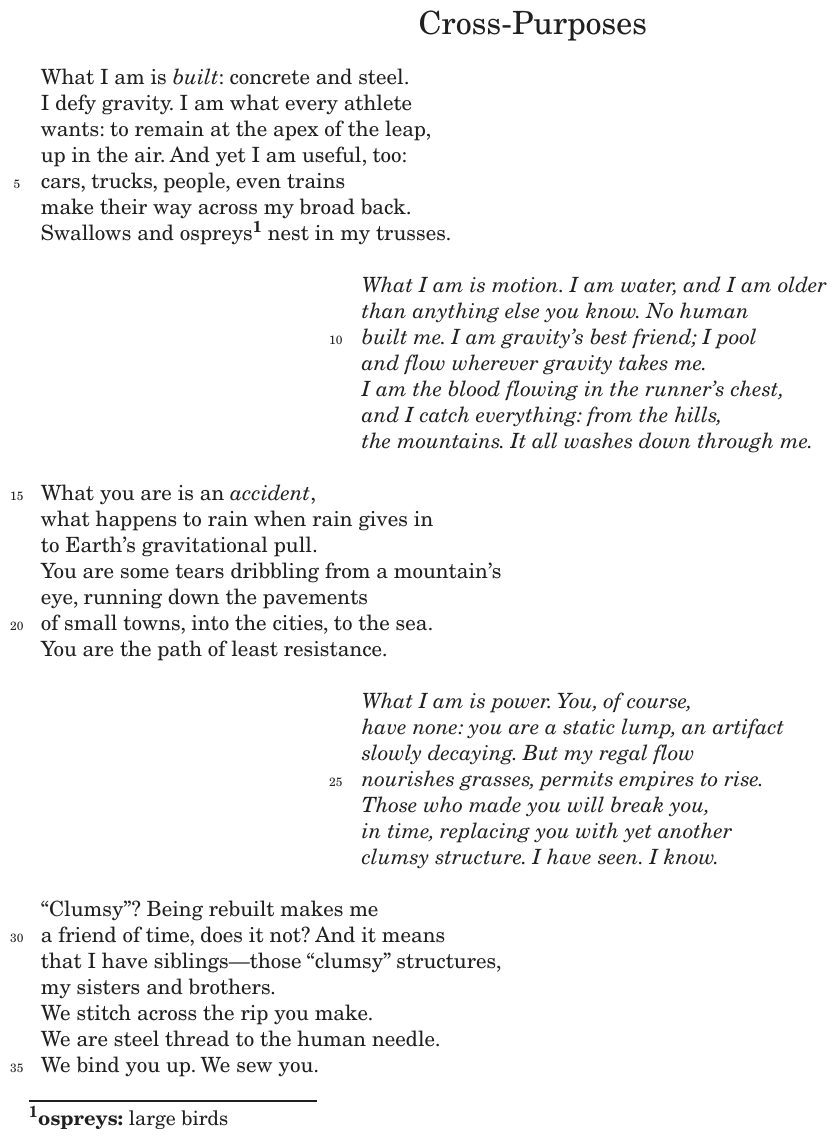
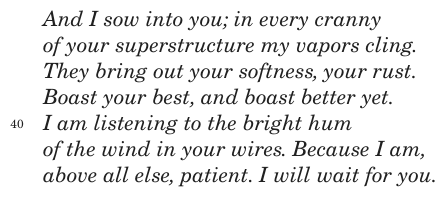
Question 37 of 57
2023 Test B English, question 37Uses the passage above: “Cross-Purposes”.
Question
Read lines 2–4 and lines 12–14 from the poem.
I am what every athlete
wants: to remain at the apex of the leap,
up in the air.
I am the blood flowing in the runner’s chest,
and I catch everything: from the hills,
the mountains.
How do the lines contribute to the development of a central idea of the poem?
- AThey establish that both the structure and the water have endurance and control.
- BThey highlight that both the structure and the water are powerful and impressive.
- CThey suggest that the structure and the water are unaware of how similar they are.
- DThey reveal that the structure and the water are surprised that they are interrelated.
Show the answer
Correct answer: B
The answer is (B)
The question asks how the lines contribute to the development of a central idea in the poem. The lines “I am what every athlete / wants” (lines 2–3) and “I am the blood flowing in the runner’s chest” (line 12) communicate that each speaker is an object of admiration and a powerful force, so Option B is correct.
Option A is incorrect because nothing in the language of the lines communicates control.
Option C is incorrect because the lines describe opposing characteristics: the structure’s description conveys stillness—remaining “up in the air” (line 4)—while the water’s description conveys movement—“flowing in the runner’s chest” (line 12). Additionally, the idea that the speakers fail to recognize similarities is not part of a central idea.
Option D is incorrect because there is no evidence in the poem that the two speakers understand that they are interrelated.
Question analysis
Students compare two sets of lines from the poem “Cross-Purposes” in which the structure and the water each describe themselves through athletes, one leaping and one running. The question asks how these lines develop a central idea, which means comparing two images that seem opposite and deciding what the pairing adds.
- Grade level
- Grade 8 reading and task
- Compared with grade 7
- Above grade 7 Typical grade 7 work asks what one image suggests. This question pairs images from two speakers in a two-voice poem and asks for a shared idea, with abstract choices that all sound plausible, which is above grade 7.
- Estimated difficulty
- Hard: combines ideas, needs a plan, and has more than one tempting wrong answer.
- Thinking it demands
- Depth of knowledge 3, strategic thinking · mainly analyze
- What makes it hard
- Figurative or literary language major
- Combines ideas moderate
- A very close wrong answer moderate
- Evidence
- Answered from several paragraphs or stanzas
- Reading level
- Passage: 316 words (a poem; reading level not measured); question and choices: about grade 7, 113 words.
- Students, last 30 days
- Not enough answers yet to show (it takes 10).
Why it is hard, traps and wrong answers (shows the answer)
Why it is hard
The athlete images point in opposite directions, one frozen in the air and one in motion, so students may look for a contrast when the question wants what the two share. Both speakers are borrowing the glamour of athletes to boast, which is what makes them powerful and impressive. The other choices either add a quality, control, that neither image carries, or credit the speakers with feelings the poem never shows.
Figurative or literary language major Understanding the question
Both claims are metaphors: the bridge is the athlete's dream of staying “at the apex of the leap,” and the water is “the blood flowing in the runner's chest,” so each image must be translated into a quality. (Graesser, Singer & Trabasso, 1994; Kintsch, 1998)
Combines ideas moderate Working it out
The two sets of lines come from rival speakers in different stanzas, and the answer has to name one idea true of both, not of either alone. (Embretson, 1998; Daniel & Embretson, 2010)
A very close wrong answer moderate Choosing the answer
A and B share the frame “both the structure and the water” plus two qualities; A's endurance is close to B's power, and only its added “control” finds no support in the lines. (Embretson & Wetzel, 1987; Gorin & Embretson, 2006; Ascalon et al., 2007)
Strategy: For each set of lines, ask what the speaker claims about itself through the athlete image; then keep only a choice that fits both speakers and these exact words.
Traps
- Half right: One half of a two-part choice is right and the other is not.
- Reads too much in: A reasonable-sounding conclusion that goes further than the text allows.
The wrong answers, classified
A Half right (King et al., 2004; Thissen, Steinberg & Fitzpatrick, 1989)
Hears stamina in the runner and in staying aloft, which is defensible, but nothing in either set of lines suggests control.
C Reads too much in (Graesser, Singer & Trabasso, 1994)
Notices that both speakers use athletes and assumes they miss the likeness, an idea the poem never develops; the images actually set stillness against motion.
D Wrong tone or attitude (Graesser, Singer & Trabasso, 1994)
Reads surprise into lines whose tone is boastful; neither speaker shows any sign of noticing a connection, let alone being surprised by it.
Working it out, step by step
Figure out what the question asks
This asks how two sets of lines build a central idea. The structure speaks one set, and the water speaks the other. You need one idea that fits both.
Read both sets of lines
The structure says, in lines 2–4: “I am what every athlete / wants: to remain at the apex of the leap, / up in the air.”
The water says, in lines 12–14: “I am the blood flowing in the runner’s chest, / and I catch everything.”
Work out what each speaker claims
The apex is the very top. Every athlete wishes they could stay at the top of a jump. The structure stays up there all the time. So it brags that it does what athletes dream of.
The water says it is the blood that keeps a runner going. Both speakers compare themselves to strong athletes. Both are showing off how powerful and impressive they are.
Check each choice
- A Endurance (lasting a long time) could fit. But nothing in the lines shows control.
- B fits. Both speakers boast of being powerful and impressive.
- C The poem never says they don’t notice how alike they are.
- D Neither speaker shows surprise. Their tone is proud.
Choose the answer
Both sets of lines show the speakers bragging about their power. So the answer is B.
Why this answer and not the closest wrong one
A is the closest choice. Like B, it says something good about both speakers. But A adds “control,” and neither set of lines shows either speaker controlling anything. Every part of B fits both sets of lines, with nothing extra.
More questions like this
The original DOE question
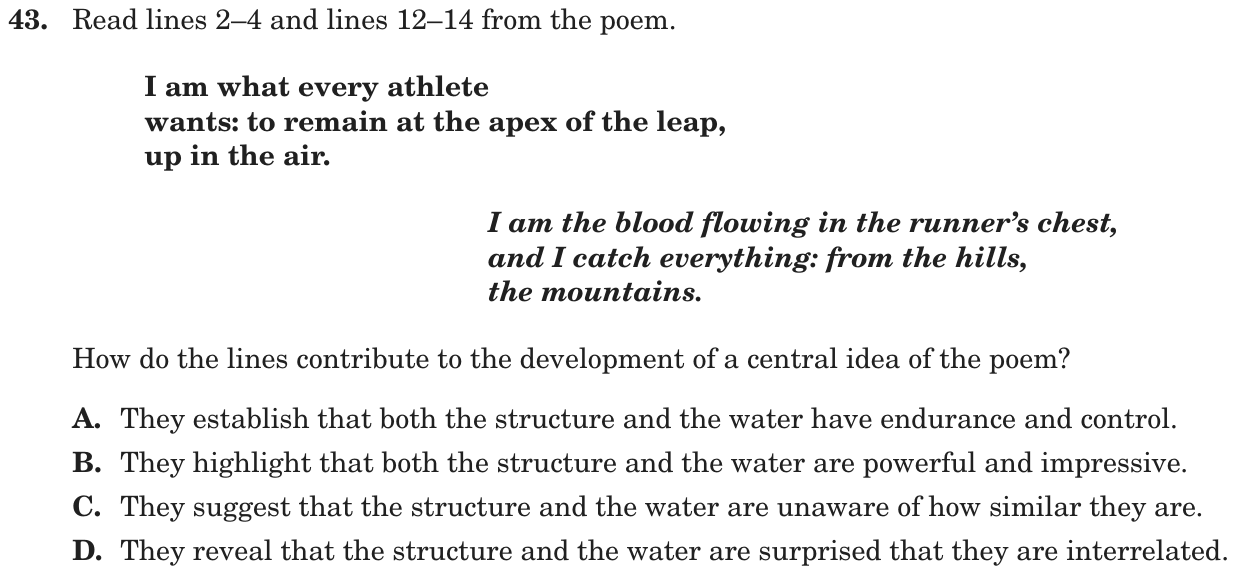
Question 38 of 57
2023 Test B English, question 38Uses the passage above: “Cross-Purposes”.
Question
The use of the words “siblings” and “my sisters and brothers” in lines 31–32 conveys the idea that the
- Aforms water can take are less diverse than the types of structures that exist.
- Bnumber of human-made structures is rapidly increasing.
- Cwater passes under many similar-looking structures as it flows.
- Dstructure is powerful because it is one of many.
Show the answer
Correct answer: D
The question asks which idea the use of the words “siblings” and “my sisters and brothers” in lines 31–32 conveys in the poem.
A. Incorrect. Although in line 29 the structure refers to itself as “being rebuilt” or taking on new forms, this idea is expressed to reinforce the idea that the structure’s presence is eternal (“a friend of time,” line 30). The use of the words “siblings” and “my sisters and brothers” in lines 31–32 does suggest that a variety of structures exist, but no comparison is drawn to suggest that the varieties of structures are more diverse than the forms of water.
B. Incorrect. While the use of the words “siblings” and “my sisters and brothers” in lines 31–32 conveys the idea that structures can be replicated by being built, it does not convey the idea that the number of human-made structures is rapidly increasing.
C. Incorrect. Although in line 33 the structure states, “We stitch across the rip you make,” suggesting that water passes under structures, the use of the words “siblings” and “my sisters and brothers” in lines 31–32 does not convey the idea that the structures that the water passes under are similar-looking.
D. CORRECT. The use of the words “siblings” and “my sisters and brothers” in lines 31–32 conveys the idea that the structure is powerful because it is one of many and because these structures “stitch across the rip” (line 33) that water makes.
Question analysis
This figurative-language question asks what idea the structure in “Cross-Purposes” conveys when it calls other structures its “siblings” and “my sisters and brothers” in lines 31–32. The words come in the fifth stanza, where the structure takes up the water’s word “clumsy,” so students must decide what this family language adds to the structure’s side of the exchange.
- Grade level
- Grade 7 reading and task
- Compared with grade 7
- At grade 7 Interpreting a metaphor in a poem is standard grade 7 work, and the family words themselves are simple. Students must still decide what the comparison means coming from a personified structure in the middle of an argument, a typical grade 7 step.
- Estimated difficulty
- Moderate: several steps, or a close reading with one strong distractor.
- Thinking it demands
- Depth of knowledge 2, skills and concepts · mainly analyze
- What makes it hard
- Figurative or literary language moderate
- Reading between the lines moderate
- A very close wrong answer minor
- Evidence
- Answered from one paragraph or stanza
- Reading level
- Passage: 316 words (a poem; reading level not measured); question and choices: about grade 7, 57 words.
- Students, last 30 days
- Not enough answers yet to show (it takes 10).
Why it is hard, traps and wrong answers (shows the answer)
Why it is hard
The family words answer the water’s taunt in the stanza before, that the structure’s makers will replace it with “yet another clumsy structure,” and the structure turns replacement into kinship. Students who read lines 31–32 alone may stop at the picture of a family, and the strongest wrong choice reads that family as look-alikes. The point arrives only in the next lines, where the structures act as one to bind the water, which makes their number a source of strength.
Figurative or literary language moderate Understanding the question
The structure calls other structures “siblings” and “my sisters and brothers,” a family metaphor followed at once by a sewing one, “We stitch across the rip you make,” so two figures must be read together. (Graesser, Singer & Trabasso, 1994; Kintsch, 1998)
Reading between the lines moderate Working it out
Nothing in lines 31–32 says the structure is powerful; students must infer it from the switch to “We” in the lines that follow, where the many structures together “bind” and “sew” the water. (Graesser, Singer & Trabasso, 1994; Kintsch, 1998)
A very close wrong answer minor Choosing the answer
The choice about similar-looking structures shares the right one’s idea of many structures; it differs in what their number means, a matter of looks rather than strength. (Embretson & Wetzel, 1987; Gorin & Embretson, 2006; Ascalon et al., 2007)
Strategy: Reread the whole fifth stanza, not just lines 31–32, and say what the structure is arguing there; then choose the idea that the family words add to that argument.
Traps
- Taking figurative language literally: A choice reads a figure of speech or image at face value.
- Reads too much in: A reasonable-sounding conclusion that goes further than the text allows.
- Twists what the text says: Uses the text's topic and ideas but changes what it says: who did it, how much, when, or why.
The wrong answers, classified
A Reads too much in (Graesser, Singer & Trabasso, 1994)
Notes that rebuilding and siblings imply many kinds of structures but adds a comparison with the forms water takes, which the fifth stanza never draws.
B Twists what the text says (King et al., 2004)
Takes rebuilding and a whole family of siblings as a sign that structures are multiplying fast, though rebuilding replaces one structure with another over time and adds none.
C Taking figurative language literally (Graesser, Singer & Trabasso, 1994)
Reads “siblings” as structures that resemble one another, as real siblings might, and adds the water flowing under them from line 33, but the family words stress kinship and number, not looks.
Working it out, step by step
Figure out what the question asks
This asks about figurative language, words that mean more than their plain meaning. In lines 31–32 the structure calls other structures “siblings” and “my sisters and brothers.” You need to decide what idea those family words give.
Read what the water said first
The family words answer an insult. In lines 26–28 the water says, “Those who made you will break you, / in time, replacing you with yet another / clumsy structure.” Clumsy means awkward and poorly made. The water means the structure won’t last.
Read the structure’s reply
In lines 29–32, the structure turns the insult around. Being rebuilt makes it “a friend of time.” It has “siblings,” other structures, which it calls “my sisters and brothers.” Then, in lines 33–35, it switches from “I” to “We.” It says, “We stitch across the rip you make.” It adds, “We bind you up. We sew you.” To stitch is to sew. The rip is the gap water cuts through the land.
Work out the idea
A family is a group that sticks together. Working as one, the many structures “bind” the water, like thread holding cloth. One bridge may be replaced, but the family goes on. So being one of many is what makes the structure strong.
Check each choice
- A is wrong. The lines never compare kinds of structures with forms of water.
- B is wrong. Being rebuilt swaps one structure for another. It doesn’t mean their number is growing fast.
- C is wrong. Real siblings may look alike, but that isn’t the point here. The family words show the structures are many and connected.
- D is right. The “We” lines show the many structures acting together, which gives them power.
Watch out: C is tempting if you picture siblings who look alike. Read on to line 35 to see what the family does.
Choose the answer
The family words show the structure gets its strength from being one of many. So the answer is D.
Why this answer and not the closest wrong one
C is the closest wrong answer. It also sees many structures, and in line 33 they do cross the water. But C makes the family words about looks. Lines 33–35 make them about strength: “We bind you up.” That is why D fits better.
More questions like this
The original DOE question
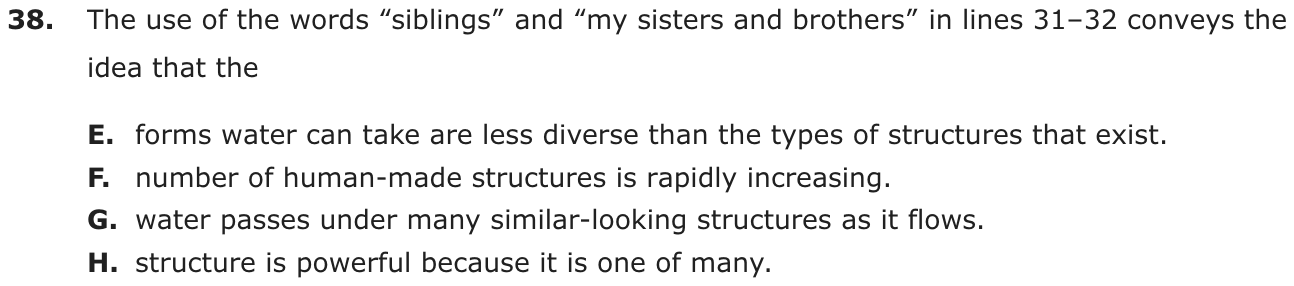
Question 39 of 57
2023 Test B English, question 39Uses the passage above: “Cross-Purposes”.
Question
The comparison to sewing in lines 33–35 helps show that the structure
- Aenhances the beauty of the natural landscape.
- Bbrings people together more effectively than nature does.
- Cprovides clear boundaries for natural environments.
- Dserves as a means for people to overcome an obstacle created by nature.
Show the answer
Correct answer: D
The answer is (D)
The question asks what the comparison in lines 33–35 shows about the structure. The speaker states, “We are steel thread to the human needle” (line 34), which illustrates that the structure (and others like it) is a tool used by humans to “bind . . . up” (line 35) or overcome “the rip” (line 33) that the water creates in the earth, making Option D correct.
Option A is incorrect because the language in the lines is used only to imply the flaw that the water creates—“the rip you make” (line 33).
Option B is incorrect because, while the water states that it enables “empires to rise” (line 25), implying that it is needed for society to thrive, it never shares a purpose of bringing people together through its existence.
Option C is incorrect because the language used for sewing (“We stitch across the rip you make” [line 33]) indicates the repair of a flaw and not the establishment of boundaries.
Question analysis
This figurative language question asks what the comparison to sewing, “We stitch across the rip you make,” shows about the structure in the poem “Cross-Purposes.” Students must work out what the speaker and the rip stand for, since the poem never names either, before the thread-and-needle metaphor makes sense.
- Grade level
- Grade 7 reading and task
- Compared with grade 7
- At grade 7 Interpreting an extended metaphor is standard grade 7 work, and the sewing words are concrete and familiar. One inference about what the speaker really is comes first, which keeps the task typical rather than hard.
- Estimated difficulty
- Moderate: several steps, or a close reading with one strong distractor.
- Thinking it demands
- Depth of knowledge 2, skills and concepts · mainly understand
- What makes it hard
- Figurative or literary language major
- Reading between the lines moderate
- Evidence
- Answered from one paragraph or stanza
- Reading level
- Passage: 316 words (a poem; reading level not measured); question and choices: about grade 8, 45 words.
- Corrected from the DOE handbook
- A misstatement of the question in the explanation was corrected.
- Two small typos in the explanation were corrected.
- Students, last 30 days
- Not enough answers yet to show (it takes 10).
Why it is hard, traps and wrong answers (shows the answer)
Why it is hard
Students who see that the structure is a bridge usually find the metaphor's sense: a river tears the land, and bridges stitch it closed for people to cross. The danger is the choice that also talks about connecting people, which matches the general idea of bridges but slips in a comparison with nature. The other choices treat stitching as decoration or as drawing lines, which a reader who pictures a needle closing a tear will not accept.
Figurative or literary language major Understanding the question
The sewing image runs over three lines: the river is a “rip,” bridges are “steel thread,” builders are “the human needle,” so each part must be mapped before the meaning appears. (Graesser, Singer & Trabasso, 1994; Kintsch, 1998)
Reading between the lines moderate Working it out
The poem never says the structure is a bridge or the rip a river gorge; students must infer both from earlier clues such as trains crossing its “broad back.” (Graesser, Singer & Trabasso, 1994; Kintsch, 1998)
Strategy: Use the earlier stanzas to work out what kind of structure is speaking and what the rip is, then translate the thread-and-needle comparison into plain terms.
Traps
- Reads too much in: A reasonable-sounding conclusion that goes further than the text allows.
- Twists what the text says: Uses the text's topic and ideas but changes what it says: who did it, how much, when, or why.
The wrong answers, classified
A Outside knowledge (King et al., 2004; Recht & Leslie, 1988)
Assumes bridges beautify a landscape, a common real-world view, but the lines describe repairing a tear, not adding beauty.
B Reads too much in (Graesser, Singer & Trabasso, 1994)
Rightly sees bridges joining people across water, but adds that they do it better than nature does, a comparison these lines never draw.
C Twists what the text says (King et al., 2004)
Treats stitches as lines that divide, while stitching across a rip pulls its two sides together rather than marking a boundary.
What was corrected from the DOE handbook, and why
- Explanation: The handbook says the question asks what the comparison “shows about the structure of the poem.” The question asks what it shows about the structure that speaks in the poem, not about the poem’s form, so “of the poem” was removed.
- Explanation: “(lines 25)” now reads “(line 25)”, and a stray closing parenthesis after “establishment of boundaries.” was removed.
Working it out, step by step
Figure out what the question asks
This asks what a comparison means. In lines 33–35 the structure compares itself to sewing. You need to turn that picture into plain words.
Read the sewing lines
The lines say: “We stitch across the rip you make. / We are steel thread to the human needle. / We bind you up. We sew you.”
“We” means the structure and its “siblings,” other structures like it. “You” is the water.
Match each part to the real thing
- The “rip” stands for the gap a river cuts through the land.
- The “steel thread” stands for the bridges.
- The “human needle” stands for the people who build them.
When you sew a rip, you pull the two sides back together. Bridges do the same. They join the land on both sides of a river, so people can cross.
Check each choice
- A The lines are about fixing a tear, not about adding beauty.
- B Bridges do bring people together, but the lines never say they do it better than nature.
- C Stitching across a rip pulls the sides together. It does not mark boundaries (lines that divide).
- D fits. The structure helps people get past the gap the water made.
Choose the answer
The sewing picture shows the structure helps people get past an obstacle the water created. So the answer is D.
Why this answer and not the closest wrong one
B is the closest trap, because bridges really do connect people. But B says they do it “more effectively than nature does.” The lines never compare the two that way. D sticks to what the picture shows: a tear made by water, closed by the structure so people can cross.
More questions like this
The original DOE question
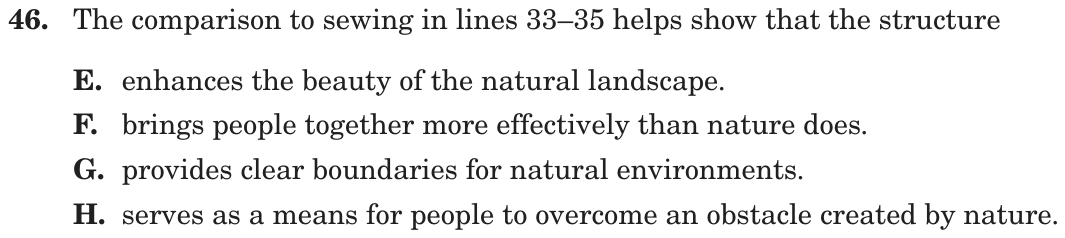
Question 40 of 57
2023 Test B English, question 40Uses the passage above: “Cross-Purposes”.
Question
The last stanza (lines 36–42) conveys a central idea of the poem by
- Ademonstrating that both the structure and the water depend on each other to fulfill their functions.
- Bimplying that a stronger structure would be able to resist the degradation caused by the water.
- Crevealing that the passage of time will render both the structure and the water obsolete.
- Dsuggesting that the water will eventually weaken the structure and will continue to exist after the structure is gone.
Show the answer
Correct answer: D
The answer is (D)
The question asks how the last stanza conveys a central idea of the poem. In lines 36–38, the speaker (the water) describes how its “vapors cling” to the structure, bringing out the structure’s “softness” and “rust,” thus destroying the structure over time. Also, in line 42, the speaker says it is “patient” and “will wait for you,” suggesting that the speaker will be around after the structure is gone. These phrases in the last stanza indicate that Option D is correct.
Option A is incorrect because the last stanza includes no indication that the structure and the water depend on each other.
Option B is incorrect because the last stanza refers to the opposing speaker (the structure) and not to any other structure.
Option C is incorrect because the last stanza addresses only the idea that the structure will grow weak and obsolete over time.
Question analysis
Students must explain how the final stanza of “Cross-Purposes,” spoken by the water, conveys a central idea of the poem. The stanza mixes a pun on sewing and sowing, images of vapor and rust, and a taunt about boasting, so students must read past the wordplay to the stanza's main claim.
- Grade level
- Grade 7 reading and task
- Compared with grade 7
- At grade 7 Linking a stanza to a poem's central idea is standard grade 7 work. The stanza's wordplay takes some decoding, but each choice can be checked against the stanza itself, so the overall demand is typical.
- Estimated difficulty
- Moderate: several steps, or a close reading with one strong distractor.
- Thinking it demands
- Depth of knowledge 2, skills and concepts · mainly analyze
- What makes it hard
- Figurative or literary language major
- A very close wrong answer moderate
- Hard words minor
- Evidence
- Answered from one paragraph or stanza
- Reading level
- Passage: 316 words (a poem; reading level not measured); question and choices: about grade 9, 78 words.
- Students, last 30 days
- Not enough answers yet to show (it takes 10).
Why it is hard, traps and wrong answers (shows the answer)
Why it is hard
The stanza's meaning is a quiet threat: moisture works into the structure, rusts it, and the water simply waits. Students who decode the rust and the waiting usually reach the key, but one wrong choice gets the decay right and then sweeps the water into it too. The taunt to “boast better yet” is the other snare, since read straight it sounds like an invitation to build a stronger structure.
Figurative or literary language major Understanding the question
The stanza works through wordplay and images: “I sow into you” puns on the structure's “We sew you,” vapors cling to bring out “your rust,” and “I will wait for you” is a threat. (Graesser, Singer & Trabasso, 1994; Kintsch, 1998)
A very close wrong answer moderate Choosing the answer
C and D agree that time will wear the structure down; they differ only in the water's fate, which D says outlasts the structure and C says becomes obsolete too, against “above all else, patient.” (Embretson & Wetzel, 1987; Gorin & Embretson, 2006; Ascalon et al., 2007)
Hard words minor Understanding the question
“Cranny” and “superstructure” in the stanza, and “degradation” and “obsolete” in the choices, are words a seventh grader may not know. (Perfetti, 2007; Freedle & Kostin, 1993)
Strategy: Paraphrase each sentence of the last stanza in plain words, then check both halves of every choice, since a choice can fit one speaker and not the other.
Traps
- Half right: One half of a two-part choice is right and the other is not.
- Taking figurative language literally: A choice reads a figure of speech or image at face value.
The wrong answers, classified
A Reads too much in (Graesser, Singer & Trabasso, 1994)
Reads the sew-and-sow echo as mutual need, but the last stanza shows the water acting on the structure, with no dependence either way.
B Taking figurative language literally (Graesser, Singer & Trabasso, 1994)
Takes the taunt “boast better yet” at face value, as if a stronger structure could resist, though the water's answer to any boast is that it will wait.
C Half right (King et al., 2004; Thissen, Steinberg & Fitzpatrick, 1989)
Gets the structure's decline right but makes the water obsolete as well, though it is “patient” and plans to outlast the structure.
Working it out, step by step
Figure out what the question asks
This asks how the last stanza shows a central idea. The water is speaking. You need to work out what it is really saying to the structure.
Read the last stanza
Lines 36–38 say: “And I sow into you; in every cranny / of your superstructure my vapors cling. / They bring out your softness, your rust.”
Lines 41–42 end the poem: “Because I am, / above all else, patient. I will wait for you.”
Work out the hidden threat
A cranny is a small crack. Vapors are tiny drops of water in the air, like mist. The superstructure is the main body of the structure. So the water’s mist creeps into every crack and makes the steel rust and weaken.
“Sow” sounds like “sew,” but it means to plant seeds. The water plants rust. Then it says it will wait. It expects to still be here after the structure is gone.
Check each choice
- A The stanza shows the water harming the structure, not needing it.
- B No stronger structure is mentioned. “Boast better yet” is a dare, not advice.
- C The structure will wear down, but the water won’t. It is patient and waiting.
- D fits. The water will rust the structure and outlast it.
Choose the answer
The water will slowly weaken the structure and still be around after it is gone. So the answer is D.
Why this answer and not the closest wrong one
C is the closest trap. C and D agree that time will wear down the structure. But C says the water will become obsolete, or useless, too. The water says the opposite: “I will wait for you.” Only D gets both speakers right.
More questions like this
The original DOE question
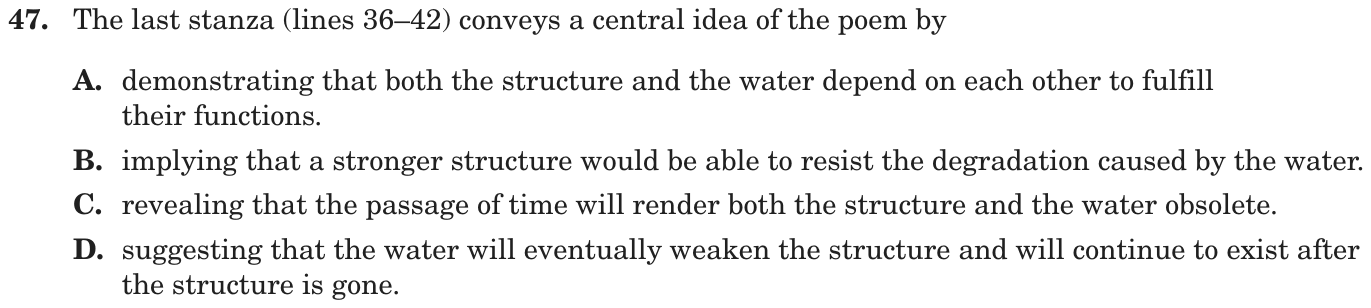
Question 41 of 57
2023 Test B English, question 41Uses the passage above: “Cross-Purposes”.
Question
Read lines 41–42 from the poem.
Because I am,
above all else, patient. I will wait for you.
Which of the following supports what is implied in these lines?
- A“I am older / than anything else you know.” (lines 8–9)
- B“No human / built me.” (lines 9–10)
- C“It all washes down through me.” (line 14)
- D“Those who made you will break you,” (line 26)
Show the answer
Correct answer: A
The answer is (A)
The question asks how the implication in lines 41–42 is supported by other lines in the poem. The words “patient” and “wait” in line 42 suggest that the speaker (the water) has the ability to outlast the other speaker because the water doesn’t weaken as it ages, making Option A (lines 8–9) the correct response.
Option B is incorrect because the promise made in line 42 is not affected by whether the water was built by humans (lines 9–10).
Option C is incorrect because, in line 14, the water’s ability to wait longer than the structure is not enhanced by what flows through the water.
Option D is incorrect because, in line 26, the water’s knowledge does not make its ability to wait any stronger—rather, its seemingly unending lifespan does.
Question analysis
This textual evidence question gives the water's closing words in “Cross-Purposes,” that it is patient and will wait, and asks which earlier line supports what they imply. Students must first state the implication in their own words, then choose among four lines spoken by the water that each say something true about it.
- NYS standards
- 7R1 textual evidence and inferences
- Grade level
- Grade 8 reading and task
- Compared with grade 7
- Above grade 7 Most grade 7 evidence items back up a claim the text states outright. Here the claim is only implied, and all four lines come from the same speaker, so students must reason about what patience would achieve, which goes beyond typical grade 7 work.
- Estimated difficulty
- Hard: combines ideas, needs a plan, and has more than one tempting wrong answer.
- Thinking it demands
- Depth of knowledge 3, strategic thinking · mainly evaluate
- What makes it hard
- Reading between the lines major
- Every choice must be checked moderate
- Evidence
- Answered from several paragraphs or stanzas
- Reading level
- Passage: 316 words (a poem; reading level not measured); question and choices: about grade 1, 57 words.
- Students, last 30 days
- Not enough answers yet to show (it takes 10).
Why it is hard, traps and wrong answers (shows the answer)
Why it is hard
The difficulty is in the first step: putting “I will wait for you” into words as a claim about time, that the water will still be there after the structure is gone. Students who read it as a prediction about the structure's end pick the line about humans breaking it, and those who read it as a contrast with built things pick the line about no human building the water. Only age directly supports a promise to outwait.
Reading between the lines major Working it out
Lines 41–42 never say the water will outlast the structure; students must state that implication of “patient” and “wait for you” before they can judge which earlier line supports it. (Graesser, Singer & Trabasso, 1994; Kintsch, 1998)
Every choice must be checked moderate Choosing the answer
All four lines are the water's own boasts from different stanzas, each true of it, so every one must be tested against the specific claim of lasting longer. (Embretson & Wetzel, 1987)
Strategy: Put the implied claim of the final two lines into your own words, then ask which earlier line gives a reason to believe that claim rather than just describing the water.
Traps
- Supports only part of the claim: In a question about evidence: a line that backs one half of the claim but not the other, or a related point rather than the claim itself.
- Reads too much in: A reasonable-sounding conclusion that goes further than the text allows.
The wrong answers, classified
B Supports only part of the claim (King et al., 2004; Thissen, Steinberg & Fitzpatrick, 1989)
Sees that being unbuilt sets the water apart from the structure, but having no human maker says nothing about its capacity to wait.
C Reads too much in (Graesser, Singer & Trabasso, 1994)
Reads “washes down through me” as slow erosion that will wear the structure away, though the line describes what the water carries, not how long it lasts.
D Supports only part of the claim (King et al., 2004; Thissen, Steinberg & Fitzpatrick, 1989)
Supports the structure's eventual end, but the implied claim is about the water outlasting it, which needs evidence of the water's long life.
Working it out, step by step
Figure out what the question asks
This is an evidence question. First, figure out what lines 41–42 hint at. Then find the earlier line that best supports that hint.
Work out the hint
The water says: “Because I am, / above all else, patient. I will wait for you.” Patient means able to wait calmly for a long time.
The water is telling the structure that it will still be here after the structure is gone. So the hidden claim is that the water will outlast the structure.
Find a line that supports it
To outlast something, you need a very long life. So look for a line about the water’s age. In lines 8–9 the water says: “I am older / than anything else you know.” It has already lasted longer than anything else. So it makes sense that it can outlast a bridge too.
Check each choice
- A fits. Great age backs up the claim that the water can wait the structure out.
- B “No human / built me” tells who made the water, not how long it lasts.
- C “It all washes down through me” tells what the water carries, not how long it lasts.
- D shows the structure will end, but not that the water will still be here.
Choose the answer
The water’s great age supports its promise to outwait the structure. So the answer is A.
Why this answer and not the closest wrong one
D is the closest trap, because “Those who made you will break you” also points to the structure’s end. But the hint in lines 41–42 is about the water lasting. D says nothing about the water. Only A gives proof of the water’s long life.
More questions like this
The original DOE question
Question 42 of 57
2023 Test B English, question 42Uses the passage above: “Cross-Purposes”.
Question
How does the poet develop the points of view of the structure and the water?
- Aby giving an account of a discussion between them about the future of human civilization
- Bby narrating a debate they have over their impact on the environment
- Cby illustrating the unique power they each possess over nature
- Dby using personification to allow them to debate who is more important
Show the answer
Correct answer: D
The question asks how the poet develops the two points of view.
A. Incorrect. While the poem relates how the water views the structure as “an artifact / slowly decaying” (lines 23–24) and the structure refers to itself as “a friend of time” (line 30), the poet does not give an account of a discussion about the future of human civilization.
B. Incorrect. While the speakers do discuss their impact on the environment, there is no narrator speaking for them.
C. Incorrect. Although the structure states it is made of “concrete and steel” (line 1) and is a “steel thread to the human needle” (line 34), only the water claims to possess power over nature, stating that “all washes down through me” (line 14) and “what I am is power” (line 22).
D. CORRECT. The poet develops the speakers’ points of view by personifying (giving human characteristics to something nonhuman such as an object or animal) the structure and the water, allowing them to debate by criticizing each other and declaring their own importance.
Question analysis
This point-of-view question asks how the poet of “Cross-Purposes” develops the viewpoints of its two speakers, a human-made structure and a body of water, across six alternating stanzas. Each answer pairs a way of presenting the voices with a subject for their exchange, so students must check both halves against the poem, since a choice can be right about one and wrong about the other.
- Grade level
- Grade 7 reading and task
- Compared with grade 7
- At grade 7 This is exactly the grade 7 standard on how a writer develops and contrasts the points of view of different speakers. The choices are short, but each joins a way of presenting the voices to a subject, so two things must be checked at once.
- Estimated difficulty
- Moderate: several steps, or a close reading with one strong distractor.
- Thinking it demands
- Depth of knowledge 3, strategic thinking · mainly analyze
- What makes it hard
- How, not what moderate
- Something you must already know minor
- Every choice must be checked minor
- Evidence
- Answered from the whole text
- Reading level
- Passage: 316 words (a poem; reading level not measured); question and choices: about grade 9, 64 words.
- Students, last 30 days
- Not enough answers yet to show (it takes 10).
Why it is hard, traps and wrong answers (shows the answer)
Why it is hard
The poem is a direct exchange: stanzas alternate between two speakers who address each other as “you,” with no voice outside them. Most students sense the argument, which makes the narrated-debate choice the strongest pull, since its subject, the speakers’ effects on the land, does come up in the poem. The question is decided by the method half of each choice, and only one names a device the poet actually uses, letting the two speak for themselves about which matters more.
How, not what moderate Working it out
The stem asks how the poet develops the two viewpoints, so the right choice must name a method, speakers given voices to argue for themselves, and a choice that only reports what they say falls short. (Anderson & Krathwohl, 2001)
Something you must already know minor Working it out
The right choice relies on the term “personification,” which the poem never names, so students must recognize concrete and water that speak and boast as that device. (Anderson & Krathwohl, 2001)
Every choice must be checked minor Choosing the answer
Each choice pairs a way of presenting the voices, an account, narration, illustration or personification, with a subject, so both halves must be tested against all six stanzas. (Embretson & Wetzel, 1987)
Strategy: Go through the six stanzas noting who is speaking and what each speaker claims, then judge each choice twice: once for how it says the voices are presented, once for what it says they discuss.
Traps
- Half right: One half of a two-part choice is right and the other is not.
- Wrong purpose or structure: Names a purpose, structure or effect that the part does not serve, or describes what a part says when the question asks what it does.
The wrong answers, classified
A Too narrow (King et al., 2004)
Builds the whole exchange on passing references such as “permits empires to rise” and “the human needle,” though the speakers argue about themselves and never discuss where civilization is headed.
B Half right (King et al., 2004; Thissen, Steinberg & Fitzpatrick, 1989)
Rightly sees a debate, and the speakers do touch on their effects on the land and on each other, but “narrating” adds a narrator, while each speaker talks in its own voice.
C Wrong purpose or structure (Anderson & Krathwohl, 2001)
Lists the powers the speakers boast of, which is what the poem says rather than how the poet builds the viewpoints, and only the water claims power over nature.
Working it out, step by step
Figure out what the question asks
This asks about the poet’s method: how the poet shows what each speaker thinks. Each choice names a method and a topic. The right choice must get both parts right.
Notice who is speaking
The poem has six stanzas, or groups of lines. The structure speaks in stanzas 1, 3 and 5. The water speaks in stanzas 2, 4 and 6. Each one says “I” about itself and “you” to the other. No outside voice tells the story. A voice like that is called a narrator, and this poem has none.
Name the poet’s method
In real life, concrete and water have no voices. The poet lets them speak like people anyway. This is called personification: treating a thing as if it were a person. Then the two argue. The structure calls the water “an accident” (line 15). The water answers, “What I am is power. You, of course, / have none” (lines 22–23).
See what they argue about
Each speaker brags about itself and puts the other down. The structure says it is useful, carrying “cars, trucks, people, even trains” (line 5). The water says it is older and stronger. It ends by saying it will outlast the structure: “I will wait for you” (line 42). Their real fight is over which of them matters more.
Check each choice
- A is wrong. Empires come up only once, in line 25. The speakers argue about themselves, not the future of civilization.
- B is wrong. The speakers do mention their effects on the land. The water says it “nourishes grasses” (line 25). But “narrating” means a narrator tells the debate, and no one does. The two speak for themselves.
- C is wrong. It names what the speakers brag about, not how the poet presents them. Also, only the water claims power over nature: “It all washes down through me” (line 14).
- D is right. Personification lets the two argue about who is more important.
Choose the answer
The poet uses personification so the structure and the water can argue over who matters more. So the answer is D.
Why this answer and not the closest wrong one
B is the closest wrong answer. It is right that there is a debate, and the speakers do talk about their effects on the world around them. But B says the debate is narrated. In the poem, the structure and the water speak in their own voices. D names that method.
More questions like this
The original DOE question

Question 43 of 57
2023 Test B English, question 43Uses the passage above: “Cross-Purposes”.
Question
How does the form of the poem contribute to its meaning?
- AThe use of an equal number of lines in each stanza emphasizes that both speakers are equally important.
- BThe use of italics in some of the stanzas indicates the increasing tension between the structure and the water.
- CThe alternating positions of the stanzas highlight the opposing points of view of the speakers.
- DThe lack of a regular rhyme scheme or meter reflects the way the water changes the structure and the way the water itself changes.
Show the answer
Correct answer: C
The answer is (C)
The question asks how the form of the poem contributes to its meaning. The alternating positions of the stanzas create the appearance of a conversation in which the speakers share their opposing points of view, making Option C correct.
Option A is incorrect because the number of lines for each stanza does not emphasize the importance of the two speakers.
Option B is incorrect because italics are used mainly to designate the voice of the second speaker (the water).
Option D is incorrect because the lack of rhyme scheme or meter is intended to create a conversational tone, rather than reflect the changes the water causes or experiences.
Question analysis
This question about poetic form asks how the shape of “Cross-Purposes” on the page contributes to its meaning. Students must consider features such as stanza length, placement, italics and the lack of rhyme, and decide which one the poem actually uses to create meaning.
- Grade level
- Grade 8 reading and task
- Compared with grade 7
- Above grade 7 Grade 7 standards ask how genre features such as stanza form shape meaning, but most classroom questions point to one feature. Here students must weigh four features of the poem and the meaning each choice assigns, which is above typical grade 7 work.
- Estimated difficulty
- Hard: combines ideas, needs a plan, and has more than one tempting wrong answer.
- Thinking it demands
- Depth of knowledge 3, strategic thinking · mainly analyze
- What makes it hard
- How, not what major
- Every choice must be checked moderate
- Something you must already know minor
- Evidence
- Answered from the whole text
- Reading level
- Passage: 316 words (a poem; reading level not measured); question and choices: about grade 9, 87 words.
- Students, last 30 days
- Not enough answers yet to show (it takes 10).
Why it is hard, traps and wrong answers (shows the answer)
Why it is hard
All four choices point to something true about how the poem looks, so checking features against the page eliminates nothing. The real test is whether the meaning each choice assigns follows from the poem: equal stanzas do not make the rivals equal, italics mark the water's voice from its first stanza, and free verse is not a picture of erosion. Only the alternating placement maps directly onto two opposed speakers taking turns.
How, not what major Working it out
The question is about form, not content: students must ask what the page layout, indented italic stanzas against flush roman ones, does for the meaning. (Anderson & Krathwohl, 2001)
Every choice must be checked moderate Choosing the answer
Each choice names a feature that really exists, seven lines in every stanza, italics, alternating positions, no rhyme or meter, so every feature and the meaning given to it must be tested. (Embretson & Wetzel, 1987)
Something you must already know minor Working it out
Terms such as “stanza,” “rhyme scheme” and “meter” are assumed, and a student unsure what meter means cannot judge the choice about free verse. (Anderson & Krathwohl, 2001)
Strategy: For each feature named in the choices, first confirm it is really in the poem, then ask whether the meaning the choice gives it fits what happens in the poem.
Traps
- Wrong purpose or structure: Names a purpose, structure or effect that the part does not serve, or describes what a part says when the question asks what it does.
- Reads too much in: A reasonable-sounding conclusion that goes further than the text allows.
The wrong answers, classified
A Wrong purpose or structure (Anderson & Krathwohl, 2001)
Counts seven lines in every stanza, which is true, and reads that balance as equal importance, though the speakers spend the poem disputing which of them matters more.
B Wrong purpose or structure (Anderson & Krathwohl, 2001)
Notices the italics but misreads their job: they mark the water's voice from its first stanza onward, not a rising level of tension.
D Reads too much in (Graesser, Singer & Trabasso, 1994)
Applies the habit of treating free verse as a mirror of the subject, reading the missing rhyme and meter as the water's changes, which nothing in the poem supports.
Working it out, step by step
Figure out what the question asks
This asks about form: how the poem looks on the page, not just what it says. You need the feature that adds to the meaning.
Look at the page
Notice four things about the form.
- Every stanza has seven lines.
- Stanzas 2, 4 and 6 are in italics (slanted letters).
- Those italic stanzas are pushed to the right. The others sit on the left.
- The lines don’t rhyme and have no steady beat. That beat is called meter.
Work out what the layout shows
The stanzas on the left are the structure speaking. The italic stanzas on the right are the water. The two sides take turns, like two people arguing face to face. The back-and-forth placement makes it easy to see two opposite points of view.
Check each choice
- A The stanzas all have seven lines. But the speakers argue that they are not equal.
- B The italics mark the water’s voice from its first stanza to its last. They don’t show tension growing.
- C fits. The switching positions show the two opposing views.
- D Nothing suggests the missing rhyme stands for the water’s changes.
Choose the answer
The stanzas switch sides to show the speakers’ opposite views. So the answer is C.
Why this answer and not the closest wrong one
A is the closest trap, because every stanza really does have seven lines. But the speakers spend the whole poem arguing that they are not equal. Each one says it matters more. So equal stanzas can’t mean equal importance. C links the layout to what really happens: two sides taking turns.
More questions like this
The original DOE question
Question 44 of 57
2023 Test B English, question 44Passage Excerpt from “Scribe Like an Egyptian”
Excerpt from “Scribe Like an Egyptian”
by Hilary Wilson
In ancient Egypt, literacy was the key to success. However, contrary to popular belief, not all Egyptian scribes understood hieroglyphs. Many relied instead on the simpler hieratic script for the multitude of everyday documents generated by the Egyptian bureaucracy.
Hieroglyphs—“the Words of God”—compose a writing system with more than 1,000 distinct characters, the meanings of which were lost for 1,500 years before they were deciphered by Jean-François Champollion in 1822. Including both ideograms (which convey a whole word or idea, either concrete or abstract, in a single sign) and phonograms (representing either an alphabetic sound or a group of consonants), [the writing system] was used in formal inscriptions on tomb and temple walls as well as on elaborate funerary papyri. For everyday purposes, however, scribes used a shorthand version of the hieroglyphic script known as hieratic, which was quicker to write and more economical of space. The two writings existed side by side for at least 2,500 years.
Scraps of ancient hieratic writing, mostly penned by student scribes on limestone flakes called ostraca, suggest that no matter how humble his origins, an educated Egyptian could achieve almost anything. Horemheb (d.1292 B.C.) is a good example. Born of middle-ranking parents, his scribal training led to an army career. From Scribe of Recruits, during the reign of Akhenaten (1353–1336 B.C.), Horemheb rose through the military ranks and, by the rule of Tutankhamun (1332–1323 B.C.), he was commander in chief of the Egyptian forces. As a close adviser of the young Pharaoh, Horemheb was appointed “Deputy of the King throughout the Two Lands,” and might have expected to succeed to the throne should the king die childless. He had to wait a few years, but eventually Horemheb achieved the pinnacle of his career by becoming the last king of the 18th Dynasty, making his mark by instituting dramatic reforms to the organisation of the army, the judiciary and administration in general. The lasting success of these changes owed much to his scribal background. . . .
But education was not available to all. Government departments and major temples supported schools, where boys commenced their training at six or seven, sometimes earlier. To these boarding establishments . . . family or household servants delivered the students’ food and drink rations daily for several years, during which time the student was not contributing to the family’s income. Boys from poorer families could only hope to be educated with support from a wealthier relative or patron, or through apprenticeship to an older scribe, perhaps the local clerk or land agent, who would teach them the basics of the scribe’s craft. This limited the scope for employment but such “on the job” training allowed apprentices to help out at home while learning. . . .
Scribal education began with the elementary principles of the hieratic script. The lowliest scribes, who trained for just five or six years, probably learned only the rudiments of the hieroglyphic script. Students were set exemplar documents and extracts from popular texts to copy, to practice their hieratic handwriting on basic-format letters, reports and contracts, while absorbing the good advice contained in the texts. Surviving examples of copy-work sometimes include tutors’ corrections added in red. Some significant Egyptian literary works survive almost exclusively from student copies.
A schoolboy “dictionary” of hieroglyphs with their hieratic equivalents shows that a knowledge of more than 450 signs was required for everyday writing purposes. Lessons in record-keeping and filing and labelling enabled any half-competent scribe to perform that most essential of all scribal functions: the making and updating of lists. For professions such as those of government official, priest or lawyer, a scribe would train for several more years, increasing his vocabulary to perhaps a thousand or more signs. Those with the best handwriting or drawing skills might follow the craft of creating beautifully illustrated copies of funerary texts, commonly called Books of the Dead. Others could become draughtsmen, artists or architects. Doctors compiled their own collections of medication recipes, treatments and associated incantations, many copied from texts found in the House of Life, the temple library. Lawyers had to be familiar with the corpus of civil and religious laws and precedents found in the official records, which were administered by archivists. Egypt’s bureaucratic society depended on the skills of an army of scribes of all ranks from filing clerk to tax assessor. For young Egyptians, “be a scribe” was the best of career advice.
From “Scribe Like an Egyptian” by Hilary Wilson from HISTORY TODAY, August 8, 2019. Copyright © 2019 by History Today Ltd. Company.
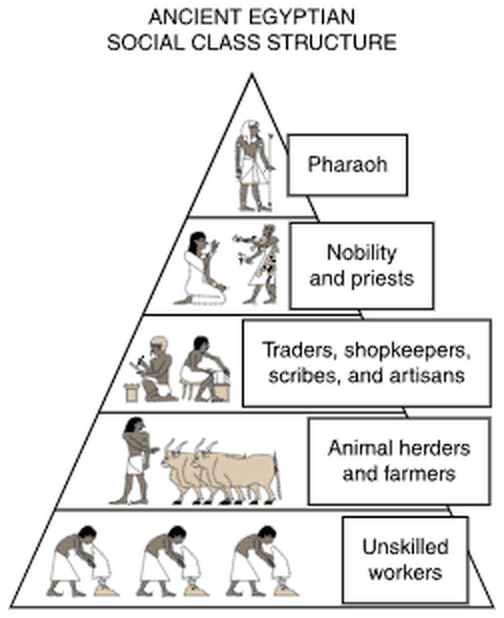
bureaucracy: an administrative staff of government officials
funerary papyri: a sheet or scroll of papyrus containing religious images and hieroglyphs meant to help the deceased be reborn in the afterlife
rudiments: basics
schoolboy: slang that refers to materials used during the course of receiving an education
draughtsmen: people who draw plans of machinery or structures
corpus: a collection of writings
Question
Which sentence from the excerpt best supports the idea that there were different levels of education for a scribe?
- A“However, contrary to popular belief, not all Egyptian scribes understood hieroglyphs.” (paragraph 1)
- B“For everyday purposes, however, scribes used a shorthand version of the hieroglyphic script known as hieratic, which was quicker to write and more economical of space.” (paragraph 2)
- C“This limited the scope for employment but such ‘on the job’ training allowed apprentices to help out at home while learning.” (paragraph 4)
- D“For professions such as those of government official, priest or lawyer, a scribe would train for several more years, increasing his vocabulary to perhaps a thousand or more signs.” (paragraph 6)
Show the answer
Correct answer: D
The question asks for a sentence from the excerpt that best supports the idea that different levels of education were available to scribes.
A. Incorrect. The sentence from paragraph 1 provides evidence that Egyptian scribes used two different forms of writing, but it does not address the topic of education or the different levels of education that were available to scribes.
B. Incorrect. The advantages and purposes of hieratic script are described in this sentence from paragraph 2, but this explanation of the advantages and purposes does not suggest that there were different levels of education for scribes.
C. Incorrect. The fact that scribes could learn their trade through apprenticeships as discussed in this sentence from paragraph 4 does provide evidence that another method of learning to be a scribe was possible, but this process was for a limited entry into becoming a scribe, not the continued education scribes would need in order to work in specific areas.
D. CORRECT. By explaining that certain professions required additional years of training, this sentence from paragraph 6 supports the idea that different levels of education existed for scribes.
Question analysis
This evidence question on Hilary Wilson’s “Scribe Like an Egyptian,” a magazine article about how ancient Egyptian scribes learned their trade, asks which quoted sentence best supports the idea that scribes received different levels of education. The four sentences come from paragraphs 1, 2, 4 and 6, and more than one seems to touch on the idea, so close reading of each decides it.
- Grade level
- Grade 8 reading and task
- Compared with grade 7
- Above grade 7 Choosing the sentence that best supports an idea is routine grade 7 evidence work. Here several quotations touch on ways scribes differed, and the article’s dense, technical wording makes those differences harder to sort than usual.
- Estimated difficulty
- Hard: combines ideas, needs a plan, and has more than one tempting wrong answer.
- Thinking it demands
- Depth of knowledge 3, strategic thinking · mainly evaluate
- What makes it hard
- Reading between the lines moderate
- Every choice must be checked moderate
- Hard words minor
- Evidence
- Answered from several paragraphs or stanzas
- Reading level
- Passage: about grade 12, 810 words; question and choices: about grade 13, 110 words.
- Students, last 30 days
- Not enough answers yet to show (it takes 10).
Why it is hard, traps and wrong answers (shows the answer)
Why it is hard
Two of the wrong sentences are not off topic: one says not all scribes understood hieroglyphs, the other that apprenticeship narrowed a scribe’s job prospects, and both imply that scribes differed. The question rewards asking what the idea actually claims, that schooling itself came in stages, and only the sentence about professions that required more years of training says so outright. Students who stop at the first sentence suggesting a difference lose the point.
Reading between the lines moderate Working it out
The right sentence never says “levels”; students must see that training “for several more years” for official, priest or lawyer posts means a higher tier of schooling than the basic course. (Graesser, Singer & Trabasso, 1994; Kintsch, 1998)
Every choice must be checked moderate Choosing the answer
Two other quotations also hint at differences among scribes, paragraph 1’s “not all Egyptian scribes understood hieroglyphs” and paragraph 4’s “limited the scope for employment,” so each must be weighed, not just scanned. (Embretson & Wetzel, 1987)
Hard words minor Understanding the question
Terms such as “hieratic,” “economical of space” and “scope for employment” slow the reading of the quotations, and the shorthand sentence is hard to dismiss until hieratic is understood as a script. (Perfetti, 2007; Freedle & Kostin, 1993)
Strategy: Ask what a sentence would have to say to prove that scribal education came in levels, then test each quotation against that and prefer a direct statement over a hint.
Traps
- Supports only part of the claim: In a question about evidence: a line that backs one half of the claim but not the other, or a related point rather than the claim itself.
- True but not the answer: A choice says something accurate about the text that does not answer this question.
The wrong answers, classified
A Supports only part of the claim (King et al., 2004; Thissen, Steinberg & Fitzpatrick, 1989)
Reads “not all Egyptian scribes understood hieroglyphs” as proof of different levels of schooling, but it reports a difference in knowledge without saying anything about how scribes were taught.
B True but not the answer (King et al., 2004; Embretson & Wetzel, 1987)
Picks the sentence on hieratic as a faster everyday shorthand, which describes how scribes wrote, not how long or how far any of them studied.
C Supports only part of the claim (King et al., 2004; Thissen, Steinberg & Fitzpatrick, 1989)
Sees that on-the-job training “limited the scope for employment” and takes it for a lower level of education, though the sentence contrasts two routes into the trade, not stages of study.
Working it out, step by step
Figure out what the question asks
This asks for the sentence that best supports one idea: scribes could get “different levels of education.” A level is a stage. Some scribes studied for a short time, and others went on to study more. You need a sentence that shows a difference in schooling, not just any difference between scribes.
Find what each level looked like
Paragraphs 5 and 6 describe the training. Paragraph 5 says the lowest scribes studied for only five or six years. They learned just the basics of hieroglyphs. Paragraph 6 says that more than 450 signs were needed for everyday writing. Then choice D adds a higher level: “For professions such as those of government official, priest or lawyer, a scribe would train for several more years, increasing his vocabulary to perhaps a thousand or more signs.”
Work out what choice D means
A profession is a job that needs special training. Choice D says some jobs needed more years of study and more signs, perhaps over a thousand. A basic scribe stopped sooner and knew fewer signs. So schooling came in stages: a basic course, and then more years for the top jobs. That is what the question means by levels of education.
Check each choice
- A does not fit. It says not all scribes understood hieroglyphs. That is a difference in what scribes knew. It says nothing about how they were taught.
- B does not fit. It explains hieratic, a faster shorthand way of writing. That is about writing, not schooling.
- C does not fit. It is about apprentices, who learned on the job from an older scribe. That is a different way into the work, not a higher or lower stage of study.
- D fits. Some jobs needed several more years of training.
Watch out: A is tempting because it shows that scribes were not all alike. But it never mentions school.
Choose the answer
Only one sentence shows some scribes studying for years after the basic course. So the answer is D.
Why this answer and not the closest wrong one
A is the closest wrong choice. It shows that some scribes knew hieroglyphs and others did not. But it doesn’t say why, or how long anyone studied. D says plainly that some jobs needed several more years of training. That is a level of education above the basic one.
More questions like this
The original DOE question
The passage “Excerpt from “Scribe Like an Egyptian”” as shown on the test
Question 45 of 57
2023 Test B English, question 45Uses the passage above: “Excerpt from “Scribe Like an Egyptian””.
Question
Read this sentence from paragraph 2.
Including both ideograms (which convey a whole word or idea, either concrete or abstract, in a single sign) and phonograms (representing either an alphabetic sound or a group of consonants), [the writing system] was used in formal inscriptions on tomb and temple walls as well as on elaborate funerary papyri.
The author’s purpose for including the sentence is to
- Aexplain that hieroglyphs were reserved for royal and religious purposes.
- Bdemonstrate the methods experts use to interpret hieroglyphs.
- Cclarify the significance of hieroglyphs in language and literature.
- Ddescribe the basic features of hieroglyphs and how they were typically used.
Show the answer
Correct answer: D
The question asks for an explanation of the author’s purpose for including a sentence in paragraph 2 that describes the two types of hieroglyphs and the main uses of this particular writing system.
A. Incorrect. The sentence explains that hieroglyphs were used for formal inscriptions, but it does not suggest that these inscriptions were limited to royal and religious contexts.
B. Incorrect. The sentence describes the two basic types of hieroglyphs, ideograms and phonograms, but it does not address how experts interpret the ancient writing system. A sentence earlier in the paragraph explains that the hieroglyphs were deciphered by Champollion, but it does not explain how he deciphered them.
C. Incorrect. Although the sentence explains that the hieroglyphs were typically used for formal inscriptions, it does not provide an explanation of the significance or importance of hieroglyphs in the Egyptian language.
D. CORRECT. The sentence explains that hieroglyphs included both phonograms and ideograms that were used in formal inscriptions and funeral papyri; therefore, this sentence achieves the purpose of describing the basic features of hieroglyphs as conveying either words and ideas or sounds, in addition to explaining the common uses for the writing system.
Question analysis
This author’s-purpose question quotes a long, technical sentence from paragraph 2 of “Scribe Like an Egyptian” about the ancient Egyptian hieroglyphic writing system, and asks why the author includes it. Students must make sense of its specialist vocabulary before they can say what the sentence contributes to the paragraph and to the article.
- Grade level
- Grade 8 reading and task
- Compared with grade 7
- At grade 7 Explaining why an author includes a sentence is regular grade 7 work. This one is long, with definitions in parentheses and a bracketed insert, but it is quoted in full, so the task stays within one sentence.
- Estimated difficulty
- Straightforward: two steps or one careful reading.
- Thinking it demands
- Depth of knowledge 2, skills and concepts · mainly analyze
- What makes it hard
- Complex sentences moderate
- Hard words minor
- How, not what minor
- Evidence
- Answered from one sentence or line
- Reading level
- Passage: about grade 12, 810 words; question and choices: about grade 11, 103 words.
- Students, last 30 days
- Not enough answers yet to show (it takes 10).
Why it is hard, traps and wrong answers (shows the answer)
Why it is hard
Once the parentheses are set aside, the sentence says two simple things: what kinds of signs hieroglyphs were, and where they appeared. The wrong purposes each go one step beyond that, turning tombs and temples into an exclusive royal and religious use, borrowing Champollion’s deciphering from the sentence before, or claiming a significance the sentence never weighs. Students who untangle the syntax first find the matching purpose quickly.
Complex sentences moderate Understanding the question
The quoted sentence runs fifty words, two parenthetical definitions come before the verb, and its subject, the bracketed “[the writing system],” appears only after thirty words of description. (Abedi & Lord, 2001; Freedle & Kostin, 1993; Messick, 1989)
Hard words minor Understanding the question
“Ideograms,” “phonograms” and “funerary papyri” are specialist terms; the parentheses define the first two, but students who stall on them may not reach the sentence’s plain point about where the signs were used. (Perfetti, 2007; Freedle & Kostin, 1993)
How, not what minor Working it out
The stem asks why the author includes the sentence, so students must match the job it does in paragraph 2 to a purpose, and only one purpose stays within what the sentence actually covers. (Anderson & Krathwohl, 2001)
Strategy: Restate the quoted sentence in plain words, setting the parentheses aside at first, then choose the purpose that fits everything the sentence says and nothing more.
Traps
- Reads too much in: A reasonable-sounding conclusion that goes further than the text allows.
- Wrong part of the text: A choice is true of another paragraph, stanza or speaker than the one asked about.
- Wrong purpose or structure: Names a purpose, structure or effect that the part does not serve, or describes what a part says when the question asks what it does.
The wrong answers, classified
A Reads too much in (Graesser, Singer & Trabasso, 1994)
Reads “formal inscriptions on tomb and temple walls” and “funerary papyri” as royal and religious only, though the sentence names where hieroglyphs usually appeared, not a rule reserving them.
B Wrong part of the text (Kirsch & Mosenthal, 1990)
Remembers that Champollion deciphered the signs, which the sentence before reports, and takes this sentence for an account of how experts read them, though it never mentions interpreting.
C Wrong purpose or structure (Anderson & Krathwohl, 2001)
Chooses an important-sounding purpose, the significance of hieroglyphs in language and literature, though the sentence never says why the script mattered or mentions any literature.
Working it out, step by step
Figure out what the question asks
This asks why the author put this sentence in paragraph 2. In other words, what job does the sentence do? First work out what the sentence says. Then pick the purpose that matches all of it and adds nothing extra.
Untangle the long sentence
The sentence is long, so set the parentheses aside at first. The main part says the writing system “was used in formal inscriptions on tomb and temple walls as well as on elaborate funerary papyri.” An inscription is writing carved or painted on something. Funerary means having to do with burials. Papyri are scrolls made from papyrus, a kind of early paper.
Read the parentheses
Now add back the two kinds of signs. Ideograms “convey a whole word or idea” in one sign. Phonograms stand for “either an alphabetic sound or a group of consonants.” Consonants are letter sounds like b, t and m. So one kind of hieroglyph shows a meaning, and the other shows a sound.
Sum up the sentence’s job
Put the two parts together. The sentence tells what hieroglyphs were made of: signs for ideas and signs for sounds. It also tells where people usually used them: on tombs, temples and burial scrolls. So its job is to describe what hieroglyphs were like and how they were used.
Check each choice
- A does not fit. The sentence says where hieroglyphs usually appeared. It never says they were reserved, or kept only, for kings and religion.
- B does not fit. The sentence before it says Champollion figured out the signs. This sentence never says how experts read them.
- C does not fit. The sentence never says why hieroglyphs mattered, and it never mentions literature.
- D fits. It names both parts: the basic features and the usual uses.
Watch out: Tombs and temples sound royal and religious, so A tempts. But “used in” is not the same as “reserved for.”
Choose the answer
The sentence describes the two kinds of signs and where they were usually used. So the answer is D.
Why this answer and not the closest wrong one
A is the closest wrong choice. Tombs and temples do suggest kings and religion. But the sentence only lists where hieroglyphs were used. It never says they were kept for those uses alone. D matches everything the sentence says and adds nothing it doesn’t.
More questions like this
The original DOE question
Question 46 of 57
2023 Test B English, question 46Uses the passage above: “Excerpt from “Scribe Like an Egyptian””.
Question
Which statement summarizes the process that schools used to train scribes?
- ABoys had to memorize around 450 hieratic signs. Once they had learned these, they were expected to copy literary texts that contained valuable lessons.
- BBoys spent at least five years learning hieratic signs, which they practiced by copying texts. During this period, they were also introduced to basic hieroglyphs.
- CBoys spent five or six years learning the basics of hieratic script. After this period, they could become apprentices and begin learning hieroglyphics.
- DBoys were taught two different scripts. They practiced both types by copying lists and eventually progressed to writing letters, reports, and contracts.
Show the answer
Correct answer: B
The question asks for the best summary of the process that schools used to train scribes.
A. Incorrect. This summary incorrectly explains that scribes were expected to learn 450 hieratic signs instead of 450 hieroglyphs along with their hieratic versions as explained in paragraph 6. In paragraph 5, the author explains that scribes copied texts as part of the process of learning the scripts rather than as practice after the signs had already been memorized.
B. CORRECT. Paragraph 5 explains that students began by learning hieratic script and studied for about five or six years by using “exemplar documents and extracts from popular texts to copy, to practice their hieratic handwriting.” The paragraph also explains that during this time, they learned only the basics of hieroglyphic script.
C. Incorrect. Although paragraph 5 does explain that the scribes spent five or six years learning hieratic script, it does not suggest that hieroglyphs were learned only during apprenticeships.
D. Incorrect. This summary correctly explains that scribes learned two types of scripts, but the second sentence of the summary is incorrect. In paragraph 5, the author explains that the students copied from exemplar texts, but the author clearly states that the purpose of this copy work was “to practice their hieratic handwriting” and does not suggest that the copy work was used to practice hieroglyphs. Paragraph 6 explains that scribes could make lists as part of their professional skills but does not suggest that copy work was used to help them learn this task. Paragraph 5 mentions letters, reports, and contracts as the formats students practiced on while copying, not as a later stage of their training.
Question analysis
This summary question on “Scribe Like an Egyptian” asks which statement sums up how ancient Egyptian schools trained young scribes. Each choice is a two-sentence summary that combines years of study, kinds of script and copying practice, so students must check every detail against what the article says about scribal education.
- Grade level
- Grade 8 reading and task
- Compared with grade 7
- Above grade 7 Summarizing a process is a grade 7 standard, but these four summaries are long, two-part and mostly accurate, and the details they mix up come from three different paragraphs, so judging them asks more than typical grade 7 work.
- Estimated difficulty
- Hard: combines ideas, needs a plan, and has more than one tempting wrong answer.
- Thinking it demands
- Depth of knowledge 2, skills and concepts · mainly understand
- What makes it hard
- A very close wrong answer moderate
- Evidence in several places moderate
- The right answer is reworded minor
- Evidence
- Answered from several paragraphs or stanzas
- Reading level
- Passage: about grade 12, 810 words; question and choices: about grade 7, 104 words.
- Corrected from the DOE handbook
- A detail in the explanation that misdescribes the excerpt was corrected.
- Students, last 30 days
- Not enough answers yet to show (it takes 10).
Why it is hard, traps and wrong answers (shows the answer)
Why it is hard
Every wrong summary opens with something true or nearly true, so a quick reading of first sentences cannot separate them. Most of the errors concern order: one makes copying follow memorizing, one turns apprenticeship into a later stage where hieroglyphs begin, and one makes the copied letters, reports and contracts a later step. Students who check the order of training against paragraph 5, not just the facts, find the only summary with nothing out of place.
A very close wrong answer moderate Choosing the answer
The apprenticeship summary repeats the right one’s opening, years of hieratic study, and parts from it on one phrase: hieroglyphs come “After this period” instead of “During this period.” (Embretson & Wetzel, 1987; Gorin & Embretson, 2006; Ascalon et al., 2007)
Evidence in several places moderate Working it out
The details sit in three paragraphs: the five or six years, the copying and the hieroglyph basics in paragraph 5, apprenticeship in paragraph 4, and the 450-sign dictionary and list-making in paragraph 6. (Kirsch & Mosenthal, 1990; Gorin & Embretson, 2006)
The right answer is reworded minor Choosing the answer
The right summary puts the text in new words, “at least five years” and “basic hieroglyphs,” while wrong ones repeat its own details: “five or six years,” the “450” signs, “letters, reports, and contracts.” (Freedle & Kostin, 1993; Kirsch & Mosenthal, 1990)
Strategy: Note what the article says students learned, for how long and by what method, then check both sentences of each summary against those notes; one wrong detail rules a summary out.
Traps
- Half right: One half of a two-part choice is right and the other is not.
- Twists what the text says: Uses the text's topic and ideas but changes what it says: who did it, how much, when, or why.
The wrong answers, classified
A Twists what the text says (King et al., 2004)
Takes paragraph 6’s 450 signs, hieroglyphs listed with their hieratic forms, as hieratic signs to memorize first, and makes copying come afterward, though copying was how students learned.
C Half right (King et al., 2004; Thissen, Steinberg & Fitzpatrick, 1989)
Gets the five or six years of hieratic right, then makes apprenticeship, the other route paragraph 4 offers poorer boys, a later stage where hieroglyphs are first taught.
D Half right (King et al., 2004; Thissen, Steinberg & Fitzpatrick, 1989)
Rightly says two scripts were taught, then claims students copied lists for both and only later wrote letters, reports and contracts, though paragraph 5 ties copying to hieratic and to those very formats.
What was corrected from the DOE handbook, and why
- Explanation: The DOE’s explanation of Option D ends: “Paragraph 6 explains that scribes could make lists and write letters as part of their professional skills but does not suggest that copy work was used to help them learn these tasks.” Paragraph 6 mentions the making and updating of lists, but not letters. Letters come up in paragraph 5, where students copy texts “to practice their hieratic handwriting” on basic-format letters, reports and contracts, so the excerpt does tie the copy work to letters. The site now says that paragraph 6 explains that scribes could make lists as part of their professional skills but does not suggest that copy work was used to help them learn this task, and that paragraph 5 mentions letters, reports, and contracts as the formats students practiced on while copying, not as a later stage of their training. Option D is still wrong, and the answer, B, is unchanged.
Working it out, step by step
Figure out what the question asks
This asks for the best summary of how schools trained scribes. A summary retells the main steps in a few words. Each choice has two sentences. Both must match the article, including the order of the steps. One wrong detail rules a choice out.
Find the training in paragraph 5
Paragraph 5 says training began with the basics of hieratic script. The lowest scribes studied for five or six years, and others studied longer. In that time they learned only the basics of hieroglyphs. Students were given “exemplar documents and extracts from popular texts to copy, to practice their hieratic handwriting.” Exemplar means model. Extracts are short pieces. So they learned by copying good examples.
Sort out paragraphs 4 and 6
Two other paragraphs hold details that look alike. Paragraph 4 describes apprenticeship. An apprentice learns on the job from a skilled worker. It was another way in for boys from poorer families, not a step after school. Paragraph 6 mentions a list of hieroglyphs with their hieratic forms. It says more than 450 signs were needed for everyday writing. It never says students memorized them before copying.
Check each choice
- A does not fit. The 450 signs were hieroglyphs paired with their hieratic forms. And copying was how students learned, not a step after memorizing.
- B fits. Students spent at least five years on hieratic, practiced by copying, and learned basic hieroglyphs along the way.
- C does not fit. Apprenticeship was a different route, not a later stage. Hieroglyphs were not saved for apprentices.
- D does not fit. The copying was to practice hieratic. Lists come up in paragraph 6 as a job skill, not as practice. Letters, reports and contracts were what students copied, not a later stage.
Choose the answer
Watch out: C starts out right, with five or six years of hieratic. Then it says hieroglyphs came “After this period” instead of during it. That one change makes it wrong.
Only B gets every detail and the order right. So the answer is B.
Why this answer and not the closest wrong one
C is the closest wrong choice. It gets the five or six years of hieratic right. But it says hieroglyphs came afterward, through apprenticeship. Paragraph 5 says students learned the basics of hieroglyphs during their schooling. Apprenticeship was a separate path for poorer boys. B says “During this period,” which matches.
More questions like this
The original DOE question
Question 47 of 57
2023 Test B English, question 47Uses the passage above: “Excerpt from “Scribe Like an Egyptian””.
Question
Which claim is best supported by the information presented in paragraphs 3 and 4?
- AEducation was difficult for the common citizens of Egypt to obtain.
- BOnce students began studying to become scribes, their future held more possibilities.
- CIf someone wanted to become a scribe, support from outside sources such as the government or a temple was necessary.
- DBecoming a successful scribe required a student’s family to sacrifice time and money in order to ensure the best education.
Show the answer
Correct answer: B
The question asks for the claim that is best supported by the details in paragraphs 3 and 4.
A. Incorrect. While paragraph 4 does explain that boys from poorer families had more challenges in receiving an education, the paragraph also provides examples of obtaining a patron or getting an apprenticeship as ways that these aspiring scribes could attain an education. Furthermore, the details in paragraph 3 do not provide any support for the claim that “common citizens” had difficulty getting an education because that paragraph focuses on the example of one person who was able to become a king as a result of his background as a scribe.
B. CORRECT. In paragraph 3, the author provides an example of a person who used his skills as a scribe to rise through the ranks of society by describing the achievements of Horemheb to support the idea that “no matter how humble his origins, an educated Egyptian could achieve almost anything.” The author continues in paragraph 4 to explain that with the proper support, some young Egyptians could become educated, thereby opening more opportunities for themselves.
C. Incorrect. Paragraph 4 explains that schools were supported by the government and religious institutions, but it also explains that apprenticeships were a method of learning the craft of the scribe. As the paragraph indicates, boys could also be helped in their education by support from “a wealthier relative or patron.”
D. Incorrect. In paragraph 4, the author details the sacrifices that families made to keep their sons at the schools, while boys from poorer families could only hope for a patron or an apprenticeship. Paragraph 4 also explains that apprentices could help out at home while learning, so the sacrifice of time and money was not required of every family.
Question analysis
This inference question asks which claim is best supported by paragraphs 3 and 4 of “Scribe Like an Egyptian,” which tell the story of the scribe Horemheb and describe who could get a scribal education in ancient Egypt. Students must weigh each claim against both paragraphs together, and several claims echo a single sentence closely enough to look supported.
- Grade level
- Grade 8 reading and task
- Compared with grade 7
- Above grade 7 Choosing the claim a passage best supports is core grade 7 work. Here the claim must fit two paragraphs that do different jobs, one telling a single man’s story and one explaining access to schooling, and some choices fit only part of that.
- Estimated difficulty
- Hard: combines ideas, needs a plan, and has more than one tempting wrong answer.
- Thinking it demands
- Depth of knowledge 3, strategic thinking · mainly evaluate
- What makes it hard
- Evidence in several places moderate
- The right answer is reworded moderate
- Reading between the lines minor
- Evidence
- Answered from several paragraphs or stanzas
- Reading level
- Passage: about grade 12, 810 words; question and choices: about grade 10, 75 words.
- Corrected from the DOE handbook
- A misdescription of the passage in the explanation of one wrong answer was corrected.
- Students, last 30 days
- Not enough answers yet to show (it takes 10).
Why it is hard, traps and wrong answers (shows the answer)
Why it is hard
The trap is a claim that paragraph 4 seems to state almost word for word, which makes it feel safer than the right one. But the question asks for support from both paragraphs, and Horemheb’s story points the other way, toward what schooling made possible. The two other wrong claims harden paragraph 4’s details into rules, a necessary sponsor or a required family sacrifice, so words like “necessary” and “required” are the ones to test.
Evidence in several places moderate Working it out
The claim must fit two paragraphs that do different work: paragraph 3 follows Horemheb from army scribe to king, and paragraph 4 explains who could pay for schooling and what the alternatives were. (Kirsch & Mosenthal, 1990; Gorin & Embretson, 2006)
The right answer is reworded moderate Choosing the answer
The right claim restates paragraph 3’s “an educated Egyptian could achieve almost anything” in new words, while the most tempting wrong one nearly copies paragraph 4’s opening, “education was not available to all.” (Freedle & Kostin, 1993; Kirsch & Mosenthal, 1990)
Reading between the lines minor Working it out
Students must connect Horemheb’s rise with paragraph 4’s account of who got schooling to see that both paragraphs are about education opening doors, a link the author leaves implicit. (Graesser, Singer & Trabasso, 1994; Kintsch, 1998)
Strategy: Sum up paragraph 3 and paragraph 4 in a sentence each, then test every claim against both summaries, watching for words that make a claim stronger than the text.
Traps
- Too narrow: A single detail offered as the central idea or a summary, or a summary that keeps minor details and leaves out an essential part.
- Too broad or too strong: A choice overstates, generalizes, or uses absolute words the text does not support.
- Reads too much in: A reasonable-sounding conclusion that goes further than the text allows.
The wrong answers, classified
A Too narrow (King et al., 2004)
Rests on paragraph 4’s opening, “education was not available to all,” and ignores paragraph 3, whose Horemheb shows an educated man rising from modest origins to the throne.
C Too broad or too strong (King et al., 2004)
Makes the government and temple schools of paragraph 4 “necessary,” overlooking its other routes: help from “a wealthier relative or patron,” or apprenticeship to a working scribe.
D Reads too much in (Graesser, Singer & Trabasso, 1994)
Turns the rations and lost income that some families bore in paragraph 4 into a requirement for every successful scribe, and adds “the best education,” which the paragraph never mentions.
What was corrected from the DOE handbook, and why
- Explanation: The DOE’s explanation of D said paragraph 4 details sacrifices “necessary for some poorer families,” and that paragraph 3’s Horemheb, born of middle-ranking parents, shows the sacrifice was not required of all families. In paragraph 4 the rations and lost income are those of families whose sons were at the schools; poorer boys could only hope for a patron or an apprenticeship; and paragraph 3 says nothing about what Horemheb’s family gave up. The explanation now says so: D is wrong because apprentices could help out at home while learning, so not every family made the sacrifice.
Working it out, step by step
Figure out what the question asks
This asks which claim is best supported by paragraphs 3 and 4 together. A claim is a statement that someone says is true. The right claim must fit both paragraphs. Watch for strong words, like “necessary,” that go further than the text.
Sum up paragraph 3
Paragraph 3 tells about Horemheb. His parents were middle-ranking, not rich or powerful. His training as a scribe led to a job in the army. He rose to lead the army, then to serve the young king, and in the end he became king himself. The author uses him to show that “no matter how humble his origins, an educated Egyptian could achieve almost anything.” Humble origins means an ordinary family background.
Sum up paragraph 4
Paragraph 4 opens by saying that not everyone could get an education. Government offices and big temples ran schools. Families sent food and drink for years, while the boy earned nothing for them. Poorer boys could hope for help from “a wealthier relative or patron.” A patron is someone who pays for another person’s training. Or they could learn on the job from a working scribe. That path led to fewer jobs.
Put the two paragraphs together
Both paragraphs are about what schooling could do for a boy. Paragraph 3 shows a man rising all the way to king because he trained as a scribe. Paragraph 4 shows that, with the right support, boys could get that schooling. It even notes that the on-the-job path led to fewer jobs. So education opened doors. That is what choice B says.
Check each choice
- A does not fit. It matches only the start of paragraph 4. Paragraph 4 also gives ways in for poorer boys, and paragraph 3 shows a man from an ordinary family rising to the top.
- B fits. Both paragraphs show schooling leading to more possibilities.
- C does not fit. A government or temple school was not “necessary.” A relative, a patron or an apprenticeship could also work.
- D does not fit. Apprentices could help out at home while they learned, so not every family gave up time and money. And the paragraphs never mention “the best education.”
Choose the answer
The claim that fits both paragraphs is that schooling gave a boy more possibilities. So the answer is B.
Why this answer and not the closest wrong one
A is the closest wrong choice, because paragraph 4 begins by saying not everyone could get an education. But the question asks about paragraphs 3 and 4. Paragraph 3 tells of a scribe from an ordinary family who became king. Paragraph 4 shows ways around the cost. Both point to what education made possible, which is B.
More questions like this
The original DOE question
Question 48 of 57
2023 Test B English, question 48Uses the passage above: “Excerpt from “Scribe Like an Egyptian””.
Question
Hieratic script was particularly valuable in a bureaucratic government because
- Ausing hieratic script was an efficient way for scribes to produce large amounts of documentation.
- Bmany members of the general public could comprehend information that was written in hieratic script.
- Cknowledge of hieratic script prepared scribes to serve their society in increasingly challenging roles.
- Dpeople from different professional backgrounds could easily communicate with one another in hieratic script.
Show the answer
Correct answer: A
The question asks why hieratic script was especially valuable in a bureaucratic government.
A. CORRECT. Hieratic script is described in paragraph 1 as being simpler for the “multitude of everyday documents” generated by the government and as “quicker to write and more economical of space” in paragraph 2. The logical conclusion based on these details is that hieratic script was more efficient for the large amounts of documentation produced by the government.
B. Incorrect. In paragraph 4, the author explains that “education was not available to all,” suggesting that only people who were educated could read and write. The excerpt as a whole does not provide sufficient information to indicate what portion of the general public would be able to comprehend material written in hieratic script.
C. Incorrect. The idea that becoming a scribe could lead to taking different positions in society is addressed in paragraphs 3, 4, and 6. However, the use of hieratic script in the fields of medicine, law, or religion does not necessarily explain the value of the script for the bureaucratic government referenced in the question.
D. Incorrect. Although different professions such as doctors and lawyers used hieratic script, the author uses these professions as examples of different job opportunities for scribes in paragraph 6. There is no discussion in the excerpt about different professions communicating with each other, and these professions were not necessarily part of the bureaucratic government.
Question analysis
This inference question on “Scribe Like an Egyptian” asks why hieratic, one of the two scripts of ancient Egypt, was especially valuable to a bureaucratic government. The article never gives the reason in a single sentence, so students must connect what it says about Egypt’s bureaucracy with what it says about the script itself. Each choice offers a reasonable-sounding benefit.
- Grade level
- Grade 7 reading and task
- Compared with grade 7
- At grade 7 Drawing a conclusion from two neighboring paragraphs is typical grade 7 inference work. The word “bureaucratic” and the article’s formal style add some load, but the details needed are close together and plainly stated.
- Estimated difficulty
- Straightforward: two steps or one careful reading.
- Thinking it demands
- Depth of knowledge 2, skills and concepts · mainly understand
- What makes it hard
- Evidence in several places minor
- Hard words minor
- Reading between the lines minor
- Evidence
- Answered from several paragraphs or stanzas
- Reading level
- Passage: about grade 12, 810 words; question and choices: about grade 13, 68 words.
- Students, last 30 days
- Not enough answers yet to show (it takes 10).
Why it is hard, traps and wrong answers (shows the answer)
Why it is hard
The two facts that answer the question sit a few lines apart in the first two paragraphs, so the work is mostly connecting them. The wrong reasons all sound like advantages a simpler script might bring, public readability, career preparation, communication across professions, and each rests on a guess or on the excerpt’s talk of scribal careers rather than on what it says hieratic was used for. Students who return to the description of hieratic itself avoid them.
Evidence in several places minor Working it out
The reason is split between paragraph 1, where hieratic serves the “multitude of everyday documents,” and paragraph 2, where it is “quicker to write and more economical of space.” (Kirsch & Mosenthal, 1990; Gorin & Embretson, 2006)
Hard words minor Understanding the question
The stem turns on “bureaucratic,” a word students must connect to a government that runs on paperwork; without it, the link to large amounts of documentation is hard to see. (Perfetti, 2007; Freedle & Kostin, 1993)
Reading between the lines minor Working it out
No sentence says why hieratic helped the government; students must combine speed and compactness with the sheer volume of records to reach efficiency. (Graesser, Singer & Trabasso, 1994; Kintsch, 1998)
Strategy: Find the sentences that describe hieratic script and what it was used for, then pick the choice those sentences support rather than one that only sounds like an advantage.
Traps
- Reads too much in: A reasonable-sounding conclusion that goes further than the text allows.
- True but not the answer: A choice says something accurate about the text that does not answer this question.
- Outside knowledge: A choice is plausible in the real world but not supported by this text.
The wrong answers, classified
B Reads too much in (Graesser, Singer & Trabasso, 1994)
Reasons that a simpler script must have been readable by ordinary people, though paragraph 4 says “education was not available to all” and the excerpt never says the public read hieratic.
C True but not the answer (King et al., 2004; Embretson & Wetzel, 1987)
Recalls the careers in paragraphs 3 and 6 that schooling opened to scribes, which is true of the excerpt but explains a scribe’s prospects, not why the government valued hieratic.
D Outside knowledge (King et al., 2004; Recht & Leslie, 1988)
Imagines hieratic as a shared language linking doctors, lawyers and officials, a sensible-sounding benefit the excerpt never raises; paragraph 6 names those professions only as careers for scribes.
Working it out, step by step
Figure out what the question asks
This asks why hieratic script was so useful to a bureaucratic government. A bureaucracy is a government run by many officials, with lots of paperwork. Hieratic is the quick, simple form of Egyptian writing. Look for what the article says about hieratic and what it was used for.
Find the evidence in paragraphs 1 and 2
Paragraph 1 says many scribes used hieratic for the “multitude of everyday documents” that the government produced. Multitude means a huge number. Paragraph 2 says hieratic was “quicker to write and more economical of space.” Economical of space means it took up less room on the page.
Connect the two facts
Put the facts together. The government made a huge number of papers. Hieratic was fast to write and used less space. So scribes could turn out lots of papers quickly. Getting a lot done with little time and effort is called being efficient.
Check each choice
- A fits. Hieratic let scribes make large amounts of paperwork quickly.
- B does not fit. Paragraph 4 says “education was not available to all.” The article never says ordinary people could read hieratic.
- C does not fit. Training did lead to careers, but that explains a scribe’s chances, not why the government valued the script.
- D does not fit. Paragraph 6 lists jobs like doctor and lawyer as careers for scribes. It never says those workers wrote to each other in hieratic.
Watch out: B sounds sensible, since a simpler script seems easier for anyone to read. But that is a guess, not something the article says.
Choose the answer
Hieratic was fast and compact, and the government needed a huge number of documents. So the answer is A.
Why this answer and not the closest wrong one
B is the closest wrong choice, because a simpler script does sound easier to read. But the article says only some Egyptians got an education. It never says the public could read hieratic. A rests on two facts the article states: the government made a “multitude of everyday documents,” and hieratic was quicker to write.
More questions like this
The original DOE question
Question 49 of 57
2023 Test B English, question 49Uses the passage above: “Excerpt from “Scribe Like an Egyptian””.
Question
The diagram after paragraph 6 best provides additional support for the topic of the excerpt by
- Ademonstrating the place of scribes in ancient Egyptian social structure.
- Bdepicting the types of tasks performed by each social class.
- Cindicating that scribes were able to easily improve their social ranking.
- Dcomparing the social positions of each social class in ancient Egypt.
Show the answer
Correct answer: A
The question asks how the diagram of ancient Egyptian class structure supports the topic of the excerpt.
A. CORRECT. The focus of the excerpt is the opportunities available to scribes in different professions and how people became scribes and therefore improved their position. By illustrating the position of the scribes in the class structure of ancient Egypt, the diagram supports the idea that scribes were valuable members of society.
B. Incorrect. The professions of the different social classes are shown in the diagram, but it does not address specific tasks. Furthermore, the main topic of the excerpt is the role of the scribes in society rather than the tasks performed by the different social classes.
C. Incorrect. While the diagram does show the position of scribes in the social hierarchy, it does not provide an illustration of movement between the different classes or rankings, so the diagram does not support the idea that scribes were able to improve their social standing.
D. Incorrect. The diagram shows the class structure as hierarchical and can support readers’ efforts to compare the different social positions. However, the role of scribes in society, rather than a general comparison of different classes, is the main focus of the excerpt.
Question analysis
This question on “Scribe Like an Egyptian” asks how the diagram after paragraph 6, a pyramid of ancient Egyptian social classes from the pharaoh at the top to unskilled workers at the base, gives additional support to the excerpt’s topic. Students must decide what the excerpt is mainly about and then judge what the graphic adds, and several choices describe something the pyramid really shows.
- Grade level
- Grade 7 reading and task
- Compared with grade 7
- At grade 7 Linking a graphic to a text is regular grade 7 work, and this five-level pyramid is simple and clearly labeled. The demand lies in naming the excerpt’s topic first and judging how the diagram bears on it.
- Estimated difficulty
- Moderate: several steps, or a close reading with one strong distractor.
- Thinking it demands
- Depth of knowledge 2, skills and concepts · mainly analyze
- What makes it hard
- A very close wrong answer moderate
- Reading a figure, table or graph moderate
- How, not what minor
- Evidence
- Answered from the whole text
- Reading level
- Passage: about grade 12, 810 words; question and choices: about grade 9, 57 words.
- Students, last 30 days
- Not enough answers yet to show (it takes 10).
Why it is hard, traps and wrong answers (shows the answer)
Why it is hard
More than one choice is true of the pyramid, so the question is decided by the excerpt’s topic, not by the picture alone. Students who look only at the diagram see a ranking of all the classes; students who remember that the article is about scribes look for where scribes stand. The choice about rising easily borrows Horemheb’s story from the text and credits it to a drawing that shows no movement.
A very close wrong answer moderate Choosing the answer
The choice about comparing every class’s position differs from the right one in a single detail, all classes rather than scribes, and both are true of the pyramid. (Embretson & Wetzel, 1987; Gorin & Embretson, 2006; Ascalon et al., 2007)
Reading a figure, table or graph moderate Understanding the question
Scribes are not a tier of their own: they share the third of five tiers with merchants and craftsmen, below the pharaoh, nobles and priests and above farmers, herders and laborers. (Lesh, Post & Behr, 1987; Kirsch & Mosenthal, 1990)
How, not what minor Working it out
The stem asks how the diagram supports the excerpt’s topic, so students must first decide the topic is scribes, then judge what the picture adds to it. (Anderson & Krathwohl, 2001)
Strategy: State the excerpt’s topic in a few words, then test each choice twice: is it true of the diagram, and does it connect the diagram to that topic?
Traps
- True but not the answer: A choice says something accurate about the text that does not answer this question.
- Wrong part of the text: A choice is true of another paragraph, stanza or speaker than the one asked about.
- Wrong purpose or structure: Names a purpose, structure or effect that the part does not serve, or describes what a part says when the question asks what it does.
The wrong answers, classified
B Wrong purpose or structure (Anderson & Krathwohl, 2001)
Notices the small figures at work, such as the herders with their cattle, and takes tasks as the diagram’s point, though its labels name classes and the excerpt is about scribes.
C Wrong part of the text (Kirsch & Mosenthal, 1990)
Carries Horemheb’s rise from scribe to king in paragraph 3 over to the diagram, which shows fixed tiers with no arrows or movement, and nothing about rising easily.
D True but not the answer (King et al., 2004; Embretson & Wetzel, 1987)
Describes what the pyramid plainly does, rank all five classes against one another, which is accurate but misses why the diagram belongs with an excerpt about scribes.
Working it out, step by step
Figure out what the question asks
This asks how the diagram after paragraph 6 adds to the topic of the excerpt. First name the topic. Then ask two things about each choice. Is it true of the diagram? And does it connect the diagram to that topic?
Name the excerpt’s topic
The excerpt is about scribes, people trained to read and write for others. It tells how they learned, who could study, and what jobs they could get. Every paragraph comes back to scribes. So the diagram should add something about scribes.
Read the diagram
The diagram is a pyramid with five levels. From the top down, they are the Pharaoh, nobles and priests, then “Traders, shopkeepers, scribes, and artisans,” then herders and farmers, and last unskilled workers. Artisans are skilled craftspeople. Scribes sit in the third level, the middle one. They are below the ruler and the nobles, and above farmers and workers.
Check each choice
- A fits. The diagram shows where scribes stood in Egyptian society, which ties it to the topic.
- B does not fit. The labels name groups of people, not the tasks each group did.
- C does not fit. The levels are fixed, and nothing in the diagram shows anyone moving up. Horemheb’s rise comes from paragraph 3, not the diagram.
- D does not fit. The pyramid does rank all the classes. But that alone does not connect it to an excerpt about scribes.
Watch out: More than one choice is true of the picture. The right one must also fit the topic.
Choose the answer
The diagram supports the topic by showing where scribes fit among the classes of ancient Egypt. So the answer is A.
Why this answer and not the closest wrong one
D is the closest wrong choice, because the pyramid really does compare every class. But the excerpt is about scribes, not about every class. A is true of the diagram too, and it also links the diagram to the topic. It points to the place of scribes in the middle level.
More questions like this
The original DOE question
Question 50 of 57
2023 Test B English, question 50Uses the passage above: “Excerpt from “Scribe Like an Egyptian””.
Question
Based on the excerpt, which statement would the author most strongly agree with?
- ABoys in Egypt were encouraged to enter the same profession as older male relatives.
- BKnowledge of hieroglyphs was helpful to Egyptians who were interested in becoming scribes.
- CHieratic script was more practical to ancient Egyptians than hieroglyphs were.
- DBoys in Egypt who studied for only a few years were unlikely to find employment as scribes.
Show the answer
Correct answer: C
The question asks for a statement with which the author would most strongly agree.
A. Incorrect. The author only addresses boys who entered the profession of scribes. While the author does address the role of the family in supporting a boy’s education or securing an apprenticeship, the author does not provide any discussion to support the idea that boys were only encouraged to follow the professions of their male relatives.
B. Incorrect. The author explains that communication using hieroglyphs was not widely practiced in everyday correspondence and that hieratic script was the more popular form of writing. While being able to read and use hieroglyphs would have been helpful, it was not common for citizens to use this formal form of communication. In addition, scribes were trained to learn hieroglyphs and hieratic script as part of their education, so prior ability to read or compose hieroglyphs was not a requirement.
C. CORRECT. As described in paragraph 2, hieratic script was more efficient and economical than hieroglyphs. Because this script was used for “everyday purposes,” it was the more practical of the scripts as hieroglyphs were reserved for “formal inscriptions.”
D. Incorrect. In paragraph 6, the author indicates that “any half-competent scribe” could become employed in making and updating lists. While the paragraph later indicates that scribes would need to study several more years to be employed in a wider range of professions, there is no indication that employment as a scribe would be unavailable to a boy who studied for only a few years.
Question analysis
This point-of-view question asks which statement the author of “Scribe Like an Egyptian” would most strongly agree with. The four statements deal with family careers, knowledge of hieroglyphs, Egypt’s two scripts and the length of training, so students must test each one against the article and separate what the author says from what merely sounds likely.
- Grade level
- Grade 8 reading and task
- Compared with grade 7
- At grade 7 Inferring which statement an author would accept is typical grade 7 work. The four statements draw on different parts of a dense article, and some sound sensible without being backed by it, so each must be checked carefully.
- Estimated difficulty
- Moderate: several steps, or a close reading with one strong distractor.
- Thinking it demands
- Depth of knowledge 2, skills and concepts · mainly analyze
- What makes it hard
- Every choice must be checked moderate
- Reading between the lines moderate
- Evidence
- Answered from several paragraphs or stanzas
- Reading level
- Passage: about grade 12, 810 words; question and choices: about grade 9, 68 words.
- Students, last 30 days
- Not enough answers yet to show (it takes 10).
Why it is hard, traps and wrong answers (shows the answer)
Why it is hard
The right statement is a comparison the author never makes in so many words, while the statement about hieroglyphs sounds like something any author on scribes would accept. The question rewards asking which statement the excerpt itself backs most firmly, and paragraph 2’s contrast between everyday and formal writing does that directly. The two statements about boys rest on assumptions, sons following relatives and short training leaving boys jobless, that the excerpt never makes and partly contradicts.
Every choice must be checked moderate Choosing the answer
The four statements cover four topics, family careers, hieroglyphs, the two scripts and length of training, so each has to be traced to its own paragraph before they can be compared. (Embretson & Wetzel, 1987)
Reading between the lines moderate Working it out
The author never ranks the scripts; “more practical” has to be drawn from paragraph 2, where hieratic is for “everyday purposes” and quicker to write, while hieroglyphs go on “formal inscriptions.” (Graesser, Singer & Trabasso, 1994; Kintsch, 1998)
Strategy: For each statement, find the paragraph that deals with its topic and decide whether the author says it, implies it or never addresses it; keep the one with the firmest support.
Traps
- Reads too much in: A reasonable-sounding conclusion that goes further than the text allows.
- Twists what the text says: Uses the text's topic and ideas but changes what it says: who did it, how much, when, or why.
- Outside knowledge: A choice is plausible in the real world but not supported by this text.
The wrong answers, classified
A Outside knowledge (King et al., 2004; Recht & Leslie, 1988)
Applies the familiar idea that sons follow their fathers’ trades, perhaps prompted by paragraph 4’s “wealthier relative,” though the excerpt never says boys were steered toward relatives’ professions.
B Twists what the text says (King et al., 2004)
Builds on paragraph 6, where more signs led to better posts, but shifts the benefit to the time before training, though boys learned the signs at school starting at six or seven.
D Reads too much in (Graesser, Singer & Trabasso, 1994)
Infers from paragraph 6’s extra years for officials, priests and lawyers that short training meant no job, though “any half-competent scribe” could keep lists and the least-trained scribes studied only five or six years.
Working it out, step by step
Figure out what the question asks
This asks which statement the author would most strongly agree with. The author may not say it in the same words, but the excerpt must clearly back it. The four choices cover four topics, so find the paragraph for each one.
Find what the author says about the scripts
Paragraph 1 says many scribes used the simpler hieratic script for everyday papers. Paragraph 2 says hieroglyphs went on “formal inscriptions,” such as tomb and temple walls. Hieratic was used for “everyday purposes.” It was faster to write and took less space. Formal means used for special, serious occasions.
Work out what that means
Practical means useful for real, everyday needs. The author shows hieratic doing the daily work, such as letters, reports and contracts. Hieroglyphs were kept for special uses. So the author would agree that hieratic was more practical than hieroglyphs. The author never uses the words “more practical,” but the facts point there.
Check each choice
- A does not fit. The excerpt never says boys were pushed into a relative’s job.
- B does not fit. Boys learned the signs at school, starting at six or seven. The excerpt never says knowing hieroglyphs beforehand helped. Paragraph 1 even says not all scribes understood them.
- C fits. Hieratic was quicker, smaller and used for everyday work.
- D does not fit. Paragraph 6 says “any half-competent scribe” could keep lists. Half-competent means only partly skilled. The lowest scribes studied only five or six years and still worked.
Watch out: B sounds like something any author would accept. But the excerpt does not back it.
Choose the answer
The excerpt shows hieratic doing the everyday work, faster and in less space. So the answer is C.
Why this answer and not the closest wrong one
B is the closest wrong choice. Knowing hieroglyphs sounds helpful for a future scribe. But boys learned their signs at school, and paragraph 1 says not all scribes understood hieroglyphs at all. C rests on paragraph 2, where hieratic is quicker to write and used for “everyday purposes.”
More questions like this
The original DOE question
Question 51 of 57
2023 Test B English, question 51Passage Excerpt from “Niagara Falls”
Excerpt from “Niagara Falls”
by Rupert Brooke
The real secret of the beauty and terror of the Falls is not their height or width, but the feeling of colossal power and of unintelligible disaster caused by the plunge of that vast body of water. If that were taken away, there would be little visible change, but the heart would be gone.
The American Falls do not inspire this feeling in the same way as the Canadian. It is because they are less in volume, and because the water does not fall so much into one place. By comparison their beauty is almost delicate and fragile. They are extraordinarily level, one long curtain of lacework and woven foam. Seen from opposite, when the sun is on them, they are blindingly white, and the clouds of spray show dark against them. With both Falls the colour of the water is the ever-altering wonder. Greens and blues, purples and whites, melt into one another, fade, and come again, and change with the changing sun. Sometimes they are as richly diaphanous as a precious stone, and glow from within with a deep, inexplicable light. Sometimes the white intricacies of dropping foam become opaque and creamy. And always there are the rainbows. If you come suddenly upon the Falls from above, a great double rainbow, very vivid, spanning the extent of spray from top to bottom, is the first thing you see. If you wander along the cliff opposite, a bow springs into being in the American Falls, accompanies you courteously on your walk, dwindles and dies as the mist ends, and awakens again as you reach the Canadian tumult. And the bold traveller who attempts the trip under the American Falls sees, when he dare open his eyes to anything, tiny baby rainbows, some four or five yards in span, leaping from rock to rock among the foam, and gambolling beside him, barely out of hand’s reach, as he goes. One I saw in that place was a complete circle, such as I have never seen before, and so near that I could put my foot on it. It is a terrifying journey, beneath and behind the Falls. The senses are battered and bewildered by the thunder of the water and the assault of wind and spray; or rather, the sound is not of falling water, but merely of falling; a noise of unspecified ruin. So, if you are close behind the endless clamour, the sight cannot recognise liquid in the masses that hurl past. You are dimly and pitifully aware that sheets of light and darkness are falling in great curves in front of you. Dull omnipresent foam washes the face. Farther away, in the roar and hissing, clouds of spray seem literally to slide down some invisible plane of air.
Beyond the foot of the Falls the river is like a slipping floor of marble, green with veins of dirty white, made by the scum that was foam. It slides very quietly and slowly down for a mile or two, sullenly exhausted. Then it turns to a dull sage green, and hurries more swiftly, smooth and ominous. As the walls of the ravine close in, trouble stirs, and the waters boil and eddy. These are the lower rapids, a sight more terrifying than the Falls, because less intelligible. Close in its bands of rock the river surges tumultuously forward, writhing and leaping as if inspired by a demon. It is pressed by the straits into a visibly convex form. Great planes of water slide past. Sometimes it is thrown up into a pinnacle of foam higher than a house, or leaps with incredible speed from the crest of one vast wave to another, along the shining curve between, like the spring of a wild beast. Its motion continually suggests muscular action. The power manifest in these rapids moves one with a different sense of awe and terror from that of the Falls. Here the inhuman life and strength are spontaneous, active, almost resolute. . . . A place of fear.
One is drawn back, strangely, to a contemplation of the Falls, at every hour, and especially by night, when the cloud of spray becomes an immense visible ghost, straining and wavering high above the river, white and pathetic and translucent. The Victorian lies very close below the surface in every man. There one can sit and let great cloudy thoughts of destiny and the passage of empires drift through the mind; for such dreams are at home by Niagara. I could not get out of my mind the thought of a friend, who said that the rainbows over the Falls were like the arts and beauty and goodness, with regard to the stream of life—caused by it, thrown upon its spray, but unable to stay or direct or affect it, and ceasing when it ceased. In all comparisons that rise in the heart, the river, with its multitudinous waves and its single current, likens itself to a life, whether of an individual or of a community. A man’s life is of many flashing moments, and yet one stream; a nation’s flows through all its citizens, and yet is more than they. In such places, one is aware, with an almost insupportable and yet comforting certitude, that both men and nations are hurried onwards to their ruin or ending as inevitably as this dark flood. Some go down to it unreluctant, and meet it, like the river, not without nobility. And as incessant, as inevitable, and as unavailing as the spray that hangs over the Falls, is the white cloud of human crying. . . . With some such thoughts does the platitudinous heart win from the confusion and thunder of a Niagara peace that the quietest plains or most stable hills can never give.
From LETTERS FROM AMERICA by Rupert Brooke—Public Domain
diaphanous: sheer, translucent
platitudinous: clichéd, common
Question
The central idea that the Falls communicate a feeling of “unintelligible disaster” (paragraph 1) is conveyed in paragraph 2 through a description of
- Athe glow of the precious stones visible within the water.
- Bthe dynamic flow of the colors that are visible in the water.
- Cthe sudden appearance and disappearance of rainbows.
- Dthe sounds associated with a sense of falling.
Show the answer
Correct answer: D
The question asks for a specific detail from paragraph 2 that conveys the central idea that the Falls communicates a feeling of “unintelligible disaster” (paragraph 1). The sound of falling is described in paragraph 2 as “a noise of unspecified ruin,” so Option D is correct because it best connects with the idea of “unintelligible disaster” mentioned in paragraph 1.
Option A is incorrect because, although the water is described as “diaphanous as a precious stone” in paragraph 2 because of the “glow” coming from the interaction of the light, there are no stones within the water.
Option B is incorrect because the details in paragraph 2 about the flow of colors in the water are described as an “ever-altering wonder,” which conveys a sense of beauty and not a sense of disaster.
Option C is incorrect because the rainbows in paragraph 2 are described as “vivid” and accompanying someone “courteously” while he or she walks, which contributes to the idea that the appearance and disappearance of the rainbows are a pleasant experience and not disastrous.
Question analysis
This question on Rupert Brooke’s essay “Niagara Falls” asks which descriptive detail in paragraph 2 conveys the central idea that the Falls feel like an “unintelligible disaster.” Students must connect an idea from the opening paragraph to supporting evidence in a very long paragraph packed with vivid images, and judge the feeling each image creates.
- Grade level
- Grade 8 reading and task
- Compared with grade 7
- At grade 7 Linking a detail to a central idea is standard grade 7 work, but the evidence sits inside a paragraph of several hundred words of century-old prose, with words like “diaphanous” and “gambolling,” and must be matched by meaning rather than wording.
- Estimated difficulty
- Moderate: several steps, or a close reading with one strong distractor.
- Thinking it demands
- Depth of knowledge 2, skills and concepts · mainly analyze
- What makes it hard
- A lot to read moderate
- Figurative or literary language moderate
- Hard words minor
- Evidence
- Answered from one paragraph or stanza
- Reading level
- Passage: about grade 9, 987 words; question and choices: about grade 9, 58 words.
- Students, last 30 days
- Not enough answers yet to show (it takes 10).
Why it is hard, traps and wrong answers (shows the answer)
Why it is hard
The challenge is to find, in the essay’s longest paragraph, the one image that feels like disaster rather than beauty. Most of the paragraph is lovely, colors and rainbows that change and return, and the wrong choices draw on those passages. Students who keep the feeling of “unintelligible disaster” in mind, rather than just looking for things that appear and disappear, will find it in the sound of the water near the end.
A lot to read moderate Understanding the question
Paragraph 2 runs 407 words through colors, rainbows and a trip behind the water, and the sentence that matters, ending “a noise of unspecified ruin,” comes near its end. (Kintsch, 1998; Gorin & Embretson, 2006; Freedle & Kostin, 1993)
Figurative or literary language moderate Understanding the question
Students must judge the feeling each image creates, and only the sound “not of falling water, but merely of falling” carries a sense of disaster; the colors and rainbows are wonders. (Graesser, Singer & Trabasso, 1994; Kintsch, 1998)
Hard words minor Understanding the question
The key phrase “unintelligible disaster” must be matched to “unspecified ruin,” and words such as “diaphanous” and “intricacies” crowd the images around it. (Perfetti, 2007; Freedle & Kostin, 1993)
Strategy: Keep the words “unintelligible disaster” in mind, find each choice’s detail in paragraph 2, and ask what feeling the author’s words give that detail.
Traps
- Supports only part of the claim: In a question about evidence: a line that backs one half of the claim but not the other, or a related point rather than the claim itself.
- Taking figurative language literally: A choice reads a figure of speech or image at face value.
The wrong answers, classified
A Taking figurative language literally (Graesser, Singer & Trabasso, 1994)
Takes the simile “as richly diaphanous as a precious stone” to mean stones in the water, and links its “inexplicable light” to “unintelligible,” though the image is lovely.
B Supports only part of the claim (King et al., 2004; Thissen, Steinberg & Fitzpatrick, 1989)
Picks the shifting greens, blues and purples, hard to pin down like something unintelligible, but the author calls the color “the ever-altering wonder,” delight rather than disaster.
C Supports only part of the claim (King et al., 2004; Thissen, Steinberg & Fitzpatrick, 1989)
Notices that a rainbow “dwindles and dies” and “awakens again,” which sounds unsettling, but the bows are vivid and keep the walker company “courteously,” so nothing suggests disaster.
Working it out, step by step
Figure out what the question asks
Paragraph 1 says the Falls give a feeling of “unintelligible disaster.” “Unintelligible” means impossible to understand. You need the detail in paragraph 2 that feels like a disaster you can’t understand.
Find the matching words
Near the end of paragraph 2, the author goes behind the Falls. He says “the sound is not of falling water, but merely of falling; a noise of unspecified ruin.”
Work out what the words mean
“Merely” means just. The noise is not of water but of falling itself, as if everything were crashing down. “Ruin” means destruction, much like disaster. “Unspecified” means not named or not clear. So the sound is a crash of destruction you can’t explain. That matches “unintelligible disaster.”
Check each choice
- A is wrong. The water is only compared to a precious stone. There are no stones, and the image is lovely, not scary.
- B is wrong. The colors are called “the ever-altering wonder.” That is beauty, not disaster.
- C is wrong. The rainbows are “very vivid” and walk beside you “courteously,” which means politely. They are pleasant.
- D is right. The sound of falling is the “noise of unspecified ruin.”
Watch out: A rainbow that “dwindles and dies” sounds sad. But it “awakens again,” and the rainbows are a delight.
Choose the answer
Only the sound of falling carries the sense of a disaster. So the answer is D.
Why this answer and not the closest wrong one
C is the closest wrong answer, because a rainbow that “dwindles and dies” might seem gloomy. But the author makes the rainbows friendly and beautiful. “A noise of unspecified ruin” almost repeats the words “unintelligible disaster,” so D is the best match.
More questions like this
The original DOE question
The passage “Excerpt from “Niagara Falls”” as printed (pages 134–135)
Question 52 of 57
2023 Test B English, question 52Uses the passage above: “Excerpt from “Niagara Falls””.
Question
Read this sentence from paragraph 2.
They are extraordinarily level, one long curtain of lacework and woven foam.
What is the effect of comparing the American Falls to a “long curtain of lacework and woven foam”?
- AIt demonstrates the timelessness of the American Falls.
- BIt conveys the secretive nature of the American Falls.
- CIt illustrates the elegant uniformity of the American Falls.
- DIt communicates the intense strength of the American Falls.
Show the answer
Correct answer: C
The question asks for the effect of the comparison being made in the sentence in paragraph 2. The word “lacework” in the sentence suggests an elegant piece of craftsmanship, and the “one long curtain” and “extraordinarily level” aspects of the Falls mean that the Falls are uniform or consistent; therefore, Option C is correct.
Option A is incorrect because neither “lacework and woven foam,” nor the quality of being extremely level, are related to timelessness.
Option B is incorrect because, while a curtain may suggest the idea of something being hidden or secret, the description of a delicate “lacework” curtain does not suggest this purpose.
Option D is incorrect because “lacework” is generally fragile and does not suggest great strength.
Question analysis
In this figurative language question, students explain the effect of a comparison in Rupert Brooke’s “Niagara Falls”: the American Falls as “one long curtain of lacework and woven foam.” They need to picture the image and read the sentences around it, since a curtain, lace and foam can each call up quite different qualities.
- Grade level
- Grade 7 reading and task
- Compared with grade 7
- At grade 7 Explaining the effect of a metaphor in a quoted sentence is routine grade 7 work. The older prose is harder than most grade 7 texts, but the sentences around this one give direct context clues.
- Estimated difficulty
- Straightforward: two steps or one careful reading.
- Thinking it demands
- Depth of knowledge 2, skills and concepts · mainly analyze
- What makes it hard
- Figurative or literary language moderate
- Hard words minor
- Evidence
- Answered from one sentence or line
- Reading level
- Passage: about grade 9, 987 words; question and choices: about grade 10, 70 words.
- Students, last 30 days
- Not enough answers yet to show (it takes 10).
Why it is hard, traps and wrong answers (shows the answer)
Why it is hard
The image is clear once pictured, and the sentences around it, about the American Falls being “delicate and fragile” and “extraordinarily level,” confirm what it means. Students go wrong by bringing in what they associate with curtains or with Niagara in general, hiding or power, instead of what this curtain is made of. The right choice also uses an abstract word that has to be connected back to “level.”
Figurative or literary language moderate Understanding the question
Students must translate “one long curtain of lacework and woven foam” into qualities: lace is delicate and finely made, and one long level curtain is even from end to end. (Graesser, Singer & Trabasso, 1994; Kintsch, 1998)
Hard words minor Understanding the question
The right choice uses “uniformity,” which students must link to “extraordinarily level” and “one long curtain,” just as “elegant” must be linked to the lacework. (Perfetti, 2007; Freedle & Kostin, 1993)
Strategy: Picture the image first, then reread the few sentences around it about the American Falls and keep only the choice that both the image and those sentences support.
Traps
- Wrong part of the text: A choice is true of another paragraph, stanza or speaker than the one asked about.
- Dictionary meaning, not meaning here: A common meaning of the word that does not fit its use in this text.
The wrong answers, classified
A Little reason to choose it (Haladyna & Downing, 1993; Rodriguez, 2005)
Nothing in lace, foam or a level edge suggests lasting through time, so this attracts mainly students guessing that a natural wonder must seem timeless.
B Dictionary meaning, not meaning here (Perfetti, 2007)
Uses the common sense of a curtain as something that hides, but this curtain is lacework, open and decorative, and nothing behind it is concealed.
D Wrong part of the text (Kirsch & Mosenthal, 1990)
Carries over the “colossal power” of paragraph 1, though paragraph 2 says the American Falls do not inspire that feeling as the Canadian do and calls their beauty fragile.
Working it out, step by step
Figure out what the question asks
This asks about the effect of a comparison. The author compares the American Falls to “one long curtain of lacework and woven foam.” What quality does that picture give them?
Read the sentence and its neighbor
The full sentence is “They are extraordinarily level, one long curtain of lacework and woven foam.” The sentence just before it says, “By comparison their beauty is almost delicate and fragile.”
Picture the comparison
Lacework is fancy cloth with fine, delicate patterns. It looks elegant, which means graceful and beautiful. “Extraordinarily level” and “one long curtain” mean the Falls are even all the way across, with no breaks. That evenness is uniformity: being the same all the way through. So the picture shows elegant uniformity.
Check each choice
- A is wrong. Nothing about lace or foam suggests lasting forever.
- B is wrong. A curtain can hide things, but lace is open and see-through. Nothing is hidden.
- C is right. Lace is elegant, and a level curtain is uniform.
- D is wrong. Lace is fragile, not strong.
Watch out: Paragraph 1 talks about “colossal power,” so D can seem right. But paragraph 2 says the American Falls “do not inspire this feeling” the way the Canadian Falls do.
Choose the answer
The lace curtain makes the American Falls look graceful and even. So the answer is C.
Why this answer and not the closest wrong one
D is the closest wrong answer, because the Falls seem powerful in other parts of the essay. But this sentence is about the American Falls, whose beauty is “delicate and fragile.” Lace is delicate, not strong. A smooth, level curtain of lace shows grace and evenness, as C says.
More questions like this
The original DOE question
Question 53 of 57
2023 Test B English, question 53Uses the passage above: “Excerpt from “Niagara Falls””.
Question
Read this sentence from paragraph 3.
These are the lower rapids, a sight more terrifying than the Falls, because less intelligible.
Which statement best describes how the sentence fits into the overall structure of the excerpt?
- AIt signals a change from the positive aspects of the Falls to the negative aspects.
- BIt indicates a progression from the literal description of the water to a discussion of timeless truths.
- CIt reinforces a shift from the qualities of the Falls to the qualities of the river.
- DIt introduces a contrast between the obvious and the hidden features of the rapids.
Show the answer
Correct answer: C
The question asks for the statement that best describes how the sentence from paragraph 3 fits into the overall structure of the excerpt.
A. Incorrect. Although in paragraph 2 the author describes the beauty of the Falls as both an “ever-altering wonder” and an “assault of wind and spray,” in paragraph 3 the author does not signal a change from the positive aspects of the Falls to the negative aspects. Instead, the author provides a description of the river and the rapids below the Falls.
B. Incorrect. While the author compares the water of the river to “a slipping floor of marble, green with veins of dirty white, made by the scum that was foam” in paragraph 3, the statement that the lower rapids are “more terrifying than the Falls, because less intelligible” does not indicate a progression from the literal description of the water to a discussion of timeless truths. Instead, the author is merely describing all aspects of the rapids, both literally and figuratively.
C. CORRECT. The first sentence of paragraph 3 moves the description “beyond the foot of the Falls” to “the river” and then the paragraph begins to describe this location in further detail (“a dull sage green,” “hurries more swiftly,” “smooth and ominous,” “waters boil and eddy”) before reinforcing this shift by confirming it again with the words “These are the lower rapids, a sight more terrifying than the Falls.”
D. Incorrect. Although the author states that the waters of the rapids “boil and eddy” and suggests that the rapids are “less intelligible,” these statements do not introduce a contrast between the obvious and the hidden features of the rapids. They merely describe a feature and the sight of the lower rapids.
Question analysis
This text structure question quotes a sentence from paragraph 3 of Rupert Brooke’s “Niagara Falls,” in which the lower rapids are called “more terrifying than the Falls,” and asks how it fits the excerpt’s overall organization. It rewords a question from the 2018 handbook’s Test B. Every choice describes a turn the essay could plausibly take, so students need a clear picture of what each paragraph covers.
- NYS standards
- 7R5 structure and genre features
- Grade level
- Grade 8 reading and task
- Compared with grade 7
- Above grade 7 A typical grade 7 structure question asks what one paragraph adds. This one asks where a sentence from the middle of paragraph 3 fits in the whole essay, which means summing up four long paragraphs of century-old prose.
- Estimated difficulty
- Hard: combines ideas, needs a plan, and has more than one tempting wrong answer.
- Thinking it demands
- Depth of knowledge 3, strategic thinking · mainly analyze
- What makes it hard
- How, not what major
- Much to keep track of moderate
- Hard words moderate
- Evidence
- Answered from several paragraphs or stanzas
- Reading level
- Passage: about grade 9, 987 words; question and choices: about grade 8, 97 words.
- Students, last 30 days
- Not enough answers yet to show (it takes 10).
Why it is hard, traps and wrong answers (shows the answer)
Why it is hard
A sentence that compares the rapids with the Falls is easy to misplace, because both of its subjects appear elsewhere in the excerpt. The strongest pull is a real turn in the essay, from describing water to musing on destiny, that comes a paragraph later, while “more terrifying” draws students who forget that terror runs through the excerpt from its first sentence. The 2026 verb “reinforces” rewards those who saw that paragraph 3 had already left the Falls with “Beyond the foot of the Falls the river.”
How, not what major Working it out
The task is to place one sentence in the essay’s plan, and the sentence pulls the wrong way: it mentions “the Falls” and “more terrifying,” though its job is to confirm that paragraph 3 has already moved downstream to the rapids. (Anderson & Krathwohl, 2001)
Much to keep track of moderate Working it out
Placing the sentence takes a summary of all four long paragraphs at once: the Falls’ power, the two Falls’ beauty and the trip behind them, the river below, and the night thoughts on destiny. (Sweller, 1988; Carpenter, Just & Shell, 1990)
Hard words moderate Understanding the question
“Less intelligible” means harder to make sense of; a student who takes it as harder to see is led toward a contrast between obvious and hidden features of the rapids. (Perfetti, 2007; Freedle & Kostin, 1993)
Strategy: Sum up each of the four paragraphs in a few words, find where this sentence sits in that outline, and choose the description of the essay’s movement at exactly that point.
Traps
- Wrong part of the text: A choice is true of another paragraph, stanza or speaker than the one asked about.
The wrong answers, classified
A Twists what the text says (King et al., 2004)
Takes “more terrifying” as the essay’s first turn from the Falls’ beauty to their dangers, but this sentence is about the rapids, and paragraph 1 already speaks of “unintelligible disaster.”
B Wrong part of the text (Kirsch & Mosenthal, 1990)
Names a turn the excerpt really makes, from describing the water to “thoughts of destiny and the passage of empires,” but that turn comes in paragraph 4, not at the rapids.
D Wrong purpose or structure (Anderson & Krathwohl, 2001)
Reads “less intelligible” as less visible and finds a contrast between obvious and hidden features, though rapids that “boil and eddy” and leap like “a wild beast” are in plain view.
Working it out, step by step
Figure out what the question asks
This is a text structure question. Structure is the plan of a piece of writing: what each part does and how the parts connect. You get one sentence from paragraph 3. You must decide what job it does in the plan of the whole excerpt. So first sum up what each of the four paragraphs is about.
Sum up the four paragraphs
- Paragraph 1: the real secret of the Falls is “the feeling of colossal power.” Colossal means huge.
- Paragraph 2: the two Falls, their colors, the rainbows, and the scary trip behind the water.
- Paragraph 3: the river below the Falls and its wild rapids.
- Paragraph 4: the author goes back to the Falls at night and thinks about life and destiny, or what happens in the end.
See where paragraph 3 begins
Paragraph 3 opens with “Beyond the foot of the Falls the river is like a slipping floor of marble.” Beyond the foot means past the bottom. So the author has already left the Falls. He follows the river as it “hurries more swiftly” and the waters “boil and eddy,” or swirl. Then comes the sentence: “These are the lower rapids, a sight more terrifying than the Falls, because less intelligible.” Rapids are a stretch of fast, rough water. Less intelligible means harder to make sense of.
Decide what the sentence does
The sentence names the new place: the lower rapids. It also sets the rapids against the Falls. That tells you again that the essay has moved from the Falls to the river below them. To reinforce something is to make it stronger. The sentence reinforces a shift, or change of subject, that the paragraph’s first sentence began.
Check each choice
- A does not fit. Terror is not new here. Paragraph 1 already speaks of “unintelligible disaster,” and paragraph 2 calls the trip behind the Falls “a terrifying journey.”
- B does not fit. The essay does turn to big, timeless ideas, but in paragraph 4, not here.
- C fits. The sentence confirms the move from the Falls to the river.
- D does not fit. The rapids are in plain sight. “Less intelligible” means harder to understand, not hidden.
Watch out: B names a real turn in the essay. But it comes one paragraph later, with “thoughts of destiny and the passage of empires.”
Choose the answer
The sentence names the rapids and compares them with the Falls. That confirms the essay has moved downstream. So the answer is C, “It reinforces a shift from the qualities of the Falls to the qualities of the river.”
Why this answer and not the closest wrong one
B is the closest wrong choice, because the essay really does move from describing water to big ideas about life. But that move comes in paragraph 4, at night. The sentence in paragraph 3 is still describing water. Its job is to name the rapids and confirm that the essay has left the Falls for the river.
More questions like this
The original DOE question
Question 54 of 57
2023 Test B English, question 54Uses the passage above: “Excerpt from “Niagara Falls””.
Question
Which sentence from the excerpt best supports the idea that the essence of the Falls lies in their emotional impact?
- A“If that were taken away, there would be little visible change, but the heart would be gone.” (paragraph 1)
- B“By comparison their beauty is almost delicate and fragile.” (paragraph 2)
- C“One is drawn back, strangely, to a contemplation of the Falls, at every hour, and especially by night, when the cloud of spray becomes an immense visible ghost, straining and wavering high above the river, white and pathetic and translucent.” (paragraph 4)
- D“A man’s life is of many flashing moments, and yet one stream; a nation’s flows through all its citizens, and yet is more than they.” (paragraph 4)
Show the answer
Correct answer: A
The question asks for the sentence from the excerpt that best supports the idea that the essence of the Falls lies in their emotional impact. The first sentence in the excerpt establishes that the “real secret of the beauty and terror of the Falls” is “the feeling of colossal power and of unintelligible disaster.” Option A is correct because the sentence in Option A best supports this notion by identifying these qualities as “the heart,” or essence, of the Falls.
While “delicate” and “fragile” are words that can be connected with certain kinds of emotions, in the sentence in Option B, they are connected with physical beauty, so Option B is incorrect.
Option C is incorrect because, while the sentence in Option C describes the power of the Falls to engage one in thought, it does not best support the idea that the essence of the Falls lies in their emotional impact.
Option D is incorrect because the sentence in Option D describes thoughts one may have while watching the Falls and is not focused on the Falls’ emotional impact.
Question analysis
In this textual evidence question, students choose the quotation from Rupert Brooke’s “Niagara Falls” that best supports the idea that the essence of the Falls lies in their emotional impact. Every choice is a vivid sentence from the excerpt, so the challenge is matching that precise idea instead of settling for a line that only sounds emotional.
- Grade level
- Grade 8 reading and task
- Compared with grade 7
- At grade 7 Grade 7 evidence questions usually offer one sentence that clearly matches the claim. Here all four quotations are long or figurative lines of older prose, and the claim itself, about an essence, is abstract.
- Estimated difficulty
- Moderate: several steps, or a close reading with one strong distractor.
- Thinking it demands
- Depth of knowledge 2, skills and concepts · mainly evaluate
- What makes it hard
- Reading between the lines moderate
- Hard words minor
- Evidence
- Answered from one paragraph or stanza
- Reading level
- Passage: about grade 9, 987 words; question and choices: about grade 11, 115 words.
- Corrected from the DOE handbook
- A misquotation of the passage in the explanation was corrected.
- A stray apostrophe in the explanation was removed.
- Students, last 30 days
- Not enough answers yet to show (it takes 10).
Why it is hard, traps and wrong answers (shows the answer)
Why it is hard
Every quotation carries feeling, so the test is whether a sentence says what the Falls’ essence is, not merely whether it is emotional. The right one is short and plain and depends on the sentence before it, which defines “that” as the feeling of power and disaster. Students who choose by the intensity of the language pass over it for the ghostly night scene or the reflections on life.
Reading between the lines moderate Working it out
The right sentence never says “emotion” or “essence”: students must see that “that” points back to “the feeling of colossal power,” and that “the heart” means the essence. (Graesser, Singer & Trabasso, 1994; Kintsch, 1998)
Hard words minor Understanding the question
The claim’s key word, “essence,” has to be matched to the text’s “real secret” and “heart,” two everyday words used here in an abstract sense. (Perfetti, 2007; Freedle & Kostin, 1993)
Strategy: Restate the idea in your own words, that the Falls matter because of how they make people feel, and test each quotation: does it say what the Falls’ essence is, or something else?
Traps
- Supports only part of the claim: In a question about evidence: a line that backs one half of the claim but not the other, or a related point rather than the claim itself.
The wrong answers, classified
B Supports only part of the claim (King et al., 2004; Thissen, Steinberg & Fitzpatrick, 1989)
Treats “delicate and fragile” as emotional words, but the sentence describes how the American Falls look beside the Canadian, not where the essence of the Falls lies.
C Supports only part of the claim (King et al., 2004; Thissen, Steinberg & Fitzpatrick, 1989)
Backs the emotional half, the spray as an “immense visible ghost” that draws people back, but describes the Falls’ pull without saying that their essence lies there.
D Supports only part of the claim (King et al., 2004; Thissen, Steinberg & Fitzpatrick, 1989)
Chooses a moving reflection the Falls inspire, but this sentence is about how a river resembles human lives and nations, not about the Falls’ emotional impact.
What was corrected from the DOE handbook, and why
- Explanation: The handbook quotes the first sentence as saying the “real secret of the beauty and terror of the Falls . . . lies in the feeling of colossal power and unintelligible disaster.” The passage says the real secret “is not their height or width, but the feeling of colossal power and of unintelligible disaster.” The site now quotes it exactly.
- Explanation: The handbook writes “the power of the Falls’ to engage one in thought”; the site drops the stray possessive apostrophe: “the power of the Falls to engage one in thought.”
Working it out, step by step
Figure out what the question asks
This asks for evidence for an idea: the essence of the Falls lies in their emotional impact. “Essence” means the most important part, what makes something what it is. “Emotional impact” means the way it makes people feel.
Read the opening of paragraph 1
The essay begins: “The real secret of the beauty and terror of the Falls is not their height or width, but the feeling of colossal power and of unintelligible disaster.” So the real secret of the Falls is a feeling.
Read the sentence that comes next
Next comes: “If that were taken away, there would be little visible change, but the heart would be gone.” “That” means the feeling. Take the feeling away, and the Falls would look the same. But “the heart” would be gone. Here, the heart means the most important part, the essence. So the essence is the feeling.
Check each choice
- A is right. It says the Falls would lose their heart without the feeling they create.
- B is wrong. It compares how the two Falls look, not what their essence is.
- C is wrong. It shows the Falls pull people back, but it never says the feeling is their essence.
- D is wrong. It compares a river to human lives and nations.
Watch out: C is full of feeling, with the spray like a ghost. But it describes a view, not what the Falls truly are.
Choose the answer
Only A says that the feeling is the heart of the Falls. So the answer is A.
Why this answer and not the closest wrong one
C is the closest wrong answer, because it is an emotional description. But it does not say where the essence of the Falls lies. A does. Without the feeling, almost nothing you can see would change, yet “the heart would be gone.”
More questions like this
The original DOE question
Question 55 of 57
2023 Test B English, question 55Uses the passage above: “Excerpt from “Niagara Falls””.
Question
Read this sentence from paragraph 4.
There one can sit and let great cloudy thoughts of destiny and the passage of empires drift through the mind; for such dreams are at home by Niagara.
The sentence most contributes to the development of ideas in the excerpt by
- Asuggesting that viewing the Falls can be a life-changing experience.
- Bshowing that the cliffs of the Falls are a good place for self-examination.
- Cemphasizing that the grandeur of the Falls seems impossible to grasp.
- Dhighlighting the type of reflection that is inspired by a visit to the Falls.
Show the answer
Correct answer: D
The question asks how the sentence from paragraph 4 contributes to the development of ideas in the excerpt.
The description of “cloudy thoughts of destiny and the passage of empires” in the sentence refers to the types of thoughts a person might have while observing the Falls, as stated in Option D.
Option A is incorrect because the sentence focuses on the idea that the Falls are a place of great contemplation but does not clarify that these thoughts are life-changing.
Option B is incorrect because the sentence does not describe focused thoughts of a personal nature; the grand, sweeping nature of the Falls inspires thoughts of the same caliber as “the passage of empires.”
Option C is incorrect because the sentence is about how the Falls inspire great thoughts but is not about how difficult it is to grasp the grandeur of the Falls.
Question analysis
This question asks how a sentence near the end of Rupert Brooke’s “Niagara Falls” contributes to the development of ideas in the excerpt. Students must make sense of abstract phrases such as “cloudy thoughts of destiny” and “the passage of empires” and then decide exactly what the sentence adds, since several choices sound close.
- Grade level
- Grade 8 reading and task
- Compared with grade 7
- At grade 7 Explaining how a sentence develops ideas is a grade 7 skill, and this sentence is quoted in full. The challenge is its abstract, old-fashioned wording, which a grade 7 reader must translate before comparing the choices.
- Estimated difficulty
- Moderate: several steps, or a close reading with one strong distractor.
- Thinking it demands
- Depth of knowledge 2, skills and concepts · mainly analyze
- What makes it hard
- A very close wrong answer moderate
- Figurative or literary language moderate
- Hard words minor
- Evidence
- Answered from one paragraph or stanza
- Reading level
- Passage: about grade 9, 987 words; question and choices: about grade 7, 94 words.
- Corrected from the DOE handbook
- A grammar slip in the explanation was corrected.
- Students, last 30 days
- Not enough answers yet to show (it takes 10).
Why it is hard, traps and wrong answers (shows the answer)
Why it is hard
The sentence is about thinking, and most of the choices describe thinking too, so the difference lies in what kind of thought and how much the sentence claims. Students lose the point by inflating daydreams into a life-changing experience or by turning thoughts about empires into self-examination. Paraphrasing the sentence before reading the choices, people sit by the Falls and think about destiny and history, keeps the right one in view.
A very close wrong answer moderate Choosing the answer
The self-examination choice and the right one both say the Falls prompt reflection; they differ in one detail, what the thoughts are about, and the sentence’s “destiny and the passage of empires” is not the self. (Embretson & Wetzel, 1987; Gorin & Embretson, 2006; Ascalon et al., 2007)
Figurative or literary language moderate Understanding the question
“Great cloudy thoughts” drifting through the mind borrow the image of the Falls’ spray, and “such dreams are at home by Niagara” treats the Falls as the natural home of this kind of daydream. (Graesser, Singer & Trabasso, 1994; Kintsch, 1998)
Hard words minor Understanding the question
“The passage of empires” and “destiny” are abstract, and students who cannot pin them down may not see that the thoughts concern history, not the thinker. (Perfetti, 2007; Freedle & Kostin, 1993)
Strategy: Paraphrase the sentence in plain words first, then test each choice against your paraphrase, rejecting any that adds a claim the sentence does not make.
Traps
- Too broad or too strong: A choice overstates, generalizes, or uses absolute words the text does not support.
- Wrong part of the text: A choice is true of another paragraph, stanza or speaker than the one asked about.
The wrong answers, classified
A Too broad or too strong (King et al., 2004)
Inflates the sentence’s daydreaming into a life-changing experience, though the author says only that great thoughts drift through the mind, not that they change anyone.
B Twists what the text says (King et al., 2004)
Turns the reflection inward, but the thoughts named are of “destiny and the passage of empires,” history on a grand scale, and the sentence says nothing about cliffs.
C Wrong part of the text (Kirsch & Mosenthal, 1990)
Borrows the earlier idea that the Falls and rapids are hard to understand, from paragraphs 1 and 3, but this sentence is about the thoughts they inspire.
What was corrected from the DOE handbook, and why
- Explanation: The handbook writes “the grand, sweeping nature of the falls inspire thoughts.” The subject “nature” takes “inspires,” and the passage always capitalizes “the Falls,” so the site now reads “the grand, sweeping nature of the Falls inspires thoughts.”
Working it out, step by step
Figure out what the question asks
This asks what one sentence adds to the essay’s ideas. Put the sentence in plain words first, then test each choice against it.
Read the sentence closely
The sentence says: “There one can sit and let great cloudy thoughts of destiny and the passage of empires drift through the mind; for such dreams are at home by Niagara.”
Put it in plain words
“Destiny” means what is meant to happen in the future. “The passage of empires” means great nations rising and falling over time. “At home by Niagara” means these dreams fit naturally at the Falls. So sitting by the Falls makes you think big thoughts about fate and history. The sentence names the kind of reflection, or deep thinking, the Falls bring on.
Check each choice
- A is wrong. Thoughts drift by, but nothing says they change a person’s life.
- B is wrong. The thoughts are about history and fate, not about yourself. The sentence doesn’t mention cliffs.
- C is wrong. This sentence is about the thoughts the Falls inspire, not about how hard they are to grasp.
- D is right. It names the type of thinking a visit to the Falls brings on.
Watch out: B is close, since both B and D are about reflection. Check what the thoughts are about: empires, not yourself.
Choose the answer
The sentence shows what kind of thoughts the Falls inspire. So the answer is D.
Why this answer and not the closest wrong one
B is the closest wrong answer, because both B and D say the Falls make people reflect. The difference is the topic. Self-examination means thinking about yourself. The sentence names “thoughts of destiny and the passage of empires.” Those are big ideas about history, not about the self.
More questions like this
The original DOE question
Question 56 of 57
2023 Test B English, question 56Uses the passage above: “Excerpt from “Niagara Falls””.
Question
In paragraph 4, the idea that human life and history ultimately end in the same way is illustrated mainly through
- Athe discussion of how the rainbows visible in the Falls are like the art and beauty created by humankind.
- Bthe comparison between the movement of water in the Falls and the human experience.
- Cthe inclusion of details that show that every observer’s experience with the Falls is different.
- Dthe acknowledgment that contemplating the Falls at night sparks an awareness of humankind’s destiny.
Show the answer
Correct answer: B
The question asks how paragraph 4 of the excerpt mainly illustrates the idea that human life and history ultimately end in the same way.
A. Incorrect. In paragraph 4, the author compares the rainbows visible in the Falls to “the arts and beauty,” which share the rainbows’ dependence on “the stream of life”—that is, they are “caused by it, thrown upon its spray, but unable to stay or direct or affect it, and ceasing when it ceased.” This comparison does not illustrate the idea that human life and history ultimately end in the same way but rather that art and beauty, like human beings, are unable to “stay or direct or affect” their ultimate fate.
B. CORRECT. The author concludes in paragraph 4 that the movement of the Falls can be compared to people and history when he writes, “both men and nations are hurried onwards to their ruin or ending as inevitably as this dark flood.” This comparison illustrates the idea that human life and history ultimately end in the same way.
C. Incorrect. Although in paragraph 4 the author states that “One is drawn back, strangely, to a contemplation of the Falls” and provides an account of “a friend, who said that the rainbows over the Falls were like the arts and beauty and goodness, with regard to the stream of life,” the author does not provide details to show that every observer’s experience with the Falls is different. Rather, the author explains that “the Victorian lies very close below the surface in every man” (paragraph 4).
D. Incorrect. While the setting at night does provide a place of contemplation, the author notes the “dark flood” as the overall illustration of the human experience.
Question analysis
In this question on the closing paragraph of Rupert Brooke’s “Niagara Falls,” students identify the main way the author illustrates the idea that human life and history ultimately end in the same way. It is a lightly reworded version of a 2018 Test B question. The paragraph is long and reflective, mixing several images with abstract thoughts, so students must decide which of them actually illustrates this particular idea.
- Grade level
- Grade 8 reading and task
- Compared with grade 7
- Above grade 7 Most grade 7 work asks how an idea is shown in plain modern prose. This paragraph is a century-old reflection in long sentences with words like “certitude” and “unavailing,” and several of its images could each seem to carry the idea.
- Estimated difficulty
- Hard: combines ideas, needs a plan, and has more than one tempting wrong answer.
- Thinking it demands
- Depth of knowledge 2, skills and concepts · mainly analyze
- What makes it hard
- Complex sentences major
- The right answer is reworded moderate
- Hard words minor
- Evidence
- Answered from one paragraph or stanza
- Reading level
- Passage: about grade 9, 987 words; question and choices: about grade 11, 81 words.
- Students, last 30 days
- Not enough answers yet to show (it takes 10).
Why it is hard, traps and wrong answers (shows the answer)
Why it is hard
Paragraph 4 offers three pictures, the spray as a night ghost, the friend’s rainbows and the river as a life, and only one of them shows people and nations meeting an end. The 2026 stem’s “ultimately end” makes the rainbows’ “ceasing when it ceased” more tempting, and the night-time “thoughts of destiny” sound like the idea itself. Students who ask what the paragraph uses to show the idea, rather than where it mentions endings or destiny, land on the dark flood.
Complex sentences major Understanding the question
The idea sits inside a hedged sentence, “one is aware, with an almost insupportable and yet comforting certitude, that both men and nations are hurried onwards to their ruin or ending,” and the comparison comes last: “as inevitably as this dark flood.” (Abedi & Lord, 2001; Freedle & Kostin, 1993; Messick, 1989)
The right answer is reworded moderate Choosing the answer
The key sums up the paragraph’s river-and-life likeness in its own words, “movement of water” and “human experience,” while the other choices borrow the paragraph’s vocabulary: “rainbows,” “art and beauty,” “night” and “destiny.” (Freedle & Kostin, 1993; Kirsch & Mosenthal, 1990)
Hard words minor Understanding the question
“Multitudinous,” “certitude,” “insupportable” and “unavailing” all sit in the lines that carry the idea, and the footnoted “platitudinous” closes the paragraph, so the comparison has to be read through them. (Perfetti, 2007; Freedle & Kostin, 1993)
Strategy: Find the sentence in paragraph 4 that actually states the idea about life and history ending, then ask how that very sentence makes its point and match a choice to it.
Traps
- Supports only part of the claim: In a question about evidence: a line that backs one half of the claim but not the other, or a related point rather than the claim itself.
- Outside knowledge: A choice is plausible in the real world but not supported by this text.
The wrong answers, classified
A Supports only part of the claim (King et al., 2004; Thissen, Steinberg & Fitzpatrick, 1989)
Settles on the friend’s rainbows because they end “ceasing when it ceased,” which echoes the stem’s ending, but the likeness is about art and beauty, not the lives of men and nations.
C Outside knowledge (King et al., 2004; Recht & Leslie, 1988)
Relies on the common idea that every visitor sees the Falls in a personal way, but the paragraph speaks of “one” and “every man” in general and records no differences.
D Supports only part of the claim (King et al., 2004; Thissen, Steinberg & Fitzpatrick, 1989)
Joins the night view to “thoughts of destiny,” both real in paragraph 4, but they tell when and where the reflecting happens, not which picture shows lives and nations sharing an end.
Working it out, step by step
Figure out what the question asks
This asks how an idea is shown in paragraph 4. The idea is that people’s lives and whole nations end in the same way: they all come to an end. You need the picture the author mainly uses to show that idea. Paragraph 4 has several pictures, so find the one tied to this idea.
Find the sentence with the idea
Paragraph 4 says “both men and nations are hurried onwards to their ruin or ending as inevitably as this dark flood.” Men means people. Nations means countries and their history. Inevitably means in a way that can’t be stopped. The “dark flood” is the river’s dark water rushing over the Falls.
See how the comparison works
Just before, the author says “the river, with its multitudinous waves and its single current, likens itself to a life.” Multitudinous means very many. A current is water flowing one way. Likens itself to means seems like. A life has many moments but moves one way, like the river. And just as the water must rush on, people and nations rush toward their end. So the idea is shown by comparing moving water with human life.
Check each choice
- A does not fit. A friend compares the rainbows to “the arts and beauty and goodness.” That picture is about art, not about lives and nations ending.
- B fits. The river’s movement stands for human lives and history.
- C does not fit. The paragraph never says that each visitor sees the Falls differently.
- D does not fit. The night view and the “thoughts of destiny” tell when and where the author thinks. They do not show how lives end.
Watch out: D is tempting because destiny, or what happens in the end, sounds like the idea itself. But the question asks what illustrates the idea, and that is the river.
Choose the answer
The author pictures people and nations rushing to their end like the river’s water. So the answer is B, “the comparison between the movement of water in the Falls and the human experience.”
Why this answer and not the closest wrong one
D is the closest wrong choice. Paragraph 4 really does say the Falls at night stir “great cloudy thoughts of destiny.” But that only tells you the author was thinking about such things. The picture that shows lives and nations ending is the river. They are “hurried onwards to their ruin or ending as inevitably as this dark flood.”
More questions like this
The original DOE question
Question 57 of 57
2023 Test B English, question 57Uses the passage above: “Excerpt from “Niagara Falls””.
Question
With which statement would the author of this excerpt most likely agree?
- AA sense of ease and assurance comes with accepting one’s fate.
- BNo matter where one’s path goes in life, one will always have regrets.
- CThe best way to overcome fear is to recognize it and then defy it.
- DReason will die out with humanity, but art will remain immortal.
Show the answer
Correct answer: A
The question asks for the statement the author would agree with most. In paragraph 4, the author states that the Falls make a person feel “with an almost insupportable and yet comforting certitude, that both men and nations are hurried onwards to their ruin or ending.” Later, the final sentence says, “With some such thoughts does the platitudinous heart win from the confusion and thunder of a Niagara peace.” This sentence supports the author’s belief that a person can find peace in accepting the certainty of his or her own ending, as expressed in Option A.
Option B is incorrect because the author does not discuss regrets in the excerpt.
Option C is incorrect because, while the excerpt discusses fear when looking at the power of the Falls, the excerpt does not support the idea that one should defy fear.
Option D is incorrect because the excerpt states in paragraph 4 that art and beauty are “caused by” the stream of life and end with it, “ceasing when it ceased.”
Question analysis
This question asks students to infer which statement about life the author of “Niagara Falls” would most likely agree with, based on the reflections that close his essay. It is hard because the evidence sits in long, abstract sentences of century-old prose and must be pieced together from more than one place in the final paragraph.
- Grade level
- Grade 9 reading and task
- Compared with grade 7
- Above grade 7 Grade 7 point-of-view questions usually rest on a clearly stated opinion. Here the author’s view must be pieced together from abstract reflection on lives, nations and the river, with words like “insupportable” and “platitudinous,” which is closer to high school reading.
- Estimated difficulty
- Among the hardest on the SHSAT: a non-obvious approach, heavy reading, or a well-hidden trap.
- Thinking it demands
- Depth of knowledge 3, strategic thinking · mainly analyze
- What makes it hard
- Reading between the lines major
- Complex sentences major
- The right answer is reworded moderate
- Hard words moderate
- Evidence
- Answered from one paragraph or stanza
- Reading level
- Passage: about grade 9, 987 words; question and choices: about grade 6, 61 words.
- Corrected from the DOE handbook
- A misreading of a word in the passage was corrected in the explanation.
- Students, last 30 days
- Not enough answers yet to show (it takes 10).
Why it is hard, traps and wrong answers (shows the answer)
Why it is hard
This question asks for the author’s outlook, which he reaches only in the closing sentences of a long, abstract paragraph. The mood there is gloomy, with ruin, a dark flood and human crying, so students who read the mood but not the argument choose regret. The comfort and peace he finds in that certainty are easy to miss in the inverted final sentence, and they are exactly what the answer rests on.
Reading between the lines major Working it out
The author never states a belief; students must combine “comforting certitude,” people who meet their end “unreluctant” and “not without nobility,” and the closing “peace” into an attitude of accepting fate. (Graesser, Singer & Trabasso, 1994; Kintsch, 1998)
Complex sentences major Understanding the question
The last sentence inverts normal order, “With some such thoughts does the platitudinous heart win from the confusion and thunder of a Niagara peace,” so its subject and object are hard to find. (Abedi & Lord, 2001; Freedle & Kostin, 1993; Messick, 1989)
The right answer is reworded moderate Choosing the answer
The right statement uses none of the passage’s words, turning “certitude” into “assurance” and “peace” into “ease,” while wrong choices pick up “fear” and “art.” (Freedle & Kostin, 1993; Kirsch & Mosenthal, 1990)
Hard words moderate Understanding the question
“Certitude,” “unreluctant,” “unavailing” and “platitudinous” carry the author’s attitude, and the glossary defines only the last of them. (Perfetti, 2007; Freedle & Kostin, 1993)
Strategy: Reread the second half of paragraph 4 slowly, translating each long sentence into plain words, then choose the statement those lines support without adding ideas the author never mentions.
Traps
- Outside knowledge: A choice is plausible in the real world but not supported by this text.
- Reads too much in: A reasonable-sounding conclusion that goes further than the text allows.
The wrong answers, classified
B Reads too much in (Graesser, Singer & Trabasso, 1994)
Reads “the white cloud of human crying” and the dark flood as a claim about lifelong regret, though the author never mentions regret and finds comfort in the end.
C Outside knowledge (King et al., 2004; Recht & Leslie, 1988)
Falls back on familiar advice about facing fears, prompted by the excerpt’s talk of terror, but the author recommends accepting what is inevitable, not defying it.
D Twists what the text says (King et al., 2004)
Reverses the friend’s rainbow comparison: art and beauty are “caused by” the stream of life and end with it, “ceasing when it ceased,” so art is not immortal.
What was corrected from the DOE handbook, and why
- Explanation: The handbook rejects Option D because paragraph 4 says art is “unable to stay.” In the passage, art and beauty are “unable to stay or direct or affect” the stream of life: “stay” means to stop or hold back the stream, not to last. What shows that art is not immortal is that it is “caused by” the stream of life and ends with it, “ceasing when it ceased,” which the site now quotes.
Working it out, step by step
Figure out what the question asks
This asks which statement the author would most likely agree with. He never states his belief outright, so you must infer it from his words, especially at the end of paragraph 4.
Find what he says about endings
In paragraph 4, he says that at Niagara one feels “with an almost insupportable and yet comforting certitude” that people and nations reach an end. He adds: “Some go down to it unreluctant, and meet it, like the river, not without nobility.” His last sentence says the heart can “win from the confusion and thunder of a Niagara peace.”
Put his words in plain English
“Certitude” means being sure. “Insupportable” means too hard to bear. So knowing that everything ends is hard, yet it is also comforting. “Unreluctant” means willing. Some people meet their end willingly, with dignity. And the Falls give the heart peace. Put together: accepting what must happen brings calm.
Check each choice
- A is right. He finds comfort and peace in accepting fate. That is “ease and assurance.”
- B is wrong. He never mentions regrets.
- C is wrong. He talks about accepting what must happen, not about fighting fear.
- D is wrong. Art and beauty are “caused by” life and end with it, “ceasing when it ceased.” So art does not last forever.
Watch out: “The white cloud of human crying” sounds sad, so B may tempt you. But sadness is not regret, and the author ends on peace.
Choose the answer
The author finds calm and comfort in accepting what must come. So the answer is A.
Why this answer and not the closest wrong one
B is the closest wrong answer, because paragraph 4 mentions human crying and ruin. But the author never talks about regret. He calls the certainty of an ending “comforting,” and the essay closes on the word “peace.” Feeling calm by accepting fate is what A says.
More questions like this
The original DOE question