Passage The End of an Era
The End of an Era
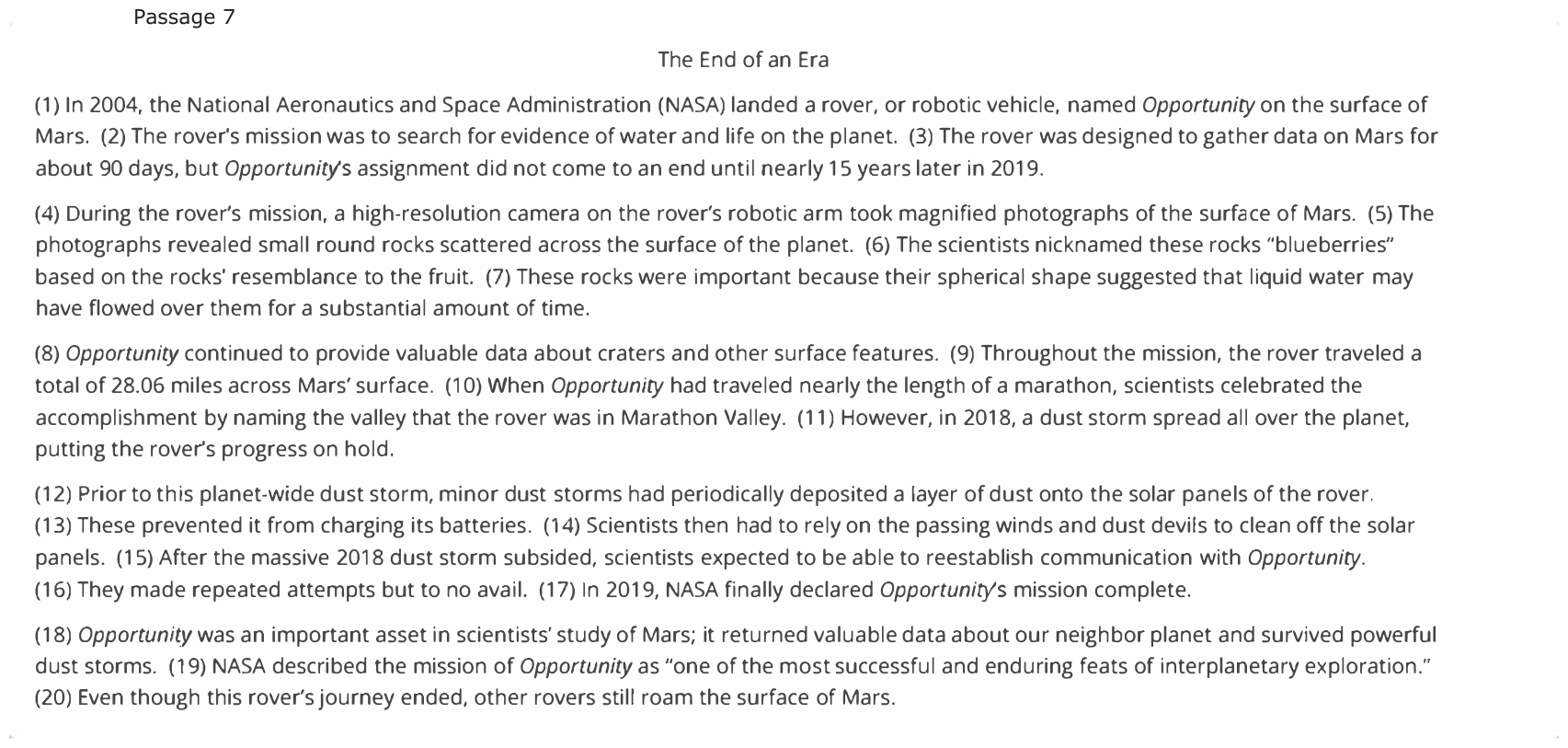
(1) In 2004, the National Aeronautics and Space Administration (NASA) landed a rover, or robotic vehicle, named Opportunity on the surface of Mars. (2) The rover’s mission was to search for evidence of water and life on the planet. (3) The rover was designed to gather data on Mars for about 90 days, but Opportunity’s assignment did not come to an end until nearly 15 years later in 2019.
(4) During the rover’s mission, a high-resolution camera on the rover’s robotic arm took magnified photographs of the surface of Mars. (5) The photographs revealed small round rocks scattered across the surface of the planet. (6) The scientists nicknamed these rocks “blueberries” based on the rocks’ resemblance to the fruit. (7) These rocks were important because their spherical shape suggested that liquid water may have flowed over them for a substantial amount of time.
(8) Opportunity continued to provide valuable data about craters and other surface features. (9) Throughout the mission, the rover traveled a total of 28.06 miles across Mars’ surface. (10) When Opportunity had traveled nearly the length of a marathon, scientists celebrated the accomplishment by naming the valley that the rover was in Marathon Valley. (11) However, in 2018, a dust storm spread all over the planet, putting the rover’s progress on hold.
(12) Prior to this planet-wide dust storm, minor dust storms had periodically deposited a layer of dust onto the solar panels of the rover. (13) These prevented it from charging its batteries. (14) Scientists then had to rely on the passing winds and dust devils to clean off the solar panels. (15) After the massive 2018 dust storm subsided, scientists expected to be able to reestablish communication with Opportunity. (16) They made repeated attempts but to no avail. (17) In 2019, NASA finally declared Opportunity’s mission complete.
(18) Opportunity was an important asset in scientists’ study of Mars; it returned valuable data about our neighbor planet and survived powerful dust storms. (19) NASA described the mission of Opportunity as “one of the most successful and enduring feats of interplanetary exploration.” (20) Even though this rover’s journey ended, other rovers still roam the surface of Mars.
Question
Which concluding sentence should be added after sentence 20 to best support the information presented in the passage?
- AThese rovers, including one named Curiosity, will help scientists answer their lingering questions about the planet.
- BToday’s rovers continue to add to Opportunity’s discoveries and will help us learn even more about the planet.
- CAnd in conjunction with these rovers, NASA is using other resources, including an orbiting spacecraft known as Mars Odyssey, for the exploration of the planet.
- DWith its red dust, rocky surface, and freezing temperatures, Mars will continue to be a challenging environment for today’s rovers.
Show the answer
Correct answer: B
The question asks for the concluding sentence that should be added after sentence 20 to best support the information presented in the passage.
A. Incorrect. The sentence does not summarize or make reference to the focus of the passage, which is the Opportunity rover.
B. CORRECT. This sentence summarizes the ideas about the Opportunity rover while also extending those ideas to future research, an effective combination for a sentence that concludes a piece about a scientific topic.
C. Incorrect. This sentence not only begins with the phrase “And in conjunction,” which is repetitive, but also introduces an entirely new idea (Mars Odyssey) instead of concluding on the main topic of the passage (the Opportunity rover).
D. Incorrect. This sentence puts emphasis on Mars’s characteristics and makes a conclusion about “today’s rovers,” instead of referring back to the Opportunity rover, the main focus of the passage.
Question analysis
This concluding-sentence question on “The End of an Era,” a passage about NASA’s Opportunity rover, which explored Mars from 2004 until NASA declared its mission complete in 2019, asks which sentence should follow sentence 20. That last sentence notes that other rovers still roam Mars, and every choice builds on it, so students must judge which ending best supports the passage as a whole.
- NYS standards
- 7W2e concluding informative writing
- Grade level
- Grade 7 reading and task
- Compared with grade 7
- At grade 7 Choosing a concluding sentence for an informational passage is standard grade 7 writing work. The rover passage is twenty plain sentences, and all four endings follow on from its last line, so the comparison is careful but typical.
- Estimated difficulty
- Moderate: several steps, or a close reading with one strong distractor.
- Thinking it demands
- Depth of knowledge 2, skills and concepts · mainly evaluate
- What makes it hard
- A very close wrong answer moderate
- Evidence in several places minor
- How sentences fit together minor
- Evidence
- Answered from the whole text
- Reading level
- Passage: about grade 11, 337 words; question and choices: about grade 13, 96 words.
- Students, last 30 days
- Not enough answers yet to show (it takes 10).
Why it is hard, traps and wrong answers (shows the answer)
Why it is hard
Sentence 20 hands every ending a ready link, the rovers still on Mars, so each choice sounds like a natural next line. The question is which one returns to the subject the passage built over twenty sentences, and only one connects today’s rovers to what Opportunity found. The near-twin that names Curiosity draws students who check smoothness rather than focus, while the other two drift to a spacecraft and to the planet’s harsh conditions.
A very close wrong answer moderate Choosing the answer
The ending that names Curiosity and the right one both say today’s rovers will help answer questions about Mars; they differ only in whether the sentence ties those rovers back to Opportunity’s discoveries. (Embretson & Wetzel, 1987; Gorin & Embretson, 2006; Ascalon et al., 2007)
Evidence in several places minor Working it out
The passage’s subject, Opportunity, runs through all five paragraphs, from its 2004 landing to the “blueberries,” the 28.06 miles and the dust storms, so judging an ending means holding that whole thread in mind. (Kirsch & Mosenthal, 1990; Gorin & Embretson, 2006)
How sentences fit together minor Working it out
Sentence 20 turns to “other rovers” that “still roam the surface of Mars,” and all four endings pick up from it, so fit with the last sentence alone rules none of them out. (Halliday & Hasan, 1976)
Strategy: Say in a few words what the whole passage is about, then read each ending after sentence 20 and ask whether it closes that subject or turns to something the passage never covered.
Traps
- Off the point: Adds or keeps something that does not support the paragraph's or the passage's focus, or an introduction or conclusion that misses the main point.
The wrong answers, classified
A Off the point (Halliday & Hasan, 1976)
Continues smoothly from “other rovers” in sentence 20 and looks ahead as a conclusion should, but it names Curiosity and never returns to Opportunity, the rover the passage is about.
C Off the point (Halliday & Hasan, 1976)
Is drawn by a specific new fact, the orbiting Mars Odyssey, which the passage never mentions; after the wordy “And in conjunction with,” the ending leaves Opportunity behind.
D Off the point (Halliday & Hasan, 1976)
Builds on the dust storms Opportunity survived and adds rocky ground and freezing cold, but it ends on the hardships facing today’s rovers rather than on what Opportunity achieved.
Working it out, step by step
Figure out what the question asks
You need a concluding sentence. That is the last sentence of a piece of writing. A good one wraps up the main topic and leaves the reader with a final thought. So first, decide what the whole passage is about.
Name the main topic
Every paragraph is about one rover, Opportunity. Paragraph 1 tells when it landed on Mars in 2004. Paragraph 2 tells about the “blueberries,” small round rocks it found. Paragraph 3 gives the 28.06 miles it traveled. Paragraph 4 tells how its mission ended in 2019. Paragraph 5 says it “returned valuable data about our neighbor planet.” A good ending should come back to this rover.
Read the last sentence
Sentence 20 says: “Even though this rover’s journey ended, other rovers still roam the surface of Mars.” Roam means travel around. All four choices pick up from these other rovers. So fitting with sentence 20 is not enough. The best choice must also tie back to Opportunity.
Check each choice
- A is wrong. It names a new rover, Curiosity, and never mentions Opportunity.
- B is right. It says today’s rovers add to Opportunity’s discoveries. That links them back to the topic. It also looks ahead: they “will help us learn even more about the planet.”
- C is wrong. It brings in a spacecraft, Mars Odyssey, that the passage never talks about. An ending should not start a new topic.
- D is wrong. It ends on how harsh Mars is for today’s rovers, not on what Opportunity did.
Watch out: A sounds like a strong ending because it looks to the future. But it leaves out the rover the passage is about.
Choose the answer
Only B ties today’s rovers back to Opportunity and also looks ahead to new learning about Mars. So the answer is B.
Why this answer and not the closest wrong one
A is the closest wrong answer. Like B, it says today’s rovers will help answer questions about Mars. But A talks about Curiosity instead. B is better because it connects those rovers to Opportunity’s discoveries, the subject of all five paragraphs.
More questions like this
The original DOE question
The passage “The End of an Era” as printed (page 60)