2026 Practice Test A English
Question 1 of 50
2026 Practice Test A English, question 1Passage Snowy Mountains
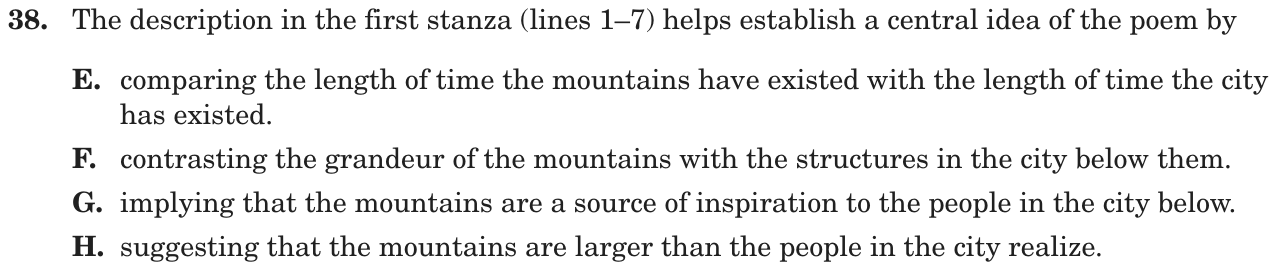
Snowy Mountains
by John Gould Fletcher
Higher and still more high,
Palaces made for cloud,
Above the dingy city-roofs
Blue-white like angels with broad wings,
Pillars of the sky at rest
The mountains from the great plateau
Uprise.
But the world heeds them not;
They have been here now for too long a time.
The world makes war on them,
Tunnels their granite cliffs,
Splits down their shining sides,
Plasters their cliffs with soap-advertisements,
Destroys the lonely fragments of their peace.
Vaster and still more vast,
Peak after peak, pile after pile,
Wilderness still untamed,
To which the future is as was the past,
Barrier spread by Gods,
Sunning their shining foreheads,
Barrier broken down by those who do not need
The joy of time-resisting storm-worn stone,
The mountains swing along
The south horizon of the sky;
Welcoming with wide floors of blue-green ice
The mists that dance and drive before the sun.
“Snowy Mountains” by John Gould Fletcher—Public Domain
Question
The description in the first stanza (lines 1–7) helps establish a central idea of the poem by
- Acomparing the length of time the mountains have existed with the length of time the city has existed.
- Bcontrasting the grandeur of the mountains with the structures in the city below them.
- Cimplying that the mountains are a source of inspiration to the people in the city below.
- Dsuggesting that the mountains are larger than the people in the city realize.
Show the answer
Correct answer: B
The question asks how the description in the first stanza helps establish a central idea of the poem. The poem is mostly about the grandeur of the mountains in spite of the spread of civilization. The first stanza contrasts these two elements, which is stated in Option B.
Option A is incorrect because it is a detail that is referenced later in the poem.
Option C is incorrect because the poem actually communicates the message that people do not recognize the greatness of the mountains.
Option D is incorrect because, although the first stanza mentions the size of the mountains, it does not imply that people cannot see how large the mountains are.
Question analysis
This question about John Gould Fletcher’s poem “Snowy Mountains” asks how the first stanza’s description helps establish a central idea of the poem. Students must interpret images such as palaces, pillars and angels, decide what the opening lines do with them, and judge which choice states that role without adding ideas.
- Grade level
- Grade 7 reading and task
- Compared with grade 7
- At grade 7 Linking one stanza to a poem’s central idea is a common grade 7 task, and these images are vivid and concrete. The inverted, century-old syntax adds a little challenge but no unusual demand.
- Estimated difficulty
- Straightforward: two steps or one careful reading.
- Thinking it demands
- Depth of knowledge 2, skills and concepts · mainly analyze
- What makes it hard
- Figurative or literary language moderate
- Complex sentences minor
- Evidence
- Answered from one paragraph or stanza
- Reading level
- Passage: 161 words (a poem; reading level not measured); question and choices: about grade 8, 77 words.
- Students, last 30 days
- Not enough answers yet to show (it takes 10).
Why it is hard, traps and wrong answers (shows the answer)
Why it is hard
The first stanza sets its majestic images directly against “the dingy city-roofs,” so students who read it as a picture find the contrast without much trouble. The losses come from importing ideas from later in the poem, people’s neglect in stanza 2 or the passing of time, into seven lines that contain neither. The inverted word order slows a first reading but does not hide the meaning.
Figurative or literary language moderate Understanding the question
The contrast is carried by images, not statements: “Palaces made for cloud” and “angels with broad wings” rise “Above the dingy city-roofs,” and students must read grandeur and drabness from those pictures. (Graesser, Singer & Trabasso, 1994; Kintsch, 1998)
Complex sentences minor Understanding the question
The stanza is one inverted sentence: five lines of images come before its subject, “The mountains,” in line 6 and its verb, “Uprise,” in line 7. (Abedi & Lord, 2001; Freedle & Kostin, 1993; Messick, 1989)
Strategy: Reread lines 1–7 and sum up in a phrase what the stanza does, then check each choice against those seven lines.
Traps
- Reads too much in: A reasonable-sounding conclusion that goes further than the text allows.
- Wrong part of the text: A choice is true of another paragraph, stanza or speaker than the one asked about.
- Outside knowledge: A choice is plausible in the real world but not supported by this text.
The wrong answers, classified
A Wrong part of the text (Kirsch & Mosenthal, 1990)
Brings in time, which the poem raises only in line 9 and line 18; the first stanza sets mountains against city by height and splendor, not by age.
C Outside knowledge (King et al., 2004; Recht & Leslie, 1988)
Assumes that majestic mountains inspire the people below them, a common idea about nature, but the stanza shows no reaction from the city, and the next stanza says the world “heeds them not.”
D Reads too much in (Graesser, Singer & Trabasso, 1994)
Combines line 1’s “Higher and still more high” with the poem’s later charge that people ignore the mountains, but nothing in lines 1–7 says the city misjudges how large they are.
Working it out, step by step
Figure out what the question asks
This question asks how the first stanza helps build a central idea of the poem. A stanza is a group of lines in a poem, like a paragraph. A central idea is a main message. Only lines 1 to 7 matter here, from “Higher and still more high” to “Uprise.”
Read the pictures in lines 1–7
The mountains are called “Palaces made for cloud” in line 2. In line 4 they are “Blue-white like angels with broad wings.” In line 5 they are “Pillars of the sky at rest.” Palaces, angels and pillars are all grand, high and beautiful. But line 3 places them “Above the dingy city-roofs.”
Explain what the pictures show
“Dingy” means dull and dirty. So the stanza sets two things side by side. Up high are the shining, noble mountains. Down below are the drab roofs of the city. This is a contrast: two things put together to show how different they are. Grandeur means greatness and splendor. The stanza shows the mountains’ grandeur next to the plain city.
Check each choice
- A is wrong. Time is not in lines 1–7. It first comes up in line 9, “They have been here now for too long a time.”
- B fits. Grand mountains rise over dingy city roofs.
- C is wrong. The stanza never shows people being inspired. In fact, line 8 says “the world heeds them not,” or pays them no attention.
- D is wrong. Line 1 says the mountains are high. But nothing says the city misjudges their size.
Choose the answer
The first stanza puts splendid mountains above a dull city. So the answer is B, “contrasting the grandeur of the mountains with the structures in the city below them.”
Why this answer and not the closest wrong one
D is the closest trap. It mixes line 1 with an idea from later in the poem, that people ignore the mountains. But the question is about lines 1–7 only. Those lines show a contrast in looks: high and splendid against low and dingy. They say nothing about what people think.
More questions like this
The original DOE question
The passage “Snowy Mountains” as printed (page 142)
Question 2 of 50
2026 Practice Test A English, question 2Uses the passage above: “Snowy Mountains”.
Question
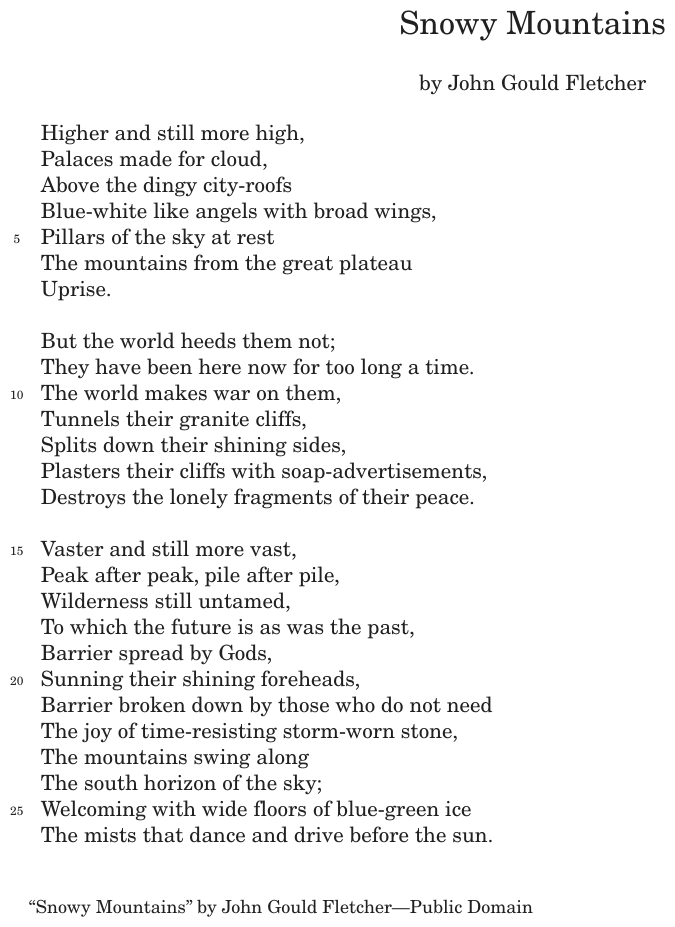
Which detail from the poem reflects the speaker’s view that people often fail to appreciate what is familiar?
- A“The mountains from the great plateau” (line 6)
- B“They have been here now for too long a time.” (line 9)
- C“Splits down their shining sides,” (line 12)
- D“To which the future is as was the past,” (line 18)
Show the answer
Correct answer: B
The question asks for the detail from the poem that reflects the speaker’s view that people often fail to appreciate that which is familiar.
Line 9 (Option B) most directly supports this idea by implying that the mountains have been here for so long that people are accustomed to seeing them and no longer appreciate their beauty and value, making Option B the correct response.
Option A is incorrect because line 6 describes the mountains’ location, rather than their longevity or familiarity.
Option C is incorrect because, in line 12, the mention of harm that has been done to the mountains does not connect to a sense of overfamiliarity.
Option D is incorrect because, although line 18 alludes to the longevity of the mountains, it does not connect the longevity with a sense of overfamiliarity or the failure of people to appreciate the mountains’ worth.
Question analysis
Students pick the detail from the poem “Snowy Mountains” that reflects the speaker’s view that people often fail to appreciate what is familiar. The idea is never stated outright, so students must read each quoted line in its context and decide which one implies both familiarity and a loss of appreciation.
- Grade level
- Grade 7 reading and task
- Compared with grade 7
- At grade 7 Evidence questions like this are typical grade 7 work, but the support here is implied rather than stated, which adds an inference step beyond simple matching of words.
- Estimated difficulty
- Moderate: several steps, or a close reading with one strong distractor.
- Thinking it demands
- Depth of knowledge 2, skills and concepts · mainly evaluate
- What makes it hard
- Reading between the lines moderate
- Every choice must be checked minor
- Evidence
- Answered from one sentence or line
- Reading level
- Passage: 161 words (a poem; reading level not measured); question and choices: about grade 3, 52 words.
- Students, last 30 days
- Not enough answers yet to show (it takes 10).
Why it is hard, traps and wrong answers (shows the answer)
Why it is hard
The claim joins two ideas, long familiarity and failing to appreciate, and the right line shows them only together with the line before it. Students who match the idea of time pick the line about the future and the past, and those who match neglect pick a line of damage. Reading line 9 as the explanation for line 8 is the key move.
Reading between the lines moderate Working it out
The line never says “familiar”; its meaning comes from its place right after “But the world heeds them not,” where being here “too long” reads as the reason for that neglect. (Graesser, Singer & Trabasso, 1994; Kintsch, 1998)
Every choice must be checked minor Choosing the answer
Each quoted line has to be read in its stanza, because out of context lines 9 and 18 both sound like statements about time. (Embretson & Wetzel, 1987)
Strategy: Restate the claim as “people stop valuing something because they are used to it,” then check each quoted line within its stanza for a reason people might stop noticing the mountains.
Traps
- Supports only part of the claim: In a question about evidence: a line that backs one half of the claim but not the other, or a related point rather than the claim itself.
The wrong answers, classified
A Little reason to choose it (Haladyna & Downing, 1993; Rodriguez, 2005)
Line 6 only places the mountains above “the great plateau” and touches neither familiarity nor appreciation, so it mainly draws students who are guessing.
C Supports only part of the claim (King et al., 2004; Thissen, Steinberg & Fitzpatrick, 1989)
Shows people harming the mountains, which fits the speaker’s complaint that they are not valued, but “Splits down their shining sides” gives no sign that familiarity is the cause.
D Supports only part of the claim (King et al., 2004; Thissen, Steinberg & Fitzpatrick, 1989)
Notices that line 18 stresses how long the mountains endure, but it describes their permanence, not people growing used to them and ceasing to value them.
Working it out, step by step
Figure out what the question asks
This asks for a line that shows one of the speaker’s views: people often fail to appreciate what is familiar. Familiar means something you know well and see all the time. To appreciate is to value something. So the line must show people no longer valuing the mountains because they are used to them.
Read each line in its place
Line 9 says, “They have been here now for too long a time.” Read it with line 8 just before it: “But the world heeds them not.” “Heeds” means pays attention to. So the world ignores the mountains. Line 9 gives the reason. They have been around so long that people are used to them.
Explain what line 9 means
The mountains have not done anything wrong by being old. The words “too long” show how people feel about them. Something you see every day starts to seem plain. You stop noticing it. That is exactly the idea in the question: people stop valuing what is familiar.
Check each choice
- A is wrong. Line 6 only tells where the mountains are, above “the great plateau.”
- B fits. It explains that people ignore the mountains because they have seen them for so long.
- C is wrong. Line 12 shows harm, but it does not say familiarity is the cause.
- D is wrong. Line 18 means the mountains do not change over time. It is about how long they last, not about people getting used to them.
Choose the answer
Line 9 explains why the world ignores the mountains: people are too used to them. So the answer is B, “They have been here now for too long a time.”
Why this answer and not the closest wrong one
D is the closest trap, since lines 9 and 18 both talk about time. But line 18 praises the mountains for lasting. Line 9 follows “the world heeds them not” and explains it. Only line 9 links long familiarity to people not caring.
More questions like this
The original DOE question
Question 3 of 50
2026 Practice Test A English, question 3Uses the passage above: “Snowy Mountains”.
Question
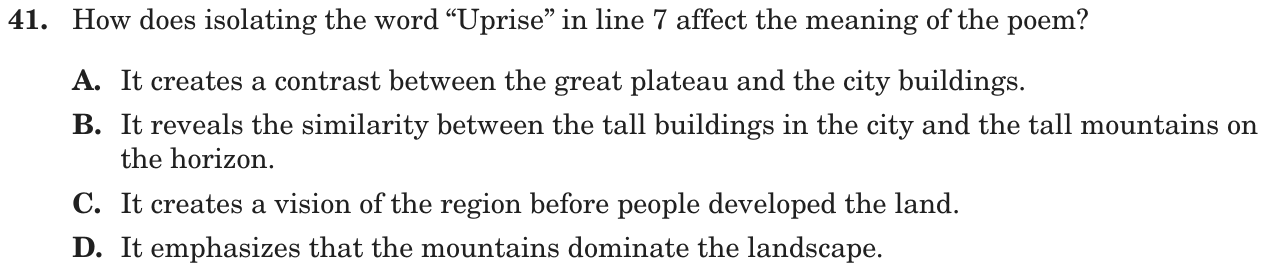
How does isolating the word “Uprise” in line 7 affect the meaning of the poem?
- AIt creates a contrast between the great plateau and the city buildings.
- BIt reveals the similarity between the tall buildings in the city and the tall mountains on the horizon.
- CIt creates a vision of the region before people developed the land.
- DIt emphasizes that the mountains dominate the landscape.
Show the answer
Correct answer: D
The question asks how the isolation of the word affects the meaning of the poem. The isolation of the word “Uprise” powerfully emphasizes the first stanza’s description of the magnificent mountains standing tall above the land below, as expressed in Option D.
Option A is incorrect because the word describes the mountains and, therefore, does not create a contrast between the plateau and the city buildings, but rather between the mountains and the plateau.
Option B is incorrect because the word contrasts the mountains with the plateau; it does not compare the mountains to the buildings in the city.
Option C is incorrect because the first stanza describes the already developed land over which the mountains rise.
Question analysis
In “Snowy Mountains,” the opening stanza builds a long sentence about the mountains and saves its verb, “Uprise,” for a line of its own. This poetry structure question asks how isolating that single word affects the poem’s meaning, so students need to think about how a line break shapes what the reader notices, as well as about what the stanza describes.
- Grade level
- Grade 8 reading and task
- Compared with grade 7
- At grade 7 Grade 7 poetry questions often ask about word choice; this one asks about a structural choice, a one-word line, which is less familiar, though the stanza’s images make the intended effect fairly easy to sense.
- Estimated difficulty
- Moderate: several steps, or a close reading with one strong distractor.
- Thinking it demands
- Depth of knowledge 2, skills and concepts · mainly analyze
- What makes it hard
- Complex sentences moderate
- How, not what moderate
- Evidence
- Answered from one paragraph or stanza
- Reading level
- Passage: 161 words (a poem; reading level not measured); question and choices: about grade 8, 64 words.
- Students, last 30 days
- Not enough answers yet to show (it takes 10).
Why it is hard, traps and wrong answers (shows the answer)
Why it is hard
Students who see that “Uprise” is the verb the whole stanza has been building toward recognize the effect quickly: the mountains rise over everything else in the picture. Those who treat the word as one more image look for a comparison instead and find several, because the stanza is full of buildings, roofs and a plateau. The real test is sorting which contrast belongs to the mountains.
Complex sentences moderate Understanding the question
The stanza is one long sentence that withholds its subject until line 6 and its verb until line 7, so “Uprise” lands as the payoff of five lines of images. (Abedi & Lord, 2001; Freedle & Kostin, 1993; Messick, 1989)
How, not what moderate Working it out
The question asks about a line break, a structural choice, rather than a word’s meaning, and students must judge what setting one verb on its own line makes the reader notice. (Anderson & Krathwohl, 2001)
Strategy: Read the stanza aloud and notice where the long sentence finally reaches its verb, then ask what ending on that single word makes the reader see.
Traps
- Taking figurative language literally: A choice reads a figure of speech or image at face value.
- Half right: One half of a two-part choice is right and the other is not.
The wrong answers, classified
A Half right (King et al., 2004; Thissen, Steinberg & Fitzpatrick, 1989)
Rightly senses a contrast in the stanza but pairs the wrong things: “Uprise” sets the mountains against the land below them, not the plateau against the city’s buildings.
B Twists what the text says (King et al., 2004)
Notices that the mountains are compared to “Palaces” and “Pillars,” but those grand buildings are set against the “dingy city-roofs,” so the stanza contrasts mountains and city rather than likening them.
C Taking figurative language literally (Graesser, Singer & Trabasso, 1994)
Takes “Uprise” at face value, as mountains pushing up out of the plateau long ago, but line 3’s “dingy city-roofs” place the scene in a land already built on.
Working it out, step by step
Figure out what the question asks
This asks about a choice the poet made in how the poem looks. Line 7 is only one word: “Uprise.” You need to say what setting that word alone on its line does to the meaning.
Find the sentence the word ends
The whole first stanza is one long sentence. Lines 1 to 5 are a string of pictures: palaces, angels, pillars. The subject, “The mountains from the great plateau,” does not come until line 6. Line 7 then gives the verb, or action word, which is “Uprise.” A plateau is a wide area of high, flat land.
Think about the effect
“Uprise” means rise up. The reader waits six lines for this action. Then it stands by itself, like the mountains standing alone over the land. The short line makes you stop and picture them rising above everything, even “the dingy city-roofs.” So the mountains dominate the scene. To dominate is to tower over and be the main thing you notice.
Check each choice
- A is wrong. “Uprise” is about the mountains rising. It does not set the plateau against the city buildings.
- B is wrong. The stanza does not show the city and the mountains as alike. The city roofs are “dingy,” while the mountains are like palaces.
- C is wrong. Line 3 already shows a city, so this is not the land before people.
- D fits. The lone word makes the mountains tower over the whole picture.
Choose the answer
Ending the long sentence on one lone word makes the mountains stand out over everything. So the answer is D, “It emphasizes that the mountains dominate the landscape.”
Why this answer and not the closest wrong one
A is the closest trap, because the stanza does contain a contrast. But it is between the mountains and everything below them. “Uprise” is the mountains’ own action, so its effect must be about the mountains. Only D keeps the focus there.
More questions like this
The original DOE question
Question 4 of 50
2026 Practice Test A English, question 4Uses the passage above: “Snowy Mountains”.
Question
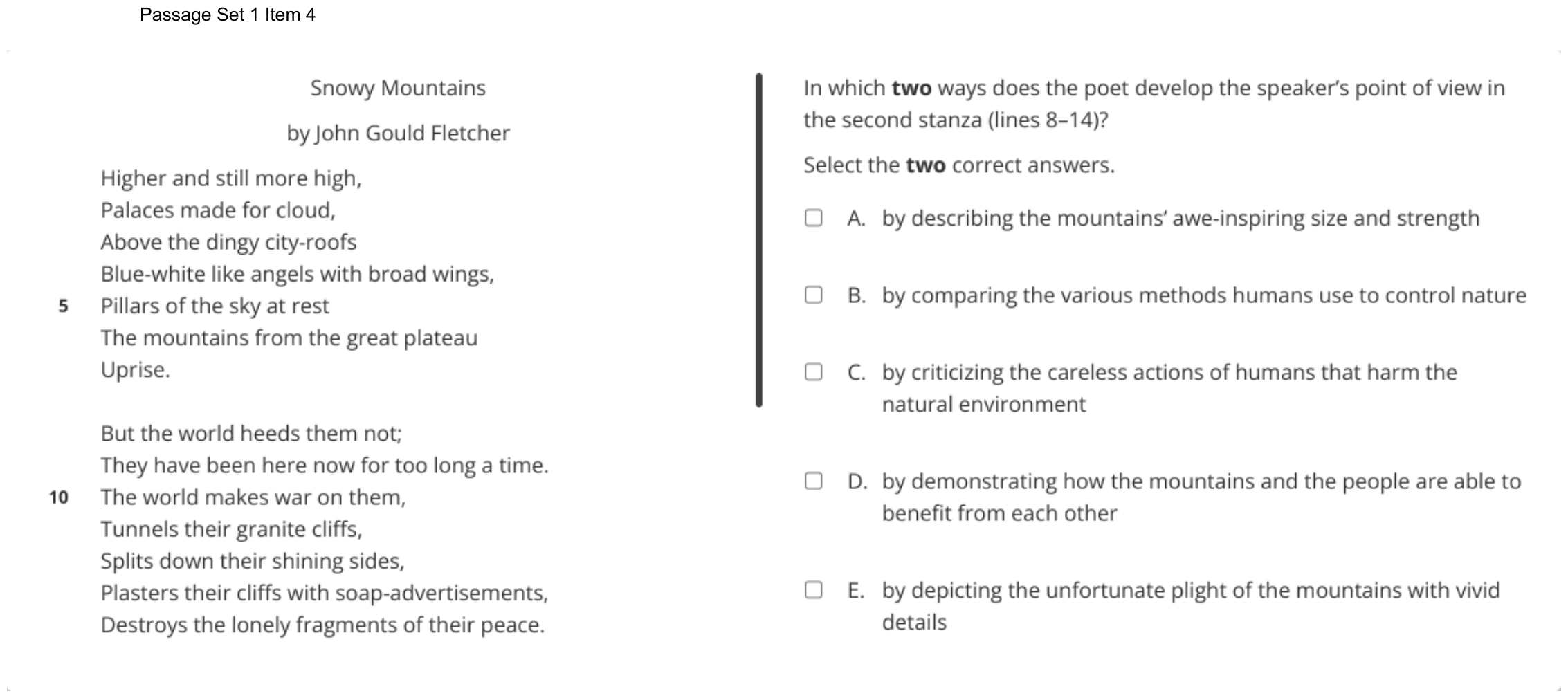
In which two ways does the poet develop the speaker’s point of view in the second stanza (lines 8–14)?
Select the two correct answers.
Choose every answer that is correct, then check. The DOE has not published how answers with several parts are scored; this site counts one right only when every part is right.
- Aby describing the mountains’ awe-inspiring size and strength
- Bby comparing the various methods humans use to control nature
- Cby criticizing the careless actions of humans that harm the natural environment
- Dby demonstrating how the mountains and the people are able to benefit from each other
- Eby depicting the unfortunate plight of the mountains with vivid details
Show the answer
Correct answer: C and E
The question asks for the two ways in which the poet develops the speaker’s point of view in the second stanza (lines 8–14).
A. Incorrect. The speaker’s descriptions of the mountains’ awe-inspiring size and strength mainly occur in the first and third stanzas, while in the second stanza, the speaker focuses on humanity and its negative effect on the mountains.
B. Incorrect. The wording of the second stanza—“makes war” (line 10), “Splits down their shining sides” (line 12), and “Destroys the lonely fragments” (line 14)—communicates the speaker’s position that people’s main impact on the mountains is destructive, but the stanza does not compare the various methods people use to control nature.
C. CORRECT. In the second stanza, the speaker criticizes the careless and destructive actions of society or “the world” (lines 8 and 10) that harm the natural environment. Humans are described as both heedless of the mountains (“heeds them not”) and harmfully warlike (“makes war on them”). The speaker cites the harm done to the mountains when people “[tunnel] their granite cliffs” (line 11) and “[split] down their shining sides” (line 12), thus “[destroying] the lonely fragments of their peace” (line 14).
D. Incorrect. In the second stanza, the speaker does not describe a mutually beneficial relationship between the mountains and the people. Although people clearly derive benefits from the mountains by plastering “their cliffs with soap-advertisements” (line 13), the stanza does not demonstrate that the mountains receive any benefit from the harmful actions of the people.
E. CORRECT. In the second stanza, the speaker depicts the unfortunate plight of the mountains with vivid details. Lines 11–14 feature expressive wording that sharply illustrates the mountains’ misfortune: “Tunnels their granite cliffs, / Splits down their shining sides, / Plasters their cliffs with soap-advertisements.”
Question analysis
This select-two question on John Gould Fletcher’s poem “Snowy Mountains” asks in which two ways the poet develops the speaker’s point of view in the second stanza, lines 8–14. It reworks a one-answer handbook question, now with five choices. Each choice has to be judged on its own, and a choice that fits the poem as a whole is not enough.
- Grade level
- Grade 6 reading and task
- Compared with grade 7
- At grade 7 Typical grade 7 point-of-view questions ask for one answer about a longer text. This stanza is only seven short lines with one steady attitude, but students must find two right choices out of five and judge each one separately.
- Estimated difficulty
- Moderate: several steps, or a close reading with one strong distractor.
- Thinking it demands
- Depth of knowledge 2, skills and concepts · mainly analyze
- What makes it hard
- How, not what moderate
- Every choice must be checked moderate
- Hard words minor
- Evidence
- Answered from one paragraph or stanza
- Reading level
- Passage: 161 words (a poem; reading level not measured); question and choices: about grade 8, 79 words.
- Students, last 30 days
- Not enough answers yet to show (it takes 10).
Why it is hard, traps and wrong answers (shows the answer)
Why it is hard
Most students sense the anger at “the world” in lines 8–14 and find the criticism of people quickly. The point is lost on the second pick, because the other right choice names a technique, vivid details of the mountains’ suffering, and can look like plain description. The choice about comparing methods tempts students who see a list of human actions, and the awe of the first and third stanzas pulls those who drift outside the stanza, while both picks must be right to score.
How, not what moderate Working it out
The stem asks how the viewpoint is built, and both right choices are methods: a judgment of “the world” that “makes war,” and the vivid verbs “Tunnels,” “Splits” and “Plasters” in lines 11–13. (Anderson & Krathwohl, 2001)
Every choice must be checked moderate Choosing the answer
All five choices must be tested and both picks must be right, so finding the criticism of people is only half the work; the second right choice is about imagery, not message. (Embretson & Wetzel, 1987)
Hard words minor Understanding the question
One right choice turns on “plight,” a hard situation; a student who does not know the word cannot see that it names the damage done to the mountains in lines 11–14. (Perfetti, 2007; Freedle & Kostin, 1993)
Strategy: Restate in your own words what lines 8–14 say and how they say it, then test each of the five choices on its own and keep only the two that fit this stanza rather than the whole poem.
Traps
- Twists what the text says: Uses the text's topic and ideas but changes what it says: who did it, how much, when, or why.
- Wrong part of the text: A choice is true of another paragraph, stanza or speaker than the one asked about.
The wrong answers, classified
A Wrong part of the text (Kirsch & Mosenthal, 1990)
Brings in the awe of the first and third stanzas, “Higher and still more high” and “Vaster and still more vast,” though in lines 8–14 the cliffs appear only as things being damaged.
B Twists what the text says (King et al., 2004)
Sees that lines 11–13 list several human acts, tunneling, splitting and plastering, but the stanza never weighs one against another; all are blows in one war, not methods of control.
D Wrong tone or attitude (Graesser, Singer & Trabasso, 1994)
Treats the soap advertisements as people getting some use from the cliffs and imagines an exchange, missing the hostility of “The world makes war on them” and “Destroys.”
E Wrong purpose or structure (Anderson & Krathwohl, 2001)
Left out by students who see the vivid verbs as mere description of damage rather than the way the speaker builds sympathy, or who do not know that “plight” means a bad situation.
Working it out, step by step
Figure out what the question asks
This asks about point of view: how the speaker, the voice talking in the poem, feels about the subject. It also asks how the poet shows that feeling. Stay inside the second stanza, lines 8 to 14. You must pick two answers, so test all five choices one at a time.
Read the second stanza closely
Line 8 says “But the world heeds them not.” To heed something is to pay attention to it. Here “the world” means people in general. Line 10 says “The world makes war on them.” Lines 11 to 13 list what people do: “Tunnels their granite cliffs, / Splits down their shining sides, / Plasters their cliffs with soap-advertisements.” Line 14 ends with “Destroys the lonely fragments of their peace.”
Name how the speaker feels
The speaker is on the mountains’ side. People ignore the mountains, yet they keep attacking them. The speaker blames people for this harm. Pointing out what someone does wrong is called criticizing. The speaker also makes you feel sorry for the mountains. Strong action words like “Tunnels,” “Splits” and “Plasters” paint a sharp picture of the damage. Sharp word pictures like these are called vivid details.
Check each of the five choices
- A does not fit. The mountains’ great size fills the first and third stanzas, as in “Higher and still more high.” In lines 8 to 14 they are only being hurt.
- B does not fit. The stanza lists several things people do, but it never compares them. They are all part of one “war.”
- C fits. The speaker criticizes people for careless acts that damage nature.
- D does not fit. The mountains get nothing good from people. The stanza shows only harm.
- E fits. A plight is a bad or sad situation. The vivid verbs in lines 11 to 13 show the mountains’ plight.
Watch out: B is tempting because the stanza names several acts. But a list is not a comparison.
Choose both answers
The speaker’s view comes through two things: blame for people, and a vivid picture of the mountains’ suffering. Select both choices on the screen. You need both to get the point. So the answers are C and E.
Why this answer and not the closest wrong one
E is the right answer that is easiest to miss, because it can look like plain description. But those vivid details are how the speaker makes you feel for the mountains. B is the closest wrong choice. The stanza does list several human acts, yet it never weighs one against another. Each act is just one more blow.
More questions like this
The original DOE question
Question 5 of 50
2026 Practice Test A English, question 5Uses the passage above: “Snowy Mountains”.
Question
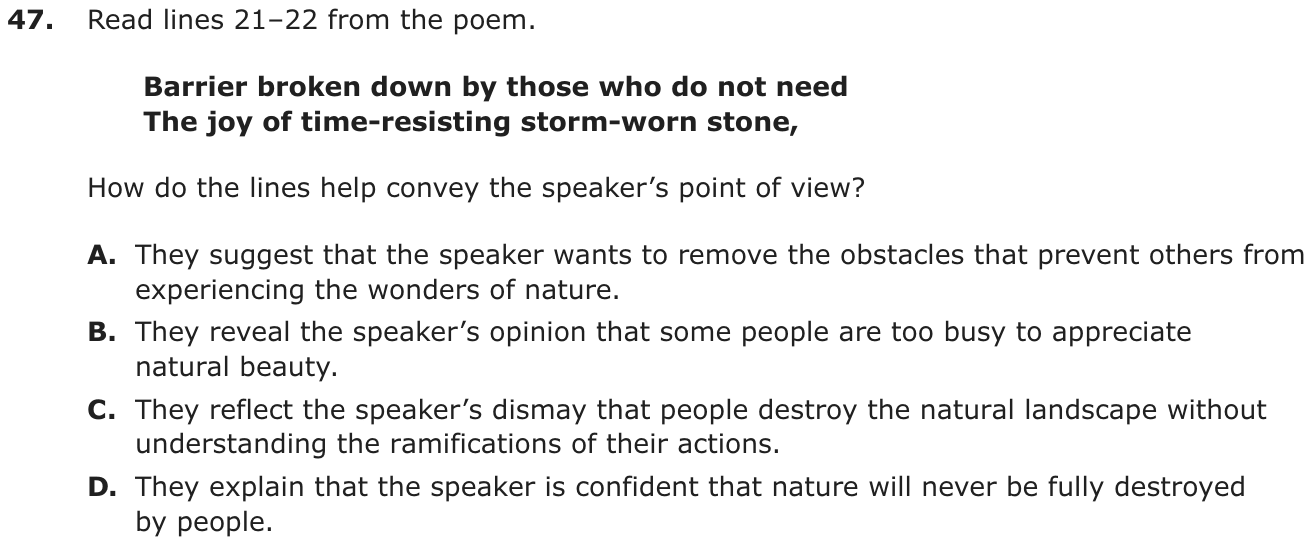
Read lines 21–22 from the poem.
Barrier broken down by those who do not need
The joy of time-resisting storm-worn stone,
How do the lines help convey the speaker’s point of view?
- AThey suggest that the speaker wants to remove the obstacles that prevent others from experiencing the wonders of nature.
- BThey reveal the speaker’s opinion that some people are too busy to appreciate natural beauty.
- CThey reflect the speaker’s dismay that people destroy the natural landscape without understanding the ramifications of their actions.
- DThey explain that the speaker is confident that nature will never be fully destroyed by people.
Show the answer
Correct answer: C
The question asks how lines 21–22 help convey the speaker’s point of view.
A. Incorrect. The word “barrier” (line 21) refers to the speaker’s opinion that the mountains were “spread by Gods” (line 19) and not to an obstacle that the speaker thinks should be removed.
B. Incorrect. While the lines indicate that people have lost the need to connect with nature, they do not reveal that the speaker thinks that the cause of this loss is busyness.
C. CORRECT. The words “those who do not need / The joy” in lines 21–22 reflect the speaker’s sadness that people do not realize that they are destroying something wonderful and irreplaceable.
D. Incorrect. Although the speaker does say that the stone is “time-resisting” (line 22), this belief is only a small detail of the speaker’s point of view.
Question analysis
Two lines from the final stanza of “Snowy Mountains” describe a barrier broken down by people who do not need “The joy of time-resisting storm-worn stone,” and students must explain how these lines convey the speaker’s point of view. The phrasing is compact and old-fashioned, with an unusual use of “need,” so working out the plain meaning comes before choosing among close descriptions of the speaker’s feelings.
- Grade level
- Grade 8 reading and task
- Compared with grade 7
- Above grade 7 Grade 7 students often infer a speaker’s attitude from clear statements. Here the attitude must be drawn from a compressed sentence broken across two lines, and the choices differ in fine shades of feeling and cause.
- Estimated difficulty
- Hard: combines ideas, needs a plan, and has more than one tempting wrong answer.
- Thinking it demands
- Depth of knowledge 2, skills and concepts · mainly analyze
- What makes it hard
- Complex sentences major
- Reading between the lines moderate
- Hard words minor
- Evidence
- Answered from one sentence or line
- Reading level
- Passage: 161 words (a poem; reading level not measured); question and choices: about grade 9, 99 words.
- Students, last 30 days
- Not enough answers yet to show (it takes 10).
Why it is hard, traps and wrong answers (shows the answer)
Why it is hard
Before any choice can be judged, the compressed, inverted verse has to be put into plain English: people with no use for the old stone’s joy have broken the barrier down. Once that paraphrase is in hand, the speaker’s sorrow is clear, yet two wrong choices offer nearby readings. One supplies a cause the lines never give, busyness, and the other turns the stone’s endurance into a promise that the same sentence contradicts.
Complex sentences major Understanding the question
The lines break mid-phrase, “those who do not need / The joy of time-resisting storm-worn stone,” inside a sentence whose subject arrives only in line 23, so who breaks what must be untangled first. (Abedi & Lord, 2001; Freedle & Kostin, 1993; Messick, 1989)
Reading between the lines moderate Working it out
Neither dismay nor ignorance is stated; both must be inferred from describing the people as not needing “The joy” of the stone they break down. (Graesser, Singer & Trabasso, 1994; Kintsch, 1998)
Hard words minor Understanding the question
“Barrier” here means the mountain range as a great wall, not an obstacle, and the key turns on “ramifications,” a word many seventh graders will not know. (Perfetti, 2007; Freedle & Kostin, 1993)
Strategy: Read lines 21–22 with the lines just before them, restate the sentence in your own words, and then decide what the speaker thinks of the people it describes.
Traps
- Dictionary meaning, not meaning here: A common meaning of the word that does not fit its use in this text.
- Outside knowledge: A choice is plausible in the real world but not supported by this text.
- Too broad or too strong: A choice overstates, generalizes, or uses absolute words the text does not support.
The wrong answers, classified
A Dictionary meaning, not meaning here (Perfetti, 2007)
Hears “Barrier” in its everyday sense of something blocking the way, but here it is the mountain range itself, “spread by Gods,” and the speaker regrets its breaking.
B Outside knowledge (King et al., 2004; Recht & Leslie, 1988)
Supplies a familiar modern explanation, people too busy for nature, though the lines say only that some people do not need this joy and never say why.
D Too broad or too strong (King et al., 2004)
Stretches “time-resisting” into certainty that nature can never be destroyed, overlooking that these lines show the barrier already “broken down” by people.
Working it out, step by step
Figure out what the question asks
This asks about point of view: what the speaker thinks and feels. Read lines 21 and 22, and decide what they show about the speaker’s attitude toward the people in them.
Read the lines with the ones before
Two lines earlier, the poem names the mountains a “Barrier spread by Gods” (line 19). A barrier is a wall, and here the wall is the mountain range itself. Line 21 says this barrier is “broken down by those who do not need” something. Line 22 says what that something is: “The joy of time-resisting storm-worn stone.”
Put the lines in plain words
Time-resisting means the stone has held out against ages of time. Storm-worn means storms have rubbed it down. So this stone is very old and very tough. In plain words: the mountains are being torn down by people who have no use for the joy this ancient stone can give. The speaker sounds sad and troubled that something so lasting is wrecked by people who do not value it.
Check each choice
- A does not fit. Here “Barrier” means the mountains, not something blocking the way. The speaker is sorry it was broken, not eager to remove it.
- B does not fit. The lines never give a reason, such as being too busy. That idea comes from outside the poem.
- C fits. Dismay is a mix of sadness and alarm. Ramifications are the effects an action leads to later on. The speaker is dismayed that people wreck the mountains with no thought for what they are losing.
- D does not fit. The stone is “time-resisting,” but the same lines show it broken down. They express sorrow, not confidence.
Choose the answer
The lines show the mountains being broken by people who see no value in them, and the speaker is upset. So the answer is C.
Why this answer and not the closest wrong one
B is the strongest trap, because being too busy for nature sounds like a fair reason. But lines 21 and 22 never explain why these people do not need the stone’s joy. B adds a cause from outside the poem. C stays with what the lines show: damage to the mountains, done by people who do not value them, and the speaker’s distress.
More questions like this
The original DOE question
Question 6 of 50
2026 Practice Test A English, question 6Uses the passage above: “Snowy Mountains”.
Question
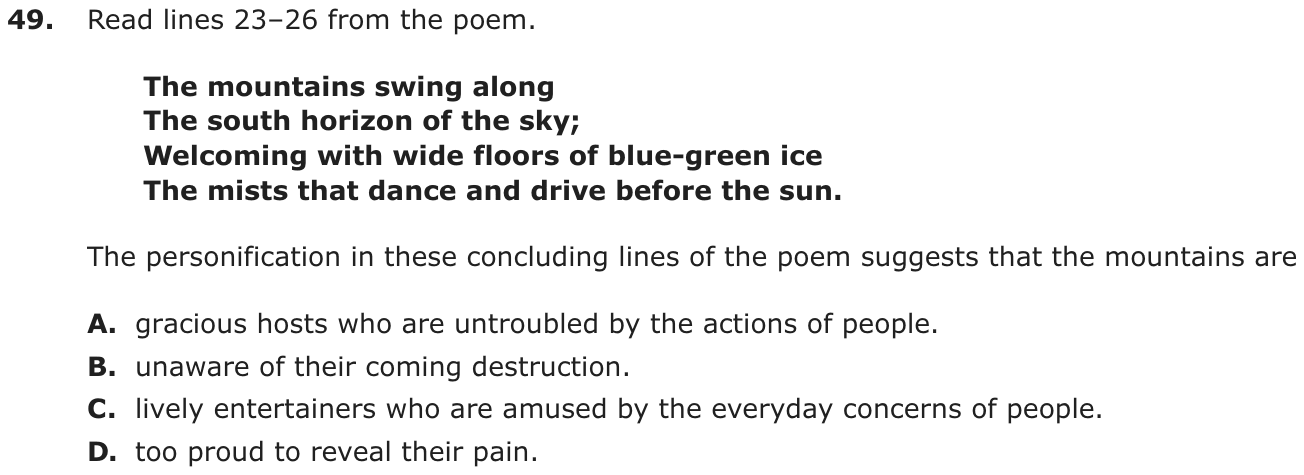
Read lines 23–26 from the poem.
The mountains swing along
The south horizon of the sky;
Welcoming with wide floors of blue-green ice
The mists that dance and drive before the sun.
The personification in these concluding lines of the poem suggests that the mountains are
- Agracious hosts who are untroubled by the actions of people.
- Bunaware of their coming destruction.
- Clively entertainers who are amused by the everyday concerns of people.
- Dtoo proud to reveal their pain.
Show the answer
Correct answer: A
The question asks what the personification in the concluding lines of the poem suggests about the mountains.
A. CORRECT. Line 25’s use of the word “Welcoming” suggests that the mountains are kind hosts. Lines 23 and 26, with language such as “The mountains swing along” and “The mists that dance and drive before the sun,” imply the carefree nature of the mountains as they resist the destructive work of humanity.
B. Incorrect. The personification in the lines conveys a sense of optimism and endurance, with no language to suggest coming destruction.
C. Incorrect. Although the lines mention that “the mountains swing along” (line 23) and “the mists . . . dance” (line 26), the personification is used to describe the mountains’ perseverance, rather than to suggest that the mountains are amused by the concerns of others.
D. Incorrect. Although the second stanza develops the idea that the mountains have been mistreated by humans, which might be a source of pain, the concluding lines emphasize the joy and perseverance of the mountains as they “swing along” (line 23) despite significant adversity.
Question analysis
Students interpret the personification in the closing lines of “Snowy Mountains,” lines 23–26, and decide what it suggests about the mountains on the south horizon. They need to see which human actions the poet gives the mountains and what kind of character those actions create, and then choose among four quite different personalities.
- Grade level
- Grade 7 reading and task
- Compared with grade 7
- At grade 7 Grade 7 readers routinely interpret personification, and here the four lines are printed with the question. The images are concrete and the choices give the mountains clearly different roles and moods, so careful matching settles it.
- Estimated difficulty
- Straightforward: two steps or one careful reading.
- Thinking it demands
- Depth of knowledge 2, skills and concepts · mainly understand
- What makes it hard
- Figurative or literary language moderate
- Complex sentences minor
- Evidence
- Answered from one sentence or line
- Reading level
- Passage: 161 words (a poem; reading level not measured); question and choices: about grade 6, 77 words.
- Students, last 30 days
- Not enough answers yet to show (it takes 10).
Why it is hard, traps and wrong answers (shows the answer)
Why it is hard
The closing lines are calm and generous, and the task is to turn their personification into a character. Students who give the mists’ dancing to the mountains see performers, but the performer choice also has the mountains amused by people’s concerns, which nothing here supports, so a careful reader rejects it. The remaining losses come from carrying the second stanza’s damage into lines that show only ease and welcome.
Figurative or literary language moderate Understanding the question
The human traits must be sorted by who has them: the mountains “swing along” and are “Welcoming,” while the mists are the ones that “dance and drive before the sun.” (Graesser, Singer & Trabasso, 1994; Kintsch, 1998)
Complex sentences minor Understanding the question
In “Welcoming with wide floors of blue-green ice / The mists,” the object of “Welcoming” comes after a long phrase and a line break, so who welcomes whom is easy to lose. (Abedi & Lord, 2001; Freedle & Kostin, 1993; Messick, 1989)
Strategy: Underline each verb or describing word in lines 23–26 that gives the mountains a human trait, then check every choice against all of them.
Traps
- Twists what the text says: Uses the text's topic and ideas but changes what it says: who did it, how much, when, or why.
- Reads too much in: A reasonable-sounding conclusion that goes further than the text allows.
The wrong answers, classified
B Reads too much in (Graesser, Singer & Trabasso, 1994)
Takes the mountains’ carefree swinging as ignorance and adds the earlier stanzas’ damage to it, but these four lines are serene and hint at no destruction to come.
C Twists what the text says (King et al., 2004)
Gives the mists’ dancing to the mountains and so makes them performers, then adds amusement at people’s concerns, though here the mountains only swing along and welcome the mists.
D Wrong tone or attitude (Graesser, Singer & Trabasso, 1994)
Imagines a brave face hiding the wounds of the second stanza, but the lines show the mountains at ease and welcoming, with no sign of pride or pain.
Working it out, step by step
Figure out what the question asks
This asks about personification. That is when a writer describes a thing as if it were a person, with human actions or moods. You need to decide what kind of character the mountains seem to be in lines 23 to 26.
Find who does each action
The four lines are one sentence. In line 23, “The mountains swing along” the edge of the sky. Line 25 shows them “Welcoming with wide floors of blue-green ice.” The guests arrive in line 26: “The mists that dance and drive before the sun.” The mountains do two things here, swing along and welcome. The dancing belongs to the mists.
Decide what the actions suggest
Welcoming guests is what a host does. A host invites others in and makes them comfortable. Gracious means warm and polite. To swing along is to move in a relaxed, easy way. The second stanza was full of harm, yet here the mountains seem calm. They are untroubled, or not worried or upset.
Check each choice
- A fits. The mountains welcome the mists like gracious hosts, and they move at ease.
- B does not fit. Nothing in these lines hints at harm to come. The mood is calm and bright.
- C does not fit. Line 26 gives the dancing to the mists. And nothing shows the mountains laughing at people’s daily worries.
- D does not fit. There is no sign of pride or hidden pain. The mountains seem relaxed and open.
Choose the answer
Like kind hosts, the mountains greet their guests and stay calm. So the answer is A.
Why this answer and not the closest wrong one
C may tempt you, because swinging and dancing both sound lively. But check who dances: line 26 gives the dancing to the mists. The mountains are the ones “Welcoming” them, so they are hosts, not entertainers. C also says the mountains are amused by people, and these lines never show that.
More questions like this
The original DOE question
Question 7 of 50
2026 Practice Test A English, question 7Uses the passage above: “Snowy Mountains”.
Question
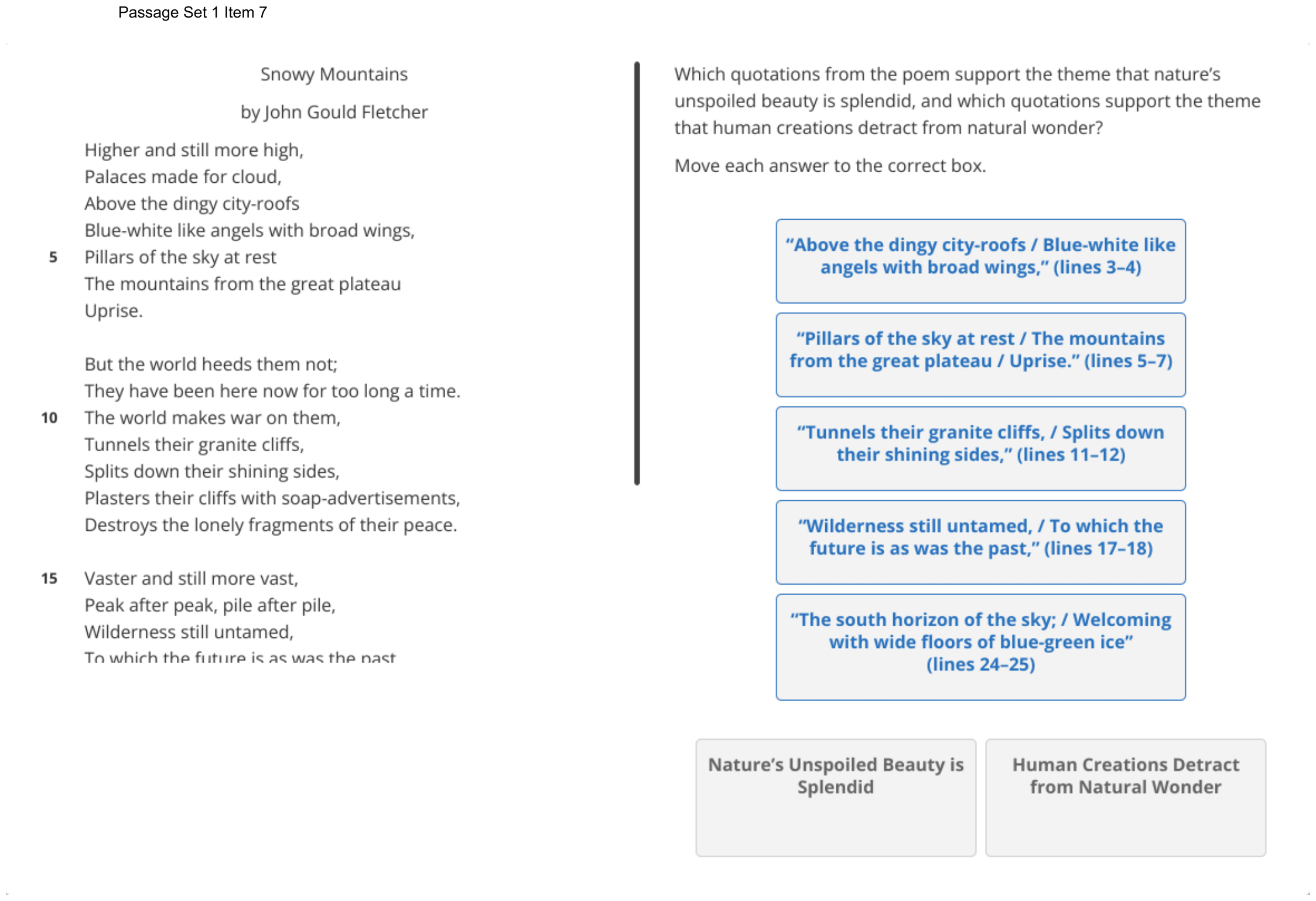
Which quotations from the poem support the theme that nature’s unspoiled beauty is splendid, and which quotations support the theme that human creations detract from natural wonder?
Move each answer to the correct box.
Choose one answer in each row, then check. The DOE has not published how answers with several parts are scored; this site counts one right only when every part is right.
| Nature’s Unspoiled Beauty is Splendid | Human Creations Detract from Natural Wonder | |
|---|---|---|
| “Above the dingy city-roofs / Blue-white like angels with broad wings,” (lines 3–4) | ||
| “Pillars of the sky at rest / The mountains from the great plateau / Uprise.” (lines 5–7) | ||
| “Tunnels their granite cliffs, / Splits down their shining sides,” (lines 11–12) | ||
| “Wilderness still untamed, / To which the future is as was the past,” (lines 17–18) | ||
| “The south horizon of the sky; / Welcoming with wide floors of blue-green ice” (lines 24–25) |
Show the answer
Correct answer: “Above the dingy city-roofs / Blue-white like angels with broad wings,” (lines 3–4): Human Creations Detract from Natural Wonder; “Pillars of the sky at rest / The mountains from the great plateau / Uprise.” (lines 5–7): Nature’s Unspoiled Beauty is Splendid; “Tunnels their granite cliffs, / Splits down their shining sides,” (lines 11–12): Human Creations Detract from Natural Wonder; “Wilderness still untamed, / To which the future is as was the past,” (lines 17–18): Nature’s Unspoiled Beauty is Splendid; “The south horizon of the sky; / Welcoming with wide floors of blue-green ice” (lines 24–25): Nature’s Unspoiled Beauty is Splendid
The question identifies two themes and asks which quotations from the poem support each theme. Each quotation should be moved to one of the two boxes: “Nature’s Unspoiled Beauty is Splendid” or “Human Creations Detract from Natural Wonder.”
“Above the dingy city-roofs / Blue-white like angels with broad wings,” (lines 3–4)
This quotation supports the theme that human creations detract from natural wonder. The lines describe the city-roofs as “dingy,” suggesting that they mar the lovely background of the blue-white mountains, which are compared to angels, a simile that vividly conveys the wonder of nature. The description in the lines primarily serves to create a contrast between the city’s unsightly appearance and the beauty of the mountains, thereby providing support for the theme that human creations (i.e. the city) detract from natural wonder.
“Pillars of the sky at rest / The mountains from the great plateau / Uprise.” (lines 5–7)
This quotation supports the theme that nature’s unspoiled beauty is splendid. By describing the mountains as “pillars of the sky” that “uprise” dramatically from a large plateau, the lines primarily convey a sense of the mountains’ dramatic and impressive size. The description suggests that the mountains are holding up the sky, a powerful image of an unspoiled, natural landscape.
“Tunnels their granite cliffs, / Splits down their shining sides,” (lines 11–12)
The quotation supports the theme that human creations detract from natural wonder. The words “tunnels” and “splits” emphasize that human intervention in nature is destructive, breaking apart the “shining sides” of the mountain. These lines suggest that human creations—such as building a tunnel through a mountain—detract from natural wonder, diminishing its beauty and serenity.
“Wilderness still untamed, / To which the future is as was the past,” (lines 17–18)
The quotation supports the theme that nature’s unspoiled beauty is splendid by indicating that the natural mountainous landscape is both splendid and unspoiled (“wilderness still untamed”). The phrase “to which the future is as was the past” suggests that nature in its unspoiled state is timeless or eternal, further supporting the theme.
“The south horizon of the sky; / Welcoming with wide floors of blue-green ice” (lines 24–25)
The quotation supports the theme that nature’s unspoiled beauty is splendid. The reference to the “wide floors of blue-green ice” emphasizes that the landscape is beautiful, and the description in the lines conveys the grandiose splendor of nature, conveying an image of the “south horizon of the sky” majestically “welcoming” one’s eye, inviting appreciation of its unspoiled beauty.
Question analysis
This sorting question on the poem “Snowy Mountains” gives two themes, the splendor of unspoiled nature and the way human creations detract from natural wonder, and asks students to place five quotations under them. The quotations come from all three stanzas. Students make five separate judgments, and a line’s most vivid image is not always the best guide to where it belongs.
- Grade level
- Grade 7 reading and task
- Compared with grade 7
- At grade 7 Matching quotations to a stated theme is routine grade 7 evidence work, and both themes are given. The added demand is volume: five separate judgments on lines from all three stanzas of old-fashioned verse, each of which must land in the right box.
- Estimated difficulty
- Moderate: several steps, or a close reading with one strong distractor.
- Thinking it demands
- Depth of knowledge 2, skills and concepts · mainly analyze
- What makes it hard
- Much to keep track of moderate
- Reading between the lines moderate
- Figurative or literary language minor
- Evidence
- Answered from several paragraphs or stanzas
- Reading level
- Passage: 161 words (a poem; reading level not measured); question and choices: about grade 9, 34 words.
- Students, last 30 days
- Not enough answers yet to show (it takes 10).
Why it is hard, traps and wrong answers (shows the answer)
Why it is hard
Most tiles sort quickly once a student asks whether people appear in the lines. The first tile is the hard one: its angel simile is pure splendor, yet the “dingy city-roofs” beneath it set the city against the peaks, and only that contrast fits the second theme. The tunneling lines hide their human actor outside the tile. With five placements that must all be right, one hasty tile loses the question.
Much to keep track of moderate Working it out
Five tiles from all three stanzas go into two boxes and every placement must be right, so a student holds both themes in mind while judging each quotation on its own. (Sweller, 1988; Carpenter, Just & Shell, 1990)
Reading between the lines moderate Working it out
Two tiles name no person: in lines 3–4 the human presence is only the “dingy city-roofs,” and in lines 11–12 the subject, “The world,” sits back in line 10, outside the tile. (Graesser, Singer & Trabasso, 1994; Kintsch, 1998)
Figurative or literary language minor Understanding the question
The splendor is carried by images rather than statements, the mountains as “angels,” “Pillars of the sky” and “wide floors of blue-green ice,” which students must read as praise of untouched nature. (Graesser, Singer & Trabasso, 1994; Kintsch, 1998)
Strategy: Read each quotation to the end and ask whether it shows something people have made or done; then sort it by what the lines as a whole are about, not by one word.
Traps
- Supports only part of the claim: In a question about evidence: a line that backs one half of the claim but not the other, or a related point rather than the claim itself.
- Taking figurative language literally: A choice reads a figure of speech or image at face value.
- Word match: Repeats striking words or phrases from the text, so it looks supported, but its meaning does not fit the question.
The wrong answers, classified
1:A Supports only part of the claim (King et al., 2004; Thissen, Steinberg & Fitzpatrick, 1989)
Files the lines under splendor for the angel simile, which shows beauty but not beauty unspoiled; the “dingy city-roofs” put a human creation right beneath it.
2:B Taking figurative language literally (Graesser, Singer & Trabasso, 1994)
Takes “Pillars” as something people build, a human structure, when the metaphor makes the mountains themselves the columns that hold up the sky.
3:A Word match (Freedle & Kostin, 1993)
Is drawn by “granite cliffs” and “shining sides,” words of admiration, and misses that “Tunnels” and “Splits” are what “The world” of line 10 does to the mountains.
4:B Reads too much in (Graesser, Singer & Trabasso, 1994)
Reads “still untamed” as a sign that people are trying to tame the land, though the lines praise a wilderness that people have not changed and that time leaves as it was.
5:B Wrong part of the text (Kirsch & Mosenthal, 1990)
Remembers that the last stanza blames those who broke down the “Barrier” in lines 21–22 and carries that charge to lines 24–25, which only picture ice and sky.
Working it out, step by step
Figure out what the question asks
This is a sorting question. You get two themes. A theme is a big idea a poem keeps coming back to. The first theme says nature that people have not spoiled is splendid, which means grand and beautiful. The second says things people make detract from nature, which means they take away from its wonder. For each quotation, ask: does it show something people made or did?
Sort the lines about the city
Lines 3 and 4 say “Above the dingy city-roofs / Blue-white like angels with broad wings.” The angel picture is beautiful. But right under the mountains are “dingy city-roofs.” Dingy means dirty and dull. City roofs are something people built. The lines set the dirty city against the shining mountains. So this quotation shows a human creation taking away from nature’s wonder.
Sort the lines about the pillars
Lines 5 to 7 say “Pillars of the sky at rest / The mountains from the great plateau / Uprise.” Pillars are tall posts that hold something up. A plateau is a high, flat stretch of land. The mountains rise up like giant posts holding up the sky. No people appear here. This quotation shows how splendid untouched nature is.
Sort the lines about tunnels
Lines 11 and 12 say “Tunnels their granite cliffs, / Splits down their shining sides.” These lines do not say who does this. Look back at line 10: “The world makes war on them.” So “the world,” meaning people, cuts tunnels and splits the mountains. The cliffs shine, but people are breaking them. This quotation shows human creations hurting nature.
Sort the last two quotations
Lines 17 and 18 say “Wilderness still untamed, / To which the future is as was the past.” Untamed means not controlled or changed by people. The second line means the mountains will stay as they always were. Lines 24 and 25 say “The south horizon of the sky; / Welcoming with wide floors of blue-green ice.” That is a picture of sky and ice, with no people in it. Both praise unspoiled nature.
Place each quotation in its box
- Lines 3–4 (the city roofs): Human Creations Detract from Natural Wonder
- Lines 5–7 (the pillars): Nature’s Unspoiled Beauty is Splendid
- Lines 11–12 (the tunnels): Human Creations Detract from Natural Wonder
- Lines 17–18 (the wilderness): Nature’s Unspoiled Beauty is Splendid
- Lines 24–25 (the ice): Nature’s Unspoiled Beauty is Splendid
Drag each tile into its box. All five must be right to get the point.
Why this answer and not the closest wrong one
Lines 3 and 4 are the hardest tile. The angel image alone would fit the first box. But that box is about beauty that is unspoiled. These lines put the dingy city right under the shining peaks. The dirty roofs spoil the view, so the tile belongs in the second box.
More questions like this
The original DOE question
Question 8 of 50
2026 Practice Test A English, question 8Passage The Best Laid Plans of Ravens
The Best Laid Plans of Ravens
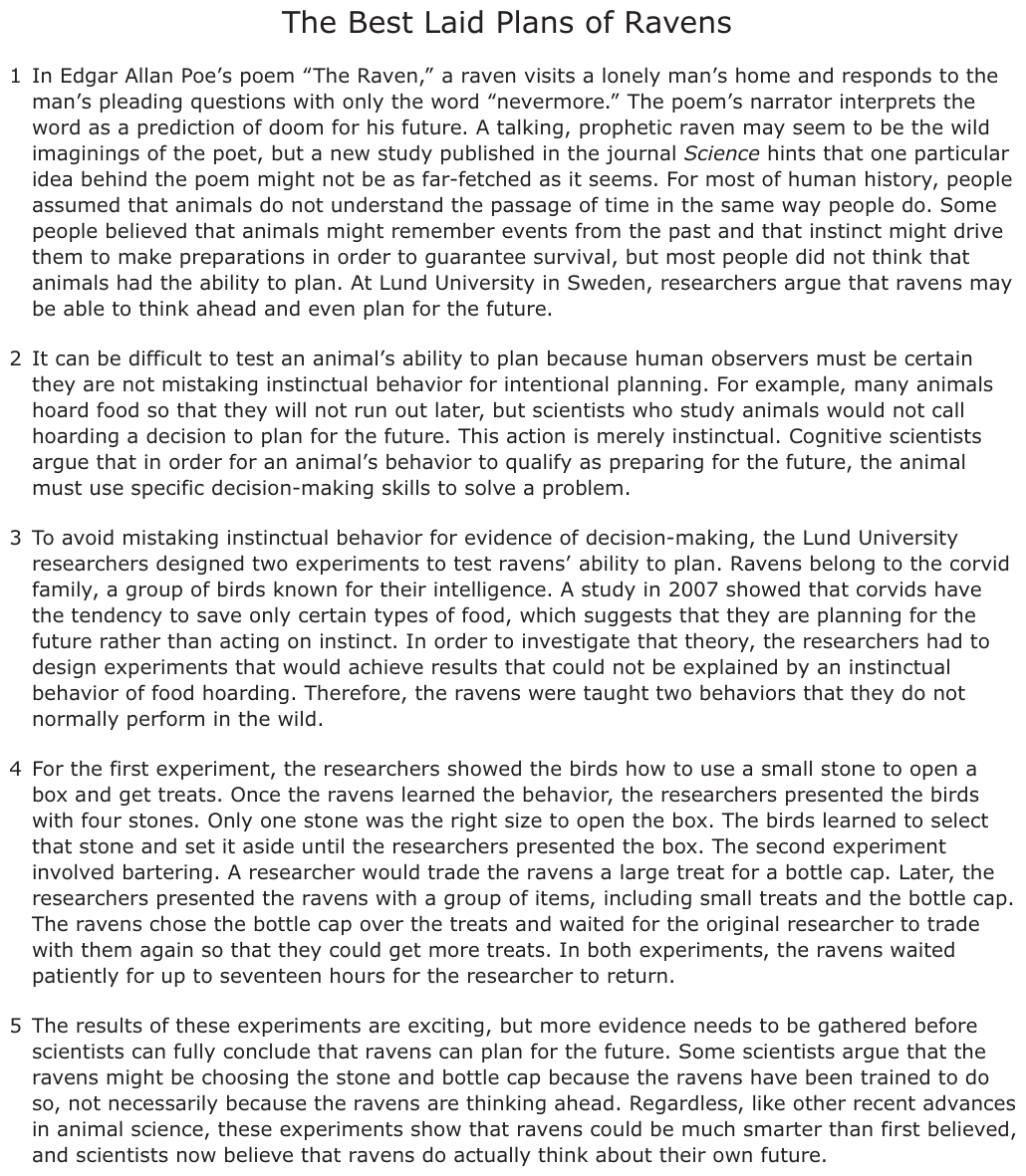
In Edgar Allan Poe’s poem “The Raven,” a raven visits a lonely man’s home and responds to the man’s pleading questions with only the word “nevermore.” The poem’s narrator interprets the word as a prediction of doom for his future. A talking, prophetic raven may seem to be the wild imaginings of the poet, but a new study published in the journal Science hints that one particular idea behind the poem might not be as far-fetched as it seems. For most of human history, people assumed that animals do not understand the passage of time in the same way people do. Some people believed that animals might remember events from the past and that instinct might drive them to make preparations in order to guarantee survival, but most people did not think that animals had the ability to plan. At Lund University in Sweden, researchers argue that ravens may be able to think ahead and even plan for the future.
It can be difficult to test an animal’s ability to plan because human observers must be certain they are not mistaking instinctual behavior for intentional planning. For example, many animals hoard food so that they will not run out later, but scientists who study animals would not call hoarding a decision to plan for the future. This action is merely instinctual. Cognitive scientists argue that in order for an animal’s behavior to qualify as preparing for the future, the animal must use specific decision-making skills to solve a problem.
To avoid mistaking instinctual behavior for evidence of decision-making, the Lund University researchers designed two experiments to test ravens’ ability to plan. Ravens belong to the corvid family, a group of birds known for their intelligence. A study in 2007 showed that corvids have the tendency to save only certain types of food, which suggests that they are planning for the future rather than acting on instinct. In order to investigate that theory, the researchers had to design experiments that would achieve results that could not be explained by an instinctual behavior of food hoarding. Therefore, the ravens were taught two behaviors that they do not normally perform in the wild.
For the first experiment, the researchers showed the birds how to use a small stone to open a box and get treats. Once the ravens learned the behavior, the researchers presented the birds with four stones. Only one stone was the right size to open the box. The birds learned to select that stone and set it aside until the researchers presented the box. The second experiment involved bartering. A researcher would trade the ravens a large treat for a bottle cap. Later, the researchers presented the ravens with a group of items, including small treats and the bottle cap. The ravens chose the bottle cap over the treats and waited for the original researcher to trade with them again so that they could get more treats. In both experiments, the ravens waited patiently for up to seventeen hours for the researcher to return.
The results of these experiments are exciting, but more evidence needs to be gathered before scientists can fully conclude that ravens can plan for the future. Some scientists argue that the ravens might be choosing the stone and bottle cap because the ravens have been trained to do so, not necessarily because the ravens are thinking ahead. Regardless, like other recent advances in animal science, these experiments show that ravens could be much smarter than first believed, and scientists now believe that ravens do actually think about their own future.
Question
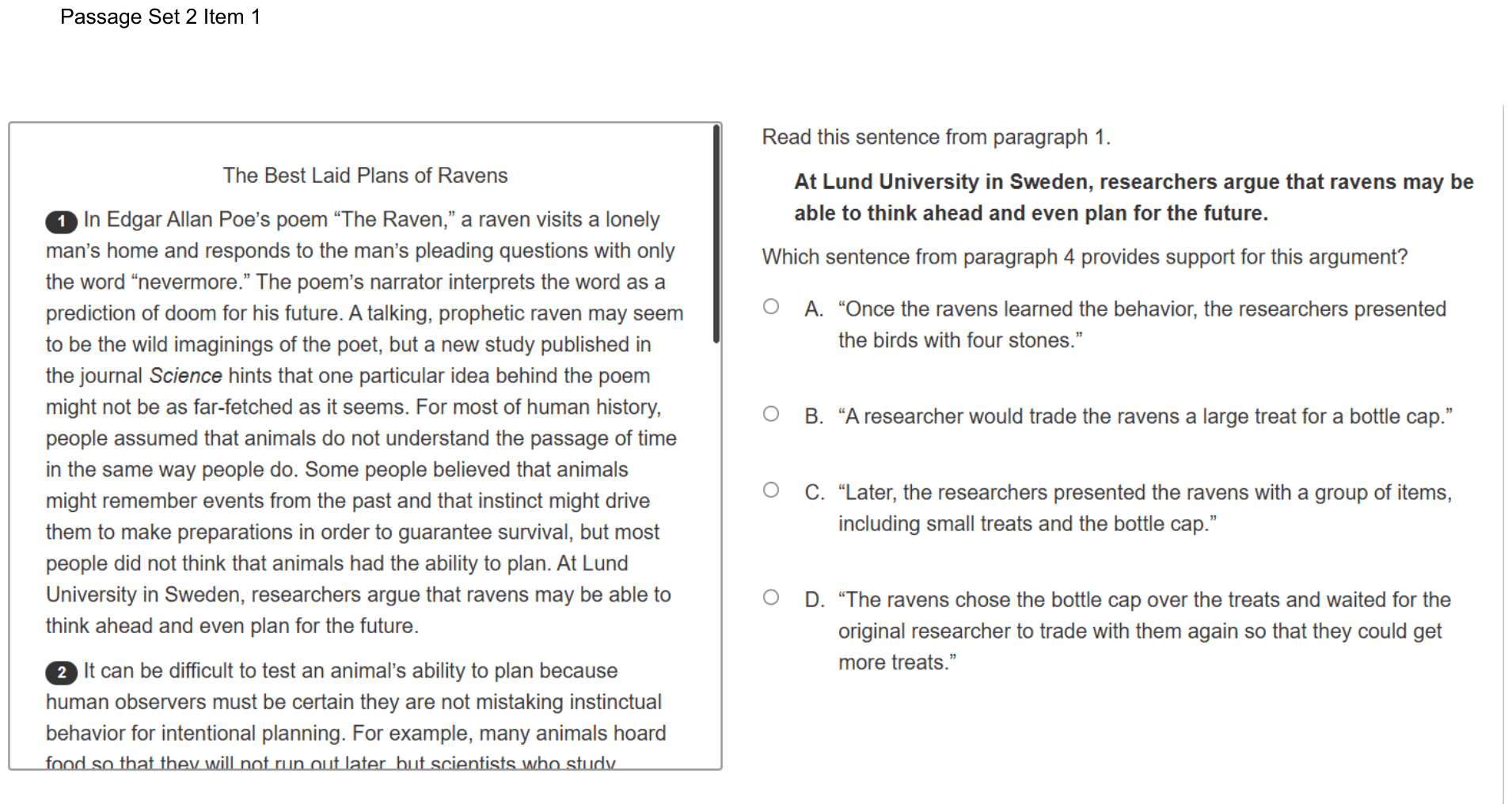
Read this sentence from paragraph 1.
At Lund University in Sweden, researchers argue that ravens may be able to think ahead and even plan for the future.
Which sentence from paragraph 4 provides support for this argument?
- A“Once the ravens learned the behavior, the researchers presented the birds with four stones.”
- B“A researcher would trade the ravens a large treat for a bottle cap.”
- C“Later, the researchers presented the ravens with a group of items, including small treats and the bottle cap.”
- D“The ravens chose the bottle cap over the treats and waited for the original researcher to trade with them again so that they could get more treats.”
Show the answer
Correct answer: D
The question asks which sentence from paragraph 4 supports the argument presented in the sentence from paragraph 1.
A. Incorrect. This sentence from paragraph 4 refers to the ravens’ ability to adapt and learn but not to plan and think ahead.
B. Incorrect. This sentence from paragraph 4 relates the actions of the researcher rather than the actions of the ravens and does not provide evidence in support of the argument that ravens have the ability to think and plan ahead.
C. Incorrect. This sentence from paragraph 4 does not describe a behavior of the ravens that would support the argument in the sentence from paragraph 1; instead it relates the actions of the researchers without giving any information about the ravens’ responses.
D. CORRECT. This sentence from paragraph 4 shows that the ravens seem to make a decision, which involves a thought process. The ravens chose to wait for the researcher rather than take the treats, suggesting that the ravens understood that the researcher would trade a larger treat for the bottle cap.
Question analysis
This evidence question on the science article “The Best Laid Plans of Ravens” quotes the claim from paragraph 1 that ravens may be able to think ahead and plan for the future. Students choose the sentence from paragraph 4, where two experiments are described, that supports it. Every choice comes from the same experiments, so each must be weighed against the claim.
- Grade level
- Grade 7 reading and task
- Compared with grade 7
- At grade 7 Choosing the sentence that backs a quoted claim is standard grade 7 evidence work. The claim is printed in the question and all four choices come from one paragraph, so the search is short, though each sentence must be tested against the claim.
- Estimated difficulty
- Straightforward: two steps or one careful reading.
- Thinking it demands
- Depth of knowledge 2, skills and concepts · mainly evaluate
- What makes it hard
- Evidence
- Answered from one paragraph or stanza
- Reading level
- Passage: about grade 11, 599 words; question and choices: about grade 8, 107 words.
- Students, last 30 days
- Not enough answers yet to show (it takes 10).
Why it is hard, traps and wrong answers (shows the answer)
Why it is hard
The claim is about what ravens can do, and only one of the four sentences shows the birds deciding anything. Students who read quickly accept any sentence about the experiments, especially the one where the ravens have just learned a skill, because learning sounds like intelligence. Asking who acts in each sentence, the birds or the researchers, settles the question in seconds.
Reading between the lines minor Working it out
The right sentence never says “plan”; students must see that choosing the cap over the treats and waiting “so that they could get more treats” is acting now for a later reward. (Graesser, Singer & Trabasso, 1994; Kintsch, 1998)
Every choice must be checked minor Choosing the answer
All four sentences come from paragraph 4’s experiments, and three of them report what the researchers did, so each must be checked for a decision made by the ravens. (Embretson & Wetzel, 1987)
Strategy: Underline “think ahead” and “plan” in the quoted claim, then ask of each sentence whether it, on its own, would convince a doubter that ravens can do that.
Traps
- Supports only part of the claim: In a question about evidence: a line that backs one half of the claim but not the other, or a related point rather than the claim itself.
- True but not the answer: A choice says something accurate about the text that does not answer this question.
The wrong answers, classified
A Supports only part of the claim (King et al., 2004; Thissen, Steinberg & Fitzpatrick, 1989)
Takes “Once the ravens learned the behavior” as proof of planning, but learning to open a box shows only that the birds can be taught, and the rest is the researchers’ act.
B True but not the answer (King et al., 2004; Embretson & Wetzel, 1987)
Picks the opening of the bartering test because it mentions the trade, yet the sentence reports only what a researcher offered, not anything the ravens decided.
C True but not the answer (King et al., 2004; Embretson & Wetzel, 1987)
Knows the bottle-cap test holds the evidence and picks its setup, the researchers laying out treats and the cap, one sentence before the ravens make their choice.
Working it out, step by step
Figure out what the question asks
This asks for evidence: the sentence that best supports a claim. The claim is that ravens “may be able to think ahead and even plan for the future.” To plan is to decide now what you will do later, so you get something you want. You need a sentence from paragraph 4 that shows ravens doing that.
Ask who acts in each sentence
Only something the ravens do can prove what ravens can do. So check each choice for its doer. In A, B and C, the researchers do most of the acting. They hand out stones, offer a trade and set out items. Only one sentence shows the ravens making a choice of their own.
Find the ravens’ choice
Paragraph 4 says “The ravens chose the bottle cap over the treats and waited for the original researcher to trade with them again so that they could get more treats.” The ravens could have eaten a small treat right away. Instead they took a bottle cap, which is worthless by itself. They kept it because the researcher would trade a large treat for it later.
Explain why this shows planning
The words “so that” give the reason for the choice. The ravens gave up something now to get something better later. That is exactly what planning ahead means. You do the same thing when you save your allowance for a bigger toy next month.
Check each choice
- A does not fit. The ravens have only learned a skill. The rest of the sentence tells what the researchers did next.
- B does not fit. It tells what a researcher offered, not what the ravens decided.
- C does not fit. It is the setup of the test, before the ravens choose anything.
- D fits. The ravens choose now and wait for a later reward.
Watch out: A sounds smart because the ravens “learned the behavior.” But being taught a skill is not the same as thinking ahead.
Choose the answer
Only one sentence shows the ravens making a choice now for a reward later. So the answer is D.
Why this answer and not the closest wrong one
A is the closest wrong choice, because learning a skill sounds clever. But learning to open a box shows only that the birds can be taught. It says nothing about the future. In D, the ravens pass up treats today to get more treats later. That is planning.
More questions like this
The original DOE question
The passage “The Best Laid Plans of Ravens” as printed (page 12)
Question 9 of 50
2026 Practice Test A English, question 9Uses the passage above: “The Best Laid Plans of Ravens”.
Question
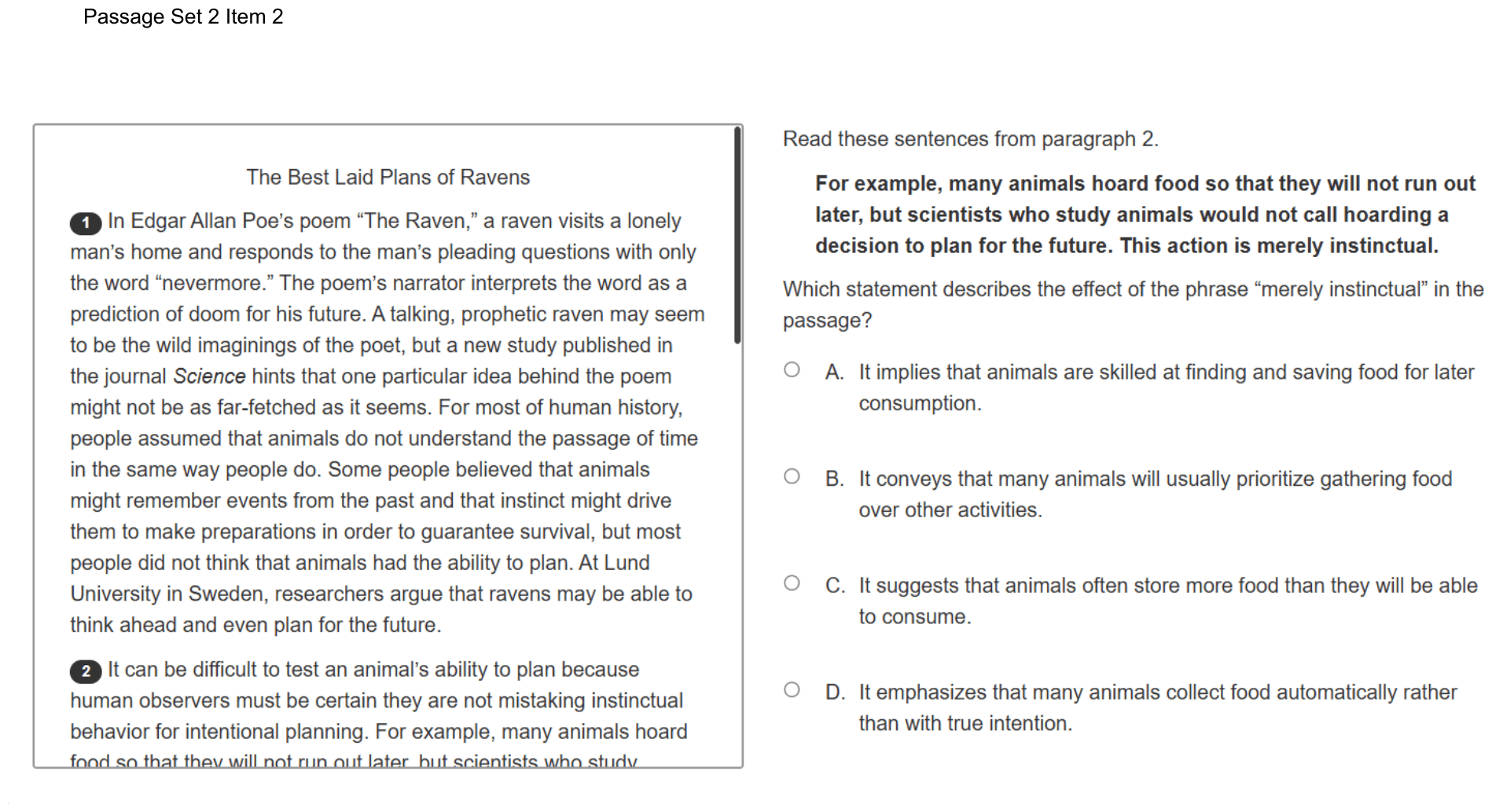
Read these sentences from paragraph 2.
For example, many animals hoard food so that they will not run out later, but scientists who study animals would not call hoarding a decision to plan for the future. This action is merely instinctual.
Which statement describes the effect of the phrase “merely instinctual” in the passage?
- AIt implies that animals are skilled at finding and saving food for later consumption.
- BIt conveys that many animals will usually prioritize gathering food over other activities.
- CIt suggests that animals often store more food than they will be able to consume.
- DIt emphasizes that many animals collect food automatically rather than with true intention.
Show the answer
Correct answer: D
The question asks which statement describes the effect in the passage of the phrase “merely instinctual” from paragraph 2.
A. Incorrect. The passage does not question animals’ ability to find and save food but rather whether this or other behavior involves thought and planning for the future.
B. Incorrect. While the sentence states that “many animals hoard food,” the passage does not suggest that they give priority of thought to this activity; they hoard food out of instinct.
C. Incorrect. Although the passage discusses animals’ tendency to store a great deal of food, it does not suggest that their hoarding goes beyond their needs.
D. CORRECT. The passage suggests that in order for an animal’s actions to qualify as planning for the future, “the animal must use specific decision-making skills to solve a problem” (paragraph 2). The behavior of hoarding food is based on instinct and done automatically without real thought.
Question analysis
This word-in-context question from “The Best Laid Plans of Ravens” asks about the effect of the phrase “merely instinctual,” which the article applies to food hoarding in paragraph 2. Students read two quoted sentences and decide what the phrase emphasizes about how animals behave. The choices all sound like reasonable facts about animals, so the answer has to come from how the article uses the phrase.
- Grade level
- Grade 7 reading and task
- Compared with grade 7
- Below grade 7 Grade 7 word-meaning questions often need clues gathered from a whole paragraph. Here the phrase is short and familiar, and the sentence just before it supplies a direct contrast, so one careful reading of the two quoted sentences is enough.
- Estimated difficulty
- Routine: one familiar step, little to misread.
- Thinking it demands
- Depth of knowledge 2, skills and concepts · mainly understand
- What makes it hard
- Hard words minor
- The right answer is reworded minor
- Evidence
- Answered from one paragraph or stanza
- Reading level
- Passage: about grade 11, 599 words; question and choices: about grade 10, 108 words.
- Students, last 30 days
- Not enough answers yet to show (it takes 10).
Why it is hard, traps and wrong answers (shows the answer)
Why it is hard
Most students know that an instinct is something an animal does without thinking, and the sentence just before the phrase says hoarding is not “a decision to plan.” The only real pitfall is “merely”: a student who skips it can hear praise of a natural talent, and one who thinks only about hoarding may pick a choice about storing too much. Reading the phrase with its contrast makes the answer plain.
Hard words minor Understanding the question
The phrase pairs “merely,” which shrinks what follows, with “instinctual,” and the sentence before it uses “hoard”; a student unsure of any of the three has little to go on. (Perfetti, 2007; Freedle & Kostin, 1993)
The right answer is reworded minor Choosing the answer
The right choice restates the idea as acting “automatically rather than with true intention,” while the wrong ones stay with the sentence’s own subject, finding, gathering and storing food. (Freedle & Kostin, 1993; Kirsch & Mosenthal, 1990)
Strategy: Ask what the word “merely” adds to “instinctual,” then reread the sentence before the phrase and use its contrast to decide what the author is saying about hoarding.
Traps
- Dictionary meaning, not meaning here: A common meaning of the word that does not fit its use in this text.
- Outside knowledge: A choice is plausible in the real world but not supported by this text.
The wrong answers, classified
A Wrong tone or attitude (Graesser, Singer & Trabasso, 1994)
Hears “instinctual” as a natural gift, as in an instinctive athlete, and turns the phrase into praise of animals’ skill, missing that “merely” makes it a put-down.
B Outside knowledge (King et al., 2004; Recht & Leslie, 1988)
Brings in the idea of instinct as an urge that overrides everything else, but the passage never ranks food gathering above an animal’s other activities.
C Dictionary meaning, not meaning here (Perfetti, 2007)
Gives “hoard” its everyday sense of piling up too much, though the passage says animals store food so they “will not run out later,” not beyond their needs.
Working it out, step by step
Figure out what the question asks
This asks about the effect of a phrase. What do the words “merely instinctual” add to what the passage says about animals and food? Read the phrase together with the sentence before it.
Read the sentences around the phrase
Paragraph 2 says “many animals hoard food so that they will not run out later, but scientists who study animals would not call hoarding a decision to plan for the future. This action is merely instinctual.” To hoard is to collect and store a lot of something.
Work out what the phrase means
An instinct is a natural urge an animal is born with. It acts on it without thinking it through. So instinctual behavior is automatic. Merely means “only” or “just.” Put together, the phrase says hoarding is just automatic. It is not a real decision. The next sentence agrees: to count as planning, “the animal must use specific decision-making skills to solve a problem.”
Check each choice
- A does not fit. The phrase does not praise animals’ skill. “Merely” makes the behavior sound smaller.
- B does not fit. The passage never says animals put food ahead of other activities.
- C does not fit. The passage never says animals store too much. They store food “so that they will not run out later.”
- D fits. “Automatically rather than with true intention” means by instinct, not on purpose. An intention is a plan you have in mind.
Choose the answer
The phrase stresses that animals hoard food without real thought or purpose. So the answer is D.
Why this answer and not the closest wrong one
A is the closest wrong choice, because an instinct can sound like a natural talent. But “merely” turns the phrase into a put-down. The author is saying hoarding is only instinct, not a real choice. D says the same thing: animals collect food automatically, not with true intention.
More questions like this
The original DOE question
Question 10 of 50
2026 Practice Test A English, question 10Uses the passage above: “The Best Laid Plans of Ravens”.
Question
In the first experiment described in paragraph 4, which of the ravens’ behaviors provides the strongest evidence for the claim that the birds are capable of planning?
- AThey accepted treats from the box.
- BThey set aside the stone that would open the box.
- CThey learned which stone could open the box.
- DThey waited for researchers to bring the box.
Show the answer
Correct answer: B
The question asks which of the ravens’ behaviors in the first experiment described in paragraph 4 most strongly supports the claim that the birds are capable of planning.
A. Incorrect. While “the researchers showed the birds how to use a small stone to open a box and get treats” (paragraph 4), the acceptance of the treats does not demonstrate planning.
B. CORRECT. Once the ravens learned which stone would open the box, they consistently selected only that stone.
C. Incorrect. Although the birds learned which stone opened the box, this behavior demonstrates not their ability to plan but rather their intelligence.
D. Incorrect. The birds’ patience shows their anticipation for and understanding of the future gain of a treat but does not provide the strongest evidence of their ability to plan.
Question analysis
This evidence question on “The Best Laid Plans of Ravens” asks which of the ravens’ behaviors in the first experiment, the one with a stone and a box of treats, gives the strongest evidence that the birds can plan. Several behaviors seem to fit, so students must weigh them against the passage’s own idea of what planning is.
- Grade level
- Grade 8 reading and task
- Compared with grade 7
- Above grade 7 Grade 7 evidence questions usually ask which detail supports a claim. This one asks which of the ravens’ behaviors gives the strongest support, and several seem to fit, so students must apply paragraph 2’s test for planning to paragraph 4.
- Estimated difficulty
- Hard: combines ideas, needs a plan, and has more than one tempting wrong answer.
- Thinking it demands
- Depth of knowledge 3, strategic thinking · mainly evaluate
- What makes it hard
- A very close wrong answer major
- Reading between the lines moderate
- Evidence in several places minor
- Evidence
- Answered from several paragraphs or stanzas
- Reading level
- Passage: about grade 11, 599 words; question and choices: about grade 5, 58 words.
- Students, last 30 days
- Not enough answers yet to show (it takes 10).
Why it is hard, traps and wrong answers (shows the answer)
Why it is hard
Every choice describes something the ravens really did, so the work is ranking, not finding. The passage’s dramatic detail, birds waiting up to seventeen hours, draws attention away from the quieter act of keeping the right stone ready, which is the behavior that most clearly prepares for the future. Students who weigh each behavior against paragraph 2’s idea of decision-making, rather than against how impressive it sounds, separate the two.
A very close wrong answer major Choosing the answer
Setting the stone aside and waiting for the box both come from one sentence, “set it aside until the researchers presented the box”; only the first is an action taken now for a later need. (Embretson & Wetzel, 1987; Gorin & Embretson, 2006; Ascalon et al., 2007)
Reading between the lines moderate Working it out
The passage never says which behavior counts as planning, so students must apply paragraph 2’s test, that the animal “must use specific decision-making skills to solve a problem,” to each one. (Graesser, Singer & Trabasso, 1994; Kintsch, 1998)
Evidence in several places minor Working it out
The waiting that tempts students is stressed at the end of paragraph 4, “up to seventeen hours,” well after the stone sentence, and paragraph 2 holds the standard for judging both. (Kirsch & Mosenthal, 1990; Gorin & Embretson, 2006)
Strategy: Use paragraph 2’s description of what counts as planning as a yardstick, then rank the four behaviors by how well each meets it instead of taking the first that seems clever.
Traps
- Supports only part of the claim: In a question about evidence: a line that backs one half of the claim but not the other, or a related point rather than the claim itself.
- True but not the answer: A choice says something accurate about the text that does not answer this question.
The wrong answers, classified
A True but not the answer (King et al., 2004; Embretson & Wetzel, 1987)
Picks the payoff of the experiment, taking treats from the box, which any trained animal does and which shows nothing about thinking ahead.
C Supports only part of the claim (King et al., 2004; Thissen, Steinberg & Fitzpatrick, 1989)
Sees intelligence in learning which of the four stones fits, but knowing the right tool is not the same as keeping it ready for a box that comes later.
D Supports only part of the claim (King et al., 2004; Thissen, Steinberg & Fitzpatrick, 1989)
Is drawn by the stress on waiting “up to seventeen hours,” which shows the birds expect the box, but waiting is passive; holding the right stone ready is the planning act.
Working it out, step by step
Figure out what the question asks
This asks which thing the ravens did in the first experiment, the one with the stone and the box, is the strongest evidence that they can plan. More than one choice really happened. You must rank them and pick the best one.
Decide what counts as planning
Paragraph 2 gives a test. To count as preparing for the future, “the animal must use specific decision-making skills to solve a problem.” In plain words, planning means doing something now to get ready for something later. Use that as your measuring stick.
Find the key sentence
Paragraph 4 says “The birds learned to select that stone and set it aside until the researchers presented the box.” To set something aside is to put it away to use later. When the birds did this, the box was not there yet.
Explain why this is planning
The ravens had nothing to open at that moment. Still, they picked the one stone that would work and saved it. They did this because they expected to need it later. It is like packing an umbrella in the morning because rain is coming in the afternoon. That is a choice made now to solve a future problem.
Check each choice
- A does not fit. Taking treats is the reward. Any trained animal does that.
- B fits. Saving the right stone gets the bird ready for a box that comes later.
- C does not fit. Learning which stone works shows the birds can be taught. Knowing the right tool is not the same as keeping it ready.
- D does not fit as well. Waiting shows the birds expected the box. But waiting is doing nothing, so it is weaker proof.
Watch out: D is tempting because the passage stresses waiting “up to seventeen hours.” Long waiting is impressive, but it is not an action.
Choose the answer
Setting the stone aside is the clearest act of getting ready for the future. So the answer is B.
Why this answer and not the closest wrong one
D is the closest wrong choice. Waiting and setting the stone aside come from the same sentence. But while a bird waits, it does nothing. Setting the stone aside is a choice. The bird keeps the right tool ready for a box that is not there yet. That act of getting ready makes B stronger evidence.
More questions like this
The original DOE question
Question 11 of 50
2026 Practice Test A English, question 11Uses the passage above: “The Best Laid Plans of Ravens”.
Question
How does paragraph 5 fit into the overall structure of the passage and contribute to the development of ideas?
- AIt introduces a problem with the results of the study at Lund University, suggesting that some scientists believe that further research will not lead to a clear answer.
- BIt summarizes the final steps of the study at Lund University, emphasizing the difficulties researchers had in differentiating between true planning and practiced actions.
- CIt provides a conclusion to the information about the Lund University study, indicating that some scientists think further research is needed in order to prove the idea.
- DIt lists the effects of the study at Lund University, implying that researchers should have designed experiments that better differentiated between planning and instinct.
Show the answer
Correct answer: C
The question asks how paragraph 5 fits into the overall structure of the passage and contributes to the development of ideas.
A. Incorrect. While paragraph 5 states that “more evidence needs to be gathered before scientists can fully conclude that ravens can plan for the future,” this statement suggests that more research is needed, not that the results of the Lund University study are problematic.
B. Incorrect. Paragraph 5 does not discuss steps of the study or emphasize difficulties in determining whether the behaviors shown in the study were planned or practiced; instead it simply suggests that more study is required to make such a determination.
C. CORRECT. Paragraph 5 notes that some doubt remains (“Some scientists argue that the ravens might be choosing the stone and bottle cap because the ravens have been trained to do so, not necessarily because the ravens are thinking ahead”) and that more experimentation is needed; the author concludes that there is reason to believe the originally stated theory that ravens are quite smart and can give thought to how future events may affect them.
D. Incorrect. Paragraph 5 does not list the effects of the study or criticize the experiment for not differentiating between planning and instinct. The paragraph explains why the results of the experiments are not conclusive and emphasizes that more research is needed.
Question analysis
This text-structure question asks how the last paragraph of the article “The Best Laid Plans of Ravens” fits into the passage and develops its ideas. Students must see what that paragraph does once the experiments have been described. Each long choice names a role and then adds a claim, so a choice can begin well and end wrong.
- Grade level
- Grade 7 reading and task
- Compared with grade 7
- At grade 7 Explaining the role of a final paragraph is regular grade 7 structure work. The choices are long, though, and each pairs a role with a claim about scientists’ views, so both halves must be checked against a paragraph that mixes doubt with enthusiasm.
- Estimated difficulty
- Moderate: several steps, or a close reading with one strong distractor.
- Thinking it demands
- Depth of knowledge 2, skills and concepts · mainly analyze
- What makes it hard
- A very close wrong answer moderate
- How, not what moderate
- A lot to read minor
- Evidence
- Answered from several paragraphs or stanzas
- Reading level
- Passage: about grade 11, 599 words; question and choices: about grade 15, 121 words.
- Students, last 30 days
- Not enough answers yet to show (it takes 10).
Why it is hard, traps and wrong answers (shows the answer)
Why it is hard
Paragraph 5 makes three moves, excitement, doubt and a hopeful conclusion, and each wrong choice builds on one of them and then goes too far. Students who notice the doubt but read past “before scientists can fully conclude” pick the claim that research will never settle the question. Summing up the paragraph before reading the choices, and then checking the second half of each, is what earns the point.
A very close wrong answer moderate Choosing the answer
The choice about a problem with the results matches the right one in its first half, a doubt raised in paragraph 5, and differs only in claiming that more research will not give a clear answer. (Embretson & Wetzel, 1987; Gorin & Embretson, 2006; Ascalon et al., 2007)
How, not what moderate Working it out
The question asks what paragraph 5 does in the article, closing the account of the Lund study, so students must name its role rather than repeat its caution about training. (Anderson & Krathwohl, 2001)
A lot to read minor Understanding the question
The choices run 24 to 28 words, and each pairs a role with a second claim about what scientists or researchers think or did, so both halves of every choice have to be checked. (Kintsch, 1998; Gorin & Embretson, 2006; Freedle & Kostin, 1993)
Strategy: Sum up paragraph 5 in one sentence of your own, then check both parts of each choice, the job it names and the idea it attributes to scientists, against that summary.
Traps
- Half right: One half of a two-part choice is right and the other is not.
- Twists what the text says: Uses the text's topic and ideas but changes what it says: who did it, how much, when, or why.
- Reads too much in: A reasonable-sounding conclusion that goes further than the text allows.
The wrong answers, classified
A Half right (King et al., 2004; Thissen, Steinberg & Fitzpatrick, 1989)
Rightly sees that paragraph 5 raises a doubt about the results, but adds that more research will not settle it, when the paragraph says more evidence is needed to reach a conclusion.
B Twists what the text says (King et al., 2004)
Turns the objection some scientists raise, that the birds may simply be trained, into the Lund researchers’ own struggle, though the paragraph describes no steps of the study.
D Reads too much in (Graesser, Singer & Trabasso, 1994)
Reads the call for more evidence as a verdict that the experiments were badly designed, though the author calls the results “exciting” and faults no one.
Working it out, step by step
Figure out what the question asks
This asks about structure: what job paragraph 5 does in the article. Each choice has two parts, a job and an idea about scientists. Both parts must be right.
See where paragraph 5 sits
Paragraphs 3 and 4 describe the Lund University experiments. Paragraph 5 is the last paragraph. It comes after the whole study has been described. So it is the place where the author sums up what the study means.
Read what paragraph 5 says
It opens: “The results of these experiments are exciting, but more evidence needs to be gathered before scientists can fully conclude that ravens can plan for the future.” Next, it says some scientists think the ravens may just be trained. Then it says “Regardless,” the experiments show ravens “could be much smarter than first believed.” Regardless means “even so.”
Put the paragraph in your words
Paragraph 5 wraps up the study. The results are exciting but not proven yet. More research is needed to be sure. A conclusion is the ending part that sums things up. So paragraph 5 is the conclusion to the study, and it says more evidence is needed.
Check each choice
- A does not fit. Paragraph 5 does raise a doubt. But it never says more research will fail to give a clear answer.
- B does not fit. Paragraph 5 describes no steps of the study.
- C fits. It wraps up the study and says more research is needed.
- D does not fit. It lists no effects and blames no one. The author calls the results “exciting.”
Choose the answer
Paragraph 5 ends the story of the study and calls for more evidence. So the answer is C.
Why this answer and not the closest wrong one
A is the closest wrong choice, because its first half is right: paragraph 5 raises a doubt. But A says more research will not lead to a clear answer. The paragraph says more evidence is needed “before scientists can fully conclude,” so research is the way to an answer. C says this.
More questions like this
The original DOE question
Question 12 of 50
2026 Practice Test A English, question 12Uses the passage above: “The Best Laid Plans of Ravens”.
Question
The author conveys a point of view on the study of animal intelligence mainly by
- Asharing details about experiments that tested the ability of an animal to plan for the future.
- Bcomparing the results of different experiments that were designed to test animal intelligence.
- Ccritiquing experiments that aimed to demonstrate that certain animals are capable of planning for the future.
- Dexplaining how modern experiments show that previously held beliefs about animal intelligence are inaccurate.
Show the answer
Correct answer: A
The question asks how the author conveys a point of view on the study of animal intelligence.
A. CORRECT. Paragraphs 3 and 4 focus on the process and details of the experiments that scientists conducted. This detailed information from the author provides a sense of how the ravens demonstrated planning abilities beyond natural instinct. The author supports the claims from the experiments, calling the findings “exciting” and stating in the conclusion that “these experiments show that ravens could be much smarter than first believed” (paragraph 5).
B. Incorrect. Although two experiments are described in the passage, the description presents the experiments as building on each other and does not compare their results. The passage states that “these experiments show that ravens could be much smarter than first believed, and scientists now believe that ravens do actually think about their own future” (paragraph 5).
C. Incorrect. The author presents information from the experiments and the results that were gathered from them; while there is an admission that “more evidence needs to be gathered before scientists can fully conclude that ravens can plan for the future” (paragraph 5), the author does not criticize the experiments that are presented.
D. Incorrect. While the author does discuss some previously held beliefs about animal intelligence in paragraph 1, the focus of the passage is that experiments indicate that there is reason to question these beliefs, since “these experiments show that ravens could be much smarter than first believed” (paragraph 5). The previously held beliefs are not considered inaccurate by the discussion in the passage because only one example—the raven—is provided. The passage does not state that beliefs about animal intelligence as a whole are inaccurate.
Question analysis
This author’s point-of-view question asks how the writer of “The Best Laid Plans of Ravens” mainly conveys a view of research into animal intelligence. Students must look at the article as a whole and decide how it presents that view. The choices describe ways of writing in abstract terms, which makes them easy to blur together.
- Grade level
- Grade 8 reading and task
- Compared with grade 7
- Above grade 7 Grade 7 point-of-view questions usually ask what an author thinks. This one asks how the author mainly conveys a view across the whole article, and the choices name methods that sound alike, closer to grade 8 work on how authors handle differing views.
- Estimated difficulty
- Hard: combines ideas, needs a plan, and has more than one tempting wrong answer.
- Thinking it demands
- Depth of knowledge 3, strategic thinking · mainly analyze
- What makes it hard
- How, not what major
- Reading between the lines moderate
- Every choice must be checked minor
- Evidence
- Answered from the whole text
- Reading level
- Passage: about grade 11, 599 words; question and choices: about grade 13, 74 words.
- Students, last 30 days
- Not enough answers yet to show (it takes 10).
Why it is hard, traps and wrong answers (shows the answer)
Why it is hard
The right choice sounds too plain to carry a point of view, which is exactly what makes this question hard. Students expect a view to be argued, so they reach for the choice that says the experiments prove old beliefs wrong, an overstatement of the author’s hedged “could be,” or for criticism, which belongs to other scientists. The article persuades by reporting the experiments in detail and calling them exciting.
How, not what major Working it out
The question asks how the view comes across, not what it is, and the answer is a method: the author lets the detailed account of the experiments in paragraphs 3–4 carry a favorable view. (Anderson & Krathwohl, 2001)
Reading between the lines moderate Working it out
The author never states an opinion outright; the view must be pieced together from words such as “exciting” and “could be much smarter than first believed” in paragraph 5. (Graesser, Singer & Trabasso, 1994; Kintsch, 1998)
Every choice must be checked minor Choosing the answer
The choices name ways of writing in abstract terms, sharing, comparing, critiquing and explaining, so each must be held against what the whole article actually does. (Embretson & Wetzel, 1987)
Strategy: Settle first on how the author regards the raven research, then check each choice against what the article actually does from beginning to end, not against a single paragraph.
Traps
- Too broad or too strong: A choice overstates, generalizes, or uses absolute words the text does not support.
- Wrong tone or attitude: Misjudges the tone, attitude or point of view, such as reading admiration as criticism, or taking a character's or subject's feelings for the author's.
- Twists what the text says: Uses the text's topic and ideas but changes what it says: who did it, how much, when, or why.
The wrong answers, classified
B Twists what the text says (King et al., 2004)
Notices that two experiments are described and assumes they are set side by side, but the article reports the stone test and the bartering test in turn without comparing results.
C Wrong tone or attitude (Graesser, Singer & Trabasso, 1994)
Takes the doubt that “some scientists” raise about training for the author’s own criticism, though the author calls the results “exciting” and moves past the objection.
D Too broad or too strong (King et al., 2004)
Builds on the point that ravens may be smarter than believed but overstates it: the author hedges with “could be,” discusses only ravens, and never calls older beliefs wrong.
Working it out, step by step
Figure out what the question asks
This asks about the author’s point of view, what the author thinks about studying animal intelligence. It also asks how the author mainly shows that view. Think about the whole article, not one paragraph.
Find the author’s view
In paragraph 5, the author says the results “are exciting.” The author also says the experiments “show that ravens could be much smarter than first believed.” So the author is interested in this research and hopeful about it.
See how the article is built
Most of the article explains the experiments. Paragraph 3 tells why the researchers planned two of them. Paragraph 4 gives the details step by step: the stone, the box, the bottle cap, the trades and the long wait. The author lets these details show why the research matters. Then the author calls the results exciting.
Check each choice
- A fits. The author shares details of experiments that tested whether an animal can plan.
- B does not fit. The two experiments are told one after the other. Their results are never compared.
- C does not fit. The doubt comes from “some scientists,” not the author. The author answers it with “Regardless.”
- D does not fit. It goes too far. The author says ravens “could be” smarter, which means maybe. The article never calls old beliefs wrong.
Watch out: D is tempting because paragraph 1 describes old beliefs. But “could be” is not the same as “are.”
Choose the answer
The author shows a view mostly through details of the experiments. So the answer is A.
Why this answer and not the closest wrong one
D is the closest wrong choice. The author does think ravens may be smarter than people believed. But the author is careful and says they “could be.” D says experiments prove old beliefs wrong, which is too strong. What the author mostly does is share the experiments’ details. That is A.
More questions like this
The original DOE question
Question 13 of 50
2026 Practice Test A English, question 13Uses the passage above: “The Best Laid Plans of Ravens”.
Question
With which statement would the author of the passage most likely agree?
- AScientists are unlikely to be able to conduct an experiment that can genuinely distinguish between instinctual and learned behaviors in animals.
- BScientists should continue researching to determine whether or not animals can demonstrate advanced intelligence.
- CScientists should be careful about making conclusions about animal intelligence based on experiments that rely on training animals.
- DScientists can confirm data on whether animals have the ability to plan by performing experiments on additional species known for their intelligence.
Show the answer
Correct answer: B
The question asks the reader to choose the statement with which the author of the passage would most likely agree.
A. Incorrect. It is very likely that additional experiments or changes to the experiments presented can help scientists tell the difference between the types of behavior that the animals are showing. The current research supports “other recent advances in animal science” and also shows that ravens are “much smarter” (paragraph 5) than previously believed, making them excellent candidates for further research.
B. CORRECT. As paragraph 5 notes, “more evidence needs to be gathered before scientists can fully conclude that ravens can plan for the future.” The evidence is not yet considered definitive because “some scientists argue that the ravens might be choosing the stone and bottle cap because the ravens have been trained to do so, not necessarily because the ravens are thinking ahead” (paragraph 5). Therefore, more research is needed in order to draw a complete conclusion as to whether or not the animals are demonstrating advanced intelligence or simply the results of training.
C. Incorrect. The passage shows that the scientists did not draw conclusions based on one experiment alone. The passage also states in paragraph 5 that additional research and experiments are necessary in order to obtain conclusive evidence of ravens’ abilities to think and plan ahead.
D. Incorrect. The passage claims that more evidence must be gathered in order to make a claim that animals can definitely plan for the future. The evidence presented helps scientists “believe that ravens do actually think about their own future” (paragraph 5), but more confirmation is needed. The passage does not discuss performing experiments on additional species.
Question analysis
This inference question asks which statement the author of “The Best Laid Plans of Ravens” would most likely agree with. Students must work out the author’s own view of the raven experiments and of research into animal thinking. The article reports more than one viewpoint, so students have to keep track of which ideas belong to the author.
- Grade level
- Grade 7 reading and task
- Compared with grade 7
- At grade 7 Inferring which statement an author would accept is common grade 7 work. The author’s view is stated fairly plainly in the last paragraph, but that paragraph also reports what other scientists argue, so students must separate the author’s position from theirs.
- Estimated difficulty
- Moderate: several steps, or a close reading with one strong distractor.
- Thinking it demands
- Depth of knowledge 3, strategic thinking · mainly analyze
- What makes it hard
- Reading between the lines moderate
- A very close wrong answer moderate
- Much to keep track of minor
- Evidence
- Answered from one paragraph or stanza
- Reading level
- Passage: about grade 11, 599 words; question and choices: about grade 15, 87 words.
- Students, last 30 days
- Not enough answers yet to show (it takes 10).
Why it is hard, traps and wrong answers (shows the answer)
Why it is hard
The passage reports several opinions, and the hard part is telling which one is the author’s. Students who notice the training objection in paragraph 5 often adopt it as the author’s warning, but “Regardless” shows the author weighing it and moving on to a hopeful view that still calls for more evidence. The other wrong choices either turn “difficult” into “unlikely” or bring in research the article never mentions.
Reading between the lines moderate Working it out
The author’s view is never stated as advice; it has to be read from paragraph 5, where “more evidence needs to be gathered” is followed by “Regardless” and a hopeful conclusion. (Graesser, Singer & Trabasso, 1994; Kintsch, 1998)
A very close wrong answer moderate Choosing the answer
The choice about caution with experiments that train animals shares the right one’s careful stance and differs in one detail, training, the objection the author raises only to set aside. (Embretson & Wetzel, 1987; Gorin & Embretson, 2006; Ascalon et al., 2007)
Much to keep track of minor Working it out
The article mixes four voices, what people long assumed, the Lund researchers, “some scientists” who doubt them and the author, and each statement must be traced to the right one. (Sweller, 1988; Carpenter, Just & Shell, 1990)
Strategy: Find the sentences where the author speaks in their own voice, especially in paragraph 5, and pick the statement that follows from them without adding claims the article never makes.
Traps
- Wrong tone or attitude: Misjudges the tone, attitude or point of view, such as reading admiration as criticism, or taking a character's or subject's feelings for the author's.
- Too broad or too strong: A choice overstates, generalizes, or uses absolute words the text does not support.
- Outside knowledge: A choice is plausible in the real world but not supported by this text.
The wrong answers, classified
A Too broad or too strong (King et al., 2004)
Builds on paragraph 2’s point that planning is “difficult” to test and hardens it into “unlikely,” a pessimism the author, who finds the results “exciting,” never expresses.
C Wrong tone or attitude (Graesser, Singer & Trabasso, 1994)
Takes the objection that the ravens may only have been trained, which “some scientists” raise, as the author’s own view, though the author answers it with “Regardless.”
D Outside knowledge (King et al., 2004; Recht & Leslie, 1988)
Offers a sensible research idea, testing other clever species, that the article never suggests; the author’s call for more evidence concerns ravens alone.
Working it out, step by step
Figure out what the question asks
This asks which statement the author would most likely agree with. You must find the author’s own view. The article also reports what other people think, so keep those ideas apart.
Sort out the voices in paragraph 5
Paragraph 5 says “Some scientists argue that the ravens might be choosing the stone and bottle cap because the ravens have been trained to do so.” That is what other scientists think. The author’s own words are “The results of these experiments are exciting, but more evidence needs to be gathered.”
Put the author’s view in plain words
The author thinks the research is promising but not finished. After the doubt, the author says “Regardless,” which means “even so,” and stays hopeful. So the author wants scientists to keep studying until they can be sure.
Check each choice
- A does not fit. The author never says a good test is unlikely. The author finds the results exciting.
- B fits. The author says more evidence must be gathered.
- C does not fit. The worry about training belongs to “some scientists.” The author sets it aside with “Regardless.”
- D does not fit. The article never mentions testing other kinds of animals.
Watch out: C sounds careful, like a scientist. But it repeats the other scientists’ view, not the author’s.
Choose the answer
The author wants scientists to keep gathering evidence before anyone decides. So the answer is B.
Why this answer and not the closest wrong one
C is the closest wrong choice. It sounds careful, and the author is careful too. But the warning about training comes from “some scientists.” The author answers it with “Regardless” and stays hopeful. The author’s own point is that “more evidence needs to be gathered.” That matches B.
More questions like this
The original DOE question
Question 14 of 50
2026 Practice Test A English, question 14Passage Excerpt from A Voice in the Wilderness
Excerpt from A Voice in the Wilderness
by Grace Livingston Hill
With a lurch the train came to a dead stop and Margaret Earle, hastily gathering up her belongings, hurried down the aisle and got out into the night.
It occurred to her, as she swung her heavy suit-case down the rather long step to the ground, and then carefully swung herself after it, that it was strange that neither conductor, brakeman, nor porter had come to help her off the train, when all three had taken the trouble to tell her that hers was the next station; but she could hear voices up ahead. Perhaps something was the matter with the engine that detained them and they had forgotten her for the moment.
The ground was rough where she stood, and there seemed no sign of a platform. Did they not have platforms in this wild Western land, or was the train so long that her car had stopped before reaching it?
She strained her eyes into the darkness, and tried to make out things from the two or three specks of light that danced about like fireflies in the distance. She could dimly see moving figures away up near the engine, and each one evidently carried a lantern. The train was tremendously long. A sudden feeling of isolation took possession of her. Perhaps she ought not to have got out until some one came to help her. Perhaps the train had not pulled into the station yet and she ought to get back on it and wait. Yet if the train started before she found the conductor she might be carried on somewhere and he justly blame her for a fool.
There did not seem to be any building on that side of the track. It was probably on the other, but she was standing too near the cars to see over. She tried to move back to look, but the ground sloped and she slipped and fell in the cinders, bruising her knee and cutting her wrist.
In sudden panic she arose. She would get back into the train, no matter what the consequences. They had no right to put her out here, away off from the station, at night, in a strange country. If the train started before she could find the conductor she would tell him that he must back it up again and let her off. He certainly could not expect her to get out like this.
She lifted the heavy suit-case up the high step that was even farther from the ground than it had been when she came down, because her fall had loosened some of the earth and caused it to slide away from the track. Then, reaching to the rail of the step, she tried to pull herself up, but as she did so the engine gave a long snort and the whole train, as if it were in league against her, lurched forward crazily, shaking off her hold. She slipped to her knees again, the suit-case, toppled from the lower step, descending upon her, and together they slid and rolled down the short bank, while the train . . . ran giddily off into the night.
The horror of being deserted helped the girl to rise in spite of bruises and shock. She lifted imploring hands to the unresponsive cars as they hurried by her—one, two, three, with bright windows, each showing a passenger, comfortable and safe inside, unconscious of her need.
A moment of useless screaming, running, trying to attract some one’s attention, a sickening sense of terror and failure, and the last car slatted itself past with a mocking clatter, as if it enjoyed her discomfort.
Margaret stood dazed, reaching out helpless hands, then dropped them at her sides and gazed after the fast-retreating train, the light on its last car swinging tauntingly, blinking now and then with a leer in its eye, rapidly vanishing from her sight into the depth of the night.
She gasped and looked about her for the station that but a short moment before had been so real to her mind; and, lo! on this side and on that there was none!
The night was wide like a great floor shut in by a low, vast dome of curving blue set with the largest, most wonderful stars she had ever seen. Heavy shadows of purple-green, smoke-like, hovered over earth darker and more intense than the unfathomable blue of the night sky. It seemed like the secret nesting-place of mysteries wherein no human foot might dare intrude. It was incredible that such could be but common sage-brush, sand, and greasewood wrapped about with the beauty of the lonely night.
No building broke the inky outlines of the plain, nor friendly light streamed out to cheer her heart. Not even a tree was in sight, except on the far horizon, where a heavy line of deeper darkness might mean a forest. Nothing, absolutely nothing, in the blue, deep, starry dome above and the bluer darkness of the earth below save one sharp shaft ahead like a black mast throwing out a dark arm across the track.
As soon as she sighted it she picked up her baggage and made her painful way toward it, for her knees and wrist were bruised and her baggage was heavy.
A soft drip, drip greeted her as she drew nearer; something plashing down among the cinders by the track. Then she saw the tall column with its arm outstretched, and looming darker among the sage-brush the outlines of a water-tank. It was so she recognized the engine’s drinking-tank, and knew that she had mistaken a pause to water the engine for a regular stop at a station.
cinders: track bed made from the residue of burnt coal
From A VOICE IN THE WILDERNESS by Grace Livingston Hill—Public Domain
Question
In paragraph 2, how does the phrase “when all three had taken the trouble to tell her” affect the tone in the first part of the excerpt?
- AIt creates an accusatory tone by suggesting that Margaret believes that others are responsible for her problem.
- BIt introduces a defiant tone by suggesting that Margaret left the train early to prove a point.
- CIt suggests a frustrated tone by showing that Margaret feels confused by the inconsistent help offered by the railroad employees.
- DIt establishes an appreciative tone by showing that Margaret feels cared for by the railroad employees.
Show the answer
Correct answer: C
The question asks how the phrase affects the tone in the first part of the excerpt. The phrase includes the words “all three” and “taken the trouble,” emphasizing Margaret’s early frustration as she recalls with some confused irritation that the men thought she needed an abundance of help earlier, but none of them is around to help when the train stops, as indicated in Option C.
Option A is incorrect because when Margaret recalls the interaction, there is no indication that she blames the men for her current problem.
Option B is incorrect because, while the description of how Margaret “hastily [gathers] up her belongings” and “[hurries] down the aisle” (paragraph 1) gives the appearance of being defiant, there is no evidence that she intentionally put herself in this vulnerable position just to make a point.
Option D is incorrect because when Margaret recalls the interaction, there is no evidence that she appreciates the care shown to her, but rather she seems a bit offended that the men do not think she could take care of herself, as shown by the author’s description of the forceful way she exits the train without assistance when it stops.
Question analysis
This tone question looks at a phrase from the opening of Grace Livingston Hill’s novel A Voice in the Wilderness, as Margaret Earle steps off a train at night. Students decide what attitude the phrase about the three railroad men creates. The wording is low-key and old-fashioned, which makes the attitude behind it easy to misjudge.
- Grade level
- Grade 8 reading and task
- Compared with grade 7
- Above grade 7 Grade 7 tone questions usually rest on clearly charged words; this one hinges on an understated phrase in century-old prose. Students must read how Margaret feels about the trainmen from context, without help from any strongly worded clue.
- Estimated difficulty
- Hard: combines ideas, needs a plan, and has more than one tempting wrong answer.
- Thinking it demands
- Depth of knowledge 2, skills and concepts · mainly analyze
- What makes it hard
- A very close wrong answer major
- Complex sentences moderate
- Reading between the lines moderate
- Hard words minor
- Evidence
- Answered from one paragraph or stanza
- Reading level
- Passage: about grade 8, 981 words; question and choices: about grade 10, 96 words.
- Students, last 30 days
- Not enough answers yet to show (it takes 10).
Why it is hard, traps and wrong answers (shows the answer)
Why it is hard
The phrase is understated, and old-fashioned wording hides how Margaret feels. Students who sense criticism of the trainmen often push it too far into blame, which she does not reach until paragraph 6, while those who take “taken the trouble” at face value hear gratitude. The question rewards reading the whole sentence: “it was strange” and her quick excuse about engine trouble show puzzlement and mild irritation, not accusation.
A very close wrong answer major Choosing the answer
The accusatory choice and the frustrated choice both find a negative attitude toward the railroad employees; only the degree separates them, since Margaret calls their absence “strange” and excuses it rather than blaming them. (Embretson & Wetzel, 1987; Gorin & Embretson, 2006; Ascalon et al., 2007)
Complex sentences moderate Understanding the question
The phrase sits deep inside a 66-word sentence that opens with her swinging the suit-case down and closes with voices up ahead, so its contrast is easy to lose. (Abedi & Lord, 2001; Freedle & Kostin, 1993; Messick, 1989)
Reading between the lines moderate Working it out
Margaret never says she is annoyed; the feeling comes from the contrast between “all three had taken the trouble to tell her” and none of them coming to help. (Graesser, Singer & Trabasso, 1994; Kintsch, 1998)
Hard words minor Understanding the question
Each choice turns on a tone word, “accusatory,” “defiant,” “frustrated,” “appreciative,” and students unsure of these labels cannot match them to the scene. (Perfetti, 2007; Freedle & Kostin, 1993)
Strategy: Reread the full sentence the phrase sits in, ask how Margaret feels about the three men at this moment, and match both the feeling and its reason to a choice.
Traps
- Too broad or too strong: A choice overstates, generalizes, or uses absolute words the text does not support.
- Wrong tone or attitude: Misjudges the tone, attitude or point of view, such as reading admiration as criticism, or taking a character's or subject's feelings for the author's.
The wrong answers, classified
A Too broad or too strong (King et al., 2004)
Rightly hears criticism of the three trainmen but inflates puzzlement into blame; she even excuses them with possible engine trouble, and only in paragraph 6 thinks “They had no right.”
B Reads too much in (Graesser, Singer & Trabasso, 1994)
Builds a story of defiance from her hasty exit in paragraph 1, though nothing suggests she left the train early to prove anything to anyone.
D Wrong tone or attitude (Graesser, Singer & Trabasso, 1994)
Takes “taken the trouble” as gratitude for the men’s care, reading the phrase on its own and missing the sentence’s point that none of them came to help.
Working it out, step by step
Figure out what the question asks
This asks about tone: the feeling or attitude that the words give. What does one phrase show about how Margaret feels toward the train workers?
Read the whole sentence
In paragraph 2, Margaret thinks “it was strange that neither conductor, brakeman, nor porter had come to help her off the train, when all three had taken the trouble to tell her that hers was the next station.”
Work out the feeling
A conductor, a brakeman and a porter are train workers. To take the trouble means to make an effort. All three made an effort to tell her about her stop. But now none of them comes to help. That doesn’t add up, and she calls it “strange.” She feels puzzled and a bit annoyed. That is frustration.
She even makes excuses for them: “Perhaps something was the matter with the engine.” So she is not blaming them.
Check each choice
- A is wrong. “Accusatory” means blaming. Margaret makes excuses for the workers instead.
- B is wrong. “Defiant” means boldly refusing to obey. Nothing shows she left the train to prove a point.
- C is right. The workers were helpful at first and then vanished. She is confused and frustrated.
- D is wrong. “Appreciative” means thankful. The point is that nobody came to help.
Watch out: A is tempting because she does find the workers’ absence odd. But odd is not the same as their fault.
Choose the answer
The phrase shows Margaret puzzled by help that came and then disappeared. So the answer is C.
Why this answer and not the closest wrong one
A is the closest wrong answer, because both A and C find something negative in her thoughts. But A goes too far. Margaret does not blame the workers. She guesses they “had forgotten her for the moment.” She is puzzled, not accusing, as C says.
More questions like this
The original DOE question
The passage “Excerpt from A Voice in the Wilderness” as printed (pages 128–129)
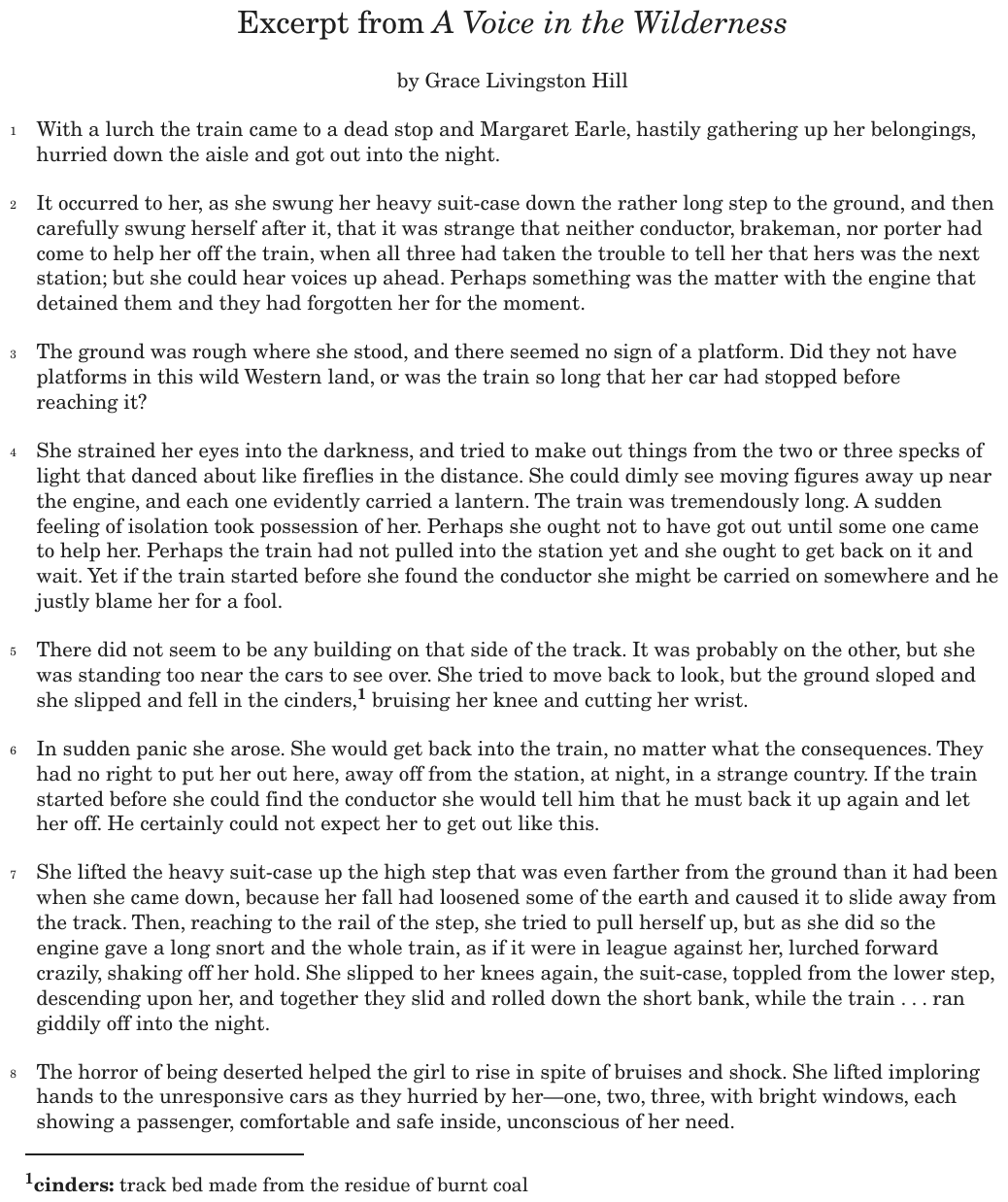
Question 15 of 50
2026 Practice Test A English, question 15Uses the passage above: “Excerpt from A Voice in the Wilderness”.
Question
Which sentence from the excerpt best supports the idea that Margaret is unaccustomed to traveling to new places by train?
- A“With a lurch the train came to a dead stop and Margaret Earle, hastily gathering up her belongings, hurried down the aisle and got out into the night.” (paragraph 1)
- B“Perhaps something was the matter with the engine that detained them and they had forgotten her for the moment.” (paragraph 2)
- C“Did they not have platforms in this wild Western land, or was the train so long that her car had stopped before reaching it?” (paragraph 3)
- D“She could dimly see moving figures away up near the engine, and each one evidently carried a lantern.” (paragraph 4)
Show the answer
Correct answer: C
The question asks for evidence from the excerpt that best supports the idea that Margaret is unfamiliar with traveling to new places by train.
A. Incorrect. Margaret’s actions in the sentence from paragraph 1 are decisive as she gathers her belongings to exit the train; she is familiar with rail travel.
B. Incorrect. In the sentence from paragraph 2, Margaret is using her knowledge about trains to attempt to interpret the actions of others; she is familiar with trains, even if a particular destination has not been mentioned.
C. CORRECT. If Margaret has never traveled to this region by train before, she must guess or attempt to interpret what she sees. This idea is best represented in the sentence in paragraph 3 where she questions whether the stations in the West have platforms.
D. Incorrect. While the sentence from paragraph 4 shows that Margaret is trying to better understand her situation in the darkness, her ability to identify the train’s engine and the figures carrying lanterns indicates some familiarity with her mode of travel.
Question analysis
Students choose the sentence from Grace Livingston Hill’s A Voice in the Wilderness that best supports the idea that Margaret is unaccustomed to traveling to new places by train. The four choices come from paragraphs 1–4, as she steps down from the train into the dark. Each reveals something about her, so students must test them against this one idea.
- NYS standards
- 7R1 textual evidence and inferences
- Grade level
- Grade 7 reading and task
- Compared with grade 7
- At grade 7 A typical grade 7 evidence task: the four quotations come from the opening paragraphs and carry paragraph numbers. The challenge is that several show Margaret unsure of herself, so students must match the specific idea in the claim, not any sign of doubt.
- Estimated difficulty
- Moderate: several steps, or a close reading with one strong distractor.
- Thinking it demands
- Depth of knowledge 2, skills and concepts · mainly evaluate
- What makes it hard
- Every choice must be checked moderate
- Reading between the lines minor
- Evidence
- Answered from several paragraphs or stanzas
- Reading level
- Passage: about grade 8, 981 words; question and choices: about grade 11, 113 words.
- Students, last 30 days
- Not enough answers yet to show (it takes 10).
Why it is hard, traps and wrong answers (shows the answer)
Why it is hard
Uncertainty runs through all four quotations, so the general mood of the opening cannot pick the answer. The claim is specific, a traveler new to such places, and only one sentence ties her confusion to the region itself rather than to a delay, the darkness or her haste. Students who match feelings instead of the claim usually settle on her guess about engine trouble.
Every choice must be checked moderate Choosing the answer
All four quotations, from paragraphs 1 to 4, show Margaret unsure in the dark, so each has to be tested against the narrower idea of someone new to this kind of journey. (Embretson & Wetzel, 1987)
Reading between the lines minor Working it out
No sentence says Margaret is new to the West; students must infer it from her puzzled question whether stations in “this wild Western land” lack platforms. (Graesser, Singer & Trabasso, 1994; Kintsch, 1998)
Strategy: Restate the claim in your own words, then ask of each quotation whether it proves that idea specifically or only shows some other feeling Margaret has at that moment.
Traps
- Supports only part of the claim: In a question about evidence: a line that backs one half of the claim but not the other, or a related point rather than the claim itself.
The wrong answers, classified
A Supports only part of the claim (King et al., 2004; Thissen, Steinberg & Fitzpatrick, 1989)
Reads her hurried exit as a nervous newcomer’s, though “hastily gathering up her belongings” shows someone who knows what to do when her stop is called.
B Supports only part of the claim (King et al., 2004; Thissen, Steinberg & Fitzpatrick, 1989)
Hears doubt in “Perhaps something was the matter with the engine,” but guessing at the cause of a delay is how an experienced rider reasons, not a newcomer puzzling over a place.
D Supports only part of the claim (King et al., 2004; Thissen, Steinberg & Fitzpatrick, 1989)
Notices the guesswork in “dimly” and “evidently,” but the darkness causes it, and she still picks out the engine and the crew’s lanterns, which shows she knows trains.
Working it out, step by step
Figure out what the question asks
This asks for evidence: the sentence that best supports an idea. The idea is that Margaret is unaccustomed to traveling to new places by train. Unaccustomed means not used to something. So look for a sentence where a new place puzzles her.
Notice what the choices share
All four sentences come from paragraphs 1 to 4, just after Margaret steps off the train at night. In most of them she is unsure. So feeling unsure is not enough. The right sentence must tie her confusion to the strange place itself.
Look closely at paragraph 3
Paragraph 3 asks “Did they not have platforms in this wild Western land, or was the train so long that her car had stopped before reaching it?” A platform is the raised floor beside the tracks where people get on and off. Margaret wonders if stations out West even have them. She does not know how things work in this region. That shows she is not used to traveling here.
Check each choice
- A does not fit. She is “hastily gathering up her belongings,” which means in a hurry. She knows what to do when her stop comes.
- B does not fit. Guessing about engine trouble is how someone who knows trains would think.
- C fits. She does not know what stations are like in this new land.
- D does not fit. The dark makes it hard to see. Yet she still picks out the engine and the lanterns.
Watch out: B begins with “Perhaps,” so it sounds unsure. But her doubt is about the train, not the place.
Choose the answer
Only the question about platforms shows that this place is unfamiliar to her. So the answer is C.
Why this answer and not the closest wrong one
B is the closest wrong choice, since Margaret is unsure in it too. But there she reasons like an experienced rider: maybe the engine broke down. In C, she wonders what stations are like in “this wild Western land.” Only C shows a traveler who is not used to new places.
More questions like this
The original DOE question
Question 16 of 50
2026 Practice Test A English, question 16Uses the passage above: “Excerpt from A Voice in the Wilderness”.
Question
Read this sentence from paragraph 4.
She strained her eyes into the darkness, and tried to make out things from the two or three specks of light that danced about like fireflies in the distance.
The simile used in the sentence affects the tone of the paragraph by emphasizing a
- Afeeling of comfort as Margaret connects her unfamiliar surroundings with familiar images.
- Bsense of lonesomeness as Margaret realizes that she is on her own in the wilderness.
- Csense of tranquility as Margaret is distracted from the urgency of her situation by the beauty of the night.
- Dfeeling of dread as Margaret regards the desolation of the land that surrounds her.
Show the answer
Correct answer: B
The question asks how the simile in the sentence from paragraph 4 reflects the tone of the paragraph. The image of two or three fireflies creating small specks of light in the darkness creates a sense of isolation or loneliness in Margaret, as shown in the sentence, “A sudden feeling of isolation took possession of her” (paragraph 4). Therefore, Option B is correct.
Option A is incorrect because Margaret is confused and indecisive, showing her discomfort with her situation.
Option C is incorrect because Margaret expresses distress in her situation, questions her decision, and worries about being labeled a “fool” (paragraph 4).
Option D is incorrect because the simile is meant to show how far away things are from Margaret, not create a feeling of dread, which develops later in paragraph 9.
Question analysis
This figurative-language question asks how a simile comparing distant lights to fireflies affects the tone of paragraph 4 in A Voice in the Wilderness. Students connect the image to Margaret’s state of mind as she stands beside the stopped train in the dark. The choices range from calm to fear, so the answer must rest on what Margaret is thinking.
- Grade level
- Grade 7 reading and task
- Compared with grade 7
- At grade 7 Explaining how a simile shapes tone is regular grade 7 work with figurative language, and this one is typical. Students must read the comparison in the light of the paragraph around it, since the image alone could suggest several moods.
- Estimated difficulty
- Moderate: several steps, or a close reading with one strong distractor.
- Thinking it demands
- Depth of knowledge 2, skills and concepts · mainly analyze
- What makes it hard
- A very close wrong answer moderate
- Figurative or literary language moderate
- Hard words minor
- Evidence
- Answered from one paragraph or stanza
- Reading level
- Passage: about grade 8, 981 words; question and choices: about grade 9, 109 words.
- Students, last 30 days
- Not enough answers yet to show (it takes 10).
Why it is hard, traps and wrong answers (shows the answer)
Why it is hard
The simile itself is gentle, which is why the comforting reading tempts some students, but the paragraph around it is not: two sentences later, “A sudden feeling of isolation took possession of her.” That sentence decides the question. The harder choice is between loneliness now and the dread and desolation that come after the train has gone, so the question rewards keeping to paragraph 4.
A very close wrong answer moderate Choosing the answer
The dread choice is built like the lonesomeness choice, a feeling plus Margaret alone in empty country, “the desolation of the land” beside “on her own in the wilderness”; only the feeling named, dread rather than loneliness, separates them. (Embretson & Wetzel, 1987; Gorin & Embretson, 2006; Ascalon et al., 2007)
Figurative or literary language moderate Understanding the question
Fireflies are usually a cheerful, homey image, so students must read the simile through its setting, “two or three specks of light” far off in the dark, to see that it stresses distance. (Graesser, Singer & Trabasso, 1994; Kintsch, 1998)
Hard words minor Understanding the question
The choices hinge on near-synonyms for feelings, “lonesomeness,” “tranquility,” “dread” and “desolation,” whose shades of meaning have to be weighed against one paragraph. (Perfetti, 2007; Freedle & Kostin, 1993)
Strategy: Picture the scene the comparison creates, then reread paragraph 4 around it and choose the feeling that the paragraph itself supports.
Traps
- Wrong part of the text: A choice is true of another paragraph, stanza or speaker than the one asked about.
- Taking figurative language literally: A choice reads a figure of speech or image at face value.
The wrong answers, classified
A Taking figurative language literally (Graesser, Singer & Trabasso, 1994)
Takes fireflies at face value as a cozy, familiar image, but Margaret is straining to see and wondering whether she should have left the train, hardly comforted.
C Wrong part of the text (Kirsch & Mosenthal, 1990)
Brings in the beauty of the night, which belongs to paragraph 12’s stars and sky after the train has gone, not to this anxious moment beside it.
D Wrong part of the text (Kirsch & Mosenthal, 1990)
Moves ahead to the dread and desolate land of paragraphs 9 to 13, after the train leaves; here the faraway lights stress distance and a first feeling of isolation.
Working it out, step by step
Figure out what the question asks
This asks about a simile: a comparison that uses “like” or “as.” How does this simile shape the tone, or feeling, of paragraph 4?
Find the simile
Margaret looks into the dark and sees “two or three specks of light that danced about like fireflies in the distance.” The far-off lights are compared to fireflies.
Picture what it shows
Fireflies are tiny lights. Here there are only two or three, and they are far away. Everything else is dark. The picture makes Margaret seem small and far from other people. A few lines later, the paragraph says it: “A sudden feeling of isolation took possession of her.” Isolation means being alone and cut off.
Check each choice
- A is wrong. Fireflies can seem cozy, but Margaret is straining to see. She feels alone, not comforted.
- B is right. The tiny, faraway lights stress that she is on her own.
- C is wrong. The beauty of the night comes later, in paragraph 12. Here she is worried.
- D is wrong. Dread and the empty land come later, after the train leaves.
Watch out: D jumps ahead. Her terror starts in paragraph 9, and the empty land appears in paragraphs 12 and 13. Both come after the train is gone.
Choose the answer
The few faraway specks of light in the dark make Margaret feel small and alone. So the answer is B.
Why this answer and not the closest wrong one
D is the closest wrong answer, because Margaret does feel dread later in the story. But in paragraph 4 the train is still there, and the land has not been described yet. The paragraph names the feeling itself: “a sudden feeling of isolation.” Lonesomeness matches that.
More questions like this
The original DOE question
Question 17 of 50
2026 Practice Test A English, question 17Uses the passage above: “Excerpt from A Voice in the Wilderness”.
Question
How do Margaret’s earlier interactions with the conductor, brakeman, and porter affect the plot?
- AThey prompt Margaret to get off the train without further assistance.
- BThey cause Margaret to think that she knows what to do once she gets off the train.
- CThey compel Margaret to wonder whether the train has not pulled all the way into the station.
- DThey lead Margaret to believe that train stations in rural areas lack platforms.
Show the answer
Correct answer: A
The question asks how Margaret’s earlier interactions with the conductor, brakeman, and porter affect the plot.
A. CORRECT. Because the conductor, brakeman, and porter have all “taken the trouble to tell her that hers was the next station” (paragraph 2), Margaret assumes that the next time the train stops, she will have reached her station. This assumption causes Margaret to get off the train at the next stop without waiting for help or confirmation, but the stop turns out to be just “a pause to water the engine” (paragraph 15). This mistaken assumption creates the main problem that Margaret confronts in the passage.
B. Incorrect. Although Margaret’s earlier interactions with the three railroad employees cause her to think that she knows when to get off the train, it is clear from paragraph 4 that Margaret is deeply confused and does not know what to do once she has exited the train car. She muses uneasily, “Perhaps she ought not to have got out until some one came to help her. Perhaps the train had not pulled into the station yet and she ought to get back on it and wait” (paragraph 4).
C. Incorrect. Margaret wonders in paragraph 3 whether the train is “so long that her car had stopped before reaching [the station]” and speculates in paragraph 4 that “the train had not pulled into the station yet.” These thoughts reflect her assumption (based on her interactions with the three railroad employees) that the next stop is her station. However, Margaret’s speculation that the train has not fully pulled into the station does not significantly affect the plot.
D. Incorrect. Margaret wonders in paragraph 3 whether they “have platforms in this wild Western land” and is expecting to see a platform because her interactions with the three railroad employees have led her to believe that she has reached a station. However, it is unclear whether Margaret really believes that rural stations all lack platforms, and her speculation on this point is not further developed in the passage and does not affect the plot.
Question analysis
This plot question on A Voice in the Wilderness asks how Margaret’s earlier dealings with the conductor, brakeman and porter, mentioned only in passing in paragraph 2, affect what happens to her. Students must connect that brief remark to later events in the excerpt. Several choices describe things that do happen, so students must judge which one those conversations truly cause.
- Grade level
- Grade 8 reading and task
- Compared with grade 7
- Above grade 7 Grade 7 plot questions ask how story elements affect one another, usually through an event and its result. Here the cause is a clause inside a long sentence of century-old prose, and students must trace its effect across the excerpt rather than within one paragraph.
- Estimated difficulty
- Hard: combines ideas, needs a plan, and has more than one tempting wrong answer.
- Thinking it demands
- Depth of knowledge 3, strategic thinking · mainly analyze
- What makes it hard
- Evidence in several places moderate
- Reading between the lines moderate
- Complex sentences minor
- Evidence
- Answered from the whole text
- Reading level
- Passage: about grade 8, 981 words; question and choices: about grade 7, 72 words.
- Students, last 30 days
- Not enough answers yet to show (it takes 10).
Why it is hard, traps and wrong answers (shows the answer)
Why it is hard
The talks with the trainmen are mentioned once, in the middle of a long sentence, and the question asks students to see them as the start of the whole plot. Several choices describe thoughts Margaret really has right after she steps down, which makes them feel connected, but those thoughts change nothing. The point goes to students who trace cause to consequence: told her stop was next, she gets off alone at a water tank.
Evidence in several places moderate Working it out
The cause sits in paragraph 2, where all three men had told her “hers was the next station,” and the effect shows only in paragraph 15, when the stop proves to be a water tank. (Kirsch & Mosenthal, 1990; Gorin & Embretson, 2006)
Reading between the lines moderate Working it out
The excerpt never says the men’s words made her step off; students must infer that their assurance is why she left the train at the first stop without waiting for anyone. (Graesser, Singer & Trabasso, 1994; Kintsch, 1998)
Complex sentences minor Understanding the question
The interactions appear in a 66-word sentence in paragraph 2, tucked into a “when” clause after a run of commas, so they read as a passing detail rather than a cause. (Abedi & Lord, 2001; Freedle & Kostin, 1993; Messick, 1989)
Strategy: Reread paragraph 2 to find what the three men told Margaret, then trace how that information shapes the events that follow, and choose the effect that matters most to the plot.
Traps
- True but not the answer: A choice says something accurate about the text that does not answer this question.
- Twists what the text says: Uses the text's topic and ideas but changes what it says: who did it, how much, when, or why.
- Reads too much in: A reasonable-sounding conclusion that goes further than the text allows.
The wrong answers, classified
B Twists what the text says (King et al., 2004)
Rightly links the men’s words to her confidence about when to get off, but stretches it to knowing what to do afterward, when paragraph 4 shows her at a loss.
C True but not the answer (King et al., 2004; Embretson & Wetzel, 1987)
Names a real result of the men’s words, her guess in paragraphs 3 and 4 that the train has not yet reached the station, but that passing worry changes nothing in the plot.
D Reads too much in (Graesser, Singer & Trabasso, 1994)
Turns her puzzled question about platforms in “this wild Western land” into a firm belief about rural stations, an idea the excerpt never develops.
Working it out, step by step
Figure out what the question asks
This asks how something from earlier affects the plot. The plot is the chain of events in a story. What did the three train workers tell Margaret, and what did that cause?
Find what the workers told her
Paragraph 2 says it was strange that “neither conductor, brakeman, nor porter had come to help her off the train, when all three had taken the trouble to tell her that hers was the next station.” A conductor, a brakeman and a porter are all people who work on a train.
Trace what happened because of it
Three workers told her that her stop was next. So when the train stopped, she was sure she had arrived. She got off alone, without waiting for anyone to help. But in paragraph 15 she learns it was only “a pause to water the engine.” Their words set off the whole problem: she is left alone in the dark.
Check each choice
- A fits. Their words led her to get off by herself.
- B does not fit. They told her when to get off, not what to do next. In paragraph 4 she is lost: “Perhaps she ought not to have got out until some one came to help her.”
- C does not fit. She does wonder this, but the thought changes nothing in the story.
- D does not fit. She only asks a question about platforms. She never decides anything about country stations.
Choose the answer
The workers’ words made Margaret step off the train on her own at the wrong stop. So the answer is A.
Why this answer and not the closest wrong one
C is the closest wrong choice. The workers’ words do make her guess that the train has not reached the station yet. But that guess goes nowhere. What changes the story is that she gets off alone at a stop that is not a station. That is A.
More questions like this
The original DOE question
Question 18 of 50
2026 Practice Test A English, question 18Uses the passage above: “Excerpt from A Voice in the Wilderness”.
Question
How does Margaret’s experience in paragraph 9 emphasize a theme of the excerpt?
- AIt confirms Margaret’s understanding that she cannot rely on help from anyone else.
- BIt leads Margaret to realize that her desire to change her situation is impractical.
- CIt causes Margaret to believe that her own actions led to an unfavorable outcome.
- DIt reinforces Margaret’s frustration about her lack of control over her surroundings.
Show the answer
Correct answer: A
The question asks about the relationship between the theme and paragraph 9, where Margaret desperately tries to get someone on the train to notice her.
A. CORRECT. One important theme of this excerpt concerns Margaret’s willingness to take action to ensure that she reaches her destination. This determination, described in Option A, is why she gathers her belongings together without help, gets off the train without being assisted by employees, and then attempts to climb back on while the train employees are busy examining the engine.
B. Incorrect. While the narrator describes her screaming as useless, she does not feel that her efforts overall are useless, and she does not give up until paragraph 10.
C. Incorrect. While Margaret is feeling a sense of “failure” in paragraph 9, she does not condemn herself as the train moves away.
D. Incorrect. Margaret expresses “terror” in paragraph 9 over being unable to catch someone’s attention, not frustration about her lack of control over her surroundings.
Question analysis
This theme question asks how Margaret’s experience in paragraph 9 of A Voice in the Wilderness, as she screams and runs while the train pulls away, emphasizes a theme of the excerpt. It is a lightly reworded version of an earlier handbook question. Every choice describes a believable reaction to being left behind, so the answer depends on the excerpt’s larger pattern.
- Grade level
- Grade 8 reading and task
- Compared with grade 7
- Above grade 7 Typical grade 7 theme questions trace a given theme through a text. Here students must decide which theme one frantic paragraph supports, and all four choices describe reactions that fit the scene, so the decision draws on the whole excerpt.
- Estimated difficulty
- Among the hardest on the SHSAT: a non-obvious approach, heavy reading, or a well-hidden trap.
- Thinking it demands
- Depth of knowledge 3, strategic thinking · mainly analyze
- What makes it hard
- Reading between the lines major
- Evidence in several places moderate
- Evidence
- Answered from the whole text
- Reading level
- Passage: about grade 8, 981 words; question and choices: about grade 10, 65 words.
- Students, last 30 days
- Not enough answers yet to show (it takes 10).
Why it is hard, traps and wrong answers (shows the answer)
Why it is hard
Each choice names a feeling a stranded traveler might have, and two lean on the paragraph’s own words, “useless” and “failure,” so the paragraph alone cannot decide it. Paragraph 9 must be read as the last link in a chain of trainmen, passengers and a departing train that all leave her to herself. Students who judge from that one paragraph often decide she has given up, though she soon picks up her bags and walks toward the dark shaft by the track.
Reading between the lines major Working it out
The theme is never stated; it must be drawn from paragraph 9’s cries that no one answers and from the passengers “comfortable and safe inside, unconscious of her need” in paragraph 8. (Graesser, Singer & Trabasso, 1994; Kintsch, 1998)
Evidence in several places moderate Working it out
The pattern begins in paragraph 2, when no trainman helps her off, and runs through the train lurching away “as if it were in league against her” in paragraph 7. (Kirsch & Mosenthal, 1990; Gorin & Embretson, 2006)
Strategy: Sum up in a phrase what keeps happening to Margaret from the start of the excerpt to its end, then check which choice paragraph 9’s own words most clearly add to.
Traps
- Too broad or too strong: A choice overstates, generalizes, or uses absolute words the text does not support.
- Wrong tone or attitude: Misjudges the tone, attitude or point of view, such as reading admiration as criticism, or taking a character's or subject's feelings for the author's.
The wrong answers, classified
B Too broad or too strong (King et al., 2004)
Stretches the “useless screaming” of one moment into a judgment that changing her situation is impractical, though she soon gathers her bags and sets off toward the shaft ahead.
C Reads too much in (Graesser, Singer & Trabasso, 1994)
Turns the “sense of terror and failure” into self-blame, though Margaret never says that her own choice to step off the train caused her trouble.
D Wrong tone or attitude (Graesser, Singer & Trabasso, 1994)
Fits the indifferent train, but names frustration over control where paragraph 9 stresses terror at being ignored by everyone aboard.
Working it out, step by step
Figure out what the question asks
This asks about a theme: a big idea a story keeps coming back to. How does what happens in paragraph 9 point to a theme? The right choice should fit a pattern across the whole excerpt.
Read paragraph 9
Paragraph 9 describes “A moment of useless screaming, running, trying to attract some one’s attention, a sickening sense of terror and failure.” Margaret screams and runs, trying to get someone to notice her. No one does. The last car rolls past “as if it enjoyed her discomfort.”
Find the same thing earlier
This is not the first time. In paragraph 2, none of the workers “had come to help her off the train.” In paragraph 8, the passengers sit “comfortable and safe inside, unconscious of her need.” That means they don’t know she needs help. Paragraph 9 is one more time when nobody comes. She will have to count on herself.
Check each choice
- A fits. Her cries go unanswered, just as before. She cannot rely on anyone else.
- B does not fit. Impractical means not sensible or workable. Her screaming fails, but she never decides that trying to change things is pointless. In paragraph 14 she “picked up her baggage” and set off again.
- C does not fit. She feels “failure,” but she never blames herself.
- D does not fit. The paragraph shows terror at being ignored, not frustration about having no control over her surroundings.
Choose the answer
Paragraph 9 adds one more moment where no one helps Margaret. So the answer is A.
Why this answer and not the closest wrong one
B is the closest wrong choice, because paragraph 9 calls her screaming “useless.” But one failed moment does not mean she gives up. Soon she takes her bags and walks toward the tall dark shape ahead. What stays true from paragraph 2 to paragraph 9 is that no one helps her. That is A.
More questions like this
The original DOE question
Question 19 of 50
2026 Practice Test A English, question 19Uses the passage above: “Excerpt from A Voice in the Wilderness”.
Question
How does paragraph 11 contribute to the plot of the excerpt?
- AIt reveals that the reality of the situation is different from Margaret’s assumptions.
- BIt illustrates that Margaret’s main problem is her own imagination.
- CIt shows that Margaret is surprised by the unexpected adventure she is about to undertake.
- DIt provides insight into how Margaret reacts to stressful situations.
Show the answer
Correct answer: A
The question asks how paragraph 11 contributes to the plot of the excerpt.
A. CORRECT. In paragraph 5, Margaret assumes there is a station (“It was probably on the other [side], but she was standing too near the cars to see”), but in paragraph 11, the station that had been “so real” in Margaret’s mind actually does not exist.
B. Incorrect. Margaret’s main problem is not that her imagination has led her astray but rather that her inexperience with this train route has caused her to misinterpret the events that have occurred. Paragraph 11 reveals that she has been acting on faulty assumptions; however, her assumptions are somewhat justified by the events that have occurred.
C. Incorrect. While Margaret seems somewhat in awe of her surroundings in paragraph 12 and she “gasped” in paragraph 11, her exclamation is one of shock at the discovery, not surprise over an unexpected adventure.
D. Incorrect. While paragraph 11 describes how Margaret responds to the distressing situation that her actions and decisions have created, the paragraph does not offer insight into how Margaret generally responds to problems or conflicts.
Question analysis
This plot-structure question asks how paragraph 11 of A Voice in the Wilderness, a single exclaiming sentence that begins “She gasped,” contributes to the plot once Margaret is alone beside the track. Students relate the paragraph to what comes before and after it. Its archaic phrasing, with “lo!” and an inverted clause, makes the plain meaning harder to see.
- Grade level
- Grade 7 reading and task
- Compared with grade 7
- At grade 7 Explaining what a single paragraph adds to a plot is standard grade 7 structure work. Paragraph 11 is one short sentence, but its old-fashioned exclamation has to be linked to the paragraphs around it, which adds a step.
- Estimated difficulty
- Moderate: several steps, or a close reading with one strong distractor.
- Thinking it demands
- Depth of knowledge 2, skills and concepts · mainly analyze
- What makes it hard
- Evidence in several places moderate
- A very close wrong answer moderate
- Hard words minor
- Evidence
- Answered from several paragraphs or stanzas
- Reading level
- Passage: about grade 8, 981 words; question and choices: about grade 10, 58 words.
- Students, last 30 days
- Not enough answers yet to show (it takes 10).
Why it is hard, traps and wrong answers (shows the answer)
Why it is hard
Paragraph 11 is a single exclaiming sentence whose job is to overturn what Margaret, and the reader, have believed since she stepped down. Students who link it to her earlier guesses about a platform and a building see the reversal at once. Those who read it alone fasten on her gasp or on the words “so real to her mind,” and choose a reading about her character or her imagination rather than the plot.
Evidence in several places moderate Working it out
The assumption the paragraph overturns was built earlier: in paragraph 3 she wonders about a platform, and in paragraph 5 she decides the station is “probably on the other” side. (Kirsch & Mosenthal, 1990; Gorin & Embretson, 2006)
A very close wrong answer moderate Choosing the answer
The choice about her imagination and the right one both describe a gap between what Margaret pictured and what is there; they differ on whether the fault lies in her mind or in the missing station. (Embretson & Wetzel, 1987; Gorin & Embretson, 2006; Ascalon et al., 2007)
Hard words minor Understanding the question
The paragraph announces its reversal in old-fashioned words, “lo! on this side and on that there was none,” which students unused to such phrasing may read past. (Perfetti, 2007; Freedle & Kostin, 1993)
Strategy: Translate paragraph 11 into plain modern English, reread the paragraphs just before and after it, and judge each choice by what this paragraph itself shows.
Traps
- Twists what the text says: Uses the text's topic and ideas but changes what it says: who did it, how much, when, or why.
- Too broad or too strong: A choice overstates, generalizes, or uses absolute words the text does not support.
The wrong answers, classified
B Twists what the text says (King et al., 2004)
Seizes on “so real to her mind” and blames her imagination, though the station she expected is truly missing and the danger she faces is real.
C Wrong tone or attitude (Graesser, Singer & Trabasso, 1994)
Hears surprise in “gasped” and “lo!” but takes it for eagerness about an adventure, when it is shock at finding no station on either side.
D Too broad or too strong (King et al., 2004)
Makes a general claim about how Margaret handles stress, which could fit almost any paragraph, while this one reports a single discovery that turns the plot.
Working it out, step by step
Figure out what the question asks
This asks how paragraph 11 moves the plot, the chain of events, forward. What changes for Margaret in this paragraph?
Read paragraph 11
Paragraph 11 is one sentence: “She gasped and looked about her for the station that but a short moment before had been so real to her mind; and, lo! on this side and on that there was none!”
Put it in plain words
“Lo!” is an old word that means “Look!” The words “on this side and on that there was none” mean there was no station on either side of the track. Earlier, in paragraph 5, she guessed the building “was probably on the other” side. An assumption is something you believe without checking. Now she sees that her assumption was wrong. There is no station at all.
Check each choice
- A fits. What she assumed, a station, is different from what is real, no station.
- B does not fit. Her imagination is not the problem. The missing station is a real problem.
- C does not fit. Her gasp is shock, not excitement about an adventure.
- D does not fit. She gasps, but the paragraph’s job is the discovery. It does not show how she usually handles stress.
Choose the answer
Paragraph 11 shows that the station Margaret counted on is not there. So the answer is A.
Why this answer and not the closest wrong one
B is the closest wrong choice. Both A and B notice a gap between what Margaret pictured and what is there. But B blames her imagination. Her trouble is real: there is no station, and the train is gone. A says what the paragraph does. It shows the truth is different from what she assumed.
More questions like this
The original DOE question
Question 20 of 50
2026 Practice Test A English, question 20Passage Champion of the Channel
Champion of the Channel
In 1926 an editor at the London Daily News predicted that Gertrude Ederle, an American swimmer with eighteen world records and three Olympic medals, would fail in her attempt to swim across the English Channel. He claimed that “even the most uncompromising champion of the rights and capacities of women must admit that in contests of physical skill, speed and endurance they must remain forever the weaker sex.” Yet, at only nineteen years old, Ederle not only became the first woman to accomplish this feat, she also broke the men’s record by two hours. Gertrude Ederle’s triumphant swim across the English Channel was a testimony to her determination, innovative spirit, and passion for swimming.
Crossing the English Channel is a daunting task for any swimmer. At its narrowest point, the channel measures twenty-one miles across. Its icy waters hover around sixty degrees Fahrenheit, and its unruly tides and currents toss swimmers about like bobbing corks. Stinging jellyfish, seaweed, and floating debris from shipwrecks and lost cargoes present added hazards.
For decades the channel’s perils have defeated countless swimmers. Ederle, too, failed in her first attempt to cross the channel in 1925. Just six miles short of finishing, she became ill, and her coach had to haul her out of the water. Undeterred, Ederle decided to try again. Ederle knew that if she did not complete the challenge this time, she might never get the opportunity to set this record, because a rival female swimmer was preparing to make her second attempt at the crossing as well.
To prepare for the marathon swim, Ederle found ways to improve her equipment. She and her sister Meg discovered that melted candle wax perfectly sealed goggle edges, effectively waterproofing Ederle’s goggles against hammering waves. The sisters also designed a two-piece silk swimsuit for Ederle. During her first channel-crossing attempt she had worn a standard one-piece swimsuit that, after the lengthy hours of swimming across the channel, had stretched out, filling with water and creating drag, making an already challenging task almost insurmountable. Unlike the cumbersome typical bathing suit, this silk invention weighed little and allowed for easy movement.
On August 6, 1926, Ederle waded into the channel near Cape Gris-Nez, France. At first she shivered in the bone-chilling water even though she had covered her body in eight layers of grease for insulation. Her limbs felt stiff. Her strokes were irregular. Driving forward, she fought to clear her mind and find what she called her “sphere,” a place where the sea became her only companion and the shrieks of gulls and the humming of boat engines faded away. Using a new overhand stroke called the American crawl, Ederle eventually settled into a steady pace, briskly breaking through waves.
Throughout Ederle’s swim, two tugboats accompanied her. One carried newspaper reporters who wired dispatches of her progress to shore. The other, displaying a sign that read “This way, ole kid!” with an arrow pointing forward, transported her coach, family, and friends. Her coach played songs, such as “Yes, We Have No Bananas,” on a phonograph so that Ederle could time her strokes to the rhythm. Using a net, her coach also passed her baby bottles of broth for nourishment.
For hours Ederle swam, dodging debris with an amused smile. However, as she neared the English shore, a sudden fierce storm erupted. The tides and waves forced Ederle backward, and she fought the stubborn swells for several hours. The salty water caused her tongue to swell and inflamed her ears. Yet Ederle felt indescribably happy as she churned through the sea. Finally, as she neared the English shore, the storm abated, and the tide turned. No longer fighting against her, the sea pushed her toward the shore and victory.
After fourteen hours and thirty-one minutes, Ederle, on wobbly legs, stepped onto the English shore. The waiting crowd roared, honked their automobile horns, blasted their tugboat whistles, and set off flares that flashed in the sky. Ederle had swum into history.
When Ederle returned to New York, she received a parade, where thousands of people shouted “Trudy!” Not only were everyday American citizens proud of Ederle, but she also inspired them to be more active. Over the next few years, more than 60,000 people credited her with motivating them to earn their American Red Cross swimming certificates. Gertrude Ederle’s accomplishment proved to the world that with determination and passion, it was possible for a person to achieve his or her goals.
SOLO SWIMS ACROSS THE ENGLISH CHANNEL
|
Earliest Speed Records |
||
| Year | Swimmer | Time |
| 1875 | Matthew Webb (M) | 21 hours, 45 minutes |
| 1923 | Enrico Tiraboschi (M) | 16 hours, 33 minutes |
| 1926 | Gertrude Ederle (F) | 14 hours, 31 minutes |
| 1926 | Arnst Vierkotter (M) | 12 hours, 38 minutes |
| Current Speed Records | ||
| Year | Swimmer | Time |
| 2012 | Trent Grimsey (M) | 6 hours, 55 minutes |
| 2006 | Yvetta Hlavacova (F) | 7 hours, 25 minutes |
Question
What do the newspaper editor’s comments in paragraph 1 reveal about the challenges Ederle faced in attempting her feat?
- ARegardless of her ability, being an American put Ederle at a serious disadvantage over a Londoner, who would be more familiar with the English Channel.
- BAt the time, Ederle still needed more training in order to succeed in the daunting task of swimming the English Channel.
- CWhile Ederle could participate in athletic competition, some people were not comfortable with her attempt to swim the channel because no woman had ever attempted it before.
- DIn spite of her previous achievements, Ederle still experienced social as well as physical obstacles in attempting to swim the channel.
Show the answer
Correct answer: D
The question asks what the newspaper editor’s comments in paragraph 1 reveal about Ederle’s challenges leading up to her attempt to swim across the channel.
A. Incorrect. The idea that Ederle was at a disadvantage because she was American rather than English, and thus less familiar with the channel, was not the basis for the newspaper editor’s comments about the outcome of her swim.
B. Incorrect. The passage establishes that Ederle was a highly accomplished swimmer who had won major world competitions (“Gertrude Ederle, an American swimmer with eighteen world records and three Olympic medals” [paragraph 1]).
C. Incorrect. The newspaper editor’s point was that Ederle would be unsuccessful in her attempt to complete the swim because she was a woman, not that people were uncomfortable with the idea since no woman had attempted it before.
D. CORRECT. The comments reveal a lack of social support since many people believed that a woman, no matter how skilled a swimmer, did not have the strength to overcome the physical challenges that the dangerous channel waters presented (“He claimed that ‘even the most uncompromising champion of the rights and capacities of women must admit that in contests of physical skill, speed and endurance they must remain forever the weaker sex.’ ” [paragraph 1]).
Question analysis
In 1926 a London newspaper editor predicted that Gertrude Ederle would fail to swim the English Channel, and this reading question asks what his comments in the first paragraph reveal about the challenges she faced. Students must infer from the editor's own words what stood in her way, and the wrong choices offer believable obstacles that the passage never connects to him.
- Grade level
- Grade 7 reading and task
- Compared with grade 7
- At grade 7 Reading an opinion for what it shows about a person's situation is everyday grade 7 inference. This question points to both of the editor's sentences rather than quoting just one, so the evidence is in plain view and the work is weighing four readings.
- Estimated difficulty
- Moderate: several steps, or a close reading with one strong distractor.
- Thinking it demands
- Depth of knowledge 2, skills and concepts · mainly understand
- What makes it hard
- A very close wrong answer moderate
- Reading between the lines moderate
- Complex sentences minor
- Evidence
- Answered from one paragraph or stanza
- Reading level
- Passage: about grade 9, 790 words; question and choices: about grade 14, 112 words.
- Students, last 30 days
- Not enough answers yet to show (it takes 10).
Why it is hard, traps and wrong answers (shows the answer)
Why it is hard
Pointing to both of the editor's sentences puts his reason in plain view, so the work lies in naming what kind of obstacle a sexist prediction is. Students who see prejudice but not its stated basis fall for the near miss, which blames the lack of earlier female attempts, though Ederle herself had tried in 1925. The right answer is the only one that pairs that prejudice with the channel's physical dangers, and it rewards reading his words as a judgment about women, not about her.
A very close wrong answer moderate Choosing the answer
The right choice and the one about people being uncomfortable both find a social obstacle despite her skill; they part on its cause, the editor's claim that women are “the weaker sex” or the idea that no woman had tried. (Embretson & Wetzel, 1987; Gorin & Embretson, 2006; Ascalon et al., 2007)
Reading between the lines moderate Working it out
Neither of the editor's sentences names an obstacle, so a prediction of failure and a remark about women's “physical skill, speed and endurance” must be read as prejudice she faced on top of the channel's own dangers. (Graesser, Singer & Trabasso, 1994; Kintsch, 1998)
Complex sentences minor Understanding the question
The editor's quoted claim runs 30 words, opening with “even the most uncompromising champion of the rights and capacities of women” and holding its point, “the weaker sex”, until the end. (Abedi & Lord, 2001; Freedle & Kostin, 1993; Messick, 1989)
Strategy: Put the editor's reasoning into your own words before looking at the choices, then reject any choice whose reason for doubting Ederle is not the one he actually gives.
Traps
- Half right: One half of a two-part choice is right and the other is not.
- Outside knowledge: A choice is plausible in the real world but not supported by this text.
- Word match: Repeats striking words or phrases from the text, so it looks supported, but its meaning does not fit the question.
The wrong answers, classified
A Outside knowledge (King et al., 2004; Recht & Leslie, 1988)
Imagines a rivalry between an American and Londoners who know the channel, a plausible reason for doubt that the editor never gives, since his claim is about women.
B Word match (Freedle & Kostin, 1993)
Picks up “daunting task” from paragraph 2 and reads a prediction of failure as a sign she was undertrained, though the same sentence credits her with eighteen world records.
C Half right (King et al., 2004; Thissen, Steinberg & Fitzpatrick, 1989)
Rightly sees people doubting a woman's attempt but gives the wrong reason; the editor cites women's supposed weakness, and Ederle had already tried the crossing in 1925.
Working it out, step by step
Understand what the question asks
This question asks you to make an inference. An inference is a conclusion you reach from clues when the text does not say it outright. The editor’s comments are in paragraph 1. You need to work out what they show about the problems Ederle had to face.
Find the editor’s two comments
Paragraph 1 says the editor “predicted that Gertrude Ederle, an American swimmer with eighteen world records and three Olympic medals, would fail in her attempt to swim across the English Channel.” Then it gives his reason. He said that women “must remain forever the weaker sex.”
Put his reason in your own words
The editor’s full sentence is long, and its point comes at the very end. He meant that even people who support women must agree that women will always be weaker in sports. His reason had nothing to do with Ederle’s own skill, which her records proved. He doubted her only because she was a woman. That is a social obstacle: a problem that comes from what other people believe.
Add the dangers of the swim
On top of that, the swim itself was dangerous. Paragraph 2 calls the crossing “a daunting task for any swimmer.” Daunting means scary and hard. The paragraph lists “icy waters,” rough tides and “stinging jellyfish.” So Ederle had two kinds of trouble: people’s doubts and the hard swim itself.
Check each choice
- D fits: “in spite of her previous achievements” matches her records, and “social as well as physical obstacles” matches the editor’s doubts plus the rough water.
- A is wrong because the editor never mentions her being American or Londoners knowing the channel.
- B is wrong because nothing says she needed more training, and her eighteen world records show she was well prepared.
- C is wrong because the editor’s reason was that women are weaker, not that no woman had tried.
Watch out: C also spots people doubting her, so it is tempting. But it gives the wrong reason for the doubt. Paragraph 3 even says Ederle herself had tried in 1925.
Choose the answer
The editor’s words show that Ederle faced prejudice against women on top of a dangerous swim. So the answer is D.
Why this answer and not the closest wrong one
C is the choice most likely to fool you. It also sees that some people doubted Ederle. But it blames the doubt on no woman having tried before. The editor’s real reason was his belief that women are “the weaker sex.” D names that social obstacle and adds the physical ones, so D fits best.
More questions like this
The original DOE question
The passage “Champion of the Channel” as printed (pages 56–57)
Question 21 of 50
2026 Practice Test A English, question 21Uses the passage above: “Champion of the Channel”.
Question
Read this sentence from paragraph 4.
During her first channel-crossing attempt she had worn a standard one-piece swimsuit that, after the lengthy hours of swimming across the channel, had stretched out, filling with water and creating drag, making an already challenging task almost insurmountable.
The word “insurmountable” is used to highlight
- Ahow the bathing suit made it impossible for Ederle to make it across the channel.
- Bhow Ederle and her sister decided to improve Ederle’s swimming equipment in a creative way.
- Cthat the flaws in Ederle’s bathing suit made a difficult task even more complicated.
- Dthat the swimming equipment Ederle used needed to be custom made for her attempt.
Show the answer
Correct answer: C
The question asks about the effect of the word “insurmountable,” which means “incapable of being overcome,” in paragraph 4.
A. Incorrect. Ederle did not complete her first swim because she became ill (“Just six miles short of finishing, she became ill, and her coach had to haul her out of the water.” [paragraph 3]), not because the suit made it impossible for Ederle to complete her swim.
B. Incorrect. The author uses the word “insurmountable” to draw attention to the increased difficulty caused by the suit, not to draw attention to the sisters’ creativity in solving the problem.
C. CORRECT. The suit Ederle wore during her first attempt to swim the channel “stretched out, filling with water and creating drag” (paragraph 4), which likely contributed to her failed attempt to swim across the channel.
D. Incorrect. The passage does not address whether the original suit was custom made, simply that the suit created additional difficulties for Ederle in a situation that was already difficult.
Question analysis
This vocabulary-in-context question quotes a sentence about the stretched-out swimsuit Gertrude Ederle wore on her first attempt to swim the English Channel and asks what the word insurmountable is used to highlight. Students must decide what point the word stresses in this sentence rather than simply define it, and the choices range from the old suit's effects to the sisters' new equipment.
- Grade level
- Grade 7 reading and task
- Compared with grade 7
- At grade 7 Explaining what a strong word emphasizes in context is standard grade 7 vocabulary work. The sentence is printed in the question, which saves a search, but it is long, with several phrases stacked between the swimsuit and the key word.
- Estimated difficulty
- Moderate: several steps, or a close reading with one strong distractor.
- Thinking it demands
- Depth of knowledge 2, skills and concepts · mainly analyze
- What makes it hard
- Hard words moderate
- A very close wrong answer moderate
- Complex sentences minor
- Evidence
- Answered from one sentence or line
- Reading level
- Passage: about grade 9, 790 words; question and choices: about grade 10, 108 words.
- Students, last 30 days
- Not enough answers yet to show (it takes 10).
Why it is hard, traps and wrong answers (shows the answer)
Why it is hard
The phrase to weigh is “an already challenging task almost insurmountable”, and two small words carry it: “already” says the swim was hard to begin with, and “almost” stops short of impossible. Students who know only the dictionary meaning blame the suit for a failure that paragraph 3 pins on illness. Those who look past the sentence to the sisters' new gear answer a different question, about the fix rather than the problem the word stresses.
Hard words moderate Understanding the question
The question hinges on “insurmountable”, impossible to overcome, which is softened by the “almost” in front of it and set against the “already challenging task” it describes. (Perfetti, 2007; Freedle & Kostin, 1993)
A very close wrong answer moderate Choosing the answer
The right choice and the one saying the suit made the crossing impossible both blame the old suit; they differ only in degree, which is exactly what “almost” decides. (Embretson & Wetzel, 1987; Gorin & Embretson, 2006; Ascalon et al., 2007)
Complex sentences minor Understanding the question
The stem prints all 38 words of the sentence, but between the swimsuit and “insurmountable” come an inserted time phrase, the verb “had stretched out” and two “-ing” phrases, so the link is easy to lose. (Abedi & Lord, 2001; Freedle & Kostin, 1993; Messick, 1989)
Strategy: Say in your own words what the quoted sentence claims about the old swimsuit, then choose the statement that restates that claim, checking each choice against the sentence word by word.
Traps
- Dictionary meaning, not meaning here: A common meaning of the word that does not fit its use in this text.
- Wrong purpose or structure: Names a purpose, structure or effect that the part does not serve, or describes what a part says when the question asks what it does.
- Reads too much in: A reasonable-sounding conclusion that goes further than the text allows.
The wrong answers, classified
A Dictionary meaning, not meaning here (Perfetti, 2007)
Gives “insurmountable” its full dictionary force and drops “almost”, so the suit seems to have made the crossing impossible, though paragraph 3 says she stopped in 1925 because she became ill.
B Wrong purpose or structure (Anderson & Krathwohl, 2001)
Describes what the paragraph goes on to do, the sisters' creative silk suit and waxed goggles, when the quoted sentence and its key word dwell on the old suit's flaws.
D Reads too much in (Graesser, Singer & Trabasso, 1994)
Reasons that because a standard suit failed, her gear had to be custom made, a conclusion the passage never draws and the word does not point toward.
Working it out, step by step
Figure out the word’s job
This question asks why the author chose one word, “insurmountable,” in paragraph 4. First you need to know what the word means. Then you can see which idea it helps the sentence stress.
Break the word into parts
To surmount something is to get over it or on top of it, the way a climber gets to the top of a cliff. The start in- means not, and the end -able means can be. So something insurmountable cannot be gotten over. It is too hard to beat.
Read the words around it
The old suit “had stretched out, filling with water and creating drag.” Drag is a force that pulls back on you and slows you down. This made “an already challenging task almost insurmountable.” Two small words matter a lot. Already tells you the swim was hard even before the suit caused trouble. Almost tells you it came close to impossible, but not all the way.
Decide what the word stresses
Put together, the phrase stresses how much worse the old suit made things. A task that was hard to begin with became even harder. The word does not say the suit by itself made the swim impossible.
Check each choice
- C fits: the suit’s flaws made “a difficult task even more complicated,” just like “already challenging” plus “almost insurmountable.”
- A is wrong because it drops “almost,” and paragraph 3 says her first try ended when she “became ill.”
- B is wrong because the sisters’ clever new gear comes in other sentences, while this word is about the problem.
- D is wrong because the passage never says her gear had to be custom made.
Watch out: A uses the word’s dictionary meaning. Always read the small words around a key word.
Choose the answer
The word shows how the old suit turned a hard swim into a nearly hopeless one. So the answer is C.
Why this answer and not the closest wrong one
A comes closest, since “insurmountable” alone does mean impossible. But the author wrote “almost” in front of it. And paragraph 3 says illness, not the suit, ended her first try. C keeps the exact amount the sentence gives: a hard task made even harder.
More questions like this
The original DOE question
Question 22 of 50
2026 Practice Test A English, question 22Uses the passage above: “Champion of the Channel”.
Question
Which statement describes how the author’s use of a problem-and-solution structure in paragraph 5 contributes to the development of ideas in the passage?
- ADetailing the challenges presented by the cold channel waters highlights the effectiveness of Ederle’s training.
- BDescribing Ederle’s physical difficulties during her swim provides evidence of the team effort required to ensure her safety.
- CExplaining the difficulties that arose early in the effort helps predict the additional obstacles that occurred during Ederle’s attempt.
- DIllustrating Ederle’s process of blocking out her discomfort shows that swimming the channel was both a mental and a physical challenge.
Show the answer
Correct answer: D
The question asks how a problem-and-solution structure in paragraph 5 contributes to the ideas presented in the passage.
A. Incorrect. The details in paragraph 5 do not provide a connection between the cold temperature of the water and the effectiveness of Ederle’s training.
B. Incorrect. The difficulties Ederle encountered were only partially relieved by her team, and her team’s efforts to ensure Ederle’s safety are not explained in the passage.
C. Incorrect. The paragraph does not focus on the relationship between the problems Ederle encountered at the start of her swim and the problems she encountered during or near the end of her swim.
D. CORRECT. The paragraph describes how the water’s temperature made Ederle uncomfortable and made it difficult for her to regulate her stroke. The paragraph continues with the explanation of how she overcame these issues by focusing her mind on the sea and tuning out the distractions in her surroundings (“the sea became her only companion and the shrieks of gulls and the humming of boat engines faded away” [paragraph 5]).
Question analysis
Gertrude Ederle's cold, stiff first hours in the English Channel are told as problem and solution, and this text-structure question asks what that pattern adds to the passage's ideas. Students must spot the troubles she met in the cold water and how she handled them, then pick the abstract statement that accounts for both halves of the pattern.
- Grade level
- Grade 8 reading and task
- Compared with grade 7
- Above grade 7 A problem-and-solution question about one paragraph is familiar grade 7 fare, yet these four answers are general claims about the swim, each tied to a real hardship, so students need a clear map of the paragraph before judging them.
- Estimated difficulty
- Hard: combines ideas, needs a plan, and has more than one tempting wrong answer.
- Thinking it demands
- Depth of knowledge 3, strategic thinking · mainly analyze
- What makes it hard
- How, not what major
- Every choice must be checked moderate
- Figurative or literary language minor
- Evidence
- Answered from one paragraph or stanza
- Reading level
- Passage: about grade 9, 790 words; question and choices: about grade 14, 95 words.
- Students, last 30 days
- Not enough answers yet to show (it takes 10).
Why it is hard, traps and wrong answers (shows the answer)
Why it is hard
The opening halves of the choices are all accurate, which moves the whole decision onto their second halves. Readers who notice only the physical side of the paragraph, the cold and the stiffness, reach for training, teamwork or foreshadowing to explain it. The paragraph's turning point is a mental one, clearing her mind until the noise faded, and only the statement that names both a mental and a physical challenge accounts for the problem and the solution together.
How, not what major Working it out
The question asks what paragraph 5's pairing of problems (bone-chilling water, stiff limbs, irregular strokes) with solutions (finding her “sphere”, the American crawl) does for the passage, so retelling the hardships earns nothing. (Anderson & Krathwohl, 2001)
Every choice must be checked moderate Choosing the answer
Each choice opens with a fair description of paragraph 5, the cold water, her physical difficulties, the early struggle, so only what each claims that description shows can be tested. (Embretson & Wetzel, 1987)
Figurative or literary language minor Understanding the question
The mental half of the solution is told in images, a place where “the sea became her only companion” and gulls and engines “faded away”, which must be read as blocking out discomfort. (Graesser, Singer & Trabasso, 1994; Kintsch, 1998)
Strategy: Sort paragraph 5 into two lists, what went wrong for Ederle early in the swim and what she did about it, then ask what that pairing shows about the swim as a whole.
Traps
- Wrong purpose or structure: Names a purpose, structure or effect that the part does not serve, or describes what a part says when the question asks what it does.
- Outside knowledge: A choice is plausible in the real world but not supported by this text.
- Wrong part of the text: A choice is true of another paragraph, stanza or speaker than the one asked about.
The wrong answers, classified
A Outside knowledge (King et al., 2004; Recht & Leslie, 1988)
Assumes that coping with icy water proves good training, a natural idea from sports, but paragraph 5 never mentions training and credits her focus and her stroke.
B Wrong part of the text (Kirsch & Mosenthal, 1990)
Brings in the tugboat crew of paragraph 6, the coach passing broth and playing songs, though paragraph 5 shows Ederle coping alone and never raises her safety.
C Wrong purpose or structure (Anderson & Krathwohl, 2001)
Treats the early shivering and stiffness as a setup for the storm of paragraph 7, a link the paragraph never makes, since it resolves its own problems with a steady pace.
Working it out, step by step
Learn what the question asks
A problem-and-solution structure tells about a difficulty and then how someone deals with it. The question asks what this pattern in paragraph 5 adds to the ideas of the passage. So first sort the paragraph into problems and solutions.
List the problems in paragraph 5
When Ederle waded in, “she shivered in the bone-chilling water.” Next, “Her limbs felt stiff. Her strokes were irregular.” Limbs are arms and legs. Irregular means uneven, not steady. All of these are troubles with her body.
List her solutions
Ederle “fought to clear her mind.” She looked for what she called her “sphere.” There, “the sea became her only companion and the shrieks of gulls and the humming of boat engines faded away.” In other words, she shut out the noise and her discomfort. Then, using the American crawl, she “settled into a steady pace.”
Connect problems and solutions
The problems were physical, which means of the body. A big part of the fix was mental, which means of the mind. She calmed her thoughts so her body could keep working. So the paragraph shows that the swim tested her mind as well as her body.
Check each choice
- D fits: blocking out her discomfort shows the swim was “both a mental and a physical challenge.”
- A is wrong because paragraph 5 never mentions her training.
- B is wrong because her team on the tugboats appears in paragraph 6, and her safety is never discussed.
- C is wrong because the early troubles are solved inside this paragraph instead of setting up later ones.
Watch out: A storm does hit in paragraph 7, so C may look right. But paragraph 5 does not point ahead to it.
Choose the answer
Only D explains both the problem and the way Ederle solved it. So the answer is D.
Why this answer and not the closest wrong one
C is tempting, since a storm really does strike in paragraph 7. But paragraph 5 never hints at it. The paragraph ends with its problem solved, as Ederle is “briskly breaking through waves.” D explains both halves of the pattern: troubles of the body, eased by the mind.
More questions like this
The original DOE question
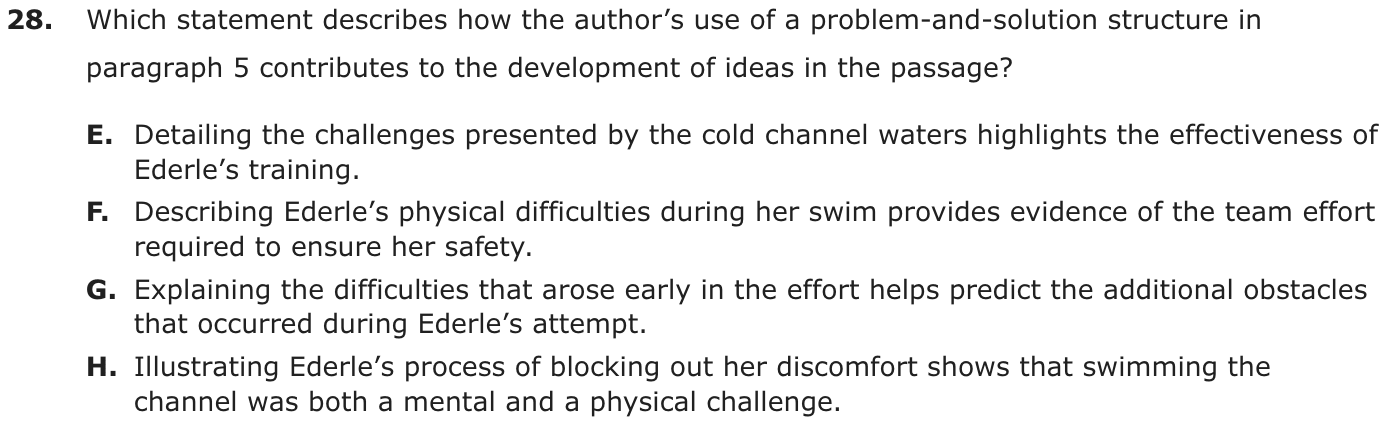
Question 23 of 50
2026 Practice Test A English, question 23Uses the passage above: “Champion of the Channel”.
Question
Which sentence best supports the idea that Ederle succeeded in swimming across the channel because of her innovative approach to the challenge?
- A“Yet, at only nineteen years old, Ederle not only became the first woman to accomplish this feat, she also broke the men’s record by two hours.” (paragraph 1)
- B“At first she shivered in the bone-chilling water even though she had covered her body in eight layers of grease for insulation.” (paragraph 5)
- C“Using a new overhand stroke called the American crawl, Ederle eventually settled into a steady pace, briskly breaking through waves.” (paragraph 5)
- D“The other [tugboat], displaying a sign that read ‘This way, ole kid!’ with an arrow pointing forward, transported her coach, family, and friends.” (paragraph 6)
Show the answer
Correct answer: C
The question asks for the best support for the idea that Ederle’s swim across the channel was successful because of her innovative approach to the challenge.
A. Incorrect. The sentence from paragraph 1 shows that Ederle’s performance was groundbreaking but not necessarily innovative.
B. Incorrect. The layers of grease mentioned in the sentence from paragraph 5 primarily served to insulate Ederle (keep her warm) by helping her maintain her body temperature in the cold water; neither the sentence in paragraph 5 nor the surrounding text evidence establishes that this was an innovative practice. Furthermore, the sentence does not show that she succeeded as a result of this approach.
C. CORRECT. The sentence from paragraph 5 explains that Ederle employed a newly developed, or innovative, type of stroke that allowed her to maintain her pace through the rough water.
D. Incorrect. The tugboat carrying Ederle’s supporters referenced in the sentence from paragraph 6 likely provided encouragement during Ederle’s swim, but the sentence does not show that this approach was innovative or that it enabled Ederle’s success.
Question analysis
In this textual-evidence question, students look for the sentence that best backs up a claim about Gertrude Ederle's English Channel swim: that an innovative approach is what made her succeed. The quotations come from four different moments in her story, so each must be checked for something genuinely new and for a real effect on the outcome.
- NYS standards
- 7R1 textual evidence and inferences
- Grade level
- Grade 7 reading and task
- Compared with grade 7
- At grade 7 Finding the sentence that backs a claim is the standard grade 7 evidence task, set here at a typical level: four short quotations labeled by paragraph and a claim with two parts, what was new and what it achieved.
- Estimated difficulty
- Straightforward: two steps or one careful reading.
- Thinking it demands
- Depth of knowledge 2, skills and concepts · mainly evaluate
- What makes it hard
- Evidence
- Answered from several paragraphs or stanzas
- Reading level
- Passage: about grade 9, 790 words; question and choices: about grade 12, 117 words.
- Students, last 30 days
- Not enough answers yet to show (it takes 10).
Why it is hard, traps and wrong answers (shows the answer)
Why it is hard
The claim joins two ideas, an innovative approach and the success it produced, and only one quotation carries both. The record-breaking sentence proves success with no method, the grease is a technique the passage never calls new and that did not stop her shivering, and the tugboat sign shows her supporters, not her approach. The adjective “new” before the American crawl is the clue that settles it.
Every choice must be checked minor Choosing the answer
Each quotation describes a real moment of the crossing, so each has to clear two tests: a method that was new, and a method that moved her toward the English shore. (Embretson & Wetzel, 1987)
Reading between the lines minor Working it out
Even the right sentence never says the crawl won the swim; the student must take “settled into a steady pace, briskly breaking through waves” as what carried her across. (Graesser, Singer & Trabasso, 1994; Kintsch, 1998)
Strategy: Test each quotation twice: does it describe a method that was new or original, and does it show that method helping her finish? Keep only a sentence that passes both tests.
Traps
- Reads too much in: A reasonable-sounding conclusion that goes further than the text allows.
- Supports only part of the claim: In a question about evidence: a line that backs one half of the claim but not the other, or a related point rather than the claim itself.
The wrong answers, classified
A Supports only part of the claim (King et al., 2004; Thissen, Steinberg & Fitzpatrick, 1989)
Chooses the passage's headline result, first woman across and two hours under the men's record, which proves the success half of the claim but shows no new method behind it.
B Reads too much in (Graesser, Singer & Trabasso, 1994)
Treats eight layers of grease as an innovation, though the passage never calls it new and the sentence says she shivered anyway, so it shows neither originality nor success.
D Reads too much in (Graesser, Singer & Trabasso, 1994)
Reads the cheerful “This way, ole kid!” sign as a clever new idea, but the sentence only says who rode in the second tugboat and links nothing to how she swam.
Working it out, step by step
Break the idea into two parts
This asks you to find evidence. Innovative means new and original, a fresh way to do something. The idea has two parts. Ederle used a new approach, and that approach helped her succeed. The best sentence must show both.
Look for something new
Only one choice uses the word “new.” Choice C says she used “a new overhand stroke called the American crawl” (paragraph 5). A stroke is the way you move your arms to pull through the water. So this is a new method.
See whether it helped her
The same sentence says she “settled into a steady pace, briskly breaking through waves.” Briskly means quickly and with energy. A steady, quick pace moved her forward through the rough water. So the new stroke helped her succeed.
Check each choice
- C fits: it shows a new stroke and the steady pace it gave her.
- A is wrong because it proves she succeeded but shows no new method.
- B is wrong because the passage never calls the grease new, and she still “shivered in the bone-chilling water.”
- D is wrong because the sign on the tugboat cheered her on but was not a new way of swimming.
Watch out: B may sound clever, since the grease was meant to keep her warm. But it shows neither something new nor a reason she won.
Choose the answer
Only C shows a new method that helped Ederle get across. So the answer is C.
Why this answer and not the closest wrong one
B is the strongest pull, since grease to keep warm sounds like a smart trick. Yet the passage never presents the grease as new, and it did not stop her shivering. C names a method the passage calls “new” and shows it paying off in a steady, quick pace.
More questions like this
The original DOE question
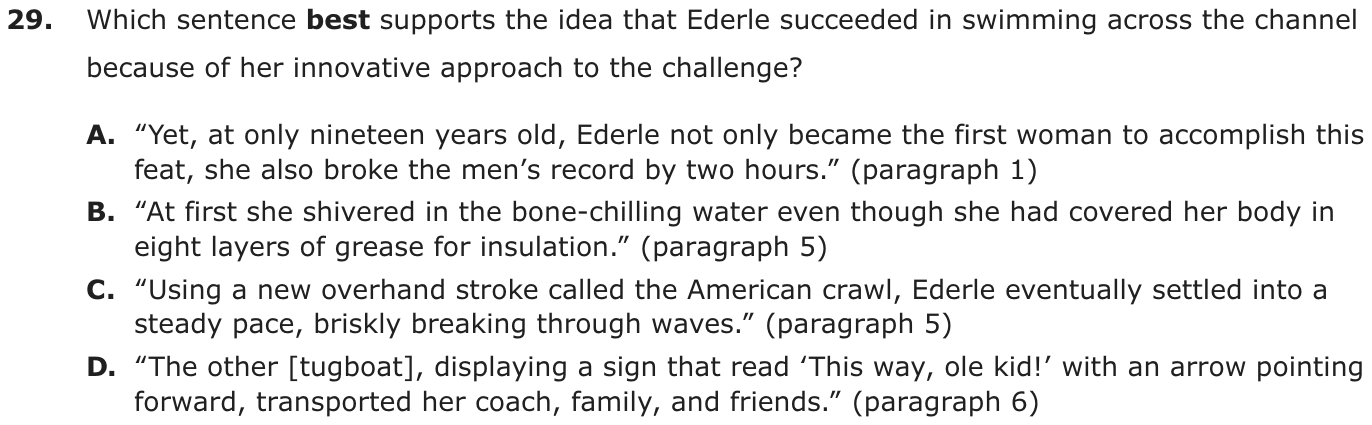
Question 24 of 50
2026 Practice Test A English, question 24Uses the passage above: “Champion of the Channel”.
Question
Paragraph 7 contributes to the development of the central idea of the passage by
- Aillustrating that Ederle’s physical strength and mental fortitude allowed her to stay focused on her goal.
- Bconveying that Ederle pushed herself to the edge of her physical capabilities in order to complete the swim.
- Chighlighting the impact the severe weather had on Ederle’s emotions during her swim.
- Demphasizing the surge of emotions Ederle felt as she came closer to achieving a personal goal.
Show the answer
Correct answer: D
The answer is (D)
The question asks for an explanation of how paragraph 7 contributes to the development of a central idea of the passage. Paragraph 7 is mainly about Ederle’s physical and emotional state as she pushed through a difficult portion of her swim and realized her goal was in sight. A central idea of the passage is that Ederle’s passion and determination allowed her to accomplish her goal of being the first woman to cross the English Channel.
Option D is correct because it emphasizes her passion by referring to the overwhelming emotions Ederle felt as she progressed during her swim, despite the unfavorable conditions (paragraph 7: “For hours Ederle swam, dodging debris with an amused smile” and “Yet Ederle felt indescribably happy as she churned through the sea.”).
Option A is incorrect because, although Ederle needed physical strength and mental fortitude to complete the swim, the paragraph contributes to a central idea because it highlights her emotion as she swam, not her physical strength or mental fortitude.
Option B is incorrect because the paragraph focuses on Ederle’s emotional response to the challenging circumstances and not the idea that Ederle was at the “edge of her physical capabilities.”
Option C is incorrect because Ederle’s feelings of happiness and amusement were caused by her anticipation and excitement as she approached achieving her goal, not by the severe weather.
Question analysis
This reading question asks how the paragraph about the storm near the end of Gertrude Ederle's English Channel swim contributes to the passage's central idea. Students must decide what the paragraph mainly does and connect it to the larger point, while every choice sounds like a fair description of a hard swim.
- Grade level
- Grade 8 reading and task
- Compared with grade 7
- Above grade 7 Explaining how one paragraph develops a central idea is a grade 7 standard, but here several choices sound true of a hard swim through a storm, and the student must see what the paragraph is mainly about, beyond typical grade 7 work.
- Estimated difficulty
- Hard: combines ideas, needs a plan, and has more than one tempting wrong answer.
- Thinking it demands
- Depth of knowledge 3, strategic thinking · mainly analyze
- What makes it hard
- A very close wrong answer major
- Evidence in several places moderate
- How, not what moderate
- Evidence
- Answered from several paragraphs or stanzas
- Reading level
- Passage: about grade 9, 790 words; question and choices: about grade 11, 76 words.
- Students, last 30 days
- Not enough answers yet to show (it takes 10).
Why it is hard, traps and wrong answers (shows the answer)
Why it is hard
Paragraph 7 is crowded with hardship, a storm, a swollen tongue and inflamed ears, so the obvious reading is that it shows toughness. The author's pointed “Yet Ederle felt indescribably happy” turns it toward emotion, which ties it to the passion named in the thesis. Several choices are fair about the swim in general, and this is one of the closer calls on the test, since strength is also on display.
A very close wrong answer major Choosing the answer
The right choice and the strength-and-fortitude one both describe Ederle's inner state as she nears her goal, and only whether paragraph 7 stresses her feelings or her toughness separates them, since she does fight “the stubborn swells for several hours”. (Embretson & Wetzel, 1987; Gorin & Embretson, 2006; Ascalon et al., 2007)
Evidence in several places moderate Working it out
The central idea, her “determination, innovative spirit, and passion for swimming”, is stated in paragraph 1, six paragraphs before the storm it must be connected to. (Kirsch & Mosenthal, 1990; Gorin & Embretson, 2006)
How, not what moderate Working it out
The question asks how paragraph 7 develops the central idea, so the student must weigh what its details stress, the “amused smile” and “indescribably happy”, not just what happens. (Anderson & Krathwohl, 2001)
Strategy: Mark the words in paragraph 7 that describe how Ederle felt and what she endured, decide which the author stresses, then connect that to the passage's stated central idea.
Traps
- True but not the answer: A choice says something accurate about the text that does not answer this question.
- Too broad or too strong: A choice overstates, generalizes, or uses absolute words the text does not support.
The wrong answers, classified
A True but not the answer (King et al., 2004; Embretson & Wetzel, 1987)
Credits strength and mental fortitude, which the hours against the swells partly show, but the paragraph's turn on “Yet” stresses her joy, not her toughness.
B Too broad or too strong (King et al., 2004)
Inflates the swollen tongue and inflamed ears into reaching “the edge of her physical capabilities”, an extreme the paragraph never claims.
C Twists what the text says (King et al., 2004)
Sees both the storm and her feelings but makes the weather the cause of her emotions, when she felt happy in spite of it.
Working it out, step by step
Figure out what the question asks
You need to explain how paragraph 7 helps build the central idea, the main point of the passage. So first find the central idea. Then see what paragraph 7 stresses.
Find the central idea
The last sentence of paragraph 1 says: “Gertrude Ederle’s triumphant swim across the English Channel was a testimony to her determination, innovative spirit, and passion for swimming.” A testimony here means proof. Passion means a strong love for something.
See what happens in paragraph 7
A fierce storm pushes Ederle backward. She fights “the stubborn swells for several hours.” Swells are big, rolling waves. Salt water makes her tongue swell and her ears sore. Then the storm ends, and the sea pushes her “toward the shore and victory.”
Notice what the author stresses
Look at the feeling words. She swims “dodging debris with an amused smile.” In the middle of the pain, the author writes: “Yet Ederle felt indescribably happy as she churned through the sea.” Indescribably means too much to put into words. The word “Yet” shows a surprise. She felt joy in spite of the pain. That shows her passion for swimming.
Check each choice
- D: a “surge of emotions” as she came closer to her goal. A surge is a sudden rush. This matches the smile and the happiness.
- A: strength and “mental fortitude,” or toughness. She was tough, but the paragraph stresses her joy.
- B: the paragraph never says she reached “the edge of her physical capabilities.”
- C says the storm caused her feelings. She was happy in spite of the storm, not because of it.
Watch out: A is tempting because she fought for hours. But the “Yet” sentence turns to how she felt.
Pick the answer
Paragraph 7 builds the passage’s idea of her passion by showing her feelings. So the answer is D.
Why this answer and not the closest wrong one
A is the closest wrong answer, because she does fight “the stubborn swells for several hours.” But the paragraph’s key words are about feeling: “amused smile” and “indescribably happy.” Those link to her “passion for swimming” in paragraph 1. D names those emotions.
More questions like this
The original DOE question
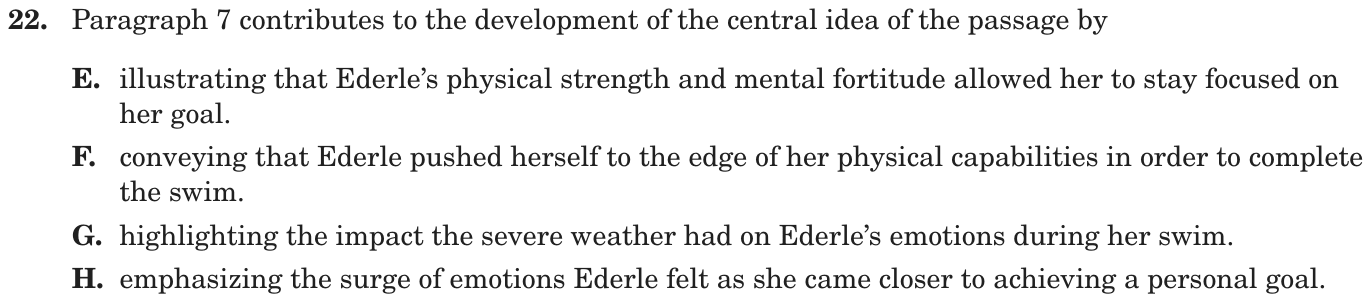
Question 25 of 50
2026 Practice Test A English, question 25Uses the passage above: “Champion of the Channel”.
Question
Which sentence from the passage best conveys the author’s perspective regarding the impact of Ederle’s accomplishment?
- A“Undeterred, Ederle decided to try again.” (paragraph 3)
- B“For hours Ederle swam, dodging debris with an amused smile.” (paragraph 7)
- C“Yet Ederle felt indescribably happy as she churned through the sea.” (paragraph 7)
- D“Ederle had swum into history.” (paragraph 8)
Show the answer
Correct answer: D
The question asks for the sentence from the passage that best conveys the author’s perspective about the impact of Ederle’s swim.
A. Incorrect. Although this option shows Ederle’s determination to accomplish her goal, it does not convey the author’s perspective. Rather, the option reinforces Ederle’s own perspective about the challenge that she was facing.
B. Incorrect. The sentence presented in this option is incorrect because it relates to Ederle’s state of mind as she came closer to achieving her goal and does not provide details about the author’s opinion of the impact of Ederle’s accomplishment.
C. Incorrect. The sentence presented in this option is incorrect because it simply presents Ederle’s emotional state as she nears her goal and does not provide information about the author’s perspective.
D. CORRECT. This option is correct because, throughout the passage, the author emphasizes that Ederle’s accomplishment was memorable and great, which is best stated in the sentence from paragraph 8.
Question analysis
What did Gertrude Ederle's English Channel swim mean in the author's eyes? This point-of-view question asks which quoted sentence best shows the author's perspective on its impact, and because the quotations all come from the story of her attempts, students must tell the author's judgment apart from sentences reporting what Ederle did or felt.
- Grade level
- Grade 7 reading and task
- Compared with grade 7
- At grade 7 Telling an author's perspective apart from a subject's actions and moods is ordinary grade 7 point-of-view work. Each choice is a single sentence with its paragraph given, so little searching is needed and the demand is typical.
- Estimated difficulty
- Straightforward: two steps or one careful reading.
- Thinking it demands
- Depth of knowledge 2, skills and concepts · mainly analyze
- What makes it hard
- How, not what moderate
- Figurative or literary language minor
- Evidence
- Answered from several paragraphs or stanzas
- Reading level
- Passage: about grade 9, 790 words; question and choices: about grade 11, 52 words.
- Students, last 30 days
- Not enough answers yet to show (it takes 10).
Why it is hard, traps and wrong answers (shows the answer)
Why it is hard
Two tests apply at once: whose view a sentence gives, and whether that view concerns the swim's impact. Three sentences narrate Ederle herself, before the swim and in the water, and the word “Undeterred” can make the first sound like the author's praise. The five-word sentence that closes paragraph 8 is easy to skim past, because it states impact through an image rather than in plain terms.
How, not what moderate Working it out
The question asks for the author's judgment, so sentences that narrate Ederle's choices and moods, her decision to try again, her “amused smile”, her happiness in the storm, have to be set aside. (Anderson & Krathwohl, 2001)
Figurative or literary language minor Understanding the question
The only sentence about impact states it as a figure of speech, “Ederle had swum into history”, which must be read as a claim that the swim earned a lasting place. (Graesser, Singer & Trabasso, 1994; Kintsch, 1998)
Strategy: Ask of each quotation whether it reports Ederle's actions or feelings, or whether it is the author stepping back to judge what the swim meant. Only the second kind answers this question.
Traps
- Wrong tone or attitude: Misjudges the tone, attitude or point of view, such as reading admiration as criticism, or taking a character's or subject's feelings for the author's.
- True but not the answer: A choice says something accurate about the text that does not answer this question.
The wrong answers, classified
A True but not the answer (King et al., 2004; Embretson & Wetzel, 1987)
Hears the author admiring her resolve in “Undeterred”, a real touch of judgment, but it concerns her decision after the 1925 failure, not what her eventual swim meant or changed.
B Wrong tone or attitude (Graesser, Singer & Trabasso, 1994)
Takes Ederle's “amused smile” while dodging debris as the author's opinion, though it records her mood in the water and says nothing about the swim's impact.
C Wrong tone or attitude (Graesser, Singer & Trabasso, 1994)
Reads “indescribably happy” as the author's enthusiasm, but the happiness is Ederle's own, felt while she fought the storm, and it says nothing about lasting effects.
Working it out, step by step
Unpack the key words
A perspective is a point of view, the way someone sees a subject. Impact means the effect something has on the world. So you need a sentence where the author judges what Ederle’s swim meant. A sentence that only tells what Ederle did or felt won’t count.
Test each sentence two ways
Ask two questions about each choice. First, is this the author’s own judgment, or does it just tell what Ederle did or felt? Second, is it about the effect of the swim, or about something else? The right sentence passes both tests.
Check each choice
- A: “Undeterred, Ederle decided to try again” (paragraph 3) tells her choice after failing in 1925, so it comes before the swim and can’t show its effect.
- B: “dodging debris with an amused smile” (paragraph 7) shows her mood in the water.
- C: “Ederle felt indescribably happy” (paragraph 7) tells her own feelings, not the author’s view.
- D: “Ederle had swum into history” (paragraph 8) is the author stepping back to judge what the swim meant.
Watch out: Undeterred means not discouraged, so A can sound like praise from the author. But it is about her decision, not the swim’s effect.
Explain the figure of speech
“Swum into history” is a figure of speech, words that mean more than they literally say. History is not a place you can swim to. The phrase means her swim was so important that people will remember it for a long time. So the sentence judges the swim’s impact.
Choose the answer
Only choice D gives the author’s own view of what the swim achieved. So the answer is D.
Why this answer and not the closest wrong one
A is the closest wrong answer, since the word “Undeterred” holds a note of praise. But the sentence reports Ederle’s choice to try again after she failed. That happened before the big swim, so it can’t show the swim’s impact. D is the author’s own claim that the swim made history.
More questions like this
The original DOE question
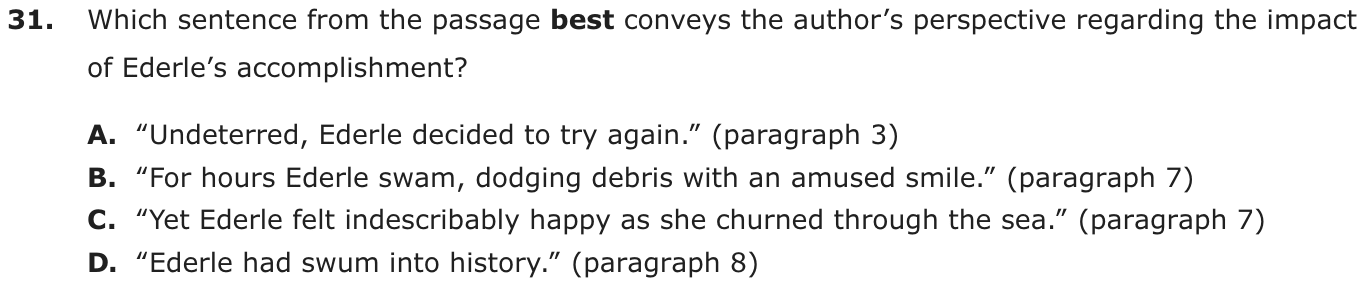
Question 26 of 50
2026 Practice Test A English, question 26Uses the passage above: “Champion of the Channel”.
Question
Which sentence is the best summary of the steps that Ederle took to prepare for her second attempt to swim across the English Channel?
- AWorking with her sister, Ederle waterproofed her goggles using melted candle wax to seal the edges and designed a two-piece silk swimsuit that was lightweight and would not stretch out during the long swim.
- BEderle covered her body in numerous layers of grease for insulation and focused on finding her “sphere” during her swim.
- CEderle began training with her coach, who played music while she swam to help her time her strokes to the music.
- DEderle focused on developing better equipment than the standard bathing suit that proved cumbersome during her first attempt to cross the channel.
Show the answer
Correct answer: A
The question asks for the best summary of Ederle’s steps to prepare for her second attempt to swim across the English Channel.
A. CORRECT. Ederle’s preparation is outlined in paragraph 4. This option is correct because it acknowledges the idea that Ederle involved her sister in this process, and it details the efforts the two took to improve Ederle’s equipment, including sealing her goggles with wax and designing a better swimsuit.
B. Incorrect. The option focuses on Ederle’s actions in the moments before her swim (covering her body with grease for insulation) and during her swim (finding her “sphere”), not her overall preparation methods.
C. Incorrect. The option refers to a way that Ederle’s coach helped Ederle keep her strokes in rhythm during her swim. While this option suggests that Ederle and her coach had made thoughtful preparations, it does not address the many other steps that Ederle took to prepare for the swim.
D. Incorrect. The option does not refer to the series of steps that Ederle took to prepare for her swim, but rather to just one of the efforts made (improving equipment), without acknowledging her sister’s contributions.
Question analysis
This summary question asks which sentence best sums up how Gertrude Ederle got ready for her second try at swimming the English Channel. Because the passage also describes what she and her team did during the crossing, students must separate preparation from the swim itself and judge which summary is complete.
- NYS standards
- 7R2 theme or central idea
- Grade level
- Grade 6 reading and task
- Compared with grade 7
- Below grade 7 This is a one-paragraph summary, the kind of task grade 6 standards describe; grade 7 central-idea work usually follows an idea through a whole text. The real demand is telling preparation apart from the swim.
- Estimated difficulty
- Straightforward: two steps or one careful reading.
- Thinking it demands
- Depth of knowledge 2, skills and concepts · mainly understand
- What makes it hard
- A very close wrong answer moderate
- Every choice must be checked minor
- Evidence
- Answered from one paragraph or stanza
- Reading level
- Passage: about grade 9, 790 words; question and choices: about grade 12, 121 words.
- Students, last 30 days
- Not enough answers yet to show (it takes 10).
Why it is hard, traps and wrong answers (shows the answer)
Why it is hard
Paragraph 4 holds all of the preparation, but the passage keeps describing things Ederle and her team did, so getting ready must be told apart from the swim. The grease is the hardest to place, because she put it on before wading in, on the day of the crossing itself. Between the two equipment choices, the one that lists the goggles, the silk suit and her sister's help is the fuller summary of several steps.
A very close wrong answer moderate Choosing the answer
The right summary and the one about better equipment than the standard bathing suit describe the same work; only the waxed goggles and Meg's part, missing from the shorter one, separate them. (Embretson & Wetzel, 1987; Gorin & Embretson, 2006; Ascalon et al., 2007)
Every choice must be checked minor Choosing the answer
Two choices borrow real details from the crossing, the grease she wore and the songs played from the tugboat, so each has to be placed before or during the swim. (Embretson & Wetzel, 1987)
Strategy: Locate the paragraph about getting ready, list each preparation step and who took part, and choose the sentence that covers that list most fully without adding events from another part of the passage.
Traps
- Too narrow: A single detail offered as the central idea or a summary, or a summary that keeps minor details and leaves out an essential part.
- Wrong part of the text: A choice is true of another paragraph, stanza or speaker than the one asked about.
- Twists what the text says: Uses the text's topic and ideas but changes what it says: who did it, how much, when, or why.
The wrong answers, classified
B Wrong part of the text (Kirsch & Mosenthal, 1990)
Takes the grease she wore on the day and her search for her “sphere” in the water, both from paragraph 5's account of the swim, as advance preparation.
C Twists what the text says (King et al., 2004)
Turns the phonograph her coach played from a tugboat during the crossing into training sessions before it, which the passage never describes.
D Too narrow (King et al., 2004)
Captures the idea of better equipment but names only the bathing suit, leaving out the wax-sealed goggles and her sister Meg, so it summarizes one step of several.
Working it out, step by step
Know what a summary needs
A summary retells the main points in a few words. Here you need the steps Ederle took to get ready before her second try. A good summary includes all of those steps. It leaves out things that happened during the swim itself.
Find the getting-ready paragraph
Paragraph 4 opens with “To prepare for the marathon swim, Ederle found ways to improve her equipment.” The word “prepare” signals that this paragraph holds the steps. Equipment means the gear she used.
List each step
- With her sister Meg, she found that “melted candle wax perfectly sealed goggle edges,” so water stayed out of her goggles.
- Together the sisters “designed a two-piece silk swimsuit” to replace her old one.
- The new suit “weighed little and allowed for easy movement,” unlike her old suit, which had stretched and filled with water.
Check each choice
- A fits: it names her sister, the waxed goggles and the light silk suit.
- B is wrong because the grease and her “sphere” belong to paragraph 5, the day of the swim.
- C is wrong because her coach played music from a tugboat during the swim (paragraph 6), not in training.
- D is wrong because it leaves out the goggles and Meg.
Watch out: D is true as far as it goes. But it covers only one step, so it is too narrow to be the best summary.
Choose the answer
Choice A lists all the preparation in paragraph 4, and nothing from the swim itself. So the answer is A.
Why this answer and not the closest wrong one
D comes closest, since improving her equipment is what paragraph 4 is about. But D mentions only the swimsuit. It skips the wax-sealed goggles and her sister’s help. A summary of the steps should include every step, and only A does.
More questions like this
The original DOE question
Question 27 of 50
2026 Practice Test A English, question 27Uses the passage above: “Champion of the Channel”.
Question
The idea that many people were interested in Ederle’s attempt to swim the channel is illustrated in the passage mainly through the
- Ainformation about Ederle’s competition with another female swimmer who was also attempting to cross the channel.
- Bdetails about the reports of Ederle’s progress during the swim and the celebration of her successful completion of the swim.
- Cdetails about how Ederle’s historic swim contributed to an increase in the number of people learning how to swim.
- Dinformation about the resources Ederle used throughout her swim to maintain her motivation and stamina.
Show the answer
Correct answer: B
The question asks how the idea that many people were interested in Ederle’s attempt to swim the channel is mainly illustrated in the passage.
A. Incorrect. While paragraph 3 states that “a rival female swimmer was preparing to make her second attempt at the crossing as well,” which suggests that Ederle’s competitor was interested in Ederle’s attempt to swim the channel, this information does not establish that many people were interested in Ederle’s attempt.
B. CORRECT. Paragraph 6 includes the detail that newspaper reporters followed Ederle on a tugboat and “wired dispatches of her progress to shore,” which suggests that an audience was waiting for news about Ederle’s progress. Paragraph 8 states that when Ederle reached the shore, “the waiting crowd roared, honked their automobile horns, blasted their tugboat whistles, and set off flares that flashed in the sky.” Further, paragraph 9 states that when Ederle returned to New York, “thousands of people” attended a parade in her honor. These details describing the celebration of Ederle’s feat further illustrate the idea that many people were interested in what she had accomplished.
C. Incorrect. While paragraph 9 states that “more than 60,000 people credited [Ederle] with motivating them to earn their American Red Cross swimming certificates,” this detail describes how Ederle’s historic swim influenced people after the fact but does not illustrate the level of public interest during the attempt itself.
D. Incorrect. Paragraph 6 provides details about how Ederle’s “coach, family, and friends” displayed signs, played songs, and “passed her baby bottles of broth” to help her maintain her motivation and stamina. However, these resources do not suggest the idea that people beyond Ederle’s immediate support team were interested in her attempt to swim the channel.
Question analysis
Public interest in Gertrude Ederle's 1926 English Channel swim is the focus of this reading question, which asks which details in the passage mainly illustrate that many people cared about her attempt. Students must gather signs of attention from several paragraphs, and every choice points to real details that involve other people in her story.
- Grade level
- Grade 7 reading and task
- Compared with grade 7
- At grade 7 Matching an idea to the details that develop it is standard grade 7 work. The supporting details are spread across several late paragraphs and must be gathered before the choices can be judged, a typical grade 7 demand.
- Estimated difficulty
- Moderate: several steps, or a close reading with one strong distractor.
- Thinking it demands
- Depth of knowledge 2, skills and concepts · mainly evaluate
- What makes it hard
- Evidence in several places moderate
- Reading between the lines minor
- Evidence
- Answered from several paragraphs or stanzas
- Reading level
- Passage: about grade 9, 790 words; question and choices: about grade 13, 92 words.
- Students, last 30 days
- Not enough answers yet to show (it takes 10).
Why it is hard, traps and wrong answers (shows the answer)
Why it is hard
The idea has two parts, many people and interest in the attempt itself, and each wrong choice satisfies one at most. The strongest pull is the 60,000 swimming certificates, a huge number tied to Ederle but describing what people did in the years afterward. Students who hold both parts in mind, and who remember that paragraph 6 carries reporters as well as family, find the details that answer it.
Evidence in several places moderate Working it out
The right details sit in three places: reporters wiring dispatches from a tugboat in paragraph 6, the roaring crowd and flares in paragraph 8, and the New York parade in paragraph 9. (Kirsch & Mosenthal, 1990; Gorin & Embretson, 2006)
Reading between the lines minor Working it out
No sentence says people were interested; the student must infer an eager audience from reporters sending news to shore and a crowd already “waiting” when she landed. (Graesser, Singer & Trabasso, 1994; Kintsch, 1998)
Strategy: Hold each choice to both parts of the idea in the stem: the details must involve many people, and they must show interest in the attempt itself, not some other link to Ederle.
Traps
- Supports only part of the claim: In a question about evidence: a line that backs one half of the claim but not the other, or a related point rather than the claim itself.
The wrong answers, classified
A Supports only part of the claim (King et al., 2004; Thissen, Steinberg & Fitzpatrick, 1989)
Matches “attempting to cross the channel” to the stem's attempt, but the rival preparing her own crossing in paragraph 3 is one swimmer, not many people following Ederle.
C Supports only part of the claim (King et al., 2004; Thissen, Steinberg & Fitzpatrick, 1989)
Counts the 60,000 people who earned swimming certificates, which shows many people moved by Ederle but describes her influence after the swim, not interest in the attempt itself.
D Supports only part of the claim (King et al., 2004; Thissen, Steinberg & Fitzpatrick, 1989)
Points to the coach, family and friends who played songs and passed broth from the tugboat, people who cared about the attempt but a small circle, not a wide public.
Working it out, step by step
Find the two parts of the idea
This asks you to find the details that best show an idea. The idea has two parts. Many people, not just a few, cared about Ederle. And they were interested in the attempt itself, the swim as it happened. The right choice must show both.
Look for news and crowds
Paragraph 6 says reporters on a tugboat “wired dispatches of her progress to shore.” Dispatches are news reports. In paragraph 8, “The waiting crowd roared” as she stepped onto the English shore. In paragraph 9, “thousands of people shouted” her name at a parade in New York.
See what these details show
Reporters send news only when readers want it. So people on land were following the swim as it happened. The crowd was “waiting” before she even arrived. Then thousands cheered her at home. These details show that a great many people cared about her swim.
Check each choice
- B fits: the reports of her progress and the celebration show many people following the swim.
- A is wrong because the rival swimmer in paragraph 3 is one person, not many people.
- C is wrong because the swimming certificates came in later years, after the swim.
- D is wrong because her coach, family and friends were a small group, not the wider public.
Watch out: C has the biggest number, more than 60,000 people. But it tells what people did after the swim was over.
Choose the answer
Only B shows many people paying attention while Ederle swam and when she finished. So the answer is B.
Why this answer and not the closest wrong one
C is the closest wrong answer, since 60,000 is a huge number of people. But they earned their certificates “over the next few years,” long after the swim. That shows her influence, not interest in the attempt. B shows people following the swim as it happened and cheering when she finished.
More questions like this
The original DOE question
Question 28 of 50
2026 Practice Test A English, question 28Uses the passage above: “Champion of the Channel”.
Question
The table builds on the information in the passage mainly by
- Aemphasizing that people have continued to swim across the channel and have significantly improved the speed record.
- Bsuggesting that Ederle inspired many women to swim across the channel to attempt to break the current speed record.
- Crevealing that other women competed with Ederle to set a record time for swimming across the English Channel.
- Dproviding a comparison between the earliest channel-swimming records and the current record times.
Show the answer
Correct answer: A
The question asks how the table mainly builds on the information in the passage.
A. CORRECT. The table supports the information in the passage by showing that people have continued to swim the channel and have significantly improved on past records. The information in the table about records set by those who came after Ederle builds on the idea that “Gertrude Ederle’s accomplishment proved to the world that with determination and passion, it was possible for a person to achieve his or her goals” (paragraph 9).
B. Incorrect. Even though paragraph 9 states that Ederle “inspired [everyday American citizens] to be more active” and the table presents the time for the current female record holder, there is no indication in the passage or in the table that the subsequent female record holders were inspired to swim across the channel by Ederle.
C. Incorrect. Although paragraph 3 mentions that Ederle had a female rival and the table includes the speed record of another female swimmer, the passage does not provide information about other female swimmers competing with Ederle to set the channel-swim record.
D. Incorrect. Although paragraph 1 mentions that Ederle “broke the men’s record by two hours” and the table allows for comparisons between the earliest speed records and those of the present day, the passage mentions no channel-swim records set after Ederle’s swim, so it says nothing about current record times. The table allows for comparison, but this aspect of the table does not build on the information presented in the passage.
Question analysis
This question asks how a table of English Channel speed records, from Matthew Webb's 1875 crossing to a 2012 record, builds on the passage about Gertrude Ederle. Students must read times from two eras and decide what the table adds to the text, while the choices mix accurate observations about the table with claims neither source supports.
- Grade level
- Grade 8 reading and task
- Compared with grade 7
- Above grade 7 Relating a table to a passage is within grade 7 standards, but here the student must compare records from two eras, connect them to ideas in the text and choose among closely worded statements, well above typical grade 7 demand.
- Estimated difficulty
- Among the hardest on the SHSAT: a non-obvious approach, heavy reading, or a well-hidden trap.
- Thinking it demands
- Depth of knowledge 3, strategic thinking · mainly analyze
- What makes it hard
- A very close wrong answer major
- Reading a figure, table or graph moderate
- How, not what moderate
- Evidence
- Answered from the whole text
- Reading level
- Passage: about grade 9, 790 words; question and choices: about grade 11, 78 words.
- Corrected from the DOE handbook
- A self-contradictory statement in the explanation was corrected.
- Students, last 30 days
- Not enough answers yet to show (it takes 10).
Why it is hard, traps and wrong answers (shows the answer)
Why it is hard
This is one of the hardest questions on the test because a wrong choice describes the table exactly, in its own words. The passage stops with Ederle's 1926 record, and what the table adds is the rest of the story: swimmers kept crossing, and the record fell to under seven hours. Students who describe what the table contains, rather than what it tells a reader who has finished the passage, lose the point.
A very close wrong answer major Choosing the answer
The comparison choice repeats the table's own headings, “Earliest Speed Records” and “Current Speed Records”, and is literally true; only the stem's “builds on the information in the passage” and “mainly” separate it from the choice about the falling record. (Embretson & Wetzel, 1987; Gorin & Embretson, 2006; Ascalon et al., 2007)
Reading a figure, table or graph moderate Understanding the question
The student must compare times across the table's two sections, from Webb's 21 hours 45 minutes in 1875 and Ederle's 14 hours 31 minutes to Grimsey's 6 hours 55 minutes in 2012. (Lesh, Post & Behr, 1987; Kirsch & Mosenthal, 1990)
How, not what moderate Working it out
The question asks what the table adds to a passage that ends in 1926, so the student must say what its later rows extend, not what its layout holds. (Anderson & Krathwohl, 2001)
Strategy: Read both sections of the table and say what it adds to Ederle's story, then keep only a choice that the table shows and that connects to an idea the passage itself develops.
Traps
- Wrong purpose or structure: Names a purpose, structure or effect that the part does not serve, or describes what a part says when the question asks what it does.
- Reads too much in: A reasonable-sounding conclusion that goes further than the text allows.
- Twists what the text says: Uses the text's topic and ideas but changes what it says: who did it, how much, when, or why.
The wrong answers, classified
B Reads too much in (Graesser, Singer & Trabasso, 1994)
Assumes Ederle inspired many women to chase the record, but the table lists one later woman, Yvetta Hlavacova in 2006, and nothing links her or anyone else to Ederle.
C Twists what the text says (King et al., 2004)
Joins the rival female swimmer of paragraph 3 to Hlavacova's 2006 time, inventing a contest among women in Ederle's day that neither the table nor the passage shows.
D Wrong purpose or structure (Anderson & Krathwohl, 2001)
Describes the table's layout, earliest records beside current ones, which is accurate, but stops at what it contains instead of saying what the comparison adds to Ederle's story.
What was corrected from the DOE handbook, and why
- Explanation: In rejecting choice D, the handbook notes that paragraph 1 says Ederle “broke the men’s record by two hours,” and then says “there is no mention in the passage of past, present, or future channel-swim records.” Paragraph 1 does mention a past record: the one Ederle broke. What the passage never mentions is a record set after hers, which is what the table’s “Current Speed Records” add. The explanation now says the passage mentions no channel-swim records set after Ederle’s swim, so it says nothing about current record times. The reason for rejecting D is otherwise unchanged.
Working it out, step by step
Understand the question
To build on something means to add to it. So this asks what the table adds to what the passage already tells you. Don’t just describe what is in the table. Ask what a reader learns from it after finishing the passage.
Read the table’s two parts
The table has two parts, “Earliest Speed Records” and “Current Speed Records.” These rows matter most:
Year Swimmer Time 1875 Matthew Webb 21 hours, 45 minutes 1926 Gertrude Ederle 14 hours, 31 minutes 2012 Trent Grimsey 6 hours, 55 minutes Compare the times
Ederle swam for 14 hours and 31 minutes. Half of her time would be about 7 hours and 15 minutes. Grimsey’s 2012 time, 6 hours and 55 minutes, is even faster than that. So people kept swimming the channel after 1926, and the record got much faster.
See what the passage leaves out
The passage does mention one record. In paragraph 1, Ederle “broke the men’s record by two hours.” But the passage stops in 1926. It never tells of any record set after her swim. The table adds that later part of the story: swimmers kept crossing, and the record kept falling.
Check each choice
- A fits: people kept crossing and “significantly improved the speed record,” and significantly means by a lot.
- B is wrong because nothing links any later woman to Ederle, and the table lists only one later woman.
- C is wrong because Ederle is the only woman of her time in the table, and Hlavacova swam 80 years later, in 2006.
- D is wrong because it only names what the table holds, not what the comparison adds to Ederle’s story.
Watch out: D uses the table’s own headings, so it sounds right. But the question asks what the table adds, not how it is laid out.
Choose the answer
The table carries the story past 1926 and shows the record falling far below Ederle’s time. So the answer is A.
Why this answer and not the closest wrong one
D comes closest, because the table really does set the earliest and current records side by side. But D stops at describing the table. A says what that comparison shows a reader who has finished the passage: the record kept falling, from Ederle’s 14 hours and 31 minutes to under 7 hours.
More questions like this
The original DOE question
Question 29 of 50
2026 Practice Test A English, question 29Passage Excerpt from “The Spirit of the Herd”
Excerpt from “The Spirit of the Herd”
by Dallas Lore Sharp
In this excerpt, published in 1914, author and professor Dallas Lore Sharp describes a summer cattle roundup in Oregon. The heat and dust had been relentless for three days. The cowboys were exhausted, and the cattle were restless. The ranch boss, Wade, had led the drive to a watering place, only to find it empty.
Along with the wagon had come the fresh horses—one of them being Peroxide Jim, a supple, powerful, clean-limbed buckskin, a horse, I think, that had as fine and intelligent an animal-face as any creature I ever saw. Wade had been saving this horse for emergency work. And why should he not have been saved fresh for just such a need as this? Are there not superior horses as well as superior men—a Peroxide Jim to complement a Wade?
The horse knew the cattle business and knew his rider perfectly; and though there was nothing like sentiment about the boss of the P Ranch riders, his faith in Peroxide Jim was complete. . . .
The desert, where the herd was camped, was one of the highest of a series of tablelands, or benches; it lay as level as a floor, rimmed by sheer rock, from which there was a drop to the bench of sage below. The herd when overtaken by the dusk had been headed for a pass descending to the next lower bench, but was now halted within a mile of the rim rock on the east, where there was a perpendicular fall of about three hundred feet. . . .
In the taut silence of the stirless desert night, with the tension of the herd at the snapping-point, any quick, unwonted sight or sound would stampede them. The sneezing of a horse, the flare of a match, would be enough to send the whole four thousand headlong—blind, frenzied, trampling—till spent and scattered over the plain.
And so, as he rode, Wade began to sing. The rider ahead of him took up the air and passed it on until, above the stepping stir of the hoofs rose the faint voices of the men, and all the herd was bound about by the slow plaintive measures of some old song. It was not to soothe their savage breasts that the riders sang to the cattle, but rather to preempt the dreaded silence, to relieve the tension, and so to prevent the shock of any sudden startling noise.
So they sang and rode and the night wore on to one o’clock, when Wade, coming up on the rim-rock side, felt a cool breeze fan his face, and caught a breath of fresh, moist wind with the taste of water in it.
He checked his horse instantly, listening as the wind swept past him over the cattle. But they must already have smelled it, for they had ceased their milling, the whole herd standing motionless, the indistinct forms close to him in the dark showing their bald faces lifted to drink the sweet wet breath that came over the rim. Then they started on again, but faster, and with a rumbling now from their hoarse throats that tightened Wade’s grip on the reins.
The sound seemed to come out of the earth, a low, rumbling mumble, as dark as the night and as wide as the plain, a thick, inarticulate bellow that stood every rider stiff in his stirrups. . . .
Then the breeze caught the dust and carried it back from the gray-coated, ghostly shapes, and Wade saw that the animals were still moving in a circle. He must keep them going. He touched his horse to ride on with them, when across the black sky flashed a vivid streak of lightning.
There was a snort from the steers, a quick clap of horns and hoofs from far within the herd, a tremor of the plain, a roar, a surging mass—and Wade was riding the flank of a wild stampede. Before him, behind him, beside him, pressing hard upon his horse, galloped the frenzied steers, and beyond them a multitude borne on, and bearing him on, by the heave of the galloping herd.
Wade was riding for his life. He knew it. His horse knew it. He was riding to turn the herd, too, back from the rim, as the horse also knew. The cattle were after water—water-mad—ready to go over the precipice to get it, carrying horse and rider with them. Wade was the only rider between the herd and the rim. It was black as death. He could see nothing in the sage, could scarcely discern the pounding, panting shadows at his side. He knew that he was being borne toward the rim, how fast he could not tell, but he knew by the swish of the brush against his tapaderos and the plunging of the horse that the ground was growing stonier, that they were nearing the rocks.
To outrun the herd was his only chance for life. If he could come up with the leaders he might not only escape, but even stand a chance of heading them off upon the plain and saving the herd. There were cattle still ahead of him; how many, what part of them all, he could not make out in the dark. But the horse knew. The reins hung on his straight neck, where his rider had dropped them, as, yelling and firing over the wild herd, he had given this horse the race to win, to lose.
They were riding the rim. Close on their left bore down the flank of the herd, and on their right, under their very feet, was a precipice, so close that they felt its blackness—its three hundred feet of fall! . . .
. . . Then Wade found himself racing neck and neck with a big white steer, which the horse, with marvelous instinct, seemed to pick out from a bunch, and to cling to, forcing him gradually ahead, till, cutting him free from the bunch entirely, he bore him off into the swishing sage.
The steers coming on close behind followed their leader, and in, after them, swung others. The tide was turning from the rim. More and more were veering, and within a short time the whole herd, bearing off from the cliffs, was pounding over the open plains.
Whose race was it? It was Peroxide Jim’s, according to Wade, for not by word or by touch of hand or knee had the horse been directed in the run. From the flash of the lightning the horse had taken the bit, had covered an indescribably perilous path at top speed, had outrun the herd and turned it from the edge of the rim rock, without a false step or a tremor of fear.
From “The Spirit of the Herd” by Dallas Lore Sharp—Public Domain
tablelands: plateaus, flat areas of land sharply elevated from the surrounding area
tapaderos: leather covers for stirrups
Question
Which sentence from the excerpt best explains why Wade reserved Peroxide Jim for “emergency work” (paragraph 1)?
- A“Are there not superior horses as well as superior men—a Peroxide Jim to complement a Wade?” (paragraph 1)
- B“Before him, behind him, beside him, pressing hard upon his horse, galloped the frenzied steers, and beyond them a multitude borne on, and bearing him on, by the heave of the galloping herd.” (paragraph 10)
- C“He knew that he was being borne toward the rim, how fast he could not tell, but he knew by the swish of the brush against his tapaderos and the plunging of the horse that the ground was growing stonier, that they were nearing the rocks.” (paragraph 11)
- D“From the flash of the lightning the horse had taken the bit, had covered an indescribably perilous path at top speed, had outrun the herd and turned it from the edge of the rim rock, without a false step or a tremor of fear.” (paragraph 16)
Show the answer
Correct answer: D
The question asks which sentence from the excerpt best explains why Wade reserved Peroxide Jim for “emergency work” (paragraph 1).
A. Incorrect. While the sentence from paragraph 1 refers to Peroxide Jim as being a superior horse, it does not tell why he would be useful in an emergency. The mention of Peroxide Jim’s superiority does not describe the attributes that would make him an appealing choice for use in an emergency.
B. Incorrect. The sentence from paragraph 10 does not describe the actions of Peroxide Jim. The sentence describes what Wade and the horse were experiencing, but it does not include any reference to how Peroxide Jim was responding to the situation.
C. Incorrect. The sentence from paragraph 11 describes Wade’s experiences and does not focus on the actions of Peroxide Jim. It reveals Wade’s awareness of the danger he was in, but the only reference to Peroxide Jim in this sentence is the description of the horse having to work harder to run on the stonier ground as they neared the edge: from “the plunging of the horse,” Wade knew “that the ground was growing stonier, that they were nearing the rocks.” This quotation does not show that Peroxide Jim was the right horse to use for emergency work because it does not indicate, at this point in the text, that he was responding in a way that saved the herd or Wade.
D. CORRECT. The sentence from paragraph 16 describes Peroxide Jim’s high level of skill and ability to perform in a life-and-death situation. Not only did Peroxide Jim recognize the emergency immediately (“From the flash of the lightning the horse had taken the bit”), but the horse also proved to have the physical capability (“had covered an indescribably perilous path at top speed, had outrun the herd and turned it from the edge of the rim rock”) and the mental toughness (“without a false step or a tremor of fear”) required to respond appropriately to the dangerous situation.
Question analysis
This evidence question on Dallas Lore Sharp’s “The Spirit of the Herd,” a 1914 account of a night stampede on an Oregon cattle drive, asks which sentence best explains why the ranch boss Wade kept his horse Peroxide Jim for “emergency work.” The four quoted sentences come from different parts of the excerpt and are long, so the choice takes careful reading.
- Grade level
- Grade 8 reading and task
- Compared with grade 7
- At grade 7 Finding the sentence that best explains a detail is regular grade 7 evidence work. The four quotations, though, are long sentences from across a dense excerpt written in 1914, so the reading load is heavier than usual.
- Estimated difficulty
- Moderate: several steps, or a close reading with one strong distractor.
- Thinking it demands
- Depth of knowledge 2, skills and concepts · mainly evaluate
- What makes it hard
- Evidence in several places moderate
- A lot to read minor
- Reading between the lines minor
- Evidence
- Answered from the whole text
- Reading level
- Passage: about grade 8, 1160 words; question and choices: about grade 13, 160 words.
- Students, last 30 days
- Not enough answers yet to show (it takes 10).
Why it is hard, traps and wrong answers (shows the answer)
Why it is hard
The question links the start of the excerpt to its end, and the nearest quotation is the most tempting: the narrator’s rhetorical question about “superior horses” sits beside the phrase and seems to explain it. It praises the horse without showing what he can do. The two stampede sentences show the emergency itself, so the point goes to students who look for the horse acting on his own and find it in the final paragraph.
Evidence in several places moderate Working it out
The phrase “emergency work” is in paragraph 1, but the proof of the horse’s worth comes only at the very end, in paragraph 16, after the stampede has been turned. (Kirsch & Mosenthal, 1990; Gorin & Embretson, 2006)
A lot to read minor Understanding the question
Three of the quotations run 33 to 46 words, and two of them describe the stampede in vivid detail without saying what the horse does, so sorting them takes time. (Kintsch, 1998; Gorin & Embretson, 2006; Freedle & Kostin, 1993)
Reading between the lines minor Working it out
Students must decide what an emergency horse needs, speed, nerve and judgment without a rider’s guidance, before the last sentence reads as an answer to paragraph 1. (Graesser, Singer & Trabasso, 1994; Kintsch, 1998)
Strategy: Decide what a horse saved for emergencies would need to be able to do, then pick the quotation that gives the clearest proof that Peroxide Jim can do it.
Traps
- Supports only part of the claim: In a question about evidence: a line that backs one half of the claim but not the other, or a related point rather than the claim itself.
- True but not the answer: A choice says something accurate about the text that does not answer this question.
The wrong answers, classified
A Supports only part of the claim (King et al., 2004; Thissen, Steinberg & Fitzpatrick, 1989)
Stays beside the phrase in paragraph 1 and accepts the claim that Peroxide Jim is “superior,” which praises him but gives no sign of what makes him useful in a crisis.
B True but not the answer (King et al., 2004; Embretson & Wetzel, 1987)
Picks the most vivid picture of the stampede, which shows the emergency itself but says nothing about how Peroxide Jim handles it.
C Supports only part of the claim (King et al., 2004; Thissen, Steinberg & Fitzpatrick, 1989)
Notices “the plunging of the horse” at a tense moment, but the sentence is about Wade sensing the rocks ahead, not about the horse meeting the danger.
Working it out, step by step
Figure out what the question asks
This asks for evidence. In paragraph 1, Wade was saving Peroxide Jim for “emergency work.” Which sentence best explains why? You need a sentence that shows what this horse can do when something goes wrong.
Decide what to look for
An emergency is a sudden, dangerous event. A horse saved for one should be fast, steady and smart. It should act quickly when things go wrong. So look for the sentence that shows the horse himself doing that.
Read the last sentence of the excerpt
Paragraph 16 says “From the flash of the lightning the horse had taken the bit, had covered an indescribably perilous path at top speed, had outrun the herd and turned it from the edge of the rim rock, without a false step or a tremor of fear.”
Put the sentence in plain words
The bit is the metal bar in a horse’s mouth that the reins attach to. A horse that “had taken the bit” runs on its own. Perilous means dangerous. A tremor is a small shake. So the moment the stampede began, the horse took charge. He raced along a dangerous path, got ahead of the herd and turned it from the cliff. He never stumbled or showed fear.
Check each choice
- A does not fit. It calls him “superior,” but it shows no skill.
- B does not fit. It shows the stampede, but not how the horse handles it.
- C does not fit. It is about Wade sensing the rocks ahead.
- D fits. It shows the horse saving the herd in a real emergency.
Watch out: A sits right next to “emergency work” in paragraph 1, so it seems to explain it. But praise is not proof.
Choose the answer
The last sentence shows exactly why the horse was worth saving for emergencies. So the answer is D.
Why this answer and not the closest wrong one
A is the closest wrong choice. It sits beside the words “emergency work” and praises the horse. But calling a horse “superior” does not say what it can do. D shows the horse in action: fast, sure-footed and fearless in a real emergency. That explains why Wade saved him.
More questions like this
The original DOE question
The passage “Excerpt from “The Spirit of the Herd”” as printed (page 41)
Question 30 of 50
2026 Practice Test A English, question 30Uses the passage above: “Excerpt from “The Spirit of the Herd””.
Question
Paragraphs 1–2 contribute to the development of the central idea of the excerpt by
- Arevealing the respect Wade had for his horse.
- Bemphasizing Wade’s high expectations of his horse and himself.
- Cindicating that Wade and his horse understood the cattle business.
- Ddemonstrating Wade’s ability to gauge a horse’s competence.
Show the answer
Correct answer: A
The question asks how paragraphs 1–2 contribute to the development of the central idea of the excerpt.
A. CORRECT. The description of Peroxide Jim in paragraph 1 indicates that the horse was a fine animal (“Along with the wagon had come the fresh horses—one of them being Peroxide Jim, a supple, powerful, clean-limbed buckskin, a horse, I think, that had as fine and intelligent an animal-face as any creature I ever saw” [paragraph 1]). The statement in paragraph 2 that Wade’s “faith in Peroxide Jim was complete” supports the central idea of the excerpt that Wade believed in Peroxide Jim’s abilities even before the horse turned the herd and saved the cattle.
B. Incorrect. Paragraphs 1–2 do not emphasize Wade’s high expectations for himself, nor are these expectations a central idea of the excerpt. The narrator expresses a high opinion of Wade’s abilities in his comparison of Peroxide Jim and Wade, referring to the horse as a “complement” (paragraph 1) for Wade; however, Wade showed complete trust in the horse’s ability to save the herd without his help, as evidenced by Wade dropping the reins to allow the horse to control the situation (paragraph 12).
C. Incorrect. The paragraphs refer to Peroxide Jim’s ability to handle cattle; in fact, paragraph 2 says that “the horse knew the cattle business.” It can be inferred that Wade had this knowledge as well, but this idea is not the focus of paragraphs 1–2 and is not the central idea of the excerpt.
D. Incorrect. Wade’s ability to judge a horse’s competence is not a central idea of the excerpt. The event described in the text is proof that Wade knew how to judge a horse’s ability: Wade trusted Peroxide Jim, and Peroxide Jim did not let him down. The option puts the focus on Wade and one of his strengths, when the central idea and focus of the excerpt is Peroxide Jim’s abilities and strengths, not Wade’s.
Question analysis
This central-idea question asks how the first two paragraphs of “The Spirit of the Herd,” which introduce the buckskin horse Peroxide Jim and the ranch boss Wade, contribute to the excerpt’s central idea. Students connect these opening details to the story of the stampede that follows. The narrator’s old-fashioned rhetorical questions can make the paragraphs’ point hard to pin down.
- Grade level
- Grade 8 reading and task
- Compared with grade 7
- At grade 7 Explaining how opening paragraphs build a central idea is typical grade 7 work. The two paragraphs are short, but the narrator’s rhetorical questions and old-fashioned phrasing must be decoded, and the central idea must come from the rest of the excerpt.
- Estimated difficulty
- Moderate: several steps, or a close reading with one strong distractor.
- Thinking it demands
- Depth of knowledge 2, skills and concepts · mainly analyze
- What makes it hard
- Reading between the lines moderate
- How, not what moderate
- Complex sentences minor
- Evidence
- Answered from several paragraphs or stanzas
- Reading level
- Passage: about grade 8, 1160 words; question and choices: about grade 9, 48 words.
- Students, last 30 days
- Not enough answers yet to show (it takes 10).
Why it is hard, traps and wrong answers (shows the answer)
Why it is hard
The opening paragraphs talk about both Wade and his horse, so every choice can find a foothold in them. The question turns on the excerpt as a whole, which ends by giving the race to Peroxide Jim, and only Wade’s regard for the horse points toward that ending. Students lose the point by picking a skill of Wade’s own, which his trust only implies, or by repeating “knew the cattle business,” a line said of the horse alone.
Reading between the lines moderate Working it out
Respect is never named; it must be read from Wade “saving this horse for emergency work” and from his “faith in Peroxide Jim” being “complete” in paragraph 2. (Graesser, Singer & Trabasso, 1994; Kintsch, 1998)
How, not what moderate Working it out
The question asks how two opening paragraphs serve the excerpt’s central idea, so students must know where the story ends, with the race credited to the horse, before judging them. (Anderson & Krathwohl, 2001)
Complex sentences minor Understanding the question
Paragraph 1 makes its point through two old-fashioned rhetorical questions, beginning “And why should he not” and “Are there not superior horses,” whose answers students must supply. (Abedi & Lord, 2001; Freedle & Kostin, 1993; Messick, 1989)
Strategy: Restate paragraphs 1 and 2 in plain words, decide what the excerpt as a whole is mainly about, and pick the option that links the two.
Traps
- Half right: One half of a two-part choice is right and the other is not.
- Word match: Repeats striking words or phrases from the text, so it looks supported, but its meaning does not fit the question.
- Reads too much in: A reasonable-sounding conclusion that goes further than the text allows.
The wrong answers, classified
B Half right (King et al., 2004; Thissen, Steinberg & Fitzpatrick, 1989)
Takes “superior horses as well as superior men” as Wade’s demands on both, but the paragraphs show only his trust in the horse, never his expectations of himself.
C Word match (Freedle & Kostin, 1993)
Repeats “knew the cattle business,” which paragraph 2 says of the horse alone, and treats that background detail as the point the excerpt builds toward.
D Reads too much in (Graesser, Singer & Trabasso, 1994)
Credits Wade with a talent for judging horses, which his trust implies, but the paragraphs show faith in one horse, and the excerpt’s focus is that horse’s deeds.
Working it out, step by step
Figure out what the question asks
This asks how paragraphs 1 and 2 help build the central idea. The central idea is the most important idea of the whole excerpt. So first find the central idea. Then see how the opening leads to it.
Find the central idea
The excerpt ends in paragraph 16: “Whose race was it? It was Peroxide Jim’s, according to Wade.” The horse saved the herd on his own, and Wade gives him the credit. The central idea is that Peroxide Jim is a remarkable horse who earns Wade’s trust.
Read paragraphs 1 and 2
Paragraph 1 says “Wade had been saving this horse for emergency work.” Paragraph 2 says “though there was nothing like sentiment about the boss of the P Ranch riders, his faith in Peroxide Jim was complete.”
Work out what they show
Sentiment means soft, tender feelings. Wade was a tough boss, not a soft one. Faith means trust. Even so, he trusted this horse completely. Saving the horse for the hardest jobs shows the same respect. The rest of the excerpt proves that respect was deserved.
Check each choice
- A fits. The paragraphs show how much Wade respected his horse.
- B does not fit. They never say what Wade expects of himself.
- C does not fit. “The horse knew the cattle business” is said about the horse, and it is only background.
- D does not fit. His trust may hint that he judges horses well. But the paragraphs show faith in one horse, and the excerpt is about what that horse does.
Choose the answer
The opening shows Wade’s respect, and the ending shows the horse deserved it. So the answer is A.
Why this answer and not the closest wrong one
D is the closest wrong choice. Wade’s trust does hint that he knows good horses. But paragraphs 1 and 2 show his faith in one horse, not a skill at judging horses. The excerpt is about that horse. Wade’s respect points straight to the end, where he gives the race to Peroxide Jim. That is A.
More questions like this
The original DOE question
Question 31 of 50
2026 Practice Test A English, question 31Uses the passage above: “Excerpt from “The Spirit of the Herd””.
Question
How does paragraph 3 convey the effect of the setting on the cattle drive?
- AIt shows how the growing darkness created challenges for the riders in getting the herd to move.
- BIt describes how the changing elevation contributed to the dangerousness of the environment.
- CIt describes how the desert created an uncomfortable feeling of isolation for the riders and the cattle.
- DIt shows how the steep terrain made it difficult for the cattle to keep moving forward.
Show the answer
Correct answer: B
The question asks how paragraph 3 conveys the effect of the setting on the cattle drive.
A. Incorrect. The riders were not trying to move the herd through the darkness. Instead, the reference to the growing darkness (“overtaken by the dusk”) indicates that the riders had halted the animals for the night because moving the herd across the desert in the darkness would have been much too dangerous because of the sheer drop-off at the edge of the tableland. The riders needed the daylight to navigate the herd safely through the “pass descending to the next lower bench.”
B. CORRECT. Paragraph 3 describes the land where the herd was as being “as level as a floor” but “rimmed by sheer rock, from which there was a drop to the bench of sage below.” The drop was “a perpendicular fall of about three hundred feet”—any animal or person could fall over that edge. It was the change in height, from flat tableland to sheer drop-off, that made the terrain so dangerous.
C. Incorrect. The use of the word “desert” in the first sentence of the paragraph does not highlight the isolation of the setting or indicate that the riders and the herd were uncomfortable being alone. Instead, the word merely establishes the setting where the action occurred: “it lay as level as a floor, rimmed by sheer rock, from which there was a drop to the bench of sage below.”
D. Incorrect. The excerpt does not indicate that the steep terrain made it difficult for the herd to move forward. The herd was not expected to navigate the steep terrain. Instead, the steep terrain presented a danger to the herd that must be avoided. The riders intended to move the herd safely through passes that descended gradually to lower elevations.
Question analysis
This setting question on “The Spirit of the Herd” asks how paragraph 3, which describes the high desert where the herd has stopped for the night, conveys the setting’s effect on the cattle drive. Students must understand unusual landform words, one explained in a footnote, and work out what the land means for the herd. Several choices name a real feature of the scene.
- Grade level
- Grade 8 reading and task
- Compared with grade 7
- Above grade 7 Grade 7 students analyze how setting affects a story, usually from plainly worded description. This paragraph relies on terms such as tablelands, benches and rim rock, and never names the effect, so students must work it out from the description.
- Estimated difficulty
- Hard: combines ideas, needs a plan, and has more than one tempting wrong answer.
- Thinking it demands
- Depth of knowledge 2, skills and concepts · mainly analyze
- What makes it hard
- A very close wrong answer moderate
- Hard words moderate
- Reading between the lines minor
- Evidence
- Answered from one paragraph or stanza
- Reading level
- Passage: about grade 8, 1160 words; question and choices: about grade 9, 76 words.
- Students, last 30 days
- Not enough answers yet to show (it takes 10).
Why it is hard, traps and wrong answers (shows the answer)
Why it is hard
Paragraph 3 reads like a surveyor’s report, flat land ending in a sheer drop, with no word of fear. Students must turn its landforms into a picture and see that a herd camped a mile from a three-hundred-foot fall is in danger. The strongest wrong answer gets the cliff right but makes it a barrier to the drive, and others seize on the dusk or on the loneliness a desert suggests.
A very close wrong answer moderate Choosing the answer
The choice about steep terrain blocking the herd and the right one both rest on the drop at the rim; they differ only in its effect, a hazard to avoid or an obstacle to movement. (Embretson & Wetzel, 1987; Gorin & Embretson, 2006; Ascalon et al., 2007)
Hard words moderate Understanding the question
The paragraph’s landforms, “tablelands, or benches,” “rim rock,” a “pass descending to the next lower bench” and a “perpendicular fall,” must be pictured before the danger is clear. (Perfetti, 2007; Freedle & Kostin, 1993)
Reading between the lines minor Working it out
The paragraph never calls the drop dangerous; students must infer it from “sheer rock” and “about three hundred feet,” a danger that becomes real only when the herd stampedes toward the rim. (Graesser, Singer & Trabasso, 1994; Kintsch, 1998)
Strategy: Make a quick sketch of the land paragraph 3 describes and mark where the herd is halted, then ask what that setting means for the drive and test each choice against it.
Traps
- Twists what the text says: Uses the text's topic and ideas but changes what it says: who did it, how much, when, or why.
- Outside knowledge: A choice is plausible in the real world but not supported by this text.
The wrong answers, classified
A Twists what the text says (King et al., 2004)
Turns “overtaken by the dusk” into a struggle to get the herd moving, though the herd was halted for the night and the paragraph stresses the drop, not darkness.
C Outside knowledge (King et al., 2004; Recht & Leslie, 1988)
Assumes a desert must feel lonely, a common association, though the paragraph uses “desert” only to place the herd on a level plain and says nothing of isolation.
D Twists what the text says (King et al., 2004)
Rightly notices the sheer drop but makes it an obstacle to forward movement, when the herd was headed for a pass and the cliff was a hazard to avoid.
Working it out, step by step
Figure out what the question asks
This asks about setting, the place and time of a story. How does the land in paragraph 3 affect the cattle drive? A cattle drive is a trip where riders move a large herd of cattle across the land.
Read paragraph 3
The herd is camped on high, flat land “rimmed by sheer rock, from which there was a drop to the bench of sage below.” The herd “was now halted within a mile of the rim rock on the east, where there was a perpendicular fall of about three hundred feet.”
Picture the land
The note says tablelands are “flat areas of land sharply elevated from the surrounding area.” A bench is another name for one. Picture giant steps. The herd is on a high step. Its edge is sheer rock, a straight drop. Perpendicular means straight up and down. So the herd has stopped within a mile of a cliff about 300 feet high.
Work out the effect
Elevation is how high the land is. Here the elevation changes suddenly, from flat ground to a steep cliff. A scared herd could run right over the edge. That makes the place dangerous. Later, this danger comes true when the stampede races toward the rim.
Check each choice
- A does not fit. The herd was halted for the night. The riders were not trying to move it.
- B fits. The sudden drop makes the place dangerous.
- C does not fit. The paragraph says nothing about feeling lonely.
- D does not fit. The herd was headed for a pass, an easier way down. The cliff was a danger to avoid.
Choose the answer
The change in height, from flat land to a sheer drop, makes the setting dangerous. So the answer is B.
Why this answer and not the closest wrong one
D is the closest wrong choice, because it also points to the steep drop. But the herd was not trying to climb down the cliff. It was headed for a pass and had stopped for the night. The drop matters because the herd could fall over it. That danger is what B describes.
More questions like this
The original DOE question
Question 32 of 50
2026 Practice Test A English, question 32Uses the passage above: “Excerpt from “The Spirit of the Herd””.
Question
Read this sentence from paragraph 13.
Close on their left bore down the flank of the herd, and on their right, under their very feet, was a precipice, so close that they felt its blackness—its three hundred feet of fall!
The phrase “bore down the flank of the herd” conveys that Wade
- Astruggled to see the front of the herd.
- Bhad to ride quickly to keep up with the herd.
- Cwas forced to ride between the edge of the cliff and the herd.
- Dknew that the drop of the cliff would frighten the herd.
Show the answer
Correct answer: C
The question asks what the phrase “bore down the flank of the herd” (paragraph 13) conveys about Wade.
A. Incorrect. While Wade struggled to see the front of the herd, the words “bore down the flank of the herd” (paragraph 13) are meant to convey the intensity of the situation Wade was in, not the way the herd is blocking his vision.
B. Incorrect. The sentence from paragraph 13 states that the herd was “close on their left” and includes the phrase “bore down.” Both of these phrases indicate that Wade was trapped between the stampeding herd and the steep cliff. Wade and Peroxide Jim were struggling to reach the very front of the herd to turn it away from the edge.
C. CORRECT. The phrase “bore down the flank of the herd” from paragraph 13 conveys the overwhelming strength of the herd. The herd was forcing Wade toward the cliff. The wording in the quotation emphasizes the immediate danger of the situation and conveys the idea that Wade and Peroxide Jim were almost forced over the edge of the precipice by the stampeding herd.
D. Incorrect. The phrase “bore down the flank of the herd” (paragraph 13) does not indicate anything about the fear felt by the herd. The phrase is about Wade’s position between the edge of the stampeding herd and the drop-off. Wade was aware of the danger the herd was in if he and Peroxide Jim could not turn the cattle from the edge.
Question analysis
This vocabulary-in-context question quotes a sentence from paragraph 13 of “The Spirit of the Herd,” at the height of the stampede, and asks what the phrase “bore down the flank of the herd” conveys about Wade. Students need the meaning of “bore down” and “flank” as they are used here. Some choices describe real moments of the stampede, so students must stick to what this phrase shows.
- Grade level
- Grade 7 reading and task
- Compared with grade 7
- At grade 7 Working out a phrase’s meaning from its sentence is routine grade 7 work. The words “bore down” and “flank” are less common, but the full sentence is quoted with the question, so the task stays within one sentence.
- Estimated difficulty
- Straightforward: two steps or one careful reading.
- Thinking it demands
- Depth of knowledge 2, skills and concepts · mainly understand
- What makes it hard
- Complex sentences moderate
- Hard words minor
- Evidence
- Answered from one sentence or line
- Reading level
- Passage: about grade 8, 1160 words; question and choices: about grade 3, 94 words.
- Students, last 30 days
- Not enough answers yet to show (it takes 10).
Why it is hard, traps and wrong answers (shows the answer)
Why it is hard
Once the sentence is untangled, the herd pressing in on the left and the cliff on the right, the answer is a picture of Wade squeezed between them. The trouble is the word order and the phrase itself: students who read “bore down” as speed think about keeping pace, and those who recall the darkness of the paragraph before pick a detail this sentence never mentions.
Complex sentences moderate Understanding the question
The sentence is inverted: “the flank of the herd” is the subject of “bore down,” placed after its verb, so a quick reader may think Wade bore down along the herd instead. (Abedi & Lord, 2001; Freedle & Kostin, 1993; Messick, 1989)
Hard words minor Understanding the question
Both “flank,” the side of the herd, and “bore down,” pressed in hard, are uncommon in this sense, and the stem asks about exactly those words. (Perfetti, 2007; Freedle & Kostin, 1993)
Strategy: Read the whole quoted sentence rather than the phrase alone, picture the scene it describes, and pick what this sentence itself shows about Wade.
Traps
- Dictionary meaning, not meaning here: A common meaning of the word that does not fit its use in this text.
- Wrong part of the text: A choice is true of another paragraph, stanza or speaker than the one asked about.
- Reads too much in: A reasonable-sounding conclusion that goes further than the text allows.
The wrong answers, classified
A Wrong part of the text (Kirsch & Mosenthal, 1990)
Recalls from paragraph 12 that Wade could not tell how many cattle were ahead of him, which is true there, but this sentence says nothing about what he could see.
B Dictionary meaning, not meaning here (Perfetti, 2007)
Takes “bore down” in its sense of rushing forward and gives the speed to Wade, when in this sentence it is the herd’s flank pressing in on his left.
D Reads too much in (Graesser, Singer & Trabasso, 1994)
Assumes the cliff would scare the cattle, but they are “water-mad” and ready to go over the edge, and the phrase describes Wade’s position, not their fear.
Working it out, step by step
Figure out what the question asks
This asks what the phrase “bore down the flank of the herd” shows about Wade. To answer, read the whole sentence, not just the phrase.
Learn the hard words
A flank is the side of an animal or of a group. To bear down, here “bore down,” means to press in hard on something. A precipice is a cliff, a very steep drop.
Untangle the sentence
The sentence puts its words in an unusual order. In everyday order it would say: The flank of the herd bore down close on their left. So the side of the herd pushed in on Wade and his horse from the left. On the right, “under their very feet, was a precipice.”
Picture where Wade is
Wade is squeezed. Thousands of running cattle press in on one side. A 300-foot drop sits on the other side. He has no room to move away from either one. He is forced to ride in the narrow space between the herd and the cliff edge.
Check each choice
- A does not fit. Paragraph 12 says he could not tell how many cattle were ahead, but this sentence is about the sides.
- B does not fit. Here the herd does the bearing down, not Wade.
- C fits. He rides between the herd and the cliff.
- D does not fit. The cattle were “water-mad,” ready to go over the edge. Nothing says the cliff scared them.
Choose the answer
The phrase shows the herd pushing Wade toward the edge. So the answer is C.
Why this answer and not the closest wrong one
B is the closest wrong choice, because “bore down” can mean rushing forward fast. But in this sentence the herd does the bearing down, not Wade. The herd presses in from the left while the cliff waits on the right. That squeeze is what C describes.
More questions like this
The original DOE question
Question 33 of 50
2026 Practice Test A English, question 33Uses the passage above: “Excerpt from “The Spirit of the Herd””.
Question
Read these sentences from the excerpt.
He was riding to turn the herd, too, back from the rim, as the horse also knew. (paragraph 11)
It was Peroxide Jim’s, according to Wade, for not by word or by touch of hand or knee had the horse been directed in the run. (paragraph 16)
How do these sentences develop a central idea in the excerpt?
- AThey suggest that Wade would have been unable to save the herd without Peroxide Jim.
- BThey imply that Wade spent many hours training Peroxide Jim to herd cattle.
- CThey show that Peroxide Jim was able to understand a situation and take action.
- DThey indicate that Peroxide Jim was unafraid of the dangers presented by the stampede and the cliff.
Show the answer
Correct answer: C
The question asks how the sentences from paragraph 11 and paragraph 16 develop a central idea in the excerpt.
A. Incorrect. While Peroxide Jim’s presence was critical to saving the herd, the details in paragraph 11 and paragraph 16 do not focus on this idea. The primary idea is that the horse was so intelligent and aware that he acted on his own.
B. Incorrect. The excerpt does not tell who trained Peroxide Jim. It can be inferred that Peroxide Jim had been well trained and was knowledgeable of working cattle; however, there is no indication that Wade was the person who trained Peroxide Jim, only that Wade knew of Peroxide Jim’s abilities, respected the skilled horse, and was “saving this horse for emergency work” (paragraph 1). Because the reader cannot infer from the excerpt that Wade was the trainer, this idea cannot be considered central to the excerpt.
C. CORRECT. Wade recognized that Peroxide Jim knew to turn the herd without any instruction from him. Throughout the excerpt, Wade exhibited confidence in his horse, Peroxide Jim. For example, the narrator says that Wade’s “faith in Peroxide Jim was complete” in paragraph 2. After Wade let go of the reins (paragraph 12), the horse took over, doing exactly what needed to be done to save Wade, the herd, and himself: “a big white steer, which the horse, with marvelous instinct, seemed to pick out from a bunch, and to cling to, forcing him gradually ahead, till, cutting him free from the bunch entirely, he bore him off into the swishing sage” (paragraph 14).
D. Incorrect. The sentence from paragraph 11 and the sentence from paragraph 16 show that Peroxide Jim acted skillfully and with the knowledge that the ride was dangerous (“Wade was riding for his life. He knew it. His horse knew it” [paragraph 11]). Neither sentence indicates whether Peroxide Jim was afraid. The excerpt does say, later in paragraph 16, that the horse turned the herd “without a false step or a tremor of fear,” but these two sentences focus on his awareness of the danger and his ability to act on his own, not on his lack of fear.
Question analysis
This question quotes two sentences from “The Spirit of the Herd,” one from the middle of the stampede and one from its end, and asks how together they develop a central idea of the excerpt. Students must see what the two sentences share and connect it to the story as a whole. Each choice sounds reasonable for this story, which makes the exact wording of the two sentences decisive.
- Grade level
- Grade 8 reading and task
- Compared with grade 7
- Above grade 7 Grade 7 central-idea questions usually ask about one paragraph or the whole text. Here students must find what two sentences five paragraphs apart have in common and link it to the excerpt’s central idea, among choices that all sound believable.
- Estimated difficulty
- Hard: combines ideas, needs a plan, and has more than one tempting wrong answer.
- Thinking it demands
- Depth of knowledge 3, strategic thinking · mainly analyze
- What makes it hard
- Reading between the lines moderate
- Complex sentences moderate
- Evidence in several places moderate
- Evidence
- Answered from several paragraphs or stanzas
- Reading level
- Passage: about grade 8, 1160 words; question and choices: about grade 6, 121 words.
- Corrected from the DOE handbook
- An inaccurate statement in the explanation was corrected.
- Students, last 30 days
- Not enough answers yet to show (it takes 10).
Why it is hard, traps and wrong answers (shows the answer)
Why it is hard
Each choice says something a reader could believe about this story, so the exact content of the two quoted sentences decides it. What they share is knowledge and independence: the horse knew the goal and ran the race undirected. Fearlessness is stated in the very next sentence of paragraph 16, which makes it easy to credit to these two, and the claim that Wade could not have managed alone sounds like a fair summary of the ending.
Reading between the lines moderate Working it out
Neither sentence says the horse understood; that has to be read from “as the horse also knew” and from the race being his because he was not directed “by word or by touch.” (Graesser, Singer & Trabasso, 1994; Kintsch, 1998)
Complex sentences moderate Understanding the question
The second sentence is an inverted negative passive, “not by word or by touch of hand or knee had the horse been directed,” and the first tucks its point into a trailing clause. (Abedi & Lord, 2001; Freedle & Kostin, 1993; Messick, 1989)
Evidence in several places moderate Working it out
The two sentences sit five paragraphs apart, and the detail that tempts students most, “without a false step or a tremor of fear,” follows the second one in paragraph 16. (Kirsch & Mosenthal, 1990; Gorin & Embretson, 2006)
Strategy: Note what the two quoted sentences have in common, then pick the option that states that shared point, making sure it comes from these sentences and not from elsewhere in the excerpt.
Traps
- Wrong part of the text: A choice is true of another paragraph, stanza or speaker than the one asked about.
- Reads too much in: A reasonable-sounding conclusion that goes further than the text allows.
- Outside knowledge: A choice is plausible in the real world but not supported by this text.
The wrong answers, classified
A Reads too much in (Graesser, Singer & Trabasso, 1994)
Goes a step past the sentences: the horse clearly mattered, but they stress what he knew and did on his own, not that Wade would have failed without him.
B Outside knowledge (King et al., 2004; Recht & Leslie, 1988)
Assumes a rider trains his own horse, a common idea, but the excerpt never says who trained Peroxide Jim, and these sentences stress what he did undirected.
D Wrong part of the text (Kirsch & Mosenthal, 1990)
Draws on “without a false step or a tremor of fear,” which comes after the quoted sentence in paragraph 16; the two sentences show his understanding, not his courage.
What was corrected from the DOE handbook, and why
- Explanation: The handbook’s explanation of Option D says “There is no indication that Peroxide Jim was not afraid; in fact, it is likely the awareness of the danger and the fear associated with that knowledge contributed to the horse’s motivation to turn the herd.” Paragraph 16 says the opposite: the horse turned the herd “without a false step or a tremor of fear” (the handbook’s explanation of question 29 cites these words as his mental toughness). The site now says that neither of the two quoted sentences indicates whether Peroxide Jim was afraid, which is still why Option D is wrong: they focus on his awareness of the danger and his ability to act on his own.
Working it out, step by step
Figure out what the question asks
This asks what two quoted sentences have in common and how they build a central idea, the main idea of the excerpt. Focus on what these two sentences say, not on other parts of the story.
Read the first sentence
Paragraph 11 says “He was riding to turn the herd, too, back from the rim, as the horse also knew.” To turn the herd is to make it change direction. The words “as the horse also knew” mean the horse understood the goal too.
Read the second sentence
Paragraph 16 says the race was the horse’s, “for not by word or by touch of hand or knee had the horse been directed in the run.” Directed means told where to go. Riders guide a horse with their voice, their hands on the reins and their knees. Wade did none of that. The horse ran the race on his own.
Put the two together
Both sentences show the same thing. The horse understood what was happening. Then he acted on his own, with no one telling him what to do. This builds the central idea that Peroxide Jim is a smart horse who saves the herd by himself.
Check each choice
- A does not fit. The sentences do not say whether Wade could have done it alone. They focus on what the horse knew and did.
- B does not fit. The excerpt never says who trained the horse.
- C fits. The horse understood the situation and took action.
- D does not fit. The horse was fearless, but neither quoted sentence says so.
Choose the answer
The two sentences show a horse that understood the danger and acted on his own. So the answer is C.
Why this answer and not the closest wrong one
D is the closest wrong choice, because the horse really was fearless. But that comes from a later sentence in paragraph 16: “without a false step or a tremor of fear.” The two quoted sentences say nothing about fear. They show that the horse knew the goal and acted with no one guiding him. That is C.
More questions like this
The original DOE question
Question 34 of 50
2026 Practice Test A English, question 34Uses the passage above: “Excerpt from “The Spirit of the Herd””.
Question
How do the details in paragraphs 14–16 help convey a central idea of the excerpt?
- AThey highlight Peroxide Jim’s natural ability to control the herd.
- BThey emphasize the danger of the situation from which Peroxide Jim rescued the herd.
- CThey show that Peroxide Jim’s physical strength allowed him to force the herd to turn.
- DThey indicate that Peroxide Jim anticipated the herd’s stampede before the men did.
Show the answer
Correct answer: A
The question asks how the details in paragraphs 14–16 help convey a central idea of the excerpt.
A. CORRECT. Paragraphs 14–16 describe how Peroxide Jim’s “marvelous instinct” headed off the herd and drove it away from the cliff. Wade acknowledged that without his instruction, Peroxide Jim knew to find the leader of the herd, cut him off from the rest of the herd, and then lead him to safety, confident that the remainder of the herd would follow. Paragraph 16 confirms this: “Whose race was it? It was Peroxide Jim’s, according to Wade, for not by word or by touch of hand or knee had the horse been directed in the run.” This reinforces a central idea of the excerpt regarding the horse’s amazing intellect and ability.
B. Incorrect. Although paragraphs 14–16 mention the “rim,” the “cliffs,” and the “indescribably perilous path,” these details are not the focus of the paragraphs. They are descriptions of the setting where Peroxide Jim’s able and effective actions saved the stampeding herd, and it is these actions that are the central idea being conveyed.
C. Incorrect. Although Peroxide Jim is called “powerful” in paragraph 1, his physical strength is neither a central idea of the excerpt nor the focus of paragraphs 14–16. His success at turning the herd was attributed to his intellect and instinct, not his physical strength.
D. Incorrect. The excerpt does not suggest that Peroxide Jim anticipated the herd’s stampede before the men did. In fact, the excerpt indicates that Wade led the men in singing to cover sudden noises that might cause the herd to stampede, indicating that Wade was alert to that possibility. Paragraph 7 also indicates that Wade anticipated the stampede, as he “checked his horse instantly” and “tightened [his] grip on the reins” as soon as he smelled water on the wind and heard the low rumbling of the herd that preceded the lightning strike. The narrator notes Wade’s actions well before the horse’s actions. Paragraphs 14–16 describe how Peroxide Jim acted after the stampede began.
Question analysis
This central-idea question asks how the details in the last three paragraphs of “The Spirit of the Herd,” where the stampede is finally turned away from the cliff, help convey a central idea. Students must decide what those details mainly show about Peroxide Jim. Several choices touch on something real in the story, so the paragraphs’ main emphasis decides it.
- Grade level
- Grade 7 reading and task
- Compared with grade 7
- At grade 7 Linking a passage’s final paragraphs to its central idea is a familiar grade 7 task. Paragraphs 14–16 are short and vivid, but several choices mention something those paragraphs touch on, so students must judge what the details mainly emphasize.
- Estimated difficulty
- Moderate: several steps, or a close reading with one strong distractor.
- Thinking it demands
- Depth of knowledge 2, skills and concepts · mainly analyze
- What makes it hard
- How, not what moderate
- The right answer is reworded minor
- Complex sentences minor
- Evidence
- Answered from several paragraphs or stanzas
- Reading level
- Passage: about grade 8, 1160 words; question and choices: about grade 8, 66 words.
- Corrected from the DOE handbook
- Details in the explanation that are not in the excerpt were corrected.
- Students, last 30 days
- Not enough answers yet to show (it takes 10).
Why it is hard, traps and wrong answers (shows the answer)
Why it is hard
The three paragraphs mix danger with skill, so a choice about danger can quote them and still miss what they emphasize. The detail that carries the central idea is that no word or touch directed the horse: he picked out the lead steer himself and the herd followed. Students who remember that Peroxide Jim was called “powerful” credit his strength, and a few reverse the order of events, putting his reaction before Wade’s.
How, not what moderate Working it out
The question asks what the details in paragraphs 14–16 do, so students must see that the rim and the “perilous path” are background and the horse’s choices are the point. (Anderson & Krathwohl, 2001)
The right answer is reworded minor Choosing the answer
The right choice calls the horse’s skill a “natural ability,” a plain paraphrase of “marvelous instinct,” while a wrong choice repeats the danger words the paragraphs use. (Freedle & Kostin, 1993; Kirsch & Mosenthal, 1990)
Complex sentences minor Understanding the question
Paragraph 14 tells how the horse turns the herd in one 50-word sentence full of commas, “which the horse, with marvelous instinct, seemed to pick out from a bunch, and to cling to.” (Abedi & Lord, 2001; Freedle & Kostin, 1993; Messick, 1989)
Strategy: Note what paragraphs 14–16 mostly focus on, then test each choice by asking whether it names that focus or only a detail mentioned along the way.
Traps
- True but not the answer: A choice says something accurate about the text that does not answer this question.
- Twists what the text says: Uses the text's topic and ideas but changes what it says: who did it, how much, when, or why.
- Reversed relationship: Cause and effect, or the order of events, turned around.
The wrong answers, classified
B True but not the answer (King et al., 2004; Embretson & Wetzel, 1987)
Notices the “rim,” the “cliffs” and the “indescribably perilous path,” but these details set the scene; the paragraphs dwell on how the horse turned the herd.
C Twists what the text says (King et al., 2004)
Gets right that the horse turned the herd, perhaps recalling “powerful” from paragraph 1, but the paragraphs credit his “marvelous instinct,” not his strength.
D Reversed relationship (King et al., 2004)
Puts the horse’s reaction before the men’s, but Wade sensed trouble in paragraph 7 when the wind changed, and the horse took the bit only at the lightning.
What was corrected from the DOE handbook, and why
- Explanation: The handbook’s explanation of Option D says Wade reacted “as soon as he smelled the rain and heard the low rumble of thunder that preceded the lightning strike.” The excerpt has no rain and no thunder. In paragraph 6 Wade catches “a breath of fresh, moist wind with the taste of water in it,” and in paragraph 7 the rumbling comes “from their hoarse throats,” the cattle’s; that rumbling is what “tightened Wade’s grip on the reins.” The site now says “as soon as he smelled water on the wind and heard the low rumbling of the herd that preceded the lightning strike.”
Working it out, step by step
Figure out what the question asks
This asks how the details in paragraphs 14 to 16 help show a central idea, a main idea of the excerpt. What do these last three paragraphs mostly focus on?
Read paragraphs 14 to 16
In paragraph 14, the horse, “with marvelous instinct, seemed to pick out from a bunch” a big white steer. Paragraph 15 says “The steers coming on close behind followed their leader.” Paragraph 16 says the race was the horse’s, “for not by word or by touch of hand or knee had the horse been directed in the run.”
Work out what the details show
An instinct is a natural sense of what to do, without being taught or told. A steer is one of the cattle. The horse picked out one big steer and pushed it off into the sage, away from the cliff. The rest followed it as their leader. No one guided the horse. So the horse controlled the whole herd using his own natural skill.
Check each choice
- A fits. The details show the horse’s natural ability to control the herd.
- B does not fit. The “rim” and the “cliffs” set the scene. The focus is how the horse turned the herd.
- C does not fit. The horse does not overpower the herd. He picks the leader, and the others follow.
- D does not fit. In paragraph 7, Wade sensed trouble first. The cattle’s rumbling “tightened Wade’s grip on the reins.” The horse took charge only “From the flash of the lightning.”
Choose the answer
The last three paragraphs show the horse’s natural skill at turning the herd. So the answer is A.
Why this answer and not the closest wrong one
B is the closest wrong choice, because the paragraphs do mention the rim and a “perilous,” or dangerous, path. But the danger is the background. The paragraphs mostly show what the horse did: he chose the lead steer and turned the herd with no one guiding him. That natural skill is A.
More questions like this
The original DOE question
Question 35 of 50
2026 Practice Test A English, question 35Uses the passage above: “Excerpt from “The Spirit of the Herd””.
Question
Which sentence from the excerpt best reveals the mood on the drive before the lightning struck?
- A“The herd when overtaken by the dusk had been headed for a pass descending to the next lower bench, but was now halted within a mile of the rim rock on the east, where there was a perpendicular fall of about three hundred feet.” (paragraph 3)
- B“It was not to soothe their savage breasts that the riders sang to the cattle, but rather to preempt the dreaded silence, to relieve the tension, and so to prevent the shock of any sudden startling noise.” (paragraph 5)
- C“He checked his horse instantly, listening as the wind swept past him over the cattle.” (paragraph 7)
- D“Then the breeze caught the dust and carried it back from the gray-coated, ghostly shapes, and Wade saw that the animals were still moving in a circle.” (paragraph 9)
Show the answer
Correct answer: B
The question asks which sentence from the excerpt best reveals the mood on the drive before the lightning struck.
A. Incorrect. The sentence from paragraph 3 describes the setting but does not contain words that create a strong mood. In fact, this sentence shows that while there were dangerous surroundings, the riders and the herd were “now halted.”
B. CORRECT. The sentence from paragraph 5 describes the riders singing “to preempt the dreaded silence, to relieve the tension” and to prevent “shock” from any sudden noise. These words provide a strong sense of the tense, heavy mood in which a terrible event such as a stampede could quickly happen.
C. Incorrect. In the sentence from paragraph 7, Wade has become aware of a change in the weather (“caught a breath of fresh, moist wind with the taste of water” [paragraph 6]) and is seeking to verify it. Even though a rainstorm was one concern the riders had, the words describing Wade’s immediate reaction to his discovery do not best convey the mood of dread and foreboding that the men and horses feel just before the lightning strike.
D. Incorrect. While the words “ghostly” and “still moving in a circle” in the sentence from paragraph 9 create a strange and mysterious image, the mood before the lightning struck was not one of mystery or suspense. Instead, these descriptive words are used to indicate Wade’s faint ability to see the herd moving in the dark.
Question analysis
This mood question on “The Spirit of the Herd” asks which sentence best reveals the mood on the cattle drive before the lightning struck and set off the stampede. Students compare four long quotations from paragraphs 3, 5, 7 and 9. All four describe the night leading up to it, so students must weigh which one’s wording does the most to set a mood.
- Grade level
- Grade 7 reading and task
- Compared with grade 7
- At grade 7 Picking the sentence that best reveals a mood is ordinary grade 7 work on word choice. The four quotations are long, come from four different paragraphs and are written in 1914 English, so the main demand is reading them closely.
- Estimated difficulty
- Straightforward: two steps or one careful reading.
- Thinking it demands
- Depth of knowledge 2, skills and concepts · mainly evaluate
- What makes it hard
- Hard words minor
- A lot to read minor
- Evidence
- Answered from several paragraphs or stanzas
- Reading level
- Passage: about grade 8, 1160 words; question and choices: about grade 11, 143 words.
- Students, last 30 days
- Not enough answers yet to show (it takes 10).
Why it is hard, traps and wrong answers (shows the answer)
Why it is hard
Only one quotation names a feeling outright, and once students notice “dreaded silence” and “tension,” the question is easy. The losses come from mood-sounding words elsewhere: the “ghostly shapes” of paragraph 9 suggest an eerie mystery, and Wade’s sudden stop in paragraph 7 suggests alarm. Neither captures the strained waiting that hangs over the whole drive.
Hard words minor Understanding the question
The right sentence is the hardest to read: “preempt” and the old saying about soothing “savage breasts” surround the plain mood words “dreaded” and “tension.” (Perfetti, 2007; Freedle & Kostin, 1993)
A lot to read minor Understanding the question
The quotations from paragraphs 3 and 5 run 44 and 37 words, and all four describe the night before the stampede, so each must be read for words that carry feeling. (Kintsch, 1998; Gorin & Embretson, 2006; Freedle & Kostin, 1993)
Strategy: Underline the words in each quotation that carry feeling, then pick the one whose wording most directly captures the mood of the drive before the lightning.
Traps
- Supports only part of the claim: In a question about evidence: a line that backs one half of the claim but not the other, or a related point rather than the claim itself.
- Wrong tone or attitude: Misjudges the tone, attitude or point of view, such as reading admiration as criticism, or taking a character's or subject's feelings for the author's.
The wrong answers, classified
A Supports only part of the claim (King et al., 2004; Thissen, Steinberg & Fitzpatrick, 1989)
Senses danger in the “perpendicular fall of about three hundred feet,” but the sentence states facts about the land and contains no word of feeling.
C Supports only part of the claim (King et al., 2004; Thissen, Steinberg & Fitzpatrick, 1989)
Sees alertness in Wade checking his horse “instantly,” but the sentence reports one quick reaction to the wind, not the feeling that hangs over the drive.
D Wrong tone or attitude (Graesser, Singer & Trabasso, 1994)
Is drawn to “ghostly shapes,” a phrase with a mood of its own, but it describes how dimly Wade saw the cattle through the dust, not the riders’ tension.
Working it out, step by step
Figure out what the question asks
This asks about mood, the feeling a piece of writing gives you. Which sentence best shows the feeling on the drive before the lightning struck? Look for words that name or carry a feeling.
Read the sentence from paragraph 5
Paragraph 5 says “It was not to soothe their savage breasts that the riders sang to the cattle, but rather to preempt the dreaded silence, to relieve the tension, and so to prevent the shock of any sudden startling noise.”
Work out what it means
“Soothe their savage breasts” is an old saying about calming wild feelings with music. To preempt something is to act early to stop it. So the singing was not meant as soothing music. The riders sang to fill a silence they dreaded, or feared, and to ease the tension. They also wanted to keep any sudden noise from scaring the herd. The mood is tense and nervous.
Check each choice
- A does not fit. It tells where the herd stopped and how far the drop was. It gives facts, not feelings.
- B fits. Words like “dreaded” and “tension” name the feeling.
- C does not fit. Wade stops to listen. That is one quick action, not the mood of the night.
- D does not fit. “Ghostly shapes” sounds spooky, but it describes cattle seen dimly through dust.
Choose the answer
Only one sentence names the tense feeling of the night. So the answer is B.
Why this answer and not the closest wrong one
D is the closest wrong choice, because “ghostly” sounds eerie. But that word only describes how the cattle looked in the dark and the dust. B names the feeling outright: a “dreaded silence” and “tension.” That is the mood on the drive before the lightning struck.
More questions like this
The original DOE question
Question 36 of 50
2026 Practice Test A English, question 36Passage Massachusetts: Lowell National Historical Park
Massachusetts: Lowell National Historical Park
During the first half of the 19th century, Lowell, Massachusetts, quickly transformed itself from a farm town to a bustling industrial city. In time, Lowell became a model of industry, gaining global recognition for its state-of-the-art technology, innovative canal and dam system, mill architecture, boardinghouses, churches, and ethnic neighborhoods. Young Yankee women, immigrant families, and European tourists all flocked to Lowell to find work at one of the many textile mills, or visit the industrious city that was becoming a popular tourist destination. As one Scottish traveler observed during his visit to America, “Niagara and Lowell are the two objects I will longest remember in my American journey, the one the glory of American scenery, the other of American industry.” Today, Lowell National Historical Park welcomes visitors to enjoy the sights of Lowell and learn about the history of one of America’s most significant industrial cities.
The Boston merchants who founded Lowell in 1821 and named it after Francis Cabot Lowell chose to locate the town along Massachusetts’s Merrimack River to take advantage of the kinetic energy offered by the Pawtucket waterfalls. Over six miles of canals powered the waterwheels of Lowell’s mills, whose massive five- and six-story brick buildings dominated the city’s landscape. . . . The most recognized of these buildings are the Lowell Manufacturing Company chartered in 1821, the Suffolk or Wannalancit Mill completed around the 1880s, the Boott Mill Company established in 1835, and the Boott Mill Boardinghouse that opened in 1838. By the 1850s, 40 textile mills employing over 10,000 workers stretched for about a mile along the river. . . .
The city’s female workforce was significant in the history of Lowell. From the early to mid-1800s, women left the constricted lifestyle of small rural towns and rural areas for independent industrial city life. Most were young single Yankee girls, who were tired of the limited opportunities offered by their domestic work. Women found that Lowell’s mills offered monthly wages for their services and provided them room and board. Although these women gained economic independence in Lowell, the mill boardinghouse keepers constantly supervised their social activities, for which they hardly had any time, considering their daily 12- to 14-hour work schedules. At the end of the day, the factory bell signaled the “mill girls” to return to their boardinghouses. They were expected to adhere to the strict code of conduct respecting curfew and attending church.
Yankee “mill girls” continued to dominate the Lowell workforce until the 1840s, when the city began to find it difficult to compete with the growing industrial development in other New England communities. As profits fell, the mill industry cut wages. These wage cuts, deteriorating working conditions, and long workdays led the “mill girls” to protest and organize strikes. When their demands went unheard, the women left Lowell, and immigrant groups replaced them in the workforce. Despite the low wages and unhealthy work conditions, immigrants were eager to find work.
The immigrants replacing the Yankee “mill girls” during the 1840s were predominantly Irish Catholics, who traveled to America during the Great Potato Famine. Although Lowell received an influx of Irish families during this time, the Irish were a part of the city’s history from its birth, and before the “mill girls” arrived, they built Lowell’s historic canals, mills, and boardinghouses. Initially, Lowell’s Protestant community was slow to welcome Irish immigrants, but the hostility between Yankee Protestants and Irish Catholics eventually disappeared. Irish immigrants dominated the industrial scene until the Civil War, when other immigrant groups began to work in the city mills.
Like the Irish, the French-Canadians, Greeks, Poles, Portuguese, Russian Jews, and Armenians who came to work in Lowell’s mills faced long work hours, low wages, and poor living conditions in the city’s crowded tenements. By the time Lowell’s industry declined, the city had become an ethnic melting pot, where each group claimed its own distinct neighborhood, like the Irish immigrants’ “New Dublin” or “Acre,” and the French-Canadians’ “Little Canada.” The city officially began to close down its mills in the 1920s and ’30s after Lowell’s outdated mills could no longer compete against the state-of-the-art cotton mills in other communities and working conditions continued to decline as Lowell’s companies stopped reinvesting in their mills. . . . Despite a brief resurgence during World War II, the city shut down its last surviving mill by the mid-1950s.
From “Massachusetts: Lowell National Historical Park”—Public Domain/National Park Service
Yankee: native to New England
Niagara: a town in northwestern New York State well known as the location of Niagara Falls, a series of waterfalls on the Canadian border
domestic work: household duties like cooking and cleaning
Question
Read this sentence from paragraph 1.
As one Scottish traveler observed during his visit to America, “Niagara and Lowell are the two objects I will longest remember in my American journey, the one the glory of American scenery, the other of American industry.”
The author most likely includes the quotation from the Scottish traveler in order to
- Asuggest that people around the world saw the direct contribution of nature and industry to the United States.
- Bcompare the natural and industrial attractions in the United States at that time.
- Cconvey the idea that the United States offered both natural and industrial attractions.
- Dimply that the natural resources in the United States contributed to the development of industry.
Show the answer
Correct answer: C
The question asks why the author most likely includes the quotation from the Scottish traveler in paragraph 1 of the passage.
A. Incorrect. While it is likely that people outside the United States recognized that both the natural landscape and the bustling industry were significant, the quotation from the Scottish traveler is meant to convey the variety of the types of attractions in the U.S., not to make a general statement about their contribution.
B. Incorrect. The Scottish traveler mentions both “American scenery” and “American industry” in the quotation, but the intent is to highlight that they are each points of interest. The quotation does not provide a comparison of the two attractions.
C. CORRECT. The quotation emphasizes the idea that the United States offers different attractions. The Scottish traveler highlights the two places in the United States that he will most remember: first, the beautiful natural formation of Niagara Falls (“ ‘the glory of American scenery’ ”) and second, the industrial city of Lowell (“ ‘the glory . . . of American industry’ ”).
D. Incorrect. The Scottish traveler mentions both “American scenery” and “American industry” in the quotation but does not imply that the natural resources contributed to the development of industry.
Question analysis
This reading question asks why the author of a National Park Service article about Lowell, Massachusetts, quotes a Scottish traveler who named Niagara and Lowell as the sights he would remember longest from his American journey. Students must work out the job a quotation does in an opening paragraph, and the traveler's compressed, old-fashioned wording has to be untangled first.
- NYS standards
- 7R5 structure and genre features
- Grade level
- Grade 7 reading and task
- Compared with grade 7
- At grade 7 Grade 7 readers regularly explain why an author includes a quotation. This one adds a sentence in older English built on a compressed “the one…, the other…” pattern, but it is a single sentence in a plainly organized opening paragraph, so the demand stays typical.
- Estimated difficulty
- Moderate: several steps, or a close reading with one strong distractor.
- Thinking it demands
- Depth of knowledge 2, skills and concepts · mainly analyze
- What makes it hard
- A very close wrong answer moderate
- How, not what moderate
- Complex sentences minor
- Evidence
- Answered from one sentence or line
- Reading level
- Passage: about grade 15, 764 words; question and choices: about grade 11, 115 words.
- Students, last 30 days
- Not enough answers yet to show (it takes 10).
Why it is hard, traps and wrong answers (shows the answer)
Why it is hard
Most of the work is translating the traveler's compressed remark into plain words: Niagara stands for American scenery, Lowell for American industry, and both are high points of his trip. Students who see the two placed side by side often take the pairing for a comparison, while others read more into it, a worldwide verdict or a link between waterfalls and mills. The question rewards stating only what the remark does in the paragraph, which is to set Lowell beside Niagara as a sight worth the journey.
A very close wrong answer moderate Choosing the answer
The comparison choice names the same pair as the key, Niagara's scenery and Lowell's industry; it differs only in the verb, “compare” instead of conveying that the country offered both kinds of attraction. (Embretson & Wetzel, 1987; Gorin & Embretson, 2006; Ascalon et al., 2007)
How, not what moderate Working it out
The stem asks why the author placed the traveler's remark in paragraph 1, so its job, backing the sentence before it about tourists visiting the industrious city, matters more than its content. (Anderson & Krathwohl, 2001)
Complex sentences minor Understanding the question
The 37-word sentence ends in the compressed, old-fashioned “the one the glory of American scenery, the other of American industry,” where the verb and the second “glory” are left out. (Abedi & Lord, 2001; Freedle & Kostin, 1993; Messick, 1989)
Strategy: Put the traveler's remark into plain modern words, reread the sentence before it about who came to Lowell, and pick the purpose that fits both without reading more into the remark than it says.
Traps
- Wrong purpose or structure: Names a purpose, structure or effect that the part does not serve, or describes what a part says when the question asks what it does.
- Reads too much in: A reasonable-sounding conclusion that goes further than the text allows.
- Too broad or too strong: A choice overstates, generalizes, or uses absolute words the text does not support.
The wrong answers, classified
A Too broad or too strong (King et al., 2004)
Stretches one Scottish visitor's memory into what “people around the world” saw, perhaps from the paragraph's “global recognition,” and adds a “direct contribution” that the remark never claims.
B Wrong purpose or structure (Anderson & Krathwohl, 2001)
Takes the remark's side-by-side pattern, “the one … the other,” for a comparison, though the traveler weighs neither against the other and simply names each as a highlight.
D Reads too much in (Graesser, Singer & Trabasso, 1994)
Connects Niagara's waterfalls to the Pawtucket falls that powered Lowell's mills in paragraph 2, a link between nature and industry that the traveler's remark never draws.
Working it out, step by step
Figure out what the question asks
This question asks about the author’s purpose. You need to say why the author put the Scottish traveler’s words into paragraph 1. Don’t just restate what he says. Ask what job his words do in the paragraph.
Find the quotation and its neighbor
The traveler’s words are in paragraph 1: “Niagara and Lowell are the two objects I will longest remember in my American journey.” He ends with “the one the glory of American scenery, the other of American industry.” Now look at the sentence just before it. It says European tourists came to “visit the industrious city that was becoming a popular tourist destination.”
Put his words in plain English
The old-fashioned ending leaves words out. “The one” means the first place he named, Niagara. “The other” means the second place, Lowell. Glory means the finest thing, the pride. Industry means factories and the work done in them. So he is saying: Niagara Falls is the best of America’s natural beauty, and Lowell is the best of its industry. Both are the sights he will remember longest.
Check each choice
- A is wrong. One visitor is not “people around the world.” He also never says nature or industry made a “direct contribution” to the country.
- B is wrong. He names the two places side by side, but he never weighs one against the other.
- C is right. He names a natural wonder and an industrial wonder as the two highlights of his trip. So America offered both kinds of attraction.
- D is wrong. He never says nature helped industry grow. The waterfalls that powered the mills come up in paragraph 2, not in his words.
Watch out: “The one” and “the other” set the two places side by side. That can feel like a comparison, which leads to B. But he praises both. He does not compare them.
Choose the answer
The author uses the quotation to show that America had two kinds of sights worth the trip: natural ones like Niagara and industrial ones like Lowell. So the answer is C.
Why this answer and not the closest wrong one
B is the closest wrong answer. It names the same pair, nature and industry. But to compare is to show how two things are alike or different. The traveler doesn’t do that. He simply names Niagara and Lowell as two highlights. C says just that: the country offered both kinds of attraction.
More questions like this
The original DOE question
The passage “Massachusetts: Lowell National Historical Park” as printed (page 50)
Question 37 of 50
2026 Practice Test A English, question 37Uses the passage above: “Massachusetts: Lowell National Historical Park”.
Question
A central idea that Lowell was “one of America’s most significant industrial cities” (paragraph 1) is conveyed in the passage primarily through a description of the
- Acanals, mills, and boardinghouses that were built by immigrants.
- Bmill girls and immigrants who comprised Lowell’s workforce.
- Cdevelopment of the mills and the workforce established to support them.
- Dcultural diversity of the people who lived in the area.
Show the answer
Correct answer: C
The question asks which description conveys the central idea that Lowell was “one of America’s most significant industrial cities” (paragraph 1).
A. Incorrect. While the passage does state that the city’s canals, mills, and boardinghouses were built by early immigrants from Ireland, these details do not contribute to the development of the overall idea that Lowell was a significant industrial city.
B. Incorrect. The details about the women and immigrants who worked in the mills are important to the passage, but these details alone do not show that Lowell was a significant industrial city.
C. CORRECT. The details throughout the passage about the development of the mills and the people who worked in them convey the significance of Lowell in early American industry. Paragraph 2 shares details about the businesses that started in the 1800s and contributed to the development of industry in the region (“The most recognized of these buildings are the Lowell Manufacturing Company chartered in 1821, the Suffolk or Wannalancit Mill completed around the 1880s, the Boott Mill Company established in 1835, and the Boott Mill Boardinghouse that opened in 1838”). Then paragraphs 3–6 provide specific details about the people who worked in the mills at different points in time.
D. Incorrect. Although the passage references Lowell’s culturally diverse community (“Young Yankee women, immigrant families, and European tourists all flocked to Lowell to find work at one of the many textile mills” [paragraph 1]), these groups alone are not what marked Lowell as a significant industrial city.
Question analysis
This central idea question asks which kind of description in an article about the Massachusetts mill city of Lowell does most to show that it was one of America's most significant industrial cities. Students need a map of all six paragraphs, because every choice names something the passage really describes, and the question turns on which description does the main work.
- Grade level
- Grade 8 reading and task
- Compared with grade 7
- Above grade 7 Grade 7 students trace how a central idea is developed, usually through a few supporting details. Here the strands to weigh run through six dense paragraphs of dates, mills and worker groups, and the stem is long and passive, so it asks more than typical.
- Estimated difficulty
- Hard: combines ideas, needs a plan, and has more than one tempting wrong answer.
- Thinking it demands
- Depth of knowledge 3, strategic thinking · mainly analyze
- What makes it hard
- A very close wrong answer major
- Evidence in several places moderate
- A lot to read minor
- Complex sentences minor
- Evidence
- Answered from the whole text
- Reading level
- Passage: about grade 15, 764 words; question and choices: about grade 10, 63 words.
- Corrected from the DOE handbook
- A grammatical error in the explanation was corrected.
- An inaccurate detail in the explanation was corrected.
- Students, last 30 days
- Not enough answers yet to show (it takes 10).
Why it is hard, traps and wrong answers (shows the answer)
Why it is hard
Every choice names something the passage really describes, so truth rules nothing out; the question turns on which description carries the claim that Lowell mattered as an industrial city. Because four of the six paragraphs follow the workers, the workforce alone looks like the passage's main thread, and students who forget paragraph 2's mills take the half for the whole. Diversity and the immigrant builders are real themes too, but neither says anything about Lowell's industrial standing.
A very close wrong answer major Choosing the answer
The workforce choice is the key with one half removed: both describe the people who worked the mills, but only the key also names the development of the mills, which paragraph 2 builds with dates and numbers. (Embretson & Wetzel, 1987; Gorin & Embretson, 2006; Ascalon et al., 2007)
Evidence in several places moderate Working it out
The industrial picture is built in two stages, the canals and mills of paragraph 2 and the successive workforces of paragraphs 3 to 6, so each choice must be measured against the whole passage. (Kirsch & Mosenthal, 1990; Gorin & Embretson, 2006)
A lot to read minor Understanding the question
Six paragraphs pack in mill names, dates from 1821 to the 1950s and a string of worker groups, from Yankee mill girls to Irish, French-Canadian and Greek immigrants. (Kintsch, 1998; Gorin & Embretson, 2006; Freedle & Kostin, 1993)
Complex sentences minor Understanding the question
The stem is a long passive sentence that quotes paragraph 1 inside it and holds the real question, “primarily through a description of the,” until its last words. (Abedi & Lord, 2001; Freedle & Kostin, 1993; Messick, 1989)
Strategy: Note in a phrase what each of the six paragraphs is about, then test each choice against the stem's claim: would that description make a reader see Lowell as a major industrial city?
Traps
- Too narrow: A single detail offered as the central idea or a summary, or a summary that keeps minor details and leaves out an essential part.
- True but not the answer: A choice says something accurate about the text that does not answer this question.
The wrong answers, classified
A Too narrow (King et al., 2004)
Seizes on paragraph 5's clause that Irish workers built the canals, mills and boardinghouses, one fact about construction rather than the account of mills and workers that shows Lowell's importance.
B Too narrow (King et al., 2004)
Sees that paragraphs 3 to 6 follow the mill girls and the immigrants who replaced them, but leaves out the mills themselves, the heart of paragraph 2's industrial picture.
D True but not the answer (King et al., 2004; Embretson & Wetzel, 1987)
Recalls paragraph 6's “ethnic melting pot” and paragraph 1's “ethnic neighborhoods,” which are real, but the city's diversity says nothing about its standing as an industrial city.
What was corrected from the DOE handbook, and why
- Explanation: The handbook’s explanation of Option B says “The details about the women and immigrants who worked in the mills is important to the passage.” The subject is “details,” so the site now says “are important.”
- Explanation: The handbook’s explanation of Option C says paragraph 2 describes “the businesses that started in the early 1800s,” but the sentence it then quotes includes “the Suffolk or Wannalancit Mill completed around the 1880s,” late in the century. The site now says “the businesses that started in the 1800s.”
Working it out, step by step
Figure out what the question asks
This is a central idea question. A central idea is a main point that the whole passage builds. The point here is that Lowell was “one of America’s most significant industrial cities.” Significant means important. You need the description that does the most to show this.
Map the six paragraphs
- Paragraph 1: Lowell grows from a farm town into a famous industrial city.
- Paragraph 2: The mills: canals, huge brick buildings, mills started across the 1800s, and by the 1850s, “40 textile mills employing over 10,000 workers.”
- Paragraphs 3 and 4: The Yankee “mill girls” who worked in the mills.
- Paragraphs 5 and 6: The Irish and other immigrants who took their place.
See how the picture is built
The passage shows Lowell’s importance in two parts. First it describes the mills: how they were built and how big they grew. Then it follows the workers who ran them, group after group. Together, the mills and the workforce show a major industrial city. Workforce means all the people who do the work. Either part alone tells only half the story.
Check each choice
- A is wrong. Paragraph 5 does say the Irish built the canals, mills and boardinghouses. But that is one fact in one sentence, not the main description.
- B is wrong. The mill girls and immigrants fill paragraphs 3 to 6. But this choice leaves out the mills themselves, the heart of paragraph 2.
- C is right. It covers both parts: how the mills grew and the workers who kept them running.
- D is wrong. Lowell did become an “ethnic melting pot.” But a mix of cultures doesn’t show that a city was an industrial leader.
Watch out: Four of the six paragraphs are about workers, so B looks like the main thread. It is only half of it.
Choose the answer
The central idea is carried by the growth of the mills plus the workforce gathered to run them. So the answer is C.
Why this answer and not the closest wrong one
B is the closest wrong answer. It matches the second half of C, the people who worked in the mills. But it drops the mills, with their six miles of canals and, by the 1850s, 40 mills. Workers alone don’t make a city an industrial giant. C keeps both halves, so it fits the whole passage.
More questions like this
The original DOE question
Question 38 of 50
2026 Practice Test A English, question 38Uses the passage above: “Massachusetts: Lowell National Historical Park”.
Question
Which sentence from paragraph 2 best supports the idea that Lowell became “a bustling industrial city” (paragraph 1) in a short period of time?
- A“The Boston merchants who founded Lowell in 1821 and named it after Francis Cabot Lowell chose to locate the town along Massachusetts’s Merrimack River to take advantage of the kinetic energy offered by the Pawtucket waterfalls.”
- B“Over six miles of canals powered the waterwheels of Lowell’s mills, whose massive five- and six-story brick buildings dominated the city’s landscape.”
- C“The most recognized of these buildings are the Lowell Manufacturing Company chartered in 1821, the Suffolk or Wannalancit Mill completed around the 1880s, the Boott Mill Company established in 1835, and the Boott Mill Boardinghouse that opened in 1838.”
- D“By the 1850s, 40 textile mills employing over 10,000 workers stretched for about a mile along the river.”
Show the answer
Correct answer: D
The question asks for the sentence in paragraph 2 that best supports the idea that Lowell became “a bustling industrial city” (paragraph 1) in a short period of time.
A. Incorrect. While the sentence provides details on when the town of Lowell was founded and the natural features of the area, it does not support the idea that the city became “a bustling industrial city” in a short period of time.
B. Incorrect. Although this sentence indicates that the mill buildings were a noticeable feature of the city and provides details on how the mills worked, it does not specifically show that Lowell had become “a bustling industrial city” in a short period of time.
C. Incorrect. While this sentence lists some recognizable mill buildings along the river and notes when their associated businesses were established, it does not support the idea that Lowell had become “a bustling industrial city” in a short period of time.
D. CORRECT. This sentence indicates that within only a few decades of the city’s founding, it experienced massive industrial growth, with “40 textile mills employing over 10,000 workers,” supporting the idea that Lowell became “a bustling industrial city” in a short period of time.
Question analysis
Here students choose which sentence from the second paragraph of an article about Lowell, Massachusetts, best supports the claim that the town became a bustling industrial city in a short period of time. All four sentences describe Lowell's founding, mills or canals, and several carry dates, so students must weigh what each one actually shows about how fast the city grew.
- NYS standards
- 7R1 textual evidence and inferences
- Grade level
- Grade 7 reading and task
- Compared with grade 7
- At grade 7 Picking the sentence that best supports a claim is standard grade 7 evidence work. The claim carries a time condition as well as a description, and all four choices come from one short paragraph, so the demand is typical of grade 7.
- Estimated difficulty
- Moderate: several steps, or a close reading with one strong distractor.
- Thinking it demands
- Depth of knowledge 2, skills and concepts · mainly evaluate
- What makes it hard
- Reading between the lines moderate
- Every choice must be checked minor
- Evidence
- Answered from one paragraph or stanza
- Reading level
- Passage: about grade 15, 764 words; question and choices: about grade 14, 131 words.
- Students, last 30 days
- Not enough answers yet to show (it takes 10).
Why it is hard, traps and wrong answers (shows the answer)
Why it is hard
The claim has two parts, a bustling industrial city and a short time to get there, and most sentences in paragraph 2 meet only one. The list of mills with their founding dates is the strongest pull, because its dates seem to answer the time half, yet they run into the 1880s and show four buildings, not a busy city. The question rewards pairing the 1850s figures with the 1821 founding.
Reading between the lines moderate Working it out
The 1850s sentence shows speed only beside the founding date in the paragraph's first sentence: getting from 1821 to 40 mills and 10,000 workers took about thirty years, a span students must work out. (Graesser, Singer & Trabasso, 1994; Kintsch, 1998)
Every choice must be checked minor Choosing the answer
All four sentences come from paragraph 2 and describe Lowell's mills or canals, and three carry dates, so each must be tested for both the scale and the speed of growth. (Embretson & Wetzel, 1987)
Strategy: Split the claim into its two parts, a busy industrial city and a short span of time, and check each sentence for evidence of both rather than accepting one that fits only half.
Traps
- Supports only part of the claim: In a question about evidence: a line that backs one half of the claim but not the other, or a related point rather than the claim itself.
- True but not the answer: A choice says something accurate about the text that does not answer this question.
The wrong answers, classified
A True but not the answer (King et al., 2004; Embretson & Wetzel, 1987)
Takes the founding year, 1821, as evidence about time, but the sentence only explains why the merchants built beside the Pawtucket falls and says nothing about how the city grew.
B Supports only part of the claim (King et al., 2004; Thissen, Steinberg & Fitzpatrick, 1989)
Sees six miles of canals and “massive five- and six-story brick buildings” as proof of a bustling city, but the sentence gives no date, so it cannot show speed.
C Supports only part of the claim (King et al., 2004; Thissen, Steinberg & Fitzpatrick, 1989)
Treats the list of charters and openings as proof of fast growth, but it names only four buildings, and the Wannalancit Mill's 1880s date stretches the list over some sixty years.
Working it out, step by step
Split the claim into two parts
This is an evidence question. You need the sentence that best supports a claim, and the claim has two parts. First, Lowell became “a bustling industrial city,” a busy factory town. Second, it happened “in a short period of time.” The best sentence must support both parts, not just one.
Find the starting date
Paragraph 2 opens with the town’s start. The Boston merchants “founded Lowell in 1821.” That gives you a starting point. Now look for a sentence that shows how big Lowell got, and by when.
Work out how long it took
The last sentence of paragraph 2 says: “By the 1850s, 40 textile mills employing over 10,000 workers stretched for about a mile along the river.” From 1821 to the 1850s is only about 30 years. In that time, Lowell went from a new town to 40 mills and over 10,000 workers. That is fast growth, and it is clearly bustling.
Check each choice
- A is wrong. It tells why the town was built by the waterfalls. It says nothing about how the city grew.
- B is wrong. Six miles of canals and “massive five- and six-story brick buildings” do sound busy. But there is no date, so it can’t show speed.
- C is wrong. It has dates, but they run from 1821 to the 1880s, about 60 years. And it names just four buildings, not a whole busy city.
- D is right. It shows a big city of mills and workers only about 30 years after Lowell began.
Watch out: C is tempting because it is full of dates. But dates alone don’t prove speed, and these are spread over decades.
Choose the answer
Only one sentence shows both a busy industrial city and a short time to get there. So the answer is D.
Why this answer and not the closest wrong one
C is the closest wrong answer, since its dates seem to answer the time part. But they stretch from 1821 to the 1880s, and they cover only four buildings. D gives the size of the whole mill city, 40 mills and over 10,000 workers, about 30 years after the founding.
More questions like this
The original DOE question
Question 39 of 50
2026 Practice Test A English, question 39Uses the passage above: “Massachusetts: Lowell National Historical Park”.
Question
Read this sentence from paragraph 3.
From the early to mid-1800s, women left the constricted lifestyle of small rural towns and rural areas for independent industrial city life.
Which statement best describes how the sentence fits into the overall structure of the passage?
- AIt provides a transition from a description of the mills to a description of the workforce in those mills.
- BIt indicates a shift in tone from positive and hopeful to negative and dissatisfied with working conditions at the mill.
- CIt summarizes a challenge that led many women to leave their hometown and seek work in urban areas.
- DIt begins a comparison of the mill workforce between the mid-1800s and the late 1800s.
Show the answer
Correct answer: A
The question asks which statement best describes how the sentence in paragraph 3 fits into the overall structure of the passage.
A. CORRECT. The sentence in paragraph 3 provides a transition from the overall description of the city and the mills to a description of the women who made up the workforce in the mills. The idea that women left domestic life in favor of working in the mills is important in the passage, and the sentence serves to connect that idea to the previous discussion about the mills.
B. Incorrect. While the mill girls’ dissatisfaction with their working conditions is addressed later in the passage (“These wage cuts, deteriorating working conditions, and long workdays led the ‘mill girls’ to protest and organize strikes” [paragraph 4]), the sentence in paragraph 3 does not indicate a shift in tone from positive to negative. The sentence provides a transition to the discussion of the women who worked in the mills.
C. Incorrect. Although the sentence in paragraph 3 mentions that women became interested in working in the mills because of the “constricted lifestyle of small rural towns,” structurally the sentence does not function as a summary because, instead of expanding on the idea of the difficulties or challenges of life in small rural towns and rural areas, the paragraph goes on to describe the advantages and disadvantages of life in the city for these women.
D. Incorrect. The sentence in paragraph 3 focuses on the choices women made to leave rural towns to work in the city in the early to mid-1800s, not the mid-1800s to the late 1800s. The sentence does not create a comparison between the workforce in the mid-1800s and that in the late 1800s.
Question analysis
A sentence from the start of paragraph 3 of the Lowell article, about women leaving the limited life of rural towns for the city, is the focus of this text-structure question. Students decide how it fits into the structure of the passage as a whole, so they must place it within the order of all six paragraphs instead of judging it by itself.
- NYS standards
- 7R5 structure and genre features
- Grade level
- Grade 8 reading and task
- Compared with grade 7
- Above grade 7 Grade 7 structure questions often ask what a paragraph does. This one asks how a single sentence serves a six-paragraph history and offers four abstract roles, so the student must hold the passage's whole plan in mind, more than typical grade 7 work.
- Estimated difficulty
- Hard: combines ideas, needs a plan, and has more than one tempting wrong answer.
- Thinking it demands
- Depth of knowledge 3, strategic thinking · mainly analyze
- What makes it hard
- How, not what moderate
- Evidence in several places moderate
- Reading between the lines minor
- Evidence
- Answered from the whole text
- Reading level
- Passage: about grade 15, 764 words; question and choices: about grade 9, 116 words.
- Students, last 30 days
- Not enough answers yet to show (it takes 10).
Why it is hard, traps and wrong answers (shows the answer)
Why it is hard
The answer depends on seeing the passage's plan, mills first and then the people who ran them, and placing this sentence at the seam. Its wording invites a content answer instead, since it really does describe a hardship that drove women to the city, and the later strikes tempt students to see a darker tone beginning here. The fit of the key is also imperfect, because the paragraph's opening sentence starts the turn, so students must choose the best description rather than an exact one.
How, not what moderate Working it out
The question asks what the sentence does in the passage, and its content, women escaping a “constricted lifestyle,” is easy to restate, which makes a summary of that content feel like an answer. (Anderson & Krathwohl, 2001)
Evidence in several places moderate Working it out
The sentence's role shows only from its neighbors: paragraph 2 ends with 40 mills and 10,000 workers, and paragraph 3 then follows the women who left rural towns to work in them. (Kirsch & Mosenthal, 1990; Gorin & Embretson, 2006)
Reading between the lines minor Working it out
Paragraph 3's first sentence, “The city's female workforce was significant,” already names the new subject, so students must see this second sentence as part of the turn rather than a fresh point. (Graesser, Singer & Trabasso, 1994; Kintsch, 1998)
Strategy: Sum up each paragraph in a few words, then look at what comes just before and just after this sentence and decide what role it plays at that point in the passage.
Traps
- Wrong purpose or structure: Names a purpose, structure or effect that the part does not serve, or describes what a part says when the question asks what it does.
- Wrong tone or attitude: Misjudges the tone, attitude or point of view, such as reading admiration as criticism, or taking a character's or subject's feelings for the author's.
The wrong answers, classified
B Wrong tone or attitude (Graesser, Singer & Trabasso, 1994)
Expects a turn toward complaint because the mill girls later strike, but this sentence is hopeful about “independent industrial city life,” and the protests wait until paragraph 4.
C Wrong purpose or structure (Anderson & Krathwohl, 2001)
Restates what the sentence says, women escaping a “constricted lifestyle,” instead of what it does, and the paragraph goes on to life in Lowell rather than rural hardship.
D Wrong purpose or structure (Anderson & Krathwohl, 2001)
Sees the dates “early to mid-1800s” and expects a then-and-later contrast, though the sentence opens the mill girls' story and the passage sets up no such comparison.
Working it out, step by step
Figure out what the question asks
This is a structure question. Structure is how a passage is put together. You need to say what job this sentence does in the whole passage. Don’t just restate what it says. Ask what comes before it and what comes after it.
Look at what comes before
Paragraph 2 is all about the mills. It ends with “40 textile mills employing over 10,000 workers.” Then paragraph 3 begins: “The city’s female workforce was significant in the history of Lowell.” Workforce means the people who do the work. The sentence in the question comes right after that: “From the early to mid-1800s, women left the constricted lifestyle of small rural towns and rural areas for independent industrial city life.”
Look at what comes after
Constricted means tight and limited. So women left small, limited farm towns to live on their own in the city. After this, the passage stays with the workers. Paragraphs 3 and 4 tell about the mill girls’ wages, rules, strikes and leaving. Paragraphs 5 and 6 tell about the immigrants who replaced them. So the passage turns here, from the mills to the people who worked in them.
Check each choice
- A is right. The sentence helps carry the reader from the mills to the workforce in those mills.
- B is wrong. The tone isn’t negative here. “Independent industrial city life” sounds hopeful. The protests and strikes don’t come until paragraph 4.
- C is wrong. It tells what the sentence says, not what it does. And the paragraph goes on to life in Lowell, not to more about hard times back home.
- D is wrong. The passage never compares workers of the mid-1800s with workers of the late 1800s.
Watch out: C sounds right because the sentence really does describe a limited life that women wanted to leave. But the question asks about its role, not its content.
Choose the answer
Paragraph 3’s first sentence names the new subject. This sentence carries it forward by telling where the workers came from. Together they move the passage from mills to people. So the answer is A.
Why this answer and not the closest wrong one
C is the closest wrong answer. It is true that women wanted to escape a “constricted lifestyle.” But C describes what the sentence says, not the job it does. The paragraph then moves on to life in Lowell. A names the job: the sentence links the story of the mills to the story of the mill workers.
More questions like this
The original DOE question
Question 40 of 50
2026 Practice Test A English, question 40Uses the passage above: “Massachusetts: Lowell National Historical Park”.
Question
Read this sentence from paragraph 5.
Although Lowell received an influx of Irish families during this time, the Irish were a part of the city’s history from its birth, and before the “mill girls” arrived, they built Lowell’s historic canals, mills, and boardinghouses.
How does this sentence contribute to the development of ideas in the passage?
- AIt implies that Lowell was founded by early Irish immigrants.
- BIt emphasizes the important role Irish immigrants played in Lowell’s history.
- CIt suggests that the new Irish immigrants were readily accepted into the community.
- DIt highlights the working relationship between the mill girls and the new Irish immigrants.
Show the answer
Correct answer: B
The question asks how the sentence in paragraph 5 contributes to the development of ideas in the passage.
A. Incorrect. The sentence from paragraph 5 does not imply that Lowell was founded by early Irish immigrants. The sentence explains how Irish immigrants had been settling in Lowell since the city was established and that they contributed to the construction of the city, which allowed it to become an industrial center several decades later.
B. CORRECT. The sentence from paragraph 5 shows that early Irish immigrants were critical to the success of Lowell as an industrial city. This information supports the development of the idea that the work of Irish immigrants and immigrants from other places is an important element in the historical significance of industry in Lowell.
C. Incorrect. The sentence from paragraph 5 does not suggest that new Irish immigrants were readily accepted into the community. Paragraph 5 states that “initially, Lowell’s Protestant community was slow to welcome Irish immigrants, but the hostility between Yankee Protestants and Irish Catholics eventually disappeared.”
D. Incorrect. The sentence from paragraph 5 does not highlight the relationship between the mill girls and the new Irish immigrants. Paragraph 4 explains how the mill girls left Lowell, and paragraph 5 states that the mill girls were replaced by “predominantly Irish Catholics, who traveled to America during the Great Potato Famine” but does not discuss a relationship between them.
Question analysis
This question quotes a sentence from paragraph 5 of the Lowell article about Irish families, who arrived in large numbers in the 1840s but had been part of the city since its birth. Students explain how the sentence contributes to the development of the passage's ideas, and because it packs several groups and periods into one line, they must keep straight who did what and when.
- Grade level
- Grade 7 reading and task
- Compared with grade 7
- At grade 7 Explaining how one sentence develops a passage's ideas is a core grade 7 skill. The sentence is long but its meaning is direct, and the text around it settles most of the choices, so the demand is typical.
- Estimated difficulty
- Straightforward: two steps or one careful reading.
- Thinking it demands
- Depth of knowledge 2, skills and concepts · mainly analyze
- What makes it hard
- Complex sentences minor
- Evidence in several places minor
- Evidence
- Answered from one paragraph or stanza
- Reading level
- Passage: about grade 15, 764 words; question and choices: about grade 10, 103 words.
- Students, last 30 days
- Not enough answers yet to show (it takes 10).
Why it is hard, traps and wrong answers (shows the answer)
Why it is hard
Once the long sentence is untangled, its point is plain: the Irish were in Lowell from the start and built its canals, mills and boardinghouses. The likeliest slip is reading “from its birth” as founding the city, which paragraph 2 credits to Boston merchants. The other wrong choices invent a welcome or a partnership that the surrounding sentences contradict or never mention, so a quick check of paragraph 5 settles them.
Complex sentences minor Understanding the question
The 37-word sentence moves through three times at once, the influx “during this time,” the city's birth and the years before the mill girls arrived, so who did what and when must be sorted out. (Abedi & Lord, 2001; Freedle & Kostin, 1993; Messick, 1989)
Evidence in several places minor Working it out
Ruling out the founding choice needs paragraph 2's “Boston merchants who founded Lowell,” and ruling out a warm welcome needs the next sentence's “slow to welcome Irish immigrants.” (Kirsch & Mosenthal, 1990; Gorin & Embretson, 2006)
Strategy: Put the quoted sentence into your own words, then check each choice against the sentences around it in paragraph 5 and against what earlier paragraphs say about the city's beginnings.
Traps
- Twists what the text says: Uses the text's topic and ideas but changes what it says: who did it, how much, when, or why.
- Reads too much in: A reasonable-sounding conclusion that goes further than the text allows.
The wrong answers, classified
A Twists what the text says (King et al., 2004)
Reads “part of the city's history from its birth” and building the canals as founding the city, though paragraph 2 says Boston merchants founded Lowell in 1821.
C Twists what the text says (King et al., 2004)
Remembers that the hostility toward Irish Catholics “eventually disappeared” and overlooks “Initially, … slow to welcome,” turning a gradual change into a ready acceptance.
D Reads too much in (Graesser, Singer & Trabasso, 1994)
Sees the Irish and the mill girls named in one sentence and assumes they worked side by side, a relationship the passage never describes; the Irish later replaced them.
Working it out, step by step
Figure out what the question asks
This structure question asks what one sentence adds to the passage’s ideas. First you need to understand the sentence. It is long and jumps between three times, so take it apart piece by piece.
Break the sentence into parts
The sentence is in paragraph 5. Here are its three parts:
- “Although Lowell received an influx of Irish families during this time”: an influx is a big wave of people arriving, and “this time” means the 1840s.
- “the Irish were a part of the city’s history from its birth”: its birth means the city’s very beginning.
- “they built Lowell’s historic canals, mills, and boardinghouses”: this happened before the mill girls came.
Say it in your own words
Put together, the sentence says: Many Irish families came in the 1840s, but the Irish had been in Lowell from the start. They built its canals, mills and boardinghouses. Without those canals and mills, there would be no industrial city. So the sentence shows how much the Irish mattered to Lowell’s story.
Check each choice
- A is wrong. Being there “from its birth” is not the same as founding the city. Paragraph 2 names the founders: “The Boston merchants who founded Lowell in 1821.”
- B is right. The Irish were there from the start and built the city’s mills and canals. That is an important role.
- C is wrong. The very next sentence says “Lowell’s Protestant community was slow to welcome Irish immigrants.” So they were not readily, or easily, accepted.
- D is wrong. The passage never says the Irish and the mill girls worked together. Later, the Irish replaced them.
Watch out: “From its birth” can sound like they started the city, which leads to A. Check paragraph 2 to see who founded Lowell.
Choose the answer
The sentence makes clear that the Irish helped build Lowell from its first days. So the answer is B.
Why this answer and not the closest wrong one
A is the closest wrong answer, because the sentence links the Irish to the city’s “birth.” But being part of a city from the start is different from founding it. Boston merchants founded Lowell. The Irish built its canals and mills. B fits, because it names that important role without stretching it.
More questions like this
The original DOE question
Question 41 of 50
2026 Practice Test A English, question 41Uses the passage above: “Massachusetts: Lowell National Historical Park”.
Question
Which sentence best summarizes the mill girls’ experience as the dominant workforce in Lowell?
- AThe mill girls were eager to leave their domestic duties and small towns behind, so they went to work in the mills of Lowell.
- BOriginally, the mill girls were satisfied to work in Lowell, but as they left their jobs at the Lowell mills, immigrants arrived to fill the empty positions.
- CYoung women left home to work in the Lowell mills, but the mill girls soon became dissatisfied with the working conditions and rigid boardinghouse rules.
- DThe mill girls embraced city life when they came to work in Lowell’s mills, but when their protests about unfavorable working conditions went unanswered, they left.
Show the answer
Correct answer: D
The question asks for the sentence that best summarizes the mill girls’ time as the dominant workforce in Lowell.
A. Incorrect. While the passage explains that mill girls were initially eager to leave the domestic duties of life in rural areas, the summary sentence does not address the details about the mill girls’ time working in the mills or the changes that led the mill girls to leave the industry.
B. Incorrect. Mill girls initially found satisfaction in the mill work and lifestyle, and when they did leave, immigrants filled the empty jobs. This summary sentence, however, does not address the details about the mill girls’ time as the primary workforce in Lowell or the circumstances that led them to leave their jobs in the mid-1800s.
C. Incorrect. Mill girls did leave home to work in the Lowell mills, and they did grow dissatisfied over time, but this summary sentence does not include details about the mill girls’ actions to improve the working conditions.
D. CORRECT. This sentence summary best captures the mill girls’ experience as outlined in paragraphs 3 and 4. The sentence concisely summarizes both the women’s initial excitement about the opportunity to live independently (“Women found that Lowell’s mills offered monthly wages for their services and provided them room and board” [paragraph 3]) and their eventual inability to secure better working conditions (“When their demands went unheard, the women left Lowell, and immigrant groups replaced them in the workforce” [paragraph 4]).
Question analysis
This summary question asks which sentence best sums up the experience of the Yankee mill girls during the years they were Lowell's main workforce. Students must pull together the account spread over paragraphs 3 and 4, and every choice is a two-part sentence that sounds accurate, so each must be checked for what it includes, what it leaves out and what it gets slightly wrong.
- Grade level
- Grade 8 reading and task
- Compared with grade 7
- Above grade 7 Summarizing part of a text is a grade 7 standard, usually tested with one clearly complete choice. Here all four summaries are long, two-part and largely accurate, so ranking them by completeness and precision asks more than typical grade 7 work.
- Estimated difficulty
- Hard: combines ideas, needs a plan, and has more than one tempting wrong answer.
- Thinking it demands
- Depth of knowledge 2, skills and concepts · mainly understand
- What makes it hard
- Every choice must be checked moderate
- A very close wrong answer moderate
- Evidence in several places minor
- Evidence
- Answered from several paragraphs or stanzas
- Reading level
- Passage: about grade 15, 764 words; question and choices: about grade 11, 116 words.
- Students, last 30 days
- Not enough answers yet to show (it takes 10).
Why it is hard, traps and wrong answers (shows the answer)
Why it is hard
This is a completeness question: every summary is built from true pieces of paragraphs 3 and 4, and the right one is the only one that runs from arrival to departure with the cause in between. Students who stop at dissatisfaction feel they have the whole arc, because the turn against working conditions is the story's middle. Writing a one-line summary first, with a beginning, a turning point and an end, makes the gaps in the others easy to see.
Every choice must be checked moderate Choosing the answer
All four summaries are two-part sentences of 24 to 27 words that sound accurate, so each has to be checked for what it leaves out: the arrival, the wage cuts and protests, or the departure. (Embretson & Wetzel, 1987)
A very close wrong answer moderate Choosing the answer
The dissatisfaction summary shares the key's shape, women coming to the mills and then turning against their working conditions; it differs only in the ending, where the key has unanswered protests and the women leaving. (Embretson & Wetzel, 1987; Gorin & Embretson, 2006; Ascalon et al., 2007)
Evidence in several places minor Working it out
The mill girls' story runs from paragraph 3, on why they came and how they lived, to paragraph 4, on wage cuts, strikes and their departure in the 1840s. (Kirsch & Mosenthal, 1990; Gorin & Embretson, 2006)
Strategy: Write your own one-sentence summary of paragraphs 3 and 4 before reading the choices, then compare each choice with it claim by claim, including its words about timing and cause.
Traps
- Too narrow: A single detail offered as the central idea or a summary, or a summary that keeps minor details and leaves out an essential part.
The wrong answers, classified
A Too narrow (King et al., 2004)
Covers only why the women came, leaving domestic work and small towns behind, and stops before their years as the workforce, the wage cuts and their leaving.
B Too narrow (King et al., 2004)
Gets the start and the replacement by immigrants right but drops the wage cuts, protests and strikes that paragraph 4 gives as the reason the women left.
C Too narrow (King et al., 2004)
Keeps the arrival and the growing discontent, adding the minor boardinghouse rules, but leaves out the protests and the women leaving, and “soon” skips the years before the 1840s wage cuts.
Working it out, step by step
Figure out what the question asks
This question asks for the best summary. A summary retells the main events in a few words. It covers the beginning, the middle and the end. Here you sum up the mill girls’ time as Lowell’s main workforce. Their story is in paragraphs 3 and 4.
Find the beginning of their story
Paragraph 3 says the women came for “independent industrial city life.” They found that the mills “offered monthly wages for their services and provided them room and board.” Room and board means a place to live and meals. So at first, they were glad to come. Their days were long, though, and the rules were strict.
Find the middle and the end
Paragraph 4 gives the turning point. In the 1840s, profits fell and the mills cut wages. “These wage cuts, deteriorating working conditions, and long workdays” led the women to protest and strike. Deteriorating means getting worse. Then comes the end: “When their demands went unheard, the women left Lowell.”
Check each choice
- A is wrong. It tells only why they came. It stops before their years at work and their leaving.
- B is wrong. It has the start and the end. But it skips the middle: the wage cuts and protests that made them leave.
- C is wrong. It has the start and the unhappy middle, but no protests and no leaving. Also, “soon” is off, since the trouble came years later, in the 1840s.
- D is right. It covers all three parts: they embraced city life, protested bad conditions, and left when no one listened. Embraced means happily welcomed.
Watch out: C feels complete because it ends with the women unhappy. But their story doesn’t end there. They protested, and then they left.
Choose the answer
Only one summary runs from the mill girls’ arrival to their leaving, with the cause in between. So the answer is D.
Why this answer and not the closest wrong one
C is the closest wrong answer. Like D, it starts with the women coming to the mills and then growing unhappy. But it stops there. It leaves out the protests and the women leaving Lowell, which is how their time as the main workforce ended. D tells the whole story.
More questions like this
The original DOE question
Question 42 of 50
2026 Practice Test A English, question 42Uses the passage above: “Massachusetts: Lowell National Historical Park”.
Question
The reason Lowell lost its status as an industrial leader is best illustrated through the
- Adescription of poor living and working conditions.
- Bexplanation for why some immigrant groups struggled to live together.
- Ccomparison with other mills that used modern methods.
- Dinformation about the mills opening temporarily during World War II.
Show the answer
Correct answer: C
The question asks for the reason that best illustrates why Lowell lost its status as an industrial leader.
A. Incorrect. While the passage discusses the “long work hours, low wages, and poor living conditions in the city’s crowded tenements” (paragraph 6) in Lowell, these details highlight the living and working conditions of immigrant groups. The author does not state that poor living and working conditions are the reason Lowell lost its status as a “model of industry.”
B. Incorrect. Paragraph 5 in the passage acknowledges that there was some tension between the different ethnic and religious groups in Lowell, but this idea is not what led to Lowell’s decline as a “model of industry.”
C. CORRECT. When Lowell was initially established, the mills in the city thrived because of their advanced manufacturing methods (“gaining global recognition for its state-of-the-art technology, innovative canal and dam system, [and] mill architecture” [paragraph 1]). However, manufacturing technology changed and improved over time, and many mill owners chose to close the mills rather than modernize them, resulting in Lowell’s loss of status as a “model of industry” (“The city officially began to close down its mills in the 1920s and ’30s after Lowell’s outdated mills could no longer compete against the state-of-the-art cotton mills in other communities” [paragraph 6]).
D. Incorrect. The details about the temporary revival of the mills during World War II do not show why Lowell is no longer considered a “model of industry.” The mills were used briefly during wartime because of an increased need for supplies, but this use of the mills was short-lived.
Question analysis
Why did Lowell lose its place as an industrial leader, a decline that ended with its last mill closing by the mid-1950s? This evidence question asks which part of the article best illustrates the reason, so students must find where the passage explains the cause and match it to a choice worded in general terms, while other late details compete for attention.
- Grade level
- Grade 7 reading and task
- Compared with grade 7
- At grade 7 Using a text to explain a cause is typical grade 7 work. The reason is stated directly near the end of the passage, but the choices name it in abstract terms, so a careful match is needed, as in ordinary grade 7 reading.
- Estimated difficulty
- Moderate: several steps, or a close reading with one strong distractor.
- Thinking it demands
- Depth of knowledge 2, skills and concepts · mainly evaluate
- What makes it hard
- The right answer is reworded moderate
- Complex sentences minor
- Evidence in several places minor
- Evidence
- Answered from one paragraph or stanza
- Reading level
- Passage: about grade 15, 764 words; question and choices: about grade 9, 50 words.
- Students, last 30 days
- Not enough answers yet to show (it takes 10).
Why it is hard, traps and wrong answers (shows the answer)
Why it is hard
The reason is stated, but in a sentence that pairs it with worsening working conditions, and conditions get far more space in the passage, from paragraph 4's wage cuts to paragraph 6's crowded tenements. Students who match the choices to familiar words land on the conditions, which the passage presents as a result of companies not reinvesting. The key has to be recognized in new wording, as a comparison with modern mills elsewhere.
The right answer is reworded moderate Choosing the answer
The key's “comparison with other mills that used modern methods” rewords “could no longer compete against the state-of-the-art cotton mills,” while wrong choices repeat the text's “poor living conditions,” “working conditions” and “World War II.” (Freedle & Kostin, 1993; Kirsch & Mosenthal, 1990)
Complex sentences minor Understanding the question
The 47-word sentence that gives the reason joins two clauses under one “after,” outdated mills that “could no longer compete” and working conditions that “continued to decline,” so both can look like causes. (Abedi & Lord, 2001; Freedle & Kostin, 1993; Messick, 1989)
Evidence in several places minor Working it out
The cause echoes earlier hints, paragraph 1's “state-of-the-art technology” and paragraph 4's trouble competing with “other New England communities,” which confirm that competition is the passage's explanation. (Kirsch & Mosenthal, 1990; Gorin & Embretson, 2006)
Strategy: Find the sentence that tells why Lowell's mills shut down, restate the cause in your own words, then choose the description that matches that cause rather than a detail that merely appears nearby.
Traps
- Supports only part of the claim: In a question about evidence: a line that backs one half of the claim but not the other, or a related point rather than the claim itself.
- True but not the answer: A choice says something accurate about the text that does not answer this question.
- Twists what the text says: Uses the text's topic and ideas but changes what it says: who did it, how much, when, or why.
The wrong answers, classified
A Supports only part of the claim (King et al., 2004; Thissen, Steinberg & Fitzpatrick, 1989)
Finds the sentence about the closings but takes its declining working conditions as the reason, though they follow from companies no longer reinvesting, the same neglect that left the mills outdated.
B Twists what the text says (King et al., 2004)
Recasts paragraph 5's hostility between Yankee Protestants and Irish Catholics, which “eventually disappeared,” as a struggle among immigrant groups, though the passage never ties it to the decline.
D True but not the answer (King et al., 2004; Embretson & Wetzel, 1987)
Picks the World War II detail because it belongs to the mills' last years, but a “brief resurgence” describes a short revival, not why Lowell fell behind.
Working it out, step by step
Figure out what the question asks
This evidence question asks why Lowell lost its place as an industrial leader. First find where the passage gives the reason. Then pick the choice that matches it, even if it uses different words.
Find the reason in paragraph 6
Look near the end of the passage, where the mills close. Paragraph 6 says the city began to close its mills “after Lowell’s outdated mills could no longer compete against the state-of-the-art cotton mills in other communities.” This is the reason the passage gives.
Put the reason in plain words
Outdated means old-fashioned. State-of-the-art means the newest and best. To compete is to keep up with rivals. So mills in other places had newer machines, and Lowell’s old mills couldn’t keep up. That is a comparison: Lowell’s mills next to more modern mills elsewhere. It is a big change, too. In paragraph 1, Lowell was famous for its own “state-of-the-art technology.”
Rule out the working conditions
Choice A is the hard one to rule out. The same sentence says working conditions got worse “as Lowell’s companies stopped reinvesting in their mills.” Reinvesting means putting money back in, for repairs and new machines. Mills that get no new money also fall out of date. So the worse conditions came along with the decline. Falling behind modern mills elsewhere is what cost Lowell its lead. The passage’s longer descriptions of poor conditions, in paragraphs 4 and 6, tell how hard life was for workers. They don’t explain why the mills closed.
Check the other choices
- B is wrong. The passage tells of tension between Yankee Protestants and Irish Catholics, which “eventually disappeared.” It never links this to the mills closing.
- C is right. It matches the reason: Lowell’s mills fell behind more modern mills.
- D is wrong. The World War II “brief resurgence” was a short comeback. It doesn’t explain why Lowell fell behind.
Watch out: A repeats words from the passage, so it feels safe. But matching the words is not the same as matching the reason.
Choose the answer
The passage says Lowell’s outdated mills could not keep up with modern mills in other places. Choice C names that comparison. So the answer is C.
Why this answer and not the closest wrong one
A is the closest wrong answer, because the closing sentence also says “working conditions continued to decline.” But the passage ties that to the companies no longer spending on their mills. A leader loses its place when others get ahead. C names that: other mills used modern methods, and Lowell’s did not.
More questions like this
The original DOE question
Question 43 of 50
2026 Practice Test A English, question 43Passage The Benefits of Indoor Plants
The Benefits of Indoor Plants
(1) In an age of endless media content, it is easy to see why people might prefer to stay inside. (2) According to a study sponsored by the Environmental Protection Agency, Americans spend an average of 87 percent of their time indoors. (3) Scientists say that this separation between people and nature puts people at risk for physical and psychological issues.
(4) During the process of photosynthesis, plants convert carbon dioxide into oxygen and remove many harmful toxins from the air. (5) Spending prolonged periods of time indoors, away from plants, deprives people of these benefits. (6) Air that is not regularly detoxified can lead to a condition known as sick building syndrome. (7) This disorder first came to light in the 1970s when many office workers in the United States began to complain of unexplained flu-like symptoms. (8) Researchers determined the cause to be volatile organic compounds, or VOCs. (9) VOCs are harmful chemicals that are emitted by everyday objects such as carpet, furniture, cleaning products, and computers. (10) The NASA Clean Air Study found a simple way to remove a significant number of VOCs within a 24-hour period: add plants to indoor spaces.
(11) Adding plants to indoor spaces has psychological benefits too. (12) Research has long linked time spent in natural environments with increased energy and feelings of contentment. (13) While being outdoors is an excellent option for improving a person’s mental health, recent research has indicated that encountering natural elements while indoors can also help. (14) To experience the maximum benefit of natural elements, experts suggest placing at least one live plant per 100 square feet of home or office space.
(15) Connecting with nature, even just by being near an indoor plant, is a significant factor in a person’s well-being. (16) Sitting in front of an electronic screen all day isn’t natural, and today’s workers need to get up and get outdoors. (17) Richard Ryan, a psychology professor at the University of Rochester, puts it this way: “Nature is something within which we flourish, so having it be more a part of our lives is critical, especially when we live and work in built environments.”
Question
Which sentence should follow sentence 3 to best introduce the topic of the passage?
- APlacing plants in homes and offices can provide a healthy bridge between nature and the indoors.
- BIt is important for people to realize that they need to spend more time near plants, whether indoors or out in nature.
- CFor their personal health and well-being, people need to spend more time outdoors or bring the outdoors in.
- DIndividuals with little connection to nature can experience illness, depression, and higher levels of stress.
Show the answer
Correct answer: A
The question asks which sentence should follow sentence 3 to best introduce the topic of the passage.
A. CORRECT. The sentence introduces the overall topic by previewing the main ideas in the passage. It introduces the connection between natural elements and well-being (“a healthy bridge”) and sets up the main argument of the passage (“Placing plants in homes and offices” can increase people’s well-being).
B. Incorrect. Although sentence 3 mentions the connection between “people and nature,” this sentence references the importance of spending time near plants while both indoors and outdoors. However, the passage focuses specifically on the benefits of having indoor plants.
C. Incorrect: Though the sentence describes a reason why indoor plants are important (“For [people’s] personal health and well-being”), the topic of the passage is related to the need for indoor plants, not the need for people to spend more time outdoors.
D. Incorrect. While the sentence refers to how time away from nature can affect health and well-being, the vague wording (“little connection to nature”) makes this sentence too broad to introduce the topic of the passage, and thus, it should not follow sentence 3.
Question analysis
This revising question works with the four-paragraph passage “The Benefits of Indoor Plants” and asks which sentence should follow sentence 3 to introduce the passage's topic. The opening paragraph ends on the health risks of time spent away from nature, and every choice continues that thought in some way, so students must judge which one prepares a reader for what the passage goes on to cover.
- NYS standards
- 7W2a introducing and organizing a topic
- Grade level
- Grade 7 reading and task
- Compared with grade 7
- At grade 7 Introducing a topic so that it previews what follows is a grade 7 writing standard, practised often in class. The passage is short and plainly worded, and the choices differ in focus rather than in grammar, typical grade 7 revision.
- Estimated difficulty
- Moderate: several steps, or a close reading with one strong distractor.
- Thinking it demands
- Depth of knowledge 2, skills and concepts · mainly evaluate
- What makes it hard
- A very close wrong answer moderate
- Evidence in several places moderate
- How sentences fit together minor
- Evidence
- Answered from the whole text
- Reading level
- Passage: about grade 12, 346 words; question and choices: about grade 9, 84 words.
- Students, last 30 days
- Not enough answers yet to show (it takes 10).
Why it is hard, traps and wrong answers (shows the answer)
Why it is hard
The first paragraph ends on a problem, and all four choices continue it plausibly, so the decision is about scope. The passage is about plants indoors, and the near miss offers outdoor time as an equal remedy, while another widens the subject to plants anywhere and a third simply restates the danger. Students who skim the topic sentences of the later paragraphs before choosing see that only an indoor solution introduces what follows.
A very close wrong answer moderate Choosing the answer
The choice ending “or bring the outdoors in” sounds like the key's “bridge between nature and the indoors,” but it adds spending more time outdoors, a remedy the passage does not develop. (Embretson & Wetzel, 1987; Gorin & Embretson, 2006; Ascalon et al., 2007)
Evidence in several places moderate Working it out
The topic only emerges from the later paragraphs: plants cleaning indoor air in sentences 4–10, their psychological benefits in 11–14, and nature brought indoors in 15–17. (Kirsch & Mosenthal, 1990; Gorin & Embretson, 2006)
How sentences fit together minor Working it out
The new sentence must follow sentence 3's warning about “separation between people and nature” and lead into sentence 4's photosynthesis, so it has to name plants as the remedy. (Halliday & Hasan, 1976)
Strategy: Skim the first sentence of each later paragraph to see what the passage actually covers, then test each choice: would it set up those paragraphs without promising something they never discuss?
Traps
- Half right: One half of a two-part choice is right and the other is not.
- Too broad or too strong: A choice overstates, generalizes, or uses absolute words the text does not support.
- Says it twice: Repeats an idea that the sentence or passage already states.
The wrong answers, classified
B Too broad or too strong (King et al., 2004)
Accepts a sentence about needing plants, but “whether indoors or out in nature” widens the subject to plants anywhere, while the passage discusses only plants inside.
C Half right (King et al., 2004; Thissen, Steinberg & Fitzpatrick, 1989)
Is drawn by “bring the outdoors in” and “health and well-being,” but the other half, spending more time outdoors, is a remedy the passage never goes on to develop.
D Says it twice (Connors & Lunsford, 1988)
Follows sentence 3 smoothly by naming illness, depression and stress, but that only restates its “physical and psychological issues” and never introduces plants, the passage's subject.
Working it out, step by step
Figure out what the question asks
This revising question asks you to add a sentence that introduces the topic. Such a sentence tells the reader what the passage will be about. For example, an essay about why dogs make good pets might start: Dogs make loyal, loving pets. The new sentence goes after sentence 3, so it must also follow from it.
Find the passage’s topic
Skim the rest of the passage. Sentences 4–10 tell how plants clean indoor air. Sentences 11–14 say plants indoors help the mind. Sentences 15–17 say even an indoor plant connects you with nature. So the topic is plants inside homes and offices. The title says it too: “The Benefits of Indoor Plants.”
Connect it to sentence 3
Sentence 3 names a problem: “this separation between people and nature puts people at risk for physical and psychological issues.” Psychological means having to do with the mind and feelings. The best next sentence should name the fix the passage talks about: bringing plants indoors.
Check each choice
- A is right. It names plants “in homes and offices” as “a healthy bridge between nature and the indoors.” A bridge connects two things, so plants bring nature inside. That sets up every later paragraph.
- B is wrong. “Whether indoors or out in nature” widens the topic to plants anywhere. The passage only discusses plants inside.
- C is wrong. It offers two fixes: more time outdoors, or bringing the outdoors in. The passage develops only the second. C never even mentions plants.
- D is wrong. It just repeats sentence 3’s problem in new words. It never brings up plants, the subject of the passage.
Look closely at choice C
Watch out: C sounds close because of “bring the outdoors in.” But the passage gives no tips for spending more time outside. Sentence 13 mentions being outdoors only on its way to the indoor point. So half of C promises something the passage never delivers.
Choose the answer
Only one choice moves from sentence 3’s problem to the passage’s answer, plants inside. So the answer is A.
Why this answer and not the closest wrong one
C is the closest wrong answer, because “bring the outdoors in” sounds like A. But C gives equal weight to spending more time outdoors, and the passage never develops that idea. A points only to plants indoors, which is exactly what the rest of the passage is about.
More questions like this
The original DOE question
The passage “The Benefits of Indoor Plants” as printed (page 60)
Question 44 of 50
2026 Practice Test A English, question 44Uses the passage above: “The Benefits of Indoor Plants”.
Question
Which transition word or phrase should be added to the beginning of sentence 5 to emphasize the relationship between sentences 4 and 5?
Move the correct answer to the box.
(5) ____ spending prolonged periods of time indoors, away from plants, deprives people of these benefits.
On the test you drag one of the tiles into the box; here, choose it.
- AAs a result,
- BPrimarily,
- CIn contrast,
- DUnfortunately,
Show the answer
Correct answer: D
The question asks for the transition word or phrase that should be added to the beginning of sentence 5.
“As a result,” is incorrect and should not be added. The transition phrase “As a result” conveys a cause-and-effect relationship that does not exist between the ideas in sentence 4 and sentence 5. Although the plants’ conversion of carbon dioxide into oxygen removes harmful toxins from the air, the process of photosynthesis (sentence 4) does not deprive people of the plants’ benefits (sentence 5).
“Primarily,” is incorrect and should not be added. Although the passage describes why people should spend time nearby or in close proximity to plants, the idea in sentence 5 shifts from the benefits described in sentence 4 to what people lose without them, rather than elaborating on sentence 4. The transition word “Primarily” incorrectly suggests that the sentences describe the same idea.
“In contrast,” is incorrect and should not be added. Although sentence 4 describes a positive idea (plants are beneficial) and sentence 5 describes a negative idea (deprivation), the transition phrase “In contrast” conveys an inaccurate relationship between the ideas in the sentences. Sentence 5 is not arguing against the beneficial effect of plants and should not begin with a transition that implies opposition.
“Unfortunately,” is correct and should be added. The relationship between the ideas in the sentences is correctly conveyed with the transition word “Unfortunately,” which signals the shift from the positive effect described in sentence 4 (plants are helpful) to the emphasis in sentence 5 that the positive effect is dependent on proximity or nearness to plants.
Question analysis
In this revising question, sentence 5 of the indoor-plants passage has a blank at its start, and on the test students move one of four word tiles into the box. They must decide how sentence 5, on what long stretches indoors cost people, relates to sentence 4, on what plants do for the air, since every tile is a common transition that sounds possible.
- NYS standards
- 7W2d transitions in informative writing
- Grade level
- Grade 7 reading and task
- Compared with grade 7
- At grade 7 Choosing a transition that shows how two sentences relate is routine grade 7 writing work. The two sentences are short and the four options familiar, but more than one sounds acceptable on a first reading, so the demand is a careful but typical one.
- Estimated difficulty
- Moderate: several steps, or a close reading with one strong distractor.
- Thinking it demands
- Depth of knowledge 2, skills and concepts · mainly evaluate
- What makes it hard
- How sentences fit together moderate
- Reading between the lines minor
- Evidence
- Answered from one paragraph or stanza
- Reading level
- Passage: about grade 12, 346 words; question and choices: about grade 7, 48 words.
- Corrected from the DOE handbook
- The explanation contradicted itself about how sentences 4 and 5 relate; one sentence was corrected.
- Students, last 30 days
- Not enough answers yet to show (it takes 10).
Why it is hard, traps and wrong answers (shows the answer)
Why it is hard
Two of the tiles name relationships that seem to fit at first: sentence 5 does follow from sentence 4, and it does turn from good news to bad. Neither is exact, because spending time indoors is not caused by photosynthesis, and missing out on a benefit does not oppose it. The answer is a word of regret rather than a logical connector, which students trained on cause and contrast words may not consider first.
How sentences fit together moderate Working it out
Sentence 5's “these benefits” points back to sentence 4's cleaner air, and the link is a downside of what was just praised, people indoors missing out, which neither cause nor opposition captures. (Halliday & Hasan, 1976)
Reading between the lines minor Working it out
The right tile signals the writer's regret rather than a logical link, so students who look only for cause, contrast or emphasis must infer that a negative turn is what the sentences need. (Graesser, Singer & Trabasso, 1994; Kintsch, 1998)
Strategy: Say in your own words what sentence 4 states and what sentence 5 adds, name the link between them before looking at the tiles, then reject any tile that claims a relationship the sentences do not have.
Traps
- Wrong transition: A connecting word or phrase that signals the wrong relationship, such as contrast where the idea continues.
The wrong answers, classified
A Wrong transition (Halliday & Hasan, 1976)
Hears sentence 5 as a consequence of sentence 4, but time spent indoors is not a result of photosynthesis; the loss comes from being away from plants.
B Wrong transition (Halliday & Hasan, 1976)
Uses “Primarily” to stress sentence 5's point, but the word ranks one idea above others and expresses no relationship to sentence 4 at all.
C Wrong transition (Halliday & Hasan, 1976)
Senses the turn from plants' benefits to people missing them and calls it a contrast, but sentence 5 does not dispute sentence 4; it depends on its “these benefits.”
What was corrected from the DOE handbook, and why
- Explanation: Rejecting “Primarily,”, the handbook's explanation says sentence 5 “is actually in opposition to the idea in sentence 4”. Rejecting “In contrast,”, the same explanation says sentence 5 “is not arguing against the beneficial effect of plants and should not begin with a transition that implies opposition”, and it explains the answer as a shift from the benefits to what people lose. The first sentence now describes that shift. The answer, “Unfortunately,”, is unchanged.
Working it out, step by step
Figure out what the question asks
You need a transition to start sentence 5. A transition is a word or phrase that shows how two ideas connect. On the test, you drag one tile into the box. To choose, first work out how sentence 5 connects to sentence 4.
Read sentences 4 and 5
Sentence 4 gives good news. Photosynthesis is how plants make food from sunlight, air and water. As they do it, plants “convert carbon dioxide into oxygen and remove many harmful toxins from the air.” Toxins are poisons. Sentence 5 says that spending long stretches indoors, away from plants, “deprives people of these benefits.” To deprive means to keep someone from having something.
Name the link between them
“These benefits” points back to sentence 4. So sentence 5 doesn’t argue with sentence 4. It agrees that plants help. Then it adds bad news: people stuck indoors miss out on that help. You need a word that turns from good news to a downside.
Learn what each tile signals
- As a result, shows cause and effect: It rained hard. As a result, the game was canceled.
- Primarily, means mainly. It ranks one thing above others.
- In contrast, shows two things that are opposites: Cats like to be alone. In contrast, dogs like company.
- Unfortunately, signals bad news: The pool is great. Unfortunately, it is closed today.
Test each tile in sentence 5
- A, As a result, is wrong. Photosynthesis doesn’t cause people to stay indoors. Sentence 4 is not the cause of sentence 5.
- B, Primarily, is wrong. It shows no link to sentence 4 at all.
- C, In contrast, is wrong. Sentence 5 doesn’t oppose sentence 4. It builds on “these benefits.”
- D, Unfortunately, is right. It turns from what plants do for us to what we lose without them.
Watch out: The ideas do go from good to bad, so “In contrast” is tempting. But missing out on a benefit is not the opposite of the benefit. That is the trap in C.
Choose the answer
With the tile in place, sentence 5 reads: Unfortunately, spending prolonged periods of time indoors, away from plants, deprives people of these benefits. Prolonged means long. So the answer is D: move the tile “Unfortunately,” into the box.
Why this answer and not the closest wrong one
“In contrast,” is the closest wrong tile, since sentence 5 does turn from good news to bad. But a contrast needs two ideas that pull against each other. Sentence 5 depends on sentence 4’s “these benefits” and says people miss them. “Unfortunately,” fits that turn exactly.
More questions like this
The original DOE question
Question 45 of 50
2026 Practice Test A English, question 45Uses the passage above: “The Benefits of Indoor Plants”.
Question
Which sentence could best follow sentence 13 to support the ideas in the third paragraph (sentences 11–14)?
- AA global study of 7,600 workers from sixteen countries revealed that employees who worked in spaces with natural elements, such as indoor plants, were more creative and productive than employees who worked in spaces without natural elements.
- BSpecifically, a study suggests that one well-known hotel is popular among guests because its owners have made a significant investment in landscaping and indoor plants known to have a relaxing effect.
- CIn fact, one recent study suggested that people who are routinely exposed to natural elements seem to increase their compassion for others, perhaps because that exposure generates compassion for the environment in which they live.
- DAccording to a study that was conducted in 2003, plants can reduce the amount of noise that people perceive in indoor spaces with hard surfaces, just as adding carpet can make a room seem quieter.
Show the answer
Correct answer: A
The question asks for the sentence that could best follow sentence 13 to support the ideas in the third paragraph (sentences 11–14).
A. CORRECT. The sentence could best follow sentence 13 because it directly supports the main idea of the third paragraph that indoor plants provide “psychological benefits” (sentence 11) by presenting the findings of a relevant research study. The details about the study provide a concrete example of the mental benefits of indoor plants: the employees in the study who worked near plants “were more creative” and accomplished more than those who worked in spaces without plants.
B. Incorrect. Although the sentence describes a study in which indoor plants were found to have a positive effect, it does not clearly support the ideas in sentences 11–14, because the sentence focuses on the popularity of the hotel rather than psychological benefits. Therefore, this sentence does not best follow sentence 13 to support the ideas in the third paragraph.
C. Incorrect. Although the sentence suggests that being “routinely exposed to natural elements” can increase the positive emotion of compassion, it could not best follow sentence 13, because the reference to “natural elements” is too vague to sufficiently support the ideas in the third paragraph. The sentence does not logically follow the idea from sentence 13, which refers specifically to “encountering natural elements while indoors.”
D. Incorrect. The sentence develops the idea that indoor plants are helpful by comparing them to carpeting and stating that they can reduce the amount of noise that people perceive. Noise cancellation, though convenient, is irrelevant to the topic of the third paragraph, which is specific to the psychological benefits of indoor plants. Therefore, this sentence does not best follow sentence 13 to support the ideas in the third paragraph.
Question analysis
This supporting-details question asks which sentence could best follow sentence 13 to back up the third paragraph (sentences 11–14) of the indoor-plants passage. All four options report a study or finding about plants or nature, so students must check each against what the paragraph is about and where sentence 13 leaves off.
- NYS standards
- 7W2b developing a topic
- Grade level
- Grade 8 reading and task
- Compared with grade 7
- Above grade 7 Grade 7 writers choose relevant evidence for a point. Here each option is a long sentence describing a plausible study, and the best fit depends on matching the paragraph's exact point, a finer judgment than typical grade 7 work.
- Estimated difficulty
- Hard: combines ideas, needs a plan, and has more than one tempting wrong answer.
- Thinking it demands
- Depth of knowledge 2, skills and concepts · mainly evaluate
- What makes it hard
- A very close wrong answer moderate
- How sentences fit together moderate
- A lot to read minor
- Evidence
- Answered from one paragraph or stanza
- Reading level
- Passage: about grade 12, 346 words; question and choices: about grade 15, 151 words.
- Students, last 30 days
- Not enough answers yet to show (it takes 10).
Why it is hard, traps and wrong answers (shows the answer)
Why it is hard
Every option cites a study about plants or nature, and two name feelings, a relaxing effect and compassion, which sound more psychological than the key's creativity and productivity. The decision rests on two conditions from the paragraph: the benefit must be psychological, and the nature must be indoors. Students who test only one condition end up with the compassion study, which is not about indoor spaces, or the hotel, whose finding is about popularity.
A very close wrong answer moderate Choosing the answer
The compassion choice and the key both report a study tying natural elements to a mental effect; the compassion study drops the indoor setting that sentence 13 specifies and turns to caring for others. (Embretson & Wetzel, 1987; Gorin & Embretson, 2006; Ascalon et al., 2007)
How sentences fit together moderate Working it out
The added sentence sits between sentence 13's research on “encountering natural elements while indoors” and sentence 14's one plant per 100 square feet, so it must give evidence about nature indoors. (Halliday & Hasan, 1976)
A lot to read minor Understanding the question
The options run 31 to 37 words, each describing a different study, so four separate findings must be read and held against the paragraph's point. (Kintsch, 1998; Gorin & Embretson, 2006; Freedle & Kostin, 1993)
Strategy: Restate sentences 11 and 13 in your own words, then ask of each option whether it gives evidence for that exact point or for a related benefit the paragraph does not discuss.
Traps
- Off the point: Adds or keeps something that does not support the paragraph's or the passage's focus, or an introduction or conclusion that misses the main point.
- Too broad or too strong: A choice overstates, generalizes, or uses absolute words the text does not support.
The wrong answers, classified
B Off the point (Halliday & Hasan, 1976)
Spots indoor plants and a “relaxing effect,” but the finding is that a hotel is popular with guests, a business result rather than evidence about people's well-being.
C Too broad or too strong (King et al., 2004)
Sees compassion as a psychological benefit, but the study covers exposure to “natural elements” in general, not the indoor encounters of sentence 13, and its benefit is caring for others.
D Off the point (Halliday & Hasan, 1976)
Accepts any benefit of indoor plants, but rooms that seem quieter are an acoustic advantage, not the psychological effects that sentence 11 names as the paragraph's subject.
Working it out, step by step
Figure out what the question asks
This revising question asks for a supporting detail. A supporting detail is a fact or example that backs up a paragraph’s point. The new sentence goes after sentence 13, in the third paragraph. So first pin down that paragraph’s exact point.
Find the paragraph’s point
Sentence 11 states it: “Adding plants to indoor spaces has psychological benefits too.” Psychological benefits are good effects on the mind and feelings. Sentence 13 adds that “encountering natural elements while indoors can also help.” Natural elements are bits of nature, like plants.
Set two tests
So the new sentence must pass two tests. First, it must show a benefit for the mind. Second, it must be about nature indoors. Think of a paragraph about how bedtime reading helps kids sleep. A study about bedtime reading would fit. A study about reading on the bus would not.
Check each choice
- A is right. Workers near “natural elements, such as indoor plants,” were “more creative and productive.” Creative means good at new ideas. Productive means getting more done. Both are benefits for the mind, and the plants are indoors.
- B is wrong. The finding is that a hotel is popular with guests. That is about business, not people’s minds.
- C is wrong. It is about being “routinely exposed to natural elements” anywhere, not indoors. Its benefit is caring for others.
- D is wrong. Making a room seem quieter is about sound, not the mind.
Watch out: C names a feeling, compassion, so it sounds like a benefit for the mind. But it drops the indoor setting that sentence 13 is about.
Choose the answer
Only one choice shows a benefit for the mind from nature indoors. So the answer is A.
Why this answer and not the closest wrong one
C is the closest wrong answer, because compassion is a feeling. But its study is about natural elements in general, not inside a building. Sentence 13 is about nature indoors, and sentence 14 tells how many plants to put in a room. A fits right between them.
More questions like this
The original DOE question
Question 46 of 50
2026 Practice Test A English, question 46Uses the passage above: “The Benefits of Indoor Plants”.
Question
Which sentence presents ideas irrelevant to the topic of the passage and should be deleted?
- Asentence 11
- Bsentence 14
- Csentence 15
- Dsentence 16
Show the answer
Correct answer: D
The question asks for the sentence that presents ideas irrelevant to the topic of the passage and should be deleted.
A. Incorrect. Sentence 11 presents one of the key reasons why plants are so important in indoor spaces: they have a positive effect on mental health. The idea that plants provide psychological benefits is relevant to the topic of the passage, and the sentence should not be deleted.
B. Incorrect. Sentence 14 is relevant to the topic because it explains how many plants a person should add to a space in order to experience “the maximum benefit of natural elements.” This idea addresses the main topic of the passage, and the sentence should not be deleted.
C. Incorrect. Although “connecting with nature” is somewhat broader than the topic of the passage, sentence 15 is relevant and belongs in the passage because it specifically refers to using indoor plants as one way to connect with nature (“even just by being near an indoor plant”). Therefore, the sentence should not be deleted.
D. CORRECT. While the topic of the passage is the harm caused by the “separation between people and nature” (sentence 3), the reference in sentence 16 to “an electronic screen” is irrelevant to the topic of the passage. The idea that “today’s workers need to get up and get outdoors” (sentence 16) is, in fact, the opposite of what the passage argues, and the sentence should be deleted.
Question analysis
Which sentence in the last two paragraphs of the indoor-plants passage presents ideas irrelevant to its topic and should be deleted? Each of the four listed sentences mentions nature, plants or well-being in some way, so students must pin down exactly what the passage argues before deciding which one does not serve it.
- NYS standards
- 7W2b developing a topic
- Grade level
- Grade 7 reading and task
- Compared with grade 7
- At grade 7 Spotting a sentence that strays from a passage's topic is regular grade 7 revision work. The passage is short and plainly worded, and its topic is named in its title, so this is a typical grade 7 demand.
- Estimated difficulty
- Straightforward: two steps or one careful reading.
- Thinking it demands
- Depth of knowledge 2, skills and concepts · mainly analyze
- What makes it hard
- How sentences fit together moderate
- Every choice must be checked minor
- Evidence
- Answered from the whole text
- Reading level
- Passage: about grade 12, 346 words; question and choices: about grade 6, 19 words.
- Students, last 30 days
- Not enough answers yet to show (it takes 10).
Why it is hard, traps and wrong answers (shows the answer)
Why it is hard
The stray sentence is camouflaged by its links to the opening: screens recall the media of sentence 1, and “isn't natural” sounds like the passage's theme. What gives it away is its advice, to leave the building, when the passage argues for bringing nature into it, along with its chatty tone. Students who cut a sentence for being general or practical have judged by style rather than by the passage's claim.
How sentences fit together moderate Working it out
Sentence 16 echoes sentence 1's “endless media content” with its “electronic screen,” so it seems connected, yet its call to “get outdoors” pulls against a passage about bringing plants inside. (Halliday & Hasan, 1976)
Every choice must be checked minor Choosing the answer
The four listed sentences span paragraphs 3 and 4, and each mentions nature, plants or well-being, so each must be read in place and tested against the passage's point. (Embretson & Wetzel, 1987)
Strategy: Say in one phrase what the whole passage argues, then read each listed sentence in place and ask whether it supports that argument or steers the reader toward a different idea.
Traps
- Fixes what isn't broken: Changes a part of the sentence that was already correct, while the real error stays; or, where the question asks which sentence has an error or should go, picks one that is correct and belongs.
The wrong answers, classified
A Fixes what isn't broken (Connors & Lunsford, 1988)
Cuts sentence 11 because it turns from air quality to the mind, though it is the topic sentence of the paragraph on psychological benefits.
B Fixes what isn't broken (Connors & Lunsford, 1988)
Sees the advice of one live plant per 100 square feet as a practical aside, though it tells readers how to get the benefit the passage describes.
C Fixes what isn't broken (Connors & Lunsford, 1988)
Thinks sentence 15's “connecting with nature” strays beyond indoor plants, missing that “even just by being near an indoor plant” ties it directly to the passage's topic.
Working it out, step by step
Figure out what the question asks
You need to find the sentence that is off topic. Every sentence in a passage should support its main point. For example, in a paragraph about why dogs make good pets, My cousin has a red bike doesn’t belong. You would cut a sentence like that.
Name the passage’s topic
The title is “The Benefits of Indoor Plants.” The passage says plants inside clean the air and help the mind. Its fix for too much time indoors is to bring nature inside, with plants in homes and offices.
Read sentence 16 in place
Sentence 16 says, “Sitting in front of an electronic screen all day isn’t natural, and today’s workers need to get up and get outdoors.” It switches to screens. It tells workers to go outside. It never mentions plants. The passage doesn’t object to going outdoors. Sentence 13 even calls it “an excellent option.” But sentence 16 steers away from the topic, plants indoors, to a different fix.
Check each choice
- A is wrong. Sentence 11 is the third paragraph’s topic sentence: plants indoors help the mind.
- B is wrong. Sentence 14 tells how many plants to use, one per 100 square feet. That helps readers get the benefit.
- C is wrong. “Connecting with nature” sounds broad. But it adds “even just by being near an indoor plant,” which ties it to the topic.
- D is right. Sentence 16 is about screens and going outside, not indoor plants.
Watch out: Sentence 15 is tempting because it starts with a big idea. Read the whole sentence before you cut it.
Choose the answer
Without sentence 16, sentence 15 leads straight into the professor’s words about nature in our lives. Nothing is lost. So the answer is D, sentence 16.
Why this answer and not the closest wrong one
Sentence 15 is the closest wrong answer, because “connecting with nature” sounds wider than the topic. But it names an indoor plant, so it supports the passage. Sentence 16 names no plant at all. It sends workers outdoors, a different idea from bringing nature inside.
More questions like this
The original DOE question
Question 47 of 50
2026 Practice Test A English, question 47Uses the passage above: “The Benefits of Indoor Plants”.
Question
Which concluding sentence should follow sentence 17 to best support the information presented in the passage?
- ABecause indoor plants absorb the carbon dioxide in our air and release the oxygen we need to breathe, they are vital to our wholeness and wellness.
- BExperts say that adding a Boston fern, a spider plant, or an aloe vera plant is a good place to start if you want to begin to incorporate nature into your home or office.
- CMore people should consider bringing natural elements inside to improve general wellness and reverse some of the negative effects of an indoor-centered society.
- DAs one study has confirmed, houseplants are a wise investment because they can remove almost 90 percent of the toxins in the air within the span of 24 hours.
Show the answer
Correct answer: C
The question asks for the concluding sentence that should follow sentence 17 to best support the information presented in the passage.
A. Incorrect. Although the sentence describes plants as “vital to our wholeness and wellness,” the detail about the absorption of carbon dioxide from the air is overly specific and does not capture the broader argument presented in the passage (that placing plants indoors “is a significant factor in a person’s well-being” [sentence 15]).
B. Incorrect. The sentence’s reference to particular types of plants suitable for indoor spaces supports the idea of incorporating nature into a home or office, but the sentence does not address the benefits people can experience for doing so and thus does not present a logical conclusion for the information in the passage.
C. CORRECT. The sentence directly presents the argument of the passage (“More people should consider bringing natural elements inside”) and supports the central ideas in the second and third paragraphs relating to the health and psychological benefits of having indoor plants.
D. Incorrect. Although the sentence notes the positive impact that houseplants can have on air quality, the sentence does not logically follow the preceding information about the overall benefits to a person’s health and well-being.
Question analysis
This conclusion question asks which sentence should follow the last line of the indoor-plants passage, a quotation from a psychology professor about nature and people who live and work in built environments. Students must choose an ending that fits the passage as a whole, not only its last paragraph, and every option sounds like a reasonable closing line when read on its own.
- NYS standards
- 7W2e concluding informative writing
- Grade level
- Grade 7 reading and task
- Compared with grade 7
- At grade 7 Choosing a concluding sentence that reflects a whole passage is standard grade 7 writing work. The passage is seventeen plain sentences, so keeping its main points in view is manageable, and the task matches typical grade 7 revision.
- Estimated difficulty
- Straightforward: two steps or one careful reading.
- Thinking it demands
- Depth of knowledge 2, skills and concepts · mainly evaluate
- What makes it hard
- Evidence in several places moderate
- The right answer is reworded minor
- Evidence
- Answered from the whole text
- Reading level
- Passage: about grade 12, 346 words; question and choices: about grade 13, 125 words.
- Students, last 30 days
- Not enough answers yet to show (it takes 10).
Why it is hard, traps and wrong answers (shows the answer)
Why it is hard
Three of the endings sound like conclusions: one praises plants as “vital,” one offers practical first steps, and one cites a striking statistic. Only one, though, restates the passage's whole argument, that people should bring nature indoors for their health. Students lose the point when an ending repeats a single fact, such as photosynthesis or toxin removal, or adds new specifics, and the question rewards weighing each ending against all four paragraphs.
Evidence in several places moderate Working it out
A fitting ending must gather the air-cleaning benefits of sentences 4–10, the psychological benefits of 11–14 and the closing case for keeping nature near, ideas that lie across three paragraphs. (Kirsch & Mosenthal, 1990; Gorin & Embretson, 2006)
The right answer is reworded minor Choosing the answer
The key speaks of “natural elements” and “an indoor-centered society,” new wording for the passage's argument, while two wrong endings repeat its carbon dioxide, oxygen and toxins. (Freedle & Kostin, 1993; Kirsch & Mosenthal, 1990)
Strategy: List what each paragraph contributes, then choose the ending that sums up the passage's message rather than repeating a single fact or adding a new one.
Traps
- Too narrow: A single detail offered as the central idea or a summary, or a summary that keeps minor details and leaves out an essential part.
- Off the point: Adds or keeps something that does not support the paragraph's or the passage's focus, or an introduction or conclusion that misses the main point.
The wrong answers, classified
A Too narrow (King et al., 2004)
Likes the conclusive “vital to our wholeness and wellness,” but the ending rests on one air-quality fact from sentence 4 and leaves out the psychological benefits.
B Off the point (Halliday & Hasan, 1976)
Likes ending on a practical first step, but naming a Boston fern, a spider plant and aloe vera adds new details and says nothing about why plants help.
D Too narrow (King et al., 2004)
Returns to the toxin-removal finding of paragraph 2 with a new figure, “almost 90 percent,” narrowing the ending to air quality and dropping the mental-health benefits.
Working it out, step by step
Figure out what the question asks
You need a concluding sentence, the last line of the passage. A good conclusion sums up the main point of the whole passage. It doesn’t add new facts. For example, an essay about recess might end: Recess helps kids’ bodies and minds, so schools should keep it.
Sum up the passage
- Sentences 1–3: People spend most of their time indoors, away from nature, and that puts their health at risk.
- Sentences 4–10: Indoor plants clean the air.
- Sentences 11–14: Indoor plants help the mind.
- Sentences 15–17: Being near nature, even one plant, matters for well-being.
So the main point is: bring nature indoors to help both body and mind.
Check each choice
- A is wrong. It rests on one fact from sentence 4, about carbon dioxide and oxygen. It leaves out the benefits for the mind.
- B is wrong. It adds new details, three kinds of plants. It doesn’t say why plants help.
- C is right. “Bringing natural elements inside” is the passage’s fix. Wellness means good health, of body and mind. “An indoor-centered society” recalls sentences 1 and 2, about people staying inside.
- D is wrong. It brings back only the toxins, with a new number, “almost 90 percent.” It drops the benefits for the mind.
Watch out: A sounds like an ending because it calls plants “vital to our wholeness and wellness.” But its reason covers only the air we breathe.
Choose the answer
Only one ending sums up the whole passage: people should bring nature inside for their health. So the answer is C.
Why this answer and not the closest wrong one
A is the closest wrong answer, because it sounds like a strong ending. But it repeats one fact, that plants turn carbon dioxide into oxygen. The passage also argues that plants help the mind. C covers the whole argument: bring nature inside to improve wellness.
More questions like this
The original DOE question
Question 48 of 50
2026 Practice Test A English, question 48Question
Which sentence of the paragraph should be revised to correct a vague pronoun?
(1) Eliza and Brianna have been singing in their school chorus since they were in fourth grade. (2) The girls always sing a duet at the school talent show, and they take turns singing the national anthem before school sporting events. (3) Outside of school, she also sings in a choir made up of young and old members of her community. (4) Both girls hope that they will be able to continue singing for many more years.
- Asentence 1
- Bsentence 2
- Csentence 3
- Dsentence 4
Show the answer
Correct answer: C
The question asks for identification of the sentence with a vague pronoun.
A. Incorrect. There is no vague pronoun in sentence 1, which correctly uses the plural pronouns “their”/“they” to refer to both Eliza and Brianna.
B. Incorrect. There is no vague pronoun in sentence 2, which uses the pronoun “they” to correctly refer to both girls again.
C. CORRECT. Sentence 3 is the only sentence where the pronoun is vague. The sentence uses the pronoun “she” near the beginning, but whether “she” refers to Eliza or Brianna is unclear.
D. Incorrect. There is no vague pronoun in sentence 4, which uses the pronoun “they” to correctly refer to “both girls.”
Question analysis
This editing question gives a short paragraph about Eliza and Brianna, two girls who have sung in their school chorus since fourth grade, and asks which sentence should be revised to fix a vague pronoun. Students must trace each pronoun back to the person or people it stands for and ask whether a reader could tell who is meant.
- NYS standards
- 7L1 grammar and usage conventions
- Grade level
- Grade 6 reading and task
- Compared with grade 7
- Below grade 7 Recognizing and fixing vague pronouns is taught in grade 6. This paragraph is four short sentences in everyday language with one rule to apply, lighter than the multi-error paragraphs typical of grade 7 editing.
- Estimated difficulty
- Routine: one familiar step, little to misread.
- Thinking it demands
- Depth of knowledge 1, recall and reproduction · mainly apply
- What makes it hard
- Evidence
- Answered from one paragraph or stanza
- Reading level
- Question and choices: about grade 5, 90 words.
- Students, last 30 days
- Not enough answers yet to show (it takes 10).
Why it is hard, traps and wrong answers (shows the answer)
Why it is hard
The paragraph is short, plainly worded and about two named girls, so the one singular pronoun stands out once students look for the person each pronoun stands for. Points are lost mainly by students unsure what “vague” means, who suspect a sentence with several pronouns or a plural “they” instead. Tracing each pronoun back to its noun settles the question in seconds.
Something you must already know minor Working it out
Students must know what makes a pronoun vague: “she” in sentence 3 could mean either Eliza or Brianna, while each plural “they” clearly means both girls. (Anderson & Krathwohl, 2001)
Strategy: Circle every pronoun, draw a line from each to the noun it replaces, and look for one where the line could go to more than one person.
Traps
- Fixes what isn't broken: Changes a part of the sentence that was already correct, while the real error stays; or, where the question asks which sentence has an error or should go, picks one that is correct and belongs.
The wrong answers, classified
A Fixes what isn't broken (Connors & Lunsford, 1988)
Sees two pronouns, “their” and “they,” in the first sentence and suspects confusion, though both are plural and plainly refer to Eliza and Brianna together.
B Fixes what isn't broken (Connors & Lunsford, 1988)
Thinks “The girls” and “they” are too general and wants the names repeated, though both point clearly back to the two girls just named.
D Fixes what isn't broken (Connors & Lunsford, 1988)
Wonders whether “they” could include the choir members of the sentence before, though “Both girls” at the start of sentence 4 fixes who “they” are.
Working it out, step by step
Learn the rule for pronouns
A pronoun is a short word that stands in for a noun, like she, he, they or it. A pronoun is vague when the reader can’t tell who it means. For example: Ana and Lily went to the park, and she fell. Who fell, Ana or Lily? You can’t tell.
Trace each pronoun to its noun
- Sentence 1: “their” and “they” mean both girls, Eliza and Brianna.
- Sentence 2: “they” means “The girls,” both of them.
- Sentence 3: “she” and “her” mean one girl. But which one?
- Sentence 4: “they” means “Both girls.”
Find the vague one
Sentence 3 says, “Outside of school, she also sings in a choir made up of young and old members of her community.” Two girls were just named. “She” could be Eliza or Brianna. The reader can’t tell who sings in the choir.
Show the fix
Replace the pronoun with a name: Outside of school, Brianna also sings in a choir made up of young and old members of her community. It could just as well be Eliza. The point is to name one girl. Now the reader knows who sings in the choir.
Check each choice
- A is wrong. “Their” and “they” are plural, meaning more than one. Both clearly mean the two girls.
- B is wrong. “They” points back to “The girls,” just named.
- C is right. “She” could mean either girl.
- D is wrong. “Both girls” at the start makes “they” clear.
Watch out: Having many pronouns doesn’t make a sentence vague. Sentence 1 has two, but each one is clear.
Choose the answer
Only sentence 3 has a pronoun that could point to two different people. So the answer is C, sentence 3.
Why this answer and not the closest wrong one
Sentence 1 is the closest wrong answer, because it has two pronouns, “their” and “they.” But both are plural, and both mean Eliza and Brianna together. In sentence 3, the singular “she” could mean either girl. So only sentence 3 needs a fix.
More questions like this
The original DOE question
Question 49 of 50
2026 Practice Test A English, question 49Question
Which pair of revisions is needed to correct the errors in the paragraph?
(1) Yalina, Michael, and Malcolm love making pancakes with their granddad on Saturday mornings. (2) Yalina’s job is to open the box and pour the pancake mix into a bowl, slowly adding water, eggs, melted butter, and blueberries. (3) Michael uses a wooden spoon to vigorously stir the mixture until it is smooth, and Malcolm helps Granddad carefully pour the batter onto a griddle one-fourth cup at a time. (4) Granddad turns each pancake when they start to bubble, while all three siblings get the table ready for a sweet delicious breakfast.
- ASentence 1: Delete the comma after Yalina, AND change their to her.
- BSentence 2: Change is to are, AND delete the comma after bowl.
- CSentence 3: Change it is to they are, AND delete the comma after smooth.
- DSentence 4: Change they start to it starts, AND insert a comma after sweet.
Show the answer
Correct answer: D
The question asks which two revisions are needed to correct the paragraph.
A. Incorrect. The comma is needed after “Yalina” to separate the first and second names in the series of three names (Yalina, Michael, and Malcolm). The possessive determiner “their” is also correct as written because it refers back to “Yalina, Michael, and Malcolm,” a plural group of people.
B. Incorrect. Changing “is” to “are” would introduce an error in subject-verb agreement into the sentence; the singular subject “Yalina’s job” requires the singular verb “is.” The comma after “bowl” is required because it separates the phrase “slowly adding water, eggs, melted butter, and blueberries,” which modifies how Yalina prepares the batter, from the remainder of the sentence.
C. Incorrect. “It is” refers to the singular noun “mixture,” so this singular pronoun and verb form is correct. The comma after “smooth” is necessary because this is a compound sentence where two independent clauses (“Michael uses a wooden spoon to vigorously stir the mixture until it is smooth” and “Malcolm helps Granddad carefully pour the batter onto a griddle one-fourth cup at a time”) are joined using a coordinating conjunction, which requires a comma.
D. CORRECT. The plural pronoun “they” refers incorrectly to a singular antecedent, “each pancake.” The pronoun should be changed to a singular one to match its antecedent. A comma is needed between two adjectives of equal importance that modify the noun “breakfast.” Because “sweet” and “delicious” could be written as “sweet and delicious,” they are of equal importance, and a comma is needed.
Question analysis
This editing question gives a four-sentence paragraph about three siblings making blueberry pancakes with their granddad and asks which pair of revisions corrects its errors. Eight words or commas are underlined, and each choice bundles a pronoun or verb change with a comma change in one sentence, so a choice is right only if both of its edits are needed.
- Grade level
- Grade 7 reading and task
- Compared with grade 7
- At grade 7 Pronoun and verb agreement and comma use are grade 6 and 7 conventions. Checking eight underlined spots across four long sentences, and accepting a pair only when both edits are needed, matches typical grade 7 editing.
- Estimated difficulty
- Moderate: several steps, or a close reading with one strong distractor.
- Thinking it demands
- Depth of knowledge 2, skills and concepts · mainly apply
- What makes it hard
- A rule that doesn't sound wrong moderate
- Every choice must be checked moderate
- Evidence
- Answered from one paragraph or stanza
- Reading level
- Question and choices: about grade 8, 149 words.
- Students, last 30 days
- Not enough answers yet to show (it takes 10).
Why it is hard, traps and wrong answers (shows the answer)
Why it is hard
The errors sit together in the paragraph's last sentence, and neither is heard easily, so students who judge by ear look for problems elsewhere. The strongest pull applies two familiar but wrong rules, no comma before “and” and a plural pronoun for a mixture of several ingredients, to a sentence that is already correct. The question rewards testing each pronoun against its noun and each comma against a rule before reading the pairs.
A rule that doesn't sound wrong moderate Working it out
Both real errors sound natural: “each pancake … when they start to bubble” passes because several pancakes are cooking, and “sweet delicious breakfast” seldom sounds as if it needs a comma between its adjectives. (Connors & Lunsford, 1988)
Every choice must be checked moderate Choosing the answer
Eight underlined spots are paired into four proposed revisions, one pair per sentence, and a pair is right only if both of its edits fix real errors, so every edit has to be tried in place. (Embretson & Wetzel, 1987)
Strategy: Before reading the choices, test each underlined spot yourself: find what each pronoun and verb refers to, and decide whether each comma is needed. Then look for the pair whose two edits both fix real errors.
Traps
- Fixes what isn't broken: Changes a part of the sentence that was already correct, while the real error stays; or, where the question asks which sentence has an error or should go, picks one that is correct and belongs.
- Agreement: A verb that does not agree with its subject, or a pronoun that does not agree with the word it stands for.
- Punctuation: A comma, semicolon, colon, dash or apostrophe used where it does not belong, or missing where it does.
The wrong answers, classified
A Fixes what isn't broken (Connors & Lunsford, 1988)
Deletes the comma after the first of three names in a series and changes “their” to “her,” though the pronoun refers to all three siblings.
B Agreement (Connors & Lunsford, 1988)
Counts two tasks, opening the box and pouring, and wants the plural “are,” though the subject is the singular “job,” and drops the comma before “slowly adding.”
C Punctuation (Connors & Lunsford, 1988)
Applies the rule that a comma never comes before “and,” though this one joins two complete clauses, and makes “it” plural for the ingredients, though it means the mixture.
Working it out, step by step
Figure out what the question asks
Eight spots are underlined. Each choice offers two changes in one sentence. A choice is right only if both of its changes fix real errors. So test each underlined spot yourself first.
Test sentence 1
Commas go between the items in a list of three or more: ham, eggs, and toast. So the comma after “Yalina” is needed. “Their” is plural, and it means all three kids, so it is correct too. Nothing needs fixing here, so A is out.
Test sentence 2
A verb must match its subject, the word the sentence is about. Here the subject is “Yalina’s job,” one job, so “is” is right. Example: My chore is easy, not My chore are easy. The comma after “bowl” is needed too. It shows that “slowly adding water” tells what Yalina does. Without it, the bowl seems to be adding the water. So B is out.
Test sentence 3
“It” means “the mixture,” one thing, so “it is” is correct. The comma after “smooth” comes before “and.” When and joins two complete sentences, put a comma before it. Example: I made the salad, and Dad grilled the fish. Here both halves are complete: Michael stirs, and Malcolm pours. So C is out.
Watch out: Some students learn that a comma never goes before and. That is not true when and joins two complete sentences. Believing it leads to C.
Fix the pronoun in sentence 4
A pronoun must match its noun in number. One thing takes it, and more than one takes they. Here the noun is “each pancake,” one at a time. So “they start” should be “it starts.” Example: Each cookie is done when it turns brown.
Watch out: Many pancakes are on the griddle, so they sounds fine. But each means you are talking about one pancake at a time.
Fix the comma in sentence 4
Two describing words of equal weight need a comma between them. Test: can you put and between them, or swap them? Sweet and delicious breakfast and delicious, sweet breakfast both work. So write sweet, delicious breakfast. Compare three small dogs. You can’t say three and small dogs, so no comma there.
Choose the answer
Both changes in sentence 4 fix real errors. Fixed, it reads: Granddad turns each pancake when it starts to bubble, while all three siblings get the table ready for a sweet, delicious breakfast. So the answer is D.
Why this answer and not the closest wrong one
C is the closest wrong answer. It relies on two wrong ideas: that a comma never comes before and, and that a mix of many ingredients needs they. But the comma joins two complete sentences, and “it” means the one mixture. Only D’s two changes both fix real errors.
More questions like this
The original DOE question
Question 50 of 50
2026 Practice Test A English, question 50Question
Which sentence in the paragraph contains an error in construction?
(1) The blobfish, a creature that certainly resembles its name, is an unusual fish whose body is mostly composed of pink, gelatinous flesh. (2) Because it has very few muscles and its density is close to that of water, the blobfish spends its life floating slightly above the ocean floor. (3) It must wait patiently for whatever edible matter might float by its mouth. (4) The blobfish’s downturned mouth, slimy skin, and pale coloring caused them to be voted the World’s Ugliest Animal in 2013.
Move the answer to the box. There is only one error in construction.
Contains an error in construction
On the test you drag one of the tiles into the box; here, choose it.
- ASentence 1
- BSentence 2
- CSentence 3
- DSentence 4
Show the answer
Correct answer: D
The question asks for identification of the one sentence in the paragraph that contains an error in construction.
Sentence 1: Construction is correct. The singular pronoun “its” matches the number of the word it refers to, the singular noun “blobfish.” Additionally, the appositive phrase “a creature that certainly resembles its name” is correctly set off by commas to provide an extra, but not essential, detail about the blobfish. The comma separating “pink” and “gelatinous” is correct because these are coordinate adjectives. There are no errors in sentence 1.
Sentence 2: Construction is correct. The singular pronouns “it” and “its” match the number of the word they refer to, the singular noun “blobfish.” Additionally, the structure of the sentence correctly shows that the clause “Because it has very few muscles and its density is close to that of water” explains why “the blobfish” spends its life floating. There are no errors in sentence 2.
Sentence 3: Construction is correct. The “it” and “its” in the sentence refer to “the blobfish” mentioned in the previous sentence. The use of singular pronouns in sentence 3 is consistent with the rest of the paragraph. There are no errors in sentence 3.
Sentence 4: Contains an error in construction. Sentence 4 erroneously uses the plural pronoun “them” to refer to the blobfish, when the singular “it” should have been used. Although sentence 4 starts by correctly referring to the blobfish in the singular (“the blobfish’s”), it erroneously switches to plural usage midway through: “caused them to be voted.” This is an error because the rest of the paragraph refers to the blobfish in the singular. The singular construction of the paragraph starts with “a creature” and “an unusual fish” in sentence 1 and continues throughout sentence 2 (“it has,” “its density,” “the blobfish,” and “its life”), sentence 3 (“It must” and “its mouth”), and the first half of sentence 4 (“the blobfish’s”). Proper construction requires sentence 4 to maintain the paragraph’s consistent use of singular references. To fix the construction error in sentence 4, the plural pronoun “them” should be changed to the singular pronoun “it” (i.e., “The blobfish’s downturned mouth, slimy skin, and pale coloring caused it to be voted the World’s Ugliest Animal in 2013.”).
Question analysis
This editing question gives a four-sentence paragraph describing the blobfish, a pink, jelly-like fish that floats just above the ocean floor, and asks which sentence contains an error in construction. On the test students move a sentence tile into a box; the kind of error is not named, so every sentence, with its commas, describing phrases and pronouns, must be checked.
- NYS standards
- 7L1 grammar and usage conventions
- Grade level
- Grade 7 reading and task
- Compared with grade 7
- At grade 7 The grammar here is taught by grade 6, but the question does not say what kind of error to look for, and the correct sentences carry commas, describing phrases and pronouns of their own, which is typical of grade 7 editing.
- Estimated difficulty
- Moderate: several steps, or a close reading with one strong distractor.
- Thinking it demands
- Depth of knowledge 2, skills and concepts · mainly analyze
- What makes it hard
- A rule that doesn't sound wrong moderate
- Every choice must be checked moderate
- Evidence
- Answered from one paragraph or stanza
- Reading level
- Question and choices: about grade 6, 112 words.
- Corrected from the DOE handbook
- Two grammar terms in the explanation were wrong; both sentences were corrected.
- Students, last 30 days
- Not enough answers yet to show (it takes 10).
Why it is hard, traps and wrong answers (shows the answer)
Why it is hard
The faulty pronoun is camouflaged by the list right before it, which makes a plural sound natural, so students who read by ear pass the last sentence and flag a correct one. The likeliest victim is sentence 2, where “it” comes before the noun it stands for, which some students wrongly believe is not allowed. The question rewards asking, for each pronoun, what noun it stands for and whether the number matches.
A rule that doesn't sound wrong moderate Working it out
“Them” in sentence 4 follows the plural list “downturned mouth, slimy skin, and pale coloring,” so it sounds right, though what was voted ugliest is the singular blobfish. (Connors & Lunsford, 1988)
Every choice must be checked moderate Choosing the answer
The stem names no kind of error, and every sentence has a pronoun or a set-off phrase that could be suspect, from the opening appositive to the “Because it has” clause, so all four must be checked. (Embretson & Wetzel, 1987)
Strategy: Check each sentence in turn: the subject and verb, what every pronoun refers to, and what each describing phrase attaches to, without trusting how smoothly the sentence sounds.
Traps
- Fixes what isn't broken: Changes a part of the sentence that was already correct, while the real error stays; or, where the question asks which sentence has an error or should go, picks one that is correct and belongs.
The wrong answers, classified
A Fixes what isn't broken (Connors & Lunsford, 1988)
Suspects the long interruption “a creature that certainly resembles its name” or the comma in “pink, gelatinous,” though both are correct and the sentence is complete.
B Fixes what isn't broken (Connors & Lunsford, 1988)
Believes a pronoun cannot come before its noun, so flags “Because it has very few muscles,” though “it” correctly looks ahead to “the blobfish” in the main clause.
C Fixes what isn't broken (Connors & Lunsford, 1988)
Assumes “It” must point to the nearest noun, “the ocean floor,” and calls it unclear, though only the blobfish could wait for food to float by.
What was corrected from the DOE handbook, and why
- Explanation: The handbook's explanation of sentence 1 calls “a creature that certainly resembles its name” a clause; it is an appositive phrase, a noun phrase that renames “the blobfish”, and now says so. Its explanation of sentence 2 says the “Because…” clause “modifies the words ‘the blobfish’”; an introductory “because” clause tells why something happens, so it modifies the verb, and the sentence now says it explains why the blobfish spends its life floating. The answer, sentence 4, is unchanged.
Working it out, step by step
Figure out what the question asks
You need the one sentence with an error in construction, a mistake in how the sentence is built. The question doesn’t say what kind of error. So check each sentence’s commas, phrases and pronouns. A pronoun is a word like it or them that stands in for a noun.
Check sentence 1
“A creature that certainly resembles its name” is an extra phrase that renames the blobfish. Commas around an extra phrase are correct: Max, my brother, plays drums. In “pink, gelatinous,” a comma sits between two describing words of equal weight. Gelatinous means jelly-like. You could say pink and gelatinous, so the comma is right.
Check sentences 2 and 3
Sentence 2 starts, “Because it has very few muscles.” This part tells why the blobfish floats. Here “it” comes before “the blobfish.” That is allowed when the noun follows soon after: Because she was tired, Maya went to bed. In sentence 3, “It” can only mean the blobfish. Only the fish could wait for food to float by its mouth. Both sentences are correct.
Watch out: Some students think a pronoun can never come before its noun. That makes sentence 2 look wrong, which leads to B.
Find the error in sentence 4
Sentence 4 says the fish’s features “caused them to be voted the World’s Ugliest Animal in 2013.” What was voted the ugliest animal? The blobfish, one animal. A pronoun must match its noun in number. So it should be it, not them. The rest of the paragraph calls the blobfish it every time.
Watch out: The list just before, “downturned mouth, slimy skin, and pale coloring,” is plural. That makes them sound right. But a mouth, skin and coloring can’t be voted an animal.
Show the fix
Fixed, the sentence reads: The blobfish’s downturned mouth, slimy skin, and pale coloring caused it to be voted the World’s Ugliest Animal in 2013. Now the pronoun matches the one blobfish.
Choose the answer
Sentences 1, 2 and 3 are built correctly. Only sentence 4 has a pronoun that doesn’t match its noun. So the answer is D: move the tile “Sentence 4” into the box labeled “Contains an error in construction.”
Why this answer and not the closest wrong one
Sentence 2 is the closest wrong answer, because “it” comes before the word “blobfish.” That is allowed, since the noun follows right away. In sentence 4, though, “them” is plural but stands for one blobfish. That mismatch is the real error.
More questions like this
The original DOE question