2022 Test B English
Question 1 of 57
2022 Test B English, question 1Question
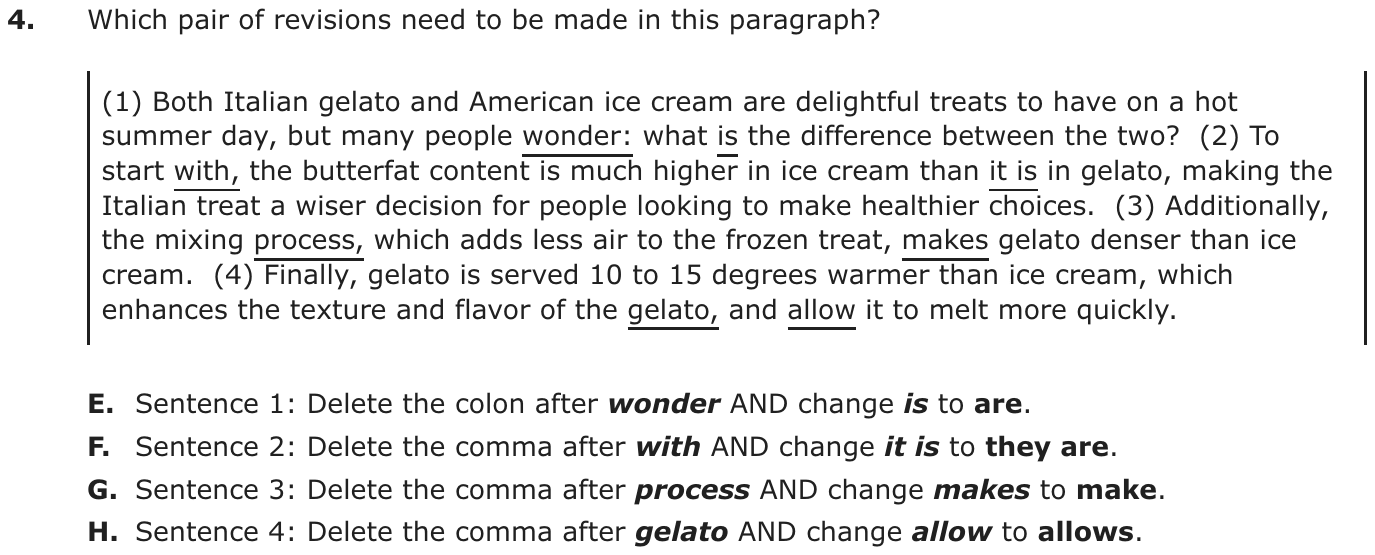
Which pair of revisions need to be made in this paragraph?
(1) Both Italian gelato and American ice cream are delightful treats to have on a hot summer day, but many people wonder: what is the difference between the two? (2) To start with, the butterfat content is much higher in ice cream than it is in gelato, making the Italian treat a wiser decision for people looking to make healthier choices. (3) Additionally, the mixing process, which adds less air to the frozen treat, makes gelato denser than ice cream. (4) Finally, gelato is served 10 to 15 degrees warmer than ice cream, which enhances the texture and flavor of the gelato, and allow it to melt more quickly.
- ASentence 1: Delete the colon after wonder AND change is to are.
- BSentence 2: Delete the comma after with AND change it is to they are.
- CSentence 3: Delete the comma after process AND change makes to make.
- DSentence 4: Delete the comma after gelato AND change allow to allows.
Show the answer
Correct answer: D
The question asks for the revisions that are needed to correct errors in the paragraph.
A. Incorrect. The revisions introduce new errors. The colon after “wonder” is needed to set off the question “what is the difference between the two?” from the rest of the sentence. In addition, changing the verb “is” to “are” would be incorrect with the use of the singular noun “difference,” which is the subject of the question.
B. Incorrect. The revisions introduce new errors. The comma following the introductory phrase “To start with” helps with clarity and is needed to separate the phrase from the rest of the sentence. Changing “it is” to “they are” would be incorrect with the use of the singular noun “butterfat content,” which is what the words “it is” refer to in the sentence.
C. Incorrect. The revisions introduce new errors. The comma following “process” is necessary to set off the nonrestrictive clause “which adds less air to the frozen treat” from the rest of the sentence. This clause is considered a nonrestrictive clause because it provides additional, but not essential, information about the mixing process. Changing the verb “makes” to “make” would be incorrect with the use of the singular noun “mixing process,” which is the subject of the sentence.
D. CORRECT. Deleting the comma after “gelato” would include the clause “and allow it to melt more quickly” with the first part of the clause “which enhances the texture and flavor of the gelato.” The word “and” between the two verb phrases (“enhances the texture and flavor of the gelato” and “allow it to melt more quickly”) indicates that the two verb phrases share a subject, “which” (referring to the act of serving gelato 10 to 15 degrees warmer than ice cream). The two ideas should not be separated by a comma within the clause. The entire clause “which enhances the texture and flavor of the gelato and allow it to melt more quickly” should be separated from the main clause only by the comma after “cream” because the entire clause is a nonrestrictive clause. This clause provides additional, but not essential, information about the purpose of serving gelato at a warmer temperature than ice cream. Changing the verb “allow” to “allows” is also necessary to match the use of the singular pronoun “which.”
Question analysis
This editing question gives a four-sentence paragraph comparing Italian gelato with American ice cream and asks which pair of revisions it needs. Students must check subject-verb agreement, what a pronoun refers to and whether each comma or colon belongs, and since every choice bundles two edits in one sentence, a single right-sounding change is not enough.
- Grade level
- Grade 7 reading and task
- Compared with grade 7
- At grade 7 Subject-verb agreement and commas around added clauses are grade 7 conventions. Eight marked spots across four long sentences make this a fuller check than a one-sentence item, but the demand is still typical of grade 7 editing.
- Estimated difficulty
- Moderate: several steps, or a close reading with one strong distractor.
- Thinking it demands
- Depth of knowledge 2, skills and concepts · mainly apply
- What makes it hard
- A rule that doesn't sound wrong moderate
- Every choice must be checked moderate
- Complex sentences minor
- Evidence
- Answered from one paragraph or stanza
- Reading level
- Question and choices: about grade 9, 160 words.
- Students, last 30 days
- Not enough answers yet to show (it takes 10).
Why it is hard, traps and wrong answers (shows the answer)
Why it is hard
The paragraph's only real errors sit at the end of its longest sentence, where a plural noun pair just before the faulty verb hides the mismatch. Students who do not hear “allow” as wrong start doubting correct marks instead, such as the colon before an embedded question or the comma after “To start with.” Every wrong pair also changes a verb or pronoun that already agrees, so reading each edit back into its sentence rules those pairs out.
A rule that doesn't sound wrong moderate Working it out
In sentence 4 the plural pair “texture and flavor” sits just before “and allow,” so the verb sounds right, but it belongs to “which,” the warmer serving, and must match “enhances.” (Connors & Lunsford, 1988)
Every choice must be checked moderate Choosing the answer
Each pair proposes two edits in one sentence, eight in all, and a pair is right only if both of its edits fix real errors, so every edit has to be tried in place. (Embretson & Wetzel, 1987)
Complex sentences minor Understanding the question
Sentence 4 hangs a which-clause with two verbs onto the main clause, and the comma before “and allow” splits that clause's compound predicate in a way few students hear as wrong. (Abedi & Lord, 2001; Freedle & Kostin, 1993; Messick, 1989)
Strategy: Before reading the choices, find each verb's true subject and test every marked comma yourself; then look for the choice whose two edits both fix errors you found.
Traps
- Fixes what isn't broken: Changes a part of the sentence that was already correct, while the real error stays; or, where the question asks which sentence has an error or should go, picks one that is correct and belongs.
- Agreement: A verb that does not agree with its subject, or a pronoun that does not agree with the word it stands for.
- Punctuation: A comma, semicolon, colon, dash or apostrophe used where it does not belong, or missing where it does.
The wrong answers, classified
A Agreement (Connors & Lunsford, 1988)
Hears “the two” as the subject and wants “are,” and distrusts a colon before a question, though “the difference” is singular and the colon is correct.
B Punctuation (Connors & Lunsford, 1988)
Believes a short opener like “To start with” needs no comma and accepts “they are,” though the pronoun stands for the singular “butterfat content.”
C Fixes what isn't broken (Connors & Lunsford, 1988)
Picks edits to a sentence that is already correct, unbalancing the commas around the which-clause and giving the singular “mixing process” a plural verb.
Working it out, step by step
Figure out what the question asks
Each choice offers two changes to one sentence. Both changes must fix real mistakes. If even one change breaks something that was right, the choice is wrong. So test every change in its own sentence.
Learn the rule for two verbs
A verb (an action word) must match its subject (who or what does the action). One thing takes allows. Two or more things take allow.
When one subject does two actions joined by “and,” no comma goes before “and.” Example: The sun warms the air and dries the grass. Both verbs end in s, because one sun does both.
Find the mistakes in sentence 4
Sentence 4 says gelato is served warmer than ice cream, “which enhances the texture and flavor of the gelato, and allow it to melt more quickly.”
“Which” stands for one thing: serving gelato warmer. That one thing does two actions. It “enhances” (improves) the texture and flavor. It also lets the gelato melt faster. So “allow” should be “allows,” to match “enhances.” And the comma before “and” must go.
Check each choice
- A is wrong. The colon (:) after “wonder” correctly leads into the question. And “is” matches “the difference,” which is one thing.
- B is wrong. The comma after “To start with” sets off an opening phrase. And “it is” stands for “the butterfat content,” which is one thing.
- C is wrong. The commas around “which adds less air to the frozen treat” come in a pair. And “makes” matches “the mixing process,” one thing.
- D is right. Both changes fix real mistakes.
Watch out: “The texture and flavor” comes right before “allow.” Those two things make “allow” sound right. But the subject is “which,” not “texture and flavor.”
Choose the answer
The fixed sentence ends: which enhances the texture and flavor of the gelato and allows it to melt more quickly. So the answer is D.
Why this answer and not the closest wrong one
A is the closest wrong answer. “The two” sits near “is,” so “are” can sound right. But the question asks what “the difference” is. A difference is one thing, so “is” is correct. A would add a mistake. In D, both changes fix mistakes that are really there.
More questions like this
The original DOE question
Question 2 of 57
2022 Test B English, question 2Question
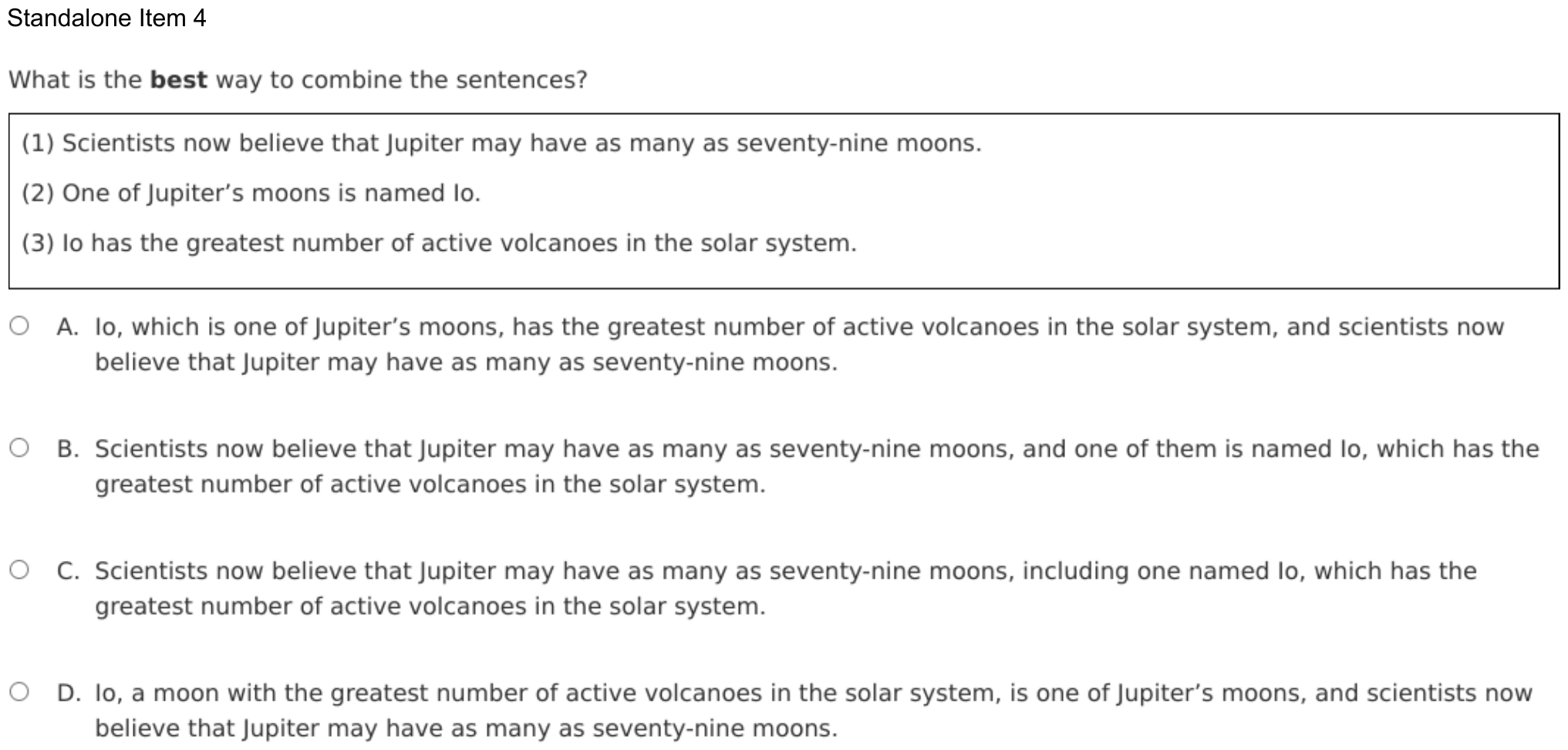
What is the best way to combine the sentences?
(1) Scientists now believe that Jupiter may have as many as seventy-nine moons.
(2) One of Jupiter’s moons is named Io.
(3) Io has the greatest number of active volcanoes in the solar system.
- AIo, which is one of Jupiter’s moons, has the greatest number of active volcanoes in the solar system, and scientists now believe that Jupiter may have as many as seventy-nine moons.
- BScientists now believe that Jupiter may have as many as seventy-nine moons, and one of them is named Io, which has the greatest number of active volcanoes in the solar system.
- CScientists now believe that Jupiter may have as many as seventy-nine moons, including one named Io, which has the greatest number of active volcanoes in the solar system.
- DIo, a moon with the greatest number of active volcanoes in the solar system, is one of Jupiter’s moons, and scientists now believe that Jupiter may have as many as seventy-nine moons.
Show the answer
Correct answer: C
The question asks for the best way to combine the sentences.
A. Incorrect. Although the sentence incorporates the ideas presented in the three original sentences, it is incorrect because the combination suggests an incorrect relationship between the ideas. By beginning with “Io,” the sentence places emphasis on the moon and the detail about the number of active volcanoes rather than the key idea that “scientists now believe that Jupiter may have as many as seventy-nine moons.” Since Io is an example of one of Jupiter’s moons, the details about Io should follow and be subordinate to the main clause, which provides new information about the number of Jupiter’s moons in general.
B. Incorrect. Although the sentence incorporates all three ideas from the original sentences and correctly places the detail about the number of active volcanoes on Io in a dependent clause, this option is incorrect because it presents an imprecise relationship between the ideas. By using the conjunction (connecting word) “and,” the sentence construction suggests that scientists “now believe” that “Jupiter may have as many as seventy-nine moons” and that “one of them is named Io,” instead of presenting Io as an example of one of Jupiter’s moons.
C. CORRECT. This sentence is the best way to combine the original sentences because it uses a complex sentence to present ideas clearly and precisely, and it shows the relationship between the ideas in the original sentences. The sentence starts by stating the number of moons scientists now believe Jupiter may have and then specifies that one of those moons is named Io. The dependent clause “which has the greatest number of active volcanoes in the solar system” immediately follows the word “Io” to provide additional information about the moon. A dependent clause contains a subject (“which,” referring to Io) and a verb (“has”) but is not a complete sentence on its own.
D. Incorrect. The sentence incorporates the key ideas from the original sentences, but its structure does not accurately present the relationship between these ideas. The beginning of the sentence includes the detail about Io having “the greatest number of active volcanoes in the solar system” before specifying that Io is one of the seventy-nine moons of Jupiter. The presentation of the details about Io at the beginning lessens the emphasis of the key idea that “scientists now believe that Jupiter may have as many as seventy-nine moons.”
Question analysis
This sentence-combining question gives three short sentences: scientists believe Jupiter may have as many as seventy-nine moons, one moon is named Io, and Io has the most active volcanoes in the solar system. Students must choose the single sentence that joins all three facts while showing how they relate, and the four versions differ only in order and connecting structure.
- Grade level
- Grade 7 reading and task
- Compared with grade 7
- At grade 7 Combining sentences so the ideas relate clearly is grade 7 language work. The three sentences are short, but every version keeps all the facts, so the choice rests on which idea leads and which is tucked into a clause, a typical grade 7 demand.
- Estimated difficulty
- Moderate: several steps, or a close reading with one strong distractor.
- Thinking it demands
- Depth of knowledge 2, skills and concepts · mainly evaluate
- What makes it hard
- A very close wrong answer moderate
- How sentences fit together moderate
- Every choice must be checked minor
- Evidence
- Answered from one sentence or line
- Reading level
- Question and choices: about grade 10, 162 words.
- Students, last 30 days
- Not enough answers yet to show (it takes 10).
Why it is hard, traps and wrong answers (shows the answer)
Why it is hard
Because every version keeps all three facts and is grammatical, the question is about emphasis and connection, which students rarely check for. Two versions open with Io and its volcanoes and leave the seventy-nine moons trailing after “and,” and one of them also calls Io a moon twice. The strongest pull is the version with the right order that still joins Io with “and,” so Io’s name reads as a second piece of news rather than an example of the moons just counted.
A very close wrong answer moderate Choosing the answer
The “and one of them is named Io” version matches the key in its order and in its which-clause about volcanoes; only its connector differs from the key’s “including one named Io.” (Embretson & Wetzel, 1987; Gorin & Embretson, 2006; Ascalon et al., 2007)
How sentences fit together moderate Working it out
Students must see that sentence 1 is the main news and that sentences 2 and 3 narrow to one example, so Io belongs inside the sentence about Jupiter’s seventy-nine moons. (Halliday & Hasan, 1976)
Every choice must be checked minor Choosing the answer
Every version is grammatical and keeps all three facts, so none can be ruled out by an error; each is judged on which idea leads and how the others attach. (Embretson & Wetzel, 1987)
Strategy: Decide which of the three sentences states the main idea and which ones add detail, then check whether each version’s order and structure show that relationship.
Traps
- Wrong transition: A connecting word or phrase that signals the wrong relationship, such as contrast where the idea continues.
- Changes the meaning: A revision is correct English but no longer says what the writer meant.
The wrong answers, classified
A Changes the meaning (Connors & Lunsford, 1988)
Opens with Io and its volcanoes and adds the moon count with “and,” so the main news about Jupiter trails behind its own example as an afterthought.
B Wrong transition (Halliday & Hasan, 1976)
Keeps the right order and the which-clause, but “and one of them is named Io” adds Io as a second piece of news instead of an example of those moons.
D Changes the meaning (Connors & Lunsford, 1988)
Leads with Io’s volcanoes, then says Io “is one of Jupiter’s moons” right after calling it “a moon,” and leaves the main news about Jupiter for the end.
Working it out, step by step
Figure out what the question asks
This asks for the best way to join three sentences into one. All four choices keep every fact. So the best one shows how the facts relate. Decide which fact is the main idea and which ones add detail.
Find the main idea
Sentence 1 is the big news: “Scientists now believe that Jupiter may have as many as seventy-nine moons.” Sentences 2 and 3 zoom in on one of those moons, Io. Io is an example of the moons, and its volcanoes are a detail about Io. So the main idea should come first, and Io should fit inside it.
Name the rule
Put the main idea in the main part of the sentence. Tuck the details in with words like including and which. For example: My school has thirty clubs. One is chess. The chess club meets on Fridays. Joined: My school has thirty clubs, including a chess club, which meets on Fridays.
Check each choice
- A is wrong. It starts with Io and its volcanoes. The main news about Jupiter trails at the end after “and.”
- B is wrong. The order is right. But “and one of them is named Io” adds Io as a second piece of news, not as an example.
- C is right. “Including one named Io” shows Io is one of the moons. Then “which” adds the fact about its volcanoes.
- D is wrong. It calls Io “a moon,” then says again that it “is one of Jupiter’s moons.” The main news comes last.
Watch out: B is very close to C. The only change is “and one of them is named Io” in place of “including one named Io.” The word “including” shows that Io belongs to the group.
Choose the answer
C leads with the main news and tucks in Io as an example. So the answer is C, “Scientists now believe that Jupiter may have as many as seventy-nine moons, including one named Io, which has the greatest number of active volcanoes in the solar system.”
Why this answer and not the closest wrong one
B is the closest wrong answer. It has the right order and the same “which” clause. But “and” tacks Io’s name on as a separate fact, as if it were more news. “Including” shows that Io is one of the seventy-nine moons. That ties the three facts together most clearly.
More questions like this
The original DOE question
Question 3 of 57
2022 Test B English, question 3Question
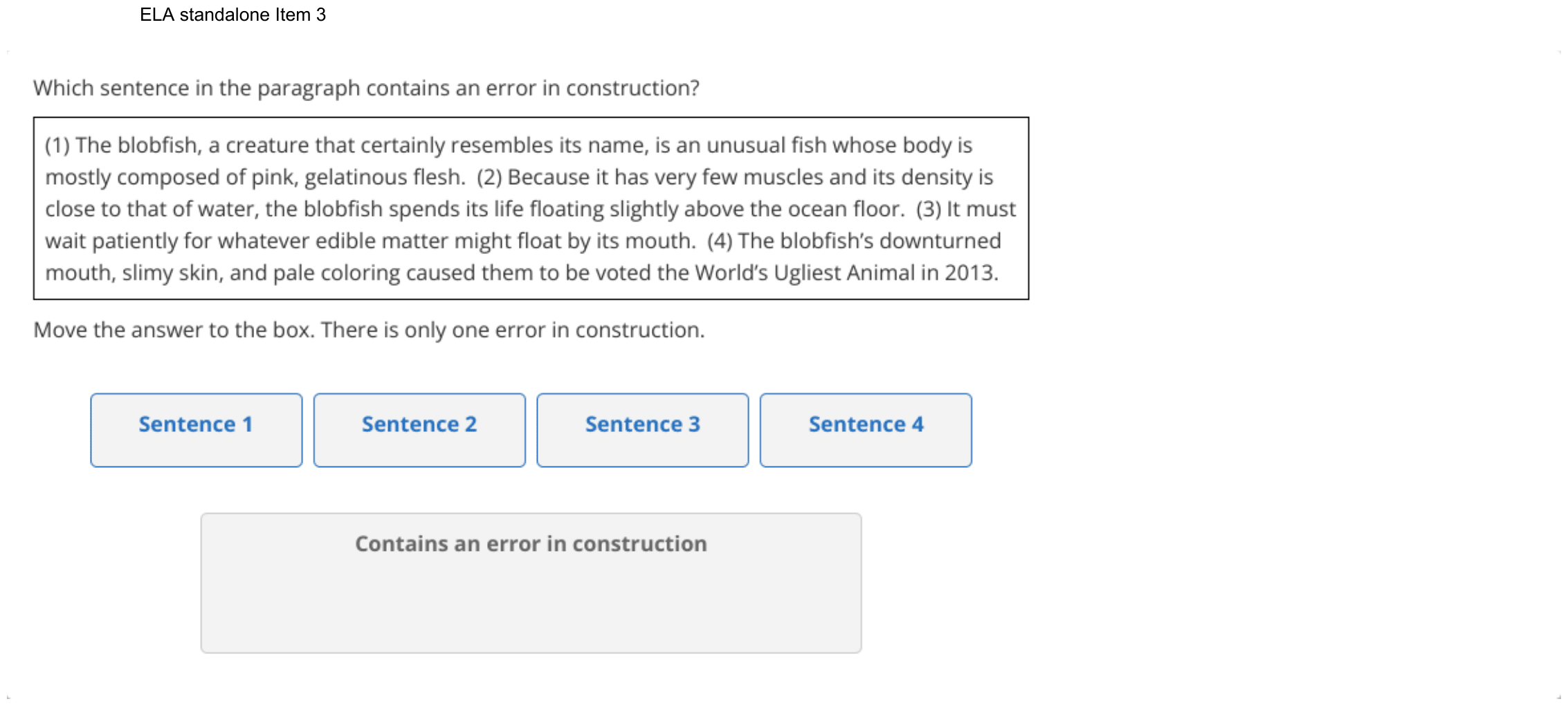
Which sentence in the paragraph contains an error in construction?
(1) The blobfish, a creature that certainly resembles its name, is an unusual fish whose body is mostly composed of pink, gelatinous flesh. (2) Because it has very few muscles and its density is close to that of water, the blobfish spends its life floating slightly above the ocean floor. (3) It must wait patiently for whatever edible matter might float by its mouth. (4) The blobfish’s downturned mouth, slimy skin, and pale coloring caused them to be voted the World’s Ugliest Animal in 2013.
Move the answer to the box. There is only one error in construction.
Contains an error in construction
On the test you drag one of the tiles into the box; here, choose it.
- ASentence 1
- BSentence 2
- CSentence 3
- DSentence 4
Show the answer
Correct answer: D
The question asks for identification of the one sentence in the paragraph that contains an error in construction.
Sentence 1: Construction is correct. The singular pronoun “its” matches the number of the word it refers to, the singular noun “blobfish.” Additionally, the appositive phrase “a creature that certainly resembles its name” is correctly set off by commas to provide an extra, but not essential, detail about the blobfish. The comma separating “pink” and “gelatinous” is correct because these are coordinate adjectives. There are no errors in sentence 1.
Sentence 2: Construction is correct. The singular pronouns “it” and “its” match the number of the word they refer to, the singular noun “blobfish.” Additionally, the structure of the sentence correctly shows that the clause “Because it has very few muscles and its density is close to that of water” explains why “the blobfish” spends its life floating. There are no errors in sentence 2.
Sentence 3: Construction is correct. The “it” and “its” in the sentence refer to “the blobfish” mentioned in the previous sentence. The use of singular pronouns in sentence 3 is consistent with the rest of the paragraph. There are no errors in sentence 3.
Sentence 4: Contains an error in construction. Sentence 4 erroneously uses the plural pronoun “them” to refer to the blobfish, when the singular “it” should have been used. Although sentence 4 starts by correctly referring to the blobfish in the singular (“the blobfish’s”), it erroneously switches to plural usage midway through: “caused them to be voted.” This is an error because the rest of the paragraph refers to the blobfish in the singular. The singular construction of the paragraph starts with “a creature” and “an unusual fish” in sentence 1 and continues throughout sentence 2 (“it has,” “its density,” “the blobfish,” and “its life”), sentence 3 (“It must” and “its mouth”), and the first half of sentence 4 (“the blobfish’s”). Proper construction requires sentence 4 to maintain the paragraph’s consistent use of singular references. To fix the construction error in sentence 4, the plural pronoun “them” should be changed to the singular pronoun “it” (i.e., “The blobfish’s downturned mouth, slimy skin, and pale coloring caused it to be voted the World’s Ugliest Animal in 2013.”).
Question analysis
This editing question gives a four-sentence paragraph describing the blobfish, a pink, jelly-like fish that floats just above the ocean floor, and asks which sentence contains an error in construction. On the test students move a sentence tile into a box; the kind of error is not named, so every sentence, with its commas, describing phrases and pronouns, must be checked.
- NYS standards
- 7L1 grammar and usage conventions
- Grade level
- Grade 7 reading and task
- Compared with grade 7
- At grade 7 The grammar here is taught by grade 6, but the question does not say what kind of error to look for, and the correct sentences carry commas, describing phrases and pronouns of their own, which is typical of grade 7 editing.
- Estimated difficulty
- Moderate: several steps, or a close reading with one strong distractor.
- Thinking it demands
- Depth of knowledge 2, skills and concepts · mainly analyze
- What makes it hard
- A rule that doesn't sound wrong moderate
- Every choice must be checked moderate
- Evidence
- Answered from one paragraph or stanza
- Reading level
- Question and choices: about grade 6, 112 words.
- Corrected from the DOE handbook
- Two grammar terms in the explanation were wrong; both sentences were corrected.
- Students, last 30 days
- Not enough answers yet to show (it takes 10).
Why it is hard, traps and wrong answers (shows the answer)
Why it is hard
The faulty pronoun is camouflaged by the list right before it, which makes a plural sound natural, so students who read by ear pass the last sentence and flag a correct one. The likeliest victim is sentence 2, where “it” comes before the noun it stands for, which some students wrongly believe is not allowed. The question rewards asking, for each pronoun, what noun it stands for and whether the number matches.
A rule that doesn't sound wrong moderate Working it out
“Them” in sentence 4 follows the plural list “downturned mouth, slimy skin, and pale coloring,” so it sounds right, though what was voted ugliest is the singular blobfish. (Connors & Lunsford, 1988)
Every choice must be checked moderate Choosing the answer
The stem names no kind of error, and every sentence has a pronoun or a set-off phrase that could be suspect, from the opening appositive to the “Because it has” clause, so all four must be checked. (Embretson & Wetzel, 1987)
Strategy: Check each sentence in turn: the subject and verb, what every pronoun refers to, and what each describing phrase attaches to, without trusting how smoothly the sentence sounds.
Traps
- Fixes what isn't broken: Changes a part of the sentence that was already correct, while the real error stays; or, where the question asks which sentence has an error or should go, picks one that is correct and belongs.
The wrong answers, classified
A Fixes what isn't broken (Connors & Lunsford, 1988)
Suspects the long interruption “a creature that certainly resembles its name” or the comma in “pink, gelatinous,” though both are correct and the sentence is complete.
B Fixes what isn't broken (Connors & Lunsford, 1988)
Believes a pronoun cannot come before its noun, so flags “Because it has very few muscles,” though “it” correctly looks ahead to “the blobfish” in the main clause.
C Fixes what isn't broken (Connors & Lunsford, 1988)
Assumes “It” must point to the nearest noun, “the ocean floor,” and calls it unclear, though only the blobfish could wait for food to float by.
What was corrected from the DOE handbook, and why
- Explanation: The handbook's explanation of sentence 1 calls “a creature that certainly resembles its name” a clause; it is an appositive phrase, a noun phrase that renames “the blobfish”, and now says so. Its explanation of sentence 2 says the “Because…” clause “modifies the words ‘the blobfish’”; an introductory “because” clause tells why something happens, so it modifies the verb, and the sentence now says it explains why the blobfish spends its life floating. The answer, sentence 4, is unchanged.
Working it out, step by step
Figure out what the question asks
You need the one sentence with an error in construction, a mistake in how the sentence is built. The question doesn’t say what kind of error. So check each sentence’s commas, phrases and pronouns. A pronoun is a word like it or them that stands in for a noun.
Check sentence 1
“A creature that certainly resembles its name” is an extra phrase that renames the blobfish. Commas around an extra phrase are correct: Max, my brother, plays drums. In “pink, gelatinous,” a comma sits between two describing words of equal weight. Gelatinous means jelly-like. You could say pink and gelatinous, so the comma is right.
Check sentences 2 and 3
Sentence 2 starts, “Because it has very few muscles.” This part tells why the blobfish floats. Here “it” comes before “the blobfish.” That is allowed when the noun follows soon after: Because she was tired, Maya went to bed. In sentence 3, “It” can only mean the blobfish. Only the fish could wait for food to float by its mouth. Both sentences are correct.
Watch out: Some students think a pronoun can never come before its noun. That makes sentence 2 look wrong, which leads to B.
Find the error in sentence 4
Sentence 4 says the fish’s features “caused them to be voted the World’s Ugliest Animal in 2013.” What was voted the ugliest animal? The blobfish, one animal. A pronoun must match its noun in number. So it should be it, not them. The rest of the paragraph calls the blobfish it every time.
Watch out: The list just before, “downturned mouth, slimy skin, and pale coloring,” is plural. That makes them sound right. But a mouth, skin and coloring can’t be voted an animal.
Show the fix
Fixed, the sentence reads: The blobfish’s downturned mouth, slimy skin, and pale coloring caused it to be voted the World’s Ugliest Animal in 2013. Now the pronoun matches the one blobfish.
Choose the answer
Sentences 1, 2 and 3 are built correctly. Only sentence 4 has a pronoun that doesn’t match its noun. So the answer is D: move the tile “Sentence 4” into the box labeled “Contains an error in construction.”
Why this answer and not the closest wrong one
Sentence 2 is the closest wrong answer, because “it” comes before the word “blobfish.” That is allowed, since the noun follows right away. In sentence 4, though, “them” is plural but stands for one blobfish. That mismatch is the real error.
More questions like this
The original DOE question
Question 4 of 57
2022 Test B English, question 4Question
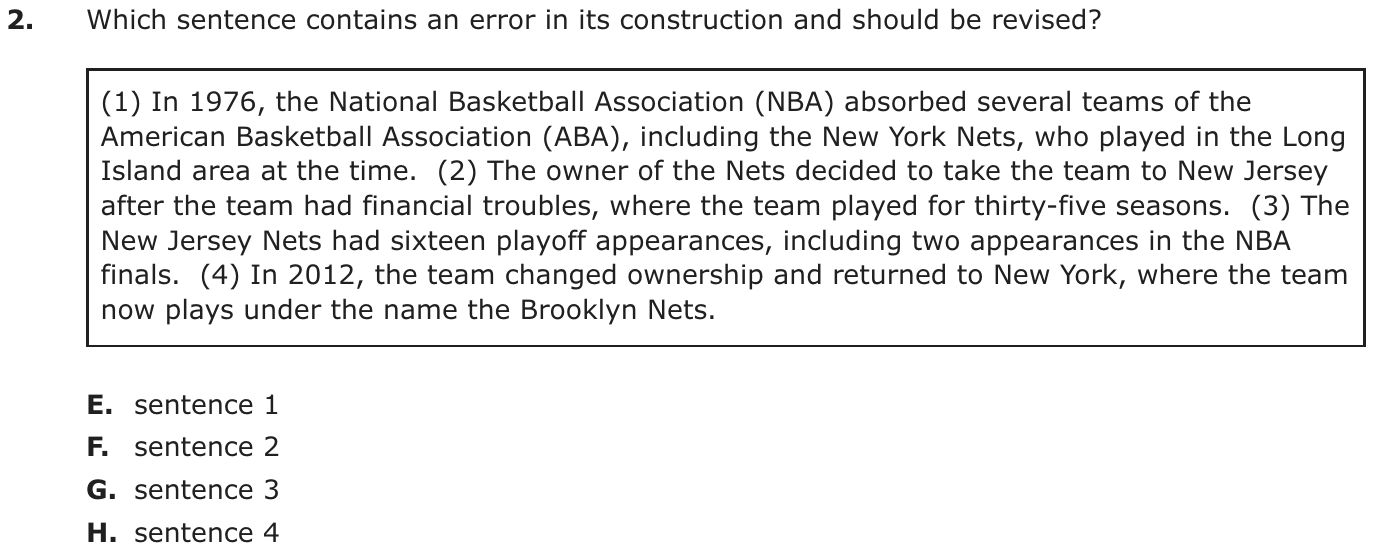
Which sentence contains an error in its construction and should be revised?
(1) In 1976, the National Basketball Association (NBA) absorbed several teams of the American Basketball Association (ABA), including the New York Nets, who played in the Long Island area at the time. (2) The owner of the Nets decided to take the team to New Jersey after the team had financial troubles, where the team played for thirty-five seasons. (3) The New Jersey Nets had sixteen playoff appearances, including two appearances in the NBA finals. (4) In 2012, the team changed ownership and returned to New York, where the team now plays under the name the Brooklyn Nets.
- Asentence 1
- Bsentence 2
- Csentence 3
- Dsentence 4
Show the answer
Correct answer: B
The question asks for the identification of the sentence that has an error in its construction and should be revised.
A. Incorrect. There are no errors in the structure of sentence 1. The clause “who played in the Long Island area at the time” correctly modifies the noun “New York Nets.” “Who” is the correct relative pronoun to serve as the subject of the modifying clause because it refers to people rather than objects or things.
B. CORRECT. Sentence 2 contains a structural error. The current placement of the clause “where the team played for thirty-five seasons” suggests that the clause is modifying the term “financial troubles,” which is illogical. The clause “where the team played for thirty-five seasons” should immediately follow the location, “New Jersey.” A revised version of the sentence might read, “After the team had financial troubles, the owner of the Nets decided to take the team to New Jersey, where the team played for thirty-five seasons.”
C. Incorrect. There are no errors in the structure of sentence 3. The phrase “including two appearances in the NBA finals” is a nonrestrictive phrase that provides further detail about the team’s “sixteen playoff appearances.” The phrase is set off by a comma because it is not essential to understanding the meaning of the sentence.
D. Incorrect. There are no errors in the structure of sentence 4. The clause “where the team now plays under the name the Brooklyn Nets” is a nonrestrictive clause that provides further detail about the team after its move back to New York in 2012. The clause is set off by a comma because it is not essential to understanding the meaning of the sentence.
Question analysis
This editing question gives a four-sentence paragraph tracing the Nets basketball team from Long Island to New Jersey and back to Brooklyn, and asks which sentence is built incorrectly. The sentences are long, with commas, parentheses and describing clauses, so students must check what each clause actually describes instead of trusting how smoothly it reads.
- NYS standards
- 7L1 grammar and usage conventions
- Grade level
- Grade 7 reading and task
- Compared with grade 7
- At grade 7 Placing clauses so they describe the right word is a grade 7 grammar standard. The paragraph is short and plain, but the correct sentences also carry commas and describing clauses, which matches a careful grade 7 editing task.
- Estimated difficulty
- Moderate: several steps, or a close reading with one strong distractor.
- Thinking it demands
- Depth of knowledge 2, skills and concepts · mainly analyze
- What makes it hard
- A rule that doesn't sound wrong moderate
- Every choice must be checked minor
- Complex sentences minor
- Evidence
- Answered from one paragraph or stanza
- Reading level
- Question and choices: about grade 7, 108 words.
- Students, last 30 days
- Not enough answers yet to show (it takes 10).
Why it is hard, traps and wrong answers (shows the answer)
Why it is hard
The faulty sentence is easy to understand, because the reader supplies the link between New Jersey and the thirty-five seasons without noticing the clause is in the wrong place. Students who go by sound skip it and suspect a busier sentence instead, most often the first, with its parentheses and a “who” that refers to a team. The question rewards asking, for each describing clause, which word it actually sits beside.
A rule that doesn't sound wrong moderate Working it out
Sentence 2’s “where the team played for thirty-five seasons” follows “financial troubles,” not “New Jersey,” but readers silently attach it to the state, so the misplaced clause does not sound wrong. (Connors & Lunsford, 1988)
Every choice must be checked minor Choosing the answer
The stem names no kind of error, and every sentence carries a describing clause or phrase, from “who played” to “including two appearances” to a second “where” clause, so all four must be tested. (Embretson & Wetzel, 1987)
Complex sentences minor Understanding the question
Sentence 1 runs 31 words with two abbreviations in parentheses and a “who” clause, which makes a correct sentence look like the likeliest home for an error. (Abedi & Lord, 2001; Freedle & Kostin, 1993; Messick, 1989)
Strategy: In each sentence, find every describing clause or phrase and the word just before it. Ask whether the clause can logically describe that word; a mismatch marks the sentence to revise.
Traps
- Fixes what isn't broken: Changes a part of the sentence that was already correct, while the real error stays; or, where the question asks which sentence has an error or should go, picks one that is correct and belongs.
The wrong answers, classified
A Fixes what isn't broken (Connors & Lunsford, 1988)
Believes “who” cannot refer to a team, or distrusts the long sentence with two abbreviations, though “who played in the Long Island area” correctly describes the New York Nets.
C Fixes what isn't broken (Connors & Lunsford, 1988)
Takes “including two appearances in the NBA finals” for a fragment tacked on with a comma, though the phrase correctly adds detail to “sixteen playoff appearances.”
D Fixes what isn't broken (Connors & Lunsford, 1988)
Hears the shift from “returned” to “now plays” as a tense error, though “now” marks the present, and this “where” clause sits right after New York, the place it describes.
Working it out, step by step
Figure out what the question asks
This asks which sentence is built wrong. The facts may all be true. The problem is how the parts of a sentence fit together. The question doesn’t say what kind of error to look for. So you need to test all four sentences.
Learn the rule about describing clauses
A clause is a group of words with a subject and a verb. Some clauses describe a word. They often start with who or where. A describing clause must sit right next to the word it describes. If it lands next to the wrong word, the sentence says something silly. Example: We went to the beach after the storm, where we swam all day. That says we swam in the storm! Fix: After the storm, we went to the beach, where we swam all day.
Test sentence 2
Sentence 2 ends “after the team had financial troubles, where the team played for thirty-five seasons.” The clause starting with “where” sits right after “financial troubles.” So the sentence says the team played inside its money problems. The clause should describe New Jersey, the place. Fix: After the team had financial troubles, the owner of the Nets decided to take the team to New Jersey, where the team played for thirty-five seasons.
Test sentences 1, 3 and 4
- Sentence 1: “who played in the Long Island area at the time” comes right after “the New York Nets.” A team is a group of people, so who works.
- Sentence 3: “including two appearances in the NBA finals” comes right after “sixteen playoff appearances.” It adds a detail about them, so it fits.
- Sentence 4: “where the team now plays” comes right after “New York,” a place. The word “now” makes the present tense right.
Watch out: Sentence 1 looks busy, with two names in parentheses. That makes choice A tempting. But long is not the same as wrong.
Pick the answer
Only sentence 2 puts a describing clause next to the wrong words. So the answer is B, sentence 2.
Why this answer and not the closest wrong one
Sentence 1 is the closest wrong answer, because it is long and uses who for a team. But its clause sits right next to the Nets, the team it describes. In sentence 2, the “where” clause sits next to “financial troubles,” not New Jersey. That is why B is right.
More questions like this
The original DOE question
Question 5 of 57
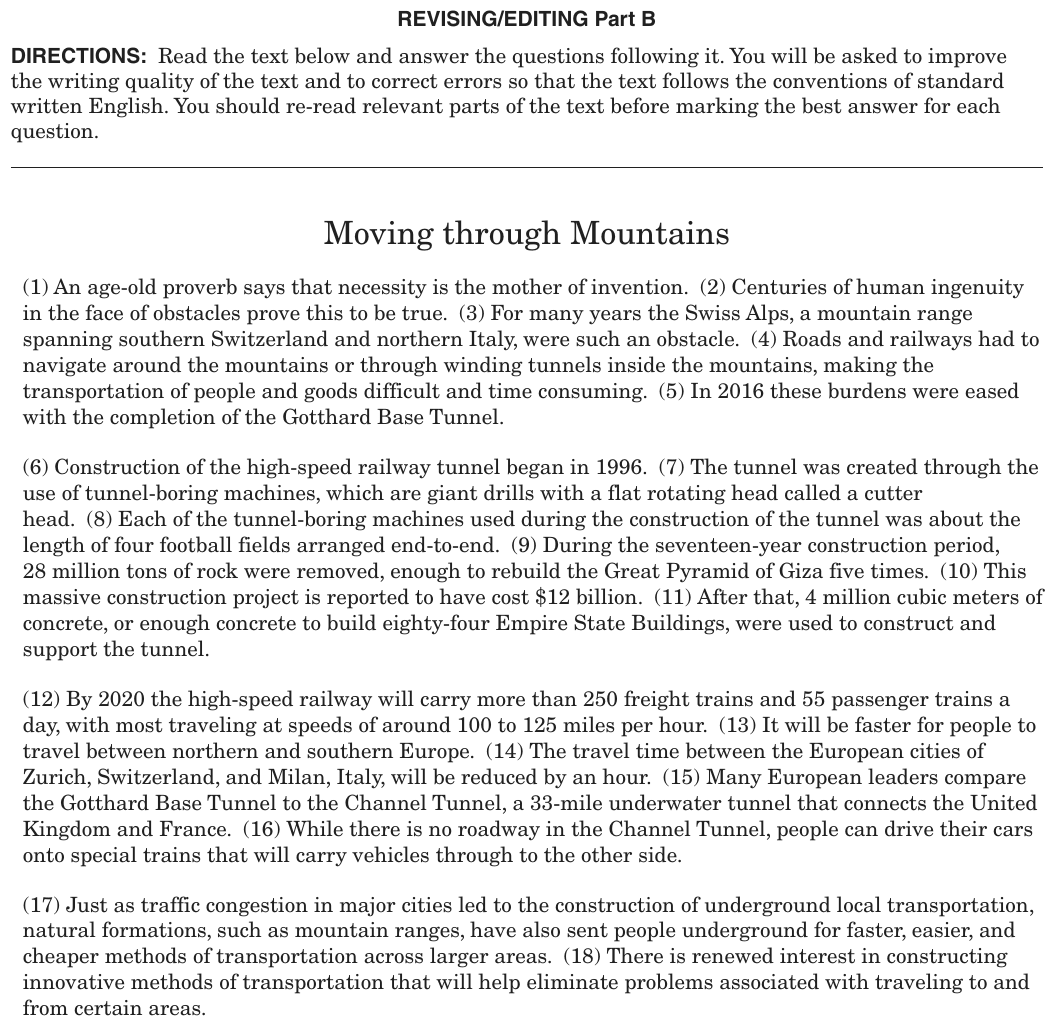
2022 Test B English, question 5Passage Moving through Mountains
Moving through Mountains
(1) An age-old proverb says that necessity is the mother of invention. (2) Centuries of human ingenuity in the face of obstacles prove this to be true. (3) For many years the Swiss Alps, a mountain range spanning southern Switzerland and northern Italy, were such an obstacle. (4) Roads and railways had to navigate around the mountains or through winding tunnels inside the mountains, making the transportation of people and goods difficult and time consuming. (5) In 2016 these burdens were eased with the completion of the Gotthard Base Tunnel.
(6) Construction of the high-speed railway tunnel began in 1996. (7) The tunnel was created through the use of tunnel-boring machines, which are giant drills with a flat rotating head called a cutter head. (8) Each of the tunnel-boring machines used during the construction of the tunnel was about the length of four football fields arranged end-to-end. (9) During the seventeen-year construction period, 28 million tons of rock were removed, enough to rebuild the Great Pyramid of Giza five times. (10) This massive construction project is reported to have cost $12 billion. (11) After that, 4 million cubic meters of concrete, or enough concrete to build eighty-four Empire State Buildings, were used to construct and support the tunnel.
(12) By 2020 the high-speed railway will carry more than 250 freight trains and 55 passenger trains a day, with most traveling at speeds of around 100 to 125 miles per hour. (13) It will be faster for people to travel between northern and southern Europe. (14) The travel time between the European cities of Zurich, Switzerland, and Milan, Italy, will be reduced by an hour. (15) Many European leaders compare the Gotthard Base Tunnel to the Channel Tunnel, a 33-mile underwater tunnel that connects the United Kingdom and France. (16) While there is no roadway in the Channel Tunnel, people can drive their cars onto special trains that will carry vehicles through to the other side.
(17) Just as traffic congestion in major cities led to the construction of underground local transportation, natural formations, such as mountain ranges, have also sent people underground for faster, easier, and cheaper methods of transportation across larger areas. (18) There is renewed interest in constructing innovative methods of transportation that will help eliminate problems associated with traveling to and from certain areas.
Question
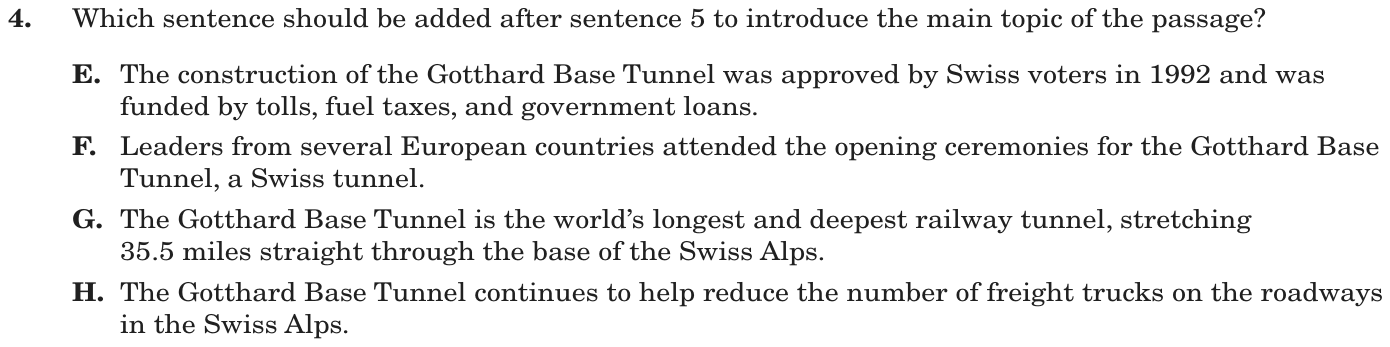
Which sentence should be added after sentence 5 to introduce the main topic of the passage?
- AThe construction of the Gotthard Base Tunnel was approved by Swiss voters in 1992 and was funded by tolls, fuel taxes, and government loans.
- BLeaders from several European countries attended the opening ceremonies for the Gotthard Base Tunnel, a Swiss tunnel.
- CThe Gotthard Base Tunnel is the world’s longest and deepest railway tunnel, stretching 35.5 miles straight through the base of the Swiss Alps.
- DThe Gotthard Base Tunnel continues to help reduce the number of freight trucks on the roadways in the Swiss Alps.
Show the answer
Correct answer: C
The Answer is (C)
The question asks which sentence should be added to the end of the first paragraph in order to introduce the topic of the passage, which is the description, construction, and use of the Gotthard Base Tunnel.
Option C correctly presents and describes the Gotthard Base Tunnel.
Option A is incorrect because it offers overly detailed information about the funding used to build the Gotthard Base Tunnel, and it does not provide a description of the tunnel.
Option B is incorrect because it gives details about the opening ceremony of the tunnel, and it does not provide a description of the tunnel.
Option D is incorrect because it offers a result of completing the Gotthard Base Tunnel, rather than offering an introductory statement presenting and describing the tunnel.
Question analysis
This revising question uses a short informational passage about the Gotthard Base Tunnel through the Swiss Alps and asks which sentence best introduces the main topic at the end of the first paragraph. Several choices offer true-sounding facts about the tunnel, so students must tell an introduction apart from a supporting detail.
- NYS standards
- 7W2a introducing and organizing a topic
- Grade level
- Grade 7 reading and task
- Compared with grade 7
- At grade 7 Choosing a sentence that introduces a topic and previews what follows is standard grade 7 writing work. The passage is short and factual, and the wrong choices are related details, much like a classroom revision exercise.
- Estimated difficulty
- Straightforward: two steps or one careful reading.
- Thinking it demands
- Depth of knowledge 2, skills and concepts · mainly evaluate
- What makes it hard
- Evidence in several places moderate
- How sentences fit together minor
- Evidence
- Answered from the whole text
- Reading level
- Passage: about grade 11, 362 words; question and choices: about grade 9, 97 words.
- Students, last 30 days
- Not enough answers yet to show (it takes 10).
Why it is hard, traps and wrong answers (shows the answer)
Why it is hard
Most students find the descriptive sentence once they ask what a reader needs right after the tunnel is first named. Points are lost to sentences that follow on smoothly from the word “completion” or that name a real benefit, but which set up a passage about something else. The right sentence even adds facts the passage never states, so students should judge fit rather than hunt for repeated words.
Evidence in several places moderate Working it out
The topic the new sentence must introduce only emerges across all four paragraphs: what the Gotthard Base Tunnel is, how it was dug, and what it will do for travel. (Kirsch & Mosenthal, 1990; Gorin & Embretson, 2006)
How sentences fit together minor Working it out
The added sentence follows sentence 5, which names the tunnel only as what eased the burdens, so it should present the tunnel itself before paragraph 2 turns to its construction. (Halliday & Hasan, 1976)
Strategy: Skim the first sentence of each paragraph to see what the passage as a whole covers, then pick the sentence that would prepare a reader for all of it.
Traps
- Too narrow: A single detail offered as the central idea or a summary, or a summary that keeps minor details and leaves out an essential part.
- Off the point: Adds or keeps something that does not support the paragraph's or the passage's focus, or an introduction or conclusion that misses the main point.
The wrong answers, classified
A Off the point (Halliday & Hasan, 1976)
Picks voter approval in 1992 and funding by tolls, fuel taxes and loans, background that would set up a passage about financing, which this one never discusses.
B Off the point (Halliday & Hasan, 1976)
Follows naturally from “the completion of the Gotthard Base Tunnel” in sentence 5, but an opening ceremony with European leaders is not what the passage goes on to describe.
D Too narrow (King et al., 2004)
Offers one result, fewer freight trucks on Alpine roads, which echoes the difficult roads of sentence 4 but does not present the tunnel before the passage explains it.
Working it out, step by step
Figure out what the question asks
The new sentence goes at the end of paragraph 1, right after sentence 5. It must introduce the main topic, which is what the whole passage is mostly about. So first you need to know what the whole passage covers.
Skim the passage for its topic
Sentence 5 ends paragraph 1: “In 2016 these burdens were eased with the completion of the Gotthard Base Tunnel.” Paragraph 2 tells how the tunnel was built. Paragraph 3 tells how it will make travel faster. Paragraph 4 tells why people build tunnels like it. So the passage is about the Gotthard Base Tunnel: what it is, how it was built, and what it does.
See what sentence 5 leaves out
Sentence 5 names the tunnel, but it doesn’t say what the tunnel is. A reader doesn’t yet know how long it is or what makes it special. Then paragraph 2 jumps right into building it. So the new sentence should describe the tunnel itself. That gets the reader ready for the rest.
Check each choice
- A is about voters and money from tolls and taxes. The passage never discusses how the tunnel was paid for.
- B is about an opening ceremony. The passage never describes one.
- C says what the tunnel is: “the world’s longest and deepest railway tunnel,” running “straight through the base of the Swiss Alps.”
- D gives one result, fewer trucks on the roads. That is a detail, not an introduction.
Watch out: D links back to the slow roads in sentence 4, so it seems to fit. But it is one benefit, and the passage never mentions trucks.
Pick the answer
Choice C presents the tunnel and tells what makes it special. So the answer is C.
Why this answer and not the closest wrong one
Choice D is the closest wrong answer. It is about the tunnel, and it ties back to the hard travel in sentence 4. But it gives a result before the reader even knows what the tunnel is. C describes the tunnel itself, and that is what an introduction needs.
More questions like this
The original DOE question
The passage “Moving through Mountains” as printed (page 48)
Question 6 of 57
2022 Test B English, question 6Uses the passage above: “Moving through Mountains”.
Question
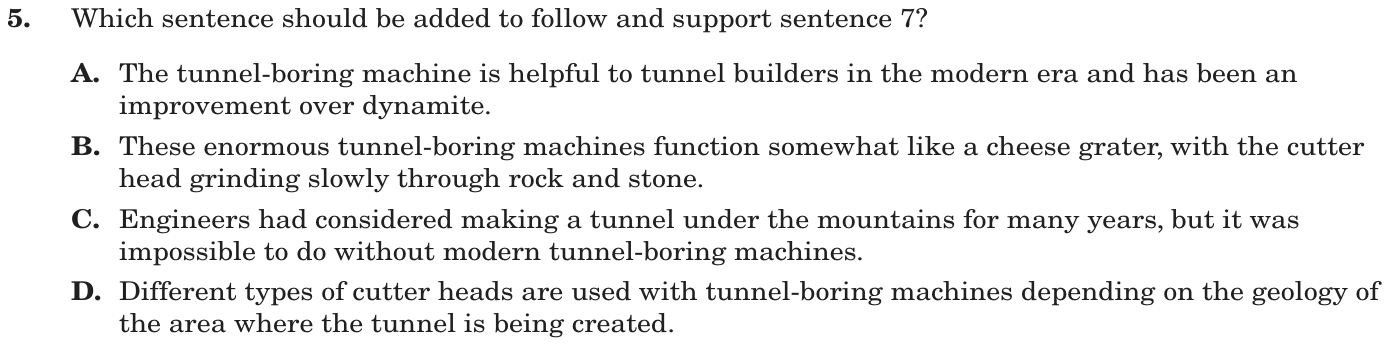
Which sentence should be added to follow and support sentence 7?
- AThe tunnel-boring machine is helpful to tunnel builders in the modern era and has been an improvement over dynamite.
- BThese enormous tunnel-boring machines function somewhat like a cheese grater, with the cutter head grinding slowly through rock and stone.
- CEngineers had considered making a tunnel under the mountains for many years, but it was impossible to do without modern tunnel-boring machines.
- DDifferent types of cutter heads are used with tunnel-boring machines depending on the geology of the area where the tunnel is being created.
Show the answer
Correct answer: B
This is the answer (B)
The question asks for a sentence that provides additional details about the tunnel-boring machines used to build the Gotthard Base Tunnel in order to support the description of the machines in sentence 7.
Option B is correct because it offers specific details about how tunnel-boring machines, such as the ones used to create the Gotthard Base Tunnel, drill through rock.
Option A is incorrect because it offers information about how tunnel-boring machines were an improvement over previous methods but does not include information about how the machines work.
Option C is incorrect because it presents the idea that the tunnel could not be built until advances were made in tunnel-boring machine technology and does not describe how the machines function.
Option D is incorrect because, though it explains that there are different types of cutter heads used for different geologies, the geology of the tunnel area is not discussed in sentence 7, nor in the rest of the paragraph.
Question analysis
This revising question asks which new sentence should follow and support a description of the tunnel-boring machines used to dig the Gotthard Base Tunnel. Every choice is about the machines, so students must decide which one actually develops the sentence before it rather than drifting to a related topic.
- NYS standards
- 7W2b developing a topic
- Grade level
- Grade 7 reading and task
- Compared with grade 7
- At grade 7 Adding a detail that supports a given sentence is a regular grade 7 writing task. The demand is typical: a short paragraph, plain vocabulary, and wrong choices that stay on the subject of the machines but serve other purposes.
- Estimated difficulty
- Moderate: several steps, or a close reading with one strong distractor.
- Thinking it demands
- Depth of knowledge 2, skills and concepts · mainly evaluate
- What makes it hard
- How sentences fit together moderate
- Evidence
- Answered from one paragraph or stanza
- Reading level
- Passage: about grade 11, 362 words; question and choices: about grade 11, 94 words.
- Students, last 30 days
- Not enough answers yet to show (it takes 10).
Why it is hard, traps and wrong answers (shows the answer)
Why it is hard
All four choices are about tunnel-boring machines, so topic alone settles nothing. The right sentence shows how the machines work and leads into their size in sentence 8, while the strongest wrong one wanders into geology. Some students also distrust the cheese-grater comparison as too casual, though a vivid analogy is exactly the kind of support a definition needs.
How sentences fit together moderate Working it out
The new sentence sits between sentence 7, which defines the machines, and sentence 8, which gives their size, so it has to keep describing the machines that dug this tunnel. (Halliday & Hasan, 1976)
Strategy: Reread sentence 7 and note exactly what it describes, then test each choice by asking whether it tells the reader more about that same thing or starts a new point.
Traps
- Off the point: Adds or keeps something that does not support the paragraph's or the passage's focus, or an introduction or conclusion that misses the main point.
- Wordy, vague or informal: A revision is grammatical but wordy, imprecise or too casual for the passage.
The wrong answers, classified
A Wordy, vague or informal (Connors & Lunsford, 1988)
Accepts a general claim that the machine is “helpful to tunnel builders in the modern era”, which praises it without adding any detail about how it works.
C Off the point (Halliday & Hasan, 1976)
Explains why the tunnel could not be built earlier, turning from what the machines are to the project's history, a topic the paragraph never takes up.
D Off the point (Halliday & Hasan, 1976)
Builds on the term “cutter head” from sentence 7, but varying heads for different geology starts a new subject that the paragraph never returns to.
Working it out, step by step
Figure out what the question asks
You need a sentence to go right after sentence 7. It must support sentence 7. That means it should tell more about the same thing sentence 7 is about.
Read sentence 7 closely
Sentence 7 says: “The tunnel was created through the use of tunnel-boring machines, which are giant drills with a flat rotating head called a cutter head.” So sentence 7 is about the machines and how they dig. Now look ahead. Sentence 8 tells how long each machine was. So the new sentence sits between two sentences about the machines.
Make sense of the key words
To bore means to drill a hole. A tunnel-boring machine is a huge drill that digs a tunnel. The cutter head is the spinning front part that cuts the rock. A good supporting sentence will help you picture how this machine works.
Check each choice
- B compares the machine to a cheese grater, “with the cutter head grinding slowly through rock and stone.” It shows how the machine works.
- A says the machine is “helpful to tunnel builders in the modern era.” That is praise, with no detail about how it works.
- C is about why the tunnel could not be built earlier. That is a new topic.
- D is about different cutter heads for different kinds of rock. The paragraph never talks about kinds of rock.
Watch out: D repeats the words “cutter heads,” so it seems connected. But it starts a subject the paragraph never comes back to.
Pick the answer
Choice B keeps describing the machines from sentence 7 and leads well into sentence 8. So the answer is B.
Why this answer and not the closest wrong one
D is the closest wrong answer, because it uses the term “cutter heads” from sentence 7. But it is about choosing heads for different rock, which the paragraph drops at once. B explains how the cutter head of these machines works, and that is exactly what sentence 7 set up.
More questions like this
The original DOE question
Question 7 of 57
2022 Test B English, question 7Uses the passage above: “Moving through Mountains”.
Question
Where should sentence 11 be moved in order to improve the organization of the second paragraph (sentences 6–11)?
- Ato the beginning of the paragraph (before sentence 6)
- Bbetween sentences 6 and 7
- Cbetween sentences 8 and 9
- Dbetween sentences 9 and 10
Show the answer
Correct answer: D
The Answer is (D)
The question asks where sentence 11, which completes the detailed steps of how the tunnel was built, should be moved within the second paragraph in order to improve the organization of the paragraph.
Option D, placing the sentence between sentences 9 and 10, is correct because placing the sentence there helps the reader understand the full sequence of steps performed in constructing the tunnel before the cost of the project is introduced.
Option A, placing the sentence at the beginning of the paragraph (before sentence 6), is incorrect because it would not make sense since the process of building the tunnel has not yet been introduced.
Similarly, Option B is incorrect because placing the sentence after sentence 6 would not make sense given that adding concrete would have to happen after the rock was broken down and removed from the tunnel.
Option C, placing the sentence between sentences 8 and 9, would also be incorrect because the use of concrete did not take place before the removal of “28 million tons of rock” (sentence 9).
Question analysis
This revising question asks where to move a sentence about the concrete used to support the Gotthard Base Tunnel so the second paragraph is better organized. Students must follow the order of the construction steps and notice what the sentence's opening words refer back to, since several positions sound acceptable at a glance.
- Grade level
- Grade 7 reading and task
- Compared with grade 7
- At grade 7 Ordering sentences logically is a grade 7 writing skill. Here the student follows a sequence of construction steps and a time-order signal word, a short, typical grade 7 revision task with four nearby positions to compare.
- Estimated difficulty
- Moderate: several steps, or a close reading with one strong distractor.
- Thinking it demands
- Depth of knowledge 2, skills and concepts · mainly analyze
- What makes it hard
- How sentences fit together major
- A very close wrong answer moderate
- Much to keep track of minor
- Every choice must be checked minor
- Evidence
- Answered from one paragraph or stanza
- Reading level
- Passage: about grade 11, 362 words; question and choices: about grade 7, 33 words.
- Students, last 30 days
- Not enough answers yet to show (it takes 10).
Why it is hard, traps and wrong answers (shows the answer)
Why it is hard
The question turns on two signal phrases: what “After that” must follow, and what “This massive construction project” sums up. Students who see only that the concrete belongs with the digging often park it beside the machine details, before the rock has been cleared. Those who try each position in context see that lining the tunnel can only follow removing the rock.
How sentences fit together major Working it out
Sentence 11 opens with “After that”, so it must follow the rock removal in sentence 9, while “This massive construction project” in sentence 10 reads best as the paragraph's close. (Halliday & Hasan, 1976)
A very close wrong answer moderate Choosing the answer
Moving the sentence between sentences 8 and 9 differs from the right spot, between 9 and 10, by a single sentence, and only seeing that sentence 9's rock removal must come first tells them apart. (Embretson & Wetzel, 1987; Gorin & Embretson, 2006; Ascalon et al., 2007)
Much to keep track of minor Working it out
The construction steps, from the 1996 start through the machines, the 28 million tons of rock and the concrete, have to be kept in order across six sentences. (Sweller, 1988; Carpenter, Just & Shell, 1990)
Every choice must be checked minor Choosing the answer
Each of the four positions has to be tried by rereading the paragraph with the concrete sentence in place, since several sound acceptable at a glance. (Embretson & Wetzel, 1987)
Strategy: Look at the signal words that open sentence 11 and ask what event they must follow. Then read the paragraph with the sentence in each position to check the order of events.
Traps
- Sentence in the wrong place: Puts a sentence where it breaks the order of ideas or separates it from what it refers to.
The wrong answers, classified
A Sentence in the wrong place (Halliday & Hasan, 1976)
Moves the sentence to open the paragraph, where “After that” would follow the 2016 completion in sentence 5, putting the concrete work after the tunnel was finished.
B Sentence in the wrong place (Halliday & Hasan, 1976)
Reads “After that” as following the 1996 start of construction, which sounds smooth but has the tunnel lined with concrete before any machine had bored it.
C Sentence in the wrong place (Halliday & Hasan, 1976)
Sees that the concrete comes after the machines did their work but places it before sentence 9, so the tunnel is lined before its 28 million tons of rock are removed.
Working it out, step by step
Figure out what the question asks
Sentence 11 is in the wrong spot. You need to move it so paragraph 2 tells events in the right order. Paragraph 2 is sentences 6 to 11.
Look at the clue words in sentence 11
Sentence 11 says: “After that, 4 million cubic meters of concrete, or enough concrete to build eighty-four Empire State Buildings, were used to construct and support the tunnel.” “After that” is a transition, a word or phrase that links ideas. It tells you the concrete came after some other event. You need to find that event.
Put the building steps in order
Think about how you build a tunnel. First you dig out the rock. Then you line the hole with concrete to hold it up.
- Sentence 6: work began in 1996.
- Sentences 7 and 8: the machines that did the digging.
- Sentence 9: “28 million tons of rock were removed.”
- Sentence 10: the project cost $12 billion.
The concrete must come after the rock is removed. So sentence 11 belongs right after sentence 9.
Read the paragraph in the new order
Sentence 9 removes the rock. “After that,” the concrete is poured. Then sentence 10 sums up “This massive construction project” and its cost. The cost makes a good last point. Right now, sentence 11 comes after the cost. So “After that” seems to mean after paying. That makes no sense.
Check each choice
- A, before sentence 6: “After that” would point back to sentence 5, after the tunnel was finished.
- B, after sentence 6: the concrete would come before any digging.
- C, between 8 and 9: the tunnel would be lined before the rock was removed.
- D, between 9 and 10: the concrete comes right after the rock is removed.
Watch out: C is only one spot away from D. Ask yourself: is the rock gone yet? In C, it isn’t.
Pick the answer
So the answer is D, between sentences 9 and 10.
Now the paragraph goes: start, machines, digging, concrete, cost.
Why this answer and not the closest wrong one
Choice C is close because it puts the concrete after the machines. But sentence 9 is where the rock is removed, and you can’t line a tunnel that is still full of rock. Only D puts “After that” right after the rock removal.
More questions like this
The original DOE question

Question 8 of 57
2022 Test B English, question 8Uses the passage above: “Moving through Mountains”.
Question
Which sentence presents information that shifts away from the main topic of the third paragraph (sentences 12–16) and should be removed?
- Asentence 13
- Bsentence 14
- Csentence 15
- Dsentence 16
Show the answer
Correct answer: D
The answer is (D)
The question asks which sentence should be removed because it presents an idea that shifts away from the main idea of the third paragraph, which is about the transportation benefits of the Gotthard Base Tunnel.
Option D (sentence 16) is the correct response because, even though the sentence provides additional information about the Channel Tunnel, it does not help the reader understand the benefits of the Gotthard Base Tunnel, so it should be removed.
Option A (sentence 13) is incorrect because the idea of faster travel times is important to the development of the main idea of the paragraph.
Option B (sentence 14) is incorrect because the sentence provides a specific example of decreased travel time between two cities when traveling through the Gotthard Base Tunnel, supporting the development of ideas in the paragraph.
Option C (sentence 15) is incorrect because the sentence compares the Gotthard Base Tunnel to another tunnel that provides an important connection between places, and the sentence supports the idea that transportation innovations are beneficial.
Question analysis
This revising question looks at the paragraph describing what the Gotthard Base Tunnel will do for travel in Europe and asks which sentence shifts away from that topic and should be removed. Every sentence is related to tunnels and travel, so students must judge which one no longer serves the paragraph's main point.
- NYS standards
- 7W2b developing a topic
- Grade level
- Grade 6 reading and task
- Compared with grade 7
- Below grade 7 Cutting a sentence that strays from a paragraph's focus is practiced from grade 6. The paragraph is five sentences of plain facts with one clear topic, so this asks less than a typical grade 7 revision task.
- Estimated difficulty
- Straightforward: two steps or one careful reading.
- Thinking it demands
- Depth of knowledge 2, skills and concepts · mainly analyze
- What makes it hard
- A very close wrong answer moderate
- How sentences fit together minor
- Evidence
- Answered from one paragraph or stanza
- Reading level
- Passage: about grade 11, 362 words; question and choices: about grade 6, 24 words.
- Students, last 30 days
- Not enough answers yet to show (it takes 10).
Why it is hard, traps and wrong answers (shows the answer)
Why it is hard
The paragraph drifts gradually, which makes this harder than a plain hunt for the odd sentence out. The Channel Tunnel arrives in sentence 15 as a comparison that still concerns the Gotthard tunnel's importance, and only the next sentence leaves the Gotthard tunnel behind entirely. Students who cut at the first mention of the other tunnel lose the point, so it pays to ask which sentence says nothing about the Gotthard tunnel or the travel it speeds up.
A very close wrong answer moderate Choosing the answer
Sentence 15 is the first to mention the Channel Tunnel, so it looks like the shift, but it still compares that tunnel with the Gotthard; sentence 16 is wholly about car trains under the Channel. (Embretson & Wetzel, 1987; Gorin & Embretson, 2006; Ascalon et al., 2007)
How sentences fit together minor Working it out
The paragraph's focus, the faster travel the Gotthard tunnel will bring, has to be held while each of sentences 13 through 16 is tested against it. (Halliday & Hasan, 1976)
Strategy: State the paragraph's topic in a few words, then check each listed sentence against it. The sentence to cut is the one that talks about something other than that topic.
The wrong answers, classified
A Fixes what isn't broken (Connors & Lunsford, 1988)
Cuts sentence 13 as a vague restatement, but “It will be faster for people to travel between northern and southern Europe” is the paragraph's central claim.
B Fixes what isn't broken (Connors & Lunsford, 1988)
Treats the Zurich-to-Milan example as a side detail, though the hour saved between those cities is concrete proof of the faster travel the paragraph promises.
C Fixes what isn't broken (Connors & Lunsford, 1988)
Rightly senses the Channel Tunnel is a detour but cuts the comparison that still concerns the Gotthard tunnel, leaving in sentence 16, which is only about car-carrying trains.
Working it out, step by step
Figure out what the question asks
Every sentence in a paragraph should support its main topic. One sentence in paragraph 3 drifts to a different topic. You need to find it so it can be cut.
Find the paragraph’s main topic
Paragraph 3 is sentences 12 to 16. Sentence 12 says the railway will carry many trains at high speeds. Sentence 13 says: “It will be faster for people to travel between northern and southern Europe.” So the topic is how the Gotthard Base Tunnel will make travel faster.
Test each sentence against the topic
- Sentence 13 states the topic: faster travel.
- Sentence 14 gives an example. The trip between Zurich and Milan will be an hour shorter.
- Sentence 15 compares the Gotthard Base Tunnel to the Channel Tunnel. It still talks about the Gotthard tunnel.
- Sentence 16 says “people can drive their cars onto special trains” in the Channel Tunnel. It says nothing about the Gotthard tunnel.
Watch for the trap
Watch out: Sentence 15 is the first to name the Channel Tunnel. So it can look like the place where the paragraph shifts. But it compares that tunnel with the Gotthard tunnel. That keeps it tied to the topic. Sentence 16 leaves the Gotthard tunnel behind completely.
Pick the answer
Sentence 16 is only about car trains in the Channel Tunnel. So the answer is D, sentence 16.
Why this answer and not the closest wrong one
Choice C, sentence 15, is the closest wrong answer, since it brings in the Channel Tunnel. But it still talks about the Gotthard Base Tunnel by comparing the two. Sentence 16 talks only about the Channel Tunnel, so it is the one that shifts away.
More questions like this
The original DOE question

Question 9 of 57
2022 Test B English, question 9Uses the passage above: “Moving through Mountains”.
Question
Which transition phrase should be added to the beginning of sentence 18?
- AAlthough the Gotthard Base Tunnel is mainly for freight trains
- BWith the Gotthard Base Tunnel taking ten years to complete
- CBecause of the successful completion of the Gotthard Base Tunnel
- DAs the number of trains using the Gotthard Base Tunnel increases
Show the answer
Correct answer: C
The answer is (C)
The question asks for a transition that bridges the ideas between sentences 17 and 18 and accurately presents the relationship.
Option C is correct because it bridges the sentences by referring to the Gotthard Base Tunnel as a solution to the problems described in sentence 17 and logically introducing sentence 18.
Option A is incorrect because the use of the word “although” and the mention of freight trains suggest that sentence 18 will be about other types of vehicles that use the Gotthard Base Tunnel, and the transition phrase does not logically precede the sentence.
Option B is incorrect because the reference to the amount of time it took to build the tunnel does not help lead into the idea presented in sentence 18.
Option D is incorrect because it suggests that sentence 18 is related to the increasing number of trains using the Gotthard Base Tunnel, which is not accurate.
Question analysis
This revising question asks which introductory phrase should begin the last sentence of a passage about the Gotthard Base Tunnel, linking it to the idea before it. All four phrases are grammatical and mention the tunnel, so students must work out the logical relationship between the two sentences and check each phrase against the facts given earlier.
- NYS standards
- 7W2d transitions in informative writing
- Grade level
- Grade 7 reading and task
- Compared with grade 7
- At grade 7 Choosing a transition that shows how two ideas relate is a core grade 7 writing skill. The two sentences involved are short and the vocabulary is plain, so this is typical classroom revision work.
- Estimated difficulty
- Straightforward: two steps or one careful reading.
- Thinking it demands
- Depth of knowledge 2, skills and concepts · mainly evaluate
- What makes it hard
- How sentences fit together moderate
- Every choice must be checked minor
- Evidence
- Answered from one paragraph or stanza
- Reading level
- Passage: about grade 11, 362 words; question and choices: about grade 6, 52 words.
- Students, last 30 days
- Not enough answers yet to show (it takes 10).
Why it is hard, traps and wrong answers (shows the answer)
Why it is hard
The task is to see that renewed interest is a result, which calls for an opener that names a cause. Phrases that are merely true of the tunnel, or that tie interest to growing traffic, read smoothly and slip past students who do not test the logic. One opener also gives the construction time as ten years, which careful readers can reject against the seventeen-year period in sentence 9.
How sentences fit together moderate Working it out
Sentence 17 widens the view from this tunnel to tunnels in general, and sentence 18 reports renewed interest, so the opener has to name what caused that interest. (Halliday & Hasan, 1976)
Every choice must be checked minor Choosing the answer
All four openers are grammatical and name the Gotthard Base Tunnel, so each has to be read into sentence 18 and checked against facts given earlier in the passage. (Embretson & Wetzel, 1987)
Strategy: Read sentences 17 and 18 together and decide how they are connected: by contrast, by time, or by cause. Then choose the opening that expresses that link and fits facts already stated.
Traps
- Wrong transition: A connecting word or phrase that signals the wrong relationship, such as contrast where the idea continues.
The wrong answers, classified
A Wrong transition (Halliday & Hasan, 1976)
Likes the accurate freight detail from sentence 12, but “Although” promises a contrast, and nothing in sentence 18 runs against the tunnel being mainly for freight.
B Wrong transition (Halliday & Hasan, 1976)
Accepts a time detail that explains nothing about renewed interest and gets the time wrong, since sentence 9 gives a seventeen-year construction period.
D Wrong transition (Halliday & Hasan, 1976)
Senses that sentence 18 needs a cause but names growing train traffic, a plausible link the passage never makes, when the interest follows from the tunnel's completion.
Working it out, step by step
Figure out what the question asks
A transition is a word or phrase that links two ideas. Some show contrast, like although. Some show time, like then. Some show cause, like because. You need the opening for sentence 18 that shows how it links to sentence 17.
Read sentences 17 and 18 together
Sentence 17 says mountain ranges “have also sent people underground for faster, easier, and cheaper methods of transportation across larger areas.” Sentence 18 says: “There is renewed interest in constructing innovative methods of transportation.” Renewed interest means people care about something again. Innovative means new and creative.
Decide how the ideas connect
Why would people care about new kinds of travel again? Because the whole passage just showed a tunnel that worked. It solved the mountain problem. So sentence 18 is a result. The opening should name the cause.
Check each choice
- C, “Because of the successful completion of the Gotthard Base Tunnel,” names the cause. The tunnel’s success led to new interest.
- A starts with “Although,” which signals a contrast. Nothing in sentence 18 goes against the tunnel being for freight.
- B gives the building time, which doesn’t explain new interest. It is also wrong. Sentence 9 says the work took seventeen years, not ten.
- D names more trains as the cause. The passage never makes that link.
Watch out: D also sounds like a cause, so it is the most tempting wrong choice.
Pick the answer
The new sentence reads: Because of the successful completion of the Gotthard Base Tunnel, there is renewed interest in… So the answer is C.
Why this answer and not the closest wrong one
D is the closest wrong answer, because it also gives a cause. But the passage never says the number of trains made people interested. The tunnel’s success is what the whole passage builds up to, so C links the ideas best.
More questions like this
The original DOE question
Question 10 of 57
2022 Test B English, question 10Uses the passage above: “Moving through Mountains”.
Question
Which concluding sentence should be added after sentence 18 to support the topic presented in the passage?
- AThere is proof that underground tunnels such as the Gotthard Base Tunnel are beneficial to the economy of the surrounding area.
- BThe Gotthard Base Tunnel is an extraordinary example of how human ingenuity and persistence can overcome great obstacles.
- CThe completion of the Gotthard Base Tunnel shows that people can work together to achieve important goals.
- DThe Swiss government is confident that the economic impact of the Gotthard Base Tunnel will be worth its construction cost.
Show the answer
Correct answer: B
The answer is (B)
The question asks for a concluding sentence that supports key ideas about the topic developed earlier in the passage.
Option B is correct because it supports the points made in the introductory paragraph by affirming the idea that the Gotthard Base Tunnel is an example of a way people have improved life by overcoming obstacles.
Option A is incorrect because the economies of surrounding areas were never mentioned in the passage.
Option C is incorrect because, although the construction of the Gotthard Base Tunnel appears to have required many people to work together, the passage does not explicitly mention people or groups working together.
Option D is incorrect because it focuses on the cost of the Gotthard Base Tunnel, which is referred to only in sentence 10 of the passage.
Question analysis
This revising question asks which concluding sentence should end the passage about building the Gotthard Base Tunnel. Students must recognize the passage's overall point and choose a conclusion that sums it up, avoiding sentences that sound reasonable but add claims the passage never supports.
- NYS standards
- 7W2e concluding informative writing
- Grade level
- Grade 7 reading and task
- Compared with grade 7
- At grade 7 Picking a concluding sentence that reflects a passage's central idea is standard grade 7 writing work. Students must keep the whole short passage in mind and reject conclusions that bring in claims it never makes.
- Estimated difficulty
- Moderate: several steps, or a close reading with one strong distractor.
- Thinking it demands
- Depth of knowledge 2, skills and concepts · mainly evaluate
- What makes it hard
- Evidence in several places moderate
- A very close wrong answer moderate
- Evidence
- Answered from the whole text
- Reading level
- Passage: about grade 11, 362 words; question and choices: about grade 12, 92 words.
- Students, last 30 days
- Not enough answers yet to show (it takes 10).
Why it is hard, traps and wrong answers (shows the answer)
Why it is hard
The conclusion has to return to the idea the passage opened with, which sits at the far end of the text from where the new sentence goes. Students who have forgotten the proverb about necessity tend to choose by tone, and three choices sound like fitting final lessons or benefits. What the question rewards is matching the conclusion to the opening's own words, ingenuity and obstacles.
Evidence in several places moderate Working it out
The passage's point is set out in sentences 1 to 3, the proverb about necessity and “human ingenuity in the face of obstacles”, about fifteen sentences before the spot where the conclusion goes. (Kirsch & Mosenthal, 1990; Gorin & Embretson, 2006)
A very close wrong answer moderate Choosing the answer
The right conclusion and the teamwork one share a frame, the tunnel as proof of what people can do, and differ only in the lesson: ingenuity against obstacles, from sentences 1 to 3, or teamwork, which the passage never mentions. (Embretson & Wetzel, 1987; Gorin & Embretson, 2006; Ascalon et al., 2007)
Strategy: Say in one sentence what the whole passage is about, then choose the conclusion that restates that idea without adding claims the passage never makes.
Traps
- Off the point: Adds or keeps something that does not support the paragraph's or the passage's focus, or an introduction or conclusion that misses the main point.
- Too narrow: A single detail offered as the central idea or a summary, or a summary that keeps minor details and leaves out an essential part.
The wrong answers, classified
A Off the point (Halliday & Hasan, 1976)
Ends on a claim of “proof” that tunnels help local economies, a benefit that sounds right for a conclusion but that the passage never discusses.
C Off the point (Halliday & Hasan, 1976)
Sees that the ending should state a broad human lesson but picks teamwork, which the passage never raises, instead of the ingenuity against obstacles it opened with.
D Too narrow (King et al., 2004)
Seizes on the $12 billion cost, mentioned once in sentence 10, and adds a government opinion the passage never reports, narrowing the ending to one detail.
Working it out, step by step
Figure out what the question asks
You need a last sentence for the passage. A good conclusion sums up the main idea. It often goes back to the point made at the start. It should not add new claims that the passage never made.
Find the main idea at the start
Sentence 1 says: “An age-old proverb says that necessity is the mother of invention.” Sentence 2 says: “Centuries of human ingenuity in the face of obstacles prove this to be true.” Sentence 3 says the Swiss Alps “were such an obstacle.”
Put the main idea in plain words
A proverb is an old saying. Necessity is the mother of invention means that when people really need something, they find a clever way to get it. Ingenuity means cleverness. An obstacle is something in the way. So the passage says people use cleverness to get past what blocks them. The tunnel is the example.
Check each choice
- B says the tunnel shows “how human ingenuity and persistence can overcome great obstacles.” This repeats the opening idea. Persistence means not giving up.
- A is about the economy, meaning money and jobs, of nearby areas. The passage never discusses that.
- C is about people working together. The passage never mentions teamwork.
- D is about the cost and the government’s opinion. The cost comes up only once, in sentence 10.
Watch out: C sounds like a fine life lesson for an ending. But a conclusion must match this passage, and teamwork is not its point.
Pick the answer
Choice B restates the passage’s main idea without adding anything new. It ties the ending back to the beginning. So the answer is B.
Why this answer and not the closest wrong one
C is the closest wrong answer, because it also uses the tunnel to teach a lesson. But teamwork never comes up in the passage. B uses the passage’s own words, “human ingenuity” against “obstacles,” so it closes the passage the way it opened.
More questions like this
The original DOE question
Question 11 of 57
2022 Test B English, question 11Passage Excerpt from “The World Has an E-Waste Problem”
Excerpt from “The World Has an E-Waste Problem”
by Alana Semuels
As a tech-hungry nation . . . gets ready to upgrade to the next generation of lightning-fast 5G devices, there is a surprising environmental cost to be reckoned with: a fresh mountain of obsolete1 gadgets. About 6 million pounds of discarded electronics are already processed monthly at recycling giant ERI’s Fresno plant. Pallets2 of once beloved but now outdated devices . . . arrive here daily. Workers with hammers hack at the bulkiest devices, while others remove dangerous components like lithium-ion batteries. The scene is like a twisted . . . movie, with doomed gadgets riding an unrelenting conveyor belt into a machine that shreds them into piles of copper, aluminum and steel.
“In our society, we always have to have the new, best product,” said Aaron Blum, the co-founder and chief operating officer of ERI, on a tour of the facility. Americans spent $71 billion on telephone and communication equipment in 2017, nearly five times what they spent in 2010 even when adjusted for inflation, according to the Bureau of Economic Analysis. . . . When we buy something new, we get rid of what’s old. That cycle of consumption has made electronics waste the world’s fastest-growing solid-waste stream.
That stream is expected to turn into a torrent3 as the world upgrades to 5G, the next big step in wireless technology. 5G promises faster speeds and other benefits. But experts say it will also result in a dramatic increase in e-waste, as millions of smartphones, modems and other gadgets incompatible with 5G networks are made obsolete. “I don’t think people understand the magnitude of the transition,” says ERI co-founder and executive chairman John Shegerian. “This is bigger than the change of black-and-white to color, bigger than analog to digital, by many multitudes.”
. . . Less than a quarter of all U.S. electronic waste is recycled, according to a United Nations estimate. The rest is incinerated or ends up in landfills. That’s bad news, as e-waste can contain harmful materials like mercury and beryllium that pose environmental risks.
Part of the problem is regulatory. Only 19 states have laws banning electronics from the regular trash. In states without such rules, like Nevada, electronics often end up in garbage and recycling bins, said Jeremy Walters, a community-relations manager for waste collector Republic Services. Environmental concerns aside, compacting flammable lithium-ion batteries with paper recycling can be dangerous; recycling centers have reported an uptick in fires.
Even when e-waste rules exist, it’s left up to consumers to handle their old devices properly. But recycling them can be a pain. Rather than just drop a used phone in a bin outside their homes, lots of people have to take their electronics to a store, which may pay them for it but could also charge them to get rid of it. Many consumers, paralyzed by the hassle or put off by the expense, simply throw their devices into the trash or stash them in a drawer, hoping they’ll just disappear. “We don’t necessarily have the measures to make sure people aren’t throwing it away,” Walters said.
One solution is to make electronics last as long as they once did. At ERI’s facility, Shegerian showed TIME [magazine] dozens of televisions from the 1970s and 1980s that stopped working only recently. Yet instead, technology companies are speeding the pace of obsolescence. Most smartphone batteries can’t be easily replaced when they stop holding a charge, new laptops don’t accept old cables, and software companies push upgrades that won’t run on old devices. “Our products today don’t last as long as they used to, and it’s a strategy by manufacturers to force us into shorter and shorter upgrade cycles,” said Kyle Wiens, the founder of iFixit, which publishes do-it-yourself repair guides. . . .
Some environmental groups say multibillion-dollar companies . . . should pick up the cost of recycling the devices they sell. Lawmakers in parts of Europe and Canada and in some U.S. states have passed so-called Extended Producer Responsibility (EPR) laws, which require manufacturers to establish and fund systems to recycle or collect obsolete products. . . .
. . . Some companies are increasing their recycling efforts on their own, whether for the economic benefit or the public relations boost.
From “The World Has an E-Waste Problem” by Alana Semuels from TIME Magazine, June 3, 2019. Copyright © 2019 TIME USA, LLC.
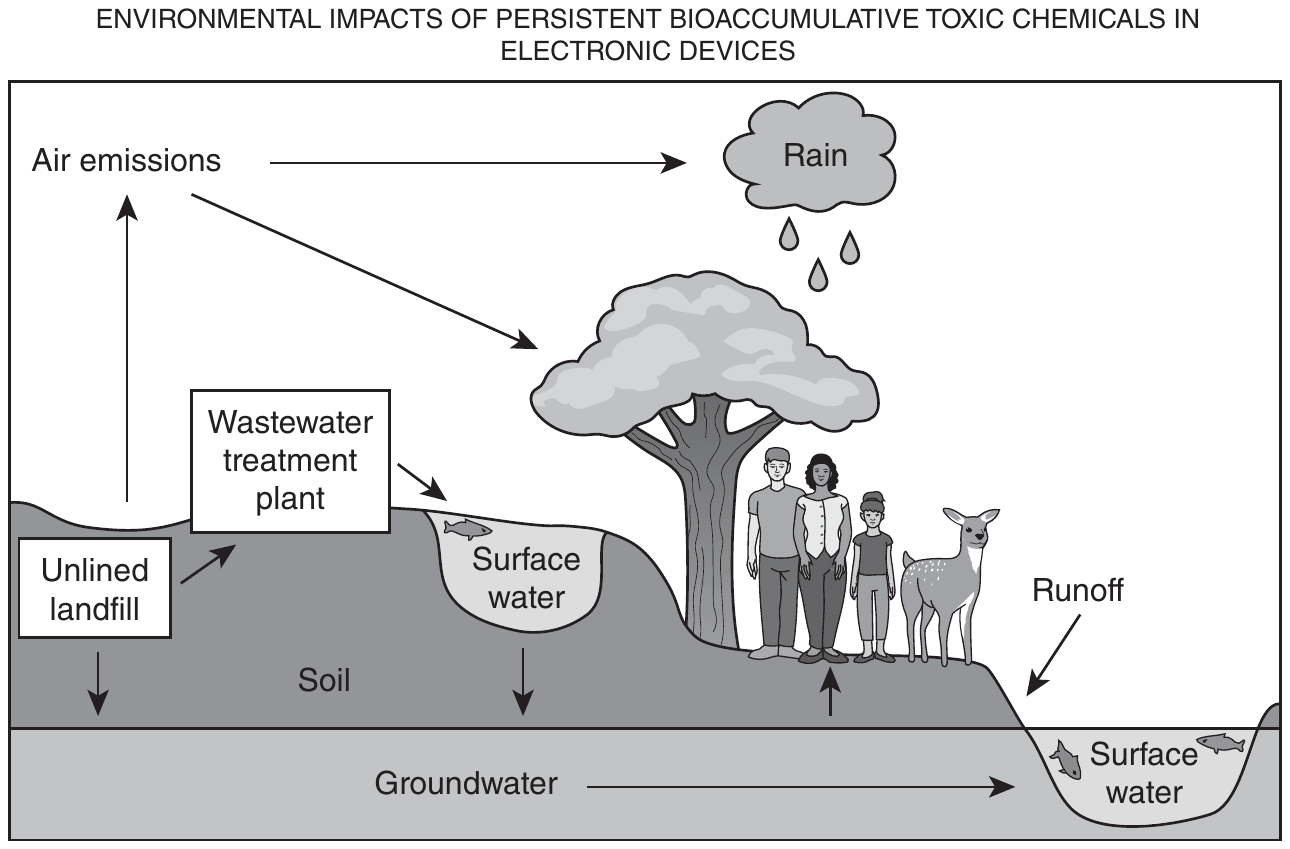
Electronics such as smartphones, computers, cameras, and large appliances contain toxins like lead, chromium, zinc, nickel, mercury, beryllium, and cadmium. These substances are bioaccumulative, which means that they accumulate over time in living organisms.
1obsolete: outdated and no longer useful
2Pallets: wooden platforms used to store or transport materials in a warehouse
3torrent: an outpouring
Question
Read this sentence from paragraph 1.
The scene is like a twisted . . . movie, with doomed gadgets riding an unrelenting conveyor belt into a machine that shreds them into piles of copper, aluminum and steel.
The words “twisted,” “doomed,” and “unrelenting” most affect the sentence by
- Aemphasizing that discarded devices are condemned to an unfortunate fate.
- Bexpressing a sense of desperation about the amount of waste from discarded devices.
- Cimplying that discarded devices are often disposed of in an inappropriate manner.
- Dsuggesting a feeling of doubt about solving the problem of discarded devices.
Show the answer
Correct answer: A
The question asks about the effect of the words “twisted,” “doomed,” and “unrelenting” on the last sentence of paragraph 1.
A. CORRECT. Paragraph 1 first describes the problem of discarded devices in terms of the scope of the problem (“about 6 million pounds . . . processed monthly”). The author then elaborates on the problem with a vivid description of the actual process; it is unfortunate that this process is necessary because, even though they are relatively new, these devices are no longer useful. These particular words emphasize the process of a once-useful device becoming a part of a “twisted . . . movie,” and “doomed” to be recycled by going through an “unrelenting” or never-ending conveyor belt.
B. Incorrect. In the excerpt, the author does express concern about the amount of waste from discarded devices, but this particular sentence is about what happens to the devices and the perspective that one has while watching the devices as they are being processed. In this description, the once-beloved devices have been destroyed, with only some useful parts being retained.
C. Incorrect. Although there is an indication in paragraphs 4–6 that some obsolete devices are disposed of inappropriately, this description is of an appropriate disposal—a recycling center developed specifically for these types of devices.
D. Incorrect. At this juncture in the excerpt, the author has not yet mentioned solving the problem of discarded devices; rather, the author is describing what happens to discarded devices that are appropriately recycled.
Question analysis
This word-choice question quotes the last sentence of the opening paragraph of “The World Has an E-Waste Problem,” in which old gadgets ride a conveyor belt into a shredder at a recycling plant. Students decide how the words “twisted,” “doomed” and “unrelenting” most affect the sentence. Each choice reads something negative into the words, so their connotations have to be matched to what this sentence describes.
- Grade level
- Grade 7 reading and task
- Compared with grade 7
- At grade 7 Explaining how word choices shape a sentence’s meaning and tone is everyday grade 7 work. The three words are quoted and sit in one sentence, though it comes from adult magazine prose and its comparison has a word cut by an ellipsis.
- Estimated difficulty
- Straightforward: two steps or one careful reading.
- Thinking it demands
- Depth of knowledge 2, skills and concepts · mainly analyze
- What makes it hard
- Figurative or literary language moderate
- Hard words minor
- Evidence
- Answered from one sentence or line
- Reading level
- Passage: about grade 10, 760 words; question and choices: about grade 8, 91 words.
- Students, last 30 days
- Not enough answers yet to show (it takes 10).
Why it is hard, traps and wrong answers (shows the answer)
Why it is hard
The three words share one job: they cast once-loved gadgets as victims on a one-way ride to the shredder. Each wrong choice keeps the gloom but points it somewhere else, at the amount of waste, at improper dumping, or at the chances of fixing the problem. Students who ask what the words describe in this one sentence, rather than what the article worries about overall, settle on the gadgets’ fate quickly.
Figurative or literary language moderate Understanding the question
The sentence likens the plant to “a twisted . . . movie,” with a word cut by the ellipsis, and the effect lives in connotation: “doomed” and “unrelenting” turn gadgets on a conveyor belt into victims bound for a shredder. (Graesser, Singer & Trabasso, 1994; Kintsch, 1998)
Hard words minor Understanding the question
“Unrelenting” has to be known as never letting up, and the right choice restates “doomed” as “condemned to an unfortunate fate,” so the match is one of meaning, not of sound. (Perfetti, 2007; Freedle & Kostin, 1993)
Strategy: Ask what the three words describe in this one sentence and what feeling they share, then check each choice against the sentence itself rather than against the article as a whole.
Traps
- Wrong tone or attitude: Misjudges the tone, attitude or point of view, such as reading admiration as criticism, or taking a character's or subject's feelings for the author's.
- Wrong part of the text: A choice is true of another paragraph, stanza or speaker than the one asked about.
- Reads too much in: A reasonable-sounding conclusion that goes further than the text allows.
The wrong answers, classified
B Wrong tone or attitude (Graesser, Singer & Trabasso, 1994)
Hears despair in the grim words and ties “unrelenting” to the six million pounds a month, but the sentence follows the gadgets’ fate on the belt and voices no desperation about volume.
C Wrong part of the text (Kirsch & Mosenthal, 1990)
Takes “twisted” as a sign of wrongdoing and recalls the trash and landfills of paragraphs 4–6, though this scene is a recycling plant, the proper place for old devices.
D Reads too much in (Graesser, Singer & Trabasso, 1994)
Hears hopelessness in “doomed” and stretches it to the whole e-waste problem, though the sentence never turns to solutions, which the excerpt reaches only in paragraph 7.
Working it out, step by step
Find what the question asks
This is a word-choice question. Three words in one sentence work as a team: “twisted,” “doomed” and “unrelenting.” You need to find the feeling they create and what they describe. Stay inside this one sentence, not the whole article.
Read the last sentence of paragraph 1
Paragraph 1 ends: “The scene is like a twisted . . . movie, with doomed gadgets riding an unrelenting conveyor belt into a machine that shreds them into piles of copper, aluminum and steel.” The dots (. . .) mean some words were left out. A conveyor belt is a moving belt that carries things along, like the one at a grocery checkout. The “scene” is the recycling plant.
Work out each word
Each word adds something dark.
- Twisted means strange in a creepy way. A twisted movie is a dark one.
- Doomed means sure to meet a bad end, with no escape.
- Unrelenting means it never stops or slows down.
Put together, the gadgets sound like movie characters on a one-way ride. The belt keeps moving, and the shredder waits at the end.
Test the four choices
- A fits. “Condemned to an unfortunate fate” means sentenced to a bad ending. That is just what “doomed” says.
- B does not fit. The amount of waste, 6 million pounds a month, comes earlier. This sentence follows the gadgets, and no one sounds desperate.
- C does not fit. This is a recycling plant, the right place for old devices. Trash and landfills come later, in paragraphs 4–6.
- D does not fit. The sentence says nothing about fixing the problem. Solutions first come up in paragraph 7.
Pick the answer
Watch out: B is tempting because the words sound gloomy, and the plant handles a lot of waste. But gloom is not desperation, which means feeling out of hope. These words make you feel sorry for the gadgets themselves. So the answer is A.
Why this answer and not the closest wrong one
B is the closest wrong choice. The paragraph does show a huge pile of waste. But “doomed” and “unrelenting” point at what happens to each gadget: it rides the belt to the shredder and can’t get off. That is a sad fate, which is A, not a worry about how much waste there is.
More questions like this
The original DOE question
The passage “Excerpt from “The World Has an E-Waste Problem”” as printed (pages 164–166)
Question 12 of 57
2022 Test B English, question 12Uses the passage above: “Excerpt from “The World Has an E-Waste Problem””.
Question
How does paragraph 2 build on what the reader learns in paragraph 1?
- AParagraph 2 explains the underlying cause of the massive amounts of recycling that are described in paragraph 1.
- BParagraph 2 discusses the past trends that have led to the technological innovation mentioned in paragraph 1.
- CParagraph 2 cites statistics that support the claim about technology that is stated at the beginning of paragraph 1.
- DParagraph 2 expresses disapproval of the consumers who throw away the products that are discussed in paragraph 1.
Show the answer
Correct answer: A
The question asks how paragraph 2 expands upon the reader’s understanding from paragraph 1.
A. CORRECT. Paragraph 1 describes massive amounts of recycling (“about 6 million pounds . . . processed monthly”). Paragraph 2 then explains the underlying reason for so much electronics recycling, using a quote from a resource: “ ‘we always have to have the new, best product,’ ” so we buy new electronic products and “get rid of what’s old.”
B. Incorrect. The trend outlined in paragraph 2 is not one of the past but rather one that is ongoing and even increasing at an alarming rate; in only seven years, American consumers quintupled their spending on “telephone and communication equipment.”
C. Incorrect. While it is true that paragraph 2 presents a statistic about American consumer patterns from 2010 to 2017, the spending on these items does not directly support any claims about waste problems. Specific statistics about waste generation, as opposed to this statistic related only to spending, would better support this type of claim.
D. Incorrect. Although paragraph 2 mentions that consumers “get rid of what’s old” once “we buy something new,” this is merely a statement of fact and not a judgment about this behavior.
Question analysis
This text-structure question on “The World Has an E-Waste Problem” asks how paragraph 2, with a recycling executive’s remark and figures on Americans’ spending on phones and communication equipment, builds on the opening scene at a recycling plant. Students must name the link between two paragraphs, and every choice points to something that really appears in one of them.
- Grade level
- Grade 7 reading and task
- Compared with grade 7
- At grade 7 Explaining how one paragraph builds on another is core grade 7 text-structure work. The two paragraphs are short, but students must judge the relationship between them rather than find a detail, and the magazine prose is dense with figures and quotations.
- Estimated difficulty
- Moderate: several steps, or a close reading with one strong distractor.
- Thinking it demands
- Depth of knowledge 2, skills and concepts · mainly analyze
- What makes it hard
- How, not what moderate
- Every choice must be checked minor
- Evidence
- Answered from several paragraphs or stanzas
- Reading level
- Passage: about grade 10, 760 words; question and choices: about grade 11, 75 words.
- Students, last 30 days
- Not enough answers yet to show (it takes 10).
Why it is hard, traps and wrong answers (shows the answer)
Why it is hard
Paragraph 2 answers the question that paragraph 1 leaves open, why so many gadgets pour into ERI’s plant. The spending figures are the snag: a $71 billion total that grew nearly fivefold seems to prove the opening’s “tech-hungry nation,” and the choice built on them sounds like a fair account of the paragraph. Students who read to its end, where buying something new means getting rid of what’s old, see that its job is to explain the waste, not to back a claim.
How, not what moderate Working it out
The stem asks how paragraph 2 relates to paragraph 1, so students must name a link, the buy-new, throw-out-old cycle behind the 6 million pounds a month, rather than spot a detail both paragraphs share. (Anderson & Krathwohl, 2001)
Every choice must be checked minor Choosing the answer
Each choice ties something in paragraph 2 (statistics, a trend, Blum’s remark) to something in paragraph 1 (the recycling, 5G, the opening claim), so both ends of every choice must be checked. (Embretson & Wetzel, 1987)
Strategy: Sum up each of the first two paragraphs in a few words, ask what the second adds to the first, and check that both ends of a choice match what each paragraph says.
Traps
- Half right: One half of a two-part choice is right and the other is not.
- Wrong tone or attitude: Misjudges the tone, attitude or point of view, such as reading admiration as criticism, or taking a character's or subject's feelings for the author's.
- Twists what the text says: Uses the text's topic and ideas but changes what it says: who did it, how much, when, or why.
The wrong answers, classified
B Twists what the text says (King et al., 2004)
Pairs the years 2010 and 2017 with the 5G upgrade and assumes spending led to new technology, though paragraph 2 says the cycle of buying led to waste.
C Half right (King et al., 2004; Thissen, Steinberg & Fitzpatrick, 1989)
Matches the $71 billion figure to the opening’s “tech-hungry nation,” but the claim there is that the 5G upgrade brings an environmental cost, which spending from 2010 to 2017 does not show.
D Wrong tone or attitude (Graesser, Singer & Trabasso, 1994)
Hears criticism in Blum’s “we always have to have the new, best product,” though the paragraph says “we” and reports the habit of replacing devices without judging the people who do it.
Working it out, step by step
See what the question asks
This asks how two paragraphs fit together. Paragraph 2 builds on paragraph 1 when it adds something new to it. So first sum up each paragraph in a few words. Then ask what the second one adds. Both ends of a choice must match.
Sum up paragraph 1
Paragraph 1 shows a mountain of old gadgets. “About 6 million pounds of discarded electronics are already processed monthly” at one recycling plant. Discarded means thrown away. Workers break the devices apart, and a machine shreds them. So paragraph 1 shows what is happening: a flood of e-waste.
Sum up paragraph 2
Paragraph 2 tells why. Aaron Blum says, “In our society, we always have to have the new, best product.” Spending on phones and similar gear grew nearly five times from 2010 to 2017. Then comes the key line: “When we buy something new, we get rid of what’s old.” That habit, the paragraph says, made e-waste the fastest-growing kind of solid waste.
Test both ends of each choice
- A fits. The buy-new, toss-old habit causes the huge amounts of recycling in paragraph 1. An underlying cause is the deeper reason behind something.
- B does not fit. Paragraph 2 says the buying habit leads to waste. It never says what led to 5G or to any new invention.
- C does not fit. Paragraph 1 opens by claiming the 5G upgrade brings an environmental cost. Money spent from 2010 to 2017 does not show that cost. Paragraph 2 uses its numbers to show the buying habit instead.
- D does not fit. Blum says “we,” so he counts himself in. The paragraph reports a habit without blaming anyone.
Choose the answer
Watch out: C is tempting. A jump to $71 billion sounds like proof of a “tech-hungry nation.” But read paragraph 2 to its end. Its point is the cycle of buying and throwing away, which explains the waste. So the answer is A.
Why this answer and not the closest wrong one
C is the closest wrong choice, because paragraph 2 does have numbers. But the numbers serve a bigger point. People buy new things and toss the old ones, and that cycle fills plants like ERI’s. Paragraph 2 gives the reason behind paragraph 1’s pile of gadgets. That is a cause, which is A.
More questions like this
The original DOE question
Question 13 of 57
2022 Test B English, question 13Uses the passage above: “Excerpt from “The World Has an E-Waste Problem””.
Question
Which sentence from the excerpt suggests that electronic devices are purposely designed to be disposed of after a short time?
- A“ ‘In our society, we always have to have the new, best product,’ said Aaron Blum, the co-founder and chief operating officer of ERI, on a tour of the facility.” (paragraph 2)
- B“Even when e-waste rules exist, it’s left up to consumers to handle their old devices properly.” (paragraph 6)
- C“Most smartphone batteries can’t be easily replaced when they stop holding a charge, new laptops don’t accept old cables, and software companies push upgrades that won’t run on old devices.” (paragraph 7)
- D“Some environmental groups say multibillion-dollar companies . . . should pick up the cost of recycling the devices they sell.” (paragraph 8)
Show the answer
Correct answer: C
This question asks for the best support from the excerpt for the idea that electronic devices are purposely designed to be disposed of after a short time.
A. Incorrect. This statement actually contradicts the notion that it is the manufacturers who are at fault for designing products to only last a short while, as it suggests that the desire for upgrading electronic devices comes directly from consumers themselves.
B. Incorrect. Though this explains a problem that occurs after the devices have already been upgraded, it provides no support for the idea that these devices are intentionally designed to become obsolete quickly.
C. CORRECT. This explains the techniques manufacturers of these devices implement to make the devices unusable after a short time. They cannot easily be repaired; they cannot be integrated with legacy components, and older devices are unable to run with new software.
D. Incorrect. This sentence explains that some people feel that these companies should accept responsibility for creating such short-lived devices, but it does not directly indicate that they intentionally make devices to become useless after only a short time.
Question analysis
This textual evidence question on “The World Has an E-Waste Problem” asks which quoted sentence suggests that electronic devices are purposely designed to be thrown away after a short time. The four sentences come from paragraphs 2, 6, 7 and 8, and each relates to the e-waste problem, so students must tell evidence for this exact claim apart from related points.
- NYS standards
- 7R1 textual evidence and inferences
- Grade level
- Grade 7 reading and task
- Compared with grade 7
- At grade 7 Choosing the sentence that best supports a stated idea is standard grade 7 evidence work. The four sentences are quoted with their paragraph numbers, so the search is short, though each one has to be weighed in its paragraph.
- Estimated difficulty
- Straightforward: two steps or one careful reading.
- Thinking it demands
- Depth of knowledge 2, skills and concepts · mainly evaluate
- What makes it hard
- Evidence
- Answered from one paragraph or stanza
- Reading level
- Passage: about grade 10, 760 words; question and choices: about grade 11, 116 words.
- Students, last 30 days
- Not enough answers yet to show (it takes 10).
Why it is hard, traps and wrong answers (shows the answer)
Why it is hard
The claim has two parts, that devices are built to be short-lived and that this is deliberate, and only one sentence speaks to how they are built. Blum’s remark is the strong pull because it explains why devices are replaced quickly, yet it puts the cause in buyers’ appetite for the newest model. Reading paragraph 7 around its quoted sentence settles the deliberate part, since the next sentence calls it a manufacturers’ strategy.
Reading between the lines minor Working it out
The keyed sentence lists batteries that can’t be replaced, cables that don’t fit and upgrades that won’t run, but never calls them deliberate; the intent comes from “speeding the pace of obsolescence” and Wiens’s “it’s a strategy.” (Graesser, Singer & Trabasso, 1994; Kintsch, 1998)
Every choice must be checked minor Choosing the answer
All four quoted sentences concern old devices and come from four different paragraphs, so each has to be tested for design and intent, not just for being about e-waste. (Embretson & Wetzel, 1987)
Strategy: Restate the claim in your own words, then read each quoted sentence in its paragraph and ask whether it supports that exact claim or only a related point about e-waste.
Traps
- Supports only part of the claim: In a question about evidence: a line that backs one half of the claim but not the other, or a related point rather than the claim itself.
- Reads too much in: A reasonable-sounding conclusion that goes further than the text allows.
- True but not the answer: A choice says something accurate about the text that does not answer this question.
The wrong answers, classified
A Supports only part of the claim (King et al., 2004; Thissen, Steinberg & Fitzpatrick, 1989)
Sees that Blum’s “we always have to have the new, best product” explains quick replacement, but it blames buyers’ wants and says nothing about how devices are designed.
B True but not the answer (King et al., 2004; Embretson & Wetzel, 1987)
Picks a sentence about who must handle old devices under e-waste rules, which concerns disposal after a device is replaced, not anything built into it to cut its life short.
D Reads too much in (Graesser, Singer & Trabasso, 1994)
Reasons that companies asked to pay for recycling must be making short-lived devices on purpose, though the sentence reports a demand from environmental groups and says nothing about design.
Working it out, step by step
Restate the idea to support
This asks for evidence, a sentence that backs up an idea. The idea has two parts. Devices are designed, or built, to be thrown out soon. And this is done on purpose. So the right sentence must be about how devices are made.
Find the sentence about design
Paragraph 7 says, “Most smartphone batteries can’t be easily replaced when they stop holding a charge, new laptops don’t accept old cables, and software companies push upgrades that won’t run on old devices.” Each part is something built into a product. Each one makes an old device stop being useful, so you have to buy a new one.
Find the clue that it is planned
The sentence just before says technology companies “are speeding the pace of obsolescence.” Obsolescence is the process of going out of date and becoming useless. Speeding it means making it happen sooner. Right after, Kyle Wiens calls it “a strategy by manufacturers to force us into shorter and shorter upgrade cycles.” A strategy is a plan, so it is done on purpose.
Check every quoted sentence
- A does not fit. Blum says buyers always want the newest thing. That blames what people want, not how devices are built.
- B does not fit. It is about who must handle old devices. That happens after a device has been replaced.
- C fits. It names three ways products are built to wear out fast.
- D does not fit. It says who should pay for recycling. It never mentions how long devices last or how they are made.
Give the answer
Watch out: A is tempting because it explains why devices get replaced so quickly. But it puts the cause on buyers, not on the companies that build the products. So the answer is C.
Why this answer and not the closest wrong one
Blum’s sentence, A, is the strongest pull. It does explain why people swap devices so often. But the idea you need is about design. Only C describes the products themselves: batteries you can’t replace, cables that won’t fit, software that won’t run. Paragraph 7 then calls this a plan by manufacturers.
More questions like this
The original DOE question
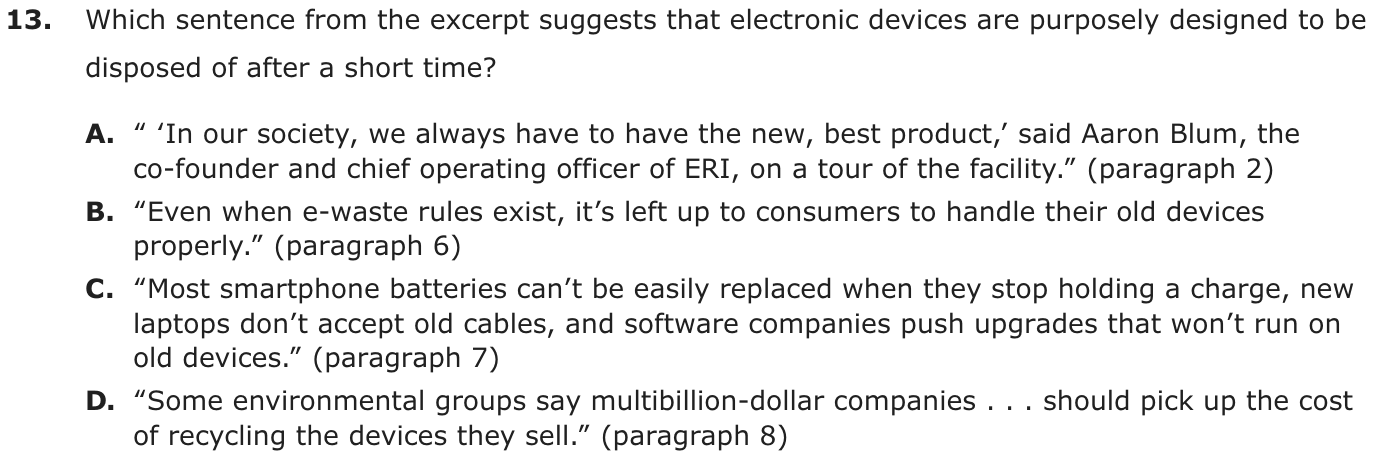
Question 14 of 57
2022 Test B English, question 14Uses the passage above: “Excerpt from “The World Has an E-Waste Problem””.
Question
The details in paragraphs 4–5 develop a central idea of the excerpt mainly by suggesting that
- Athe toxic components of e-waste make waste collectors reluctant to process electronic devices.
- Bcommunities across the nation have taken different approaches to the management of e-waste.
- Cincreased amounts of e-waste will further intensify a problem that is already inadequately addressed.
- Dthe methods that are used for disposing of non-electronic waste are inefficient for e-waste.
Show the answer
Correct answer: C
The question asks how paragraphs 4–5 develop a central idea of the excerpt.
A. Incorrect. Though “e-waste can contain harmful materials like mercury and beryllium” (paragraph 4) and recycling it “can be dangerous” (paragraph 5), the reluctance of recyclers to take e-waste is not a central idea of the excerpt. The excerpt indicates that some recycling companies, like ERI, take electronics and process many of them.
B. Incorrect. It is true that “only 19 states” have laws about not putting old electronics in the trash (paragraph 5), but these paragraphs do not discuss any other approaches that certain communities across the country have tried to implement.
C. CORRECT. These paragraphs highlight problems that already exist and that have been made worse by increasing amounts of e-waste: too much e-waste that is “incinerated or ends up in landfills” and the environmental problems this creates (paragraph 4), as well as the fact that “electronics often end up in garbage and recycling bins” even though they do not belong there (paragraph 5). This develops the central idea in that increasing e-waste is yet another human-made environmental problem that adds layers to the existing problems with too much trash and environmental degradation.
D. Incorrect. There is some indication in these paragraphs that disposing of e-waste creates new and specific problems. However, this is not one of the central ideas of the excerpt, as the problem is more complex than this and involves the design of these devices as well as people’s lack of knowledge and willingness to dispose of these devices appropriately.
Question analysis
This central-idea question asks how the details in paragraphs 4–5 of “The World Has an E-Waste Problem,” with figures on recycling, harmful materials such as mercury and beryllium, and state laws on electronics in the trash, develop a central idea of the excerpt. Each choice builds on a real detail from these paragraphs, so students must see what the details add up to.
- Grade level
- Grade 8 reading and task
- Compared with grade 7
- Above grade 7 Tracing how two paragraphs develop a central idea is grade 7 work, but this dense magazine prose packs statistics, toxic metals and state laws into a few lines, and the idea must be inferred and linked to the rest of the excerpt.
- Estimated difficulty
- Hard: combines ideas, needs a plan, and has more than one tempting wrong answer.
- Thinking it demands
- Depth of knowledge 3, strategic thinking · mainly analyze
- What makes it hard
- Reading between the lines moderate
- Evidence in several places moderate
- A lot to read minor
- Evidence
- Answered from several paragraphs or stanzas
- Reading level
- Passage: about grade 10, 760 words; question and choices: about grade 13, 69 words.
- Students, last 30 days
- Not enough answers yet to show (it takes 10).
Why it is hard, traps and wrong answers (shows the answer)
Why it is hard
Every choice grows from something really in paragraphs 4 and 5, so none can be ruled out by a quick scan. The strongest pull comes from paragraph 5’s warning about compacting lithium-ion batteries with paper recycling, which makes a point about ordinary disposal methods sound well supported, though the excerpt calls them dangerous, not inefficient. The right choice is the only one that adds the paragraphs up and connects them to the growth in e-waste described just before.
Reading between the lines moderate Working it out
Neither paragraph says the problem will get worse or is poorly handled in so many words; that comes from joining the low recycling rate and the patchy state laws to the coming “torrent” of discarded devices. (Graesser, Singer & Trabasso, 1994; Kintsch, 1998)
Evidence in several places moderate Working it out
“Increased amounts” point back to paragraph 3’s 5G upgrade, so paragraphs 4–5 must be read with the one before them and with the excerpt’s central idea, not as a pair on their own. (Kirsch & Mosenthal, 1990; Gorin & Embretson, 2006)
A lot to read minor Understanding the question
Two short paragraphs pack in a UN estimate, mercury and beryllium, 19 states, Nevada, a Republic Services manager and battery fires, and each wrong choice builds on one of these facts. (Kintsch, 1998; Gorin & Embretson, 2006; Freedle & Kostin, 1993)
Strategy: Restate what paragraphs 4 and 5 show together in one sentence, then pick the choice that those paragraphs support and that also runs through the whole excerpt, not one detail inside them.
Traps
- Too narrow: A single detail offered as the central idea or a summary, or a summary that keeps minor details and leaves out an essential part.
- Reads too much in: A reasonable-sounding conclusion that goes further than the text allows.
- Twists what the text says: Uses the text's topic and ideas but changes what it says: who did it, how much, when, or why.
The wrong answers, classified
A Reads too much in (Graesser, Singer & Trabasso, 1994)
Joins the harmful metals of paragraph 4 to the fires of paragraph 5 and concludes that collectors shy away from e-waste, though ERI processes about 6 million pounds a month.
B Too narrow (King et al., 2004)
Builds on the 19 states with trash bans and states like Nevada without them, a single detail of paragraph 5 rather than the idea the two paragraphs develop together.
D Twists what the text says (King et al., 2004)
Turns the danger of compacting lithium-ion batteries with paper recycling, and the risks of landfills and incinerators, into a claim about inefficiency, a point the excerpt never makes.
Working it out, step by step
Understand the question
This asks what paragraphs 4 and 5 add to a central idea. A central idea is a big point the whole excerpt makes. Here, it is that e-waste is a growing problem. So read the two paragraphs together, and ask what they show about that problem.
Read paragraph 4
Paragraph 4 says, “Less than a quarter of all U.S. electronic waste is recycled.” A quarter is one out of four parts. “The rest is incinerated or ends up in landfills.” Incinerated means burned. A landfill is a huge dump where trash is buried. That is risky, because e-waste can hold harmful metals like mercury and beryllium.
Read paragraph 5
Paragraph 5 opens, “Part of the problem is regulatory.” That means it is about rules and laws. Only 19 states ban electronics from the regular trash. In other states, old electronics often go into garbage and recycling bins. Batteries crushed with paper can even start fires.
Add the two paragraphs up
Together, these paragraphs show a problem that is already handled poorly. Most e-waste is not recycled, and many states have no rules. Now recall paragraph 3. It says the stream of e-waste will become a “torrent,” an outpouring, as people switch to 5G. More waste will make a badly handled problem worse.
Weigh each choice
- A does not fit. Nothing says collectors refuse e-waste. ERI processes millions of pounds of it every month.
- B does not fit. The only difference named is whether a state has a trash ban. That one detail is not what the two paragraphs build together.
- C fits. More e-waste will deepen a problem that is not being handled well now.
- D does not fit. The excerpt calls burning, burying and crushing harmful or dangerous. It never calls them inefficient, meaning they waste time or effort.
Settle on the answer
Watch out: D is tempting because paragraph 5 warns about batteries in paper recycling. But that warning is about danger, not about wasted effort. So the answer is C.
Why this answer and not the closest wrong one
D is the closest wrong choice, since paragraph 5 does show ordinary trash methods going wrong for e-waste. But the problem it names is fire and harm. C is the only choice that adds up both paragraphs: little recycling and few rules, with much more waste on the way.
More questions like this
The original DOE question
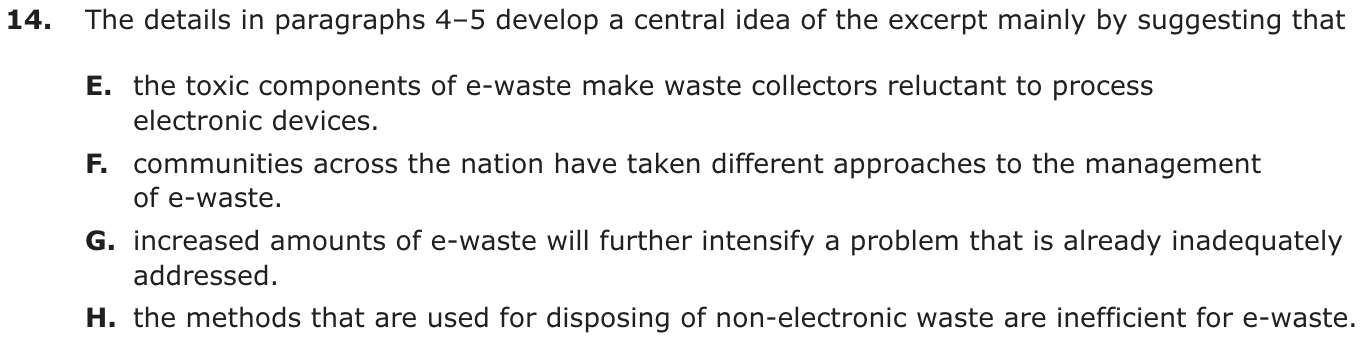
Question 15 of 57
2022 Test B English, question 15Uses the passage above: “Excerpt from “The World Has an E-Waste Problem””.
Question
What is the role of paragraphs 7–9 in the organization of the excerpt?
- AThey emphasize the contrast between successful and unsuccessful efforts to regulate electronic waste.
- BThey suggest that the electronic devices that were manufactured in the past created less pollution.
- CThey imply that manufacturers are willing to comply with regulations that protect the environment.
- DThey shift the focus from a discussion of individual behavior to a discussion of corporate responsibility.
Show the answer
Correct answer: D
The question asks about the role of paragraphs 7–9 in the overall organization of the excerpt.
A. Incorrect. These paragraphs make proposals for new efforts to regulate electronic waste, such as producing devices that last longer and having device-producing companies pay to have the devices recycled; however, no claims are made about these efforts being successful.
B. Incorrect. Paragraph 7 does suggest that today’s devices do not “last as long as they once did,” but it does not indicate that in the past electronic devices led to less pollution. Presumably, technology related to electronics recycling has improved in recent years.
C. Incorrect. While it is true that paragraphs 8 and 9 suggest that electronics manufacturers, who are part of the problem, will also need to be part of the solution, there is no call for regulations in these paragraphs, as it was previously established in paragraph 5 that such regulations do not yet widely exist.
D. CORRECT. Paragraph 6 references consumers who may be “paralyzed by the hassle or put off by the expense” and thus do not recycle their devices correctly. Paragraphs 7–9 then shift the focus from individual consumer behaviors to the responsibility of the manufacturers of these devices, who might take action either by making their devices “last as long as they once did” (paragraph 7) or by making efforts to “recycle or collect obsolete products” (paragraph 8).
Question analysis
This organization question asks what role paragraphs 7–9 play in the structure of “The World Has an E-Waste Problem.” The closing paragraphs cover longer-lasting electronics, recycling laws in Europe, Canada and some states, and companies’ own recycling efforts, so students must see how they fit with the paragraphs before them and describe their job in the excerpt rather than their details.
- Grade level
- Grade 8 reading and task
- Compared with grade 7
- Above grade 7 Grade 7 students describe how a section fits a text’s organization, but this question covers three paragraphs at once, its choices are worded in abstract terms, and judging the section’s role means keeping the earlier paragraphs in mind.
- Estimated difficulty
- Hard: combines ideas, needs a plan, and has more than one tempting wrong answer.
- Thinking it demands
- Depth of knowledge 3, strategic thinking · mainly analyze
- What makes it hard
- How, not what moderate
- Evidence in several places moderate
- The right answer is reworded minor
- Evidence
- Answered from several paragraphs or stanzas
- Reading level
- Passage: about grade 10, 760 words; question and choices: about grade 13, 70 words.
- Students, last 30 days
- Not enough answers yet to show (it takes 10).
Why it is hard, traps and wrong answers (shows the answer)
Why it is hard
The three paragraphs make different points, longer-lasting devices, producers paying for recycling and companies acting on their own, and the thread joining them is who bears the responsibility. That thread shows only against paragraph 6, which leaves old devices to consumers, so students who look at paragraphs 7–9 alone tend to pick a choice that fits one of them. The choice about manufacturers complying with regulations draws most, because paragraphs 8 and 9 do talk about manufacturers, laws and recycling.
How, not what moderate Working it out
The stem asks for the job paragraphs 7–9 do in the excerpt’s organization, so a summary of long-lived televisions, EPR laws and voluntary recycling is not enough; their role shows only against what came before. (Anderson & Krathwohl, 2001)
Evidence in several places moderate Working it out
The shift starts from paragraph 6, where consumers “paralyzed by the hassle” toss devices in the trash, so a role that fits paragraphs 7, 8 and 9 must also be set against that paragraph. (Kirsch & Mosenthal, 1990; Gorin & Embretson, 2006)
The right answer is reworded minor Choosing the answer
The right choice turns paragraph 6’s hassled consumers into “individual behavior,” a label students must supply themselves, while a wrong choice repeats paragraph 8’s manufacturers and laws and so looks better grounded. (Freedle & Kostin, 1993; Kirsch & Mosenthal, 1990)
Strategy: Sum up paragraphs 7, 8 and 9 in a phrase each and compare them with the paragraphs that come before, then pick the role that fits all three paragraphs, not just one.
Traps
- Wrong purpose or structure: Names a purpose, structure or effect that the part does not serve, or describes what a part says when the question asks what it does.
- Twists what the text says: Uses the text's topic and ideas but changes what it says: who did it, how much, when, or why.
- Reads too much in: A reasonable-sounding conclusion that goes further than the text allows.
The wrong answers, classified
A Wrong purpose or structure (Anderson & Krathwohl, 2001)
Sets paragraph 8’s EPR laws beside paragraph 5’s 19 states and sees a contrast of working and failing regulation, a structure the excerpt never builds and a success it never claims.
B Twists what the text says (King et al., 2004)
Takes the 1970s and 1980s televisions that worked until recently and turns their long life into less pollution, a claim paragraph 7 never makes, while ignoring paragraphs 8 and 9.
C Reads too much in (Graesser, Singer & Trabasso, 1994)
Reads paragraph 9’s companies recycling “on their own” as willingness to obey paragraph 8’s laws, though they act for profit or publicity and paragraph 7 shows them speeding obsolescence.
Working it out, step by step
Know what the question asks
This asks about structure: the job paragraphs 7–9 do in the excerpt. To see a job like this, compare the paragraphs with what comes just before them. Ask whose actions each part is about.
Look back at paragraph 6
Paragraph 6 is about consumers, the people who buy and use devices. It says it is “left up to consumers” to get rid of old devices the right way. Many of them are “paralyzed by the hassle or put off by the expense.” So paragraph 6 is about what single people do.
Sum up paragraphs 7, 8 and 9
- Paragraph 7: companies build devices that wear out sooner, and the founder of a repair-guide company says it is on purpose.
- Paragraph 8: some groups say companies should pay for recycling. Some places have laws that make manufacturers set up recycling systems.
- Paragraph 9: some companies are recycling more “on their own.”
All three paragraphs are about companies. Corporate means having to do with companies.
Spot the shift in focus
Up to paragraph 6, the excerpt asks what people do with old devices. From paragraph 7 on, it asks what companies do and should do. Responsibility means the duty to deal with a problem. The last three paragraphs move that duty onto the businesses that make the devices.
Test each choice
- A does not fit. Paragraph 8 says some laws were passed. It never says they worked, and no failed rules are set beside them.
- B does not fit. Old TVs lasted longer, but paragraph 7 never says they caused less pollution. B also skips paragraphs 8 and 9.
- C does not fit. Paragraph 7 shows companies cutting devices’ lives short. The laws in paragraph 8 “require” action, which says nothing about willingness. In paragraph 9, companies recycle for money or good publicity.
- D fits. The focus moves from what buyers do to what companies owe.
Choose the answer
Watch out: C is tempting because paragraphs 8 and 9 mention laws and companies that recycle. But no paragraph shows companies agreeing to follow rules. So the answer is D.
Why this answer and not the closest wrong one
C pulls hardest of the three wrong choices. It names the right group, manufacturers. But it claims they are willing to obey environmental rules, and the excerpt never shows that. D fits all three paragraphs at once. Each one turns from single buyers to the companies that make and sell the devices.
More questions like this
The original DOE question
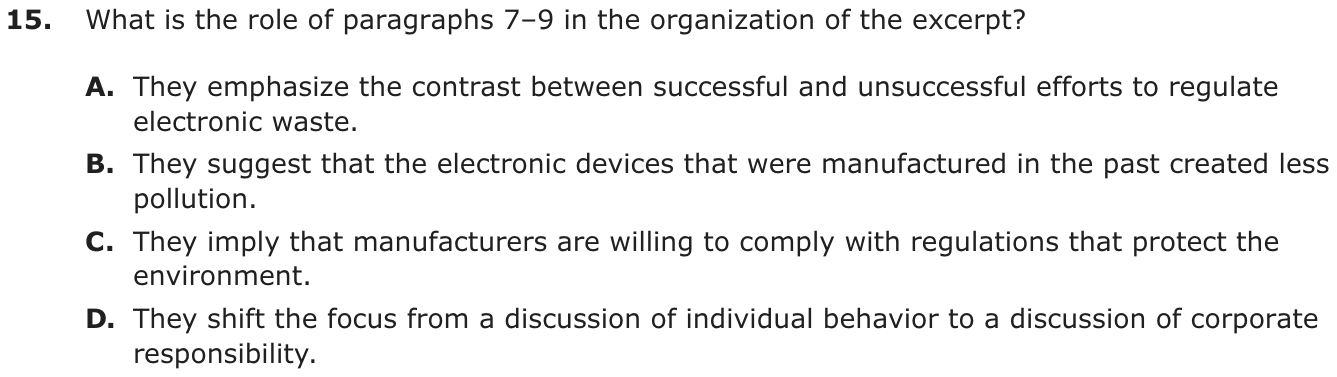
Question 16 of 57
2022 Test B English, question 16Uses the passage above: “Excerpt from “The World Has an E-Waste Problem””.
Question
The idea that e-waste regulations can be ineffective is conveyed in the excerpt through
- Aa statistic indicating that only a few states have chosen to adopt e-waste regulations.
- Ban observation about typical consumer behavior in response to e-waste regulations.
- Can acknowledgment that electronics stores sometimes profit from e-waste regulations.
- Da comment that manufacturers are making an effort to recycle even without e-waste regulations.
Show the answer
Correct answer: B
The question asks how a point about the ineffectiveness of e-waste regulations is conveyed in the excerpt.
A. Incorrect. Paragraph 5 indicates that “only 19 states have laws banning electronics from the regular trash,” but this statistic does not reveal how effective or ineffective these regulations are.
B. CORRECT. Paragraph 6 explains that “even when e-waste rules exist,” it is possible consumers will not follow them, because they have to return their electronics to a store and could be charged. Because it is such a “hassle,” they will “simply throw their devices into the trash or stash them in a drawer, hoping they’ll just disappear” (paragraph 6).
C. Incorrect. While stores may charge people “to get rid of” old devices (paragraph 6), the fee will simply cover expenses incurred by the store to properly dispose of the devices. Stores could actually succeed in getting some devices recycled appropriately, but overall, the excerpt states that consumers’ frustration over the process means most are discarded improperly (paragraph 6).
D. Incorrect. Paragraph 9 explains that “some companies are increasing their recycling efforts on their own,” but this does not mean that regulations are ineffective, only that some manufacturers are taking action even without regulations.
Question analysis
This evidence question on “The World Has an E-Waste Problem” asks how the article gets across the idea that e-waste regulations can be ineffective. The choices describe kinds of support, a statistic, an observation, an acknowledgment and a comment, so students must find the detail each one refers to and judge what that detail really shows about the rules.
- Grade level
- Grade 7 reading and task
- Compared with grade 7
- At grade 7 Matching an idea to the evidence for it is regular grade 7 work, but these choices describe evidence in general terms, so students must locate each detail across several paragraphs and judge what it shows about regulations.
- Estimated difficulty
- Moderate: several steps, or a close reading with one strong distractor.
- Thinking it demands
- Depth of knowledge 2, skills and concepts · mainly evaluate
- What makes it hard
- Evidence in several places moderate
- Reading between the lines minor
- The right answer is reworded minor
- Evidence
- Answered from one paragraph or stanza
- Reading level
- Passage: about grade 10, 760 words; question and choices: about grade 13, 63 words.
- Students, last 30 days
- Not enough answers yet to show (it takes 10).
Why it is hard, traps and wrong answers (shows the answer)
Why it is hard
The idea to support is narrow: rules that exist but do not work. The statistic about 19 states is the main trap, because paragraph 5 opens “Part of the problem is regulatory,” and few rules can feel the same as weak rules. Students who separate how many states have rules from whether the rules change behavior land on paragraph 6, where people living under rules still throw devices away.
Evidence in several places moderate Working it out
The choices name kinds of evidence, not places, so each must be traced: the 19 states to paragraph 5, the consumers and the stores to paragraph 6, the voluntary recycling to paragraph 9. (Kirsch & Mosenthal, 1990; Gorin & Embretson, 2006)
Reading between the lines minor Working it out
No sentence says the rules fail; students must connect “Even when e-waste rules exist” with consumers who “simply throw their devices into the trash” and Walters’s admission that nothing stops them. (Graesser, Singer & Trabasso, 1994; Kintsch, 1998)
The right answer is reworded minor Choosing the answer
The right choice calls paragraph 6 “an observation about typical consumer behavior,” while two wrong ones restate “Only 19 states” and companies recycling “on their own” almost word for word. (Freedle & Kostin, 1993; Kirsch & Mosenthal, 1990)
Strategy: Find the passage detail behind each choice, then ask whether it shows regulations failing to work, rather than something else about regulations or about e-waste.
Traps
- Supports only part of the claim: In a question about evidence: a line that backs one half of the claim but not the other, or a related point rather than the claim itself.
- True but not the answer: A choice says something accurate about the text that does not answer this question.
- Reads too much in: A reasonable-sounding conclusion that goes further than the text allows.
The wrong answers, classified
A Supports only part of the claim (King et al., 2004; Thissen, Steinberg & Fitzpatrick, 1989)
Reads “Only 19 states” under “Part of the problem is regulatory” as proof that the rules fail, but the figure shows how few states have rules, not how well they work.
C Reads too much in (Graesser, Singer & Trabasso, 1994)
Takes paragraph 6’s store that “could also charge them to get rid of it” as stores profiting from the rules, a gain the excerpt never mentions.
D True but not the answer (King et al., 2004; Embretson & Wetzel, 1987)
Recalls companies recycling “on their own” in paragraph 9, an accurate detail that mentions regulation, but voluntary effort says nothing about whether existing rules work.
Working it out, step by step
Pin down the idea
This asks how the excerpt shows that e-waste rules can be ineffective. Ineffective means not working. So you need evidence about rules that exist but still don’t do their job. Having too few rules is a different problem.
Trace each choice to a paragraph
Each choice names a kind of detail, not a place. So first find where each one comes from.
- A: the 19 states, in paragraph 5.
- B: what consumers do, in paragraph 6.
- C: the stores that take old devices, also in paragraph 6.
- D: companies recycling without being told to, in paragraph 9.
Read paragraph 6 closely
Paragraph 6 begins, “Even when e-waste rules exist.” So it is about places that have rules. Recycling there still takes work. Many people “simply throw their devices into the trash or stash them in a drawer, hoping they’ll just disappear.” Jeremy Walters adds, “We don’t necessarily have the measures to make sure people aren’t throwing it away.” The rules are there, but people get around them.
Check the choices
- A does not fit. “Only 19 states” tells how many states have rules. It does not tell how well those rules work.
- B fits. It describes what people usually do, even under the rules.
- C does not fit. A store “could also charge them to get rid of it.” The excerpt never says stores make a profit. The fee is just one reason people skip recycling.
- D does not fit. Companies acting by choice is a real detail. But it says nothing about whether existing rules work.
Name the answer
Watch out: A is tempting because paragraph 5 starts, “Part of the problem is regulatory.” But few rules is not the same as weak rules. So the answer is B.
Why this answer and not the closest wrong one
A is the closest wrong choice, since the 19 states do point to a problem with rules. But that problem is how many states have them. B shows rules failing where they already exist. People who live under them still toss devices in the trash, and little stops them.
More questions like this
The original DOE question
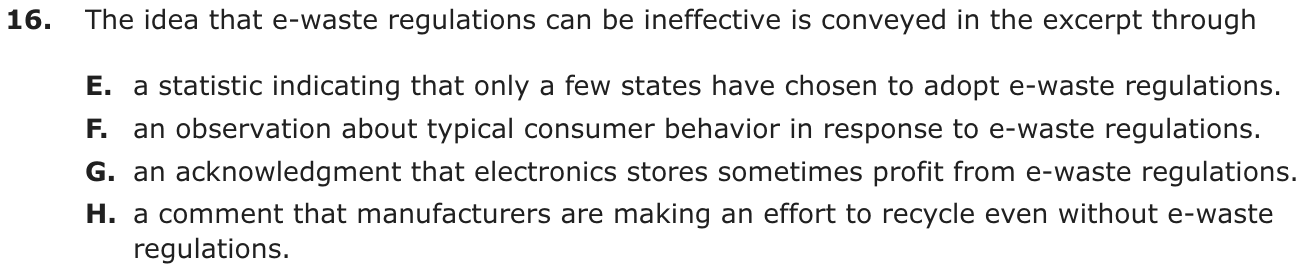
Question 17 of 57
2022 Test B English, question 17Uses the passage above: “Excerpt from “The World Has an E-Waste Problem””.
Question
How does the diagram after paragraph 9 most support the claim made in paragraph 4?
- AThe diagram suggests that people send large amounts of recyclable e-waste to landfills.
- BThe diagram emphasizes that toxic chemicals in e-waste can easily spread from landfills.
- CThe diagram implies that most landfills are poorly designed to accommodate e-waste.
- DThe diagram shows that water sources near landfills are endangered by e-waste.
Show the answer
Correct answer: B
The question asks how the diagram after paragraph 9 supports the claim in paragraph 4 about environmental risks from e-waste.
A. Incorrect. The diagram includes an image of people as well as an “unlined landfill,” but it contains no information about the volume of e-waste that people place in the landfill. Rather, it seeks to show how waste in landfills impacts the environment in a broader sense through “air emissions” and “groundwater” contamination.
B. CORRECT. The diagram shows that toxic chemicals that are placed into an “unlined landfill” can produce “air emissions” that may affect rain and trees. These toxic chemicals may also seep into the soil and then, eventually, into the “groundwater” and “surface water.”
C. Incorrect. While it is true that the landfill in the diagram is labeled an “unlined landfill,” which presumably would allow more pollutants to seep into the soil, no claim is made in paragraph 4 about landfill design.
D. Incorrect. The diagram shows that water sources near landfills are at risk of pollution by the toxic chemicals in electronic devices, but water is only part of what it shows: the chemicals also spread through the air to the rain and the trees, so this option covers only part of the environmental risk in the diagram.
Question analysis
This question pairs a diagram with a paragraph in “The World Has an E-Waste Problem.” Students decide how the diagram after paragraph 9, titled “Environmental Impacts of Persistent Bioaccumulative Toxic Chemicals in Electronic Devices,” best supports the claim in paragraph 4 about recycling rates and harmful materials such as mercury. The choices mix what the paragraph states, what the diagram pictures and what it only hints at.
- NYS standards
- Grade level
- Grade 8 reading and task
- Compared with grade 7
- Above grade 7 Connecting a diagram to a claim in the text is grade 7 work, but this diagram has many labels and arrows, its key word “bioaccumulative” is explained only in a caption, and the claim it supports sits five paragraphs earlier.
- Estimated difficulty
- Among the hardest on the SHSAT: a non-obvious approach, heavy reading, or a well-hidden trap.
- Thinking it demands
- Depth of knowledge 3, strategic thinking · mainly analyze
- What makes it hard
- Reading a figure, table or graph major
- A very close wrong answer moderate
- Evidence in several places moderate
- Hard words minor
- Evidence
- Answered from several paragraphs or stanzas
- Reading level
- Passage: about grade 10, 760 words; question and choices: about grade 9, 63 words.
- Corrected from the DOE handbook
- An inaccurate statement about the diagram in the explanation was corrected.
- Students, last 30 days
- Not enough answers yet to show (it takes 10).
Why it is hard, traps and wrong answers (shows the answer)
Why it is hard
Two choices describe what the diagram really shows, and the question turns on which matches paragraph 4’s broad point that harmful materials in e-waste “pose environmental risks.” Water is the easiest route to trace, with arrows into groundwater and two ponds, so the narrower choice feels complete; the arrows rising to air emissions, rain and a tree show the spread goes further. The other two choices pull students who answer from paragraph 4’s statistics or from the single word “Unlined.”
Reading a figure, table or graph major Understanding the question
The support is carried by arrows, not sentences: up from the unlined landfill to air emissions, rain and a tree, down through the soil to groundwater, and on toward people, a deer and a pond with fish. (Lesh, Post & Behr, 1987; Kirsch & Mosenthal, 1990)
A very close wrong answer moderate Choosing the answer
The choice about water sources is true of the diagram, which shows groundwater and two ponds at risk, and differs from the right one only in leaving out the spread through the air. (Embretson & Wetzel, 1987; Gorin & Embretson, 2006; Ascalon et al., 2007)
Evidence in several places moderate Working it out
The claim is in paragraph 4, about mercury and beryllium in landfilled e-waste, while the diagram comes after paragraph 9, so the two have to be brought together across the whole excerpt. (Kirsch & Mosenthal, 1990; Gorin & Embretson, 2006)
Hard words minor Understanding the question
The title’s “Persistent Bioaccumulative Toxic Chemicals” is explained only by the caption below it, which says the toxins build up in living things, and the link to e-waste depends on reading it. (Perfetti, 2007; Freedle & Kostin, 1993)
Strategy: State the claim in paragraph 4 in your own words, read the diagram’s title, labels, arrows and caption, and then test each choice against both, keeping one that the paragraph and the diagram both support.
Traps
- Too narrow: A single detail offered as the central idea or a summary, or a summary that keeps minor details and leaves out an essential part.
- Wrong part of the text: A choice is true of another paragraph, stanza or speaker than the one asked about.
- Reads too much in: A reasonable-sounding conclusion that goes further than the text allows.
The wrong answers, classified
A Wrong part of the text (Kirsch & Mosenthal, 1990)
Matches paragraph 4’s statement that most e-waste is incinerated or landfilled, but the diagram shows nothing about how much waste people discard or whether it could have been recycled.
C Reads too much in (Graesser, Singer & Trabasso, 1994)
Builds on the single label “Unlined landfill” and concludes that most landfills are badly designed, though the diagram shows one landfill and paragraph 4 says nothing about design.
D Too narrow (King et al., 2004)
Traces the arrows into groundwater and the two ponds, which the diagram does show at risk, but leaves out the air emissions that carry the chemicals to rain and a tree.
What was corrected from the DOE handbook, and why
- Explanation: The handbook rejects Option D because the diagram shows water at risk of pollution “by anything in the landfill” and “makes no mention of e-waste in particular.” But the diagram is titled “Environmental Impacts of Persistent Bioaccumulative Toxic Chemicals in Electronic Devices,” and its caption says that electronics such as smartphones, computers, cameras and large appliances contain toxins like lead and mercury; the correct answer itself depends on the diagram being about the chemicals in e-waste. What makes D weaker is that it covers only water, while the diagram also shows the chemicals spreading through the air to the rain and the trees. The site now says so. The answer, B, is unchanged.
Working it out, step by step
Sort out the question
This asks how a diagram supports a claim. A claim is something the author says is true. The claim is in paragraph 4. The diagram comes after paragraph 9. Your job is to link the two.
Read the claim in paragraph 4
Paragraph 4 says most U.S. e-waste is burned or buried. Then it warns that “e-waste can contain harmful materials like mercury and beryllium that pose environmental risks.” To pose a risk means to put something in danger. So the claim is that the poisons in e-waste can harm the world around us.
Read the title and the caption
The title is “ENVIRONMENTAL IMPACTS OF PERSISTENT BIOACCUMULATIVE TOXIC CHEMICALS IN ELECTRONIC DEVICES.” Toxic means poisonous. Persistent means they last a long time. The caption under the diagram says phones and computers hold toxins such as lead and mercury. These build up over time in living things. That is what “bioaccumulative” means. So the diagram is about the poisons in e-waste.
Follow the arrows
Start at the box labeled “Unlined landfill.” Unlined means it has no layer at the bottom to hold the waste in.
- One arrow rises to “Air emissions,” then on to the rain cloud and a tree.
- Arrows point down through the soil to the groundwater, the water under the ground.
- Another leads to a wastewater plant and then a pond with a fish.
- Groundwater flows into a second pond, and an arrow points up toward people and a deer.
The poisons travel in many directions.
Test each choice
- A does not fit. The diagram shows no amounts and doesn’t say which waste could be recycled.
- B fits. The arrows show the chemicals spreading from the landfill by air, soil and water.
- C does not fit. It shows one unlined landfill, not most landfills. Paragraph 4 says nothing about how landfills are built.
- D is only partly right. Water is at risk, but the diagram also shows poisons moving through the air to rain and a tree.
Choose the answer
Watch out: D is tempting, because the water arrows are the easiest to follow, and they are real. But D leaves out the air. Paragraph 4 warns of risks to the whole environment, and B covers every path. So the answer is B.
Why this answer and not the closest wrong one
D is the closest wrong choice, because the groundwater and both ponds really are at risk. But that is only part of the picture. The arrow up to “Air emissions” carries the chemicals to rain and trees as well. B says the poisons spread easily from landfills, and that matches every arrow.
More questions like this
The original DOE question

Question 18 of 57
2022 Test B English, question 18Passage Excerpt from The Highest Tide
Excerpt from The Highest Tide
by Jim Lynch
The narrator’s summer job is collecting marine specimens in Puget Sound, Washington. In this excerpt, he is looking for specimens in the mudflats before daybreak. Mudflats, or flats, are coastal landforms created when sediment and silt from tides are deposited as the tides recede.
I rounded the oyster beds, to the far side. . . . It was low tide by then, and I saw the water hesitating at its apex, neither leaving nor returning, patiently waiting for the gravitational gears to shift. Dozens of anxious clams started squirting in unison like they did whenever vibrating grains of sand warned them predators were approaching. I stopped and waited with them, to actually see the moment when the tide started returning with its invisible buffet of plankton for the clams, oysters, mussels and other filter feeders. It was right then, ankle deep in the Sound, feet numbing, eyes relaxed, that I saw the nudibranch.1
In all my time on the flats I’d never seen one before. I’d read about them, sure. I’d handled them at aquariums but never in the wild, and I’d never even seen a photo of one this stunning. It was just three inches long but with dozens of fluorescent, orange-tipped hornlike plumes jutting from the back of its see-through body that appeared to be lit from within.
Nudibranchs are often called the butterflies of the sea, but even that understates their dazzle. Almost everything else in the northern Pacific is dressed to blend with pale surroundings. Nudibranchs don’t bother, in part because they taste so lousy they don’t need camouflage to survive. But also, I decided right then, because their beauty is so startling it earns them a free pass, the same way everyday life brakes for peacocks, parade floats. . . .
The dark mudflats loomed like wet, flattened dunes stretching deep into Skookumchuck Bay in front of our house. From a distance, they looked too barren to support sea life. Up close, they still did, unless you knew where to find the hearty clams, worms and tiny creatures that flourish in mud. . . . I’m not sure why I decided to take a look. It was still an hour before sunrise, and I knew exactly what the bars2 looked like in the moonlight, but for some reason, I couldn’t resist.
I heard it long before I saw it. It was an exhale, a release of sorts, and I instantly wondered if a whale was stranded again. We had a young minke3 stuck out there two summers prior, and it made similar noises until the tide rose high enough for rescuers to help free it. . . . I looked for a hulking silhouette but couldn’t find one. I waited, but there were no more sounds. Still, I went toward what I thought I’d heard, avoiding stepping into the mud until I had to. I knew the flats well enough to know I could get stuck just about anywhere. The general rule was you didn’t venture out past the shells and gravel with an incoming tide. I sank up to my knees twice, and numbing water filled my boots.
. . . I kept stepping toward the one sound I’d heard, a growing part of me hoping I’d find nothing at all. When I stopped to rest and yank up my socks, my headlamp crossed it. My first thought? A giant octopus.
Puget Sound has some of the biggest octopi in the world. They often balloon to a hundred pounds. Even the great Jacques Cousteau4 himself came to study them. But when I saw the long tubular shape of its upper body and the tangle of tentacles below it, I knew it was more than an octopus. I came closer, within fifty feet, close enough to see its large cylindrical siphon5 quiver. I couldn’t tell if it was making any sounds at that point, because it was impossible to hear anything over the blood in my ears. . . .
The creature’s body came to a triangular point above narrow fins that lay flat on the mud like wings, but it was hard to be sure exactly where it all began or ended, or how long its tentacles truly were, because I was afraid to pry my eyes off its jumble of arms for more than half a second. I didn’t know whether I was within reach, and its arms were as big around as my ankle and lined with suckers the size of half-dollars. If they even twitched I would have run. So, I was looking at it and not looking at it while my heart spangled my vision. I saw fragments, pieces, and tried to fuse them in my mind but couldn’t be certain of the whole. I knew what it had to be, but I wouldn’t allow myself to even think the two words. Then I gradually realized the dark shiny disc in the middle of the rubbery mass was too perfectly round to be mud or a reflection.
It was too late to smother my scream. Its eye was the size of a hubcap.6
From THE HIGHEST TIDE by Jim Lynch. Copyright © 2005 by Jim Lynch. Used by permission of Bloomsbury USA. All rights reserved.
1nudibranch: type of sea slug
2bars: sandbars
3minke: species of small whale
4Jacques Cousteau: renowned French oceanographer
5siphon: tube-like organ that is used for drawing in or removing fluids
6hubcap: removable cap over the end of a wheel axle
Question
In paragraph 3, the phrase “the butterflies of the sea” conveys the idea that
- Anudibranchs do not have to work as hard as other animals to survive in the ocean.
- Bnudibranchs have colorful features that make them stand out.
- Cnudibranchs are delicate and have trouble adapting to their environment.
- Dnudibranchs are rare and difficult to find in the ocean.
Show the answer
Correct answer: B
The question asks what idea the phrase “the butterflies of the sea” in paragraph 3 conveys.
A. Incorrect. While the narrator does say that they “taste so lousy they don’t need camouflage to survive” (paragraph 3), the phrase explains that their bright appearance poses no threat to their lives.
B. CORRECT. The narrator describes the vibrant colors of the nudibranch in paragraph 2. Then in paragraph 3, the narrator says that “their beauty is so startling.” The nudibranchs are colorful and unique, just as many butterflies are.
C. Incorrect. The narrator describes the distinct appearance of the nudibranch but does not suggest that nudibranchs struggle to adapt to their environment because of this trait.
D. Incorrect. In paragraph 2, the narrator states, “I’d handled them at aquariums but never in the wild, and I’d never even seen a photo of one this stunning.” Although this suggests that the narrator has rarely encountered a nudibranch in the wild, it does not suggest that they are rare in the wild in general.
Question analysis
This figurative-language question asks what the phrase “the butterflies of the sea” conveys about nudibranchs, the sea slugs the narrator spots on a Puget Sound mudflat in an excerpt from the novel The Highest Tide. Students must use the description around the phrase to decide which quality of butterflies the comparison points to.
- Grade level
- Grade 7 reading and task
- Compared with grade 7
- At grade 7 Interpreting a figurative comparison from context is standard grade 7 language work. The description around the phrase is vivid and close at hand, so the demand is typical, even though the creature itself may be unfamiliar.
- Estimated difficulty
- Straightforward: two steps or one careful reading.
- Thinking it demands
- Depth of knowledge 2, skills and concepts · mainly understand
- What makes it hard
- Figurative or literary language moderate
- An unfamiliar subject minor
- Evidence
- Answered from one paragraph or stanza
- Reading level
- Passage: about grade 6, 902 words; question and choices: about grade 7, 58 words.
- Students, last 30 days
- Not enough answers yet to show (it takes 10).
Why it is hard, traps and wrong answers (shows the answer)
Why it is hard
The nickname is explained in the same sentence, where the narrator says even it “understates their dazzle”, so the question is mostly a matter of reading on a few words. The trap is reading on too far: the next sentences explain why nudibranchs can afford to be showy, a different point. Students who bring their own idea of butterflies as fragile, or who turn the narrator's first sighting into rarity, drift away from what he stresses.
Figurative or literary language moderate Understanding the question
The comparison's point is supplied by the clause right after it, “even that understates their dazzle”, and by paragraph 2's fluorescent, orange-tipped plumes, not by anything butterflies are usually known for. (Graesser, Singer & Trabasso, 1994; Kintsch, 1998)
An unfamiliar subject minor Understanding the question
Few students have seen a nudibranch, footnoted only as a type of sea slug, so the picture of it must be built entirely from paragraph 2's description. (Recht & Leslie, 1988; Kintsch, 1998)
Strategy: Read the phrase with the sentence it sits in and the description of the nudibranch just before it, then decide which quality of butterflies the comparison is pointing to.
Traps
- True but not the answer: A choice says something accurate about the text that does not answer this question.
- Outside knowledge: A choice is plausible in the real world but not supported by this text.
- Reads too much in: A reasonable-sounding conclusion that goes further than the text allows.
The wrong answers, classified
A True but not the answer (King et al., 2004; Embretson & Wetzel, 1987)
Draws on the next sentences, which say nudibranchs taste too lousy to need camouflage, a real point about their survival but not what the butterfly comparison conveys.
C Outside knowledge (King et al., 2004; Recht & Leslie, 1988)
Brings in the familiar idea that butterflies are delicate, which the passage never uses; nothing suggests nudibranchs struggle to adapt, and the comparison is about their dazzle.
D Reads too much in (Graesser, Singer & Trabasso, 1994)
Turns the narrator never having seen one in the wild into a claim that nudibranchs are rare, which reflects his experience, not the meaning of the nickname.
Working it out, step by step
Spot the comparison
This asks about figurative language, words that compare two things to make a point. In paragraph 3, nudibranchs are called “the butterflies of the sea.” You need to decide which quality of butterflies the comparison points to.
Read the rest of the sentence
The sentence goes on: “but even that understates their dazzle.” To understate means to say less than the full truth. Dazzle means bright, eye-catching beauty. So the narrator means nudibranchs are even more dazzling than butterflies.
Look back at paragraph 2
Paragraph 2 describes the one he found. It had “dozens of fluorescent, orange-tipped hornlike plumes.” Fluorescent means glowing with bright color. Plumes are feathery tufts. Its body even seemed “to be lit from within.” Like a butterfly, it is bright and colorful, and it stands out.
Check each choice
- B fits: “colorful features that make them stand out” matches the glowing plumes and the dazzle.
- A is wrong because their bad taste explains how they survive, not what the butterfly phrase means.
- C is wrong because the passage never says nudibranchs are delicate or struggle to fit in.
- D is wrong because the narrator never seeing one in the wild is his own experience, not proof they are rare.
Watch out: A uses real details from the same paragraph. But they answer a different question: why nudibranchs can afford to be showy.
Choose the answer
The butterfly comparison points to the nudibranch’s bright, eye-catching colors. So the answer is B.
Why this answer and not the closest wrong one
A comes closest, since the same paragraph says nudibranchs “don’t need camouflage to survive.” But that explains why they can afford to be bright. The butterfly phrase itself is about their beauty, which even the nickname “understates.” B names that beauty: colorful features that stand out.
More questions like this
The original DOE question

The passage “Excerpt from The Highest Tide” as printed (pages 64–65)
Question 19 of 57
2022 Test B English, question 19Uses the passage above: “Excerpt from The Highest Tide”.
Question
Read these sentences from paragraph 4.
I’m not sure why I decided to take a look. It was still an hour before sunrise, and I knew exactly what the bars looked like in the moonlight, but for some reason, I couldn’t resist.
The sentences contribute to the overall structure of the excerpt by
- Aintroducing the mysterious creature that the narrator discovers.
- Bindicating a shift from the narrator recalling the past to the narrator reflecting on the present.
- Cestablishing a struggle with fear that the narrator must overcome.
- Dbuilding tension through indicating that the narrator is going to see something unexpected.
Show the answer
Correct answer: D
The question asks for an explanation of how selected sentences from paragraph 4 contribute to the overall structure of the excerpt.
A. Incorrect. These sentences set a tense and mysterious tone for what is about to happen in the excerpt, but they do not introduce the creature the narrator discovers.
B. Incorrect. While the narrator reveals that he is familiar with the terrain (“I knew exactly what the bars looked like in the moonlight”), this does not show the narrator recalling the past or reflecting on the present; it demonstrates the narrator’s knowledge of the mudflats.
C. Incorrect. These sentences reveal the narrator’s curiosity, which is his prime motivation for venturing out to the mudflats, and his familiarity with the terrain shows that at this point, he does not feel afraid.
D. CORRECT. The narrator creates a feeling of mystery and suspense with language that shows how the situation is unknown. Phrases such as “I couldn’t resist” and “I’m not sure why” reveal the narrator’s curiosity, as well as the tension of feeling drawn to explore the mudflats in the moonlight.
Question analysis
This text-structure question quotes the narrator's admission that he cannot say why he decided to walk out onto the dark mudflats, and asks how these sentences contribute to the structure of the excerpt from The Highest Tide. Students must judge what the sentences do at this point in the story, not just what they say, and the choices name four quite different jobs.
- Grade level
- Grade 7 reading and task
- Compared with grade 7
- At grade 7 Explaining how a piece of narration shapes a story's structure is grade 7 literary work. The sentences are quoted and short, but the student must look past what they say to the effect they create, a typical grade 7 demand.
- Estimated difficulty
- Moderate: several steps, or a close reading with one strong distractor.
- Thinking it demands
- Depth of knowledge 2, skills and concepts · mainly analyze
- What makes it hard
- How, not what moderate
- Reading between the lines moderate
- Evidence
- Answered from several paragraphs or stanzas
- Reading level
- Passage: about grade 6, 902 words; question and choices: about grade 8, 99 words.
- Students, last 30 days
- Not enough answers yet to show (it takes 10).
Why it is hard, traps and wrong answers (shows the answer)
Why it is hard
The sentences say little on their own, the narrator going out before dawn to a place he knows well, so their purpose shows only from where they sit, right before the sound in paragraph 5. Students who know the ending tend to read the fear and the creature back into this moment, which is why the choices about fear and about introducing the creature pull. The narrator's own puzzlement about why he went is what builds the suspense.
How, not what moderate Working it out
The question asks what the two sentences do in the story, so their content, an early hour and a familiar view of the sandbars, matters only as a setup for what comes next. (Anderson & Krathwohl, 2001)
Reading between the lines moderate Working it out
Nothing is said to be coming; the tension must be inferred from an unexplained pull, “I'm not sure why” and “for some reason, I couldn't resist”, just before the strange sound. (Graesser, Singer & Trabasso, 1994; Kintsch, 1998)
Strategy: Place the two sentences in the order of events, what came before and what comes right after, and ask what job they do for a reader at that point in the story.
Traps
- Wrong part of the text: A choice is true of another paragraph, stanza or speaker than the one asked about.
- Wrong purpose or structure: Names a purpose, structure or effect that the part does not serve, or describes what a part says when the question asks what it does.
The wrong answers, classified
A Wrong part of the text (Kirsch & Mosenthal, 1990)
Jumps ahead to the creature, which is first heard in paragraph 5 and seen in paragraph 6; these sentences only explain why the narrator went out.
B Wrong purpose or structure (Anderson & Krathwohl, 2001)
Notices the present-tense “I'm not sure” and reads it as a shift in time, but it is a passing comment, and the narration around it stays in the past.
C Wrong part of the text (Kirsch & Mosenthal, 1990)
Reads the fear of paragraphs 6 and 8 into this moment, but here the narrator is pulled by curiosity, and fear arrives only when he hopes to find nothing.
Working it out, step by step
Know what the question asks
This asks about structure: what job these two sentences do in the story. Think about where they sit. Then ask how they make a reader feel about what will happen next.
Look at the sentences closely
The narrator says, “I’m not sure why I decided to take a look.” He knows “exactly what the bars looked like in the moonlight.” The bars are sandbars, so there should be nothing new to see. Yet “for some reason, I couldn’t resist.” He can’t explain why he feels pulled out onto the flats.
See what comes right after
The next paragraph begins, “I heard it long before I saw it.” A strange sound leads him to a giant creature. So his mysterious pull comes just before something unexpected. Tension is the nervous feeling of waiting to find out what happens. These sentences build that feeling.
Check each choice
- D fits: the sentences build tension by hinting that something unexpected is coming.
- A is wrong because the creature doesn’t appear yet, since he first hears it in paragraph 5.
- B is wrong because “I’m not sure” is a short comment, and the story stays in the past.
- C is wrong because he is curious here, and fear comes later, when he hopes he will “find nothing at all.”
Watch out: C reads his later fear back into this moment. Right now he is drawn forward, not scared.
Choose the answer
The sentences make you wonder what is waiting out on the flats. So the answer is D.
Why this answer and not the closest wrong one
C comes closest, because the narrator is badly scared by the end. But in these sentences he feels pulled by a curiosity he can’t explain. That unexplained pull, just before a strange sound, builds suspense. D names that job.
More questions like this
The original DOE question
Question 20 of 57
2022 Test B English, question 20Uses the passage above: “Excerpt from The Highest Tide”.
Question
Which sentence from paragraph 5 supports the idea that the narrator is taking a risk?
- A“It was an exhale, a release of sorts, and I instantly wondered if a whale was stranded again.”
- B“I looked for a hulking silhouette but couldn’t find one.”
- C“I waited, but there were no more sounds.”
- D“I knew the flats well enough to know I could get stuck just about anywhere.”
Show the answer
Correct answer: D
The question asks which sentence from paragraph 5 supports the idea that the narrator is taking a risk.
A. Incorrect. In this sentence, the narrator is describing the exhale of a creature and his concern that the sound might be coming from a whale in danger. At no point does the narrator suggest that this is a dangerous situation.
B. Incorrect. This sentence describes a “hulking silhouette” because the narrator is searching for a whale that might be stranded. This expression refers to the size of the whale and not to any danger the narrator might face.
C. Incorrect. The narrator’s words “no more sounds” are used to illustrate his listening for what may be a whale. At this point, the narrator is still concerned about the possibility that a whale may be stranded, not the possibility of being in danger.
D. CORRECT. The idea that the narrator could become stuck in the mud of the flats means that the surroundings pose some danger or difficulty.
Question analysis
Students choose which sentence from one tense paragraph of The Highest Tide shows that the narrator is taking a risk as he follows a strange sound across the mudflats. In this evidence question, all four sentences come from the same scene, so students must tell real danger to the narrator apart from a mood of suspense.
- NYS standards
- 7R1 textual evidence and inferences
- Grade level
- Grade 6 reading and task
- Compared with grade 7
- Below grade 7 Choosing the sentence that supports an idea is a grade 6 and 7 skill. Here all four choices come from one paragraph and only the idea of danger needs matching, a lighter task than typical grade 7 evidence work.
- Estimated difficulty
- Routine: one familiar step, little to misread.
- Thinking it demands
- Depth of knowledge 2, skills and concepts · mainly evaluate
- What makes it hard
- Evidence
- Answered from one paragraph or stanza
- Reading level
- Passage: about grade 6, 902 words; question and choices: about grade 5, 65 words.
- Students, last 30 days
- Not enough answers yet to show (it takes 10).
Why it is hard, traps and wrong answers (shows the answer)
Why it is hard
Only one of the four sentences mentions anything that could happen to the narrator himself, so this is among the easiest questions on the test. The other three build suspense, a strange exhale, a missing silhouette, a silence, and a student who confuses suspense with danger may pick one. Asking who is at risk in each sentence settles it at once.
Reading between the lines minor Working it out
The right sentence states only what the narrator knows, that he could get stuck; it shows a risk because the sentences around it have him walking out onto the mud anyway. (Graesser, Singer & Trabasso, 1994; Kintsch, 1998)
Strategy: Decide what taking a risk would mean for the narrator in this place, then test each sentence for a danger to him rather than a feeling of suspense.
Traps
- Supports only part of the claim: In a question about evidence: a line that backs one half of the claim but not the other, or a related point rather than the claim itself.
- Word match: Repeats striking words or phrases from the text, so it looks supported, but its meaning does not fit the question.
The wrong answers, classified
A Supports only part of the claim (King et al., 2004; Thissen, Steinberg & Fitzpatrick, 1989)
Senses danger in a possibly stranded whale, but the danger would be the whale's, and the sentence shows the narrator only wondering, not exposing himself to anything.
B Word match (Freedle & Kostin, 1993)
Hears menace in “hulking silhouette”, but the phrase describes the size of the whale he expected, and failing to find one puts him in no danger.
C Reads too much in (Graesser, Singer & Trabasso, 1994)
Reads the silence after the sound as ominous, but waiting and listening is a pause in his search, not something that puts him at risk.
Working it out, step by step
Know what the question asks
This asks you to find evidence. Taking a risk means doing something that could hurt you. So look for a sentence that shows a danger to the narrator himself.
Think about the danger on the flats
Mudflats are soft and wet. A person can sink into the mud and get stuck as the water rises. Paragraph 5 even gives a rule: “The general rule was you didn’t venture out past the shells and gravel with an incoming tide.”
Find the sentence about danger
Choice D says, “I knew the flats well enough to know I could get stuck just about anywhere.” So the narrator knows he could get stuck. Yet he keeps walking out toward the sound. That means he is taking a risk.
Check each choice
- D fits: getting stuck is a danger to him, and he goes on anyway.
- A is wrong because a stranded whale would be in danger, not the narrator.
- B is wrong because “hulking silhouette,” a huge dark shape, describes the whale he expected, not a threat.
- C is wrong because waiting in silence builds suspense but puts him in no danger.
Watch out: A, B and C create a spooky mood. But a spooky mood is not the same as a risk.
Choose the answer
Only one sentence names something that could happen to the narrator himself. So the answer is D.
Why this answer and not the closest wrong one
A comes closest, because a stranded whale sounds serious. But the danger in that sentence belongs to the whale. Only D names something that could happen to the narrator: getting stuck in the mud.
More questions like this
The original DOE question
Question 21 of 57
2022 Test B English, question 21Uses the passage above: “Excerpt from The Highest Tide”.
Question
Read this sentence from paragraph 6.
I kept stepping toward the one sound I’d heard, a growing part of me hoping I’d find nothing at all.
How do the narrator’s actions develop a central idea of the excerpt?
- AThe narrator’s concern about the origin of the noise shows dedication to helping preserve sea life in the mudflats.
- BThe narrator’s curiosity about the sea life in the mudflats outweighs any fear about the situation.
- CThe narrator’s knowledge about a variety of sea life encourages a search for more specimens to study.
- DThe narrator’s eagerness about new specimens of sea life outweighs the reality that the area is an unlikely place to find them.
Show the answer
Correct answer: B
The question asks how the narrator’s actions, as described in the sentence from paragraph 6, develop a central idea of the excerpt.
A. Incorrect. The sentence highlights the narrator’s concern about sea life and the creatures living within the flats. However, these ideas do not develop what is being described in the excerpt.
B. CORRECT. The narrator “kept stepping toward the one sound,” indicating a sense of curiosity. However, the words “a growing part of me hoping I’d find nothing” suggest a rising fear or concern. Ultimately, the narrator’s curiosity outweighs his growing fear and is a central idea in the excerpt, as shown by the fact that the narrator does not run away when finally encountering the creature.
C. Incorrect. While the narrator’s descriptions of the nudibranch and other sea life demonstrate a knowledge of these creatures, as well as a desire to discover more in the mudflats, the knowledge the narrator exhibits is not what is being illustrated in the excerpt.
D. Incorrect. The excerpt does describe the narrator’s enjoyment at seeing a nudibranch in paragraph 2, and in paragraph 4, the narrator clearly states that there is an abundance of life in the seemingly barren mudflats, including “hearty clams, worms and tiny creatures that flourish in mud.” However, the sentence demonstrates the narrator’s curiosity in spite of fear, not an eagerness about or fascination with the mudflats.
Question analysis
This central-idea question quotes a sentence in which the narrator keeps walking toward a mysterious sound while part of him hopes to find nothing, and asks how his actions develop a central idea of the excerpt. Students must read the mixed feelings packed into one sentence and connect them to the larger story of his walk on the flats.
- Grade level
- Grade 7 reading and task
- Compared with grade 7
- At grade 7 Connecting a character's actions to a central idea is grade 7 work. The quoted sentence states both the action and the feeling, so the task is typical, though the four choices are long and each names a different motive.
- Estimated difficulty
- Moderate: several steps, or a close reading with one strong distractor.
- Thinking it demands
- Depth of knowledge 2, skills and concepts · mainly analyze
- What makes it hard
- Reading between the lines moderate
- Evidence in several places minor
- Evidence
- Answered from several paragraphs or stanzas
- Reading level
- Passage: about grade 6, 902 words; question and choices: about grade 9, 111 words.
- Students, last 30 days
- Not enough answers yet to show (it takes 10).
Why it is hard, traps and wrong answers (shows the answer)
Why it is hard
The quoted sentence holds both halves of the answer, an action and a wish that pulls against it, but neither is named. The wrong choices each supply a motive the sentence does not show, a rescue, a hunt for specimens, an eagerness for new finds, and two of them borrow real details from elsewhere in the excerpt. Students who split the sentence into what he does and what he hopes avoid all three.
Reading between the lines moderate Working it out
The sentence names neither feeling: curiosity must be read from “kept stepping toward the one sound” and fear from “a growing part of me hoping I'd find nothing at all”. (Graesser, Singer & Trabasso, 1994; Kintsch, 1998)
Evidence in several places minor Working it out
To count as a central idea, the pull between curiosity and fear has to recur, from “I couldn't resist” in paragraph 4 to “If they even twitched I would have run” in paragraph 8. (Kirsch & Mosenthal, 1990; Gorin & Embretson, 2006)
Strategy: Split the quoted sentence into what the narrator does and what part of him feels, then ask which motive behind those actions runs through the rest of the excerpt.
Traps
- Reads too much in: A reasonable-sounding conclusion that goes further than the text allows.
- Twists what the text says: Uses the text's topic and ideas but changes what it says: who did it, how much, when, or why.
The wrong answers, classified
A Reads too much in (Graesser, Singer & Trabasso, 1994)
Links the sound to the minke freed two summers before and assumes a mission to help sea life, but the sentence shows him pressing on while hoping to find nothing.
C Twists what the text says (King et al., 2004)
Draws on his specimen job and his knowledge of nudibranchs to turn this moment into a hunt for specimens, when he is following one strange sound with mixed feelings.
D Twists what the text says (King et al., 2004)
Copies the right answer's pattern of one force outweighing another, but pits eagerness for specimens against an “unlikely place” that paragraph 4 says only looks barren from a distance.
Working it out, step by step
Know what the question asks
This asks how the narrator’s actions build a central idea, a main point that runs through the whole excerpt. Start by splitting the sentence into what he does and what he feels.
Split the sentence in two
What he does: “I kept stepping toward the one sound I’d heard.” He keeps moving forward. What he feels: “a growing part of me hoping I’d find nothing at all.” Part of him is afraid of what he might find, and that fear is growing.
Weigh the two feelings
He is scared, but he keeps going anyway. So his curiosity, his wish to know, is stronger than his fear. This pull runs through the excerpt. In paragraph 4 he “couldn’t resist” going out. In paragraph 8 he stays and stares at the creature, though he admits, “If they even twitched I would have run.”
Check each choice
- B fits: his curiosity “outweighs any fear,” since his steps forward win out over his wish to find nothing.
- A is wrong because nothing shows he wants to protect sea life, and he even hopes to find nothing.
- C is wrong because he is following one strange sound, not hunting for specimens to study.
- D is wrong because paragraph 4 says the flats only look empty from far away.
Watch out: D copies B’s pattern of one thing outweighing another. But its details don’t match the excerpt.
Choose the answer
The narrator’s steps show curiosity winning out over a growing fear. So the answer is B.
Why this answer and not the closest wrong one
A comes closest, because two summers earlier a stranded whale had needed help. But in this sentence the narrator hopes to find nothing at all. Someone set on a rescue would not hope that. B explains both halves: he is afraid, yet his curiosity keeps him walking.
More questions like this
The original DOE question
Question 22 of 57
2022 Test B English, question 22Uses the passage above: “Excerpt from The Highest Tide”.
Question
Read these sentences from paragraph 8.
So, I was looking at it and not looking at it while my heart spangled my vision. I saw fragments, pieces, and tried to fuse them in my mind but couldn’t be certain of the whole.
The sensory language “spangled my vision,” “I saw fragments, pieces,” and “tried to fuse them in my mind” conveys the narrator’s
- Aextreme excitement about making a great discovery.
- Breluctant acceptance that he needs to leave the mudflats.
- Cterrified confusion about the creature in the mudflats.
- Dsudden concern about his personal safety.
Show the answer
Correct answer: C
The question asks what the sensory language in the sentences from paragraph 8 conveys about the narrator.
A. Incorrect. While the narrator does not leave the mudflats and is curious about what has been found, the main emotions described in paragraph 8 are fear and confusion as the narrator tries to comprehend the size of the animal.
B. Incorrect. The language focuses on the narrator’s inability to organize what he sees into useful thoughts and conclusions, and while the narrator feels fear in paragraph 8—“I was afraid” and “I would have run”—the narrator refuses to leave the mudflats out of curiosity.
C. CORRECT. The phrase “spangled my vision” illustrates that the narrator cannot fully recognize what has appeared on the mudflats. The sight is so amazing, the narrator is trying to “fuse” together “fragments” and “pieces” because seeing the creature has created so much emotion in the narrator that he feels confused.
D. Incorrect. While the narrator is feeling some fear, as expressed in paragraph 8, the phrases actually indicate that the narrator’s amazement causes him to struggle to take in the view of the creature before him.
Question analysis
This question about sensory language asks what three phrases, including “spangled my vision,” convey about the narrator as he stares at a huge creature in the mud in an excerpt from The Highest Tide. Students must interpret unusual imagery and choose among emotions that all seem possible at such a startling moment.
- Grade level
- Grade 8 reading and task
- Compared with grade 7
- Above grade 7 Interpreting sensory language for a character's state of mind is grade 7 work, but spangled is an unusual verb, and the paragraph partly supports several of the emotions offered, so the choice must be matched precisely to the quoted phrases.
- Estimated difficulty
- Hard: combines ideas, needs a plan, and has more than one tempting wrong answer.
- Thinking it demands
- Depth of knowledge 2, skills and concepts · mainly analyze
- What makes it hard
- Figurative or literary language major
- A very close wrong answer moderate
- Hard words minor
- Evidence
- Answered from one paragraph or stanza
- Reading level
- Passage: about grade 6, 902 words; question and choices: about grade 7, 92 words.
- Students, last 30 days
- Not enough answers yet to show (it takes 10).
Why it is hard, traps and wrong answers (shows the answer)
Why it is hard
The quoted phrases are about perception, not feeling: the narrator sees fragments and cannot assemble them, while his heart pounds hard enough to blur his sight. The fear is clear from the surrounding sentences, where he is afraid to look away and ready to run, and that context makes the choice about personal safety very tempting. The answer must cover both the terror and the confusion, and the word “spangled” can mislead readers into hearing excitement.
Figurative or literary language major Understanding the question
The phrases describe seeing in pieces, “looking at it and not looking at it”, a heart that “spangled” his vision, “fragments” he cannot “fuse”, and the emotion has to be read from that broken sight. (Graesser, Singer & Trabasso, 1994; Kintsch, 1998)
A very close wrong answer moderate Choosing the answer
The right choice and the one about concern for his safety both name fear; they part on what the quoted phrases show, a mind unable to piece the creature together or a worry about its reach. (Embretson & Wetzel, 1987; Gorin & Embretson, 2006; Ascalon et al., 2007)
Hard words minor Understanding the question
“Spangled”, to scatter with glittering spots, is a rare word, and its sparkle can suggest delight, which opens a reading of excitement to students who miss the fear around it. (Perfetti, 2007; Freedle & Kostin, 1993)
Strategy: Ask what the three quoted phrases together say about how the narrator is seeing and thinking at this moment, then choose the emotion that accounts for all three, not just one.
Traps
- True but not the answer: A choice says something accurate about the text that does not answer this question.
- Wrong tone or attitude: Misjudges the tone, attitude or point of view, such as reading admiration as criticism, or taking a character's or subject's feelings for the author's.
The wrong answers, classified
A Wrong tone or attitude (Graesser, Singer & Trabasso, 1994)
Reads the pounding heart and glittering vision as the thrill of a great find, missing that he is afraid to take his eyes off the creature and cannot make sense of it.
B Twists what the text says (King et al., 2004)
Turns “If they even twitched I would have run”, a possibility, into an accepted need to leave, though the narrator stays and the phrases describe how he sees.
D True but not the answer (King et al., 2004; Embretson & Wetzel, 1987)
Matches the fear in paragraph 8, where he wonders whether he is within reach, but the quoted phrases describe broken seeing and puzzling, and his fear has been building, not sudden.
Working it out, step by step
Know what the question asks
Sensory language describes what a character sees, hears or feels. This asks what feeling the three quoted phrases show. Your answer must explain all three phrases, not just one.
Explain the hard words
To spangle means to cover with glittering spots. His heart pounds so hard that his sight seems to sparkle and blur. Fragments are small broken pieces. To fuse means to join together.
Put the phrases together
He sees only “fragments, pieces.” He tries “to fuse them in my mind” but “couldn’t be certain of the whole.” So he is confused, unable to tell what the creature really is. The sentences around them show he is also terrified. He is “afraid to pry my eyes off” its arms, and his heart is racing.
Check each choice
- C fits: “terrified confusion” covers both his fear and his broken, puzzled seeing.
- A is wrong because “spangled” may sound happy, but he is frightened, not thrilled.
- B is wrong because he never decides to leave, and he would run only if the arms moved.
- D is wrong because the phrases show confused seeing, and his fear has been growing since paragraph 6.
Watch out: D is close, since he is afraid. But it leaves out the confusion the phrases show.
Choose the answer
The phrases show a frightened narrator who cannot piece together what he sees. So the answer is C.
Why this answer and not the closest wrong one
D comes closest, because the narrator truly fears for his safety. But the quoted phrases are about how he sees: in pieces he can’t join. That is confusion. C names both the fear and the confusion, so it fits all three phrases.
More questions like this
The original DOE question
Question 23 of 57
2022 Test B English, question 23Uses the passage above: “Excerpt from The Highest Tide”.
Question
The author develops the narrator’s point of view when the narrator sees the creature by
- Adescribing the narrator’s movements as he approaches the creature.
- Bemphasizing the odds of finding the creature in an area inhabited by a rival species.
- Cshowing the narrator’s growing realization of the creature’s identity.
- Dcomparing the size of the creature to the size of a vehicle.
Show the answer
Correct answer: C
The question asks how the author develops the narrator’s point of view when the narrator sees the creature.
A. Incorrect. The author’s description of how the narrator moves toward the creature has to do with the terrain and the narrator’s sense of awe. The narrator’s perspective is not represented through how he approaches the creature; it is presented later in the excerpt when the narrator is studying the creature.
B. Incorrect. In this excerpt, while the narrator does discuss other large animals (minke whale, paragraph 5; octopi, paragraph 7) that have appeared on the mudflats, these are examples to show the variety of animal life that can be discovered on the mudflats, not rivals of the creature discovered at the end of the excerpt.
C. CORRECT. In paragraph 7, the narrator describes the largest octopi in the world and then states that this creature is “more than an octopus.” The narrator then states that it is “impossible to hear anything over the blood in my ears,” and in paragraph 8, he describes the creature’s body in detail, as well as his growing fear and amazement as he begins to realize what the creature really is.
D. Incorrect. While the narrator observes that the creature’s eye is as large as a hubcap in paragraph 9, a comparison to an entire car is never made. This detail is for description but does not give the narrator’s point of view.
Question analysis
This point-of-view question asks how the author develops the narrator's perspective at the moment he comes upon a huge, unknown sea creature at the end of the excerpt from The Highest Tide. Students must track the narration over the last paragraphs and decide which technique shapes what readers see through his eyes.
- Grade level
- Grade 8 reading and task
- Compared with grade 7
- At grade 7 Analyzing how an author develops a narrator's point of view is a grade 7 standard. The key paragraphs are dense with description and suspense, but the choices are fairly distinct, so the overall demand is typical of grade 7 work.
- Estimated difficulty
- Moderate: several steps, or a close reading with one strong distractor.
- Thinking it demands
- Depth of knowledge 2, skills and concepts · mainly analyze
- What makes it hard
- How, not what moderate
- Evidence in several places minor
- Reading between the lines minor
- Evidence
- Answered from several paragraphs or stanzas
- Reading level
- Passage: about grade 6, 902 words; question and choices: about grade 9, 60 words.
- Students, last 30 days
- Not enough answers yet to show (it takes 10).
Why it is hard, traps and wrong answers (shows the answer)
Why it is hard
The narrator's guesses change from paragraph to paragraph, octopus, then something more, then a name he refuses to say, and the answer is that progression rather than any single detail. The wrong choices fasten on details, his approach across the mud, the octopi of Puget Sound, the hubcap, and each misdescribes or misplaces it. Readers who track what he believes at each step see the growing realization.
How, not what moderate Working it out
The question asks how the author builds the narrator's point of view, so the student must name a technique, a step-by-step realization, rather than any single thing he sees or does. (Anderson & Krathwohl, 2001)
Evidence in several places minor Working it out
The realization unfolds across paragraphs 6 to 9: “A giant octopus” becomes “more than an octopus”, then “I knew what it had to be”, and finally an eye the size of a hubcap. (Kirsch & Mosenthal, 1990; Gorin & Embretson, 2006)
Reading between the lines minor Working it out
The creature is never named; “the two words” the narrator will not let himself think have to be understood as a name he already suspects. (Graesser, Singer & Trabasso, 1994; Kintsch, 1998)
Strategy: Reread paragraphs 6 through 9 and track what the narrator notices, thinks and feels at each step, then pick the choice that describes the technique the author uses across those steps.
Traps
- Wrong part of the text: A choice is true of another paragraph, stanza or speaker than the one asked about.
- Twists what the text says: Uses the text's topic and ideas but changes what it says: who did it, how much, when, or why.
The wrong answers, classified
A Wrong part of the text (Kirsch & Mosenthal, 1990)
Looks to paragraphs 5 and 6, where he wades and sinks toward the sound, but the question is about the moment he sees the creature, when moving gives way to looking.
B Twists what the text says (King et al., 2004)
Turns the octopi of paragraph 7 into a rival species and talks of odds, though the narrator mentions octopi only as his first guess and never weighs any chances.
D Twists what the text says (King et al., 2004)
Misremembers the last line, where the creature's eye, not its body, is compared to a hubcap, a part of a wheel, not a whole vehicle.
Working it out, step by step
Know what the question asks
Point of view here means how the narrator sees and understands what is happening. The question asks how the author shows his view once the creature appears. Look for a method the author uses across several paragraphs.
Track his guesses
Follow what the narrator thinks the creature is:
- Paragraph 6: “My first thought? A giant octopus.”
- Paragraph 7: “I knew it was more than an octopus.”
- Paragraph 8: “I knew what it had to be, but I wouldn’t allow myself to even think the two words.”
- Paragraph 9: “Its eye was the size of a hubcap.”
See the pattern
Each step brings him closer to knowing what the creature is. First comes a guess, then a doubt, then a name he won’t let himself think. Finally a huge eye makes him scream. The author shows his growing realization, his slow understanding, one step at a time.
Check each choice
- C fits: “growing realization of the creature’s identity” matches his changing guesses, and identity means what something is.
- A is wrong because his steps closer reveal little, while his thoughts change from paragraph to paragraph.
- B is wrong because the octopus is only his first guess, not a rival, and he never talks about odds.
- D is wrong because only the eye is compared to a hubcap, a cover on a car wheel.
Watch out: D uses a real detail but gets it wrong. A hubcap is part of a wheel, not a whole vehicle.
Choose the answer
The author builds the narrator’s view by showing him slowly work out what he is looking at. So the answer is C.
Why this answer and not the closest wrong one
A comes closest, because the narrator does move closer after he sees the creature, to “within fifty feet.” But his steps tell little about how he sees it. What changes from paragraph to paragraph is his thinking: his guesses grow until he understands. That is C.
More questions like this
The original DOE question

Question 24 of 57
2022 Test B English, question 24Uses the passage above: “Excerpt from The Highest Tide”.
Question
How does the setting affect the plot of the excerpt?
- AThe darkness of the mudflats before sunrise causes the narrator to pay close attention to his surroundings.
- BThe rugged terrain of the mudflats makes it more difficult for the narrator to do his job.
- CThe slow return of the tide along the mudflats forces the narrator to be patient during his journey.
- DThe barren appearance of the mudflats creates a sense of mystery that unsettles the narrator.
Show the answer
Correct answer: A
The question asks how the setting affects the plot of the excerpt.
A. CORRECT. In paragraph 4, the narrator says that it is an hour before sunrise. It is difficult to see because the mudflats are dark, so the narrator, while familiar with the terrain of the mudflats, is cautious.
B. Incorrect. While the terrain of the mudflats is challenging because of the “wet, flattened dunes” (paragraph 4), the narrator is familiar with the terrain and moves carefully. In addition, the excerpt focuses on the narrator’s curiosity and enjoyment as he explores the mudflats, not on his work collecting specimens.
C. Incorrect. In paragraph 1, the narrator watches the water “hesitating at its apex” and “patiently waiting for the gravitational gears to shift.” This illustrates that the narrator is already familiar with the changes in his surroundings, that the tide is slow to move in, and that he can move carefully through the mudflats without the threat of rising water.
D. Incorrect. While the narrator is on the mudflats for the entire excerpt, the phrase “eyes relaxed” in paragraph 1 indicates that the narrator feels comfortable there. The narrator does not show fear until paragraph 6, when a growing fear about the unknown creature arises.
Question analysis
Set on the mudflats of Puget Sound before daybreak, this excerpt from the novel The Highest Tide is the basis for a question about how setting affects plot. Students must link features of the place and time to what the narrator does across the whole excerpt, and each choice pairs a real feature of the setting with an effect that may or may not be in the text.
- Grade level
- Grade 8 reading and task
- Compared with grade 7
- Above grade 7 Analyzing how setting shapes plot is a grade 7 literary standard, but the excerpt never states the link: the effect must be inferred from scattered details, and every choice names a genuine feature of the flats, which is beyond typical work.
- Estimated difficulty
- Hard: combines ideas, needs a plan, and has more than one tempting wrong answer.
- Thinking it demands
- Depth of knowledge 3, strategic thinking · mainly analyze
- What makes it hard
- Reading between the lines major
- The right answer is reworded moderate
- Evidence in several places moderate
- Evidence
- Answered from the whole text
- Reading level
- Passage: about grade 6, 902 words; question and choices: about grade 8, 77 words.
- Corrected from the DOE handbook
- A statement in the explanation that contradicted the excerpt’s introduction was corrected.
- Students, last 30 days
- Not enough answers yet to show (it takes 10).
Why it is hard, traps and wrong answers (shows the answer)
Why it is hard
Every choice names a real feature of the mudflats, so the question turns on which feature the excerpt actually shows shaping events. The darkness never gets a sentence of its own; it is felt in a sound heard before anything is seen, a silhouette that cannot be found and a headlamp beam. The barren look of the flats is the strongest pull, because the scene is eerie, but the narrator knows life hides in the mud and his unease comes from the creature.
Reading between the lines major Working it out
The excerpt never says the darkness changes anything; the effect must be assembled from the hour before sunrise, the sound heard “long before I saw it”, the missing silhouette and the headlamp that finally finds the creature. (Graesser, Singer & Trabasso, 1994; Kintsch, 1998)
The right answer is reworded moderate Choosing the answer
The right choice uses no words from the text, while the wrong ones echo it: the “barren” look of the flats, the water “patiently waiting”, the narrator's summer job. (Freedle & Kostin, 1993; Kirsch & Mosenthal, 1990)
Evidence in several places moderate Working it out
The darkness is established in paragraph 4 and felt in paragraphs 5, 6 and 8, so no single passage shows the setting at work. (Kirsch & Mosenthal, 1990; Gorin & Embretson, 2006)
Strategy: Collect the details of time, place and conditions across the excerpt, then for each choice ask whether the text shows that feature of the setting actually changing what the narrator does.
Traps
- Twists what the text says: Uses the text's topic and ideas but changes what it says: who did it, how much, when, or why.
- Reads too much in: A reasonable-sounding conclusion that goes further than the text allows.
The wrong answers, classified
B Reads too much in (Graesser, Singer & Trabasso, 1994)
Combines the introduction's specimen job with his sinking to his knees to infer a harder workday, though the excerpt follows a strange sound and never shows his work suffering.
C Twists what the text says (King et al., 2004)
Borrows paragraph 1's water “patiently waiting” at low tide and has the tide force the narrator to wait, when he chose to stop and watch it turn.
D Twists what the text says (King et al., 2004)
Joins the flats' barren look from a distance to his later fear, but he knows life hides in the mud, and what unsettles him is the creature, not the landscape.
What was corrected from the DOE handbook, and why
- Explanation: In rejecting choice B, the handbook says “the excerpt shows that the narrator explores the mudflats for curiosity and enjoyment, not work.” But the introduction says the narrator’s summer job is collecting marine specimens and that “in this excerpt, he is looking for specimens in the mudflats before daybreak.” The explanation now says the excerpt focuses on his curiosity and enjoyment as he explores the mudflats, not on his work collecting specimens. That keeps the handbook’s point (the excerpt is not about the terrain making his job harder) without contradicting the introduction.
Working it out, step by step
Know what setting and plot mean
The setting is where and when a story happens. The plot is the chain of events. This asks which part of the setting changes what happens or what the narrator does.
Find the time of day
Paragraph 4 says, “It was still an hour before sunrise.” The narrator is out on the mudflats in the dark. The only light comes from the moon and his headlamp.
See how the dark shapes events
Because it is dark, he must rely on sounds and small clues. He says, “I heard it long before I saw it.” He looks for “a hulking silhouette,” a dark outline, but can’t find one. He spots the creature only when “my headlamp crossed it.” Then he stares hard, trying to make out its shape. The darkness keeps him alert and watching closely.
Check each choice
- A fits: the dark makes him pay close attention to everything around him.
- B is wrong because the excerpt follows a strange sound and never shows the ground making his job harder.
- C is wrong because in paragraph 1 he chooses to stop and watch the tide, and nothing forces him.
- D is wrong because he knows life hides in the mud, and what scares him is the creature.
Watch out: D feels right because the scene is eerie. But the flats’ empty look never troubles him.
Choose the answer
The darkness before sunrise is what keeps the narrator listening and looking so carefully. So the answer is A.
Why this answer and not the closest wrong one
D comes closest, because the dark flats do feel spooky. But the narrator says they only look “too barren to support sea life” from far away, and he knows better. His fear comes from the creature. The darkness, though, shapes every step: he hears before he sees and must watch closely.
More questions like this
The original DOE question
Question 25 of 57
2022 Test B English, question 25Passage Going Solar in China
Going Solar in China
In the Anhui province of China, 166,000 floating solar panels are strung together atop the rippling surface of a lake. It is the largest solar-power farm in the world, an immense blanket of renewable energy strong enough to power 15,000 homes.
The floating solar-power farm, which harvests the sun’s rays for power, was first conceived by the Sungrow Power Supply Company after heavy rains flooded a collapsed coal mine and created a lake. Sang Dajie, a former coal miner from the area, is now an electrician for the farm, which occupies the original mine site where he used to work. Now, instead of working under the dangerous conditions at the mine, he spends his days maintaining the solar panels on the water. “The coal mine,” says Dajie, “was very hot and the air was bad. . . . But here I feel safe. The new energy is safe.” People in China rely primarily on the burning of coal in massive power plants to create electricity. While the burning of fossil fuels, like coal, is a reliable source of energy, the process releases massive amounts of carbon dioxide into the atmosphere, creating air pollution and harming Earth. Solar power, on the other hand, is clean and safe for the environment.
Solar panels are typically placed on rooftops or in open fields, but experts in China determined that the newly formed lake was a great spot for the solar-power farm. Solar-power farms over water are efficient because the water keeps the panels cool. A water-based solar-power farm can potentially generate more power than one based on land. Additionally, with the solar-power farm on the lake, the land in the surrounding area remains available for farming, which is another source of income for Anhui residents.
Originally, China displayed minimal interest in solar energy. The use of solar energy was limited primarily to rural areas that had no access to a power grid. Without access to other means of electricity, people in these areas used solar panels as an alternative to lighting candles and kerosene lamps. China began to manufacture solar panels for other countries in the late 1990s when the German government offered its people financial incentives for installing solar panels. The heightened demand for solar panels was instantaneous, and Chinese businesses were quick to seize the opportunity. Soon the governments of Spain and Italy also offered incentives for using solar technology, and Chinese manufacturers were ready for the increased demand.
Between 2008 and 2013, China improved its manufacturing technology and processes so much that it effectively lowered the worldwide cost of using solar energy by 80 percent, further increasing demand. However, a point came when Chinese manufacturers had become so efficient at producing solar-power equipment that they outpaced the demand. The manufacturers were producing two solar panels for every one solar panel they sold. In order to make manufacturing a profitable industry again, the Chinese government offered its own financial incentives to Chinese citizens for using solar energy. Now, projects like the floating solar-power farm are putting those surplus panels to use, in addition to providing jobs and cleaner energy.
A second solar-power farm has already been constructed near the massive one in Anhui as part of a government initiative to build more low-emission power plants. The goal is to meet 20 percent of the country’s energy needs with renewable, clean energy sources by the year 2030.
As Sang Dajie puts it, “I’m glad we are reusing this area to create a better future.” China’s dedication to increasing its production of renewable energy through solar power demonstrates that patience, time, and flexibility can result in transformation.
Question
The phrases “166,000 floating solar panels are strung together atop the rippling surface of a lake” and “an immense blanket of renewable energy” in paragraph 1 convey that the solar-power farm
- Aproduces the maximum amount of energy possible for its size.
- Bmeets and exceeds the energy needs of the area.
- Cblends in with the surrounding landscape.
- Dproduces a large amount of energy and is in an unusual location.
Show the answer
Correct answer: D
The question asks for an explanation of the effect of two phrases in paragraph 1 that describe the solar panels on the lake.
A. Incorrect. The phrases describe the size of the solar panels, but they do not provide any information about the amount of energy that the solar panels produce in relation to the size of the solar farm.
B. Incorrect. Despite the descriptions of the size of the solar-power farm, the phrases quoted do not indicate how much power is produced by the farm or how much energy is required by the surrounding area.
C. Incorrect. The description of the floating solar panels on the “rippling surface of a lake” provides a sense of the landscape, but it does not necessarily suggest that the solar panels blend into the landscape.
D. CORRECT. The number of solar panels suggests that the solar farm produces a great deal of energy, and the description of the solar panels floating on the lake shows that the solar farm is in a unique or unusual location.
Question analysis
This word-choice question quotes two phrases from the first paragraph of “Going Solar in China,” an article about a solar-power farm in China’s Anhui province. Students decide what the description of 166,000 panels on a lake and “an immense blanket of renewable energy” conveys about the farm. The language is vivid but plain, so each choice must be checked against what the phrases actually say.
- Grade level
- Grade 6 reading and task
- Compared with grade 7
- Below grade 7 Interpreting the effect of descriptive phrases is grade 6 and 7 work. Both phrases are quoted from one short opening paragraph in everyday words, so one careful reading is enough, lighter than most grade 7 word-choice tasks.
- Estimated difficulty
- Straightforward: two steps or one careful reading.
- Thinking it demands
- Depth of knowledge 2, skills and concepts · mainly understand
- What makes it hard
- Evidence
- Answered from one paragraph or stanza
- Reading level
- Passage: about grade 13, 598 words; question and choices: about grade 9, 66 words.
- Students, last 30 days
- Not enough answers yet to show (it takes 10).
Why it is hard, traps and wrong answers (shows the answer)
Why it is hard
The right choice has two parts, and each phrase supplies one: the count of panels and the “immense blanket” give the amount of energy, the lake gives the setting. Students who catch only the energy part look for a choice about output and find two that overstate it, one claiming the most possible and one claiming more than the area needs. Checking that both phrases are accounted for leaves the only choice that pairs the energy with the farm’s place on the water.
Reading between the lines minor Working it out
Neither phrase says the location is unusual; that has to be read from panels floating “atop the rippling surface of a lake,” where paragraph 3 says panels usually sit on rooftops or in open fields. (Graesser, Singer & Trabasso, 1994; Kintsch, 1998)
Figurative or literary language minor Understanding the question
“An immense blanket of renewable energy” is a metaphor for size and coverage, and students must take from it a large amount of energy, not a smooth covering or a measure of efficiency. (Graesser, Singer & Trabasso, 1994; Kintsch, 1998)
Strategy: Decide what a reader learns about the farm from each quoted phrase, then test each choice by finding the exact words in the phrases that would support it.
Traps
- Too broad or too strong: A choice overstates, generalizes, or uses absolute words the text does not support.
- Reads too much in: A reasonable-sounding conclusion that goes further than the text allows.
- Taking figurative language literally: A choice reads a figure of speech or image at face value.
The wrong answers, classified
A Too broad or too strong (King et al., 2004)
Gets the sense of large output from “immense” and pushes it to the most energy possible for the farm’s size, an efficiency claim the phrases never make.
B Reads too much in (Graesser, Singer & Trabasso, 1994)
Reads on to “strong enough to power 15,000 homes” and concludes the farm meets and exceeds the area’s needs, though the passage never says what the area needs.
C Taking figurative language literally (Graesser, Singer & Trabasso, 1994)
Pictures a blanket lying flat on the “rippling surface” and takes the panels as blending into the lake, when the image stresses how much they cover.
Working it out, step by step
Figure out the task
This asks what two phrases from paragraph 1 tell you about the solar-power farm. A solar-power farm is a large group of solar panels that turn sunlight into electricity. Each phrase gives you a clue. The right answer must use both clues.
Read the first phrase
The first phrase is “166,000 floating solar panels are strung together atop the rippling surface of a lake.” Atop means on top of. Strung together means joined, like beads on a string. Rippling means moving in small waves. The panels are not on land. They float on water.
Read the second phrase
The second phrase calls the farm “an immense blanket of renewable energy.” Immense means huge. Renewable energy comes from a source that does not run out, like sunlight. Comparing the farm to a blanket shows it spread across the lake. So this phrase is about size and the energy it gives.
Put the two clues together
The huge number of panels and the word “immense” point to a lot of energy. The lake points to an unusual place. Paragraph 3 backs this up. It says panels are “typically placed on rooftops or in open fields.” Typically means usually. A lake is not the usual spot.
Test the four choices
- A does not fit. The phrases show size. They don’t compare the farm’s power with the most it could make.
- B does not fit. The article never says how much energy the area needs, so you can’t tell if the farm goes beyond it.
- C does not fit. A blanket covers things, but nothing says the panels blend in or are hard to notice.
- D fits. It names both clues: lots of energy and a spot on the water.
Pick the answer
Watch out: A and B both catch the idea of lots of energy, but each claims more than the phrases say. Only D also uses the lake. So the answer is D.
Why this answer and not the closest wrong one
B comes closest, because the sentence ends by saying the farm could power 15,000 homes. But that number doesn’t tell you what the area needs. D sticks to what the phrases show: a huge farm that makes a lot of energy, floating on a lake instead of sitting on land.
More questions like this
The original DOE question
The passage “Going Solar in China” as printed (page 174)
Question 26 of 57
2022 Test B English, question 26Uses the passage above: “Going Solar in China”.
Question
The author includes the statements from Dajie in paragraphs 2 and 7 most likely to
- Aprove that the solar-energy industry benefits the economy of China by providing jobs.
- Bprovide the reasons why traditional energy sources are being replaced with solar-power farms.
- Chighlight how replacing fossil fuels with solar energy offers more than just financial benefits.
- Dargue that additional solar-power farms should be built in the Anhui province.
Show the answer
Correct answer: C
The question asks for the author’s purpose in including statements from Dajie in paragraphs 2 and 7.
A. Incorrect. In paragraph 2, the author explains that Dajie previously had a job in a coal mine, and his statement compares the two jobs. The paragraph does not focus on jobs as a major benefit of the solar-energy industry.
B. Incorrect. In paragraph 2, the author explains why the solar farm was built in this particular location by detailing how the coal mine was flooded and a lake was created. This particular event does not provide an explanation of why coal is being replaced by solar energy, and the conditions in the mine described by Dajie in paragraph 2 were not a factor in the switch from coal to solar power.
C. CORRECT. The description of the working conditions in the mine that Dajie provides in paragraph 2 shows that improved working conditions are a benefit of the change from coal to solar power. In paragraph 7, Dajie’s statement suggests that the change is a better use for the land and also that it will “create a better future.” These statements address the benefits of solar power that are not related to economics.
D. Incorrect. Dajie’s statement that the coal mine was hot and dangerous is used to emphasize the difference between the two power sources, but it is not used to suggest that more solar farms should be built. Although, in paragraph 7, Dajie expresses gratitude about the solar farm and its role in creating “a better future,” he does not explicitly call for creating more farms in the province.
Question analysis
Sang Dajie, a former coal miner who now works as an electrician at a floating solar-power farm, is quoted twice in “Going Solar in China.” This author’s purpose question asks why the article includes his statements in paragraphs 2 and 7. Students must decide what his words add to the article, while choices that give familiar reasons for quoting a worker compete for attention.
- Grade level
- Grade 7 reading and task
- Compared with grade 7
- At grade 7 Explaining why an author includes a person’s words is typical grade 7 work. The two quotations are short and plain, but they sit five paragraphs apart, and the purpose has to be inferred from both together.
- Estimated difficulty
- Moderate: several steps, or a close reading with one strong distractor.
- Thinking it demands
- Depth of knowledge 2, skills and concepts · mainly analyze
- What makes it hard
- How, not what moderate
- A very close wrong answer minor
- Evidence in several places minor
- Evidence
- Answered from several paragraphs or stanzas
- Reading level
- Passage: about grade 13, 598 words; question and choices: about grade 11, 65 words.
- Students, last 30 days
- Not enough answers yet to show (it takes 10).
Why it is hard, traps and wrong answers (shows the answer)
Why it is hard
Dajie is introduced as a former miner who now works at the farm, so the obvious reason to quote a worker, to show that solar power creates jobs, is the main trap. His own words never mention pay or employment: he talks about heat, bad air, feeling safe and a better future. Students who read what he says, not who he is, find the purpose that both quotations share.
How, not what moderate Working it out
The stem asks why the author quotes Dajie, so students must see what his words add, the hot, bad air of the mine against “here I feel safe,” rather than what the paragraphs around them report. (Anderson & Krathwohl, 2001)
A very close wrong answer minor Choosing the answer
The jobs choice and the right one both name a benefit of solar power; they differ only in its kind, wages from a new job or the safety and “better future” Dajie actually describes. (Embretson & Wetzel, 1987; Gorin & Embretson, 2006; Ascalon et al., 2007)
Evidence in several places minor Working it out
The two quotations sit five paragraphs apart, in paragraph 2 and paragraph 7, and the purpose has to fit both, a comparison of workplaces and a hope for a better future. (Kirsch & Mosenthal, 1990; Gorin & Embretson, 2006)
Strategy: Reread both of Dajie’s statements, note what each one is about, and pick the purpose that fits both quotations rather than only the facts around them.
Traps
- True but not the answer: A choice says something accurate about the text that does not answer this question.
- Twists what the text says: Uses the text's topic and ideas but changes what it says: who did it, how much, when, or why.
- Reads too much in: A reasonable-sounding conclusion that goes further than the text allows.
The wrong answers, classified
A True but not the answer (King et al., 2004; Embretson & Wetzel, 1987)
Notices that Dajie moved from the mine to a job at the farm, and the article does mention jobs, but his words are about safety and the future, not employment.
B Twists what the text says (King et al., 2004)
Turns Dajie’s comparison of a hot mine with bad air and a safe farm into the reasons China is replacing coal, though his words describe two workplaces, not national policy.
D Reads too much in (Graesser, Singer & Trabasso, 1994)
Hears “create a better future” as a call to build more farms in Anhui, though the second farm is reported in paragraph 6 and Dajie never urges more construction.
Working it out, step by step
Read the question closely
This asks why the author quotes Dajie, a former coal miner who now works at the solar farm. The question is about the author’s purpose, or reason. Look at what Dajie actually says in paragraphs 2 and 7, not just at who he is.
Read Dajie’s words in paragraph 2
In paragraph 2, Dajie compares his old job with his new one. “The coal mine,” he says, “was very hot and the air was bad.” Then he adds, “But here I feel safe. The new energy is safe.” His point is that the solar farm is a safer, healthier place to work.
Read his words in paragraph 7
In paragraph 7, Dajie says, “I’m glad we are reusing this area to create a better future.” The land that once held a dangerous mine now makes clean power. He sees the change as good for the years ahead.
Find what both quotes share
Neither quote mentions money, pay or jobs. Both are about other gains: safety, better working conditions and a better future. Financial means having to do with money. So the author uses Dajie to show that solar power brings good things beyond money.
Check each choice
- A does not fit. Dajie has a job at the farm, but his words never present work as a benefit or mention China’s economy.
- B does not fit. He compares two workplaces. He doesn’t explain why the country is switching from coal.
- C fits. Both quotes show benefits beyond money.
- D does not fit. He never asks for more farms. The second farm is reported by the author, in paragraph 6.
Settle on the answer
Watch out: A is tempting because Dajie went from miner to electrician, which sounds like a story about jobs. But pay attention to what he says, not to what he does. So the answer is C.
Why this answer and not the closest wrong one
A is the closest wrong choice. Dajie’s new job is real, and the article mentions jobs later. But the author picked his words about heat, bad air, feeling safe and a better future. None of them is about money. That is why C, benefits beyond money, fits better.
More questions like this
The original DOE question

Question 27 of 57
2022 Test B English, question 27Uses the passage above: “Going Solar in China”.
Question
How does paragraph 2 contribute to the development of ideas in the article?
- AIt explains the series of events that led a former coal miner to become an electrician at a solar-power farm.
- BIt provides details on how a shift from coal mining to collecting solar power can improve conditions for energy workers and the environment.
- CIt describes the reasons a company chose to transform a lake created by a collapsed coal mine into a solar-power farm that floats on the water.
- DIt presents an overview of how a collapsed coal mine became a productive floating solar-power farm over several years.
Show the answer
Correct answer: B
The question asks how paragraph 2 contributes to the development of ideas in the article.
A. Incorrect. The details in paragraph 2 explain how the coal mine was flooded and later turned into a solar farm. Dajie’s experience is used to highlight the differences between the two forms of energy, but the transition from coal to solar and the differences between the two, rather than Dajie, are the focus of the paragraph.
B. CORRECT. Dajie’s comparison of the coal mine and the solar farm is used to highlight the improved working conditions for energy workers, and the last two sentences of the paragraph describe the air pollution created by coal power and explain the environmental benefits of solar power. Therefore, this paragraph shows how transitioning from coal to solar power benefits both workers and the environment.
C. Incorrect. The first sentence of the paragraph explains how the lake was formed, but the reasons the location was chosen by the energy company are not a central idea of the article or the paragraph. The paragraph focuses on the advantages of solar power compared with coal power.
D. Incorrect. Although the author does explain how the area was affected by a flood at a coal mine that created a lake, the process of the lake becoming a solar farm is not a central idea of the paragraph. Instead, the paragraph focuses on the differences between the mine and the solar-power farm.
Question analysis
This question asks how paragraph 2 of “Going Solar in China” contributes to the development of ideas in the article. The long paragraph moves from a flooded coal mine and the company that planned the solar-power farm to a former miner’s comments and facts about coal, so students must decide what the paragraph as a whole adds rather than fasten on one detail.
- Grade level
- Grade 7 reading and task
- Compared with grade 7
- At grade 7 Explaining how a paragraph contributes to an article is standard grade 7 structure work. Paragraph 2 is long and changes topic several times, so students must summarize all of it, a typical step for grade 7 readers.
- Estimated difficulty
- Moderate: several steps, or a close reading with one strong distractor.
- Thinking it demands
- Depth of knowledge 2, skills and concepts · mainly analyze
- What makes it hard
- A lot to read moderate
- How, not what minor
- Every choice must be checked minor
- Evidence
- Answered from one paragraph or stanza
- Reading level
- Passage: about grade 13, 598 words; question and choices: about grade 11, 100 words.
- Students, last 30 days
- Not enough answers yet to show (it takes 10).
Why it is hard, traps and wrong answers (shows the answer)
Why it is hard
The paragraph opens with how the farm came to be, which invites a choice about its origin, but most of it compares two workplaces and two fuels. Students who stop after the first sentences or fasten on Dajie’s career miss the closing sentences on carbon dioxide and clean solar power, which carry half of the right answer. Summing up every part before reading the choices keeps the vivid miner from crowding out the environmental point.
A lot to read moderate Understanding the question
Paragraph 2 is the article’s longest, nine sentences that move from the flooded mine and Sungrow’s plan to Dajie and his quotation and then to coal’s carbon dioxide and solar power’s clean energy. (Kintsch, 1998; Gorin & Embretson, 2006; Freedle & Kostin, 1993)
How, not what minor Working it out
The stem asks what the paragraph contributes to the article, so students must name what its parts do together, compare coal with solar for workers and for the air, rather than list its events. (Anderson & Krathwohl, 2001)
Every choice must be checked minor Choosing the answer
Three choices rest on things the paragraph really contains, the flood that made the lake, Dajie’s change of job, the farm on the mine site, so each must be tested against the whole paragraph. (Embretson & Wetzel, 1987)
Strategy: Split paragraph 2 into its parts and say in a few words what each part shows, then choose the description that every part of the paragraph supports.
Traps
- Too narrow: A single detail offered as the central idea or a summary, or a summary that keeps minor details and leaves out an essential part.
- Wrong part of the text: A choice is true of another paragraph, stanza or speaker than the one asked about.
- Twists what the text says: Uses the text's topic and ideas but changes what it says: who did it, how much, when, or why.
The wrong answers, classified
A Too narrow (King et al., 2004)
Follows Dajie from coal miner to electrician and takes his career as the paragraph’s point, though it uses his words to compare the mine with the farm, not to tell his story.
C Wrong part of the text (Kirsch & Mosenthal, 1990)
Looks for why the lake was chosen, but those reasons, cooler panels and land left free for farming, come in paragraph 3, while paragraph 2 only says how the lake formed.
D Twists what the text says (King et al., 2004)
Builds on the first sentence’s flooded mine and adds a change “over several years,” though the paragraph gives no timeline and spends most of its length on safety and pollution.
Working it out, step by step
Figure out what is asked
This asks what paragraph 2 adds to the article as a whole. It is the longest paragraph, and it has several parts. To answer, find what all the parts do together. Don’t stop at the first sentence.
Split paragraph 2 into parts
- How the farm began: heavy rains flooded a collapsed coal mine and made a lake.
- Dajie, who once mined coal on that spot, now maintains the panels. He compares the two jobs.
- Coal: burning it “releases massive amounts of carbon dioxide into the atmosphere, creating air pollution and harming Earth.”
- Solar: “Solar power, on the other hand, is clean and safe for the environment.”
See what the parts do together
Only the first sentence tells how the farm began. Everything after it compares coal with solar power. Dajie’s part shows the change is better for workers. The last sentences show it is better for the environment, the air, land and water around us. Carbon dioxide is a gas that harms the planet in large amounts.
Test the four choices
- A does not fit. Dajie’s job change is only one part, and the paragraph never explains the steps that led to it.
- B fits. It covers both the workers and the environment.
- C does not fit. Paragraph 2 says only how the lake formed. Why experts chose the lake, such as water keeping panels cool, comes in paragraph 3.
- D does not fit. The paragraph gives no timeline, and only its opening is about how the farm began.
Choose the answer
Watch out: A is tempting because Dajie is the most vivid part of the paragraph. But his story is there to compare coal with solar, not to tell about his career. So the answer is B.
Why this answer and not the closest wrong one
Of the wrong choices, A pulls hardest. It is true that Dajie moved from coal miner to electrician. But the paragraph uses his words for a comparison, then adds facts about coal’s pollution and solar power’s clean energy. B is the only choice that includes both halves: safer work and a cleaner environment.
More questions like this
The original DOE question
Question 28 of 57
2022 Test B English, question 28Uses the passage above: “Going Solar in China”.
Question
Which statement best describes how the chronological structure of paragraphs 4–5 contributes to the development of ideas in the article?
- AIt reveals how China’s businesses lowered the cost of solar energy over time for other countries.
- BIt depicts how China’s government helped the Chinese solar-energy industry respond to growth in the international demand for solar energy.
- CIt reveals how China’s position on using solar energy changed because of a surplus supply of solar panels.
- DIt depicts how China’s solar-energy industry improved the manufacturing of solar panels in order to increase revenue.
Show the answer
Correct answer: C
The question asks for an explanation of how the structure of paragraphs 4–5 contributes to the development of ideas.
A. Incorrect. While paragraph 5 does explain that the cost of solar panels declined as manufacturers increased production to meet demand, the chronological structure does not specifically detail how the businesses lowered the cost of solar energy over time.
B. Incorrect. While paragraph 5 states that “In order to make manufacturing a profitable industry again, the Chinese government offered its own financial incentives to Chinese citizens for using solar energy,” this occurred only after there was a surplus of solar panels in China. Overall, the article does not explain or detail any role the Chinese government played in responding to the international demand discussed at the end of paragraph 4.
C. CORRECT. The author uses a chronological structure to show how Chinese businesses responded to the growing demand for solar power after first being uninterested in it. The author goes on to explain how the Chinese government took an interest in solar power and began promoting it to help Chinese businesses. This shows a change over time in the Chinese approach to solar power.
D. Incorrect. Although the paragraphs do suggest that the manufacturers improved their efficiency to meet demand, the chronological structure does not specifically show how the manufacturers changed and improved their processes.
Question analysis
This text-structure question asks how the chronological order of paragraphs 4–5 in “Going Solar in China” develops the article’s ideas. The paragraphs move through rural solar use, sales to European countries, a period of cheaper manufacturing and new government incentives. Each choice names something that really happens in them, so students must decide which change the time order is built to show.
- Grade level
- Grade 8 reading and task
- Compared with grade 7
- Above grade 7 Grade 7 students analyze how a structure organizes a text, but here two dense paragraphs of economic history must be traced cause by cause, and the choices differ on who acted and why, which goes beyond typical grade 7 work.
- Estimated difficulty
- Hard: combines ideas, needs a plan, and has more than one tempting wrong answer.
- Thinking it demands
- Depth of knowledge 3, strategic thinking · mainly analyze
- What makes it hard
- Much to keep track of moderate
- The right answer is reworded moderate
- How, not what minor
- Evidence
- Answered from several paragraphs or stanzas
- Reading level
- Passage: about grade 13, 598 words; question and choices: about grade 14, 90 words.
- Corrected from the DOE handbook
- A statement in the explanation that the article contradicts was corrected.
- Students, last 30 days
- Not enough answers yet to show (it takes 10).
Why it is hard, traps and wrong answers (shows the answer)
Why it is hard
Each wrong choice names something that really happens in paragraphs 4–5: costs fall, the government steps in, manufacturing improves. What the time order shows is a turn in China’s own stance, from little interest in using solar power to paying its citizens to use it once factories made two panels for every one sold. The strongest pull runs two stages together, giving the government a part in answering European demand that the article gives only to businesses.
Much to keep track of moderate Working it out
Four actors pass through paragraphs 4–5, Chinese businesses, three European governments, Chinese manufacturers and the Chinese government, and students must keep track of who acted, in which order and for what reason. (Sweller, 1988; Carpenter, Just & Shell, 1990)
The right answer is reworded moderate Choosing the answer
The right choice sums up “minimal interest” early in paragraph 4 and the government’s incentives late in paragraph 5 as a changed “position,” while wrong choices repeat “lowered the … cost,” “improved” manufacturing and “demand.” (Freedle & Kostin, 1993; Kirsch & Mosenthal, 1990)
How, not what minor Working it out
The stem names the structure and asks what it does, so students must say what the time order traces from the late 1990s to the surplus, not retell the events it contains. (Anderson & Krathwohl, 2001)
Strategy: List the events of paragraphs 4–5 in order, noting who acts at each step and why, then choose the description whose actors, order and causes all match your list.
Traps
- Too narrow: A single detail offered as the central idea or a summary, or a summary that keeps minor details and leaves out an essential part.
- Twists what the text says: Uses the text's topic and ideas but changes what it says: who did it, how much, when, or why.
- Reads too much in: A reasonable-sounding conclusion that goes further than the text allows.
The wrong answers, classified
A Too narrow (King et al., 2004)
Fixes on the 80 percent drop in the worldwide cost of using solar energy, one result reported in paragraph 5, rather than the change the whole sequence traces.
B Twists what the text says (King et al., 2004)
Credits the government with helping industry meet foreign demand, though businesses answered Germany, Spain and Italy on their own and the government acted only later, when panels went unsold.
D Reads too much in (Graesser, Singer & Trabasso, 1994)
Reads a revenue motive into the improvements of 2008 to 2013, though the passage gives none and says they cut costs until factories made more panels than they sold.
What was corrected from the DOE handbook, and why
- Explanation: The handbook rejects Option B by saying that “the article does not explain or detail the Chinese government’s role in the solar-energy industry, specifically the government’s response to the international demand discussed at the end of paragraph 4.” The article does describe the government’s role: paragraph 5 says it offered financial incentives to Chinese citizens for using solar energy (the explanation quotes that sentence just before), and paragraph 6 describes a government initiative to build more low-emission power plants. What the article never describes is any government response to the international demand in paragraph 4. The site now says “the article does not explain or detail any role the Chinese government played in responding to the international demand discussed at the end of paragraph 4.” The answer, C, is unchanged.
Working it out, step by step
Work out what is asked
This asks about chronological structure. That means telling events in time order, from first to last. You need to see what that order shows across paragraphs 4 and 5. So list the events, and note who acts in each one.
List the events in order
- At first, “China displayed minimal interest in solar energy.” Minimal means very little.
- Late 1990s: Germany offers its people incentives, rewards like money, for installing panels. Chinese businesses start making panels for other countries.
- Spain and Italy do the same, and Chinese makers keep up.
- 2008 to 2013: China gets much better at making panels, and solar energy gets cheaper.
- Makers produce two panels for every one they sell. A surplus is an amount left over.
- The Chinese government pays its own citizens to use solar energy.
See what changed
Compare the first event with the last one. At the start, China cared little about using solar power at home. By the end, its government was offering rewards to get people to use it. What caused the turn? Too many unsold panels. The government stepped in “to make manufacturing a profitable industry again.”
Check each choice
- A does not fit. Lower costs are one event in the list, not what the whole order shows.
- B does not fit. Businesses met the demand from Europe on their own. The government acted only later, after the surplus, and it aimed at buyers at home.
- C fits. China moved from little interest to backing solar power, because of the surplus.
- D does not fit. The article never says why makers improved. In fact, they ended up making more than they could sell.
Give the answer
Watch out: B is tempting because the government does play a part, and paragraph 6 shows another plan of its own. But the article never says it helped businesses answer the demand from other countries. So the answer is C.
Why this answer and not the closest wrong one
B is the closest wrong choice because it mixes two steps of the story. Demand from Germany, Spain and Italy came first, and businesses answered it. The government entered later, when panels piled up unsold. C follows the real order: a surplus led China to change its stand on using solar power.
More questions like this
The original DOE question
Question 29 of 57
2022 Test B English, question 29Uses the passage above: “Going Solar in China”.
Question
How do the details in paragraph 6 about the solar-power goals of the Chinese government convey a central idea of the article?
- AThey indicate that the Chinese government wants China to be the world leader in solar-energy production.
- BThey show that the Chinese government understands the benefits of transitioning to renewable energy sources such as solar power.
- CThey suggest that constructing solar-power farms is the best way for the Chinese government to put excess solar panels to use.
- DThey imply that solar farms are a good way for the Chinese government to make solar power the main source of energy in China.
Show the answer
Correct answer: B
The question asks how the details in paragraph 6 convey a main idea of the article.
A. Incorrect. The details in paragraph 6 help explain that China has a goal of increasing its use of solar power, but there is no information in the paragraph to suggest that the Chinese government wants to make China a world leader in solar energy. The only goal discussed is the government’s goal to use renewable energy sources to meet 20 percent of the country’s energy needs by 2030.
B. CORRECT. The discussion of a second solar farm and the government’s goal to increase its reliance on “low-emission power plants” shows that the Chinese government understands the benefits of solar energy and other renewable energy sources.
C. Incorrect. Paragraph 6 addresses the Chinese government’s focus on increasing its use of renewable energy and low-emission power. The topic of excess solar panels is not discussed in paragraph 6; instead, the topic is mentioned in paragraph 5.
D. Incorrect. The paragraph explains that the goal of the Chinese government is to increase the use of renewable energy so that 20 percent of the country’s power comes from such sources by 2030. However, this goal would not make solar power the main source of energy in China.
Question analysis
Paragraph 6 of “Going Solar in China” reports a second solar-power farm and a national goal for renewable energy by 2030. This central-idea question asks how those details about the Chinese government’s plans convey a central idea of the article. The paragraph is short, but the choices differ in how far they go beyond what it actually says.
- Grade level
- Grade 7 reading and task
- Compared with grade 7
- Below grade 7 Linking a paragraph’s details to a central idea is grade 7 work, but this paragraph has only two plain sentences, and checking each choice against them takes one careful reading, below the usual grade 7 demand.
- Estimated difficulty
- Straightforward: two steps or one careful reading.
- Thinking it demands
- Depth of knowledge 2, skills and concepts · mainly analyze
- What makes it hard
- Evidence
- Answered from one paragraph or stanza
- Reading level
- Passage: about grade 13, 598 words; question and choices: about grade 12, 101 words.
- Students, last 30 days
- Not enough answers yet to show (it takes 10).
Why it is hard, traps and wrong answers (shows the answer)
Why it is hard
The paragraph is two sentences long, and the right choice says little more than they do. The wrong choices are harder to dismiss because each attaches to something real: the farm is called the world’s largest in paragraph 1, the surplus panels come from paragraph 5, and the goal does concern renewable energy. The figure that settles the last of them is “20 percent,” far from making solar China’s main source of power.
Reading between the lines minor Working it out
Paragraph 6 reports a second farm and a 2030 goal but never says the government understands anything; that has to be read from its decision to build “more low-emission power plants.” (Graesser, Singer & Trabasso, 1994; Kintsch, 1998)
Every choice must be checked minor Choosing the answer
Each wrong choice goes past the paragraph in its own way, a world lead, a best use for surplus panels, solar as the main source, so every claim must be measured against two sentences. (Embretson & Wetzel, 1987)
Strategy: Reread the two sentences of paragraph 6 and put the government’s plan in your own words, then keep only a choice those sentences support without adding to them.
Traps
- Too broad or too strong: A choice overstates, generalizes, or uses absolute words the text does not support.
- Outside knowledge: A choice is plausible in the real world but not supported by this text.
- Wrong part of the text: A choice is true of another paragraph, stanza or speaker than the one asked about.
The wrong answers, classified
A Outside knowledge (King et al., 2004; Recht & Leslie, 1988)
Assumes a government building record solar farms wants to lead the world, a plausible real-world aim, though paragraph 6 speaks only of meeting China’s own energy needs.
C Wrong part of the text (Kirsch & Mosenthal, 1990)
Brings in paragraph 5’s surplus panels that projects like the floating farm put to use, but paragraph 6 is about low-emission plants and a 2030 goal, not extra panels.
D Too broad or too strong (King et al., 2004)
Inflates the goal of meeting 20 percent of the country’s needs with all renewable sources into making solar power China’s main source of energy.
Working it out, step by step
Figure out the question
This asks how paragraph 6 helps show a central idea, a main point of the whole article. Paragraph 6 is only two sentences long. So read them closely, and pick the choice that says no more than they do.
Read paragraph 6
The first sentence says a second solar farm was built “as part of a government initiative to build more low-emission power plants.” An initiative is a plan to get something done. Low-emission means giving off very little pollution. The second sentence gives the goal: to meet “20 percent of the country’s energy needs with renewable, clean energy sources by the year 2030.”
Connect it to the article
Back in paragraph 2, the article explains that burning coal causes air pollution, while solar power is clean. Paragraph 6 shows the government acting on that difference. It is building more clean power plants and setting a target for clean energy. A government plans like this only when it sees the gains. So it understands why the change is worth making.
Test each choice
- A does not fit. The goal is about China’s own needs. Nothing compares China with other countries.
- B fits. Building low-emission plants shows the government sees the good in renewable energy.
- C does not fit. Extra panels come up in paragraph 5, not 6. And nothing calls farms the “best way” to use them.
- D does not fit. Twenty percent is one fifth, and it is for all renewable sources together. That is far from making solar the main source.
Pick the answer
Watch out: D is tempting because the goal is about clean energy. But the main source means the biggest share, and paragraph 2 says China still relies mostly on coal. So the answer is B.
Why this answer and not the closest wrong one
D is the closest wrong choice. Paragraph 6 does set a goal for clean energy. But the goal is 20 percent from all renewable sources, so solar would not become China’s main source. B claims less, and paragraph 6 fully supports it. A government building cleaner plants clearly sees their benefits.
More questions like this
The original DOE question
Question 30 of 57
2022 Test B English, question 30Uses the passage above: “Going Solar in China”.
Question
China’s role in the increase of solar-energy use around the world is illustrated in the article mainly through the inclusion of
- Ainformation about where Chinese businesses sold solar panels and other materials for solar-power farms.
- Bexplanations of how solar-power use in China demonstrated that solar power could replace other energy sources.
- Cdetails about how the Chinese government encouraged its citizens to use solar energy.
- Dfacts indicating that Chinese manufacturing processes helped make solar power more affordable.
Show the answer
Correct answer: D
The question asks how the article illustrates China’s role in the growth of global solar-energy use.
A. Incorrect. In paragraphs 4 and 5, the author explains that Chinese businesses manufactured solar panels to meet demand from European countries; however, the paragraph does not specify that those countries used the panels in solar-power farms.
B. Incorrect. Although paragraph 4 does explain the early use of solar power in China, the paragraph only explains the developing Chinese business of making solar panels. It does not suggest that solar-power use in China, as opposed to solar-power use in other countries, demonstrated that solar power could replace other energy sources.
C. Incorrect. In paragraph 5, the author explains how the Chinese government offered incentives for its own citizens to promote solar energy, but this action served only to increase solar-power use in China. No connection is made between the incentives offered to Chinese citizens and the global increase in solar-power use.
D. CORRECT. Paragraphs 4 and 5 explain how growing demand for solar power encouraged China to improve manufacturing; this “lowered the worldwide cost of using solar energy by 80 percent” (paragraph 5). The affordability of solar energy contributed greatly to the increased global use of that energy source.
Question analysis
This evidence question on “Going Solar in China” asks what the article mainly uses to illustrate China’s role in the growth of solar-energy use around the world. The choices name four kinds of information about China and solar power, so students must check each against paragraphs 4 and 5 and against the question’s worldwide focus.
- Grade level
- Grade 7 reading and task
- Compared with grade 7
- At grade 7 Identifying how a text illustrates an idea is common grade 7 evidence work. The relevant facts sit in two neighboring paragraphs in plain prose, and each choice is a general description that must be traced back to the text.
- Estimated difficulty
- Moderate: several steps, or a close reading with one strong distractor.
- Thinking it demands
- Depth of knowledge 2, skills and concepts · mainly evaluate
- What makes it hard
- Every choice must be checked moderate
- Evidence in several places minor
- Reading between the lines minor
- Evidence
- Answered from several paragraphs or stanzas
- Reading level
- Passage: about grade 13, 598 words; question and choices: about grade 13, 76 words.
- Students, last 30 days
- Not enough answers yet to show (it takes 10).
Why it is hard, traps and wrong answers (shows the answer)
Why it is hard
The question turns on three words in the stem, “around the world,” and the most tempting wrong choice fails only that test: the government’s incentives are real but aimed at Chinese citizens. The sales to European countries are harder to set aside, since supplying them is a kind of role, but the article never says where panels were sold or mentions other materials. The one detail with a worldwide reach is the 80 percent fall in cost.
Every choice must be checked moderate Choosing the answer
Three of the four kinds of information are in the article, European demand in paragraph 4 and the 80 percent cut and citizen incentives in paragraph 5, so each must be tested against “around the world.” (Embretson & Wetzel, 1987)
Evidence in several places minor Working it out
The details sit in different paragraphs, rural panels and European incentives in paragraph 4, cheaper manufacturing and incentives at home in paragraph 5, and must be sorted by where they had their effect. (Kirsch & Mosenthal, 1990; Gorin & Embretson, 2006)
Reading between the lines minor Working it out
The article states the 80 percent cut and adds “further increasing demand,” and students must see that cheaper solar power everywhere is China’s part in the worldwide growth. (Graesser, Singer & Trabasso, 1994; Kintsch, 1998)
Strategy: Note that the question is about solar-energy use around the world, then find the detail each choice describes and ask whether it shows China affecting that worldwide use.
Traps
- True but not the answer: A choice says something accurate about the text that does not answer this question.
- Twists what the text says: Uses the text's topic and ideas but changes what it says: who did it, how much, when, or why.
- Reads too much in: A reasonable-sounding conclusion that goes further than the text allows.
The wrong answers, classified
A Twists what the text says (King et al., 2004)
Recalls Chinese firms making panels when Germany, Spain and Italy offered incentives, but the article never lists where they sold, mentions other materials or says the panels went to solar farms.
B Reads too much in (Graesser, Singer & Trabasso, 1994)
Treats rural Chinese panels used instead of candles and kerosene lamps as proof to the world that solar can replace other sources, a lesson paragraph 4 never draws.
C True but not the answer (King et al., 2004; Embretson & Wetzel, 1987)
Chooses the government’s incentives, which paragraph 5 does describe, but they were offered to Chinese citizens and raised solar use inside China, not around the world.
Working it out, step by step
See what the question asks
This asks how the article shows China’s part in the rise of solar power “around the world.” Those three words are the key. The right detail must show China changing solar use in many countries, not just inside China.
Find the worldwide detail
Paragraph 5 says that between 2008 and 2013, China improved how it made solar equipment. It did this so well “that it effectively lowered the worldwide cost of using solar energy by 80 percent, further increasing demand.” Demand is how much people want to buy something.
Work out what 80 percent means
A drop of 80 percent means the cost fell to one fifth of what it was. Something that cost $100 would now cost about $20. When solar power gets that cheap, more people everywhere can pay for it. Affordable means cheap enough to buy. So China’s better factories helped solar power spread across the globe.
Check every choice
- A does not fit. Paragraph 4 says China made panels for other countries. But it never mentions “other materials for solar-power farms,” and the demand there grew from those countries’ own incentives.
- B does not fit. Rural areas used panels instead of candles and kerosene lamps. The article never says this taught the world anything.
- C does not fit. The government’s rewards went to Chinese citizens, so they raised solar use inside China only.
- D fits. Cheaper manufacturing made solar power more affordable everywhere.
Name the answer
Watch out: C is tempting because paragraph 5 really does describe those rewards. But they were for people in China. That fails the test of “around the world.” So the answer is D.
Why this answer and not the closest wrong one
C is the closest wrong choice, since the incentives are a real detail in the article. But they reached only Chinese citizens. D is about a change felt everywhere: China made solar energy far cheaper to use worldwide. That is how China helped solar use grow in other countries.
More questions like this
The original DOE question
Question 31 of 57
2022 Test B English, question 31Uses the passage above: “Going Solar in China”.
Question
The author’s purpose for writing the article is best conveyed by the
- Ainformation about the positive outcomes China has achieved by producing renewable energy.
- Bfacts about how China has influenced other countries to use solar power as a source of renewable energy.
- Cstatements that present solar power as one of several forms of energy used throughout China.
- Ddetails that emphasize how China developed its solar-power industry primarily as a means of financial gain.
Show the answer
Correct answer: A
The question asks how the author’s purpose is conveyed in the article.
A. CORRECT. Throughout the article, the author provides details about the positive outcomes of China’s focus on solar and renewable energy. In paragraph 2, the author discusses the improvements in working conditions and the environmental benefits of renewable energy, and in paragraphs 4 and 5, the author focuses on how Chinese businesses benefited from producing solar panels. In paragraph 6, the author discusses the increase in China’s use of solar and renewable energy before concluding in paragraph 7 that this change will create a better future.
B. Incorrect. Based on paragraph 4, the demand for solar power was initiated by countries such as Germany, Spain, and Italy. China responded to these demands but did not influence the other countries to use solar power.
C. Incorrect. While the author does discuss China’s use of coal power, the author focuses on the developments regarding solar power in China rather than on other forms of energy.
D. Incorrect. The author does explain that Chinese businesses became interested in solar power for financial reasons, but the author does not focus on the economic benefit or impact of solar power on China. Instead, the author focuses on the other benefits of solar and renewable energy.
Question analysis
This author’s purpose question asks which content in “Going Solar in China” best conveys why the article was written. The article covers a floating solar-power farm, a former coal miner, decades of solar-panel manufacturing and the government’s energy goals, so students must step back from the details and judge what the article as a whole sets out to do.
- Grade level
- Grade 7 reading and task
- Compared with grade 7
- At grade 7 Determining an author’s purpose across a whole informational article is standard grade 7 work. The article is plainly written, but students must weigh its paragraphs on business and policy against its opening and closing, a typical grade 7 judgment.
- Estimated difficulty
- Moderate: several steps, or a close reading with one strong distractor.
- Thinking it demands
- Depth of knowledge 3, strategic thinking · mainly analyze
- What makes it hard
- How, not what moderate
- Evidence in several places moderate
- Reading between the lines minor
- Evidence
- Answered from the whole text
- Reading level
- Passage: about grade 13, 598 words; question and choices: about grade 12, 73 words.
- Students, last 30 days
- Not enough answers yet to show (it takes 10).
Why it is hard, traps and wrong answers (shows the answer)
Why it is hard
Two of the seven paragraphs are about business, so a reader who weights them heavily can see the article as a story about money, and that is the main trap. The rest of the article, from safer work and cleaner air to the closing word “transformation,” presents what solar power has done for China. Students who state the purpose in one sentence first, using the opening and the end, test each choice against that sentence instead of against single paragraphs.
How, not what moderate Working it out
The stem asks which content best conveys the purpose, so students must first decide why the article was written, from its opening farm and its closing line about “transformation,” before matching content to it. (Anderson & Krathwohl, 2001)
Evidence in several places moderate Working it out
The purpose runs through all seven paragraphs: safer work and clean air in paragraph 2, free farmland in paragraph 3, surplus panels put to use in paragraph 5 and the 2030 goal in paragraph 6. (Kirsch & Mosenthal, 1990; Gorin & Embretson, 2006)
Reading between the lines minor Working it out
The article never states its purpose; it has to be inferred from the closing claim that “patience, time, and flexibility can result in transformation” and from Dajie’s hope for “a better future.” (Graesser, Singer & Trabasso, 1994; Kintsch, 1998)
Strategy: Say in one sentence what the author wants readers to come away with, using the opening and closing paragraphs as a guide, and pick the content that serves that aim throughout.
Traps
- Too narrow: A single detail offered as the central idea or a summary, or a summary that keeps minor details and leaves out an essential part.
- Reversed relationship: Cause and effect, or the order of events, turned around.
- True but not the answer: A choice says something accurate about the text that does not answer this question.
The wrong answers, classified
B Reversed relationship (King et al., 2004)
Turns the direction of influence around: paragraph 4 says Germany, Spain and Italy created the demand that Chinese manufacturers met, not that China persuaded other countries to use solar power.
C True but not the answer (King et al., 2004; Embretson & Wetzel, 1987)
Notes that the article mentions coal, candles and kerosene lamps beside solar power, which is accurate, but the author tracks solar power’s progress, not China’s mix of energy sources.
D Too narrow (King et al., 2004)
Takes the business details of paragraphs 4–5, an opportunity seized and an industry made “profitable” again, as the article’s purpose, missing the safer work, clean energy and better future around them.
Working it out, step by step
Know what the question asks
This asks about the author’s purpose, the reason the article was written. First decide what the author wants you to take away. Then pick the content that serves that aim across the whole article, not just in one or two paragraphs.
Look at the opening and the ending
The article opens with a huge floating farm that could power 15,000 homes. It ends by saying China’s effort “demonstrates that patience, time, and flexibility can result in transformation.” Transformation means a big change. Flexibility means being willing to change plans. So the author wants to show that China’s turn to solar power has led somewhere good.
Collect the good results
- Paragraph 2: safer work than the coal mine, and clean energy instead of coal’s pollution.
- Paragraph 3: the land nearby stays free for farming, which earns income for local people.
- Paragraph 5: extra panels are put to use, with new jobs and cleaner energy.
- Paragraph 6: a second farm and a goal for more clean energy.
Almost every paragraph adds a positive outcome, meaning a good result.
Weigh each choice
- A fits. Good results show up from the start of the article to its end.
- B does not fit. It turns around who led. Germany, Spain and Italy created the demand, and China answered it.
- C does not fit. Coal, candles and kerosene come up only briefly. The article follows solar power, not every kind of energy in China.
- D does not fit. Money matters in paragraphs 4 and 5. But the rest of the article stresses safety, clean air and a better future.
Choose the answer
Watch out: D is tempting because two paragraphs talk about business and profit. But two paragraphs out of seven are not the article’s purpose. So the answer is A.
Why this answer and not the closest wrong one
D is the trap most likely to catch you. Businesses did jump at a chance to sell panels, and the government wanted a “profitable industry again.” But the article mostly shows other good results: safer jobs, clean energy, free farmland and a better future. A covers all of them, while D fits only paragraphs 4–5.
More questions like this
The original DOE question
Question 32 of 57
2022 Test B English, question 32Uses the passage above: “Going Solar in China”.
Question
How do the details in paragraph 4 about Germany, Spain, and Italy contribute to a central idea of the article?
- AThey indicate why businesses in China worked to become proficient producers of solar panels.
- BThey emphasize the global need for solar power as a source of renewable energy.
- CThey reveal that European countries were competing to see which country could reach its renewable-energy goals first.
- DThey suggest that other countries viewed China as a model for constructing solar-power farms in unlikely places.
Show the answer
Correct answer: A
The question asks how the details about other countries in paragraph 4 help develop a central idea of the article.
A. CORRECT. The different countries are mentioned in paragraph 4 to explain how the actions of these countries increased the demand for solar panels. As a result, Chinese businesses increased their production and then improved their production methods to become more efficient to meet the demand.
B. Incorrect. The author explains that the governments of these countries offered incentives for people to use solar power, but the actions of these countries do not show a global need for solar power.
C. Incorrect. The discussion of the European countries focuses on the actions taken by the governments to encourage the growth of solar power in their own countries, but it does not suggest that the countries were competing with one another.
D. Incorrect. Although China created a solar-power farm in an unusual place, there is no information provided about how solar-power farms were constructed in other countries.
Question analysis
Paragraph 4 of “Going Solar in China” mentions that Germany, Spain and Italy offered incentives for using solar power. This central-idea question asks how those details about three European countries contribute to a central idea of the article. Students must work out what job these foreign details do in an article about China, and every choice offers a plausible-sounding role.
- Grade level
- Grade 7 reading and task
- Compared with grade 7
- At grade 7 Explaining how details contribute to a central idea is grade 7 work. The three countries appear in two plain sentences, and the rest of the article that they connect to is close by, so the demand is typical for grade 7.
- Estimated difficulty
- Moderate: several steps, or a close reading with one strong distractor.
- Thinking it demands
- Depth of knowledge 2, skills and concepts · mainly analyze
- What makes it hard
- Reading between the lines moderate
- How, not what minor
- The right answer is reworded minor
- Evidence
- Answered from several paragraphs or stanzas
- Reading level
- Passage: about grade 13, 598 words; question and choices: about grade 11, 81 words.
- Students, last 30 days
- Not enough answers yet to show (it takes 10).
Why it is hard, traps and wrong answers (shows the answer)
Why it is hard
The European countries appear in two plain sentences, but their purpose is left unstated. The strongest wrong choice widens three governments’ incentives into a global need, which sounds like the kind of point an article on renewable energy would make. Students who ask what happened in China because of those incentives, a demand that Chinese businesses rushed to supply, find the role the details play.
Reading between the lines moderate Working it out
Paragraph 4 never says why it names the three countries; students must connect the German incentives and the “heightened demand” to Chinese businesses that “were quick to seize the opportunity” and were “ready” for Spain and Italy. (Graesser, Singer & Trabasso, 1994; Kintsch, 1998)
How, not what minor Working it out
The question asks what job three European countries do in an article about China, so their incentives must be read as a cause in China’s story, not as news about Europe. (Anderson & Krathwohl, 2001)
The right answer is reworded minor Choosing the answer
The right choice’s “proficient producers” sums up businesses that seized an opportunity and later improved their processes, while the strongest wrong choice repeats the article’s own “renewable energy.” (Freedle & Kostin, 1993; Kirsch & Mosenthal, 1990)
Strategy: Reread paragraph 4, note what the sentences about Germany, Spain and Italy are doing there, and keep only the choice whose claim you can point to in the text.
Traps
- Too broad or too strong: A choice overstates, generalizes, or uses absolute words the text does not support.
- Reads too much in: A reasonable-sounding conclusion that goes further than the text allows.
- Wrong part of the text: A choice is true of another paragraph, stanza or speaker than the one asked about.
The wrong answers, classified
B Too broad or too strong (King et al., 2004)
Stretches three governments’ incentives into a global need for solar power, though the paragraph describes demand those incentives created in Europe, not a need felt worldwide.
C Reads too much in (Graesser, Singer & Trabasso, 1994)
Reads “Soon the governments of Spain and Italy also offered incentives” as a race between countries, though nothing suggests rivalry or any European renewable-energy goals.
D Wrong part of the text (Kirsch & Mosenthal, 1990)
Borrows the floating farm from the article’s opening, though paragraph 4 never mentions solar farms abroad, and China followed Europe’s lead rather than serving as its model.
Working it out, step by step
Read the question carefully
This asks why an article about China names three European countries. You need the job these details do in the article. Ask what happened in China because of them.
Read the details in paragraph 4
The German government offered its people incentives for installing solar panels. The article says, “The heightened demand for solar panels was instantaneous, and Chinese businesses were quick to seize the opportunity.” Heightened means raised. Instantaneous means right away. Later, Spain and Italy offered incentives too, and “Chinese manufacturers were ready for the increased demand.”
Explain what the details do
The European countries wanted lots of panels. That gave Chinese businesses a chance to sell, so they worked at making panels well. Paragraph 5 shows how well: they improved their methods until costs fell sharply. Proficient means skilled. So the three countries explain why China became a skilled panel maker.
Test each choice
- A fits. Demand from these countries is the reason Chinese businesses worked to get good at making panels.
- B does not fit. Three governments’ rewards made demand in Europe. The paragraph says nothing about a need all over the globe.
- C does not fit. “Soon” just tells the order. Nothing hints at a race or at goals.
- D does not fit. Paragraph 4 never mentions solar farms in other countries, and China followed Europe’s lead, not the reverse.
Give the answer
Watch out: B is tempting because it sounds like a big idea about renewable energy. But the paragraph shows demand in three countries, not a world in need. So the answer is A.
Why this answer and not the closest wrong one
B is the most tempting wrong choice. It sounds like a fair summary of countries wanting solar power. But the details do a job inside China’s story. Europe’s demand gave Chinese businesses an opening, and they rushed to fill it. That explains how they became skilled producers, which is A.
More questions like this
The original DOE question
Question 33 of 57
2022 Test B English, question 33Passage Excerpt from “How Exercise Could Help You Learn a New Language”
Excerpt from “How Exercise Could Help You Learn a New Language”
by Gretchen Reynolds
Many scientists suspect that exercise alters the biology of the brain in ways that make it more malleable and receptive to new information, a process that scientists refer to as plasticity.
But many questions have remained unanswered about movement and learning, including whether exercise is most beneficial before, during or after instruction and how much and what types of exercise might be best.
So for a new study, which was published recently in PLOS One, researchers in China and Italy decided to home in on language learning and the adult brain.
Language learning is interesting. As young children, almost all of us picked up our first language easily. We didn’t have to be formally taught; we simply absorbed words and concepts.
But by early adulthood, the brain generally begins to lose some of its innate language capability. It displays less plasticity in areas of the brain related to language. As a result, for most of us, it becomes harder to learn a second language after childhood.
To see what effects exercise might have on this process, the researchers first recruited 40 college-age Chinese men and women who were trying to learn English. The students had some facility with this second language but were far from proficient.
The researchers then divided the students into two groups. Those in one group would continue to learn English as they had before, primarily while seated in rote vocabulary-memorization sessions.
The others would supplement these sessions with exercise.
Specifically, the students would ride exercise bikes at a gentle pace (about 60 percent of their maximum aerobic capacity) beginning 20 minutes before the start of the lessons and continuing throughout the 15 minutes or so of instruction.
Both groups learned their new vocabulary by watching words projected onto large screens, together with comparable pictures, such as “apple” and a Red Delicious. They were shown 40 words per session, with the sequence repeated several times.
Afterward, the students all rested briefly and then completed a vocabulary quiz, using computer keys to note as quickly as possible whether a word was with its correct picture. They also responded to sentences using the new words, marking whether the sentences were accurate or, in the case of “The apple is a dentist,” nonsensical. Most linguists1 feel that understanding sentences shows greater mastery of a new language than does simple vocabulary improvement.
The students completed eight vocabulary sessions over the course of two months.
And at the end of each lesson, the students who had ridden bikes performed better on the subsequent vocabulary tests than did the students who sat still.
They also became more proficient at recognizing proper sentences than the sedentary students, although that difference did not emerge until after several weeks of instruction.
Perhaps most interesting, the gains in vocabulary and comprehension lingered longest for the cyclists. When the researchers asked the students to return to the lab for a final round of testing a month after the lessons—without practicing in the meantime—the cyclists remembered words and understood them in sentences more accurately than did the students who had not moved.
“The results suggest that physical activity during learning improves that learning,” says Simone Sulpizio, a professor of psychology and linguistics at the University Vita-Salute San Raffaele in Milan, Italy, and a study co-author.
These improvements extend beyond simply aiding in memorization, she added. The exercise also deepened language learners’ grasp of how to use their newly acquired words.
This study involved college students performing relatively light exercise, though, and cannot tell us whether other people completing other types of exercise would achieve the same results.
It also offers no clues about what is occurring inside the brain that might be contributing to the benefits of the exercise. But many past studies have shown that exercise prompts the release of multiple neurochemicals in the brain that increase the number of new brain cells and the connections between neurons, Dr. Sulpizio says. These effects improve the brain’s plasticity and augment the ability to learn.
From a real-world standpoint, the study’s implications might seem at first to be impractical. Few classrooms are equipped with stationary bicycles. But specialized equipment is probably unnecessary, Dr. Sulpizio says.
“We are not suggesting that schools or teachers buy lots of bicycles,” she says. “A simpler take-home message may be that instruction should be flanked by physical activity.”
From “How Exercise Could Help You Learn a New Language” by Gretchen Reynolds from THE NEW YORK TIMES, August 16, 2017. Copyright © 2017 The New York Times Company.
1linguists: scientists who study language
Question
How does the author’s use of comparison in paragraphs 4 and 5 contribute to the development of ideas in the excerpt?
- AIt identifies why many adults are never able to learn a second language.
- BIt demonstrates why the study of adult language learning tries to include physical activity.
- CIt highlights why more is known about language learning in children than about language learning in adults.
- DIt explains why adults were the subjects of the study rather than children.
Show the answer
Correct answer: D
The question asks how the author’s use of comparison in paragraphs 4 and 5 contributes to the development of ideas in the excerpt.
A. Incorrect. Paragraph 5 does not claim that adults are never able to learn a second language, only that “it becomes harder to learn a second language after childhood.”
B. Incorrect. The issue of physical activity is never addressed in these paragraphs. They compare the relative ease with which children and adults learn languages.
C. Incorrect. Paragraph 4 does not claim that more is known about language learning in children; in fact, it says that children simply absorb language easily and does not attempt to explain how.
D. CORRECT. Because adult brains lose the “innate language capability” of children and have less plasticity when it comes to language learning, the study chose to focus on adults and how exercise might help them learn new languages.
Question analysis
This text structure question asks how the comparison in paragraphs 4 and 5 of Gretchen Reynolds’s article about exercise and learning a new language moves the article forward. Students must connect what those paragraphs say about children’s and adults’ language learning to the study that follows, and judge four explanations of why the comparison matters.
- Grade level
- Grade 7 reading and task
- Compared with grade 7
- At grade 7 Explaining how a section fits into an article is grade 7 work. Here students must link a comparison of children and adults to the study described later, and the article never states that link outright, which keeps it a solid grade 7 task.
- Estimated difficulty
- Moderate: several steps, or a close reading with one strong distractor.
- Thinking it demands
- Depth of knowledge 3, strategic thinking · mainly analyze
- What makes it hard
- Reading between the lines moderate
- How, not what moderate
- Evidence
- Answered from several paragraphs or stanzas
- Reading level
- Passage: about grade 11, 764 words; question and choices: about grade 10, 76 words.
- Students, last 30 days
- Not enough answers yet to show (it takes 10).
Why it is hard, traps and wrong answers (shows the answer)
Why it is hard
Paragraphs 4 and 5 are easy to summarize, children pick up a language easily and adults do not, but the question asks what that contrast sets up. Students who connect it to the article’s opening, about exercise and plasticity, decide it explains the exercise, while paragraph 6 shows it explains the choice of subjects. Reading the sentence right after the comparison, which recruits college-age learners to study “this process,” is the decisive step.
Reading between the lines moderate Working it out
The article never says why the study used adults; the reader must join paragraph 5’s point that adult brains lose plasticity for language to paragraph 3’s “adult brain” and paragraph 6’s “this process.” (Graesser, Singer & Trabasso, 1994; Kintsch, 1998)
How, not what moderate Working it out
The stem asks what the comparison of children and adults does in the excerpt, so a fair summary of paragraphs 4 and 5 is not enough; its job in setting up the study must be named. (Anderson & Krathwohl, 2001)
Strategy: Sum up what paragraphs 4 and 5 compare, then read the paragraphs just before and after them and ask what that comparison sets up for the rest of the article.
Traps
- Too broad or too strong: A choice overstates, generalizes, or uses absolute words the text does not support.
- Wrong part of the text: A choice is true of another paragraph, stanza or speaker than the one asked about.
- Twists what the text says: Uses the text's topic and ideas but changes what it says: who did it, how much, when, or why.
The wrong answers, classified
A Too broad or too strong (King et al., 2004)
Turns paragraph 5’s point that a second language “becomes harder” to learn after childhood into the absolute claim that many adults are never able to learn one.
B Wrong part of the text (Kirsch & Mosenthal, 1990)
Links paragraph 5’s lost plasticity to the exercise idea of paragraph 1, but the reason for adding exercise comes from paragraphs 1 and 2; paragraphs 4 and 5 never mention it.
C Twists what the text says (King et al., 2004)
Reads the contrast between children and adults as a claim about how much scientists know, though paragraph 4 says only that children absorb language without being taught.
Working it out, step by step
Figure out what the question asks
This asks why the author compares two things in paragraphs 4 and 5. A comparison shows how two things are alike or different. You need to say what this comparison does for the rest of the article. So find what is compared. Then see what comes next.
Find the comparison
Paragraph 4 is about children: “As young children, almost all of us picked up our first language easily.” Paragraph 5 is about adults: “by early adulthood, the brain generally begins to lose some of its innate language capability.” Innate means something you are born with. Then it says “it becomes harder to learn a second language after childhood.” So children learn languages easily, and adults find it harder.
See what the comparison sets up
In paragraph 3, “language learning and the adult brain” is named as the study’s focus. Right after the comparison, paragraph 6 says: “To see what effects exercise might have on this process, the researchers first recruited 40 college-age Chinese men and women.” This process means the way adults lose some of that easy learning. So the comparison explains why the study used adults. Adults are the ones who need the help.
Check each choice
- D fits. Adults lose some of their skill with language, so the study tested adults.
- A says adults are “never able” to learn. Paragraph 5 only says it “becomes harder.”
- B brings in exercise. But paragraphs 4 and 5 never mention exercise.
- C says scientists know more about children. Paragraph 4 says nothing about what scientists know.
Watch out: B is tempting because the whole article is about exercise. But the reason to try exercise comes from paragraphs 1 and 2, not from this comparison.
Pick the answer
The comparison shows that adults struggle with new languages more than children do. That is why the researchers studied adults. So the answer is D.
Why this answer and not the closest wrong one
B is the closest wrong answer, because exercise is the study’s big idea. But paragraphs 4 and 5 compare only children and adults. They never mention exercise. Their job is to show why adults, not children, were the people studied. That is D.
More questions like this
The original DOE question
The passage “Excerpt from “How Exercise Could Help You Learn a New Language”” as printed (pages 171–172)
Question 34 of 57
2022 Test B English, question 34Uses the passage above: “Excerpt from “How Exercise Could Help You Learn a New Language””.
Question
Read this sentence from paragraph 6.
To see what effects exercise might have on this process, the researchers first recruited 40 college-age Chinese men and women who were trying to learn English.
Which statement describes the function of the sentence in the overall structure of the excerpt?
- AIt indicates a shift from describing the results of the study to describing the process.
- BIt introduces the aspect of the research that was most critical to determining the results.
- CIt marks the change from explaining why the study was conducted to explaining how the study was conducted.
- DIt shows how questions were raised that could be addressed in further research.
Show the answer
Correct answer: C
The question asks how the first sentence from paragraph 6 functions in the overall structure of the excerpt.
A. Incorrect. While paragraph 6 begins to describe how the study was carried out, the results of the study have not been discussed in previous paragraphs.
B. Incorrect. The population used for the study is an important detail that helps describe who participated in the study, as well as an ideal situation (college-age people trying to learn a new language), but this is not critical information used to determine the results.
C. CORRECT. While paragraphs 4 and 5 address why the study focuses on adult language learning, the first sentence of paragraph 6 begins to give details about how the study was conducted, including describing the population being studied: “40 college-age Chinese men and women who were trying to learn English.”
D. Incorrect. The sentence from paragraph 6 does not include examples or discuss questions for further research; it simply introduces the subjects recruited for the study.
Question analysis
This question quotes the sentence in which researchers recruit 40 college-age Chinese students learning English, and asks what job that sentence does in the structure of the article on exercise and language learning. Students must keep track of what the article has covered by that point and what it turns to next, then judge four descriptions that each name a shift or a purpose.
- NYS standards
- 7R5 structure and genre features
- Grade level
- Grade 7 reading and task
- Compared with grade 7
- At grade 7 Naming the job a sentence does in an article’s structure is standard grade 7 work. The sentence opens with a clear signal phrase, and students need only recall what the paragraphs before and after it cover.
- Estimated difficulty
- Straightforward: two steps or one careful reading.
- Thinking it demands
- Depth of knowledge 2, skills and concepts · mainly analyze
- What makes it hard
- How, not what moderate
- A very close wrong answer minor
- Evidence
- Answered from several paragraphs or stanzas
- Reading level
- Passage: about grade 11, 764 words; question and choices: about grade 8, 106 words.
- Students, last 30 days
- Not enough answers yet to show (it takes 10).
Why it is hard, traps and wrong answers (shows the answer)
Why it is hard
The sentence announces its own job with “To see what effects exercise might have on this process,” which points back to the reasons for the study and forward to its method. The main risk is misplacing the results: paragraphs 4 and 5 report facts about how brains learn language, which can pass for findings, but the study’s results come only in paragraphs 13 to 15. Students who outline the article’s order before reading the choices find this quick.
How, not what moderate Working it out
The question asks what the sentence does in the excerpt’s plan, so students must see that paragraphs 1–5 explain why the study was done and that “To see what effects” opens the account of its method. (Anderson & Krathwohl, 2001)
A very close wrong answer minor Choosing the answer
The right choice and the one about a shift “from describing the results” both say the sentence turns to how the study was run; they differ only in what they say came before it. (Embretson & Wetzel, 1987; Gorin & Embretson, 2006; Ascalon et al., 2007)
Strategy: Note what paragraphs 1 through 5 mainly do and what paragraphs 7 through 12 mainly do. The quoted sentence sits between them, so describe the shift it makes.
Traps
- Reversed relationship: Cause and effect, or the order of events, turned around.
- Wrong part of the text: A choice is true of another paragraph, stanza or speaker than the one asked about.
- Reads too much in: A reasonable-sounding conclusion that goes further than the text allows.
The wrong answers, classified
A Reversed relationship (King et al., 2004)
Rightly sees the turn to the study’s process but puts the results first, perhaps taking paragraph 5’s facts about the adult brain as findings, though results come in paragraphs 13–15.
B Reads too much in (Graesser, Singer & Trabasso, 1994)
Rightly notes that the sentence introduces who took part, then calls the 40 college-age learners the most critical factor in the results, a judgment the excerpt never makes.
D Wrong part of the text (Kirsch & Mosenthal, 1990)
Fits the open questions of paragraph 2 and the limits in paragraphs 18 and 19, not this sentence, which simply names the students recruited.
Working it out, step by step
Figure out what the question asks
This asks what job one sentence does in the article’s plan. The sentence begins paragraph 6: “To see what effects exercise might have on this process.” To answer, look at what comes before it and what comes after it.
See what comes before the sentence
Paragraphs 1 to 5 explain why the study was done. Paragraph 2 says “many questions have remained unanswered about movement and learning.” Paragraph 5 says adult brains lose some of their skill with language. The words “this process” in the sentence point back to that. These paragraphs give reasons. They give no results yet.
See what comes after the sentence
The sentence says the researchers “first recruited” students. To recruit means to sign people up. After that, paragraphs 7 to 12 tell how the study worked. The students were split into two groups. One group rode bikes. Everyone took quizzes. The results come later, in paragraphs 13 to 15. So the sentence is where the article turns from why to how.
Check each choice
- C fits. It marks the change from why the study was done to how it was done.
- A says the article turns away from the results. But no results come before this sentence.
- B says this was the most important part of the study. The article never says that.
- D is about questions for later research. Those come up in paragraphs 18 and 19, not here.
Watch out: A is tempting because it also says the sentence turns to the process. Check its first half too.
Pick the answer
The method is the way the study was carried out. This sentence ends the reasons and starts the method. So the answer is C.
Why this answer and not the closest wrong one
A is the closest wrong answer. Like C, it says the sentence starts describing how the study was done. But A says the article was describing results before this. It wasn’t. The results, such as the cyclists doing better on quizzes, come in paragraphs 13 to 15.
More questions like this
The original DOE question
Question 35 of 57
2022 Test B English, question 35Uses the passage above: “Excerpt from “How Exercise Could Help You Learn a New Language””.
Question
In the study described in the excerpt, researchers asked English learners to assess the sense of words in context because that task is
- Abetter at determining the capability learners have of language than simple vocabulary recall.
- Bconsistent with the way earlier research was conducted on adult language learners.
- Ca better way for learners to absorb the meaning of individual vocabulary words.
- Dmore difficult for learners to perform after an extended period of time has passed.
Show the answer
Correct answer: A
The question asks why the researchers in the excerpt asked the English learners to assess whether the new words made sense in the context of actual sentences.
A. CORRECT. As stated in paragraph 11, “Most linguists feel that understanding sentences shows greater mastery of a new language” than mere memorization of new words, so the researchers realized that asking learners to assess words in context would be a better measure of how well they learned the new words.
B. Incorrect. The excerpt never addresses how earlier research on adult language learners was conducted.
C. Incorrect. Having learners respond to the new words in context was used not as a teaching tool but rather to assess learners’ mastery (paragraph 11).
D. Incorrect. The excerpt describes how proficiency at assessing words in context began to emerge “after several weeks of instruction” (paragraph 14) and never suggests that the task became more difficult after an extended period of time.
Question analysis
This key-details question asks why the researchers in the exercise and language-learning study had students judge whether sentences using their new English words made sense. Students must find the reason the article gives and recognize it in reworded form, while weighing choices that each sound like a sensible reason to use such a task.
- NYS standards
- 7R1 textual evidence and inferences
- Grade level
- Grade 7 reading and task
- Compared with grade 7
- At grade 7 Finding a reason the text states outright is routine grade 7 reading. The stem rewords the sentence task as judging “the sense of words in context,” so students must match ideas across different wording, which keeps it at grade level.
- Estimated difficulty
- Straightforward: two steps or one careful reading.
- Thinking it demands
- Depth of knowledge 2, skills and concepts · mainly understand
- What makes it hard
- Reading between the lines moderate
- Evidence
- Answered from one paragraph or stanza
- Reading level
- Passage: about grade 11, 764 words; question and choices: about grade 10, 75 words.
- Students, last 30 days
- Not enough answers yet to show (it takes 10).
Why it is hard, traps and wrong answers (shows the answer)
Why it is hard
The stem rewords the sentence task as assessing “the sense of words in context,” so students first have to recognize it as the quiz with lines like “The apple is a dentist.” Once that paragraph is found, its last sentence supplies the reason. The common error is to forget that the sentences came in the quiz, not the lessons, and so treat them as a way of teaching words.
Reading between the lines moderate Working it out
The article never says why the researchers added sentences; the reason is the linguists’ view that closes paragraph 11, “understanding sentences shows greater mastery,” placed right after the task. (Graesser, Singer & Trabasso, 1994; Kintsch, 1998)
Strategy: Find the paragraph that describes the quiz with sentences such as “The apple is a dentist,” and read to the end of it for the reason the article gives.
Traps
- Twists what the text says: Uses the text's topic and ideas but changes what it says: who did it, how much, when, or why.
- Outside knowledge: A choice is plausible in the real world but not supported by this text.
The wrong answers, classified
B Outside knowledge (King et al., 2004; Recht & Leslie, 1988)
Assumes the researchers copied earlier methods, a reasonable guess about science in general, but the excerpt never describes how past language studies were run.
C Twists what the text says (King et al., 2004)
Treats the sentence task as a way of teaching words, though students did it in the quiz after each lesson to show what they had learned.
D Twists what the text says (King et al., 2004)
Twists paragraph 14’s note that the cyclists’ edge on sentences took several weeks to appear into a claim that the task itself gets harder over time.
Working it out, step by step
Figure out what the question asks
This asks why the researchers had students judge whether sentences made sense. The question calls this “assess the sense of words in context.” Context means the words around a word. So find where the article describes this task. Then look for the reason it gives.
Find the task in the passage
Paragraph 11 describes the quiz. The students “responded to sentences using the new words.” They marked whether each sentence was right or “nonsensical,” which means it makes no sense. One example was “The apple is a dentist.” The very next sentence gives the reason for this task.
Read the reason
Paragraph 11 ends by saying most linguists feel that “understanding sentences shows greater mastery of a new language than does simple vocabulary improvement.” Linguists are scientists who study language. Mastery means real skill. So knowing how to use a word in a sentence shows more skill than just remembering it. That is why the researchers tested sentences.
Check each choice
- A fits. Judging sentences shows more about a learner’s skill than recalling words. Recall means remembering.
- B: the article never says how earlier studies were done.
- C: the sentence task came in the quiz after each lesson. It tested learning. It was not a way to teach words.
- D: paragraph 14 says the cyclists’ lead on sentences took “several weeks” to show up. That doesn’t mean the task got harder.
Watch out: C is tempting if you forget when the sentences came. The words were taught with pictures on screens.
Pick the answer
The researchers used sentences because they show deeper skill than word recall. So the answer is A.
Why this answer and not the closest wrong one
C is the closest wrong answer, because sentences can help people learn words. But in this study the sentences came in the quiz, after the lesson. They measured what students knew. A matches the reason the article gives: understanding sentences “shows greater mastery” than knowing words.
More questions like this
The original DOE question
Question 36 of 57
2022 Test B English, question 36Uses the passage above: “Excerpt from “How Exercise Could Help You Learn a New Language””.
Question
Which evidence from the excerpt is most relevant to the author’s claim that there are many unanswered questions about the relationship between movement and learning?
- Athe method of the study using one type of exercise and people from one age group
- Bthe statement from Sulpizio explaining past studies on neurochemicals in the brain
- Cthe finding of the study that exercise helps people recall information over a long period of time
- Dthe statement from Sulpizio describing how the results of the study can be applied
Show the answer
Correct answer: A
The question asks which evidence from the excerpt is most relevant to the author’s claim that there are many unanswered questions about the relationship between movement and learning.
A. CORRECT. While the study revealed that the college students who used exercise bikes did better in their language learning, paragraph 18 indicates that we cannot know “whether other people completing other types of exercise would achieve the same results,” suggesting that there are many unknowns about the relationship between movement and learning.
B. Incorrect. Rather than supporting the claim that there are many unanswered questions about the relationship between movement and learning, this statement offers a possible explanation as to why exercise might improve learning.
C. Incorrect. The finding that exercise helps people retain their language learning longer (paragraph 15) adds to our understanding of the relationship between movement and learning rather than supporting the claim that there are still many unanswered questions.
D. Incorrect. Sulpizio’s statement that the study suggests that “ ‘instruction should be flanked by physical activity’ ” (paragraph 21) does not in any way address the issue of unanswered questions about movement and learning.
Question analysis
This evidence question asks which part of the exercise and language-learning article is most relevant to the author’s early claim that many questions about movement and learning remain unanswered. The choices describe parts of the article in general terms rather than quoting them, so students must locate each one and judge how it bears on that claim.
- Grade level
- Grade 8 reading and task
- Compared with grade 7
- Above grade 7 Grade 7 students trace claims and judge whether evidence is relevant. Here the claim appears early, the evidence is described in summary rather than quoted, and students must see an indirect link across the article, which demands more than usual.
- Estimated difficulty
- Hard: combines ideas, needs a plan, and has more than one tempting wrong answer.
- Thinking it demands
- Depth of knowledge 3, strategic thinking · mainly evaluate
- What makes it hard
- Reading between the lines moderate
- Evidence in several places moderate
- Evidence
- Answered from several paragraphs or stanzas
- Reading level
- Passage: about grade 11, 764 words; question and choices: about grade 11, 84 words.
- Students, last 30 days
- Not enough answers yet to show (it takes 10).
Why it is hard, traps and wrong answers (shows the answer)
Why it is hard
The choices describe evidence instead of quoting it, so each must first be located and then weighed against a claim made near the start of the article. The trap is the neurochemical statement: its paragraph begins by admitting what the study cannot show, but the statement itself offers an answer from past research. The key is easy to undervalue because it sounds like a plain description of the method, until it is linked to paragraph 18’s account of what the study cannot tell us.
Reading between the lines moderate Working it out
The right choice names a method, not a question; students must see that one light exercise tried on college students leaves open paragraph 2’s “what types of exercise might be best,” as paragraph 18 says. (Graesser, Singer & Trabasso, 1994; Kintsch, 1998)
Evidence in several places moderate Working it out
The claim sits in paragraph 2, and the choices are short labels that must be traced to paragraphs 15, 18, 19 and 21 before any of them can be judged. (Kirsch & Mosenthal, 1990; Gorin & Embretson, 2006)
Strategy: Reread the claim in paragraph 2, then find where each choice’s material appears in the article and ask how directly it bears on that claim.
Traps
- True but not the answer: A choice says something accurate about the text that does not answer this question.
- Supports only part of the claim: In a question about evidence: a line that backs one half of the claim but not the other, or a related point rather than the claim itself.
The wrong answers, classified
B Supports only part of the claim (King et al., 2004; Thissen, Steinberg & Fitzpatrick, 1989)
Comes from paragraph 19, which opens with something the study cannot explain, but Sulpizio’s point about neurochemicals offers an answer from past research, not an open question.
C True but not the answer (King et al., 2004; Embretson & Wetzel, 1987)
Reads the claim as being about how movement and learning are related and picks a key finding, but lasting recall answers a question rather than showing one remains open.
D True but not the answer (King et al., 2004; Embretson & Wetzel, 1987)
Remembers Sulpizio’s practical advice to flank lessons with activity, a real statement that applies the findings and says nothing about what is still unknown.
Working it out, step by step
Figure out what the question asks
The author claims there are many unanswered questions about movement and learning. You need the evidence that best supports that claim. Evidence is the facts that back up a point. So look for something that shows a question is still open, not something that answers one.
Find the claim
Paragraph 2 says “many questions have remained unanswered about movement and learning.” It names some. One is whether exercise helps most “before, during or after instruction.” Another is “how much and what types of exercise might be best.” Instruction means teaching.
Find what the study left open
The study used one kind of exercise, light biking. It also used one age group, college students. Paragraph 18 says the study “cannot tell us whether other people completing other types of exercise would achieve the same results.” So the question of “what types of exercise” work best is still open. That is what choice A describes.
Check the other choices
- B: in paragraph 19, Sulpizio says past studies show exercise releases “neurochemicals,” or brain chemicals, that help learning. That offers an answer, not an open question.
- C: the finding in paragraph 15, that cyclists remembered words longer, answers a question.
- D: Sulpizio’s advice in paragraph 21 says how to use the results. It says nothing about what is still unknown.
Watch out: Paragraph 19 begins with something the study can’t explain, so B is tempting. But Sulpizio’s statement itself gives an explanation.
Pick the answer
Only the study’s narrow method shows that big questions remain. So the answer is A.
Why this answer and not the closest wrong one
B is the closest wrong answer, because its paragraph starts by admitting the study “offers no clues” about the brain. But Sulpizio then fills that gap with what past studies found. A points to what is truly still unknown: whether other people and other kinds of exercise would get the same results.
More questions like this
The original DOE question
Question 37 of 57
2022 Test B English, question 37Uses the passage above: “Excerpt from “How Exercise Could Help You Learn a New Language””.
Question
Read these sentences from paragraph 17.
These improvements extend beyond simply aiding in memorization, she added. The exercise also deepened language learners’ grasp of how to use their newly acquired words.
Which sentence from the excerpt best explains why Sulpizio feels confident in the conclusion stated in these sentences?
- A“They were shown 40 words per session, with the sequence repeated several times.” (paragraph 10)
- B“They also responded to sentences using the new words, marking whether the sentences were accurate or, in the case of ‘The apple is a dentist,’ nonsensical.” (paragraph 11)
- C“And at the end of each lesson, the students who had ridden bikes performed better on the subsequent vocabulary tests than did the students who sat still.” (paragraph 13)
- D“They also became more proficient at recognizing proper sentences than the sedentary students, although that difference did not emerge until after several weeks of instruction.” (paragraph 14)
Show the answer
Correct answer: D
The question asks which sentence from the excerpt best supports Sulpizio’s assertion in paragraph 17 that exercise went beyond helping with memorization to deepen the language learners’ ability to use new vocabulary.
A. Incorrect. This sentence merely describes what the language-learning sessions were like, without making any claims about how the exercise affected the subjects’ understanding of how to use new words.
B. Incorrect. While this sentence does address the fact that learners were required to think about how the new words should be used rather than just memorizing the words, it does not discuss results such as how the exercise affected their ability to do this.
C. Incorrect. This sentence establishes only that exercise helped with the memorization of new words, not that exercise deepened learners’ grasp of how to use the new words.
D. CORRECT. The fact that learners who exercised were better at identifying when the new words were used correctly in sentences directly supports Sulpizio’s assertion that the exercise deepened their grasp of how to use the new words.
Question analysis
This textual evidence question quotes Simone Sulpizio’s conclusion that exercise did more than help learners memorize new English words. Students choose the sentence from the article that best explains why she can be confident of it. All four choices come from the article’s account of the study, so students must match evidence to the exact claim rather than to its general topic.
- Grade level
- Grade 8 reading and task
- Compared with grade 7
- Above grade 7 Grade 7 evidence questions usually match a quotation to a stated claim. This claim has two parts, gains beyond memorizing and a better grasp of usage, and two quotations touch it closely, a sharper test than typical grade 7 work.
- Estimated difficulty
- Hard: combines ideas, needs a plan, and has more than one tempting wrong answer.
- Thinking it demands
- Depth of knowledge 3, strategic thinking · mainly evaluate
- What makes it hard
- A very close wrong answer major
- Reading between the lines moderate
- Evidence in several places minor
- Evidence
- Answered from several paragraphs or stanzas
- Reading level
- Passage: about grade 11, 764 words; question and choices: about grade 11, 142 words.
- Students, last 30 days
- Not enough answers yet to show (it takes 10).
Why it is hard, traps and wrong answers (shows the answer)
Why it is hard
Sulpizio’s claim has two parts, gains beyond memorizing and a better grasp of using words, and two of the quotations each touch one part. The vocabulary result is real evidence that exercise helped, but of the very memorizing she says the gains went beyond, and the sentence-task description mentions using words but reports no result. Only a result about sentences proves the claim, so the question rewards asking of each line what it shows, not what it is about.
A very close wrong answer major Choosing the answer
The vocabulary-test result in paragraph 13 and the sentence result in paragraph 14 are worded alike, cyclists outperforming students who sat still; only the skill measured, memorizing words or using them, separates them. (Embretson & Wetzel, 1987; Gorin & Embretson, 2006; Ascalon et al., 2007)
Reading between the lines moderate Working it out
Students must map the claim’s two halves onto the study’s two measures: vocabulary tests show memorization, and recognizing proper sentences shows the “grasp of how to use” new words. (Graesser, Singer & Trabasso, 1994; Kintsch, 1998)
Evidence in several places minor Working it out
The four quotations come from paragraphs 10, 11, 13 and 14, and each must be weighed against a claim made later, in paragraph 17. (Kirsch & Mosenthal, 1990; Gorin & Embretson, 2006)
Strategy: Pin down what the quoted claim says the exercise achieved, then test each sentence by asking whether it reports a result that proves that specific achievement.
Traps
- Supports only part of the claim: In a question about evidence: a line that backs one half of the claim but not the other, or a related point rather than the claim itself.
- True but not the answer: A choice says something accurate about the text that does not answer this question.
The wrong answers, classified
A True but not the answer (King et al., 2004; Embretson & Wetzel, 1987)
Picks a sentence about how the lessons were run, 40 words repeated several times, accurate but silent on what the exercise did for the learners.
B Supports only part of the claim (King et al., 2004; Thissen, Steinberg & Fitzpatrick, 1989)
Matches the claim’s focus on using words to the sentence-judging task, but this line only describes the task and reports no result showing that exercise helped.
C Supports only part of the claim (King et al., 2004; Thissen, Steinberg & Fitzpatrick, 1989)
Picks a real finding in favor of the cyclists, but better vocabulary-test scores show only the memorizing that Sulpizio says the gains went beyond.
Working it out, step by step
Figure out what the question asks
Sulpizio says the exercise did more than help students memorize words. It “deepened language learners’ grasp of how to use their newly acquired words.” A grasp is an understanding. You need the sentence that best proves this claim. Proof should be a result, not just a description.
Break the claim into two parts
- Part 1: the gains went “beyond simply aiding in memorization.” Memorization is learning words by heart.
- Part 2: the cyclists got better at using the words.
So the proof must show the bike riders did better with words in sentences. A test that only checks memory won’t prove it.
Check each choice
- A (paragraph 10) tells how many words were shown. It gives no result.
- B (paragraph 11) describes the sentence task. But it doesn’t say who did better.
- C (paragraph 13) is a result. But it is about “vocabulary tests,” which check memory. That is the part she says the gains went beyond.
- D (paragraph 14) says the cyclists “became more proficient at recognizing proper sentences than the sedentary students.” Proficient means skilled. Sedentary means sitting still. That is a result about using words.
Pick the answer
Watch out: C is very tempting. It shows that exercise helped. But it proves the wrong kind of help. Only one choice shows the cyclists did better at using words in sentences. So the answer is D.
Why this answer and not the closest wrong one
C is the closest wrong answer. Both C and D say the bike riders beat the students who sat still. The difference is the skill that was tested. C’s vocabulary tests show memory. D’s sentence test shows the learners knew how to use the words, which is exactly Sulpizio’s claim.
More questions like this
The original DOE question
Question 38 of 57
2022 Test B English, question 38Uses the passage above: “Excerpt from “How Exercise Could Help You Learn a New Language””.
Question
Paragraph 18 shows that the author’s perspective toward the study described in the excerpt is that
- Athough the study allowed some conclusions to be drawn, these conclusions are limited.
- Bwhile the study focused on moderate exercise, it would have been better to focus on difficult exercise.
- Cwhile the study was performed appropriately, it is doubtful the results can be duplicated.
- Dthough the study was about learning language, its conclusions can be applied to learning in general.
Show the answer
Correct answer: A
The question asks what paragraph 18 reveals about the author’s perspective toward the study in the excerpt.
A. CORRECT. As paragraph 18 says, the study cannot address “whether other people completing other types of exercise would achieve the same results” as college students riding bikes.
B. Incorrect. While paragraph 18 mentions that the students performed “relatively light exercise,” it never suggests that more rigorous exercise should have been studied, only that it is still unknown what the impact on language learning would be for other populations doing other types of exercise.
C. Incorrect. Paragraph 18 points out only that the study’s results cannot be generalized to other populations performing other types of exercise and never speculates on whether the study’s results could be duplicated.
D. Incorrect. Far from claiming that the study’s results could be applied more broadly to learning in general, paragraph 18 points out the ways in which the study’s results cannot be applied more broadly.
Question analysis
This author’s perspective question asks what paragraph 18 of the article on exercise and language learning shows about how the author views the study. The paragraph is a single sentence, so the difficulty lies in the four choices, each of which pairs a fair-sounding statement about the study with a judgment that must be checked against the paragraph.
- Grade level
- Grade 7 reading and task
- Compared with grade 7
- At grade 7 Identifying how an author judges a study is grade 7 work on author’s position. Paragraph 18 is a single plain sentence, but the choices make fine distinctions about what research can and cannot show, which keeps the task at grade level.
- Estimated difficulty
- Moderate: several steps, or a close reading with one strong distractor.
- Thinking it demands
- Depth of knowledge 2, skills and concepts · mainly analyze
- What makes it hard
- A very close wrong answer moderate
- Reading between the lines minor
- Evidence
- Answered from one paragraph or stanza
- Reading level
- Passage: about grade 11, 764 words; question and choices: about grade 10, 75 words.
- Students, last 30 days
- Not enough answers yet to show (it takes 10).
Why it is hard, traps and wrong answers (shows the answer)
Why it is hard
Paragraph 18 is a single plain sentence, but its “though” marks a turn from reporting the study to limiting it. Every choice frames the author’s view as a concession followed by a doubt or a hope, so students must test the second half against what the sentence says cannot be known. Confusing results that may not apply to other people with results that may not be repeatable is the main trap.
A very close wrong answer moderate Choosing the answer
The right choice and the one about duplicating the results both grant the study something and then cast doubt; they differ only in the doubt, about applying the results to others or about repeating the study. (Embretson & Wetzel, 1987; Gorin & Embretson, 2006; Ascalon et al., 2007)
Reading between the lines minor Working it out
Paragraph 18 states a fact, that the study “cannot tell us whether other people completing other types of exercise would achieve the same results,” and the author’s judgment must be read from it. (Graesser, Singer & Trabasso, 1994; Kintsch, 1998)
Strategy: Restate paragraph 18 in your own words before looking at the choices, then pick the choice that says the same thing, checking each word of it against the paragraph.
Traps
- Twists what the text says: Uses the text's topic and ideas but changes what it says: who did it, how much, when, or why.
- Reads too much in: A reasonable-sounding conclusion that goes further than the text allows.
- Too broad or too strong: A choice overstates, generalizes, or uses absolute words the text does not support.
The wrong answers, classified
B Reads too much in (Graesser, Singer & Trabasso, 1994)
Reads “relatively light exercise” as a complaint and invents a wish for harder exercise, when the author only notes that other kinds remain untested.
C Twists what the text says (King et al., 2004)
Rightly hears doubt in paragraph 18 but changes its object: the author questions whether the results apply to other people and exercise, not whether the study could be repeated.
D Too broad or too strong (King et al., 2004)
Echoes the upbeat take-home message of paragraphs 16 and 21 and stretches the findings to all learning, the opposite of paragraph 18’s caution.
Working it out, step by step
Figure out what the question asks
This asks how the author feels about the study, based on paragraph 18. The author’s perspective is the author’s point of view. Paragraph 18 is just one sentence, so read it closely.
Read paragraph 18
It says: “This study involved college students performing relatively light exercise, though, and cannot tell us whether other people completing other types of exercise would achieve the same results.” The word though signals a turn. Up to now, the author has reported good results. Here the author points out a limit.
Put it in your own words
The study tested only one kind of person doing one kind of exercise. So we know what happened to college students on bikes. We don’t know if older people, or people who run or swim, would get the same results. The study tells us something, but not everything. Its conclusions are limited, which means they only go so far.
Check each choice
- A fits. The study gave some answers, but they are limited.
- B says the study should have used hard exercise. The author never wishes for that. “Relatively light” is just a fact about the study.
- C says the results may not be duplicated, which means done again with the same results. The author doubts something else: whether the results apply to other people and exercise.
- D says the results apply to all learning. Paragraph 18 says the opposite.
Pick the answer
Watch out: C sounds doubtful, just like paragraph 18. But it doubts the wrong thing. So the answer is A.
Why this answer and not the closest wrong one
C is the closest wrong answer, because paragraph 18 does raise a doubt. But the doubt is not about repeating the study. It is about whether “other people completing other types of exercise would achieve the same results.” That means the conclusions are limited, which is A.
More questions like this
The original DOE question
Question 39 of 57
2022 Test B English, question 39Uses the passage above: “Excerpt from “How Exercise Could Help You Learn a New Language””.
Question
Which sentence is the best summary of the research procedure used in the study in the excerpt?
- AResearchers had a group of non-English-speaking students learn new English vocabulary by matching words and images on a computer screen, and also by analyzing words in context; some students exercised and some students sat still while learning.
- BResearchers first divided non-English-speaking students into two groups, with one group exercising before and while studying English and the other group studying English without exercising; then, after instruction, student learning was assessed.
- CResearchers first had non-English-speaking students sit on stationary bikes and pedal for 20 minutes before instruction and 15 minutes during instruction; then, after a rest period, students indicated whether English sentences made sense.
- DResearchers asked non-English-speaking students to study English while sitting or biking; then the students’ vocabulary skills were assessed after a short break period and also after a break of a full month without their having studied any of the materials.
Show the answer
Correct answer: B
The question asks for the best summary of the research procedure used in the study in the excerpt.
A. Incorrect. This summary says that students learned new words by matching words and images and “also by analyzing words in context,” but this last method was how the researchers assessed students, not how the students learned words; the summary is therefore inaccurate.
B. CORRECT. The summary includes the most important information, which is that one group of non-English-speaking students exercised before and during the English lessons, while the other group did not, and that the students’ learning was assessed afterward.
C. Incorrect. This summary is incomplete because it never mentions the control group—that is, the students who studied English without exercising—which was essential to the study so that results could be compared.
D. Incorrect. This summary includes unnecessary details, such as that students were assessed after a short break and also assessed after a month of no studying; it also neglects to mention important points: that one group exercised both before and during learning, while the other group did not exercise at all.
Question analysis
This summary question asks which of four long sentences best sums up how the researchers ran the study of exercise and English vocabulary learning. Each choice packs in real details about bikes, screens, quizzes and timing, so students must check both whether every detail is accurate and whether anything essential to the study’s design has been left out.
- Grade level
- Grade 8 reading and task
- Compared with grade 7
- Above grade 7 Grade 7 students summarize texts, usually choosing among short summaries. Here each choice runs about forty words packed with accurate details from several paragraphs, and students must judge which keeps the study’s essential design, not merely which details are true.
- Estimated difficulty
- Hard: combines ideas, needs a plan, and has more than one tempting wrong answer.
- Thinking it demands
- Depth of knowledge 2, skills and concepts · mainly understand
- What makes it hard
- A very close wrong answer major
- Evidence in several places moderate
- A lot to read moderate
- Evidence
- Answered from several paragraphs or stanzas
- Reading level
- Passage: about grade 11, 764 words; question and choices: about grade 16+, 157 words.
- Students, last 30 days
- Not enough answers yet to show (it takes 10).
Why it is hard, traps and wrong answers (shows the answer)
Why it is hard
Most of what the wrong summaries say is true, which makes this a test of completeness and weight rather than of accuracy. One summary describes only the cyclists, another slips the sentence quiz into how words were taught, and the most tempting one is accurate but leaves out that the cyclists pedaled before the lesson as well as during it. The right summary is plainer than its rivals: two groups, one exercising, then a test.
A very close wrong answer major Choosing the answer
The sitting-or-biking summary is accurate and names both conditions, as the right one does, but it spends its words on the short rest and the month-later test instead of when the cyclists rode. (Embretson & Wetzel, 1987; Gorin & Embretson, 2006; Ascalon et al., 2007)
Evidence in several places moderate Working it out
The procedure runs from the recruiting in paragraph 6 through the groups, bikes, lessons and quiz in paragraphs 7–12 to the final test in paragraph 15, so it must be gathered before any summary is judged. (Kirsch & Mosenthal, 1990; Gorin & Embretson, 2006)
A lot to read moderate Understanding the question
Each summary is a 32- to 40-word sentence packed with real details, the 20 minutes of pedaling, the rest period, the month without study, so the four together form a dense passage of their own. (Kintsch, 1998; Gorin & Embretson, 2006; Freedle & Kostin, 1993)
Strategy: Before reading the choices, note in a few words how the study was set up and how learning was checked. Then test each summary for accuracy and for anything essential it leaves out.
Traps
- Too narrow: A single detail offered as the central idea or a summary, or a summary that keeps minor details and leaves out an essential part.
- Twists what the text says: Uses the text's topic and ideas but changes what it says: who did it, how much, when, or why.
The wrong answers, classified
A Twists what the text says (King et al., 2004)
Adds that students learned “by analyzing words in context,” but judging sentences was part of the quiz after each lesson, while the words were taught with pictures on large screens.
C Too narrow (King et al., 2004)
Follows the cyclists’ routine accurately, 20 minutes before and during the lesson, but leaves out the group that studied without exercise, so the comparison at the heart of the study disappears.
D Too narrow (King et al., 2004)
Is drawn by accurate details about the short rest and the month-later test, but it builds the summary around them and leaves out that the cyclists rode before the lessons too.
Working it out, step by step
Figure out what the question asks
You need the best summary of how the study was done. A summary gives the main parts in a few words. It must be accurate, and it can’t leave out anything important. Small details can be skipped.
Find the main parts of the study
- Paragraph 7: “The researchers then divided the students into two groups.”
- Paragraphs 8 and 9: one group rode bikes “beginning 20 minutes before the start of the lessons and continuing throughout the 15 minutes or so of instruction.” The other group sat still.
- Paragraph 11: then all the students took a quiz.
So the key parts are two groups, one that exercised, and a test afterward. The group that sat still matters. It lets the researchers compare.
Check each choice
- B has it all: two groups, one exercising “before and while studying,” then a test.
- A says students learned by “analyzing words in context.” But judging sentences was part of the quiz, not the lessons.
- C describes only the bike riders. It leaves out the group that sat still, so nothing gets compared.
- D spends its words on small details: the short break and the test a month later. It leaves out that the bike riders started 20 minutes before the lesson.
Pick the answer
Watch out: D is tempting because everything in it is true. But a summary should give the main parts, not the side details. So the answer is B.
Why this answer and not the closest wrong one
D is the closest wrong answer. Its facts are accurate, and it names both groups. But it builds the summary around the break and the month-later test. It never says the cyclists rode before the lessons too. B gives the main plan plainly: two groups, one exercising, then a test of learning.
More questions like this
The original DOE question
Question 40 of 57
2022 Test B English, question 40Passage Looking for the Smallest Spark of Everything
Looking for the Smallest Spark of Everything
Located underground near Geneva, Switzerland, the Large Hadron Collider (LHC) helps scientists study and understand how the smallest particles of matter interact with one another. The LHC propels atomic particle beams along a 17-mile-long ring.
There are the things the world is made of,
things we can see and feel, and then
there are the things even smaller, things that seem
to exist only when we are looking right at them.
So beneath the level of molecules are atoms,
and beneath the level of atoms, we find
protons, electrons, neutrons; and beneath that—
what, exactly? Because we are talking about
everything here: your fingernail,
the candy at the back of your mouth,
the coffee your teacher drank this morning,
your little sister, and the stuffed dog
she used to carry around with her everywhere.
And everywhere.
Everything and everywhere
are made up of the same stuff, whatever
it is. How do we find it? We can listen for it
in the wavelengths from deep space,
talking back to us from unimaginable
distances. Or we can build long,
deep circular tunnels beneath the surface
of this Earth and race particles
(like racing cars, only very tiny cars
flashing along at close to the speed of light)
until everything we think we know
bangs against everything else we know.
And there, in the explosion, in the darkness,
briefly incandescent, they appear:
the quarks, the leptons, and the bosons;
the baryons and the mesons. Their names
sound like dinosaurs or maybe bands
playing terrible music in someone’s garage.
The one thing we know for sure
is that they spin. This is how gravity
enters our world, how our world is held
both together and apart, what keeps
together the pencil in your hand right now
as well as separate from, say,
Jupiter. They spin, and it is only down there
in the darkness—in the vast garage
where physicists jot down
what they can, whatever seems most real—
that they let us perceive their wild dancing,
combusting to the music they make.
Question
Read lines 5–8 from the poem.
So beneath the level of molecules are atoms,
and beneath the level of atoms, we find
protons, electrons, neutrons; and beneath that—
what, exactly?
The lines help develop a central idea of the poem by revealing the speaker’s
- Ainterest in determining how the parts of matter work together.
- Bcuriosity about what makes up matter.
- Cdesire to prove that particles make up matter.
- Dquestions about what tools are needed to study matter.
Show the answer
Correct answer: B
The question asks what lines 5–8 reveal about the speaker to help develop a central idea of the poem.
A. Incorrect. In lines 5–8, the speaker is demonstrating knowledge about the structure of matter, not demonstrating interest in how matter’s parts work together; for example, “beneath the level of molecules are atoms, / and beneath the level of atoms, we find / protons, electrons, neutrons” (lines 5–7).
B. CORRECT. Lines 5–8 show the connection between the particles by using the words “beneath the level” repeatedly. The progression of particles of matter, from atoms to subatomic particles, “protons, electrons, neutrons” (line 7), ends with a question. By asking, “what, exactly?” (line 8), the speaker questions the mysteries that are still unsolved about the nature of matter, which is a central idea of the poem.
C. Incorrect. The speaker expresses curiosity in line 8 (“what, exactly?”) but does not use language in lines 5–8 that expresses a desire to prove a point. The poem does not show any conflict, either from within or from other scientists, about the concept that particles make up matter.
D. Incorrect. While the poem is about the Large Hadron Collider, which, according to the introductory text before the poem, is a tool that “helps scientists study and understand how the smallest particles of matter interact with one another,” lines 5–8 do not suggest the use of tools but rather question what comes after the “protons, electrons, neutrons” (line 7).
Question analysis
This question on the poem “Looking for the Smallest Spark of Everything,” about the Large Hadron Collider, quotes lines 5–8, which move from molecules down to atoms and smaller particles. Students decide what the lines reveal about the speaker and how that develops a central idea of the poem. The choices name related attitudes toward matter and science, so precise reading matters.
- Grade level
- Grade 6 reading and task
- Compared with grade 7
- Below grade 7 Below typical grade 7 demand: the four lines are quoted in the question and use everyday words, so a single step of interpretation links them to the speaker’s attitude and to the poem’s larger subject.
- Estimated difficulty
- Straightforward: two steps or one careful reading.
- Thinking it demands
- Depth of knowledge 2, skills and concepts · mainly analyze
- What makes it hard
- Evidence
- Answered from one paragraph or stanza
- Reading level
- Passage: 346 words (a poem; reading level not measured); question and choices: about grade 7, 76 words.
- Students, last 30 days
- Not enough answers yet to show (it takes 10).
Why it is hard, traps and wrong answers (shows the answer)
Why it is hard
The lines move down level by level, molecules, atoms, protons, and then stop at a question, so the speaker’s curiosity is close to the surface. The choice about how the parts work together comes nearest to the right one, helped by the head-note, which says the collider studies how particles “interact.” Students who notice that the lines list what lies beneath what, and never how things interact, settle on curiosity about what matter is made of.
Reading between the lines minor Working it out
The speaker never names a feeling; the curiosity shows in the dash and the question “what, exactly?” that cut off a confident list of layers. (Graesser, Singer & Trabasso, 1994; Kintsch, 1998)
A very close wrong answer minor Choosing the answer
The choice about how the parts of matter work together and the right one both give the speaker an interest in matter; they part on its object, how parts interact or what matter is made of. (Embretson & Wetzel, 1987; Gorin & Embretson, 2006; Ascalon et al., 2007)
Strategy: Read lines 5–8 as one sentence, describe in a word or two what the speaker is doing in them, and pick the choice that matches those exact lines.
Traps
- Twists what the text says: Uses the text's topic and ideas but changes what it says: who did it, how much, when, or why.
- Wrong part of the text: A choice is true of another paragraph, stanza or speaker than the one asked about.
- Reads too much in: A reasonable-sounding conclusion that goes further than the text allows.
The wrong answers, classified
A Twists what the text says (King et al., 2004)
Keeps the speaker’s interest in matter but shifts it from what lies beneath atoms to how parts interact, the subject the head-note gives the collider, not these lines.
C Reads too much in (Graesser, Singer & Trabasso, 1994)
Reads the confident list of layers as a case being argued, though the speaker treats them as known and ends on a question, seeking rather than proving.
D Wrong part of the text (Kirsch & Mosenthal, 1990)
Jumps ahead to stanza 3, where the speaker asks “How do we find it?” and describes tunnels, but lines 5–8 say nothing about tools or ways of studying matter.
Working it out, step by step
Figure out what the question asks
This asks what lines 5–8 show about the speaker, the voice talking in the poem. It also asks how that fits a central idea, a main point of the whole poem. Decide what the speaker is doing in these lines.
Read lines 5–8
The lines say “So beneath the level of molecules are atoms, / and beneath the level of atoms, we find / protons, electrons, neutrons; and beneath that— / what, exactly?” Matter is the stuff everything is made of. A molecule is a tiny group of atoms joined together. Protons, electrons and neutrons are the even tinier parts of an atom.
See what the speaker is doing
The speaker goes down layer by layer: molecules, then atoms, then the parts of atoms. Then the list stops with a dash and a question: “what, exactly?” The speaker does not know what lies beneath, and wants to know. That is curiosity. The whole poem keeps asking what everything is made of.
Check each choice
- A does not fit. The lines ask what is underneath, not how the parts work together.
- B fits. The speaker wonders what matter is made of at its smallest.
- C does not fit. The speaker is not trying to prove a point. The lines end with a question.
- D does not fit. Ways to search, like tunnels, come later, in lines 17–22. Lines 5–8 do not mention them.
Watch out: A is tempting because the note before the poem says scientists study how particles “interact,” or act on one another. But lines 5–8 are only about what lies beneath.
Choose the answer
The question “what, exactly?” shows a speaker who wants to know what matter is made of. So the answer is B, “curiosity about what makes up matter.”
Why this answer and not the closest wrong one
A is the closest wrong choice, since it also shows interest in matter. But A is about how the parts work together. Lines 5–8 never talk about that. They go down layer by layer and end with “what, exactly?” That question asks what matter is made of, so B fits.
More questions like this
The original DOE question
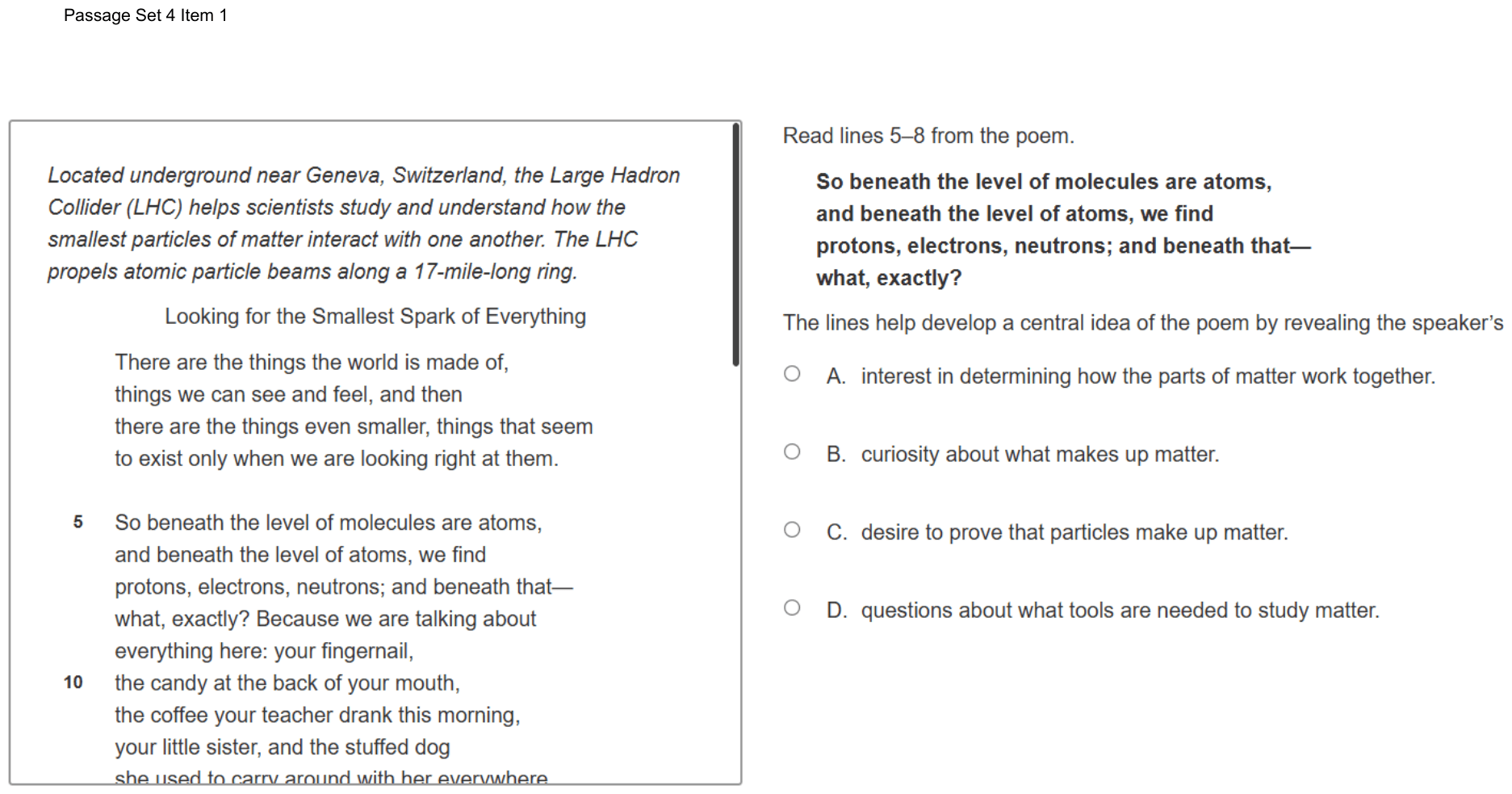
The passage “Looking for the Smallest Spark of Everything” as printed (pages 32–33)
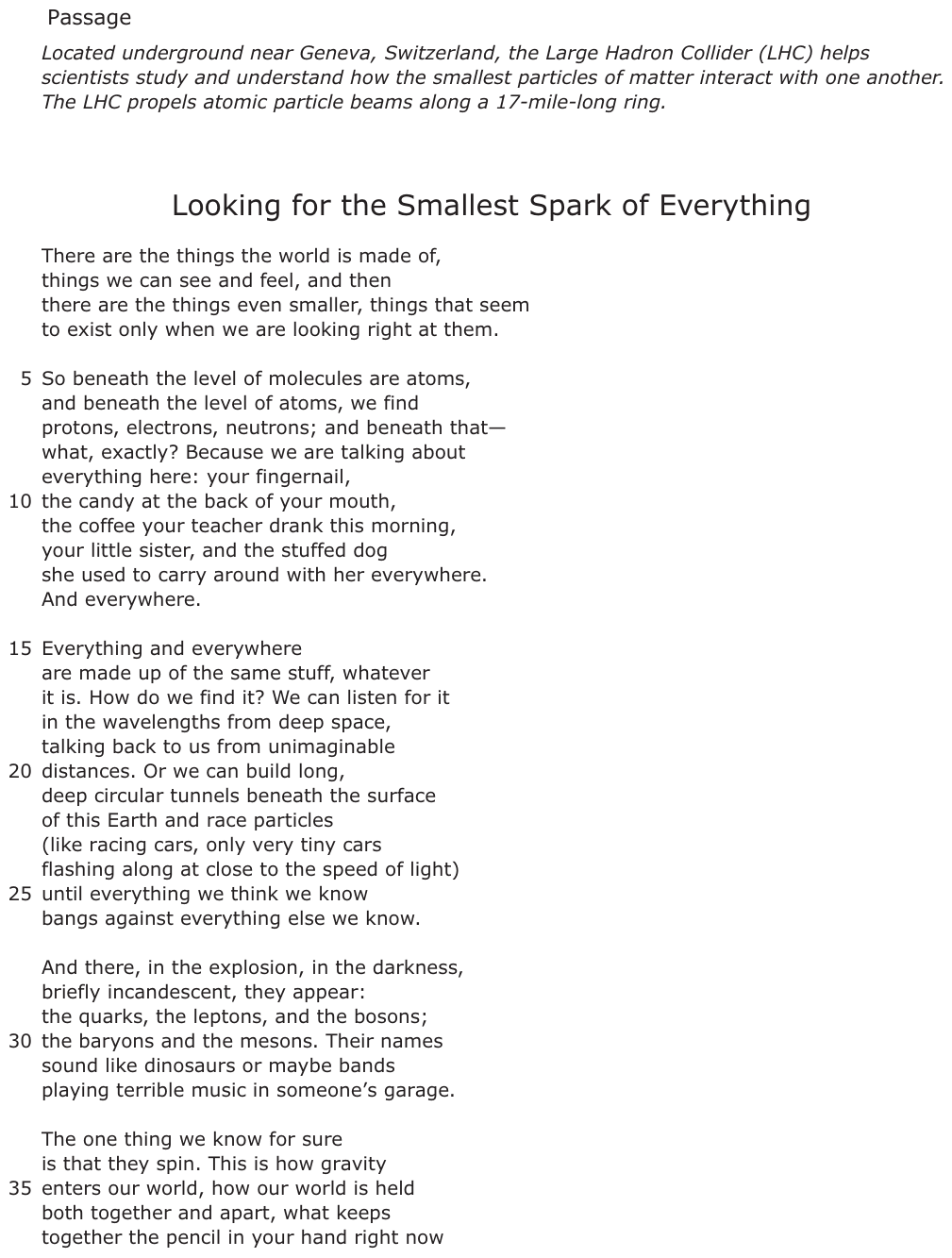
Question 41 of 57
2022 Test B English, question 41Uses the passage above: “Looking for the Smallest Spark of Everything”.
Question
The break between the second stanza (lines 5–14) and the third stanza (lines 15–26) serves as a transition from
- Aidentifying common physical objects to explaining how the particles that make up all physical things are observed.
- Bsuggesting that the visible world is made up of simple materials to revealing why invisible materials make the world complicated.
- Cdiscussing the methods used to study particles in space to describing how matter is researched on Earth.
- Ddescribing an environment that feels comfortable to characterizing an environment that seems unstable.
Show the answer
Correct answer: A
The question asks how the break between the second stanza (lines 5–14) and the third stanza (lines 15–26) serves as a transition between ideas.
A. CORRECT. The second stanza describes physical objects, including “your fingernail, / the candy at the back of your mouth, / the coffee your teacher drank this morning” (lines 9–11) and even “the stuffed dog” that “your little sister” (line 12) carries around. In the third stanza, the speaker introduces the topic of observation by asking, “How do we find it?” in line 17. Lines 17–18 offer one possible method for finding “it” (“We can listen for it / in the wavelengths from deep space”), while lines 20–22 describe a second method (“Or we can build long, / deep circular tunnels beneath the surface / of this Earth and race particles”). With these details, the focus of the poem shifts toward explaining how the particles that make up everything are observed.
B. Incorrect. While the speaker does list common items such as “candy” and “coffee” (lines 10–11) that many people are familiar with and that seem to be simple in composition or structure, the speaker does not imply in the third stanza that invisible objects complicate the world. In fact, the speaker claims that everything is “made up of the same stuff” (line 16), which simplifies the invisible world.
C. Incorrect. The second stanza focuses on the structure of matter (“beneath the level of molecules are atoms, / and beneath the level of atoms, we find / protons, electrons, neutrons” [lines 5–7]) and does not discuss the methods used to explore this structure in space. The third stanza mentions space (“We can listen for it / in the wavelengths from deep space” [lines 17–18]) and how we can “race particles” (line 22) on Earth but does not compare the methods of study used in these different locations.
D. Incorrect. While the second stanza describes items that are familiar to readers, including “your fingernail, / the candy at the back of your mouth, / the coffee your teacher drank this morning” (lines 9–11), the familiarity of these items does not necessarily mean they are part of a comfortable environment. The third stanza discusses studying the parts of matter “until everything we think we know / bangs against everything else we know” (lines 25–26). The “banging” the speaker refers to is not related to an unstable environment but rather to the mysteries of atomic structure.
Question analysis
This structure question on the poem “Looking for the Smallest Spark of Everything,” about the Large Hadron Collider, asks what shift the break between the second stanza (lines 5–14) and the third stanza (lines 15–26) marks. Students must sum up what each stanza is doing and check that both halves of a two-part choice fit, each matched to the right stanza.
- NYS standards
- 7R5 structure and genre features
- Grade level
- Grade 7 reading and task
- Compared with grade 7
- At grade 7 Explaining how a stanza break shifts a poem’s focus is regular grade 7 structure work. Both stanzas use everyday language, and each two-part choice must be checked half by half, a typical grade 7 demand.
- Estimated difficulty
- Straightforward: two steps or one careful reading.
- Thinking it demands
- Depth of knowledge 2, skills and concepts · mainly analyze
- What makes it hard
- How, not what minor
- Every choice must be checked minor
- Evidence
- Answered from several paragraphs or stanzas
- Reading level
- Passage: 346 words (a poem; reading level not measured); question and choices: about grade 12, 84 words.
- Students, last 30 days
- Not enough answers yet to show (it takes 10).
Why it is hard, traps and wrong answers (shows the answer)
Why it is hard
The shift is easy to hear: stanza 2 closes with a list running from a fingernail to a stuffed dog and “everywhere,” and stanza 3 asks how the shared stuff can be found. The wrong choices fail on one half or put content in the wrong stanza, the most tempting being the one that splits stanza 3’s two methods, deep space and underground tunnels, across the break. Checking each half against its own stanza separates them.
How, not what minor Working it out
The stem asks what the stanza break marks, so students must sum up what stanza 2 does, listing everyday things made of particles, and what stanza 3 does, asking “How do we find it?” (Anderson & Krathwohl, 2001)
Every choice must be checked minor Choosing the answer
Every choice has a “from” half and a “to” half, and each half must be matched to its own stanza, so a choice can fail on either side or by moving content across the break. (Embretson & Wetzel, 1987)
Strategy: Write a few words for what stanza 2 does and a few for what stanza 3 does, then choose the pair that matches both, in the right order.
Traps
- Half right: One half of a two-part choice is right and the other is not.
- Wrong part of the text: A choice is true of another paragraph, stanza or speaker than the one asked about.
- Wrong tone or attitude: Misjudges the tone, attitude or point of view, such as reading admiration as criticism, or taking a character's or subject's feelings for the author's.
The wrong answers, classified
B Half right (King et al., 2004; Thissen, Steinberg & Fitzpatrick, 1989)
Accepts that stanza 2 lists everyday things but then reads stanza 3 as making the world complicated, though it says everything is “made up of the same stuff.”
C Wrong part of the text (Kirsch & Mosenthal, 1990)
Notices the “wavelengths from deep space” and the tunnels “beneath the surface / of this Earth,” but both methods come in stanza 3, and stanza 2 describes no methods at all.
D Wrong tone or attitude (Graesser, Singer & Trabasso, 1994)
Feels the coziness of candy and a sister’s stuffed dog, then hears “bangs against” as an unstable place, though the collisions belong to the particle experiment, not to anyone’s surroundings.
Working it out, step by step
Understand the transition question
This asks what changes at the break between stanza 2 and stanza 3. A stanza is a group of lines in a poem, like a paragraph. A transition is a move from one idea to the next. Each choice has a “from” part and a “to” part, and both must match.
Sum up stanza 2, lines 5–14
Stanza 2 goes smaller and smaller: molecules, then atoms, then “protons, electrons, neutrons.” Then it turns to everyday things made of that tiny stuff: “your fingernail, / the candy at the back of your mouth, / the coffee your teacher drank this morning.” It ends with a little sister and her stuffed dog. These are common physical objects, things you can touch.
Sum up stanza 3, lines 15–26
Stanza 3 says all things are “made up of the same stuff.” Then line 17 asks, “How do we find it?” The rest of the stanza gives two answers. We can listen “in the wavelengths from deep space.” Or they can build tunnels and race particles, the tiny bits that make up matter. So stanza 3 is about how people observe, or study, those particles.
Check both halves of each choice
- A fits. Stanza 2 names common things. Stanza 3 explains how particles are found.
- B does not fit. Stanza 3 says everything is the same stuff. It never says hidden materials make the world complicated.
- C does not fit. Stanza 2 has no methods at all. Both ways of searching, in space and on Earth, come in stanza 3.
- D does not fit. Candy and a stuffed dog are familiar, but no comfortable place is described. The banging in line 26 is particles crashing in a tunnel.
Choose the answer
Watch out: C is tempting because the poem does mention deep space and the Earth. But both come after the break, so C splits stanza 3 in two. So the answer is A.
Why this answer and not the closest wrong one
C comes closest, because space and the Earth are both in the poem. But they sit side by side in stanza 3, as two ways to search. Stanza 2 searches for nothing; it lists things from a fingernail to a stuffed dog. A matches each stanza: everyday objects first, then how scientists find the particles inside them.
More questions like this
The original DOE question
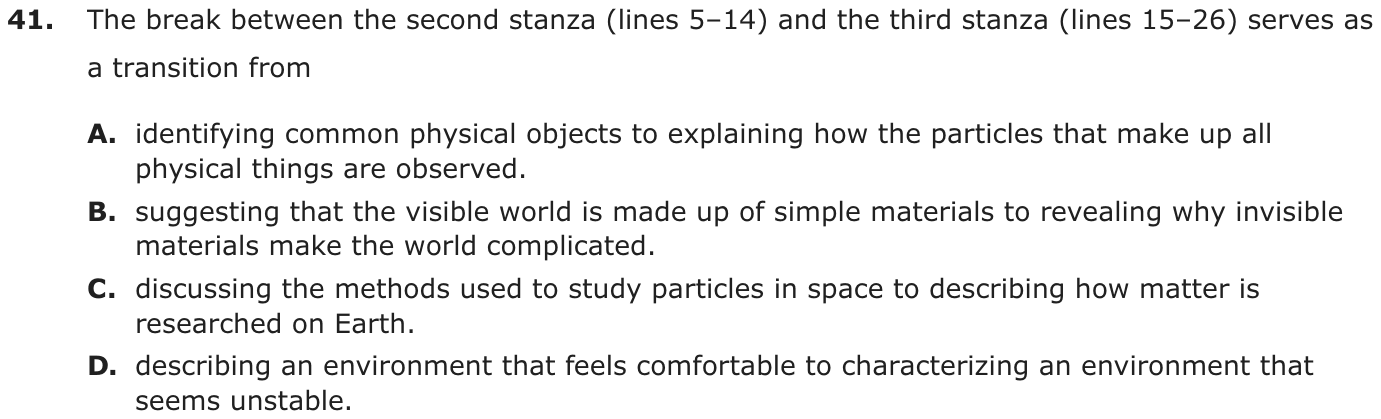
Question 42 of 57
2022 Test B English, question 42Uses the passage above: “Looking for the Smallest Spark of Everything”.
Question
The main purpose of the comparison in lines 23–24 of the poem is to show
- Athat the particles’ size makes them difficult to see.
- Bhow the particles move within the tunnel.
- Cthat the particles have a familiar shape.
- Dhow the particles can be seen only in darkness.
Show the answer
Correct answer: B
The question asks what the comparison in lines 23–24 of the poem is mainly meant to show.
A. Incorrect. While the particles are moving “close to the speed of light” (line 24), which would make them difficult to see, the comparison in lines 23–24 focuses on the movement of the particles, not how visible they are.
B. CORRECT. Lines 23–24 describe “tiny cars / flashing along at close to the speed of light,” which describes how the particles move.
C. Incorrect. Lines 23–24 do not describe the shape of the particles but rather their movement, which is “flashing along at close to the speed of light” (line 24).
D. Incorrect. The word “flashing” in line 24 does not refer to light in darkness but rather to speed, and the word “light” is used to reference a measurement of speed, not brightness in darkness.
Question analysis
This figurative language question asks for the main purpose of a comparison in lines 23–24 of the poem “Looking for the Smallest Spark of Everything,” where particles in an underground tunnel are likened to tiny racing cars. Students must work out what the image is mainly meant to show about the particles, judging the comparison as a whole rather than word by word.
- Grade level
- Grade 6 reading and task
- Compared with grade 7
- Below grade 7 Explaining what a simple comparison shows is grade 6 work, and this one likens particles to racing cars in two short lines of familiar words, so a single step of interpretation is enough.
- Estimated difficulty
- Routine: one familiar step, little to misread.
- Thinking it demands
- Depth of knowledge 2, skills and concepts · mainly understand
- What makes it hard
- Evidence
- Answered from one sentence or line
- Reading level
- Passage: 346 words (a poem; reading level not measured); question and choices: about grade 5, 46 words.
- Students, last 30 days
- Not enough answers yet to show (it takes 10).
Why it is hard, traps and wrong answers (shows the answer)
Why it is hard
The image is built from words about motion, racing cars “flashing along at close to the speed of light,” so most students see its purpose quickly. Each wrong choice seizes one piece of the picture, the cars’ tininess, their shape or the word “light,” and makes it the point. Students who ask what the whole comparison makes them picture, rather than what one word suggests, avoid all three.
Figurative or literary language minor Understanding the question
The comparison sits in parentheses, “like racing cars, only very tiny cars / flashing along at close to the speed of light,” and students must see that racing cars stand for speed. (Graesser, Singer & Trabasso, 1994; Kintsch, 1998)
Strategy: Name the two things being compared in lines 23–24 and ask what a reader is meant to picture, then choose the purpose that the comparison’s own words support.
Traps
- Taking figurative language literally: A choice reads a figure of speech or image at face value.
- Word match: Repeats striking words or phrases from the text, so it looks supported, but its meaning does not fit the question.
- Dictionary meaning, not meaning here: A common meaning of the word that does not fit its use in this text.
The wrong answers, classified
A Word match (Freedle & Kostin, 1993)
Fixes on “very tiny cars” and decides the point is that the particles are too small to see, though racing cars are chosen for their speed, not their size.
C Taking figurative language literally (Graesser, Singer & Trabasso, 1994)
Takes the comparison at face value, as if particles looked like little cars, when the speaker uses racing to picture how they move, not what shape they have.
D Dictionary meaning, not meaning here (Perfetti, 2007)
Reads “flashing” and “light” as a glow, like the one in the darkness of lines 27–28, but “the speed of light” measures how fast the particles travel.
Working it out, step by step
Figure out what the question asks
This asks why the poet makes a comparison in lines 23–24. A comparison shows how two different things are alike. First find the two things. Then ask what the reader is meant to picture.
Read the lines around it
Lines 20–22 describe building “deep circular tunnels beneath the surface / of this Earth” to race particles. Then lines 23–24 add “(like racing cars, only very tiny cars / flashing along at close to the speed of light)”. The speed of light is the fastest speed there is.
Work out the comparison
The particles are compared to racing cars. Racing cars zoom around a track, lap after lap, very fast. The particles zoom around the round tunnel the same way. “Flashing along” means moving so fast they are a blur. So the comparison helps you picture how the particles move.
Check each choice
- A does not fit. The cars are “very tiny,” but the point is racing, not being hard to see.
- B fits. Like racing cars, the particles speed around the tunnel.
- C does not fit. The particles do not look like cars. The comparison is about motion, not shape.
- D does not fit. “Light” here measures speed. It is not about glowing in the dark.
Watch out: A is tempting because of the word “tiny.” But a poet picks racing cars to show speed, not size.
Choose the answer
The racing cars help you picture particles speeding around the tunnel. So the answer is B, “how the particles move within the tunnel.”
Why this answer and not the closest wrong one
A is the closest wrong choice, since the poem does call them “very tiny cars.” But the comparison is to racing cars “flashing along at close to the speed of light.” Every word there is about speed and motion. So B, how the particles move, fits better.
More questions like this
The original DOE question
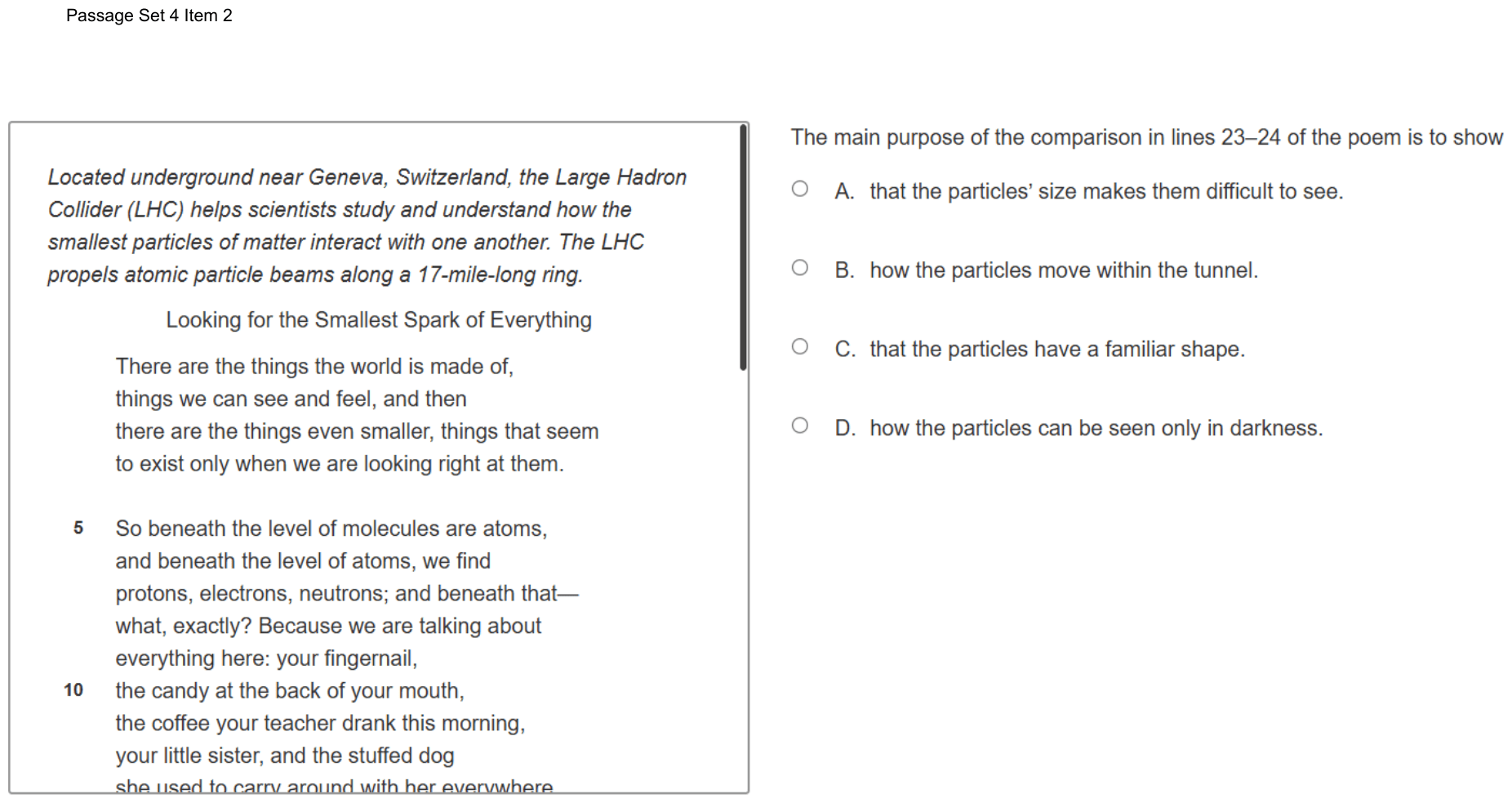
Question 43 of 57
2022 Test B English, question 43Uses the passage above: “Looking for the Smallest Spark of Everything”.
Question
Read lines 25–26 from the poem.
until everything we think we know
bangs against everything else we know.
The lines help develop a central idea in the poem by suggesting that
- Acreative methods for researching particles are frequently being invented.
- Bongoing research continues to add to our knowledge of particles.
- Cour understanding of particles is limited by the equipment available to study them.
- Dcompeting theories about particles provoke scientific debate.
Show the answer
Correct answer: B
The question asks how lines 25–26 help develop a central idea in the poem.
A. Incorrect. Lines 25–26 illustrate the collision of old and new information about particles, but they do not describe “creative methods” that are currently being invented to research subatomic particles.
B. CORRECT. The lines “until everything we think we know / bangs against everything else we know” (lines 25–26) are about how the old knowledge about particles interacts with newfound knowledge.
C. Incorrect. While lines 20–22 describe the Large Hadron Collider as “long, / deep circular tunnels beneath the surface / of this Earth” where scientists “race particles,” lines 25–26 refer to the collision of old and new ideas about particles, not the limitations of the Large Hadron Collider.
D. Incorrect. Lines 25–26 focus on what “we think we know” about subatomic particles and how new discoveries challenge “everything else we know.” However, the challenge is not a result of scientists debating one another but rather what the Large Hadron Collider reveals about particles.
Question analysis
Lines 25–26 of the poem “Looking for the Smallest Spark of Everything” end a long sentence about racing particles through underground tunnels: “until everything we think we know / bangs against everything else we know.” This question asks what central idea the lines help develop. Students must interpret a figurative collision, and several choices offer reasonable-sounding ideas about how science works.
- Grade level
- Grade 8 reading and task
- Compared with grade 7
- Above grade 7 Grade 7 students interpret figurative lines and connect them to a central idea, but these two lines play on the collisions in a particle accelerator, state nothing directly, and end a seven-line sentence, above typical grade 7 work.
- Estimated difficulty
- Hard: combines ideas, needs a plan, and has more than one tempting wrong answer.
- Thinking it demands
- Depth of knowledge 3, strategic thinking · mainly analyze
- What makes it hard
- Figurative or literary language major
- Reading between the lines moderate
- Complex sentences minor
- Evidence
- Answered from one paragraph or stanza
- Reading level
- Passage: 346 words (a poem; reading level not measured); question and choices: about grade 9, 69 words.
- Corrected from the DOE handbook
- A missing period in the explanation was restored.
- Students, last 30 days
- Not enough answers yet to show (it takes 10).
Why it is hard, traps and wrong answers (shows the answer)
Why it is hard
The lines use the collider’s own action, a crash, as a picture of what the research does to knowledge, and nothing in them says plainly what that is. The strongest pull reads the crash as people clashing, rival theories in a debate, which turns the image into a quarrel the poem never describes. Students who follow the sentence into the next stanza, where new particles appear in the explosion, see that the collisions add to what we know.
Figurative or literary language major Understanding the question
“Bangs against” moves the collision from the particles racing in the tunnel to “everything we think we know,” so the lines must be read as a picture of knowledge being tested, not of machines. (Graesser, Singer & Trabasso, 1994; Kintsch, 1998)
Reading between the lines moderate Working it out
What the collision does to knowledge is never stated; it follows from “until,” which makes the crash the goal of the work, and from the next stanza, where the quarks and leptons “appear.” (Graesser, Singer & Trabasso, 1994; Kintsch, 1998)
Complex sentences minor Understanding the question
Lines 25–26 close a seven-line sentence that starts at “Or we can build long,” runs through a parenthesis about racing cars, and only then reaches its “until” clause. (Abedi & Lord, 2001; Freedle & Kostin, 1993; Messick, 1989)
Strategy: Read lines 20–26 as one sentence, decide what is literally colliding in the tunnels, then ask what the poet suggests is happening to “everything we think we know.”
Traps
- Reads too much in: A reasonable-sounding conclusion that goes further than the text allows.
- Wrong part of the text: A choice is true of another paragraph, stanza or speaker than the one asked about.
- Outside knowledge: A choice is plausible in the real world but not supported by this text.
The wrong answers, classified
A Wrong part of the text (Kirsch & Mosenthal, 1990)
Recalls the two ways of searching in lines 17–22, deep-space wavelengths and underground tunnels, though lines 25–26 describe what the collisions do to knowledge, not methods being invented.
C Outside knowledge (King et al., 2004; Recht & Leslie, 1988)
Draws on the familiar idea that science is held back by its tools, though the poem presents the long, deep tunnels as a way of finding out, not a limit.
D Reads too much in (Graesser, Singer & Trabasso, 1994)
Reads knowledge banging against knowledge as rival theories argued over by scientists, though the lines echo the particles’ collisions and no debate or competing camps appear in the poem.
What was corrected from the DOE handbook, and why
- Explanation: The handbook’s explanation of Option B ends “…are about how the old knowledge about particles interacts with newfound knowledge” with no closing period. The site adds the period.
Working it out, step by step
Make sense of the question
This asks what lines 25–26 add to a central idea of the poem. The lines use a picture, not plain facts. So first see what is really happening in the lines before them. Then ask what the picture means.
Read the whole sentence
Lines 25–26 end a long sentence that starts in line 20: “Or we can build long, / deep circular tunnels beneath the surface / of this Earth and race particles.” The racing goes on “until everything we think we know / bangs against everything else we know.” In the real machine, particles speed around and smash into each other.
Work out the picture
The poet swaps the particles for “everything we think we know.” So it is our knowledge that crashes. Picture old ideas being tested against new findings. The word “until” shows the crash is the goal of the racing. The next stanza shows the result. In the explosion, tiny particles “appear,” and the poet names them. Each crash teaches scientists more.
Check each choice
- A does not fit. The ways of searching come earlier, in lines 17–22. Nothing says new methods are often invented.
- B fits. The research keeps going, and each crash adds to what we know about particles.
- C does not fit. The tunnels are shown as a way to find things out, not as a limit.
- D does not fit. The banging stands for particles colliding. No scientists argue, and no sides compete.
Give the answer
Watch out: D is tempting, because things banging together can sound like people clashing in a debate, an argument between sides. But the poem never shows anyone arguing. So the answer is B.
Why this answer and not the closest wrong one
D is the closest wrong choice, since “bangs against” can sound like an argument. But the crash copies what the particles do in the tunnel. Right after it, particles appear in the explosion. The lines picture knowledge growing as the experiments go on, which is B, not a fight between theories.
More questions like this
The original DOE question
Question 44 of 57
2022 Test B English, question 44Uses the passage above: “Looking for the Smallest Spark of Everything”.
Question
Read lines 27–28 from the poem.
And there, in the explosion, in the darkness,
briefly incandescent, they appear:
The imagery in the lines reveals that the speaker
- Aenvies the physicists who research colliding particles.
- Bhas personally observed colliding particles.
- Cadmires the powerful reactions that occur when particles collide.
- Dhas a simplistic understanding of how particles collide.
Show the answer
Correct answer: C
The question asks what the imagery in lines 27–28 reveals about the speaker.
A. Incorrect. The physicists mentioned in the fifth stanza (lines 33–44) are described as mere observers: they “jot down / what they can” (lines 41–42). In lines 27–28, the speaker is focused on the reaction between the colliding particles, not on the physicists who study them.
B. Incorrect. The speaker describes the particle collision in detail, but the text does not imply that the speaker has personally witnessed a collision. The speaker implies that his or her understanding of the collision is based on the experiences of the physicists observing the phenomenon (“They spin, and it is only down there / in the darkness—in the vast garage / where physicists jot down / what they can, whatever seems most real— / that they let us perceive their wild dancing” [lines 39–43]).
C. CORRECT. The word “explosion” and the phrase “briefly incandescent” create a picture of rapid changes and short bursts of bright light, revealing how powerful the new particles are. The language the speaker uses is positive, revealing that the speaker admires the power of the reaction and stands in awe of the new particles.
D. Incorrect. The poem reveals the speaker’s deep knowledge about subatomic particles. For example, the speaker is able to name the new particles discovered—“the quarks, the leptons, and the bosons; / the baryons and the mesons” (lines 29–30)—and is able to use imagery to create a powerful picture that reveals the complexity of a scientific process that humans have never been able to see.
Question analysis
This imagery question asks what lines 27–28 of “Looking for the Smallest Spark of Everything” reveal about the poem’s speaker, as particles appear “briefly incandescent” in an explosion inside a particle collider. Students must infer what a vivid image says about the person describing it. The word “incandescent” may be unfamiliar, and the choices are about very different things.
- Grade level
- Grade 8 reading and task
- Compared with grade 7
- Above grade 7 Grade 7 students infer a speaker’s attitude from imagery, but these two lines turn on the uncommon word “incandescent,” state nothing about the speaker outright, and the choices range over the speaker’s knowledge, experience and feelings, which is harder than typical grade 7 work.
- Estimated difficulty
- Hard: combines ideas, needs a plan, and has more than one tempting wrong answer.
- Thinking it demands
- Depth of knowledge 2, skills and concepts · mainly analyze
- What makes it hard
- Reading between the lines major
- Hard words moderate
- Figurative or literary language minor
- Evidence
- Answered from one paragraph or stanza
- Reading level
- Passage: 346 words (a poem; reading level not measured); question and choices: about grade 9, 55 words.
- Students, last 30 days
- Not enough answers yet to show (it takes 10).
Why it is hard, traps and wrong answers (shows the answer)
Why it is hard
Nothing in the two lines names a feeling, so students must judge the speaker’s attitude from the image alone, and its key word is uncommon. The vividness is itself a trap: a scene described this sharply can seem to be one the speaker watched, though the poem says the particles are perceived only through the physicists’ work. The choices range over envy, experience, admiration and understanding, so each must be tested against the lines rather than against an overall impression.
Reading between the lines major Working it out
The lines describe particles, not the speaker, and contain no word of feeling; admiration has to be inferred from the drama of “the explosion” and the glow of “briefly incandescent.” (Graesser, Singer & Trabasso, 1994; Kintsch, 1998)
Hard words moderate Understanding the question
“Incandescent,” glowing with heat and light, is the word that makes the image dazzling, and a student who does not know it sees only an explosion in the dark. (Perfetti, 2007; Freedle & Kostin, 1993)
Figurative or literary language minor Understanding the question
The two lines are pure imagery, a burst of light in darkness as the particles “appear,” and the question asks what that picture reveals about the person painting it. (Graesser, Singer & Trabasso, 1994; Kintsch, 1998)
Strategy: Picture the scene in lines 27–28, including what “incandescent” means, decide what the description suggests about the speaker, and test each choice against these two lines.
Traps
- Taking figurative language literally: A choice reads a figure of speech or image at face value.
- Reads too much in: A reasonable-sounding conclusion that goes further than the text allows.
The wrong answers, classified
A Reads too much in (Graesser, Singer & Trabasso, 1994)
Reasons that someone so drawn to the scene must envy the physicists who study it, though the physicists appear only in lines 39–44 and nothing in the poem hints at envy.
B Taking figurative language literally (Graesser, Singer & Trabasso, 1994)
Takes the vivid scene of particles that “appear” in a glow as something the speaker witnessed, though lines 39–43 place that sight “down there,” where physicists record what they can.
D Reads too much in (Graesser, Singer & Trabasso, 1994)
Treats the poem’s playful comparisons, racing cars and garage bands, as a sign of shallow knowledge, though the next lines have the speaker naming quarks, leptons, bosons, baryons and mesons.
Working it out, step by step
Figure out what the question asks
This asks what the imagery in lines 27–28 shows about the speaker. Imagery is language that helps you see, hear or feel a scene. The lines describe particles, not the speaker. So you must infer, or figure out from clues, how the speaker feels.
Read lines 27–28
The lines say “And there, in the explosion, in the darkness, / briefly incandescent, they appear:” Briefly means for a short time. Incandescent means glowing with heat and light. So picture a burst of bright light flashing in the dark. The particles have just crashed into each other, or collided. In that flash, the tiny particles appear.
Decide how the speaker feels
The words are bold and bright: “explosion,” “incandescent,” “appear.” The speaker makes the moment sound dramatic and amazing. People describe something this way when they are in awe of it. So the speaker admires, or looks up to, the power of the crash.
Check each choice
- A does not fit. Physicists come up only later, in line 41. Nothing shows envy, or wanting what they have.
- B does not fit. Nothing says the speaker was there. Lines 39–42 place the sight “down there,” where “physicists jot down / what they can.”
- C fits. The glowing burst in the dark shows the speaker’s wonder.
- D does not fit. Right after, the speaker names quarks, leptons, bosons, baryons and mesons. That is not a simple understanding.
Watch out: B is tempting because the scene is so vivid. But a writer can picture something without seeing it in person.
Choose the answer
The bright, explosive picture shows a speaker who is amazed by the crash. So the answer is C, “admires the powerful reactions that occur when particles collide.”
Why this answer and not the closest wrong one
B is the closest wrong choice, because the scene feels like an eyewitness report. But the lines never say the speaker was in the tunnel. What they do show is a feeling. Words like “explosion” and “briefly incandescent” make the moment thrilling. That is admiration, so C fits.
More questions like this
The original DOE question
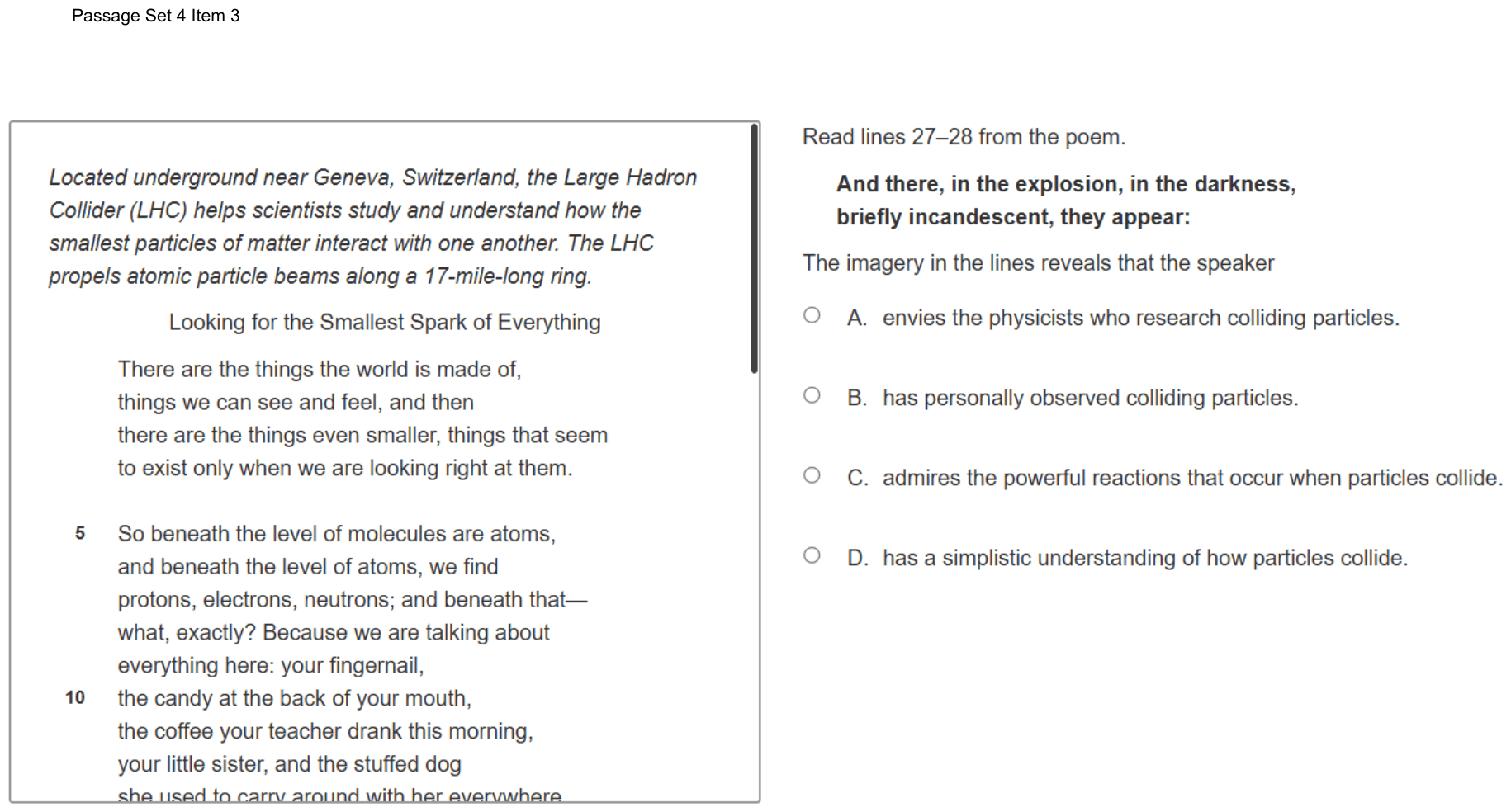
Question 45 of 57
2022 Test B English, question 45Uses the passage above: “Looking for the Smallest Spark of Everything”.
Question
Read lines 30–32 from the poem.
Their names
sound like dinosaurs or maybe bands
playing terrible music in someone’s garage.
The speaker refers to familiar objects and events in the lines most likely to
- Aexplain confusing information in simple terms to help the reader understand more about the topic.
- Bdemonstrate how scientific ideas can be explained by describing situations that many people are familiar with.
- Cemphasize that the process being used to research particles is still in the early stages of development.
- Dsuggest that the scientific language used to describe particles seems silly by making a humorous comparison.
Show the answer
Correct answer: D
The question asks why the speaker refers to familiar objects and events in lines 30–32.
A. Incorrect. In lines 30–32, the speaker only gives an opinion about what the names sound like and does not simplify confusing information about how these newly discovered particles function or exist.
B. Incorrect. In lines 30–32, the speaker is only describing what the names of the particles sound like: “dinosaurs or maybe bands” (line 31). These descriptions illustrate the speaker’s opinion but do not explain specific scientific ideas.
C. Incorrect. In lines 30–32, the mention of the names of the particles sounding like “dinosaurs or maybe bands” (line 31) reveals the speaker’s opinion about the names but does not explain the process of researching the particles.
D. CORRECT. The phrase “their names” (line 30) refers to the scientific names of the particles: “the quarks, the leptons, and the bosons; / the baryons and the mesons” (lines 29–30). In lines 30–32, the speaker expresses the opinion that these scientific terms sound nonsensical, much like the strange scientific names of dinosaurs or silly band names.
Question analysis
In “Looking for the Smallest Spark of Everything,” the speaker says the names of particles sound like dinosaurs or bands playing in someone’s garage. This question asks why the speaker refers to such familiar things in lines 30–32. Students must read the comparison’s tone and purpose, and the choices offer several reasons poets compare science with everyday life.
- Grade level
- Grade 7 reading and task
- Compared with grade 7
- At grade 7 Explaining why a speaker includes a comparison is typical grade 7 work on word choice and tone. The three lines are quoted and their images are everyday ones, but the choices state purposes that differ in subtle ways.
- Estimated difficulty
- Moderate: several steps, or a close reading with one strong distractor.
- Thinking it demands
- Depth of knowledge 2, skills and concepts · mainly analyze
- What makes it hard
- How, not what moderate
- Figurative or literary language moderate
- Reading between the lines minor
- Evidence
- Answered from one paragraph or stanza
- Reading level
- Passage: 346 words (a poem; reading level not measured); question and choices: about grade 10, 97 words.
- Students, last 30 days
- Not enough answers yet to show (it takes 10).
Why it is hard, traps and wrong answers (shows the answer)
Why it is hard
Two choices give the textbook reason for an everyday comparison, to make hard science easier, and they draw students who answer from what comparisons usually do. These lines explain nothing; they say how the particles’ names sound, and “terrible music in someone’s garage” is a joke at the expense of the jargon. Students who trace “Their names” back to the list before it and hear the teasing tone reach the right purpose.
How, not what moderate Working it out
The question asks why the speaker makes the comparison, and two choices offer the usual reason for likening science to everyday things, making it easier to grasp, which these lines do not do. (Anderson & Krathwohl, 2001)
Figurative or literary language moderate Understanding the question
The humor has to be heard: names that sound like dinosaurs or like bands “playing terrible music in someone’s garage” are being teased, which signals a joke, not an explanation. (Graesser, Singer & Trabasso, 1994; Kintsch, 1998)
Reading between the lines minor Working it out
“Their names” points back to the list in lines 29–30, quarks, leptons, bosons, baryons and mesons, and students must see that the lines judge those words, not the particles. (Graesser, Singer & Trabasso, 1994; Kintsch, 1998)
Strategy: Find what “Their names” refers to in the lines just before, then ask what the comparison says about those names and in what tone, and match the purpose to both.
Traps
- Wrong purpose or structure: Names a purpose, structure or effect that the part does not serve, or describes what a part says when the question asks what it does.
- Too broad or too strong: A choice overstates, generalizes, or uses absolute words the text does not support.
- Reads too much in: A reasonable-sounding conclusion that goes further than the text allows.
The wrong answers, classified
A Wrong purpose or structure (Anderson & Krathwohl, 2001)
Assumes that comparing science with familiar things is meant to simplify it, but these lines explain nothing about particles; they only say what the names sound like.
B Too broad or too strong (King et al., 2004)
Turns three lines into a general claim about teaching science through familiar situations, though no scientific idea is described here, only the sound of some names.
C Reads too much in (Graesser, Singer & Trabasso, 1994)
Hears “someone’s garage” as an amateur workshop and concludes that particle research is just beginning, a meaning the lines, which tease the names, never suggest.
Working it out, step by step
Figure out what the question asks
This asks why the speaker compares the particles’ names to familiar things. Familiar means well known from everyday life. First find what “Their names” points to. Then decide what the comparison says about those names, and in what tone.
Find what their names means
Lines 29–30 list the particles: “the quarks, the leptons, and the bosons; / the baryons and the mesons.” Then the speaker says “Their names / sound like dinosaurs or maybe bands / playing terrible music in someone’s garage.” So “their names” means these science words.
Hear the joke
Dinosaurs have long, strange names. A garage band is a group of beginners who practice in a garage. Their music is often loud and bad. The speaker is teasing the science words. They sound odd and a little silly. This is a humorous, or funny, comparison.
Check each choice
- A does not fit. The lines explain nothing about particles. They only say how the names sound.
- B does not fit. No science idea is explained here.
- C does not fit. “Garage” is part of the band joke. It does not say the research is new.
- D fits. The joke makes the science names sound silly.
Watch out: A is tempting because comparisons to everyday things often make science easier. But these lines make fun of names. They do not explain anything.
Choose the answer
The speaker compares the particle names to dinosaurs and bad garage bands to poke fun at them. So the answer is D, “suggest that the scientific language used to describe particles seems silly by making a humorous comparison.”
Why this answer and not the closest wrong one
A is the closest wrong choice. Writers often compare science to everyday things to make it simpler. But ask what these lines explain. Nothing about how particles work is made clearer. The lines only say the names sound like “bands / playing terrible music.” That is a joke about the words, so D fits.
More questions like this
The original DOE question
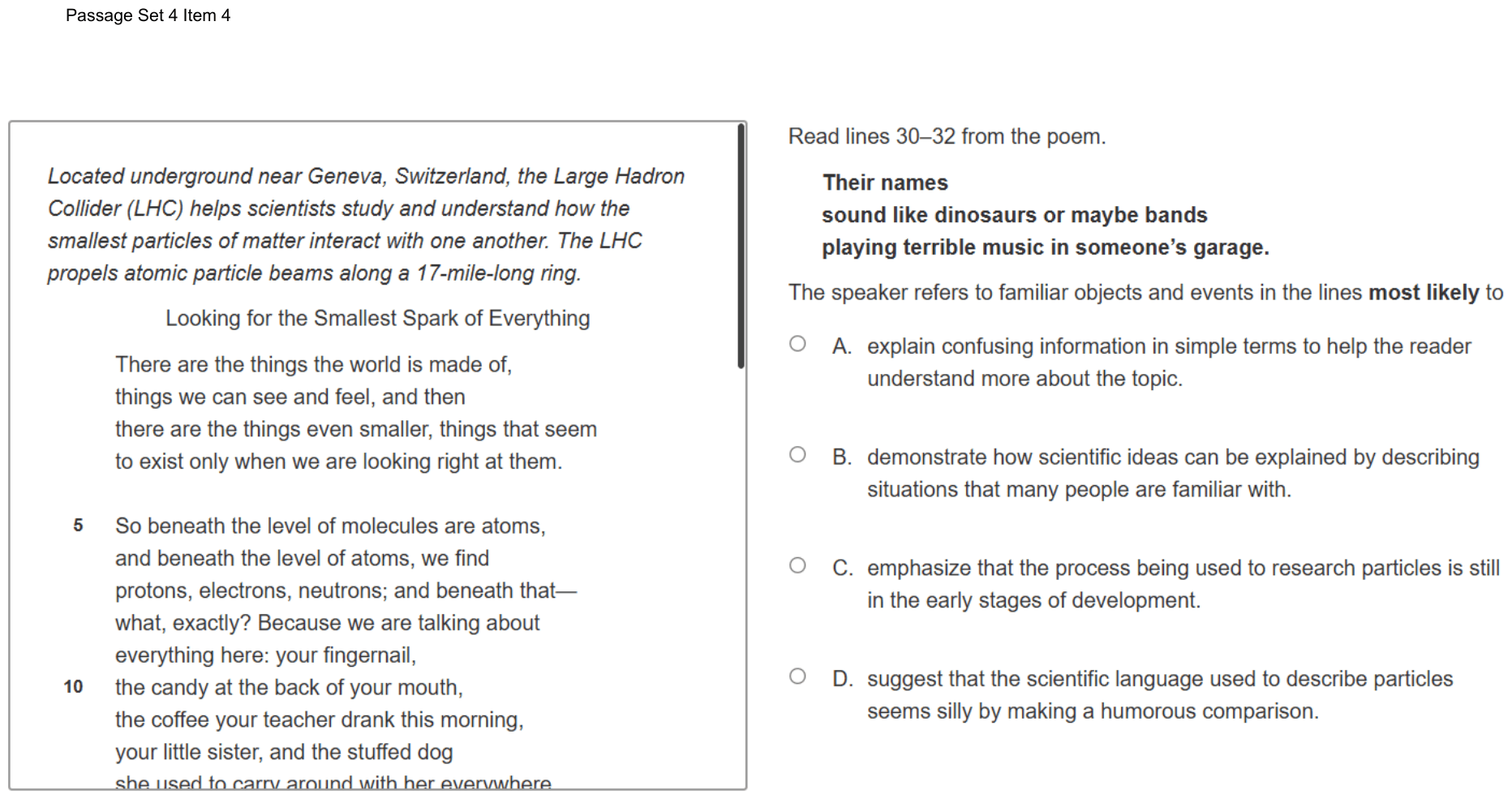
Question 46 of 57
2022 Test B English, question 46Uses the passage above: “Looking for the Smallest Spark of Everything”.
Question
Read lines 36–39 from the poem.
both together and apart, what keeps
together the pencil in your hand right now
as well as separate from, say,
Jupiter.
The poet includes these lines most likely to emphasize that
- Ait is important for physicists to continue their research about particles.
- Bthese particles have a powerful effect on everything.
- Cthe discoveries about particles provide little information.
- Dthe study of particles and the study of objects in space are similar.
Show the answer
Correct answer: B
The question asks for the most likely reason the poet includes lines 36–39 in the poem.
A. Incorrect. While the poem implies that the research is important, lines 36–39 do not point to a need for more research. Instead, the lines explain the power of the particles in the universe.
B. CORRECT. The particles that are “Everything and everywhere” (line 15) make up the objects mentioned in lines 36–39: a “pencil in your hand” and the planet “Jupiter.” Even though these objects are different from each other and extremely far apart in the universe, they are made up of and affected by these particles. The “powerful effect” is that the particles keep the objects “both together and apart” (line 36).
C. Incorrect. While the physicists can only “jot down / what they can, whatever seems most real” (lines 41–42), the discoveries about particles are ongoing and informative. The speaker shares that the particles are “everything and everywhere” (line 15) and that they “spin” (line 34), and that “this is how gravity / enters our world” (lines 34–35).
D. Incorrect. The speaker states that particles keep together objects in space, such as Jupiter, as well as objects on Earth, such as “the pencil in your hand right now” (line 37). However, in lines 36–39, the speaker is not comparing the study of subatomic particles with the study of objects in space (astronomy); the speaker is implying that because particles are “everything and everywhere” (line 15), the study of particles affects our understanding of everything in the universe, regardless of location.
Question analysis
This question asks why the poet of “Looking for the Smallest Spark of Everything” includes lines 36–39, about what keeps a pencil in your hand together and separate from the planet Jupiter. The quoted lines begin partway through a sentence, so students must read the lines before them to see what the sentence is about before judging the poet’s purpose.
- Grade level
- Grade 7 reading and task
- Compared with grade 7
- At grade 7 Explaining why a poet includes certain lines is typical grade 7 work. The quoted lines start partway through a sentence, so students must read lines 33–35 to see what the sentence is about, an extra step but not an unusual one.
- Estimated difficulty
- Moderate: several steps, or a close reading with one strong distractor.
- Thinking it demands
- Depth of knowledge 2, skills and concepts · mainly analyze
- What makes it hard
- Complex sentences moderate
- Reading between the lines minor
- Evidence
- Answered from one paragraph or stanza
- Reading level
- Passage: 346 words (a poem; reading level not measured); question and choices: about grade 8, 75 words.
- Corrected from the DOE handbook
- The explanation of C reversed cause and effect in the poem; one word was changed.
- Students, last 30 days
- Not enough answers yet to show (it takes 10).
Why it is hard, traps and wrong answers (shows the answer)
Why it is hard
The quoted lines are the tail of a sentence, and without its start they read like a list of objects. Students who go back to lines 33–35 see that the spin of the particles is what holds things “together and apart,” and the pencil and Jupiter show how far that reaches. Those who read the fragment alone fasten on Jupiter and think of astronomy, while those who read on to the physicists who “jot down / what they can” may decide that little is known.
Complex sentences moderate Understanding the question
The quoted lines begin mid-sentence with “both together and apart, what keeps,” so students must read back to lines 33–35 to learn that the subject is the particles’ spin, “how gravity / enters our world.” (Abedi & Lord, 2001; Freedle & Kostin, 1993; Messick, 1989)
Reading between the lines minor Working it out
The lines never say “everything”; students must see that a pencil in your hand and a distant planet stand for things near and small and things far and huge, so the effect reaches all matter. (Graesser, Singer & Trabasso, 1994; Kintsch, 1998)
Strategy: Read lines 33–39 as one sentence, work out what the subject of “what keeps” is, and then ask what point the two examples in lines 37–39 are meant to make.
Traps
- Twists what the text says: Uses the text's topic and ideas but changes what it says: who did it, how much, when, or why.
- Wrong part of the text: A choice is true of another paragraph, stanza or speaker than the one asked about.
- Reads too much in: A reasonable-sounding conclusion that goes further than the text allows.
The wrong answers, classified
A Reads too much in (Graesser, Singer & Trabasso, 1994)
Assumes the lines push for more research, a common message in writing about science, but they state what the particles do, not what physicists should go on doing.
C Wrong part of the text (Kirsch & Mosenthal, 1990)
Draws on “The one thing we know for sure” in line 33 and the physicists who “jot down / what they can” in lines 41–42, but lines 36–39 state confidently what the particles do.
D Twists what the text says (King et al., 2004)
Sees a planet next to a pencil and builds a comparison between particle physics and astronomy, though the lines show one force acting on both objects, not two fields of study.
What was corrected from the DOE handbook, and why
- Explanation: Rejecting C, the handbook's explanation says the particles “spin” “because ‘this is how gravity / enters our world’”. The poem says it the other way round: “The one thing we know for sure / is that they spin. This is how gravity / enters our world”, so the spinning is how gravity enters. It now says the particles “spin”, and that “this is how gravity / enters our world”. The answer, B, is unchanged.
Working it out, step by step
Figure out what the question asks
This asks why the poet includes lines 36–39. The lines start in the middle of a sentence. So read the whole sentence, from line 33, to see what it is about.
Read lines 33–39 as one sentence
Lines 33–34 say “The one thing we know for sure / is that they spin.” “They” means the tiny particles. Then the poem goes on: “This is how gravity / enters our world, how our world is held / both together and apart, what keeps / together the pencil in your hand right now / as well as separate from, say, / Jupiter.”
Work out what it means
“This” points back to the spinning. The spinning is how gravity comes into our world. Gravity is the pull that draws things toward each other. So the particles’ spin holds a pencil together and keeps it apart from Jupiter. A pencil is small and close. Jupiter is a huge planet, far away. Together they stand for everything.
Check each choice
- A does not fit. The lines say what particles do. They do not say physicists must keep working.
- B fits. The particles affect everything, from a pencil to a planet.
- C does not fit. These lines state facts with confidence. The physicists who “jot down / what they can” come later, in lines 41–42.
- D does not fit. The pencil and Jupiter are things the particles affect. They are not two subjects of study being compared.
Watch out: D is tempting because Jupiter is in space. But the lines show one force acting on both objects, not two kinds of science.
Choose the answer
A small pencil and a giant planet show that the particles’ effect reaches everything. So the answer is B, “these particles have a powerful effect on everything.”
Why this answer and not the closest wrong one
D is the closest wrong choice, since it also notices Jupiter. But D is about studying particles and studying space. The lines are not about study. They say the spin is “what keeps / together the pencil in your hand” and keeps it apart from Jupiter. Small and near, huge and far: that means everything, so B fits.
More questions like this
The original DOE question
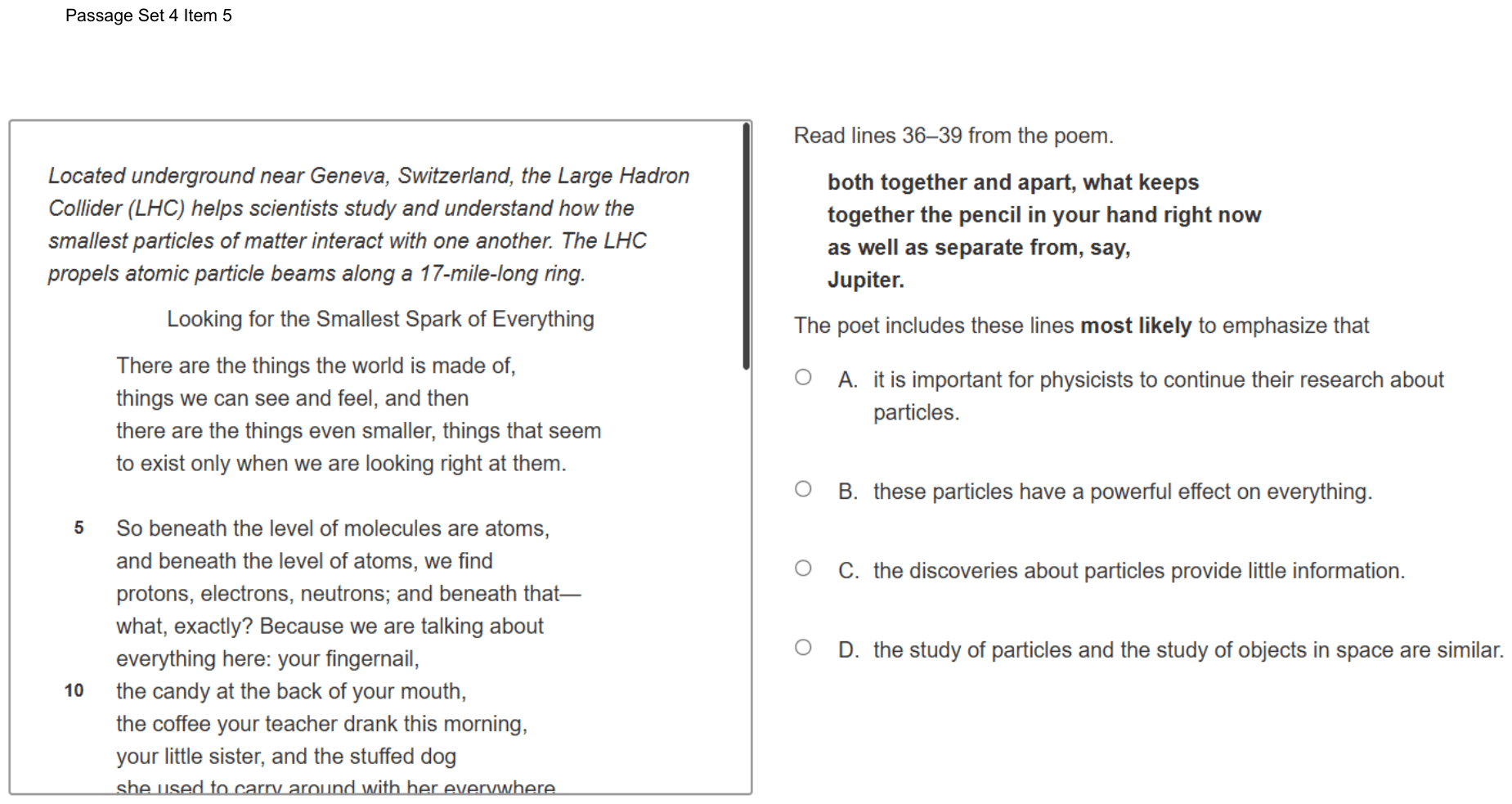
Question 47 of 57
2022 Test B English, question 47Uses the passage above: “Looking for the Smallest Spark of Everything”.
Question
The last stanza (lines 33–44) concludes the poem by emphasizing which central idea?
- AThe exciting work that physicists conduct provides information about fundamental aspects of the universe.
- BThe unusual work of physicists is carried out in unconventional locations and in special conditions.
- CPhysicists are learning about the unpredictable behavior of particles that break up matter in the universe.
- DPhysicists enthusiastically share the discoveries their research yields because most people can relate to their findings.
Show the answer
Correct answer: A
The question asks which central idea is emphasized in the last stanza (lines 33–44).
A. CORRECT. Throughout the poem, the speaker describes how everything in our universe and in our everyday lives is made up of these tiny particles. The last stanza allows us to picture the scientists working “in the darkness” (line 40), jotting down notes. Phrases like “wild dancing” (line 43) and “combusting to the music” (line 44) describe the activity of the particles and communicate the idea that the findings are exciting.
B. Incorrect. While the Large Hadron Collider is in an unconventional location that is important in the poem, it is the only location described in the poem: “it is only down there / in the darkness—in the vast garage” (lines 39–40). While the darkness is a special condition, the poem does not describe other conditions where the same type of research is being carried out. The poem does mention that “we can listen for it / in the wavelengths from deep space, / talking back to us from unimaginable / distances” (lines 17–20), but this description implies the use of a tool (a satellite), not a location.
C. Incorrect. The last stanza states that “The one thing we know for sure / is that they spin” (lines 33–34). This detail is one aspect of the particles’ behavior that is known; therefore, the particles are not completely unpredictable. In addition, the poem never describes the particles breaking up matter in the universe; the poem describes only their movements and collisions.
D. Incorrect. While the “physicists jot down / what they can, whatever seems most real” (lines 41–42), the research they share with the world is complicated and difficult to understand, making it unlikely that their findings are relatable to most people.
Question analysis
This central-idea question asks which idea the last stanza of “Looking for the Smallest Spark of Everything” (lines 33–44) emphasizes as it concludes the poem. The stanza moves from the particles’ spin and gravity to a pencil and Jupiter, then to physicists in an underground “vast garage,” so students must follow long, winding sentences and decide what the ending stresses.
- Grade level
- Grade 7 reading and task
- Compared with grade 7
- At grade 7 Identifying the central idea a closing stanza emphasizes is grade 7 work. This twelve-line stanza mixes physics with images of dancing and music in long sentences, but each choice can be tested against it directly, a typical grade 7 demand.
- Estimated difficulty
- Moderate: several steps, or a close reading with one strong distractor.
- Thinking it demands
- Depth of knowledge 2, skills and concepts · mainly analyze
- What makes it hard
- Complex sentences moderate
- Figurative or literary language moderate
- A very close wrong answer minor
- Evidence
- Answered from one paragraph or stanza
- Reading level
- Passage: 346 words (a poem; reading level not measured); question and choices: about grade 13, 73 words.
- Students, last 30 days
- Not enough answers yet to show (it takes 10).
Why it is hard, traps and wrong answers (shows the answer)
Why it is hard
The stanza joins two ideas: what the particles do for the whole world, holding a pencil together and apart from Jupiter, and the excitement of glimpsing them. The wrong choices each seize a vivid piece: the dark garage becomes the point, the wild dancing becomes unpredictable destruction, the pencil becomes findings people can relate to. Students who ask what the stanza says the research reveals, and how it sounds, pair the importance with the excitement.
Complex sentences moderate Understanding the question
The stanza’s second sentence runs from “This is how gravity” through three clauses to “Jupiter,” and its last builds to “it is only down there … that they let us perceive,” broken by a clause between dashes. (Abedi & Lord, 2001; Freedle & Kostin, 1993; Messick, 1989)
Figurative or literary language moderate Understanding the question
The particles’ “wild dancing,” “combusting to the music they make,” and the lab as “the vast garage” have to be read for excitement and wonder, not as reports of chaos or of a strange workplace. (Graesser, Singer & Trabasso, 1994; Kintsch, 1998)
A very close wrong answer minor Choosing the answer
The choice about physicists learning how particles behave mirrors the right one, physicists gaining knowledge of the universe, and parts from it only on what is learned, unpredictable particles breaking matter up. (Embretson & Wetzel, 1987; Gorin & Embretson, 2006; Ascalon et al., 2007)
Strategy: Paraphrase the last stanza sentence by sentence, ask which idea it shares with the rest of the poem, and check every part of each choice against the lines.
Traps
- Twists what the text says: Uses the text's topic and ideas but changes what it says: who did it, how much, when, or why.
- Too narrow: A single detail offered as the central idea or a summary, or a summary that keeps minor details and leaves out an essential part.
- Reads too much in: A reasonable-sounding conclusion that goes further than the text allows.
The wrong answers, classified
B Too narrow (King et al., 2004)
Fixes on the setting, “down there / in the darkness” of “the vast garage,” and makes the unusual workplace the central idea, though the stanza stresses what the physicists perceive there.
C Twists what the text says (King et al., 2004)
Turns the “wild dancing” and “combusting” into unpredictable behavior that breaks matter up, though the one sure thing is that the particles spin, which holds things together and keeps them separate.
D Reads too much in (Graesser, Singer & Trabasso, 1994)
Links “the pencil in your hand” to findings people can relate to and imagines physicists eagerly sharing them, though the stanza shows them only jotting down what they can.
Working it out, step by step
Find what the question wants
This asks which central idea the last stanza stresses as the poem ends. A central idea is a main message of the whole poem. The stanza is lines 33–44. Put it in plain words a piece at a time. Then see which choice matches all of it.
Read lines 33–39
The stanza opens, “The one thing we know for sure / is that they spin.” “They” are the tiny particles. Their spin is “how gravity / enters our world.” Gravity is the pull that keeps your feet on the ground. The spin keeps “the pencil in your hand” in one piece. It also keeps it separate from the planet Jupiter. So these particles shape how the whole universe works.
Read lines 39–44
We can see the particles only “down there / in the darkness,” in the huge underground lab the poet calls “the vast garage.” There, physicists, scientists who study matter and energy, “jot down / what they can.” The particles show “their wild dancing, / combusting to the music they make.” Combusting means bursting into flame. These images are lively and thrilling.
Put the stanza in one sentence
The stanza joins two ideas. The particles explain basic facts about the universe, such as gravity and why things hold together. And the physicists who study them get to glimpse something exciting. Fundamental means basic, at the root of everything. So the stanza stresses exciting work that reveals fundamental parts of the universe.
Check each choice
- A fits. It joins the exciting work with what the work reveals about the universe.
- B does not fit. The dark lab is just the setting. Most of the stanza is about what spin does and how thrilling the sight is.
- C does not fit. The one sure fact is that particles spin. “Apart” in line 36 means kept separate, like the pencil and Jupiter, not broken into pieces.
- D does not fit. The physicists only take notes. The stanza never shows them sharing findings or says most people relate to them.
Settle on the answer
Watch out: C is tempting because “wild dancing” and “combusting” sound out of control. But those words show excitement, not particles breaking matter apart. So the answer is A.
Why this answer and not the closest wrong one
C is the closest wrong choice, because the particles do seem wild. But the stanza begins with what is known for sure: they spin, and that spin holds our world together and apart. C turns a thrilling dance into destruction. A keeps both parts of the stanza: exciting research that shows how the universe is put together.
More questions like this
The original DOE question
Question 48 of 57
2022 Test B English, question 48Uses the passage above: “Looking for the Smallest Spark of Everything”.
Question
Read lines 39–44 from the poem.
They spin, and it is only down there
in the darkness—in the vast garage
where physicists jot down
what they can, whatever seems most real—
that they let us perceive their wild dancing,
combusting to the music they make.
The lines reveal the speaker’s
- Afrustration with the research facilities physicists use.
- Bbelief that physicists are frantically working toward a new discovery.
- Cinterest in physicists and their study of particles.
- Dcertainty that physicists are working in secrecy.
Show the answer
Correct answer: C
The question asks what lines 39–44 reveal about the speaker.
A. Incorrect. While the discoveries are made “in the darkness” (line 40), the imagery conveys the speaker’s positive tone through descriptions like “perceive their wild dancing” (line 43) and “combusting to the music they make” (line 44), not frustration.
B. Incorrect. In lines 39–44, the imagery of energetic movement (“They spin,” “their wild dancing,” and “combusting to the music they make”) is used to describe the particles, not the physicists.
C. CORRECT. The speaker uses the phrases “only down there” (line 39), “physicists jot down … whatever seems most real” (lines 41–42), and “they let us perceive” (line 43) to convey that the physicists have a rare role in studying the mysteries of the universe and that the speaker appreciates and is interested in their work.
D. Incorrect. While the description of the experiments occurring “in the darkness” (line 40) may create a sense of secrecy, the secrets that the darkness refers to are the mysteries of subatomic particles, not the work processes that the physicists use.
Question analysis
The final six lines of “Looking for the Smallest Spark of Everything” describe particles spinning in the darkness of a “vast garage” where physicists work. This question asks what those lines reveal about the speaker. The long sentence is broken by dashes and mixes images of the particles with images of the scientists, so students must sort out which words describe which.
- Grade level
- Grade 8 reading and task
- Compared with grade 7
- Above grade 7 Grade 7 students infer a speaker’s attitude, usually from a clear statement. These six lines form one sentence broken by dashes, students must keep track of who does what, and the attitude is never stated, so the task is above typical grade 7 work.
- Estimated difficulty
- Hard: combines ideas, needs a plan, and has more than one tempting wrong answer.
- Thinking it demands
- Depth of knowledge 2, skills and concepts · mainly analyze
- What makes it hard
- Complex sentences major
- Figurative or literary language moderate
- Reading between the lines moderate
- Evidence
- Answered from one paragraph or stanza
- Reading level
- Passage: 346 words (a poem; reading level not measured); question and choices: about grade 8, 82 words.
- Students, last 30 days
- Not enough answers yet to show (it takes 10).
Why it is hard, traps and wrong answers (shows the answer)
Why it is hard
The sentence is the hardest part: the physicists appear in a clause set off by dashes, and the two uses of “they” around them refer to different subjects. Students who attach “wild dancing” to the physicists see frantic work, and those who stop at “in the darkness” see secrecy. The right choice is mild and general, so it is easy to pass over, yet it fits because the speaker lingers on the scene with evident fascination and nothing in the lines expresses frustration or certainty.
Complex sentences major Understanding the question
Lines 39–44 are one sentence broken by a dash clause, and its two uses of “they” point different ways: “what they can” means the physicists, “they let us perceive” the spinning particles. (Abedi & Lord, 2001; Freedle & Kostin, 1993; Messick, 1989)
Figurative or literary language moderate Understanding the question
The particles’ “wild dancing,” “combusting to the music they make,” and the lab as “the vast garage” are images whose tone, delight rather than complaint, students must judge. (Graesser, Singer & Trabasso, 1994; Kintsch, 1998)
Reading between the lines moderate Working it out
No line states the speaker’s attitude; interest has to be read from how closely the speaker follows the work of physicists who “jot down / what they can, whatever seems most real.” (Graesser, Singer & Trabasso, 1994; Kintsch, 1998)
Strategy: Untangle the sentence in lines 39–44 by finding who spins, who jots things down and who lets us perceive, then decide what the description reveals about how the speaker regards the scene.
Traps
- Twists what the text says: Uses the text's topic and ideas but changes what it says: who did it, how much, when, or why.
- Wrong tone or attitude: Misjudges the tone, attitude or point of view, such as reading admiration as criticism, or taking a character's or subject's feelings for the author's.
- Reads too much in: A reasonable-sounding conclusion that goes further than the text allows.
The wrong answers, classified
A Wrong tone or attitude (Graesser, Singer & Trabasso, 1994)
Links “the vast garage” to the garage bands’ “terrible music” of line 32 and hears a complaint, though the lines end on the delighted image of “wild dancing.”
B Twists what the text says (King et al., 2004)
Gives the particles’ “wild dancing” and “combusting” to the physicists, misled by the pronouns around them, though the physicists only “jot down / what they can.”
D Reads too much in (Graesser, Singer & Trabasso, 1994)
Reads “only down there / in the darkness” as a sign of hidden work, though the darkness belongs to the underground tunnel, and nothing in the lines suggests secrecy.
Working it out, step by step
Figure out what the question asks
This asks what lines 39–44 show about the speaker. The lines are one long sentence. It uses the word “they” for two different groups. So first sort out who is doing what.
Sort out who does what
- “They spin” means the particles spin.
- “physicists jot down / what they can” means the physicists write down what they can. Here “they” is the physicists.
- “they let us perceive their wild dancing” means the particles let us see their dance. Perceive means notice or see. Here “they” is the particles again.
Put the sentence in plain words
The part between the dashes describes the place. It is the huge tunnel, “the vast garage,” where physicists take notes. Without that part, the sentence says this: only down there do the particles let us see their wild dance. Combusting means bursting into flame. It is a lively, joyful picture.
Decide what it shows about the speaker
The speaker brings the physicists into the scene and shows their careful work. They write down “whatever seems most real.” The speaker also shows that all of us see the particles only through this research. The speaker cares about the physicists and what they study. That is interest.
Check each choice
- A does not fit. “The vast garage” is playful, and the lines end in delight. There is no complaint.
- B does not fit. The wild motion belongs to the particles. The physicists only “jot down / what they can.”
- C fits. The speaker follows the physicists’ work and the particles they study.
- D does not fit. It is dark because the tunnel is underground. Nothing suggests the work is secret.
Watch out: B is tempting because the lines sound frantic, or wild and rushed. But “they let us perceive” means the particles, so the dancing is theirs, not the physicists’.
Choose the answer
The lines show the speaker paying close attention to physicists and the particles they study. So the answer is C, “interest in physicists and their study of particles.”
Why this answer and not the closest wrong one
B is the closest wrong choice. The words “wild dancing” and “combusting” do sound frantic. But they describe the particles. In “they let us perceive,” “they” means the particles. The physicists just “jot down / what they can.” So the lines do not show physicists rushing. They show the speaker’s interest, which is C.
More questions like this
The original DOE question
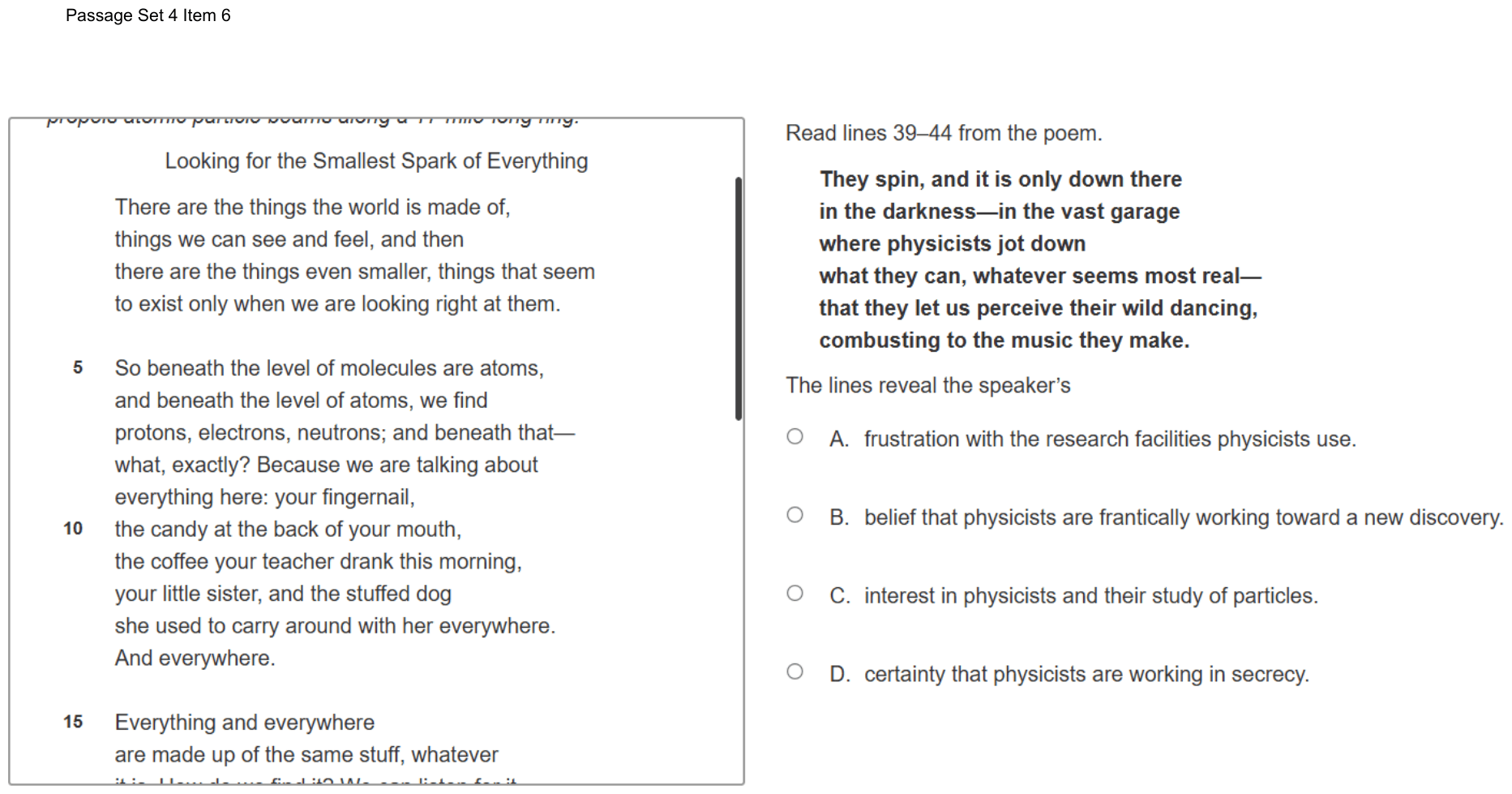
Question 49 of 57
2022 Test B English, question 49Passage Excerpt from “Impressions of an Indian Childhood”
Excerpt from “Impressions of an Indian Childhood”
by Zitkala-Sa
Zitkala-Sa (Gertrude Simmons Bonnin) was a Native American writer, musician, teacher, and political activist who was raised on the Yankton Sioux Reservation in South Dakota. In 1900 she published “Impressions of an Indian Childhood” (the term Indian was commonly used at the time to refer to Native American people) to expose readers to what life is like on a reservation.
Soon after breakfast Mother sometimes began her beadwork. On a bright, clear day, she pulled out the wooden pegs that pinned the skirt of our wigwam1 to the ground, and rolled the canvas part way up on its frame of slender poles. Then the cool morning breezes swept freely through our dwelling, now and then wafting the perfume of sweet grasses from newly burnt prairie.
Untying the long tasseled strings that bound a small brown buckskin2 bag, my mother spread upon a mat beside her bunches of colored beads, just as an artist arranges the paints upon his palette. On a lapboard she smoothed out a double sheet of soft white buckskin; and drawing from a beaded case that hung on the left of her wide belt a long, narrow blade, she trimmed the buckskin into shape. Often she worked upon small moccasins for her small daughter. Then I became intensely interested in her designing. With a proud, beaming face, I watched her work. In [my] imagination, I saw myself walking in a new pair of snugly fitting moccasins. I felt the envious eyes of my playmates upon the pretty red beads decorating my feet.
Close beside my mother I sat on a rug, with a scrap of buckskin in one hand and an awl in the other. This was the beginning of my practical observation lessons in the art of beadwork. From a skein3 of finely twisted threads of silvery sinews my mother pulled out a single one. With an awl she pierced the buckskin, and skillfully threaded it with the white sinew. Picking up the tiny beads one by one, she strung them with the point of her thread, always twisting it carefully after every stitch.
It took many trials before I learned how to knot my sinew thread on the point of my finger, as I saw her do. Then the next difficulty was in keeping my thread stiffly twisted, so that I could easily string my beads upon it. My mother required of me original designs for my lessons in beading. At first I frequently ensnared many a sunny hour into working a long design. Soon I learned from self-inflicted punishment to refrain from drawing complex patterns, for I had to finish whatever I began.
After some experience I usually drew easy and simple crosses and squares. These were some of the set forms. My original designs were not always symmetrical nor sufficiently characteristic, two faults with which my mother had little patience. The quietness of her oversight made me feel strongly responsible and dependent upon my own judgment. She treated me as a dignified little individual as long as I was on my good behavior; and how humiliated I was when some boldness of mine drew forth a rebuke from her!
In the choice of colors she left me to my own taste. I was pleased with an outline of yellow upon a background of dark blue, or a combination of red and myrtle-green. There was another of red with a bluish-gray that was more conventionally used. When I became a little familiar with designing and the various pleasing combinations of color, a harder lesson was given me. It was the sewing on, instead of beads, some tinted porcupine quills, moistened and flattened between the nails of the thumb and forefinger. My mother cut off the prickly ends and burned them at once in the centre fire. These sharp points were poisonous, and worked into the flesh wherever they lodged. For this reason, my mother said, I should not do much alone in quills until I was as tall as my cousin Warca-Ziwin.
Always after these confining lessons I was wild with surplus spirits, and found joyous relief in running loose in the open again. Many a summer afternoon a party of four or five of my playmates roamed over the hills with me. We each carried a light sharpened rod about four feet long, with which we pried up certain sweet roots. When we had eaten all the choice roots we chanced upon, we shouldered our rods and strayed off into patches of a stalky plant under whose yellow blossoms we found little crystal drops of gum. Drop by drop we gathered this nature’s rock-candy, until each of us could boast of a lump the size of a small bird’s egg. Soon satiated with its woody flavor, we tossed away our gum, to return again to the sweet roots.
From “Impressions of an Indian Childhood” by Zitkala-Sa—Public Domain
A BRIEF HISTORY OF BEADWORK IN SOUTH DAKOTA
| Date | Event |
|---|---|
| 1500s | The Dakota use beads made from bones, shells, stones, and animal teeth. European traders bring glass beads to North America. |
| Late 1600s | The Dakota begin trading with the French in Minnesota. |
| 1830s | The Dakota begin using glass beads in clothing, artwork, and decorations in place of Native-made beads. |
| 1862–1865 | The Dakota are expelled from their homelands in Minnesota as a result of the U.S.-Dakota War. |
| 1900s–1920s | The Dakota create items to sell outside their community. |
Source: MNopedia
1wigwam: hut with an arched framework of poles covered with bark, mats, or animal hides
2buckskin: leather made from the skin of a male deer
3skein: coiled length of yarn or other thread loosely wound on a reel
Question
In paragraph 1, the phrases “cool morning breezes swept freely” and “wafting the perfume of sweet grasses” affect the tone of the excerpt by suggesting
- Athe sadness that the author feels reflecting upon her former way of life.
- Bthe enthusiasm with which the author approached her work indoors.
- Cthe fond feelings that the author has toward her childhood experiences.
- Dthe mix of emotions that the author feels toward her work and her mother.
Show the answer
Correct answer: C
The question asks how the phrases “cool morning breezes swept freely” and “wafting the perfume of sweet grasses” affect the tone of the excerpt.
A. Incorrect. Although the author describes in paragraph 1 the setting of her childhood experiences, the positive wording of the phrases the author uses in the paragraph (“swept freely” and “perfume of sweet grasses”) does not suggest a tone of sadness the author feels when she reflects on her former way of life.
B. Incorrect. Although the phrases “cool morning breezes swept freely” and “wafting the perfume of sweet grasses” used in paragraph 1 create a positive tone, the phrases do not suggest an enthusiasm for the author’s work but rather suggest an appreciation of the peaceful beauty of her childhood.
C. CORRECT. In paragraph 1, the phrases “cool morning breezes swept freely” and “wafting the perfume of sweet grasses” are used to describe where the author’s childhood experiences took place. The phrases create a tone of fondness and evoke a feeling of happiness through their lyrical sensory detail: “swept freely” suggests a sense of joyful possibility, while “perfume,” “sweet,” and “cool” convey delight.
D. Incorrect. Although the author describes her mother’s beadwork lessons as “confining” in paragraph 7, the phrases in paragraph 1 do not suggest that the author feels conflicting or mixed emotions toward her work and her mother. Instead, the phrases convey a positive tone by affectionately describing the author’s childhood home.
Question analysis
This reading question asks how two sensory phrases about cool morning breezes and the scent of sweet grasses shape the tone of Zitkala-Sa's 1900 memoir of life on a Sioux reservation. Students must read the feeling behind descriptive language and decide what that feeling is directed at, since the choices pair different emotions with different subjects.
- Grade level
- Grade 7 reading and task
- Compared with grade 7
- At grade 7 Judging how sensory words shape tone is grade 7 reading work. Both phrases are quoted in the question, so little searching is needed, but the 1900 prose keeps the demand at a typical grade 7 level.
- Estimated difficulty
- Straightforward: two steps or one careful reading.
- Thinking it demands
- Depth of knowledge 2, skills and concepts · mainly analyze
- What makes it hard
- Figurative or literary language moderate
- Reading between the lines minor
- Hard words minor
- Evidence
- Answered from one paragraph or stanza
- Reading level
- Passage: about grade 8, 946 words; question and choices: about grade 7, 72 words.
- Corrected from the DOE handbook
- A misstatement of the question in the explanation was corrected.
- Students, last 30 days
- Not enough answers yet to show (it takes 10).
Why it is hard, traps and wrong answers (shows the answer)
Why it is hard
The phrases are so clearly pleasant that the real decision is what the pleasant feeling is about. They describe the wigwam on a clear morning, so the warmth belongs to the author's memory of her childhood, not to the beadwork the rest of the excerpt follows. Students who know the excerpt is about lessons tend to attach the mood to the work, and a few read sadness into any memoir.
Figurative or literary language moderate Understanding the question
The tone comes from sensory images, breezes that “swept freely” and “the perfume of sweet grasses,” which describe air and scent and leave the author's feeling to be read from them. (Graesser, Singer & Trabasso, 1994; Kintsch, 1998)
Reading between the lines minor Working it out
The phrases describe the dwelling, not the author, so her fondness for her childhood has to be inferred from how lovingly she remembers the setting. (Graesser, Singer & Trabasso, 1994; Kintsch, 1998)
Hard words minor Understanding the question
“Wafting” and “perfume,” used for the smell of grasses from newly burnt prairie, are unusual words that must be understood before the tone they create can be judged. (Perfetti, 2007; Freedle & Kostin, 1993)
Strategy: Decide what feeling the quoted words create on their own, then check what they describe: the right choice must match both the feeling and what it is about.
Traps
- Wrong tone or attitude: Misjudges the tone, attitude or point of view, such as reading admiration as criticism, or taking a character's or subject's feelings for the author's.
- Wrong part of the text: A choice is true of another paragraph, stanza or speaker than the one asked about.
The wrong answers, classified
A Wrong tone or attitude (Graesser, Singer & Trabasso, 1994)
Assumes an adult remembering a lost way of life must sound sad, but breezes that sweep freely and the perfume of sweet grasses carry delight, not grief.
B Wrong part of the text (Kirsch & Mosenthal, 1990)
Senses the positive mood but ties it to the beadwork, borrowing the interest the girl shows in paragraph 2, though these phrases describe breezes and scent, not work.
D Wrong part of the text (Kirsch & Mosenthal, 1990)
Brings in the “confining” lessons of paragraph 7 and the rebuke of paragraph 5, feelings that the two morning images of paragraph 1 do not touch.
What was corrected from the DOE handbook, and why
- Explanation: The handbook’s explanation begins by saying the question asks how the two phrases “affect the tone of paragraph 1 in the excerpt.” The phrases are in paragraph 1, but the question asks how they affect the tone of the excerpt, and the answer is about the author’s feelings toward her childhood as a whole. The explanation now reads “affect the tone of the excerpt.”
Working it out, step by step
Figure out what the question asks
This asks about tone. Tone is the feeling or attitude that a writer’s words show. You need the feeling that two phrases from paragraph 1 give the whole excerpt. An excerpt is a part taken from a longer piece.
Find the phrases in paragraph 1
Paragraph 1 describes a clear morning at home. The mother rolls up the side of the wigwam (a hut made of poles and covers). “Then the cool morning breezes swept freely through our dwelling.” A dwelling is a home. The breezes were “now and then wafting the perfume of sweet grasses.”
Work out the feeling
“Wafting” means gently carrying through the air. “Perfume” is a sweet smell. Cool air, sweet smells and breezes moving freely are all pleasant. The author is remembering her childhood home with love. That feeling is fondness, a warm liking for something.
Check each choice
- A is wrong. Nothing in these words is sad. They are bright and pleasant.
- B is wrong. The phrases describe air and smells, not her work.
- C is right. The loving details show warm feelings about her childhood.
- D is wrong. Mixed feelings, like the “confining” lessons, come later, in paragraph 7. These phrases have nothing negative in them.
Watch out: B is tempting, since the excerpt is mostly about beadwork lessons. But these two phrases describe the morning, not the work.
Choose the answer
The phrases make her childhood home feel cool, sweet and free. So the answer is C.
Why this answer and not the closest wrong one
B is the closest wrong answer, because the phrases do sound happy. But a choice must match both the feeling and what the feeling is about. These phrases describe breezes and the smell of grass at her home. That shows fond memories of her childhood, not eagerness to work.
More questions like this
The original DOE question
The passage “Excerpt from “Impressions of an Indian Childhood”” as printed (pages 42–43)
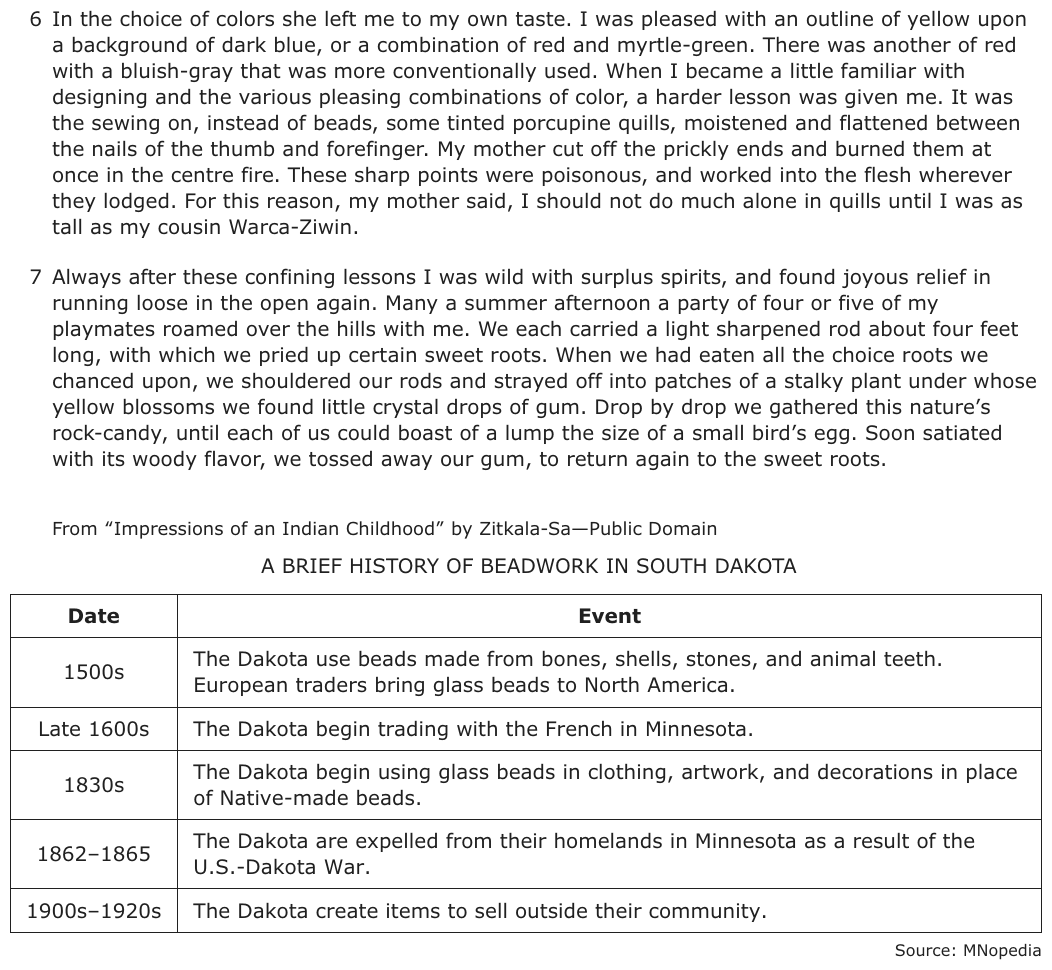
Question 50 of 57
2022 Test B English, question 50Uses the passage above: “Excerpt from “Impressions of an Indian Childhood””.
Question
The phrase “just as an artist arranges the paints upon his palette” in paragraph 2 suggests that
- Abeadwork is a true form of art.
- Bcolor is a source of artistic inspiration.
- Call artistic activities begin with a series of steps.
- Dthe beadworker tries to imitate art.
Show the answer
Correct answer: A
The question asks what the phrase “just as an artist arranges the paints upon his palette” in paragraph 2 suggests in the excerpt.
A. CORRECT. In paragraph 2, by comparing the way her mother arranges the beads to the way a painter “arranges the paints upon his palette,” the author emphasizes that her mother approaches her craft just as a painter does, thus suggesting that beadwork is a true form of art.
B. Incorrect. Although the author mentions “bunches of colored beads” in paragraph 2, this detail does not provide enough evidence for the idea that color inspires beadworkers. The phrase “just as an artist arranges the paints upon his palette” indicates the connection of beadwork to other forms of art in general, not necessarily to the specifics of color as a source of inspiration.
C. Incorrect. In paragraph 2, the author describes her mother “untying the long tasseled strings” and then spreading “upon a mat beside her bunches of colored beads.” However, the phrase “just as an artist arranges the paints upon his palette” does not suggest that all artistic activities begin with a series of steps. There is no mention in the passage of any other artistic activities involving multiple initial steps.
D. Incorrect. In paragraph 2, the author describes how her mother “spread upon a mat beside her bunches of colored beads” as the first step in the artistic process described in the passage. Therefore, the comparison between the mother’s process and a painter arranging paints on a palette suggests that the mother is creating art, not imitating it. There is no indication that the mother is copying a technique she has seen in other art forms.
Question analysis
This reading question asks what the comparison between Zitkala-Sa's mother laying out her colored beads and an artist arranging paints on a palette suggests. It tests reading a simile in context, and the choices include readings that fix on a single word or go further than the comparison itself.
- Grade level
- Grade 6 reading and task
- Compared with grade 7
- Below grade 7 Interpreting a simile is taught by grade 6. The phrase is short and quoted in the question, and one step of interpretation is enough, so this asks less than typical grade 7 work on figurative language.
- Estimated difficulty
- Routine: one familiar step, little to misread.
- Thinking it demands
- Depth of knowledge 2, skills and concepts · mainly understand
- What makes it hard
- Evidence
- Answered from one sentence or line
- Reading level
- Passage: about grade 8, 946 words; question and choices: about grade 6, 45 words.
- Students, last 30 days
- Not enough answers yet to show (it takes 10).
Why it is hard, traps and wrong answers (shows the answer)
Why it is hard
The comparison is quoted in the stem and makes one point: the mother lays out her beads the way a painter lays out paints, so her craft counts as art. Wrong answers fix on the word “paints,” stretch one comparison into a rule about all art, or read the comparison as copying. Asking what the two things being compared have in common settles it.
Figurative or literary language minor Understanding the question
The simile sets the mother laying out bunches of colored beads beside a painter arranging paints, and students must see what that comparison says about beadwork itself. (Graesser, Singer & Trabasso, 1994; Kintsch, 1998)
Strategy: Name the two things being compared and what they share, then choose the idea that comparison supports without adding anything the sentence does not say.
Traps
- Word match: Repeats striking words or phrases from the text, so it looks supported, but its meaning does not fit the question.
- Too broad or too strong: A choice overstates, generalizes, or uses absolute words the text does not support.
- Twists what the text says: Uses the text's topic and ideas but changes what it says: who did it, how much, when, or why.
The wrong answers, classified
B Word match (Freedle & Kostin, 1993)
Links “paints” with the “bunches of colored beads” and decides color is the point, though the simile compares how materials are arranged, not what inspires the artist.
C Too broad or too strong (King et al., 2004)
Turns one comparison about laying out beads into a rule about all artistic activities, a generalization the sentence does not make.
D Twists what the text says (King et al., 2004)
Sees that the simile links beadwork with painting but twists its point, reading it as the mother imitating art rather than practicing it.
Working it out, step by step
Figure out what the question asks
The phrase is a simile. A simile compares two things using “like” or “as.” You need to know what this comparison suggests about the mother’s beadwork.
Read the phrase in paragraph 2
The mother “spread upon a mat beside her bunches of colored beads, just as an artist arranges the paints upon his palette.” The word order is old-fashioned. It means she spread her bunches of colored beads on a mat beside her. A palette is the board a painter uses to hold and mix paints.
Work out what the comparison means
The two things being compared are the mother and a painter. Both lay out their colors before they start to make something. So the author treats her mother like a painter. That means beadwork is real art, just like painting.
Check each choice
- A is right. Comparing the mother to a painter shows that beadwork is a true art.
- B is wrong. The simile is about laying out materials, not about what gives an artist ideas.
- C is wrong. One comparison can’t prove a rule about all art.
- D is wrong. The mother is not copying art. She works the way an artist does, so she is making art.
Watch out: B is tempting because paints and colored beads both bring color to mind. But the simile is about how she arranges them.
Choose the answer
The simile puts the beadworker side by side with a painter. So the answer is A.
Why this answer and not the closest wrong one
B is the closest wrong answer. Paints and colored beads do share color. But the simile compares what the two people do: both arrange their materials before they create. Nothing is said about inspiration, which means where ideas come from. A matches the point that the mother works as an artist does.
More questions like this
The original DOE question

Question 51 of 57
2022 Test B English, question 51Uses the passage above: “Excerpt from “Impressions of an Indian Childhood””.
Question
The author’s use of sequence in paragraphs 1 and 2 contributes to the development of ideas in the excerpt by
- Alisting the many steps that are involved in the process of beading in order to explain its difficulty and complexity.
- Bconveying the importance of following the steps of the beading process in a precise order to work most efficiently.
- Cemphasizing the time required to fully prepare for and execute the many large and small tasks in the activity of beading.
- Ddetailing each step in preparation for beading in order to highlight the author’s enthusiasm for the work.
Show the answer
Correct answer: D
The question asks how the author’s use of sequence in paragraphs 1 and 2 contributes to the development of ideas in the excerpt.
A. Incorrect. In paragraph 2, the author does list the steps her mother takes in preparation to do beadwork, such as “untying the long tasseled strings” of the bag of beads, spreading the beads beside her on a mat, and using “a long, narrow blade” to trim the buckskin into shape. However, the language used to describe this sequence does not indicate that preparing to work with beads is difficult or complex.
B. Incorrect. Although the author’s description of untying the bag of beads, spreading the beads upon a mat, smoothing out a sheet of buckskin, and trimming the buckskin into shape in paragraph 2 indicates that the mother follows a certain routine, it does not place any emphasis on working most efficiently by following the steps of the beading process in a precise order.
C. Incorrect. In paragraph 2, the author describes her mother “untying the long tasseled strings that bound a small brown buckskin bag,” “spread[ing] upon a mat beside her bunches of colored beads,” “smooth[ing] out a double sheet of soft white buckskin; and drawing from a beaded case that hung on the left of her wide belt a long, narrow blade” to trim the buckskin. Although these descriptions do outline the steps in her process for creating beadwork, they do not emphasize the time required to do so, since the author does not mention in the excerpt how long it took her mother to fully prepare for and complete the large and small tasks in the activity of beading.
D. CORRECT. In paragraph 1, the author describes how the morning begins with her mother rolling up the canvas of the wigwam and allowing the breeze to come in. In paragraph 2, the author uses sensory language and precise sequencing to describe the way her mother prepares the beading materials by untying “the long tasseled strings that bound a small brown buckskin bag,” spreading the “bunches of colored beads” beside her, and smoothing out “a double sheet of soft white buckskin.” This combination of sequence and sensory language highlights the author’s enthusiasm for beadwork by emphasizing that the author pays close attention to her mother’s preparations.
Question analysis
This reading question asks how the step-by-step description of a mother preparing her beadwork, in the opening paragraphs of Zitkala-Sa's memoir, contributes to the excerpt's ideas. Every choice agrees that steps are listed, so students must judge which purpose the text actually supports and resist reasons that only sound likely for a craft.
- Grade level
- Grade 8 reading and task
- Compared with grade 7
- Above grade 7 Grade 7 structure questions usually ask what a paragraph adds to a topic. This one asks what an ordered description achieves, in dense 1900 prose where the purpose is never stated outright, which goes beyond typical grade 7 work.
- Estimated difficulty
- Hard: combines ideas, needs a plan, and has more than one tempting wrong answer.
- Thinking it demands
- Depth of knowledge 3, strategic thinking · mainly analyze
- What makes it hard
- How, not what major
- A very close wrong answer moderate
- Reading between the lines moderate
- Complex sentences minor
- Evidence
- Answered from several paragraphs or stanzas
- Reading level
- Passage: about grade 8, 946 words; question and choices: about grade 11, 95 words.
- Corrected from the DOE handbook
- A misquotation of the excerpt in the explanation was corrected.
- Students, last 30 days
- Not enough answers yet to show (it takes 10).
Why it is hard, traps and wrong answers (shows the answer)
Why it is hard
All four choices agree that the paragraphs lay out steps, so the question turns entirely on purpose, and three of the purposes sound like natural reasons to describe a craft. Nothing in paragraphs 1 and 2 calls the work hard, slow or a matter of efficiency; what they do show is a child following every move and becoming intensely interested. Students who look for the narrator's own reaction find the purpose, while those who reason from the steps alone drift to difficulty or time.
How, not what major Working it out
The stem asks what the ordered account of untying the bag, spreading the beads, and smoothing and trimming the buckskin does for the excerpt, a purpose the author never states. (Anderson & Krathwohl, 2001)
A very close wrong answer moderate Choosing the answer
The difficulty choice shares the right one's frame, steps laid out in order to show something, and differs only in what they show: how hard beading is, or how eagerly the girl watched. (Embretson & Wetzel, 1987; Gorin & Embretson, 2006; Ascalon et al., 2007)
Reading between the lines moderate Working it out
The enthusiasm has to be pieced together from the close attention to each step and from “intensely interested” and “a proud, beaming face” in paragraph 2. (Graesser, Singer & Trabasso, 1994; Kintsch, 1998)
Complex sentences minor Understanding the question
Paragraph 2 uses literary word order, as in “my mother spread upon a mat beside her bunches of colored beads,” which slows the reading of the very steps in question. (Abedi & Lord, 2001; Freedle & Kostin, 1993; Messick, 1989)
Strategy: For each choice, look in paragraphs 1 and 2 for words that would prove its purpose; a purpose that no sentence states or shows can be ruled out.
Traps
- Half right: One half of a two-part choice is right and the other is not.
- Wrong purpose or structure: Names a purpose, structure or effect that the part does not serve, or describes what a part says when the question asks what it does.
- Reads too much in: A reasonable-sounding conclusion that goes further than the text allows.
The wrong answers, classified
A Half right (King et al., 2004; Thissen, Steinberg & Fitzpatrick, 1989)
Rightly sees that paragraph 2 lists many preparation steps, then decides the list must show that beading is difficult and complex, which nothing in these paragraphs says.
B Wrong purpose or structure (Anderson & Krathwohl, 2001)
Reads the sequence as instructions about doing the steps in a precise order for efficiency, a purpose a watching child's memories never suggest.
C Reads too much in (Graesser, Singer & Trabasso, 1994)
Reasons that so many steps must take a long time, perhaps recalling the “many a sunny hour” of paragraph 4, but paragraphs 1 and 2 never mention time.
What was corrected from the DOE handbook, and why
- Explanation: In rejecting choice C, the handbook quotes paragraph 2 as “spread[ing them] upon a mat beside her bunches of colored beads.” In the excerpt, the bunches of colored beads are what the mother spreads (“my mother spread upon a mat beside her bunches of colored beads”). The inserted “them” refers to nothing and turns the beads into a place. The quotation now reads “spread[ing] upon a mat beside her bunches of colored beads,” which is how the handbook itself reads the sentence in its reason for rejecting choice A (“spreading the beads beside her on a mat”).
Working it out, step by step
Figure out what the question asks
Sequence means the order in which things happen. Paragraphs 1 and 2 tell the steps of a morning in order. The question asks why the author tells them step by step. What does that careful order help show?
List the steps
In paragraphs 1 and 2, the mother:
- rolls up the side of the wigwam to let in the breeze,
- unties a bag made of buckskin (soft deer leather),
- spreads her beads on a mat,
- smooths out a sheet of buckskin, and
- trims it into shape with a blade.
Find the author’s reaction
Right after the steps, the author tells how she felt. “Then I became intensely interested in her designing. With a proud, beaming face, I watched her work.” Intensely means very strongly. A beaming face has a big, happy smile. She noticed every little step because she was so excited. The details show her enthusiasm, or eager interest.
Check each choice
- A is wrong. The steps are listed, but nothing says beading is hard or complex.
- B is wrong. Nothing says the steps must go in a set order to save effort.
- C is wrong. Paragraphs 1 and 2 never say how long anything takes.
- D is right. The careful details show how closely the girl watched, with eager interest.
Watch out: A is tempting because there are many steps. But many steps don’t prove a task is hard. The author never calls it difficult.
Choose the answer
The step-by-step order shows a child following every move her mother makes. So the answer is D.
Why this answer and not the closest wrong one
A is the closest wrong answer. Like D, it says the steps are listed to show something. But no word in paragraphs 1 and 2 calls beading hard. The author does say she was “intensely interested” and had “a proud, beaming face.” That shows enthusiasm, so D fits better.
More questions like this
The original DOE question
Question 52 of 57
2022 Test B English, question 52Uses the passage above: “Excerpt from “Impressions of an Indian Childhood””.
Question
The details in paragraph 3 convey a central idea of the excerpt by suggesting that
- Athe author was interested in the work because she knew her mother was making something for her.
- Bthe author had difficulty learning through observation but wanted to help her mother.
- Cthe author was determined to behave according to her mother’s standards and sought her approval.
- Dthe author had great admiration for her mother’s precision and mastery of her craft.
Show the answer
Correct answer: D
The question asks how the details in paragraph 3 convey a central idea of the excerpt.
A. Incorrect. In paragraph 2, the author mentions how her mother “worked upon small moccasins for her small daughter” and when she did, the author “became intensely interested in her [mother’s] designing.” However, in paragraph 3, the author is interested in her mother’s work mainly as part of her “lessons in the art of beadwork,” not because she knew her mother was making something for her.
B. Incorrect. In paragraph 3, the author receives “practical observation lessons in the art of beadwork” and describes how “from a skein of finely twisted threads of silvery sinews my mother pulled out a single one” and “pierced the buckskin, and skillfully threaded it with the white sinew.” The author describes the process in such detail that she provides no indication that she had difficulty learning through observation. The author also does not give any indication in the paragraph that she wanted to help her mother; she was there merely to observe and learn.
C. Incorrect. Although the author refers to her beading lessons with her mother as “practical observation lessons in the art of beadwork” and indicates that she sat “close beside” her mother while observing her beadwork, the author provides no indication in the paragraph that she was determined to behave according to her mother’s standards or that she sought her mother’s approval.
D. CORRECT. In paragraph 3, the author describes her mother’s artistry and craftsmanship by using language such as “skillfully threaded,” “picking up the tiny beads one by one,” and “twisting it carefully after every stitch.” These close observations indicate that the author greatly admired her mother’s mastery of her craft and the precision that went into every detail of her work.
Question analysis
This reading question asks how the details in the paragraph where young Zitkala-Sa sits beside her mother, watching her pierce buckskin and string tiny beads, point to a central idea of the excerpt. Several choices name feelings found elsewhere in the memoir, so students must stay with what this one paragraph shows.
- Grade level
- Grade 7 reading and task
- Compared with grade 7
- At grade 7 Linking a paragraph's details to a central idea is grade 7 reading. The answer rests on one short paragraph, but the student must turn its concrete details about thread and beads into an idea, a typical grade 7 demand.
- Estimated difficulty
- Straightforward: two steps or one careful reading.
- Thinking it demands
- Depth of knowledge 2, skills and concepts · mainly understand
- What makes it hard
- Reading between the lines moderate
- The right answer is reworded minor
- Evidence
- Answered from one paragraph or stanza
- Reading level
- Passage: about grade 8, 946 words; question and choices: about grade 9, 73 words.
- Students, last 30 days
- Not enough answers yet to show (it takes 10).
Why it is hard, traps and wrong answers (shows the answer)
Why it is hard
Paragraph 3 is short and concrete, but the feelings named in the choices come from all over the excerpt, so the danger is answering about the excerpt rather than this paragraph. The girl's interest in moccasins made for her belongs to paragraph 2, her struggles to paragraph 4, and good behavior to paragraph 5. Rereading paragraph 3 alone, and noticing how it describes the mother's hands at work, points to the right idea.
Reading between the lines moderate Working it out
Admiration is never named; it has to be inferred from the words chosen for the mother's work: “skillfully threaded,” beads picked up “one by one,” thread twisted “carefully after every stitch.” (Graesser, Singer & Trabasso, 1994; Kintsch, 1998)
The right answer is reworded minor Choosing the answer
The right choice says “precision and mastery,” words absent from paragraph 3, while wrong choices echo the excerpt's own “observation” lessons, its “difficulty” with thread, and the moccasins made for the daughter. (Freedle & Kostin, 1993; Kirsch & Mosenthal, 1990)
Strategy: Reread paragraph 3 by itself and note what its verbs and describing words emphasize, then match that emphasis to a choice and reject ideas drawn from other paragraphs.
Traps
- Wrong part of the text: A choice is true of another paragraph, stanza or speaker than the one asked about.
- Twists what the text says: Uses the text's topic and ideas but changes what it says: who did it, how much, when, or why.
The wrong answers, classified
A Wrong part of the text (Kirsch & Mosenthal, 1990)
Recalls that paragraph 2 makes the girl “intensely interested” when the moccasins are for her, but paragraph 3 presents the watching as the start of her lessons.
B Twists what the text says (King et al., 2004)
Pairs the “observation lessons” of paragraph 3 with the difficulty of paragraph 4 and adds a wish to help, though the girl struggles with her own thread, not with watching.
C Wrong part of the text (Kirsch & Mosenthal, 1990)
Draws on paragraph 5, where the mother treats her with dignity “as long as I was on my good behavior,” but paragraph 3 says nothing about standards or approval.
Working it out, step by step
Figure out what the question asks
Look only at paragraph 3. A central idea is an important message of the whole excerpt. You need the idea that the details in paragraph 3 show.
Find the details in paragraph 3
The girl sits “close beside” her mother and watches. The mother “skillfully threaded it with the white sinew.” Sinew is a strong cord made from an animal’s body. She picks up “the tiny beads one by one.” She keeps “twisting it carefully after every stitch.”
Work out what the details show
Words like “skillfully” and “carefully” show the mother is an expert. She works with precision, which means being exact. Her mastery, or great skill, shows in every small move. The girl notices each one. You watch someone this closely when you admire them, or think highly of them.
Check each choice
- A is wrong. The moccasins made for her come from paragraph 2. Paragraph 3 is about her lessons.
- B is wrong. Her trouble with thread comes in paragraph 4. Nothing says she wants to help.
- C is wrong. Good behavior comes up in paragraph 5, not paragraph 3.
- D is right. The careful details show admiration for her mother’s skill.
Watch out: A, B and C all use ideas from other paragraphs. Stay inside paragraph 3.
Choose the answer
Paragraph 3 shows a girl who watches her mother’s expert hands with wonder. So the answer is D.
Why this answer and not the closest wrong one
A is the closest wrong answer, because the girl really was “intensely interested” when her mother made moccasins for her. But that is in paragraph 2. Paragraph 3 calls the watching “the beginning of my practical observation lessons.” Its details praise how skillfully and carefully the mother works. That fits D.
More questions like this
The original DOE question
Question 53 of 57
2022 Test B English, question 53Uses the passage above: “Excerpt from “Impressions of an Indian Childhood””.
Question
Which sentence best summarizes the process of beading that is described in the excerpt?
- ATake a buckskin bag full of beads and spread them out on a mat in different colors like a paint palette; take a double sheet of buckskin and smooth it out on a table; take a sinew and awl and thread the beads onto the buckskin in a desired pattern.
- BCut the double sheet of buckskin into a shape; take a skein of sinew and pierce the buckskin with an awl; thread the sinew with beads of many different colors in a simple or complex pattern; twist the sinew to keep it tight after every stitch into the buckskin.
- CArrange the beads into groups of colors on a mat; smooth out a double sheet of buckskin and cut it to shape; take a single thread of sinew; pierce the buckskin with an awl; thread the buckskin with the sinew and string it with beads, carefully twisting after every stitch.
- DGather beads, buckskin, sinew, and awl and place them on a mat; cut the buckskin into the desired shape; decide on a pattern for the beads and create it using the sinews and the awl; thread the beads onto the sinew in the desired pattern and twist it tight.
Show the answer
Correct answer: C
The question asks which sentence best summarizes the process of beading that is described in the excerpt.
A. Incorrect. In paragraphs 2 and 3, the author describes how at the beginning of the process her mother “smoothed out a double sheet of soft white buckskin” on a lapboard (paragraph 2) and how she strings the beads into a pattern. However, this sentence does not describe the steps that take place between the preparation and the stringing of the beads. Thus, this sentence does not best summarize the beading process.
B. Incorrect. In paragraphs 2 and 3, the author describes the process her mother uses to string the beads with “the point of her thread, always twisting it carefully after every stitch” (paragraph 3). While this sentence includes some of the steps in the beading process, it does not describe the necessary preparation, namely spreading the beads out on a mat and smoothing out the buckskin on a lapboard. Thus, this sentence does not best summarize the beading process.
C. CORRECT. This sentence best summarizes the process of beading that is described in the excerpt because it includes details about each step in the process. In paragraph 2, the author explains how her mother “spread upon a mat beside her bunches of colored beads” and how “on a lapboard she smoothed out a double sheet of soft white buckskin; and drawing from a beaded case that hung on the left of her wide belt a long, narrow blade, she trimmed the buckskin into shape.” The author continues her description in paragraph 3, stating, “From a skein of finely twisted threads of silvery sinews my mother pulled out a single one. With an awl she pierced the buckskin, and skillfully threaded it with the white sinew. Picking up the tiny beads one by one, she strung them with the point of her thread, always twisting it carefully after every stitch.”
D. Incorrect. In paragraphs 2 and 3, the author describes the process her mother uses as she “smoothed out a double sheet of soft white buckskin” (paragraph 2) on a lapboard before stringing the beads. While this sentence includes most of the steps in the beading process, it excludes the step of piercing the buckskin. This sentence also provides few details about the process of beading and uses vague wording to describe each step. Therefore, the sentence does not best summarize the beading process.
Question analysis
This reading question asks which sentence best summarizes the beadwork process Zitkala-Sa watches her mother carry out, from laying out the materials to stringing the beads. Each choice is a long list of steps, so students must compare them detail by detail with the excerpt and notice what each one adds, leaves out or misplaces.
- Grade level
- Grade 8 reading and task
- Compared with grade 7
- Above grade 7 Summarizing a process is grade 7 reading, but the four summaries are long and nearly alike, and checking them against two paragraphs of 1900 prose with words like awl, sinew and skein is heavier than usual.
- Estimated difficulty
- Hard: combines ideas, needs a plan, and has more than one tempting wrong answer.
- Thinking it demands
- Depth of knowledge 2, skills and concepts · mainly understand
- What makes it hard
- Every choice must be checked major
- A lot to read moderate
- Hard words minor
- Evidence
- Answered from several paragraphs or stanzas
- Reading level
- Passage: about grade 8, 946 words; question and choices: about grade 16+, 212 words.
- Corrected from the DOE handbook
- An inaccurate detail about the excerpt in the explanation was corrected.
- Students, last 30 days
- Not enough answers yet to show (it takes 10).
Why it is hard, traps and wrong answers (shows the answer)
Why it is hard
This question is won by bookkeeping, not insight: list the mother's steps from the two paragraphs, then hold each long summary against the list. The most tempting wrong summary reads like a sensible craft routine in a sensible order, yet it never has the buckskin pierced and puts every tool on the mat. Others open with a familiar image or close with precise stitching while skipping steps, so students who check only the beginning or only the end are caught.
Every choice must be checked major Choosing the answer
Each summary is a chain of four to six steps, so all four must be checked step by step against paragraphs 2 and 3 for steps missing, added or out of order. (Embretson & Wetzel, 1987)
A lot to read moderate Understanding the question
The four choices together run to about 200 words of semicolon-linked steps, and the text they summarize is two paragraphs of dense 1900 prose. (Kintsch, 1998; Gorin & Embretson, 2006; Freedle & Kostin, 1993)
Hard words minor Understanding the question
Words like awl, sinew, skein and lapboard name the tools and materials, and a student unsure of them cannot tell which steps a summary has dropped. (Perfetti, 2007; Freedle & Kostin, 1993)
Strategy: List the mother's steps from paragraphs 2 and 3 in order, then check each choice against your list for a missing step, an invented detail or a step out of place.
Traps
- Too narrow: A single detail offered as the central idea or a summary, or a summary that keeps minor details and leaves out an essential part.
The wrong answers, classified
A Too narrow (King et al., 2004)
Keeps the familiar palette image but leaves out trimming the buckskin, piercing it with the awl and twisting the thread, and even moves the smoothing onto a table.
B Too narrow (King et al., 2004)
Matches paragraph 3's piercing and twisting closely but leaves out the preparation, laying out the beads and smoothing the buckskin, and starts the process with cutting.
D Too narrow (King et al., 2004)
Accepts a tidy, well-ordered outline that keeps most steps but leaves out smoothing the buckskin and piercing it with the awl, and piles every tool onto the mat.
What was corrected from the DOE handbook, and why
- Explanation: In rejecting choice B, the handbook says the choice leaves out the preparation, “namely spreading the beads and the buckskin out on a table.” The excerpt mentions no table: in paragraph 2 the mother spreads the beads on a mat and smooths out the buckskin on a lapboard. The explanation now says so. (Choice A’s “on a table” is part of a wrong answer and is left as printed.)
Working it out, step by step
Figure out what the question asks
You need the summary that best matches the beading steps in the excerpt. A summary is a short retelling of the main points. The best one keeps every main step, in order, and adds nothing new.
List the steps from paragraphs 2 and 3
Paragraphs 2 and 3 give the mother’s steps in order. The last one ends with her “always twisting it carefully after every stitch.”
- Spread the beads on a mat.
- Smooth out a double sheet of buckskin on a lapboard (a board held on the lap).
- Trim the buckskin into shape with a blade.
- Pull out a single sinew, a strong thread.
- Pierce (poke a hole in) the buckskin with an awl, a pointed tool.
- Thread the sinew through the buckskin.
- String the beads, twisting the thread after every stitch.
Check each choice against the list
- A is wrong. It skips trimming, piercing and twisting. It also says “on a table,” but she used a lapboard.
- B is wrong. It starts with cutting. It skips spreading the beads and smoothing the buckskin.
- C is right. It has every step, in the same order.
- D is wrong. It never says to smooth the buckskin or pierce it. It also puts every tool on the mat, but only the beads went there.
Watch out: D sounds like a sensible plan in a sensible order. But a summary must match the excerpt, not just sound right. Check it step by step.
Choose the answer
Only C follows the mother’s steps from start to finish. So the answer is C.
Why this answer and not the closest wrong one
D is the closest wrong answer. It is neat and keeps most of the steps. But it skips smoothing the buckskin and never says to pierce it with the awl. It also piles every tool onto the mat. C matches the excerpt step for step, so it is the best summary.
More questions like this
The original DOE question
Question 54 of 57
2022 Test B English, question 54Uses the passage above: “Excerpt from “Impressions of an Indian Childhood””.
Question
The idea that mastering moccasin design and creation requires experience is best illustrated in the excerpt through
- Athe information about the advanced technique of incorporating porcupine quills into a design.
- Bthe descriptions of the special materials that must be used to make decorated moccasins.
- Cthe descriptions of the various color combinations that make an attractive moccasin design.
- Dthe example of the author successfully and independently using a sharpened rod.
Show the answer
Correct answer: A
The question asks how the idea that mastering moccasin design and creation requires experience is best illustrated in the excerpt.
A. CORRECT. In paragraph 6, the author states that when she became more familiar with elements of design, “a harder lesson was given me.” According to the author, sewing on porcupine quills is a much more difficult task to master because it requires experience in handling the poisonous porcupine quills, which is why her mother told her not to “do much alone in quills” until she was older (paragraph 6). This information best illustrates the idea that mastering moccasin design and creation requires experience.
B. Incorrect. Although the author provides detailed descriptions of the materials used to make decorated moccasins (“colored beads” [paragraph 2]; “a skein of finely twisted threads of silvery sinews” [paragraph 3]; “tinted porcupine quills, moistened and flattened between the nails of the thumb and forefinger” [paragraph 6]), these descriptions do not illustrate the experience that is needed to gain mastery of moccasin design and creation.
C. Incorrect. Although the author describes the color combinations she used in making moccasins (“I was pleased with an outline of yellow upon a background of dark blue, or a combination of red and myrtle-green. There was another of red with a bluish-gray that was more conventionally used” [paragraph 6]), this information mainly illustrates the author’s satisfaction with her moccasin design, not the importance of experience in mastering the creation and design of moccasins.
D. Incorrect. In paragraph 7, the author tells of using a sharpened rod to dig for roots. She explains that she and her playmates used the rods to “[pry] up certain sweet roots,” which they ate before going off to gather gum from a stalky plant. The detail of the sharpened rod is from a recollection about the playtime that followed the “confining lessons” of moccasin making. However, the sharpened rod was not used to create moccasins.
Question analysis
This reading question asks which part of Zitkala-Sa's account of learning to bead moccasins best illustrates the idea that mastering the craft takes experience. The choices point to materials, color combinations, a technique and outdoor play, so students must find the detail that ties skill to practice rather than one that simply describes the craft.
- NYS standards
- 7R1 textual evidence and inferences
- Grade level
- Grade 7 reading and task
- Compared with grade 7
- At grade 7 Choosing the detail that best illustrates an idea is grade 7 evidence work. The idea is stated plainly in the question and each paragraph of the excerpt keeps to one topic, so the demand matches typical grade 7 tasks.
- Estimated difficulty
- Straightforward: two steps or one careful reading.
- Thinking it demands
- Depth of knowledge 2, skills and concepts · mainly evaluate
- What makes it hard
- Evidence
- Answered from one paragraph or stanza
- Reading level
- Passage: about grade 8, 946 words; question and choices: about grade 12, 69 words.
- Corrected from the DOE handbook
- An inaccurate account of the excerpt in the explanation was corrected.
- Students, last 30 days
- Not enough answers yet to show (it takes 10).
Why it is hard, traps and wrong answers (shows the answer)
Why it is hard
The idea of experience is spelled out in paragraph 6, where quillwork is a harder lesson given only after some practice and kept from the girl until she is older. The wrong choices describe things the excerpt really contains, materials, colors and a tool, so they look supported until each is asked whether it shows a learner needing practice. Students who put that one question to every choice find this a quick item.
Evidence in several places minor Working it out
The stem names no paragraph, so students must find where each choice's detail sits, from the beads and sinew of paragraphs 2 and 3 to the rods of paragraph 7. (Kirsch & Mosenthal, 1990; Gorin & Embretson, 2006)
Reading between the lines minor Working it out
The link to experience is implied in paragraph 6: quills come as “a harder lesson” once she is “a little familiar with designing,” and she must wait until she is “as tall as my cousin.” (Graesser, Singer & Trabasso, 1994; Kintsch, 1998)
Strategy: For each choice, find the part of the excerpt it refers to and ask whether it shows a learner needing practice before doing something, not just what the craft involves.
Traps
- Supports only part of the claim: In a question about evidence: a line that backs one half of the claim but not the other, or a related point rather than the claim itself.
- Wrong part of the text: A choice is true of another paragraph, stanza or speaker than the one asked about.
The wrong answers, classified
B Supports only part of the claim (King et al., 2004; Thissen, Steinberg & Fitzpatrick, 1989)
Picks the descriptions of beads, sinew and buckskin, which show what moccasins are made from but say nothing about the experience needed to master making them.
C Supports only part of the claim (King et al., 2004; Thissen, Steinberg & Fitzpatrick, 1989)
Points to the color combinations of paragraph 6, which come just before the quill lesson but show the girl's own taste and freedom to choose, not a skill that takes practice.
D Wrong part of the text (Kirsch & Mosenthal, 1990)
Seizes on the girl using a sharpened rod on her own, but the rods belong to her play in paragraph 7, digging sweet roots, and have nothing to do with moccasins.
What was corrected from the DOE handbook, and why
- Explanation: In rejecting choice D, the handbook says the author used a sharpened rod “to spear gum from trees” and that the children pried up sweet roots “to find the gum.” In paragraph 7 the rods are used to pry up sweet roots, which the children eat; afterwards they stray off to a stalky plant and find drops of gum under its yellow blossoms. Nothing is speared and no trees are mentioned. The explanation now says the rods were used to dig for roots, sweet roots the children ate before going off to gather gum from a stalky plant. The reason for rejecting D, that the rod was not used to make moccasins, is unchanged.
Working it out, step by step
Figure out what the question asks
You need the part of the excerpt that best shows one idea. The idea is that you need experience to master making moccasins. Experience means practice over time. Look for a learner who must practice before doing something harder.
Find the evidence in paragraph 6
Paragraph 6 says: “When I became a little familiar with designing and the various pleasing combinations of color, a harder lesson was given me.” The harder lesson was sewing on porcupine quills. Then her mother said “I should not do much alone in quills until I was as tall as my cousin Warca-Ziwin.”
Work out what it means
Quills are the sharp spines of a porcupine. Their points were “poisonous,” so they were dangerous. The girl got this lesson only after she knew the basics. Even then, she could not do much alone with quills until she was as tall as her cousin. That shows skill grows with experience.
Check each choice
- A is right. Quillwork is a harder skill she must earn through practice.
- B is wrong. The materials show what moccasins are made of, not how skill is gained.
- C is wrong. The colors show her own taste. Her mother “left me to my own taste.”
- D is wrong. The rods were for digging up sweet roots during play. They had nothing to do with moccasins.
Watch out: C comes right before the quills in paragraph 6, so it is easy to pick. But the colors show what she liked, not a skill she had to build up.
Choose the answer
The quill lesson comes only after practice, and working alone comes only once she has grown. So the answer is A.
Why this answer and not the closest wrong one
C is the closest wrong answer, since the colors come just before the quill lesson. But the girl was free to pick the colors she liked. That shows her taste, not a need for experience. The quills are called “a harder lesson,” given only once she knew the basics. That fits A.
More questions like this
The original DOE question
Question 55 of 57
2022 Test B English, question 55Uses the passage above: “Excerpt from “Impressions of an Indian Childhood””.
Question
How does the author distinguish her point of view from that of her mother?
- Aby describing their techniques for knotting sinew thread (paragraph 4)
- Bby describing their approaches to beadwork design (paragraph 5)
- Cby stating her mother’s instructions on working with quills (paragraph 6)
- Dby stating her mother’s ideas about activities after lessons (paragraph 7)
Show the answer
Correct answer: B
The question asks how the author distinguishes her point of view from that of her mother.
A. Incorrect. In paragraph 4, the author explains that “it took many trials before I learned how to knot my sinew thread on the point of my finger, as I saw her do” and that the “difficulty was in keeping my thread stiffly twisted, so that I could easily string my beads upon it.” Although this explanation describes the author’s difficulty in performing the same task as her mother, it does not distinguish her point of view from that of her mother. In fact, they seem to share the same point of view regarding the importance of the technique the author is attempting to learn.
B. CORRECT. In paragraph 5, the author distinguishes her point of view from that of her mother by describing their approaches to beadwork design. In the paragraph, the author states, “I usually drew easy and simple crosses and squares” and “My original designs were not always symmetrical nor sufficiently characteristic, two faults with which my mother had little patience.” The author also distinguishes her point of view from that of her mother by stating that “the quietness of [my mother’s] oversight made me feel strongly responsible and dependent upon my own judgment.”
C. Incorrect. In paragraph 6, the author states, “My mother cut off the prickly ends and burned them at once in the centre fire. These sharp points were poisonous, and worked into the flesh wherever they lodged. For this reason, my mother said, I should not do much alone in quills until I was as tall as my cousin Warca-Ziwin.” Although these instructions explain the importance of having experience and skill when working with quills, they do not distinguish the author’s point of view from that of her mother.
D. Incorrect. In paragraph 7, the author describes her beadwork lessons as “confining” and states that she liked to roam “over the hills” with her playmates after the lessons. However, she makes no mention of her mother in paragraph 7; the activities and ideas stated there belong to the author, not the mother.
Question analysis
This reading question asks how Zitkala-Sa separates her own point of view from her mother's in an excerpt about learning beadwork as a girl. Each choice points to a different paragraph, so students must revisit all four and find where the two perspectives actually differ, not just where one person speaks or acts.
- Grade level
- Grade 7 reading and task
- Compared with grade 7
- At grade 7 Analyzing how an author sets her view apart from another person's is a grade 7 standard. The memoir's sentences are long and old-fashioned, but its paragraphs are short and concrete, so the demand is typical of grade 7 reading.
- Estimated difficulty
- Moderate: several steps, or a close reading with one strong distractor.
- Thinking it demands
- Depth of knowledge 2, skills and concepts · mainly analyze
- What makes it hard
- Every choice must be checked moderate
- How, not what moderate
- Hard words minor
- Evidence
- Answered from several paragraphs or stanzas
- Reading level
- Passage: about grade 8, 946 words; question and choices: about grade 9, 51 words.
- Corrected from the DOE handbook
- A word-order slip in the explanation was corrected.
- Students, last 30 days
- Not enough answers yet to show (it takes 10).
Why it is hard, traps and wrong answers (shows the answer)
Why it is hard
Every paragraph named shows mother and daughter together, or the daughter alone, so each looks like a candidate until it is tested for an actual difference in outlook. The struggle to knot sinew is a difference in skill, not in view, and the warning about quills gives only the mother's side. Paragraph 5 is the one place where the girl's own designs and her mother's impatience with their faults are set side by side.
Every choice must be checked moderate Choosing the answer
Each choice points to a different paragraph, 4 through 7, so all four have to be reread and tested for two outlooks that actually differ, not just one person's action or advice. (Embretson & Wetzel, 1987)
How, not what moderate Working it out
The question asks how the author sets her view apart, so students must find where two outlooks meet and clash: her simple, imperfect designs against the faults her mother “had little patience” with. (Anderson & Krathwohl, 2001)
Hard words minor Understanding the question
The key sentence turns on “not always symmetrical nor sufficiently characteristic,” formal words that must be understood to see the mother's standards behind them. (Perfetti, 2007; Freedle & Kostin, 1993)
Strategy: For each paragraph named, ask whether it shows both the mother's view and the narrator's and sets them against each other; a paragraph with one perspective cannot be the answer.
Traps
- True but not the answer: A choice says something accurate about the text that does not answer this question.
- Wrong part of the text: A choice is true of another paragraph, stanza or speaker than the one asked about.
The wrong answers, classified
A True but not the answer (King et al., 2004; Embretson & Wetzel, 1987)
Sees the girl struggle to knot sinew the way her mother does, a real contrast in skill, but she learns the same method “as I saw her do,” so their views do not differ.
C True but not the answer (King et al., 2004; Embretson & Wetzel, 1987)
Picks the mother's warning about poisonous quills because it states her view, but the narrator reports it without setting any opinion of her own against it.
D Wrong part of the text (Kirsch & Mosenthal, 1990)
Credits the mother with ideas about play after lessons, though paragraph 7 gives only the narrator's own “joyous relief,” and the mother does not appear in it.
What was corrected from the DOE handbook, and why
- Explanation: The handbook reads “The author also distinguishes her point of view from that her of mother.” It now reads “from that of her mother,” as earlier in the same explanation.
Working it out, step by step
Figure out what the question asks
A point of view is how a person sees or judges something. You need a place where the author shows that she and her mother see things differently. Each choice names a different paragraph. Check each one for two views that don’t match.
Find two views in paragraph 5
The girl “usually drew easy and simple crosses and squares.” Then she says: “My original designs were not always symmetrical nor sufficiently characteristic, two faults with which my mother had little patience.”
Work out what it means
Symmetrical means the same on both sides. “Sufficiently characteristic” means typical enough of the usual style. The girl kept her designs easy and simple. Her mother cared about something else. She saw “faults,” or mistakes, in them. Having “little patience” means being quickly annoyed. So the two judge the designs differently.
Check each choice
- A is wrong. In paragraph 4 the girl learns to knot thread “as I saw her do.” She learns her mother’s way, so their views match.
- B is right. Paragraph 5 sets the girl’s designs against her mother’s standards.
- C is wrong. Paragraph 6 gives only the mother’s warning about quills. The girl does not disagree.
- D is wrong. The mother doesn’t appear in paragraph 7 at all.
Watch out: A is tempting because the girl struggles with something her mother can do. But that is a difference in skill, not in point of view.
Choose the answer
Paragraph 5 is the one place where the two views are set side by side. So the answer is B.
Why this answer and not the closest wrong one
A is the closest wrong answer. The girl does struggle to knot thread the way her mother does. But they agree on how it should be done. In paragraph 5, the girl’s simple designs meet her mother’s impatience with their “faults.” That is a real difference in how they see the work.
More questions like this
The original DOE question
Question 56 of 57
2022 Test B English, question 56Uses the passage above: “Excerpt from “Impressions of an Indian Childhood””.
Question
Read this sentence from paragraph 7.
Always after these confining lessons I was wild with surplus spirits, and found joyous relief in running loose in the open again.
Which sentence best describes how this sentence fits into the overall structure of the excerpt?
- AIt introduces a shift from the author’s demanding relationship with her mother to her more relaxed relationships with friends.
- BIt signals a change from the challenging aspects of life on the reservation to the advantages of living on the prairie.
- CIt highlights a contrast between the focus and control required while working and the freedom of having fun outside.
- DIt concludes the progression of events in the narrative by describing the sequence of events at the end of the author’s day.
Show the answer
Correct answer: C
The question asks which sentence best describes how the sentence from paragraph 7 fits into the overall structure of the excerpt.
A. Incorrect. Though the author feels humiliated “when some boldness of mine drew forth a rebuke from” her mother (paragraph 5) and characterizes her lessons with her mother as “confining” (paragraph 7), the overall passage does not portray a demanding relationship between the author and the mother. The shift introduced in the sentence from paragraph 7 is not from one of the author’s relationships to another; it is from work to play.
B. Incorrect. In paragraph 6, the author explains how working with porcupine quills is difficult because the “sharp points were poisonous, and worked into the flesh wherever they lodged.” Although this sentence suggests that working with porcupine quills was challenging, the sentence from paragraph 7 does not signal a change from the challenging aspects of life on the reservation to the advantages of living on the prairie. Most of paragraph 6 describes the author’s pleasure in creating designs in different colors.
C. CORRECT. In the sentence from paragraph 7, the author refers to her beadwork lessons as “confining” and states that after the lessons, she “was wild with surplus spirits” and “found joyous relief” in being outside and running around. The phrases “surplus spirits” and “joyous relief” highlight a sense of freedom that stands in strong contrast to the “confining” nature of the author’s beadwork lessons, which required intense focus and control.
D. Incorrect. In paragraph 7, the author describes how “many a summer afternoon” after her beadwork lessons, she and her friends used “a light sharpened rod” to gather “sweet roots” and “little crystal drops of gum.” She then explains that they later “tossed away our gum, to return again to the sweet roots.” However, the sentence from paragraph 7 does not conclude the progression of events in the narrative by describing the sequence of events at the end of the author’s day; the sentence appears at the beginning of paragraph 7 and provides a contrast with events from the previous paragraph.
Question analysis
This reading question quotes the sentence that opens the last paragraph of Zitkala-Sa's excerpt, where she tells how she felt after her beadwork lessons, and asks how it fits the overall structure. Several choices describe a turn or a contrast, so students must pin down exactly what is being set against what.
- Grade level
- Grade 7 reading and task
- Compared with grade 7
- At grade 7 Explaining how one sentence fits a text's structure is grade 7 reading. The sentence is quoted and its wording is vivid, but the student must connect it to the paragraphs on both sides of it, a typical grade 7 demand.
- Estimated difficulty
- Moderate: several steps, or a close reading with one strong distractor.
- Thinking it demands
- Depth of knowledge 2, skills and concepts · mainly analyze
- What makes it hard
- How, not what moderate
- A very close wrong answer moderate
- Hard words minor
- Evidence
- Answered from several paragraphs or stanzas
- Reading level
- Passage: about grade 8, 946 words; question and choices: about grade 10, 123 words.
- Students, last 30 days
- Not enough answers yet to show (it takes 10).
Why it is hard, traps and wrong answers (shows the answer)
Why it is hard
The sentence clearly marks a change, and every choice names some change, so the work lies in saying exactly what is set against what. The excerpt contrasts careful, controlled work with free play, and the word “confining” carries that contrast. Students lose the point by making the turn about people, reading one rebuke as a hard relationship, or about the day's timeline, when the sentence describes what always happened after lessons.
How, not what moderate Working it out
The stem asks how the sentence works in the excerpt's structure, so students must name the turn it marks, from the “confining” lessons of paragraphs 3–6 to running loose outdoors. (Anderson & Krathwohl, 2001)
A very close wrong answer moderate Choosing the answer
The relationships choice also describes a move from lessons with her mother to play with friends, and differs from the right one only in calling the bond with her mother demanding. (Embretson & Wetzel, 1987; Gorin & Embretson, 2006; Ascalon et al., 2007)
Hard words minor Understanding the question
Old-fashioned phrasing such as “wild with surplus spirits” and “joyous relief” has to be decoded as a burst of energy after hours of holding still. (Perfetti, 2007; Freedle & Kostin, 1993)
Strategy: Compare paragraph 6 with paragraph 7 and name what changes between them in a few words, then pick the choice whose two halves match both sides of that change.
Traps
- Half right: One half of a two-part choice is right and the other is not.
- Twists what the text says: Uses the text's topic and ideas but changes what it says: who did it, how much, when, or why.
- Wrong purpose or structure: Names a purpose, structure or effect that the part does not serve, or describes what a part says when the question asks what it does.
The wrong answers, classified
A Half right (King et al., 2004; Thissen, Steinberg & Fitzpatrick, 1989)
Notices the move from lessons with her mother to play with friends, but the excerpt shows a quiet, respectful teacher, not a demanding relationship; the turn is from work to play.
B Twists what the text says (King et al., 2004)
Inflates the move outdoors into a contrast between hardships of reservation life and the prairie's advantages, a far broader claim than one sentence about lessons supports.
D Wrong purpose or structure (Anderson & Krathwohl, 2001)
Takes the sentence as closing a day's events, since the excerpt begins after breakfast and paragraph 7 turns to afternoons, though it opens its paragraph with a contrast.
Working it out, step by step
Figure out what the question asks
This asks how one sentence fits the structure of the excerpt. Structure means how the parts are put together. You need to know what change this sentence marks.
Read the sentence closely
The sentence opens paragraph 7: “Always after these confining lessons I was wild with surplus spirits, and found joyous relief in running loose in the open again.” Confining means keeping you shut in or held still. “Surplus spirits” means extra energy. “Joyous relief” is a happy feeling of being free at last.
Compare what comes before and after
Paragraphs 3 to 6 show the lessons. The girl sits still and works with care. She learns to knot thread, plan designs and handle sharp quills. The rest of paragraph 7 shows her roaming the hills with friends. So this sentence turns from careful work to free play.
Check each choice
- A is wrong. The mother is a quiet, respectful teacher, not a demanding one. The shift is from work to play.
- B is wrong. The sentence sets lessons against play. It says nothing about reservation life being hard or the prairie being better.
- C is right. “Confining” lessons are set against “running loose in the open.”
- D is wrong. The sentence starts paragraph 7 and tells what always happened after lessons. It doesn’t end the story.
Watch out: A is tempting because the girl goes from her mother to her friends. But the sentence contrasts how she felt during lessons and after them.
Choose the answer
The sentence contrasts the focus that work needs with the freedom of playing outside. So the answer is C.
Why this answer and not the closest wrong one
A is the closest wrong answer. It also sees a move from lessons with her mother to play with friends. But A calls the relationship demanding. The mother teaches quietly and treats her daughter “as a dignified little individual” (paragraph 5). The real contrast is in the word “confining,” which sets held-still work against free play. That is C.
More questions like this
The original DOE question
Question 57 of 57
2022 Test B English, question 57Uses the passage above: “Excerpt from “Impressions of an Indian Childhood””.
Question
The table after paragraph 7 expands on a central idea in the excerpt because it shows that
- Athe craft the author was learning was a tradition that endured through many generations and changes.
- Bthe author’s family incorporated traditional materials into their craft as a way of resisting the influence from European traders.
- Cthe uniqueness of the cultural tradition that the author learned as a child was eventually recognized in Europe.
- Dthe author was able to incorporate color into her craftwork as a result of trade with other peoples.
Show the answer
Correct answer: A
The question asks how the table after paragraph 7 expands on a central idea in the excerpt.
A. CORRECT. The table provides the chronology from the 1500s, when the Dakota created beadwork using “beads made from bones, shells, stones, and animal teeth,” to the 1830s, when the Dakota began “using glass beads,” and the 1900s, when they created items to “sell outside their community.” Thus, the table helps expand on a central idea by showing that the craft the author was learning is a tradition that has endured through many generations.
B. Incorrect. Although the table shows that the Dakota used “beads made from bones, shells, stones, and animal teeth” in the 1500s and that by the 1830s began “using glass beads in clothing, artwork, and decorations in place of Native-made beads,” it does not provide any information about the type of materials used by the author’s family.
C. Incorrect. While the information included in the table states that “European traders [brought] glass beads to North America” in the 1500s and that by the 1920s the Dakota created “items to sell outside their community,” there is no mention of whether the uniqueness of Dakota beadwork was recognized in Europe.
D. Incorrect. The table indicates that by the late 1600s the Dakota began trading with French traders from Europe who brought glass beads to the Americas and that by the 1830s the Dakota were “using glass beads in clothing, artwork, and decorations in place of Native-made beads.” However, the table provides no information about whether this work incorporated color. Therefore, the table does not show that the author was able to incorporate color into her craftwork as a result of trade with other peoples.
Question analysis
This reading question asks how a table titled A Brief History of Beadwork in South Dakota, printed after Zitkala-Sa's excerpt, expands on one of its central ideas. Students must read a short timeline of beads, trade and war and connect it to a girl learning beadwork, while avoiding choices that sound historically likely but go beyond the table.
- Grade level
- Grade 7 reading and task
- Compared with grade 7
- At grade 7 Connecting a table to a text's central idea is grade 7 work. The table is short and plainly worded, and linking a people's history to one girl's lessons is a typical grade 7 step.
- Estimated difficulty
- Moderate: several steps, or a close reading with one strong distractor.
- Thinking it demands
- Depth of knowledge 3, strategic thinking · mainly analyze
- What makes it hard
- Reading a figure, table or graph moderate
- Combines ideas moderate
- Reading between the lines minor
- Evidence
- Answered from several paragraphs or stanzas
- Reading level
- Passage: about grade 8, 946 words; question and choices: about grade 11, 87 words.
- Corrected from the DOE handbook
- A date in the explanation was corrected to match the table.
- Students, last 30 days
- Not enough answers yet to show (it takes 10).
Why it is hard, traps and wrong answers (shows the answer)
Why it is hard
The table holds plenty of tempting raw material: European traders, glass beads, sales outside the community. Wrong answers build unsupported stories out of it, about resistance, European recognition or the arrival of color, and the last is the hardest to resist because the excerpt is full of colored beads. Students who sum up the table in one phrase, a craft carried on through centuries of change, can check each choice against what the rows actually say.
Reading a figure, table or graph moderate Understanding the question
The table runs from the 1500s to the 1920s, and its point appears only when the five rows are read as a timeline: new beads, trade, war and expulsion, yet the beadwork goes on. (Lesh, Post & Behr, 1987; Kirsch & Mosenthal, 1990)
Combines ideas moderate Working it out
Students must join the table's history of the Dakota to one girl's lessons in paragraphs 3–6 and see that the craft she learns belongs to that long line. (Embretson, 1998; Daniel & Embretson, 2010)
Reading between the lines minor Working it out
Endurance is never stated; it has to be drawn from a beadwork history that spans four centuries, from bone and shell beads to items made for sale, through every change between. (Graesser, Singer & Trabasso, 1994; Kintsch, 1998)
Strategy: Read the table from top to bottom and say in a few words what it shows over time, then pick the choice that fits that pattern and also connects to the excerpt.
Traps
- Reads too much in: A reasonable-sounding conclusion that goes further than the text allows.
- Outside knowledge: A choice is plausible in the real world but not supported by this text.
- Twists what the text says: Uses the text's topic and ideas but changes what it says: who did it, how much, when, or why.
The wrong answers, classified
B Twists what the text says (King et al., 2004)
Imagines the family holding to traditional materials to resist traders, though the 1830s row shows the Dakota taking up glass beads in place of Native-made ones.
C Reads too much in (Graesser, Singer & Trabasso, 1994)
Joins the European traders of the first row to the sales outside the community in the last and concludes that Europe recognized the craft, which no row states.
D Outside knowledge (King et al., 2004; Recht & Leslie, 1988)
Links the excerpt's colored beads to the glass beads traders brought and assumes trade supplied the color, but the table never mentions color, so that link comes from outside it.
What was corrected from the DOE handbook, and why
- Explanation: In rejecting choice D, the handbook says that “by 1830” the Dakota were using glass beads in clothing, artwork and decorations. The table places that change in the 1830s (“The Dakota begin using glass beads …”), and the handbook’s own reason for rejecting choice B says “by the 1830s.” The explanation now reads “by the 1830s.”
Working it out, step by step
Figure out what the question asks
The excerpt ends with a table, a chart of facts in rows. You need to see how the table adds to a central idea of the excerpt. A central idea is an important message.
Read the table as a timeline
- 1500s: the Dakota make beads from bones, shells, stones and teeth.
- Late 1600s: they begin trading with the French.
- 1830s: they use glass beads “in place of Native-made beads.”
- 1862–1865: a war forces them out of their homelands.
- 1900s–1920s: they make items to sell outside their community.
Find the pattern
The beads change. Trade begins. A war drives the people from their land. But through all of it, the beadwork goes on for hundreds of years. The girl in the excerpt is learning this same craft from her mother. So the table shows her craft is a tradition, a custom passed down through many generations.
Check each choice
- A is right. The craft lasted through many changes over hundreds of years.
- B is wrong. The table shows the Dakota took up glass beads, not that they resisted traders.
- C is wrong. No row says Europe ever praised the craft.
- D is wrong. The table never mentions color.
Watch out: D is tempting because the excerpt is full of colored beads, and traders brought glass beads. But the link to color is a guess. The table doesn’t say it.
Choose the answer
The table shows beadwork lasting through centuries of change, just like the craft the girl learns. So the answer is A.
Why this answer and not the closest wrong one
D is the closest wrong answer. Traders did bring glass beads, and the girl’s beads are colorful. But no row of the table says trade gave the Dakota color. Nothing ties it to the author’s own work either. A sums up what the rows actually show: a craft that went on through change.
More questions like this
The original DOE question