Passage Excerpt from “How Exercise Could Help You Learn a New Language”
Excerpt from “How Exercise Could Help You Learn a New Language”
by Gretchen Reynolds
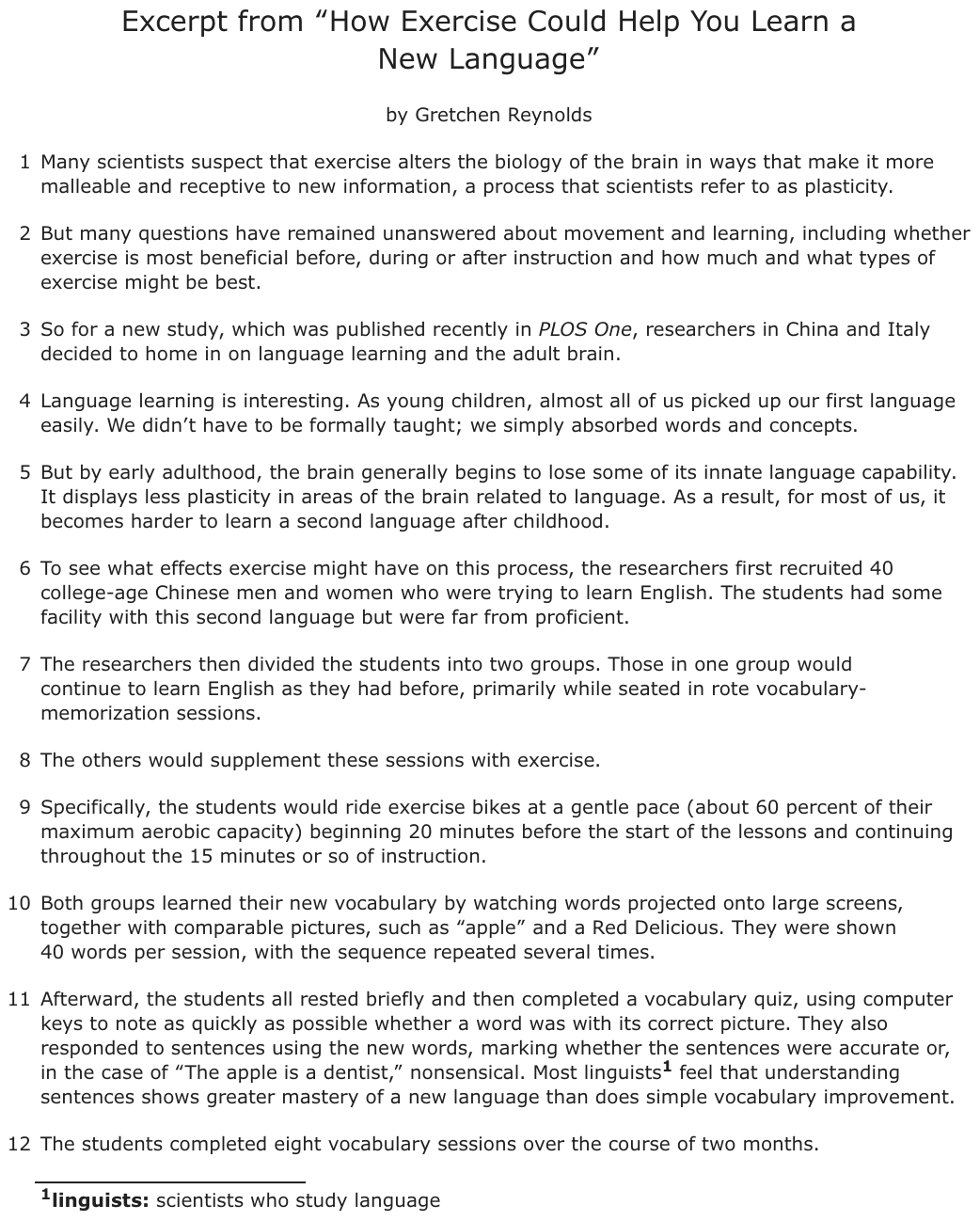
Many scientists suspect that exercise alters the biology of the brain in ways that make it more malleable and receptive to new information, a process that scientists refer to as plasticity.
But many questions have remained unanswered about movement and learning, including whether exercise is most beneficial before, during or after instruction and how much and what types of exercise might be best.
So for a new study, which was published recently in PLOS One, researchers in China and Italy decided to home in on language learning and the adult brain.
Language learning is interesting. As young children, almost all of us picked up our first language easily. We didn’t have to be formally taught; we simply absorbed words and concepts.
But by early adulthood, the brain generally begins to lose some of its innate language capability. It displays less plasticity in areas of the brain related to language. As a result, for most of us, it becomes harder to learn a second language after childhood.
To see what effects exercise might have on this process, the researchers first recruited 40 college-age Chinese men and women who were trying to learn English. The students had some facility with this second language but were far from proficient.
The researchers then divided the students into two groups. Those in one group would continue to learn English as they had before, primarily while seated in rote vocabulary-memorization sessions.
The others would supplement these sessions with exercise.
Specifically, the students would ride exercise bikes at a gentle pace (about 60 percent of their maximum aerobic capacity) beginning 20 minutes before the start of the lessons and continuing throughout the 15 minutes or so of instruction.
Both groups learned their new vocabulary by watching words projected onto large screens, together with comparable pictures, such as “apple” and a Red Delicious. They were shown 40 words per session, with the sequence repeated several times.
Afterward, the students all rested briefly and then completed a vocabulary quiz, using computer keys to note as quickly as possible whether a word was with its correct picture. They also responded to sentences using the new words, marking whether the sentences were accurate or, in the case of “The apple is a dentist,” nonsensical. Most linguists1 feel that understanding sentences shows greater mastery of a new language than does simple vocabulary improvement.
The students completed eight vocabulary sessions over the course of two months.
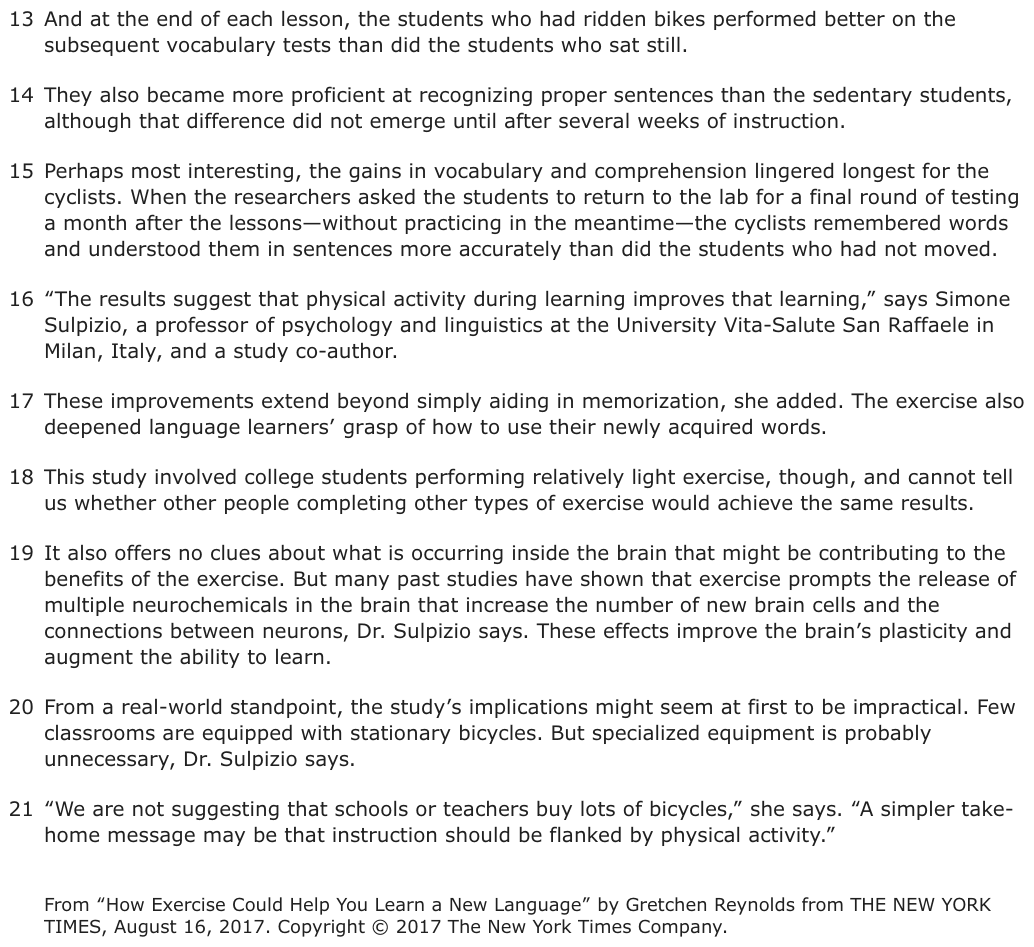
And at the end of each lesson, the students who had ridden bikes performed better on the subsequent vocabulary tests than did the students who sat still.
They also became more proficient at recognizing proper sentences than the sedentary students, although that difference did not emerge until after several weeks of instruction.
Perhaps most interesting, the gains in vocabulary and comprehension lingered longest for the cyclists. When the researchers asked the students to return to the lab for a final round of testing a month after the lessons—without practicing in the meantime—the cyclists remembered words and understood them in sentences more accurately than did the students who had not moved.
“The results suggest that physical activity during learning improves that learning,” says Simone Sulpizio, a professor of psychology and linguistics at the University Vita-Salute San Raffaele in Milan, Italy, and a study co-author.
These improvements extend beyond simply aiding in memorization, she added. The exercise also deepened language learners’ grasp of how to use their newly acquired words.
This study involved college students performing relatively light exercise, though, and cannot tell us whether other people completing other types of exercise would achieve the same results.
It also offers no clues about what is occurring inside the brain that might be contributing to the benefits of the exercise. But many past studies have shown that exercise prompts the release of multiple neurochemicals in the brain that increase the number of new brain cells and the connections between neurons, Dr. Sulpizio says. These effects improve the brain’s plasticity and augment the ability to learn.
From a real-world standpoint, the study’s implications might seem at first to be impractical. Few classrooms are equipped with stationary bicycles. But specialized equipment is probably unnecessary, Dr. Sulpizio says.
“We are not suggesting that schools or teachers buy lots of bicycles,” she says. “A simpler take-home message may be that instruction should be flanked by physical activity.”
From “How Exercise Could Help You Learn a New Language” by Gretchen Reynolds from THE NEW YORK TIMES, August 16, 2017. Copyright © 2017 The New York Times Company.
1linguists: scientists who study language
Question
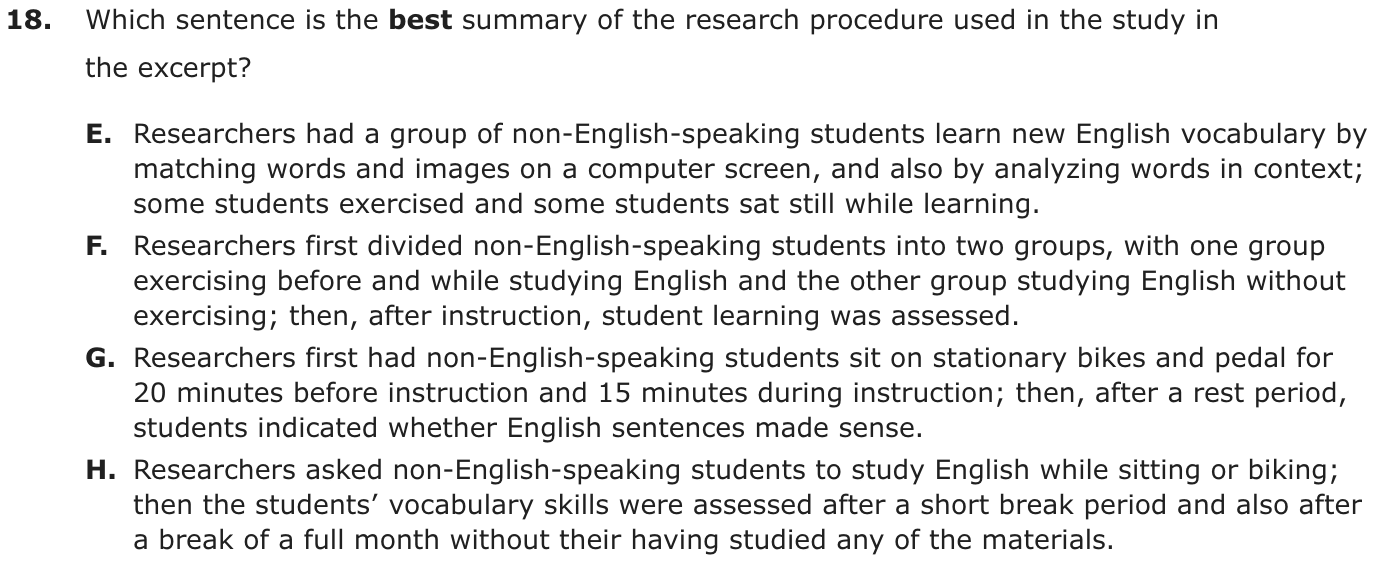
Which sentence is the best summary of the research procedure used in the study in the excerpt?
- AResearchers had a group of non-English-speaking students learn new English vocabulary by matching words and images on a computer screen, and also by analyzing words in context; some students exercised and some students sat still while learning.
- BResearchers first divided non-English-speaking students into two groups, with one group exercising before and while studying English and the other group studying English without exercising; then, after instruction, student learning was assessed.
- CResearchers first had non-English-speaking students sit on stationary bikes and pedal for 20 minutes before instruction and 15 minutes during instruction; then, after a rest period, students indicated whether English sentences made sense.
- DResearchers asked non-English-speaking students to study English while sitting or biking; then the students’ vocabulary skills were assessed after a short break period and also after a break of a full month without their having studied any of the materials.
Show the answer
Correct answer: B
The question asks for the best summary of the research procedure used in the study in the excerpt.
A. Incorrect. This summary says that students learned new words by matching words and images and “also by analyzing words in context,” but this last method was how the researchers assessed students, not how the students learned words; the summary is therefore inaccurate.
B. CORRECT. The summary includes the most important information, which is that one group of non-English-speaking students exercised before and during the English lessons, while the other group did not, and that the students’ learning was assessed afterward.
C. Incorrect. This summary is incomplete because it never mentions the control group—that is, the students who studied English without exercising—which was essential to the study so that results could be compared.
D. Incorrect. This summary includes unnecessary details, such as that students were assessed after a short break and also assessed after a month of no studying; it also neglects to mention important points: that one group exercised both before and during learning, while the other group did not exercise at all.
Question analysis
This summary question asks which of four long sentences best sums up how the researchers ran the study of exercise and English vocabulary learning. Each choice packs in real details about bikes, screens, quizzes and timing, so students must check both whether every detail is accurate and whether anything essential to the study’s design has been left out.
- Grade level
- Grade 8 reading and task
- Compared with grade 7
- Above grade 7 Grade 7 students summarize texts, usually choosing among short summaries. Here each choice runs about forty words packed with accurate details from several paragraphs, and students must judge which keeps the study’s essential design, not merely which details are true.
- Estimated difficulty
- Hard: combines ideas, needs a plan, and has more than one tempting wrong answer.
- Thinking it demands
- Depth of knowledge 2, skills and concepts · mainly understand
- What makes it hard
- A very close wrong answer major
- Evidence in several places moderate
- A lot to read moderate
- Evidence
- Answered from several paragraphs or stanzas
- Reading level
- Passage: about grade 11, 764 words; question and choices: about grade 16+, 157 words.
- Students, last 30 days
- Not enough answers yet to show (it takes 10).
Why it is hard, traps and wrong answers (shows the answer)
Why it is hard
Most of what the wrong summaries say is true, which makes this a test of completeness and weight rather than of accuracy. One summary describes only the cyclists, another slips the sentence quiz into how words were taught, and the most tempting one is accurate but leaves out that the cyclists pedaled before the lesson as well as during it. The right summary is plainer than its rivals: two groups, one exercising, then a test.
A very close wrong answer major Choosing the answer
The sitting-or-biking summary is accurate and names both conditions, as the right one does, but it spends its words on the short rest and the month-later test instead of when the cyclists rode. (Embretson & Wetzel, 1987; Gorin & Embretson, 2006; Ascalon et al., 2007)
Evidence in several places moderate Working it out
The procedure runs from the recruiting in paragraph 6 through the groups, bikes, lessons and quiz in paragraphs 7–12 to the final test in paragraph 15, so it must be gathered before any summary is judged. (Kirsch & Mosenthal, 1990; Gorin & Embretson, 2006)
A lot to read moderate Understanding the question
Each summary is a 32- to 40-word sentence packed with real details, the 20 minutes of pedaling, the rest period, the month without study, so the four together form a dense passage of their own. (Kintsch, 1998; Gorin & Embretson, 2006; Freedle & Kostin, 1993)
Strategy: Before reading the choices, note in a few words how the study was set up and how learning was checked. Then test each summary for accuracy and for anything essential it leaves out.
Traps
- Too narrow: A single detail offered as the central idea or a summary, or a summary that keeps minor details and leaves out an essential part.
- Twists what the text says: Uses the text's topic and ideas but changes what it says: who did it, how much, when, or why.
The wrong answers, classified
A Twists what the text says (King et al., 2004)
Adds that students learned “by analyzing words in context,” but judging sentences was part of the quiz after each lesson, while the words were taught with pictures on large screens.
C Too narrow (King et al., 2004)
Follows the cyclists’ routine accurately, 20 minutes before and during the lesson, but leaves out the group that studied without exercise, so the comparison at the heart of the study disappears.
D Too narrow (King et al., 2004)
Is drawn by accurate details about the short rest and the month-later test, but it builds the summary around them and leaves out that the cyclists rode before the lessons too.
Working it out, step by step
Figure out what the question asks
You need the best summary of how the study was done. A summary gives the main parts in a few words. It must be accurate, and it can’t leave out anything important. Small details can be skipped.
Find the main parts of the study
- Paragraph 7: “The researchers then divided the students into two groups.”
- Paragraphs 8 and 9: one group rode bikes “beginning 20 minutes before the start of the lessons and continuing throughout the 15 minutes or so of instruction.” The other group sat still.
- Paragraph 11: then all the students took a quiz.
So the key parts are two groups, one that exercised, and a test afterward. The group that sat still matters. It lets the researchers compare.
Check each choice
- B has it all: two groups, one exercising “before and while studying,” then a test.
- A says students learned by “analyzing words in context.” But judging sentences was part of the quiz, not the lessons.
- C describes only the bike riders. It leaves out the group that sat still, so nothing gets compared.
- D spends its words on small details: the short break and the test a month later. It leaves out that the bike riders started 20 minutes before the lesson.
Pick the answer
Watch out: D is tempting because everything in it is true. But a summary should give the main parts, not the side details. So the answer is B.
Why this answer and not the closest wrong one
D is the closest wrong answer. Its facts are accurate, and it names both groups. But it builds the summary around the break and the month-later test. It never says the cyclists rode before the lessons too. B gives the main plan plainly: two groups, one exercising, then a test of learning.
More questions like this
The original DOE question
The passage “Excerpt from “How Exercise Could Help You Learn a New Language”” as printed (pages 171–172)