Literary prose
Question 1 of 67
2026 Practice Test A English, question 15Passage Excerpt from A Voice in the Wilderness
Excerpt from A Voice in the Wilderness
by Grace Livingston Hill
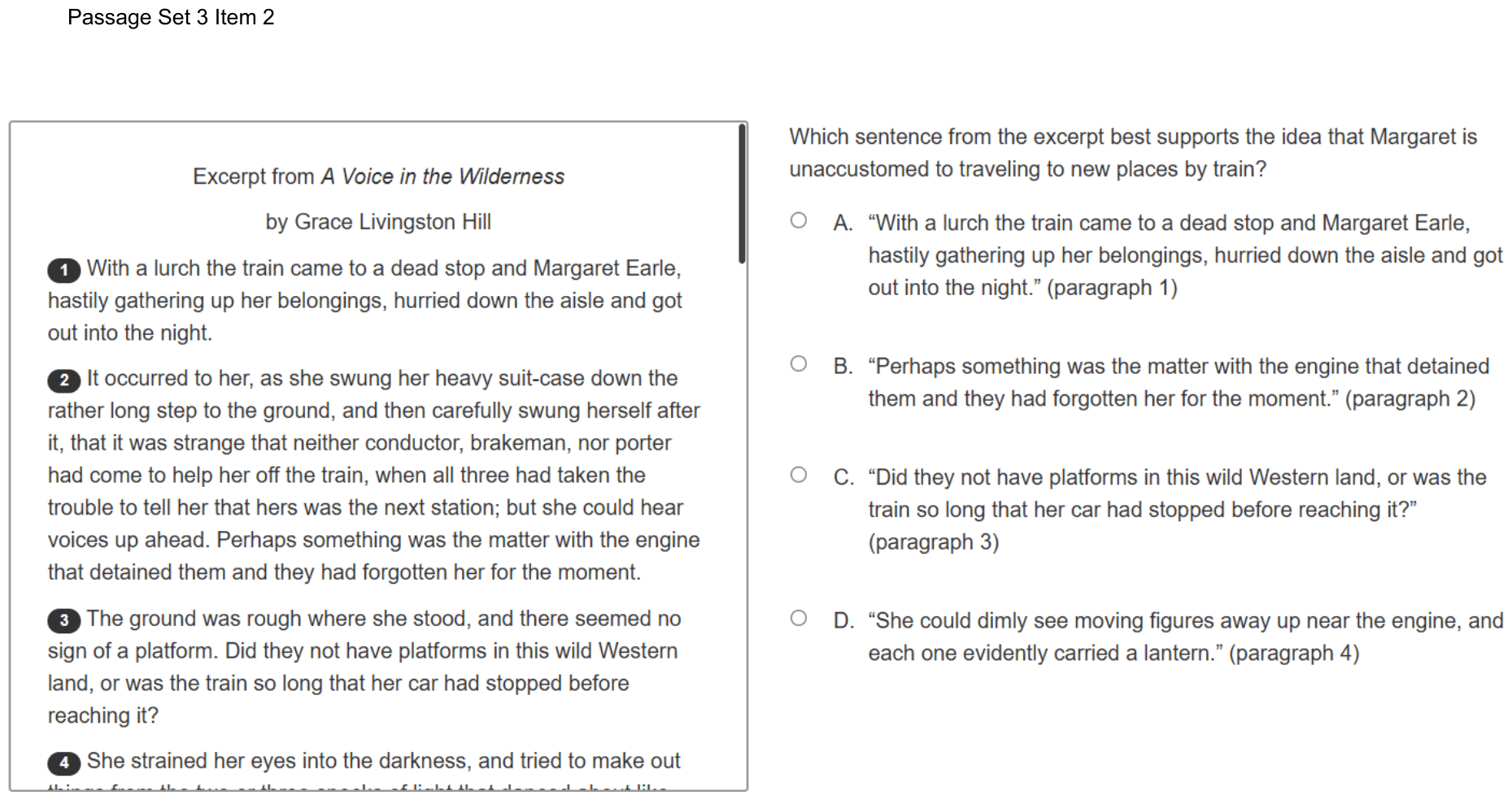
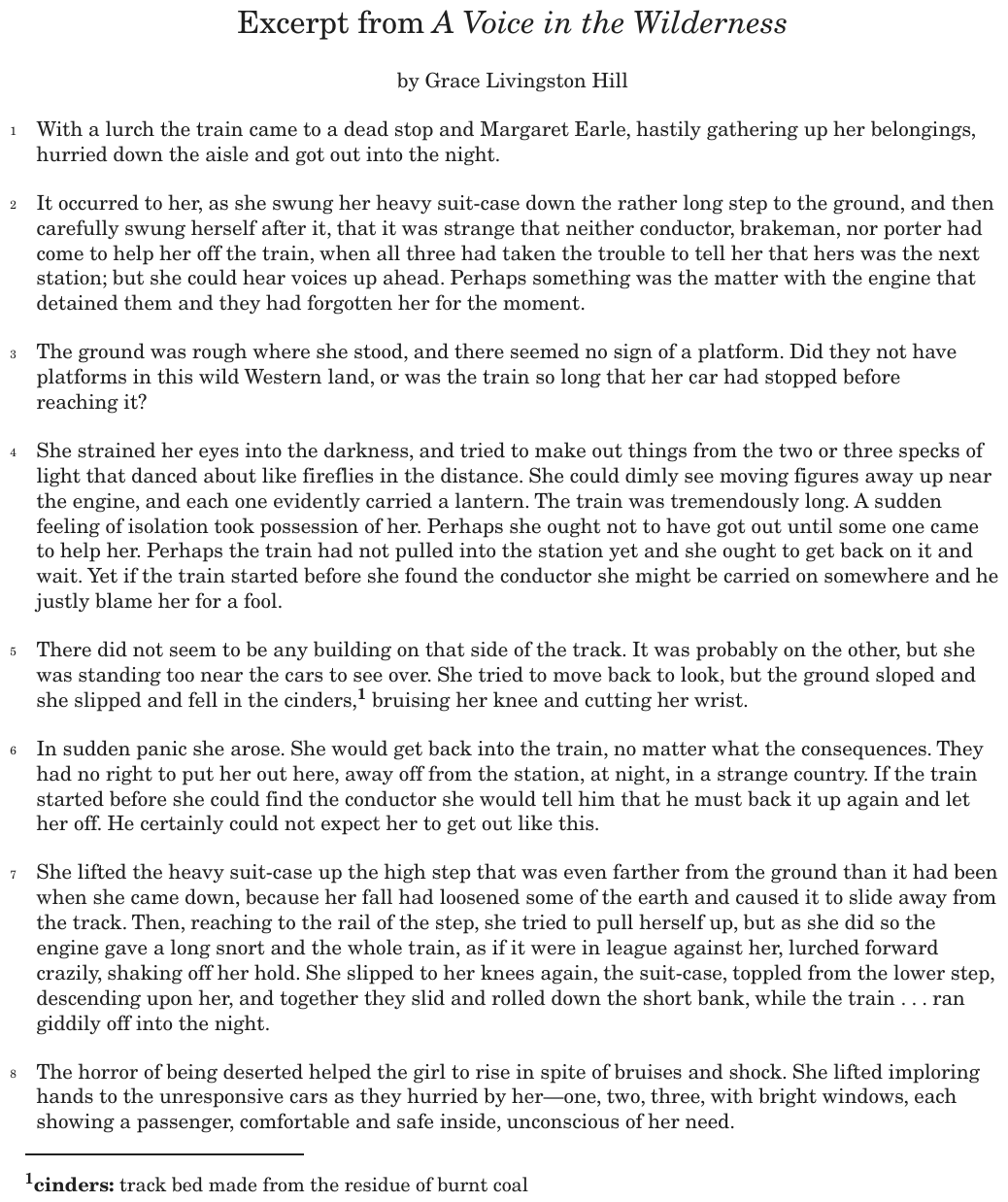
With a lurch the train came to a dead stop and Margaret Earle, hastily gathering up her belongings, hurried down the aisle and got out into the night.
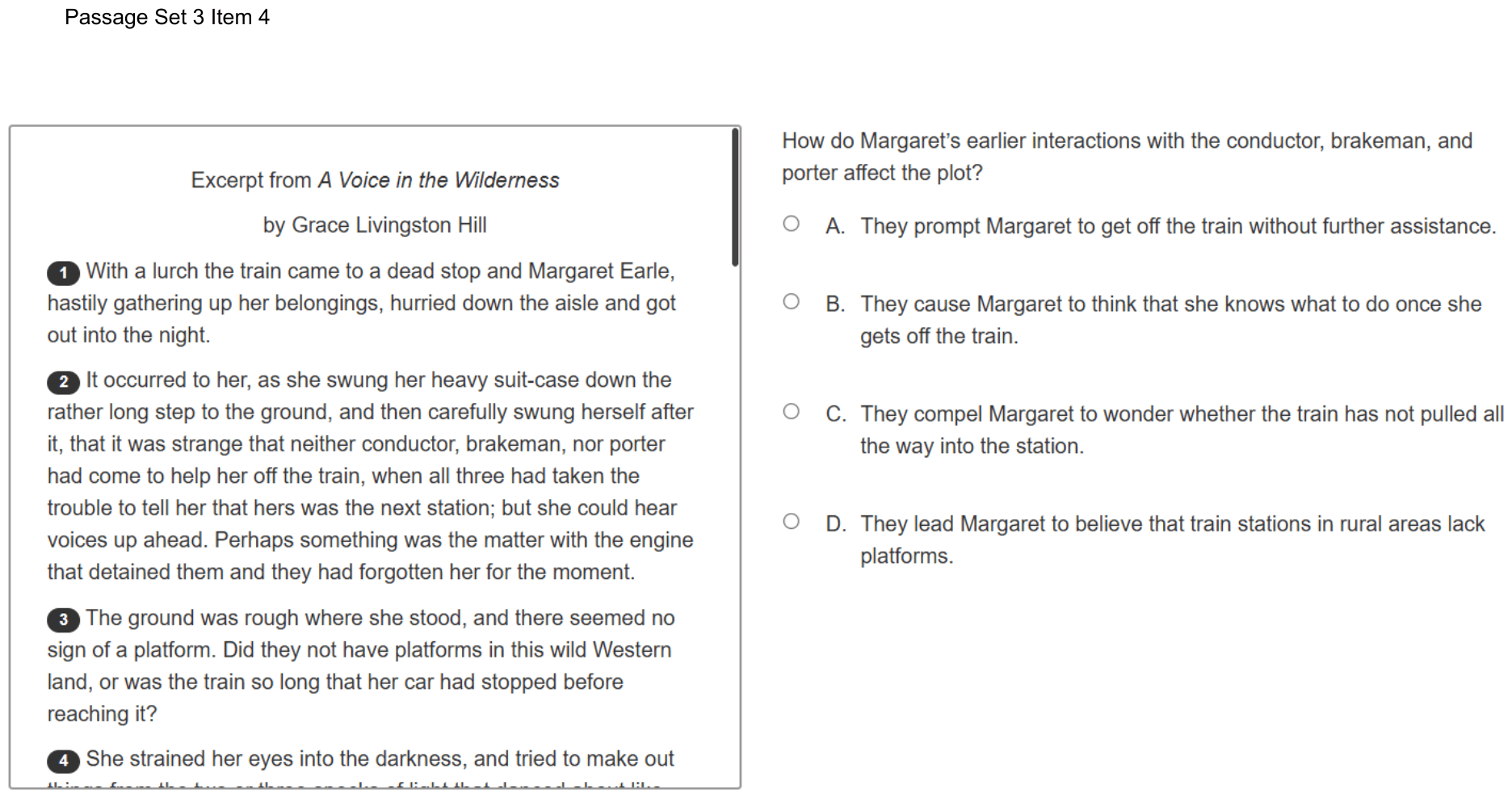
It occurred to her, as she swung her heavy suit-case down the rather long step to the ground, and then carefully swung herself after it, that it was strange that neither conductor, brakeman, nor porter had come to help her off the train, when all three had taken the trouble to tell her that hers was the next station; but she could hear voices up ahead. Perhaps something was the matter with the engine that detained them and they had forgotten her for the moment.
The ground was rough where she stood, and there seemed no sign of a platform. Did they not have platforms in this wild Western land, or was the train so long that her car had stopped before reaching it?
She strained her eyes into the darkness, and tried to make out things from the two or three specks of light that danced about like fireflies in the distance. She could dimly see moving figures away up near the engine, and each one evidently carried a lantern. The train was tremendously long. A sudden feeling of isolation took possession of her. Perhaps she ought not to have got out until some one came to help her. Perhaps the train had not pulled into the station yet and she ought to get back on it and wait. Yet if the train started before she found the conductor she might be carried on somewhere and he justly blame her for a fool.
There did not seem to be any building on that side of the track. It was probably on the other, but she was standing too near the cars to see over. She tried to move back to look, but the ground sloped and she slipped and fell in the cinders, bruising her knee and cutting her wrist.
In sudden panic she arose. She would get back into the train, no matter what the consequences. They had no right to put her out here, away off from the station, at night, in a strange country. If the train started before she could find the conductor she would tell him that he must back it up again and let her off. He certainly could not expect her to get out like this.
She lifted the heavy suit-case up the high step that was even farther from the ground than it had been when she came down, because her fall had loosened some of the earth and caused it to slide away from the track. Then, reaching to the rail of the step, she tried to pull herself up, but as she did so the engine gave a long snort and the whole train, as if it were in league against her, lurched forward crazily, shaking off her hold. She slipped to her knees again, the suit-case, toppled from the lower step, descending upon her, and together they slid and rolled down the short bank, while the train . . . ran giddily off into the night.
The horror of being deserted helped the girl to rise in spite of bruises and shock. She lifted imploring hands to the unresponsive cars as they hurried by her—one, two, three, with bright windows, each showing a passenger, comfortable and safe inside, unconscious of her need.
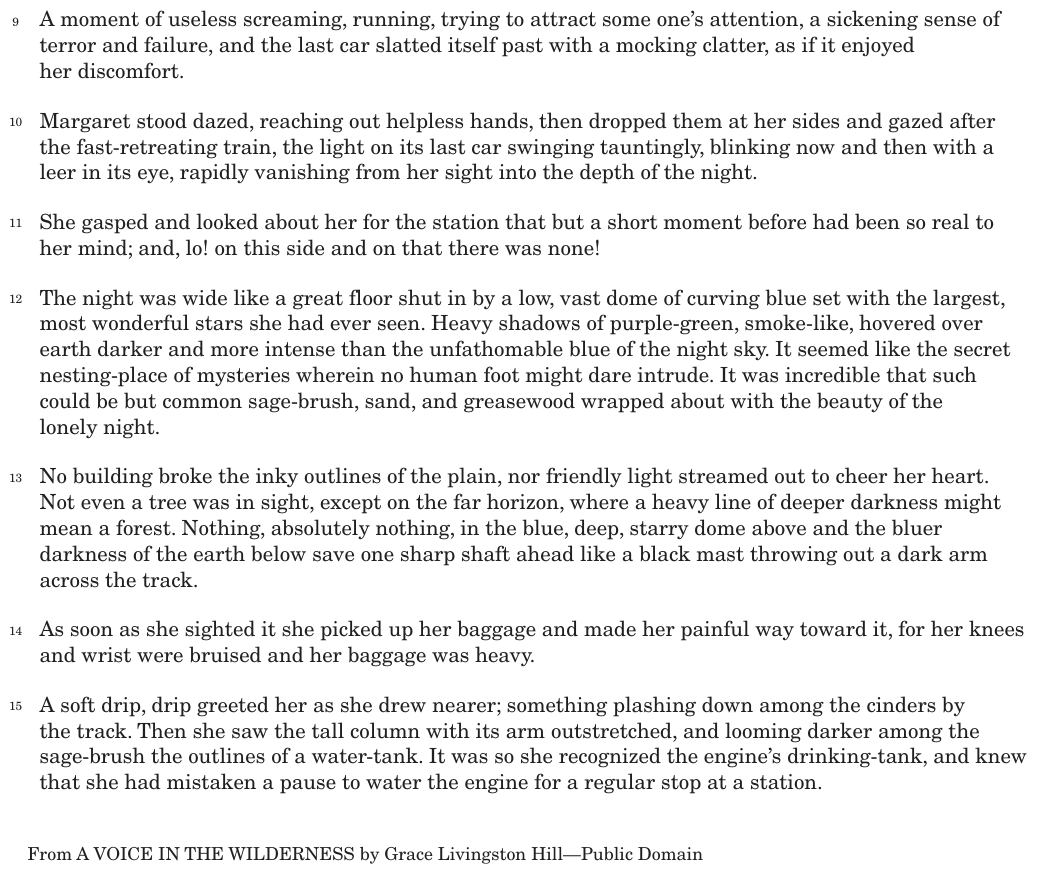
A moment of useless screaming, running, trying to attract some one’s attention, a sickening sense of terror and failure, and the last car slatted itself past with a mocking clatter, as if it enjoyed her discomfort.
Margaret stood dazed, reaching out helpless hands, then dropped them at her sides and gazed after the fast-retreating train, the light on its last car swinging tauntingly, blinking now and then with a leer in its eye, rapidly vanishing from her sight into the depth of the night.
She gasped and looked about her for the station that but a short moment before had been so real to her mind; and, lo! on this side and on that there was none!
The night was wide like a great floor shut in by a low, vast dome of curving blue set with the largest, most wonderful stars she had ever seen. Heavy shadows of purple-green, smoke-like, hovered over earth darker and more intense than the unfathomable blue of the night sky. It seemed like the secret nesting-place of mysteries wherein no human foot might dare intrude. It was incredible that such could be but common sage-brush, sand, and greasewood wrapped about with the beauty of the lonely night.
No building broke the inky outlines of the plain, nor friendly light streamed out to cheer her heart. Not even a tree was in sight, except on the far horizon, where a heavy line of deeper darkness might mean a forest. Nothing, absolutely nothing, in the blue, deep, starry dome above and the bluer darkness of the earth below save one sharp shaft ahead like a black mast throwing out a dark arm across the track.
As soon as she sighted it she picked up her baggage and made her painful way toward it, for her knees and wrist were bruised and her baggage was heavy.
A soft drip, drip greeted her as she drew nearer; something plashing down among the cinders by the track. Then she saw the tall column with its arm outstretched, and looming darker among the sage-brush the outlines of a water-tank. It was so she recognized the engine’s drinking-tank, and knew that she had mistaken a pause to water the engine for a regular stop at a station.
cinders: track bed made from the residue of burnt coal
From A VOICE IN THE WILDERNESS by Grace Livingston Hill—Public Domain
Question
Which sentence from the excerpt best supports the idea that Margaret is unaccustomed to traveling to new places by train?
- A“With a lurch the train came to a dead stop and Margaret Earle, hastily gathering up her belongings, hurried down the aisle and got out into the night.” (paragraph 1)
- B“Perhaps something was the matter with the engine that detained them and they had forgotten her for the moment.” (paragraph 2)
- C“Did they not have platforms in this wild Western land, or was the train so long that her car had stopped before reaching it?” (paragraph 3)
- D“She could dimly see moving figures away up near the engine, and each one evidently carried a lantern.” (paragraph 4)
Show the answer
Correct answer: C
The question asks for evidence from the excerpt that best supports the idea that Margaret is unfamiliar with traveling to new places by train.
A. Incorrect. Margaret’s actions in the sentence from paragraph 1 are decisive as she gathers her belongings to exit the train; she is familiar with rail travel.
B. Incorrect. In the sentence from paragraph 2, Margaret is using her knowledge about trains to attempt to interpret the actions of others; she is familiar with trains, even if a particular destination has not been mentioned.
C. CORRECT. If Margaret has never traveled to this region by train before, she must guess or attempt to interpret what she sees. This idea is best represented in the sentence in paragraph 3 where she questions whether the stations in the West have platforms.
D. Incorrect. While the sentence from paragraph 4 shows that Margaret is trying to better understand her situation in the darkness, her ability to identify the train’s engine and the figures carrying lanterns indicates some familiarity with her mode of travel.
Question analysis
Students choose the sentence from Grace Livingston Hill’s A Voice in the Wilderness that best supports the idea that Margaret is unaccustomed to traveling to new places by train. The four choices come from paragraphs 1–4, as she steps down from the train into the dark. Each reveals something about her, so students must test them against this one idea.
- NYS standards
- 7R1 textual evidence and inferences
- Grade level
- Grade 7 reading and task
- Compared with grade 7
- At grade 7 A typical grade 7 evidence task: the four quotations come from the opening paragraphs and carry paragraph numbers. The challenge is that several show Margaret unsure of herself, so students must match the specific idea in the claim, not any sign of doubt.
- Estimated difficulty
- Moderate: several steps, or a close reading with one strong distractor.
- Thinking it demands
- Depth of knowledge 2, skills and concepts · mainly evaluate
- What makes it hard
- Every choice must be checked moderate
- Reading between the lines minor
- Evidence
- Answered from several paragraphs or stanzas
- Reading level
- Passage: about grade 8, 981 words; question and choices: about grade 11, 113 words.
- Students, last 30 days
- Not enough answers yet to show (it takes 10).
Why it is hard, traps and wrong answers (shows the answer)
Why it is hard
Uncertainty runs through all four quotations, so the general mood of the opening cannot pick the answer. The claim is specific, a traveler new to such places, and only one sentence ties her confusion to the region itself rather than to a delay, the darkness or her haste. Students who match feelings instead of the claim usually settle on her guess about engine trouble.
Every choice must be checked moderate Choosing the answer
All four quotations, from paragraphs 1 to 4, show Margaret unsure in the dark, so each has to be tested against the narrower idea of someone new to this kind of journey. (Embretson & Wetzel, 1987)
Reading between the lines minor Working it out
No sentence says Margaret is new to the West; students must infer it from her puzzled question whether stations in “this wild Western land” lack platforms. (Graesser, Singer & Trabasso, 1994; Kintsch, 1998)
Strategy: Restate the claim in your own words, then ask of each quotation whether it proves that idea specifically or only shows some other feeling Margaret has at that moment.
Traps
- Supports only part of the claim: In a question about evidence: a line that backs one half of the claim but not the other, or a related point rather than the claim itself.
The wrong answers, classified
A Supports only part of the claim (King et al., 2004; Thissen, Steinberg & Fitzpatrick, 1989)
Reads her hurried exit as a nervous newcomer’s, though “hastily gathering up her belongings” shows someone who knows what to do when her stop is called.
B Supports only part of the claim (King et al., 2004; Thissen, Steinberg & Fitzpatrick, 1989)
Hears doubt in “Perhaps something was the matter with the engine,” but guessing at the cause of a delay is how an experienced rider reasons, not a newcomer puzzling over a place.
D Supports only part of the claim (King et al., 2004; Thissen, Steinberg & Fitzpatrick, 1989)
Notices the guesswork in “dimly” and “evidently,” but the darkness causes it, and she still picks out the engine and the crew’s lanterns, which shows she knows trains.
Working it out, step by step
Figure out what the question asks
This asks for evidence: the sentence that best supports an idea. The idea is that Margaret is unaccustomed to traveling to new places by train. Unaccustomed means not used to something. So look for a sentence where a new place puzzles her.
Notice what the choices share
All four sentences come from paragraphs 1 to 4, just after Margaret steps off the train at night. In most of them she is unsure. So feeling unsure is not enough. The right sentence must tie her confusion to the strange place itself.
Look closely at paragraph 3
Paragraph 3 asks “Did they not have platforms in this wild Western land, or was the train so long that her car had stopped before reaching it?” A platform is the raised floor beside the tracks where people get on and off. Margaret wonders if stations out West even have them. She does not know how things work in this region. That shows she is not used to traveling here.
Check each choice
- A does not fit. She is “hastily gathering up her belongings,” which means in a hurry. She knows what to do when her stop comes.
- B does not fit. Guessing about engine trouble is how someone who knows trains would think.
- C fits. She does not know what stations are like in this new land.
- D does not fit. The dark makes it hard to see. Yet she still picks out the engine and the lanterns.
Watch out: B begins with “Perhaps,” so it sounds unsure. But her doubt is about the train, not the place.
Choose the answer
Only the question about platforms shows that this place is unfamiliar to her. So the answer is C.
Why this answer and not the closest wrong one
B is the closest wrong choice, since Margaret is unsure in it too. But there she reasons like an experienced rider: maybe the engine broke down. In C, she wonders what stations are like in “this wild Western land.” Only C shows a traveler who is not used to new places.
More questions like this
The original DOE question
The passage “Excerpt from A Voice in the Wilderness” as printed (pages 128–129)
Question 2 of 67
2026 Practice Test A English, question 17Uses the passage above: “Excerpt from A Voice in the Wilderness”.
Question
How do Margaret’s earlier interactions with the conductor, brakeman, and porter affect the plot?
- AThey prompt Margaret to get off the train without further assistance.
- BThey cause Margaret to think that she knows what to do once she gets off the train.
- CThey compel Margaret to wonder whether the train has not pulled all the way into the station.
- DThey lead Margaret to believe that train stations in rural areas lack platforms.
Show the answer
Correct answer: A
The question asks how Margaret’s earlier interactions with the conductor, brakeman, and porter affect the plot.
A. CORRECT. Because the conductor, brakeman, and porter have all “taken the trouble to tell her that hers was the next station” (paragraph 2), Margaret assumes that the next time the train stops, she will have reached her station. This assumption causes Margaret to get off the train at the next stop without waiting for help or confirmation, but the stop turns out to be just “a pause to water the engine” (paragraph 15). This mistaken assumption creates the main problem that Margaret confronts in the passage.
B. Incorrect. Although Margaret’s earlier interactions with the three railroad employees cause her to think that she knows when to get off the train, it is clear from paragraph 4 that Margaret is deeply confused and does not know what to do once she has exited the train car. She muses uneasily, “Perhaps she ought not to have got out until some one came to help her. Perhaps the train had not pulled into the station yet and she ought to get back on it and wait” (paragraph 4).
C. Incorrect. Margaret wonders in paragraph 3 whether the train is “so long that her car had stopped before reaching [the station]” and speculates in paragraph 4 that “the train had not pulled into the station yet.” These thoughts reflect her assumption (based on her interactions with the three railroad employees) that the next stop is her station. However, Margaret’s speculation that the train has not fully pulled into the station does not significantly affect the plot.
D. Incorrect. Margaret wonders in paragraph 3 whether they “have platforms in this wild Western land” and is expecting to see a platform because her interactions with the three railroad employees have led her to believe that she has reached a station. However, it is unclear whether Margaret really believes that rural stations all lack platforms, and her speculation on this point is not further developed in the passage and does not affect the plot.
Question analysis
This plot question on A Voice in the Wilderness asks how Margaret’s earlier dealings with the conductor, brakeman and porter, mentioned only in passing in paragraph 2, affect what happens to her. Students must connect that brief remark to later events in the excerpt. Several choices describe things that do happen, so students must judge which one those conversations truly cause.
- Grade level
- Grade 8 reading and task
- Compared with grade 7
- Above grade 7 Grade 7 plot questions ask how story elements affect one another, usually through an event and its result. Here the cause is a clause inside a long sentence of century-old prose, and students must trace its effect across the excerpt rather than within one paragraph.
- Estimated difficulty
- Hard: combines ideas, needs a plan, and has more than one tempting wrong answer.
- Thinking it demands
- Depth of knowledge 3, strategic thinking · mainly analyze
- What makes it hard
- Evidence in several places moderate
- Reading between the lines moderate
- Complex sentences minor
- Evidence
- Answered from the whole text
- Reading level
- Passage: about grade 8, 981 words; question and choices: about grade 7, 72 words.
- Students, last 30 days
- Not enough answers yet to show (it takes 10).
Why it is hard, traps and wrong answers (shows the answer)
Why it is hard
The talks with the trainmen are mentioned once, in the middle of a long sentence, and the question asks students to see them as the start of the whole plot. Several choices describe thoughts Margaret really has right after she steps down, which makes them feel connected, but those thoughts change nothing. The point goes to students who trace cause to consequence: told her stop was next, she gets off alone at a water tank.
Evidence in several places moderate Working it out
The cause sits in paragraph 2, where all three men had told her “hers was the next station,” and the effect shows only in paragraph 15, when the stop proves to be a water tank. (Kirsch & Mosenthal, 1990; Gorin & Embretson, 2006)
Reading between the lines moderate Working it out
The excerpt never says the men’s words made her step off; students must infer that their assurance is why she left the train at the first stop without waiting for anyone. (Graesser, Singer & Trabasso, 1994; Kintsch, 1998)
Complex sentences minor Understanding the question
The interactions appear in a 66-word sentence in paragraph 2, tucked into a “when” clause after a run of commas, so they read as a passing detail rather than a cause. (Abedi & Lord, 2001; Freedle & Kostin, 1993; Messick, 1989)
Strategy: Reread paragraph 2 to find what the three men told Margaret, then trace how that information shapes the events that follow, and choose the effect that matters most to the plot.
Traps
- True but not the answer: A choice says something accurate about the text that does not answer this question.
- Twists what the text says: Uses the text's topic and ideas but changes what it says: who did it, how much, when, or why.
- Reads too much in: A reasonable-sounding conclusion that goes further than the text allows.
The wrong answers, classified
B Twists what the text says (King et al., 2004)
Rightly links the men’s words to her confidence about when to get off, but stretches it to knowing what to do afterward, when paragraph 4 shows her at a loss.
C True but not the answer (King et al., 2004; Embretson & Wetzel, 1987)
Names a real result of the men’s words, her guess in paragraphs 3 and 4 that the train has not yet reached the station, but that passing worry changes nothing in the plot.
D Reads too much in (Graesser, Singer & Trabasso, 1994)
Turns her puzzled question about platforms in “this wild Western land” into a firm belief about rural stations, an idea the excerpt never develops.
Working it out, step by step
Figure out what the question asks
This asks how something from earlier affects the plot. The plot is the chain of events in a story. What did the three train workers tell Margaret, and what did that cause?
Find what the workers told her
Paragraph 2 says it was strange that “neither conductor, brakeman, nor porter had come to help her off the train, when all three had taken the trouble to tell her that hers was the next station.” A conductor, a brakeman and a porter are all people who work on a train.
Trace what happened because of it
Three workers told her that her stop was next. So when the train stopped, she was sure she had arrived. She got off alone, without waiting for anyone to help. But in paragraph 15 she learns it was only “a pause to water the engine.” Their words set off the whole problem: she is left alone in the dark.
Check each choice
- A fits. Their words led her to get off by herself.
- B does not fit. They told her when to get off, not what to do next. In paragraph 4 she is lost: “Perhaps she ought not to have got out until some one came to help her.”
- C does not fit. She does wonder this, but the thought changes nothing in the story.
- D does not fit. She only asks a question about platforms. She never decides anything about country stations.
Choose the answer
The workers’ words made Margaret step off the train on her own at the wrong stop. So the answer is A.
Why this answer and not the closest wrong one
C is the closest wrong choice. The workers’ words do make her guess that the train has not reached the station yet. But that guess goes nowhere. What changes the story is that she gets off alone at a stop that is not a station. That is A.
More questions like this
The original DOE question
Question 3 of 67
2026 Practice Test A English, question 18Uses the passage above: “Excerpt from A Voice in the Wilderness”.
Question
How does Margaret’s experience in paragraph 9 emphasize a theme of the excerpt?
- AIt confirms Margaret’s understanding that she cannot rely on help from anyone else.
- BIt leads Margaret to realize that her desire to change her situation is impractical.
- CIt causes Margaret to believe that her own actions led to an unfavorable outcome.
- DIt reinforces Margaret’s frustration about her lack of control over her surroundings.
Show the answer
Correct answer: A
The question asks about the relationship between the theme and paragraph 9, where Margaret desperately tries to get someone on the train to notice her.
A. CORRECT. One important theme of this excerpt concerns Margaret’s willingness to take action to ensure that she reaches her destination. This determination, described in Option A, is why she gathers her belongings together without help, gets off the train without being assisted by employees, and then attempts to climb back on while the train employees are busy examining the engine.
B. Incorrect. While the narrator describes her screaming as useless, she does not feel that her efforts overall are useless, and she does not give up until paragraph 10.
C. Incorrect. While Margaret is feeling a sense of “failure” in paragraph 9, she does not condemn herself as the train moves away.
D. Incorrect. Margaret expresses “terror” in paragraph 9 over being unable to catch someone’s attention, not frustration about her lack of control over her surroundings.
Question analysis
This theme question asks how Margaret’s experience in paragraph 9 of A Voice in the Wilderness, as she screams and runs while the train pulls away, emphasizes a theme of the excerpt. It is a lightly reworded version of an earlier handbook question. Every choice describes a believable reaction to being left behind, so the answer depends on the excerpt’s larger pattern.
- Grade level
- Grade 8 reading and task
- Compared with grade 7
- Above grade 7 Typical grade 7 theme questions trace a given theme through a text. Here students must decide which theme one frantic paragraph supports, and all four choices describe reactions that fit the scene, so the decision draws on the whole excerpt.
- Estimated difficulty
- Among the hardest on the SHSAT: a non-obvious approach, heavy reading, or a well-hidden trap.
- Thinking it demands
- Depth of knowledge 3, strategic thinking · mainly analyze
- What makes it hard
- Reading between the lines major
- Evidence in several places moderate
- Evidence
- Answered from the whole text
- Reading level
- Passage: about grade 8, 981 words; question and choices: about grade 10, 65 words.
- Students, last 30 days
- Not enough answers yet to show (it takes 10).
Why it is hard, traps and wrong answers (shows the answer)
Why it is hard
Each choice names a feeling a stranded traveler might have, and two lean on the paragraph’s own words, “useless” and “failure,” so the paragraph alone cannot decide it. Paragraph 9 must be read as the last link in a chain of trainmen, passengers and a departing train that all leave her to herself. Students who judge from that one paragraph often decide she has given up, though she soon picks up her bags and walks toward the dark shaft by the track.
Reading between the lines major Working it out
The theme is never stated; it must be drawn from paragraph 9’s cries that no one answers and from the passengers “comfortable and safe inside, unconscious of her need” in paragraph 8. (Graesser, Singer & Trabasso, 1994; Kintsch, 1998)
Evidence in several places moderate Working it out
The pattern begins in paragraph 2, when no trainman helps her off, and runs through the train lurching away “as if it were in league against her” in paragraph 7. (Kirsch & Mosenthal, 1990; Gorin & Embretson, 2006)
Strategy: Sum up in a phrase what keeps happening to Margaret from the start of the excerpt to its end, then check which choice paragraph 9’s own words most clearly add to.
Traps
- Too broad or too strong: A choice overstates, generalizes, or uses absolute words the text does not support.
- Wrong tone or attitude: Misjudges the tone, attitude or point of view, such as reading admiration as criticism, or taking a character's or subject's feelings for the author's.
The wrong answers, classified
B Too broad or too strong (King et al., 2004)
Stretches the “useless screaming” of one moment into a judgment that changing her situation is impractical, though she soon gathers her bags and sets off toward the shaft ahead.
C Reads too much in (Graesser, Singer & Trabasso, 1994)
Turns the “sense of terror and failure” into self-blame, though Margaret never says that her own choice to step off the train caused her trouble.
D Wrong tone or attitude (Graesser, Singer & Trabasso, 1994)
Fits the indifferent train, but names frustration over control where paragraph 9 stresses terror at being ignored by everyone aboard.
Working it out, step by step
Figure out what the question asks
This asks about a theme: a big idea a story keeps coming back to. How does what happens in paragraph 9 point to a theme? The right choice should fit a pattern across the whole excerpt.
Read paragraph 9
Paragraph 9 describes “A moment of useless screaming, running, trying to attract some one’s attention, a sickening sense of terror and failure.” Margaret screams and runs, trying to get someone to notice her. No one does. The last car rolls past “as if it enjoyed her discomfort.”
Find the same thing earlier
This is not the first time. In paragraph 2, none of the workers “had come to help her off the train.” In paragraph 8, the passengers sit “comfortable and safe inside, unconscious of her need.” That means they don’t know she needs help. Paragraph 9 is one more time when nobody comes. She will have to count on herself.
Check each choice
- A fits. Her cries go unanswered, just as before. She cannot rely on anyone else.
- B does not fit. Impractical means not sensible or workable. Her screaming fails, but she never decides that trying to change things is pointless. In paragraph 14 she “picked up her baggage” and set off again.
- C does not fit. She feels “failure,” but she never blames herself.
- D does not fit. The paragraph shows terror at being ignored, not frustration about having no control over her surroundings.
Choose the answer
Paragraph 9 adds one more moment where no one helps Margaret. So the answer is A.
Why this answer and not the closest wrong one
B is the closest wrong choice, because paragraph 9 calls her screaming “useless.” But one failed moment does not mean she gives up. Soon she takes her bags and walks toward the tall dark shape ahead. What stays true from paragraph 2 to paragraph 9 is that no one helps her. That is A.
More questions like this
The original DOE question
Question 4 of 67
2026 Practice Test A English, question 19Uses the passage above: “Excerpt from A Voice in the Wilderness”.
Question
How does paragraph 11 contribute to the plot of the excerpt?
- AIt reveals that the reality of the situation is different from Margaret’s assumptions.
- BIt illustrates that Margaret’s main problem is her own imagination.
- CIt shows that Margaret is surprised by the unexpected adventure she is about to undertake.
- DIt provides insight into how Margaret reacts to stressful situations.
Show the answer
Correct answer: A
The question asks how paragraph 11 contributes to the plot of the excerpt.
A. CORRECT. In paragraph 5, Margaret assumes there is a station (“It was probably on the other [side], but she was standing too near the cars to see”), but in paragraph 11, the station that had been “so real” in Margaret’s mind actually does not exist.
B. Incorrect. Margaret’s main problem is not that her imagination has led her astray but rather that her inexperience with this train route has caused her to misinterpret the events that have occurred. Paragraph 11 reveals that she has been acting on faulty assumptions; however, her assumptions are somewhat justified by the events that have occurred.
C. Incorrect. While Margaret seems somewhat in awe of her surroundings in paragraph 12 and she “gasped” in paragraph 11, her exclamation is one of shock at the discovery, not surprise over an unexpected adventure.
D. Incorrect. While paragraph 11 describes how Margaret responds to the distressing situation that her actions and decisions have created, the paragraph does not offer insight into how Margaret generally responds to problems or conflicts.
Question analysis
This plot-structure question asks how paragraph 11 of A Voice in the Wilderness, a single exclaiming sentence that begins “She gasped,” contributes to the plot once Margaret is alone beside the track. Students relate the paragraph to what comes before and after it. Its archaic phrasing, with “lo!” and an inverted clause, makes the plain meaning harder to see.
- Grade level
- Grade 7 reading and task
- Compared with grade 7
- At grade 7 Explaining what a single paragraph adds to a plot is standard grade 7 structure work. Paragraph 11 is one short sentence, but its old-fashioned exclamation has to be linked to the paragraphs around it, which adds a step.
- Estimated difficulty
- Moderate: several steps, or a close reading with one strong distractor.
- Thinking it demands
- Depth of knowledge 2, skills and concepts · mainly analyze
- What makes it hard
- Evidence in several places moderate
- A very close wrong answer moderate
- Hard words minor
- Evidence
- Answered from several paragraphs or stanzas
- Reading level
- Passage: about grade 8, 981 words; question and choices: about grade 10, 58 words.
- Students, last 30 days
- Not enough answers yet to show (it takes 10).
Why it is hard, traps and wrong answers (shows the answer)
Why it is hard
Paragraph 11 is a single exclaiming sentence whose job is to overturn what Margaret, and the reader, have believed since she stepped down. Students who link it to her earlier guesses about a platform and a building see the reversal at once. Those who read it alone fasten on her gasp or on the words “so real to her mind,” and choose a reading about her character or her imagination rather than the plot.
Evidence in several places moderate Working it out
The assumption the paragraph overturns was built earlier: in paragraph 3 she wonders about a platform, and in paragraph 5 she decides the station is “probably on the other” side. (Kirsch & Mosenthal, 1990; Gorin & Embretson, 2006)
A very close wrong answer moderate Choosing the answer
The choice about her imagination and the right one both describe a gap between what Margaret pictured and what is there; they differ on whether the fault lies in her mind or in the missing station. (Embretson & Wetzel, 1987; Gorin & Embretson, 2006; Ascalon et al., 2007)
Hard words minor Understanding the question
The paragraph announces its reversal in old-fashioned words, “lo! on this side and on that there was none,” which students unused to such phrasing may read past. (Perfetti, 2007; Freedle & Kostin, 1993)
Strategy: Translate paragraph 11 into plain modern English, reread the paragraphs just before and after it, and judge each choice by what this paragraph itself shows.
Traps
- Twists what the text says: Uses the text's topic and ideas but changes what it says: who did it, how much, when, or why.
- Too broad or too strong: A choice overstates, generalizes, or uses absolute words the text does not support.
The wrong answers, classified
B Twists what the text says (King et al., 2004)
Seizes on “so real to her mind” and blames her imagination, though the station she expected is truly missing and the danger she faces is real.
C Wrong tone or attitude (Graesser, Singer & Trabasso, 1994)
Hears surprise in “gasped” and “lo!” but takes it for eagerness about an adventure, when it is shock at finding no station on either side.
D Too broad or too strong (King et al., 2004)
Makes a general claim about how Margaret handles stress, which could fit almost any paragraph, while this one reports a single discovery that turns the plot.
Working it out, step by step
Figure out what the question asks
This asks how paragraph 11 moves the plot, the chain of events, forward. What changes for Margaret in this paragraph?
Read paragraph 11
Paragraph 11 is one sentence: “She gasped and looked about her for the station that but a short moment before had been so real to her mind; and, lo! on this side and on that there was none!”
Put it in plain words
“Lo!” is an old word that means “Look!” The words “on this side and on that there was none” mean there was no station on either side of the track. Earlier, in paragraph 5, she guessed the building “was probably on the other” side. An assumption is something you believe without checking. Now she sees that her assumption was wrong. There is no station at all.
Check each choice
- A fits. What she assumed, a station, is different from what is real, no station.
- B does not fit. Her imagination is not the problem. The missing station is a real problem.
- C does not fit. Her gasp is shock, not excitement about an adventure.
- D does not fit. She gasps, but the paragraph’s job is the discovery. It does not show how she usually handles stress.
Choose the answer
Paragraph 11 shows that the station Margaret counted on is not there. So the answer is A.
Why this answer and not the closest wrong one
B is the closest wrong choice. Both A and B notice a gap between what Margaret pictured and what is there. But B blames her imagination. Her trouble is real: there is no station, and the train is gone. A says what the paragraph does. It shows the truth is different from what she assumed.
More questions like this
The original DOE question
Question 5 of 67
2026 Practice Test A English, question 29Passage Excerpt from “The Spirit of the Herd”
Excerpt from “The Spirit of the Herd”
by Dallas Lore Sharp
In this excerpt, published in 1914, author and professor Dallas Lore Sharp describes a summer cattle roundup in Oregon. The heat and dust had been relentless for three days. The cowboys were exhausted, and the cattle were restless. The ranch boss, Wade, had led the drive to a watering place, only to find it empty.
Along with the wagon had come the fresh horses—one of them being Peroxide Jim, a supple, powerful, clean-limbed buckskin, a horse, I think, that had as fine and intelligent an animal-face as any creature I ever saw. Wade had been saving this horse for emergency work. And why should he not have been saved fresh for just such a need as this? Are there not superior horses as well as superior men—a Peroxide Jim to complement a Wade?
The horse knew the cattle business and knew his rider perfectly; and though there was nothing like sentiment about the boss of the P Ranch riders, his faith in Peroxide Jim was complete. . . .
The desert, where the herd was camped, was one of the highest of a series of tablelands, or benches; it lay as level as a floor, rimmed by sheer rock, from which there was a drop to the bench of sage below. The herd when overtaken by the dusk had been headed for a pass descending to the next lower bench, but was now halted within a mile of the rim rock on the east, where there was a perpendicular fall of about three hundred feet. . . .
In the taut silence of the stirless desert night, with the tension of the herd at the snapping-point, any quick, unwonted sight or sound would stampede them. The sneezing of a horse, the flare of a match, would be enough to send the whole four thousand headlong—blind, frenzied, trampling—till spent and scattered over the plain.
And so, as he rode, Wade began to sing. The rider ahead of him took up the air and passed it on until, above the stepping stir of the hoofs rose the faint voices of the men, and all the herd was bound about by the slow plaintive measures of some old song. It was not to soothe their savage breasts that the riders sang to the cattle, but rather to preempt the dreaded silence, to relieve the tension, and so to prevent the shock of any sudden startling noise.
So they sang and rode and the night wore on to one o’clock, when Wade, coming up on the rim-rock side, felt a cool breeze fan his face, and caught a breath of fresh, moist wind with the taste of water in it.
He checked his horse instantly, listening as the wind swept past him over the cattle. But they must already have smelled it, for they had ceased their milling, the whole herd standing motionless, the indistinct forms close to him in the dark showing their bald faces lifted to drink the sweet wet breath that came over the rim. Then they started on again, but faster, and with a rumbling now from their hoarse throats that tightened Wade’s grip on the reins.
The sound seemed to come out of the earth, a low, rumbling mumble, as dark as the night and as wide as the plain, a thick, inarticulate bellow that stood every rider stiff in his stirrups. . . .
Then the breeze caught the dust and carried it back from the gray-coated, ghostly shapes, and Wade saw that the animals were still moving in a circle. He must keep them going. He touched his horse to ride on with them, when across the black sky flashed a vivid streak of lightning.
There was a snort from the steers, a quick clap of horns and hoofs from far within the herd, a tremor of the plain, a roar, a surging mass—and Wade was riding the flank of a wild stampede. Before him, behind him, beside him, pressing hard upon his horse, galloped the frenzied steers, and beyond them a multitude borne on, and bearing him on, by the heave of the galloping herd.
Wade was riding for his life. He knew it. His horse knew it. He was riding to turn the herd, too, back from the rim, as the horse also knew. The cattle were after water—water-mad—ready to go over the precipice to get it, carrying horse and rider with them. Wade was the only rider between the herd and the rim. It was black as death. He could see nothing in the sage, could scarcely discern the pounding, panting shadows at his side. He knew that he was being borne toward the rim, how fast he could not tell, but he knew by the swish of the brush against his tapaderos and the plunging of the horse that the ground was growing stonier, that they were nearing the rocks.
To outrun the herd was his only chance for life. If he could come up with the leaders he might not only escape, but even stand a chance of heading them off upon the plain and saving the herd. There were cattle still ahead of him; how many, what part of them all, he could not make out in the dark. But the horse knew. The reins hung on his straight neck, where his rider had dropped them, as, yelling and firing over the wild herd, he had given this horse the race to win, to lose.
They were riding the rim. Close on their left bore down the flank of the herd, and on their right, under their very feet, was a precipice, so close that they felt its blackness—its three hundred feet of fall! . . .
. . . Then Wade found himself racing neck and neck with a big white steer, which the horse, with marvelous instinct, seemed to pick out from a bunch, and to cling to, forcing him gradually ahead, till, cutting him free from the bunch entirely, he bore him off into the swishing sage.
The steers coming on close behind followed their leader, and in, after them, swung others. The tide was turning from the rim. More and more were veering, and within a short time the whole herd, bearing off from the cliffs, was pounding over the open plains.
Whose race was it? It was Peroxide Jim’s, according to Wade, for not by word or by touch of hand or knee had the horse been directed in the run. From the flash of the lightning the horse had taken the bit, had covered an indescribably perilous path at top speed, had outrun the herd and turned it from the edge of the rim rock, without a false step or a tremor of fear.
From “The Spirit of the Herd” by Dallas Lore Sharp—Public Domain
tablelands: plateaus, flat areas of land sharply elevated from the surrounding area
tapaderos: leather covers for stirrups
Question
Which sentence from the excerpt best explains why Wade reserved Peroxide Jim for “emergency work” (paragraph 1)?
- A“Are there not superior horses as well as superior men—a Peroxide Jim to complement a Wade?” (paragraph 1)
- B“Before him, behind him, beside him, pressing hard upon his horse, galloped the frenzied steers, and beyond them a multitude borne on, and bearing him on, by the heave of the galloping herd.” (paragraph 10)
- C“He knew that he was being borne toward the rim, how fast he could not tell, but he knew by the swish of the brush against his tapaderos and the plunging of the horse that the ground was growing stonier, that they were nearing the rocks.” (paragraph 11)
- D“From the flash of the lightning the horse had taken the bit, had covered an indescribably perilous path at top speed, had outrun the herd and turned it from the edge of the rim rock, without a false step or a tremor of fear.” (paragraph 16)
Show the answer
Correct answer: D
The question asks which sentence from the excerpt best explains why Wade reserved Peroxide Jim for “emergency work” (paragraph 1).
A. Incorrect. While the sentence from paragraph 1 refers to Peroxide Jim as being a superior horse, it does not tell why he would be useful in an emergency. The mention of Peroxide Jim’s superiority does not describe the attributes that would make him an appealing choice for use in an emergency.
B. Incorrect. The sentence from paragraph 10 does not describe the actions of Peroxide Jim. The sentence describes what Wade and the horse were experiencing, but it does not include any reference to how Peroxide Jim was responding to the situation.
C. Incorrect. The sentence from paragraph 11 describes Wade’s experiences and does not focus on the actions of Peroxide Jim. It reveals Wade’s awareness of the danger he was in, but the only reference to Peroxide Jim in this sentence is the description of the horse having to work harder to run on the stonier ground as they neared the edge: from “the plunging of the horse,” Wade knew “that the ground was growing stonier, that they were nearing the rocks.” This quotation does not show that Peroxide Jim was the right horse to use for emergency work because it does not indicate, at this point in the text, that he was responding in a way that saved the herd or Wade.
D. CORRECT. The sentence from paragraph 16 describes Peroxide Jim’s high level of skill and ability to perform in a life-and-death situation. Not only did Peroxide Jim recognize the emergency immediately (“From the flash of the lightning the horse had taken the bit”), but the horse also proved to have the physical capability (“had covered an indescribably perilous path at top speed, had outrun the herd and turned it from the edge of the rim rock”) and the mental toughness (“without a false step or a tremor of fear”) required to respond appropriately to the dangerous situation.
Question analysis
This evidence question on Dallas Lore Sharp’s “The Spirit of the Herd,” a 1914 account of a night stampede on an Oregon cattle drive, asks which sentence best explains why the ranch boss Wade kept his horse Peroxide Jim for “emergency work.” The four quoted sentences come from different parts of the excerpt and are long, so the choice takes careful reading.
- Grade level
- Grade 8 reading and task
- Compared with grade 7
- At grade 7 Finding the sentence that best explains a detail is regular grade 7 evidence work. The four quotations, though, are long sentences from across a dense excerpt written in 1914, so the reading load is heavier than usual.
- Estimated difficulty
- Moderate: several steps, or a close reading with one strong distractor.
- Thinking it demands
- Depth of knowledge 2, skills and concepts · mainly evaluate
- What makes it hard
- Evidence in several places moderate
- A lot to read minor
- Reading between the lines minor
- Evidence
- Answered from the whole text
- Reading level
- Passage: about grade 8, 1160 words; question and choices: about grade 13, 160 words.
- Students, last 30 days
- Not enough answers yet to show (it takes 10).
Why it is hard, traps and wrong answers (shows the answer)
Why it is hard
The question links the start of the excerpt to its end, and the nearest quotation is the most tempting: the narrator’s rhetorical question about “superior horses” sits beside the phrase and seems to explain it. It praises the horse without showing what he can do. The two stampede sentences show the emergency itself, so the point goes to students who look for the horse acting on his own and find it in the final paragraph.
Evidence in several places moderate Working it out
The phrase “emergency work” is in paragraph 1, but the proof of the horse’s worth comes only at the very end, in paragraph 16, after the stampede has been turned. (Kirsch & Mosenthal, 1990; Gorin & Embretson, 2006)
A lot to read minor Understanding the question
Three of the quotations run 33 to 46 words, and two of them describe the stampede in vivid detail without saying what the horse does, so sorting them takes time. (Kintsch, 1998; Gorin & Embretson, 2006; Freedle & Kostin, 1993)
Reading between the lines minor Working it out
Students must decide what an emergency horse needs, speed, nerve and judgment without a rider’s guidance, before the last sentence reads as an answer to paragraph 1. (Graesser, Singer & Trabasso, 1994; Kintsch, 1998)
Strategy: Decide what a horse saved for emergencies would need to be able to do, then pick the quotation that gives the clearest proof that Peroxide Jim can do it.
Traps
- Supports only part of the claim: In a question about evidence: a line that backs one half of the claim but not the other, or a related point rather than the claim itself.
- True but not the answer: A choice says something accurate about the text that does not answer this question.
The wrong answers, classified
A Supports only part of the claim (King et al., 2004; Thissen, Steinberg & Fitzpatrick, 1989)
Stays beside the phrase in paragraph 1 and accepts the claim that Peroxide Jim is “superior,” which praises him but gives no sign of what makes him useful in a crisis.
B True but not the answer (King et al., 2004; Embretson & Wetzel, 1987)
Picks the most vivid picture of the stampede, which shows the emergency itself but says nothing about how Peroxide Jim handles it.
C Supports only part of the claim (King et al., 2004; Thissen, Steinberg & Fitzpatrick, 1989)
Notices “the plunging of the horse” at a tense moment, but the sentence is about Wade sensing the rocks ahead, not about the horse meeting the danger.
Working it out, step by step
Figure out what the question asks
This asks for evidence. In paragraph 1, Wade was saving Peroxide Jim for “emergency work.” Which sentence best explains why? You need a sentence that shows what this horse can do when something goes wrong.
Decide what to look for
An emergency is a sudden, dangerous event. A horse saved for one should be fast, steady and smart. It should act quickly when things go wrong. So look for the sentence that shows the horse himself doing that.
Read the last sentence of the excerpt
Paragraph 16 says “From the flash of the lightning the horse had taken the bit, had covered an indescribably perilous path at top speed, had outrun the herd and turned it from the edge of the rim rock, without a false step or a tremor of fear.”
Put the sentence in plain words
The bit is the metal bar in a horse’s mouth that the reins attach to. A horse that “had taken the bit” runs on its own. Perilous means dangerous. A tremor is a small shake. So the moment the stampede began, the horse took charge. He raced along a dangerous path, got ahead of the herd and turned it from the cliff. He never stumbled or showed fear.
Check each choice
- A does not fit. It calls him “superior,” but it shows no skill.
- B does not fit. It shows the stampede, but not how the horse handles it.
- C does not fit. It is about Wade sensing the rocks ahead.
- D fits. It shows the horse saving the herd in a real emergency.
Watch out: A sits right next to “emergency work” in paragraph 1, so it seems to explain it. But praise is not proof.
Choose the answer
The last sentence shows exactly why the horse was worth saving for emergencies. So the answer is D.
Why this answer and not the closest wrong one
A is the closest wrong choice. It sits beside the words “emergency work” and praises the horse. But calling a horse “superior” does not say what it can do. D shows the horse in action: fast, sure-footed and fearless in a real emergency. That explains why Wade saved him.
More questions like this
The original DOE question
The passage “Excerpt from “The Spirit of the Herd”” as printed (page 41)
Question 6 of 67
2026 Practice Test A English, question 30Uses the passage above: “Excerpt from “The Spirit of the Herd””.
Question
Paragraphs 1–2 contribute to the development of the central idea of the excerpt by
- Arevealing the respect Wade had for his horse.
- Bemphasizing Wade’s high expectations of his horse and himself.
- Cindicating that Wade and his horse understood the cattle business.
- Ddemonstrating Wade’s ability to gauge a horse’s competence.
Show the answer
Correct answer: A
The question asks how paragraphs 1–2 contribute to the development of the central idea of the excerpt.
A. CORRECT. The description of Peroxide Jim in paragraph 1 indicates that the horse was a fine animal (“Along with the wagon had come the fresh horses—one of them being Peroxide Jim, a supple, powerful, clean-limbed buckskin, a horse, I think, that had as fine and intelligent an animal-face as any creature I ever saw” [paragraph 1]). The statement in paragraph 2 that Wade’s “faith in Peroxide Jim was complete” supports the central idea of the excerpt that Wade believed in Peroxide Jim’s abilities even before the horse turned the herd and saved the cattle.
B. Incorrect. Paragraphs 1–2 do not emphasize Wade’s high expectations for himself, nor are these expectations a central idea of the excerpt. The narrator expresses a high opinion of Wade’s abilities in his comparison of Peroxide Jim and Wade, referring to the horse as a “complement” (paragraph 1) for Wade; however, Wade showed complete trust in the horse’s ability to save the herd without his help, as evidenced by Wade dropping the reins to allow the horse to control the situation (paragraph 12).
C. Incorrect. The paragraphs refer to Peroxide Jim’s ability to handle cattle; in fact, paragraph 2 says that “the horse knew the cattle business.” It can be inferred that Wade had this knowledge as well, but this idea is not the focus of paragraphs 1–2 and is not the central idea of the excerpt.
D. Incorrect. Wade’s ability to judge a horse’s competence is not a central idea of the excerpt. The event described in the text is proof that Wade knew how to judge a horse’s ability: Wade trusted Peroxide Jim, and Peroxide Jim did not let him down. The option puts the focus on Wade and one of his strengths, when the central idea and focus of the excerpt is Peroxide Jim’s abilities and strengths, not Wade’s.
Question analysis
This central-idea question asks how the first two paragraphs of “The Spirit of the Herd,” which introduce the buckskin horse Peroxide Jim and the ranch boss Wade, contribute to the excerpt’s central idea. Students connect these opening details to the story of the stampede that follows. The narrator’s old-fashioned rhetorical questions can make the paragraphs’ point hard to pin down.
- Grade level
- Grade 8 reading and task
- Compared with grade 7
- At grade 7 Explaining how opening paragraphs build a central idea is typical grade 7 work. The two paragraphs are short, but the narrator’s rhetorical questions and old-fashioned phrasing must be decoded, and the central idea must come from the rest of the excerpt.
- Estimated difficulty
- Moderate: several steps, or a close reading with one strong distractor.
- Thinking it demands
- Depth of knowledge 2, skills and concepts · mainly analyze
- What makes it hard
- Reading between the lines moderate
- How, not what moderate
- Complex sentences minor
- Evidence
- Answered from several paragraphs or stanzas
- Reading level
- Passage: about grade 8, 1160 words; question and choices: about grade 9, 48 words.
- Students, last 30 days
- Not enough answers yet to show (it takes 10).
Why it is hard, traps and wrong answers (shows the answer)
Why it is hard
The opening paragraphs talk about both Wade and his horse, so every choice can find a foothold in them. The question turns on the excerpt as a whole, which ends by giving the race to Peroxide Jim, and only Wade’s regard for the horse points toward that ending. Students lose the point by picking a skill of Wade’s own, which his trust only implies, or by repeating “knew the cattle business,” a line said of the horse alone.
Reading between the lines moderate Working it out
Respect is never named; it must be read from Wade “saving this horse for emergency work” and from his “faith in Peroxide Jim” being “complete” in paragraph 2. (Graesser, Singer & Trabasso, 1994; Kintsch, 1998)
How, not what moderate Working it out
The question asks how two opening paragraphs serve the excerpt’s central idea, so students must know where the story ends, with the race credited to the horse, before judging them. (Anderson & Krathwohl, 2001)
Complex sentences minor Understanding the question
Paragraph 1 makes its point through two old-fashioned rhetorical questions, beginning “And why should he not” and “Are there not superior horses,” whose answers students must supply. (Abedi & Lord, 2001; Freedle & Kostin, 1993; Messick, 1989)
Strategy: Restate paragraphs 1 and 2 in plain words, decide what the excerpt as a whole is mainly about, and pick the option that links the two.
Traps
- Half right: One half of a two-part choice is right and the other is not.
- Word match: Repeats striking words or phrases from the text, so it looks supported, but its meaning does not fit the question.
- Reads too much in: A reasonable-sounding conclusion that goes further than the text allows.
The wrong answers, classified
B Half right (King et al., 2004; Thissen, Steinberg & Fitzpatrick, 1989)
Takes “superior horses as well as superior men” as Wade’s demands on both, but the paragraphs show only his trust in the horse, never his expectations of himself.
C Word match (Freedle & Kostin, 1993)
Repeats “knew the cattle business,” which paragraph 2 says of the horse alone, and treats that background detail as the point the excerpt builds toward.
D Reads too much in (Graesser, Singer & Trabasso, 1994)
Credits Wade with a talent for judging horses, which his trust implies, but the paragraphs show faith in one horse, and the excerpt’s focus is that horse’s deeds.
Working it out, step by step
Figure out what the question asks
This asks how paragraphs 1 and 2 help build the central idea. The central idea is the most important idea of the whole excerpt. So first find the central idea. Then see how the opening leads to it.
Find the central idea
The excerpt ends in paragraph 16: “Whose race was it? It was Peroxide Jim’s, according to Wade.” The horse saved the herd on his own, and Wade gives him the credit. The central idea is that Peroxide Jim is a remarkable horse who earns Wade’s trust.
Read paragraphs 1 and 2
Paragraph 1 says “Wade had been saving this horse for emergency work.” Paragraph 2 says “though there was nothing like sentiment about the boss of the P Ranch riders, his faith in Peroxide Jim was complete.”
Work out what they show
Sentiment means soft, tender feelings. Wade was a tough boss, not a soft one. Faith means trust. Even so, he trusted this horse completely. Saving the horse for the hardest jobs shows the same respect. The rest of the excerpt proves that respect was deserved.
Check each choice
- A fits. The paragraphs show how much Wade respected his horse.
- B does not fit. They never say what Wade expects of himself.
- C does not fit. “The horse knew the cattle business” is said about the horse, and it is only background.
- D does not fit. His trust may hint that he judges horses well. But the paragraphs show faith in one horse, and the excerpt is about what that horse does.
Choose the answer
The opening shows Wade’s respect, and the ending shows the horse deserved it. So the answer is A.
Why this answer and not the closest wrong one
D is the closest wrong choice. Wade’s trust does hint that he knows good horses. But paragraphs 1 and 2 show his faith in one horse, not a skill at judging horses. The excerpt is about that horse. Wade’s respect points straight to the end, where he gives the race to Peroxide Jim. That is A.
More questions like this
The original DOE question
Question 7 of 67
2026 Practice Test A English, question 31Uses the passage above: “Excerpt from “The Spirit of the Herd””.
Question
How does paragraph 3 convey the effect of the setting on the cattle drive?
- AIt shows how the growing darkness created challenges for the riders in getting the herd to move.
- BIt describes how the changing elevation contributed to the dangerousness of the environment.
- CIt describes how the desert created an uncomfortable feeling of isolation for the riders and the cattle.
- DIt shows how the steep terrain made it difficult for the cattle to keep moving forward.
Show the answer
Correct answer: B
The question asks how paragraph 3 conveys the effect of the setting on the cattle drive.
A. Incorrect. The riders were not trying to move the herd through the darkness. Instead, the reference to the growing darkness (“overtaken by the dusk”) indicates that the riders had halted the animals for the night because moving the herd across the desert in the darkness would have been much too dangerous because of the sheer drop-off at the edge of the tableland. The riders needed the daylight to navigate the herd safely through the “pass descending to the next lower bench.”
B. CORRECT. Paragraph 3 describes the land where the herd was as being “as level as a floor” but “rimmed by sheer rock, from which there was a drop to the bench of sage below.” The drop was “a perpendicular fall of about three hundred feet”—any animal or person could fall over that edge. It was the change in height, from flat tableland to sheer drop-off, that made the terrain so dangerous.
C. Incorrect. The use of the word “desert” in the first sentence of the paragraph does not highlight the isolation of the setting or indicate that the riders and the herd were uncomfortable being alone. Instead, the word merely establishes the setting where the action occurred: “it lay as level as a floor, rimmed by sheer rock, from which there was a drop to the bench of sage below.”
D. Incorrect. The excerpt does not indicate that the steep terrain made it difficult for the herd to move forward. The herd was not expected to navigate the steep terrain. Instead, the steep terrain presented a danger to the herd that must be avoided. The riders intended to move the herd safely through passes that descended gradually to lower elevations.
Question analysis
This setting question on “The Spirit of the Herd” asks how paragraph 3, which describes the high desert where the herd has stopped for the night, conveys the setting’s effect on the cattle drive. Students must understand unusual landform words, one explained in a footnote, and work out what the land means for the herd. Several choices name a real feature of the scene.
- Grade level
- Grade 8 reading and task
- Compared with grade 7
- Above grade 7 Grade 7 students analyze how setting affects a story, usually from plainly worded description. This paragraph relies on terms such as tablelands, benches and rim rock, and never names the effect, so students must work it out from the description.
- Estimated difficulty
- Hard: combines ideas, needs a plan, and has more than one tempting wrong answer.
- Thinking it demands
- Depth of knowledge 2, skills and concepts · mainly analyze
- What makes it hard
- A very close wrong answer moderate
- Hard words moderate
- Reading between the lines minor
- Evidence
- Answered from one paragraph or stanza
- Reading level
- Passage: about grade 8, 1160 words; question and choices: about grade 9, 76 words.
- Students, last 30 days
- Not enough answers yet to show (it takes 10).
Why it is hard, traps and wrong answers (shows the answer)
Why it is hard
Paragraph 3 reads like a surveyor’s report, flat land ending in a sheer drop, with no word of fear. Students must turn its landforms into a picture and see that a herd camped a mile from a three-hundred-foot fall is in danger. The strongest wrong answer gets the cliff right but makes it a barrier to the drive, and others seize on the dusk or on the loneliness a desert suggests.
A very close wrong answer moderate Choosing the answer
The choice about steep terrain blocking the herd and the right one both rest on the drop at the rim; they differ only in its effect, a hazard to avoid or an obstacle to movement. (Embretson & Wetzel, 1987; Gorin & Embretson, 2006; Ascalon et al., 2007)
Hard words moderate Understanding the question
The paragraph’s landforms, “tablelands, or benches,” “rim rock,” a “pass descending to the next lower bench” and a “perpendicular fall,” must be pictured before the danger is clear. (Perfetti, 2007; Freedle & Kostin, 1993)
Reading between the lines minor Working it out
The paragraph never calls the drop dangerous; students must infer it from “sheer rock” and “about three hundred feet,” a danger that becomes real only when the herd stampedes toward the rim. (Graesser, Singer & Trabasso, 1994; Kintsch, 1998)
Strategy: Make a quick sketch of the land paragraph 3 describes and mark where the herd is halted, then ask what that setting means for the drive and test each choice against it.
Traps
- Twists what the text says: Uses the text's topic and ideas but changes what it says: who did it, how much, when, or why.
- Outside knowledge: A choice is plausible in the real world but not supported by this text.
The wrong answers, classified
A Twists what the text says (King et al., 2004)
Turns “overtaken by the dusk” into a struggle to get the herd moving, though the herd was halted for the night and the paragraph stresses the drop, not darkness.
C Outside knowledge (King et al., 2004; Recht & Leslie, 1988)
Assumes a desert must feel lonely, a common association, though the paragraph uses “desert” only to place the herd on a level plain and says nothing of isolation.
D Twists what the text says (King et al., 2004)
Rightly notices the sheer drop but makes it an obstacle to forward movement, when the herd was headed for a pass and the cliff was a hazard to avoid.
Working it out, step by step
Figure out what the question asks
This asks about setting, the place and time of a story. How does the land in paragraph 3 affect the cattle drive? A cattle drive is a trip where riders move a large herd of cattle across the land.
Read paragraph 3
The herd is camped on high, flat land “rimmed by sheer rock, from which there was a drop to the bench of sage below.” The herd “was now halted within a mile of the rim rock on the east, where there was a perpendicular fall of about three hundred feet.”
Picture the land
The note says tablelands are “flat areas of land sharply elevated from the surrounding area.” A bench is another name for one. Picture giant steps. The herd is on a high step. Its edge is sheer rock, a straight drop. Perpendicular means straight up and down. So the herd has stopped within a mile of a cliff about 300 feet high.
Work out the effect
Elevation is how high the land is. Here the elevation changes suddenly, from flat ground to a steep cliff. A scared herd could run right over the edge. That makes the place dangerous. Later, this danger comes true when the stampede races toward the rim.
Check each choice
- A does not fit. The herd was halted for the night. The riders were not trying to move it.
- B fits. The sudden drop makes the place dangerous.
- C does not fit. The paragraph says nothing about feeling lonely.
- D does not fit. The herd was headed for a pass, an easier way down. The cliff was a danger to avoid.
Choose the answer
The change in height, from flat land to a sheer drop, makes the setting dangerous. So the answer is B.
Why this answer and not the closest wrong one
D is the closest wrong choice, because it also points to the steep drop. But the herd was not trying to climb down the cliff. It was headed for a pass and had stopped for the night. The drop matters because the herd could fall over it. That danger is what B describes.
More questions like this
The original DOE question
Question 8 of 67
2026 Practice Test A English, question 32Uses the passage above: “Excerpt from “The Spirit of the Herd””.
Question
Read this sentence from paragraph 13.
Close on their left bore down the flank of the herd, and on their right, under their very feet, was a precipice, so close that they felt its blackness—its three hundred feet of fall!
The phrase “bore down the flank of the herd” conveys that Wade
- Astruggled to see the front of the herd.
- Bhad to ride quickly to keep up with the herd.
- Cwas forced to ride between the edge of the cliff and the herd.
- Dknew that the drop of the cliff would frighten the herd.
Show the answer
Correct answer: C
The question asks what the phrase “bore down the flank of the herd” (paragraph 13) conveys about Wade.
A. Incorrect. While Wade struggled to see the front of the herd, the words “bore down the flank of the herd” (paragraph 13) are meant to convey the intensity of the situation Wade was in, not the way the herd is blocking his vision.
B. Incorrect. The sentence from paragraph 13 states that the herd was “close on their left” and includes the phrase “bore down.” Both of these phrases indicate that Wade was trapped between the stampeding herd and the steep cliff. Wade and Peroxide Jim were struggling to reach the very front of the herd to turn it away from the edge.
C. CORRECT. The phrase “bore down the flank of the herd” from paragraph 13 conveys the overwhelming strength of the herd. The herd was forcing Wade toward the cliff. The wording in the quotation emphasizes the immediate danger of the situation and conveys the idea that Wade and Peroxide Jim were almost forced over the edge of the precipice by the stampeding herd.
D. Incorrect. The phrase “bore down the flank of the herd” (paragraph 13) does not indicate anything about the fear felt by the herd. The phrase is about Wade’s position between the edge of the stampeding herd and the drop-off. Wade was aware of the danger the herd was in if he and Peroxide Jim could not turn the cattle from the edge.
Question analysis
This vocabulary-in-context question quotes a sentence from paragraph 13 of “The Spirit of the Herd,” at the height of the stampede, and asks what the phrase “bore down the flank of the herd” conveys about Wade. Students need the meaning of “bore down” and “flank” as they are used here. Some choices describe real moments of the stampede, so students must stick to what this phrase shows.
- Grade level
- Grade 7 reading and task
- Compared with grade 7
- At grade 7 Working out a phrase’s meaning from its sentence is routine grade 7 work. The words “bore down” and “flank” are less common, but the full sentence is quoted with the question, so the task stays within one sentence.
- Estimated difficulty
- Straightforward: two steps or one careful reading.
- Thinking it demands
- Depth of knowledge 2, skills and concepts · mainly understand
- What makes it hard
- Complex sentences moderate
- Hard words minor
- Evidence
- Answered from one sentence or line
- Reading level
- Passage: about grade 8, 1160 words; question and choices: about grade 3, 94 words.
- Students, last 30 days
- Not enough answers yet to show (it takes 10).
Why it is hard, traps and wrong answers (shows the answer)
Why it is hard
Once the sentence is untangled, the herd pressing in on the left and the cliff on the right, the answer is a picture of Wade squeezed between them. The trouble is the word order and the phrase itself: students who read “bore down” as speed think about keeping pace, and those who recall the darkness of the paragraph before pick a detail this sentence never mentions.
Complex sentences moderate Understanding the question
The sentence is inverted: “the flank of the herd” is the subject of “bore down,” placed after its verb, so a quick reader may think Wade bore down along the herd instead. (Abedi & Lord, 2001; Freedle & Kostin, 1993; Messick, 1989)
Hard words minor Understanding the question
Both “flank,” the side of the herd, and “bore down,” pressed in hard, are uncommon in this sense, and the stem asks about exactly those words. (Perfetti, 2007; Freedle & Kostin, 1993)
Strategy: Read the whole quoted sentence rather than the phrase alone, picture the scene it describes, and pick what this sentence itself shows about Wade.
Traps
- Dictionary meaning, not meaning here: A common meaning of the word that does not fit its use in this text.
- Wrong part of the text: A choice is true of another paragraph, stanza or speaker than the one asked about.
- Reads too much in: A reasonable-sounding conclusion that goes further than the text allows.
The wrong answers, classified
A Wrong part of the text (Kirsch & Mosenthal, 1990)
Recalls from paragraph 12 that Wade could not tell how many cattle were ahead of him, which is true there, but this sentence says nothing about what he could see.
B Dictionary meaning, not meaning here (Perfetti, 2007)
Takes “bore down” in its sense of rushing forward and gives the speed to Wade, when in this sentence it is the herd’s flank pressing in on his left.
D Reads too much in (Graesser, Singer & Trabasso, 1994)
Assumes the cliff would scare the cattle, but they are “water-mad” and ready to go over the edge, and the phrase describes Wade’s position, not their fear.
Working it out, step by step
Figure out what the question asks
This asks what the phrase “bore down the flank of the herd” shows about Wade. To answer, read the whole sentence, not just the phrase.
Learn the hard words
A flank is the side of an animal or of a group. To bear down, here “bore down,” means to press in hard on something. A precipice is a cliff, a very steep drop.
Untangle the sentence
The sentence puts its words in an unusual order. In everyday order it would say: The flank of the herd bore down close on their left. So the side of the herd pushed in on Wade and his horse from the left. On the right, “under their very feet, was a precipice.”
Picture where Wade is
Wade is squeezed. Thousands of running cattle press in on one side. A 300-foot drop sits on the other side. He has no room to move away from either one. He is forced to ride in the narrow space between the herd and the cliff edge.
Check each choice
- A does not fit. Paragraph 12 says he could not tell how many cattle were ahead, but this sentence is about the sides.
- B does not fit. Here the herd does the bearing down, not Wade.
- C fits. He rides between the herd and the cliff.
- D does not fit. The cattle were “water-mad,” ready to go over the edge. Nothing says the cliff scared them.
Choose the answer
The phrase shows the herd pushing Wade toward the edge. So the answer is C.
Why this answer and not the closest wrong one
B is the closest wrong choice, because “bore down” can mean rushing forward fast. But in this sentence the herd does the bearing down, not Wade. The herd presses in from the left while the cliff waits on the right. That squeeze is what C describes.
More questions like this
The original DOE question
Question 9 of 67
2026 Practice Test A English, question 33Uses the passage above: “Excerpt from “The Spirit of the Herd””.
Question
Read these sentences from the excerpt.
He was riding to turn the herd, too, back from the rim, as the horse also knew. (paragraph 11)
It was Peroxide Jim’s, according to Wade, for not by word or by touch of hand or knee had the horse been directed in the run. (paragraph 16)
How do these sentences develop a central idea in the excerpt?
- AThey suggest that Wade would have been unable to save the herd without Peroxide Jim.
- BThey imply that Wade spent many hours training Peroxide Jim to herd cattle.
- CThey show that Peroxide Jim was able to understand a situation and take action.
- DThey indicate that Peroxide Jim was unafraid of the dangers presented by the stampede and the cliff.
Show the answer
Correct answer: C
The question asks how the sentences from paragraph 11 and paragraph 16 develop a central idea in the excerpt.
A. Incorrect. While Peroxide Jim’s presence was critical to saving the herd, the details in paragraph 11 and paragraph 16 do not focus on this idea. The primary idea is that the horse was so intelligent and aware that he acted on his own.
B. Incorrect. The excerpt does not tell who trained Peroxide Jim. It can be inferred that Peroxide Jim had been well trained and was knowledgeable of working cattle; however, there is no indication that Wade was the person who trained Peroxide Jim, only that Wade knew of Peroxide Jim’s abilities, respected the skilled horse, and was “saving this horse for emergency work” (paragraph 1). Because the reader cannot infer from the excerpt that Wade was the trainer, this idea cannot be considered central to the excerpt.
C. CORRECT. Wade recognized that Peroxide Jim knew to turn the herd without any instruction from him. Throughout the excerpt, Wade exhibited confidence in his horse, Peroxide Jim. For example, the narrator says that Wade’s “faith in Peroxide Jim was complete” in paragraph 2. After Wade let go of the reins (paragraph 12), the horse took over, doing exactly what needed to be done to save Wade, the herd, and himself: “a big white steer, which the horse, with marvelous instinct, seemed to pick out from a bunch, and to cling to, forcing him gradually ahead, till, cutting him free from the bunch entirely, he bore him off into the swishing sage” (paragraph 14).
D. Incorrect. The sentence from paragraph 11 and the sentence from paragraph 16 show that Peroxide Jim acted skillfully and with the knowledge that the ride was dangerous (“Wade was riding for his life. He knew it. His horse knew it” [paragraph 11]). Neither sentence indicates whether Peroxide Jim was afraid. The excerpt does say, later in paragraph 16, that the horse turned the herd “without a false step or a tremor of fear,” but these two sentences focus on his awareness of the danger and his ability to act on his own, not on his lack of fear.
Question analysis
This question quotes two sentences from “The Spirit of the Herd,” one from the middle of the stampede and one from its end, and asks how together they develop a central idea of the excerpt. Students must see what the two sentences share and connect it to the story as a whole. Each choice sounds reasonable for this story, which makes the exact wording of the two sentences decisive.
- Grade level
- Grade 8 reading and task
- Compared with grade 7
- Above grade 7 Grade 7 central-idea questions usually ask about one paragraph or the whole text. Here students must find what two sentences five paragraphs apart have in common and link it to the excerpt’s central idea, among choices that all sound believable.
- Estimated difficulty
- Hard: combines ideas, needs a plan, and has more than one tempting wrong answer.
- Thinking it demands
- Depth of knowledge 3, strategic thinking · mainly analyze
- What makes it hard
- Reading between the lines moderate
- Complex sentences moderate
- Evidence in several places moderate
- Evidence
- Answered from several paragraphs or stanzas
- Reading level
- Passage: about grade 8, 1160 words; question and choices: about grade 6, 121 words.
- Corrected from the DOE handbook
- An inaccurate statement in the explanation was corrected.
- Students, last 30 days
- Not enough answers yet to show (it takes 10).
Why it is hard, traps and wrong answers (shows the answer)
Why it is hard
Each choice says something a reader could believe about this story, so the exact content of the two quoted sentences decides it. What they share is knowledge and independence: the horse knew the goal and ran the race undirected. Fearlessness is stated in the very next sentence of paragraph 16, which makes it easy to credit to these two, and the claim that Wade could not have managed alone sounds like a fair summary of the ending.
Reading between the lines moderate Working it out
Neither sentence says the horse understood; that has to be read from “as the horse also knew” and from the race being his because he was not directed “by word or by touch.” (Graesser, Singer & Trabasso, 1994; Kintsch, 1998)
Complex sentences moderate Understanding the question
The second sentence is an inverted negative passive, “not by word or by touch of hand or knee had the horse been directed,” and the first tucks its point into a trailing clause. (Abedi & Lord, 2001; Freedle & Kostin, 1993; Messick, 1989)
Evidence in several places moderate Working it out
The two sentences sit five paragraphs apart, and the detail that tempts students most, “without a false step or a tremor of fear,” follows the second one in paragraph 16. (Kirsch & Mosenthal, 1990; Gorin & Embretson, 2006)
Strategy: Note what the two quoted sentences have in common, then pick the option that states that shared point, making sure it comes from these sentences and not from elsewhere in the excerpt.
Traps
- Wrong part of the text: A choice is true of another paragraph, stanza or speaker than the one asked about.
- Reads too much in: A reasonable-sounding conclusion that goes further than the text allows.
- Outside knowledge: A choice is plausible in the real world but not supported by this text.
The wrong answers, classified
A Reads too much in (Graesser, Singer & Trabasso, 1994)
Goes a step past the sentences: the horse clearly mattered, but they stress what he knew and did on his own, not that Wade would have failed without him.
B Outside knowledge (King et al., 2004; Recht & Leslie, 1988)
Assumes a rider trains his own horse, a common idea, but the excerpt never says who trained Peroxide Jim, and these sentences stress what he did undirected.
D Wrong part of the text (Kirsch & Mosenthal, 1990)
Draws on “without a false step or a tremor of fear,” which comes after the quoted sentence in paragraph 16; the two sentences show his understanding, not his courage.
What was corrected from the DOE handbook, and why
- Explanation: The handbook’s explanation of Option D says “There is no indication that Peroxide Jim was not afraid; in fact, it is likely the awareness of the danger and the fear associated with that knowledge contributed to the horse’s motivation to turn the herd.” Paragraph 16 says the opposite: the horse turned the herd “without a false step or a tremor of fear” (the handbook’s explanation of question 29 cites these words as his mental toughness). The site now says that neither of the two quoted sentences indicates whether Peroxide Jim was afraid, which is still why Option D is wrong: they focus on his awareness of the danger and his ability to act on his own.
Working it out, step by step
Figure out what the question asks
This asks what two quoted sentences have in common and how they build a central idea, the main idea of the excerpt. Focus on what these two sentences say, not on other parts of the story.
Read the first sentence
Paragraph 11 says “He was riding to turn the herd, too, back from the rim, as the horse also knew.” To turn the herd is to make it change direction. The words “as the horse also knew” mean the horse understood the goal too.
Read the second sentence
Paragraph 16 says the race was the horse’s, “for not by word or by touch of hand or knee had the horse been directed in the run.” Directed means told where to go. Riders guide a horse with their voice, their hands on the reins and their knees. Wade did none of that. The horse ran the race on his own.
Put the two together
Both sentences show the same thing. The horse understood what was happening. Then he acted on his own, with no one telling him what to do. This builds the central idea that Peroxide Jim is a smart horse who saves the herd by himself.
Check each choice
- A does not fit. The sentences do not say whether Wade could have done it alone. They focus on what the horse knew and did.
- B does not fit. The excerpt never says who trained the horse.
- C fits. The horse understood the situation and took action.
- D does not fit. The horse was fearless, but neither quoted sentence says so.
Choose the answer
The two sentences show a horse that understood the danger and acted on his own. So the answer is C.
Why this answer and not the closest wrong one
D is the closest wrong choice, because the horse really was fearless. But that comes from a later sentence in paragraph 16: “without a false step or a tremor of fear.” The two quoted sentences say nothing about fear. They show that the horse knew the goal and acted with no one guiding him. That is C.
More questions like this
The original DOE question
Question 10 of 67
2026 Practice Test A English, question 34Uses the passage above: “Excerpt from “The Spirit of the Herd””.
Question
How do the details in paragraphs 14–16 help convey a central idea of the excerpt?
- AThey highlight Peroxide Jim’s natural ability to control the herd.
- BThey emphasize the danger of the situation from which Peroxide Jim rescued the herd.
- CThey show that Peroxide Jim’s physical strength allowed him to force the herd to turn.
- DThey indicate that Peroxide Jim anticipated the herd’s stampede before the men did.
Show the answer
Correct answer: A
The question asks how the details in paragraphs 14–16 help convey a central idea of the excerpt.
A. CORRECT. Paragraphs 14–16 describe how Peroxide Jim’s “marvelous instinct” headed off the herd and drove it away from the cliff. Wade acknowledged that without his instruction, Peroxide Jim knew to find the leader of the herd, cut him off from the rest of the herd, and then lead him to safety, confident that the remainder of the herd would follow. Paragraph 16 confirms this: “Whose race was it? It was Peroxide Jim’s, according to Wade, for not by word or by touch of hand or knee had the horse been directed in the run.” This reinforces a central idea of the excerpt regarding the horse’s amazing intellect and ability.
B. Incorrect. Although paragraphs 14–16 mention the “rim,” the “cliffs,” and the “indescribably perilous path,” these details are not the focus of the paragraphs. They are descriptions of the setting where Peroxide Jim’s able and effective actions saved the stampeding herd, and it is these actions that are the central idea being conveyed.
C. Incorrect. Although Peroxide Jim is called “powerful” in paragraph 1, his physical strength is neither a central idea of the excerpt nor the focus of paragraphs 14–16. His success at turning the herd was attributed to his intellect and instinct, not his physical strength.
D. Incorrect. The excerpt does not suggest that Peroxide Jim anticipated the herd’s stampede before the men did. In fact, the excerpt indicates that Wade led the men in singing to cover sudden noises that might cause the herd to stampede, indicating that Wade was alert to that possibility. Paragraph 7 also indicates that Wade anticipated the stampede, as he “checked his horse instantly” and “tightened [his] grip on the reins” as soon as he smelled water on the wind and heard the low rumbling of the herd that preceded the lightning strike. The narrator notes Wade’s actions well before the horse’s actions. Paragraphs 14–16 describe how Peroxide Jim acted after the stampede began.
Question analysis
This central-idea question asks how the details in the last three paragraphs of “The Spirit of the Herd,” where the stampede is finally turned away from the cliff, help convey a central idea. Students must decide what those details mainly show about Peroxide Jim. Several choices touch on something real in the story, so the paragraphs’ main emphasis decides it.
- Grade level
- Grade 7 reading and task
- Compared with grade 7
- At grade 7 Linking a passage’s final paragraphs to its central idea is a familiar grade 7 task. Paragraphs 14–16 are short and vivid, but several choices mention something those paragraphs touch on, so students must judge what the details mainly emphasize.
- Estimated difficulty
- Moderate: several steps, or a close reading with one strong distractor.
- Thinking it demands
- Depth of knowledge 2, skills and concepts · mainly analyze
- What makes it hard
- How, not what moderate
- The right answer is reworded minor
- Complex sentences minor
- Evidence
- Answered from several paragraphs or stanzas
- Reading level
- Passage: about grade 8, 1160 words; question and choices: about grade 8, 66 words.
- Corrected from the DOE handbook
- Details in the explanation that are not in the excerpt were corrected.
- Students, last 30 days
- Not enough answers yet to show (it takes 10).
Why it is hard, traps and wrong answers (shows the answer)
Why it is hard
The three paragraphs mix danger with skill, so a choice about danger can quote them and still miss what they emphasize. The detail that carries the central idea is that no word or touch directed the horse: he picked out the lead steer himself and the herd followed. Students who remember that Peroxide Jim was called “powerful” credit his strength, and a few reverse the order of events, putting his reaction before Wade’s.
How, not what moderate Working it out
The question asks what the details in paragraphs 14–16 do, so students must see that the rim and the “perilous path” are background and the horse’s choices are the point. (Anderson & Krathwohl, 2001)
The right answer is reworded minor Choosing the answer
The right choice calls the horse’s skill a “natural ability,” a plain paraphrase of “marvelous instinct,” while a wrong choice repeats the danger words the paragraphs use. (Freedle & Kostin, 1993; Kirsch & Mosenthal, 1990)
Complex sentences minor Understanding the question
Paragraph 14 tells how the horse turns the herd in one 50-word sentence full of commas, “which the horse, with marvelous instinct, seemed to pick out from a bunch, and to cling to.” (Abedi & Lord, 2001; Freedle & Kostin, 1993; Messick, 1989)
Strategy: Note what paragraphs 14–16 mostly focus on, then test each choice by asking whether it names that focus or only a detail mentioned along the way.
Traps
- True but not the answer: A choice says something accurate about the text that does not answer this question.
- Twists what the text says: Uses the text's topic and ideas but changes what it says: who did it, how much, when, or why.
- Reversed relationship: Cause and effect, or the order of events, turned around.
The wrong answers, classified
B True but not the answer (King et al., 2004; Embretson & Wetzel, 1987)
Notices the “rim,” the “cliffs” and the “indescribably perilous path,” but these details set the scene; the paragraphs dwell on how the horse turned the herd.
C Twists what the text says (King et al., 2004)
Gets right that the horse turned the herd, perhaps recalling “powerful” from paragraph 1, but the paragraphs credit his “marvelous instinct,” not his strength.
D Reversed relationship (King et al., 2004)
Puts the horse’s reaction before the men’s, but Wade sensed trouble in paragraph 7 when the wind changed, and the horse took the bit only at the lightning.
What was corrected from the DOE handbook, and why
- Explanation: The handbook’s explanation of Option D says Wade reacted “as soon as he smelled the rain and heard the low rumble of thunder that preceded the lightning strike.” The excerpt has no rain and no thunder. In paragraph 6 Wade catches “a breath of fresh, moist wind with the taste of water in it,” and in paragraph 7 the rumbling comes “from their hoarse throats,” the cattle’s; that rumbling is what “tightened Wade’s grip on the reins.” The site now says “as soon as he smelled water on the wind and heard the low rumbling of the herd that preceded the lightning strike.”
Working it out, step by step
Figure out what the question asks
This asks how the details in paragraphs 14 to 16 help show a central idea, a main idea of the excerpt. What do these last three paragraphs mostly focus on?
Read paragraphs 14 to 16
In paragraph 14, the horse, “with marvelous instinct, seemed to pick out from a bunch” a big white steer. Paragraph 15 says “The steers coming on close behind followed their leader.” Paragraph 16 says the race was the horse’s, “for not by word or by touch of hand or knee had the horse been directed in the run.”
Work out what the details show
An instinct is a natural sense of what to do, without being taught or told. A steer is one of the cattle. The horse picked out one big steer and pushed it off into the sage, away from the cliff. The rest followed it as their leader. No one guided the horse. So the horse controlled the whole herd using his own natural skill.
Check each choice
- A fits. The details show the horse’s natural ability to control the herd.
- B does not fit. The “rim” and the “cliffs” set the scene. The focus is how the horse turned the herd.
- C does not fit. The horse does not overpower the herd. He picks the leader, and the others follow.
- D does not fit. In paragraph 7, Wade sensed trouble first. The cattle’s rumbling “tightened Wade’s grip on the reins.” The horse took charge only “From the flash of the lightning.”
Choose the answer
The last three paragraphs show the horse’s natural skill at turning the herd. So the answer is A.
Why this answer and not the closest wrong one
B is the closest wrong choice, because the paragraphs do mention the rim and a “perilous,” or dangerous, path. But the danger is the background. The paragraphs mostly show what the horse did: he chose the lead steer and turned the herd with no one guiding him. That natural skill is A.
More questions like this
The original DOE question
Question 11 of 67
2026 Practice Test A English, question 35Uses the passage above: “Excerpt from “The Spirit of the Herd””.
Question
Which sentence from the excerpt best reveals the mood on the drive before the lightning struck?
- A“The herd when overtaken by the dusk had been headed for a pass descending to the next lower bench, but was now halted within a mile of the rim rock on the east, where there was a perpendicular fall of about three hundred feet.” (paragraph 3)
- B“It was not to soothe their savage breasts that the riders sang to the cattle, but rather to preempt the dreaded silence, to relieve the tension, and so to prevent the shock of any sudden startling noise.” (paragraph 5)
- C“He checked his horse instantly, listening as the wind swept past him over the cattle.” (paragraph 7)
- D“Then the breeze caught the dust and carried it back from the gray-coated, ghostly shapes, and Wade saw that the animals were still moving in a circle.” (paragraph 9)
Show the answer
Correct answer: B
The question asks which sentence from the excerpt best reveals the mood on the drive before the lightning struck.
A. Incorrect. The sentence from paragraph 3 describes the setting but does not contain words that create a strong mood. In fact, this sentence shows that while there were dangerous surroundings, the riders and the herd were “now halted.”
B. CORRECT. The sentence from paragraph 5 describes the riders singing “to preempt the dreaded silence, to relieve the tension” and to prevent “shock” from any sudden noise. These words provide a strong sense of the tense, heavy mood in which a terrible event such as a stampede could quickly happen.
C. Incorrect. In the sentence from paragraph 7, Wade has become aware of a change in the weather (“caught a breath of fresh, moist wind with the taste of water” [paragraph 6]) and is seeking to verify it. Even though a rainstorm was one concern the riders had, the words describing Wade’s immediate reaction to his discovery do not best convey the mood of dread and foreboding that the men and horses feel just before the lightning strike.
D. Incorrect. While the words “ghostly” and “still moving in a circle” in the sentence from paragraph 9 create a strange and mysterious image, the mood before the lightning struck was not one of mystery or suspense. Instead, these descriptive words are used to indicate Wade’s faint ability to see the herd moving in the dark.
Question analysis
This mood question on “The Spirit of the Herd” asks which sentence best reveals the mood on the cattle drive before the lightning struck and set off the stampede. Students compare four long quotations from paragraphs 3, 5, 7 and 9. All four describe the night leading up to it, so students must weigh which one’s wording does the most to set a mood.
- Grade level
- Grade 7 reading and task
- Compared with grade 7
- At grade 7 Picking the sentence that best reveals a mood is ordinary grade 7 work on word choice. The four quotations are long, come from four different paragraphs and are written in 1914 English, so the main demand is reading them closely.
- Estimated difficulty
- Straightforward: two steps or one careful reading.
- Thinking it demands
- Depth of knowledge 2, skills and concepts · mainly evaluate
- What makes it hard
- Hard words minor
- A lot to read minor
- Evidence
- Answered from several paragraphs or stanzas
- Reading level
- Passage: about grade 8, 1160 words; question and choices: about grade 11, 143 words.
- Students, last 30 days
- Not enough answers yet to show (it takes 10).
Why it is hard, traps and wrong answers (shows the answer)
Why it is hard
Only one quotation names a feeling outright, and once students notice “dreaded silence” and “tension,” the question is easy. The losses come from mood-sounding words elsewhere: the “ghostly shapes” of paragraph 9 suggest an eerie mystery, and Wade’s sudden stop in paragraph 7 suggests alarm. Neither captures the strained waiting that hangs over the whole drive.
Hard words minor Understanding the question
The right sentence is the hardest to read: “preempt” and the old saying about soothing “savage breasts” surround the plain mood words “dreaded” and “tension.” (Perfetti, 2007; Freedle & Kostin, 1993)
A lot to read minor Understanding the question
The quotations from paragraphs 3 and 5 run 44 and 37 words, and all four describe the night before the stampede, so each must be read for words that carry feeling. (Kintsch, 1998; Gorin & Embretson, 2006; Freedle & Kostin, 1993)
Strategy: Underline the words in each quotation that carry feeling, then pick the one whose wording most directly captures the mood of the drive before the lightning.
Traps
- Supports only part of the claim: In a question about evidence: a line that backs one half of the claim but not the other, or a related point rather than the claim itself.
- Wrong tone or attitude: Misjudges the tone, attitude or point of view, such as reading admiration as criticism, or taking a character's or subject's feelings for the author's.
The wrong answers, classified
A Supports only part of the claim (King et al., 2004; Thissen, Steinberg & Fitzpatrick, 1989)
Senses danger in the “perpendicular fall of about three hundred feet,” but the sentence states facts about the land and contains no word of feeling.
C Supports only part of the claim (King et al., 2004; Thissen, Steinberg & Fitzpatrick, 1989)
Sees alertness in Wade checking his horse “instantly,” but the sentence reports one quick reaction to the wind, not the feeling that hangs over the drive.
D Wrong tone or attitude (Graesser, Singer & Trabasso, 1994)
Is drawn to “ghostly shapes,” a phrase with a mood of its own, but it describes how dimly Wade saw the cattle through the dust, not the riders’ tension.
Working it out, step by step
Figure out what the question asks
This asks about mood, the feeling a piece of writing gives you. Which sentence best shows the feeling on the drive before the lightning struck? Look for words that name or carry a feeling.
Read the sentence from paragraph 5
Paragraph 5 says “It was not to soothe their savage breasts that the riders sang to the cattle, but rather to preempt the dreaded silence, to relieve the tension, and so to prevent the shock of any sudden startling noise.”
Work out what it means
“Soothe their savage breasts” is an old saying about calming wild feelings with music. To preempt something is to act early to stop it. So the singing was not meant as soothing music. The riders sang to fill a silence they dreaded, or feared, and to ease the tension. They also wanted to keep any sudden noise from scaring the herd. The mood is tense and nervous.
Check each choice
- A does not fit. It tells where the herd stopped and how far the drop was. It gives facts, not feelings.
- B fits. Words like “dreaded” and “tension” name the feeling.
- C does not fit. Wade stops to listen. That is one quick action, not the mood of the night.
- D does not fit. “Ghostly shapes” sounds spooky, but it describes cattle seen dimly through dust.
Choose the answer
Only one sentence names the tense feeling of the night. So the answer is B.
Why this answer and not the closest wrong one
D is the closest wrong choice, because “ghostly” sounds eerie. But that word only describes how the cattle looked in the dark and the dust. B names the feeling outright: a “dreaded silence” and “tension.” That is the mood on the drive before the lightning struck.
More questions like this
The original DOE question
Question 12 of 67
2026 Practice Test B English, question 14Passage Excerpt from In Search of the Unknown
Excerpt from In Search of the Unknown
by Robert W. Chambers
It was at that time the policy of the trustees and officers of the Zoological Gardens neither to employ collectors nor to send out expeditions in search of specimens. The society decided to depend upon voluntary contributions, and I was always busy, part of the day, in dictating answers to correspondents who wrote offering their services as hunters of big game, collectors of all sorts of fauna, trappers, snarers, and also to those who offered specimens for sale, usually at exorbitant rates.
To the proprietors of . . . mangy lynxes, moth-eaten coyotes, and dancing bears I returned courteous but uncompromising refusals—of course, first submitting all such letters, together with my replies, to Professor Farrago.
One day towards the end of May, however, just as I was leaving Bronx Park to return to town, Professor Lesard, of the reptilian department, called out to me that Professor Farrago wanted to see me a moment; so I . . . retraced my steps to the temporary, wooden building occupied by Professor Farrago, general superintendent of the Zoological Gardens. The professor, who was sitting at his desk before a pile of letters and replies submitted for approval by me, pushed his glasses down and looked over them at me with a whimsical smile that suggested amusement, impatience, annoyance, and perhaps a faint trace of apology.
“Now, here’s a letter,” he said, with a deliberate gesture towards a sheet of paper impaled on a file—“a letter that I suppose you remember.” He disengaged the sheet of paper and handed it to me.
“Oh yes,” I replied, with a shrug; “of course the man is mistaken—or—”
“Or what?” demanded Professor Farrago, tranquilly, wiping his glasses.
“—Or a liar,” I replied.
After a silence he leaned back in his chair and bade me read the letter to him again, and I did so with a contemptuous tolerance for the writer, who must have been either a very innocent victim or a very stupid swindler. I said as much to Professor Farrago, but, to my surprise, he appeared to waver.
“I suppose,” he said, with his near-sighted, embarrassed smile, “that nine hundred and ninety-nine men in a thousand would throw that letter aside and condemn the writer as a liar or a fool?”
“In my opinion,” said I, “he’s one or the other.”
“He isn’t—in mine,” said the professor, placidly.
“What!” I exclaimed. “Here is a man living all alone on a strip of rock and sand between the wilderness and the sea, who wants you to send somebody to take charge of a bird that doesn’t exist!”
“How do you know,” asked Professor Farrago, “that the bird in question does not exist?”
“It is generally accepted,” I replied, sarcastically, “that the great auk has been extinct for years. Therefore I may be pardoned for doubting that our correspondent possesses a pair of them alive.”
“Oh, you young fellows,” said the professor, smiling wearily, “you embark on a theory for destinations that don’t exist.”
He leaned back in his chair, his amused eyes searching space for the imagery that made him smile.
“Like swimming squirrels, you navigate with the help of Heaven and a stiff breeze, but you never land where you hope to—do you?”
Rather red in the face, I said: “Don’t you believe the great auk to be extinct?”
“Audubon saw the great auk.”
“Who has seen a single specimen since?”
“Nobody—except our correspondent here,” he replied, laughing.
I laughed, too, considering the interview at an end, but the professor went on, coolly:
“Whatever it is that our correspondent has—and I am daring to believe that it is the great auk itself—I want you to secure it for the society.”
When my astonishment subsided my first conscious sentiment was one of pity. Clearly, Professor Farrago was on the verge of dotage—ah, what a loss to the world!
I believe now that Professor Farrago perfectly interpreted my thoughts, but he betrayed neither resentment nor impatience. I drew a chair up beside his desk—there was nothing to do but to obey, and this fool’s errand was none of my conceiving.
Together we made out a list of articles necessary for me and itemized the expenses I might incur, and I set a date for my return, allowing no margin for a successful termination to the expedition.
“Never mind that,” said the professor. “What I want you to do is to get those birds here safely. Now, how many men will you take?”
“None,” I replied, bluntly; “it’s a useless expense, unless there is something to bring back. If there is I’ll wire you, you may be sure.”
“Very well,” said Professor Farrago, good-humoredly, “you shall have all the assistance you may require. Can you leave to-night?”
The old gentleman was certainly prompt. I nodded, half-sulkily, aware of his amusement.
“So,” I said, picking up my hat, “I am to start north to find a place called Black Harbor, where there is a man named Halyard who possesses, among other household utensils, two extinct great auks—”
We were both laughing by this time. I asked him why on earth he credited the assertion of a man he had never before heard of.
“I suppose,” he replied, with the same half-apologetic, half-humorous smile, “it is instinct. I feel, somehow, that this man Halyard has got an auk—perhaps two. I can’t get away from the idea that we are on the eve of acquiring the rarest of living creatures. It’s odd for a scientist to talk as I do; doubtless you’re shocked—admit it, now!”
But I was not shocked; on the contrary, I was conscious that the same strange hope that Professor Farrago cherished was beginning, in spite of me, to stir my pulses, too.
“If he has—” I began, then stopped.
The professor and I looked hard at each other in silence.
“Go on,” he said, encouragingly.
But I had nothing more to say, for the prospect of beholding with my own eyes a living specimen of the great auk produced a series of conflicting emotions within me which rendered speech profanely superfluous.
From IN SEARCH OF THE UNKNOWN by Robert W. Chambers—Public Domain
Audubon: John James Audubon, an ornithologist and artist who created scientific illustrations of birds
dotage: a loss of reasoning brought about by old age
Question
Read paragraph 2 from the excerpt.
To the proprietors of . . . mangy lynxes, moth-eaten coyotes, and dancing bears I returned courteous but uncompromising refusals—of course, first submitting all such letters, together with my replies, to Professor Farrago.
This paragraph helps develop the plot by establishing that the narrator
- Adislikes writing refusal letters for the animals offered to the zoological society.
- Battempts to predict what the professor would say in the refusal letters.
- Cbelieves that many of the animals offered are not acceptable for the zoological society.
- Dresents the professor’s insistence on reviewing the refusal letters.
Show the answer
Correct answer: C
The question asks how paragraph 2 helps develop the plot.
A. Incorrect. As paragraph 1 indicates, writing such letters is one of the main parts of the narrator’s job (“and I was always busy, part of the day, in dictating answers to correspondents”), and he shows no indication of disliking this work. The letters are to inform people whether the zoo will accept their animals.
B. Incorrect. Paragraph 2 indicates that the narrator offers his letters to the professor merely for official approval. At the start of the excerpt, the narrator is confident in his reply and does not anticipate that his response will differ from that of the professor, so he has no need to “predict what the professor would say.”
C. CORRECT. The phrase “uncompromising refusals” in paragraph 2 indicates the confidence that the narrator initially has in his belief that the animals described in the letters are not of value to the society. This confidence is badly shaken as the plot unfolds, as when Professor Farrago states that “ ‘I am daring to believe that it is the great auk itself’ ” (paragraph 23). The narrator’s transition from an attitude of dismissive doubt to one of budding hopefulness is a major part of the plot (“But I was not shocked; on the contrary, I was conscious that the same strange hope that Professor Farrago cherished was beginning, in spite of me, to stir my pulses, too” [paragraph 34]).
D. Incorrect. The narrator does not resent the professor’s review of the letters; instead, the phrase “of course” in paragraph 2 shows that he expects to submit the letters to the professor as part of his job.
Question analysis
In this plot question on an excerpt from Robert W. Chambers’s novel In Search of the Unknown, students read paragraph 2, in which a zoo employee describes answering people who offer animals for sale. The question asks what the paragraph establishes about the narrator. Its old-fashioned vocabulary and its long, dash-broken sentence make the narrator’s attitude harder to pin down.
- Grade level
- Grade 7 reading and task
- Compared with grade 7
- At grade 7 Explaining how one paragraph develops a plot is regular grade 7 work, and this one is quoted in full. Its early-1900s wording, with words such as “proprietors” and “uncompromising,” adds some load but no unusual reasoning.
- Estimated difficulty
- Straightforward: two steps or one careful reading.
- Thinking it demands
- Depth of knowledge 2, skills and concepts · mainly analyze
- What makes it hard
- Hard words moderate
- Complex sentences minor
- The right answer is reworded minor
- Evidence
- Answered from one paragraph or stanza
- Reading level
- Passage: about grade 9, 1066 words; question and choices: about grade 11, 94 words.
- Students, last 30 days
- Not enough answers yet to show (it takes 10).
Why it is hard, traps and wrong answers (shows the answer)
Why it is hard
The paragraph’s attitude sits in its adjectives: lynxes that are “mangy,” coyotes that are “moth-eaten” and refusals that are “uncompromising.” Students who read that scorn as the narrator’s mood about his job, or who hear grumbling in “of course,” choose a feeling about the work instead of a judgment of the animals. The plot point is that the narrator starts out sure the offers are worthless, the confidence the great auk letter is about to test.
Hard words moderate Understanding the question
“Proprietors,” “uncompromising,” “mangy” and “moth-eaten” carry the meaning: the owners of shabby animals get firm refusals, and a student who misses these words cannot tell what the narrator thinks of the offers. (Perfetti, 2007; Freedle & Kostin, 1993)
Complex sentences minor Understanding the question
The paragraph is one inverted sentence that opens with “To the proprietors of,” reaches “I returned” only midway and ends with a dash clause about the professor’s review. (Abedi & Lord, 2001; Freedle & Kostin, 1993; Messick, 1989)
The right answer is reworded minor Choosing the answer
Three wrong choices repeat the paragraph’s “refusals” and “letters,” while the right one restates the scorn for the animals as a judgment that they do not suit the society. (Freedle & Kostin, 1993; Kirsch & Mosenthal, 1990)
Strategy: Paraphrase paragraph 2 in plain modern words, noting what each descriptive word reveals about the narrator, then keep only a choice those words actually support.
Traps
- Twists what the text says: Uses the text's topic and ideas but changes what it says: who did it, how much, when, or why.
- Wrong tone or attitude: Misjudges the tone, attitude or point of view, such as reading admiration as criticism, or taking a character's or subject's feelings for the author's.
- Reads too much in: A reasonable-sounding conclusion that goes further than the text allows.
The wrong answers, classified
A Twists what the text says (King et al., 2004)
Moves the scorn of “mangy” and “moth-eaten” from the animals to the task, though the refusals are “courteous” and paragraph 1 presents answering letters as routine daily work.
B Reads too much in (Graesser, Singer & Trabasso, 1994)
Builds a guessing game from his sending each reply to Professor Farrago, though he expects his refusals simply to be approved and nothing shows him second-guessing the professor.
D Wrong tone or attitude (Graesser, Singer & Trabasso, 1994)
Hears irritation in the dash and “of course,” but the phrase marks the review as routine, and his clash with the professor begins only with the great auk letter.
Working it out, step by step
Figure out what the question asks
This asks what paragraph 2 tells you about the narrator, the person telling the story. It also asks how that sets up the plot, the chain of events in a story. The paragraph is one long, old-fashioned sentence. So put it in plain words first.
Put paragraph 2 in plain words
Proprietors are owners. People wrote offering animals to the zoo. The narrator lists some: “mangy lynxes, moth-eaten coyotes, and dancing bears.” Mangy means with patchy, sick-looking fur. Moth-eaten means old and worn out. He sent the owners “courteous but uncompromising refusals.” Courteous means polite. Uncompromising means firm, with no chance of changing his mind.
Decide what it shows about him
The words “mangy” and “moth-eaten” show what he thinks of the animals. To him, they are shabby and not good enough for the zoo. He turns them all down. This sets up the plot. When the letter about the great auk comes, he is ready to reject it too. That is where the story’s conflict begins.
Check each choice
- A does not fit. His refusals are polite, and paragraph 1 shows that answering letters is his everyday job. Nothing says he dislikes it.
- B does not fit. He sends his replies to the professor to be approved. He is not guessing what the professor would say.
- C fits. He judges that the animals offered are not good enough.
- D does not fit. “Of course” shows that the review is normal. He does not resent it, or feel bitter about it.
Watch out: A is tempting because the narrator sounds scornful. But his scorn is for the animals, not for the job.
Choose the answer
Paragraph 2 shows the narrator turning down animals he thinks are unfit. So the answer is C, “believes that many of the animals offered are not acceptable for the zoological society.”
Why this answer and not the closest wrong one
A is the closest wrong choice. The narrator’s words do sound scornful. But the scorn is aimed at the animals, “mangy” and “moth-eaten,” not at the job of writing letters. His refusals are even “courteous.” C names his real judgment: these animals are not right for the zoo.
More questions like this
The original DOE question
The passage “Excerpt from In Search of the Unknown” as printed (page 21)
Question 13 of 67
2026 Practice Test B English, question 15Uses the passage above: “Excerpt from In Search of the Unknown”.
Question
Read this sentence from paragraph 3.
The professor, who was sitting at his desk before a pile of letters and replies submitted for approval by me, pushed his glasses down and looked over them at me with a whimsical smile that suggested amusement, impatience, annoyance, and perhaps a faint trace of apology.
What does the phrase “a faint trace of apology” convey about the professor?
- AIt indicates that the professor feels bad that he has to call the narrator to his office after work.
- BIt shows that the professor is hesitant to share his opinions with the narrator.
- CIt implies that the professor is uncomfortable criticizing the narrator’s work.
- DIt suggests that the professor knows that the conversation will be frustrating for the narrator.
Show the answer
Correct answer: D
The question asks what the phrase “a faint trace of apology” in paragraph 3 conveys about the professor.
A. Incorrect. The fact that the narrator had intended to leave the office for the day is not the source of the professor’s faintly apologetic manner, which is instead caused by the professor’s understanding that their conversation about the letter and the expedition is likely to cause an argument (“with a whimsical smile that suggested amusement, impatience, annoyance” [paragraph 3]). In paragraph 29, the professor asks the narrator if he can leave on an expedition that same evening, which indicates that the professor does not feel bad about taking up the narrator’s time after work.
B. Incorrect. The paragraphs that follow the sentence from paragraph 3 show the professor sharing his opinions without pause, even when his opinion of the narrator is unflattering (“ ‘Like swimming squirrels, you navigate with the help of Heaven and a stiff breeze, but you never land where you hope to—do you?’ ” [paragraph 17]).
C. Incorrect. The professor knows that the narrator will push back regarding the letter, but the professor is not uncomfortable challenging the narrator. Professor Farrago seems perfectly at ease and comfortable as he begins the discussion with the narrator.
D. CORRECT. The professor is both amused and annoyed by the narrator’s dismissal of the possibility that great auks still exist, and the professor knows that the narrator is likely to react negatively to being sent on what the narrator considers a “fool’s errand” (paragraph 25).
Question analysis
This question focuses on a single phrase in the excerpt from Robert W. Chambers’s In Search of the Unknown: as the professor looks up from a pile of letters, his whimsical smile shows “a faint trace of apology.” Students must work out what that hint of apology says about him. The phrase is brief and old-fashioned, and several explanations for it seem natural.
- Grade level
- Grade 8 reading and task
- Compared with grade 7
- Above grade 7 Grade 7 students often infer a character’s feelings from a description. Here the phrase ends a 46-word sentence of early-1900s prose, follows three other moods, and has to be interpreted from the scene as a whole, beyond typical grade 7 work.
- Estimated difficulty
- Among the hardest on the SHSAT: a non-obvious approach, heavy reading, or a well-hidden trap.
- Thinking it demands
- Depth of knowledge 3, strategic thinking · mainly analyze
- What makes it hard
- Reading between the lines major
- A very close wrong answer moderate
- Evidence in several places moderate
- Complex sentences minor
- Evidence
- Answered from several paragraphs or stanzas
- Reading level
- Passage: about grade 9, 1066 words; question and choices: about grade 10, 123 words.
- Students, last 30 days
- Not enough answers yet to show (it takes 10).
Why it is hard, traps and wrong answers (shows the answer)
Why it is hard
The phrase comes before a word of the conversation is spoken, so the reason for the apology lies ahead in the text. Two natural guesses compete with it: the professor has called the narrator back just as he was leaving, and he is about to question one of the narrator’s replies. Only a reader who follows the scene to the narrator’s scorn for the letter and the errand sees that the professor, at ease throughout, is sorry for what he is about to put the narrator through.
Reading between the lines major Working it out
Nothing explains the apology; students must reason from the talk that follows, in which the professor sends the narrator after birds the narrator believes extinct, that the professor expects resistance. (Graesser, Singer & Trabasso, 1994; Kintsch, 1998)
A very close wrong answer moderate Choosing the answer
The choice about criticizing the narrator’s work and the right one both tie the apology to the coming talk about a letter; one places discomfort in the professor, the other frustration in the narrator. (Embretson & Wetzel, 1987; Gorin & Embretson, 2006; Ascalon et al., 2007)
Evidence in several places moderate Working it out
What the professor anticipates appears only later: the narrator’s scorn for the letter in paragraphs 5–14 and his view of the trip as a “fool’s errand” in paragraph 25. (Kirsch & Mosenthal, 1990; Gorin & Embretson, 2006)
Complex sentences minor Understanding the question
The phrase closes a 46-word sentence, after a clause about the pile of letters and a run of three other moods, “amusement, impatience, annoyance.” (Abedi & Lord, 2001; Freedle & Kostin, 1993; Messick, 1989)
Strategy: Read the full sentence and then the conversation it opens, and test each choice against how the professor actually speaks and acts in that conversation.
Traps
- Reads too much in: A reasonable-sounding conclusion that goes further than the text allows.
- Half right: One half of a two-part choice is right and the other is not.
- Twists what the text says: Uses the text's topic and ideas but changes what it says: who did it, how much, when, or why.
The wrong answers, classified
A Reads too much in (Graesser, Singer & Trabasso, 1994)
Ties the apology to the timing, since Professor Lesard stopped the narrator as he was leaving Bronx Park, but the professor later asks him to leave on the trip that same night.
B Twists what the text says (King et al., 2004)
Reads the apology, and the “embarrassed smile” of paragraph 9, as reluctance to speak, though the professor states his belief in the letter plainly and even teases the narrator.
C Half right (King et al., 2004; Thissen, Steinberg & Fitzpatrick, 1989)
Rightly senses that the professor is about to challenge the narrator’s reply to a letter, but he does it “placidly” and “coolly,” with no sign of discomfort.
Working it out, step by step
Figure out what the question asks
This asks what one phrase shows about the professor: “a faint trace of apology.” Faint means slight, and a trace is a small sign. So his smile looks a little bit sorry. Why would he feel sorry? You find out from the talk that follows.
Read the whole sentence
Paragraph 3 says the professor looked at the narrator “with a whimsical smile that suggested amusement, impatience, annoyance, and perhaps a faint trace of apology.” Whimsical means playful. He is amused by the narrator and a bit annoyed with him. Then he picks up a letter the narrator has already turned down.
See what the professor is about to do
The professor is about to defend that letter. Then he sends the narrator after the birds in it. The narrator thinks the birds are extinct, or all dead. In paragraph 25 he calls the trip “this fool’s errand,” a pointless job. The professor seems to know the narrator will hate this. That is why his smile looks a little sorry.
Check each choice
- A does not fit. He later asks, “Can you leave to-night?” (paragraph 29). He is not sorry about taking the narrator’s time.
- B does not fit. He shares his opinion plainly: “He isn’t—in mine” (paragraph 11).
- C does not fit. He does challenge the narrator, but calmly. He speaks “placidly” and “coolly,” with no sign of being uneasy.
- D fits. He knows the talk will annoy the narrator.
Watch out: C is tempting because the professor is about to disagree with the narrator. But nothing shows that he is uncomfortable about it.
Choose the answer
The slight apology shows that the professor expects the narrator to be frustrated. So the answer is D, “It suggests that the professor knows that the conversation will be frustrating for the narrator.”
Why this answer and not the closest wrong one
C is the closest wrong choice. Both C and D link the apology to the talk about the letter. But C puts the bad feeling in the professor, as if he were nervous. He is not. He speaks “placidly,” which means calmly. D puts the bad feeling in the narrator, and the narrator does get upset.
More questions like this
The original DOE question
Question 14 of 67
2026 Practice Test B English, question 16Uses the passage above: “Excerpt from In Search of the Unknown”.
Question
How does the exchange between the professor and the narrator in paragraphs 8–11 contribute to the development of the characters?
- AIt establishes the conflict between the professor and the narrator concerning the validity of the letter.
- BIt suggests a theme of collaboration because the narrator and the professor regularly work together.
- CIt reveals the characters’ traits by contrasting the narrator’s distrust with how easily the professor is deceived by what he reads.
- DIt hints that the resolution will involve the narrator accepting the professor’s opinion about the content of the letter.
Show the answer
Correct answer: A
The question asks how the exchange between the professor and the narrator in paragraphs 8–11 contributes to the development of the characters.
A. CORRECT. Paragraphs 8–11 help develop the characters by revealing the difference between the opinions of the narrator and the professor. The narrator believes without any doubts that Halyard, the man who wrote the letter about the auks, is either “ ‘a liar or a fool’ ” (paragraph 9), while the professor believes in the possibility that the writer of the letter could actually be telling the truth (“I said as much to Professor Farrago, but, to my surprise, he appeared to waver” [paragraph 8]).
B. Incorrect. In paragraph 8, the narrator reacts to the letter writer with “a contemptuous tolerance,” and he is shocked to learn that the professor actually agrees with the man (paragraph 11) whom the narrator has bluntly condemned as a liar or a fool (“ ‘In my opinion,’ said I, ‘he’s one or the other.’ ” [paragraph 10]). The exchange presents an emphatic disagreement between the narrator and the professor, and it does not show them working together in a collaborative manner.
C. Incorrect. Although the narrator initially distrusts the contents of the letter and shows “contemptuous tolerance for the writer” (paragraph 8), the excerpt portrays the professor as experienced and intelligent, not as one who is easily deceived.
D. Incorrect. While the narrator does begin to consider the professor’s perspective at the end of the excerpt, paragraphs 8–11 primarily serve to establish the difference of opinion between the narrator and the professor about the writer of the letter.
Question analysis
This question on the excerpt from In Search of the Unknown asks how a short exchange in paragraphs 8–11, in which the narrator and Professor Farrago discuss a letter about a bird, contributes to the development of the two characters. Students must read what each man says and decide what the exchange adds. Some choices describe the pair accurately in part only.
- Grade level
- Grade 8 reading and task
- Compared with grade 7
- At grade 7 The task matches the grade 8 standard on how lines of dialogue reveal character, but the four paragraphs are short and the two speakers’ positions are stated outright, so the demand stays at a typical grade 7 level.
- Estimated difficulty
- Moderate: several steps, or a close reading with one strong distractor.
- Thinking it demands
- Depth of knowledge 2, skills and concepts · mainly analyze
- What makes it hard
- A very close wrong answer moderate
- How, not what minor
- Reading between the lines minor
- Evidence
- Answered from several paragraphs or stanzas
- Reading level
- Passage: about grade 9, 1066 words; question and choices: about grade 13, 90 words.
- Students, last 30 days
- Not enough answers yet to show (it takes 10).
Why it is hard, traps and wrong answers (shows the answer)
Why it is hard
The four paragraphs are short and the disagreement is plain, so most students see that the men differ about the letter. The difficulty lies in the wording of the choices. One describes the contrast in terms of character, which suits the stem, but calls the professor easily deceived, a judgment only the narrator holds. The right choice speaks of a conflict, which sounds like plot rather than character, so students must trust that the conflict is what reveals the two men.
A very close wrong answer moderate Choosing the answer
The choice that contrasts the narrator’s distrust with an easily deceived professor and the right one both set the men’s views of the letter against each other; they part on whether the professor is fooled. (Embretson & Wetzel, 1987; Gorin & Embretson, 2006; Ascalon et al., 2007)
How, not what minor Working it out
The stem asks about the characters, while the right choice names a conflict over the letter, so students must see that the disagreement itself is what reveals each man. (Anderson & Krathwohl, 2001)
Reading between the lines minor Working it out
The professor’s side is four words, “He isn’t—in mine,” and students must read them as openness to the letter’s truth, set against the narrator’s flat “one or the other.” (Graesser, Singer & Trabasso, 1994; Kintsch, 1998)
Strategy: Sum up in a phrase what each man says and does in paragraphs 8–11, then check every part of each choice against those four paragraphs, since a choice can describe one character correctly and the other not.
Traps
- Half right: One half of a two-part choice is right and the other is not.
- Wrong part of the text: A choice is true of another paragraph, stanza or speaker than the one asked about.
- True but not the answer: A choice says something accurate about the text that does not answer this question.
The wrong answers, classified
B True but not the answer (King et al., 2004; Embretson & Wetzel, 1987)
Rests on a true fact, that the narrator submits his work to the professor, but in paragraphs 8–11 the two disagree sharply and nothing shows them cooperating.
C Half right (King et al., 2004; Thissen, Steinberg & Fitzpatrick, 1989)
Gets the narrator’s distrust right but adopts his view that the professor is gullible, though the professor only declines to call the writer a liar or a fool and stays calm.
D Wrong part of the text (Kirsch & Mosenthal, 1990)
Knows that the narrator later comes to share the professor’s hope, in paragraph 34, but in paragraphs 8–11 he still insists the writer is “one or the other.”
Working it out, step by step
Figure out what the question asks
This asks what paragraphs 8–11 show about the two characters. Look at what each man says about the letter. Then compare their views.
Find the narrator’s view
In paragraph 8, the narrator reads the letter with “a contemptuous tolerance for the writer.” Contemptuous means full of scorn. He thinks the writer is “either a very innocent victim or a very stupid swindler.” A swindler is a cheat. In paragraph 10, he says the writer is a liar or a fool: “he’s one or the other.”
Find the professor’s view
The professor does not agree. In paragraph 8, the narrator notices that “to my surprise, he appeared to waver.” To waver means to be unsure. In paragraph 11, the professor answers, “He isn’t—in mine.” He means that in his opinion the writer is not a liar or a fool. So the two men clash over whether the letter is true. A clash like this is a conflict.
Check each choice
- A fits. The two men disagree about whether the letter can be trusted. Validity means whether something is true.
- B does not fit. They do work together, but here they disagree.
- C does not fit. The narrator’s distrust is right, but the professor is not fooled. He calmly refuses to call the writer a liar.
- D does not fit. The narrator starts to hope later, in paragraph 34. In paragraphs 8–11 he does not budge.
Watch out: C is tempting because half of it is true. The narrator does distrust the letter. But the idea that the professor has been fooled is only the narrator’s view.
Choose the answer
Paragraphs 8–11 set the narrator’s scorn against the professor’s open mind. So the answer is A, “It establishes the conflict between the professor and the narrator concerning the validity of the letter.”
Why this answer and not the closest wrong one
C is the closest wrong choice. It is right about the narrator’s distrust. But it speaks of “how easily the professor is deceived.” Deceived means tricked. The story never shows that. He stays calm and thinks for himself. A describes both men correctly: they disagree about the letter.
More questions like this
The original DOE question
Question 15 of 67
2026 Practice Test B English, question 17Uses the passage above: “Excerpt from In Search of the Unknown”.
Question
The professor’s observations in paragraphs 15–17 create tension in the excerpt by causing the narrator to feel
- Aflustered by the professor’s criticism of his logic.
- Bannoyed by the professor’s sarcasm about his inexperience.
- Cconfused by the professor’s lack of respect for his opinion.
- Dfrustrated by the professor’s lack of interest in his theory.
Show the answer
Correct answer: A
The question asks how the professor’s observations in paragraphs 15–17 create tension in the excerpt.
A. CORRECT. The professor criticizes “ ‘you young fellows’ ” (paragraph 15), suggesting that the ideas of young scientists like the narrator are unsupported (“ ‘like swimming squirrels’ ” [paragraph 17]) and inaccurate (“ ‘but you never land where you hope to—do you?’ ” [paragraph 17] and “ ‘you embark on a theory for destinations that don’t exist’ ” [paragraph 15]). The narrator then becomes “red in the face” (paragraph 18), indicating that the narrator is upset by the professor’s criticism, and asks the professor about the great auk in an attempt to defend himself.
B. Incorrect. While the narrator does experience a negative reaction to the professor’s words, the professor is being genuine, not sarcastic. In fact, the sarcasm comes from the narrator in paragraph 14 (“ ‘It is generally accepted,’ I replied, sarcastically, ‘that the great auk has been extinct for years. Therefore I may be pardoned for doubting that our correspondent possesses a pair of them alive’ ”), not from the professor.
C. Incorrect. The professor’s observations cause the narrator to blush with embarrassment (“rather red in the face” [paragraph 18]), but the narrator understands the point that the professor is making about the narrator’s acceptance of the idea that great auks do not exist. The narrator recognizes that the professor is criticizing his youthful ideas, not his opinion.
D. Incorrect. The professor shows amusement with the narrator’s perspective. The narrator is embarrassed and upset by the professor’s words, but the narrator does not display frustration with the professor’s lack of interest in a commonly held view of the existence of a certain species of bird.
Question analysis
In this question on In Search of the Unknown, Professor Farrago makes remarks about “you young fellows,” comparing them to swimming squirrels that never land where they hope. Students must decide how these remarks in paragraphs 15–17 make the narrator feel and so create tension. The comparison is odd and old-fashioned, and the four choices name similar negative feelings with different causes.
- Grade level
- Grade 8 reading and task
- Compared with grade 7
- Above grade 7 Grade 7 students infer feelings from a character’s reactions, usually from plainly stated emotions. Here the cause is a puzzling figurative jab about “swimming squirrels,” the reaction is shown only through a physical sign, and the choices offer four close negative feelings.
- Estimated difficulty
- Hard: combines ideas, needs a plan, and has more than one tempting wrong answer.
- Thinking it demands
- Depth of knowledge 2, skills and concepts · mainly analyze
- What makes it hard
- Figurative or literary language major
- A very close wrong answer moderate
- Reading between the lines moderate
- Evidence
- Answered from several paragraphs or stanzas
- Reading level
- Passage: about grade 9, 1066 words; question and choices: about grade 9, 52 words.
- Students, last 30 days
- Not enough answers yet to show (it takes 10).
Why it is hard, traps and wrong answers (shows the answer)
Why it is hard
The professor’s two images are odd, and students must decode them as a comment on how the narrator reasons before they can say why he blushes. Every choice names an unpleasant feeling, so the decision rests on its cause. “You young fellows” makes sarcasm about inexperience the natural guess, but the sarcasm in this scene is the narrator’s own, and the professor smiles “wearily” and speaks in earnest. The narrator’s pointed reply shows he followed the criticism, not that it confused him.
Figurative or literary language major Understanding the question
The criticism comes in images: young men who “embark on a theory for destinations that don’t exist” and who, like swimming squirrels, “never land where you hope to,” a picture of reasoning that goes astray. (Graesser, Singer & Trabasso, 1994; Kintsch, 1998)
A very close wrong answer moderate Choosing the answer
The choice about annoyance at sarcasm and the right one both name a bad reaction to the professor’s remarks; they part on the cause, sincere criticism of his logic or mockery of his youth. (Embretson & Wetzel, 1987; Gorin & Embretson, 2006; Ascalon et al., 2007)
Reading between the lines moderate Working it out
The narrator never names his feeling; it shows only in “Rather red in the face” and in the defensive question that follows about whether the great auk is extinct. (Graesser, Singer & Trabasso, 1994; Kintsch, 1998)
Strategy: Paraphrase what the professor says about “you young fellows” in paragraphs 15–17, find how the narrator reacts in paragraph 18, and choose the feeling and the cause that both fit.
Traps
- Wrong tone or attitude: Misjudges the tone, attitude or point of view, such as reading admiration as criticism, or taking a character's or subject's feelings for the author's.
- Twists what the text says: Uses the text's topic and ideas but changes what it says: who did it, how much, when, or why.
- Word match: Repeats striking words or phrases from the text, so it looks supported, but its meaning does not fit the question.
The wrong answers, classified
B Wrong tone or attitude (Graesser, Singer & Trabasso, 1994)
Hears mockery in “Oh, you young fellows,” but the professor is sincere; the sarcasm belongs to the narrator, who “sarcastically” insists in paragraph 14 that the great auk is extinct.
C Twists what the text says (King et al., 2004)
Takes the blush in paragraph 18 as confusion, though the narrator answers at once with a pointed question, which shows he understood the professor’s point well enough to push back.
D Word match (Freedle & Kostin, 1993)
Is drawn by “theory” in paragraph 15 and calls the professor uninterested, though he engages the narrator’s view closely enough to answer it with two vivid images.
Working it out, step by step
Figure out what the question asks
This asks how the professor’s words in paragraphs 15–17 make the narrator feel. Tension is a feeling of strain between characters. Each choice names a feeling and a cause. Both parts must be right.
Read what the professor says
In paragraph 15 he says, “Oh, you young fellows,” and “you embark on a theory for destinations that don’t exist.” To embark means to set out on a trip. He means young men set out with an idea toward places that are not there. Their reasoning leads them to wrong answers. In paragraph 17 he adds, “Like swimming squirrels, you navigate with the help of Heaven and a stiff breeze, but you never land where you hope to—do you?”
Understand the picture
A swimming squirrel can’t really steer. It drifts with luck and the wind. The professor is saying the narrator’s thinking drifts the same way and misses the truth. That is a criticism of his logic, or reasoning. In paragraph 18, the narrator is “Rather red in the face.” He is flustered, which means embarrassed and upset.
Check each choice
- A fits. He turns red after the professor criticizes his reasoning.
- B does not fit. Sarcasm is saying the opposite of what you mean in order to mock. The professor means what he says. The sarcastic one is the narrator, in paragraph 14.
- C does not fit. He is not confused. He fires back a sharp question right away.
- D does not fit. The professor answers the narrator’s idea closely, so he is interested in it.
Watch out: B is tempting because “you young fellows” points to the narrator’s youth. But the professor is sincere, not sarcastic.
Choose the answer
The professor says the narrator’s reasoning goes astray, and the narrator turns red. So the answer is A, “flustered by the professor’s criticism of his logic.”
Why this answer and not the closest wrong one
B is the closest wrong choice. Both A and B say the narrator feels bad. But B blames sarcasm. Paragraph 14 says the narrator “replied, sarcastically,” so the sarcasm is his own. The professor means his words seriously. A names the real cause: criticism of the narrator’s thinking.
More questions like this
The original DOE question
Question 16 of 67
2026 Practice Test B English, question 18Uses the passage above: “Excerpt from In Search of the Unknown”.
Question
How does the interaction between the narrator and the professor in paragraphs 26–28 contribute to the development of the theme?
- AIt illustrates the professor’s patience as the narrator argues against making the expedition.
- BIt reveals the narrator’s frustration with his limited role in making decisions for the zoological society.
- CIt emphasizes the professor’s desire to acquire new specimens for the zoological society at any cost.
- DIt shows the narrator’s acceptance of his assignment despite his personal objections.
Show the answer
Correct answer: D
The question asks how the interaction between the narrator and the professor in paragraphs 26–28 contributes to the development of the theme.
A. Incorrect. Paragraphs 26–28 do not show the narrator arguing against making the expedition. He instead argues that it is unnecessary for the professor to pay to send extra men on the expedition. The narrator points out that he can ask for assistance if he does, in fact, find great auks (“ ‘None,’ I replied, bluntly; ‘it’s a useless expense, unless there is something to bring back. If there is I’ll wire you, you may be sure’ ” [paragraph 28]).
B. Incorrect. When the professor criticizes the narrator’s blind acceptance of the theory about the existence of the auks, the narrator is frustrated and embarrassed. This frustration does not stem from his inability to make decisions for the zoological society.
C. Incorrect. The professor states that “ ‘what I want you to do is to get those birds here safely’ ” (paragraph 27), which indicates that his main priority is the birds’ safety rather than acquiring specimens regardless of the consequences (i.e., at any cost).
D. CORRECT. Paragraph 26 describes the professor and the narrator making practical plans for the expedition (“we made out a list of articles necessary for me and itemized the expenses I might incur”), indicating the narrator’s acceptance of his assignment while also revealing that he does not anticipate a “successful termination to the expedition.” Paragraph 28 further describes the personal objections of the narrator, who believes that adding extra men to the expedition is pointless (“ ‘a useless expense’ ”), since he does not expect to find any great auks to bring back.
Question analysis
This theme question on In Search of the Unknown asks how paragraphs 26–28, in which the narrator and Professor Farrago talk over supplies, expenses and how many men to bring, contribute to the development of the theme. Students must decode formal, old-fashioned phrasing, then judge what the interaction shows. Every choice sounds like something the excerpt might say.
- Grade level
- Grade 8 reading and task
- Compared with grade 7
- Above grade 7 Grade 7 theme questions trace an idea through clear events. Paragraphs 26–28 are dense with formal phrasing such as “allowing no margin for a successful termination,” and each choice pairs a real detail with a claim, which pushes the task above grade 7.
- Estimated difficulty
- Hard: combines ideas, needs a plan, and has more than one tempting wrong answer.
- Thinking it demands
- Depth of knowledge 2, skills and concepts · mainly analyze
- What makes it hard
- Complex sentences moderate
- Reading between the lines moderate
- How, not what minor
- Evidence
- Answered from several paragraphs or stanzas
- Reading level
- Passage: about grade 9, 1066 words; question and choices: about grade 13, 76 words.
- Students, last 30 days
- Not enough answers yet to show (it takes 10).
Why it is hard, traps and wrong answers (shows the answer)
Why it is hard
Each choice pairs a real feature of the scene with a claim, and the claims must be checked against three short paragraphs of formal prose. The narrator does object, bluntly, so the choice that has him arguing against the trip draws strongly; what he rejects is the cost of extra men, while he plans the trip itself. Students who decode “allowing no margin for a successful termination” see the whole picture: he is going, and he expects to fail.
Complex sentences moderate Understanding the question
Paragraph 26 is a 36-word sentence that ends “allowing no margin for a successful termination to the expedition,” formal wording for planning as if the search will fail. (Abedi & Lord, 2001; Freedle & Kostin, 1993; Messick, 1989)
Reading between the lines moderate Working it out
The narrator never says he accepts the trip; his acceptance shows in the planning, and his objection in the blunt “None” and “a useless expense” of paragraph 28. (Graesser, Singer & Trabasso, 1994; Kintsch, 1998)
How, not what minor Working it out
The stem asks about the theme, yet every choice describes a character’s attitude, so students must judge which attitude these paragraphs show rather than look for a stated theme. (Anderson & Krathwohl, 2001)
Strategy: Translate each of paragraphs 26–28 into plain modern words, then check each choice’s claim about the narrator or the professor against exactly what those three paragraphs show.
Traps
- Half right: One half of a two-part choice is right and the other is not.
- Too broad or too strong: A choice overstates, generalizes, or uses absolute words the text does not support.
- Wrong part of the text: A choice is true of another paragraph, stanza or speaker than the one asked about.
The wrong answers, classified
A Half right (King et al., 2004; Thissen, Steinberg & Fitzpatrick, 1989)
Gets the professor’s patience right, since he answers “Never mind that,” but the narrator never argues against going; he refuses only to take men along.
B Wrong part of the text (Kirsch & Mosenthal, 1990)
Carries over the grudging obedience of paragraph 25, “nothing to do but to obey,” though in paragraphs 26–28 the narrator sets his own return date and decides how many men to take.
C Too broad or too strong (King et al., 2004)
Inflates the professor’s wish for the birds into a desire for specimens “at any cost,” though the two men itemize expenses and he asks for the birds to arrive safely.
Working it out, step by step
Figure out what the question asks
This asks how paragraphs 26–28 build the theme. A theme is a big message of a story. Read the three paragraphs. Decide what the narrator does and what he thinks.
Read paragraph 26
Paragraph 26 says “Together we made out a list of articles necessary for me and itemized the expenses I might incur.” Articles are supplies, and itemized means listed one by one. So the narrator is planning the trip. But he sets a return date “allowing no margin for a successful termination to the expedition.” A margin is extra room. He leaves no extra time in case he finds the birds. He plans as if he will find nothing.
Read paragraphs 27 and 28
The professor asks how many men he will take. The narrator answers bluntly, which means in a short, plain way. He takes none. Extra men would be “a useless expense, unless there is something to bring back.” He still thinks the birds are not real. Yet he does not refuse to go. He accepts the job while doubting it.
Check each choice
- A does not fit. The professor is patient, but the narrator never argues against going. He only refuses to take men.
- B does not fit. Here the narrator makes decisions himself, like his return date and how many men to take.
- C does not fit. They count the costs, and the professor wants the birds safe. That is not “at any cost.”
- D fits. He plans the trip but shows he thinks it is pointless.
Watch out: A is tempting because the professor does stay calm. But the narrator is planning the trip, not fighting it.
Choose the answer
The narrator does the job while making his doubts clear. So the answer is D, “It shows the narrator’s acceptance of his assignment despite his personal objections.”
Why this answer and not the closest wrong one
A is the closest wrong choice. The professor does answer calmly, “Never mind that.” But A says the narrator argues against making the trip. He does not. He helps plan it and only objects to taking men. D captures both parts: he goes, and he still doubts.
More questions like this
The original DOE question
Question 17 of 67
2026 Practice Test B English, question 19Uses the passage above: “Excerpt from In Search of the Unknown”.
Question
Which sentence from the excerpt best explains why the professor is eager to send the narrator on an expedition?
- A“I believe now that Professor Farrago perfectly interpreted my thoughts, but he betrayed neither resentment nor impatience.” (paragraph 25)
- B“Together we made out a list of articles necessary for me and itemized the expenses I might incur, and I set a date for my return, allowing no margin for a successful termination to the expedition.” (paragraph 26)
- C“ ‘What I want you to do is to get those birds here safely.’ ” (paragraph 27)
- D“ ‘I can’t get away from the idea that we are on the eve of acquiring the rarest of living creatures.’ ” (paragraph 33)
Show the answer
Correct answer: D
The question asks which sentence from the excerpt best explains why the professor is eager to send the narrator on an expedition.
A. Incorrect. The sentence from paragraph 25 says that the professor “perfectly interpreted” the narrator’s thoughts: in paragraph 24, the narrator suspects the professor is losing his ability to reason because his request (to secure the great auk for the society) seems impossible. The professor is excited about the discovery, but the narrator doubts whether the discovery is real. The sentence does not explain why the professor is excited, however.
B. Incorrect. Paragraph 26 shows the professor and the narrator planning the logistics of the trip, but it does not explain why the professor is eager to send the narrator on the expedition.
C. Incorrect. Although the sentence from paragraph 27 expresses the professor’s interest in having the narrator bring the birds back safely, it does not show the underlying reason why the safety of the birds is so crucial, which is that the great auk is extremely rare.
D. CORRECT. The sentence from paragraph 33 reveals the professor’s excitement to get “ ‘the rarest of living creatures,’ ” the great auk. In paragraph 14, the narrator states that “it is generally accepted . . . that the great auk has been extinct for years,” which would make a living auk incredibly rare and explains the professor’s eagerness for the narrator to go on the expedition.
Question analysis
This textual evidence question asks which sentence from In Search of the Unknown best explains why Professor Farrago is eager to send the narrator to collect a pair of great auks from a man who wrote to the zoo. Students must find the sentence that gives the professor’s reason, and the four quotations, from paragraphs 25 to 33, all concern the expedition in some way.
- Grade level
- Grade 7 reading and task
- Compared with grade 7
- At grade 7 Choosing the sentence that best explains a character’s motive is standard grade 7 evidence work. The four quotations are short and labeled, but students must tell a reason for the professor’s eagerness apart from sentences that merely relate to the trip.
- Estimated difficulty
- Moderate: several steps, or a close reading with one strong distractor.
- Thinking it demands
- Depth of knowledge 2, skills and concepts · mainly evaluate
- What makes it hard
- A very close wrong answer moderate
- Reading between the lines minor
- Hard words minor
- Evidence
- Answered from several paragraphs or stanzas
- Reading level
- Passage: about grade 9, 1066 words; question and choices: about grade 12, 109 words.
- Corrected from the DOE handbook
- A detail in the explanation was attributed to the wrong paragraph; it was corrected.
- Students, last 30 days
- Not enough answers yet to show (it takes 10).
Why it is hard, traps and wrong answers (shows the answer)
Why it is hard
Every quotation concerns the expedition, so the question rests on the difference between a sentence that relates to the trip and one that gives the professor’s reason for wanting it. The order to bring the birds back safely shows his eagerness plainly and draws students who stop there. Only the sentence about “the rarest of living creatures” supplies a motive, and it gains its weight from the narrator’s earlier claim that the great auk is extinct.
A very close wrong answer moderate Choosing the answer
The professor’s order to “get those birds here safely” and the right sentence are both his words about the birds; one says what he wants, the other why he wants it. (Embretson & Wetzel, 1987; Gorin & Embretson, 2006; Ascalon et al., 2007)
Reading between the lines minor Working it out
The right sentence never mentions the expedition, and its force depends on paragraph 14, where the narrator says the great auk “has been extinct for years.” (Graesser, Singer & Trabasso, 1994; Kintsch, 1998)
Hard words minor Understanding the question
“On the eve of acquiring” is an idiom for being about to obtain, and a student who takes “eve” as evening misses that the professor feels the prize is near. (Perfetti, 2007; Freedle & Kostin, 1993)
Strategy: Restate the question as “Why does the professor want the narrator to go?” and ask of each quotation whether it gives a reason or only describes part of the plan.
Traps
- Supports only part of the claim: In a question about evidence: a line that backs one half of the claim but not the other, or a related point rather than the claim itself.
- Word match: Repeats striking words or phrases from the text, so it looks supported, but its meaning does not fit the question.
- True but not the answer: A choice says something accurate about the text that does not answer this question.
The wrong answers, classified
A True but not the answer (King et al., 2004; Embretson & Wetzel, 1987)
Picks the professor reading the narrator’s doubts with “neither resentment nor impatience,” a true picture of his calm that says nothing about why he wants the birds.
B Word match (Freedle & Kostin, 1993)
Is drawn by “the expedition” at the end of the sentence, but the list of supplies, costs and a return date is planning, not the professor’s motive.
C Supports only part of the claim (King et al., 2004; Thissen, Steinberg & Fitzpatrick, 1989)
Takes the professor’s instruction to bring the birds safely as his reason, but it states what he wants done; why the birds matter appears only in paragraph 33.
What was corrected from the DOE handbook, and why
- Explanation: The DOE’s explanation of Option A says “In the sentence from paragraph 25, the narrator suspects the professor is losing his ability to reason.” That suspicion is in paragraph 24 (“Clearly, Professor Farrago was on the verge of dotage,” where dotage is “a loss of reasoning brought about by old age”). The sentence from paragraph 25, which is Option A, says that the professor “perfectly interpreted my thoughts” and showed “neither resentment nor impatience.” The site now says: “The sentence from paragraph 25 says that the professor ‘perfectly interpreted’ the narrator’s thoughts: in paragraph 24, the narrator suspects the professor is losing his ability to reason.” The rest of the explanation is unchanged: Option A is still wrong because the sentence does not explain why the professor is eager to send the narrator.
Working it out, step by step
Figure out what the question asks
This asks for evidence: the sentence that best explains why the professor is eager to send the narrator. So look for a reason, not a plan or an order.
Recall what the narrator believes
In paragraph 14, the narrator says “that the great auk has been extinct for years.” Extinct means no longer alive anywhere on Earth. So a living great auk would be amazingly rare. The letter writer claims to have two of them.
Find the professor’s reason
In paragraph 33, the professor says, “I can’t get away from the idea that we are on the eve of acquiring the rarest of living creatures.” On the eve of means just about to. Acquiring means getting. He thinks the zoo is close to getting the rarest animal alive. That is why he is eager to send the narrator.
Check each choice
- A does not fit. It is from paragraph 25. It says the professor understood the narrator’s thoughts. Those thoughts are in paragraph 24: the professor was “on the verge of dotage,” or losing his reason in old age. A shows the professor’s calm, not his reason.
- B does not fit. It describes planning the trip, not why.
- C does not fit. It says what the professor wants done, but not why the birds matter.
- D fits. It gives his reason: a chance at the rarest of creatures.
Watch out: C is tempting because the professor is talking about the birds. But it is an order, not a reason.
Choose the answer
Only D explains what makes the trip so exciting to the professor. So the answer is D, “I can’t get away from the idea that we are on the eve of acquiring the rarest of living creatures.”
Why this answer and not the closest wrong one
C is the closest wrong choice. In C, the professor says “What I want you to do is to get those birds here safely.” That tells what he wants. D tells why he wants it: the birds may be “the rarest of living creatures.” The question asks for the reason, so D fits better.
More questions like this
The original DOE question
Question 18 of 67
2026 Practice Test B English, question 20Uses the passage above: “Excerpt from In Search of the Unknown”.
Question
How does paragraph 34 help develop the plot of the excerpt?
- AIt shows that the narrator is beginning to consider the possibility of finding the great auks.
- BIt demonstrates that the narrator is struggling to understand why the professor thinks the great auks exist.
- CIt establishes that the narrator is willing to let the professor overrule him about the great auks.
- DIt emphasizes that the narrator feels a sense of urgency to complete the expedition to locate the great auks.
Show the answer
Correct answer: A
The question asks how paragraph 34 helps develop the plot of the excerpt.
A. CORRECT. Despite his initial disbelief, the narrator admits in paragraph 34 that he is starting to feel the “same strange hope” the professor feels, which is to find the great auks (paragraph 33).
B. Incorrect. While the narrator does make an effort in paragraphs 11–22 to understand the professor’s thinking, paragraph 34 reveals that the narrator has been affected by the professor’s “strange hope” for the auks and is beginning to share this hope “in spite of” himself.
C. Incorrect. The narrator describes a feeling of hope in paragraph 34 that would not be present if he had simply been overruled by the professor and did not share any of the professor’s belief in the possibility that the auks exist. In addition, it was established before paragraph 34 that the narrator was willing to be overruled (“I drew a chair up beside his desk—there was nothing to do but to obey, and this fool’s errand was none of my conceiving” [paragraph 25]).
D. Incorrect. The narrator does not express a sense of urgency in paragraph 34 to complete the expedition. Instead, he expresses hope that the great auks might really exist.
Question analysis
This plot question on In Search of the Unknown asks how paragraph 34, a single long sentence near the end of the excerpt, helps develop the story of the narrator’s assignment to bring back two great auks. Students must put its formal phrasing into plain words and connect it to the conversation that comes before it.
- Grade level
- Grade 7 reading and task
- Compared with grade 7
- At grade 7 Explaining how a paragraph moves a plot forward is regular grade 7 work, and paragraph 34 is a single sentence. Its formal wording, such as “in spite of me” and “stir my pulses,” has to be put into plain words first.
- Estimated difficulty
- Straightforward: two steps or one careful reading.
- Thinking it demands
- Depth of knowledge 2, skills and concepts · mainly analyze
- What makes it hard
- Complex sentences minor
- Figurative or literary language minor
- Evidence
- Answered from one paragraph or stanza
- Reading level
- Passage: about grade 9, 1066 words; question and choices: about grade 10, 79 words.
- Students, last 30 days
- Not enough answers yet to show (it takes 10).
Why it is hard, traps and wrong answers (shows the answer)
Why it is hard
Put into plain words, the paragraph has the narrator admitting that the professor’s hope is starting to take hold of him, which is the turn the question asks about. The losses come from reading it through earlier scenes: his obedience in paragraph 25 makes giving way to the professor look like the point, and the word “strange” makes puzzlement look likely. The paragraph records a change in what he believes, not in what he does.
Complex sentences minor Understanding the question
Paragraph 34 is one 31-word sentence that turns on “on the contrary” and breaks its main clause with “in spite of me,” so its point, a hope beginning to stir, arrives late. (Abedi & Lord, 2001; Freedle & Kostin, 1993; Messick, 1989)
Figurative or literary language minor Understanding the question
“To stir my pulses” means to excite, and a student who reads it as a racing heart may take it for haste to leave rather than hope that the birds exist. (Graesser, Singer & Trabasso, 1994; Kintsch, 1998)
Strategy: Restate paragraph 34 in plain modern words, then test each choice against what this paragraph itself says about the narrator.
Traps
- Wrong part of the text: A choice is true of another paragraph, stanza or speaker than the one asked about.
- Reads too much in: A reasonable-sounding conclusion that goes further than the text allows.
- Twists what the text says: Uses the text's topic and ideas but changes what it says: who did it, how much, when, or why.
The wrong answers, classified
B Twists what the text says (King et al., 2004)
Takes “the same strange hope” as the narrator puzzling over the professor’s belief, though the sentence says that hope is now stirring in the narrator himself.
C Wrong part of the text (Kirsch & Mosenthal, 1990)
Brings in paragraph 25, where the narrator draws up a chair because he must obey, but paragraph 34 shows him starting to share the hope, not yielding to an order.
D Reads too much in (Graesser, Singer & Trabasso, 1994)
Reads stirring pulses as eagerness to finish the trip quickly, though the excitement is about the chance that the birds exist, and the paragraph says nothing of speed.
Working it out, step by step
Figure out what the question asks
This asks how paragraph 34 moves the story forward. Read that paragraph closely. Then decide what has changed for the narrator.
Read paragraph 34 closely
Paragraph 34 says “But I was not shocked; on the contrary, I was conscious that the same strange hope that Professor Farrago cherished was beginning, in spite of me, to stir my pulses, too.” On the contrary means the opposite is true. Cherished means held dear. To stir his pulses means to make his heart beat faster with excitement.
Put it in your own words
The professor hopes the great auks are real. Now the narrator feels that same hope starting in himself. “In spite of me” means he did not want to feel it, but he does. Before, he called the letter writer a liar or a fool. Now he is starting to think the birds might really be found.
Check each choice
- A fits. He begins to hope that the birds could be found.
- B does not fit. He is not puzzling over the professor’s belief. He is starting to share it.
- C does not fit. Giving in to the professor came earlier, in paragraph 25: “there was nothing to do but to obey.” Paragraph 34 is about hope, not obeying.
- D does not fit. Nothing in the paragraph is about hurrying.
Watch out: D is tempting because a racing pulse can sound like rushing. But the excitement is about the birds, not about speed.
Choose the answer
Paragraph 34 shows the narrator’s doubt starting to turn into hope. So the answer is A, “It shows that the narrator is beginning to consider the possibility of finding the great auks.”
Why this answer and not the closest wrong one
C is the closest wrong choice. The narrator did agree to obey the professor. But that happened in paragraph 25, and he was not happy about it. In paragraph 34, something new happens. He feels “the same strange hope” as the professor. A names that change.
More questions like this
The original DOE question
Question 19 of 67
2026 Practice Test B English, question 21Uses the passage above: “Excerpt from In Search of the Unknown”.
Question
Which sentence best demonstrates the professional relationship between the narrator and the professor?
- A“He disengaged the sheet of paper and handed it to me.” (paragraph 4)
- B“Clearly, Professor Farrago was on the verge of dotage—ah, what a loss to the world!” (paragraph 24)
- C“I drew a chair up beside his desk—there was nothing to do but to obey, and this fool’s errand was none of my conceiving.” (paragraph 25)
- D“ ‘Very well,’ said Professor Farrago, good-humoredly, ‘you shall have all the assistance you may require.’ ” (paragraph 29)
Show the answer
Correct answer: C
The question asks which sentence best demonstrates the professional relationship between the narrator and the professor.
A. Incorrect. Although the professor’s handing of the paper to the narrator indicates that they are beginning to discuss the letter about the great auk, the sentence from paragraph 4 does not convey the relationship between a subordinate employee (the narrator) and a superior (the professor).
B. Incorrect. The sentence from paragraph 24 presents the narrator’s immediate internal reaction to the professor’s words. The sentence emphasizes that the professor’s belief in the great auk’s existence is so outrageous that the narrator initially thinks the professor is starting to lose touch with reality. This is a momentary reaction to the professor’s words, not a demonstration of the professional relationship between the two.
C. CORRECT. The sentence from paragraph 25 reveals that while the narrator disagrees with the professor (“this fool’s errand was none of my conceiving”), he obeys because he works for the professor (“there was nothing to do but to obey”).
D. Incorrect. The professor’s good-humored offer of assistance in the sentence from paragraph 29 does not best demonstrate the underlying employer-employee relationship between the professor and the narrator. The narrator has to go on the expedition because the professor, his boss, told him to.
Question analysis
This textual evidence question on In Search of the Unknown asks which sentence best demonstrates the professional relationship between the narrator, who answers letters for a zoological society, and Professor Farrago. The four quotations come from different points in their conversation about a letter. Several show the two men dealing with each other, so students must weigh which one shows the relationship most clearly.
- Grade level
- Grade 7 reading and task
- Compared with grade 7
- At grade 7 Picking the sentence that best shows a relationship between characters is typical grade 7 evidence work. The four quotations are short and labeled, and the main step is deciding what a professional relationship would look like in this scene.
- Estimated difficulty
- Moderate: several steps, or a close reading with one strong distractor.
- Thinking it demands
- Depth of knowledge 2, skills and concepts · mainly evaluate
- What makes it hard
- Reading between the lines moderate
- Every choice must be checked minor
- Hard words minor
- Evidence
- Answered from several paragraphs or stanzas
- Reading level
- Passage: about grade 9, 1066 words; question and choices: about grade 10, 84 words.
- Students, last 30 days
- Not enough answers yet to show (it takes 10).
Why it is hard, traps and wrong answers (shows the answer)
Why it is hard
Several quotations show the two men interacting, and the professor’s offer of “all the assistance you may require” even shows him controlling the society’s resources. The best evidence is the sentence in which the employee’s position is plain: he disagrees, yet he must obey. Students who read “professional” loosely as anything that happens at work pick the handing over of the letter, and those who look only at the professor’s authority stop at his offer of help.
Reading between the lines moderate Working it out
Students must first decide what a professional relationship looks like here, a superior and an employee bound to carry out his orders, before they can see it in “nothing to do but to obey.” (Graesser, Singer & Trabasso, 1994; Kintsch, 1998)
Every choice must be checked minor Choosing the answer
All four sentences show the two men dealing with each other, from handing over a letter to granting help, so each must be weighed for what it shows about rank. (Embretson & Wetzel, 1987)
Hard words minor Understanding the question
The right sentence ends “this fool’s errand was none of my conceiving,” old-fashioned wording for saying the pointless trip was not his idea, which shows the disagreement that makes his obedience telling. (Perfetti, 2007; Freedle & Kostin, 1993)
Strategy: Decide first what a professional relationship between these two men involves, then ask of each quotation whether it shows that relationship or only a passing moment between them.
Traps
- Supports only part of the claim: In a question about evidence: a line that backs one half of the claim but not the other, or a related point rather than the claim itself.
- True but not the answer: A choice says something accurate about the text that does not answer this question.
- Reads too much in: A reasonable-sounding conclusion that goes further than the text allows.
The wrong answers, classified
A Reads too much in (Graesser, Singer & Trabasso, 1994)
Treats the handing over of a letter as a boss giving an order, though the gesture only opens their discussion and shows nothing about who must answer to whom.
B True but not the answer (King et al., 2004; Embretson & Wetzel, 1987)
Chooses the narrator’s private verdict that the professor is near “dotage,” an accurate view of his thoughts in paragraph 24 but a passing reaction, not a sign of their working roles.
D Supports only part of the claim (King et al., 2004; Thissen, Steinberg & Fitzpatrick, 1989)
Sees the professor granting help as a superior’s power, which is partly right, but the sentence shows his good humor more than the narrator’s duty to follow orders.
Working it out, step by step
Figure out what the question asks
This asks for the sentence that best shows their professional relationship. That means how they relate at work: who is the boss, and who must follow orders. Paragraph 3 calls Professor Farrago the “general superintendent of the Zoological Gardens.” He is the man in charge. The narrator sends him letters for approval.
Look for a sign of boss and worker
Paragraph 25 says “I drew a chair up beside his desk—there was nothing to do but to obey, and this fool’s errand was none of my conceiving.” To obey means to do what you are told. A fool’s errand is a pointless task. “None of my conceiving” means it was not his idea.
Put it in your own words
The narrator thinks the trip is silly. Still, he must do it, because the professor is his boss. A worker who disagrees but follows orders anyway shows a work relationship clearly. That is what this sentence does.
Check each choice
- A does not fit. Handing over a letter starts their talk. It shows nothing about who is in charge.
- B does not fit. It is the narrator’s private thought that the professor is losing his reason in old age. It is a passing reaction.
- C fits. The narrator must obey even though he disagrees.
- D does not fit. It shows the professor in a good mood. It does not show the narrator’s duty to follow orders.
Watch out: D is tempting because a boss is the one who offers help. But the sentence mostly shows his good humor.
Choose the answer
Only C shows the narrator following an order he does not agree with. So the answer is C, “I drew a chair up beside his desk—there was nothing to do but to obey, and this fool’s errand was none of my conceiving.”
Why this answer and not the closest wrong one
D is the closest wrong choice. The professor does have the power to offer “all the assistance you may require.” But that sentence mainly shows him being friendly. C shows the heart of the work relationship. The narrator thinks the job is foolish, yet he has “nothing to do but to obey.”
More questions like this
The original DOE question
Question 20 of 67
2026 Practice Test B English, question 22Uses the passage above: “Excerpt from In Search of the Unknown”.
Question
How does the author develop the contrast between the narrator’s point of view and the professor’s point of view?
- Aby providing both the narrator’s and professor’s thoughts on how age and experience influence each other’s reasoning
- Bby using the conversation between the narrator and the professor to emphasize their reactions to the letter
- Cby describing the professor’s persistent efforts to change the narrator’s mind about the letter
- Dby including dialogue that explains why the professor is the supervisor and the narrator is his subordinate
Show the answer
Correct answer: B
The question asks how the author develops the contrast between the narrator’s point of view and the professor’s point of view.
A. Incorrect. The excerpt does not describe the narrator’s thoughts about how age and experience influence the professor’s reasoning in enough detail to fully contrast them against the thoughts about the narrator that the professor expresses in paragraphs 15–17. The narrator’s idea that the professor might be “on the verge of dotage” (paragraph 24) is meant in a humorous way.
B. CORRECT. The primary conflict of the excerpt revolves around the narrator’s disagreement with the professor about whether the letter about the great auks could be true. As the two men converse, their contrasting attitudes toward the letter become clear: the narrator dismisses the possibility of great auks out of hand (“ ‘of course the man is mistaken’ ” [paragraph 5]; “ ‘here is a man . . . who wants you to send somebody to take charge of a bird that doesn’t exist!’ ” [paragraph 12]), while the professor calmly admits that although “ ‘nine hundred and ninety-nine men in a thousand would throw that letter aside and condemn the writer’ ” (paragraph 9), he himself believes that the writer could be telling the truth (“ ‘How do you know,’ asked Professor Farrago, ‘that the bird in question does not exist?’ ” [paragraph 13]).
C. Incorrect. The professor explains why he disagrees with the narrator (paragraphs 19–21), but he does not make persistent efforts to convince the narrator to change his mind about the letter. Instead he states that the narrator will go on an expedition to retrieve “ ‘whatever it is that our correspondent has’ ” (paragraph 23), thereby requiring the narrator to go collect the great auks whether the narrator believes in them or not.
D. Incorrect. The point of the dialogue is not to explain the subordinate-supervisor relationship between the narrator and the professor but rather to contrast what each character believes about the contents of the letter.
Question analysis
This point-of-view question asks how Robert W. Chambers develops the contrast between the narrator’s outlook and Professor Farrago’s in the excerpt from In Search of the Unknown. Students must step back from single lines and judge the author’s method across the whole excerpt. The choices describe techniques in general terms, and several connect to real moments in the story.
- Grade level
- Grade 8 reading and task
- Compared with grade 7
- Above grade 7 Analyzing how an author contrasts two characters’ points of view is the grade 7 standard itself, but here students must judge the main method across the whole excerpt, and each choice names an abstract method that touches something in the text.
- Estimated difficulty
- Hard: combines ideas, needs a plan, and has more than one tempting wrong answer.
- Thinking it demands
- Depth of knowledge 3, strategic thinking · mainly analyze
- What makes it hard
- How, not what major
- A very close wrong answer moderate
- Evidence in several places moderate
- Evidence
- Answered from the whole text
- Reading level
- Passage: about grade 9, 1066 words; question and choices: about grade 11, 84 words.
- Students, last 30 days
- Not enough answers yet to show (it takes 10).
Why it is hard, traps and wrong answers (shows the answer)
Why it is hard
The right choice is plain enough to seem too obvious, so students look for something more specific. The excerpt offers a candidate: the professor teases “you young fellows,” and the narrator decides the old man is near “dotage,” which makes age look like the method. Those remarks are passing jokes, while the men’s opposite reactions to Halyard’s letter run through the whole conversation. The question rewards judging what carries the contrast from start to end rather than what is most striking.
How, not what major Working it out
The question asks for the author’s method across the whole excerpt, and every choice names an abstract technique, so students must step back from single lines to see that the dialogue carries the contrast. (Anderson & Krathwohl, 2001)
A very close wrong answer moderate Choosing the answer
The choice about age and experience and the right one both describe the two men’s opposed views as they come out in the excerpt; they part on the subject, their ages or the letter. (Embretson & Wetzel, 1987; Gorin & Embretson, 2006; Ascalon et al., 2007)
Evidence in several places moderate Working it out
The contrast builds from the narrator’s “of course the man is mistaken” in paragraph 5 to the professor’s appeal to “instinct” in paragraph 33, so no single passage shows the method. (Kirsch & Mosenthal, 1990; Gorin & Embretson, 2006)
Strategy: For each choice, find where the excerpt does what the choice describes, and ask whether that method carries the contrast through the whole excerpt or appears only once or twice.
Traps
- Too narrow: A single detail offered as the central idea or a summary, or a summary that keeps minor details and leaves out an essential part.
- Twists what the text says: Uses the text's topic and ideas but changes what it says: who did it, how much, when, or why.
- Wrong purpose or structure: Names a purpose, structure or effect that the part does not serve, or describes what a part says when the question asks what it does.
The wrong answers, classified
A Too narrow (King et al., 2004)
Notices the jab at “you young fellows” and the narrator’s thought of “dotage,” but two passing remarks about age are not how the author builds the contrast across the excerpt.
C Twists what the text says (King et al., 2004)
Overstates the professor’s role, since he asks a few calm questions and then simply assigns the trip, never working to win the narrator over.
D Wrong purpose or structure (Anderson & Krathwohl, 2001)
Knows that the professor is the superior, but no line of dialogue explains how either man got his position; the talk is about the letter, not their ranks.
Working it out, step by step
Figure out what the question asks
This asks about the author’s method. How does the author show that the two men see things differently? Look at how the whole excerpt is built, not just one line.
Notice how the excerpt is told
Most of the excerpt is a conversation. The two men talk back and forth about the letter. Each answer shows how one man reacts to it. So their reactions to the letter are where the contrast shows up. A contrast is a clear difference between two things.
Find the two reactions
The narrator says “of course the man is mistaken” (paragraph 5). He laughs at the idea of “a bird that doesn’t exist!” (paragraph 12). The professor stays open. In paragraph 13 he asks how the narrator can be sure “that the bird in question does not exist.” In paragraph 23, he is “daring to believe” it is the great auk.
Check each choice
- A does not fit. Age comes up only twice: “you young fellows” and the narrator’s thought about “dotage.” Two short remarks do not build the contrast.
- B fits. The talk about the letter shows their opposite reactions.
- C does not fit. The professor asks a few calm questions and then simply sends the narrator. He does not keep trying to change his mind.
- D does not fit. No line explains how either man got his job.
Watch out: A is tempting because those remarks about age are real. But they are passing moments, not the author’s main method.
Choose the answer
The author builds the contrast through the two men’s talk about the letter. So the answer is B, “by using the conversation between the narrator and the professor to emphasize their reactions to the letter.”
Why this answer and not the closest wrong one
A is the closest wrong choice. The professor does tease “you young fellows,” and the narrator does think of “dotage.” But those are two quick remarks. From paragraph 5 to paragraph 33, the two men keep reacting to the letter in opposite ways. That steady back-and-forth builds the contrast, so B fits.
More questions like this
The original DOE question
Question 21 of 67
2025 Practice Test A English, question 16Passage Excerpt from Winter Wheat
Excerpt from Winter Wheat
by Mildred Walker
Ellen, the narrator, is preparing to leave her parents and the family farm for college the next day.
I love Dad’s way of talking that makes him seem different from other ranchers. He’s lived here twenty-three years, but he still says “back East where I come from.” He’s the one who gets excited when I do about spring coming or a serial running in the magazine we’re both reading, but it’s what Mom says that I depend on. When Mom used to say “Don’t worry” about my pet chicken or dog or new calf, it always got well. Dad is always talking of going some place, not now, but next year, maybe. Mom seems to think of nothing farther away than today or perhaps yesterday or tomorrow morning.
Mom folded the ironing board and put it inside their bedroom that was just off the kitchen. She carried in the freshly ironed clothes. Dad went back to his paper. When Mom came back she took beans from the cupboard to soak for tomorrow. Dad always said Mom could make all the dishes he’d had back in Vermont as well as though she were a New Englander herself, instead of a Russian. All of a sudden, I realized that tomorrow when those beans would be ready to eat I’d be going away. It gave me a funny feeling.
“I’ll be taking the train tomorrow night,” I said aloud, more to hear it myself.
“We can drive you into town in the afternoon,” Dad said, dropping his paper on the floor.
“There’s no need to go to town; she can catch the train at Gotham just as well. We haven’t nothing to take us into town for,” Mom said.
“Well, we don’t have to decide tonight,” Dad said, but I knew he wanted to go into Clark City. It wouldn’t be so flat as just seeing me go off on the train from Gotham. My going away was hard on both of them; they were so different—and I was part of them both. It made me uncomfortable to think of leaving them.
While I was getting ready for bed in my room that’s off the front room, I saw how it would be if I left from town. We’d go in right after dinner and go around to the stores, Dad going one way and Mom and I another. Dad would probably have his hair cut at the barbershop and stop in the bank and meet someone he knew to talk to. Then we’d meet at the big store on the corner and go to the cafeteria for supper. The train stops ten minutes or so at the station in town and there are other people and excitement and you have time to wave from the platform and then again from your window by your seat. We went to the station in Clark City to see the Goodals off when they went back to Iowa.
If I left from Gotham, we’d just drive down in the truck and wait till the train came. It only stops long enough for you to get on and you hardly have time to taste the flavor of going away.
I sat on the bed in my pyjamas with my arms around my knees. I couldn’t keep from thinking of that time Dad went back East. I tried to, and then I just sat still and looked straight at it. Sometimes that’s better than working so hard to keep from looking at what’s in your mind.
Dad went all the way back to Vermont. . . . It was in November and it was already dark when the train came through Gotham. Even now, I could feel how cold and dark it was. I held Mom’s hand. Dad was so dressed-up he seemed strange. . . . We stood there without saying anything until Dad told Mom to remember to call Mr. Bardich, our neighbor, if the cow didn’t calve tomorrow.
“I’ll manage,” Mom snapped back.
“I wish you could go, Anna,” Dad said to Mom, “and we could take Ellen.” . . .
“Good-by, Anna Petrovna,” he said, looking at Mom. I had never heard him call her by two names before.
“Good-by,” Mom said, standing still, without smiling.
Then he was gone and the crossroads were darker than ever. The train light shone on the high window in the top of the grain elevator for a moment and then that too was dark. We got into our old Ford and Mom drove back to the house. My throat ached all the way. The name Dad had called Mom kept saying itself in my ears: “Anna Petrovna, Anna Petrovna.” . . .
Our house seemed lonely when we came back to it. It seemed to be hiding under the coulee. I went with Mom to put the truck in the barn that was bigger than the house. I think Mom was prouder of our barn than the house, anyway. We walked back to look at the cow that was going to calve. She was just a big light blob in the dark, waiting. I had thought she was exciting this morning, but now she seemed sad, too.
The wind blew when we walked across the open space to the house and I couldn’t help shivering with the cold. Inside the house it was warm, but empty.
“Bring your nightgown in here and I heat you some milk,” Mom said.
I drank the milk sitting on a stool in front of the stove. It tasted good, but the lonely ache in my throat was still there. I picked up my clothes and hung them neatly behind the stove and put my cup on the sink board. Mom was fixing oatmeal for tomorrow morning.
“Good night, Mom,” I said almost timidly, standing beside her. She seemed wrapped around in a kind of strangeness. Then she turned around and drew me to her. The front of her dress was warm from the stove. I felt the comfortable heat through my gown. She laid her hand against my face and it felt rough and hard but firm. I dared ask her something I wanted to know.
“Mom, was that really your name—what Dad called you?”
Her voice sounded surprised. “Why, Yeléna, you know that; Anna Petrovna. You know I am born in Russia, in Seletskoe.”
“Yes, but I didn’t know your other name,” I said.
“Anna Petrovna Webb.” She pronounced it slowly. “Once I think what a funny name Ben Webb is!” She laughed. Her laugh was warm and low like our kitchen, and comfortable. The house seemed natural and right again. . . .
But now that I am grown, I feel the wall of strangeness between them, more than when I was a child. I wondered how they would get along without me.
From WINTER WHEAT by Mildred Walker, published by University of Nebraska Press. Copyright © 1944 by Harcourt, Brace and Company, Inc. Copyright renewed 1971 by Mildred Walker. All rights reserved.
serial: story published in short segments at regular intervals
coulee: small gulch or ravine
Question
Which sentence from the excerpt supports the idea that Ellen understands what her father is really thinking, and which sentence supports the idea that Ellen and her father share similar interests?
Move the correct answer to each box.
Supports the idea that Ellen understands what her father is really thinking
Supports the idea that Ellen and her father share similar interests
On the test you drag tiles into the boxes; here, choose each box’s tile from its menu. Each tile can be used once. The DOE has not published how answers with several parts are scored; this site counts one right only when every part is right.
Show the answer
Correct answer: blank 1: “Well, we don’t have to decide tonight,” Dad said, but I knew he wanted to go into Clark City.” (paragraph 6); blank 2: “He’s the one who gets excited when I do about spring coming or a serial running in the magazine we’re both reading” (paragraph 1)
The question asks for the identification of one sentence that supports the idea that Ellen understands what her father is really thinking, and one sentence that supports the idea that Ellen and her father share similar interests.
A. Incorrect. (“I love Dad’s way of talking that makes him seem different from other ranchers.” [paragraph 1]) This sentence from paragraph 1 presents a unique quality that Ellen loves about her father, but it does not provide evidence for the idea that Ellen and her father share similar interests or that Ellen understands what her father is really thinking.
B. CORRECT. (“He’s the one who gets excited when I do about spring coming or a serial running in the magazine we’re both reading” [paragraph 1]) This sentence from paragraph 1 shows that Ellen and her father both get excited about the coming of spring and share an enthusiasm for reading magazine serials (stories published in serial installments). Thus, it provides clear evidence for the idea that Ellen and her father share similar interests.
C. CORRECT. (“ ‘Well, we don’t have to decide tonight,’ Dad said, but I knew he wanted to go into Clark City.” [paragraph 6]) This sentence from paragraph 6 provides evidence that Ellen and her father share the same unspoken wish to go to Clark City rather than for Ellen to catch the train at Gotham, as suggested in paragraph 5 by Ellen’s mother. This quotation reveals that Ellen understands the true preference that her father is not expressing aloud, thereby providing evidence for the idea that Ellen understands what her father is really thinking.
D. Incorrect. (“We’d go in right after dinner and go around to the stores, Dad going one way and Mom and I another.” [paragraph 7]) Although this sentence from paragraph 7 indicates that Ellen can predict how her father would behave in a particular scenario, it does not show that Ellen understands what her father is really thinking, nor does it provide evidence for the idea that Ellen and her father share similar interests.
Question analysis
This evidence question on an excerpt from Mildred Walker’s 1944 novel Winter Wheat asks for one quotation showing that Ellen understands what her father is really thinking and another showing that the two share interests. On the test students drag two of four sentence tiles into labeled boxes, so each quotation’s exact wording decides where it belongs, if anywhere.
- Grade level
- Grade 7 reading and task
- Compared with grade 7
- At grade 7 Matching quotations to ideas about a character is grade 7 evidence work, and the novel’s language is plain. Placing two of four tiles, with credit only when both are right, adds a step, and every tile mentions Ellen’s father.
- Estimated difficulty
- Moderate: several steps, or a close reading with one strong distractor.
- Thinking it demands
- Depth of knowledge 2, skills and concepts · mainly evaluate
- What makes it hard
- Much to keep track of moderate
- Reading between the lines minor
- Evidence
- Answered from several paragraphs or stanzas
- Reading level
- Passage: about grade 4, 1179 words; question and choices: about grade 9, 61 words.
- Corrected from the DOE handbook
- A repeated word in the explanation was corrected.
- Students, last 30 days
- Not enough answers yet to show (it takes 10).
Why it is hard, traps and wrong answers (shows the answer)
Why it is hard
Each box has a tile that matches it closely, so the question is less about finding evidence than about not being drawn by the near misses. Ellen’s detailed picture of the town trip in paragraph 7 shows she knows her father’s habits, which can pass for knowing his mind, and the tiles about shared excitement and a shared wish can each seem to fit the other box. Because credit needs both placements, one doubtful tile costs the whole question.
Much to keep track of moderate Working it out
Two boxes must both be right, and all four tiles mention Dad, so each tile has to be held against two different ideas before the two that fit neither can be set aside. (Sweller, 1988; Carpenter, Just & Shell, 1990)
Reading between the lines minor Working it out
The first box turns on the gap between what Dad says and what Ellen knows: “Dad said, but I knew he wanted” marks a wish he does not speak aloud. (Graesser, Singer & Trabasso, 1994; Kintsch, 1998)
Strategy: Treat the boxes as two separate evidence questions: restate each idea in your own words, then test all four tiles against it before placing one, since two tiles fit neither box.
Traps
- Supports only part of the claim: In a question about evidence: a line that backs one half of the claim but not the other, or a related point rather than the claim itself.
- Reads too much in: A reasonable-sounding conclusion that goes further than the text allows.
The wrong answers, classified
DB Reads too much in (Graesser, Singer & Trabasso, 1994)
Puts the town-trip tile in the first box because Ellen can foresee how Dad will spend the afternoon in town, though foreseeing his errands is not knowing an unspoken wish.
BC Supports only part of the claim (King et al., 2004; Thissen, Steinberg & Fitzpatrick, 1989)
Swaps the right tiles, reading Dad’s excitement, which he shows openly, as a hidden thought Ellen grasps, and their one shared wish for Clark City as a shared interest.
CA True but not the answer (King et al., 2004; Embretson & Wetzel, 1987)
Fills the first box correctly but puts Ellen’s love of Dad’s way of talking in the second, though admiring how he speaks is her feeling, not an interest they share.
What was corrected from the DOE handbook, and why
- Explanation: The DOE’s explanation of Option D says the sentence does not “provide evidence for the idea that that Ellen and her father share similar interests,” with “that” printed twice. The site prints it once.
Working it out, step by step
Figure out what the question asks
This question has two boxes, and each needs a different idea. Box 1: Ellen knows what Dad is really thinking, even when he doesn’t say it. Box 2: Ellen and Dad like the same things. On the test you drag a tile into each box. On this site you pick each box’s tile from a menu. Two tiles are left over.
Find a hidden thought for box 1
In paragraph 5, Mom says Ellen can catch the train at Gotham, the nearby stop. Then paragraph 6 says “ ‘Well, we don’t have to decide tonight,’ Dad said, but I knew he wanted to go into Clark City.” Dad’s words put off the choice. But Ellen knows his real wish, the trip into town. The word “but” marks the gap between what he says and what she knows.
Find a shared interest for box 2
Paragraph 1 says Dad is “the one who gets excited when I do about spring coming or a serial running in the magazine we’re both reading.” A serial is a story printed in parts, one part in each issue of a magazine. Ellen and Dad look forward to spring together, and they read the same story. Those are shared interests.
Rule out the other two tiles
- “I love Dad’s way of talking that makes him seem different from other ranchers.” (paragraph 1) This is Ellen’s feeling about how Dad talks. It is not a hidden thought, and it is not an interest they share.
- “We’d go in right after dinner and go around to the stores, Dad going one way and Mom and I another.” (paragraph 7) Ellen pictures how a trip to town would go. Knowing Dad’s habits is not knowing his unspoken wish. And here they split up.
Watch out: Don’t swap the two right tiles. Dad shows his excitement openly, so it is not a hidden thought.
Fill in both boxes
- Box 1, Ellen understands what her father is really thinking: “Well, we don’t have to decide tonight,” Dad said, but I knew he wanted to go into Clark City.” (paragraph 6)
- Box 2, Ellen and her father share similar interests: “He’s the one who gets excited when I do about spring coming or a serial running in the magazine we’re both reading” (paragraph 1)
Both boxes must be right to get the point.
Why this answer and not the closest wrong one
The town-trip tile is the closest wrong choice for box 1. In paragraph 7, Ellen can picture just what Dad would do in town. But that shows she knows his habits. In paragraph 6, Dad says one thing, and Ellen knows he wants another. That is knowing what he is really thinking.
More questions like this
The original DOE question
The passage “Excerpt from Winter Wheat” as shown on the test
Question 22 of 67
2025 Practice Test A English, question 17Uses the passage above: “Excerpt from Winter Wheat”.
Question
Read these sentences from paragraph 2.
Dad always said Mom could make all the dishes he’d had back in Vermont as well as though she were a New Englander herself, instead of a Russian. All of a sudden, I realized that tomorrow when those beans would be ready to eat I’d be going away. It gave me a funny feeling.
The sentences help develop a theme of the excerpt by
- Asuggesting that life presents people with many challenges.
- Bimplying that the stress of major life events can cause confusion.
- Cdemonstrating that moving on from the familiar is a common human experience.
- Demphasizing the idea that people can easily learn the routines of being part of a new culture.
Show the answer
Correct answer: C
The question asks how the sentences in paragraph 2 help develop a theme of the excerpt.
A. Incorrect. Although the sentences from paragraph 2 describe Ellen’s “funny feeling” upon realizing that she will no longer be home when the beans that her mother is making are ready to eat, the details do not show that life presents many challenges. Additionally, the theme that life presents people with many challenges is not a theme found in the excerpt.
B. Incorrect. The sentences from paragraph 2 state that Ellen has “a funny feeling” while awaiting a major life event, but they do not indicate that she is confused or stressed. The details in the sentences convey a sense of wistfulness, but the theme that the stress of major life events causes confusion is not found in the excerpt.
C. CORRECT. The sentences from paragraph 2 show that Ellen’s mother has moved on from the familiar and left her childhood home behind, just as Ellen is about to do. This information links the experiences of parent and child and helps develop the theme that moving beyond the familiar is a common human experience.
D. Incorrect. Although the sentences from paragraph 2 show that Ellen’s mother has learned to cook New England food very well (“as though she were a New Englander herself”), they do not provide information about how easy or difficult it was for Ellen’s mother to learn a new way of cooking. The theme that people can easily learn the routines of a new culture is not a theme found in the excerpt.
Question analysis
This theme question quotes three sentences from paragraph 2 of the Winter Wheat excerpt, about Mom’s cooking and Ellen’s sudden realization that she is leaving, and asks how they help develop a theme. Students must connect a small kitchen moment to an idea that runs through the whole excerpt, choosing among theme statements that range from narrow to very general.
- Grade level
- Grade 8 reading and task
- Compared with grade 7
- Above grade 7 Explaining how details develop a theme is a grade 7 standard. These sentences never state the idea, so students must infer it from a remark about Mom’s cooking and Ellen’s passing feeling, then link it to the whole excerpt, more than typical grade 7 work.
- Estimated difficulty
- Hard: combines ideas, needs a plan, and has more than one tempting wrong answer.
- Thinking it demands
- Depth of knowledge 3, strategic thinking · mainly analyze
- What makes it hard
- Reading between the lines major
- Evidence in several places moderate
- How, not what minor
- Evidence
- Answered from the whole text
- Reading level
- Passage: about grade 4, 1179 words; question and choices: about grade 7, 117 words.
- Students, last 30 days
- Not enough answers yet to show (it takes 10).
Why it is hard, traps and wrong answers (shows the answer)
Why it is hard
The quoted sentences seem to be about cooking and a passing mood, and the link to a theme hides in where the parents come from. Students who miss that Dad and Mom both left homes far away read the passage as being about Mom’s skill or Ellen’s nerves, and pick a theme built on one of those. The vague choice about life’s challenges catches students who sense that leaving is hard but cannot pin the theme to these details.
Reading between the lines major Working it out
The theme is never stated: students must notice that “back in Vermont” and “instead of a Russian” mean both parents left their first homes, just as Ellen realizes she will be “going away.” (Graesser, Singer & Trabasso, 1994; Kintsch, 1998)
Evidence in several places moderate Working it out
A theme of the excerpt must hold beyond paragraph 2, so the choice has to be checked against Dad’s trip back East in the flashback and Mom’s Russian name in paragraph 22. (Kirsch & Mosenthal, 1990; Gorin & Embretson, 2006)
How, not what minor Working it out
The stem asks how the sentences develop a theme, so a remark about cooking has to be read for what it reveals about the parents’ pasts, not for its subject. (Anderson & Krathwohl, 2001)
Strategy: Note what each quoted sentence tells you about the person in it, then pick the theme that these details and the rest of the excerpt both support.
Traps
- Reads too much in: A reasonable-sounding conclusion that goes further than the text allows.
- Too broad or too strong: A choice overstates, generalizes, or uses absolute words the text does not support.
- Wrong tone or attitude: Misjudges the tone, attitude or point of view, such as reading admiration as criticism, or taking a character's or subject's feelings for the author's.
The wrong answers, classified
A Too broad or too strong (King et al., 2004)
Chooses a theme loose enough to fit almost any story; the sentences show the parents’ pasts and a sudden realization, not a series of challenges.
B Wrong tone or attitude (Graesser, Singer & Trabasso, 1994)
Hears stress and confusion in Ellen’s “funny feeling,” though the sentences suggest a quiet, wistful realization, and nothing in the excerpt shows her confused about leaving.
D Reads too much in (Graesser, Singer & Trabasso, 1994)
Seizes on Mom cooking “as though she were a New Englander herself” and adds that adapting was easy, which the sentence never says; it praises her skill, not the ease of learning.
Working it out, step by step
Figure out what the question asks
This asks how three sentences from paragraph 2 help build a theme. A theme is a big idea about life that a story keeps showing. Look at what each sentence tells you about the people in it, not just at its subject, cooking.
Read the sentence about Mom and Dad
The first sentence says “Dad always said Mom could make all the dishes he’d had back in Vermont as well as though she were a New Englander herself, instead of a Russian.” Vermont is a state far to the east, in New England. Dad grew up there. Mom came from Russia. So both parents left the places where they grew up.
Read the sentences about Ellen
The next sentences say “All of a sudden, I realized that tomorrow when those beans would be ready to eat I’d be going away. It gave me a funny feeling.” The beans are soaking for tomorrow’s meal. Ellen sees that she won’t be home to eat them. She is about to leave her own home, just as her parents once left theirs.
Find the theme
Put the two parts together. Dad left Vermont, Mom left Russia, and now Ellen is leaving the farm. Each of them moves on from a familiar place. So the sentences show that leaving what you know is something many people go through. Ellen’s “funny feeling” is wistful, a quiet sadness, like missing home before you go.
Check each choice
- A does not fit. It is so broad it could fit almost any story. These sentences show leaving home, not many challenges.
- B does not fit. Ellen’s feeling is quiet and wistful. Nothing shows her stressed or confused.
- C fits. Parents and daughter all move on from a familiar home.
- D does not fit. Dad praises Mom’s cooking, but the sentence never says learning it was easy.
Choose the answer
The sentences link Ellen’s leaving to her parents’ own leaving long ago. So the answer is C.
Why this answer and not the closest wrong one
B is the closest wrong choice, because a “funny feeling” before a big change could sound like stress. But Ellen is not mixed up or panicked. She simply realizes she will be gone tomorrow. The sentences tie that moment to her parents’ moves from Vermont and Russia. That shared experience of leaving is C.
More questions like this
The original DOE question
Question 23 of 67
2025 Practice Test A English, question 18Uses the passage above: “Excerpt from Winter Wheat”.
Question
Read this sentence from paragraph 3.
“I’ll be taking the train tomorrow night,” I said aloud, more to hear it myself.
This remark contributes to the conflict in the excerpt by
- Arevealing Dad’s reasons for wanting to drive to the city.
- Bcausing tension between Mom and Dad.
- Cleading Ellen to distance herself from both Mom and Dad.
- Dshowing Mom’s reluctance to plan that far in advance.
Show the answer
Correct answer: B
The question asks how the sentence from paragraph 3 contributes to the conflict in the excerpt.
A. Incorrect. Although Ellen’s father does want to drive to the city, this sentence does not reveal his reasons for wanting to do so. Ellen’s father’s wish to drive to the city is important to the conflict of the excerpt not because of his underlying reasons but because his wish differs from Ellen’s mother’s wish to take Ellen to the train at Gotham—a difference of opinion that introduces tension between the parents.
B. CORRECT. The sentence causes Ellen’s parents to propose competing options for taking her to the train, and the resulting conversation recalls fraught memories of an earlier leave-taking in the family. The disagreement between Ellen’s mother and father over where to take Ellen to catch the train heightens the tension between them. Because the primary conflict of the excerpt is Ellen’s anxiety about the effect her leaving will have on the relationship between her parents, this remark contributes to the conflict by bringing her parents’ disagreement into view.
C. Incorrect. Although Ellen will put physical distance between herself and her parents on the following day, the remark she makes does not lead her to emotionally distance herself from her parents. Moreover, the emotional distance between Ellen and her parents is not the primary source of conflict in the excerpt.
D. Incorrect. While paragraph 1 states that Ellen’s mother “seems to think of nothing farther away than today or perhaps yesterday or tomorrow morning,” the sentence in paragraph 3 does not show any reluctance to plan far in advance. Moreover, planning for the future is not a source of conflict in the excerpt.
Question analysis
This plot question quotes Ellen’s remark in paragraph 3 of the Winter Wheat excerpt, said aloud mostly so she can hear it herself, and asks how it contributes to the excerpt’s conflict. Students must first work out what the conflict is, since the story has no fight or villain, and then follow what the remark leads to.
- Grade level
- Grade 8 reading and task
- Compared with grade 7
- At grade 7 Analyzing how a line of dialogue drives a plot matches the grade 8 wording of the standard. The remark is short and plain, though, and what it sets off plays out in the next few paragraphs, which keeps the demand typical.
- Estimated difficulty
- Moderate: several steps, or a close reading with one strong distractor.
- Thinking it demands
- Depth of knowledge 2, skills and concepts · mainly analyze
- What makes it hard
- Reading between the lines moderate
- Evidence in several places moderate
- How, not what minor
- Evidence
- Answered from several paragraphs or stanzas
- Reading level
- Passage: about grade 4, 1179 words; question and choices: about grade 5, 65 words.
- Students, last 30 days
- Not enough answers yet to show (it takes 10).
Why it is hard, traps and wrong answers (shows the answer)
Why it is hard
The remark itself is plain, and neither parent raises a voice in reply, so the tension it causes is easy to miss. Students who do not see that the excerpt’s real problem is Ellen’s worry about her parents look for a more visible effect, such as Dad’s wish to drive her or Mom’s habit of thinking no farther than tomorrow. The question rewards reading the remark together with the quiet exchange it starts in paragraphs 4 to 6.
Reading between the lines moderate Working it out
The excerpt never names its conflict; students must infer from paragraph 6 and the closing paragraph that Ellen worries about her very different parents getting along once she leaves. (Graesser, Singer & Trabasso, 1994; Kintsch, 1998)
Evidence in several places moderate Working it out
The remark’s effect unfolds over the next three paragraphs: Dad offers to drive into town, Mom says the Gotham train will do, and Dad puts off the decision. (Kirsch & Mosenthal, 1990; Gorin & Embretson, 2006)
How, not what minor Working it out
The question asks what the remark does for the plot, not what it says; a plain statement of travel plans matters only for the disagreement it sets off. (Anderson & Krathwohl, 2001)
Strategy: Name the excerpt’s central problem in your own words first, then reread the remark with the paragraphs right after it and pick the choice that shows how the remark feeds that problem.
Traps
- Twists what the text says: Uses the text's topic and ideas but changes what it says: who did it, how much, when, or why.
- Wrong part of the text: A choice is true of another paragraph, stanza or speaker than the one asked about.
- Reads too much in: A reasonable-sounding conclusion that goes further than the text allows.
The wrong answers, classified
A Twists what the text says (King et al., 2004)
Sees that the remark prompts Dad’s offer to drive Ellen into town but credits it with revealing his reasons, which neither the remark nor his offer gives; Ellen guesses one later.
C Reads too much in (Graesser, Singer & Trabasso, 1994)
Turns Ellen’s coming departure into an emotional withdrawal, though after speaking she grows no more distant; she worries about her parents and, in the flashback, clings to Mom.
D Wrong part of the text (Kirsch & Mosenthal, 1990)
Recalls paragraph 1’s comment that Mom thinks no farther ahead than tomorrow morning, but the remark shows nothing of the kind: Mom answers it at once with a plan of her own.
Working it out, step by step
Figure out what the question asks
This asks how Ellen’s remark adds to the conflict, the main problem in the story. The remark itself is plain. It just says when she will leave. So look at what happens right after she says it.
Name the story’s conflict
In paragraph 6, Ellen says her going away was hard on both parents. They were very different, and she was part of them both. In paragraph 25, she says she feels a distance between them. She wonders how they will get along without her. So the conflict is Ellen’s worry about her two very different parents once she is gone.
See what the remark sets off
Right after Ellen speaks, her parents disagree. In paragraph 4, Dad offers to drive her into town. In paragraph 5, Mom says there is no need, because Ellen can catch the train at Gotham. In paragraph 6, Dad puts off the choice, though Ellen knows he wants to go to town. Neither parent shouts, but they want different things.
Connect the remark to the conflict
Ellen’s simple remark brings her parents’ differences into the open. Their quiet disagreement shows the tension between them. Tension is a tight, uneasy feeling between people. That tension is just what worries Ellen about leaving. So the remark feeds the conflict by causing tension between Mom and Dad.
Check each choice
- A does not fit. Dad offers to drive, but no one explains why he wants to.
- B fits. The remark leads straight to the parents’ disagreement.
- C does not fit. Ellen doesn’t pull away from her parents. She worries about them.
- D does not fit. Paragraph 1 says Mom doesn’t think far ahead. But here Mom answers at once with a plan of her own.
Watch out: D borrows a detail from paragraph 1. The remark itself shows nothing of the kind.
Choose the answer
The remark starts a quiet disagreement about how Ellen will leave. So the answer is B.
Why this answer and not the closest wrong one
A is the closest wrong choice, because the remark does lead to Dad’s offer to drive. But Dad never gives his reasons. What matters is that Mom wants something else. Their different wishes show the tension between them, and that tension is what Ellen worries about. That is B.
More questions like this
The original DOE question
Question 24 of 67
2025 Practice Test A English, question 19Uses the passage above: “Excerpt from Winter Wheat”.
Question
Read this sentence from paragraph 9.
I tried to, and then I just sat still and looked straight at it.
How does the phrase “looked straight at it” contribute to the meaning of the excerpt?
- AIt shows that Ellen is willing to deal with a problem directly instead of ignoring it.
- BIt suggests that Ellen studies all parts of an issue and not just its surface.
- CIt illustrates that Ellen examines both sides of an argument.
- DIt implies that Ellen is eager to seek wisdom from past experiences.
Show the answer
Correct answer: A
The question asks how the phrase “looked straight at it” in paragraph 9 contributes to the meaning of the excerpt.
A. CORRECT. The phrase shows Ellen deciding to directly confront the memory even though she initially wanted to ignore it (“I couldn’t keep from thinking of that time Dad went back East. I tried to” [paragraph 9]). Though the memory is emotionally fraught for Ellen, the phrase “looked straight at it” shows that she is willing to face problems—such as a painful family memory—head-on.
B. Incorrect. The phrase in paragraph 9 does not show Ellen studying all parts of an issue but rather forcing herself to focus on something she would have preferred not to think about.
C. Incorrect. In looking “straight at” the memory, Ellen is not considering both sides of an argument. Instead, she is making herself think about an uncomfortable memory that she had been trying to avoid revisiting. The phrase indicates that she is finally willing to directly confront an unsettling recollection.
D. Incorrect. Given the detail in paragraph 9 that Ellen initially attempted to keep from thinking about her father’s trip to Vermont, the phrase “looked straight at it” indicates a willingness, but not an eagerness, to seek wisdom from reflecting on past experiences.
Question analysis
This word-meaning question quotes a sentence from paragraph 9 of the Winter Wheat excerpt, where Ellen sits on her bed the night before she leaves home, and asks how the phrase “looked straight at it” contributes to the excerpt’s meaning. Students must work out what “it” refers to and read the phrase figuratively, using the sentences around it.
- Grade level
- Grade 7 reading and task
- Compared with grade 7
- At grade 7 Interpreting a figurative phrase in context is routine grade 7 work. The phrase is short and quoted with its sentence, but its meaning depends on the sentence before it, so students cannot judge it from the quotation alone.
- Estimated difficulty
- Straightforward: two steps or one careful reading.
- Thinking it demands
- Depth of knowledge 2, skills and concepts · mainly understand
- What makes it hard
- Figurative or literary language moderate
- Reading between the lines minor
- Evidence
- Answered from one paragraph or stanza
- Reading level
- Passage: about grade 4, 1179 words; question and choices: about grade 6, 87 words.
- Students, last 30 days
- Not enough answers yet to show (it takes 10).
Why it is hard, traps and wrong answers (shows the answer)
Why it is hard
Once “it” is traced to the memory of Dad’s leaving, the phrase reads naturally as facing something hard, and the sentence that follows it in paragraph 9 says as much. The wrong choices make the act more intellectual than it is, studying every part or weighing two sides, or make Ellen eager when she has just tried not to think about it. Students who read the phrase only by itself are likeliest to slip.
Figurative or literary language moderate Understanding the question
Nothing is literally looked at: “it” is a memory, so “looked straight at it” means facing the painful thought of Dad’s trip back East instead of pushing it away. (Graesser, Singer & Trabasso, 1994; Kintsch, 1998)
Reading between the lines minor Working it out
What “it” refers to, and what “I tried to” leaves out, both sit in the sentence before, “I couldn’t keep from thinking of that time Dad went back East.” (Graesser, Singer & Trabasso, 1994; Kintsch, 1998)
Strategy: Reread the sentence before the quoted one to find what “it” is, picture what looking straight at that would mean, and test each choice against the whole of paragraph 9.
Traps
- Reads too much in: A reasonable-sounding conclusion that goes further than the text allows.
- Half right: One half of a two-part choice is right and the other is not.
- Twists what the text says: Uses the text's topic and ideas but changes what it says: who did it, how much, when, or why.
The wrong answers, classified
B Reads too much in (Graesser, Singer & Trabasso, 1994)
Reads “looked straight at it” as close study of an issue from every angle, but Ellen is making herself face a memory she tried to avoid, not analyzing its parts.
C Twists what the text says (King et al., 2004)
Keeps the idea of looking at something carefully but turns it into weighing both sides of an argument, though Ellen sits alone with a memory and no one is arguing.
D Half right (King et al., 2004; Thissen, Steinberg & Fitzpatrick, 1989)
Rightly sees Ellen turning back to a past experience but calls her eager to learn from it, though paragraph 9 shows she first tried hard not to think of it.
Working it out, step by step
Figure out what the question asks
This asks what the phrase “looked straight at it” adds to the meaning of the excerpt. First you need to know what “it” is. Then picture what looking straight at that thing would mean.
Find what “it” means
Paragraph 9 says “I couldn’t keep from thinking of that time Dad went back East. I tried to.” So “it” is a memory of the night Dad left on a trip. “I tried to” means Ellen tried not to think about it. The memory is painful, so she tried to push it away.
Picture the phrase
Ellen can’t look at a memory with her eyes. So “looked straight at it” is a figure of speech, words that mean more than they literally say. It means she stopped running from the memory and faced it. The next sentence in paragraph 9 agrees. It says facing a thought is sometimes better than working hard to avoid it.
Check each choice
- A fits. Ellen faces a hard memory instead of ignoring it.
- B does not fit. She is not studying every part of an issue. She is making herself think about one painful memory.
- C does not fit. No one is arguing, so there are no two sides to weigh.
- D does not fit. Ellen first tried hard not to think about the memory, so she isn’t eager.
Watch out: D is half right, since Ellen does turn to the past. But eager means wanting to do something, and at first she didn’t want to.
Choose the answer
The phrase shows Ellen choosing to face a painful memory head-on. So the answer is A.
Why this answer and not the closest wrong one
D is the closest wrong choice, because Ellen does think about a past experience. But paragraph 9 says she first tried to keep from thinking about it. Only then did she sit still and face it. She is willing, not eager. That makes A the better fit: she deals with the problem directly.
More questions like this
The original DOE question
Question 25 of 67
2025 Practice Test A English, question 20Uses the passage above: “Excerpt from Winter Wheat”.
Question
The words “cold” and “dark” affect the tone in paragraph 10 by
- Ahighlighting the feeling of unpredictability among the family members.
- Bshowing the feelings of anger and resentment Ellen directs toward her parents.
- Cexaggerating the feeling of regret Dad experiences when leaving his family.
- Demphasizing the feelings of separation and loss that Ellen feels.
Show the answer
Correct answer: D
The question asks how the words “cold” and “dark” affect the tone in paragraph 10.
A. Incorrect. The mood of paragraph 10 is primarily one of sadness as Ellen says goodbye to her father at the train station. The words “cold” and “dark” do not convey unpredictability but rather emphasize Ellen’s feeling of loss over the departure of her father.
B. Incorrect. Although the father’s departure causes tension with his wife (“ ‘I’ll manage,’ Mom snapped back” [paragraph 11]), Ellen does not display anger or resentment toward her parents.
C. Incorrect. Although Ellen’s father states that he wishes his family could come with him on the trip to Vermont (“ ‘I wish you could go, Anna,’ Dad said to Mom, ‘and we could take Ellen’ ” [paragraph 12]), the words “cold” and “dark” describe Ellen’s perspective on her father’s departure. They create a tone of sadness from Ellen at being left behind rather than a tone of regret from her father because he has to leave.
D. CORRECT. In paragraph 10, Ellen states, “I could feel how cold and dark it was.” The words “cold” and “dark” highlight her emotional response to the departure of her father, emphasizing the almost physical sense of grief she feels at being separated from someone so precious to her.
Question analysis
This tone question asks how the words “cold” and “dark” affect the tone of paragraph 10 of the Winter Wheat excerpt, where Ellen remembers waiting for the train one November night as her father set off for Vermont. Students must decide what the two words add beyond describing the night itself.
- Grade level
- Grade 7 reading and task
- Compared with grade 7
- At grade 7 Explaining how word choice shapes tone is regular grade 7 work. The two words are named in the question and sit in one short paragraph, so the main step is seeing that they carry feeling as well as describing a November night.
- Estimated difficulty
- Straightforward: two steps or one careful reading.
- Thinking it demands
- Depth of knowledge 2, skills and concepts · mainly analyze
- What makes it hard
- Figurative or literary language moderate
- Reading between the lines minor
- Evidence
- Answered from one paragraph or stanza
- Reading level
- Passage: about grade 4, 1179 words; question and choices: about grade 10, 53 words.
- Students, last 30 days
- Not enough answers yet to show (it takes 10).
Why it is hard, traps and wrong answers (shows the answer)
Why it is hard
The two words are named in the stem and appear together in a single sentence of paragraph 10, so the main step is seeing that they describe a feeling as well as the weather. The wrong choices shift the feeling to someone else or swap it for another, borrowing Mom’s sharp reply and Dad’s wish from the paragraphs just after. Students who keep their attention on Ellen waiting for the train in paragraph 10 have little trouble.
Figurative or literary language moderate Understanding the question
“Cold” and “dark” describe a November night, yet the grown narrator says she “could feel how cold and dark it was,” so the weather words carry her sense of loss as Dad leaves. (Graesser, Singer & Trabasso, 1994; Kintsch, 1998)
Reading between the lines minor Working it out
Paragraph 10 never names a feeling; the sadness comes from details such as Ellen holding Mom’s hand and Dad seeming strange in his good clothes. (Graesser, Singer & Trabasso, 1994; Kintsch, 1998)
Strategy: Reread paragraph 10 and ask what Ellen is going through at that moment, then choose the option that names the feeling the two words strengthen and the person who has it.
Traps
- Wrong tone or attitude: Misjudges the tone, attitude or point of view, such as reading admiration as criticism, or taking a character's or subject's feelings for the author's.
- Wrong part of the text: A choice is true of another paragraph, stanza or speaker than the one asked about.
The wrong answers, classified
A Wrong tone or attitude (Graesser, Singer & Trabasso, 1994)
Links darkness with not knowing what comes next, but nothing in paragraph 10 is uncertain: Dad’s trip is settled, and the words deepen Ellen’s sadness, not suspense.
B Wrong tone or attitude (Graesser, Singer & Trabasso, 1994)
Carries the sharpness of Mom’s “I’ll manage” into Ellen’s feelings and calls it anger at her parents, though Ellen holds her mother’s hand and blames no one.
C Wrong part of the text (Kirsch & Mosenthal, 1990)
Gives the feeling to Dad because in paragraph 12 he wishes his wife and daughter could come, though the cold and dark are what Ellen feels as she waits to see him off.
Working it out, step by step
Figure out what the question asks
This asks how two words, “cold” and “dark,” affect the tone of paragraph 10. Tone is the feeling the writing gives off. Ask whose feeling it is and what that feeling is.
Find the words in paragraph 10
Paragraph 10 begins Ellen’s memory of the night Dad left for Vermont. It was November, and dark when the train came. Ellen says that even now, years later, “I could feel how cold and dark it was.” She held Mom’s hand. Dad looked strange in his good clothes. They stood there without talking.
Work out the feeling
Cold and dark describe a November night. But Ellen can still feel them years later, so the words carry her feelings too. Cold and dark are lonely, sad words. Her father is leaving, and she feels cut off from him. The words stress her sense of separation and loss.
Check each choice
- A does not fit. Nothing is uncertain. Dad’s trip is planned, and the words make the scene sad, not unpredictable.
- B does not fit. Ellen holds Mom’s hand. She blames no one, so there is no anger.
- C does not fit. Dad says in paragraph 12 that he wishes they could come. But the cold and dark are what Ellen feels, not Dad.
- D fits. The words deepen Ellen’s sadness at being separated from her father.
Watch out: C borrows Dad’s wish from a later paragraph and gives him the feeling.
Choose the answer
“Cold” and “dark” show how lonely and sad Ellen felt as her father left. So the answer is D.
Why this answer and not the closest wrong one
C is the closest wrong choice, because Dad does wish his family could come with him. But that wish is in paragraph 12. In paragraph 10, Ellen says “I could feel how cold and dark it was.” The feeling belongs to her. The words stress her sense of being separated from her father, which is D.
More questions like this
The original DOE question
Question 26 of 67
2025 Practice Test A English, question 21Uses the passage above: “Excerpt from Winter Wheat”.
Question
Read these sentences from the excerpt.
Mom seems to think of nothing farther away than today or perhaps yesterday or tomorrow morning. (paragraph 1)
Mom was fixing oatmeal for tomorrow morning. (paragraph 19)
The sentences help develop a central idea of the excerpt by
- Asuggesting that practical people focus on current needs rather than worrying about the future.
- Bshowing that parents tend to consider the needs of their children before thinking of themselves.
- Crevealing that it is sometimes important to plan ahead.
- Dillustrating that dreaming about the future is a waste of time.
Show the answer
Correct answer: A
The question asks how the sentences from paragraph 1 and paragraph 19 help develop a central idea of the excerpt.
A. CORRECT. The sentences illustrate a practical aspect of Ellen’s mother’s personality and show that she is concerned with an immediate task that needs to be completed. The details in these sentences help develop the central idea that practical people focus on current needs—such as preparing food for the following day—rather than worrying about the future.
B. Incorrect. These sentences do not show Ellen’s mother focusing on her daughter’s needs before her own, and the idea that parents consider their own needs only after considering those of their children is not a central idea of the excerpt.
C. Incorrect. Although the sentence from paragraph 19 shows Ellen’s mother planning a few hours ahead by preparing the next morning’s breakfast, the idea that it is sometimes important to plan ahead is not a central idea of the excerpt, nor is it supported by the sentence from paragraph 1.
D. Incorrect. The details in the sentences do not show that it is a waste of time to dream about the future. The sentences highlight the tendency of Ellen’s mother to focus her attention on the practical necessities of the moment, but the idea that dreaming about the future is a waste of time is not a central idea of the excerpt.
Question analysis
This central-idea question quotes two sentences about Ellen’s mother from paragraphs 1 and 19 of the Winter Wheat excerpt, far apart in the story, and asks how they help develop a central idea. Students must see what the two sentences have in common and decide which general statement about people they actually support.
- Grade level
- Grade 7 reading and task
- Compared with grade 7
- At grade 7 Connecting repeated details about a character to a central idea is typical grade 7 work. Both sentences are short and plain, but they sit eighteen paragraphs apart, and the choices are broad statements that must be checked for overreach.
- Estimated difficulty
- Moderate: several steps, or a close reading with one strong distractor.
- Thinking it demands
- Depth of knowledge 2, skills and concepts · mainly analyze
- What makes it hard
- Reading between the lines moderate
- Evidence in several places minor
- Every choice must be checked minor
- Evidence
- Answered from several paragraphs or stanzas
- Reading level
- Passage: about grade 4, 1179 words; question and choices: about grade 7, 91 words.
- Students, last 30 days
- Not enough answers yet to show (it takes 10).
Why it is hard, traps and wrong answers (shows the answer)
Why it is hard
Read alone, the oatmeal sentence looks like a lesson in getting ready for tomorrow, which is why the planning choice tempts. Paired with paragraph 1’s description of Mom, though, it shows a mind fixed on the next practical task, the opposite of thinking far ahead. The other wrong choices go past the sentences, into parents’ sacrifices or a verdict on daydreaming, and students who keep both sentences in view can set them aside.
Reading between the lines moderate Working it out
Neither sentence states an idea; students must see what they share, Mom’s attention stopping at today and tomorrow morning, and then decide what general statement that habit supports. (Graesser, Singer & Trabasso, 1994; Kintsch, 1998)
Evidence in several places minor Working it out
The sentences come from paragraphs 1 and 19, and paragraph 1 sets Mom’s present-minded talk against Dad’s plans for next year, a contrast that frames the idea. (Kirsch & Mosenthal, 1990; Gorin & Embretson, 2006)
Every choice must be checked minor Choosing the answer
Three choices speak of the future, planning or dreaming, so each must be tested against both sentences, not just the oatmeal for tomorrow morning. (Embretson & Wetzel, 1987)
Strategy: Say in your own words what both sentences show about how Mom thinks and acts, then choose the statement that follows from that without going further than the sentences do.
Traps
- Too broad or too strong: A choice overstates, generalizes, or uses absolute words the text does not support.
- Too narrow: A single detail offered as the central idea or a summary, or a summary that keeps minor details and leaves out an essential part.
- Outside knowledge: A choice is plausible in the real world but not supported by this text.
The wrong answers, classified
B Outside knowledge (King et al., 2004; Recht & Leslie, 1988)
Brings in the common belief that parents put children first, treating breakfast-making as self-sacrifice, though neither sentence sets Mom’s needs against Ellen’s or says whom the oatmeal is for.
C Too narrow (King et al., 2004)
Builds a lesson about planning on the oatmeal prepared for the next morning alone, a single detail that paragraph 1’s picture of Mom’s short horizon works against.
D Too broad or too strong (King et al., 2004)
Hardens Mom’s focus on the present into a verdict that dreaming is “a waste of time,” a judgment the excerpt never passes on Dad’s talk of travel or anyone’s.
Working it out, step by step
Figure out what the question asks
This asks how two sentences about Mom help build a central idea, a main idea the story develops. Find what the two sentences have in common. Then pick the idea that follows from both, without going further.
Read the first sentence
Paragraph 1 says “Mom seems to think of nothing farther away than today or perhaps yesterday or tomorrow morning.” Just before this, Ellen says Dad is always talking about going places next year. So Mom is different. Her mind stays on the here and now.
Read the second sentence
Paragraph 19 says “Mom was fixing oatmeal for tomorrow morning.” This is the night Dad left on his trip, and Ellen is sad. But Mom does the next useful job, making breakfast. Again her mind goes no farther than tomorrow morning.
Find the shared idea
Both sentences show Mom as practical. Practical means focused on real, useful tasks. She deals with what needs doing now and next, not with far-off plans or dreams. So the sentences develop the idea that practical people focus on current needs instead of worrying about the future.
Check each choice
- A fits. Both sentences show Mom focused on today’s needs.
- B does not fit. Neither sentence weighs Mom’s needs against Ellen’s.
- C does not fit. Oatmeal for the next morning is a small step, not planning ahead. Paragraph 1 says Mom doesn’t think far ahead at all.
- D does not fit. The story never says dreaming is a waste of time. It doesn’t judge Dad’s talk of travel.
Watch out: Read alone, the oatmeal sentence looks like planning ahead. Read it together with paragraph 1.
Choose the answer
Both sentences show Mom paying attention to what is needed now, not to the far future. So the answer is A.
Why this answer and not the closest wrong one
C is the closest wrong choice, because making oatmeal for tomorrow does look like planning. But paragraph 1 says Mom thinks no farther ahead than tomorrow morning. The oatmeal is just the next job, not a long-range plan. Together the sentences show a practical mind fixed on present needs, which is A.
More questions like this
The original DOE question
Question 27 of 67
2025 Practice Test A English, question 22Uses the passage above: “Excerpt from Winter Wheat”.
Question
The flashback in paragraphs 10–24 affects the plot by
- Ashowing that the departure of one member of the family makes extra work for those left on the farm.
- Bshowing that the bond within the family persists even when its members are apart.
- Cexplaining why Ellen fears that leaving her parents will be too difficult.
- Dillustrating the close connection Ellen has with both of her parents.
Show the answer
Correct answer: D
The question asks how the flashback in paragraphs 10–24 affects the plot of the excerpt.
A. Incorrect. The flashback does not show that Ellen and her mother faced extra work as a result of the father’s trip to Vermont. Although paragraph 19 describes Ellen’s mother making oatmeal for the next day’s breakfast, this task was not extra work.
B. Incorrect. Although the flashback highlights Ellen’s fondness for each of her parents, it describes her father’s initial departure only and does not show what happened to the familial bond while he is away.
C. Incorrect. Although Ellen describes the memory of her father’s departure as something she wanted to avoid thinking about, she does not fear that it will be too difficult to leave her parents. Instead, she is concerned about what will happen to her parents’ relationship when she is no longer there.
D. CORRECT. The flashback illustrates the close connection that Ellen has with her parents by describing her sadness over the departure of her father (“My throat ached all the way” [paragraph 15]) and presenting a moment of comfort and reassurance between Ellen and her mother (“She laid her hand against my face and it felt rough and hard but firm” [paragraph 20]).
Question analysis
This text-structure question asks how the long flashback in paragraphs 10–24 of the Winter Wheat excerpt, Ellen’s memory of the night her father left by train for Vermont, affects the plot. Students must hold fifteen paragraphs in mind, see why the narrator recalls that night just before her own departure, and choose among several believable effects.
- Grade level
- Grade 8 reading and task
- Compared with grade 7
- Above grade 7 Grade 7 students study how a flashback shapes a story. This one runs through most of the excerpt, so students must sum up a long stretch of narrative and then tell apart choices that are close in meaning, more than typical grade 7 work.
- Estimated difficulty
- Among the hardest on the SHSAT: a non-obvious approach, heavy reading, or a well-hidden trap.
- Thinking it demands
- Depth of knowledge 3, strategic thinking · mainly analyze
- What makes it hard
- Evidence in several places major
- A very close wrong answer moderate
- How, not what moderate
- Evidence
- Answered from the whole text
- Reading level
- Passage: about grade 4, 1179 words; question and choices: about grade 7, 64 words.
- Students, last 30 days
- Not enough answers yet to show (it takes 10).
Why it is hard, traps and wrong answers (shows the answer)
Why it is hard
The flashback is most of the excerpt, and it carries several things at once: grief at Dad’s leaving, the parents’ stiffness with each other, Mom’s comfort, the mystery of her Russian name. The two strongest wrong choices sound like plot effects, a bond lasting through absence or a fear of leaving, while the key describes a relationship, so students looking for an event to point to may pass it by. Students must sum up the whole memory and test each choice against what it actually shows.
Evidence in several places major Working it out
The support for “both of her parents” lies in two separate stretches of a fifteen-paragraph flashback: Ellen’s aching throat after Dad’s train leaves in paragraph 15, and Mom’s hand on her face in paragraph 20. (Kirsch & Mosenthal, 1990; Gorin & Embretson, 2006)
A very close wrong answer moderate Choosing the answer
The choice about the family bond persisting while members are apart shares the right one’s subject, family closeness, and differs in one claim, that the bond lasts through a separation the flashback never follows. (Embretson & Wetzel, 1987; Gorin & Embretson, 2006; Ascalon et al., 2007)
How, not what moderate Working it out
The stem asks how the flashback affects the plot, yet the keyed effect is about character, so students must accept that the memory works by showing Ellen’s ties to each parent before she leaves. (Anderson & Krathwohl, 2001)
Strategy: Summarize what happens in the flashback and how Ellen feels at each stage, then compare it with the present-day scenes before and after it and decide what the memory adds.
Traps
- Twists what the text says: Uses the text's topic and ideas but changes what it says: who did it, how much, when, or why.
- Reads too much in: A reasonable-sounding conclusion that goes further than the text allows.
- Outside knowledge: A choice is plausible in the real world but not supported by this text.
The wrong answers, classified
A Outside knowledge (King et al., 2004; Recht & Leslie, 1988)
Assumes a farmer’s absence must mean more chores, perhaps from Dad’s reminder about the cow and Mom’s “I’ll manage,” though the flashback never shows Ellen and Mom burdened with extra work.
B Reads too much in (Graesser, Singer & Trabasso, 1994)
Sees the warmth between Ellen and her parents and stretches it into a bond that lasts through a long separation, though the memory ends the night Dad leaves.
C Twists what the text says (King et al., 2004)
Ties the flashback to Ellen’s unease about leaving but misplaces the worry: what troubles her is how her parents will manage without her, not whether leaving will be too hard.
Working it out, step by step
Figure out what the question asks
This asks how the flashback in paragraphs 10–24 affects the story. A flashback is a scene from the past that interrupts the present. Here Ellen, about to leave for college, remembers the night Dad left for Vermont years ago. Sum up what the memory shows, then test each choice.
Sum up the flashback
Ellen and Mom see Dad off at the train in the cold dark. On the drive home, Ellen says “My throat ached all the way.” At home, Mom comforts her: “She laid her hand against my face and it felt rough and hard but firm.” Later, Mom laughs warmly about her name, and the house feels right again.
See what the memory shows
An aching throat is the tight, sore feeling you get when you hold back tears. That shows how much Ellen loves her father. Mom’s firm hand and warm laugh show how close Ellen is to her mother. So the flashback shows Ellen’s strong tie to both parents.
Check each choice
- A does not fit. The flashback never shows Ellen and Mom with extra farm work.
- B does not fit. The memory ends the night Dad leaves. It never shows the family while he is away.
- C does not fit. Ellen’s worry is about how her parents will get along without her, not about whether leaving will be too hard.
- D fits. It shows Ellen’s love for Dad and her closeness to Mom.
Watch out: B also talks about family closeness. But it says the bond lasts through time apart, which the flashback never shows.
Choose the answer
The flashback shows how close Ellen is to her father and to her mother. So the answer is D.
Why this answer and not the closest wrong one
B is the closest wrong choice, because it also describes a strong family bond. But B says the bond lasts while family members are apart. The flashback stops on the night Dad leaves, so it never shows that. It does show Ellen grieving for Dad and comforted by Mom. That is D.
More questions like this
The original DOE question
Question 28 of 67
2025 Practice Test A English, question 23Uses the passage above: “Excerpt from Winter Wheat”.
Question
Which sentence from the excerpt provides evidence that Mom wants Ellen to understand the family’s heritage?
- A“Mom folded the ironing board and put it inside their bedroom that was just off the kitchen.” (paragraph 2)
- B“ ‘There’s no need to go to town; she can catch the train at Gotham just as well.’ ” (paragraph 5)
- C“We’d go in right after dinner and go around to the stores, Dad going one way and Mom and I another.” (paragraph 7)
- D“ ‘Why, Yeléna, you know that; Anna Petrovna.’ ” (paragraph 22)
Show the answer
Correct answer: D
The question asks which sentence from the excerpt provides evidence that Mom wants Ellen to understand the family’s heritage.
A. Incorrect. Although this sentence from paragraph 2 describes a domestic moment that takes place within the family home, it does not relate to the heritage of either parent and therefore does not provide evidence that her mother wants Ellen to understand the family’s heritage.
B. Incorrect. Although this sentence from paragraph 5 provides the name of the train station closest to Ellen’s family’s farm, the train stop at Gotham is not related to the family’s heritage. Therefore, this sentence does not provide clear evidence that her mother wants Ellen to understand the family’s heritage.
C. Incorrect. Although this sentence from paragraph 7 describes an aspect of the family dynamic (Ellen predicts that while browsing in stores in town, “Dad [would go] one way and Mom and I another”), their shopping habits do not provide clear evidence that her mother wants Ellen to understand the family’s heritage.
D. CORRECT. In this sentence from paragraph 22, Ellen’s mother addresses her by the Russian version of her name (Yeléna) and repeats her own Russian name (Anna Petrovna). The choice to call her daughter Yeléna instead of Ellen follows immediately after Ellen asks, “Mom, was that really your name—what Dad called you?” (paragraph 21), and the mother’s surprised response provides evidence that she both wants and expects Ellen to understand the family’s Russian heritage.
Question analysis
This evidence question asks which quoted sentence from the Winter Wheat excerpt shows that Mom wants Ellen to understand the family’s heritage. The four sentences, from paragraphs 2, 5, 7 and 22, all involve Mom, so students must reread each one in its paragraph to see what it really shows about her.
- Grade level
- Grade 6 reading and task
- Compared with grade 7
- Below grade 7 Finding the sentence that supports a stated idea is everyday grade 7 work. The quotations are short and plainly worded and the idea is concrete, so one careful rereading of each in context is enough, a lighter task than usual.
- Estimated difficulty
- Routine: one familiar step, little to misread.
- Thinking it demands
- Depth of knowledge 2, skills and concepts · mainly evaluate
- What makes it hard
- Evidence
- Answered from several paragraphs or stanzas
- Reading level
- Passage: about grade 4, 1179 words; question and choices: about grade 8, 83 words.
- Students, last 30 days
- Not enough answers yet to show (it takes 10).
Why it is hard, traps and wrong answers (shows the answer)
Why it is hard
Only one of the four sentences touches the family’s origins at all, so a student who knows what heritage means can rule out the others at a glance. The small risk lies with students who match “Mom wants” to any line where Mom states a preference, or who do not recognize the Russian names, since the quotation stops before Mom mentions Russia.
Reading between the lines minor Working it out
The quoted line never mentions heritage; students must see that Mom calling Ellen “Yeléna” and repeating “Anna Petrovna,” as things Ellen should already know, shows her wish to pass on their Russian roots. (Graesser, Singer & Trabasso, 1994; Kintsch, 1998)
Evidence in several places minor Working it out
The names’ Russian origin is clearest outside the quotation, in the rest of paragraph 22, where Mom names her birthplace, and in paragraph 2’s “instead of a Russian.” (Kirsch & Mosenthal, 1990; Gorin & Embretson, 2006)
Strategy: Define heritage in your own words, then reread each quoted sentence in its paragraph and ask whether it shows Mom handing something about the family on to Ellen.
Traps
- True but not the answer: A choice says something accurate about the text that does not answer this question.
- Supports only part of the claim: In a question about evidence: a line that backs one half of the claim but not the other, or a related point rather than the claim itself.
The wrong answers, classified
A True but not the answer (King et al., 2004; Embretson & Wetzel, 1987)
Picks an everyday moment of Mom putting away the ironing board, perhaps remembering that paragraph 2 also mentions her Russian roots, though this sentence shows only housework.
B Supports only part of the claim (King et al., 2004; Thissen, Steinberg & Fitzpatrick, 1989)
Matches “Mom wants” to Mom’s spoken preference that Ellen catch the train at Gotham, which backs half the idea, a wish of Mom’s, but concerns travel, not heritage.
C True but not the answer (King et al., 2004; Embretson & Wetzel, 1987)
Notices Mom and Ellen shopping together in Ellen’s imagined trip to town, a sign of closeness, but going around the stores says nothing about where the family comes from.
Working it out, step by step
Figure out what the question asks
This asks which sentence shows that Mom wants Ellen to understand the family’s heritage. Heritage is the history and traditions a family passes down, such as where it came from. Look for a sentence where Mom shares something about the family’s roots.
Look at the conversation
At the train, Dad called Mom Anna Petrovna, a name Ellen had never heard him use. In paragraph 21, Ellen asks, “Mom, was that really your name—what Dad called you?” In paragraph 22, Mom answers, “Why, Yeléna, you know that; Anna Petrovna.” Then she reminds Ellen that she was born in Russia.
Work out what Mom’s answer shows
Mom calls her daughter Yeléna, the Russian form of Ellen. She repeats her own Russian name. She also says “you know that,” as if Ellen should already know. Mom is surprised that Ellen doesn’t. That shows Mom wants and expects Ellen to know where the family comes from.
Check each choice
- A does not fit. Folding the ironing board is housework. It says nothing about the family’s past.
- B does not fit. Mom does want something here, the train at Gotham. But that is about travel, not heritage.
- C does not fit. Shopping in town shows family habits, not family roots.
- D fits. Mom uses Russian names and expects Ellen to know them.
Watch out: B tempts because it shows what Mom wants. But the question asks what she wants Ellen to understand about the family.
Choose the answer
Only one sentence has Mom passing on the family’s Russian roots. So the answer is D.
Why this answer and not the closest wrong one
B is the closest wrong choice, because Mom states a wish in it: Ellen can catch the train at Gotham. But that wish is about the trip, not the family’s past. In D, Mom uses the Russian names Yeléna and Anna Petrovna. She is surprised that Ellen doesn’t know them. That shows she wants Ellen to understand her heritage.
More questions like this
The original DOE question
Question 29 of 67
2025 Practice Test A English, question 24Uses the passage above: “Excerpt from Winter Wheat”.
Question
What is Ellen’s primary mood at key points in the excerpt?
Move the correct answer to each box in the table.
| Paragraphs | Ellen’s Primary Mood |
|---|---|
| 1–2 | |
| 7–8 | |
| 9–10 |
On the test you drag tiles into the boxes; here, choose each box’s tile from its menu. Each tile can be used once. The DOE has not published how answers with several parts are scored; this site counts one right only when every part is right.
Show the answer
Correct answer: blank 1: Affectionate; blank 2: Wishful; blank 3: Worried
The question asks for identification of Ellen’s primary mood in key points in the excerpt—paragraphs 1–2, paragraphs 7–8, and paragraphs 9–10.
B. Affectionate: CORRECT. Ellen’s primary mood in paragraphs 1–2 is affectionate. She states in the first sentence of paragraph 1 that she loves her father’s way of talking and then describes with affection her mother’s reassuring certainty and her father’s appreciation of her mother’s cooking.
E. Wishful: CORRECT. Ellen’s primary mood in paragraphs 7–8 is wishful as she pictures the two departure scenarios available to her. She expresses in detail her longing for the “other people and excitement” at the train station in town, along with her wish to have plenty of “time to wave from the platform and then again from your window by your seat,” and her dislike of the idea of leaving from Gotham, where the train “only stops long enough for you to get on and you hardly have time to taste the flavor of going away.”
C. Worried: CORRECT. Ellen’s primary mood in paragraphs 9–10 is worried. Her worry is suggested by the description of her posture in the first sentence of paragraph 9 (“I sat . . . with my arms around my knees”). In the next sentence, she reveals that she “couldn’t keep from thinking,” or worrying, about her concern that her departure will be as tense as the time her father left for a trip to Vermont.
A. Calm: Incorrect. Ellen’s mood is not primarily calm in any of the paragraphs in the table. In paragraphs 1–2, her reflections might seem to focus on calm times, but any mood of calm is shattered by her sudden realization that she’d “be going away” the next day. Similarly, although paragraph 7 describes what might be a calm or routine day of shopping in town, she is imagining the scene in great detail as a way of making a difficult decision about where she would prefer to catch the train. Finally, in paragraphs 9–10, Ellen is far from calm as she forces herself to look “straight at” an upsetting childhood memory of seeing her father off on a long train trip.
D. Jealous: Incorrect. Ellen’s mood is not primarily jealous in any of the paragraphs in the table. In paragraphs 1–2, she admires and enjoys the positive atmosphere created by her father’s praise of her mother, rather than expressing jealousy. The contrast in paragraphs 7–8 between her narration of the two possible departure plans might seem to suggest that Ellen is jealous of the family whom she and her parents once watched depart from the town, but instead, her narration reflects Ellen’s wishful desire to recreate that pleasurable town visit as part of her own departure. In paragraphs 9–10, her flashback memory is focused on the stiffness of her parents’ behavior and includes no indications that she feels jealousy of either parent.
Question analysis
This question on the Winter Wheat excerpt asks students to identify Ellen’s primary mood at three points in the story: paragraphs 1–2, 7–8 and 9–10. On the test students drag mood words from five tiles into a table, and each stretch of the story mixes more than one feeling, so they must judge which feeling dominates each one.
- Grade level
- Grade 7 reading and task
- Compared with grade 7
- At grade 7 Tracking how a narrator’s feelings change across a story is grade 7 work, and the writing is plain. Placing three tiles with all-or-nothing credit, where each stretch holds mixed feelings, raises the demand only somewhat.
- Estimated difficulty
- Moderate: several steps, or a close reading with one strong distractor.
- Thinking it demands
- Depth of knowledge 2, skills and concepts · mainly understand
- What makes it hard
- Reading between the lines moderate
- Much to keep track of moderate
- Evidence
- Answered from several paragraphs or stanzas
- Reading level
- Passage: about grade 4, 1179 words; question and choices: about grade 6, 24 words.
- Corrected from the DOE handbook
- The punctuation of an ellipsis in a quotation was corrected.
- Students, last 30 days
- Not enough answers yet to show (it takes 10).
Why it is hard, traps and wrong answers (shows the answer)
Why it is hard
Each stretch of the story holds more than one feeling, so the word “primary” does the work. The quiet evening of paragraphs 1–2 and Ellen sitting still in paragraph 9 both invite Calm, though the first is full of her fondness for her parents and the second shows her forcing herself to face a painful memory. With three placements that must all be right, a student who settles for the setting’s mood in either row loses the question.
Reading between the lines moderate Working it out
No mood is named: affection must be read from “I love Dad’s way of talking,” wishfulness from Ellen picturing waving from the platform, and worry from her arms around her knees. (Graesser, Singer & Trabasso, 1994; Kintsch, 1998)
Much to keep track of moderate Working it out
Three rows, five tiles that cannot be reused, and credit only when all three are right: each stretch must be judged on its own while the two leftover moods are kept out. (Sweller, 1988; Carpenter, Just & Shell, 1990)
Strategy: Reread each stretch of paragraphs by itself and name Ellen’s main feeling in your own words before looking at the tiles, then place the closest tile; two tiles will be left over.
Traps
- Wrong tone or attitude: Misjudges the tone, attitude or point of view, such as reading admiration as criticism, or taking a character's or subject's feelings for the author's.
The wrong answers, classified
BEA Wrong tone or attitude (Graesser, Singer & Trabasso, 1994)
Reads Ellen sitting still and looking “straight at” the memory in paragraph 9 as calm, though she has just failed to stop thinking of Dad’s leaving and is bracing to face it.
AEC Wrong tone or attitude (Graesser, Singer & Trabasso, 1994)
Puts Calm in the first row because paragraphs 1–2 show a quiet evening of ironing and reading, taking the scene’s mood for Ellen’s, which is warm affection for both parents.
BDC Wrong tone or attitude (Graesser, Singer & Trabasso, 1994)
Puts Jealous in the middle row, reading envy into Ellen’s memory of seeing another family off from the town station, when she is only wishing for a send-off like theirs.
What was corrected from the DOE handbook, and why
- Explanation: The DOE’s explanation of “Worried” quotes the first sentence of paragraph 9 as “I sat. . . with my arms around my knees,” with the first dot set against “sat,” as if a sentence ended there. The words are left out from the middle of the sentence, so the site spaces the ellipsis as the DOE’s explanations do elsewhere: “I sat . . . with my arms around my knees.”
Working it out, step by step
Figure out what the question asks
This table asks for Ellen’s primary mood, her main feeling, in three parts of the story. Each part may hold more than one feeling, so pick the strongest. On the test you drag a tile into each box. On this site you pick from a menu in each row. Each tile is used once, so two are left over.
Read paragraphs 1–2
Ellen begins by saying she loves the way Dad talks. She likes that he gets excited about the same things she does. She admires how sure Mom is that things will turn out well. She tells how Dad praises Mom’s cooking. These details are warm and loving. Affectionate means showing love and fondness. So the mood is Affectionate.
Read paragraphs 7–8
Ellen pictures leaving from Clark City. The family would shop and eat supper in town. At the station there would be “other people and excitement.” She would have “time to wave from the platform and then again from your window by your seat.” At Gotham, the train “only stops long enough for you to get on.” She longs for the big send-off. So the mood is Wishful.
Read paragraphs 9–10
Paragraph 9 begins “I sat . . . with my arms around my knees.” People often curl up like that when they feel uneasy. Ellen “couldn’t keep from thinking” of the night Dad left on a trip. That parting was sad and tense. She fears her own leaving may be like it. So the mood is Worried.
Rule out the two extra tiles
- Calm does not fit any row. In paragraph 9, Ellen sits still. But she is bracing herself to face a painful memory, not resting. And the quiet evening of paragraphs 1–2 is full of warm feeling for her parents.
- Jealous does not fit any row. Ellen remembers seeing another family off at the town station. She wants a send-off like theirs, but she doesn’t resent them.
Watch out: Sitting still is not the same as feeling calm.
Fill in the table
- Paragraphs 1–2: Affectionate
- Paragraphs 7–8: Wishful
- Paragraphs 9–10: Worried
All three rows must be right to get the point.
Why this answer and not the closest wrong one
Calm is the closest wrong tile, for paragraphs 9–10. Ellen sits still, and that can look calm. But she has just tried and failed to stop thinking about Dad’s leaving. Her arms are wrapped around her knees. She is facing a memory that upsets her, so Worried fits better.
More questions like this
The original DOE question
Question 30 of 67
2025 Practice Test A English, question 37Passage Excerpt from “The Spirit of the Herd”
Excerpt from “The Spirit of the Herd”
by Dallas Lore Sharp
In this excerpt, published in 1914, author and professor Dallas Lore Sharp describes a summer cattle roundup in Oregon. The heat and dust had been relentless for three days. The cowboys were exhausted, and the cattle were restless. The ranch boss, Wade, had led the drive to a watering place, only to find it empty.
Along with the wagon had come the fresh horses—one of them being Peroxide Jim, a supple, powerful, clean-limbed buckskin, a horse, I think, that had as fine and intelligent an animal-face as any creature I ever saw. Wade had been saving this horse for emergency work. And why should he not have been saved fresh for just such a need as this? Are there not superior horses as well as superior men—a Peroxide Jim to complement a Wade?
The horse knew the cattle business and knew his rider perfectly; and though there was nothing like sentiment about the boss of the P Ranch riders, his faith in Peroxide Jim was complete. . . .
The desert, where the herd was camped, was one of the highest of a series of tablelands, or benches; it lay as level as a floor, rimmed by sheer rock, from which there was a drop to the bench of sage below. The herd when overtaken by the dusk had been headed for a pass descending to the next lower bench, but was now halted within a mile of the rim rock on the east, where there was a perpendicular fall of about three hundred feet. . . .
In the taut silence of the stirless desert night, with the tension of the herd at the snapping-point, any quick, unwonted sight or sound would stampede them. The sneezing of a horse, the flare of a match, would be enough to send the whole four thousand headlong—blind, frenzied, trampling—till spent and scattered over the plain.
And so, as he rode, Wade began to sing. The rider ahead of him took up the air and passed it on until, above the stepping stir of the hoofs rose the faint voices of the men, and all the herd was bound about by the slow plaintive measures of some old song. It was not to soothe their savage breasts that the riders sang to the cattle, but rather to preempt the dreaded silence, to relieve the tension, and so to prevent the shock of any sudden startling noise.
So they sang and rode and the night wore on to one o’clock, when Wade, coming up on the rim-rock side, felt a cool breeze fan his face, and caught a breath of fresh, moist wind with the taste of water in it.
He checked his horse instantly, listening as the wind swept past him over the cattle. But they must already have smelled it, for they had ceased their milling, the whole herd standing motionless, the indistinct forms close to him in the dark showing their bald faces lifted to drink the sweet wet breath that came over the rim. Then they started on again, but faster, and with a rumbling now from their hoarse throats that tightened Wade’s grip on the reins.
The sound seemed to come out of the earth, a low, rumbling mumble, as dark as the night and as wide as the plain, a thick, inarticulate bellow that stood every rider stiff in his stirrups. . . .
Then the breeze caught the dust and carried it back from the gray-coated, ghostly shapes, and Wade saw that the animals were still moving in a circle. He must keep them going. He touched his horse to ride on with them, when across the black sky flashed a vivid streak of lightning.
There was a snort from the steers, a quick clap of horns and hoofs from far within the herd, a tremor of the plain, a roar, a surging mass—and Wade was riding the flank of a wild stampede. Before him, behind him, beside him, pressing hard upon his horse, galloped the frenzied steers, and beyond them a multitude borne on, and bearing him on, by the heave of the galloping herd.
Wade was riding for his life. He knew it. His horse knew it. He was riding to turn the herd, too, back from the rim, as the horse also knew. The cattle were after water—water-mad—ready to go over the precipice to get it, carrying horse and rider with them. Wade was the only rider between the herd and the rim. It was black as death. He could see nothing in the sage, could scarcely discern the pounding, panting shadows at his side. He knew that he was being borne toward the rim, how fast he could not tell, but he knew by the swish of the brush against his tapaderos and the plunging of the horse that the ground was growing stonier, that they were nearing the rocks.
To outrun the herd was his only chance for life. If he could come up with the leaders he might not only escape, but even stand a chance of heading them off upon the plain and saving the herd. There were cattle still ahead of him; how many, what part of them all, he could not make out in the dark. But the horse knew. The reins hung on his straight neck, where his rider had dropped them, as, yelling and firing over the wild herd, he had given this horse the race to win, to lose.
They were riding the rim. Close on their left bore down the flank of the herd, and on their right, under their very feet, was a precipice, so close that they felt its blackness—its three hundred feet of fall! . . .
. . . Then Wade found himself racing neck and neck with a big white steer, which the horse, with marvelous instinct, seemed to pick out from a bunch, and to cling to, forcing him gradually ahead, till, cutting him free from the bunch entirely, he bore him off into the swishing sage.
The steers coming on close behind followed their leader, and in, after them, swung others. The tide was turning from the rim. More and more were veering, and within a short time the whole herd, bearing off from the cliffs, was pounding over the open plains.
Whose race was it? It was Peroxide Jim’s, according to Wade, for not by word or by touch of hand or knee had the horse been directed in the run. From the flash of the lightning the horse had taken the bit, had covered an indescribably perilous path at top speed, had outrun the herd and turned it from the edge of the rim rock, without a false step or a tremor of fear.
From “The Spirit of the Herd” by Dallas Lore Sharp—Public Domain
tablelands: plateaus, flat areas of land sharply elevated from the surrounding area
tapaderos: leather covers for stirrups
Question
How does paragraph 9 fit into the overall structure of the excerpt?
- AIt hints at the change in the setting that caused Wade to suddenly become alert.
- BIt creates a false sense of calm that shows how unprepared the men were for what was about to happen.
- CIt introduces the idea that Wade was a skillful leader in unpredictable circumstances.
- DIt presents the incident that caused the main conflict Wade and Peroxide Jim addressed.
Show the answer
Correct answer: D
The question asks how paragraph 9 fits into the overall structure of the excerpt.
A. Incorrect. Wade was alert long before the events of paragraph 9. In paragraph 5, he began singing to the cattle because he knew that they were on the verge of stampeding. He was even more alert when he “caught a breath of fresh, moist wind with the taste of water in it” (paragraph 6) and heard the low rumbling of the herd in paragraph 8: “The sound seemed to come out of the earth, a low, rumbling mumble.”
B. Incorrect. Wade and the other riders were not calm; rather, they were alert and attempting to keep the cattle calm by singing to them. They were as prepared as they could be for what was about to happen, as shown in paragraph 1, through the selection of fresh horses and, specifically, Wade’s choice to ride Peroxide Jim in the face of possible danger: “Wade had been saving this horse for emergency work.”
C. Incorrect. Although Wade’s leadership is implied in paragraph 9 (“He must keep them going. He touched his horse to ride on with them”), his leadership is revealed in earlier portions of the excerpt as well (“Wade had been saving this horse” [paragraph 1]; “Wade began to sing” [paragraph 5]), so this is not new information being introduced in paragraph 9 of the excerpt.
D. CORRECT. Paragraph 9 describes the lightning strike that made the cattle panic and stampede. The stampede is the main conflict Wade and Peroxide Jim addressed in the excerpt; and therefore, paragraph 9 fits into the overall structure of the excerpt by presenting the incident that caused the main conflict.
Question analysis
This text-structure question asks how paragraph 9 of “The Spirit of the Herd,” Dallas Lore Sharp’s account of a cattle drive through the Oregon desert at night, fits into the overall structure of the excerpt. Students must judge what the paragraph does at that moment in the story, and several choices describe something real in the scene around it.
- Grade level
- Grade 8 reading and task
- Compared with grade 7
- At grade 7 Explaining how a paragraph fits a story’s structure is typical grade 7 work. The 1914 prose is dense, but this paragraph is short and its role is clear once the paragraphs around it are read.
- Estimated difficulty
- Moderate: several steps, or a close reading with one strong distractor.
- Thinking it demands
- Depth of knowledge 2, skills and concepts · mainly analyze
- What makes it hard
- How, not what moderate
- Evidence in several places moderate
- Complex sentences minor
- Evidence
- Answered from the whole text
- Reading level
- Passage: about grade 8, 1160 words; question and choices: about grade 7, 73 words.
- Corrected from the DOE handbook
- A paragraph number and a detail that is not in the excerpt were corrected in the explanation.
- Students, last 30 days
- Not enough answers yet to show (it takes 10).
Why it is hard, traps and wrong answers (shows the answer)
Why it is hard
Paragraph 9 is short and its turning point comes in its final words, so a student who reads it as a pause in the night’s tension, or as a portrait of Wade, can miss that it sets off everything after it. The wrong choices each describe something that happens around this point in the story, which is why checking what came earlier matters: Wade was already alert and already leading. Seeing the paragraph as the hinge between suspense and stampede settles it.
How, not what moderate Working it out
The question asks what paragraph 9 does in the sequence of events, and its job is carried by its last clause, the lightning that the next paragraph turns into a stampede. (Anderson & Krathwohl, 2001)
Evidence in several places moderate Working it out
Ruling out the choices about alertness and leadership means looking back: Wade starts the singing in paragraph 5, reins in his horse at the moist wind in paragraph 7, and had saved Peroxide Jim in paragraph 1. (Kirsch & Mosenthal, 1990; Gorin & Embretson, 2006)
Complex sentences minor Understanding the question
The paragraph’s key event arrives at the end of a long sentence in inverted order, “across the black sky flashed a vivid streak of lightning,” after Wade’s plan to keep riding. (Abedi & Lord, 2001; Freedle & Kostin, 1993; Messick, 1989)
Strategy: Sum up what happens before, during and after paragraph 9 in a few words each, then pick the choice that describes the paragraph’s role in that sequence.
Traps
- Wrong part of the text: A choice is true of another paragraph, stanza or speaker than the one asked about.
- Wrong purpose or structure: Names a purpose, structure or effect that the part does not serve, or describes what a part says when the question asks what it does.
- Wrong tone or attitude: Misjudges the tone, attitude or point of view, such as reading admiration as criticism, or taking a character's or subject's feelings for the author's.
The wrong answers, classified
A Wrong part of the text (Kirsch & Mosenthal, 1990)
Connects the breeze that clears the dust in paragraph 9 to Wade’s alertness, but the change that alerted him was the moist wind of paragraph 6, and he was watchful even earlier.
B Wrong tone or attitude (Graesser, Singer & Trabasso, 1994)
Takes the clearing dust and the herd’s steady circling as a lull, then calls the riders unprepared, though they were tense and ready, singing to the herd on fresh horses.
C Wrong purpose or structure (Anderson & Krathwohl, 2001)
Sees leadership in Wade’s resolve that “He must keep them going,” which is there, but paragraph 9 does not introduce it: he had saved his best horse and started the singing earlier.
What was corrected from the DOE handbook, and why
- Explanation: The DOE’s explanation of Option A says “In paragraph 4, he began singing to the cattle.” Wade begins to sing in paragraph 5 (“And so, as he rode, Wade began to sing”), as the explanation of Option C itself says; paragraph 4 describes the tension that makes the singing necessary. The same explanation says Wade “heard thunder in paragraph 8,” but the excerpt has no thunder: the sound in paragraph 8 is the herd’s “thick, inarticulate bellow,” the rumbling that comes “from their hoarse throats” in paragraph 7. The site now says “In paragraph 5, he began singing” and “heard the low rumbling of the herd in paragraph 8.” Option A is still wrong, and the answer, D, is unchanged.
Working it out, step by step
Figure out what the question asks
This asks how paragraph 9 fits into the structure of the excerpt. Structure is the order of events and how the parts connect. Ask what happens before paragraph 9, in it, and right after it.
Sum up what comes before
Before paragraph 9, the night is tense. In paragraph 1, Wade had been saving Peroxide Jim, his best horse, for an emergency. In paragraph 5, “Wade began to sing” to keep the herd from being startled. In paragraph 6, he caught a moist wind. In paragraph 8, the herd’s low rumbling “stood every rider stiff in his stirrups.” Everyone is alert.
Read paragraph 9
Paragraph 9 says the breeze cleared the dust, and Wade saw that the animals “were still moving in a circle.” He decided “He must keep them going.” Then the paragraph ends with the key event: “across the black sky flashed a vivid streak of lightning.” Vivid means very bright.
See what comes right after
Paragraph 10 begins with a snort from the steers and a roar. Then “Wade was riding the flank of a wild stampede.” A stampede is a sudden wild run by a frightened herd. The rest of the excerpt is Wade and Peroxide Jim racing to turn the herd from the cliff. So the lightning in paragraph 9 sets off the main conflict.
Check each choice
- A does not fit. Wade was alert long before. He began singing in paragraph 5, caught the moist wind in paragraph 6 and heard the herd rumbling in paragraph 8.
- B does not fit. The riders were not calm or unprepared. They were singing to the herd, and Wade had a fresh horse ready.
- C does not fit. Wade’s leadership shows earlier, when he saved his best horse and started the singing.
- D fits. The lightning causes the stampede that Wade and Peroxide Jim must stop.
Choose the answer
Paragraph 9 ends with the lightning that starts the stampede, the problem the rest of the excerpt is about. So the answer is D.
Why this answer and not the closest wrong one
C is the closest wrong choice, because Wade does lead in paragraph 9 when he decides “He must keep them going.” But C says the paragraph introduces his leadership. We already saw it in paragraph 1, when he saved his best horse, and in paragraph 5, when he started the singing. What is new in paragraph 9 is the lightning.
More questions like this
The original DOE question
The passage “Excerpt from “The Spirit of the Herd”” as printed (page 41)
Question 31 of 67
2024 Test A English, question 43Passage Excerpt from The Highest Tide
Excerpt from The Highest Tide
by Jim Lynch
The narrator’s summer job is collecting marine specimens in Puget Sound, Washington. In this excerpt, he is looking for specimens in the mudflats before daybreak. Mudflats, or flats, are coastal landforms created when sediment and silt from tides are deposited as the tides recede.
I rounded the oyster beds, to the far side. . . . It was low tide by then, and I saw the water hesitating at its apex, neither leaving nor returning, patiently waiting for the gravitational gears to shift. Dozens of anxious clams started squirting in unison like they did whenever vibrating grains of sand warned them predators were approaching. I stopped and waited with them, to actually see the moment when the tide started returning with its invisible buffet of plankton for the clams, oysters, mussels and other filter feeders. It was right then, ankle deep in the Sound, feet numbing, eyes relaxed, that I saw the nudibranch.1
In all my time on the flats I’d never seen one before. I’d read about them, sure. I’d handled them at aquariums but never in the wild, and I’d never even seen a photo of one this stunning. It was just three inches long but with dozens of fluorescent, orange-tipped hornlike plumes jutting from the back of its see-through body that appeared to be lit from within.
Nudibranchs are often called the butterflies of the sea, but even that understates their dazzle. Almost everything else in the northern Pacific is dressed to blend with pale surroundings. Nudibranchs don’t bother, in part because they taste so lousy they don’t need camouflage to survive. But also, I decided right then, because their beauty is so startling it earns them a free pass, the same way everyday life brakes for peacocks, parade floats. . . .
The dark mudflats loomed like wet, flattened dunes stretching deep into Skookumchuck Bay in front of our house. From a distance, they looked too barren to support sea life. Up close, they still did, unless you knew where to find the hearty clams, worms and tiny creatures that flourish in mud. . . . I’m not sure why I decided to take a look. It was still an hour before sunrise, and I knew exactly what the bars2 looked like in the moonlight, but for some reason, I couldn’t resist.
I heard it long before I saw it. It was an exhale, a release of sorts, and I instantly wondered if a whale was stranded again. We had a young minke3 stuck out there two summers prior, and it made similar noises until the tide rose high enough for rescuers to help free it. . . . I looked for a hulking silhouette but couldn’t find one. I waited, but there were no more sounds. Still, I went toward what I thought I’d heard, avoiding stepping into the mud until I had to. I knew the flats well enough to know I could get stuck just about anywhere. The general rule was you didn’t venture out past the shells and gravel with an incoming tide. I sank up to my knees twice, and numbing water filled my boots.
. . . I kept stepping toward the one sound I’d heard, a growing part of me hoping I’d find nothing at all. When I stopped to rest and yank up my socks, my headlamp crossed it. My first thought? A giant octopus.
Puget Sound has some of the biggest octopi in the world. They often balloon to a hundred pounds. Even the great Jacques Cousteau4 himself came to study them. But when I saw the long tubular shape of its upper body and the tangle of tentacles below it, I knew it was more than an octopus. I came closer, within fifty feet, close enough to see its large cylindrical siphon5 quiver. I couldn’t tell if it was making any sounds at that point, because it was impossible to hear anything over the blood in my ears. . . .
The creature’s body came to a triangular point above narrow fins that lay flat on the mud like wings, but it was hard to be sure exactly where it all began or ended, or how long its tentacles truly were, because I was afraid to pry my eyes off its jumble of arms for more than half a second. I didn’t know whether I was within reach, and its arms were as big around as my ankle and lined with suckers the size of half-dollars. If they even twitched I would have run. So, I was looking at it and not looking at it while my heart spangled my vision. I saw fragments, pieces, and tried to fuse them in my mind but couldn’t be certain of the whole. I knew what it had to be, but I wouldn’t allow myself to even think the two words. Then I gradually realized the dark shiny disc in the middle of the rubbery mass was too perfectly round to be mud or a reflection.
It was too late to smother my scream. Its eye was the size of a hubcap.6
From THE HIGHEST TIDE by Jim Lynch. Copyright © 2005 by Jim Lynch. Used by permission of Bloomsbury USA. All rights reserved.
1nudibranch: type of sea slug
2bars: sandbars
3minke: species of small whale
4Jacques Cousteau: renowned French oceanographer
5siphon: tube-like organ that is used for drawing in or removing fluids
6hubcap: removable cap over the end of a wheel axle
Question
In paragraph 3, the phrase “the butterflies of the sea” conveys the idea that
- Anudibranchs do not have to work as hard as other animals to survive in the ocean.
- Bnudibranchs have colorful features that make them stand out.
- Cnudibranchs are delicate and have trouble adapting to their environment.
- Dnudibranchs are rare and difficult to find in the ocean.
Show the answer
Correct answer: B
The question asks what idea the phrase “the butterflies of the sea” in paragraph 3 conveys.
A. Incorrect. While the narrator does say that they “taste so lousy they don’t need camouflage to survive” (paragraph 3), the phrase explains that their bright appearance poses no threat to their lives.
B. CORRECT. The narrator describes the vibrant colors of the nudibranch in paragraph 2. Then in paragraph 3, the narrator says that “their beauty is so startling.” The nudibranchs are colorful and unique, just as many butterflies are.
C. Incorrect. The narrator describes the distinct appearance of the nudibranch but does not suggest that nudibranchs struggle to adapt to their environment because of this trait.
D. Incorrect. In paragraph 2, the narrator states, “I’d handled them at aquariums but never in the wild, and I’d never even seen a photo of one this stunning.” Although this suggests that the narrator has rarely encountered a nudibranch in the wild, it does not suggest that they are rare in the wild in general.
Question analysis
This figurative-language question asks what the phrase “the butterflies of the sea” conveys about nudibranchs, the sea slugs the narrator spots on a Puget Sound mudflat in an excerpt from the novel The Highest Tide. Students must use the description around the phrase to decide which quality of butterflies the comparison points to.
- Grade level
- Grade 7 reading and task
- Compared with grade 7
- At grade 7 Interpreting a figurative comparison from context is standard grade 7 language work. The description around the phrase is vivid and close at hand, so the demand is typical, even though the creature itself may be unfamiliar.
- Estimated difficulty
- Straightforward: two steps or one careful reading.
- Thinking it demands
- Depth of knowledge 2, skills and concepts · mainly understand
- What makes it hard
- Figurative or literary language moderate
- An unfamiliar subject minor
- Evidence
- Answered from one paragraph or stanza
- Reading level
- Passage: about grade 6, 902 words; question and choices: about grade 7, 58 words.
- Students, last 30 days
- Not enough answers yet to show (it takes 10).
Why it is hard, traps and wrong answers (shows the answer)
Why it is hard
The nickname is explained in the same sentence, where the narrator says even it “understates their dazzle”, so the question is mostly a matter of reading on a few words. The trap is reading on too far: the next sentences explain why nudibranchs can afford to be showy, a different point. Students who bring their own idea of butterflies as fragile, or who turn the narrator's first sighting into rarity, drift away from what he stresses.
Figurative or literary language moderate Understanding the question
The comparison's point is supplied by the clause right after it, “even that understates their dazzle”, and by paragraph 2's fluorescent, orange-tipped plumes, not by anything butterflies are usually known for. (Graesser, Singer & Trabasso, 1994; Kintsch, 1998)
An unfamiliar subject minor Understanding the question
Few students have seen a nudibranch, footnoted only as a type of sea slug, so the picture of it must be built entirely from paragraph 2's description. (Recht & Leslie, 1988; Kintsch, 1998)
Strategy: Read the phrase with the sentence it sits in and the description of the nudibranch just before it, then decide which quality of butterflies the comparison is pointing to.
Traps
- True but not the answer: A choice says something accurate about the text that does not answer this question.
- Outside knowledge: A choice is plausible in the real world but not supported by this text.
- Reads too much in: A reasonable-sounding conclusion that goes further than the text allows.
The wrong answers, classified
A True but not the answer (King et al., 2004; Embretson & Wetzel, 1987)
Draws on the next sentences, which say nudibranchs taste too lousy to need camouflage, a real point about their survival but not what the butterfly comparison conveys.
C Outside knowledge (King et al., 2004; Recht & Leslie, 1988)
Brings in the familiar idea that butterflies are delicate, which the passage never uses; nothing suggests nudibranchs struggle to adapt, and the comparison is about their dazzle.
D Reads too much in (Graesser, Singer & Trabasso, 1994)
Turns the narrator never having seen one in the wild into a claim that nudibranchs are rare, which reflects his experience, not the meaning of the nickname.
Working it out, step by step
Spot the comparison
This asks about figurative language, words that compare two things to make a point. In paragraph 3, nudibranchs are called “the butterflies of the sea.” You need to decide which quality of butterflies the comparison points to.
Read the rest of the sentence
The sentence goes on: “but even that understates their dazzle.” To understate means to say less than the full truth. Dazzle means bright, eye-catching beauty. So the narrator means nudibranchs are even more dazzling than butterflies.
Look back at paragraph 2
Paragraph 2 describes the one he found. It had “dozens of fluorescent, orange-tipped hornlike plumes.” Fluorescent means glowing with bright color. Plumes are feathery tufts. Its body even seemed “to be lit from within.” Like a butterfly, it is bright and colorful, and it stands out.
Check each choice
- B fits: “colorful features that make them stand out” matches the glowing plumes and the dazzle.
- A is wrong because their bad taste explains how they survive, not what the butterfly phrase means.
- C is wrong because the passage never says nudibranchs are delicate or struggle to fit in.
- D is wrong because the narrator never seeing one in the wild is his own experience, not proof they are rare.
Watch out: A uses real details from the same paragraph. But they answer a different question: why nudibranchs can afford to be showy.
Choose the answer
The butterfly comparison points to the nudibranch’s bright, eye-catching colors. So the answer is B.
Why this answer and not the closest wrong one
A comes closest, since the same paragraph says nudibranchs “don’t need camouflage to survive.” But that explains why they can afford to be bright. The butterfly phrase itself is about their beauty, which even the nickname “understates.” B names that beauty: colorful features that stand out.
More questions like this
The original DOE question

The passage “Excerpt from The Highest Tide” as printed (pages 64–65)
Question 32 of 67
2024 Test A English, question 44Uses the passage above: “Excerpt from The Highest Tide”.
Question
Read these sentences from paragraph 4.
I’m not sure why I decided to take a look. It was still an hour before sunrise, and I knew exactly what the bars looked like in the moonlight, but for some reason, I couldn’t resist.
The sentences contribute to the overall structure of the excerpt by
- Aintroducing the mysterious creature that the narrator discovers.
- Bindicating a shift from the narrator recalling the past to the narrator reflecting on the present.
- Cestablishing a struggle with fear that the narrator must overcome.
- Dbuilding tension through indicating that the narrator is going to see something unexpected.
Show the answer
Correct answer: D
The question asks for an explanation of how selected sentences from paragraph 4 contribute to the overall structure of the excerpt.
A. Incorrect. These sentences set a tense and mysterious tone for what is about to happen in the excerpt, but they do not introduce the creature the narrator discovers.
B. Incorrect. While the narrator reveals that he is familiar with the terrain (“I knew exactly what the bars looked like in the moonlight”), this does not show the narrator recalling the past or reflecting on the present; it demonstrates the narrator’s knowledge of the mudflats.
C. Incorrect. These sentences reveal the narrator’s curiosity, which is his prime motivation for venturing out to the mudflats, and his familiarity with the terrain shows that at this point, he does not feel afraid.
D. CORRECT. The narrator creates a feeling of mystery and suspense with language that shows how the situation is unknown. Phrases such as “I couldn’t resist” and “I’m not sure why” reveal the narrator’s curiosity, as well as the tension of feeling drawn to explore the mudflats in the moonlight.
Question analysis
This text-structure question quotes the narrator's admission that he cannot say why he decided to walk out onto the dark mudflats, and asks how these sentences contribute to the structure of the excerpt from The Highest Tide. Students must judge what the sentences do at this point in the story, not just what they say, and the choices name four quite different jobs.
- Grade level
- Grade 7 reading and task
- Compared with grade 7
- At grade 7 Explaining how a piece of narration shapes a story's structure is grade 7 literary work. The sentences are quoted and short, but the student must look past what they say to the effect they create, a typical grade 7 demand.
- Estimated difficulty
- Moderate: several steps, or a close reading with one strong distractor.
- Thinking it demands
- Depth of knowledge 2, skills and concepts · mainly analyze
- What makes it hard
- How, not what moderate
- Reading between the lines moderate
- Evidence
- Answered from several paragraphs or stanzas
- Reading level
- Passage: about grade 6, 902 words; question and choices: about grade 8, 99 words.
- Students, last 30 days
- Not enough answers yet to show (it takes 10).
Why it is hard, traps and wrong answers (shows the answer)
Why it is hard
The sentences say little on their own, the narrator going out before dawn to a place he knows well, so their purpose shows only from where they sit, right before the sound in paragraph 5. Students who know the ending tend to read the fear and the creature back into this moment, which is why the choices about fear and about introducing the creature pull. The narrator's own puzzlement about why he went is what builds the suspense.
How, not what moderate Working it out
The question asks what the two sentences do in the story, so their content, an early hour and a familiar view of the sandbars, matters only as a setup for what comes next. (Anderson & Krathwohl, 2001)
Reading between the lines moderate Working it out
Nothing is said to be coming; the tension must be inferred from an unexplained pull, “I'm not sure why” and “for some reason, I couldn't resist”, just before the strange sound. (Graesser, Singer & Trabasso, 1994; Kintsch, 1998)
Strategy: Place the two sentences in the order of events, what came before and what comes right after, and ask what job they do for a reader at that point in the story.
Traps
- Wrong part of the text: A choice is true of another paragraph, stanza or speaker than the one asked about.
- Wrong purpose or structure: Names a purpose, structure or effect that the part does not serve, or describes what a part says when the question asks what it does.
The wrong answers, classified
A Wrong part of the text (Kirsch & Mosenthal, 1990)
Jumps ahead to the creature, which is first heard in paragraph 5 and seen in paragraph 6; these sentences only explain why the narrator went out.
B Wrong purpose or structure (Anderson & Krathwohl, 2001)
Notices the present-tense “I'm not sure” and reads it as a shift in time, but it is a passing comment, and the narration around it stays in the past.
C Wrong part of the text (Kirsch & Mosenthal, 1990)
Reads the fear of paragraphs 6 and 8 into this moment, but here the narrator is pulled by curiosity, and fear arrives only when he hopes to find nothing.
Working it out, step by step
Know what the question asks
This asks about structure: what job these two sentences do in the story. Think about where they sit. Then ask how they make a reader feel about what will happen next.
Look at the sentences closely
The narrator says, “I’m not sure why I decided to take a look.” He knows “exactly what the bars looked like in the moonlight.” The bars are sandbars, so there should be nothing new to see. Yet “for some reason, I couldn’t resist.” He can’t explain why he feels pulled out onto the flats.
See what comes right after
The next paragraph begins, “I heard it long before I saw it.” A strange sound leads him to a giant creature. So his mysterious pull comes just before something unexpected. Tension is the nervous feeling of waiting to find out what happens. These sentences build that feeling.
Check each choice
- D fits: the sentences build tension by hinting that something unexpected is coming.
- A is wrong because the creature doesn’t appear yet, since he first hears it in paragraph 5.
- B is wrong because “I’m not sure” is a short comment, and the story stays in the past.
- C is wrong because he is curious here, and fear comes later, when he hopes he will “find nothing at all.”
Watch out: C reads his later fear back into this moment. Right now he is drawn forward, not scared.
Choose the answer
The sentences make you wonder what is waiting out on the flats. So the answer is D.
Why this answer and not the closest wrong one
C comes closest, because the narrator is badly scared by the end. But in these sentences he feels pulled by a curiosity he can’t explain. That unexplained pull, just before a strange sound, builds suspense. D names that job.
More questions like this
The original DOE question
Question 33 of 67
2024 Test A English, question 45Uses the passage above: “Excerpt from The Highest Tide”.
Question
The narrator’s actions in paragraph 5 reveal that he is
- Aexpecting to see the familiar sight of a stranded minke.
- Bconfident about exploring farther into the mudflats.
- Cunconcerned about becoming stuck in the mudflats.
- Ddetermined to discover the source of the sound.
Show the answer
Correct answer: D
The question asks what the narrator’s actions in paragraph 5 reveal about him.
A. Incorrect. The paragraph begins with the narrator wondering “if a whale was stranded again” because of one that had gotten stuck before and had “made similar noises.” However, the narrator explains that he “looked for a hulking silhouette but couldn’t find one” before he “went toward what [he] thought [he’d] heard,” so readers can conclude that he continues to walk through the dangerous mudflats not because he expects to find a whale but because he is curious to find out what made the noise.
B. Incorrect. The fact that the narrator knows about a whale that was stranded on the mudflats “two summers prior” indicates that he is familiar with the area, and he does mention that he has some knowledge of the mudflats. However, in the paragraph, he reveals that his knowledge is of the dangers there: “I knew the flats well enough to know I could get stuck just about anywhere.” He also explains that as he moves, he avoids “stepping into the mud until [he] had to.” The fact that he acknowledges the danger and tries to avoid it indicates that he is cautious rather than confident.
C. Incorrect. In the paragraph, the narrator’s recollection that even though he could not see the silhouette of a whale, “still, [he] went toward what [he] thought [he’d] heard” might make him seem unconcerned about getting stuck. However, even as he continues, he moves carefully, avoiding “stepping into the mud until [he] had to” because he knows the mudflats “well enough to know [he] could get stuck just about anywhere.”
D. CORRECT. In the paragraph, the narrator describes the dangers of walking on the mudflats by stating that he “knew the flats well enough to know [he] could get stuck just about anywhere,” but he continues walking toward the sound. Despite knowing the dangers, he still “went toward what [he] thought [he’d] heard,” and this shows that he is determined to find out what made the sound.
Question analysis
This inference question asks what the narrator's actions reveal about him when he hears a strange sound on the mudflats before dawn and sets off toward it. Students must read what he does alongside what he says he knows about the flats, and several choices fit one detail of the paragraph but not the whole of it.
- Grade level
- Grade 7 reading and task
- Compared with grade 7
- At grade 7 Inferring a character's trait from actions is core grade 7 literary reading. The evidence sits in one paragraph and the actions are concrete, so the item is typical, though the long paragraph mixes memory, rules and movement.
- Estimated difficulty
- Straightforward: two steps or one careful reading.
- Thinking it demands
- Depth of knowledge 2, skills and concepts · mainly understand
- What makes it hard
- Reading between the lines moderate
- Much to keep track of minor
- Evidence
- Answered from one paragraph or stanza
- Reading level
- Passage: about grade 6, 902 words; question and choices: about grade 8, 41 words.
- Students, last 30 days
- Not enough answers yet to show (it takes 10).
Why it is hard, traps and wrong answers (shows the answer)
Why it is hard
Paragraph 5 shows two things at once, a narrator who knows exactly how dangerous the flats are and one who keeps walking toward a sound anyway. Choices that see only the walking call him confident or unconcerned, and the one that sees only his first thought has him expecting a whale. The word “Still”, after his search for a silhouette comes up empty, is the hinge that shows determination.
Reading between the lines moderate Working it out
The trait is never named; it must be drawn from what he does, especially “Still, I went toward what I thought I'd heard” after seeing nothing and hearing nothing more. (Graesser, Singer & Trabasso, 1994; Kintsch, 1998)
Much to keep track of minor Working it out
The paragraph mixes a memory of the stranded minke, a rule about incoming tides and his own steps, and the student must keep his caution and his persistence in view together. (Sweller, 1988; Carpenter, Just & Shell, 1990)
Strategy: List what the narrator does in paragraph 5, step by step, and note what he knows while doing it; then ask what those actions, taken together, say about him.
Traps
- Wrong tone or attitude: Misjudges the tone, attitude or point of view, such as reading admiration as criticism, or taking a character's or subject's feelings for the author's.
- Twists what the text says: Uses the text's topic and ideas but changes what it says: who did it, how much, when, or why.
The wrong answers, classified
A Twists what the text says (King et al., 2004)
Builds on his first thought that a whale was stranded again, but he finds no silhouette and keeps going, and one stranding two summers before hardly makes it a familiar sight.
B Wrong tone or attitude (Graesser, Singer & Trabasso, 1994)
Reads “I knew the flats well” as confidence, but he knew them well enough to know he could get stuck anywhere, which is wariness, not confidence.
C Wrong tone or attitude (Graesser, Singer & Trabasso, 1994)
Takes his pressing on as indifference, ignoring that he avoids stepping into the mud until he has to because he knows how easily he could sink.
Working it out, step by step
Know what the question asks
This asks you to make an inference about a character. You judge what the narrator is like from what he does. The text never names the trait, so look closely at his actions.
List his actions in paragraph 5
He hears a sound and wonders if a whale is stranded. He “looked for a hulking silhouette but couldn’t find one.” He waits, but hears nothing more. Then he says, “Still, I went toward what I thought I’d heard.” He sinks to his knees twice, and cold water fills his boots.
Notice what he knows
He knows the danger. He says, “I knew the flats well enough to know I could get stuck just about anywhere.” The word “Still” matters here. It means even so. Even with no whale in sight and no more sounds, he keeps heading toward the noise.
Check each choice
- D fits: he keeps going toward the sound despite the danger, so he is determined to find its source.
- A is wrong because he finds no whale and keeps going, and one stranding two summers ago is not a familiar sight.
- B is wrong because knowing he could get stuck anywhere makes him careful, not confident.
- C is wrong because he avoids “stepping into the mud until I had to,” so he does worry about getting stuck.
Watch out: B and C notice only that he keeps walking. They miss how carefully he moves.
Choose the answer
He presses on toward the sound even though he knows the mud is dangerous. So the answer is D.
Why this answer and not the closest wrong one
B comes closest, because he says he knows the flats well. But what he knows is how easily he could get stuck, so he is careful, not confident. Pressing on anyway, after seeing nothing and hearing nothing more, shows determination.
More questions like this
The original DOE question
Question 34 of 67
2024 Test A English, question 46Uses the passage above: “Excerpt from The Highest Tide”.
Question
How does the setting affect the plot of the excerpt?
- AThe darkness of the mudflats before sunrise causes the narrator to pay close attention to his surroundings.
- BThe rugged terrain of the mudflats makes it more difficult for the narrator to do his job.
- CThe slow return of the tide along the mudflats forces the narrator to be patient during his journey.
- DThe barren appearance of the mudflats creates a sense of mystery that unsettles the narrator.
Show the answer
Correct answer: A
The question asks how the setting affects the plot of the excerpt.
A. CORRECT. In paragraph 4, the narrator says that it is an hour before sunrise. It is difficult to see because the mudflats are dark, so the narrator, while familiar with the terrain of the mudflats, is cautious.
B. Incorrect. While the terrain of the mudflats is challenging because of the “wet, flattened dunes” (paragraph 4), the narrator is familiar with the terrain and moves carefully. In addition, the excerpt focuses on the narrator’s curiosity and enjoyment as he explores the mudflats, not on his work collecting specimens.
C. Incorrect. In paragraph 1, the narrator watches the water “hesitating at its apex” and “patiently waiting for the gravitational gears to shift.” This illustrates that the narrator is already familiar with the changes in his surroundings, that the tide is slow to move in, and that he can move carefully through the mudflats without the threat of rising water.
D. Incorrect. While the narrator is on the mudflats for the entire excerpt, the phrase “eyes relaxed” in paragraph 1 indicates that the narrator feels comfortable there. The narrator does not show fear until paragraph 6, when a growing fear about the unknown creature arises.
Question analysis
Set on the mudflats of Puget Sound before daybreak, this excerpt from the novel The Highest Tide is the basis for a question about how setting affects plot. Students must link features of the place and time to what the narrator does across the whole excerpt, and each choice pairs a real feature of the setting with an effect that may or may not be in the text.
- Grade level
- Grade 8 reading and task
- Compared with grade 7
- Above grade 7 Analyzing how setting shapes plot is a grade 7 literary standard, but the excerpt never states the link: the effect must be inferred from scattered details, and every choice names a genuine feature of the flats, which is beyond typical work.
- Estimated difficulty
- Hard: combines ideas, needs a plan, and has more than one tempting wrong answer.
- Thinking it demands
- Depth of knowledge 3, strategic thinking · mainly analyze
- What makes it hard
- Reading between the lines major
- The right answer is reworded moderate
- Evidence in several places moderate
- Evidence
- Answered from the whole text
- Reading level
- Passage: about grade 6, 902 words; question and choices: about grade 8, 77 words.
- Corrected from the DOE handbook
- A statement in the explanation that contradicted the excerpt’s introduction was corrected.
- Students, last 30 days
- Not enough answers yet to show (it takes 10).
Why it is hard, traps and wrong answers (shows the answer)
Why it is hard
Every choice names a real feature of the mudflats, so the question turns on which feature the excerpt actually shows shaping events. The darkness never gets a sentence of its own; it is felt in a sound heard before anything is seen, a silhouette that cannot be found and a headlamp beam. The barren look of the flats is the strongest pull, because the scene is eerie, but the narrator knows life hides in the mud and his unease comes from the creature.
Reading between the lines major Working it out
The excerpt never says the darkness changes anything; the effect must be assembled from the hour before sunrise, the sound heard “long before I saw it”, the missing silhouette and the headlamp that finally finds the creature. (Graesser, Singer & Trabasso, 1994; Kintsch, 1998)
The right answer is reworded moderate Choosing the answer
The right choice uses no words from the text, while the wrong ones echo it: the “barren” look of the flats, the water “patiently waiting”, the narrator's summer job. (Freedle & Kostin, 1993; Kirsch & Mosenthal, 1990)
Evidence in several places moderate Working it out
The darkness is established in paragraph 4 and felt in paragraphs 5, 6 and 8, so no single passage shows the setting at work. (Kirsch & Mosenthal, 1990; Gorin & Embretson, 2006)
Strategy: Collect the details of time, place and conditions across the excerpt, then for each choice ask whether the text shows that feature of the setting actually changing what the narrator does.
Traps
- Twists what the text says: Uses the text's topic and ideas but changes what it says: who did it, how much, when, or why.
- Reads too much in: A reasonable-sounding conclusion that goes further than the text allows.
The wrong answers, classified
B Reads too much in (Graesser, Singer & Trabasso, 1994)
Combines the introduction's specimen job with his sinking to his knees to infer a harder workday, though the excerpt follows a strange sound and never shows his work suffering.
C Twists what the text says (King et al., 2004)
Borrows paragraph 1's water “patiently waiting” at low tide and has the tide force the narrator to wait, when he chose to stop and watch it turn.
D Twists what the text says (King et al., 2004)
Joins the flats' barren look from a distance to his later fear, but he knows life hides in the mud, and what unsettles him is the creature, not the landscape.
What was corrected from the DOE handbook, and why
- Explanation: In rejecting choice B, the handbook says “the excerpt shows that the narrator explores the mudflats for curiosity and enjoyment, not work.” But the introduction says the narrator’s summer job is collecting marine specimens and that “in this excerpt, he is looking for specimens in the mudflats before daybreak.” The explanation now says the excerpt focuses on his curiosity and enjoyment as he explores the mudflats, not on his work collecting specimens. That keeps the handbook’s point (the excerpt is not about the terrain making his job harder) without contradicting the introduction.
Working it out, step by step
Know what setting and plot mean
The setting is where and when a story happens. The plot is the chain of events. This asks which part of the setting changes what happens or what the narrator does.
Find the time of day
Paragraph 4 says, “It was still an hour before sunrise.” The narrator is out on the mudflats in the dark. The only light comes from the moon and his headlamp.
See how the dark shapes events
Because it is dark, he must rely on sounds and small clues. He says, “I heard it long before I saw it.” He looks for “a hulking silhouette,” a dark outline, but can’t find one. He spots the creature only when “my headlamp crossed it.” Then he stares hard, trying to make out its shape. The darkness keeps him alert and watching closely.
Check each choice
- A fits: the dark makes him pay close attention to everything around him.
- B is wrong because the excerpt follows a strange sound and never shows the ground making his job harder.
- C is wrong because in paragraph 1 he chooses to stop and watch the tide, and nothing forces him.
- D is wrong because he knows life hides in the mud, and what scares him is the creature.
Watch out: D feels right because the scene is eerie. But the flats’ empty look never troubles him.
Choose the answer
The darkness before sunrise is what keeps the narrator listening and looking so carefully. So the answer is A.
Why this answer and not the closest wrong one
D comes closest, because the dark flats do feel spooky. But the narrator says they only look “too barren to support sea life” from far away, and he knows better. His fear comes from the creature. The darkness, though, shapes every step: he hears before he sees and must watch closely.
More questions like this
The original DOE question
Question 35 of 67
2024 Test A English, question 47Uses the passage above: “Excerpt from The Highest Tide”.
Question
Which sentence from paragraph 5 supports the idea that the narrator is taking a risk?
- A“It was an exhale, a release of sorts, and I instantly wondered if a whale was stranded again.”
- B“I looked for a hulking silhouette but couldn’t find one.”
- C“I waited, but there were no more sounds.”
- D“I knew the flats well enough to know I could get stuck just about anywhere.”
Show the answer
Correct answer: D
The question asks which sentence from paragraph 5 supports the idea that the narrator is taking a risk.
A. Incorrect. In this sentence, the narrator is describing the exhale of a creature and his concern that the sound might be coming from a whale in danger. At no point does the narrator suggest that this is a dangerous situation.
B. Incorrect. This sentence describes a “hulking silhouette” because the narrator is searching for a whale that might be stranded. This expression refers to the size of the whale and not to any danger the narrator might face.
C. Incorrect. The narrator’s words “no more sounds” are used to illustrate his listening for what may be a whale. At this point, the narrator is still concerned about the possibility that a whale may be stranded, not the possibility of being in danger.
D. CORRECT. The idea that the narrator could become stuck in the mud of the flats means that the surroundings pose some danger or difficulty.
Question analysis
Students choose which sentence from one tense paragraph of The Highest Tide shows that the narrator is taking a risk as he follows a strange sound across the mudflats. In this evidence question, all four sentences come from the same scene, so students must tell real danger to the narrator apart from a mood of suspense.
- NYS standards
- 7R1 textual evidence and inferences
- Grade level
- Grade 6 reading and task
- Compared with grade 7
- Below grade 7 Choosing the sentence that supports an idea is a grade 6 and 7 skill. Here all four choices come from one paragraph and only the idea of danger needs matching, a lighter task than typical grade 7 evidence work.
- Estimated difficulty
- Routine: one familiar step, little to misread.
- Thinking it demands
- Depth of knowledge 2, skills and concepts · mainly evaluate
- What makes it hard
- Evidence
- Answered from one paragraph or stanza
- Reading level
- Passage: about grade 6, 902 words; question and choices: about grade 5, 65 words.
- Students, last 30 days
- Not enough answers yet to show (it takes 10).
Why it is hard, traps and wrong answers (shows the answer)
Why it is hard
Only one of the four sentences mentions anything that could happen to the narrator himself, so this is among the easiest questions on the test. The other three build suspense, a strange exhale, a missing silhouette, a silence, and a student who confuses suspense with danger may pick one. Asking who is at risk in each sentence settles it at once.
Reading between the lines minor Working it out
The right sentence states only what the narrator knows, that he could get stuck; it shows a risk because the sentences around it have him walking out onto the mud anyway. (Graesser, Singer & Trabasso, 1994; Kintsch, 1998)
Strategy: Decide what taking a risk would mean for the narrator in this place, then test each sentence for a danger to him rather than a feeling of suspense.
Traps
- Supports only part of the claim: In a question about evidence: a line that backs one half of the claim but not the other, or a related point rather than the claim itself.
- Word match: Repeats striking words or phrases from the text, so it looks supported, but its meaning does not fit the question.
The wrong answers, classified
A Supports only part of the claim (King et al., 2004; Thissen, Steinberg & Fitzpatrick, 1989)
Senses danger in a possibly stranded whale, but the danger would be the whale's, and the sentence shows the narrator only wondering, not exposing himself to anything.
B Word match (Freedle & Kostin, 1993)
Hears menace in “hulking silhouette”, but the phrase describes the size of the whale he expected, and failing to find one puts him in no danger.
C Reads too much in (Graesser, Singer & Trabasso, 1994)
Reads the silence after the sound as ominous, but waiting and listening is a pause in his search, not something that puts him at risk.
Working it out, step by step
Know what the question asks
This asks you to find evidence. Taking a risk means doing something that could hurt you. So look for a sentence that shows a danger to the narrator himself.
Think about the danger on the flats
Mudflats are soft and wet. A person can sink into the mud and get stuck as the water rises. Paragraph 5 even gives a rule: “The general rule was you didn’t venture out past the shells and gravel with an incoming tide.”
Find the sentence about danger
Choice D says, “I knew the flats well enough to know I could get stuck just about anywhere.” So the narrator knows he could get stuck. Yet he keeps walking out toward the sound. That means he is taking a risk.
Check each choice
- D fits: getting stuck is a danger to him, and he goes on anyway.
- A is wrong because a stranded whale would be in danger, not the narrator.
- B is wrong because “hulking silhouette,” a huge dark shape, describes the whale he expected, not a threat.
- C is wrong because waiting in silence builds suspense but puts him in no danger.
Watch out: A, B and C create a spooky mood. But a spooky mood is not the same as a risk.
Choose the answer
Only one sentence names something that could happen to the narrator himself. So the answer is D.
Why this answer and not the closest wrong one
A comes closest, because a stranded whale sounds serious. But the danger in that sentence belongs to the whale. Only D names something that could happen to the narrator: getting stuck in the mud.
More questions like this
The original DOE question
Question 36 of 67
2024 Test A English, question 48Uses the passage above: “Excerpt from The Highest Tide”.
Question
Read this sentence from paragraph 6.
I kept stepping toward the one sound I’d heard, a growing part of me hoping I’d find nothing at all.
How do the narrator’s actions develop a central idea of the excerpt?
- AThe narrator’s concern about the origin of the noise shows dedication to helping preserve sea life in the mudflats.
- BThe narrator’s curiosity about the sea life in the mudflats outweighs any fear about the situation.
- CThe narrator’s knowledge about a variety of sea life encourages a search for more specimens to study.
- DThe narrator’s eagerness about new specimens of sea life outweighs the reality that the area is an unlikely place to find them.
Show the answer
Correct answer: B
The question asks how the narrator’s actions, as described in the sentence from paragraph 6, develop a central idea of the excerpt.
A. Incorrect. The sentence highlights the narrator’s concern about sea life and the creatures living within the flats. However, these ideas do not develop what is being described in the excerpt.
B. CORRECT. The narrator “kept stepping toward the one sound,” indicating a sense of curiosity. However, the words “a growing part of me hoping I’d find nothing” suggest a rising fear or concern. Ultimately, the narrator’s curiosity outweighs his growing fear and is a central idea in the excerpt, as shown by the fact that the narrator does not run away when finally encountering the creature.
C. Incorrect. While the narrator’s descriptions of the nudibranch and other sea life demonstrate a knowledge of these creatures, as well as a desire to discover more in the mudflats, the knowledge the narrator exhibits is not what is being illustrated in the excerpt.
D. Incorrect. The excerpt does describe the narrator’s enjoyment at seeing a nudibranch in paragraph 2, and in paragraph 4, the narrator clearly states that there is an abundance of life in the seemingly barren mudflats, including “hearty clams, worms and tiny creatures that flourish in mud.” However, the sentence demonstrates the narrator’s curiosity in spite of fear, not an eagerness about or fascination with the mudflats.
Question analysis
This central-idea question quotes a sentence in which the narrator keeps walking toward a mysterious sound while part of him hopes to find nothing, and asks how his actions develop a central idea of the excerpt. Students must read the mixed feelings packed into one sentence and connect them to the larger story of his walk on the flats.
- Grade level
- Grade 7 reading and task
- Compared with grade 7
- At grade 7 Connecting a character's actions to a central idea is grade 7 work. The quoted sentence states both the action and the feeling, so the task is typical, though the four choices are long and each names a different motive.
- Estimated difficulty
- Moderate: several steps, or a close reading with one strong distractor.
- Thinking it demands
- Depth of knowledge 2, skills and concepts · mainly analyze
- What makes it hard
- Reading between the lines moderate
- Evidence in several places minor
- Evidence
- Answered from several paragraphs or stanzas
- Reading level
- Passage: about grade 6, 902 words; question and choices: about grade 9, 111 words.
- Students, last 30 days
- Not enough answers yet to show (it takes 10).
Why it is hard, traps and wrong answers (shows the answer)
Why it is hard
The quoted sentence holds both halves of the answer, an action and a wish that pulls against it, but neither is named. The wrong choices each supply a motive the sentence does not show, a rescue, a hunt for specimens, an eagerness for new finds, and two of them borrow real details from elsewhere in the excerpt. Students who split the sentence into what he does and what he hopes avoid all three.
Reading between the lines moderate Working it out
The sentence names neither feeling: curiosity must be read from “kept stepping toward the one sound” and fear from “a growing part of me hoping I'd find nothing at all”. (Graesser, Singer & Trabasso, 1994; Kintsch, 1998)
Evidence in several places minor Working it out
To count as a central idea, the pull between curiosity and fear has to recur, from “I couldn't resist” in paragraph 4 to “If they even twitched I would have run” in paragraph 8. (Kirsch & Mosenthal, 1990; Gorin & Embretson, 2006)
Strategy: Split the quoted sentence into what the narrator does and what part of him feels, then ask which motive behind those actions runs through the rest of the excerpt.
Traps
- Reads too much in: A reasonable-sounding conclusion that goes further than the text allows.
- Twists what the text says: Uses the text's topic and ideas but changes what it says: who did it, how much, when, or why.
The wrong answers, classified
A Reads too much in (Graesser, Singer & Trabasso, 1994)
Links the sound to the minke freed two summers before and assumes a mission to help sea life, but the sentence shows him pressing on while hoping to find nothing.
C Twists what the text says (King et al., 2004)
Draws on his specimen job and his knowledge of nudibranchs to turn this moment into a hunt for specimens, when he is following one strange sound with mixed feelings.
D Twists what the text says (King et al., 2004)
Copies the right answer's pattern of one force outweighing another, but pits eagerness for specimens against an “unlikely place” that paragraph 4 says only looks barren from a distance.
Working it out, step by step
Know what the question asks
This asks how the narrator’s actions build a central idea, a main point that runs through the whole excerpt. Start by splitting the sentence into what he does and what he feels.
Split the sentence in two
What he does: “I kept stepping toward the one sound I’d heard.” He keeps moving forward. What he feels: “a growing part of me hoping I’d find nothing at all.” Part of him is afraid of what he might find, and that fear is growing.
Weigh the two feelings
He is scared, but he keeps going anyway. So his curiosity, his wish to know, is stronger than his fear. This pull runs through the excerpt. In paragraph 4 he “couldn’t resist” going out. In paragraph 8 he stays and stares at the creature, though he admits, “If they even twitched I would have run.”
Check each choice
- B fits: his curiosity “outweighs any fear,” since his steps forward win out over his wish to find nothing.
- A is wrong because nothing shows he wants to protect sea life, and he even hopes to find nothing.
- C is wrong because he is following one strange sound, not hunting for specimens to study.
- D is wrong because paragraph 4 says the flats only look empty from far away.
Watch out: D copies B’s pattern of one thing outweighing another. But its details don’t match the excerpt.
Choose the answer
The narrator’s steps show curiosity winning out over a growing fear. So the answer is B.
Why this answer and not the closest wrong one
A comes closest, because two summers earlier a stranded whale had needed help. But in this sentence the narrator hopes to find nothing at all. Someone set on a rescue would not hope that. B explains both halves: he is afraid, yet his curiosity keeps him walking.
More questions like this
The original DOE question
Question 37 of 67
2024 Test A English, question 49Uses the passage above: “Excerpt from The Highest Tide”.
Question
Read these sentences from paragraph 8.
So, I was looking at it and not looking at it while my heart spangled my vision. I saw fragments, pieces, and tried to fuse them in my mind but couldn’t be certain of the whole.
The sensory language “spangled my vision,” “I saw fragments, pieces,” and “tried to fuse them in my mind” conveys the narrator’s
- Aextreme excitement about making a great discovery.
- Breluctant acceptance that he needs to leave the mudflats.
- Cterrified confusion about the creature in the mudflats.
- Dsudden concern about his personal safety.
Show the answer
Correct answer: C
The question asks what the sensory language in the sentences from paragraph 8 conveys about the narrator.
A. Incorrect. While the narrator does not leave the mudflats and is curious about what has been found, the main emotions described in paragraph 8 are fear and confusion as the narrator tries to comprehend the size of the animal.
B. Incorrect. The language focuses on the narrator’s inability to organize what he sees into useful thoughts and conclusions, and while the narrator feels fear in paragraph 8—“I was afraid” and “I would have run”—the narrator refuses to leave the mudflats out of curiosity.
C. CORRECT. The phrase “spangled my vision” illustrates that the narrator cannot fully recognize what has appeared on the mudflats. The sight is so amazing, the narrator is trying to “fuse” together “fragments” and “pieces” because seeing the creature has created so much emotion in the narrator that he feels confused.
D. Incorrect. While the narrator is feeling some fear, as expressed in paragraph 8, the phrases actually indicate that the narrator’s amazement causes him to struggle to take in the view of the creature before him.
Question analysis
This question about sensory language asks what three phrases, including “spangled my vision,” convey about the narrator as he stares at a huge creature in the mud in an excerpt from The Highest Tide. Students must interpret unusual imagery and choose among emotions that all seem possible at such a startling moment.
- Grade level
- Grade 8 reading and task
- Compared with grade 7
- Above grade 7 Interpreting sensory language for a character's state of mind is grade 7 work, but spangled is an unusual verb, and the paragraph partly supports several of the emotions offered, so the choice must be matched precisely to the quoted phrases.
- Estimated difficulty
- Hard: combines ideas, needs a plan, and has more than one tempting wrong answer.
- Thinking it demands
- Depth of knowledge 2, skills and concepts · mainly analyze
- What makes it hard
- Figurative or literary language major
- A very close wrong answer moderate
- Hard words minor
- Evidence
- Answered from one paragraph or stanza
- Reading level
- Passage: about grade 6, 902 words; question and choices: about grade 7, 92 words.
- Students, last 30 days
- Not enough answers yet to show (it takes 10).
Why it is hard, traps and wrong answers (shows the answer)
Why it is hard
The quoted phrases are about perception, not feeling: the narrator sees fragments and cannot assemble them, while his heart pounds hard enough to blur his sight. The fear is clear from the surrounding sentences, where he is afraid to look away and ready to run, and that context makes the choice about personal safety very tempting. The answer must cover both the terror and the confusion, and the word “spangled” can mislead readers into hearing excitement.
Figurative or literary language major Understanding the question
The phrases describe seeing in pieces, “looking at it and not looking at it”, a heart that “spangled” his vision, “fragments” he cannot “fuse”, and the emotion has to be read from that broken sight. (Graesser, Singer & Trabasso, 1994; Kintsch, 1998)
A very close wrong answer moderate Choosing the answer
The right choice and the one about concern for his safety both name fear; they part on what the quoted phrases show, a mind unable to piece the creature together or a worry about its reach. (Embretson & Wetzel, 1987; Gorin & Embretson, 2006; Ascalon et al., 2007)
Hard words minor Understanding the question
“Spangled”, to scatter with glittering spots, is a rare word, and its sparkle can suggest delight, which opens a reading of excitement to students who miss the fear around it. (Perfetti, 2007; Freedle & Kostin, 1993)
Strategy: Ask what the three quoted phrases together say about how the narrator is seeing and thinking at this moment, then choose the emotion that accounts for all three, not just one.
Traps
- True but not the answer: A choice says something accurate about the text that does not answer this question.
- Wrong tone or attitude: Misjudges the tone, attitude or point of view, such as reading admiration as criticism, or taking a character's or subject's feelings for the author's.
The wrong answers, classified
A Wrong tone or attitude (Graesser, Singer & Trabasso, 1994)
Reads the pounding heart and glittering vision as the thrill of a great find, missing that he is afraid to take his eyes off the creature and cannot make sense of it.
B Twists what the text says (King et al., 2004)
Turns “If they even twitched I would have run”, a possibility, into an accepted need to leave, though the narrator stays and the phrases describe how he sees.
D True but not the answer (King et al., 2004; Embretson & Wetzel, 1987)
Matches the fear in paragraph 8, where he wonders whether he is within reach, but the quoted phrases describe broken seeing and puzzling, and his fear has been building, not sudden.
Working it out, step by step
Know what the question asks
Sensory language describes what a character sees, hears or feels. This asks what feeling the three quoted phrases show. Your answer must explain all three phrases, not just one.
Explain the hard words
To spangle means to cover with glittering spots. His heart pounds so hard that his sight seems to sparkle and blur. Fragments are small broken pieces. To fuse means to join together.
Put the phrases together
He sees only “fragments, pieces.” He tries “to fuse them in my mind” but “couldn’t be certain of the whole.” So he is confused, unable to tell what the creature really is. The sentences around them show he is also terrified. He is “afraid to pry my eyes off” its arms, and his heart is racing.
Check each choice
- C fits: “terrified confusion” covers both his fear and his broken, puzzled seeing.
- A is wrong because “spangled” may sound happy, but he is frightened, not thrilled.
- B is wrong because he never decides to leave, and he would run only if the arms moved.
- D is wrong because the phrases show confused seeing, and his fear has been growing since paragraph 6.
Watch out: D is close, since he is afraid. But it leaves out the confusion the phrases show.
Choose the answer
The phrases show a frightened narrator who cannot piece together what he sees. So the answer is C.
Why this answer and not the closest wrong one
D comes closest, because the narrator truly fears for his safety. But the quoted phrases are about how he sees: in pieces he can’t join. That is confusion. C names both the fear and the confusion, so it fits all three phrases.
More questions like this
The original DOE question
Question 38 of 67
2024 Test A English, question 50Uses the passage above: “Excerpt from The Highest Tide”.
Question
The author develops the narrator’s point of view when the narrator sees the creature by
- Adescribing the narrator’s movements as he approaches the creature.
- Bemphasizing the odds of finding the creature in an area inhabited by a rival species.
- Cshowing the narrator’s growing realization of the creature’s identity.
- Dcomparing the size of the creature to the size of a vehicle.
Show the answer
Correct answer: C
The question asks how the author develops the narrator’s point of view when the narrator sees the creature.
A. Incorrect. The author’s description of how the narrator moves toward the creature has to do with the terrain and the narrator’s sense of awe. The narrator’s perspective is not represented through how he approaches the creature; it is presented later in the excerpt when the narrator is studying the creature.
B. Incorrect. In this excerpt, while the narrator does discuss other large animals (minke whale, paragraph 5; octopi, paragraph 7) that have appeared on the mudflats, these are examples to show the variety of animal life that can be discovered on the mudflats, not rivals of the creature discovered at the end of the excerpt.
C. CORRECT. In paragraph 7, the narrator describes the largest octopi in the world and then states that this creature is “more than an octopus.” The narrator then states that it is “impossible to hear anything over the blood in my ears,” and in paragraph 8, he describes the creature’s body in detail, as well as his growing fear and amazement as he begins to realize what the creature really is.
D. Incorrect. While the narrator observes that the creature’s eye is as large as a hubcap in paragraph 9, a comparison to an entire car is never made. This detail is for description but does not give the narrator’s point of view.
Question analysis
This point-of-view question asks how the author develops the narrator's perspective at the moment he comes upon a huge, unknown sea creature at the end of the excerpt from The Highest Tide. Students must track the narration over the last paragraphs and decide which technique shapes what readers see through his eyes.
- Grade level
- Grade 8 reading and task
- Compared with grade 7
- At grade 7 Analyzing how an author develops a narrator's point of view is a grade 7 standard. The key paragraphs are dense with description and suspense, but the choices are fairly distinct, so the overall demand is typical of grade 7 work.
- Estimated difficulty
- Moderate: several steps, or a close reading with one strong distractor.
- Thinking it demands
- Depth of knowledge 2, skills and concepts · mainly analyze
- What makes it hard
- How, not what moderate
- Evidence in several places minor
- Reading between the lines minor
- Evidence
- Answered from several paragraphs or stanzas
- Reading level
- Passage: about grade 6, 902 words; question and choices: about grade 9, 60 words.
- Students, last 30 days
- Not enough answers yet to show (it takes 10).
Why it is hard, traps and wrong answers (shows the answer)
Why it is hard
The narrator's guesses change from paragraph to paragraph, octopus, then something more, then a name he refuses to say, and the answer is that progression rather than any single detail. The wrong choices fasten on details, his approach across the mud, the octopi of Puget Sound, the hubcap, and each misdescribes or misplaces it. Readers who track what he believes at each step see the growing realization.
How, not what moderate Working it out
The question asks how the author builds the narrator's point of view, so the student must name a technique, a step-by-step realization, rather than any single thing he sees or does. (Anderson & Krathwohl, 2001)
Evidence in several places minor Working it out
The realization unfolds across paragraphs 6 to 9: “A giant octopus” becomes “more than an octopus”, then “I knew what it had to be”, and finally an eye the size of a hubcap. (Kirsch & Mosenthal, 1990; Gorin & Embretson, 2006)
Reading between the lines minor Working it out
The creature is never named; “the two words” the narrator will not let himself think have to be understood as a name he already suspects. (Graesser, Singer & Trabasso, 1994; Kintsch, 1998)
Strategy: Reread paragraphs 6 through 9 and track what the narrator notices, thinks and feels at each step, then pick the choice that describes the technique the author uses across those steps.
Traps
- Wrong part of the text: A choice is true of another paragraph, stanza or speaker than the one asked about.
- Twists what the text says: Uses the text's topic and ideas but changes what it says: who did it, how much, when, or why.
The wrong answers, classified
A Wrong part of the text (Kirsch & Mosenthal, 1990)
Looks to paragraphs 5 and 6, where he wades and sinks toward the sound, but the question is about the moment he sees the creature, when moving gives way to looking.
B Twists what the text says (King et al., 2004)
Turns the octopi of paragraph 7 into a rival species and talks of odds, though the narrator mentions octopi only as his first guess and never weighs any chances.
D Twists what the text says (King et al., 2004)
Misremembers the last line, where the creature's eye, not its body, is compared to a hubcap, a part of a wheel, not a whole vehicle.
Working it out, step by step
Know what the question asks
Point of view here means how the narrator sees and understands what is happening. The question asks how the author shows his view once the creature appears. Look for a method the author uses across several paragraphs.
Track his guesses
Follow what the narrator thinks the creature is:
- Paragraph 6: “My first thought? A giant octopus.”
- Paragraph 7: “I knew it was more than an octopus.”
- Paragraph 8: “I knew what it had to be, but I wouldn’t allow myself to even think the two words.”
- Paragraph 9: “Its eye was the size of a hubcap.”
See the pattern
Each step brings him closer to knowing what the creature is. First comes a guess, then a doubt, then a name he won’t let himself think. Finally a huge eye makes him scream. The author shows his growing realization, his slow understanding, one step at a time.
Check each choice
- C fits: “growing realization of the creature’s identity” matches his changing guesses, and identity means what something is.
- A is wrong because his steps closer reveal little, while his thoughts change from paragraph to paragraph.
- B is wrong because the octopus is only his first guess, not a rival, and he never talks about odds.
- D is wrong because only the eye is compared to a hubcap, a cover on a car wheel.
Watch out: D uses a real detail but gets it wrong. A hubcap is part of a wheel, not a whole vehicle.
Choose the answer
The author builds the narrator’s view by showing him slowly work out what he is looking at. So the answer is C.
Why this answer and not the closest wrong one
A comes closest, because the narrator does move closer after he sees the creature, to “within fifty feet.” But his steps tell little about how he sees it. What changes from paragraph to paragraph is his thinking: his guesses grow until he understands. That is C.
More questions like this
The original DOE question

Question 39 of 67
2024 Test B English, question 23Passage Excerpt from Do Them No Harm!
Excerpt from Do Them No Harm!
by Zoa L. Swayne
This narrative is about the Nez Perce, an American Indian tribe, in what is now northern Idaho. The tribe is preparing for a gathering before the coming winter.
In the moon of Ta-Yum, the hottest days of summer, when salmon spawn in the little streams and huckleberries ripen in the high mountains, people from many villages of the Chopunnish Nation gathered in the Oyaip Prairie for the work and festivities of their annual camas1 harvest.
From far and near The People came. . . .
Should a stranger enter their homeland and ask, “Where are you from?” the reply was always, “We are Nee-mee-poo, The People who live here in this place.”
It was a time of Lawtiwa-mah-ton—a time of being friends together—when The People came for this last chance to enjoy being together before the Cold Moons kept them close to their fires. The visiting and trading, the foot racing and horse racing, and the gambling and stick games would be remembered and talked about long after they had forgotten the drudgery of digging and roasting camas, picking berries, or drying meat and fish. Lawtiwa-mah-ton! It was good to be friends together.
As was their custom since wahk-kee-ma, a time far back beyond the memory of man, they set up their camps in the same locations their parents and grandparents had occupied before them. Red Bear’s people, from Kamiah, made their camp near the trail that came out of the mountains. Their neighbors in Kamiah Valley, The People from Tee-e-lap-a-lo, had their camp close by. Across the wide meadow, by the great roasting pits, the camps of the Te-wap-poo and Ask-kah-poo were located. The tepees and ish-nash, brush shelters, of other groups nestled in their accustomed areas in and among the pines in such numbers that they encircled the entire meadow land.
Red Bear’s people had traveled all summer with neighboring bands, gathering and preparing roots, picking and drying berries, drying and smoking meat and fish for their winter food supply. Now they were at the Oyaip camp. The women worked hard to dig and cure as many bags of roots as they could during the warm, sunny days, for the sharp night air brought warnings that WARM was going and COLD was coming.
Everyone helped in some way. Most of the men fished or hunted for meat. While many of the women dug and roasted camas, other women and older children picked and dried berries.
And the younger children played. They played at hunting. They played with the babies. They played with their horses and puppies. They learned how to live through their play.
This sun, happiness, peace, and quiet blessed the Red Bear camp. All were busy with their daily tasks, until sudden cries came from the children playing by the trail.
“People coming! People coming! People coming on the trail from the high mountains!” they called as they ran to their elders, who looked sharply at the figures of approaching horsemen.
Were they friends or enemies? Did they bring good news or bad?
“Who can it be? What brings them here?” were the questions in every mind.
“Could they be the four hunters who had gone to Buffalo Country two summers past? Would they have news of the families who had gone long ago to Buffalo Country and never returned?”
It was customary for a hunting party to be gone for more than one season.
“Looks like hunters,” the older men agreed. “Looks like they had good hunting. Maybe our four hunters. [They have] been gone many moons.”
“Looks like five people—not four,” others observed.
Excitement grew as the riders came close enough to be recognized.
“A-a-a-a-a, they are our four hunters! But who is the fifth person?” they asked.
“Looks like a woman. Who is she?”
The hunters rode up to the welcoming crowd, proud to show off the loads of meat, hides, and other trophies of their hunt. They paraded around the encampment for all to see how strong their Hunting Power had been—what great hunters they, themselves, were.
Red Bear’s people rejoiced at their hunters’ success. Good hunters brought good to everybody. The meat meant plenty of food and the hides meant soft-tanned robes to give comfort through the Cold Moons. But it was the sight of the frail figure of the woman that aroused their curiosity. Who was she? Where had she come from? . . .
“Belongs to Red Bear people. Gone then come back,” the hunters said, as they dismounted and unloaded their packs. . . .
Now they could see! She was the daughter of the family gone so long ago! The girl-child who had left came back now—a grown woman.
“Wat-ku-ese!” the women cried. “Gone-from-Home-then-Come-Back. Wat-ku-ese!” And Wat-ku-ese was her name from that time on.
Gentle arms lifted Wat-ku-ese from her horse. The women brought her food and made a place for her to rest. For many suns they cared for her until she became stronger.
One evening Wat-ku-ese told her story for all to hear.
From DO THEM NO HARM!: Lewis and Clark Among the Nez Perce by Zoa L. Swayne. Published by Caxton Press. Copyright © 1990 by Zoa L. Swayne. Orofino, Idaho and Legacy House, Inc. Orofino, Idaho. All rights reserved.
1camas: a wild, edible plant
Question
Paragraph 1 contributes to the setting of the excerpt by establishing that
- Athe story’s location is a plentiful place that allows The People to enjoy a comfortable gathering.
- Bthe events in the story occurred in the past and are being remembered by The People.
- Cthe camp in the story is changing and that the changes are causing problems for The People.
- Dthe story’s plot begins as The People are observing their land and what it offers them.
Show the answer
Correct answer: A
The question asks how paragraph 1 contributes to the setting of the excerpt.
A. CORRECT. Paragraph 1 describes summer “when salmon spawn,” “huckleberries ripen,” and The People gather for “their annual camas harvest.” These descriptions show the abundance of food in the place where the excerpt occurs.
B. Incorrect. Although the setting refers to past events, the narration is not by The People. In addition, the voice narrating the excerpt is not an element of the setting.
C. Incorrect. Nothing in paragraph 1 suggests that the camp is changing in any way. The People gather annually in this place. In addition, the language used to describe the setting does not suggest any problems.
D. Incorrect. The People are not making observations about the setting in paragraph 1. They are described as performing actions, such as gathering “for the work and festivities of their annual . . . harvest.”
Question analysis
This setting question asks what the opening paragraph of Zoa L. Swayne’s narrative Do Them No Harm! establishes about the time and place of the Nez Perce camas harvest. The paragraph is one long sentence crowded with unfamiliar names, so students must look past them to the details and decide what kind of place and season they describe.
- Grade level
- Grade 6 reading and task
- Compared with grade 7
- Below grade 7 Seeing how an opening paragraph sets the scene matches the grade 6 standard, which names setting directly. The paragraph is one long sentence with unfamiliar Nez Perce names, but its details are concrete and the task is a single inference.
- Estimated difficulty
- Straightforward: two steps or one careful reading.
- Thinking it demands
- Depth of knowledge 2, skills and concepts · mainly analyze
- What makes it hard
- Reading between the lines moderate
- Complex sentences minor
- Evidence
- Answered from one paragraph or stanza
- Reading level
- Passage: about grade 5, 885 words; question and choices: about grade 8, 76 words.
- Students, last 30 days
- Not enough answers yet to show (it takes 10).
Why it is hard, traps and wrong answers (shows the answer)
Why it is hard
The paragraph is crowded with names, but its details are concrete: fish, berries, a harvest, festivities. Students who add them up see abundance and a happy gathering; those who look past them reach for ideas about who tells the story or about changes to come. The choice about The People observing their land is the subtle one, because the land’s gifts are there but no one in the paragraph is watching them.
Reading between the lines moderate Working it out
Paragraph 1 never calls the place plentiful; that has to be inferred from salmon that “spawn in the little streams,” huckleberries that “ripen,” and many villages gathering for the camas harvest. (Graesser, Singer & Trabasso, 1994; Kintsch, 1998)
Complex sentences minor Understanding the question
Paragraph 1 is a single sentence that opens with “In the moon of Ta-Yum,” a second time phrase and a “when” clause, so its subject, “people from many villages,” arrives only halfway through. (Abedi & Lord, 2001; Freedle & Kostin, 1993; Messick, 1989)
Strategy: Underline every detail in paragraph 1 about time, place and activity, then decide what overall impression of the setting they create before reading the choices.
Traps
- Half right: One half of a two-part choice is right and the other is not.
- Twists what the text says: Uses the text's topic and ideas but changes what it says: who did it, how much, when, or why.
- Reads too much in: A reasonable-sounding conclusion that goes further than the text allows.
The wrong answers, classified
B Half right (King et al., 2004; Thissen, Steinberg & Fitzpatrick, 1989)
Rightly notes that the story is set in the past, then adds that The People are remembering it, though an outside narrator tells the story.
C Reads too much in (Graesser, Singer & Trabasso, 1994)
Senses change in the coming cold of later paragraphs and reads trouble into the opening, though paragraph 1 describes a yearly gathering with no hint of problems.
D Twists what the text says (King et al., 2004)
Sees what the land offers, salmon, berries and camas, but has The People surveying it, when paragraph 1 shows them gathering to work and celebrate, not observing.
Working it out, step by step
Figure out what the question asks
The setting of a story is where and when it takes place. This asks what paragraph 1 tells you about the setting. The paragraph is one long sentence with many new names. Look past the names to the details.
Find the details
Paragraph 1 says it is “the hottest days of summer.” It is a time “when salmon spawn in the little streams and huckleberries ripen in the high mountains.” To spawn means to lay eggs. To ripen means to get ready to eat. People from many villages come to the Oyaip Prairie “for the work and festivities” of their yearly harvest. Festivities are celebrations.
Decide what the details show
Fish, berries and a harvest all mean food. So this is a place with plenty to eat. Many villages come together to work and to celebrate. So it is a happy gathering, too. The paragraph shows a rich, friendly place.
Check each choice
- A fits: a plentiful place where The People gather in comfort. Plentiful means having a lot.
- B: the story does happen in the past. But a narrator tells it. A narrator is the voice telling the story. The People are not remembering it.
- C: nothing in paragraph 1 is changing or causing problems. The gathering happens every year.
- D: The People are not studying the land. They have come to work and celebrate.
Watch out: D mentions what the land offers, which is in paragraph 1. But no one in the paragraph is watching the land.
Pick the answer
Paragraph 1 sets up a place full of food and good company. So the answer is A.
Why this answer and not the closest wrong one
D is a close wrong answer, because the land’s gifts, fish, berries and camas, are all in paragraph 1. But D says The People are observing the land. They are not. They have come “for the work and festivities” of the harvest. A sums up what the details show: plenty of food and a happy gathering.
More questions like this
The original DOE question
The passage “Excerpt from Do Them No Harm!” as printed (pages 177–178)
Question 40 of 67
2024 Test B English, question 24Uses the passage above: “Excerpt from Do Them No Harm!”.
Question
In paragraphs 4 and 6, the beginning of the change in seasons affects the characters mainly by
- Acausing them to collect their bounty and feel eager to celebrate before it becomes cold.
- Bmaking them want to rest and relax before the challenging work of the harvest begins.
- Cforcing them to give up leisure time to prepare their camp for the coming winter.
- Dallowing them to trade the goods they have prepared during the warm months.
Show the answer
Correct answer: A
The question asks how the beginning of the change of seasons mainly affects the characters.
A. CORRECT. Paragraph 4 describes the time as the last chance for The People to be together “before the Cold Moons kept them close to their fires.” Paragraph 6 tells about how the women were working hard to dig and cure roots, because “WARM was going and COLD was coming.” These paragraphs describe both celebration and preparation before the winter comes.
B. Incorrect. Paragraphs 4 and 6 describe the characters working hard, but there is no discussion of them wanting to rest and relax.
C. Incorrect. While both paragraphs describe some of the work involved in the harvest, paragraph 4 also lists a number of leisure activities, such as visiting, foot racing, horse racing, gambling, and stick games. The characters are still taking the time to relax.
D. Incorrect. While paragraph 4 mentions trading in a list of activities that the characters are doing, this is just one of many activities. Allowing the characters to trade goods is not the way the change in seasons mainly affects them.
Question analysis
This question on how setting shapes characters asks how the first signs of winter mainly affect The People in paragraphs 4 and 6 of Do Them No Harm!, a narrative about a Nez Perce harvest gathering. Students must draw on two separate paragraphs and pick the effect both support, among choices that each borrow real activities from the story.
- Grade level
- Grade 7 reading and task
- Compared with grade 7
- At grade 7 Explaining how setting shapes what characters do is typical grade 7 work on story elements. Students combine details from two separate paragraphs, a step beyond reading one, but the language is plain and the details concrete.
- Estimated difficulty
- Moderate: several steps, or a close reading with one strong distractor.
- Thinking it demands
- Depth of knowledge 2, skills and concepts · mainly analyze
- What makes it hard
- A very close wrong answer moderate
- Evidence in several places minor
- Evidence
- Answered from several paragraphs or stanzas
- Reading level
- Passage: about grade 5, 885 words; question and choices: about grade 7, 73 words.
- Students, last 30 days
- Not enough answers yet to show (it takes 10).
Why it is hard, traps and wrong answers (shows the answer)
Why it is hard
Each paragraph shows a different response to the coming winter, play in paragraph 4 and hard work in paragraph 6, and only one choice keeps both. Students who read paragraph 6 alone see work under pressure and decide the cold costs The People their free time, though paragraph 4 lists races and games. The question rewards checking each choice against both paragraphs, not just the one read last.
A very close wrong answer moderate Choosing the answer
The right choice and the one about giving up leisure both have The People preparing before the cold; they differ only in whether the season brings celebration or takes it away. (Embretson & Wetzel, 1987; Gorin & Embretson, 2006; Ascalon et al., 2007)
Evidence in several places minor Working it out
The answer must fit both paragraphs: paragraph 4’s racing, gambling and stick games before “the Cold Moons” and paragraph 6’s women digging roots because “COLD was coming.” (Kirsch & Mosenthal, 1990; Gorin & Embretson, 2006)
Strategy: Find what paragraphs 4 and 6 each say about the approaching cold, then note what The People do because of it, and choose the effect that fits both paragraphs.
Traps
- Half right: One half of a two-part choice is right and the other is not.
- Too narrow: A single detail offered as the central idea or a summary, or a summary that keeps minor details and leaves out an essential part.
- Reversed relationship: Cause and effect, or the order of events, turned around.
The wrong answers, classified
B Reversed relationship (King et al., 2004)
Puts rest before work, though the harvest is already under way at the Oyaip camp, and nothing shows The People wanting to relax before it begins.
C Half right (King et al., 2004; Thissen, Steinberg & Fitzpatrick, 1989)
Sees the hard work of digging and curing roots before winter but misses paragraph 4’s racing, games and visiting, so the loss of leisure is invented.
D Too narrow (King et al., 2004)
Seizes on trading, one item in paragraph 4’s list of activities, and treats that single detail as the main effect of the coming cold.
Working it out, step by step
Figure out what the question asks
Summer is ending and winter is coming. This asks how that change mainly affects the characters in paragraphs 4 and 6. Your answer has to fit both paragraphs, not just one.
Read paragraph 4
Paragraph 4 calls this time “this last chance to enjoy being together before the Cold Moons kept them close to their fires.” The Cold Moons are the winter months. The People enjoy “the foot racing and horse racing, and the gambling and stick games.” So, before winter, they celebrate together.
Read paragraph 6
Paragraph 6 says “The women worked hard to dig and cure as many bags of roots as they could during the warm, sunny days.” To cure food means to dry it so it keeps. Why rush? Because “the sharp night air brought warnings that WARM was going and COLD was coming.” So, before winter, they also gather and store food.
Check each choice
- A fits both: they collect their bounty and celebrate before the cold. Bounty means a large supply of good things, like food.
- B: no one wants to rest before the work. The harvest work is already going on.
- C: they don’t give up leisure, which is free time for fun. Paragraph 4 is full of races and games.
- D: trading is only one item in paragraph 4’s list. It is not the main effect.
Pick the answer
Watch out: C is tempting if you read only paragraph 6, which is all hard work. But paragraph 4 shows play. Only one choice fits both paragraphs. So the answer is A.
Why this answer and not the closest wrong one
C is the closest wrong answer. Like A, it has The People getting ready for winter. But C says they give up their free time. Paragraph 4 says the opposite: races, games and visiting fill this “last chance to enjoy being together.” A keeps both the work and the fun.
More questions like this
The original DOE question

Question 41 of 67
2024 Test B English, question 25Uses the passage above: “Excerpt from Do Them No Harm!”.
Question
How do paragraphs 7 and 9 convey a central idea of the excerpt?
- Aby explaining that The People often explore different areas, which shows the value of trying new things
- Bby revealing that The People must complete many tasks, which shows the necessity of being organized
- Cby suggesting that The People are influenced by the weather, which shows their close relationship with nature
- Dby demonstrating that The People work together, which shows the importance of contributing to the community
Show the answer
Correct answer: D
The question asks how paragraphs 7 and 9 convey a central idea of the excerpt.
A. Incorrect. Paragraphs 7 and 9 describe activities that The People do at the Red Bear camp. They do not describe The People exploring new areas.
B. Incorrect. While paragraph 7 lists some of the activities that The People did to help, neither paragraph emphasizes that The People need to be organized.
C. Incorrect. Paragraph 9 mentions how the sun blessed the Red Bear camp. However, these paragraphs do not otherwise mention weather.
D. CORRECT. Paragraph 7 lists activities that The People do with one another. Paragraph 9 states that “all were busy with their daily tasks.” Everyone is contributing to the community in their preparation for winter.
Question analysis
This central idea question asks how two short paragraphs, one listing the camp’s chores and one describing a peaceful day, convey a central idea of the Nez Perce narrative. Each choice joins a statement about The People with a broader lesson, so students must check that both parts are supported by those two paragraphs.
- Grade level
- Grade 7 reading and task
- Compared with grade 7
- At grade 7 Linking paragraphs to a central idea is standard grade 7 work. Both paragraphs are short and plainly worded, but each choice pairs a claim about The People with a broader lesson, and both halves must hold.
- Estimated difficulty
- Straightforward: two steps or one careful reading.
- Thinking it demands
- Depth of knowledge 2, skills and concepts · mainly analyze
- What makes it hard
- Evidence
- Answered from several paragraphs or stanzas
- Reading level
- Passage: about grade 5, 885 words; question and choices: about grade 10, 77 words.
- Students, last 30 days
- Not enough answers yet to show (it takes 10).
Why it is hard, traps and wrong answers (shows the answer)
Why it is hard
Both paragraphs are short and plainly worded, and paragraph 7’s first sentence nearly states the idea. The wrong choices each pair something near the text with a lesson it does not teach: the division of jobs read as a call for organization, the blessing of the sun read as dependence on weather. Checking that each half of a choice appears in paragraphs 7 and 9 avoids them.
A very close wrong answer minor Choosing the answer
The right choice and the one about many tasks both start from paragraph 7’s list of jobs; they part on the lesson drawn, contributing to the community or being organized. (Embretson & Wetzel, 1987; Gorin & Embretson, 2006; Ascalon et al., 2007)
Reading between the lines minor Working it out
The lesson is never stated: “Everyone helped in some way” and “All were busy with their daily tasks” have to be read as a picture of a community where each person contributes. (Graesser, Singer & Trabasso, 1994; Kintsch, 1998)
Strategy: Note what paragraphs 7 and 9 actually describe, then check both halves of each choice: the detail must appear there and the lesson must follow from it.
Traps
- Half right: One half of a two-part choice is right and the other is not.
- Wrong part of the text: A choice is true of another paragraph, stanza or speaker than the one asked about.
- Twists what the text says: Uses the text's topic and ideas but changes what it says: who did it, how much, when, or why.
The wrong answers, classified
A Twists what the text says (King et al., 2004)
Turns the summer of travel and gathering in paragraph 6 into exploring new places, though paragraph 5 says each group camps where its parents and grandparents camped.
B Half right (King et al., 2004; Thissen, Steinberg & Fitzpatrick, 1989)
Rightly sees the many tasks of paragraph 7, but the stress falls on everyone helping, and neither paragraph draws a lesson about being organized.
C Wrong part of the text (Kirsch & Mosenthal, 1990)
Links the sun that “blessed” the camp in paragraph 9 with the coming cold of paragraphs 4 and 6, but paragraphs 7 and 9 dwell on daily work, not weather.
Working it out, step by step
Figure out what the question asks
A central idea is a big point the story keeps showing. This asks how paragraphs 7 and 9 show one. Each choice has two parts: something The People do, and a lesson. Both parts must come from these paragraphs.
Read paragraphs 7 and 9
Paragraph 7 begins “Everyone helped in some way.” Then it lists jobs. Men fished and hunted. Women dug and roasted camas. Other women and older children picked and dried berries. Paragraph 9 says “All were busy with their daily tasks.”
Decide what the paragraphs show
Every person has a job, and every job helps the whole group. The food they gather will feed everyone through the winter. So the paragraphs show people working together. The lesson is that each person’s part matters to the community. A community is a group of people who live and work together.
Check each choice
- D fits. The People work together, which shows that helping the community matters.
- A: no one explores new places. Paragraph 5 says they camp where their parents and grandparents camped.
- B: there are many tasks, but nothing says being organized is the point. The point is that everyone helps.
- C: paragraph 9 mentions the sun once. The paragraphs are about work, not weather.
Watch out: B starts out right, with many tasks. But its lesson doesn’t come from the text.
Pick the answer
Both paragraphs stress that everyone takes part in the work. That shows how much each person gives to the group. So the answer is D.
Why this answer and not the closest wrong one
B is the closest wrong answer, because paragraph 7 does list many jobs. But the paragraph stresses who does them: “Everyone helped in some way.” Nothing says the jobs need careful planning. D draws the lesson the paragraphs really show: each person pitches in for the group.
More questions like this
The original DOE question
Question 42 of 67
2024 Test B English, question 26Uses the passage above: “Excerpt from Do Them No Harm!”.
Question
In paragraph 8, the author repeats the word “played” most likely to
- Aemphasize how much the adults enjoy observing the children.
- Bshow how everyone finds a way to enjoy being at the gathering.
- Cindicate the variety of activities available at the gathering.
- Dcharacterize the manner in which the children master the work of adults.
Show the answer
Correct answer: D
The question asks what is the most likely reason that the author repeats the word “played” in paragraph 8.
A. Incorrect. Paragraph 7 describes the different tasks that the adults were doing at this time. They were not watching the children play, because they were busy working.
B. Incorrect. While everyone enjoys being at the gathering, the word “played” does not describe the activities of the adults. As described in paragraph 7, the adults are working together at various tasks.
C. Incorrect. The word “played” is used before phrases describing what the children did. It is not used to list activities available for all at the gathering.
D. CORRECT. The word “played” appears before different activities that the children did, such as pretending to hunt, take care of the babies, and take care of the animals. They played by pretending to do adult activities. The last sentence states that the children “learned how to live through their play.”
Question analysis
This word-choice question asks why the author repeats the word “played” in a short paragraph about the younger children at the Nez Perce camp. Students must see what the repetition builds toward and match it to answer choices written in more abstract, formal wording than the simple paragraph itself.
- Grade level
- Grade 7 reading and task
- Compared with grade 7
- At grade 7 Explaining why an author repeats a word is common grade 7 work on word choice. The paragraph is five short sentences, but the choices are worded abstractly, so students must translate the paragraph’s point into the test’s more formal language.
- Estimated difficulty
- Moderate: several steps, or a close reading with one strong distractor.
- Thinking it demands
- Depth of knowledge 2, skills and concepts · mainly analyze
- What makes it hard
- How, not what moderate
- Reading between the lines moderate
- The right answer is reworded minor
- Evidence
- Answered from one paragraph or stanza
- Reading level
- Passage: about grade 5, 885 words; question and choices: about grade 9, 53 words.
- Students, last 30 days
- Not enough answers yet to show (it takes 10).
Why it is hard, traps and wrong answers (shows the answer)
Why it is hard
The paragraph is five short sentences, and the repetition is obvious; the challenge is saying what it adds up to. Students who stop at the repeated word see a list of games and settle on variety, while those who read to the final sentence find that the play is practice for adult life. The abstract wording of the right choice has to be matched to that plain final sentence.
How, not what moderate Working it out
The stem asks why “played” is repeated four times, so students must name the effect of the pattern, which the closing sentence, “They learned how to live through their play,” spells out. (Anderson & Krathwohl, 2001)
Reading between the lines moderate Working it out
Playing at hunting, with babies and with horses copies grown-up work, as the hunters of paragraph 7 show, and students must see that likeness to connect the play with learning adult tasks. (Graesser, Singer & Trabasso, 1994; Kintsch, 1998)
The right answer is reworded minor Choosing the answer
The right choice uses none of paragraph 8’s words, while one wrong choice borrows “enjoy being” together from paragraph 4 and another names the “gathering.” (Freedle & Kostin, 1993; Kirsch & Mosenthal, 1990)
Strategy: Read paragraph 8 to the end and ask what the string of “played” sentences adds up to, then match that idea to a choice even if the wording differs.
Traps
- Wrong purpose or structure: Names a purpose, structure or effect that the part does not serve, or describes what a part says when the question asks what it does.
- Too broad or too strong: A choice overstates, generalizes, or uses absolute words the text does not support.
- Reads too much in: A reasonable-sounding conclusion that goes further than the text allows.
The wrong answers, classified
A Reads too much in (Graesser, Singer & Trabasso, 1994)
Imagines adults happily watching the children, though paragraph 7 shows the adults busy fishing, hunting, digging and drying food.
B Too broad or too strong (King et al., 2004)
Stretches the children’s play to everyone at the gathering, though the adults in paragraph 7 are working, so the repetition describes only the children.
C Wrong purpose or structure (Anderson & Krathwohl, 2001)
Notices that each “played” introduces a different activity and takes the point to be variety, missing the last sentence about learning to live through play.
Working it out, step by step
Figure out what the question asks
The author uses the word “played” over and over in paragraph 8. Repeating a word is a way to make a point. You need to figure out what point the repetition makes.
Read paragraph 8
Paragraph 8 says: “And the younger children played. They played at hunting. They played with the babies. They played with their horses and puppies. They learned how to live through their play.” The last sentence tells you where the list was going.
See what the play has in common
The children “played at hunting,” which means they pretended to hunt. Caring for babies and horses is grown-up work, too. In paragraph 7, the adults hunt, fish and gather food. So the children copy adult work when they play. The last line says “They learned how to live through their play.” Their games are practice for grown-up life.
Check each choice
- D fits. The repeated word shows how the children learn adult work by playing. To master something means to learn to do it well.
- A: the adults aren’t watching. Paragraph 7 shows them busy working.
- B: only the children play. The adults are working.
- C: the play does vary, but variety isn’t the point. The last sentence is.
Pick the answer
Watch out: C is tempting because each “played” leads to a new activity. But the paragraph builds to learning, not to variety. So the answer is D.
Why this answer and not the closest wrong one
C is the closest wrong answer, because hunting, babies and horses are different kinds of play. But the paragraph doesn’t stop at the list. It ends with “They learned how to live through their play.” Each kind of play copies adult work, so D explains why the word is repeated.
More questions like this
The original DOE question
Question 43 of 67
2024 Test B English, question 27Uses the passage above: “Excerpt from Do Them No Harm!”.
Question
How do paragraphs 11–13 affect the plot of the excerpt?
- AThey establish a feeling of mystery by presenting different points of view about the arriving people.
- BThey contribute to the rising action by developing the idea that the arriving people could present a problem.
- CThey lead to a turning point by describing the moment that the crowd realizes why the strangers have come.
- DThey explain the cause of the main conflict by providing background information about the strangers.
Show the answer
Correct answer: B
The question asks how paragraphs 11–13 affect the plot of the excerpt.
A. Incorrect. The paragraphs contain questions about the arriving people. They do not present differing points of view.
B. CORRECT. The paragraphs ask questions in which the characters wonder whether the arriving people are friends or enemies, or whether they might be bringing good news or bad news. By suggesting that the arriving people could present problems such as these, the paragraphs contribute to the rising action.
C. Incorrect. The paragraphs do not lead to a turning point. Instead, they lead to the climax—the moment the characters discover who the visitors are. This means the paragraphs contribute to the rising action.
D. Incorrect. Paragraphs 11–13 ask questions. They do not provide background information about the strangers; instead, they ask for it.
Question analysis
This plot question asks how paragraphs 11–13, a series of questions the villagers ask as riders approach their camp, affect the plot of the Nez Perce narrative. Students must know terms such as rising action and turning point and apply them precisely, since several choices describe these paragraphs in ways that sound right but place them wrongly in the story.
- Grade level
- Grade 8 reading and task
- Compared with grade 7
- Above grade 7 Grade 7 plot questions usually ask what one event causes. Here students apply terms such as rising action and turning point to three short paragraphs of questions, which matches the grade 8 focus on how parts of a story propel the action.
- Estimated difficulty
- Hard: combines ideas, needs a plan, and has more than one tempting wrong answer.
- Thinking it demands
- Depth of knowledge 3, strategic thinking · mainly analyze
- What makes it hard
- A very close wrong answer major
- How, not what moderate
- Something you must already know minor
- Evidence
- Answered from several paragraphs or stanzas
- Reading level
- Passage: about grade 5, 885 words; question and choices: about grade 9, 77 words.
- Students, last 30 days
- Not enough answers yet to show (it takes 10).
Why it is hard, traps and wrong answers (shows the answer)
Why it is hard
Paragraphs 11–13 contain nothing but questions, so the answer depends on what questions do in a plot. Friends or enemies, good news or bad, they raise the chance of trouble and build toward the arrival. The trap is that they also create mystery, and the choice that says so fails only on one phrase about differing viewpoints. A second risk is jumping ahead: at this point no one even knows who the riders are, let alone why they came.
A very close wrong answer major Choosing the answer
The right choice and the one about mystery both see the questions building uncertainty about the riders; only the claim of “different points of view,” when the questions are “in every mind,” separates them. (Embretson & Wetzel, 1987; Gorin & Embretson, 2006; Ascalon et al., 2007)
How, not what moderate Working it out
The stem asks what paragraphs 11–13 do for the plot, so students must place a run of unanswered questions in the story’s shape rather than retell them. (Anderson & Krathwohl, 2001)
Something you must already know minor Working it out
The choices rely on plot terms the excerpt never explains, rising action, turning point and main conflict, and judging them means knowing what each one names. (Anderson & Krathwohl, 2001)
Strategy: Note what the villagers know and do not yet know in paragraphs 11–13, then compare that with what happens later in the excerpt to place these paragraphs in the plot.
Traps
- Half right: One half of a two-part choice is right and the other is not.
- Wrong part of the text: A choice is true of another paragraph, stanza or speaker than the one asked about.
- Wrong purpose or structure: Names a purpose, structure or effect that the part does not serve, or describes what a part says when the question asks what it does.
The wrong answers, classified
A Half right (King et al., 2004; Thissen, Steinberg & Fitzpatrick, 1989)
Rightly feels the mystery in the villagers’ questions but adds “different points of view,” though the whole camp shares the same questions.
C Wrong part of the text (Kirsch & Mosenthal, 1990)
Jumps ahead to the recognition in paragraphs 17–23; in paragraphs 11–13 the crowd does not yet know who the riders are, let alone why they came.
D Wrong purpose or structure (Anderson & Krathwohl, 2001)
Notices the hunters gone two summers and the families who never returned, but those details arrive as questions, and the excerpt has no conflict they explain.
Working it out, step by step
Figure out what the question asks
This asks how paragraphs 11–13 move the story along. You need some plot words. The plot is the order of events in a story. The rising action is the part where tension builds. Tension is the feeling that something big may happen. A turning point is the moment when things change.
Read paragraphs 11 to 13
These paragraphs are all questions. Paragraph 11 asks: “Were they friends or enemies? Did they bring good news or bad?” In paragraph 12, “Who can it be?” is one of “the questions in every mind.” Paragraph 13 asks if the riders are the hunters who left “two summers past.”
Decide what the questions do
The words “enemies” and “bad” news show the camp is worried. The riders might bring trouble. No one knows yet. So the questions build tension as the riders get closer. That is rising action. The answers come later. The crowd knows the hunters in paragraph 18. They learn who the woman is in paragraphs 22 and 23.
Check each choice
- B fits. The questions raise the chance of a problem and build tension.
- A: there is mystery, but not “different points of view.” Everyone asks the same questions.
- C: in these paragraphs, no one knows who the riders are yet, let alone why they came. So nothing here is the moment the crowd realizes anything.
- D: the paragraphs ask about the strangers. They give no background facts about them.
Pick the answer
Watch out: A is very close. The questions do create mystery. But one wrong phrase, “different points of view,” rules it out. So the answer is B.
Why this answer and not the closest wrong one
A is the closest wrong answer, because the questions do make the scene mysterious. But the questions are “in every mind,” so there are no different points of view. B names what the questions do for the plot: they hint that the riders could bring trouble, and they build tension.
More questions like this
The original DOE question
Question 44 of 67
2024 Test B English, question 28Uses the passage above: “Excerpt from Do Them No Harm!”.
Question
In paragraph 20, the phrases “trophies of their hunt” and “paraded around” affect the paragraph by
- Asuggesting that the hunters are rewarded for their leadership.
- Bemphasizing that The People are dependent on the hunters for food.
- Crevealing that the hunters are pleased with their success.
- Dindicating that The People have gathered specifically to welcome the hunters.
Show the answer
Correct answer: C
The question asks how the phrases “trophies of their hunt” and “paraded around” affect paragraph 20.
A. Incorrect. The phrase “trophies of their hunt” describes the animals that the hunters have successfully found. They have already received their rewards (the animals) and are showing them to The People.
B. Incorrect. The excerpt describes many ways that The People find and prepare their own food. While they appreciate the extra food, they are not dependent on the hunters.
C. CORRECT. The hunters “paraded around” because they were proud of the animals they had been able to get while hunting. Since a trophy is a recognition of success, they consider these animals their trophies.
D. Incorrect. The phrases show the pride the hunters feel. As paragraph 20 says, the hunters want “all to see how strong their Hunting Power had been.” The phrases are focused on the hunters rather than on those who have gathered around them.
Question analysis
This word-meaning question looks at the phrases “trophies of their hunt” and “paraded around” in the scene where four Nez Perce hunters ride back into camp, and asks what the phrases add to the paragraph. Students must work out what the words suggest in this context, not just their dictionary meanings, and weigh four plausible effects on the paragraph.
- Grade level
- Grade 6 reading and task
- Compared with grade 7
- Below grade 7 Grade 7 students analyze the connotations of words in context. These two phrases are familiar and sit in one short paragraph with helpful context nearby, so this is lighter than typical grade 7 word-choice work.
- Estimated difficulty
- Straightforward: two steps or one careful reading.
- Thinking it demands
- Depth of knowledge 2, skills and concepts · mainly analyze
- What makes it hard
- Evidence
- Answered from one paragraph or stanza
- Reading level
- Passage: about grade 5, 885 words; question and choices: about grade 8, 55 words.
- Corrected from the DOE handbook
- A quotation in the explanation was corrected to match the passage.
- Students, last 30 days
- Not enough answers yet to show (it takes 10).
Why it is hard, traps and wrong answers (shows the answer)
Why it is hard
Paragraph 20 nearly states the answer: the hunters are “proud to show off” their loads and parade “for all to see how strong their Hunting Power had been.” Errors come from neighboring details instead: the welcoming crowd in the same paragraph, the food for everyone in the next, or the everyday sense of a trophy as an award. Reading the phrases inside their own sentences settles it.
Figurative or literary language minor Understanding the question
“Trophies of their hunt” turns meat and hides into prizes and “paraded around” suggests a show, and students must read both as signs of pride rather than of awards or ceremony. (Graesser, Singer & Trabasso, 1994; Kintsch, 1998)
The right answer is reworded minor Choosing the answer
The right choice recasts “proud to show off” in new words, while one wrong choice echoes the “welcoming crowd” and another the “plenty of food” of paragraph 21. (Freedle & Kostin, 1993; Kirsch & Mosenthal, 1990)
Strategy: Think about what each phrase usually suggests, then reread the whole of paragraph 20 to check that meaning against the context before looking at the choices.
Traps
- Dictionary meaning, not meaning here: A common meaning of the word that does not fit its use in this text.
- Too broad or too strong: A choice overstates, generalizes, or uses absolute words the text does not support.
- Twists what the text says: Uses the text's topic and ideas but changes what it says: who did it, how much, when, or why.
The wrong answers, classified
A Dictionary meaning, not meaning here (Perfetti, 2007)
Reads “trophies” as prizes handed out for an achievement and adds leadership, but the trophies are the meat and hides, and nothing mentions leading.
B Too broad or too strong (King et al., 2004)
Borrows paragraph 21’s point that good hunters bring food for all and inflates it into dependence, though The People gather much of their own food.
D Twists what the text says (King et al., 2004)
Is drawn by the “welcoming crowd” in the same paragraph, but The People came to Oyaip for the camas harvest and simply greet the hunters who arrive.
What was corrected from the DOE handbook, and why
- Explanation: The handbook’s explanation of Option C says the hunters “parade around.” Paragraph 20, and the question itself, say they “paraded around the encampment,” so the site now quotes “paraded around” and puts the rest of that sentence in the past tense to match.
Working it out, step by step
Figure out what the question asks
This asks what two phrases add to paragraph 20: “trophies of their hunt” and “paraded around.” Think about what each phrase suggests. Then check it against the whole paragraph.
Think about each phrase
A trophy is something you show off to prove you won, like a cup for a winning team. Here the trophies are the meat and hides from the hunt. To parade is to march around so people can watch, like in a parade. Both phrases suggest showing off something you are proud of.
Check the whole paragraph
Paragraph 20 says the hunters were “proud to show off the loads of meat, hides, and other trophies of their hunt.” Then “They paraded around the encampment for all to see how strong their Hunting Power had been.” An encampment is a camp. The paragraph ends “what great hunters they, themselves, were.” So the hunters are proud of how well they did.
Check each choice
- C fits. The hunters are pleased with their success.
- A: no one gives the hunters a prize. The trophies are what they caught, and nothing mentions leading.
- B: The People get much of their own food. They dig roots, pick berries and fish. They don’t depend on the hunters to eat.
- D: The People came for the camas harvest. They greet the hunters when they arrive. They did not gather just for them.
Watch out: D is tempting because the paragraph mentions a “welcoming crowd.” But the two phrases describe the hunters, not the crowd.
Pick the answer
Both phrases show the hunters proudly showing off the results of a good hunt. So the answer is C: the hunters are pleased with their success.
Why this answer and not the closest wrong one
D and B are the closest wrong answers, because they use nearby details: the “welcoming crowd” and the food the hunters bring. But the two phrases are about the hunters themselves. They are “proud to show off” what they caught. That pride is C.
More questions like this
The original DOE question
Question 45 of 67
2024 Test B English, question 29Uses the passage above: “Excerpt from Do Them No Harm!”.
Question
Which quotation from the excerpt best supports the idea that The People feel a connection to members of their group in spite of distance?
- A“As was their custom since wahk-kee-ma, a time far back beyond the memory of man, they set up their camps in the same locations their parents and grandparents had occupied before them.” (paragraph 5)
- B“ ‘Would they have news of the families who had gone long ago to Buffalo Country and never returned?’ ” (paragraph 13)
- C“ ‘Looks like hunters,’ the older men agreed. ‘Looks like they had good hunting.’ ” (paragraph 15)
- D“But it was the sight of the frail figure of the woman that aroused their curiosity.” (paragraph 21)
Show the answer
Correct answer: B
The question asks which quotation from the excerpt best supports the idea that The People feel a connection to members of their group in spite of distance.
A. Incorrect. This quotation describes the fact that The People always set up their camps in the same places their parents and grandparents used before them. This quotation highlights the customs The People continue from their ancestors, but it does not focus on their present personal connections.
B. CORRECT. This quotation alludes to The People’s eagerness to hear about the families who had traveled away from their group. This eagerness shows that they still feel a connection to these families, even though they are far apart.
C. Incorrect. This quotation describes The People’s analysis of the visitors—that they may be hunters. It does not show a connection to the visitors.
D. Incorrect. This quotation shows that The People are curious about a stranger who has come into their camp. It does not show closeness to distant members of the group.
Question analysis
This textual evidence question asks which quotation from the Nez Perce narrative best supports the idea that The People feel connected to members of their group even when those members are far away. The quotations come from across the excerpt, so students must make sure the one they choose fits both parts of that idea.
- Grade level
- Grade 7 reading and task
- Compared with grade 7
- At grade 7 Choosing the quotation that supports an idea is everyday grade 7 work. Here the idea joins two conditions, connection and distance, and the quotations come from across the excerpt, which keeps the demand at a solid grade 7 level.
- Estimated difficulty
- Moderate: several steps, or a close reading with one strong distractor.
- Thinking it demands
- Depth of knowledge 2, skills and concepts · mainly evaluate
- What makes it hard
- Reading between the lines moderate
- Every choice must be checked minor
- Evidence
- Answered from several paragraphs or stanzas
- Reading level
- Passage: about grade 5, 885 words; question and choices: about grade 9, 107 words.
- Corrected from the DOE handbook
- The explanation described one wrong choice's quotation inaccurately; that sentence was corrected.
- Students, last 30 days
- Not enough answers yet to show (it takes 10).
Why it is hard, traps and wrong answers (shows the answer)
Why it is hard
The idea joins two conditions, connection and distance, and the quotations satisfy them unevenly. The camp-location line shows a strong tie, but to ancestors across time rather than to members far away, and the line about the woman involves a returning member before anyone knows she is one. The right line is easy to pass over because it is a question, yet asking after families long gone shows they still matter.
Reading between the lines moderate Working it out
The right quotation is a question, not a statement of feeling; students must infer that asking for news of families “gone long ago” shows a bond that distance has not broken. (Graesser, Singer & Trabasso, 1994; Kintsch, 1998)
Every choice must be checked minor Choosing the answer
Each quotation has to pass two tests, a bond with group members and members who are far away, and the camp-location line passes only the first. (Embretson & Wetzel, 1987)
Strategy: Test each quotation against both parts of the idea: does it show a bond with group members, and does that bond reach people who are far away?
Traps
- Supports only part of the claim: In a question about evidence: a line that backs one half of the claim but not the other, or a related point rather than the claim itself.
- Reads too much in: A reasonable-sounding conclusion that goes further than the text allows.
The wrong answers, classified
A Supports only part of the claim (King et al., 2004; Thissen, Steinberg & Fitzpatrick, 1989)
Sees a bond in camping where parents and grandparents camped, but that ties The People to ancestors across time, not to members far away.
C Supports only part of the claim (King et al., 2004; Thissen, Steinberg & Fitzpatrick, 1989)
Remembers that the older men go on to say “Maybe our four hunters,” but the quoted words only judge the hunt and show no feeling for absent members.
D Reads too much in (Graesser, Singer & Trabasso, 1994)
Knows the woman turns out to be a lost member, but at this point no one knows who she is, so the curiosity is about a stranger, not a bond.
What was corrected from the DOE handbook, and why
- Explanation: Choice A quotes paragraph 5: The People “set up their camps in the same locations their parents and grandparents had occupied before them.” The handbook's explanation says the quotation describes them returning “to perform the same traditional tasks and enjoy the same festivities as their ancestors,” which the sentence doesn't say. The explanation now describes the quotation as it is. The reason A is wrong is unchanged: it shows a custom kept from their ancestors, not a connection to members who are far away. The answer, B, is unchanged.
Working it out, step by step
Figure out what the question asks
You need the quotation that best shows The People feel close to group members who are far away. The idea has two parts: a connection, and distance. The right quotation must show both.
Test each quotation on both parts
- A (paragraph 5): they camp where “their parents and grandparents” camped. That is a connection, but to people from the past, not to people far away.
- B (paragraph 13): “Would they have news of the families who had gone long ago to Buffalo Country and never returned?” These families are far away and long gone. The People still want news of them.
- C (paragraph 15): the men only guess that the riders are hunters who had a good hunt. They show no feeling for anyone.
- D (paragraph 21): The People are curious about the woman. They don’t know yet that she is one of them.
See why B shows a connection
You only ask for news about people you care about. The families left “long ago.” They went to Buffalo Country, far from the camp. Yet The People still wonder about them. So time and distance have not broken the bond.
Pick the answer
Watch out: A shows a strong bond too, so it is tempting. But it ties The People to their parents and grandparents, across time. It is not about members who are far away. So the answer is B.
Why this answer and not the closest wrong one
A is the closest wrong answer, because camping where parents and grandparents camped shows a strong tie. But that tie stretches across years, not across distance. B is about families who went far away “long ago,” and The People still want news of them. Only B passes both tests.
More questions like this
The original DOE question
Question 46 of 67
2024 Test B English, question 30Uses the passage above: “Excerpt from Do Them No Harm!”.
Question
Read these sentences from paragraph 22.
“Belongs to Red Bear people. Gone then come back.”
How does this statement affect the villagers in the excerpt?
- AIt increases their concern about why the woman is in their camp.
- BIt makes them hopeful that more lost members will return before the winter.
- CIt causes shock, leading them to grieve for the loss of the woman and her family.
- DIt inspires amazement, making them want to reconnect with their returned family member.
Show the answer
Correct answer: D
The question asks how the statement from paragraph 22 affects the villagers in the excerpt.
A. Incorrect. In paragraph 21, the villagers question who the woman is and from where she has come, but they are merely curious about her and not necessarily concerned, as there is no indication in paragraph 22 that she might be a threat.
B. Incorrect. This statement reveals that the woman is a member of the Red Bear people who has returned, and in paragraph 15 there is a reference to four hunters who have been gone a long time. However, this statement serves only to satisfy the villagers’ curiosity about who this woman is; it does not make the villagers hopeful that other people will also return.
C. Incorrect. Though paragraph 23 reveals that the villagers are somewhat surprised because the girl has grown into a woman, paragraph 24 suggests they are excited to receive her. There is no reason given in paragraph 22 for them to grieve for her loss, since she has returned.
D. CORRECT. The hunters’ words from paragraph 22 amaze the villagers, who do not at first recognize the woman. Once they know she is one of their own, they are eager to interact with her, as revealed in paragraphs 24 and 25, where they give her a new name and care for her.
Question analysis
This question quotes the hunters’ brief words about the frail woman who rides into camp with them, “Belongs to Red Bear people. Gone then come back,” and asks how the statement affects the villagers. Students must follow the scene that comes next and judge the villagers’ feelings from what they shout and do, since the excerpt never names those feelings directly.
- Grade level
- Grade 7 reading and task
- Compared with grade 7
- At grade 7 Explaining how a line of dialogue affects characters is grade 7 story analysis. The hunters’ words are short and the response follows at once, so the main demand is inferring the villagers’ state of mind, a routine grade 7 step.
- Estimated difficulty
- Straightforward: two steps or one careful reading.
- Thinking it demands
- Depth of knowledge 2, skills and concepts · mainly analyze
- What makes it hard
- Reading between the lines moderate
- Evidence
- Answered from several paragraphs or stanzas
- Reading level
- Passage: about grade 5, 885 words; question and choices: about grade 6, 78 words.
- Students, last 30 days
- Not enough answers yet to show (it takes 10).
Why it is hard, traps and wrong answers (shows the answer)
Why it is hard
The hunters’ words answer the question the crowd has been asking, who the woman is, and what follows is recognition and welcome. Students who carry over an earlier mood, worry about strangers or sadness at a long absence, misread the moment. The hopeful-sounding choice about more members returning goes one step past the text, which shows joy over this return and nothing about others.
Reading between the lines moderate Working it out
The villagers’ reaction is never named; it is shown in paragraphs 23–25, where “Now they could see!”, the women cry out her new name and gentle arms lift her from her horse. (Graesser, Singer & Trabasso, 1994; Kintsch, 1998)
Strategy: Read the paragraphs right after the hunters speak and note what the villagers say and do. Then choose the reaction those words and actions show.
Traps
- Wrong tone or attitude: Misjudges the tone, attitude or point of view, such as reading admiration as criticism, or taking a character's or subject's feelings for the author's.
- Reads too much in: A reasonable-sounding conclusion that goes further than the text allows.
The wrong answers, classified
A Wrong tone or attitude (Graesser, Singer & Trabasso, 1994)
Carries over the worry of paragraph 11, friends or enemies, though by now the hunters vouch for the woman and the statement removes any reason for concern.
B Reads too much in (Graesser, Singer & Trabasso, 1994)
Connects the return to paragraph 13’s wish for news of families who never came back, then assumes hope that others will follow, which the excerpt never shows.
C Wrong tone or attitude (Graesser, Singer & Trabasso, 1994)
Rightly senses surprise but reads it as grief, prompted by the woman’s frail figure and long absence, though the women cry out her new name and care for her.
Working it out, step by step
Figure out what the question asks
The hunters say: “Belongs to Red Bear people. Gone then come back.” This asks how those words affect the villagers. The story doesn’t name their feelings. So look at what they say and do next.
See what happens next
- Paragraph 23: “Now they could see! She was the daughter of the family gone so long ago!”
- Paragraph 24: the women cry out “Wat-ku-ese!” This becomes her new name.
- Paragraph 25: “Gentle arms lifted Wat-ku-ese from her horse.” The women bring her food and care for her.
Name the feelings
The exclamation points in paragraph 23 show surprise and wonder. A little girl has come back as a grown woman, and they can hardly believe it. That is amazement. Then they give her a name, feed her and care for her. They want to bring her back into the family. That is reconnecting, or becoming close again.
Check each choice
- D fits: amazement, then wanting to reconnect.
- A: the hunters say she belongs to the Red Bear people. That ends any worry.
- B: nothing says they hope others will return before winter.
- C: they are surprised, but they don’t grieve, or feel deep sadness. They cheer and care for her.
Watch out: C is tempting because she is frail and was gone a long time. But the women’s actions are happy and gentle.
Pick the answer
The villagers are amazed, and they rush to welcome her back home. So the answer is D.
Why this answer and not the closest wrong one
C is the closest wrong answer, because the news is a shock and the woman is frail. But nobody mourns. The women shout her new name, and “Gentle arms lifted Wat-ku-ese from her horse.” Those are signs of joy and care. That matches D, amazement and a wish to reconnect.
More questions like this
The original DOE question
Question 47 of 67
2024 Test B English, question 31Uses the passage above: “Excerpt from Do Them No Harm!”.
Question
The details in paragraph 5 about the locations of the camps and the details in paragraphs 23–24 about the reaction to the woman convey a theme of the excerpt by
- Arevealing the difficulties posed by moving often each year.
- Bshowing the connectedness among The People through the years.
- Cindicating the value to The People of retelling stories about the past.
- Ddemonstrating the importance of choosing appropriate names.
Show the answer
Correct answer: B
The question asks how the details in paragraph 5 about the locations of the camps and the details in paragraphs 23–24 about the reaction to the woman convey a theme of the excerpt.
A. Incorrect. Paragraph 5 does not reveal that The People move often, only that they come together near each other at this particular time of year. Paragraphs 23–24 reveal a resolution to the difficulty of people who are absent for some time, but they do not relate to the difficulty of moving often each year.
B. CORRECT. The details in paragraph 5 show that each year The People set up their camps beside the same neighbors, in the places their parents and grandparents used before them, demonstrating their connectedness. Similarly, the details in paragraphs 23–24 reveal that The People quickly embrace a member of their group who had gone away but has since returned. Taken together, these sections reveal just how much The People rely on their connectedness, a theme of the excerpt.
C. Incorrect. Although paragraph 5 suggests that The People keep the customs of their ancestors alive, it does not reference storytelling. Further, though paragraphs 23–24 suggest that The People had knowledge of this woman’s absence, they do not indicate that this knowledge came from stories in particular.
D. Incorrect. In paragraph 24, an appropriate new name, meaning “Gone-from-Home-then-Come-Back,” is bestowed on the returned woman. However, the importance of appropriate names is not a theme of the excerpt. Rather, the theme that is emphasized is the importance of the connection among The People, exemplified by the annual gathering and the warm welcome extended to the woman who has returned after a long absence.
Question analysis
This theme question asks how two sets of details in the Nez Perce narrative, where each group pitches its camp and how the camp reacts to a woman who has come back after many years, together convey a theme. Students must connect two parts of the excerpt that are far apart and find the one idea that both of them express.
- Grade level
- Grade 7 reading and task
- Compared with grade 7
- At grade 7 Tracing a theme across a text is the grade 7 central idea standard. Students must join two passages far apart in the excerpt, but each is concrete, and the theme they share is the kind grade 7 readers routinely name.
- Estimated difficulty
- Moderate: several steps, or a close reading with one strong distractor.
- Thinking it demands
- Depth of knowledge 3, strategic thinking · mainly analyze
- What makes it hard
- Evidence in several places moderate
- Reading between the lines minor
- Evidence
- Answered from several paragraphs or stanzas
- Reading level
- Passage: about grade 5, 885 words; question and choices: about grade 9, 65 words.
- Corrected from the DOE handbook
- The explanation described the wrong paragraph's details; that sentence was corrected.
- Students, last 30 days
- Not enough answers yet to show (it takes 10).
Why it is hard, traps and wrong answers (shows the answer)
Why it is hard
Each set of details on its own suggests several ideas, tradition, travel, naming, but the theme has to explain both at once. Students who focus on paragraph 24’s new name or on storytelling elsewhere in the excerpt choose an idea that fits only one passage. Naming what the old campsites and the warm welcome have in common, ties that last across years and distance, leads straight to the key.
Evidence in several places moderate Working it out
The two sets of details sit eighteen paragraphs apart, the camps in the places “their parents and grandparents had occupied” and the welcome given Wat-ku-ese, and the theme must fit both. (Kirsch & Mosenthal, 1990; Gorin & Embretson, 2006)
Reading between the lines minor Working it out
Neither passage names the theme; students must see that returning to ancestral campsites and embracing a lost daughter both show bonds that last across years. (Graesser, Singer & Trabasso, 1994; Kintsch, 1998)
Strategy: Sum up each set of details in a phrase, the camp locations and the reaction to the woman, then name the one idea both sets share before reading the choices.
Traps
- Too narrow: A single detail offered as the central idea or a summary, or a summary that keeps minor details and leaves out an essential part.
- Wrong part of the text: A choice is true of another paragraph, stanza or speaker than the one asked about.
- Twists what the text says: Uses the text's topic and ideas but changes what it says: who did it, how much, when, or why.
The wrong answers, classified
A Twists what the text says (King et al., 2004)
Assumes the yearly trek means constant moving, but paragraph 5 stresses returning to the same sites, and paragraphs 23–24 say nothing about travel.
C Wrong part of the text (Kirsch & Mosenthal, 1990)
Links customs kept “beyond the memory of man” to storytelling, likely recalling Wat-ku-ese telling her story at the end, but neither cited section is about retelling.
D Too narrow (King et al., 2004)
Fixes on the naming of Wat-ku-ese in paragraph 24, one vivid detail, and ignores the camp locations in paragraph 5 that the theme must also explain.
What was corrected from the DOE handbook, and why
- Explanation: The handbook's explanation of B says paragraph 5 shows The People coming together “to share in recreational activities.” The races and games are in paragraph 4; paragraph 5, the one the question names, is about camping each year in the same places as their parents and grandparents, beside the same neighbors. The sentence now describes paragraph 5. The answer, B, is unchanged.
Working it out, step by step
Figure out what the question asks
A theme is a big idea a story shows about life. This asks for the theme shared by two parts of the story. One is paragraph 5, about where the camps go. The other is paragraphs 23–24, about the woman who comes back. The theme has to fit both.
Sum up paragraph 5
Paragraph 5 says they set up camp “in the same locations their parents and grandparents had occupied before them.” The same neighbors camp side by side each year. Red Bear’s neighbors “had their camp close by.” So the families stay tied to each other and to the past, year after year.
Sum up paragraphs 23 and 24
In paragraph 23 the camp learns “She was the daughter of the family gone so long ago!” She left as a little girl and came back grown. Yet they know her as one of their own. In paragraph 24 the women joyfully give her a new name. She is welcomed home after many years.
Find the shared idea
Both parts show bonds that last a long time. The People keep the same camps and neighbors through the years. They also welcome back a member who was gone for years. So the theme is how connected The People stay over time.
Check each choice
- B fits both parts: connectedness through the years.
- A: paragraph 5 is about going back to the same places, not moving often. Paragraphs 23–24 don’t mention moving at all.
- C: neither part is about retelling old stories.
- D: the new name is only in paragraph 24. It says nothing about the camps in paragraph 5.
Watch out: The naming of Wat-ku-ese is easy to remember, so D is tempting. But a theme must fit both parts.
Pick the answer
The camp locations and the warm welcome both show bonds that last through the years. So the answer is B.
Why this answer and not the closest wrong one
D is the closest wrong answer, because the naming in paragraph 24 stands out. But a name says nothing about where the camps go in paragraph 5. B explains both parts: The People camp beside the same neighbors year after year, and they welcome back a daughter gone for years.
More questions like this
The original DOE question
Question 48 of 67
2023 Test A English, question 48Passage Excerpt from Winter Wheat
Excerpt from Winter Wheat
by Mildred Walker
Ellen, the narrator, is preparing to leave her parents and the family farm for college the next day.
I love Dad’s way of talking that makes him seem different from other ranchers. He’s lived here twenty-three years, but he still says “back East where I come from.” He’s the one who gets excited when I do about spring coming or a serial running in the magazine we’re both reading, but it’s what Mom says that I depend on. When Mom used to say “Don’t worry” about my pet chicken or dog or new calf, it always got well. Dad is always talking of going some place, not now, but next year, maybe. Mom seems to think of nothing farther away than today or perhaps yesterday or tomorrow morning.
Mom folded the ironing board and put it inside their bedroom that was just off the kitchen. She carried in the freshly ironed clothes. Dad went back to his paper. When Mom came back she took beans from the cupboard to soak for tomorrow. Dad always said Mom could make all the dishes he’d had back in Vermont as well as though she were a New Englander herself, instead of a Russian. All of a sudden, I realized that tomorrow when those beans would be ready to eat I’d be going away. It gave me a funny feeling.
“I’ll be taking the train tomorrow night,” I said aloud, more to hear it myself.
“We can drive you into town in the afternoon,” Dad said, dropping his paper on the floor.
“There’s no need to go to town; she can catch the train at Gotham just as well. We haven’t nothing to take us into town for,” Mom said.
“Well, we don’t have to decide tonight,” Dad said, but I knew he wanted to go into Clark City. It wouldn’t be so flat as just seeing me go off on the train from Gotham. My going away was hard on both of them; they were so different—and I was part of them both. It made me uncomfortable to think of leaving them.
While I was getting ready for bed in my room that’s off the front room, I saw how it would be if I left from town. We’d go in right after dinner and go around to the stores, Dad going one way and Mom and I another. Dad would probably have his hair cut at the barbershop and stop in the bank and meet someone he knew to talk to. Then we’d meet at the big store on the corner and go to the cafeteria for supper. The train stops ten minutes or so at the station in town and there are other people and excitement and you have time to wave from the platform and then again from your window by your seat. We went to the station in Clark City to see the Goodals off when they went back to Iowa.
If I left from Gotham, we’d just drive down in the truck and wait till the train came. It only stops long enough for you to get on and you hardly have time to taste the flavor of going away.
I sat on the bed in my pyjamas with my arms around my knees. I couldn’t keep from thinking of that time Dad went back East. I tried to, and then I just sat still and looked straight at it. Sometimes that’s better than working so hard to keep from looking at what’s in your mind.
Dad went all the way back to Vermont. . . . It was in November and it was already dark when the train came through Gotham. Even now, I could feel how cold and dark it was. I held Mom’s hand. Dad was so dressed-up he seemed strange. . . . We stood there without saying anything until Dad told Mom to remember to call Mr. Bardich, our neighbor, if the cow didn’t calve tomorrow.
“I’ll manage,” Mom snapped back.
“I wish you could go, Anna,” Dad said to Mom, “and we could take Ellen.” . . .
“Good-by, Anna Petrovna,” he said, looking at Mom. I had never heard him call her by two names before.
“Good-by,” Mom said, standing still, without smiling.
Then he was gone and the crossroads were darker than ever. The train light shone on the high window in the top of the grain elevator for a moment and then that too was dark. We got into our old Ford and Mom drove back to the house. My throat ached all the way. The name Dad had called Mom kept saying itself in my ears: “Anna Petrovna, Anna Petrovna.” . . .
Our house seemed lonely when we came back to it. It seemed to be hiding under the coulee. I went with Mom to put the truck in the barn that was bigger than the house. I think Mom was prouder of our barn than the house, anyway. We walked back to look at the cow that was going to calve. She was just a big light blob in the dark, waiting. I had thought she was exciting this morning, but now she seemed sad, too.
The wind blew when we walked across the open space to the house and I couldn’t help shivering with the cold. Inside the house it was warm, but empty.
“Bring your nightgown in here and I heat you some milk,” Mom said.
I drank the milk sitting on a stool in front of the stove. It tasted good, but the lonely ache in my throat was still there. I picked up my clothes and hung them neatly behind the stove and put my cup on the sink board. Mom was fixing oatmeal for tomorrow morning.
“Good night, Mom,” I said almost timidly, standing beside her. She seemed wrapped around in a kind of strangeness. Then she turned around and drew me to her. The front of her dress was warm from the stove. I felt the comfortable heat through my gown. She laid her hand against my face and it felt rough and hard but firm. I dared ask her something I wanted to know.
“Mom, was that really your name—what Dad called you?”
Her voice sounded surprised. “Why, Yeléna, you know that; Anna Petrovna. You know I am born in Russia, in Seletskoe.”
“Yes, but I didn’t know your other name,” I said.
“Anna Petrovna Webb.” She pronounced it slowly. “Once I think what a funny name Ben Webb is!” She laughed. Her laugh was warm and low like our kitchen, and comfortable. The house seemed natural and right again. . . .
But now that I am grown, I feel the wall of strangeness between them, more than when I was a child. I wondered how they would get along without me.
From WINTER WHEAT by Mildred Walker, published by University of Nebraska Press. Copyright © 1944 by Harcourt, Brace and Company, Inc. Copyright renewed 1971 by Mildred Walker. All rights reserved.
serial: story published in short segments at regular intervals
coulee: small gulch or ravine
Question
Which sentence from the excerpt provides evidence that Ellen has a lot in common with her father?
- A“He’s the one who gets excited when I do about spring coming or a serial running in the magazine we’re both reading. . . .” (paragraph 1)
- B“ ‘We can drive you into town in the afternoon,’ Dad said, dropping his paper on the floor.” (paragraph 4)
- C“ ‘Well, we don’t have to decide tonight,’ Dad said, but I knew he wanted to go into Clark City.” (paragraph 6)
- D“I wondered how they would get along without me.” (paragraph 25)
Show the answer
Correct answer: A
The question asks which sentence from the excerpt provides evidence that Ellen has a lot in common with her father.
A. CORRECT. This sentence from paragraph 1 shows that Ellen and her father both get excited about the coming of spring and share an interest in reading magazine serials (stories published in serial installments). The sentence implies that Ellen and her father have shared likes and interests, and therefore, it provides clear evidence that they have a lot in common.
B. Incorrect. While this sentence from paragraph 4 highlights the warm relationship between Ellen and her father and shows that he would like to take her to the train station in town, it does not provide clear evidence that they share a lot in common.
C. Incorrect. Although this sentence from paragraph 6 implies that Ellen understands her father well enough to intuit his preference to go to the train station in town (“but I knew he wanted to go into Clark City”), their closeness is not clear evidence that Ellen and her father have a lot in common.
D. Incorrect. While this sentence from paragraph 25 shows Ellen’s concern about the effect that her leaving the farm will have on her parents, it does not provide clear evidence that Ellen and her father have a lot in common.
Question analysis
This evidence question on an excerpt from Mildred Walker’s novel Winter Wheat, in which Ellen gets ready to leave her parents’ farm for college, asks which sentence shows that Ellen has a lot in common with her father. The four quotations, from paragraphs 1, 4, 6 and 25, all involve Ellen and her family, so each must be checked for what it really shows.
- Grade level
- Grade 7 reading and task
- Compared with grade 7
- At grade 7 Finding the sentence that supports an idea about a character is standard grade 7 evidence work. The novel’s language is plain and the idea concrete, but every quotation involves Ellen’s family, so each must be read in its paragraph before it is judged.
- Estimated difficulty
- Straightforward: two steps or one careful reading.
- Thinking it demands
- Depth of knowledge 2, skills and concepts · mainly evaluate
- What makes it hard
- Evidence
- Answered from several paragraphs or stanzas
- Reading level
- Passage: about grade 6, 80 words; question and choices: about grade 7, 88 words.
- Students, last 30 days
- Not enough answers yet to show (it takes 10).
Why it is hard, traps and wrong answers (shows the answer)
Why it is hard
The question asks for likeness, not affection, and three of the quotations show Ellen’s ties to her family in other ways: her father offers to drive her into town, she knows a wish he does not voice, and she wonders how her parents will manage once she is gone. Only one sentence shows father and daughter reacting the same way to the same things, the coming of spring and a magazine story. Students who read “a lot in common” as “close” are drawn to the line where Ellen reads his mind.
Every choice must be checked minor Choosing the answer
Every quotation involves Ellen and her parents, and three show a bond of another kind, an offer of a ride, a guessed wish, a worry about leaving, so each must be tested for shared tastes rather than care. (Embretson & Wetzel, 1987)
Reading between the lines minor Working it out
The right sentence neither names Dad nor says “in common”: students must trace “He’s” back to Dad earlier in paragraph 1 and hear shared interests in “when I do” and “we’re both reading.” (Graesser, Singer & Trabasso, 1994; Kintsch, 1998)
Strategy: Decide what having a lot in common would mean for two people, then reread each quotation in its paragraph and ask whether it shows that or some other side of how Ellen and her father relate.
Traps
- Reads too much in: A reasonable-sounding conclusion that goes further than the text allows.
- Supports only part of the claim: In a question about evidence: a line that backs one half of the claim but not the other, or a related point rather than the claim itself.
- True but not the answer: A choice says something accurate about the text that does not answer this question.
The wrong answers, classified
B Reads too much in (Graesser, Singer & Trabasso, 1994)
Takes Dad’s quick offer to drive Ellen into town, made as he drops his paper, as a sign that the two are alike, but it shows his care for her, not tastes they share.
C Supports only part of the claim (King et al., 2004; Thissen, Steinberg & Fitzpatrick, 1989)
Sees Ellen reading Dad’s unspoken wish to go into Clark City, a send-off she also prefers, but one shared preference shows that she understands him, not that they have a lot in common.
D True but not the answer (King et al., 2004; Embretson & Wetzel, 1987)
Picks Ellen’s closing worry about how her parents will manage without her, a true picture of her concern, but it covers both parents and shows nothing she shares with Dad.
Working it out, step by step
Figure out what the question asks
This is an evidence question. You need the sentence that shows Ellen has “a lot in common” with her father. Two people have a lot in common when they like the same things and share the same interests. Being close, or caring about each other, is not the same thing. Keep that difference in mind.
Look at the sentence in paragraph 1
In paragraph 1, Ellen is telling about her dad, so “He’s” means Dad. She says he “gets excited when I do about spring coming or a serial running in the magazine we’re both reading.” A serial is a story printed in parts, with a new part in each issue of a magazine.
Work out what it means
The words “when I do” mean Dad gets excited at the same times Ellen does. They both look forward to spring. They both read the same magazine story and enjoy it. Those are two interests they share. In the same paragraph, Ellen compares her parents. Dad is the one who shares her excitement. Mom is the one whose words she counts on.
Check each choice
- A is right. It names two things that excite both of them: spring and a magazine story.
- B is wrong. In paragraph 4, Dad quickly offers to drive Ellen into town for her train. That shows he cares, not that they like the same things.
- C is wrong. In paragraph 6, Ellen says, “but I knew he wanted to go into Clark City.” She understands him well. But knowing what someone wants is not sharing his interests.
- D is wrong. In paragraph 25, “they” means Mom and Dad. Ellen worries about both. That is not something she shares with Dad.
Watch out: C is tempting because it shows Ellen and Dad are close. But being close is not having a lot in common.
Choose the answer
Only A shows Ellen and her dad getting excited about the same things: spring and a story they both read. So the answer is A.
Why this answer and not the closest wrong one
C is the closest wrong answer. It shows that Ellen can tell what her dad wants without his saying it. That proves they are close. But the question asks what they have in common. A names two shared interests: spring coming and a serial “we’re both reading.”
More questions like this
The original DOE question
The passage “Excerpt from Winter Wheat” as shown on the test
Question 49 of 67
2018 Test A English, question 26Passage Excerpt from A Tramp Abroad
Excerpt from A Tramp Abroad
by Mark Twain
Now and then, while we rested, we watched the laborious ant at his work. I found nothing new in him—certainly nothing to change my opinion of him. It seems to me that in the matter of intellect the ant must be a strangely overrated bird. During many summers now I have watched him, when I ought to have been in better business, and I have not yet come across a living ant that seemed to have any more sense than a dead one. I refer to the ordinary ant, of course; I have had no experience of those wonderful Swiss and African ones which vote, keep drilled armies, . . . and dispute about religion. Those particular ants may be all that the naturalist paints them, but I am persuaded that the average ant is a sham.
I admit his industry, of course; he is the hardest working creature in the world—when anybody is looking—but his leather-headedness is the point I make against him. He goes out foraging, he makes a capture, and then what does he do? Go home? No; he goes anywhere but home. He doesn’t know where home is. His home may be only three feet away; no matter, he can’t find it. He makes his capture, as I have said; it is generally something which can be of no sort of use to himself or anybody else; it is usually seven times bigger than it ought to be; he hunts out the awkwardest place to take hold of it; he lifts it bodily up in the air by main force, and starts—not toward home, but in the opposite direction; not calmly and wisely, but with a frantic haste which is wasteful of his strength; he fetches up against a pebble, and, instead of going around it, he climbs over it backwards, dragging his booty after him, tumbles down on the other side, jumps up in a passion, kicks the dust off his clothes, moistens his hands, grabs his property viciously, yanks it this way, then that, shoves it ahead of him a moment, turns tail and lugs it after him another moment, gets madder and madder, then presently hoists it into the air and goes tearing away in an entirely new direction; comes to a weed; it never occurs to him to go around it. No; he must climb it, and he does climb it, dragging his worthless property to the top—which is as bright a thing to do as it would be for me to carry a sack of flour from Heidelberg to Paris by way of Strasburg steeple; when he gets up there he finds that that is not the place; takes a cursory glance at the scenery, and either climbs down again or tumbles down, and starts off once more—as usual, in a new direction. At the end of half an hour he fetches up within six inches of the place he started from, and lays his burden down. Meantime, he has been over all the ground for two yards around, and climbed all the weeds and pebbles he came across. Now he wipes the sweat from his brow, strokes his limbs, and then marches aimlessly off, in as violent a hurry as ever. He traverses a good deal of zig-zag country, and by and by stumbles on his same booty again. He does not remember to have ever seen it before; he looks around to see which is not the way home, grabs his bundle, and starts. He goes through the same adventures he had before; finally stops to rest, and a friend comes along.
Evidently the friend remarks that a last year’s grasshopper leg is a very noble acquisition, and inquires where he got it. Evidently the proprietor does not remember exactly where he did get it, but thinks he got it “around here somewhere.” Evidently the friend contracts to help him freight it home. Then, with a judgment peculiarly antic (pun not intentional), they take hold of opposite ends of that grasshopper leg and begin to tug with all their might in opposite directions. Presently they take a rest, and confer together. They decide that something is wrong, they can’t make out what. Then they go at it again, just as before. Same result. Mutual recriminations follow. Evidently each accuses the other of being an obstructionist. They warm up, and the dispute ends in a fight. They lock themselves together and chew each other’s jaws for a while; then they roll and tumble on the ground till one loses a horn or a leg and has to haul off for repairs. They make up and go to work again in the same old insane way, but the crippled ant is at a disadvantage; tug as he may, the other one drags off the booty and him at the end of it. Instead of giving up, he hangs on, and gets his shins bruised against every obstruction that comes in the way. By and by, when that grasshopper leg has been dragged all over the same old ground once more, it is finally dumped at about the spot where it originally lay. The two perspiring ants inspect it thoughtfully and decide that dried grasshopper legs are a poor sort of property after all, and then each starts off in a different direction to see if he can’t find an old nail or something else that is heavy enough to afford entertainment and at the same time valueless enough to make an ant want to own it. . . .
Science has recently discovered that the ant does not lay up anything for winter use. . . . He does not work, except when people are looking, and only then when the observer has a green, naturalistic look, and seems to be taking notes. This amounts to deception, and will injure him for the Sunday schools. He has not judgment enough to know what is good to eat from what isn’t. This amounts to ignorance, and will impair the world’s respect for him. . . . He cannot stroll around a stump and find his way home again. This amounts to idiocy, and once the damaging fact is established, thoughtful people will cease to look up to him. It is strange beyond comprehension that so manifest a humbug as the ant has been able to fool so many nations and keep it up so many ages without being found out.
we: the author and his fictional travel companion
From A TRAMP ABROAD by Mark Twain—Public Domain
Question
The phrase “those wonderful Swiss and African ones which vote, keep drilled armies, . . . and dispute about religion” in paragraph 1 shows that the author
- Abelieves that the behavior of the ants is reflected in other living creatures.
- Backnowledges that his observations of a few do not necessarily apply to all.
- Cknows that disproving a commonly held belief is challenging.
- Daccepts that there are flaws in his interpretation of the behavior of the ants.
Show the answer
Correct answer: B
The answer is (B)
The question asks about the phrase, which highlights the behavior of ants from different parts of the world, and about what the inclusion of the phrase shows about the author.
Option B is correct because the phrase is meant to communicate a caution that while the author believes most ants are foolish, his observations in the excerpt do not apply to all types of ants.
Option A is incorrect because, in the excerpt, the author is comparing species of ants to one another and not to other living creatures.
Option C is incorrect because the author never comments in the excerpt that challenging common or strongly held beliefs is, in general, difficult.
Option D is incorrect because the author never expresses in the excerpt the idea that the conclusions drawn about the ants’ behavior are flawed; the reference to Swiss and African ants is meant to show that those ants are an exception.
Question analysis
In this Mark Twain excerpt about ants, students must decide what a mocking aside about Swiss and African ants that “vote” and “keep drilled armies” reveals about the author's point of view. The tricky part is reading past the sarcasm to see what the aside does for his larger case against ants.
- Grade level
- Grade 8 reading and task
- Compared with grade 7
- Above grade 7 Grade 7 readers usually judge a narrator's stance from direct statements. Here the stance sits inside a sarcastic aside in long nineteenth-century sentences, so students must separate what Twain means from what he mocks, which goes beyond typical grade 7 work.
- Estimated difficulty
- Hard: combines ideas, needs a plan, and has more than one tempting wrong answer.
- Thinking it demands
- Depth of knowledge 2, skills and concepts · mainly analyze
- What makes it hard
- Figurative or literary language major
- A very close wrong answer moderate
- Reading between the lines moderate
- Evidence
- Answered from one sentence or line
- Reading level
- Passage: about grade 9, 1099 words; question and choices: about grade 8, 72 words.
- Students, last 30 days
- Not enough answers yet to show (it takes 10).
Why it is hard, traps and wrong answers (shows the answer)
Why it is hard
Most misses come from reading the aside as a sincere comparison or as a confession. Twain mocks the naturalists' stories of voting, warring ants while making clear that his verdict covers only the ordinary ant he has watched, so the phrase narrows his claim without weakening it. The key's wording, “observations of a few,” is abstract and does not echo the text, and students who catch the concession but not its limits drift to the choice about flaws in his interpretation.
Figurative or literary language major Understanding the question
The aside is mock praise: “wonderful” ants that “vote” and “dispute about religion” poke fun at the naturalists, so students must see that the joke also fences off which ants his verdict covers. (Graesser, Singer & Trabasso, 1994; Kintsch, 1998)
A very close wrong answer moderate Choosing the answer
B and D both read the aside as a concession about his conclusions; they part only on its kind, since B narrows which ants his verdict covers while D admits the verdict itself is flawed. (Embretson & Wetzel, 1987; Gorin & Embretson, 2006; Ascalon et al., 2007)
Reading between the lines moderate Working it out
The phrase says nothing about the author directly; his stance comes from its frame, “I refer to the ordinary ant, of course” before it and “the average ant is a sham” after. (Graesser, Singer & Trabasso, 1994; Kintsch, 1998)
Strategy: Reread the whole sentence the quoted phrase sits in, not just the quoted words, and decide what job the aside does there; then drop any choice describing an idea the paragraph never expresses.
Traps
- Twists what the text says: Uses the text's topic and ideas but changes what it says: who did it, how much, when, or why.
- Taking figurative language literally: A choice reads a figure of speech or image at face value.
The wrong answers, classified
A Taking figurative language literally (Graesser, Singer & Trabasso, 1994)
Takes the voting, army-keeping ants at face value as a likeness between ants and people, though the aside mocks those claims and compares only kinds of ants.
C Reads too much in (Graesser, Singer & Trabasso, 1994)
Carries the closing complaint that the ant has fooled “so many nations” into this sentence and decides the author finds disproving the belief hard, which he never says.
D Twists what the text says (King et al., 2004)
Rightly hears a concession in “I have had no experience,” but turns a limit on which ants he means into an admission that his reading of ants is wrong.
Working it out, step by step
Figure out what the question asks
This question is about the author’s point of view. In paragraph 1, Twain mentions some very special ants. You need to decide what that mention shows about Twain himself.
Read the whole sentence
Don’t read only the quoted words. Read the whole sentence in paragraph 1: “I refer to the ordinary ant, of course; I have had no experience of those wonderful Swiss and African ones which vote, keep drilled armies, . . . and dispute about religion.”
Then read the next sentence: “Those particular ants may be all that the naturalist paints them, but I am persuaded that the average ant is a sham.”
Work out what the phrase means
Twain is joking. No ant really votes or argues about religion. He is poking fun at wild stories told by naturalists (people who study nature).
But the joke also does a job. Twain says his opinion is about the “ordinary ant,” the kind he has watched. He has never seen those other ants. So he limits his claim to the ants he knows. He does not say his claim is wrong.
Check each choice
- A says ant behavior shows up in other creatures. No. Twain compares kinds of ants, not ants and other animals.
- B fits. He has watched only some ants, so his verdict may not fit every ant.
- C says he finds it hard to disprove a common belief. He never says that.
- D says he admits his view of ants is flawed. He doesn’t. He stays sure the ant is a sham.
Choose the answer
The phrase shows that Twain knows what he saw in the ants he watched may not be true of all ants. So the answer is B.
Why this answer and not the closest wrong one
D is the closest trap. Both B and D hear Twain admitting something. But D says he admits he is wrong. B says only that he limits which ants he means. Right after the phrase he writes, “I am persuaded that the average ant is a sham.” He is not backing down.
More questions like this
The original DOE question

The passage “Excerpt from A Tramp Abroad” as printed (pages 62–63)
Question 50 of 67
2018 Test A English, question 27Uses the passage above: “Excerpt from A Tramp Abroad”.
Question
The central idea that “the average ant is a sham” (paragraph 1) is conveyed mainly through the
- Acomical descriptions of the inability of the ants to accomplish the task at hand.
- Bcomparison between ants from other countries and the ants being observed.
- Ckeen observations that the level of intelligence of ants is mostly overstated.
- Dconclusion that ants value objects that are of little practical use to them.
Show the answer
Correct answer: A
The answer is (A)
The question asks how the central idea that “the average ant is a sham” (paragraph 1) is expressed in the excerpt. The excerpt focuses on the author’s humorous explanation of the ineffective struggles of two ants to accomplish a task, and the excerpt concludes with the statement that ants are not as smart as people think: “the ant has been able to fool so many nations” (paragraph 4). This point is stated in Option A.
Option B is incorrect because the reference to ants in other locations is a detail mentioned only in paragraph 1 and is not directly related to the central idea mentioned in the question.
Option C is incorrect because, while the narrator does observe the ants, the observations made are highly opinionated and not characterized as especially insightful or perceptive.
Option D refers to the detail in paragraph 2 that states that the objects ants seek out are “generally something which can be of no sort of use to himself or anybody else” (paragraph 2), but this is not the main way the author conveys the premise that ants are a sham or false, and therefore, Option D is incorrect.
Question analysis
This central idea question hands students Mark Twain's claim that “the average ant is a sham” and asks how the excerpt mainly conveys it. Every choice points to something that really appears in the text, so students must judge which one does most of the work across the whole excerpt.
- Grade level
- Grade 7 reading and task
- Compared with grade 7
- At grade 7 Typical grade 7 central idea work asks students to find the idea; here it is supplied, so the task is tracing how it is developed. The long, old-fashioned passage adds reading load, but the task itself is standard.
- Estimated difficulty
- Moderate: several steps, or a close reading with one strong distractor.
- Thinking it demands
- Depth of knowledge 3, strategic thinking · mainly analyze
- What makes it hard
- How, not what moderate
- A lot to read moderate
- Every choice must be checked minor
- Evidence
- Answered from the whole text
- Reading level
- Passage: about grade 9, 1099 words; question and choices: about grade 9, 66 words.
- Students, last 30 days
- Not enough answers yet to show (it takes 10).
Why it is hard, traps and wrong answers (shows the answer)
Why it is hard
The question is less about finding the idea than about weighing how much of the excerpt each choice accounts for. Three choices name something that really appears, so a student who checks only whether a choice is true will keep two or three of them. The one that covers the long comic narratives in paragraphs 2 and 3 wins, and the trap is a choice that sounds analytical because it repeats the claim.
How, not what moderate Working it out
The idea is handed over in the stem, so the task is naming the method: the comic accounts of the lone ant's trip and the two ants' tug-of-war fill paragraphs 2 and 3. (Anderson & Krathwohl, 2001)
A lot to read moderate Understanding the question
The answer rests on the whole 1,100-word excerpt, including a 183-word sentence in paragraph 2, so students must judge what most of the text does rather than recall one line. (Kintsch, 1998; Gorin & Embretson, 2006; Freedle & Kostin, 1993)
Every choice must be checked minor Choosing the answer
Each wrong choice points to something real, the Swiss and African ants, the observing, the useless loot, so none can be dismissed without asking how much of the excerpt it explains. (Embretson & Wetzel, 1987)
Strategy: Note in a few words what each paragraph mostly does, then test every choice against those notes, checking each of its words rather than its general idea.
Traps
- Twists what the text says: Uses the text's topic and ideas but changes what it says: who did it, how much, when, or why.
- Too narrow: A single detail offered as the central idea or a summary, or a summary that keeps minor details and leaves out an essential part.
The wrong answers, classified
B Too narrow (King et al., 2004)
Picks the comparison sitting in the same sentence as the quoted claim, the Swiss and African ants, a one-line aside rather than the excerpt's main method.
C Twists what the text says (King et al., 2004)
Gets the claim right, that the ant is “strangely overrated,” but calls Twain's slapstick “keen observations” and restates the idea instead of naming how it is conveyed.
D Too narrow (King et al., 2004)
Seizes on the ant's taste for worthless loot, a real motif from the grasshopper leg to the old nail, but only one strand of the comic accounts.
Working it out, step by step
Figure out what the question asks
The question hands you the central idea: “the average ant is a sham.” A sham is a fake, something that is not what it seems. You don’t need to find the idea. You need to find how Twain mostly gets it across.
Note what each paragraph does
- Paragraph 1: Twain says ants are overrated.
- Paragraph 2: One ant drags his prize up weeds, over pebbles and the wrong way. After half an hour he is “within six inches of the place he started from.”
- Paragraph 3: Two ants tug one grasshopper leg in opposite directions, then fight.
- Paragraph 4: Twain sums up his charges against the ant.
See how the idea is shown
Paragraphs 2 and 3 are by far the longest. They are funny stories. In each one, ants work very hard and get nowhere. The jokes show that the ant is not smart, even though people think he is. That is how Twain proves the ant is a sham.
Check each choice
- A fits. The funny stories of ants failing at their task fill most of the excerpt.
- B The Swiss and African ants appear in just one sentence of paragraph 1.
- C only repeats the idea that ants are overrated. It does not say how the idea is shown.
- D The worthless loot is real, but it is only one detail inside the funny stories.
Choose the answer
Twain shows the ant is a sham mainly through comical, or funny, descriptions of ants failing at their job. So the answer is A.
Why this answer and not the closest wrong one
C is the closest trap, because it sounds smart and matches Twain’s opinion. But the question asks how the idea is shown, and C just says the idea again. Also, Twain’s stories are silly exaggerations, not “keen observations” (sharp, careful ones). A names the real method: the funny stories.
More questions like this
The original DOE question

Question 51 of 67
2018 Test A English, question 28Uses the passage above: “Excerpt from A Tramp Abroad”.
Question
In paragraph 2, how do the words “grabs,” “yanks,” and “tearing away” contribute to the meaning of the excerpt?
- AThey highlight the ant’s belief that his work is important.
- BThey illustrate that the ant is more efficient working on his own.
- CThey indicate the speed with which the ant completes his tasks.
- DThey emphasize the ant’s anxious efforts to be productive.
Show the answer
Correct answer: D
The answer is (D)
The question asks for an explanation of how the words “grabs,” “yanks,” and “tearing away” (paragraph 2) contribute to the meaning of the excerpt.
Option D is correct because these words convey sudden movements as the ant becomes more upset in his efforts to transport the grasshopper leg.
Option A is incorrect because the ant is never described in the excerpt as believing his work to be important.
Option B is incorrect because the ant’s inability to make progress while transporting the grasshopper leg by himself demonstrates the ant’s inefficiency (paragraph 2: “At the end of half an hour he fetches up within six inches of the place he started from”).
Option C is incorrect because the ant does not complete his tasks despite moving in a hurried and determined way (paragraph 2: “not calmly and wisely, but with a frantic haste which is wasteful of his strength”).
Question analysis
This word-choice question asks how three action words from Mark Twain's ant story, “grabs,” “yanks” and “tearing away,” add to the excerpt's meaning. The verbs are buried in one very long sentence that lists dozens of actions, so students must find them and decide what their connotations add to the picture of the ant.
- Grade level
- Grade 7 reading and task
- Compared with grade 7
- At grade 7 Grade 7 word-choice items usually ask about one word in a short passage. This one asks for the shared effect of three verbs scattered through a very long sentence, though their tone is fairly clear once found, which keeps it at grade 7.
- Estimated difficulty
- Moderate: several steps, or a close reading with one strong distractor.
- Thinking it demands
- Depth of knowledge 2, skills and concepts · mainly analyze
- What makes it hard
- Complex sentences moderate
- Figurative or literary language moderate
- A very close wrong answer minor
- Evidence
- Answered from one paragraph or stanza
- Reading level
- Passage: about grade 9, 1099 words; question and choices: about grade 6, 60 words.
- Corrected from the DOE handbook
- A wrong option letter in the explanation was corrected.
- A missing comma in the explanation was restored.
- Students, last 30 days
- Not enough answers yet to show (it takes 10).
Why it is hard, traps and wrong answers (shows the answer)
Why it is hard
The verbs themselves are easy words; the difficulty is deciding what they add. Their speed is obvious, which is why the choice about how fast the ant finishes his tasks catches readers who stop at speed and miss that nothing gets finished. The key reads the verbs together with “in a passion” and “madder and madder” around them, so it rewards looking at the words' surroundings rather than the words alone.
Complex sentences moderate Understanding the question
All three verbs are buried in one 183-word sentence of paragraph 2, strung through semicolons among about twenty other actions, so students must find them before judging them. (Abedi & Lord, 2001; Freedle & Kostin, 1993; Messick, 1989)
Figurative or literary language moderate Understanding the question
The verbs' force reads as a comic tantrum, “grabs his property viciously” soon after he “jumps up in a passion,” so their connotation of agitation, not skill, carries the meaning. (Graesser, Singer & Trabasso, 1994; Kintsch, 1998)
A very close wrong answer minor Choosing the answer
A and D both tie the verbs to the ant caring about his work; they differ in one part, since the verbs show his anxious efforts, as D says, but never reveal a belief, as A claims. (Embretson & Wetzel, 1987; Gorin & Embretson, 2006; Ascalon et al., 2007)
Strategy: Locate the three verbs in paragraph 2, read the clauses around each one, and describe their effect in your own words before looking at the choices.
Traps
- Twists what the text says: Uses the text's topic and ideas but changes what it says: who did it, how much, when, or why.
- Reads too much in: A reasonable-sounding conclusion that goes further than the text allows.
The wrong answers, classified
A Reads too much in (Graesser, Singer & Trabasso, 1994)
Reads the ant's vigor as proof that he thinks his work important, a belief the excerpt never gives him; the verbs show agitation, not conviction.
B Wrong tone or attitude (Graesser, Singer & Trabasso, 1994)
Hears the forceful verbs as signs of a capable worker and contrasts him with the bickering pair, though alone he ends six inches from where he began.
C Twists what the text says (King et al., 2004)
Rightly senses speed in “tearing away,” but the ant completes nothing; Twain calls it “a frantic haste which is wasteful of his strength.”
What was corrected from the DOE handbook, and why
- Explanation: The handbook’s last reason begins “Option H is incorrect because the ant does not complete his tasks despite moving in a hurried and determined way”, but H is its correct answer. The reason is about G, “They indicate the speed with which the ant completes his tasks,” so this site reads Option C (G relettered). This was already corrected on the site before this review.
- Explanation: The handbook quotes the words as “grabs” “yanks,” and “tearing away”. The comma after “grabs” is restored, as in the question.
Working it out, step by step
Figure out what the question asks
This is a word-choice question. It asks what three action words add to the excerpt. Think about how the words feel, not just what they mean.
Find the words in paragraph 2
All three words are in the very long sentence in paragraph 2. Look at the words around them. The ant “jumps up in a passion,” then “grabs his property viciously, yanks it this way, then that.” Soon he “gets madder and madder” and goes “tearing away in an entirely new direction.”
Work out what the words show
“In a passion” means in a fit of anger. “Viciously” means fiercely. So the words show a worked-up, frantic ant. He moves fast and rough, like a kid having a tantrum. He badly wants to get his job done.
But Twain also says the ant moves “with a frantic haste which is wasteful of his strength.” All that rushing gets him nowhere.
Check each choice
- A The excerpt never tells us what the ant believes about his work. The words show he is upset, not what he thinks.
- B Working alone, he ends up six inches from where he started. That is not efficient (getting a lot done without waste).
- C The words do show speed. But the ant never finishes anything.
- D fits. The words show anxious, frantic effort to get the job done.
Choose the answer
The rough, fast verbs show an upset ant trying hard to be productive. So the answer is D.
Why this answer and not the closest wrong one
C is the closest trap, because “tearing away” does sound fast. But C says the ant completes his tasks, and he never does. D keeps the speed and the worry but does not claim success. That is why D fits better.
More questions like this
The original DOE question

Question 52 of 67
2018 Test A English, question 29Uses the passage above: “Excerpt from A Tramp Abroad”.
Question
Read this text from paragraph 2.
He . . . comes to a weed; it never occurs to him to go around it. No; he must climb it, and he does climb it, dragging his worthless property to the top—which is as bright a thing to do as it would be for me to carry a sack of flour from Heidelberg to Paris by way of Strasburg steeple;
These details convey the central idea in the excerpt by showing that the ant
- Aoften wastes his strength when working on a task.
- Bis surprised by the effort he needs in order to move the object.
- Cis oblivious to the most practical solution to his problem.
- Dfocuses more on obtaining the object than getting it back home efficiently.
Show the answer
Correct answer: C
The answer is (C)
The question asks for an explanation of how the details in the sentence convey the central idea, which is that the ant makes poor choices because of his lack of intelligence and his inability to understand even the most basic problem or obstacle.
Option C is correct because the author’s description of the ant climbing up and over the weed rather than simply going around the weed supports the central idea.
Option A is incorrect because, although the ant does waste much of his strength, the idea conveyed in the sentences is more related to the ant’s inability to solve a problem in the simplest way (paragraph 2: “which is as bright a thing to do as it would be for me to carry a sack of flour from Heidelberg to Paris by way of Strasburg steeple”).
Option B is incorrect because the idea that the ant is surprised by the amount of effort needed to carry the object is not a central idea of the excerpt; nor does the excerpt suggest that the ant is surprised by this in the first place.
Option D is incorrect because the ant has already acquired the object, and the details in the sentence do not convey an idea about the ant’s unnecessary effort.
Question analysis
Students read Mark Twain's description of an ant hauling its load up and over a weed and must explain how these details support the excerpt's central idea. The comparison to carrying flour from Heidelberg to Paris by way of a church steeple is unfamiliar, and one choice is true of the ant elsewhere without being the point of these lines.
- Grade level
- Grade 7 reading and task
- Compared with grade 7
- At grade 7 Linking a quoted detail to a central idea is routine grade 7 work, and the lines are printed in the question. The extra hurdle is decoding an old comparison about lugging flour between European cities over a steeple.
- Estimated difficulty
- Moderate: several steps, or a close reading with one strong distractor.
- Thinking it demands
- Depth of knowledge 2, skills and concepts · mainly analyze
- What makes it hard
- Evidence
- Answered from one sentence or line
- Reading level
- Passage: about grade 9, 1099 words; question and choices: about grade 6, 123 words.
- Students, last 30 days
- Not enough answers yet to show (it takes 10).
Why it is hard, traps and wrong answers (shows the answer)
Why it is hard
The lines are printed in the question, so the challenge is interpreting them rather than finding them. Students who know the ant wastes his strength will find that idea here too and stop, while the comparison actually mocks choosing the hardest route: going up and over instead of around. The question rewards asking what the weed and the steeple have in common before reading the choices.
Figurative or literary language moderate Understanding the question
The point hides in sarcasm: climbing the weed is “as bright a thing to do” as hauling flour from Heidelberg to Paris “by way of Strasburg steeple,” so “bright” means foolish. (Graesser, Singer & Trabasso, 1994; Kintsch, 1998)
Something you must already know minor Working it out
The joke lands faster for readers who know that a steeple is a church's tall spire and that Strasbourg lies on the road from Heidelberg to Paris. (Anderson & Krathwohl, 2001)
Strategy: Work out what the flour-and-steeple comparison mocks by picturing the route it describes, then match that judgment to what the ant does at the weed.
Traps
- True but not the answer: A choice says something accurate about the text that does not answer this question.
- Twists what the text says: Uses the text's topic and ideas but changes what it says: who did it, how much, when, or why.
The wrong answers, classified
A True but not the answer (King et al., 2004; Embretson & Wetzel, 1987)
Recalls that his “frantic haste” is “wasteful of his strength,” true earlier in paragraph 2, but these lines mock his route over the weed, not his spent energy.
B Reads too much in (Graesser, Singer & Trabasso, 1994)
Imagines the ant startled by how heavy his load is, but no line shows surprise; he climbs because going around “never occurs to him.”
D Twists what the text says (King et al., 2004)
Rightly sees the ant failing to get the load home efficiently, but he already holds the object, so nothing here is about obtaining it.
Working it out, step by step
Figure out what the question asks
This question asks how a few printed lines support the central idea. The central idea is that the ant is not as smart as people think.
Find the key words
The lines are from paragraph 2. The ant “comes to a weed; it never occurs to him to go around it.” Instead, he climbs it. Then Twain says this is “as bright a thing to do” as carrying “a sack of flour from Heidelberg to Paris by way of Strasburg steeple.”
Picture the comparison
A steeple is the tall, pointed tower on top of a church. Heidelberg, Strasburg and Paris are cities, and Strasburg is on the way. Picture carrying a heavy sack between cities. Now picture climbing up and over a church tower on the way, instead of walking around it. That is silly.
So when Twain calls the climb “bright,” he means the opposite. This is sarcasm (saying the opposite of what you mean, to poke fun).
Check each choice
- A The ant does waste strength elsewhere in paragraph 2. But these lines mock his choice of route.
- B Nothing shows the ant is surprised. Going around just never occurs to him.
- C fits. Going around the weed is the easy fix, and the ant never thinks of it. Oblivious means not noticing.
- D He already has the object, so these lines are not about getting it.
Choose the answer
The lines show an ant who misses the simple solution right in front of him. So the answer is C.
Why this answer and not the closest wrong one
A is the closest trap, since the ant really does waste his strength. But the weed and the steeple share one point: each is climbed when you could simply walk around it. That is about missing the easy solution, which is choice C.
More questions like this
The original DOE question
Question 53 of 67
2018 Test A English, question 30Uses the passage above: “Excerpt from A Tramp Abroad”.
Question
Which of the following best explains the author’s fascination with the ants?
- A“During many summers now I have watched him, when I ought to have been in better business, and I have not yet come across a living ant that seemed to have any more sense than a dead one.” (paragraph 1)
- B“I admit his industry, of course; he is the hardest working creature in the world—” (paragraph 2)
- C“Science has recently discovered that the ant does not lay up anything for winter use.” (paragraph 4)
- D“It is strange beyond comprehension that so manifest a humbug as the ant has been able to fool so many nations and keep it up so many ages without being found out.” (paragraph 4)
Show the answer
Correct answer: D
The answer is (D)
The question asks for the text from the passage that explains why the author finds the behavior of the ants fascinating. The author’s purpose in describing the excessively foolish actions of the ants is to prove his argument that in spite of what people have long believed, ants are completely lacking in intelligence.
Option D is correct because the quoted text in Option D shows the author’s interest in the difference between public opinion and observed truth.
Option A is incorrect because the quoted text in Option A provides details that reflect the author’s basic interest, but this observation does not extend to the level of fascination.
Option B is incorrect because the author’s main message in the excerpt is that the ant, however industrious, is foolish.
Option C is incorrect because the quoted text in Option C also provides details that would reflect a basic interest and observation but that do not extend to fascination.
Question analysis
This textual evidence question asks which of four quotations from Mark Twain's ant excerpt best explains why the narrator is so fascinated by ants. Nowhere does the excerpt say outright what draws him to them, so students must infer it and then weigh quotations that all show him paying attention to ants.
- Grade level
- Grade 8 reading and task
- Compared with grade 7
- Above grade 7 Grade 7 evidence questions usually match a quotation to a claim the text states. Here the claim, the narrator's fascination, is never named, so students must infer its cause from four quotations in a satirical, old-fashioned text.
- Estimated difficulty
- Among the hardest on the SHSAT: a non-obvious approach, heavy reading, or a well-hidden trap.
- Thinking it demands
- Depth of knowledge 3, strategic thinking · mainly evaluate
- What makes it hard
- Reading between the lines major
- Hard words moderate
- A lot to read minor
- Evidence
- Answered from the whole text
- Reading level
- Passage: about grade 9, 1099 words; question and choices: about grade 10, 116 words.
- Students, last 30 days
- Not enough answers yet to show (it takes 10).
Why it is hard, traps and wrong answers (shows the answer)
Why it is hard
The stem's word “fascination” clashes with a narrator who sneers at ants, and that clash is what makes the item hard. Students must recast fascination as puzzled interest and then look for the quotation that names its cause, the gap between the ant's reputation and its behavior. The quotation about years of watching is the trap: it shows interest without explaining it, and many careful readers settle on it.
Reading between the lines major Working it out
The excerpt never says the author is fascinated, and his tone is contempt, so students must infer that what holds his attention is the puzzle of how a “humbug” fooled whole nations. (Graesser, Singer & Trabasso, 1994; Kintsch, 1998)
Hard words moderate Understanding the question
The key turns on “so manifest a humbug,” meaning so obvious a fraud, and “strange beyond comprehension”; a student who skips those words cannot see that the line expresses wonder. (Perfetti, 2007; Freedle & Kostin, 1993)
A lot to read minor Understanding the question
Each choice is a full quotation, the longest 38 words, so the four together form a short passage of archaic prose to weigh. (Kintsch, 1998; Gorin & Embretson, 2006; Freedle & Kostin, 1993)
Strategy: Before reading the quotations, state in your own words what most seems to interest the narrator about ants; then pick the quotation that gives the reason behind his interest.
Traps
- Supports only part of the claim: In a question about evidence: a line that backs one half of the claim but not the other, or a related point rather than the claim itself.
- Wrong tone or attitude: Misjudges the tone, attitude or point of view, such as reading admiration as criticism, or taking a character's or subject's feelings for the author's.
The wrong answers, classified
A Supports only part of the claim (King et al., 2004; Thissen, Steinberg & Fitzpatrick, 1989)
Shows he has watched ants for many summers, real evidence of interest, but it describes his habit and verdict rather than what makes ants fascinating to him.
B Wrong tone or attitude (Graesser, Singer & Trabasso, 1994)
Treats the grudging “I admit his industry” as admiration, missing the dig “when anybody is looking” that follows and the attack on his “leather-headedness.”
C Supports only part of the claim (King et al., 2004; Thissen, Steinberg & Fitzpatrick, 1989)
Picks a scientific finding that the author uses as a charge against the ant; it belongs to his case, not to the reason the ant intrigues him.
Working it out, step by step
Figure out what the question asks
This question is about the author’s point of view. Twain sounds mostly annoyed with ants. So what keeps him so interested in them? You need the quote that gives the reason for his interest.
Think about the word fascination
Fascination means a strong interest, the kind that makes you keep watching. Twain mocks ants, so he does not admire them. What puzzles him is their good name. People all over the world think ants are wise. Twain thinks they are not.
Find the reason in paragraph 4
Look at the last sentence of paragraph 4: “It is strange beyond comprehension that so manifest a humbug as the ant has been able to fool so many nations.”
A humbug is a fake or a fraud. Manifest means plain to see. “Beyond comprehension” means too strange to understand. So Twain is amazed that such an obvious fake has fooled people for ages.
Check each choice
- A shows he has watched ants for years. It shows interest, but not the reason for it.
- B sounds like praise, but he adds “when anybody is looking.” It is really a dig at the ant.
- C is one fact he uses against the ant. It does not explain his interest.
- D fits. It names the puzzle: how a plain fake fooled so many people.
Choose the answer
Only choice D gives the reason Twain can’t stop thinking about ants. So the answer is D.
Why this answer and not the closest wrong one
A is the strongest trap, because watching ants for “many summers” shows real interest. But A only tells what he did. D tells why: he is amazed that the ant fooled “so many nations.” A question about fascination wants the cause.
More questions like this
The original DOE question
Question 54 of 67
2018 Test A English, question 31Uses the passage above: “Excerpt from A Tramp Abroad”.
Question
Read this sentence from paragraph 2.
At the end of half an hour he fetches up within six inches of the place he started from, and lays his burden down.
How does the sentence contribute to the development of the central idea of the excerpt?
- AIt reveals that the ant is aware of the purposelessness of his efforts and that he does not enjoy his work.
- BIt highlights how little the ant accomplishes despite the great amount of effort he exerts.
- CIt suggests that the ant has an industrious attitude and does not easily give up.
- DIt emphasizes that the ant does not thoughtfully consider how difficult it would be to carry his capture for such a long period of time.
Show the answer
Correct answer: B
The answer is (B)
The question asks how the sentence, which states that the ant ends up only six inches from his original starting point, contributes to the central idea of the excerpt.
Option B is correct because it explains how the idea in the sentence supports the central idea that “the average ant is a sham” (paragraph 1) by emphasizing his lack of progress and wasted effort.
Option A is incorrect because, while the author recognizes the pointlessness of the efforts, the ant never becomes aware that his efforts are purposeless.
Option C is incorrect because the ant ending up only six inches from his starting point suggests pointless effort, not an industrious or productive attitude.
Option D is incorrect because the emphasis of the sentence is on the ant’s wasted effort, not the difficulty and time involved, which the ant never realizes or evaluates.
Question analysis
Students read one sentence from paragraph 2 of Mark Twain's ant story, about where the ant finally sets down his burden, and explain how it develops the excerpt's central idea. The choices differ subtly on the ant's awareness, attitude and effort, so each must be checked closely against the sentence.
- Grade level
- Grade 7 reading and task
- Compared with grade 7
- At grade 7 Explaining how one sentence develops a central idea is standard grade 7 work, and this sentence is short and quoted in full. Twain's long, winding style adds some load, but the reasoning needed is brief.
- Estimated difficulty
- Straightforward: two steps or one careful reading.
- Thinking it demands
- Depth of knowledge 2, skills and concepts · mainly analyze
- What makes it hard
- How, not what moderate
- Every choice must be checked minor
- Evidence
- Answered from one sentence or line
- Reading level
- Passage: about grade 9, 1099 words; question and choices: about grade 8, 120 words.
- Corrected from the DOE handbook
- A wrong paragraph number in the explanation was corrected.
- Students, last 30 days
- Not enough answers yet to show (it takes 10).
Why it is hard, traps and wrong answers (shows the answer)
Why it is hard
Once a student reads the sentence as the punch line of the half hour before it, the key is close to obvious: thirty minutes of hauling have moved the ant six inches. Errors come from importing ideas from elsewhere, such as the narrator's grudging praise of the ant's industry, or from latching onto the time words and missing that the sentence measures distance gained, not effort planned.
How, not what moderate Working it out
The stem asks how the sentence develops the central idea, so students must connect “within six inches of the place he started from” to the claim that the average ant is a sham. (Anderson & Krathwohl, 2001)
Every choice must be checked minor Choosing the answer
The wrong choices differ from the key in one claim each, the ant's awareness, his persistence, his failure to plan, so each must be tested against the sentence. (Embretson & Wetzel, 1987)
Strategy: Read the sentences just before this one to see what filled the ant's half hour, then put the sentence's effect in your own words before checking the choices against the paragraph.
Traps
- Wrong part of the text: A choice is true of another paragraph, stanza or speaker than the one asked about.
- Twists what the text says: Uses the text's topic and ideas but changes what it says: who did it, how much, when, or why.
The wrong answers, classified
A Twists what the text says (King et al., 2004)
Hands the narrator's insight to the ant: the narrator sees the effort is pointless, but the ant never realizes it, and nothing says whether he enjoys working.
C Wrong part of the text (Kirsch & Mosenthal, 1990)
Recalls the grudging “I admit his industry” and the ant's later restarts, found elsewhere in paragraph 2, but this sentence shows half an hour gaining six inches.
D Twists what the text says (King et al., 2004)
Rightly sees a thoughtless ant and is drawn by “half an hour,” but the sentence stresses how little ground he gained, not the difficulty of a long carry.
What was corrected from the DOE handbook, and why
- Explanation: The handbook places “the average ant is a sham” in paragraph 2. The phrase ends paragraph 1, as question 27 on the same excerpt says, so the explanation now reads “(paragraph 1)”.
Working it out, step by step
Figure out what the question asks
This question asks how one sentence helps build the central idea. The central idea is that “the average ant is a sham.” He looks busy and wise, but he is not smart.
Read the sentence and what comes before
The sentence is in paragraph 2: “At the end of half an hour he fetches up within six inches of the place he started from, and lays his burden down.”
Read the sentences before it too. The ant has climbed weeds, tumbled down and changed direction again and again.
Work out what it means
“Fetches up” means ends up. A “burden” is a heavy load. So after thirty minutes of hard work, the ant is only six inches from where he began. All that effort got him almost nowhere. This is the punch line of his trip. It shows the ant works hard but gets almost nothing done.
Check each choice
- A The narrator sees that the work is pointless. The ant never does, and we never learn if he enjoys it.
- B fits. Half an hour of effort moves him only six inches.
- C The ant does keep going, but this sentence stresses failure, not a good attitude.
- D The sentence measures how little ground he gained. It is not about planning a long carry.
Choose the answer
The sentence shows how little the ant achieves for so much effort. So the answer is B.
Why this answer and not the closest wrong one
D is tempting because the sentence says “half an hour,” which sounds like a long carry. But the key fact is the distance: six inches from the start. That fact is about results, not about thinking ahead. B is about results, so it fits better.
More questions like this
The original DOE question
Question 55 of 67
2018 Test A English, question 32Uses the passage above: “Excerpt from A Tramp Abroad”.
Question
Which sentence from paragraph 2 best supports the idea that sheer “leather-headedness” (paragraph 2) amounts to “ignorance” and “idiocy” (paragraph 4)?
- A“He goes out foraging, he makes a capture, and then what does he do?”
- B“He lifts it bodily up in the air by main force,”
- C“When he gets up there he finds that that is not the place;”
- D“Now he wipes the sweat from his brow, strokes his limbs, and then marches aimlessly off, in as violent a hurry as ever.”
Show the answer
Correct answer: C
The answer is (C)
The question asks for a sentence in the excerpt that supports the idea that the ant’s “leather-headedness” (paragraph 2), or the ant’s stubborn determination to engage in foolish and worthless actions, amounts to ignorance and idiocy.
Option C is correct because, in the sentence in Option C, the ant realizes he is in the wrong place only after wasting effort and strength, which reveals his stupidity and lack of awareness.
Option A is incorrect because the sentence in Option A poses the question that the ant should ask himself and does not demonstrate the ant’s ignorance and idiocy.
Option B is incorrect because the sentence in Option B simply describes the ant’s action of lifting the grasshopper leg into a position to carry it.
Option D is incorrect because, while the sentence in Option D describes the ant’s exhaustion, which is caused by his stubborn determination, the sentence does not provide a connection to the ant’s leather-headedness.
Question analysis
This textual evidence question asks which sentence from paragraph 2 best shows that the ant's “leather-headedness” amounts to the “ignorance” and “idiocy” named later in Mark Twain's excerpt. Students must work out an old-fashioned insult and then choose among quotations that all describe the ant behaving oddly.
- Grade level
- Grade 8 reading and task
- Compared with grade 7
- Above grade 7 On a typical grade 7 test, an evidence question pairs a clear claim with one obviously fitting quotation. Here students must first decode an old-fashioned insult and connect it to judgments made two paragraphs later, which demands more interpretation.
- Estimated difficulty
- Hard: combines ideas, needs a plan, and has more than one tempting wrong answer.
- Thinking it demands
- Depth of knowledge 3, strategic thinking · mainly evaluate
- What makes it hard
- Hard words moderate
- Evidence in several places moderate
- Evidence
- Answered from several paragraphs or stanzas
- Reading level
- Passage: about grade 9, 1099 words; question and choices: about grade 7, 79 words.
- Corrected from the DOE handbook
- A wrong paragraph number in the explanation was corrected.
- Students, last 30 days
- Not enough answers yet to show (it takes 10).
Why it is hard, traps and wrong answers (shows the answer)
Why it is hard
Every quotation comes from the ant's absurd trip, so the question is which one shows a failure of sense on its own. Two are fragments cut just before the foolish part, and students who remember the full sentence credit them with more than they show. The marching-aimlessly line is the strongest rival; the key wins because it records a mistake the ant discovers only after great effort, matching paragraph 4's ant that cannot find his way.
Hard words moderate Understanding the question
“Leather-headedness” is an old insult meaning thick-headed stupidity; a student who reads it as toughness or stubbornness will look for force or persistence instead of foolishness. (Perfetti, 2007; Freedle & Kostin, 1993)
Evidence in several places moderate Working it out
The claim joins a word in paragraph 2 to “ignorance” and “idiocy” in paragraph 4, where idiocy is an ant that cannot “find his way home again.” (Kirsch & Mosenthal, 1990; Gorin & Embretson, 2006)
Strategy: Work out from context what “leather-headedness” means, then ask of each quotation whether it clearly shows that quality, and how it connects to the judgments in paragraph 4.
Traps
- Supports only part of the claim: In a question about evidence: a line that backs one half of the claim but not the other, or a related point rather than the claim itself.
- Wrong part of the text: A choice is true of another paragraph, stanza or speaker than the one asked about.
The wrong answers, classified
A Wrong part of the text (Kirsch & Mosenthal, 1990)
Remembers that this question leads into the ant going “anywhere but home,” but the quoted words only ask it; the foolish answer lies in the sentences after.
B Supports only part of the claim (King et al., 2004; Thissen, Steinberg & Fitzpatrick, 1989)
Picks the ant hoisting his prize “by main force,” which shows brute effort; the wrong-way start that would show poor sense comes after the quoted words.
D Supports only part of the claim (King et al., 2004; Thissen, Steinberg & Fitzpatrick, 1989)
Is drawn by “aimlessly,” but the sentence mostly shows the ant wiping sweat and hurrying off, not a misjudgment exposed the way the pointless climb is.
What was corrected from the DOE handbook, and why
- Explanation: The handbook places the ant’s “leather-headedness” in paragraph 4. The word is in paragraph 2, as the question itself says, so the explanation now reads “(paragraph 2)”.
Working it out, step by step
Figure out what the question asks
This is an evidence question. You need the sentence from paragraph 2 that best proves the ant is foolish. First you must know what the three insults mean.
Learn what the insults mean
In paragraph 2 Twain says, “his leather-headedness is the point I make against him.” Leather-headed is an old insult. It means thick-headed or dim. Watch out: it does not mean tough or strong.
In paragraph 4 he calls the ant’s acts “ignorance” (not knowing things) and “idiocy” (being very foolish). His example of idiocy is this: “He cannot stroll around a stump and find his way home again.”
Look for a foolish mistake
So look for a quote that, by itself, shows the ant making a foolish mistake. Choice C does. The ant drags his load to the top of a weed. Then “he finds that that is not the place.” He learns he is wrong only after all that work. That is a lot like an ant who can’t find his way home.
Check each choice
- A only asks a question. The foolish answer comes in later words.
- B shows the ant is strong, lifting his load “by main force.” Strength is not foolishness.
- C fits. It shows a mistake he finds only after wasting effort.
- D shows him sweaty and in a hurry. “Aimlessly” hints that he has no plan, but the quote shows no clear mistake.
Choose the answer
Choice C gives the clearest proof of a thick-headed ant. So the answer is C.
Why this answer and not the closest wrong one
D is the closest wrong choice, because “aimlessly” means without a goal. But D mostly shows the ant wiping sweat and rushing off. C shows a real error: he works hard to reach a spot, and it is the wrong spot. That matches “ignorance” and “idiocy” best.
More questions like this
The original DOE question
Question 56 of 67
2018 Test A English, question 33Uses the passage above: “Excerpt from A Tramp Abroad”.
Question
Read this sentence from paragraph 3.
Evidently the friend remarks that a last year’s grasshopper leg is a very noble acquisition, and inquires where he got it.
Which statement best describes how the sentence fits into the overall structure of the excerpt?
- AIt indicates a shift to the realization that the ants place great importance on an item that has little value.
- BIt emphasizes a shift from an analysis of the actions of the individual ant to a commentary on the actions of the ants working together.
- CIt introduces a transition to the idea that specific observations about one ant allow for generalizations about all ants.
- DIt provides a transition to the observation that the ant’s friend is just as purposeful in his efforts toward a futile ending as the first ant.
Show the answer
Correct answer: B
The answer is (B)
The question asks for an explanation of how the sentence, which highlights the second ant’s interest in the grasshopper leg, fits into the structure of the excerpt.
Option B is correct because the sentence shows a shift from paragraph 2, which analyzes the actions of the first ant alone, to paragraph 3, which comments on the conversation between the two ants and the ensuing efforts of the two ants together.
Option A is incorrect because the idea that the ant seeks out worthless items, such as a grasshopper leg, is established in paragraph 2 (“it is generally something which can be of no sort of use to himself or anybody else”).
Option C is incorrect because paragraph 3 is a continuation of the author’s tale and not an expansion of the focus of his commentary.
Option D is incorrect because the author does not compare the purposefulness of the two ants.
Question analysis
Students must explain how one sentence, in which a second ant praises a grasshopper leg as “a very noble acquisition,” fits into the overall structure of Mark Twain's excerpt. Every choice describes a shift or transition, so students must track what really changes between paragraphs 2 and 3 and what stays the same.
- NYS standards
- 7R5 structure and genre features
- Grade level
- Grade 8 reading and task
- Compared with grade 7
- Above grade 7 Grade 7 structure questions often ask what a paragraph does. This one asks how a single sentence turns the excerpt, and the choices are abstract and close in meaning, which makes it harder than typical grade 7 work.
- Estimated difficulty
- Hard: combines ideas, needs a plan, and has more than one tempting wrong answer.
- Thinking it demands
- Depth of knowledge 2, skills and concepts · mainly analyze
- What makes it hard
- How, not what major
- Every choice must be checked moderate
- Evidence
- Answered from several paragraphs or stanzas
- Reading level
- Passage: about grade 9, 1099 words; question and choices: about grade 11, 131 words.
- Students, last 30 days
- Not enough answers yet to show (it takes 10).
Why it is hard, traps and wrong answers (shows the answer)
Why it is hard
Every choice is phrased as a structural move, which makes them sound equally plausible, and the sentence's own content, mock praise of junk, pulls toward a choice that describes what it says rather than what changes. The key depends on noticing that a second ant enters here and the rest of paragraph 3 is about the two working, and failing, together. Students who weigh each choice's idea against paragraph 2 find that only the shift from one ant to two is new.
How, not what major Working it out
The question asks what the sentence does in the excerpt's structure, so students must compare paragraph 2's lone ant with paragraph 3's pair instead of paraphrasing the friend's remark. (Anderson & Krathwohl, 2001)
Every choice must be checked moderate Choosing the answer
All four choices describe a shift or a transition in similar abstract terms, so each has to be checked for whether its idea is really new at this point. (Embretson & Wetzel, 1987)
Strategy: Compare the main subject of paragraph 2 with that of paragraph 3, then ask what new element this opening sentence brings in, and check whether each choice's idea is actually new here.
Traps
- Wrong purpose or structure: Names a purpose, structure or effect that the part does not serve, or describes what a part says when the question asks what it does.
- Reads too much in: A reasonable-sounding conclusion that goes further than the text allows.
- Twists what the text says: Uses the text's topic and ideas but changes what it says: who did it, how much, when, or why.
The wrong answers, classified
A Wrong purpose or structure (Anderson & Krathwohl, 2001)
Describes what the sentence says, that ants prize a worthless leg, and calls it a shift, though paragraph 2 already showed the ant hauling useless loot.
C Reads too much in (Graesser, Singer & Trabasso, 1994)
Reads paragraph 3 as a move from one ant to rules about all ants, when it simply continues the story with a second ant.
D Twists what the text says (King et al., 2004)
Rightly notes that the friend joins an equally futile effort, but the excerpt never weighs his purposefulness against the first ant's; the sentence's job is to add a partner.
Working it out, step by step
Figure out what the question asks
This is a structure question. It asks what job one sentence does in the whole excerpt. Don’t just restate the sentence. Ask what changes when it arrives.
Find where the sentence sits
The sentence opens paragraph 3: “Evidently the friend remarks that a last year’s grasshopper leg is a very noble acquisition, and inquires where he got it.”
Paragraph 2 ends just before it. The ant “finally stops to rest, and a friend comes along.”
Compare the two paragraphs
Paragraph 2 is all about one ant working alone. Paragraph 3 is about two ants. They tug the leg in opposite directions, fight, make up and fail together. This sentence is where the second ant joins in. So it moves the excerpt from one ant to two ants working together.
Check each choice
- A Ants chasing worthless things is not new here. Paragraph 2 already said his prize is “of no sort of use.”
- B fits. The focus moves from a single ant to two ants together.
- C Paragraph 3 makes no rules about all ants. It just goes on with the story.
- D Twain never compares how purposeful (set on a goal) the two ants are.
Choose the answer
The sentence marks the shift from one ant to a pair of ants. So the answer is B.
Why this answer and not the closest wrong one
A is the strongest trap, because the sentence does praise a worthless leg as “a very noble acquisition.” But a shift needs something new. The worthless prize was already in paragraph 2. The only new thing here is the friend, which is choice B.
More questions like this
The original DOE question
Question 57 of 67
2018 Test A English, question 34Uses the passage above: “Excerpt from A Tramp Abroad”.
Question
Read this sentence from paragraph 3.
The two perspiring ants inspect it thoughtfully and decide that dried grasshopper legs are a poor sort of property after all, and then each starts off in a different direction to see if he can’t find an old nail or something else that is heavy enough to afford entertainment and at the same time valueless enough to make an ant want to own it.
How does the word choice in the sentence contribute to the overall meaning of the excerpt?
- AIt creates a humorous critique of the ants’ intense attitude toward their pointless work.
- BIt illustrates the ants’ confusion over their lack of positive results compared with their level of effort.
- CIt highlights the ants’ frustration as they repeatedly chose a difficult task over one that could be accomplished more easily.
- DIt illustrates the ants’ stubborn determination to hold on to the worthless object.
Show the answer
Correct answer: A
The answer is (A)
The question asks for an explanation of how the word choice in the sentence adds to the meaning of the excerpt. The image the author creates of two sweating ants abandoning the grasshopper leg to look for “an old nail,” which an ant would want because it is “valueless,” is comical, as suggested in Option A.
Option B is incorrect because it is a misinterpretation of the excerpt, as the ants are not confused but are acting decisively (paragraph 3: “Then they go at it again, just as before”).
Option C is incorrect because the ants find moving heavy objects to be an amusing way to spend their time and are not aware enough to feel frustrated (paragraph 3: “something else that is heavy enough to afford entertainment and at the same time valueless enough to make an ant want to own it”).
Option D is incorrect because the ants are willingly giving up on their object (paragraph 3: “decide that dried grasshopper legs are a poor sort of property after all”).
Question analysis
This question asks how Mark Twain's word choice in one long sentence, where two sweating ants give up on a grasshopper leg and go looking for something else to carry, shapes the excerpt's meaning. Students must judge the tone of words such as “thoughtfully,” “entertainment” and “valueless” and relate it to the excerpt as a whole.
- Grade level
- Grade 7 reading and task
- Compared with grade 7
- At grade 7 Grade 7 students regularly judge how word choice shapes tone, so the skill is familiar. What adds demand is one very long sentence whose effect depends on reading its adjectives against the situation they describe.
- Estimated difficulty
- Moderate: several steps, or a close reading with one strong distractor.
- Thinking it demands
- Depth of knowledge 2, skills and concepts · mainly analyze
- What makes it hard
- Figurative or literary language major
- Complex sentences moderate
- Evidence
- Answered from one sentence or line
- Reading level
- Passage: about grade 9, 1099 words; question and choices: about grade 11, 149 words.
- Students, last 30 days
- Not enough answers yet to show (it takes 10).
Why it is hard, traps and wrong answers (shows the answer)
Why it is hard
The sentence comes after a brawl, so readers expect frustration or confusion, and two wrong choices supply exactly those moods from earlier in paragraph 3. Here, though, the ants are calm and deliberate, and the joke is that their calm reasoning picks the heaviest, most worthless thing to haul. Students who judge the words of this sentence, not the paragraph's general mood, see that it mocks the ants' earnest attitude toward pointless work.
Figurative or literary language major Understanding the question
The humor is ironic logic: the ants inspect “thoughtfully,” then seek something “heavy enough to afford entertainment” and “valueless enough” to own, praising the very qualities that make their work pointless. (Graesser, Singer & Trabasso, 1994; Kintsch, 1998)
Complex sentences moderate Understanding the question
The effect builds across one 67-word sentence whose key phrases come at the very end, after a chain of clauses about inspecting, deciding and setting off. (Abedi & Lord, 2001; Freedle & Kostin, 1993; Messick, 1989)
Strategy: Underline the words that describe the ants' thinking and goals, decide what effect they have in this sentence, and then compare that effect with each choice.
Traps
- Half right: One half of a two-part choice is right and the other is not.
- Wrong part of the text: A choice is true of another paragraph, stanza or speaker than the one asked about.
The wrong answers, classified
B Wrong part of the text (Kirsch & Mosenthal, 1990)
Carries over “they can't make out what” from earlier in the paragraph, but in this sentence the ants inspect the leg thoughtfully and decide calmly.
C Half right (King et al., 2004; Thissen, Steinberg & Fitzpatrick, 1989)
Correctly sees the ants choosing heavy loads, but the frustration belongs to the earlier fight; here they want heavy things “to afford entertainment,” not out of anger.
D Wrong part of the text (Kirsch & Mosenthal, 1990)
Recalls the crippled ant who “hangs on” earlier in the paragraph, missing that here both ants drop the leg as “a poor sort of property.”
Working it out, step by step
Figure out what the question asks
This is a word-choice question. It asks how the words in one sentence add to the meaning of the excerpt. Pay attention to the tone, which is the feeling the words give.
Find the key words
The sentence ends paragraph 3. First the ants “inspect it thoughtfully.” Then each one looks for “an old nail or something else that is heavy enough to afford entertainment and at the same time valueless enough to make an ant want to own it.”
Work out the joke
“Afford entertainment” means give them fun. “Valueless” means worth nothing. Twain makes the ants sound careful and wise. Then they decide to look for something heavy and worthless.
That is the joke. The very things that make their work pointless are what they want most. Twain is making fun of how seriously the ants take their silly work.
Check each choice
- A fits. The words make a funny critique (a judgment) of the ants’ serious attitude toward pointless work.
- B In this sentence the ants are not confused. They think it over and decide calmly.
- C They do pick heavy things, but for fun, not out of frustration.
- D They give the leg up. They decide it is “a poor sort of property after all.”
Choose the answer
The sentence pokes fun at how hard the ants work at nothing. So the answer is A.
Why this answer and not the closest wrong one
C is the closest trap, since the ants really do choose heavy loads. But the anger came earlier in the paragraph, during the fight. In this sentence the ants are calm. They want something heavy to have fun with. Fun, not frustration, is the point, and Twain makes it funny. That matches A.
More questions like this
The original DOE question
Question 58 of 67
2018 Test A English, question 35Uses the passage above: “Excerpt from A Tramp Abroad”.
Question
How does the presence of the friend in paragraph 3 influence the first ant’s behavior?
- AThe friend distracts the ant from finding the correct path home.
- BThe friend inspires the ant to consider a new approach to the situation.
- CThe friend encourages the ant to continue his worthless efforts.
- DThe friend tries to prevent the ant from finishing his task.
Show the answer
Correct answer: C
The answer is (C)
The question asks how the second ant, a friend, influences the first ant.
Option C is correct because the friend’s complimentary remark about the grasshopper leg serves to encourage the first ant to continue his efforts to drag the useless object home (paragraph 3: “Evidently the friend remarks that a last year’s grasshopper leg is a very noble acquisition”).
Option A is incorrect because the first ant does not know where his home is (paragraph 2: “He doesn’t know where home is. His home may be only three feet away; no matter, he can’t find it”).
Option B is incorrect because, while the friend offers to help the first ant (paragraph 3: “Evidently the friend contracts to help him freight it home”), he does not inspire a new approach to resolving the situation.
Option D is incorrect because, while the friend does make it difficult for the first ant to transport the grasshopper leg, the friend is not intentionally trying to prevent the first ant from reaching home (paragraph 3: “Then, with a judgment peculiarly antic [pun not intentional], they take hold of opposite ends of that grasshopper leg and begin to tug with all their might in opposite directions”).
Question analysis
This question asks how a second ant, the “friend” who arrives in paragraph 3 of Mark Twain's excerpt, affects the first ant's behavior. Students must follow cause and effect through a tug-of-war in which the two ants pull a grasshopper leg in opposite directions.
- NYS standards
- 7R3 plot elements and ideas
- Grade level
- Grade 7 reading and task
- Compared with grade 7
- At grade 7 Explaining how one character affects another is everyday grade 7 work, and the interaction here unfolds within a single paragraph. Reading the friend's remark about the grasshopper leg in context is the only subtle step.
- Estimated difficulty
- Straightforward: two steps or one careful reading.
- Thinking it demands
- Depth of knowledge 2, skills and concepts · mainly analyze
- What makes it hard
- Reading between the lines moderate
- Hard words minor
- Evidence
- Answered from one paragraph or stanza
- Reading level
- Passage: about grade 9, 1099 words; question and choices: about grade 6, 59 words.
- Corrected from the DOE handbook
- A wrong paragraph number in the explanation was corrected.
- Students, last 30 days
- Not enough answers yet to show (it takes 10).
Why it is hard, traps and wrong answers (shows the answer)
Why it is hard
The paragraph is chaotic, with tugging, a fight and a lost leg, and that chaos makes the friend look like an obstacle. What the question rewards is seeing that every move the friend makes, praising the leg and offering to help carry it, keeps the first ant hauling a worthless object. Students who judge the friend by the results of the tug-of-war, rather than by what he says and intends, are drawn away from the key.
Reading between the lines moderate Working it out
The effect is never stated: students must infer from the friend calling the leg “a very noble acquisition” and offering to “freight it home” that he spurs the first ant on. (Graesser, Singer & Trabasso, 1994; Kintsch, 1998)
Hard words minor Understanding the question
Mock-formal words such as “proprietor,” “contracts,” “recriminations” and “obstructionist” narrate the ants' exchange, and a student who stumbles on them loses track of who helps whom. (Perfetti, 2007; Freedle & Kostin, 1993)
Strategy: Trace what the first ant does before the friend arrives and what he does after; then ask how the friend's remark and offer change, or fail to change, that pattern.
Traps
- Twists what the text says: Uses the text's topic and ideas but changes what it says: who did it, how much, when, or why.
- Reads too much in: A reasonable-sounding conclusion that goes further than the text allows.
The wrong answers, classified
A Outside knowledge (King et al., 2004; Recht & Leslie, 1988)
Assumes the familiar idea that a chatty friend distracts you from your route, but paragraph 2 says the ant never knew “where home is” to begin with.
B Reads too much in (Graesser, Singer & Trabasso, 1994)
Takes the friend's offer to help as a fresh strategy, though the two ants go back to work “in the same old insane way.”
D Twists what the text says (King et al., 2004)
Turns the accidental tug in opposite directions, and the charge of being “an obstructionist,” into deliberate sabotage, though the friend set out to help carry the leg home.
What was corrected from the DOE handbook, and why
- Explanation: The handbook places “Evidently the friend remarks that a last year’s grasshopper leg is a very noble acquisition” in paragraph 2. The sentence opens paragraph 3, the paragraph the question asks about, so the explanation now reads “(paragraph 3: …)”.
Working it out, step by step
Figure out what the question asks
This question asks how one character affects another. You need to see how the friend changes, or doesn’t change, what the first ant does.
See what the ant does first
At the end of paragraph 2, the first ant has dragged the grasshopper leg around for a long time. He has gotten nowhere. He “finally stops to rest, and a friend comes along.” This rest is the moment he might have quit.
See what the friend says and does
In paragraph 3, the friend says the leg “is a very noble acquisition.” An acquisition is something you got. Noble means fine and grand. So the friend praises a worthless leg.
Then he “contracts to help him freight it home.” Contracts means agrees, and freight means carry. With this praise and help, the first ant goes right back to hauling the leg.
Check each choice
- A The ant was never on the right path, so the friend can’t pull him off it: “He doesn’t know where home is.”
- B No new plan appears. They work “in the same old insane way.”
- C fits. The friend’s praise and help keep the ant going at his useless task.
- D The tug in opposite directions is an accident. The friend meant to help, not to stop him.
Choose the answer
The friend cheers the ant on and helps him keep hauling junk. So the answer is C.
Why this answer and not the closest wrong one
D is the closest trap, because the friend does get in the way. Each ant even calls the other an obstructionist (someone who blocks things). But that happens by accident. What the friend chooses to do is praise the leg and help carry it. That pushes the ant to keep going, so C fits better.
More questions like this
The original DOE question

Question 59 of 67
2018 Test B English, question 16Passage Excerpt from A Voice in the Wilderness
Excerpt from A Voice in the Wilderness
by Grace Livingston Hill
With a lurch the train came to a dead stop and Margaret Earle, hastily gathering up her belongings, hurried down the aisle and got out into the night.
It occurred to her, as she swung her heavy suit-case down the rather long step to the ground, and then carefully swung herself after it, that it was strange that neither conductor, brakeman, nor porter had come to help her off the train, when all three had taken the trouble to tell her that hers was the next station; but she could hear voices up ahead. Perhaps something was the matter with the engine that detained them and they had forgotten her for the moment.
The ground was rough where she stood, and there seemed no sign of a platform. Did they not have platforms in this wild Western land, or was the train so long that her car had stopped before reaching it?
She strained her eyes into the darkness, and tried to make out things from the two or three specks of light that danced about like fireflies in the distance. She could dimly see moving figures away up near the engine, and each one evidently carried a lantern. The train was tremendously long. A sudden feeling of isolation took possession of her. Perhaps she ought not to have got out until some one came to help her. Perhaps the train had not pulled into the station yet and she ought to get back on it and wait. Yet if the train started before she found the conductor she might be carried on somewhere and he justly blame her for a fool.
There did not seem to be any building on that side of the track. It was probably on the other, but she was standing too near the cars to see over. She tried to move back to look, but the ground sloped and she slipped and fell in the cinders, bruising her knee and cutting her wrist.
In sudden panic she arose. She would get back into the train, no matter what the consequences. They had no right to put her out here, away off from the station, at night, in a strange country. If the train started before she could find the conductor she would tell him that he must back it up again and let her off. He certainly could not expect her to get out like this.
She lifted the heavy suit-case up the high step that was even farther from the ground than it had been when she came down, because her fall had loosened some of the earth and caused it to slide away from the track. Then, reaching to the rail of the step, she tried to pull herself up, but as she did so the engine gave a long snort and the whole train, as if it were in league against her, lurched forward crazily, shaking off her hold. She slipped to her knees again, the suit-case, toppled from the lower step, descending upon her, and together they slid and rolled down the short bank, while the train . . . ran giddily off into the night.
The horror of being deserted helped the girl to rise in spite of bruises and shock. She lifted imploring hands to the unresponsive cars as they hurried by her—one, two, three, with bright windows, each showing a passenger, comfortable and safe inside, unconscious of her need.
A moment of useless screaming, running, trying to attract some one’s attention, a sickening sense of terror and failure, and the last car slatted itself past with a mocking clatter, as if it enjoyed her discomfort.
Margaret stood dazed, reaching out helpless hands, then dropped them at her sides and gazed after the fast-retreating train, the light on its last car swinging tauntingly, blinking now and then with a leer in its eye, rapidly vanishing from her sight into the depth of the night.
She gasped and looked about her for the station that but a short moment before had been so real to her mind; and, lo! on this side and on that there was none!
The night was wide like a great floor shut in by a low, vast dome of curving blue set with the largest, most wonderful stars she had ever seen. Heavy shadows of purple-green, smoke-like, hovered over earth darker and more intense than the unfathomable blue of the night sky. It seemed like the secret nesting-place of mysteries wherein no human foot might dare intrude. It was incredible that such could be but common sage-brush, sand, and greasewood wrapped about with the beauty of the lonely night.
No building broke the inky outlines of the plain, nor friendly light streamed out to cheer her heart. Not even a tree was in sight, except on the far horizon, where a heavy line of deeper darkness might mean a forest. Nothing, absolutely nothing, in the blue, deep, starry dome above and the bluer darkness of the earth below save one sharp shaft ahead like a black mast throwing out a dark arm across the track.
As soon as she sighted it she picked up her baggage and made her painful way toward it, for her knees and wrist were bruised and her baggage was heavy.
A soft drip, drip greeted her as she drew nearer; something plashing down among the cinders by the track. Then she saw the tall column with its arm outstretched, and looming darker among the sage-brush the outlines of a water-tank. It was so she recognized the engine’s drinking-tank, and knew that she had mistaken a pause to water the engine for a regular stop at a station.
cinders: track bed made from the residue of burnt coal
From A VOICE IN THE WILDERNESS by Grace Livingston Hill—Public Domain
Question
In paragraph 2, how does the phrase “when all three had taken the trouble to tell her” affect the tone in the first part of the excerpt?
- AIt creates an accusatory tone by suggesting that Margaret believes that others are responsible for her problem.
- BIt introduces a defiant tone by suggesting that Margaret left the train early to prove a point.
- CIt suggests a frustrated tone by showing that Margaret feels confused by the inconsistent help offered by the railroad employees.
- DIt establishes an appreciative tone by showing that Margaret feels cared for by the railroad employees.
Show the answer
Correct answer: C
The question asks how the phrase affects the tone in the first part of the excerpt. The phrase includes the words “all three” and “taken the trouble,” emphasizing Margaret’s early frustration as she recalls with some confused irritation that the men thought she needed an abundance of help earlier, but none of them is around to help when the train stops, as indicated in Option C.
Option A is incorrect because when Margaret recalls the interaction, there is no indication that she blames the men for her current problem.
Option B is incorrect because, while the description of how Margaret “hastily [gathers] up her belongings” and “[hurries] down the aisle” (paragraph 1) gives the appearance of being defiant, there is no evidence that she intentionally put herself in this vulnerable position just to make a point.
Option D is incorrect because when Margaret recalls the interaction, there is no evidence that she appreciates the care shown to her, but rather she seems a bit offended that the men do not think she could take care of herself, as shown by the author’s description of the forceful way she exits the train without assistance when it stops.
Question analysis
This tone question looks at a phrase from the opening of Grace Livingston Hill’s novel A Voice in the Wilderness, as Margaret Earle steps off a train at night. Students decide what attitude the phrase about the three railroad men creates. The wording is low-key and old-fashioned, which makes the attitude behind it easy to misjudge.
- Grade level
- Grade 8 reading and task
- Compared with grade 7
- Above grade 7 Grade 7 tone questions usually rest on clearly charged words; this one hinges on an understated phrase in century-old prose. Students must read how Margaret feels about the trainmen from context, without help from any strongly worded clue.
- Estimated difficulty
- Hard: combines ideas, needs a plan, and has more than one tempting wrong answer.
- Thinking it demands
- Depth of knowledge 2, skills and concepts · mainly analyze
- What makes it hard
- A very close wrong answer major
- Complex sentences moderate
- Reading between the lines moderate
- Hard words minor
- Evidence
- Answered from one paragraph or stanza
- Reading level
- Passage: about grade 8, 981 words; question and choices: about grade 10, 96 words.
- Students, last 30 days
- Not enough answers yet to show (it takes 10).
Why it is hard, traps and wrong answers (shows the answer)
Why it is hard
The phrase is understated, and old-fashioned wording hides how Margaret feels. Students who sense criticism of the trainmen often push it too far into blame, which she does not reach until paragraph 6, while those who take “taken the trouble” at face value hear gratitude. The question rewards reading the whole sentence: “it was strange” and her quick excuse about engine trouble show puzzlement and mild irritation, not accusation.
A very close wrong answer major Choosing the answer
The accusatory choice and the frustrated choice both find a negative attitude toward the railroad employees; only the degree separates them, since Margaret calls their absence “strange” and excuses it rather than blaming them. (Embretson & Wetzel, 1987; Gorin & Embretson, 2006; Ascalon et al., 2007)
Complex sentences moderate Understanding the question
The phrase sits deep inside a 66-word sentence that opens with her swinging the suit-case down and closes with voices up ahead, so its contrast is easy to lose. (Abedi & Lord, 2001; Freedle & Kostin, 1993; Messick, 1989)
Reading between the lines moderate Working it out
Margaret never says she is annoyed; the feeling comes from the contrast between “all three had taken the trouble to tell her” and none of them coming to help. (Graesser, Singer & Trabasso, 1994; Kintsch, 1998)
Hard words minor Understanding the question
Each choice turns on a tone word, “accusatory,” “defiant,” “frustrated,” “appreciative,” and students unsure of these labels cannot match them to the scene. (Perfetti, 2007; Freedle & Kostin, 1993)
Strategy: Reread the full sentence the phrase sits in, ask how Margaret feels about the three men at this moment, and match both the feeling and its reason to a choice.
Traps
- Too broad or too strong: A choice overstates, generalizes, or uses absolute words the text does not support.
- Wrong tone or attitude: Misjudges the tone, attitude or point of view, such as reading admiration as criticism, or taking a character's or subject's feelings for the author's.
The wrong answers, classified
A Too broad or too strong (King et al., 2004)
Rightly hears criticism of the three trainmen but inflates puzzlement into blame; she even excuses them with possible engine trouble, and only in paragraph 6 thinks “They had no right.”
B Reads too much in (Graesser, Singer & Trabasso, 1994)
Builds a story of defiance from her hasty exit in paragraph 1, though nothing suggests she left the train early to prove anything to anyone.
D Wrong tone or attitude (Graesser, Singer & Trabasso, 1994)
Takes “taken the trouble” as gratitude for the men’s care, reading the phrase on its own and missing the sentence’s point that none of them came to help.
Working it out, step by step
Figure out what the question asks
This asks about tone: the feeling or attitude that the words give. What does one phrase show about how Margaret feels toward the train workers?
Read the whole sentence
In paragraph 2, Margaret thinks “it was strange that neither conductor, brakeman, nor porter had come to help her off the train, when all three had taken the trouble to tell her that hers was the next station.”
Work out the feeling
A conductor, a brakeman and a porter are train workers. To take the trouble means to make an effort. All three made an effort to tell her about her stop. But now none of them comes to help. That doesn’t add up, and she calls it “strange.” She feels puzzled and a bit annoyed. That is frustration.
She even makes excuses for them: “Perhaps something was the matter with the engine.” So she is not blaming them.
Check each choice
- A is wrong. “Accusatory” means blaming. Margaret makes excuses for the workers instead.
- B is wrong. “Defiant” means boldly refusing to obey. Nothing shows she left the train to prove a point.
- C is right. The workers were helpful at first and then vanished. She is confused and frustrated.
- D is wrong. “Appreciative” means thankful. The point is that nobody came to help.
Watch out: A is tempting because she does find the workers’ absence odd. But odd is not the same as their fault.
Choose the answer
The phrase shows Margaret puzzled by help that came and then disappeared. So the answer is C.
Why this answer and not the closest wrong one
A is the closest wrong answer, because both A and C find something negative in her thoughts. But A goes too far. Margaret does not blame the workers. She guesses they “had forgotten her for the moment.” She is puzzled, not accusing, as C says.
More questions like this
The original DOE question
The passage “Excerpt from A Voice in the Wilderness” as printed (pages 128–129)
Question 60 of 67
2018 Test B English, question 17Uses the passage above: “Excerpt from A Voice in the Wilderness”.
Question
Which sentence from the excerpt best supports the idea that traveling to new places by train is unfamiliar to Margaret?
- A“With a lurch the train came to a dead stop and Margaret Earle, hastily gathering up her belongings, hurried down the aisle and got out into the night.” (paragraph 1)
- B“Perhaps something was the matter with the engine that detained them and they had forgotten her for the moment.” (paragraph 2)
- C“Did they not have platforms in this wild Western land, or was the train so long that her car had stopped before reaching it?” (paragraph 3)
- D“She could dimly see moving figures away up near the engine, and each one evidently carried a lantern.” (paragraph 4)
Show the answer
Correct answer: C
The question asks for evidence from the passage that best supports the claim that Margaret is unfamiliar with traveling to new places. If Margaret has never traveled to this region by train before, she must guess or attempt to interpret what she sees. This idea is best represented in the sentence in paragraph 3 (Option C) where she questions whether the stations in the West have platforms.
The sentence in paragraph 1 (Option A) is an incorrect response because Margaret’s actions in the sentence are decisive as she gathers her belongings to disembark; she is familiar with rail travel.
The sentence in paragraph 2 (Option B) is an incorrect response because, in the sentence, Margaret is using her knowledge about trains to attempt to interpret the actions of others; she is familiar with trains, even if a particular destination has not been mentioned.
The sentence in paragraph 4 (Option D) is an incorrect response because, while the sentence shows that Margaret is trying to better understand her situation in the darkness, her ability to identify the train’s engine and the figures carrying lanterns indicates some familiarity with her mode of travel.
Question analysis
This textual-evidence question asks which sentence from the train scene in A Voice in the Wilderness best shows that traveling to new places is unfamiliar to Margaret. Students compare four quotations from the opening paragraphs of the excerpt. The pull comes from lines that reveal her state of mind but prove something other than the claim.
- NYS standards
- 7R1 textual evidence and inferences
- Grade level
- Grade 7 reading and task
- Compared with grade 7
- At grade 7 Choosing the quotation that best supports an idea is standard grade 7 evidence work. Here most of the quotations hint at Margaret’s unease, so students must match the claim precisely rather than settle for any sign of uncertainty.
- Estimated difficulty
- Moderate: several steps, or a close reading with one strong distractor.
- Thinking it demands
- Depth of knowledge 2, skills and concepts · mainly evaluate
- What makes it hard
- Every choice must be checked moderate
- Reading between the lines minor
- Evidence
- Answered from several paragraphs or stanzas
- Reading level
- Passage: about grade 8, 981 words; question and choices: about grade 11, 113 words.
- Students, last 30 days
- Not enough answers yet to show (it takes 10).
Why it is hard, traps and wrong answers (shows the answer)
Why it is hard
All four sentences show Margaret uncertain, so mood alone cannot decide this. The claim has two parts, travel by train and new places, and the right sentence is the only one where her uncertainty is about the region itself. Students lose the point when they settle for a sentence that shows doubt about the delay or the darkness instead.
Every choice must be checked moderate Choosing the answer
The four quotations come from the first four paragraphs and all show Margaret unsure in the dark, so each has to be tested against the claim’s specific idea of new places. (Embretson & Wetzel, 1987)
Reading between the lines minor Working it out
The right sentence is a question about “this wild Western land,” and students must infer that only a newcomer to the West would wonder whether its stations have platforms. (Graesser, Singer & Trabasso, 1994; Kintsch, 1998)
Strategy: Underline the key words of the claim, then test each quotation against every one of those words rather than against its general mood.
Traps
- Supports only part of the claim: In a question about evidence: a line that backs one half of the claim but not the other, or a related point rather than the claim itself.
The wrong answers, classified
A Supports only part of the claim (King et al., 2004; Thissen, Steinberg & Fitzpatrick, 1989)
Shows her on a train and reads the hurried exit as a nervous newcomer’s, but the sentence shows only haste and confidence, with no sign that the place is new to her.
B Supports only part of the claim (King et al., 2004; Thissen, Steinberg & Fitzpatrick, 1989)
Sees uncertainty in “Perhaps something was the matter with the engine,” but she is guessing about one delay like an experienced rider, not puzzling over a new place.
D Supports only part of the claim (King et al., 2004; Thissen, Steinberg & Fitzpatrick, 1989)
Notices the guesswork in “dimly” and “evidently,” but the sentence reflects darkness, and she still recognizes the engine and lanterns, which shows she knows trains.
Working it out, step by step
Figure out what the question asks
This asks for evidence: the sentence that best proves an idea. The idea is that traveling by train to new places is unfamiliar, or new, to Margaret.
Underline the key words
The idea has two parts: train travel and new places. All four sentences show Margaret unsure in the dark. But the right one must show that this place is new to her.
Look closely at paragraph 3
Paragraph 3 asks: “Did they not have platforms in this wild Western land, or was the train so long that her car had stopped before reaching it?” A platform is the raised floor where you get on and off a train. Margaret wonders whether stations out West even have platforms. She calls it “this wild Western land.” Only someone new to a place would wonder that.
Check each choice
- A is wrong. It shows her getting off quickly. Nothing shows the place is new to her.
- B is wrong. She guesses about engine trouble. That shows she knows how trains work.
- C is right. She does not know what stations are like in this new land.
- D is wrong. She can’t see well because it is dark. She still knows the engine and the lanterns.
Watch out: B starts with “Perhaps,” so it sounds unsure. But she is guessing about one train, not about a new place.
Choose the answer
Only the question about platforms shows that the place is strange to her. So the answer is C.
Why this answer and not the closest wrong one
B is the closest wrong answer, because Margaret is unsure in it too. But in B she guesses about the engine, like any rider who knows trains. In C, she wonders what stations in “this wild Western land” are like. That shows the place is new to her.
More questions like this
The original DOE question
Question 61 of 67
2018 Test B English, question 18Uses the passage above: “Excerpt from A Voice in the Wilderness”.
Question
Read this sentence from paragraph 4.
Yet if the train started before she found the conductor she might be carried on somewhere and he justly blame her for a fool.
How does the sentence contribute to the development of the plot?
- AIt shows how Margaret’s reliance on the guidance of others leads to the external conflict she faces.
- BIt reveals how Margaret’s concern about the opinions of others causes the external conflict she faces.
- CIt highlights how Margaret’s indecision results in the external conflict being prolonged.
- DIt illustrates how Margaret’s confusion makes it difficult for her to fully understand the external conflict.
Show the answer
Correct answer: D
The question asks which sentence correctly explains the connection between the sentence from paragraph 4 and the overall plot of the excerpt. The train’s need to stop for water is not evident to Margaret, which causes the external conflict. The sentence from paragraph 4 reveals how Margaret’s confusion over her best course of action prevents her from recognizing the nature of the external conflict; therefore, Option D is correct.
Option A is incorrect because Margaret’s reliance on others is not demonstrated in the sentence, and her reliance on others does not contribute to the external conflict.
Option B is incorrect because her concern for the opinion of others is not the main cause for her external conflict.
Option C is incorrect because Margaret’s indecision has no effect on the cause of the conflict.
Question analysis
This plot-development question quotes one sentence from A Voice in the Wilderness in which Margaret worries the train will carry her off and the conductor will think her a fool. Students explain how that sentence connects her state of mind to the story’s external conflict. Every choice links a believable trait to the conflict, which makes this one of the trickier questions on the excerpt.
- NYS standards
- 7R3 plot elements and ideas
- Grade level
- Grade 8 reading and task
- Compared with grade 7
- Above grade 7 Grade 7 plot questions usually link one event to its result. This one asks how a single sentence of Margaret’s private worry bears on the external conflict, which students must first pin down using the whole excerpt.
- Estimated difficulty
- Among the hardest on the SHSAT: a non-obvious approach, heavy reading, or a well-hidden trap.
- Thinking it demands
- Depth of knowledge 3, strategic thinking · mainly analyze
- What makes it hard
- Every choice must be checked major
- A very close wrong answer moderate
- Complex sentences moderate
- Evidence in several places moderate
- Hard words minor
- Evidence
- Answered from the whole text
- Reading level
- Passage: about grade 8, 981 words; question and choices: about grade 9, 101 words.
- Students, last 30 days
- Not enough answers yet to show (it takes 10).
Why it is hard, traps and wrong answers (shows the answer)
Why it is hard
This is one of the hardest questions on the excerpt because every choice is half plausible: Margaret does want the conductor, does fear being called a fool, and does waver. The decisive half is the second one, what the trait does to the conflict, and judging it requires knowing the conflict is a water stop she mistook for a station. Students who check only the first half will usually choose the worry about others’ opinions.
Every choice must be checked major Choosing the answer
Every choice pairs a trait, reliance, worry about opinion, indecision or confusion, with an effect on the conflict, so each must be tested twice: is the trait in the sentence, and does it do that? (Embretson & Wetzel, 1987)
A very close wrong answer moderate Choosing the answer
The indecision choice is nearly the right one: “indecision” and “confusion” name almost the same state in paragraph 4, so only the effect, prolonging the conflict versus making it hard to understand, separates them. (Embretson & Wetzel, 1987; Gorin & Embretson, 2006; Ascalon et al., 2007)
Complex sentences moderate Understanding the question
The sentence is old-fashioned and elliptical: “he justly blame her for a fool” silently shares the “might” of “she might be carried on,” which makes its meaning hard to parse. (Abedi & Lord, 2001; Freedle & Kostin, 1993; Messick, 1989)
Evidence in several places moderate Working it out
The nature of the external conflict, a stop to water the engine rather than a station, is revealed only in the excerpt’s last paragraph, far from paragraph 4. (Kirsch & Mosenthal, 1990; Gorin & Embretson, 2006)
Hard words minor Understanding the question
The choices rely on the literary term “external conflict,” and students unsure what it means cannot judge how a thought in Margaret’s head relates to it. (Perfetti, 2007; Freedle & Kostin, 1993)
Strategy: Check each choice in two halves: is the trait really shown in this sentence, and does that trait truly cause or change the trouble Margaret ends up in?
Traps
- Half right: One half of a two-part choice is right and the other is not.
The wrong answers, classified
A Reads too much in (Graesser, Singer & Trabasso, 1994)
Reads her wish to find the conductor as dependence on others, but the sentence shows her weighing a risk, and nothing makes reliance the cause of her being stranded.
B Half right (King et al., 2004; Thissen, Steinberg & Fitzpatrick, 1989)
Gets the first half right, since she fears the conductor will think her “a fool,” but that worry does not cause the conflict; the train leaves after a water stop.
C Half right (King et al., 2004; Thissen, Steinberg & Fitzpatrick, 1989)
Spots her wavering in paragraph 4, with its two “Perhaps” sentences and a “Yet,” but the indecision does not stretch out the conflict, which arrives when the train pulls away.
Working it out, step by step
Figure out what the question asks
This asks how one sentence helps build the plot, the events of the story. The choices use the term external conflict: a problem between a character and something outside her. Margaret’s problem is that she got off where there is no station, and the train leaves her behind.
Read the sentence in plain words
The sentence is: “Yet if the train started before she found the conductor she might be carried on somewhere and he justly blame her for a fool.” In plain words: If the train leaves with me still on it, I might miss my stop. Then the conductor could rightly call me foolish.
See where it fits in paragraph 4
Just before, she thinks “Perhaps she ought not to have got out” and “Perhaps the train had not pulled into the station yet.” Her thoughts go back and forth. She cannot tell whether she is at her station or not. She is confused.
Learn what is really happening
At the end of the excerpt, she learns the truth. She “had mistaken a pause to water the engine for a regular stop at a station.” Because she is confused, she worries about the wrong danger. She fears being carried too far. The real danger is being left behind.
Check each choice
- A is wrong. The sentence doesn’t show her depending on others, and that is not what strands her.
- B is wrong. She does worry about being called a fool. But that worry doesn’t cause her problem. The water stop does.
- C is wrong. Her back-and-forth doesn’t make the problem last longer. The trouble comes when the train pulls away.
- D is right. Her confusion keeps her from seeing what is really going on.
Watch out: B is half right, since she fears looking foolish. But the question asks what that does to the conflict, and her worry does not cause it.
Choose the answer
The sentence shows Margaret’s mixed-up thinking about a problem she does not understand yet. So the answer is D.
Why this answer and not the closest wrong one
B is the closest wrong answer. Its first half is true: Margaret worries the conductor will think she is a fool. But B says this worry causes her problem. It doesn’t. The train stopped for water, and she got off. D fits better, because the sentence shows how confused she is.
More questions like this
The original DOE question
Question 62 of 67
2018 Test B English, question 19Uses the passage above: “Excerpt from A Voice in the Wilderness”.
Question
Read this sentence from paragraph 4.
She strained her eyes into the darkness, and tried to make out things from the two or three specks of light that danced about like fireflies in the distance.
The simile used in the sentence affects the tone of the paragraph by emphasizing a
- Afeeling of comfort as Margaret connects her unfamiliar surroundings with familiar images.
- Bsense of lonesomeness as Margaret realizes that she is on her own in the wilderness.
- Csense of tranquility as Margaret is distracted from the urgency of her situation by the beauty of the night.
- Dfeeling of dread as Margaret regards the desolation of the land that surrounds her.
Show the answer
Correct answer: B
The question asks how the simile in the sentence from paragraph 4 reflects the tone of the paragraph. The image of two or three fireflies creating small specks of light in the darkness creates a sense of isolation or loneliness in Margaret, as shown in the sentence, “A sudden feeling of isolation took possession of her” (paragraph 4). Therefore, Option B is correct.
Option A is incorrect because Margaret is confused and indecisive, showing her discomfort with her situation.
Option C is incorrect because Margaret expresses distress in her situation, questions her decision, and worries about being labeled a “fool” (paragraph 4).
Option D is incorrect because the simile is meant to show how far away things are from Margaret, not create a feeling of dread, which develops later in paragraph 9.
Question analysis
This figurative-language question asks how a simile comparing distant lights to fireflies affects the tone of paragraph 4 in A Voice in the Wilderness. Students connect the image to Margaret’s state of mind as she stands beside the stopped train in the dark. The choices range from calm to fear, so the answer must rest on what Margaret is thinking.
- Grade level
- Grade 7 reading and task
- Compared with grade 7
- At grade 7 Explaining how a simile shapes tone is regular grade 7 work with figurative language, and this one is typical. Students must read the comparison in the light of the paragraph around it, since the image alone could suggest several moods.
- Estimated difficulty
- Moderate: several steps, or a close reading with one strong distractor.
- Thinking it demands
- Depth of knowledge 2, skills and concepts · mainly analyze
- What makes it hard
- A very close wrong answer moderate
- Figurative or literary language moderate
- Hard words minor
- Evidence
- Answered from one paragraph or stanza
- Reading level
- Passage: about grade 8, 981 words; question and choices: about grade 9, 109 words.
- Students, last 30 days
- Not enough answers yet to show (it takes 10).
Why it is hard, traps and wrong answers (shows the answer)
Why it is hard
The simile itself is gentle, which is why the comforting reading tempts some students, but the paragraph around it is not: two sentences later, “A sudden feeling of isolation took possession of her.” That sentence decides the question. The harder choice is between loneliness now and the dread and desolation that come after the train has gone, so the question rewards keeping to paragraph 4.
A very close wrong answer moderate Choosing the answer
The dread choice is built like the lonesomeness choice, a feeling plus Margaret alone in empty country, “the desolation of the land” beside “on her own in the wilderness”; only the feeling named, dread rather than loneliness, separates them. (Embretson & Wetzel, 1987; Gorin & Embretson, 2006; Ascalon et al., 2007)
Figurative or literary language moderate Understanding the question
Fireflies are usually a cheerful, homey image, so students must read the simile through its setting, “two or three specks of light” far off in the dark, to see that it stresses distance. (Graesser, Singer & Trabasso, 1994; Kintsch, 1998)
Hard words minor Understanding the question
The choices hinge on near-synonyms for feelings, “lonesomeness,” “tranquility,” “dread” and “desolation,” whose shades of meaning have to be weighed against one paragraph. (Perfetti, 2007; Freedle & Kostin, 1993)
Strategy: Picture the scene the comparison creates, then reread paragraph 4 around it and choose the feeling that the paragraph itself supports.
Traps
- Wrong part of the text: A choice is true of another paragraph, stanza or speaker than the one asked about.
- Taking figurative language literally: A choice reads a figure of speech or image at face value.
The wrong answers, classified
A Taking figurative language literally (Graesser, Singer & Trabasso, 1994)
Takes fireflies at face value as a cozy, familiar image, but Margaret is straining to see and wondering whether she should have left the train, hardly comforted.
C Wrong part of the text (Kirsch & Mosenthal, 1990)
Brings in the beauty of the night, which belongs to paragraph 12’s stars and sky after the train has gone, not to this anxious moment beside it.
D Wrong part of the text (Kirsch & Mosenthal, 1990)
Moves ahead to the dread and desolate land of paragraphs 9 to 13, after the train leaves; here the faraway lights stress distance and a first feeling of isolation.
Working it out, step by step
Figure out what the question asks
This asks about a simile: a comparison that uses “like” or “as.” How does this simile shape the tone, or feeling, of paragraph 4?
Find the simile
Margaret looks into the dark and sees “two or three specks of light that danced about like fireflies in the distance.” The far-off lights are compared to fireflies.
Picture what it shows
Fireflies are tiny lights. Here there are only two or three, and they are far away. Everything else is dark. The picture makes Margaret seem small and far from other people. A few lines later, the paragraph says it: “A sudden feeling of isolation took possession of her.” Isolation means being alone and cut off.
Check each choice
- A is wrong. Fireflies can seem cozy, but Margaret is straining to see. She feels alone, not comforted.
- B is right. The tiny, faraway lights stress that she is on her own.
- C is wrong. The beauty of the night comes later, in paragraph 12. Here she is worried.
- D is wrong. Dread and the empty land come later, after the train leaves.
Watch out: D jumps ahead. Her terror starts in paragraph 9, and the empty land appears in paragraphs 12 and 13. Both come after the train is gone.
Choose the answer
The few faraway specks of light in the dark make Margaret feel small and alone. So the answer is B.
Why this answer and not the closest wrong one
D is the closest wrong answer, because Margaret does feel dread later in the story. But in paragraph 4 the train is still there, and the land has not been described yet. The paragraph names the feeling itself: “a sudden feeling of isolation.” Lonesomeness matches that.
More questions like this
The original DOE question
Question 63 of 67
2018 Test B English, question 20Uses the passage above: “Excerpt from A Voice in the Wilderness”.
Question
Read paragraph 9 from the excerpt.
A moment of useless screaming, running, trying to attract some one’s attention, a sickening sense of terror and failure, and the last car slatted itself past with a mocking clatter, as if it enjoyed her discomfort.
The imagery in this sentence conveys the
- Agrowing irritation Margaret feels as she is ignored by people on the train.
- Beffort Margaret is making despite being physically unable to keep up with the train.
- Canger that Margaret is experiencing as she watches the train leave without her.
- Dvulnerability Margaret feels as the train leaves her behind.
Show the answer
Correct answer: D
The question asks for an explanation of what the imagery in the excerpt from paragraph 9 conveys. The words “useless” and “failure” in the sentence indicate that Margaret’s best efforts do not help her. The phrase “the last car slatted itself past” shows that Margaret is helpless to stop the train from departing, which leaves her completely vulnerable, as described in Option D.
Option A is incorrect because describing Margaret’s “sickening sense of terror” indicates that she is extremely afraid of being left behind rather than increasingly irritated with the other passengers.
Option B is incorrect because Margaret spends her time “screaming, running, trying to attract some one’s attention” in an effort to be noticed so that the train will stop, not attempting to run as fast as the train.
Option C is incorrect because while Margaret’s screaming and running could easily suggest feelings of anger, descriptions of her “sickening sense of terror and failure” indicate otherwise.
Question analysis
This imagery question quotes paragraph 9 of A Voice in the Wilderness, a single long sentence describing the moment the last car of the train rattles past Margaret. Students decide what feeling the imagery conveys. The scene is full of action and noise, so it is easy to name an emotion that fits her behavior but not the words used.
- Grade level
- Grade 7 reading and task
- Compared with grade 7
- At grade 7 Reading imagery for a character’s feelings is everyday grade 7 work. Paragraph 9 is a single sentence with strong emotional words, so the task stays inside one sentence rather than ranging across the story.
- Estimated difficulty
- Straightforward: two steps or one careful reading.
- Thinking it demands
- Depth of knowledge 2, skills and concepts · mainly analyze
- What makes it hard
- Figurative or literary language moderate
- Complex sentences minor
- A very close wrong answer minor
- Evidence
- Answered from one paragraph or stanza
- Reading level
- Passage: about grade 8, 981 words; question and choices: about grade 9, 97 words.
- Corrected from the DOE handbook
- A misspelling of the main character’s name in the explanation was corrected.
- Students, last 30 days
- Not enough answers yet to show (it takes 10).
Why it is hard, traps and wrong answers (shows the answer)
Why it is hard
The sentence names Margaret’s feelings outright, “terror and failure,” and calls her screaming “useless,” so the question is mostly about trusting those words over the noisy action around them. Students who read the actions alone tend to name anger or irritation. Seeing that a train which seems to enjoy her distress makes her look powerless, not angry, is what leads to the right reading.
Figurative or literary language moderate Understanding the question
The last car “slatted itself past with a mocking clatter, as if it enjoyed her discomfort,” and students must see that the personified mockery stresses her helplessness, not her temper. (Graesser, Singer & Trabasso, 1994; Kintsch, 1998)
Complex sentences minor Understanding the question
Paragraph 9 is one 36-word sentence that lists fragments, “useless screaming, running” and “a sickening sense of terror and failure,” before its only main verb arrives. (Abedi & Lord, 2001; Freedle & Kostin, 1993; Messick, 1989)
A very close wrong answer minor Choosing the answer
The anger choice shares the right one’s frame, a feeling as the train leaves her behind, and differs only in the feeling named, which the sentence’s “terror and failure” settle. (Embretson & Wetzel, 1987; Gorin & Embretson, 2006; Ascalon et al., 2007)
Strategy: Pick out the words in the sentence that name feelings, along with what the personified train seems to do, and match the choice to those words.
Traps
- Wrong tone or attitude: Misjudges the tone, attitude or point of view, such as reading admiration as criticism, or taking a character's or subject's feelings for the author's.
- Twists what the text says: Uses the text's topic and ideas but changes what it says: who did it, how much, when, or why.
The wrong answers, classified
A Wrong tone or attitude (Graesser, Singer & Trabasso, 1994)
Rightly sees that no one notices her, but names irritation, a mild and growing annoyance, where the sentence speaks of a “sickening sense of terror.”
B Twists what the text says (King et al., 2004)
Treats her running as a race to keep pace with the train, though she runs and screams only “to attract some one’s attention” so the train will stop.
C Wrong tone or attitude (Graesser, Singer & Trabasso, 1994)
Reads the screaming and the train’s “mocking clatter” as signs of anger, overlooking “terror and failure,” the words the sentence uses for what she feels.
What was corrected from the DOE handbook, and why
- Explanation: The handbook spells the name “Margret” once, in the reason Option C is wrong. The passage and the rest of the explanation spell it “Margaret,” as the site now does.
Working it out, step by step
Figure out what the question asks
This asks about imagery: words that help you see, hear or feel a scene. What do the images in paragraph 9 show about Margaret?
Find the key words
Paragraph 9 describes “useless screaming, running, trying to attract some one’s attention.” She feels “a sickening sense of terror and failure.” Then “the last car slatted itself past with a mocking clatter, as if it enjoyed her discomfort.”
Work out what the words mean
“Useless” and “failure” tell you nothing she does works. “Terror” is great fear. The train even seems to mock her, like a mean person laughing. Giving human traits to a thing is called personification. All of this shows she is helpless. That feeling is vulnerability: being open to harm, with no way to protect yourself.
Check each choice
- A is wrong. Irritation is mild annoyance. The sentence says “terror.”
- B is wrong. She runs to get someone’s attention, not to keep up with the train.
- C is wrong. Screaming might suggest anger, but the sentence names “terror and failure.”
- D is right. She is helpless as the train leaves her behind.
Watch out: The train is “mocking,” which might make you think of anger. But it is the train that seems mean. Her own feelings are fear and failure.
Choose the answer
The images show a girl who can do nothing as the train leaves. So the answer is D.
Why this answer and not the closest wrong one
C is the closest wrong answer, because screaming and a mocking train can suggest anger. But the sentence names her feelings directly: “a sickening sense of terror and failure.” Those are the feelings of someone who is helpless, not angry. D matches those words.
More questions like this
The original DOE question
Question 64 of 67
2018 Test B English, question 21Uses the passage above: “Excerpt from A Voice in the Wilderness”.
Question
How does Margaret’s experience in paragraph 9 emphasize a theme of the excerpt?
- AIt confirms Margaret’s understanding that she cannot rely on help from anyone else.
- BIt leads Margaret to realize that her efforts to change her situation are ineffective.
- CIt causes Margaret to believe that her own actions led to an unfavorable outcome.
- DIt reinforces Margaret’s frustration about her lack of control over her surroundings.
Show the answer
Correct answer: A
The question asks about the relationship between the theme and paragraph 9, where Margaret desperately tries to get someone on the train to notice her. One important theme of this excerpt concerns Margaret’s willingness to take action to ensure that she reaches her destination. This determination, described in Option A, is why she gathers her belongings together without help, gets off the train without being assisted by employees, and then attempts to climb back on while the train employees are busy examining the engine.
Option B is incorrect because, while the narrator describes her screaming as useless, she does not feel that her efforts overall are useless, and she does not give up until paragraph 10.
Option C is incorrect because, while Margaret is feeling a sense of “failure” in paragraph 9, she does not condemn herself as the train moves away.
Option D is incorrect because Margaret has expressed “terror” in paragraph 9 over being unable to catch someone’s attention, not frustration over her lack of control over her surroundings.
Question analysis
This theme question focuses on paragraph 9 of the Grace Livingston Hill excerpt, where Margaret screams and runs as the train pulls away without her. Students decide which larger idea of the excerpt that desperate moment reinforces. All four choices describe feelings she could plausibly have, so students must tie the moment to what the whole story keeps showing.
- Grade level
- Grade 8 reading and task
- Compared with grade 7
- Above grade 7 Grade 7 theme questions ask how a theme develops; this one asks students to decide which theme a single desperate moment reinforces, with four answers that all fit the scene. Weighing them takes the whole excerpt and fine judgment.
- Estimated difficulty
- Among the hardest on the SHSAT: a non-obvious approach, heavy reading, or a well-hidden trap.
- Thinking it demands
- Depth of knowledge 3, strategic thinking · mainly analyze
- What makes it hard
- Reading between the lines major
- Evidence in several places moderate
- Evidence
- Answered from the whole text
- Reading level
- Passage: about grade 8, 981 words; question and choices: about grade 10, 65 words.
- Students, last 30 days
- Not enough answers yet to show (it takes 10).
Why it is hard, traps and wrong answers (shows the answer)
Why it is hard
This is among the hardest questions in the set because every choice describes a feeling Margaret could reasonably have, and two of them borrow the paragraph’s own words, “useless” and “failure.” The answer depends on seeing paragraph 9 as the end of a pattern rather than a single moment of panic. Students who reason from that one paragraph usually conclude she has given up, which the rest of the excerpt contradicts.
Reading between the lines major Working it out
The theme is never stated; it has to be inferred from paragraph 9’s unanswered cries for attention and what they show about whether anyone will come to her aid. (Graesser, Singer & Trabasso, 1994; Kintsch, 1998)
Evidence in several places moderate Working it out
The same pattern starts in paragraph 2, where no trainman comes to help, and returns in paragraph 8’s passengers “unconscious of her need,” so the theme rests on evidence across the excerpt. (Kirsch & Mosenthal, 1990; Gorin & Embretson, 2006)
Strategy: Decide what idea the excerpt keeps returning to from its first paragraph to its last, then ask which choice that moment in paragraph 9 most directly strengthens.
Traps
- Too broad or too strong: A choice overstates, generalizes, or uses absolute words the text does not support.
- Wrong tone or attitude: Misjudges the tone, attitude or point of view, such as reading admiration as criticism, or taking a character's or subject's feelings for the author's.
The wrong answers, classified
B Too broad or too strong (King et al., 2004)
Generalizes the “useless screaming” of one moment into a realization that all her efforts fail, though she soon picks up her baggage and heads for the dark shaft ahead.
C Reads too much in (Graesser, Singer & Trabasso, 1994)
Turns the paragraph’s “sense of terror and failure” into self-blame, though Margaret never says her own choice to leave the train caused her trouble.
D Wrong tone or attitude (Graesser, Singer & Trabasso, 1994)
Names frustration over things she cannot control, which fits the indifferent train, but paragraph 9 stresses terror at going unnoticed rather than frustration.
Working it out, step by step
Figure out what the question asks
This asks about a theme: a big idea the story keeps coming back to. How does what happens in paragraph 9 support a theme?
Look at paragraph 9
In paragraph 9, Margaret is “screaming, running, trying to attract some one’s attention.” But no one notices her, and the train goes on without her. Her calls for help get no answer.
Find the same idea earlier
This has happened before. In paragraph 2, none of the three train workers “had come to help her off the train.” In paragraph 8, the passengers are “comfortable and safe inside, unconscious of her need.” Here, “unconscious of her need” means they don’t know she needs help. Again and again, no one comes to help her.
Check each choice
- A is right. Paragraph 9 shows once more that she cannot count on anyone else.
- B is wrong. One moment of useless screaming doesn’t mean she gives up. Later she picks up her bags and walks on.
- C is wrong. She never blames herself for her trouble.
- D is wrong. The paragraph shows terror at not being noticed, not frustration about control.
Watch out: B takes one failed moment and makes it about all her efforts. The rest of the excerpt doesn’t support that.
Choose the answer
Paragraph 9 adds one more time that nobody helps Margaret. So the answer is A.
Why this answer and not the closest wrong one
B is the closest wrong answer, because her screaming is called “useless.” But a theme must fit the whole excerpt. Margaret keeps acting: in paragraph 14 she “picked up her baggage” and walked on. What stays true from paragraph 2 to paragraph 9 is that no one helps her. That is A.
More questions like this
The original DOE question

Question 65 of 67
2018 Test B English, question 22Uses the passage above: “Excerpt from A Voice in the Wilderness”.
Question
Read paragraph 10 from the excerpt.
Margaret stood dazed, reaching out helpless hands, then dropped them at her sides and gazed after the fast-retreating train, the light on its last car swinging tauntingly, blinking now and then with a leer in its eye, rapidly vanishing from her sight into the depth of the night.
What does the figurative language in this sentence emphasize?
- Athe sense of doubt that Margaret experiences when she is deciding what to do next
- Bthe anger that Margaret feels toward the people on the train who she expected to help her
- Cthe embarrassment that Margaret feels when she imagines what others will think of her
- Dthe hopelessness that Margaret feels when she accepts that the train is continuing on
Show the answer
Correct answer: D
The question asks for what the figurative language illustrates in the sentence. As Margaret stands and reaches out “helpless hands,” the language used to describe the train as “swinging tauntingly” and having “a leer in its eye” confirms Margaret’s fears of being left alone and feeling foolish; there is nothing she can do to change the situation, as expressed in Option D.
Option A is incorrect because, while the image of Margaret’s helpless hands dropping at her sides could suggest a sense of doubt, the figurative language in the sentence emphasizes a different feeling about her situation and does not indicate her intentions.
Option B is incorrect because, while the figurative language seems to give a malevolent quality to the train, it is not referring to the people onboard, who are described in paragraph 8 as “comfortable and safe inside, unconscious of her need.”
Option C is incorrect because, while Margaret is worried in paragraph 4 about embarrassing herself, she now feels “dazed” because she is overwhelmed with the seriousness of what has just happened.
Question analysis
This figurative-language question quotes paragraph 10 of A Voice in the Wilderness, where Margaret watches the train disappear and its light seems to taunt her. Students decide what the personification of the train emphasizes about her situation. The image is vivid but brief, so students need to link it to the feeling the whole paragraph builds.
- Grade level
- Grade 7 reading and task
- Compared with grade 7
- At grade 7 Interpreting personification is part of grade 7 work on figurative language. This sentence gives the train a leer and a taunting light, so students must decide whose feeling the image reflects, a step beyond naming the figure of speech.
- Estimated difficulty
- Moderate: several steps, or a close reading with one strong distractor.
- Thinking it demands
- Depth of knowledge 2, skills and concepts · mainly analyze
- What makes it hard
- Figurative or literary language moderate
- Complex sentences minor
- Evidence
- Answered from one paragraph or stanza
- Reading level
- Passage: about grade 8, 981 words; question and choices: about grade 8, 122 words.
- Students, last 30 days
- Not enough answers yet to show (it takes 10).
Why it is hard, traps and wrong answers (shows the answer)
Why it is hard
The figurative language belongs to the train, so students have to translate a taunting, leering light into a statement about Margaret’s state. Some read the taunt as the cause of an emotion, embarrassment or anger, instead of as a picture of how powerless she is. Her “helpless hands,” dropped to her sides as the light vanishes, confirm that she has accepted the train is gone.
Figurative or literary language moderate Understanding the question
The train’s light is personified, “swinging tauntingly, blinking now and then with a leer in its eye,” and students must decide what a mocking machine says about Margaret rather than about the train. (Graesser, Singer & Trabasso, 1994; Kintsch, 1998)
Complex sentences minor Understanding the question
Paragraph 10 is a single 48-word sentence that strings together participle phrases, “reaching out,” “swinging tauntingly,” “rapidly vanishing,” so the figurative part arrives only after her gestures. (Abedi & Lord, 2001; Freedle & Kostin, 1993; Messick, 1989)
Strategy: Find the phrases that give the train human traits, then ask what they add to the picture of Margaret standing by the track, using only this sentence.
Traps
- Wrong part of the text: A choice is true of another paragraph, stanza or speaker than the one asked about.
- Twists what the text says: Uses the text's topic and ideas but changes what it says: who did it, how much, when, or why.
The wrong answers, classified
A Reads too much in (Graesser, Singer & Trabasso, 1994)
Reads “dazed” and the dropped hands as doubt about her next step, though the sentence shows her watching the train vanish, not weighing what to do.
B Twists what the text says (King et al., 2004)
Transfers the train’s taunting leer to the people aboard, though paragraph 8 says the passengers were “unconscious of her need,” and nothing here shows anger at them.
C Wrong part of the text (Kirsch & Mosenthal, 1990)
Carries over paragraph 4’s worry that the conductor would “blame her for a fool,” a feeling the taunting light seems to echo, though she is now dazed rather than embarrassed.
Working it out, step by step
Figure out what the question asks
This asks about figurative language: words that mean more than their plain meaning. What feeling does it stress in paragraph 10?
Find the figurative language
Paragraph 10 describes the train’s last light “swinging tauntingly, blinking now and then with a leer in its eye.” Margaret stands “reaching out helpless hands, then dropped them at her sides.”
Work out what it means
“Tauntingly” means in a teasing, mean way. A leer is a nasty, sly look. A light can’t really tease anyone. The author gives the train human traits to show it is leaving her, and she can do nothing. When she drops her hands, she stops trying. She accepts that the train is gone. That feeling is hopelessness.
Check each choice
- A is wrong. She is not deciding what to do next. She is just watching the train go.
- B is wrong. The mean look belongs to the train, not the people. The passengers did not even know she needed help.
- C is wrong. She worried about looking foolish back in paragraph 4. Now she is “dazed.”
- D is right. Her dropped hands and the mocking light show she has lost hope.
Watch out: The teasing light may remind you of her fear of being called a fool. But that was earlier. Here she has lost all hope of stopping the train.
Choose the answer
The figurative language shows Margaret giving up as the train disappears. So the answer is D.
Why this answer and not the closest wrong one
C is the closest wrong answer, because a teasing train seems to fit embarrassment. But Margaret is not thinking about what others will say. She stands “dazed” and drops her “helpless hands.” The mocking light shows the train is gone for good. That is hopelessness, so D fits better.
More questions like this
The original DOE question
Question 66 of 67
2018 Test B English, question 23Uses the passage above: “Excerpt from A Voice in the Wilderness”.
Question
How does paragraph 11 contribute to the plot of the excerpt?
- AIt reveals that the reality of the situation is different from Margaret’s assumptions.
- BIt illustrates that Margaret’s main problem is her own imagination.
- CIt shows that Margaret is surprised by the unexpected adventure she is about to undertake.
- DIt provides additional insight into how Margaret reacts to stressful situations.
Show the answer
Correct answer: A
The question asks how paragraph 11 helps shape the overall plot of the excerpt. In paragraph 5, Margaret assumes there is a station, “It was probably on the other [side], but she was standing too near the cars to see,” but in paragraph 11, the station that had been “so real” in Margaret’s mind actually does not exist, supporting Option A as the correct response.
Option B is incorrect because Margaret’s main problem is not that she has imagined the station on the other side of the train but that it actually isn’t there.
Option C is incorrect because, while Margaret seems somewhat in awe of her surroundings in paragraph 12 and she “gasped” in paragraph 11, her exclamation is one of shock at the discovery, not surprise over an unexpected adventure.
Option D is incorrect because the paragraph mainly describes what Margaret does in the particular situation she is currently in but does not explain or provide details that give insight to Margaret’s personality in general.
Question analysis
This plot question asks what paragraph 11 of the Grace Livingston Hill story, a single exclaiming sentence, adds after the train has gone. Students explain the paragraph’s role in the plot, linking it to earlier moments in the excerpt. Its old-fashioned phrasing, including the word “lo,” can make the meaning hard to pin down.
- Grade level
- Grade 7 reading and task
- Compared with grade 7
- At grade 7 Explaining how one short paragraph moves a plot forward appears in the grade 6 structure standard and carries into grade 7 plot analysis. It is typical work, but students must connect this one-sentence moment to what came before and after it.
- Estimated difficulty
- Moderate: several steps, or a close reading with one strong distractor.
- Thinking it demands
- Depth of knowledge 2, skills and concepts · mainly analyze
- What makes it hard
- A very close wrong answer moderate
- Evidence in several places moderate
- Hard words minor
- Evidence
- Answered from several paragraphs or stanzas
- Reading level
- Passage: about grade 8, 981 words; question and choices: about grade 10, 59 words.
- Students, last 30 days
- Not enough answers yet to show (it takes 10).
Why it is hard, traps and wrong answers (shows the answer)
Why it is hard
Paragraph 11 is one short exclaiming sentence, and its job is to overturn what Margaret, and the reader, had assumed since paragraph 3. Students who connect it to those earlier guesses see the reversal at once; students who read it alone fasten on her gasp or on “so real to her mind.” The question rewards reading the paragraph as a turning point in the plot rather than a window into her character.
A very close wrong answer moderate Choosing the answer
The imagination choice and the right one both describe a gap between what Margaret pictured and what is there; the separating detail is where the trouble lies, in her mind or in the missing station. (Embretson & Wetzel, 1987; Gorin & Embretson, 2006; Ascalon et al., 2007)
Evidence in several places moderate Working it out
The assumption the paragraph overturns was set up earlier: in paragraph 3 she looked for a platform, and in paragraph 5 she decided the building “was probably on the other” side. (Kirsch & Mosenthal, 1990; Gorin & Embretson, 2006)
Hard words minor Understanding the question
The archaic “lo!” and “on this side and on that there was none” are how the paragraph announces its reversal, and students unused to such phrasing may miss it. (Perfetti, 2007; Freedle & Kostin, 1993)
Strategy: Reread paragraph 11 with the paragraphs just before it, ask what new fact it gives Margaret, and judge each choice by whether the paragraph itself shows it.
Traps
- Twists what the text says: Uses the text's topic and ideas but changes what it says: who did it, how much, when, or why.
- Too broad or too strong: A choice overstates, generalizes, or uses absolute words the text does not support.
The wrong answers, classified
B Twists what the text says (King et al., 2004)
Twists “so real to her mind” into a claim that her imagination is the problem, when the station she pictured is simply not there and the danger is real.
C Wrong tone or attitude (Graesser, Singer & Trabasso, 1994)
Rightly hears surprise in her gasp and “lo!” but reads it as excitement about an adventure ahead, when it is shock at finding no station at all.
D Too broad or too strong (King et al., 2004)
Offers a general claim about how she handles stress, which could fit almost any paragraph, though this one reports a single discovery that moves the plot.
Working it out, step by step
Figure out what the question asks
This asks how paragraph 11 moves the plot forward. What new thing does Margaret learn there?
Read paragraph 11
Paragraph 11 says: “She gasped and looked about her for the station that but a short moment before had been so real to her mind; and, lo! on this side and on that there was none!”
Put it in plain words
“Lo!” is an old word that means Look! The words “on this side and on that there was none” mean there was no station on either side of the track. Earlier, in paragraph 5, she guessed the station “was probably on the other” side. She was sure it was there. Now she sees that it does not exist.
Check each choice
- A is right. What she believed (a station) is different from what is real (no station).
- B is wrong. Her imagination is not the problem. The missing station is a real problem.
- C is wrong. Her gasp is shock, not excitement about an adventure.
- D is wrong. The paragraph shows one discovery. It says nothing about how she handles stress in general.
Watch out: B uses the idea that the station was “so real to her mind.” But her trouble is real, not imagined: she truly is stranded.
Choose the answer
Paragraph 11 shows that the station she counted on is not there. So the answer is A.
Why this answer and not the closest wrong one
B is the closest wrong answer, because both A and B notice a gap between what Margaret pictured and what is there. But B blames her imagination. The real problem is outside her head: there is no station, and the train is gone. A says this correctly.
More questions like this
The original DOE question

Question 67 of 67
2018 Test B English, question 24Uses the passage above: “Excerpt from A Voice in the Wilderness”.
Question
How do the details in paragraphs 12–13 about the setting help support the theme of the excerpt?
- AThey show that Margaret is overwhelmed by the darkness that surrounds her.
- BThey suggest that the situation is frustrating but that Margaret is hopeful.
- CThey reveal that the landscape is beautiful and that Margaret is alone.
- DThey demonstrate that Margaret is easily discouraged and frightened.
Show the answer
Correct answer: C
The question asks how the details about the setting support the theme of the excerpt. In paragraph 12, phrases such as “vast dome of curving blue” and “the beauty of the lonely night” describe the beauty of the place. However, in paragraph 13, the author writes, “no building broke the inky outlines of the plain, nor friendly light streamed out to cheer her heart” to express how alone Margaret really is. These phrases demonstrate that Option C is correct.
Option A is incorrect because positive phrases such as “largest, most wonderful stars” show that Margaret is not overwhelmed by the darkness.
Option B is incorrect because, while Margaret is feeling helpless and alone at the recent realization that there is no station (paragraph 11), the descriptions of the landscape, which focus on the beauty and mysteriousness of the place, do not signify hope but rather how quiet and isolated the location is.
Option D is incorrect because, while Margaret has expressed fear in paragraphs 9–11, the details in paragraphs 12–13 do not show that she is discouraged but rather that she is aware of her situation because she sees no buildings or light.
Question analysis
This theme question asks how the description of the night landscape in paragraphs 12 and 13 of A Voice in the Wilderness supports the excerpt’s theme. Students interpret details of sky, stars and plain and decide what they show about Margaret’s situation after the train leaves. Several choices sound reasonable for a stranded traveler, so students must stick to what the paragraphs actually show.
- Grade level
- Grade 7 reading and task
- Compared with grade 7
- At grade 7 Linking setting details to a theme is typical grade 7 literary analysis. What raises the load is the language: two paragraphs of dense, old-fashioned description with words like unfathomable and greasewood.
- Estimated difficulty
- Moderate: several steps, or a close reading with one strong distractor.
- Thinking it demands
- Depth of knowledge 3, strategic thinking · mainly analyze
- What makes it hard
- Figurative or literary language moderate
- Hard words minor
- Evidence
- Answered from several paragraphs or stanzas
- Reading level
- Passage: about grade 8, 981 words; question and choices: about grade 8, 61 words.
- Students, last 30 days
- Not enough answers yet to show (it takes 10).
Why it is hard, traps and wrong answers (shows the answer)
Why it is hard
These two paragraphs pull in opposite directions, wonder at the starry sky and emptiness on the plain, and the right answer is the one that keeps both. Students who notice only the dark imagery overstate her fear, and those who notice only that her situation is hard may add a hope the text denies when no “friendly light” comes to cheer her. Checking each half of a two-part choice separately is the safest way through.
Figurative or literary language moderate Understanding the question
Paragraph 12 calls the sky “a low, vast dome of curving blue” and the land a “secret nesting-place of mysteries,” beauty and menace mixed, so students must hold both feelings at once. (Graesser, Singer & Trabasso, 1994; Kintsch, 1998)
Hard words minor Understanding the question
Words such as “unfathomable,” “greasewood” and “sage-brush” slow the reading of two descriptive paragraphs where every detail matters to the theme. (Perfetti, 2007; Freedle & Kostin, 1993)
Strategy: List the main details in paragraphs 12 and 13, decide what they suggest about Margaret’s situation, then test every part of each choice against that list.
Traps
- Half right: One half of a two-part choice is right and the other is not.
- Too broad or too strong: A choice overstates, generalizes, or uses absolute words the text does not support.
The wrong answers, classified
A Too narrow (King et al., 2004)
Fixes on the inky outlines and heavy shadows and overlooks the “largest, most wonderful stars she had ever seen,” so it reports only the darker half of the description.
B Half right (King et al., 2004; Thissen, Steinberg & Fitzpatrick, 1989)
Accepts that her situation is hard but adds hope, which paragraph 13 denies when no “friendly light streamed out to cheer her heart.”
D Too broad or too strong (King et al., 2004)
Judges her character as easily discouraged, though these paragraphs describe the setting she sees, and in paragraph 14 she sets off at once toward the dark shaft.
Working it out, step by step
Figure out what the question asks
This asks how the setting in paragraphs 12 and 13 supports the theme. The setting is where and when a story happens. You need a choice that fits all the details, not just some.
List the details in paragraph 12
Paragraph 12 describes the sky and the land. It has “the largest, most wonderful stars she had ever seen.” It ends with “the beauty of the lonely night.” These details are beautiful. But notice the word “lonely,” too.
List the details in paragraph 13
Paragraph 13 says: “No building broke the inky outlines of the plain, nor friendly light streamed out to cheer her heart.” It adds, “Not even a tree was in sight.” There are no houses, no lights and no people. She is completely alone.
Check each choice
- A is wrong. There is darkness, but the wonderful stars show she also sees beauty. A leaves that half out.
- B is wrong. No friendly light comes to cheer her, so nothing here shows hope.
- C is right. The land is beautiful, and she is alone in it.
- D is wrong. These paragraphs describe the place, not her character. Right after them, she sets off on her own.
Watch out: A notices only the dark half of the description.
Choose the answer
The setting is lovely and empty at the same time. So the answer is C.
Why this answer and not the closest wrong one
A is the closest wrong answer, because the paragraphs do mention dark shadows and “inky outlines.” But A leaves out the beauty: the wonderful stars and the blue sky. The phrase “the beauty of the lonely night” holds both halves together, and so does C.
More questions like this
The original DOE question
