How sentences fit together
Question 1 of 43
2026 Practice Test A English, question 43Passage The Benefits of Indoor Plants
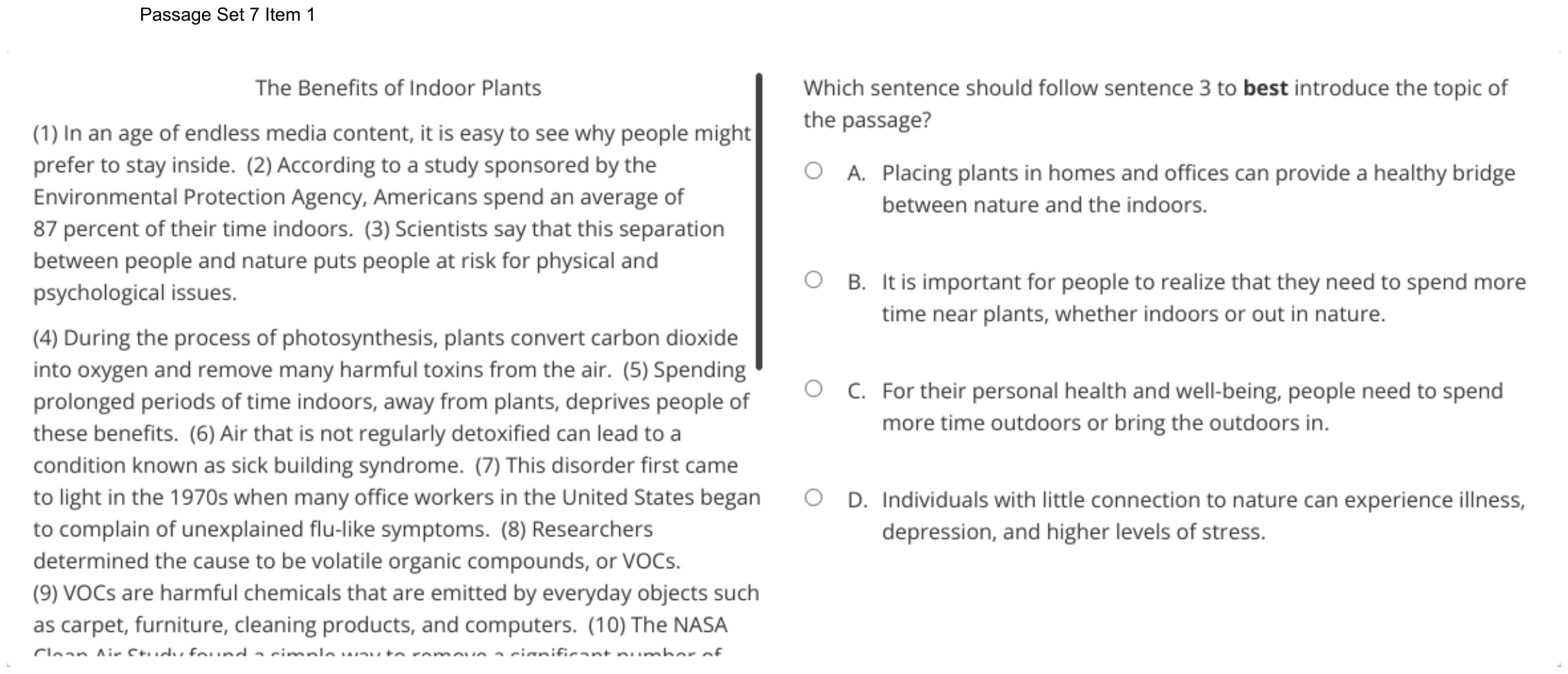
The Benefits of Indoor Plants
(1) In an age of endless media content, it is easy to see why people might prefer to stay inside. (2) According to a study sponsored by the Environmental Protection Agency, Americans spend an average of 87 percent of their time indoors. (3) Scientists say that this separation between people and nature puts people at risk for physical and psychological issues.
(4) During the process of photosynthesis, plants convert carbon dioxide into oxygen and remove many harmful toxins from the air. (5) Spending prolonged periods of time indoors, away from plants, deprives people of these benefits. (6) Air that is not regularly detoxified can lead to a condition known as sick building syndrome. (7) This disorder first came to light in the 1970s when many office workers in the United States began to complain of unexplained flu-like symptoms. (8) Researchers determined the cause to be volatile organic compounds, or VOCs. (9) VOCs are harmful chemicals that are emitted by everyday objects such as carpet, furniture, cleaning products, and computers. (10) The NASA Clean Air Study found a simple way to remove a significant number of VOCs within a 24-hour period: add plants to indoor spaces.
(11) Adding plants to indoor spaces has psychological benefits too. (12) Research has long linked time spent in natural environments with increased energy and feelings of contentment. (13) While being outdoors is an excellent option for improving a person’s mental health, recent research has indicated that encountering natural elements while indoors can also help. (14) To experience the maximum benefit of natural elements, experts suggest placing at least one live plant per 100 square feet of home or office space.
(15) Connecting with nature, even just by being near an indoor plant, is a significant factor in a person’s well-being. (16) Sitting in front of an electronic screen all day isn’t natural, and today’s workers need to get up and get outdoors. (17) Richard Ryan, a psychology professor at the University of Rochester, puts it this way: “Nature is something within which we flourish, so having it be more a part of our lives is critical, especially when we live and work in built environments.”
Question
Which sentence should follow sentence 3 to best introduce the topic of the passage?
- APlacing plants in homes and offices can provide a healthy bridge between nature and the indoors.
- BIt is important for people to realize that they need to spend more time near plants, whether indoors or out in nature.
- CFor their personal health and well-being, people need to spend more time outdoors or bring the outdoors in.
- DIndividuals with little connection to nature can experience illness, depression, and higher levels of stress.
Show the answer
Correct answer: A
The question asks which sentence should follow sentence 3 to best introduce the topic of the passage.
A. CORRECT. The sentence introduces the overall topic by previewing the main ideas in the passage. It introduces the connection between natural elements and well-being (“a healthy bridge”) and sets up the main argument of the passage (“Placing plants in homes and offices” can increase people’s well-being).
B. Incorrect. Although sentence 3 mentions the connection between “people and nature,” this sentence references the importance of spending time near plants while both indoors and outdoors. However, the passage focuses specifically on the benefits of having indoor plants.
C. Incorrect: Though the sentence describes a reason why indoor plants are important (“For [people’s] personal health and well-being”), the topic of the passage is related to the need for indoor plants, not the need for people to spend more time outdoors.
D. Incorrect. While the sentence refers to how time away from nature can affect health and well-being, the vague wording (“little connection to nature”) makes this sentence too broad to introduce the topic of the passage, and thus, it should not follow sentence 3.
Question analysis
This revising question works with the four-paragraph passage “The Benefits of Indoor Plants” and asks which sentence should follow sentence 3 to introduce the passage's topic. The opening paragraph ends on the health risks of time spent away from nature, and every choice continues that thought in some way, so students must judge which one prepares a reader for what the passage goes on to cover.
- NYS standards
- 7W2a introducing and organizing a topic
- Grade level
- Grade 7 reading and task
- Compared with grade 7
- At grade 7 Introducing a topic so that it previews what follows is a grade 7 writing standard, practised often in class. The passage is short and plainly worded, and the choices differ in focus rather than in grammar, typical grade 7 revision.
- Estimated difficulty
- Moderate: several steps, or a close reading with one strong distractor.
- Thinking it demands
- Depth of knowledge 2, skills and concepts · mainly evaluate
- What makes it hard
- A very close wrong answer moderate
- Evidence in several places moderate
- How sentences fit together minor
- Evidence
- Answered from the whole text
- Reading level
- Passage: about grade 12, 346 words; question and choices: about grade 9, 84 words.
- Students, last 30 days
- Not enough answers yet to show (it takes 10).
Why it is hard, traps and wrong answers (shows the answer)
Why it is hard
The first paragraph ends on a problem, and all four choices continue it plausibly, so the decision is about scope. The passage is about plants indoors, and the near miss offers outdoor time as an equal remedy, while another widens the subject to plants anywhere and a third simply restates the danger. Students who skim the topic sentences of the later paragraphs before choosing see that only an indoor solution introduces what follows.
A very close wrong answer moderate Choosing the answer
The choice ending “or bring the outdoors in” sounds like the key's “bridge between nature and the indoors,” but it adds spending more time outdoors, a remedy the passage does not develop. (Embretson & Wetzel, 1987; Gorin & Embretson, 2006; Ascalon et al., 2007)
Evidence in several places moderate Working it out
The topic only emerges from the later paragraphs: plants cleaning indoor air in sentences 4–10, their psychological benefits in 11–14, and nature brought indoors in 15–17. (Kirsch & Mosenthal, 1990; Gorin & Embretson, 2006)
How sentences fit together minor Working it out
The new sentence must follow sentence 3's warning about “separation between people and nature” and lead into sentence 4's photosynthesis, so it has to name plants as the remedy. (Halliday & Hasan, 1976)
Strategy: Skim the first sentence of each later paragraph to see what the passage actually covers, then test each choice: would it set up those paragraphs without promising something they never discuss?
Traps
- Half right: One half of a two-part choice is right and the other is not.
- Too broad or too strong: A choice overstates, generalizes, or uses absolute words the text does not support.
- Says it twice: Repeats an idea that the sentence or passage already states.
The wrong answers, classified
B Too broad or too strong (King et al., 2004)
Accepts a sentence about needing plants, but “whether indoors or out in nature” widens the subject to plants anywhere, while the passage discusses only plants inside.
C Half right (King et al., 2004; Thissen, Steinberg & Fitzpatrick, 1989)
Is drawn by “bring the outdoors in” and “health and well-being,” but the other half, spending more time outdoors, is a remedy the passage never goes on to develop.
D Says it twice (Connors & Lunsford, 1988)
Follows sentence 3 smoothly by naming illness, depression and stress, but that only restates its “physical and psychological issues” and never introduces plants, the passage's subject.
Working it out, step by step
Figure out what the question asks
This revising question asks you to add a sentence that introduces the topic. Such a sentence tells the reader what the passage will be about. For example, an essay about why dogs make good pets might start: Dogs make loyal, loving pets. The new sentence goes after sentence 3, so it must also follow from it.
Find the passage’s topic
Skim the rest of the passage. Sentences 4–10 tell how plants clean indoor air. Sentences 11–14 say plants indoors help the mind. Sentences 15–17 say even an indoor plant connects you with nature. So the topic is plants inside homes and offices. The title says it too: “The Benefits of Indoor Plants.”
Connect it to sentence 3
Sentence 3 names a problem: “this separation between people and nature puts people at risk for physical and psychological issues.” Psychological means having to do with the mind and feelings. The best next sentence should name the fix the passage talks about: bringing plants indoors.
Check each choice
- A is right. It names plants “in homes and offices” as “a healthy bridge between nature and the indoors.” A bridge connects two things, so plants bring nature inside. That sets up every later paragraph.
- B is wrong. “Whether indoors or out in nature” widens the topic to plants anywhere. The passage only discusses plants inside.
- C is wrong. It offers two fixes: more time outdoors, or bringing the outdoors in. The passage develops only the second. C never even mentions plants.
- D is wrong. It just repeats sentence 3’s problem in new words. It never brings up plants, the subject of the passage.
Look closely at choice C
Watch out: C sounds close because of “bring the outdoors in.” But the passage gives no tips for spending more time outside. Sentence 13 mentions being outdoors only on its way to the indoor point. So half of C promises something the passage never delivers.
Choose the answer
Only one choice moves from sentence 3’s problem to the passage’s answer, plants inside. So the answer is A.
Why this answer and not the closest wrong one
C is the closest wrong answer, because “bring the outdoors in” sounds like A. But C gives equal weight to spending more time outdoors, and the passage never develops that idea. A points only to plants indoors, which is exactly what the rest of the passage is about.
More questions like this
The original DOE question
The passage “The Benefits of Indoor Plants” as printed (page 60)
Question 2 of 43
2026 Practice Test A English, question 44Uses the passage above: “The Benefits of Indoor Plants”.
Question
Which transition word or phrase should be added to the beginning of sentence 5 to emphasize the relationship between sentences 4 and 5?
Move the correct answer to the box.
(5) ____ spending prolonged periods of time indoors, away from plants, deprives people of these benefits.
On the test you drag one of the tiles into the box; here, choose it.
- AAs a result,
- BPrimarily,
- CIn contrast,
- DUnfortunately,
Show the answer
Correct answer: D
The question asks for the transition word or phrase that should be added to the beginning of sentence 5.
“As a result,” is incorrect and should not be added. The transition phrase “As a result” conveys a cause-and-effect relationship that does not exist between the ideas in sentence 4 and sentence 5. Although the plants’ conversion of carbon dioxide into oxygen removes harmful toxins from the air, the process of photosynthesis (sentence 4) does not deprive people of the plants’ benefits (sentence 5).
“Primarily,” is incorrect and should not be added. Although the passage describes why people should spend time nearby or in close proximity to plants, the idea in sentence 5 shifts from the benefits described in sentence 4 to what people lose without them, rather than elaborating on sentence 4. The transition word “Primarily” incorrectly suggests that the sentences describe the same idea.
“In contrast,” is incorrect and should not be added. Although sentence 4 describes a positive idea (plants are beneficial) and sentence 5 describes a negative idea (deprivation), the transition phrase “In contrast” conveys an inaccurate relationship between the ideas in the sentences. Sentence 5 is not arguing against the beneficial effect of plants and should not begin with a transition that implies opposition.
“Unfortunately,” is correct and should be added. The relationship between the ideas in the sentences is correctly conveyed with the transition word “Unfortunately,” which signals the shift from the positive effect described in sentence 4 (plants are helpful) to the emphasis in sentence 5 that the positive effect is dependent on proximity or nearness to plants.
Question analysis
In this revising question, sentence 5 of the indoor-plants passage has a blank at its start, and on the test students move one of four word tiles into the box. They must decide how sentence 5, on what long stretches indoors cost people, relates to sentence 4, on what plants do for the air, since every tile is a common transition that sounds possible.
- NYS standards
- 7W2d transitions in informative writing
- Grade level
- Grade 7 reading and task
- Compared with grade 7
- At grade 7 Choosing a transition that shows how two sentences relate is routine grade 7 writing work. The two sentences are short and the four options familiar, but more than one sounds acceptable on a first reading, so the demand is a careful but typical one.
- Estimated difficulty
- Moderate: several steps, or a close reading with one strong distractor.
- Thinking it demands
- Depth of knowledge 2, skills and concepts · mainly evaluate
- What makes it hard
- How sentences fit together moderate
- Reading between the lines minor
- Evidence
- Answered from one paragraph or stanza
- Reading level
- Passage: about grade 12, 346 words; question and choices: about grade 7, 48 words.
- Corrected from the DOE handbook
- The explanation contradicted itself about how sentences 4 and 5 relate; one sentence was corrected.
- Students, last 30 days
- Not enough answers yet to show (it takes 10).
Why it is hard, traps and wrong answers (shows the answer)
Why it is hard
Two of the tiles name relationships that seem to fit at first: sentence 5 does follow from sentence 4, and it does turn from good news to bad. Neither is exact, because spending time indoors is not caused by photosynthesis, and missing out on a benefit does not oppose it. The answer is a word of regret rather than a logical connector, which students trained on cause and contrast words may not consider first.
How sentences fit together moderate Working it out
Sentence 5's “these benefits” points back to sentence 4's cleaner air, and the link is a downside of what was just praised, people indoors missing out, which neither cause nor opposition captures. (Halliday & Hasan, 1976)
Reading between the lines minor Working it out
The right tile signals the writer's regret rather than a logical link, so students who look only for cause, contrast or emphasis must infer that a negative turn is what the sentences need. (Graesser, Singer & Trabasso, 1994; Kintsch, 1998)
Strategy: Say in your own words what sentence 4 states and what sentence 5 adds, name the link between them before looking at the tiles, then reject any tile that claims a relationship the sentences do not have.
Traps
- Wrong transition: A connecting word or phrase that signals the wrong relationship, such as contrast where the idea continues.
The wrong answers, classified
A Wrong transition (Halliday & Hasan, 1976)
Hears sentence 5 as a consequence of sentence 4, but time spent indoors is not a result of photosynthesis; the loss comes from being away from plants.
B Wrong transition (Halliday & Hasan, 1976)
Uses “Primarily” to stress sentence 5's point, but the word ranks one idea above others and expresses no relationship to sentence 4 at all.
C Wrong transition (Halliday & Hasan, 1976)
Senses the turn from plants' benefits to people missing them and calls it a contrast, but sentence 5 does not dispute sentence 4; it depends on its “these benefits.”
What was corrected from the DOE handbook, and why
- Explanation: Rejecting “Primarily,”, the handbook's explanation says sentence 5 “is actually in opposition to the idea in sentence 4”. Rejecting “In contrast,”, the same explanation says sentence 5 “is not arguing against the beneficial effect of plants and should not begin with a transition that implies opposition”, and it explains the answer as a shift from the benefits to what people lose. The first sentence now describes that shift. The answer, “Unfortunately,”, is unchanged.
Working it out, step by step
Figure out what the question asks
You need a transition to start sentence 5. A transition is a word or phrase that shows how two ideas connect. On the test, you drag one tile into the box. To choose, first work out how sentence 5 connects to sentence 4.
Read sentences 4 and 5
Sentence 4 gives good news. Photosynthesis is how plants make food from sunlight, air and water. As they do it, plants “convert carbon dioxide into oxygen and remove many harmful toxins from the air.” Toxins are poisons. Sentence 5 says that spending long stretches indoors, away from plants, “deprives people of these benefits.” To deprive means to keep someone from having something.
Name the link between them
“These benefits” points back to sentence 4. So sentence 5 doesn’t argue with sentence 4. It agrees that plants help. Then it adds bad news: people stuck indoors miss out on that help. You need a word that turns from good news to a downside.
Learn what each tile signals
- As a result, shows cause and effect: It rained hard. As a result, the game was canceled.
- Primarily, means mainly. It ranks one thing above others.
- In contrast, shows two things that are opposites: Cats like to be alone. In contrast, dogs like company.
- Unfortunately, signals bad news: The pool is great. Unfortunately, it is closed today.
Test each tile in sentence 5
- A, As a result, is wrong. Photosynthesis doesn’t cause people to stay indoors. Sentence 4 is not the cause of sentence 5.
- B, Primarily, is wrong. It shows no link to sentence 4 at all.
- C, In contrast, is wrong. Sentence 5 doesn’t oppose sentence 4. It builds on “these benefits.”
- D, Unfortunately, is right. It turns from what plants do for us to what we lose without them.
Watch out: The ideas do go from good to bad, so “In contrast” is tempting. But missing out on a benefit is not the opposite of the benefit. That is the trap in C.
Choose the answer
With the tile in place, sentence 5 reads: Unfortunately, spending prolonged periods of time indoors, away from plants, deprives people of these benefits. Prolonged means long. So the answer is D: move the tile “Unfortunately,” into the box.
Why this answer and not the closest wrong one
“In contrast,” is the closest wrong tile, since sentence 5 does turn from good news to bad. But a contrast needs two ideas that pull against each other. Sentence 5 depends on sentence 4’s “these benefits” and says people miss them. “Unfortunately,” fits that turn exactly.
More questions like this
The original DOE question
Question 3 of 43
2026 Practice Test A English, question 45Uses the passage above: “The Benefits of Indoor Plants”.
Question
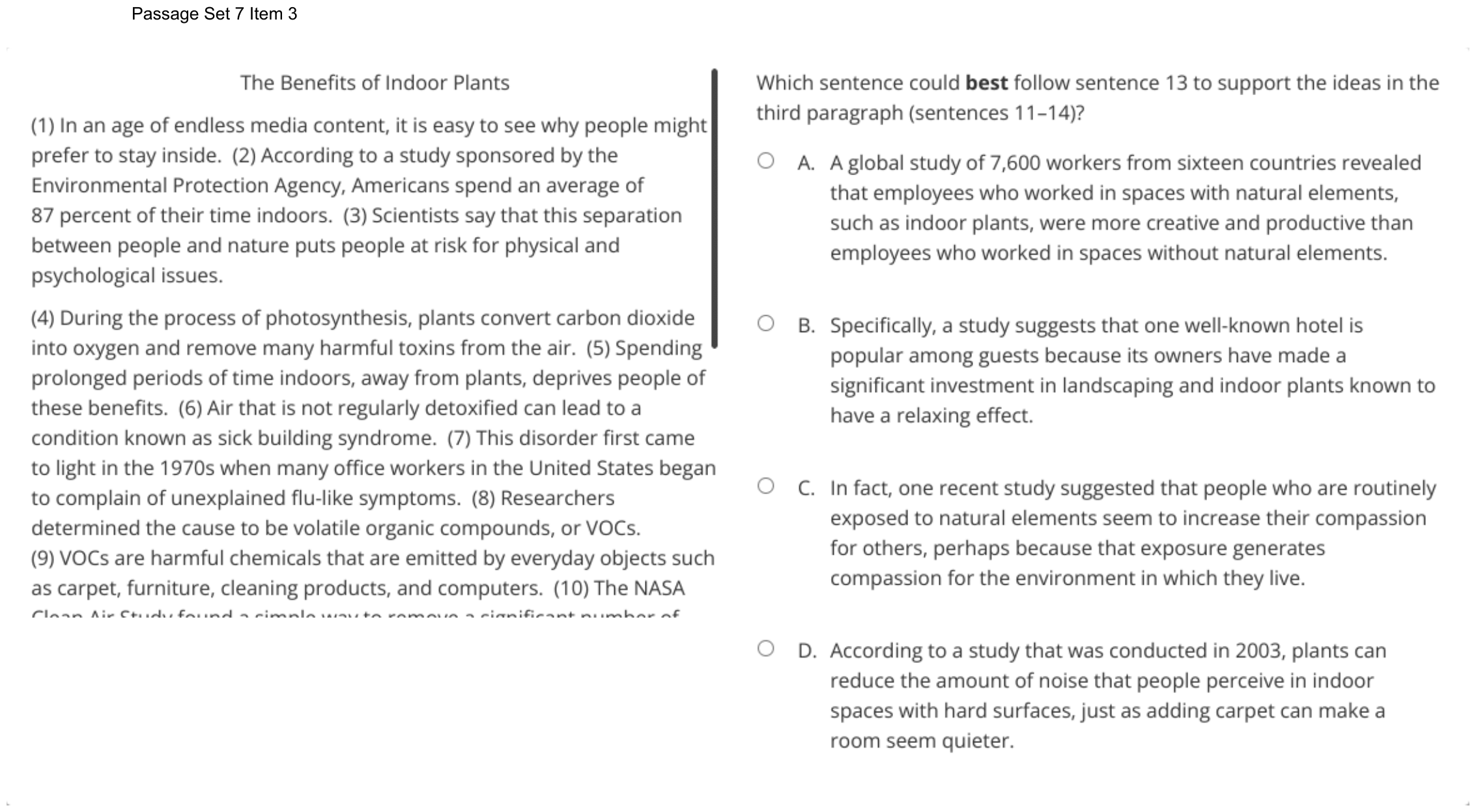
Which sentence could best follow sentence 13 to support the ideas in the third paragraph (sentences 11–14)?
- AA global study of 7,600 workers from sixteen countries revealed that employees who worked in spaces with natural elements, such as indoor plants, were more creative and productive than employees who worked in spaces without natural elements.
- BSpecifically, a study suggests that one well-known hotel is popular among guests because its owners have made a significant investment in landscaping and indoor plants known to have a relaxing effect.
- CIn fact, one recent study suggested that people who are routinely exposed to natural elements seem to increase their compassion for others, perhaps because that exposure generates compassion for the environment in which they live.
- DAccording to a study that was conducted in 2003, plants can reduce the amount of noise that people perceive in indoor spaces with hard surfaces, just as adding carpet can make a room seem quieter.
Show the answer
Correct answer: A
The question asks for the sentence that could best follow sentence 13 to support the ideas in the third paragraph (sentences 11–14).
A. CORRECT. The sentence could best follow sentence 13 because it directly supports the main idea of the third paragraph that indoor plants provide “psychological benefits” (sentence 11) by presenting the findings of a relevant research study. The details about the study provide a concrete example of the mental benefits of indoor plants: the employees in the study who worked near plants “were more creative” and accomplished more than those who worked in spaces without plants.
B. Incorrect. Although the sentence describes a study in which indoor plants were found to have a positive effect, it does not clearly support the ideas in sentences 11–14, because the sentence focuses on the popularity of the hotel rather than psychological benefits. Therefore, this sentence does not best follow sentence 13 to support the ideas in the third paragraph.
C. Incorrect. Although the sentence suggests that being “routinely exposed to natural elements” can increase the positive emotion of compassion, it could not best follow sentence 13, because the reference to “natural elements” is too vague to sufficiently support the ideas in the third paragraph. The sentence does not logically follow the idea from sentence 13, which refers specifically to “encountering natural elements while indoors.”
D. Incorrect. The sentence develops the idea that indoor plants are helpful by comparing them to carpeting and stating that they can reduce the amount of noise that people perceive. Noise cancellation, though convenient, is irrelevant to the topic of the third paragraph, which is specific to the psychological benefits of indoor plants. Therefore, this sentence does not best follow sentence 13 to support the ideas in the third paragraph.
Question analysis
This supporting-details question asks which sentence could best follow sentence 13 to back up the third paragraph (sentences 11–14) of the indoor-plants passage. All four options report a study or finding about plants or nature, so students must check each against what the paragraph is about and where sentence 13 leaves off.
- NYS standards
- 7W2b developing a topic
- Grade level
- Grade 8 reading and task
- Compared with grade 7
- Above grade 7 Grade 7 writers choose relevant evidence for a point. Here each option is a long sentence describing a plausible study, and the best fit depends on matching the paragraph's exact point, a finer judgment than typical grade 7 work.
- Estimated difficulty
- Hard: combines ideas, needs a plan, and has more than one tempting wrong answer.
- Thinking it demands
- Depth of knowledge 2, skills and concepts · mainly evaluate
- What makes it hard
- A very close wrong answer moderate
- How sentences fit together moderate
- A lot to read minor
- Evidence
- Answered from one paragraph or stanza
- Reading level
- Passage: about grade 12, 346 words; question and choices: about grade 15, 151 words.
- Students, last 30 days
- Not enough answers yet to show (it takes 10).
Why it is hard, traps and wrong answers (shows the answer)
Why it is hard
Every option cites a study about plants or nature, and two name feelings, a relaxing effect and compassion, which sound more psychological than the key's creativity and productivity. The decision rests on two conditions from the paragraph: the benefit must be psychological, and the nature must be indoors. Students who test only one condition end up with the compassion study, which is not about indoor spaces, or the hotel, whose finding is about popularity.
A very close wrong answer moderate Choosing the answer
The compassion choice and the key both report a study tying natural elements to a mental effect; the compassion study drops the indoor setting that sentence 13 specifies and turns to caring for others. (Embretson & Wetzel, 1987; Gorin & Embretson, 2006; Ascalon et al., 2007)
How sentences fit together moderate Working it out
The added sentence sits between sentence 13's research on “encountering natural elements while indoors” and sentence 14's one plant per 100 square feet, so it must give evidence about nature indoors. (Halliday & Hasan, 1976)
A lot to read minor Understanding the question
The options run 31 to 37 words, each describing a different study, so four separate findings must be read and held against the paragraph's point. (Kintsch, 1998; Gorin & Embretson, 2006; Freedle & Kostin, 1993)
Strategy: Restate sentences 11 and 13 in your own words, then ask of each option whether it gives evidence for that exact point or for a related benefit the paragraph does not discuss.
Traps
- Off the point: Adds or keeps something that does not support the paragraph's or the passage's focus, or an introduction or conclusion that misses the main point.
- Too broad or too strong: A choice overstates, generalizes, or uses absolute words the text does not support.
The wrong answers, classified
B Off the point (Halliday & Hasan, 1976)
Spots indoor plants and a “relaxing effect,” but the finding is that a hotel is popular with guests, a business result rather than evidence about people's well-being.
C Too broad or too strong (King et al., 2004)
Sees compassion as a psychological benefit, but the study covers exposure to “natural elements” in general, not the indoor encounters of sentence 13, and its benefit is caring for others.
D Off the point (Halliday & Hasan, 1976)
Accepts any benefit of indoor plants, but rooms that seem quieter are an acoustic advantage, not the psychological effects that sentence 11 names as the paragraph's subject.
Working it out, step by step
Figure out what the question asks
This revising question asks for a supporting detail. A supporting detail is a fact or example that backs up a paragraph’s point. The new sentence goes after sentence 13, in the third paragraph. So first pin down that paragraph’s exact point.
Find the paragraph’s point
Sentence 11 states it: “Adding plants to indoor spaces has psychological benefits too.” Psychological benefits are good effects on the mind and feelings. Sentence 13 adds that “encountering natural elements while indoors can also help.” Natural elements are bits of nature, like plants.
Set two tests
So the new sentence must pass two tests. First, it must show a benefit for the mind. Second, it must be about nature indoors. Think of a paragraph about how bedtime reading helps kids sleep. A study about bedtime reading would fit. A study about reading on the bus would not.
Check each choice
- A is right. Workers near “natural elements, such as indoor plants,” were “more creative and productive.” Creative means good at new ideas. Productive means getting more done. Both are benefits for the mind, and the plants are indoors.
- B is wrong. The finding is that a hotel is popular with guests. That is about business, not people’s minds.
- C is wrong. It is about being “routinely exposed to natural elements” anywhere, not indoors. Its benefit is caring for others.
- D is wrong. Making a room seem quieter is about sound, not the mind.
Watch out: C names a feeling, compassion, so it sounds like a benefit for the mind. But it drops the indoor setting that sentence 13 is about.
Choose the answer
Only one choice shows a benefit for the mind from nature indoors. So the answer is A.
Why this answer and not the closest wrong one
C is the closest wrong answer, because compassion is a feeling. But its study is about natural elements in general, not inside a building. Sentence 13 is about nature indoors, and sentence 14 tells how many plants to put in a room. A fits right between them.
More questions like this
The original DOE question
Question 4 of 43
2026 Practice Test A English, question 46Uses the passage above: “The Benefits of Indoor Plants”.
Question
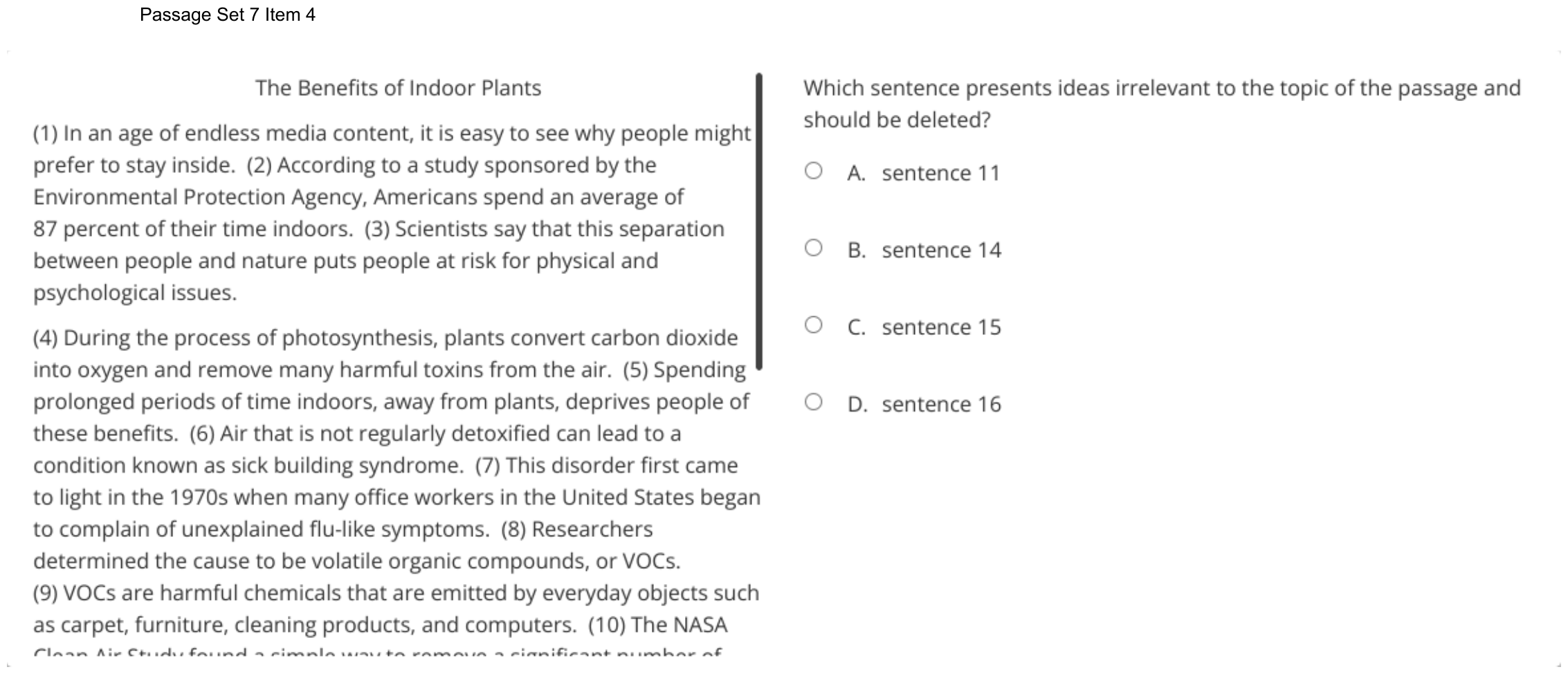
Which sentence presents ideas irrelevant to the topic of the passage and should be deleted?
- Asentence 11
- Bsentence 14
- Csentence 15
- Dsentence 16
Show the answer
Correct answer: D
The question asks for the sentence that presents ideas irrelevant to the topic of the passage and should be deleted.
A. Incorrect. Sentence 11 presents one of the key reasons why plants are so important in indoor spaces: they have a positive effect on mental health. The idea that plants provide psychological benefits is relevant to the topic of the passage, and the sentence should not be deleted.
B. Incorrect. Sentence 14 is relevant to the topic because it explains how many plants a person should add to a space in order to experience “the maximum benefit of natural elements.” This idea addresses the main topic of the passage, and the sentence should not be deleted.
C. Incorrect. Although “connecting with nature” is somewhat broader than the topic of the passage, sentence 15 is relevant and belongs in the passage because it specifically refers to using indoor plants as one way to connect with nature (“even just by being near an indoor plant”). Therefore, the sentence should not be deleted.
D. CORRECT. While the topic of the passage is the harm caused by the “separation between people and nature” (sentence 3), the reference in sentence 16 to “an electronic screen” is irrelevant to the topic of the passage. The idea that “today’s workers need to get up and get outdoors” (sentence 16) is, in fact, the opposite of what the passage argues, and the sentence should be deleted.
Question analysis
Which sentence in the last two paragraphs of the indoor-plants passage presents ideas irrelevant to its topic and should be deleted? Each of the four listed sentences mentions nature, plants or well-being in some way, so students must pin down exactly what the passage argues before deciding which one does not serve it.
- NYS standards
- 7W2b developing a topic
- Grade level
- Grade 7 reading and task
- Compared with grade 7
- At grade 7 Spotting a sentence that strays from a passage's topic is regular grade 7 revision work. The passage is short and plainly worded, and its topic is named in its title, so this is a typical grade 7 demand.
- Estimated difficulty
- Straightforward: two steps or one careful reading.
- Thinking it demands
- Depth of knowledge 2, skills and concepts · mainly analyze
- What makes it hard
- How sentences fit together moderate
- Every choice must be checked minor
- Evidence
- Answered from the whole text
- Reading level
- Passage: about grade 12, 346 words; question and choices: about grade 6, 19 words.
- Students, last 30 days
- Not enough answers yet to show (it takes 10).
Why it is hard, traps and wrong answers (shows the answer)
Why it is hard
The stray sentence is camouflaged by its links to the opening: screens recall the media of sentence 1, and “isn't natural” sounds like the passage's theme. What gives it away is its advice, to leave the building, when the passage argues for bringing nature into it, along with its chatty tone. Students who cut a sentence for being general or practical have judged by style rather than by the passage's claim.
How sentences fit together moderate Working it out
Sentence 16 echoes sentence 1's “endless media content” with its “electronic screen,” so it seems connected, yet its call to “get outdoors” pulls against a passage about bringing plants inside. (Halliday & Hasan, 1976)
Every choice must be checked minor Choosing the answer
The four listed sentences span paragraphs 3 and 4, and each mentions nature, plants or well-being, so each must be read in place and tested against the passage's point. (Embretson & Wetzel, 1987)
Strategy: Say in one phrase what the whole passage argues, then read each listed sentence in place and ask whether it supports that argument or steers the reader toward a different idea.
Traps
- Fixes what isn't broken: Changes a part of the sentence that was already correct, while the real error stays; or, where the question asks which sentence has an error or should go, picks one that is correct and belongs.
The wrong answers, classified
A Fixes what isn't broken (Connors & Lunsford, 1988)
Cuts sentence 11 because it turns from air quality to the mind, though it is the topic sentence of the paragraph on psychological benefits.
B Fixes what isn't broken (Connors & Lunsford, 1988)
Sees the advice of one live plant per 100 square feet as a practical aside, though it tells readers how to get the benefit the passage describes.
C Fixes what isn't broken (Connors & Lunsford, 1988)
Thinks sentence 15's “connecting with nature” strays beyond indoor plants, missing that “even just by being near an indoor plant” ties it directly to the passage's topic.
Working it out, step by step
Figure out what the question asks
You need to find the sentence that is off topic. Every sentence in a passage should support its main point. For example, in a paragraph about why dogs make good pets, My cousin has a red bike doesn’t belong. You would cut a sentence like that.
Name the passage’s topic
The title is “The Benefits of Indoor Plants.” The passage says plants inside clean the air and help the mind. Its fix for too much time indoors is to bring nature inside, with plants in homes and offices.
Read sentence 16 in place
Sentence 16 says, “Sitting in front of an electronic screen all day isn’t natural, and today’s workers need to get up and get outdoors.” It switches to screens. It tells workers to go outside. It never mentions plants. The passage doesn’t object to going outdoors. Sentence 13 even calls it “an excellent option.” But sentence 16 steers away from the topic, plants indoors, to a different fix.
Check each choice
- A is wrong. Sentence 11 is the third paragraph’s topic sentence: plants indoors help the mind.
- B is wrong. Sentence 14 tells how many plants to use, one per 100 square feet. That helps readers get the benefit.
- C is wrong. “Connecting with nature” sounds broad. But it adds “even just by being near an indoor plant,” which ties it to the topic.
- D is right. Sentence 16 is about screens and going outside, not indoor plants.
Watch out: Sentence 15 is tempting because it starts with a big idea. Read the whole sentence before you cut it.
Choose the answer
Without sentence 16, sentence 15 leads straight into the professor’s words about nature in our lives. Nothing is lost. So the answer is D, sentence 16.
Why this answer and not the closest wrong one
Sentence 15 is the closest wrong answer, because “connecting with nature” sounds wider than the topic. But it names an indoor plant, so it supports the passage. Sentence 16 names no plant at all. It sends workers outdoors, a different idea from bringing nature inside.
More questions like this
The original DOE question
Question 5 of 43
2026 Practice Test B English, question 43Passage The End of an Era
The End of an Era
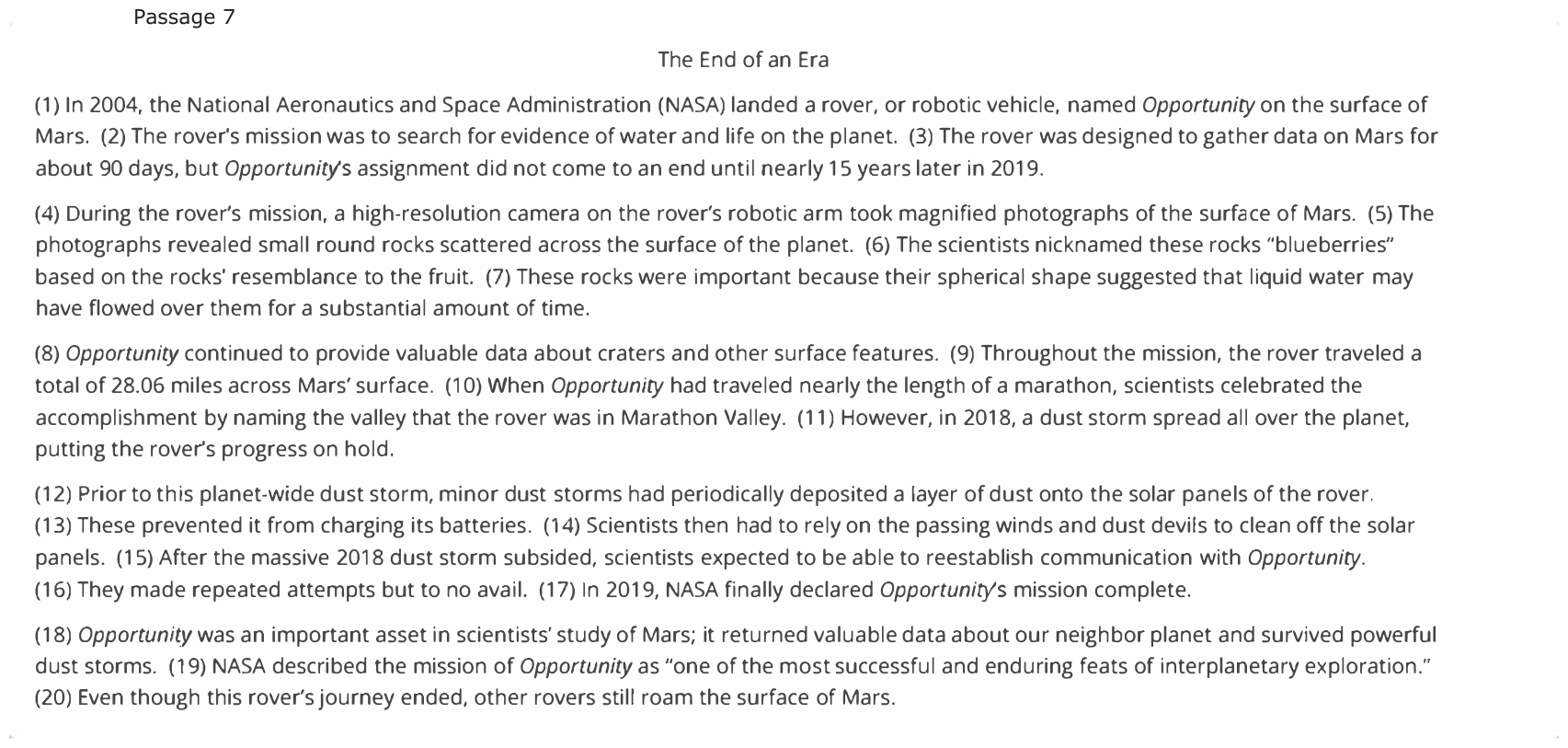
(1) In 2004, the National Aeronautics and Space Administration (NASA) landed a rover, or robotic vehicle, named Opportunity on the surface of Mars. (2) The rover’s mission was to search for evidence of water and life on the planet. (3) The rover was designed to gather data on Mars for about 90 days, but Opportunity’s assignment did not come to an end until nearly 15 years later in 2019.
(4) During the rover’s mission, a high-resolution camera on the rover’s robotic arm took magnified photographs of the surface of Mars. (5) The photographs revealed small round rocks scattered across the surface of the planet. (6) The scientists nicknamed these rocks “blueberries” based on the rocks’ resemblance to the fruit. (7) These rocks were important because their spherical shape suggested that liquid water may have flowed over them for a substantial amount of time.
(8) Opportunity continued to provide valuable data about craters and other surface features. (9) Throughout the mission, the rover traveled a total of 28.06 miles across Mars’ surface. (10) When Opportunity had traveled nearly the length of a marathon, scientists celebrated the accomplishment by naming the valley that the rover was in Marathon Valley. (11) However, in 2018, a dust storm spread all over the planet, putting the rover’s progress on hold.
(12) Prior to this planet-wide dust storm, minor dust storms had periodically deposited a layer of dust onto the solar panels of the rover. (13) These prevented it from charging its batteries. (14) Scientists then had to rely on the passing winds and dust devils to clean off the solar panels. (15) After the massive 2018 dust storm subsided, scientists expected to be able to reestablish communication with Opportunity. (16) They made repeated attempts but to no avail. (17) In 2019, NASA finally declared Opportunity’s mission complete.
(18) Opportunity was an important asset in scientists’ study of Mars; it returned valuable data about our neighbor planet and survived powerful dust storms. (19) NASA described the mission of Opportunity as “one of the most successful and enduring feats of interplanetary exploration.” (20) Even though this rover’s journey ended, other rovers still roam the surface of Mars.
Question
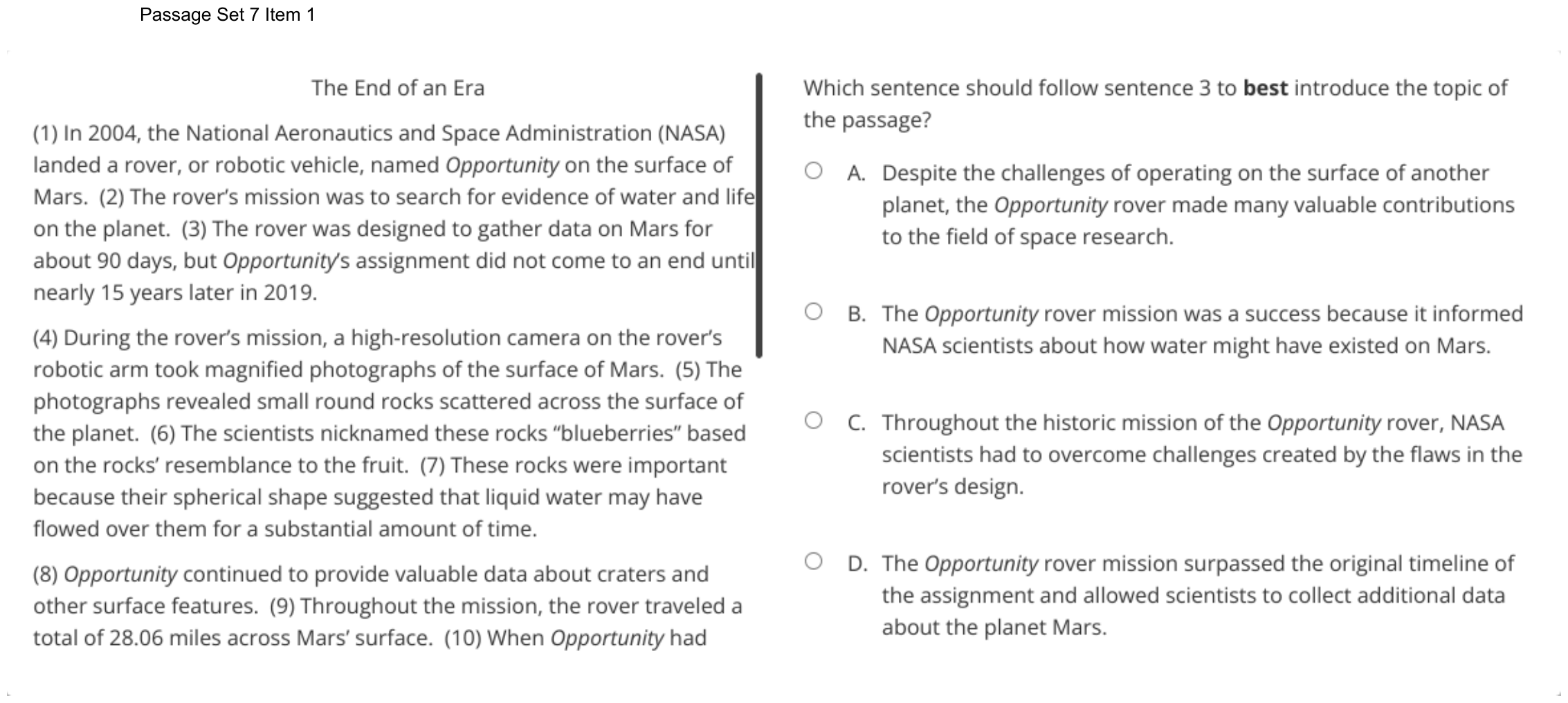
Which sentence should follow sentence 3 to best introduce the topic of the passage?
- ADespite the challenges of operating on the surface of another planet, the Opportunity rover made many valuable contributions to the field of space research.
- BThe Opportunity rover mission was a success because it informed NASA scientists about how water might have existed on Mars.
- CThroughout the historic mission of the Opportunity rover, NASA scientists had to overcome challenges created by the flaws in the rover’s design.
- DThe Opportunity rover mission surpassed the original timeline of the assignment and allowed scientists to collect additional data about the planet Mars.
Show the answer
Correct answer: A
The question asks for the sentence that should follow sentence 3 to best introduce the topic of the passage.
A. CORRECT. This sentence best introduces the passage’s topic: the Opportunity rover had many accomplishments on its mission, despite numerous challenges. Some of those accomplishments include providing high-resolution photographs (paragraph 2), traveling long distances (paragraph 3), and providing data about craters and other surface features (paragraph 3).
B. Incorrect. Although paragraph 2 discusses how photographs taken by the rover showed rocks that may have been shaped by water, this idea alone is not the topic of the entire passage.
C. Incorrect. While this sentence incorporates ideas about difficulties the scientists encountered because of the Opportunity rover’s design (paragraph 4), the main topic of the passage is not the design flaws and obstacles scientists encountered throughout the mission. The passage primarily focuses on the achievements of the mission.
D. Incorrect. While it is true that the Opportunity rover mission lasted much longer than planned (sentence 3), this fact is a supporting detail of the passage, not the main topic of the passage; surpassing the original timeline is only one of the rover’s many achievements mentioned in the passage.
Question analysis
This revising question works with “The End of an Era,” a passage about NASA's Opportunity rover on Mars, and asks which sentence should follow sentence 3 to best introduce the topic. Students must keep the whole passage in view, from the rover's photographs and travels to the dust storms that ended its mission, and judge which choice previews it best.
- NYS standards
- 7W2a introducing and organizing a topic
- Grade level
- Grade 7 reading and task
- Compared with grade 7
- At grade 7 Choosing a sentence that introduces a passage's topic is a standard grade 7 writing task. The passage is twenty plain sentences about one rover mission, and every choice draws on that mission, so it calls for a typical careful comparison.
- Estimated difficulty
- Moderate: several steps, or a close reading with one strong distractor.
- Thinking it demands
- Depth of knowledge 2, skills and concepts · mainly evaluate
- What makes it hard
- Evidence in several places moderate
- How sentences fit together minor
- Evidence
- Answered from the whole text
- Reading level
- Passage: about grade 11, 337 words; question and choices: about grade 14, 101 words.
- Students, last 30 days
- Not enough answers yet to show (it takes 10).
Why it is hard, traps and wrong answers (shows the answer)
Why it is hard
Sentence 3 already tells a striking story, a 90-day mission that lasted nearly fifteen years, and the most tempting continuation simply repeats it in new words. The other near misses each pick one part of the passage, the water evidence or the dust problems, and make it the whole. The question rewards skimming every paragraph first and choosing the sentence that covers both the achievements and the hardships, the pairing the final paragraph makes.
Evidence in several places moderate Working it out
The topic only emerges from the later paragraphs: the “blueberries” of sentences 4–7, the 28.06 miles of paragraph 3, the dust storms of paragraph 4 and NASA’s praise in sentence 19. (Kirsch & Mosenthal, 1990; Gorin & Embretson, 2006)
How sentences fit together minor Working it out
The new sentence follows sentence 3’s surprise that a 90-day mission lasted nearly 15 years, so it must turn from that fact to what the mission achieved. (Halliday & Hasan, 1976)
Strategy: Skim the opening sentence of each later paragraph to see what the passage covers, then ask which choice would prepare a reader for all of it.
Traps
- Too narrow: A single detail offered as the central idea or a summary, or a summary that keeps minor details and leaves out an essential part.
- Says it twice: Repeats an idea that the sentence or passage already states.
- Off the point: Adds or keeps something that does not support the paragraph's or the passage's focus, or an introduction or conclusion that misses the main point.
The wrong answers, classified
B Too narrow (King et al., 2004)
Picks the water finding of paragraph 2, a real result, but it covers one paragraph and leaves out the rover’s travels, its endurance and the dust storms.
C Off the point (Halliday & Hasan, 1976)
Builds on the dust that blocked the solar panels in paragraph 4, but the passage never blames flaws in the rover’s design and dwells on its achievements.
D Says it twice (Connors & Lunsford, 1988)
Follows sentence 3 smoothly, but saying the mission “surpassed the original timeline” only restates the 90 days that became 15 years instead of introducing what comes next.
Working it out, step by step
Figure out what the question asks
This revising question asks for a sentence to add after sentence 3. It should introduce the topic of the whole passage. A good introduction gives a preview, a quick look at everything coming. It doesn’t repeat one fact or zoom in on one part. For example, a report on a soccer season might begin: The team lost two stars but still won the title. That previews both the struggles and the wins.
Skim each paragraph
- Paragraph 2 (sentences 4–7): The rover’s camera found small round rocks that hinted at water.
- Paragraph 3 (sentences 8–11): It sent data and traveled 28.06 miles. Then a huge dust storm stopped it.
- Paragraph 4 (sentences 12–17): Dust had covered its solar panels before. After the 2018 storm, NASA could not reach it.
- Paragraph 5 (sentences 18–20): It “returned valuable data about our neighbor planet and survived powerful dust storms.”
Name the topic
So the passage covers two things. One is what the rover achieved: photos, data and miles. The other is its challenges, mainly the dust storms. Challenges are hard problems. Sentence 18 puts both together. The new sentence should preview both.
Check each choice
- A is right. It names the challenges and the “many valuable contributions.” That covers the whole passage.
- B is wrong. Water is only paragraph 2. It leaves out the travel and the dust storms.
- C is wrong. The passage never blames flaws in the rover’s design. It mostly praises the rover.
- D is wrong. Sentence 3 already says the mission lasted far past 90 days. D repeats it instead of looking ahead.
Watch out: D follows sentence 3 smoothly, so it sounds right. But it only restates sentence 3 in new words.
Choose the answer
So the answer is A: “Despite the challenges of operating on the surface of another planet, the Opportunity rover made many valuable contributions to the field of space research.”
Why this answer and not the closest wrong one
D is the closest wrong answer, because it flows right after sentence 3. But it only repeats that the mission lasted longer than planned. A previews both halves of the passage: the rover’s achievements and the challenges it survived. Sentence 18 sums up the same two ideas.
More questions like this
The original DOE question
The passage “The End of an Era” as printed (page 60)
Question 6 of 43
2026 Practice Test B English, question 44Uses the passage above: “The End of an Era”.
Question
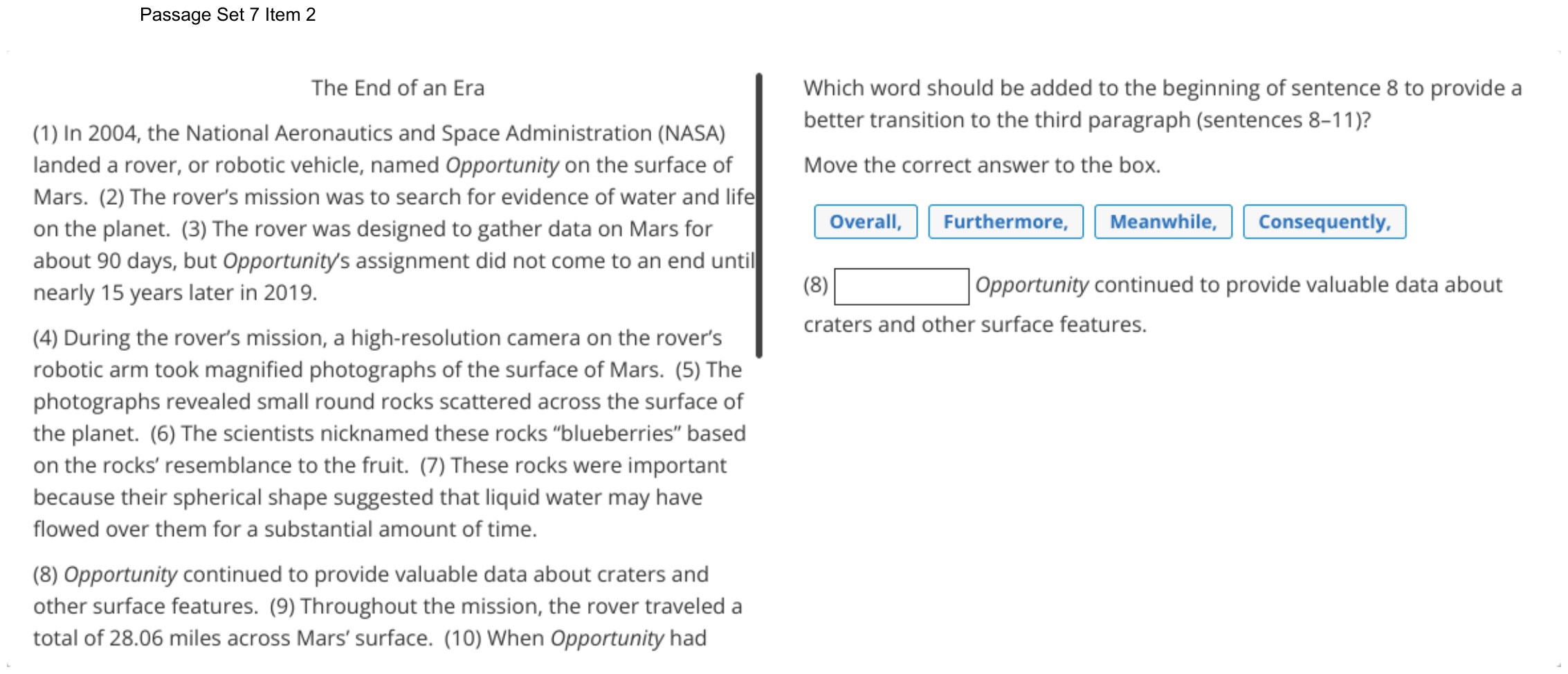
Which word should be added to the beginning of sentence 8 to provide a better transition to the third paragraph (sentences 8–11)?
Move the correct answer to the box.
(8) ____ Opportunity continued to provide valuable data about craters and other surface features.
On the test you drag one of the tiles into the box; here, choose it.
- AOverall,
- BFurthermore,
- CMeanwhile,
- DConsequently,
Show the answer
Correct answer: C
The question asks for the word that should be added to the beginning of sentence 8 to provide a better transition to the third paragraph (sentences 8–11).
“Overall,” is incorrect and should not be added. While sentence 8 is a more general statement than sentence 7, the word “Overall” would imply that all of the third paragraph features general information about the Opportunity rover. Instead, paragraphs 2 and 3 both describe specific accomplishments of the Opportunity rover (the discovery of possible water on Mars and the distance the rover traveled), so these paragraphs require a word between them that does not transition from the specific to the general.
“Furthermore,” is incorrect and should not be added. The word “Furthermore” would suggest that the author is making an argument in paragraph 2 that is further developed by the statement in sentence 8 and the rest of paragraph 3. Because this is not the case, the word “Furthermore” is not a suitable transition from one paragraph to the next.
“Meanwhile,” is correct and should be added. The word “Meanwhile” is an appropriate transition to add to the beginning of sentence 8, since the actions of the Opportunity rover in paragraph 2 (taking photographs) and in paragraph 3 (traveling long distances) happened at the same time and both served critical functions to the overall mission.
“Consequently,” is incorrect and should not be added. The word “Consequently” would create a cause-and-effect relationship that does not exist between the paragraphs. The passage gives no indication that the rover’s actions in the third paragraph (traveling a far distance) resulted from the actions in the second paragraph (taking photographs).
Question analysis
In this transition question, sentence 8 opens the third paragraph of the Opportunity rover passage with a blank, and on the test students move one of four word tiles into the box. The paragraph before ends with the “blueberries,” small round rocks that hinted at water, so students must decide how the rover's further work relates to that discovery.
- NYS standards
- 7W2d transitions in informative writing
- Grade level
- Grade 7 reading and task
- Compared with grade 7
- Above grade 7 Choosing a transition is regular grade 7 writing work, but this one links two paragraphs, and two of the four words fit the sentence's grammar and sound natural, so the choice turns on exactly how the paragraphs relate.
- Estimated difficulty
- Hard: combines ideas, needs a plan, and has more than one tempting wrong answer.
- Thinking it demands
- Depth of knowledge 2, skills and concepts · mainly evaluate
- What makes it hard
- A very close wrong answer moderate
- How sentences fit together moderate
- Reading between the lines minor
- Evidence
- Answered from several paragraphs or stanzas
- Reading level
- Passage: about grade 11, 337 words; question and choices: about grade 9, 43 words.
- Students, last 30 days
- Not enough answers yet to show (it takes 10).
Why it is hard, traps and wrong answers (shows the answer)
Why it is hard
Two tiles sound natural in the blank, and the one most students reach for first is an all-purpose adding word. The key goes a step further: it marks the rover’s work in paragraph 3 as happening alongside the photographs of paragraph 2, a relationship the word “continued” supports. Students who test each tile against how the paragraphs relate, rather than against the sound of the sentence, also rule out a summing-up word and a cause word.
A very close wrong answer moderate Choosing the answer
“Furthermore” and “Meanwhile” both let paragraph 3 add to paragraph 2; only “Meanwhile” also says the rover’s further work went on during the same mission, as “continued” implies. (Embretson & Wetzel, 1987; Gorin & Embretson, 2006; Ascalon et al., 2007)
How sentences fit together moderate Working it out
The tile must link the “blueberries” of paragraph 2 to the craters and miles of paragraph 3, so students must decide how two paragraphs relate, not just two sentences. (Halliday & Hasan, 1976)
Reading between the lines minor Working it out
The timing is never stated; it comes from “During the rover’s mission” in sentence 4 and “continued” in sentence 8, which place both kinds of work in the same years. (Graesser, Singer & Trabasso, 1994; Kintsch, 1998)
Strategy: State in your own words how what the rover did in paragraph 2 relates to what it did in paragraph 3, then test the relationship each tile signals against that.
Traps
- Wrong transition: A connecting word or phrase that signals the wrong relationship, such as contrast where the idea continues.
The wrong answers, classified
A Wrong transition (Halliday & Hasan, 1976)
Treats sentence 8 as a summing up because it is broader than sentence 7, though paragraph 3 goes on to give new specifics such as the 28.06 miles.
B Wrong transition (Halliday & Hasan, 1976)
Adds paragraph 3 as one more achievement, which sounds natural, but “Furthermore” signals a point being built up, not two kinds of work carried on during one mission.
D Wrong transition (Halliday & Hasan, 1976)
Hears “continued” as a result of the blueberry discovery and adds a cause-and-effect link, though nothing says the rover’s later work followed from its photographs.
Working it out, step by step
Figure out what the question asks
On the test, you move one word tile into the box at the start of sentence 8. The word is a transition, a word that shows how two ideas connect. Some transitions add an idea, some show a result, some sum up, and some show time. You need the one that links paragraph 2 to paragraph 3.
Compare the two paragraphs
Paragraph 2 begins “During the rover’s mission.” It tells how the camera found the round rocks called “blueberries.” Paragraph 3 begins “Opportunity continued to provide valuable data about craters and other surface features.” Craters are bowl-shaped holes in the ground. So paragraph 3 tells about other work the rover kept doing in those same years.
Test each transition
- Overall sums things up. But paragraph 3 gives new facts, like the 28.06 miles.
- Furthermore adds one more reason to an argument, as in Dogs are loyal. Furthermore, they are fun. But paragraph 2 isn’t arguing a point. It tells what the rover did.
- Meanwhile means during that same time. It links things that go on together.
- Consequently means as a result. But the photos didn’t cause the rover’s later work.
See why “Meanwhile” fits
While the camera was finding blueberries, the rover was also studying craters and driving many miles. The word “continued” in sentence 8 shows that the work kept going. “Meanwhile” tells the reader these jobs happened during the same mission.
Watch out: “Furthermore” sounds natural in the blank, so many students choose B. But it only says here is one more point. It doesn’t show two kinds of work going on at the same time.
Choose the answer
With the tile in place, sentence 8 reads: Meanwhile, Opportunity continued to provide valuable data about craters and other surface features. So the answer is C: move the tile “Meanwhile,” into the box.
Why this answer and not the closest wrong one
B, “Furthermore,” is the closest wrong answer, because it also adds information. But it treats paragraph 2 as one point in an argument. The passage just tells what the rover did. “Meanwhile” links the two paragraphs in time, and it matches the word “continued.”
More questions like this
The original DOE question
Question 7 of 43
2026 Practice Test B English, question 46Uses the passage above: “The End of an Era”.
Question
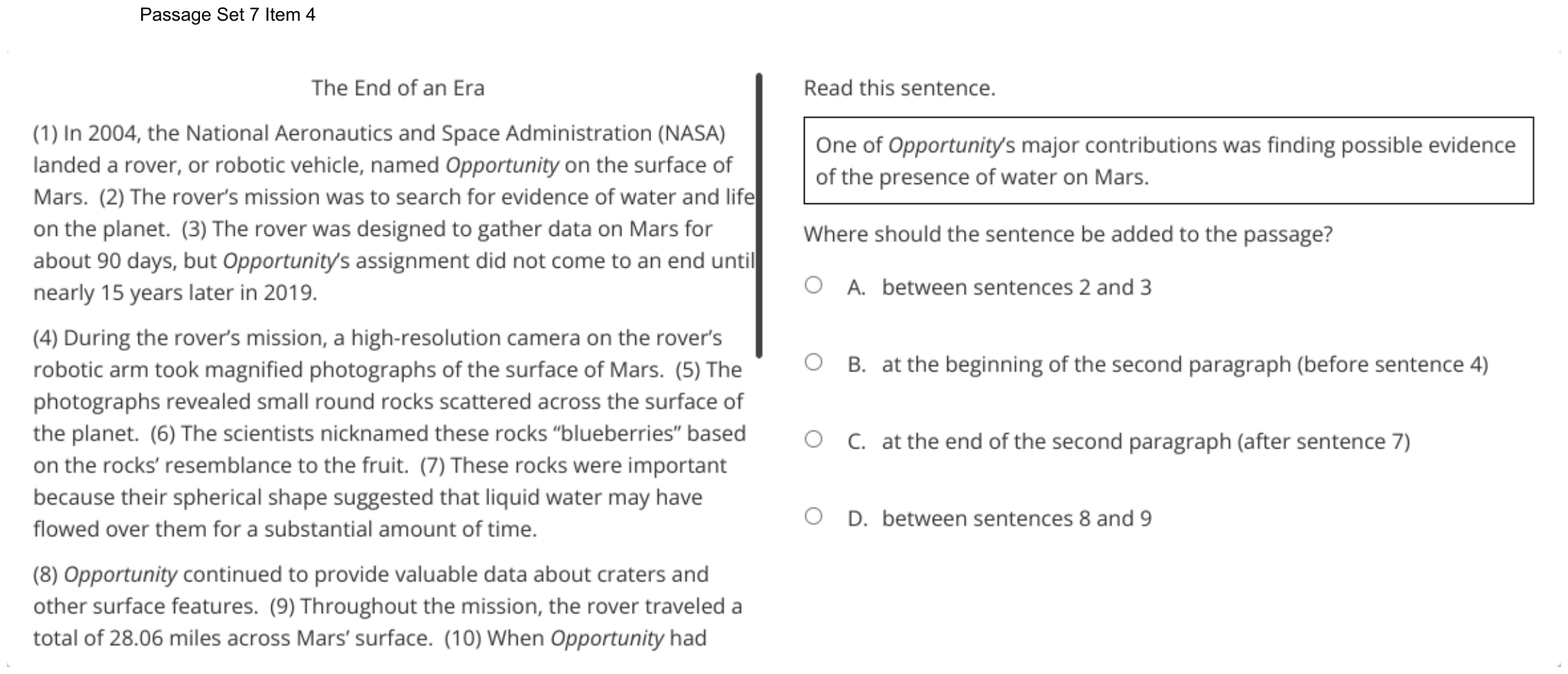
Read this sentence.
One of Opportunity’s major contributions was finding possible evidence of the presence of water on Mars.
Where should the sentence be added to the passage?
- Abetween sentences 2 and 3
- Bat the beginning of the second paragraph (before sentence 4)
- Cat the end of the second paragraph (after sentence 7)
- Dbetween sentences 8 and 9
Show the answer
Correct answer: B
The question asks where the sentence should be added to the passage.
A. Incorrect. While sentence 2 refers to Opportunity’s mission to search for evidence of water, sentence 3 mentions the rover lasting much longer than anticipated. Placing the sentence between these two ideas, rather than at the start of the second paragraph, where it introduces the topic of the paragraph, would create a disjointed and confusing experience for the reader.
B. CORRECT. The sentence introduces the idea of finding possible evidence of water on Mars, which is the main topic of the second paragraph.
C. Incorrect. The sentence sets up the main idea of paragraph 2, which is the possibility of water on Mars. As a concluding sentence, it would be repetitive and confusing.
D. Incorrect. The sentence introduces the possibility of water on Mars, while sentences 8 and 9 discuss other surface features and the distance traveled by the rover. Adding the sentence here would create a disorganized paragraph.
Question analysis
This organization question gives a new sentence about Opportunity's possible discovery of evidence of water on Mars and asks where it should be added to the rover passage. Students must follow the order of ideas across the first three paragraphs, because the sentence echoes ideas that appear in several places and could seem to fit more than one of them.
- NYS standards
- 7W2a introducing and organizing a topic
- Grade level
- Grade 7 reading and task
- Compared with grade 7
- At grade 7 Deciding where a sentence belongs is typical grade 7 revision work. The four positions span three paragraphs of a plain passage, and the sentence's wording connects to more than one of them, so the order of ideas must be checked.
- Estimated difficulty
- Moderate: several steps, or a close reading with one strong distractor.
- Thinking it demands
- Depth of knowledge 2, skills and concepts · mainly analyze
- What makes it hard
- How sentences fit together moderate
- A very close wrong answer moderate
- Evidence
- Answered from several paragraphs or stanzas
- Reading level
- Passage: about grade 11, 337 words; question and choices: about grade 7, 52 words.
- Students, last 30 days
- Not enough answers yet to show (it takes 10).
Why it is hard, traps and wrong answers (shows the answer)
Why it is hard
The new sentence reads well in more than one place, because water comes up in sentence 2, in sentence 7 and near the “valuable data” of sentence 8. Its wording settles the matter: “One of Opportunity’s major contributions” announces a topic, so it belongs ahead of the evidence. The strongest pull places it as a closing line after sentence 7, where it restates the point the blueberries have just made.
How sentences fit together moderate Working it out
The new sentence names a contribution in general terms, so it belongs before sentence 4, where the camera and the “blueberries” supply the details, not after them. (Halliday & Hasan, 1976)
A very close wrong answer moderate Choosing the answer
The two positions in paragraph 2, before sentence 4 and after sentence 7, both keep the sentence beside the water evidence; they differ only in whether it introduces the details or sums them up. (Embretson & Wetzel, 1987; Gorin & Embretson, 2006; Ascalon et al., 2007)
Strategy: Find what the new sentence is about and where the passage discusses that, then read the sentence in each offered position and check whether it introduces, interrupts or repeats the ideas around it.
Traps
- Sentence in the wrong place: Puts a sentence where it breaks the order of ideas or separates it from what it refers to.
- Says it twice: Repeats an idea that the sentence or passage already states.
The wrong answers, classified
A Sentence in the wrong place (Halliday & Hasan, 1976)
Matches the sentence to sentence 2’s search for water, but there it announces the finding before the photographs are described and cuts into the account of the mission’s length.
C Says it twice (Connors & Lunsford, 1988)
Uses it as a wrap-up after the blueberries, a common paragraph shape, but there it only repeats sentence 7’s point about water instead of introducing the paragraph’s topic.
D Sentence in the wrong place (Halliday & Hasan, 1976)
Links “major contributions” to the “valuable data” of sentence 8, though paragraph 3 covers craters, distance traveled and the dust storm, not water.
Working it out, step by step
Figure out what the question asks
This question asks where a new sentence belongs. First find what the sentence is about. Then find where the passage talks about that. Last, decide whether the sentence should start that part, interrupt it or end it.
Read the new sentence
It says that one of Opportunity’s major contributions was “finding possible evidence of the presence of water on Mars.” It names a big idea in general terms. A sentence like that is a topic sentence. A topic sentence tells what a paragraph will be about. It usually comes first. For example, Dogs help people in many ways. comes before the details about guiding, herding and comforting.
Find where water comes up
Paragraph 2 (sentences 4–7) gives the details. The camera took close-up photos. They showed small round rocks, nicknamed “blueberries.” Sentence 7 says the rocks’ round shape “suggested that liquid water may have flowed over them.” So the new sentence should come right before these details, at the start of paragraph 2.
Check each choice
- A is wrong. Between sentences 2 and 3, it would announce the finding before the photos are described. It would also break up the facts about the mission’s length.
- B is right. Before sentence 4, it introduces the paragraph about the round rocks and water.
- C is wrong. After sentence 7, it would only repeat the point sentence 7 just made.
- D is wrong. Paragraph 3 is about craters, miles and the dust storm, not water.
Watch out: C is tempting because some paragraphs end with a summary. But sentence 7 already makes the point about water.
Choose the answer
So the answer is B: “at the beginning of the second paragraph (before sentence 4).”
Why this answer and not the closest wrong one
C is the closest wrong answer, because it keeps the sentence in the paragraph about water. But the sentence names a topic, so it works best before the details. After sentence 7, it would repeat what the blueberries just showed. Before sentence 4, it tells readers what is coming.
More questions like this
The original DOE question
Question 8 of 43
2026 Practice Test B English, question 47Uses the passage above: “The End of an Era”.
Question
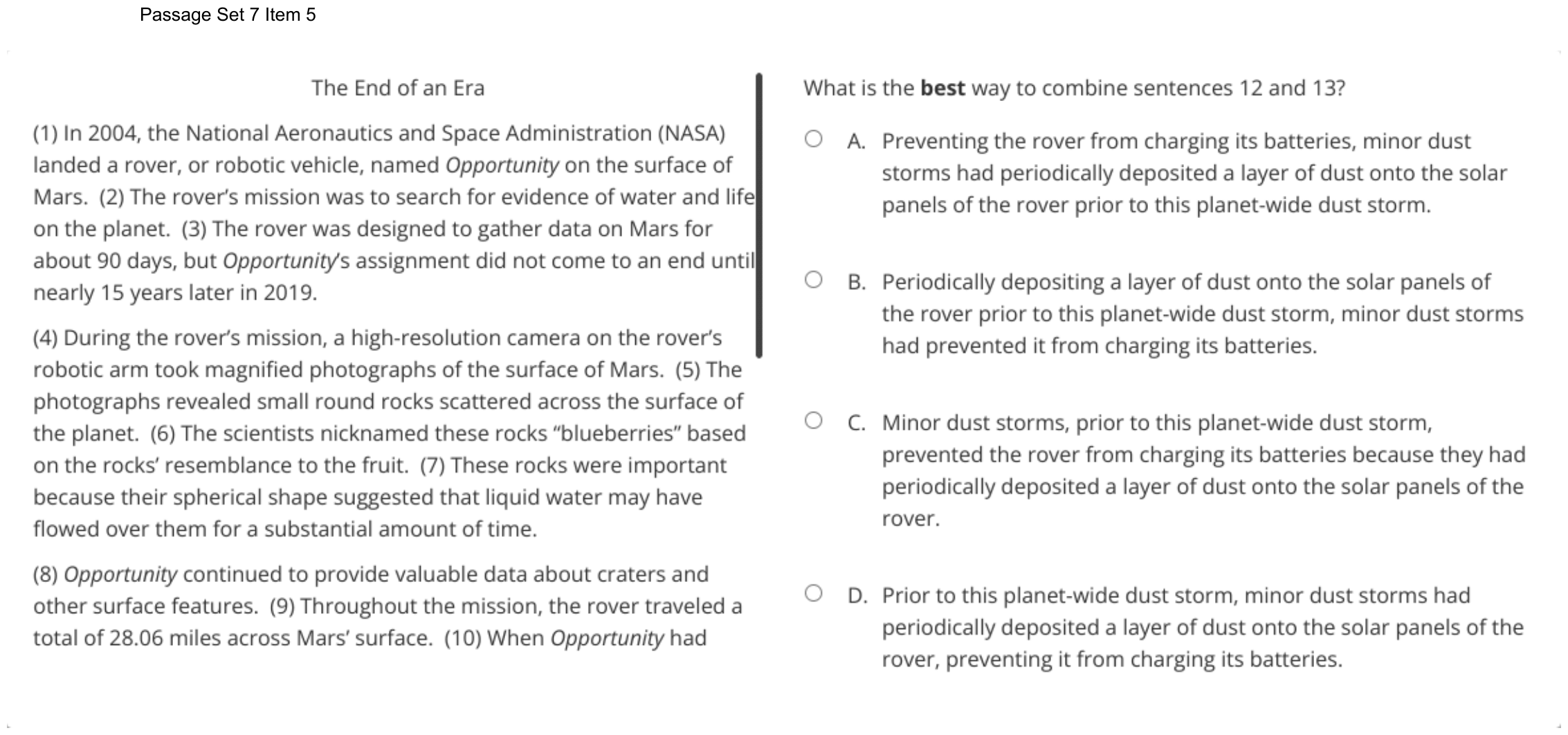
What is the best way to combine sentences 12 and 13?
- APreventing the rover from charging its batteries, minor dust storms had periodically deposited a layer of dust onto the solar panels of the rover prior to this planet-wide dust storm.
- BPeriodically depositing a layer of dust onto the solar panels of the rover prior to this planet-wide dust storm, minor dust storms had prevented it from charging its batteries.
- CMinor dust storms, prior to this planet-wide dust storm, prevented the rover from charging its batteries because they had periodically deposited a layer of dust onto the solar panels of the rover.
- DPrior to this planet-wide dust storm, minor dust storms had periodically deposited a layer of dust onto the solar panels of the rover, preventing it from charging its batteries.
Show the answer
Correct answer: D
The question asks for the best way to combine sentences 12 and 13.
A. Incorrect. The phrase “this planet-wide dust storm” in the original sentence 12 makes a direct reference to sentence 11 and therefore acts as a transition that should be kept at the beginning. In this sentence, the transition phrase is placed at the end of the sentence, making the phrase confusing. In addition, the sentence is unnecessarily repetitive and wordy.
B. Incorrect. This combination unnecessarily turns sentence 12 into an overly long participial phrase, making the connection between “it” and its antecedent, “the rover,” unclear and distracting from the subject of the sentence, “minor dust storms.”
C. Incorrect. Not only does this combination move the reference to “this planet-wide dust storm” farther from sentence 11, but it is also unnecessarily wordy, adding “because” and repeating “the rover.”
D. CORRECT. This sentence efficiently and accurately adds sentence 13 to sentence 12 as a participial phrase by changing “These prevented” to “preventing,” while also retaining the meanings of the original sentences 12 and 13.
Question analysis
This sentence-combining question asks for the best way to join two sentences from the rover passage: one saying minor dust storms had periodically coated the rover's solar panels, the other saying this kept it from charging its batteries. The four versions keep the same facts in different orders, so students must judge which is clearest and most concise in context.
- Grade level
- Grade 8 reading and task
- Compared with grade 7
- Above grade 7 Combining two sentences is grade 7 work, usually with one version clearly better. These four are long, keep the same facts and differ in order and wording, so students must weigh clarity and concision across nearly identical sentences, more than typical.
- Estimated difficulty
- Hard: combines ideas, needs a plan, and has more than one tempting wrong answer.
- Thinking it demands
- Depth of knowledge 2, skills and concepts · mainly evaluate
- What makes it hard
- How sentences fit together moderate
- Every choice must be checked moderate
- Complex sentences minor
- Evidence
- Answered from one sentence or line
- Reading level
- Passage: about grade 11, 337 words; question and choices: about grade 13, 129 words.
- Corrected from the DOE handbook
- Two grammar terms in the explanation were corrected.
- Students, last 30 days
- Not enough answers yet to show (it takes 10).
Why it is hard, traps and wrong answers (shows the answer)
Why it is hard
None of the versions is plainly ungrammatical, so the ear gives little help, and the version with “because” looks best to students who value a clearly stated cause. Its cost is wordiness and a weaker link: the result comes first and the reference back to sentence 11 is buried mid-sentence. The question rewards keeping the original order, cause then effect, and folding sentence 13 in as a short closing phrase.
How sentences fit together moderate Working it out
“Prior to this planet-wide dust storm” points back to sentence 11, so the best version keeps it first; three versions move it later, which loosens the link between the two sentences. (Halliday & Hasan, 1976)
Every choice must be checked moderate Choosing the answer
All four versions keep every fact of sentences 12 and 13 and run 29 to 32 words, so none can be ruled out by content; order, pronouns and repetition decide. (Embretson & Wetzel, 1987)
Complex sentences minor Understanding the question
Each version is one long sentence built around a participial phrase or a “because” clause, and at that length a stranded “it” or a doubled “the rover” is easy to miss. (Abedi & Lord, 2001; Freedle & Kostin, 1993; Messick, 1989)
Strategy: Read sentence 11 first, then compare the versions on how smoothly each connects to it, how many words it uses, and whether every pronoun has a clear antecedent.
Traps
- Wordy, vague or informal: A revision is grammatical but wordy, imprecise or too casual for the passage.
- Unclear pronoun: A pronoun whose reference is vague or ambiguous, or one in the wrong case.
The wrong answers, classified
A Wordy, vague or informal (Connors & Lunsford, 1988)
Opens with the effect as a participial phrase, which pushes “prior to this planet-wide dust storm,” the link to sentence 11, to the end and names “the rover” twice.
B Unclear pronoun (Connors & Lunsford, 1988)
Packs sentence 12 into a 19-word opening phrase, so “it” follows “this planet-wide dust storm” and no longer points clearly to the rover buried inside the phrase.
C Wordy, vague or informal (Connors & Lunsford, 1988)
Likes the clear cause word “because,” but the result now comes first, “the rover” appears twice, and “prior to this planet-wide dust storm” splits the subject from its verb.
What was corrected from the DOE handbook, and why
- Explanation: The DOE’s explanation of Option B says the combination turns sentence 12 into “an overly long dependent clause,” and its explanation of Option D says Option D adds sentence 13 to sentence 12 “as a dependent clause” by changing “These prevented” to “preventing.” Neither is a clause: “Periodically depositing a layer of dust onto the solar panels of the rover prior to this planet-wide dust storm” (Option B) and “preventing it from charging its batteries” (Option D) have no subject or finite verb of their own. Both are participial phrases, and the site now calls them that. The reasoning and the answer, Option D, are unchanged.
Working it out, step by step
Figure out what the question asks
This question asks for the best way to join sentences 12 and 13 into one sentence. The best version keeps the meaning, uses few words and is clear. It should also connect smoothly to sentence 11, the sentence before.
Read the sentences in order
Sentence 11 tells about the giant 2018 dust storm. Sentence 12 begins “Prior to this planet-wide dust storm.” Prior to means before. That phrase points back to sentence 11, so it works best at the start. Sentence 12 says small storms put dust on the solar panels. Sentence 13 gives the result: “These prevented it from charging its batteries.”
Learn the tool: a participial phrase
A participial phrase is a group of words built on a verb form, often an -ing word. It describes something, but it has no subject and can’t stand alone. Example: The dog ran to the door. It wagged its tail. becomes The dog ran to the door, wagging its tail. Choice D does this. It turns “These prevented” into “preventing.”
Check each choice
- A is wrong. It starts with the result. It moves “prior to this planet-wide dust storm” to the end, far from sentence 11. It also says “the rover” twice.
- B is wrong. Its long opening phrase hides the rover. Then “it” comes after “minor dust storms,” so it is hard to tell what “it” means.
- C is wrong. It adds “because,” puts the result first and says “the rover” twice. It is wordier than D.
- D is right. It keeps the link to sentence 11 first, gives the cause, then adds the result as a short participial phrase.
Watch out: C looks clear because “because” names the cause. But it is longer, and it puts an extra phrase between “Minor dust storms” and its verb.
Choose the answer
So the answer is D: “Prior to this planet-wide dust storm, minor dust storms had periodically deposited a layer of dust onto the solar panels of the rover, preventing it from charging its batteries.”
Why this answer and not the closest wrong one
C is the closest wrong answer, because “because” makes the cause very clear. But C puts the result first and repeats “the rover.” D keeps the original order, cause then result. It also keeps the link to sentence 11 up front, in fewer words.
More questions like this
The original DOE question
Question 9 of 43
2026 Practice Test B English, question 49Question
Read these sentences.
(1) Flyby missions near Jupiter have been happening since 1973.
(2) Flyby missions allow scientists to collect data about Jupiter and its moons.
What is the best way to combine the sentences to clarify the relationship between the ideas?
- AWhile flyby missions near Jupiter have been happening since 1973, scientists collect data about the planet and its moons.
- BAlthough there have been flyby missions near Jupiter since 1973, they have allowed scientists to collect data about the planet and its moons.
- CFlyby missions near Jupiter, which allow scientists to collect data about the planet and its moons, have been happening since 1973.
- DFlyby missions have been happening near Jupiter, but scientists have been collecting data about the planet and its moons since 1973.
Show the answer
Correct answer: C
The question asks for the best way to combine the sentences to clarify the relationship between the ideas.
A. Incorrect. Even though the two ideas from the original sentences are incorporated into the combined sentence, the use of the conjunction “while” in the first part of the sentence suggests that there is a simultaneous but unrelated relationship between the two ideas, which is incorrect.
B. Incorrect. The combined sentence incorporates the ideas from both sentences, but the conjunction “although” suggests that scientists were allowed to collect data even though there were flyby missions, which is an inaccurate way to express the relationship between the ideas.
C. CORRECT. This sentence is the best way to combine the sentences because it accurately reflects the relationship between the ideas by using the nonrestrictive clause “which allow scientists to collect data about the planet and its moons” to describe the purpose of the flyby missions. (Nonrestrictive clauses are adjective clauses that give additional information about a word or phrase. They sometimes begin with the relative pronoun “which” and are set off by commas.) The idea that the missions “have been happening since 1973” follows the nonrestrictive clause.
D. Incorrect. The combined sentence uses the conjunction “but” to connect the ideas in the two original sentences. This suggests a contrasting relationship between ideas, which is an inaccurate way to connect the ideas expressed in the original sentences.
Question analysis
This sentence-combining question gives two short sentences about flyby missions near Jupiter, one saying they have happened since 1973 and the other that they let scientists collect data about the planet and its moons. Students choose the combination that makes the relationship between the ideas clear, weighing what each connecting word or clause says about how the facts relate.
- NYS standards
- 7L1 grammar and usage conventions
- Grade level
- Grade 7 reading and task
- Compared with grade 7
- At grade 7 Combining two short sentences so their relationship is clear is regular grade 7 work. Both sentences here are brief and plainly related, and the versions differ mainly in their connecting words, so this is a typical, fairly quick task.
- Estimated difficulty
- Straightforward: two steps or one careful reading.
- Thinking it demands
- Depth of knowledge 2, skills and concepts · mainly evaluate
- What makes it hard
- How sentences fit together moderate
- Every choice must be checked minor
- Evidence
- Answered from one sentence or line
- Reading level
- Question and choices: about grade 9, 119 words.
- Corrected from the DOE handbook
- A wrong word in the explanation of D was corrected.
- Students, last 30 days
- Not enough answers yet to show (it takes 10).
Why it is hard, traps and wrong answers (shows the answer)
Why it is hard
The two sentences are short, and the work lies in naming how they relate before reading the versions. The most tempting one, beginning “While,” keeps both facts but drops the word “allow,” so the missions no longer explain the data. Students who test each connector against the relationship also catch the concession in “Although” and the contrast in “but,” which also moves the date onto the data collection.
How sentences fit together moderate Working it out
Students must first name the relationship, that the missions make the data possible, a link only the version with “which allow” keeps, since the others recast it as time, concession or contrast. (Halliday & Hasan, 1976)
Every choice must be checked minor Choosing the answer
All four versions keep both facts and read smoothly, so each joining word, “While,” “Although,” “which” and “but,” has to be tested for what it claims. (Embretson & Wetzel, 1987)
Strategy: Before reading the choices, decide in a few words how the two facts are connected, then reject any version whose joining word signals a different relationship or shifts what a detail describes.
Traps
- Wrong transition: A connecting word or phrase that signals the wrong relationship, such as contrast where the idea continues.
- Changes the meaning: A revision is correct English but no longer says what the writer meant.
The wrong answers, classified
A Wrong transition (Halliday & Hasan, 1976)
Keeps both facts and reads smoothly, but “While” presents the missions and the data collection as merely happening at the same time and drops “allow,” the link between them.
B Wrong transition (Halliday & Hasan, 1976)
Treats “Although” as a neutral joining word, but it makes the data collection happen in spite of the missions, when the missions are what make it possible.
D Changes the meaning (Connors & Lunsford, 1988)
Joins the facts with “but,” implying a contrast, and moves “since 1973” from the missions to the data collection, so the date now describes something else.
What was corrected from the DOE handbook, and why
- Explanation: Rejecting D, the handbook's explanation says “but” “suggests an adverse relationship between ideas”. “Adverse” means harmful; the point is that “but” signals a contrast, which the two sentences don't have. It now says “a contrasting relationship”. The answer, C, is unchanged.
Working it out, step by step
Figure out what the question asks
This question asks for the best way to join two sentences. The joined sentence must show how the ideas are related. So first decide how they connect. Then pick the version whose joining word shows that link.
Find the relationship
Sentence 1 says flyby missions near Jupiter “have been happening since 1973.” A flyby mission sends a spacecraft past a planet without landing. Sentence 2 says the missions “allow scientists to collect data about Jupiter and its moons.” Data means facts and measurements. So sentence 2 tells what the missions do for scientists. The ideas don’t contrast, or clash. They fit together.
Learn the tool: a which clause
A clause is a group of words with a subject and a verb. A which clause adds extra facts about a noun. Commas set it off. Example: My bike, which has red wheels, is new. The extra facts describe the bike. In C, “which allow scientists to collect data about the planet and its moons” describes the missions.
Check each choice
- A is wrong. “While” makes the two facts just happen at the same time. It drops “allow,” so the missions no longer explain the data.
- B is wrong. “Although” means in spite of the fact that. It suggests scientists got data even though there were missions. That is backward.
- C is right. The which clause tells what the missions do, and the date stays with the missions.
- D is wrong. “But” signals a contrast that isn’t there. It also moves “since 1973” onto the data collecting.
Watch out: A reads smoothly and keeps both facts. But “While” loses the link: the missions are what make the data possible.
Choose the answer
So the answer is C: “Flyby missions near Jupiter, which allow scientists to collect data about the planet and its moons, have been happening since 1973.”
Why this answer and not the closest wrong one
A is the closest wrong answer, because it keeps both facts and sounds fine. But “While” only says two things happen at once. It drops the word “allow,” which shows the missions make the data collection possible. C keeps that link with its which clause.
More questions like this
The original DOE question
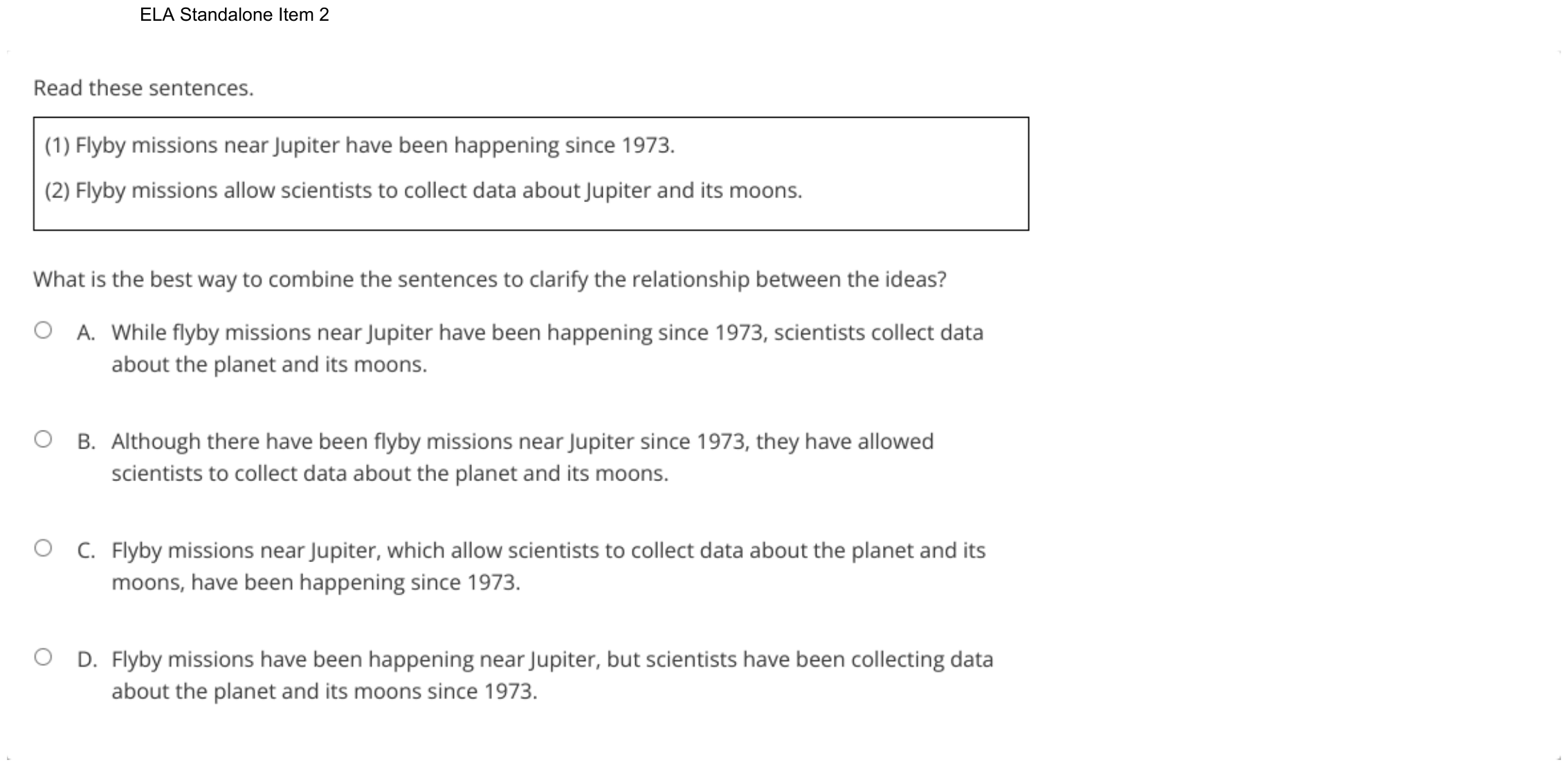
Question 10 of 43
2026 Practice Test C English, question 45Passage New York City and the Hudson Valley Brickmaking Industry
New York City and the Hudson Valley Brickmaking Industry
(1) Residents of New York City cannot help but notice that the buildings they are surrounded by are predominantly made of brick. (2) Indeed, one author described the bricks that make up some of New York City’s most recognizable landmarks, including the Empire State Building and the arches of the Brooklyn Bridge, as “an inescapable presence.” (3) Nearly 65 million people visit New York City every year to see these and other attractions. (4) Why was so much brick used in buildings constructed during the century before World War II? (5) The answer involves an explosion in New York City’s population that caused an increase in demand for bricks starting in the mid-1800s and lasting into the 1940s that affected the area more than 100 miles up the Hudson River Valley toward Albany. (6) When demand later declined, the industry would entirely disappear.
(7) New York City’s appetite for brick was fueled by surging population and demand for safer building materials. (8) The city’s population ballooned from about 313,000 people in 1840 to more than 7 million a century later. (9) Following large, destructive fires in the 1830s, the city had enacted laws requiring the use of fire-resistant materials. (10) Bricks turned out to be an inexpensive way for builders to quickly throw together a lot of structures while keeping building owners and safety inspectors happy.
(11) The brickmaking industry in the Hudson Valley skyrocketed. (12) At the industry’s peak, approximately 130 brick factories crammed themselves into a 120-mile stretch along the Hudson River. (13) These factories employed much of the region’s population. (14) Population growth in the Hudson River Valley after the mid-1800s was substantial, though percentage increases were smaller than those in New York City. (15) Even though the factories operated only during the summers, their production was immense. (16) Hudson Valley factories shipped over a billion bricks on barges down the river to New York City annually. (17) In fact, The New York Times declared, “It’s fairly safe to assume that any brick building constructed between 1800 and 1950 includes some form of sediment from the banks of the Hudson River.”
(18) History has proven, however, that boom times eventually end. (19) Shifting architectural trends halted not only the Hudson Valley’s brickmaking boom, but its entire industry. (20) Starting early in the twentieth century, architects and builders increasingly favored steel, glass, and concrete instead of brick. (21) By 1979, reduced demand for brick had driven every Hudson Valley brick factory out of business.
(22) The Hudson Valley’s brickmaking legacy lives on in the architecture of New York City. (23) Throughout the city, famous and ordinary buildings stand as evidence of the remarkable productivity achieved by the Valley’s brickmakers. (24) The brick buildings surrounding New Yorkers today serve as a reminder that, as one amateur brick historian put it, “The skyline of New York City used to be the landscape of the Hudson River Valley.”
Question
Which two sentences present information irrelevant to the ideas in the passage and should be deleted?
Move the two correct answers to the box.
Should Be Deleted
On the test you drag tiles into the box; here, choose them below. The DOE has not published how answers with several parts are scored; this site counts one right only when every part is right.
- A“Nearly 65 million people visit New York City every year to see these and other attractions.” (sentence 3)
- B“The city’s population ballooned from about 313,000 people in 1840 to more than 7 million a century later.” (sentence 8)
- C“Population growth in the Hudson River Valley after the mid-1800s was substantial, though percentage increases were smaller than those in New York City.” (sentence 14)
- D“History has proven, however, that boom times eventually end.” (sentence 18)
- E“Throughout the city, famous and ordinary buildings stand as evidence of the remarkable productivity achieved by the Valley’s brickmakers.” (sentence 23)
Show the answer
Correct answer: A and C
The question asks which two sentences present information irrelevant to the ideas of the passage and should be deleted.
CORRECT. “Nearly 65 million people visit New York City every year to see these and other attractions” (sentence 3) presents irrelevant information and should be deleted. While the statistic is interesting, it focuses on tourism, which is not relevant to either the topic of the passage—the growth and decline of the brickmaking industry—or to the ideas in the first paragraph (sentences 1–6), which focus on the prominence of brick in New York City’s buildings.
Incorrect. “The city’s population ballooned from about 313,000 people in 1840 to more than 7 million a century later” (sentence 8) is relevant to the ideas of the passage and should not be deleted. The numerical details in sentence 8 about the rapid growth in New York City provide relevant evidence that supports a central idea of the passage: that the brickmaking industry of the Hudson River Valley expanded quickly to supply the demands of builders who were, in turn, meeting the demands of a booming population.
CORRECT. “Population growth in the Hudson River Valley after the mid-1800s was substantial, though percentage increases were smaller than those in New York City” (sentence 14) presents irrelevant details and should be deleted. The information in sentence 14 comparing population growth rates between the region and New York City is not needed to develop the passage’s central focus on the rise and decline of the Hudson River Valley’s brickmaking industry. The sentence also does not support ideas in the third paragraph (sentences 11–17). Although it mentions that brick factories employed much of the Hudson River Valley population, the productivity of the factories, rather than the Valley’s population, is the topic of the paragraph.
Incorrect. “History has proven, however, that boom times eventually end” (sentence 18) is relevant to the ideas of the passage and should not be deleted. Sentence 18 effectively introduces the central idea of the passage: the decline of the Hudson River Valley brickmaking industry. The sentence also serves as a clear transition from the third paragraph (sentences 11–17), which provides evidence of the industry’s boom, to the fourth paragraph (sentences 18–21), which provides details about how the industry came to an end.
Incorrect. “Throughout the city, famous and ordinary buildings stand as evidence of the remarkable productivity achieved by the Valley’s brickmakers” (sentence 23) is relevant to the ideas of the passage and should not be deleted. The mention of famous and ordinary buildings provides an effective link to introductory sentences 1 and 2, strengthening the passage’s conclusion, while also emphasizing the productivity of the Hudson Valley brickmaking industry detailed in the third paragraph (sentences 11–17).
Question analysis
This revising question asks which two of five sentences from the passage on the Hudson Valley brickmaking industry present irrelevant information and should be deleted. On the test students move two sentence tiles into a box labeled Should Be Deleted, and both must be right. The five sentences come one from each paragraph, so each must be judged against its own paragraph and the whole passage.
- NYS standards
- 7W2b developing a topic
- Grade level
- Grade 7 reading and task
- Compared with grade 7
- Above grade 7 Grade 7 revision usually asks for one off-topic sentence within one paragraph. Here students check five sentences spread over the whole passage, must find two, and get credit only if both are right, a broader demand than typical grade 7 work.
- Estimated difficulty
- Hard: combines ideas, needs a plan, and has more than one tempting wrong answer.
- Thinking it demands
- Depth of knowledge 2, skills and concepts · mainly analyze
- What makes it hard
- A very close wrong answer moderate
- How sentences fit together moderate
- Much to keep track of minor
- Evidence
- Answered from the whole text
- Reading level
- Passage: about grade 12, 465 words; question and choices: about grade 10, 114 words.
- Corrected from the DOE handbook
- A missing hyphen in a quotation in the explanation was restored.
- A grammatical error in the explanation was corrected.
- Students, last 30 days
- Not enough answers yet to show (it takes 10).
Why it is hard, traps and wrong answers (shows the answer)
Why it is hard
Sentence 3 announces itself: tourism has nothing to do with brick. The second deletion is the trap, because sentence 14 sits after a sentence about factories employing the region’s population and looks like a continuation. Students who reject population as a topic often delete sentence 8 instead, which measures a cause the passage names, and students who judge by sound cut the general “boom times eventually end,” which turns the passage toward the industry’s decline.
A very close wrong answer moderate Choosing the answer
Sentences 8 and 14 are both population statistics; what separates them is that sentence 8 measures the “surging population” sentence 7 names as a cause, while the Valley’s growth in sentence 14 explains nothing. (Embretson & Wetzel, 1987; Gorin & Embretson, 2006; Ascalon et al., 2007)
How sentences fit together moderate Working it out
Each kept sentence earns its place by its links: sentence 18 turns from boom to decline, sentence 23 echoes the landmarks of sentences 1–2, and sentence 14 merely follows sentence 13’s “region’s population.” (Halliday & Hasan, 1976)
Much to keep track of minor Working it out
Five tiles, one from each paragraph, are judged against both their paragraph and the whole passage, and both picks must be right, so two relevance tests run side by side. (Sweller, 1988; Carpenter, Just & Shell, 1990)
Strategy: Sum up the passage’s topic in one phrase, then read each of the five sentences in its paragraph and ask whether removing it would leave a gap in the ideas around it; delete only sentences that leave none.
Traps
- Fixes what isn't broken: Changes a part of the sentence that was already correct, while the real error stays; or, where the question asks which sentence has an error or should go, picks one that is correct and belongs.
- Off the point: Adds or keeps something that does not support the paragraph's or the passage's focus, or an introduction or conclusion that misses the main point.
The wrong answers, classified
B Fixes what isn't broken (Connors & Lunsford, 1988)
Sees a population figure in a passage about bricks and cuts it, missing that sentence 7 names “surging population” as a cause of demand and sentence 8 measures it.
D Fixes what isn't broken (Connors & Lunsford, 1988)
Hears “boom times eventually end” as a cliché that adds nothing, though sentence 18 opens the fourth paragraph and turns the passage from the industry’s growth to its decline.
E Fixes what isn't broken (Connors & Lunsford, 1988)
Thinks sentence 23 only repeats the conclusion around it, though it ties the brickmakers’ output back to the famous buildings of sentences 1–2.
C Off the point (Halliday & Hasan, 1976)
Left unchosen by students who link it to factories that “employed much of the region’s population,” though the paragraph is about the factories’ output, not the Valley’s growth.
What was corrected from the DOE handbook, and why
- Explanation: The handbook’s explanation quotes sentence 14 as “Population growth in the Hudson River Valley after the mid 1800s was substantial.” The passage and the tile say “mid-1800s,” so the site now quotes it that way.
- Explanation: The handbook’s explanation says “The information in sentence 14 comparing population growth rates between the region and New York City are not needed.” The subject is “information,” so the site now says “is not needed.”
Working it out, step by step
Figure out what the question asks
You need to find two sentences that don’t belong. A sentence is irrelevant when it has nothing to do with the main ideas. You can delete it without leaving a gap. On the test you drag two tiles into the Should Be Deleted box. Here, you choose two of the five. Both must be right.
Name the topic of the passage
The passage explains why New York City has so many brick buildings. It tells how the Hudson Valley brick industry grew to meet that demand, then died out. Each paragraph has its own job. Paragraph 1 asks why so much brick was used. Paragraph 2 gives the causes. Paragraph 3 shows how much the factories made. Paragraph 4 tells how the industry ended. Paragraph 5 sums up.
Test sentences 3 and 14
Sentence 3 says: “Nearly 65 million people visit New York City every year to see these and other attractions.” That is about tourists, not bricks. Sentence 14 says: “Population growth in the Hudson River Valley after the mid-1800s was substantial, though percentage increases were smaller than those in New York City.” Paragraph 3 is about how much the factories made, “over a billion bricks” a year. How fast the Valley grew explains nothing about bricks.
Test the other three sentences
- Sentence 8 stays. Sentence 7 says the hunger for brick was “fueled by surging population.” Sentence 8 gives the numbers that show it.
- Sentence 18 stays. It turns the passage from the boom to the decline. A boom is a time of fast growth.
- Sentence 23 stays. It links back to the famous buildings in sentences 1 and 2 and praises the brickmakers.
Watch out: Sentence 14 comes right after one about factories that “employed much of the region’s population.” So it seems to fit. But it changes the topic from factories to population.
Choose the answers
Sentences 3 and 14 add facts that don’t help explain the brick industry. So the answers are A and C. Move these two tiles into the Should Be Deleted box. A is “Nearly 65 million people visit New York City every year to see these and other attractions.” (sentence 3). C is “Population growth in the Hudson River Valley after the mid-1800s was substantial, though percentage increases were smaller than those in New York City.” (sentence 14).
Why this answer and not the closest wrong one
B is the closest wrong answer, since sentences 8 and 14 are both about population. But sentence 8 measures the “surging population” that sentence 7 names as a cause of the demand for brick. Sentence 14 explains nothing about bricks. So delete 14 and keep 8.
More questions like this
The original DOE question
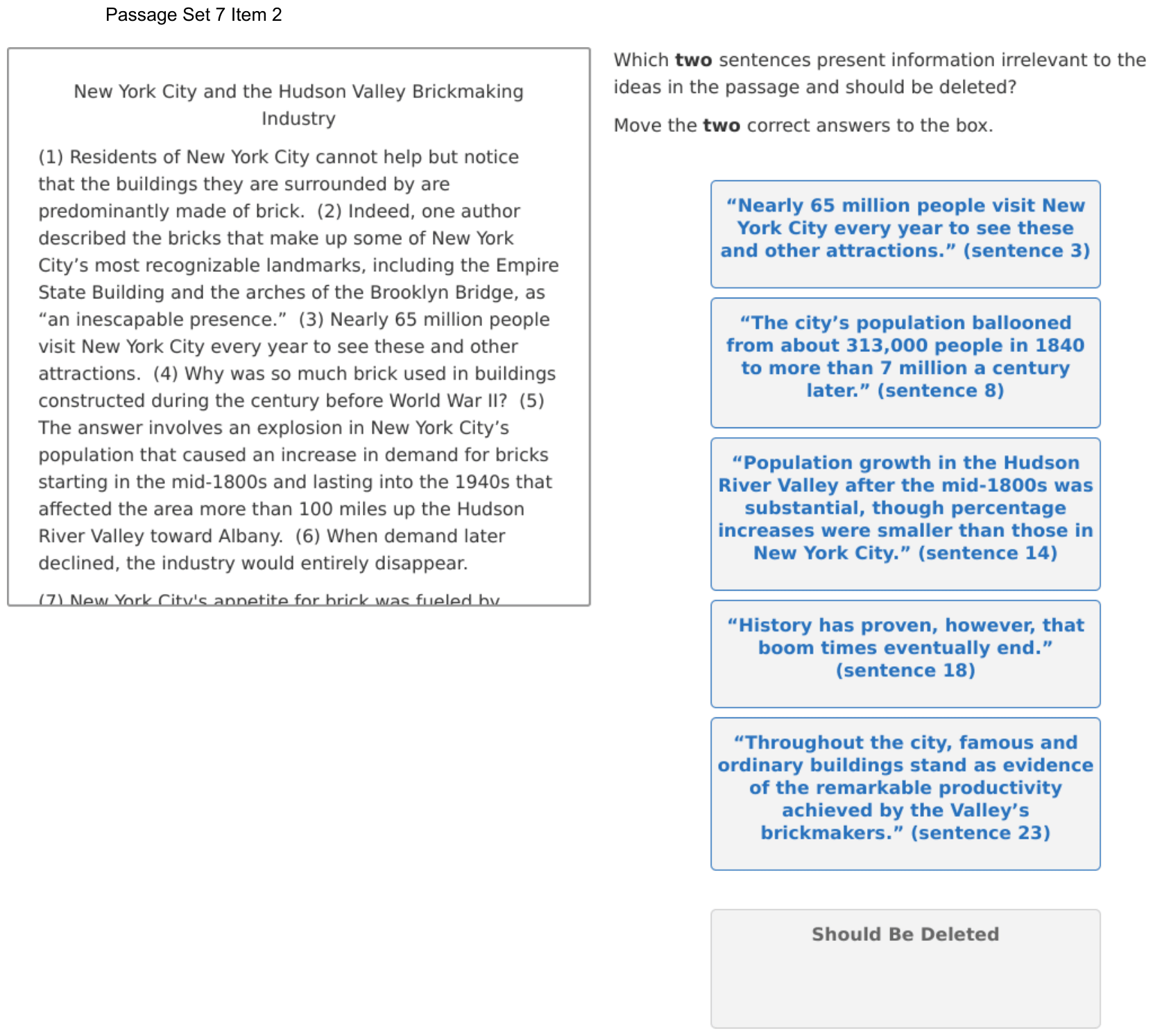
The passage “New York City and the Hudson Valley Brickmaking Industry” as printed (page 64)
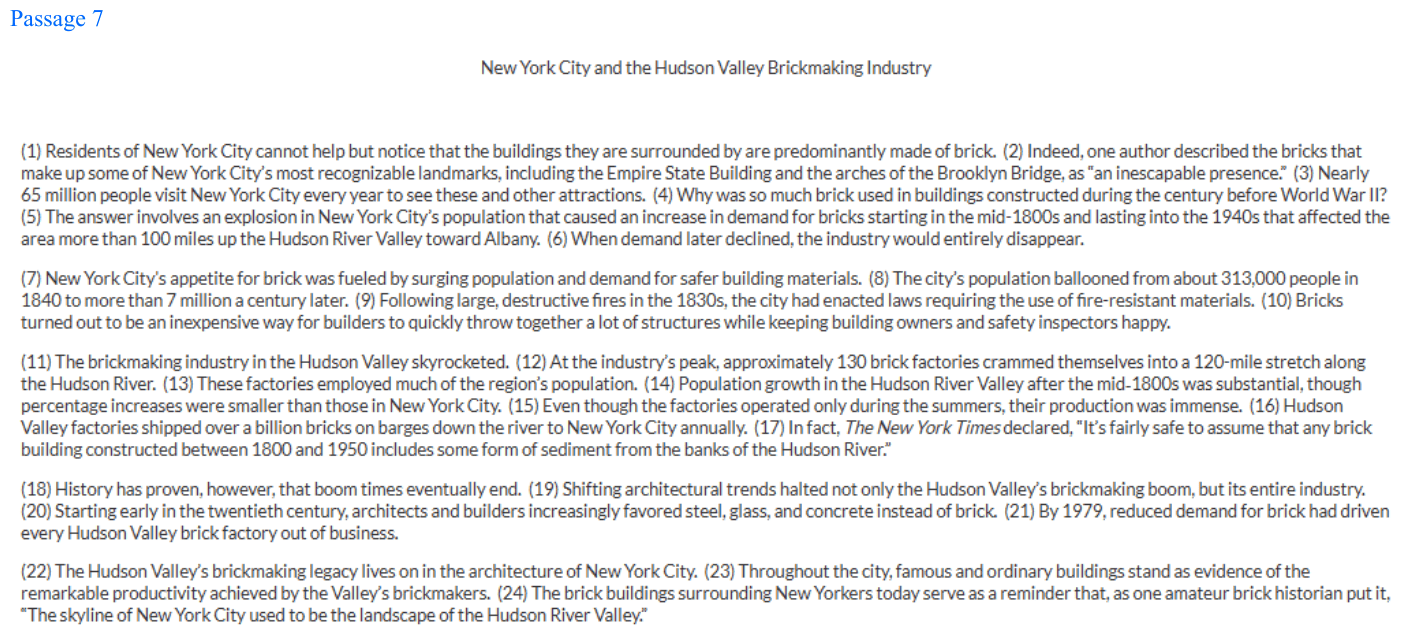
Question 11 of 43
2026 Practice Test C English, question 46Uses the passage above: “New York City and the Hudson Valley Brickmaking Industry”.
Question
Which phrase should be added to the beginning of sentence 11 to provide the best transition from the ideas in sentence 10?
- AWhile adapting to new uses for brick,
- BBecause the building boom preferred brick,
- CAs a result of New York City’s building boom,
- DAlthough reliance on brick became the norm,
Show the answer
Correct answer: C
The question asks which phrase should be added to the beginning of sentence 11 to provide the best transition from the ideas in sentence 10.
A. Incorrect. The phrase “While adapting to new uses for brick” is not the best transition to place at the beginning of sentence 11 because it does not accurately describe the content of sentence 10. Although sentence 10 conveys that brick was a low-cost way for builders to adapt to two new demands—New York City’s need for a lot of new buildings and its recently changed fire-safety laws—neither sentence 10 nor any of the preceding sentences in the second paragraph (sentences 7–10) indicate that builders found any new ways to use bricks. The focus is on the amount of bricks used, rather than any changes in how the builders used them.
B. Incorrect. Although the phrase “Because the building boom preferred brick” accurately indicates a cause-and-effect relationship between builders using a lot of bricks and the skyrocketing brick production mentioned in sentence 11, it overstates the position of builders described in sentence 10. While sentence 10 says that builders found bricks to be a low-cost way of meeting several needs, it does not say that builders actually preferred to use bricks. In addition, the phrase is awkward and imprecise because a “building boom” cannot literally “prefer” something. Thus, this is not the best transition phrase to add to sentence 11.
C. CORRECT. The transition phrase “As a result of New York City’s building boom” clearly conveys the cause-and-effect relationship between sentence 10, which describes a trend among New York City’s builders to use a lot of bricks to “quickly throw together a lot of structures while keeping building owners and safety inspectors happy,” and sentence 11, which points out a result of the building trend: brickmaking skyrocketed in the nearby Hudson River Valley.
D. Incorrect. The word “although” in the transition phrase “Although reliance on brick became the norm,” incorrectly indicates an opposing relationship that does not exist between the ideas in sentences 10 and 11. Sentence 10 explains how using a lot of bricks helped New York City’s builders meet the demands of a building boom and new safety regulations. As sentence 16 details, many of the bricks made in the Hudson River Valley were shipped “down the river to New York City.” Thus, it is not logical that the skyrocketing growth of the brickmaking industry in the Hudson River Valley described in sentence 11 happened “although” or despite New York City builders using a lot of brick. Therefore, this transition is not the best one to place at the beginning of sentence 11.
Question analysis
This transition question asks which phrase should open sentence 11 of the brickmaking passage, where the third paragraph begins with the Hudson Valley industry that “skyrocketed,” to connect it with sentence 10 about how New York City’s builders used brick. Students must name the relationship between the two paragraphs, and more than one phrase sounds reasonable on a first reading.
- NYS standards
- 7W2d transitions in informative writing
- Grade level
- Grade 7 reading and task
- Compared with grade 7
- At grade 7 Choosing a transition that shows how ideas relate is standard grade 7 writing work. Here the link crosses from one paragraph to the next, and each phrase must be checked for the relationship it signals and for accurate wording, a typical grade 7 demand.
- Estimated difficulty
- Moderate: several steps, or a close reading with one strong distractor.
- Thinking it demands
- Depth of knowledge 2, skills and concepts · mainly evaluate
- What makes it hard
- How sentences fit together moderate
- A very close wrong answer moderate
- Evidence
- Answered from several paragraphs or stanzas
- Reading level
- Passage: about grade 12, 465 words; question and choices: about grade 5, 49 words.
- Students, last 30 days
- Not enough answers yet to show (it takes 10).
Why it is hard, traps and wrong answers (shows the answer)
Why it is hard
Most students sense that the Hudson Valley boom follows from New York City’s appetite for brick, which rules out the contrast of “Although” quickly. The real decision is between two phrases that both signal a cause: one names the building boom accurately, the other gives the boom a preference it cannot have and that sentence 10 never states. The question rewards checking a transition’s own words as well as the relationship it signals.
How sentences fit together moderate Working it out
The phrase must bridge two paragraphs: sentence 10 ends the account of New York City’s builders turning to brick, and sentence 11 opens with the Hudson Valley industry that “skyrocketed,” its result. (Halliday & Hasan, 1976)
A very close wrong answer moderate Choosing the answer
The “Because the building boom preferred brick” phrase signals the same cause and effect as the key; only its wording, a boom that “preferred” something, separates the two. (Embretson & Wetzel, 1987; Gorin & Embretson, 2006; Ascalon et al., 2007)
Strategy: Before reading the phrases, name how sentence 11 relates to sentences 7–10, then pick the phrase that signals that relationship and is also accurate and logical in its own words.
Traps
- Wrong transition: A connecting word or phrase that signals the wrong relationship, such as contrast where the idea continues.
- Changes the meaning: A revision is correct English but no longer says what the writer meant.
- Wordy, vague or informal: A revision is grammatical but wordy, imprecise or too casual for the passage.
The wrong answers, classified
A Changes the meaning (Connors & Lunsford, 1988)
Accepts an opener about “adapting to new uses for brick,” though sentence 10 describes builders using more brick, not new uses, and “While” hides the cause and effect.
B Wordy, vague or informal (Connors & Lunsford, 1988)
Sees the cause and effect correctly but accepts a phrase in which a building boom “preferred” brick, which is illogical and claims a preference sentence 10 never states.
D Wrong transition (Halliday & Hasan, 1976)
Likes “reliance on brick became the norm” as a summary of sentence 10, but “Although” signals a contrast where the Valley’s growth follows from that reliance.
Working it out, step by step
Figure out what the question asks
A transition is a word or phrase that shows how two ideas connect. You need one to start sentence 11. It must show how sentence 11 follows from sentence 10. It must also make sense in its own words.
Read sentences 10 and 11
Sentence 10 says bricks were a cheap way for builders “to quickly throw together a lot of structures.” That ends a paragraph about New York City’s huge demand for brick. Sentence 11 starts a new paragraph: “The brickmaking industry in the Hudson Valley skyrocketed.” Skyrocketed means it grew very fast.
Name the link between them
Why did the brick industry grow so fast? Because New York City was building so much with brick. So sentence 10 is the cause, and sentence 11 is the effect. Here is a made-up example: It rained all week. As a result, the river rose. You need a phrase that shows cause and effect, in accurate words.
Check each phrase
- A is wrong. The passage never mentions “new uses for brick.” Builders used more brick, not new kinds. “While” also hides the cause.
- B is wrong. It shows cause and effect, but a building boom can’t “prefer” anything. Only people can. And sentence 10 says brick was cheap, not that builders liked it best.
- C is right. “As a result of” shows cause and effect. A building boom, a time of very fast building, matches sentences 7–10.
- D is wrong. “Although” signals a contrast, a turn against the idea before. There is no contrast here.
Watch out: B gets the link right. Its words are what make it wrong.
Choose the answer
With the phrase in place, sentence 11 reads: As a result of New York City’s building boom, the brickmaking industry in the Hudson Valley skyrocketed. So the answer is C, “As a result of New York City’s building boom,”
Why this answer and not the closest wrong one
B is the closest wrong answer. Like C, it shows that the Valley’s growth was caused by the building boom. But it says the boom “preferred” brick, as if a boom could have opinions. Sentence 10 also never says brick was preferred. C names the cause in clear, accurate words.
More questions like this
The original DOE question
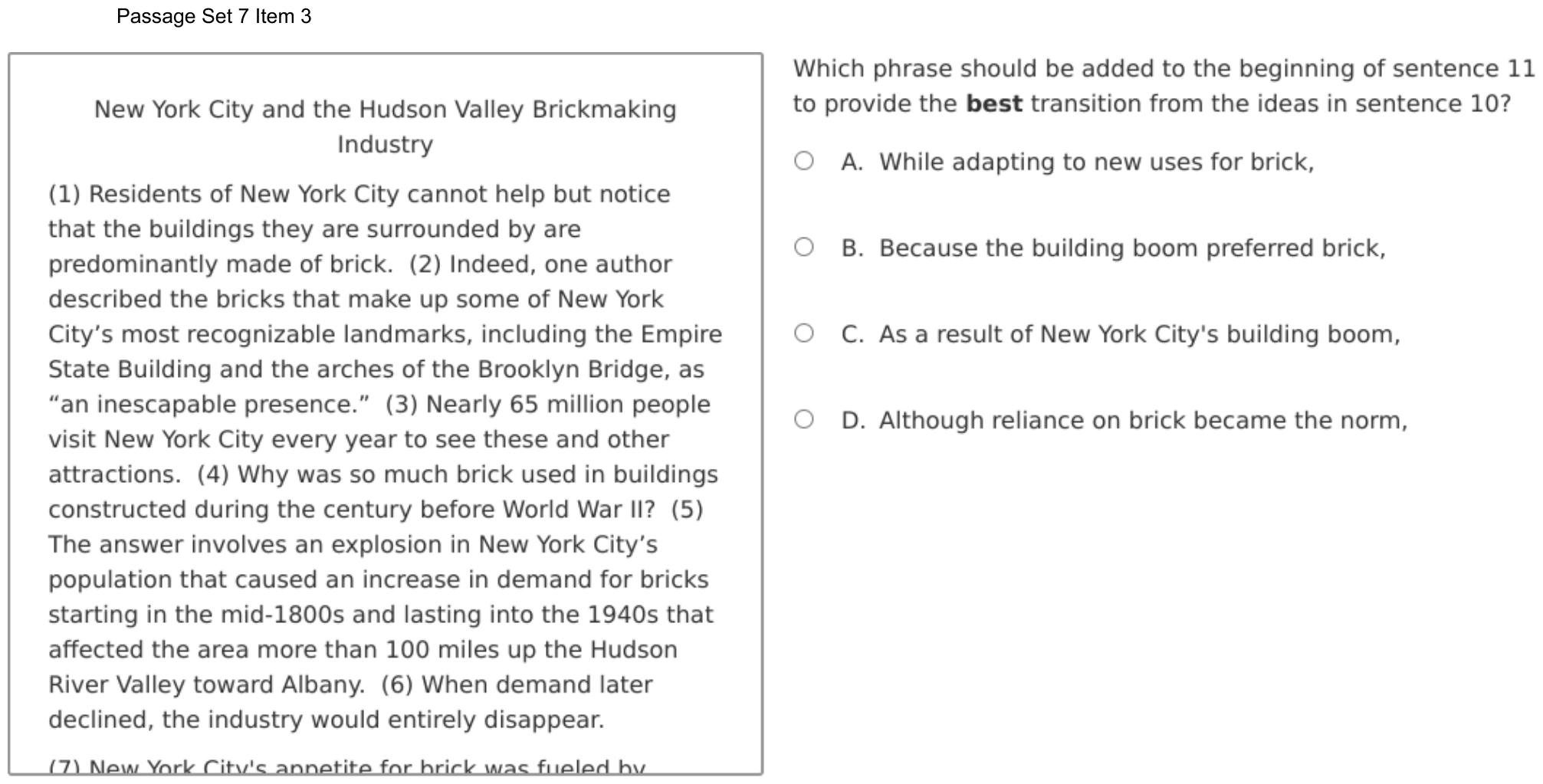
Question 12 of 43
2026 Practice Test C English, question 47Uses the passage above: “New York City and the Hudson Valley Brickmaking Industry”.
Question
Which sentence would best follow sentence 20 to support ideas in the fourth paragraph (sentences 18–21)?
- AAt first many people thought the new materials did not look as strong as brick, but eventually the public embraced the trend.
- BIncreasingly expensive shipping and labor costs also drove up the costs for brickmaking factories.
- CThe Flatiron building, completed in 1902, is a notable example of an early steel-framed building.
- DThe more that New York City builders chose to use these materials, the fewer bricks they bought.
Show the answer
Correct answer: D
The question asks which sentence would best follow sentence 20 to support ideas in the fourth paragraph (sentences 18–21).
A. Incorrect. Although the information in the sentence that consumers eventually “embraced the trend” of building with steel, glass, and concrete suggests that demand for those building materials likely increased, this detail does not clearly link increased use of steel, glass, and concrete to lower demand for brick. Therefore, this sentence would not be the best choice to follow sentence 20 to support the ideas in the fourth paragraph.
B. Incorrect. This sentence introduces a different cause of the decline of brickmaking—economic costs—rather than providing support or explanation for the idea that the shift to steel, glass, and concrete caused lower demand for brick. Thus, this sentence is not the best one to follow sentence 20.
C. Incorrect. Although this sentence adds detail related to sentence 20 by giving an example of steel use, it shifts focus toward a specific building rather than the overall trend in material preference. It does not help explain the link between a growing preference for steel, glass, and concrete and declining demand for brick. Therefore, this sentence would not best follow sentence 20 to support the ideas in the fourth paragraph.
D. CORRECT. This sentence supports the ideas in the fourth paragraph. It would best follow sentence 20 because it directly states the cause-and-effect relationship between builders’ preference for steel, glass, and concrete described in sentence 20 and the resulting decline in brick use detailed in sentence 21. It also supports the idea in sentence 19 that shifting architectural trends ended the entire Hudson Valley brickmaking industry.
Question analysis
This supporting-details question asks which sentence would best follow sentence 20 of the brickmaking passage. Sentence 20 sits in the fourth paragraph, which tells how a turn toward steel, glass and concrete ended the Hudson Valley brick industry. Each option is plausible and about building, so students must judge which one best supports the paragraph’s point at that spot.
- NYS standards
- 7W2b developing a topic
- Grade level
- Grade 7 reading and task
- Compared with grade 7
- At grade 7 Choosing a sentence that supports a paragraph’s point is regular grade 7 writing work. The paragraph is only four sentences long and the options are short, but each one relates to the topic, so the choice rests on a close judgment of relevance.
- Estimated difficulty
- Moderate: several steps, or a close reading with one strong distractor.
- Thinking it demands
- Depth of knowledge 2, skills and concepts · mainly evaluate
- What makes it hard
- How sentences fit together moderate
- Every choice must be checked minor
- Evidence
- Answered from one paragraph or stanza
- Reading level
- Passage: about grade 12, 465 words; question and choices: about grade 9, 81 words.
- Corrected from the DOE handbook
- An inaccurate statement in the explanation was corrected.
- Students, last 30 days
- Not enough answers yet to show (it takes 10).
Why it is hard, traps and wrong answers (shows the answer)
Why it is hard
The paragraph’s logic has a gap between a change in taste and the closing of the factories, and only one option fills it. The Flatiron example is the strongest lure because it follows naturally from steel in sentence 20, and the shipping-costs option tempts students who see that the paragraph explains a decline. Both are reasonable sentences; they fail because they do not link the new materials to fewer bricks.
How sentences fit together moderate Working it out
Sentence 20 says builders favored steel, glass and concrete; sentence 21 says reduced demand closed every factory. The missing step, that the new materials cut brick purchases, is what the added sentence must supply. (Halliday & Hasan, 1976)
Every choice must be checked minor Choosing the answer
All four options concern building materials or brickmaking, and three would be true and on topic somewhere in the passage, so each must be judged at this exact spot. (Embretson & Wetzel, 1987)
Strategy: Restate the point of sentences 18–21 in one sentence, then ask of each option whether it would help a reader see how that point follows from sentence 20, not just whether it is true and related.
Traps
- Off the point: Adds or keeps something that does not support the paragraph's or the passage's focus, or an introduction or conclusion that misses the main point.
The wrong answers, classified
A Off the point (Halliday & Hasan, 1976)
Follows the new materials into public taste, whether they looked as strong as brick, but never connects that shift to fewer bricks, the link the paragraph needs.
B Off the point (Halliday & Hasan, 1976)
Offers a believable second reason for the decline, rising shipping and labor costs, but the paragraph blames shifting architectural trends, and this sentence does nothing to explain them.
C Off the point (Halliday & Hasan, 1976)
Gives the Flatiron Building as an early steel-framed example, which suits sentence 20 alone, but turns to one landmark instead of showing how the new materials cut demand for brick.
What was corrected from the DOE handbook, and why
- Explanation: The handbook’s explanation of Option D ends “It also supports, with a detail about the closing of the last factory, the idea in sentence 18 that the entire Hudson Valley brickmaking industry was ended.” Option D (“The more that New York City builders chose to use these materials, the fewer bricks they bought.”) contains no detail about a factory closing; the closing of every factory is sentence 21, already in the passage. The idea that the entire industry ended is in sentence 19 (“Shifting architectural trends halted not only the Hudson Valley’s brickmaking boom, but its entire industry”); sentence 18 says only that “boom times eventually end.” The site now says “It also supports the idea in sentence 19 that shifting architectural trends ended the entire Hudson Valley brickmaking industry.” Option D is still the answer.
Working it out, step by step
Figure out what the question asks
You need a sentence to add right after sentence 20. It must support the main idea of the fourth paragraph, sentences 18–21. To support means to help explain or prove. So first find that main idea. Then find the gap after sentence 20.
Read sentences 19 to 21
Sentence 19 gives the main idea: “Shifting architectural trends halted not only the Hudson Valley’s brickmaking boom, but its entire industry.” Architectural trends are changes in how buildings are designed. Sentence 20 says builders “increasingly favored steel, glass, and concrete instead of brick.” Sentence 21 says “reduced demand for brick had driven every Hudson Valley brick factory out of business.”
Find the missing step
Sentence 20 is about builders liking new materials. Sentence 21 is about factories closing. A step is missing in between. Builders who used new materials bought fewer bricks. That is the link from sentence 20 to sentence 21. The new sentence should spell it out.
Check each choice
- A is wrong. It is about what people thought of the new materials. It never says fewer bricks were bought.
- B is wrong. It adds a different cause, rising costs. The paragraph blames changing building styles.
- C is wrong. The Flatiron Building is one example of steel. It doesn’t show how steel cut the demand for brick.
- D is right. “These materials” points back to steel, glass and concrete in sentence 20. It says that more of them meant fewer bricks, which leads straight into sentence 21.
Watch out: C fits sentence 20 nicely, since both are about steel. But one building doesn’t explain why the factories closed.
Choose the answer
D links the new building styles to fewer bricks, which explains why every factory closed. It also supports the idea in sentence 19 that changing trends ended the whole industry. So the answer is D, “The more that New York City builders chose to use these materials, the fewer bricks they bought.”
Why this answer and not the closest wrong one
C is the closest wrong answer. It follows sentence 20 smoothly, because the Flatiron Building is a steel building. But the paragraph needs to explain why the brick factories closed. Only D says that using more steel, glass and concrete meant buying fewer bricks. That is the missing link.
More questions like this
The original DOE question
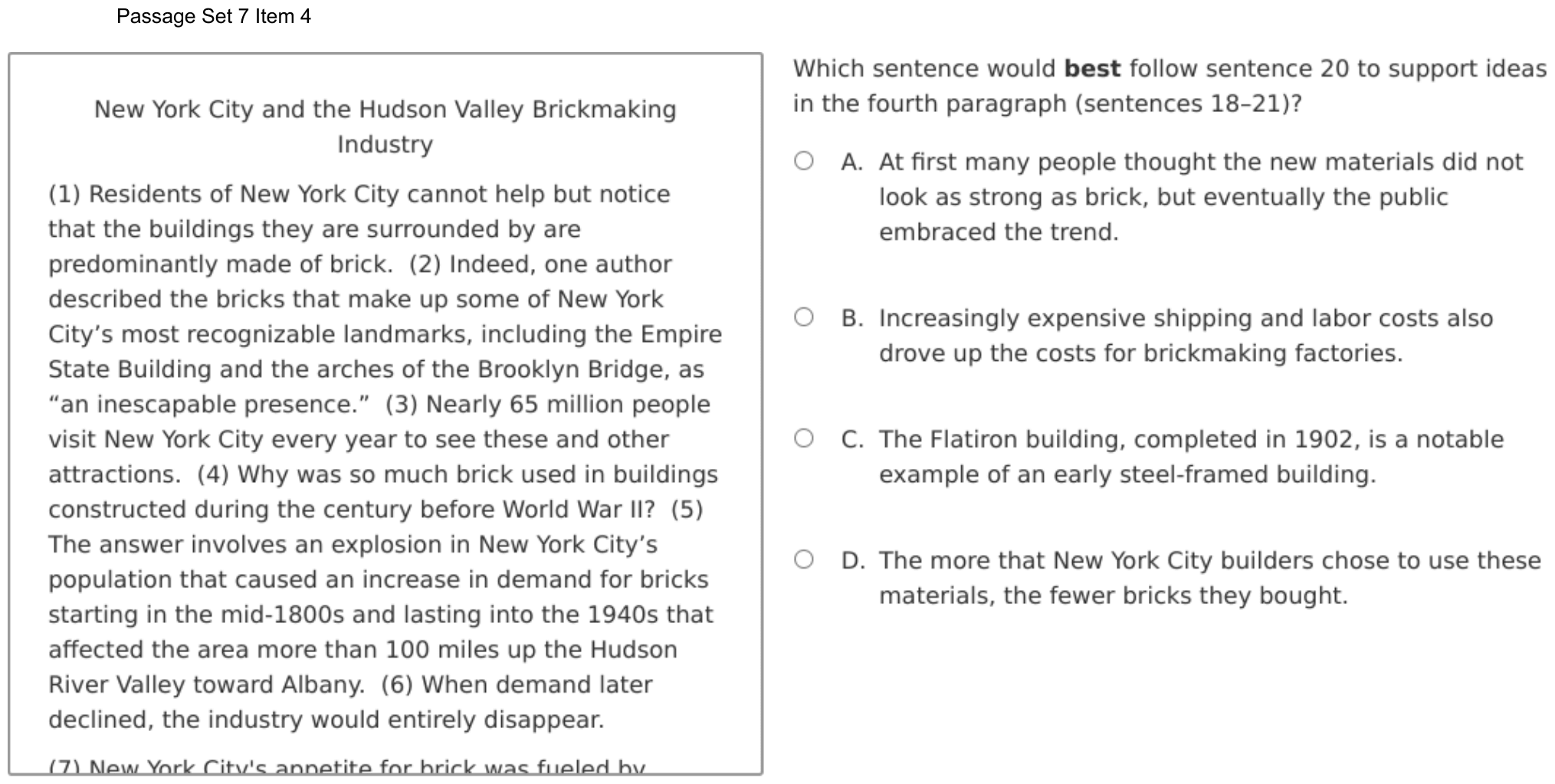
Question 13 of 43
2026 Practice Test C English, question 49Question
Read these sentences.
(1) Jordan rehearsed his role for weeks.
(2) He delivered his lines with ease.
(3) His performance was met with a burst of applause from the audience.
What is the best way to combine the sentences to clarify the relationship between ideas?
- AThough Jordan had rehearsed his role for weeks, when he delivered his lines with ease, his performance was met with a burst of applause from the audience.
- BJordan had rehearsed his role for weeks, yet he delivered his lines with ease, so his performance was met with a burst of applause from the audience.
- CBecause Jordan had rehearsed his role for weeks, he delivered his lines with ease, and his performance was met with a burst of applause from the audience.
- DJordan had rehearsed his role for weeks, so he delivered his lines with ease, but his performance was met with a burst of applause from the audience.
Show the answer
Correct answer: C
The question asks for the best way to combine the sentences to clarify the relationship between ideas.
A. Incorrect. The conjunction “though” does not make sense with the rest of the sentence since Jordan likely received applause for his performance because he rehearsed, not in spite of rehearsing.
B. Incorrect. The conjunction “yet” is incongruous with the rest of the sentence because Jordan was successful at delivering his lines likely because he rehearsed, not in spite of rehearsing.
C. CORRECT. This combination of sentences clarifies the relationship among the ideas in a way that is logical. Jordan was able to deliver his lines with ease and receive applause from the audience because he had rehearsed. “Because” is the best choice for conveying the cause-and-effect relationship between rehearsing and a successful performance.
D. Incorrect. This combination of sentences correctly expresses the relationship between rehearsing and delivering lines with ease by linking the ideas with the word “so”; however, the word “but” incorrectly links the delivery of lines with applause, suggesting that the burst of applause from the audience was unexpected.
Question analysis
This sentence-combining question gives three short sentences about Jordan, who rehearsed his role for weeks, delivered his lines with ease and drew a burst of applause, and asks for the best way to join them. Every version keeps the same facts, so students must judge which connecting words show how rehearsing, performing and the audience’s response relate.
- Grade level
- Grade 7 reading and task
- Compared with grade 7
- At grade 7 Combining sentences with connecting words that show how ideas relate is a grade 7 language skill. The three sentences are short and describe an everyday event, and the versions differ only in their connecting words, so the demand is typical.
- Estimated difficulty
- Straightforward: two steps or one careful reading.
- Thinking it demands
- Depth of knowledge 2, skills and concepts · mainly evaluate
- What makes it hard
- Every choice must be checked moderate
- How sentences fit together minor
- Evidence
- Answered from one sentence or line
- Reading level
- Question and choices: about grade 7, 150 words.
- Students, last 30 days
- Not enough answers yet to show (it takes 10).
Why it is hard, traps and wrong answers (shows the answer)
Why it is hard
The three facts form a simple chain of causes, and most students see that rehearsal explains the easy delivery. Points are lost by checking only the first connector: one version starts with a correct “so” and then joins the applause with “but,” as if it were a surprise. Versions opening with “Though” or using “yet” fail on the first link, so they are easier to rule out.
Every choice must be checked moderate Choosing the answer
Every version runs 27 words and keeps the same three facts, differing only in its two connecting words, so a wrong one can hide at the end, as “but” does after a correct “so.” (Embretson & Wetzel, 1987)
How sentences fit together minor Working it out
Students must first see the chain the sentences imply, weeks of rehearsal causing an easy delivery and the easy delivery earning applause, before any connector can be judged. (Halliday & Hasan, 1976)
Strategy: Before reading the choices, decide how each sentence leads to the next, then check every connecting word in each version, since one wrong word anywhere makes the whole combined sentence wrong.
Traps
- Wrong transition: A connecting word or phrase that signals the wrong relationship, such as contrast where the idea continues.
The wrong answers, classified
A Wrong transition (Halliday & Hasan, 1976)
Opens with “Though,” which treats weeks of rehearsal as something that should have worked against Jordan, when practice is the reason his lines came easily.
B Wrong transition (Halliday & Hasan, 1976)
Gets the second link right with “so” but joins rehearsing and easy delivery with “yet,” as if delivering lines smoothly were surprising after weeks of practice.
D Wrong transition (Halliday & Hasan, 1976)
Joins rehearsal and easy delivery correctly with “so,” then adds the applause with “but,” as if a burst of applause after a smooth performance were unexpected.
Working it out, step by step
Figure out what the question asks
You need the best way to join three short sentences into one. The joined sentence must show how the ideas connect. All four choices keep the same facts. They differ only in their connecting words. So check every connecting word in each choice.
See how the three ideas connect
Sentence 1: “Jordan rehearsed his role for weeks.” To rehearse means to practice. Sentence 2: “He delivered his lines with ease.” With ease means easily. Sentence 3: the audience burst into applause. These ideas form a chain. Practice made his lines easy. A strong performance then earned the applause. Nothing here is surprising.
Learn what each connecting word signals
- Because and so show cause and effect: I studied, so I passed.
- Though, yet and but show a contrast, something surprising: I studied, but I still failed.
- And simply adds the next idea: I studied, and I passed.
Check each choice
- A is wrong. “Though” makes the practice sound like it should have hurt him.
- B is wrong. “Yet” makes his easy delivery sound surprising after weeks of practice.
- C is right. “Because” shows that practice caused his easy delivery. “And” adds the applause that followed.
- D is wrong. “So” is right, but “but” makes the applause sound unexpected.
Watch out: D starts well with “so.” The mistake hides in its second connecting word.
Choose the answer
Only one version shows that practice led to success, with no false surprise. So the answer is C, “Because Jordan had rehearsed his role for weeks, he delivered his lines with ease, and his performance was met with a burst of applause from the audience.”
Why this answer and not the closest wrong one
D is the closest wrong answer, since its first half uses “so” correctly. But “but” tells the reader the applause was a surprise. A smooth performance after weeks of practice should earn applause. C uses “because” and “and,” which show the real chain of events.
More questions like this
The original DOE question
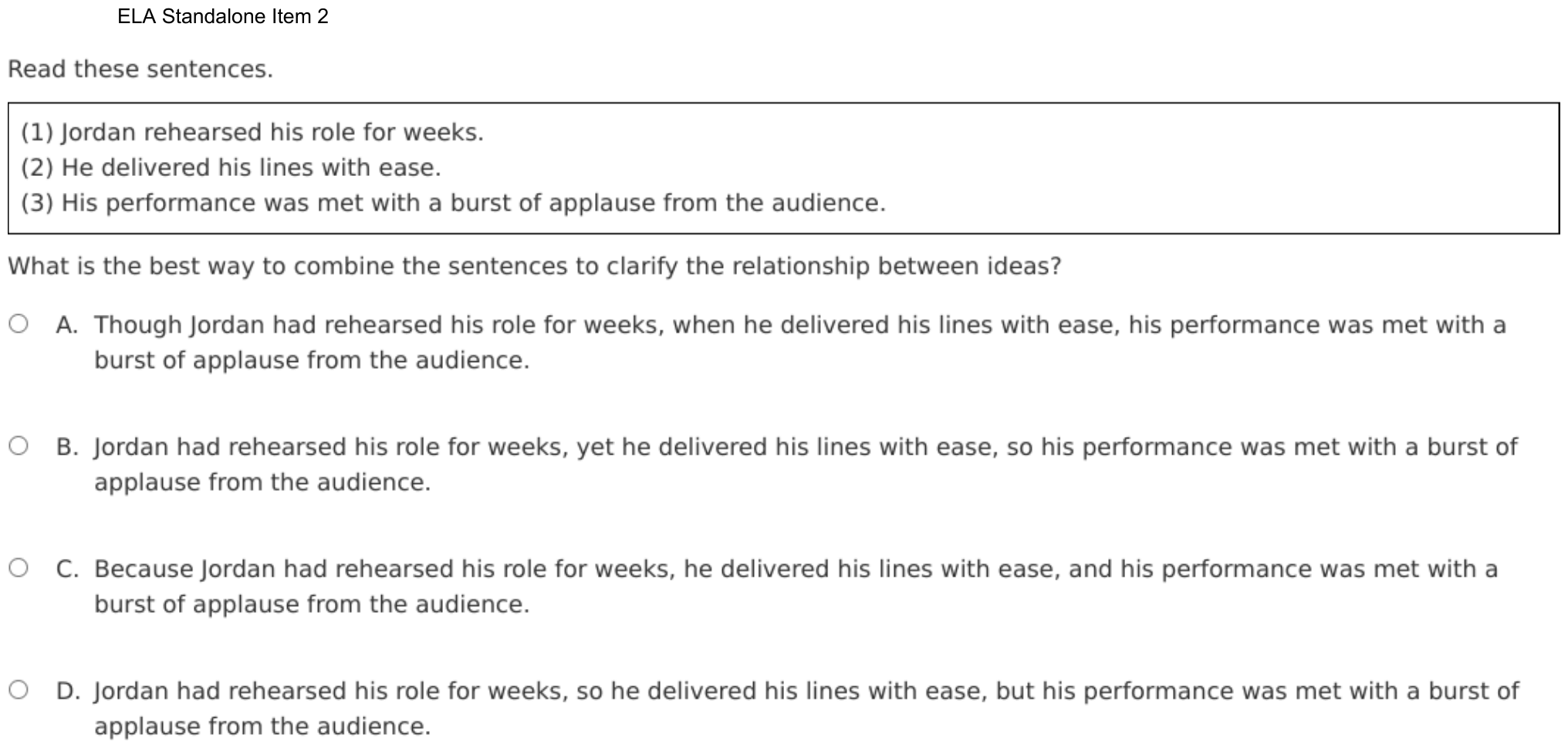
Question 14 of 43
2026 Practice Test D English, question 35Passage Martial Arts for the Mind and Body
Martial Arts for the Mind and Body
(1) The martial arts blend a series of physical movements with strategic mental discipline so that practitioners can defend themselves, physically defeat an opponent, or both. (2) Historians are unsure of exactly when and where martial arts were first used. (3) Martial arts have been practiced by several different societies for many centuries. (4) Martial arts such as karate, kung fu, tae kwon do, and judo are still taught and practiced as methods of self-defense, but they offer students more than that. (5) The study of martial arts can provide students with a way to enhance their mental discipline as well as their physical fitness.
(6) Discipline, focus, and respect are important qualities for everyone to have. (7) However, for most people these qualities are not innate; they must be learned and practiced. (8) The study of martial arts can provide an opportunity to develop these skills. (9) Students are rewarded for their dedication by passing tests and advancing to higher ranks or levels. (10) For example, in a typical tae kwon do class, students learn discipline by diligently practicing moves, improve focus by listening carefully, and demonstrate respect by bowing to the instructor and following directions.
(11) For teenagers, martial arts classes provide a safe and structured environment for gaining physical skills, building confidence, and enjoying a sense of community. (12) A lot of teens go through hard situations as they try to do well in school and in life. (13) A martial arts class can provide teens with a physical outlet for stress while also challenging them mentally. (14) Participating in a martial arts program also helps children and teens focus on self-improvement rather than on competition. (15) Progressing through levels of achievement involves mastering more physically demanding techniques. (16) It requires students to take responsibility and be accountable for achieving set goals. (17) Students gain confidence and experience companionship with other students who are progressing through the ranks.
(18) Adults who practice martial arts can experience many of the same benefits that younger people do, but perhaps the greatest of these is health and fitness. (19) Adult martial arts students often see changes in their body within weeks of beginning a program.
(20) For people interested in studying a martial art, there are many ways to learn and practice. (21) In addition to private studios, community recreation centers often offer low-cost or free martial arts classes. (22) There are even online videos that introduce students to the basic concepts. (23) People should study martial arts.
Question
What is the best way to combine sentences 2 and 3?
- AHistorians, who are unsure of exactly when and where martial arts were first used, know that martial arts have been practiced by several different societies for many centuries.
- BWhile historians are unsure of exactly when and where martial arts were first used, they do know that martial arts have been practiced by several different societies for many centuries.
- CBecause historians know that martial arts have been practiced by several different societies for many centuries, they are unsure of exactly when and where martial arts were first used.
- DMartial arts have been practiced by several different societies for many centuries, and historians are unsure of exactly when and where martial arts were first used.
Show the answer
Correct answer: B
The question asks for the best way to combine sentences 2 and 3.
A. Incorrect. This way of combining sentences 2 and 3 places unnecessary emphasis on characterizing historians, and it does not clearly show the contrasting relationship between the idea from sentence 2 that historians do not know the exact origins of martial arts and the idea in sentence 3 that historians know that martial arts have a long history.
B. CORRECT. This option is correct because the word “while” at the beginning of the sentence best indicates the contrast between the ideas in sentences 2 and 3. Sentence 2 states that historians do not know the exact origins of martial arts (“unsure of exactly when and where”). Sentence 3 describes what historians do know about these origins (“practiced by several different societies for many centuries”). This combination indicates that historians have a general understanding about the origins of martial arts even though they cannot confirm the exact details.
C. Incorrect. Starting this sentence with the word “because” indicates a cause-and-effect relationship that does not exist between the ideas in the original sentences. The idea from sentence 3, that historians know that martial arts have been practiced for many years, did not cause the idea in sentence 2, that historians do not know exact details about the origins of martial arts.
D. Incorrect. The conjunction (connecting word) “and” does not clearly show how the ideas in sentences 2 and 3 are related. While “and” can be used to combine related sentences, it does not demonstrate the contrast between the idea in sentence 2, that historians do not know the exact origins of martial arts, and the idea in sentence 3, that historians know that martial arts have a long history.
Question analysis
This sentence-combining question uses sentences 2 and 3 of a passage on the benefits of martial arts: historians are unsure when and where martial arts were first used, and the arts have been practiced by many societies for centuries. Students must choose the combination whose connecting word shows how the two facts relate, among four grammatical versions.
- Grade level
- Grade 7 reading and task
- Compared with grade 7
- At grade 7 Joining two sentences with a word that shows how their ideas relate is routine grade 7 work. Both sentences are short and plain, and the four versions differ mainly in one connecting word or structure, so the task is typical.
- Estimated difficulty
- Straightforward: two steps or one careful reading.
- Thinking it demands
- Depth of knowledge 2, skills and concepts · mainly evaluate
- What makes it hard
- How sentences fit together moderate
- Every choice must be checked minor
- Evidence
- Answered from one sentence or line
- Reading level
- Passage: about grade 11, 402 words; question and choices: about grade 13, 122 words.
- Students, last 30 days
- Not enough answers yet to show (it takes 10).
Why it is hard, traps and wrong answers (shows the answer)
Why it is hard
The two sentences are short and plain, and the only real decision is the relationship between them: uncertainty about origins set against knowledge of a long history. The relative-clause version tempts most because it sounds polished and keeps everything, yet it turns the uncertainty into a description of historians and drops the contrast. The versions with “Because” and “and” are easier to rule out once the contrast is named, since one invents a cause and the other only adds.
How sentences fit together moderate Working it out
Sentence 2 says what historians do not know and sentence 3 what they do, so the combined sentence needs a word that marks that contrast, which students should name before reading the choices. (Halliday & Hasan, 1976)
Every choice must be checked minor Choosing the answer
All four versions keep both facts and are grammatical, so each must be read through to see whether its opening word or structure shows contrast, addition, cause or mere description. (Embretson & Wetzel, 1987)
Strategy: Before reading the choices, decide how sentence 3 relates to sentence 2: an added fact, a cause, or a contrast. Then pick the version whose opening word or structure signals that relationship.
Traps
- Wrong transition: A connecting word or phrase that signals the wrong relationship, such as contrast where the idea continues.
- Changes the meaning: A revision is correct English but no longer says what the writer meant.
The wrong answers, classified
A Changes the meaning (Connors & Lunsford, 1988)
Keeps both facts in one polished sentence, but tucking sentence 2 into a “who” clause makes it a description of historians and hides the contrast between unknown and known.
C Wrong transition (Halliday & Hasan, 1976)
Opens with “Because,” making the long history the cause of historians’ uncertainty about origins, a cause-and-effect link the two facts do not have.
D Wrong transition (Halliday & Hasan, 1976)
Joins the sentences with “and,” which simply adds one fact to the other in reverse order, so nothing signals that what historians know contrasts with what they don’t.
Working it out, step by step
Figure out what the question asks
This asks how to join two sentences into one. The best way shows how the two ideas are related. So first figure out how they relate.
Read sentences 2 and 3
Sentence 2: “Historians are unsure of exactly when and where martial arts were first used.” Sentence 3: “Martial arts have been practiced by several different societies for many centuries.” A historian studies the past. Sentence 2 tells what historians don’t know. Sentence 3 tells what they do know. That is a contrast: two ideas that pull different ways.
Name the rule
When two ideas contrast, join them with a contrast word, such as while, although or but. Here “while” means although. For example: Sam forgot the exact date. He knew it was in May. Joined: While Sam forgot the exact date, he knew it was in May.
Check each choice
- A is wrong. The part that starts with “who” just describes the historians. The contrast between not knowing and knowing gets lost.
- B is right. “While” shows the contrast. The words “do know” make it even clearer.
- C is wrong. “Because” means one thing causes the other. A long history does not cause historians to be unsure.
- D is wrong. “And” just adds one fact to another. It does not show the contrast.
Watch out: A sounds smooth and keeps every fact, so it is tempting. But a good combined sentence must also show how the ideas relate.
Choose the answer
B joins the two facts and shows the contrast. So the answer is B, “While historians are unsure of exactly when and where martial arts were first used, they do know that martial arts have been practiced by several different societies for many centuries.”
Why this answer and not the closest wrong one
A is the closest wrong answer. It keeps both facts in one smooth sentence. But tucking sentence 2 into a “who” part turns it into a description of historians. Nothing marks the turn from what they don’t know to what they do. B’s “While” and “do know” make that contrast plain.
More questions like this
The original DOE question
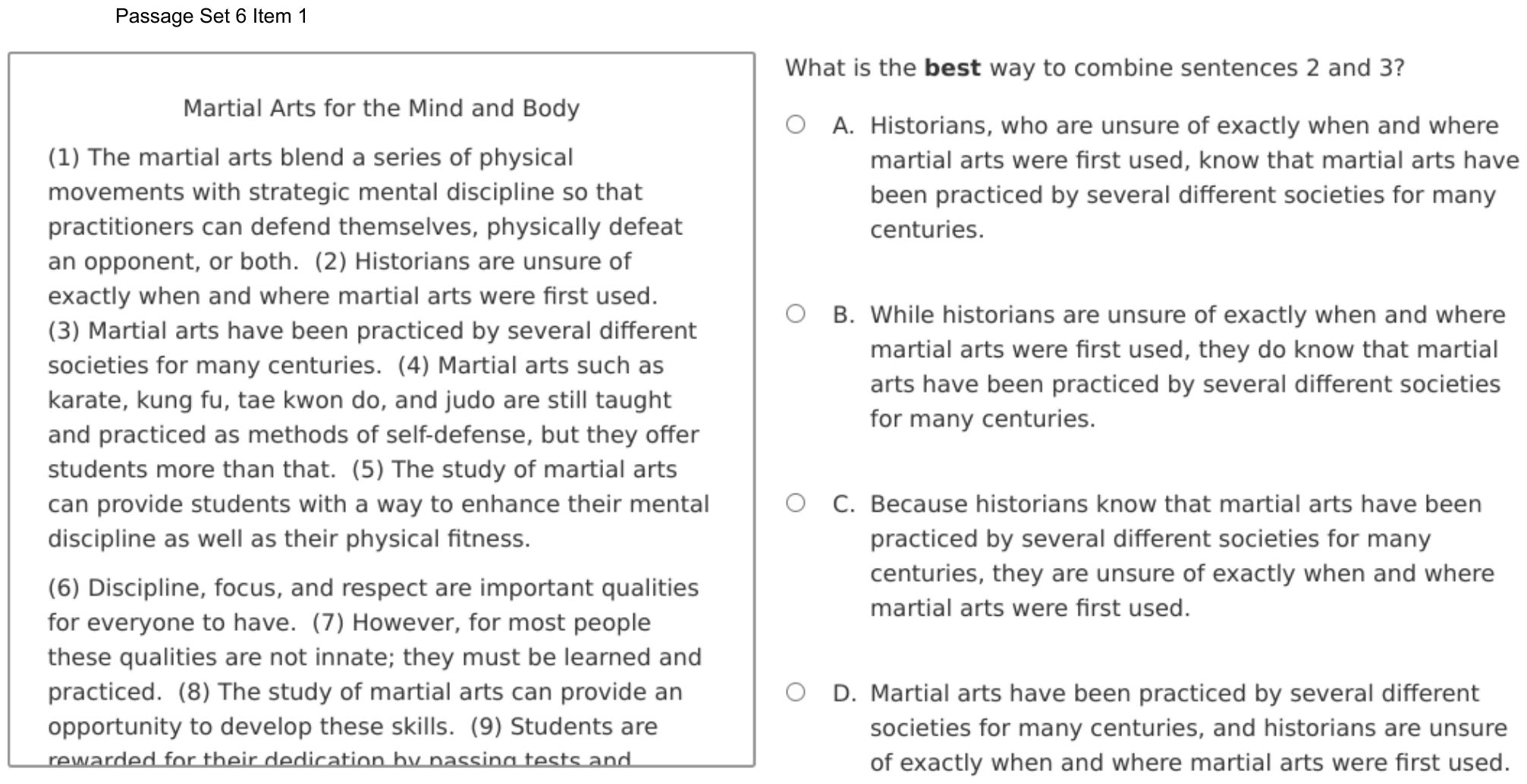
The passage “Martial Arts for the Mind and Body” as printed (page 52)
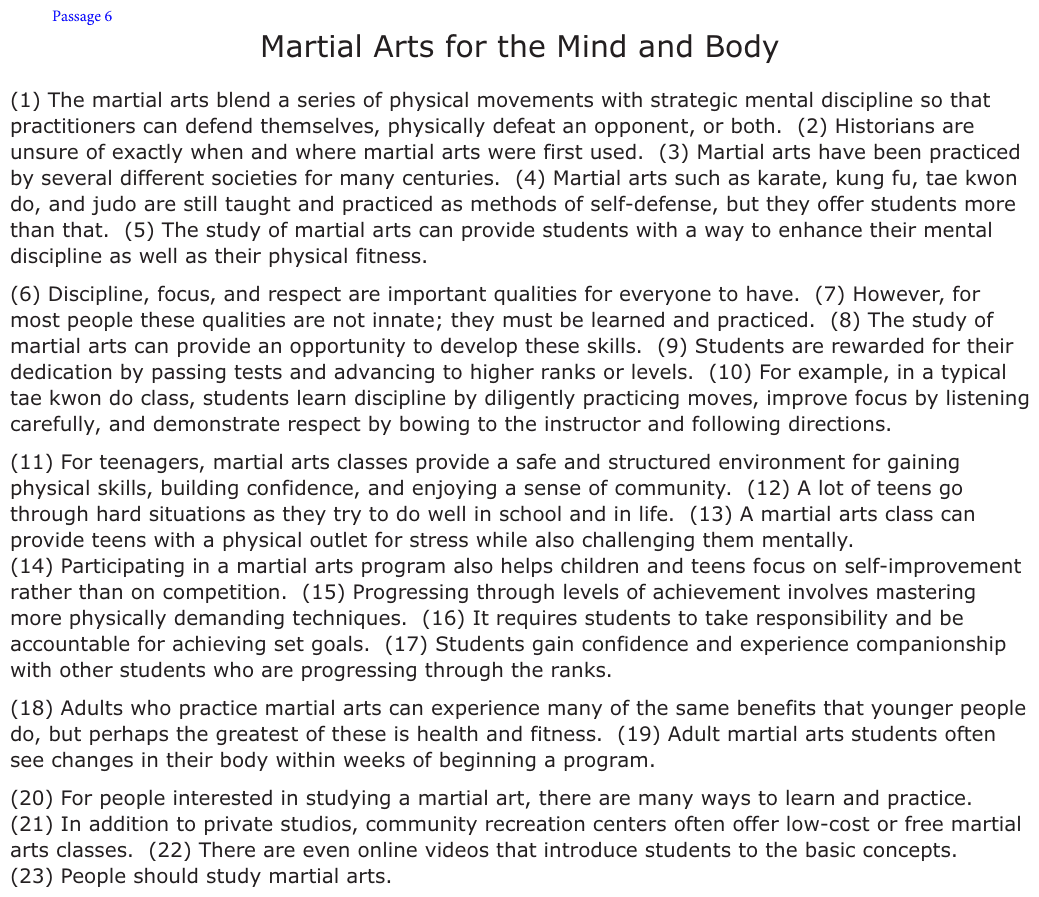
Question 15 of 43
2026 Practice Test D English, question 36Uses the passage above: “Martial Arts for the Mind and Body”.
Question
Where should sentence 10 be moved to improve the organization of the second paragraph (sentences 6–10)?
- Ato the beginning of the paragraph (before sentence 6)
- Bbetween sentences 6 and 7
- Cbetween sentences 7 and 8
- Dbetween sentences 8 and 9
Show the answer
Correct answer: D
The question asks where sentence 10 should be moved to improve the organization of the second paragraph.
A. Incorrect. Starting this paragraph with sentence 10 would weaken the paragraph’s organization because it would place a supporting detail sentence (sentence 10) before the topic sentence (sentence 6). Sentence 6 belongs at the beginning of the paragraph because it introduces the topic—the qualities of discipline, focus, and respect. Sentence 10 supports the key idea of the paragraph, that these qualities can be developed through the study of martial arts. If sentence 10 preceded sentence 6, the transitional phrase “for example” would refer to an unspecified topic and idea.
B. Incorrect. Sentence 6 presents the idea that “discipline, focus, and respect are important qualities for everyone to have,” but the example in sentence 10 does not directly relate to this idea. Sentence 10 explains how martial arts develop these qualities, not why they are important qualities to have. Because sentence 10 is not directly related to the idea in sentence 6 (the qualities are important), it should not follow sentence 6.
C. Incorrect. Sentences 7 and 8 should not be separated, because the idea presented in sentence 8—that “the study of martial arts can provide an opportunity to develop these skills”—is directly related to the idea from sentence 7—that the skills of discipline, focus, and respect “are not innate; they must be learned and practiced.” Sentence 10 supports the idea from sentence 8 by describing an example from a typical martial arts class, so sentence 10 should not precede sentence 8.
D. CORRECT. This option is correct because sentence 10 logically follows and supports the idea in sentence 8 that “the study of martial arts can provide an opportunity to develop” the qualities of discipline, focus, and respect. Sentence 10 explains this idea with examples, describing three specific ways that students in a typical tae kwon do class develop discipline, focus, and respect—by “diligently practicing,” “listening carefully,” and “bowing to the instructor and following directions.”
Question analysis
This organization question asks where sentence 10, a “For example” sentence describing a typical tae kwon do class, should be moved within the second paragraph of the martial arts passage. Students must work out what idea the example illustrates and read the paragraph with the sentence in each position, since several spots sound acceptable.
- Grade level
- Grade 7 reading and task
- Compared with grade 7
- At grade 7 Placing a sentence where it supports the right idea is regular grade 7 revision work. The paragraph is five plain sentences and the opening “For example” is a strong clue, which keeps the demand typical of grade 7.
- Estimated difficulty
- Moderate: several steps, or a close reading with one strong distractor.
- Thinking it demands
- Depth of knowledge 2, skills and concepts · mainly analyze
- What makes it hard
- How sentences fit together moderate
- A very close wrong answer minor
- Much to keep track of minor
- Evidence
- Answered from one paragraph or stanza
- Reading level
- Passage: about grade 11, 402 words; question and choices: about grade 7, 31 words.
- Students, last 30 days
- Not enough answers yet to show (it takes 10).
Why it is hard, traps and wrong answers (shows the answer)
Why it is hard
The example sentence fits loosely almost anywhere in a paragraph about discipline, focus and respect, so students have to ask what exactly it is an example of. The slot just before sentence 8 is the trap: the class’s practicing seems to illustrate sentence 7’s claim that the qualities “must be learned and practiced,” but the paragraph has not yet brought in martial arts. Those who match the example to sentence 8’s claim about martial arts place it correctly.
How sentences fit together moderate Working it out
Sentence 10 opens with “For example,” so it must follow the claim it illustrates, sentence 8’s point that studying martial arts can “develop these skills,” before sentence 9 turns to rewards. (Halliday & Hasan, 1976)
A very close wrong answer minor Choosing the answer
The slots before and after sentence 8 are neighbors, and the tae kwon do class could seem to illustrate sentence 7 as well as sentence 8, so only rereading tells them apart. (Embretson & Wetzel, 1987; Gorin & Embretson, 2006; Ascalon et al., 2007)
Much to keep track of minor Working it out
Each of the four positions means rereading a five-sentence paragraph in a new order in your head while keeping track of what “these qualities” and “these skills” refer to. (Sweller, 1988; Carpenter, Just & Shell, 1990)
Strategy: Ask which sentence the tae kwon do class is an example of, then reread the paragraph with sentence 10 placed right after it and check that every sentence still follows the one before.
Traps
- Sentence in the wrong place: Puts a sentence where it breaks the order of ideas or separates it from what it refers to.
The wrong answers, classified
A Sentence in the wrong place (Halliday & Hasan, 1976)
Moves the example to the front, where “For example” would point back to nothing and the topic sentence would come after its own illustration.
B Sentence in the wrong place (Halliday & Hasan, 1976)
Places the example after sentence 6, but the class shows how the qualities are built, not why everyone needs them, and it would cut sentence 7’s “However” off from sentence 6.
C Sentence in the wrong place (Halliday & Hasan, 1976)
Hears sentence 7’s “learned and practiced” echoed in “learn” and “practicing,” but the example must come after sentence 8, which first connects the qualities to martial arts.
Working it out, step by step
Figure out what the question asks
This asks where to move sentence 10 so paragraph 2 reads in a better order. Sentence 10 starts with “For example.” So it must come right after the idea it is an example of.
Name the rule
An example goes right after the claim it shows. “For example” points back to the sentence before it. For instance: Reading builds your word power. For example, you meet new words in every book. If the example came first, it would point back to nothing.
Find what sentence 10 shows
Sentence 10 says students “learn discipline by diligently practicing moves, improve focus by listening carefully, and demonstrate respect by bowing to the instructor and following directions.” Diligently means with steady, careful effort. This shows how martial arts build those three qualities. Sentence 8 makes that claim: “The study of martial arts can provide an opportunity to develop these skills.” So sentence 10 belongs right after sentence 8.
Read the new order
Now the paragraph runs 6, 7, 8, 10, 9. Sentence 6 names the qualities. Sentence 7 says they “must be learned and practiced.” Sentence 8 says martial arts can build them. Sentence 10 gives the tae kwon do example. Then sentence 9 tells how students are rewarded. Each sentence leads to the next.
Check each choice
- A is wrong. “For example” would point back to nothing.
- B is wrong. Sentence 6 says why the qualities matter, but the class shows how they are built. It would also cut sentence 7’s “However” off from sentence 6.
- C is wrong. Sentence 7 never mentions martial arts. Sentence 8 is the first to link the qualities to martial arts.
- D is right. The example follows the claim it shows.
Watch out: Sentence 7 says “learned and practiced,” and sentence 10 uses “learn” and “practicing.” That echo pulls you toward C.
Choose the answer
Sentence 10 gives an example of sentence 8’s claim. It belongs right after it. So the answer is D, “between sentences 8 and 9.”
Why this answer and not the closest wrong one
C is the closest wrong answer, because sentence 7 talks about learning and practice too. But sentence 7 does not mention martial arts. Sentence 8 claims that martial arts can build these skills, and the tae kwon do class is an example of exactly that. So the example belongs right after sentence 8.
More questions like this
The original DOE question
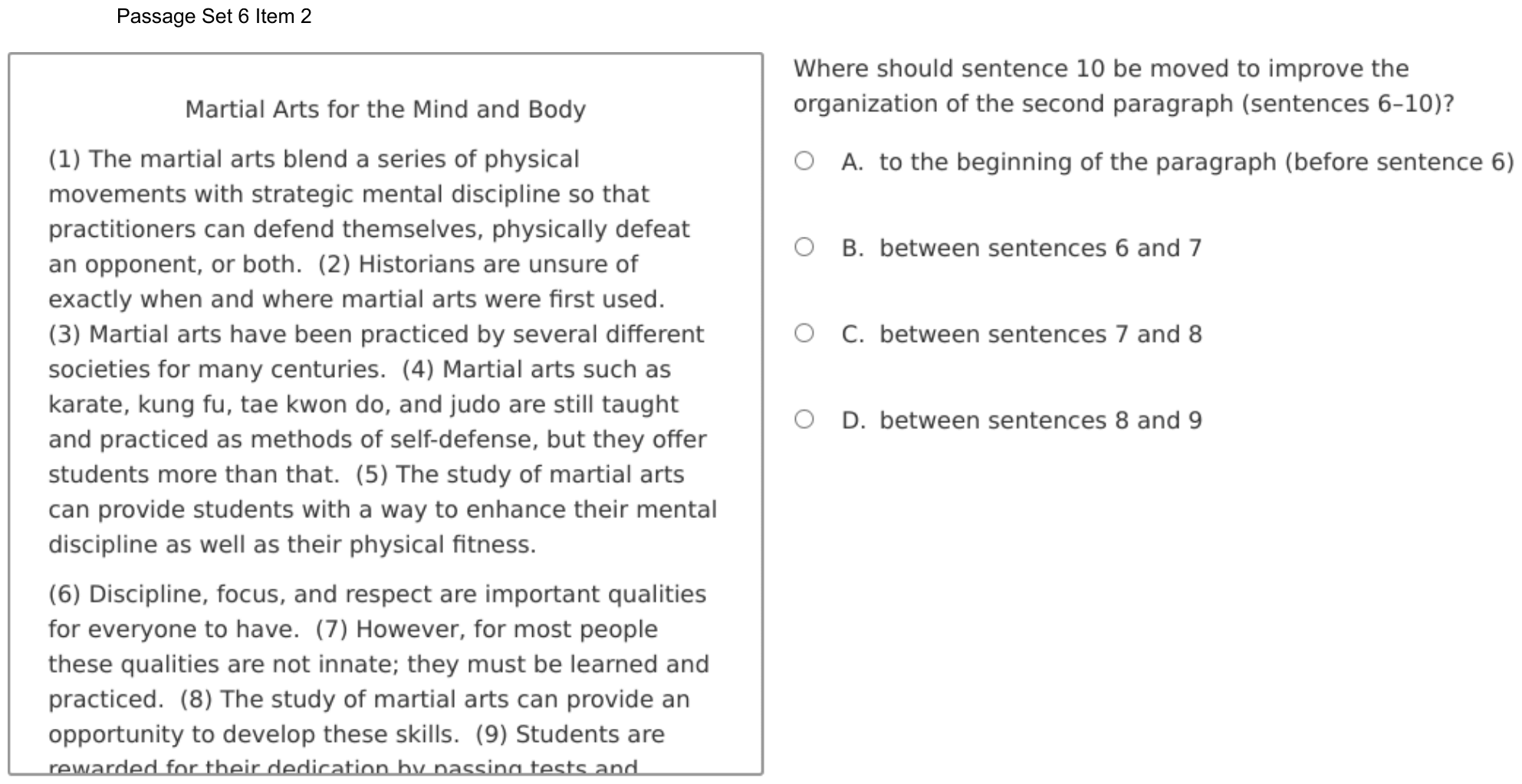
Question 16 of 43
2026 Practice Test D English, question 38Uses the passage above: “Martial Arts for the Mind and Body”.
Question
Which transitional phrase should be added to the beginning of sentence 17?
- AOver time,
- BIn fact,
- CEven so,
- DFor instance,
Show the answer
Correct answer: A
The question asks for the transitional phrase that should be added to the beginning of sentence 17.
A. CORRECT. This option is correct because it best shows the chronological progression between the ideas in sentence 16—progressing through levels of achievement “requires students to take responsibility and be accountable for achieving set goals”—and the ideas in sentence 17—“students gain confidence and experience companionship with other students who are progressing through the ranks.” The transitional phrase “over time” shows the gradual nature of the relationship between the cause in sentence 16 and the effect in sentence 17.
B. Incorrect. Though the ideas in sentences 16 and 17 are related, “in fact” does not show the correct relationship between the ideas. The transitional phrase “in fact” emphasizes an idea by giving a detail or example of greater intensity, but the ideas in sentence 16—progressing through levels “requires students to take responsibility and be accountable for achieving set goals”—and the ideas in sentence 17—“students gain confidence and experience companionship with other students who are progressing through the ranks”—are related by cause and effect rather than by (degree of) intensity.
C. Incorrect. The transitional phrase “even so” is used to connect opposing ideas, but the ideas in sentence 16—progressing through levels “requires students to take responsibility and be accountable for achieving set goals”—do not contrast with the ideas in sentence 17—“students gain confidence and experience companionship with other students who are progressing through the ranks.”
D. Incorrect. Although the transitional phrase “for instance” connects an idea with a related example, it does not show the cause-and-effect relationship between the ideas in sentence 16—progressing through levels “requires students to take responsibility and be accountable for achieving set goals”—and the ideas in sentence 17—“students gain confidence and experience companionship with other students who are progressing through the ranks.”
Question analysis
This transition question asks which phrase should begin sentence 17 of the martial arts passage, which says students gain confidence and companionship with others progressing through the ranks. Students must work out how it relates to sentences 15 and 16, on mastering harder techniques and meeting set goals, because all four phrases are common openers that sound natural.
- NYS standards
- 7W2d transitions in informative writing
- Grade level
- Grade 7 reading and task
- Compared with grade 7
- At grade 7 Choosing a transition that fits the link between sentences is routine grade 7 writing work. The sentences are short and plain, but more than one phrase sounds acceptable on a first reading, so careful but typical reasoning is needed.
- Estimated difficulty
- Moderate: several steps, or a close reading with one strong distractor.
- Thinking it demands
- Depth of knowledge 2, skills and concepts · mainly evaluate
- What makes it hard
- How sentences fit together moderate
- Reading between the lines minor
- Evidence
- Answered from one paragraph or stanza
- Reading level
- Passage: about grade 11, 402 words; question and choices: about grade 3, 19 words.
- Corrected from the DOE handbook
- A grammar slip in the explanation was corrected.
- Students, last 30 days
- Not enough answers yet to show (it takes 10).
Why it is hard, traps and wrong answers (shows the answer)
Why it is hard
All four phrases are common transitions, and “In fact” in particular sounds natural in front of almost any sentence that adds a point. The question rewards naming the link first: sentence 17 describes what students gain as they move up, a result that comes with time, not a stronger restatement, a contrast or an example. Students who read sentences 15 to 17 as one progression find the time phrase; those who test each phrase by sound tend to stop at the emphatic one.
How sentences fit together moderate Working it out
Sentence 16 says moving up the levels makes students responsible for “achieving set goals”; sentence 17 gives what they gain while “progressing through the ranks,” a result that builds up gradually. (Halliday & Hasan, 1976)
Reading between the lines minor Working it out
No word in either sentence says time passes or that one thing causes another, so students must infer that confidence and companionship come from the effort described in sentences 15 and 16. (Graesser, Singer & Trabasso, 1994; Kintsch, 1998)
Strategy: Restate sentences 16 and 17 in your own words and name the link between them, such as example, contrast, emphasis or time, before trying each phrase in front of sentence 17.
Traps
- Wrong transition: A connecting word or phrase that signals the wrong relationship, such as contrast where the idea continues.
The wrong answers, classified
B Wrong transition (Halliday & Hasan, 1976)
Hears “In fact” as a natural way to add a point, but sentence 17 does not restate sentence 16 more strongly; it names what follows from meeting goals.
C Wrong transition (Halliday & Hasan, 1976)
Sets the hard work of sentences 15 and 16 against the rewards of sentence 17 and calls it a contrast, though gaining confidence follows from that work rather than despite it.
D Wrong transition (Halliday & Hasan, 1976)
Takes sentence 17 as an example of sentence 16, but confidence and companionship are results of taking responsibility for goals, not instances of it.
What was corrected from the DOE handbook, and why
- Explanation: The DOE’s explanation of Option C says “the ideas in sentence 16 … does not contrast with the ideas in sentence 17.” The subject is “ideas,” so the site now says “do not contrast.”
Working it out, step by step
Figure out what the question asks
This asks for a transition to start sentence 17. A transition is a word or phrase that shows how two ideas connect. First figure out the link between sentences 16 and 17. Then pick the phrase that names it.
Read sentences 15 to 17
Sentence 15 says moving up “involves mastering more physically demanding techniques.” Sentence 16 says, “It requires students to take responsibility and be accountable for achieving set goals.” Being accountable means you must answer for your own results. Sentence 17 says, “Students gain confidence and experience companionship with other students who are progressing through the ranks.” Companionship means friendship.
Name the link
Confidence and friendship don’t come in one day. They grow as students keep working and moving up the ranks. So sentence 17 is a result that builds slowly. A time phrase fits. For example: I practiced piano every day. Over time, I could play the whole song.
Check each choice
- A is right. “Over time” shows the rewards grow as students keep working.
- B is wrong. “In fact” adds a stronger version of the same point. Sentence 17 makes a new point.
- C is wrong. “Even so” means in spite of that. Confidence comes because of hard work, not in spite of it.
- D is wrong. “For instance” starts an example. Confidence is a result of taking responsibility, not an example of it.
Watch out: “In fact” sounds natural in front of almost any sentence. Name the link before you test the phrases by sound.
Choose the answer
With the phrase added, sentence 17 begins Over time, students gain confidence. So the answer is A, “Over time,” added to the beginning of sentence 17.
Why this answer and not the closest wrong one
B is the closest wrong answer, since “In fact” is a common way to add a point. But “In fact” signals a stronger restatement. Sentence 17 doesn’t restate sentence 16. It tells what students gain as they keep moving up. That gain builds slowly, so “Over time” fits best.
More questions like this
The original DOE question
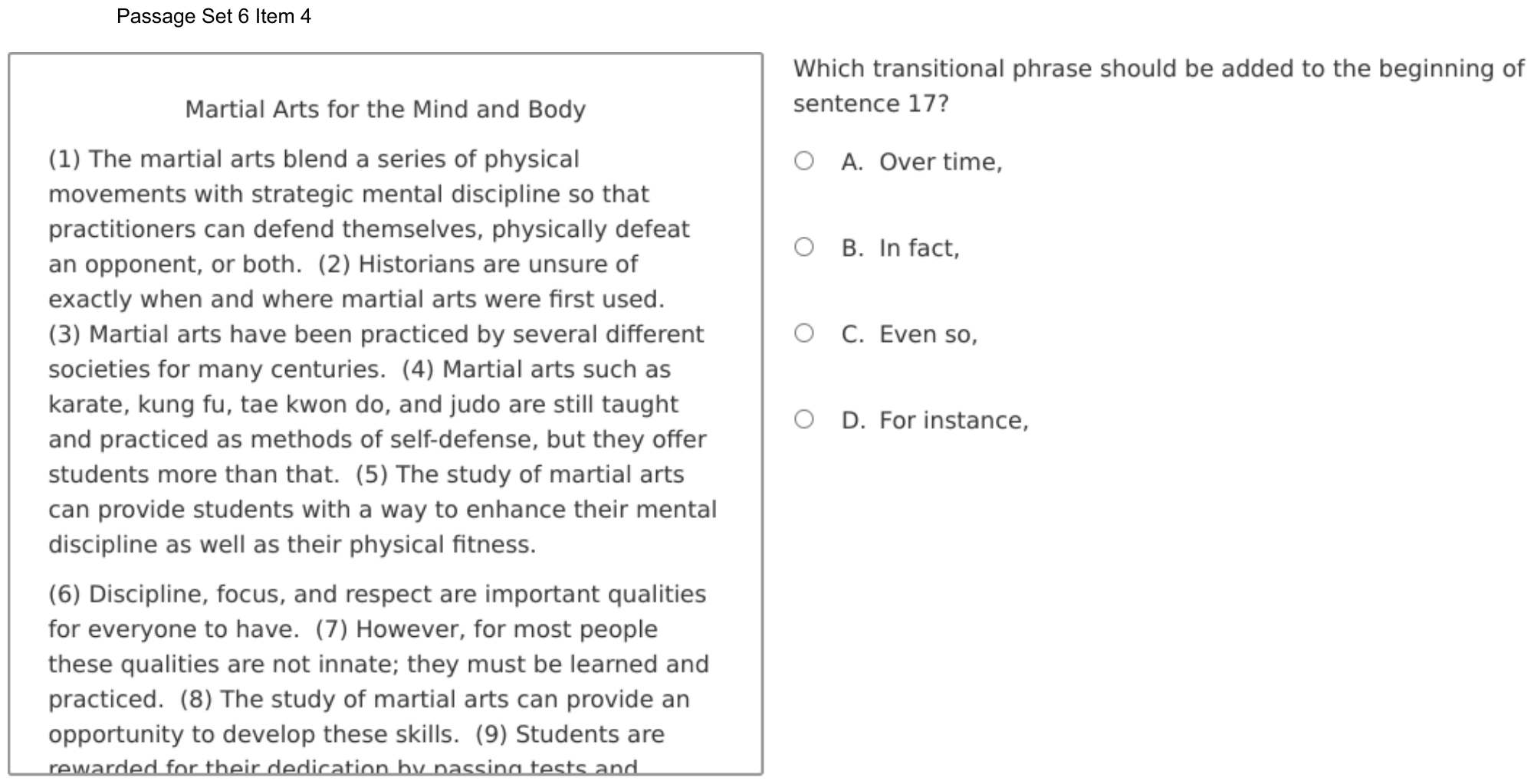
Question 17 of 43
2026 Practice Test D English, question 39Uses the passage above: “Martial Arts for the Mind and Body”.
Question
Which sentence would best follow and support sentence 18?
- AAdult students gain discipline, focus, self-control, and respect, which are qualities that help them advance in their careers.
- BMany adults initially train in a martial art simply to get exercise without realizing that the training also helps develop other skills.
- CThe exercise involved in training helps people strengthen their heart, boost endurance, improve balance, and develop muscle tone.
- DPeople who commit to training in the martial arts are usually concerned about improving their overall physical health.
Show the answer
Correct answer: C
The question asks for the sentence that would best follow and support sentence 18.
A. Incorrect. Though the idea of advancing one’s career is certainly appealing for adults, this benefit is not directly tied to “health and fitness” and, therefore, does not support sentence 18.
B. Incorrect. While the passage does discuss potential benefits related to discipline, focus, and confidence (sentences 6 and 11), sentence 18 is solely related to health and fitness benefits and should not be followed by a description of “other skills.”
C. CORRECT. This option is correct because sentence 18 conveys that the greatest benefit of practicing martial arts is “health and fitness,” and the sentence illustrates some specific ways that martial arts training helps improve physical fitness—“strengthen their heart, boost endurance, improve balance, and develop muscle tone.”
D. Incorrect. Some readers may choose this option because sentence 5, sentence 15, and sentence 18 discuss the physical aspects of practicing martial arts, but the idea that people who practice martial arts are concerned about their overall health does not provide further details about the connection between training and health.
Question analysis
This supporting-details question asks which sentence would best follow and support sentence 18 of the martial arts passage, which says adults gain many of the same benefits as younger students and names the greatest of them. Every choice is about adults or training, so students must match the exact point of sentence 18 rather than its general subject.
- NYS standards
- 7W2b developing a topic
- Grade level
- Grade 7 reading and task
- Compared with grade 7
- At grade 7 Adding a detail that supports a given sentence is a regular grade 7 writing task. Sentence 18 names its focus plainly and its paragraph is only two sentences long, so the demand is typical, though two choices stay close to the topic.
- Estimated difficulty
- Straightforward: two steps or one careful reading.
- Thinking it demands
- Depth of knowledge 2, skills and concepts · mainly evaluate
- What makes it hard
- How sentences fit together moderate
- A very close wrong answer minor
- Evidence
- Answered from one paragraph or stanza
- Reading level
- Passage: about grade 11, 402 words; question and choices: about grade 11, 84 words.
- Corrected from the DOE handbook
- The DOE printed this question’s explanation after a different question; the site matches the question with its own explanation.
- Students, last 30 days
- Not enough answers yet to show (it takes 10).
Why it is hard, traps and wrong answers (shows the answer)
Why it is hard
Sentence 18 states its focus plainly, so the question mostly tests whether students hold to it. Two choices drift back to the mental side of the passage, discipline, focus and other skills, which paragraphs 2 and 3 have already covered. The closest wrong answer stays on physical health but describes the people who train, so it adds nothing about how training improves fitness; the key is the only one to list effects on the body.
How sentences fit together moderate Working it out
Sentence 18 names one benefit, “perhaps the greatest of these is health and fitness,” so the next sentence must give details of that benefit, not of the mental ones the passage covered earlier. (Halliday & Hasan, 1976)
A very close wrong answer minor Choosing the answer
The choice about health-minded trainees and the key both concern training and physical health; the key says what the exercise does for the body, the other only what trainees care about. (Embretson & Wetzel, 1987; Gorin & Embretson, 2006; Ascalon et al., 2007)
Strategy: Reread sentence 18 and note which benefit it singles out, then ask of each choice whether it gives specific details about that benefit or shifts to another one.
Traps
- Off the point: Adds or keeps something that does not support the paragraph's or the passage's focus, or an introduction or conclusion that misses the main point.
The wrong answers, classified
A Off the point (Halliday & Hasan, 1976)
Lists discipline, focus, self-control and respect, qualities from paragraph 2, and adds careers, but sentence 18 singles out health and fitness for adults.
B Off the point (Halliday & Hasan, 1976)
Starts with adults training “to get exercise,” which sounds on topic, but its point is the other skills they gain without realizing it, a turn away from fitness.
D Off the point (Halliday & Hasan, 1976)
Stays on physical health but says what trainees care about, not what training does for them, so it gives no detail about the benefit sentence 18 names.
What was corrected from the DOE handbook, and why
- Explanation: In the DOE’s explanations appendix, the explanation printed after this question belongs to question 40 (“the concluding sentence that best replaces sentence 23 and supports the topic presented in the passage”) and marks B correct, and this question’s explanation (“the sentence that would best follow and support sentence 18”) is printed after question 40, marking C correct. Read page by page, the appendix gives this question the answer B. The site gives the question the explanation that restates it, and the answer follows that explanation: C, because sentence 18 names health and fitness as the greatest benefit for adults, and Option C gives specific ways that training improves fitness.
Working it out, step by step
Figure out what the question asks
This asks which sentence should come right after sentence 18 and support it. To support a sentence is to give details that back it up. So first find what sentence 18 is about.
Read sentence 18
Sentence 18 says adults “can experience many of the same benefits that younger people do, but perhaps the greatest of these is health and fitness.” A benefit is a good result. So the next sentence should give details about health and fitness. It should show how training helps the body.
Name the rule
A supporting sentence stays on the same point and adds details. For example: Dogs make good pets. They are loyal, playful and easy to train. The second sentence gives details about the first. A sentence about cats would drift off the point.
Check each choice
- A is wrong. Discipline, focus and respect are qualities of the mind. Careers are off the point too.
- B is wrong. It starts with exercise, then turns to “other skills.”
- C is right. It names four ways training helps the body. Endurance means being able to keep going for a long time. Muscle tone means firm, strong muscles.
- D is wrong. It tells what people who train care about, not what training does for them.
Watch out: D stays on physical health, so it looks on topic. But it gives no details about how training improves fitness.
Choose the answer
Only C gives details of the health and fitness benefit. So the answer is C, “The exercise involved in training helps people strengthen their heart, boost endurance, improve balance, and develop muscle tone.”
Why this answer and not the closest wrong one
D is the closest wrong answer, because it also talks about physical health. But it describes the people who train, not the benefit. Sentence 18 names health and fitness as the greatest benefit. C backs that up with real effects on the body: a stronger heart, endurance, balance and muscle tone.
More questions like this
The original DOE question
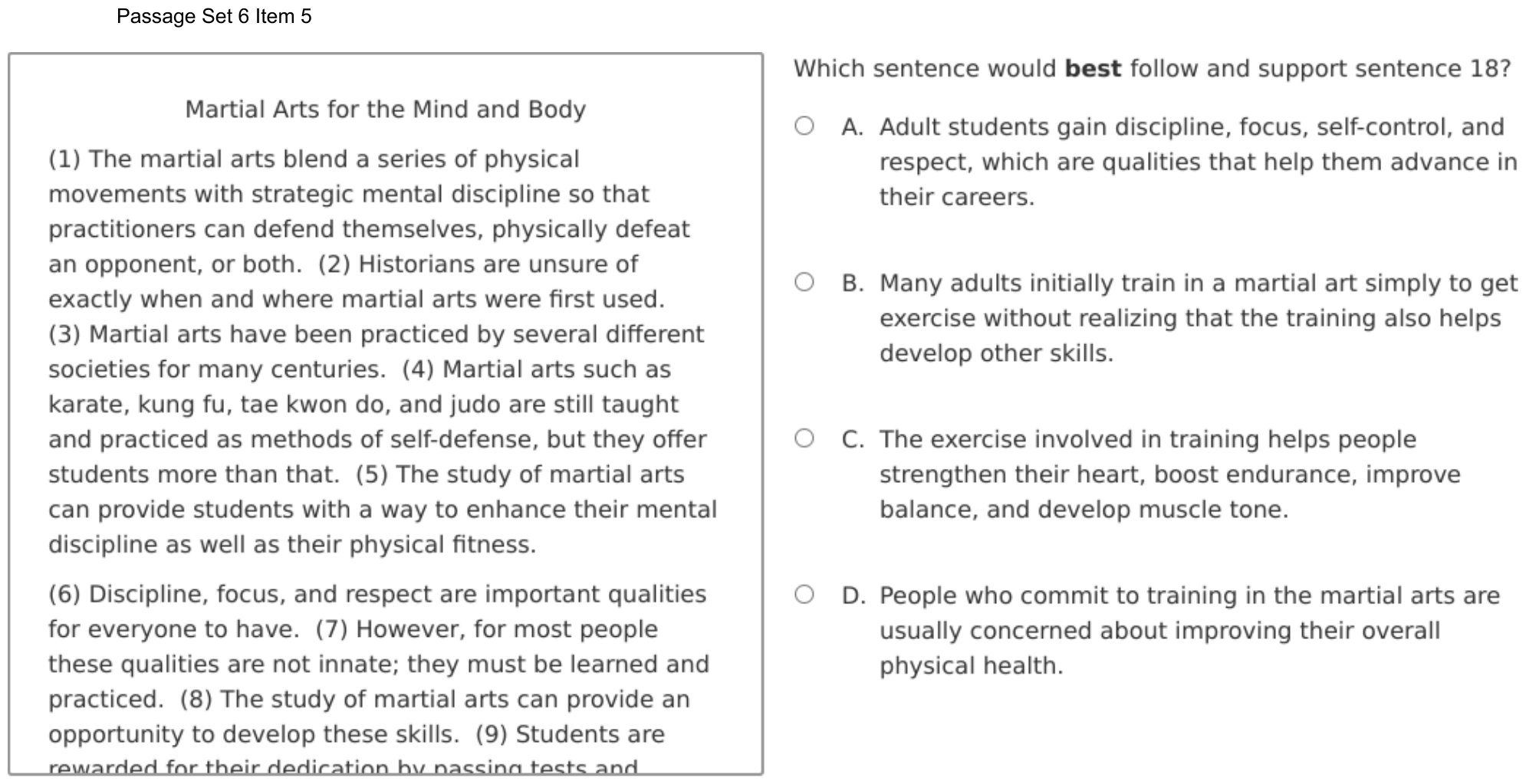
Question 18 of 43
2026 Practice Test D English, question 50Question
What is the best way to combine the sentences?
(1) Scientists now believe that Jupiter may have as many as seventy-nine moons.
(2) One of Jupiter’s moons is named Io.
(3) Io has the greatest number of active volcanoes in the solar system.
- AIo, which is one of Jupiter’s moons, has the greatest number of active volcanoes in the solar system, and scientists now believe that Jupiter may have as many as seventy-nine moons.
- BScientists now believe that Jupiter may have as many as seventy-nine moons, and one of them is named Io, which has the greatest number of active volcanoes in the solar system.
- CScientists now believe that Jupiter may have as many as seventy-nine moons, including one named Io, which has the greatest number of active volcanoes in the solar system.
- DIo, a moon with the greatest number of active volcanoes in the solar system, is one of Jupiter’s moons, and scientists now believe that Jupiter may have as many as seventy-nine moons.
Show the answer
Correct answer: C
The question asks for the best way to combine the sentences.
A. Incorrect. Although the sentence incorporates the ideas presented in the three original sentences, it is incorrect because the combination suggests an incorrect relationship between the ideas. By beginning with “Io,” the sentence places emphasis on the moon and the detail about the number of active volcanoes rather than the key idea that “scientists now believe that Jupiter may have as many as seventy-nine moons.” Since Io is an example of one of Jupiter’s moons, the details about Io should follow and be subordinate to the main clause, which provides new information about the number of Jupiter’s moons in general.
B. Incorrect. Although the sentence incorporates all three ideas from the original sentences and correctly places the detail about the number of active volcanoes on Io in a dependent clause, this option is incorrect because it presents an imprecise relationship between the ideas. By using the conjunction (connecting word) “and,” the sentence construction suggests that scientists “now believe” that “Jupiter may have as many as seventy-nine moons” and that “one of them is named Io,” instead of presenting Io as an example of one of Jupiter’s moons.
C. CORRECT. This sentence is the best way to combine the original sentences because it uses a complex sentence to present ideas clearly and precisely, and it shows the relationship between the ideas in the original sentences. The sentence starts by stating the number of moons scientists now believe Jupiter may have and then specifies that one of those moons is named Io. The dependent clause “which has the greatest number of active volcanoes in the solar system” immediately follows the word “Io” to provide additional information about the moon. A dependent clause contains a subject (“which,” referring to Io) and a verb (“has”) but is not a complete sentence on its own.
D. Incorrect. The sentence incorporates the key ideas from the original sentences, but its structure does not accurately present the relationship between these ideas. The beginning of the sentence includes the detail about Io having “the greatest number of active volcanoes in the solar system” before specifying that Io is one of the seventy-nine moons of Jupiter. The presentation of the details about Io at the beginning lessens the emphasis of the key idea that “scientists now believe that Jupiter may have as many as seventy-nine moons.”
Question analysis
This sentence-combining question gives three short sentences: scientists believe Jupiter may have as many as seventy-nine moons, one moon is named Io, and Io has the most active volcanoes in the solar system. Students must choose the single sentence that joins all three facts while showing how they relate, and the four versions differ only in order and connecting structure.
- Grade level
- Grade 7 reading and task
- Compared with grade 7
- At grade 7 Combining sentences so the ideas relate clearly is grade 7 language work. The three sentences are short, but every version keeps all the facts, so the choice rests on which idea leads and which is tucked into a clause, a typical grade 7 demand.
- Estimated difficulty
- Moderate: several steps, or a close reading with one strong distractor.
- Thinking it demands
- Depth of knowledge 2, skills and concepts · mainly evaluate
- What makes it hard
- A very close wrong answer moderate
- How sentences fit together moderate
- Every choice must be checked minor
- Evidence
- Answered from one sentence or line
- Reading level
- Question and choices: about grade 10, 162 words.
- Students, last 30 days
- Not enough answers yet to show (it takes 10).
Why it is hard, traps and wrong answers (shows the answer)
Why it is hard
Because every version keeps all three facts and is grammatical, the question is about emphasis and connection, which students rarely check for. Two versions open with Io and its volcanoes and leave the seventy-nine moons trailing after “and,” and one of them also calls Io a moon twice. The strongest pull is the version with the right order that still joins Io with “and,” so Io’s name reads as a second piece of news rather than an example of the moons just counted.
A very close wrong answer moderate Choosing the answer
The “and one of them is named Io” version matches the key in its order and in its which-clause about volcanoes; only its connector differs from the key’s “including one named Io.” (Embretson & Wetzel, 1987; Gorin & Embretson, 2006; Ascalon et al., 2007)
How sentences fit together moderate Working it out
Students must see that sentence 1 is the main news and that sentences 2 and 3 narrow to one example, so Io belongs inside the sentence about Jupiter’s seventy-nine moons. (Halliday & Hasan, 1976)
Every choice must be checked minor Choosing the answer
Every version is grammatical and keeps all three facts, so none can be ruled out by an error; each is judged on which idea leads and how the others attach. (Embretson & Wetzel, 1987)
Strategy: Decide which of the three sentences states the main idea and which ones add detail, then check whether each version’s order and structure show that relationship.
Traps
- Wrong transition: A connecting word or phrase that signals the wrong relationship, such as contrast where the idea continues.
- Changes the meaning: A revision is correct English but no longer says what the writer meant.
The wrong answers, classified
A Changes the meaning (Connors & Lunsford, 1988)
Opens with Io and its volcanoes and adds the moon count with “and,” so the main news about Jupiter trails behind its own example as an afterthought.
B Wrong transition (Halliday & Hasan, 1976)
Keeps the right order and the which-clause, but “and one of them is named Io” adds Io as a second piece of news instead of an example of those moons.
D Changes the meaning (Connors & Lunsford, 1988)
Leads with Io’s volcanoes, then says Io “is one of Jupiter’s moons” right after calling it “a moon,” and leaves the main news about Jupiter for the end.
Working it out, step by step
Figure out what the question asks
This asks for the best way to join three sentences into one. All four choices keep every fact. So the best one shows how the facts relate. Decide which fact is the main idea and which ones add detail.
Find the main idea
Sentence 1 is the big news: “Scientists now believe that Jupiter may have as many as seventy-nine moons.” Sentences 2 and 3 zoom in on one of those moons, Io. Io is an example of the moons, and its volcanoes are a detail about Io. So the main idea should come first, and Io should fit inside it.
Name the rule
Put the main idea in the main part of the sentence. Tuck the details in with words like including and which. For example: My school has thirty clubs. One is chess. The chess club meets on Fridays. Joined: My school has thirty clubs, including a chess club, which meets on Fridays.
Check each choice
- A is wrong. It starts with Io and its volcanoes. The main news about Jupiter trails at the end after “and.”
- B is wrong. The order is right. But “and one of them is named Io” adds Io as a second piece of news, not as an example.
- C is right. “Including one named Io” shows Io is one of the moons. Then “which” adds the fact about its volcanoes.
- D is wrong. It calls Io “a moon,” then says again that it “is one of Jupiter’s moons.” The main news comes last.
Watch out: B is very close to C. The only change is “and one of them is named Io” in place of “including one named Io.” The word “including” shows that Io belongs to the group.
Choose the answer
C leads with the main news and tucks in Io as an example. So the answer is C, “Scientists now believe that Jupiter may have as many as seventy-nine moons, including one named Io, which has the greatest number of active volcanoes in the solar system.”
Why this answer and not the closest wrong one
B is the closest wrong answer. It has the right order and the same “which” clause. But “and” tacks Io’s name on as a separate fact, as if it were more news. “Including” shows that Io is one of the seventy-nine moons. That ties the three facts together most clearly.
More questions like this
The original DOE question
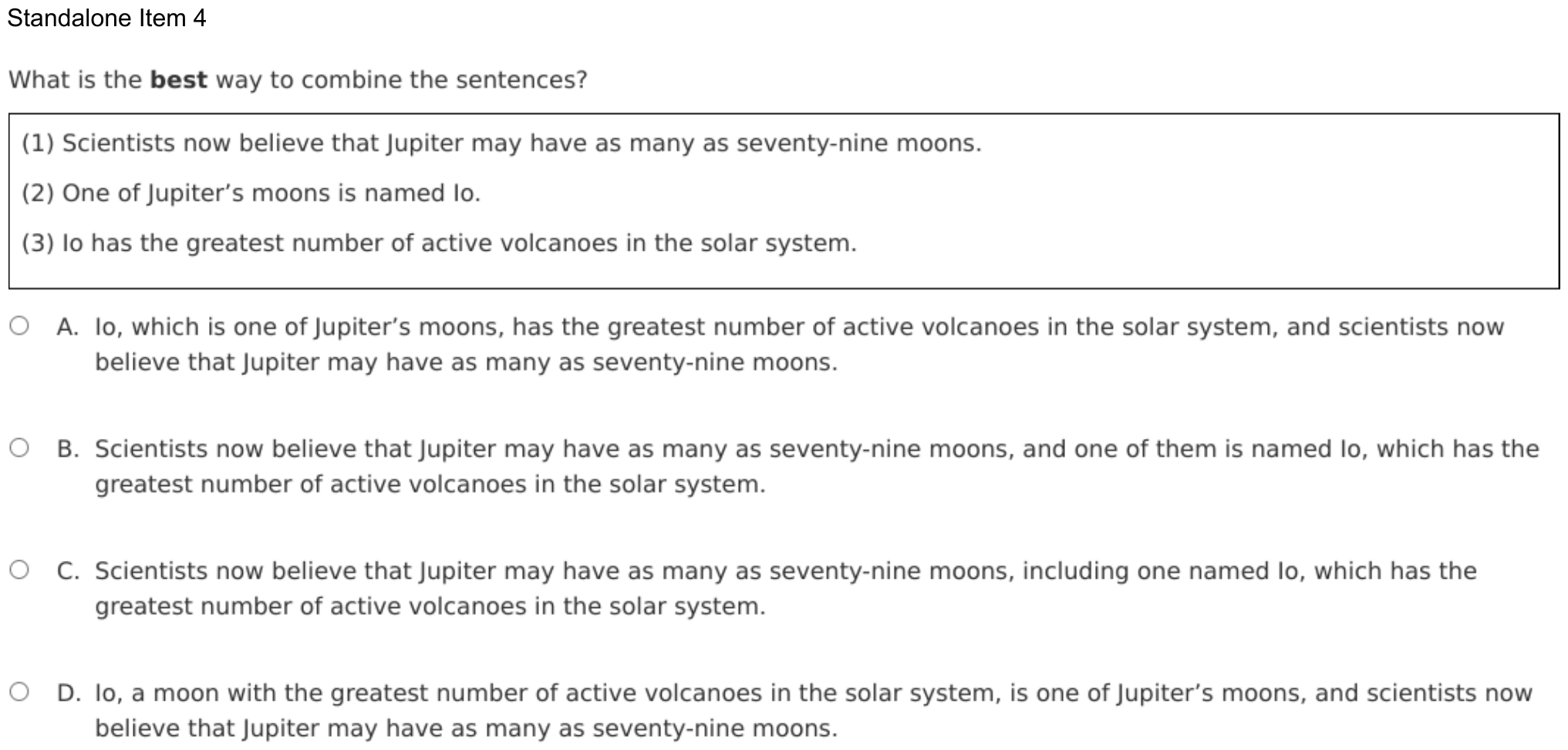
Question 19 of 43
2024 Test A English, question 6Passage The Free College Debate
The Free College Debate
(1) A college degree has become an essential tool in an increasingly competitive job market. (2) Yet the price of higher education, at both private and public universities, continues to rise. (3) Helping students cover the cost of attending college is an important issue.
(4) Many people agree that a college education should be a financially realistic option for those who aspire to obtain a degree. (5) For example, in 2017, the New York State legislature passed a bill creating a program to cover the tuition costs for nearly one million students. (6) The state of Tennessee also has a program that offers all students scholarships and mentoring services if they attend one of the state’s community colleges. (7) Proponents generally believe that these programs are a step in the right direction for making college affordable for students who would have had to take out loans or who would have decided not to pursue higher education at all.
(8) On the other hand, some people oppose bills like the ones in New York and Tennessee because they believe “free” college programs are unsustainable. (9) In order to implement these types of programs, a state pays the college on behalf of the students using funds from the state’s budget, which primarily comes from state taxes. (10) As more students choose to attend college, more funds will be needed to cover the costs. (11) Additionally, many students do not finish college within four years because they switch majors or because they have to work. (12) Critics believe that these circumstances will inevitably lead to an increase in taxes, a decline in the quality of the education offered by the schools, or both. (13) They think narrower college-affordability efforts that target the students who need the most support, such as first-generation college students, may be more effective and viable solutions.
(14) Faculty and students at higher-education institutions can work to keep costs down. (15) In light of increased access to computers, mobile devices, and the Internet, there are more opportunities for students to take courses online, thus reducing the need for and cost of maintaining physical classrooms. (16) Additionally, colleges should account for experience by allowing students to demonstrate their knowledge in order to avoid having to pay to sit through classes on subjects they have already mastered. (17) Similarly, college-bound high school students need to be prepared for college-level work so that they do not have to spend money on remedial classes.
(18) The solutions to the problems associated with rising college costs are not simple. (19) Passing legislation that boosts college affordability will take time, input from experts with different ideas, and careful planning.
Question
Read this sentence.
Some note that several states have made their community or state colleges low-cost or free for students with limited resources.
Where should the sentence be added to best support the ideas in the second paragraph (sentences 4–7)?
- Aat the beginning of the paragraph (before sentence 4)
- Bbetween sentences 4 and 5
- Cbetween sentences 5 and 6
- Dbetween sentences 6 and 7
Show the answer
Correct answer: B
The question asks where the sentence should be added to best support the ideas in the second paragraph (sentences 4–7).
A. Incorrect. Sentence 4 introduces the main idea of the second paragraph (making college “a financially realistic option for those who aspire to obtain a degree”) and should not be preceded by the added sentence, which focuses more narrowly on the specific ways that some states are implementing that idea.
B. CORRECT. The added sentence provides a proposed solution to the issue stated in sentence 4, that “a college education should be a financially realistic option.” Sentence 5 is an example of the programs discussed in the added sentence.
C. Incorrect. Sentences 5 and 6 offer examples of state governments providing “low-cost or free” tuition. The added sentence introduces this idea in the second paragraph and should come before these specific examples are provided as evidence.
D. Incorrect. Sentence 6 provides an example of the state government of Tennessee providing “low-cost or free” tuition, and sentence 7 further explains the opinion of those in favor of such programs (“a step in the right direction for making college affordable”). However, the ideas in sentences 6 and 7 follow from and support the idea in the added sentence. Therefore, the added sentence should be placed before sentences 6 and 7, which help elaborate its idea.
Question analysis
This revising question gives a sentence noting that several states have made public colleges low-cost or free and asks where it best fits in the paragraph about making college financially realistic. Students must follow how the paragraph moves between general claims and specific examples, since the sentence reads smoothly in more than one place.
- NYS standards
- 7W2a introducing and organizing a topic
- Grade level
- Grade 7 reading and task
- Compared with grade 7
- At grade 7 Placing a sentence so ideas follow logically is grade 7 writing work. The paragraph is only four sentences long and the four positions sit side by side, so this matches a typical grade 7 revision task.
- Estimated difficulty
- Moderate: several steps, or a close reading with one strong distractor.
- Thinking it demands
- Depth of knowledge 2, skills and concepts · mainly analyze
- What makes it hard
- How sentences fit together moderate
- Every choice must be checked moderate
- Evidence
- Answered from one paragraph or stanza
- Reading level
- Passage: about grade 12, 427 words; question and choices: about grade 6, 56 words.
- Students, last 30 days
- Not enough answers yet to show (it takes 10).
Why it is hard, traps and wrong answers (shows the answer)
Why it is hard
This is a general-before-specific question disguised by smooth reading: the added sentence fits grammatically anywhere in the paragraph. What decides it is that New York and Tennessee are examples of states making college low-cost or free, so the claim belongs before them and after sentence 4's broader belief. Students who place it as a summary before “these programs” have noticed a real link but put the claim after its own evidence.
How sentences fit together moderate Working it out
Sentence 5 opens “For example” and sentence 6 says Tennessee “also” has a program, so the claim about several states must come right before the New York example it introduces. (Halliday & Hasan, 1976)
Every choice must be checked moderate Choosing the answer
The new sentence reads smoothly in all four spots, even after the examples, where sentence 7's “these programs” seems to point back to it, so each position has to be tried in context. (Embretson & Wetzel, 1987)
Strategy: Decide whether the new sentence is a general statement or a specific example, then read the paragraph with it in each position and check that every example follows what it illustrates.
Traps
- Sentence in the wrong place: Puts a sentence where it breaks the order of ideas or separates it from what it refers to.
The wrong answers, classified
A Sentence in the wrong place (Halliday & Hasan, 1976)
Rightly treats the new sentence as general, then makes it the opener, ahead of sentence 4, the broader belief that college should be financially realistic.
C Sentence in the wrong place (Halliday & Hasan, 1976)
Drops the claim about several states between the New York and Tennessee examples, splitting the pair and leaving the first example without the statement it illustrates.
D Sentence in the wrong place (Halliday & Hasan, 1976)
Sees that sentence 7's “these programs” could refer back to the new sentence, but placed there it only restates what the New York and Tennessee examples have shown.
Working it out, step by step
Figure out what the question asks
You need the best place for a new sentence in paragraph 2. First ask: is it a general idea or a specific example? A general idea usually comes before the examples that show it.
Look at the new sentence
The new sentence says “several states have made their community or state colleges low-cost or free.” It does not name any state. So it is a general claim. A claim is a statement that something is true.
Look at sentences 4 to 7
- Sentence 4 is the paragraph’s main idea. College should be “a financially realistic option,” or something people can afford.
- Sentence 5 starts “For example” and names New York.
- Sentence 6 says Tennessee “also has a program.”
- Sentence 7 tells what supporters think of “these programs.”
New York and Tennessee are two of the “several states.” So the new sentence belongs right before them.
Check each choice
- A is wrong. Sentence 4 is the broader main idea, so it should stay first.
- B is right. The claim comes after the main idea. Then “For example” leads into New York.
- C is wrong. It splits New York and Tennessee, two examples that belong together.
- D is wrong. It puts the claim after both of the examples that show it.
Watch out: D is tempting, since “these programs” in sentence 7 could point back to it. But there the claim would just repeat what the examples already showed.
Choose the answer
The order should be main idea, then claim, then examples. So the answer is B, between sentences 4 and 5.
Why this answer and not the closest wrong one
D is the closest wrong answer, because the sentence reads smoothly there too. But a general claim should come before the examples that prove it. In B, the reader first hears about “several states.” Then “For example” brings in New York, and Tennessee follows.
More questions like this
The original DOE question
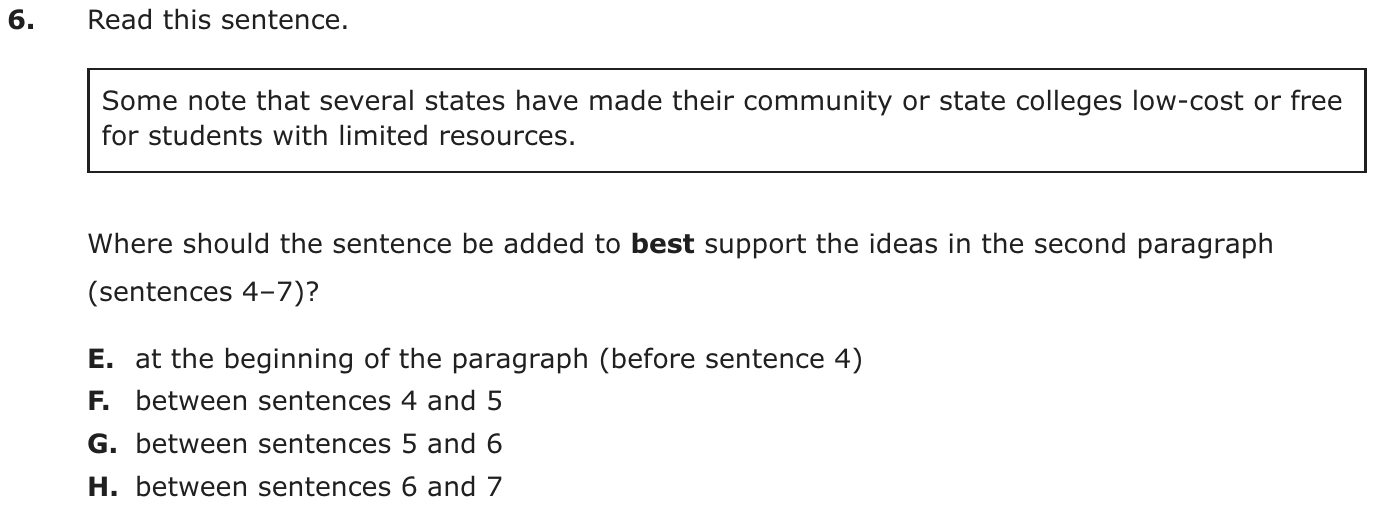
The passage “The Free College Debate” as printed (page 38)
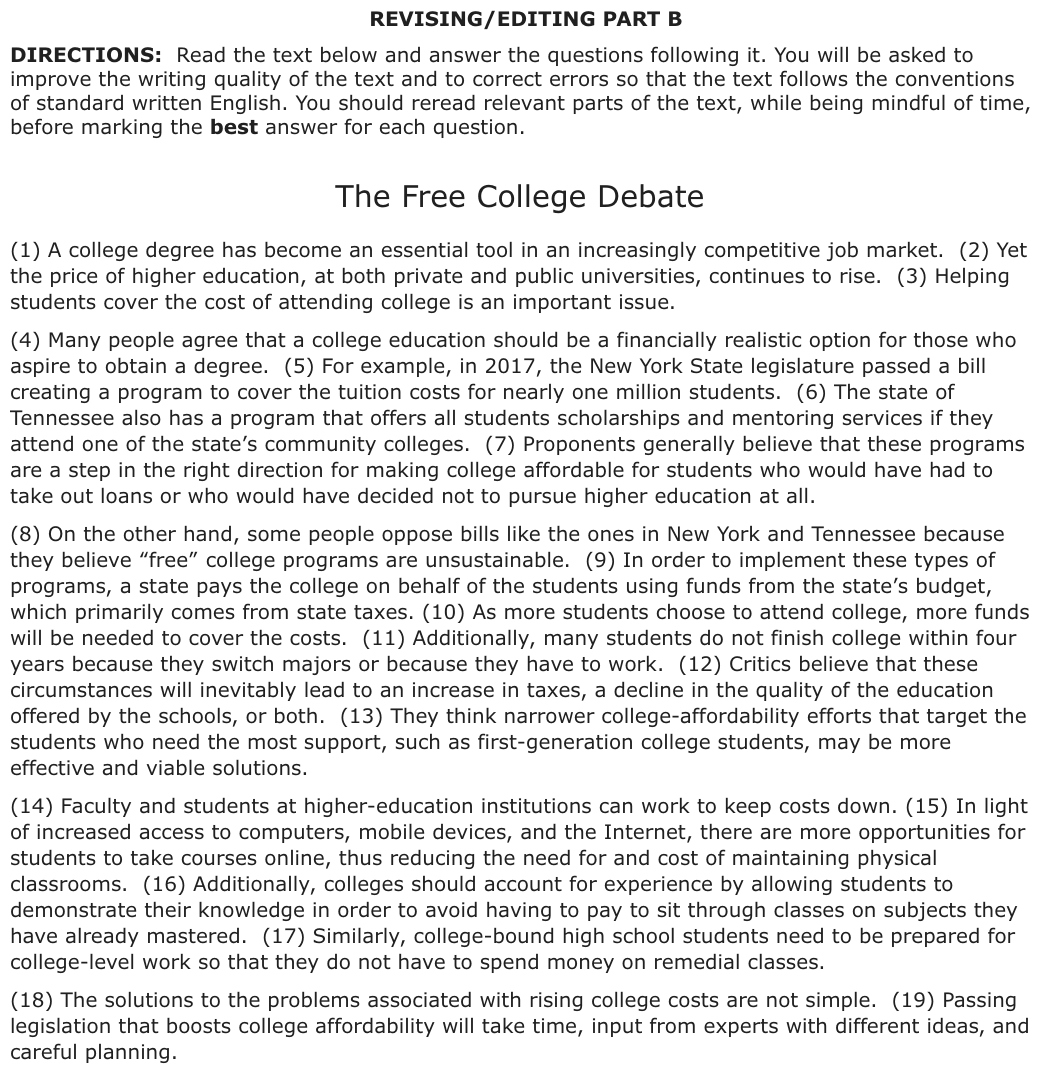
Question 20 of 43
2024 Test A English, question 7Uses the passage above: “The Free College Debate”.
Question
Which sentence presents information that shifts away from the topic of the third paragraph (sentences 8–13) and should be deleted?
- Asentence 10
- Bsentence 11
- Csentence 12
- Dsentence 13
Show the answer
Correct answer: B
The question asks which sentence presents information that shifts away from the topic of the third paragraph (sentences 8–13) and should be deleted.
A. Incorrect. Sentence 9 explains that scholarship funding comes “from the state’s budget, which primarily comes from state taxes.” Sentence 10 logically follows the idea in sentence 9 by explaining that “as more students choose to attend college, more funds will be needed to cover the costs.” Therefore, sentence 10 should not be deleted, because it does not shift away from the topic of the paragraph.
B. CORRECT. Sentence 10 makes the claim that “as more students choose to attend college, more funds will be needed to cover the costs.” Sentence 11 shifts away from this topic by focusing on how switching majors or working affects students’ ability to finish college, rather than on the additional funds that will be needed for scholarship programs. Therefore, sentence 11 should be deleted.
C. Incorrect. Sentence 9 states that scholarship program funding comes “from the state’s budget, which primarily comes from state taxes.” Sentence 10 points out that “as more students choose to attend college, more funds will be needed to cover the costs.” Sentence 12 elaborates on the critics’ opinions discussed in sentences 8–10. It reflects the belief that the “circumstances” described in sentences 9 and 10 “will inevitably lead to an increase in taxes, a decline in the quality of the education offered by the schools, or both.” Thus, sentence 12 should not be deleted, because it does not shift away from the topic of the paragraph.
D. Incorrect. Sentence 13 refers back to the “critics” mentioned in sentence 12 and expands on the critics’ concern about increased taxes mentioned in sentence 12 by stating that “narrower college-affordability efforts . . . may be more effective and viable solutions.” Therefore, sentence 13 should not be deleted because it logically follows the ideas in sentence 12 and serves as a concluding sentence for the paragraph.
Question analysis
This revising question asks which sentence in the paragraph about critics of free-college programs shifts away from the paragraph's topic and should be deleted. All four listed sentences mention students, funding or taxes, so students must follow the critics' chain of reasoning and find the sentence that does not advance it.
- NYS standards
- 7W2b developing a topic
- Grade level
- Grade 7 reading and task
- Compared with grade 7
- At grade 7 Cutting a sentence that strays from a paragraph's focus is standard grade 7 writing work. This paragraph is a six-sentence argument with formal words such as unsustainable and viable, which is typical of grade 7 revision passages.
- Estimated difficulty
- Moderate: several steps, or a close reading with one strong distractor.
- Thinking it demands
- Depth of knowledge 2, skills and concepts · mainly analyze
- What makes it hard
- How sentences fit together moderate
- Every choice must be checked minor
- Evidence
- Answered from one paragraph or stanza
- Reading level
- Passage: about grade 12, 427 words; question and choices: about grade 6, 23 words.
- Students, last 30 days
- Not enough answers yet to show (it takes 10).
Why it is hard, traps and wrong answers (shows the answer)
Why it is hard
Sentence 11 is camouflaged: it starts with a linking word, and a reader can argue that students who take longer to finish cost the state more. The paragraph, though, is about funding and taxes, and sentence 11 turns to why students switch majors or work. Students who cut sentence 13 sense a move toward solutions, but it still voices the critics, and the question rewards checking that each other sentence advances their case.
How sentences fit together moderate Working it out
Sentence 11 opens with “Additionally,” and sentence 12's “these circumstances” can be read as gathering it in, so the stray sentence looks attached to the critics' argument. (Halliday & Hasan, 1976)
Every choice must be checked minor Choosing the answer
Because sentence 11 can be defended, the answer comes mainly from confirming that sentences 10, 12 and 13 each carry the critics' case, which means testing every listed sentence. (Embretson & Wetzel, 1987)
Strategy: State the critics' argument in a few words, then check whether each listed sentence adds a link to that argument or turns aside to a different issue.
Traps
- Fixes what isn't broken: Changes a part of the sentence that was already correct, while the real error stays; or, where the question asks which sentence has an error or should go, picks one that is correct and belongs.
The wrong answers, classified
A Fixes what isn't broken (Connors & Lunsford, 1988)
Cuts sentence 10 as a loose prediction, though more students needing more funds is the link between state funding in sentence 9 and the critics' fear of higher taxes.
C Fixes what isn't broken (Connors & Lunsford, 1988)
Removes sentence 12 as mere opinion, though it states the critics' conclusion, higher taxes or lower quality, which the whole paragraph builds toward.
D Fixes what isn't broken (Connors & Lunsford, 1988)
Senses a turn when the critics propose “narrower college-affordability efforts,” but sentence 13 still reports what “They think,” completing their case rather than leaving it.
Working it out, step by step
Figure out what the question asks
Paragraph 3 (sentences 8–13) has one topic. One sentence wanders away from it. You need to find that sentence. First, say the paragraph’s topic in a few words.
Find the topic of paragraph 3
Sentence 8 says some people think “free” college programs are “unsustainable.” That means they can’t keep going for long. The reason is money. The state pays with tax money (sentence 9). More students means more money is needed (sentence 10). Critics fear higher taxes or worse schools (sentence 12). They want smaller programs instead (sentence 13).
Look at sentence 11
Sentence 11 says many students take more than four years “because they switch majors or because they have to work.” A major is the main subject a student studies. This sentence is about why students take longer. It never says what that costs the state or how it affects taxes. It moves away from the critics’ money argument.
Check each choice
- A is wrong. Sentence 10 links state money to the critics’ fears: more students, more costs.
- B is right. Sentence 11 turns to students’ reasons for taking longer.
- C is wrong. Sentence 12 gives the critics’ main fear: higher taxes or worse schools.
- D is wrong. Sentence 13 still tells what the critics think. It finishes their argument.
Watch out: Sentence 13 brings up a different plan, so D is tempting. But it begins “They think,” so it is still the critics talking.
Choose the answer
Without sentence 11, the paragraph moves smoothly from more costs to higher taxes. So the answer is B, sentence 11.
Why this answer and not the closest wrong one
D is the closest wrong answer, because sentence 13 talks about a different plan. But that plan belongs to the critics, so it stays on topic. Sentence 11 starts with “Additionally,” which makes it look like part of the argument. Yet it talks about switching majors and having jobs, not about the cost to the state.
More questions like this
The original DOE question
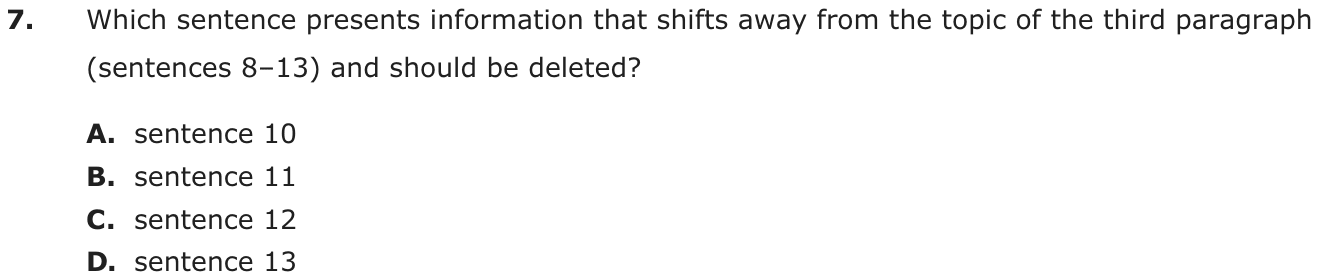
Question 21 of 43
2024 Test A English, question 8Uses the passage above: “The Free College Debate”.
Question
Which phrase should be added before sentence 14 to best transition to the ideas in the fourth paragraph (sentences 14–17)?
- ABecause college affordability is a complicated issue,
- BWith so many opinions about how to make college affordable,
- CUntil college becomes more affordable,
- DAlthough some college affordability programs have been successful,
Show the answer
Correct answer: C
The question asks which phrase should be added before sentence 14 to best transition to the ideas in the fourth paragraph (sentences 14–17).
A. Incorrect. Sentence 13 summarizes the viewpoint of opponents, who believe that targeted approaches to funding education “may be more effective and viable solutions,” and sentence 14 serves to introduce how “faculty and students at higher-education institutions can work to keep costs down.” Affordability is “a complicated issue,” but the use of the word “Because” suggests that the ideas that follow in sentences 14–17 will explain a cause-and-effect relationship. However, sentences 14–17 discuss ways faculty and students should work together to keep the cost of college down while waiting for a long-term solution to the problem, not a causal relationship.
B. Incorrect. Sentences 4–13 provide information about the viewpoint of proponents, who believe that “a college education should be a financially realistic option for those who aspire to obtain a degree” (sentence 4), and opponents, who believe free college programs are “unsustainable” (sentence 8). Although the phrase in this option mentions “opinions,” it indicates that the fourth paragraph will discuss why the number of opinions makes affordability a debatable issue. Instead, the fourth paragraph discusses ways faculty and students can help keep costs down until a solution is reached.
C. CORRECT. Sentence 13 summarizes the viewpoint of opponents, who believe that targeted approaches to funding education “may be more effective and viable solutions,” while proponents “generally believe that these [government] programs are a step in the right direction for making college affordable” (sentence 7). However, sentences 14–17 offer three possible solutions that could alleviate the problem in the meantime. Therefore, the phrase in this option should be added before sentence 14 to best transition to the ideas in the fourth paragraph because it suggests that until the issue of affordability is resolved, alternatives are available to help make a college education more affordable.
D. Incorrect. This phrase mentions “college affordability,” a topic discussed in the fourth paragraph. However, the ideas introduced in the phrase do not logically lead into the ideas discussed in sentences 14–17, because the phrase mentions “programs [that] have been successful,” whereas the paragraph states that “faculty and students at higher-education institutions can work to keep costs down” (sentence 14) and that colleges “should account for experience by allowing students to demonstrate their knowledge in order to avoid having to pay to sit through classes on subjects they have already mastered” (sentence 16). Use of the words “can” and “should” in these sentences indicates that the actions or programs mentioned in the paragraph have not been completed.
Question analysis
This revising question asks which introductory phrase should begin the fourth paragraph of a passage on college affordability, linking the debate over state tuition programs to the cost-saving ideas that follow. All four phrases sound natural, so students must work out the relationship between the paragraphs and choose the phrase that signals it accurately.
- NYS standards
- 7W2d transitions in informative writing
- Grade level
- Grade 8 reading and task
- Compared with grade 7
- Above grade 7 Grade 7 transition work usually links two sentences with a word such as however. Here the choices are whole phrases that set up an entire paragraph, and judging them needs a grasp of the full argument, which asks more than typical grade 7 work.
- Estimated difficulty
- Hard: combines ideas, needs a plan, and has more than one tempting wrong answer.
- Thinking it demands
- Depth of knowledge 3, strategic thinking · mainly evaluate
- What makes it hard
- How sentences fit together major
- Reading between the lines moderate
- Every choice must be checked minor
- Evidence
- Answered from several paragraphs or stanzas
- Reading level
- Passage: about grade 12, 427 words; question and choices: about grade 10, 48 words.
- Students, last 30 days
- Not enough answers yet to show (it takes 10).
Why it is hard, traps and wrong answers (shows the answer)
Why it is hard
Every phrase sounds like a reasonable bridge, and the right one can even seem odd at first, since cutting costs is itself a way to make college affordable. The key is seeing paragraph 4 as what campuses can do while the debate over state programs goes on, a reading the passage confirms only at its end. Students who link back to the many opinions, or accept a causal “Because,” have found real ideas from the passage but not the relationship between these two paragraphs.
How sentences fit together major Working it out
The phrase must link paragraph 3's case against state programs to paragraph 4's steps that “can work to keep costs down,” steps that make sense only as help in the meantime. (Halliday & Hasan, 1976)
Reading between the lines moderate Working it out
Nothing says paragraph 4's ideas are stopgaps; that has to be inferred from sentences 18 and 19, which say the solutions “are not simple” and “will take time.” (Graesser, Singer & Trabasso, 1994; Kintsch, 1998)
Every choice must be checked minor Choosing the answer
All four phrases are grammatical and about affordability, so each must be read into sentence 14 and judged by the relationship its first word signals. (Embretson & Wetzel, 1987)
Strategy: Sum up paragraphs 3 and 4 in a few words each, decide how the second relates to the first, then test the relationship each phrase's opening word signals.
Traps
- Wrong transition: A connecting word or phrase that signals the wrong relationship, such as contrast where the idea continues.
The wrong answers, classified
A Wrong transition (Halliday & Hasan, 1976)
Agrees that affordability is complicated, as sentence 18 says, but “Because” makes the complexity the reason faculty and students can cut costs, a cause the paragraph never gives.
B Wrong transition (Halliday & Hasan, 1976)
Rightly looks back to the clashing views of paragraphs 2 and 3, but offers the disagreement as the ground for the steps instead of marking them as help until a solution arrives.
D Wrong transition (Halliday & Hasan, 1976)
Hears “Although” as a natural turn to a new idea, but the passage never says any program has succeeded, and paragraph 4 does not set its steps against such programs.
Working it out, step by step
Figure out what the question asks
You need a phrase to start sentence 14. It should work as a transition: a word or phrase that shows how two ideas connect. Words like “because,” “although” and “until” each show a different link. So first work out how paragraph 4 connects to what came before.
Compare paragraphs 3 and 4
Paragraph 3 ends with the critics’ view of state programs. People still disagree, so there is no fix everyone accepts yet. Paragraph 4 then says “Faculty and students at higher-education institutions can work to keep costs down.” Faculty means teachers. The paragraph lists ways to do it: online classes, skipping classes you’ve mastered, and getting ready in high school.
Use the ending as a clue
Sentences 18 and 19 say the solutions “are not simple” and “will take time.” So a big fix is still far off. That makes paragraph 4’s ideas things to do in the meantime, while people wait. The phrase “Until college becomes more affordable” says exactly that.
Check each choice
- A is wrong. “Because” shows a cause. The issue being complicated is not the reason teachers can cut costs.
- B is wrong. It makes the many opinions the reason for the steps. The passage never links them that way.
- C is right. “Until” shows these are steps to take while waiting for a bigger fix.
- D is wrong. The passage never says any program has been successful.
Watch out: B looks back at the many opinions, which really are in the passage. But it doesn’t show how paragraph 4 relates to paragraph 3.
Choose the answer
Sentence 14 would read: Until college becomes more affordable, faculty and students at higher-education institutions can work to keep costs down. So the answer is C.
Why this answer and not the closest wrong one
B is the closest wrong answer, because the passage does share many opinions. But “With so many opinions” makes the opinions sound like the reason for the cost-cutting steps. They are not. C shows the steps are help for now, while the bigger problem waits to be solved.
More questions like this
The original DOE question
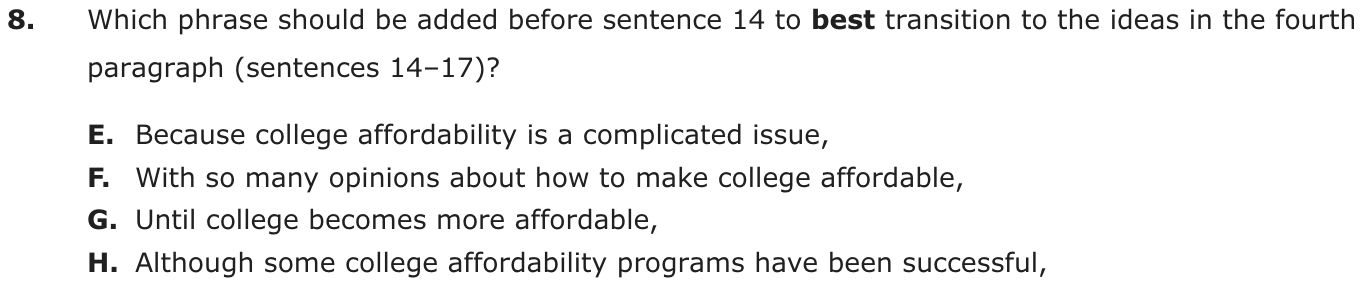
Question 22 of 43
2024 Test A English, question 9Uses the passage above: “The Free College Debate”.
Question
Which concluding sentence should be added after sentence 19 to support the topic of the passage?
- AThe increasing use of technology in college classrooms and the financial support from tuition scholarship programs will make colleges more affordable for many students.
- BStatewide tuition scholarship programs will make college more affordable for many students, but these programs may lead to new problems.
- CUntil the problems associated with the rising cost of college are solved, many students will pursue other options after graduating high school.
- DWhen the issue of college affordability is resolved, students will be able to make decisions about pursuing higher education without cost being the deciding factor.
Show the answer
Correct answer: D
The question asks which concluding sentence should be added after sentence 19 to support the topic of the passage.
A. Incorrect. Although sentence 15 cites “increased access to computers, mobile devices, and the Internet” and states that “there are more opportunities for students to take courses online, thus reducing the need for and cost of maintaining physical classrooms,” the primary topic discussed throughout the passage is that making college affordable is a complex issue on which people hold differing opinions, and sentences 18 and 19 stress that the solutions “are not simple” and “will take time.” The option instead states that technology and scholarship programs will make colleges more affordable. Therefore, the sentence should not be added after sentence 19, because it does not support the topic.
B. Incorrect. Sentence 5 presents the example of the New York State legislature, which “passed a bill creating a program to cover the tuition costs for nearly one million students.” Sentence 12 states that critics of this type of program believe that certain circumstances “will inevitably lead to an increase in taxes” or other issues such as low-quality education. However, the option covers only the statewide programs and their critics (sentences 4–13). It leaves out the ways faculty and students can keep costs down (sentences 14–17) and the closing point that solutions will take time and careful planning (sentences 18 and 19). Therefore, the sentence should not be added after sentence 19, because it does not support the topic.
C. Incorrect. Although sentence 7 states that scholarship programs are helpful “for students who would have had to take out loans or who would have decided not to pursue higher education at all,” the passage does not state that many students will stop pursuing higher education until the affordability issues are solved. In fact, sentence 14 states that there are ways faculty and students can “work to keep costs down.” Therefore, the sentence should not be added after sentence 19, because it does not support the topic.
D. CORRECT. The sentence in this option should be added after sentence 19 to support the topic because it acknowledges that the issue of college affordability discussed throughout the passage is not “resolved” but that when it is, students will be able to make decisions about attending college without concerns about cost. Sentence 18 states that “the solutions to the problems associated with rising college costs are not simple,” and sentence 19 adds that “passing legislation that boosts college affordability will take time,” ideas, and planning.
Question analysis
This revising question asks which concluding sentence should be added after the final sentence of a passage about the debate over making college affordable. Students must keep the whole passage in view and pick the ending that follows from its last paragraph, because several choices repeat real details or offer predictions that sound reasonable.
- NYS standards
- 7W2e concluding informative writing
- Grade level
- Grade 7 reading and task
- Compared with grade 7
- At grade 7 Choosing a conclusion that follows from a passage's central idea is standard grade 7 writing work. The passage is five formal paragraphs that present two sides and then practical steps, which the student must hold together, a typical grade 7 challenge.
- Estimated difficulty
- Moderate: several steps, or a close reading with one strong distractor.
- Thinking it demands
- Depth of knowledge 2, skills and concepts · mainly evaluate
- What makes it hard
- Evidence in several places moderate
- How sentences fit together minor
- Evidence
- Answered from the whole text
- Reading level
- Passage: about grade 12, 427 words; question and choices: about grade 13, 106 words.
- Corrected from the DOE handbook
- The explanation misstated the topic of the passage; that sentence was corrected.
- An inaccurate statement about the passage in the explanation was corrected.
- Students, last 30 days
- Not enough answers yet to show (it takes 10).
Why it is hard, traps and wrong answers (shows the answer)
Why it is hard
The strongest wrong ending is a fair summary of the passage's middle, the state programs and their critics, so it feels like a conclusion. It falls short because it drops the campus steps and the closing point that solutions are slow and complicated. Other endings echo the final paragraph's words or bundle two solutions into a promise, and students who keep the passage's caution in mind reject those quickly.
Evidence in several places moderate Working it out
Judging an ending means holding the whole passage: the debate over state programs in sentences 4–13, the campus cost-cutting in 14–17, and the warning in 18–19 that solutions take time. (Kirsch & Mosenthal, 1990; Gorin & Embretson, 2006)
How sentences fit together minor Working it out
The new sentence follows “will take time,” so an ending that looks ahead to when the problem “is resolved” continues the thought, while a confident promise of affordability contradicts it. (Halliday & Hasan, 1976)
Strategy: State the passage's topic and its final point in your own words, then test each ending: does it follow from both, or does it bring in a claim the passage never supports?
Traps
- Too narrow: A single detail offered as the central idea or a summary, or a summary that keeps minor details and leaves out an essential part.
- Too broad or too strong: A choice overstates, generalizes, or uses absolute words the text does not support.
- Off the point: Adds or keeps something that does not support the paragraph's or the passage's focus, or an introduction or conclusion that misses the main point.
The wrong answers, classified
A Too broad or too strong (King et al., 2004)
Bundles paragraph 4's online courses with the state scholarships and promises they “will make colleges more affordable,” a certainty the passage rejects just before by calling solutions “not simple.”
B Too narrow (King et al., 2004)
Sums up paragraphs 2 and 3 fairly, programs that help and the problems critics foresee, but leaves out the campus cost-cutting and the closing point about time and planning.
C Off the point (Halliday & Hasan, 1976)
Borrows “the problems associated with” rising costs from sentence 18 and adds a prediction about students choosing other paths, which the passage never makes.
What was corrected from the DOE handbook, and why
- Explanation: In rejecting choice A, the handbook says the topic of the passage is that “state and federal governments, not faculty and students, must resolve the issue of college affordability.” The passage never mentions the federal government, and sentences 14–17 are about what faculty and students can do. The topic, as question 5's answer puts it, is that making college affordable is a complex issue with differing opinions about how to approach it. The explanation now says so, and that choice A instead states that technology and scholarships will make college more affordable.
- Explanation: In rejecting choice B, the handbook says “the idea that these types of programs may lead to new problems is not thoroughly discussed in the passage.” Sentences 8–13 discuss exactly that: critics expect higher taxes or lower-quality education. Choice B falls short because it covers only the statewide programs and their critics, leaving out sentences 14–17 (what faculty and students can do) and the closing point that solutions take time and planning. The explanation now says that. The answer, D, is unchanged.
Working it out, step by step
Figure out what the question asks
You need a last sentence for the passage. A good conclusion fits the topic of the whole passage. It should also follow from sentence 19, the sentence right before it.
Recall the topic and the ending
The passage shows that making college affordable is a complex issue. People have different opinions about how to do it. Sentence 18 says the solutions “are not simple.” Sentence 19 says new laws “will take time, input from experts with different ideas, and careful planning.” So the passage ends by saying the problem is not solved yet.
Find the sentence that follows
D begins “When the issue of college affordability is resolved.” Resolved means solved. That fits right after “will take time.” It looks ahead to a day when the problem is fixed. Then cost won’t decide whether a student goes to college.
Check each choice
- A is wrong. It promises that technology and scholarships “will make colleges more affordable.” But the passage just said solutions are not simple.
- B is wrong. It sums up only the state programs and their critics. It leaves out the cost-cutting ideas and the point about time and planning.
- C is wrong. The passage never says students will choose other paths after high school.
- D is right. It fits the topic and follows sentence 19.
Watch out: B is a fair summary of paragraphs 2 and 3. That makes it feel like a conclusion. But it covers only part of the passage.
Choose the answer
D keeps the passage’s careful tone and looks ahead to a time when cost no longer decides. So the answer is D.
Why this answer and not the closest wrong one
B is the closest wrong answer. The passage really does discuss state programs and the problems critics expect. But B leaves out paragraph 4, on cutting costs, and the closing point that solutions take time. D follows “will take time” by looking ahead to when the issue “is resolved.”
More questions like this
The original DOE question
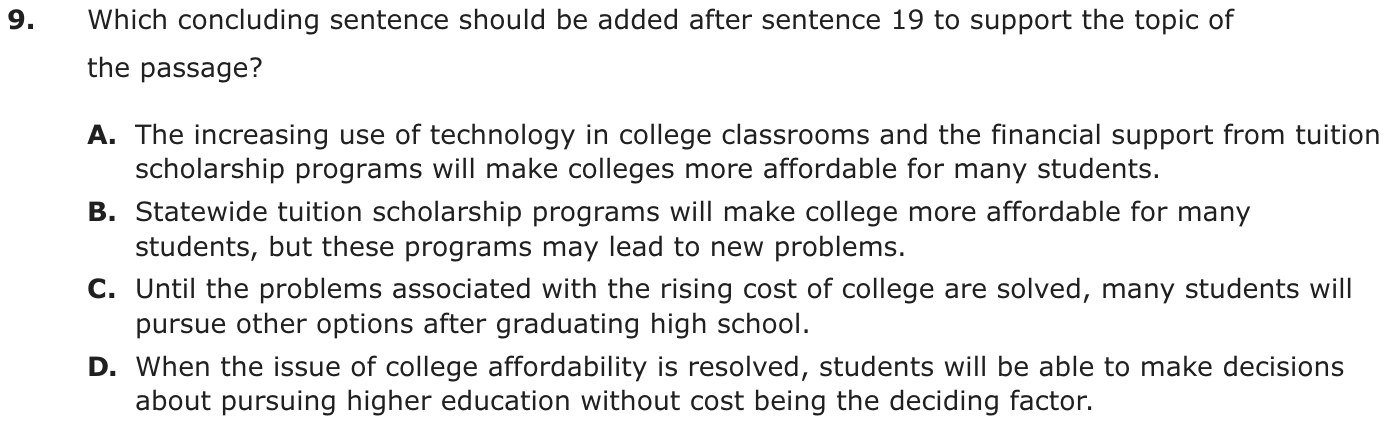
Question 23 of 43
2024 Test B English, question 1Question
What is the best way to combine these sentences to clarify the relationship between ideas?
(1) The International Space Station has been inhabited by crew members since 2000.
(2) Tourists will soon be allowed to pay for visits to the space station.
(3) Because the cost is $52–$58 million round trip, few people will be able to take advantage of the opportunity to have a vacation in outer space.
- AThe International Space Station has been inhabited by crew members since 2000, but tourists will soon be allowed to pay for visits to the space station, which cost $52–$58 million round trip, so few people will be able to take advantage of the opportunity to have a vacation in outer space.
- BThe International Space Station has been inhabited by crew members since 2000 and will soon allow tourists to pay for visits, but because the cost is $52–$58 million round trip, few people will be able to take advantage of the opportunity to have a vacation in outer space.
- CThe International Space Station has been inhabited by crew members since 2000, but tourists will soon be allowed to pay for visits to the space station, though the cost is $52–$58 million round trip, so few people will be able to take advantage of the opportunity to have a vacation in outer space.
- DThe International Space Station has been inhabited by crew members since 2000, and tourists will soon be allowed to pay for visits to the space station because the cost is $52–$58 million round trip, therefore few people will be able to take advantage of the opportunity to have a vacation in outer space.
Show the answer
Correct answer: B
The question asks for the best way to combine the sentences.
A. Incorrect. Although the option combines the sentences in a way that accurately reflects the meaning of each individual sentence, the combined sentence is a string of clauses that do not effectively cohere. Because it is poorly structured, the combined sentence does not clarify the relationship of ideas as effectively as the correct response does. The sentence incorrectly uses “but tourists,” and “which cost” modifies “the space station” but does not modify the trip. Compared with the correct response, the combined sentence in this option is also imprecise and unnecessarily wordy.
B. CORRECT. The option uses a complex sentence to present ideas clearly and precisely, and it shows the relationship between the ideas in the original sentences. In the first part of the sentence, the conjunction “and” correctly joins the first and second sentences by indicating a relationship, rather than a contrast, between the two. In the second part of the sentence, the conjunction “but” adds additional emphasis to the fact that while tourists will be allowed to visit the space station, the cost of the trip will likely prohibit most people from visiting.
C. Incorrect. Although the option combines the sentences in a way that accurately reflects the meaning of each individual sentence, the combined sentence is a string of clauses that do not effectively cohere. Because it is so poorly structured, the combined sentence does not clarify the relationship of ideas as effectively as the correct response does. Compared with the correct response, the combined sentence in this option is also imprecise and unnecessarily wordy.
D. Incorrect. The combination of the sentences contains an illogical relationship between ideas with the statement that tourists will be allowed to pay for visits to the space station because the cost is $52–$58 million round trip. The connection between the idea that “tourists will soon be allowed to pay for visits” and the subsequent “therefore few people will be able to take advantage of the opportunity” is also illogical.
Question analysis
This sentence-combining question gives three sentences about the International Space Station, its crew and the high price of a tourist trip, and asks for the best way to join them into one. Every version keeps the same facts, so students must judge which connecting words show how the ideas relate while the sentences stay long and nearly identical.
- Grade level
- Grade 8 reading and task
- Compared with grade 7
- Above grade 7 Grade 7 students practice joining two short sentences with a fitting conjunction. Here three sentences become one long sentence in four nearly identical versions, so students must weigh every connecting word and clause rather than spot one error.
- Estimated difficulty
- Hard: combines ideas, needs a plan, and has more than one tempting wrong answer.
- Thinking it demands
- Depth of knowledge 2, skills and concepts · mainly evaluate
- What makes it hard
- How sentences fit together major
- Complex sentences moderate
- Every choice must be checked moderate
- Evidence
- Answered from one sentence or line
- Reading level
- Question and choices: about grade 15, 261 words.
- Students, last 30 days
- Not enough answers yet to show (it takes 10).
Why it is hard, traps and wrong answers (shows the answer)
Why it is hard
None of the wrong versions drops a fact, and two of them are loose rather than plainly ungrammatical, so the ear is little help. Students lose the point by accepting the smoothest chain of clauses without asking what each connector claims: whether the crew and the tourists really contrast, what the price belongs to, and what the price explains. The question rewards deciding the three links before reading the versions, then checking them one connector at a time.
How sentences fit together major Working it out
Sentence 2 simply adds to sentence 1, while sentence 3’s price works against the tourist plan and explains why few will go, so every “but,” “though,” “because” or “so” in a version must fit one of those links. (Halliday & Hasan, 1976)
Complex sentences moderate Understanding the question
Each version is one sentence of 48 to 53 words with four clauses, and at that length a “which cost” hanging on the wrong noun or a comma before “therefore” is easy to read past. (Abedi & Lord, 2001; Freedle & Kostin, 1993; Messick, 1989)
Every choice must be checked moderate Choosing the answer
All four versions keep the same facts in the same order and share most of their words, so none can be ruled out by content; each connecting word has to be tested in turn. (Embretson & Wetzel, 1987)
Strategy: Before reading the choices, decide how each sentence relates to the next: added fact, contrast, or cause and result. Then check every connecting word in each version against those links.
Traps
- Misplaced modifier: A describing word or phrase that attaches to the wrong word, or to nothing in the sentence.
- Wordy, vague or informal: A revision is grammatical but wordy, imprecise or too casual for the passage.
- Wrong transition: A connecting word or phrase that signals the wrong relationship, such as contrast where the idea continues.
The wrong answers, classified
A Misplaced modifier (Connors & Lunsford, 1988)
Keeps the price as the reason few can go, marked by “so,” but misses that “which cost” hangs on “the space station” and that “but” sets crew against tourists.
C Wordy, vague or informal (Connors & Lunsford, 1988)
Keeps every fact in order, but stacking “but,” “though” and “so” in one sentence turns the price into an aside instead of plainly the reason few people will go.
D Wrong transition (Halliday & Hasan, 1976)
Keeps sentence 3’s “because the cost is” word for word, but here it explains why tourists are allowed, and “therefore” after a comma splices on the result.
Working it out, step by step
Figure out what the question asks
You need to join three sentences into one. The best version shows clearly how the ideas connect. Joining words do that job. A conjunction is a joining word, like and, but, so or because. Each one tells the reader something. And adds a fact. But shows a contrast (two ideas that pull against each other). Because and so show a cause and its result.
Decide how the three sentences connect
Sentence 1 says crews have lived on the station since 2000. Sentence 2 adds a new fact: tourists will soon be able to visit. That is not a contrast, so it needs and. Sentence 3 works against sentence 2. The trip costs “$52–$58 million round trip.” That price is also the reason few people will go. So you need a contrast and a reason. Example: The pool is open to all, but because it costs $90, few kids swim there.
Test each choice
- B uses “and will soon allow tourists” to add the new fact. Then “but because the cost is” shows the contrast and the reason. Every link is right.
- A joins sentence 2 with “but tourists,” as if crews and tourists were opposites. Also, “which cost” comes right after “the space station.” So it sounds like the station costs that much, not the trip.
- C stacks “but,” “though” and “so” in one long chain. The price turns into a side note instead of the clear reason.
- D says tourists may visit “because the cost is” so high. That makes no sense. And “therefore” after a comma joins two sentences the wrong way.
Pick the answer
Watch out: A is the most tempting. It keeps the price as the reason, with “so.” But its “but” and its “which” send the reader the wrong way. Only one choice links every idea correctly. So the answer is B.
Why this answer and not the closest wrong one
A is the closest wrong answer. Like B, it says the price keeps most people away. But A sets crews against tourists with “but tourists.” Its “which cost” also seems to give the price of the station. B uses and for the added fact and but because for the price, so each link is clear.
More questions like this
The original DOE question
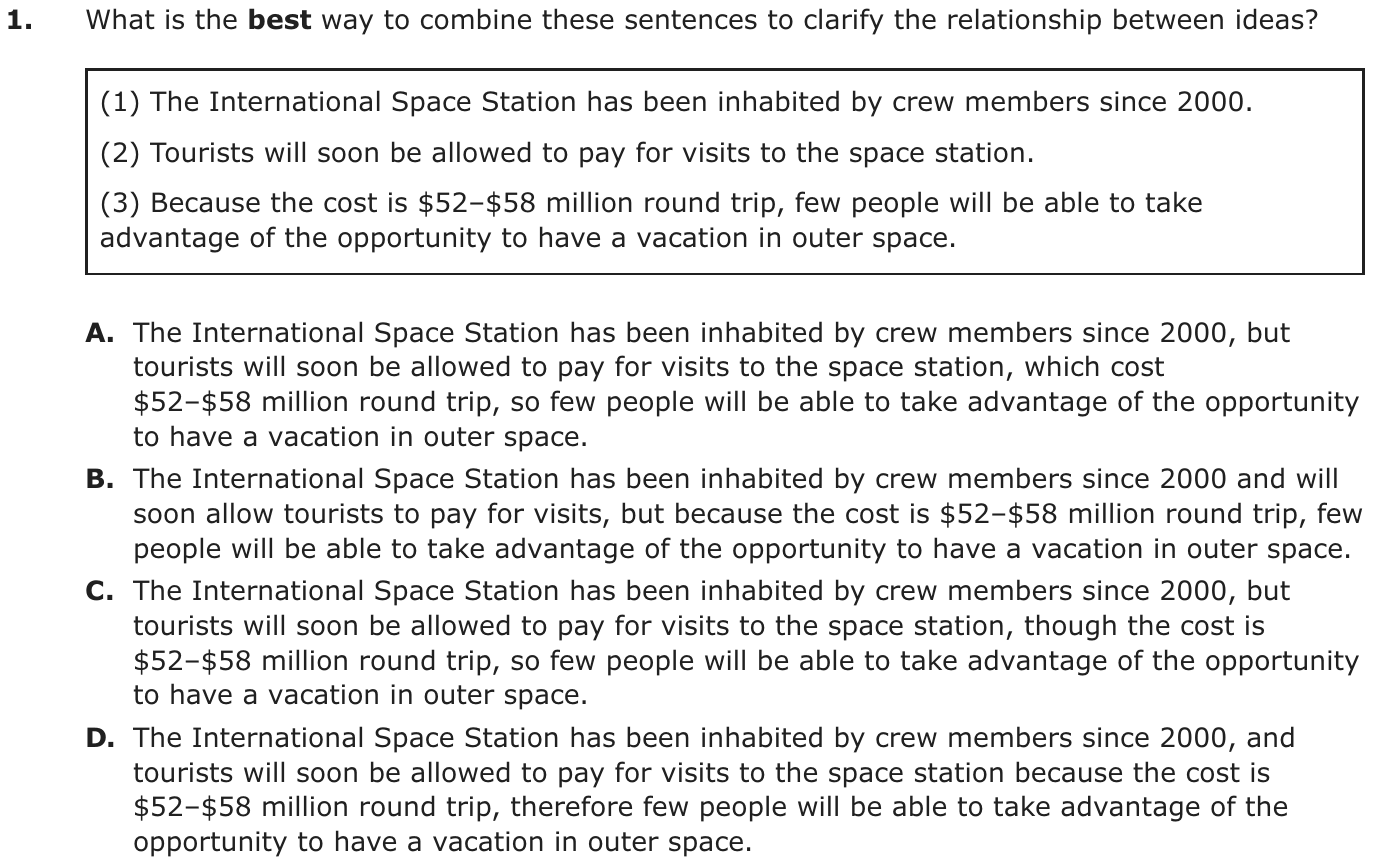
Question 24 of 43
2024 Test B English, question 6Passage Find Time to Volunteer
Find Time to Volunteer
(1) Many people believe that they gain a greater sense of purpose by giving their time to serve others. (2) These are the people who spend their free time volunteering at various places within the community. (3) Those who are served benefit from the work of these volunteers. (4) However, research shows that those who volunteer also receive benefits.
(5) For many students, this proposition may sound impossible. (6) Schoolwork can require hours of study each week. (7) Volunteering at a retirement center or homeless shelter requires both time and energy. (8) Extracurricular activities fill up after-school time. (9) Family obligations and part-time jobs often have to be worked into the schedule, too. (10) However, if students can find time to volunteer, even for a few hours a month, they may find that the benefits outweigh the scheduling difficulties.
(11) To begin with, students who engage in volunteer activities acquire valuable skills and experience, which can help them focus on potential fields of study and career options. (12) Furthermore, when students list volunteer work on college applications, admissions counselors see applicants who care about making their community and college campus a better place.
(13) Volunteerism benefits more than students applying to college. (14) This type of experience is equally important for students moving directly into the workforce after high school. (15) Volunteering demonstrates initiative, dedication, and a strong work ethic, qualities that companies value in a potential employee. (16) In a CareerBuilder study, 60 percent of managers regarded volunteerism as a significant asset when considering applicants.
(17) Students who volunteer undoubtedly make a positive investment in their future, but they also affect their present quality of life. (18) Studies have shown that volunteering is good for both the mind and the body. (19) Volunteering can boost mood levels and reduce anxiety. (20) According to the Mayo Clinic,1 the feeling of doing something meaningful and the appreciation received from that action can reduce stress.
(21) Even the busiest of students can find a way to donate some time to a worthy cause. (22) Though managing different commitments may seem overwhelming at times, students are sure to feel a sense of fulfillment in volunteerism.
1Mayo Clinic: a nonprofit medical organization dedicated to treatment and research
Question
Which sentence should follow sentence 4 to introduce the main claim of the passage?
- AWith that in mind, high school students should consider engaging in some form of regular volunteerism.
- BFortunately for students, these benefits are guaranteed to produce both immediate and long-term results.
- CIn fact, studies have confirmed that volunteerism can be beneficial for students, the family, and the community.
- DFor this reason, high school students should learn about how helping others can strengthen their communities.
Show the answer
Correct answer: A
The question asks which sentence should follow sentence 4 to introduce the main claim of the passage.
A. CORRECT. Sentence 4 states that “research shows that those who volunteer also receive benefits.” The sentence in the option logically follows the ideas in sentence 4 and provides the best thesis statement for the passage because it introduces the main claim that high school students should consider the benefits of volunteerism.
B. Incorrect. While the sentence refers to the “benefits” mentioned in sentence 4, it erroneously asserts that “immediate and long-term results” are “guaranteed.” In addition, the sentence does not introduce the main claim of the passage that volunteering is beneficial for high school students.
C. Incorrect. Although the sentence states that “volunteerism can be beneficial for students,” it introduces the idea that “the family, and the community” benefit as well, which is not part of the main argument. Therefore, this sentence should not follow sentence 4 to introduce the main claim of the passage.
D. Incorrect. Although the sentence introduces the claim that “high school students should learn about” volunteering, it focuses on the idea that volunteering strengthens the community, which is not the main claim. This sentence does not accurately introduce the claim that volunteering is beneficial for high school students and thus should not follow sentence 4.
Question analysis
This introduction question asks which sentence should come right after sentence 4 of the volunteering essay to state its main claim. Students must work out what the whole essay argues and match it to an opening line, while the choices mention benefits, studies and communities in ways that sound like a thesis.
- NYS standards
- 7W1a introducing claims and counterclaims
- Grade level
- Grade 7 reading and task
- Compared with grade 7
- At grade 7 Stating a precise claim is a core grade 7 argument skill. Students must sense the essay’s claim from all six paragraphs and test four openers that each sound like a thesis, typical of careful grade 7 revision.
- Estimated difficulty
- Moderate: several steps, or a close reading with one strong distractor.
- Thinking it demands
- Depth of knowledge 2, skills and concepts · mainly evaluate
- What makes it hard
- Evidence in several places moderate
- A very close wrong answer moderate
- How sentences fit together minor
- Evidence
- Answered from the whole text
- Reading level
- Passage: about grade 11, 354 words; question and choices: about grade 10, 76 words.
- Students, last 30 days
- Not enough answers yet to show (it takes 10).
Why it is hard, traps and wrong answers (shows the answer)
Why it is hard
Three of the four sentences sound like a thesis, and two contain “high school students should,” so tone decides nothing. Students go wrong when they choose a sentence that only repeats the research point of sentence 4, or one that urges a different action. The question rewards stating the essay’s claim first, that students should volunteer because it pays off for them, and then finding the sentence that says exactly that.
Evidence in several places moderate Working it out
The essay never states its claim in one sentence; it has to be pieced together from the benefits for college, work and health in paragraphs 3 to 5 and sentence 21’s “Even the busiest of students can find a way.” (Kirsch & Mosenthal, 1990; Gorin & Embretson, 2006)
A very close wrong answer moderate Choosing the answer
The right sentence and the one about strengthening communities both open with a linking phrase and “high school students should”; they part only on what students should do, volunteer or learn about communities. (Embretson & Wetzel, 1987; Gorin & Embretson, 2006; Ascalon et al., 2007)
How sentences fit together minor Working it out
The new sentence follows sentence 4’s “those who volunteer also receive benefits,” so it must turn that research point into what students should do about it. (Halliday & Hasan, 1976)
Strategy: Skim the body paragraphs and state in a few words what the essay wants its readers to believe. Then choose the sentence that says exactly that and follows naturally from sentence 4.
Traps
- Off the point: Adds or keeps something that does not support the paragraph's or the passage's focus, or an introduction or conclusion that misses the main point.
- Too broad or too strong: A choice overstates, generalizes, or uses absolute words the text does not support.
The wrong answers, classified
B Too broad or too strong (King et al., 2004)
Follows the word “benefits” from sentence 4 but overstates them as “guaranteed” and never says what students should do, so no claim is introduced.
C Off the point (Halliday & Hasan, 1976)
Likes the research-sounding “studies have confirmed,” but it restates sentence 4 as a fact rather than a claim and widens the benefits to families and the community.
D Off the point (Halliday & Hasan, 1976)
Sees the thesis-like “high school students should,” but it asks students to learn about strengthening communities, a point the essay never develops, instead of urging them to volunteer.
Working it out, step by step
Figure out what the question asks
You need a sentence to go right after sentence 4. It must introduce the main claim. A claim is the main point a writer wants you to believe or act on. In an essay like this, it is often a should statement. Example: Students should get more sleep. So first figure out what the whole essay argues.
Find the essay’s main claim
The essay keeps urging students to make time to help. Sentence 10 says “if students can find time to volunteer, even for a few hours a month, they may find that the benefits outweigh the scheduling difficulties.” Paragraphs 3 to 5 give benefits for college, jobs and health. Sentence 21 says “Even the busiest of students can find a way to donate some time to a worthy cause.” So the claim is: high school students should volunteer, because it helps them.
Use the clue in sentence 5
The new sentence will sit just before sentence 5. Sentence 5 says “For many students, this proposition may sound impossible.” A proposition is a suggestion. So the sentence before it must suggest something students could do. That points to a sentence telling students to volunteer.
Check each choice
- A says students “should consider engaging in some form of regular volunteerism.” That is the essay’s claim. “With that in mind” links it to the benefits in sentence 4.
- B says the benefits are “guaranteed.” That overstates them, and it never tells students to do anything.
- C just repeats that studies found benefits. It also adds families, which the essay never discusses.
- D tells students to “learn about” helping communities. The essay never argues for that.
Pick the answer
Watch out: D also says “high school students should,” so it sounds like a claim. But it asks them to learn, not to volunteer. Only one choice states what the essay argues. So the answer is A.
Why this answer and not the closest wrong one
D is the closest wrong answer, because it also tells high school students what they should do. But the essay never asks students to study how helping makes communities stronger. It argues that volunteering pays off for the students themselves. A says exactly that, and it sets up “this proposition” in sentence 5.
More questions like this
The original DOE question
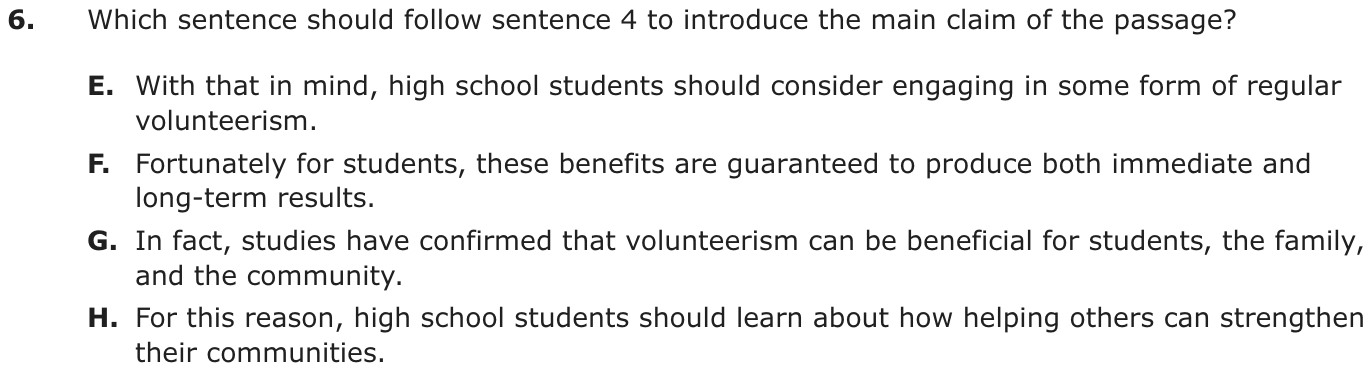
The passage “Find Time to Volunteer” as printed (page 163)
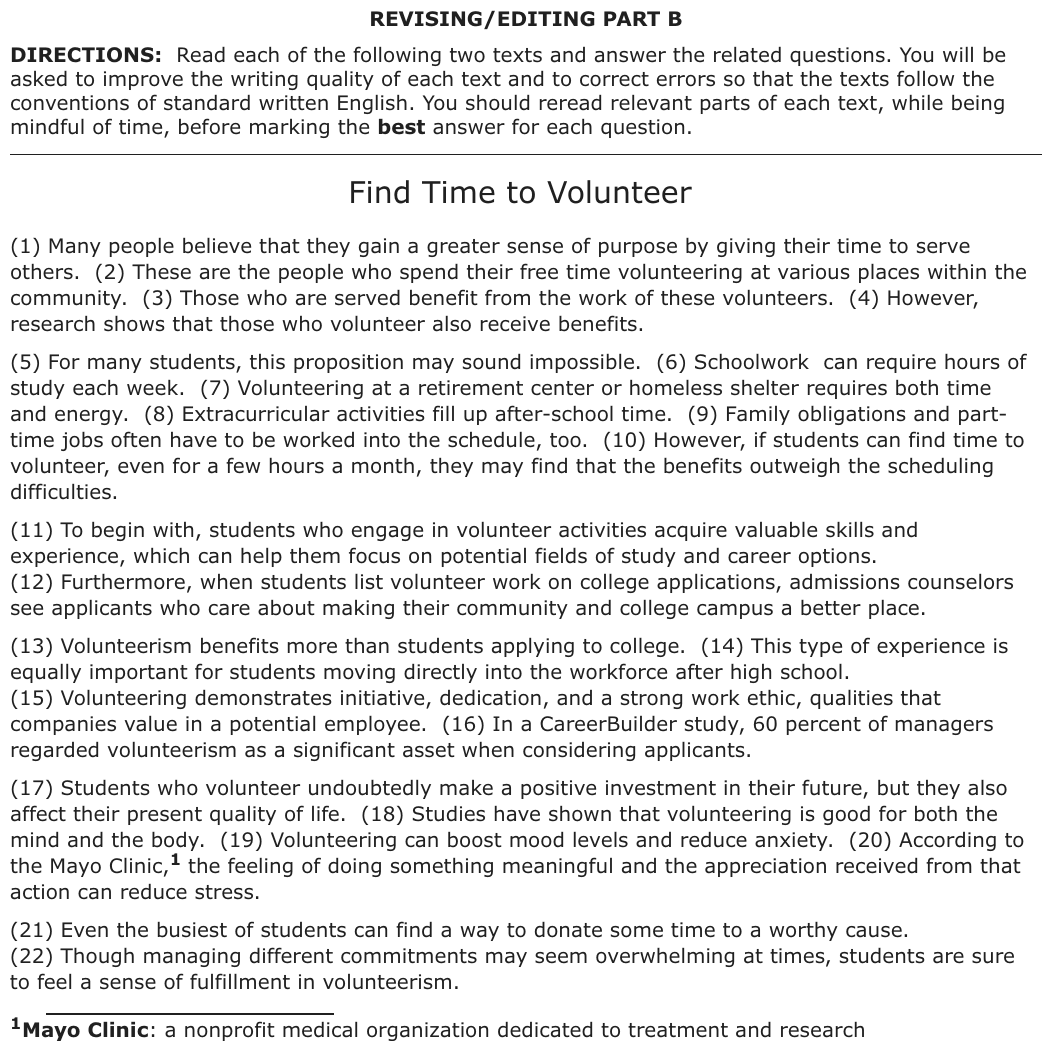
Question 25 of 43
2024 Test B English, question 7Uses the passage above: “Find Time to Volunteer”.
Question
Which sentence is least relevant to the ideas presented in the second paragraph (sentences 5–10) and should be deleted?
- Asentence 6
- Bsentence 7
- Csentence 8
- Dsentence 9
Show the answer
Correct answer: B
The question asks which sentence is least relevant to the ideas presented in the second paragraph (sentences 5–10) and should be deleted.
A. Incorrect. Sentence 5 introduces the topic of the second paragraph, which is that finding time to volunteer “may sound impossible” for many students. Sentence 6 logically follows this idea because it provides one reason why students might hesitate or be unable to volunteer. Therefore, sentence 6 is relevant to the ideas presented in the second paragraph and should not be deleted.
B. CORRECT. Sentence 7 states that “time and energy” are required for volunteering, which partially addresses the topic of the second paragraph about the various commitments that fill high school students’ schedules. However, sentence 7 interrupts the flow of the paragraph by interjecting specific examples (“volunteering at a retirement center or homeless shelter”) into a general list of activities and commitments. Thus, the sentence is the least relevant to the paragraph and should be deleted.
C. Incorrect. In the second paragraph, the author discusses why some high school students may hesitate to volunteer. In sentences 6 and 9, the author points out that “schoolwork” and “family obligations and part-time jobs” are activities that require students’ time and may cause them to hesitate taking on any additional activities. Sentence 8 contributes to this idea by stating that “extracurricular activities” also require a time commitment from students. As a result, sentence 8 contributes to the ideas in the second paragraph and should not be deleted.
D. Incorrect. In the second paragraph, the author acknowledges that some high school students may hesitate to volunteer because of “schoolwork” and “extracurricular activities.” Sentence 9 contributes to this idea by stating that “family obligations and part-time jobs” also require a time commitment and may cause students to hesitate to volunteer. Therefore, sentence 9 contributes to the ideas in the second paragraph and should not be deleted.
Question analysis
This revising question focuses on the second paragraph of the volunteering essay, which explains why students may think they have no time to help others. Students pick the one sentence that is least relevant and should be deleted. Since every sentence touches on how students spend their time, the challenge is seeing which one breaks the paragraph’s line of thought.
- NYS standards
- 7W1b supporting claims with evidence
- Grade level
- Grade 7 reading and task
- Compared with grade 7
- At grade 7 Spotting a sentence that does not belong is regular grade 7 revision work. The paragraph is short and plain, but every candidate is loosely tied to students’ busy lives, so students must pin down the paragraph’s exact point first.
- Estimated difficulty
- Moderate: several steps, or a close reading with one strong distractor.
- Thinking it demands
- Depth of knowledge 2, skills and concepts · mainly analyze
- What makes it hard
- How sentences fit together moderate
- Every choice must be checked minor
- Evidence
- Answered from one paragraph or stanza
- Reading level
- Passage: about grade 11, 354 words; question and choices: about grade 5, 22 words.
- Students, last 30 days
- Not enough answers yet to show (it takes 10).
Why it is hard, traps and wrong answers (shows the answer)
Why it is hard
The sentence to delete is the only one in the paragraph that mentions volunteering, so students who test each sentence against the essay’s topic keep it and cut one of the others. The paragraph’s point is narrower: sentence 5 says volunteering “may sound impossible” for many students, and sentences 6, 8 and 9 list what already fills their schedules. Sentence 7 is loosely related, which is why the stem asks for the least relevant sentence rather than an irrelevant one.
How sentences fit together moderate Working it out
Sentences 6, 8 and 9 list the commitments that already fill students’ time, schoolwork, activities, family and jobs, while sentence 7 turns to what volunteering itself demands and breaks that list. (Halliday & Hasan, 1976)
Every choice must be checked minor Choosing the answer
Every candidate touches on students’ busy lives, and sentence 7 is the only one that mentions volunteering, so each must be tested against the paragraph’s exact point rather than the essay’s topic. (Embretson & Wetzel, 1987)
Strategy: Say in a few words what sentences 5 and 10 tell you the paragraph is about. Then test each listed sentence: does it add to that point, or does it shift to a different one?
Traps
- Fixes what isn't broken: Changes a part of the sentence that was already correct, while the real error stays; or, where the question asks which sentence has an error or should go, picks one that is correct and belongs.
The wrong answers, classified
A Fixes what isn't broken (Connors & Lunsford, 1988)
Cuts sentence 6 because schoolwork says nothing about volunteering, judging by the essay’s topic word, though schoolwork is the first commitment on the paragraph’s list.
C Fixes what isn't broken (Connors & Lunsford, 1988)
Treats extracurricular activities as a separate subject, though sentence 8 adds another after-school demand to the list explaining why volunteering seems impossible.
D Fixes what isn't broken (Connors & Lunsford, 1988)
Senses that the paragraph lists school pressures and cuts family obligations and part-time jobs as outside school, missing that “too” adds them to the same list of demands.
Working it out, step by step
Figure out what the question asks
You need the sentence in paragraph 2 that fits least and should be cut. Every sentence in a paragraph should support its main point. Example: My dog loves the park. He chases balls. Cats sleep a lot. He rolls in the grass. The cat sentence doesn’t fit. So first find the paragraph’s point. Then test each listed sentence against it.
Find the paragraph’s main point
Sentence 5 says “For many students, this proposition may sound impossible.” The proposition is the idea of volunteering. Sentence 10 says the benefits may “outweigh the scheduling difficulties.” So the paragraph is about why students feel too busy. The sentences in between should list what already fills their time.
Test each listed sentence
- Sentence 6: “Schoolwork can require hours of study each week.” That is one thing that fills their time.
- Sentence 7: “Volunteering at a retirement center or homeless shelter requires both time and energy.” This is about volunteering itself. It names two places, and it breaks the list.
- Sentence 8: “Extracurricular activities fill up after-school time.” These are things like sports and clubs. That is another item on the list.
- Sentence 9: “Family obligations and part-time jobs” fill time “too.” The word too adds them to the same list.
Read the paragraph without it
Try reading sentences 6, 8 and 9 in a row. Schoolwork, activities, family and jobs make one smooth list of things that fill a student’s week. Then sentence 10 answers that worry. Nothing is missing when sentence 7 is gone. That shows it is the least relevant.
Pick the answer
Watch out: Sentence 9 can seem off topic, because family and jobs are outside school. That makes D tempting. But the paragraph is about everything that fills a student’s time. So the answer is B, sentence 7.
Why this answer and not the closest wrong one
Sentence 9 is the closest wrong answer, because family and jobs are not schoolwork. But its last word, “too,” adds them to the same list as schoolwork and activities. Sentence 7 is the only one about what volunteering takes, not what already fills the week. So B is the one to cut.
More questions like this
The original DOE question
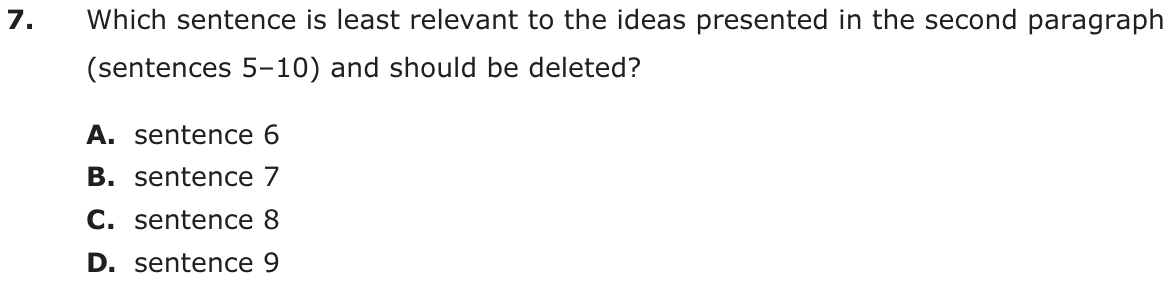
Question 26 of 43
2024 Test B English, question 8Uses the passage above: “Find Time to Volunteer”.
Question
Which of these would best follow sentence 12 and support the ideas presented in the third paragraph (sentences 11–12)?
- AThese students show that they are likely to be responsible, reliable, and helpful young adults. Admissions counselors know that character traits like these will benefit the applicants as well as whomever they interact with.
- BVolunteering can help students meet new people who can provide references and advice to the students when they are applying to colleges. It can also be an invaluable opportunity for students to meet possible future employers.
- CThe counselors hope that young adults who demonstrate this behavior will go on to volunteer during their college years, working on campus in student government and leadership programs or serving in the community at hospitals, schools, and homeless shelters.
- DMany colleges are looking for students who are not just academically successful but who also work well with others and care about improving and serving surrounding communities.
Show the answer
Correct answer: D
The question asks which option would best follow sentence 12 to support the ideas presented in the third paragraph (sentences 11–12).
A. Incorrect. The subject of the main clause in sentence 12 is “admissions counselors.” Although the second sentence in the option mentions “admissions counselors,” it does not support the ideas in the paragraph, because the statement that “admissions counselors know that character traits like these will benefit the applicants” focuses on how students benefit, while sentence 12 focuses on how these traits benefit the community.
B. Incorrect. While sentence 11 discusses the potential academic and professional connections that can be made through volunteering, sentence 12 moves on to the topic of college admissions. Since the sentences in the option revert back to the topic of connections, they do not support and logically follow a sentence about how college admissions counselors view students with volunteering experience.
C. Incorrect. Although the sentence in the option continues on the subject of admissions counselors and follows the idea in sentence 12 that these counselors tend to favor students who “care about making their community and college campus a better place,” the sentence focuses on what students will do while in college rather than on how volunteering helps them get into college. Therefore, the sentence does not best follow sentence 12 and support the ideas presented in the third paragraph.
D. CORRECT. In sentence 12, the author states that college admissions counselors view students who list volunteer work on admissions applications as “applicants who care about making their community and college campus a better place.” The sentence in the option best follows sentence 12 and supports the ideas in the third paragraph because it provides additional details about why admissions counselors look beyond academics when considering students for admissions and the positive qualities assigned to those who have volunteering experience.
Question analysis
This supporting-details question asks which addition would best follow the volunteering essay’s sentence about how college admissions counselors view applicants who list volunteer work. Every option mentions college and sounds reasonable on its own, so students must decide which one develops the paragraph’s point rather than drifting to a related idea.
- NYS standards
- 7W1b supporting claims with evidence
- Grade level
- Grade 8 reading and task
- Compared with grade 7
- Above grade 7 Grade 7 students choose evidence that supports a claim. Here the options are one or two full sentences, all of them about college, and the right fit depends on the precise idea in sentence 12, a finer judgment than usual.
- Estimated difficulty
- Hard: combines ideas, needs a plan, and has more than one tempting wrong answer.
- Thinking it demands
- Depth of knowledge 2, skills and concepts · mainly evaluate
- What makes it hard
- A very close wrong answer major
- How sentences fit together moderate
- A lot to read minor
- Evidence
- Answered from one paragraph or stanza
- Reading level
- Passage: about grade 11, 354 words; question and choices: about grade 13, 153 words.
- Students, last 30 days
- Not enough answers yet to show (it takes 10).
Why it is hard, traps and wrong answers (shows the answer)
Why it is hard
Every option stays on the subject of college, so the work is matching sentence 12’s exact idea: counselors see applicants who care about making their community a better place. The near miss also explains what counselors value, but it swaps caring for the community for a new set of traits and ends on what those traits do for the applicants. Students who restate sentence 12 before reading the options can hear that the right one simply widens it, from community service to what colleges want beyond grades.
A very close wrong answer major Choosing the answer
The right sentence and the two-sentence option about responsible, reliable, helpful students both explain why volunteers impress admissions; only the right one keeps sentence 12’s point, caring about improving communities. (Embretson & Wetzel, 1987; Gorin & Embretson, 2006; Ascalon et al., 2007)
How sentences fit together moderate Working it out
The new sentence must extend sentence 12’s specific idea, what admissions counselors see in volunteers, rather than return to sentence 11’s skills and careers or move on to college life. (Halliday & Hasan, 1976)
A lot to read minor Understanding the question
The options run 27 to 39 words, two of them two sentences long, and all four are about college, so topic alone rules none of them out. (Kintsch, 1998; Gorin & Embretson, 2006; Freedle & Kostin, 1993)
Strategy: Restate sentence 12 in your own words, then ask of each option whether it explains or extends that exact point about what admissions counselors value.
Traps
- Off the point: Adds or keeps something that does not support the paragraph's or the passage's focus, or an introduction or conclusion that misses the main point.
The wrong answers, classified
A Off the point (Halliday & Hasan, 1976)
Follows the admissions counselors from sentence 12 but replaces caring for the community with new traits, responsibility and reliability, and turns to how those traits help the applicants.
B Off the point (Halliday & Hasan, 1976)
Is drawn by “applying to colleges,” but networking for references and future employers is a new benefit that neither sentence 11 nor sentence 12 develops.
C Off the point (Halliday & Hasan, 1976)
Stays with the counselors and picks up “college campus” from sentence 12, but jumps ahead to what students might do in college instead of explaining admission decisions.
Working it out, step by step
Figure out what the question asks
You need the sentence that best follows sentence 12. A good next sentence adds to the same idea. It does not jump to a new point. Example: after Dogs make loyal pets, the sentence They stay by their owners’ side fits. Dogs come in many colors drifts away. So first put sentence 12 in your own words.
Restate sentence 12
Sentence 12 says that “when students list volunteer work on college applications, admissions counselors see applicants who care about making their community and college campus a better place.” Admissions counselors are the people who choose which students get into a college. So the idea is this: colleges like volunteers because volunteers care about their communities.
Check each choice
- D says colleges want students who are “not just academically successful.” That means more than good grades. They also want students who “care about improving and serving surrounding communities.” That explains sentence 12 and builds on it.
- A swaps in new traits: “responsible, reliable, and helpful.” Then it says those traits help the applicants and the people around them. It drops caring for the community.
- B brings in a new benefit: meeting people who can give advice or jobs. Neither sentence 11 nor sentence 12 talks about that.
- C jumps ahead to what students might do in college. It doesn’t explain how volunteering helps them get in.
Pick the answer
Watch out: A is the most tempting. It is about what counselors value, just like the right answer. But it changes the reason they value it. Only D keeps sentence 12’s idea of caring for the community. So the answer is D.
Why this answer and not the closest wrong one
A is the closest wrong answer. Like D, it explains why admissions counselors like volunteers. But A’s reasons are new ones, such as being responsible and reliable. D keeps sentence 12’s exact idea, caring about the community, and adds that colleges want more than good grades. So D supports the paragraph best.
More questions like this
The original DOE question
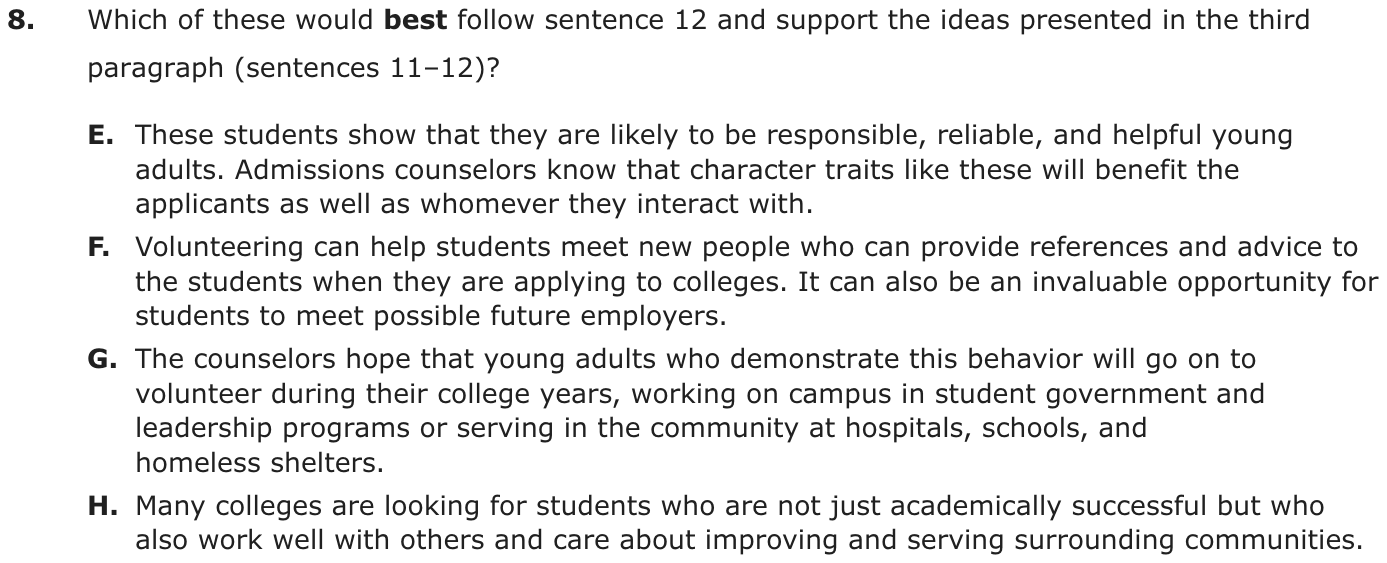
Question 27 of 43
2023 Test A English, question 6Passage The Benefits of Indoor Plants
The Benefits of Indoor Plants
(1) In an age of endless media content, it is easy to see why people might prefer to stay inside. (2) According to a study sponsored by the Environmental Protection Agency, Americans spend an average of 87 percent of their time indoors. (3) Scientists say that this separation between people and nature puts people at risk for physical and psychological issues.
(4) During the process of photosynthesis, plants convert carbon dioxide into oxygen and remove many harmful toxins from the air. (5) Spending prolonged periods of time indoors, away from plants, deprives people of these benefits. (6) Air that is not regularly detoxified can lead to a condition known as sick building syndrome. (7) This disorder first came to light in the 1970s when many office workers in the United States began to complain of unexplained flu-like symptoms. (8) Researchers determined the cause to be volatile organic compounds, or VOCs. (9) VOCs are harmful chemicals that are emitted by everyday objects such as carpet, furniture, cleaning products, and computers. (10) The NASA Clean Air Study found a simple way to remove a significant number of VOCs within a 24-hour period: add plants to indoor spaces.
(11) Adding plants to indoor spaces has psychological benefits too. (12) Research has long linked time spent in natural environments with increased energy and feelings of contentment. (13) While being outdoors is an excellent option for improving a person’s mental health, recent research has indicated that encountering natural elements while indoors can also help. (14) To experience the maximum benefit of natural elements, experts suggest placing at least one live plant per 100 square feet of home or office space.
(15) Connecting with nature, even just by being near an indoor plant, is a significant factor in a person’s well-being. (16) Sitting in front of an electronic screen all day isn’t natural, and today’s workers need to get up and get outdoors. (17) Richard Ryan, a psychology professor at the University of Rochester, puts it this way: “Nature is something within which we flourish, so having it be more a part of our lives is critical, especially when we live and work in built environments.”
Question
Which transition word or phrase should be added to the beginning of sentence 5?
- AAs a result,
- BPrimarily,
- CIn contrast,
- DUnfortunately,
Show the answer
Correct answer: D
The question asks for the transition word or phrase that should be added to the beginning of sentence 5.
A. Incorrect. The transition phrase “As a result” conveys a cause-and-effect relationship that does not exist between the ideas in sentence 4 and sentence 5. Although the plants’ conversion of carbon dioxide into oxygen removes harmful toxins from the air, the process of photosynthesis (sentence 4) does not deprive people of the plants’ benefits (sentence 5).
B. Incorrect. Although the passage describes why people should spend time in close proximity to plants, the idea in sentence 5 shifts from the benefits described in sentence 4 to what people lose without them, rather than elaborating on sentence 4. The transition word “Primarily” incorrectly suggests that the sentences describe the same idea.
C. Incorrect. Although sentence 4 describes a positive idea (plants are beneficial) and sentence 5 describes a negative idea (deprivation), the transition phrase “In contrast” conveys an inaccurate relationship between the ideas in the sentences. Sentence 5 is not arguing against the beneficial effect of plants and should not begin with a transition that implies opposition.
D. CORRECT. The relationship between the ideas in the sentences is correctly conveyed with the transition word “Unfortunately,” which signals the shift from the positive effect described in sentence 4 (plants are helpful) to the emphasis in sentence 5 that the positive effect is dependent on proximity to plants.
Question analysis
This transitions question on “The Benefits of Indoor Plants,” a short informational passage, asks which word or phrase should be added to the start of sentence 5. Students must reread sentence 4, on how plants clean indoor air, and sentence 5, on spending long periods indoors, and name the link between them, since all four options are familiar transitions.
- NYS standards
- 7W2d transitions in informative writing
- Grade level
- Grade 7 reading and task
- Compared with grade 7
- At grade 7 Choosing a transition that matches how two sentences relate is everyday grade 7 writing work. Here sentence 5 is not reprinted with the question, so students must find it in the passage first, and more than one option seems to fit.
- Estimated difficulty
- Moderate: several steps, or a close reading with one strong distractor.
- Thinking it demands
- Depth of knowledge 2, skills and concepts · mainly evaluate
- What makes it hard
- How sentences fit together moderate
- Reading between the lines minor
- Evidence
- Answered from one paragraph or stanza
- Reading level
- Passage: about grade 12, 346 words; question and choices: about grade 7, 20 words.
- Corrected from the DOE handbook
- The explanation contradicted itself about how sentences 4 and 5 relate; one sentence was corrected.
- Students, last 30 days
- Not enough answers yet to show (it takes 10).
Why it is hard, traps and wrong answers (shows the answer)
Why it is hard
The question does not print sentence 5, so students first have to find it in the second paragraph and read it beside sentence 4. Two options then sound right: sentence 5 seems to follow from sentence 4, and it moves from good news to bad. Neither fits exactly, because photosynthesis does not cause people to stay inside and missing a benefit does not dispute it, so the point goes to students who hear a writer regretting a loss.
How sentences fit together moderate Working it out
Sentence 5’s “these benefits” points back to the oxygen and cleaner air of sentence 4, and the link it needs is a drawback of that good news, people kept away from plants, rather than a cause or an opposition. (Halliday & Hasan, 1976)
Reading between the lines minor Working it out
“Unfortunately” states no logical relation; it voices the writer’s regret, so students who scan the options for a cause, contrast or emphasis word must infer that sentence 5 turns toward a loss. (Graesser, Singer & Trabasso, 1994; Kintsch, 1998)
Strategy: Read sentences 4 and 5 back to back and say in a few words how the second relates to the first, then try each option at the start of sentence 5 and keep the one that matches.
Traps
- Wrong transition: A connecting word or phrase that signals the wrong relationship, such as contrast where the idea continues.
The wrong answers, classified
A Wrong transition (Halliday & Hasan, 1976)
Treats sentence 5 as an effect of photosynthesis, but plants cleaning the air does not make anyone stay indoors; the loss comes from being away from the plants.
B Wrong transition (Halliday & Hasan, 1976)
Uses “Primarily” as if sentence 5 elaborated on sentence 4’s main point, but sentence 5 moves from what plants give to what people lose without them.
C Wrong transition (Halliday & Hasan, 1976)
Hears the move from the benefits of plants to people missing them as a contrast, but sentence 5 builds on sentence 4 through “these benefits” instead of arguing against it.
What was corrected from the DOE handbook, and why
- Explanation: The DOE’s explanation of Option B (“Primarily”) says “the idea in sentence 5 is actually in opposition to the idea in sentence 4 rather than an elaboration of it.” Its explanation of Option C (“In contrast”) says the opposite: “Sentence 5 is not arguing against the beneficial effect of plants and should not begin with a transition that implies opposition,” and it explains the answer as a shift from the positive effect in sentence 4 to the point that the effect depends on being near plants. The site now says that the idea in sentence 5 shifts from the benefits described in sentence 4 to what people lose without them, rather than elaborating on sentence 4. The site made the same correction to this item as printed in the 2026 practice test (2026 Test A English, question 44). Option B is still wrong, and the answer, D (“Unfortunately”), is unchanged.
Working it out, step by step
Figure out what the question asks
You need a transition to start sentence 5. A transition is a word or phrase that shows how two ideas connect. For example, as a result shows a cause and its effect. To pick one, see how sentence 5 connects to sentence 4, the sentence just before it.
Find sentences 4 and 5
Both are in the second paragraph. Sentence 4 says: “During the process of photosynthesis, plants convert carbon dioxide into oxygen and remove many harmful toxins from the air.”
Sentence 5 says: “Spending prolonged periods of time indoors, away from plants, deprives people of these benefits.”
Work out how they connect
Photosynthesis is the way plants use sunlight to make their food. While they do it, they give off oxygen and clean the air. That is good news. In sentence 5, “prolonged” means long, and “deprives” means keeps from having. The words “these benefits” point back to the oxygen and clean air. So people who stay inside, far from plants, miss out. The paragraph turns from good news to bad news.
Check each choice
- A is wrong. “As a result” means sentence 4 causes sentence 5. But plants cleaning the air does not make people stay indoors.
- B is wrong. “Primarily” means mainly. It suggests sentence 5 says more about the same idea. But sentence 5 moves from what plants give to what people lose without them.
- C is wrong. “In contrast” sets up an opposite idea. But sentence 5 does not argue against sentence 4. It builds on it with “these benefits.”
- D is right. “Unfortunately” means sadly. It warns that bad news comes after good news.
Watch out: C is tempting, because the mood changes from good to bad. But a change in mood is not an opposite. Sentence 4 is still true.
Choose the answer
Sentence 5 would read: Unfortunately, spending prolonged periods of time indoors, away from plants, deprives people of these benefits. So the answer is D.
Why this answer and not the closest wrong one
C is the closest wrong answer, since the paragraph turns from good news to bad. But “In contrast” would mean sentence 5 argues against sentence 4. It doesn’t. Plants still clean the air. Sentence 5 only says that people miss this help when they stay inside. “Unfortunately” shows that sad turn without setting up an opposite.
More questions like this
The original DOE question

The passage “The Benefits of Indoor Plants” as printed (page 60)
Question 28 of 43
2023 Test B English, question 9Passage The End of an Era
The End of an Era
(1) In 2004, the National Aeronautics and Space Administration (NASA) landed a rover, or robotic vehicle, named Opportunity on the surface of Mars. (2) The rover’s mission was to search for evidence of water and life on the planet. (3) The rover was designed to gather data on Mars for about 90 days, but Opportunity’s assignment did not come to an end until nearly 15 years later in 2019.
(4) During the rover’s mission, a high-resolution camera on the rover’s robotic arm took magnified photographs of the surface of Mars. (5) The photographs revealed small round rocks scattered across the surface of the planet. (6) The scientists nicknamed these rocks “blueberries” based on the rocks’ resemblance to the fruit. (7) These rocks were important because their spherical shape suggested that liquid water may have flowed over them for a substantial amount of time.
(8) Opportunity continued to provide valuable data about craters and other surface features. (9) Throughout the mission, the rover traveled a total of 28.06 miles across Mars’ surface. (10) When Opportunity had traveled nearly the length of a marathon, scientists celebrated the accomplishment by naming the valley that the rover was in Marathon Valley. (11) However, in 2018, a dust storm spread all over the planet, putting the rover’s progress on hold.
(12) Prior to this planet-wide dust storm, minor dust storms had periodically deposited a layer of dust onto the solar panels of the rover. (13) These prevented it from charging its batteries. (14) Scientists then had to rely on the passing winds and dust devils to clean off the solar panels. (15) After the massive 2018 dust storm subsided, scientists expected to be able to reestablish communication with Opportunity. (16) They made repeated attempts but to no avail. (17) In 2019, NASA finally declared Opportunity’s mission complete.
(18) Opportunity was an important asset in scientists’ study of Mars; it returned valuable data about our neighbor planet and survived powerful dust storms. (19) NASA described the mission of Opportunity as “one of the most successful and enduring feats of interplanetary exploration.” (20) Even though this rover’s journey ended, other rovers still roam the surface of Mars.
Question
Which concluding sentence should be added after sentence 20 to best support the information presented in the passage?
- AThese rovers, including one named Curiosity, will help scientists answer their lingering questions about the planet.
- BToday’s rovers continue to add to Opportunity’s discoveries and will help us learn even more about the planet.
- CAnd in conjunction with these rovers, NASA is using other resources, including an orbiting spacecraft known as Mars Odyssey, for the exploration of the planet.
- DWith its red dust, rocky surface, and freezing temperatures, Mars will continue to be a challenging environment for today’s rovers.
Show the answer
Correct answer: B
The question asks for the concluding sentence that should be added after sentence 20 to best support the information presented in the passage.
A. Incorrect. The sentence does not summarize or make reference to the focus of the passage, which is the Opportunity rover.
B. CORRECT. This sentence summarizes the ideas about the Opportunity rover while also extending those ideas to future research, an effective combination for a sentence that concludes a piece about a scientific topic.
C. Incorrect. This sentence not only begins with the phrase “And in conjunction,” which is repetitive, but also introduces an entirely new idea (Mars Odyssey) instead of concluding on the main topic of the passage (the Opportunity rover).
D. Incorrect. This sentence puts emphasis on Mars’s characteristics and makes a conclusion about “today’s rovers,” instead of referring back to the Opportunity rover, the main focus of the passage.
Question analysis
This concluding-sentence question on “The End of an Era,” a passage about NASA’s Opportunity rover, which explored Mars from 2004 until NASA declared its mission complete in 2019, asks which sentence should follow sentence 20. That last sentence notes that other rovers still roam Mars, and every choice builds on it, so students must judge which ending best supports the passage as a whole.
- NYS standards
- 7W2e concluding informative writing
- Grade level
- Grade 7 reading and task
- Compared with grade 7
- At grade 7 Choosing a concluding sentence for an informational passage is standard grade 7 writing work. The rover passage is twenty plain sentences, and all four endings follow on from its last line, so the comparison is careful but typical.
- Estimated difficulty
- Moderate: several steps, or a close reading with one strong distractor.
- Thinking it demands
- Depth of knowledge 2, skills and concepts · mainly evaluate
- What makes it hard
- A very close wrong answer moderate
- Evidence in several places minor
- How sentences fit together minor
- Evidence
- Answered from the whole text
- Reading level
- Passage: about grade 11, 337 words; question and choices: about grade 13, 96 words.
- Students, last 30 days
- Not enough answers yet to show (it takes 10).
Why it is hard, traps and wrong answers (shows the answer)
Why it is hard
Sentence 20 hands every ending a ready link, the rovers still on Mars, so each choice sounds like a natural next line. The question is which one returns to the subject the passage built over twenty sentences, and only one connects today’s rovers to what Opportunity found. The near-twin that names Curiosity draws students who check smoothness rather than focus, while the other two drift to a spacecraft and to the planet’s harsh conditions.
A very close wrong answer moderate Choosing the answer
The ending that names Curiosity and the right one both say today’s rovers will help answer questions about Mars; they differ only in whether the sentence ties those rovers back to Opportunity’s discoveries. (Embretson & Wetzel, 1987; Gorin & Embretson, 2006; Ascalon et al., 2007)
Evidence in several places minor Working it out
The passage’s subject, Opportunity, runs through all five paragraphs, from its 2004 landing to the “blueberries,” the 28.06 miles and the dust storms, so judging an ending means holding that whole thread in mind. (Kirsch & Mosenthal, 1990; Gorin & Embretson, 2006)
How sentences fit together minor Working it out
Sentence 20 turns to “other rovers” that “still roam the surface of Mars,” and all four endings pick up from it, so fit with the last sentence alone rules none of them out. (Halliday & Hasan, 1976)
Strategy: Say in a few words what the whole passage is about, then read each ending after sentence 20 and ask whether it closes that subject or turns to something the passage never covered.
Traps
- Off the point: Adds or keeps something that does not support the paragraph's or the passage's focus, or an introduction or conclusion that misses the main point.
The wrong answers, classified
A Off the point (Halliday & Hasan, 1976)
Continues smoothly from “other rovers” in sentence 20 and looks ahead as a conclusion should, but it names Curiosity and never returns to Opportunity, the rover the passage is about.
C Off the point (Halliday & Hasan, 1976)
Is drawn by a specific new fact, the orbiting Mars Odyssey, which the passage never mentions; after the wordy “And in conjunction with,” the ending leaves Opportunity behind.
D Off the point (Halliday & Hasan, 1976)
Builds on the dust storms Opportunity survived and adds rocky ground and freezing cold, but it ends on the hardships facing today’s rovers rather than on what Opportunity achieved.
Working it out, step by step
Figure out what the question asks
You need a concluding sentence. That is the last sentence of a piece of writing. A good one wraps up the main topic and leaves the reader with a final thought. So first, decide what the whole passage is about.
Name the main topic
Every paragraph is about one rover, Opportunity. Paragraph 1 tells when it landed on Mars in 2004. Paragraph 2 tells about the “blueberries,” small round rocks it found. Paragraph 3 gives the 28.06 miles it traveled. Paragraph 4 tells how its mission ended in 2019. Paragraph 5 says it “returned valuable data about our neighbor planet.” A good ending should come back to this rover.
Read the last sentence
Sentence 20 says: “Even though this rover’s journey ended, other rovers still roam the surface of Mars.” Roam means travel around. All four choices pick up from these other rovers. So fitting with sentence 20 is not enough. The best choice must also tie back to Opportunity.
Check each choice
- A is wrong. It names a new rover, Curiosity, and never mentions Opportunity.
- B is right. It says today’s rovers add to Opportunity’s discoveries. That links them back to the topic. It also looks ahead: they “will help us learn even more about the planet.”
- C is wrong. It brings in a spacecraft, Mars Odyssey, that the passage never talks about. An ending should not start a new topic.
- D is wrong. It ends on how harsh Mars is for today’s rovers, not on what Opportunity did.
Watch out: A sounds like a strong ending because it looks to the future. But it leaves out the rover the passage is about.
Choose the answer
Only B ties today’s rovers back to Opportunity and also looks ahead to new learning about Mars. So the answer is B.
Why this answer and not the closest wrong one
A is the closest wrong answer. Like B, it says today’s rovers will help answer questions about Mars. But A talks about Curiosity instead. B is better because it connects those rovers to Opportunity’s discoveries, the subject of all five paragraphs.
More questions like this
The original DOE question
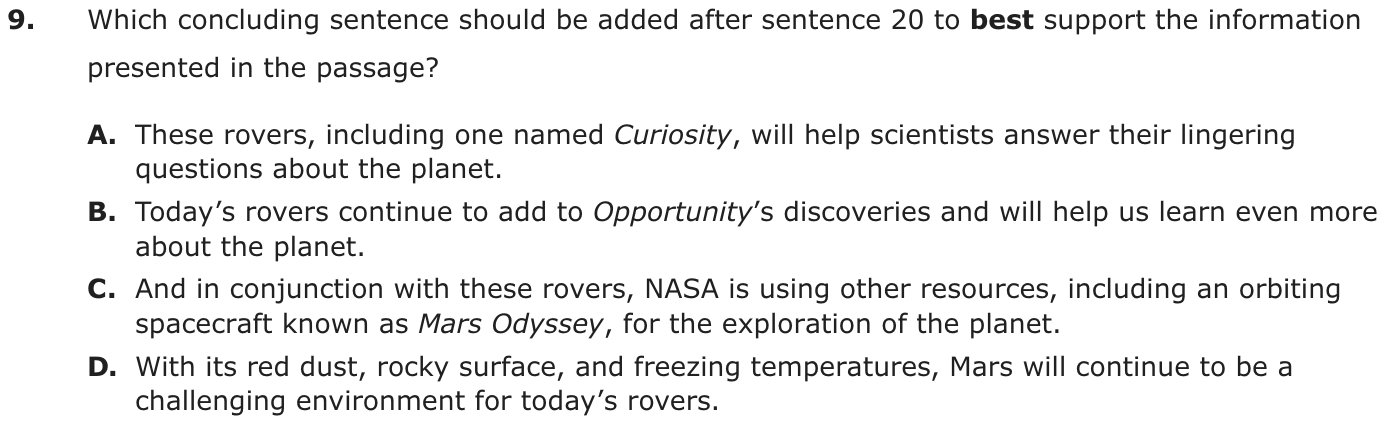
The passage “The End of an Era” as printed (page 60)
Question 29 of 43
2022 Test A English, question 6Passage Cracking the Code
Cracking the Code
(1) Computer code is part of every electronic interaction, from video games to home thermostats to vehicle GPS systems. (2) Code is a language that computers can interpret, and programmers use it to instruct computers to perform different tasks, such as finding, sorting, or calculating data. (3) People who code have to learn this language. (4) They can construct programs that will perform detailed tasks. (5) The programs can also perform complex tasks.
(6) A coding language uses letters, numbers, and symbols that are arranged in a way that makes sense to a computer. (7) The code that makes up a program tells a computer how to process information. (8) Studying a coding language involves learning the rules for combining phrases and instructions so that they are recognizable to the computer. (9) Once a person understands coding rules, the possibilities for applying them are infinite.
(10) Coding skills are becoming important in many occupational fields. (11) For example, code can be used to create programs to track, analyze, and predict changes in the stock market. (12) Code can also be designed to help doctors track and monitor a patient’s health. (13) Jobs that require coding skills are typically higher paying, offering salaries that are up to as much as $22,000 a year more than jobs that do not require coding knowledge.
(14) People have a variety of opportunities to learn how to code. (15) In some schools, young people can study computer science and coding just as they study foreign languages. (16) Computer science teachers can use websites and apps that employ games designed to help everyone understand how code works. (17) Even high school students who do not take computer science can learn coding by attending coding workshops and online classes or by watching tutorials online. (18) After studying the basics of coding, some students may become interested in learning how to create programs, such as games and apps.
(19) The late Steve Jobs, a pioneer in computer technology, once said, “Everybody in this country should learn how to program a computer . . . because it teaches you how to think.” (20) Learning to code can seem challenging, but one does not need to become an expert programmer to reap the benefits of understanding this language.
Question
What is the best way to combine sentences 3 through 5 to clarify the relationship between ideas?
- APeople who code have to learn this language because they can construct programs that will perform detailed and complex tasks.
- BPeople who code have to learn this language so they can construct programs that will perform detailed or complex tasks.
- CWhen people who code have to learn this language, it is so they can construct programs that will perform detailed and complex tasks.
- DIf people who code have to learn this language, then they can construct programs that will perform detailed as well as complex tasks.
Show the answer
Correct answer: B
The question asks for the best way to combine sentences 3 through 5 to clarify the relationship between ideas.
A. Incorrect. While this sentence shows a relationship between the ideas, it does not clarify the relationship accurately. Learning the language of code does not depend on people’s previous ability to construct programs that will perform detailed and complex tasks. The word “because” incorrectly indicates that people can already construct complex programs prior to learning the coding language that would allow them to do so.
B. CORRECT. This sentence accurately shows the relationship between the ideas of the sentences. Before people can construct programs that will perform detailed and complex tasks, they have to learn a coding language. Knowing that language will, in turn, allow them to build programs that can perform detailed and complex tasks.
C. Incorrect. This sentence does not accurately express the relationship between ideas because the sentence implies that some people who code do not have to learn the language to perform their job functions. The passage clearly states that “computer code is part of every electronic interaction” (sentence 1) and that “programmers use it to instruct computers to perform different tasks” (sentence 2).
D. Incorrect. The conditional (If . . . then) construction of the sentence in Option D does not convey the intended relationship of the ideas in the sentences. The “then” statement (“they can construct programs that will perform detailed as well as complex tasks”) does not follow the condition of the “if” statement (“people who code have to learn this language”).
Question analysis
This sentence-combining question uses the first paragraph of “Cracking the Code,” a passage about computer coding, and asks for the best way to join sentences 3 through 5: coders must learn the language, they can build programs for detailed tasks, and those programs can also handle complex ones. Each version links the ideas with a different word, so students must judge which states the relationship accurately.
- Grade level
- Grade 7 reading and task
- Compared with grade 7
- At grade 7 Joining short sentences with a word that shows how their ideas relate is typical grade 7 work. Here three sentences become one and every version is grammatical, so the choice rests on whether the joining words state the logic accurately.
- Estimated difficulty
- Moderate: several steps, or a close reading with one strong distractor.
- Thinking it demands
- Depth of knowledge 2, skills and concepts · mainly evaluate
- What makes it hard
- A very close wrong answer moderate
- How sentences fit together moderate
- Every choice must be checked minor
- Evidence
- Answered from one paragraph or stanza
- Reading level
- Passage: about grade 10, 357 words; question and choices: about grade 9, 101 words.
- Students, last 30 days
- Not enough answers yet to show (it takes 10).
Why it is hard, traps and wrong answers (shows the answer)
Why it is hard
Every version is a correct sentence carrying the same facts, so the question tests logic rather than grammar: what does learning the language make possible? The look-alike joined by “because” is the main danger, since it seems to give a reason for learning. Careful readers may also pause over the key’s “detailed or complex tasks,” looser than sentence 5’s “also,” but the joining word, not that slip, is what separates the best sentence from the rest.
A very close wrong answer moderate Choosing the answer
The version joined by “because” matches the key word for word except for its linking word and “and” in place of “or,” so the decision rests on which way the link between learning and building runs. (Embretson & Wetzel, 1987; Gorin & Embretson, 2006; Ascalon et al., 2007)
How sentences fit together moderate Working it out
Sentence 3 states a requirement and sentences 4 and 5 state what meeting it allows, so the combined sentence must present learning the language as the means and building programs as the purpose. (Halliday & Hasan, 1976)
Every choice must be checked minor Choosing the answer
All four versions are grammatical and keep the same facts; only the opening or joining words change, “because,” “so,” “When … it is so” and “If … then,” and each must be weighed. (Embretson & Wetzel, 1987)
Strategy: Before reading the choices, decide in your own words how sentence 3 relates to sentences 4 and 5, then check whether each version’s opening or joining word signals that same relationship.
Traps
- Wrong transition: A connecting word or phrase that signals the wrong relationship, such as contrast where the idea continues.
- Wordy, vague or informal: A revision is grammatical but wordy, imprecise or too casual for the passage.
The wrong answers, classified
A Wrong transition (Halliday & Hasan, 1976)
Hears “because” as giving the reason to learn the language, but it treats the ability to build detailed and complex programs as already there, when that ability comes from learning.
C Wordy, vague or informal (Connors & Lunsford, 1988)
Is drawn by the formal ring of “When … it is so,” which buries the purpose in a clumsy frame and suggests coders must learn the language only on some occasions.
D Wrong transition (Halliday & Hasan, 1976)
Keeps learning before building but frames it with “If … then,” turning a stated requirement into a mere possibility, though having to learn a language does not by itself let anyone build programs.
Working it out, step by step
Figure out what the question asks
This asks you to join three short sentences into one. The new sentence must show how the ideas connect. All four choices are correct sentences with the same facts. What changes is the joining word. So first decide how the ideas connect. Then find the joining word that says so.
Read sentences 3 through 5
Sentence 3 says “People who code have to learn this language.” Sentence 4 says “They can construct programs that will perform detailed tasks.” Sentence 5 adds “The programs can also perform complex tasks.” To construct is to build. Detailed tasks have many small parts. Complex tasks are complicated and hard to do.
Name the link between the ideas
Why do coders have to learn the language? So that they can build programs. Learning comes first. Building programs is the goal it makes possible. A word that shows a goal, or purpose, is “so” (short for “so that”). Example: I practice piano so I can play in the concert. The practice comes first, and the concert is the goal.
Check each choice
- A does not fit. “Because” gives a reason that is already true. It says coders learn the language because they can already build programs. That gets the order backward.
- B fits. “So” shows that building programs is the goal of learning the language. It says “detailed or complex tasks” where sentence 5 means both, a small slip. But its joining word is right.
- C does not fit. “When” suggests coders only sometimes have to learn the language. And “it is so” is wordy.
- D does not fit. “If” makes learning sound like a maybe. The passage says coders “have to learn” it. That is a must.
Choose the answer
Watch out: A is the most tempting. It matches B almost word for word, and “because” sounds like a reason to learn. But it points the wrong way. B shows that learning leads to building. So the answer is B.
Why this answer and not the closest wrong one
A is the closest wrong answer. It uses the same words as B except for the joining word. “Because” makes building programs the reason coders learn the language, as if they could already do it. “So” makes building programs the goal that learning leads to. Learning comes first, so B shows the link correctly.
More questions like this
The original DOE question
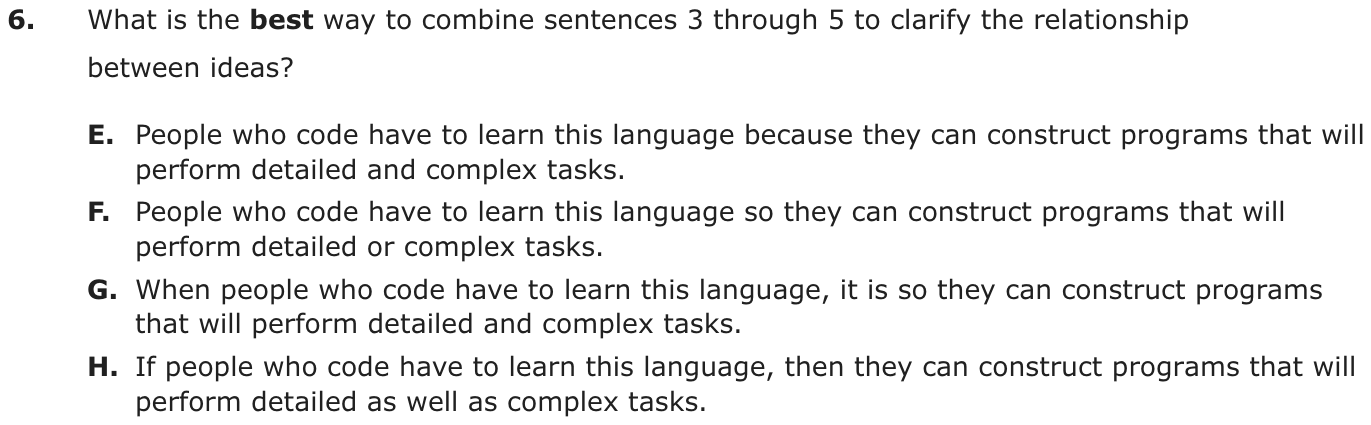
The passage “Cracking the Code” as printed (page 40)
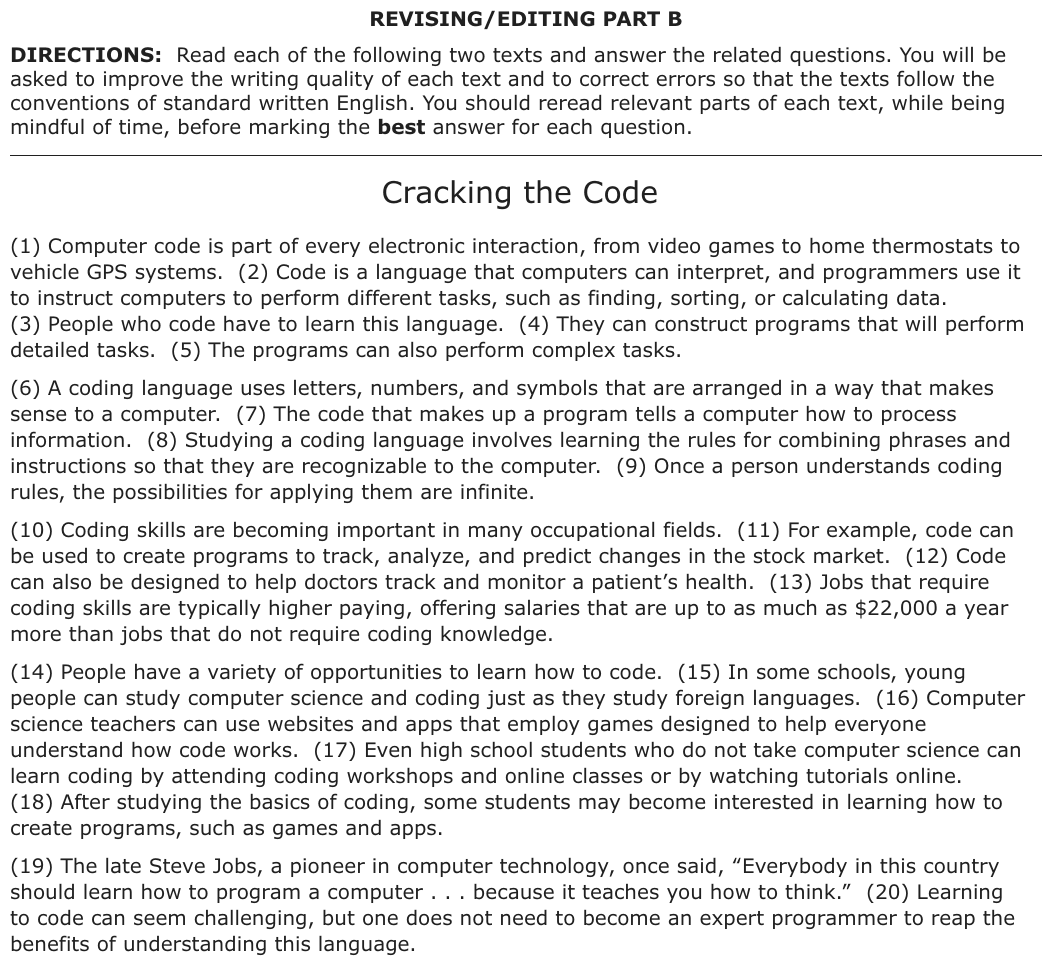
Question 30 of 43
2022 Test A English, question 8Uses the passage above: “Cracking the Code”.
Question
Which revision of sentence 10 provides the best transition to the argument in the third paragraph (sentences 10–13)?
- ALearning a coding language may be difficult, but coding skills are becoming important in many occupational fields.
- BLearning a coding language is useful because coding skills are becoming important in many occupational fields.
- CEmployers in most industries realize that people with coding skills can demand higher salaries in many occupational fields.
- DEven though programming is its own unique field, coding skills are becoming important in many occupational fields.
Show the answer
Correct answer: B
The question asks for the best revision of sentence 10 to provide a transition to the argument in the third paragraph.
A. Incorrect. Some readers may choose this option because the second paragraph does discuss the complexities of coding; however, it does not discuss the difficulties of learning coding. The third paragraph demonstrates some of the complex ways coding is used in specific fields but does not illustrate how difficult learning coding may be.
B. CORRECT. This sentence provides the best revision of the transition sentence. The second paragraph ends with “the possibilities for applying them are infinite” (sentence 9), which supports the idea that people in “many occupational fields” (sentence 10) can benefit from having coding skills. The third paragraph illustrates this idea by providing specific examples of occupations that benefit from coding (stock market traders and doctors).
C. Incorrect. While sentence 13 suggests that employers recognize the value of coding skills, sentences 11 and 12 give examples of different industries that employ people who know how to code. The transition sentence should introduce the idea that coding skills are valuable to potential employees.
D. Incorrect. Some readers may choose this option because the second paragraph provides a brief definition of coding—“A coding language uses letters, numbers, and symbols that are arranged in a way that makes sense to a computer” (sentence 6)—which shows how this element of programming works, but the second paragraph does not specifically discuss what makes the field of computer programming unique. The third paragraph discusses how coding can be used in a variety of occupational fields (sentence 10).
Question analysis
This transitions question asks which revision of sentence 10, the opening sentence of the third paragraph of “Cracking the Code,” would best lead into that paragraph’s argument. Students must link the second paragraph, on how coding languages work, to the third, on coding in fields such as stock trading and medicine, and judge four versions that each begin differently.
- NYS standards
- 7W1d transitions in arguments
- Grade level
- Grade 7 reading and task
- Compared with grade 7
- At grade 7 Grade 7 transition questions often ask for one connecting word. This one asks for a whole topic sentence, so students must sum up two paragraphs and see how they connect, though the passage’s plain language keeps it within typical grade 7 work.
- Estimated difficulty
- Moderate: several steps, or a close reading with one strong distractor.
- Thinking it demands
- Depth of knowledge 2, skills and concepts · mainly evaluate
- What makes it hard
- How sentences fit together moderate
- A very close wrong answer moderate
- Evidence
- Answered from several paragraphs or stanzas
- Reading level
- Passage: about grade 10, 357 words; question and choices: about grade 13, 84 words.
- Students, last 30 days
- Not enough answers yet to show (it takes 10).
Why it is hard, traps and wrong answers (shows the answer)
Why it is hard
Three of the four versions end with the original sentence 10, so the choice lies entirely in the opening words and the link they claim. A concession about difficulty sounds like a natural essay move, and sentence 20 even calls coding challenging, but nothing in paragraphs 2 or 3 sets difficulty against importance. Students who first name the real link between the paragraphs, that coding knowledge is worth having because many fields need it, can test each opening against that.
How sentences fit together moderate Working it out
The new opening must look back to paragraph 2, which ends on the “infinite” possibilities of knowing coding rules, and ahead to the stock-market and medical examples, so two paragraphs have to be tracked at once. (Halliday & Hasan, 1976)
A very close wrong answer moderate Choosing the answer
The concession version shares the key’s first words, “Learning a coding language,” and its whole closing clause; only the middle differs, “may be difficult, but” against “is useful because.” (Embretson & Wetzel, 1987; Gorin & Embretson, 2006; Ascalon et al., 2007)
Strategy: Sum up paragraph 2 and paragraph 3 in a few words each, then test every version of sentence 10 against both summaries, paying close attention to what its opening words claim.
Traps
- Wrong transition: A connecting word or phrase that signals the wrong relationship, such as contrast where the idea continues.
- Off the point: Adds or keeps something that does not support the paragraph's or the passage's focus, or an introduction or conclusion that misses the main point.
The wrong answers, classified
A Wrong transition (Halliday & Hasan, 1976)
Borrows sentence 20’s point that coding “can seem challenging” and sets it against importance with “but,” though neither paragraph 2 nor paragraph 3 raises difficulty, so the contrast connects nothing.
C Too narrow (King et al., 2004)
Picks up sentence 13’s higher salaries and speaks for employers, so the opening covers only the paragraph’s last point and gives no link back to paragraph 2 on coding languages.
D Off the point (Halliday & Hasan, 1976)
Takes paragraph 2’s technical account of code as proof that programming is “its own unique field,” an idea the passage never develops, and sets it against wider use with “Even though.”
Working it out, step by step
Figure out what the question asks
This asks for the best transition. A transition links one part of a piece of writing to the next, like a bridge. Sentence 10 opens the third paragraph. A good opening looks back at paragraph 2 and points ahead to paragraph 3. So first sum up both paragraphs.
Sum up paragraphs 2 and 3
Paragraph 2 explains that learning a coding language means learning its rules. It ends with sentence 9: “Once a person understands coding rules, the possibilities for applying them are infinite.” Infinite means without end. Paragraph 3 then gives examples of uses: tracking the stock market and helping doctors watch a patient’s health. Sentence 13 adds that coding jobs usually pay more.
Name the link between them
Paragraph 2 is about learning the language. Paragraph 3 shows why that learning pays off: many kinds of jobs use it. So the bridge should say that learning a coding language is worth it, because so many jobs need coding. “Occupational fields” are types of jobs.
Check each choice
- A does not fit. “May be difficult, but” sets up a contrast about how hard coding is. Neither paragraph talks about that.
- B fits. “Learning a coding language” looks back at paragraph 2. “Because” gives the reason it is useful, and paragraph 3 then shows that reason with examples.
- C does not fit. It is only about higher salaries, the last point in paragraph 3. It doesn’t link back to paragraph 2.
- D does not fit. The passage never says programming is “its own unique field.” That contrast connects to nothing.
Choose the answer
Watch out: A starts with the same words as B. Admitting that something is hard also sounds like a good essay move. Sentence 20 even says coding “can seem challenging.” But that comes at the very end, and paragraphs 2 and 3 never mention it. So the answer is B.
Why this answer and not the closest wrong one
A is the closest wrong answer. It shares B’s first words and its whole ending. Only the middle is different. A sets difficulty against importance, but neither paragraph is about difficulty. B tells why learning the language from paragraph 2 matters. Then paragraph 3 backs that up with examples of jobs.
More questions like this
The original DOE question
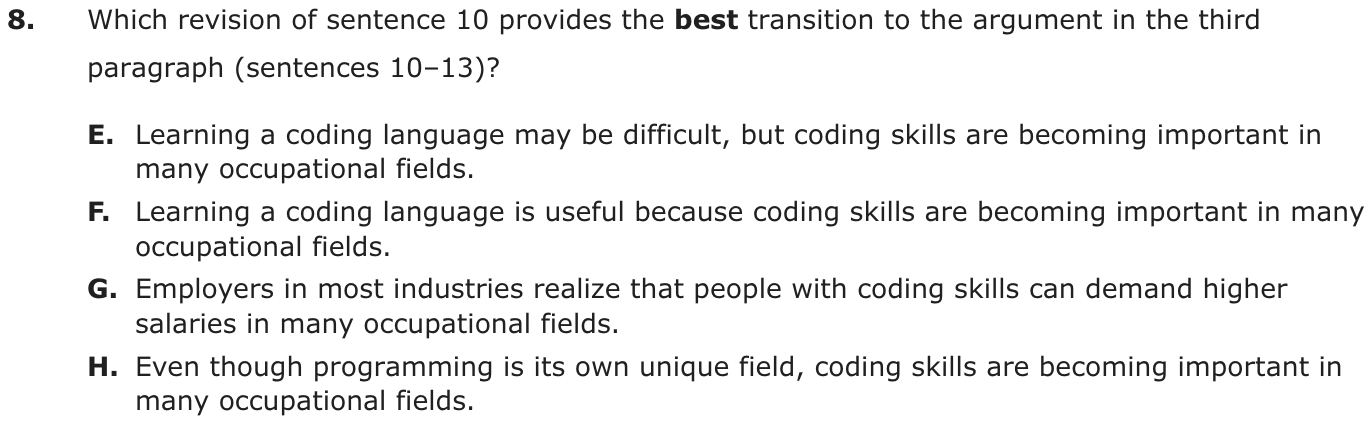
Question 31 of 43
2022 Test A English, question 9Uses the passage above: “Cracking the Code”.
Question
Which sentence would best follow sentence 13 and support the ideas in the third paragraph (sentences 10–13)?
- AExperienced programmers, software engineers, and system administrators at large companies can earn well over $100,000 a year.
- BHospitals, physicians’ offices, and pharmaceutical companies are frequently looking to hire people who code to help with a variety of tasks.
- CMany companies are eager to hire employees who have experience in a specific industry as well as knowledge of basic coding.
- DAccording to a report from a job market analytics firm, almost half of today’s jobs paying more than $58,000 a year call for some level of coding ability.
Show the answer
Correct answer: D
The question asks which sentence would best follow sentence 13 and support the ideas in the third paragraph.
A. Incorrect. While this sentence provides an example of a high salary, which is mentioned in the paragraph (sentence 13), the reference to “Experienced programmers, software engineers, and system administrators at large companies” focuses on specific occupations that may use coding, as opposed to the range of diverse occupations discussed in the third paragraph.
B. Incorrect. While sentence 12 does mention coding skills in the medical field as an example, the information provided in this answer supports only that idea and not the other ideas expressed in the third paragraph.
C. Incorrect. This sentence generally discusses employers looking for two things: “experience in a specific industry” and “knowledge of basic coding.” The third paragraph, however, discusses the possibilities of using coding skills in a variety of occupations. The words “experience in a specific industry” do not connect to the idea the paragraph develops.
D. CORRECT. This sentence provides specific evidence of the job market favoring potential employees who have coding ability. It supports what is stated in sentence 13, that “jobs that require coding skills are typically higher paying.”
Question analysis
This supporting-details question asks which sentence would best follow sentence 13 of “Cracking the Code,” which says jobs requiring coding skills tend to pay more, and support the ideas of the third paragraph. All four options are plausible facts about coding and work, from salaries to hiring, so students must judge which one backs up the paragraph as a whole.
- NYS standards
- 7W1b supporting claims with evidence
- Grade level
- Grade 7 reading and task
- Compared with grade 7
- Above grade 7 Choosing relevant evidence for a claim is grade 7 argument work. Here all four options are believable facts about coding and jobs, and the best one must fit both sentence 13 and the paragraph’s larger point, a finer judgment than usual.
- Estimated difficulty
- Hard: combines ideas, needs a plan, and has more than one tempting wrong answer.
- Thinking it demands
- Depth of knowledge 2, skills and concepts · mainly evaluate
- What makes it hard
- Every choice must be checked moderate
- How sentences fit together moderate
- Reading between the lines minor
- Evidence
- Answered from one paragraph or stanza
- Reading level
- Passage: about grade 10, 357 words; question and choices: about grade 12, 100 words.
- Students, last 30 days
- Not enough answers yet to show (it takes 10).
Why it is hard, traps and wrong answers (shows the answer)
Why it is hard
The paragraph makes two claims, that coding matters in many fields and that coding jobs pay more, and the best addition must serve both while following the sentence about pay. The $100,000 figure is the main trap, since it seems to back the pay claim but turns attention to computing careers, the opposite of the paragraph’s point. The hospital and industry-experience options each touch one idea of the paragraph and drift away from the rest.
Every choice must be checked moderate Choosing the answer
All four options are believable facts about coding and work, two of them with salary figures, so each must be tested against sentence 13’s pay comparison and sentence 10’s claim about many fields. (Embretson & Wetzel, 1987)
How sentences fit together moderate Working it out
The added sentence comes right after sentence 13, so it should carry on the point that coding jobs pay more while still serving the paragraph’s opening claim that coding matters in many occupations. (Halliday & Hasan, 1976)
Reading between the lines minor Working it out
Seeing why the job-market statistic fits takes a step of reasoning: if almost half of jobs paying over $58,000 call for coding, coding is both widespread and tied to better pay. (Graesser, Singer & Trabasso, 1994; Kintsch, 1998)
Strategy: Restate sentence 10 and sentence 13 in your own words, then ask of each option whether it is evidence for what those two sentences claim, not just a fact on the same topic.
Traps
- Off the point: Adds or keeps something that does not support the paragraph's or the passage's focus, or an introduction or conclusion that misses the main point.
The wrong answers, classified
A Off the point (Halliday & Hasan, 1976)
Matches sentence 13’s talk of pay with a striking salary, but it turns to computing careers such as software engineering instead of the many fields the paragraph describes, and compares nothing.
B Supports only part of the claim (King et al., 2004; Thissen, Steinberg & Fitzpatrick, 1989)
Extends sentence 12’s point about doctors to hospitals and drug companies, but it backs only the medical example and says nothing about pay, so it does not build on sentence 13.
C Off the point (Halliday & Hasan, 1976)
Sees support for coding’s value in companies wanting “knowledge of basic coding,” but the sentence adds a second demand, experience in one industry, which the paragraph never discusses.
Working it out, step by step
Figure out what the question asks
You need a sentence to add after sentence 13. It must support the third paragraph. To support means to give evidence: facts that back up a point. So first find the paragraph’s points. Then test each choice against them.
Find the paragraph’s two points
Sentence 10 says “Coding skills are becoming important in many occupational fields.” That means many kinds of jobs. Sentences 11 and 12 give examples: the stock market and doctors. Sentence 13 says “Jobs that require coding skills are typically higher paying.” So the paragraph makes two points. Coding matters in many kinds of jobs. And jobs that need coding tend to pay more.
Test each choice against both points
- A gives a big salary. But it names only computer jobs, like programmers and software engineers. The paragraph is about coding in many other fields.
- B is only about hospitals and drug companies. It repeats the doctor example and says nothing about pay.
- C brings in a new idea: “experience in a specific industry.” The paragraph never talks about that, and C says nothing about pay.
- D says “almost half of today’s jobs paying more than $58,000 a year call for some level of coding ability.”
See why D supports both points
D is about jobs that pay well, so it backs up sentence 13 on pay. It also says almost half of those jobs need some coding. Half of all well-paying jobs covers many kinds of work, not just computer jobs. That backs up sentence 10. D also names where its facts come from, a report, which makes it stronger evidence.
Choose the answer
Watch out: A is the most tempting. Its $100,000 salary seems to match sentence 13. But of course computer experts need coding. That doesn’t show that coding matters in other fields. So the answer is D.
Why this answer and not the closest wrong one
A is the closest wrong answer, since it talks about high pay. But it is about programmers and other computer jobs. The paragraph’s point is that coding helps in many fields beyond computers. D shows that almost half of all well-paying jobs call for some coding. It supports both the pay and the many fields.
More questions like this
The original DOE question
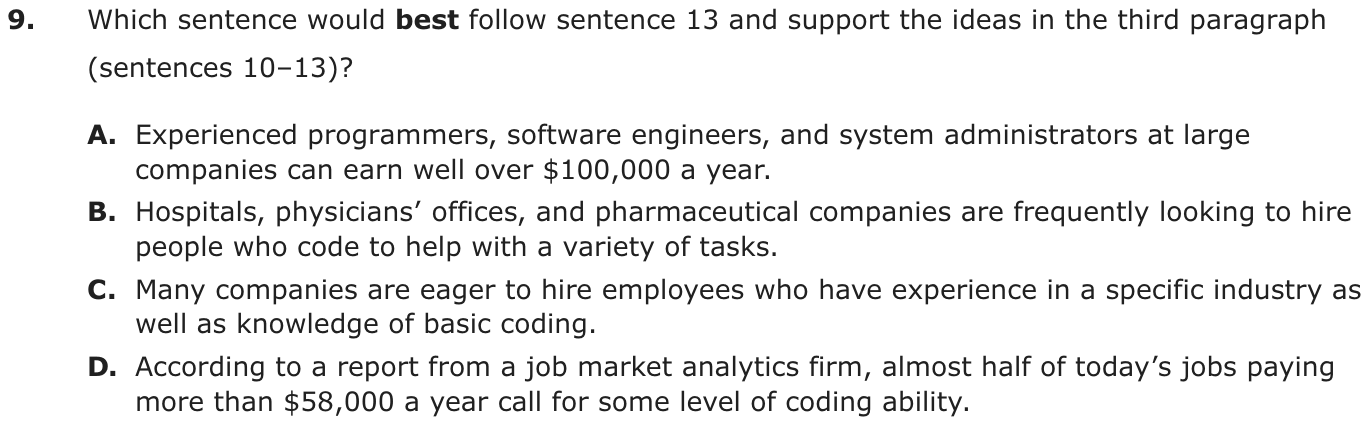
Question 32 of 43
2022 Test A English, question 10Uses the passage above: “Cracking the Code”.
Question
Which concluding sentence would best follow sentence 20 and support the argument presented in the passage?
- APeople should understand that knowing how to code is becoming an essential requirement for most high-paying jobs.
- BBy understanding basic coding concepts, people can participate in an increasingly digital job market.
- CStudents who want to secure a high-paying job in the technology industry should become proficient in coding.
- DSince coding is a valuable marketplace skill, today’s students should begin to write their own computer programs.
Show the answer
Correct answer: B
The question asks which concluding sentence would best follow sentence 20 and support the argument presented in the passage.
A. Incorrect. While the passage does state that “jobs that require coding skills are typically higher paying” (sentence 13), it does not say or imply that coding skills are needed for most high-paying jobs.
B. CORRECT. The sentence successfully summarizes the main argument of the passage, which is that coding is involved in all electronic interaction (sentence 1) and is a useful skill to master, especially in many occupational fields (sentence 10).
C. Incorrect. In the fourth paragraph, the passage does promote students taking advantage of opportunities to learn coding; however, this information is a supporting detail and would not serve as a strong conclusion to the argument presented in the passage.
D. Incorrect. Some readers may choose this sentence because the fourth paragraph discusses how “some students may become interested in learning how to create programs, such as games and apps” (sentence 18), but this detail is only one part of the overall argument in the passage.
Question analysis
This conclusion question asks which sentence should come after sentence 20, the last line of “Cracking the Code,” to close the passage and support its argument. The options mention high-paying jobs, students, the technology industry and the job market, so students must decide which ending fits the whole passage rather than one of its details.
- NYS standards
- 7W1e concluding an argument
- Grade level
- Grade 7 reading and task
- Compared with grade 7
- At grade 7 A closing statement that explains why an argument matters is part of the grade 7 writing standards. Here the ending must follow sentence 20 and reflect all five paragraphs, a typical grade 7 revising task with several reasonable-sounding options.
- Estimated difficulty
- Moderate: several steps, or a close reading with one strong distractor.
- Thinking it demands
- Depth of knowledge 2, skills and concepts · mainly evaluate
- What makes it hard
- Evidence in several places moderate
- The right answer is reworded minor
- How sentences fit together minor
- Evidence
- Answered from the whole text
- Reading level
- Passage: about grade 10, 357 words; question and choices: about grade 11, 80 words.
- Students, last 30 days
- Not enough answers yet to show (it takes 10).
Why it is hard, traps and wrong answers (shows the answer)
Why it is hard
Each wrong ending grows from something the passage does say, about high pay, students or creating programs, which makes it feel supported. The trap is in how far each one goes: one inflates better pay into a requirement for most good jobs, and two shrink the argument to students and programming. Keeping sentence 20’s point about non-experts in mind rules out most of them at once.
Evidence in several places moderate Working it out
A closing sentence must gather the whole argument: code is everywhere (sentence 1), it matters in many jobs (paragraph 3), anyone can learn it (paragraph 4) and even a basic grasp pays off (sentence 20). (Kirsch & Mosenthal, 1990; Gorin & Embretson, 2006)
The right answer is reworded minor Choosing the answer
The best ending uses words the passage never does, “basic coding concepts” and “increasingly digital job market,” while the others echo the “higher paying” jobs of sentence 13 or the programs of sentence 18. (Freedle & Kostin, 1993; Kirsch & Mosenthal, 1990)
How sentences fit together minor Working it out
The ending follows sentence 20, which says one need not become an expert programmer, so options that call for proficiency or for writing programs clash with the line just before them. (Halliday & Hasan, 1976)
Strategy: Reread sentence 20 and list the passage’s main points in a phrase each, then choose the ending that follows sentence 20 and covers those points without claiming more than they show.
Traps
- Too narrow: A single detail offered as the central idea or a summary, or a summary that keeps minor details and leaves out an essential part.
- Too broad or too strong: A choice overstates, generalizes, or uses absolute words the text does not support.
The wrong answers, classified
A Too broad or too strong (King et al., 2004)
Builds on sentence 13’s point that coding jobs pay more but inflates it into coding being “an essential requirement for most high-paying jobs,” a claim the passage never makes.
C Too narrow (King et al., 2004)
Is drawn by “high-paying job,” but it addresses only students aiming at the technology industry and asks for proficiency, though sentence 20 says no one needs to become an expert.
D Too narrow (King et al., 2004)
Builds on sentence 18’s students who may go on to create games and apps, so it ends on one detail of paragraph 4 instead of the passage’s case for everyone.
Working it out, step by step
Figure out what the question asks
This asks for the best concluding sentence, the last line of the passage. A good conclusion follows from the sentence before it and sums up the whole argument. It shouldn’t claim more than the passage shows. It also shouldn’t shrink the point down to one detail.
Reread sentence 20
Sentence 20 says “Learning to code can seem challenging, but one does not need to become an expert programmer to reap the benefits of understanding this language.” An expert is someone with great skill. So you don’t need great skill to gain from coding. Even a basic grasp helps. The last sentence should build on that idea.
List the passage’s main points
- Code is everywhere. It is “part of every electronic interaction” (sentence 1).
- Coding skills matter “in many occupational fields” (sentence 10).
- Anyone can find ways to learn (paragraph 4).
- Even a basic understanding pays off (sentence 20).
Check each choice
- A does not fit. Sentence 13 says coding jobs usually pay more. It never says coding is needed for “most high-paying jobs.” That claims too much.
- B fits. “Basic coding concepts” matches sentence 20: you don’t need to be an expert. “People” means everyone. Digital means done with computers. So an “increasingly digital job market” ties together code being everywhere and its use in many jobs.
- C does not fit. It speaks only to students who want tech jobs. Proficient means highly skilled, which sentence 20 says you don’t need to be.
- D does not fit. Writing programs is one detail from sentence 18. It is not the whole argument.
Choose the answer
Watch out: A sounds like a strong ending, and it builds on sentence 13. But it turns “typically higher paying” into a requirement for most good jobs. Only B follows sentence 20 and fits the whole passage. So the answer is B.
Why this answer and not the closest wrong one
A is the closest wrong answer. It grows out of sentence 13, which says coding jobs “are typically higher paying.” But paying more is not the same as being required. A claims more than the passage shows. B stays inside the passage: a basic understanding of coding helps people take part in a world of work full of computers.
More questions like this
The original DOE question
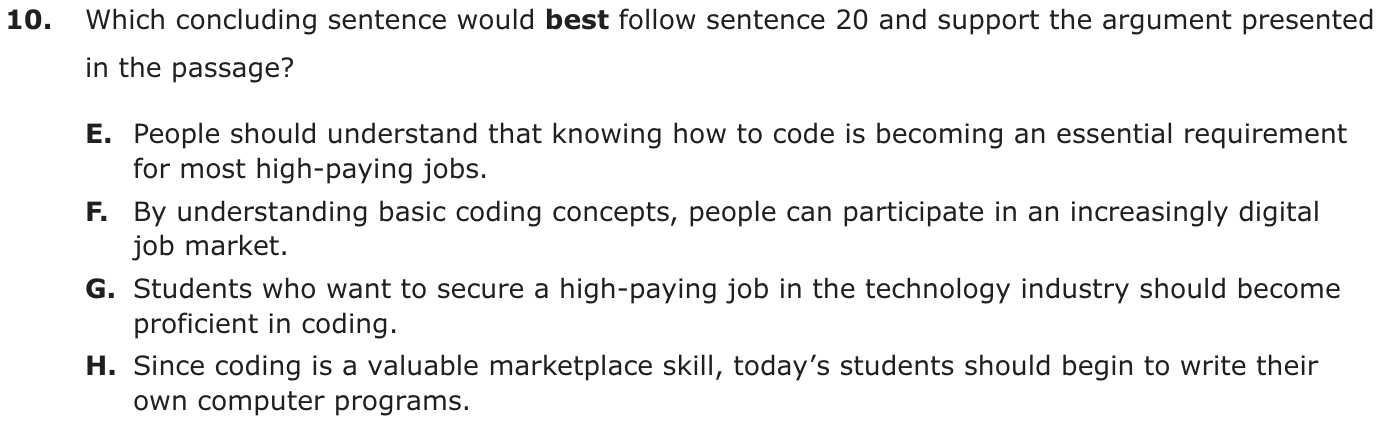
Question 33 of 43
2019 Test A English, question 7Uses the passage above: “Cracking the Code”.
Question
Which revision of sentence 10 provides the best transition to the argument in the third paragraph (sentences 10–13)?
- ALearning a coding language may be difficult, but coding skills are becoming important in many occupational fields.
- BLearning a coding language is useful because coding skills are becoming important in many occupational fields.
- CEmployers in most industries realize that coding skills are becoming important in many occupational fields.
- DEven though programming is its own unique field, coding skills are becoming important in many occupational fields.
Show the answer
Correct answer: B
The question asks for the best revision of sentence 10 to provide a transition to the third paragraph.
A. Incorrect. Some readers may choose this option because the second paragraph does discuss the complexities of coding; however, it does not discuss the difficulties of learning coding. The third paragraph demonstrates some of the complex ways coding is used in specific fields but does not illustrate how difficult learning coding may be.
B. CORRECT. This sentence provides the best revision of the transition sentence. The second paragraph ends with “the possibilities for applying them are infinite” (sentence 9), which supports the idea that people in “many occupational fields” (sentence 10) can benefit from having coding skills. The third paragraph illustrates this idea by providing specific examples of occupations that benefit from coding (stock market traders and doctors).
C. Incorrect. While it is suggested in the passage that employers in the health-care industry recognize the importance of coding skills (sentence 12), the third paragraph focuses on examples of coding within different occupations, not specific employers’ analyses of what makes coding skills important.
D. Incorrect. Some readers may choose this option because the second paragraph provides a brief definition of coding—“A coding language uses letters, numbers, and symbols that are arranged in a way that makes sense to a computer” (sentence 6)—which shows how this element of programming works, but the second paragraph does not specifically discuss what makes the field of computer programming unique. The third paragraph discusses how coding can be used in a variety of occupational fields (sentence 10).
Question analysis
In this transitions question on the passage “Cracking the Code,” students choose the revision of sentence 10 that best leads into the third paragraph’s argument about coding skills in the workplace. The task means understanding what the second paragraph explains and what the third sets out to show, then judging which connection between them is real.
- NYS standards
- 7W1d transitions in arguments
- Grade level
- Grade 7 reading and task
- Compared with grade 7
- At grade 7 Writing a sentence that links one paragraph to the next is a grade 7 writing standard. The passage is plain and its paragraphs short, so the task stays at the level of a typical grade 7 revising question.
- Estimated difficulty
- Moderate: several steps, or a close reading with one strong distractor.
- Thinking it demands
- Depth of knowledge 2, skills and concepts · mainly evaluate
- What makes it hard
- How sentences fit together moderate
- A very close wrong answer moderate
- Evidence
- Answered from several paragraphs or stanzas
- Reading level
- Passage: about grade 10, 357 words; question and choices: about grade 13, 81 words.
- Students, last 30 days
- Not enough answers yet to show (it takes 10).
Why it is hard, traps and wrong answers (shows the answer)
Why it is hard
Every version keeps the original sentence 10 as its ending, so the decision rests on a few opening words and the relationship they announce. A concession about difficulty is a familiar essay move, and sentence 20 does say coding “can seem challenging,” but neither paragraph 2 nor paragraph 3 weighs difficulty at all. Naming the actual connection first, that coding is worth learning because so many jobs now use it, makes each opening quick to test.
How sentences fit together moderate Working it out
The new opening has to reach back to sentence 9, where knowing coding rules makes the possibilities “infinite,” and forward to the stock-market and patient-monitoring examples of sentences 11 and 12. (Halliday & Hasan, 1976)
A very close wrong answer moderate Choosing the answer
The concession version matches the key word for word except in its middle, “may be difficult, but” in place of “is useful because,” so only the link each one claims sets them apart. (Embretson & Wetzel, 1987; Gorin & Embretson, 2006; Ascalon et al., 2007)
Strategy: Since all four versions end the same way, focus on their opening words, and ask which opening looks back to the second paragraph and ahead to the third.
Traps
- Wrong transition: A connecting word or phrase that signals the wrong relationship, such as contrast where the idea continues.
- Off the point: Adds or keeps something that does not support the paragraph's or the passage's focus, or an introduction or conclusion that misses the main point.
The wrong answers, classified
A Wrong transition (Halliday & Hasan, 1976)
Carries sentence 20’s “can seem challenging” back to sentence 10 and sets difficulty against importance with “but,” though the two paragraphs it joins never mention difficulty, so the contrast links nothing.
C Off the point (Halliday & Hasan, 1976)
Sees that paragraph 3 is about jobs and opens with what employers in “most industries” realize, a viewpoint the passage never develops, leaving no link back to paragraph 2’s coding rules.
D Off the point (Halliday & Hasan, 1976)
Reads paragraph 2’s account of letters, numbers and symbols as proof that programming is “its own unique field,” an idea the passage never takes up, and builds a contrast on it.
Working it out, step by step
Figure out what the question asks
This asks for the best transition. A transition is a bridge that links one part of a piece of writing to the next. Sentence 10 opens the third paragraph. So a good opening looks back at paragraph 2 and points ahead to paragraph 3. Here is a made-up example. After a paragraph on planting seeds, the next one might open: Planting with care pays off, because healthy plants give more food.
Sum up paragraph 2
Paragraph 2 explains what a coding language is. Learning one means learning its rules. The paragraph ends with sentence 9: “Once a person understands coding rules, the possibilities for applying them are infinite.” Infinite means without end. So paragraph 2 is about learning the language and how much you can do with it.
Sum up paragraph 3
Paragraph 3 shows coding at work. Code can track the stock market (sentence 11). It can help doctors watch a patient’s health (sentence 12). Jobs that need coding usually pay more (sentence 13). “Occupational fields” means kinds of jobs. So paragraph 3 shows why learning to code pays off.
Check each choice
All four choices end the same way. So compare how they begin.
- A does not fit. Its opening, “may be difficult, but,” sets up a contrast about how hard coding is. Neither paragraph talks about that.
- B fits. “Learning a coding language” looks back at paragraph 2. “Is useful because” leads into the jobs in paragraph 3.
- C does not fit. The passage never says what employers in “most industries” realize. C also has no link back to learning the language in paragraph 2.
- D does not fit. The passage never calls programming “its own unique field,” so that contrast connects to nothing.
Choose the answer
Watch out: A begins with the same words as B. Admitting that something is hard can sound like a smart move. Sentence 20 even says “Learning to code can seem challenging.” But that comes at the very end, not in paragraphs 2 or 3. So the answer is B.
Why this answer and not the closest wrong one
A is the closest wrong answer. It matches B except in the middle: “may be difficult, but” in place of “is useful because.” A sets difficulty against importance, yet neither paragraph is about difficulty. B gives a reason instead. Learning the language from paragraph 2 is useful, and the jobs in paragraph 3 show why.
More questions like this
The original DOE question
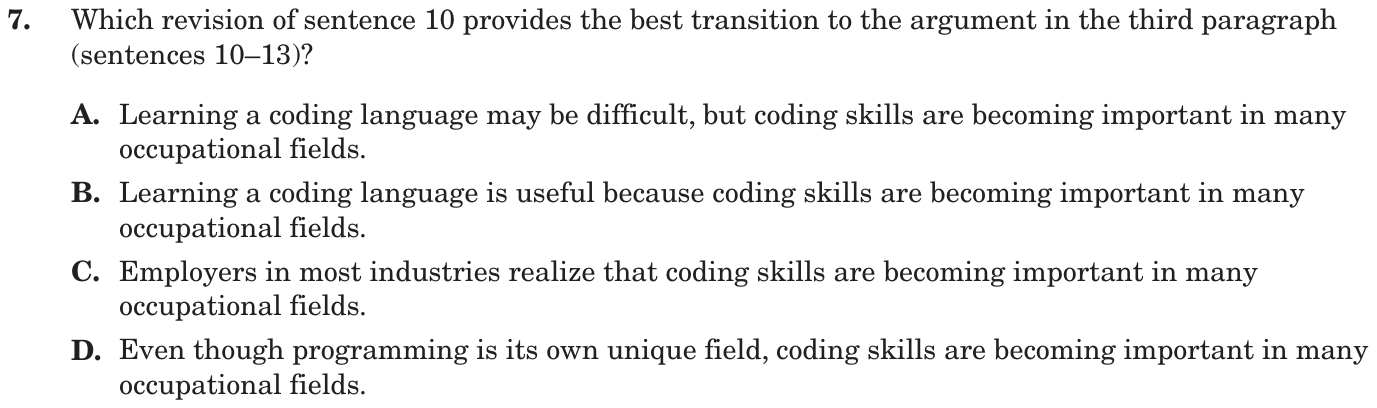
Question 34 of 43
2019 Test A English, question 9Uses the passage above: “Cracking the Code”.
Question
Which concluding sentence would best follow sentence 20 and support the argument presented in the passage?
- APeople should understand that knowing how to code is becoming an essential requirement for most high-paying jobs.
- BBy understanding basic coding concepts, people can participate in an increasingly digital marketplace.
- CStudents who want to secure a high-paying job in the technology industry should become proficient in coding.
- DSince coding is a valuable marketplace skill, today’s students should begin to write their own computer programs.
Show the answer
Correct answer: B
The question asks which concluding sentence would best follow sentence 20 and support the argument presented in the passage.
A. Incorrect. While the passage does state that “jobs that require coding skills are typically higher paying” (sentence 13), it does not say or imply that coding skills are needed for most high-paying jobs.
B. CORRECT. The sentence successfully summarizes the main argument of the passage, which is that coding is involved in all electronic interaction (sentence 1) and is a useful skill to master, especially in many occupational fields (sentence 10).
C. Incorrect. In the fourth paragraph, the passage does promote students taking advantage of opportunities to learn coding; however, this information is a supporting detail and would not serve as a strong conclusion to the argument presented in the passage.
D. Incorrect. Some readers may choose this sentence because the fourth paragraph discusses how “some students may become interested in learning how to create programs, such as games and apps” (sentence 18), but this detail is only one part of the overall argument in the passage.
Question analysis
To finish “Cracking the Code,” a short argument for learning to code, students must pick the concluding sentence that would best follow sentence 20. Several options grow from details the passage does mention, such as higher pay and students creating programs, so each ending must be weighed against the passage as a whole.
- NYS standards
- 7W1e concluding an argument
- Grade level
- Grade 7 reading and task
- Compared with grade 7
- At grade 7 Choosing an ending that sums up a whole argument is ordinary grade 7 revising work. The passage is short and clear; what takes care is that each option is linked to something real in the passage, so overreach must be spotted.
- Estimated difficulty
- Moderate: several steps, or a close reading with one strong distractor.
- Thinking it demands
- Depth of knowledge 2, skills and concepts · mainly evaluate
- What makes it hard
- Evidence in several places moderate
- The right answer is reworded minor
- How sentences fit together minor
- Evidence
- Answered from the whole text
- Reading level
- Passage: about grade 10, 357 words; question and choices: about grade 12, 79 words.
- Students, last 30 days
- Not enough answers yet to show (it takes 10).
Why it is hard, traps and wrong answers (shows the answer)
Why it is hard
Each tempting ending starts from something the passage really says, about better pay, students or making programs, so each feels grounded. What separates them is scale: one inflates better pay into a requirement for most good jobs, and two shrink a case made for everyone into advice for students. Holding on to sentence 20, that understanding the basics is enough, removes most of them at once.
Evidence in several places moderate Working it out
A closing line has to gather points made far apart: code runs everyday devices (sentence 1), many occupations need it (sentence 10), anyone can learn it (paragraph 4) and a basic grasp is enough (sentence 20). (Kirsch & Mosenthal, 1990; Gorin & Embretson, 2006)
The right answer is reworded minor Choosing the answer
The best ending speaks of “basic coding concepts” and an “increasingly digital marketplace,” words the passage never uses, while the others recycle sentence 13’s higher pay or sentence 18’s student-made programs. (Freedle & Kostin, 1993; Kirsch & Mosenthal, 1990)
How sentences fit together minor Working it out
The ending must follow sentence 20, which says no one has to become an expert programmer, so a call for proficiency or for writing programs clashes with the line just before it. (Halliday & Hasan, 1976)
Strategy: Note what sentence 20 says about becoming an expert, then test each ending twice: does it fit the passage as a whole, and does it stay within what the passage claims?
Traps
- Too narrow: A single detail offered as the central idea or a summary, or a summary that keeps minor details and leaves out an essential part.
- Too broad or too strong: A choice overstates, generalizes, or uses absolute words the text does not support.
The wrong answers, classified
A Too broad or too strong (King et al., 2004)
Starts from sentence 13’s higher salaries for coding jobs and inflates them into coding being “an essential requirement for most high-paying jobs,” a claim the passage never makes.
C Too narrow (King et al., 2004)
Is caught by “high-paying job,” but it speaks only to students aiming at the technology industry and demands proficiency, which sentence 20 says no one needs.
D Too narrow (King et al., 2004)
Builds on sentence 18’s students who go on to create games and apps, so it closes the passage on one detail of paragraph 4 instead of its case for everyone.
Working it out, step by step
Figure out what the question asks
This asks for the best concluding sentence, the one that would end the passage. It must follow sentence 20 smoothly. It must also sum up the argument, the passage’s main point. A good ending doesn’t claim more than the passage shows. It also doesn’t shrink to one small detail. For example, an essay on sleep might end: Getting enough sleep helps you think, grow and stay well.
Reread sentence 20
Sentence 20 says “one does not need to become an expert programmer to reap the benefits of understanding this language.” An expert is someone with great skill. To reap the benefits means to get the good things that come from something. So even a basic understanding of coding helps. The last sentence should build on that.
List the passage’s main points
- Code is part of everything electronic, from video games to GPS (sentence 1).
- Coding skills matter “in many occupational fields,” or kinds of jobs (sentence 10).
- Anyone can find ways to learn (paragraph 4).
- Even a basic grasp pays off (sentence 20).
Check each choice
- A does not fit. Sentence 13 says coding jobs are “typically higher paying.” It never says coding is required for “most high-paying jobs.” That claims too much.
- B fits. “Basic coding concepts” matches sentence 20. A marketplace is the world of buying, selling and jobs. Digital means run by computers. So B ties together code being everywhere and its use in many jobs.
- C does not fit. It speaks only to students who want tech jobs. Proficient means highly skilled, which sentence 20 says you don’t need to be.
- D does not fit. Writing your own programs is one detail from sentence 18. It is not the whole argument.
Choose the answer
Watch out: A sounds like a strong ending, and it grows out of sentence 13. But paying more is not the same as being required. Only B follows sentence 20 and fits the whole passage. So the answer is B.
Why this answer and not the closest wrong one
A is the closest wrong answer. It starts from a real fact: coding jobs usually pay more. But it stretches that into a rule for “most high-paying jobs,” which the passage never says. B stays within the passage. A basic grasp of coding helps people take part in a world of work that runs on computers.
More questions like this
The original DOE question
Question 35 of 43
2018 Test A English, question 4Passage Moving through Mountains
Moving through Mountains
(1) An age-old proverb says that necessity is the mother of invention. (2) Centuries of human ingenuity in the face of obstacles prove this to be true. (3) For many years the Swiss Alps, a mountain range spanning southern Switzerland and northern Italy, were such an obstacle. (4) Roads and railways had to navigate around the mountains or through winding tunnels inside the mountains, making the transportation of people and goods difficult and time consuming. (5) In 2016 these burdens were eased with the completion of the Gotthard Base Tunnel.
(6) Construction of the high-speed railway tunnel began in 1996. (7) The tunnel was created through the use of tunnel-boring machines, which are giant drills with a flat rotating head called a cutter head. (8) Each of the tunnel-boring machines used during the construction of the tunnel was about the length of four football fields arranged end-to-end. (9) During the seventeen-year construction period, 28 million tons of rock were removed, enough to rebuild the Great Pyramid of Giza five times. (10) This massive construction project is reported to have cost $12 billion. (11) After that, 4 million cubic meters of concrete, or enough concrete to build eighty-four Empire State Buildings, were used to construct and support the tunnel.
(12) By 2020 the high-speed railway will carry more than 250 freight trains and 55 passenger trains a day, with most traveling at speeds of around 100 to 125 miles per hour. (13) It will be faster for people to travel between northern and southern Europe. (14) The travel time between the European cities of Zurich, Switzerland, and Milan, Italy, will be reduced by an hour. (15) Many European leaders compare the Gotthard Base Tunnel to the Channel Tunnel, a 33-mile underwater tunnel that connects the United Kingdom and France. (16) While there is no roadway in the Channel Tunnel, people can drive their cars onto special trains that will carry vehicles through to the other side.
(17) Just as traffic congestion in major cities led to the construction of underground local transportation, natural formations, such as mountain ranges, have also sent people underground for faster, easier, and cheaper methods of transportation across larger areas. (18) There is renewed interest in constructing innovative methods of transportation that will help eliminate problems associated with traveling to and from certain areas.
Question
Which sentence should be added after sentence 5 to introduce the main topic of the passage?
- AThe construction of the Gotthard Base Tunnel was approved by Swiss voters in 1992 and was funded by tolls, fuel taxes, and government loans.
- BLeaders from several European countries attended the opening ceremonies for the Gotthard Base Tunnel, a Swiss tunnel.
- CThe Gotthard Base Tunnel is the world’s longest and deepest railway tunnel, stretching 35.5 miles straight through the base of the Swiss Alps.
- DThe Gotthard Base Tunnel continues to help reduce the number of freight trucks on the roadways in the Swiss Alps.
Show the answer
Correct answer: C
The Answer is (C)
The question asks which sentence should be added to the end of the first paragraph in order to introduce the topic of the passage, which is the description, construction, and use of the Gotthard Base Tunnel.
Option C correctly presents and describes the Gotthard Base Tunnel.
Option A is incorrect because it offers overly detailed information about the funding used to build the Gotthard Base Tunnel, and it does not provide a description of the tunnel.
Option B is incorrect because it gives details about the opening ceremony of the tunnel, and it does not provide a description of the tunnel.
Option D is incorrect because it offers a result of completing the Gotthard Base Tunnel, rather than offering an introductory statement presenting and describing the tunnel.
Question analysis
This revising question uses a short informational passage about the Gotthard Base Tunnel through the Swiss Alps and asks which sentence best introduces the main topic at the end of the first paragraph. Several choices offer true-sounding facts about the tunnel, so students must tell an introduction apart from a supporting detail.
- NYS standards
- 7W2a introducing and organizing a topic
- Grade level
- Grade 7 reading and task
- Compared with grade 7
- At grade 7 Choosing a sentence that introduces a topic and previews what follows is standard grade 7 writing work. The passage is short and factual, and the wrong choices are related details, much like a classroom revision exercise.
- Estimated difficulty
- Straightforward: two steps or one careful reading.
- Thinking it demands
- Depth of knowledge 2, skills and concepts · mainly evaluate
- What makes it hard
- Evidence in several places moderate
- How sentences fit together minor
- Evidence
- Answered from the whole text
- Reading level
- Passage: about grade 11, 362 words; question and choices: about grade 9, 97 words.
- Students, last 30 days
- Not enough answers yet to show (it takes 10).
Why it is hard, traps and wrong answers (shows the answer)
Why it is hard
Most students find the descriptive sentence once they ask what a reader needs right after the tunnel is first named. Points are lost to sentences that follow on smoothly from the word “completion” or that name a real benefit, but which set up a passage about something else. The right sentence even adds facts the passage never states, so students should judge fit rather than hunt for repeated words.
Evidence in several places moderate Working it out
The topic the new sentence must introduce only emerges across all four paragraphs: what the Gotthard Base Tunnel is, how it was dug, and what it will do for travel. (Kirsch & Mosenthal, 1990; Gorin & Embretson, 2006)
How sentences fit together minor Working it out
The added sentence follows sentence 5, which names the tunnel only as what eased the burdens, so it should present the tunnel itself before paragraph 2 turns to its construction. (Halliday & Hasan, 1976)
Strategy: Skim the first sentence of each paragraph to see what the passage as a whole covers, then pick the sentence that would prepare a reader for all of it.
Traps
- Too narrow: A single detail offered as the central idea or a summary, or a summary that keeps minor details and leaves out an essential part.
- Off the point: Adds or keeps something that does not support the paragraph's or the passage's focus, or an introduction or conclusion that misses the main point.
The wrong answers, classified
A Off the point (Halliday & Hasan, 1976)
Picks voter approval in 1992 and funding by tolls, fuel taxes and loans, background that would set up a passage about financing, which this one never discusses.
B Off the point (Halliday & Hasan, 1976)
Follows naturally from “the completion of the Gotthard Base Tunnel” in sentence 5, but an opening ceremony with European leaders is not what the passage goes on to describe.
D Too narrow (King et al., 2004)
Offers one result, fewer freight trucks on Alpine roads, which echoes the difficult roads of sentence 4 but does not present the tunnel before the passage explains it.
Working it out, step by step
Figure out what the question asks
The new sentence goes at the end of paragraph 1, right after sentence 5. It must introduce the main topic, which is what the whole passage is mostly about. So first you need to know what the whole passage covers.
Skim the passage for its topic
Sentence 5 ends paragraph 1: “In 2016 these burdens were eased with the completion of the Gotthard Base Tunnel.” Paragraph 2 tells how the tunnel was built. Paragraph 3 tells how it will make travel faster. Paragraph 4 tells why people build tunnels like it. So the passage is about the Gotthard Base Tunnel: what it is, how it was built, and what it does.
See what sentence 5 leaves out
Sentence 5 names the tunnel, but it doesn’t say what the tunnel is. A reader doesn’t yet know how long it is or what makes it special. Then paragraph 2 jumps right into building it. So the new sentence should describe the tunnel itself. That gets the reader ready for the rest.
Check each choice
- A is about voters and money from tolls and taxes. The passage never discusses how the tunnel was paid for.
- B is about an opening ceremony. The passage never describes one.
- C says what the tunnel is: “the world’s longest and deepest railway tunnel,” running “straight through the base of the Swiss Alps.”
- D gives one result, fewer trucks on the roads. That is a detail, not an introduction.
Watch out: D links back to the slow roads in sentence 4, so it seems to fit. But it is one benefit, and the passage never mentions trucks.
Pick the answer
Choice C presents the tunnel and tells what makes it special. So the answer is C.
Why this answer and not the closest wrong one
Choice D is the closest wrong answer. It is about the tunnel, and it ties back to the hard travel in sentence 4. But it gives a result before the reader even knows what the tunnel is. C describes the tunnel itself, and that is what an introduction needs.
More questions like this
The original DOE question
The passage “Moving through Mountains” as printed (page 48)
Question 36 of 43
2018 Test A English, question 5Uses the passage above: “Moving through Mountains”.
Question
Which sentence should be added to follow and support sentence 7?
- AThe tunnel-boring machine is helpful to tunnel builders in the modern era and has been an improvement over dynamite.
- BThese enormous tunnel-boring machines function somewhat like a cheese grater, with the cutter head grinding slowly through rock and stone.
- CEngineers had considered making a tunnel under the mountains for many years, but it was impossible to do without modern tunnel-boring machines.
- DDifferent types of cutter heads are used with tunnel-boring machines depending on the geology of the area where the tunnel is being created.
Show the answer
Correct answer: B
This is the answer (B)
The question asks for a sentence that provides additional details about the tunnel-boring machines used to build the Gotthard Base Tunnel in order to support the description of the machines in sentence 7.
Option B is correct because it offers specific details about how tunnel-boring machines, such as the ones used to create the Gotthard Base Tunnel, drill through rock.
Option A is incorrect because it offers information about how tunnel-boring machines were an improvement over previous methods but does not include information about how the machines work.
Option C is incorrect because it presents the idea that the tunnel could not be built until advances were made in tunnel-boring machine technology and does not describe how the machines function.
Option D is incorrect because, though it explains that there are different types of cutter heads used for different geologies, the geology of the tunnel area is not discussed in sentence 7, nor in the rest of the paragraph.
Question analysis
This revising question asks which new sentence should follow and support a description of the tunnel-boring machines used to dig the Gotthard Base Tunnel. Every choice is about the machines, so students must decide which one actually develops the sentence before it rather than drifting to a related topic.
- NYS standards
- 7W2b developing a topic
- Grade level
- Grade 7 reading and task
- Compared with grade 7
- At grade 7 Adding a detail that supports a given sentence is a regular grade 7 writing task. The demand is typical: a short paragraph, plain vocabulary, and wrong choices that stay on the subject of the machines but serve other purposes.
- Estimated difficulty
- Moderate: several steps, or a close reading with one strong distractor.
- Thinking it demands
- Depth of knowledge 2, skills and concepts · mainly evaluate
- What makes it hard
- How sentences fit together moderate
- Evidence
- Answered from one paragraph or stanza
- Reading level
- Passage: about grade 11, 362 words; question and choices: about grade 11, 94 words.
- Students, last 30 days
- Not enough answers yet to show (it takes 10).
Why it is hard, traps and wrong answers (shows the answer)
Why it is hard
All four choices are about tunnel-boring machines, so topic alone settles nothing. The right sentence shows how the machines work and leads into their size in sentence 8, while the strongest wrong one wanders into geology. Some students also distrust the cheese-grater comparison as too casual, though a vivid analogy is exactly the kind of support a definition needs.
How sentences fit together moderate Working it out
The new sentence sits between sentence 7, which defines the machines, and sentence 8, which gives their size, so it has to keep describing the machines that dug this tunnel. (Halliday & Hasan, 1976)
Strategy: Reread sentence 7 and note exactly what it describes, then test each choice by asking whether it tells the reader more about that same thing or starts a new point.
Traps
- Off the point: Adds or keeps something that does not support the paragraph's or the passage's focus, or an introduction or conclusion that misses the main point.
- Wordy, vague or informal: A revision is grammatical but wordy, imprecise or too casual for the passage.
The wrong answers, classified
A Wordy, vague or informal (Connors & Lunsford, 1988)
Accepts a general claim that the machine is “helpful to tunnel builders in the modern era”, which praises it without adding any detail about how it works.
C Off the point (Halliday & Hasan, 1976)
Explains why the tunnel could not be built earlier, turning from what the machines are to the project's history, a topic the paragraph never takes up.
D Off the point (Halliday & Hasan, 1976)
Builds on the term “cutter head” from sentence 7, but varying heads for different geology starts a new subject that the paragraph never returns to.
Working it out, step by step
Figure out what the question asks
You need a sentence to go right after sentence 7. It must support sentence 7. That means it should tell more about the same thing sentence 7 is about.
Read sentence 7 closely
Sentence 7 says: “The tunnel was created through the use of tunnel-boring machines, which are giant drills with a flat rotating head called a cutter head.” So sentence 7 is about the machines and how they dig. Now look ahead. Sentence 8 tells how long each machine was. So the new sentence sits between two sentences about the machines.
Make sense of the key words
To bore means to drill a hole. A tunnel-boring machine is a huge drill that digs a tunnel. The cutter head is the spinning front part that cuts the rock. A good supporting sentence will help you picture how this machine works.
Check each choice
- B compares the machine to a cheese grater, “with the cutter head grinding slowly through rock and stone.” It shows how the machine works.
- A says the machine is “helpful to tunnel builders in the modern era.” That is praise, with no detail about how it works.
- C is about why the tunnel could not be built earlier. That is a new topic.
- D is about different cutter heads for different kinds of rock. The paragraph never talks about kinds of rock.
Watch out: D repeats the words “cutter heads,” so it seems connected. But it starts a subject the paragraph never comes back to.
Pick the answer
Choice B keeps describing the machines from sentence 7 and leads well into sentence 8. So the answer is B.
Why this answer and not the closest wrong one
D is the closest wrong answer, because it uses the term “cutter heads” from sentence 7. But it is about choosing heads for different rock, which the paragraph drops at once. B explains how the cutter head of these machines works, and that is exactly what sentence 7 set up.
More questions like this
The original DOE question
Question 37 of 43
2018 Test A English, question 6Uses the passage above: “Moving through Mountains”.
Question
Where should sentence 11 be moved in order to improve the organization of the second paragraph (sentences 6–11)?
- Ato the beginning of the paragraph (before sentence 6)
- Bbetween sentences 6 and 7
- Cbetween sentences 8 and 9
- Dbetween sentences 9 and 10
Show the answer
Correct answer: D
The Answer is (D)
The question asks where sentence 11, which completes the detailed steps of how the tunnel was built, should be moved within the second paragraph in order to improve the organization of the paragraph.
Option D, placing the sentence between sentences 9 and 10, is correct because placing the sentence there helps the reader understand the full sequence of steps performed in constructing the tunnel before the cost of the project is introduced.
Option A, placing the sentence at the beginning of the paragraph (before sentence 6), is incorrect because it would not make sense since the process of building the tunnel has not yet been introduced.
Similarly, Option B is incorrect because placing the sentence after sentence 6 would not make sense given that adding concrete would have to happen after the rock was broken down and removed from the tunnel.
Option C, placing the sentence between sentences 8 and 9, would also be incorrect because the use of concrete did not take place before the removal of “28 million tons of rock” (sentence 9).
Question analysis
This revising question asks where to move a sentence about the concrete used to support the Gotthard Base Tunnel so the second paragraph is better organized. Students must follow the order of the construction steps and notice what the sentence's opening words refer back to, since several positions sound acceptable at a glance.
- Grade level
- Grade 7 reading and task
- Compared with grade 7
- At grade 7 Ordering sentences logically is a grade 7 writing skill. Here the student follows a sequence of construction steps and a time-order signal word, a short, typical grade 7 revision task with four nearby positions to compare.
- Estimated difficulty
- Moderate: several steps, or a close reading with one strong distractor.
- Thinking it demands
- Depth of knowledge 2, skills and concepts · mainly analyze
- What makes it hard
- How sentences fit together major
- A very close wrong answer moderate
- Much to keep track of minor
- Every choice must be checked minor
- Evidence
- Answered from one paragraph or stanza
- Reading level
- Passage: about grade 11, 362 words; question and choices: about grade 7, 33 words.
- Students, last 30 days
- Not enough answers yet to show (it takes 10).
Why it is hard, traps and wrong answers (shows the answer)
Why it is hard
The question turns on two signal phrases: what “After that” must follow, and what “This massive construction project” sums up. Students who see only that the concrete belongs with the digging often park it beside the machine details, before the rock has been cleared. Those who try each position in context see that lining the tunnel can only follow removing the rock.
How sentences fit together major Working it out
Sentence 11 opens with “After that”, so it must follow the rock removal in sentence 9, while “This massive construction project” in sentence 10 reads best as the paragraph's close. (Halliday & Hasan, 1976)
A very close wrong answer moderate Choosing the answer
Moving the sentence between sentences 8 and 9 differs from the right spot, between 9 and 10, by a single sentence, and only seeing that sentence 9's rock removal must come first tells them apart. (Embretson & Wetzel, 1987; Gorin & Embretson, 2006; Ascalon et al., 2007)
Much to keep track of minor Working it out
The construction steps, from the 1996 start through the machines, the 28 million tons of rock and the concrete, have to be kept in order across six sentences. (Sweller, 1988; Carpenter, Just & Shell, 1990)
Every choice must be checked minor Choosing the answer
Each of the four positions has to be tried by rereading the paragraph with the concrete sentence in place, since several sound acceptable at a glance. (Embretson & Wetzel, 1987)
Strategy: Look at the signal words that open sentence 11 and ask what event they must follow. Then read the paragraph with the sentence in each position to check the order of events.
Traps
- Sentence in the wrong place: Puts a sentence where it breaks the order of ideas or separates it from what it refers to.
The wrong answers, classified
A Sentence in the wrong place (Halliday & Hasan, 1976)
Moves the sentence to open the paragraph, where “After that” would follow the 2016 completion in sentence 5, putting the concrete work after the tunnel was finished.
B Sentence in the wrong place (Halliday & Hasan, 1976)
Reads “After that” as following the 1996 start of construction, which sounds smooth but has the tunnel lined with concrete before any machine had bored it.
C Sentence in the wrong place (Halliday & Hasan, 1976)
Sees that the concrete comes after the machines did their work but places it before sentence 9, so the tunnel is lined before its 28 million tons of rock are removed.
Working it out, step by step
Figure out what the question asks
Sentence 11 is in the wrong spot. You need to move it so paragraph 2 tells events in the right order. Paragraph 2 is sentences 6 to 11.
Look at the clue words in sentence 11
Sentence 11 says: “After that, 4 million cubic meters of concrete, or enough concrete to build eighty-four Empire State Buildings, were used to construct and support the tunnel.” “After that” is a transition, a word or phrase that links ideas. It tells you the concrete came after some other event. You need to find that event.
Put the building steps in order
Think about how you build a tunnel. First you dig out the rock. Then you line the hole with concrete to hold it up.
- Sentence 6: work began in 1996.
- Sentences 7 and 8: the machines that did the digging.
- Sentence 9: “28 million tons of rock were removed.”
- Sentence 10: the project cost $12 billion.
The concrete must come after the rock is removed. So sentence 11 belongs right after sentence 9.
Read the paragraph in the new order
Sentence 9 removes the rock. “After that,” the concrete is poured. Then sentence 10 sums up “This massive construction project” and its cost. The cost makes a good last point. Right now, sentence 11 comes after the cost. So “After that” seems to mean after paying. That makes no sense.
Check each choice
- A, before sentence 6: “After that” would point back to sentence 5, after the tunnel was finished.
- B, after sentence 6: the concrete would come before any digging.
- C, between 8 and 9: the tunnel would be lined before the rock was removed.
- D, between 9 and 10: the concrete comes right after the rock is removed.
Watch out: C is only one spot away from D. Ask yourself: is the rock gone yet? In C, it isn’t.
Pick the answer
So the answer is D, between sentences 9 and 10.
Now the paragraph goes: start, machines, digging, concrete, cost.
Why this answer and not the closest wrong one
Choice C is close because it puts the concrete after the machines. But sentence 9 is where the rock is removed, and you can’t line a tunnel that is still full of rock. Only D puts “After that” right after the rock removal.
More questions like this
The original DOE question

Question 38 of 43
2018 Test A English, question 7Uses the passage above: “Moving through Mountains”.
Question
Which sentence presents information that shifts away from the main topic of the third paragraph (sentences 12–16) and should be removed?
- Asentence 13
- Bsentence 14
- Csentence 15
- Dsentence 16
Show the answer
Correct answer: D
The answer is (D)
The question asks which sentence should be removed because it presents an idea that shifts away from the main idea of the third paragraph, which is about the transportation benefits of the Gotthard Base Tunnel.
Option D (sentence 16) is the correct response because, even though the sentence provides additional information about the Channel Tunnel, it does not help the reader understand the benefits of the Gotthard Base Tunnel, so it should be removed.
Option A (sentence 13) is incorrect because the idea of faster travel times is important to the development of the main idea of the paragraph.
Option B (sentence 14) is incorrect because the sentence provides a specific example of decreased travel time between two cities when traveling through the Gotthard Base Tunnel, supporting the development of ideas in the paragraph.
Option C (sentence 15) is incorrect because the sentence compares the Gotthard Base Tunnel to another tunnel that provides an important connection between places, and the sentence supports the idea that transportation innovations are beneficial.
Question analysis
This revising question looks at the paragraph describing what the Gotthard Base Tunnel will do for travel in Europe and asks which sentence shifts away from that topic and should be removed. Every sentence is related to tunnels and travel, so students must judge which one no longer serves the paragraph's main point.
- NYS standards
- 7W2b developing a topic
- Grade level
- Grade 6 reading and task
- Compared with grade 7
- Below grade 7 Cutting a sentence that strays from a paragraph's focus is practiced from grade 6. The paragraph is five sentences of plain facts with one clear topic, so this asks less than a typical grade 7 revision task.
- Estimated difficulty
- Straightforward: two steps or one careful reading.
- Thinking it demands
- Depth of knowledge 2, skills and concepts · mainly analyze
- What makes it hard
- A very close wrong answer moderate
- How sentences fit together minor
- Evidence
- Answered from one paragraph or stanza
- Reading level
- Passage: about grade 11, 362 words; question and choices: about grade 6, 24 words.
- Students, last 30 days
- Not enough answers yet to show (it takes 10).
Why it is hard, traps and wrong answers (shows the answer)
Why it is hard
The paragraph drifts gradually, which makes this harder than a plain hunt for the odd sentence out. The Channel Tunnel arrives in sentence 15 as a comparison that still concerns the Gotthard tunnel's importance, and only the next sentence leaves the Gotthard tunnel behind entirely. Students who cut at the first mention of the other tunnel lose the point, so it pays to ask which sentence says nothing about the Gotthard tunnel or the travel it speeds up.
A very close wrong answer moderate Choosing the answer
Sentence 15 is the first to mention the Channel Tunnel, so it looks like the shift, but it still compares that tunnel with the Gotthard; sentence 16 is wholly about car trains under the Channel. (Embretson & Wetzel, 1987; Gorin & Embretson, 2006; Ascalon et al., 2007)
How sentences fit together minor Working it out
The paragraph's focus, the faster travel the Gotthard tunnel will bring, has to be held while each of sentences 13 through 16 is tested against it. (Halliday & Hasan, 1976)
Strategy: State the paragraph's topic in a few words, then check each listed sentence against it. The sentence to cut is the one that talks about something other than that topic.
The wrong answers, classified
A Fixes what isn't broken (Connors & Lunsford, 1988)
Cuts sentence 13 as a vague restatement, but “It will be faster for people to travel between northern and southern Europe” is the paragraph's central claim.
B Fixes what isn't broken (Connors & Lunsford, 1988)
Treats the Zurich-to-Milan example as a side detail, though the hour saved between those cities is concrete proof of the faster travel the paragraph promises.
C Fixes what isn't broken (Connors & Lunsford, 1988)
Rightly senses the Channel Tunnel is a detour but cuts the comparison that still concerns the Gotthard tunnel, leaving in sentence 16, which is only about car-carrying trains.
Working it out, step by step
Figure out what the question asks
Every sentence in a paragraph should support its main topic. One sentence in paragraph 3 drifts to a different topic. You need to find it so it can be cut.
Find the paragraph’s main topic
Paragraph 3 is sentences 12 to 16. Sentence 12 says the railway will carry many trains at high speeds. Sentence 13 says: “It will be faster for people to travel between northern and southern Europe.” So the topic is how the Gotthard Base Tunnel will make travel faster.
Test each sentence against the topic
- Sentence 13 states the topic: faster travel.
- Sentence 14 gives an example. The trip between Zurich and Milan will be an hour shorter.
- Sentence 15 compares the Gotthard Base Tunnel to the Channel Tunnel. It still talks about the Gotthard tunnel.
- Sentence 16 says “people can drive their cars onto special trains” in the Channel Tunnel. It says nothing about the Gotthard tunnel.
Watch for the trap
Watch out: Sentence 15 is the first to name the Channel Tunnel. So it can look like the place where the paragraph shifts. But it compares that tunnel with the Gotthard tunnel. That keeps it tied to the topic. Sentence 16 leaves the Gotthard tunnel behind completely.
Pick the answer
Sentence 16 is only about car trains in the Channel Tunnel. So the answer is D, sentence 16.
Why this answer and not the closest wrong one
Choice C, sentence 15, is the closest wrong answer, since it brings in the Channel Tunnel. But it still talks about the Gotthard Base Tunnel by comparing the two. Sentence 16 talks only about the Channel Tunnel, so it is the one that shifts away.
More questions like this
The original DOE question

Question 39 of 43
2018 Test A English, question 8Uses the passage above: “Moving through Mountains”.
Question
Which transition phrase should be added to the beginning of sentence 18?
- AAlthough the Gotthard Base Tunnel is mainly for freight trains
- BWith the Gotthard Base Tunnel taking ten years to complete
- CBecause of the successful completion of the Gotthard Base Tunnel
- DAs the number of trains using the Gotthard Base Tunnel increases
Show the answer
Correct answer: C
The answer is (C)
The question asks for a transition that bridges the ideas between sentences 17 and 18 and accurately presents the relationship.
Option C is correct because it bridges the sentences by referring to the Gotthard Base Tunnel as a solution to the problems described in sentence 17 and logically introducing sentence 18.
Option A is incorrect because the use of the word “although” and the mention of freight trains suggest that sentence 18 will be about other types of vehicles that use the Gotthard Base Tunnel, and the transition phrase does not logically precede the sentence.
Option B is incorrect because the reference to the amount of time it took to build the tunnel does not help lead into the idea presented in sentence 18.
Option D is incorrect because it suggests that sentence 18 is related to the increasing number of trains using the Gotthard Base Tunnel, which is not accurate.
Question analysis
This revising question asks which introductory phrase should begin the last sentence of a passage about the Gotthard Base Tunnel, linking it to the idea before it. All four phrases are grammatical and mention the tunnel, so students must work out the logical relationship between the two sentences and check each phrase against the facts given earlier.
- NYS standards
- 7W2d transitions in informative writing
- Grade level
- Grade 7 reading and task
- Compared with grade 7
- At grade 7 Choosing a transition that shows how two ideas relate is a core grade 7 writing skill. The two sentences involved are short and the vocabulary is plain, so this is typical classroom revision work.
- Estimated difficulty
- Straightforward: two steps or one careful reading.
- Thinking it demands
- Depth of knowledge 2, skills and concepts · mainly evaluate
- What makes it hard
- How sentences fit together moderate
- Every choice must be checked minor
- Evidence
- Answered from one paragraph or stanza
- Reading level
- Passage: about grade 11, 362 words; question and choices: about grade 6, 52 words.
- Students, last 30 days
- Not enough answers yet to show (it takes 10).
Why it is hard, traps and wrong answers (shows the answer)
Why it is hard
The task is to see that renewed interest is a result, which calls for an opener that names a cause. Phrases that are merely true of the tunnel, or that tie interest to growing traffic, read smoothly and slip past students who do not test the logic. One opener also gives the construction time as ten years, which careful readers can reject against the seventeen-year period in sentence 9.
How sentences fit together moderate Working it out
Sentence 17 widens the view from this tunnel to tunnels in general, and sentence 18 reports renewed interest, so the opener has to name what caused that interest. (Halliday & Hasan, 1976)
Every choice must be checked minor Choosing the answer
All four openers are grammatical and name the Gotthard Base Tunnel, so each has to be read into sentence 18 and checked against facts given earlier in the passage. (Embretson & Wetzel, 1987)
Strategy: Read sentences 17 and 18 together and decide how they are connected: by contrast, by time, or by cause. Then choose the opening that expresses that link and fits facts already stated.
Traps
- Wrong transition: A connecting word or phrase that signals the wrong relationship, such as contrast where the idea continues.
The wrong answers, classified
A Wrong transition (Halliday & Hasan, 1976)
Likes the accurate freight detail from sentence 12, but “Although” promises a contrast, and nothing in sentence 18 runs against the tunnel being mainly for freight.
B Wrong transition (Halliday & Hasan, 1976)
Accepts a time detail that explains nothing about renewed interest and gets the time wrong, since sentence 9 gives a seventeen-year construction period.
D Wrong transition (Halliday & Hasan, 1976)
Senses that sentence 18 needs a cause but names growing train traffic, a plausible link the passage never makes, when the interest follows from the tunnel's completion.
Working it out, step by step
Figure out what the question asks
A transition is a word or phrase that links two ideas. Some show contrast, like although. Some show time, like then. Some show cause, like because. You need the opening for sentence 18 that shows how it links to sentence 17.
Read sentences 17 and 18 together
Sentence 17 says mountain ranges “have also sent people underground for faster, easier, and cheaper methods of transportation across larger areas.” Sentence 18 says: “There is renewed interest in constructing innovative methods of transportation.” Renewed interest means people care about something again. Innovative means new and creative.
Decide how the ideas connect
Why would people care about new kinds of travel again? Because the whole passage just showed a tunnel that worked. It solved the mountain problem. So sentence 18 is a result. The opening should name the cause.
Check each choice
- C, “Because of the successful completion of the Gotthard Base Tunnel,” names the cause. The tunnel’s success led to new interest.
- A starts with “Although,” which signals a contrast. Nothing in sentence 18 goes against the tunnel being for freight.
- B gives the building time, which doesn’t explain new interest. It is also wrong. Sentence 9 says the work took seventeen years, not ten.
- D names more trains as the cause. The passage never makes that link.
Watch out: D also sounds like a cause, so it is the most tempting wrong choice.
Pick the answer
The new sentence reads: Because of the successful completion of the Gotthard Base Tunnel, there is renewed interest in… So the answer is C.
Why this answer and not the closest wrong one
D is the closest wrong answer, because it also gives a cause. But the passage never says the number of trains made people interested. The tunnel’s success is what the whole passage builds up to, so C links the ideas best.
More questions like this
The original DOE question
Question 40 of 43
2018 Test B English, question 5Passage The Local Library
The Local Library
(1) According to a 2015 survey, more than two-thirds of Americans own a smartphone, which means that obtaining information or communicating with people is easier than ever before. (2) With the swipe of a finger, the tap of an icon, or a verbal command, people have instant access to articles, blogs, news, and social networking websites. (3) Even with all these immediately available sources of information, one of the best resources for many members of the community also happens to be one of the oldest. (4) The public library is a great place for people to get information.
(5) The public library serves a truly critical role in promoting community. (6) With the explosion of digital media in recent years, people in different locations can now communicate almost instantaneously. (7) And yet many people complain of feeling more isolated and alone than ever before. (8) The library stands in a rare position to help community members meet this universal need for human connection and companionship.
(9) Furthermore, libraries provide certain amenities, such as access to the Internet, for free to all people. (10) A student who does not have a computer at home can research and type a paper for school. (11) Similarly, an unemployed adult without access to the Internet can make use of library resources to find job opportunities. (12) The free items that are found at the library can help people get a lot done.
(13) Public libraries also offer a variety of resources to community members. (14) One important resource is the local librarian, who does far more than check out books and collect fines. (15) Other library resources include free or low-cost tutoring and training programs. (16) Additionally, lectures, book groups, and town meetings promote critical thinking and community engagement. (17) A typical librarian holds a master’s degree and can help library patrons navigate through the flood of information available in print and on the Internet.
(18) The hallmark of a public library is that its materials and services are accessible to all. (19) The library connects people to a network of information and resources and is an important part of a community.
Question
Which sentence should replace sentence 4 to best introduce the main claim of the passage?
- AIn this age of smartphones and search engines, the public library is a valuable resource that all members of a community should use.
- BFinding information is easier than ever, but going to the public library is still a valuable learning experience.
- CThough today’s computers are highly advanced, the resources available at a public library are more useful for students.
- DDespite the proliferation of social networking sites, a public library is a great place for people who are interested in improving their community.
Show the answer
Correct answer: A
The question asks for a sentence that should replace sentence 4 to introduce the main claim of the passage.
Option A is correct because it best presents the main claim that the public library is a valuable resource and should be used by community members.
Option B is incorrect because it states that going to the library can be a learning experience. This idea is implied in sentences 17 and 18, but it is not the main claim of the passage.
Option C is incorrect because it states the idea that the library is useful for students, which would be supporting evidence rather than an introductory statement expressing the main claim.
Option D is incorrect because it states that local libraries provide services to help improve communities, which is explained in sentences 15–18, but it does not present the main claim.
Question analysis
This introduction question uses a persuasive essay about public libraries that opens with statistics on smartphone ownership. Students choose a new fourth sentence that states the passage’s main claim. Every option contrasts technology with libraries, so the challenge is telling the overall argument apart from single supporting points.
- NYS standards
- 7W1a introducing claims and counterclaims
- Grade level
- Grade 7 reading and task
- Compared with grade 7
- At grade 7 Grade 7 writers learn to state a precise claim; here students must find the claim behind a whole five-paragraph essay and test each candidate opener against all of its reasons, not just one paragraph.
- Estimated difficulty
- Moderate: several steps, or a close reading with one strong distractor.
- Thinking it demands
- Depth of knowledge 2, skills and concepts · mainly evaluate
- What makes it hard
- Evidence in several places moderate
- A very close wrong answer moderate
- How sentences fit together minor
- Evidence
- Answered from the whole text
- Reading level
- Passage: about grade 11, 341 words; question and choices: about grade 12, 96 words.
- Students, last 30 days
- Not enough answers yet to show (it takes 10).
Why it is hard, traps and wrong answers (shows the answer)
Why it is hard
The risk here is settling for a true point from the essay instead of its overall claim. Every opener sets technology against the library, so the contrast itself decides nothing; what decides is whether the library is presented as a resource for the whole community or as a benefit to one group. Students who state the claim in their own words before reading the choices avoid the near-copy that narrows it to learning.
Evidence in several places moderate Working it out
The main claim is never stated in one place: it has to be pieced together from paragraphs on human connection, free Internet access, librarians and tutoring, and access for all, ending with “an important part of a community.” (Kirsch & Mosenthal, 1990; Gorin & Embretson, 2006)
A very close wrong answer moderate Choosing the answer
The learning-experience opener has the right one’s shape, a nod to technology and then “valuable,” and differs in one part of the claim: “a valuable learning experience” instead of “a valuable resource that all members of a community should use.” (Embretson & Wetzel, 1987; Gorin & Embretson, 2006; Ascalon et al., 2007)
How sentences fit together minor Working it out
Sentence 3 builds up to an unnamed “one of the best resources,” so the new sentence 4 must name the library as that resource and say why everyone should use it. (Halliday & Hasan, 1976)
Strategy: Before reading the choices, sum up in your own words what the essay wants readers to believe about the library, drawing on every paragraph, then find the opener that matches it.
Traps
- Too narrow: A single detail offered as the central idea or a summary, or a summary that keeps minor details and leaves out an essential part.
- Too broad or too strong: A choice overstates, generalizes, or uses absolute words the text does not support.
The wrong answers, classified
B Too narrow (King et al., 2004)
Echoes sentence 1’s “easier than ever” and sounds balanced, but reduces the claim to one benefit, learning, and drops the community and the free services the essay argues for.
C Too broad or too strong (King et al., 2004)
Builds on the student in sentence 10 and the essay’s technology contrast, but claims libraries beat computers, a ranking the essay never makes, since libraries offer the Internet.
D Too narrow (King et al., 2004)
Keeps the original sentence’s vague “great place for people” and narrows the audience to those improving their community, one point from paragraphs 2 and 4 rather than the claim.
Working it out, step by step
Figure out what the question asks
You need a new sentence 4. Sentence 4 ends the first paragraph, so it should state the main claim. A claim is the big point a writer tries to prove. Here it must fit the whole essay.
Sum up what the essay argues
Look at what each paragraph says about the library.
- Paragraph 2: it helps people meet the “need for human connection and companionship.”
- Paragraph 3: it offers things like “access to the Internet, for free to all people.”
- Paragraph 4: it offers librarians, tutoring, lectures and book groups.
- Paragraph 5: it is “an important part of a community.”
So the claim is this: the library is a valuable resource that everyone in the community should use.
See how sentence 4 must fit
Sentence 1 talks about smartphones. Sentence 3 says that “one of the best resources” is also “one of the oldest.” Sentence 4 should name that old resource, the library. It should also say why everyone should use it.
Check each choice
- A is right. It links back to the smartphones. It calls the library “a valuable resource that all members of a community should use.” That is the whole claim.
- B is wrong. It shrinks the claim to learning. It leaves out the free services and the human connection.
- C is wrong. It talks only about students. It also says the library beats computers, which the essay never says. The library even offers the Internet.
- D is wrong. It talks only about people who want to improve their community. It keeps the vague words “a great place.”
Watch out: B repeats “easier than ever” from sentence 1, so it sounds like it belongs. But it covers only one benefit.
Choose the answer
A names the library, calls it valuable and tells everyone to use it. So the answer is A.
Why this answer and not the closest wrong one
B is the closest wrong answer. It also starts with how easy it is to find information today, and it calls the library valuable. But it calls the library “a valuable learning experience.” The essay argues for much more than learning: free Internet, librarians, programs and a place to meet people. A covers all of that.
More questions like this
The original DOE question
The passage “The Local Library” as printed (page 120)
Question 41 of 43
2018 Test B English, question 6Uses the passage above: “The Local Library”.
Question
Which sentence would best follow and support sentence 8?
- ALibraries, which have been around for centuries and are found throughout the world today, help preserve the history of a community.
- BThe public library is often used as a place for community leaders and organizers to host community events, such as hearings or town halls.
- CLibraries rely on a combination of local, state, and federal dollars to provide the kinds of services and programs that community members have come to expect.
- DAt a public library, people can interact with others through a variety of programs, including teen book clubs, toddler story times, and senior-citizen exercise classes.
Show the answer
Correct answer: D
The question asks which option would provide the best support for sentence 8. Sentence 8 expresses the idea that the library helps community members meet their need for human connection and companionship.
Option D is correct because it provides support for sentence 8 and strengthens the connection between the information in sentence 8 and the main claim of the passage by listing examples of how people can connect at the library.
Option A is incorrect because it references the history of the library, which does not support the idea in sentence 8 or the main claim of the passage.
Option B is incorrect because, although it introduces the idea of community meetings, it does not support the idea in sentence 8.
Option C is incorrect because it mentions expectations by the community members and brings up a new idea that is unrelated to the main claim of the passage and that does not provide support for sentence 8.
Question analysis
This supporting-details question returns to the library essay and its point that people feel isolated in a digital world. Students pick the sentence that would best follow sentence 8 and back it up. Each option sounds like a fair statement about libraries, which is what makes the choice harder than it first looks.
- NYS standards
- 7W1b supporting claims with evidence
- Grade level
- Grade 7 reading and task
- Compared with grade 7
- At grade 7 Choosing evidence that fits a claim is standard grade 7 argument work. This item sharpens it: all four sentences are believable facts about libraries, so students must match the specific idea in sentence 8 rather than the general topic.
- Estimated difficulty
- Moderate: several steps, or a close reading with one strong distractor.
- Thinking it demands
- Depth of knowledge 2, skills and concepts · mainly evaluate
- What makes it hard
- How sentences fit together moderate
- Evidence
- Answered from one paragraph or stanza
- Reading level
- Passage: about grade 11, 341 words; question and choices: about grade 12, 104 words.
- Students, last 30 days
- Not enough answers yet to show (it takes 10).
Why it is hard, traps and wrong answers (shows the answer)
Why it is hard
Every choice says something favorable about libraries, so a student who asks only whether a sentence fits the essay will find all four acceptable. The question rewards narrowing the test to sentence 8’s own idea, the loneliness of a digital age and the need for company. The teen book clubs, toddler story times and exercise classes for seniors are what make the right sentence a support rather than a new topic.
How sentences fit together moderate Working it out
Sentence 8 ends on “human connection and companionship,” so the sentence after it must give an example of people meeting each other, not just another good thing about libraries. (Halliday & Hasan, 1976)
Strategy: Restate sentence 8 in a few words, then ask of each choice whether it gives a concrete example of that exact idea or just says something good about libraries.
Traps
- Off the point: Adds or keeps something that does not support the paragraph's or the passage's focus, or an introduction or conclusion that misses the main point.
- Wrong part of the text: A choice is true of another paragraph, stanza or speaker than the one asked about.
The wrong answers, classified
A Off the point (Halliday & Hasan, 1976)
Offers a pleasant general fact about libraries preserving community history, which matches the word “community” but says nothing about loneliness or human connection.
B Wrong part of the text (Kirsch & Mosenthal, 1990)
Describes hearings and town halls, which belong with paragraph 4’s “town meetings” and civic engagement, and concern leaders running events rather than people finding companionship.
C Off the point (Halliday & Hasan, 1976)
Brings in funding from local, state and federal dollars, a new topic that neither illustrates sentence 8’s need for connection nor advances the essay’s claim.
Working it out, step by step
Figure out what the question asks
You need the sentence that would come right after sentence 8 and back it up. To support a sentence means to give an example or a reason that proves it.
Read sentence 8 closely
Sentence 8 says: “The library stands in a rare position to help community members meet this universal need for human connection and companionship.” Just before it, sentence 7 says people feel “more isolated and alone than ever before.”
Put sentence 8 in plain words
“Isolated” means cut off from other people. “Companionship” means having friends and people around you. So sentence 8 says: people feel lonely, and the library can help them spend time with others. The next sentence should show how people meet each other at the library.
Check each choice
- A is wrong. It is about saving a community’s history, not about people meeting.
- B is wrong. Hearings and town halls are about leaders running community business. They are not about lonely people finding company.
- C is wrong. Money for libraries is a new topic. It says nothing about human connection.
- D is right. Book clubs, story times and exercise classes are real ways people “can interact with others.”
Watch out: B mentions community events, so it seems to fit. But its point is public meetings, not friendship. It fits better with the “town meetings” in sentence 16.
Choose the answer
D gives clear examples of people meeting and spending time together. So the answer is D.
Why this answer and not the closest wrong one
B is the closest wrong answer, because it also shows people gathering at the library. But hearings and town halls are public business, run by leaders. Sentence 8 is about loneliness and companionship. D shows people of every age, from toddlers to seniors, meeting and doing things together.
More questions like this
The original DOE question
Question 42 of 43
2018 Test B English, question 8Uses the passage above: “The Local Library”.
Question
Where should sentence 17 be moved in order to improve the organization of the fourth paragraph (sentences 13–17)?
- Ato the beginning of the paragraph (before sentence 13)
- Bbetween sentences 13 and 14
- Cbetween sentences 14 and 15
- Dbetween sentences 15 and 16
Show the answer
Correct answer: C
The question asks where sentence 17 should be moved in order to improve the organization of the fourth paragraph. Sentence 17 describes a typical librarian and the assistance he or she provides in the library.
Option C correctly places sentence 17, an example of what else the librarian does, after the librarian is introduced in sentence 14.
Option A is incorrect because it places the sentence before the main idea of the paragraph, which states that public libraries offer a variety of resources. Sentence 17 is an example of one of the resources, so it would not be placed at the beginning of the paragraph before the main idea.
Option B is incorrect because it moves the sentence to before the librarian is introduced in the paragraph.
Option D is incorrect because sentences 15 and 16 have shifted away from the topic of the librarian, so the details in sentence 17 would not logically fit between them.
Question analysis
This organization question asks where a sentence about librarians’ training and skills belongs in the library essay’s paragraph on resources. Students read sentences 13 through 17 and look for the most logical spot for the detail. Several positions can seem reasonable at first, so the paragraph’s order of ideas has to be traced carefully.
- Grade level
- Grade 7 reading and task
- Compared with grade 7
- At grade 7 Ordering sentences so each detail follows the idea it explains is regular grade 7 revision work. This paragraph is only five sentences long and its topic shifts are easy to track, so it matches typical classroom practice.
- Estimated difficulty
- Straightforward: two steps or one careful reading.
- Thinking it demands
- Depth of knowledge 2, skills and concepts · mainly analyze
- What makes it hard
- How sentences fit together moderate
- A very close wrong answer minor
- Evidence
- Answered from one paragraph or stanza
- Reading level
- Passage: about grade 11, 341 words; question and choices: about grade 7, 33 words.
- Students, last 30 days
- Not enough answers yet to show (it takes 10).
Why it is hard, traps and wrong answers (shows the answer)
Why it is hard
This is a short paragraph with clear signals, so the work is in reading them: “One important resource” in sentence 14 introduces the librarian, and “Other library resources” in sentence 15 marks the move away. Students who notice only that sentence 17 is about librarians can put it on the wrong side of sentence 14. The question rewards tracing how each sentence hands off to the next.
How sentences fit together moderate Working it out
Sentence 17 begins “A typical librarian,” which makes sense right after sentence 14 names “the local librarian” as a resource and before sentence 15 turns away with “Other library resources.” (Halliday & Hasan, 1976)
A very close wrong answer minor Choosing the answer
“Between sentences 13 and 14” and “between sentences 14 and 15” both keep the detail beside the librarian sentence; the only difference is whether it comes before or after sentence 14 introduces the librarian. (Embretson & Wetzel, 1987; Gorin & Embretson, 2006; Ascalon et al., 2007)
Strategy: Identify what sentence 17 describes, then find the sentence it adds to most directly and check that the move keeps the paragraph’s ideas in a logical order.
The wrong answers, classified
A Sentence in the wrong place (Halliday & Hasan, 1976)
Treats “A typical librarian holds a master’s degree” as a general opener, though it would then come before sentence 13’s topic sentence about the library’s resources.
B Sentence in the wrong place (Halliday & Hasan, 1976)
Rightly keeps the detail beside the librarian sentence but puts it first, so readers learn the librarian’s degree before sentence 14 has introduced the librarian at all.
D Sentence in the wrong place (Halliday & Hasan, 1976)
Links the librarian’s degree to the “training programs” of sentence 15, though by then the paragraph has left librarians for tutoring and lectures.
Working it out, step by step
Figure out what the question asks
This is an organization question. You must decide where sentence 17 makes the most sense in paragraph 4, so the ideas come in a clear order.
Read sentence 17
Sentence 17 says: “A typical librarian holds a master’s degree and can help library patrons navigate through the flood of information available in print and on the Internet.” Patrons are the people who use the library. To navigate means to find your way. So the sentence is all about librarians.
Find the sentence it belongs with
Sentence 14 is the first to bring up librarians: “One important resource is the local librarian, who does far more than check out books and collect fines.” Sentence 17 tells more about what librarians do. So it should come right after sentence 14.
Then sentence 15 starts “Other library resources,” which moves on to a new topic. All the librarian facts should come before that.
Check each choice
- A is wrong. Sentence 13 is the topic sentence, the one that tells what the paragraph is about. One detail can’t go before it.
- B is wrong. The paragraph would talk about “a typical librarian” before sentence 14 introduces the librarian.
- C is right. Sentence 17 comes right after the sentence that introduces the librarian.
- D is wrong. By sentence 15, the paragraph has moved on to tutoring and training programs.
Watch out: B also puts sentence 17 next to sentence 14, but on the wrong side of it.
Choose the answer
The new order is 13, 14, 17, 15, 16. The paragraph names its topic, explains the librarian, then moves to other resources. So the answer is C.
Why this answer and not the closest wrong one
B is the closest wrong answer, since it also keeps sentence 17 beside sentence 14. But in B, the reader hears about “a typical librarian” before learning that librarians are a resource. In C, sentence 14 introduces “the local librarian,” and sentence 17 then adds details. That is the logical order.
More questions like this
The original DOE question

Question 43 of 43
2018 Test B English, question 9Uses the passage above: “The Local Library”.
Question
Which concluding sentence should be added after sentence 19 to support the argument presented in the passage?
- ATherefore, patrons of the public library can grow in both their social life and their level of community engagement.
- BClearly, it is in the best interest of community members to maintain, support, and use their public library.
- CAfter all, the public library has been a part of American communities since the first library was founded in 1833.
- DIn fact, community leaders must work together to find ways to generate more involvement in events at the public library.
Show the answer
Correct answer: B
The question asks for a concluding sentence that would follow sentence 19 and support the argument presented in the passage.
Option B is correct because it logically follows sentence 19 and supports the argument that the public library facilitates connections within a community and provides valuable services—some at no cost—by urging community members to use, maintain, and support their local public library.
Option A is incorrect because it does not provide a logical conclusion that fully supports the argument in the passage; the sentence addresses only one benefit of having a public library, ignoring the valuable services and resources it provides.
Option C is incorrect because it presents the idea that the library has been in existence since 1833, which does not logically provide a conclusion for the passage or support the argument developed in the passage.
Option D is incorrect because it presents a new claim—community leaders must work together to support library events—instead of a conclusion that supports the argument presented in the passage.
Question analysis
This conclusion question asks which sentence should be added after the library essay’s last line. Students choose a closing statement that best supports the argument as a whole. Several endings sound final, so the challenge is judging which one fits the complete argument rather than one part of it.
- NYS standards
- 7W1e concluding an argument
- Grade level
- Grade 7 reading and task
- Compared with grade 7
- At grade 7 Writing a conclusion that explains an argument’s significance is a grade 7 standard. This item asks students to recognize one rather than write it, but they must keep the essay’s full argument in mind to judge which closing sentence fits best.
- Estimated difficulty
- Moderate: several steps, or a close reading with one strong distractor.
- Thinking it demands
- Depth of knowledge 2, skills and concepts · mainly evaluate
- What makes it hard
- Evidence in several places moderate
- How sentences fit together minor
- Evidence
- Answered from the whole text
- Reading level
- Passage: about grade 11, 341 words; question and choices: about grade 12, 92 words.
- Students, last 30 days
- Not enough answers yet to show (it takes 10).
Why it is hard, traps and wrong answers (shows the answer)
Why it is hard
All four endings open with a word that sounds conclusive, “Therefore,” “Clearly,” “After all” or “In fact,” so the opening word is no guide. Students lose the point when they accept a closing line that is true to one part of the essay, or one that introduces something new such as a date or a task for community leaders. The right ending turns the essay’s reasons into a call to keep using and supporting the library.
Evidence in several places moderate Working it out
To judge whether an ending covers the whole argument, students must recall that the free Internet access and the tutoring sit in paragraphs 3 and 4, far from the last sentence. (Kirsch & Mosenthal, 1990; Gorin & Embretson, 2006)
How sentences fit together minor Working it out
Sentence 19 already calls the library “an important part of a community,” so the added line has to build on it, moving from praise to what readers should do. (Halliday & Hasan, 1976)
Strategy: Jot down the essay’s main reasons in a phrase each, then choose the ending that ties them together without bringing in a new fact or a new claim.
Traps
- Too narrow: A single detail offered as the central idea or a summary, or a summary that keeps minor details and leaves out an essential part.
- Off the point: Adds or keeps something that does not support the paragraph's or the passage's focus, or an introduction or conclusion that misses the main point.
The wrong answers, classified
A Too narrow (King et al., 2004)
Sounds conclusive with “Therefore” and restates the social and community-engagement benefits, but omits the free services and resources that make up half the argument.
C Off the point (Halliday & Hasan, 1976)
Is drawn by the authoritative “After all” and a historical date, but a founding in 1833 appears nowhere in the essay and supports none of its reasons.
D Off the point (Halliday & Hasan, 1976)
Knows a persuasive essay often ends with a call to action, but this one assigns a new task to community leaders instead of urging readers to use the library.
Working it out, step by step
Figure out what the question asks
You need a concluding sentence: a last sentence that wraps up the argument. A good conclusion pulls the main points together. It does not bring in a new fact or a new claim.
List the essay’s main reasons
- The library helps people connect with others (paragraph 2).
- It gives free things, like Internet access (paragraph 3).
- It offers librarians, tutoring and lectures (paragraph 4).
- It is open to all and is “an important part of a community” (paragraph 5).
All of these support one claim: people should value and use their library.
Decide what the ending should do
Sentence 19 already says the library “connects people to a network of information and resources.” The new last sentence should build on that. It can tell readers what to do, now that they know the reasons. This kind of ending is called a call to action.
Check each choice
- A is wrong. It covers only social life and community involvement. It leaves out the free services and resources.
- B is right. It tells community members to “maintain, support, and use” the library. That fits every reason in the essay.
- C is wrong. The year 1833 is a new fact that the essay never mentions. It proves nothing about the library’s value.
- D is wrong. It makes a new claim about what community leaders must do.
Watch out: A starts with “Therefore,” so it sounds like a conclusion. But it sums up only part of the argument.
Choose the answer
B ties all the reasons together and tells readers what to do. So the answer is B.
Why this answer and not the closest wrong one
A is the closest wrong answer. It sounds like an ending and repeats ideas from the essay. But it names only the social side of the library. B covers the whole argument: because the library does all these things, people should keep it going and use it.
More questions like this
The original DOE question