A lot to read
Question 1 of 31
2026 Practice Test A English, question 11Passage The Best Laid Plans of Ravens
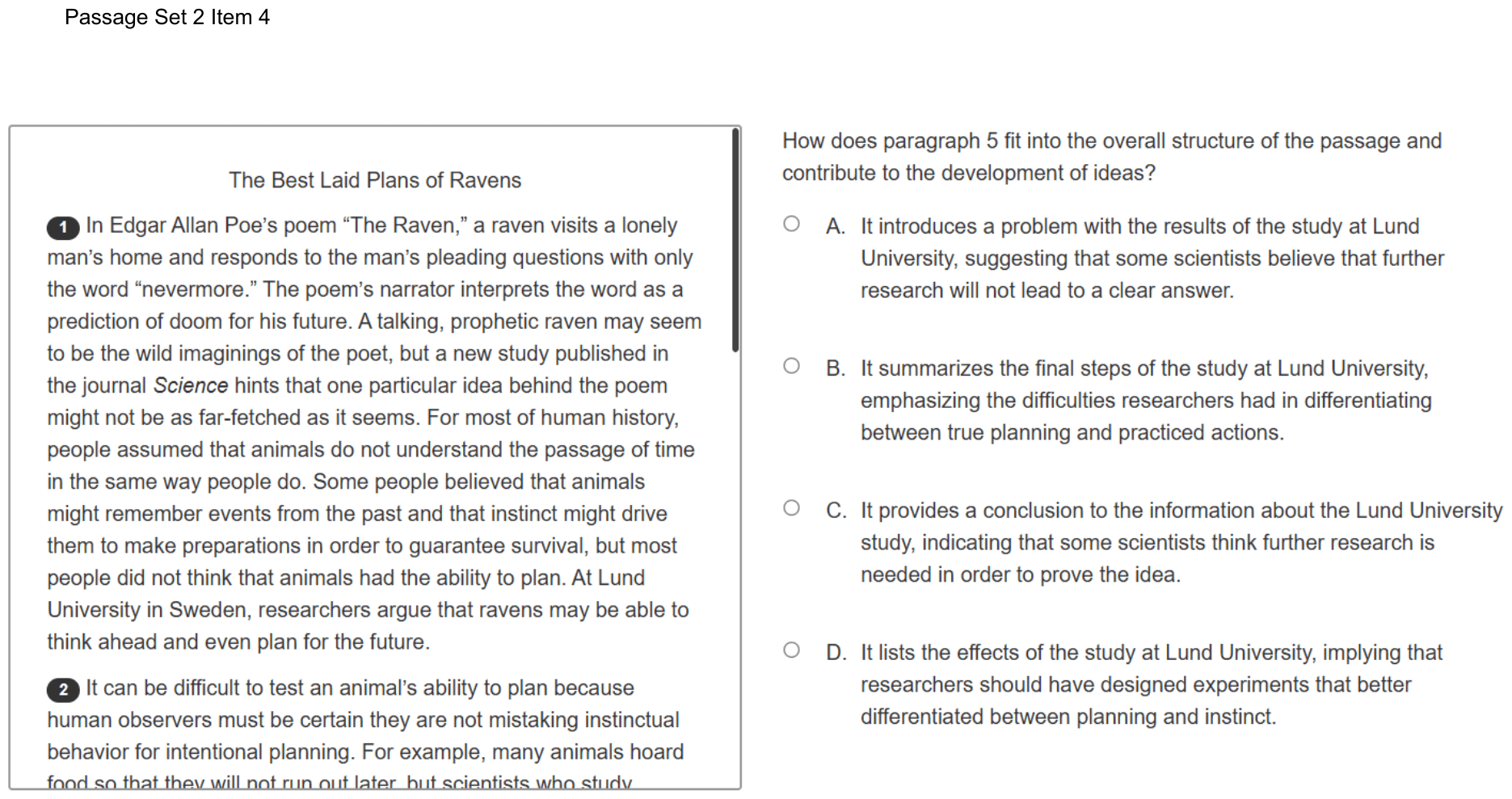
The Best Laid Plans of Ravens
In Edgar Allan Poe’s poem “The Raven,” a raven visits a lonely man’s home and responds to the man’s pleading questions with only the word “nevermore.” The poem’s narrator interprets the word as a prediction of doom for his future. A talking, prophetic raven may seem to be the wild imaginings of the poet, but a new study published in the journal Science hints that one particular idea behind the poem might not be as far-fetched as it seems. For most of human history, people assumed that animals do not understand the passage of time in the same way people do. Some people believed that animals might remember events from the past and that instinct might drive them to make preparations in order to guarantee survival, but most people did not think that animals had the ability to plan. At Lund University in Sweden, researchers argue that ravens may be able to think ahead and even plan for the future.
It can be difficult to test an animal’s ability to plan because human observers must be certain they are not mistaking instinctual behavior for intentional planning. For example, many animals hoard food so that they will not run out later, but scientists who study animals would not call hoarding a decision to plan for the future. This action is merely instinctual. Cognitive scientists argue that in order for an animal’s behavior to qualify as preparing for the future, the animal must use specific decision-making skills to solve a problem.
To avoid mistaking instinctual behavior for evidence of decision-making, the Lund University researchers designed two experiments to test ravens’ ability to plan. Ravens belong to the corvid family, a group of birds known for their intelligence. A study in 2007 showed that corvids have the tendency to save only certain types of food, which suggests that they are planning for the future rather than acting on instinct. In order to investigate that theory, the researchers had to design experiments that would achieve results that could not be explained by an instinctual behavior of food hoarding. Therefore, the ravens were taught two behaviors that they do not normally perform in the wild.
For the first experiment, the researchers showed the birds how to use a small stone to open a box and get treats. Once the ravens learned the behavior, the researchers presented the birds with four stones. Only one stone was the right size to open the box. The birds learned to select that stone and set it aside until the researchers presented the box. The second experiment involved bartering. A researcher would trade the ravens a large treat for a bottle cap. Later, the researchers presented the ravens with a group of items, including small treats and the bottle cap. The ravens chose the bottle cap over the treats and waited for the original researcher to trade with them again so that they could get more treats. In both experiments, the ravens waited patiently for up to seventeen hours for the researcher to return.
The results of these experiments are exciting, but more evidence needs to be gathered before scientists can fully conclude that ravens can plan for the future. Some scientists argue that the ravens might be choosing the stone and bottle cap because the ravens have been trained to do so, not necessarily because the ravens are thinking ahead. Regardless, like other recent advances in animal science, these experiments show that ravens could be much smarter than first believed, and scientists now believe that ravens do actually think about their own future.
Question
How does paragraph 5 fit into the overall structure of the passage and contribute to the development of ideas?
- AIt introduces a problem with the results of the study at Lund University, suggesting that some scientists believe that further research will not lead to a clear answer.
- BIt summarizes the final steps of the study at Lund University, emphasizing the difficulties researchers had in differentiating between true planning and practiced actions.
- CIt provides a conclusion to the information about the Lund University study, indicating that some scientists think further research is needed in order to prove the idea.
- DIt lists the effects of the study at Lund University, implying that researchers should have designed experiments that better differentiated between planning and instinct.
Show the answer
Correct answer: C
The question asks how paragraph 5 fits into the overall structure of the passage and contributes to the development of ideas.
A. Incorrect. While paragraph 5 states that “more evidence needs to be gathered before scientists can fully conclude that ravens can plan for the future,” this statement suggests that more research is needed, not that the results of the Lund University study are problematic.
B. Incorrect. Paragraph 5 does not discuss steps of the study or emphasize difficulties in determining whether the behaviors shown in the study were planned or practiced; instead it simply suggests that more study is required to make such a determination.
C. CORRECT. Paragraph 5 notes that some doubt remains (“Some scientists argue that the ravens might be choosing the stone and bottle cap because the ravens have been trained to do so, not necessarily because the ravens are thinking ahead”) and that more experimentation is needed; the author concludes that there is reason to believe the originally stated theory that ravens are quite smart and can give thought to how future events may affect them.
D. Incorrect. Paragraph 5 does not list the effects of the study or criticize the experiment for not differentiating between planning and instinct. The paragraph explains why the results of the experiments are not conclusive and emphasizes that more research is needed.
Question analysis
This text-structure question asks how the last paragraph of the article “The Best Laid Plans of Ravens” fits into the passage and develops its ideas. Students must see what that paragraph does once the experiments have been described. Each long choice names a role and then adds a claim, so a choice can begin well and end wrong.
- Grade level
- Grade 7 reading and task
- Compared with grade 7
- At grade 7 Explaining the role of a final paragraph is regular grade 7 structure work. The choices are long, though, and each pairs a role with a claim about scientists’ views, so both halves must be checked against a paragraph that mixes doubt with enthusiasm.
- Estimated difficulty
- Moderate: several steps, or a close reading with one strong distractor.
- Thinking it demands
- Depth of knowledge 2, skills and concepts · mainly analyze
- What makes it hard
- A very close wrong answer moderate
- How, not what moderate
- A lot to read minor
- Evidence
- Answered from several paragraphs or stanzas
- Reading level
- Passage: about grade 11, 599 words; question and choices: about grade 15, 121 words.
- Students, last 30 days
- Not enough answers yet to show (it takes 10).
Why it is hard, traps and wrong answers (shows the answer)
Why it is hard
Paragraph 5 makes three moves, excitement, doubt and a hopeful conclusion, and each wrong choice builds on one of them and then goes too far. Students who notice the doubt but read past “before scientists can fully conclude” pick the claim that research will never settle the question. Summing up the paragraph before reading the choices, and then checking the second half of each, is what earns the point.
A very close wrong answer moderate Choosing the answer
The choice about a problem with the results matches the right one in its first half, a doubt raised in paragraph 5, and differs only in claiming that more research will not give a clear answer. (Embretson & Wetzel, 1987; Gorin & Embretson, 2006; Ascalon et al., 2007)
How, not what moderate Working it out
The question asks what paragraph 5 does in the article, closing the account of the Lund study, so students must name its role rather than repeat its caution about training. (Anderson & Krathwohl, 2001)
A lot to read minor Understanding the question
The choices run 24 to 28 words, and each pairs a role with a second claim about what scientists or researchers think or did, so both halves of every choice have to be checked. (Kintsch, 1998; Gorin & Embretson, 2006; Freedle & Kostin, 1993)
Strategy: Sum up paragraph 5 in one sentence of your own, then check both parts of each choice, the job it names and the idea it attributes to scientists, against that summary.
Traps
- Half right: One half of a two-part choice is right and the other is not.
- Twists what the text says: Uses the text's topic and ideas but changes what it says: who did it, how much, when, or why.
- Reads too much in: A reasonable-sounding conclusion that goes further than the text allows.
The wrong answers, classified
A Half right (King et al., 2004; Thissen, Steinberg & Fitzpatrick, 1989)
Rightly sees that paragraph 5 raises a doubt about the results, but adds that more research will not settle it, when the paragraph says more evidence is needed to reach a conclusion.
B Twists what the text says (King et al., 2004)
Turns the objection some scientists raise, that the birds may simply be trained, into the Lund researchers’ own struggle, though the paragraph describes no steps of the study.
D Reads too much in (Graesser, Singer & Trabasso, 1994)
Reads the call for more evidence as a verdict that the experiments were badly designed, though the author calls the results “exciting” and faults no one.
Working it out, step by step
Figure out what the question asks
This asks about structure: what job paragraph 5 does in the article. Each choice has two parts, a job and an idea about scientists. Both parts must be right.
See where paragraph 5 sits
Paragraphs 3 and 4 describe the Lund University experiments. Paragraph 5 is the last paragraph. It comes after the whole study has been described. So it is the place where the author sums up what the study means.
Read what paragraph 5 says
It opens: “The results of these experiments are exciting, but more evidence needs to be gathered before scientists can fully conclude that ravens can plan for the future.” Next, it says some scientists think the ravens may just be trained. Then it says “Regardless,” the experiments show ravens “could be much smarter than first believed.” Regardless means “even so.”
Put the paragraph in your words
Paragraph 5 wraps up the study. The results are exciting but not proven yet. More research is needed to be sure. A conclusion is the ending part that sums things up. So paragraph 5 is the conclusion to the study, and it says more evidence is needed.
Check each choice
- A does not fit. Paragraph 5 does raise a doubt. But it never says more research will fail to give a clear answer.
- B does not fit. Paragraph 5 describes no steps of the study.
- C fits. It wraps up the study and says more research is needed.
- D does not fit. It lists no effects and blames no one. The author calls the results “exciting.”
Choose the answer
Paragraph 5 ends the story of the study and calls for more evidence. So the answer is C.
Why this answer and not the closest wrong one
A is the closest wrong choice, because its first half is right: paragraph 5 raises a doubt. But A says more research will not lead to a clear answer. The paragraph says more evidence is needed “before scientists can fully conclude,” so research is the way to an answer. C says this.
More questions like this
The original DOE question
The passage “The Best Laid Plans of Ravens” as printed (page 12)
Question 2 of 31
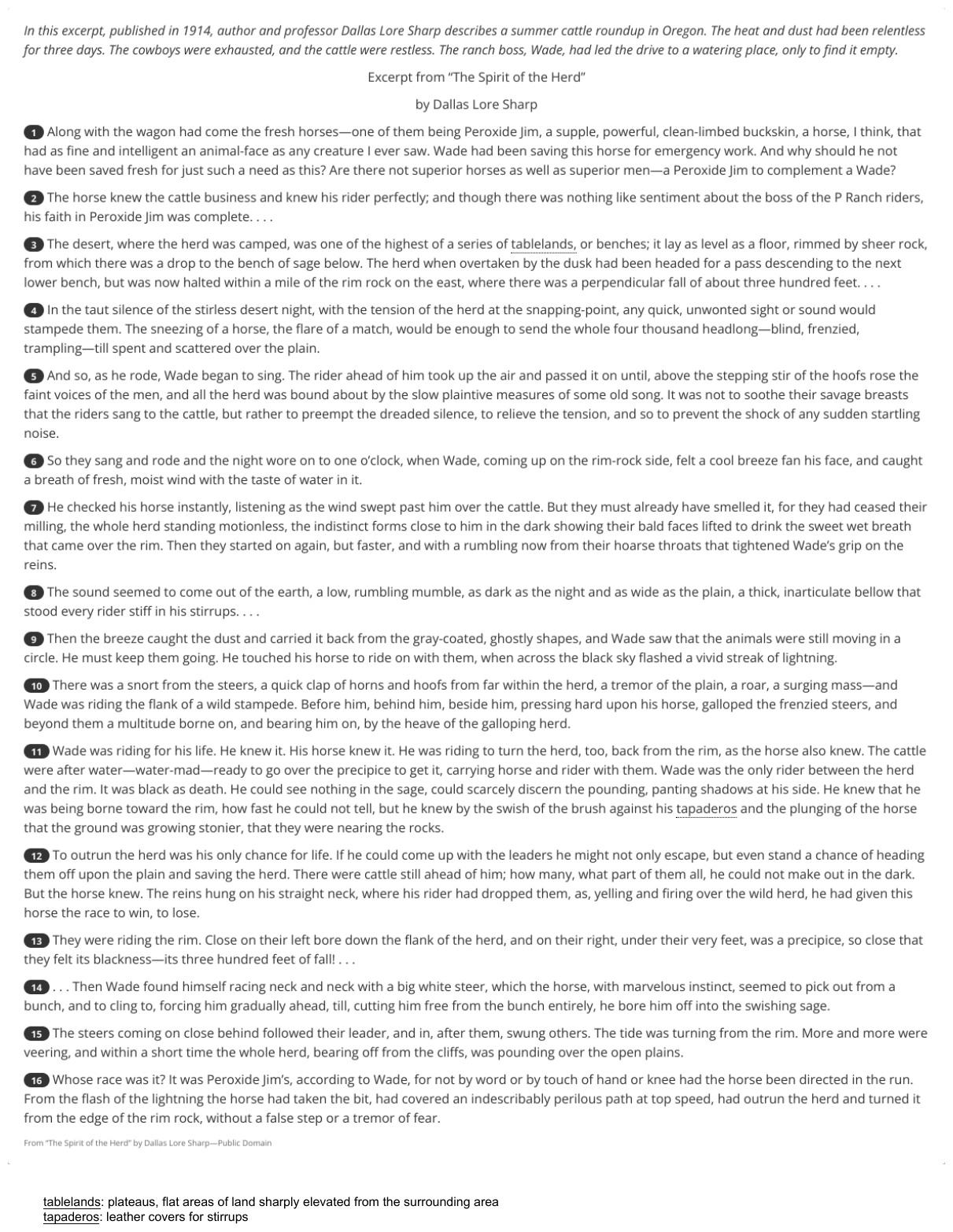
2026 Practice Test A English, question 29Passage Excerpt from “The Spirit of the Herd”
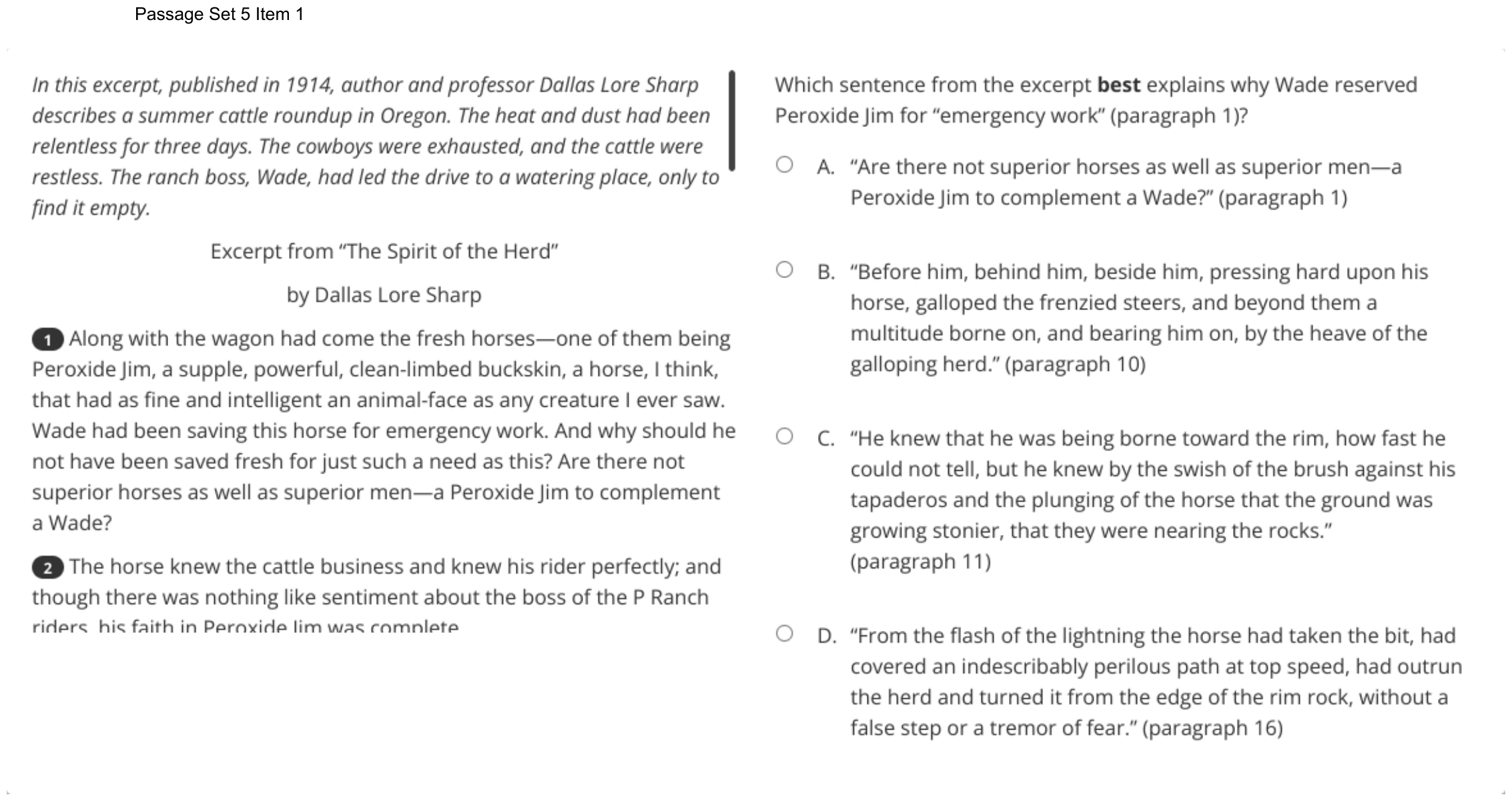
Excerpt from “The Spirit of the Herd”
by Dallas Lore Sharp
In this excerpt, published in 1914, author and professor Dallas Lore Sharp describes a summer cattle roundup in Oregon. The heat and dust had been relentless for three days. The cowboys were exhausted, and the cattle were restless. The ranch boss, Wade, had led the drive to a watering place, only to find it empty.
Along with the wagon had come the fresh horses—one of them being Peroxide Jim, a supple, powerful, clean-limbed buckskin, a horse, I think, that had as fine and intelligent an animal-face as any creature I ever saw. Wade had been saving this horse for emergency work. And why should he not have been saved fresh for just such a need as this? Are there not superior horses as well as superior men—a Peroxide Jim to complement a Wade?
The horse knew the cattle business and knew his rider perfectly; and though there was nothing like sentiment about the boss of the P Ranch riders, his faith in Peroxide Jim was complete. . . .
The desert, where the herd was camped, was one of the highest of a series of tablelands, or benches; it lay as level as a floor, rimmed by sheer rock, from which there was a drop to the bench of sage below. The herd when overtaken by the dusk had been headed for a pass descending to the next lower bench, but was now halted within a mile of the rim rock on the east, where there was a perpendicular fall of about three hundred feet. . . .
In the taut silence of the stirless desert night, with the tension of the herd at the snapping-point, any quick, unwonted sight or sound would stampede them. The sneezing of a horse, the flare of a match, would be enough to send the whole four thousand headlong—blind, frenzied, trampling—till spent and scattered over the plain.
And so, as he rode, Wade began to sing. The rider ahead of him took up the air and passed it on until, above the stepping stir of the hoofs rose the faint voices of the men, and all the herd was bound about by the slow plaintive measures of some old song. It was not to soothe their savage breasts that the riders sang to the cattle, but rather to preempt the dreaded silence, to relieve the tension, and so to prevent the shock of any sudden startling noise.
So they sang and rode and the night wore on to one o’clock, when Wade, coming up on the rim-rock side, felt a cool breeze fan his face, and caught a breath of fresh, moist wind with the taste of water in it.
He checked his horse instantly, listening as the wind swept past him over the cattle. But they must already have smelled it, for they had ceased their milling, the whole herd standing motionless, the indistinct forms close to him in the dark showing their bald faces lifted to drink the sweet wet breath that came over the rim. Then they started on again, but faster, and with a rumbling now from their hoarse throats that tightened Wade’s grip on the reins.
The sound seemed to come out of the earth, a low, rumbling mumble, as dark as the night and as wide as the plain, a thick, inarticulate bellow that stood every rider stiff in his stirrups. . . .
Then the breeze caught the dust and carried it back from the gray-coated, ghostly shapes, and Wade saw that the animals were still moving in a circle. He must keep them going. He touched his horse to ride on with them, when across the black sky flashed a vivid streak of lightning.
There was a snort from the steers, a quick clap of horns and hoofs from far within the herd, a tremor of the plain, a roar, a surging mass—and Wade was riding the flank of a wild stampede. Before him, behind him, beside him, pressing hard upon his horse, galloped the frenzied steers, and beyond them a multitude borne on, and bearing him on, by the heave of the galloping herd.
Wade was riding for his life. He knew it. His horse knew it. He was riding to turn the herd, too, back from the rim, as the horse also knew. The cattle were after water—water-mad—ready to go over the precipice to get it, carrying horse and rider with them. Wade was the only rider between the herd and the rim. It was black as death. He could see nothing in the sage, could scarcely discern the pounding, panting shadows at his side. He knew that he was being borne toward the rim, how fast he could not tell, but he knew by the swish of the brush against his tapaderos and the plunging of the horse that the ground was growing stonier, that they were nearing the rocks.
To outrun the herd was his only chance for life. If he could come up with the leaders he might not only escape, but even stand a chance of heading them off upon the plain and saving the herd. There were cattle still ahead of him; how many, what part of them all, he could not make out in the dark. But the horse knew. The reins hung on his straight neck, where his rider had dropped them, as, yelling and firing over the wild herd, he had given this horse the race to win, to lose.
They were riding the rim. Close on their left bore down the flank of the herd, and on their right, under their very feet, was a precipice, so close that they felt its blackness—its three hundred feet of fall! . . .
. . . Then Wade found himself racing neck and neck with a big white steer, which the horse, with marvelous instinct, seemed to pick out from a bunch, and to cling to, forcing him gradually ahead, till, cutting him free from the bunch entirely, he bore him off into the swishing sage.
The steers coming on close behind followed their leader, and in, after them, swung others. The tide was turning from the rim. More and more were veering, and within a short time the whole herd, bearing off from the cliffs, was pounding over the open plains.
Whose race was it? It was Peroxide Jim’s, according to Wade, for not by word or by touch of hand or knee had the horse been directed in the run. From the flash of the lightning the horse had taken the bit, had covered an indescribably perilous path at top speed, had outrun the herd and turned it from the edge of the rim rock, without a false step or a tremor of fear.
From “The Spirit of the Herd” by Dallas Lore Sharp—Public Domain
tablelands: plateaus, flat areas of land sharply elevated from the surrounding area
tapaderos: leather covers for stirrups
Question
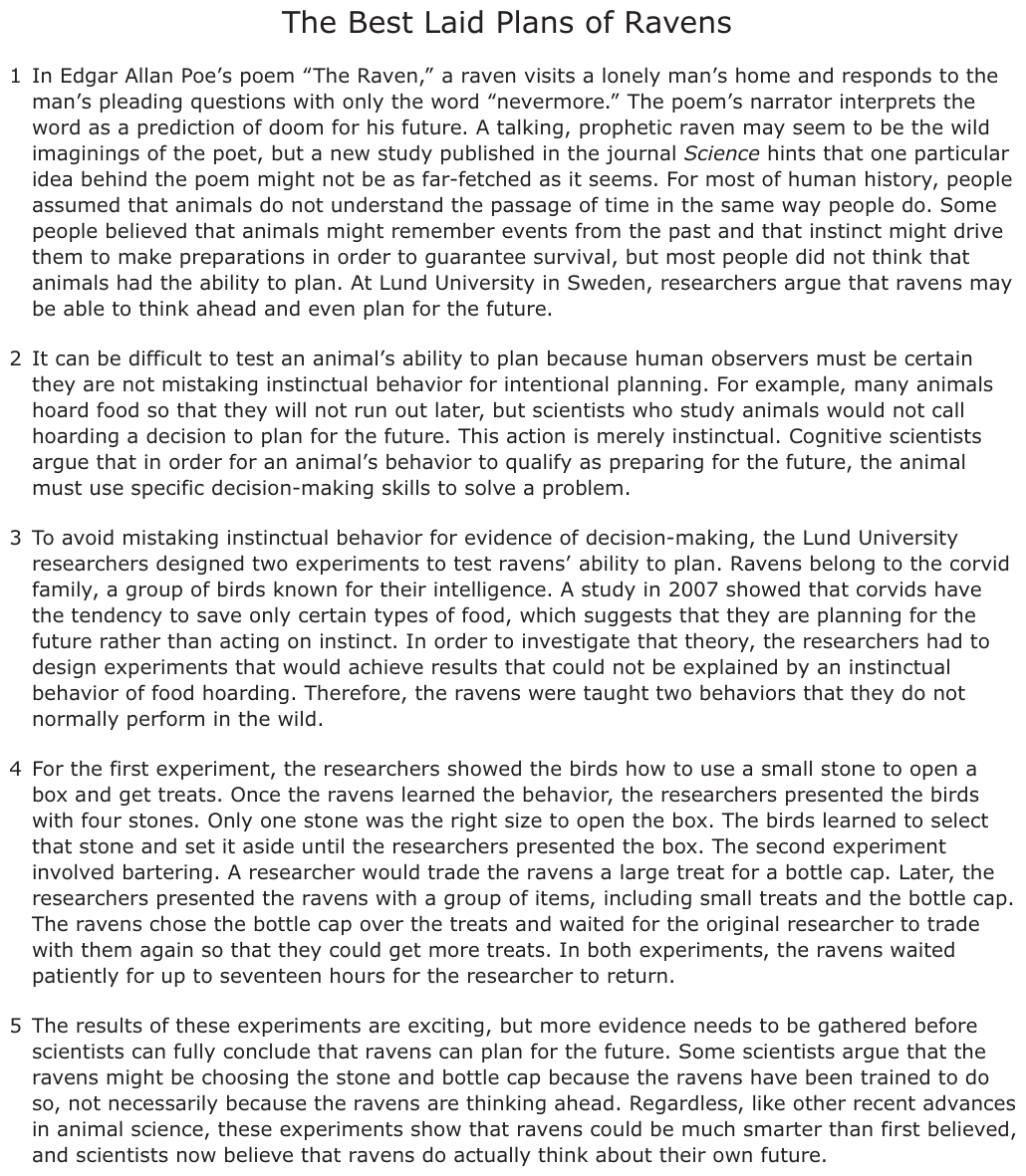
Which sentence from the excerpt best explains why Wade reserved Peroxide Jim for “emergency work” (paragraph 1)?
- A“Are there not superior horses as well as superior men—a Peroxide Jim to complement a Wade?” (paragraph 1)
- B“Before him, behind him, beside him, pressing hard upon his horse, galloped the frenzied steers, and beyond them a multitude borne on, and bearing him on, by the heave of the galloping herd.” (paragraph 10)
- C“He knew that he was being borne toward the rim, how fast he could not tell, but he knew by the swish of the brush against his tapaderos and the plunging of the horse that the ground was growing stonier, that they were nearing the rocks.” (paragraph 11)
- D“From the flash of the lightning the horse had taken the bit, had covered an indescribably perilous path at top speed, had outrun the herd and turned it from the edge of the rim rock, without a false step or a tremor of fear.” (paragraph 16)
Show the answer
Correct answer: D
The question asks which sentence from the excerpt best explains why Wade reserved Peroxide Jim for “emergency work” (paragraph 1).
A. Incorrect. While the sentence from paragraph 1 refers to Peroxide Jim as being a superior horse, it does not tell why he would be useful in an emergency. The mention of Peroxide Jim’s superiority does not describe the attributes that would make him an appealing choice for use in an emergency.
B. Incorrect. The sentence from paragraph 10 does not describe the actions of Peroxide Jim. The sentence describes what Wade and the horse were experiencing, but it does not include any reference to how Peroxide Jim was responding to the situation.
C. Incorrect. The sentence from paragraph 11 describes Wade’s experiences and does not focus on the actions of Peroxide Jim. It reveals Wade’s awareness of the danger he was in, but the only reference to Peroxide Jim in this sentence is the description of the horse having to work harder to run on the stonier ground as they neared the edge: from “the plunging of the horse,” Wade knew “that the ground was growing stonier, that they were nearing the rocks.” This quotation does not show that Peroxide Jim was the right horse to use for emergency work because it does not indicate, at this point in the text, that he was responding in a way that saved the herd or Wade.
D. CORRECT. The sentence from paragraph 16 describes Peroxide Jim’s high level of skill and ability to perform in a life-and-death situation. Not only did Peroxide Jim recognize the emergency immediately (“From the flash of the lightning the horse had taken the bit”), but the horse also proved to have the physical capability (“had covered an indescribably perilous path at top speed, had outrun the herd and turned it from the edge of the rim rock”) and the mental toughness (“without a false step or a tremor of fear”) required to respond appropriately to the dangerous situation.
Question analysis
This evidence question on Dallas Lore Sharp’s “The Spirit of the Herd,” a 1914 account of a night stampede on an Oregon cattle drive, asks which sentence best explains why the ranch boss Wade kept his horse Peroxide Jim for “emergency work.” The four quoted sentences come from different parts of the excerpt and are long, so the choice takes careful reading.
- Grade level
- Grade 8 reading and task
- Compared with grade 7
- At grade 7 Finding the sentence that best explains a detail is regular grade 7 evidence work. The four quotations, though, are long sentences from across a dense excerpt written in 1914, so the reading load is heavier than usual.
- Estimated difficulty
- Moderate: several steps, or a close reading with one strong distractor.
- Thinking it demands
- Depth of knowledge 2, skills and concepts · mainly evaluate
- What makes it hard
- Evidence in several places moderate
- A lot to read minor
- Reading between the lines minor
- Evidence
- Answered from the whole text
- Reading level
- Passage: about grade 8, 1160 words; question and choices: about grade 13, 160 words.
- Students, last 30 days
- Not enough answers yet to show (it takes 10).
Why it is hard, traps and wrong answers (shows the answer)
Why it is hard
The question links the start of the excerpt to its end, and the nearest quotation is the most tempting: the narrator’s rhetorical question about “superior horses” sits beside the phrase and seems to explain it. It praises the horse without showing what he can do. The two stampede sentences show the emergency itself, so the point goes to students who look for the horse acting on his own and find it in the final paragraph.
Evidence in several places moderate Working it out
The phrase “emergency work” is in paragraph 1, but the proof of the horse’s worth comes only at the very end, in paragraph 16, after the stampede has been turned. (Kirsch & Mosenthal, 1990; Gorin & Embretson, 2006)
A lot to read minor Understanding the question
Three of the quotations run 33 to 46 words, and two of them describe the stampede in vivid detail without saying what the horse does, so sorting them takes time. (Kintsch, 1998; Gorin & Embretson, 2006; Freedle & Kostin, 1993)
Reading between the lines minor Working it out
Students must decide what an emergency horse needs, speed, nerve and judgment without a rider’s guidance, before the last sentence reads as an answer to paragraph 1. (Graesser, Singer & Trabasso, 1994; Kintsch, 1998)
Strategy: Decide what a horse saved for emergencies would need to be able to do, then pick the quotation that gives the clearest proof that Peroxide Jim can do it.
Traps
- Supports only part of the claim: In a question about evidence: a line that backs one half of the claim but not the other, or a related point rather than the claim itself.
- True but not the answer: A choice says something accurate about the text that does not answer this question.
The wrong answers, classified
A Supports only part of the claim (King et al., 2004; Thissen, Steinberg & Fitzpatrick, 1989)
Stays beside the phrase in paragraph 1 and accepts the claim that Peroxide Jim is “superior,” which praises him but gives no sign of what makes him useful in a crisis.
B True but not the answer (King et al., 2004; Embretson & Wetzel, 1987)
Picks the most vivid picture of the stampede, which shows the emergency itself but says nothing about how Peroxide Jim handles it.
C Supports only part of the claim (King et al., 2004; Thissen, Steinberg & Fitzpatrick, 1989)
Notices “the plunging of the horse” at a tense moment, but the sentence is about Wade sensing the rocks ahead, not about the horse meeting the danger.
Working it out, step by step
Figure out what the question asks
This asks for evidence. In paragraph 1, Wade was saving Peroxide Jim for “emergency work.” Which sentence best explains why? You need a sentence that shows what this horse can do when something goes wrong.
Decide what to look for
An emergency is a sudden, dangerous event. A horse saved for one should be fast, steady and smart. It should act quickly when things go wrong. So look for the sentence that shows the horse himself doing that.
Read the last sentence of the excerpt
Paragraph 16 says “From the flash of the lightning the horse had taken the bit, had covered an indescribably perilous path at top speed, had outrun the herd and turned it from the edge of the rim rock, without a false step or a tremor of fear.”
Put the sentence in plain words
The bit is the metal bar in a horse’s mouth that the reins attach to. A horse that “had taken the bit” runs on its own. Perilous means dangerous. A tremor is a small shake. So the moment the stampede began, the horse took charge. He raced along a dangerous path, got ahead of the herd and turned it from the cliff. He never stumbled or showed fear.
Check each choice
- A does not fit. It calls him “superior,” but it shows no skill.
- B does not fit. It shows the stampede, but not how the horse handles it.
- C does not fit. It is about Wade sensing the rocks ahead.
- D fits. It shows the horse saving the herd in a real emergency.
Watch out: A sits right next to “emergency work” in paragraph 1, so it seems to explain it. But praise is not proof.
Choose the answer
The last sentence shows exactly why the horse was worth saving for emergencies. So the answer is D.
Why this answer and not the closest wrong one
A is the closest wrong choice. It sits beside the words “emergency work” and praises the horse. But calling a horse “superior” does not say what it can do. D shows the horse in action: fast, sure-footed and fearless in a real emergency. That explains why Wade saved him.
More questions like this
The original DOE question
The passage “Excerpt from “The Spirit of the Herd”” as printed (page 41)
Question 3 of 31
2026 Practice Test A English, question 35Uses the passage above: “Excerpt from “The Spirit of the Herd””.
Question
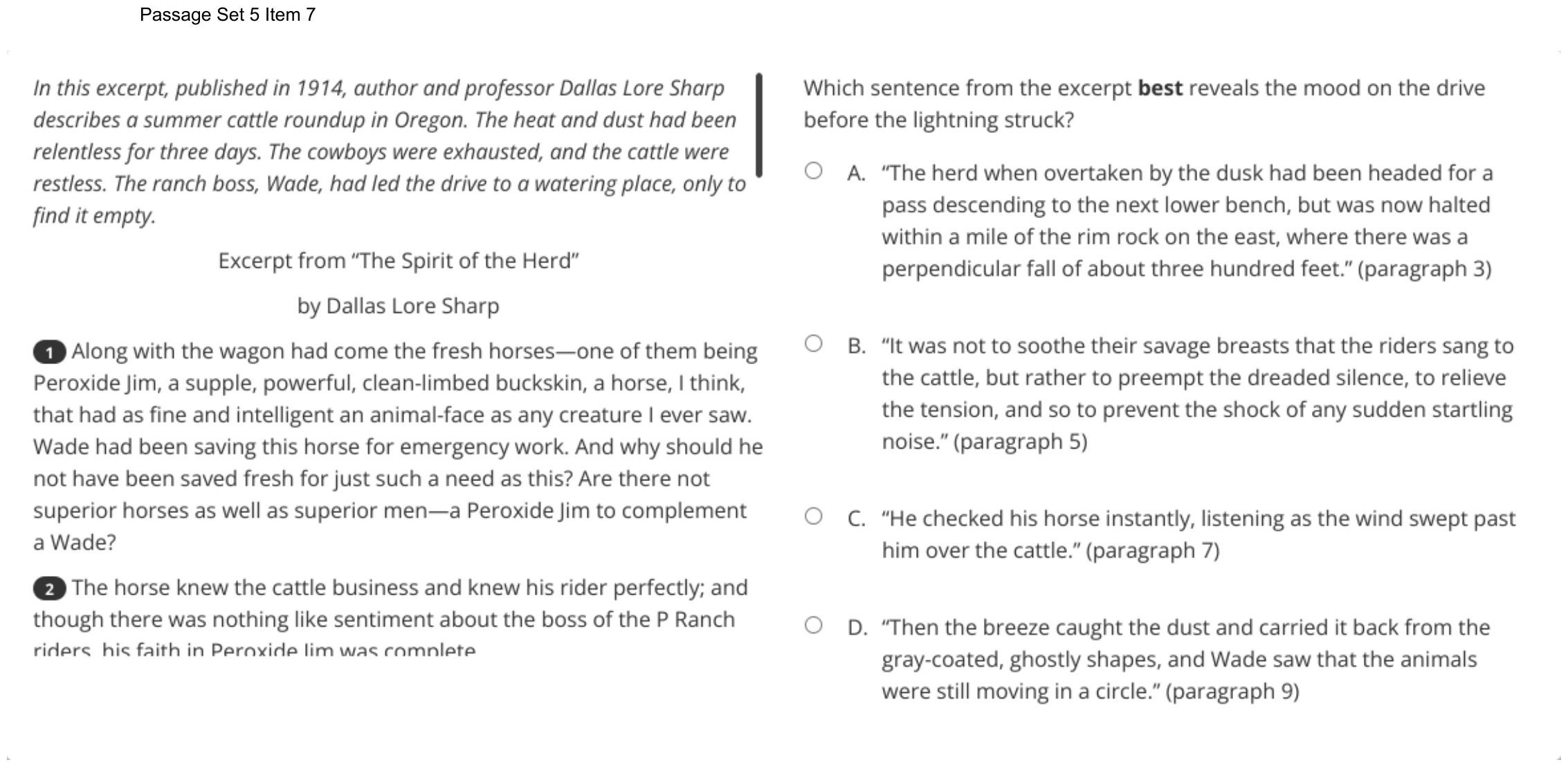
Which sentence from the excerpt best reveals the mood on the drive before the lightning struck?
- A“The herd when overtaken by the dusk had been headed for a pass descending to the next lower bench, but was now halted within a mile of the rim rock on the east, where there was a perpendicular fall of about three hundred feet.” (paragraph 3)
- B“It was not to soothe their savage breasts that the riders sang to the cattle, but rather to preempt the dreaded silence, to relieve the tension, and so to prevent the shock of any sudden startling noise.” (paragraph 5)
- C“He checked his horse instantly, listening as the wind swept past him over the cattle.” (paragraph 7)
- D“Then the breeze caught the dust and carried it back from the gray-coated, ghostly shapes, and Wade saw that the animals were still moving in a circle.” (paragraph 9)
Show the answer
Correct answer: B
The question asks which sentence from the excerpt best reveals the mood on the drive before the lightning struck.
A. Incorrect. The sentence from paragraph 3 describes the setting but does not contain words that create a strong mood. In fact, this sentence shows that while there were dangerous surroundings, the riders and the herd were “now halted.”
B. CORRECT. The sentence from paragraph 5 describes the riders singing “to preempt the dreaded silence, to relieve the tension” and to prevent “shock” from any sudden noise. These words provide a strong sense of the tense, heavy mood in which a terrible event such as a stampede could quickly happen.
C. Incorrect. In the sentence from paragraph 7, Wade has become aware of a change in the weather (“caught a breath of fresh, moist wind with the taste of water” [paragraph 6]) and is seeking to verify it. Even though a rainstorm was one concern the riders had, the words describing Wade’s immediate reaction to his discovery do not best convey the mood of dread and foreboding that the men and horses feel just before the lightning strike.
D. Incorrect. While the words “ghostly” and “still moving in a circle” in the sentence from paragraph 9 create a strange and mysterious image, the mood before the lightning struck was not one of mystery or suspense. Instead, these descriptive words are used to indicate Wade’s faint ability to see the herd moving in the dark.
Question analysis
This mood question on “The Spirit of the Herd” asks which sentence best reveals the mood on the cattle drive before the lightning struck and set off the stampede. Students compare four long quotations from paragraphs 3, 5, 7 and 9. All four describe the night leading up to it, so students must weigh which one’s wording does the most to set a mood.
- Grade level
- Grade 7 reading and task
- Compared with grade 7
- At grade 7 Picking the sentence that best reveals a mood is ordinary grade 7 work on word choice. The four quotations are long, come from four different paragraphs and are written in 1914 English, so the main demand is reading them closely.
- Estimated difficulty
- Straightforward: two steps or one careful reading.
- Thinking it demands
- Depth of knowledge 2, skills and concepts · mainly evaluate
- What makes it hard
- Hard words minor
- A lot to read minor
- Evidence
- Answered from several paragraphs or stanzas
- Reading level
- Passage: about grade 8, 1160 words; question and choices: about grade 11, 143 words.
- Students, last 30 days
- Not enough answers yet to show (it takes 10).
Why it is hard, traps and wrong answers (shows the answer)
Why it is hard
Only one quotation names a feeling outright, and once students notice “dreaded silence” and “tension,” the question is easy. The losses come from mood-sounding words elsewhere: the “ghostly shapes” of paragraph 9 suggest an eerie mystery, and Wade’s sudden stop in paragraph 7 suggests alarm. Neither captures the strained waiting that hangs over the whole drive.
Hard words minor Understanding the question
The right sentence is the hardest to read: “preempt” and the old saying about soothing “savage breasts” surround the plain mood words “dreaded” and “tension.” (Perfetti, 2007; Freedle & Kostin, 1993)
A lot to read minor Understanding the question
The quotations from paragraphs 3 and 5 run 44 and 37 words, and all four describe the night before the stampede, so each must be read for words that carry feeling. (Kintsch, 1998; Gorin & Embretson, 2006; Freedle & Kostin, 1993)
Strategy: Underline the words in each quotation that carry feeling, then pick the one whose wording most directly captures the mood of the drive before the lightning.
Traps
- Supports only part of the claim: In a question about evidence: a line that backs one half of the claim but not the other, or a related point rather than the claim itself.
- Wrong tone or attitude: Misjudges the tone, attitude or point of view, such as reading admiration as criticism, or taking a character's or subject's feelings for the author's.
The wrong answers, classified
A Supports only part of the claim (King et al., 2004; Thissen, Steinberg & Fitzpatrick, 1989)
Senses danger in the “perpendicular fall of about three hundred feet,” but the sentence states facts about the land and contains no word of feeling.
C Supports only part of the claim (King et al., 2004; Thissen, Steinberg & Fitzpatrick, 1989)
Sees alertness in Wade checking his horse “instantly,” but the sentence reports one quick reaction to the wind, not the feeling that hangs over the drive.
D Wrong tone or attitude (Graesser, Singer & Trabasso, 1994)
Is drawn to “ghostly shapes,” a phrase with a mood of its own, but it describes how dimly Wade saw the cattle through the dust, not the riders’ tension.
Working it out, step by step
Figure out what the question asks
This asks about mood, the feeling a piece of writing gives you. Which sentence best shows the feeling on the drive before the lightning struck? Look for words that name or carry a feeling.
Read the sentence from paragraph 5
Paragraph 5 says “It was not to soothe their savage breasts that the riders sang to the cattle, but rather to preempt the dreaded silence, to relieve the tension, and so to prevent the shock of any sudden startling noise.”
Work out what it means
“Soothe their savage breasts” is an old saying about calming wild feelings with music. To preempt something is to act early to stop it. So the singing was not meant as soothing music. The riders sang to fill a silence they dreaded, or feared, and to ease the tension. They also wanted to keep any sudden noise from scaring the herd. The mood is tense and nervous.
Check each choice
- A does not fit. It tells where the herd stopped and how far the drop was. It gives facts, not feelings.
- B fits. Words like “dreaded” and “tension” name the feeling.
- C does not fit. Wade stops to listen. That is one quick action, not the mood of the night.
- D does not fit. “Ghostly shapes” sounds spooky, but it describes cattle seen dimly through dust.
Choose the answer
Only one sentence names the tense feeling of the night. So the answer is B.
Why this answer and not the closest wrong one
D is the closest wrong choice, because “ghostly” sounds eerie. But that word only describes how the cattle looked in the dark and the dust. B names the feeling outright: a “dreaded silence” and “tension.” That is the mood on the drive before the lightning struck.
More questions like this
The original DOE question
Question 4 of 31
2026 Practice Test A English, question 37Passage Massachusetts: Lowell National Historical Park
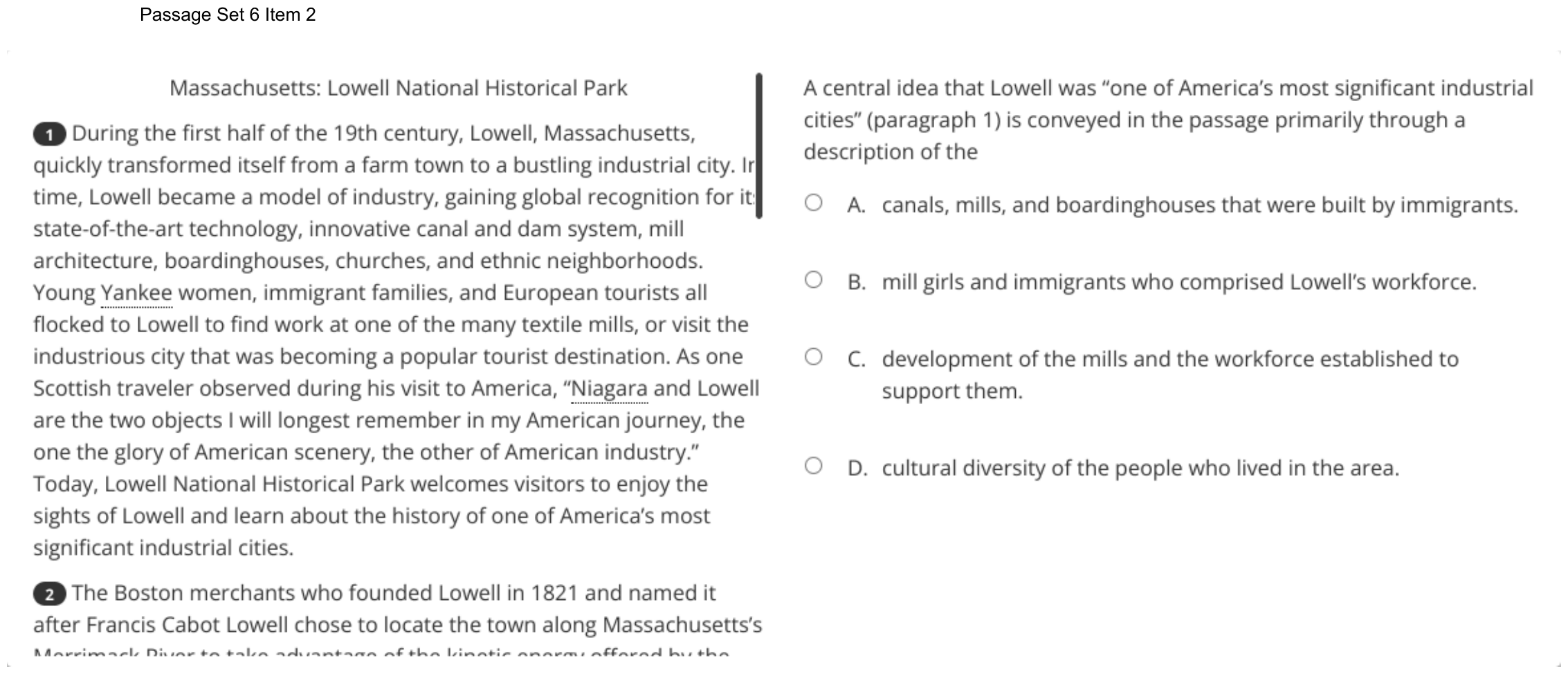
Massachusetts: Lowell National Historical Park
During the first half of the 19th century, Lowell, Massachusetts, quickly transformed itself from a farm town to a bustling industrial city. In time, Lowell became a model of industry, gaining global recognition for its state-of-the-art technology, innovative canal and dam system, mill architecture, boardinghouses, churches, and ethnic neighborhoods. Young Yankee women, immigrant families, and European tourists all flocked to Lowell to find work at one of the many textile mills, or visit the industrious city that was becoming a popular tourist destination. As one Scottish traveler observed during his visit to America, “Niagara and Lowell are the two objects I will longest remember in my American journey, the one the glory of American scenery, the other of American industry.” Today, Lowell National Historical Park welcomes visitors to enjoy the sights of Lowell and learn about the history of one of America’s most significant industrial cities.
The Boston merchants who founded Lowell in 1821 and named it after Francis Cabot Lowell chose to locate the town along Massachusetts’s Merrimack River to take advantage of the kinetic energy offered by the Pawtucket waterfalls. Over six miles of canals powered the waterwheels of Lowell’s mills, whose massive five- and six-story brick buildings dominated the city’s landscape. . . . The most recognized of these buildings are the Lowell Manufacturing Company chartered in 1821, the Suffolk or Wannalancit Mill completed around the 1880s, the Boott Mill Company established in 1835, and the Boott Mill Boardinghouse that opened in 1838. By the 1850s, 40 textile mills employing over 10,000 workers stretched for about a mile along the river. . . .
The city’s female workforce was significant in the history of Lowell. From the early to mid-1800s, women left the constricted lifestyle of small rural towns and rural areas for independent industrial city life. Most were young single Yankee girls, who were tired of the limited opportunities offered by their domestic work. Women found that Lowell’s mills offered monthly wages for their services and provided them room and board. Although these women gained economic independence in Lowell, the mill boardinghouse keepers constantly supervised their social activities, for which they hardly had any time, considering their daily 12- to 14-hour work schedules. At the end of the day, the factory bell signaled the “mill girls” to return to their boardinghouses. They were expected to adhere to the strict code of conduct respecting curfew and attending church.
Yankee “mill girls” continued to dominate the Lowell workforce until the 1840s, when the city began to find it difficult to compete with the growing industrial development in other New England communities. As profits fell, the mill industry cut wages. These wage cuts, deteriorating working conditions, and long workdays led the “mill girls” to protest and organize strikes. When their demands went unheard, the women left Lowell, and immigrant groups replaced them in the workforce. Despite the low wages and unhealthy work conditions, immigrants were eager to find work.
The immigrants replacing the Yankee “mill girls” during the 1840s were predominantly Irish Catholics, who traveled to America during the Great Potato Famine. Although Lowell received an influx of Irish families during this time, the Irish were a part of the city’s history from its birth, and before the “mill girls” arrived, they built Lowell’s historic canals, mills, and boardinghouses. Initially, Lowell’s Protestant community was slow to welcome Irish immigrants, but the hostility between Yankee Protestants and Irish Catholics eventually disappeared. Irish immigrants dominated the industrial scene until the Civil War, when other immigrant groups began to work in the city mills.
Like the Irish, the French-Canadians, Greeks, Poles, Portuguese, Russian Jews, and Armenians who came to work in Lowell’s mills faced long work hours, low wages, and poor living conditions in the city’s crowded tenements. By the time Lowell’s industry declined, the city had become an ethnic melting pot, where each group claimed its own distinct neighborhood, like the Irish immigrants’ “New Dublin” or “Acre,” and the French-Canadians’ “Little Canada.” The city officially began to close down its mills in the 1920s and ’30s after Lowell’s outdated mills could no longer compete against the state-of-the-art cotton mills in other communities and working conditions continued to decline as Lowell’s companies stopped reinvesting in their mills. . . . Despite a brief resurgence during World War II, the city shut down its last surviving mill by the mid-1950s.
From “Massachusetts: Lowell National Historical Park”—Public Domain/National Park Service
Yankee: native to New England
Niagara: a town in northwestern New York State well known as the location of Niagara Falls, a series of waterfalls on the Canadian border
domestic work: household duties like cooking and cleaning
Question
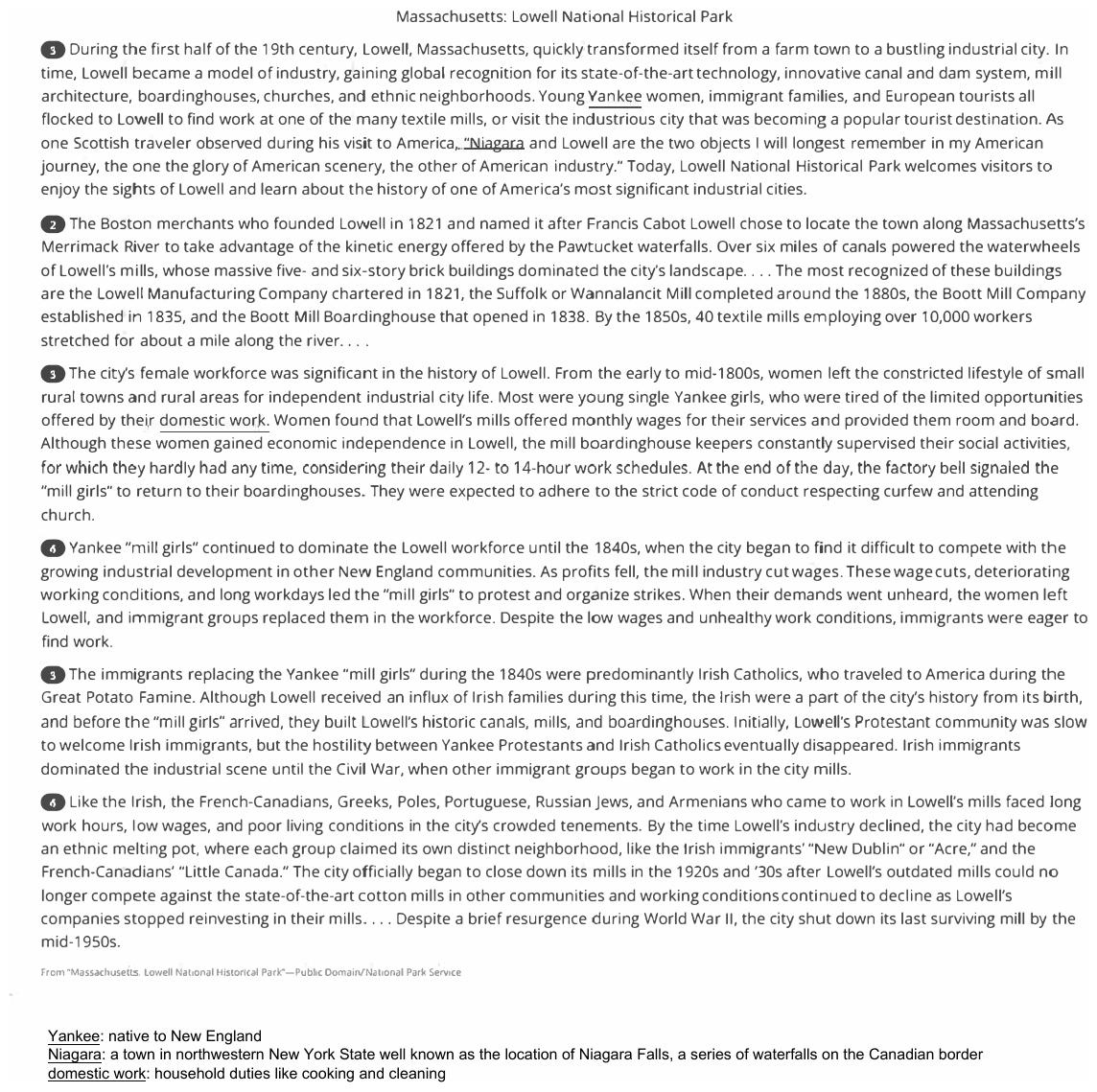
A central idea that Lowell was “one of America’s most significant industrial cities” (paragraph 1) is conveyed in the passage primarily through a description of the
- Acanals, mills, and boardinghouses that were built by immigrants.
- Bmill girls and immigrants who comprised Lowell’s workforce.
- Cdevelopment of the mills and the workforce established to support them.
- Dcultural diversity of the people who lived in the area.
Show the answer
Correct answer: C
The question asks which description conveys the central idea that Lowell was “one of America’s most significant industrial cities” (paragraph 1).
A. Incorrect. While the passage does state that the city’s canals, mills, and boardinghouses were built by early immigrants from Ireland, these details do not contribute to the development of the overall idea that Lowell was a significant industrial city.
B. Incorrect. The details about the women and immigrants who worked in the mills are important to the passage, but these details alone do not show that Lowell was a significant industrial city.
C. CORRECT. The details throughout the passage about the development of the mills and the people who worked in them convey the significance of Lowell in early American industry. Paragraph 2 shares details about the businesses that started in the 1800s and contributed to the development of industry in the region (“The most recognized of these buildings are the Lowell Manufacturing Company chartered in 1821, the Suffolk or Wannalancit Mill completed around the 1880s, the Boott Mill Company established in 1835, and the Boott Mill Boardinghouse that opened in 1838”). Then paragraphs 3–6 provide specific details about the people who worked in the mills at different points in time.
D. Incorrect. Although the passage references Lowell’s culturally diverse community (“Young Yankee women, immigrant families, and European tourists all flocked to Lowell to find work at one of the many textile mills” [paragraph 1]), these groups alone are not what marked Lowell as a significant industrial city.
Question analysis
This central idea question asks which kind of description in an article about the Massachusetts mill city of Lowell does most to show that it was one of America's most significant industrial cities. Students need a map of all six paragraphs, because every choice names something the passage really describes, and the question turns on which description does the main work.
- Grade level
- Grade 8 reading and task
- Compared with grade 7
- Above grade 7 Grade 7 students trace how a central idea is developed, usually through a few supporting details. Here the strands to weigh run through six dense paragraphs of dates, mills and worker groups, and the stem is long and passive, so it asks more than typical.
- Estimated difficulty
- Hard: combines ideas, needs a plan, and has more than one tempting wrong answer.
- Thinking it demands
- Depth of knowledge 3, strategic thinking · mainly analyze
- What makes it hard
- A very close wrong answer major
- Evidence in several places moderate
- A lot to read minor
- Complex sentences minor
- Evidence
- Answered from the whole text
- Reading level
- Passage: about grade 15, 764 words; question and choices: about grade 10, 63 words.
- Corrected from the DOE handbook
- A grammatical error in the explanation was corrected.
- An inaccurate detail in the explanation was corrected.
- Students, last 30 days
- Not enough answers yet to show (it takes 10).
Why it is hard, traps and wrong answers (shows the answer)
Why it is hard
Every choice names something the passage really describes, so truth rules nothing out; the question turns on which description carries the claim that Lowell mattered as an industrial city. Because four of the six paragraphs follow the workers, the workforce alone looks like the passage's main thread, and students who forget paragraph 2's mills take the half for the whole. Diversity and the immigrant builders are real themes too, but neither says anything about Lowell's industrial standing.
A very close wrong answer major Choosing the answer
The workforce choice is the key with one half removed: both describe the people who worked the mills, but only the key also names the development of the mills, which paragraph 2 builds with dates and numbers. (Embretson & Wetzel, 1987; Gorin & Embretson, 2006; Ascalon et al., 2007)
Evidence in several places moderate Working it out
The industrial picture is built in two stages, the canals and mills of paragraph 2 and the successive workforces of paragraphs 3 to 6, so each choice must be measured against the whole passage. (Kirsch & Mosenthal, 1990; Gorin & Embretson, 2006)
A lot to read minor Understanding the question
Six paragraphs pack in mill names, dates from 1821 to the 1950s and a string of worker groups, from Yankee mill girls to Irish, French-Canadian and Greek immigrants. (Kintsch, 1998; Gorin & Embretson, 2006; Freedle & Kostin, 1993)
Complex sentences minor Understanding the question
The stem is a long passive sentence that quotes paragraph 1 inside it and holds the real question, “primarily through a description of the,” until its last words. (Abedi & Lord, 2001; Freedle & Kostin, 1993; Messick, 1989)
Strategy: Note in a phrase what each of the six paragraphs is about, then test each choice against the stem's claim: would that description make a reader see Lowell as a major industrial city?
Traps
- Too narrow: A single detail offered as the central idea or a summary, or a summary that keeps minor details and leaves out an essential part.
- True but not the answer: A choice says something accurate about the text that does not answer this question.
The wrong answers, classified
A Too narrow (King et al., 2004)
Seizes on paragraph 5's clause that Irish workers built the canals, mills and boardinghouses, one fact about construction rather than the account of mills and workers that shows Lowell's importance.
B Too narrow (King et al., 2004)
Sees that paragraphs 3 to 6 follow the mill girls and the immigrants who replaced them, but leaves out the mills themselves, the heart of paragraph 2's industrial picture.
D True but not the answer (King et al., 2004; Embretson & Wetzel, 1987)
Recalls paragraph 6's “ethnic melting pot” and paragraph 1's “ethnic neighborhoods,” which are real, but the city's diversity says nothing about its standing as an industrial city.
What was corrected from the DOE handbook, and why
- Explanation: The handbook’s explanation of Option B says “The details about the women and immigrants who worked in the mills is important to the passage.” The subject is “details,” so the site now says “are important.”
- Explanation: The handbook’s explanation of Option C says paragraph 2 describes “the businesses that started in the early 1800s,” but the sentence it then quotes includes “the Suffolk or Wannalancit Mill completed around the 1880s,” late in the century. The site now says “the businesses that started in the 1800s.”
Working it out, step by step
Figure out what the question asks
This is a central idea question. A central idea is a main point that the whole passage builds. The point here is that Lowell was “one of America’s most significant industrial cities.” Significant means important. You need the description that does the most to show this.
Map the six paragraphs
- Paragraph 1: Lowell grows from a farm town into a famous industrial city.
- Paragraph 2: The mills: canals, huge brick buildings, mills started across the 1800s, and by the 1850s, “40 textile mills employing over 10,000 workers.”
- Paragraphs 3 and 4: The Yankee “mill girls” who worked in the mills.
- Paragraphs 5 and 6: The Irish and other immigrants who took their place.
See how the picture is built
The passage shows Lowell’s importance in two parts. First it describes the mills: how they were built and how big they grew. Then it follows the workers who ran them, group after group. Together, the mills and the workforce show a major industrial city. Workforce means all the people who do the work. Either part alone tells only half the story.
Check each choice
- A is wrong. Paragraph 5 does say the Irish built the canals, mills and boardinghouses. But that is one fact in one sentence, not the main description.
- B is wrong. The mill girls and immigrants fill paragraphs 3 to 6. But this choice leaves out the mills themselves, the heart of paragraph 2.
- C is right. It covers both parts: how the mills grew and the workers who kept them running.
- D is wrong. Lowell did become an “ethnic melting pot.” But a mix of cultures doesn’t show that a city was an industrial leader.
Watch out: Four of the six paragraphs are about workers, so B looks like the main thread. It is only half of it.
Choose the answer
The central idea is carried by the growth of the mills plus the workforce gathered to run them. So the answer is C.
Why this answer and not the closest wrong one
B is the closest wrong answer. It matches the second half of C, the people who worked in the mills. But it drops the mills, with their six miles of canals and, by the 1850s, 40 mills. Workers alone don’t make a city an industrial giant. C keeps both halves, so it fits the whole passage.
More questions like this
The original DOE question
The passage “Massachusetts: Lowell National Historical Park” as printed (page 50)
Question 5 of 31
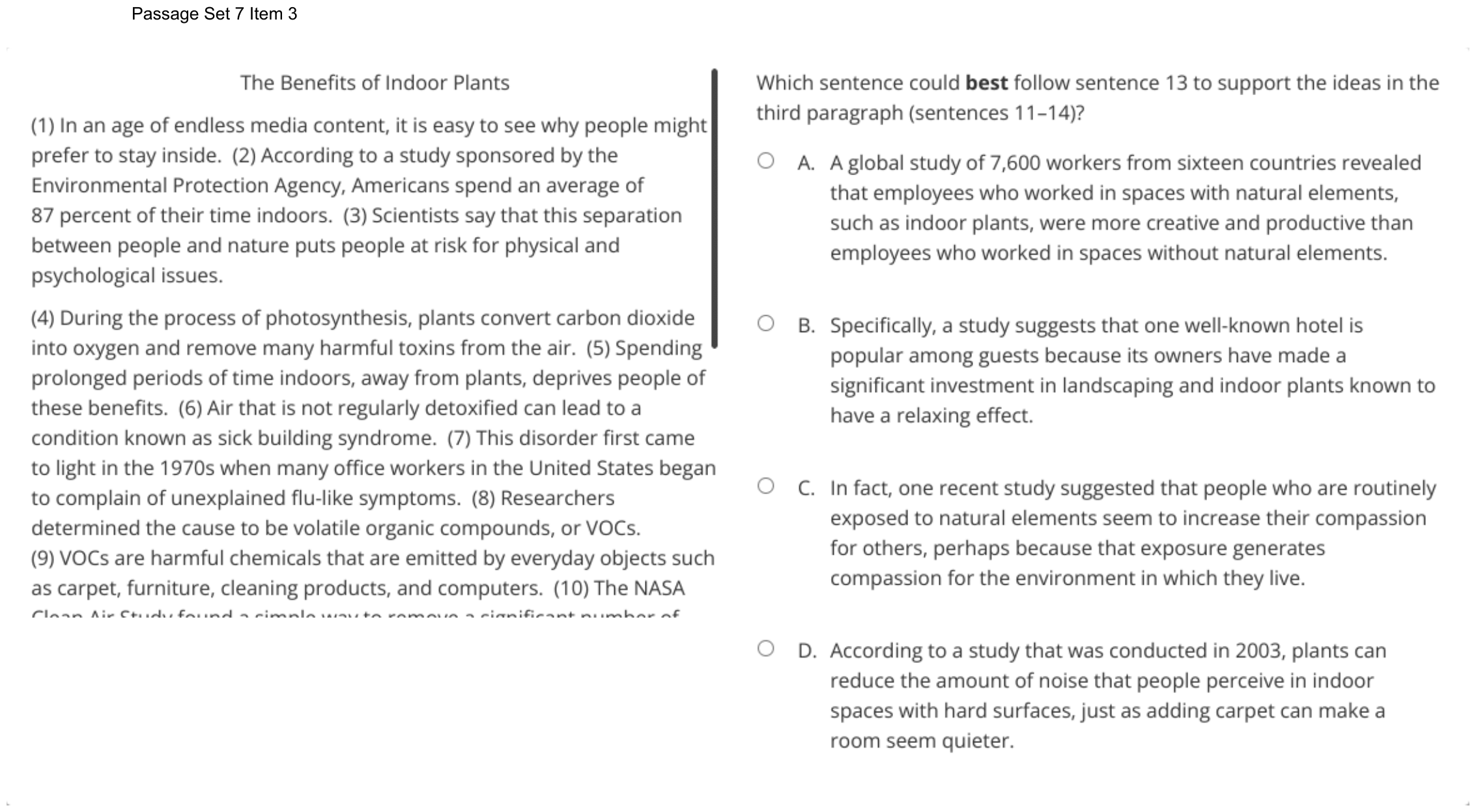
2026 Practice Test A English, question 45Passage The Benefits of Indoor Plants
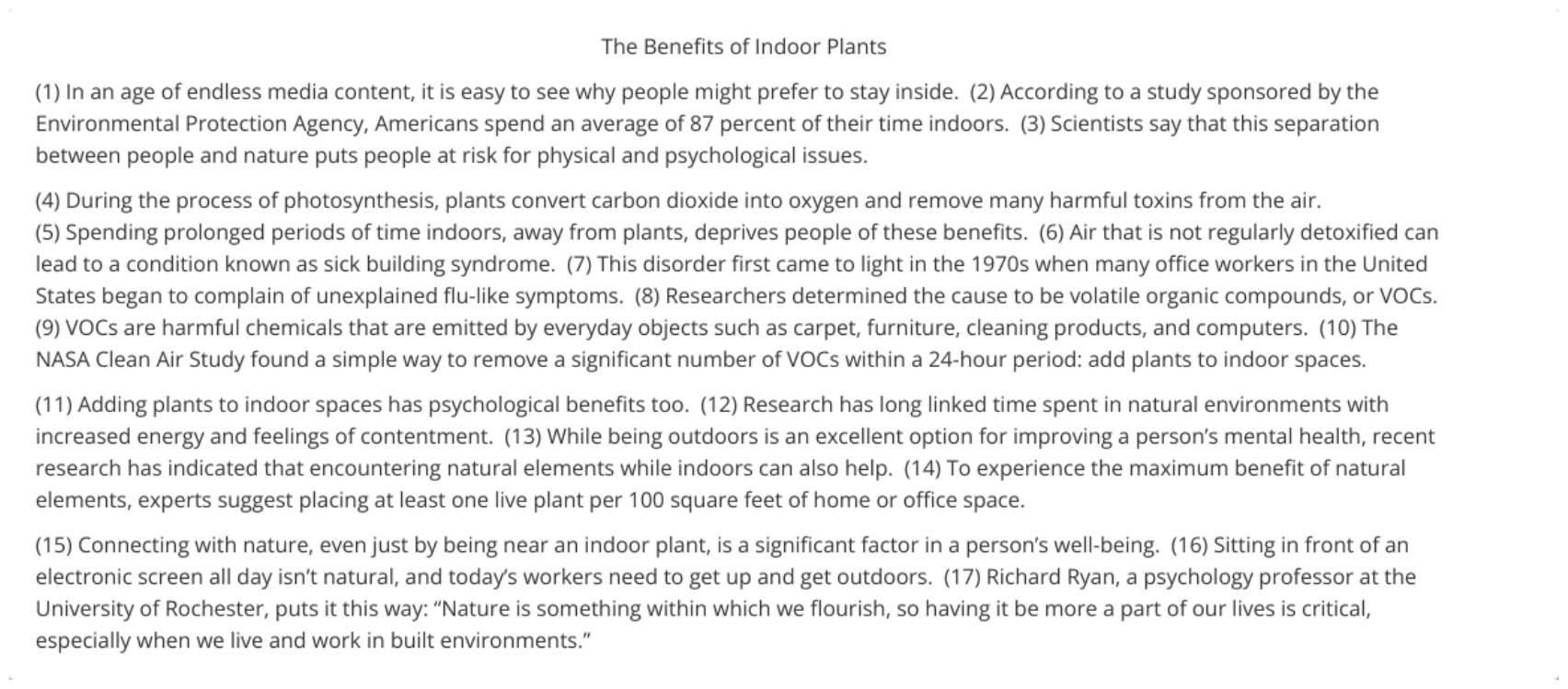
The Benefits of Indoor Plants
(1) In an age of endless media content, it is easy to see why people might prefer to stay inside. (2) According to a study sponsored by the Environmental Protection Agency, Americans spend an average of 87 percent of their time indoors. (3) Scientists say that this separation between people and nature puts people at risk for physical and psychological issues.
(4) During the process of photosynthesis, plants convert carbon dioxide into oxygen and remove many harmful toxins from the air. (5) Spending prolonged periods of time indoors, away from plants, deprives people of these benefits. (6) Air that is not regularly detoxified can lead to a condition known as sick building syndrome. (7) This disorder first came to light in the 1970s when many office workers in the United States began to complain of unexplained flu-like symptoms. (8) Researchers determined the cause to be volatile organic compounds, or VOCs. (9) VOCs are harmful chemicals that are emitted by everyday objects such as carpet, furniture, cleaning products, and computers. (10) The NASA Clean Air Study found a simple way to remove a significant number of VOCs within a 24-hour period: add plants to indoor spaces.
(11) Adding plants to indoor spaces has psychological benefits too. (12) Research has long linked time spent in natural environments with increased energy and feelings of contentment. (13) While being outdoors is an excellent option for improving a person’s mental health, recent research has indicated that encountering natural elements while indoors can also help. (14) To experience the maximum benefit of natural elements, experts suggest placing at least one live plant per 100 square feet of home or office space.
(15) Connecting with nature, even just by being near an indoor plant, is a significant factor in a person’s well-being. (16) Sitting in front of an electronic screen all day isn’t natural, and today’s workers need to get up and get outdoors. (17) Richard Ryan, a psychology professor at the University of Rochester, puts it this way: “Nature is something within which we flourish, so having it be more a part of our lives is critical, especially when we live and work in built environments.”
Question
Which sentence could best follow sentence 13 to support the ideas in the third paragraph (sentences 11–14)?
- AA global study of 7,600 workers from sixteen countries revealed that employees who worked in spaces with natural elements, such as indoor plants, were more creative and productive than employees who worked in spaces without natural elements.
- BSpecifically, a study suggests that one well-known hotel is popular among guests because its owners have made a significant investment in landscaping and indoor plants known to have a relaxing effect.
- CIn fact, one recent study suggested that people who are routinely exposed to natural elements seem to increase their compassion for others, perhaps because that exposure generates compassion for the environment in which they live.
- DAccording to a study that was conducted in 2003, plants can reduce the amount of noise that people perceive in indoor spaces with hard surfaces, just as adding carpet can make a room seem quieter.
Show the answer
Correct answer: A
The question asks for the sentence that could best follow sentence 13 to support the ideas in the third paragraph (sentences 11–14).
A. CORRECT. The sentence could best follow sentence 13 because it directly supports the main idea of the third paragraph that indoor plants provide “psychological benefits” (sentence 11) by presenting the findings of a relevant research study. The details about the study provide a concrete example of the mental benefits of indoor plants: the employees in the study who worked near plants “were more creative” and accomplished more than those who worked in spaces without plants.
B. Incorrect. Although the sentence describes a study in which indoor plants were found to have a positive effect, it does not clearly support the ideas in sentences 11–14, because the sentence focuses on the popularity of the hotel rather than psychological benefits. Therefore, this sentence does not best follow sentence 13 to support the ideas in the third paragraph.
C. Incorrect. Although the sentence suggests that being “routinely exposed to natural elements” can increase the positive emotion of compassion, it could not best follow sentence 13, because the reference to “natural elements” is too vague to sufficiently support the ideas in the third paragraph. The sentence does not logically follow the idea from sentence 13, which refers specifically to “encountering natural elements while indoors.”
D. Incorrect. The sentence develops the idea that indoor plants are helpful by comparing them to carpeting and stating that they can reduce the amount of noise that people perceive. Noise cancellation, though convenient, is irrelevant to the topic of the third paragraph, which is specific to the psychological benefits of indoor plants. Therefore, this sentence does not best follow sentence 13 to support the ideas in the third paragraph.
Question analysis
This supporting-details question asks which sentence could best follow sentence 13 to back up the third paragraph (sentences 11–14) of the indoor-plants passage. All four options report a study or finding about plants or nature, so students must check each against what the paragraph is about and where sentence 13 leaves off.
- NYS standards
- 7W2b developing a topic
- Grade level
- Grade 8 reading and task
- Compared with grade 7
- Above grade 7 Grade 7 writers choose relevant evidence for a point. Here each option is a long sentence describing a plausible study, and the best fit depends on matching the paragraph's exact point, a finer judgment than typical grade 7 work.
- Estimated difficulty
- Hard: combines ideas, needs a plan, and has more than one tempting wrong answer.
- Thinking it demands
- Depth of knowledge 2, skills and concepts · mainly evaluate
- What makes it hard
- A very close wrong answer moderate
- How sentences fit together moderate
- A lot to read minor
- Evidence
- Answered from one paragraph or stanza
- Reading level
- Passage: about grade 12, 346 words; question and choices: about grade 15, 151 words.
- Students, last 30 days
- Not enough answers yet to show (it takes 10).
Why it is hard, traps and wrong answers (shows the answer)
Why it is hard
Every option cites a study about plants or nature, and two name feelings, a relaxing effect and compassion, which sound more psychological than the key's creativity and productivity. The decision rests on two conditions from the paragraph: the benefit must be psychological, and the nature must be indoors. Students who test only one condition end up with the compassion study, which is not about indoor spaces, or the hotel, whose finding is about popularity.
A very close wrong answer moderate Choosing the answer
The compassion choice and the key both report a study tying natural elements to a mental effect; the compassion study drops the indoor setting that sentence 13 specifies and turns to caring for others. (Embretson & Wetzel, 1987; Gorin & Embretson, 2006; Ascalon et al., 2007)
How sentences fit together moderate Working it out
The added sentence sits between sentence 13's research on “encountering natural elements while indoors” and sentence 14's one plant per 100 square feet, so it must give evidence about nature indoors. (Halliday & Hasan, 1976)
A lot to read minor Understanding the question
The options run 31 to 37 words, each describing a different study, so four separate findings must be read and held against the paragraph's point. (Kintsch, 1998; Gorin & Embretson, 2006; Freedle & Kostin, 1993)
Strategy: Restate sentences 11 and 13 in your own words, then ask of each option whether it gives evidence for that exact point or for a related benefit the paragraph does not discuss.
Traps
- Off the point: Adds or keeps something that does not support the paragraph's or the passage's focus, or an introduction or conclusion that misses the main point.
- Too broad or too strong: A choice overstates, generalizes, or uses absolute words the text does not support.
The wrong answers, classified
B Off the point (Halliday & Hasan, 1976)
Spots indoor plants and a “relaxing effect,” but the finding is that a hotel is popular with guests, a business result rather than evidence about people's well-being.
C Too broad or too strong (King et al., 2004)
Sees compassion as a psychological benefit, but the study covers exposure to “natural elements” in general, not the indoor encounters of sentence 13, and its benefit is caring for others.
D Off the point (Halliday & Hasan, 1976)
Accepts any benefit of indoor plants, but rooms that seem quieter are an acoustic advantage, not the psychological effects that sentence 11 names as the paragraph's subject.
Working it out, step by step
Figure out what the question asks
This revising question asks for a supporting detail. A supporting detail is a fact or example that backs up a paragraph’s point. The new sentence goes after sentence 13, in the third paragraph. So first pin down that paragraph’s exact point.
Find the paragraph’s point
Sentence 11 states it: “Adding plants to indoor spaces has psychological benefits too.” Psychological benefits are good effects on the mind and feelings. Sentence 13 adds that “encountering natural elements while indoors can also help.” Natural elements are bits of nature, like plants.
Set two tests
So the new sentence must pass two tests. First, it must show a benefit for the mind. Second, it must be about nature indoors. Think of a paragraph about how bedtime reading helps kids sleep. A study about bedtime reading would fit. A study about reading on the bus would not.
Check each choice
- A is right. Workers near “natural elements, such as indoor plants,” were “more creative and productive.” Creative means good at new ideas. Productive means getting more done. Both are benefits for the mind, and the plants are indoors.
- B is wrong. The finding is that a hotel is popular with guests. That is about business, not people’s minds.
- C is wrong. It is about being “routinely exposed to natural elements” anywhere, not indoors. Its benefit is caring for others.
- D is wrong. Making a room seem quieter is about sound, not the mind.
Watch out: C names a feeling, compassion, so it sounds like a benefit for the mind. But it drops the indoor setting that sentence 13 is about.
Choose the answer
Only one choice shows a benefit for the mind from nature indoors. So the answer is A.
Why this answer and not the closest wrong one
C is the closest wrong answer, because compassion is a feeling. But its study is about natural elements in general, not inside a building. Sentence 13 is about nature indoors, and sentence 14 tells how many plants to put in a room. A fits right between them.
More questions like this
The original DOE question
The passage “The Benefits of Indoor Plants” as printed (page 60)
Question 6 of 31
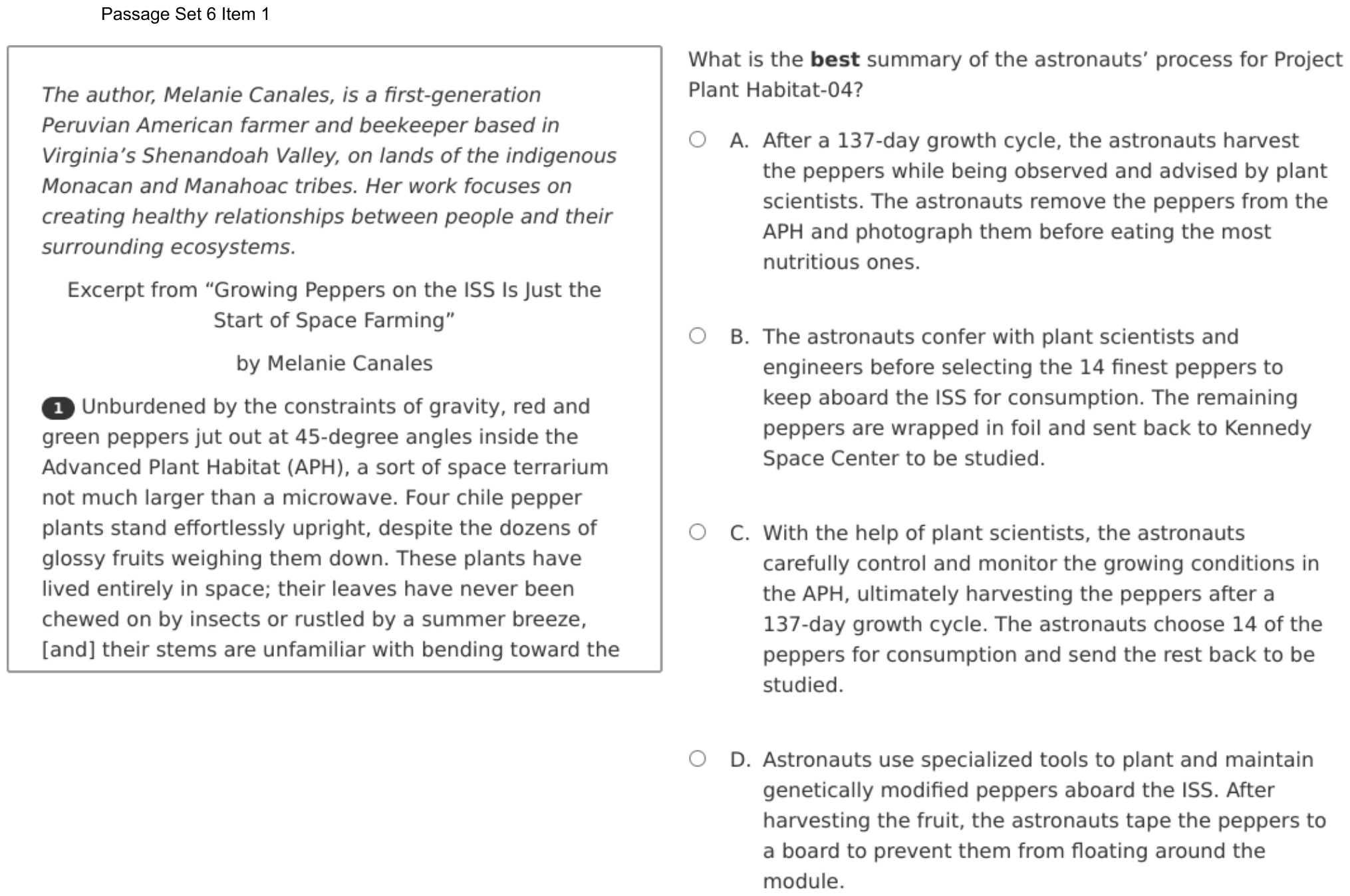
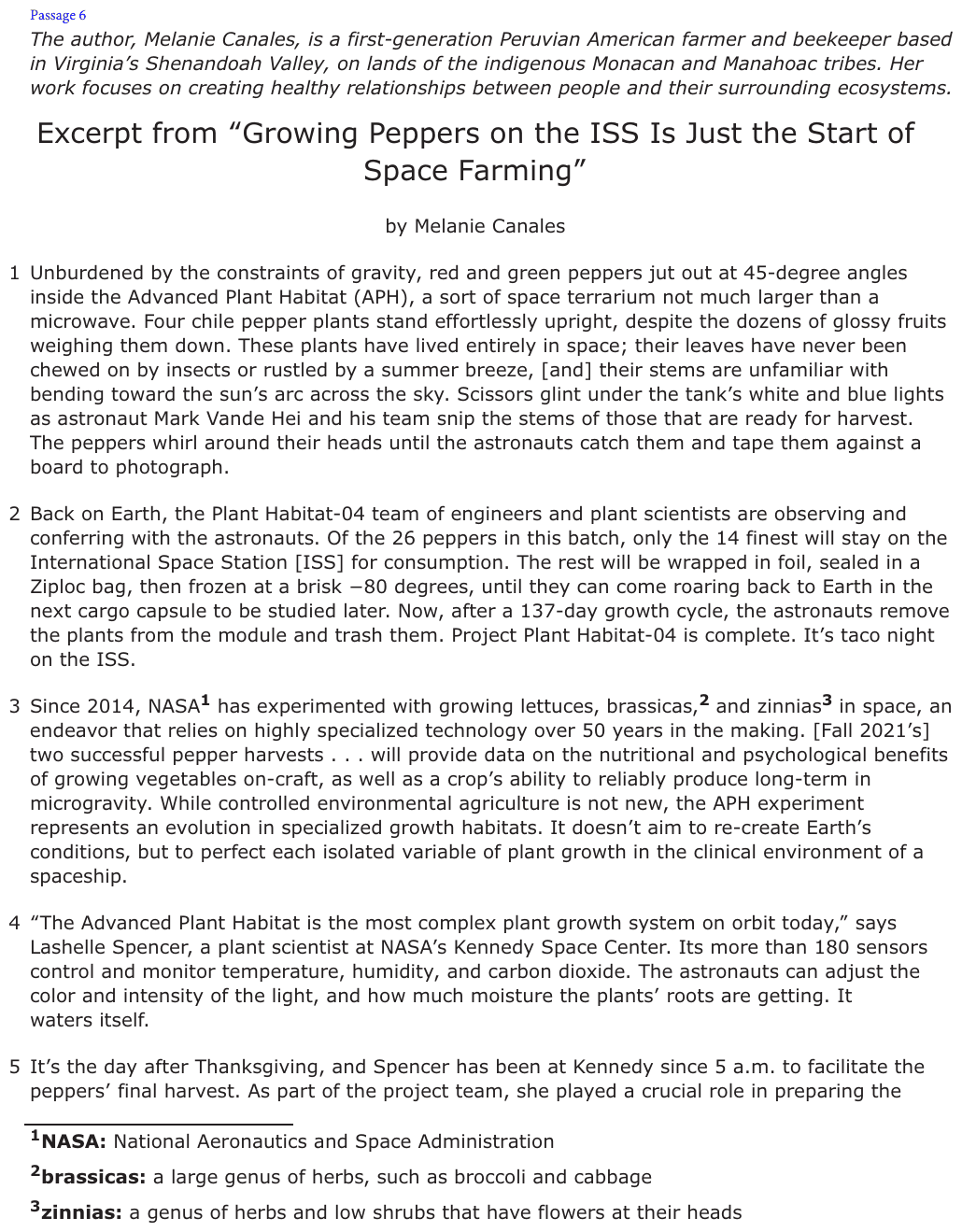
2026 Practice Test C English, question 34Passage Excerpt from “Growing Peppers on the ISS Is Just the Start of Space Farming”
Excerpt from “Growing Peppers on the ISS Is Just the Start of Space Farming”
by Melanie Canales
The author, Melanie Canales, is a first-generation Peruvian American farmer and beekeeper based in Virginia’s Shenandoah Valley, on lands of the indigenous Monacan and Manahoac tribes. Her work focuses on creating healthy relationships between people and their surrounding ecosystems.
Unburdened by the constraints of gravity, red and green peppers jut out at 45-degree angles inside the Advanced Plant Habitat (APH), a sort of space terrarium not much larger than a microwave. Four chile pepper plants stand effortlessly upright, despite the dozens of glossy fruits weighing them down. These plants have lived entirely in space; their leaves have never been chewed on by insects or rustled by a summer breeze, [and] their stems are unfamiliar with bending toward the sun’s arc across the sky. Scissors glint under the tank’s white and blue lights as astronaut Mark Vande Hei and his team snip the stems of those that are ready for harvest. The peppers whirl around their heads until the astronauts catch them and tape them against a board to photograph.
Back on Earth, the Plant Habitat-04 team of engineers and plant scientists are observing and conferring with the astronauts. Of the 26 peppers in this batch, only the 14 finest will stay on the International Space Station [ISS] for consumption. The rest will be wrapped in foil, sealed in a Ziploc bag, then frozen at a brisk −80 degrees, until they can come roaring back to Earth in the next cargo capsule to be studied later. Now, after a 137-day growth cycle, the astronauts remove the plants from the module and trash them. Project Plant Habitat-04 is complete. It’s taco night on the ISS.
Since 2014, NASA1 has experimented with growing lettuces, brassicas,2 and zinnias3 in space, an endeavor that relies on highly specialized technology over 50 years in the making. [Fall 2021’s] two successful pepper harvests . . . will provide data on the nutritional and psychological benefits of growing vegetables on-craft, as well as a crop’s ability to reliably produce long-term in microgravity. While controlled environmental agriculture is not new, the APH experiment represents an evolution in specialized growth habitats. It doesn’t aim to re-create Earth’s conditions, but to perfect each isolated variable of plant growth in the clinical environment of a spaceship.
“The Advanced Plant Habitat is the most complex plant growth system on orbit today,” says Lashelle Spencer, a plant scientist at NASA’s Kennedy Space Center. Its more than 180 sensors control and monitor temperature, humidity, and carbon dioxide. The astronauts can adjust the color and intensity of the light, and how much moisture the plants’ roots are getting. It waters itself.
It’s the day after Thanksgiving, and Spencer has been at Kennedy since 5 a.m. to facilitate the peppers’ final harvest. As part of the project team, she played a crucial role in preparing the seeds that were sent hurtling into space in June and guiding the astronauts through maintaining the plants in orbit. . . . Though astronauts can spend upwards of 100 days in space, their on-mission meals come dehydrated and pre-packaged; their vitamins and minerals are isolated in supplements, which lose nutritional value the longer they’re stored. Spencer’s goal is to create the conditions necessary for cultivating healthy plants in space, so those plants can sustain healthy astronauts on long-term missions. Astronaut food is great, she says—“especially the shrimp cocktail. But you’re missing that crunch. You’re missing that fresh pop of flavor, the green flavor that’s not there in that packaged food.”
The sensory experience of growing productive crops can also help mitigate4 the psychological effects of long-term space travel. . . . Spencer says the team cracked open the door of the APH every day to observe their vegetable companions with all the tenderness of home gardeners. When harvest day came, they batted their bounty around the ISS, taking selfies and delighting in watching the fruits pirouetting around the spacecraft. . . .
“We were thinking no heat, so that [the peppers] wouldn’t be dangerous, but maybe the astronauts need a little spice in their life,” says Paul Bosland, who along with his colleagues at the Chile Pepper Institute genetically engineered5 the NuMex Española Improved chile pepper seeds grown in Plant Habitat-04. . . .
Working with NASA, Bosland cultivated a variety that could accommodate both the nutritional needs of astronauts as well as the logistics of growing a plant in space. . . .
. . . The experiment is helping gather the data necessary to determine the nutritional content of crops grown in space, and therefore how many people they can feed, and for how long. Though much is still unknown, Spencer is certain of one thing that future astronauts will need to do: “I think in an optimal world, a scientist like me would say that they would be growing plants from day one. From the day they left to the day they came back, they would be growing them.”
From “Growing Peppers on the ISS Is Just the Start of Space Farming” by Melanie Canales from WIRED, December 21, 2021. Copyright © 2021 Condé Nast. All rights reserved.
1NASA: National Aeronautics and Space Administration
2brassicas: a large genus of herbs, such as broccoli and cabbage
3zinnias: a genus of herbs and low shrubs that have flowers at their heads
4mitigate: to make something less severe or harmful
5genetically engineered: combined parts of DNA from different plants to produce a new plant
Question
What is the best summary of the astronauts’ process for Project Plant Habitat-04?
- AAfter a 137-day growth cycle, the astronauts harvest the peppers while being observed and advised by plant scientists. The astronauts remove the peppers from the APH and photograph them before eating the most nutritious ones.
- BThe astronauts confer with plant scientists and engineers before selecting the 14 finest peppers to keep aboard the ISS for consumption. The remaining peppers are wrapped in foil and sent back to Kennedy Space Center to be studied.
- CWith the help of plant scientists, the astronauts carefully control and monitor the growing conditions in the APH, ultimately harvesting the peppers after a 137-day growth cycle. The astronauts choose 14 of the peppers for consumption and send the rest back to be studied.
- DAstronauts use specialized tools to plant and maintain genetically modified peppers aboard the ISS. After harvesting the fruit, the astronauts tape the peppers to a board to prevent them from floating around the module.
Show the answer
Correct answer: C
The question asks for the best summary of the astronauts’ process for Project Plant Habitat-04.
A. Incorrect. Although this summary mentions the pepper harvest and photographing and eating the peppers, it leaves out an important part of the process: the team’s preparation for growing the peppers and the return to Earth of some harvested peppers for study.
B. Incorrect. This summary includes the selection of some peppers for consumption and the return of some peppers for research; however, it omits important information about the previous steps required to develop the process for growing peppers.
C. CORRECT. This summary accurately and completely summarizes the astronauts’ process for Project Plant Habitat-04: collaborating with plant scientists, controlling the APH conditions, completing the 137-day growth cycle, harvesting the peppers, choosing 14 peppers to eat, and sending the remaining peppers back for study.
D. Incorrect. This summary focuses on information incidental to the process of growing peppers for Project Plant Habitat-04, mentioning the use of genetically modified peppers and the taping of harvested peppers to a board to keep them from floating, while omitting important steps such as the monitoring of growth and the selection of peppers for consumption and study.
Question analysis
This summary question asks which of four two-sentence summaries best captures the astronauts’ process for Project Plant Habitat-04, the chile pepper experiment aboard the International Space Station described in a WIRED article on space farming. Every choice repeats real details from the excerpt, so students must check each one for accuracy and for completeness instead of stopping at the first familiar fact.
- Grade level
- Grade 7 reading and task
- Compared with grade 7
- At grade 7 Summarizing a process is regular grade 7 work. These choices are long and two-part, and the steps are spread over several paragraphs of a technical article, but the excerpt tells the process in order, so the overall demand stays typical.
- Estimated difficulty
- Moderate: several steps, or a close reading with one strong distractor.
- Thinking it demands
- Depth of knowledge 2, skills and concepts · mainly understand
- What makes it hard
- Evidence in several places moderate
- A very close wrong answer moderate
- A lot to read minor
- Evidence
- Answered from several paragraphs or stanzas
- Reading level
- Passage: about grade 10, 890 words; question and choices: about grade 11, 162 words.
- Students, last 30 days
- Not enough answers yet to show (it takes 10).
Why it is hard, traps and wrong answers (shows the answer)
Why it is hard
Every summary is built from real details of the experiment, so the decision rests on completeness and accuracy rather than on recognition. Students who remember paragraph 2 best are drawn to the version that reports only the selection and the frozen peppers, while those who trust vivid details accept a meal of “the most nutritious” peppers or tape that stops them floating. The question rewards listing the stages, tending, harvesting, choosing and returning, before reading the choices.
Evidence in several places moderate Working it out
The process has to be pieced together out of order: the harvest opens paragraph 1, the 14 kept and the rest frozen come in paragraph 2, and the adjustable light and moisture only in paragraph 4. (Kirsch & Mosenthal, 1990; Gorin & Embretson, 2006)
A very close wrong answer moderate Choosing the answer
The summary about the 14 finest peppers and the frozen remainder is the key’s second sentence on its own; only the key adds the controlled growing conditions and the 137-day cycle before the harvest. (Embretson & Wetzel, 1987; Gorin & Embretson, 2006; Ascalon et al., 2007)
A lot to read minor Understanding the question
Each choice is two sentences of 34 to 44 words, so four summaries that mix accurate and inaccurate details must be read and compared one step at a time. (Kintsch, 1998; Gorin & Embretson, 2006; Freedle & Kostin, 1993)
Strategy: Before reading the choices, list in order what happens to the pepper plants across the opening paragraphs, then test each summary for details the excerpt does not support and for stages it leaves out.
Traps
- Too narrow: A single detail offered as the central idea or a summary, or a summary that keeps minor details and leaves out an essential part.
- Twists what the text says: Uses the text's topic and ideas but changes what it says: who did it, how much, when, or why.
The wrong answers, classified
A Too narrow (King et al., 2004)
Keeps the harvest, the photographs and the meal but drops the months of tending and the peppers sent back for study, and turns the “14 finest” into the most nutritious.
B Too narrow (King et al., 2004)
Reports paragraph 2 faithfully, the 14 finest kept for meals and the rest frozen for study, but covers only harvest day and leaves out the 137 days of growing before it.
D Twists what the text says (King et al., 2004)
Strings together side details, the engineered seeds and the board, and says the peppers were taped to stop them floating, though paragraph 1 says they were taped up to be photographed.
Working it out, step by step
Figure out what the question asks
This question asks for the best summary. A summary retells the main steps in order, in a few words. It leaves out small details. It must also be accurate, with no facts the article doesn’t give. Here you sum up what the astronauts did in Project Plant Habitat-04, from start to finish.
Find the steps in the article
The steps are spread over several paragraphs, and not in order.
- Growing: Spencer guided “the astronauts through maintaining the plants in orbit” (paragraph 5). The astronauts “can adjust the color and intensity of the light” (paragraph 4).
- Harvest: the crew snips the ripe peppers (paragraph 1) “after a 137-day growth cycle” (paragraph 2).
- Choosing: “only the 14 finest will stay” on the station “for consumption” (paragraph 2). Consumption means eating.
- Sending back: the rest are frozen and sent “back to Earth in the next cargo capsule to be studied later” (paragraph 2).
Put the process in plain words
So the whole process has four parts. First, the astronauts tend the plants for months, with help from scientists on Earth. Second, they harvest the peppers after 137 days. Third, they keep the 14 best peppers to eat. Fourth, they send the rest back to Earth to be studied. A good summary needs all four parts.
Check each choice
- A is wrong. It skips the months of growing and the peppers sent back. It also says they ate “the most nutritious ones,” but the article says “the 14 finest.”
- B is wrong. It covers only harvest day and leaves out the 137 days of growing. The article also never says the peppers go to Kennedy Space Center.
- C is right. It has all four parts: tending the plants with the scientists’ help, harvesting after 137 days, keeping 14, and sending the rest back.
- D is wrong. It strings together side details. The peppers were taped to a board “to photograph,” not to stop them floating.
Watch out: B closely repeats paragraph 2, so it feels right. But a summary of the process must include the growing, too.
Choose the answer
Only one summary covers the whole process, from tending the plants to sending peppers home. So the answer is C, “With the help of plant scientists, the astronauts carefully control and monitor the growing conditions in the APH, ultimately harvesting the peppers after a 137-day growth cycle. The astronauts choose 14 of the peppers for consumption and send the rest back to be studied.”
Why this answer and not the closest wrong one
B is the closest wrong answer. Its facts come from paragraph 2. But it starts on harvest day, so a reader would never learn that the astronauts tended the plants for 137 days. C keeps B’s ending and adds that growing stage. That makes C complete.
More questions like this
The original DOE question
The passage “Excerpt from “Growing Peppers on the ISS Is Just the Start of Space Farming”” as printed (pages 50–51)
Question 7 of 31
2026 Practice Test C English, question 41Uses the passage above: “Excerpt from “Growing Peppers on the ISS Is Just the Start of Space Farming””.
Question
How is the quotation from Lashelle Spencer at the end of paragraph 9 relevant to the discussion of the peppers referred to in paragraph 2?
- AThe quotation indicates that larger batches of peppers need to be grown during future missions and suggests a slight criticism of the astronauts discussed in paragraph 2 for not dedicating more of their time to growing peppers during their mission.
- BThe quotation explains why the 137-day growth cycle mentioned in paragraph 2 is necessary and provides a suggestion on how to grow more peppers during the same growth cycle in future missions.
- CThe quotation helps explain why some of the peppers discussed in paragraph 2 needed to be sent back to Earth and that increasing the overall number of peppers grown in space will be important in future missions.
- DThe quotation provides context for understanding why the peppers discussed in paragraph 2 must be sealed and frozen prior to their return to Earth and suggests how this method might be improved in upcoming missions.
Show the answer
Correct answer: C
The question asks how the quotation from Lashelle Spencer at the end of paragraph 9 is relevant to the discussion of the peppers referred to in paragraph 2.
A. Incorrect. The quotation from Spencer in paragraph 9 suggests that astronauts should spend more time on growing larger and more continuous batches of peppers during long missions, but it does not criticize astronauts for discarding plants and ending the experiment after the 137-day growth cycle.
B. Incorrect. While the quotation from Spencer in paragraph 9 stresses the value of spending more time growing plants in space, it does not provide specific details about the 137-day growth cycle or offer specific methods for producing more peppers within the same time frame.
C. CORRECT. The quotation from Spencer in paragraph 9 is relevant to the discussion of the peppers on the ISS in paragraph 2 because it emphasizes the importance of expanding plant-growing efforts on future space missions. Spencer suggests that rather than ending the experiment after the 137-day growth cycle, astronauts could continually replant and replenish their food supply from the beginning to the end of a long mission.
D. Incorrect. Although the quotation from Spencer in paragraph 9 conveys the importance of dedicating more time to growing plants in space, it does not explain why the peppers were sealed and frozen, nor does it suggest how this method for preserving them might be improved.
Question analysis
This question asks how Lashelle Spencer’s quotation at the end of the space-farming excerpt, her view of what future astronauts will need to do, relates to the account in paragraph 2 of how the pepper harvest was handled. Students must connect the article’s ending to its opening, and every choice is a long two-part statement whose halves have to be checked separately.
- Grade level
- Grade 8 reading and task
- Compared with grade 7
- Above grade 7 Grade 7 readers explain how parts of a text relate, usually neighboring ones. This item links the last paragraph to the second, and its four choices run about forty words each in two parts, so it asks more than typical grade 7 work.
- Estimated difficulty
- Hard: combines ideas, needs a plan, and has more than one tempting wrong answer.
- Thinking it demands
- Depth of knowledge 3, strategic thinking · mainly analyze
- What makes it hard
- Reading between the lines moderate
- A very close wrong answer moderate
- A lot to read moderate
- Evidence in several places minor
- Evidence
- Answered from several paragraphs or stanzas
- Reading level
- Passage: about grade 10, 890 words; question and choices: about grade 16, 163 words.
- Students, last 30 days
- Not enough answers yet to show (it takes 10).
Why it is hard, traps and wrong answers (shows the answer)
Why it is hard
Each choice has one half that sounds connected to the quotation, so students must test both halves of all four. The criticism choice is the hardest to reject, since it correctly hears a call for more growing and only then misreads Spencer’s tone. The key itself is not airtight: its first half leans on the sentence before the quotation, about gathering nutrition data, so the answer is best confirmed by ruling out the others.
Reading between the lines moderate Working it out
Spencer’s quotation never mentions paragraph 2; the link is that plants grown “from day one” to “the day they came back” contrast with one 137-day batch harvested and thrown away. (Graesser, Singer & Trabasso, 1994; Kintsch, 1998)
A very close wrong answer moderate Choosing the answer
The criticism choice shares the key’s call for more growing on future missions and differs in its other half, a slight criticism of the crew that Spencer’s hopeful “in an optimal world” never makes. (Embretson & Wetzel, 1987; Gorin & Embretson, 2006; Ascalon et al., 2007)
A lot to read moderate Understanding the question
The four choices run 32 to 40 words, and each joins two claims with “and,” so eight separate statements must be checked against the quotation and paragraph 2. (Kintsch, 1998; Gorin & Embretson, 2006; Freedle & Kostin, 1993)
Evidence in several places minor Working it out
The two parts to connect are the excerpt’s second paragraph and its last sentence, with six paragraphs on the habitat, Spencer and Bosland in between. (Kirsch & Mosenthal, 1990; Gorin & Embretson, 2006)
Strategy: Put Spencer’s closing quotation into your own words and recall how the pepper project ended in paragraph 2, then weigh both halves of every choice and keep the one the quotation and its paragraph best support.
Traps
- Half right: One half of a two-part choice is right and the other is not.
- Twists what the text says: Uses the text's topic and ideas but changes what it says: who did it, how much, when, or why.
The wrong answers, classified
A Half right (King et al., 2004; Thissen, Steinberg & Fitzpatrick, 1989)
Rightly hears a call for larger, continuous harvests in “from day one,” then adds a criticism of the crew, though Spencer describes an ideal and blames no one.
B Twists what the text says (King et al., 2004)
Connects the quotation to the 137-day cycle because both concern time, but Spencer neither explains why the cycle lasted that long nor suggests packing more peppers into it.
D Twists what the text says (King et al., 2004)
Ties the quotation to the foil, sealing and freezing in paragraph 2 and to improving that method, though Spencer’s improvement is growing plants all mission long, not storing peppers.
Working it out, step by step
Figure out what the question asks
This question links the end of the article to its beginning. Spencer speaks at the end of paragraph 9. Paragraph 2 tells what happened to the peppers. You need the choice that best explains how her words connect to those peppers. Each choice has two parts, and both must be true.
Recall the peppers in paragraph 2
Paragraph 2 says only “the 14 finest” peppers stay on the ISS to eat. The rest are frozen and sent “back to Earth in the next cargo capsule to be studied later.” Then, “after a 137-day growth cycle, the astronauts remove the plants from the module and trash them.” So the crew grew one batch, ate some, sent some home and threw the plants away.
Read the end of paragraph 9
Just before Spencer speaks, paragraph 9 says: “The experiment is helping gather the data necessary to determine the nutritional content of crops grown in space, and therefore how many people they can feed, and for how long.” Then Spencer says that in “an optimal world,” meaning the best possible world, astronauts “would be growing plants from day one.” She adds: “From the day they left to the day they came back, they would be growing them.”
Connect the two parts
The peppers sent home are studied. That gives the data paragraph 9 describes: how healthy space crops are and how many people they can feed. Spencer’s plan needs that data. You must know what a crop can feed before you plan meals for a whole trip. Her words also point to the future. Instead of one batch that ends in the trash, crews would grow plants all trip long. That means many more peppers.
Check each choice
- A is wrong. Spencer wants more growing, but she doesn’t criticize the crew. “In an optimal world” describes a hope, not a complaint.
- B is wrong. She never says why the cycle took 137 days. She doesn’t suggest squeezing more peppers into it, either.
- C is right. The returned peppers give the data, and growing “from day one” means more peppers in the future.
- D is wrong. She says nothing about freezing the peppers or a better way to store them.
Watch out: A gets the first half right. The criticism in its second half is what makes it wrong.
Choose the answer
Her words explain why some peppers went home to be studied and why more growing matters next time. So the answer is C, “The quotation helps explain why some of the peppers discussed in paragraph 2 needed to be sent back to Earth and that increasing the overall number of peppers grown in space will be important in future missions.”
Why this answer and not the closest wrong one
A is the closest wrong answer. Like C, it hears Spencer calling for more plants on future trips. But A also says she criticizes the astronauts. She doesn’t. She calmly describes a perfect world. C keeps the right half and adds a link the paragraph supports: the peppers sent home give the data.
More questions like this
The original DOE question
Question 8 of 31
2026 Practice Test D English, question 11Passage Excerpt from “How We Made the First Flight”
Excerpt from “How We Made the First Flight”
by Orville Wright
In 1903 brothers Wilbur and Orville Wright conducted experiments related to flying machines. These experiments would eventually lead to air travel becoming a reliable form of transportation.
During the night of December 16, 1903, a strong cold wind blew from the north. When we arose on the morning of the 17th, the puddles of water, which had been standing about camp since the recent rains, were covered with ice. The wind had a velocity of 10 to 12 meters per second (22 to 27 miles an hour). We thought it would die down before long, and so remained indoors the early part of the morning. But when ten o’clock arrived, and the wind was as brisk as ever, we decided that we had better get the machine out and attempt a flight. We hung out the signal for the men of the Life Saving Station.1 We thought that by facing the flyer into a strong wind, there ought to be no trouble in launching it from the level ground about camp. We realized the difficulties of flying in so high a wind, but estimated that the added dangers in flight would be partly compensated for by the slower speed in landing.
Final Preparations
We laid the track on a smooth stretch of ground about one hundred feet north of the new building. The biting cold wind made work difficult, and we had to warm up frequently in our living room, where we had a good fire in an improvised stove made of a large carbide2 can. By the time all was ready, J. T. Daniels, W. S. Dough and A. D. Etheridge, members of the Kill Devil3 Life Saving Station; W. C. Brinkley of Manteo, and Johnny Moore, a boy from Nags Head,4 had arrived.
We had a “Richard” hand anemometer with which we measured the velocity of the wind. Measurements made just before starting the first flight showed velocities of 11 to 12 meters per second, or 24 to 27 miles per hour. . . .
Audacity—and Calculation
Wilbur having used his turn in the unsuccessful attempt on the 14th, the right to the first trial now belonged to me. After running the motor a few minutes to heat it up, I released the wire that held the machine to the track, and the machine started forward in the wind. Wilbur ran at the side of the machine, holding the wing to balance it on the track. Unlike the start on the 14th, made in a calm, the machine, facing a 27-mile wind, started very slowly. Wilbur was able to stay with it till it lifted from the track after a forty-foot run. One of the Life Saving men snapped the camera for us, taking a picture just as the machine had reached the end of the track and had risen to a height of about two feet. The slow forward speed of the machine over the ground is clearly shown in the picture by Wilbur’s attitude. He stayed along beside the machine without any effort.
Flight
The course of the flight up and down was exceedingly erratic, partly due to the irregularity of the air, and partly to lack of experience in handling this machine. The control of the front rudder was difficult on account of its being balanced too near the center. This gave it a tendency to turn itself when started; so that it turned too far on one side and then too far on the other. As a result the machine would rise suddenly to about ten feet, and then as suddenly dart for the ground. A sudden dart when a little over a hundred feet from the end of the track, or a little over 120 feet from the point at which it rose into the air, ended the flight. As the velocity of the wind was over 35 feet per second and the speed of the machine over the ground against this wind ten feet per second, the speed of the machine relative to the air was over 45 feet per second, and the length of the flight was equivalent to a flight of 540 feet made in calm air. This flight lasted only 12 seconds, but it was nevertheless the first in the history of the world in which a machine carrying a man had raised itself by its own power into the air in full flight, had sailed forward without reduction of speed and had finally landed at a point as high as that from which it started.
From “How We Made the First Flight” by Orville Wright—Public Domain/Federal Aviation Administration
1Life Saving Station: one of the rescue stations along the Atlantic coastline that provided assistance to mariners in distress
2carbide: a very hard material composed of carbon and other heavy metals
3Kill Devil: the town of Kill Devil Hills in eastern North Carolina
4Nags Head: a town in eastern North Carolina
Question
How do the details in paragraph 5 about the uneven nature of the flight convey a central idea of the excerpt?
- Aby explaining how the flawed design of the machine caused it to turn unpredictably in the air and brought the first flight by a person to an abrupt end
- Bby indicating that the difficulty in controlling the flight was caused by the rudimentary instruments of the machine and the inexperience of the pilot
- Cby explaining how the pilot and the plane overcame adverse conditions in order to complete the first piloted flight
- Dby indicating that the gradual change in wind velocity created an extreme environment in which to maneuver the plane and maintain its flight
Show the answer
Correct answer: C
The question asks how the details in paragraph 5 about the uneven nature of the flight convey a central idea of the excerpt.
A. Incorrect. Paragraph 5 explains that the rudder was unbalanced and the effect that this issue had on the flight, but the rudder was only part of the reason for the short flight. The length of the flight is not a central idea of the excerpt.
B. Incorrect. Although paragraph 5 does explain that the equipment contributed to the difficulty of controlling the plane’s flight, the lack of control over the flight is not a central idea of the excerpt, which focuses instead on the Wright brothers’ achievement of a successful flight despite the challenges involved.
C. CORRECT. The details in paragraph 5 describe the difficulties that the weather conditions and mechanical issues presented and how Orville’s flight was successful despite those problems. The Wright brothers’ ability to overcome difficult circumstances and complete the first flight is a central idea of the excerpt.
D. Incorrect. While paragraph 5 does emphasize the difficulty caused by the wind, it does not describe a “gradual change” in the wind, only that it was irregular.
Question analysis
This central-idea question asks how the details in paragraph 5 of Orville Wright’s “How We Made the First Flight,” which describe the machine darting up and down because of uneven air, a hard-to-control front rudder and the pilot’s inexperience, convey a central idea of the excerpt. The paragraph also includes speeds and distances, and students must decide what its details mean for the account as a whole.
- Grade level
- Grade 8 reading and task
- Compared with grade 7
- At grade 7 Linking a paragraph’s details to a central idea is regular grade 7 work. This paragraph is long and technical, with a rudder problem and a calculation of speeds, and most choices restate its problems accurately, so students must decide what the details add up to.
- Estimated difficulty
- Moderate: several steps, or a close reading with one strong distractor.
- Thinking it demands
- Depth of knowledge 2, skills and concepts · mainly understand
- What makes it hard
- The right answer is reworded moderate
- A lot to read minor
- Reading between the lines minor
- Evidence
- Answered from one paragraph or stanza
- Reading level
- Passage: about grade 7, 816 words; question and choices: about grade 12, 115 words.
- Students, last 30 days
- Not enough answers yet to show (it takes 10).
Why it is hard, traps and wrong answers (shows the answer)
Why it is hard
Most of paragraph 5 is about trouble, the uneven air, a rudder balanced too near the center, an inexperienced pilot and a dart that ended the flight, and two wrong choices describe that trouble accurately. What turns the details into a central idea is the paragraph’s last sentence, which calls the 12-second flight the first of its kind in history. Students who stop before it, or who take the problems as the point, miss that the excerpt is a story of success.
The right answer is reworded moderate Choosing the answer
The key’s “overcame adverse conditions” sums up the paragraph in new words, while the wrong choices repeat its own: the rudder’s “tendency to turn itself,” the dart that “ended the flight,” the “lack of experience” and “the velocity of the wind.” (Freedle & Kostin, 1993; Kirsch & Mosenthal, 1990)
A lot to read minor Understanding the question
Paragraph 5 runs about 250 words, and its problems and a 61-word speed calculation all come before the closing sentence, the only one that presents the flight as a success. (Kintsch, 1998; Gorin & Embretson, 2006; Freedle & Kostin, 1993)
Reading between the lines minor Working it out
The paragraph never says anyone overcame anything; students must set its problems beside its last sentence, a machine that “sailed forward” and landed “as high as that from which it started,” to see success despite them. (Graesser, Singer & Trabasso, 1994; Kintsch, 1998)
Strategy: Note what each part of paragraph 5 describes, from its first sentence to its last, then decide what the excerpt as a whole is about and choose the option that ties the two together.
Traps
- Too narrow: A single detail offered as the central idea or a summary, or a summary that keeps minor details and leaves out an essential part.
- True but not the answer: A choice says something accurate about the text that does not answer this question.
- Twists what the text says: Uses the text's topic and ideas but changes what it says: who did it, how much, when, or why.
The wrong answers, classified
A Too narrow (King et al., 2004)
Gets the rudder and the dart that ended the flight right but builds on that one failure, dropping the paragraph’s closing point that the short flight was still history’s first.
B True but not the answer (King et al., 2004; Embretson & Wetzel, 1987)
Restates the paragraph’s own explanation of the erratic course, inexperience and a hard-to-control rudder, which is accurate, but treats the lack of control as the point when the excerpt builds toward success.
D Twists what the text says (King et al., 2004)
Picks up “the velocity of the wind” and the hard flying but invents a “gradual change” in the wind, when the paragraph speaks only of “the irregularity of the air.”
Working it out, step by step
Figure out what the question asks
This is a central idea question. A central idea is a main point of the whole excerpt. Paragraph 5 describes an uneven, bumpy flight. The question asks how those details support a main point. So read the whole paragraph, including its last sentence.
Find the problems in paragraph 5
Paragraph 5 begins “The course of the flight up and down was exceedingly erratic, partly due to the irregularity of the air, and partly to lack of experience in handling this machine.” Erratic means jumpy and hard to predict. The front rudder, a part that steers, was hard to control. The machine “would rise suddenly to about ten feet, and then as suddenly dart for the ground.”
Read the last sentence
Then the paragraph turns. It says “This flight lasted only 12 seconds, but it was nevertheless the first in the history of the world in which a machine carrying a man had raised itself by its own power into the air in full flight.” Nevertheless means “even so.” The wind, the hard steering and the pilot’s inexperience all worked against him. Even so, the flight worked. Conditions that work against you are called adverse.
Check each choice
- A does not fit. The rudder problem and the sudden end are real. But A stops there and misses that the flight was a first.
- B does not fit. Paragraph 5 does blame the rudder and the pilot’s inexperience. But the excerpt is about success, not about the lack of control.
- C fits. The problems show what Orville overcame to make the first flight.
- D does not fit. The paragraph never says the wind changed gradually, or slowly. It speaks of “the irregularity of the air.”
Watch out: B is tempting because it repeats the paragraph’s own reasons for the bumpy flight. But true details are not the same as the main point.
Choose the answer
The problems in paragraph 5 make the success at the end more impressive. So the answer is C, “by explaining how the pilot and the plane overcame adverse conditions in order to complete the first piloted flight.”
Why this answer and not the closest wrong one
B is the closest wrong choice. It is true that the rudder and the pilot’s “lack of experience” made the flight hard to control. But that is only the first part of paragraph 5. The last sentence calls the flight the first of its kind. The problems show what had to be overcome. C ties the details to that success.
More questions like this
The original DOE question
The passage “Excerpt from “How We Made the First Flight”” as printed (pages 13–14)
Question 9 of 31
2026 Practice Test D English, question 40Passage Martial Arts for the Mind and Body
Martial Arts for the Mind and Body
(1) The martial arts blend a series of physical movements with strategic mental discipline so that practitioners can defend themselves, physically defeat an opponent, or both. (2) Historians are unsure of exactly when and where martial arts were first used. (3) Martial arts have been practiced by several different societies for many centuries. (4) Martial arts such as karate, kung fu, tae kwon do, and judo are still taught and practiced as methods of self-defense, but they offer students more than that. (5) The study of martial arts can provide students with a way to enhance their mental discipline as well as their physical fitness.
(6) Discipline, focus, and respect are important qualities for everyone to have. (7) However, for most people these qualities are not innate; they must be learned and practiced. (8) The study of martial arts can provide an opportunity to develop these skills. (9) Students are rewarded for their dedication by passing tests and advancing to higher ranks or levels. (10) For example, in a typical tae kwon do class, students learn discipline by diligently practicing moves, improve focus by listening carefully, and demonstrate respect by bowing to the instructor and following directions.
(11) For teenagers, martial arts classes provide a safe and structured environment for gaining physical skills, building confidence, and enjoying a sense of community. (12) A lot of teens go through hard situations as they try to do well in school and in life. (13) A martial arts class can provide teens with a physical outlet for stress while also challenging them mentally. (14) Participating in a martial arts program also helps children and teens focus on self-improvement rather than on competition. (15) Progressing through levels of achievement involves mastering more physically demanding techniques. (16) It requires students to take responsibility and be accountable for achieving set goals. (17) Students gain confidence and experience companionship with other students who are progressing through the ranks.
(18) Adults who practice martial arts can experience many of the same benefits that younger people do, but perhaps the greatest of these is health and fitness. (19) Adult martial arts students often see changes in their body within weeks of beginning a program.
(20) For people interested in studying a martial art, there are many ways to learn and practice. (21) In addition to private studios, community recreation centers often offer low-cost or free martial arts classes. (22) There are even online videos that introduce students to the basic concepts. (23) People should study martial arts.
Question
Which concluding sentence should replace sentence 23 to best support the topic presented in the passage?
- AWith so many ways to begin studying martial arts, people can easily discover how the skills needed to progress in rank may help them in life.
- BBy taking advantage of opportunities to practice martial arts, people can experience the satisfaction of achieving goals while also improving themselves.
- CBecause people are eager to reap the mental and physical benefits of studying martial arts, enrollment in martial arts courses has increased.
- DWhile taking martial arts classes can improve health for both young people and adults, the effects are clearly more immediate for adults.
Show the answer
Correct answer: B
The question asks for the concluding sentence that best replaces sentence 23 and supports the topic presented in the passage.
A. Incorrect. The phrase “the skills needed to progress in rank” is vague, and progressing in rank is not related to the overall topic of the passage, which is the benefits of studying martial arts. The topic of the passage is not the “many ways to begin studying martial arts” or how “people can easily discover” the benefits of martial arts.
B. CORRECT. This option is correct because it best supports the topic of the passage—the benefits of studying martial arts—by stating two reasons why people should study martial arts: to “experience the satisfaction of achieving goals while also improving themselves.”
C. Incorrect. Some readers may choose this option because it refers to the benefits of martial arts, but the word “because” and the detail that “enrollment in martial arts courses has increased” make this sentence unrelated to the overall topic of the passage, which is about the benefits of studying martial arts, not the number of people who participate.
D. Incorrect. Although the benefits of studying martial arts are described for both teens (in the third paragraph) and adults (in the fourth paragraph), the topic of the passage is the overall benefits of studying martial arts, which include mental discipline (discussed in the first, second, and third paragraphs) in addition to health benefits. Furthermore, the passage does not compare the health effects of studying martial arts across age groups.
Question analysis
This conclusion question asks which sentence should replace sentence 23, the bare closing line “People should study martial arts,” to best support the topic of the passage. Students must keep all five paragraphs in view, from mental discipline to fitness to ways of getting started, because every choice sounds like a reasonable final line when read on its own.
- NYS standards
- 7W2e concluding informative writing
- Grade level
- Grade 8 reading and task
- Compared with grade 7
- Above grade 7 Grade 7 writers choose conclusions that follow from a passage’s topic. This passage covers mental and physical benefits for different ages, and each long choice picks up a real thread, so judging the best fit takes more than typical grade 7 work.
- Estimated difficulty
- Hard: combines ideas, needs a plan, and has more than one tempting wrong answer.
- Thinking it demands
- Depth of knowledge 2, skills and concepts · mainly evaluate
- What makes it hard
- A very close wrong answer moderate
- Evidence in several places moderate
- A lot to read minor
- Evidence
- Answered from the whole text
- Reading level
- Passage: about grade 11, 402 words; question and choices: about grade 12, 106 words.
- Corrected from the DOE handbook
- The DOE printed this question’s explanation after a different question; the site matches the question with its own explanation.
- Students, last 30 days
- Not enough answers yet to show (it takes 10).
Why it is hard, traps and wrong answers (shows the answer)
Why it is hard
Every ending borrows something real from the passage: ways to begin, ranks, mental and physical benefits, or adults’ quick results. The work is deciding what the whole passage is about, the benefits of martial arts for mind and body, and then noticing which ending adds a new claim or shrinks the topic. The rank-based ending is hardest to reject because it is shaped like the key and promises help “in life,” but its focus is how easily people discover rank skills.
A very close wrong answer moderate Choosing the answer
The rank choice is built like the key, a phrase about ways or chances to train followed by what people gain; it differs in resting on the vague “skills needed to progress in rank.” (Embretson & Wetzel, 1987; Gorin & Embretson, 2006; Ascalon et al., 2007)
Evidence in several places moderate Working it out
The topic is pieced together from all five paragraphs, from the opening’s mind-and-body claim through teens, adults’ fitness and ways to learn, so a fitting ending must cover both kinds of benefit. (Kirsch & Mosenthal, 1990; Gorin & Embretson, 2006)
A lot to read minor Understanding the question
Each choice is a two-part sentence of 21 to 26 words, and each picks up a real thread of the passage, so all four must be held against the topic. (Kintsch, 1998; Gorin & Embretson, 2006; Freedle & Kostin, 1993)
Strategy: State the passage’s topic in a few words using all five paragraphs, then test each ending: does it sum up that topic, or does it narrow it or add a new claim?
Traps
- Off the point: Adds or keeps something that does not support the paragraph's or the passage's focus, or an introduction or conclusion that misses the main point.
- Too narrow: A single detail offered as the central idea or a summary, or a summary that keeps minor details and leaves out an essential part.
The wrong answers, classified
A Too narrow (King et al., 2004)
Follows on from the last paragraph’s many ways to start, but rests the ending on vague “skills needed to progress in rank,” one thread of paragraphs 2 and 3, not the benefits overall.
C Off the point (Halliday & Hasan, 1976)
Names the passage’s “mental and physical benefits,” which fits, but ends on rising enrollment, a claim about numbers of students that the passage never discusses.
D Half right (King et al., 2004; Thissen, Steinberg & Fitzpatrick, 1989)
Rightly says training can improve health for young people and adults, but adds that adults clearly benefit sooner, a comparison the passage never makes, and drops the mental benefits.
What was corrected from the DOE handbook, and why
- Explanation: In the DOE’s explanations appendix, the explanation printed after this question belongs to question 39 (“the sentence that would best follow and support sentence 18”) and marks C correct, and this question’s explanation (“the concluding sentence that best replaces sentence 23 and supports the topic presented in the passage”) is printed after question 39, marking B correct. Read page by page, the appendix gives this question the answer C. The site gives the question the explanation that restates it, and the answer follows that explanation: B, because it sums up the passage’s topic, the benefits of studying martial arts.
Working it out, step by step
Figure out what the question asks
This asks for a better last sentence. A good concluding sentence sums up the topic of the whole passage. Sentence 23, “People should study martial arts,” is short and plain. It doesn’t remind the reader why.
Find the passage’s topic
Sentence 5 states the topic. Martial arts can help students “enhance their mental discipline as well as their physical fitness.” Enhance means improve. Paragraph 2 covers discipline, focus and respect. Paragraph 3 covers teens and goals. Paragraph 4 covers adults and fitness. Paragraph 5 lists ways to start. So the topic is how martial arts help both mind and body.
Name the rule
A conclusion should sum up the main point. It should not shrink the point or add a brand-new claim. For example, after a report on why sleep matters, a good ending is Getting enough sleep helps both your body and your mind. A poor one is More people buy pillows now.
Check each choice
- A is wrong. It rests on vague “skills needed to progress in rank,” one small part of the passage.
- B is right. “Opportunities to practice” follows paragraph 5. “Achieving goals” and “improving themselves” sum up the benefits.
- C is wrong. Enrollment is the number of people who sign up. The passage never says it has gone up.
- D is wrong. The passage never says adults see results sooner than young people. D also leaves out the benefits to the mind.
Watch out: A is built like B and promises help “in life.” But it shrinks the topic to rank skills.
Choose the answer
B sums up what the whole passage says martial arts offer. So the answer is B, “By taking advantage of opportunities to practice martial arts, people can experience the satisfaction of achieving goals while also improving themselves.”
Why this answer and not the closest wrong one
A is the closest wrong answer. Like B, it starts with ways to begin and ends with what people gain. But its gain is vague “skills needed to progress in rank.” That is only one thread of the passage. B sums up the whole topic: reaching goals and improving yourself.
More questions like this
The original DOE question
The passage “Martial Arts for the Mind and Body” as printed (page 52)
Question 10 of 31
2025 Practice Test B English, question 35Passage Using Fire to Keep a Prairie Healthy
Using Fire to Keep a Prairie Healthy
Inside the 40,000-acre Joseph H. Williams Tallgrass Prairie Preserve in northern Oklahoma, herds of bison roam on the scenic land that is home to hundreds of different species of plants and animals. While one of the greatest threats to the prairie is wildfire, the use of controlled fires is actually an effective way to protect this idyllic landscape.
Fires that are started by lightning or other natural circumstances are inevitable, and the results can be disastrous. However, hundreds of years ago the American Indian people who inhabited the Great Plains area between Minnesota and Texas realized that these fires could also be helpful. The bison in the area seemed to prefer grazing on tender new grass on the recently burned land rather than on grass in the unburned areas. The American Indian people began to deliberately burn areas of land for bison to graze on, which enticed the herds away from the people’s crops.
Today conservationists at the Tallgrass Prairie Preserve and farmers in the Great Plains continue to use controlled burns for land management. Intentionally burning a portion of land can dramatically improve the quality of the vegetation that regrows there. The fires burn away weedy undergrowth and help limit the overcrowding of shrubs and trees in the burn area, creating less competition for water and nutrients. Additionally, the process of burning excess plant matter adds nitrogen, an essential element for plant growth, to the soil.
One common target of controlled burns at the preserve and the surrounding area is the invasive red cedar tree. A single red cedar tree can consume up to 40 gallons of water per day, taking this vital resource away from other plant life. These tall trees also cast shade that prevents sunlight from reaching the plants beneath them. The fast-growing red cedar trees tend to crowd out prairie grasses, the primary food source for wild and domestic animals that make the prairie their home. An imbalance in one component of the prairie’s ecosystem affects the entire web of life. Controlled burns help maintain this ecosystem’s delicate balance.
Of course, these controlled fires are intended to burn only a portion of an area. A total burn, which is a risk with an uncontrolled wildfire, would destroy all wildlife as well as the crops farmers plant for income. The key to using controlled fires is knowing which areas of land to burn and when. Conservation experts at the preserve employ the “patch-burn” approach, meaning they rotate which portion of land is burned each year. They study the land to find out which areas would most benefit from being burned, and then they arrange about a dozen burns over one-third of the land. This patch burning contains the fire within a specific area and allows animals in the burn area to safely relocate. The following year, conservationists will burn a different section of the preserve, while the land burned the previous year regrows healthier than before.
Researchers have tracked and studied the variety of plant species and animals that live on the preserve, and their studies show that the patch-burn approach has restored biodiversity to the area by promoting the growth of species that were at risk of being crowded out. The patch-burn system is so successful that the conservationists at the preserve provide training to prairie farmers about conducting controlled burns on their own land. Burning land to make it healthy may seem counterintuitive, but strategic controlled fires have helped the prairie sustain life for hundreds of years and, with careful management, will continue to do so.
Question
Which details from the passage best convey the central idea that using the patch-burn method is an effective way to protect and manage prairie land?
- Athe explanation that conservationists use the alternating burn pattern of the patch-burn method in order to allow the animals in the area to avoid the fire
- Bthe information that conservationists evaluate which land would most benefit from a controlled burn before applying the patch-burn method
- Cthe information that conservationists have determined that the patch-burn method has promoted the growth of species that were at risk of being crowded out
- Dthe explanation that conservationists are able to control the fire in the patch-burn method by arranging separate burns across the designated portion of land
Show the answer
Correct answer: C
The question asks which details from the passage best convey the central idea that using the patch-burn method is an effective way to protect and manage prairie land.
A. Incorrect. The author explains in paragraph 5 that “patch burning contains the fire within a specific area and allows animals in the burn area to safely relocate.” This explanation conveys two supporting ideas: the patch-burn method is controllable, and patch-burn fires do not pose a threat to animals. However, this explanation does not address the broader central idea that the patch-burn method is an effective way to protect and manage prairie land.
B. Incorrect. In paragraph 5, the author states that “the key to using controlled fires is knowing which areas of land to burn and when.” The author then provides information about how conservation experts “study the land to find out which areas would most benefit from being burned.” However, these details convey supporting ideas rather than the central idea that using the patch-burn method is an effective way to protect and manage prairie land.
C. CORRECT. In paragraph 3, the author states that “fires burn away weedy undergrowth and help limit the overcrowding of shrubs and trees in the burn area, creating less competition for water and nutrients.” Also, in paragraph 6, the author states that patch burning “has restored biodiversity to the area by promoting the growth of species that were at risk of being crowded out.” These details directly convey the central idea that using the patch-burn method is an effective way to protect and manage prairie land.
D. Incorrect. The author explains in paragraph 5 how conservationists “arrange about a dozen burns over one-third of the land,” which helps show how the patch-burn method is applied by conservationists. However, this is a supporting detail that conveys the idea that the burns are deliberately set and carefully controlled. This detail does not convey the central idea that using the patch-burn method is an effective way to manage and protect prairie land.
Question analysis
This evidence question on the article about controlled burns at an Oklahoma tallgrass prairie preserve asks which details best convey the central idea that the patch-burn method is an effective way to protect and manage prairie land. Every choice reports something the article really says about the method, so students must decide which details speak most directly to the central idea as stated.
- Grade level
- Grade 7 reading and task
- Compared with grade 7
- At grade 7 Matching details to a stated central idea is regular grade 7 work, and the article is short and clearly written. Each choice is a long, accurate description, so the work lies in judging relevance rather than truth, which is typical.
- Estimated difficulty
- Moderate: several steps, or a close reading with one strong distractor.
- Thinking it demands
- Depth of knowledge 2, skills and concepts · mainly evaluate
- What makes it hard
- Every choice must be checked moderate
- Evidence in several places minor
- A lot to read minor
- Evidence
- Answered from several paragraphs or stanzas
- Reading level
- Passage: about grade 11, 598 words; question and choices: about grade 13, 118 words.
- Students, last 30 days
- Not enough answers yet to show (it takes 10).
Why it is hard, traps and wrong answers (shows the answer)
Why it is hard
The central idea joins three words, protect, manage and effective, and each wrong choice speaks to protect or manage with a step in carrying out the method: keeping animals safe, choosing the land, controlling the fire. Only a result shows that the method is effective, and the one result offered is the return of species once at risk of being crowded out. Students who ask what each detail proves, not what it is about, separate how the method works from whether it works.
Every choice must be checked moderate Choosing the answer
All four choices report the patch-burn method accurately, the animals’ safe relocation, the study of the land, the dozen burns and the restored species, so truth rules none out; each must be tested for proof the method works. (Embretson & Wetzel, 1987)
Evidence in several places minor Working it out
Three choices come from paragraph 5, where the method is explained, while the result that shows it works, restored biodiversity, sits in paragraph 6, after the description ends. (Kirsch & Mosenthal, 1990; Gorin & Embretson, 2006)
A lot to read minor Understanding the question
Each choice is a noun phrase of 19 to 26 words opening “the explanation that” or “the information that,” so four long details must be unpacked before they can be compared. (Kintsch, 1998; Gorin & Embretson, 2006; Freedle & Kostin, 1993)
Strategy: Restate the central idea in your own words, noting what “effective” requires, then ask of each choice whether that detail would persuade a doubtful reader of the whole idea.
Traps
- Supports only part of the claim: In a question about evidence: a line that backs one half of the claim but not the other, or a related point rather than the claim itself.
The wrong answers, classified
A Supports only part of the claim (King et al., 2004; Thissen, Steinberg & Fitzpatrick, 1989)
Links “protect” in the central idea to the animals’ chance to “safely relocate” in paragraph 5, a true detail of how patch burns are run, not proof they improve the prairie.
B Supports only part of the claim (King et al., 2004; Thissen, Steinberg & Fitzpatrick, 1989)
Hears effectiveness in “would most benefit,” but experts studying the land before a burn shows how they plan where to burn, not that the burns have worked.
D Supports only part of the claim (King et al., 2004; Thissen, Steinberg & Fitzpatrick, 1989)
Connects “manage” and “protect” to fire kept under control by arranging “about a dozen burns over one-third of the land,” which shows how the method is applied, not what it achieves.
Working it out, step by step
Figure out what the question asks
This asks which details best support a central idea. A central idea is a main point the whole passage develops. Here the idea is given: the patch-burn method is an effective way to protect and manage prairie land. Effective means it works and gets good results. So look for details that show results, not just how the method is done.
Find how the method works
Paragraph 5 explains the patch-burn method. The experts “rotate which portion of land is burned each year.” Rotate means take turns. First, “They study the land to find out which areas would most benefit from being burned.” Then “they arrange about a dozen burns over one-third of the land.” This “contains the fire within a specific area and allows animals in the burn area to safely relocate.” These details tell how the method is done.
Find what the method achieves
Paragraph 6 gives the results. Researchers studied the plants and animals on the preserve. Their studies show “that the patch-burn approach has restored biodiversity to the area by promoting the growth of species that were at risk of being crowded out.” Biodiversity means many kinds of living things. A species is one kind of plant or animal. Crowded out means pushed aside, the way red cedars crowd out prairie grasses in paragraph 4. So the method helped species that were losing ground. That shows it works.
Check each choice
- A does not fit. Animals escaping safely shows the burns are done with care. It does not show the land gets healthier.
- B does not fit. Studying the land is a planning step before a burn. It shows how the experts choose, not whether the burns work.
- C fits. It reports a result: the method helped species that were at risk.
- D does not fit. Arranging a dozen burns shows how the fire is kept under control. It does not show what the burns achieve.
Watch out: D sounds like “manage,” since the experts control the fire. But controlling a fire is part of doing the method. Only a result proves the method is effective.
Choose the answer
Only one choice shows the patch-burn method getting good results. So the answer is C, “the information that conservationists have determined that the patch-burn method has promoted the growth of species that were at risk of being crowded out.”
Why this answer and not the closest wrong one
D is the closest wrong choice. Careful control sounds like good management. But D only describes how the burns are set up. A method can be done carefully and still fail. C gives the proof that it works: studies show the burns “restored biodiversity.” Paragraph 6 even calls the system “so successful.”
More questions like this
The original DOE question
The passage “Using Fire to Keep a Prairie Healthy” as printed (page 41)
Question 11 of 31
2024 Test A English, question 16Passage Excerpt from “Impressions of an Indian Childhood”
Excerpt from “Impressions of an Indian Childhood”
by Zitkala-Sa
Zitkala-Sa (Gertrude Simmons Bonnin) was a Native American writer, musician, teacher, and political activist who was raised on the Yankton Sioux Reservation in South Dakota. In 1900 she published “Impressions of an Indian Childhood” (the term Indian was commonly used at the time to refer to Native American people) to expose readers to what life is like on a reservation.
Soon after breakfast Mother sometimes began her beadwork. On a bright, clear day, she pulled out the wooden pegs that pinned the skirt of our wigwam1 to the ground, and rolled the canvas part way up on its frame of slender poles. Then the cool morning breezes swept freely through our dwelling, now and then wafting the perfume of sweet grasses from newly burnt prairie.
Untying the long tasseled strings that bound a small brown buckskin2 bag, my mother spread upon a mat beside her bunches of colored beads, just as an artist arranges the paints upon his palette. On a lapboard she smoothed out a double sheet of soft white buckskin; and drawing from a beaded case that hung on the left of her wide belt a long, narrow blade, she trimmed the buckskin into shape. Often she worked upon small moccasins for her small daughter. Then I became intensely interested in her designing. With a proud, beaming face, I watched her work. In [my] imagination, I saw myself walking in a new pair of snugly fitting moccasins. I felt the envious eyes of my playmates upon the pretty red beads decorating my feet.
Close beside my mother I sat on a rug, with a scrap of buckskin in one hand and an awl in the other. This was the beginning of my practical observation lessons in the art of beadwork. From a skein3 of finely twisted threads of silvery sinews my mother pulled out a single one. With an awl she pierced the buckskin, and skillfully threaded it with the white sinew. Picking up the tiny beads one by one, she strung them with the point of her thread, always twisting it carefully after every stitch.
It took many trials before I learned how to knot my sinew thread on the point of my finger, as I saw her do. Then the next difficulty was in keeping my thread stiffly twisted, so that I could easily string my beads upon it. My mother required of me original designs for my lessons in beading. At first I frequently ensnared many a sunny hour into working a long design. Soon I learned from self-inflicted punishment to refrain from drawing complex patterns, for I had to finish whatever I began.
After some experience I usually drew easy and simple crosses and squares. These were some of the set forms. My original designs were not always symmetrical nor sufficiently characteristic, two faults with which my mother had little patience. The quietness of her oversight made me feel strongly responsible and dependent upon my own judgment. She treated me as a dignified little individual as long as I was on my good behavior; and how humiliated I was when some boldness of mine drew forth a rebuke from her!
In the choice of colors she left me to my own taste. I was pleased with an outline of yellow upon a background of dark blue, or a combination of red and myrtle-green. There was another of red with a bluish-gray that was more conventionally used. When I became a little familiar with designing and the various pleasing combinations of color, a harder lesson was given me. It was the sewing on, instead of beads, some tinted porcupine quills, moistened and flattened between the nails of the thumb and forefinger. My mother cut off the prickly ends and burned them at once in the centre fire. These sharp points were poisonous, and worked into the flesh wherever they lodged. For this reason, my mother said, I should not do much alone in quills until I was as tall as my cousin Warca-Ziwin.
Always after these confining lessons I was wild with surplus spirits, and found joyous relief in running loose in the open again. Many a summer afternoon a party of four or five of my playmates roamed over the hills with me. We each carried a light sharpened rod about four feet long, with which we pried up certain sweet roots. When we had eaten all the choice roots we chanced upon, we shouldered our rods and strayed off into patches of a stalky plant under whose yellow blossoms we found little crystal drops of gum. Drop by drop we gathered this nature’s rock-candy, until each of us could boast of a lump the size of a small bird’s egg. Soon satiated with its woody flavor, we tossed away our gum, to return again to the sweet roots.
From “Impressions of an Indian Childhood” by Zitkala-Sa—Public Domain
A BRIEF HISTORY OF BEADWORK IN SOUTH DAKOTA
| Date | Event |
|---|---|
| 1500s | The Dakota use beads made from bones, shells, stones, and animal teeth. European traders bring glass beads to North America. |
| Late 1600s | The Dakota begin trading with the French in Minnesota. |
| 1830s | The Dakota begin using glass beads in clothing, artwork, and decorations in place of Native-made beads. |
| 1862–1865 | The Dakota are expelled from their homelands in Minnesota as a result of the U.S.-Dakota War. |
| 1900s–1920s | The Dakota create items to sell outside their community. |
Source: MNopedia
1wigwam: hut with an arched framework of poles covered with bark, mats, or animal hides
2buckskin: leather made from the skin of a male deer
3skein: coiled length of yarn or other thread loosely wound on a reel
Question
Which sentence best summarizes the process of beading that is described in the excerpt?
- ATake a buckskin bag full of beads and spread them out on a mat in different colors like a paint palette; take a double sheet of buckskin and smooth it out on a table; take a sinew and awl and thread the beads onto the buckskin in a desired pattern.
- BCut the double sheet of buckskin into a shape; take a skein of sinew and pierce the buckskin with an awl; thread the sinew with beads of many different colors in a simple or complex pattern; twist the sinew to keep it tight after every stitch into the buckskin.
- CArrange the beads into groups of colors on a mat; smooth out a double sheet of buckskin and cut it to shape; take a single thread of sinew; pierce the buckskin with an awl; thread the buckskin with the sinew and string it with beads, carefully twisting after every stitch.
- DGather beads, buckskin, sinew, and awl and place them on a mat; cut the buckskin into the desired shape; decide on a pattern for the beads and create it using the sinews and the awl; thread the beads onto the sinew in the desired pattern and twist it tight.
Show the answer
Correct answer: C
The question asks which sentence best summarizes the process of beading that is described in the excerpt.
A. Incorrect. In paragraphs 2 and 3, the author describes how at the beginning of the process her mother “smoothed out a double sheet of soft white buckskin” on a lapboard (paragraph 2) and how she strings the beads into a pattern. However, this sentence does not describe the steps that take place between the preparation and the stringing of the beads. Thus, this sentence does not best summarize the beading process.
B. Incorrect. In paragraphs 2 and 3, the author describes the process her mother uses to string the beads with “the point of her thread, always twisting it carefully after every stitch” (paragraph 3). While this sentence includes some of the steps in the beading process, it does not describe the necessary preparation, namely spreading the beads out on a mat and smoothing out the buckskin on a lapboard. Thus, this sentence does not best summarize the beading process.
C. CORRECT. This sentence best summarizes the process of beading that is described in the excerpt because it includes details about each step in the process. In paragraph 2, the author explains how her mother “spread upon a mat beside her bunches of colored beads” and how “on a lapboard she smoothed out a double sheet of soft white buckskin; and drawing from a beaded case that hung on the left of her wide belt a long, narrow blade, she trimmed the buckskin into shape.” The author continues her description in paragraph 3, stating, “From a skein of finely twisted threads of silvery sinews my mother pulled out a single one. With an awl she pierced the buckskin, and skillfully threaded it with the white sinew. Picking up the tiny beads one by one, she strung them with the point of her thread, always twisting it carefully after every stitch.”
D. Incorrect. In paragraphs 2 and 3, the author describes the process her mother uses as she “smoothed out a double sheet of soft white buckskin” (paragraph 2) on a lapboard before stringing the beads. While this sentence includes most of the steps in the beading process, it excludes the step of piercing the buckskin. This sentence also provides few details about the process of beading and uses vague wording to describe each step. Therefore, the sentence does not best summarize the beading process.
Question analysis
This reading question asks which sentence best summarizes the beadwork process Zitkala-Sa watches her mother carry out, from laying out the materials to stringing the beads. Each choice is a long list of steps, so students must compare them detail by detail with the excerpt and notice what each one adds, leaves out or misplaces.
- Grade level
- Grade 8 reading and task
- Compared with grade 7
- Above grade 7 Summarizing a process is grade 7 reading, but the four summaries are long and nearly alike, and checking them against two paragraphs of 1900 prose with words like awl, sinew and skein is heavier than usual.
- Estimated difficulty
- Hard: combines ideas, needs a plan, and has more than one tempting wrong answer.
- Thinking it demands
- Depth of knowledge 2, skills and concepts · mainly understand
- What makes it hard
- Every choice must be checked major
- A lot to read moderate
- Hard words minor
- Evidence
- Answered from several paragraphs or stanzas
- Reading level
- Passage: about grade 8, 946 words; question and choices: about grade 16+, 212 words.
- Corrected from the DOE handbook
- An inaccurate detail about the excerpt in the explanation was corrected.
- Students, last 30 days
- Not enough answers yet to show (it takes 10).
Why it is hard, traps and wrong answers (shows the answer)
Why it is hard
This question is won by bookkeeping, not insight: list the mother's steps from the two paragraphs, then hold each long summary against the list. The most tempting wrong summary reads like a sensible craft routine in a sensible order, yet it never has the buckskin pierced and puts every tool on the mat. Others open with a familiar image or close with precise stitching while skipping steps, so students who check only the beginning or only the end are caught.
Every choice must be checked major Choosing the answer
Each summary is a chain of four to six steps, so all four must be checked step by step against paragraphs 2 and 3 for steps missing, added or out of order. (Embretson & Wetzel, 1987)
A lot to read moderate Understanding the question
The four choices together run to about 200 words of semicolon-linked steps, and the text they summarize is two paragraphs of dense 1900 prose. (Kintsch, 1998; Gorin & Embretson, 2006; Freedle & Kostin, 1993)
Hard words minor Understanding the question
Words like awl, sinew, skein and lapboard name the tools and materials, and a student unsure of them cannot tell which steps a summary has dropped. (Perfetti, 2007; Freedle & Kostin, 1993)
Strategy: List the mother's steps from paragraphs 2 and 3 in order, then check each choice against your list for a missing step, an invented detail or a step out of place.
Traps
- Too narrow: A single detail offered as the central idea or a summary, or a summary that keeps minor details and leaves out an essential part.
The wrong answers, classified
A Too narrow (King et al., 2004)
Keeps the familiar palette image but leaves out trimming the buckskin, piercing it with the awl and twisting the thread, and even moves the smoothing onto a table.
B Too narrow (King et al., 2004)
Matches paragraph 3's piercing and twisting closely but leaves out the preparation, laying out the beads and smoothing the buckskin, and starts the process with cutting.
D Too narrow (King et al., 2004)
Accepts a tidy, well-ordered outline that keeps most steps but leaves out smoothing the buckskin and piercing it with the awl, and piles every tool onto the mat.
What was corrected from the DOE handbook, and why
- Explanation: In rejecting choice B, the handbook says the choice leaves out the preparation, “namely spreading the beads and the buckskin out on a table.” The excerpt mentions no table: in paragraph 2 the mother spreads the beads on a mat and smooths out the buckskin on a lapboard. The explanation now says so. (Choice A’s “on a table” is part of a wrong answer and is left as printed.)
Working it out, step by step
Figure out what the question asks
You need the summary that best matches the beading steps in the excerpt. A summary is a short retelling of the main points. The best one keeps every main step, in order, and adds nothing new.
List the steps from paragraphs 2 and 3
Paragraphs 2 and 3 give the mother’s steps in order. The last one ends with her “always twisting it carefully after every stitch.”
- Spread the beads on a mat.
- Smooth out a double sheet of buckskin on a lapboard (a board held on the lap).
- Trim the buckskin into shape with a blade.
- Pull out a single sinew, a strong thread.
- Pierce (poke a hole in) the buckskin with an awl, a pointed tool.
- Thread the sinew through the buckskin.
- String the beads, twisting the thread after every stitch.
Check each choice against the list
- A is wrong. It skips trimming, piercing and twisting. It also says “on a table,” but she used a lapboard.
- B is wrong. It starts with cutting. It skips spreading the beads and smoothing the buckskin.
- C is right. It has every step, in the same order.
- D is wrong. It never says to smooth the buckskin or pierce it. It also puts every tool on the mat, but only the beads went there.
Watch out: D sounds like a sensible plan in a sensible order. But a summary must match the excerpt, not just sound right. Check it step by step.
Choose the answer
Only C follows the mother’s steps from start to finish. So the answer is C.
Why this answer and not the closest wrong one
D is the closest wrong answer. It is neat and keeps most of the steps. But it skips smoothing the buckskin and never says to pierce it with the awl. It also piles every tool onto the mat. C matches the excerpt step for step, so it is the best summary.
More questions like this
The original DOE question
The passage “Excerpt from “Impressions of an Indian Childhood”” as printed (pages 42–43)
Question 12 of 31
2024 Test A English, question 37Passage 5 Reasons Physical Books Might Be Better Than E-Books
5 Reasons Physical Books Might Be Better Than E-Books
by Shaunacy Ferro
Though e-book1 readers have become a more common sight around town, traditional books still have their evangelists.2 According to The New York Times, e-book sales have been falling in 2015. Print definitely isn’t dead. In fact, according to some research, it may actually be a better choice for some readers. While scientists are still trying to tease out exactly how digital reading affects us differently, here are five ways e-books might be inferior to their dead-tree cousins.
E-books can reduce reading comprehension.
In a study of middle schoolers, West Chester University researchers found that students who read on iPads3 had lower reading comprehension than when they read traditional printed books. They discovered that the kids sometimes skipped text in favor of interactive features in the e-books, suggesting that certain multimedia in children’s e-books can be detrimental to the practice of reading itself. However, the researchers noted that some interactive features in e-books are designed to enhance comprehension, and that those might be more helpful than game-type interactive graphics.
Young kids can get distracted by e-books.
Similar results were found by a small study by the Joan Ganz Cooney Center that consisted of 32 kids reading e-books and print books with their parents. It found that “enhanced” e-books might be distracting. Kids who read enhanced e-books—ones with interactive, multimedia experiences—were more engaged with them physically, but in the end they remembered fewer narrative details than those who read print books or basic e-books.
You remember less about a book’s timeline.
Another study of adults also found that e-books can be hard to absorb. The researchers asked 25 people to read a 28-page story on a Kindle4 and 25 to read the story in paperback, then asked the readers to put 14 events from the story in chronological order. Those who read the story on a Kindle performed worse on the chronology test than the book readers, though they performed about the same as print readers in other tests. Earlier research by the same scholars, from Stavanger University in Norway, found that Norwegian 10th graders also remembered more about texts if they read them in print rather than on a computer screen.
They’re not great as textbooks.
While e-book textbooks are often cheaper (and easier to carry) than traditional door-stop5 textbooks, college students often don’t prefer them. In some surveys of college kids, the majority of students have reported preferring print books. However, a 2012 study from the UK’s National Literacy Trust of kids ages 8 to 16 found that more than 50 percent of children reported preferring screen reading.
They’re tiring.
Staring at a lit screen can be tiring for the eyes and the brain. A 2005 study from Sweden found that reading digitally required a higher cognitive workload than reading on paper. Furthermore, staring at LED6 screens at night can disrupt sleep patterns. A 2014 Harvard study found that people who used e-readers with LED screens at night slept worse and were more tired the next day. So, if you’re going to go for an e-book, go for one without the backlight.
The take-away message? If you’re really trying to absorb material, you might want to go for a physical book. And if you’re going to be up all night studying, turn off the backlight.
However, all this may not mean that reading on a Kindle is really going to melt your brain. For instance, reading an e-book on a computer is a much different experience than reading on a Kindle, which is specifically designed for consuming books. So, too, is playing with an interactive e-book on an iPad, compared to using a simpler e-book device that only presents the text, with no opportunities to click away into digital distractions.
And some studies have found that part of the difference between the way people absorb information from e-books versus paper might be due to approaching e-books differently—in one test, participants didn’t regulate their study time with digital books like they did with paper texts, leading to worse performances. It’s possible that our expectations of e-book reading—as well as the different designs of the digital reading experience on a computer or iPad or Kindle—might affect how we approach the text and how much effort we put into studying them. As generations of e-book readers evolve, and people become more accustomed to the idea of sitting down with a digital textbook, these factors could change—for better or for worse.
“5 Reasons Physical Books Might Be Better Than E-Books” by Shaunacy Ferro from MENTAL FLOSS, October 2, 2015. Copyright © 2015 Mental Floss, Inc.
1e-book: an electronic book, a publication made available digitally for reading on a computer or other device
2evangelists: advocates or supporters
3iPads: tablet computers
4Kindle: device for reading e-books
5door-stop: a reference to the idea that some textbooks are large and heavy enough to hold a door open
6LED: Light-emitting diode; LEDs are often used as a backlight for electronic devices such as smart phones and tablets.
Question
Which sentence from the passage suggests that people in the future will likely choose e-books over print books?
- A“They discovered that the kids sometimes skipped text in favor of interactive features in the e-books, suggesting that certain multimedia in children’s e-books can be detrimental to the practice of reading itself.” (paragraph 2)
- B“However, the researchers noted that some interactive features in e-books are designed to enhance comprehension, and that those might be more helpful than game-type interactive graphics.” (paragraph 2)
- C“Kids who read enhanced e-books—ones with interactive, multimedia experiences—were more engaged with them physically, but in the end they remembered fewer narrative details than those who read print books or basic e-books.” (paragraph 3)
- D“However, a 2012 study from the UK’s National Literacy Trust of kids ages 8 to 16 found that more than 50 percent of children reported preferring screen reading.” (paragraph 5)
Show the answer
Correct answer: D
The question asks which sentence from the passage suggests that people in the future will likely choose e-books over print books.
A. Incorrect. While this sentence from paragraph 2 implies high engagement with the interactive features of e-books, it does not provide explicit evidence indicating that engagement with e-books is a reason for choosing them over print books.
B. Incorrect. While this sentence from paragraph 2 highlights some of the benefits of e-books, such as the potential to “enhance comprehension,” those benefits are not explicitly linked to readers choosing e-books over print books.
C. Incorrect. This sentence from paragraph 3 provides evidence that shows both benefits and drawbacks of reading e-books, including higher engagement but a decreased ability to recall details. Therefore, the sentence does not clarify why readers would choose e-books over print books.
D. CORRECT. In this sentence from paragraph 5, the author cites a 2012 study that found that over 50 percent of 8- to 16-year-olds “reported preferring screen reading.” Since this specific age group will one day influence the future of reading and the results of the study point to a significant percentage preferring screen reading, this sentence provides compelling evidence for what readers will prefer in the future.
Question analysis
Based on a magazine article about e-books and printed books, this question asks which quoted sentence suggests that people in the future will likely choose e-books over print. Students must reason from a present-day research finding to a likely future, while each quoted sentence reports research on children and e-books.
- NYS standards
- 7R1 textual evidence and inferences
- Grade level
- Grade 7 reading and task
- Compared with grade 7
- At grade 7 Drawing a logical inference from a quoted finding is typical grade 7 evidence work. The sentences are printed in the choices, so the reading load is light, but the student must still reason from a study's results to readers' future choices.
- Estimated difficulty
- Straightforward: two steps or one careful reading.
- Thinking it demands
- Depth of knowledge 2, skills and concepts · mainly evaluate
- What makes it hard
- Reading between the lines moderate
- A lot to read minor
- Evidence
- Answered from one sentence or line
- Reading level
- Passage: about grade 10, 829 words; question and choices: about grade 15, 138 words.
- Students, last 30 days
- Not enough answers yet to show (it takes 10).
Why it is hard, traps and wrong answers (shows the answer)
Why it is hard
The question asks for a prediction, but the article only reports studies of the present, so the student has to decide what kind of finding could point to the future. Preference is the link: what children choose now hints at what readers will choose later. Sentences about engagement and well-designed features sound favorable to e-books, yet they describe how e-books work, not whether anyone prefers them.
Reading between the lines moderate Working it out
No sentence mentions the future; the student must see that children of 8 to 16 who prefer screens today are tomorrow's readers, a step the article leaves unstated. (Graesser, Singer & Trabasso, 1994; Kintsch, 1998)
A lot to read minor Understanding the question
Each choice is a full quoted sentence of 26 to 34 words, three of them packed with study details, so comparing the four takes more reading than the short stem suggests. (Kintsch, 1998; Gorin & Embretson, 2006; Freedle & Kostin, 1993)
Strategy: Decide what kind of evidence could predict what people will choose later, then check each sentence for that kind of evidence instead of general praise or criticism of e-books.
Traps
- Reads too much in: A reasonable-sounding conclusion that goes further than the text allows.
- Supports only part of the claim: In a question about evidence: a line that backs one half of the claim but not the other, or a related point rather than the claim itself.
The wrong answers, classified
A Reads too much in (Graesser, Singer & Trabasso, 1994)
Reads kids skipping text “in favor of interactive features” as a liking that will win readers, though the sentence presents the habit as “detrimental” to reading.
B Supports only part of the claim (King et al., 2004; Thissen, Steinberg & Fitzpatrick, 1989)
Takes features “designed to enhance comprehension” as a sign e-books will win out, but the sentence is about what some features might do, not what readers choose.
C Reads too much in (Graesser, Singer & Trabasso, 1994)
Treats children being “more engaged with them physically” as a lasting preference, ignoring that they remembered fewer details and that the study measured engagement and recall, not preference.
Working it out, step by step
Understand the prediction
This asks for evidence that points to the future. But the article reports only studies of the past and present. So you need a clue about today that hints at what readers will choose later.
Think about what predicts a choice
What people will choose later depends on what they like now. So look for a sentence about preference, which means the thing a person likes better. It helps if those people are young, because young readers are the readers of the future.
Find the preference sentence
Choice D quotes a 2012 study of “kids ages 8 to 16.” It found that “more than 50 percent of children reported preferring screen reading.” So more than half of these young readers already like screens better. As they grow up, many of them may keep choosing e-books.
Check each choice
- D fits: young readers already prefer screens, which hints at the future.
- A is wrong because skipping text is called “detrimental,” or harmful, and it shows no one choosing e-books.
- B is wrong because it tells what some features might do, not what readers like.
- C is wrong because the study measured how much kids remembered, not which books they liked.
Watch out: B and C sound good for e-books. But neither one says what readers choose.
Choose the answer
Only D tells what young readers prefer, which points to later choices. So the answer is D.
Why this answer and not the closest wrong one
B comes closest, since features “designed to enhance comprehension” sound like a reason e-books might win. But the sentence only says what some features are meant to do. It says nothing about what readers choose. D reports what more than half of young readers already prefer, and that hints at the future.
More questions like this
The original DOE question
The passage “5 Reasons Physical Books Might Be Better Than E-Books” as printed (pages 58–59)
Question 13 of 31
2024 Test B English, question 8Passage Find Time to Volunteer
Find Time to Volunteer
(1) Many people believe that they gain a greater sense of purpose by giving their time to serve others. (2) These are the people who spend their free time volunteering at various places within the community. (3) Those who are served benefit from the work of these volunteers. (4) However, research shows that those who volunteer also receive benefits.
(5) For many students, this proposition may sound impossible. (6) Schoolwork can require hours of study each week. (7) Volunteering at a retirement center or homeless shelter requires both time and energy. (8) Extracurricular activities fill up after-school time. (9) Family obligations and part-time jobs often have to be worked into the schedule, too. (10) However, if students can find time to volunteer, even for a few hours a month, they may find that the benefits outweigh the scheduling difficulties.
(11) To begin with, students who engage in volunteer activities acquire valuable skills and experience, which can help them focus on potential fields of study and career options. (12) Furthermore, when students list volunteer work on college applications, admissions counselors see applicants who care about making their community and college campus a better place.
(13) Volunteerism benefits more than students applying to college. (14) This type of experience is equally important for students moving directly into the workforce after high school. (15) Volunteering demonstrates initiative, dedication, and a strong work ethic, qualities that companies value in a potential employee. (16) In a CareerBuilder study, 60 percent of managers regarded volunteerism as a significant asset when considering applicants.
(17) Students who volunteer undoubtedly make a positive investment in their future, but they also affect their present quality of life. (18) Studies have shown that volunteering is good for both the mind and the body. (19) Volunteering can boost mood levels and reduce anxiety. (20) According to the Mayo Clinic,1 the feeling of doing something meaningful and the appreciation received from that action can reduce stress.
(21) Even the busiest of students can find a way to donate some time to a worthy cause. (22) Though managing different commitments may seem overwhelming at times, students are sure to feel a sense of fulfillment in volunteerism.
1Mayo Clinic: a nonprofit medical organization dedicated to treatment and research
Question
Which of these would best follow sentence 12 and support the ideas presented in the third paragraph (sentences 11–12)?
- AThese students show that they are likely to be responsible, reliable, and helpful young adults. Admissions counselors know that character traits like these will benefit the applicants as well as whomever they interact with.
- BVolunteering can help students meet new people who can provide references and advice to the students when they are applying to colleges. It can also be an invaluable opportunity for students to meet possible future employers.
- CThe counselors hope that young adults who demonstrate this behavior will go on to volunteer during their college years, working on campus in student government and leadership programs or serving in the community at hospitals, schools, and homeless shelters.
- DMany colleges are looking for students who are not just academically successful but who also work well with others and care about improving and serving surrounding communities.
Show the answer
Correct answer: D
The question asks which option would best follow sentence 12 to support the ideas presented in the third paragraph (sentences 11–12).
A. Incorrect. The subject of the main clause in sentence 12 is “admissions counselors.” Although the second sentence in the option mentions “admissions counselors,” it does not support the ideas in the paragraph, because the statement that “admissions counselors know that character traits like these will benefit the applicants” focuses on how students benefit, while sentence 12 focuses on how these traits benefit the community.
B. Incorrect. While sentence 11 discusses the potential academic and professional connections that can be made through volunteering, sentence 12 moves on to the topic of college admissions. Since the sentences in the option revert back to the topic of connections, they do not support and logically follow a sentence about how college admissions counselors view students with volunteering experience.
C. Incorrect. Although the sentence in the option continues on the subject of admissions counselors and follows the idea in sentence 12 that these counselors tend to favor students who “care about making their community and college campus a better place,” the sentence focuses on what students will do while in college rather than on how volunteering helps them get into college. Therefore, the sentence does not best follow sentence 12 and support the ideas presented in the third paragraph.
D. CORRECT. In sentence 12, the author states that college admissions counselors view students who list volunteer work on admissions applications as “applicants who care about making their community and college campus a better place.” The sentence in the option best follows sentence 12 and supports the ideas in the third paragraph because it provides additional details about why admissions counselors look beyond academics when considering students for admissions and the positive qualities assigned to those who have volunteering experience.
Question analysis
This supporting-details question asks which addition would best follow the volunteering essay’s sentence about how college admissions counselors view applicants who list volunteer work. Every option mentions college and sounds reasonable on its own, so students must decide which one develops the paragraph’s point rather than drifting to a related idea.
- NYS standards
- 7W1b supporting claims with evidence
- Grade level
- Grade 8 reading and task
- Compared with grade 7
- Above grade 7 Grade 7 students choose evidence that supports a claim. Here the options are one or two full sentences, all of them about college, and the right fit depends on the precise idea in sentence 12, a finer judgment than usual.
- Estimated difficulty
- Hard: combines ideas, needs a plan, and has more than one tempting wrong answer.
- Thinking it demands
- Depth of knowledge 2, skills and concepts · mainly evaluate
- What makes it hard
- A very close wrong answer major
- How sentences fit together moderate
- A lot to read minor
- Evidence
- Answered from one paragraph or stanza
- Reading level
- Passage: about grade 11, 354 words; question and choices: about grade 13, 153 words.
- Students, last 30 days
- Not enough answers yet to show (it takes 10).
Why it is hard, traps and wrong answers (shows the answer)
Why it is hard
Every option stays on the subject of college, so the work is matching sentence 12’s exact idea: counselors see applicants who care about making their community a better place. The near miss also explains what counselors value, but it swaps caring for the community for a new set of traits and ends on what those traits do for the applicants. Students who restate sentence 12 before reading the options can hear that the right one simply widens it, from community service to what colleges want beyond grades.
A very close wrong answer major Choosing the answer
The right sentence and the two-sentence option about responsible, reliable, helpful students both explain why volunteers impress admissions; only the right one keeps sentence 12’s point, caring about improving communities. (Embretson & Wetzel, 1987; Gorin & Embretson, 2006; Ascalon et al., 2007)
How sentences fit together moderate Working it out
The new sentence must extend sentence 12’s specific idea, what admissions counselors see in volunteers, rather than return to sentence 11’s skills and careers or move on to college life. (Halliday & Hasan, 1976)
A lot to read minor Understanding the question
The options run 27 to 39 words, two of them two sentences long, and all four are about college, so topic alone rules none of them out. (Kintsch, 1998; Gorin & Embretson, 2006; Freedle & Kostin, 1993)
Strategy: Restate sentence 12 in your own words, then ask of each option whether it explains or extends that exact point about what admissions counselors value.
Traps
- Off the point: Adds or keeps something that does not support the paragraph's or the passage's focus, or an introduction or conclusion that misses the main point.
The wrong answers, classified
A Off the point (Halliday & Hasan, 1976)
Follows the admissions counselors from sentence 12 but replaces caring for the community with new traits, responsibility and reliability, and turns to how those traits help the applicants.
B Off the point (Halliday & Hasan, 1976)
Is drawn by “applying to colleges,” but networking for references and future employers is a new benefit that neither sentence 11 nor sentence 12 develops.
C Off the point (Halliday & Hasan, 1976)
Stays with the counselors and picks up “college campus” from sentence 12, but jumps ahead to what students might do in college instead of explaining admission decisions.
Working it out, step by step
Figure out what the question asks
You need the sentence that best follows sentence 12. A good next sentence adds to the same idea. It does not jump to a new point. Example: after Dogs make loyal pets, the sentence They stay by their owners’ side fits. Dogs come in many colors drifts away. So first put sentence 12 in your own words.
Restate sentence 12
Sentence 12 says that “when students list volunteer work on college applications, admissions counselors see applicants who care about making their community and college campus a better place.” Admissions counselors are the people who choose which students get into a college. So the idea is this: colleges like volunteers because volunteers care about their communities.
Check each choice
- D says colleges want students who are “not just academically successful.” That means more than good grades. They also want students who “care about improving and serving surrounding communities.” That explains sentence 12 and builds on it.
- A swaps in new traits: “responsible, reliable, and helpful.” Then it says those traits help the applicants and the people around them. It drops caring for the community.
- B brings in a new benefit: meeting people who can give advice or jobs. Neither sentence 11 nor sentence 12 talks about that.
- C jumps ahead to what students might do in college. It doesn’t explain how volunteering helps them get in.
Pick the answer
Watch out: A is the most tempting. It is about what counselors value, just like the right answer. But it changes the reason they value it. Only D keeps sentence 12’s idea of caring for the community. So the answer is D.
Why this answer and not the closest wrong one
A is the closest wrong answer. Like D, it explains why admissions counselors like volunteers. But A’s reasons are new ones, such as being responsible and reliable. D keeps sentence 12’s exact idea, caring about the community, and adds that colleges want more than good grades. So D supports the paragraph best.
More questions like this
The original DOE question
The passage “Find Time to Volunteer” as printed (page 163)
Question 14 of 31
2024 Test B English, question 18Passage Excerpt from “How Exercise Could Help You Learn a New Language”
Excerpt from “How Exercise Could Help You Learn a New Language”
by Gretchen Reynolds
Many scientists suspect that exercise alters the biology of the brain in ways that make it more malleable and receptive to new information, a process that scientists refer to as plasticity.
But many questions have remained unanswered about movement and learning, including whether exercise is most beneficial before, during or after instruction and how much and what types of exercise might be best.
So for a new study, which was published recently in PLOS One, researchers in China and Italy decided to home in on language learning and the adult brain.
Language learning is interesting. As young children, almost all of us picked up our first language easily. We didn’t have to be formally taught; we simply absorbed words and concepts.
But by early adulthood, the brain generally begins to lose some of its innate language capability. It displays less plasticity in areas of the brain related to language. As a result, for most of us, it becomes harder to learn a second language after childhood.
To see what effects exercise might have on this process, the researchers first recruited 40 college-age Chinese men and women who were trying to learn English. The students had some facility with this second language but were far from proficient.
The researchers then divided the students into two groups. Those in one group would continue to learn English as they had before, primarily while seated in rote vocabulary-memorization sessions.
The others would supplement these sessions with exercise.
Specifically, the students would ride exercise bikes at a gentle pace (about 60 percent of their maximum aerobic capacity) beginning 20 minutes before the start of the lessons and continuing throughout the 15 minutes or so of instruction.
Both groups learned their new vocabulary by watching words projected onto large screens, together with comparable pictures, such as “apple” and a Red Delicious. They were shown 40 words per session, with the sequence repeated several times.
Afterward, the students all rested briefly and then completed a vocabulary quiz, using computer keys to note as quickly as possible whether a word was with its correct picture. They also responded to sentences using the new words, marking whether the sentences were accurate or, in the case of “The apple is a dentist,” nonsensical. Most linguists1 feel that understanding sentences shows greater mastery of a new language than does simple vocabulary improvement.
The students completed eight vocabulary sessions over the course of two months.
And at the end of each lesson, the students who had ridden bikes performed better on the subsequent vocabulary tests than did the students who sat still.
They also became more proficient at recognizing proper sentences than the sedentary students, although that difference did not emerge until after several weeks of instruction.
Perhaps most interesting, the gains in vocabulary and comprehension lingered longest for the cyclists. When the researchers asked the students to return to the lab for a final round of testing a month after the lessons—without practicing in the meantime—the cyclists remembered words and understood them in sentences more accurately than did the students who had not moved.
“The results suggest that physical activity during learning improves that learning,” says Simone Sulpizio, a professor of psychology and linguistics at the University Vita-Salute San Raffaele in Milan, Italy, and a study co-author.
These improvements extend beyond simply aiding in memorization, she added. The exercise also deepened language learners’ grasp of how to use their newly acquired words.
This study involved college students performing relatively light exercise, though, and cannot tell us whether other people completing other types of exercise would achieve the same results.
It also offers no clues about what is occurring inside the brain that might be contributing to the benefits of the exercise. But many past studies have shown that exercise prompts the release of multiple neurochemicals in the brain that increase the number of new brain cells and the connections between neurons, Dr. Sulpizio says. These effects improve the brain’s plasticity and augment the ability to learn.
From a real-world standpoint, the study’s implications might seem at first to be impractical. Few classrooms are equipped with stationary bicycles. But specialized equipment is probably unnecessary, Dr. Sulpizio says.
“We are not suggesting that schools or teachers buy lots of bicycles,” she says. “A simpler take-home message may be that instruction should be flanked by physical activity.”
From “How Exercise Could Help You Learn a New Language” by Gretchen Reynolds from THE NEW YORK TIMES, August 16, 2017. Copyright © 2017 The New York Times Company.
1linguists: scientists who study language
Question
Which sentence is the best summary of the research procedure used in the study in the excerpt?
- AResearchers had a group of non-English-speaking students learn new English vocabulary by matching words and images on a computer screen, and also by analyzing words in context; some students exercised and some students sat still while learning.
- BResearchers first divided non-English-speaking students into two groups, with one group exercising before and while studying English and the other group studying English without exercising; then, after instruction, student learning was assessed.
- CResearchers first had non-English-speaking students sit on stationary bikes and pedal for 20 minutes before instruction and 15 minutes during instruction; then, after a rest period, students indicated whether English sentences made sense.
- DResearchers asked non-English-speaking students to study English while sitting or biking; then the students’ vocabulary skills were assessed after a short break period and also after a break of a full month without their having studied any of the materials.
Show the answer
Correct answer: B
The question asks for the best summary of the research procedure used in the study in the excerpt.
A. Incorrect. This summary says that students learned new words by matching words and images and “also by analyzing words in context,” but this last method was how the researchers assessed students, not how the students learned words; the summary is therefore inaccurate.
B. CORRECT. The summary includes the most important information, which is that one group of non-English-speaking students exercised before and during the English lessons, while the other group did not, and that the students’ learning was assessed afterward.
C. Incorrect. This summary is incomplete because it never mentions the control group—that is, the students who studied English without exercising—which was essential to the study so that results could be compared.
D. Incorrect. This summary includes unnecessary details, such as that students were assessed after a short break and also assessed after a month of no studying; it also neglects to mention important points: that one group exercised both before and during learning, while the other group did not exercise at all.
Question analysis
This summary question asks which of four long sentences best sums up how the researchers ran the study of exercise and English vocabulary learning. Each choice packs in real details about bikes, screens, quizzes and timing, so students must check both whether every detail is accurate and whether anything essential to the study’s design has been left out.
- Grade level
- Grade 8 reading and task
- Compared with grade 7
- Above grade 7 Grade 7 students summarize texts, usually choosing among short summaries. Here each choice runs about forty words packed with accurate details from several paragraphs, and students must judge which keeps the study’s essential design, not merely which details are true.
- Estimated difficulty
- Hard: combines ideas, needs a plan, and has more than one tempting wrong answer.
- Thinking it demands
- Depth of knowledge 2, skills and concepts · mainly understand
- What makes it hard
- A very close wrong answer major
- Evidence in several places moderate
- A lot to read moderate
- Evidence
- Answered from several paragraphs or stanzas
- Reading level
- Passage: about grade 11, 764 words; question and choices: about grade 16+, 157 words.
- Students, last 30 days
- Not enough answers yet to show (it takes 10).
Why it is hard, traps and wrong answers (shows the answer)
Why it is hard
Most of what the wrong summaries say is true, which makes this a test of completeness and weight rather than of accuracy. One summary describes only the cyclists, another slips the sentence quiz into how words were taught, and the most tempting one is accurate but leaves out that the cyclists pedaled before the lesson as well as during it. The right summary is plainer than its rivals: two groups, one exercising, then a test.
A very close wrong answer major Choosing the answer
The sitting-or-biking summary is accurate and names both conditions, as the right one does, but it spends its words on the short rest and the month-later test instead of when the cyclists rode. (Embretson & Wetzel, 1987; Gorin & Embretson, 2006; Ascalon et al., 2007)
Evidence in several places moderate Working it out
The procedure runs from the recruiting in paragraph 6 through the groups, bikes, lessons and quiz in paragraphs 7–12 to the final test in paragraph 15, so it must be gathered before any summary is judged. (Kirsch & Mosenthal, 1990; Gorin & Embretson, 2006)
A lot to read moderate Understanding the question
Each summary is a 32- to 40-word sentence packed with real details, the 20 minutes of pedaling, the rest period, the month without study, so the four together form a dense passage of their own. (Kintsch, 1998; Gorin & Embretson, 2006; Freedle & Kostin, 1993)
Strategy: Before reading the choices, note in a few words how the study was set up and how learning was checked. Then test each summary for accuracy and for anything essential it leaves out.
Traps
- Too narrow: A single detail offered as the central idea or a summary, or a summary that keeps minor details and leaves out an essential part.
- Twists what the text says: Uses the text's topic and ideas but changes what it says: who did it, how much, when, or why.
The wrong answers, classified
A Twists what the text says (King et al., 2004)
Adds that students learned “by analyzing words in context,” but judging sentences was part of the quiz after each lesson, while the words were taught with pictures on large screens.
C Too narrow (King et al., 2004)
Follows the cyclists’ routine accurately, 20 minutes before and during the lesson, but leaves out the group that studied without exercise, so the comparison at the heart of the study disappears.
D Too narrow (King et al., 2004)
Is drawn by accurate details about the short rest and the month-later test, but it builds the summary around them and leaves out that the cyclists rode before the lessons too.
Working it out, step by step
Figure out what the question asks
You need the best summary of how the study was done. A summary gives the main parts in a few words. It must be accurate, and it can’t leave out anything important. Small details can be skipped.
Find the main parts of the study
- Paragraph 7: “The researchers then divided the students into two groups.”
- Paragraphs 8 and 9: one group rode bikes “beginning 20 minutes before the start of the lessons and continuing throughout the 15 minutes or so of instruction.” The other group sat still.
- Paragraph 11: then all the students took a quiz.
So the key parts are two groups, one that exercised, and a test afterward. The group that sat still matters. It lets the researchers compare.
Check each choice
- B has it all: two groups, one exercising “before and while studying,” then a test.
- A says students learned by “analyzing words in context.” But judging sentences was part of the quiz, not the lessons.
- C describes only the bike riders. It leaves out the group that sat still, so nothing gets compared.
- D spends its words on small details: the short break and the test a month later. It leaves out that the bike riders started 20 minutes before the lesson.
Pick the answer
Watch out: D is tempting because everything in it is true. But a summary should give the main parts, not the side details. So the answer is B.
Why this answer and not the closest wrong one
D is the closest wrong answer. Its facts are accurate, and it names both groups. But it builds the summary around the break and the month-later test. It never says the cyclists rode before the lessons too. B gives the main plan plainly: two groups, one exercising, then a test of learning.
More questions like this
The original DOE question
The passage “Excerpt from “How Exercise Could Help You Learn a New Language”” as printed (pages 171–172)
Question 15 of 31
2024 Test B English, question 35Passage Invention of the Telegraph
Samuel Morse, an American inventor, is credited with creating the electronic telegraph, a communication device that allows users to send messages using a system of short and long pulses that represent letters, numbers, and punctuation. In 1843 the United States Congress passed the Telegraph Bill, which provided Morse with the funds to build an electric telegraph system.
Invention of the Telegraph
Earlier Signal Systems
Long before Samuel F. B. Morse electrically transmitted his famous message “What hath God wrought?” from Washington to Baltimore on May 24, 1844, there were signaling systems that enabled people to communicate over distances. Most were visual or “semaphore” systems using flags or lights. In the eighteenth century, such systems used an observer who would decipher a signal from a high tower on a distant hill and then send it on to the next station. The young American republic wanted just such a system along its entire Atlantic coast and offered a prize of $30,000 for a workable proposal. The framers of this legislation had no way of knowing that when they used the word “telegraph” to refer to this visual semaphore system, they would be offered an entirely new and revolutionary means of communication—electricity.
The Growth of an Idea
The idea of using electricity to communicate over distance is said to have occurred to Morse during a conversation aboard ship when he was returning from Europe in 1832. Michael Faraday’s recently invented electromagnet was much discussed by the ship’s passengers, and when Morse came to understand how it worked, he speculated that it might be possible to send a coded message over a wire. While a student at Yale College years before, he had written his parents a letter about how interesting he found the lectures on electricity. Despite what he had learned at Yale, Morse found when he began to develop his idea that he had little real understanding of the nature of electricity, and after sporadic attempts to work with batteries, magnets, and wires, he finally turned for help to a colleague at the University of the City of New York, Leonard D. Gale.
Gale was a professor of chemistry and familiar with the electrical work of Princeton’s Joseph Henry, a true pioneer in the new field. Well before Morse had his shipboard idea about a telegraph, Henry rang a bell at a distance by opening and closing an electric circuit. In 1831, he had published an article, of which Morse was unaware, that contained details suggesting the idea of an electric telegraph. Gale’s help and his knowledge of this article proved crucial to Morse’s telegraph system because Gale not only pointed out flaws in the system but showed Morse how he could regularly boost the strength of a signal and overcome the distance problems he had encountered by using a relay system Henry had invented. Henry’s experiments, Gale’s assistance, and, soon after, hiring the young technician Alfred Vail were keys to Morse’s success.
Obstacles and Opportunities
By December 1837, Morse had enough confidence in his new system to apply for the federal government’s appropriation, and during the next year he conducted demonstrations of his telegraph both in New York and Washington.
However, when the economic disaster known as the Panic of 1837 took hold of the nation and caused a long depression, Morse was forced to wait for better times. It was during this period that Morse visited Europe again and tried not only to secure patent protection overseas but to examine competing telegraph systems in England. . . .
By 1843, the country was beginning to recover economically, and Morse again asked Congress for the $30,000 that would allow him to build a telegraph line from Washington to Baltimore, forty miles away. The House of Representatives eventually passed the bill containing the Morse appropriation, and the Senate approved it in the final hours of that Congress’s last session. With President Tyler’s signature, Morse received the cash he needed and began to carry out plans for an underground telegraph line.
Realizing a Great Invention
Morse had hired the ingenious construction engineer Ezra Cornell to lay the pipe carrying the wire, and although Cornell did his job superbly, one of Morse’s partners, Congressman F. O. J. Smith, had purchased wire with defective insulation. Too much time had been wasted laying bad wire, and with the project on a rigid deadline, something had to be done quickly. Cornell suggested that the fastest and cheapest way of connecting Washington and Baltimore was to string wires overhead on trees and poles. The desperate Morse gave the go-ahead, and the line was completed in time for the dramatic and spectacularly successful link between the Supreme Court chamber of the Capitol building and the railroad station in Baltimore.
Soon, as overhead wires connected cities up and down the Atlantic coast, the dots-and-dashes method that recorded messages on a long moving strip of paper was replaced by the operator’s ability to interpret the code in real time. . . . Telegraph lines soon extended westward, and within Morse’s own lifetime they connected the continents of Europe and America.
“Invention of the Telegraph”—Public Domain/Library of Congress
legislation: Telegraph Bill
dots-and-dashes method: the short and long pulses of Morse code that are sent and received by telegraph operators
The first transatlantic electric telegraph message was sent in 1858, and by 1902 the British All-Red Line connected most of the world.
Source: U.S. Bureau of the Census. Historical Statistics of the United States, Colonial Times to 1970, Bicentennial Edition, Part 2. Washington, D.C., 1975.
Question
Which sentence is the best summary of how Morse obtained the funding necessary to build his telegraph system?
- AMorse’s application for a federal grant was delayed until 1843, so he spent time traveling in Europe, where he concentrated on obtaining a patent for his system.
- BMorse applied for a government grant that required both houses of Congress and the president to pass a bill awarding him $30,000 for his telegraph project.
- CMorse applied for a government appropriation and conducted telegraph demonstrations to show that his system could work, and after a delay caused by a financial depression, Congress approved the $30,000 appropriation in 1843.
- DWorking with Gale and Vail allowed Morse to find flaws in Henry’s work and to develop his own ideas before applying for the federal government appropriation.
Show the answer
Correct answer: C
The question asks for the best summary of how Morse obtained the funding necessary to build his telegraph system.
A. Incorrect. This summary focuses mostly on what Morse did while his application for funding was delayed in the United States rather than on how Morse acquired the funding, because during this period, Morse tried “not only to secure patent protection overseas but to examine competing telegraph systems in England” (paragraph 5). Therefore, it is not the best summary of how Morse obtained the funding necessary to build his telegraph system.
B. Incorrect. Although this summary mentions how Morse applied for the “federal government’s appropriation” (paragraph 4), it primarily focuses on the actions of the House of Representatives and the Senate, not on Morse’s efforts to obtain funding. Therefore, it is not the best summary of how Morse obtained the funding necessary to build his telegraph system.
C. CORRECT. This summary best describes how Morse obtained the funding that he needed for his telegraph system, because it explains that Morse applied “for the federal government’s appropriation, and during the next year he conducted demonstrations of his telegraph” (paragraph 4). In paragraph 5, the author explains the impact that the Panic of 1837 had on Morse’s request. In paragraph 6, the author describes how by 1843, economic times had improved, so Morse again “asked Congress for the $30,000” and was awarded the funds after “the Senate approved it.”
D. Incorrect. This summary is not the best summary of how Morse obtained the funding necessary to build his telegraph system, because it relates how Morse worked with others to develop his ideas about the telegraph and how Gale and Vail were the “keys to Morse’s success” (paragraph 3) before he applied for funding.
Question analysis
Students read “Invention of the Telegraph” and pick the best one-sentence summary of how Samuel Morse secured federal funding for his telegraph line. The money story is spread over several paragraphs alongside other events in Morse’s life, and the four long choices each blend true details, so students must decide what a good summary of this one process includes.
- Grade level
- Grade 7 reading and task
- Compared with grade 7
- At grade 7 Summarizing a short chain of events is everyday grade 7 work, and every fact needed is stated plainly. The main demand is patience with long choices rather than any hard inference.
- Estimated difficulty
- Moderate: several steps, or a close reading with one strong distractor.
- Thinking it demands
- Depth of knowledge 2, skills and concepts · mainly understand
- What makes it hard
- A very close wrong answer moderate
- Evidence in several places moderate
- A lot to read minor
- Evidence
- Answered from several paragraphs or stanzas
- Reading level
- Passage: about grade 11, 910 words; question and choices: about grade 13, 126 words.
- Corrected from the DOE handbook
- A date in the passage introduction was corrected.
- A wrong word in the explanation was corrected.
- Students, last 30 days
- Not enough answers yet to show (it takes 10).
Why it is hard, traps and wrong answers (shows the answer)
Why it is hard
Every choice is built from real events, so the question is less about spotting a false statement than about judging what a summary of the funding must contain. Students who accept the first accurate sentence they meet stop at the account of Congress and the president, which skips the years between application and approval. Listing the stages first, application, demonstrations, delay and vote, turns the long choices into a quick checklist.
A very close wrong answer moderate Choosing the answer
The summary about both houses and the president is accurate and ends where the key does, with the $30,000 approved; what separates them is the middle stretch, the demonstrations and the depression’s delay, which only the key covers. (Embretson & Wetzel, 1987; Gorin & Embretson, 2006; Ascalon et al., 2007)
Evidence in several places moderate Working it out
The funding story is split over paragraphs 4 to 6: the December 1837 application, demonstrations in New York and Washington, the Panic of 1837 with a trip to Europe, and the 1843 request and vote. (Kirsch & Mosenthal, 1990; Gorin & Embretson, 2006)
A lot to read minor Understanding the question
Each choice is a single sentence of 26 to 33 words carrying dates, a dollar amount, Congress and several people, and every piece has to be checked against the passage. (Kintsch, 1998; Gorin & Embretson, 2006; Freedle & Kostin, 1993)
Strategy: Find the part of the passage about paying for the telegraph and jot down each step in order; then pick the summary that matches your list from start to finish without wandering off it.
Traps
- Too narrow: A single detail offered as the central idea or a summary, or a summary that keeps minor details and leaves out an essential part.
- Wrong part of the text: A choice is true of another paragraph, stanza or speaker than the one asked about.
The wrong answers, classified
A Too narrow (King et al., 2004)
Builds the summary on Morse’s European patent trip, something he did while the money stalled, and drops the demonstrations and the 1843 vote that actually produced the funds.
B Too narrow (King et al., 2004)
Gives only the final step, a bill passed by the House and Senate and signed by the president, and omits the demonstrations and the depression that held the money up for years.
D Wrong part of the text (Kirsch & Mosenthal, 1990)
Pulls in paragraph 3, where Gale and Vail help Morse build the system, which concerns the invention, not the money, and puts the flaws in Henry’s work, though Gale found them in Morse’s system.
What was corrected from the DOE handbook, and why
- Passage: The 2024–2025 handbook’s introduction says “In 1844, the United States Congress passed the Telegraph Bill.” Congress passed the $30,000 appropriation in March 1843; 1844 is the year of Morse’s first message. Paragraph 6 describes the 1843 approval, and Option C, the correct answer, says 1843, so the introduction reads “In 1843.” The site shares this passage with 2018 Test B English, where the same correction is recorded.
- Explanation: The handbook says Option A focuses on what Morse did while his application was delayed “rather than on how Morse acquired the patent.” The question asks how Morse obtained his funding, and the patent is what Option A does focus on, so the site now says “rather than on how Morse acquired the funding.”
Working it out, step by step
Figure out what the question asks
This question wants a summary. A summary is a short retelling that keeps only the main points, in the order they happen. The topic is narrow: how Morse got the money for his telegraph. So the best choice must be true, stay on the money, and tell that story from beginning to end.
Find where the money story is told
The funding story runs through paragraphs 4, 5 and 6. By December 1837, Morse felt ready “to apply for the federal government’s appropriation” (paragraph 4). The next year, “he conducted demonstrations of his telegraph both in New York and Washington” (paragraph 4). Then a money crisis “caused a long depression,” and Morse “was forced to wait for better times” (paragraph 5). In 1843 he “again asked Congress for the $30,000,” and this time he got it (paragraph 6).
Explain the words and list the steps
Some words may be new. An appropriation is money that lawmakers agree to pay out for a planned project. Demonstrations are public shows that prove a machine works. A depression is a long period when businesses struggle and cash is scarce. Now put the story in order:
- Morse asked for the money.
- He showed people his telegraph working.
- Hard times made him wait.
- In 1843 Congress said yes to the $30,000.
Check each choice
- A does not fit. It is mostly about a trip to Europe for a patent (a legal right that stops others from copying an invention). Morse made that trip while he waited. A leaves out the demonstrations and the vote.
- B does not fit. It is true, but it gives only the final step, when the House, the Senate and the president approved the bill. It skips the demonstrations and the years of waiting.
- C fits. It covers the request, the demonstrations, the delay from the depression and the 1843 approval, in that order.
- D does not fit. Gale and Vail helped Morse build the telegraph, not pay for it. And the flaws Gale pointed out were in Morse’s system, while D puts them in Henry’s work.
Choose the answer
Only one choice tells the whole funding story, from the first request to the final yes, without drifting to other topics. So the answer is C.
Why this answer and not the closest wrong one
B is the hardest choice to rule out, because nothing in it is false. But it starts at the very end of the story. It drops the demonstrations Morse gave and the long wait during the depression. A summary must hold all the main steps, and C is the only choice that does.
More questions like this
The original DOE question
The passage “Invention of the Telegraph” as printed (pages 146–148)
Question 16 of 31
2023 Test B English, question 13Passage Excerpt from “The Food Business Incubator”
Excerpt from “The Food Business Incubator”
by Mandalit Del Barco
“La Cocina” means “the kitchen” in Spanish. It’s also the name of a business incubator1 based in San Francisco’s Mission District. Since it began in 2005, it’s been helping local food entrepreneurs, many of whom are low-income immigrant women, develop their small businesses.
Over the years, many of its alumni have found success: more than 50 chefs in its program have become self-sufficient business owners, and many of them have opened their own brick-and-mortar restaurants. Two alumnae of its culinary program . . . were even recognized as semi-finalists for prestigious James Beard awards.2
A new cookbook, We Are La Cocina: Recipes in Pursuit of the American Dream, tells some of their stories.
Executive director Caleb Zigas says the nonprofit La Cocina grew out of two grassroots economic development organizations3 who found many people cooking at their homes and selling food on the streets. The vendors needed an affordable commercial kitchen space and technical assistance in order for their businesses to be legally viable. La Cocina provided just such a space, in addition to helping them develop business plans, pull city permits and more.
Zigas says as many as eight businesses can work in the kitchen space at La Cocina at any one time. Some can prep for a farmers’ market sale, corporate catering gigs or weddings, while others might be making and packaging their food products.
“It’s just an incredible and exciting range of techniques, flavors, perspectives, age, language. And that’s a really beautiful thing,” he says. . . .
Twice a year, La Cocina hosts “F&B: Voices from the Kitchen,” a storytelling project where their chefs can tell their own stories, as they do in the new cookbook. Some of the chefs will be on tour to promote the book, whose proceeds will go to support La Cocina entrepreneurs.
NPR4 caught up with . . . La Cocina chefs, who shared their stories:
Mariko Grady, Aedan Fermented Foods
At La Cocina, you can often hear Mariko Grady singing or humming as she prepares miso, koji, and amasake. Her fermented products come in four different flavors, including mushroom and chicken, to be used in soups and sauces. She originally brought the fermenting rice and barley koji seeds from Japan, where she had a 30-year career as a singer and dancer with the prestigious modern theatrical dance group she founded, Pappa Tarahumara. They performed around the world, and 16 years ago, had a one-night show in San Francisco. The man who would become her husband was in the audience. She soon joined him in San Francisco, often returning to Tokyo to rehearse. But after the earthquake and tsunami hit Japan in 2011, her company disbanded. . . . Grady focused on nourishing her family and creating a line of fermented products that she sells online, at local Bay Area stores and at the Ferry Plaza Farmers Market. She began at La Cocina in 2012 and named her business after her son, Aedan. (Written in Kanji characters, the name means “wisdom” and “handed down from generation to generation.”) . . . Her fermented products are “also full of wisdom about how to relate to nature and how to create a healthy life,” she says. . . .
Shani Jones, Peaches Patties
Shani Jones is a native San Franciscan. Her father was born in New Orleans, her mother, in Jamaica. She says their home was always filled with a variety of spices and dishes like jerk chicken and Jamaican patties—savory pastries filled with beef or chicken. Jones says she learned to cook from her mother, whose nickname was Peaches. After returning from college in Atlanta, Jones worked on her doctorate in organizational leadership and management while driving a Lyft5 car. She often told passengers about her idea of opening a catering company with her mom’s recipes. They steered her to La Cocina, where she developed her own business, named after her mother. Five years later, she caters and runs a kiosk6 at a small food cooperative in Bernal Heights, where some of her handmade patties have an Ethiopian twist, “because my husband is Ethiopian.” Jones has big aspirations for Peaches Patties: “The ultimate goal,” she says, “is to be the patty kingpin7 of the West Coast.”
From “The Food Business Incubator That Helps Immigrant Women Pursue The American Dream” by Mandalit Del Barco from WEEKEND EDITION SUNDAY, June 19, 2019. Copyright © 2019 NPR.
QUALIFICATIONS FOR LA COCINA APPLICANTS
| Level of Income | La Cocina considers assets and access to opportunity when screening applicants. La Cocina’s mission is to support entrepreneurs who face barriers to becoming successful in the food industry. Applicants must be classified as low- or very-low-income earners according to the Housing and Urban Development (HUD) Guidelines for San Francisco. |
|---|---|
| Business Plan | Applicants must have a business plan that is ready to be put into action. La Cocina will help applicants refine an existing business plan. Applicants without a business plan should contact one of La Cocina’s partner organizations for guidance in developing one. |
| Viable Product | The applicant’s food must not only be delicious but also stand out. For a business to make a profit, there also has to be a market for the food. |
| Entrepreneurial Work Ethic | La Cocina is excited to work with entrepreneurs who are motivated and passionate about growing their business. Succeeding in the food industry requires a lot of heart and hard work. |
| Community Spirit | The 30+ entrepreneurs who share La Cocina’s kitchen are from many different backgrounds. La Cocina values the community it has created and expects each entrepreneur to be active in bringing the spirit of La Cocina to the wider world. In order to succeed in the La Cocina kitchen, accepted applicants must be flexible and willing to work closely with others. |
Source: La Cocina
1business incubator: company that helps new and startup companies develop by providing services such as management training and office space
2James Beard awards: an award named after American cook and author James Beard, considered one of the highest honors in the culinary industry
3economic development organizations: organizations whose mission is to promote economic improvement within a specific geographical area
4NPR: National Public Radio, a nonprofit media organization that produces and distributes news and cultural programming
5Lyft: ride-sharing company where people use their own cars to provide rides to customers
6kiosk: cart or small structure with one or more open sides that is used to vend merchandise or services
7kingpin: the leader in a group or undertaking
Question
The description of Mariko Grady’s background in paragraph 9 contributes to a central idea in the excerpt by
- Ademonstrating what people are looking for when they come to La Cocina.
- Bexplaining why La Cocina is the best option for people starting out in the food business.
- Cshowing how La Cocina can help people find success in the food business even though they have a background in something different.
- Dconfirming that La Cocina was originally established for small business owners who are looking to expand their services.
Show the answer
Correct answer: C
The question asks how the description of Mariko Grady’s background in paragraph 9 contributes to a central idea in the excerpt.
A. Incorrect. The paragraph about Mariko Grady describes her earlier success in the field of theatrical dance and how she later started her own small cooking business. It does not describe what she was looking for when she came to La Cocina.
B. Incorrect. The excerpt does not argue that La Cocina is the best option for people starting out in the food business, and the description in paragraph 9 does not support that idea.
C. CORRECT. The detailed background story of Mariko Grady describes that Grady started a small food business after working as “a singer and dancer with the prestigious modern theatrical dance group she founded” and then, after that ended, created a fermented food product line. This information contributes to a central idea in the excerpt that many of the people working with La Cocina, like Grady, “needed an affordable commercial kitchen space and technical assistance in order for their businesses to be legally viable. La Cocina provided just such a space, in addition to helping them develop business plans, pull city permits and more” (paragraph 4).
D. Incorrect. While Mariko Grady is now a food business owner that La Cocina has helped since 2012, Grady’s story does more to illustrate how people from non-business backgrounds can receive special support from La Cocina in order to do more with their business.
Question analysis
This central-idea question turns to paragraph 9 of the La Cocina article, the profile of Mariko Grady, who makes miso, koji and other fermented foods for her company, Aedan Fermented Foods. It asks how the description of her background contributes to a central idea of the excerpt, so students must sum up a long life story and decide what it illustrates about the incubator.
- Grade level
- Grade 7 reading and task
- Compared with grade 7
- At grade 7 Connecting one person’s story to a central idea is regular grade 7 reading work. Paragraph 9 is long and packed with names, places and Japanese food words, but the four choices differ clearly once the story is summed up.
- Estimated difficulty
- Straightforward: two steps or one careful reading.
- Thinking it demands
- Depth of knowledge 2, skills and concepts · mainly analyze
- What makes it hard
- A lot to read moderate
- Reading between the lines minor
- Evidence
- Answered from one paragraph or stanza
- Reading level
- Passage: about grade 10, 1057 words; question and choices: about grade 11, 85 words.
- Students, last 30 days
- Not enough answers yet to show (it takes 10).
Why it is hard, traps and wrong answers (shows the answer)
Why it is hard
Grady’s profile is a life story, and the question asks what it shows about La Cocina, which the paragraph mentions only at its start and in one dated sentence. Students who sum it up as a dancer turned food maker find the answer quickly. Those who skim may pick a choice that sounds like a fair lesson about the program, such as what newcomers seek or why it was founded, without checking that the paragraph shows it.
A lot to read moderate Understanding the question
Paragraph 9 runs about 215 words and packs in miso, koji and amasake, a 30-year stage career, a husband met at a show, the 2011 tsunami and the meaning of “Aedan,” so its point must be sifted from many facts. (Kintsch, 1998; Gorin & Embretson, 2006; Freedle & Kostin, 1993)
Reading between the lines minor Working it out
The paragraph never says that La Cocina helped someone from another field succeed; students must set Grady’s career as “a singer and dancer” beside the business she built after joining in 2012 and draw that conclusion. (Graesser, Singer & Trabasso, 1994; Kintsch, 1998)
Strategy: Sum up paragraph 9 in a sentence of your own, then test each choice twice: does Grady’s story actually show it, and does the rest of the excerpt treat it as a central idea?
Traps
- Too broad or too strong: A choice overstates, generalizes, or uses absolute words the text does not support.
- Reads too much in: A reasonable-sounding conclusion that goes further than the text allows.
- Twists what the text says: Uses the text's topic and ideas but changes what it says: who did it, how much, when, or why.
The wrong answers, classified
A Reads too much in (Graesser, Singer & Trabasso, 1994)
Assumes that a profile of one member reveals what everyone hopes to find at La Cocina, but paragraph 9 tells Grady’s past and her products, never what she was seeking when she joined.
B Too broad or too strong (King et al., 2004)
Inflates one success story into a ranking, though the excerpt never compares La Cocina with any other path into the food business, so “the best option” goes beyond it.
D Twists what the text says (King et al., 2004)
Echoes paragraph 1’s help for small businesses but makes Grady’s story proof of La Cocina’s founding purpose, though paragraph 4 traces it to home cooks and street vendors who needed kitchen space.
Working it out, step by step
Decide what to look for
Paragraph 9 tells the life story of Mariko Grady. You need to decide what her story adds to a central idea, a big idea of the whole excerpt. First, sum up her story in one sentence. Then see what it shows about La Cocina.
Pick out the key facts
Paragraph 9 is long, so look for the main facts. In Japan, Grady had “a 30-year career as a singer and dancer.” After the 2011 earthquake and tsunami, her dance company broke up. Then she began making fermented foods, like miso. These foods are left to change slowly, with help from tiny living things. “She began at La Cocina in 2012.” Now she sells her products “online, at local Bay Area stores and at the Ferry Plaza Farmers Market.”
Sum up her story
Here is her story in one sentence: Grady was a singer and dancer for 30 years, then built a food business with La Cocina’s help. Food was not her first career. Yet she now sells a whole line of products. Her story is one example of a central idea: La Cocina helps people grow food businesses.
Check each choice
- A is wrong. The paragraph never says what Grady hoped to find when she joined.
- B is wrong. The excerpt never compares La Cocina with other programs, so it can’t call it “the best option.”
- C is right. Grady came from dance, a very different field, and she found success in food.
- D is wrong. Paragraph 4 explains how La Cocina began: groups found home cooks and street sellers who needed a kitchen. Grady’s story says nothing about that start.
Watch out: A sounds like a fair lesson. But check that the paragraph actually shows it, and this one does not.
Choose the answer
Grady’s story shows someone from a whole different career succeeding in food with La Cocina behind her. So the answer is C.
Why this answer and not the closest wrong one
A is the closest wrong answer, because one member’s story can seem to show what all members want. But paragraph 9 tells Grady’s past and her products, not her hopes. C matches what the paragraph does show: a dancer who built a food business.
More questions like this
The original DOE question
The passage “Excerpt from “The Food Business Incubator”” as printed (pages 158–160)
Question 17 of 31
2022 Test B English, question 14Passage Excerpt from “The World Has an E-Waste Problem”
Excerpt from “The World Has an E-Waste Problem”
by Alana Semuels
As a tech-hungry nation . . . gets ready to upgrade to the next generation of lightning-fast 5G devices, there is a surprising environmental cost to be reckoned with: a fresh mountain of obsolete1 gadgets. About 6 million pounds of discarded electronics are already processed monthly at recycling giant ERI’s Fresno plant. Pallets2 of once beloved but now outdated devices . . . arrive here daily. Workers with hammers hack at the bulkiest devices, while others remove dangerous components like lithium-ion batteries. The scene is like a twisted . . . movie, with doomed gadgets riding an unrelenting conveyor belt into a machine that shreds them into piles of copper, aluminum and steel.
“In our society, we always have to have the new, best product,” said Aaron Blum, the co-founder and chief operating officer of ERI, on a tour of the facility. Americans spent $71 billion on telephone and communication equipment in 2017, nearly five times what they spent in 2010 even when adjusted for inflation, according to the Bureau of Economic Analysis. . . . When we buy something new, we get rid of what’s old. That cycle of consumption has made electronics waste the world’s fastest-growing solid-waste stream.
That stream is expected to turn into a torrent3 as the world upgrades to 5G, the next big step in wireless technology. 5G promises faster speeds and other benefits. But experts say it will also result in a dramatic increase in e-waste, as millions of smartphones, modems and other gadgets incompatible with 5G networks are made obsolete. “I don’t think people understand the magnitude of the transition,” says ERI co-founder and executive chairman John Shegerian. “This is bigger than the change of black-and-white to color, bigger than analog to digital, by many multitudes.”
. . . Less than a quarter of all U.S. electronic waste is recycled, according to a United Nations estimate. The rest is incinerated or ends up in landfills. That’s bad news, as e-waste can contain harmful materials like mercury and beryllium that pose environmental risks.
Part of the problem is regulatory. Only 19 states have laws banning electronics from the regular trash. In states without such rules, like Nevada, electronics often end up in garbage and recycling bins, said Jeremy Walters, a community-relations manager for waste collector Republic Services. Environmental concerns aside, compacting flammable lithium-ion batteries with paper recycling can be dangerous; recycling centers have reported an uptick in fires.
Even when e-waste rules exist, it’s left up to consumers to handle their old devices properly. But recycling them can be a pain. Rather than just drop a used phone in a bin outside their homes, lots of people have to take their electronics to a store, which may pay them for it but could also charge them to get rid of it. Many consumers, paralyzed by the hassle or put off by the expense, simply throw their devices into the trash or stash them in a drawer, hoping they’ll just disappear. “We don’t necessarily have the measures to make sure people aren’t throwing it away,” Walters said.
One solution is to make electronics last as long as they once did. At ERI’s facility, Shegerian showed TIME [magazine] dozens of televisions from the 1970s and 1980s that stopped working only recently. Yet instead, technology companies are speeding the pace of obsolescence. Most smartphone batteries can’t be easily replaced when they stop holding a charge, new laptops don’t accept old cables, and software companies push upgrades that won’t run on old devices. “Our products today don’t last as long as they used to, and it’s a strategy by manufacturers to force us into shorter and shorter upgrade cycles,” said Kyle Wiens, the founder of iFixit, which publishes do-it-yourself repair guides. . . .
Some environmental groups say multibillion-dollar companies . . . should pick up the cost of recycling the devices they sell. Lawmakers in parts of Europe and Canada and in some U.S. states have passed so-called Extended Producer Responsibility (EPR) laws, which require manufacturers to establish and fund systems to recycle or collect obsolete products. . . .
. . . Some companies are increasing their recycling efforts on their own, whether for the economic benefit or the public relations boost.
From “The World Has an E-Waste Problem” by Alana Semuels from TIME Magazine, June 3, 2019. Copyright © 2019 TIME USA, LLC.
Electronics such as smartphones, computers, cameras, and large appliances contain toxins like lead, chromium, zinc, nickel, mercury, beryllium, and cadmium. These substances are bioaccumulative, which means that they accumulate over time in living organisms.
1obsolete: outdated and no longer useful
2Pallets: wooden platforms used to store or transport materials in a warehouse
3torrent: an outpouring
Question
The details in paragraphs 4–5 develop a central idea of the excerpt mainly by suggesting that
- Athe toxic components of e-waste make waste collectors reluctant to process electronic devices.
- Bcommunities across the nation have taken different approaches to the management of e-waste.
- Cincreased amounts of e-waste will further intensify a problem that is already inadequately addressed.
- Dthe methods that are used for disposing of non-electronic waste are inefficient for e-waste.
Show the answer
Correct answer: C
The question asks how paragraphs 4–5 develop a central idea of the excerpt.
A. Incorrect. Though “e-waste can contain harmful materials like mercury and beryllium” (paragraph 4) and recycling it “can be dangerous” (paragraph 5), the reluctance of recyclers to take e-waste is not a central idea of the excerpt. The excerpt indicates that some recycling companies, like ERI, take electronics and process many of them.
B. Incorrect. It is true that “only 19 states” have laws about not putting old electronics in the trash (paragraph 5), but these paragraphs do not discuss any other approaches that certain communities across the country have tried to implement.
C. CORRECT. These paragraphs highlight problems that already exist and that have been made worse by increasing amounts of e-waste: too much e-waste that is “incinerated or ends up in landfills” and the environmental problems this creates (paragraph 4), as well as the fact that “electronics often end up in garbage and recycling bins” even though they do not belong there (paragraph 5). This develops the central idea in that increasing e-waste is yet another human-made environmental problem that adds layers to the existing problems with too much trash and environmental degradation.
D. Incorrect. There is some indication in these paragraphs that disposing of e-waste creates new and specific problems. However, this is not one of the central ideas of the excerpt, as the problem is more complex than this and involves the design of these devices as well as people’s lack of knowledge and willingness to dispose of these devices appropriately.
Question analysis
This central-idea question asks how the details in paragraphs 4–5 of “The World Has an E-Waste Problem,” with figures on recycling, harmful materials such as mercury and beryllium, and state laws on electronics in the trash, develop a central idea of the excerpt. Each choice builds on a real detail from these paragraphs, so students must see what the details add up to.
- Grade level
- Grade 8 reading and task
- Compared with grade 7
- Above grade 7 Tracing how two paragraphs develop a central idea is grade 7 work, but this dense magazine prose packs statistics, toxic metals and state laws into a few lines, and the idea must be inferred and linked to the rest of the excerpt.
- Estimated difficulty
- Hard: combines ideas, needs a plan, and has more than one tempting wrong answer.
- Thinking it demands
- Depth of knowledge 3, strategic thinking · mainly analyze
- What makes it hard
- Reading between the lines moderate
- Evidence in several places moderate
- A lot to read minor
- Evidence
- Answered from several paragraphs or stanzas
- Reading level
- Passage: about grade 10, 760 words; question and choices: about grade 13, 69 words.
- Students, last 30 days
- Not enough answers yet to show (it takes 10).
Why it is hard, traps and wrong answers (shows the answer)
Why it is hard
Every choice grows from something really in paragraphs 4 and 5, so none can be ruled out by a quick scan. The strongest pull comes from paragraph 5’s warning about compacting lithium-ion batteries with paper recycling, which makes a point about ordinary disposal methods sound well supported, though the excerpt calls them dangerous, not inefficient. The right choice is the only one that adds the paragraphs up and connects them to the growth in e-waste described just before.
Reading between the lines moderate Working it out
Neither paragraph says the problem will get worse or is poorly handled in so many words; that comes from joining the low recycling rate and the patchy state laws to the coming “torrent” of discarded devices. (Graesser, Singer & Trabasso, 1994; Kintsch, 1998)
Evidence in several places moderate Working it out
“Increased amounts” point back to paragraph 3’s 5G upgrade, so paragraphs 4–5 must be read with the one before them and with the excerpt’s central idea, not as a pair on their own. (Kirsch & Mosenthal, 1990; Gorin & Embretson, 2006)
A lot to read minor Understanding the question
Two short paragraphs pack in a UN estimate, mercury and beryllium, 19 states, Nevada, a Republic Services manager and battery fires, and each wrong choice builds on one of these facts. (Kintsch, 1998; Gorin & Embretson, 2006; Freedle & Kostin, 1993)
Strategy: Restate what paragraphs 4 and 5 show together in one sentence, then pick the choice that those paragraphs support and that also runs through the whole excerpt, not one detail inside them.
Traps
- Too narrow: A single detail offered as the central idea or a summary, or a summary that keeps minor details and leaves out an essential part.
- Reads too much in: A reasonable-sounding conclusion that goes further than the text allows.
- Twists what the text says: Uses the text's topic and ideas but changes what it says: who did it, how much, when, or why.
The wrong answers, classified
A Reads too much in (Graesser, Singer & Trabasso, 1994)
Joins the harmful metals of paragraph 4 to the fires of paragraph 5 and concludes that collectors shy away from e-waste, though ERI processes about 6 million pounds a month.
B Too narrow (King et al., 2004)
Builds on the 19 states with trash bans and states like Nevada without them, a single detail of paragraph 5 rather than the idea the two paragraphs develop together.
D Twists what the text says (King et al., 2004)
Turns the danger of compacting lithium-ion batteries with paper recycling, and the risks of landfills and incinerators, into a claim about inefficiency, a point the excerpt never makes.
Working it out, step by step
Understand the question
This asks what paragraphs 4 and 5 add to a central idea. A central idea is a big point the whole excerpt makes. Here, it is that e-waste is a growing problem. So read the two paragraphs together, and ask what they show about that problem.
Read paragraph 4
Paragraph 4 says, “Less than a quarter of all U.S. electronic waste is recycled.” A quarter is one out of four parts. “The rest is incinerated or ends up in landfills.” Incinerated means burned. A landfill is a huge dump where trash is buried. That is risky, because e-waste can hold harmful metals like mercury and beryllium.
Read paragraph 5
Paragraph 5 opens, “Part of the problem is regulatory.” That means it is about rules and laws. Only 19 states ban electronics from the regular trash. In other states, old electronics often go into garbage and recycling bins. Batteries crushed with paper can even start fires.
Add the two paragraphs up
Together, these paragraphs show a problem that is already handled poorly. Most e-waste is not recycled, and many states have no rules. Now recall paragraph 3. It says the stream of e-waste will become a “torrent,” an outpouring, as people switch to 5G. More waste will make a badly handled problem worse.
Weigh each choice
- A does not fit. Nothing says collectors refuse e-waste. ERI processes millions of pounds of it every month.
- B does not fit. The only difference named is whether a state has a trash ban. That one detail is not what the two paragraphs build together.
- C fits. More e-waste will deepen a problem that is not being handled well now.
- D does not fit. The excerpt calls burning, burying and crushing harmful or dangerous. It never calls them inefficient, meaning they waste time or effort.
Settle on the answer
Watch out: D is tempting because paragraph 5 warns about batteries in paper recycling. But that warning is about danger, not about wasted effort. So the answer is C.
Why this answer and not the closest wrong one
D is the closest wrong choice, since paragraph 5 does show ordinary trash methods going wrong for e-waste. But the problem it names is fire and harm. C is the only choice that adds up both paragraphs: little recycling and few rules, with much more waste on the way.
More questions like this
The original DOE question
The passage “Excerpt from “The World Has an E-Waste Problem”” as printed (pages 164–166)
Question 18 of 31
2022 Test B English, question 27Passage Going Solar in China
Going Solar in China
In the Anhui province of China, 166,000 floating solar panels are strung together atop the rippling surface of a lake. It is the largest solar-power farm in the world, an immense blanket of renewable energy strong enough to power 15,000 homes.
The floating solar-power farm, which harvests the sun’s rays for power, was first conceived by the Sungrow Power Supply Company after heavy rains flooded a collapsed coal mine and created a lake. Sang Dajie, a former coal miner from the area, is now an electrician for the farm, which occupies the original mine site where he used to work. Now, instead of working under the dangerous conditions at the mine, he spends his days maintaining the solar panels on the water. “The coal mine,” says Dajie, “was very hot and the air was bad. . . . But here I feel safe. The new energy is safe.” People in China rely primarily on the burning of coal in massive power plants to create electricity. While the burning of fossil fuels, like coal, is a reliable source of energy, the process releases massive amounts of carbon dioxide into the atmosphere, creating air pollution and harming Earth. Solar power, on the other hand, is clean and safe for the environment.
Solar panels are typically placed on rooftops or in open fields, but experts in China determined that the newly formed lake was a great spot for the solar-power farm. Solar-power farms over water are efficient because the water keeps the panels cool. A water-based solar-power farm can potentially generate more power than one based on land. Additionally, with the solar-power farm on the lake, the land in the surrounding area remains available for farming, which is another source of income for Anhui residents.
Originally, China displayed minimal interest in solar energy. The use of solar energy was limited primarily to rural areas that had no access to a power grid. Without access to other means of electricity, people in these areas used solar panels as an alternative to lighting candles and kerosene lamps. China began to manufacture solar panels for other countries in the late 1990s when the German government offered its people financial incentives for installing solar panels. The heightened demand for solar panels was instantaneous, and Chinese businesses were quick to seize the opportunity. Soon the governments of Spain and Italy also offered incentives for using solar technology, and Chinese manufacturers were ready for the increased demand.
Between 2008 and 2013, China improved its manufacturing technology and processes so much that it effectively lowered the worldwide cost of using solar energy by 80 percent, further increasing demand. However, a point came when Chinese manufacturers had become so efficient at producing solar-power equipment that they outpaced the demand. The manufacturers were producing two solar panels for every one solar panel they sold. In order to make manufacturing a profitable industry again, the Chinese government offered its own financial incentives to Chinese citizens for using solar energy. Now, projects like the floating solar-power farm are putting those surplus panels to use, in addition to providing jobs and cleaner energy.
A second solar-power farm has already been constructed near the massive one in Anhui as part of a government initiative to build more low-emission power plants. The goal is to meet 20 percent of the country’s energy needs with renewable, clean energy sources by the year 2030.
As Sang Dajie puts it, “I’m glad we are reusing this area to create a better future.” China’s dedication to increasing its production of renewable energy through solar power demonstrates that patience, time, and flexibility can result in transformation.
Question
How does paragraph 2 contribute to the development of ideas in the article?
- AIt explains the series of events that led a former coal miner to become an electrician at a solar-power farm.
- BIt provides details on how a shift from coal mining to collecting solar power can improve conditions for energy workers and the environment.
- CIt describes the reasons a company chose to transform a lake created by a collapsed coal mine into a solar-power farm that floats on the water.
- DIt presents an overview of how a collapsed coal mine became a productive floating solar-power farm over several years.
Show the answer
Correct answer: B
The question asks how paragraph 2 contributes to the development of ideas in the article.
A. Incorrect. The details in paragraph 2 explain how the coal mine was flooded and later turned into a solar farm. Dajie’s experience is used to highlight the differences between the two forms of energy, but the transition from coal to solar and the differences between the two, rather than Dajie, are the focus of the paragraph.
B. CORRECT. Dajie’s comparison of the coal mine and the solar farm is used to highlight the improved working conditions for energy workers, and the last two sentences of the paragraph describe the air pollution created by coal power and explain the environmental benefits of solar power. Therefore, this paragraph shows how transitioning from coal to solar power benefits both workers and the environment.
C. Incorrect. The first sentence of the paragraph explains how the lake was formed, but the reasons the location was chosen by the energy company are not a central idea of the article or the paragraph. The paragraph focuses on the advantages of solar power compared with coal power.
D. Incorrect. Although the author does explain how the area was affected by a flood at a coal mine that created a lake, the process of the lake becoming a solar farm is not a central idea of the paragraph. Instead, the paragraph focuses on the differences between the mine and the solar-power farm.
Question analysis
This question asks how paragraph 2 of “Going Solar in China” contributes to the development of ideas in the article. The long paragraph moves from a flooded coal mine and the company that planned the solar-power farm to a former miner’s comments and facts about coal, so students must decide what the paragraph as a whole adds rather than fasten on one detail.
- Grade level
- Grade 7 reading and task
- Compared with grade 7
- At grade 7 Explaining how a paragraph contributes to an article is standard grade 7 structure work. Paragraph 2 is long and changes topic several times, so students must summarize all of it, a typical step for grade 7 readers.
- Estimated difficulty
- Moderate: several steps, or a close reading with one strong distractor.
- Thinking it demands
- Depth of knowledge 2, skills and concepts · mainly analyze
- What makes it hard
- A lot to read moderate
- How, not what minor
- Every choice must be checked minor
- Evidence
- Answered from one paragraph or stanza
- Reading level
- Passage: about grade 13, 598 words; question and choices: about grade 11, 100 words.
- Students, last 30 days
- Not enough answers yet to show (it takes 10).
Why it is hard, traps and wrong answers (shows the answer)
Why it is hard
The paragraph opens with how the farm came to be, which invites a choice about its origin, but most of it compares two workplaces and two fuels. Students who stop after the first sentences or fasten on Dajie’s career miss the closing sentences on carbon dioxide and clean solar power, which carry half of the right answer. Summing up every part before reading the choices keeps the vivid miner from crowding out the environmental point.
A lot to read moderate Understanding the question
Paragraph 2 is the article’s longest, nine sentences that move from the flooded mine and Sungrow’s plan to Dajie and his quotation and then to coal’s carbon dioxide and solar power’s clean energy. (Kintsch, 1998; Gorin & Embretson, 2006; Freedle & Kostin, 1993)
How, not what minor Working it out
The stem asks what the paragraph contributes to the article, so students must name what its parts do together, compare coal with solar for workers and for the air, rather than list its events. (Anderson & Krathwohl, 2001)
Every choice must be checked minor Choosing the answer
Three choices rest on things the paragraph really contains, the flood that made the lake, Dajie’s change of job, the farm on the mine site, so each must be tested against the whole paragraph. (Embretson & Wetzel, 1987)
Strategy: Split paragraph 2 into its parts and say in a few words what each part shows, then choose the description that every part of the paragraph supports.
Traps
- Too narrow: A single detail offered as the central idea or a summary, or a summary that keeps minor details and leaves out an essential part.
- Wrong part of the text: A choice is true of another paragraph, stanza or speaker than the one asked about.
- Twists what the text says: Uses the text's topic and ideas but changes what it says: who did it, how much, when, or why.
The wrong answers, classified
A Too narrow (King et al., 2004)
Follows Dajie from coal miner to electrician and takes his career as the paragraph’s point, though it uses his words to compare the mine with the farm, not to tell his story.
C Wrong part of the text (Kirsch & Mosenthal, 1990)
Looks for why the lake was chosen, but those reasons, cooler panels and land left free for farming, come in paragraph 3, while paragraph 2 only says how the lake formed.
D Twists what the text says (King et al., 2004)
Builds on the first sentence’s flooded mine and adds a change “over several years,” though the paragraph gives no timeline and spends most of its length on safety and pollution.
Working it out, step by step
Figure out what is asked
This asks what paragraph 2 adds to the article as a whole. It is the longest paragraph, and it has several parts. To answer, find what all the parts do together. Don’t stop at the first sentence.
Split paragraph 2 into parts
- How the farm began: heavy rains flooded a collapsed coal mine and made a lake.
- Dajie, who once mined coal on that spot, now maintains the panels. He compares the two jobs.
- Coal: burning it “releases massive amounts of carbon dioxide into the atmosphere, creating air pollution and harming Earth.”
- Solar: “Solar power, on the other hand, is clean and safe for the environment.”
See what the parts do together
Only the first sentence tells how the farm began. Everything after it compares coal with solar power. Dajie’s part shows the change is better for workers. The last sentences show it is better for the environment, the air, land and water around us. Carbon dioxide is a gas that harms the planet in large amounts.
Test the four choices
- A does not fit. Dajie’s job change is only one part, and the paragraph never explains the steps that led to it.
- B fits. It covers both the workers and the environment.
- C does not fit. Paragraph 2 says only how the lake formed. Why experts chose the lake, such as water keeping panels cool, comes in paragraph 3.
- D does not fit. The paragraph gives no timeline, and only its opening is about how the farm began.
Choose the answer
Watch out: A is tempting because Dajie is the most vivid part of the paragraph. But his story is there to compare coal with solar, not to tell about his career. So the answer is B.
Why this answer and not the closest wrong one
Of the wrong choices, A pulls hardest. It is true that Dajie moved from coal miner to electrician. But the paragraph uses his words for a comparison, then adds facts about coal’s pollution and solar power’s clean energy. B is the only choice that includes both halves: safer work and a cleaner environment.
More questions like this
The original DOE question
The passage “Going Solar in China” as printed (page 174)
Question 19 of 31
2021 Test A English, question 10Passage The Best Laid Plans of Ravens
The Best Laid Plans of Ravens
In Edgar Allan Poe’s poem “The Raven,” a raven visits a lonely man’s home and responds to the man’s pleading questions with only the word “nevermore.” The poem’s narrator interprets the word as a prediction of doom for his future. A talking, prophetic raven may seem to be the wild imaginings of the poet, but a new study published in the journal Science hints that one particular idea behind the poem might not be as far-fetched as it seems. For most of human history, people assumed that animals do not understand the passage of time in the same way people do. Some people believed that animals might remember events from the past and that instinct might drive them to make preparations in order to guarantee survival, but most people did not think that animals had the ability to plan. At Lund University in Sweden, researchers argue that ravens may be able to think ahead and even plan for the future.
It can be difficult to test an animal’s ability to plan because human observers must be certain they are not mistaking instinctual behavior for intentional planning. For example, many animals hoard food so that they will not run out later, but scientists who study animals would not call hoarding a decision to plan for the future. This action is merely instinctual. Cognitive scientists argue that in order for an animal’s behavior to qualify as preparing for the future, the animal must use specific decision-making skills to solve a problem.
To avoid mistaking instinctual behavior for evidence of decision-making, the Lund University researchers designed two experiments to test ravens’ ability to plan. Ravens belong to the corvid family, a group of birds known for their intelligence. A study in 2007 showed that corvids have the tendency to save only certain types of food, which suggests that they are planning for the future rather than acting on instinct. In order to investigate that theory, the researchers had to design experiments that would achieve results that could not be explained by an instinctual behavior of food hoarding. Therefore, the ravens were taught two behaviors that they do not normally perform in the wild.
For the first experiment, the researchers showed the birds how to use a small stone to open a box and get treats. Once the ravens learned the behavior, the researchers presented the birds with four stones. Only one stone was the right size to open the box. The birds learned to select that stone and set it aside until the researchers presented the box. The second experiment involved bartering. A researcher would trade the ravens a large treat for a bottle cap. Later, the researchers presented the ravens with a group of items, including small treats and the bottle cap. The ravens chose the bottle cap over the treats and waited for the original researcher to trade with them again so that they could get more treats. In both experiments, the ravens waited patiently for up to seventeen hours for the researcher to return.
The results of these experiments are exciting, but more evidence needs to be gathered before scientists can fully conclude that ravens can plan for the future. Some scientists argue that the ravens might be choosing the stone and bottle cap because the ravens have been trained to do so, not necessarily because the ravens are thinking ahead. Regardless, like other recent advances in animal science, these experiments show that ravens could be much smarter than first believed, and scientists now believe that ravens do actually think about their own future.
Question
How does paragraph 1 introduce the ideas that ravens may perceive time and plan for the future?
- AIt mentions a poem that considers whether a raven can see the future and then discusses why people have traditionally doubted that ravens have the ability to plan.
- BIt references a poem about a raven that seems to have insight into the future and then mentions new information that suggests ravens have the ability to plan.
- CIt mentions a poem that led people to believe that ravens are aware of the future and then explains that this belief prompted scientists to study ravens’ ability to plan.
- DIt references a poem about a raven that predicts the future and then describes the importance of differentiating ravens’ instincts from their ability to plan.
Show the answer
Correct answer: B
The question asks how paragraph 1 introduces the ideas that ravens may perceive time and plan for the future.
A. Incorrect. In the poem referenced in paragraph 1, the narrator does not consider whether a raven can see the future but believes it is actually happening. Additionally, the discussion in paragraph 1 is about how people have historically doubted animals’ ability to plan, not about why people have doubted this ability in ravens specifically.
B. CORRECT. Edgar Allan Poe’s poem features a raven that speaks in a prophetic way. Since prophecies are a prediction of the future, the statement suggests that the raven has a sense of time. This reference is then tied to a modern study where “researchers argue that ravens may be able to think ahead and even plan for the future” (paragraph 1).
C. Incorrect. Although the idea of a raven being aware of the future in the poem is tied to a study that “hints that one particular idea behind the poem might not be as far-fetched as it seems” (paragraph 1), this connection does not prove that the poem is what prompted scientists to conduct such a study.
D. Incorrect. Paragraph 1 introduces the idea “that ravens may be able to think ahead and even plan for the future” but does not explain in detail the importance of differentiating between whether ravens act on instinct or have the ability to plan.
Question analysis
This text-structure question on “The Best Laid Plans of Ravens” asks how the article’s first paragraph introduces the ideas that ravens may sense time and plan for the future. The paragraph opens with Edgar Allan Poe’s poem “The Raven,” and every choice pairs a description of the poem with a claim about what the paragraph does next, so each half has to be checked on its own.
- Grade level
- Grade 7 reading and task
- Compared with grade 7
- At grade 7 Explaining how an opening paragraph introduces a text’s ideas is regular grade 7 structure work. Each choice here makes two claims, one about the poem and one about what follows it, so both must be checked against a single dense paragraph.
- Estimated difficulty
- Moderate: several steps, or a close reading with one strong distractor.
- Thinking it demands
- Depth of knowledge 2, skills and concepts · mainly analyze
- What makes it hard
- How, not what moderate
- Every choice must be checked moderate
- A lot to read minor
- Evidence
- Answered from one paragraph or stanza
- Reading level
- Passage: about grade 11, 599 words; question and choices: about grade 13, 127 words.
- Students, last 30 days
- Not enough answers yet to show (it takes 10).
Why it is hard, traps and wrong answers (shows the answer)
Why it is hard
Every choice describes the paragraph as a poem followed by something else, so the question turns on what comes after Poe. The middle of the paragraph, about what people long believed of animals, is the part students most often promote to the main move, though it says what people assumed, not why, and concerns animals in general. The paragraph joins the poem to the study only by saying the study “hints” that Poe’s idea is not far-fetched, and reading that as cause and effect is the other way to lose the point.
How, not what moderate Working it out
The stem asks how paragraph 1 is built, not what it says, so students must trace the move from Poe’s prophetic raven to the Lund study, with the sentences about old beliefs in between. (Anderson & Krathwohl, 2001)
Every choice must be checked moderate Choosing the answer
All four choices open with Poe’s poem and then name a second move, so the poem half barely separates them and the second half of each must be tested against the paragraph. (Embretson & Wetzel, 1987)
A lot to read minor Understanding the question
The choices run 25 to 30 words each, and paragraph 1 packs a poem, a new study, centuries of human assumptions and a Swedish university into six sentences. (Kintsch, 1998; Gorin & Embretson, 2006; Freedle & Kostin, 1993)
Strategy: Label what each sentence of paragraph 1 does, then test both halves of every choice against those labels, and reject a choice if either half describes something the paragraph does not do.
Traps
- Wrong part of the text: A choice is true of another paragraph, stanza or speaker than the one asked about.
- Twists what the text says: Uses the text's topic and ideas but changes what it says: who did it, how much, when, or why.
- Reads too much in: A reasonable-sounding conclusion that goes further than the text allows.
The wrong answers, classified
A Twists what the text says (King et al., 2004)
Builds on the paragraph’s middle, where people long assumed animals could not plan, but the paragraph never says why, speaks of animals in general, and Poe’s narrator takes the word as prophecy.
C Reads too much in (Graesser, Singer & Trabasso, 1994)
Turns the link between Poe and the study into cause and effect, though people had long assumed animals do not grasp the passage of time, and nothing says the poem sent scientists to study ravens.
D Wrong part of the text (Kirsch & Mosenthal, 1990)
Notices that paragraph 1 mentions instinct in passing and credits it with paragraph 2’s point, that observers must be sure they are not mistaking instinct for planning.
Working it out, step by step
Figure out what the question asks
This is a structure question. It asks how paragraph 1 is built, not just what it says. Every choice starts with the poem. So the second half of each choice is the part to check. Ask what the paragraph does right after the poem.
Find what the paragraph says about the poem
Paragraph 1 begins with a poem called “The Raven.” In it, a raven answers a lonely man with one word. The man hears that word “as a prediction of doom for his future.” Doom means something terrible that is going to happen. The paragraph then calls the bird a “talking, prophetic raven.” Prophetic means able to tell the future. So the raven seems to know what is coming.
Find what comes after the poem
Next the paragraph says that “a new study published in the journal Science hints that one particular idea behind the poem might not be as far-fetched as it seems.” Far-fetched means hard to believe. The last sentence names that idea: “researchers argue that ravens may be able to think ahead and even plan for the future.” So the paragraph moves from an old poem to new research about planning.
Check each choice
- A does not fit. The man does not wonder if the raven sees the future. He takes its word as a prediction.
- B fits. The raven in the poem seems to see the future. Then the paragraph reports a new study that says ravens may plan.
- C does not fit. The paragraph never says the poem made scientists start the study.
- D does not fit. Telling instinct apart from planning is the topic of paragraph 2. Instinct is behavior an animal is born with.
Watch out: A is tempting because the paragraph does say people doubted that animals could plan. But it never says why. It also talks about animals in general, not ravens.
Choose the answer
The paragraph starts with a raven that seems to know the future. Then it brings in new research that says ravens may plan. So the answer is B.
Why this answer and not the closest wrong one
A is the closest wrong choice. Both A and B begin with the poem. But A says the paragraph explains why people doubted that ravens could plan. The paragraph only says what people “assumed” about animals in general. Its real turn is to the new study and what the researchers argue. That is the second half of B.
More questions like this
The original DOE question
The passage “The Best Laid Plans of Ravens” as printed (page 12)
Question 20 of 31
2019 Test A English, question 49Passage Is It Time for Term Limits?
Is It Time for Term Limits?
In 1799, when George Washington’s supporters asked him to consider serving a third term as president of the United States, he declared, “Prudence on my part must arrest any attempt at the well meant, but mistaken views of my friends, to introduce me again into the Chair of Government.” Even though some of his contemporaries advocated for a lifetime appointment for presidents, Washington thought that government officials should not seek to gain unfair power. Only one president has been elected to four terms: Franklin Delano Roosevelt. He was elected to a third term in 1940 and a fourth in 1944 due to the challenges of the Great Depression and World War II. This departure from the rule worried some, and on March 21, 1947, Congress passed the Twenty-Second Amendment to the Constitution, legally limiting the office of president to two four-year terms.
Presidential terms are clearly limited in the Constitution, but for people serving in Congress, this is not the case. Currently, members of the House of Representatives, who serve two-year terms, and Senators, who serve six-year terms, can run for reelection an unlimited number of times. Because of the possibility of unlimited reelections, many people are beginning to believe that limiting congressional terms would benefit our government. Modern surveys conducted by multiple firms consistently show that American citizens of a variety of backgrounds and political leanings approve of the idea of setting term limits for members of Congress.
American citizens are not the only supporters of term limits for Congress. Even some members of Congress themselves have spoken out in support of this change. Former Senator Joe Lieberman, upon his retirement, suggested that Congress “might be healthier and less partisan1 and less rigid if it turned over more often, and term limits are one way to do that.” Michael Olson and Jon Rogowski state in their article “Legislative Term Limits and Polarization” that “proponents of term limits argue that limiting the number of terms legislators can serve in office would reduce the level of partisan conflict, encourage compromise and cooperation, and improve the quality of representation.”
Experienced politicians certainly can build on years of knowledge, but term limit supporters point out that career politicians may base key decisions on their own personal long-term goals. In the article “Term Limitations and the Myth of the Citizen-Legislator,” author Elizabeth Garrett states that “under term limits, a careerist needs to move up the political opportunity structure to remain in elected office, but the probability of unimpeded upward movement decreases as the number of available positions that are perceived as advancements decline.”
While challenging the career politician’s path is seen as a benefit to term limit supporters, there is a possibility that a Congress mostly composed of newcomers could severely affect policy making. Experienced politicians have a deep knowledge of congressional processes, and in addition, politicians who have served together for extended periods have a chance to develop trusting relationships, even across party lines. Molly Reynolds, a congressional expert for the Brookings Institution, says that members who are restricted by term limits “have neither the time nor the incentive to develop the relevant expertise they need to be good at their jobs. If members don’t have that expertise themselves, they’re more likely to rely on outsiders, including lobbyists, to replace that expertise.”
In fact, first-time politicians’ susceptibilities to lobbyists, or groups seeking to influence legislators, have actually been put to the test on the state level. In 2006, the National Conference of State Legislatures Study revealed that term limits may increase the influence of lobbyists. In the 1990s, more than twenty states implemented term limits within their state governments. The inexperienced state lawmakers began depending on special-interest groups for their expertise on issues. In the end, many people believed that implementing term limits in the state legislature caused problems, and since then, six states have repealed the limits.
Additionally, those who oppose term limits maintain that the turnover rate in Congress is sufficient. Thomas E. Mann, Senior Fellow in governance studies at the Brookings Institution, notes that every decade, new members replace at least half the members of the House and the Senate, due to retirement or elections. Still, the average length of time in office has mushroomed. For example, the 65th Congress (1917–1919) had an average service time of 5.3 years for members of the House of Representatives and 5.7 years for Senate members. The 114th Congress (2015–2017) had an average of 8.8 years for members of the House and 9.7 years for senators.
Should Congress pass a constitutional amendment to institute congressional term limits? Perhaps one day people will have a chance to vote on the issue.
PERCENTAGE OF REPRESENTATIVES AND SENATORS REELECTED
| House of Representatives Total seats: 435 | Year | Percentage Reelected |
|---|---|---|
| 1950 | 83.2 | |
| 1978 | 82.3 | |
| 1998 | 90.8 | |
| 2016 | 87.4 |
| Senate Total seats: 100 | Year | Percentage Reelected |
|---|---|---|
| 1950 | 68.8 | |
| 1978 | 60.0 | |
| 1998 | 89.7 | |
| 2016 | 93.1 |
1partisan: showing a strong and sometimes blind adherence to a particular political party
Question
What is the best summary of the discussion of congressional term policy outlined in paragraph 2?
- AWhile all members of Congress can be reelected an unlimited number of times, members of the House of Representatives and of the Senate serve different term lengths; this inequity has become troubling to many American citizens in recent years.
- BThe discrepancy between the president having term limits and members of Congress having unlimited terms has come to seem like a governmental flaw to many American citizens, and this flaw could be remedied by imposing congressional term limits.
- CSupport for congressional term limits is increasing, as shown by recent surveys indicating that American citizens of different backgrounds and political beliefs are beginning to favor implementation of term limits for members of Congress.
- DWhile the Constitution sets a term limit for the office of president, no such limit exists for members of Congress; however, recent surveys show that many American citizens are now in favor of term limits for members of Congress.
Show the answer
Correct answer: D
The question asks for the best summary of the discussion of congressional term policy outlined in paragraph 2.
A. Incorrect. The summary focuses on term lengths that members of the House of Representatives and of the Senate serve rather than on term limits.
B. Incorrect. The summary incorrectly places an emphasis on the idea that some Americans are troubled by the discrepancy between the president having term limits and members of Congress not having term limits. However, it is not the discrepancy that troubles people; it is the fact that members of Congress can be reelected an unlimited number of times.
C. Incorrect. While the summary mentions increased support for term limits, it neglects to mention the contrast between the president having term limits and members of Congress not having term limits.
D. CORRECT. The summary of paragraph 2 accurately presents the idea that members of Congress, in contrast to the president, do not have term limits and calls out the idea that recent surveys show that some Americans think this should change.
Question analysis
In this summary question, students choose the version that best captures paragraph 2 of “Is It Time for Term Limits?”, a passage on whether members of Congress should face limits on how long they serve. The four options are long and reuse the paragraph’s own facts, so students must weigh each one against the paragraph sentence by sentence.
- Grade level
- Grade 8 reading and task
- Compared with grade 7
- Above grade 7 Summarizing one short paragraph is grade 7 work, but here each option runs more than 30 words, and the options mix accurate facts with subtle slips, demanding closer comparison than typical grade 7 items.
- Estimated difficulty
- Hard: combines ideas, needs a plan, and has more than one tempting wrong answer.
- Thinking it demands
- Depth of knowledge 2, skills and concepts · mainly understand
- What makes it hard
- A very close wrong answer moderate
- A lot to read moderate
- Hard words minor
- Evidence
- Answered from one paragraph or stanza
- Reading level
- Passage: about grade 14, 799 words; question and choices: about grade 16+, 165 words.
- Students, last 30 days
- Not enough answers yet to show (it takes 10).
Why it is hard, traps and wrong answers (shows the answer)
Why it is hard
Paragraph 2 is short, but each summary is long and mixes accurate facts with one quiet change. The decisive detail is the third sentence, which gives the reason people want limits, “the possibility of unlimited reelections,” and two wrong summaries swap in another reason: the gap between the president and Congress, or the unequal term lengths. A third is accurate but stops at the surveys, dropping the contrast with the presidency that opens the paragraph.
A very close wrong answer moderate Choosing the answer
The flaw summary covers the same ground as the key, limited presidential terms, unlimited congressional ones and public support for change; it differs in blaming the gap between them rather than the unlimited reelections themselves. (Embretson & Wetzel, 1987; Gorin & Embretson, 2006; Ascalon et al., 2007)
A lot to read moderate Understanding the question
Each choice runs 34 to 39 words and strings two or three claims together with “While,” “however,” “and” or a semicolon, so every clause has to be checked against the paragraph’s four sentences. (Kintsch, 1998; Gorin & Embretson, 2006; Freedle & Kostin, 1993)
Hard words minor Understanding the question
The choices use words the paragraph does not, “discrepancy,” “inequity,” “remedied” and “implementation,” and each must be translated back into the paragraph’s plain terms before it can be judged. (Perfetti, 2007; Freedle & Kostin, 1993)
Strategy: Write a one-sentence summary of paragraph 2 that covers each of its four sentences, then compare it with each option, looking for a part left out, a point added or a cause changed.
Traps
- Twists what the text says: Uses the text's topic and ideas but changes what it says: who did it, how much, when, or why.
- Too narrow: A single detail offered as the central idea or a summary, or a summary that keeps minor details and leaves out an essential part.
The wrong answers, classified
A Twists what the text says (King et al., 2004)
Builds on sentence 2’s two-year and six-year terms and calls the difference an inequity that troubles citizens, though the paragraph’s concern is unlimited reelection, not unequal term lengths.
B Twists what the text says (King et al., 2004)
Gets the contrast with the president right but makes that discrepancy the cause of public concern, while the paragraph says people favor limits “Because of the possibility of unlimited reelections.”
C Too narrow (King et al., 2004)
Captures the surveys and the growing support in the paragraph’s second half but leaves out its opening contrast between limited presidential terms and unlimited congressional ones.
Working it out, step by step
Figure out what the question asks
This asks for the best summary of paragraph 2. A summary is a short version that keeps every main point and adds nothing new. A term is a set time in office. A term limit caps how many terms a person can serve. So first find the main points of paragraph 2.
List the points in paragraph 2
- The Constitution limits the president’s terms, but not the terms of members of Congress.
- Members of Congress can run again “an unlimited number of times.”
- “Because of the possibility of unlimited reelections,” many people think term limits would help.
- Surveys show that Americans of many backgrounds like the idea of term limits for Congress.
Put the points together
The paragraph makes two moves. First, it sets up a contrast: the president has a limit, and Congress does not. Then it reports that many Americans now favor limits for Congress. A good summary needs both parts. It must not change the reason the paragraph gives, which is unlimited reelections.
Check each choice
- A does not fit. It is about how long House and Senate terms last. An inequity is an unfairness, and the paragraph never calls that difference unfair.
- B does not fit. A discrepancy is a mismatch. B says the mismatch with the president troubles people. But the paragraph says the worry comes from unlimited reelections.
- C does not fit. It gets the surveys right, but it leaves out the contrast with the president.
- D fits. It has the contrast with the president and the surveys.
Choose the answer
Watch out: B covers almost the same ground as D, so it is tempting. But it changes the cause of the worry. Only D sums up the paragraph without changing it. So the answer is D.
Why this answer and not the closest wrong one
B is the closest wrong answer. It has the same pieces as D: the president’s limit, Congress’s lack of one, and public support. But B says people are bothered by the mismatch itself. The paragraph says they are bothered by “the possibility of unlimited reelections.” D keeps the facts and the surveys without changing the cause.
More questions like this
The original DOE question
The passage “Is It Time for Term Limits?” as printed (pages 90–91)
Question 21 of 31
2019 Test B English, question 10Passage The Best Laid Plans of Ravens
The Best Laid Plans of Ravens
In Edgar Allan Poe’s poem “The Raven,” a raven visits a lonely man’s home and responds to the man’s pleading questions with only the word “nevermore.” The poem’s narrator interprets the word as a prediction of doom for his future. A talking, prophetic raven may seem to be the wild imaginings of the poet, but a new study published in the journal Science hints that one particular idea behind the poem might not be as far-fetched as it seems. For most of human history, people assumed that animals do not understand the passage of time in the same way people do. Some people believed that animals might remember events from the past and that instinct might drive them to make preparations in order to guarantee survival, but most people did not think that animals had the ability to plan. At Lund University in Sweden, researchers argue that ravens may be able to think ahead and even plan for the future.
It can be difficult to test an animal’s ability to plan because human observers must be certain they are not mistaking instinctual behavior for intentional planning. For example, many animals hoard food so that they will not run out later, but scientists who study animals would not call hoarding a decision to plan for the future. This action is merely instinctual. Cognitive scientists argue that in order for an animal’s behavior to qualify as preparing for the future, the animal must use specific decision-making skills to solve a problem.
To avoid mistaking instinctual behavior for evidence of decision-making, the Lund University researchers designed two experiments to test ravens’ ability to plan. Ravens belong to the corvid family, a group of birds known for their intelligence. A study in 2007 showed that corvids have the tendency to save only certain types of food, which suggests that they are planning for the future rather than acting on instinct. In order to investigate that theory, the researchers had to design experiments that would achieve results that could not be explained by an instinctual behavior of food hoarding. Therefore, the ravens were taught two behaviors that they do not normally perform in the wild.
For the first experiment, the researchers showed the birds how to use a small stone to open a box and get treats. Once the ravens learned the behavior, the researchers presented the birds with four stones. Only one stone was the right size to open the box. The birds learned to select that stone and set it aside until the researchers presented the box. The second experiment involved bartering. A researcher would trade the ravens a large treat for a bottle cap. Later, the researchers presented the ravens with a group of items, including small treats and the bottle cap. The ravens chose the bottle cap over the treats and waited for the original researcher to trade with them again so that they could get more treats. In both experiments, the ravens waited patiently for up to seventeen hours for the researcher to return.
The results of these experiments are exciting, but more evidence needs to be gathered before scientists can fully conclude that ravens can plan for the future. Some scientists argue that the ravens might be choosing the stone and bottle cap because the ravens have been trained to do so, not necessarily because the ravens are thinking ahead. Regardless, like other recent advances in animal science, these experiments show that ravens could be much smarter than first believed, and scientists now believe that ravens do actually think about their own future.
Question
How does paragraph 1 introduce the ideas that ravens may perceive time and plan for the future?
- AIt mentions a poem that considers whether a raven can see the future and then discusses why people have traditionally doubted that ravens have the ability to plan.
- BIt references a poem about a raven that seems to have insight into the future and then mentions new information that suggests ravens have the ability to plan.
- CIt mentions a poem that led people to believe that ravens are aware of the future and then explains why scientists want to study ravens’ ability to plan.
- DIt references a poem about a raven that predicts the future and then describes the importance of differentiating ravens’ instincts from their ability to plan.
Show the answer
Correct answer: B
The question asks how paragraph 1 introduces the ideas that ravens may perceive time and plan for the future.
A. Incorrect. While paragraph 1 states that people have historically believed that animals do not understand the passage of time, this statement is not the introduction to the idea that ravens may plan for the future.
B. CORRECT. Edgar Allan Poe’s poem features a raven that speaks in a prophetic way. Since prophecies are a prediction of the future, the statement suggests that the raven has a sense of time. This reference is then tied to a modern study where “researchers argue that ravens may be able to think ahead and even plan for the future” (paragraph 1).
C. Incorrect. Although the idea of a raven being aware of the future in the poem is tied to a study that “hints that one particular idea behind the poem might not be as far-fetched as it seems” (paragraph 1), this connection does not prove that the poem is what prompted scientists to conduct such a study.
D. Incorrect. Paragraph 1 introduces the idea “that ravens may be able to think ahead and even plan for the future” but does not explain in detail the importance of differentiating between whether ravens act on instinct or on their ability to plan.
Question analysis
This structure question asks how the opening paragraph of “The Best Laid Plans of Ravens,” an article on experiments testing whether ravens can plan ahead, introduces the ideas that ravens may perceive time and plan for the future. Edgar Allan Poe’s poem “The Raven” starts the paragraph, and the choices disagree about how the article uses the poem and what follows it.
- Grade level
- Grade 7 reading and task
- Compared with grade 7
- At grade 7 Saying how an introduction leads into an article’s subject is a standard grade 7 task, and this paragraph is only six sentences long. The choices are long and close in wording, so the task rewards exact reading more than any special skill.
- Estimated difficulty
- Moderate: several steps, or a close reading with one strong distractor.
- Thinking it demands
- Depth of knowledge 2, skills and concepts · mainly analyze
- What makes it hard
- How, not what moderate
- Every choice must be checked moderate
- A lot to read minor
- Evidence
- Answered from one paragraph or stanza
- Reading level
- Passage: about grade 11, 599 words; question and choices: about grade 13, 125 words.
- Corrected from the DOE handbook
- In the explanation of a wrong choice, a sentence that said paragraph 1 does not introduce an idea that it does introduce was corrected.
- Students, last 30 days
- Not enough answers yet to show (it takes 10).
Why it is hard, traps and wrong answers (shows the answer)
Why it is hard
Since every choice starts with the poem, the question is decided by what each says comes next. The sentences about what people long assumed of animals fill the middle of the paragraph and are easy to mistake for its point, though they give no reasons and concern animals in general. Students who note that the paragraph links Poe to the study only by the word “hints” avoid both the invented cause and the borrowed point about instinct.
How, not what moderate Working it out
The stem asks how paragraph 1 introduces its ideas, not what it says, so students must follow its path from Poe’s prophetic raven, through old beliefs about animals, to the Lund researchers’ claim. (Anderson & Krathwohl, 2001)
Every choice must be checked moderate Choosing the answer
Each choice opens with Poe’s poem, described four slightly different ways, and then names a second move, so only testing both halves of every choice against the paragraph separates them. (Embretson & Wetzel, 1987)
A lot to read minor Understanding the question
Four choices of 25 to 28 words must be held against a dense six-sentence paragraph that moves from a poem to a journal study, then to long-held beliefs and a Swedish university. (Kintsch, 1998; Gorin & Embretson, 2006; Freedle & Kostin, 1993)
Strategy: Before looking at the choices, sum up paragraph 1 in two short phrases; then strike out every choice in which either half says something the paragraph does not.
Traps
- Wrong part of the text: A choice is true of another paragraph, stanza or speaker than the one asked about.
- Twists what the text says: Uses the text's topic and ideas but changes what it says: who did it, how much, when, or why.
- Reads too much in: A reasonable-sounding conclusion that goes further than the text allows.
The wrong answers, classified
A Twists what the text says (King et al., 2004)
Builds on the middle of the paragraph, where people long assumed animals could not plan, but no reasons are given, the claim covers animals generally, and Poe’s raven is treated as prophetic.
C Reads too much in (Graesser, Singer & Trabasso, 1994)
Credits the poem with making people think ravens sense the future, though the paragraph says people assumed the opposite, and it never says why scientists wanted to study ravens.
D Wrong part of the text (Kirsch & Mosenthal, 1990)
Sees instinct mentioned in paragraph 1 and assigns it paragraph 2’s point, that observers must be sure they are not mistaking instinctual behavior for intentional planning.
What was corrected from the DOE handbook, and why
- Explanation: The handbook’s explanation of Option A says “While paragraph 1 states that people have historically believed that animals do not understand the passage of time, this paragraph is not the introduction to the idea that ravens may plan for the future.” Paragraph 1 is that introduction: it ends “At Lund University in Sweden, researchers argue that ravens may be able to think ahead and even plan for the future,” and the question itself asks how paragraph 1 introduces the idea. What does not introduce it is the statement about people’s beliefs that the sentence has just named, which is the part of the paragraph Option A builds on, so the site now says “this statement is not the introduction to the idea.” The answer, B, is unchanged.
Working it out, step by step
Figure out what the question asks
This is a structure question. It asks how paragraph 1 leads into its ideas, not just what it says. Every choice begins with the poem and then names a second move. So test both halves of each choice against the paragraph.
See how the paragraph uses the poem
Paragraph 1 opens with Edgar Allan Poe’s poem “The Raven.” The man in the poem takes the raven’s word “as a prediction of doom for his future.” Doom means a terrible fate. The paragraph then calls the bird “a talking, prophetic raven.” Prophetic means able to tell the future. So the poem’s raven seems to know what is coming.
Follow the paragraph to its end
Next, a new study “hints that one particular idea behind the poem might not be as far-fetched as it seems.” Far-fetched means hard to believe. Then the paragraph tells what people long “assumed” about animals in general. Most people “did not think that animals had the ability to plan.” The last sentence turns to the new research: “researchers argue that ravens may be able to think ahead and even plan for the future.”
Check each choice
- A does not fit. The man in the poem does not wonder whether the raven sees the future. And the paragraph never says why people doubted that animals could plan.
- B fits. The poem’s raven seems to see the future. Then the paragraph reports new research suggesting that ravens can plan.
- C does not fit. The paragraph never says the poem changed what people believed. It never says why scientists want to study ravens, either.
- D does not fit. Telling instinct from planning is the subject of paragraph 2. Instinct is behavior an animal is born with.
Watch out: A is tempting because the middle of the paragraph does describe old beliefs. But that statement is not what brings in the idea that ravens may plan. The new study does.
Choose the answer
The paragraph moves from a raven that seems to know the future to a study suggesting that ravens may plan. So the answer is B.
Why this answer and not the closest wrong one
A is the closest wrong choice, since A and B both start with the poem. But A says the paragraph explains why people doubted that ravens could plan. The paragraph gives no reasons, and it speaks of animals in general. The planning idea comes in with the new study, which is the second half of B.
More questions like this
The original DOE question
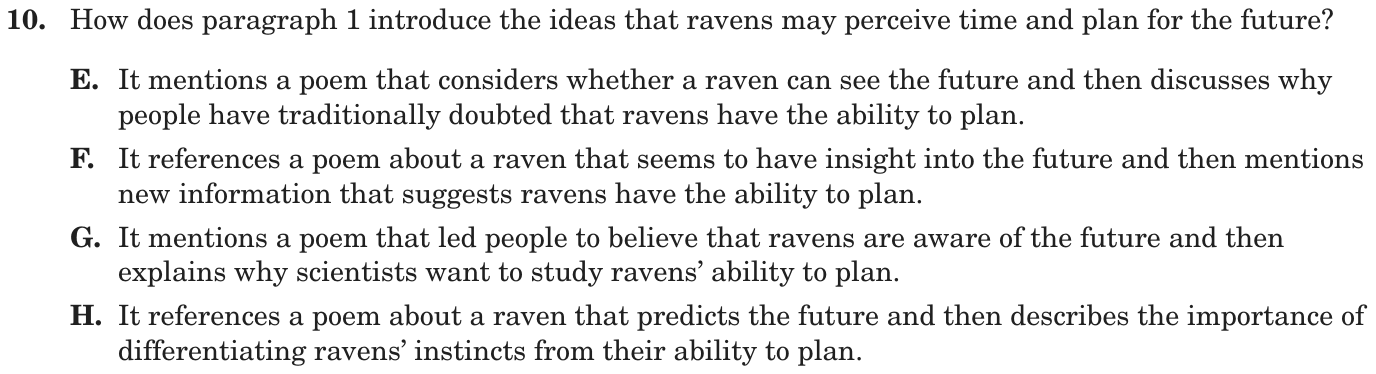
The passage “The Best Laid Plans of Ravens” as printed (page 12)
Question 22 of 31
2019 Test B English, question 27Passage Excerpt from “The Spirit of the Herd”
Excerpt from “The Spirit of the Herd”
by Dallas Lore Sharp
In this excerpt, published in 1914, author and professor Dallas Lore Sharp describes a summer cattle roundup in Oregon. The heat and dust had been relentless for three days. The cowboys were exhausted, and the cattle were restless. The ranch boss, Wade, had led the drive to a watering place, only to find it empty.
Along with the wagon had come the fresh horses—one of them being Peroxide Jim, a supple, powerful, clean-limbed buckskin, a horse, I think, that had as fine and intelligent an animal-face as any creature I ever saw. Wade had been saving this horse for emergency work. And why should he not have been saved fresh for just such a need as this? Are there not superior horses as well as superior men—a Peroxide Jim to complement a Wade?
The horse knew the cattle business and knew his rider perfectly; and though there was nothing like sentiment about the boss of the P Ranch riders, his faith in Peroxide Jim was complete. . . .
The desert, where the herd was camped, was one of the highest of a series of tablelands, or benches; it lay as level as a floor, rimmed by sheer rock, from which there was a drop to the bench of sage below. The herd when overtaken by the dusk had been headed for a pass descending to the next lower bench, but was now halted within a mile of the rim rock on the east, where there was a perpendicular fall of about three hundred feet. . . .
In the taut silence of the stirless desert night, with the tension of the herd at the snapping-point, any quick, unwonted sight or sound would stampede them. The sneezing of a horse, the flare of a match, would be enough to send the whole four thousand headlong—blind, frenzied, trampling—till spent and scattered over the plain.
And so, as he rode, Wade began to sing. The rider ahead of him took up the air and passed it on until, above the stepping stir of the hoofs rose the faint voices of the men, and all the herd was bound about by the slow plaintive measures of some old song. It was not to soothe their savage breasts that the riders sang to the cattle, but rather to preempt the dreaded silence, to relieve the tension, and so to prevent the shock of any sudden startling noise.
So they sang and rode and the night wore on to one o’clock, when Wade, coming up on the rim-rock side, felt a cool breeze fan his face, and caught a breath of fresh, moist wind with the taste of water in it.
He checked his horse instantly, listening as the wind swept past him over the cattle. But they must already have smelled it, for they had ceased their milling, the whole herd standing motionless, the indistinct forms close to him in the dark showing their bald faces lifted to drink the sweet wet breath that came over the rim. Then they started on again, but faster, and with a rumbling now from their hoarse throats that tightened Wade’s grip on the reins.
The sound seemed to come out of the earth, a low, rumbling mumble, as dark as the night and as wide as the plain, a thick, inarticulate bellow that stood every rider stiff in his stirrups. . . .
Then the breeze caught the dust and carried it back from the gray-coated, ghostly shapes, and Wade saw that the animals were still moving in a circle. He must keep them going. He touched his horse to ride on with them, when across the black sky flashed a vivid streak of lightning.
There was a snort from the steers, a quick clap of horns and hoofs from far within the herd, a tremor of the plain, a roar, a surging mass—and Wade was riding the flank of a wild stampede. Before him, behind him, beside him, pressing hard upon his horse, galloped the frenzied steers, and beyond them a multitude borne on, and bearing him on, by the heave of the galloping herd.
Wade was riding for his life. He knew it. His horse knew it. He was riding to turn the herd, too, back from the rim, as the horse also knew. The cattle were after water—water-mad—ready to go over the precipice to get it, carrying horse and rider with them. Wade was the only rider between the herd and the rim. It was black as death. He could see nothing in the sage, could scarcely discern the pounding, panting shadows at his side. He knew that he was being borne toward the rim, how fast he could not tell, but he knew by the swish of the brush against his tapaderos and the plunging of the horse that the ground was growing stonier, that they were nearing the rocks.
To outrun the herd was his only chance for life. If he could come up with the leaders he might not only escape, but even stand a chance of heading them off upon the plain and saving the herd. There were cattle still ahead of him; how many, what part of them all, he could not make out in the dark. But the horse knew. The reins hung on his straight neck, where his rider had dropped them, as, yelling and firing over the wild herd, he had given this horse the race to win, to lose.
They were riding the rim. Close on their left bore down the flank of the herd, and on their right, under their very feet, was a precipice, so close that they felt its blackness—its three hundred feet of fall! . . .
. . . Then Wade found himself racing neck and neck with a big white steer, which the horse, with marvelous instinct, seemed to pick out from a bunch, and to cling to, forcing him gradually ahead, till, cutting him free from the bunch entirely, he bore him off into the swishing sage.
The steers coming on close behind followed their leader, and in, after them, swung others. The tide was turning from the rim. More and more were veering, and within a short time the whole herd, bearing off from the cliffs, was pounding over the open plains.
Whose race was it? It was Peroxide Jim’s, according to Wade, for not by word or by touch of hand or knee had the horse been directed in the run. From the flash of the lightning the horse had taken the bit, had covered an indescribably perilous path at top speed, had outrun the herd and turned it from the edge of the rim rock, without a false step or a tremor of fear.
From “The Spirit of the Herd” by Dallas Lore Sharp—Public Domain
tablelands: plateaus, flat areas of land sharply elevated from the surrounding area
tapaderos: leather covers for stirrups
Question
Which sentence from the excerpt best explains why Wade reserved Peroxide Jim for “emergency work” (paragraph 1)?
- A“Along with the wagon had come the fresh horses—one of them being Peroxide Jim, a supple, powerful, clean-limbed buckskin, a horse, I think, that had as fine and intelligent an animal-face as any creature I ever saw.” (paragraph 1)
- B“Before him, behind him, beside him, pressing hard upon his horse, galloped the frenzied steers, and beyond them a multitude borne on, and bearing him on, by the heave of the galloping herd.” (paragraph 10)
- C“He knew that he was being borne toward the rim, how fast he could not tell, but he knew by the swish of the brush against his tapaderos and the plunging of the horse that the ground was growing stonier, that they were nearing the rocks.” (paragraph 11)
- D“From the flash of the lightning the horse had taken the bit, had covered an indescribably perilous path at top speed, had outrun the herd and turned it from the edge of the rim rock, without a false step or a tremor of fear.” (paragraph 16)
Show the answer
Correct answer: D
The question asks which sentence from the excerpt best explains why Wade reserved Peroxide Jim for “emergency work.”
A. Incorrect. While the sentence from paragraph 1 refers to Peroxide Jim’s intelligence and appearance, it does not tell why he would be useful in an emergency. Peroxide Jim is described as “supple, powerful,” and “intelligent,” which are all desirable traits for a horse used for herding cattle. However, this option is not the best answer because the sentence merely lists useful attributes, while option D shows those attributes being used in an actual emergency situation.
B. Incorrect. The sentence from paragraph 10 does not describe the actions of Peroxide Jim. The sentence describes what Wade and the horse were experiencing, but it does not include any reference to how Peroxide Jim was responding to the situation.
C. Incorrect. The sentence from paragraph 11 describes Wade’s experiences and does not focus on the actions of Peroxide Jim. It reveals Wade’s awareness of the danger he was in, but the only reference to Peroxide Jim in this sentence is the description of the horse having to work harder to run on the stonier ground as they neared the edge: from “the plunging of the horse,” Wade knew “that the ground was growing stonier, that they were nearing the rocks.” This quotation does not show that Peroxide Jim was the right horse to use for emergency work because it does not indicate, at this point in the text, that he was responding in a way that saved the herd or Wade.
D. CORRECT. The sentence from paragraph 16 describes Peroxide Jim’s high level of skill and ability to perform in a life-and-death situation. Not only did Peroxide Jim recognize the emergency immediately (“From the flash of the lightning the horse had taken the bit”), but the horse also proved to have the physical capability (“had covered an indescribably perilous path at top speed, had outrun the herd and turned it from the edge of the rim rock”) and the mental fortitude (“without a false step or a tremor of fear”) required to respond appropriately to the dangerous situation.
Question analysis
Why did Wade, the ranch boss, keep his buckskin Peroxide Jim for “emergency work”? In this evidence question on “The Spirit of the Herd,” published in 1914 and set on an Oregon cattle drive, students pick the sentence that best explains it. The four long quotations each mention a horse, and the task is finding the one that really accounts for Wade’s decision.
- Grade level
- Grade 8 reading and task
- Compared with grade 7
- At grade 7 Linking a detail to the sentence that explains it is ordinary grade 7 evidence practice. The reading is the hard part: every quotation is one long sentence of 1914 English, and they come from the excerpt’s first paragraph to its last.
- Estimated difficulty
- Moderate: several steps, or a close reading with one strong distractor.
- Thinking it demands
- Depth of knowledge 2, skills and concepts · mainly evaluate
- What makes it hard
- Evidence in several places moderate
- A lot to read minor
- Reading between the lines minor
- Evidence
- Answered from the whole text
- Reading level
- Passage: about grade 8, 1160 words; question and choices: about grade 15, 181 words.
- Students, last 30 days
- Not enough answers yet to show (it takes 10).
Why it is hard, traps and wrong answers (shows the answer)
Why it is hard
The question ties the excerpt’s first paragraph to its last, and the most tempting sentence sits right beside the phrase: the narrator’s portrait of a “supple, powerful” horse with an “intelligent” face. Those traits suggest why Wade might value him but show nothing done. The point goes to students who look for Peroxide Jim acting on his own in a crisis and find it after the stampede is turned.
Evidence in several places moderate Working it out
“Emergency work” appears in paragraph 1, but the horse proves his worth only in paragraph 16, where he turns the stampede from the rim without a word or touch from Wade. (Kirsch & Mosenthal, 1990; Gorin & Embretson, 2006)
A lot to read minor Understanding the question
All four quotations are single sentences of 33 to 46 words, and the two from the stampede are packed with motion and danger without saying what the horse does. (Kintsch, 1998; Gorin & Embretson, 2006; Freedle & Kostin, 1993)
Reading between the lines minor Working it out
Nothing links the closing sentence back to Wade’s choice; students must work out what a crisis asks of a horse, speed, nerve and judgment on his own, and recognize it there. (Graesser, Singer & Trabasso, 1994; Kintsch, 1998)
Strategy: Decide what the phrase “emergency work” asks of a horse, then go back to each quotation’s place in the excerpt and judge how directly it speaks to that need.
Traps
- Supports only part of the claim: In a question about evidence: a line that backs one half of the claim but not the other, or a related point rather than the claim itself.
- True but not the answer: A choice says something accurate about the text that does not answer this question.
The wrong answers, classified
A Supports only part of the claim (King et al., 2004; Thissen, Steinberg & Fitzpatrick, 1989)
Accepts the list of strengths beside the phrase, “supple, powerful” and an “intelligent” face, which hints at why the horse is prized but shows him doing nothing in a crisis.
B True but not the answer (King et al., 2004; Embretson & Wetzel, 1987)
Picks the most vivid picture of the stampede, steers pressing on every side, which shows the emergency itself but gives Peroxide Jim no action of his own.
C Supports only part of the claim (King et al., 2004; Thissen, Steinberg & Fitzpatrick, 1989)
Notices “the plunging of the horse” at a tense moment, but the sentence is about Wade sensing that the rocks are near, not about the horse meeting the danger.
Working it out, step by step
Figure out what the question asks
This asks for evidence. In paragraph 1, Wade had been saving Peroxide Jim for “emergency work.” Which sentence best explains why? You need a sentence that shows what this horse can do when something goes badly wrong.
Decide what to look for
An emergency is a sudden, dangerous event. A horse saved for one must be fast, steady and smart under pressure. A sentence that only describes the horse is weak evidence. The best sentence shows him doing those things in a real emergency.
Read the last sentence of the excerpt
Paragraph 16 says “From the flash of the lightning the horse had taken the bit, had covered an indescribably perilous path at top speed, had outrun the herd and turned it from the edge of the rim rock, without a false step or a tremor of fear.” Just before that, it says “not by word or by touch of hand or knee had the horse been directed in the run.”
Put the sentence in plain words
The bit is the metal bar in a horse’s mouth that the reins attach to. A horse that has “taken the bit” takes charge and runs on his own. Perilous means dangerous. A tremor is a small shake. So the moment the lightning struck, the horse acted. He raced along a dangerous path, got ahead of the herd and turned it from the cliff. He never stumbled or showed fear, and Wade did not steer him.
Check each choice
- A does not fit. It calls the horse “supple, powerful” and gives him an “intelligent” face. Supple means able to bend and move easily. These are good traits, but he does nothing in this sentence.
- B does not fit. It shows the frenzied, or wildly scared, steers crowding Wade. It does not show what the horse does about them.
- C does not fit. It is about Wade sensing the rocks ahead. The horse is only a clue that tells Wade the ground is getting stony.
- D fits. It shows the horse saving the herd in a real emergency.
Watch out: A sits in the same paragraph as “emergency work” and praises the horse. But praise is a description, not proof.
Choose the answer
The last sentence shows why Peroxide Jim was worth saving for emergencies. So the answer is D.
Why this answer and not the closest wrong one
A is the closest wrong choice. It sits in paragraph 1 near “emergency work,” and it lists fine traits. But it only tells what the horse is like. D shows the horse in action. He was fast, sure-footed and fearless in a real crisis, with no help from Wade. That is why he was saved for emergencies.
More questions like this
The original DOE question
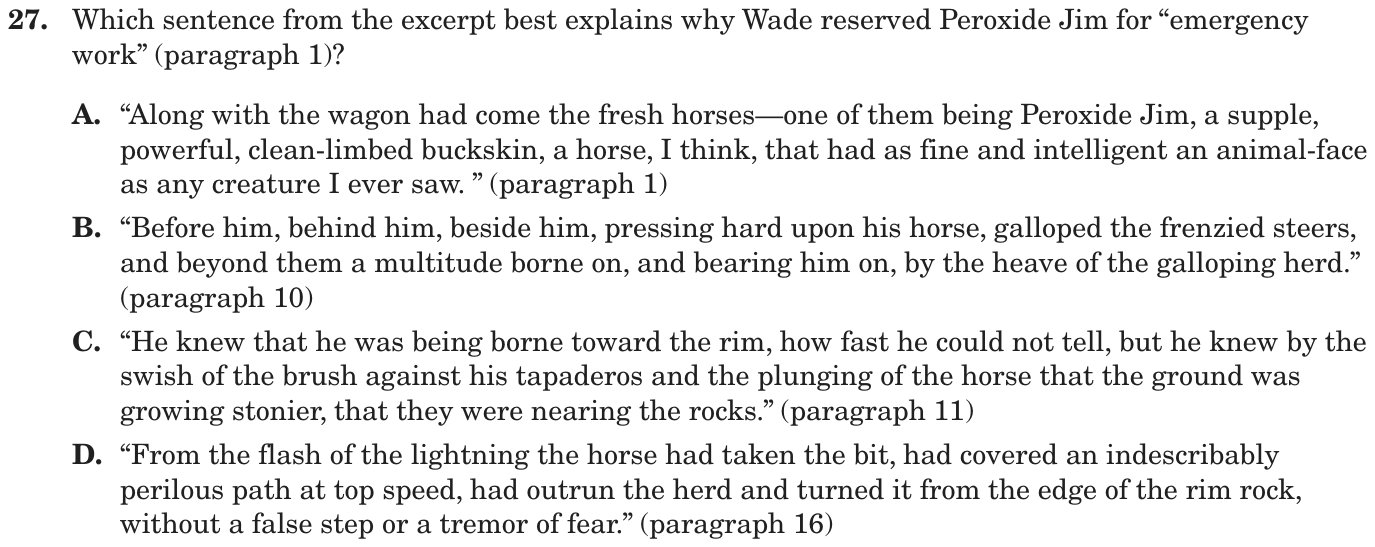
The passage “Excerpt from “The Spirit of the Herd”” as printed (page 41)
Question 23 of 31
2019 Test B English, question 30Uses the passage above: “Excerpt from “The Spirit of the Herd””.
Question
Which sentence from the excerpt best reveals the mood on the drive before the lightning struck?
- A“The herd when overtaken by the dusk had been headed for a pass descending to the next lower bench, but was now halted within a mile of the rim rock on the east, where there was a perpendicular fall of about three hundred feet.” (paragraph 3)
- B“It was not to soothe their savage breasts that the riders sang to the cattle, but rather to preempt the dreaded silence, to relieve the tension, and so to prevent the shock of any sudden startling noise.” (paragraph 5)
- C“So they sang and rode and the night wore on to one o’clock, when Wade, coming up on the rim-rock side, felt a cool breeze fan his face, and caught a breath of fresh, moist wind with the taste of water in it.” (paragraph 6)
- D“Then the breeze caught the dust and carried it back from the gray-coated, ghostly shapes, and Wade saw that the animals were still moving in a circle.” (paragraph 9)
Show the answer
Correct answer: B
The question asks which sentence from the excerpt best reveals the mood on the drive before the lightning struck.
A. Incorrect. The sentence from paragraph 3 describes the setting but does not contain words that create a strong mood. In fact, this sentence shows that while there were dangerous surroundings, the riders and the herd were “now halted.”
B. CORRECT. The sentence from paragraph 5 describes the riders singing “to preempt the dreaded silence, to relieve the tension” and to prevent “shock” from any sudden noise. These words provide a strong sense of the tense, heavy mood in which a terrible event such as a stampede could quickly happen.
C. Incorrect. The sentence from paragraph 6 contains words that communicate refreshment and relief: “fresh, moist wind with the taste of water.” Relief was not the primary mood before the lightning struck; instead, the refreshing scent of moisture and its promise of water was partially responsible for the herd’s stampede toward the edge once the lightning struck (“their bald faces lifted to drink the sweet wet breath that came over the rim” [paragraph 7]).
D. Incorrect. While the words “ghostly” and “still moving in a circle” in the sentence from paragraph 9 create a strange and mysterious image, the mood before the lightning struck was not one of mystery or suspense. Instead, these descriptive words are used to indicate Wade’s faint ability to see the herd moving in the dark.
Question analysis
In this question about mood, students read four long sentences from Dallas Lore Sharp’s “The Spirit of the Herd,” taken from paragraphs 3, 5, 6 and 9, and decide which best reveals the mood on the drive in the hours before the lightning. Each sentence carries some atmosphere of its own, so the answer depends on close attention to word choice.
- Grade level
- Grade 7 reading and task
- Compared with grade 7
- At grade 7 Grade 7 students often name the words that create a mood, and this item asks for little more. The challenge is mostly reading: four long sentences of 1914 prose, set side by side, must be compared for the feeling their words carry.
- Estimated difficulty
- Straightforward: two steps or one careful reading.
- Thinking it demands
- Depth of knowledge 2, skills and concepts · mainly evaluate
- What makes it hard
- Hard words minor
- A lot to read minor
- Evidence
- Answered from several paragraphs or stanzas
- Reading level
- Passage: about grade 8, 1160 words; question and choices: about grade 13, 171 words.
- Corrected from the DOE handbook
- A detail in the explanation that the excerpt does not contain was corrected.
- Students, last 30 days
- Not enough answers yet to show (it takes 10).
Why it is hard, traps and wrong answers (shows the answer)
Why it is hard
Only one quotation names a feeling outright, and a student who spots “dreaded silence” and “tension” finds the question easy. Points are lost to sentences with an atmosphere of their own: the “ghostly shapes” of paragraph 9 suggest eerie mystery, and the cool, moist wind of paragraph 6 suggests relief. Neither matches the strained waiting that hangs over the night until the lightning.
Hard words minor Understanding the question
The sentence that names the feeling is also the hardest to parse, since “dreaded silence” and “tension” sit among “preempt” and an old saying about soothing “savage breasts.” (Perfetti, 2007; Freedle & Kostin, 1993)
A lot to read minor Understanding the question
Three of the quotations run 37 to 44 words, and all four come from the hours before the stampede, so each must be read for words that carry feeling rather than events. (Kintsch, 1998; Gorin & Embretson, 2006; Freedle & Kostin, 1993)
Strategy: Before reading the choices, describe in one word how the night felt before the lightning, then find the quotation whose own words, not just its events, create that feeling.
Traps
- Wrong tone or attitude: Misjudges the tone, attitude or point of view, such as reading admiration as criticism, or taking a character's or subject's feelings for the author's.
- Supports only part of the claim: In a question about evidence: a line that backs one half of the claim but not the other, or a related point rather than the claim itself.
The wrong answers, classified
A Supports only part of the claim (King et al., 2004; Thissen, Steinberg & Fitzpatrick, 1989)
Senses danger in a “perpendicular fall of about three hundred feet,” but the sentence states where the herd stood and contains no word of feeling.
C Wrong tone or attitude (Graesser, Singer & Trabasso, 1994)
Reads the mood from the “cool breeze” and “fresh, moist wind,” which feel like relief, but the night was tense, and that wind is what stirs the thirsty herd.
D Wrong tone or attitude (Graesser, Singer & Trabasso, 1994)
Is drawn to “gray-coated, ghostly shapes,” a phrase with an eerie mood of its own, but it shows how dimly Wade saw the cattle through the dust, not the riders’ tension.
What was corrected from the DOE handbook, and why
- Explanation: The handbook’s explanation of Option C speaks of “the refreshing scent of rain.” The excerpt has no rain: Wade catches “a breath of fresh, moist wind with the taste of water in it” (paragraph 6), and the cattle lift their faces “to drink the sweet wet breath that came over the rim” (paragraph 7). The site now says “the refreshing scent of moisture,” as it corrected the same detail in the 2026 printing’s explanation of another question on this excerpt.
Working it out, step by step
Figure out what the question asks
This asks about mood, the feeling a piece of writing gives you. Which sentence best shows how the drive felt before the lightning struck? Look for words that name or carry a feeling, not just events.
Read the sentence from paragraph 5
Paragraph 5 says “It was not to soothe their savage breasts that the riders sang to the cattle, but rather to preempt the dreaded silence, to relieve the tension, and so to prevent the shock of any sudden startling noise.”
Work out what it means
“To soothe their savage breasts” comes from an old saying that music calms wild feelings. To preempt something is to act early to stop it. So the riders were not singing to calm the cattle with a nice tune. They sang to fill a silence they dreaded, or feared. They also sang to ease the tension, the nervous strain. Paragraph 4 says the herd’s tension was “at the snapping-point.” The mood is tense and nervous.
Check each choice
- A does not fit. It tells where the herd stopped and how far the drop was. Those are facts about the place, with no feeling words.
- B fits. The words “dreaded” and “tension” name the feeling of the night.
- C does not fit. A “cool breeze” and “fresh, moist wind” sound pleasant, like relief. But the night was not relaxed. That wind, with “the taste of water in it,” stirs up the thirsty herd.
- D does not fit. “Ghostly shapes” sounds spooky, but it only describes cattle seen dimly through the dust.
Watch out: D pulls hard because “ghostly” has an eerie feel of its own. But the question asks for the mood on the drive, and that mood was tension.
Choose the answer
Only one sentence names the tense, nervous feeling of the night. So the answer is B.
Why this answer and not the closest wrong one
D is the closest wrong choice, because “gray-coated, ghostly shapes” sounds eerie. But those words only show how the cattle looked in the dust and dark. B names the feeling outright: a “dreaded silence” and “tension.” That is the mood on the drive before the lightning struck.
More questions like this
The original DOE question
Question 24 of 31
2018 Test A English, question 10Passage An Early Warning
An Early Warning
One of the books that has done the most to alert the world to the dangers of environmental degradation is George Perkins Marsh’s Man and Nature. Its message—that Western society is in the process of causing irreparable harm to the environment—greatly influenced ecologists during the beginning of the modern environmentalist movement in the 1960s. Marsh was not, however, part of this movement. Surprisingly, Man and Nature was first published in 1864.
Marsh first observed the environmentally destructive effects of human activities while growing up in Vermont in the early nineteenth century. The heavy demand for firewood had depleted the forests, and extensive sheep grazing had stripped the land. The result was flooding and soil erosion. Furthermore, streams were fouled by wastes dumped from numerous mills and dye houses.
Much later in his life, after careers in law, business, farming, and politics, Marsh served as ambassador to Italy. There he noticed land abuse similar to what he had seen in Vermont. Overgrazing and forest mismanagement had rendered areas that had been productive farmland since the days of the Roman Empire desolate. Marsh attributed this to what he called “man’s ignorant disregard for the laws of nature.”
In Italy, Marsh began to organize his observations and theories. He wrote in a way intended to educate readers about the impact of industrial and agricultural practices on the environment. In Man and Nature, he evaluated the important relationships between animals and plants, discussed forestry practices in great detail, and analyzed the ways natural water supplies are affected by human use.
Man and Nature challenged the popular belief that nature can heal any damage that people inflict upon it. Marsh argued that people may use and enjoy, but not destroy, the riches of the earth.
Furthermore, he asserted that everything in nature is significant and that even the tiniest organism affects the fragile environmental balance. His belief that drastic alteration of this balance would be dangerous is now accepted as a fundamental principle of modern environmental science.
Although he pointed out environmental damage caused by irresponsible human activities, Marsh did not oppose every human alteration to the environment. To him, the goal was proper management, not a return to wilderness conditions. People should consider the consequences of their actions, he wrote, and become “co-worker[s] with nature.” Marsh praised the Suez Canal, the human-made waterway between the Mediterranean Sea and the Gulf of Aden, as “the greatest and most truly cosmopolite physical improvement ever undertaken by man.” He believed that the advantages of the canal— improved transportation and commerce—would outweigh any environmental damage. Yet he also warned of possible unintended consequences, such as destructive plants and animals spreading from one body of water to the other.
Marsh was considered a radical thinker during his lifetime. By the late nineteenth century, however, his writings, along with those of John Muir, Henry David Thoreau, and others, had inspired what became known as the conservation movement. The conservationists of that time sought to educate the public that wilderness areas were worth preserving and were responsible for creating the National Park Service and the National Forest Service.
Question
Which statement best describes the central idea of the passage?
- AMarsh’s experience growing up on a farm allowed him to witness firsthand how human demands on nature can lead to problems, and as an adult he wrote one of the first books about conservation.
- BMarsh challenged the notion that nature can repair the damage people cause to it, but he also supported human-made modifications to nature that improve transportation and commerce.
- CMarsh’s ideas about the environment were considered radical in his lifetime, but they later gained popularity during the environmental movement in the twentieth century.
- DMarsh was a radical thinker who believed that people’s actions could dramatically affect nature, and his writings are considered foundational to the conservation movement.
Show the answer
Correct answer: D
The answer is (D)
The question asks for the statement that best illustrates the central idea of the passage. Paragraphs 2 through 5 focus on Marsh’s personal experiences and his ideas about nature, and paragraph 8 explains how his ideas are the basis for the conservation movement. These two aspects comprise the central idea of the passage and are best stated in Option D.
Option A is incorrect because it focuses mainly on Marsh’s early life and does not address his influence.
Option B is incorrect because, while it describes specific details about Marsh’s beliefs, it does not explain who he was or how he affected the conservation movement.
Option C is incorrect because it emphasizes that Marsh’s ideas were radical and influential but does not provide any information about what Marsh’s beliefs were.
Question analysis
This reading question asks for the central idea of an informational passage about George Perkins Marsh and his 1864 book Man and Nature, an early warning about environmental damage. Most choices state something true about Marsh, so students must judge which one sums up the whole passage instead of a single part of it.
- NYS standards
- 7R2 theme or central idea
- Grade level
- Grade 8 reading and task
- Compared with grade 7
- Above grade 7 Finding a central idea is a grade 7 standard, but this passage uses dense, abstract vocabulary and most choices are accurate about Marsh. Typical grade 7 tasks offer one clearly complete summary; here completeness must be weighed.
- Estimated difficulty
- Hard: combines ideas, needs a plan, and has more than one tempting wrong answer.
- Thinking it demands
- Depth of knowledge 3, strategic thinking · mainly understand
- What makes it hard
- A very close wrong answer major
- Every choice must be checked moderate
- A lot to read moderate
- Hard words minor
- Evidence
- Answered from the whole text
- Reading level
- Passage: about grade 12, 523 words; question and choices: about grade 14, 119 words.
- Students, last 30 days
- Not enough answers yet to show (it takes 10).
Why it is hard, traps and wrong answers (shows the answer)
Why it is hard
Each wrong statement is a fair summary of one stretch of the passage, so the question is really about completeness. Students lose the point by picking the summary of the part they remember best, whether his Vermont boyhood, his views on nature and canals, or his reputation over time. The right statement joins what Marsh believed to his lasting influence, the two halves that the opening and closing paragraphs frame.
A very close wrong answer major Choosing the answer
The right statement and the one calling his ideas “considered radical in his lifetime” share the radical-then-influential shape; only the right one adds what Marsh believed, that people's actions could dramatically affect nature. (Embretson & Wetzel, 1987; Gorin & Embretson, 2006; Ascalon et al., 2007)
Every choice must be checked moderate Choosing the answer
Every statement draws on real parts of the passage, Vermont, the Suez Canal, the 1960s, so each must be tested for whether it covers the whole text. (Embretson & Wetzel, 1987)
A lot to read moderate Understanding the question
Eight paragraphs move from Vermont to Italy, the book's contents, its claims, the Suez Canal and the conservation movement, so the whole arc has to be held at once. (Kintsch, 1998; Gorin & Embretson, 2006; Freedle & Kostin, 1993)
Hard words minor Understanding the question
Words such as “degradation”, “irreparable”, “desolate” and “cosmopolite” slow the reading of a passage whose central idea depends on the details they carry. (Perfetti, 2007; Freedle & Kostin, 1993)
Strategy: Before reading the choices, sum up the whole passage in one sentence of your own, then pick the statement that covers its beginning, middle and end rather than one section.
Traps
- Too narrow: A single detail offered as the central idea or a summary, or a summary that keeps minor details and leaves out an essential part.
The wrong answers, classified
A Too narrow (King et al., 2004)
Builds the summary on Marsh's boyhood in Vermont, recast as farm life, and on his book, leaving out his central claims and the influence the closing paragraphs describe.
B Too narrow (King et al., 2004)
Pairs two real points from paragraphs 5 and 7, his challenge to the belief that nature heals itself and his praise of the Suez Canal, but omits his influence.
C Too narrow (King et al., 2004)
Tracks how Marsh's reputation changed from radical to influential, matching paragraphs 1 and 8, but never states the belief about human harm to nature that made him matter.
Working it out, step by step
Figure out what the question asks
The central idea is the main point of the whole passage. A good statement of it covers the beginning, the middle, and the end. A choice that covers only one part is too narrow, even if it is true.
Sum up each part of the passage
- Paragraph 1: Marsh’s book Man and Nature warned that people were “causing irreparable harm to the environment.” It came out in 1864, long before the 1960s.
- Paragraphs 2 to 7: what Marsh saw in Vermont and Italy, and what he believed.
- Paragraph 8: Marsh “was considered a radical thinker during his lifetime.” But his writings “inspired what became known as the conservation movement.”
Put the big idea in plain words
Irreparable means it can’t be fixed. A radical thinker has ideas that seem extreme or very new for the time. Conservation means protecting nature and using it wisely. So the passage says: Marsh had a bold idea that people can badly harm nature. Later, that idea helped start a movement.
Check each choice
- D says what Marsh believed, that people could “dramatically affect nature.” It also says his writings are “foundational,” or a base, for the conservation movement. It covers the whole passage.
- A is mostly about his early life. It leaves out his main beliefs and his influence.
- B gives two of his views, from paragraphs 5 and 7. It leaves out how he shaped a movement.
- C tells how people saw his ideas over time. It never says what his ideas were.
Watch out: C has the same shape as D: radical then, important later. Check that a choice also says what Marsh believed.
Pick the answer
Only D covers both what Marsh believed and the effect his ideas had. So the answer is D.
Why this answer and not the closest wrong one
C is the closest wrong answer. Like D, it says Marsh’s ideas seemed radical but mattered later. But C never says what those ideas were. D adds his key belief, that people’s actions could badly change nature. So D covers the whole passage.
More questions like this
The original DOE question
The passage “An Early Warning” as printed (page 52)
Question 25 of 31
2018 Test A English, question 27Passage Excerpt from A Tramp Abroad
Excerpt from A Tramp Abroad
by Mark Twain
Now and then, while we rested, we watched the laborious ant at his work. I found nothing new in him—certainly nothing to change my opinion of him. It seems to me that in the matter of intellect the ant must be a strangely overrated bird. During many summers now I have watched him, when I ought to have been in better business, and I have not yet come across a living ant that seemed to have any more sense than a dead one. I refer to the ordinary ant, of course; I have had no experience of those wonderful Swiss and African ones which vote, keep drilled armies, . . . and dispute about religion. Those particular ants may be all that the naturalist paints them, but I am persuaded that the average ant is a sham.
I admit his industry, of course; he is the hardest working creature in the world—when anybody is looking—but his leather-headedness is the point I make against him. He goes out foraging, he makes a capture, and then what does he do? Go home? No; he goes anywhere but home. He doesn’t know where home is. His home may be only three feet away; no matter, he can’t find it. He makes his capture, as I have said; it is generally something which can be of no sort of use to himself or anybody else; it is usually seven times bigger than it ought to be; he hunts out the awkwardest place to take hold of it; he lifts it bodily up in the air by main force, and starts—not toward home, but in the opposite direction; not calmly and wisely, but with a frantic haste which is wasteful of his strength; he fetches up against a pebble, and, instead of going around it, he climbs over it backwards, dragging his booty after him, tumbles down on the other side, jumps up in a passion, kicks the dust off his clothes, moistens his hands, grabs his property viciously, yanks it this way, then that, shoves it ahead of him a moment, turns tail and lugs it after him another moment, gets madder and madder, then presently hoists it into the air and goes tearing away in an entirely new direction; comes to a weed; it never occurs to him to go around it. No; he must climb it, and he does climb it, dragging his worthless property to the top—which is as bright a thing to do as it would be for me to carry a sack of flour from Heidelberg to Paris by way of Strasburg steeple; when he gets up there he finds that that is not the place; takes a cursory glance at the scenery, and either climbs down again or tumbles down, and starts off once more—as usual, in a new direction. At the end of half an hour he fetches up within six inches of the place he started from, and lays his burden down. Meantime, he has been over all the ground for two yards around, and climbed all the weeds and pebbles he came across. Now he wipes the sweat from his brow, strokes his limbs, and then marches aimlessly off, in as violent a hurry as ever. He traverses a good deal of zig-zag country, and by and by stumbles on his same booty again. He does not remember to have ever seen it before; he looks around to see which is not the way home, grabs his bundle, and starts. He goes through the same adventures he had before; finally stops to rest, and a friend comes along.
Evidently the friend remarks that a last year’s grasshopper leg is a very noble acquisition, and inquires where he got it. Evidently the proprietor does not remember exactly where he did get it, but thinks he got it “around here somewhere.” Evidently the friend contracts to help him freight it home. Then, with a judgment peculiarly antic (pun not intentional), they take hold of opposite ends of that grasshopper leg and begin to tug with all their might in opposite directions. Presently they take a rest, and confer together. They decide that something is wrong, they can’t make out what. Then they go at it again, just as before. Same result. Mutual recriminations follow. Evidently each accuses the other of being an obstructionist. They warm up, and the dispute ends in a fight. They lock themselves together and chew each other’s jaws for a while; then they roll and tumble on the ground till one loses a horn or a leg and has to haul off for repairs. They make up and go to work again in the same old insane way, but the crippled ant is at a disadvantage; tug as he may, the other one drags off the booty and him at the end of it. Instead of giving up, he hangs on, and gets his shins bruised against every obstruction that comes in the way. By and by, when that grasshopper leg has been dragged all over the same old ground once more, it is finally dumped at about the spot where it originally lay. The two perspiring ants inspect it thoughtfully and decide that dried grasshopper legs are a poor sort of property after all, and then each starts off in a different direction to see if he can’t find an old nail or something else that is heavy enough to afford entertainment and at the same time valueless enough to make an ant want to own it. . . .
Science has recently discovered that the ant does not lay up anything for winter use. . . . He does not work, except when people are looking, and only then when the observer has a green, naturalistic look, and seems to be taking notes. This amounts to deception, and will injure him for the Sunday schools. He has not judgment enough to know what is good to eat from what isn’t. This amounts to ignorance, and will impair the world’s respect for him. . . . He cannot stroll around a stump and find his way home again. This amounts to idiocy, and once the damaging fact is established, thoughtful people will cease to look up to him. It is strange beyond comprehension that so manifest a humbug as the ant has been able to fool so many nations and keep it up so many ages without being found out.
we: the author and his fictional travel companion
From A TRAMP ABROAD by Mark Twain—Public Domain
Question
The central idea that “the average ant is a sham” (paragraph 1) is conveyed mainly through the
- Acomical descriptions of the inability of the ants to accomplish the task at hand.
- Bcomparison between ants from other countries and the ants being observed.
- Ckeen observations that the level of intelligence of ants is mostly overstated.
- Dconclusion that ants value objects that are of little practical use to them.
Show the answer
Correct answer: A
The answer is (A)
The question asks how the central idea that “the average ant is a sham” (paragraph 1) is expressed in the excerpt. The excerpt focuses on the author’s humorous explanation of the ineffective struggles of two ants to accomplish a task, and the excerpt concludes with the statement that ants are not as smart as people think: “the ant has been able to fool so many nations” (paragraph 4). This point is stated in Option A.
Option B is incorrect because the reference to ants in other locations is a detail mentioned only in paragraph 1 and is not directly related to the central idea mentioned in the question.
Option C is incorrect because, while the narrator does observe the ants, the observations made are highly opinionated and not characterized as especially insightful or perceptive.
Option D refers to the detail in paragraph 2 that states that the objects ants seek out are “generally something which can be of no sort of use to himself or anybody else” (paragraph 2), but this is not the main way the author conveys the premise that ants are a sham or false, and therefore, Option D is incorrect.
Question analysis
This central idea question hands students Mark Twain's claim that “the average ant is a sham” and asks how the excerpt mainly conveys it. Every choice points to something that really appears in the text, so students must judge which one does most of the work across the whole excerpt.
- Grade level
- Grade 7 reading and task
- Compared with grade 7
- At grade 7 Typical grade 7 central idea work asks students to find the idea; here it is supplied, so the task is tracing how it is developed. The long, old-fashioned passage adds reading load, but the task itself is standard.
- Estimated difficulty
- Moderate: several steps, or a close reading with one strong distractor.
- Thinking it demands
- Depth of knowledge 3, strategic thinking · mainly analyze
- What makes it hard
- How, not what moderate
- A lot to read moderate
- Every choice must be checked minor
- Evidence
- Answered from the whole text
- Reading level
- Passage: about grade 9, 1099 words; question and choices: about grade 9, 66 words.
- Students, last 30 days
- Not enough answers yet to show (it takes 10).
Why it is hard, traps and wrong answers (shows the answer)
Why it is hard
The question is less about finding the idea than about weighing how much of the excerpt each choice accounts for. Three choices name something that really appears, so a student who checks only whether a choice is true will keep two or three of them. The one that covers the long comic narratives in paragraphs 2 and 3 wins, and the trap is a choice that sounds analytical because it repeats the claim.
How, not what moderate Working it out
The idea is handed over in the stem, so the task is naming the method: the comic accounts of the lone ant's trip and the two ants' tug-of-war fill paragraphs 2 and 3. (Anderson & Krathwohl, 2001)
A lot to read moderate Understanding the question
The answer rests on the whole 1,100-word excerpt, including a 183-word sentence in paragraph 2, so students must judge what most of the text does rather than recall one line. (Kintsch, 1998; Gorin & Embretson, 2006; Freedle & Kostin, 1993)
Every choice must be checked minor Choosing the answer
Each wrong choice points to something real, the Swiss and African ants, the observing, the useless loot, so none can be dismissed without asking how much of the excerpt it explains. (Embretson & Wetzel, 1987)
Strategy: Note in a few words what each paragraph mostly does, then test every choice against those notes, checking each of its words rather than its general idea.
Traps
- Twists what the text says: Uses the text's topic and ideas but changes what it says: who did it, how much, when, or why.
- Too narrow: A single detail offered as the central idea or a summary, or a summary that keeps minor details and leaves out an essential part.
The wrong answers, classified
B Too narrow (King et al., 2004)
Picks the comparison sitting in the same sentence as the quoted claim, the Swiss and African ants, a one-line aside rather than the excerpt's main method.
C Twists what the text says (King et al., 2004)
Gets the claim right, that the ant is “strangely overrated,” but calls Twain's slapstick “keen observations” and restates the idea instead of naming how it is conveyed.
D Too narrow (King et al., 2004)
Seizes on the ant's taste for worthless loot, a real motif from the grasshopper leg to the old nail, but only one strand of the comic accounts.
Working it out, step by step
Figure out what the question asks
The question hands you the central idea: “the average ant is a sham.” A sham is a fake, something that is not what it seems. You don’t need to find the idea. You need to find how Twain mostly gets it across.
Note what each paragraph does
- Paragraph 1: Twain says ants are overrated.
- Paragraph 2: One ant drags his prize up weeds, over pebbles and the wrong way. After half an hour he is “within six inches of the place he started from.”
- Paragraph 3: Two ants tug one grasshopper leg in opposite directions, then fight.
- Paragraph 4: Twain sums up his charges against the ant.
See how the idea is shown
Paragraphs 2 and 3 are by far the longest. They are funny stories. In each one, ants work very hard and get nowhere. The jokes show that the ant is not smart, even though people think he is. That is how Twain proves the ant is a sham.
Check each choice
- A fits. The funny stories of ants failing at their task fill most of the excerpt.
- B The Swiss and African ants appear in just one sentence of paragraph 1.
- C only repeats the idea that ants are overrated. It does not say how the idea is shown.
- D The worthless loot is real, but it is only one detail inside the funny stories.
Choose the answer
Twain shows the ant is a sham mainly through comical, or funny, descriptions of ants failing at their job. So the answer is A.
Why this answer and not the closest wrong one
C is the closest trap, because it sounds smart and matches Twain’s opinion. But the question asks how the idea is shown, and C just says the idea again. Also, Twain’s stories are silly exaggerations, not “keen observations” (sharp, careful ones). A names the real method: the funny stories.
More questions like this
The original DOE question

The passage “Excerpt from A Tramp Abroad” as printed (pages 62–63)
Question 26 of 31
2018 Test A English, question 30Uses the passage above: “Excerpt from A Tramp Abroad”.
Question
Which of the following best explains the author’s fascination with the ants?
- A“During many summers now I have watched him, when I ought to have been in better business, and I have not yet come across a living ant that seemed to have any more sense than a dead one.” (paragraph 1)
- B“I admit his industry, of course; he is the hardest working creature in the world—” (paragraph 2)
- C“Science has recently discovered that the ant does not lay up anything for winter use.” (paragraph 4)
- D“It is strange beyond comprehension that so manifest a humbug as the ant has been able to fool so many nations and keep it up so many ages without being found out.” (paragraph 4)
Show the answer
Correct answer: D
The answer is (D)
The question asks for the text from the passage that explains why the author finds the behavior of the ants fascinating. The author’s purpose in describing the excessively foolish actions of the ants is to prove his argument that in spite of what people have long believed, ants are completely lacking in intelligence.
Option D is correct because the quoted text in Option D shows the author’s interest in the difference between public opinion and observed truth.
Option A is incorrect because the quoted text in Option A provides details that reflect the author’s basic interest, but this observation does not extend to the level of fascination.
Option B is incorrect because the author’s main message in the excerpt is that the ant, however industrious, is foolish.
Option C is incorrect because the quoted text in Option C also provides details that would reflect a basic interest and observation but that do not extend to fascination.
Question analysis
This textual evidence question asks which of four quotations from Mark Twain's ant excerpt best explains why the narrator is so fascinated by ants. Nowhere does the excerpt say outright what draws him to them, so students must infer it and then weigh quotations that all show him paying attention to ants.
- Grade level
- Grade 8 reading and task
- Compared with grade 7
- Above grade 7 Grade 7 evidence questions usually match a quotation to a claim the text states. Here the claim, the narrator's fascination, is never named, so students must infer its cause from four quotations in a satirical, old-fashioned text.
- Estimated difficulty
- Among the hardest on the SHSAT: a non-obvious approach, heavy reading, or a well-hidden trap.
- Thinking it demands
- Depth of knowledge 3, strategic thinking · mainly evaluate
- What makes it hard
- Reading between the lines major
- Hard words moderate
- A lot to read minor
- Evidence
- Answered from the whole text
- Reading level
- Passage: about grade 9, 1099 words; question and choices: about grade 10, 116 words.
- Students, last 30 days
- Not enough answers yet to show (it takes 10).
Why it is hard, traps and wrong answers (shows the answer)
Why it is hard
The stem's word “fascination” clashes with a narrator who sneers at ants, and that clash is what makes the item hard. Students must recast fascination as puzzled interest and then look for the quotation that names its cause, the gap between the ant's reputation and its behavior. The quotation about years of watching is the trap: it shows interest without explaining it, and many careful readers settle on it.
Reading between the lines major Working it out
The excerpt never says the author is fascinated, and his tone is contempt, so students must infer that what holds his attention is the puzzle of how a “humbug” fooled whole nations. (Graesser, Singer & Trabasso, 1994; Kintsch, 1998)
Hard words moderate Understanding the question
The key turns on “so manifest a humbug,” meaning so obvious a fraud, and “strange beyond comprehension”; a student who skips those words cannot see that the line expresses wonder. (Perfetti, 2007; Freedle & Kostin, 1993)
A lot to read minor Understanding the question
Each choice is a full quotation, the longest 38 words, so the four together form a short passage of archaic prose to weigh. (Kintsch, 1998; Gorin & Embretson, 2006; Freedle & Kostin, 1993)
Strategy: Before reading the quotations, state in your own words what most seems to interest the narrator about ants; then pick the quotation that gives the reason behind his interest.
Traps
- Supports only part of the claim: In a question about evidence: a line that backs one half of the claim but not the other, or a related point rather than the claim itself.
- Wrong tone or attitude: Misjudges the tone, attitude or point of view, such as reading admiration as criticism, or taking a character's or subject's feelings for the author's.
The wrong answers, classified
A Supports only part of the claim (King et al., 2004; Thissen, Steinberg & Fitzpatrick, 1989)
Shows he has watched ants for many summers, real evidence of interest, but it describes his habit and verdict rather than what makes ants fascinating to him.
B Wrong tone or attitude (Graesser, Singer & Trabasso, 1994)
Treats the grudging “I admit his industry” as admiration, missing the dig “when anybody is looking” that follows and the attack on his “leather-headedness.”
C Supports only part of the claim (King et al., 2004; Thissen, Steinberg & Fitzpatrick, 1989)
Picks a scientific finding that the author uses as a charge against the ant; it belongs to his case, not to the reason the ant intrigues him.
Working it out, step by step
Figure out what the question asks
This question is about the author’s point of view. Twain sounds mostly annoyed with ants. So what keeps him so interested in them? You need the quote that gives the reason for his interest.
Think about the word fascination
Fascination means a strong interest, the kind that makes you keep watching. Twain mocks ants, so he does not admire them. What puzzles him is their good name. People all over the world think ants are wise. Twain thinks they are not.
Find the reason in paragraph 4
Look at the last sentence of paragraph 4: “It is strange beyond comprehension that so manifest a humbug as the ant has been able to fool so many nations.”
A humbug is a fake or a fraud. Manifest means plain to see. “Beyond comprehension” means too strange to understand. So Twain is amazed that such an obvious fake has fooled people for ages.
Check each choice
- A shows he has watched ants for years. It shows interest, but not the reason for it.
- B sounds like praise, but he adds “when anybody is looking.” It is really a dig at the ant.
- C is one fact he uses against the ant. It does not explain his interest.
- D fits. It names the puzzle: how a plain fake fooled so many people.
Choose the answer
Only choice D gives the reason Twain can’t stop thinking about ants. So the answer is D.
Why this answer and not the closest wrong one
A is the strongest trap, because watching ants for “many summers” shows real interest. But A only tells what he did. D tells why: he is amazed that the ant fooled “so many nations.” A question about fascination wants the cause.
More questions like this
The original DOE question
Question 27 of 31
2018 Test A English, question 36Passage Ruins of a Fabled City
Ruins of a Fabled City
The African country of Zimbabwe took its name from the Shona word meaning “stone enclosures” or “venerated houses.” In fact, today dozens of stone ruins are scattered throughout Zimbabwe and other areas in southeastern Africa. One of these ruins, known as Great Zimbabwe, was once a fabled city that inspired tales that circulated throughout Europe. Where was this remarkable city, and who had built it? For centuries the mystery occupied the minds of explorers and treasure seekers.
The first reports to Europeans of Great Zimbabwe were spread a thousand years ago by Arab traders sailing between the Middle East and the east coast of Africa. The traders told of the fabulous wealth of a mysterious stone city in the African interior. In the trader’s tales, that city became associated with the Europeans’ understanding of Middle Eastern history—the Queen of Sheba, King Solomon and his legendary gold mines, long since lost to the world. By the sixteenth century, Portuguese explorers regularly visited East Africa, searching for King Solomon’s gold, but they never found Great Zimbabwe. In 1552, a Portuguese historian, João de Barros, recorded a story told by Arabs about a city with a “square fortress of masonry within and without, built of stones of marvelous size, and there appears to be no mortar joining them.”
In fact, Great Zimbabwe was a marvel. In one area a massive wall more than thirty feet high and twenty feet thick created a great enclosure. Another area contained a fortress-like series of walls, corridors, and steps built into the bluff that overlooks the ruins. Throughout the city, each stone was precisely fitted to the others without the use of mortar.
In the 1870s Karl Mauch, a German geologist, was the first European to see Great Zimbabwe, by then in ruins. Mauch realized that he had “rediscovered” the fabled city from de Barros’s story. He jumped to the conclusion that Great Zimbabwe had been built by the Queen of Sheba. British authorities sent a British journalist, Richard Hall, to Great Zimbabwe to investigate Mauch’s report. Archaeology was still in its infancy, and Hall, convinced that the structures had been built by ancient people from the Middle East, dug up and discarded archaeological deposits that would have revealed much about the true history of Great Zimbabwe. Later European excavations destroyed even more valuable evidence.
In the twentieth century, after excavating areas that had not been disturbed, David Randall-MacIver, a Scottish Egyptologist, and Gertrude Caton-Thompson, an English archaeologist, concluded that the ruins were unmistakably African in origin. Great Zimbabwe was most likely built during the fourteenth or fifteenth century by the ancestors of the present-day Shona people. Recent carbon-14 dating supports their conclusion. Great Zimbabwe was once home to an estimated 20,000 people, the center of a great Shona kingdom. Wealthy Shona kings traded their ivory and gold in coastal towns for other goods, thus accounting for the discovery of beads and other foreign wares in the ruins.
One mystery of Great Zimbabwe had been solved. Another mystery remains: why was the settlement at Great Zimbabwe abandoned, leaving the magnificent stone architecture to fall into ruins?
Question
Which statement best describes the central idea of the passage?
- AGreat Zimbabwe was an enormous stone city thought to be home to some of the greatest treasure of ancient history.
- BMysteries related to Great Zimbabwe continue to interest historians and explorers even though archaeologists have confirmed its origins.
- CThe history of Great Zimbabwe was subject to much speculation until modern archaeologists definitively determined its origins.
- DEarly missteps in the study and excavation of the Great Zimbabwe ruins led to the loss of valuable evidence about the city.
Show the answer
Correct answer: C
The answer is (C)
The question asks for the sentence that best summarizes the central idea of the passage. The idea that there was much speculation about Great Zimbabwe is explained at the end of paragraph 1 and in paragraph 2, and the details about how modern archaeologists determined its origins are explained in paragraph 5.
Option C best represents the central idea that is developed and supported throughout the passage.
Option A is incorrect because it does not fully express the central idea of the passage: it includes facts from only the beginning of the passage and does not take into account the discoveries revealed about Great Zimbabwe in paragraph 5.
Option B is incorrect because it focuses mainly on the idea that archaeologists are still interested in the mysteries of Great Zimbabwe (paragraph 6) and does not fully explain the central idea.
Option D is incorrect because the fact that early excavations of Great Zimbabwe caused the destruction of valuable evidence is a detail from paragraph 4, and the option does not fully convey the central idea of the passage.
Question analysis
This central idea question asks which statement best sums up “Ruins of a Fabled City,” an informational passage about Great Zimbabwe, the stone ruins in southeastern Africa. Students must weigh the whole passage, from traders' legends to later excavations and a final unsolved question, and decide which choice best covers it.
- NYS standards
- 7R2 theme or central idea
- Grade level
- Grade 7 reading and task
- Compared with grade 7
- At grade 7 Finding the central idea of a six-paragraph informational text is core grade 7 work. The passage is dense with names, dates and theories, which adds reading load, but the task matches what grade 7 state tests routinely ask.
- Estimated difficulty
- Moderate: several steps, or a close reading with one strong distractor.
- Thinking it demands
- Depth of knowledge 2, skills and concepts · mainly understand
- What makes it hard
- A lot to read moderate
- A very close wrong answer moderate
- Every choice must be checked minor
- Evidence
- Answered from the whole text
- Reading level
- Passage: about grade 11, 524 words; question and choices: about grade 12, 87 words.
- Students, last 30 days
- Not enough answers yet to show (it takes 10).
Why it is hard, traps and wrong answers (shows the answer)
Why it is hard
Every choice is drawn from the passage, so the work is judging scope. Two choices summarize one stage of the story well, and one blends the solved question with the unsolved one in a way that sounds like a full summary. The key is the only one that runs from the early speculation to the twentieth-century finding, and students who sketch the passage's arc before reading the choices spot it fastest.
A lot to read moderate Understanding the question
Six paragraphs span a thousand years and a crowd of names, from Arab traders and de Barros to Mauch, Hall, Randall-MacIver and Caton-Thompson, and the summary must hold them together. (Kintsch, 1998; Gorin & Embretson, 2006; Freedle & Kostin, 1993)
A very close wrong answer moderate Choosing the answer
B and C both say archaeologists settled the city's origins; they differ in the other half, where C traces the speculation before that finding and B claims historians and explorers are still chasing mysteries. (Embretson & Wetzel, 1987; Gorin & Embretson, 2006; Ascalon et al., 2007)
Every choice must be checked minor Choosing the answer
The treasure-city and destroyed-evidence choices are each accurate for a paragraph or two, so each must be measured against the whole passage rather than checked for truth. (Embretson & Wetzel, 1987)
Strategy: Jot a few words for what each of the six paragraphs does, then pick the statement that accounts for most of them; one true of only a paragraph or two is too narrow.
Traps
- Too narrow: A single detail offered as the central idea or a summary, or a summary that keeps minor details and leaves out an essential part.
- Half right: One half of a two-part choice is right and the other is not.
The wrong answers, classified
A Too narrow (King et al., 2004)
Sums up only the opening legends of a treasure city and stops before the passage settles who built it.
B Half right (King et al., 2004; Thissen, Steinberg & Fitzpatrick, 1989)
Rightly says archaeologists settled the city's origins, but the claim that mysteries keep drawing historians and explorers inflates the final paragraph's one open question.
D Too narrow (King et al., 2004)
Promotes paragraph 4's account of careless digging that destroyed evidence to the main point, though it is one stage in a longer story.
Working it out, step by step
Figure out what the question asks
This question asks for the central idea. That is the main point of the whole passage, not of one paragraph. The right choice must cover most of the passage.
Note what each paragraph does
- Paragraph 1: Great Zimbabwe was a “fabled city,” a city from legends. Who built it was a mystery.
- Paragraph 2: Traders told tales and linked it to King Solomon’s gold.
- Paragraph 3: Its stone walls were amazing.
- Paragraph 4: Mauch and Hall guessed wrong and destroyed evidence.
- Paragraph 5: Scientists showed that Africans built it.
- Paragraph 6: Why people left is still unknown.
See the shape of the passage
Most of the passage is about guesses: tales, legends and wrong ideas about who built the city. Speculation means guessing without proof.
Then, in paragraph 5, archaeologists (scientists who dig up and study old things) found that the ruins were “unmistakably African in origin.” So the passage moves from guessing to an answer.
Check each choice
- A covers only the early legends. It stops before the answer.
- B blows up the one open question in paragraph 6. The passage never says explorers are still chasing mysteries.
- C fits. It runs from the guessing to the answer.
- D is true, but it covers only paragraph 4.
Choose the answer
The passage is about guesses that lasted until archaeologists found the truth. So the answer is C.
Why this answer and not the closest wrong one
B is the closest choice. Like C, it says archaeologists found the city’s origins. But B adds that mysteries “continue to interest historians and explorers.” The passage names only one open question and never says that. C covers paragraphs 1 through 5, so it fits better.
More questions like this
The original DOE question
The passage “Ruins of a Fabled City” as printed (page 68)
Question 28 of 31
2018 Test A English, question 38Uses the passage above: “Ruins of a Fabled City”.
Question
Which statement best describes Portuguese explorers’ experience searching for Great Zimbabwe?
- AThey routinely visited East Africa but never located the city.
- BThey were motivated by the hope of finding a mysterious city.
- CThey used details from de Barros’s story in order to determine the city’s exact location.
- DThey studied history books in order to gather information about the city.
Show the answer
Correct answer: A
The answer is (A)
The question asks for the statement that best summarizes the Portuguese explorers’ experience.
Option A is correct; the Portuguese repeatedly searched for King Solomon’s gold, which they associated with East Africa, but they never found the city (paragraph 2).
Option B is incorrect because, while they did hope to find a city, the explorers’ overall experience was focused on finding wealth.
Option C is incorrect because the information in paragraph 2 does not support the idea that the explorers used details from de Barros’s story to find the city’s location.
Option D is incorrect because the explorers heard stories about the possible wealthy city, but they did not study “history books in order to gather information about the city.”
Question analysis
In this key details question on an informational passage about Great Zimbabwe, students pick the statement that best describes the Portuguese explorers' search for the city. The key facts sit in one sentence of paragraph 2, but that paragraph is crowded with traders, legends and a historian's report that are easy to blur together.
- NYS standards
- 7R1 textual evidence and inferences
- Grade level
- Grade 6 reading and task
- Compared with grade 7
- Below grade 7 This is a locate-and-restate task that depends on one sentence. Typical grade 7 questions ask for more interpretation, so it sits below grade 7 even though the passage itself is dense with history.
- Estimated difficulty
- Routine: one familiar step, little to misread.
- Thinking it demands
- Depth of knowledge 1, recall and reproduction · mainly understand
- What makes it hard
- A lot to read minor
- Evidence
- Answered from one sentence or line
- Reading level
- Passage: about grade 11, 524 words; question and choices: about grade 10, 59 words.
- Students, last 30 days
- Not enough answers yet to show (it takes 10).
Why it is hard, traps and wrong answers (shows the answer)
Why it is hard
The answer nearly restates paragraph 2's sentence that the explorers “regularly visited East Africa” but “never found Great Zimbabwe” while hunting for King Solomon's gold. Errors come from mixing that sentence with its neighbors: the traders' talk of a mysterious city, de Barros's record, and the words history and historian. A student who rereads that one sentence and checks each choice against it should not miss this.
A lot to read minor Understanding the question
Paragraph 2 packs Arab traders, the Queen of Sheba, King Solomon, Portuguese explorers and de Barros into five sentences, so the explorers' one sentence is easy to blur with its neighbors. (Kintsch, 1998; Gorin & Embretson, 2006; Freedle & Kostin, 1993)
Strategy: Scan paragraph 2 for the Portuguese explorers and read that sentence closely; keep only a choice whose every part the sentence states.
Traps
- Twists what the text says: Uses the text's topic and ideas but changes what it says: who did it, how much, when, or why.
- Word match: Repeats striking words or phrases from the text, so it looks supported, but its meaning does not fit the question.
The wrong answers, classified
B Twists what the text says (King et al., 2004)
Swaps their stated goal, King Solomon's gold, for the mysterious city of the traders' tales, and leaves out that they never found it.
C Reads too much in (Graesser, Singer & Trabasso, 1994)
Links de Barros's 1552 record to the explorers because they share a paragraph, though the passage never connects them and the explorers never found the city.
D Word match (Freedle & Kostin, 1993)
Picks up “history” and “historian” from paragraph 2 and invents a research step; the passage never says the explorers studied books.
Working it out, step by step
Figure out what the question asks
This is a key-detail question. The answer is stated in the passage. You just need to find the right sentence and read it closely.
Find the sentence about the Portuguese
Paragraph 2 has one sentence about them: “By the sixteenth century, Portuguese explorers regularly visited East Africa, searching for King Solomon’s gold, but they never found Great Zimbabwe.”
Put it in your own words
The sixteenth century means the 1500s. “Regularly” means often, again and again. So the explorers kept coming to East Africa. They were looking for gold. But they never found the city.
Check each choice
- A fits. “Routinely” means regularly, and they never located, or found, the city.
- B The sentence says they wanted King Solomon’s gold, not a mysterious city.
- C The passage never links the explorers to de Barros’s story. They never found the city anyway.
- D The passage never says they studied history books.
Choose the answer
The Portuguese explorers kept visiting East Africa but never found the city. So the answer is A.
Why this answer and not the closest wrong one
B is the closest trap, because traders did tell of a “mysterious stone city.” But that is about the traders. The Portuguese were “searching for King Solomon’s gold.” B also leaves out the main fact: they never found the city. A matches the sentence closely.
More questions like this
The original DOE question

Question 29 of 31
2018 Test B English, question 25Passage Excerpt from “Niagara Falls”
Excerpt from “Niagara Falls”
by Rupert Brooke
The real secret of the beauty and terror of the Falls is not their height or width, but the feeling of colossal power and of unintelligible disaster caused by the plunge of that vast body of water. If that were taken away, there would be little visible change, but the heart would be gone.
The American Falls do not inspire this feeling in the same way as the Canadian. It is because they are less in volume, and because the water does not fall so much into one place. By comparison their beauty is almost delicate and fragile. They are extraordinarily level, one long curtain of lacework and woven foam. Seen from opposite, when the sun is on them, they are blindingly white, and the clouds of spray show dark against them. With both Falls the colour of the water is the ever-altering wonder. Greens and blues, purples and whites, melt into one another, fade, and come again, and change with the changing sun. Sometimes they are as richly diaphanous as a precious stone, and glow from within with a deep, inexplicable light. Sometimes the white intricacies of dropping foam become opaque and creamy. And always there are the rainbows. If you come suddenly upon the Falls from above, a great double rainbow, very vivid, spanning the extent of spray from top to bottom, is the first thing you see. If you wander along the cliff opposite, a bow springs into being in the American Falls, accompanies you courteously on your walk, dwindles and dies as the mist ends, and awakens again as you reach the Canadian tumult. And the bold traveller who attempts the trip under the American Falls sees, when he dare open his eyes to anything, tiny baby rainbows, some four or five yards in span, leaping from rock to rock among the foam, and gambolling beside him, barely out of hand’s reach, as he goes. One I saw in that place was a complete circle, such as I have never seen before, and so near that I could put my foot on it. It is a terrifying journey, beneath and behind the Falls. The senses are battered and bewildered by the thunder of the water and the assault of wind and spray; or rather, the sound is not of falling water, but merely of falling; a noise of unspecified ruin. So, if you are close behind the endless clamour, the sight cannot recognise liquid in the masses that hurl past. You are dimly and pitifully aware that sheets of light and darkness are falling in great curves in front of you. Dull omnipresent foam washes the face. Farther away, in the roar and hissing, clouds of spray seem literally to slide down some invisible plane of air.
Beyond the foot of the Falls the river is like a slipping floor of marble, green with veins of dirty white, made by the scum that was foam. It slides very quietly and slowly down for a mile or two, sullenly exhausted. Then it turns to a dull sage green, and hurries more swiftly, smooth and ominous. As the walls of the ravine close in, trouble stirs, and the waters boil and eddy. These are the lower rapids, a sight more terrifying than the Falls, because less intelligible. Close in its bands of rock the river surges tumultuously forward, writhing and leaping as if inspired by a demon. It is pressed by the straits into a visibly convex form. Great planes of water slide past. Sometimes it is thrown up into a pinnacle of foam higher than a house, or leaps with incredible speed from the crest of one vast wave to another, along the shining curve between, like the spring of a wild beast. Its motion continually suggests muscular action. The power manifest in these rapids moves one with a different sense of awe and terror from that of the Falls. Here the inhuman life and strength are spontaneous, active, almost resolute. . . . A place of fear.
One is drawn back, strangely, to a contemplation of the Falls, at every hour, and especially by night, when the cloud of spray becomes an immense visible ghost, straining and wavering high above the river, white and pathetic and translucent. The Victorian lies very close below the surface in every man. There one can sit and let great cloudy thoughts of destiny and the passage of empires drift through the mind; for such dreams are at home by Niagara. I could not get out of my mind the thought of a friend, who said that the rainbows over the Falls were like the arts and beauty and goodness, with regard to the stream of life—caused by it, thrown upon its spray, but unable to stay or direct or affect it, and ceasing when it ceased. In all comparisons that rise in the heart, the river, with its multitudinous waves and its single current, likens itself to a life, whether of an individual or of a community. A man’s life is of many flashing moments, and yet one stream; a nation’s flows through all its citizens, and yet is more than they. In such places, one is aware, with an almost insupportable and yet comforting certitude, that both men and nations are hurried onwards to their ruin or ending as inevitably as this dark flood. Some go down to it unreluctant, and meet it, like the river, not without nobility. And as incessant, as inevitable, and as unavailing as the spray that hangs over the Falls, is the white cloud of human crying. . . . With some such thoughts does the platitudinous heart win from the confusion and thunder of a Niagara peace that the quietest plains or most stable hills can never give.
From LETTERS FROM AMERICA by Rupert Brooke—Public Domain
diaphanous: sheer, translucent
platitudinous: clichéd, common
Question
The central idea that the Falls communicate a feeling of “unintelligible disaster” (paragraph 1) is conveyed in paragraph 2 through a description of
- Athe glow of the precious stones visible within the water.
- Bthe dynamic flow of the colors that are visible in the water.
- Cthe sudden appearance and disappearance of rainbows.
- Dthe sounds associated with a sense of falling.
Show the answer
Correct answer: D
The question asks for a specific detail from paragraph 2 that conveys the central idea that the Falls communicates a feeling of “unintelligible disaster” (paragraph 1). The sound of falling is described in paragraph 2 as “a noise of unspecified ruin,” so Option D is correct because it best connects with the idea of “unintelligible disaster” mentioned in paragraph 1.
Option A is incorrect because, although the water is described as “diaphanous as a precious stone” in paragraph 2 because of the “glow” coming from the interaction of the light, there are no stones within the water.
Option B is incorrect because the details in paragraph 2 about the flow of colors in the water are described as an “ever-altering wonder,” which conveys a sense of beauty and not a sense of disaster.
Option C is incorrect because the rainbows in paragraph 2 are described as “vivid” and accompanying someone “courteously” while he or she walks, which contributes to the idea that the appearance and disappearance of the rainbows are a pleasant experience and not disastrous.
Question analysis
This question on Rupert Brooke’s essay “Niagara Falls” asks which descriptive detail in paragraph 2 conveys the central idea that the Falls feel like an “unintelligible disaster.” Students must connect an idea from the opening paragraph to supporting evidence in a very long paragraph packed with vivid images, and judge the feeling each image creates.
- Grade level
- Grade 8 reading and task
- Compared with grade 7
- At grade 7 Linking a detail to a central idea is standard grade 7 work, but the evidence sits inside a paragraph of several hundred words of century-old prose, with words like “diaphanous” and “gambolling,” and must be matched by meaning rather than wording.
- Estimated difficulty
- Moderate: several steps, or a close reading with one strong distractor.
- Thinking it demands
- Depth of knowledge 2, skills and concepts · mainly analyze
- What makes it hard
- A lot to read moderate
- Figurative or literary language moderate
- Hard words minor
- Evidence
- Answered from one paragraph or stanza
- Reading level
- Passage: about grade 9, 987 words; question and choices: about grade 9, 58 words.
- Students, last 30 days
- Not enough answers yet to show (it takes 10).
Why it is hard, traps and wrong answers (shows the answer)
Why it is hard
The challenge is to find, in the essay’s longest paragraph, the one image that feels like disaster rather than beauty. Most of the paragraph is lovely, colors and rainbows that change and return, and the wrong choices draw on those passages. Students who keep the feeling of “unintelligible disaster” in mind, rather than just looking for things that appear and disappear, will find it in the sound of the water near the end.
A lot to read moderate Understanding the question
Paragraph 2 runs 407 words through colors, rainbows and a trip behind the water, and the sentence that matters, ending “a noise of unspecified ruin,” comes near its end. (Kintsch, 1998; Gorin & Embretson, 2006; Freedle & Kostin, 1993)
Figurative or literary language moderate Understanding the question
Students must judge the feeling each image creates, and only the sound “not of falling water, but merely of falling” carries a sense of disaster; the colors and rainbows are wonders. (Graesser, Singer & Trabasso, 1994; Kintsch, 1998)
Hard words minor Understanding the question
The key phrase “unintelligible disaster” must be matched to “unspecified ruin,” and words such as “diaphanous” and “intricacies” crowd the images around it. (Perfetti, 2007; Freedle & Kostin, 1993)
Strategy: Keep the words “unintelligible disaster” in mind, find each choice’s detail in paragraph 2, and ask what feeling the author’s words give that detail.
Traps
- Supports only part of the claim: In a question about evidence: a line that backs one half of the claim but not the other, or a related point rather than the claim itself.
- Taking figurative language literally: A choice reads a figure of speech or image at face value.
The wrong answers, classified
A Taking figurative language literally (Graesser, Singer & Trabasso, 1994)
Takes the simile “as richly diaphanous as a precious stone” to mean stones in the water, and links its “inexplicable light” to “unintelligible,” though the image is lovely.
B Supports only part of the claim (King et al., 2004; Thissen, Steinberg & Fitzpatrick, 1989)
Picks the shifting greens, blues and purples, hard to pin down like something unintelligible, but the author calls the color “the ever-altering wonder,” delight rather than disaster.
C Supports only part of the claim (King et al., 2004; Thissen, Steinberg & Fitzpatrick, 1989)
Notices that a rainbow “dwindles and dies” and “awakens again,” which sounds unsettling, but the bows are vivid and keep the walker company “courteously,” so nothing suggests disaster.
Working it out, step by step
Figure out what the question asks
Paragraph 1 says the Falls give a feeling of “unintelligible disaster.” “Unintelligible” means impossible to understand. You need the detail in paragraph 2 that feels like a disaster you can’t understand.
Find the matching words
Near the end of paragraph 2, the author goes behind the Falls. He says “the sound is not of falling water, but merely of falling; a noise of unspecified ruin.”
Work out what the words mean
“Merely” means just. The noise is not of water but of falling itself, as if everything were crashing down. “Ruin” means destruction, much like disaster. “Unspecified” means not named or not clear. So the sound is a crash of destruction you can’t explain. That matches “unintelligible disaster.”
Check each choice
- A is wrong. The water is only compared to a precious stone. There are no stones, and the image is lovely, not scary.
- B is wrong. The colors are called “the ever-altering wonder.” That is beauty, not disaster.
- C is wrong. The rainbows are “very vivid” and walk beside you “courteously,” which means politely. They are pleasant.
- D is right. The sound of falling is the “noise of unspecified ruin.”
Watch out: A rainbow that “dwindles and dies” sounds sad. But it “awakens again,” and the rainbows are a delight.
Choose the answer
Only the sound of falling carries the sense of a disaster. So the answer is D.
Why this answer and not the closest wrong one
C is the closest wrong answer, because a rainbow that “dwindles and dies” might seem gloomy. But the author makes the rainbows friendly and beautiful. “A noise of unspecified ruin” almost repeats the words “unintelligible disaster,” so D is the best match.
More questions like this
The original DOE question
The passage “Excerpt from “Niagara Falls”” as printed (pages 134–135)
Question 30 of 31
2018 Test B English, question 48Passage Invention of the Telegraph
Samuel Morse, an American inventor, is credited with creating the electronic telegraph, a communication device that allows users to send messages using a system of short and long pulses that represent letters, numbers, and punctuation. In 1843 the United States Congress passed the Telegraph Bill, which provided Morse with the funds to build an electric telegraph system.
Invention of the Telegraph
Earlier Signal Systems
Long before Samuel F. B. Morse electrically transmitted his famous message “What hath God wrought?” from Washington to Baltimore on May 24, 1844, there were signaling systems that enabled people to communicate over distances. Most were visual or “semaphore” systems using flags or lights. In the eighteenth century, such systems used an observer who would decipher a signal from a high tower on a distant hill and then send it on to the next station. The young American republic wanted just such a system along its entire Atlantic coast and offered a prize of $30,000 for a workable proposal. The framers of this legislation had no way of knowing that when they used the word “telegraph” to refer to this visual semaphore system, they would be offered an entirely new and revolutionary means of communication—electricity.
The Growth of an Idea
The idea of using electricity to communicate over distance is said to have occurred to Morse during a conversation aboard ship when he was returning from Europe in 1832. Michael Faraday’s recently invented electromagnet was much discussed by the ship’s passengers, and when Morse came to understand how it worked, he speculated that it might be possible to send a coded message over a wire. While a student at Yale College years before, he had written his parents a letter about how interesting he found the lectures on electricity. Despite what he had learned at Yale, Morse found when he began to develop his idea that he had little real understanding of the nature of electricity, and after sporadic attempts to work with batteries, magnets, and wires, he finally turned for help to a colleague at the University of the City of New York, Leonard D. Gale.
Gale was a professor of chemistry and familiar with the electrical work of Princeton’s Joseph Henry, a true pioneer in the new field. Well before Morse had his shipboard idea about a telegraph, Henry rang a bell at a distance by opening and closing an electric circuit. In 1831, he had published an article, of which Morse was unaware, that contained details suggesting the idea of an electric telegraph. Gale’s help and his knowledge of this article proved crucial to Morse’s telegraph system because Gale not only pointed out flaws in the system but showed Morse how he could regularly boost the strength of a signal and overcome the distance problems he had encountered by using a relay system Henry had invented. Henry’s experiments, Gale’s assistance, and, soon after, hiring the young technician Alfred Vail were keys to Morse’s success.
Obstacles and Opportunities
By December 1837, Morse had enough confidence in his new system to apply for the federal government’s appropriation, and during the next year he conducted demonstrations of his telegraph both in New York and Washington.
However, when the economic disaster known as the Panic of 1837 took hold of the nation and caused a long depression, Morse was forced to wait for better times. It was during this period that Morse visited Europe again and tried not only to secure patent protection overseas but to examine competing telegraph systems in England. . . .
By 1843, the country was beginning to recover economically, and Morse again asked Congress for the $30,000 that would allow him to build a telegraph line from Washington to Baltimore, forty miles away. The House of Representatives eventually passed the bill containing the Morse appropriation, and the Senate approved it in the final hours of that Congress’s last session. With President Tyler’s signature, Morse received the cash he needed and began to carry out plans for an underground telegraph line.
Realizing a Great Invention
Morse had hired the ingenious construction engineer Ezra Cornell to lay the pipe carrying the wire, and although Cornell did his job superbly, one of Morse’s partners, Congressman F. O. J. Smith, had purchased wire with defective insulation. Too much time had been wasted laying bad wire, and with the project on a rigid deadline, something had to be done quickly. Cornell suggested that the fastest and cheapest way of connecting Washington and Baltimore was to string wires overhead on trees and poles. The desperate Morse gave the go-ahead, and the line was completed in time for the dramatic and spectacularly successful link between the Supreme Court chamber of the Capitol building and the railroad station in Baltimore.
Soon, as overhead wires connected cities up and down the Atlantic coast, the dots-and-dashes method that recorded messages on a long moving strip of paper was replaced by the operator’s ability to interpret the code in real time. . . . Telegraph lines soon extended westward, and within Morse’s own lifetime they connected the continents of Europe and America.
“Invention of the Telegraph”—Public Domain/Library of Congress
legislation: Telegraph Bill
dots-and-dashes method: the short and long pulses of Morse code that are sent and received by telegraph operators
The first transatlantic electric telegraph message was sent in 1858, and by 1902 the British All-Red Line connected most of the world.
Source: U.S. Bureau of the Census. Historical Statistics of the United States, Colonial Times to 1970, Bicentennial Edition, Part 2. Washington, D.C., 1975.
Question
Which statement describes how the author’s use of problem-solution in paragraph 2 contributes to the development of ideas in the passage?
- AMorse’s discussion on a ship about Faraday’s electromagnet reminded him of the Yale College lectures on electricity, which he had enjoyed but had not fully understood, inspiring him to learn more about electricity from his colleague Gale.
- BMorse’s discouragement over his lack of knowledge of electricity prompted him to experiment with batteries, magnets, and wires, which led to the development of a new long-distance communication system.
- CMorse’s difficulty in understanding how Faraday’s electromagnet worked was frustrating, and it pushed him to create a system for sending signals over wires.
- DMorse’s longtime fascination was not enough to make up for his lack of knowledge about electricity, so he eventually sought help from Gale.
Show the answer
Correct answer: D
The question asks for the best explanation of how the use of problem-solution in paragraph 2 helps develop the ideas in the passage. Option D is correct because it explains that Morse realized his problem was that he was not knowledgeable enough to continue his experimentation without help, so the solution was to seek help from a colleague.
Option A is incorrect because, while the discussion on the ship fascinated Morse and reminded him of the lectures he had attended at Yale College, it was his failed attempts with electricity that caused him to reach out to Gale for help.
Option B is incorrect because, while “Morse found when he began to develop his idea that he had little real understanding of the nature of electricity” (paragraph 2), the paragraph does not state that he was discouraged; it was his failed experimentation that resulted in him first realizing that he needed help.
Option C is incorrect because the paragraph states that “Morse came to understand how [Faraday’s electromagnet] worked,” and that understanding is what caused him to think about sending messages over a wire. Also, Morse’s difficulty was in understanding the properties of electricity in general once he began his experimentation.
Question analysis
In this text structure question about “Invention of the Telegraph,” students explain how the problem-and-solution pattern in paragraph 2 develops ideas about Samuel Morse. All four choices are long sentences built from real details about the ship, Yale and Gale, so students must check each one’s account of what led to what.
- Grade level
- Grade 8 reading and task
- Compared with grade 7
- Above grade 7 Identifying problem and solution is familiar from earlier grades, but these choices are long, detail-packed chains in which a single misplaced cause makes an option wrong, which demands closer checking than typical grade 7 items.
- Estimated difficulty
- Hard: combines ideas, needs a plan, and has more than one tempting wrong answer.
- Thinking it demands
- Depth of knowledge 2, skills and concepts · mainly analyze
- What makes it hard
- Every choice must be checked major
- A very close wrong answer moderate
- The right answer is reworded moderate
- A lot to read moderate
- How, not what minor
- Evidence
- Answered from one paragraph or stanza
- Reading level
- Passage: about grade 11, 910 words; question and choices: about grade 16, 132 words.
- Corrected from the DOE handbook
- A wrong paragraph number in the explanation was corrected.
- A misspelled name in the explanation was corrected.
- A punctuation slip in the explanation was corrected.
- Students, last 30 days
- Not enough answers yet to show (it takes 10).
Why it is hard, traps and wrong answers (shows the answer)
Why it is hard
Every choice is assembled from things the paragraph really mentions, so recognition is useless and only the order of causes decides. The most tempting wrong choice ends with Gale, the right solution, but invents a reminder of the Yale lectures to get there; others turn the failed experiments into the solution or reverse what Morse understood. The question rewards reading each long choice clause by clause, which costs time.
Every choice must be checked major Choosing the answer
Each choice is a chain of two or three causes built from real details, the ship, Faraday, Yale, the batteries and wires, Gale, so every link has to be checked against paragraph 2’s order of events. (Embretson & Wetzel, 1987)
A very close wrong answer moderate Choosing the answer
The Yale-reminder choice and the key both join Morse’s enjoyment of electricity, his weak grasp of it and his turn to Gale; they part on one detail, the claim that the shipboard talk “reminded him” of Yale, which the paragraph never makes. (Embretson & Wetzel, 1987; Gorin & Embretson, 2006; Ascalon et al., 2007)
The right answer is reworded moderate Choosing the answer
The key turns the Yale letter and the shipboard speculation into “longtime fascination,” a phrase the passage never uses, while the wrong choices repeat its names and phrases and so look better supported. (Freedle & Kostin, 1993; Kirsch & Mosenthal, 1990)
A lot to read moderate Understanding the question
The four choices run to about 110 words, the longest 37, and paragraph 2 itself packs a voyage, a college letter, failed experiments and a colleague into four sentences. (Kintsch, 1998; Gorin & Embretson, 2006; Freedle & Kostin, 1993)
How, not what minor Working it out
Students must name the paragraph’s problem, too little understanding of electricity, and its solution, Gale, before judging which account of the pattern is accurate. (Anderson & Krathwohl, 2001)
Strategy: Name the problem and the solution in paragraph 2 in a few words each, then choose the option whose sequence of events matches the paragraph exactly.
Traps
- Reversed relationship: Cause and effect, or the order of events, turned around.
- Half right: One half of a two-part choice is right and the other is not.
The wrong answers, classified
A Half right (King et al., 2004; Thissen, Steinberg & Fitzpatrick, 1989)
Ends correctly with Morse learning from Gale, but invents its cause: the paragraph never says the shipboard talk reminded Morse of Yale, and it skips the failed experiments that sent him to Gale.
B Reversed relationship (King et al., 2004)
Reverses cause and effect: the “sporadic attempts” with batteries, magnets and wires exposed Morse’s weak grasp of electricity and sent him to Gale, rather than flowing from discouragement and producing the system.
C Twists what the text says (King et al., 2004)
Says Morse struggled to understand Faraday’s electromagnet, but the paragraph states that he “came to understand how it worked,” and that understanding is what gave him the idea.
What was corrected from the DOE handbook, and why
- Explanation: The handbook places the sentence “Morse found when he began to develop his idea that he had little real understanding of the nature of electricity” in paragraph 3. It is in paragraph 2, the paragraph the question is about, so the site now says “(paragraph 2).”
- Explanation: The handbook spells Leonard Gale’s name “Gail.” The passage spells it “Gale,” and so does the site now.
- Explanation: The handbook capitalizes “Also” after a semicolon (“over a wire; Also, Morse’s difficulty…”). The site starts a new sentence instead: “over a wire. Also, Morse’s difficulty…”
Working it out, step by step
Figure out what the question asks
This asks about problem-solution in paragraph 2. Problem-solution is a way to organize writing. First you learn about a problem, then how someone solved it. Find the problem and the solution. Then pick the choice that tells them in the right order.
Find the problem in paragraph 2
Paragraph 2 starts with “The idea of using electricity to communicate over distance.” It says Morse had enjoyed the electricity lectures at Yale. But then comes the problem: “Morse found when he began to develop his idea that he had little real understanding of the nature of electricity.”
Find the solution
The same sentence goes on: “after sporadic attempts to work with batteries, magnets, and wires, he finally turned for help to a colleague.” “Sporadic” means now and then, not steady. A colleague is a coworker. So Morse was interested in the subject, tried on his own, and did not succeed. His interest was not enough. His solution was to ask Gale for help.
Check each choice
- A is wrong. It ends with Gale, but the paragraph never says the ship talk “reminded him” of Yale. It also skips the failed tries.
- B is wrong. It has the order backward. The experiments showed the problem. They did not build the system.
- C is wrong. The paragraph says Morse “came to understand how it worked,” meaning the electromagnet.
- D fits. Long interest was not enough, so he got help from Gale.
Choose the answer
The problem was Morse’s weak grasp of electricity, and the solution was Gale. So the answer is D, “Morse’s longtime fascination was not enough to make up for his lack of knowledge about electricity, so he eventually sought help from Gale.”
Why this answer and not the closest wrong one
A is the closest trap. Like D, it mentions Yale, Morse’s weak grasp of electricity and Gale. But it adds a link the paragraph never makes, that the ship talk reminded him of Yale. With long choices, check every part. One made-up link makes the whole choice wrong.
More questions like this
The original DOE question
The passage “Invention of the Telegraph” as printed (pages 146–148)
Question 31 of 31
2018 Test B English, question 54Uses the passage above: “Invention of the Telegraph”.
Question
Which sentence is the best summary of how Morse obtained the funding necessary to build his telegraph system?
- AMorse applied for a federal grant that was delayed until 1843, so he spent time traveling in Europe, where he concentrated on obtaining a patent for his system.
- BMorse applied for a government grant that required both houses of Congress and the president to pass a bill awarding him $30,000 for his telegraph project.
- CMorse applied for a government appropriation and conducted telegraph demonstrations to show that his system could work, and after a delay caused by a financial depression, Congress approved the $30,000 appropriation in 1843.
- DWorking with Gale and Vail allowed Morse to find flaws in Henry’s work and to develop his own ideas before applying for the federal government appropriation.
Show the answer
Correct answer: C
The question asks for the best summary of Morse’s efforts to fund the construction of his telegraph system. Option C is correct because it details all the steps that resulted in Morse obtaining the appropriation, or $30,000 needed.
Option A is incorrect because it focuses on what Morse did while his application for the funding was delayed.
Option B is incorrect because, while it begins with Morse applying for the grant, it focuses on the process required for the government to approve the appropriation.
Option D is incorrect because it relates how Morse worked with others to develop his ideas about the telegraph before applying for funding for its construction.
Question analysis
Students choose the best summary of how Samuel Morse obtained the money to build his telegraph, an account spread across three paragraphs of “Invention of the Telegraph.” Each choice is a long sentence with accurate-sounding facts, so the task is to find the one that covers the main steps in order without drifting to side events.
- Grade level
- Grade 7 reading and task
- Compared with grade 7
- At grade 7 Summarizing a sequence is core grade 7 work. The facts are clearly stated, but the four long choices each mix accurate details with gaps or shifts in focus, so careful checking, not inference, is the main demand.
- Estimated difficulty
- Moderate: several steps, or a close reading with one strong distractor.
- Thinking it demands
- Depth of knowledge 2, skills and concepts · mainly understand
- What makes it hard
- A very close wrong answer moderate
- Evidence in several places moderate
- A lot to read minor
- Evidence
- Answered from several paragraphs or stanzas
- Reading level
- Passage: about grade 11, 910 words; question and choices: about grade 13, 127 words.
- Corrected from the DOE handbook
- A date in the passage introduction was corrected.
- Students, last 30 days
- Not enough answers yet to show (it takes 10).
Why it is hard, traps and wrong answers (shows the answer)
Why it is hard
A good summary has to be complete as well as accurate, and two wrong choices are accurate but incomplete. Students who check only whether each statement is true find little to reject in the choice about Congress and the president, so they need to test coverage: application, demonstrations, delay, approval. The right choice is the longest and the only one that covers every stage.
A very close wrong answer moderate Choosing the answer
The Congress-and-president choice and the key both start with Morse applying and end with the $30,000 approved; they part on one stretch of the story, the demonstrations and the depression’s delay, which only the key includes. (Embretson & Wetzel, 1987; Gorin & Embretson, 2006; Ascalon et al., 2007)
Evidence in several places moderate Working it out
The funding story runs across paragraphs 4 to 6: the application in December 1837, demonstrations in New York and Washington, the Panic of 1837, the trip to Europe, and the 1843 request and vote. (Kirsch & Mosenthal, 1990; Gorin & Embretson, 2006)
A lot to read minor Understanding the question
The four choices are each a long sentence of 26 to 33 words, packed with dates, institutions and places that must all be checked. (Kintsch, 1998; Gorin & Embretson, 2006; Freedle & Kostin, 1993)
Strategy: Before reading the choices, list the funding steps in paragraphs 4 to 6 in order, then pick the summary that includes the key steps and leaves out side details.
Traps
- Too narrow: A single detail offered as the central idea or a summary, or a summary that keeps minor details and leaves out an essential part.
- Wrong part of the text: A choice is true of another paragraph, stanza or speaker than the one asked about.
The wrong answers, classified
A Too narrow (King et al., 2004)
Builds the summary around Morse’s trip to Europe, a side event during the delay, and leaves out his demonstrations and Congress’s eventual approval of the money.
B Too narrow (King et al., 2004)
Gives only the last stage, the House, the Senate and the president’s signature in paragraph 6, and omits the demonstrations and the depression that delayed the money.
D Wrong part of the text (Kirsch & Mosenthal, 1990)
Describes how Morse developed the telegraph in paragraph 3, not how he paid for it, and garbles it: Gale found flaws in Morse’s system, not in Henry’s work.
What was corrected from the DOE handbook, and why
- Passage: The handbook’s introduction says Congress passed the Telegraph Bill “In 1844.” Congress passed the $30,000 appropriation in March 1843; 1844 is the year of Morse’s first message. Paragraph 6 describes the 1843 approval, and Option C, the correct answer, says 1843, so the introduction now reads “In 1843.”
Working it out, step by step
Figure out what the question asks
This asks for the best summary of how Morse got the money to build his telegraph. A summary is a short retelling of the main steps. A good summary must be true and also complete. It should cover all the main steps, in order.
Find the funding steps
The story runs through paragraphs 4 to 6. In paragraph 4, Morse applied “for the federal government’s appropriation” in 1837. The next year he “conducted demonstrations of his telegraph both in New York and Washington.” In paragraph 5, the Panic of 1837 “caused a long depression,” so he had to wait. In paragraph 6, Congress passed the bill in 1843, and President Tyler signed it.
Explain the hard words
An appropriation is money the government sets aside for a certain use. A demonstration is a show of how something works. A depression is a long time when business is bad and money is short. So the steps are: apply, show that the system works, wait out the hard times, then win approval of the $30,000.
Check each choice
- A is wrong. It focuses on the trip to Europe, a side event. It leaves out the demonstrations and the final approval.
- B is wrong. It is true but tells only the last step, the vote and the signature. It skips the demonstrations and the delay.
- C fits. It covers the application, the demonstrations, the delay and the 1843 approval.
- D is wrong. It is about building the system, not paying for it. Also, Gale found flaws in Morse’s system, not in Henry’s work.
Choose the answer
Only one choice covers every main step, from the first application to the final approval. So the answer is C, the summary that ends with Congress approving “the $30,000 appropriation in 1843.”
Why this answer and not the closest wrong one
B is the closest trap, because everything in it is true. But a summary has to be complete, not just true. B leaves out the demonstrations and the long wait during the depression. C covers the whole story from start to finish, so it is the better summary.
More questions like this
The original DOE question