Key details
Question 1 of 21
2026 Practice Test B English, question 29Passage Using Fire to Keep a Prairie Healthy
Using Fire to Keep a Prairie Healthy
Inside the 40,000-acre Joseph H. Williams Tallgrass Prairie Preserve in northern Oklahoma, herds of bison roam on the scenic land that is home to hundreds of different species of plants and animals. While one of the greatest threats to the prairie is wildfire, the use of controlled fires is actually an effective way to protect this idyllic landscape.
Fires that are started by lightning or other natural circumstances are inevitable, and the results can be disastrous. However, hundreds of years ago the American Indian people who inhabited the Great Plains area between Minnesota and Texas realized that these fires could also be helpful. The bison in the area seemed to prefer grazing on tender new grass on the recently burned land rather than on grass in the unburned areas. The American Indian people began to deliberately burn areas of land for bison to graze on, which enticed the herds away from the people’s crops.
Today conservationists at the Tallgrass Prairie Preserve and farmers in the Great Plains continue to use controlled burns for land management. Intentionally burning a portion of land can dramatically improve the quality of the vegetation that regrows there. The fires burn away weedy undergrowth and help limit the overcrowding of shrubs and trees in the burn area, creating less competition for water and nutrients. Additionally, the process of burning excess plant matter adds nitrogen, an essential element for plant growth, to the soil.
One common target of controlled burns at the preserve and the surrounding area is the invasive red cedar tree. A single red cedar tree can consume up to 40 gallons of water per day, taking this vital resource away from other plant life. These tall trees also cast shade that prevents sunlight from reaching the plants beneath them. The fast-growing red cedar trees tend to crowd out prairie grasses, the primary food source for wild and domestic animals that make the prairie their home. An imbalance in one component of the prairie’s ecosystem affects the entire web of life. Controlled burns help maintain this ecosystem’s delicate balance.
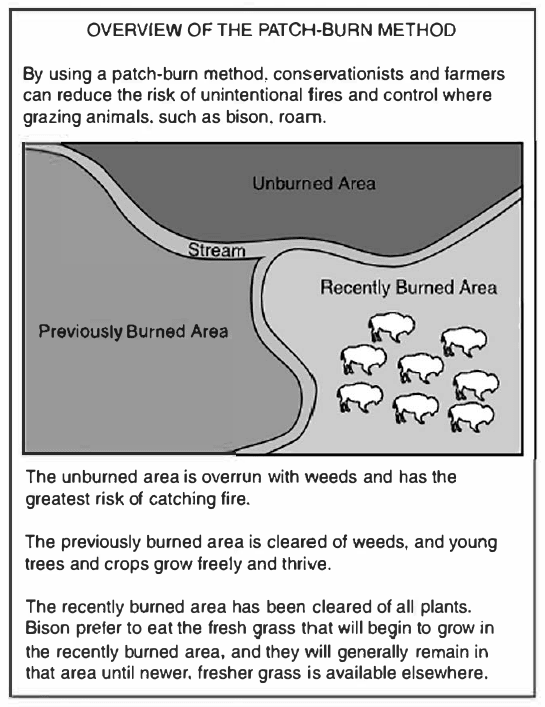
Of course, these controlled fires are intended to burn only a portion of an area. A total burn, which is a risk with an uncontrolled wildfire, would destroy all wildlife as well as the crops farmers plant for income. The key to using controlled fires is knowing which areas of land to burn and when. Conservation experts at the preserve employ the “patch-burn” approach, meaning they rotate which portion of land is burned each year. They study the land to find out which areas would most benefit from being burned, and then they arrange about a dozen burns over one-third of the land. This patch burning contains the fire within a specific area and allows animals in the burn area to safely relocate. The following year, conservationists will burn a different section of the preserve, while the land burned the previous year regrows healthier than before.
Researchers have tracked and studied the variety of plant species and animals that live on the preserve, and their studies show that the patch-burn approach has restored biodiversity to the area by promoting the growth of species that were at risk of being crowded out. The patch-burn system is so successful that the conservationists at the preserve provide training to prairie farmers about conducting controlled burns on their own land. Burning land to make it healthy may seem counterintuitive, but strategic controlled fires have helped the prairie sustain life for hundreds of years and, with careful management, will continue to do so.
Question
According to the passage, how did fires started by natural causes prompt American Indians to begin practicing controlled burns?
- Aby drawing animals in to the area to feed on the new growth sprouting from the burned land
- Bby destroying tall trees and reducing the shade that had hindered the growth of planted crops
- Cby burning off excess vegetation and increasing the availability of nutrients for the remaining plants
- Dby causing changes to the bison’s migration habits as bison herds fled from the wildfires on the prairie
Show the answer
Correct answer: A
The question asks how observing the effects of the fires started by natural causes prompted American Indians to begin practicing controlled burns.
A. CORRECT. In paragraph 2, the author states that American Indians observed bison “grazing on tender new grass on the recently burned land rather than on grass in the unburned areas.” These observations prompted the practice of controlled burns as a means of enticing “the herds away from the people’s crops.”
B. Incorrect. Although the author mentions in paragraph 4 that the primary targets of a controlled burn are red cedar trees and that “these tall trees also cast shade that prevents sunlight from reaching the plants beneath them,” this detail supports why conservationists use controlled burns today, not what initially prompted the use of controlled burns.
C. Incorrect. While the author states in paragraph 3 that “the process of burning excess plant matter adds nitrogen, an essential element for plant growth, to the soil” and that “intentionally burning a portion of land can dramatically improve the quality of the vegetation that regrows there,” these details do not explain the initial observations that prompted American Indians to practice controlled burning.
D. Incorrect. While paragraph 2 mentions that bison moved to a new area to graze because they preferred the “tender new grass on the recently burned land,” there is no indication in the passage that bison changed their migration habits in order to flee wildfires.
Question analysis
This key-details question about an article on controlled burns at an Oklahoma tallgrass prairie preserve asks how fires started by lightning or other natural causes led American Indians to begin burning land on purpose. Students must find the passage's account of that early practice, and since the article describes several effects of fire, each choice has to be checked against what those first observers actually saw.
- Grade level
- Grade 7 reading and task
- Compared with grade 7
- At grade 7 Finding a stated cause in an informational text is regular grade 7 reading. The answer sits in one short paragraph, but the article describes several effects of fire, old and new, and the choices draw on them, which keeps the demand typical.
- Estimated difficulty
- Straightforward: two steps or one careful reading.
- Thinking it demands
- Depth of knowledge 2, skills and concepts · mainly understand
- What makes it hard
- Evidence
- Answered from one paragraph or stanza
- Reading level
- Passage: about grade 11, 598 words; question and choices: about grade 9, 86 words.
- Students, last 30 days
- Not enough answers yet to show (it takes 10).
Why it is hard, traps and wrong answers (shows the answer)
Why it is hard
The stem points to one short paragraph, but the article goes on to list many more benefits of fire, and two wrong choices borrow them: shade cleared from under red cedars and nutrients returned to the soil. Both are true of controlled burns today, not of what the Great Plains peoples first noticed. Students who return to paragraph 2 and restate the bison’s taste for freshly burned grass find the answer quickly.
Every choice must be checked minor Choosing the answer
Two wrong choices name real benefits of burning from later paragraphs, cedar shade removed in paragraph 4 and nutrients freed in paragraph 3, so each must be tested against what the early peoples saw. (Embretson & Wetzel, 1987)
Reading between the lines minor Working it out
Paragraph 2 never says the bison’s grazing caused the practice; students connect “realized that these fires could also be helpful” to the preference for burned land and the deliberate burns that follow. (Graesser, Singer & Trabasso, 1994; Kintsch, 1998)
Strategy: Go to the paragraph about the Great Plains peoples of hundreds of years ago, restate in your own words what they noticed after natural fires, and test each choice against that observation.
Traps
- Wrong part of the text: A choice is true of another paragraph, stanza or speaker than the one asked about.
- True but not the answer: A choice says something accurate about the text that does not answer this question.
- Twists what the text says: Uses the text's topic and ideas but changes what it says: who did it, how much, when, or why.
The wrong answers, classified
B Wrong part of the text (Kirsch & Mosenthal, 1990)
Borrows paragraph 4’s red cedars, whose shade blocks sunlight from the plants beneath them, and adds “planted crops,” though that shade explains modern burns, not the first deliberate ones.
C True but not the answer (King et al., 2004; Embretson & Wetzel, 1987)
States paragraph 3’s real benefits, weedy undergrowth burned away and nitrogen added to the soil, but the article gives them as reasons for burning today, not as what the early peoples observed.
D Twists what the text says (King et al., 2004)
Remembers that bison moved onto burned land but turns their preference for “tender new grass” into herds fleeing wildfire, a change in migration the passage never describes.
Working it out, step by step
Figure out what the question asks
This question asks about a cause. Long ago, fires started by lightning gave American Indians an idea. They began to burn land on purpose. You need to find what they saw that led them to do it. A controlled burn is a fire that people set and keep inside a planned area.
Find the right paragraph
Paragraph 2 tells this part of the story. It says the people “realized that these fires could also be helpful.” Then it says what they noticed: “The bison in the area seemed to prefer grazing on tender new grass on the recently burned land rather than on grass in the unburned areas.”
Put it in your own words
Grazing means eating grass. After a fire, soft new grass grew, and the bison liked it best. So the people began to burn land on purpose. The new grass pulled the herds to that land. That kept the bison away from the crops. The paragraph says the burning “enticed the herds away from the people’s crops.” Enticed means tempted or drew.
Check each choice
- A is right. The burned land drew animals, the bison, to eat the new grass.
- B is wrong. The shade of tall trees comes from paragraph 4. It explains why people burn red cedars today, not how burning began.
- C is wrong. Burning off weeds and adding nutrients come from paragraph 3. Nutrients are what plants need to grow. These are reasons for burning today.
- D is wrong. The bison moved toward the fresh grass. The passage never says herds fled from fires.
Watch out: C is true about controlled burns. But the question asks what first gave the people the idea. Paragraph 2 says it was the bison.
Choose the answer
The early people saw bison come to burned land to eat the new grass. So the answer is A: “by drawing animals in to the area to feed on the new growth sprouting from the burned land.”
Why this answer and not the closest wrong one
C is the closest wrong answer, because it names real good effects of fire. But paragraph 3 gives those as reasons people burn land “today.” The question asks how burning began hundreds of years ago. Paragraph 2 says it began when people watched bison feed on burned land.
More questions like this
The original DOE question
The passage “Using Fire to Keep a Prairie Healthy” as printed (page 41)
Question 2 of 21
2026 Practice Test C English, question 36Passage Excerpt from “Growing Peppers on the ISS Is Just the Start of Space Farming”
Excerpt from “Growing Peppers on the ISS Is Just the Start of Space Farming”
by Melanie Canales
The author, Melanie Canales, is a first-generation Peruvian American farmer and beekeeper based in Virginia’s Shenandoah Valley, on lands of the indigenous Monacan and Manahoac tribes. Her work focuses on creating healthy relationships between people and their surrounding ecosystems.
Unburdened by the constraints of gravity, red and green peppers jut out at 45-degree angles inside the Advanced Plant Habitat (APH), a sort of space terrarium not much larger than a microwave. Four chile pepper plants stand effortlessly upright, despite the dozens of glossy fruits weighing them down. These plants have lived entirely in space; their leaves have never been chewed on by insects or rustled by a summer breeze, [and] their stems are unfamiliar with bending toward the sun’s arc across the sky. Scissors glint under the tank’s white and blue lights as astronaut Mark Vande Hei and his team snip the stems of those that are ready for harvest. The peppers whirl around their heads until the astronauts catch them and tape them against a board to photograph.
Back on Earth, the Plant Habitat-04 team of engineers and plant scientists are observing and conferring with the astronauts. Of the 26 peppers in this batch, only the 14 finest will stay on the International Space Station [ISS] for consumption. The rest will be wrapped in foil, sealed in a Ziploc bag, then frozen at a brisk −80 degrees, until they can come roaring back to Earth in the next cargo capsule to be studied later. Now, after a 137-day growth cycle, the astronauts remove the plants from the module and trash them. Project Plant Habitat-04 is complete. It’s taco night on the ISS.
Since 2014, NASA1 has experimented with growing lettuces, brassicas,2 and zinnias3 in space, an endeavor that relies on highly specialized technology over 50 years in the making. [Fall 2021’s] two successful pepper harvests . . . will provide data on the nutritional and psychological benefits of growing vegetables on-craft, as well as a crop’s ability to reliably produce long-term in microgravity. While controlled environmental agriculture is not new, the APH experiment represents an evolution in specialized growth habitats. It doesn’t aim to re-create Earth’s conditions, but to perfect each isolated variable of plant growth in the clinical environment of a spaceship.
“The Advanced Plant Habitat is the most complex plant growth system on orbit today,” says Lashelle Spencer, a plant scientist at NASA’s Kennedy Space Center. Its more than 180 sensors control and monitor temperature, humidity, and carbon dioxide. The astronauts can adjust the color and intensity of the light, and how much moisture the plants’ roots are getting. It waters itself.
It’s the day after Thanksgiving, and Spencer has been at Kennedy since 5 a.m. to facilitate the peppers’ final harvest. As part of the project team, she played a crucial role in preparing the seeds that were sent hurtling into space in June and guiding the astronauts through maintaining the plants in orbit. . . . Though astronauts can spend upwards of 100 days in space, their on-mission meals come dehydrated and pre-packaged; their vitamins and minerals are isolated in supplements, which lose nutritional value the longer they’re stored. Spencer’s goal is to create the conditions necessary for cultivating healthy plants in space, so those plants can sustain healthy astronauts on long-term missions. Astronaut food is great, she says—“especially the shrimp cocktail. But you’re missing that crunch. You’re missing that fresh pop of flavor, the green flavor that’s not there in that packaged food.”
The sensory experience of growing productive crops can also help mitigate4 the psychological effects of long-term space travel. . . . Spencer says the team cracked open the door of the APH every day to observe their vegetable companions with all the tenderness of home gardeners. When harvest day came, they batted their bounty around the ISS, taking selfies and delighting in watching the fruits pirouetting around the spacecraft. . . .
“We were thinking no heat, so that [the peppers] wouldn’t be dangerous, but maybe the astronauts need a little spice in their life,” says Paul Bosland, who along with his colleagues at the Chile Pepper Institute genetically engineered5 the NuMex Española Improved chile pepper seeds grown in Plant Habitat-04. . . .
Working with NASA, Bosland cultivated a variety that could accommodate both the nutritional needs of astronauts as well as the logistics of growing a plant in space. . . .
. . . The experiment is helping gather the data necessary to determine the nutritional content of crops grown in space, and therefore how many people they can feed, and for how long. Though much is still unknown, Spencer is certain of one thing that future astronauts will need to do: “I think in an optimal world, a scientist like me would say that they would be growing plants from day one. From the day they left to the day they came back, they would be growing them.”
From “Growing Peppers on the ISS Is Just the Start of Space Farming” by Melanie Canales from WIRED, December 21, 2021. Copyright © 2021 Condé Nast. All rights reserved.
1NASA: National Aeronautics and Space Administration
2brassicas: a large genus of herbs, such as broccoli and cabbage
3zinnias: a genus of herbs and low shrubs that have flowers at their heads
4mitigate: to make something less severe or harmful
5genetically engineered: combined parts of DNA from different plants to produce a new plant
Question
Which statement best explains why Lashelle Spencer is a relevant source of information for the excerpt?
- AShe works at NASA’s Kennedy Space Center.
- BShe is part of the APH project team.
- CShe is sensitive to the astronauts’ need for healthy food in space.
- DShe witnessed how astronauts aboard the APH responded when harvesting their food.
Show the answer
Correct answer: B
The question asks which statement best explains why Lashelle Spencer is a relevant source of information for the excerpt.
A. Incorrect. While paragraphs 4 and 5 do mention that Lashelle Spencer works at NASA’s Kennedy Space Center, that fact does not explain her direct expertise on growing plants in space.
B. CORRECT. In paragraph 4, Spencer is identified as a “plant scientist” at NASA, and paragraph 5 states that she is directly involved with the Advanced Plant Habitat as “part of the project team,” making her a relevant source of information for the excerpt’s discussion of growing plants in space.
C. Incorrect. Although the details in paragraph 5 do indicate that Spencer is interested in providing better food choices to astronauts, her empathy toward the astronauts’ needs does not make her a relevant source of information for the excerpt.
D. Incorrect. Paragraph 5 does mention that Spencer helped facilitate the harvest from the Kennedy Space Center, so she likely did witness the astronauts’ reactions as they harvested the peppers; however, this inference does not explain Spencer’s relevance as a source of information for the excerpt.
Question analysis
Why is Lashelle Spencer, the NASA plant scientist quoted throughout the article on growing peppers in space, a relevant source of information? This question asks students to judge what qualifies a person quoted in an informational text to speak on its subject. Several choices state facts about her, so students must decide which one actually explains her value as a source.
- Grade level
- Grade 7 reading and task
- Compared with grade 7
- At grade 7 Grade 7 readers often judge whether evidence is relevant, though asking why a quoted expert deserves trust is a less common form of the task. The facts about Spencer sit in two neighboring paragraphs, so the reading demand itself is typical.
- Estimated difficulty
- Moderate: several steps, or a close reading with one strong distractor.
- Thinking it demands
- Depth of knowledge 2, skills and concepts · mainly evaluate
- What makes it hard
- Every choice must be checked moderate
- Reading between the lines minor
- Evidence in several places minor
- Evidence
- Answered from several paragraphs or stanzas
- Reading level
- Passage: about grade 10, 890 words; question and choices: about grade 7, 55 words.
- Corrected from the DOE handbook
- A wrong paragraph number in the explanation was corrected.
- Students, last 30 days
- Not enough answers yet to show (it takes 10).
Why it is hard, traps and wrong answers (shows the answer)
Why it is hard
The pull of this question is that the first thing the excerpt says about Spencer, her job at NASA’s Kennedy Space Center, sounds like a credential. Paragraph 5 gives the stronger one: she helped prepare the seeds and guided the crew, so she knows this experiment firsthand. Students lose the point by stopping at the job title, or by treating her sympathy for the astronauts or a harvest she supposedly watched as expertise.
Every choice must be checked moderate Choosing the answer
Her Kennedy workplace, her concern for well-fed astronauts and her role on the project all come from paragraphs 4 and 5, so truth rules out little; each must be weighed as a qualification. (Embretson & Wetzel, 1987)
Reading between the lines minor Working it out
The excerpt never says why Spencer is quoted; a reader must connect “part of the project team” and “guiding the astronauts” to her firsthand knowledge of this particular experiment. (Graesser, Singer & Trabasso, 1994; Kintsch, 1998)
Evidence in several places minor Working it out
Spencer is introduced in paragraph 4 as a NASA plant scientist, but her place on the pepper project appears only in paragraph 5, after a sentence about Thanksgiving. (Kirsch & Mosenthal, 1990; Gorin & Embretson, 2006)
Strategy: Find every detail paragraphs 4 and 5 give about Spencer, then ask of each choice whether it explains why her statements about this experiment deserve a reader’s trust.
Traps
- True but not the answer: A choice says something accurate about the text that does not answer this question.
- Reads too much in: A reasonable-sounding conclusion that goes further than the text allows.
The wrong answers, classified
A True but not the answer (King et al., 2004; Embretson & Wetzel, 1987)
Takes her workplace, named when paragraph 4 introduces her, as the credential, though many people work at Kennedy; her role on the pepper project is what gives her firsthand knowledge.
C True but not the answer (King et al., 2004; Embretson & Wetzel, 1987)
Notices her goal of plants that “sustain healthy astronauts” and treats that caring attitude as expertise, though concern for the crew says nothing about what she knows of growing plants.
D Reads too much in (Graesser, Singer & Trabasso, 1994)
Assumes that facilitating the harvest from Kennedy, on Earth, means she watched the crew’s reactions, which the excerpt never says, and watching would not make her an expert anyway.
What was corrected from the DOE handbook, and why
- Explanation: The handbook’s explanation of Option A says “paragraphs 5 and 8 do mention that Lashelle Spencer works at NASA’s Kennedy Space Center.” Spencer is introduced in paragraph 4 as “a plant scientist at NASA’s Kennedy Space Center,” and paragraph 5 says she “has been at Kennedy since 5 a.m.” Paragraph 8 is about Paul Bosland and does not mention her. The site now says “paragraphs 4 and 5.”
Working it out, step by step
Figure out what the question asks
A source is a person whose words an article uses. A relevant source is one who really knows the topic. This question asks why Lashelle Spencer is worth quoting in an article about growing peppers in space. Several choices are true facts about her. You need the one that shows why she knows this subject.
Find what the article says about her
Paragraph 4 introduces her as “a plant scientist at NASA’s Kennedy Space Center.” Paragraph 5 says she “has been at Kennedy since 5 a.m. to facilitate the peppers’ final harvest.” To facilitate means to help make something happen. Then comes the key sentence: “As part of the project team, she played a crucial role in preparing the seeds that were sent hurtling into space in June and guiding the astronauts through maintaining the plants in orbit.”
Explain what that tells you
Spencer didn’t just watch this project from far away. She helped run it. She got the seeds ready. She coached the astronauts as they cared for the plants. So she has firsthand knowledge, meaning she learned it by doing it herself. That is what makes her a good source for this article.
Check each choice
- A is wrong. It is true, and paragraphs 4 and 5 both say it. But many people work at Kennedy. A job there doesn’t make someone an expert on growing plants in space.
- B is right. Being on the project team means she helped plan and guide this exact experiment.
- C is wrong. She does care about healthy food for astronauts. But caring is not the same as knowing.
- D is wrong. The article never says she watched how the crew reacted. Even if she did, watching a harvest wouldn’t make her an expert.
Watch out: A is the first fact you learn about her, so it feels like her main qualification. Paragraph 5 gives a stronger one.
Choose the answer
Spencer helped prepare and guide the pepper experiment herself. So the answer is B, “She is part of the APH project team.”
Why this answer and not the closest wrong one
A is the closest wrong answer. Working at NASA’s Kennedy Space Center sounds impressive, and it is true. But a job at a big space center doesn’t prove she knows this experiment. B does. Being on the project team means she prepared the seeds and guided the crew.
More questions like this
The original DOE question
The passage “Excerpt from “Growing Peppers on the ISS Is Just the Start of Space Farming”” as printed (pages 50–51)
Question 3 of 21
2026 Practice Test C English, question 40Uses the passage above: “Excerpt from “Growing Peppers on the ISS Is Just the Start of Space Farming””.
Question
What is the relationship between the scientists and the astronauts in carrying out the plant-growing experiments?
Move the correct answer to each box.
Scientists on earth are primarily responsible for for conducting plant experiments in space, while the astronauts aboard the International Space Station are responsible for for the experiment.
On the test you drag tiles into the boxes; here, choose each box’s tile from its menu. Each tile can be used once. The DOE has not published how answers with several parts are scored; this site counts one right only when every part is right.
Show the answer
Correct answer: blank 1: developing the materials and systems; blank 2: growing the plants to harvest
The question asks for the two phrases that should be added to the sentence to explain the relationship between the scientists and the astronauts in carrying out the plant-growing experiments.
CORRECT. The phrase “growing the plants to harvest” should be added to the second box in the sentence. Paragraphs 1 and 2 of the excerpt show that astronauts aboard the ISS are responsible for tending to the plants in the system and harvesting them after the growth cycle is complete.
Incorrect. The phrase “documenting the nutritional goals” should not be added to either box in the sentence. While the excerpt does mention that the experiment is helping gather data about the nutritional value of the peppers, there is no evidence that either the scientists on Earth or the astronauts aboard the ISS are tasked with documenting specific nutritional goals.
Incorrect. The phrase “analyzing the environment” should not be added to either box in the sentence. Although the experiment requires control of environmental factors like light and moisture, the excerpt does not describe or primarily focus on describing how either the scientists on Earth or the astronauts aboard the ISS are responsible for formally analyzing the environment of the habitat as part of the experiment.
CORRECT. The phrase “developing the materials and systems” should be added to the first box in the sentence. The excerpt explains that the scientists on Earth create and prepare the systems, seeds, and equipment needed for the plant-growing experiments in space.
Incorrect. The phrase “determining the most nutritional plants” should not be added to either box in the sentence. Although growing nutritious plants is important, the excerpt does not focus on the scientists on Earth or the astronauts aboard the ISS evaluating or selecting plants based on their nutritional value.
Question analysis
This question asks students to complete a sentence describing how scientists on Earth and astronauts aboard the International Space Station divided the work of the pepper-growing experiment. On the test students drag phrase tiles into two boxes, choosing from five. Each group’s role must be pieced together from details spread across the excerpt, and each tile names a task in general words that must be matched to the text.
- Grade level
- Grade 7 reading and task
- Compared with grade 7
- At grade 7 Explaining how the people in an informational text relate to one another is grade 7 work. Filling two boxes from five tiles with all-or-nothing credit adds some demand, but the excerpt shows the two groups doing clearly different jobs.
- Estimated difficulty
- Moderate: several steps, or a close reading with one strong distractor.
- Thinking it demands
- Depth of knowledge 2, skills and concepts · mainly analyze
- What makes it hard
- The right answer is reworded moderate
- Evidence in several places moderate
- Much to keep track of minor
- Evidence
- Answered from several paragraphs or stanzas
- Reading level
- Passage: about grade 10, 890 words; question and choices: about grade 13, 50 words.
- Students, last 30 days
- Not enough answers yet to show (it takes 10).
Why it is hard, traps and wrong answers (shows the answer)
Why it is hard
The astronauts’ box is the easy half, since the excerpt opens with the crew snipping and catching ripe peppers. The scientists’ box is where points are lost: the right tile is abstract, while the tempting ones name nutrition and the environment, both prominent in the article. Students who match a tile to a phrase they remember, rather than to everything the people on Earth are shown doing, fill the first box wrongly.
The right answer is reworded moderate Choosing the answer
The scientists’ tile, “developing the materials and systems,” sums up preparing seeds, engineering a variety and building the habitat in words the excerpt never uses, while the nutrition tile echoes paragraph 9. (Freedle & Kostin, 1993; Kirsch & Mosenthal, 1990)
Evidence in several places moderate Working it out
The scientists’ work is scattered: the habitat’s technology in paragraphs 3 and 4, Spencer preparing seeds in paragraph 5, Bosland’s engineered variety in paragraphs 7 and 8; the crew’s tending and harvest fill paragraphs 1 and 2. (Kirsch & Mosenthal, 1990; Gorin & Embretson, 2006)
Much to keep track of minor Working it out
Two boxes must both be right from five tiles that cannot be reused, so each group’s whole role must be held in mind while three plausible-sounding tiles are rejected. (Sweller, 1988; Carpenter, Just & Shell, 1990)
Strategy: List what the people on Earth did and what the crew in orbit did, then fill each box with the tile that sums up its list, not one that echoes a single word of the excerpt.
Traps
- Word match: Repeats striking words or phrases from the text, so it looks supported, but its meaning does not fit the question.
- Twists what the text says: Uses the text's topic and ideas but changes what it says: who did it, how much, when, or why.
The wrong answers, classified
EA Word match (Freedle & Kostin, 1993)
Matches “determining the most nutritional plants” to paragraph 9’s “determine the nutritional content of crops,” though the scientists engineered one variety rather than picking the most nutritious among many.
CA Twists what the text says (King et al., 2004)
Gives the scientists “analyzing the environment” because paragraph 2 shows them “observing and conferring,” though the excerpt shows them preparing seeds and systems while the habitat’s sensors monitor conditions.
DC Twists what the text says (King et al., 2004)
Fills the scientists’ box correctly but gives the crew “analyzing the environment,” since they can adjust the light and moisture, though their job is tending the plants through to harvest.
Working it out, step by step
Figure out what the question asks
You need to finish a sentence about who did what. The first box tells what the scientists on Earth did. The second box tells what the astronauts in space did. On the test you drag a tile into each box. Here, you pick each box’s tile from a menu. Each tile can be used only once, and three tiles are left over.
List what the scientists did
- Spencer played “a crucial role in preparing the seeds that were sent hurtling into space” (paragraph 5).
- Bosland and his colleagues “genetically engineered” the pepper seeds (paragraph 7). The footnote says they “combined parts of DNA from different plants to produce a new plant.”
- Growing plants in space “relies on highly specialized technology over 50 years in the making” (paragraph 3).
So the scientists made and got ready what the experiment needed: seeds and machines.
List what the astronauts did
- They “can adjust the color and intensity of the light” for the plants (paragraph 4).
- “The team cracked open the door of the APH every day” to check on the plants (paragraph 6).
- They “snip the stems of those that are ready for harvest” (paragraph 1).
- They finish “after a 137-day growth cycle” (paragraph 2).
So the astronauts cared for the plants until the peppers were ripe, then picked them.
Match a tile to each list
The scientists’ list is about making things: seeds, a new pepper and a high-tech habitat. The tile developing the materials and systems sums that up. Materials are the things you use, like seeds. Systems are machines with many parts, like the habitat. The astronauts’ list is about care and picking. The tile growing the plants to harvest sums that up.
Rule out the other tiles
- documenting the nutritional goals: no one in the article writes down nutrition goals.
- analyzing the environment: the habitat’s sensors “control and monitor” conditions. The crew adjusts light and water, but that is caring for plants, not studying them.
- determining the most nutritional plants: paragraph 9 says the data will “determine the nutritional content of crops.” But no one picks the healthiest plants. Bosland made one special kind.
Watch out: The last tile repeats words from paragraph 9, so it is tempting for the first box. Matching a word is not the same as matching the job.
Fill in both boxes
Scientists on Earth develop the materials and systems for the experiment. Astronauts grow the plants to harvest. So the first box gets developing the materials and systems, and the second box gets growing the plants to harvest.
Why this answer and not the closest wrong one
The most tempting wrong tile for the first box is determining the most nutritional plants, because it echoes paragraph 9. But the scientists in the article prepared seeds, engineered a new pepper and built the habitat. That is developing materials and systems. Nobody compares plants to find the most nutritious one.
More questions like this
The original DOE question
Question 4 of 21
2026 Practice Test D English, question 10Passage Excerpt from “How We Made the First Flight”
Excerpt from “How We Made the First Flight”
by Orville Wright
In 1903 brothers Wilbur and Orville Wright conducted experiments related to flying machines. These experiments would eventually lead to air travel becoming a reliable form of transportation.
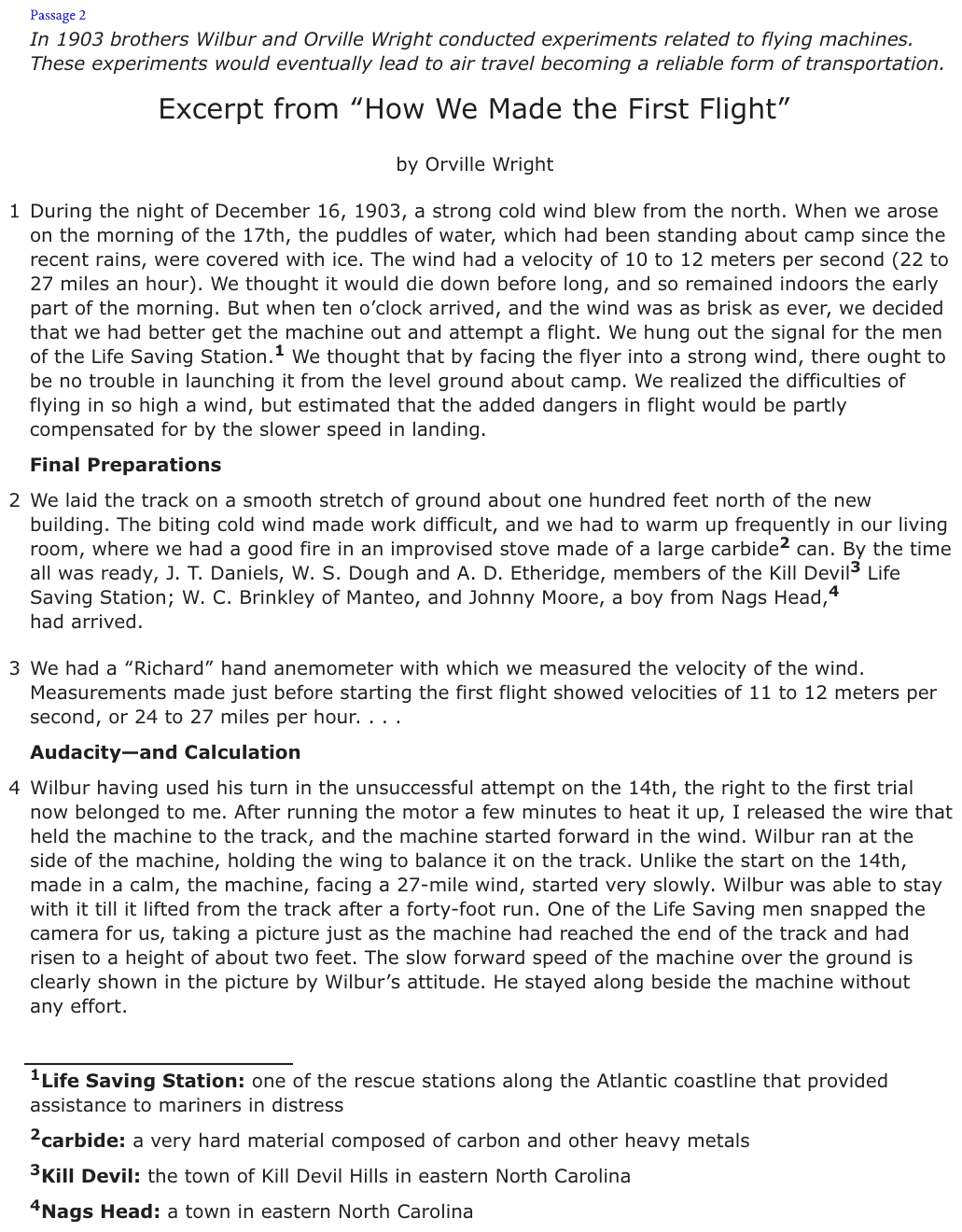
During the night of December 16, 1903, a strong cold wind blew from the north. When we arose on the morning of the 17th, the puddles of water, which had been standing about camp since the recent rains, were covered with ice. The wind had a velocity of 10 to 12 meters per second (22 to 27 miles an hour). We thought it would die down before long, and so remained indoors the early part of the morning. But when ten o’clock arrived, and the wind was as brisk as ever, we decided that we had better get the machine out and attempt a flight. We hung out the signal for the men of the Life Saving Station.1 We thought that by facing the flyer into a strong wind, there ought to be no trouble in launching it from the level ground about camp. We realized the difficulties of flying in so high a wind, but estimated that the added dangers in flight would be partly compensated for by the slower speed in landing.
Final Preparations
We laid the track on a smooth stretch of ground about one hundred feet north of the new building. The biting cold wind made work difficult, and we had to warm up frequently in our living room, where we had a good fire in an improvised stove made of a large carbide2 can. By the time all was ready, J. T. Daniels, W. S. Dough and A. D. Etheridge, members of the Kill Devil3 Life Saving Station; W. C. Brinkley of Manteo, and Johnny Moore, a boy from Nags Head,4 had arrived.
We had a “Richard” hand anemometer with which we measured the velocity of the wind. Measurements made just before starting the first flight showed velocities of 11 to 12 meters per second, or 24 to 27 miles per hour. . . .
Audacity—and Calculation
Wilbur having used his turn in the unsuccessful attempt on the 14th, the right to the first trial now belonged to me. After running the motor a few minutes to heat it up, I released the wire that held the machine to the track, and the machine started forward in the wind. Wilbur ran at the side of the machine, holding the wing to balance it on the track. Unlike the start on the 14th, made in a calm, the machine, facing a 27-mile wind, started very slowly. Wilbur was able to stay with it till it lifted from the track after a forty-foot run. One of the Life Saving men snapped the camera for us, taking a picture just as the machine had reached the end of the track and had risen to a height of about two feet. The slow forward speed of the machine over the ground is clearly shown in the picture by Wilbur’s attitude. He stayed along beside the machine without any effort.
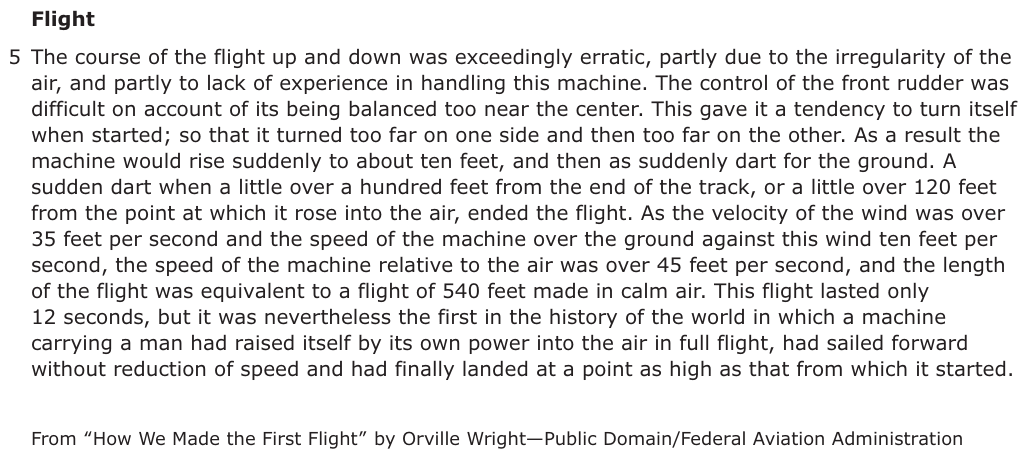
Flight
The course of the flight up and down was exceedingly erratic, partly due to the irregularity of the air, and partly to lack of experience in handling this machine. The control of the front rudder was difficult on account of its being balanced too near the center. This gave it a tendency to turn itself when started; so that it turned too far on one side and then too far on the other. As a result the machine would rise suddenly to about ten feet, and then as suddenly dart for the ground. A sudden dart when a little over a hundred feet from the end of the track, or a little over 120 feet from the point at which it rose into the air, ended the flight. As the velocity of the wind was over 35 feet per second and the speed of the machine over the ground against this wind ten feet per second, the speed of the machine relative to the air was over 45 feet per second, and the length of the flight was equivalent to a flight of 540 feet made in calm air. This flight lasted only 12 seconds, but it was nevertheless the first in the history of the world in which a machine carrying a man had raised itself by its own power into the air in full flight, had sailed forward without reduction of speed and had finally landed at a point as high as that from which it started.
From “How We Made the First Flight” by Orville Wright—Public Domain/Federal Aviation Administration
1Life Saving Station: one of the rescue stations along the Atlantic coastline that provided assistance to mariners in distress
2carbide: a very hard material composed of carbon and other heavy metals
3Kill Devil: the town of Kill Devil Hills in eastern North Carolina
4Nags Head: a town in eastern North Carolina
Question
The photograph mentioned in paragraph 4 is significant because it
- Adocuments that the machine rose into the air as soon as the tethering wire was released.
- Bprovides proof of the critical moment the machine took flight.
- Cdocuments that the wind reduced the speed of the plane at the start of the flight.
- Dprovides proof that the pilot had to gradually increase the height of the plane in the air.
Show the answer
Correct answer: B
The question asks why the photograph mentioned in paragraph 4 is significant.
A. Incorrect. According to paragraph 4, the photograph was not taken immediately after the tethering wire was released but rather after an intervening period during which “Wilbur ran at the side of the machine, holding the wing to balance it on the track.” The picture was not taken until “the machine had reached the end of the track,” which occurred after a “forty-foot run” (paragraph 4).
B. CORRECT. The photograph mentioned in paragraph 4 is significant because it provides proof that the machine did, in fact, take flight: “One of the Life Saving men snapped the camera for us, taking a picture just as the machine had reached the end of the track and had risen to a height of about two feet. The slow forward speed of the machine over the ground is clearly shown in the picture by Wilbur’s attitude. He stayed along beside the machine without any effort.”
C. Incorrect. The photograph mentioned in paragraph 4 is described as showing the plane moving forward through the air at a height of two feet, but while the effect of the wind may be visible, it is not why the photo is significant. Instead, the photograph provides proof that the plane is, in fact, moving through the air (“One of the Life Saving men snapped the camera for us, taking a picture just as the machine had reached the end of the track and had risen to a height of about two feet. The slow forward speed of the machine over the ground is clearly shown in the picture by Wilbur’s attitude”).
D. Incorrect. Although the plane is shown at a height of two feet in the photograph mentioned in paragraph 4, the picture documents only one moment of the plane’s flight and does not provide proof that the pilot had to gradually increase the height of the plane in the air.
Question analysis
This question on Orville Wright’s account of the first airplane flight asks why the photograph mentioned in paragraph 4, taken by one of the Life Saving men, is significant. The photograph itself is not printed with the excerpt, so students must work from Orville’s description of the moment it was taken. Several choices describe the machine’s movement, so each must be checked against that description.
- Grade level
- Grade 8 reading and task
- Compared with grade 7
- Above grade 7 Grade 7 readers often explain why a detail matters. This photograph is not printed, so students must picture it from Orville’s description, which uses “attitude” in an old sense meaning posture, and then judge why the picture mattered.
- Estimated difficulty
- Hard: combines ideas, needs a plan, and has more than one tempting wrong answer.
- Thinking it demands
- Depth of knowledge 2, skills and concepts · mainly analyze
- What makes it hard
- Reading between the lines moderate
- The right answer is reworded moderate
- Hard words minor
- Evidence
- Answered from one paragraph or stanza
- Reading level
- Passage: about grade 7, 816 words; question and choices: about grade 7, 68 words.
- Students, last 30 days
- Not enough answers yet to show (it takes 10).
Why it is hard, traps and wrong answers (shows the answer)
Why it is hard
The photograph is not printed, so students work from three sentences of description, and the last two tell what Orville thinks the picture shows: the machine’s slow speed, visible in Wilbur’s easy pace. That stated detail is the strongest lure. The question asks for significance instead, which the excerpt leaves unstated; students must link the moment captured, the machine just off the track at the end of its run, to paragraph 5’s closing claim that this was the first such flight in history.
Reading between the lines moderate Working it out
Orville never says why the picture matters; students must notice it was taken “just as the machine had reached the end of the track and had risen to a height of about two feet,” the instant of lift-off. (Graesser, Singer & Trabasso, 1994; Kintsch, 1998)
The right answer is reworded moderate Choosing the answer
The key’s “critical moment the machine took flight” appears nowhere, while the wrong choices echo the paragraph’s released wire, the slow speed Orville says the picture shows, and the “height of about two feet.” (Freedle & Kostin, 1993; Kirsch & Mosenthal, 1990)
Hard words minor Understanding the question
Orville says the slow speed shows “by Wilbur’s attitude,” using attitude in an old sense, Wilbur’s posture as he keeps pace, which students must decode to follow the description of the picture. (Perfetti, 2007; Freedle & Kostin, 1993)
Strategy: Reread the three sentences about the picture in paragraph 4, note when it was taken and what Orville says it shows, then weigh which choice explains why such a picture would matter.
Traps
- True but not the answer: A choice says something accurate about the text that does not answer this question.
- Twists what the text says: Uses the text's topic and ideas but changes what it says: who did it, how much, when, or why.
- Reads too much in: A reasonable-sounding conclusion that goes further than the text allows.
The wrong answers, classified
A Twists what the text says (King et al., 2004)
Collapses the release of the wire and the lift-off into one moment, skipping Wilbur’s run beside the machine; it rose only after a forty-foot run, when the picture was taken.
C True but not the answer (King et al., 2004; Embretson & Wetzel, 1987)
Takes Orville’s own remark that the picture shows “the slow forward speed of the machine” as its significance, but that is a detail in the picture, not why a picture of this moment matters.
D Reads too much in (Graesser, Singer & Trabasso, 1994)
Treats the two-foot height as one step in a steady climb, though a single picture catches one instant and paragraph 5 describes sudden rises to ten feet and darts toward the ground.
Working it out, step by step
Figure out what the question asks
This asks why the photograph in paragraph 4 matters. The photograph is not printed with the excerpt. You have to picture it from Orville’s words. Find when it was taken. Then ask why a picture of that moment would be important.
Read the description of the photograph
Paragraph 4 says “One of the Life Saving men snapped the camera for us, taking a picture just as the machine had reached the end of the track and had risen to a height of about two feet.” The next sentences say “The slow forward speed of the machine over the ground is clearly shown in the picture by Wilbur’s attitude. He stayed along beside the machine without any effort.”
Work out what the picture shows
The machine had just left the track and was two feet in the air. So the picture caught the moment it lifted off. Here “attitude” means the way Wilbur held his body. He kept up with the machine easily, so it was moving slowly. Paragraph 5 says this flight was “the first in the history of the world” of its kind. A photo of that lift-off is proof that it really happened.
Check each choice
- A does not fit. The machine did not rise at once. It lifted “after a forty-foot run.”
- B fits. The picture caught the moment the machine first took flight.
- C does not fit. The picture does show the slow speed. But that is a detail in the photo, not why the photo matters.
- D does not fit. One picture shows one moment. It cannot show a steady climb. In fact, paragraph 5 says the machine rose and dropped suddenly.
Watch out: C is tempting because Orville himself says the slow speed is “clearly shown in the picture.” But the question asks why the picture is significant, which means important.
Choose the answer
The photo captured the very moment the first flight began. So the answer is B, “provides proof of the critical moment the machine took flight.”
Why this answer and not the closest wrong one
C is the closest wrong choice. Orville does say the picture shows the machine’s slow speed. But slow speed is not what makes this photo special. It was taken just as the machine “had risen to a height of about two feet” at the end of the track. That is proof of the first moment of flight, as B says.
More questions like this
The original DOE question
The passage “Excerpt from “How We Made the First Flight”” as printed (pages 13–14)
Question 5 of 21
2024 Test B English, question 19Passage Excerpt from “How Exercise Could Help You Learn a New Language”
Excerpt from “How Exercise Could Help You Learn a New Language”
by Gretchen Reynolds
Many scientists suspect that exercise alters the biology of the brain in ways that make it more malleable and receptive to new information, a process that scientists refer to as plasticity.
But many questions have remained unanswered about movement and learning, including whether exercise is most beneficial before, during or after instruction and how much and what types of exercise might be best.
So for a new study, which was published recently in PLOS One, researchers in China and Italy decided to home in on language learning and the adult brain.
Language learning is interesting. As young children, almost all of us picked up our first language easily. We didn’t have to be formally taught; we simply absorbed words and concepts.
But by early adulthood, the brain generally begins to lose some of its innate language capability. It displays less plasticity in areas of the brain related to language. As a result, for most of us, it becomes harder to learn a second language after childhood.
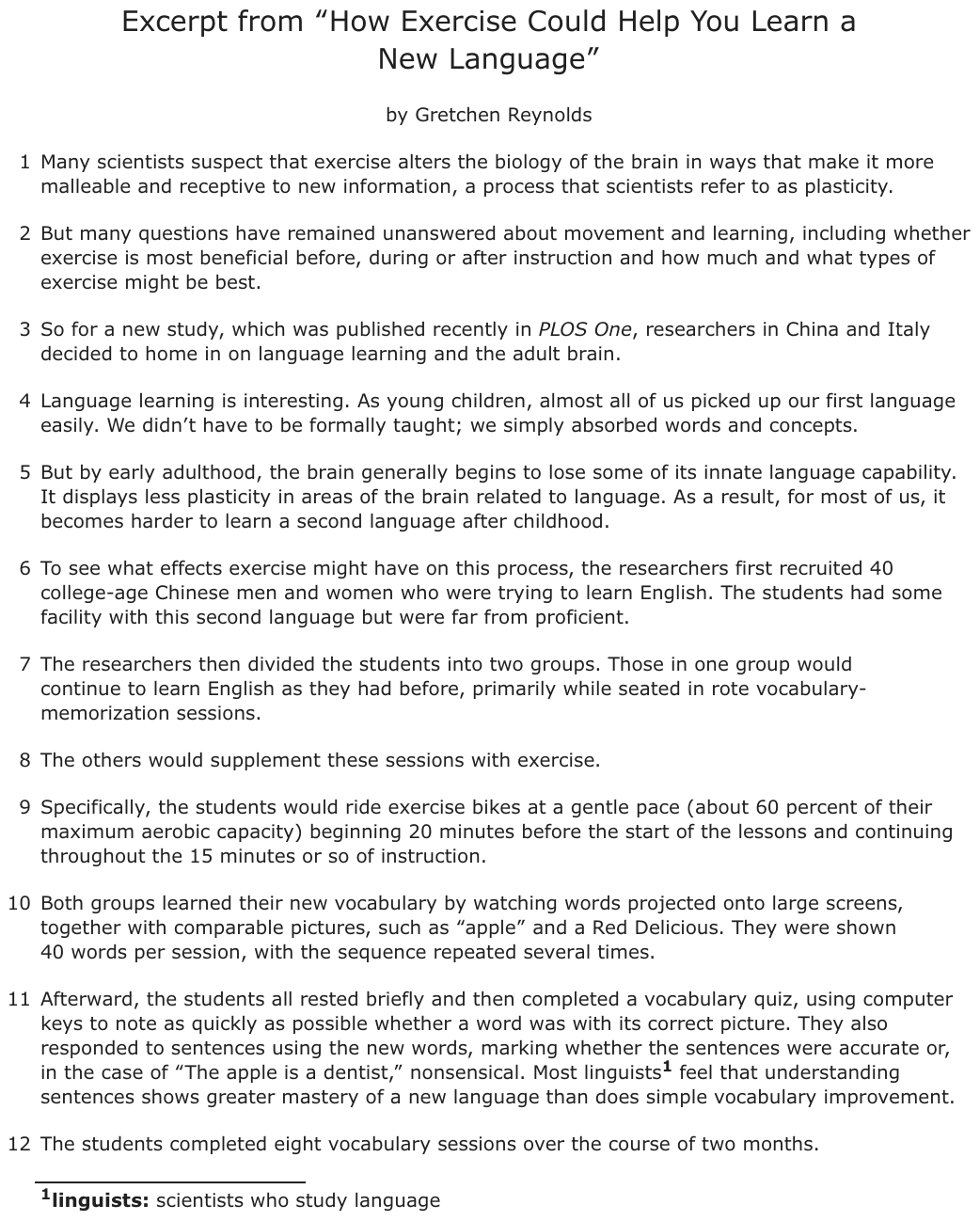
To see what effects exercise might have on this process, the researchers first recruited 40 college-age Chinese men and women who were trying to learn English. The students had some facility with this second language but were far from proficient.
The researchers then divided the students into two groups. Those in one group would continue to learn English as they had before, primarily while seated in rote vocabulary-memorization sessions.
The others would supplement these sessions with exercise.
Specifically, the students would ride exercise bikes at a gentle pace (about 60 percent of their maximum aerobic capacity) beginning 20 minutes before the start of the lessons and continuing throughout the 15 minutes or so of instruction.
Both groups learned their new vocabulary by watching words projected onto large screens, together with comparable pictures, such as “apple” and a Red Delicious. They were shown 40 words per session, with the sequence repeated several times.
Afterward, the students all rested briefly and then completed a vocabulary quiz, using computer keys to note as quickly as possible whether a word was with its correct picture. They also responded to sentences using the new words, marking whether the sentences were accurate or, in the case of “The apple is a dentist,” nonsensical. Most linguists1 feel that understanding sentences shows greater mastery of a new language than does simple vocabulary improvement.
The students completed eight vocabulary sessions over the course of two months.
And at the end of each lesson, the students who had ridden bikes performed better on the subsequent vocabulary tests than did the students who sat still.
They also became more proficient at recognizing proper sentences than the sedentary students, although that difference did not emerge until after several weeks of instruction.
Perhaps most interesting, the gains in vocabulary and comprehension lingered longest for the cyclists. When the researchers asked the students to return to the lab for a final round of testing a month after the lessons—without practicing in the meantime—the cyclists remembered words and understood them in sentences more accurately than did the students who had not moved.
“The results suggest that physical activity during learning improves that learning,” says Simone Sulpizio, a professor of psychology and linguistics at the University Vita-Salute San Raffaele in Milan, Italy, and a study co-author.
These improvements extend beyond simply aiding in memorization, she added. The exercise also deepened language learners’ grasp of how to use their newly acquired words.
This study involved college students performing relatively light exercise, though, and cannot tell us whether other people completing other types of exercise would achieve the same results.
It also offers no clues about what is occurring inside the brain that might be contributing to the benefits of the exercise. But many past studies have shown that exercise prompts the release of multiple neurochemicals in the brain that increase the number of new brain cells and the connections between neurons, Dr. Sulpizio says. These effects improve the brain’s plasticity and augment the ability to learn.
From a real-world standpoint, the study’s implications might seem at first to be impractical. Few classrooms are equipped with stationary bicycles. But specialized equipment is probably unnecessary, Dr. Sulpizio says.
“We are not suggesting that schools or teachers buy lots of bicycles,” she says. “A simpler take-home message may be that instruction should be flanked by physical activity.”
From “How Exercise Could Help You Learn a New Language” by Gretchen Reynolds from THE NEW YORK TIMES, August 16, 2017. Copyright © 2017 The New York Times Company.
1linguists: scientists who study language
Question
In the study described in the excerpt, researchers asked English learners to assess the sense of words in context because that task is
- Abetter at determining the capability learners have of language than simple vocabulary recall.
- Bconsistent with the way earlier research was conducted on adult language learners.
- Ca better way for learners to absorb the meaning of individual vocabulary words.
- Dmore difficult for learners to perform after an extended period of time has passed.
Show the answer
Correct answer: A
The question asks why the researchers in the excerpt asked the English learners to assess whether the new words made sense in the context of actual sentences.
A. CORRECT. As stated in paragraph 11, “Most linguists feel that understanding sentences shows greater mastery of a new language” than mere memorization of new words, so the researchers realized that asking learners to assess words in context would be a better measure of how well they learned the new words.
B. Incorrect. The excerpt never addresses how earlier research on adult language learners was conducted.
C. Incorrect. Having learners respond to the new words in context was used not as a teaching tool but rather to assess learners’ mastery (paragraph 11).
D. Incorrect. The excerpt describes how proficiency at assessing words in context began to emerge “after several weeks of instruction” (paragraph 14) and never suggests that the task became more difficult after an extended period of time.
Question analysis
This key-details question asks why the researchers in the exercise and language-learning study had students judge whether sentences using their new English words made sense. Students must find the reason the article gives and recognize it in reworded form, while weighing choices that each sound like a sensible reason to use such a task.
- NYS standards
- 7R1 textual evidence and inferences
- Grade level
- Grade 7 reading and task
- Compared with grade 7
- At grade 7 Finding a reason the text states outright is routine grade 7 reading. The stem rewords the sentence task as judging “the sense of words in context,” so students must match ideas across different wording, which keeps it at grade level.
- Estimated difficulty
- Straightforward: two steps or one careful reading.
- Thinking it demands
- Depth of knowledge 2, skills and concepts · mainly understand
- What makes it hard
- Reading between the lines moderate
- Evidence
- Answered from one paragraph or stanza
- Reading level
- Passage: about grade 11, 764 words; question and choices: about grade 10, 75 words.
- Students, last 30 days
- Not enough answers yet to show (it takes 10).
Why it is hard, traps and wrong answers (shows the answer)
Why it is hard
The stem rewords the sentence task as assessing “the sense of words in context,” so students first have to recognize it as the quiz with lines like “The apple is a dentist.” Once that paragraph is found, its last sentence supplies the reason. The common error is to forget that the sentences came in the quiz, not the lessons, and so treat them as a way of teaching words.
Reading between the lines moderate Working it out
The article never says why the researchers added sentences; the reason is the linguists’ view that closes paragraph 11, “understanding sentences shows greater mastery,” placed right after the task. (Graesser, Singer & Trabasso, 1994; Kintsch, 1998)
Strategy: Find the paragraph that describes the quiz with sentences such as “The apple is a dentist,” and read to the end of it for the reason the article gives.
Traps
- Twists what the text says: Uses the text's topic and ideas but changes what it says: who did it, how much, when, or why.
- Outside knowledge: A choice is plausible in the real world but not supported by this text.
The wrong answers, classified
B Outside knowledge (King et al., 2004; Recht & Leslie, 1988)
Assumes the researchers copied earlier methods, a reasonable guess about science in general, but the excerpt never describes how past language studies were run.
C Twists what the text says (King et al., 2004)
Treats the sentence task as a way of teaching words, though students did it in the quiz after each lesson to show what they had learned.
D Twists what the text says (King et al., 2004)
Twists paragraph 14’s note that the cyclists’ edge on sentences took several weeks to appear into a claim that the task itself gets harder over time.
Working it out, step by step
Figure out what the question asks
This asks why the researchers had students judge whether sentences made sense. The question calls this “assess the sense of words in context.” Context means the words around a word. So find where the article describes this task. Then look for the reason it gives.
Find the task in the passage
Paragraph 11 describes the quiz. The students “responded to sentences using the new words.” They marked whether each sentence was right or “nonsensical,” which means it makes no sense. One example was “The apple is a dentist.” The very next sentence gives the reason for this task.
Read the reason
Paragraph 11 ends by saying most linguists feel that “understanding sentences shows greater mastery of a new language than does simple vocabulary improvement.” Linguists are scientists who study language. Mastery means real skill. So knowing how to use a word in a sentence shows more skill than just remembering it. That is why the researchers tested sentences.
Check each choice
- A fits. Judging sentences shows more about a learner’s skill than recalling words. Recall means remembering.
- B: the article never says how earlier studies were done.
- C: the sentence task came in the quiz after each lesson. It tested learning. It was not a way to teach words.
- D: paragraph 14 says the cyclists’ lead on sentences took “several weeks” to show up. That doesn’t mean the task got harder.
Watch out: C is tempting if you forget when the sentences came. The words were taught with pictures on screens.
Pick the answer
The researchers used sentences because they show deeper skill than word recall. So the answer is A.
Why this answer and not the closest wrong one
C is the closest wrong answer, because sentences can help people learn words. But in this study the sentences came in the quiz, after the lesson. They measured what students knew. A matches the reason the article gives: understanding sentences “shows greater mastery” than knowing words.
More questions like this
The original DOE question
The passage “Excerpt from “How Exercise Could Help You Learn a New Language”” as printed (pages 171–172)
Question 6 of 21
2021 Test A English, question 56Passage Excerpt from “Research Riddle Resolved”
Excerpt from “Research Riddle Resolved”
For centuries, scientists were confounded by an animal that seemed to look and act like a combination of a bird, a reptile, and a mammal. It has a bill like a duck and lays eggs but produces milk for its young. It lives in a burrow, has fur, and can make venom. We now know that this animal is called a duck-billed platypus. A platypus is a monotreme, a type of egg-laying mammal.
Hundreds of years after the first sightings of the platypus, the animal still captures our imagination anew and irresistibly attracts the attention of science writers everywhere. The May 2008 Nature report detailing the DNA insides of the duck-billed platypus invited colorful tales from just about every mainstream media outlet.
But cuteness and weirdness aside, the platypus research results are a gold mine for medical researchers. The findings cement what may have seemed totally obvious but turned out to be a bit of a scientific surprise: platypus DNA is a patchwork of genes from reptiles, birds, and mammals.
Evolution Fusion
In other words, the platypus heritage is laid out in an evolutionary DNA tapestry that marks the time, hundreds of millions of years ago, when reptiles and mammals branched off the evolutionary tree.
So what? The platypus is nothing like a human, so what can its DNA tell us about people and the diseases we get?
Plenty, says an international team of scientists who did this work.
The platypus genome results are far more than confirmation of a scientific oddity. They provide researchers a window into a time in history when mammals became unique—gaining the ability to bear live young, produce milk for them, and grow a warm, furry coat.
That’s important because our own, modern-day genomes are still a big mystery and researchers need much more information to be able to translate our genetic language into useful health knowledge.
One of the ways scientists can decipher meaning from within our 3 billion DNA “letters,” or nucleotides, is to compare human genes with those from animals, to see what has been kept the same and what has evolved to be different. . . .
Same and Different
In an approach called comparative genomics, scientists compare the genome sequences of several species: human, mouse, and a wide variety of other organisms from single-celled fungi to elephants and, now, the platypus.
The goal of this research is to find regions of similarity and difference in order to better understand the structure and function of human genes.
Comparative genomics is directly related to evolution because all living things share a common ancestor. By using computer tools to examine genes that have been kept the same in many organisms over millions of years, researchers can locate signals that control how genes work. This information may translate into ways to understand, treat, and prevent human diseases. . . .
Chicken or Egg?
When researchers analyzed platypus DNA and compared it to that of chickens, snakes, and lizards, the findings traced the evolutionary path from birds and reptiles to mammals. They learned that the platypus lost most of its genetic ability to produce egg yolk—as compared to chicken genes. This suggests its departure from “chicken-ness.”
But, through evolutionary change, the platypus gained the ability to make milk that is rich in nutrients. Platypuses have genes that make the milk protein casein: just like we do.
A male platypus can, like its ancestral snake and lizard cousins, produce venom. The platypus ejects this venom through special glands in its back legs. The evolutionary reason for maintaining such molecular weaponry isn’t yet clear, but what is fascinating is that it appears nature mixed and matched together DNA pieces separately to create the venom genes in reptiles and monotremes like the platypus.
The scientific value of pinning genetics to physiological function—like milk production—is high. Such investigations may help medical researchers understand health issues related to reproduction and lactation. Although lactation is an ancient reproductive trait, mammals—including the platypus—are unique in their ability to produce milk that is extraordinarily nutritious, containing a rich blend of sugars, fats, and proteins.
More generally, though, studying how nature cuts and pastes gene modules gives scientists an inside scoop on how genetic changes relate to health and disease risk.
One thing is clear—the stunning blend of reptile, bird, and mammal puts the platypus in a class of its own, and it gives researchers much more: information about how mammals like us came about.
[Scientists’] genetic sleuthing of platypuses, chimps, fish, sunflowers—you name it—continues to teach scientists how millions of years of evolution progressed. This provides vital information to understanding the role of genes in the health and disease of mammals like us and our pets, and can also help preserve our rich and diverse planet.
From “Research Riddle Resolved”—Public Domain/National Institutes of Health
Question
How can researching the genomes of other animals inform scientists’ understanding of human health and disease?
- ATracking how other animals evolved over millions of years helps researchers preserve and sustain nature.
- BFinding ways that animal genomes are similar to the human genome helps researchers find signals that control genes.
- CObserving that all living things evolved from a common ancestor helps researchers pinpoint certain genetic traits.
- DUnderstanding how other animals are similar to one another helps researchers understand how humans evolved.
Show the answer
Correct answer: B
The question asks how researching the genomes of other animals can inform scientists’ understanding of human health and disease.
A. Incorrect. Although tracking how other animals evolved helps researchers better understand our “rich and diverse planet” (paragraph 18) through understanding genes, the potential benefits to human health will not necessarily preserve or sustain nature.
B. CORRECT. Paragraph 11 explains that finding ways that animal genomes are similar to the human genome helps researchers “locate signals that control how genes work.”
C. Incorrect. While paragraph 11 does point out that all living things share an ancestor, the idea that they, therefore, share genetic traits is only implied. This idea does not contribute to the main focus of the research.
D. Incorrect. The statement that “understanding how other animals are similar to one another helps researchers understand how humans evolved” is too general to provide support for the main focus of the genetic research described in the excerpt. To learn more about human health and disease, scientists need to understand the similarities between the genetic material of different animal species. These scientists are interested in learning more about issues that currently affect humans, not only understanding their evolutionary history.
Question analysis
This key-details question on “Research Riddle Resolved” asks how studying the genomes of other animals can help scientists understand human health and disease. The question names no paragraph, so students must find where the article explains this link and recognize that explanation in a choice, while every option sounds scientific and must be checked against the text.
- Grade level
- Grade 7 reading and task
- Compared with grade 7
- At grade 7 Finding an explained detail in an informational text is routine grade 7 work. The demand comes mostly from the article’s technical wording and from locating the right paragraph without a reference, not from any inference.
- Estimated difficulty
- Straightforward: two steps or one careful reading.
- Thinking it demands
- Depth of knowledge 2, skills and concepts · mainly understand
- What makes it hard
- Evidence in several places minor
- An unfamiliar subject minor
- Evidence
- Answered from one paragraph or stanza
- Reading level
- Passage: about grade 11, 809 words; question and choices: about grade 12, 80 words.
- Corrected from the DOE handbook
- An overstatement in the explanation was corrected.
- Students, last 30 days
- Not enough answers yet to show (it takes 10).
Why it is hard, traps and wrong answers (shows the answer)
Why it is hard
The answer is stated in one sentence of paragraph 11, so the work is finding it and recognizing it reworded. Two wrong choices also come from the article, the common ancestor in the same paragraph and the closing hope of preserving the planet, and they tempt students who stop at familiar words. Checking which choice names the step that comes just before “This information may translate into ways to understand, treat, and prevent human diseases” settles it.
Evidence in several places minor Working it out
Health and disease come up in paragraphs 4, 7, 11, 15, 16 and 18, but only paragraph 11 explains how comparing genomes leads there, through “signals that control how genes work.” (Kirsch & Mosenthal, 1990; Gorin & Embretson, 2006)
An unfamiliar subject minor Understanding the question
Paragraph 11 explains the link in technical terms, genes “kept the same in many organisms” and signals that control genes, which students must follow without knowing what such signals are. (Recht & Leslie, 1988; Kintsch, 1998)
Strategy: Scan the excerpt for the places that tie gene research to human disease, reread them closely, and choose the option that restates the step they describe rather than just reusing their words.
Traps
- Word match: Repeats striking words or phrases from the text, so it looks supported, but its meaning does not fit the question.
- Twists what the text says: Uses the text's topic and ideas but changes what it says: who did it, how much, when, or why.
- True but not the answer: A choice says something accurate about the text that does not answer this question.
The wrong answers, classified
A True but not the answer (King et al., 2004; Embretson & Wetzel, 1987)
Borrows paragraph 18’s closing remark that gene research can help preserve the planet, which the article does say, but it concerns nature, not human health or disease.
C Word match (Freedle & Kostin, 1993)
Picks up paragraph 11’s “all living things share a common ancestor,” the reason comparing genes works, and makes that observation the tool, though the paragraph credits examining genes kept the same.
D Twists what the text says (King et al., 2004)
Swaps comparisons with human genes for animals compared with each other, and health for how humans evolved, a theme paragraphs 17 and 18 touch but not the question’s link to disease.
What was corrected from the DOE handbook, and why
- Explanation: The handbook’s explanation of Option D says the scientists “are interested in learning more about issues that currently affect humans, not understanding their evolutionary history.” The excerpt says the platypus results give researchers “a window into a time in history when mammals became unique” (paragraph 6) and “information about how mammals like us came about” (paragraph 17), so the site now says “not only understanding their evolutionary history.” Option D is still wrong: it is about how animals are similar to one another and how humans evolved, not about human health and disease.
Working it out, step by step
Figure out what the question asks
This asks how studying the genomes of other animals helps scientists understand human health and disease. A genome is all the genes of a living thing. No paragraph is named, so you must find where the excerpt explains this link.
Find the paragraph that explains it
Paragraph 11 explains it: “By using computer tools to examine genes that have been kept the same in many organisms over millions of years, researchers can locate signals that control how genes work. This information may translate into ways to understand, treat, and prevent human diseases.” An organism is any living thing.
Put it in plain words
Some genes have stayed the same in many living things for millions of years. Scientists compare genomes to find those genes. The genes that match help them find the signals that control how genes work. Knowing those signals may lead to ways to treat disease.
Check each choice
- A does not fit. Paragraph 18 does mention helping “preserve our rich and diverse planet.” But that is about nature, not human health.
- B fits. Finding genes that animals share with humans helps researchers find the signals that control genes.
- C does not fit. Paragraph 11 says “all living things share a common ancestor,” a relative from long ago. That is why comparing works. It is not the step that leads to health.
- D does not fit. It compares animals with one another, not with humans. It is also about how humans evolved, not about disease.
Watch out: C reuses words from paragraph 11, so it looks right. But it skips the key step, finding the signals.
Choose the answer
Shared genes lead to the signals, and the signals may lead to ways to treat disease. So the answer is B.
Why this answer and not the closest wrong one
C is the closest wrong choice. It uses a true fact from paragraph 11, the common ancestor. But that fact only explains why comparing genes makes sense. The step that helps health is finding “signals that control how genes work.” B names that step.
More questions like this
The original DOE question
The passage “Excerpt from “Research Riddle Resolved”” as printed (pages 66–67)
Question 7 of 21
2019 Test A English, question 31Uses the passage above: “Excerpt from “Research Riddle Resolved””.
Question
How can researching the genomes of other animals inform scientists’ understanding of human health and disease?
- ATracking how other animals evolved over millions of years helps researchers preserve and sustain nature.
- BFinding ways that animal genomes are similar to the human genome helps researchers find signals that control genes.
- CObserving that all living things evolved from a common ancestor helps researchers pinpoint certain genetic traits.
- DUnderstanding how other animals are similar to one another helps researchers find new ways to understand the human genome.
Show the answer
Correct answer: B
The question asks how researching the genomes of other animals can inform scientists’ understanding of human health and disease.
A. Incorrect. Although tracking how other animals evolved helps researchers better understand our “rich and diverse planet” (paragraph 18) through understanding genes, the potential benefits to human health will not necessarily preserve or sustain nature.
B. CORRECT. Paragraph 11 explains that finding ways that animal genomes are similar to the human genome helps researchers “locate signals that control how genes work.”
C. Incorrect. While paragraph 11 does point out that all living things share an ancestor, the idea that they, therefore, share genetic traits is only implied. This idea does not contribute to the main focus of the research.
D. Incorrect. The statement that “understanding how other animals are similar to one another helps researchers find new ways to understand the human genome” is too general to provide support for the main focus of the genetic research described in the excerpt. To learn more about human health and disease, scientists need to understand the similarities between the genetic material of animal species, not the similarities between the animals themselves.
Question analysis
Studying the DNA of other animals can teach scientists about human health and disease, and this key-details question asks how, according to “Research Riddle Resolved.” The article touches on evolution, nature and medicine in several places, so students must find the part that answers this exact question and match it to an option that may use different words.
- Grade level
- Grade 7 reading and task
- Compared with grade 7
- At grade 7 This is grade 7 key-detail work, since the link between gene research and health is stated rather than implied. Finding it without a paragraph number in a long science article is the main demand, which is typical for grade 7.
- Estimated difficulty
- Straightforward: two steps or one careful reading.
- Thinking it demands
- Depth of knowledge 2, skills and concepts · mainly understand
- What makes it hard
- A very close wrong answer moderate
- Evidence in several places minor
- An unfamiliar subject minor
- Evidence
- Answered from one paragraph or stanza
- Reading level
- Passage: about grade 11, 809 words; question and choices: about grade 12, 84 words.
- Students, last 30 days
- Not enough answers yet to show (it takes 10).
Why it is hard, traps and wrong answers (shows the answer)
Why it is hard
The answer is stated in one sentence of paragraph 11, so the work is finding it and recognizing it in the choice. In this printing the strongest rival ends on understanding the human genome, a goal the article really names, so a student who matches endings rather than routes is drawn to it. The common ancestor and the closing hope of preserving the planet also come from the article and tempt students who stop at familiar words.
A very close wrong answer moderate Choosing the answer
The choice about animals being similar “to one another” follows the key’s pattern, likeness leading to understanding, and ends on the human genome; it differs in who is compared, animals with each other rather than with humans. (Embretson & Wetzel, 1987; Gorin & Embretson, 2006; Ascalon et al., 2007)
Evidence in several places minor Working it out
Disease and health surface in paragraphs 4, 7, 11, 15, 16 and 18, yet only paragraph 11 traces the path from comparing genomes to that goal, by way of signals that control genes. (Kirsch & Mosenthal, 1990; Gorin & Embretson, 2006)
An unfamiliar subject minor Understanding the question
Paragraph 11 explains the link in technical terms, genes “kept the same in many organisms” and signals that control genes, which students must follow without knowing what such signals do. (Recht & Leslie, 1988; Kintsch, 1998)
Strategy: Find where the article connects gene research to human disease, then test both halves of each option: what researchers study, and what the article says that study gives them.
Traps
- Half right: One half of a two-part choice is right and the other is not.
- True but not the answer: A choice says something accurate about the text that does not answer this question.
- Word match: Repeats striking words or phrases from the text, so it looks supported, but its meaning does not fit the question.
The wrong answers, classified
A True but not the answer (King et al., 2004; Embretson & Wetzel, 1987)
Borrows paragraph 18’s closing remark that gene research can help preserve “our rich and diverse planet,” which the article does say, but it concerns nature, not human health.
C Word match (Freedle & Kostin, 1993)
Lifts “all living things share a common ancestor” from paragraph 11, which explains why comparison works, and treats it as the method, though the paragraph credits examining genes kept the same.
D Half right (King et al., 2004; Thissen, Steinberg & Fitzpatrick, 1989)
Ends on a real goal, understanding the human genome, but its route compares animals “to one another,” while paragraph 11 looks at genes kept the same across species, humans included.
Working it out, step by step
Figure out what the question asks
This asks how studying other animals’ genomes helps scientists understand human health and disease. A genome is all the genes of a living thing. No paragraph is named. So find the place where the excerpt explains this link.
Find the paragraph that explains it
Paragraph 11 explains it: “By using computer tools to examine genes that have been kept the same in many organisms over millions of years, researchers can locate signals that control how genes work. This information may translate into ways to understand, treat, and prevent human diseases.” An organism is any living thing.
Put it in plain words
Paragraph 9 says scientists compare the genes of humans and many other species. Some genes have stayed the same for millions of years. Those shared genes help scientists find the signals that control how genes work. Knowing those signals may lead to new ways to treat disease.
Check each choice
- A does not fit. Paragraph 18 says gene research can help “preserve our rich and diverse planet.” But that is about nature, not human health.
- B fits. Finding where animal genomes match ours helps scientists find the signals that control genes.
- C does not fit. Paragraph 11 says “all living things share a common ancestor,” a relative from long ago. That explains why comparing works. It is not the step that helps health.
- D does not fit. It compares animals “to one another,” leaving humans out. The research compares animal genes with human genes.
Choose the answer
Watch out: D is tempting because it ends with the human genome. But the research doesn’t study how animals are like one another. It looks for genes kept the same across species, ours included. So the answer is B.
Why this answer and not the closest wrong one
D is the closest wrong answer. Its ending, understanding the human genome, sounds right. But its method is wrong, because it compares animals with one another. The research looks at genes kept the same in many living things, humans among them. Those genes lead to “signals that control how genes work.” B names that step.
More questions like this
The original DOE question
Question 8 of 21
2019 Test A English, question 53Passage Is It Time for Term Limits?
Is It Time for Term Limits?
In 1799, when George Washington’s supporters asked him to consider serving a third term as president of the United States, he declared, “Prudence on my part must arrest any attempt at the well meant, but mistaken views of my friends, to introduce me again into the Chair of Government.” Even though some of his contemporaries advocated for a lifetime appointment for presidents, Washington thought that government officials should not seek to gain unfair power. Only one president has been elected to four terms: Franklin Delano Roosevelt. He was elected to a third term in 1940 and a fourth in 1944 due to the challenges of the Great Depression and World War II. This departure from the rule worried some, and on March 21, 1947, Congress passed the Twenty-Second Amendment to the Constitution, legally limiting the office of president to two four-year terms.
Presidential terms are clearly limited in the Constitution, but for people serving in Congress, this is not the case. Currently, members of the House of Representatives, who serve two-year terms, and Senators, who serve six-year terms, can run for reelection an unlimited number of times. Because of the possibility of unlimited reelections, many people are beginning to believe that limiting congressional terms would benefit our government. Modern surveys conducted by multiple firms consistently show that American citizens of a variety of backgrounds and political leanings approve of the idea of setting term limits for members of Congress.
American citizens are not the only supporters of term limits for Congress. Even some members of Congress themselves have spoken out in support of this change. Former Senator Joe Lieberman, upon his retirement, suggested that Congress “might be healthier and less partisan1 and less rigid if it turned over more often, and term limits are one way to do that.” Michael Olson and Jon Rogowski state in their article “Legislative Term Limits and Polarization” that “proponents of term limits argue that limiting the number of terms legislators can serve in office would reduce the level of partisan conflict, encourage compromise and cooperation, and improve the quality of representation.”
Experienced politicians certainly can build on years of knowledge, but term limit supporters point out that career politicians may base key decisions on their own personal long-term goals. In the article “Term Limitations and the Myth of the Citizen-Legislator,” author Elizabeth Garrett states that “under term limits, a careerist needs to move up the political opportunity structure to remain in elected office, but the probability of unimpeded upward movement decreases as the number of available positions that are perceived as advancements decline.”
While challenging the career politician’s path is seen as a benefit to term limit supporters, there is a possibility that a Congress mostly composed of newcomers could severely affect policy making. Experienced politicians have a deep knowledge of congressional processes, and in addition, politicians who have served together for extended periods have a chance to develop trusting relationships, even across party lines. Molly Reynolds, a congressional expert for the Brookings Institution, says that members who are restricted by term limits “have neither the time nor the incentive to develop the relevant expertise they need to be good at their jobs. If members don’t have that expertise themselves, they’re more likely to rely on outsiders, including lobbyists, to replace that expertise.”
In fact, first-time politicians’ susceptibilities to lobbyists, or groups seeking to influence legislators, have actually been put to the test on the state level. In 2006, the National Conference of State Legislatures Study revealed that term limits may increase the influence of lobbyists. In the 1990s, more than twenty states implemented term limits within their state governments. The inexperienced state lawmakers began depending on special-interest groups for their expertise on issues. In the end, many people believed that implementing term limits in the state legislature caused problems, and since then, six states have repealed the limits.
Additionally, those who oppose term limits maintain that the turnover rate in Congress is sufficient. Thomas E. Mann, Senior Fellow in governance studies at the Brookings Institution, notes that every decade, new members replace at least half the members of the House and the Senate, due to retirement or elections. Still, the average length of time in office has mushroomed. For example, the 65th Congress (1917–1919) had an average service time of 5.3 years for members of the House of Representatives and 5.7 years for Senate members. The 114th Congress (2015–2017) had an average of 8.8 years for members of the House and 9.7 years for senators.
Should Congress pass a constitutional amendment to institute congressional term limits? Perhaps one day people will have a chance to vote on the issue.
PERCENTAGE OF REPRESENTATIVES AND SENATORS REELECTED
| House of Representatives Total seats: 435 | Year | Percentage Reelected |
|---|---|---|
| 1950 | 83.2 | |
| 1978 | 82.3 | |
| 1998 | 90.8 | |
| 2016 | 87.4 |
| Senate Total seats: 100 | Year | Percentage Reelected |
|---|---|---|
| 1950 | 68.8 | |
| 1978 | 60.0 | |
| 1998 | 89.7 | |
| 2016 | 93.1 |
1partisan: showing a strong and sometimes blind adherence to a particular political party
Question
According to paragraph 5, serving more terms improves politicians’ effectiveness by
- Amotivating them to learn the congressional processes necessary to create legislation.
- Bencouraging them to collaborate with politicians of the opposing party in order to pass legislation.
- Callowing them to gain expertise and develop strong political relationships.
- Denabling them to create new policies while fostering their own careers.
Show the answer
Correct answer: C
The question asks how, according to paragraph 5, serving more terms improves politicians’ effectiveness.
A. Incorrect. Paragraph 5 does not say that serving more terms motivates politicians to learn congressional processes, only that politicians restricted by term limits are not motivated to gain expertise.
B. Incorrect. While paragraph 5 states that serving more terms helps a politician “develop trusting relationships, even across party lines,” it does not explain how serving more terms improves politicians’ effectiveness.
C. CORRECT. Paragraph 5 makes it clear that “experienced politicians have a deep knowledge of congressional processes, and in addition, politicians who have served together for extended periods have a chance to develop trusting relationships, even across party lines.” Therefore, serving more terms helps experienced politicians gain expertise.
D. Incorrect. While paragraph 4 states that “term limit supporters point out that career politicians may base key decisions on their own personal long-term goals,” paragraph 5 does not mention this idea or state that creating new policies while fostering their own careers would improve their effectiveness.
Question analysis
Paragraph 5 of “Is It Time for Term Limits?” explains how serving more terms can make politicians more effective, and this key-details question asks what the paragraph says those benefits are. It sets out what experienced lawmakers bring and what newcomers lack, and the options echo its wording in different ways, so only careful matching will separate them.
- Grade level
- Grade 7 reading and task
- Compared with grade 7
- At grade 7 Finding what a paragraph states is routine grade 7 work, and the question names the paragraph. Its formal wording and an expert’s quotation phrased in the negative make the stated benefits a little harder to pick out.
- Estimated difficulty
- Moderate: several steps, or a close reading with one strong distractor.
- Thinking it demands
- Depth of knowledge 2, skills and concepts · mainly understand
- What makes it hard
- A very close wrong answer moderate
- The right answer is reworded minor
- Complex sentences minor
- Evidence
- Answered from one paragraph or stanza
- Reading level
- Passage: about grade 14, 799 words; question and choices: about grade 14, 57 words.
- Students, last 30 days
- Not enough answers yet to show (it takes 10).
Why it is hard, traps and wrong answers (shows the answer)
Why it is hard
Paragraph 5 states the two gains of long service in one sentence, deep knowledge and trusting relationships, and the answer simply restates both. The wrong choices each bend one part: the incentive Reynolds says term-limited members lack becomes a motive for learning, and the chance to build trust across party lines becomes collaboration to pass laws. Matching each choice against that one sentence, rather than against the expert’s negative wording, keeps students on track.
A very close wrong answer moderate Choosing the answer
The cross-party choice shares the key’s second benefit, relationships built over time, but turns paragraph 5’s “chance to develop trusting relationships” into deliberate teamwork to pass laws and drops the expertise. (Embretson & Wetzel, 1987; Gorin & Embretson, 2006; Ascalon et al., 2007)
The right answer is reworded minor Choosing the answer
The key turns “deep knowledge of congressional processes” and “trusting relationships” into expertise and strong political relationships, while wrong choices echo “congressional processes,” recast the cross-party trust as teamwork, or borrow paragraph 4’s careers. (Freedle & Kostin, 1993; Kirsch & Mosenthal, 1990)
Complex sentences minor Understanding the question
Reynolds’s quotation describes the opposite case, members who “have neither the time nor the incentive” to gain expertise, so the benefits of long service must be read by flipping a sentence about their absence. (Abedi & Lord, 2001; Freedle & Kostin, 1993; Messick, 1989)
Strategy: Reread paragraph 5 and note, in your own words, what it says long service gives politicians, then compare each option with your notes word by word.
Traps
- Twists what the text says: Uses the text's topic and ideas but changes what it says: who did it, how much, when, or why.
- Reads too much in: A reasonable-sounding conclusion that goes further than the text allows.
- Wrong part of the text: A choice is true of another paragraph, stanza or speaker than the one asked about.
The wrong answers, classified
A Reads too much in (Graesser, Singer & Trabasso, 1994)
Flips Reynolds’s point that term-limited members lack “the incentive” and concludes that long service motivates learning, but the paragraph names knowledge already gained, not a motive, and omits relationships.
B Twists what the text says (King et al., 2004)
Builds on “trusting relationships, even across party lines,” but turns a chance to build trust into working with the other party to pass legislation, and leaves out the expertise long service brings.
D Wrong part of the text (Kirsch & Mosenthal, 1990)
Recalls paragraph 4’s career politicians with “personal long-term goals,” a point term-limit supporters raise against them, and mistakes it for a benefit of long service in paragraph 5.
Working it out, step by step
Figure out what the question asks
This asks for a key detail. According to paragraph 5, how does serving more terms make politicians better at their jobs? Look only at paragraph 5, and find every benefit it names.
Find the benefits in paragraph 5
Paragraph 5 says “Experienced politicians have a deep knowledge of congressional processes, and in addition, politicians who have served together for extended periods have a chance to develop trusting relationships, even across party lines.” Congressional processes are the steps Congress follows to get work done. Extended periods means long stretches of time.
See the other side of it
Molly Reynolds adds that members held back by term limits have “neither the time nor the incentive” to build “the relevant expertise they need to be good at their jobs.” Expertise means special skill and knowledge. An incentive is a reason to try. Turn that around: members who serve longer have time to gain that expertise. So paragraph 5 names two benefits of long service, expertise and trust.
Check each choice
- A does not fit. The paragraph says experienced politicians already “have a deep knowledge of congressional processes.” It is about what they have gained, not what pushes them to learn. A also leaves out relationships.
- B does not fit. The paragraph says they have “a chance to develop trusting relationships.” It never says they team up to pass laws. B also leaves out expertise.
- C fits. It names both benefits: expertise and strong relationships.
- D does not fit. Building their own careers comes from paragraph 4. There, it is a worry about career politicians, not a benefit.
Choose the answer
Watch out: B is tempting because of the words “even across party lines.” But trust is not the same as working together to pass laws. So the answer is C.
Why this answer and not the closest wrong one
B is the closest wrong answer. It picks up the relationships “even across party lines.” But it turns a chance to build trust into teamwork to pass laws, which the paragraph never says. It also drops expertise, the first benefit. C names both things paragraph 5 says long service gives.
More questions like this
The original DOE question

The passage “Is It Time for Term Limits?” as printed (pages 90–91)
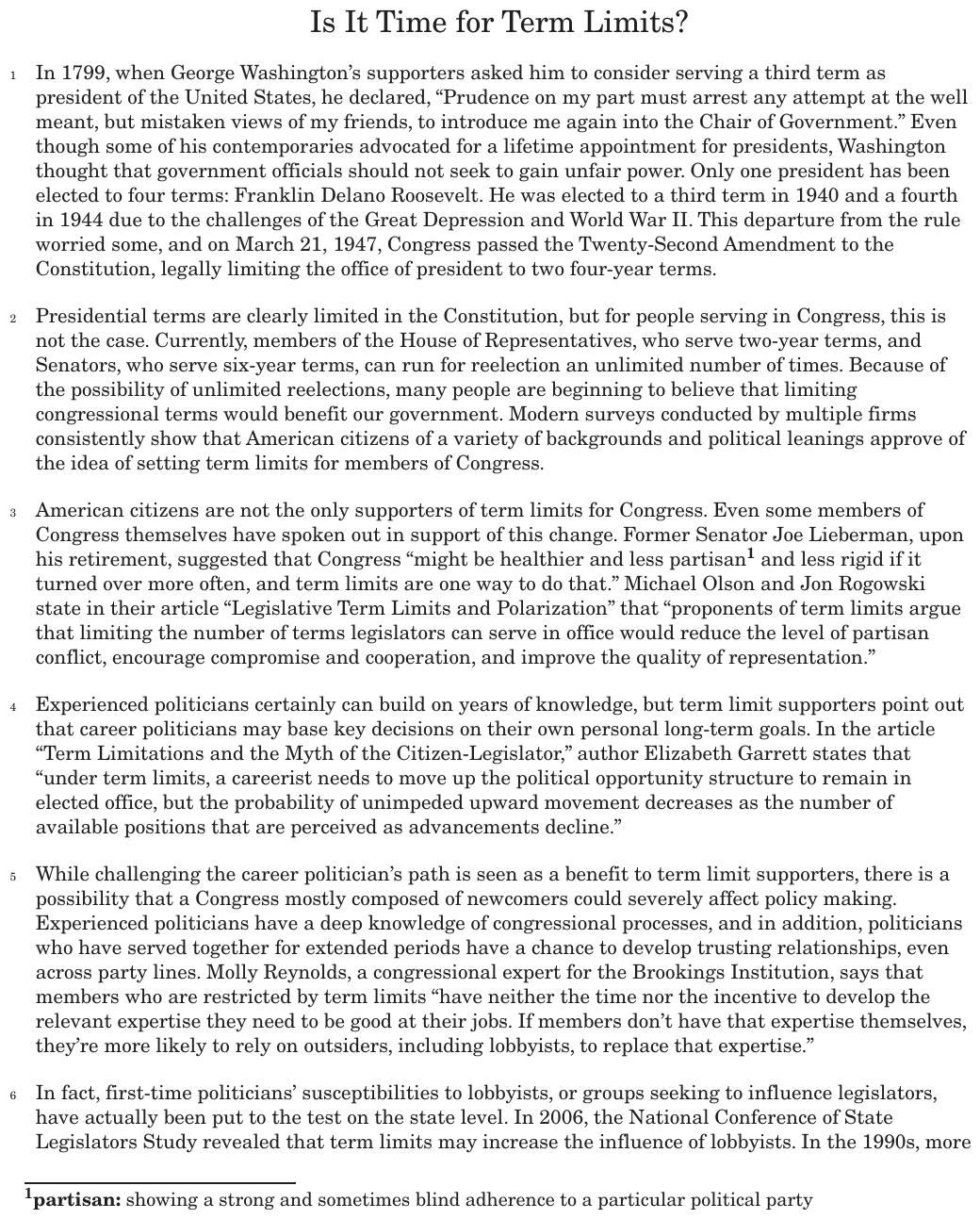
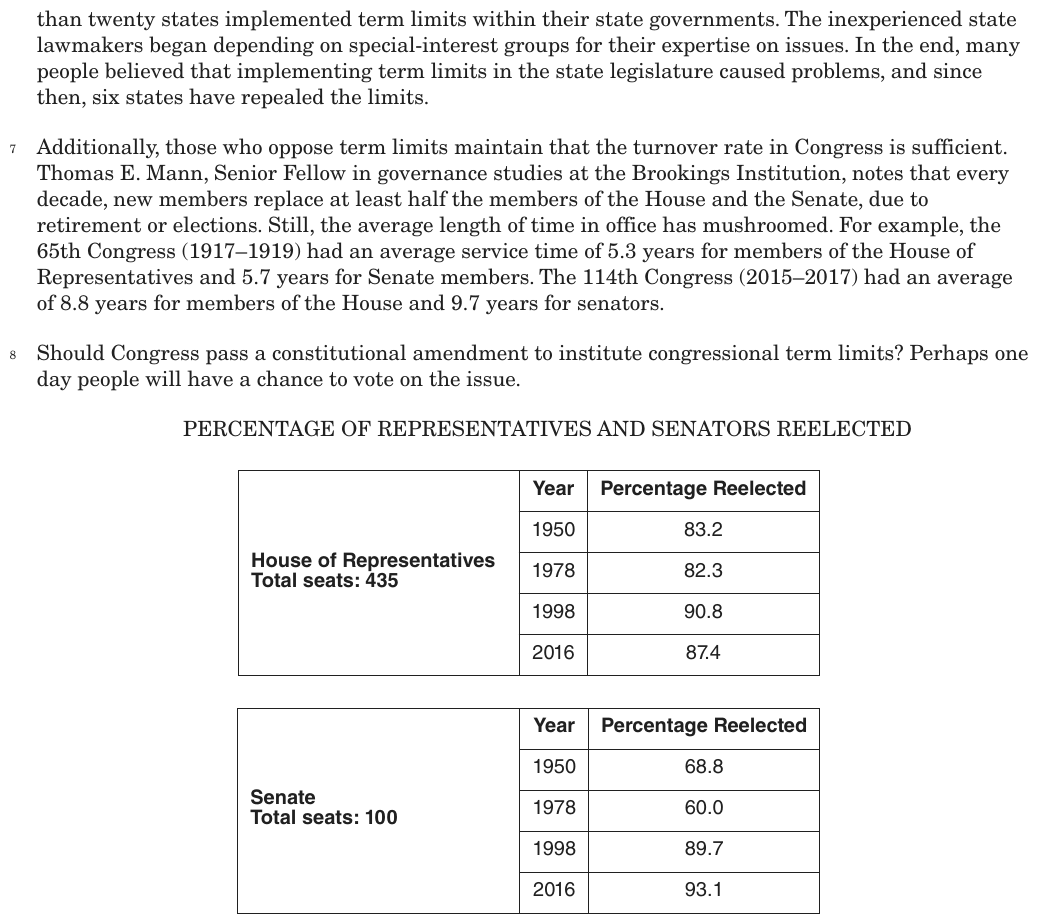
Question 9 of 21
2019 Test A English, question 54Uses the passage above: “Is It Time for Term Limits?”.
Question
According to the passage, why would setting term limits for members of Congress potentially increase the influence of special-interest groups?
- ATerm limits would lead to a greater number of new representatives who rely on guidance and support from special-interest groups early in their terms.
- BTerm limits would create a situation in which special-interest groups have to work more closely with the new representatives who replace experienced representatives.
- CTerm limits would force experienced representatives out of their seats and bring in new representatives who focus on the agendas of special-interest groups.
- DTerm limits would result in both new and experienced representatives looking to special-interest groups in order to influence decisions made in legislature.
Show the answer
Correct answer: A
The question asks why setting term limits for members of Congress potentially increases the influence of special-interest groups.
A. CORRECT. The passage explains in paragraphs 5 and 6 that representatives who lack experience might end up relying on lobbyists’ expertise. Paragraph 6 uses information from the National Conference of State Legislatures Study, which indicated that state lawmakers were “depending on special-interest groups for their expertise on issues.” This example on a state level is used to show that “term limits may increase the influence of lobbyists” (paragraph 6).
B. Incorrect. While lobbyists can work with representatives, it is not required. The passage implies that some of the deep knowledge many politicians gain is from spending time in office and from developing “trusting relationships” (paragraph 5) with colleagues.
C. Incorrect. The passage does discuss the drawbacks of forcing experienced representatives from their seats, but it does not provide support for the idea that new representatives will focus on the agendas of special-interest groups.
D. Incorrect. The passage states that experienced representatives “have a deep knowledge of congressional processes, and in addition, politicians who have served together for extended periods have a chance to develop trusting relationships, even across party lines” (paragraph 5). The author states that the concern is only for new representatives who might seek help or guidance from lobbyists.
Question analysis
According to “Is It Time for Term Limits?”, limiting how long members of Congress can serve might increase the influence of special-interest groups, and this key-details question asks why. Each option connects lawmakers and interest groups in a different way, so the passage’s reasoning has to be followed step by step.
- Grade level
- Grade 8 reading and task
- Compared with grade 7
- At grade 7 Explaining a cause-and-effect link stated in an informational text is grade 7 work. Here the link runs across two paragraphs and an example from state governments, and the long options differ in small ways, which keeps the demand at the upper end of grade 7.
- Estimated difficulty
- Moderate: several steps, or a close reading with one strong distractor.
- Thinking it demands
- Depth of knowledge 2, skills and concepts · mainly understand
- What makes it hard
- A very close wrong answer moderate
- Evidence in several places minor
- Every choice must be checked minor
- Evidence
- Answered from several paragraphs or stanzas
- Reading level
- Passage: about grade 14, 799 words; question and choices: about grade 14, 112 words.
- Corrected from the DOE handbook
- The name of an organization in the passage and the explanation was corrected.
- Students, last 30 days
- Not enough answers yet to show (it takes 10).
Why it is hard, traps and wrong answers (shows the answer)
Why it is hard
The passage gives the reason in two steps: term limits fill a legislature with newcomers, and newcomers without expertise lean on lobbyists for it, as the state legislatures did. The wrong choices keep the same cast and change one link: the groups needing the lawmakers, newcomers pursuing the groups’ agendas, or veterans relying on them too. The half-right choice is hardest to reject because its first step, experienced members forced out, is exactly what the passage implies.
A very close wrong answer moderate Choosing the answer
The choice about newcomers who “focus on the agendas” of special-interest groups has the key’s new representatives and outside groups; it parts on why they turn to the groups, agendas rather than guidance on unfamiliar issues. (Embretson & Wetzel, 1987; Gorin & Embretson, 2006; Ascalon et al., 2007)
Evidence in several places minor Working it out
The chain runs across two paragraphs: Reynolds in paragraph 5 says members without expertise rely on lobbyists, and paragraph 6’s state study shows inexperienced lawmakers depending on special-interest groups. (Kirsch & Mosenthal, 1990; Gorin & Embretson, 2006)
Every choice must be checked minor Choosing the answer
All four choices open “Term limits would” and pair new representatives with special-interest groups, so each must be checked for who depends on whom, and why. (Embretson & Wetzel, 1987)
Strategy: Find where the passage connects term limits to lobbyists and special-interest groups, note who ends up depending on whom and why, and check each option’s wording against that chain.
Traps
- Half right: One half of a two-part choice is right and the other is not.
- Twists what the text says: Uses the text's topic and ideas but changes what it says: who did it, how much, when, or why.
- Too broad or too strong: A choice overstates, generalizes, or uses absolute words the text does not support.
The wrong answers, classified
B Twists what the text says (King et al., 2004)
Keeps the newcomers and the groups but makes the groups the ones who must adapt, when the passage has inexperienced lawmakers leaning on the groups for their expertise.
C Half right (King et al., 2004; Thissen, Steinberg & Fitzpatrick, 1989)
Starts correctly, since limits would push experienced members out, but then has the newcomers pursue the groups’ agendas, when the passage says they would borrow the groups’ expertise.
D Too broad or too strong (King et al., 2004)
Extends the reliance on outside groups to experienced representatives too, though paragraph 5 credits them with “a deep knowledge of congressional processes,” leaving only newcomers short of expertise.
What was corrected from the DOE handbook, and why
- Passage and explanation: Paragraph 6 of the passage, and the handbook’s explanation of this question, refer to “the National Conference of State Legislators Study.” The organization is the National Conference of State Legislatures (NCSL), so the site now says “National Conference of State Legislatures” in both places. No answer depends on the name.
Working it out, step by step
Figure out what the question asks
This asks why term limits might give special-interest groups more influence. A special-interest group pushes for one cause, like a business or an issue. Influence is the power to change what someone decides. So look for where the passage connects term limits to these groups.
Find the link in paragraph 5
Molly Reynolds says term-limited members may lack expertise, or special know-how. Then she adds, “If members don’t have that expertise themselves, they’re more likely to rely on outsiders, including lobbyists, to replace that expertise.” Paragraph 6 explains that lobbyists are “groups seeking to influence legislators.” Legislators are lawmakers.
See the example in paragraph 6
Paragraph 6 shows this happening in the states. After more than twenty states set term limits, “The inexperienced state lawmakers began depending on special-interest groups for their expertise on issues.” Inexperienced means new to the job. So the chain is this. Term limits bring in new lawmakers. New lawmakers lack know-how. So they lean on special-interest groups.
Check each choice
- A fits. More new members would rely on these groups for guidance.
- B does not fit. It makes the groups the ones who must adjust. In the passage, the new lawmakers depend on the groups.
- C does not fit. An agenda is a list of goals. The passage says new lawmakers borrow the groups’ know-how, not that they work for the groups’ goals.
- D does not fit. Paragraph 5 says experienced members “have a deep knowledge of congressional processes.” The worry is only about new members.
Choose the answer
Watch out: C starts out right, since limits would push out experienced members. But its second half changes why the newcomers turn to the groups. So the answer is A.
Why this answer and not the closest wrong one
C is the closest wrong answer. It is right that limits would replace experienced members with new ones. But it says the newcomers would “focus on the agendas” of the groups. The passage says they would lean on the groups “for their expertise on issues.” A gives that reason: new members relying on the groups for guidance.
More questions like this
The original DOE question
Question 10 of 21
2018 Test A English, question 11Passage An Early Warning
An Early Warning
One of the books that has done the most to alert the world to the dangers of environmental degradation is George Perkins Marsh’s Man and Nature. Its message—that Western society is in the process of causing irreparable harm to the environment—greatly influenced ecologists during the beginning of the modern environmentalist movement in the 1960s. Marsh was not, however, part of this movement. Surprisingly, Man and Nature was first published in 1864.
Marsh first observed the environmentally destructive effects of human activities while growing up in Vermont in the early nineteenth century. The heavy demand for firewood had depleted the forests, and extensive sheep grazing had stripped the land. The result was flooding and soil erosion. Furthermore, streams were fouled by wastes dumped from numerous mills and dye houses.
Much later in his life, after careers in law, business, farming, and politics, Marsh served as ambassador to Italy. There he noticed land abuse similar to what he had seen in Vermont. Overgrazing and forest mismanagement had rendered areas that had been productive farmland since the days of the Roman Empire desolate. Marsh attributed this to what he called “man’s ignorant disregard for the laws of nature.”
In Italy, Marsh began to organize his observations and theories. He wrote in a way intended to educate readers about the impact of industrial and agricultural practices on the environment. In Man and Nature, he evaluated the important relationships between animals and plants, discussed forestry practices in great detail, and analyzed the ways natural water supplies are affected by human use.
Man and Nature challenged the popular belief that nature can heal any damage that people inflict upon it. Marsh argued that people may use and enjoy, but not destroy, the riches of the earth.
Furthermore, he asserted that everything in nature is significant and that even the tiniest organism affects the fragile environmental balance. His belief that drastic alteration of this balance would be dangerous is now accepted as a fundamental principle of modern environmental science.
Although he pointed out environmental damage caused by irresponsible human activities, Marsh did not oppose every human alteration to the environment. To him, the goal was proper management, not a return to wilderness conditions. People should consider the consequences of their actions, he wrote, and become “co-worker[s] with nature.” Marsh praised the Suez Canal, the human-made waterway between the Mediterranean Sea and the Gulf of Aden, as “the greatest and most truly cosmopolite physical improvement ever undertaken by man.” He believed that the advantages of the canal— improved transportation and commerce—would outweigh any environmental damage. Yet he also warned of possible unintended consequences, such as destructive plants and animals spreading from one body of water to the other.
Marsh was considered a radical thinker during his lifetime. By the late nineteenth century, however, his writings, along with those of John Muir, Henry David Thoreau, and others, had inspired what became known as the conservation movement. The conservationists of that time sought to educate the public that wilderness areas were worth preserving and were responsible for creating the National Park Service and the National Forest Service.
Question
Marsh believed that the people of his time caused harm to the environment because
- Athey assumed that future generations would solve any environmental problems.
- Bthey thought industrial progress was more important than protecting nature.
- Cthey were unwilling to change farming and waste-disposal practices.
- Dthey lacked knowledge of nature and natural processes.
Show the answer
Correct answer: D
The answer is (D)
The question asks for the specific reason Marsh believed people caused harm to the environment. Marsh credited the land abuse he observed in Vermont and Italy to people’s lack of understanding, or ignorance, of nature (paragraph 3) and “the popular belief that nature can heal any damage that people inflict upon it” (paragraph 5). This concept is stated in Option D.
Option A is incorrect because, although people are currently working to improve the environment, the passage does not state that Marsh believed that people in his time expected future generations to solve environmental problems.
Option B is incorrect because, while the people of Marsh’s time made advances in industry, Marsh did not indicate that he believed that people thought industrial progress outweighed efforts to protect the environment.
Option C is incorrect because, while many people at the time participated in “environmental degradation” (paragraph 1), none of the evidence in the passage suggests that Marsh believed that people were unwilling to change their practices.
Question analysis
This reading question asks why George Perkins Marsh thought people of his time were harming the environment, based on a passage about his book Man and Nature. The reason appears in Marsh's own words, but several choices offer causes that sound reasonable for the nineteenth century without being what the passage says.
- NYS standards
- 7R1 textual evidence and inferences
- Grade level
- Grade 7 reading and task
- Compared with grade 7
- At grade 7 Locating the reason a text gives for a person's belief is ordinary grade 7 reading. The passage's vocabulary is heavy for grade 7, but the answer rests on one short phrase that students need to interpret.
- Estimated difficulty
- Straightforward: two steps or one careful reading.
- Thinking it demands
- Depth of knowledge 2, skills and concepts · mainly understand
- What makes it hard
- The right answer is reworded moderate
- Hard words minor
- Evidence
- Answered from several paragraphs or stanzas
- Reading level
- Passage: about grade 12, 523 words; question and choices: about grade 9, 51 words.
- Students, last 30 days
- Not enough answers yet to show (it takes 10).
Why it is hard, traps and wrong answers (shows the answer)
Why it is hard
The answer rests on one quoted phrase in paragraph 3, but that phrase has to be read as a reason. A student who takes “disregard” to mean stubborn refusal will prefer reasons about unwillingness or about valuing industry, which feel like natural explanations for the damage in Vermont and Italy. Reading “ignorant” in its literal sense, not knowing, settles it.
The right answer is reworded moderate Choosing the answer
The right choice turns “man's ignorant disregard for the laws of nature” into “lacked knowledge”, while wrong choices reuse the passage's own words “industrial”, “farming” and “waste”. (Freedle & Kostin, 1993; Kirsch & Mosenthal, 1990)
Hard words minor Understanding the question
“Ignorant disregard” can be heard as deliberate neglect rather than not knowing, which pushes readers toward reasons about unwillingness or misplaced priorities. (Perfetti, 2007; Freedle & Kostin, 1993)
Strategy: Look for the words Marsh himself used to explain the damage he saw in Italy, and check them against the popular belief described in paragraph 5.
Traps
- Reads too much in: A reasonable-sounding conclusion that goes further than the text allows.
- Outside knowledge: A choice is plausible in the real world but not supported by this text.
The wrong answers, classified
A Outside knowledge (King et al., 2004; Recht & Leslie, 1988)
Supplies a modern-sounding excuse, leaving problems for future generations to solve, that appears nowhere in the passage and that Marsh never gives as a cause.
B Outside knowledge (King et al., 2004; Recht & Leslie, 1988)
Reaches for the familiar idea that the industrial age put progress before nature; the passage mentions industrial practices but never says Marsh blamed such priorities.
C Reads too much in (Graesser, Singer & Trabasso, 1994)
Combines the sheep grazing and mill waste of paragraph 2 with “disregard” read as stubbornness, concluding that people refused to change, a step the passage never takes.
Working it out, step by step
Figure out what the question asks
This asks for a reason. Why did Marsh think people of his time hurt the environment? You need the cause the passage says Marsh gave, not a cause that just sounds likely.
Find Marsh’s own words
In paragraph 3, Marsh sees ruined farmland in Italy. He blames it on what he called “man’s ignorant disregard for the laws of nature.” Paragraph 5 adds that his book challenged “the popular belief that nature can heal any damage that people inflict upon it.”
Work out what the words mean
Ignorant means not knowing. Here it does not mean rude. Disregard means not paying attention to something. The laws of nature are the ways nature works. So Marsh said people harmed the land because they did not understand how nature works. Paragraph 5 shows one thing they got wrong. They thought nature could fix any damage.
Check each choice
- D: “they lacked knowledge of nature and natural processes.” This matches “ignorant,” which means not knowing.
- A: the passage never says people expected future generations to fix things.
- B: the passage mentions “industrial and agricultural practices.” But it never says Marsh blamed people for caring more about industry.
- C: the passage describes sheep grazing and mill waste. But it never says people refused to change.
Watch out: “Ignorant disregard” can sound like people knew better and didn’t care. That reading pulls you toward C. But ignorant means they didn’t know.
Pick the answer
Marsh’s own word, “ignorant,” points to a lack of knowledge. So the answer is D.
Why this answer and not the closest wrong one
C is the closest wrong answer. Paragraph 2 does describe harmful grazing and mill waste. But nothing says people were unwilling to change. Marsh blamed “ignorant” behavior, which means people didn’t know how nature works. That matches D.
More questions like this
The original DOE question
The passage “An Early Warning” as printed (page 52)
Question 11 of 21
2018 Test A English, question 15Uses the passage above: “An Early Warning”.
Question
Which of Marsh’s ideas most influenced the environmental movement of the 1960s?
- ASome human alterations to the environment are necessary.
- BPeople lack an understanding of the environment.
- CHuman activities could damage the environment.
- DEnvironmental degradation has been occurring for many years.
Show the answer
Correct answer: C
The answer is (C)
The question asks for the idea Marsh had that was the most influential on the movement in the 1960s. Marsh’s main contribution to the modern environmental movement—the idea that Western society is causing irreversible harm to the environment—is given in paragraph 1, making Option C correct.
Option A is incorrect because, while Marsh did believe that some human alterations to the environment are necessary (paragraph 7), the negative impact of human activity was his most influential idea.
Option B is incorrect because, while Marsh believed that people lacked an understanding of nature (paragraph 3), this belief is a detail in support of his overall claim.
Option D is incorrect because, while Marsh observed firsthand that environmental degradation had been occurring for many years (paragraph 3), that was not the focus of his most influential idea.
Question analysis
This reading question asks which of George Perkins Marsh's ideas most influenced the environmental movement of the 1960s, according to a passage about his book Man and Nature. All four choices are ideas the passage connects to Marsh, so students must find the one the text links to that later movement.
- Grade level
- Grade 7 reading and task
- Compared with grade 7
- At grade 7 Identifying an idea that a text says shaped later events is routine grade 7 reading. Each choice is one of Marsh's real ideas, so the demand is matching the question to the passage's exact statement, not interpretation.
- Estimated difficulty
- Straightforward: two steps or one careful reading.
- Thinking it demands
- Depth of knowledge 1, recall and reproduction · mainly understand
- What makes it hard
- The right answer is reworded moderate
- Every choice must be checked minor
- Evidence
- Answered from one paragraph or stanza
- Reading level
- Passage: about grade 12, 523 words; question and choices: about grade 12, 41 words.
- Students, last 30 days
- Not enough answers yet to show (it takes 10).
Why it is hard, traps and wrong answers (shows the answer)
Why it is hard
The link to the 1960s is stated outright in the second sentence of the passage, so a student who goes back to it can answer quickly. Points are lost by answering from memory, since every choice is a genuine Marsh idea, including his view that people misunderstand nature. Matching the paraphrase rather than the familiar wording is the whole task.
The right answer is reworded moderate Choosing the answer
The right choice restates paragraph 1's message, “causing irreparable harm to the environment”, in plain words, while wrong ones echo “environmental degradation” and “human alteration to the environment”. (Freedle & Kostin, 1993; Kirsch & Mosenthal, 1990)
Every choice must be checked minor Choosing the answer
All four choices are ideas the passage connects to Marsh, so recognizing one as his is not enough; each must be checked for a link to the 1960s. (Embretson & Wetzel, 1987)
Strategy: Find where the passage mentions the movement of the 1960s and read exactly what it says influenced it, then match that wording to a choice.
Traps
- True but not the answer: A choice says something accurate about the text that does not answer this question.
- Word match: Repeats striking words or phrases from the text, so it looks supported, but its meaning does not fit the question.
The wrong answers, classified
A True but not the answer (King et al., 2004; Embretson & Wetzel, 1987)
Recalls paragraph 7's point that Marsh accepted some changes to nature, such as the Suez Canal, a real view of his but not the message credited with shaping the 1960s.
B True but not the answer (King et al., 2004; Embretson & Wetzel, 1987)
Remembers Marsh blaming “man's ignorant disregard for the laws of nature”, a real belief, but the passage ties the 1960s to his warning about harm, not to ignorance.
D Word match (Freedle & Kostin, 1993)
Repeats “environmental degradation” from the passage's first sentence, so it looks anchored in paragraph 1, but long-standing damage is an observation, not the message that influenced ecologists.
Working it out, step by step
Figure out what the question asks
All four choices are ideas linked to Marsh. You need the one the passage says shaped the environmental movement of the 1960s. So find where the passage talks about the 1960s.
Find the 1960s in the passage
Paragraph 1 says: “Its message—that Western society is in the process of causing irreparable harm to the environment—greatly influenced ecologists during the beginning of the modern environmentalist movement in the 1960s.”
Put the sentence in plain words
“Its message” means the book’s main point. Irreparable means it can’t be repaired. Western society means the countries of Europe and North America. So the message was: people are doing damage to nature that can’t be undone. That message is what influenced the 1960s ecologists.
Check each choice
- C: “Human activities could damage the environment.” This says the same thing in simpler words.
- A: Marsh did accept some changes, like the Suez Canal (paragraph 7). But the passage doesn’t link that to the 1960s.
- B: Marsh did blame “man’s ignorant disregard for the laws of nature” (paragraph 3). But that is a reason for the harm, not the message that shaped the 1960s.
- D: “environmental degradation,” or damage, appears in paragraph 1. But saying damage has gone on for years is only an observation.
Watch out: B is a real belief of Marsh’s, so it feels right. Make sure a choice answers this question, about the 1960s.
Pick the answer
The passage directly says the message about harm influenced the 1960s. So the answer is C.
Why this answer and not the closest wrong one
B is the closest wrong answer, because Marsh really did think people didn’t understand nature. But paragraph 1 says the message that influenced the 1960s was about harm: people were “causing irreparable harm to the environment.” C states that idea.
More questions like this
The original DOE question
Question 12 of 21
2018 Test A English, question 38Passage Ruins of a Fabled City
Ruins of a Fabled City
The African country of Zimbabwe took its name from the Shona word meaning “stone enclosures” or “venerated houses.” In fact, today dozens of stone ruins are scattered throughout Zimbabwe and other areas in southeastern Africa. One of these ruins, known as Great Zimbabwe, was once a fabled city that inspired tales that circulated throughout Europe. Where was this remarkable city, and who had built it? For centuries the mystery occupied the minds of explorers and treasure seekers.
The first reports to Europeans of Great Zimbabwe were spread a thousand years ago by Arab traders sailing between the Middle East and the east coast of Africa. The traders told of the fabulous wealth of a mysterious stone city in the African interior. In the trader’s tales, that city became associated with the Europeans’ understanding of Middle Eastern history—the Queen of Sheba, King Solomon and his legendary gold mines, long since lost to the world. By the sixteenth century, Portuguese explorers regularly visited East Africa, searching for King Solomon’s gold, but they never found Great Zimbabwe. In 1552, a Portuguese historian, João de Barros, recorded a story told by Arabs about a city with a “square fortress of masonry within and without, built of stones of marvelous size, and there appears to be no mortar joining them.”
In fact, Great Zimbabwe was a marvel. In one area a massive wall more than thirty feet high and twenty feet thick created a great enclosure. Another area contained a fortress-like series of walls, corridors, and steps built into the bluff that overlooks the ruins. Throughout the city, each stone was precisely fitted to the others without the use of mortar.
In the 1870s Karl Mauch, a German geologist, was the first European to see Great Zimbabwe, by then in ruins. Mauch realized that he had “rediscovered” the fabled city from de Barros’s story. He jumped to the conclusion that Great Zimbabwe had been built by the Queen of Sheba. British authorities sent a British journalist, Richard Hall, to Great Zimbabwe to investigate Mauch’s report. Archaeology was still in its infancy, and Hall, convinced that the structures had been built by ancient people from the Middle East, dug up and discarded archaeological deposits that would have revealed much about the true history of Great Zimbabwe. Later European excavations destroyed even more valuable evidence.
In the twentieth century, after excavating areas that had not been disturbed, David Randall-MacIver, a Scottish Egyptologist, and Gertrude Caton-Thompson, an English archaeologist, concluded that the ruins were unmistakably African in origin. Great Zimbabwe was most likely built during the fourteenth or fifteenth century by the ancestors of the present-day Shona people. Recent carbon-14 dating supports their conclusion. Great Zimbabwe was once home to an estimated 20,000 people, the center of a great Shona kingdom. Wealthy Shona kings traded their ivory and gold in coastal towns for other goods, thus accounting for the discovery of beads and other foreign wares in the ruins.
One mystery of Great Zimbabwe had been solved. Another mystery remains: why was the settlement at Great Zimbabwe abandoned, leaving the magnificent stone architecture to fall into ruins?
Question
Which statement best describes Portuguese explorers’ experience searching for Great Zimbabwe?
- AThey routinely visited East Africa but never located the city.
- BThey were motivated by the hope of finding a mysterious city.
- CThey used details from de Barros’s story in order to determine the city’s exact location.
- DThey studied history books in order to gather information about the city.
Show the answer
Correct answer: A
The answer is (A)
The question asks for the statement that best summarizes the Portuguese explorers’ experience.
Option A is correct; the Portuguese repeatedly searched for King Solomon’s gold, which they associated with East Africa, but they never found the city (paragraph 2).
Option B is incorrect because, while they did hope to find a city, the explorers’ overall experience was focused on finding wealth.
Option C is incorrect because the information in paragraph 2 does not support the idea that the explorers used details from de Barros’s story to find the city’s location.
Option D is incorrect because the explorers heard stories about the possible wealthy city, but they did not study “history books in order to gather information about the city.”
Question analysis
In this key details question on an informational passage about Great Zimbabwe, students pick the statement that best describes the Portuguese explorers' search for the city. The key facts sit in one sentence of paragraph 2, but that paragraph is crowded with traders, legends and a historian's report that are easy to blur together.
- NYS standards
- 7R1 textual evidence and inferences
- Grade level
- Grade 6 reading and task
- Compared with grade 7
- Below grade 7 This is a locate-and-restate task that depends on one sentence. Typical grade 7 questions ask for more interpretation, so it sits below grade 7 even though the passage itself is dense with history.
- Estimated difficulty
- Routine: one familiar step, little to misread.
- Thinking it demands
- Depth of knowledge 1, recall and reproduction · mainly understand
- What makes it hard
- A lot to read minor
- Evidence
- Answered from one sentence or line
- Reading level
- Passage: about grade 11, 524 words; question and choices: about grade 10, 59 words.
- Students, last 30 days
- Not enough answers yet to show (it takes 10).
Why it is hard, traps and wrong answers (shows the answer)
Why it is hard
The answer nearly restates paragraph 2's sentence that the explorers “regularly visited East Africa” but “never found Great Zimbabwe” while hunting for King Solomon's gold. Errors come from mixing that sentence with its neighbors: the traders' talk of a mysterious city, de Barros's record, and the words history and historian. A student who rereads that one sentence and checks each choice against it should not miss this.
A lot to read minor Understanding the question
Paragraph 2 packs Arab traders, the Queen of Sheba, King Solomon, Portuguese explorers and de Barros into five sentences, so the explorers' one sentence is easy to blur with its neighbors. (Kintsch, 1998; Gorin & Embretson, 2006; Freedle & Kostin, 1993)
Strategy: Scan paragraph 2 for the Portuguese explorers and read that sentence closely; keep only a choice whose every part the sentence states.
Traps
- Twists what the text says: Uses the text's topic and ideas but changes what it says: who did it, how much, when, or why.
- Word match: Repeats striking words or phrases from the text, so it looks supported, but its meaning does not fit the question.
The wrong answers, classified
B Twists what the text says (King et al., 2004)
Swaps their stated goal, King Solomon's gold, for the mysterious city of the traders' tales, and leaves out that they never found it.
C Reads too much in (Graesser, Singer & Trabasso, 1994)
Links de Barros's 1552 record to the explorers because they share a paragraph, though the passage never connects them and the explorers never found the city.
D Word match (Freedle & Kostin, 1993)
Picks up “history” and “historian” from paragraph 2 and invents a research step; the passage never says the explorers studied books.
Working it out, step by step
Figure out what the question asks
This is a key-detail question. The answer is stated in the passage. You just need to find the right sentence and read it closely.
Find the sentence about the Portuguese
Paragraph 2 has one sentence about them: “By the sixteenth century, Portuguese explorers regularly visited East Africa, searching for King Solomon’s gold, but they never found Great Zimbabwe.”
Put it in your own words
The sixteenth century means the 1500s. “Regularly” means often, again and again. So the explorers kept coming to East Africa. They were looking for gold. But they never found the city.
Check each choice
- A fits. “Routinely” means regularly, and they never located, or found, the city.
- B The sentence says they wanted King Solomon’s gold, not a mysterious city.
- C The passage never links the explorers to de Barros’s story. They never found the city anyway.
- D The passage never says they studied history books.
Choose the answer
The Portuguese explorers kept visiting East Africa but never found the city. So the answer is A.
Why this answer and not the closest wrong one
B is the closest trap, because traders did tell of a “mysterious stone city.” But that is about the traders. The Portuguese were “searching for King Solomon’s gold.” B also leaves out the main fact: they never found the city. A matches the sentence closely.
More questions like this
The original DOE question

The passage “Ruins of a Fabled City” as printed (page 68)
Question 13 of 21
2018 Test A English, question 39Uses the passage above: “Ruins of a Fabled City”.
Question
What was “one mystery of Great Zimbabwe” (paragraph 6) that had been solved?
- Awhy the settlement was abandoned
- Bwhere the ivory and gold from the city went
- Cwhy the ruins remained undiscovered until the 1870s
- Dwho had built the settlement
Show the answer
Correct answer: D
The answer is (D)
The question asks for the specific conclusion that was able to be drawn from the excavations at Great Zimbabwe.
Option D is the correct answer because paragraph 5 states that carbon-14 dating supports Randall-MacIver and Caton-Thompson’s conclusion that Great Zimbabwe was built by ancestors of the Shona people during the fourteenth or fifteenth century.
Option A is incorrect because the mystery behind “why the settlement was abandoned” has not been solved.
Option B is incorrect because the passage never presents the city’s ivory and gold as a mystery; paragraph 5 simply states that Shona kings traded them in coastal towns for other goods.
Option C is incorrect because the reason that Europeans did not discover Great Zimbabwe until the 1870s has not been explained.
Question analysis
This question asks students to identify the “one mystery of Great Zimbabwe” that the final paragraph calls solved. Students need to connect the final paragraph with the findings described before it, keeping track of which questions the passage answers and which it leaves open.
- NYS standards
- 7R1 textual evidence and inferences
- Grade level
- Grade 6 reading and task
- Compared with grade 7
- Below grade 7 Matching a phrase to the fact it refers to is a short, routine task, easier than most grade 7 reading questions. The only demand is linking the last paragraph back to earlier ones rather than reading it alone.
- Estimated difficulty
- Straightforward: two steps or one careful reading.
- Thinking it demands
- Depth of knowledge 2, skills and concepts · mainly understand
- What makes it hard
- Evidence
- Answered from several paragraphs or stanzas
- Reading level
- Passage: about grade 11, 524 words; question and choices: about grade 5, 39 words.
- Corrected from the DOE handbook
- An inaccurate statement in the explanation was corrected.
- An overstatement of the passage in the explanation was corrected.
- Students, last 30 days
- Not enough answers yet to show (it takes 10).
Why it is hard, traps and wrong answers (shows the answer)
Why it is hard
The final paragraph names two mysteries in back-to-back sentences, one solved and one open, but only spells out the open one. Students have to look back to the excavations and carbon dating in paragraph 5 to see which question was answered. Rushing produces the most common wrong pick, the abandonment question, because its words sit right beside the phrase the stem quotes.
Evidence in several places minor Working it out
“One mystery” points back to paragraph 1's question “who had built it?” and to paragraph 5's finding, so the answer lies outside the paragraph the stem cites. (Kirsch & Mosenthal, 1990; Gorin & Embretson, 2006)
Strategy: Before reading the choices, find the paragraph that reports what excavation and carbon dating showed, note which question it settles, and compare that with each choice.
Traps
- Word match: Repeats striking words or phrases from the text, so it looks supported, but its meaning does not fit the question.
- True but not the answer: A choice says something accurate about the text that does not answer this question.
The wrong answers, classified
A Word match (Freedle & Kostin, 1993)
Grabs the question printed right after the quoted phrase, why the settlement was abandoned, missing “Another mystery remains,” which marks it as unsolved.
B True but not the answer (King et al., 2004; Embretson & Wetzel, 1987)
Remembers that the passage explains where the ivory and gold went, traded in coastal towns, but it never treats that as a mystery.
C Twists what the text says (King et al., 2004)
Turns paragraph 1's “Where was this remarkable city” into why it went unseen until the 1870s, a question the passage never answers.
What was corrected from the DOE handbook, and why
- Explanation: The handbook rejects choice B because “the disappearance of the city’s ivory and gold is a mystery that has not been solved.” The passage presents no such mystery: paragraph 5 says Shona kings traded their ivory and gold in coastal towns for other goods. The explanation now says the passage never presents the ivory and gold as a mystery.
- Explanation: The handbook says paragraph 5 states that carbon-14 dating “proved” Randall-MacIver and Caton-Thompson’s conclusion. The passage says only that recent carbon-14 dating “supports their conclusion,” so the explanation now says “supports”.
Working it out, step by step
Figure out what the question asks
This asks you to find a key detail. Paragraph 6 says one mystery was solved, but it doesn’t say which one. You have to look back to find it.
Find the mystery and its answer
Paragraph 1 asks: “Where was this remarkable city, and who had built it?”
Paragraph 5 answers part of that. Scientists concluded “that the ruins were unmistakably African in origin.” The city was built “by the ancestors of the present-day Shona people.” Carbon-14 dating, a lab test that tells how old something is, supports this.
Match it to paragraph 6
Paragraph 6 says: “One mystery of Great Zimbabwe had been solved.” The solved mystery is the one paragraph 5 answers: who built the city. The next sentence starts, “Another mystery remains.” That one, why people left, is still open.
Check each choice
- A is the mystery that “remains,” so it is not solved.
- B The passage tells where the ivory and gold went, but never calls it a mystery.
- C The passage never explains why Europeans didn’t see the ruins until the 1870s.
- D fits. Paragraph 5 shows who built it.
Choose the answer
The mystery that had been solved is who built Great Zimbabwe: the ancestors of the Shona. So the answer is D.
Why this answer and not the closest wrong one
Watch out for A. Its words sit right next to the quoted phrase in paragraph 6, so it is easy to grab. But that sentence says “Another mystery remains,” which means it is still open. Only D is a question the passage actually answers.
More questions like this
The original DOE question
Question 14 of 21
2018 Test A English, question 40Uses the passage above: “Ruins of a Fabled City”.
Question
Which statement about the Shona people is best supported by the passage?
- AThey live along the east coast of Africa.
- BThey are descendants of the people who built Great Zimbabwe.
- CThey lived in the Middle East before settling in Africa.
- DThey were once ruled by King Solomon and the Queen of Sheba.
Show the answer
Correct answer: B
The answer is (B)
The question asks for the best supported evidence the passage provides about the Shona people. The Shona people are discussed in paragraph 5, where it is explained that Great Zimbabwe was discovered to have been built by the ancient ancestors of the Shona people, making Option B correct.
Option A is incorrect because the ancient Shona people lived in the African interior, not on the coast, and the passage does not give specific details about where the Shona people live presently.
Option C is incorrect because the passage does not give a detailed history about the origins and locations of the Shona people in Africa.
Option D is incorrect because, while early explorers were looking for King Solomon’s gold and evidence of the Queen of Sheba in Africa, the Shona people were not found to be linked to these people.
Question analysis
Students must decide which statement about the Shona people is best supported by the passage on Great Zimbabwe. The Shona appear in only a few sentences of a text crowded with explorers, legends and rival theories, so each choice must be checked against exactly what those sentences say.
- NYS standards
- 7R1 textual evidence and inferences
- Grade level
- Grade 6 reading and task
- Compared with grade 7
- Below grade 7 Locating what a passage says about one group and restating it is a grade 6 skill. The supporting sentence is short and clear, so this falls below typical grade 7 demand despite the passage's crowded content.
- Estimated difficulty
- Routine: one familiar step, little to misread.
- Thinking it demands
- Depth of knowledge 1, recall and reproduction · mainly understand
- What makes it hard
- Evidence
- Answered from one sentence or line
- Reading level
- Passage: about grade 11, 524 words; question and choices: about grade 5, 52 words.
- Students, last 30 days
- Not enough answers yet to show (it takes 10).
Why it is hard, traps and wrong answers (shows the answer)
Why it is hard
The Shona are named only in paragraph 5, and the sentence that matters says the city was built by their ancestors. The one real hurdle is the reversal of that relation in the key, which a student who mixes up ancestors and descendants may reject. Every wrong choice borrows a place or name tied to someone else in the passage: the traders' coast, Hall's Middle East, the European legends.
The right answer is reworded minor Choosing the answer
The key flips the passage's “ancestors of the present-day Shona people” into “descendants of the people who built,” while wrong choices reuse “east coast,” “Middle East” and “King Solomon.” (Freedle & Kostin, 1993; Kirsch & Mosenthal, 1990)
Strategy: Search the passage for every mention of the Shona and read those sentences closely; choose the statement they directly support, not one that merely sounds historical.
Traps
- Wrong part of the text: A choice is true of another paragraph, stanza or speaker than the one asked about.
- Word match: Repeats striking words or phrases from the text, so it looks supported, but its meaning does not fit the question.
The wrong answers, classified
A Wrong part of the text (Kirsch & Mosenthal, 1990)
Moves the Shona to the coast because Shona kings traded “in coastal towns” and Arab traders sailed the “east coast,” though the city stood in the interior.
C Twists what the text says (King et al., 2004)
Attaches Hall's discredited theory of Middle Eastern builders to the Shona, giving them an origin the passage never mentions.
D Word match (Freedle & Kostin, 1993)
Repeats the striking names King Solomon and the Queen of Sheba, which belong to the legends Europeans told, not to Shona history.
Working it out, step by step
Figure out what the question asks
This asks which statement about the Shona people the passage supports. Trust only what the passage says, not what sounds right.
Find every mention of the Shona
The Shona appear only in paragraph 5. Great Zimbabwe “was most likely built during the fourteenth or fifteenth century by the ancestors of the present-day Shona people.” Later: “Wealthy Shona kings traded their ivory and gold in coastal towns.”
Turn the sentence around
Your ancestors are family members who lived long before you, like your great-great-grandparents. Your descendants are the people who come after you, like your grandchildren.
So if the builders were the ancestors of the Shona, then the Shona today are the descendants of the builders. Choice B flips the words, but it says the same thing.
Check each choice
- A The kings traded in coastal towns. But the city was in the African interior, away from the coast.
- B fits. It restates paragraph 5.
- C Builders from the Middle East was Hall’s wrong idea. It is not Shona history.
- D King Solomon and the Queen of Sheba come from European legends, not Shona history.
Choose the answer
The passage supports the idea that the Shona today are descendants of the city’s builders. So the answer is B.
Why this answer and not the closest wrong one
A is tempting because Shona kings traded “in coastal towns.” But trading in a place is not living there. The passage never says where the Shona live now. B is the only choice the passage states, just turned around from “ancestors” to “descendants.”
More questions like this
The original DOE question
Question 15 of 21
2018 Test A English, question 41Uses the passage above: “Ruins of a Fabled City”.
Question
The conclusions of David Randall-MacIver and Gertrude Caton-Thompson were significant because they
- Aproved that Great Zimbabwe was much older than previously thought.
- Bquestioned why the Shona people left Great Zimbabwe.
- Csupported the idea that the ancient Shona had a robust society at Great Zimbabwe.
- Drevealed that Great Zimbabwe was African in origin.
Show the answer
Correct answer: D
The answer is (D)
The question asks for the impact of Randall-MacIver and Caton-Thompson’s discovery. David Randall-MacIver and Gertrude Caton-Thompson’s conclusions were significant because their excavation of the ruins revealed that Great Zimbabwe was most certainly built by the ancestors of modern-day Africans (paragraph 5), discrediting the long-standing idea that the structure was Middle Eastern in origin. This conclusion is stated in Option D.
Option A is incorrect because paragraph 5 states that Randall-MacIver and Caton-Thompson determined that the city was likely built in the fourteenth or fifteenth century, which was later than earlier explorers had assumed.
Option B is incorrect because the question of why the great city was abandoned was not part of Randall-MacIver and Caton-Thompson’s discovery.
Option C is incorrect because, while paragraph 5 also indicates that the Shona society was strong and healthy, this idea was not the main focus of Randall-MacIver and Caton-Thompson’s discovery.
Question analysis
This question asks why the conclusions of David Randall-MacIver and Gertrude Caton-Thompson about Great Zimbabwe mattered. Students must judge significance, not just recall facts, by weighing several details from paragraph 5 and deciding which one the passage treats as most important.
- Grade level
- Grade 7 reading and task
- Compared with grade 7
- At grade 7 Weighing why a finding matters is typical grade 7 informational reading. The researchers' conclusion is easy to find, but students must use the earlier theories to see why it mattered, which keeps the task at grade 7.
- Estimated difficulty
- Straightforward: two steps or one careful reading.
- Thinking it demands
- Depth of knowledge 2, skills and concepts · mainly analyze
- What makes it hard
- Evidence
- Answered from one paragraph or stanza
- Reading level
- Passage: about grade 11, 524 words; question and choices: about grade 9, 52 words.
- Students, last 30 days
- Not enough answers yet to show (it takes 10).
Why it is hard, traps and wrong answers (shows the answer)
Why it is hard
The finding itself is stated almost word for word, so the work is judging significance. Paragraph 5 piles several facts after the conclusion, a date, a population and trading kings, and one of them invites the reading that the researchers' point was a thriving society. Students who remember what Mauch and Hall believed see that overturning the Middle Eastern theory is what the passage treats as the turning point.
Reading between the lines minor Working it out
“Significant” is never explained; students must set “unmistakably African in origin” against the Queen of Sheba and Middle Eastern theories of paragraph 4 to see why it mattered. (Graesser, Singer & Trabasso, 1994; Kintsch, 1998)
Strategy: Read paragraph 5 alongside paragraph 4, note what earlier investigators believed, and judge each choice by how much it changes or confirms that earlier picture.
Traps
- True but not the answer: A choice says something accurate about the text that does not answer this question.
- Reversed relationship: Cause and effect, or the order of events, turned around.
- Wrong part of the text: A choice is true of another paragraph, stanza or speaker than the one asked about.
The wrong answers, classified
A Reversed relationship (King et al., 2004)
Gets the time relation backward: a fourteenth- or fifteenth-century date makes the city far younger than the King Solomon and Queen of Sheba legends implied.
B Wrong part of the text (Kirsch & Mosenthal, 1990)
Borrows the open question of why the settlement was abandoned, which the author raises in the last paragraph, not something these researchers addressed.
C True but not the answer (King et al., 2004; Embretson & Wetzel, 1987)
Picks the true picture of a large, wealthy Shona kingdom from the same paragraph, but that detail follows the conclusion and is not what made it significant.
Working it out, step by step
Figure out what the question asks
This asks why the two scientists’ conclusion was significant, or important. To see why it mattered, compare it with what people believed before.
Recall the earlier beliefs
Paragraph 4 tells what people believed. Mauch thought the city “had been built by the Queen of Sheba.” Hall was sure it was built “by ancient people from the Middle East.” For centuries, who built the city was a mystery.
Find what they concluded
Paragraph 5 says Randall-MacIver and Caton-Thompson dug in places no one had disturbed. They “concluded that the ruins were unmistakably African in origin.”
Unmistakably means with no doubt. Origin means where something comes from. Their finding proved the old Middle East ideas wrong. That is why it was so important.
Check each choice
- A The passage dates the city to the 1300s or 1400s. That makes it much younger than the King Solomon legends, not older.
- B Why the Shona left is the open question in paragraph 6. These two did not study it.
- C Paragraph 5 does describe a rich kingdom. But that detail is not what made their finding important.
- D fits. They showed the city was African in origin.
Choose the answer
Their work was significant because it revealed that Great Zimbabwe was African in origin. So the answer is D.
Why this answer and not the closest wrong one
C is the closest trap, because paragraph 5 does show a strong Shona kingdom of “an estimated 20,000 people.” But that detail comes after their conclusion. What mattered most was proving the city African, which overturned the Middle East theories. That is D.
More questions like this
The original DOE question
Question 16 of 21
2018 Test A English, question 57Passage The Year without a Summer
The Year without a Summer
The eruption of the Philippine volcano Mount Pinatubo in June 1991 sent a huge cloud of gas and dust encircling the globe. The dust and ash from Mount Pinatubo was blamed for a two-year decrease in global temperature, changes in weather patterns, and damage to the ozone layer. The situation brings to mind a time now remembered as “The Year without a Summer,” a meteorological event that occurred 175 years earlier. At that time, harsh weather conditions plagued much of eastern North America and, to a lesser extent, northern Europe.
April 1816 brought typical spring weather to upstate New York and New England; trees budded, and farmers prepared to plow and plant. In May, however, the expected warm temperatures failed to arrive. Most people remained optimistic, waiting for the summer that was “just around the corner.” They waited in vain. During the first week of June, ten inches of snow fell on New England. Throughout the month, temperatures rarely rose above the 30s. Many farmers replanted crops several times, only to see them stunted or destroyed by sleet, hail, and icy winds. July and August brought little improvement. During most days the temperature stayed in the 40s. Farmers’ diaries document the farmers’ daily struggles with near-freezing temperatures, failing crops, and dying farm animals. The few crops that managed to survive were killed by frost in mid-September. Winter came early in New England and was unusually severe. Even the South was affected; on July 4, the high temperature for Savannah, Georgia, was only 46 degrees Fahrenheit!
Some religious leaders warned their congregations that the unusual weather meant that the end of the world was drawing near. Other leaders attributed the cool weather to unusual sunspot activity. The proliferation of the newly invented lightning rod was also blamed as some people believed that lightning rods had interrupted the natural temperature balance of Earth, causing the cooler temperatures.
It was not until October that the first plausible explanation for “The Year without a Summer” was suggested. Friedrich Bessel, a German astronomer, reported seeing thick clouds of dust in the upper atmosphere. He theorized that these dust particles screened portions of Earth from the warming rays of the sun. It was discovered that in April 1815, Mount Tambora, an Indonesian volcano, had erupted with such force that it had sent an estimated 100 cubic miles of fine dust into the atmosphere. Witnesses to the eruption reported that the sky remained dark for two days. The dust then rose high into the stratosphere, where it encircled the world for several years to come.
Skeptics in 1816 doubted that a faraway volcano could steal their summer. However, most present-day researchers believe Bessel’s explanation to be generally correct, demonstrating the global nature of weather. The dust in the atmosphere eventually settled, and the spring of 1817 was back to normal.
Question
The cold summer of 1816 was most likely caused by
- Aunusual sunspot activity.
- Bthe excessive use of lightning rods.
- Cdamage to the ozone layer.
- Dan increase of dust in the atmosphere.
Show the answer
Correct answer: D
The answer is (D)
The question asks for the likely cause of the cold summer of 1816, based on the reason given in the passage. Researchers today believe that Bessel’s theory that “dust particles screened portions of Earth from the warming rays of the sun” is the most logical and probable (paragraph 5). His ideas are summarized in paragraph 4, and Option D restates his theory, making Option D the correct answer.
Option A is incorrect because this was a possibility considered by some leaders, but there is no evidence in the passage that this theory was supported by thorough scientific research.
Option B is incorrect because this theory was thought to be a possible cause by some people, but Bessel’s theory is the most probable.
Option C explains damage that was caused by the Mount Pinatubo eruption in 1991 (paragraph 1), but that damage is not the cause of the cold summer of 1816.
Question analysis
Students must identify the most likely cause of the cold summer of 1816 according to “The Year without a Summer.” The passage reports several explanations from different people and times, so students must notice which one the author and today's researchers treat as correct.
- NYS standards
- 7R1 textual evidence and inferences
- Grade level
- Grade 6 reading and task
- Compared with grade 7
- Below grade 7 This asks for a cause the passage names and endorses, a quick locate task below typical grade 7 demand. The only care needed is to separate the accepted explanation from theories the passage sets aside.
- Estimated difficulty
- Routine: one familiar step, little to misread.
- Thinking it demands
- Depth of knowledge 1, recall and reproduction · mainly understand
- What makes it hard
- Evidence
- Answered from several paragraphs or stanzas
- Reading level
- Passage: about grade 9, 469 words; question and choices: about grade 5, 30 words.
- Students, last 30 days
- Not enough answers yet to show (it takes 10).
Why it is hard, traps and wrong answers (shows the answer)
Why it is hard
The passage settles this question in plain terms, calling Bessel's idea the first plausible explanation and saying present-day researchers accept it. The wrong choices are causes the passage mentions without endorsing, two of them in its exact words, so a student matching phrases rather than following the argument can be misled. The 1991 ozone damage is the trap for anyone who blends the two eruptions.
Much to keep track of minor Working it out
The passage mentions four proposed causes, the end of the world, sunspots, lightning rods and Bessel's dust, plus the ozone damage of 1991, and only the dust is endorsed by today's researchers. (Sweller, 1988; Carpenter, Just & Shell, 1990)
The right answer is reworded minor Choosing the answer
Two wrong choices copy the passage exactly, “unusual sunspot activity” and “damage to the ozone layer,” while the key recasts Bessel's “thick clouds of dust” as “an increase of dust.” (Freedle & Kostin, 1993; Kirsch & Mosenthal, 1990)
Strategy: Find where the passage calls an explanation “plausible” and where present-day researchers weigh in, then match the explanation they accept to a choice.
Traps
- Wrong part of the text: A choice is true of another paragraph, stanza or speaker than the one asked about.
The wrong answers, classified
A Wrong part of the text (Kirsch & Mosenthal, 1990)
Picks the sunspot theory some 1816 leaders proposed, which the passage reports in its exact words but never calls plausible.
B Wrong part of the text (Kirsch & Mosenthal, 1990)
Chooses the lightning rod theory, a belief of 1816 that the passage mentions only to show how people guessed at the cause.
C Wrong part of the text (Kirsch & Mosenthal, 1990)
Borrows the ozone damage blamed on Mount Pinatubo in 1991 from paragraph 1, mixing up the two eruptions.
Working it out, step by step
Figure out what the question asks
This is a key-detail question. It asks what most likely caused the cold summer. Careful: the passage mentions several causes, but it backs only one.
Find the cause the passage backs
Paragraph 4 gives “the first plausible explanation.” Bessel saw “thick clouds of dust in the upper atmosphere.” He thought “these dust particles screened portions of Earth from the warming rays of the sun.”
Paragraph 5 adds that “most present-day researchers believe Bessel’s explanation to be generally correct.”
Put it in your own words
Plausible means believable. Screened means blocked, like a window shade. Portions means parts. So the dust blocked some sunlight, and parts of Earth got colder. The dust came from the Mount Tambora eruption. Scientists today agree with this idea.
Check each choice
- A Sunspots were a guess from 1816. The passage never calls it likely.
- B Lightning rods were another 1816 guess. The passage doesn’t back it either.
- C Ozone damage was blamed on Mount Pinatubo in 1991. It had nothing to do with 1816.
- D fits. More dust in the atmosphere blocked the sun.
Choose the answer
Dust from the volcano is the cause today’s scientists accept. So the answer is D.
Why this answer and not the closest wrong one
A is a trap because its words, “unusual sunspot activity,” come straight from paragraph 3. But the passage only reports that guess. It never says the guess was right. C mixes up the two volcanoes. D is the one cause the passage calls “plausible” and says scientists accept.
More questions like this
The original DOE question
The passage “The Year without a Summer” as printed (page 76)
Question 17 of 21
2018 Test B English, question 10Passage The Tunguska Fireball
The Tunguska Fireball
On June 30, 1908, an enormous fireball shot across the sky and exploded high above the remote Tunguska River Valley in the Siberian region of Russia. Twenty miles away, huts were flattened and people were flung into the air. Villagers 40 miles away felt the heat and heard explosions, and tremors were recorded at a German seismic station more than 3,000 miles away.
What caused the intense light and the horrendous destruction of the Tunguska Fireball, as it came to be called? Scientists and laypeople have debated the question for over 100 years. Not until 1927 did a scientific expedition, led by Russian scientist Leonid Kulik, reach the remote site. Kulik discovered a vast region of scorched and downed trees, their trunks pointing away from the center of the blast. Convinced that a meteorite was responsible, Kulik searched for evidence—a crater, a buried meteorite, even fragments of the exploded mass. He never found it.
Other scientists, amateur astronomers, and the public suggested alternative theories of what had happened. Some thought it was an earthquake. Perhaps, others said, a black hole—a theoretical object in space where gravity is so strong that even light cannot get out—had collided with Earth or an alien spaceship carrying nuclear material had crashed.
For many years Russian scientists believed that the Tunguska Fireball was a comet—a cluster of dust and frozen gases—that had exploded a few hundred feet above the ground. They pointed to the lack of meteoric evidence and the June 30 date, a time of year when Earth was passing through cometary debris. Other scientists disagreed, arguing that a comet would have burned quickly in Earth’s atmosphere and could not have created such a blast.
Many Western scientists believed that a meteorite was responsible, despite the lack of evidence. The pattern of fallen trees suggested that they were knocked down by a blast about 4 miles above the ground with an energy of 15 megatons of TNT, consistent with a meteoric blast. Yet repeated searches of the surrounding forest and wetlands revealed no evidence of a meteorite.
During the 1990s an Italian physicist named Menotti Galli became interested. Galli had previously investigated whether particles from outer space can add carbon atoms to the cellulose in trees. Perhaps the trees at the Tunguska site hid evidence of such extraterrestrial material. Galli and his colleagues traveled to the site by helicopter to gather core samples from spruce trees that had lived through the blast. They analyzed the particles trapped in the trees’ resin, and the results were remarkable. Based on studying the trees’ rings during the time period when the Tunguska Fireball occurred, the researchers found that the resin contained high levels of high-proton elements, such as copper, gold, and nickel. In fact, it contained ten times more such particles than resin dating from either before or after that time period. Some previously discovered meteorites had also contained elevated levels of these elements, suggesting that the particles had an extra-earthly origin. But then where is the crater? Is it nearby Lake Cheko, as some claim? Or was the meteorite reduced to dust in the atmosphere? Can scientists rule out a comet carrying those elements? The mystery remains unsolved.
Question
What evidence best indicated the location of the blast?
- Aa lake formed from a crater
- Btremors recorded at a seismic station
- Cdamage caused to buildings
- Dthe position of the trunks of fallen trees
Show the answer
Correct answer: D
The question asks for evidence that best supports a detail in the passage. When scientists were able to travel to the site almost two decades after the blast, they found a circle of “scorched and downed trees” that marked the blast site (paragraph 2), making Option D the correct answer.
Option A is incorrect because, although the scientists searched for a crater, they never found one (paragraph 2).
Option B is also incorrect because the tremors recorded at a seismic station thousands of miles away detailed the magnitude of the event, not the location (paragraph 1).
Option C is incorrect because, although huts were flattened when the blast occurred, the destruction of the huts was not evident when the site was found almost two decades later (paragraph 1).
Question analysis
This evidence question uses a science article about the Tunguska Fireball, the mysterious 1908 explosion over Siberia. Students decide which piece of evidence best showed where the blast took place. The article piles up details about the explosion’s effects and the search that followed, so students must judge which detail really points to a place.
- NYS standards
- 7R1 textual evidence and inferences
- Grade level
- Grade 7 reading and task
- Compared with grade 7
- At grade 7 Finding the detail that answers a direct question is routine grade 7 reading, but this science article on a 1908 Siberian explosion uses dense, technical sentences. Students must also work out what a clue reveals, because the text never labels it.
- Estimated difficulty
- Straightforward: two steps or one careful reading.
- Thinking it demands
- Depth of knowledge 2, skills and concepts · mainly evaluate
- What makes it hard
- Reading between the lines moderate
- The right answer is reworded minor
- Evidence
- Answered from one paragraph or stanza
- Reading level
- Passage: about grade 10, 531 words; question and choices: about grade 5, 33 words.
- Corrected from the DOE handbook
- A misspelled place name in the passage was corrected.
- Students, last 30 days
- Not enough answers yet to show (it takes 10).
Why it is hard, traps and wrong answers (shows the answer)
Why it is hard
Every choice is connected to the blast, so the question turns on the word “location.” Students who remember the passage’s many effects, from tremors to flattened huts, have to ask which of them could point to a spot, and the crater that never turned up is the most natural guess. The direction the fallen trunks point is the only clue in the passage that does this.
Reading between the lines moderate Working it out
The passage never says the trees revealed where the blast happened; students must see that trunks “pointing away from the center of the blast” point back toward that center. (Graesser, Singer & Trabasso, 1994; Kintsch, 1998)
The right answer is reworded minor Choosing the answer
The seismic-station choice repeats the passage’s words almost exactly, while the right choice turns “their trunks pointing away” into the plainer “the position of the trunks of fallen trees.” (Freedle & Kostin, 1993; Kirsch & Mosenthal, 1990)
Strategy: For each clue in the choices, find what the passage says about it, then ask whether that clue could help someone pinpoint where the blast happened.
Traps
- Outside knowledge: A choice is plausible in the real world but not supported by this text.
- Supports only part of the claim: In a question about evidence: a line that backs one half of the claim but not the other, or a related point rather than the claim itself.
The wrong answers, classified
A Outside knowledge (King et al., 2004; Recht & Leslie, 1988)
Assumes an explosion from space must leave a crater, helped by the closing question about Lake Cheko, though Kulik searched for a crater and “never found it.”
B Supports only part of the claim (King et al., 2004; Thissen, Steinberg & Fitzpatrick, 1989)
Recalls the tremors recorded at a German station 3,000 miles away, real evidence about the blast, but the passage uses it to show the blast’s power, not where it happened.
C Supports only part of the claim (King et al., 2004; Thissen, Steinberg & Fitzpatrick, 1989)
Remembers that huts were flattened, real evidence of the blast, but they stood 20 miles away, so they show how far the damage reached rather than marking its center.
What was corrected from the DOE handbook, and why
- Passage: The handbook’s passage asks, “Is it nearby Lake Cheka, as some claim?” The lake near the Tunguska blast site that some scientists have proposed as the crater is Lake Cheko, so the site now spells it that way. No answer depends on the spelling.
Working it out, step by step
Figure out what the question asks
This asks which clue best showed where the blast happened. You need evidence about location, not about how strong the blast was.
Find the clue in paragraph 2
Paragraph 2 tells what Leonid Kulik found when he reached the site in 1927: “Kulik discovered a vast region of scorched and downed trees, their trunks pointing away from the center of the blast.”
Work out what the trees show
“Scorched” means burned. “Downed” means knocked over. The blast pushed the trees outward, so they fell pointing away from it, like spokes on a bike wheel. Follow the fallen trunks backward, and they all lead to the same spot. That spot is the center of the blast.
Check each choice
- A is wrong. Kulik looked for a crater, but “He never found it.” The lake comes up only as a question at the end.
- B is wrong. The tremors were recorded “more than 3,000 miles away.” They show how strong the blast was, not where it was.
- C is wrong. Huts were flattened 20 miles away. That shows how far the damage reached, not where the center was.
- D is right. The fallen trunks point away from the center, so they mark it.
Watch out: You might expect a blast from space to leave a crater. But the passage says no crater was found.
Choose the answer
The direction of the fallen trees points back to the center of the blast. So the answer is D.
Why this answer and not the closest wrong one
A is the closest wrong answer, because a crater would mark a spot. But no crater was ever found. The passage only asks whether Lake Cheko might be one. The trees are real evidence. Their trunks all point away from one center, so they show where the blast happened.
More questions like this
The original DOE question
The passage “The Tunguska Fireball” as printed (page 124)
Question 18 of 21
2018 Test B English, question 11Uses the passage above: “The Tunguska Fireball”.
Question
The June 30 date of the Tunguska event was significant to some scientists because it
- Asuggested that the explosion may have been caused by a comet.
- Bhighlighted why tree resin from the time of the blast contained high-proton elements.
- Cindicated that the blast may have resulted from Earth’s impact with a black hole.
- Dexplained why debris from outer space would have burned up in the atmosphere.
Show the answer
Correct answer: A
The question asks why the June 30 date bears significance to some scientists. Scientists noted that Earth was passing through cometary debris on June 30, 1908 (paragraph 4), which supports the idea stated in Option A, making it the correct response.
Option B is incorrect because, while it states a detail from the passage, the detail is not connected to the June 30 date.
Option C is incorrect because it states a theory regarding the cause of the impact that is not tied to the date of June 30.
Option D is incorrect because this detail is used in the passage to suggest that such a blast could not have been caused by a comet.
Question analysis
This key-details question from the Tunguska Fireball article asks why the date of the 1908 explosion mattered to some scientists. Students must find where the passage connects the date to a theory about the blast. Several choices borrow real details from elsewhere in the article, which makes careless matching easy.
- NYS standards
- 7R1 textual evidence and inferences
- Grade level
- Grade 6 reading and task
- Compared with grade 7
- Below grade 7 Locating a stated reason in one paragraph is lighter than most grade 7 reading tasks, which ask students to analyze or infer. Here the date is linked to its explanation in a single sentence, and the main work is finding it.
- Estimated difficulty
- Routine: one familiar step, little to misread.
- Thinking it demands
- Depth of knowledge 1, recall and reproduction · mainly understand
- What makes it hard
- Evidence
- Answered from one paragraph or stanza
- Reading level
- Passage: about grade 10, 531 words; question and choices: about grade 7, 65 words.
- Students, last 30 days
- Not enough answers yet to show (it takes 10).
Why it is hard, traps and wrong answers (shows the answer)
Why it is hard
This is a locate-and-read question: once the second mention of June 30 is found in paragraph 4, the link to cometary debris is stated plainly. The only real trap sits in the same paragraph, where the next sentence brings in a comet burning up in the atmosphere. Students who read one sentence too far can attach the date to the objection instead of the theory.
Evidence in several places minor Working it out
June 30 first appears in paragraph 1 only as the date of the blast; its significance comes three paragraphs later, inside the Russian scientists’ case for a comet. (Kirsch & Mosenthal, 1990; Gorin & Embretson, 2006)
Reading between the lines minor Working it out
The sentence says only that the scientists “pointed to” the date, and students must connect that back to the comet theory stated one sentence earlier. (Graesser, Singer & Trabasso, 1994; Kintsch, 1998)
Strategy: Skip past the opening, scan for the next mention of June 30, and read that whole sentence to see what the scientists used the date to support.
Traps
- Wrong part of the text: A choice is true of another paragraph, stanza or speaker than the one asked about.
- Twists what the text says: Uses the text's topic and ideas but changes what it says: who did it, how much, when, or why.
The wrong answers, classified
B Wrong part of the text (Kirsch & Mosenthal, 1990)
Borrows the high-proton elements in tree resin from Galli’s paragraph, a striking real finding that the passage never connects to the date of the blast.
C Wrong part of the text (Kirsch & Mosenthal, 1990)
Picks the black hole from paragraph 3’s list of public guesses, a theory the passage mentions but never ties to the time of year.
D Twists what the text says (King et al., 2004)
Finds the right paragraph but attaches the date to the next sentence’s objection, that a comet would have burned up, which the date does not explain.
Working it out, step by step
Figure out what the question asks
This asks why the date June 30 mattered to some scientists. Find where the passage uses the date as a clue, and see what it was a clue for.
Find the date in paragraph 4
Paragraph 4 begins: “For many years Russian scientists believed that the Tunguska Fireball was a comet.” The next sentence says they “pointed to the lack of meteoric evidence and the June 30 date, a time of year when Earth was passing through cometary debris.”
Put the clue in plain words
A comet is “a cluster of dust and frozen gases” that moves through space. “Cometary debris” means bits left behind by comets. Around June 30, Earth passes through those bits. So the scientists said the date fits a comet. The date was a clue for the comet idea.
Check each choice
- A is right. The date suggested that the blast came from a comet.
- B is wrong. The tree resin comes from Galli’s work in paragraph 6. It has nothing to do with the date.
- C is wrong. The black hole idea in paragraph 3 is never linked to the date.
- D is wrong. Other scientists said a comet “would have burned quickly.” That argues against the comet. It does not explain the date.
Watch out: D comes from the very next sentence, so it is easy to mix up. But that sentence argues against the comet, and it is not about the date.
Choose the answer
The Russian scientists used the date to support the comet idea. So the answer is A.
Why this answer and not the closest wrong one
D is the closest wrong answer, since it comes from the same paragraph. But the burning-up point is what other scientists used against the comet idea. The date was used for it. A matches what the Russian scientists “pointed to”: Earth was passing through comet bits on June 30.
More questions like this
The original DOE question

Question 19 of 21
2018 Test B English, question 12Uses the passage above: “The Tunguska Fireball”.
Question
What did Galli’s analysis of tree resin at the site reveal?
- ACertain elements were unusually abundant around the time of the blast.
- BParticles from outer space can add carbon atoms to trees.
- CSpruce trees were able to survive the Tunguska explosion.
- DMeteorites are composed of gold, copper, and other high-proton elements.
Show the answer
Correct answer: A
The question asks for the evidence found after Galli’s analysis. Galli discovered unusually high levels of some elements, such as copper, gold, and nickel, which are common elements in particles from outer space that were abundant in the tree resin (paragraph 6), as stated in Option A.
Option B is incorrect because it refers to a prior finding of Galli’s, not what his analysis of the tree resin revealed.
Option C is incorrect because, although the spruce trees did survive the blast, they were the trees Galli studied rather than a revelation from his studies.
Option D is incorrect because it was previously known that meteorites contained these elements, and that information was not revealed by Galli’s analysis.
Question analysis
This key-details question asks what an Italian physicist’s study of tree resin at the Tunguska site revealed. Students read one dense paragraph about his research and pick the finding it reports. Several statements in that paragraph sound like discoveries, so students must tell the study’s result from background facts.
- NYS standards
- 7R1 textual evidence and inferences
- Grade level
- Grade 7 reading and task
- Compared with grade 7
- At grade 7 Reading closely for what a study found is typical grade 7 work with informational text. The extra effort here comes from technical vocabulary such as resin, cellulose and high-proton elements, packed into one long paragraph.
- Estimated difficulty
- Straightforward: two steps or one careful reading.
- Thinking it demands
- Depth of knowledge 2, skills and concepts · mainly understand
- What makes it hard
- The right answer is reworded moderate
- Hard words minor
- Evidence
- Answered from one paragraph or stanza
- Reading level
- Passage: about grade 10, 531 words; question and choices: about grade 8, 51 words.
- Students, last 30 days
- Not enough answers yet to show (it takes 10).
Why it is hard, traps and wrong answers (shows the answer)
Why it is hard
The Galli paragraph mixes four kinds of statement, his earlier research, his hunch, his method and his findings, and only the findings answer the question. Students who match words rather than sentence roles are drawn to the one about carbon atoms, which repeats the passage most closely. The right choice uses none of the passage’s technical terms, so it can look less supported than it is.
The right answer is reworded moderate Choosing the answer
The right choice restates “ten times more such particles than resin dating from either before or after” as “unusually abundant around the time of the blast,” while a wrong one copies Galli’s earlier question almost word for word. (Freedle & Kostin, 1993; Kirsch & Mosenthal, 1990)
Hard words minor Understanding the question
“Cellulose,” “resin” and “high-proton elements” go unexplained in the 189-word Galli paragraph, so students who stall on them may lose track of which sentence reports the result. (Perfetti, 2007; Freedle & Kostin, 1993)
Strategy: In the Galli paragraph, find the sentences that report what the resin analysis itself showed, and check each choice against those sentences rather than the rest of the paragraph.
Traps
- True but not the answer: A choice says something accurate about the text that does not answer this question.
- Too broad or too strong: A choice overstates, generalizes, or uses absolute words the text does not support.
The wrong answers, classified
B Twists what the text says (King et al., 2004)
Turns what Galli “had previously investigated” before the trip, whether space particles add carbon to trees, into a result of the Tunguska resin analysis.
C True but not the answer (King et al., 2004; Embretson & Wetzel, 1987)
States a true detail, that the sampled spruces lived through the blast, but that is why they could be studied, not what studying them revealed.
D Too broad or too strong (King et al., 2004)
Inflates the remark that some earlier meteorites “had also contained elevated levels” into a claim about what all meteorites are made of, and that was known before Galli.
Working it out, step by step
Figure out what the question asks
This asks what Galli’s study of the tree resin found. Resin is the sticky sap inside a tree. You need the result of the study, not facts from before it.
Find the results in paragraph 6
Paragraph 6 says “the resin contained high levels of high-proton elements, such as copper, gold, and nickel.” Then it adds: “it contained ten times more such particles than resin dating from either before or after that time period.”
Put the results in plain words
Elements are basic materials, like gold and copper. The resin from the time of the blast had ten times more of them than resin from before or after. “Unusually abundant” means there was much more than normal. That is just what Galli found.
Check each choice
- A is right. Certain elements were much more common around the time of the blast.
- B is wrong. Galli “had previously investigated” this question before the trip. It was not a result of this study.
- C is wrong. The spruce trees did survive, but that is why he could study them. It is not what he found.
- D is wrong. Only “some previously discovered meteorites” had these elements. That was known before Galli, and it does not say what all meteorites are made of.
Watch out: B uses words from paragraph 6, but they describe Galli’s earlier work.
Choose the answer
The resin showed far more of these elements than usual, right around the time of the blast. So the answer is A.
Why this answer and not the closest wrong one
B is the closest wrong answer, because it comes almost word for word from paragraph 6. But that sentence tells what Galli “had previously investigated” before this trip. The question asks what the Tunguska resin showed. Only A gives that result.
More questions like this
The original DOE question
Question 20 of 21
2018 Test B English, question 32Passage Uncovering the Past
Uncovering the Past
Archaeology as a distinct branch of science is only about two centuries old. The first archaeological activities focused largely on the search for clues about earlier human societies. In the nineteenth century, most archaeologists were amateurs trained in ancient languages and history. Many were art historians whose interest lay in the artwork and monuments of ancient civilizations. For the most part, their excavations were aimed at uncovering and removing priceless artwork and other valuable artifacts for museum display. Collectively, these early archaeologists are now considered traditional archaeologists.
Today, however, there is a different approach to archaeology, one that tries to reconstruct the everyday life of people in ancient times by applying the scientific methods of a range of specialized fields. Modern archaeologists take full advantage of available technology. Laptop computers enable digging teams to record their finds at each level of an excavation. With sketchpad computer software, archaeologists can draw their finds in the field. Three-dimensional computer modeling enables researchers to create floor plans and elevations for the structures they uncover. Archaeologists can also use remote sensing technologies such as radar and lidar, which is similar to radar but it uses laser light instead of radio waves. These technologies enable scientists to detect traces of early settlements that are not visible to the human eye.
The excavations at Kourion, a Roman port city on the island of Cyprus in the Mediterranean Sea, serve as an example of the modern approach. Portions of Kourion had been unexpectedly buried by a massive earthquake in the fourth century A.D. Traditional archaeologists were interested primarily in the remains of Kourion’s theater, temple, and classical monuments. They also collected precious objects, such as jewelry, found in nearby tombs. Modern archaeologists, however, have focused their studies and excavations on the settlement itself. This preserved seaport has proved to be a gold mine of important information about everyday life sixteen centuries ago.
During one excavation of a house at Kourion, for example, forensic anthropologists were able to reconstruct the skeleton of a young girl, whom they called Camelia. On the basis of her teeth, they determined her age to be about thirteen, although measurement of her skeleton showed that she was only the size of a modern eleven-year-old. The study of the teeth also confirmed her sex and pointed to her excellent health; Camelia had no cavities. Even after centuries, the forensic scientists could study the physical evidence in ways similar to those used in criminal investigations to determine the circumstances of Camelia’s death.
Other specialists on this excavation included a zooarchaeologist, who identified animal remains, including the skeleton of a mule found near Camelia. Another specialist, a paleobotanist, studied the contents of a bake oven at the site and identified four domesticated grains among the charred crumbs—evidence of a kind of ancient multigrain bread.
Although the archaeologists at this site unearthed a few beautiful items, the excavation did not uncover any priceless artwork for museums. Nonetheless, the archaeological processes used in Kourion have given us a valuable insight into everyday life in a Roman city.
Question
Which of the following best describes the goal of modern archaeology?
- Ato use science to learn how people lived in the past
- Bto find artwork from ancient civilizations
- Cto search for evidence of ancient settlements
- Dto uncover precious objects for display in museums
Show the answer
Correct answer: A
The question asks for a summary of what the goal of modern archaeology is in general. The passage is mostly about how archaeology has evolved from efforts to discover ancient artwork and museum pieces to using technology to piece together a sense of life in early civilizations, which is best described in Option A.
Option B is incorrect because it states the goal of archaeology in the past, not in modern times.
Option C is incorrect because finding settlements is not the goal but just the first step in the modern archaeological process.
Option D is incorrect because it states the goal of traditional, rather than modern, archaeology.
Question analysis
Based on the informational passage “Uncovering the Past,” students identify the goal of modern archaeology. The passage describes two approaches to digging up the past, an older one and today’s, so the question checks whether students can keep the two approaches straight and state the newer one’s purpose.
- Grade level
- Grade 7 reading and task
- Compared with grade 7
- Below grade 7 Easier than most grade 7 central-idea questions: the goal is stated almost directly in the passage, so the task is careful locating and paraphrase rather than interpretation or synthesis.
- Estimated difficulty
- Straightforward: two steps or one careful reading.
- Thinking it demands
- Depth of knowledge 2, skills and concepts · mainly understand
- What makes it hard
- Evidence
- Answered from several paragraphs or stanzas
- Reading level
- Passage: about grade 13, 514 words; question and choices: about grade 6, 43 words.
- Students, last 30 days
- Not enough answers yet to show (it takes 10).
Why it is hard, traps and wrong answers (shows the answer)
Why it is hard
The goal is stated in the first sentence of paragraph 2, so the question mostly rewards keeping the passage’s two approaches apart. Students who skim pick up paragraph 1’s vivid aims, artwork and museum display, and attach them to the wrong group. The subtler loss comes from confusing a modern technique with the purpose it serves.
The right answer is reworded minor Choosing the answer
Paragraph 2 says archaeologists apply “the scientific methods of a range of specialized fields” to “reconstruct the everyday life of people”; the key restates this plainly, while the artwork and museum choices reuse paragraph 1’s exact words. (Freedle & Kostin, 1993; Kirsch & Mosenthal, 1990)
Strategy: Find where the passage first describes today’s approach, put its aim into a few words of your own, and match that to a choice.
Traps
- Wrong part of the text: A choice is true of another paragraph, stanza or speaker than the one asked about.
- Too narrow: A single detail offered as the central idea or a summary, or a summary that keeps minor details and leaves out an essential part.
The wrong answers, classified
B Wrong part of the text (Kirsch & Mosenthal, 1990)
Matches “artwork” and “ancient civilizations” from paragraph 1, which describes the nineteenth-century art historians, the traditional approach that the modern one replaced.
C Too narrow (King et al., 2004)
Detecting “traces of early settlements” with radar and lidar is something modern archaeologists do, but it is one tool serving the goal of reconstructing everyday life, not the goal itself.
D Wrong part of the text (Kirsch & Mosenthal, 1990)
Picks up the aim paragraph 1 states outright, excavations “aimed at uncovering and removing priceless artwork” for museums, which belongs to traditional archaeologists, not to the modern approach.
Working it out, step by step
Figure out what the question asks
This question asks for the main goal of modern archaeology. Archaeology is the study of how people lived long ago, using the things they left behind. The passage describes two groups. First come the early, traditional archaeologists. Then come today’s modern ones. You need the goal of the modern group only.
Find where modern archaeology begins
Paragraph 1 is about the traditional group. Paragraph 2 turns to today. Its first sentence says there is now “a different approach to archaeology, one that tries to reconstruct the everyday life of people in ancient times by applying the scientific methods of a range of specialized fields.” The last paragraph agrees. It says the work at Kourion gave “a valuable insight into everyday life in a Roman city.”
Put the goal in your own words
To reconstruct something is to build it again. Here it means building a picture of daily life from clues. The “scientific methods” are the tools of science, like computers, radar and lab tests. So the goal is this: use science to learn how ordinary people lived long ago. Finding treasure is not the point.
Check each choice
- A fits. It says the same thing in plain words: science, plus how people lived.
- B is wrong. Finding artwork was the goal of the traditional group in paragraph 1.
- C is close but wrong. Radar and lidar help find “traces of early settlements.” But that is a tool and a first step, not the goal.
- D is wrong. Paragraph 1 says digs for “priceless artwork and other valuable artifacts for museum display” were the old goal.
Choose the answer
Modern archaeology uses science to rebuild everyday life in the past. So the answer is A, “to use science to learn how people lived in the past.”
Why this answer and not the closest wrong one
Choice C is the trap. Ask why modern archaeologists look for old settlements. They look so they can learn about daily life there. Finding the place is only a step along the way. Learning how people lived is the goal, and only A says that.
More questions like this
The original DOE question
The passage “Uncovering the Past” as printed (page 138)
Question 21 of 21
2018 Test B English, question 36Uses the passage above: “Uncovering the Past”.
Question
As described in paragraphs 4–5, what did the archaeological team learn about life in Kourion?
- APeople in Kourion had a better diet than people have today.
- BPeople in Kourion kept a wide variety of domesticated animals.
- CPeople in Kourion had a shorter life expectancy than people have today.
- DPeople in Kourion made bread from various domesticated grains.
Show the answer
Correct answer: D
The question asks what archaeologists learned about the ancient culture based on the evidence found in paragraphs 4–5. Paragraph 5 states that a paleobotanist identified four domesticated grains within a bake oven at the site, which supports Option D.
Option A is incorrect because there is not enough evidence in either paragraph to support the broad assumption that people in Kourion had a better diet than people today.
Option B is incorrect because the passage mentions the discovery of the remains of only one domesticated animal, which does not support the idea that Kourion people kept a wide variety of domesticated animals.
Option C is incorrect because paragraph 4 states that Camelia’s age was determined to be about thirteen at the time of her death, but since her death was likely caused by a natural disaster, the suggestion that all Kourion people had a shorter life expectancy than people today is not supported.
Question analysis
Students find what the archaeological team learned about everyday life in ancient Kourion from the paragraphs about Camelia’s skeleton and the other specialists in “Uncovering the Past.” The tricky part is telling a fact the passage states from a bigger claim that a few clues might seem to suggest.
- NYS standards
- 7R1 textual evidence and inferences
- Grade level
- Grade 6 reading and task
- Compared with grade 7
- Below grade 7 Below typical grade 7 demand: the answer rests on one stated detail, much like a grade 6 key-detail question, and the relevant paragraphs are short and concrete.
- Estimated difficulty
- Routine: one familiar step, little to misread.
- Thinking it demands
- Depth of knowledge 1, recall and reproduction · mainly understand
- What makes it hard
- Evidence
- Answered from several paragraphs or stanzas
- Reading level
- Passage: about grade 13, 514 words; question and choices: about grade 8, 56 words.
- Students, last 30 days
- Not enough answers yet to show (it takes 10).
Why it is hard, traps and wrong answers (shows the answer)
Why it is hard
The answer is stated almost word for word at the end of paragraph 5, where the grains are called “evidence of a kind of ancient multigrain bread.” The wrong choices stretch real details, Camelia’s healthy teeth, her early death and a single mule, into claims about a whole population. Students who separate what the team found from what a reader might guess rarely miss it.
Every choice must be checked minor Choosing the answer
Three choices compare Kourion with today or generalize from one find, so each has to be traced back to paragraphs 4 and 5 to see whether the team actually learned it. (Embretson & Wetzel, 1987)
Evidence in several places minor Working it out
The facts are split between two paragraphs: Camelia’s age, size and teeth in paragraph 4, and the mule and the bake oven in paragraph 5, where the bread detail closes the paragraph. (Kirsch & Mosenthal, 1990; Gorin & Embretson, 2006)
Strategy: Reread the paragraphs about Camelia and the other specialists, list each fact actually stated about how people lived, and choose the one choice that appears on your list.
Traps
- Too broad or too strong: A choice overstates, generalizes, or uses absolute words the text does not support.
- Outside knowledge: A choice is plausible in the real world but not supported by this text.
The wrong answers, classified
A Reads too much in (Graesser, Singer & Trabasso, 1994)
Reads Camelia’s cavity-free teeth and “excellent health” as proof of a better diet than today’s, a comparison the passage never makes and one girl cannot support.
B Too broad or too strong (King et al., 2004)
Stretches the single mule skeleton into “a wide variety” of animals, borrowing the word “domesticated” from the paleobotanist’s grains in the next sentence.
C Outside knowledge (King et al., 2004; Recht & Leslie, 1988)
Brings in the familiar idea that people in the past died young and treats Camelia’s death at about thirteen as proof, though one early death says nothing about life expectancy.
Working it out, step by step
Figure out what the question asks
This is a key-details question. It asks what the team actually learned about daily life in Kourion. Look only at paragraphs 4 and 5. The right answer will be stated there, not guessed.
List the facts in paragraphs 4 and 5
Paragraph 4 is about Camelia. She was about thirteen, small for her age, and healthy, with no cavities. Paragraph 5 names two more experts. A zooarchaeologist found “the skeleton of a mule found near Camelia.” A paleobotanist studied a bake oven. This expert found “four domesticated grains among the charred crumbs—evidence of a kind of ancient multigrain bread.”
Explain the hard words
A paleobotanist studies plants from long ago. “Domesticated” grains are grains that people grew on farms, like wheat. “Charred” means burned black. “Multigrain” bread is made from more than one kind of grain. So the burned crumbs show that people in Kourion baked bread from several farm grains.
Check each choice
- A is wrong. Camelia had healthy teeth, but the passage never compares her diet with ours.
- B is wrong. The team found one mule. One animal is not “a wide variety.”
- C is wrong. Life expectancy means how long people usually live. One girl who died young cannot show that.
- D fits. It matches the bake oven and its four grains.
Choose the answer
Only one choice is stated in the passage: bread made from four farm grains. So the answer is D, “People in Kourion made bread from various domesticated grains.”
Why this answer and not the closest wrong one
A, B and C each take one find and stretch it into a rule about everyone. Ask yourself how many examples back each one up. One girl or one mule is not enough. D needs no stretch, since paragraph 5 calls the crumbs “evidence of a kind of ancient multigrain bread.”
More questions like this
The original DOE question
