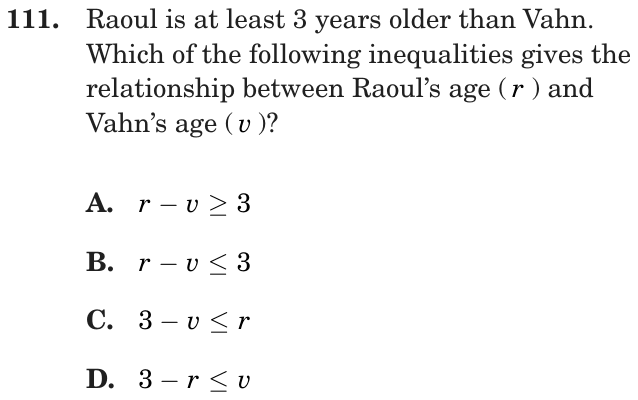
Inequalities
Question 1 of 20
2026 Practice Test A Math, question 43Question
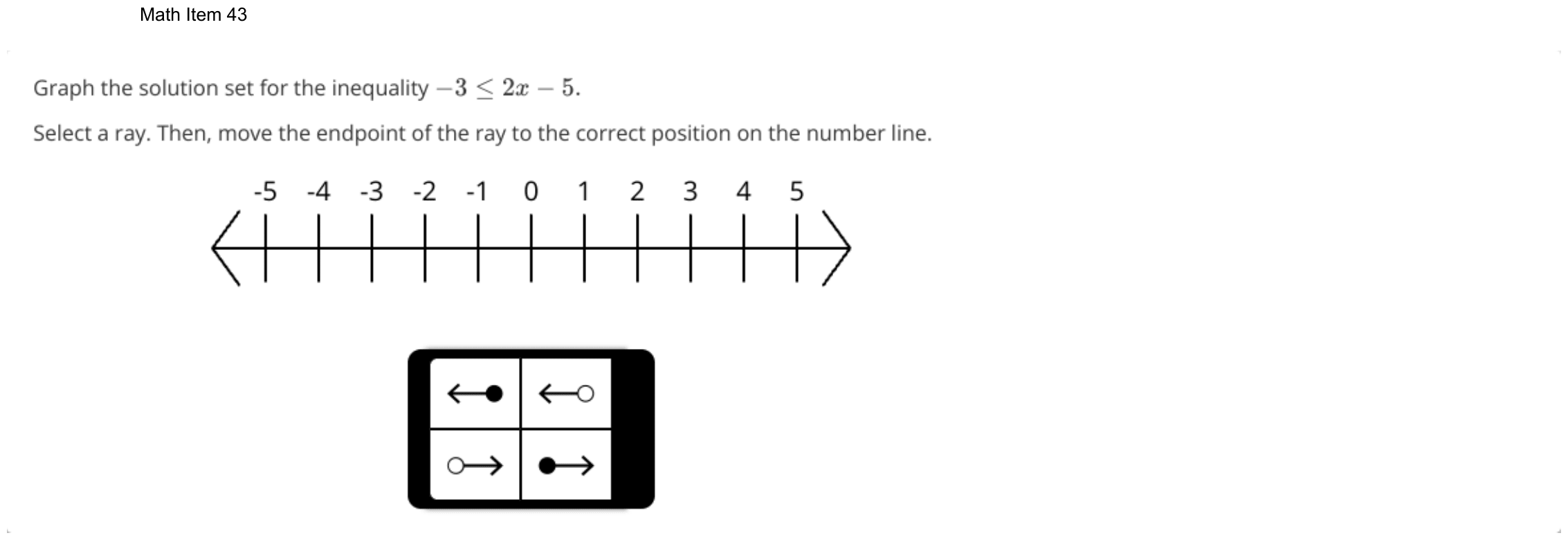
Graph the solution set for the inequality .
Select a ray. Then, move the endpoint of the ray to the correct position on the number line.
On the test you draw the ray on the number line; here, choose its endpoint, whether the endpoint is closed or open, and its direction. The DOE has not published how answers with several parts are scored; this site counts one right only when every part is right.
Show the answer
Correct answer: a ray with a closed endpoint at 1, pointing right
Solution:

Solve the inequality for x, then graph the solution on the number line:
Add 5 to both sides of the inequality:
Divide both sides by 2:
Rewrite the inequality with x on the left side:
The graph of is a closed ray (solid point) beginning at 1 and extending to the right on the number line.
Question analysis
Students graph the solution set of a two-step inequality on a number line by choosing a ray: where it starts, whether its endpoint is open or closed, and which way it points. It tests solving a linear inequality and reading its solution. The variable sits on the right of the inequality symbol, so reading the result the right way round is part of the challenge.
- Grade level
- Grade 7 content, by NYS standard
- Compared with grade 7
- At grade 7 Solving a two-step inequality and graphing its solution set is a named grade 7 skill. This one puts the variable on the right of the symbol and asks students to build the graph themselves rather than pick it from four.
- Estimated difficulty
- Moderate: several steps, or a close reading with one strong distractor.
- Thinking it demands
- Depth of knowledge 1, recall and reproduction · mainly apply
- What makes it hard
- Reading a figure, table or graph moderate
- Many steps minor
- An answer in an unexpected form minor
- Solution
- 3 steps
- Reading level
- Question and choices: about grade 6, 26 words.
- Students, last 30 days
- Not enough answers yet to show (it takes 10).
Why it is hard, traps and wrong answers (shows the answer)
Why it is hard
Solving takes two routine moves; the points are lost in turning 1 ≤ x into a picture. Because x sits on the right, the symbol seems to point left, and a student who shades the way it points draws the values below 1, which all fail. The dot must also be solid, since x = 1 makes both sides −3. Testing x = 2, where 2x − 5 = −1 and −3 ≤ −1 holds, confirms the direction.
Reading a figure, table or graph moderate Understanding the question
The solution comes out as 1 ≤ x, with x on the right, so the ≤ sign points away from the shaded side; it has to be read as x ≥ 1 before the ray is drawn. (Lesh, Post & Behr, 1987; Kirsch & Mosenthal, 1990)
Many steps minor Working it out
Two solving moves, adding 5 and then halving, come before three graph choices, the endpoint, a solid dot and a direction, and a mistake in any of the five loses the item. (Daniel & Embretson, 2010; Enright, Morley & Sheehan, 2002)
An answer in an unexpected form minor Choosing the answer
The ray is built, by picking one of four ray shapes and dragging its endpoint, rather than chosen from four finished graphs, so nothing on screen flags a ray that starts at the right number but points the wrong way. (Enright, Morley & Sheehan, 2002)
Strategy: Undo the subtraction and then the multiplication on both sides, rewrite the result with x first, decide whether the endpoint is included, and test one value on your ray in the original inequality.
Traps
- Negatives and direction: Arithmetic with negative numbers, the order of a subtraction, or direction on a number line. (Moving a term across the equals sign without changing its sign is a faulty procedure.)
- Counting the ends: Inclusive or exclusive ends, fence posts, consecutive numbers: an answer that is one too many or too few, or an endpoint drawn open where it belongs closed (or the reverse).
- A faulty procedure: A systematic but wrong procedure: adding fractions straight across, applying an exponent to each term of a sum, dropping a sign when moving a term.
The wrong answers, classified
1|closed|left Negatives and direction (Brown & Burton, 1978)
Solves to 1 ≤ x but shades the way the ≤ symbol points, a rule that holds only with x on the left, so the ray covers x ≤ 1.
1|open|right Counting the ends (Brown & Burton, 1978)
Finds the right endpoint and direction but draws an open dot, leaving out 1 itself, though the "or equal to" in ≤ includes it.
-4|closed|right A faulty procedure (Brown & Burton, 1978; Tatsuoka, 1983)
Moves the −5 to the left side without changing its sign, writing −3 − 5 = −8 ≤ 2x, so the ray starts at −4.
Worked solution, step by step
Formulas used
- Doing the same to both sides
- a and b are the two sides of an inequality, and c is any number. Adding the same number to both sides keeps the inequality true. So does dividing both sides by the same positive number. Dividing by a negative number would flip the symbol, but that does not happen here.
- Turning an inequality around
- a and b are any two numbers or terms. You may swap the two sides if you also turn the symbol around. The pointed end of the symbol always faces the smaller side. So 1 ≤ x and x ≥ 1 say the same thing.
Sort out the question
The symbol ≤ means is less than or equal to. The solution set is every value of x that makes true. You show it as a ray. A ray is a dot, called the endpoint, with an arrow going one way forever. You need three things: where the dot goes, whether it is closed or open, and which way the ray points.
Add 5 to both sides
The right side is 2x − 5. Adding 5 undoes subtracting 5, so add 5 to both sides:
Watch out: taking 5 away from −3 instead gives −8 ≤ 2x. That wrong move puts the dot at −4.
Divide both sides by 2
Now x is multiplied by 2, so divide both sides by 2. You divide by a positive number, so the symbol stays the same:
Read it with x first
says 1 is less than or equal to x. So x is 1 or any number bigger than 1. With x first, that is:
Bigger numbers are to the right on a number line, so the ray points right.
Watch out: in 1 ≤ x, the symbol seems to point left. Do not follow it. A ray pointing left from 1 shows numbers that do not work.
Choose a closed dot
The words or equal to mean 1 itself is a solution. Check it: , and −3 ≤ −3 is true. So the dot at 1 is closed, which means filled in. An open dot, an empty circle, leaves the endpoint out. Use it only for < or >.
Watch out: an open dot at 1 would leave out a number that works.
Draw the ray
On the test, choose the ray with a filled dot and an arrow pointing right. Then drag its dot to 1. On this site, choose 1 for the endpoint, then closed (filled dot) and pointing right.
So the answer is a closed dot at 1, with the ray pointing right.
Check your answer
Test a number on your ray, such as 3. , and −3 ≤ 1 is true. Now test a number off the ray, such as 0. , and −3 ≤ −5 is false. So the ray points the right way.
More questions like this
The original DOE question
Question 2 of 20
2026 Practice Test B Math, question 17Question
How many positive integers satisfy the inequality ?
Enter your answer in the space.
Fill-in question: work out the answer and type it as a number.
Show the answer
Correct answer: 15
Solve the inequality for x.
There are 15 positive integers that are less than 16.
Question analysis
This inequality question asks how many positive integers make x + 7 < 23 true, and the count is typed into a box. Students solve a one-step inequality, then count its whole-number solutions. The strict less-than sign and the word positive decide where the count starts and stops, so both ends need checking.
- Grade level
- Grade 7 content, by NYS standard
- Compared with grade 7
- Below grade 7 Grade 7 inequality problems usually take two steps, such as 2x − 5 > 9. This one needs a single subtraction; the care goes into counting the whole-number solutions and deciding whether the boundary itself counts.
- Estimated difficulty
- Straightforward: two steps or one careful reading.
- Thinking it demands
- Depth of knowledge 1, recall and reproduction · mainly apply
- What makes it hard
- Solution
- 2 steps
- Reading level
- Question and choices: about grade 12, 14 words.
- Students, last 30 days
- Not enough answers yet to show (it takes 10).
Why it is hard, traps and wrong answers (shows the answer)
Why it is hard
One subtraction solves the inequality, so the points are lost in the count that follows. The boundary 16 is the last number the solving produces and is easy to type in, or to count up to; checking that 16 + 7 is 23, which is not less than 23, rules it out. Listing 1 through 15, the positive integers below the boundary, settles the count.
An answer in an unexpected form minor Choosing the answer
Solving gives x < 16, but the box asks how many positive integers make the inequality true, a count that still has to be made after the solving is done. (Enright, Morley & Sheehan, 2002)
Much to keep track of minor Working it out
Two conditions set the ends of the count at once: the word positive starts it at 1 rather than 0, and the strict < stops it below 16. (Sweller, 1988; Carpenter, Just & Shell, 1990)
Strategy: Undo the addition to find the boundary for x, then count the positive whole numbers below it, checking the largest one and the boundary in the original inequality.
Traps
- Counting the ends: Inclusive or exclusive ends, fence posts, consecutive numbers: an answer that is one too many or too few, or an endpoint drawn open where it belongs closed (or the reverse).
- A faulty procedure: A systematic but wrong procedure: adding fractions straight across, applying an exponent to each term of a sum, dropping a sign when moving a term.
The wrong answers, classified
16 Counting the ends (Brown & Burton, 1978)
Solves to x < 16 and then enters 16, either the boundary itself or a count of 1 through 16, though x = 16 makes x + 7 equal 23, not less than it.
29 A faulty procedure (Brown & Burton, 1978; Tatsuoka, 1983)
Moves the 7 to the right side without changing its sign, 23 + 7 = 30, and counts the 29 positive integers below 30.
Worked solution, step by step
Formulas used
- Doing the same to both sides
- a and b are the two sides of an inequality, and c is any number. Taking the same number away from both sides keeps the inequality true. Think of two people who each walk down the same number of stairs: the lower one stays lower. Use it to get x by itself.
Sort out the question
An inequality compares two amounts. The sign < means is less than. A positive integer is a whole number bigger than 0: 1, 2, 3, and so on. You need to count how many of them make true. The answer is a count, not a value of x.
Get x by itself
The 7 is added to x. Subtracting 7 undoes adding 7, so subtract 7 from both sides:
So x must be less than 16.
Watch out: adding 7 to 23 instead gives x < 30, and a count of 29.
Check the boundary number
The number 16 is the boundary, where the solutions stop. Does 16 itself work? Try it:
But 23 is not less than 23. It is equal. So 16 does not count. The largest number that works is 15, since , and 22 is less than 23.
Watch out: entering 16 counts the boundary, which fails.
Count the positive integers
The numbers that work start at 1, the smallest positive integer. Zero is not positive. They stop at 15:
Counting from 1 up to 15 gives 15 numbers.
Enter the count
There are 15 positive integers that make the inequality true. Type the count in the box as a plain whole number. So you would enter 15.
Check your answer
Test both ends. For 1: , and 8 is less than 23, so 1 works. For 15: 22 is less than 23, so 15 works. For 16: 23 is not less than 23, so 16 fails. That leaves exactly the numbers 1 through 15.
More questions like this
The original DOE question

Question 3 of 20
2026 Practice Test C Math, question 7Question
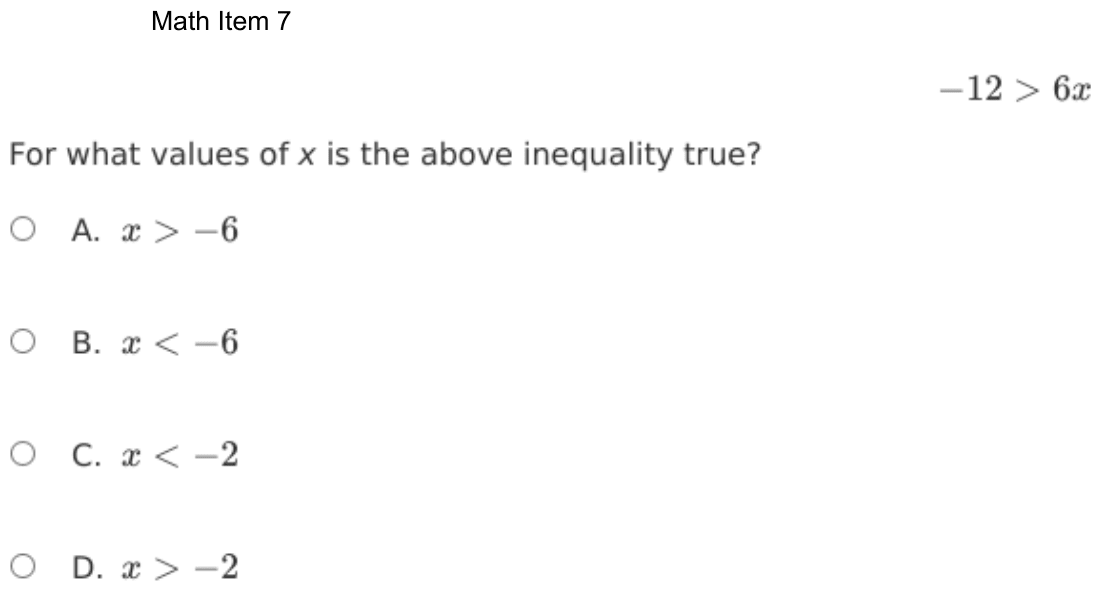
For what values of x is the above inequality true?
- A
- B
- C
- D
Show the answer
Correct answer: C
Divide to solve for x:
Rewriting with the x term first requires reversing the inequality symbol in order to keep the meaning “x is less than ”.
Question analysis
This inequality question asks which values of x make −12 > 6x true. Students solve a one-step inequality by dividing and then state the solution with x written first. A negative number on one side and the variable on the other make the direction of the symbol the main thing to get right.
- Grade level
- Grade 7 content, by NYS standard
- Compared with grade 7
- Below grade 7 Grade 7 inequalities usually take two steps, such as 3x + 4 > 19. This one needs a single division, and the care goes into reading the result correctly when the variable ends up on the right of the symbol.
- Estimated difficulty
- Straightforward: two steps or one careful reading.
- Thinking it demands
- Depth of knowledge 1, recall and reproduction · mainly apply
- What makes it hard
- A very close wrong answer moderate
- Something you must already know minor
- Solution
- 2 steps
- Reading level
- Question and choices: about grade 10, 15 words.
- Students, last 30 days
- Not enough answers yet to show (it takes 10).
Why it is hard, traps and wrong answers (shows the answer)
Why it is hard
One division finds the boundary, so the question is really about direction. Two things pull students the wrong way: the −12 on the left makes the inequality look like one that must be flipped, and the result −2 > x has x on the right, where it is easy to read backward. Testing x = −3, which gives −12 > −18, shows that values below −2 work.
A very close wrong answer moderate Choosing the answer
x < −2 and x > −2 share the boundary −2 and differ only in direction, so finding the right number settles nothing until the direction is read correctly. (Embretson & Wetzel, 1987; Gorin & Embretson, 2006; Ascalon et al., 2007)
Something you must already know minor Working it out
Students must know that the symbol flips only when both sides are multiplied or divided by a negative number, and that −2 > x says the same as x < −2. (Anderson & Krathwohl, 2001)
Strategy: Divide both sides by 6, asking whether you divided by a negative number, then rewrite the result with x on the left so that the symbol still opens toward the larger side.
Traps
- Negatives and direction: Arithmetic with negative numbers, the order of a subtraction, or direction on a number line. (Moving a term across the equals sign without changing its sign is a faulty procedure.)
- Wrong operation: Adds instead of multiplying, divides the wrong way round, turns a ratio or rate upside down, or undoes a step in the wrong direction (subtracts what should be added back).
The wrong answers, classified
A Wrong operation (Hegarty, Mayer & Monk, 1995; King et al., 2004)
Adds 6 to −12 instead of dividing by 6, getting −6, and also reverses the direction, so both the boundary and the symbol are wrong.
B Wrong operation (Hegarty, Mayer & Monk, 1995; King et al., 2004)
Undoes the 6 by adding it to −12 rather than dividing, as if 6x meant x − 6, getting −6 > x and so x < −6.
D Negatives and direction (Brown & Burton, 1978)
Finds −2 > x but flips the symbol because −12 is negative, or reads −2 > x as x > −2, though dividing by a positive 6 keeps the direction.
Worked solution, step by step
Formulas used
- Dividing both sides of an inequality
- a and b are the two sides of an inequality, and c is the number you divide by. If c is positive, the symbol stays the same. It flips only when you multiply or divide both sides by a negative number. Here c is 6, which is positive.
- Reading an inequality the other way
- a and b are any two numbers. Saying a is greater than b is the same as saying b is less than a. When you swap the two sides, turn the symbol around. Its point still aims at the smaller number.
Sort out the question
The inequality is . The symbol > means is greater than. So it says −12 is greater than 6 times x. You need every value of x that makes this true.
Divide both sides by 6
To get x alone, divide both sides by 6:
You divided by 6, which is positive. So the symbol does not flip.
Watch out: −12 is negative, but that does not matter. Only dividing by a negative number flips the symbol.
Put x first
says −2 is greater than x. That means x is less than −2. Swap the sides and turn the symbol around:
Watch out: keeping > when you swap the sides gives choice D, . That is the opposite meaning.
Choose the answer
Choices A and B use −6. That comes from adding 6 to −12 instead of dividing by 6. The right boundary is −2, and x is below it.
So the answer is C, .
Check your answer
Test a number below −2, such as −3. Then , and is true. Now test 0, which is above −2. Then , and is false. So only numbers below −2 work.
More questions like this
The original DOE question
Question 4 of 20
2026 Practice Test C Math, question 40Question
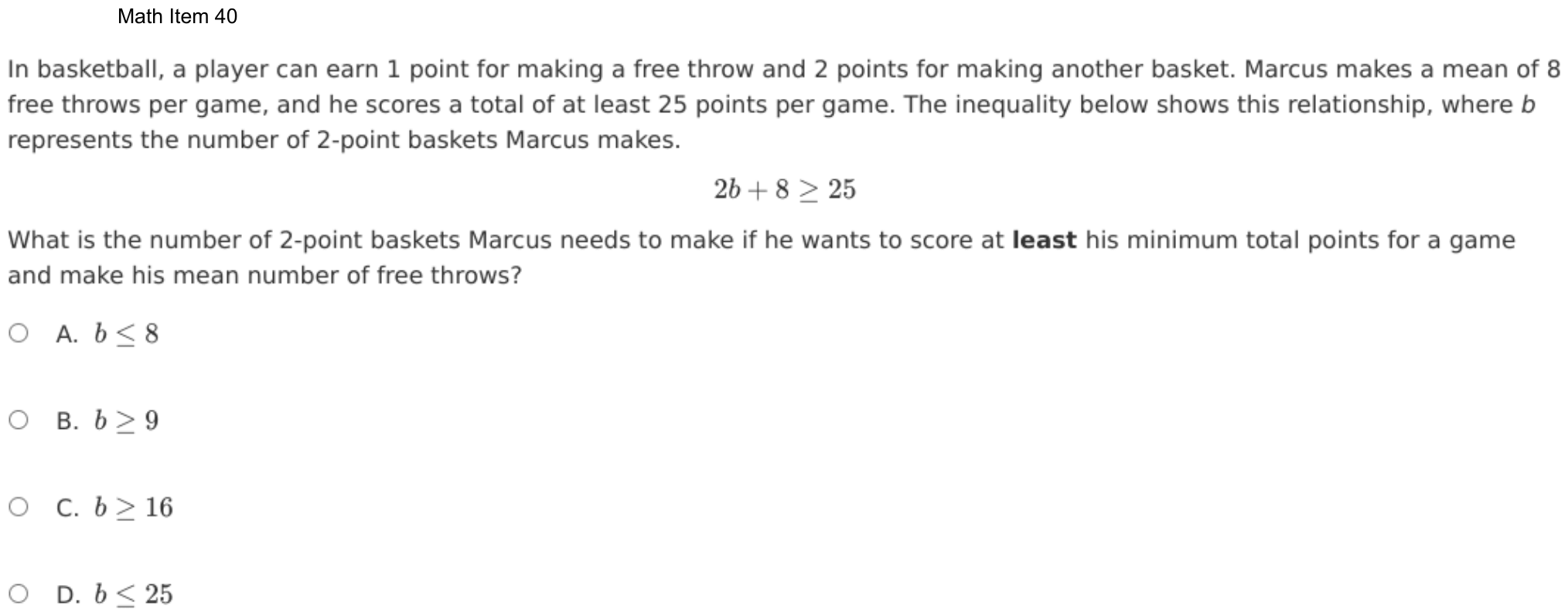
In basketball, a player can earn 1 point for making a free throw and 2 points for making another basket. Marcus makes a mean of 8 free throws per game, and he scores a total of at least 25 points per game. The inequality below shows this relationship, where b represents the number of 2-point baskets Marcus makes.
What is the number of 2-point baskets Marcus needs to make if he wants to score at least his minimum total points for a game and make his mean number of free throws?
- A
- B
- C
- D
Show the answer
Correct answer: B
Solve the inequality .
Since the number of baskets made must be a whole number, the fewest 2-point baskets, b, he must make is 9.
Question analysis
In basketball, Marcus makes a mean of 8 one-point free throws a game and wants at least 25 points, shown by the inequality 2b + 8 ≥ 25. Students find how many 2-point baskets he needs. It tests solving a two-step inequality and interpreting the solution in context, since a player cannot make part of a basket.
- NYS standards
- 7.EE.4b two-step inequalities
- Grade level
- Grade 7 content, by NYS standard
- Compared with grade 7
- At grade 7 Solving a two-step inequality from a word problem is a grade 7 standard. Here the inequality is already written, so the extra demand is interpreting its solution as a count of baskets, typical of grade 7 tasks.
- Estimated difficulty
- Straightforward: two steps or one careful reading.
- Thinking it demands
- Depth of knowledge 2, skills and concepts · mainly apply
- What makes it hard
- An answer in an unexpected form minor
- Complex sentences minor
- Solution
- 3 steps
- Reading level
- Question and choices: about grade 5, 92 words.
- Students, last 30 days
- Not enough answers yet to show (it takes 10).
Why it is hard, traps and wrong answers (shows the answer)
Why it is hard
The inequality is handed over, so the solving is two routine moves; the judgment comes after. Dividing 17 by 2 leaves a half, and since a basket cannot be split, the boundary has to move up to 9: eight baskets give 2(8) + 8 = 24 points, one short of 25. Students who flip the symbol while dividing, or who move the 8 without changing its sign, still find a choice to match.
An answer in an unexpected form minor Choosing the answer
Solving gives b ≥ 8.5, which no choice shows; it has to be recognized as b ≥ 9, because Marcus cannot make half a basket. (Enright, Morley & Sheehan, 2002)
Complex sentences minor Understanding the question
The 33-word question restates the given inequality as “at least his minimum total points” and “make his mean number of free throws”, wording harder than the math it describes. (Abedi & Lord, 2001; Freedle & Kostin, 1993; Messick, 1989)
Strategy: Undo the added 8 and then the 2 to solve for b, then ask which whole numbers of baskets actually reach 25 points, testing the boundary value in the original inequality.
Traps
- Negatives and direction: Arithmetic with negative numbers, the order of a subtraction, or direction on a number line. (Moving a term across the equals sign without changing its sign is a faulty procedure.)
- A faulty procedure: A systematic but wrong procedure: adding fractions straight across, applying an exponent to each term of a sum, dropping a sign when moving a term.
- Numbers taken from the question: Combines the numbers in the question without a model of the situation, or is simply a number that appears in the question.
The wrong answers, classified
A Negatives and direction (Brown & Burton, 1978)
Reverses the inequality when dividing by 2, as if dividing always flipped it, so b ≤ 8.5, and whole baskets give b ≤ 8.
C A faulty procedure (Brown & Burton, 1978; Tatsuoka, 1983)
Moves the 8 to the right without changing its sign, so 2b ≥ 33 and b ≥ 16.5, then drops the half to match b ≥ 16.
D Numbers taken from the question (Hegarty, Mayer & Monk, 1995)
Takes the 25-point total from the inequality as a limit on baskets and writes at most, a number copied from the question rather than solved for.
Worked solution, step by step
Formulas used
- Solving an inequality
- A and B are the two sides. The sign ≥ means greater than or equal to. Taking the same amount C from both sides keeps the sign the same. Dividing both sides by a positive number, like 2, also keeps it the same. Only a negative number flips it.
Sort out the question
A free throw is worth 1 point, and each other basket is worth 2 points. Marcus makes 8 free throws, which give 8 points. The letter b is the number of 2-point baskets, so they give 2b points.
He wants at least 25 points in all. That is the inequality . An inequality compares two amounts. The sign ≥ means greater than or equal to. You need the values of b that work.
Subtract 8 from both sides
Undo the added 8 first:
Watch out: adding 8 instead gives . That leads to choice C, which is wrong.
Divide both sides by 2
2b means 2 times b. Divide both sides by 2. Since 2 is positive, the sign stays the same:
Watch out: do not flip the sign here. Flipping it gives , which leads to choice A.
Think about whole baskets
Marcus cannot make half a basket. So test the whole numbers near 8.5:
Eight baskets give 24 points, one short of 25. Nine baskets give 26 points, which is enough. So he needs 9 or more baskets.
Give the answer
The number of baskets is 9 or more, written . Choice D, , just copies the 25 from the points.
So the answer is B, .
Check your answer
Try a bigger number, such as b = 12. Then points, which is at least 25. Any number of baskets above 9 also works, and that is what ≥ says. Below 9, the total stays at 24 points or fewer.
More questions like this
The original DOE question
Question 5 of 20
2026 Practice Test C Math, question 41Question
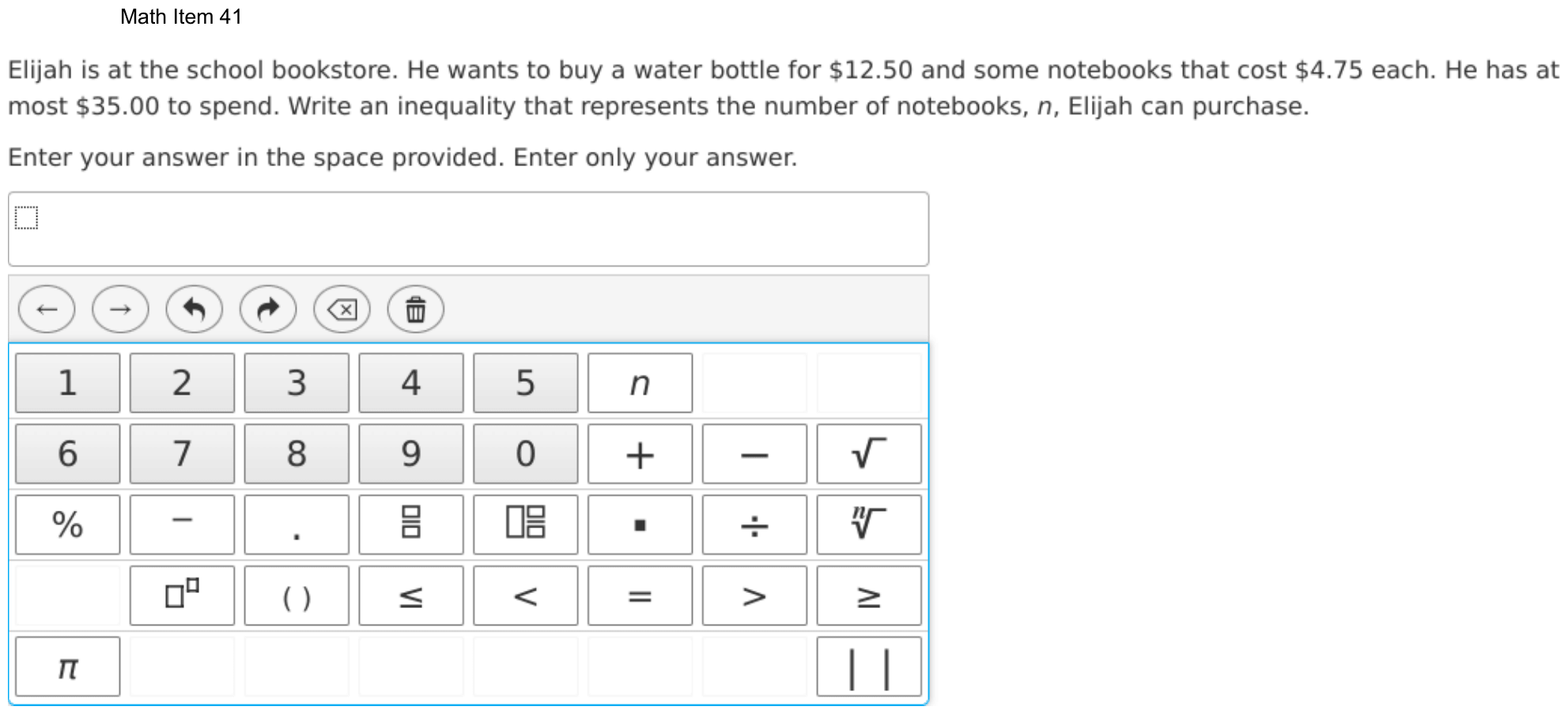
Elijah is at the school bookstore. He wants to buy a water bottle for $12.50 and some notebooks that cost $4.75 each. He has at most $35.00 to spend. Write an inequality that represents the number of notebooks, n, Elijah can purchase.
Enter your answer in the space provided. Enter only your answer.
On the test you build the answer on an on-screen keypad; here, type it. Use ^ for a power, sqrt( ) or √ for a root, pi for π, and <= or >= for ≤ and ≥.
Show the answer
Correct answer: 12.50 + 4.75n ≤ 35.00
The question uses the phrase “at most,” which means “less than or equal to” (≤).
Since notebooks cost $4.75 each and Elijah will buy n notebooks, the total cost just for the notebooks is found by multiplying $4.75 by n, or .
Combining the cost of a water bottle ($12.50) with the cost of n notebooks, the inequality is .
This may also be written as .
Question analysis
Elijah has at most $35.00 to buy one water bottle and some notebooks at the school bookstore, with a price given for each. Students type an inequality for the number of notebooks, n, he can buy. It tests writing an inequality from a word problem. The two prices play different roles, and the phrase "at most" decides the inequality symbol.
- Grade level
- Grade 7 content, by NYS standard
- Compared with grade 7
- At grade 7 Writing an inequality for a budget with a one-time cost and a cost per item is typical grade 7 work. The answer is typed, so both the symbol for "at most" and the role of each price must be right.
- Estimated difficulty
- Straightforward: two steps or one careful reading.
- Thinking it demands
- Depth of knowledge 2, skills and concepts · mainly apply
- What makes it hard
- Turning words into math moderate
- An answer in an unexpected form minor
- Solution
- 2 steps
- Reading level
- Question and choices: about grade 5, 50 words.
- Students, last 30 days
- Not enough answers yet to show (it takes 10).
Why it is hard, traps and wrong answers (shows the answer)
Why it is hard
The prices are given in the order they are used, so the expression for the total is the easier half. The points are lost on the symbol: “at most” has to be heard as no more than, with equality allowed, and the keypad offers all four inequality signs side by side. Pricing one and two notebooks with the bottle, $17.25 and $22.00, shows which amount repeats and confirms the total.
Turning words into math moderate Understanding the question
The $12.50 bottle is bought once and the $4.75 is paid for each of n notebooks, and “at most $35.00” has to become ≤, which allows a total of exactly $35.00. (Hegarty, Mayer & Monk, 1995; Koedinger & Nathan, 2004)
An answer in an unexpected form minor Choosing the answer
The whole inequality, with n, its symbol and both prices, is built on a keypad offering ≤, <, ≥ and >, so a wrong symbol looks as complete as the right one. (Enright, Morley & Sheehan, 2002)
Strategy: Price a few cases by hand, such as 1 and 2 notebooks with the water bottle, to see which amount repeats, then decide whether a total of exactly $35.00 is allowed.
Traps
- Misreads the question: Misses or misreads a condition or a word in the question: "at least", "each", "remaining", "not".
- Counting the ends: Inclusive or exclusive ends, fence posts, consecutive numbers: an answer that is one too many or too few, or an endpoint drawn open where it belongs closed (or the reverse).
- Numbers taken from the question: Combines the numbers in the question without a model of the situation, or is simply a number that appears in the question.
The wrong answers, classified
12.50 + 4.75n ≥ 35.00 Misreads the question (Hegarty, Mayer & Monk, 1995)
Builds the total correctly but reads “at most” as at least, writing ≥, which would mean Elijah must spend $35.00 or more.
12.50 + 4.75n < 35.00 Counting the ends (Brown & Burton, 1978)
Builds the total correctly but uses a strict less-than sign, leaving out a total of exactly $35.00, which “at most” allows.
17.25n ≤ 35.00 Numbers taken from the question (Hegarty, Mayer & Monk, 1995)
Adds the bottle’s price to each notebook’s, $12.50 + $4.75 = $17.25, and multiplies by n, as if a bottle came with every notebook.
Worked solution, step by step
Formulas used
- Total cost with a one-time cost
- The one-time cost is paid once, no matter what. The price each is paid once for every item. n is the number of items. You multiply the price each by n because you pay it n times.
- At most
- The sign ≤ means less than or equal to. The total can be under the limit or exactly equal to it, but never over it. Use it for words like at most and no more than.
Sort out the question
Elijah buys one water bottle for $12.50. He also buys n notebooks at $4.75 each. He can spend at most $35.00.
You need an inequality for n. An inequality compares two amounts with a sign such as ≤ instead of =.
Price a few cases
Work out the cost for a few numbers of notebooks:
Notebooks Total ($) 1 2 3 The $12.50 shows up once. The $4.75 shows up once for each notebook.
Write the total cost
Use the total cost formula. The bottle is the one-time cost, and each notebook costs $4.75:
Here 4.75n means 4.75 times n.
Watch out: do not add the two prices first. charges for a new bottle with every notebook.
Choose the sign
At most $35.00 means the total can be less than $35.00 or exactly $35.00. It cannot be more. So use ≤:
Watch out: ≥ means at least, the opposite. And < leaves out a total of exactly $35.00, which Elijah is allowed to spend.
Enter it on the keypad
Type the whole inequality. Nothing is printed before the box. On the test, press 1, 2, ., 5, 0, +, 4, ., 7, 5, the n key, the ≤ key, then 3, 5, ., 0, 0. The ≤ key is in the fourth row. Skip the dollar signs. On this site, type <= for ≤.
So you would enter 12.50 + 4.75n ≤ 35.00. An equal form, such as 4.75n + 12.50 ≤ 35.00, counts too.
Check your answer
Test some numbers. For 4 notebooks, , which is not over 35.00. For 5 notebooks, , which is too much. So Elijah can buy up to 4 notebooks. That makes sense for a budget of $35.00.
More questions like this
The original DOE question
Question 6 of 20
2026 Practice Test D Math, question 10Question
For what values of x is the above inequality true?
- A
- B
- C
- D
Show the answer
Correct answer: A
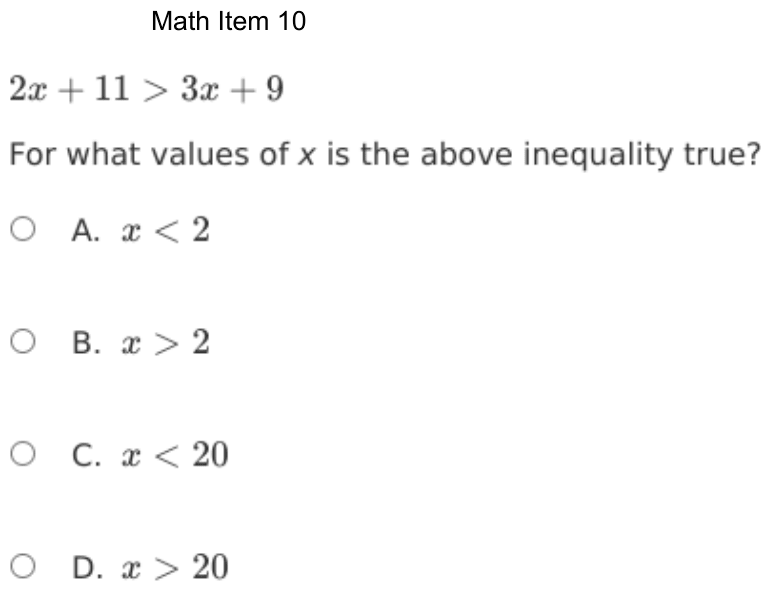
Use inverse operations to isolate the variable x by first getting the x variable on one side.
Now, when dividing by , the direction of the inequality sign changes.
Another way to solve is to keep the coefficient of x positive and then recognize that is the same as .
Question analysis
This algebra question asks which values of x make the inequality 2x + 11 > 3x + 9 true, choosing from four solution sets. It tests solving a linear inequality with the variable on both sides. Collecting the x terms can leave a negative coefficient, and handling the inequality sign at that point is where most mistakes happen.
- Grade level
- Grade 8 content, by NYS standard
- Compared with grade 7
- At grade 7 Two-step inequalities are grade 7 work, and having x on both sides, a grade 8 idea, takes only one extra subtraction here. The demand matches a careful grade 7 problem, with one sign decision that is easy to get wrong.
- Estimated difficulty
- Moderate: several steps, or a close reading with one strong distractor.
- Thinking it demands
- Depth of knowledge 1, recall and reproduction · mainly apply
- What makes it hard
- Error-prone arithmetic moderate
- A very close wrong answer moderate
- Solution
- 2 steps
- Reading level
- Question and choices: about grade 10, 15 words.
- Corrected from the DOE handbook
- A grammatical error in the explanation was corrected.
- Students, last 30 days
- Not enough answers yet to show (it takes 10).
Why it is hard, traps and wrong answers (shows the answer)
Why it is hard
The boundary 2 comes out of two routine moves; the direction is where points are lost. Whichever side the x terms are collected on, the last step either divides by a negative or leaves x on the right, and both moments invite a reversed answer. A second risk is moving the 9 without changing its sign, which yields 20. Substituting x = 0, which makes 11 > 9 true, confirms the direction.
Error-prone arithmetic moderate Working it out
Subtracting 3x from both sides leaves −x > −2, and dividing by −1 must reverse the sign; subtracting 2x instead leaves 2 > x, which still has to be read from the x side. (Brown & Burton, 1978; Junker & Sijtsma, 2001)
A very close wrong answer moderate Choosing the answer
x < 2 and x > 2 share the boundary and differ only in direction, so finding the 2 settles nothing; only the sign rule or a test value such as x = 0 decides. (Embretson & Wetzel, 1987; Gorin & Embretson, 2006; Ascalon et al., 2007)
Strategy: Subtract 2x from both sides so the x term stays positive, undo the + 9, then rewrite the result with x first; testing a value in the original inequality checks the direction.
Traps
- Negatives and direction: Arithmetic with negative numbers, the order of a subtraction, or direction on a number line. (Moving a term across the equals sign without changing its sign is a faulty procedure.)
- A faulty procedure: A systematic but wrong procedure: adding fractions straight across, applying an exponent to each term of a sum, dropping a sign when moving a term.
The wrong answers, classified
B Negatives and direction (Brown & Burton, 1978)
Reaches −x > −2 but divides by −1 without reversing the inequality, or reads 2 > x as x > 2, so the direction comes out backwards.
C A faulty procedure (Brown & Burton, 1978; Tatsuoka, 1983)
Moves the 9 across the inequality without changing its sign, 11 + 9 = 20 instead of 11 − 9 = 2, and keeps the direction right.
D A faulty procedure (Brown & Burton, 1978; Tatsuoka, 1983)
Moves the 9 without changing its sign to get 20 > x, then also rewrites that statement backwards as x > 20, two errors at once.
What was corrected from the DOE handbook, and why
- Explanation: The DOE’s explanation says “Another way to solve is to keep the coefficient of x positive and then recognizing that 2 > x is the same as x < 2.” The two verbs joined by “and then” should have the same form, so the site now says “and then recognize that”.
Worked solution, step by step
Formulas used
- Doing the same to both sides of an inequality
- a and b are the two sides, and c is any number or term. Subtracting (or adding) the same amount on both sides keeps the inequality true and its sign the same. That is how you move terms from one side to the other.
- Dividing by a negative number
- a and b are any numbers. Multiplying or dividing both sides by a negative number flips the sign, so > becomes <. For example, 3 > 2, but −3 < −2. Use it whenever you divide by a negative number.
Sort out the question
The sign > means is greater than. You need every value of x that makes 2x + 11 greater than 3x + 9. The answer is a range of values, not one number. Solve it like an equation, but keep an eye on the direction of the sign.
Gather the x terms on one side
The right side has more x’s, 3x, than the left side, 2x. So subtract 2x from both sides. That keeps the x term positive:
Get x by itself
Subtract 9 from both sides:
Watch out: to move the 9, subtract it from both sides. Adding it instead gives 20 > x, which leads to choice C or D.
Read it from the x side
says 2 is greater than x. That is the same as saying x is less than 2:
Watch out: when you swap the sides, the sign must point the other way. Writing gives choice B. If you subtract 3x instead, you get . Dividing by −1 then flips the sign, and you get again.
So the answer is A, .
Check your answer
Test x = 0, which is less than 2. The left side is 11 and the right side is 9, and 11 > 9 is true. Test x = 5, which is more than 2. The left side is 21 and the right side is 24, and 21 > 24 is false. So only values below 2 work.
More questions like this
The original DOE question
Question 7 of 20
2026 Practice Test D Math, question 26Question
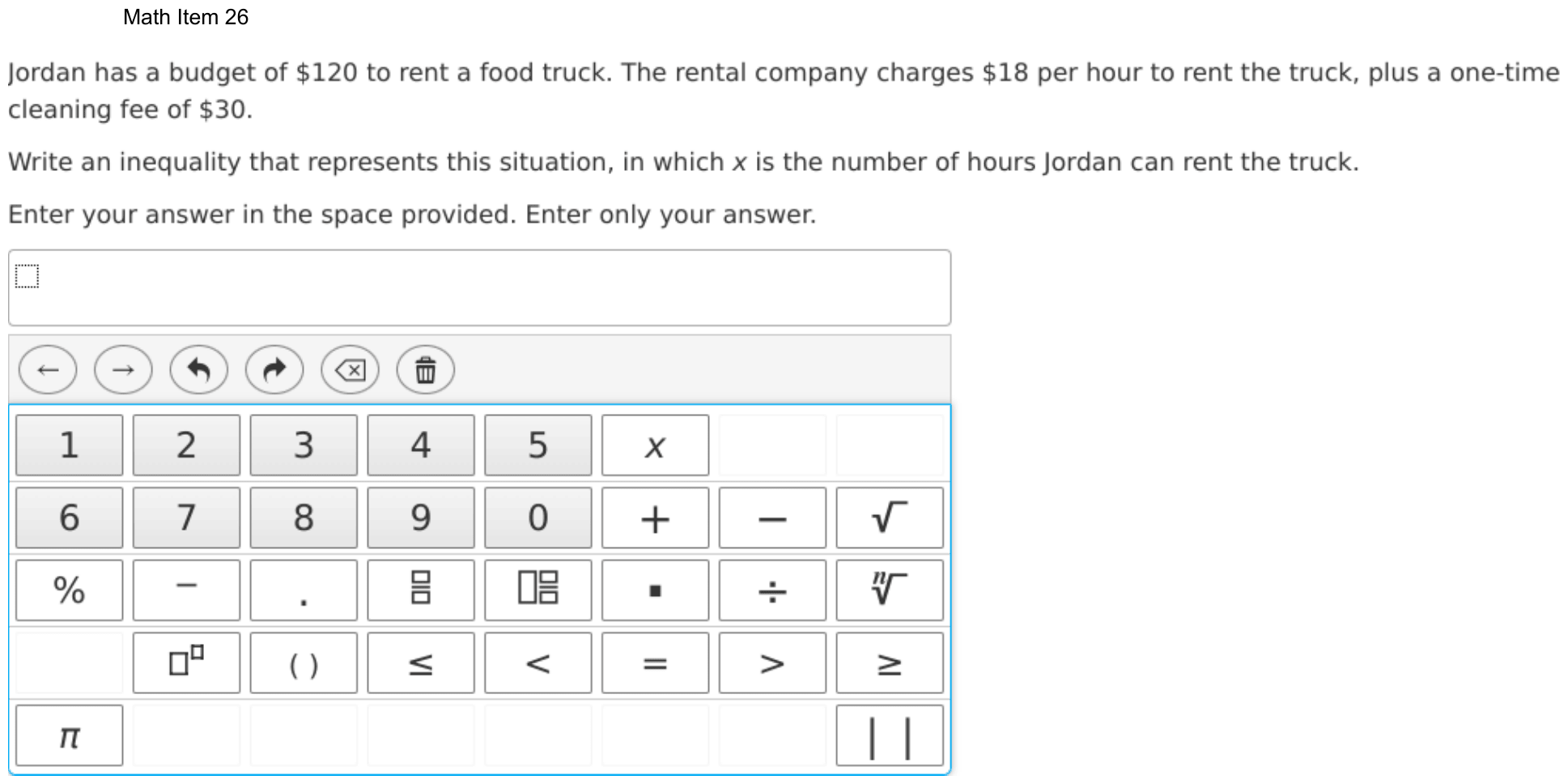
Jordan has a budget of $120 to rent a food truck. The rental company charges $18 per hour to rent the truck, plus a one-time cleaning fee of $30.
Write an inequality that represents this situation, in which x is the number of hours Jordan can rent the truck.
Enter your answer in the space provided. Enter only your answer.
On the test you build the answer on an on-screen keypad; here, type it. Use ^ for a power, sqrt( ) or √ for a root, pi for π, and <= or >= for ≤ and ≥.
Show the answer
Correct answer: 30 + 18x ≤ 120
Let x represent the number of hours Jordan can rent the truck.
The hourly rental cost can be represented as , written as .
The one-time cleaning fee of $30 is added to the hourly cost to obtain the total cost.
The sum of the cleaning fee and the hourly rental cost is represented as .
As Jordan has $120 to spend, the total cost must be less than or equal to $120.
This is represented as or .
Question analysis
Jordan has $120 to rent a food truck that costs $18 an hour plus a one-time $30 cleaning fee, and students type an inequality for x, the number of hours. It tests writing a two-step inequality from a word problem. Matching each dollar amount to its role and choosing the symbol that fits a spending limit are the tricky parts.
- Grade level
- Grade 7 content, by NYS standard
- Compared with grade 7
- At grade 7 Writing a two-step inequality from a word problem is the grade 7 standard itself. Nothing is offered to choose from: students type the whole inequality, so the numbers, the variable term and the symbol are all theirs to get right.
- Estimated difficulty
- Moderate: several steps, or a close reading with one strong distractor.
- Thinking it demands
- Depth of knowledge 2, skills and concepts · mainly apply
- What makes it hard
- Turning words into math moderate
- An answer in an unexpected form minor
- Solution
- 3 steps
- Reading level
- Question and choices: about grade 6, 57 words.
- Corrected from the DOE handbook
- A spelling error in the explanation was corrected.
- Students, last 30 days
- Not enough answers yet to show (it takes 10).
Why it is hard, traps and wrong answers (shows the answer)
Why it is hard
The arithmetic is small, so the points ride on two decisions the keypad leaves open: which symbol, and whether to stop before solving. A budget means Jordan may spend all $120 but no more, so the total cost must stay at or under it, and a strict < leaves out the five-hour rental that costs exactly $120. Testing x = 5 and x = 6 in the typed inequality confirms both the symbol and the setup.
Turning words into math moderate Understanding the question
The stem never says “at most”: the limit comes only from “a budget of $120”, while “$18 per hour” must multiply x and the “one-time cleaning fee of $30” is added just once. (Hegarty, Mayer & Monk, 1995; Koedinger & Nathan, 2004)
An answer in an unexpected form minor Choosing the answer
The whole inequality is typed on a keypad that offers <, ≤, > and ≥ side by side, with no choices to compare, and the solved form x ≤ 5 is not accepted. (Enright, Morley & Sheehan, 2002)
Strategy: Work out what 1 hour and 2 hours would cost Jordan in all, see which amount repeats each hour, build the total for x hours, then compare it with the budget and test a few values.
Traps
- Counting the ends: Inclusive or exclusive ends, fence posts, consecutive numbers: an answer that is one too many or too few, or an endpoint drawn open where it belongs closed (or the reverse).
- Misreads the question: Misses or misreads a condition or a word in the question: "at least", "each", "remaining", "not".
The wrong answers, classified
30 + 18x < 120 Counting the ends (Brown & Burton, 1978)
Builds the cost 30 + 18x correctly but uses a strict less-than sign, which shuts out a five-hour rental costing exactly the $120 Jordan has.
30 + 18x ≥ 120 Misreads the question (Hegarty, Mayer & Monk, 1995)
Builds the cost correctly but points the symbol the wrong way, treating the $120 budget as an amount Jordan must spend at least instead of a limit.
x ≤ 5 Misreads the question (Hegarty, Mayer & Monk, 1995)
Writes and solves the inequality correctly, then enters its solution, x ≤ 5, though the item asks for the inequality showing the fee, the hourly charge and the budget.
What was corrected from the DOE handbook, and why
- Explanation: The DOE’s explanation says “The onetime cleaning fee of $30 is added to the hourly cost …”. “Onetime” means “former”; a fee charged once is a “one-time” fee, as the question itself spells it. The site now says “one-time”.
Worked solution, step by step
Formulas used
- Total cost with a fee and a rate
- The fee is a charge paid only once, so you add it once. The rate is the charge for each hour. x is the number of hours. You multiply the rate by x because it is paid again for every hour.
- Staying within a budget
- The sign ≤ means is less than or equal to. A budget is the most money you can spend. You may spend all of it, or less, but never more. So the total cost must be less than or equal to the budget.
Sort out the question
You know three facts:
- Jordan can spend at most $120. That is the budget.
- The truck costs $18 for each hour.
- A cleaning fee of $30 is paid one time only.
x is the number of hours. You need an inequality. That is a math sentence that compares two amounts with a sign such as < or ≤. It must show all three facts.
Work out a few totals
Find the total cost for a few hours. Each hour adds one more $18:
Hours Hourly charges ($) Total cost ($) 1 2 x The $30 shows up once in every total. The $18 shows up once for each hour. So x hours cost 30 + 18x dollars. Here 18x means 18 times x.
Choose the right sign
The total cost must fit inside the budget. Jordan may spend exactly $120, or less, but not more. That is less than or equal to, the sign ≤. So:
Watch out: the sign < means less than, but not equal. leaves out spending exactly $120. The sign ≥ is backward too. It says Jordan must spend at least $120. Also keep each number in its place. charges $30 an hour.
Stop before you solve
You could solve the inequality. Subtract 30 from both sides to get . Then divide both sides by 18 to get . So Jordan can rent the truck for at most 5 hours.
Watch out: the question asks for an inequality that models the situation. To model means to show the facts of the story in math. The solved form, x ≤ 5, is true, but it hides the $18, the $30 and the $120. So x ≤ 5 is not accepted. Enter the inequality before you solve it.
Enter it on the keypad
On the test, build the inequality on the keypad. Press 3, 0, +, 1, 8 and the x key. Then press the ≤ key, in the fourth row of keys. Then press 1, 2, 0. You need no dollar signs and no times sign. On this site, type it, with <= for ≤: 30 + 18x <= 120.
So you would enter 30 + 18x ≤ 120. The same inequality written the other way round, 120 ≥ 30 + 18x, is also right. The solved form, x ≤ 5, is not accepted, because it does not model the situation.
Check your answer
Test two numbers of hours. For 5 hours, . Is 120 ≤ 120? Yes, so 5 hours fit the budget. For 6 hours, . Is 138 ≤ 120? No, and $138 is over budget. The inequality gets both right.
More questions like this
The original DOE question
Question 8 of 20
2026 Practice Test D Math, question 40Question
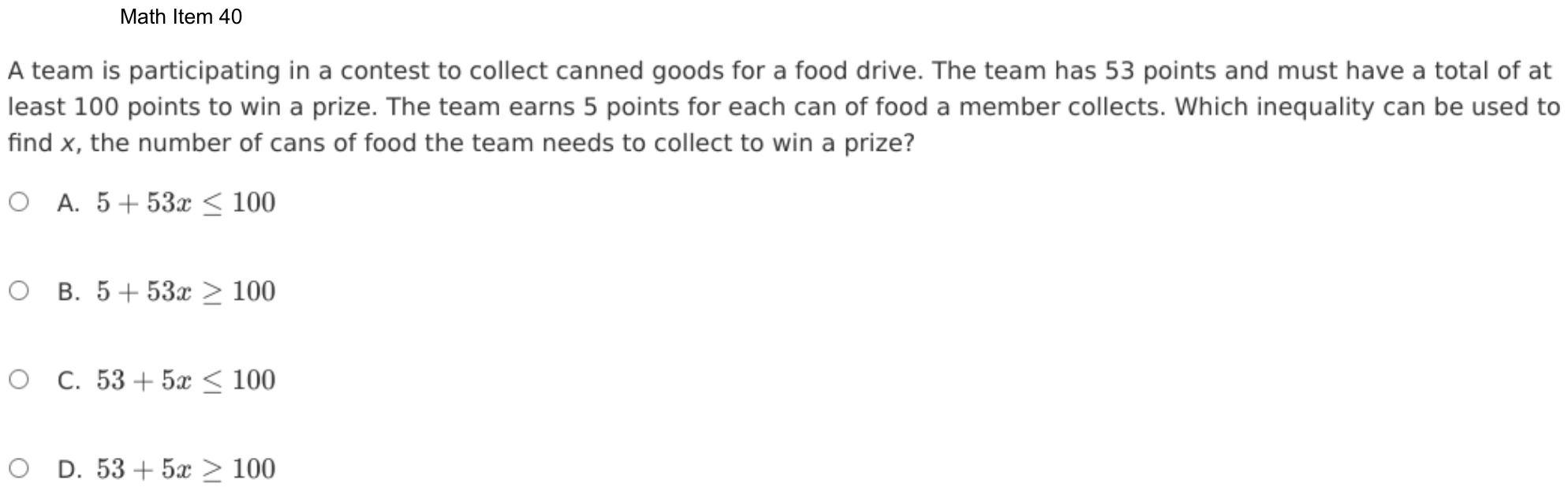
A team is participating in a contest to collect canned goods for a food drive. The team has 53 points and must have a total of at least 100 points to win a prize. The team earns 5 points for each can of food a member collects. Which inequality can be used to find x, the number of cans of food the team needs to collect to win a prize?
- A
- B
- C
- D
Show the answer
Correct answer: D
Since each can is worth 5 points, the total number of points earned from all the cans, x, is 5x. The team started with 53 points. That is a constant value and doesn’t change. So the total number of points the team will earn is . The team wants to earn at least (≥) 100 points, so they need total points.
Question analysis
A team has 53 points in a canned-food drive, earns 5 points for each can, and needs at least 100 points to win a prize. Students choose the inequality for x, the number of cans the team must collect. It tests writing an inequality from words, where the starting points and the points per can must each take the right place.
- Grade level
- Grade 7 content, by NYS standard
- Compared with grade 7
- At grade 7 Writing an inequality for a word problem with a starting amount and a rate is grade 7 work. The four choices pair two expressions with two symbols, so students make one decision about the terms and one about the phrase "at least".
- Estimated difficulty
- Straightforward: two steps or one careful reading.
- Thinking it demands
- Depth of knowledge 2, skills and concepts · mainly apply
- What makes it hard
- Turning words into math moderate
- A very close wrong answer minor
- Solution
- 2 steps
- Reading level
- Question and choices: about grade 4, 71 words.
- Students, last 30 days
- Not enough answers yet to show (it takes 10).
Why it is hard, traps and wrong answers (shows the answer)
Why it is hard
The choices form a two-by-two grid: which number goes with x, and which way the symbol points. Each decision can be made separately, so a student who settles both gets the item, while one mistake lands on a listed choice. Testing two numbers of cans, 5, which leaves the team at 78 points, and 10, which lifts it to 103, rules out every wrong inequality.
Turning words into math moderate Understanding the question
The 53 points the team “has” are a fixed start, the “5 points for each can” go with x, and “at least 100” calls for ≥, though “least” can sound like less. (Hegarty, Mayer & Monk, 1995; Koedinger & Nathan, 2004)
A very close wrong answer minor Choosing the answer
The four choices are two expressions, 5 + 53x and 53 + 5x, each with ≤ and with ≥, so the right one and the strongest wrong one differ only in the symbol. (Embretson & Wetzel, 1987; Gorin & Embretson, 2006; Ascalon et al., 2007)
Strategy: Work out the team's total points after 2 cans and then after x cans, translate "at least 100" into a symbol, and compare the result with each choice.
Traps
- Misreads the question: Misses or misreads a condition or a word in the question: "at least", "each", "remaining", "not".
- Misunderstands the concept: A wrong belief about a concept: that percents can be added, that area grows like length, that averages can be averaged, that a bigger denominator means a bigger fraction.
The wrong answers, classified
A Misunderstands the concept (Smith, diSessa & Roschelle, 1993; De Bock et al., 1998; Ni & Zhou, 2005)
Attaches x to the 53 points the team already has and also reverses “at least”, combining the mistakes behind the other two wrong choices.
B Misunderstands the concept (Smith, diSessa & Roschelle, 1993; De Bock et al., 1998; Ni & Zhou, 2005)
Keeps the right symbol but multiplies the number of cans by 53 and adds 5, putting the starting points where the points per can belong.
C Misreads the question (Hegarty, Mayer & Monk, 1995)
Writes the points correctly as 53 + 5x but reads “at least 100” as at most 100, reversing the inequality.
Worked solution, step by step
Formulas used
- Total with a start and a rate
- The start is the amount you have now, here 53 points. The rate is what each item adds, here 5 points for each can. x is the number of items. The start is added once, and the rate is multiplied by x.
- At least
- The sign ≥ means is greater than or equal to. At least 100 means 100 or more. So the total must be greater than or equal to 100.
Sort out the question
You know:
- The team already has 53 points.
- It earns 5 points for each can.
- It needs at least 100 points to win.
x is the number of cans. You need the inequality that shows this.
Write the total points
Try 2 cans first. The team gets 5 points for each, so points. For x cans, the total is:
Watch out: the 53 points do not repeat for each can. gives 53 points for each can, as in choices A and B.
Choose the sign
At least 100 means 100 or more, so use ≥:
Watch out: “least” sounds like “less,” but at least means the total can be 100 or higher. Using ≤ gives choice C.
So the answer is D, .
Check your answer
Test two numbers of cans. With 10 cans, , and 103 ≥ 100 is true. The team wins. With 9 cans, , and 98 ≥ 100 is false. The team is short. Choice D gets both right.
More questions like this
The original DOE question
Question 9 of 20
2024 Test A Math, question 20Question
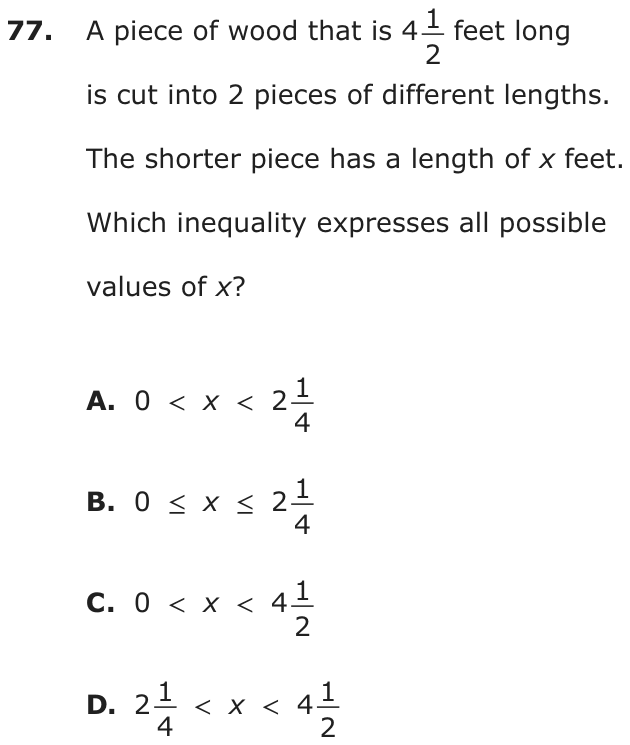
A piece of wood that is feet long is cut into 2 pieces of different lengths. The shorter piece has a length of x feet. Which inequality expresses all possible values of x?
- A
- B
- C
- D
Show the answer
Correct answer: A
The original piece of wood is feet long.
The shorter piece is x feet long, and it must be less than half the length of the original piece of wood.
Since half of is , it follows that .
The shorter piece of wood cannot be 0 feet long, so it follows that .
This gives the compound inequality .
Question analysis
An inequality question: a piece of wood 4½ feet long is cut into two pieces of different lengths, and the shorter piece is x feet long. Students choose the inequality that gives every possible value of x. They must turn each condition in the words into a boundary and decide whether each end of the range is included.
- Grade level
- Grade 7 content, by NYS standard
- Compared with grade 7
- Above grade 7 Grade 7 students solve and graph simple inequalities. Writing a compound inequality from a description, where the words decide whether each end is strict, is less familiar and calls for careful reading of every condition.
- Estimated difficulty
- Moderate: several steps, or a close reading with one strong distractor.
- Thinking it demands
- Depth of knowledge 2, skills and concepts · mainly analyze
- What makes it hard
- Turning words into math moderate
- A very close wrong answer moderate
- Variables instead of numbers minor
- Solution
- 2 steps
- Reading level
- Question and choices: about grade 5, 37 words.
- Students, last 30 days
- Not enough answers yet to show (it takes 10).
Why it is hard, traps and wrong answers (shows the answer)
Why it is hard
Halving 4 1/2 feet is the only computation; the rest is deciding whether each end of the range can actually happen. A shorter piece of 2 1/4 feet would make the two pieces equal, and a piece of 0 feet is no piece at all, so both ends are excluded. Students who find the right bounds but never test the ends are drawn to the version with the inclusive symbols.
Turning words into math moderate Understanding the question
Two phrases set the two ends: "cut into 2 pieces" means x is more than 0, and "of different lengths" with "the shorter piece" means x is less than half of 4 1/2. (Hegarty, Mayer & Monk, 1995; Koedinger & Nathan, 2004)
A very close wrong answer moderate Choosing the answer
The inequalities 0 < x < 2 1/4 and 0 ≤ x ≤ 2 1/4 share both bounds and differ only in their symbols; only checking whether each end can happen separates them. (Embretson & Wetzel, 1987; Gorin & Embretson, 2006; Ascalon et al., 2007)
Variables instead of numbers minor Understanding the question
The question asks for every possible length of the shorter piece, a range rather than one length, so students must picture the cut moving along the board. (Koedinger & Nathan, 2004; Enright, Morley & Sheehan, 2002)
Strategy: Picture cutting the board in different places, find the largest and smallest values the shorter piece could take, and check whether each boundary value is actually possible.
Traps
- Counting the ends: Inclusive or exclusive ends, fence posts, consecutive numbers: an answer that is one too many or too few, or an endpoint drawn open where it belongs closed (or the reverse).
- Misreads the question: Misses or misreads a condition or a word in the question: "at least", "each", "remaining", "not".
- Answers a different question: A choice is right for another quantity: the other unknown, the rest instead of the part, the part instead of the whole.
The wrong answers, classified
B Counting the ends (Brown & Burton, 1978)
Finds the right bounds but includes both ends, allowing a piece of 0 feet or two equal halves, though the stem says 2 pieces of different lengths.
C Misreads the question (Hegarty, Mayer & Monk, 1995)
Ignores that x is the shorter piece and allows any length up to the whole 4 1/2-foot board.
D Answers a different question (King et al., 2004; Hegarty, Mayer & Monk, 1995)
Describes the longer piece, whose length lies between half the board and the whole board, instead of the shorter piece the stem calls x.
Worked solution, step by step
Formulas used
- Two pieces make the whole board
- x is the length of the shorter piece, and L is the length of the longer piece, both in feet. Together they make the whole board. Since x is smaller than L, x must be less than half of the board.
- Inequality signs
- a < b says a is less than b. a ≤ b says a is less than or equal to b, so a can also equal b. A chain like 0 < x < 5 means x is more than 0 and less than 5.
Sort out the question
A board is feet long. It is cut into 2 pieces of different lengths. The shorter piece is x feet long. You need an inequality for every possible value of x. An inequality uses signs like <, less than, to show a range of numbers.
Find the top end for x
If you cut exactly in the middle, each piece is half the board.
But the pieces have different lengths, so the cut is not in the middle. The shorter piece must be less than half.
Find the bottom end for x
The shorter piece can be very small, like 0.1 foot. But it can’t be 0 feet. Then nothing would be cut off, and there would not be 2 pieces.
Put the two ends together
This says x is more than 0 and less than . Watch out: choice B uses ≤, which allows x = 0 or . Neither can happen. Choice C lets x be more than half, so it would not be the shorter piece. Choice D describes the longer piece. So the answer is A, .
Check your answer
Test values. Cut off 1 foot: the pieces are 1 foot and feet. The shorter one is 1, and 1 is between 0 and . If x were 3, the other piece would be feet, so x would not be the shorter one. Choice A leaves 3 out, as it should.
More questions like this
The original DOE question
Question 10 of 20
2024 Test A Math, question 29Question
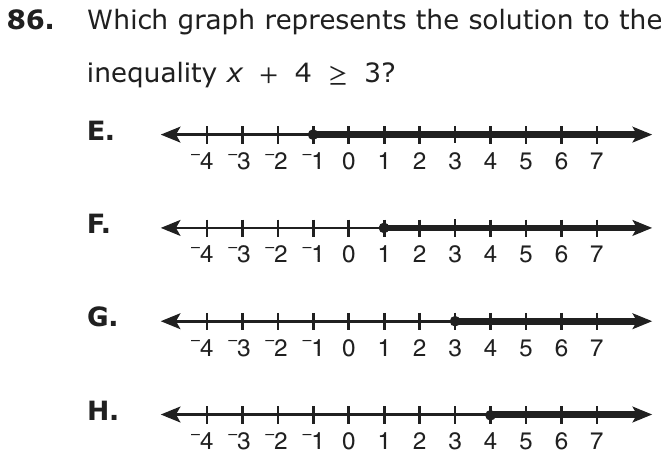
Which graph represents the solution to the inequality ?
- A

- B

- C

- D

Show the answer
Correct answer: A
Use the properties of equations to solve the inequality for x.
Subtract 4 from both sides of the inequality.
The graph of will have a point at −1 and will include all values that are greater than, or to the right of, −1. The greater than or equal sign is used, which indicates that the solution includes −1. So the point at −1 will be solid. Option A is the correct answer.
Question analysis
This inequality question asks which number line graph shows the solution set of x + 4 ≥ 3. Students solve a one-step inequality by undoing the addition, then match the result to a graph. All four graphs use a solid dot and an arrow pointing right, so the whole question rests on where the shaded ray begins.
- Grade level
- Grade 7 content, by NYS standard
- Compared with grade 7
- Below grade 7 Grade 7 inequality work is usually two-step, such as 3x − 5 ≥ 10, and asks students to choose an open or closed dot and a direction. This one needs a single subtraction, and all four graphs share a closed dot and a rightward arrow.
- Estimated difficulty
- Routine: one familiar step, little to misread.
- Thinking it demands
- Depth of knowledge 1, recall and reproduction · mainly apply
- What makes it hard
- Solution
- 2 steps
- Reading level
- Question and choices: about grade 13, 9 words.
- Students, last 30 days
- Not enough answers yet to show (it takes 10).
Why it is hard, traps and wrong answers (shows the answer)
Why it is hard
Solving takes a single subtraction, and the graphs differ only in where the solid dot sits, so the question comes down to 3 − 4. Students who lose the negative sign land on the graph that starts at 1, while those who never isolate x pick a graph that starts at a number printed in the inequality. Testing 0, which satisfies 0 + 4 ≥ 3, shows that the shading must include 0.
Reading a figure, table or graph minor Understanding the question
All four graphs share a closed dot and a rightward arrow, so the only thing to read is where the dot sits, against tick labels printed with raised minus signs. (Lesh, Post & Behr, 1987; Kirsch & Mosenthal, 1990)
Error-prone arithmetic minor Working it out
Undoing the + 4 means computing 3 − 4, the one step that crosses zero; a dropped minus sign moves the dot from −1 to 1. (Brown & Burton, 1978; Junker & Sijtsma, 2001)
Strategy: Subtract 4 from both sides to get x alone, then find the graph whose solid dot sits at that number; test one shaded value in the original inequality to confirm.
Traps
- Negatives and direction: Arithmetic with negative numbers, the order of a subtraction, or direction on a number line. (Moving a term across the equals sign without changing its sign is a faulty procedure.)
- Numbers taken from the question: Combines the numbers in the question without a model of the situation, or is simply a number that appears in the question.
The wrong answers, classified
B Negatives and direction (Brown & Burton, 1978)
Computes 4 − 3 instead of 3 − 4, or drops the minus sign of −1, and starts the shaded ray at positive 1.
C Numbers taken from the question (Hegarty, Mayer & Monk, 1995)
Starts the ray at 3, the number on the right side of the inequality, as if x ≥ 3, without subtracting the 4.
D Numbers taken from the question (Hegarty, Mayer & Monk, 1995)
Starts the ray at 4, the number added to x, reading it off the inequality instead of solving for x.
Worked solution, step by step
Formulas used
- Keeping an inequality balanced
- a and b are the two sides of an inequality, and c is any number. The sign ≥ stands for greater than or equal to. Taking the same number away from both sides keeps the comparison true, like taking the same weight off both pans of a scale. Use it to get x by itself.
Sort out the question
An inequality is a math sentence that compares two amounts. The sign means is greater than or equal to. So says that x plus 4 is 3 or more.
You need the graph that shows every number x that makes this true. All four graphs have a solid dot and an arrow to the right. Only the place where the dot sits is different.
Get x by itself
Right now 4 is added to x. To undo adding 4, subtract 4 from both sides.
So x is −1 or any number greater than −1. Watch out: 3 − 4 is −1, not 1. Dropping the minus sign puts the dot at 1, choice B. Putting the dot at 3 or 4 means you read a number off the inequality without solving. That leads to C or D.
Match the solution to a graph
On a number line, greater numbers are to the right. So the shading starts at −1 and goes right. The arrow shows that it keeps going.
The dot is solid, or filled in, because of the or equal to part. A solid dot means −1 itself is a solution, a number that makes the inequality true.
Graph A has a solid dot at −1 and is shaded to the right. So the answer is A, the graph with a solid dot at −1.
Check your answer
Test a number from the shaded part, such as 0. , and 4 is more than 3. Now test the dot: , and 3 is equal to 3, so −1 works. A number left of the dot, −2, gives . That is less than 3, so −2 should not be shaded, and it isn’t.
More questions like this
The original DOE question
Question 11 of 20
2024 Test B Math, question 25Question
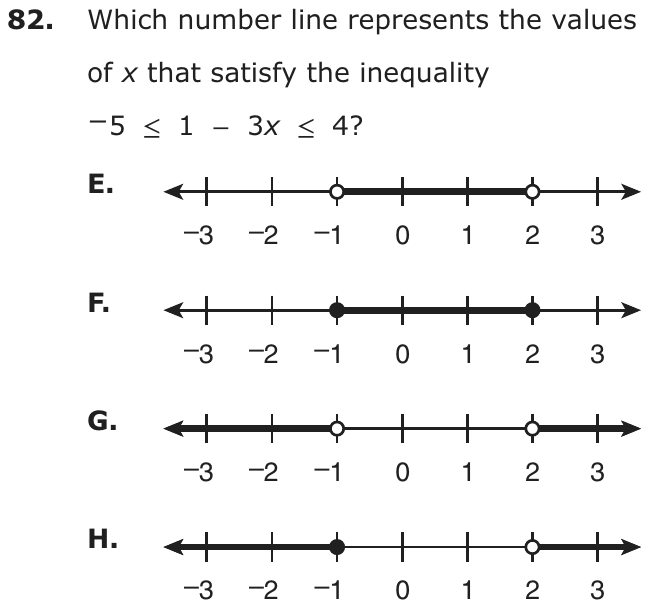
Which number line represents the values of x that satisfy the inequality ?
- A

- B

- C

- D

Show the answer
Correct answer: B
Split the compound inequality into two inequalities.
and
For each inequality, subtract 1 from each side.
and
For each inequality, divide both sides by −3. Note that dividing each side of an inequality by a negative number changes the direction of the inequality.
and
Combining the pieces gives the compound inequality .
The solution is that x is greater than or equal to −1 and less than or equal to 2, so choose the number line with filled circles at −1 and 2, with the filled segment between the circles.
Question analysis
An inequality question: choose the number line that shows the solutions of the compound inequality −5 ≤ 1 − 3x ≤ 4. Students solve an inequality whose x term has a negative coefficient, then match the endpoints, open or closed circles, and shading to one of four graphs.
- Grade level
- Grade 7 content, by NYS standard
- Compared with grade 7
- Above grade 7 Grade 7 students solve and graph two-step inequalities one at a time. This compound inequality needs two solved together and a division by a negative number, which reverses the signs, a step many grade 7 classes only touch on.
- Estimated difficulty
- Hard: combines ideas, needs a plan, and has more than one tempting wrong answer.
- Thinking it demands
- Depth of knowledge 1, recall and reproduction · mainly apply
- What makes it hard
- Error-prone arithmetic moderate
- A very close wrong answer moderate
- Reading a figure, table or graph minor
- Solution
- 4 steps
- Reading level
- Question and choices: about grade 12, 13 words.
- Students, last 30 days
- Not enough answers yet to show (it takes 10).
Why it is hard, traps and wrong answers (shows the answer)
Why it is hard
The question stacks two classic traps: reversing the inequality signs when dividing by −3, and matching filled or open circles to ≤. All four graphs use the endpoints −1 and 2, so finding those numbers proves little; the choice turns on the circles and the direction of the shading. Testing x = 0, x = 3 and the endpoint x = 2 in the original inequality checks both decisions in under a minute.
Error-prone arithmetic moderate Working it out
Dividing all three parts of −6 ≤ −3x ≤ 3 by −3 reverses both signs and the order, giving 2 ≥ x ≥ −1, which must be rewritten as −1 ≤ x ≤ 2. (Brown & Burton, 1978; Junker & Sijtsma, 2001)
A very close wrong answer moderate Choosing the answer
Two graphs share the endpoints −1 and 2 and the shading between them; only the circles, filled for ≤ and open for <, separate them. (Embretson & Wetzel, 1987; Gorin & Embretson, 2006; Ascalon et al., 2007)
Reading a figure, table or graph minor Understanding the question
Each graph must be read for three things at once: the endpoints, the fill of each circle, and whether the shading runs between them or outward. (Lesh, Post & Behr, 1987; Kirsch & Mosenthal, 1990)
Strategy: Subtract 1 from all three parts, divide all three by −3 while reversing both inequality signs, then rewrite the result from smallest to largest before matching circles and shading.
Traps
- Negatives and direction: Arithmetic with negative numbers, the order of a subtraction, or direction on a number line. (Moving a term across the equals sign without changing its sign is a faulty procedure.)
- Counting the ends: Inclusive or exclusive ends, fence posts, consecutive numbers: an answer that is one too many or too few, or an endpoint drawn open where it belongs closed (or the reverse).
The wrong answers, classified
A Counting the ends (Brown & Burton, 1978)
Solves for the right endpoints and shading but draws open circles, as if ≤ excluded −1 and 2 instead of including them.
C Negatives and direction (Brown & Burton, 1978)
Divides by −3 without reversing the signs, so the solutions seem to lie outside −1 and 2; with open circles, this graph shows exactly the values that fail.
D Negatives and direction (Brown & Burton, 1978)
Shades outward as if the signs had not reversed, but mixes the circles, filled at −1 and open at 2, which no single reading of ≤ gives.
Worked solution, step by step
Formulas used
- Subtracting from every part
- a and b are the two sides of an inequality, and c is any number. Subtracting the same number from every part keeps the inequality true. The sign does not change.
- Dividing by a negative number
- a and b are numbers, and c is a positive number, so −c is negative. When you divide both sides by a negative number, the inequality sign flips. For example, 2 is less than 3, but −2 is greater than −3.
Sort out the question
The inequality says that is between −5 and 4. The sign ≤ means less than or equal to. So −5 and 4 themselves are allowed. You need the number line that shows every x that works. To find them, get x alone in the middle.
Subtract 1 from every part
First take away the 1 in the middle. Subtract 1 from all three parts.
Divide by −3 and flip
Now x is multiplied by −3. Divide all three parts by −3. Dividing by a negative number flips each sign.
Watch out: if you forget to flip, x seems to lie outside −1 and 2. That leads to choices C and D, which are shaded outward.Read the result
Turn it around so the smaller number is on the left. It means the same thing.
So x can be any number from −1 to 2. The ends, −1 and 2, are included, because the signs are ≤.
Pick the number line
On a number line, a closed (filled-in) circle means the end number is included. An open circle means it is not. So you need closed circles at −1 and 2, with the part between them shaded. Watch out: choice A has the right shading but open circles, which leave out −1 and 2.
So the answer is B.
Check your answer
Test a few numbers in . For x = 0 you get 1, which is between −5 and 4, and 0 is shaded. For x = 2 you get −5, which is allowed, so the circle at 2 is filled in. For x = 3 you get −8, which is too small, so 3 is not shaded.
More questions like this
The original DOE question
Question 12 of 20
2024 Test B Math, question 44Question
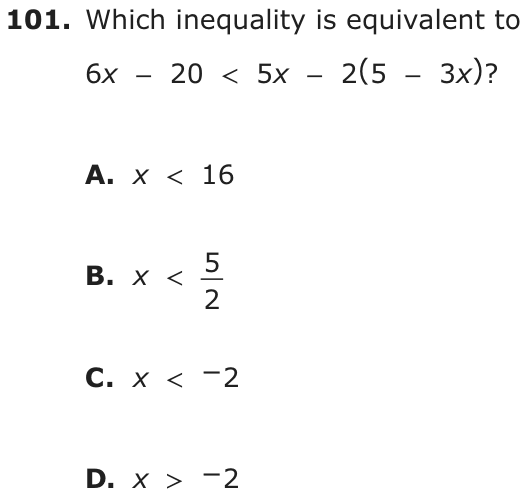
Which inequality is equivalent to ?
- A
- B
- C
- D
Show the answer
Correct answer: D
Distribute the coefficient −2 on the right-hand side:
Subtract from both sides:
Add 10 to both sides:
Divide both sides by 5:
This is equivalent to
Question analysis
Students choose the simplest equivalent form of a linear inequality that has x on both sides and a negative number multiplied into parentheses. It tests distributing, combining like terms and solving inequalities. Sign errors in the distribution, and reading the direction of the final inequality, are where most mistakes happen.
- NYS standards
- Grade level
- Grade 8 content, by NYS standard
- Compared with grade 7
- Above grade 7 Grade 7 inequalities have the form px + q < r. This one has x on both sides and a negative factor to distribute across a subtraction, steps that belong to grade 8 equation work, so it is harder than typical grade 7 practice.
- Estimated difficulty
- Hard: combines ideas, needs a plan, and has more than one tempting wrong answer.
- Thinking it demands
- Depth of knowledge 1, recall and reproduction · mainly apply
- What makes it hard
- Error-prone arithmetic moderate
- A very close wrong answer moderate
- Many steps minor
- Solution
- 4 steps
- Reading level
- Question and choices: about grade 16+, 10 words.
- Students, last 30 days
- Not enough answers yet to show (it takes 10).
Why it is hard, traps and wrong answers (shows the answer)
Why it is hard
Every move is standard algebra, but the inequality is built so that small slips change the answer completely. The −2 has to reach both terms in the parentheses, and once the boundary −2 is found its direction still has to be read correctly, since the variable ends up on the right as −2 < x. Rewriting that as x > −2, or substituting x = 0 into the original, catches the trap.
Error-prone arithmetic moderate Working it out
Distributing −2 over (5 − 3x) gives −10 + 6x, two sign decisions in one move, and the x terms then sit on both sides of the inequality. (Brown & Burton, 1978; Junker & Sijtsma, 2001)
A very close wrong answer moderate Choosing the answer
x < −2 and x > −2 share the boundary and differ only in direction, which depends on reading −2 < x correctly or flipping the sign when dividing by a negative. (Embretson & Wetzel, 1987; Gorin & Embretson, 2006; Ascalon et al., 2007)
Many steps minor Working it out
Four moves follow one another, distributing, collecting 5x + 6x, moving the x terms and dividing by 5, and a slip at any of them changes the result. (Daniel & Embretson, 2010; Enright, Morley & Sheehan, 2002)
Strategy: Distribute the −2 to both terms in the parentheses, combine the x terms on the right, then gather the x terms on the side that keeps their coefficient positive.
Traps
- Order of operations: Working left to right, or distributing a minus sign wrongly, gives a choice.
- Negatives and direction: Arithmetic with negative numbers, the order of a subtraction, or direction on a number line. (Moving a term across the equals sign without changing its sign is a faulty procedure.)
- A faulty procedure: A systematic but wrong procedure: adding fractions straight across, applying an exponent to each term of a sum, dropping a sign when moving a term.
The wrong answers, classified
A A faulty procedure (Brown & Burton, 1978; Tatsuoka, 1983)
Treats 5 − 3x as 2, combining a number with an x term, so the right side becomes 5x − 4 and the solution x < 16.
B Order of operations (Brown & Burton, 1978)
Multiplies the −2 by the 5 but not by the −3x, writing 5x − 10 − 3x, which leads to 4x < 10 and x < 5/2.
C Negatives and direction (Brown & Burton, 1978)
Finds the boundary −2 but points the inequality the wrong way, by misreading −2 < x or by not flipping the sign after dividing by −5.
Worked solution, step by step
Formulas used
- Distributive property
- a is the number outside the parentheses. b and c are the terms inside. Multiply a by each one. A minus sign inside counts as a negative term, so 5 − 3x is 5 + (−3x). A negative times a negative is positive.
- Keeping an inequality true
- a and b are the two sides, and c is any number. Adding or subtracting the same number on both sides keeps the inequality true. Dividing both sides by a positive number also keeps it true. Only multiplying or dividing by a negative number flips the sign.
Sort out the question
An inequality compares two sides with a sign like <, which means is less than. To solve it, you get x alone on one side.
You need the short inequality that has the same answers as the long one.
Distribute the −2
Multiply −2 by both terms inside the parentheses, 5 and −3x.
A negative times a negative is positive, so the second part is +6x. Watch out: If the −2 multiplies only the 5, you end up with , choice B.
Combine the x terms
The right side is now 5x − 10 + 6x. Put the x terms together: 5x + 6x = 11x.
Gather the x terms on one side
Subtract 6x from both sides. That leaves the x terms on the right, where they stay positive.
Get x by itself
Add 10 to both sides. Then divide both sides by 5.
You divided by a positive 5, so the sign does not flip.
Read it with x first
says −2 is less than x. That is the same as saying x is greater than −2, just as 3 < 5 means 5 > 3.
Watch out: , choice C, has the same number but points the wrong way.
So the answer is D, .
Check your answer
Test x = 0, which is greater than −2. The left side is . The right side is . And −20 < −10 is true. Now test x = −3. The left side is −38 and the right side is −43. That is false, as it should be.
More questions like this
The original DOE question
Question 13 of 20
2024 Test B Math, question 53Question
Which graph represents the solution to ?
- A

- B

- C

- D

Show the answer
Correct answer: A
Since , either or .
Solving for x gives .
Solving for x gives .
A filled circle on a number line represents “or equal to.” So the correct number line representation has filled circles at −3 and 1, with the number line filled to the left of −3 for “less than” and to the right of 1 for “greater than.”
Question analysis
Students choose the number line graph that shows every solution of an inequality in which x + 1 sits inside absolute value bars. It tests absolute value as distance and graphing inequalities. The tricky part is turning one absolute value statement into two pieces and placing each boundary point and shaded ray correctly.
- NYS standards
- Grade level
- Grade 7 content, by NYS standard
- Compared with grade 7
- Above grade 7 Grade 7 students solve and graph two-step inequalities and know absolute value as distance. An inequality with an absolute value has to be split into two cases, which is outside the grade 6 to 8 standards and well above typical grade 7 work.
- Estimated difficulty
- Hard: combines ideas, needs a plan, and has more than one tempting wrong answer.
- Thinking it demands
- Depth of knowledge 2, skills and concepts · mainly apply
- What makes it hard
- Something you must already know moderate
- A very close wrong answer moderate
- Reading a figure, table or graph minor
- Solution
- 3 steps
- Reading level
- Question and choices: about grade 9, 7 words.
- Students, last 30 days
- Not enough answers yet to show (it takes 10).
Why it is hard, traps and wrong answers (shows the answer)
Why it is hard
Reading |x + 1| as the distance from x to −1 makes this quick: the points 2 units away are −3 and 1, and greater than or equal means outside them. Students who solve only one case and mirror it across 0 land on graphs centered on 0, and students who find both endpoints may still shade between them. The graphs differ in just one dot or one shading choice, so each must be read carefully.
Something you must already know moderate Working it out
Solving |x + 1| ≥ 2 needs two cases, x + 1 ≤ −2 or x + 1 ≥ 2, joined by or; absolute value inequalities go beyond grade 7, and the stem gives no hint. (Anderson & Krathwohl, 2001)
A very close wrong answer moderate Choosing the answer
The right graph and the segment from −3 to 1 share both filled endpoints, so only deciding between outside and between the boundaries separates them. (Embretson & Wetzel, 1987; Gorin & Embretson, 2006; Ascalon et al., 2007)
Reading a figure, table or graph minor Understanding the question
Four number lines must be read for filled dots and arrow directions, and two of them differ from the right one only in where a single dot sits. (Lesh, Post & Behr, 1987; Kirsch & Mosenthal, 1990)
Strategy: Read the absolute value as distance from −1 on the number line, find the points exactly 2 units away, and decide whether the solutions lie between or outside them.
Traps
- Misunderstands the concept: A wrong belief about a concept: that percents can be added, that area grows like length, that averages can be averaged, that a bigger denominator means a bigger fraction.
- Negatives and direction: Arithmetic with negative numbers, the order of a subtraction, or direction on a number line. (Moving a term across the equals sign without changing its sign is a faulty procedure.)
The wrong answers, classified
B Misunderstands the concept (Smith, diSessa & Roschelle, 1993; De Bock et al., 1998; Ni & Zhou, 2005)
Solves x + 1 ≥ 2 to get x ≥ 1, then mirrors it across 0 to x ≤ −1, as if the solution were centered on 0 rather than on −1.
C Negatives and direction (Brown & Burton, 1978)
Finds −3 and 1 but shades between them, the solution of |x + 1| ≤ 2, reversing which side of the boundaries lies at least 2 units from −1.
D Misunderstands the concept (Smith, diSessa & Roschelle, 1993; De Bock et al., 1998; Ni & Zhou, 2005)
Solves x + 1 ≤ −2 to get x ≤ −3, then mirrors it across 0 to x ≥ 3, assuming the boundaries are symmetric about 0.
Worked solution, step by step
Formulas used
- Absolute value as distance
- x and a are points on the number line. The bars mean absolute value. |x − a| is how far apart the two points are, which is never negative. Since x + 1 = x − (−1), |x + 1| is the distance from x to −1.
Sort out the question
You need the graph of every x that makes true. The sign ≥ means greater than or equal to. The bars mean absolute value.
On a number line, a filled dot means that point counts. A thick line with an arrow means all the numbers that way count too.
Read it as a distance
Adding 1 is the same as subtracting −1, so . By the formula, is the distance from x to −1.
So the inequality says that x is at least 2 units away from −1.
Find the two boundary points
Start at −1 and go 2 units each way.
At −3 and at 1, the distance is exactly 2. The words or equal to let them count, so they get filled dots.
Decide which side to shade
Being at least 2 away means being farther out. Numbers between −3 and 1 are too close to −1. For example, 0 is only 1 unit away. So shade to the left of −3 and to the right of 1.
In algebra, that is or . These give or .
Match the graph
Choice A has filled dots at −3 and 1, with arrows going outward. That matches.
Watch out: Choice C shades between −3 and 1. Those are the points within 2 of −1, the answer to . Choices B and D are centered on 0, but the center here is −1.
So the answer is A, the graph shaded outward from −3 and 1.
Check your answer
Test a point from each part. For x = 2, , and 3 is at least 2. For x = 0, , which is less than 2. For x = −3, , which counts. Graph A agrees with all three.
More questions like this
The original DOE question
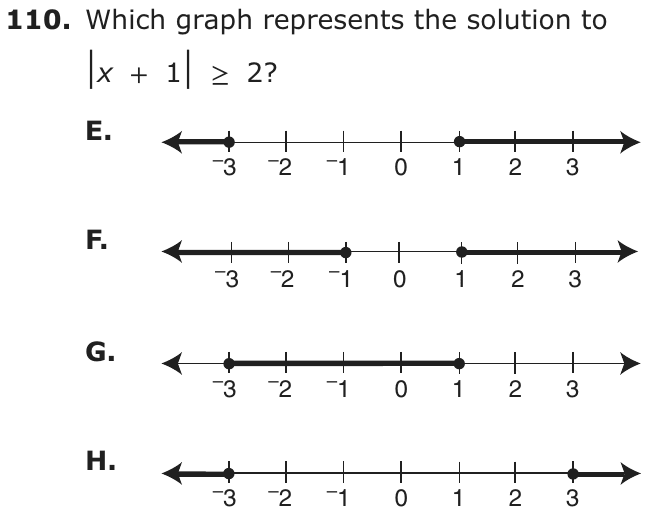
Question 14 of 20
2023 Test A Math, question 38Question
Which graph represents the solution to ?
- A

- B

- C

- D

Show the answer
Correct answer: A
| Apply the additive inverse property; add 7 to both sides of the inequality. | |
| Apply the multiplicative inverse property; divide both sides of the inequality by −3. Note: when dividing an inequality by a negative number, the inequality sign is reversed. | |
The solution is that x is less than −1, so choose the graph that starts at −1 and continues to the left.
Question analysis
This inequality question asks which number line graph shows the solution of −3x − 7 > −4. Students solve a two-step inequality whose x term has a negative coefficient, then match the boundary point and the direction of the shading. Handling the inequality symbol at the division step is where most mistakes happen, and each slip has a matching graph.
- Grade level
- Grade 7 content, by NYS standard
- Compared with grade 7
- At grade 7 Solving and graphing a two-step inequality is a core grade 7 standard. This one has a negative coefficient on x, the classic grade 7 inequality trap, and four similar graphs test whether the sign and the direction were both handled.
- Estimated difficulty
- Moderate: several steps, or a close reading with one strong distractor.
- Thinking it demands
- Depth of knowledge 1, recall and reproduction · mainly apply
- What makes it hard
- Something you must already know moderate
- A very close wrong answer moderate
- Reading a figure, table or graph minor
- Solution
- 3 steps
- Reading level
- Question and choices: about grade 9, 7 words.
- Corrected from the DOE handbook
- A wrong term in the explanation was corrected.
- Students, last 30 days
- Not enough answers yet to show (it takes 10).
Why it is hard, traps and wrong answers (shows the answer)
Why it is hard
The solving takes two moves, but the second carries the rule the question tests: dividing an inequality by a negative number flips its direction. The four graphs cross two features, boundary at −1 or 1 and shading left or right, so forgetting the flip, dropping a sign, or both each land on a graph. Testing a shaded value such as x = −2 in the original inequality, where 6 − 7 = −1 is greater than −4, confirms the choice.
Something you must already know moderate Working it out
The step that decides the question, reversing the symbol when dividing both sides by −3, is a rule students must bring themselves; −3x > 3 becomes x < −1, not x > −1. (Anderson & Krathwohl, 2001)
A very close wrong answer moderate Choosing the answer
The graph shaded to the right from an open circle at −1 matches the right graph's boundary exactly and differs only in direction, the result of skipping the reversal. (Embretson & Wetzel, 1987; Gorin & Embretson, 2006; Ascalon et al., 2007)
Reading a figure, table or graph minor Understanding the question
Each graph must be read for two things, where its open circle sits, at −1 or 1, and which way the arrow runs, so a boundary alone does not identify the answer. (Lesh, Post & Behr, 1987; Kirsch & Mosenthal, 1990)
Strategy: Add 7 to both sides, divide by −3 and reverse the inequality symbol, then match both the boundary point and the shading direction; test one shaded value in the original.
Traps
- Negatives and direction: Arithmetic with negative numbers, the order of a subtraction, or direction on a number line. (Moving a term across the equals sign without changing its sign is a faulty procedure.)
The wrong answers, classified
B Negatives and direction (Brown & Burton, 1978)
Reverses the symbol correctly but drops the negative in 3 ÷ (−3), so the boundary lands at 1 with the shading to its left.
C Negatives and direction (Brown & Burton, 1978)
Divides both sides by −3 without reversing the symbol, solving the inequality as if it were an equation, so x > −1 and the shading runs right.
D Negatives and direction (Brown & Burton, 1978)
Treats −3x as 3x, so it solves 3x > 3 to get x > 1 with no reversal, which puts both the boundary and the direction wrong.
What was corrected from the DOE handbook, and why
- Explanation: The handbook’s steps say “add 7 to both sides of the equation” and “divide both sides of the equation by −3” (p. 142, question 95). But −3x − 7 > −4 is an inequality, not an equation, and the step’s own note is the point of the question: dividing an inequality by a negative number reverses the sign. The site now says “both sides of the inequality” in both steps, as the DOE’s later guides word this step (“Subtract 4 from both sides of the inequality” in the 2024–2025 guide). The working and the answer are unchanged.
Worked solution, step by step
Formulas used
- Adding to both sides of an inequality
- a and b are the two sides, and c is any number. Adding the same amount to both sides keeps the comparison true, like adding the same weight to both pans of a scale.
- Dividing an inequality by a negative number
- a and b are the two sides, and c is a negative number. When you divide both sides by a negative number, the greater-than sign flips to less-than. That is because negatives reverse order: 2 is more than 1, but −2 is less than −1.
Sort out the question
An inequality compares two amounts. The sign > means is greater than. You need the graph of every x that makes true. The graphs differ in two ways: where the open circle sits, at −1 or 1, and which way the shading goes.
Add 7 to both sides
Adding 7 undoes the −7, so the x term is alone on the left.
Divide by −3 and flip the sign
So x is any number less than −1. Watch out: if you forget to flip the sign, you get x > −1, and that graph is choice C. Also, 3 ÷ (−3) is −1, not 1. Dropping that minus sign leads to B or D.
Match the solution to a graph
Less than −1 means to the left of −1 on the number line. The circle at −1 is open, or empty, because −1 itself does not work. The sign means greater than, not greater than or equal to.
Graph A has an open circle at −1 and is shaded to the left. So the answer is A, the graph shaded left from an open circle at −1.
Check your answer
Test a number on each side of −1. For x = −2: , and −1 is greater than −4, so −2 works. For x = 0: , and −7 is less than −4, so 0 does not work. The shading must go left.
More questions like this
The original DOE question
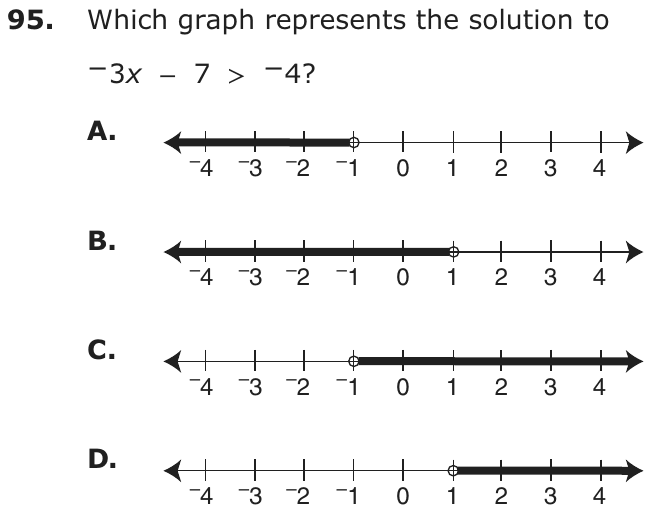
Question 15 of 20
2023 Test B Math, question 45Question
The Barnes family and the Ramirez family each have a pizza of equal size. The first pizza is cut into 18 equal slices, and the second pizza is cut into 15 equal slices. If the Barnes family eats 11 slices from the first pizza, what is the greatest number of whole slices from the second pizza that the Ramirez family can eat without eating a greater percentage of a pizza than the Barnes family ate?
- A6
- B7
- C8
- D9
Show the answer
Correct answer: D
The fraction of the pizza that the Barnes family eats is . Let x represent the number of slices of pizza that the Ramirez family eats. Then the fraction of the pizza that the Ramirez family eats is . Write an inequality and solve for x:
So, the greatest number of whole slices of pizza the Ramirez family can eat is 9.
Question analysis
Two pizzas of the same size are cut into 18 and 15 equal slices, and one family eats 11 slices of the first. Students find the most whole slices of the second pizza the other family can eat without eating a larger share. It tests comparing fractions with different denominators and rounding to a whole number in the right direction.
- Grade level
- Grade 7 content, by NYS standard
- Compared with grade 7
- Above grade 7 Grade 7 inequality problems usually ask for the greatest whole number that fits a budget. This one wraps that idea in a long stem about shares of two pizzas sliced differently, with several conditions to keep straight at once.
- Estimated difficulty
- Hard: combines ideas, needs a plan, and has more than one tempting wrong answer.
- Thinking it demands
- Depth of knowledge 2, skills and concepts · mainly apply
- What makes it hard
- Complex sentences moderate
- Turning words into math moderate
- Error-prone arithmetic minor
- Solution
- 3 steps
- Reading level
- Question and choices: about grade 11, 72 words.
- Students, last 30 days
- Not enough answers yet to show (it takes 10).
Why it is hard, traps and wrong answers (shows the answer)
Why it is hard
The math is one inequality between fractions, but the long final sentence hides it, so students who skim fall back on comparing slice counts. Reasoning that the second pizza has 3 fewer slices, so the Ramirez family should eat 3 fewer, is the strongest pull. Comparing 11/18 with x/15, or turning 11/18 into about 61% and taking 61% of 15, keeps the comparison about shares of a pizza.
Complex sentences moderate Understanding the question
The question is one 42-word sentence ending in a nested condition, “without eating a greater percentage of a pizza than the Barnes family ate”, a reading hurdle rather than more math. (Abedi & Lord, 2001; Freedle & Kostin, 1993; Messick, 1989)
Turning words into math moderate Understanding the question
The limit of no “greater percentage of a pizza” must become the inequality x/15 ≤ 11/18, comparing fractions of two pizzas cut into different numbers of slices, not slice counts. (Hegarty, Mayer & Monk, 1995; Koedinger & Nathan, 2004)
Error-prone arithmetic minor Working it out
Solving gives x ≤ 11 × 15 ÷ 18 = 165/18, a division by 18 that leaves 9 1/6, which must then be cut back to whole slices. (Brown & Burton, 1978; Junker & Sijtsma, 2001)
Strategy: Write the Barnes family's share as a fraction of their pizza, then find the largest whole number of fifteenths that does not exceed it, by cross-multiplying or by converting to decimals.
Traps
- Misunderstands the concept: A wrong belief about a concept: that percents can be added, that area grows like length, that averages can be averaged, that a bigger denominator means a bigger fraction.
- Answers a different question: A choice is right for another quantity: the other unknown, the rest instead of the part, the part instead of the whole.
The wrong answers, classified
A Answers a different question (King et al., 2004; Hegarty, Mayer & Monk, 1995)
Finds that 9 slices is the limit but gives the slices left on the second pizza, 15 − 9 = 6, answering a different question.
B Numbers taken from the question (Hegarty, Mayer & Monk, 1995)
Subtracts the stem’s numbers, 18 − 11 = 7, the slices left on the Barnes family’s pizza, without comparing shares of the two pizzas.
C Misunderstands the concept (Smith, diSessa & Roschelle, 1993; De Bock et al., 1998; Ni & Zhou, 2005)
Reasons that the second pizza has 3 fewer slices, so the Ramirez family should eat 3 fewer, 11 − 3 = 8, comparing by subtraction instead of by fractions.
Worked solution, step by step
Formulas used
- Fraction of a pizza
- The top counts the slices eaten. The bottom counts all the equal slices the pizza was cut into. The fraction tells how much of the whole pizza was eaten. Use fractions to compare pizzas cut into different numbers of slices.
Sort out the question
The two pizzas are the same size. The Barnes pizza has 18 slices, and they eat 11. The Ramirez pizza has 15 slices, so its slices are bigger. You need the most whole slices the Ramirez family can eat without eating a bigger share of their pizza.
Find the Barnes family’s share
Their share is the slices they ate out of all the slices in their pizza. Use the fraction formula.
The Barnes family ate of their pizza.
Write an inequality
Let x be the number of Ramirez slices. Their share is . It must be no more than the Barnes share. The sign ≤ means less than or equal to.
Solve for x
Multiply both sides by 15 to get x by itself.
Now divide. 18 goes into 165 nine times, since 18 × 9 = 162. There are 3 left over.
Pick the whole number
x must be a whole number no bigger than . So the most is 9 slices. 10 slices would be too many.
Watch out: The Ramirez pizza has 3 fewer slices, but that does not mean they eat 3 fewer. Their slices are bigger. Eating 11 − 3 = 8 slices is choice C, which is not the most they can eat.
So the answer is D, 9.
Check your answer
Use decimals. The Barnes share is . Nine Ramirez slices are , just under it. Ten slices are , too much. So 9 is the most.
More questions like this
The original DOE question
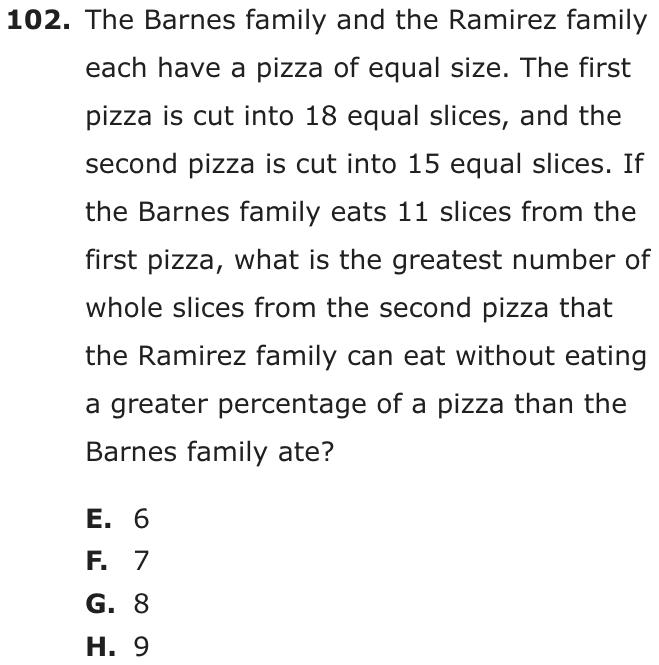
Question 16 of 20
2018 Test A Math, question 14Question
Which number line below shows the solution to the inequality ?
- A

- B

- C

- D

Show the answer
Correct answer: D
Multiply each term by 2 to eliminate the fraction, and isolate :
Therefore, must be between −8 and 4.
Question analysis
An inequality question: choose the number line that shows the solution of a compound inequality in which x divided by 2 lies between −4 and 2. Students undo the division in every part and match the graph's endpoints and shading. The four number lines differ in their endpoints and in which part of the line is shaded.
- Grade level
- Grade 7 content, by NYS standard
- Compared with grade 7
- At grade 7 Grade 7 students solve two-step inequalities and graph them on a number line. This compound inequality needs only one operation applied to all three parts at once, so it matches typical grade 7 work.
- Estimated difficulty
- Straightforward: two steps or one careful reading.
- Thinking it demands
- Depth of knowledge 1, recall and reproduction · mainly apply
- What makes it hard
- Reading a figure, table or graph moderate
- Error-prone arithmetic minor
- Solution
- 2 steps
- Reading level
- Question and choices: about grade 11, 11 words.
- Students, last 30 days
- Not enough answers yet to show (it takes 10).
Why it is hard, traps and wrong answers (shows the answer)
Why it is hard
Solving takes one step, multiplying through by 2, so most of the work is matching the result to a picture. The choices pair each common slip with a graph: the bounds left as written, the bounds halved, and the right bounds shaded on the wrong side. Reading the open circles against the labeled ticks at −5 and 5 settles it.
Reading a figure, table or graph moderate Understanding the question
The four number lines are labeled only at −10, −5, 0, 5 and 10, so open circles at −8 and 4, or at −4 and 2, have to be located by counting ticks. (Lesh, Post & Behr, 1987; Kirsch & Mosenthal, 1990)
Error-prone arithmetic minor Working it out
All three parts of −4 < x/2 < 2 must be multiplied by 2, and the negative bound −4 becomes −8; halving instead gives −2. (Brown & Burton, 1978; Junker & Sijtsma, 2001)
Strategy: Multiply all three parts of the inequality by 2 to isolate x, then pick the graph whose open circles and shading match the new bounds.
Traps
- Stops one step early: A choice is a number from partway through the solution.
- Negatives and direction: Arithmetic with negative numbers, the order of a subtraction, or direction on a number line. (Moving a term across the equals sign without changing its sign is a faulty procedure.)
The wrong answers, classified
A Wrong operation (Hegarty, Mayer & Monk, 1995; King et al., 2004)
Divides each part of the inequality by 2 instead of multiplying, getting −2 < x < 1, so the open circles land at −2 and 1.
B Stops one step early (King et al., 2004; Gierl et al., 2017)
Graphs −4 and 2 as the bounds of x, stopping before the step of multiplying through by 2 to clear the fraction x/2.
C Negatives and direction (Brown & Burton, 1978)
Finds −8 and 4 correctly but shades the two rays outside them, as if x had to be less than −8 or greater than 4.
Worked solution, step by step
Formulas used
- Multiplying an inequality by a positive number
- a and b are numbers, and the less-than sign means the left side is smaller. If you multiply both sides by the same positive number, like 2, the smaller side stays smaller. So the sign keeps pointing the same way. A negative number would flip it, but 2 is positive.
Sort out the inequality
An inequality compares two amounts that may not be equal. The sign means less than. Here means x divided by 2. The inequality says x divided by 2 is between −4 and 2. You need the values of x itself. Then you pick the number line that shows them.
Multiply all three parts by 2
To undo dividing by 2, multiply by 2. Multiply all three parts, so the whole statement stays true.
Watch out: multiply, don’t divide. Dividing gives −2 and 1, choice A. Leaving the ends at −4 and 2 is choice B.
Read what the answer means
x is greater than −8 and less than 4. So x is any number between −8 and 4. x cannot equal −8 or 4 exactly. On a number line, that means open circles at −8 and 4, with the part between them shaded.
Find the matching number line
The number lines are labeled only at −10, −5, 0, 5 and 10. Count the tick marks. −8 is 3 ticks left of −5, and 4 is 1 tick left of 5. Watch out: choice C has circles at −8 and 4 but shades the parts outside them. So the answer is D.
Check your answer
Test a number from the shaded part, like 0. , and 0 is between −4 and 2. Now test 6, which is outside. , and 3 is not less than 2. So only the part between −8 and 4 works.
More questions like this
The original DOE question
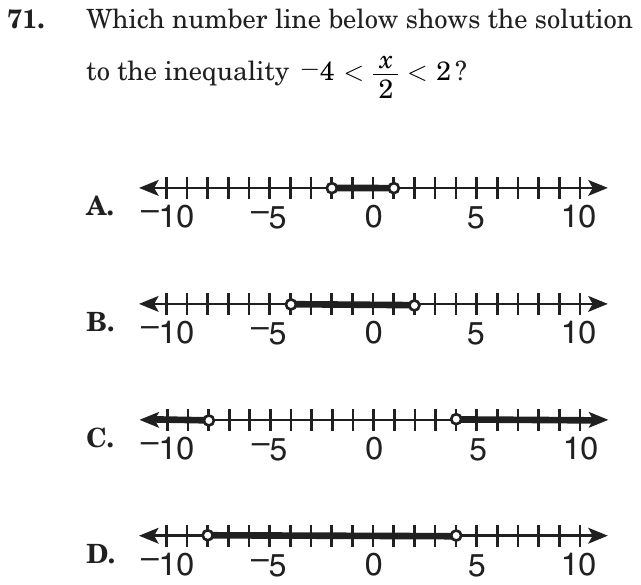
Question 17 of 20
2018 Test B Math, question 10Question
To make party invitations, Macie could buy a package of paper for $10.50, or she could buy x individual sheets of the same paper for $0.15 each. What is the largest value of x that would make buying the individual sheets less expensive than buying the package?
- A60
- B65
- C69
- D70
Show the answer
Correct answer: C
Set up an inequality to compare the costs:
0.15x < 10.50
x < 70
Therefore, 70 individual sheets of paper would cost $10.50, so 69 is the greatest number of individual sheets of paper that Macie can buy that would be less expensive than the package.
Question analysis
This inequality word problem compares buying a package of paper with buying single sheets at 15 cents each, and asks for the largest number of sheets for which the single sheets cost less. Students write and solve an inequality with decimals. The tricky part is interpreting the solution as a whole number of sheets.
- Grade level
- Grade 7 content, by NYS standard
- Compared with grade 7
- At grade 7 Writing and solving an inequality from a real-world situation is a grade 7 standard. This one is short, but it asks students to interpret a strict inequality as a count of sheets, the kind of interpretation grade 7 tests expect.
- Estimated difficulty
- Moderate: several steps, or a close reading with one strong distractor.
- Thinking it demands
- Depth of knowledge 2, skills and concepts · mainly apply
- What makes it hard
- A very close wrong answer moderate
- Turning words into math minor
- Error-prone arithmetic minor
- Solution
- 3 steps
- Reading level
- Question and choices: about grade 10, 45 words.
- Corrected from the DOE handbook
- An inequality sign in the explanation was corrected.
- Students, last 30 days
- Not enough answers yet to show (it takes 10).
Why it is hard, traps and wrong answers (shows the answer)
Why it is hard
The computation leads straight to 70, and the whole question is about what to do with that number. Students who treat the boundary as the answer forget that equal cost is not less cost, while the other choices only catch those who misdivide or ignore the word largest. The question rewards checking the boundary case in the story: 70 sheets cost exactly the package price.
A very close wrong answer moderate Choosing the answer
70 and 69 sheets differ by one, and 70 is exactly where the two costs meet at $10.50; only the strict “less expensive” separates them, ruling out 70. (Embretson & Wetzel, 1987; Gorin & Embretson, 2006; Ascalon et al., 2007)
Turning words into math minor Understanding the question
The words “less expensive than buying the package” must become a strict inequality, 0.15x < 10.50, and “largest value” must then pick the biggest whole number below the boundary. (Hegarty, Mayer & Monk, 1995; Koedinger & Nathan, 2004)
Error-prone arithmetic minor Working it out
Dividing 10.50 by 0.15 means shifting the decimal point in both numbers, a step where a misplaced digit gives a wrong boundary. (Brown & Burton, 1978; Junker & Sijtsma, 2001)
Strategy: Divide the package price by the price of one sheet to see where the two costs meet, then find the largest whole number of sheets that still costs less than $10.50.
Traps
- Counting the ends: Inclusive or exclusive ends, fence posts, consecutive numbers: an answer that is one too many or too few, or an endpoint drawn open where it belongs closed (or the reverse).
The wrong answers, classified
A Misreads the question (Hegarty, Mayer & Monk, 1995)
Checks a round number, 60 sheets for $9.00, sees it is cheaper than the package, and stops without seeking the largest such number.
B An arithmetic slip (Junker & Sijtsma, 2001)
Divides only the $10 by $0.15, about 66.7, ignoring the 50 cents, and settles on the nearest smaller choice.
D Counting the ends (Brown & Burton, 1978)
Solves 0.15x = 10.50 and keeps the boundary 70, but 70 sheets cost exactly $10.50, the same as the package, not less.
What was corrected from the DOE handbook, and why
- Explanation: The handbook sets up 0.15x ≤ 10.50 and x ≤ 70, which would allow 70 sheets, and then says that 70 sheets cost exactly $10.50. Buying the sheets has to be less expensive than the package, so the site uses strict inequalities, 0.15x < 10.50 and x < 70, which make 69 the largest number of sheets.
Worked solution, step by step
Formulas used
- Total cost
- Price of one is what a single sheet costs, here $0.15. Number bought is how many sheets, here x. Multiplying gives the total you pay, because you pay the same price for every sheet.
Sort out the question
The package costs $10.50. Single sheets cost $0.15 each. Macie buys x sheets.
You need the largest x that makes the sheets cost less than the package. Costing the same is not enough.
Write the inequality
An inequality is a math sentence that compares two amounts. The sign < means is less than.
The cost of x sheets is 0.15 times x. It must be less than 10.50.
Find where the costs are equal
First find how many sheets cost exactly $10.50. Divide the package price by the price of one sheet. Multiply both numbers by 100 to clear the decimals.
So 70 sheets cost exactly $10.50.
Pick the largest number below 70
x must be less than 70. You can only buy whole sheets. The largest whole number below 70 is 69.
Watch out: 70 sheets cost the same as the package, not less. That is why choice D is wrong. Choices A and B are cheaper too, but they are not the largest.
So the answer is C, 69.
Check your answer
Test both numbers. , and $10.35 is less than $10.50. But , which is not less. So 69 is the largest number that works.
More questions like this
The original DOE question
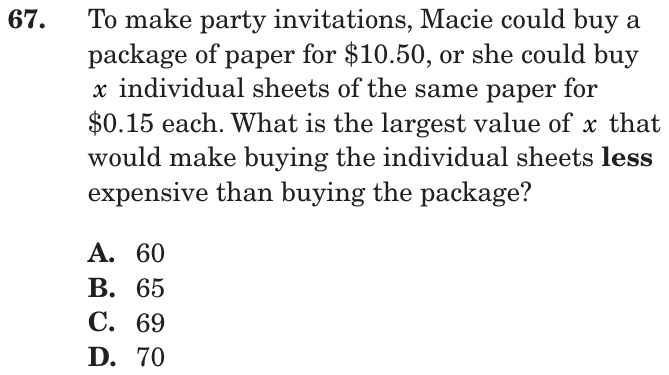
Question 18 of 20
2018 Test B Math, question 19Question
How many positive odd numbers satisfy the inequality ?
- A13
- B14
- C17
- D28
Show the answer
Correct answer: B
Solve the inequality for x.
3x + 8 ≤ 92
3x ≤ 84
x ≤ 28
The positive odd numbers less than or equal to 28 are 1, 3, 5, …, 25, and 27. There are 14 of them.
Question analysis
This question asks how many positive odd numbers satisfy the two-step inequality 3x + 8 ≤ 92. Students solve the inequality and then count the odd whole numbers in the solution. The counting after the algebra is where errors creep in, especially at the end of the list.
- Grade level
- Grade 7 content, by NYS standard
- Compared with grade 7
- At grade 7 Solving a two-step inequality is grade 7 work. Asking for a count of the odd solutions adds a number-property step and an endpoint check, but the total demand stays close to a typical grade 7 problem.
- Estimated difficulty
- Moderate: several steps, or a close reading with one strong distractor.
- Thinking it demands
- Depth of knowledge 2, skills and concepts · mainly apply
- What makes it hard
- A very close wrong answer moderate
- Combines ideas minor
- Solution
- 3 steps
- Reading level
- Question and choices: about grade 16, 9 words.
- Corrected from the DOE handbook
- The explanation’s description of the solutions was corrected.
- Students, last 30 days
- Not enough answers yet to show (it takes 10).
Why it is hard, traps and wrong answers (shows the answer)
Why it is hard
Solving the inequality is routine, and that is the trap: x ≤ 28 looks like an answer and 28 is among the choices. The real task is counting odd numbers from 1 to 27, where the usual shortcut, (27 − 1) ÷ 2, misses the first term. Pairing each odd number with the even number after it, up to 28, gives the count directly and avoids the fencepost slip.
A very close wrong answer moderate Choosing the answer
13 and 14 differ by one, and a rough count of the odd numbers up to 27 cannot separate them; only counting both ends, 1 and 27, gives the exact 14. (Embretson & Wetzel, 1987; Gorin & Embretson, 2006; Ascalon et al., 2007)
Combines ideas minor Working it out
Solving 3x + 8 ≤ 92 is only half the work; counting the positive odd whole numbers up to 28 is a separate number-sense task. (Embretson, 1998; Daniel & Embretson, 2010)
Strategy: Solve the inequality as you would an equation, keeping the direction of the sign, then count odd numbers from 1 up to the boundary by pairing or halving.
Traps
- Counting the ends: Inclusive or exclusive ends, fence posts, consecutive numbers: an answer that is one too many or too few, or an endpoint drawn open where it belongs closed (or the reverse).
- Stops one step early: A choice is a number from partway through the solution.
The wrong answers, classified
A Counting the ends (Brown & Burton, 1978)
Counts the odd numbers from 1 to 27 as (27 − 1) ÷ 2 = 13, forgetting to add one for the first term.
C A faulty procedure (Brown & Burton, 1978; Tatsuoka, 1983)
Moves the 8 across without changing its sign, solving 3x ≤ 100, and counts the odd numbers up to 33.
D Stops one step early (King et al., 2004; Gierl et al., 2017)
Solves the inequality to x ≤ 28 and gives the boundary 28 instead of counting the positive odd numbers up to it.
What was corrected from the DOE handbook, and why
- Explanation: The handbook solves the inequality to x ≤ 28 and then lists “the positive odd numbers less than 28.” The solutions include 28 itself, so the site says “less than or equal to 28.” The count does not change, because 28 is even: the odd numbers are still 1, 3, 5, …, 27, which is 14 numbers.
Worked solution, step by step
Formulas used
- Solving an inequality
- a, b and c are numbers. The sign ≤ means less than or equal to. You may subtract the same number from both sides. You may also divide both sides by the same positive number. The sign stays the same either way.
- Counting odd numbers
- n is an even number. Split the numbers from 1 to n into pairs: 1 and 2, 3 and 4, and so on. There are n ÷ 2 pairs, and each pair holds exactly one odd number.
Sort out the question
You need to count the positive odd numbers that make true.
The sign ≤ means is less than or equal to. Positive means greater than 0. Odd numbers are 1, 3, 5, 7, and so on.
Solve the inequality
Solve it like an equation. Subtract 8 from both sides. Then divide both sides by 3. Dividing by a positive number keeps the sign the same.
Watch out: 28 is the largest x allowed, not the count. That trap is choice D.
List the odd numbers
The positive odd numbers up to 28 are 1, 3, 5, and so on, up to 25 and 27. The number 28 is even, so it does not count.
Count them by pairing
Split 1 to 28 into pairs: 1 and 2, 3 and 4, and so on, up to 27 and 28. Each pair has one odd number.
Watch out: Working out counts the jumps of 2 from 1 to 27, not the numbers. You must add 1 for the first number. That mistake gives choice A.
So the answer is B, 14.
Check your answer
Test the edges. For x = 27: , which is at most 92, so it works. For x = 29: , which is too big. So 27 is the last odd number that works.
More questions like this
The original DOE question
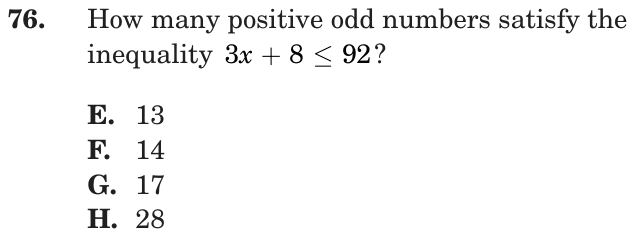
Question 19 of 20
2018 Test B Math, question 50Question
Which number line below shows the solution set for when ?
- A

- B

- C

- D

Show the answer
Correct answer: C
Separate the compound inequality into two pieces:
and
Substitute into each inequality and solve for :
The solution is the number line that shows that is greater than or equal to and less than or equal to .
Question analysis
Students substitute y = 1 into the compound inequality 2x − 2 ≤ y ≤ 4x + 10 and pick the number line that shows the values of x that work. It tests solving two-step inequalities and graphing the solution. The four graphs differ in their endpoints and in whether the shading is closed off on both sides, so each endpoint has to be found exactly.
- Grade level
- Grade 7 content, by NYS standard
- Compared with grade 7
- Above grade 7 Grade 7 students solve and graph one two-step inequality. This compound inequality in two variables requires substituting, solving two inequalities and combining them into one interval, a step toward algebra 1.
- Estimated difficulty
- Hard: combines ideas, needs a plan, and has more than one tempting wrong answer.
- Thinking it demands
- Depth of knowledge 2, skills and concepts · mainly apply
- What makes it hard
- Many steps moderate
- Error-prone arithmetic moderate
- Reading a figure, table or graph moderate
- A very close wrong answer minor
- Solution
- 4 steps
- Reading level
- Question and choices: about grade 9, 12 words.
- Students, last 30 days
- Not enough answers yet to show (it takes 10).
Why it is hard, traps and wrong answers (shows the answer)
Why it is hard
Substituting y = 1 is easy; the work is solving two inequalities and matching a fractional interval to a graph. Students who solve only the left inequality find a matching ray, and sign slips on either endpoint produce intervals that shift or flip across zero. The graphs differ by quarter-unit ticks, so reading them carefully matters as much as the algebra.
Many steps moderate Working it out
The compound inequality must be split into 2x − 2 ≤ 1 and 1 ≤ 4x + 10, each solved for x, and the two results joined into one interval. (Daniel & Embretson, 2010; Enright, Morley & Sheehan, 2002)
Error-prone arithmetic moderate Working it out
Both endpoints are fractions, 3/2 and −9/4, and the second comes from dividing −9 by 4, where a lost sign moves the endpoint across zero. (Brown & Burton, 1978; Junker & Sijtsma, 2001)
Reading a figure, table or graph moderate Understanding the question
The graphs are marked in quarter units, so −2 1/4 and 1 1/2 have to be found by counting small ticks between the labeled integers. (Lesh, Post & Behr, 1987; Kirsch & Mosenthal, 1990)
A very close wrong answer minor Choosing the answer
The ray ending at 1 1/2 looks almost like the right segment, sharing its right end; only the left end, an arrow instead of a closed dot at −2 1/4, separates them. (Embretson & Wetzel, 1987; Gorin & Embretson, 2006; Ascalon et al., 2007)
Strategy: Split the compound inequality into two separate inequalities, solve each for x after putting 1 in for y, then combine the two results into a single interval and match it to a graph.
Traps
- Negatives and direction: Arithmetic with negative numbers, the order of a subtraction, or direction on a number line. (Moving a term across the equals sign without changing its sign is a faulty procedure.)
- Stops one step early: A choice is a number from partway through the solution.
The wrong answers, classified
A Negatives and direction (Brown & Burton, 1978)
Gets the left endpoint −2 1/4 right but gives the right endpoint the wrong sign, ending the segment at −1 1/2 instead of 1 1/2.
B Negatives and direction (Brown & Burton, 1978)
Gives both endpoints the opposite sign, so the segment runs from −1 1/2 to 2 1/4, the true interval reflected across 0.
D Stops one step early (King et al., 2004; Gierl et al., 2017)
Solves only 2x − 2 ≤ 1 and graphs every x up to 1 1/2, leaving out the lower bound that 1 ≤ 4x + 10 sets.
Worked solution, step by step
Formulas used
- Solving an inequality
- a, b and c are numbers. The sign ≤ means is less than or equal to. Adding or subtracting the same number c on both sides keeps it true. Dividing both sides by the same positive number also keeps it true.
Sort out the question
The sign means is less than or equal to. An inequality compares two amounts that may not be equal. The statement is two inequalities joined together. You put 1 in place of . Then you need every that makes both parts true.
Split it into two parts
With , the statement becomes two inequalities.
The answer must make both of them true at the same time.
Solve the first part
Add 2 to both sides. Then divide both sides by 2.
So is at most . This is the right end of the answer.
Watch out: the right end is a positive number. Choice A ends its bar at instead.
Solve the second part
Subtract 10 from both sides. Then divide both sides by 4.
So is at least . This is the left end.
Watch out: keep the minus sign. Choice B uses the opposite signs and ends at .
Put the two parts together
The answer is every number from to , with both ends included. On the graph, that is a solid bar with a dot at each end. The small ticks are quarters. So count 1 tick left of −2 and 2 ticks right of 1.
Watch out: choice D uses only the first part. Its arrow goes left forever.
Give the answer
Choice C shows a bar from to , with dots at both ends. So the answer is C.
Check your answer
Test a number on the bar, like . Then and , and 1 is between them. Now test , which is off the bar. Then , and 1 is not less than −2. So the bar must stop on the left, which rules out D.
More questions like this
The original DOE question
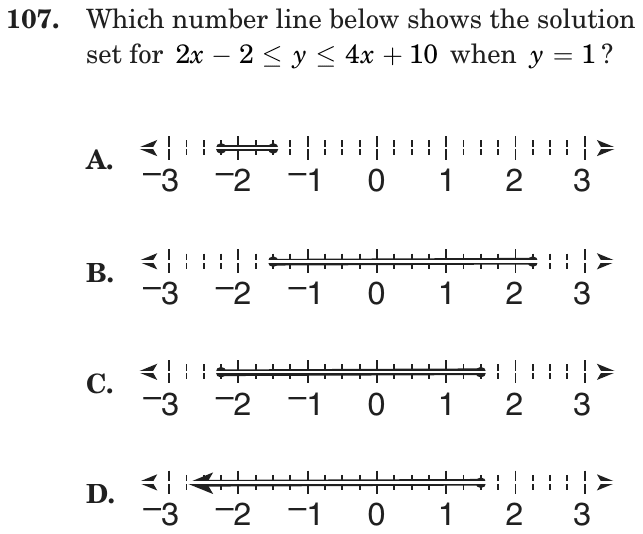
Question 20 of 20
2018 Test B Math, question 54Question
Raoul is at least 3 years older than Vahn. Which of the following inequalities gives the relationship between Raoul’s age ( ) and Vahn’s age ( )?
- A
- B
- C
- D
Show the answer
Correct answer: A
Raoul is at least 3 years older than Vahn, which can be written as
r ≥ v + 3
Rewrite this inequality to match the answer options:
r − v ≥ 3
Question analysis
Raoul is at least 3 years older than Vahn, and students choose the inequality that links their ages, r and v. It tests translating a phrase like "at least" into an inequality. The correct form may not match the one students write first, so they need to rearrange carefully and keep the direction of the inequality.
- Grade level
- Grade 7 content, by NYS standard
- Compared with grade 7
- At grade 7 Writing inequalities from words is grade 6 and 7 work. The extra demand is that "at least" must become the right symbol and the choices are rearranged forms, so students must manipulate inequalities rather than just recognize one.
- Estimated difficulty
- Moderate: several steps, or a close reading with one strong distractor.
- Thinking it demands
- Depth of knowledge 2, skills and concepts · mainly understand
- What makes it hard
- Turning words into math major
- An answer in an unexpected form moderate
- A very close wrong answer moderate
- Solution
- 2 steps
- Reading level
- Question and choices: about grade 8, 28 words.
- Students, last 30 days
- Not enough answers yet to show (it takes 10).
Why it is hard, traps and wrong answers (shows the answer)
Why it is hard
Two skills are tested at once: translating "at least … older than" into an inequality, and recognizing that inequality after a rearrangement. The two choices that begin with 3 − v and 3 − r look like legitimate moves but say only that the two ages add up to at least 3. Testing one pair of ages that fits the sentence and one that does not, such as 20 and 12 against 13 and 12, sorts the choices without algebra.
Turning words into math major Understanding the question
"Raoul is at least 3 years older than Vahn" has to become r ≥ v + 3; "at least" calls for ≥, though the word "least" seems to point the other way. (Hegarty, Mayer & Monk, 1995; Koedinger & Nathan, 2004)
An answer in an unexpected form moderate Choosing the answer
No choice is written as r ≥ v + 3, so the natural translation has to be rearranged to r − v ≥ 3 before it can be matched. (Enright, Morley & Sheehan, 2002)
A very close wrong answer moderate Choosing the answer
r − v ≤ 3 is the right r − v ≥ 3 with the symbol reversed; only deciding that "at least" means greater than or equal to separates them. (Embretson & Wetzel, 1987; Gorin & Embretson, 2006; Ascalon et al., 2007)
Strategy: Write the sentence directly as Raoul's age compared with Vahn's age plus 3, then rearrange each choice into that form to see which one matches.
Traps
- Misreads the question: Misses or misreads a condition or a word in the question: "at least", "each", "remaining", "not".
- A faulty procedure: A systematic but wrong procedure: adding fractions straight across, applying an exponent to each term of a sum, dropping a sign when moving a term.
- Answer in another form: The right answer is written differently from the way you worked it out.
The wrong answers, classified
B Misreads the question (Hegarty, Mayer & Monk, 1995)
Reads "at least 3 years older" as at most 3, reversing the inequality, which would even allow Raoul to be younger than Vahn.
C A faulty procedure (Brown & Burton, 1978; Tatsuoka, 1983)
Moves v across r ≥ v + 3 without changing its sign, writing r ≥ 3 − v, which really says only that their ages add up to at least 3.
D A faulty procedure (Brown & Burton, 1978; Tatsuoka, 1983)
Makes the same sign slip and also swaps the roles of r and v, giving 3 − r ≤ v, again only a statement about the sum of their ages.
Worked solution, step by step
Formulas used
- Greater than or equal to
- a and b are two amounts. The sign ≥ means a is greater than or equal to b, so a is b or more. The words at least mean the same thing. The sign ≤ means less than or equal to, or at most.
Sort out the question
The letter is Raoul’s age, and is Vahn’s age. Raoul is “at least 3 years older than Vahn”. That means the gap between their ages is 3 years or more. An inequality is a math sentence that uses a sign like instead of =. You need the one that says this.
Write the age gap
Raoul is older, so the gap is his age minus Vahn’s age. The gap is . For example, ages 15 and 10 have a gap of 5.
Turn at least into a sign
At least 3 means 3 or more. So use , which means greater than or equal to.
This is choice A.
Watch out: the word least does not mean less. Choice B, , says the gap is 3 or less. Then Raoul could even be younger.
Check choices C and D
Add to both sides of choice C. You get . That is about the sum of their ages, not the gap. Choice D works the same way. Neither one says Raoul is older.
Give the answer
Only one choice says the gap is 3 years or more. So the answer is A, .
Check your answer
Test ages that do not fit: Raoul 11 and Vahn 10. He is only 1 year older. Choice A gives , and 1 is not 3 or more. So A rightly says no. Choice B says yes, so B is wrong.
More questions like this
The original DOE question