Arithmetic and order of operations
Question 1 of 24
2026 Practice Test C Math, question 4Question
A person buys a used car with a down payment of $1,200 and makes monthly payments of $275 for 3 years. What is the total amount the person pays for the car?
- A$2,025
- B$9,900
- C$11,100
- D$13,500
Show the answer
Correct answer: C
Determine the total cost of the car by adding the down payment to the total monthly payments over 3 years.
There are 12 months in a year, so multiply (12 months/year × 3 years) to get a total of 36 months. Determine the total monthly payments by multiplying the monthly payment ($275) × the total number of months (36):
Determine the total cost of the car by adding the down payment ($1,200) to the total monthly payments ($9,900):
The total cost of the car is $11,100.
Question analysis
A used car is bought with a down payment of $1,200 followed by monthly payments of $275 for 3 years, and students find the total paid. The work is to count the payments, multiply, and add the down payment. Mixing up years and months, or forgetting the money paid up front, leads to the wrong totals among the choices.
- NYS standards
- Grade level
- Grade 6 content, by NYS standard
- Compared with grade 7
- Below grade 7 A total made of one payment up front plus equal monthly payments is a short whole-number calculation, simpler than grade 7 word problems with percents or negatives. The only conversion is from years to months.
- Estimated difficulty
- Routine: one familiar step, little to misread.
- Thinking it demands
- Depth of knowledge 2, skills and concepts · mainly apply
- What makes it hard
- Much to keep track of minor
- Error-prone arithmetic minor
- Solution
- 3 steps
- Reading level
- Question and choices: about grade 5, 29 words.
- Students, last 30 days
- Not enough answers yet to show (it takes 10).
Why it is hard, traps and wrong answers (shows the answer)
Why it is hard
The situation is familiar and the method direct, so this is one of the easier questions on the test. Points are lost in two places: turning 3 years into 36 payments, and remembering the money paid up front after the long multiplication. Each slip, like paying the down payment once a year, leads to a listed total, so checking that the answer holds exactly one $1,200 and 36 payments of $275 is worth the seconds.
Much to keep track of minor Working it out
The $1,200 down payment is paid once while the $275 repeats every month, so it has to be set aside while 36 payments are totaled and then added at the end. (Sweller, 1988; Carpenter, Just & Shell, 1990)
Error-prone arithmetic minor Working it out
The product 275 × 36 = 9,900 is a two-digit multiplication done by hand; splitting it as 275 × 4 = 1,100 and then 1,100 × 9 makes it quick and safe. (Brown & Burton, 1978; Junker & Sijtsma, 2001)
Strategy: Turn 3 years into a number of months, multiply the monthly payment by it, and add the down payment once at the end.
Traps
- Stops one step early: A choice is a number from partway through the solution.
- Units or scale: The answer is wanted in other units, or a rate or scale must be converted first.
- Misreads the question: Misses or misreads a condition or a word in the question: "at least", "each", "remaining", "not".
The wrong answers, classified
A Units or scale (King et al., 2004)
Multiplies the $275 by 3, the number of years, instead of by 36 months, then adds the $1,200 down payment: 825 + 1,200 = 2,025.
B Stops one step early (King et al., 2004; Gierl et al., 2017)
Finds the 36 monthly payments, 36 × $275 = $9,900, and stops without adding the $1,200 down payment made at the start.
D Misreads the question (Hegarty, Mayer & Monk, 1995)
Works out one year as $1,200 + 12 × $275 = $4,500 and multiplies by 3, so the down payment is paid three times instead of once.
Worked solution, step by step
Formulas used
- Changing years into months
- Each year has 12 months. Multiply the number of years by 12 to get the number of months. You need months here because a payment is made every month.
- Total cost with a down payment
- The down payment is money paid once, at the start. The monthly payment is paid every month. Multiply it by the number of months to get all the monthly payments. Then add the down payment only once, because it is paid only once.
Sort out the question
The person pays $1,200 once, at the start. This is the down payment. Then the person pays $275 every month for 3 years. You need the total amount paid for the car.
The payments come once a month, but the time is given in years. So change the years into months first.
Change 3 years into months
Use the months formula:
So the person makes 36 monthly payments.
Watch out: multiplying $275 by 3 counts only 3 payments. That leads to choice A, $2,025.
Add up the monthly payments
Multiply $275 by 36. A quick way is to split 36 into 4 × 9:
So the 36 payments add up to $9,900.
Watch out: stopping here gives choice B, $9,900. The down payment is still missing.
Add the down payment once
Use the total-cost formula:
The person pays $11,100 in all. Adding $1,200 for every year counts it three times. That gives choice D, $13,500.
So the answer is C, $11,100.
Check your answer
Estimate. $275 is a little less than $300, and . Add the $1,200: . The real total should be a little less than $12,000. $11,100 fits.
More questions like this
The original DOE question
Question 2 of 24
2026 Practice Test C Math, question 11Question
Allison has 5 stamp albums with 576 stamps in each album. If she transfers her stamp collection to 6 albums, each holding 378 stamps, how many stamps will be left over?
- A198
- B612
- C620
- D632
Show the answer
Correct answer: B
Determine the total number of stamps in 5 albums holding 576 stamps:
Determine the total number of stamps in 6 albums holding 378 stamps:
Subtract 2,268 from 2,880 to find the number of stamps that will be left over:
Question analysis
Allison moves a stamp collection from 5 albums of 576 stamps into 6 albums that hold 378 each, and students find how many stamps are left over. It tests multiplying and subtracting large whole numbers in a word problem. The question gives no total, so the collection has to be counted before the new albums' capacity is taken away.
- Grade level
- Grade 7 content, by NYS standard
- Compared with grade 7
- Below grade 7 Whole-number multiplication and subtraction in a three-step word problem is easier than grade 7 work with fractions, decimals or negatives. Because the products are large, a slip or a rounded estimate easily gives another choice.
- Estimated difficulty
- Straightforward: two steps or one careful reading.
- Thinking it demands
- Depth of knowledge 2, skills and concepts · mainly apply
- What makes it hard
- A very close wrong answer moderate
- Error-prone arithmetic minor
- Solution
- 3 steps
- Reading level
- Question and choices: about grade 6, 27 words.
- Students, last 30 days
- Not enough answers yet to show (it takes 10).
Why it is hard, traps and wrong answers (shows the answer)
Why it is hard
The plan is clear from the stem: count the stamps, then take away what the six new albums hold, so the question tests careful arithmetic. Its choices punish the estimating that saves time elsewhere, since rounding either factor shifts the result by only a few tens, onto another listed number. Students who skip the album counts altogether and compare one album with one album find 198 waiting.
A very close wrong answer moderate Choosing the answer
612, 620 and 632 lie within 20 of one another, so rounding 576 and 378 to friendly numbers before multiplying lands on a wrong choice; only exact products separate them. (Embretson & Wetzel, 1987; Gorin & Embretson, 2006; Ascalon et al., 2007)
Error-prone arithmetic minor Working it out
Two products of three-digit numbers, 5 × 576 = 2,880 and 6 × 378 = 2,268, must be done by hand and then subtracted with regrouping. (Brown & Burton, 1978; Junker & Sijtsma, 2001)
Strategy: Multiply to find the total number of stamps, multiply again to find how many the six new albums hold, subtract, and check the last digit of each product.
Traps
- Rounds too early: Rounds a value partway through, or rounds the wrong way, so the final answer drifts from the exact one.
- Numbers taken from the question: Combines the numbers in the question without a model of the situation, or is simply a number that appears in the question.
The wrong answers, classified
A Numbers taken from the question (Hegarty, Mayer & Monk, 1995)
Subtracts 378 from 576, comparing one old album with one new album, and ignores that there are 5 old albums and 6 new ones.
C Rounds too early (King et al., 2004)
Rounds 576 to 580 and 378 to 380 before multiplying, so 2,900 − 2,280 = 620, an estimate rather than the exact number left over.
D Rounds too early (King et al., 2004)
Rounds only 576 up to 580, getting 2,900 stamps, then subtracts the exact 2,268, so the count comes out 20 too high.
Worked solution, step by step
Formulas used
- Total in equal groups
- Here the groups are albums. The amount in each group is how many stamps one album holds. When every group is the same size, multiplying is a fast way to add them all up.
Sort out the question
Allison has 5 albums with 576 stamps in each. She moves all her stamps into 6 new albums. Each new album holds 378 stamps. Some stamps will not fit. You need the number left over.
Count all her stamps
Use the equal-groups formula. Split 576 into 500 + 76 to make it easy:
Allison has 2,880 stamps.
Count what the new albums hold
Do the same for the 6 new albums. Split 378 into 300 + 78:
The new albums hold 2,268 stamps in all.
Subtract to find the leftovers
The stamps left over are the ones she has minus the ones that fit:
Watch out: , choice A, compares just one old album with one new one. Rounding to 580 and 380 first gives 620, choice C. Rounding only 576 gives 632, choice D. Use the exact numbers.
So the answer is B, 612.
Check your answer
Add the leftovers to the stamps that fit: . That is exactly the number Allison started with. So no stamps were lost or counted twice.
More questions like this
The original DOE question
Question 3 of 24
2026 Practice Test C Math, question 16Question
- A−1
- B0
- C
- D1
Show the answer
Correct answer: B
Simplify the expression.
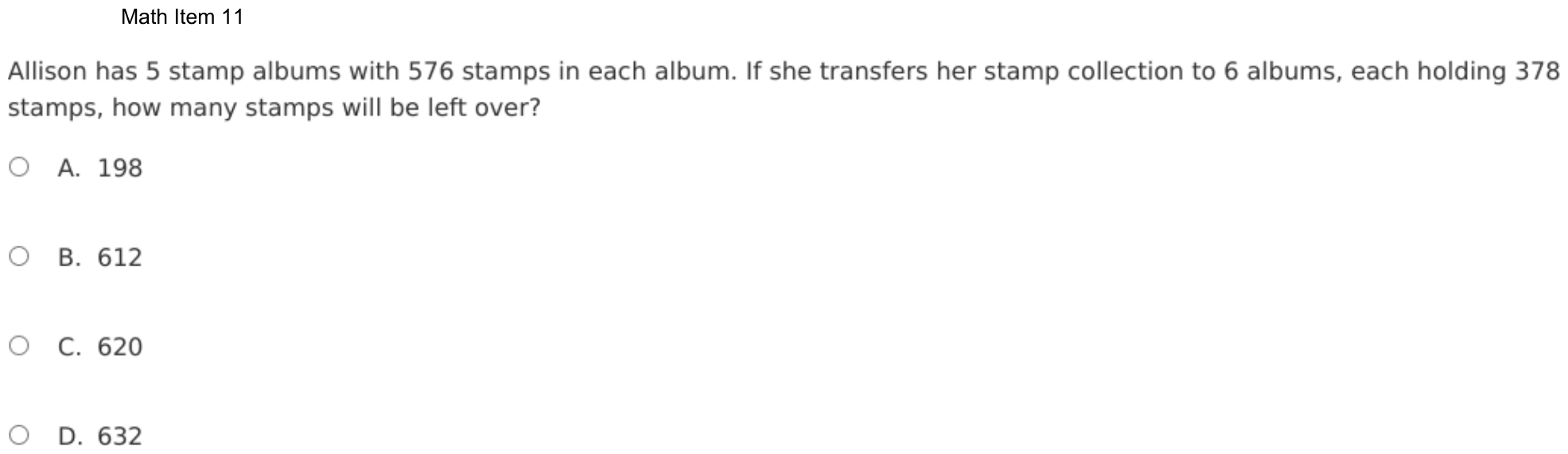
is the equivalent of subtracting 3 from 3, and is the equivalent of adding 3 to 3:
The zero property of division states that zero divided by any nonzero number equals zero, so .
Question analysis
This fraction has 3 plus negative 3 on top and 3 minus negative 3 on the bottom, and students find its value. It tests adding and subtracting negative numbers and dividing integers. The top and the bottom look almost alike, so each sign has to be read carefully before anything is divided.
- Grade level
- Grade 7 content, by NYS standard
- Compared with grade 7
- Below grade 7 Adding and subtracting a negative integer and dividing are grade 7 basics, and here the numbers are small. It is a short routine calculation, easier than typical grade 7 work, though the two signs invite a quick misreading.
- Estimated difficulty
- Routine: one familiar step, little to misread.
- Thinking it demands
- Depth of knowledge 1, recall and reproduction · mainly apply
- What makes it hard
- Error-prone arithmetic minor
- Solution
- 2 steps
- Reading level
- Question and choices: about grade 16+, 2 words.
- Corrected from the DOE handbook
- A grammatical error in the explanation was corrected.
- A rule stated too broadly in the explanation was corrected.
- Students, last 30 days
- Not enough answers yet to show (it takes 10).
Why it is hard, traps and wrong answers (shows the answer)
Why it is hard
The arithmetic is two one-step sign calculations and a division by 6. The danger is reading the top and the bottom as alike: they differ in a single sign, and treating them the same way gives 1 or −1. Students who rewrite 3 − (−3) as 3 + 3 and 3 + (−3) as 3 − 3 see 0 over 6 at once, and zero divided by a nonzero number is zero.
Error-prone arithmetic minor Working it out
The top adds −3 and the bottom subtracts −3, signs that look nearly the same but give 0 and 6, so each has to be rewritten before anything is divided. (Brown & Burton, 1978; Junker & Sijtsma, 2001)
Strategy: Simplify the top and the bottom separately, rewriting the subtraction of a negative as an addition, and only then divide the top by the bottom.
Traps
- Negatives and direction: Arithmetic with negative numbers, the order of a subtraction, or direction on a number line. (Moving a term across the equals sign without changing its sign is a faulty procedure.)
The wrong answers, classified
A Negatives and direction (Brown & Burton, 1978)
Adds the sizes on top and keeps the minus, taking 3 + (−3) as −6, so the fraction becomes −6/6 = −1.
C Little reason to choose it (Haladyna & Downing, 1993; Rodriguez, 2005)
No sign rule gives a top of 1, so 1/6 mostly draws students who find the bottom, 6, and are unsure what a top of 0 means.
D Negatives and direction (Brown & Burton, 1978)
Treats the top like the bottom, adding 3 and 3 in both places, so the fraction becomes 6/6 = 1.
What was corrected from the DOE handbook, and why
- Explanation: The DOE’s explanation says “3 − (−3) is equivalent of adding 3 to 3”, without the article that the same sentence uses in “3 + (−3) is the equivalent of subtracting 3 from 3”. The site now says “is the equivalent of adding 3 to 3”.
- Explanation: The DOE’s explanation says “The zero property of division states that zero divided by any number equals zero.” Zero divided by zero is undefined, not zero, so the rule holds only when the divisor is not zero. The site now says “zero divided by any nonzero number equals zero”. Here the divisor is 6, so 0/6 = 0, as before.
Worked solution, step by step
Formulas used
- Adding a negative
- a and b are numbers. Adding a negative is the same as subtracting. On a number line, adding −3 moves you 3 steps left, just like subtracting 3.
- Subtracting a negative
- a and b are numbers. Subtracting a negative is the same as adding. Taking away a debt of 3 dollars leaves you 3 dollars better off. On a number line, you move right.
- Zero divided by a number
- b is any number except 0. Zero split into b equal parts leaves 0 in each part. The rule needs b not to be 0, because dividing by 0 has no answer.
Sort out the question
The top of the fraction is , and the bottom is . A fraction bar means divide. Work out the top and the bottom separately first. Then divide the top by the bottom.
Work out the top
Adding −3 is the same as subtracting 3:
A number plus its opposite is always 0.
Watch out: do not add the 3s and keep the minus sign. That makes the top −6 and leads to choice A, −1.
Work out the bottom
Subtracting −3 is the same as adding 3:
Watch out: the top and bottom look alike, but they are not. Making both of them 6 gives 6/6 = 1, choice D.
Divide the top by the bottom
Now the fraction is 0 over 6. Zero divided by any number other than zero is zero:
A top of 0 does not make the fraction 1/6, choice C. So the answer is B, 0.
Check your answer
Check by multiplying. A division is right when the answer times the bottom gives the top. Here , which is the top. So 0/6 really is 0.
More questions like this
The original DOE question
Question 4 of 24
2026 Practice Test C Math, question 18Question
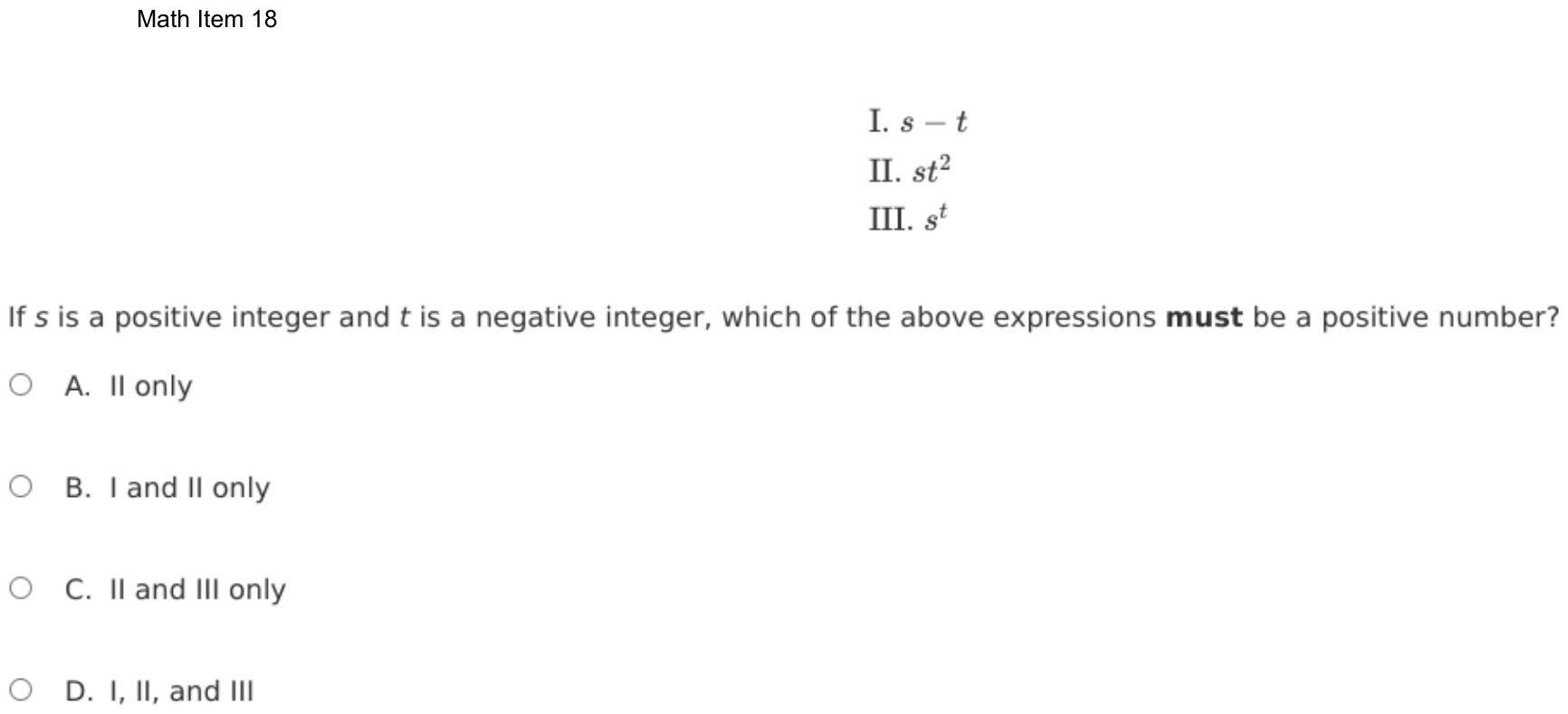
I.
II.
III.
If s is a positive integer and t is a negative integer, which of the above expressions must be a positive number?
- AII only
- BI and II only
- CII and III only
- DI, II, and III
Show the answer
Correct answer: D
Each of the three expressions must be considered:
Expression I: , where s is a positive integer and t is a negative integer:
Subtracting a negative integer is the equivalent of adding a positive integer, so is equivalent to finding the value of , which must result in a positive number.
Expression II: , where s is a positive integer and t is a negative integer:
Squaring a negative integer results in a positive integer, so is equivalent to finding the value of , which must result in a positive number.
Expression III: , where s is a positive integer and t is a negative integer:
A negative exponent results in the reciprocal of the same exponential expression, so is equivalent to finding the value of , which must result in a positive number.
Therefore, Expressions I, II, and III must all result in a positive number.
Question analysis
Three expressions, s − t, s times t squared, and s to the power t, are listed, and students decide which must be positive when s is a positive integer and t is a negative integer. It tests sign rules for subtraction and multiplication and the meaning of a negative exponent. Each expression has to be judged for every possible pair, not just one example.
- NYS standards
- Grade level
- Grade 8 content, by NYS standard
- Compared with grade 7
- Above grade 7 Grade 7 students learn sign rules for subtracting and multiplying signed numbers. Here they reason about letters rather than numbers, decide what must always hold, and handle a negative exponent, a grade 8 idea.
- Estimated difficulty
- Hard: combines ideas, needs a plan, and has more than one tempting wrong answer.
- Thinking it demands
- Depth of knowledge 2, skills and concepts · mainly analyze
- What makes it hard
- Variables instead of numbers moderate
- Something you must already know moderate
- Every choice must be checked minor
- Solution
- 3 steps
- Reading level
- Question and choices: about grade 5, 42 words.
- Corrected from the DOE handbook
- Two steps of the explanation that treated t as a positive number were corrected.
- A punctuation error in the explanation was corrected.
- Students, last 30 days
- Not enough answers yet to show (it takes 10).
Why it is hard, traps and wrong answers (shows the answer)
Why it is hard
The three expressions test three different sign facts: subtracting a negative, squaring a negative, and raising to a negative power. The last is the trap, since a negative exponent seems to promise a negative result when it really gives a fraction, and that belief alone leads to a listed choice. Trying s = 2 and t = −3 gives 5, 18 and 1/8, all positive, and the rules show why no other pair can change that.
Variables instead of numbers moderate Understanding the question
No values are given for s and t, only their signs, and must means each expression has to be positive for every such pair, not just for one example. (Koedinger & Nathan, 2004; Enright, Morley & Sheehan, 2002)
Something you must already know moderate Working it out
Expression III needs the meaning of a negative exponent, s to the power t equals 1 over s to the power −t, a grade 8 rule the question does not state. (Anderson & Krathwohl, 2001)
Every choice must be checked minor Choosing the answer
Each of the three expressions is judged on its own and the choices combine the verdicts, so one wrong judgment anywhere points to a wrong combination. (Embretson & Wetzel, 1987)
Strategy: Try a pair such as s = 2 and t = −3 in each expression, then explain why its sign could or could not change for any other positive s and negative t.
Traps
- Misunderstands the concept: A wrong belief about a concept: that percents can be added, that area grows like length, that averages can be averaged, that a bigger denominator means a bigger fraction.
- Negatives and direction: Arithmetic with negative numbers, the order of a subtraction, or direction on a number line. (Moving a term across the equals sign without changing its sign is a faulty procedure.)
The wrong answers, classified
A Misunderstands the concept (Smith, diSessa & Roschelle, 1993; De Bock et al., 1998; Ni & Zhou, 2005)
Trusts only the squared expression, believing that subtracting t must make s smaller and that a negative exponent makes a negative number.
B Misunderstands the concept (Smith, diSessa & Roschelle, 1993; De Bock et al., 1998; Ni & Zhou, 2005)
Handles the subtraction and the square correctly but believes a negative exponent makes the result negative, though s to the power t is a positive fraction such as 1/8.
C Negatives and direction (Brown & Burton, 1978)
Reads s − t as taking a number away from s, so thinks it could be negative, missing that subtracting the negative t adds to s.
What was corrected from the DOE handbook, and why
- Explanation: The question makes t the negative integer, but two steps of the DOE’s explanation write the negative integer as −t, as if t were positive. For Expression I it says “s − (−t) is equivalent to finding the value of s + t, which must result in a positive number”: s − (−t) is not Expression I, and with the question’s t, s + t need not be positive (s = 1 and t = −2 give −1). For Expression III it says “s^(−t) is equivalent to finding the value of 1/s^t”, about s^(−t) rather than Expression III. The site now says that s − t is equivalent to s + (−t), and that s^t is equivalent to 1/s^(−t). Since t is negative, −t is a positive integer, so s + (−t) is the sum of two positive integers and 1/s^(−t) is the reciprocal of a positive integer: both positive, and the answer, I, II and III, is unchanged. The step for Expression II, s(−t)² = st², is true for any t and is unchanged.
- Explanation: The DOE’s explanation introduces Expression III as “s^t. where s is a positive integer and t is a negative integer”, with a period where Expressions I and II (and the 2022–23 guide, which first printed this explanation) have a comma. The site has the comma.
Worked solution, step by step
Formulas used
- Subtracting a number
- s and t are integers, and −t is the opposite of t. Subtracting a number is the same as adding its opposite. When t is negative, −t is positive. So subtracting t adds a positive amount.
- A negative exponent
- s is the base and t is the exponent. When t is negative, −t is positive. So a negative exponent means 1 over the base to a positive exponent. For example, 2 to the power −3 is 1 over 2³, which is 1/8.
Sort out the question
An integer is a whole number or its opposite, such as −2, 0 or 5. Here s is a positive integer, like 1, 2 or 3. And t is a negative integer, like −1, −2 or −3. Must means always. An expression counts only if it is positive for every such pair.
Try one pair of numbers
Try s = 2 and t = −3 in each expression:
- I:
- II:
- III:
All three are positive this time. Now see why that always happens.
Explain expression I
Use the rule for subtracting:
t is negative, so its opposite, −t, is positive. So s − t is a positive plus a positive. That is always positive.
Watch out: subtracting does not always make a number smaller. Subtracting a negative makes it bigger. Missing this leads to choice C.
Explain expression II
means t × t. A negative times a negative is positive, so is always positive. Then is a positive times a positive. That is always positive too.
Explain expression III
Use the rule for a negative exponent:
−t is a positive integer, so is a positive integer. So is 1 over a positive number. That is a positive fraction.
Watch out: a negative exponent does not make the answer negative. It makes a fraction. Thinking it does leads to choice B, I and II only.
Choose the answer
Each of the three expressions is positive for every positive s and negative t. None of them can ever be zero or negative.
So the answer is D, I, II, and III.
Check your answer
Try the values closest to 0: s = 1 and t = −1. I gives . II gives . III gives . All three are still positive.
More questions like this
The original DOE question
Question 5 of 24
2026 Practice Test C Math, question 22Question
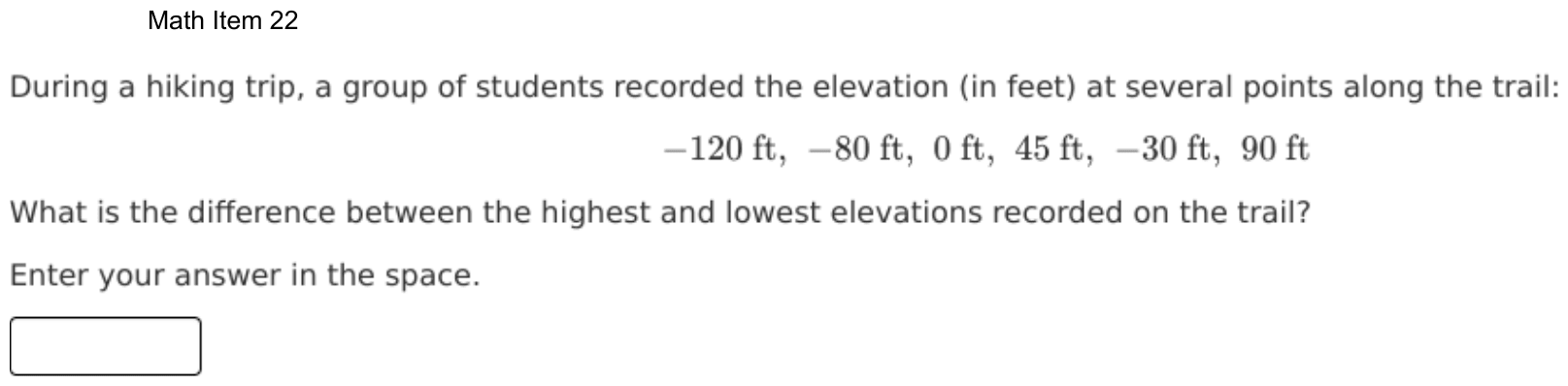
During a hiking trip, a group of students recorded the elevation (in feet) at several points along the trail:
What is the difference between the highest and lowest elevations recorded on the trail?
Enter your answer in the space.
Fill-in question: work out the answer and type it as a number.
Show the answer
Correct answer: 210
Determine the difference between the highest and lowest elevations:
Determine the highest elevation:
Of −120, −80, 0, 45, −30, and 90, the greatest value is 90 because its location is farthest to the right on a number line.
Highest elevation
Determine the lowest elevation:
Of −120, −80, 0, 45, −30, and 90, the lowest value is −120 because its location is farthest to the left on a number line.
Lowest elevation
Determine the difference between the two elevations:
Question analysis
A group of students on a hiking trip records six elevations in feet, some below zero and some above, and finds the difference between the highest and the lowest, typing the result. It tests ordering positive and negative numbers and subtracting integers. Spotting the lowest reading among several negatives and subtracting a negative number correctly are where errors creep in.
- Grade level
- Grade 7 content, by NYS standard
- Compared with grade 7
- At grade 7 Finding the gap between a positive and a negative value by subtracting is core grade 7 work with integers. Picking the extremes from six readings is quick, so the demand is the subtraction of a negative number.
- Estimated difficulty
- Straightforward: two steps or one careful reading.
- Thinking it demands
- Depth of knowledge 2, skills and concepts · mainly apply
- What makes it hard
- Error-prone arithmetic moderate
- An answer in an unexpected form minor
- Solution
- 2 steps
- Reading level
- Question and choices: about grade 7, 40 words.
- Students, last 30 days
- Not enough answers yet to show (it takes 10).
Why it is hard, traps and wrong answers (shows the answer)
Why it is hard
Picking the highest and lowest of six readings is quick, though −120 must be recognized as lower than −80 and −30. The points are lost in the subtraction: the span runs 120 feet up to zero and 90 more above it, and students who treat the readings as plain sizes find only 30. Picturing the two readings on a vertical number line shows the whole span.
Error-prone arithmetic moderate Working it out
The difference is 90 − (−120), and subtracting a negative means adding 120, so the part of the trail below zero is easy to leave out. (Brown & Burton, 1978; Junker & Sijtsma, 2001)
An answer in an unexpected form minor Choosing the answer
The difference is typed with no choices, so 30 or −30, the results of mishandling the negative, gets no warning that the two readings lie on opposite sides of zero. (Enright, Morley & Sheehan, 2002)
Strategy: Pick the greatest and the least elevation by their places on a number line, then subtract the least from the greatest, turning the subtraction of a negative into an addition.
Traps
- Negatives and direction: Arithmetic with negative numbers, the order of a subtraction, or direction on a number line. (Moving a term across the equals sign without changing its sign is a faulty procedure.)
- Wrong operation: Adds instead of multiplying, divides the wrong way round, turns a ratio or rate upside down, or undoes a step in the wrong direction (subtracts what should be added back).
- Information you don't need: The question gives numbers or facts that play no part in the answer.
The wrong answers, classified
30 Negatives and direction (Brown & Burton, 1978)
Subtracts the sizes, 120 − 90 = 30, as if both readings were on the same side of zero, leaving out the stretch below zero.
-30 Wrong operation (Hegarty, Mayer & Monk, 1995; King et al., 2004)
Combines the two extremes by adding, 90 + (−120) = −30, the net of the readings, instead of subtracting the lowest from the highest.
-210 Negatives and direction (Brown & Burton, 1978)
Subtracts in the reverse order, lowest minus highest, −120 − 90 = −210, and enters a negative difference.
Worked solution, step by step
Formulas used
- Difference between highest and lowest
- The difference between the highest and lowest values is how far apart they are. Subtract the lowest from the highest, so the answer is never negative.
- Subtracting a negative
- a and b are numbers. Subtracting a negative is the same as adding a positive. On a number line, it means moving to the right.
Sort out the question
Elevation is height above or below a starting level, here 0 feet. Negative elevations are below 0. The six readings are −120, −80, 0, 45, −30 and 90 feet. You need the difference between the highest and the lowest.
Find the highest and the lowest
Picture the readings on a number line. The highest is farthest right: 90 feet. The lowest is farthest left: −120 feet.
For negative numbers, the bigger the number after the minus sign, the lower it is. So −120 is lower than −80.
Subtract the lowest from the highest
Use the difference formula. Subtracting a negative is the same as adding:
So the two readings are 210 feet apart.
Watch out: treats both readings as if they were above 0. Adding them, , is wrong too.
Enter the answer
A difference like this is a distance, so it is positive. Subtracting in the other order gives −210, which is wrong. Type only the number, with no units.
So you would enter 210.
Check your answer
Count the distance in two parts. From −120 feet up to 0 is 120 feet. From 0 up to 90 is 90 more feet. Together, feet. That matches.
More questions like this
The original DOE question
Question 6 of 24
2026 Practice Test D Math, question 9Question
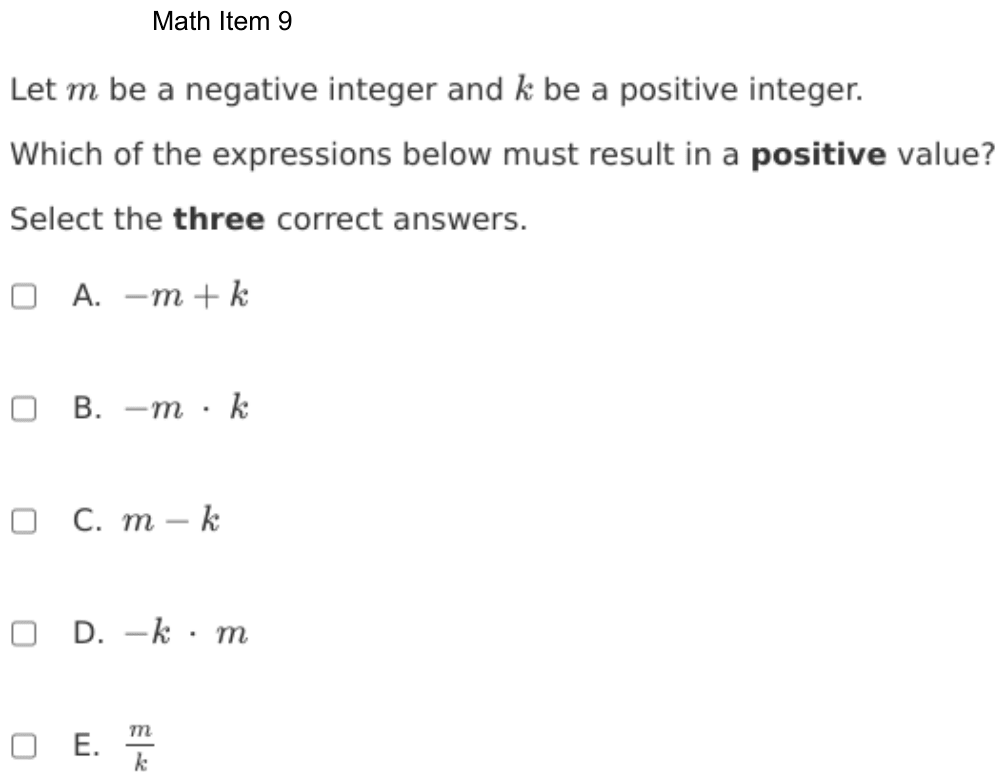
Let m be a negative integer and k be a positive integer.
Which of the expressions below must result in a positive value?
Select the three correct answers.
Choose every answer that is correct, then check. The DOE has not published how answers with several parts are scored; this site counts one right only when every part is right.
- A
- B
- C
- D
- E
Show the answer
Correct answer: A, B, and D
Each of the expressions must be considered:
, where m is a negative integer and k is a positive integer: Correct
The “−” in front of m acts like a multiplier that flips the sign of m, so is positive when m is negative and k is positive.
, where m is a negative integer and k is a positive integer: Correct
The “−” in front of m acts like a multiplier that flips the sign of m, so is positive when m is negative and k is positive.
, where m is a negative integer and k is a positive integer:
A negative number minus a positive number gives a negative number.
, where m is a negative integer and k is a positive integer: Correct
A positive times a negative is a negative. Then, taking the opposite of that makes it positive.
, where m is a negative integer and k is a positive integer:
A negative divided by a positive remains negative.
Therefore, , , and must all result in a positive number.
Question analysis
Given that m is a negative integer and k a positive integer, students select the three expressions, out of five, that must have a positive value. It tests the sign rules for adding, subtracting, multiplying and dividing integers. Minus signs in front of letters, and letters in place of numbers, make each sign easy to misjudge, and all three must be found.
- NYS standards
- Grade level
- Grade 7 content, by NYS standard
- Compared with grade 7
- At grade 7 Sign rules for adding, subtracting, multiplying and dividing integers are core grade 7 content. Here they are applied to letters with known signs instead of numbers, across five expressions, and all three right ones must be chosen with no wrong one.
- Estimated difficulty
- Moderate: several steps, or a close reading with one strong distractor.
- Thinking it demands
- Depth of knowledge 2, skills and concepts · mainly analyze
- What makes it hard
- Variables instead of numbers moderate
- Every choice must be checked moderate
- Much to keep track of minor
- Solution
- 3 steps
- Reading level
- Question and choices: about grade 8, 33 words.
- Students, last 30 days
- Not enough answers yet to show (it takes 10).
Why it is hard, traps and wrong answers (shows the answer)
Why it is hard
Each expression needs only one sign rule, but the minus signs are placed to mislead. In −k · m the leading minus seems to make the result negative until the sign of m is counted, and in m − k two negatives seem to cancel, though subtracting makes the result more negative. Substituting one negative and one positive value into all five gives three positive results and two negative ones, the count the item asks for.
Variables instead of numbers moderate Understanding the question
Only the signs of m and k are known, so the sign of each expression must be reasoned from the rules or tested with values such as m = −2 and k = 3. (Koedinger & Nathan, 2004; Enright, Morley & Sheehan, 2002)
Every choice must be checked moderate Choosing the answer
All five expressions mix the same two letters with minus signs, so none can be dismissed at a glance; each is judged on its own and exactly three must be picked. (Embretson & Wetzel, 1987)
Much to keep track of minor Working it out
The item scores only when all three positive expressions are chosen and both negative ones left out, so five separate verdicts must be kept and combined. (Sweller, 1988; Carpenter, Just & Shell, 1990)
Strategy: Substitute sample values, such as m = −2 and k = 3, into all five expressions and note each sign, then confirm with the sign rules that no other values could change it.
Traps
- Negatives and direction: Arithmetic with negative numbers, the order of a subtraction, or direction on a number line. (Moving a term across the equals sign without changing its sign is a faulty procedure.)
- Misunderstands the concept: A wrong belief about a concept: that percents can be added, that area grows like length, that averages can be averaged, that a bigger denominator means a bigger fraction.
The wrong answers, classified
C Misunderstands the concept (Smith, diSessa & Roschelle, 1993; De Bock et al., 1998; Ni & Zhou, 2005)
Sees two negatives, m and the minus before k, and applies “two negatives make a positive” to subtraction, though a negative minus a positive moves further below zero.
D Negatives and direction (Brown & Burton, 1978)
Left out by students who read the leading minus in −k · m as making the product negative, missing that m is negative too, so the product is positive.
E Negatives and direction (Brown & Burton, 1978)
Sees no minus sign in m/k and takes it as positive, forgetting that m itself is negative, so the quotient of a negative and a positive is negative.
Worked solution, step by step
Formulas used
- The opposite of a number
- a is any positive number, so −a is negative. A minus sign in front of a number or letter means its opposite: the same distance from 0, on the other side. The opposite of a negative number is positive. So if m is negative, −m is positive.
- Signs when you multiply or divide
- a and b are positive numbers, so −a and −b are negative. Two negatives multiply to a positive. A negative and a positive multiply or divide to a negative. These rules tell you the sign of an answer without knowing the numbers.
Sort out the question
m is a negative integer, a whole number below 0, such as −2. k is a positive integer, such as 3. You must pick the three expressions that are always positive. Check all five, and test m = −2 and k = 3 as you go.
Understand the minus in front
A minus sign in front of a letter means the opposite of that number. Since m is negative, −m is positive. Since k is positive, −k is negative. With the test values, −m = 2 and −k = −3.
Check choices A and B
A: is a positive plus a positive, so it is always positive. Test: 2 + 3 = 5.
B: is a positive times a positive, so it is always positive. The dot · means times. Test: 2 × 3 = 6.
Check choices C and E
C: starts below 0 and moves further down, so it is always negative. Test: −2 − 3 = −5.
E: is a negative divided by a positive, so it is always negative. Test: −2 ÷ 3 = −2/3.
Watch out: two negatives make a positive only when you multiply or divide them. Choice C subtracts, so it stays negative. Choice E shows no minus sign, but m itself is negative.
Check choice D
D: is a negative times a negative, so it is always positive. Test: −3 × (−2) = 6.
Watch out: the minus sign in front makes D look negative. But m is negative too, and the two negatives make a positive. Skipping D leaves you one answer short.
Choose the three answers
Choices C and E are always negative, so leave them out. The three positive ones are A, B and D. On the test, you check the box next to each one.
So the answers are A, B and D.
Check your answer
Try different values, such as m = −10 and k = 1. A: 10 + 1 = 11. B: 10 × 1 = 10. D: −1 × (−10) = 10. All three are positive again. C gives −11 and E gives −10, both negative.
More questions like this
The original DOE question
Question 7 of 24
2026 Practice Test D Math, question 20Question
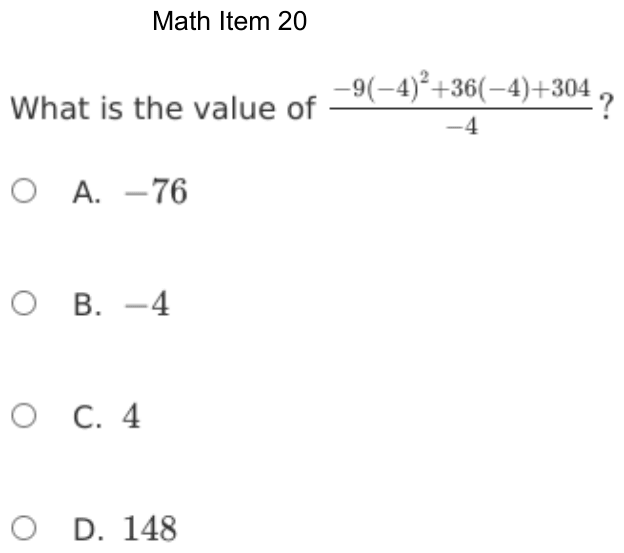
What is the value of ?
- A−76
- B−4
- C4
- D148
Show the answer
Correct answer: B
Use the order of operations to evaluate the expression. It is important to recognize that the fraction bar is a grouping symbol and so the entire numerator should be evaluated first. Exponents are evaluated first.
Then multiplication, recognizing that the product of a negative factor and a positive factor is negative.
Then addition and subtraction in order from left to right, recognizing the rules for adding and subtracting signed numbers.
And finally the fraction can be evaluated by division, recognizing that the quotient of a positive and a negative number is negative.
Question analysis
This arithmetic question asks for the value of a fraction whose numerator, −9(−4)² + 36(−4) + 304, is divided by −4. Students follow the order of operations with negative numbers: a square, two products, a sum and a division. Every step carries a sign, and one dropped negative changes the result completely.
- NYS standards
- Grade level
- Grade 7 content, by NYS standard
- Compared with grade 7
- At grade 7 Order of operations with negative numbers is standard grade 7 practice. This expression stacks a squared negative, two products and a division by a negative into one fraction, so it takes more steps than usual, each with a sign to track.
- Estimated difficulty
- Moderate: several steps, or a close reading with one strong distractor.
- Thinking it demands
- Depth of knowledge 1, recall and reproduction · mainly apply
- What makes it hard
- Error-prone arithmetic moderate
- Many steps minor
- A very close wrong answer minor
- Solution
- 4 steps
- Reading level
- Question and choices: about grade 5, 6 words.
- Students, last 30 days
- Not enough answers yet to show (it takes 10).
Why it is hard, traps and wrong answers (shows the answer)
Why it is hard
Nothing here is conceptually new; the question measures care with signs under the order of operations. The parentheses in (−4)² decide whether −9 multiplies 16 or −16, and the two products of −144 then nearly cancel the 304, leaving a small numerator whose sign is easy to lose. Writing each intermediate value with its sign, line by line, prevents most errors.
Error-prone arithmetic moderate Working it out
Five sign decisions sit in one expression: squaring −4, two products with a negative factor, a sum that climbs from −288 past zero, and a division by −4. (Brown & Burton, 1978; Junker & Sijtsma, 2001)
Many steps minor Working it out
The numerator alone takes an exponent, two multiplications and two additions before the single division, and all of it must be finished before dividing. (Daniel & Embretson, 2010; Enright, Morley & Sheehan, 2002)
A very close wrong answer minor Choosing the answer
The right value and the choice 4 differ only in sign, so a student with the right size must still check the sign of a positive numerator over −4. (Embretson & Wetzel, 1987; Gorin & Embretson, 2006; Ascalon et al., 2007)
Strategy: Treat the fraction bar as grouping: square −4 first, do the two multiplications, combine the numerator from left to right, and only then divide by −4, writing each sign as you go.
Traps
- Negatives and direction: Arithmetic with negative numbers, the order of a subtraction, or direction on a number line. (Moving a term across the equals sign without changing its sign is a faulty procedure.)
- Order of operations: Working left to right, or distributing a minus sign wrongly, gives a choice.
The wrong answers, classified
A Order of operations (Brown & Burton, 1978)
Squares as if the minus sat outside the parentheses, taking (−4)² as −16, so −9 × (−16) = 144, the numerator becomes 304, and 304 ÷ (−4) = −76.
C Negatives and direction (Brown & Burton, 1978)
Works the numerator out correctly as 16 but divides by −4 as if the signs did not matter, giving a positive quotient.
D Negatives and direction (Brown & Burton, 1978)
Drops every negative sign, adding 144 + 144 + 304 = 592 and dividing by 4, so 148 keeps none of the signs in the problem.
Worked solution, step by step
Formulas used
- Order of operations
- This is the order for working out an expression. Grouping means parentheses and the fraction bar. Exponents are small raised numbers, like the 2 in (−4)². Next, multiply and divide from left to right. Last, add and subtract from left to right.
- Squaring a negative number
- a is a positive number, so −a is negative. Squaring means multiplying a number by itself. A negative times a negative is positive, so a negative number squared is positive. For example, (−4)² = 16.
- Signs when you multiply or divide
- When two numbers have different signs, their product or quotient is negative. When they have the same sign, it is positive. A quotient is the answer to a division.
Sort out the question
You need the value of one big fraction. The fraction bar is a grouping symbol, so finish the whole top first. Then divide by −4. Follow the order of operations, and track every minus sign.
Do the exponent first
The only exponent is (−4)². Squaring means multiplying a number by itself:
Watch out: (−4)² is 16, not −16. Using −16 makes the top 304, which gives −76, choice A.
Do the multiplication
Now multiply. A negative times a positive is negative:
So the top becomes:
Add from left to right
Add the two negatives first:
Then add 304. Since 304 is more than 288, the result is positive:
The whole top is 16.
Divide by −4
Now divide the top by the bottom. A positive divided by a negative is negative:
Watch out: positive 4, choice C, ignores the negative bottom. Dropping every minus sign gives 592 ÷ 4 = 148, choice D.
So the answer is B, −4.
Check your answer
Multiply back. If the answer is −4, then −4 times the bottom, −4, should give the top. It does: (−4) × (−4) = 16. Also, the top is positive and the bottom is negative, so the answer must be negative.
More questions like this
The original DOE question
Question 8 of 24
2026 Practice Test D Math, question 23Question
Which situation involves quantities that combine to equal zero?
- Areceiving $5 as a gift and then giving $5 to a friend
- Bbuying a book for $10 and then buying lunch for $10
- Cgetting on an elevator at the ground floor, rising 3 floors, and then rising 3 more floors
- Dstarting in a cave 20 feet below the ground, climbing up 20 feet, and then climbing up 20 feet more
Show the answer
Correct answer: A
When looking for a situation where quantities combine to make zero, find two values with the same absolute value where one value is positive and one value is negative.
In the situation in option A, receiving a gift of $5 is represented by , and giving a friend $5 is represented by . These values combine to equal zero because .
Question analysis
This question gives four everyday situations involving money, an elevator and a cave, and asks which one involves quantities that combine to make zero. It tests representing gains and losses, or ups and downs, with positive and negative numbers. Equal numbers alone do not make zero, so the direction of each amount must be read carefully.
- Grade level
- Grade 7 content, by NYS standard
- Compared with grade 7
- Below grade 7 Describing situations where opposite quantities make zero is named in the grade 7 standards, and this is its most direct form: one reading of four everyday situations, easier than typical grade 7 work with signed numbers.
- Estimated difficulty
- Routine: one familiar step, little to misread.
- Thinking it demands
- Depth of knowledge 1, recall and reproduction · mainly understand
- What makes it hard
- Solution
- 1 step
- Reading level
- Question and choices: about grade 5, 60 words.
- Students, last 30 days
- Not enough answers yet to show (it takes 10).
Why it is hard, traps and wrong answers (shows the answer)
Why it is hard
The idea that a quantity and its opposite add to zero is familiar, and the right situation states it plainly. The wrong choices are built from equal amounts: two of them repeat a number but move in one direction, and the cave climb reaches zero partway before going 20 feet past it. Writing each situation as a sum of signed numbers takes a few seconds and settles it.
Turning words into math minor Understanding the question
Each situation must be turned into signed numbers, receiving or rising as plus and giving or buying as minus, before its total can be judged. (Hegarty, Mayer & Monk, 1995; Koedinger & Nathan, 2004)
Every choice must be checked minor Choosing the answer
Every choice repeats one amount, $5, $10, 3 floors or 20 feet, so equal numbers alone do not identify the answer; the direction of each move has to be checked. (Embretson & Wetzel, 1987)
Strategy: Write each situation as signed numbers, using + for gains or upward moves and − for losses or downward moves, add them, and see which total is zero.
Traps
- Stops one step early: A choice is a number from partway through the solution.
- Misunderstands the concept: A wrong belief about a concept: that percents can be added, that area grows like length, that averages can be averaged, that a bigger denominator means a bigger fraction.
The wrong answers, classified
B Misunderstands the concept (Smith, diSessa & Roschelle, 1993; De Bock et al., 1998; Ni & Zhou, 2005)
Treats the two equal $10 amounts as opposites that cancel, though buying a book and buying lunch both take money away, for a total of −$20.
C Misunderstands the concept (Smith, diSessa & Roschelle, 1993; De Bock et al., 1998; Ni & Zhou, 2005)
Pairs the two 3s as amounts that cancel, missing that rising and then rising again both go up, ending 6 floors above the ground floor.
D Stops one step early (King et al., 2004; Gierl et al., 2017)
Sees that starting 20 feet below ground and climbing 20 feet reaches zero, then overlooks the last 20 feet climbed, which ends 20 feet above ground.
Worked solution, step by step
Formulas used
- Opposites add to zero
- a is any number, and −a is its opposite: the same size, but the other sign. A number and its opposite always add to 0. On a number line, they sit the same distance from 0 on opposite sides. Equal moves in opposite directions cancel out.
Sort out the question
You need the situation whose amounts add up to zero. Give each amount a sign. Use + for getting money or going up. Use − for spending money or going down. Then add the amounts in each choice. The direction matters, not just the numbers.
Write each choice with signs
Turn each situation into signed numbers and add them up:
Choice Amounts Total A +5, then −5 0 B −10, then −10 −20 C +3, then +3 +6 D start at −20, then +20, then +20 +20 Look at the tricky choices
In B, buying a book and buying lunch both take money away. Equal amounts cancel only when they go in opposite directions. In C, rising and rising again both go up, so you end 6 floors up.
Watch out: in D, starting at −20 and climbing 20 feet does reach 0, ground level. But then you climb 20 feet more. You end at +20, 20 feet above the ground, so D is wrong.
Choose the zero total
Only choice A has two opposite amounts of the same size. Getting $5 is +5, and giving $5 away is −5:
So the answer is A: receiving $5 as a gift and then giving $5 to a friend.
Check your answer
Think about where you end up. In A, you end with exactly the money you started with, so the total change is zero. In every other choice, you end with less money, higher up, or above the ground.
More questions like this
The original DOE question
Question 9 of 24
2024 Test A Math, question 1Question
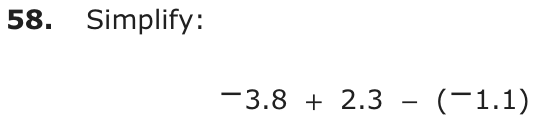
Simplify:
Grid-in question: work out the answer and enter it as a number.
Show the answer
Correct answer: -0.4
Subtracting a negative number is the same as adding a positive number. Rewrite the expression to simplify:
Question analysis
This grid-in asks students to simplify a short expression that mixes negative and positive decimals and ends by subtracting a negative number. It tests adding and subtracting rational numbers in order. The double negative, and keeping track of the sign of the final result, are where errors creep in.
- Grade level
- Grade 7 content, by NYS standard
- Compared with grade 7
- At grade 7 Adding and subtracting negative decimals is core grade 7 content, and this is a routine three-term version. It matches a typical classroom exercise; the only extra demand is gridding a signed decimal correctly.
- Estimated difficulty
- Straightforward: two steps or one careful reading.
- Thinking it demands
- Depth of knowledge 1, recall and reproduction · mainly apply
- What makes it hard
- Error-prone arithmetic moderate
- An answer in an unexpected form minor
- Solution
- 2 steps
- Reading level
- Question and choices: about grade 16+, 2 words.
- Students, last 30 days
- Not enough answers yet to show (it takes 10).
Why it is hard, traps and wrong answers (shows the answer)
Why it is hard
This is a three-term expression with small decimals, so the method is never in doubt; the points are lost on signs. The double negative at the end is the classic place to slip; the other is the result itself, which sits just below zero and is easy to grid without its minus sign. Grouping the positive terms first, 2.3 + 1.1, and comparing that sum with 3.8 settles both the size and the sign.
Error-prone arithmetic moderate Working it out
The last term, − (−1.1), has to turn into + 1.1, and the total then crosses zero, since 2.3 + 1.1 = 3.4 falls just short of the 3.8 below zero. (Brown & Burton, 1978; Junker & Sijtsma, 2001)
An answer in an unexpected form minor Choosing the answer
As a grid-in it shows no choices, so a double negative read as a single one, or a result gridded without its minus sign, gets no warning from the page. (Enright, Morley & Sheehan, 2002)
Strategy: Rewrite subtracting −1.1 as adding 1.1, combine the two positive decimals first, then compare their total with 3.8 to decide the sign and size.
Traps
- Negatives and direction: Arithmetic with negative numbers, the order of a subtraction, or direction on a number line. (Moving a term across the equals sign without changing its sign is a faulty procedure.)
The wrong answers, classified
-2.6 Negatives and direction (Brown & Burton, 1978)
Treats subtracting −1.1 as subtracting 1.1, so it works out −3.8 + 2.3 − 1.1 = −1.5 − 1.1 and moves further below zero.
0.4 Negatives and direction (Brown & Burton, 1978)
Rewrites the double negative correctly and finds the gap 3.8 − 3.4 = 0.4, but drops the minus sign that the larger negative term gives the result.
Worked solution, step by step
Formulas used
- Subtracting a negative number
- a is any number, and b is a positive number, so −b is negative. Taking away a negative number is the same as adding the positive number. Think of money: if someone takes away a debt of b dollars, you are b dollars better off.
- Adding a negative and a positive
- a and b are positive numbers, and a is the larger one. A negative and a positive partly cancel out. So find the difference of their sizes, a − b. The result keeps the sign of the number farther from zero, which here is the negative one.
Sort out the expression
You need to simplify . Simplify means work it out to one number. Two of the numbers are negative: −3.8 and −1.1. One is positive: 2.3. The tricky part is at the end. It says minus negative 1.1. The answer can be negative, so keep track of every sign.
Change minus a negative to plus
Taking away a negative is the same as adding a positive. Use the rule with b = 1.1.
Now only one negative number is left. Watch out: do not just subtract 1.1. That gives , which is wrong.
Add the two positive numbers
Group the positive numbers first. This makes the rest of the work short.
Now the problem is . One number is negative and one is positive.
Combine the negative and the positive
They partly cancel. Use the rule with a = 3.8 and b = 3.4.
The negative number, 3.8, is farther from zero than 3.4 is. So the result is negative. Watch out: keep the minus sign. Dropping it gives 0.4, which is wrong. So you would grid -0.4, with the minus sign in its own column.
Check your answer
Use a number line. Start at −3.8. Adding 2.3 moves you right, to −1.5. Subtracting −1.1 also moves you right, by 1.1, to −0.4. You end just to the left of zero. So a small negative answer makes sense.
More questions like this
The original DOE question
Question 10 of 24
2024 Test A Math, question 24Question
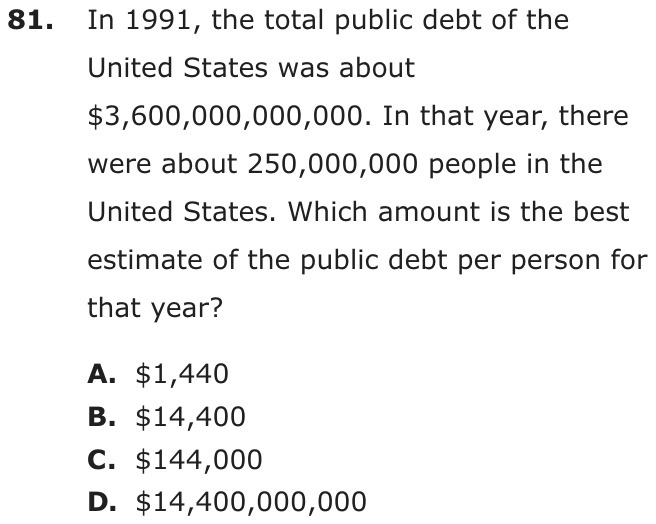
In 1991, the total public debt of the United States was about $3,600,000,000,000. In that year, there were about 250,000,000 people in the United States. Which amount is the best estimate of the public debt per person for that year?
- A$1,440
- B$14,400
- C$144,000
- D$14,400,000,000
Show the answer
Correct answer: B
The question asks for the amount of the public debt per person, so divide the total public debt by the number of people.
The amount of the public debt per person was about $14,400.
Question analysis
An estimation question with very large numbers: the 1991 United States public debt of about 3.6 trillion dollars and a population of about 250 million. Students find the debt per person. The choices differ by powers of ten, so cancelling zeros and keeping track of place value is the whole challenge.
- Grade level
- Grade 6 content, by NYS standard
- Compared with grade 7
- Below grade 7 Dividing large whole numbers and using place value are grade 5 and 6 skills. Grade 7 work goes further with rational numbers; this asks only for one careful division, with counting zeros as the main risk.
- Estimated difficulty
- Straightforward: two steps or one careful reading.
- Thinking it demands
- Depth of knowledge 2, skills and concepts · mainly apply
- What makes it hard
- Error-prone arithmetic moderate
- A very close wrong answer minor
- Solution
- 2 steps
- Reading level
- Question and choices: about grade 5, 37 words.
- Corrected from the DOE handbook
- A misprinted number in the explanation was corrected.
- Students, last 30 days
- Not enough answers yet to show (it takes 10).
Why it is hard, traps and wrong answers (shows the answer)
Why it is hard
The division itself is easy once the zeros are handled, and the question is built to punish miscounting them. Three choices carry the same digits, 144, at different sizes, so a student who loses or gains one zero still finds a match. A quick estimate in powers of ten, 3.6 trillion over a quarter of a billion, confirms that the answer is in the tens of thousands.
Error-prone arithmetic moderate Working it out
The debt has 13 digits and the population 9; cancelling seven zeros from each leaves 360,000 ÷ 25, and losing or adding one zero shifts the answer tenfold. (Brown & Burton, 1978; Junker & Sijtsma, 2001)
A very close wrong answer minor Choosing the answer
Three choices share the digits 144 and differ only by powers of ten, so getting the digits right does not settle it; only exact place value does. (Embretson & Wetzel, 1987; Gorin & Embretson, 2006; Ascalon et al., 2007)
Strategy: Cancel the same number of zeros from the debt and the population, then divide the smaller numbers that remain; check the size by estimating with powers of ten.
Traps
- An arithmetic slip: The right method with a plausible arithmetic error: a digit, a place value or a times-table fact.
- A faulty procedure: A systematic but wrong procedure: adding fractions straight across, applying an exponent to each term of a sum, dropping a sign when moving a term.
The wrong answers, classified
A An arithmetic slip (Junker & Sijtsma, 2001)
Cancels one zero too many while dividing and ends with $1,440, a per-person amount ten times too small.
C An arithmetic slip (Junker & Sijtsma, 2001)
Cancels one zero too few from the debt and ends with $144,000, a per-person amount ten times too large.
D A faulty procedure (Brown & Burton, 1978; Tatsuoka, 1983)
Divides the debt by 250 alone, dropping the six zeros that follow 250 in the population without removing any from the debt.
What was corrected from the DOE handbook, and why
- Explanation: The handbook’s first division writes the debt as “3,6000,000,000,000”, with an extra zero. The question gives $3,600,000,000,000, and the handbook’s next line (where the zeros are cancelled) uses 3,600,000,000,000, so the site now reads 3,600,000,000,000 ÷ 250,000,000. The answer, $14,400, is unchanged.
Worked solution, step by step
Formulas used
- Amount per person
- The total is the whole amount, here the debt in dollars. Dividing by the number of people shares it out equally. The result is how much goes with each one person.
- Canceling zeros
- a and b are any numbers, and b is not zero. Dividing the top and bottom of a fraction by 10 does not change its value. So you can cross off a zero at the end of the top and one at the end of the bottom, as a pair.
Sort out the question
The debt was about $3,600,000,000,000, which is 3.6 trillion dollars. There were about 250,000,000 people, which is 250 million. You need the debt per person. Per person means the amount for each one person.
Set up the division
Share the debt equally by dividing it by the number of people. The debt goes on top, and the people go on the bottom.
Cancel zeros in pairs
Count the zeros at the end of each number. The debt ends in 11 zeros. The population ends in 7. Cross off 7 zeros from each. Each pair you cross off divides the top and bottom by 10.
Watch out: cross off the same number from each. One too many from the debt gives $1,440, choice A. One too few gives $144,000, choice C.
Divide what is left
Dividing by 25 is the same as dividing by 100 and then multiplying by 4. That is because 4 groups of 25 make 100.
The debt was about $14,400 per person. Watch out: choice D divides by 250 only and forgets the zeros after it. So the answer is B, $14,400.
Check your answer
Multiply back. First, . Then put back the 7 zeros you crossed off: 3,600,000,000,000. That is the debt, so $14,400 is right.
More questions like this
The original DOE question
Question 11 of 24
2024 Test A Math, question 52Question
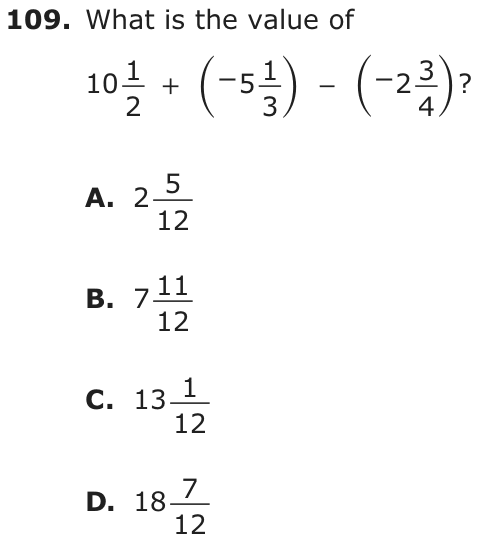
What is the value of ?
- A
- B
- C
- D
Show the answer
Correct answer: B
Rewrite the mixed numbers so that they all have equivalent denominators.
Subtracting a negative is the same as adding.
Group the whole numbers together and the fractions together.
Question analysis
This signed-number question asks for the value of 10 1/2 plus negative 5 1/3 minus negative 2 3/4. It tests adding and subtracting negative mixed numbers with unlike denominators. Turning each sign combination into a plain addition or subtraction, and then working in twelfths, is where students most often go wrong.
- Grade level
- Grade 7 content, by NYS standard
- Compared with grade 7
- At grade 7 Adding and subtracting negative mixed numbers is central grade 7 work. This three-term expression is typical in length, but it needs a common denominator of 12 and two different sign rules: adding a negative and subtracting one.
- Estimated difficulty
- Moderate: several steps, or a close reading with one strong distractor.
- Thinking it demands
- Depth of knowledge 1, recall and reproduction · mainly apply
- What makes it hard
- Error-prone arithmetic moderate
- Many steps minor
- Solution
- 4 steps
- Reading level
- Question and choices: about grade 10, 10 words.
- Students, last 30 days
- Not enough answers yet to show (it takes 10).
Why it is hard, traps and wrong answers (shows the answer)
Why it is hard
The expression is short, but it packs both sign rules for negative numbers into one line, and each misapplication has its own choice. Subtracting a negative is the rule most often broken, and the result is a reasonable-looking mixed number. Estimating with decimals, 10.5 − 5.3 + 2.8 is about 8, separates the answer from every wrong choice.
Error-prone arithmetic moderate Working it out
Two different sign rules meet: adding −5 1/3 means subtracting 5 1/3, while subtracting −2 3/4 means adding 2 3/4, and mixing them up gives a listed value. (Brown & Burton, 1978; Junker & Sijtsma, 2001)
Many steps minor Working it out
After the signs, halves, thirds and quarters become twelfths, and the wholes, 10 − 5 + 2, are combined apart from the fractions, 6/12 − 4/12 + 9/12. (Daniel & Embretson, 2010; Enright, Morley & Sheehan, 2002)
Strategy: Rewrite adding a negative as subtraction and subtracting a negative as addition, convert the fractions to twelfths, then combine the whole numbers and the fractions separately.
Traps
- Negatives and direction: Arithmetic with negative numbers, the order of a subtraction, or direction on a number line. (Moving a term across the equals sign without changing its sign is a faulty procedure.)
The wrong answers, classified
A Negatives and direction (Brown & Burton, 1978)
Handles the added negative but treats subtracting −2 3/4 as subtracting 2 3/4, so 5 1/6 − 2 3/4 = 2 5/12.
C Negatives and direction (Brown & Burton, 1978)
Drops the negative signs inside the parentheses and keeps the operations, 10 1/2 + 5 1/3 − 2 3/4 = 13 1/12.
D Negatives and direction (Brown & Burton, 1978)
Ignores every sign and adds all three mixed numbers, 10 1/2 + 5 1/3 + 2 3/4 = 18 7/12.
Worked solution, step by step
Formulas used
- Adding and subtracting negatives
- a is any number, and b is a positive number, so −b is negative. Adding a negative moves you left on the number line, just like subtracting. Subtracting a negative is like taking away a debt, so you end up with more. It is the same as adding.
- Equivalent fractions
- a is the top of a fraction and b is the bottom. n is any number except 0. Multiplying the top and bottom by the same number gives an equal fraction, cut into smaller pieces. Use it to give two fractions the same bottom before you add or subtract.
Sort out the expression
You need . There are three mixed numbers, and two of them are negative. A mixed number is a whole number plus a fraction. Plan: fix the signs, give the fractions the same bottom, then work with the whole numbers and the fractions one group at a time.
Fix the signs
Adding means subtracting . Subtracting means adding .
Watch out: subtracting a negative is adding. Subtracting instead gives , choice A. Dropping the minus signs gives C or D.Use twelfths for the fractions
The bottoms are 2, 3 and 4. All three go into 12, so change each fraction to twelfths.
Now the problem is .
Combine whole numbers, then fractions
Work with the whole numbers and the fractions one group at a time. Keep each sign.
The fraction part is less than 1, so just put them together: .
So the answer is B, .
Check your answer
Estimate with decimals. is about 7.92. And is also about 7.92, since is almost 1. They match.
More questions like this
The original DOE question
Question 12 of 24
2024 Test B Math, question 4Question
At one location, the temperature increased from −7° F to 4° F between 5:00 a.m. and 9:00 a.m. By 11:00 a.m., the temperature was 3.5 times the 9:00 a.m. temperature. What was the total increase in temperature between 5:00 a.m. and 11:00 a.m., in degrees Fahrenheit?
Grid-in question: work out the answer and enter it as a number.
Show the answer
Correct answer: 21
The 11:00 a.m. temperature is 3.5 times the 9:00 a.m. temperature. The 9:00 a.m. temperature was 4° F.
The temperature increased from −7° F at 5:00 a.m. to 14° F at 11:00 a.m., which is an increase of 21° F.
Question analysis
A temperature word problem with negative numbers: the temperature rises from −7° F to 4° F by 9:00 a.m., and by 11:00 a.m. it is 3.5 times the 9:00 a.m. reading. Students find the total rise from 5:00 to 11:00 a.m. Subtracting a negative starting temperature is where most slips happen.
- Grade level
- Grade 7 content, by NYS standard
- Compared with grade 7
- At grade 7 Using signed numbers for temperature change is standard grade 7 work. This adds a decimal multiplier and asks for a change rather than a temperature, two short steps, which keeps it at a typical grade 7 level.
- Estimated difficulty
- Moderate: several steps, or a close reading with one strong distractor.
- Thinking it demands
- Depth of knowledge 2, skills and concepts · mainly apply
- What makes it hard
- Error-prone arithmetic moderate
- Turning words into math minor
- Much to keep track of minor
- Solution
- 2 steps
- Reading level
- Question and choices: about grade 5, 43 words.
- Students, last 30 days
- Not enough answers yet to show (it takes 10).
Why it is hard, traps and wrong answers (shows the answer)
Why it is hard
Finding the 11:00 a.m. temperature is a single multiplication; the points are lost in the subtraction that follows. A rise that starts below zero has two parts, 7 degrees up to zero and 14 more above it, and students who treat −7 as 7 lose the first part. The times in the stem also invite measuring from 9:00 a.m. instead of 5:00 a.m., which covers only the last two hours.
Error-prone arithmetic moderate Working it out
The last step is 14 − (−7): subtracting the negative starting temperature means adding 7, and the part of the rise below zero is easy to leave out. (Brown & Burton, 1978; Junker & Sijtsma, 2001)
Turning words into math minor Understanding the question
“3.5 times the 9:00 a.m. temperature” multiplies the reading of 4°, not the 11-degree rise, and “total increase” runs from the 5:00 a.m. reading, not from 9:00. (Hegarty, Mayer & Monk, 1995; Koedinger & Nathan, 2004)
Much to keep track of minor Working it out
Three times of day carry three temperatures, −7°, 4° and 14°, and the answer compares the first with the last, not either of them with the middle one. (Sweller, 1988; Carpenter, Just & Shell, 1990)
Strategy: Find the 11:00 a.m. temperature from the 9:00 a.m. one, then subtract the 5:00 a.m. temperature from it, remembering that subtracting a negative number adds its size.
Traps
- Negatives and direction: Arithmetic with negative numbers, the order of a subtraction, or direction on a number line. (Moving a term across the equals sign without changing its sign is a faulty procedure.)
- Stops one step early: A choice is a number from partway through the solution.
- Answers a different question: A choice is right for another quantity: the other unknown, the rest instead of the part, the part instead of the whole.
The wrong answers, classified
7 Negatives and direction (Brown & Burton, 1978)
Finds 14° at 11:00 a.m. but subtracts 7 instead of −7, so 14 − 7 = 7, leaving out the part of the rise below zero.
14 Stops one step early (King et al., 2004; Gierl et al., 2017)
Finds the 11:00 a.m. temperature, 4 × 3.5 = 14, and grids it without subtracting the 5:00 a.m. temperature to get the increase.
10 Answers a different question (King et al., 2004; Hegarty, Mayer & Monk, 1995)
Measures the rise from 9:00 a.m. instead of 5:00 a.m., 14 − 4 = 10, which is only the last two hours of the total increase.
Worked solution, step by step
Formulas used
- Change in temperature
- End is the last temperature, and start is the first one. Subtract start from end to find how much it went up. It works with negative numbers too. A positive change means the temperature rose.
- Subtracting a negative number
- a is any number, and −b is a negative number. Taking away a negative is the same as adding its size. On a thermometer, going from −7 up to 0 is 7 degrees, so those 7 degrees get added.
Sort out what you know
There are three times and three temperatures, in degrees Fahrenheit (°F).
- 5:00 a.m.: −7°F, which is 7 degrees below zero
- 9:00 a.m.: 4°F
- 11:00 a.m.: 3.5 times the 9:00 a.m. temperature
You need the total increase from 5:00 a.m. to 11:00 a.m. That is how much warmer it got from the first time to the last.
Find the 11:00 temperature
“3.5 times the 9:00 a.m. temperature” means 3.5 times 4°F.
At 11:00 a.m. it was 14°F. Watch out: 14 is a temperature, not the increase. Gridding 14 stops too early.
Subtract the start from the end
The increase runs from 5:00 a.m. to 11:00 a.m. So it starts at −7°F and ends at 14°F.
Watch out: start at 5:00 a.m., not at 9:00 a.m. Starting from 4°F gives only 10.Subtract the negative number
Taking away a negative number is the same as adding its size.
The temperature rose 21°F. Watch out: writing 14 − 7 = 7 loses the minus sign. It skips the 7 degrees the air warmed just to reach zero.
So you would grid 21.
Check your answer
Count up on a thermometer. From −7°F up to 0°F is 7 degrees. From 0°F up to 14°F is 14 more. . Or add the two parts of the morning: it rose 11 degrees by 9:00 and 10 more by 11:00, and .
More questions like this
The original DOE question
Question 13 of 24
2024 Test B Math, question 7Question
The number line shows points E, F, G, and H.
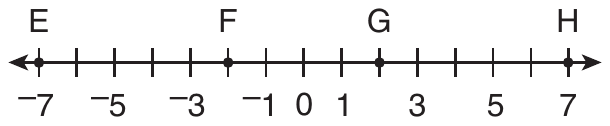
Which point represents the sum of ?
- Apoint E
- Bpoint F
- Cpoint G
- Dpoint H
Show the answer
Correct answer: B
Find the sum of :
Point F is located at −2.
Question analysis
A number line question with points E, F, G and H marked on a line labeled from −7 to 7. Students add 2.5 and negative 4.5 and find which point shows the sum. It tests adding a positive and a negative decimal, then reading positions on a line whose labels skip some integers.
- Grade level
- Grade 7 content, by NYS standard
- Compared with grade 7
- At grade 7 Adding rational numbers with different signs and showing the sum on a number line is exactly the grade 7 standard. This is one routine sum with simple decimals, a typical classroom exercise.
- Estimated difficulty
- Routine: one familiar step, little to misread.
- Thinking it demands
- Depth of knowledge 1, recall and reproduction · mainly apply
- What makes it hard
- Solution
- 2 steps
- Reading level
- Question and choices: about grade 1, 25 words.
- Students, last 30 days
- Not enough answers yet to show (it takes 10).
Why it is hard, traps and wrong answers (shows the answer)
Why it is hard
This is a one-line sum followed by a lookup, and most students finish quickly. The four points are placed so that each common sign mistake lands on one of them: −7, 2 and 7 all come from mishandling the negative. Picturing the sum as a move of 4.5 units to the left from 2.5 shows both the size and the direction at once.
Error-prone arithmetic minor Working it out
Adding −4.5 to 2.5 means taking 4.5 away from 2.5, and the larger size of −4.5 makes the sum negative, a sign rule that is easy to apply backwards. (Brown & Burton, 1978; Junker & Sijtsma, 2001)
Reading a figure, table or graph minor Understanding the question
Only 0 and the odd numbers are labeled, so point F sits at an unlabeled tick between −3 and −1 and must be found by counting. (Lesh, Post & Behr, 1987; Kirsch & Mosenthal, 1990)
Strategy: Rewrite adding −4.5 as subtracting 4.5, work out the sum, then find it on the line by counting tick marks from a labeled number, one tick per integer.
Traps
- Negatives and direction: Arithmetic with negative numbers, the order of a subtraction, or direction on a number line. (Moving a term across the equals sign without changing its sign is a faulty procedure.)
The wrong answers, classified
A Negatives and direction (Brown & Burton, 1978)
Adds the sizes 2.5 and 4.5 and makes the total negative, treating both numbers as negative, which lands on −7 at point E.
C Negatives and direction (Brown & Burton, 1978)
Subtracts 2.5 from 4.5 to get the right size, 2, but keeps it positive, missing that the negative number has the larger size.
D Negatives and direction (Brown & Burton, 1978)
Ignores the negative sign on 4.5 and adds the two numbers, 2.5 + 4.5 = 7, landing on point H at the far right.
Worked solution, step by step
Formulas used
- Adding a negative number
- a is any number, and −b is a negative number. Adding a negative number is the same as subtracting its size. On a number line, it means moving b steps to the left.
Sort out the question
You need to find . Then find that sum (the answer to the addition) on the number line.
The number line has a tick at every whole number from −7 to 7. Only 0 and the odd numbers have labels.
Turn the addition into subtraction
You are taking 4.5 away from 2.5. You take away more than you have, so the answer will be negative.
Do the subtraction
The two sizes differ by 2, because . The larger size, 4.5, belongs to the negative number. So the sum is negative.
Watch out: the answer is −2, not 2. Point G is at 2.Find −2 on the line
−2 has no label. It is the tick between −3 and −1. Point F sits on that tick.
Watch out: adding 2.5 + 4.5 = 7 lands on point H. Making both numbers negative gives −7, point E.So the answer is B, point F.
Check your answer
Start at 2.5 on the number line and move 4.5 steps to the left. The first 2.5 steps take you to 0. You still have 2 steps to go. Two more steps left of 0 lands on −2, which is point F.
More questions like this
The original DOE question
Question 14 of 24
2024 Test B Math, question 15Question
Claire is running on a circular track. She has already run 650 meters. Each lap around the track is a distance of 120 meters. Her goal is to run at least 2,500 meters in all. How many more laps does she need to complete in order to reach her goal?
- A5
- B6
- C15
- D16
Show the answer
Correct answer: D
Claire’s goal is to run at least 2,500 meters, and she has already run 650 meters.
Claire has at least 1,850 meters left to run. Divide by the distance around the track to find the number of laps she needs to complete:
Since she wants to run at least 2,500 meters, round 15.417 up to 16. Claire needs to run 16 laps to meet her goal.
Question analysis
A word problem about running laps: Claire has already run 650 meters on a 120-meter track and wants to run at least 2,500 meters in all. Students find how many more laps she must complete. Subtracting and dividing are straightforward; deciding what to do with the leftover part of a lap is the real test.
- Grade level
- Grade 7 content, by NYS standard
- Compared with grade 7
- At grade 7 Grade 7 students solve word problems that lead to inequalities like px + q ≥ r and interpret the solution in context. This is a typical three-step example, where the solution must be turned into a whole number of laps.
- Estimated difficulty
- Moderate: several steps, or a close reading with one strong distractor.
- Thinking it demands
- Depth of knowledge 2, skills and concepts · mainly apply
- What makes it hard
- Turning words into math moderate
- A very close wrong answer moderate
- Error-prone arithmetic minor
- Solution
- 3 steps
- Reading level
- Question and choices: about grade 3, 47 words.
- Students, last 30 days
- Not enough answers yet to show (it takes 10).
Why it is hard, traps and wrong answers (shows the answer)
Why it is hard
The arithmetic leads to about 15.4 laps, and the question is entirely about what to do with the fraction of a lap. Rounding to the nearest whole number is a habit that fails here, because the goal must be met or passed. Multiplying back, 15 × 120 = 1,800 and 16 × 120 = 1,920, shows which count actually covers the 1,850 meters still to run.
Turning words into math moderate Understanding the question
“At least 2,500 meters in all” means a part lap must still be run in full, so 1,850 ÷ 120 ≈ 15.4 has to be rounded up, against the usual rounding rule. (Hegarty, Mayer & Monk, 1995; Koedinger & Nathan, 2004)
A very close wrong answer moderate Choosing the answer
15 and 16 laps are one apart and both sit next to the quotient 15.4, so estimating cannot decide between them; only the condition that the goal be reached can. (Embretson & Wetzel, 1987; Gorin & Embretson, 2006; Ascalon et al., 2007)
Error-prone arithmetic minor Working it out
Dividing 1,850 by 120 by hand does not come out even, and long division by a three-digit number invites slips in placing the quotient. (Brown & Burton, 1978; Junker & Sijtsma, 2001)
Strategy: Subtract what she has run from 2,500, divide by 120, and check your whole number by multiplying it back: those laps must cover all of the remaining distance.
Traps
- Rounds too early: Rounds a value partway through, or rounds the wrong way, so the final answer drifts from the exact one.
- Answers a different question: A choice is right for another quantity: the other unknown, the rest instead of the part, the part instead of the whole.
The wrong answers, classified
A Answers a different question (King et al., 2004; Hegarty, Mayer & Monk, 1995)
Divides the 650 meters already run by 120 and rounds down to 5, counting laps finished so far instead of laps still needed.
B Answers a different question (King et al., 2004; Hegarty, Mayer & Monk, 1995)
Divides the 650 meters already run by 120, about 5.4, and rounds up as the goal requires, but for the distance done rather than the distance left.
C Rounds too early (King et al., 2004)
Finds 1,850 ÷ 120 ≈ 15.4 and rounds down to 15 by the usual rule, but 15 more laps leave her 50 meters short of the goal.
Worked solution, step by step
Formulas used
- Distance left
- Goal is the distance she wants to reach in all. Done is the distance she has already run. Subtract to find how far she still has to go.
- Number of laps
- Distance is how far she still has to run. One lap is the length of the track, 120 meters. Dividing tells how many laps fit into that distance. If it does not come out even, part of a lap is left over.
Sort out what you know
Claire has run 650 meters. One lap is 120 meters. Her goal is “at least 2,500 meters in all”. At least means 2,500 or more, so she must not fall short. You need how many more laps she must run.
Find the distance left
She still needs 1,850 meters. Watch out: divide the distance left, not the 650 meters she already ran. Dividing 650 by 120 leads to 5 or 6, choices A and B.
Divide by the length of a lap
The sign ≈ means about. Check with whole laps: . That leaves meters still to go. So 15 laps are not quite enough.
Round up to reach the goal
She needs part of one more lap. She has to complete whole laps, so she runs a 16th lap. Here you round up, even though 15.4 would usually round down. Watch out: 15 laps leave her 50 meters short, so choice C is wrong.
So the answer is D, 16.
Check your answer
Add up her total. With 15 more laps: meters, which is short of 2,500. With 16 more laps: meters. That reaches the goal.
More questions like this
The original DOE question
Question 15 of 24
2024 Test B Math, question 49Question
Suppose that w, x, y, and z are integers, none of which are zero. Under which set of conditions would the product always be positive?
- Ax is positive and w is positive.
- Bx is negative and w is negative.
- Cy is negative and z is negative.
- Dx and y are negative, and z and w are positive.
Show the answer
Correct answer: C
First, analyze the role of each variable in the expression .
will always be a positive number.
y can be a positive or a negative number.
can be a positive or a negative number.
will always be a positive number.
The expressions and will always be positive. Therefore, making the values of y and z negative would result in the expression being positive, since a negative multiplied by a negative is positive. Thus the given product would always be positive.
Question analysis
Four nonzero integers appear in a product that includes a square, a cube and an absolute value. Students choose the set of conditions that makes the product positive every time. It tests the sign rules for multiplication together with exponents and absolute value, and the trap is judging the sign by counting negative variables without looking at what is done to each.
- NYS standards
- Grade level
- Grade 7 content, by NYS standard
- Compared with grade 7
- Above grade 7 Grade 7 students learn sign rules for products of signed numbers. Here they must reason about four unknown integers under an even power, an odd power and an absolute value, and decide what is always true, which is more abstract than typical grade 7 work.
- Estimated difficulty
- Hard: combines ideas, needs a plan, and has more than one tempting wrong answer.
- Thinking it demands
- Depth of knowledge 2, skills and concepts · mainly analyze
- What makes it hard
- Variables instead of numbers moderate
- Every choice must be checked moderate
- Something you must already know minor
- Solution
- 3 steps
- Reading level
- Question and choices: about grade 6, 58 words.
- Students, last 30 days
- Not enough answers yet to show (it takes 10).
Why it is hard, traps and wrong answers (shows the answer)
Why it is hard
One insight decides the question: x² and |w| are positive whatever x and w are, so only the signs of y and z³ matter. Students who count negative letters instead of negative factors pick conditions that look balanced but leave y as the only negative factor. Students who test a single set of values can be fooled by a choice that leaves y and z unspecified.
Variables instead of numbers moderate Understanding the question
There are four variables and no numbers, and always positive must hold for every allowed value, so one test case can rule a choice out but never confirm it. (Koedinger & Nathan, 2004; Enright, Morley & Sheehan, 2002)
Every choice must be checked moderate Choosing the answer
Each set of conditions has to be checked against all four factors; the first two fix only x and w and leave y and z free to make the product negative. (Embretson & Wetzel, 1987)
Something you must already know minor Working it out
Students must know that a nonzero square and an absolute value are always positive, while an odd power such as z³ keeps the sign of z. (Anderson & Krathwohl, 2001)
Strategy: Work out, factor by factor, which signs each part of the product can take, then test each set of conditions against every factor rather than counting negatives.
Traps
- Negatives and direction: Arithmetic with negative numbers, the order of a subtraction, or direction on a number line. (Moving a term across the equals sign without changing its sign is a faulty procedure.)
- Misunderstands the concept: A wrong belief about a concept: that percents can be added, that area grows like length, that averages can be averaged, that a bigger denominator means a bigger fraction.
The wrong answers, classified
A Checks only one number (Schoenfeld, 1985)
Tests the choice with every variable positive, so the product is positive and it seems to work; y = −1 with z = 1 would make it negative.
B Misunderstands the concept (Smith, diSessa & Roschelle, 1993; De Bock et al., 1998; Ni & Zhou, 2005)
Pairs the negatives x and w as if they must cancel, not seeing that x² and |w| are positive anyway, so y and z still decide.
D Negatives and direction (Brown & Burton, 1978)
Counts two negative letters, x and y, as an even number of negatives, but x² is positive, so y is the only negative factor.
Worked solution, step by step
Formulas used
- Signs in multiplication
- a and b are positive numbers, so −a and −b are negative. A negative times a negative is positive. A negative times a positive is negative. So a product is positive when it has an even number of negative factors.
Sort out the question
w, x, y and z are integers, meaning whole numbers or their negatives. None of them is 0. The product means .
You need the conditions that make the product positive every time, for every number that fits them.
Look at x squared and |w|
means x × x. Two positives or two negatives multiply to a positive. So is always positive.
is the absolute value of w, its distance from 0. It is always positive, since w is not 0.
So x and w never change the sign of the product. Their signs do not matter.
Look at y and z cubed
y can be positive or negative. means z × z × z, and it has the same sign as z. For example, .
So the sign of the whole product is the sign of . It depends only on y and z.
Test each choice
- A and B say nothing about y and z. If y = −1 and z = 1, the product is negative. So they do not always work.
- C: y is negative, and is negative. A negative times a negative is positive. This always works.
- D: y is negative and z is positive. So the product is always negative.
Watch out: D has two negative letters, x and y. But is positive anyway, so y is the only negative factor.
So the answer is C, y is negative and z is negative.
Check your answer
Try numbers for C. Let x = −2, y = −3, z = −1 and w = −5. Then , which is positive. Even with x and w negative, the product stays positive.
More questions like this
The original DOE question
Question 16 of 24
2024 Test B Math, question 57Question
If x and y are both negative integers with , which expression has the least value?
- A
- B
- C
- D
Show the answer
Correct answer: A
Since x and y are both negative integers, both and are positive.
Therefore, both and are negative, and both and are positive.
Because and both x and y are negative, and . So .
Since and x and y are integers, .
So .
Therefore, .
Question analysis
Two negative integers x and y, with x less than y, appear in four expressions built from squares and minus signs. Students find the expression with the least value. It tests multiplying negative numbers and comparing their sizes, and the difficulty is tracking how each minus sign and each square changes both the sign and the size of the result.
- Grade level
- Grade 7 content, by NYS standard
- Compared with grade 7
- Above grade 7 Grade 7 students multiply negative numbers, but this asks them to compare four variable expressions for any pair of negative integers. Deciding how the squares compare when x is less than y goes beyond typical grade 7 sign practice.
- Estimated difficulty
- Hard: combines ideas, needs a plan, and has more than one tempting wrong answer.
- Thinking it demands
- Depth of knowledge 2, skills and concepts · mainly analyze
- What makes it hard
- Variables instead of numbers moderate
- A very close wrong answer moderate
- Every choice must be checked minor
- Solution
- 3 steps
- Reading level
- Question and choices: about grade 8, 20 words.
- Students, last 30 days
- Not enough answers yet to show (it takes 10).
Why it is hard, traps and wrong answers (shows the answer)
Why it is hard
Two facts settle the question: squares of negatives are positive, and the more negative number has the larger square. Students who track the minus signs carelessly think a leading minus makes an expression negative, and students who assume the larger y has the larger square choose the wrong negative expression. Substituting x = −3 and y = −2 gives −18, −12, 18 and 12, which orders all four at once.
Variables instead of numbers moderate Understanding the question
No values are given, only that x and y are negative integers with x < y, so students must reason about signs or invent a pair such as −3 and −2. (Koedinger & Nathan, 2004; Enright, Morley & Sheehan, 2002)
A very close wrong answer moderate Choosing the answer
x²y and xy² use the same letters with the exponent moved; both are negative, and only comparing x² with y² separates them. (Embretson & Wetzel, 1987; Gorin & Embretson, 2006; Ascalon et al., 2007)
Every choice must be checked minor Choosing the answer
All four expressions have to be placed in order, because the minus signs in front of the last two turn those expressions positive. (Embretson & Wetzel, 1987)
Strategy: Pick two negative integers with x less than y, such as −3 and −2, evaluate all four expressions, and confirm the order with a second pair.
Traps
- Negatives and direction: Arithmetic with negative numbers, the order of a subtraction, or direction on a number line. (Moving a term across the equals sign without changing its sign is a faulty procedure.)
- Misunderstands the concept: A wrong belief about a concept: that percents can be added, that area grows like length, that averages can be averaged, that a bigger denominator means a bigger fraction.
The wrong answers, classified
B Misunderstands the concept (Smith, diSessa & Roschelle, 1993; De Bock et al., 1998; Ni & Zhou, 2005)
Knows x²y and xy² are both negative but takes y² as the larger square because y > x, though the more negative x has the bigger square.
C Negatives and direction (Brown & Burton, 1978)
Reads the leading minus as making −x²y negative, missing that y is negative, so −x²y is in fact positive.
D Negatives and direction (Brown & Burton, 1978)
Assumes the leading minus makes −xy² negative, missing that x is negative, so −xy² is in fact positive.
Worked solution, step by step
Formulas used
- Signs in multiplication
- a and b are positive numbers, so −a and −b are negative. A negative times a negative is positive. A negative times a positive is negative. So a product is positive when it has an even number of negative factors.
- Squaring a number
- x is any number. x² (x squared) means x times itself. The square of a number other than 0 is always positive, because two negatives or two positives multiply to a positive.
Sort out the question
x and y are negative integers, such as −3 and −2. Since x < y, x is to the left of y on the number line. So x is more negative, farther from 0.
You need the expression with the least value. That is the most negative one.
Find the sign of each expression
Squares are positive, so and are positive.
- is a positive times a negative, so it is negative.
- is a negative times a positive, so it is negative.
- and are the opposites of these, so they are positive.
So the least value must be A or B. Watch out: The minus sign in front of C and D does not make them negative. It turns a negative into a positive.
Compare A and B with numbers
Try x = −3 and y = −2, since −3 < −2.
Since −18 < −12, A is smaller.
See why it always works
Both expressions contain x × y, which is positive. and . Multiplying the same positive number by the more negative x gives the more negative result.
Watch out: y is bigger than x, but is smaller than : 4 is less than 9. Thinking y² is bigger leads to choice B.
So the answer is A, .
Check your answer
Try another pair, x = −5 and y = −1. Then A is , B is , C is 25 and D is 5. A is still the least.
More questions like this
The original DOE question
Question 17 of 24
2023 Test A Math, question 2Question
What is the value of the expression shown above?
Grid-in question: work out the answer and enter it as a number.
Show the answer
Correct answer: -9
| Calculate the exponent and convert the mixed number to an improper fraction. | |
| Next, calculate the absolute value. | |
| Perform the indicated multiplication and division. | |
| Perform the addition and subtraction. | |
Question analysis
This grid-in asks for the value of an arithmetic expression that mixes an absolute value, a negative number raised to the third power, a division and a mixed number. Students apply the order of operations with signed numbers. Cubing a negative base, and doing the division and multiplication before any adding, are where most slips happen.
- NYS standards
- Grade level
- Grade 7 content, by NYS standard
- Compared with grade 7
- At grade 7 Grade 7 students routinely evaluate expressions with negative numbers in the right order. This one combines an absolute value, a cubed negative and a mixed number in a single line, so it takes more steps than usual, each with a sign to watch.
- Estimated difficulty
- Moderate: several steps, or a close reading with one strong distractor.
- Thinking it demands
- Depth of knowledge 1, recall and reproduction · mainly apply
- What makes it hard
- Error-prone arithmetic moderate
- Many steps minor
- An answer in an unexpected form minor
- Solution
- 4 steps
- Reading level
- Question and choices: about grade 5, 10 words.
- Students, last 30 days
- Not enough answers yet to show (it takes 10).
Why it is hard, traps and wrong answers (shows the answer)
Why it is hard
The expression packs four kinds of notation into one line: a subtraction, a division by an absolute value, a negative base raised to the third power and a mixed number. None of the operations is hard alone, but each has a rule that is easy to break under time pressure, and the slips lead to very different totals. Rewriting the power and the mixed number first, then dividing and multiplying before any addition, avoids them.
Error-prone arithmetic moderate Working it out
(−2)³ must stay negative, −8, and the mixed number 1½ must become 3/2 before multiplying, so the last product is −12; a sign or fraction slip here moves the total far from −9. (Brown & Burton, 1978; Junker & Sijtsma, 2001)
Many steps minor Working it out
Six numbers and six operations, including a power and an absolute value, have to be worked in a planned order, and every addition waits until the division and multiplication are done. (Daniel & Embretson, 2010; Enright, Morley & Sheehan, 2002)
An answer in an unexpected form minor Choosing the answer
The value is negative and the grid-in offers no choices, so the minus sign has to be gridded and nothing on the page confirms that the total falls below zero. (Enright, Morley & Sheehan, 2002)
Strategy: Rewrite the absolute value and the power first, change the mixed number to an improper fraction, do the division and multiplication, and only then add and subtract from left to right.
Traps
- Order of operations: Working left to right, or distributing a minus sign wrongly, gives a choice.
- Negatives and direction: Arithmetic with negative numbers, the order of a subtraction, or direction on a number line. (Moving a term across the equals sign without changing its sign is a faulty procedure.)
- A faulty procedure: A systematic but wrong procedure: adding fractions straight across, applying an exponent to each term of a sum, dropping a sign when moving a term.
The wrong answers, classified
15 Negatives and direction (Brown & Burton, 1978)
Takes (−2)³ as positive 8, as if every power of a negative were positive, so the last product is +12 and 6 − 3 + 12 = 15.
-13.5 Order of operations (Brown & Burton, 1978)
Works strictly from left to right: 6 − 9 = −3, divided by 3 is −1, plus −8 is −9, and times 1½ gives −13.5.
-6 A faulty procedure (Brown & Burton, 1978; Tatsuoka, 1983)
Multiplies the base by the exponent, taking (−2)³ as −6, so the product with 3/2 is −9 and the total is 6 − 3 − 9 = −6.
Worked solution, step by step
Formulas used
- Order of operations
- This is the order for working out an expression. First work inside grouping symbols, such as parentheses and absolute value bars. Next do powers. Then multiply and divide from left to right. Last, add and subtract from left to right. Using one order means everyone gets the same answer.
- A power
- a is the base, the number being multiplied. The small 3 is the exponent. It says how many times the base is used as a factor, a number being multiplied. It does not mean a times 3.
- Absolute value
- The bars around a number mean absolute value. It is how far the number is from 0 on a number line. A distance is never negative, so the absolute value of −3 is 3.
- Mixed number to fraction
- a is the whole number part, and b over c is the fraction part. Each whole is c pieces, so a wholes are a × c pieces. Add the b extra pieces. The bottom number stays c.
Sort out the expression
You need the value of . It has many operations, so the order matters. It has absolute value bars, a power of a negative number and a mixed number. The answer may be negative, so keep track of every sign.
Do the absolute value and the power
Grouping symbols and powers come first.
Two negatives multiply to a positive, 4. One more negative makes it negative again. Watch out: (−2)³ is −8, not +8. Using +8 leads to 15. It is also not −2 × 3. That mistake leads to a total of −6.
Change the mixed number to a fraction
A fraction is easier to multiply than a mixed number.
Now the expression looks like this:
Multiply and divide next
Multiplying and dividing come before adding and subtracting.
A negative times a positive is negative. Watch out: don’t just work from left to right. Doing 6 − 9 first, then dividing by 3, leads to −13.5.
Add and subtract last
Now only adding and subtracting are left. Work from left to right.
Adding −12 is the same as taking away 12. So you would grid −9, with the minus sign in its own column.
Check your answer
Look at the size of each part. The part 6 − 3 is a small positive number, 3. The last part, −8 times 1½, is a bigger negative number, −12. A big negative plus a small positive is negative. So an answer below zero, −9, makes sense.
More questions like this
The original DOE question
Question 18 of 24
2023 Test A Math, question 20Question
- A−60
- B
- C
- D68
Show the answer
Correct answer: C
Question analysis
This arithmetic question asks for the value of a fraction whose numerator is the sum of the squares of 3, −8 and 2, and whose denominator is the square of 3 − 8 + 2. Students apply the order of operations with negative numbers. Squaring a negative number and adding inside parentheses before squaring are the points to watch.
- NYS standards
- Grade level
- Grade 7 content, by NYS standard
- Compared with grade 7
- At grade 7 Squaring negative numbers and simplifying with the order of operations is standard grade 7 practice. Here the fraction bar groups a numerator and a denominator that each involve a negative sign, but the work stays short.
- Estimated difficulty
- Straightforward: two steps or one careful reading.
- Thinking it demands
- Depth of knowledge 1, recall and reproduction · mainly apply
- What makes it hard
- Error-prone arithmetic moderate
- Many steps minor
- Solution
- 3 steps
- Reading level
- Question and choices: about grade 16+, 3 words.
- Students, last 30 days
- Not enough answers yet to show (it takes 10).
Why it is hard, traps and wrong answers (shows the answer)
Why it is hard
The expression is built so that signs decide everything: the top's 3², (−8)² and 2² are all positive, and so is the square of the bottom's −3. Students who keep a negative after squaring, or who cancel the 9 on top against the 9 below, reach the other choices. The result, 77/9, does not reduce, which can make careful students doubt a correct answer.
Error-prone arithmetic moderate Working it out
Two negatives sit inside squares: (−8)² must be +64, and the denominator's 3 − 8 + 2 = −3 must be squared to +9, so every term ends up positive. (Brown & Burton, 1978; Junker & Sijtsma, 2001)
Many steps minor Working it out
The numerator needs three squares and a sum, the denominator a sum and then a square, and the fraction bar groups each side, so neither part can be split or cancelled. (Daniel & Embretson, 2010; Enright, Morley & Sheehan, 2002)
Strategy: Simplify the top and the bottom separately: square each number in the numerator, add inside the parentheses before squaring in the denominator, then write the fraction in lowest terms.
Traps
- Order of operations: Working left to right, or distributing a minus sign wrongly, gives a choice.
- A faulty procedure: A systematic but wrong procedure: adding fractions straight across, applying an exponent to each term of a sum, dropping a sign when moving a term.
The wrong answers, classified
A Order of operations (Brown & Burton, 1978)
Squares as if the minus sat outside the parentheses, (−8)² as −64, and also cancels the 9 on top against the 9 below, leaving −64 + 4 = −60.
B Order of operations (Brown & Burton, 1978)
Squares as if the minus sat outside the parentheses, taking (−8)² as −64, so the top is 9 − 64 + 4 = −51 and −51/9 = −17/3.
D A faulty procedure (Brown & Burton, 1978; Tatsuoka, 1983)
Cancels the 9 in the numerator, 9 + 64 + 4, against the denominator's 9, leaving 64 + 4 = 68, though only a factor of the whole top can cancel.
Worked solution, step by step
Formulas used
- Square of a negative
- a is any number. To square means to multiply a number by itself. A negative times a negative is positive. So the square of a negative number is always positive.
- The fraction bar groups
- A fraction bar means divide. It also groups: work out the whole top and the whole bottom first, then divide. You can only cancel a number that multiplies the whole top, not one part of a sum.
Sort out the expression
The top, the numerator, is three squares added together. The bottom, the denominator, is a sum in parentheses that is then squared. To square means to multiply a number by itself. Work out the top and the bottom on their own. Then divide.
Work out the top
Square each number first. Then add.
Watch out: (−8)² is +64, not −64. The minus sign is inside the parentheses, so it is squared too. Using −64 makes the top −51 and gives , choice B.
Work out the bottom
Work inside the parentheses first. Add and subtract before you square.
The bottom is 9.
Divide and simplify
77 is 7 × 11 and 9 is 3 × 3. They share no factor, so the fraction is in lowest terms. Watch out: don’t cancel the 9 on top with the 9 below. That 9 is only one part of a sum. Canceling it leaves 64 + 4 = 68, choice D. So the answer is C, .
Check your answer
Every square is positive or zero. So the top and the bottom are both positive, and the answer must be positive. That rules out −60 and . Also, is about 8.6, which is far from 68.
More questions like this
The original DOE question
Question 19 of 24
2023 Test B Math, question 6Question
What is the value of ?
- A
- B
- C
- D
Show the answer
Correct answer: C
The first step is to rewrite the problem replacing all subtraction with adding the opposite:
Then, rewrite all the fractions using a common denominator of 12, which is the least common multiple of the fractions’ denominators, 4, 3, and 2:
Next, combine the positive numbers and, finally, add the negative number to the sum by subtracting the number with the least absolute value from the number with the greatest absolute value and using the sign of the number with the greatest absolute value:
Question analysis
What is 3 1/4 − 1 2/3 − (−4 1/2)? This question on rational-number arithmetic combines mixed numbers with denominators of 4, 3 and 2 and ends by subtracting a negative number. Students must turn that last subtraction into an addition and find a common denominator before combining.
- Grade level
- Grade 7 content, by NYS standard
- Compared with grade 7
- At grade 7 Subtracting negative mixed numbers is core grade 7 content. This expression is typical in length, but it needs a common denominator of 12 and careful handling of the rule for subtracting a negative.
- Estimated difficulty
- Moderate: several steps, or a close reading with one strong distractor.
- Thinking it demands
- Depth of knowledge 1, recall and reproduction · mainly apply
- What makes it hard
- Error-prone arithmetic moderate
- Many steps minor
- Solution
- 4 steps
- Reading level
- Question and choices: about grade 10, 10 words.
- Students, last 30 days
- Not enough answers yet to show (it takes 10).
Why it is hard, traps and wrong answers (shows the answer)
Why it is hard
The expression is short, but it mixes a subtraction that stays a subtraction with one that becomes an addition, and that difference is what most wrong answers miss. The fractions add a second load, since twelfths are needed before anything combines. Estimating first, 3 − 1.7 + 4.5 is about 6, shows the result is positive, which rules out both negative values.
Error-prone arithmetic moderate Working it out
Three mixed numbers with denominators 4, 3 and 2 must become twelfths, and the last term, −(−4 1/2), changes sign while the middle subtraction does not. (Brown & Burton, 1978; Junker & Sijtsma, 2001)
Many steps minor Working it out
Rewriting the double negative, renaming each fraction, adding 3 1/4 and 4 1/2, then taking away 1 2/3 are four steps, each able to carry a slip forward. (Daniel & Embretson, 2010; Enright, Morley & Sheehan, 2002)
Strategy: Change subtracting −4 1/2 into adding 4 1/2, rename every fraction in twelfths, add the two positive numbers, then take away 1 2/3.
Traps
- Negatives and direction: Arithmetic with negative numbers, the order of a subtraction, or direction on a number line. (Moving a term across the equals sign without changing its sign is a faulty procedure.)
The wrong answers, classified
A Little reason to choose it (Haladyna & Downing, 1993; Rodriguez, 2005)
No single error gives −3 1/12; it needs subtracting 4 1/2 and also miswriting 3 1/4 as 3 1/12, two errors at once, so it mostly draws guesses.
B Negatives and direction (Brown & Burton, 1978)
Treats subtracting −4 1/2 as subtracting 4 1/2, so 3 1/4 − 1 2/3 − 4 1/2 = −2 11/12.
D Negatives and direction (Brown & Burton, 1978)
Drops both minus signs and adds the three mixed numbers, 3 1/4 + 1 2/3 + 4 1/2 = 9 5/12, as if every operation were addition.
Worked solution, step by step
Formulas used
- Subtracting a negative number
- a and b stand for any numbers. Taking away a negative number is the same as adding its opposite, the same number with the other sign. Think of it this way: taking away a debt leaves you richer.
- Equivalent fractions
- a is the top and b is the bottom of a fraction. Multiplying both by the same number n does not change its value. Use it to give fractions the same bottom number, so you can add or subtract them.
Sort out the question
You need the value of . Each number is a mixed number, a whole number plus a fraction. There are two subtractions. The second one takes away a negative number.
Change the double negative
Use the rule for subtracting a negative. Taking away is the same as adding .
The first minus sign stays as it is. Watch out: if you subtract instead, you get , choice B.
Give the fractions one denominator
The denominator is the bottom number of a fraction. Here they are 4, 3 and 2. The smallest number all three divide into is 12. So change each fraction to twelfths.
The problem is now:
Add the two positive numbers
You may add and subtract in any order, as long as each number keeps its sign. Add the two positive numbers first.
That is 3 + 4 = 7 wholes and 3 + 6 = 9 twelfths.
Take away the last number
That is 7 − 1 = 6 wholes and 9 − 8 = 1 twelfth. So the answer is C, .
Check your answer
Estimate with decimals: . And is about 6.08 too. The answer must be positive, so A and B are out. Choice D comes from adding all three numbers.
More questions like this
The original DOE question
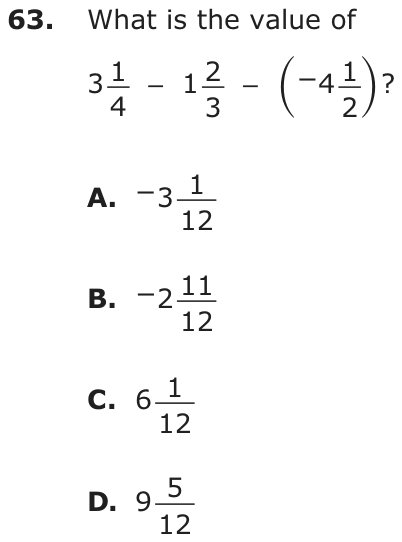
Question 20 of 24
2023 Test B Math, question 21Question
If m and n are positive integers, how many of the five expressions above are equivalent to ?
- A1
- B2
- C3
- D4
Show the answer
Correct answer: D
Since m and n are positive, the value of is also positive. Of the five options given:
is negative.
is positive.
is positive.
is positive.
is positive.
There are 4 expressions that are positive, and each one is equal to .
Question analysis
Five expressions are listed: −mn, (−m)(−n), |mn|, |−mn| and |(−m)(−n)|. If m and n are positive integers, students count how many are equivalent to mn. It tests the sign rules for multiplying negatives together with what absolute value does, and each expression has to be judged on its own.
- Grade level
- Grade 7 content, by NYS standard
- Compared with grade 7
- At grade 7 Multiplying signed numbers and absolute value are grade 6 and 7 content. Checking five expressions one by one takes longer than a typical single computation, but each check uses a familiar rule.
- Estimated difficulty
- Moderate: several steps, or a close reading with one strong distractor.
- Thinking it demands
- Depth of knowledge 2, skills and concepts · mainly analyze
- What makes it hard
- Variables instead of numbers moderate
- Much to keep track of minor
- Something you must already know minor
- Solution
- 5 steps
- Reading level
- Question and choices: about grade 10, 23 words.
- Students, last 30 days
- Not enough answers yet to show (it takes 10).
Why it is hard, traps and wrong answers (shows the answer)
Why it is hard
Each expression takes only a moment, but the answer is a count, so one misjudged expression changes it. The minus signs are designed to unsettle: four of the five expressions show at least one, and only one of those actually stays negative. Substituting small positive numbers and comparing each value with mn turns the question into arithmetic.
Variables instead of numbers moderate Understanding the question
The five expressions use only m and n, so each sign rule has to be applied in general unless the student substitutes values such as m = 2 and n = 3. (Koedinger & Nathan, 2004; Enright, Morley & Sheehan, 2002)
Much to keep track of minor Working it out
Five expressions are judged one at a time and a count kept, and two of them combine the product rule for negatives with absolute value bars. (Sweller, 1988; Carpenter, Just & Shell, 1990)
Something you must already know minor Working it out
The rules that two negative factors give a positive product and that absolute value removes a minus sign are assumed, not stated. (Anderson & Krathwohl, 2001)
Strategy: Pick small values such as m = 2 and n = 3, evaluate each of the five expressions, and count the ones equal to 6.
Traps
- Negatives and direction: Arithmetic with negative numbers, the order of a subtraction, or direction on a number line. (Moving a term across the equals sign without changing its sign is a faulty procedure.)
- Misunderstands the concept: A wrong belief about a concept: that percents can be added, that area grows like length, that averages can be averaged, that a bigger denominator means a bigger fraction.
The wrong answers, classified
A Negatives and direction (Brown & Burton, 1978)
Treats any minus sign as making the value negative, even inside bars or in a product of two negatives, so counts only |mn|.
B Misunderstands the concept (Smith, diSessa & Roschelle, 1993; De Bock et al., 1998; Ni & Zhou, 2005)
Accepts |mn| and (−m)(−n) but believes bars cannot cancel a minus sign written inside them, rejecting |−mn| and |(−m)(−n)|.
C Negatives and direction (Brown & Burton, 1978)
Thinks a negative times a negative stays negative, so rejects (−m)(−n) along with −mn and counts only the three absolute values.
Worked solution, step by step
Formulas used
- Multiplying two negatives
- a and b are positive numbers. A negative number times a negative number gives a positive number. The two minus signs cancel out. One negative and one positive give a negative.
- Absolute value
- The bars around a number mean absolute value. It is how far the number is from 0 on a number line. A distance is never negative, so |−6| = 6 and |6| = 6. The bars remove any minus sign.
Sort out the question
m and n are positive integers. That means whole numbers greater than 0. Writing mn means m times n, so mn is positive. You need to count how many of the five expressions always equal mn.
Pick numbers to test
Pick easy values: and . Then . Any expression that equals mn must come out to 6.
Test the first two expressions
This is negative, so it does not equal 6.
A negative times a negative is positive, so this one equals 6. Watch out: if you think a negative times a negative stays negative, you reject this one and get 3, choice C.
Test the three absolute values
All three equal 6, because absolute value bars remove a minus sign. Watch out: the bars work even when the minus sign is inside them. Rejecting the last two gives 2, choice B.
Count the matches
Four expressions equal mn: , , and . Only does not. The sign rules work the same for any positive m and n, not just 2 and 3. So the answer is D, 4.
Check your answer
Try other numbers, such as and . Then . The five expressions give −5, 5, 5, 5 and 5. Again, four of them match mn.
More questions like this
The original DOE question
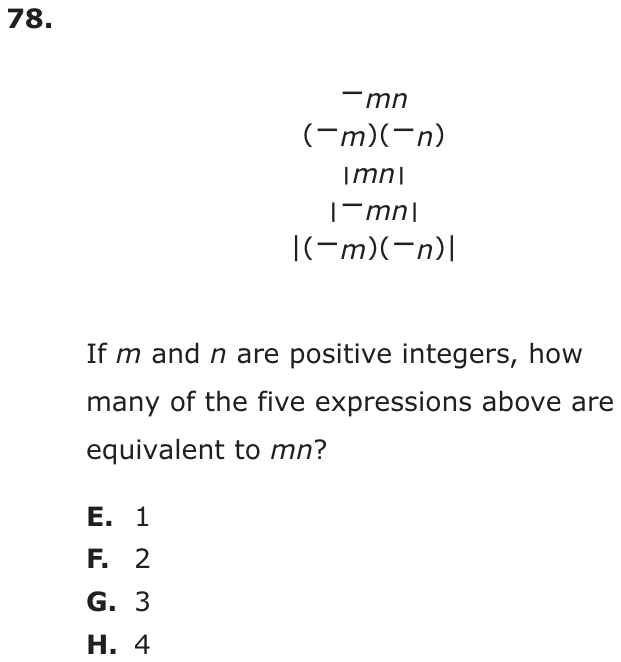
Question 21 of 24
2023 Test B Math, question 48Question
The outdoor temperature was 4.2° F at 10 p.m. After hours, the outdoor temperature was −0.7° F. Which value best represents the average change in temperature per hour?
- A−1.4° F
- B−1.0° F
- C1.0° F
- D1.4° F
Show the answer
Correct answer: A
First, recognize that the temperature decreased. This means that the order of subtraction matters and that the result is a negative number:
The temperature decreased 4.9 degrees. Divide by 3.5 to get the average change per hour:
Question analysis
The temperature was 4.2° F at 10 p.m. and −0.7° F three and a half hours later. Students find the average change in temperature per hour. It tests subtracting and dividing with negative decimals, and the choices pair two sizes of change with both signs, so the sign has to be right as well as the size.
- NYS standards
- Grade level
- Grade 7 content, by NYS standard
- Compared with grade 7
- At grade 7 Signed-number problems about temperature are standard grade 7 work. This one asks for an average rate, so a change that crosses zero must be divided by a mixed-number time, with the sign kept through both steps.
- Estimated difficulty
- Moderate: several steps, or a close reading with one strong distractor.
- Thinking it demands
- Depth of knowledge 2, skills and concepts · mainly apply
- What makes it hard
- Error-prone arithmetic moderate
- Turning words into math minor
- A very close wrong answer minor
- Solution
- 2 steps
- Reading level
- Question and choices: about grade 5, 31 words.
- Students, last 30 days
- Not enough answers yet to show (it takes 10).
Why it is hard, traps and wrong answers (shows the answer)
Why it is hard
The arithmetic is short, but signs decide every choice: two choices come from treating −0.7 as 0.7, and one comes from getting the size right and the direction wrong. Students who think of the drop in two parts, 4.2 degrees down to zero and 0.7 more, find the 4.9-degree fall; dividing by 3.5 hours and remembering the temperature fell finishes it.
Error-prone arithmetic moderate Working it out
The change crosses zero, −0.7 − 4.2 = −4.9, and then a negative decimal is divided by 3.5, from the 3 1/2 hours, with the sign kept through both steps. (Brown & Burton, 1978; Junker & Sijtsma, 2001)
Turning words into math minor Understanding the question
The phrase “average change in temperature per hour” means the change from the 4.2° start to the −0.7° end divided by the time, final minus initial, so a drop is negative. (Hegarty, Mayer & Monk, 1995; Koedinger & Nathan, 2004)
A very close wrong answer minor Choosing the answer
The answer, −1.4° F, and the choice 1.4° F share every digit and differ only in sign, so a correct division followed by a careless sign cannot be caught by estimating. (Embretson & Wetzel, 1987; Gorin & Embretson, 2006; Ascalon et al., 2007)
Strategy: Subtract the starting temperature from the ending one, keeping track of the sign, then divide that change by the 3.5 hours.
Traps
- Negatives and direction: Arithmetic with negative numbers, the order of a subtraction, or direction on a number line. (Moving a term across the equals sign without changing its sign is a faulty procedure.)
The wrong answers, classified
B Negatives and direction (Brown & Burton, 1978)
Subtracts 0.7 from 4.2 as if both temperatures were above zero, a 3.5-degree drop, so 3.5 ÷ 3.5 gives 1, then marks the change negative.
C Negatives and direction (Brown & Burton, 1978)
Treats −0.7 as 0.7, finding a 3.5-degree change, and also loses its direction, reporting a rise of 1 degree an hour for a temperature that fell.
D Negatives and direction (Brown & Burton, 1978)
Finds the 4.9-degree change and divides by 3.5 correctly, or subtracts in the order start minus end, and reports a rise for a temperature that fell.
Worked solution, step by step
Formulas used
- Average change per hour
- Start is the first temperature, and end is the last one. End minus start is the total change. It is negative when the temperature drops. Dividing by the number of hours shares that change equally over each hour.
Sort out the question
At 10 p.m. it was 4.2° F. After hours, it was −0.7° F. That is below zero. The temperature went down, so the change is negative. You need the average change for each hour.
Find the total change
Subtract the start from the end.
Picture a thermometer. Going from 4.2 down to 0 is a drop of 4.2 degrees. Going on to −0.7 is 0.7 more. In all, it fell 4.9 degrees.
Watch out: 4.2 − 0.7 = 3.5 treats −0.7 as if it were above zero. That leads to choice B or C.
Divide by the hours
Write hours as 3.5 hours. Use the formula.
To divide, think 49 ÷ 35 = 1.4, since 35 × 1.4 = 49. The change is negative, so it is −1.4 degrees per hour.
Keep the sign
The temperature fell, so the answer must be negative.
Watch out: 1.4 has the right size, but it says the temperature went up. That is choice D.
So the answer is A, −1.4° F.
Check your answer
Work forward. Dropping 1.4 degrees each hour for 3.5 hours is degrees. Then . That is the temperature in the problem.
More questions like this
The original DOE question
Question 22 of 24
2018 Test A Math, question 33Question
Johan leased a car for three years. He paid a one-time fee of $1,000, and an additional $300 per month for the full three years. At the end of the three years, what is the total amount Johan paid for leasing this car?
- A$1,900
- B$4,600
- C$10,800
- D$11,800
Show the answer
Correct answer: D
Three years is 36 months (12 × 3).
Set up an expression to find the total amount Johan paid:
Question analysis
This word problem about leasing a car combines a one-time fee with a monthly payment over three years and asks for the total amount paid. Students must convert years to months, multiply by the monthly payment and add the fee. Leaving out one piece of the cost, or mixing years with months, is the usual slip.
- NYS standards
- Grade level
- Grade 6 content, by NYS standard
- Compared with grade 7
- Below grade 7 This is a short total-cost calculation with whole numbers, easier than typical grade 7 word problems, which bring in percents, negative numbers or fractions. The only care needed is turning years into months.
- Estimated difficulty
- Routine: one familiar step, little to misread.
- Thinking it demands
- Depth of knowledge 2, skills and concepts · mainly apply
- What makes it hard
- Much to keep track of minor
- A very close wrong answer minor
- Solution
- 3 steps
- Reading level
- Question and choices: about grade 4, 41 words.
- Students, last 30 days
- Not enough answers yet to show (it takes 10).
Why it is hard, traps and wrong answers (shows the answer)
Why it is hard
This is the easiest kind of multi-step word problem: whole numbers, a familiar money situation and a direct method. The only places to slip are changing three years into 36 months and remembering the one-time fee after the long multiplication. Each slip has its own choice, so a quick check that both costs are in the total is worth the seconds.
Much to keep track of minor Working it out
The $1,000 fee is paid once while the $300 repeats monthly, so it must be held aside while 36 × 300 is computed. (Sweller, 1988; Carpenter, Just & Shell, 1990)
A very close wrong answer minor Choosing the answer
The choices $11,800 and $10,800 differ by only $1,000 out of about $11,000, so a rough total cannot separate them; only including the one-time fee does. (Embretson & Wetzel, 1987; Gorin & Embretson, 2006; Ascalon et al., 2007)
Strategy: Count the months in the lease first, multiply the monthly payment by that number, and then add the one-time fee.
Traps
- Stops one step early: A choice is a number from partway through the solution.
- Units or scale: The answer is wanted in other units, or a rate or scale must be converted first.
The wrong answers, classified
A Units or scale (King et al., 2004)
Multiplies $300 by 3 years instead of 36 months, getting $900, then adds the $1,000 fee to reach $1,900.
B Misreads the question (Hegarty, Mayer & Monk, 1995)
Charges the $300 for only 12 months, one year rather than the full three, so 3,600 + 1,000 gives $4,600.
C Stops one step early (King et al., 2004; Gierl et al., 2017)
Finds the 36 monthly payments, 36 × $300 = $10,800, and stops before adding the one-time $1,000 fee.
Worked solution, step by step
Formulas used
- Total cost with a fee
- T is the total paid. f is the one-time fee, paid only once. m is the monthly payment. n is the number of months. You multiply first because the monthly payment repeats every month. Then you add the fee once.
Sort out what you know
Johan paid $1,000 one time. He also paid $300 every month for 3 years. You need the total he paid.
The payments are counted by the month, but the time is given in years. So first change the years to months.
Count the months
Each year has 12 months:
So Johan made 36 monthly payments. Watch out: multiplying $300 by 3 years instead of 36 months gives $900. Adding the fee then gives $1,900, which is choice A.
Add up the monthly payments
Multiply the monthly payment by the number of months:
The monthly payments add up to $10,800.
Add the one-time fee
Use the formula. The fee goes in once:
Watch out: $10,800 is choice C. It leaves out the $1,000 fee. So the answer is D, $11,800.
Check your answer
Round to check. $300 a month for 36 months is a bit more than $10,000. Add the $1,000 fee and you get a bit more than $11,000. $11,800 fits. Choices A and B are far too small for three years of payments.
More questions like this
The original DOE question
Question 23 of 24
2018 Test A Math, question 52Question
Each week, Leon has fixed expenses of $1,250 at his furniture shop. It costs him $150 to make a chair in his shop, and he sells each chair for $275. What is Leon’s profit if he makes and sells 25 chairs in 1 week?
- A$1,875
- B$2,500
- C$3,125
- D$4,375
Show the answer
Correct answer: A
Each chair costs Leon $150 to make, and he sells the chair for $275.
His profit is found by subtracting the cost from the price:
$275 − $150 = $125 per chair
If Leon makes and sells 25 chairs in a week, his initial profit is
25 × $125 = $3,125
However, Leon has additional fixed expenses of $1,250 per week, so this cost must also be subtracted to arrive at the profit. His final profit is
$3,125 − $1,250 = $1,875
Question analysis
This profit word problem gives Leon's weekly fixed expenses at his furniture shop, the cost to make each chair and its selling price, then asks his profit for 25 chairs in one week. Students must find the profit on each chair, multiply, and account for the fixed expenses. Forgetting the fixed expenses, or adding them, are the main slips.
- NYS standards
- Grade level
- Grade 7 content, by NYS standard
- Compared with grade 7
- At grade 7 Multi-step money problems are standard grade 7 work. This one has three whole-number steps and a familiar profit idea, so it matches typical grade 7 demand, with the fixed cost as the detail to remember.
- Estimated difficulty
- Moderate: several steps, or a close reading with one strong distractor.
- Thinking it demands
- Depth of knowledge 2, skills and concepts · mainly apply
- What makes it hard
- Much to keep track of moderate
- Something you must already know minor
- Solution
- 3 steps
- Reading level
- Question and choices: about grade 3, 39 words.
- Students, last 30 days
- Not enough answers yet to show (it takes 10).
Why it is hard, traps and wrong answers (shows the answer)
Why it is hard
The arithmetic is whole-number and friendly, so the question is about bookkeeping: which amounts are income, which are costs, and which happen once a week. The fixed expenses are named first in the stem and are easy to forget by the time the per-chair profit is multiplied. A final check that revenue minus all costs, 6,875 − 3,750 − 1,250, gives the same result confirms it.
Much to keep track of moderate Working it out
Three dollar amounts play different roles, a weekly fixed expense, a cost per chair and a price per chair, and each must enter the profit with the right sign. (Sweller, 1988; Carpenter, Just & Shell, 1990)
Something you must already know minor Working it out
The bold "profit" is not defined; students must know it means money taken in minus every cost, including costs that do not depend on the number of chairs. (Anderson & Krathwohl, 2001)
Strategy: Subtract the cost from the price to get the profit per chair, multiply by the number of chairs, then subtract the week's fixed expenses.
Traps
- Stops one step early: A choice is a number from partway through the solution.
- Wrong operation: Adds instead of multiplying, divides the wrong way round, turns a ratio or rate upside down, or undoes a step in the wrong direction (subtracts what should be added back).
The wrong answers, classified
B Numbers taken from the question (Hegarty, Mayer & Monk, 1995)
Multiplies the $150 cost by 25 chairs and subtracts the $1,250, treating the cost of making a chair as money earned.
C Stops one step early (King et al., 2004; Gierl et al., 2017)
Finds the profit on 25 chairs at $125 each, $3,125, and stops before subtracting the $1,250 fixed expenses.
D Wrong operation (Hegarty, Mayer & Monk, 1995; King et al., 2004)
Adds the $1,250 fixed expenses to the $3,125 chair profit instead of subtracting them, treating an expense as income.
Worked solution, step by step
Formulas used
- Profit
- P is the profit, the money Leon keeps. I is the income, the money he takes in from sales. C is the total cost: every dollar he spends, including fixed expenses. Profit is what is left after all costs are paid.
Sort out what you know
Leon pays $1,250 each week no matter what. These are fixed expenses, like rent. Each chair costs $150 to make, and he sells each one for $275.
He makes and sells 25 chairs. Profit is the money left after paying all the costs.
Find the profit on one chair
Each chair sells for $275 but costs $150 to make. Subtract to see what he keeps:
He keeps $125 on each chair he sells.
Find the profit on 25 chairs
The chairs bring in $3,125 more than they cost to make. Watch out: $3,125 is choice C, but it is not the final profit. The fixed expenses still have to be paid.
Subtract the fixed expenses
Watch out: the $1,250 is money spent, so subtract it. Adding it gives $4,375, choice D. So the answer is A, $1,875.
Check your answer
Work it the long way. Sales: 25 × $275 = $6,875. Costs: 25 × $150 = $3,750, plus $1,250, which makes $5,000. Profit: $6,875 − $5,000 = $1,875. Same answer.
More questions like this
The original DOE question
Question 24 of 24
2018 Test B Math, question 11Question
At 1:00 p.m. one day, the temperature was 8 degrees above zero. During the rest of the day, the temperature fell 3 degrees per hour. What was the temperature at 7:00 p.m. that day?
- A−13°
- B−10°
- C−7°
- D5°
Show the answer
Correct answer: B
7:00 p.m. is 6 hours after 1:00 p.m. Calculate the number of degrees the temperature dropped in 6 hours:
3 × 6 = 18 degrees
Subtract that from the starting point (8 degrees) to find the solution:
8 − 18 = −10 degrees
Question analysis
This integer word problem starts with a temperature 8 degrees above zero at 1:00 p.m. and has it fall 3 degrees every hour. Students find the temperature at 7:00 p.m. by counting hours and subtracting into negative numbers. Getting the number of hours between the two times right is the main hurdle.
- Grade level
- Grade 7 content, by NYS standard
- Compared with grade 7
- At grade 7 Grade 7 students use positive and negative numbers for real changes such as temperature. This is a standard three-step example of that skill, with a counting slip as its only real trap.
- Estimated difficulty
- Straightforward: two steps or one careful reading.
- Thinking it demands
- Depth of knowledge 2, skills and concepts · mainly apply
- What makes it hard
- Error-prone arithmetic minor
- Solution
- 3 steps
- Reading level
- Question and choices: about grade 4, 32 words.
- Students, last 30 days
- Not enough answers yet to show (it takes 10).
Why it is hard, traps and wrong answers (shows the answer)
Why it is hard
The arithmetic is light; the question turns on counting the hours from 1:00 to 7:00 correctly. Counting the clock times instead of the gaps between them gives seven hours, starting the drop an hour late gives five, and both errors are built into the choices. Subtracting the times, 7 − 1, is safer than counting on fingers.
Error-prone arithmetic minor Working it out
The total drop of 18 degrees is larger than the starting 8 degrees, so the subtraction crosses zero and the result must be negative. (Brown & Burton, 1978; Junker & Sijtsma, 2001)
Strategy: Count the hours that pass from 1:00 to 7:00 by subtracting the times, multiply by the 3-degree drop, and subtract that total from 8.
Traps
- Counting the ends: Inclusive or exclusive ends, fence posts, consecutive numbers: an answer that is one too many or too few, or an endpoint drawn open where it belongs closed (or the reverse).
The wrong answers, classified
A Counting the ends (Brown & Burton, 1978)
Counts the clock times 1, 2, 3, 4, 5, 6, 7 as seven hours, so subtracts 21 degrees from 8.
C Counting the ends (Brown & Burton, 1978)
Starts the drop at 2:00 instead of 1:00, counting five hours and subtracting 15 degrees from 8.
D Numbers taken from the question (Hegarty, Mayer & Monk, 1995)
Subtracts a single 3-degree drop from 8, combining the two numbers in the question without counting the hours.
Worked solution, step by step
Formulas used
- Total change
- The rate is how much the temperature changes each hour, here 3 degrees down. The time is the number of hours. Multiply them to get the total change, because the same drop happens every hour.
Write down what you know
At 1:00 p.m. it was 8 degrees above zero. Each hour after that, it dropped 3 degrees.
You need the temperature at 7:00 p.m.
Count the hours
Subtract the clock times: 7 − 1 = 6. So 6 hours pass.
Watch out: Do not count the clock numbers 1, 2, 3, 4, 5, 6, 7. That is 7 numbers but only 6 hours. Using 7 hours gives −13°, choice A. Starting the count at 2:00 gives 5 hours and −7°, choice C.
Find the total drop
The temperature drops the same amount each hour, so multiply.
The temperature fell 18 degrees in all.
Subtract from the start
Start at 8 degrees and take away the 18-degree drop.
The drop is bigger than 8, so the temperature goes below zero. A temperature below zero is a negative number. It is 10 degrees below zero.
So the answer is B, −10°.
Check your answer
Count down hour by hour: 8 at 1:00, 5 at 2:00, 2 at 3:00, −1 at 4:00, −4 at 5:00, −7 at 6:00 and −10 at 7:00. You land on −10.
More questions like this
The original DOE question