Question
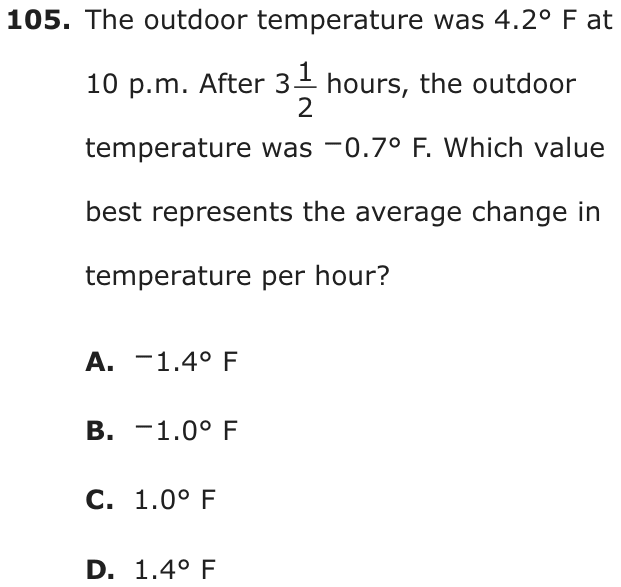
The outdoor temperature was 4.2° F at 10 p.m. After hours, the outdoor temperature was −0.7° F. Which value best represents the average change in temperature per hour?
- A−1.4° F
- B−1.0° F
- C1.0° F
- D1.4° F
Show the answer
Correct answer: A
First, recognize that the temperature decreased. This means that the order of subtraction matters and that the result is a negative number:
The temperature decreased 4.9 degrees. Divide by 3.5 to get the average change per hour:
Question analysis
The temperature was 4.2° F at 10 p.m. and −0.7° F three and a half hours later. Students find the average change in temperature per hour. It tests subtracting and dividing with negative decimals, and the choices pair two sizes of change with both signs, so the sign has to be right as well as the size.
- NYS standards
- Grade level
- Grade 7 content, by NYS standard
- Compared with grade 7
- At grade 7 Signed-number problems about temperature are standard grade 7 work. This one asks for an average rate, so a change that crosses zero must be divided by a mixed-number time, with the sign kept through both steps.
- Estimated difficulty
- Moderate: several steps, or a close reading with one strong distractor.
- Thinking it demands
- Depth of knowledge 2, skills and concepts · mainly apply
- What makes it hard
- Error-prone arithmetic moderate
- Turning words into math minor
- A very close wrong answer minor
- Solution
- 2 steps
- Reading level
- Question and choices: about grade 5, 31 words.
- Students, last 30 days
- Not enough answers yet to show (it takes 10).
Why it is hard, traps and wrong answers (shows the answer)
Why it is hard
The arithmetic is short, but signs decide every choice: two choices come from treating −0.7 as 0.7, and one comes from getting the size right and the direction wrong. Students who think of the drop in two parts, 4.2 degrees down to zero and 0.7 more, find the 4.9-degree fall; dividing by 3.5 hours and remembering the temperature fell finishes it.
Error-prone arithmetic moderate Working it out
The change crosses zero, −0.7 − 4.2 = −4.9, and then a negative decimal is divided by 3.5, from the 3 1/2 hours, with the sign kept through both steps. (Brown & Burton, 1978; Junker & Sijtsma, 2001)
Turning words into math minor Understanding the question
The phrase “average change in temperature per hour” means the change from the 4.2° start to the −0.7° end divided by the time, final minus initial, so a drop is negative. (Hegarty, Mayer & Monk, 1995; Koedinger & Nathan, 2004)
A very close wrong answer minor Choosing the answer
The answer, −1.4° F, and the choice 1.4° F share every digit and differ only in sign, so a correct division followed by a careless sign cannot be caught by estimating. (Embretson & Wetzel, 1987; Gorin & Embretson, 2006; Ascalon et al., 2007)
Strategy: Subtract the starting temperature from the ending one, keeping track of the sign, then divide that change by the 3.5 hours.
Traps
- Negatives and direction: Arithmetic with negative numbers, the order of a subtraction, or direction on a number line. (Moving a term across the equals sign without changing its sign is a faulty procedure.)
The wrong answers, classified
B Negatives and direction (Brown & Burton, 1978)
Subtracts 0.7 from 4.2 as if both temperatures were above zero, a 3.5-degree drop, so 3.5 ÷ 3.5 gives 1, then marks the change negative.
C Negatives and direction (Brown & Burton, 1978)
Treats −0.7 as 0.7, finding a 3.5-degree change, and also loses its direction, reporting a rise of 1 degree an hour for a temperature that fell.
D Negatives and direction (Brown & Burton, 1978)
Finds the 4.9-degree change and divides by 3.5 correctly, or subtracts in the order start minus end, and reports a rise for a temperature that fell.
Worked solution, step by step
Formulas used
- Average change per hour
- Start is the first temperature, and end is the last one. End minus start is the total change. It is negative when the temperature drops. Dividing by the number of hours shares that change equally over each hour.
Sort out the question
At 10 p.m. it was 4.2° F. After hours, it was −0.7° F. That is below zero. The temperature went down, so the change is negative. You need the average change for each hour.
Find the total change
Subtract the start from the end.
Picture a thermometer. Going from 4.2 down to 0 is a drop of 4.2 degrees. Going on to −0.7 is 0.7 more. In all, it fell 4.9 degrees.
Watch out: 4.2 − 0.7 = 3.5 treats −0.7 as if it were above zero. That leads to choice B or C.
Divide by the hours
Write hours as 3.5 hours. Use the formula.
To divide, think 49 ÷ 35 = 1.4, since 35 × 1.4 = 49. The change is negative, so it is −1.4 degrees per hour.
Keep the sign
The temperature fell, so the answer must be negative.
Watch out: 1.4 has the right size, but it says the temperature went up. That is choice D.
So the answer is A, −1.4° F.
Check your answer
Work forward. Dropping 1.4 degrees each hour for 3.5 hours is degrees. Then . That is the temperature in the problem.
More questions like this
The original DOE question